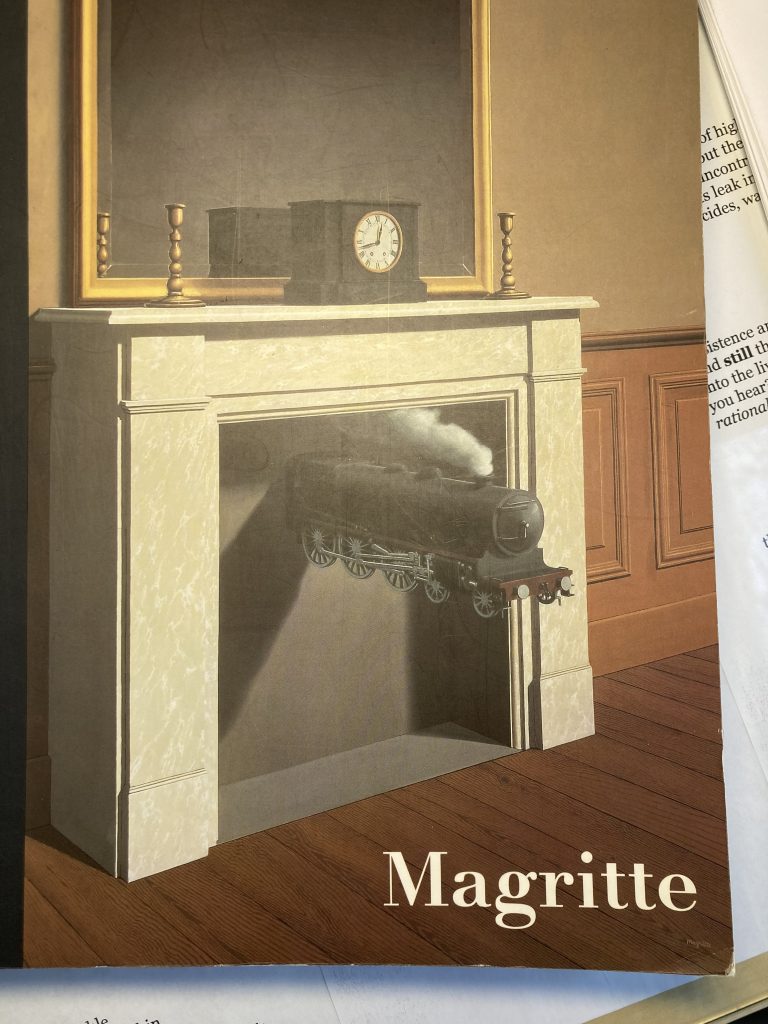
dec 5/RUN

3.35 miles
trestle turn around
25 degrees / snow showers
100% snow-covered

Another wonderful run! Wore my yaktrax and hardly slipped at all. It was warmer with less wind. And it was quiet. Greeted Dave, the Daily Walker by calling out, I love this! I love winter running! He called back, Michigan, right? A year or two ago we had discussed winter running and I had mentioned that I was from the UP in Michigan. Nice memory, Dave!

Everything was white and gray and soft. At least an inch of soft snow on the trail. Encountered at least one fat tire, several walkers, including Dave, and a pair of runners. I remember looking out over the open space of the gorge, but I don’t remember what the river looked like. Was it completely covered?

I stopped at the trestle to breathe in the quiet. It was quiet, and it wasn’t. A woodpecker pecking on a tree, or was it a squirrel trying to crack a nut? The voices of the 2 runners passing by. Someone blasting music out of a car radio. A guy walking a dog and talking on a bluetooth.

I noticed something I’ve never noticed before. Just south of the trestle, there are 2 tall wooden posts sticking out of the ground, about 6 feet apart. Above them are thatched wooden slats. What is/was this?

2 wooden posts near the railroad trestle, a woodpecker, a goose, snow / 5 dec 2025

I read a few more of Jana Prikryl’s poems from MIDWOOD. Here’s one that uses a favorite word of mine, still, and uses time to describe one’s location in space:

TEN O’CLOCK/ Jana Prikryl

Holding perfectly still at this party
a clutch of talkers, he’s at my four o’clock
you are at ten and you’ve cupped the fingers
of my left hand with the fingers of your left hand
as though no one will notice the little link
my whole occupation is holding still
so this may continue
all my feeling refuses
to toss the pebble in the current

sept 2/RUNBIKESWIM

5 miles
franklin loop
70 degrees

I was planning to bike over to the lake and swim this morning but it looked gloomy and ominous, and then started raining and thundering for several hours. Bummer. By the time it stopped raining it had warmed up and the sun came out. Even so, I went for a hot and humid run. Everything was wet. A slick trail, dripping branches, wet shoes and shirt.

10 Things

  1. someone covered over the graffiti on the steps that read, stop hate, with blue paint
  2. sky, part 1: gray, heavy
  3. sky, part 2; blue and cloudless
  4. empty river
  5. white foam on the edge of the east bank near the franklin bridge
  6. kids laughing on the playground at the church daycare
  7. some orange and red leaves beyond the fence near east river road
  8. the squeal of tires near the trestle — what happened?
  9. orange cones lining the path: there must have been a race or a sponsored bike ride this past weekend
  10. the sliding bench was empty of people but close to a thick veil or green

Listened to voices, cars, and drips for the first half of the run, my “Doin’ Time” playlist for the second half. The song I remember the most was Peter Gabriel’s “Playing for Time.”

Oh, there’s a hill that we must climb
Climb through all the mist of time
It’s all in here what we’ve been through

Not a fan of the phrase, mist of time, but these lyrics reminded me of a few lines from Mary Oliver that I read right before heading out for my run:

Slowly
up the hill,
like a thicket of white flowers,
forever.
(The Leaf and the Cloud/ Mary Oliver)

The lines just preceding these were a series of good-byes to the world: the swaying trees, the black triangles of the winter sea, oranges, the fox sparrow, blue-winged teal, lettuce, turnip, rice fields, the morning light, and the goldfinches.

Down, I’m getting it down
Sorting it out
So everything I care about
Is held in here
All of those I love, inside

Listening to these lines, I thought about Oliver’s deepening of the spirit. I thought about the interior and moving inside of yourself and of burying memories and ideas not as a way to avoid them, but to protect them. I also thought about someone growing older and having memory-loss and trying to hold onto faces and names and experiences. I weighed the possibilities and limitations of going deep inside as compared to opening up to the outside. All of these thoughts came at once — not in a linear progression — in a burst which lasted until I heard these lines less than a minute later:

There goes the sun
Back from where it came
The young move to the center
The mom and dad, the frame

I just remembered: at the start of my run, I was thinking about the difference between ordinary and extraordinary time, which was a continuation of thoughts that began earlier this morning. Habits, routines, activities/events experienced again and again — the mundane — versus the scattered, sporadic occasions that break up the routine. While meaning and memories are often found in the singular moments, I’m drawn to the rituals and repetitions and daily events as where imporant meaning dwells.

Everyday. everyday = ordinary / every day = each day, daily.

Everyday—I have work to do (“Work” in The Leaf and the Cloud/ Mary Oliver)

I love that she writes everyday and not every day, so it’s not, each day I have work to do but, ordinary, everyday life: don’t bug me, I have work to do!

bike: 7.5 miles
lake nokomis and back*
75/71 degrees

*instead of the river road trail, we took 44th until the falls park, which is shorter

A good bike ride with Scott. As usual, better on the way back — easier, more relaxed. On the way there: wind. No problems with panicking about not seeing. The ride home was great: the sun was setting soon. Passed by adults playing soccer or flag football or some team sport in the field by the duck bridge, and kids playing soccer at Hiawatha school. RJP and FWA both played for a season at Hiawatha. I played for 5 or 6 years when I was kid in Northern Virginia. I loved it; they didn’t.

swim: 2 loops
lake nokomis main beach
74 degrees

Only 4 other people in the lake, and none of them were swimming laps, just standing around and talking — brrr, I bet that was cold! I swam far from the white buoys and almost completely avoided the milfoil. Only a few times, I got too close and felt the vines on my toes and wrists. For most of the swim there was wind and choppy water. In one direction, it pushed me along. In the other, I got to swim straight into it, which I liked doing. Mostly, a fun swim. The vines were the only bad thing about it. They were too thick by the one buoy so I didn’t want to circle around it. This made it much harder to loop, so I mostly stopped and twisted around. I noticed some birds in the sky and a few planes. Trees on the distant shore were looking less green — were any of them changing?

I thought about how this might be my final swim of the season. It’s cooler for the rest of the week — highs in the 60s, so they might take down the buoys soon. It’s been a great season. I swam for longer, both distance and time. And, I had fun reciting more water lines in my head and writing about water.

aug 21/RUNSWIM

3.6 miles
locks and dam #1
74 degrees
humidity: 88% / dew point: 65

I’m trying to write this entry but I’m distracted by the little kids next door in the front yard — such cute voices. One of them was singing a song — take this grass. . .broken world. . . broken glass.

Refrain: hot, humid. Even so, a better run today than the last one I did. When was that? Tuesday (checked my log). Ran all the way to the bottom of the locks and dam #1 hill without stopping. Noticed the river. Such reflections! Clouds, trees, the bridge. Took a picture:

bridge / clouds / surface / sky

The water was smooth beneath the bridge and rippled (corrugated, as Anne Carson wrote) farther out.

Everything is still this morning, calm, quiet. Partly inspired by my 21 aug 2024 entry, I thought about being still. Not as not moving, but as a calm, steadiness. Stillness as the space between beats, when both of my feet are off the ground. Or, stillness as my strong core that floats through that space — suspended as held up in the air, not as stopped.

10 Bridge Things

  1. at the top of the hill, in-between the top and bottom of the bridge, a family was sitting on a bench
  2. the gate near the columns of the bridge was unlatched and slight ajar
  3. beyond it, hollowed out bricks with a strange pattern
  4. empty benches all the way down
  5. the reflection of the bridge on the water’s surface, upside down
  6. a car nearing the bottom, voices — couldn’t hear what they were saying but imagined it was about whether or not the locks and dam was open
  7. the echo of my footsteps under the bridge
  8. the clicking of a bike’s gear across the service road
  9. thought about what RJP told me yesterday: someone went over this locks and dam in a canoe (or was it a kayak?) yesterday
  10. at the top of the hill again, a man read the sign to a little kid who started jumping and asked him to join — by the time I reached them, they were both jumping and laughing and making goofy noises

the deepening and quieting of the spirit
among the flux of happenings

still

I thought about being quiet and calm and the opposite of restless and anxious. Then I thought about my core — literally and figuratively. Core = my core muscles, strong back, a straight spine. Core = enduring values, character. I felt the stillness within my self and my body even as the world blurred and floated and drifted around me. Then, Mary Oliver’s “deepening and quieting of the spirit” popped into my head — amongst the flux of happenings. Yes! A stillness of the spirit, where stillness is being satisfied and balanced and present in the moment, not needing to do more or feel guilt or regret for what was or wasn’t done. 

21 aug 2023 log entry

I still the clock./ Endi Bogue Hartigan

/I still the clock.

/I still the clock by holding the pendulum coin still so that
the mechanism stops
and I can sleep without the consciousness of it.

to still the clock is a ritual of the demagnification of clocks.

/it is a kind of violence of fiction for the clock to not
function as a clock while others click and breathe and blink.

the eyes blink more before they stop functioning as eyes.

/the rapid eye movement of dream frightening being pure
pulse, pure frenetic zag force

/to watch a gold-painted platinum extravagant clock you’re an excess you’re
a fire you’re in competition with the tiredness of time.
/to hold in your satiny eyelids the still unstill pendulum of
the gaudy machination you are in unison

with the aspirant expirations of the day.

still / holding / pending / stop
sleep / not function /
click / breathe / blink / dream / pulse / excess / rapid fire extravagance / tiredness / still unstill / aspire to expire

underwater the end (expiration) is the breath (expire)
the end / forced above / evicted from below / no longer water but air

In this poem, to still is to stop, to end, the deep sleep

swim: 6 loops
110 minutes
cedar lake open swim
82 degrees

The final open swim of the season. It goes so fast! Another great night for a swim. Warm, sunny. I liked that the wind made the water less smooth — not too rough, a gentle rocking. The course was set up strangely and even though I complained about it afterwards, I think I liked the challenge of it. One buoy was in the middle of the lake, the other was at the far left edge of hidden beach. At first I worried that this set-up would cause chaos with swimmers crossing over the path and running into to each other, but it was fine.

a risky moment: Because the course was so far to the left, I swam in water I haven’t before. Almost halfway across, I swam straight into a nest of vines — the biggest cluster of vines I’ve ever experienced. I didn’t panic and was able to swim out of it, but I could imagine a weaker swimmer struggling to free themselves and getting wrapped more tightly. As I swam away from it, I thought about the high school football player that drowned off of the little beach at lake nokomis about 10 years ago. That’s probably how it happened.

Some things irritated me: the swimmer that I tried to pass but sped up to prevent it, another swimmer stopped at the buoy, blocking the way, the unmoving lifeguard on his kayak too close in on the course, the bright sun making it almost impossible to see anything on the way back, the scratchy vines. But more things relaxed and delighted me: the gentle water, feeling strong and able to swim for so long, swimming past other swimmers like they were standing still, the faint clouds in the sky, the solitary orange buoy sitting on the surface of the water glowing, glimpsing other swimmers off in the distance — only inklings: the flash of a yellow or orange buoy, a bright pink cap, white foamy water.

overheard:

a mom with 2 kids, one who was around 4 or 5, the other a baby in her arms, to a lifeguard: Can he swim out to the orange pyramid?
lifeguard: (thinking she meant the baby and not the kid) alone?
mom: oh no, not the baby!

Later I heard her recounting the story to a friend. They were laughing about it.

At the end of the second to last loop, I stopped at the beach, stood in the shallow water and the sand, checked my watch, and decided to do one more loop. For the final loop, I felt Mary Oliver’s one day in August, everything calm and quiet. I thought about what a great season it has been, how grateful I am to have this time swimming, and how satisfied I am to have taken advantage of it. No open swims until next June. I thought about how no next season is guaranteed; a lot could happen between now and then. Then I remember the story of my great-grandmother Johanna standing out in the field at the farm near the end of the fall to behold the familiar view, wondering if she’d still be around the next fall.

aug 20/BIKESWIMSWIM

bike: 8.6 miles
lake nokomis and back
71 degrees

Hooray for biking to a lake that is open again! Had a few (almost) moments of panic — maybe not panic, but feeling unsettled. Everything blurred or smudged. I could see enough but not as much as I wanted to. The rest of the time, the ride was more than fine.

Nearing the double bridge, I could hear a bike approaching from behind. I slowed down to let him pass and he called out, in a chill and kind voice, you’re good — it’s single file here. After making it through the bridge, as he passed me, he called, those e-bikes are scary! I agreed, but wasn’t sure why he mentioned it. Only now, writing this, did I remember that some e-bike passed me going very fast and without warning me. I suppose that was what he was referring to.

swim: 1.75 loops (6 mini loops)
45 minutes
lake nokomis main beach
72 degrees

The lake and the beach were empty. Noticed some signs near the shore — oh no, is the beach still closed? Nope. Those signs were for more information about blue-green algae and weren’t announcing that the beach was closed.

The water was great. Not too cold, clearer than cedar lake. Saw some of my sparkle friends and a lot of ducks. At least 2 different ducks crossed my path as I swam. quack quack

Forgot to count loops; counted number of strokes for one loop (250) and each of the four white cylindrical buoys as I swam past them, and my five strokes between breaths.

Encountered a lot of pale milfoil, a few paddle boarders, a canoe. No other swimmers.

Right before starting my swim, I heard a dog barking on the other side. Something about the deep sound, repeated half a dozen times, that seemed solemn or ominous.

It was wonderful to be swimming in lake nokomis all alone. So quiet! So relaxed. A definite deepening and quieting of the spirit.

For part of a loop, I recalled the woman I met who had been bit by a fish and was unsettled. Will any fish come and bite me today? Then I remembered that it annoyed her, but it didn’t seem to hurt or haunt her. Barely a nibble.

Later, I recall thinking about how my world is always underwater: distorted and approximate forms, softened features, a sense of disconnection but also a new logic of connection. Right after that thought, I noticed how underwater was green, above blue — blue sky, blue surface, green everything else

hour entry: I made a chart today a beautiful/ Endi Bogue Hartigan

I made a chart today a beautiful weekly chart for links and breakages and shoulder pulls and astronaut walks. Some items are measured in repetitions, some in minutes and I endeavor to note on which days I have devoted my body’s minutes and repeated movements through time space onto this chart. At the end I hope for late endorphin states, and an even gait, and for uncertain ailments to dissipate by my discipline.

chart / shoulders / repetitions / measured minutes / devotion to minutes to repetitions to even gaits to uncertain ailments

What does my watch watch?

minutes / loops / beats / strokes / effort / uneven gaits / balance / breath / pace / distance / errors / miscalculations / days / dates / hours / location / light / how loud that military plane flying overhead was / ambient light / laziness / discipline / dedication / obsessions / hesitations / regrets

swim: 3.25 loops
75 minutes
cedar lake open swim
81 degrees

Another beautiful night for a swim! And the buoys were back where they belong: close to point and hidden beach. I didn’t feel too sore even though I swam earlier today. My shoulders were fine the whole swim, but my right tricep started to ache on the second to last loop.

Everything was great in the water except the vines. So many vines — strands, clumps, nets of vines. I kept swimming through them and as they hit me with their sharp scratchiness, I flinched. I’m glad I didn’t pull something in my neck with all the flinching I was doing! And the vines didn’t want to leave. They wrapped around my feet, my wrists, shoulders, head. One persistent clump wrapped around my safety buoy and kept tapping me on the thigh until I finally realized what it was and ripped it off and threw it.

The sky was blue with a few fluffy clouds and an occasional soaring bird. Oh, and a dragonfly! I haven’t seen many of those this summer.

Today I noticed the spray from my arm as I lifted it out of the water. Dripping in an arc as my hand traveled from my hip to past my head and back into the water.

One more day of open swim club. How can it be over already?

aug 18/SWIM

5 loops (9 cedar loops)
95 minutes
cedar lake open swim
77 degrees

A fabulous evening: no wind, sun, calm water. I felt so strong and buoyant for much of the swim. High on the water, a steady kick, strong arms. The light around 7 was that great late summer evening light. The sun setting earlier than in July — a chance to see a different sort of sparkle on the surface. Point beach was shallower than usual. I was able to stand up farther out than I ever have before — or, was I just standing in a different spot? The floor of this beach is very uneven. Lots of prickly vines, single strands passing slowly over my legs, clusters or clumps or knots almost getting tangled with my kicking feet.

before the swim

Continuing to read and think about Endi Bogue Hartigan’s on orchid o’clock as I experiment with what it could mean to swim one day in august. In process note #27, Hartigan writes this about the process of working on the book:

I dove into reading about the history of horology, clock systems, and theories/philosophies of time and my mind wandered through these histories for years, clock history being an incredible palimpsest of histories: religious, industrial, scientific, astronomical, governmental, economic, natural, more. The history of clocks and time measure includes everything from the capitalist puppetry of measuring industrial time to drive efficiency, to the synchronization with atomic clocks from computers where real time headline bleed into our screens and consciousness, to medieval monks creating mechanisms to wake for morning prayers. Time itself as a concept has no one definition. And while clock measure is cultural it is also so personal, is used to keep us close to our beloved ones and moments. I wrote from this interlay, and the more I wrote the more I wrestled with how we inherit these interwoven histories and constraints, but also fight against them and can slip boundless out of them. 

The mechanization and measurement of time. I’m thinking of the second verse of Oliver’s poem:

Something had pestered me so much
I thought my heart would break.
I mean, the mechanical part.

The mechanical part. The clock! That twelve-figured moon skull, that white spider belly! Regular. Ordering disorderly life. Ordinary (Oliver, Upstream). the hours on their rounds, twelve white collar workers who manage the schedules of water (A Oswald, Dart).

Precise. Neat little boxes. Nothing approximate about it, exact. The closest I can get to precision when measuring my encounter with lake water. The next closest is arm strokes, but only because I’m steady with my strokes and rarely stop or vary it. My Apple watch records this data. It even distinguishes breast stroke from freestyle. How?

It’s 150 strokes o’clock. It’s 30 breaths o’clock.

Where does an Apple watch fit into the study of clocks? To my swimming one day in August?

Later in her process notes, Hartigan describes the three forms she uses in her book:

The forms I arrived at became a way of moving with different paces in time, moving in primarily three different forms/paces: hour entries which are prose-like and which move at a slower loosely-shadowed mental pace that allows for sentences; second entries which are like little insect legs notching forward with alliteration and gap-jumping nonlinear narratives; and a variety of lyrics that often use the slash as an entrance. They work together and of course the forms mix and disrupt their own boundaries too. The slash was important to my mental movement. 

Very cool. I’m thinking about my own forms and how to express different modes of swimming in the lake. Inklings, which is the chapbook I’m working on, are short 5 syllable, 5 line, flash encounters with the lake. Brief glimpses, approximations, things witnessed in the midst of motion. Then I have some shortened sonnets — 5 syllable 14 line poems represent more sustained encounters. What other form to use, and what does it represent?

hour entry: “calendaring” is a verb/ Endi Bogue Hartigan

“Calendaring” is a verb. You can “clock yourself in.” These terms like rows of hothouse orchids living in some God-forsaken pre-purchase interval steam. New verbs for new measures, new signs of transaction as home, this moon hour spent “off the clock,” but tracked, this noon hour packed in screen-time and foam, this stem of the orchid holding itself up as an orchid. you can even check off “orchid,” you can list for Tuesday, “unnatural hothouse mixture of purple and green.”

clock yourself in / measuring data / transactor or transacted or transaction? / tracked / tricked / off the clock / on the clock / in the clock

calendar / 7 days / every day / any day / a certain day / day after day / all day / once a day / 30 days has september

orchids in rows / hothouse / swimmers doing loops / a dredged-out lake / unnatural green / fertilizer run-off / blue-green algae o-clock / an exchange — a perfect lawn for an unswimmable lake

during the swim

Thought about days and remembered my “On This Day” practice. I should use that in my thinking and writing about one day in August. Also thought about another way, in addition to minutes, strokes, and distance, that I use to measure duration: active calories. Finally, as I counted my strokes between breaths — 1 2 3 4 5 breathe right 1 2 3 4 5 breathe left — I thought about counting as a comforting practice and about counting and accumulation (minutes/hours accrued) versus counting as a repeating of numbers with no accumulation (1 2 3 4 5 breathe). Of course, there is accumulation with these strokes and I keep track of it on my watch: total number of strokes. But, the act of counting in the water over and over is different.

aug 16/RUN

3.1 miles
trestle turn around
75 degrees
humidity: 89% / dew point: 71

Ran in-between raindrops. It started raining yesterday afternoon and kept going, off and on, all morning. Then, right before my run, the sun came out. Now that I’m done, it’s dark again. More rain coming.

Everything wet. Slick, too. Mud, puddles, crushed acorns: dangerous. I slipped once but barely. So thick out there! No rowers or roller skiers or regulars. Some bikers, walkers, other runners. Stopped at the sliding bench — the only view was dark green. Then stopped north of the trestle to check out how the crack was doing. The trail is still blocked off with tape and orange cones, the crack has grass where there used to be dirt and is opening up again.

a crack in the paved path  is growing grass. It stretches towards an orange cone.
the persistent crack / 16 aug 2025

Listened to my “Doin’ Time” playlist on shuffle and was inspired when “Once in a Lifetime” came on, especially this refrain about water

Letting the days go by, let the water hold me down
Letting the days go by, water flowing underground
Into the blue again, after the money’s gone
Once in a lifetime, water flowing underground.

Except, as I was running, I heard the line not as after the money’s gone but after the BODY’S gone, which really fit in with my thinking about time, water, and selfhood and started a train of thought about the I above ground returning to the not-I underground/underwater — or the not-water self above returning to the water self below.

The body’s gone also fit with a reoccurring theme in the playlist: the limits of time and death. “Out of Time” and “Closing Time.” Instead of reading death/body gone as running out of time or no longer having any time, I thought about it as something other than a possession — time flows through us and we flow through time. We don’t spend it or own it, we live in it and with it and through it.

It is time now, I said

In my “On This Day” practice this morning, I encountered a series of lines and ideas about time from 16 aug 2021. I stopped at this entry, not reading any more of the aug 16 entries, and decided that today would be about time. Later I realized how fitting it was to study time in the midst of my attempt at living within Mary Oliver’s poem, “Swimming, One Day in August.” It is time now, I said/ for the deepening and quieting of the spirit/ among the flux of happenings. It is time.

During a swim, I lose track of time, have no idea what time it is, as I swim continuously around the buoys. If time is measured at all, it is in loops. And often, I lose track of those too. Was that 3 loops or 4? I can’t recall.

Maybe time is measured in location? Near one shore or the other, one buoy or the next? Here then there then here again

If there’s something gimmicky about trying to swim the equivalent of one day in August, it’s also a great goal for me: not impossible, but requiring some commitment and swimming more than I would otherwise swim. And it’s concrete and straightforward: be in the water, moving, for a total of 24 hours. And it’s satisfying, watching the minutes increase.

And it does something strange to time and it’s passing. Technically I understand a day to be 24 hours, but I don’t usually think about (or count) some of those hours — like the ones in which I’m sleeping, or the ones in which I’m lost in writing or in reading a book. I don’t think I can quite articulate it right now, but accumulating these minutes is a different type of living in time.

It’s a delightful waste of time. No great accomplishment, just a fun experiment. Of course, it’s only a waste in terms of productive time. I am not achieving anything big here that you might put on a resume. It’s not making money, and it’s not creating a product. It is, I think, making me faster and stronger, but not in the most efficient ways.

An idea: what about a chapbook titled, Swimming One Day in August, that plays around with different understandings of a day and its relation to time? I could write about this goal, where 1 day = 24 hours. But I could also write about a day = a random day of swimming in august or a collage of days swimming in august from just 2025, or from all of the days I’ve written about since 2017?

For Mary Oliver, a day is the day before in which the narrator went in the afternoon/to the sea/which held me until I grew easy. It is also today, now — It is time now, I said. And it is tomorrow (and the tomorrow after that?) — About tomorrow, who knows anything./ Except it will be time again/for the deepening and quieting of the spirit. Here day is a daily habit. (Another approach to this challenge could be: swimming every day in august. This might be difficult, since I don’t have reliable access to water to swim in.)

I like how Oliver sets up time in this poem. She’s talking about yesterday, today, and tomorrow but without beginning or end. When did this habit start? Was it yesterday, when she was pestered, or was it some other yesterday before that? And when will it end? It is also not linear, involving progress. With its repeated habit, it’s circular, a loop, going to the same place day after day: the sea to be held. Is it the same time every afternoon, or just, vaguely, “afternoon.” And, what counts as afternoon, how late does it go? To me, afternoon is before 5, but to Scott it’s before 6.

may 21/RUN

5.5 miles
ford loop
44 degrees
drizzle

Wasn’t planning to run the ford loop, but I started it and then just kept going. It felt good, relaxed, not hard to keep my heart rate a little lower. My pace was slow, but it didn’t feel slow, or fast, or any speed really.

10 Things

  1. mist
  2. dripping
  3. spray
  4. mirrors
  5. puddles
  6. graffiti
  7. traffic
  8. bridge
  9. debris
  10. slick

It rained all day yesterday, and some early in the morning. Started again during my run. Everything dripping wet, including me, although I didn’t really feel it, or couldn’t distinguish it from my sweat. Before I started running, as I walked through the neighborhood, I looked into the puddles on the sidewalk and admired how they had become mirrors, reflecting the sky and the trees. Running over the river, I looked down at the east bank and saw colorful graffiti all over the rocks at the base of the lake street bridge. In spots, the trail was slick with mud or covered in debris — fallen leaves, broken branches, grit. Crossing the ford bridge, I looked north and was delighted by the mist, making everything seem fuzzy and unformed. The traffic on the bridge was thick — I couldn’t see or feel any spray coming off of their wheels, but I could hear it.

overheard: one runner to another — you can bank the time.
Another use of time as a commodity.

Listened to the water, in its various forms, for the first half of my run. Put in my “moment” playlist for the second half. The most memorable song today: One Moment in Time/ Whitney Houston

A line that stood out to me:

And in that one moment of time
I will feel
I will feel eternity

I thought about Mary Oliver’s definition of eternity and how Whitney Houston’s doesn’t fit with it. MO understands eternity as creative time that’s outside of the ordinary and beyond the self. Houston’s eternity seems more like eternal glory.

As I listened to all of the lyrics, I thought about Whitney Houston’s tragic life and terrible death — an overdose. I also thought about the idea of one moment and what happens after that moment is over. And this made me think about post-Olympic blues, or post-marathon blues, or post-publishing a poem blues.

To keep myself distracted and steady, I chanted in triple berries —– strawberry blueberry raspberry. Then I chanted my poem — I go to the gorge/to find the soft space/between beats.

more on the moment as between

Read a very brief interview with Marie Howe the other day. She mentioned a poem that inspired her and that she wished everyone would read: The Season of Phantasmal Peace/ Derek Walcott. Beautiful! Here’s a line to remember that describes the moment:

and this season lasted one moment, like the pause
between dusk and darkness, between fury and peace

Before my run, I began listening to a talk by Jennifer Chang, “Other Pastorals: Writing Race and Place“. She mentions one between in the presentation of her thesis statement: how poets of color use pastoral to grapple with the complex composition of place as a tension between lived and learned experience. She recites another between from Rick Barot’s “On Gardens”: somewhere between/what the eye sees and what the mind thinks/is the world, landscapes mangled/into sentences, one color read into rage.

Chang also mentions context: If you look at the word “garden” deep enough you see it blossoming in an enclosure meant to keep out history and disorder.

Chang’s lecture is part of the Bread Loaf conference in 2019. This page has many great links for future Sara to explore.

And here is a helpful essay with some ideas for thinking about the pastoral, and links to poems, like Rita Dove’s Reverie in Open Air, which I’ve already posted on this log. The second half of Dove’s poems fits with early May’s theme of grass:

But this lawn has been leveled for looking,   
So I kick off my sandals and walk its cool green.   
Who claims we’re mere muscle and fluids?   
My feet are the primitives here.   
As for the rest—ah, the air now   
Is a tonic of absence, bearing nothing   
But news of a breeze.

And a few more grass lines from Jennifer Chang:

Stalk of wither. Grass-
noise fighting weed-noise. Dirt
and chant. Something in the
field.
(Pastoral/ Jennifer Chang)

What sound does grass make? Wind through the grass, crunching over dry, brittle grass, feet on grass — bunny’s feet:

 I think my favorite sound was the soft footsteps of the bunny hurrying across the lawn. A silvery whisper only possible to hear on a calm summer morning like today. I love the sound of animal feet moving — running or hopping through the grass

log entry on 16 july 2024

may 15/WALK

50 minutes
winchell trail / ravine / grassy boulevard
75 degrees
wind: 18 mph / gusts: 34 mph

Windy and warm and green. Nearing the crosswalk that leads to the 36th street parking lot and the winchell trail, an intense smell: cannabis. After crossing, 2 guys near the bench, with scooters, talking: dogs are the coolest. I love dogs! and wanna keep going? I’ve got plenty of charge! So chill and enthusiastic and generous to the world.

Delia and I descended the split and worn wooden steps into a strange, green world. Something seemed different down here today. What was it? Some trees leaning over the trail, three trees right up against a chainlink fence that I’ve admired before seeming taller. A tree trunk mixed in with the riprap.

Delia managed to poop right near a trashcan. Nice work! And then again, close to home. A new trend for her: double poops on walks. Better on a walk than hidden in grass in our yard! While leaning over to pick up her poop, something flew into my eye. I thought of Katie Farris’ “What Would Root.” I was hit simultaneously in both eyes with some sort of flying detritus (pollen or seed). Love that poem. Ever since I connected her poem with the image of a tree as a person upside and nuzzled into the earth, I can’t unsee it. All around the neighborhood, people planted in the ground, their legs sticking out. I thought about what it would be like to have your head/mind in the dirt, among the roots and nets of trees and fungi, and your body in the air. The opposite of Alice Oswald’s idea of the mind/body split in swimming with your body immersed in the water and your head in the air.

I was planning to take the old stone steps down to the river, but Delia wasn’t interested in that today. We kept walking on the trail above and I admired the blue of the water below. No sparkles or rowers or speed boats or paddle boats or canoes.

suspension / pause / hesitation / a moment

Before my walk, I read Siddhartha Menon’s thoughts on his poem, “Captivity,” which I posted a few days ago. It is sparking many different thoughts and is returning me to one of my obsessions: the moment.

Though “Captivity” ends in something like paralysis (as does “Liberation”) I now slightly regret its final line: “You are paralyzed.” It suggests the fatal indecision of a rabbit caught in a hunter’s flashlight, and snaps the poem shut. This is a plausible way for the poem to conclude but I was actually more interested in the kind of creative suspension in which an either/or gives way to a neither. You are with the bird in the moment, seeking to neither see it more clearly nor shutter it into your camera, seeking indeed nothing at all that would interfere with the moment. This is less paralysis than a kind of shimmering equilibrium.

Siddhartha Menon on Epigraphs

either/or gives way to neither, no choice is necessary
seeking nothing, or Nothing — the space/time beyond judgment or decision or the need to act

Thinking about this idea, I recalled a line from Georgina Kleege in Sight Unseen and wrote about it in my Plague Notebook, vol. 25:

Everyone has a blind spot, mine is just bigger than yours.

I added, the moment between seeing and sight, between receiving light and comprehension, between signal and image. Everyone has a moment between seeing and sight, mine is just longer than yours.

Now I’m thinking about Radiolab and their episode about how long it takes for sight to happen. I found where I last mentioned it, on 16 july 2024

may 8/BIKE

8.5 miles
lake nokomis and back
60 degrees

The first outdoor bike ride of the year. I’m always nervous, not knowing how it will go. Can I still see enough to bike? Will it be too scary? Yes, I can see! No, I wasn’t scared! I was a bit disoriented with all of the dappled light and I had to take some deep breaths a few times, but it went well. It’s a combination of: a memorized path — all of the cracks and bumps and tricky spots from years of biking; a familiarity and acceptance of not knowing or seeing everything; a few still-working cone cells and the ability to compensate with peripheral vision and other senses; and a belief that I can bike. Oh — and biking a little slower.

The lake was beautiful. I can’t wait to swim across it in a month. I signed up for open swim yesterday — signed FWA and RJP up too. Summer is almost here.

7 Grassy Things

  1. there’s a certain stretch of grass on the bike trail that separates it from the road and helps me to see where to go — I need because the gray of the trail can blend in with the gray of the road
  2. had to bike through the grass when I turned off the trail too early — I remembered biking through this grass with FWA 2 summers ago
  3. an open field between the duck and echo bridges — a beautiful green studded with bright yellow dandelions
  4. someone spread out a blanket and is sitting in that grass — how buggy is it?
  5. what a bright blue sky! a great contrast with the green trees and grass
  6. shadows of new leaves waving in the wind on the grass near lake nokomis
  7. a bright yellow trailer and half a dozen cars parked on the grassy hill between lake hiawatha and lake nokomis — they’re redoing the path and (I had to look it up) adding a pedestrian bridge: “A new pedestrian bridge over Minnehaha Creek next to Lake Hiawatha is scheduled to be installed May. The bridge will be delivered in pieces, assembled onsite and then set in place with a crane.”

Other things: someone listening to a song on their phone as they walked — a new one from Lorde?; the bog near my favorite part of the path was completely dry; a sign, loose gravel — thankfully there wasn’t any; bird shadows on the path; lots of people walking around the lake

a grounding, a frame, a context

I mentioned in my entry for 7 may that I would post a quotation from Jenny Odell about context here:

I think a really interesting mental exercise to do with anything or anyone is to think about whether they have been afforded experience, the ability to experience, which means like having a past and a future. So one of the most fascinating things that I came across in researching the book, that I talk about somewhere in the middle of the book, is a study about the lesser minds bias. It’s not something you would immediately think has to do with time, but it’s a bias that other people, especially people in out-groups—so people you don’t identify with—don’t have as rich of an emotional inner life as you do. And so in this study that I referenced, the people running the study ask the participants to think about houseless people and show that the part of their mind that has to do with theory of mind, and imagining that someone has an inner life, is not lighting up when they’re thinking about these people. And then they ask them the question, what kind of vegetable do you think they would like, this person? Just imagine that and then suddenly it is lighting up, right? And my interpretation of that in the book was, well, someone who wants something and has desire must have a past and must have hopes for the future. For something to have desire, it has to exist in time. And so it’s almost like—that participant who’s thinking about them—it’s almost like this person has entered a time with them. Like this person is now also an actor. This person has wants and needs and regrets. And I think that kind of flipping is a really helpful and interesting way to think about why we do or don’t afford that to, you know, the nonhuman world, and also many groups within the human world—like out-groups, as they were talking about in the study. And it is that relegating of part of life to the realm of the timeless—like it might be cyclical, but it’s considered timeless—that is so much at the root of the logic of extracting it. It’s lifeless. But it’s the same mechanism that’s behind dehumanizing someone, because you’re seeing a person as almost like an instance. To go back to people without housing, it’s interesting that people don’t think about how someone might go in and out of housing within their life. You know, what led to that? What might be in their future? They’re just sort of seen as they’re just there. And so I think that’s an example of what happens when you take something out of time, or it doesn’t seem to inhabit time in the same way you do.

Another Kind of Time/ Jenny Odell

As I write this, I’m listening (by pure accident) to the Rolling Stones, “Time is on my side” and now I’m thinking about returning to time. Reviewing past entries for 2025, it seems like I’m all over the place. Maybe, but I’m also orbiting around a cluster of ideas related to the gorge and my larger poem, or series of poems, about haunting the gorge. At some point, something will stick and I’ll stop to write, but for now I’ll keep moving and circling ideas.

is a really helpful and interesting way to think about why we do or don’t afford that to, you know, the nonhuman world

What is desire to the grass? And, what is the grass as a subject? One blade/leaf? A lawn? A clump in a sea of dirt? I suddenly thought about the smell of freshly cut grass, a frequent scent in May. As a kid, it was one of my favorite smells, then I read or heard somewhere that it was the grass crying or bleeding, and I stopped liking it. I decided to look it up and found a PBS segment, That Fresh Cut Grass Scent is Really a Signal of Distress. But, according to PBS, the grass isn’t crying, it’s communicating, sending out a message to other plants, or other parts of themselves, to be prepared for trouble.

The idea that the grass is crying, or screaming, still abounds. Here’s the opening line from an article for Lawnstarter, a lawn care company:

Inhale deeply. That heavenly fresh-cut grass smell you savor while mowing your back 40 is actually your lawn screaming in pain from the hell of a hurtful haircut.

Fresh cut grass is your lawn’s shriek of despair, science says

Science (not scientists, or a scientific study), says? Wow. Anyway, I’m struck by how the idea that grass is communicating (the PBS clip) offers more agency to the grass than depicting them as shrieking or screaming in despair (the article). The article offers some of the science, then moves onto a discussion of why we might like the smell of freshly mown grass and then gives examples of how that love is depicted in song.

I wrote in my Plague Notebook, vol. 25, what is the root system for grass. Looked it up and found this helpful resource: How does Grass Grow?

Grass typically has a fibrous root system, characterized by a dense network of fine, thread-like roots that spread outward and downward.

Fibrous? I posted something a poet said about being fibrous a year or so ago. Can I find it again? No. It had something to do with someone thinking of themselves as made up of fibers, of their idea of the self as fibrous? I wish I could remember!

One last thing: Over the past weeks, I’ve encountered references to Dads and their obsessions with the lawn, how lawn maintenance is gendered male. I found this interesting site when I searched “gender lawn” from Lady Science: Liberate Your Lawn from the Legacy of Masculine Science.

In Crabgrass Frontier: The Suburbanization of the United States, Kenneth T. Jackson shows that the American Neighbor’s attachment to his lawn, since its takeover of the suburban consciousness after the Second World War, is the result of the affluence and financial security that the lawn represents. The lawn is a simple status symbol that signals to the little-n neighbors that The Neighbor has achieved a level of economic comfort that affords him both the money to pay his exorbitant water bill and the free time to mow thrice weekly in the summer. I think, however, if we want to break the American Neighbor of the lawn — and we should, because it’s not good for the environment that 2 percent of the land in the U.S is taken up by monocultural swathes of ornamental grass — we might consider that the lure of the lawn is deeper.

Hmm. . . this crabgrass book looks interesting.

april 10/RUN

4.5 miles
river road, north/south
51 degrees

Today I wore shorts! I did a variation on the beat workout. Mile 1 = chanting triples / Mile 2 = metronome at 175 / Mile 3 = Playlist (Color). The variation was that I took a little longer between miles and I tried to get faster with each one. I felt faster and more locked into the beat, which was fun.

Right after I started the run, the tornado sirens went off. Hmm — it’s not Wednesday and it’s not the first week of the month, so what was happened? I asked a walker I encountered and she told me it was tornado prevention month. Of course!

10 Things

  1. the river road was crowded with a steady stream of cars as I entered the path
  2. a small tree beside the path, some of its tops were spray painted orange
  3. a bike was hidden behind the feet of the lake street bridge
  4. a man and a woman standing next to 2 overturned lime scooters — the man had his phone out, was he about to rent them?
  5. a tree leaning heavily against the wooden fence above the ravine — how long until the tree falls or the fence breaks or the park workers fix it?
  6. a runner ahead of me wearing white mid-calf socks, looking smooth and relaxed
  7. the part of the road between the franklin and I-94 bridges is open again
  8. I mistook the tree trunk with a burl at the height of a head for a person again
  9. a heavy gray sky
  10. road closed April 12th — what for? a race?

color

Today’s ROYGBIV:

Red — Taylor Swift’s song, “Red”
Orange — my sweatshirt
Yellow — another runner’s bright yellow shirt
Green — the grass, a pale green
Blue — a recycling trashcan along the route
Indigo — ?, maybe the color of a car?
Violet — the sky, the palest, slightest hint of violet

I’m reading more of the book, On Color. Here are some passages/ideas I’d like to archive from the introduction:

1

Color is an unavoidable part of our experience of the world, not least as it differentiates and organizes the physical space in which we live, allowing us to navigate it.

Often, this navigation is assumed, taken for granted, unspoken. It is not that I can’t see color; it is that I see it in unreliable ways. Sometimes it’s there, sometimes it isn’t. Sometimes green is brown, yellow pink. Red is gray. Orange makes an object invisible.

2

But for all color’s inescapability, we don’t know much about it. There is no comparably salient aspect of daily life that is so complicated and so poorly understood. We are not quite sure what it is. Or maybe it is better to say we are not quite sure where it is. It seems to be “there,” unmistakably a property of the things of the world that are colored. But no scientists believe this, even though they don’t always agree with one another about where (they think) it is.

Chemists tend to locate it in the microphysical properties of colored objects; physicists in the specific frequencies of electromagnetic energy that those objects reflect; physiologists in the photoreceptors of the eye that detect this energy; and neurobiologists in the neural processing of this information by the brain.

*

For artists, the precise scientific nature of color is more or less irrelevant. What matters is what color looks like (and also, and not to be underestimated, how much the paint costs). 

3

Color vision must be universal. The human eye and brain work the same way for nearly all people as a property of their being human—determining that we all see blue. But the color lexicon, meaning not merely the particular words but also the specific chromatic spacethey are said to mark, clearly has been shaped by the particularities of culture. Since the spectrum of visible colors is a seamless continuum, where one color is thought to stop and another begin is arbitrary. The lexical discrimination of particular segments is conventional rather than natural. Physiology determines what we see; culture determines how we name, describe, and understand it. The sensation of color is physical; the perception of color is cultural.

4

Always with color, what we see is what we think is there.

A Crown of Sonnets?

A few days ago while working on my color sonnets I suddenly remembered that sonnet crowns existed. I wasn’t quite sure what one was, I just knew of them. Could this work for my color poems? I like the thought of it, but I’m not sure I can make it work — but I’ll try, at least!

7 sonnets linked through a structure: the last line of one poem is the first line of the next, and the last line of the final sonnet is the first line of the firsts sonnet. Tricky to not make it sound contrived. (see Learning the Sonnet)

Some variations — link with lines throughout but don’t make the last line of the last sonnet the first line of the first OR do the first/last line with 1 and 7, but not throughout.

march 31/RUN

4.3 miles
minnehaha falls and back
36 degrees

Yesterday afternoon we got 2 or 3 inches of snow. By the time I went out for my run in the late morning, much of it had melted, even on the grass. Excellent. It’s the warmer ground and the bright sun that did it. I was over-dressed in my purple jacket with a stocking cap. Halfway through the run, I took off the cap and held it in my hands.

As I ran south to the falls I chanted in triples. Lots of berries and sweet things (hot fudge sauce, fresh whipped cream), histories and mysteries and possibles, both muddy trail and mud on trail, and metronomes. On the way back, I put in my “doin’ time” playlist for the last day of my time month. I was planning to not stop to walk for the second half, but when a runner who was running the same speed or just a little slower than me joined the path in front of me, I decided to stop a few times to get some distance from them. One of the places I stopped was the bench above the edge of the world. I don’t remember what the river looked liked, all I remember was that looking at it made me feel calm and content and vast.

overheard while running by the falls: one person to a group of others, he should do it, his arms are the longest. Were they taking a group selfie?

10 Things

  1. water falling, 1: a steady gush out of a gutter
  2. water falling, 2: trickling from the sewer pipe at the ravine
  3. water falling, 3: gushing at the falls — mostly white foam
  4. shadow, 1: the small shadow of a bird crossing my path
  5. shadow, 2: the sprawled, gnarled, twisted, softened shadows of oak trees on the road
  6. shadow, 3: the sharp circle of the lamp part of the lamp post
  7. missing: the top railing of a wood fence on the edge of the trail
  8. several people in the falls parking lot, waiting to pay for parking
  9. empty benches
  10. a thin layer of snow on a leaning branch in the ravine

Found this poem the other day:

Color Keeps Time / Patrycja Humienik

or it rides us
like a torrent. Blurs
and fastens, flesh

to seconds. Just look
at your veins.
In vespertine woods,
I tried to read moss
by hand. There’s
something laconic
about green that I need.

Lover, let the morning slow
time through the branches.

vespertine: relating to, occurring, or active in the evening
laconic: using few words, concise to the point of seeming rude or mysterious

What kind of time are different colors? What sort of time is orange, for example? If purple is twilight, orange is late afternoon or early summer evenings.

I tried to read moss/by hand. This line reminds me of Robin Wall Kimmerer and her suggestion that “Mosses, I think, are like time made visible. They create a kind of botanical forgetting. Shoot by tiny shoot, the past is obscured in green. That’s why we have stories, so we can remember” (Ancient Green/RWK).

“Color Keeps Time” is from the collection, We Contain Landscapes.

march 26/RUNWALK

5.25 miles
bottom of franklin and back
46 degrees

More excellent running weather. Sunny and calm and warm(er). Birds singing and swooping and perching on tree branches right in front of me. I felt relaxed and strong and my back only hurt once, when I stood up after re-tying my shoe. I ran without stopping to walk to the bottom of the hill and right next to the river. It was swirling foam on the edges. Ran back up to under the franklin bridge then stopped to walk the rest of the hill. I noticed a sign — Trail closed starting March 31st — uh oh. Just looked it up; it’s only for 2 weeks:

Bike and walk trails along West River Parkway will close between the I-94 Bridge and Franklin Avenue for up to two weeks beginning Monday, March 31, 2025.

The closure is necessary for contractors hired by the Minnesota Department of Transportation to install a safe span system that will protect trail users during repairs to the bridge this year.

Trail users will be detoured to the upper West River Parkway roadway between the I-94 Bridge and Franklin Avenue. This same closure will be repeated in August so that workers can remove the safe span system after repairs are complete.

Listened to a mood playlist: energy for the rest of the run. The best (or worst?) song on the playlist was “Hocus Pocus” by Focus. I love the song, but it was too fast to try and run to!I had to increase my cadence to 200 bpm to match it! The song also does not have a steady rhythm; it just keeps getting faster and faster, probably because they were on cocaine while they recorded it.

10 Things

  1. the water was a brownish greenish blue
  2. in the flats I leaned over the ledge and watched the swirling foam slowly travel down stream
  3. workers on the road above the tunnel of trees, doing something to sewer which released a sour smell
  4. the workers were wearing bright yellow vests
  5. passed a walker who refused to move over — they were walking right next to the line. I suddenly wondered, are they neuro-divergent? then, maybe I should chill out about people needing to follow the accepted rules about where and how to walk on the trail
  6. stopped at the sliding bench, 1: heard a cardinal — it was somewhere nearby — looked up and saw that it was on a branch close to me. Was it red? I couldn’t tell, but I did noticed how its tail quivered slightly all the time — I’m assuming it was keeping its balance. Do birds have to constantly adjust while perched?
  7. stopped by the sliding bench, 2: looking down at the white sands beach, hoping for movement. Yes, there, deep in — a walker moving through the trees
  8. the small shadow of a bird crossing my path, flying fast!
  9. my sharp shadow in front of me, crossing over the softer shadows of tree branches
  10. the shadow of a tree with dead leaves on it — looking almost like a messed-up pom pom

At the end of the run, as I was walking home, I had a thought about CA Conrad’s and their idea of the “extreme present,” which I wrote about on here earlier this month on march 5th:

“extreme present” where the many facets of what is around me wherever I am can come together through a sharper lens.

intro to ecodeviance / CA Conrad

Conrad creates their soma(tic) rituals to make being anything but present is nearly impossible. Running by the gorge can put/force me into the extreme present. This sense of the extreme present doesn’t happen for the entire run, but I can achieve it in moments. In their lengthy, day-long rituals — wear a red wig, eat only red food — is Conrad able to achieve this extreme present for longer?

birdsong!

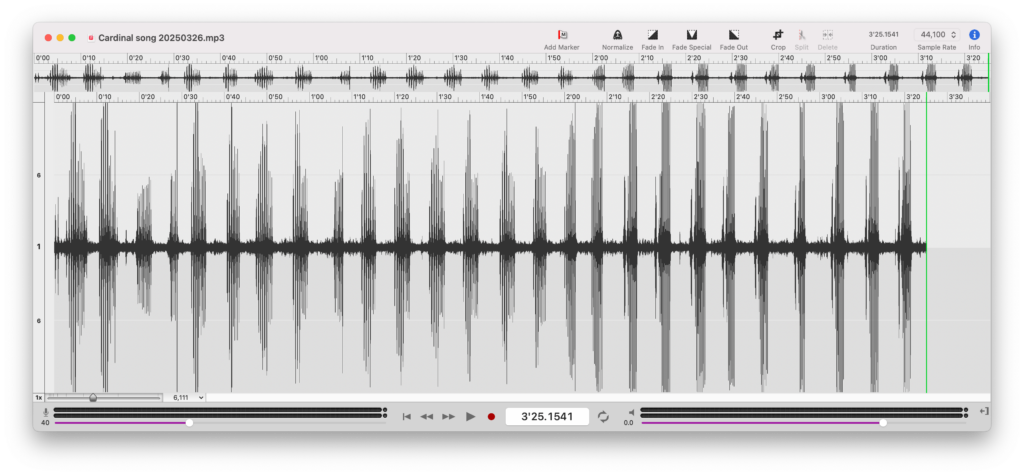
This morning Scott heard the cardinals outside his window and because he wanted to use some birdsong in his latest music project, he placed his phone on a chair on the deck and recorded some. I liked how he described it: I left the phone out on the deck then returned inside and went quietly about my business. When he told me about how similar each wave of sound looked, I asked if he could screen shot it and send me the sound file so I could post it here:

cardinal song, an image of sound waves
cardinal song / 26 march 2025

Wow! So uniform.

Happy 151st Birthday Robert Frost!

When the poem of the day on poetry foundation was a Robert Frost one, I figured it must be his birthday. Yep — 26 march 1874.

For Once, Then Something/ Robert Frost

Always wrong to the light, so never seeing
Deeper down in the well than where the water
Gives me back in a shining surface picture
Me myself in the summer heaven godlike
Looking out of a wreath of fern and cloud puffs.
Once, when trying with chin against a well-curb,
I discerned, as I thought, beyond the picture,
Through the picture, a something white, uncertain,
Something more of the depths—and then I lost it.
Water came to rebuke the too clear water.
One drop fell from a fern, and lo, a ripple
Shook whatever it was lay there at bottom,
Blurred it, blotted it out. What was that whiteness?
Truth? A pebble of quartz? For once, then, something.

A beautiful sonnet — 14 lines, 11 beats per line, almost iambic pentameter. Is that right? I always struggle to hear meter properly.

Love the description of a reflection: Me myself in the summer heaven godlike/Looking out of a wreath of fern and cloud puffs

And that something white, uncertain, seen briefly then lost to a ripple. Yesterday I posted some lyrics from “The Windmills of Your Mind” about the ripples from a pebble. Ripple is a great word.

Seeing this sonnet is making me think I should try that form for my color poems. I could study a few different ways of doing the sonnet — Diane Seuss, Terence Hayes, William Shakespeare. Any others?

oh orchid o’clock

A good morning on the poetry sites. Not only did I find Robert Frost’s poem, but I found a cool collection that fits in with my study of time: Oh Orchid O’Clock by Endi Bogue Hartigan. (note: I just emailed Moon Palace Books about ordering it! update: I ordered it!)

/it is the president’s turned up o’clock it is America’s deadliness and dailiness

o’clock / it is glued to the headline o’clock

it is lunchhour-beeline o’clock / it is it’s only Tuesday o’clock another

curbside memorial o’clock another caterpillar miracle o’clock another

people emptying from their lives o’clock or into

their lives o’clock the Nile floods the Nile floods every hotspell in this week

I discovered this book through poems.com, which had one of its poems posted today:

hour entry: I fall asleep with a rain sound/ Endi Bogue Hartigan

I fall asleep with the rain sound app of my cellphone, the app includes distant thunderclap sounds and there are people who recorded or simulated these sounds, and it is time to disagree and thank the dawn. I disagree with this rain, I feel absurd for thesimulation of it and yet my brain waves have come to depend on it, depend onsimulated porous points between the raindrops. Always the porous dream, always theneural authority, the reaction meme, always the authority of always, the puncture ofalways, time spent saying always, the spider legs of always, the sleep command, thewake spindles, the spider leg threatening to break from the spider.

So cool! Encountering Hartigan’s work, I was inspired to think about time in relation to my blind spot and the practice of running beside the gorge that has happened beside (and because of?) my vision loss. I wrote the following in my Plague Notebook:

my blind spot
breaks open seconds
pries apart the hard edges of
a beat invites me
to dwell inside

I am suspended between
beats as time slows
but never stops
with moves so slight it takes
a practiced eye to see
their soft shimmering
embrace what is not seen but felt —
wind
the rotation of the earth
a bench sliding into the gorge
rock crumbling
cone cells collapsing
a blind spot expanding

walk: 40 minutes
neighborhood / winchell trail / oak savanna
54 degrees

What a great afternoon walk with Delia the dog! No coat. No mud. Walked to the Winchell Trail then down beside the chain link fence. Drip Drip Drip — the sewer pipe in the ravine. Everything washed out — light brown, tan, yellowed. Up on the mesa in the savanna, a great view of the river. Was able to walk on the dirt path between the savanna and the 38th street stairs. They’ve put down some mulch, so it’s not as muddy. As I neared the entrance to the Winchell Trail, I passed the spot where I fell in the mud, straight on my tailbone. No mud now, only memories and a still-sore back.

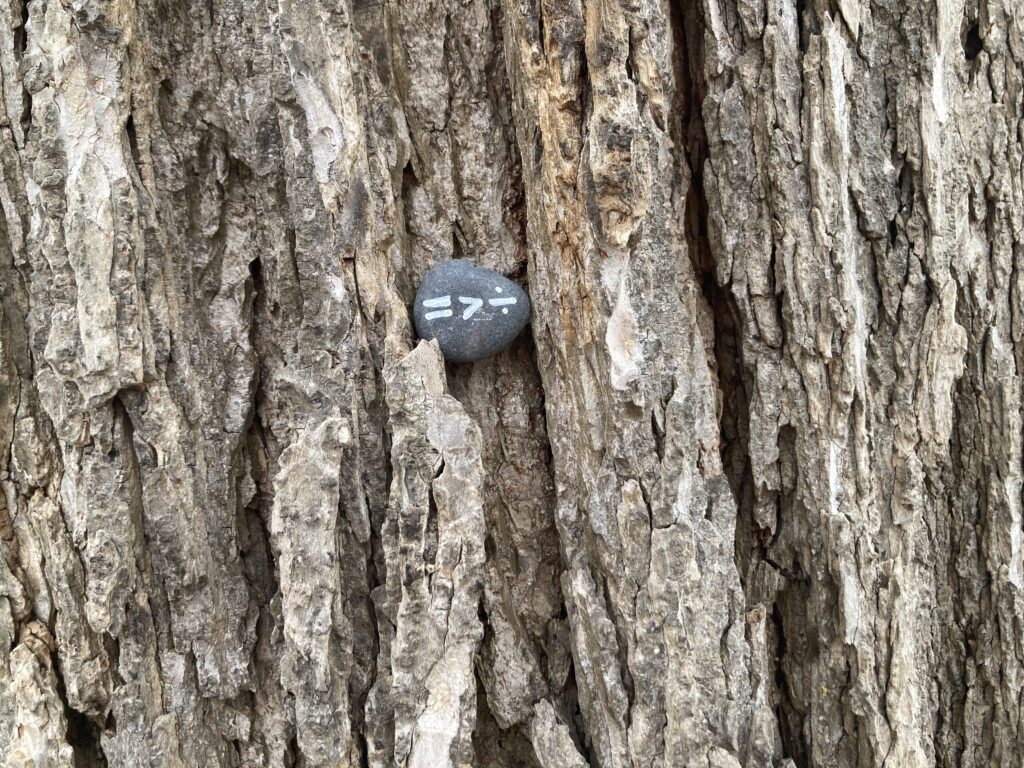
On the way to the river, I noticed something interesting hidden on the tree trunk while Delia sniffed around. I took a picture of it:

= > ÷

When I was looking at it in person, I thought someone had carved the message in the tree, but studying it now, it looks like it’s a rock wedged in a crack. I probably should have taken another picture that wasn’t quite as close-up for scale. That is one tiny rock.

I had to look up how to type the division sign on a mac. Hold down option and /

march 25/RUN

4.5 miles
minnehaha falls and back
39 degrees

It felt much warmer than 39. Another great late morning for a run. My back seems to be getting better. Still sore, but not when I’m running. Felt compelled to walk a few more times than usual, but otherwise a good run.

10 Things

  1. a small bird’s shadow crossing the path
  2. a glimpse of silver, then the outline of a metal cart, a fold-up canvas chai with someone sitting in it, facing the river, the radio
  3. below the edge of the world: a steep trail tight against the bluff, going somewhere under the trail and over to the jagged ledges of a ravine
  4. drip drip drip the sewer pipe near the curved retaining wall dripping water
  5. empty benches
  6. hollowed out trunks on the Winchell Trail — empty circles
  7. a person climbing up the steep slope below the winchell trail on the other side of wrought iron fence
  8. the falls: white foam
  9. the edges of the river, slabs of ice/snow then sparkle
  10. the crooked shadows on the paved path, near the edge, cast by sections of a leaning wooden fence

Created another time playlist, this one all about loops and seasons and time as a circle called “The Wheeling Life.” Favorite song to listen to today: “Windmills of Your Mind”/ Mel Torm´e, which is inspired by hearing it in the season finale of Severance.

Like a tunnel that you follow
To a tunnel of it’s own
Down a hollow to a cavern
Where the sun has never shone
Like a door that keeps revolving
In a half-forgotten dream
Or the ripples from a pebble
Someone tosses in a stream

march 24/RUN

4 miles
river road, north/south
32 degrees

A beautiful morning for a run! Wind in my face as I ran north, at my back heading south. Bright sun, sharp shadows, deep blue almost purple river. Raced a wind whirled leaf and won. Greeted Dave, the Daily Walker. Heard voices down in the gorge. Noticed ice on the edges of white sands beach. Thanked a man for stopping to let me run past and he kindly replied, you’re welcome miss. He was listening to music without headphones and carrying a bag of something — groceries? More than one of the benches was occupied. Encountered runners and walkers, a biker and a roller skier. In the last mile, I zoomed past someone running down the hill and under the lake street bridge.

I did my beats experiment again today.

mile 1: triples — open door / open door/ go inside / go inside / go outside / go outside / hello friend / hello friend / old oak tree / strawberry / opening / up the hill / on my toes / forest floor

mile 2: started with the metronome set to 180 bpm, but that was too fast. Locked in with 175. By the end of the mile I barely felt my feet strike the ground, only heard the beat — I had made it inside of the beat!

mile 3-4: doin’ time playlist. The first song was “Time Stand Still“/ Rush. The first line: “I turn my back to the wind” I heard this as I was running with the wind at my back.

Freeze this moment
A little bit longer
Make each sensation
A little bit stronger

I thought about freezing the moment and the difference between stopping time and suspending (or being suspend in) it.

a few hours later: I’m reading the book, American Spy, and I just came across this bit about looking people in the eyes:

At Quantico they’d taught us the so-called classic signals that some one was lying: if they glanced up to the right before they speak, or if they won’t look you in the eye.

American Spy/ Lauren Wilkinson

My immediate reaction: that’s how I look at a person’s face. I try to find the approximate location of their eyes by looking off to the side, near their shoulder — this is me looking at them through my good, peripheral vision. Then I stare into the spot, which is usually fuzzy nothingness to me. Does that mean I’m always lying? Of course not.

I was pleased that this discussion continued:

None of what I’d learned worked as well as listening to my instincts. I’ve always been good at ferreting out decption. I’m not entirely sure what my ability to detect a liar is based on–subtle cues maybe, suconscious awarenss, an intuitive talent for reading microexpressions. I don’t know and I’ve found that the more I try to understand it the less effective I am.

Right. As Georgina Kleege suggests in Sight Unseen, looking someone in the eye doesn’t have this magic power that many (most?) people seem to think it does.

march 21/RUN

3.35 miles
trestle turn around
43 degrees

Wow, what a morning! Birds! Sun! Calm air! Everything quiet, relaxed. I felt fast and free. less tightness in my neck and hip. Greeted the Welcoming Oaks and Dave, the Daily Walker.

10 Things

  1. a runner with BRIGHT orange shoes
  2. a shining white form in the distance, through the trees: the river
  3. the strong smell of weed somewhere below me
  4. stopping at the sliding bench — movement below, in the trees just before white sands beach: a runner on the winchell trail — should I try that?
  5. the soft knocking of a woodpecker in a nearby tree
  6. stepping off onto the dirt trail for a brief stretch: soft and springy
  7. someone sitting on a bench near the trestle
  8. the river: open and blue
  9. a big branch sticking out of the trashcan — a discarded walking stick?
  10. 3? stones stacked on the ancient boulder

I decided to try an experiment with beats.

First mile: chanting in triples
Second mile: metronome at 170 bpm
Third mile: “Doin’ Time” playlist

mile 1: strawberry/blueberry/raspberry — (to the welcoming oaks) Hello friend! Hello friend! Hello friend!/ old oak tree / stacking stones / stack the stones / intellect / mystery / (noticing a crack in the asphalt) breaking up / cracking up / bright yellow / woodpecker

I found that bright yellow was especially good for locking into a rhythm — BRIGHT yellow

mile 2: 170 was hard. I think it was too slow. I probably should have tried 175 or 180. I think I’ve done 175 before. I only locked into this beat a few times. Was my inability to lock in also because I started with triples?

mile 3: I put in my playlist. The first song was “About Damn Time” by Lizzo. It was great for getting into a groove. Next up, “9 to 5.” As I started to listen to it, I realized the metronome was still on and the beats of the song and it didn’t match up. I decided to leave it going and see what happens when I’m dealing with competing rhythms. I can’t quite remember, but I feel like I didn’t lock into either rhythm; I just created my own, and it didn’t bother/unsettle me.

Later I thought about how the “9 to 5” rhythm represents the relentless drudgery of working within capitalism. Resisting that rhythm, and what it does to you, is important. The final song I heard was “Too Much Time on My Hands” by Styx. I listened to the lyrics and was reminded that it was about a guy who wants a job, a way to feel useful, something to do, but he can’t get one. While he doesn’t mention in the lyrics why he can’t get a job, I thought of the larger context and the conditions (economic, political, social/cultural) that make it difficult for people/communities to find work.

Reading the lyrics — without hearing the music or singing — I was struck by this line:

And I don’t know what to do with myself

So dark. Heard with the music it just seems like a light lyric from a pop song.

This was a fun experiment that yielded some surprising results. I liked the accident of the competing rhythms and the juxtaposition of 9 to 5 with Too Much Time on My Hands. For future attempts, I’ll increase the metronome speed and mix up the order. Maybe I should try to write something, too, at the end of each segment? Speak a poem into my phone?

march 18/WALK

45 minutes
longfellow flats
50 degrees / feels like 39
wind: 20 mph gusts

Sore hips this morning! Is it a running injury or just a terrible mattress? We flipped the mattress yesterday, and sleeping last night was worse than ever, so I’m thinking it’s the mattress. Ascending from the river, I powered up all 112 stone steps and my legs felt great. Would I be able to do that with an injured hip? I don’t think so. I’m definitely incorporating some step work this spring!

10 Things

  1. a woodpecker knocking a few blocks away
  2. the wind was coming from the north and the east
  3. two iron (or wire?) cranes in a backyard — I spied them through a fence — I want a giant iron bird in my backyard!
  4. low notes from a wind chime in the backyard of the house where a family from New Zealand lives — not only do they fly a New Zealand flag, but I heard one of them speaking with a New Zealand accent
  5. on the pedestrian part of the double bridge north of the stone steps — open and blue and brown below
  6. also on the double bridge: a temporary section of fence — looking over the edge of the (it’s high up here), I could see part of another temporary fence halfway down the steep slope — what happened?
  7. the floodplain forest between the steps and the river was littered with felled trees and tangled branches and dirt and dead leaves
  8. creeeaak — branches rubbing against each other in the wind
  9. from below, looking up at the bluff — a brown slope, a wooden fence, voices
  10. a roller skier slowly approaching the ancient boulder

Jenny Odell and Another Kind of Time

Yesterday I started listening to a podcast with Jenny Odell about her most recent book on time and I decided that when the book was ready (I requested it from the library), I would finally dedicate some time to clocks and time and other forms of time that don’t involve clocks.

15 jan 2024

It has taken me until today to return to this podcast. Why? I’m studying time and I got a notification that it was the featured podcast on Emergence. When I got the book, in February, I had already moved onto other projects — an ekphrastic project, then wind. So now, 15 months later, I’m taking up the task I assigned myself. Ha! That’s Sara/gorge time. I briefly returned to it this January, but dropped it again, which is another example of Sara/gorge time — scattered returns and departures, loops, taking it up again and again.

Today, I look several pages of notes in my Plague Notebook. Here are some highlights:

reframing language outside of the rigid belief that time is money and time as stuff that can be measured, counted, and should be hoarded

when did time become a commodity?

And then something happened, and it seems to have to do both with technology and sort of cultural needs: like on the one hand the escapement, which is like a part of a clock that can sort of keep the mechanism going as opposed to like a guy ringing a bell at a certain time, right?

Another Kind of Time

This reminds me of my poem and the idea of person inside that bell tower tugging on the rope to make the bell ring!

That happened. And then also towns that were becoming very commercial started needing to be able to count up and measure labor hours that they were buying from people. And so some confluence of those things led to this notion of an hour: like an hour that can just exist, you know, in the imagination. And that an hour is an hour, and a labor hour is a labor hour, and it sort of doesn’t matter what season it’s happening in, what time of day. And for me, that is a really crucial separating point. That is when this idea of time as stuff started to peel away from all the things that it had been embedded in previously.

As planet-bound animals, we live inside shortening and lengthening days; inside the weather, where certain flowers and scents come back, at least for now, to visit a year-older self. Sometimes time is not money but these things instead.

Telling time through weather and seasons, and the leaving and returning of leaves, and the certain slant of light, and the sound of the water, and the feel of the path, and the amount of view, and the ease or difficulty in breathing.

chronos (ordinary, standardized time) and kairos (the interruption of things/ordinary time, extraordinary time)

horizontal (work + leisure used to restore energy for work = work + weekend)
vertical (awe, wonder, interruption, not work, “true” leisure)

migratory time, animal time

what is time to a flower? water, temperature, sun

the 72 micro-seasons in Japanese almanac

how do I tell time when I’m by the gorge?

weather – exposing myself to the elements, running in them, noticing and feeling the effects of wind, air quality, rain, snow, ice, the cold or heat — a relationship to/conversation with the world

witnessing the nearly invisible labor — tree trimming, repaving, managing and maintaining trails, erosion, nest-building

alienation and learning to listen to the world

. . . there’s a part of Braiding Sweetgrass, where Robin Wall Kimmerer is describing—I think she’s talking about like what it would feel like to not know the names of the things that are living around you. And then she says, I imagine it must feel like showing up in a city and you can’t read any of the signs, right? Like, that’s a deeply frightening and lonely experience to have. 

When I heard this bit, I raised my hand and said, “that’s me.” I can’t read signs on or inside building that often — even in Minneapolis, where I’ve lived for over 20 years. It is frightening and lonely and frustrating.

march 17/RUN

4.25 miles
locks and dam no.1 hill and back
50 degrees
wind: 13 mph/ 25 mph gusts

Warmer, windier. Ran straight into it heading south towards the falls. It didn’t howl or swirl the leaves but once it almost took off my hat. And it pushed against me, making it harder to run. I didn’t mind. At the start of the run, I felt a little stiff — especially my neck — but by the halfway point I had loosened up.

I noticed the river several times: Sometimes it was silver sparkle, other times tin or pewter, and it was ridged or scaled from the wind. I decided to run down the hill at the locks and dam no. 1 to get closer to the water. Inspired by AO’s Dart (see below), I wanted to hear the trails of scales and the bells just a level under listening. Did it sound like anything? If it did, the sounds were forgotten as I turned around and climbed the hill. A few steps in I stopped to take in the wide blue view of the river from this angle. It took up almost all of my sight: blue undulations

11 Things

  1. the long shadow of a slender tree cast across the part of the path that dips below the road
  2. an orange sweatshirt on a walker emerging from the winchell trail
  3. squaring my shoulders and running into a stiff wind
  4. 2 people under the ford bridge near the locks and dam no. 1, about to climb up somewhere
  5. the bright white base of the locks and dam no. 1 sign — they must use reflective paint
  6. the benches above the edge of the world and near folwell were empty
  7. the low hum of playing kids on the school playground
  8. the flat top of a recently made stump: orange
  9. a white patch in the river near the shore — was it a chunk of ice? a sandbar?
  10. a tailwind as I returned north — not feeling the wind but its absence and that everything was easier
  11. added a few hours later: a creaking above from one tree branch rubbing another in the wind

Listened to leaves shimmering in the trees as I ran south, my “Doin’ Time” playlist as I ran back north. Most memorable song, “Once in a Lifetime”:

Same as it ever was, same as it ever was

Water dissolving and water removing
There is water at the bottom of the ocean
Under the water, carry the water
Remove the water from the bottom of the ocean
Water dissolving and water removing

Letting the days go by, let the water hold me down
Letting the days go by, water flowing underground
Into the blue again, into the silent water
Under the rocks and stones, there is water underground

I never realized before how much water is used in this song. Very cool! The same as it ever was is an interesting contrast to what I was reading earlier this morning: Heraclitus and his idea of never stepping into the same river twice — see 17 march 2023

possible lines to recite/chant

Rereading my 17 march 2022 entry, I encountered these wonderful lines from Dart about how the river sounds:

will you swim down and attend to this foundry for
sounds

this jabber of pidgin-river
drilling these rhythmic cells and trails of scales,
will you translate for me blunt blink glint.

the way I talk in my many-headed turbulence
among these modulations, this nimbus of words kept in
motion
sing-calling something definitely human,

will somebody sing this riffle perfectly as the invisible
river
sings it

can you hear them at all,
muted and plucked,
muttering something that can only be expressed as
hitting a series of small bells just under the level of your
listening?

The bells!

High Above on the Ford Bridge Looking Down at the River

O, can you hear them
at all, these riffle-
perfect rhythmic cells
and trails of scales, plucked,
muted, muttering
below — a string of
small bells just under
the level of your
listening?

on moving — Alice Oswald and Cole Swensen

More words rediscovered while reading past entries in my “On This Day” practice:

I found this great quote from Oswald in her introduction to the poetry anthology, The Thunder Mutters: 101 Poems for the Planet:

Raking, like any outdoor work, is a more mobile, more many-sided way of knowing a place than looking. When you rake leaves for a couple of hours, you can hear right into the non-human world, it’s as if you and the trees had found a meeting point in the sound of the rake. (ix)

Mobile and many-sided, more than looking from a distance.

From Cole Swensen:

Then sitting still, we occupy a place; when moving through it, we displace place, putting it into motion and creating a symbiotic kinetic event in which place moves through us as well. 

Walk/ Cole Swensen

march 13/WALK

35 minutes
neighborhood
55 degrees

Another spring-like day! Sun and so many birds. Cardinals and black capped chickadees and an irritating sparrow sounding almost like a squirrel just above us on a branch. Only the smallest lumps of snow from last week’s storm remain. Will I get more this month? Most likely. For now: bare grass and clear sidewalks!

Scott pointed out an orange cat across the street, strutting on the sidewalk, which led to a discussion of a difference between cats and dogs in terms of how they interact with you — dogs need you, cats don’t (or pretend they don’t). I’m a dog person, but I understand the appeal of the cat, especially when they strut down the sidewalk like they own it. I like that cats are fine leaving you alone and being left alone. Here was Scott’s summary of the difference: a dog is like your kid, a cat is like your roommate.

10 Non-Cat Things

  1. bright, blue sky
  2. a breeze only felt when walking in one direction — which? I think east
  3. the trash can at Minnehaha Academy which had been almost covered in snow was clear today
  4. nearing edmund and the river, I admired the soft golden tree line of the east bank
  5. that irritating squirrel-like sparrow: a light — white? or light gray — body with a dark head. Scott said he could see its throat swelling as it sang (I couldn’t)
  6. the saddest bark from a dog: a whine into a holler
  7. accidentally snapping a twig with my foot and having a sharp part of it scratch my ankle — ouch!
  8. a garland with lights wrapped around steps leading up to a fancy house on edmund
  9. other christmas decorations — 2 fake fir trees with lights — on another house — this is the house that also has a round head stuck on a lamp post. During Halloween it’s a pumpkin, then at Christmas a snowman, after that Mickey Mouse
  10. a colorful door — seeing it on other walks, I’m pretty sure it’s bright YELLOW!, but in the light and with my cone cells, it only looked, yellow?

notes from my Plague Notebook, Vol. 24

a blind spot = a gap/gash/silence in my vision = the Nothingness of the gorge

Crumbling is not an Instant’s Act/ ED

slow steady abrupt sudden
the strangeness of deterioration

shifting slipping spreading closing in narrowing

(thinking about Ellis and the Stutter as vessel) what does this openness/gorge hold?

a gap, gash, crack, weathering

rod cells on either side (rock) holding in the nothingness

void absent center

generous/big enough to hold all

unseen unstable shifting

circle cycle loop orbit around circumference (ED)
repeats, soft edges, curves, round

A song on my “Doin’ Time” playlist: Circle Game/ Joni Mitchell:

And the seasons they go round and round
And the painted ponies go up and down
We’re captive on the carousel of time
We can’t return we can only look behind
From where we came
And go round and round and round
In the circle game

orbiting

Right now, I thinking/writing about a lot of different reoccurring themes: color, time, vision, erosion, the gorge, rituals and ceremonies. It can be overwhelming and feel like I’m doing nothing even as I do too much. Instead of worrying about this, I’ve decided to understand it as orbiting around something that I can’t quite reach. Somewhere in all of my wandering and reflecting and writing is the way into a poem-as-ceremony-as-poem that celebrates (or praises or embraces) my vision. Can I find it? I’ll try!

march 12/RUN

3 miles
minnehaha falls and back
50 degrees

What a beautiful spring-y day! Ran with Scott to the falls in the early afternoon. He talked about the bolt he had to replace on his guitar neck which isn’t a bolt but a bone — a synthetic bone, in his case. He needs to sand it down and he’s planning to use sandpaper that’s been in his clarinet case since college — about 30 years! I pointed out the pile of branches on the side of the trail and mentioned how I’d seen the workers pull up in the parking lot as I ran by a few days ago. I figured they were planning to trees; I was right.

The falls were falling fast and hard over the limestone and under the one ice column remaining. There were lots of people at the park, admiring them. A few bikers, but mostly walkers. A school bus, but no sign of the kids. Was there a field trip, or a bus driver taking a break?

I noticed angular shadows everywhere — small branches, a street lamp, fence slats. Soft shadows too: us.

Only a few random clumps of snow on parts of the grass that rarely get sun.

time

Many different thoughts about time this morning: metronomes (see entries from 10 june 2024 and 29 august 2024); erosion needing time and pressure; stuck in a moment unable to get out vs. suspended in time and not wanting to leave; Mary Ruefle’s pause, Emily Dickinson’s hesitation, JJJJJerome Ellis’ Stutter; a time slip, a shift; Mary Oliver’s ordinary and eternal time.

While reading a book, I encountered this purple description:

The light in the sky was fading, the clouds now purple and dark, the meadows and the surrounding wood losing their color, fading into grainy variations of gray.

Kind Worth Killing/ Peter Swanson

(fading twice?) I thought: purple represents the space between light and dark, between the last bit of color and gray, between not seeing well and not seeing at all (with my central vision), after the crumbling of cone cells and before the total collapse (the last cell gone). This is my purple hour. I want to use that in a poem playing with my literal and figurative meanings of purple.

march 11/WALK

45 minutes
longfellow flats
32 degrees

Colder today, but beautiful. Sun, shadows, cold air! We — me and Delia — walked through the neighborhood then over to the trail then down the old stone steps to the river. A bare forest floor, no mud or ice or snow, only soft dirt. I unhitched Delia from her leash and she bolted off into the sand, always waiting at the edge of my vision for me. If I didn’t follow her, she loop back. If I did, she continued forward until she reached my edge, then look back and wait again. What a dog. The sand was mushy, the water was blue. It sparkled some, but was mostly still, or moving so slow I couldn’t detect it. When we left the river, I powered up the steps, all 112 of them — or a little less, when I took 2 at a time. That felt good! Not easy, but energizing. At the top I could tell my glutes had fired. I felt a nice warm burn. As I continued walking, my back felt looser and I thought to myself, yes, I will climb more steps this spring and summer. Maybe I’ll even devote a month to steps — poems about steps, a playlist, finally taking some of the cool steps in St. Paul!

10 Things

  1. the short section of the stone wall in the tunnel of trees that curves in slightly — have I ever noticed this before? why does it curve here?
  2. voices drifting
  3. the bells of St. Thomas and their noonday song
  4. chick a dee dee dee dee
  5. the soft drumming of a woodpecker
  6. a bright blue sky — cloudless, planeness, birdless, moonless
  7. some dark think sticking out of the water — a log? rock? a piling for an abandoned dam?
  8. breathing in cold air: sharp
  9. a pile of rusty, bent pipes on the boulevard — were these pipes the reason why the sewer was leaking?
  10. 2 people and a dog, ahead, walking slower than us. As we neared the corner, I repeated in my head, please turn please turn, and they did!

The leaking sewer reminded me of something from last night as we watched pro cycling — the time trail for Tirreno Adriatico. Whenever a cyclist was slowing down their pace, the commentator would say they were leaking time. This bothered Scott: why would you say leaking? why not losing?

What does it mean to leak time? What does it look or feel or sound or smell like? Was the commentator thinking about air leaking out of a tire?

before the walk

Listening to my “Doin’ Time” playlist as I write. The Kinks’ “Time” is on:

Time lives our lives with us
Walks side by side with us
Time is so far from us
But time is among us
Time is ahead of us
Above and below us
Standing beside us
And looking down on us

When we were young
And our bodies were strong
We thought we’d sail
Into the sunsets
When our time came along
Now that we’re nearing
The end of the line

Time has changed
Time would heal
Time will mend and conceal
In the end everything will be fine
And if we concentrate
Time will heal all the hate
All in good time

We go on
Drifting on
Dreaming dreams
Telling lies
Generally wasting our time
Suddenly it’s too late
Time has come and can’t wait
There’s no more time

Encountered this shadow poem during my morning, poem-of-the-day practice:

Any Evening/ James Richardson

A far bird sings again, a little further.

There is less and less difference
between your shadow

and the shadow inside you
and all the shadows,

and the evening softly taking hold
says It has always been evening

and now you know.

shadows: yours, the one inside of you, all the shadows

These lines made me think about my idea that the only things I feel as real — solid, fully formed — are the shadows. Other forms, with their details, are fuzzy and — not flickering but slowly vibrating or shaking or softly pulsing.

march 10/WALKRUN

walk: 60 minutes
winchell trail
57 degrees

A slow walk with Delia the dog. Stopping and sniffing and pooping and peeing and listening nervously to rumbling trucks and roofers. On the Winchell Trail, a black capped chickadee just overhead feebeed and chickadeedeedeed at us. Only a few remnants of the snow remain. A mix of dry path with puddles and mud.

Near the end of the walk I decided that what I really needed to do with my back was loosen it up by walking faster. Maybe I’m tensing up too much? Also decided that I’d try a short run.

run: 2 miles
just north of lake street
59 degrees

Ran past the ancient boulder and down through the tunnel of trees. The floodplain forest looks barren — no snow or leaves on the trees, only brittle and brown on the ground. Felt pretty relaxed and a little awkward — not quite a hitch in my step, but not smooth either. That got better as I warmed up. Listened to the breeze passing through the trees, and voices running north. I put in my “Doin’ Time” playlist for my run south. Heard: Does Anybody Really Know What Time It Is; A Summer Wasting; Suspended in Time. All three offering visions of life outside the clock/capitalist time.

I almost forgot: I wore shorts today!

10 Things from my Walk and Run

  1. park workers in orange vests getting ready to do some work — trim trees? clear out brush? (walk)
  2. after weeks, they’re finally doing something about the gushing water on the corner of 46th! the barricades were gone, and so was the sound of water gone wild (run)
  3. chick a dee dee dee — a black capped chickadee in a tree just above my head — what I saw: a small dark flurry of movement on a branch (walk)
  4. the soft, energetic din of kids on the playground at Dowling Elementary (walk)
  5. a line of snow — a lump, not big enough to be a wall — stretched across the walking path (run)
  6. the river: open, shimmering, blue (walk)
  7. the tree line on the other side, a golden glow (run)
  8. a slight slip in mud on the boulevard between edmund and the river road (walk)
  9. the soft shadows of gnarled oak tree branches on the grass (run)
  10. 4 stones stacked on the ancient boulder (run)

circumambulation

Returning to circumambulation and the ceremony/ritual of looping around the gorge. A thought: when I swim at the lake I do multiple loops, but beside the gorge, I only do one loop. What’s the difference (mentally, spiritually, physically) between a loop vs. multiple loops. Also, where do my there and back runs — trestle turn around or the franklin hill and back or the falls and back — fit in? What sort of ritual are they?

Loosely, the structure of Gary Snyder’s “The Circumambulation of Mt. Tamalpais” is:

  • a brief description of place
  • a sacred chant/mantra
  • a further description — more details, directions, feelings/reflections/encounters

I’ll try this structure. I think I want to do the 8 loop that combines the ford and franklin loops. But, I’m taking it easy with the running right now, so maybe I should wait to do this until next month?

but now we really hear chanting
we can’t decode–Don’t
be so rational–a congregate speech
from the redtrembling sprigs, a
vascular language prior to our

breathed language, corporeal, chemical,
drawing our sound into its harmonic, tuning
us to what we’ve yet seen, the surround
calling us, theory-less, toward an inference
of horizontal connections there at

ground level
(Circumambulation of Mt. Tamalpais/Forrest Gander)

Some chants I might include:

I am the wind and the wind is invisible, all the leaves tremble but I am invisible

All trees are just trees

In every part of every living thing/is stuff that once was rock

Listen, I don’t think we’re going to rise/in gauze and halos./Maybe as grass, and slowly. Maybe as the long-leaved, beautiful grass (added the next day: these lines don’t fit with the others, not enough rhythm?)

Life is but Life, and Death is but Death. Joy is but Joy, and Breath is but Breath.

In the name of the Bee-
And of the Butterfly-
And of the Breeze–Amen!


march 9/WALKBIKE

walk: 15 minutes
neaighborhood
52 degrees

Wow! What a wonderful morning. Did a quick walk with Delia and Scott around 2 blocks. Heard several cardinals and their torpedoed call. Admired the bare and dry sidewalk and street. I talked about how I/we need to remember to let FWA figure out his own path. A mantra I should repeat in my head anytime I want to step in and “help”: let him be — maybe I’ll sing it to the tune of the Beatles’ song?

bike: 47 minutes
basement

A beautiful day outside, but still not time to run. I’m being cautious — too cautious? — with my back. I didn’t mind being on the bike. For the first 40 minutes I watched a wonderful documentary, The Only Girl in the Orchestra, on Netflix. So good!

This is my theory of how to enjoy your life incredibly. You don’t mind playing second fiddle. The idea of being a public figure and having applause and being in the limelight, and then all of a sudden you’re deprived of that as you get older and then not being in the limelight. I think it’s better to love something so much you do it for its own sake and also for the wonderful people that you’re playing with. You’re creating something together, which is better than something alone.

Orin O’Brian

After the short doc was over, I listened to 3 songs on my latest playlist, Doin’ Time: Too Much Time on my Hands/Styx, No Time to Die/ Billie Eilish, Time Warp/ Rocky Horror. Thought about the meaning of no time to die — no time = too busy/not enough time on your hands and also not the right time. When Time Warp came on it sounded strange. I realized that I had put the Broadway version instead of the movie one. I’ll have to fix that. Noticed these lyrics today:

Drinking those moments when
The blackness would hit me
And the void would be calling

Here’s some time lines I’d like to remember:

The turning of the globe is not so real to us   
As the seasons turning and the days that rise out of early gray   
—The world is all cut-outs then—and slip or step steadily down   
The slopes of our lives where the emotions and needs sprout.
(Hymn to Life/ James Schuyler)

Cut-outs, silhouettes, shadows. That is not all the world is for me, but it is what looks the clearest and most real.

feb 27/WALK

am: 25 minutes
neighborhood
40 degrees

One more day to rest my back. It only feels a little sore, so I think it’s okay, but I’m trying to be cautious. This is the longest break (5 days) I’ve taken in a year? I’m not sure. Another morning walk with Scott and Delia. Sunny and spring-like. All the snow has melted, almost all of the puddles have evaporated.

Picked up a new pair of Brooks’ Ghosts in the early afternoon. I’ll save them for after late April/early May, once sloppy season is done . Black with white and gray. On my walk I wore my bright yellow Saucony’s — the ones that hurt my feet last year. I’m going to give them another chance. Maybe they’ll work this time?! Forgive me, future Sara.

the purple hour

No purple hour last night. I slept straight through, only waking up briefly at 5:30 when Delia jumped on the bed. This sleeping straight through only happens a couple times a month.

In non-purple hour purple thoughts, yesterday afternoon I finished listening to/reading along with JJJJJerome Ellis’ Aster of Ceremonies. So good! The connection to purple is: purple asters, a big chunk of the book is printed in purple ink, I envision the Stutter/pause as purple. Here are some passages I want to remember:

Dr. Bejoian, a speech therapist I worked with from 2012-2013, taught me a technique called soft contact. “If you’re struggling to say a word that starts with p, b, or m, try starting the word as softly as possible.,” she said. Sometimes this made the syllable hard to hear. “Pause” could sound like “awes”; “brain” like “rain”; “master” like “Aster.” I want to follow this softness offered by the Stutter. Thank you, Dr. Bejoian.

For most of my life, my relationship to my stutter was rooted in shame, anger, and despair. I responded to these emotions by trying, and failing, to master my stutter through various means: undergoing hypnosis; making a fist while I stuttered, opening the first to release the work; talking in singsong; expanding my diaphragm while speaking; saying my name is “John”(my middle name) or “Shawn.” Failure has led me to a grove of unknowing. If I can’t master the Stutter, what can I do? What might it mean to try to Aster my stutter?

Aster of Ceremonies (123) / JJJJJerome Ellis

Follow the softness. I love this idea and generosity (to Self and Stutter) it offers. My vision gives softness too, not in sound, but in image. Things that are never in sharp focus are never harsh or exact, but fuzzy and gentle.

Teach me to Aster You. Teach me to treat You as an Elder that has so much to teach me. I will surrender and attend to Your ensemble of blossoms. Your Dandelion Clock* will be my timekeeper. I will seek not to overcome You but to come with You; not to pray to be rid of You, but to pray for your continued presence in my life. To stay with the mystery You steward.

What might it mean to Aster You? To pray that You Aster me? Instead of “I speak with a stutter,” what if I “advertised” to someone by saying: “I speak with an Aster. My speech is home to a hundred blooms. These silences you may hear hold more than I could ever know. Thank you for your patience as I pause to admire their beauty.”

Aster of Ceremonies (124) / JJJJJerome Ellis

I was incredibly lucky to find, a few years into my diagnosis, Georgina Kleege’s book, Sight Unseen. Her generous approach to her own central vision loss — including not understanding it to be a death sentence and giving attention to how her seeing works and to challenging assumptions about the infallibility of vision — helped me to be curious about how seeing works and to develop my own relationship with both being without seeing and seeing in new ways. Even as I struggle with not being able to see that well, I also welcome the new knowledge my strange seeing/ not-seeing is giving me. I imagine Ellis’s “astering the Stutter” to share some similarities.

Ellis connects their Stutter to the Aster and to the many plants (he names them Elders) that their ancestors relied on. They feel a strong connection to these Elders. Such a powerful idea to bring all of this things — ancestors, plants, a glottal Stutter — together. Wow! Inspired by this approach, I’m thinking about how I experience my central vision loss in relation/beside the gorge and the eroding rocks and relentless, remembering river. What ceremonies could I create to honor the different layers of rock? The seeps and springs and floodplains? How does the wearing away of stone, the persistence of water, and my eroding cone cells open a door to a new space in which to dwell to explore to learn from? ooo — I like this idea. I want to give a little more time to thinking through how Ellis makes their connections, and how I can make mine.

jan 5/RUN

5.3 miles
va bridge and back
9 degrees / feels like -3

A little colder today, so more layers: 2 pairs of running tights; one long-sleeved shirt, two sweatshirts, one with a hood; a jacket; gloves; mittens; buff; 2 pairs of socks; sunglasses; cap.

My IT band was sore again. Time to play around with i and t! — in too deep; into gorge; intonation; in today’s economy?; intoxicating; intolerable; in top form; into the woods

10 Things

  1. bright blue sky
  2. sharp, solid shadows, 1: mine, running right in front of me
  3. shadows, 2: slender, twisted branches on the asphalt
  4. birds!, 1: rooting around in the dry brush, making a loud noise
  5. birds!, 2: fluttering, flickering, flashing in and out of the bare branches on the edge of the trail
  6. the falls!, 1: nearing them from above I could hear that they were more frozen as water fell over ice columns and made a sharp, tinkling sound
  7. the falls!, 2: from my favorite spot, thick ice columns with water gushing through
  8. the river! — everywhere I looked, swaths of white placed over the surface — not everything was white, but what was looked extra white, almost like frosting
  9. the faint and fleeting scent of smoke
  10. the view from the bench above the edge of the world was enormous and open and bright desolation

After turning around at the entrance of the VA bridge, I thought about the veterans across the bridge and I wondered who lived there and for long and whether or not they get the resources they needed. With all of the other layers of life — past and present — here, I don’t often think of them, and I don’t know much about the history of this place. Not too far down the river is Fort Snelling and the big cemetery. My Uncle Tim who died in Vietnam before I was born is buried there, and my grandfather’s ashes, too. My mother was devastated by her brother’s death, and she rarely ever talked about him to me. Too painful for her to remember? Strange to think about how close I am in proximity to my family on my mom’s side and how little I know about them.

1

As I continue to tag past entries with “remember/forget,” I came across these lovely lines from Carl Phillips:

just the rings that form then disappear
around where some latest desire — lost, or abandoned —
dropped once, and disturbed the water. To forget —
then remember . . . What if, between this one and the one
we hoped for, there’s a third life, taking its own
slow, dreamlike hold, even now — blooming in spite of us?
(Sky Coming Forward/Carl Phillips)

2

And if my father says haunt

he doesn’t mean the way rooms forget him
once he’s gone; he’s saying his leather chair
now in his coworker’s office, his locker
in the back room newly purged
of its clutter, or his usual table
in the break room where he sits
at 10:30 each night eating
the same steak club and chips
(Haunt/Maya Phillips)

3

Crossing between gain and loss:
learning new words for the world and the things in it.
Forgetting old words for the heart and the things in it.
And collecting words in a different language
for those three primary colors:
staying, leaving, and returning.
(Big Clock/Li-Young Lee)

4

And here’s a quotation from Alice Oswald in an interview for Falling Awake:

It’s good to remember how to forget. I’m interested in the oral tradition: what keeps the poems alive is a little forgetting. In Homer you get the sense that anything could happen because the poet might not remember.

Re-reading this idea, I’m reminded of AO’s discussion of her method for her book-length poem, Dart:

I decided to take along a tape-recorder. At the moment, my method is to tape a conversation with someone who works on the Dart, then go home and write it down from memory. I then work with these two kinds of record – one precise, one distorted by the mind – to generate the poem’s language. It’s experimental and very against my grain, this mixture of journalism and imagination, but the results are exciting. Above all, it preserves the idea of the poem’s voice being everyone’s, not just the poet’s.source

I’d like to try doing this with the documenting of my runs: experimenting with combining recordings with my memory/imagination of what happened (from log entry 14 march 2022).

I’m not interested, at least at this point, in interviewing people by the river, but I wonder if I could play around with recordings and memory — how what I remember strays from what actually happened? Maybe not with words but images? Or, I could play around with recordings of sounds, using this Steve Healey poem which I reread this morning during my “on this day” practice:

2 Mississippi/ Steve Healey

a map?

The other day, as I mentioned the “edge of the world” in a post, I thought about how I’d like to add a map to this log. This map would include all of my landmarks, with the names I use for them in my entries: the old stone steps, the double bridge, the edge of the world, the tunnel of trees, the ancient boulder with the stacked stones, the sliding bench. Ideally, this map would be hand-drawn, but I don’t think that’s possible with my bad vision. Maybe Scott could help me and we could get it printed and framed for the wall?

dec 15/RUN

4.3 miles
minnehaha falls and back
36 degrees
70% ice-covered

A great temperature — mild — but not great surface conditions. Neighborhood sidewalks and the trail had a thin layer of ice with only a few clear patches. The worst stretch was at the falls. I stopped and walked in the snowy grass for a few minutes. But, I didn’t fall. If the conditions had been better, I would have gone for a few more miles. Oh well, at least I got out there. It felt good to be outside, above the gorge. Fresh, cool air, a moving body, the river.

10 Things

  1. a laughing kid somewhere across the road — not seen, only heard
  2. the river, some of it open water, some ice, all of it gray
  3. a runner in BRIGHT yellow shoes
  4. a lot of the snow that fell last week is gone, now there’s grass and brown leaves all over the ground
  5. a slick path near the falls parking lot — I didn’t feel nervous that I’d fall, but my feet weren’t getting any traction
  6. near the overlook by the falls, dirt or grit of something had been used to make it less slippery
  7. the falls were gushing
  8. the dirt trail in the small wood near the ford bridge was visible and inviting and cleared of snow
  9. stopped at a bench above “the edge of the world” — admired the clear, colorless view of the river
  10. can’t remember where, but I encountered a faint smell — tangy, sour — of the sewer

Finished another section of my poem yesterday. It’s very exciting to have found a way to put all these words together. How many more section do I have in me before january? Yesterday’s section is titled, Geologic time, and it’s about experiencing time at the gorge on a longer, deeper, slower scale.

Here’s discussion of ekphrasis that I’d like to remember and return to when I finally get to my ekphrasis, how I see, project:

Some of the “paintings” and “photographs” are purely ekphrastic, in the sense that the images, associations, and overall tone were conceived in the moment of looking at a certain artwork hung in a museum or in my memory. Others are more of a collapsing between that moment of looking and earlier or later situationally unrelated impressions; some poems contain a dueling ekphrasis in which impressions of multiple artworks blend. So, yes, most refer to a specific artwork(s), but then the question becomes: What is ekphrasis in the pure sense? And what does pure even mean—another something that Heti can weigh in on. Doesn’t all ekphrasis—the act of looking, and reading, and possibly “interpreting” a text—include a necessary degree of subjectivity and, therefore, can’t it help but become saturated with personal associations and allusions? 

Lindsay Turner and Stella Corso

random note for future Sara: Scott and I are rewatching all of The Brady Bunch. It’s been 10 years and I still think Mike and Carol are the worst parents in the world. Also, my least favorite character is Bobby, and my favorite is Alice. I was going to write that Jan was my favorite but then I remember the season 2 episode when she plays practical jokes on everyone. She’s obnoxious.

how I don’t see yellow

Yesterday on Instagram, I looked at a block of text and couldn’t see that part of it was circled in bright yellow until I shifted my eyes to the left or right. Straight on, no circle. Look slightly to the left, yellow circle. I took a screen shot of it so I could post it here as an example of how I don’t see yellow.

nov 6/RUN

4.1 miles
minnehaha falls and back
45 degrees

Even as I knew deep down it was possible, it’s shocking that Trump won and that after all of the terrible things he promised, so many people would vote for him. I started my practice of writing and moving not too long after Trump was elected in 2016, and now I will need to lean on it as I endure another 4 years.

As I ran, I kept trying to remember Lorine Niedecker’s geologic time: slow, long, layered. This terrible moment, a blip. Limestone, sandstone, shale, holding evidence of when Minnesota was part of the Ordovician sea millions of years ago. Glacial boulders still standing, indifferent to humans. The endless dripping and seeping and wearing down of ancient water. Not untouched (or left unharmed) by humans, but on a scale so much bigger than us or what we can comprehend.

When I started the run, there was still fog, but by the end, sun. It felt warmer than 45 degrees. I was overdressed in running tights, shorts, gloves, and my sweatshirt. It felt good to move and to almost forget everything for 40 minutes. When I passed by walkers, I listened for words about the election, but I didn’t hear any. I wondered how other people are feeling today.

The creek was a deep grayish blue and moving fast. The falls were foamy white. I heard a woman calling out a license plate number to a man at the parking kiosk. Tried to use the port-a-potty, but it was out of toilet paper. Noticed that the green gate at the top of the stone steps leading down to the falls was still open.

No geese or turkeys or roller skiers. One fat tire e-bike zooming by. Several dogs. Wet, slippery leaves.

oct 16/RUN

4 miles
minnehaha falls and back
39 degrees

Wonderful weather for running! Not too cold, but cold enough to not overheat. The color of the day: yellow. I’m sure there were orange and red leaves, but all I remember were the bright yellow ones. Another color I remember: glitter — on the water, among the fluttering leaves. Seeing the low water in the creek on Monday, I wondered if the falls would even be falling. They were, but no gushing or roaring.

10 Things

  1. laughing kids at Dowling Elementary
  2. the oak savanna is still mostly green
  3. a sidewalk covered in dry, yellowed pine needles
  4. a person taking a selfie with their dog by my favorite overlook at the falls
  5. the man who empties the parking kiosks — I’ve seen him several times before and wondered why he comes in a regular (unmarked) car and how many coins he collects
  6. the creek was higher than in past falls when bare rock was exposed
  7. instead of a rope blocking the steps down to the falls, which is easy to climb over, Minneapolis Parks has added a green metal gate
  8. the shadow of some leaves falling to the ground, looking like the shadows of birds
  9. those same falling leaves looking like brown snow
  10. the swinging shadow of my ponytail

pines and Basho

I ran over yellow pine needles covering the sidewalk at the start of my run and thought about Basho. So I looked up “basho pine” and found this line:

Learn about the pines from the pine, and about bamboo from the bamboo.
Don’t follow in the footsteps of the old poets, seek what they sought.

from Basho on Poetry

A poem I was working on yesterday (and submitted to a journal for consideration), starts this way:

It begins here: from
the ground up, feet first,
following.

The following I am referring to is not simple repetition, even as it literally is about following trails already made by past feet, but seeking what past feet sought: connection, contact, familiarity with the ground/land and how it has been shaped.

ghosts and zombies

My plan for this month was to focus on Zombies, but between a kid crisis, the marathon, and a poem that insisted on being reworked, I haven’t given much attention to them. Maybe two other reasons: I don’t really like zombies, and I’m still thinking about ghosts.

from Circle / Dana Knott 

human obits in the process
of being written
ghostly obits in the process
of being read

Here’s what I wrote on August 1, 2024 that got me thinking about zombies:

On Ghosts V. Zombies/ Suzanne Buffam

Soul without a body or body without a soul?
Like choosing between an empty lake
And the same empty lake. 

For the past few years, I’ve devoted a lot of attention to ghosts and haunts, but I’ve rarely thought about zombies. This poem is making me want to think about them now. So many directions to go with it — the relationship between the body and the soul or the body and the spirit or the body and the mind; how, because I can’t see people’s faces or make eye contact, they look soulless to me — I’m a ghost among zombies; Alice Oswald and the Homeric mind — our thoughts traveling outside of our bodies; Emily Dickinson and the soul that wanders; the fish in us escaping (Anne Sexton) or the bees released, returned to the hive/heaven (Eliot Weinberger). 

I clicked on the ED link and read my entry from march 19, 2024. There’s a lot of good stuff in it, including a reference to Homer, but not the poet, the cartoon character, Homer Simpson. It’s the clip where his brain escapes his body to avoid listening to Ned Flanders talking about the differences between apple juice and cider (if it’s clear and yella, you got juice there fella, if it’s tangy and brown, you’re in cider town). Wow.

taking it slow

Reading the “about this poem” for poets.org’s poem of the day, Dead Reckoning, I encountered this line:

This poem began as a long sequence but arrived at this stripped-down form after fifteen years of off-and-on revision.

Hyejung Kook

15 years of off-and-on revision! I’m only on year 3 of my Haunts revisions. I’m glad to know that other poets sit with some of their poems for a long time.

After finding this, I read an old entry from October 16, 2021, and found this:

“I am slow and need to think about things a long time, need to hold onto the trace on paper. Thinking is adventure. Does adventure need to be speedy? Perhaps revising is a way of refusing closure?…” 

Rosemarie Waldrop

This slow time reminds me of Lorine Niedecker and what she writes in a letter to her poet-mentor, Cid Corman, while working on her poem, “Lake Superior”:

Cid, no, I won’t be writing for awhile, and I need time, like an eon of limestone or gneiss, time like I used to have, with no thought of publishing. I’m very slow anyhow . . . . I’m going into a kind of retreat so far as time (going to be geologic time from now on!) is concerned . . . .

Lorine Niedecker

july 11/RUNSWIM

3.25 miles
2 trails
75 degrees

Yesterday afternoon, torrential rain, thunder, wind, and hail whipped through our neighborhood. It lasted only 20 minutes, but it was intense. Not scary — except to Delia-the-dog — but wild. It looked like it was snowing: Christmas in July! And the hail was so loud on the roof and the skylight. Today as I ran, I surveyed the damage by the river. Big branches on the dirt path, leaves scattered, a whole tree at the end of edmund:

big tree, felled

Of course I only took one picture, so I had to use it. Not sure if it effectively conveys the size of the tree?

Decided to take the winchell trail to check out the damage below. Some branches down, but nothing blocking the path. Dirt and mud and muck everywhere. I started chanting in my head,

silt / loam / glacial till
silt and / loam and / glacial till

Listened to water gushing out of the sewer pipe and down the slope at 42nd. Also listened to the birds — not one type in particular, but a chorus of BIRD. Noticed the shade on the path and the tiny spots of light. Looked at the river, a hazy heat hovering just above and thought, hot! No relief from that view.

Before I run, I read an excerpt from the novel Elixir. I wanted to think about this quote as I ran:

We were near water. There is a river. If you couldn’t hear it or see it, its ions vibrated in the air and you inhaled water, day and night.

In the Ladies Pool / KAPKA KASSABOVA

In the summer when the leaves block my view and I can’t see the river, I still know it’s there and it is always part of my run in some way.

the Seine, open water swimming, and water quality

I’ve been seeing lots of headlines about the problems with water quality in the Seine for open water swimming events at the Olympics. I mentioned it to RJP and she said she’d heard (on TikTok, natch) that people were pooping in the Seine in protest. Is that true? While looking it up, I found this helpful video: Can Paris fix it’s poop problem?

Okay, read some more, and the “Paris Poop Protest” is a thing. People were encourage to do it on June 23rd, when the President of France and the mayor of Paris were planning to swim in the Seine to prove it was safe. When Macron and Hidalgo postponed their swim, the poop protest was postponed too. So many interesting things to think/write about with this in terms of city infrastructures, rivers, threats to cities’ waterways, the negative and positive impacts of hosting the Olympics, and more. Swimming in public water, feeling the effects of how it’s managed in my body, has given me a deeper perspective on this issue of water quality and water management. I’m so grateful to have access to safe water here in Minneapolis.Everyone should have access to safe water.

time and water

Reading more of The Folded Clock, I was inspired to think about the relationship between time and water. Here are a few thoughts:

1 — anne carson

. . . the staining together of mind and time so that she is no longer miles and miles apart from her life, watching it differently unfold, but in it, as it, it.

1 = 1 / Anne Carson

2 — heidi julavits

As we stroked past I thought I saw George growing older and older. His grandchildren beside him grew older, too, taking his place before being replaced themselves by their children. It was like a trick of stop-time photography, everyone shading into everyone else. . . . Time passed. I started to doze. The cold water had slowed our pulses but everything else spun at great speed. I worried I would awake to find myself an old woman, my husband dead, my daughter grown and turned into me. But life, when I woke up, was as I’d left it.

The Folded Clock / Heidi Julavits

3 — samantha sanders

[on swimming in Lake Michigan in the winter] The exhilaration is remarkable. I feel like we’ve discovered the fountain of youth.

Swimming Through / Samantha Sanders

4 — alice oswald

it is not me but close to me a kind of cloud or smoke-ring
made of nothing and yet it will outlast everything
because it is deep it i sa dead field fenceless
a thickness with many folds in it promiscuous and mingling
which in its patience always wears away the hard thing

or is it only the hours on their rounds
thinking of the tides by turns
twelve white-collar workers
who manage the schedules of water

nobody / alice oswald

In their lunch hour
I saw the shop-workers get into water
They put their watches on the stones and slithered
frightened
Into the tight-fitting river
And shook out cuffs of splash
And swam wide strokes towards the trees
And after a while swam back
With rigid cormorant smiles
Shocked I suppose from taking on
Something impossible to think through
Something old and obsessive like the centre of a rose
And for that reason they quickly turned
And struggled out again and retrieved their watches
Stooped on the grass-line hurrying now
They began to laugh and from their meaty backs
A million crackling things
Burst into flight which was either water
Or the hour itself ascending.

from Evaporations/ Alice Oswald

5 — darby nelson

I posted this quote back on 16 august 2021, but I want to post it again here:

We talk of time as the river flowing. I never questioned the implications of that metaphor until I was struck by the words of Professor Dave Edmunds, Native American, on a display in the Indian-Western Art Museum in Indianapolis. Edmunds wrote, ‘Time as a river is a more Euro-American concept of time, with each event happening and passing on like a river flows downstream. Time as a pond is a more Native American concept of time, with everything happening on the same surface, in the same area—and each even is a ripple on the surface.’

If I think of time as a river, I predispose myself to think linearly, to see events as unconnected, where a tree branch falling into the river at noon is swept away by current to remain eternally separated in time and space from the butterfly that falls in an hour later and thrashes about seeking floating refuge. 

But if I think of time as a lake, I see ripples set in motions by one even touching an entire shore and then, when reflected back toward the middle, meeting ripples from other events, each changing the other in their passing. I think of connectedness, or relationships, and interacting events that matter greatly to lakes. 

For Love of Lakes/ Darby Nelson

When I think of time and water, I think of erosion and geologic time, and the wearing down of things by the water over years, decades, centuries. I think of generational time, and the family members, the hearty Finns on my dad’s side, who loved and excelled at swimming. I think of Sara-time and one of the key constants in my life and many selves: I love water and swimming in it. I think of losing track of time while swimming, and tracking it on my watch to look at later. I think of time measured by strokes and loops instead of minutes, measured by open swims instead of days.

swim: 4 loops
lake nokomis open swim
84 degrees

I swam 4 loops but the buoys were set up in such a way that the distance of 4 loops today was almost the same as 3 loops on other days. Oh well, I’m still counting it as 4. The water was very warm, too warm. Lots of stuff in it, but not as much as on Tuesday. More green slimy stuff, but now that I recognize and know it’s not toxic, it didn’t bother me as much.

I decided I wanted to listen as I swam. I didn’t hear much, just water sloshing over my head. The water was still, flat, sometimes feeling fast, sometimes slow. There was a haze in the air that made it as difficult to see as if my googles were fogged up. I felt strong and smooth and fast and happy.

Before the swim, I asked a few women if they had swum on Tuesday and if they had seen the green goo. Neither of them had. I realized later, as I swam, that I wasn’t asking because I wanted reassurance that whatever it was was not harmful. I just wanted to find someone else to acknowledge that it was strange and gross and something worth reacting to. On Tuesday, no one else seemed to care or be talking about it.

10 Things

  1. 2 women laughing and talking as they tread water between the last orange buoy and the shore
  2. impossible to see either of the green buoys with the sun and the haze
  3. at least 2 menacing swans
  4. the ghost vines are multiplying in numbers and size — creepy!
  5. cloudy sky
  6. a few pockets of cold water throughout the lake
  7. crowded swimming area, beach and park — everyone here on a hot day
  8. the surface of the water above was blue and calm and shiny and smooth
  9. the surface of the water below was greenish-brownish-yellowish
  10. I swam high on top of the surface, feeling extra buoyant

march 10/RUN

5 miles
marshall loop (prior)
47 degrees

An afternoon run with Scott. We talked about a cool rpf (request for proposal) that Scott just completed and whether or not the wires sticking out of the street lamps on the bridge were live and how the clocktower at Disney Land was telling the wrong time for years without them realizing. For most of it, I felt fine. My calf was a little sore after we picked up the pace so we wouldn’t miss the light at Cleveland. A few minutes later, it felt okay again.

10+ Things

  1. the clear, straight, sturdy shadow of the bridge railing
  2. from the top of the summit hill near shadow falls: the river burning white through the trees — I got distracted looking at it and almost fell of the edge of the sidewalk
  3. from the lake street bridge heading west: a bright path of light on the surface of the river, spanning from the bridge to the west bank
  4. the pale brown of a sandbar just below the surface of the river
  5. the underside of the steps leading up to the lake street bridge: peeling paint
  6. a “Tacos” sign where the BBQ sign used to be at Marshall and Cretin
  7. a big, beautiful wrap around porch with white spindles near Summit
  8. overheard: Katie didn’t know
  9. wind chimes!
  10. a tabby cat running across the street, headed straight for us — it seemed to be saying, Keep moving! This is my block!
  11. added 11 march 2024: overheard — one woman to another: After the costume change, I’ll shine and fly

haunted by haunts

In the fall of 2021 I worked on a long poem based on my 3/2 breathing rhythms and centered on the gorge and my repeated runs around it. I revisited the poem this past fall in 2023 and wrote around it, leaving only a few traces of the original — a palimpsest? I stopped at the beginning of 2024 with a message to future Sara: good luck. Well, here I am and I can’t remember what prompted me to open my haunts documents again, but I did and I’m back. Reading through an older version titled, “Haunts late fall 2023.” It’s a mixture of the old poem and my new additions, and I’m wondering why I got rid of so many of the old lines. It might be because I submitted parts of the poem to about a dozen journals with no luck. All rejections. It made me doubt what I was writing. But maybe I should try to keep submitting it instead of losing all of it? Maybe submit different versions, too?

Reading through the poem, I wrote a list of themes in my Plague Notebook, Vol 19!:

  • girl
  • ghost
  • gorge
  • trails
  • loops
  • echoes
  • bells
  • traces
  • remains
  • stories
  • bodies
  • habits repetitions

Bells. In the newer version of my poem, from late 2023, I got rid of almost all of the mentions of bells. But, I keep coming back to them, like in ED’s “I felt a Funeral in my Brain”: As all the Heavens were a Bell, / And being, but an Ear

bells

  1. starting a ritual
  2. the keeping of time — YES! bells as time/clock*
  3. tolling = death, the dead
  4. signalling the final lap in a race
  5. “fake” simulated recorded bells
  6. light rail bells elementary and middle school bells college bells
  7. the gorge world echoing of past bells
  8. echo = repeating, but not exactly the same, reverberation, ripple, eroding of the original sound from the strike
  9. Annie Dillard and each of us walking around as as bells not yet struck
  10. vibrations movement sound

A curious, “fun” fact that I’d learn in my research about the St. Thomas bells and that supported in my own observations: the St. Thomas bells are not always accurate in their time-keeping; they can be off by a few seconds. Someone has to re-sync them periodically.

A bell poem in the latest issue of Poetry (March 2024):

A Bell Is a Bearer of Time/ ALISON C. ROLLINS

*To be performed with bells on. All “writing” is performance, some performance is “writing.”

I am
a product
of my time.
Time is a body
that resembles
a sound without a scale.
Forever foreclosed fortitude.
In heaven, the dinner bell rings
as elegy. The porch-light stars turn
on their mothering moths. Betrayal
takes at least two, and wherever two
or more are gathered, I am there in
their pulsating timbre. To hear is to hunger
for the gendered race of sound. In my midst,
loneliness listens. In confidence, I am secreted
away. I was today years old when I learned the truth,
a browbeat bell is an idiophone. The strike made
by an internal clapper or an external hammer, a uvula—
that small flesh, conical body projecting downward from
the soft palate’s middle. Vocal, vibrating vulva. I am less a writer
who reads than a reader who writes. Therein lies the trouble, the treble clef of
conviction. Come now to the feast of hearing, where Hortense J. Spillers
gives a sermon: We address here the requirements of  literacy as the ear takes
on the functions of “reading.” Call me bad news bear. Bestial. Becoming.
In “Venus in Two Acts,” Saidiya Hartman asks, Must the future of abolition be
first performed on the page? Must I write a run-on of runaways?
Must you make out my handwriting? Evidence that loss has limbs.
The clawed syntax. The muzzled grammar. Don’t be afraid.
Kill me with your language. Learn how to mark my
words.*

During today’s run, the only bells we heard were not bells but chimes, wind chimes. Strange how close we were to St. Thomas without hearing the bells.

march 8/WALKDATASILENCE

A late afternoon walk with Delia and Scott. Colder than expected. 38 degrees. Full winter layers. Winter coat, double gloves, hat. Lots of sun and long shadows leaving gnarled shapes across the sidewalk. A Bluejay screeching. A kid laughing, playing baseball with an adult (his dad?) at the Howe playground. Cars commuting home on the river road.

We talked about a new word I learned: nocebo (as opposed to placebo) and Scott’s work today. I mentioned that I’m feeling out of sorts with my writing practice. Too many directions, too many BIG concepts. I want to get back to writing my small poems.

earlier in the day

After 3 days of running in a row and a calf feeling much better but still on the mend, it’s time for a break. I decided to leave my watch off too. No stands or workout minutes or calories burned. No monitoring of my heart rate or my balance. I’m still moving — baking and cleaning and doing laundry and taking the dog for a walk — even if that movement isn’t making a sound.

Speaking of watches, 2 days ago I wrote about time and the clock. Here are some more references to time I’d like to remember:

1

That loneliness is just an ongoing 
Relationship with time. 
(Lake of the Isles/ Anni Liu)

2

Time is a kind friend, he will make us old.
(Let it be Forgotten/ Sara Teasdale)

3

When the big clock at the train station stopped,
the leaves kept falling,
the trains kept running,
my mother’s hair kept growing longer and blacker,
and my father’s body kept filling up with time.
(Big Clock/ Li-Young Lee)

4

Mosses, I think, are like time made visible. They create a kind of botanical forgetting. Shoot by tiny shoot, the past is obscured in green. That’s why we have stories, so we can remember.

The mosses remember that this is not the first time the glaciers have melted. If time is a line, as western thinking presumes, we might think this is a unique moment for which we have to devise a solution that enables that line to continue. If time is a circle, as the Indigenous worldview presumes, the knowledge we need is already within the circle; we just have to remember it to find it again and let it teach us. That’s where the storytellers come in.
(Ancient Green/ Robin Wall Kimmerer)

5

IN THE ANISHINAABE languages of Skywoman, our words for moss, aasaakamig and aasaakamek, carry the meaning “those ones who cover the earth.” Soft, moist, protective, they turn time into life, covering the transient and softening the transition to another state.
(Ancient Green/ Robin Wall Kimmerer)

6

Time is a circle reminded me of the tracking of the “wheeling life” that I did while running last year. I was inspired by Forrest Gander’s poem “Circumambulation of Mount Tamalpas”:

maculas of light fallen weightless from
pores in the canopy our senses
part of the wheeling life around us and through
an undergrowth stoked with the unseen
go the reverberations of our steps

the wheeling life: 10 things

  1. car wheels, near the road — relentless, too fast, noisy
  2. car wheels, below, on the winchell trail — a gentle hum, quiet, distant
  3. bike wheels, approaching from behind very slowly — a little kid biking to school with his mom who had a carrier with another kid behind her seat
  4. bike wheels, nearby, another kid and adult on the way to school
  5. the wheel of life as a loop: a favorite route, running south, looping back north, first on edmund, then on the winchell trail
  6. the wheel of life as transformation: red leaves decorate a tree halfway to the river
  7. the wheel of life as cycles: not the end of the year, but the beginning — school time: kids at the elementary school
  8. the wheel of life as constant motion: on the trail, below the road and above the river, everything is active: birds calling, squirrels rustling, wheels traveling, river flowing, feet moving, leaves and lungs breathing
  9. the wheels of life as cycle: always in late september, hot and humid and too sunny
  10. the wheels of life as transformation: thinning leaves, falling acorns, a small view of the river

march 6/RUN

3.45 miles
trestle turn around
48 degrees

Another run with no calf pain! Wore my compression sleeves again. My left IT band hurt a little and my legs felt heavy and tired, but no calf pain — victory!

IT fun: I think, I theorize, I twist, I triumph, is tall, is taught, is taut, is temerous*, is tiny, itchy tetherballs, iffy tire-swings, impossible teeter-totters

*temerous: this word appears several times in the great book I’m listening to right now: The Ten Thousand Doors of January

Today the river was brown. Is that all I remember about the run? There were a few moments it was easy, effortless, but mostly it felt difficult.

Heard lots of birds — lots of irregular, out-of-sync rhythms. A few drumming woodpeckers. My nose kept almost running. Thought I heard some voices down in the floodplain forest.

Ended at 7 Oaks. Recited “I felt a Funeral in my Mind” and thought about rhythms and interruptions and sense breaking through.

Before the run, I wrote about clocks, priming myself for noticing rhythms while I ran:

That 12-figured Moon Skull!

Today, I’m inspired by my march 6 entry from last year. Here’s what I wrote in that entry:

During the run I listened to the latest “Nobody Asked Us with Des and Kara.” They were talking about recent races, super shoes, fast times, and the future of track. Reflecting on how world records keep being broken Kara asked Des: “What do you think would happen if they took away the clock? Would the race still be exciting?” Des thought it could be, while my mind started wandering. First thinking about how I’ve been trying to forget the clock/watch and not care about pace — mostly, I’ve been successful. Second thinking about Clocks and how I’ve collected some lines (from poems and essays) about the clock, or what Mary Oliver calls it: 

The clock! That twelve-figured moon skull, that white spider belly! How serenely the hands move with their filigree pointers, and how steadily! Twelve hours, and twelve hours, and begin again! Eat, speak, sleep, cross a street, wash a dish! The clock is still ticking. All its vistas are just so broad–are regular. (Notice that word.) Every day, twelve little bins in which to order disorderly life, and even more disorderly though. The town’s clock cries out, and the face on every wrist hums or shines; the world keeps pace with itself. Another day is passing, a regular and ordinary day. (Notice that word also.)

Upstream/ Mary Oliver

So many places to go with the idea of the Clock. Mary Oliver’s ordinary versus extraordinary time. Routines, habits, delight in the daily, repeated events. The Moment between time and its tight ticks, or right before something has happened, or when time (and sense) are disrupted. The time of the day dream. Outside of time and its relentless march forward, towards Death, motivated by progress. Losing time, syncing up with time. What other ways to we have for measuring meaning that don’t involve time passing?

Yes, so many ways to think about the idea of time and clocks!

interjection: Listening to an Apple playlist, ’70s Movie Essentials, and the song, “Time Warp” just came on.

pace definitions (from Merriam Webster)

  • rate of movement, the runner’s pace, especially : an established rate of locomotionrate of progress
  • specifically : parallel rate of growth or development, supplies kept pace with demand
  • rate of performance or delivery : TEMPO, a steady pace, on pace to set a record, especially : SPEED
  • rhythmic animation : FLUENCY
  • a manner of walking : TREAD
  • any of various units of distance based on the length of a human step
  • GAIT, especially : a fast 2-beat gait (as of the horse) in which the legs move in lateral pairs and support the animal alternately on the right and left legs
  • verb: paced; pacing — to walk with often slow or measured tread, to move along : PROCEED, to go at a pace —used especially of a horse
  • to measure by pacing —often used with off: paced off a 10-yard penalty
  • to cover at a walk — could hear him pacing the floor
  • to establish a moderate or steady pace for (oneself)
  • to keep pace with

my new pace: rhythm

I sink in
to a

rhythm: 3
then 2

First counting
foot strikes

then chanting
small prayers.

I beat out
meaning

until what’s
left are

syllables,
then sounds,

then something
new, or

old returned.

My rhythm for breathing, running, and writing. . .and for possessing favorite lines:

from “Practice”/ Ellen Bryant Voight

original:
at night in order to weep, to wait
for the whisker on the face of the clock
to twitch again, moving
the dumb day forward—

mine, in 3/2 rhythm:
wait for the
whisker

on the clock’s
face to

twitch again
to move

the dumb day
forward.

original:
if I came back as a bird
I’d remember that—

mine: 3/2
You — when I
come back

as a bird
will I

remember?

my new pace: a ghost, haunting the trails, inhabiting and possessing words and worlds

Was talking with two of the other clarinet players in band last night about the Calgon, take me away! commercial. Neither of them had heard of it; they’re Millennials. Does a Calgon, take me away, moment disrupt or resist or challenge capitalist time or reinforce it, or both?

Ross Gay and stopping capitalist time: from 29 march 2023

you, too, might’ve been praying for a way to stop the march of so-called time, and poems, sometimes, might do that. Poems are made of lines, which are actually breaths, and so the poem’s rhythms, its time, is at the scale and pace and tempo of the body, the tempo of our bodies lit with our dying. And poems are communicated, ultimately, body to body, voice to ear, heart to heart.9 Even if those hearts are not next to one another, in space or time. It makes them so. All of which is to say a poem might bring time back to its bodily, its earthly proportions. Poetry might make nothing happen. Inside of which anything can happen, maybe most dangerously, our actual fealties, our actual devotions and obligations, which is to the most rambunctious, mongrel, inconceivable assemblage of each other we could imagine.

Gay’s explicit connection to time and against capitalism resonates deeply for me. Stop those clocks, those planes, that machinery we’re using to destroy the planet, the future.

ED’s new grammar of humility and hesitation

Emily Dickinson took the scraps from the separate “higher” female education many bright women of her time were increasingly resenting, combined them with voracious and “unladylike” outside reading, and used the combination. She built a new poetic form from her fractured sense of being eternally on inteIlectual borders, where confident masculine voices buzzed an alluring and inaccessible discourse, backward through history into aboriginal anagogy. Pulling pieces of geometry, geology, alchemy, philosophy, politics, biography, biology, mythology, and philology from alien territory, a “sheltered” woman audaciously invented a new grammar grounded in humility and hesitation. HESITATE from the Latin, meaning to stick. Stammer. To hold back in doubt, have difficulty speaking. “He may pause but he must not hesitate”-Ruskin. Hesitation circled back and surrounded everyone in that confident age of aggressive industrial expansion and brutal Empire building. Hesitation and Separation. The Civil War had split American in two. He might pause, She hesitated. Sexual, racial, and geographical separation are at the heart of Definition.My Emily Dickinson

I really like this idea of hesitation and humility and aboriginal anagogy as a sharp contrast to progress, aggression, confidence/hubris, and time as always moving forwards (teleology). I tried to find a source that could explain exactly what Howe means by aboriginal anagogy but I couldn’t. I discovered that anagogy means mystical or a deeper religious sense and so, when I connect it to aboriginal, I’m thinking that she means that ED imbues pre-Industrial times (pre Progress!, where progress means trains and machines and cities and Empires and factories and plantations and the enslavement of groups of people and the increased mechanization of time and bodies and meaning and, importantly, grammar) with the sacred.

Hesitant
humble —

Okay, now I should go out for a fun. Should I pay attention to rhythms? Chant in triple berries? Look for disruptions? Focus on my breaths?

On my run, I listened to many different rhythms not quite in sync with my own and thought about interruptions and disruptions and how my breathing rhythm is sometimes how I breathe when I run and sometimes my imagined rhythm — real, embodied and also not real, the rhythm I’d like to have.

Concluded the run with an idea that I spoke into my phone: “Regular” time is necessary — I want the conveniences it allows for! — but we need to safeguard that space outside of that time. Poets do that. I try to do that, to keep the door open to that time/space for others.

I’ll end with a wonderful time poem:

[My favorite time is in time’s other side]/ Etel Adnan

My favorite time is in time’s other side, its other identity, the kind that collapses and sometimes reappears, and sometimes doesn’t. The one that looks like marshmallows, pomegranates, and stranger things, before returning to its kind of abstraction. I used to be fond of time as it was a matter that helped us feel intelligent. Those days have gone to where days go, in their own cemeteries. Today I see eternity everywhere. I had yesterday an empty glass of champagne on the table, and it looked both infinite and eternal, though it left me indifferent. At least, I was in good company, and a day closer to all sorts of annihilations.

cemeteries for gone days — to see eternities everywhere — time that looks like pomegranates and marshmallows

feb 25/RUN

5 miles
franklin loop
45 degrees

A regular run! It felt mostly fine, a few times strange. I told Scott that often when something is sore or stiff or hurts, it just feels strange to me. I need better words.

A few time my calf felt strange…but what does that mean? It felt like it was trying to talk to me, like it wasn’t used to moving, like it was complaining. During the run, once or twice, the smallest flare of something that wasn’t quite pain yet. After the run, tight, a little sore along the outside of my calf starting near the knee and moving down. Here’s some information that I might want to look at: Calf Muscle Tightness

While we ran, we talked about Scott’s latest work project involving wrangling a lot of data about water quality and temperature and more and turning it into a user-friendly widget. I talked about Courtney Dauwalter and listening to your body and pushing your limits and the memory palace. Near the end of the run, we encountered people protesting Israel’s invasion/war against Palestine on the bridge. I almost called out from the river to the sea! but didn’t — do I wish I had? yes, I think so. Saw some Palestinian flags and people with signs. A few minutes later, we heard a bullhorn from up on the bridge — were they marching to the capital?

earlier today

While reviewing the feb 25 entry from 2022, I came across a reference to the memory palace. I’d like to do something with this idea — an experiment, a poem, something else? Found a helpful discussion of it in a Paris Review article about Wordsworth:

The idea of the mind as a palace or church, whose individual rooms can be explored with training, is familiar from the memory treatises of antiquity and the Middle Ages. The “memory palace” as a mnemonic device was widely used before the advent of printing to organize and remember vast amounts of information. By memorizing the spatial layout of a building and assigning images or ideas to its various rooms, one could “walk” through the imaginary building and retrieve the ideas relegated to the separate parts.

The Celestial Memory Palace/ Aysegul Savas

I mentioned the memory palace in a feb 25, 2022 entry. In a feb 25, 2020 entry, I also wrote about place, the house:

I’d like to put this poem (A Skull) and the idea of the skull as a house beside the two other poems with houses that I posted on feb 22.

Two different, yet connected, versions of imagined place. Can I do something with these?

Here’s a delightful poem from a chapbook, Cheap Motels of my Youth, that I just got in the mail:

I Heard a Fly Buzz/ George Bilgere

I stumbled out in to the kitchen,
got the coffee maker started,
did the dishes from last night,
and then you came out in your robe,
wondering why I was up so early,
and I realized I’d misread the clock,
I’d actually gotten up at 7, not 8,
and suddenly I had a whole hour
bestowed upon me by the gods
who dole out our span to time.

And this was long ago, years ago, but
I still have that hour, I’ve guarded it
zealously, and when the time comes
and the darkness is closing in, and perhaps
I even hear a fly buzz—I’ll take out
that hour from the secret place
where I keep it, I’ll show it to all of you
gathered around my bedside
and I’ll cry out, Look! Another hour!

And that fly will pause in its
goddam buzzing, and all of you—
and that means you, Michael and Alex—
all of you will be forced to smile
and say, Really? That’s just awesome!

And I shall continue with my reminiscences.

I love this poem — the way it gently references Emily Dickinson, the delightful story it tells, his use of goddam in the second to last stanza, the calling out of his kids in the poem, how the first stanza is all one sentence, and that last bit about reminiscing as what he’d want to do with his bonus hour.

I like his use of goddam, and I wonder: how often do women poets use goddam? It seems like a swear word male poets would use. What are some good examples of women poets using goddam in their poems? I looked up “women poets goddam” and came across Nina Simone’s “Mississippi Goddam.” Listened to it — wow — and found this article for later: The long story behind Nina Simone’s protest song, “Mississippi Goddam” Kept scrolling in my search and found a link to a Book Notes series in which authors create a playlist for their books. Cool! What does this have to do with goddam? Nothing, but I love that I found this site, especially after creating a playlist for my windows month.

Okay, time to stop wandering. I think I’ll go study and memorize Emily Dickinson’s “I heard a Fly buzz — when I died”

Almost forgot: still playing around with the tiles for the two main muscles in the calf: gastrocnemius and soleus

Glass moon curse suite

jan 19/BIKERUN

bike: 10 minute warm-up
run: 4 miles
treadmill, basement
outside: 6 degrees, feels like -7

Because I was sick earlier this week, I’m being cautious and not running outside when the feels like temp is below 0. Running on the treadmill isn’t as interesting, but it is helping me to keep my heart rate down.

Watched a Hot Ones while I biked, listened to the audiobook for The Woman in the Window (in honor of windows month!) for almost 3 miles, then my winter playlist for the last mile.

The run felt easy and not too tedious. I looked over at my shadow — a giant head swaying. I think I saw the shadow of my ponytail swinging a few times. When I looked again, I lost my balance a little and stepped off the side briefly. Oops.

In The Woman in the Window, Anna is agoraphobic and has been stuck in her fancy house for 10, or was it 11?, months. She keeps her windows shut tight and spies/watches/looks at her neighbors through them (with the help of a high-powered camera lens). In the chapter I just heard (18), a woman she is watching, Jane Russell, looks back and waves, which freaks Anna out. She realizes that just as she watches others, they could be watching her.

side note: I know very little about this story other than that someone is murdered, Anna sees it, and no one believes her. Listening to this chapter and being introduced to Jane Russell, I’m guessing she’s the one getting murdered. I’m also getting the feeling that not only will people not believe that Anna saw the murder, they won’t believe that Jane Russell is real. She’s just Anna’s drunk/over-drugged hallucination. Am I right, or have I seen The Lady Vanishes too many times (thanks 1980s HBO!) Continuing with Lady Vanishes vibes, I’m wondering if the small portrait Jane sketched of Anna that she hastily shoved in her drawer will be proof (if to no one else, at least to herself) that she’s not making it up! Jane does/did exist! In The Lady Vanishes it’s the message written in the fog on the window, or the sugar packet that proves the little old lady who vanished actually exists — am I remembering that right? I think I’m conflating the 1938 original with the 80s remake here. Anyway, I’m probably wrong about Jane not being real. She has a son who can verify her existence. It was the random moment when Jane sketches Anna that made me think of this scenario. Future Sara, let me know after you’ve finished the book!

update from feb 1st Sara: A lot of what I thought was right, but not quite. Lots of slight twists. For example, everyone believes Anna exists, but she’s someone else. The portrait does come up and does reinvigorate Anna’s flagging belief in what she thinks she saw, but it doesn’t serve as an a-ha moment or matter much to others. And all the stuff with the son? I probably shouldn’t have been, but it surprised me.

In addition to the actual windows in her house, there’s also the window of the computer screen. After she waves back at Anna, Jane comes over and they talk. Jane asks Anna what she does in the house all day. Anna describes the chatroom she participates on and the french lessons she takes online. Then Jane calls the computer, “her window to the world.” The window as Windows (mircrosoft) has come up in my exploration of windows and their meanings alreadyearlier today even, when I was reading the Part 2 article I mention a few paragraphs below.

Magritte and windows

(written before the run) On the 15th, while rereading entries from that day in past years (thanks to Scott’s “On This Day” plug-in!), I encountered a great vision poem that I had read before, but not that closely, I guess, because I missed how much it spoke to me and my experience with vision loss. The poem: Ekphrasis as Eye Test/ Jane Zwart. And the verse that particularly spoke to me was this:

Other losses begin in the middle of the field:
redacting the kiss at a picture’s center–
wrapping lovers’ heads in pillow slips; hovering doves
at eye level anywhere hatted men stand.
They could be anyone, the strangers Magritte painted
almost as their mothers, maculas wasted, would see them.

  • the kiss, lovers’ heads in pillow slips: The Lovers
  • the dove and the hatted man: Man in a Bowler Hat
  • Magritte’s mother killed herself by jumping off a bridge when he was 13. When her body was found days later, her nightgown was wrapped around her head (I can’t remember where I read that — found it!)

When I read these lines, I didn’t immediately get the references I mentioned above, but I did recognize the featureless faces and wasted maculas in my own vision. I recall liking Magritte exhibit when I was kid — I had a poster of the business men floating in the sky — but I hadn’t thought about him much since.

I inherited my mom’s copy of a 1992 exhibition she saw at the Art Institute of Chicago, but I hadn’t looked through it much, if at all. I picked it up and saw the cover — his painting with a train emerging from a fireplace — and thought: Charles Bonet Syndrome! CBS happens to some people as they lose their central vision; it often involves strange hallucinations. I read about people seeing waterfalls coming out of skyscrapers, old carriages coming down the street, and a dozen cooked eggs on a fireplace mantel. A train emerging from a fireplace seems to fit in these.

The cover of Magritte book. At the center, a fireplace with a black train, steam coming out of the top, emerging from its center. On the mantel, a clock. And behind that, a big mirror. In the bottom right corner, the book title: Magritte
Magritte on my desk, next to Forrest Gander’s “Circumambulation of Mt. Tamalpas” under the glass

Of course, there are other meanings intended with this train, but I immediately saw it as CBS hallucination. Looking through the book at all the featureless faces and faces obscured by apples and doves, I recognized my own inability to see faces. Very cool.

This morning I decided to dig into Magritte a little more. I discovered (or maybe remembered) that one of his reoccurring themes was windows — fitting for this month’s theme! Fearing copyright issues (I’ve been burned before), I’m not posting any of the images here. Instead, go here for examples: Magritte windows.

In my brief research (googlin’), I found this: Part 2: Magritte’s Window Paintings. At the end of the post there’s an article on the symbolism of windows, with some useful descriptions:

This intimate relation between the window, seeing, and perception (cf. eye/gaze) has become part of everyday language: the eyes as windows to the soul (or heart, or mind) [1] point out the possibility of looking inside a person through the opening of his eyes, where an inner state is reflected.

note: 1 The notion of  the ‘eyes as the window to the psyche’ goes back at least to a text by the Skeptic philosopher Sextus Empiricus (2nd century A.D), who might be citing an even earlier text. Cf. Carla Gottlieb. The Window in Art. From the Window of God to the Vanity of Man. A Survey of Window Symbolism in Western Painting (New York: Abaris, 1981), pp.49f.

I’m always searching for references to this phrase as I interrogate the idea that we see each other’s souls, and their humanity, by looking into their eyes.

The window as an opening in a wall refers to an absence which can be filled – by a material (glass, wood, paper, stone), by that which is seen through it, or by something rather immaterial like light or air. If defined as an absence, the window becomes a frame for its variable content, a marker of difference between what is inside and outside.

I’ve been thinking and writing a lot about Nothing lately, so I’ll have to add this idea of absence/frame to my list of ways of understanding the word/concept. Maybe I’ll add it to the series of Nothing poems I’ve been working on, which have emerged from my stripping down and reimagining my Haunts poem.

jan 15/BIKERUN

bike: 15 minute warm-up
run: 3.7 miles
basement
outside: -1 degrees, feels like -18

When I checked the weather earlier the feels like temp was -22 and it has to be feels like -20 or warmer for me to go outside for a run. Would I have gone out there if I knew it had warmed up to feels like -18? Possibly. Oh well, the bike and run inside were fine. I listened to a new playlist I created while I ran and didn’t think about much except for my form — swinging my arms, lifting my hips, keeping my shoulders relaxed and my core sturdy.

I looked up and straight ahead at the water heater in front of me. It was fuzzy in the center. As I looked at it, I noticed my shadow — much bigger than me — off to the side.

Okay, now I remember one thing I thought about: the mouse/mice that live in our basement. Would I see one of them flit by? (nope.)

Looking out my window, I just saw someone run by on the sidewalk. So, someone is willing to run in this cold.

Another thought: before I ran I was thinking about a quote from Theodore Roethke that I posted on jan 15, 2020:

Today there’s no time for the
mistakes of a long and slow
development: dazzle or die.

I wrote about it in an “On this Day: January 15, 2020/2022” page this morning. I was wondering about the value of dazzling in a quick flash versus shimmering with a slow burn. Then these words/ideas popped into my head: flare, flame, a candle burning at both ends, a mushroom erupting and busting through the pavement, moss growing over rocks, fungi nets spreading underground.

I also thought about spending some time on the phrase “slow burn.” Just now I looked it up on Poetry Foundation (search: slow burn) and found a wonderful poem, Over Time by Martha Collins. Here’s one bit of it:

an excerpt from Over Time/ Martha Collins

7

Then gone and then to come:
all the time, except the split
second, except—

All the time in the world.

And out of this world?

Oh little heart on my wrist,
where are we going?

Oh little heart on my wrist! Yesterday I started listening to a podcast with Jenny Odell about her most recent book on time and I decided that when the book was ready (I requested it from the library), I would finally dedicate some time to clocks and time and other forms of time that don’t involve clocks. Very cool!

dec 11/RUN

4.5 miles
minnehaha falls and back
25 degrees
50% snow and ice covered

Cold air! So wonderful to breathe in, to make me feel a little dazed and disconnected. More gloomy white sky. Flurries on my face. Listened to a few birds, the kids on the playground, and the rushing water at the falls on the way there, then Olivia Rodrigo on the way back.

10 Things

  1. the strong smell of weed from behind me — no one in sight, then an old white van with a ladder on the back drove by
  2. much of the walking path was covered in a thin layer of snow/ice — so thin that the dark pavement was still visible, making the snow look light gray
  3. a leaning split rail fence, bent in the middle — not quite broken but almost
  4. a walker with two dogs walking down the steepish trail just past the double bridge — was it icy?
  5. someone in a bright yellow puffer jacket walking with a dog on the winchell trail — they had just crested the short, steep hill right before folwell
  6. the tinny recording of the train bell echoing from across Hiawatha to the falls
  7. the heavy thud of my feet on the cold cobblestones in the park
  8. a walker with a dog emerging from the steps that lead down to the bottom of the falls. As I watched they crossed the bridge
  9. running up the hill at the edge of the park near the sledding hill, remembering my run here a month ago when I imagined it being covered in snow
  10. missing: a view of the river, turkeys, fat tires, orange, red

Stopped at my favorite falls viewing spot and recorded the bridge and the water falling:

minnehaha falls, still falling / 11 dec 2023

At one point on my run back, I suddenly felt a beautiful ache of emotion and thought: tender. Yes, I need to include a few lines in my haunts poem about feeling tender as I run — maybe in contrast with tough and the callouses I mentioned last week (6 dec 2023)?

update, 11 dec 2024: Yesterday, I wrote a section about being tender for my Haunts poem. In the final (so far) draft, I didn’t mention callouses or tough skin, but it was in an earlier draft. I did not remember that I had had these same thoughts a year ago! It took me an entire year to take up this task, which often happens with my writing — it moves slow, or at least slower than I’m used to (or usually seems acceptable in this fast-paced world). Last night, during Scott’s jazz band rehearsal, I mentioned in my plague notebook, geological time. Yes! I want to write a section about how time passes!

nov 7/RUN

3.5 miles
river road, south/hill to Wabun/river road, north
41 degrees

Gray with a cold wind. I ran south, hoping to see the turkeys that Scott and I had encountered driving on the river road an hour before. No turkeys. Do I remember hearing or seeing any birds? I don’t think so. I do remember having to stutter step to avoid a squirrel darting out in front of me.

I ran past the double bridge to Locks and Dam no. 1, then up the hill to Wabun. What a view! It was steep, but it didn’t bother me. Ran past 2 people playing disc golf in the park.

Heard something or somebody rustling in the dry leaves below the double bridge — is that a white shirt I’m seeing? Possibly. Saw the flashing lights of the street sweepers, sweeping up leaves on the edge of the road. Also heard a teacher’s sharp whistle over at the school playground.

Today’s color palette: green, red, gold, blue, brown, and gray

overheard from one biker to another: So I just started rewatching Ted Lasso.

A nice run. Nothing felt sore or stiff — well, I guess there was one spot below my right shoulder blade that was a little sore, maybe from yesterday’s yoga? I could breathe and wasn’t anxious. Near the end I began chanting triple berries. I don’t remember having any deep thoughts or strange thoughts or curious thoughts — any thoughts? Thanked a pedestrian for moving over to the side of the trail. Tried to keep my cadence high, my footfalls quiet. Had to wipe my nose a few times on the sleeve of my sweatshirt.

I love these November runs — the colder temps with a dry path, a clear view to the other side, soft colors, less people on the trails.

Found this beautiful poem the other day:

Nature startles in familiar spaces. / Dagne Forrest

At noon in the middle of a snowy field, the dry seedhead of a plant bends down and describes a perfect arc in the snow. It traces twin channels where two points of contact brush ice crystals back and forth in a wavering breeze. In that moment, it’s easy to see where the first geometers found their tools, how Newton articulated his first law of motion, and even how different human minds throughout history contributed to the development of the metronome (one of these belonging to an Arab poet-scholar from the ninth century whose name was given to a crater on the dark side of the moon). It’s a lot to take in on a quick walk with my husband and the dog before lunch, and there is simply no adequate way to mark its significance. A photo or even a quick video feel utterly lacking in the reverence that such a moment deserves. Instead we walk on and try to memorize nature’s urgent tattoo: look here, look at what I have to show you.

I often think about how limited language is in trying to capture what I observe/experience in a single moment while running by the gorge. I like how Forrest attempts to describe her quick walk before lunch with her husband and her dog, how she connects it with so much of the world beyond that moment and the place.

nov 6/RUN

5 miles
bottom of franklin hill and back
50 degrees / wind: 14 mph

Warmer this morning, so I wore shorts without tights, a short-sleeved gray t-shirt, and my orange sweatshirt. At the bottom of the hill when I turned around, I took off the sweatshirt and ran the second half with bare arms and legs. The only part of me that was cold was my ears, from the wind. A good run. Greeted Dave, the Daily Walker:

me: Hi Dave!
Dave: Hi Sara! How are you doing today?
me: I’m good. How are you?
Dave: I’m very good. Thanks for asking.

Today I thought about how both of us almost always say the same thing, but they aren’t empty words. We both are always good when we’re outside, moving; we are our best selves: happy, free, able to forget and to admire everything around us.

10 Things

  1. honking geese, heard not seen, hidden in some brambles
  2. wind chimes, softly ringing at the start of my run
  3. mostly gray and overcast, once sun and my shadow — hello friend!
  4. approaching the Welcoming Oaks, all bare now, a deep red tree — have I ever noticed before that they are a few maples mixed in with the oaks
  5. several of the Welcoming Oaks had broken branches — the branch that remained looked jagged and gnarled
  6. an open view down to the floodplain forest! only a few patches of green
  7. no stones stacked on the ancient boulder
  8. more chickadee dee dees
  9. Daddy Long Legs crossing the street
  10. a slight haze everywhere, covering everything

what the wind can do

A block into my run, the wind picked up and gathered the leaves, pushing them forward. They looked almost like kids running — frantic and fast — towards something fun or away from something boring. This image reminded me of the other day when Scott and I were waiting in the drive-up line at the pharmacy. The wind was pushing an open wrapper. Instead of swirling around, the silver wrapper looked like it was dancing or marching. It didn’t look like a wrapper, but like a bug or some creature that was alive. One more wind/leaves image: Running south, the wind was at my back. A few times it pushed the leaves and we (me and the leaves) raced. I won, of course.

loops, repetitions, projects, time, and echoes

I’m still orbiting around ideas, trying to figure out what to do next. I’m getting closer. I know that it involves my not-yet-finished haunts poems and repetitions and restlessness and the untethering of project from progress, looping and leaving and returning, and time. Time keeps coming up. I’ve thought/written/theorized about time for decades. I even wrote about it in a doctoral exam. On this log, I frequently discuss it — how it drips or disappears when I’m running, my need to slow down the time it takes me to run (pace), rethinking time outside of clocks and the tight boxes of seconds, minutes, hours, trying to imagine time in much larger and longer scales across generations and centuries, Mary Oliver’s eternal vs. ordinary time, Marie Howe’s moments, past present and future Saras, cycles and seasons.

The other day I came across an amazing new endeavor (note: I’m resisting using project here), by Graywolf Press: a series of labs in which several artists come together to discuss, share, collaborate, imagine new possibilities for a theme. The first lab’s theme is time and, as I read through it (I read the transcript first, I’ll listen to their podcast next), I was inspired. Too many ideas to try and write down in this entry. I was particularly struck by Lisa Chen (LC) and her novel (I’m starting it after I finish this entry!), Activities of Daily Living. Here’s how she describes the book:

it’s about this durational artist Tehching Hsieh who was active in downtown New York in the seventies, eighties, nineties. And the, the novel is about a woman named Alice, who’s, has a day job but is trying to make something artistic. And she decides she’s gonna do a project about this artist just because he’s on her mind at the same time that her father is declining from dementia.

And the book is partly organized by going through these six seminal projects that the artist is known for before he stopped making work. And right, so, so the “Time Clock Piece,” he punched a time clock on the hour, every hour for like a year. And he missed, he missed a few. So again, Alice is trying to make a project out of this work so part of it is she’s digging into each of these durational projects and trying to think about what it stimulates or what she can make of it.

In the conversation, LC distinguishes between artist-time and life-time and projects we work on outside of capitalist/work-time. This makes me think of the many discussions I’ve had about being useless and un-productive and engaging in work outside of/in resistance to “the clock.” For me, this sort of time conversation is about what it means to work as an artist — I should return to Mary Oliver and the ways she struggles with this in The Leaf and the Cloud! Haunting questions: what’s the point? but, what does it do?

In the midst of all my thinking about time and progress and projects, I’ve been reflecting on repetitions and echoes in my own work. After rereading an entry from nov 5, 2019, I wrote this in my notes:

Reading through entries from past years on this day and feeling like I could have written/experienced the same thing on a run today — the same river, the same gray sky, the same dying vision, the same words feelings thoughts. This sameness points to a larger time scale and a resistance to progress! and improvement! but I also wonder if it suggests that I’m stuck in the same loop — be outside, move, notice, write. Where is it all going? Does it have to go anywhere? I feel these doubts in these moments when I’m in-between projects, when I have too many doors to enter and I don’t know which one to choose. This tension of restlessness and looping and resisting and in-between and the life of a writer should all be part of this collection. It should be haunted by these themes. 

my notes

I also wrote about this theme in an “On This Day” entry this morning:

I’m thinking about my echo discussion for nov 4, 2020 and how an echo repeats but slightly differently each time — fainter or softer or distorted. So much of what I write (and experience) as I move is almost the same from year to year. The view, or lack of view, of the river. The wonderful cold air. How much I love running in the cold. Often I start with, A wonderful run or a beautiful run or another great run. What distinguishes these entries are the small and brief moments and the images they create, like the snow and the bridge. That moment only lasted a few seconds, but it creates the echo here. (if that makes sense.) 

Sara, age 49, on November 4, 2023, is thinking a lot of repetition and looping and wondering about the differences between being stuck in a rut of repetition and using the grooves to sing a beautiful song. (not sure if that metaphor works). Put another way: I’ve been doing this practice of moving outside, noticing, writing about it for almost 7 years. So many of the entries contain the same descriptions, or almost the same descriptions. Am I just repeating myself, stuck on the same path, or is each entry an echo, a variation, with (sometimes) slight differences, difficult to discern?

On This Day: November 4

Wow, this is a lot. Right before my run, as I was thinking about all of these things in a kind of jumbled mess, this idea flashed in my head: find the echoes. Start with the moments, over the 7 years of writing in this log, in which I repeat myself (sometimes word for word) and put them together into some sort of chant or small poem or something. Sprinkle them throughout “Haunts.” Mix them in with other examples of echoes — in the geography, the history, the setting? How many echoes can I find?

oct 23/RUN

3.65 miles
turkey hollow
52 degrees

It felt good and necessary to run this morning. Yesterday I spent a lot of time on the couch reading and watching (or, more like listening to) my son play Earthbound, an old video game that Scott used to play when he was kid. Also watched a few episodes of FWA’s new (to him, but around for years) favorite anime, One Piece. I wish I could see it better with my bad eyes, because I was enjoying it. Anyway, I spent so much time sitting that my resting heart rate was at 45. I needed some exercise this morning.

added a minute later: Reading back through this entry and thinking about my need to run, I feel compelled to add that haunting this run (and also making it necessary) are what I read over coffee early this morning: horrifying headlines about the atrocities being committed against Palestinians in Gaza and the failure of the US government in not only refusing to condemn them but condoning them in their uncritical support of the Israel government. Heartbreaking.

For most of the run, I was rerouted by obstacles: city workers trimming trees — turn right, here! — trucks sweeping the streets — now left — a parks’ vehicle clearing off leaves on the path — better stay in the grass! — a few more parks’ trucks patching the path — time to cross back over to the road! — a young kid with an adult — no narrow Winchell Trail for me today. A meandering run.

I could make a list of things I noticed — shrieking squirrels, squeaking leaves, wet and sloppy mud, yellow and red and orange leaves, beeping trucks — but the thing I’d like to remember most is the circle of bright, burning light through the gap in the trees as I ran down the small hill just past the double bridge: the sun reflecting off the rough surface of the river. Wow! No color, just pure shine, burning bright through the trees.

Rust

Before I went out for a run, I began to gather words about rust and planned to think about rust as I moved. Maybe it was the distraction of all of the detours or my sore legs or the joy of being outside, but I forgot. Here are the words I gathered:

1 – from Leaves/ Lloyd Schwartz

You’ll be driving along depressed when suddenly
a cloud will move and the sun will muscle through
and ignite the hills. It may not last. Probably
won’t last. But for a moment the whole world
comes to. Wakes up. Proves it lives. It lives—
red, yellow, orange, brown, russet, ocher, vermilion,
gold. Flame and rust. Flame and rust, the permutations
of burning.

2 — from 8 august 2023

Listening to the line in Taylor Swift’s “Bad Blood”: 

Did you have to do this?
I was thinking that you could be trusted
Did you have to ruin what was shiny?
Now it’s all rusted

and thinking about shiny vs. rusted, and rust in the fall, then I noticed some rust on one of the big metal tubes all around the neighborhood that the city is using for their sewer work — Scott says these tubes get placed vertically in the ground and the workers stand in them as they do their work.

3 — from 18 april 2023

I’m very interested in rust as a color too. I last mentioned in on March 13, 2023 with Schuyler and ED’s “elemental Rust.” I’m thinking of it less as a color-as-noun (like brownish reddish orange), more as color-as-verb and in relation to erosion, decomposing, crumbling — this is where it connects with texture. Does this make any sense, even to me? Not sure, but it seems helpful to think of rust in relation to shiny. Are they in contrast to each other? Only if you imagine shiny and sparkling as new, which isn’t always the case.

4 — Crumbling is not an instant’s Act (1010)/ EMILY DICKINSON

Crumbling is not an instant’s Act
A fundamental pause
Dilapidation’s processes
Are organized Decays —

‘Tis first a Cobweb on the Soul
A Cuticle of Dust
A Borer in the Axis
An Elemental Rust —

Ruin is formal — Devil’s work
Consecutive and slow —
Fail in an instant, no man did
Slipping — is Crashe’s law —

5 — from 11 march 2023

The sky
Colors itself rosily behind gray-black and the rain falls through
The basketball hoop on a garage, streaking its backboard with further
Trails of rust, a lovely color to set with periwinkle violet-blue.

A rosy sky behind gray-black clouds? Not pure reddish-pink or pinkish-red but the hint of it behind something darker. The rust — did I see rust anywhere on my run? I don’t think so.

6 — from 8 march 2023

Before heading out for my run, I had started revising my “How to Sink” poem. Thought I might get some inspiration by the gorge. Later, as I ran, I realized that I should wait to finish this poem when it’s spring, or at least warmer, when everything is dripping and oozing and flowing down to the river. I thought of this as the sharp flurried stabbed my face. Was thinking that I should do a “How to” poem related to water through the seasons. 

Summer = How to Float

Spring = How to Sink

Winter = How to Settle? — something about snow that’s packed, layer, staying (not melting), compacting — How to be compact? or, How to Shrink?

Fall = I need to think about this one some more. What does water do in the fall? Maybe something related to decomposing — leaves falling, drying up, becoming brittle? water leaving — freezing — frost? fog? or, How to Rust?

7 — from 20 january 2023

Noticed all of the rusty orange leaves still on the trees near the tunnel of trees. 

8 — from 13 november 2022

rusty brownish red stain on the lake st bridge

9 — from Perennials/ Maggie Smith

You can hear 
the sound of wind, which isn’t
wind at all, but leaves touching. 
Wind itself can’t speak. It needs another
to chime against, knock around.
Again & again the wind finds its tongue,
but its tongue lives outside
of its rusted mouth.

9 — from 22 october 2021

As I was running through minnehaha regional park, I thought about the things that have stayed the same, the things that have changed, and what seems to still be present as living and vital, and what only remains in decay, or in the faintest traces of what it had been. I was thinking about this as I ran by the playground, which was redone five or so years ago, but still has some old equipment, like the creaky, rusty swings. Something about that reminded me of a few lines from Poe’s “The Bells,” especially the bit about the rust.

Hear the tolling of the bells—
                 Iron bells!
What a world of solemn thought their monody compels!
        In the silence of the night,
        How we shiver with affright
  At the melancholy menace of their tone!
        For every sound that floats
        From the rust within their throats
                 Is a groan.

10 — from 28 october 2021

Reading through Poe’s “The Bells” again, I’m thinking about how the bells in this verse are not clock bells, tracking the precise, steady passing of time (which reminds me of the lines about the blind, dumb clocks and no time for the martyr). These bells toll, groan, moan, roll, throb, sob, knell. The sound of the bells floats from rusty throats, is muffled, melancholy. When it is mentioned that they keep time, it is not the time of life, but of death.

may 11/RUN

5.85 miles
ford loop
62 degrees
humidity: 77%

Too hot, too humid, tired. I tried running earlier today (9 am instead of 10:30), but it was still too late. Even so it was a good run that I’m glad I did. Ran the ford loop and spent the first 3.5 miles convincing myself to keep going, to not stop until I reached the overlook near the ford bridge. (I did it!) Then I put in “Dear Evan Hansen” and started running again, or should I say struggle running. Stopped a few times to walk, feeling wiped out, but kept running again. Whew.

At the start of my run, I heard the robin’s cheer up! cheer up! and a woodpecker’s knock. Later, I heard a pileated woodpecker’s laugh, not sounding exactly like Woody the woodpecker, but close enough.

Smelled wet cinnamon — dripping blossoms? — and thought about chewed-up Big Red.

Felt too hot, my face burning, probably bright red. The drip drip drip of sweat from my ponytail on my neck.

Greeted the Welcoming Oaks, noticed the floodplain forest was hidden in green.

Mary Ruefle, White, Brown

before the run

I’d like to do one color at a time, but I couldn’t decide between her white or brown color poems so I’m including both of them. I think I’ll let running Sara decide. Will she choose to focus on white things or brown things, both or neither?

from My Private Property/ Mary Ruefle

White sadness is the sadness of teeth, bones, fingernails,
and stars, yes, but it is also the sadness of cereal, shower
caps, and literary foam, it is the sadness of Aunt Jenny’s
white hair covering her body like a sheet, down to her toes,
as she lay on the sickbed, terrifying the children who were
brought in one by one to say goodbye. It is the sadness of
radio waves traveling through space forever, it is the voice
of John Lennon being interviewed, his voice growing
weaker and weaker as the waves pass eternally through a
succession of galaxies, not quite there, but still . . .

*

Brown sadness is the simple sadness. It is the sadness of
huge, upright stones. That is all. It is simple. Huge, up-
right stones surround the other sadness, and protect
them. A circle of huge, upright stones–who would have
thought it?

Ruefle’s line about the stars and galaxies in her white sadness poem, makes me think of the new word I learned this morning from the title of a poem: sidereal

sidereal: (adj) of or with respect to the distant stars (i.e. the constellations or fixed stars, not the sun or planets).

pronounced: cy deer e ul

during the run

Running Sara tried to think about both white and brown and it worked, mostly, but green kept declaring, I’m here! Notice me! Green Green Green! So much green everywhere and all of a sudden. There I was, on the trail, running and noticing white sweatshirts tied around waists or brown leaves littering the ground, when green would hijack my thoughts. brown trunk GREEN leaves pale white sky GREEN air

5 Brown Moments and 5 White Ones

  1. river: brown with light brown foam
  2. same river from the other side: deep blue with white foam
  3. brown tree trunks
  4. a brown sound: the knocking of a woodpecker on a dead tree
  5. a flash of the white, almost silver, river through the trees
  6. a limestone wall, the part of it illuminated by sunlight was white
  7. white sands beach, viewed from the other side of the river
  8. the brown trail leading down to Shadow Falls
  9. a white sound: the vigorous tinkling of the falls falling
  10. the brown boulder with 4 small stones stacked on its top

I like listening to “Dear Evan Hansen” while I run. Together they — the emotional lyrics/music combined with how I soften as I exert myself — make me feel things: sad, tender, hopeful, a deep aching joy. I thought of how Ruefle’s color poems can be read as sadness or happiness, which then made me think of Ross Gay’s understanding of joy as both grief and delight.

Another thought I had about brown while running: Thinking about the brown sadness of Ruefle’s huge upright stones, I suddenly thought: the gorge. The gorge, with its huge limestone, sandstone walls is both brown sadness and brown happiness.

after the run

White happiness is the happiness of crisp sheets hang-
ing on the line just to the side of the farmhouse, of soft
shimmering salt pouring out of a cheap salt shaker, of a
button-down oxford reluctantly worn.

Here’s the poem about the white stars that I mentioned earlier in the post:

Sidereal/ Debra Albery

Consider this an elegy with silo and fever.
Call it barn and gravel and gone. Grasses’ obeisance

in the wake of a pick-up, sun searing the leaves
green to gold in the season’s time-elapse.

Where does it go, the Sunday angle of sunlight
once only yours, wide and open as a window?

Here’s what I remember: the flaking mural
on the brick wall of neighborhood grocery, saying

Food for the Revolution for twenty-five years.
Stacked landscapes in my rearview, blank as a calendar

until a bend in the road brought the Blue Ridge;
the pocked metronome of tennis balls outside

while I harnessed what I had lost and missed
in minor-key pentameter. So what, my mentor

talked back to his tercets in draft after draft:
so what so what so what. “This essay is accurate

but never ignited,” the Derridean scrawled
in red ink when I was writing about Bishop writing,

I can scarcely wait for the day of my imprisonment.
Her keen eye ever cast on the homely unheimlich.

Call this a road story about the slow burn of foliage,
about containment, what conspires against arrival.

Astonish us, Diaghilev said to Cocteau,
but all I ever wanted was to consider

its roots in the auguries of our shifting stars.

About This Poem

“‘Sidereal’ is, as the poem declares itself, a road story, a cross-country retrospective traversing decades. It is, as it also states, an elegy—in part honoring a past teacher, Larry Levis. The ‘so-what-so-what’ refrain is his, handwritten above a line on an early draft of his poem ‘Caravaggio: Swirl & Vortex.’ That self-interrogation set in motion a poem of motion that longs for dwelling—as did the swirl and vortex of etymology, sidereal and consider both deriving from sidereus, meaning ‘star,’ itself of uncertain origin.”
Debra Allbery

words I looked up, which I mostly knew, but wanted to be precise:

obeisance: deference
auguries: omens
unheimlich: uncanny

I like the line, barn and gravel and gone. Reading it again, and thinking about this poem about restlessness and belonging, I’m reminded of a time in my life when I tried to (still) belong to a farm that was barn and gravel and gone — a family home place, sold.

march 29/RUN

5.3 miles
bottom of franklin hill and back
18 degrees

Yes, 18 degrees. Brr. Yesterday the weather app predicted 20 inches of snow for next week. Thankfully today it’s predicting 2 inches of rain instead. Who knows what will actually fall (please, please, no snow!).

A nice run. Mostly relaxed, although my left hip/knee was a little tight. No headphones for the first 3 miles, then a playlist for the last 2.

Noticed the river — open and brown just off to the side as I ran down Franklin hill, a bright blue far off in front of me. Also noticed an orange sign announcing a road closure for a race this weekend at the bottom of the hill and to the left. I kept moving my eyes — straight ahead, then off to the right, off to the left — to see how that would change what I saw. Not much, although the orange did seem to disappear in my peripheral a few times. Strange.

Heard the knocking of a woodpecker on some dead wood in the gorge. Ran on more of the walking path. Shuffled on some grit. Felt a cold wind on my face.

Look!

Just restarting my run near the top of the hill, a woman stopped me and asked if I wanted to see a baby screech owl. It was 10 or 12 feet up in a small hollow in a tree. I was worried that I wouldn’t be able to see it, but I did! It looked like a little bat to me. I thanked the woman for stopping to show it to me, wished her a great morning, then began running again with a big smile on my face. I have wanted to stop and answer someone’s kind look! for some time now, but I’ve never managed to do it; I’ve just kept running, too intent on keeping moving. Today I stopped and it felt good.

Happy Birthday to my 2 wonderful kids, FWA (20) and RJP (17), born on the same day 3 years apart. I rarely mention their birthdays on my blogs — I just spent the last 5 minutes looking through Trouble, Story, and RUN! and found only 2 instances of it. It’s hard to believe that I started this log, and found poetry again, when FWA was 14 and RJP 11.

before the run

I’m still trying to work on a series of color poems. Right now: orange, later in May: green. It’s a lot of showing up, sitting in front of the page, trying to find a way into ideas about orange as the color that takes up the most space in my practical life. Orange, everywhere. Rarely bright orange — no pops of vermillion or citrus — but orange as usually (not always) the only color that registers as color, something other than gray or dark. In the midst of trying to figure this out, I returned to an essay I remembered reading last year (see: april 16, 2022) about poetry and the void. I thought of it because so much of seeing orange, especially when swimming across the lake in the summer, is about feeling its absence.

sometimes when I’m swimming across the lake I feel a presence that I can’t see — the idea of orange, a hulking shape…I look but nothing is there…yet, I feel its absence…something is there — the trees don’t look quite right

june 26, 2022: hardly ever saw the orange of the orange buoy, mostly just a hulking shape or a void surrounded by a “normal” view — there was no buoy, just an empty space that disrupted the expanse of sky and trees. 

from my notes for Orange

Elisa Gabbert offers this interesting line about poetry:

I think poetry leaves something out. All texts leave something out, of course — otherwise they’d be infinite — but most of the time, more is left out of a poem.

The Shape of the Void: Toward a Definition of Poetry/Elisa Gabbert

At this point, I was planning to write more, but it was already 10:45 and I wanted to go out for a run before it got much later, so I stopped. If I had kept writing, I would have included more from Gabbert, like this:

Verse, by forcing more white space on the page, is constantly reminding you of what’s not there. This absence of something, this hyper-present absence, is why prose poems take up less space than other prose forms; the longer they get, the less they feel like poems. It’s why fragments are automatically poetic: Erasure turns prose into poems. It’s why any text that’s alluringly cryptic or elusive — a road sign, assembly instructions — is described as poetic. The poetic is not merely beauty in language, but beauty in incoherence, in resistance to common sense. The missingness of poetry slows readers down, making them search for what can’t be found. 

The hyper-present absence of something (orange orange everywhere) as poetry. Its inability to reveal itself in “normal” and straightforward ways to me (as in: look with my eyes and see orange). Its missingness makes me notice/attend to it even more.

In the next line, Gabbert suggests that the frustration of incoherence, mystery, not being able to make sense of something is alluring, erotic. It’s why many of us are drawn to poetry — to slow down, notice, get the chance to dwell in the unknown. Before I left for my run, I was thinking about how my perspective is slightly different. I don’t need to be encouraged to slow down or given the chance to embrace incoherence, resist common sense. Because of failing vision and my overworked brain, I am already slow. Much of what I see is incoherent — or never quite coherent. Common sense ideas of how we see or how to be in the world have already been upended for me. I see poetry, and its way of navigating or negotiating or communicating/finding meaning not as desirable, but as necessary, practical, useful, a way to be that speaks to where I already am.

during the run

I started out thinking about the hyper-presence of an absence as I ran in terms of the open space of the gorge, but these thoughts didn’t last long. I became distracted by my effort. Did I ever return to them? If I did, I can’t remember.

after the run

After highlighting two delightful letters by poets Emily Dickinson and Rainer Marie Rilke, Gabbert writes:

In these letter-poems, poetry reveals itself as more a mode of writing, a mode of thinking, even a mode of being, than a genre. The poem is not the only unit of poetry; poetic lines in isolation are still poetry. The poem is a vessel; poetry is liquid.

Poetry as a mode of writing, thinking, being. Made of more than just poems. Yes! I do feel that often my way of navigating losing my vision, finding a way to be when I cannot see, is through the approach of poetry and embracing uncertainty and the unknown.

The architect Christopher Alexander thought big plate glass windows were a mistake, because “they alienate us from the view”: “The smaller the windows are, and the smaller the panes are, the more intensely windows help connect us with what is on the other side. This is an important paradox.” To state the Forsterian obvious again, adding breaks to a paragraph is not always going to make an interesting poem — but most poets don’t write that way. They write in the line, in the company of the void. That changes how you write — and more profoundly, how you think, and even how you are, your mode of being. When you write in the line, there is always an awareness of the mystery, of what is left out. This is why, I suppose, poems can be so confounding. Empty space on the page, that absence of language, provides no clues. But it doesn’t communicate nothing — rather, it communicates nothing. It speaks void, it telegraphs mystery.

To write, to think, to be in the company of the void — the absence that leaves a residue or that can’t be seen but is always felt.

This idea of communicating nothing (with nothing not as no thing but as something in and of itself) reminds me of something else I read earlier this year about “making nothing happen” but couldn’t remember where I had read it. It took me almost an hour to track it down yesterday. The “make nothing happen” is in W. H. Auden poem for Yeats:

from In Memory of W. B. Yeats/ W. H. Auden

II

You were silly like us; your gift survived it all:
The parish of rich women, physical decay,
Yourself. Mad Ireland hurt you into poetry.
Now Ireland has her madness and her weather still,
For poetry makes nothing happen: it survives
In the valley of its making where executives
Would never want to tamper, flows on south
From ranches of isolation and the busy griefs,
Raw towns that we believe and die in; it survives,
A way of happening, a mouth.

And the reading about it comes from Ross Gay and one of his incitements in Inciting Joy, which I first read as an essay for the October 2022 issue of Poetry:

I can’t tell you how many times I’ve heard conversations about W. H. Auden’s famous line from his poem “In Memory of W.B. Yeats”: “poetry makes nothing happen.”…At some point, probably I heard someone else say it,7 it occurred to me that all these poets, and all these conversations, were misreading Auden’s line, and that he was really talking about (inasmuch as a poem is him talking about something) what poetry makes, the sometimes product or effect or wake or artifact of poetry, of a poem. Granted the line feels emphatic, grand, provocative even—seriously, I can’t tell you how many tweed-jacketed refutations to Auden’s line I have endured; no one has ever explained to me the elbow patch—but what the line makes made is not nothing, but nothing happening. Or rather, nothing happening. The happening it makes is nothing. In other words, a poem, or poetry, can stop time, or so-called time at least. First of all, what a good reminder it is that a poem is an action, and as Auden has it, a powerful one, too. Secondly, and not for nothing, this is one of the suite of poems Auden wrote in the late thirties and early forties, a period when one might have wanted so-called time—the clock, the airplanes, the trains, the perfectly diabolical synchronous goosestep rhythm of time itself—to stop.

Out of Time (Time: The Fourth Incitement)/ Ross Gay

He adds:

you, too, might’ve been praying for a way to stop the march of so-called time, and poems, sometimes, might do that. Poems are made of lines, which are actually breaths, and so the poem’s rhythms, its time, is at the scale and pace and tempo of the body, the tempo of our bodies lit with our dying. And poems are communicated, ultimately, body to body, voice to ear, heart to heart.9 Even if those hearts are not next to one another, in space or time. It makes them so. All of which is to say a poem might bring time back to its bodily, its earthly proportions. Poetry might make nothing happen. Inside of which anything can happen, maybe most dangerously, our actual fealties, our actual devotions and obligations, which is to the most rambunctious, mongrel, inconceivable assemblage of each other we could imagine.

Perhaps I’m wandering too far away from the orange void here? Poetry as speaking the void, making Nothing happen, existing outside of the normal/rational/obvious/taken-for-granted. Gay’s explicit connection to time and against capitalism resonates deeply for me. Stop those clocks, those planes, that machinery we’re using to destroy the planet, the future.

The poem’s lines as breaths, as bodily rhythms. In a poem about the color gray I mentioned gray breaths. What are orange breaths? Orange time, orange rhythm?Orange devotions and obligations?

One last thing, and a return to Gabbert’s essay. Gabbert claims that the mystery of poetry is not simply metaphor or making things strange, but how we use or don’t use language to shape our relationship to the Void. And, she suggests it is the missing mountain in Shane McCrae’s “The Butterflies the Mountain and the Lake”:

the / Butterflies monarch butterflies huge swarms they
Migrate and as they migrate south as they
Cross Lake Superior instead of flying

South straight across they fly
South over the water then fly east
still over the water then fly south again / And now
biologists believe they turn to avoid a mountain
That disappeared millennia ago.

The missing mountain is still there. The no longer visible orange buoy is still there too.

added a few hours later: Trying to find a source for this cool butterfly fact, I discovered that it was written about in Annie Dillard’s Pilgrim at Tinker Creek:

Monarchs are “tough and powerful, as butterflies go.” They fly over Lake Superior without resting; in fact, observers there have discovered a curious thing. Instead of flying directly south, the monarchs crossing high over the water take an inexplicable turn towards the east. Then when they reach an invisible point, they all veer south again. Each successive swarm repeats this mysterious dogleg movement, year after year. Entomologists actually think that the butterflies might be “remembering” the position of a long-gone, looming glacier. In another book I read that geologists think that Lake Superior marks the site of the highest mountain that ever existed on this continent. I don’t know. I’d like to see it. Or I’d like to be it, to feel when to turn.

Pilgrim at Tinker Creek, page 253-254 in the 1988 edition

Even as I’m disappointed that Dillard didn’t offer any sources for her facts here, I LOVE her last lines: I don’t know. I’d like to see it. Or I’d like to be it to feel when to turn. Not to see, but to be it, to feel it. Wow — this idea is going in my orange poem, for sure. Not to see orange, but to be it, or to feel when to turn around it. I do feel that, but can I ever put it into words?
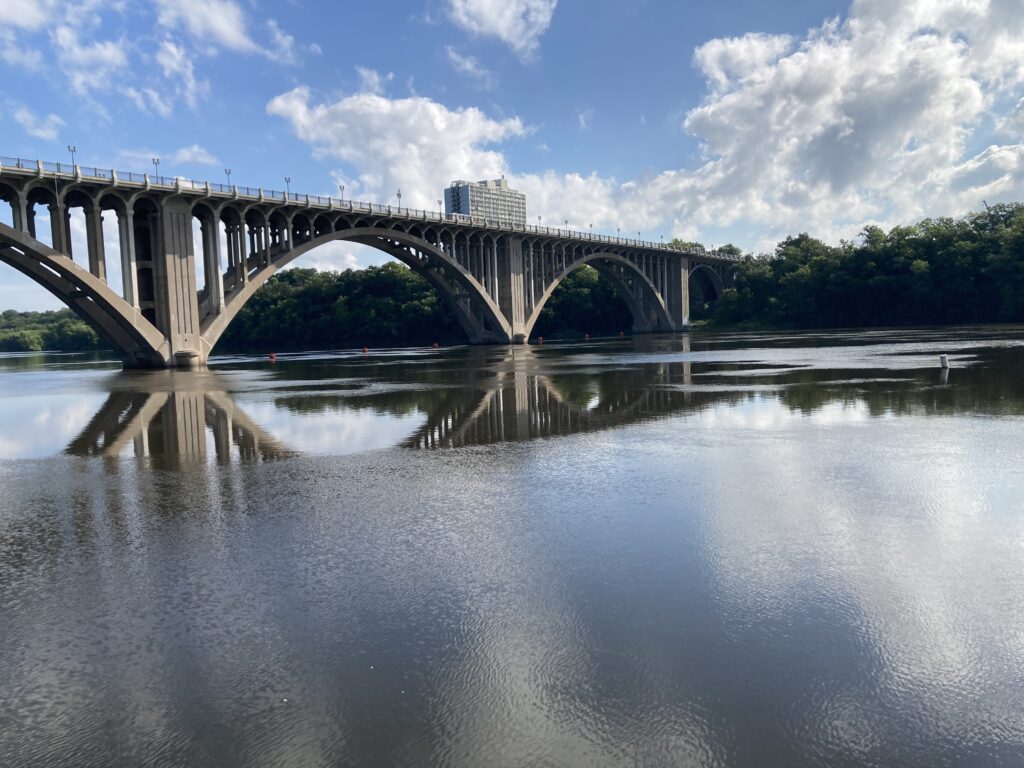
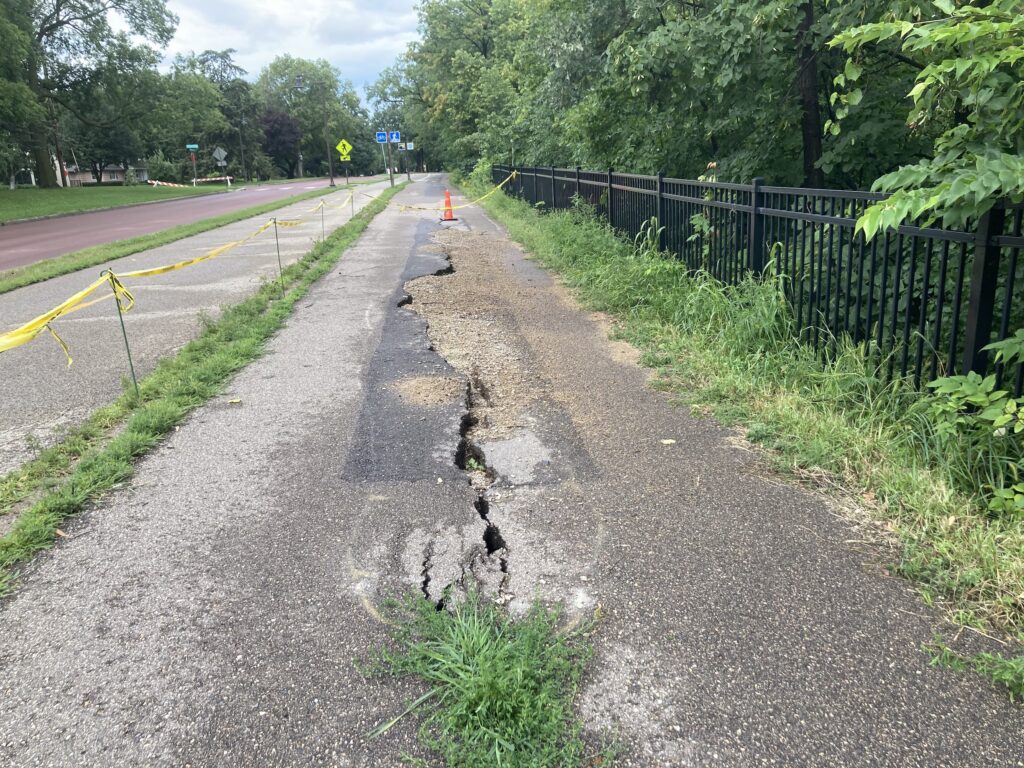
march 6/SHOVELBIKERUN

shovel: 35 minutes
2 inches of heavy, sloppy snow

Yuck! Woke up this morning, walked downstairs, opened the blinds. Hello huge tree branch sprawled across the side yard! Sometime during the night as it snowed a branch from my neighbor’s tree fell. It starts in their yard and ends by the edge of my house. Luckily, no damage. I wonder how long it will be before it’s removed? Later, after coffee, I went outside to shovel. I had been warned by one of my favorite Facebook friends that it was “heart-attack-on-a-shovel snow,” so I was slightly prepared. So heavy and wet and difficult to move! I did a lot of deep knee bends, trying to lift with my legs instead of my back.

I thought about running outside, but decided it was too sloppy, and possibly slippery. So, down to the basement for me.

bike: warm-up
run: 2.25 miles
basement
outside: snow

During my brief bike ride, I recited ED’s “I measure every Grief I meet.” I’ve memorized the entire thing now. Well, mostly. I don’t quite own the words, stumbling over a few still. I love memorizing ED poems because it gives me a chance to study the poems, especially the word choice. As I struggle to remember the words, or remembered them wrong, I realize what interesting/strange/delightful choices ED makes. Today’s favorites:

And though I may not guess the kind —
Correctly — yet to me
A piercing Comfort it affords
When passing Calvary —

To note the fashions — of the Cross —
and how they’re mostly worn —
Fascinated still to presume
That Some — are like my Own —

During the run I listened to the latest “Nobody Asked Us with Des and Kara.” They were talking about recent races, super shoes, fast times, and the future of track. Reflecting on how world records keep being broken Kara asked Des: “What do you think would happen if they took away the clock? Would the race still be exciting?” Des thought it could be, while my mind started wandering. First thinking about how I’ve been trying to forget the clock/watch and not care about pace — mostly, I’ve been successful. Second thinking about Clocks and how I’ve collected some lines (from poems and essays) about the clock, or what Mary Oliver calls it:

The clock! That twelve-figured moon skull, that white spider belly! How serenely the hands move with their filigree pointers, and how steadily! Twelve hours, and twelve hours, and begin again! Eat, speak, sleep, cross a street, wash a dish! The clock is still ticking. All its vistas are just so broad–are regular. (Notice that word.) Every day, twelve little bins in which to order disorderly life, and even more disorderly though. The town’s clock cries out, and the face on every wrist hums or shines; the world keeps pace with itself. Another day is passing, a regular and ordinary day. (Notice that word also.)

Upstream/ Mary Oliver

So many places to go with the idea of the Clock. Mary Oliver’s ordinary versus extraordinary time. Routines, habits, delight in the daily, repeated events. The Moment between time and its tight ticks, or right before something has happened, or when time (and sense) are disrupted. The time of the day dream. Outside of time and its relentless march forward, towards Death, motivated by progress. Losing time, syncing up with time. What other ways to we have for measuring meaning that don’t involve time passing?


april 15/RUN

3.5 miles
trestle turn around + extra
29 degrees / feels like 20
wind: 15 mph

Cold and windy. Again. Ran north, thinking I would have the wind at my back. Nope, in my face. Difficult. As I got closer (but not too close) to the porta-potty under the lake street bridge, it suddenly opened and a runner ran out. He was ready to go, I guess. Also saw a woman ahead of me walking down the service road to the Minneapolis Rowing Club. Rowers on the river today? If there were, I didn’t see or hear them. Ran past the trestle and stopped at the recently replaced steps. Then took them — about 30 steps, I think — down for a closer look. The river, with the sun reflecting the blue sky, the brown trees, the gray stone, looked almost mauve to me. Mostly brown, with hints of blue and gray and dark pink — where/how was I seeing pink? Saw a few fluttering birds, some ice on the edge of the entrance to the trail.

Almost forgot, but was reminded by hearing a dog bark here at my desk: Running south from the trestle, across the road from the fancy houses on Edmund, I heard a dog barking a deep, low bark in one of the houses. Then another a few doors down dog joined in. The second bark sounded almost like the impersonation of a frantic bark, like an unhinged kid trying to sound like a dog. I wondered which it was — a real bark or the copy of a bark? I never did find out, even as I listened for several minutes.

before the run

Today’s dirt topic: dust. Dust as the great equalizer (we all come from dust and return to it); how we are dust and more than dust; dusting as a sacred chore; dust as a fine powder we inhale/absorb without noticing; toxic dust; environmental racism and who does/doesn’t have access to cleaner air

1 — Dust Poem/ Philip Jenks

The idea was.
At least in theory,
Dust was a bad thing.

There was a bowl
Of it. At another
Point in time
The conclusion
Was reached
That everything
Was of it.

No season, no
Nothing to measure
To measure against
So no love or hate.
Left us without no
Moorings or so my
Father told me

Vanity tables of it?
Isn’t that what a vanity
Table is for?
What happens to
As its failings accrue?

No mission but to be clean.
Of itself.
But existing (time)
And problems there –
The problem of now
We are back here.

See the whole dust problem’s
No measure.
All’s dust, check.
All’s virtuous, check.
So why not live it up then?
And thus, YOLO etc. etc.

{These fok whirr pretty smart.
Thing is, even in
The dust bowl, the
Idea, a very American
One was that something
Wasn’t dust.
I wasn’t.
The Bowl wasn’t.
The dust wasn’t.

Since Ecclesiastes,
Been trying this one on.
(how’s that working out for you?)
One needn’t be geologically
Or for that matter
Psychologically trained to
Begin unpacking the diffident
And sometimes strained
Relation the nation holds with
All that is vanity.

The poet’s explanation of the poem was helpful for me in trying to dig in:

And I don’t say of myself much, or “I” much. I sometimes even just do search replace and take out “I” and put in “it” to try to take myself out as some small measure of humility.

“What happens to
As its failings accrue?

No mission but to be clean.
Of itself.

Dust Poem in PoetryNow

The idea of an “I” — writing as an “I,” being an “I.” How to navigate between a recognition that we are both more than dust and only dust (“All go to the same place; all come from dust, and to dust all return.”–Eccleasiastes 3:20)? What is the “more” and how do we express/live it in ways that don’t deny the dust and in which our humility doesn’t erase our own existence? Is this too vague sounding? This question of being an “I” — having a unique voice, claiming a space — without doing violence to others (being too arrogant, taking too much) is one of the primary questions I struggle with in my life/writing. I tend to be too humble, too quick to erase or replace my “I”.

2 — Dusting/ Marilyn Nelson

Thank you for these tiny
particles of ocean salt,
pearl-necklace viruses,
winged protozoans:
for the infinite,
intricate shapes
of submicroscopic
living things.

For algae spores
and fungus spores,
bonded by vital
mutual genetic cooperation,
spreading their
inseparable lives
from equator to pole.

My hand, my arm,
make sweeping circles.
Dust climbs the ladder of light.
For this infernal, endless chore,
for these eternal seeds of rain:
Thank you. For dust.

I like how Nelson connects the chore of dusting — an everyday act of labor — with the deeper substance/s of life: tiny particles of ocean salt, algae and fungus spores, winged protozoas. For Nelson (and Jenks mentions it in his poem too), dust is more than dust, it is life, everything — and dusting is more than chore, but our access to that life.

Nelson’s reimagining dusting as sacred, reminds me of a poem I posted earlier this year, or late last year, Drift, which is about, among other things, rethinking the possible joy in shoveling snow.

3 — Dust/ Dorianne Laux

Someone spoke to me last night,
told me the truth. Just a few words,
but I recognized it.
I knew I should make myself get up,
write it down, but it was late,
and I was exhausted from working
all day in the garden, moving rocks.
Now, I remember only the flavor —
not like food, sweet or sharp.
More like a fine powder, like dust.
And I wasn’t elated or frightened,
but simply rapt, aware.
That’s how it is sometimes —
God comes to your window,
all bright light and black wings,
and you’re just too tired to open it.

Dust = fine powder we inhale, surrounding us but often unnoticed. For Laux, truth as dust

dust: fine, dry powder consisting of tiny particles of earth or waste matter lying on the ground or on surfaces or carried in the air.

4 — Household Dust and Our Health

My 100+ year old house in the middle of the city gathers a lot of dust. I don’t often think about what all that means, and what all I’m inhaling/absorbing inside. Yikes.

As sure as the sun rises, houses collect dust. It gathers on our knickknacks and dirties the carpets. More than just dirt, house dust is a mix of sloughed-off skin cells, hair, clothing fibers, bacteria, dust mites, bits of dead bugs, soil particles, pollen, and microscopic specks of plastic. It’s our detritus and, it turns out, has a lot to reveal about our lifestyle.

For one thing, dust is far from inert. Those shed hairs and old skin cells can soak up a constellation of contaminants originating from consumer products that we bring into our homes. Other environmental contaminants can be tracked indoors on the soles of our shoes. So in addition to fluffy hair and garden dirt, dust can hold a witch’s brew of persistent organic pollutants, metals, endocrine disruptors, and more.

Not only does dust hold a long memory of the contaminants introduced to a house, but it’s also a continual source of exposure for the residents. Dust gets resuspended when it’s disturbed and will recirculate throughout the house, picking up substances before returning once more to the floor. “Year over year, dust accumulates in the home,” says Miriam L. Diamond, an environmental chemist at the University of Toronto. Even after regular cleaning, it still accretes because homes are tightly sealed environments, and the dust gets entrenched in carpets and crevices. Dust from an old house may retain legacy pollutants such as DDT that were banned almost half a century ago, she says.

Tracing the chemistry of household dust

5 — Dust, Toxins and Environmental Racism

So, we’re breathing in a lot of bad shit inside our individual houses — toxic chemicals that may not have even be used for decades. What about in our neighborhoods? And which neighborhoods are subject to more toxic and why?

At MCEA we believe in seeking justice for communities that have been harmed by historic and ongoing toxic pollution and contamination. By design and neglect, this harm has affected Black, Indigenous and other communities of color to a much greater extent than white neighborhoods.  Whenever municipal development is proposed in these communities, a necessary first step is to make sure the voices of neighboring community members are engaged and respected. Key decisionmakers must invite community members to the table to work towards a goal of eliminating new, harmful sources of pollution in neighborhoods experiencing systemic pollution and poor air quality.

The East Phillips neighborhood of Minneapolis is one of these communities. This neighborhood continuously ranks as having some of the worst air quality in Minneapolis, and it is still being harmed by one of the most brazen and widespread urban polluters in Minnesota history.  An insecticide manufacturer at East 28th St. and Hiawatha Ave. polluted the neighborhood with arsenic from the 1930’s to the 1960’s, resulting in a massive cleanup of contaminated residential yards. 

The area surrounding this Superfund site is recognized in state law as being overburdened by pollution. State law requires that no permit shall be issued by the Minnesota Pollution Control Agency in the area “without analyzing and considering the cumulative levels and effects of past and current environmental pollution from all sources on the environment.” 

The City of Minneapolis has proposed building a new “Hiawatha Campus” adjacent to the former manufacturing site to house city offices and vehicles. 

Ensuring community voices are heard in East Phillips

Environmental racism: Although the proposed project is expected to reduce overall greenhouse gas emissions in city operations, this would come at the direct expense of local environmental quality by increasing pollutants from traffic near this site. As a neighborhood that is 83% Black, Indigenous, and people of color, the East Phillips community would be expected to bear the brunt of the impact for the “greater good,” which is an unacceptable trade-off. Racism has recently been declared a public health emergency in Minneapolis. Knowingly increasing the amount of pollution in a neighborhood primarily populated by Native American, Latinx, East African and Black communities will only exacerbate this problem and demonstrate the hypocrisy of the city’s words.

Poor governance to bring new toxicity to the ‘Arsenic Triangle’

during the run

Did I think about dust while I was running? I tried. At one point, I remember thinking about the invisibility of dust and how it’s in the air, as opposed to dirt on the ground or sandy muck in the water. I also thought about breathing and breath and how dust travels between lungs.

after the run

Here’s something to add to the list of invisible things around us all the time, and another possible reason why I have “sinus episodes” so often: dust mites

Dust mites are microscopic, insect-like pests that feed on dead human skin cells and thrive in warm, humid environments. They are not parasites that bite, sting or burrow into our bodies. Instead, people who are allergic to dust or dust mites are reacting to inhaling proteins in dust that comes from dust mite feces, urine or decaying bodies. Any inflammation of the nasal passages caused by dust mites is considered a dust allergy.

Dust and Dust Mites

dec 13/RUN

5.1 miles
minnehaha falls and back
29 degrees
65% snow-covered

Ran to the falls and discovered that they were still plowing the trails around the park this morning. Had to stop and walk a few times in the deepest, most uneven parts. Sunny, barely any wind. Soon into the run, I was warm, then hot.

10 Things I Noticed

  1. From a distance and through the tree trunks, the river was burning white
  2. Off to the side and just below, the river was flat and off-white with splotches of light brownish-green or greenish-brown
  3. I could hear the sound of rushing water at the falls, but all I could see was several big ice columns
  4. Near the longfellow fountain (which never has water, not even in the summer, but does have parts of “The Song of Hiawatha” etched on the low wall curving around it), at the edge of the bluff, the view to the falls was as clear as I’ve ever seen it. No leaves or stray branches getting in the way
  5. Childhood having fun at their school playground, yelling and laughing
  6. Several different wedges of geese honking
  7. Packed down snow from feet, skis, sleds criss-crossing the big open part of the park above the fall, near John Stevens House
  8. The elegant, pleased (it looked like it was smiling) curve of the retaining wall on the Winchell Trail near 42nd street
  9. Mr. Morning! and Santa Claus
  10. 2 older walkers on the trail, one of them pushing their walker through the snow

I’m still working on my haunting poems. I’m hoping to do one specifically about bells and clocks. As I ran I thought about rhythms and beats: the steady beat of my feet on the trail, the triple counts I was chanting (strawberry/blueberry/raspberry/river road/trestle bridge), and the lone geese honking repeatedly. I tried to match my feet to its honks, which didn’t work. Then I tried to count the beats between each honk. It was not steady. I wondered, why do geese honk when they’re flying? I looked it up: to keep the flock together and coordinated in the V. Visibility is low so the honks let them know where each other are. Are all the honks the same, or does each goose have a slightly different one? Why aren’t they in a steady rhythm — or, are they, and I just don’t hear it?

Here’s some more information about the Canadian Geese and their 13 different vocalizations: Canada Goose Vocalizations

Almost every time I hear a geese honk, I think of Mary Oliver’s geese and their harsh and exciting cries, but there are other wild geese poems. Here’s one I don’t think I’ve encountered before:

Something Told the Wild Geese / Rachel Field

Something told the wild geese
It was time to go.
Though the fields lay golden
Something whispered,—‘Snow.’
Leaves were green and stirring,
Berries, luster-glossed,
But beneath warm feathers
Something cautioned,—‘Frost.’
All the sagging orchards
Steamed with amber spice,
But each wild breast stiffened
At remembered ice.
Something told the wild geese
It was time to fly,—
Summer sun was on their wings,
Winter in their cry.

My understanding is that geese fly south before it gets too cold and before the snow flies, just like the poem states. So why were there so many geese up in the sky today? Is it a result of the climate crisis, or something else? I found a National Geographic article but it’s behind a paywall. The little bit of it I could read was about how geese migration is complicated; geese are finding suburbs a pleasing place to stay year round. Another article I found mentioned that in the 1950s, fearing their extinction, wildlife agencies in some states introduced new flocks that were raised in captivity and never learned to migrate. They are still flocks of wild migrating geese, but also lots of “not wild” geese. Looks like this question has many different answers.

dec 8/RUN

4.1 miles
river road, north/south
14 degrees
99% snow-covered

Fully boosted! Scott, FWA, and I got our booster shots 2 weeks ago today. Very relieved. I wish RJP could get hers too.

A little warmer today with lots of sun and hardly any wind. The only part of me that was cold this morning were my fingers and only for the first mile. The path was covered mostly in smooth packed snow. Not slippery but still requiring more effort than on dry pavement to lift my feet off the ground. Was able to greet Dave the Daily Walker and a few other walkers that I might have seen before but I can’t remember. The floodplain forest below the tunnel of trees was quiet and wintery and beautiful. Running north, I was distracted by a runner ahead of me, traveling at my same pace. He was far enough ahead that he probably didn’t notice I was there. He was wearing black running tights, black shorts, and a bright blue jacket with some writing or images on the back that I couldn’t identify. The only time I remember noticing the river was when I was high up on edmund at my favorite viewing spot where the sun, when it’s out, makes the small sliver of river peeking through the trees glow white hot. Today, the river was covered with snow and looked flat and dull. No sparkle or glow.

A few words related to my restless poem popped into my head: unsatisfied/not or never satisfied, unsettled, collecting, gathering, assembling

Ilya Kaminsky is in charge of the poem-a-day at poets.org this month and he’s doing a great job. Here’s the one for today from another poet I admire:

Big Clock/ Li-Young Lee – 1957-

When the big clock at the train station stopped,
the leaves kept falling,
the trains kept running,
my mother’s hair kept growing longer and blacker,
and my father’s body kept filling up with time.

I can’t see the year on the station’s calendar.
We slept under the stopped hands of the clock
until morning, when a man entered carrying a ladder.
He climbed up to the clock’s face and opened it with a key.
No one but he knew what he saw.

Below him, the mortal faces went on passing
toward all compass points.
People went on crossing borders,
buying tickets in one time zone and setting foot in another.
Crossing thresholds: sleep to waking and back,
waiting room to moving train and back,
war zone to safe zone and back.

Crossing between gain and loss:
learning new words for the world and the things in it.
Forgetting old words for the heart and the things in it.
And collecting words in a different language
for those three primary colors:
staying, leaving, and returning.

And only the man at the top of the ladder
understood what he saw behind the face
which was neither smiling nor frowning.

And my father’s body went on filling up with death
until it reached the highest etched mark
of his eyes and spilled into mine.
And my mother’s hair goes on
never reaching the earth.

There is so much I love about this poem, for right now I’ll pick: “And collecting words in a different language/for those three primary colors:/staying, leaving, and returning.”

oct 28/RUN

4.5 miles
John Stevens House loop
46 degrees
light rain / humidity: 94%

The forecast predicted light rain all day. Decided I wouldn’t mind running in the rain. Wore my vest, which is waterproof or at least water resistant, a baseball cap, bright pink headband, bright yellow shirt, tights, shorts, gloves, and my older running shoes. Ran south to the falls then around the John Stevens House. Ran north until I reached the entrance to the Winchell Trail then took that the rest of the way. Not much wind, not too cold, not too crowded.

10 Things I Noticed

  1. A glowing tree at the falls that, at first, looked all orange, but slowly seemed almost pink: a mix of some red, yellow, green leaves
  2. A rush of noise — leaves blowing in the wind? No. The falls, rushing in the light rain
  3. Water coming out of the sewer at 42nd street — not rushing or gushing or roaring but some other sound that indicates an abundance of flowing water
  4. Running near the river, noticing how the water closer to me was a blue so pale it looked light gray, the water closer to the st. paul shore was deep and dark, reflecting the evergreens
  5. The spot on the Winchell Trail right climbing up to 42nd no longer concealed by leaves, lined with tall, slender tree trunks and a clear view of river gorge st. paul
  6. A few honks, some kids yelling out, a line-up of cars: the beginning of the day at a local elementary school across the grassy boulevard
  7. A very short person walking around Minnehaha Regional Park. Wearing jeans and a dark sweatshirt with the hood up. Walking with a hunched gait
  8. A runner (or walker?) stopped beside the path, taking off a bright pink jacket and tying it around their waist
  9. A strange scraping metallic sound up ahead of me on the Winchell Trail. Then running by a man hunched over a fence post near the curved retaining wall with a hacksaw, sawing. After I passed, he stopped
  10. Squirrel after squirrel darting across the path and into the woods, never circling back to run in front of me

Earlier this morning, right after I woke up and made my coffee, I memorized the second half of one of my favorite Halloween poems: A Rhyme for Halloween. Here’s the bit I memorized:

Our clock is blind, our clock is dumb.
Its hands are broken, its fingers numb.
No time for the martyr of our fair town
Who wasn’t a witch because she could drown.

Now the dogs of the cemetery are starting to bark
At the vision of her bobbing up through the dark.
When she opens her mouth to gasp for air,
A moth flies out and lands in her hair.

The apples are thumping, winter is coming.
The lips of the pumpkin soon will be humming.
By the caw of the crow on the first of the year,
Something will die, something appear.

I recited it in my head throughout my run. I love this poem and its haunting feel (tone? mood?). As I recited the lines, I struggled with the second verse — was it bobbing or bob? gasping or gasp? Why was it difficult for me? I can’t remember now. I like stumbling with the lines; it gives me the chance to reflect on word choice and rhythm. And it helps me to think about what makes some poetry sing, some fall flat.

Favorite lines/images: the blind, dumb clock; the martyr who wasn’t a witch because she could drown; the vision of her bobbing through the dark and gasping for air; the apples thumping — I imagine them falling on the ground; the lips of the pumpkin humming; something dying and something appearing.

Why is this haunting? One obvious reason: it takes up Halloween (spooky) images. But also: the rhymes. They aren’t sing-song-y. Instead, they echo. The rhyming reminds me of part of Edgar Allen Poe’s The Bells:

monody: a poem lamenting a person’s death
paean: a song of praise or triumph
rune: letters from an alphabet that was used by people in Northern Europe in former times. They were carved on wood or stone and were believed to have magical powers (source).
knell: the sound of a bell, especially when rung solemnly for a death or funeral

IV.

          Hear the tolling of the bells—
                 Iron bells!
What a world of solemn thought their monody compels!
        In the silence of the night,
        How we shiver with affright
  At the melancholy menace of their tone!
        For every sound that floats
        From the rust within their throats
                 Is a groan.
        And the people—ah, the people—
       They that dwell up in the steeple,
                 All alone,
        And who tolling, tolling, tolling,
          In that muffled monotone,
         Feel a glory in so rolling
          On the human heart a stone—
     They are neither man nor woman—
     They are neither brute nor human—
              They are Ghouls:
        And their king it is who tolls;
        And he rolls, rolls, rolls,
                    Rolls
             A pæan from the bells!
          And his merry bosom swells
             With the pæan of the bells!
          And he dances, and he yells;
          Keeping time, time, time,
          In a sort of Runic rhyme,
             To the pæan of the bells—
               Of the bells:
          Keeping time, time, time,
          In a sort of Runic rhyme,
            To the throbbing of the bells—
          Of the bells, bells, bells—
            To the sobbing of the bells;
          Keeping time, time, time,
            As he knells, knells, knells,
          In a happy Runic rhyme,
            To the rolling of the bells—
          Of the bells, bells, bells—
            To the tolling of the bells,
      Of the bells, bells, bells, bells—
              Bells, bells, bells—
  To the moaning and the groaning of the bells.

Reading through this again, I’m thinking about how the bells in this verse are not clock bells, tracking the precise, steady passing of time (which reminds me of the lines about the blind, dumb clocks and no time for the martyr). These bells toll, groan, moan, roll, throb, sob, knell. The sound of the bells floats from rusty throats, is muffled, melancholy. When it is mentioned that they keep time, it is not the time of life, but of death.

oct 14/RUN

3.5 miles
trestle turn around + extra
49 degrees
19 mph gusts

Brrrr. Colder and windier today. Wore tights and 2 shirts. The leaves continue to change. Today: bright brassy yellow with hints of green and brown. Not mustard or gold — at least to me. So intense and delightful that I exclaimed “wow!” as I reached the edge of the welcoming oaks. Down in the tunnel of trees more oranges and yellows. Still more leaves in the trees than on the ground, but if the wind keeps blowing like it did yesterday and it is today, that will change. By next week, will all the leaves have fallen? I felt strong and relaxed, running at an easy pace. Then a runner slowly approached from behind, not passing me fast enough, running alongside of me. I sped up to avoid them and knew it was a mistake almost immediately. I was running too fast. Ran for a few more minutes at that pace and then stopped to let the other runner pass. The lesson to learn: always slow down or stop to let another runner go by. Do not speed up to avoid them. This is a reminder of a lesson I should have learned several months ago with the group of kids on bikes under the lake street bridge (see may 28, 2021).

10 Things I Noticed

  1. A bright orange tree on the grass between edmund and the river road. Difficult to quite remember, but I think it wasn’t completely orange, maybe giving the idea of orange or orange-tinted leaves on an otherwise green leafed tree
  2. The man in black who was not in black at all but still has the very long legs. I think I might rename him “daddy long legs” — is that bad?
  3. The trees above the ravine and the slick slats and sewer pipe and concrete ledge were bright yellow and red
  4. The wind was blowing in many different directions, never at my back
  5. The jingling of my house key in the small zippered pocket in the front of my orange running shirt
  6. A roller skier without his poles — no clicking or clacking, lots of awkward arm movements
  7. No stones stacked on the ancient boulder
  8. Hardly any leaves left on the welcoming oaks
  9. An approaching runner avoiding me by running on the other side of a tree and through the grass
  10. 3 sets of steps (all inviting me to take them): the old, uneven stone steps after the tunnel of trees; the big stone slabbed steps before the trestle; the recently replaced wooden steps after the trestle. All leading to the Winchell Trail

Ran north listening to the wind, south listening to a playlist with Miley Cyrus and 2 songs by Silk Sonic — nice! At the end, above the ravine, I thought about how I rely less on a watch, and much more on the weather and the trees to keep track of time. Much more enjoyable to think in seasons or the progress of the leaves than minutes, hours, days.

Earlier today I was thinking about pace — and only slightly in relation to running pace, more about pacing and restlessness and ghosts that haunt the path. Pace and pacing, like watches or clocks, impose limits and boundaries: a running pace uses seconds and minutes per mile (or km) and pacing involves walking back and forth in a small or confined space, retracing your steps again and again until you rub the grass away and reach dirt, or wear the carpet bare. What to do with that information? I’m not quite sure…yet.

I found this poem on twitter yesterday. Even though it doesn’t deal with my theme (ghosts, haunting, haunts), I wanted to post it and tag it with water so I would have it for letter. Such a wonderful poem and poet!

Portrait of a Figure Near Water/ Jane Kenyon

Rebuked, she turned and ran
uphill to the barn. Anger, the inner
arsonist, held a match to her brain.
She observed her life: against her will
it survived the unwavering flame.

The barn was empty of animals.
Only a swallow tilted
near the beams, and bats
hung from the rafters
the roof sagged between.

Her breath became steady
where, years past, the farmer cooled
the big tin amphoræ of milk.
The stone trough was still
filled with water: she watched it
and received its calm.

So it is when we retreat in anger:
we think we burn alone
and there is no balm.
Then water enters, though it makes
no sound.

favorite bits: anger, the inner arsonist; the bats and the rafters the roof sagged between; the line break for “the stone trough was still/filled with water”; and water as the soundless balm for our burning alone.

random sighting/thought: Saw a sign in front of a house that read:

We love our rocks!
Please do not
take our rocks.

I thought about the importance of line breaks here. Maybe it’s just my faulty vision, but when I read this sign I am just as (or maybe more) likely to read the line “take our rocks” on its own and think they want me to take their rocks. How does the meaning of the sign change with different breaks:

Please do
not take
our rocks.

Please do not take
our rocks.

Please
do not take
our rocks.

What if you mix up the order?

Our rocks
do not take
please

Our rocks do
please take not

rocks? please.
ours do not take

do ours not please? (rock’s take)

take rocks — ours
please — (do not)

Too much useless fun!

addendum: I told STA about my fun wordplay, and he offered this one:

Our rocks please.
Do not take!

another addendum: The sign actually started: Rocks rock!

august 16/RUNSWIM

run: 10k
franklin loop + extra
67 degrees

A 10k. I needed to check back through my logs to find out the last time I ran this far. November 4, 2019. Wow. I’ve still been running a lot, just more frequently and less distance. It felt pretty good until the very end. STA and I are signed up to run the 10 mile in October. Will it even happen? Not sure.

It was sunny, not too windy, and mostly not too hot. In the shade it was fine. Ran north on the river road trail until crossing at franklin. Heard the rowers down on the river. Two coxswains, one male, one female. Their voices echoing through the bullhorn. With the echoing, it sounded more serious than a practice. A race? Or was it only how the sound travels differently on the east side, as opposed to the west side of the river. Would more open space, less trees in the gorge, change how the voices traveled?

And, I saw someone riding a unicycle–first time ever while running, I think.

Thought about what a wonderful time I had with my college friends, how great it was to be challenged and stimulated and reminded of the importance of friends and community. Also thought about some of our discussions about how people come together in crises–neighbors helping neighbors when intense storms do severe damage to houses, buildings, towns. We need that sense of community AND we also need to do what we can to prevent these powerful storms/ erratic weather patterns from happening more frequently. Why do so many of us seem unwilling to work on the prevention, on radically transforming how we live, and how we continue to take without (enough) concern for its impact on the earth and all of its inhabitants?

The Clock! That 12-figured moon skull!

Before heading out for my run this morning, I learned about the debut poetry collection from Adam O. Davis: Index of Haunted Houses. Amazing! Found these epigraphs at the beginning and started thinking about other things I had read about clocks and time:

Think of this: When they present you with a watch they are gifting you with a tiny flowering hell, a wreath of roses, a dungeon of air…. They aren’t giving you a watch, you are the gift, they’re giving you yourself for the watch’s birthday.

Julio Cortázar

Years, like any other measure of time, offer mankind the promise of isolated events, of an origin and terminus to history, when in reality there is no isolating time as time has no origin or terminus. 1980 never existed, or, if it did, it has always been 1980.

Muriel Échecs

After all, the chief business of the American people is business. They are profoundly concerned with producing, buying, selling, investing, and prospering in the world. I am strongly of the opinion that the great majority of people will always find these the moving impulses of life.

Calvin Coolidge*

*After writing this, I listened to an excellent podcast–The Scottish Poetry Library--with Adam O. Davis and the host mentioned what Dorothy Parker said about Coolidge after he died: “How can they tell?” Ha!

Here’s something I read just yesterday from Love of Lakes/ Darby Nelson

We talk of time as the river flowing. I never questioned the implications of that metaphor until I was struck by the words of Professor Dave Edmunds, Native American, on a display in the Indian-Western Art Museum in Indianapolis. Edmunds wrote, ‘Time as a river is a more Euro-American concept of time, with each event happening and passing on like a river flows downstream. Time as a pond is a more Native American concept of time, with everything happening on the same surface, in the same area—and each even is a ripple on the surface.’

If I think of time as a river, I predispose myself to think linearly, to see events as unconnected, where a tree branch falling into the river at noon is swept away by current to remain eternally separated in time and space from the butterfly that falls in an hour later and thrashes about seeking floating refuge.

But if I think of time as a lake, I see ripples set in motions by one even touching an entire shore and then, when reflected back toward the middle, meeting ripples from other events, each changing the other in their passing. I think of connectedness, or relationships, and interacting events that matter greatly to lakes.

For Love of Lakes/ Darby Nelson

I’m also thinking of Mary Oliver and her reoccurring clocks as representing the restrictions of ordinary time.

And there is the attentive, social self. This is the smiler and the doorkeeper. This is the portion that winds the clock, that steers through the dailiness of life, that keeps in mind appointments that must be made, and then met. It is fettered to a thousand notions of obligation. It moves across the hours of the day as though the movement itself were the whole task. Whether it gathers as it goes some branch of wisdom or delight, or nothing at all, is a matter with which it is hardly concerned. What this self hears night and day, what it loves beyond all other songs, is the endless springing forward of the clock, those measures strict and vivacious, and full of certainty.

The clock! That twelve-figured moon skull, that white spider belly! How serenely the hands move with their filigree pointers, and how steadily! Eat, speak, sleep, cross a street, wash a dish! The clock is still ticking. All its vistas are just so broad–are regular. (Notice that word.) Every day, twelve little bins in which to order disorderly life, and even more disorderly thought. The town’s clock cries out, and the face on every wrist hums or shines’ the world keeps pace with itself. Another day is passing, a regular and ordinary day. (Notice that world also.)

“Of Power and Time” in Upstream/ Mary Oliver

from a log entry on april 7, 2021

I’m thinking about words like: inefficient, clockwork, pace (as in, “keep up the” or running pace or the hectic pace of modern life), mechanization, industrialization, useless, instrumental, accessible, smooth, easy, fast, relevant, order, discipline, attention economy, rest, restlessness, sleep, internal clocks, spending time vs. passing it, paying or giving attention, eyeballs on the page, obscure, unnoticed, unnoticing.

And that the battery in my apple watch is dying and how, even though I depended on it so much before, I’m considering not replacing it and not wearing a watch. Not keeping track of my pace.

And, I’m thinking about these beautiful lines from Alice Oswald’s “Evaporations”:

In their lunch hour
I saw the shop-workers get into water
They put their watches on the stones and slithered
frightened
Into the tight-fitting river
And shook out cuffs of splash
And swam wide strokes towards the trees
And after a while swam back
With rigid cormorant smiles
Shocked I suppose from taking on
Something impossible to think through
Something old and obsessive like the centre of a rose
And for that reason they quickly turned
And struggled out again and retrieved their watches
Stooped on the grass-line hurrying now
They began to laugh and from their meaty backs
A million crackling things
Burst into flight which was either water
Or the hour itself ascending.

swim: 2.1 miles / 5 loops
cedar lake open swim
84 degrees / windy

Another great swim at cedar lake. The water was very choppy with lots of swells. It was windy. The waves didn’t bother me at all, but my legs were sore from my 10K earlier in the day. My left hip hurt. Swam on the edge of the course to avoid other people–so I wouldn’t have to worry about running into them. Almost ran into a lifeguard on a kayak a few times. I think they might have been trying to get me to swim closer to the buoys. I suppose I was fairly far from them, but I wanted to use the break in the trees as my guide. In years past, being nudged by the lifeguard might have bothered me, making me feel like I was doing something wrong or failing, but not this year. I’m happy to not be so hard on myself or to always need to be doing it the proper/right way.

For much of the loop I could only breathe on one side–when I breathed on the other side, I got a mouth full of water from a wave. I mostly breathed every six strokes. No difficulty breathing, no shortness of breath. I like holding my breath for longer.

I didn’t look at the sky much. It was hard to see in the midst of all the waves. Not sure if there were any planes or birds. Hard to notice anything else but the water and others’ elbows and bright caps and the orange buoys — which I could not really see.

My challenge for the last 3 swims (only 3 left at cedar): to crack the code for the stretch between the start of the loop to the far beach. For some reason, no matter how much I try–stopping briefly at the start to sight the distant orange buoy, swimming farther out and away from the other side–I always end up swimming too close to others swimming the other way. I can’t figure out if there’s a current pushing me that way or something else that makes me lose my wider trajectory. I can barely see the orange buoy, so I’m relying on other things. So far, I haven’t found a helpful landmark on the other shore. I want to figure this out before I’m done for the season.

Still in the month of exploring different notions of love in poetry. Here’s a poem by Paul Tran that I think fits:

Bioluminescence/ Paul Tran

There’s a dark so deep beneath the sea the creatures beget their own
light. This feat, this fact of adaptation, I could say, is beautiful

though the creatures are hideous. Lanternfish. Hatchetfish. Viperfish.
I, not unlike them, forfeited beauty to glimpse the world hidden

by eternal darkness. I subsisted on falling matter, unaware
from where or why matter fell, and on weaker creatures beguiled

by my luminosity. My hideous face opening, suddenly, to take them
into a darkness darker and more eternal than this underworld

underwater. I swam and swam toward nowhere and nothing.
I, after so much isolation, so much indifference, kept going

even if going meant only waiting, hovering in place. So far below, so far
away from the rest of life, the terrestrial made possible by and thereby

dependent upon light, I did what I had to do. I stalked. I killed.
I wanted to feel in my body my body at work, working to stay

alive. I swam. I kept going. I waited. I found myself without meaning
to, without contriving meaning at the time, in time, in the company

of creatures who, hideous like me, had to be their own illumination.
Their own god. Their own genesis. Often we feuded. Often we fused

like anglerfish. Blood to blood. Desire to desire. We were wild. Bewildered.
Beautiful in our wilderness and wildness. In the most extreme conditions

we proved that life can exist. I exist. I am my life, I thought, approaching
at last the bottom of the sea. It wasn’t the bottom. It wasn’t the sea.

Wow! You can listen to Tran read this poem on The New Yorker site. I love their dramatic reading–so powerful and delightful and wonderful. I understand the poem to be about finding/forging/fighting for a love of self. I love their lines about living without light, about finding life beyond the life that needs light to be possible. My relationship to light is changing as my eyesight deteriorates. Earlier on, sunlight could be too bright–it would hurt my eyes. Now that I’ve lost most of my cone cells, it doesn’t bother me as much. Nothing is that bright. I have a low vision lamp that helps me to read more easily. When light isn’t bright enough, the letters become too fuzzy. Some day, even the brightest bulb won’t matter. I must learn to live with less light. It will never be as dark as the deep sea in the poem (at least, most likely not), but it will be faded and not much help. No more shedding light on a situation for me.

july 1/BIKESWIMBIKE

bike: 8.6 miles
lake nokomis and back
85 degrees

Biked with STA to the lake for open swim. Not too difficult. Again, it helped that I didn’t need to pass anyone and it wasn’t that crowded. After the swim, leaving the lake, it was a little crazier. Lots of walkers on the bike path, feral kids zig-zagging on the path, a stalled surrey stuck in the middle of the trail.

swim: 3 miles/ 3 loops
lake nokomis open swim
85 degrees
partly sunny/slightly choppy

Wow, this was the most difficult open swim yet. I didn’t mind the swells near the big beach, but the placement of the green buoys so far from the beach, the bright sun draining them of color and shape, and the sneaky sailboats impersonating them, it was very hard to sight anything. When I stopped a few times to get my bearings, I still couldn’t see anything. Luckily, I never got off course too much and I kept swimming for 3 loops. After the swim, I met up with STA for a beer at Sandcastle. Very nice. It really felt like covid had never happened, which was mostly good. Saw lots of cute dogs and sailing boats. A beautiful night to be out in the world instead of holed up in the house.

july’s theme

It’s the first day of July, which means a new theme. Last month was water and stone. Up until a few hours ago, I was convinced that this month’s theme would be water, especially as it relates to my swimming. But I started thinking about open swim and then wrote in my almost finished Plague Notebook, Vol 8:

not wild or natural…not a wild swim, but an open swim…not pure adventure in unchartered territory but not really urban or tightly planned either…just off the beaten path…how do I describe where and what this is—this = being = running or walking or swimming or breathing outside?

And then, after walking Delia the dog:

Thinking about the “wild” and my neighborhood. Not wild, but messy, unkempt, order still there (or the trace of order) but yards/flowers left alone to roam or wander. Not rigid, tight control or the sharpness of a trimmed, edged lawn, approximate, not tidy but not chaos, a bit disheveled, off-track but cared for, attended to, intentional

I started thinking about centers and edges, which led me back to Emily Dickinson and her circumference, but also to Mary Oliver, and her devotion to things having a place in the world, in the family of things. And now I am wondering what to do with all of these ideas, what to spend time with this month? I think all of this wandering and wondering has to do with making sense of the place I’m recognizing (and creating) for myself, swimming in a swamp that was made into a lake 100 years ago and is carefully managed by a park system. Swimming across a lake in designated areas, with hundreds of others, watched over by lifeguards. It’s not the ocean or a remote lake or a secret swimming hole, but it’s also not a safe, chlorinated, regimented pool. There are bacteria and big fish and weeds that want to drag you to the bottom.

I’m listening to the latest Between the Covers podcast with Arthur Sze. Wow, he’s amazing. He read this poem midway through the episode.

The Unnamed River/ Arthur Sze

1

Is it in the anthracite face of a coal miner,
crystallized in the veins and lungs of a steel
worker, pulverized in the grimy hands of a railroad engineer?
Is it in a child naming a star, coconuts washing
ashore, dormant in a volcano along the Rio Grande?

You can travel the four thousand miles of the Nile
to its source and never find it.
You can climb the five highest peaks of the Himalayas
and never recognize it.
You can gaze though the largest telescope
and never see it.

But it’s in the capillaries of your lungs.
It’s in the space as you slice open a lemon.
It’s in a corpse burning on the Ganges,
in rain splashing on banana leaves.

Perhaps you have to know you are about to die
to hunger for it. Perhaps you have to go
alone in the jungle armed with a spear
to truly see it. Perhaps you have to
have pneumonia to sense its crush.

But it’s also in the scissor hands of a clock.
It’s in the precessing motion of a top
when a torque makes the axis of rotation describe a cone:
and the cone spinning on a point gathers
past, present, future.

2

In a crude theory of perception, the apple you
see is supposed to be a copy of the actual apple,
but who can step out of his body to compare the two?
Who can step out of his life and feel
the Milky Way flow out of his hands?

An unpicked apple dies on a branch:
that is all we know of it.
It turns black and hard, a corpse on the Ganges.
Then go ahead and map out three thousand mile of the Yantze;
walk each inch, feel its surge and
flow as you feel the surge and flow in your own body.

And the spinning cone of a precessing top
is a form of existence that gathers and spins death and life into one.
It is in the duration of words, but beyond words—
river river river, river river.
The coal miner may not know he has it.
The steel worker may not know he has it.
The railroad engineer may not know he has it.
But it is there. It is in the smell
of an avocado blossom, and in the true passion of a kiss.

june 26/RUN

4 miles
marshall loop
71 degrees/ dew point: 64

It felt hot and humid this morning. Overcast. Ran up the marshall hill without stopping until I reached the bridge steps. It was hard, but I didn’t stop. A good mental victory. Heard some rowers on the river and the coxswain directing them. Crossing back over the bridge, I stopped to read a few small pink signs affixed to the bridge. One was about hope making anything possible, another about how one road block shouldn’t stop you. The other day, as STA and I crossed the bridge in the car, we noticed that the entire bridge was covered in these signs, now only these 2 are left. STA thinks the wind might have blown them off.

Near the start of my run, descending the hill and entering the tunnel of trees, it was a dark, impenetrable green, made darker by my vision. It looked like I was running into a lightless smudge. Very cool–not scary at all. Once I was in the dark green, there was light and trees and thick air. Noticed the 4 fences I’ve written about and the stone wall framed by trees, remembering the time I saw someone perched in one of these trees–hiding? spying?

Now, after the run, I feel sore. I often feel sore in the summer. Not injury-sore but doing-more-exercise-especially-swimming-sore.

Erosion/ Linda Pastan

We are slowly
undermined. Grain
by grain . . .
inch by inch . . .
slippage.
It happens as we watch.
The waves move their long row
of scythes over the beach.

It happens as we sleep,
the way the clock’s hands
move continuously
just out of sight,
but more like an hourglass
than a clock,
for here sand
is running out.

We wake to water.
Implacably lovely
is this view
though it will swallow
us whole, soon
there will be nothing left but view.

We have tried a seawall.
We have tried prayer.
We have planted grasses
on the bank, small tentacles,
hooks of green that catch
on nothing. For the wind
does its work, the water
does its use work.

One day the sea will simply
take us. The children
press their faces to the glass
as if the windows were portholes,
and the house fills
with animals: two dogs,
a bird, cats–we are becoming
an ark already.

The guess will follow
our wake.
We are made of water anyway,
I can field it in the yielding
of your flesh, though sometimes
I think that you are sand,
moving slowly, slowly
from under me.

june 23/RUNSWIM

4.3 miles
minnehaha falls and back + winchell trail
64 degrees
dew point: 60

I feel better at the end of this run than I did during it. A beautiful morning, not too windy or hot, sun that gently dazzled but didn’t beat down. Even so, I sweat a lot and felt hot. Thought about the dew point, trying to remember exactly how it worked. I researched it and wrote about it a few years ago, but when someone asked me what it was a few days ago, I couldn’t remember. How do I forget these things so quickly? Here’s my explanation I wrote in 2017:

It’s not the heat or the humidity it’s the dew point, which is the temperature at which water condenses. The closer the dew point is to the temp in the air, the longer the sweat will stay in your hair because the air is too saturated and your sweat can’t evaporate, which is how your body cools you down.

Saw a flash of white, churning water as I ran past the falls. Noticed an opening in the thick trees with a dark winding trail just below the ford bridge–it seemed inviting until I imagined all the bugs that would be waiting for me in there. Heard some voices down in the gorge, on the river. Rowers. Also heard the clicking of a gear change as one bike passed, the clunking of a chain that needed to be greased as another approached.

As I ran on the Winchell Trail through the thick green, I thought that when I’m running by the gorge, I think of in broad, basic ways: tree, rock, bluff, bird, water. Then my mind wandered, and I wondered: (Why) do we need more specific, “technical” names in order to connect with the land? I thought about the importance of names and the violence of occupying and renaming, the value of knowing the history of a place, understanding how it works scientifically, and placing it in a larger context (space, time). Then, as I ran up the short, steep hill by Folwell, I thought about how important it is to learn to think on all of these levels at once, or at least be able to switch back and forth between them. I can experience the gorge as water, rock, tree, bird, wind, or as stolen land occupied and used, abused, restored, protected, ignored, exploited. As a geological wonder, slowly–but not really slowly in geological time, 4 feet per year–carved out by the river eroding the soft St. Peter sandstone. As both wild/natural and cultivated/managed–the site of erosion due to water, and erosion due to the introduction of invasive species, industry, too many hikers, bikers, houses nearby. There isn’t an easy way to reconcile these different understandings and their impacts.

After I finished my run and started walking home, I thought about how these levels/layers could be represented or expressed in a poem. What forms would work best and how to translate all of it into a form? I imagined a mostly blank page with the elemental word in the center (rock or water or tree), then additional pages with other related meanings–you could flip through and somehow add meanings or see all of the meanings at once. Does this make sense? Then I thought about a poem that somehow mimics the form of a fossil, what would that look like? Or the different layers of rock representing different eras of geological time. Not sure if this will go anywhere, but I’ll spend some more time thinking about it.

To chlorophyll, refineries, coal, furnaces beneath early skyscrapers, fossils/ Caroline Kenworthy

after Jane Hirshfield

Back then, what did I know?
The distance between moving cars I could turn into.
How far past EMPTY the engine would run.

I moved daily, rolling over poured rock,
traveling to learn. I was propelled by bodies

of organic matter. First, they were found.
Well, no. First, they were blue flowers carpeting a forest floor,
or the brown and hungry animal moving through them.

Then, they were found, pumped, sifted, melted, strained,
boiled, strained again, divided. Then burned.

Funny to think that we didn’t know what coal was,
and then we did. From there— efficient refinement attracts
our kind— we made these bodies pourable.
The dark rainbow and sharp whiff of petroleum.

I want to explain what I mean by bodies—
at first, I meant sentient movers. As if movement springs only from brains.
Then I thought, an organized, silent burning of sugars. I think,
a system to translate the world into the self.

Life’s long inhale of nutrients, and longer, hotter exhalation in decay. Packed, still, silent.

Hard to remember that matter hums constantly.
These cars and highways— how much of moving is death rearranged.

swim: 1.2 miles/ 4 loops
cedar lake open swim

Cedar Lake! Cedar Lake! Hooray for open swim at both lake nokomis and cedar lake. Very different experiences. Nokomis is 600 yards across, Cedar Lake is 300. Nokomis is about 15-20 feet deep, Cedar is 30-40 feet deep. Nokomis has a big beach with a boathouse and restaurant, Cedar has porta potties. I like both. Today, it was windy and bright. Choppy on the way back and hard to see the shore. My sighting trick: there’s a break in the towering trees where the small beach is.