nov 9/HIKE

45 minutes
neighborhood / old stone steps / winchell trail
29 degrees / feels like 13

Okay winter! Feels like 13! Took Delia on a long walk. Gray sky with snow flurries and some wind. Beautiful fall colors — what was left of the leaves. Much of them were already gone or has fallen last night and earlier today. Favorite moment while walking through the neighborhood: a buttery yellow door on the side of someone’s house.

Crossed over to the trail and took the old stone steps down to the river. Slippery with the recent snow and wet leaves. Good thing I was holding onto the railing! At the bottom, the forest floor was covered in green leaves. A strange sight. Reaching the river, I could hear it lapping the shore. I could see some small waves. I wish I could have stayed there longer, but Delia wanted to leave almost as soon as we got there. Boo.

Returning through the forest, I marveled at the slope of the gorge. All yellow, and so tall! The entire time I was down below, I could hear the leaf blowers up above. Really? Using a leaf blower today, when the wind is so strong — or using one ever; I hate leaf blowers.

I need to make sure that I get out for more walks/hikes this winter.

june 23/RUNWALKSWIM

run: 4.05 miles
minnehaha falls and back
71 degrees
dew point: 66

It felt warmer than 71, the air thicker than a 66 dew point. Had to remind myself a few times that I could stick to my 9/1 plan. And I did — at least through the first 3 cycles. Had to do an extra minute of walking at 32 or 33 minutes in, but then I got right back on track. A victory!

overheard: Just starting my run, I overheard one woman say to the other: that was the first time I ever saw a spider biting me! As opposed to waking up with spider bites, not knowing when you got them, I suppose.

10 Things

  1. one of the recently re-mulched trails that leads down into the oak savanna looked dark and deep and mysterious — partly due to a late June abundance of green leaves blocking out the light, partly the sun behind the clouds
  2. a smattering of young runners in small groups — a high school cross-country team already in training?
  3. empty benches
  4. the steady hum of some construction equipment
  5. a sour smell coming from a trash can
  6. a packed shopping cart parked on the lowest part of the trail that dips below the road
  7. the flash of a very small bird — a hummingbird? — flying past me
  8. an over-the-shoulder sideways glance at the falls: all white foam
  9. 2 people waiting to pay for parking at the falls
  10. mostly overcast with a few stretches of pale sun

A good run. A low average heart rate. A steady pace. A chance to be above the gorge and the river. And, interesting thoughts. Earlier this morning, I was reminded of some ideas about movement and death and the Homeric mind, and they fluttered like loose threads behind and beside me as I ran.

thread 1: entangled, murky, thick-layered

As I ran on the Winchell Trail through the thick green, I thought that when I’m running by the gorge, I think of it in broad, basic ways: tree, rock, bluff, bird, water. Then my mind wandered, and I wondered: (Why) do we need more specific, “technical” names in order to connect with the land? I thought about the importance of names and the violence of occupying and renaming, the value of knowing the history of a place, understanding how it works scientifically, and placing it in a larger context (space, time). Then, as I ran up the short, steep hill by Folwell, I thought about how important it is to learn to think on all of these levels at once, or at least be able to switch back and forth between them. I can experience the gorge as water, rock, tree, bird, wind, or as stolen land occupied and used, abused, restored, protected, ignored, exploited. As a geological wonder, slowly–but not really slowly in geological time, 4 feet per year–carved out by the river eroding the soft St. Peter sandstone. As both wild/natural and cultivated/managed–the site of erosion due to water, and erosion due to the introduction of invasive species, industry, too many hikers, bikers, houses nearby. There isn’t an easy way to reconcile these different understandings and their impacts.

23 june 2021

thread 2: moving as death rearranged

from To chlorophyll, refineries, coal, furnaces beneath early skyscrapers, fossils/ Caroline Kenworthy

Life’s long inhale of nutrients, and longer, hotter exhalation in decay. Packed, still, silent.

Hard to remember that matter hums constantly.
These cars and highways— how much of moving is death rearranged.

I kept thinking about this idea of death rearranged. At point, I thought, of course — recycling, decomposing, rebirth = rearranging. I like this word choice — rearranging.

thread 3: Homeric mind

this physical thing that moves. So, if you imagine a place over the sea, your mind actually has to get there. So, even though it may be as fast as the light, it is physical movement.

 A Conversation with Kit Fan and Alice Oswald

The mind as moving — not just through associations, but literally moving, traveling.

As I thought about movement and connection, and death rearranged on my walk back after the run, I passed by a painted rock at the edge of neighbor’s side garden that read, We are our ancestors with an arrow pointing to plants. Yes. No one is gone, just rearranged, reconfigured. And, we are connected deeply to the green.

walk: 3 miles
east lake library and back
78 degrees

Walked to the library to pick up Anne Carson’s Float. I’ve checked it out once or twice before but I’m thinking this time I might be more interested in it. (2 hours and several naps later: nope. Still don’t understand it or why it’s called float, but I found a review of it and Mary Ruefle’s My Private Property that might help.) It was fun walking through the neighborhood, looking at how different neighbors deal with their slanting lawn. FWA is interested in re-doing ours for us. Wood, rock, stone, mulch, hostas, ornamental grass. My favorite flowers: the vines with the bright purple flowers — clematis, I think, and the dozens of cacti with beautiful yellow blooms. Saw a lime green door, like mine, on a bright blue garage. A perfect blue for the green, but maybe too much for a whole house. And, it clashed with the purple fence. Heard some loud christian rock blasting from a backyard and a 2 story tall skeleton wearing a green t-shirt in a front yard. Kids on scooters, yelling from inside houses, lounging by the pool at longfellow park.

Speaking of kids, we live next to a daycare. It’s never been a problem because the kids usually stay inside so I never hear them. A few months ago, Sheila (our neighbor and owner of the daycare) began letting 2 little girls play outside in their front yard and our side yard. They are very loud and like to scream a lot. And they are right outside of my windows so I hear them and see them flitting and darting out of the corner of my eye. Thankfully they haven’t opened our gate . . . yet. It doesn’t seem like they are being supervised. Today Scott noticed that one of them had picked up a giant branch — taller than them — and was waving it around — through the air, at the other little girl. No adults stopped them until about 15 minutes later when they were scolded. Yikes.

5

point
could
stick
least
first
extra
right
track
other
green
light
cloud
empty
group
cross
smell
front
never
being
story

trash
trail
below
heart
above
loose
thick
gorge
think
basic
bluff
water
order
value
place
short
steep
giant
adult
until

forth
abuse
carve
house
death
early
decay
still
there
about
after
arrow
plant
check
twice
might
later
stone
mulch
hosta

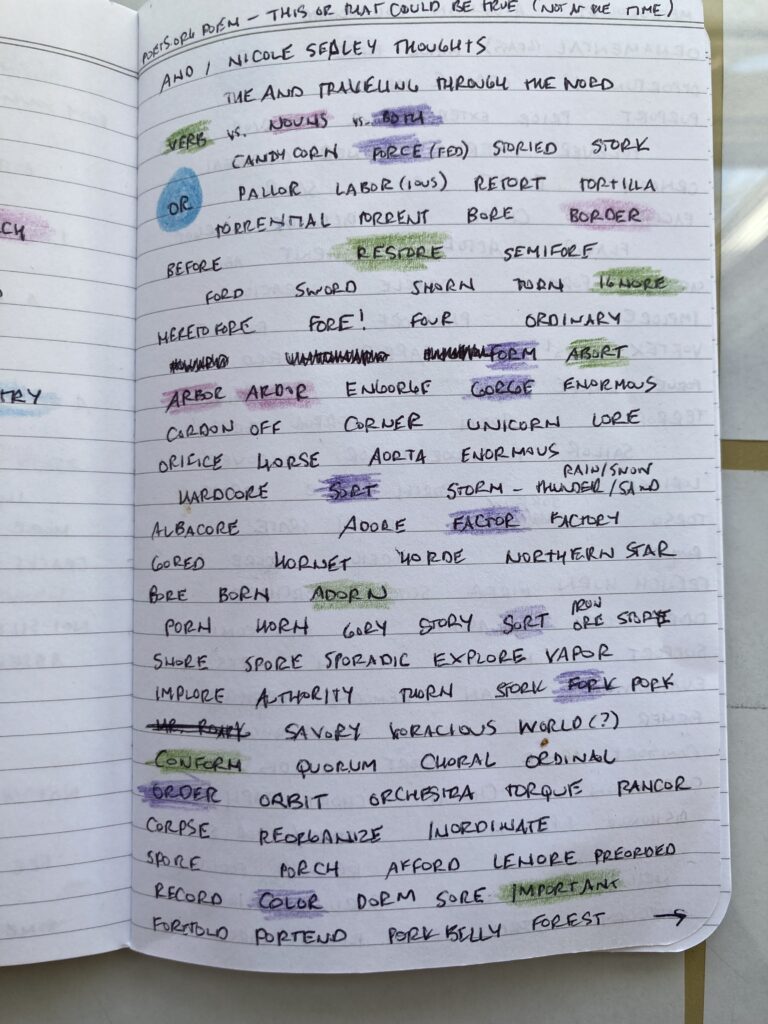
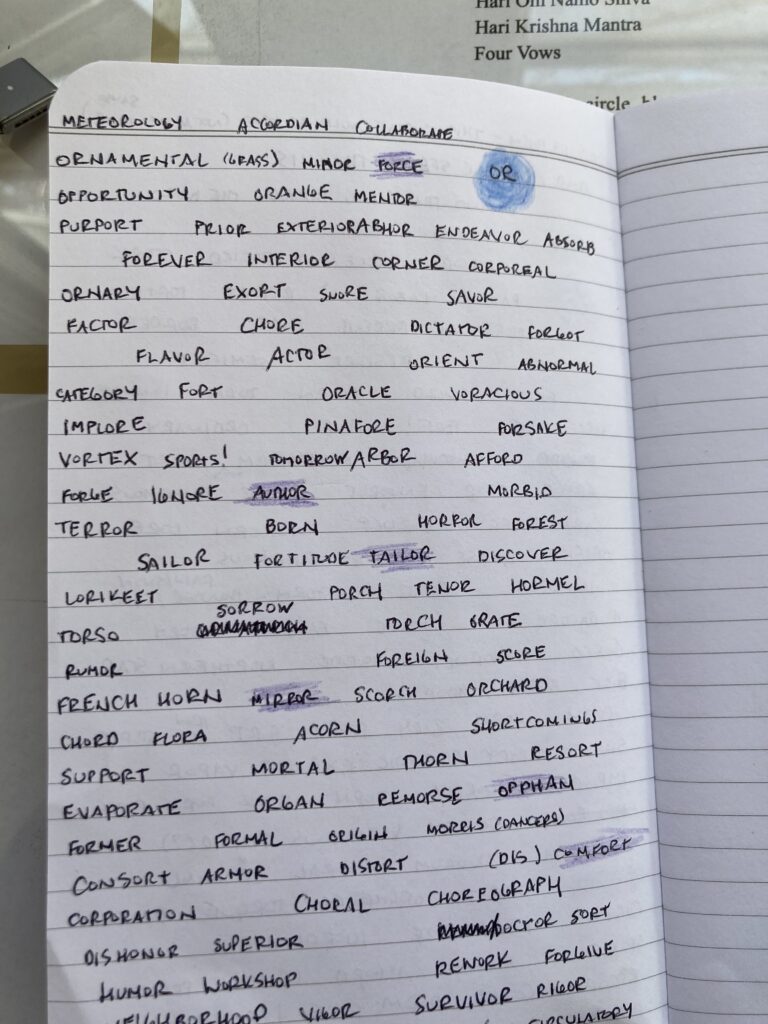
empty group smell
basic bluff order
thick heart track
cloud water light
green house plant
extra loose trash
never think twice

swim: 5 cedar loops (2.5 lake nokomis)
cedar lake open swim
80 degrees

First open swim of the season at Cedar Lake. Wonderful conditions. Warm-enough water and no chop. I felt strong and fast and smooth. I didn’t stray too far to the center. They have a new lifeguard who was actually telling people dogs weren’t allowed in the water and requiring people to have swim caps. Is Cedar Lake going to lose some of its chill vibes?

The water was olive green, but more yellow than the blue of lake nokomis. I didn’t see any fish or get wrapped in vines. No canoes crossed my path, either. Not too many clouds in the sky. No planes or birds.

A great early evening for a swim!

may 5/RUNWALK

4.25 miles
minnehaha falls and back
59 degrees

Warm! Nothing hurt, it was just hard. My heart rate was higher. Who cares? No back or calf or hip pain! I’m trying to ease back in. Today I ran 4 minutes/walked 1, 8 times. I was proud of myself for sticking with it, even as my heart rate climbed. Yes, I’m ready for some mental toughness!

10 Things

  1. an abundance of sparkles on the river
  2. more green leaves crawling up the trunks of trees
  3. fee bee fee bee
  4. shadow, 1: a straight-ish line on the path from the fence
  5. shadow, 2: soft, sprawling branches
  6. shadow, 3: me — sharp, upright, satisfied
  7. the faint, slightly off tune dinging of the train bell
  8. flowing falls
  9. park workers had the one set of stairs blocked off — I heard water, were they spraying down the steps?
  10. passing another runner from behind, they were dressed warmly in long pants and a a jacket and breathing heavily

enoughness / contentment / not scarcity

Moss lifeways offer a strong contrast to the ways we’ve organized our society, which prioritizes relentless growth as the metric of well-being: always getting bigger, producing more, having more. Infinite growth is ecologically impossible and exceedingly destructive, as it demands the transformation of the lives of other beings into raw materials to feed the fiction. Mosses show us another way—the abundance that emanates from self-restraint, from enoughness. Mosses have lived too long on this planet to be seduced by the nonsense of accumulation, the delusion of permanence, the endless striving for productivity. Maybe our heartbeats slow when we sit with mosses because they remind us that contentment could be ours.

Ancient Green/ Robin Wall Kimmerer

Summer Day/ Mary Oliver

Who made the world?
Who made the swan, and the black bear?
Who made the grasshopper?
This grasshopper, I mean—
the one who has flung herself out of the grass,
the one who is eating sugar out of my hand,
who is moving her jaws back and forth instead of up and down—
who is gazing around with her enormous and complicated eyes.
Now she lifts her pale forearms and thoroughly washes her face.
Now she snaps her wings open, and floats away.
I don’t know exactly what a prayer is.
I do know how to pay attention, how to fall down
into the grass, how to kneel down in the grass,
how to be idle and blessed, how to stroll through the fields,
which is what I have been doing all day.
Tell me, what else should I have done?
Doesn’t everything die at last, and too soon?
Tell me, what is it you plan to do
with your one wild and precious life?

When I think of green, I think of another concept Robin Wall Kimmerer promotes: abundance — as in, a gift economy and a challenge to the (mostly) myth of scarcity. In May, green is almost too abundant — a gift that is not scarce!

walk: 45 minutes
winchell trail (ravine) / tunnel of trees / edmund
76 degrees

Took Delia out for a walk in the afternoon. The green is taking over. The view from above in the tunnel of trees was only green — no dirt trail below, no sliver of river, no exposed sewer pipe. Just green. As we walked, I thought about another passage I read from RWK in “Ancient Green” this afternoon:

They [green moss] cover the inanimate with the animate. Without judgment, they cover our mistakes, with an unconditional acceptance of their responsibility for healing.

Ancient Green/ Robin Wall Kimmerer

Everywhere green — not moss, but leaves — were covering bare branches, sewer pipes, the gorge. A green skin growing over whatever winter did to us, a return of the strange idea of continuous living despite the mess of us, the hurt, the empty. Did I feel that way about the green I was encountering today? Somewhat, but I also felt it taking over, transforming the floodplain forest in ways I didn’t like: too hidden.

overheard: music from car radios! Someone blasting “Bohemian Rhapsody,” someone else “Rhapsody in Blue.” Until typing these 2, I didn’t make the rhapsody connection.

It must be this rhapsody or none,
The rhapsody of things as they are.
(The Man with the Blue Guitar/ Wallace Stevens)

rhapsody: a portion of an epic poem adapted for recitation

may 4/WALK

40 minutes
winchell trail
66 degrees

What a beautiful morning! This year winter was a blur. It’s hard to believe that we’re only a month away from open swim season. Walked with Scott and Delia down the worn wooden steps to the winchell trail. Took the trail that winds below the mesa. Scott wondered what the trees near the 36th street parking lot were. According to his app, plum trees. He was dubious. We talked about FWA and RJP and the big changes in their lives — one graduating from college, the other moving into their first apartment. After seeing the rowers I wondered, would FWA like rowing? or canoeing? or kayaking? I think he might. Just asked him and his response: Nah. Oh well.

10 Things

  1. the water in the ravine was gushing — heard it first, then saw it — not drip drip dripping, but rushing out of sewer pipe
  2. the hillside that leads up to the trail in the oak savanna was covered in green — more of our view of above, blocked. Last week I was still able to see whole people running and biking above. Today, only the flash of movement through the trees — at first, I thought it was a bird, then I realized it was a biker
  3. 2 bikers on the street — one on a tall bike, the other on a fat tire
  4. so many new leaves on the branches — as I noticed them I thought, a slick new leaf unfurling like a fist to an open palm — a line from Ada Limôn
  5. voices . . . a bullhorn . . . rowers! An 8 person shell + the white motorized boat with the instructor giving instructions to a new class
  6. the annual walk-a-thon was happening — as we ascended the 38th street steps, we saw that the road was blocked off and that there was a row of a dozen port-a-potties
  7. a sharp, whistled call in the savanna — what bird is that?
  8. a cloud of bugs right outside our front door — yuck!
  9. so many tulips in a front yard, causing Scott to quip, we’re living in Holland!
  10. in the stretch between the savanna and the 38th street steps, the chainlink fence was leaning over to the ground, buried in mulch and leaves

Moss, Robin Wall Kimmerer, and Succession

A few days ago, I encountered the concept of succession in ecology. A meadow becomes a thicket. A thicket becomes a forest. Today I noticed that one of RWK’s chapters in Gathering Moss was titled, “Binding Up the Wounds: Mosses in Ecological Succession,” so I decided to read it. RWK is discussing an area of the Adirondacks blighted by a now defunct mine and abandoned. One of her students is doing her thesis on some moss in the area and whether or not they might help seeds, then trees, establish a home in the otherwise inhospitable tailings (the waste material of a mine: sandy, dry soil, slashes of rock).

succession defined: Ecological succession is the process by which the mix of species and habitat in an area changes over time. Gradually, these communities replace one another until a “climax community”—like a mature forest—is reached, or until a disturbance, like a fire, occurs (source).

Out of the carpet of living moss came a crowd of seedlings, the next step in binding up the wounds of the land.

. . . a little grove of aspens that had somehow gotten started in this desolate place that everyone wanted to cover in garbage. We know now that these aspens originated from seeds caught on a patch of moss, and the whole island of shade began to grow from there. The trees brought birds and the birds brought berries which now blossom around us.

Gathering Moss/ Robin Wall Kimmerer

Out of the waste of an abandoned mine, moss. From moss, a seed, then a tree. With a tree, birds and berries and blossoms and shade.

may 2/WALK

30 minutes
neighborhood
47 degrees

Brr. Colder today. Walked with Delia around the neighborhood. Purple, white, red, yellow flowers all around, even on the sidewalk. The ephemerals don’t last long! Even with the cold wind it felt like spring. My legs are a little sore from the run yesterday, but my back and glutes are fine. I think I’ve turned a corner with my injury.

before the walk

What’s the difference between a meadow and a field? Looked it up and found this:

A field is used more often to describe an area managed by people. The field before you was once an orchard and pasture belonging to a farmer. A meadow is used to describe a wild area.

Fields and meadows start when trees have been removed from an area. This can occur naturally with a forest fire or flood, or humans may cut down a forest. Seeds from grasses and weeds take root shortly after and a meadow is born.

Meadows can be large or small and can occur anywhere, including in the middle of a forest, alongside a pond or stream, or in the middle of a highway.

Both fields and meadows are open areas with few or no trees. Grasses, and wildflowers are usually the dominant species. Only a limited number of shrubs and trees are present. When allowed to grow larger shrubs will take over a meadow and after years become a thicket. Thickets become forests as tree species take root. This natural process is known as succession.

Fields & Meadows

My family’s farm in the UP had a big field — the front 40. They once grew potatoes, and rocks. When no one mowed it, trees grew quickly. Not fast enough for me to see a forest, just thickets of scrubby trees that housed black snakes and foxes and mice. The back 40 field was a pasture for grazing cattle.

Abandoned orchards reminds me of a favorite essay by Wendell Berry, “A Native Hill.”

I’m inspired by these lines: “When allowed to grow larger shrubs will take over a meadow and after years become a thicket. Thickets become forests as tree species take root. This natural process is known as succession.

succession

A meadow becomes
a thicket. A thicket
becomes a forest.
A forest returns
to meadow. A meadow
grows into a thicket.
A thicket remembers
its forest.

And what about an oak savanna?

An oak savanna is a community of scattered oak trees (Quercus spp.) above a layer of prairie grasses and forbs. The trees are spaced enough so that there is little to no closed canopy and the grasses and forbs receive plentiful amounts of sunlight. The savanna is often thought of as a transition system between the tallgrass prairie and woodland environments, but may contain species that are found only in it and not in either forest or prairie. As a result, it is an important and diverse system containing species from both woodland and prairie, but containing some species that is unique to only savanna.

Once common in Minnesota, the oak savanna is now a rare ecosystem. Before European settlement, oak savanna covered roughly 10% of the state, and now there is only a fraction of that left. What happened? Savannas rely on periodic disturbances such as fire, grazing, and drought to flourish. Such disturbances prevent most tree species from establishing themselves and turning the habitat into a forest community. Fire-adapted trees, such as bur oak trees with their thick, corky bark, and prairie grasses are resilient to fire and do well in environments where fire is a common occurence.

Without fire, tree saplings begin to grow in the savanna and are able to take over, shading out and eliminating the grass and forb species. Soon, where there used to be an oak savanna, there is now a woodland habitat. Oak savannas have become rare because settlers suppressed fires. Farming and development has also helped obliterate the oak savanna ecosystem.

Oak Savanna

Reading about oak savannas, and pastures too, I came across the word, “forbs.” What are forbs? “A forb or phorb is a herbaceous flowering plant that is not a graminoid (grass, sedge, or rush). The term is used in botany and in vegetation ecology especially in relation to grasslands and understory. Typically, these are eudicots without woody stems” (wikipedia).

after the walk

And now I’m thinking about prairies. According to this site, the difference between a savanna and a prairie is the number of trees — less in a prairie.

To make a prairie it takes a clover and one bee,
One clover, and a bee.
And revery.
A prairie alone will do
If bees are few.
(To make a prairies/Emily Dickinson)

Meanwhile, the sun and the clear pebbles of the rain
are moving across the landscapes,
over the prairies and the deep trees
(Wild Geese/Mary Oliver)

And the difference between a prairie and a meadow? For many, they’re interchangeable. For some, prairies have more warm season grasses and meadows have more cool season grasses.

As we walk into words that have waited for us to enter them, so
the meadow, muddy with dreams, is gathering itself together

and trying, with difficulty, to remember how to make wildflowers.
(The Meadow/Marie Howe)

Reading up about different grasslands on an Illinois site, I found this curious fact:

Virtually all of Illinois’ native prairies are gone today. Most of the remaining lots of undisturbed prairie are in railroad rights of way, pioneer cemeteries and other spots that were not conducive to farming

What’s the difference: Prairie or Savanna?

With all of the connections drawn between grass and/as graves by poets, I’m particularly interested in the idea of native prairies in cemetaries.

april 30/YOGAWALK

yoga: 20 minutes
hip opening

Last week, RJP sent me a yoga video that’s been very helpful with tight hips/glutes/sciatica. I did it this morning and it was great. Was it why I felt so calm and relaxed on my walk?

walk: 50 minutes
winchell trail south to folwell
58 degrees

Deep into spring — red tulips everywhere, light green leaves, grass. Birds, shadows, bikers.

Overheard —
biker 1: I just love biking!
biker 2: me too

Walked to the winchell trail, then to the back of the oak savanna, on the other side of the mesa, then to the paved part of the path. Warm and peaceful. Some wind.

10 Things

  1. a biker listening to music — it probably wasn’t, but it reminded me of the Macarena
  2. water dripping steadily and with an echo over the limestone ledge in the ravine
  3. more green in the savanna
  4. the chain link fence beyond the mesa was almost buried in the bluff — steep and slowly eroding — how many years before this fence is buried or falls in?
  5. silver sparkles on the blue waves
  6. a trail runner passing by — hello / hi! — I liked watching their heels lift and drop, lift and drop
  7. the graffiti I noticed last week on the 38th street steps is still there
  8. tree trunks and thick roots emerging from the hill, many intertwined, some gnarled and knobby and knotted
  9. 2 distinct and soft horizontal lines dividing bluff and tree line from sky
  10. the soft shadows of trees stretching across the greenish grass on the boulevard

What a wonderful walk! What a beautiful day! No back or hip or leg pain. No anxiety. Lots of deep breaths and flashes of past spring hikes on the edges of suburban developments in the little bit of woods still left. Briefly, I thought about orange (which I had been thinking about before my walk). I pulled out my phone and made a note about Alice Oswald’s Dart and Nobody and how she sees orange underwater.

Here’s the AO reference, which I posted about on 28 july 2024.

excerpt from Dart/ Alice Oswald

He dives, he shuts himself in a deep, soft-bottomed
silence,
which underwater is all nectarine, nacreous. He lifts
the lid and shuts and lifts the lid and shuts and the sky
jumps in and out of the world he loafs in. 
Far off and orange in the glow of it he drifts 

nacreous = iridescent/iridescence = “a lustrous rainbowlike play of color caused by differential refraction of light waves (as from an oil slick, soap bubble, or fish scales) that tends to change as the angle of view changes (Merriam-Webster Dictionary). 

Last week, the water had streaks of red — or maybe tangerine? — in it. Today, blue-green. Not iridescent below, maybe above?

A different take on the far off orange glow: a buoy, or the idea of a buoy, or the certainty that a buoy, orange and glowing, is there.

Orange

It’s the last day of April. My theme was supposed to be steps but ended up being color. It seems fitting to end it with orange, the color that matters the most to me and that I can’t always see. I posted this poem a few days ago. This morning, I’m returning to it to explore its various references.

Orange/ Noel Quiñones

If I have a gender, let it be a history learned from orange
Freak            Sun Sucker           Queer            Orange Boy

Rumor of 6th grade sunrise, dressed in you I was a child
of unspeakable obsession. Archaic language, Giolureade

rumor: not sure what this (if anything) a reference to, but it reminded me of the opening of Carl Phillips’ poem, “Night Comes and Passes Over Me”: There’s a rumor of light that/any dark starts off as.
obsession: because I can’t see it, but seemingly, in order to swim across the lake, I need to, I have become obsessed with orange.
giolureade: portmanteau, yellow-red

Until Margaret Tudor, Queen of Scots. Her lips unlocked
your sarcenet line, my fingers knew taste before the orange

Margaret Tudor: The earliest known use of orange as a color name in English was in 1502, in a description of an item of Margaret Tudor’s clothing. 
sarcenet line: thin, soft lining often in bright colors and used in elaborate dresses

Dared on Norwood apartments, Dutch colonies
hunted man straight into your family crests of orange

Dutch colonies: William and the House of Orange

Scraped from dust to crown our bruises, warriors we
stared directly into the sun, Tainos dyed in orange

dust/bruises: arnica?
Tainos: original inhabitants of Puerto Rico

As if we always knew we were history. Amber hardened into gold
tricking mortals, mortals tricking gods asking Was it the fruit or the color?

amber tricking mortals: alchemy?

First, Tibbets’ grove, millions of fruits grafted
instead of born, from two parent orange trees

Timmerts’ grove: “In 1873 Eliza Tibbets received two new grafted orange trees to grow and test, from the botanist William Saunders, the Director of the new U.S. Department of Agriculture in Washington, D.C.[4] He had ordered the original cuttings from Bahia, Brazil.”

The key to a philosopher’s stone: Colormen flirting
with volcanos to retrieve your arsenic orpiment

philosopher’s stone/volcano/orpiment: “From antiquity to the end of the 19th Century, a volcanic mineral found in sulphurous fumaroles (great gashes in the Earth’s crust) was a significant source for the harvesting of orange pigment. The highly toxic orpiment, rich in lethal arsenic, ripens from mellow yellow into outrageous orange when subjected to the heat of a fire. Convinced that the luminous shimmer of orpiment (its name is a contraction of Latin aurum, meaning ‘gold’, and pigmentum meaning ‘colour’) must be a key ingredient in concocting the Philosopher’s Stone, alchemists for centuries risked exposure to the noxious substance” (source).

Forever in danger of sliding into another color, I ran
after you, tracing rivers and creeks and streams of citrus

sliding into another color: “forever in danger of sliding into another color category” (The Secret Lives of Color)

The Washington Navel Orange, a second fruit protruding:
not a twin, nor translation, but a new name every season.

not a twin, nor translation, new name: “For centuries, growers noticed that orange trees would occasionally, spontaneously produce individual fruit different from the that of rest of the tree, with fewer or more seeds, a thicker or thinner skin, a sweeter or sourer taste” (source).

april 25/WALK

52 minutes
winchell / ravine / steps / longfellow / river trail
55 degrees

A great afternoon walk with Delia the dog. Sometimes there was sun, but mostly it was cloudy and overcast. Some wind. Bright green everywhere, even on the felled trees in the floodplain forest. Heard lots of singing birds, people talking, a sharp clanging noise. When it was sunny, I admired the soft shadows of tree limbs and Delia’s stubby legs and long body.

10 Things

  1. creeeaakkk — the tall trees in the floodplain forest were swaying in the wind and some branches were rubbing together to make a soft (and sinister) creaking noise
  2. the top step of the stone steps had a big puddle of water — watch out!
  3. stopping to wait for a trail runner to pass before heading back up the steps. They looked too warm and had a sweatshirt wrapped around their waist
  4. the soft lapping of the water against a log on the edge of the shore
  5. someone in a bright orange jacket following behind, talking to someone on a phone
  6. the sky above the forest was more open than usual, the ground more cluttered with tree trunks
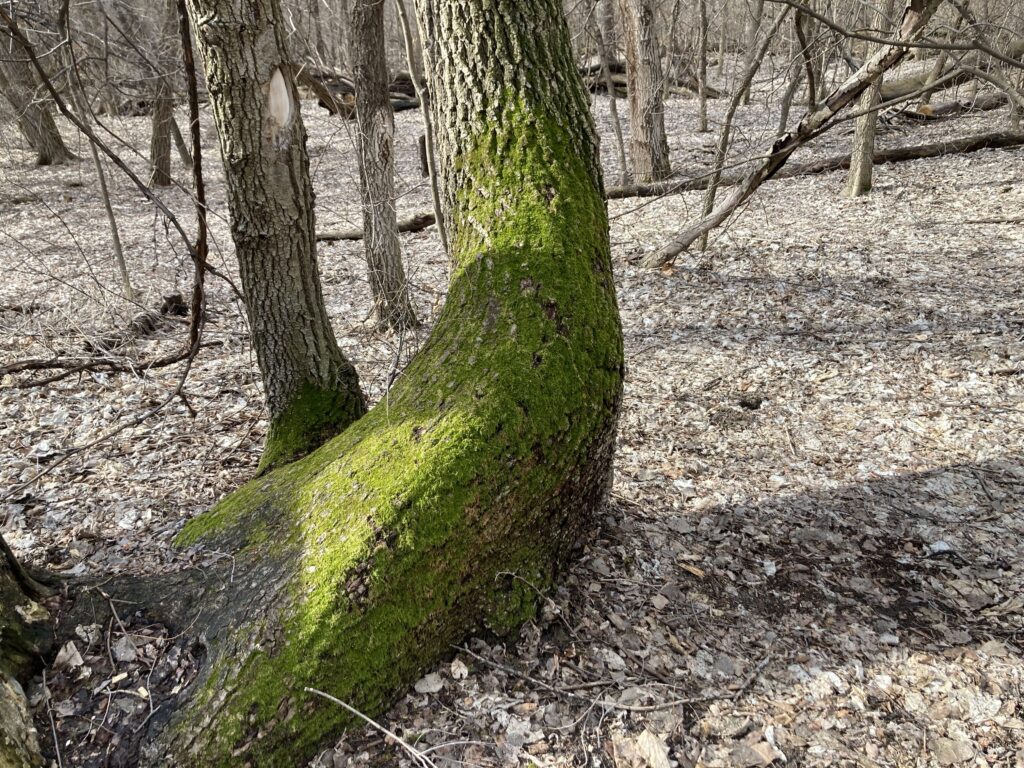
  7. the gentle curve of a tree trunk, almost like an arched back
  8. a loud splash in the water, then a flash of movement — a fish jumping out of the water?
  9. a retaining wall in the oak savanna, across the ravine, was painted bright colors — blue, yellow, red
  10. someone on a scooter, someone else on a bike, both masked and on the walking trail

before the walk

Woke up stiff and sore, which I’ve been doing for the past month. Most of me is okay, only my lower glutes and hips and hamstrings hurt, especially when I leaned down to throw something away in the organics. Ouch! After a few minutes, it should get better. Is it worse this morning because of yesterday’s biking? I don’t think so.

Other things I woke up to:

  • a thought: I have to wheel the recycling bin down before the truck comes!
  • a rejection: “After careful consideration, we decided this submission is not the right fit for us”
  • green green green grass from all the rain yesterday and early this morning

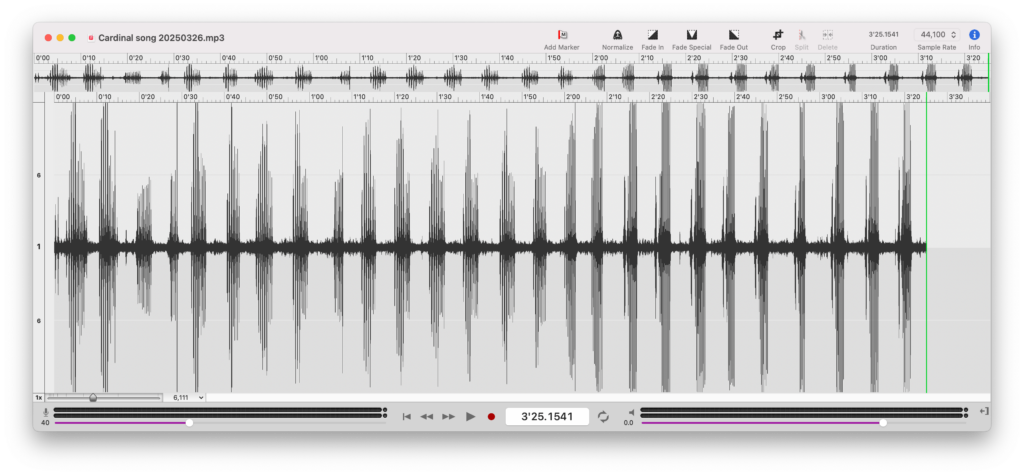
Rejections are not fun. Even though I know how difficult it is to get something published — less than 5% acceptance rate + your poem needs to fit with the others already selected — it still stings. But only for a few minutes. Now I’m thinking about grass and spring and noisy birds outside my window — the torpedoed call of a cardinal. I wish I would have counted their repeated chirps — 10 or 12 or more in a row!

A video came up on YouTube about piriformis syndrome, which I may or may not have, but probably don’t because it’s very rare — 6% chance: Piriformis Syndrome — STOP Stretching. I checked it out, and I’m willing to try the 2 exercises it suggests for contracting/strengthening my piriformis muscle instead of stretching/lengthening it. Will it work? I’m not sure, but I don’t think it will hurt to do them as I wait for my far off doctor appointment.

I’ve come a long way in my reactions to injury over the years. I’m not freaking out or in despair, even though I haven’t been able to run for 10 days. The pain isn’t making me anxious, like it did last year with my calf. I’m sure my more relaxed attitude is partly due to more experience with injury, less fear over tight glutes than knots in calves, and the lexapro. Whatever it is, I’m grateful to not be in constant panic mode.

So, is it piriformis syndrome? Who knows. What else could it be? Time to get out the scrabble tiles and make some anagrams!

P I R I F O R M I S S Y N D R O M E is tough one —

  • In moss drip form (not used: I R E Y)
  • Permission from Id (not used: Y R)
  • Osprey mind forms (not used: R I I)
  • Spry of mind, I rise (M O R)

after the walk

I’m continuing to read Robin Wall Kimmerer’s The Serviceberry. I think I might need to buy it. The part I’m currently reading is about ecological economics.

We’ve created a system such that we self-identify as consumers first before understanding ourselves as ecosystem citizens. In ecological economics, the focus is on creating an economy that provides for a just and sustaianable future in which both human life and nonhuman life can flourish.

The Serviceberry/ RWK

competition is not the primary force regulating evolutionary success

competition only makes sense when we consider the unit of evolution to be the individual. When the focus shifts to the level of a group. cooperation is a better modle not only for surviving but for thriving.

since competition reduces the carrying capacity for all concerned, natural selection favors those who can avoid competition. Oftentimes this avoidance is achieved by shifting one’s needs away from whatever is in short supply, as though evolution were suggestion “If there’s not enough of what you want, then want something else.”

april 22/WALK

45 minutes
winchell trail south / folwell bench
58 degrees

Wow wow wow! Spring. Little explosions of bright green everywhere — out of sidewalk cracks, under fences, on slender branches. I think explosion is the right word — not pops or flashes, well maybe flares. Almost overnight, green! Not yet annoying or oppressive; I still have my view of the gorge and the other side. I could see fuzzy details, branches, rippling water, houses, but what I felt was the horizons of gray (river), brown (shore/trees), and blue (sky). 3 distinct lines dividing my view into 3 colors.

Delia and I walked to the river then down the uneven wooden steps to the trail. We walked even slower than usual to let two walkers move past. One of them was talking about a friend (or a partner?): we’re both from the same town, and we went to the same school! I smiled and greeted a friendly runner, called out Hi Dave! to Dave. Delia jumped up and walked all of the walls on the trail. We ended at the folwell/the WWDD bench (see below) and sat for a moment, taking in the view.

10 Things

  1. the air was hazed with humidity, making everything look even fuzzier, more distant
  2. minneapolis park workers have cleared out old trees in the savanna, turned them into mulch that they put on the trail
  3. the small rise up to the paved trail is more visible now — all dirt and dead leaves and stubs of tree trunks
  4. the cave below the limestone ledge in the ravine seems to be expanding — how long is this process? how long before the ledge collapses?
  5. mud on the part of winchell on the hill between the savanna and the 38th street steps
  6. the repeated honk from a lone goose, below us. It always seemed the same distance from us. Was it following us, or taking a walk with us?
  7. a loud, rhythmic clanging above us that I couldn’t quite place. A thought: was it someone banging on a fire hydrant to open it up? Near the end of my walk, I saw one open and gushing water
  8. sitting at the folwell bench, overheard — an older walker to a younger one: we haven’t even gone 20 minutes yet
  9. someone pushing a walker through the grass on the boulevard between edmund and the river road, stopping to check out each tree
  10. the husk of some big trees leaning at awkward angles in the oak savanna

A wonderful walk! I felt relaxed and calm and grateful to be outside and moving (without pain) this morning.

before the run

Reading through my “on this day” entries from past april 22nd entries, I was inspired by Mary Oliver and a little old lady walking and listening to a radio and a bench dedicated to a woman who fell through the ice one winter and a fragment overheard on the little old lady’s radio — this is why we are all here — especially the this, which is echoed in Marie Howe’s poem, The Gate. Instead of trying to explain these connections–entanglements?– I’ll gather them here:

1 — the little old lady

For the third time, encountered the little old lady walking with her hiking poles listening to a radio show or an audio book or something. Today I heard, “which reminds us of why we are all here.” Decided that I should create a poem or some piece of writing around this phrase. This phrase could be the title or the ending line of the whole poem or a sentence or a refrain (5 aug 2019).

…the little old lady slowly shuffling by, swinging her hiking poles, a voice TED-talking out of her phone’s speaker reminding you that this is why we are all here. Do not bother the bench resting on the rim of the gorge to ask what this is (22 april 2022 — a draft of my poem).

note: reviewing these entries, I’m noticing how I changed what I heard from “reminds us why” to “this”. I’m almost prefer the original — the reminder, that doesn’t have to be the answer, just a pointing to it — a finger pointing! a definition of poetry!

2 — The Gate

from The Gate/ Marie Howe

This is what you have been waiting for, he used to say to me.
And I’d say, What?

And he’d say, This—holding up my cheese and mustard sandwich.

And I’d say, What?
And he’d say, This, sort of looking around.

3 — This is why we are all here

which reminds us why we are all here…

We are here. Me and joints and muscles and bones and ligaments and lungs. Us. me
and blood and cells and electrolytes and sweat and saliva. we. me
and hands and feet, a heart, two diseased eyes, a knee that displaces. we. me
worn out running shoes, threadbare worries. we. me
and those oak trees, that wrought iron fence, this rutted, dirt path, that short, steep hill. we. me river. that we are here with the old woman who slowly shuffles in her straw hat with her hiking poles and a voice that calls out from her radio speakers, “which reminds us why we are all here.”
here. above the river and the gorge and the floodplain forest, below the bike path and the road, the cars and the boulevard.
here. in this heat and humidity and haze. here. on a monday morning. here.

We are all here.

(from 22 april 2022)

4 — Mary Oliver

Reading MO, I’ve noticed, and have been trying to articulate, a tension in her poems between the I, the World, Nature, God, Eternity, Work. This tension seems to take many forms and MO imagines it to be endlessly intriguing and part of the process of living. Never to be resolved but to be puzzled over. One element of this tension involves the plight of the human—born to doubt and argue and question what it all means, to be both brought closer to and further away from the world by language and the power and beauty of words, which are never as powerful or beautiful as the world itself. To want a name and a useful place, to claim a life, but also to belong to the world, to be “less yourself than part of everything.”

(from 22 april 2021)

From The Book of Time in The Leaf and the Cloud

5.
What is my name, 
o what is my name
that I may offer it back
to the beautiful world?

from “Gravel” in The Leaf and the Cloud

6.

It is our nature not only to see
that the world is beautiful

but to stand in the dark, under the stars,
or at noon, in the rainfall of light, 

frenzied, 
wringing our hands, 

half-mad, saying over and over:

what does it mean, that the world is beautiful—
what does it mean?

5 — the words/reminder

from “Work” in The Leaf and the Cloud

3.
Would it be better to sit in silence?
To think everything, to feel everything, to say nothing?

This is the way of the orange gourd.
This is the habit of the rock in the river, over which
the water pours all night and all day.
But the nature of man is not the nature of silence.
Words are the thunders of the mind.
Words are the refinement of the flesh.
Words are the responses to the thousand curvaceous moments—
we just manage it—
sweet and electric, words flow from the brain
and out the gate of the mouth. 

We make books of them, out of hesitations and grammar.
We are slow, and choosy. 
This is the world.

Words can help us to remember a beloved but long dead dog:

And now she’s nothing
except for mornings when I take a handful of words
and throw them into the air
so that she dashes up again out of the darkness,

5 — the bench

I have run by this bench hundreds of times, stopped and sat once or twice, even wrote about it, but I’ve never noticed this small plaque on it. How did I see it today? I love these little surprises, just waiting to be found! I had no idea what this plaque meant — WWDD? I looked it up and found a facebook page for the Rachel Dow Memorial. Wow. She was loved by so many. I read a little about her life — a passionate, social justice minded, free-spirit — and her death — she fell through the ice at the river and died of hypothermia. Maybe I’ll write a poem about her and the others I’ve found through their plaques. All of them share with me a deep love for this river. And maybe one day, I’ll have a plaque there too (from 8 sept 2022).

6 — Jane Hirshfield

Termites: An Assay/ Jane Hirshfield

So far the house still is standing.
So far the hairline cracks wandering the plaster
still debate, in Socratic unhurry, what constitutes a good life.
An almost readable language.
Like the radio heard while traveling in a foreign country—
You know that something important has happened, but not what.

What to do with all of this? I’m not quite sure yet.

during the run

Occasionally, I thought about these ideas as I walked, and when I sat on the folwell bench. What did I think? I hardly remember. Once, I thought about how words were not the most important part, that being out there by the gorge, feeling everything was.
april 21/WALK

45 minutes
minnehaha academy loop*
50 degrees

*43rd ave, north / 32nd street, east, past Minnehaha Academy / edmund, south / 34th street, west, past 7 oaks / home

Before taking a walk with Delia and Scott, I “watched” the Boston Marathon, where watching = tracking runners on the app, listening to the Citius Mag watching party, and watching the last 5 minutes of the women’s race on an unofficial YouTube feed. Wow, they were fast!

It looked warm and sunny, but it felt colder than 50. It was the wind, I think. For the first half we talked about kids and wanting to be empty-nesters and how to have hard conversations about the future and the series finale of The Americans — we finished it last night. In the second half, Scott pointed out a strange mash-up of a garage and I pointed out the Siberian Squill. I wondered if we were seeing it more now because we’ve named it, but we agreed that it has become more abundant in the past few years. There was a particularly impressive patch of it in the yard of the house on the south corner of edmund and 34th. Taking in the entire patch, it looked blue. Focusing on a flower, it looked purple.

10 Things

  1. siberian squill, everywhere, including at the edge of our yard
  2. a loud dog in a fenced-in backyard
  3. an empty parking lot at minnehaha, no school for Easter
  4. a metal sign at Cooper School, bent and leaning to the side
  5. a security guard car parked in front of the gate to the field at minnehaha academy
  6. the boulevard on the edge of the academy that used to have a small line of aspensmwith aspen eyes, now only has one aspen
  7. a woman stapling a poster to a pole
  8. mud on a boulevard — Delia, stay out of the mud! — a deep brown
  9. the wind chimes chiming at the house with an Easter Island head on the front stoop
  10. looking over at the river road and seeing/feeling the open space between the west and east banks

Back/hip/leg update: today it is a little uncomfortable to sit in the chair at my desk. Is that because I went down and up the old stone steps to the river?

april 20/WALK

40 minutes
longfellow flats (river)
48 degrees

Spring! Hello black capped chickadees! Hello drumming woodpeckers! Hello bikers and runners and walkers with dogs! Hello green shoots and damp earth and soft air! Water gently lapping the shore, echoing voices, ringing bells! Hips (hopefully) healing and backs growing stronger! A wonderful morning for a walk through the neighborhood and to the river.

I wasn’t willing to stop and stare, so I could be mistaken, but it looked like a woman was taking her dog on an easter egg hunt — with the dog searching for the eggs while the woman encouraged them. If that wasn’t what I saw, I will still believe it was. Is that a thing, people arranging egg hunts for their dogs? I hope so!

I’m continuing to work on crown of color sonnets. I’m on the final one, no. 7, blue. I want to link this sonnet back up with the first one, so I’m ending with green. I’m thinking of returning to the green poem I drew from a lot, Oread by H.D.. Something about the sky not being pure blue but a mix of blue and green, or sometimes just green — especially in the spring and summer when green takes over the gorge. I’m leaving these last few sentences in, but as I worked on it more, I decided to go in a different direction. I’m taking lines from a beautiful essay about a blue wall in Leadville and writing about my efforts to make blue meaningful even though I can’t always see it.

april 19/WALK

35 minutes
neighborhood
50 degrees

Walked with Scott and Delia the dog. My hips feel a little sore, but otherwise I’m okay. Not in pain, not stressed about taking a break from running. I know I need this break. Scott and I noticed more Siberian Squill, taking over. I admired the big turtle in someone’s front yard, Scott critiqued some out of place columns holding up a trellis-like porch at the front of a house. He asked, how have I never noticed these columns before? My response: Really? These columns are the defining characteristic of this block for me. Scott wondered if a robin, standing still in a yard, was dead. Nope, we saw it move its head. I pointed out a house that was very big. The wind was coming at us from almost every direction — not quite stiff, but irritating. Even with the chilled air, it felt like spring was here to stay. Hooray!

La Guerre (II)/ e.e. cumming

O sweet spontaneous
earth how often have
the
doting

               fingers of

prurient philosophers pinched
and
poked

thee
,has the naughty thumb
of science prodded
thy

       beauty     how

often have religions taken
thee upon their scraggy knees
squeezing and

buffeting thee that thou mightest conceive
gods
(but
true

to the incomparable
couch of death thy
rhythmic
lover

             thou answerest

them only with

                             spring)

april 18/WALK

30 minutes
neighborhood
50 degrees

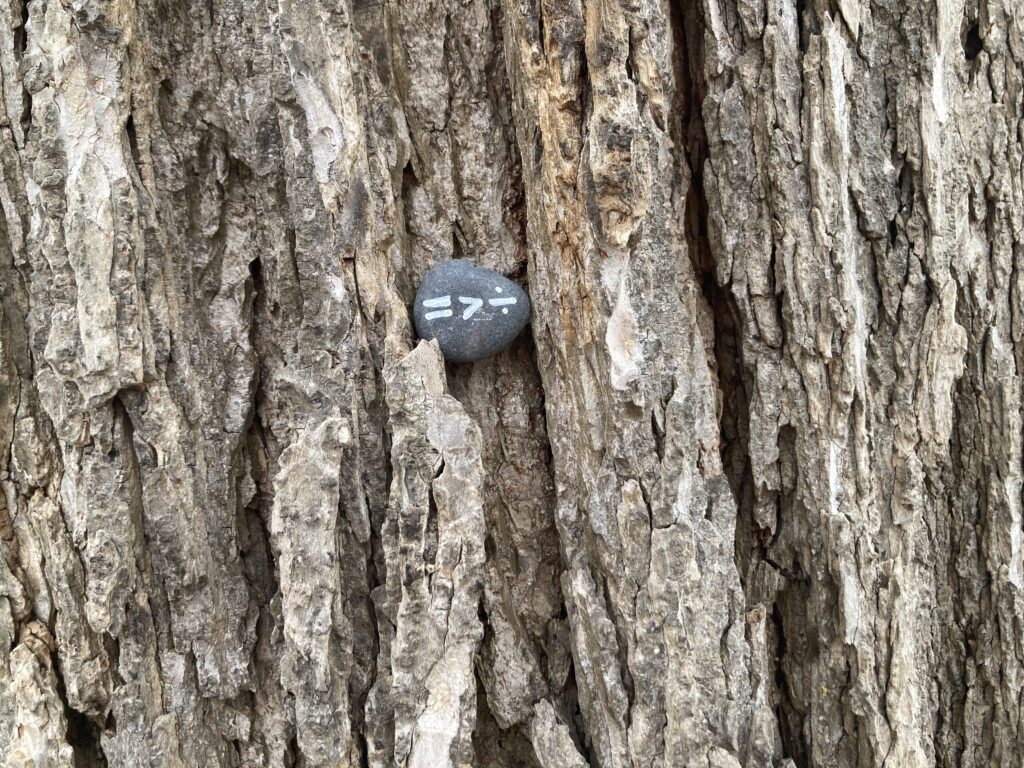
Went on a walk with Delia and FWA. He’s home for Easter weekend. We talked about the show Russian Doll and the 4th dimension and the limits of language and how it shifts meanings and experiences of the world. FWA wondered what it might feel like to experience the world outside of language and I talked about my work on this log and with poetry, particularly soft attention and my 10 things practice. I mentioned Mary Oliver’s poem “The Real Prayers Are Not the Words but the Attention that Comes First.” I pointed out the small stone embedded in a tree that reads, = > ÷.

Years ago, I remember feeling disconnected from FWA, not knowing how to talk with him, wondering why he was so distant. A deep sadness. I couldn’t have imagined (or hoped for) our wonderful, wandering conversation this afternoon. Not the same, but an echo of the ones I used to have with my mom.

It was not raining. Things felt open and possible, not closed and finished. Everything almost opposite of Bert Meyers’ poem, “Rainy Day.” Even so, I’ll post it here for later:

Rainy Day/ Bert Meyers

Outside, nothing moves: only the rain
nailing the house up like a coffin.

Remember, in childhood, when it rained?
Then, the whole world sailed down the alley:

leaves, paper, old shoes, the buildings,
everything like a circus going to sea.

Now, the rain, the iron rain, with its little keys
is closing all the doors . . .

and I think we’re all dead. See how the sky
sits like a tombstone on the roofs.

april 17/WALK

30 minutes
neighbohood
55 degrees

note: I’m writing this on the 19th.

Walked with Delia through the neighborhood. Since I’m writing this a few days later, I don’t remember much, only the broad swatch of Siberian Squill in a front yard at the northwest corner of 46th avenue and 34th street. Bunches of little flowers peeking out from a big boulder, covering a small swell of grass, hiding behind a fir tree. When I glanced at one flower, it looked light purple, but when I took them all in at once, they were blue. A strange sight to see the color switch from purple to blue, purple to blue, as I shifted my gaze.

april 16/WALK

40 minutes
neighborhood
50 degrees

Woke up this morning unable to bend down to put on socks. I’ve been having a mild version of this problem for a few weeks, but today it was worse. Time to shut it down for a while. I scheduled an appointment with the doctor. First available: June 12th. Oh well, I’m on the wait list, and I feel like there’s a good chance this problem will get better on its own — iff (if and only if), I take a proper break. No running for at least a week. No biking either. The problem has been in my upper glutes/lower back, today I felt pain all down my leg to my calf. It’s worse in the morning, after not moving for most of the night. I can stand and walk but bending down in a certain way hurts too much. I am not bothered by this injury. Of course, I’d like to be running and biking, but it’s okay. The uncertainty is gone — am I injured or not? I know I am and that I need to take a break.

Thankfully, I can still walk! Went with Delia and Scott. Beautiful — blue sky, birds, and the feeling that spring is here. Oh — and little purple flowers. Scott looked them up: siberian squill. According to the Minnesota Wildflower site, they’re not purple, but blue, and invasive. Originally from Russia, these colorful flowers are hearty and take over gardens. Not even critters want to touch them. Unfortunately, some gardeners continue to plant them. At the bottom of the entry, in bold, is:

Please, all you gardeners out there: stop planting this.

The site recommends planting native species, like phlox or bluebells. Before Scott identified them with his app, I had guessed that they might be phlox.

Wow, I just read the comments and discovered a fight — on a wildflower site? I’m not sure I agree with Sandy, but I enjoyed her spirited comment.

Petyr:  It is as bad if not worse than garlic mustard – you can’t even pull this crap.

Which gardeners are now willing to stand up and take responsibility, or is this just another “so sorry”? Gardeners, this is stupid… mindless… enough!

Sandy: Finally, after 40 years of living in the same house, I have identified the little blue flowers that blossom with the snow on the ground. Early Siberian Squill. They grow wild along the front of my house. I find them to be quite beautiful. I find nothing offensive about them. A whole lot prettier than dandilions, which I wish were gone, gone, gone. So all you gardeners out there, bite me. My Squill will be left in peace, while I continue to fight a war on the big ‘D’.

There is a poem here, I think, featuring Sandy.

april 12/WALKBIKE

35 minutes
7 oaks
58 degrees

Last night and this morning my glutes ached, so no running today. I did some more research and I think the exercises in this video might help. Future Sara will let us know!

a pain in the butt

Walked with Delia and Scott. Warmer today, windy too. My favorite sound: the wind rushing through a big pine tree. I noticed some dry leaves skittering in front of us as we walked east. Heard the St. Thomas bells and their extra long chimes at noon. Saw lots of runners and walkers and bikers. Scott talked about how farmers are getting screwed by the new tariffs, and I talked about Indigo. A few times my back ached — was it a spasm? Not sure.

indigo

For the past few days, I’ve been working on a crown of color sonnets, using the words of other writers (cento). The plan is to write 7 sonnets, with each one setting up the next with its color mentioned in the last line. I started with green, then went to orange, then yellow-red, then purple. I wasn’t sure what would come next — I thought it would probably be blue — but in the last line of the purple sonnet indigo appeared. I haven’t studied indigo that much, so before writing a sonnet about it, I’d like to spend some time with it.

Indigo began working its way into my sonnets a few days ago, when I attempted to list colors I’d seen on my run in using the ROYGBIV system. I couldn’t recall seeing anything indigo. Then yesterday, while looking for a passage by Oliver Sacks on yellow I encountered this description (which I read a few years ago, but had forgotten):

I had long wanted to see “true” indigo, and thought that drugs might be the way to do this. So one sunny Saturday in 1964, I developed a pharmacologic launchpad consisting of a base of amphetamine (for general arousal), LSD (for hallucinogenic intensity), and a touch of cannabis (for a little added delirium). About twenty minutes after taking this, I faced a white wall and exclaimed, “I want to see indigo now—now!” And then, as if thrown by a giant paintbrush, there appeared a huge, trembling, pear-shaped blob of the purest indigo. Luminous, numinous, it filled me with rapture: It was the color of heaven, the color, I thought, which Giotto had spent a lifetime trying to get but never achieved—never achieved, perhaps, because the color of heaven is not to be seen on earth. But it had existed once, I thought—it was the color of the Paleozoic sea, the color the ocean used to be. I leaned toward it in a sort of ecstasy. And then it suddenly disappeared, leaving me with an overwhelming sense of loss and sadness that it had been snatched away. But I consoled myself: Yes, indigo exists, and it can be conjured up in the brain. For months afterward, I searched for indigo. I turned over little stones and rocks near my house, looking for it. I examined specimens of azurite in the natural history museum—but even they were infinitely far from the color I had seen. And then, in 1965, when I had moved to New York, I went to a concert in the Egyptology gallery of the Metropolitan Museum of Art. In the first half, a Monteverdi piece was performed, and I was utterly transported. I had taken no drugs, but I felt a glorious river of music, four hundred years long, flowing from Monteverdi’s mind into my own. In this ecstatic mood, I wandered out during the intermission and looked at the ancient Egyptian objects on display—lapis lazuli amulets, jewelry, and so forth—and I was enchanted to see glints of indigo. I thought: Thank God, it really exists! During the second half of the concert, I got a bit bored and restless, but I consoled myself, knowing that I could go out and take a “sip” of indigo afterward. It would be there, waiting for me. But when I went out to look at the gallery after the concert was finished, I could see only blue and purple and mauve and puce—no indigo. That was nearly fifty years ago, and I have never seen indigo again.

Hallucinations/ Oliver Sacks (found here)

His description of standing in front of blank wall reminded me of my mood rings experiment: facing a blank wall, staring at it, waiting for my blind spot to occur. I wonder, could I see indigo doing this (and without the drugs)?

I recall reading something about indigo and debates over whether or not it existed. I’ll have to look for that source.

At the time, because I was working on a yellow poem, I didn’t dwell on the indigo. But later that day, it returned in a Mary Oliver poem — I was looking for another orange poem:

Poppies/ Mary Oliver

The poppies send up their
orange flares; swaying
in the wind, their congregations
are a levitation

of bright dust, of thin
and lacy leaves.
There isn’t a place
in this world that doesn’t

sooner or later drown
in the indigos of darkness,
but now, for a while,
the roughage

shines like a miracle
as it floats above everything
with its yellow hair.
Of course nothing stops the cold,

black, curved blade
from hooking forward—
of course
loss is the great lesson.

But also I say this: that light
is an invitation
to happiness,
and that happiness

when it’s done right,
is a kind of holiness,
palpable and redemptive,
Inside the bright fields,

touched by their rough and spongy gold,
I am washed and washed
in the river
of earthly delight—

and what are you going to do—
what can you do
about it—
deep, blue night?

A thought occurs to me in reading this — actually, a reminder: here in the city, on a street with street lights and security lights and light pollution of other kinds, a deep, blue night is impossible to see. And, ever since the family farm in the UP was sold in 2005, I rarely am in a place remote enough to lack light.

bike: 30 minutes
basement

Finally had a chance to finish up the first episode of The Residence and start the second one. Wow, it’s good. One moment that I couldn’t quite figure out, even with the audio description: Cordelia Cup encounters the male chef sitting on the floor, against the wall and under a row of knives. He looks motionless and dead to me, but no one reacts and the audio description says his eyes followed Cordelia as she left the room. I watched again and still couldn’t tell. His eyes looked dead to me, but that happens a lot — that is, when I actually see someone’s eyes.

april 11/WALK

50 minutes
32nd to edmund to 7 oaks
45 degrees

Took a late morning walk with Delia and Scott on an overcast day. The theme: critters! Birds and dogs and little kids. As Scott said, the stars of the show were the 2 very big eagles perched at the top of a tall tree on edmund. Some walkers across the road pointed them out to us. At first I couldn’t see them. Scott was describing where they were and I tried to spot them, but I couldn’t see anything, only the feeling that there was something there. Somewhere in my head an idea occurred to me as I scanned the branches — there’s a blob there — but it never turned into an actual thing I was seeing. And then, suddenly, it did. A dark form with a white head, perched on a branch. A few minutes later, I saw the other one too. Still, stoic, only shifting its wings once. Wow!

Other critters: the energetic voices of little kids on a preschool playground, a tiny giggle from a girl getting out of a car, the feebee of a black-capped chickadee, a dog I’ve encountered before that likes to plop down in the middle of the road and not move.

It was chilly — I wore my gloves — but it felt like spring. Spring! Scott talked about some problem he was having with his plug-in involving time codes and microsoft not recognizing standard ones and Helsinki and sisu. I talked about my latest experiment: a crown of sonnets compromised of other people’s words about color. They’re connected by the last line of the one poem mentioning the color of the next one. So far I’ve done green and orange and yellow-red. I’m set up to start purple. I’m thinking of doing blue and metallics or silver, and green-brown-gray. Not sure about that last one — maybe just brown, but ending with a green line to bring it full circle?

april 8/BIKEWALK

bike: 35 minutes
basement
outside temp: 38 degrees

After two days of running in a row, a break. Decided to bike in the basement and check out a show FWA recommended, The Residence. The detective is a birder, which is cool on its own, but she’s also black, which is even cooler because it raises the visibility of black birding (see J. Drew Lanham and “Birding While Black”). Thank goodness for the audio description — I like how it’s voiced by a black actor — because I would have missed so much of the show without it! I like the detective, Cordelia Cup. Her m.o. is attention and focus, filtering out distractions, but not shutting down possible evidence or suspects. Much of that attention is visible, but she also relies on hearing and touch and smell. I’m about 1/2 done with the episode. I like it, so I’ll keep watching.

walk: 45 minutes
longfellow flats
44 degrees

A beautiful afternoon! Warm sun, low wind. Delia and I took the 15 worn wooden steps down to the winchell trail and walked along the chainlink fence. I noticed a few small slabs of asphalt and wondered how long ago this was paved. 10 years? Less, more? A flash of color in my peripheral: electric blue spray paint. Admired the soft oak tree shadows stretched across the paved trail. Heard, but couldn’t see, a woodpecker high in a tree. Passed 2 guys in bright orange shirts. Took the old stone steps down to the river. Looking across to the other side, I noticed a door carved into the bluff, only accessible by boat. On this side, I noticed the gentle lapping of the water over some big rocks.

The color of the day: brown. Everything, brown: dirt, tree trunks, branches, dead leaves, bluff, steps. I suppose I might consider some of it, especially the things lit my sunlight, as orange — deep orange.

april 4/WALK

55 minutes
ravine / longfellow flats / 7 oaks
34 degrees

Took Delia for a walk this morning. With the sun and the birds and the dry ground, it felt warmer than 34. Spring! What a wonderful morning! Walked down the wood steps to the winchell trail just above the ravine. Heard the steady, soothing drip of water falling out of the sewer pipe and onto the scattered rocks — riprap — then over the limestone ledge to the exposed pipe on the forest floor. No more ice or slick spots. The soft light made all the brown and rusted orange glow. I studied the husk of a tree on the edge of the gravel trail — still upright, but not much of a trunk left, and no leaves, one or two rotted branches. Climbed out and over to the Drs. Dorothy and Irving Bernstein Scenic Rest Area Overlook to check out the view. Then went down the steps to the abandoned dirt and leaf-littered trail that hugs the edge. Part of this trail only has the posts for a chainlink fence, part of it has the whole fence half-buried. Walked through the tunnel of trees, then down the old stone steps to Longfellow Flats. Walked past a huge tree on the ground, moved off to the side of the trail by park workers. The trunk was stripped clean and bare at the top, and thick with bark at the bottom — a very noticeable contrast in girth and texture. The river was beautiful and blue up close, all silvery sparkle from a distance. Powered back up the steps, which felt good on my glutes and calves, crossed the river road and made our way past 7 oaks to home.

Steps Taken

  1. worn wooden steps at the edge of the 36th street parking lot
  2. the makeshift steps closer to the ravine made from slabs of rock sticking out of the dirt
  3. limestone steps at the Drs. Bernstein Overlook
  4. the old stone steps to longfellow flats — 112 steps

10 Things

  1. silvery river burning through a break in the trees
  2. drip drip drip — water falling into the ravine
  3. bright blue graffiti on a wall only seen when you’re deep in the ravine
  4. the abandoned posts of a chainlink fence above the gorge
  5. the way the thinned-out trees, the soft sand, and the small curve of the path frames the water and the air — wide open, vast, yet contained enough to take in all at once
  6. at least 2 woodpeckers softly knocking on rotting wood, later one of the woodpeckers laughing
  7. the st. thomas bells
  8. voices behind, then two walkers passing past us
  9. on the forest floor, looking up at the top of the bluff, watching as runners glided by, looking so high and small
  10. in the floodplain forest, not too far from where the trees open to the river, a tree covered with bright green moss
tree with moss and shadow

orange

During the walk, I thought about orange, especially in terms of the history of the color that I had just read yesterday. The fruit came before the name of the color. It wasn’t that the color didn’t exist until it was given a name, it’s just that people didn’t recognize it as orange. It was yellow-red or brown. I also thought about what I had read about Van Gogh and his still life painting with oranges, how his focus was not the fruit, but the color. The color as its own thing. I pulled out my phone, and spoke this idea into it:

Orange existed before it was attached to a word, before it was attached to an object.

march 28/RUNWALK

5.3 miles
ford loop
53 degrees

Spring! High in the 70s today. Tomorrow, in the 40s. When I started, I felt very sluggish and I wondered if I would be able to do the entire loop. I suppose it got a little easier, but I think it was more that I just kept putting one foot in the front of the other. I stopped to walk when I thought I needed to and kept running when I knew I could. There was one moment when I was just about to stop and walk but then I didn’t. I want to do that more often.

“10 Things

  1. the waves on the water from the ford bridge, looking like little scales — the wind pushing the water upstream
  2. reaching the top of the summit hill, hearing several dogs non-stop barking in a fenced-in backyard. I looked over and saw one of them up on something, their head higher than the fence
  3. a man exiting a port-a-potty at the Monument parking lot, ready to begin running again
  4. the cross on top of the monument — big and made out of stone — have I ever noticed it before?
  5. the feel of the sandy dirt on the edge of the paved path on the st. paul side: soft, fast, gentle, singing
  6. the bells from St. Thomas ringing quietly
  7. empty benches everywhere
  8. the faint knocking of a woodpecker high up in a tree
  9. no eagle perched on the dead limb of the tree near the lake/marshall bridge
  10. something floating in the water — I couldn’t tell if it was a buoy or an ugly 80s purse

Waters of March (Águas de Março) / Antonio Carlos Jobim

This song, which I’ve heard many times but never really listened to, came up on a mood playlist yesterday. I looked up the lyrics, and here’s the first part:

A stick, a stone
It’s the end of the road
It’s the rest of a stump
It’s a little alone

It’s a sliver of glass
It is life, it’s the sun
It is night, it is death
It’s a trap, it’s a gun

The oak when it blooms
A fox in the brush
A knot in the wood
The song of a thrush

The wood of the wind
A cliff, a fall
A scratch, a lump
It is nothing at all

It’s the wind blowing free
It’s the end of the slope
It’s a beam, it’s a void
It’s a hunch, it’s a hope

And the river bank talks
Of the waters of March
It’s the end of the strain
The joy in your heart

The song is originally in Portuguese and from 1972; Jobim created an English version later. I like the list of images — a list poem!

As the story goes, Jobim wrote the song in his country house, close to Rio de Janeiro. He was growing impatient with all the rain and mud that kept delaying some work he wanted done on the property and started the song as a way to distract himself from the constant downpour, creating a simple tune to go with the lyrics. His intention was to rewrite the melody later, though he soon realized that the downward spiral progression he had accidentally created fit the song—and the weather—perfectly.

The lyrics of “Águas de Março” tell of the constant rain that falls in Rio during the month of March, at the close of the summer (in the Southern Hemisphere, the seasons are opposite to those in the Northern). It is a common occurrence for excessive rain to cause floods and landslides. It washes away houses and streets, taking everything it clashes with in its current.

The Waters of March

And here’s a delightful poem I discovered on Instagram last night:

Lately,/ Laure-Anne Bosselaar

when a branch pulls at my sleeve
like a child’s tug, or the fog, reticent & thick,
lifts, & strands of it still hang like spun sugar
between branches & twigs, or when a phoebe
trills from the hackberry,
I believe such luck
is meant only for me. Does this happen to you?
Do you believe at times that a moment chooses
you to remember it entirely & tell about it —
so that it may live again?

ritual / ceremony / chant / movement

Reading through past entries for this month, I came across an idea from Cole Swensen:

as you move
through a

place, it moves
through you

OR

move through a
place and

it moves through
you too

I like the second one. I can imagine chanting it as I run and thinking about what I’m moving through and what’s moving through me. What is moving through me?

Here’s one answer, in a poem — Running Sentences — from a poet I just discovered on 26 march:

a The chorus is making sentences now: look,

b A cloud of gnats through which the body like a hailstorm blew,

c Here in the pockets of the path, there a heaven I avoid,

b Runners move through gnats, whole bodies move, disrupting,
(Running Sentences/ Endi Bogue Hartigan)

walk: 35 minutes
edmund
67 degrees

It almost feels like summer — wow. Trees and birds and a steady stream of cars on the river road enjoying the nice weather. Bikes, kids, the smell of dead leaves baking in the sun. My favorite thing: 2 people ahead of me on the sidewalk, one of them was wearing cool, baggy pants with a tank top and I thought that I’d like to have something like that to wear. Later a car drove by, the people inside scream-singing along to “Like a Prayer.” The person in the baggy pants called out and they stopped to let them get in. Then laughing and gleeful shouting and more scream-singing. I almost wrote, oh, to be that young again, but I don’t want to that young again. Instead, I’d like to be that delighted and joyful again.

march 27/WALK

45 minutes x 2
walk 1: 50 degrees / longfellow flats
walk 2: 62 degrees / edmund

Walked with Delia the dog in the late morning. The good news: it’s beautiful today, my back feels so much better, the water was supposed to be off all day (for water main work down the street), but it’s already back on at noon. The bad news: I feel overwhelmed and have the strong urge (need?) to disengage. The saga of getting a girl to go to school continues; now it’s college classes. I am tired. One of my best friends is coming into town this weekend, and I want to see her (have plans to see her), but I’m not sure I can do it. In this scenario, which is the best way to be kind to myself: to be generous and encourage myself to cancel plans and rest, or to be stern and encourage myself to push through and keep the plans?

The walk helped me to feel better, but did not help me decide what to do.

update, after walk 2: I have decided to be generous to myself and cancel my plans. There have been many good things that have happened this year (with the year starting last fall), but also many very difficult things. Two mantras I’m trying to remember: be kind to yourself and whatever gets you thru the night is alright (John Lennon).

I was planning to make a list of 10 things, but when I tried my mind went blank. Too much pressure to produce? I think I’ll write about what I remember in this paragraph instead of in a list. I remember the river burning through the trees. Just a small spot, shimmering at the edge of my vision. I remember a man taking a break from running, breathing very heavily. He was struggling — wheezing and coughing. Had he done a hard/fast set, or was he just very out of shape? I remember the woman with the dog stopped at the wooden feence above the ravine who started up again just before Delia and I got to them. They went a few feet and then the dog plopped on the ground and wouldn’t move. It was impossible to get by them, so we explored the rim of the ravine. I remember taking the old stone steps down to the forest floor and walking past a big tree that had fallen and then been moved out of the way, presumably by park workers. So many tangled roots! I remember the feel of the soft sand and the blue of the blue water. I remember how the trail through the forest opened to the river and how the tall grasses framed the water. I remember the wonderful burning feeling of my glute muscles as I powered up the stone steps. I remember the soft geometry of the fence slat shadows. I remember hearing voices that were either deeper in the gorge or on the other side. I remember hearing the St. Thomas bells ringing, but I don’t remember how many times they rang. I remember witnessing 2 sewer workers doing something with the manhole. I think they were turning the water back on — they had a long pole that was in the center of the hole and they were leaning over and moving clockwise as they tightened (or loosened?) something. An unsual sight. It looked strange and uncomfortable.

It was very cool to witness these workers. Somehow I had imagined that a machine would turn the water off and on. The sewer pipe is too delicate, Scott thought. Of course. I like learning about these things, knowing how they happen, being reminded of the physical, and usually invisible, work that is required — and by people — to do them.

Delia and I did the second walk with Scott. Here are 3 delightful things that happened:

1

Below Edmund in the part of the boulevard dotted with trees I pointed out a huge tree that had lost its head — it didn’t have a top, just a jagged trunk — but still had two thick and long branches that stretched horizontally with clusters of smaller branches. They were gnarled and twisted and seemed to be reaching across the grass. They also cast a wonderful shadow.

2

Under another tree, Scott pointed out a woodpecker. Amazingly I was able to see it — it was tiny — because it had moved and my peripheral vision had caught the sense of movement. After a minute or two, it started knocking on the wood — a soft tap tap tap tap.

3

I was able to point out the rock wedged in the tree with = > ÷ painted on it that I wrote about yesterday. I asked Scott if he would have seen it while just walking by. Just as he was saying, no, only if I decided to stop and look at the tree, while looking at another tree, he noticed 2 more of the rocks wedged in the trunk! Later, another one in yet another tree. Wow! I love noticing new things, discovering something that you probably had walked by dozen of times without noticing. Moments of unexpected joy, hidden in plain sight, waiting for you to notice them and be delighted!

Reading a recent issue of The New Yorker, I found a beautiful poem. If you click on the link, you can listen to the poet read it — I love how they read: so natural and not affected or sing-song-y at all.

What Am I Afraid Of?/ Sasha Debevec-McKenney

The silence, the thoughts
that come with it, the sinking
suspicion that something more
is wrong with me than anyone
knows, including myself, including
the doctor who hooked me up
to the EKG machine and said
that though my heartbeat was irregular,
the irregularity was normal.
It was nothing to worry about.
The doctor told me there are two kinds
of people: unhealthy people who refuse
to get help, and healthy people
who always think they’re dying.
Nobody’s in between. But I’ve met
so many kinds of people:
people who stretch before
they get out of bed, people
who walk through life unstretched,
people who think their body
is a house and people who don’t
think of their body at all.
People who peel their carrots,
people who don’t. People who
stand on the roof and let the wind
make them cry. People who are afraid
to cry. People who step on all the leaves
on the sidewalk, people who look
straight ahead. There are people
who aren’t like me, they
don’t know the names
of all the different apples.
Once when I was cashiering
a woman said to me, “Wow,
you really know your kale.”
And once, at the butcher shop,
a man said to his dog, “That’s
the nice lady who smells like meat.”
I’m afraid I don’t know
what kind of person I am.
I thought I would get a chance
to do my life over in all the ways
anyone could think of: dying
would be like changing the channel.
I hate that you can’t hold on
to anything. I was washing an apple
and then I was coring it
and then it was cut—
and that was weeks ago now.
It was a Honeycrisp, and it lived up
to its name.

Of course a doctor, trained in dualism and either/ors and this or thats, would think this:

The doctor told me there are two kinds
of people: unhealthy people who refuse
to get help, and healthy people
who always think they’re dying.

I’ve been thinking about lists and list poems and reviewing a chapter from a craft book about them. I like the poet’s list of types of people.

march 26/RUNWALK

5.25 miles
bottom of franklin and back
46 degrees

More excellent running weather. Sunny and calm and warm(er). Birds singing and swooping and perching on tree branches right in front of me. I felt relaxed and strong and my back only hurt once, when I stood up after re-tying my shoe. I ran without stopping to walk to the bottom of the hill and right next to the river. It was swirling foam on the edges. Ran back up to under the franklin bridge then stopped to walk the rest of the hill. I noticed a sign — Trail closed starting March 31st — uh oh. Just looked it up; it’s only for 2 weeks:

Bike and walk trails along West River Parkway will close between the I-94 Bridge and Franklin Avenue for up to two weeks beginning Monday, March 31, 2025.

The closure is necessary for contractors hired by the Minnesota Department of Transportation to install a safe span system that will protect trail users during repairs to the bridge this year.

Trail users will be detoured to the upper West River Parkway roadway between the I-94 Bridge and Franklin Avenue. This same closure will be repeated in August so that workers can remove the safe span system after repairs are complete.

Listened to a mood playlist: energy for the rest of the run. The best (or worst?) song on the playlist was “Hocus Pocus” by Focus. I love the song, but it was too fast to try and run to!I had to increase my cadence to 200 bpm to match it! The song also does not have a steady rhythm; it just keeps getting faster and faster, probably because they were on cocaine while they recorded it.

10 Things

  1. the water was a brownish greenish blue
  2. in the flats I leaned over the ledge and watched the swirling foam slowly travel down stream
  3. workers on the road above the tunnel of trees, doing something to sewer which released a sour smell
  4. the workers were wearing bright yellow vests
  5. passed a walker who refused to move over — they were walking right next to the line. I suddenly wondered, are they neuro-divergent? then, maybe I should chill out about people needing to follow the accepted rules about where and how to walk on the trail
  6. stopped at the sliding bench, 1: heard a cardinal — it was somewhere nearby — looked up and saw that it was on a branch close to me. Was it red? I couldn’t tell, but I did noticed how its tail quivered slightly all the time — I’m assuming it was keeping its balance. Do birds have to constantly adjust while perched?
  7. stopped by the sliding bench, 2: looking down at the white sands beach, hoping for movement. Yes, there, deep in — a walker moving through the trees
  8. the small shadow of a bird crossing my path, flying fast!
  9. my sharp shadow in front of me, crossing over the softer shadows of tree branches
  10. the shadow of a tree with dead leaves on it — looking almost like a messed-up pom pom

At the end of the run, as I was walking home, I had a thought about CA Conrad’s and their idea of the “extreme present,” which I wrote about on here earlier this month on march 5th:

“extreme present” where the many facets of what is around me wherever I am can come together through a sharper lens.

intro to ecodeviance / CA Conrad

Conrad creates their soma(tic) rituals to make being anything but present is nearly impossible. Running by the gorge can put/force me into the extreme present. This sense of the extreme present doesn’t happen for the entire run, but I can achieve it in moments. In their lengthy, day-long rituals — wear a red wig, eat only red food — is Conrad able to achieve this extreme present for longer?

birdsong!

This morning Scott heard the cardinals outside his window and because he wanted to use some birdsong in his latest music project, he placed his phone on a chair on the deck and recorded some. I liked how he described it: I left the phone out on the deck then returned inside and went quietly about my business. When he told me about how similar each wave of sound looked, I asked if he could screen shot it and send me the sound file so I could post it here:

cardinal song, an image of sound waves
cardinal song / 26 march 2025

Wow! So uniform.

Happy 151st Birthday Robert Frost!

When the poem of the day on poetry foundation was a Robert Frost one, I figured it must be his birthday. Yep — 26 march 1874.

For Once, Then Something/ Robert Frost

Always wrong to the light, so never seeing
Deeper down in the well than where the water
Gives me back in a shining surface picture
Me myself in the summer heaven godlike
Looking out of a wreath of fern and cloud puffs.
Once, when trying with chin against a well-curb,
I discerned, as I thought, beyond the picture,
Through the picture, a something white, uncertain,
Something more of the depths—and then I lost it.
Water came to rebuke the too clear water.
One drop fell from a fern, and lo, a ripple
Shook whatever it was lay there at bottom,
Blurred it, blotted it out. What was that whiteness?
Truth? A pebble of quartz? For once, then, something.

A beautiful sonnet — 14 lines, 11 beats per line, almost iambic pentameter. Is that right? I always struggle to hear meter properly.

Love the description of a reflection: Me myself in the summer heaven godlike/Looking out of a wreath of fern and cloud puffs

And that something white, uncertain, seen briefly then lost to a ripple. Yesterday I posted some lyrics from “The Windmills of Your Mind” about the ripples from a pebble. Ripple is a great word.

Seeing this sonnet is making me think I should try that form for my color poems. I could study a few different ways of doing the sonnet — Diane Seuss, Terence Hayes, William Shakespeare. Any others?

oh orchid o’clock

A good morning on the poetry sites. Not only did I find Robert Frost’s poem, but I found a cool collection that fits in with my study of time: Oh Orchid O’Clock by Endi Bogue Hartigan. (note: I just emailed Moon Palace Books about ordering it! update: I ordered it!)

/it is the president’s turned up o’clock it is America’s deadliness and dailiness

o’clock / it is glued to the headline o’clock

it is lunchhour-beeline o’clock / it is it’s only Tuesday o’clock another

curbside memorial o’clock another caterpillar miracle o’clock another

people emptying from their lives o’clock or into

their lives o’clock the Nile floods the Nile floods every hotspell in this week

I discovered this book through poems.com, which had one of its poems posted today:

hour entry: I fall asleep with a rain sound/ Endi Bogue Hartigan

I fall asleep with the rain sound app of my cellphone, the app includes distant thunderclap sounds and there are people who recorded or simulated these sounds, and it is time to disagree and thank the dawn. I disagree with this rain, I feel absurd for thesimulation of it and yet my brain waves have come to depend on it, depend onsimulated porous points between the raindrops. Always the porous dream, always theneural authority, the reaction meme, always the authority of always, the puncture ofalways, time spent saying always, the spider legs of always, the sleep command, thewake spindles, the spider leg threatening to break from the spider.

So cool! Encountering Hartigan’s work, I was inspired to think about time in relation to my blind spot and the practice of running beside the gorge that has happened beside (and because of?) my vision loss. I wrote the following in my Plague Notebook:

my blind spot
breaks open seconds
pries apart the hard edges of
a beat invites me
to dwell inside

I am suspended between
beats as time slows
but never stops
with moves so slight it takes
a practiced eye to see
their soft shimmering
embrace what is not seen but felt —
wind
the rotation of the earth
a bench sliding into the gorge
rock crumbling
cone cells collapsing
a blind spot expanding

walk: 40 minutes
neighborhood / winchell trail / oak savanna
54 degrees

What a great afternoon walk with Delia the dog! No coat. No mud. Walked to the Winchell Trail then down beside the chain link fence. Drip Drip Drip — the sewer pipe in the ravine. Everything washed out — light brown, tan, yellowed. Up on the mesa in the savanna, a great view of the river. Was able to walk on the dirt path between the savanna and the 38th street stairs. They’ve put down some mulch, so it’s not as muddy. As I neared the entrance to the Winchell Trail, I passed the spot where I fell in the mud, straight on my tailbone. No mud now, only memories and a still-sore back.

On the way to the river, I noticed something interesting hidden on the tree trunk while Delia sniffed around. I took a picture of it:

= > ÷

When I was looking at it in person, I thought someone had carved the message in the tree, but studying it now, it looks like it’s a rock wedged in a crack. I probably should have taken another picture that wasn’t quite as close-up for scale. That is one tiny rock.

I had to look up how to type the division sign on a mac. Hold down option and /

march 18/WALK

45 minutes
longfellow flats
50 degrees / feels like 39
wind: 20 mph gusts

Sore hips this morning! Is it a running injury or just a terrible mattress? We flipped the mattress yesterday, and sleeping last night was worse than ever, so I’m thinking it’s the mattress. Ascending from the river, I powered up all 112 stone steps and my legs felt great. Would I be able to do that with an injured hip? I don’t think so. I’m definitely incorporating some step work this spring!

10 Things

  1. a woodpecker knocking a few blocks away
  2. the wind was coming from the north and the east
  3. two iron (or wire?) cranes in a backyard — I spied them through a fence — I want a giant iron bird in my backyard!
  4. low notes from a wind chime in the backyard of the house where a family from New Zealand lives — not only do they fly a New Zealand flag, but I heard one of them speaking with a New Zealand accent
  5. on the pedestrian part of the double bridge north of the stone steps — open and blue and brown below
  6. also on the double bridge: a temporary section of fence — looking over the edge of the (it’s high up here), I could see part of another temporary fence halfway down the steep slope — what happened?
  7. the floodplain forest between the steps and the river was littered with felled trees and tangled branches and dirt and dead leaves
  8. creeeaak — branches rubbing against each other in the wind
  9. from below, looking up at the bluff — a brown slope, a wooden fence, voices
  10. a roller skier slowly approaching the ancient boulder

Jenny Odell and Another Kind of Time

Yesterday I started listening to a podcast with Jenny Odell about her most recent book on time and I decided that when the book was ready (I requested it from the library), I would finally dedicate some time to clocks and time and other forms of time that don’t involve clocks.

15 jan 2024

It has taken me until today to return to this podcast. Why? I’m studying time and I got a notification that it was the featured podcast on Emergence. When I got the book, in February, I had already moved onto other projects — an ekphrastic project, then wind. So now, 15 months later, I’m taking up the task I assigned myself. Ha! That’s Sara/gorge time. I briefly returned to it this January, but dropped it again, which is another example of Sara/gorge time — scattered returns and departures, loops, taking it up again and again.

Today, I look several pages of notes in my Plague Notebook. Here are some highlights:

reframing language outside of the rigid belief that time is money and time as stuff that can be measured, counted, and should be hoarded

when did time become a commodity?

And then something happened, and it seems to have to do both with technology and sort of cultural needs: like on the one hand the escapement, which is like a part of a clock that can sort of keep the mechanism going as opposed to like a guy ringing a bell at a certain time, right?

Another Kind of Time

This reminds me of my poem and the idea of person inside that bell tower tugging on the rope to make the bell ring!

That happened. And then also towns that were becoming very commercial started needing to be able to count up and measure labor hours that they were buying from people. And so some confluence of those things led to this notion of an hour: like an hour that can just exist, you know, in the imagination. And that an hour is an hour, and a labor hour is a labor hour, and it sort of doesn’t matter what season it’s happening in, what time of day. And for me, that is a really crucial separating point. That is when this idea of time as stuff started to peel away from all the things that it had been embedded in previously.

As planet-bound animals, we live inside shortening and lengthening days; inside the weather, where certain flowers and scents come back, at least for now, to visit a year-older self. Sometimes time is not money but these things instead.

Telling time through weather and seasons, and the leaving and returning of leaves, and the certain slant of light, and the sound of the water, and the feel of the path, and the amount of view, and the ease or difficulty in breathing.

chronos (ordinary, standardized time) and kairos (the interruption of things/ordinary time, extraordinary time)

horizontal (work + leisure used to restore energy for work = work + weekend)
vertical (awe, wonder, interruption, not work, “true” leisure)

migratory time, animal time

what is time to a flower? water, temperature, sun

the 72 micro-seasons in Japanese almanac

how do I tell time when I’m by the gorge?

weather – exposing myself to the elements, running in them, noticing and feeling the effects of wind, air quality, rain, snow, ice, the cold or heat — a relationship to/conversation with the world

witnessing the nearly invisible labor — tree trimming, repaving, managing and maintaining trails, erosion, nest-building

alienation and learning to listen to the world

. . . there’s a part of Braiding Sweetgrass, where Robin Wall Kimmerer is describing—I think she’s talking about like what it would feel like to not know the names of the things that are living around you. And then she says, I imagine it must feel like showing up in a city and you can’t read any of the signs, right? Like, that’s a deeply frightening and lonely experience to have. 

When I heard this bit, I raised my hand and said, “that’s me.” I can’t read signs on or inside building that often — even in Minneapolis, where I’ve lived for over 20 years. It is frightening and lonely and frustrating.

march 13/WALK

35 minutes
neighborhood
55 degrees

Another spring-like day! Sun and so many birds. Cardinals and black capped chickadees and an irritating sparrow sounding almost like a squirrel just above us on a branch. Only the smallest lumps of snow from last week’s storm remain. Will I get more this month? Most likely. For now: bare grass and clear sidewalks!

Scott pointed out an orange cat across the street, strutting on the sidewalk, which led to a discussion of a difference between cats and dogs in terms of how they interact with you — dogs need you, cats don’t (or pretend they don’t). I’m a dog person, but I understand the appeal of the cat, especially when they strut down the sidewalk like they own it. I like that cats are fine leaving you alone and being left alone. Here was Scott’s summary of the difference: a dog is like your kid, a cat is like your roommate.

10 Non-Cat Things

  1. bright, blue sky
  2. a breeze only felt when walking in one direction — which? I think east
  3. the trash can at Minnehaha Academy which had been almost covered in snow was clear today
  4. nearing edmund and the river, I admired the soft golden tree line of the east bank
  5. that irritating squirrel-like sparrow: a light — white? or light gray — body with a dark head. Scott said he could see its throat swelling as it sang (I couldn’t)
  6. the saddest bark from a dog: a whine into a holler
  7. accidentally snapping a twig with my foot and having a sharp part of it scratch my ankle — ouch!
  8. a garland with lights wrapped around steps leading up to a fancy house on edmund
  9. other christmas decorations — 2 fake fir trees with lights — on another house — this is the house that also has a round head stuck on a lamp post. During Halloween it’s a pumpkin, then at Christmas a snowman, after that Mickey Mouse
  10. a colorful door — seeing it on other walks, I’m pretty sure it’s bright YELLOW!, but in the light and with my cone cells, it only looked, yellow?

notes from my Plague Notebook, Vol. 24

a blind spot = a gap/gash/silence in my vision = the Nothingness of the gorge

Crumbling is not an Instant’s Act/ ED

slow steady abrupt sudden
the strangeness of deterioration

shifting slipping spreading closing in narrowing

(thinking about Ellis and the Stutter as vessel) what does this openness/gorge hold?

a gap, gash, crack, weathering

rod cells on either side (rock) holding in the nothingness

void absent center

generous/big enough to hold all

unseen unstable shifting

circle cycle loop orbit around circumference (ED)
repeats, soft edges, curves, round

A song on my “Doin’ Time” playlist: Circle Game/ Joni Mitchell:

And the seasons they go round and round
And the painted ponies go up and down
We’re captive on the carousel of time
We can’t return we can only look behind
From where we came
And go round and round and round
In the circle game

orbiting

Right now, I thinking/writing about a lot of different reoccurring themes: color, time, vision, erosion, the gorge, rituals and ceremonies. It can be overwhelming and feel like I’m doing nothing even as I do too much. Instead of worrying about this, I’ve decided to understand it as orbiting around something that I can’t quite reach. Somewhere in all of my wandering and reflecting and writing is the way into a poem-as-ceremony-as-poem that celebrates (or praises or embraces) my vision. Can I find it? I’ll try!

march 9/WALKBIKE

walk: 15 minutes
neaighborhood
52 degrees

Wow! What a wonderful morning. Did a quick walk with Delia and Scott around 2 blocks. Heard several cardinals and their torpedoed call. Admired the bare and dry sidewalk and street. I talked about how I/we need to remember to let FWA figure out his own path. A mantra I should repeat in my head anytime I want to step in and “help”: let him be — maybe I’ll sing it to the tune of the Beatles’ song?

bike: 47 minutes
basement

A beautiful day outside, but still not time to run. I’m being cautious — too cautious? — with my back. I didn’t mind being on the bike. For the first 40 minutes I watched a wonderful documentary, The Only Girl in the Orchestra, on Netflix. So good!

This is my theory of how to enjoy your life incredibly. You don’t mind playing second fiddle. The idea of being a public figure and having applause and being in the limelight, and then all of a sudden you’re deprived of that as you get older and then not being in the limelight. I think it’s better to love something so much you do it for its own sake and also for the wonderful people that you’re playing with. You’re creating something together, which is better than something alone.

Orin O’Brian

After the short doc was over, I listened to 3 songs on my latest playlist, Doin’ Time: Too Much Time on my Hands/Styx, No Time to Die/ Billie Eilish, Time Warp/ Rocky Horror. Thought about the meaning of no time to die — no time = too busy/not enough time on your hands and also not the right time. When Time Warp came on it sounded strange. I realized that I had put the Broadway version instead of the movie one. I’ll have to fix that. Noticed these lyrics today:

Drinking those moments when
The blackness would hit me
And the void would be calling

Here’s some time lines I’d like to remember:

The turning of the globe is not so real to us   
As the seasons turning and the days that rise out of early gray   
—The world is all cut-outs then—and slip or step steadily down   
The slopes of our lives where the emotions and needs sprout.
(Hymn to Life/ James Schuyler)

Cut-outs, silhouettes, shadows. That is not all the world is for me, but it is what looks the clearest and most real.

march 8/BIKEWALK

40 minutes
basement

Good job Sara! You wanted to run outside even though you should give it at least another day for your back to recover, and you didn’t. You biked instead. And you biked for 5 more minutes today, which was the plan. I felt stronger than yesterday. Could this be the spring/summer I bike more?

Watched more of Fame. Somehow I missed the screen that read, Junior Year. Did they have one? They didn’t have a great speech by the acting teacher, describing the focus of the year. Bummer.

I watched the rest of sophomore and all of junior year. Doris and Ralph get together, Irene Cara sings “Out Here On My Own,” Leroy hooks up with the waspy ballerina. The Rocky Horror Picture Show — a cool documenting of the history of it. As I listened to “Time Warp” I thought about creating a Time playlist — “Too Much Time On Hands,” “Time Warp,” “Summertime,” Hazy Shade of Winter,” “Seasons of Love,” “Time After Time.” I think this interest in time is always there, simmering beneath the surface, but today it’s here for two other reasons: 1. talking to my older sister recently and hearing about her latest work on time travel and 2. the lines/ideas I gathered about time in past entries and just reread — 6 march 2024, 8 march 2024.

Time. Moments. Minutes. Pace. Linear, circular, looping. Dragging. Flying. Seasons. Beats — foot strikes, heart rate. Inside Outside On the Edge of. Too much. Too little.

If nothing else, it’s time to gather together my discussions of time and post them on unDISCIPLINED.

more OR

Yesterday afternoon Scott and I went to Arbeiter Tap Room to write and drink beer. I picked out some favorites from my “or” list:

At Any Given Moment You Might Feel This or This or This, but Rarely at the Same Time

Ardor arbor or
forest fortitude
or sorrow’s origins or
porphyrion interiors
or befores or
no mores or
mortal organs
or distorted mirrors’
evaporating forms
or spores adored or
dictators abhorred
or terror ignored
or

walk: 40 minutes
neighborhood
45 degrees

A blue sky, empty, at the start. A blue sky, mixed with fluffy and streaky clouds, halfway through. Bright, warmer, breezy. The snow on the streets is almost all melted. Only a few streaks. The field at Cooper has a flat layer of snow but no mini-mountains this year. This is the field where the plows dump the snow. Usually by March it has transformed into the badlands, with lumps and hills and jagged craters of dirty snow. Not much snow to plow or dump in the winter of 2024-25.

added, 9 march 2025: This morning, as I read past 9 march entries, I remembered a few more things from the walk:

  • the wind passing through the brittle leaves on a tree, sounding like water falling — not like rain, but like a cataract
  • the wind passing through a giant cottonwood causes it to sing like a door creaking open — creeeaaak
  • a white plastic bag stuck high in the tree — the quick flash of white reminded me of the moon

peripheral vision

I’m reading Peter Swanson’s book The Kind Worth Killing and this reference to peripheral vision came up:

A few years earlier I’d gone out fishing with a colleague, a fellow dot-com speculator who was the best open water fisherman I’d ever known. He could stare out at the surface of the ocean and know exactly where the fish were. He told me that his trick was to unfocus his eyes, to take in everything in his visual range all at once, and by doing that he could catch flickers of movement, disturbances in the water. . . . I decided to use this same trick on my own house. I let everything sort of blur in front of my eyes, waiting for any motion to draw attention to itself, and after I’d been staring at the house for less than a minute I caught some movement through the high window. . . .

My eyes are always mostly out of focus and I often see flashes of movement. In fact, it can be very distracting and irritating how my eyes, without wanting to, are drawn to the movement. One particularly form of movement I can’t not see: someone’s twitching legs, especially out of the corner of my eye at a band concert.

march 7/BIKEWALK

bike: 35 minutes
basement
outside temp: 34 degrees

It would be wonderful to be outside running, but my lower back is still a bit sore and I’m trying to be careful. Ugh — it’s hard to be disciplined, to not do something you want to because you know you shouldn’t. Oh well, the bike felt good. And I was able to watch more of Fame. And my back doesn’t hurt. And my legs feel good.

Anything in particular I remember from Fame? Mrs. Sherwood was being terrible to Leroy again — very old school in her efforts to be tough. Lisa, the dancer who never tries, was finally kicked out and almost jumped in front of a train in despair. At the last minute she stopped herself and said, Fuck it. If I can’t dance, I’ll change to the drama department. Another character’s response (Irene Cara): I tell you, you’re a fucking good actress. Bruno’s dad parked his cab and blasted Bruno’s music — the theme song. All the students poured out of the school and danced in the street, on the sidewalk, on the top of a cab. Bruno’s dad yelled out, This is my son’s music! Bruno Martelli!

A theme for their sophomore year: time to grow up and be honest with yourself and others. Dig deep, turn inward, expose your truths to others:

Last year we worked on simple observation. This year we’re going to turn that observation inward — work on recreating emotional states: fear, joy, sorrow, anger. And it will be more difficult, because you have to expose more of you, what’s on the inside of you.

Fame, sophomore year acting class (1980)

Yesterday I described the teacher’s description of freshman year acting class: to study your own mechanicalness. Then I thought about it in relation to running:

I could also imagine using this exercise while running or walking as a way to achieve “extreme presence” (from CAConrad). Focusing on breathing or the lifting of the foot or the swinging of the arms, etc.

While scrolling through instagram a few minutes ago, I found some running advice that fits with this. Focus on the elbow and think up up up as you run.

OR

Also yesterday I wrote about the poem “And” and an exercise inspired by it — pick another conjunction and turn it into a poem. I picked OR. Yesterday I wrote a list of words that had “or” in them. So much fun! This morning, I began picking out particular ones and trying to put them together. This is fun! I like it as an opportunity to open up more and become untethered from a particular outcome and idea of what I think my OR poem should be about. I wrote the list in my plague notebook. Note how I repeated some words. Also, if you look closely, you can see instances of words too crowded together or crossed out. Those are vision errors, when I didn’t see the words already written — they were in my blind spot.

from my Plague Notebook, Vol. 24

Here are some word combinations/fragments I’ve come up with so far:

  • author arbor ardor
  • orchard porphyrion interiors
  • enforce forest fortitude
  • orphan sorrow’s origins
  • distort mirrors
  • orchestrate forms for dishonored categories
  • forgive mortal organs
  • support porch organizing
  • reorganize ordinary colors
  • mentor porous discord
  • savor tomorrow’s flora encore
  • scorch rigor
  • torch dictators
  • foreswear ordinary pinafores
  • favor befores. adore no mores
  • record evaporated forms
  • flavor labor for transformation
  • endorse Morris choreography
  • reforest former ford factories
  • sponsor spores
  • border shores
  • orbit remorse
  • forge lorikeet collaborations
  • forgive french horns, former neighbors, candy corn for horrible flavor
  • forget hornet porn
  • humor minor opportunities

Almost all of these (or, is it all?) begin with a verb and seem to issue a command. Where are my nouns?

  • neighborhood semaphore
  • oracle oration
  • orange dictators
  • scored arrows
  • ornamental meteorology
  • adorable albacore
  • torrential labor
  • stork storms
  • born bored
  • enormous unicorn orchestra
  • pork-belly pallor
  • factory folklore

So much fun!

walk: 20 minutes
neighborhood
41 degrees

An afternoon walk with Delia-the-dog. Everything melting in the warm sun. Drip drip drip! Gushing gutters, sloppy sewers. Bare pavement except where the plow or shovel missed. I’ll take it!

popped into my head: fORtune favORs fORgetful sailORs

Fortune favors affordable tailors
Fortune savors forceful flavors

I read these to RJP and she wanted to join in the fun:

Dolores ordered hors d’oeuvres
Fortuna major

march 6/WALKBIKE

walk: 25 minutes
neighborhood
27 degrees / patches of slippery ice

Where people shoveled yesterday, the path is mostly bare with a few streaks of slippery ice, but where they didn’t it is not. Slabs of thick, untouched snow. The slick spots were the most unwelcome, especially with my tight lower back. Aside from the ice, it was wonderful to be outside. Bright blue sky, chirping birds, warm sun. So warm that I took off my hat.

At one point Scott mentioned how the strip of grass between the sidewalk and road is not called a boulevard everywhere. It’s a regional thing. He couldn’t remember what else it was called and where he heard about it, but I did — at least where he heard about it; I couldn’t remember what else it was called. He heard about it from me, during one of our runs together. I couldn’t remember much else, so I had to look it up. Yep — here it is:

I described a New Yorker article I was reading before we left about forensic linguistics. My description included misplaced apostrophes, devil strips, and Sha Na Na. 

log entry on 8 april 2024

A linguist solved a crime in which someone left ransom notes that read, “Put it [the money] in the green trash kan on the devil strip at the corner 18th and Carlson.” Here’s the important part in the article:

And he knew from his research that the patch of grass between the sidewalk and the street—sometimes known as the “tree belt,” “tree lawn,” or “sidewalk buffer”—is called the “devil’s strip” only in Akron, Ohio.

Wow, I’ve amassed a lot of information on this blog. Some of it I always remember, and some of it comes back when my memory is triggered, like today.

bike: 30 minutes
basement

I wanted to move my legs and get my heart rate up today so I biked. Watched part of Fame — the end of freshman year and the beginning of sophmore year. Two scenes I especially recall: 1. when Mrs. Sherwood shames Leroy for not being able to read in class — terrible and 2. when the acting teacher instructs the students to pay attention to the details — chewing, talking — of their life:

I want you to observe yourself doing ordinary everyday things. You’ll be asked to duplicate those here in class. An actor must develop an acute sense memory so concentrate on how you deal with things in your world. How you wash your face or hold your fork or lift your cup or comb your hair. Observe and study your own mechanicalness. See if you can catch yourself in the very act of doing something or saying something. See if your actions and reactions fall into patterns and what those patterns are. And in particular, pay close attention to the physical world. Isolate and concentrate on the details.

from Fame –first year (1980)

I’ve been doing this with my vision for several years now, partly because I’m curious and partly because I think it’s necessary for me to function. To isolate and understand and work around the strange and unexpected ways my eyes work (or don’t work).

I could also imagine using this exercise while running or walking as a way to achieve “extreme presence” (from CAConrad). Focusing on breathing or the lifting of the foot or the swinging of the arms, etc.

It felt good to bike. My back didn’t hurt at all. Only my left knee, a little, which is normal. Maybe I’ll do a week of biking. Could I work my way up to an hour on the bike?

conjunction junction, what’s your function?

In late fall or early winter, I wrote a haunts poem about all that the gorge could hold. I named it And. This morning, I found another poem with that title:

And/ Nicole Sealey (click link for audio)

Withstand pandemonium

and scandalous

nightstands

commanding candlelight

         and

         quicksand

and zinfandel

clandestine landmines

candy handfuls

and contraband

         and

         handmade

commandments

and merchandise

secondhand husbands

philandering

         and

         landless

and vandal

bandwagons slandered

and branded

handwritten reprimands

         and

         meander

on an island

landscaped with chandeliers

abandon handcuffs

standstills

         and

         backhands

notwithstanding

thousands of oleanders

and dandelions

handpicked

         and

         sandalwood

and mandrake

and random demands

the bystander

wanders

         in

         wonderland.

Along with the poem, there was a link to a writing exercise inspired it: Conjunctions/Connections, After Nicole Sealey by Maggie Queeney

  1. Read the poem “And” and listen to it several times. Jot down some notes.
  2. Pick a conjunction other than and — or, but, for, nor, yet, so. Make a list of words that contain your chosen conjunction.
  3. Turn your list of words into a poem. “Keep the sound of the word in the air as long as possible through rhyme and repetition.”

I think I’ll choose “or.” When I was writing my and poem in November, I told Scott about it on one of our runs. He mentioned how “and” and “or” work in his coding of web databases:

A mile later, Scott described how you code and in css (where and means both this and that must exist to make a statement true) and how you code or(where or means either this or that can exist to make a statement true). I was fascinated by how and was restrictive and narrowing in the code while orwas expansive. In my poem, I’m understanding and as generous and open and allowing for more possibilities not less. I told Scott that I might need to write an or poem now. And is accumulation, more layers while or is a stripping down. 

And = all these things can be true, and moreOr = at any give time, any one of these things could be true

log entry on 24 nov 2024

There’s also a great “or” poem in this entry.

feb 28/WALKBIKERUN

am walk: 20 minutes
neighborhood
wind: 20 mph / 42 mph gusts

Sitting at my desk in the front room before heading out for a walk, I could hear the wind howling. I wrote in my Plague Notebook, Vol. 24, the wind purpled the sky. Later, walking with Scott and Delia, feeling and hearing and seeing the wind, I said it again and explained it to Scott: the blustery wind, like someone mad and full of bluster, their face turning purple with outrage. I had been planning to try running outside today, but after being pushed around by the wind, I decided I’d prefer to be in the basement.

My favorite things about the wind: the way it swirled the leaves on the sidewalk; turning the corner and feeling the wind on my back, seeing the leaves flying ahead of me.

bike: 30 minutes
run: 1.5 miles
basement

Watched part of S2: episode 1 of Sprint on Netflix while I biked. I’m so glad I put on the audio descriptions! I could never read the big block text they used for identifying people and locations. It’s pretty good, even though they’re using a worn storyline: rival sprinters, one is flashy and talks a lot, the other is quiet and avoids the spotlight.

Listened to a running podcast for the first 10 minutes, then an energy playlist for the rest. I didn’t want to do much in case my back or hips flared up. They both seem fine — not completely pain free, but not painful either. It felt good to get my heart rate up for the first time since Saturday.

Writing this part of the entry at 11:45 am, it’s even windier with 47 mph gusts! Very glad I didn’t go outside to run!

the purple hour

The final purple hour. I’ve enjoyed devoting time to this color. Today’s goal: to write some lines inspired by my exploration.*

2:06 am / dining room

  • thick, heavy stillness
  • the clicking keys echoing in the silence
  • a soft, high ringing in my ears
  • bouncing my legs vigorously
  • “lavender gray: a widow’s shroud” from The Nomenclature of Color/ Richard Jones
  • lavender is the new gray

rituals/ceremonies for each of my main colors? see CA Conrad on red

2 shadows, cast on the closed curtain, light source: a neighbor’s security light
shadow 1 = a thick smear of bird poop on the glass turned into a small form on the curtain
shadow 2 = the thin branches of the serviceberry bush, shimmering in the wind, thin shadows vibrate on the curtain

The wild/ing in this girl is purple, I think, A deep and dark purple.

Wilding/ Shara McCallum

Machetazo!, Bony Ramírez & Blonde Dreams, Alison Saar

you can take the girl out of the wilderness
you can strand her bewilder her for a time
you can even hang her upside down
in your rickety attempt to shake loose
the source of her power but you won’t ever
disentangle the wilding from her
the force of a thousand suns unfurling
and hurling her toward the ground
you won’t be able to erase the traces
of salt lacing her ravenous dreams
oh you can try unwebbing her feet
but the lizard in her will keep sunning
itself as the day is long and at nightfall
will crawl up your walls lurking
at the corners of your vision
goading you on while she thwarts
your every endeavor abandoning
her tail anything required of her
to keep eluding your capture

*Here’s a first draft of something about purple:

Purple Things

a wind-stirred sky / the space between your eye and the object you’re looking at / agitation / the light from a full moon filtered through the blinds / the square shadow it casts on the carpet / deep inside the beat a thought a dream / darkened doorways / a bruise / mold / mist / a sunset after a volcano / a fashion craze / a widow’s shroud / fibs / a house, settling / the beginning / the end / interiors / oxygen-starved extremities / ornamental grass / asters / tantrums / restlessness / the buzz beneath / impending thunderstorms / ink / iodine / inheritance: a mother’s jacket, a daughter’s despair / fake fruit flavor / static / the only color I see when I wake up in the middle of the night

feb 27/WALK

am: 25 minutes
neighborhood
40 degrees

One more day to rest my back. It only feels a little sore, so I think it’s okay, but I’m trying to be cautious. This is the longest break (5 days) I’ve taken in a year? I’m not sure. Another morning walk with Scott and Delia. Sunny and spring-like. All the snow has melted, almost all of the puddles have evaporated.

Picked up a new pair of Brooks’ Ghosts in the early afternoon. I’ll save them for after late April/early May, once sloppy season is done . Black with white and gray. On my walk I wore my bright yellow Saucony’s — the ones that hurt my feet last year. I’m going to give them another chance. Maybe they’ll work this time?! Forgive me, future Sara.

the purple hour

No purple hour last night. I slept straight through, only waking up briefly at 5:30 when Delia jumped on the bed. This sleeping straight through only happens a couple times a month.

In non-purple hour purple thoughts, yesterday afternoon I finished listening to/reading along with JJJJJerome Ellis’ Aster of Ceremonies. So good! The connection to purple is: purple asters, a big chunk of the book is printed in purple ink, I envision the Stutter/pause as purple. Here are some passages I want to remember:

Dr. Bejoian, a speech therapist I worked with from 2012-2013, taught me a technique called soft contact. “If you’re struggling to say a word that starts with p, b, or m, try starting the word as softly as possible.,” she said. Sometimes this made the syllable hard to hear. “Pause” could sound like “awes”; “brain” like “rain”; “master” like “Aster.” I want to follow this softness offered by the Stutter. Thank you, Dr. Bejoian.

For most of my life, my relationship to my stutter was rooted in shame, anger, and despair. I responded to these emotions by trying, and failing, to master my stutter through various means: undergoing hypnosis; making a fist while I stuttered, opening the first to release the work; talking in singsong; expanding my diaphragm while speaking; saying my name is “John”(my middle name) or “Shawn.” Failure has led me to a grove of unknowing. If I can’t master the Stutter, what can I do? What might it mean to try to Aster my stutter?

Aster of Ceremonies (123) / JJJJJerome Ellis

Follow the softness. I love this idea and generosity (to Self and Stutter) it offers. My vision gives softness too, not in sound, but in image. Things that are never in sharp focus are never harsh or exact, but fuzzy and gentle.

Teach me to Aster You. Teach me to treat You as an Elder that has so much to teach me. I will surrender and attend to Your ensemble of blossoms. Your Dandelion Clock* will be my timekeeper. I will seek not to overcome You but to come with You; not to pray to be rid of You, but to pray for your continued presence in my life. To stay with the mystery You steward.

What might it mean to Aster You? To pray that You Aster me? Instead of “I speak with a stutter,” what if I “advertised” to someone by saying: “I speak with an Aster. My speech is home to a hundred blooms. These silences you may hear hold more than I could ever know. Thank you for your patience as I pause to admire their beauty.”

Aster of Ceremonies (124) / JJJJJerome Ellis

I was incredibly lucky to find, a few years into my diagnosis, Georgina Kleege’s book, Sight Unseen. Her generous approach to her own central vision loss — including not understanding it to be a death sentence and giving attention to how her seeing works and to challenging assumptions about the infallibility of vision — helped me to be curious about how seeing works and to develop my own relationship with both being without seeing and seeing in new ways. Even as I struggle with not being able to see that well, I also welcome the new knowledge my strange seeing/ not-seeing is giving me. I imagine Ellis’s “astering the Stutter” to share some similarities.

Ellis connects their Stutter to the Aster and to the many plants (he names them Elders) that their ancestors relied on. They feel a strong connection to these Elders. Such a powerful idea to bring all of this things — ancestors, plants, a glottal Stutter — together. Wow! Inspired by this approach, I’m thinking about how I experience my central vision loss in relation/beside the gorge and the eroding rocks and relentless, remembering river. What ceremonies could I create to honor the different layers of rock? The seeps and springs and floodplains? How does the wearing away of stone, the persistence of water, and my eroding cone cells open a door to a new space in which to dwell to explore to learn from? ooo — I like this idea. I want to give a little more time to thinking through how Ellis makes their connections, and how I can make mine.

feb 26/WALK (x2)

am: 20 minutes
neighborhood
45 degrees

Sun! Birds! Puddles and earthy smells.

pm: 45 minutes
cooper school / 7 oaks / edmund
51 degrees

More sun and birds and warm air. Lots of people and dogs also walking, runners too. A woman running in bright pink shorts. A woodpecker softly knocking, or knocking loudly but at a distance. A biker whizzing by then turning into an alley in front of us. A man coughing thickly. We talked about our kids and their futures, a possible spring break trip, Scott’s plug-in, the Brooks Ghost 16s I’m thinking of buying with our REI refund.

My back is feeling better, but is still sore. I probably won’t run again tomorrow. Maybe I’ll bike on the bike stand?

excerpts from Indigo Insomnia/ Monica Ong

Indigo insomnia is the great waking, this birthing of the world anew. From the indigo, an even deeper blue, is it said.

This line reminds me of a Maggie Smith poem, How Dark the Beginning:

We talk so much of light, please
let me speak on behalf 
of the good dark. Let us
talk more of how dark 
the beginning of a day is.

. . .The mouth holds many things except the language of the new, still forming between the lungs. The spoken vow we breathe, but don’t yet know how to defend.

. . .Wondering if your voice is in the wrong chord, the wrong song, the wrong language, or just a painting of the ocean, its roar muted by a gilded gaze that see but doesn’t listen.

Indigo insomnia is diving into the deepest waters of memory to uncover the bodies hidden by our bad inheritance.

Thinking about traumas we inherit, despite others’ best intentions. I was pregnant with RJP when I learned my mom was dying. What impact did my overwhelming grief have on RJP and her mental health?

Reading about indigo in On Color, here’s something I’d like to remember about the difference between dyes and pigments:

Technically, a dye is a coloring agent that bonds with the molecules of the material to be colored. Pigments are also coloring agents, but they differ from dyes in that they don’t bond with the material; they are small particles of color held in some suspension, forming a film that attaches itself to the surface of the substance to be colored. Pigments, one might say, are applied to materials; dyes are absorbed by them.

On Color / David Kastan

Another important thing to remember:

. . . the slaves who worked on the indigo plantations in the Americas really were dying. A soldier who had served under George Washington in the Revolution afterward wrote about the “effects of the indigo upon the lungs of laborers, that they never live over seven years.”

Nonetheless, the worldwide desire for the remarkable blue dye allowed indigo plantations to thrive anywhere the conditions of climate and soil permitted indigo-­bearing plants to grow. In the seventeenth and eighteenthcenturies the plantations of the New World satisfied most of the world’s desire for natural indigo.

feb 25/WALK (x2)

25 minutes
neighborhood
37 degrees
morning

Sun and no wind and barely any snow + chirping birds + barely iced puddles + mud and grit = the feeling of spring. I’m excited for warmer weather, although I’m also disappointed we didn’t get more snow. I suppose we still have March and April for that.

Walked with Scott and Delia. Scott and I talked a little about the U.S. and politics and how getting outside makes it a little (just enough) easier to endure all of this terribleness.

10 Things

  1. a black standard poodle stopped in the road, its human patiently waiting for it to move
  2. boulevards that are more mud than grass
  3. a thin, almost invisible sheen of ice on the shaded side of the sidewalk
  4. noticed for the first time, even though we’ve walked past them dozens of times: a kid’s footprints embedded in a stretch of old sidewalk
  5. chirp chirp
  6. the warm sun on my face
  7. near the end of the block: someone repairing or adding to a front porch
  8. heading south: a cool breeze
  9. blue sky
  10. the alley: mud, grit, puddles, ice

70 minutes
to the library and back
45 degrees
afternoon

Another chance to be outside! A wonderful afternoon for a walk. Sun, no wind, clear paths. Books to pick up at the library: Bright Earth: Art and the Invention of Color and Dickinson: Selected Poems and Commentaries. Noticed a dark bluish purple fence that clashed with a dark blue house and a house painted plum.

the purple hour

I did wake up a few times last night, but I didn’t take any notes about it. This morning, I’m finishing the violet chapter in On Color.

What color are the haystacks really? What color is the cathedral at Rouen? Monet’s answer is that the haystacks and cathedral are the color (or colors) they seem to be at the moment of looking (147).

“ocular realism” = a commitment to the illusionistic rendering, not of the world, but of visual experience (147).

1:30 pm / neighborhood walk

As I walked to the library and then back from it, I tried to think about violet and purple and images the evoke my feelings of restlessness and uncertainty and not-quite-formed. A hummingbird, mid-air — moving too fast to see the motion, or a spinning top, constantly whirring but looking solid and still. Carbonated water, something fizzy and bubbling — small little bouncing balls or shimmering bubbles. An insistent, soft whisper. Soft, unstable.

feb 24/WALK

25 minutes with Delia
to the Winchell Trail
53! degrees

No running today; I’m being careful with my sore/stiff lower back. Thought I’d be taking a longer walk in the warm weather with Delia, but I made the bad decision to go to the Winchell Trail. Even though I tried to be very careful on the thawing hill, I slipped and SPLAT! fell flat on my butt into gooey mud. The butt of my jeans, the back of my coat, and my hands were caked in mud. I’m lucky I didn’t hurt myself. Whew! The worst part of it was the 10 minute walk of shame through the neighborhood back to my house with my muddy butt.

the purple hour

3 am / bedroom

A quick look at my iPad. When I turned it off and put it down, an afterimage: a bright rectangle, then all darkness. It took more than a minute for the lavender light to return. As I waited, I recited “We Grow Accustomed to the Dark.” The light gray blanket on the couch glowed a pale violet which I mistook for a square of light until I touched it and felt the blanket. If dark cast on the light is a shadow, what is the word for light cast on the dark?

Reminded of a poem I gathered and its description of light cast on the dark:

Good-Night/ Seamus Heaney

A latch lifting, an edged den of light
Opens across the yard. Out of the low door
They stoop in the honeyed corridor,
Then walk straight through the wall of the dark.

A puddle, cobble-stones, jambs and doorstep
Are set steady in a block of brightness.
Till she strides in again beyond her shadows
And cancels everything behind her.

Now I’m thinking of ED’s a long, long yellow on the lawn
The light in my bedroom had a pale and cold ghostly glow, not a warm one — no color. 


a pool of light? a stream of light? what are some other words to describe light in a dark room?

4:34 pm / front room

violet — On Color/David Scott Kastan

Yesterday, reading an essay about periwinkle, I discovered On Color by David Scott Kastan. My local library doesn’t have it, but RJP’s college does. Hooray! I was able to download the entire book! Currently I’m reading the chapter on violet. Here are a few passages I’d like to remember:

An exasperated French novelist, Joris-­ Karl Huysmans, complained that “earth, sky, water, flesh” were inevitably now the color of “lilacs and eggplants” (141).

Lilacs and eggplants. That’s what light and dark look like to me in the bedroom in the middle of the night. That also seems like a great name for a poem.

Landscape became the characteristic genre of the impressionists, but their interest was not, as with earlier landscape painters, in recreating the particularities of its geological, agricultural, or architectural features. They wanted, it was said, to recreate the immediate visual impression of that landscape, produced by the light in the very instant before the brain fully organized the scene (144-145).

Can my brain every fully organize the scene? Sometimes it/I get stuck and a landscape doesn’t make sense.

It isn’t that they painted objects as we see them. They painted the luminous air and light that exists in between the eye and those objects (145).

I’m fascinated by this in-between space and all that happens in it. Here I’m thinking about Alice Oswald and her invoking of Dante and the spiriti visivi — light as insects traveling to object to collect the color like pollen and then deliver them to us.

I’m roughly halfway done with the chapter, but I’ll stop here for now.

back pain

Looking up lower back pain I’m happy to report that it’s most likely only a weak core/overuse issue. Time to do some “gentle moving” — walking, stretching — for a few days. I’m cool with that. This article recommends dead bugs, planks, side planks, glute bridges, and child poses. Also: a heating pad.

feb 23/WALK

1.5 miles
neighborhood, with Delia-the-dog
38 degrees

Ahh! Sun, above freezing, no wind! Birds! Melting snow! The promise of spring! I’m taking a break from running today because I’ve run 5 days in a row and my lower back is tight and slightly sore. Also, I wanted to make sure that Delia got a proper walk today. It’s difficult to balance walking her and running. And, when it was so cold last week, she didn’t want to go out that often.

Lots of walkers and dogs out on the sidewalks. Overheard: 2 women walking in the street — one to the other, isn’t that cute! aww . . . poor thing. Poor thing? Were they talking about Delia in her cute orange letterman’s sweater? If so, why did they say, poor thing? Did I miss something when I put her harness on?

10 Things

  1. blue, cloudless sky, only a few birds and branches in it
  2. drip drip drip — one gutter
  3. gussssshhhhhh — another gutter
  4. a steady stream of cars on the river road
  5. a steady stream of runners on the trail
  6. one runner in shorts, their bare white legs glowing in the sun
  7. soft snow on the grassy boulevard, no sharp snaps from my striking feet as we walked, avoiding the voices and a clanging collar behind us on the sidewalk
  8. the faint knocking of a woodpecker
  9. a view of the river through the bare trees from above on edmund: all white, looking less like water and more like field
  10. that sun! stopping to let Delia sniff, feeling the warmth on my face — flashes of memory from other warm winter days

the purple hour

2:30 am / bedroom

light coming in through the ineffective blinds, casting purple — lavender carpet and walls, indigo couch and closet interior

8:45 am / dining room

Trying to determine which tint of purple the carpet was, I encountered periwinkle.

Periwinkle is a color. . .

A subset of violet, which is a subset of purple, periwinkle denotes a precise shade that appears somewhat brighter than lavender, bluer than lilac, clearer than mauve, and dimmer than amethyst. But it’s hard to say with precision, because the purples are strange ones, polarizing, and violets are even more so. Few hues are more beguiling and more reviled than this grouping, the last stop on the rainbow and the tacked-on v at the end of that schoolchild’s mnemonic, Roy G. Biv. According to the scholar David Scott Kastan, shades of violet exist within their own special category. Violet is, like glaucous, a color-word that denotes a certain quality of light. “Violet seems to differ from purple in whatever language—not so much as a different shade of color than as something more luminous: perhaps a purple lit from within,” Kastan writes in On Color, his 2018 book on the subject. “Violet is the shimmering, fugitive color of the sky at sunset, purple the assertive substantial color of imperial robes.”

Periwinkle: the color of poison, Modernism, and dusk

a window of time . . .

But lately, I’ve found myself waiting for the sun to go down, timing my walks so that I can be outside then, when the bats begin to swoop around the oaks and the mosquitoes hum around my face. It’s not the golden hour (which occurs about an hour before the sun touches the horizon), it’s the periwinkle window. It lasts only a few minutes in the summertime; dusk descends fast in the north. But for fifteen minutes, the sky is painted with various shades of violet, indigo, and mauve. At dawn and dusk, my tiny little dead-end road becomes another place, quieter than during the daylight hours, but visually much louder.

Periwinkle: the color of poison, Modernism, and dusk

…a flower (vinca minor)

The species is commonly grown as a groundcover in temperate gardens for its evergreen foliage, spring and summer flowers, ease of culture, and dense habit that smothers most weeds. It was once commonly planted in cemeteries in parts of the Southern U.S. and naturalized periwinkle may indicate the presence of graves whose other markers have disappeared.

source

from Hymn to Life/ James Schuyler

Everyday, in every room a shawl tossed untidily upon a chair or bed
Created no illusion of lived-in-ness. But the periwinkles do, in beds
That flatten and are starred blue-violet, a retiring flower loved,
It would seem, of the dead, so often found where they congregate. A
Quote from Aeschylus: I forget. All, all is forgotten gradually and
One wonders if these ideas that seem handed down are truly what they were?
An idea may mutate like a plant, and what was once held basic truth
Become an idle thought. like, “Shall we plant some periwinkles there
By that bush? They’re so to be depended on.”


…a snail/whelk

Littorina littorea is known as the Common Periwinkle. It is native to Europe from the White Sea, Russia to Gibraltar. It has been introduced to the West and East coasts of North America and the Mediterranean. Some introduced occurrences have failed to establish sustained populations, but others have persisted, especially on the East Coast from Newfoundland to Virginia. This snail is characteristic of intertidal rocky shores, wharves, and pilings, but also occurs in mudflats and marsh habitats. It is a common food item in Europe, but is rarely eaten in North America. It is highly abundant in parts of its introduced range and has had impacts on food webs, through competition with native species and increased grazing which reduces seaweed abundance. It is also host to a variety of parasite species.

source

I first encountered periwinkle-as-snail in a poem by James Merrill:

from Periwinkles/ James Merrill

You have seen at low tide on the rocky shore
How everything around you sparkles, or
Is made to when you think what went before.

Much of this blaze, that’s mental, seems to come
From a pool among the creviced rocks, a slum
For the archaic periwinkle.

jan 11/WALKYOGA

walk – 30 minutes
neighborhood
26 degrees

Winter white. White sky, white grass, white sidewalks — at least some of the sidewalks are still white. Warmer. Still, quiet, calm. Deep breaths — ahhh! cold air! A happy dog. Walked past 7 Oaks and thought about how it’s a sinkhole. then wondered how long it’s been this way. “Thousands of years” was as specific as I could get. While looking for its age, I also found a Sinkhole Study from a few years ago. I’ll have to look through it when I have more time.

yoga – 30 minutes

Two days ago, I promised to try out a low vision yoga video. Loved it!

The slow and careful way that the instructor described the movements was very helpful. Similar to audio descriptions on shows and movies, I didn’t realize how much I needed a description of the moves until I had one and could feel the difference — easier, less stressful.

grass

This morning, during my “On This Day” practice, I re-encountered these lines from Victoria Chang in her poem, “Left Behind”:

We are carriers
of grass yet to be grown. We
aren’t made of cells, but of fields.

Then, while reading JJJJJerome Ellis’ “Benediction” in Asters of Ceremony, I encountered these beautiful lines,

The more I live with my stutter, with the Stutter that I steward in my body, the more I feel and know, or unknow, that this stutter is no less a part of the earth than the rest of my body. This stutter has come from the land and the water. It knows the Plant Elders, and there is much I can learn, and have learned, about my stutter by spending time with these Elders. Names run through the Grasses, and when I stutter on my name, I am brought into the field.

Benediction from Asters of Ceremony/ JJJJJerome Ellis

Both Chang and Ellis, but especially Chang, reminded me of Mary Oliver’s mention of grass in The Leaf and the Cloud:

Listen, I don’t think we’re going to rise
in gauze and halos.
Maybe as grass, and slowly,
Maybe as the long-leaved, beautiful grass.

jan 9/YOGAWALK

hip/lower back yoga – 20 minutes

I tried out a new yoga routine this morning for hips and lower back release. I liked it (mostly), but it was difficult to follow; I couldn’t see the movements she was making very easily. I’m sure some of it was because I wasn’t familiar with the movements, but I also think it was her (visually) busy set-up. Of, maybe it’s the dark floor? Yes, there’s not enough contrast with the floor and I couldn’t see what her body is doing.

yoga / difficult to see

The yoga routine I usually do has a light/white floor so I can the yoga instructor’s arms and legs more easily — at least where her arms and back are bare:

yoga / easier to see

It’s possible that I could see the second yoga instructor more easily because I’ve watched this video hundred of times and I started watching ir when my vision was better than it is now.

I decided to look up “low vision accessible yoga” on YouTube. I found, Yoga For People with Low Vision, which I think I’ll try tomorrow. There’s not enough contrast (for me) between the instructor and the mat, but I imagine the emphasis on describing the movements might help. Thinking more about why it was more difficult for me to follow in the first video, I’m remembering how chatty the instructor was about random stuff. Some moments she offered great descriptions of the movements, but other moments she went too fast or spent more time talking about something else. In my favorite yoga video, there’s no chatting. Just a clear, straight-forward, rehearsed voice-over.

I found a video with advice on how to instruct blind or low vision yoga students, and I found this part about intentionality particularly important:

Yes! Intentionality, mind-body connections, listening — and not just for the students with low vision.

walk with Delia – 20 minutes
neighborhood
20 degrees

Scott and I took Delia on a walk around 2 blocks. Brrr!! It felt colder than 20 degrees. Was it sunny? Now I can’t remember. Wait, it was, I wore my sunglasses. The thing I remember most about the walk were the talkative birds in a neighbor’s bush. I think they were sparrows? I didn’t see them, but I sure heard them! Another thing I remembered were the bare branches of the trees — gnarled and sprawled and looking straight out of a dark fairy tale.

Memory and Forgetting

I came across a Radiolab episode from last spring on memory and forgetting. The first section was particularly great.

SCIENTIST: On a literal level it’s an act of creation.

SCIENTIST: Yeah, exactly.

SCIENTIST: We’re reconstructing those memories.

SCIENTIST: Construction.

JAD: Maybe it’s more like painting or sculpture.

SCIENTIST: Everyone’s constantly their own artist.

SCIENTIST: We take bits and pieces of experience.

SCIENTIST: Some things get sharpened, other things leveled.

SCIENTIST: And infused with imagination and …

SCIENTIST: Out of that construct …

SCIENTIST: Construct. Construct.

*

A memory is a structure that connects one brain cell to another.

Associations! Another thing that creates connections and associations: metaphor

JONAH LEHRER: That the act of remembering on a literal level, it’s an act of creation. Every memory is rebuilt anew every time you remember it.

jan 7/YOGAWALK

yoga, 30 minutes
walk, 20 minutes
neighborhood
18 degrees

The same 30 minute yoga for flexibility routine I’ve been doing for 5 years. I like it, but I should try something else this month. Later, a short walk outside with Delia the dog. Brisk.

10 Things

  1. faint shadows, mine, tall, beside Delia’s, short
  2. the metallic buzz of a table saw
  3. a ridge of snow, refusing to melt on a neighbor’s narrow boulevard
  4. the fast flash of Delia’s tail when she’s excited or relieved or happy to be heading back
  5. cold air seeping through my hood and hat, into my ears
  6. bare grass
  7. the 6 inch gap under the gate of a yard a block away
  8. the smooth asphalt of a nearby driveway
  9. the sculpture of a turtle — bigger than an ancient tortoise — in a front yard — it looks heavy, is it made out of bronze?
  10. the buzz of workers all around the neighborhood — brrr!

forgetting/remembering

1 — the body

On jan 7, 2019, I wrote this about forgetting and remembering my body as I ran:

I found myself worrying constantly about my back or my IT band or my knee. At one point I wondered, what would it feel like to not notice my body? To simply run? Of course, this did happen many times during the run, but I remember more the times when I was too aware of my body. 

running log, 7 jan 2019

2 — never forget

Scrolling through facebook this morning, I encountered several “never forget” posts about the pro-Trump terrorist attack on congress on Jan 6, 2021. Then I read my On this Day post from jan 7, 2021 which begins with a brief description of the attack. I thought about how I use this log and my “on this day” practice to not forget things (typing this, I started wondering about the differences between not forgetting and remembering). Not forgetting is an important act of resistance.

I also read my jan 7, 2020 entry about the dogs in our neighborhood. Most of those dogs are gone now. Or, if they’re not gone, I don’t ever see them anymore. But, I remember them often as we walk past their houses. Delia does too. Not forgetting is an important ritual of staying connected to a place.

Simply looking. A car goes over a rise and there are birches snow
Twisted into cabalistic shapes: The Devil’s Notch; or Smuggler’s
Gap. At the time you could not have imagined the time when you
Would forget the name, as apparent and there as your own.

(from Hymn to Life/James Schuyler)

As I travel around my neighborhood, by foot or car, I speak about things that are no longer there — the tree with teeth, the big branch that sprawled above the road, the mustache on the mustache bridge, Bridgemans restaurant — and reflect on how easy it is to forget things that are no longer there. Without memories, it’s as if it was always like it is now, like the gone things never existed. Speaking of the mustache bridge, FWA mentioned it the other day. He referred to it (the bridge that crosses Hiawatha on the parkway) as the mustache bridge even though it only had a spray-painted mustache on it for a few months 10 years ago. I thought it was fascinating that this name has stuck. Will there be a time when we forget why we call it that?

3 — losing

I watch other bodies slip through the blue,
how fast the young are
& how old they become, floating, floating,
forgetting the weight of years
(Romance/Susan Browne)

Lose something every day. Accept the fluster
of lost door keys, the hour badly spent.
The art of losing isn’t hard to master.

Then practice losing farther, losing faster:
places, and names, and where it was you meant
to travel. None of these will bring disaster.
(One Art/Elizabeth Bishop)

jan 4/WALK

20 minutes with Delia
neighborhood
7 degrees / feels like 4

Winter! Heading north, an arctic wind, but otherwise, not bad. Warm sun, no snow. I love being outside and moving. A thought: I should commit to doing one or two long-ish walks each week to somewhere. The library? A coffee place?

10 Things

  1. dead, brown leaves on top of a pile of crusty snow
  2. a high-pitched, quiet whine from a truck on the next block
  3. the bare, gnarled, tall branches of the oak tree on the corner
  4. 2 green dumpsters on the sidewalk outside of Turtle Bread
  5. almost stumbling as I stepped on a small rock or hard chunk of snow
  6. a neighbor on the next block having an animated conversation with the mailman
  7. bark! — Delia the dog unexpectedly barking at them from across the street
  8. bark! bark! bark! — a dog in a backyard calling out to Delia
  9. the tree on the corner across from the Blue Door — dead, most of it trimmed away, more than a stump with a few dead branches still remaining
  10. the sun! heading south, warming my face and making it difficult to see if anyone was approaching

While tagging old entries with “remember/forget,” I came across Emily Dickinson’s poem about forget-me-nots on 2 march 2021, which helped me to remember that I was thinking about it — vaguely — as I ran yesterday!

There are spaces for living
and spaces for forgetting.
Sometimes they’re the same.
(Voiceover/ Rita Dove)

dec 30/WALK

1.5 mile walk with Delia
the gorge, from 36th to 34th
32 degrees / fog

Good job, Sara. You resisted the urge to run. A walk with Delia was wonderful. So quiet and calm and relaxed! Moist, too. I loved breathing in the cool air and almost floating through the fog. All of it, a soft dream. Occasionally I encountered others — some walkers and runners — but mostly it was just us. At one point, descending through the tunnel of trees, which isn’t really a tunnel anymore because they cut it back at some point, the only thing I could hear was a hammer pounding across the road. No cars or voices or striking feet. Wow! Several times, I felt a warm buzz.

10 Things

  1. a white sky
  2. open water
  3. wet asphalt
  4. grass covered in brown leaves
  5. a dark form descending into the ravine — silent, featureless
  6. a brown view of the floodplain forest — all slender trunks and bare branches, no river or sky poking through
  7. a runner in the neighborhood emerging from an alley in a sprint, then returning to the alley, then appearing again, then disappearing around the corner
  8. thump thump thump the striking feet of a runner across the street — the same one? I’m not sure
  9. the silvery sparkle of the sign at the 35th street overlook — is this sign new?
  10. overheard: a woman running alongside a kid on a bike, talking to the kid — you had your pink backpack and your droopy dog stuffed animal — did she say droopy, or some other word?

I wanted to think about my Ars Poetica poem as I walked, and I did, but I’m still stuck. Something about letting things breathe and be exposed to the air to see what happens and erosion and ruins. I’ll give it until the end of the year, and if I’m still stuck, I’ll put it away for a bit.

forget what you are

While reading poet’s Cynthia Cruz’s explanation of how her poem, “Dark Register” is shaped by Hegel’s Philosophy of Spirit, I encountered these lines about habit:

“Habit,” in the third stanza refers to Hegel’s concept of habit: the act of repeating an action that, through this repetition, becomes second nature. For Hegel, habit implies forgetting: we forget what we are doing once the action becomes habit.

Cynthia Cruz on “Dark Register”

we forget what we are . . . . I immediately thought of Marie Howe’s beautiful poem, “The Meadow” and her lines about her dying brother:

I want to add my cry to those who would speak for the sound alone.

But in this world, where something is always listening, even
murmuring has meaning, as in the next room you moan

in your sleep, turning into late morning. My love, this might be
all we know of forgiveness, this small time when you can forget

what you are.

This forgetting also reminds me of Mary Rueffle’s reference to Levi-Strauss’ “unhitching, which I wrote about on may 31, 2023. First, my rough paraphrasing:

unhitching happens in brief moments when we can step outside of or beside or just beyond — below the threshold of thought, over and above society — to contemplate/experience/behold the this, the what it is, the essence of everything, Mary Oliver’s eternity.

Second, a quote from Levi-Strauss in Mary Ruefle:

The possibility, vital for life, of unhitching, which consists … in grasping, during the brief intervals in which our species can bring itself to interrupt its hive-like activity, the essence of what it was and continues to be, below the threshold of thought and over and above society; in the contemplating of a mineral more beautiful than all our creations; in the scent that can be smelt at the heart of a lily and is more imbued with learning than all our books; or in the brief glance, heavy with patience, serenity and mutual forgiveness, that, through some involuntary understanding, one can sometimes exchange with a cat.

Lévi-Strauss quoted MRH page 52

Wow, all of this is making me think of something I wrote, referencing Mary Oliver, about the gorge. Initially I added it on the end of my geologic time poem, and maybe it should stay there and be extended, or maybe it should be another poem? Here are the lines:

Every day this place
erodes the belief
that rock will stand still,
is here forever,
unmoved, unmoving. 
And yet, with its slow 
slight shifts on a scale 
almost beyond her 
comprehension, these 
rocks might be as close 
as the girl can get
to eternity.

So many more connections I could make with forgiveness and forgetting and remembering and now and now and now!

dec 24/WALK

1 mile
neighborhood
28 degrees

It seemed colder than 28 degrees as Scott and I took Delia on a walk this morning. Damp. It looks like snow, but hours later as I write this, it still hasn’t started. The sky is a heavy white. There was some ice on the sidewalk — thin, almost invisible patches. Conscious of my vision, Scott pointed them out. It’s strange how my vision works; I was able to see all of them. I think it’s because of the texture — the icy patches make the concrete just a little bit shinier.

10 Things

  1. good morning! greeted a neighbor on the next block — the one with the cat (matt) who rules the sidewalk and the very cool poetry station. I thought about asking his about it, but didn’t — next time!
  2. most of the ice was in the usual spots — the places where ice always forms because of the slope of the ground or the way a drain pipe is positioned
  3. a dog’s sudden appearance on the other side of a fence startled, then delighted me
  4. the soft tinkling of a collar, almost sounding like a bell
  5. Dave the Daily Walker in the distance
  6. the decorations in the trees of a house on the corner of 28th — over-sized ornaments in soft colors
  7. noticing the contrast colors of a house, wondering to Scott, didn’t that house used to be all one dark color? He couldn’t remember, but I do, now. I’ve written about this house before and its once purple door
  8. I’m not sure what we were talking about but I have no memory of what I saw or smelled or heard for the next couple blocks
  9. oh! one thing I remember now: the beautiful frosty pattern of icy leaves etched on the sidewalk — the leaves were gone, but had let their prints
  10. Delia’s wagging tail as we neared our garage — are we almost home? (wag wag wag)

A few hours ago, before our walk, I did my standard 30 minutes for flexibility yoga. Wow! It felt so good and made me very relaxed. As I stretched, I had a thought about my series of Haunts poems: break up the long 5 syllable sections with some short lines from other writers (mostly poets) that I fit into my 3/2 patter. I call them for fitters. I’m thinking of these kind of like Jane Hirshfield’s pebbles or Mary Oliver’s sand dabs or Victoria Chang’s tankas in Obit. I’m also thinking of them because of the poet Sparrow, who I just learned about in Lydia Davis’ essay on form. Sparrow wrote an entire series of “translated” New Yorker poems.

I thought I had written about the sand dabs and pebbles on here before, but I can’t find anything:

A Year with Mary Oliver posted all 9 of MO’s sand dabs on instagram! Here’s an explanation of the form:

(Sand Dabs 1/9) Over the next nine days, we’ll be sharing each of Mary’s nine “Sand Dabs.”

As Mary wrote in the footnote of Long Life: “The sand dab is a small, bony, not very significant but well-put-together fish.” 

The incomparable @mariapopovadescribed “Sand Dabs, One” as “just a few lines, largehearted and limber, each saturated with meaning and illustrating the principle it espouses in a clever meta-manifestation of that principle embedded in the language itself.”

The remaining eight also fit that description.

They read like many of the excerpts from Mary’s notebook (which she shared in the essay “Pen and Paper and a Breath of Air,” found in Blue Pastures)—free form noticing and thoughts, in list form. 

All nine Sand Dabs are scattered throughout four of Mary’s less frequently visited books: Blue Pastures, West Wind, Winter Hours, and Long Life. She wrote them over the span of nine years. Just adding more as she went along. 

We weren’t able to find any place where all nine lived together. It was fun to collect them from their disparate pages, put them together, and read them all in a row.

Mary Oliver’s Sand Dabs

And here’s a Pebble from Hirshfield:

Retrospective/ Jane Hirshfield

No photograph or painting can hold it—
the stillness of water 
just before it starts being ice.

The mention of ice reminded me of a wonderful description I found in the novel I just started reading, A Little Stranger/ Sarah Waters:

I recall most vividly the house itself, which struck me as an absolute mansion. I remember its lovely ageing details: the worn red brick, the cockled window glass, the weathered sandstone edgings. They make it look blurred and slightly uncertain–like an ice, I thought, just beginning to melt in the sun.

The Little Stranger/ Sarah Waters

dec 22/WALK

30 minutes, with Delia the dog
neighborhood
30 degrees

I’m surprised at how good I feel after running the most I ever have in a year, and running a marathon and not taking more than a few days break after it. But, even so, I think I should take a little break from running. At the end of my run yesterday, my left leg and hip felt sore and tight, and I don’t want it to get worse. Also, I think it would be nice to walk a little more for the end of the year. So, I’m hoping to take at least a week without running. Can I do it? I’m not sure.

Today’s walk was great. Warm sun! Half-dry sidewalks. Blue sky. Happy dog. Cold, refreshing air. Walking slowly outside in the cold makes me feel calm and a little euphoric, especially when I breathe in deeply through my nose, out through my mouth.

overheard, 3 things, at different times/places:

  1. (not seen, only heard) a man to someone else — that was an excellent church service
  2. (seen and heard) a man parking and getting out of the car in front of a house, someone from the house calling out jokingly — wrong house!
  3. (seen and third) a man running, wheezing or vigorously coughing, then stopping to walk then sounding like he might be heaving

I though briefly about the section of my poem I’m working on. I’ve tentatively titled it, “Ars Poetica,” which is a type of poem about writing poetry. Right now I’m thinking about entanglements and things growing in the aftermath of ruins and erosion and . . . just as I was typing this up, I had more thoughts — mushrooms as the fruit of fungi bursting through asphalt and cracks and as the words that erupt from my practice, but are only part of the making/writing/living of poetry. Below ground, nets/networks, not as firm as roots but creating deep connections just the same to a place. I’ve already written a little about this — I need to find it . . . Found it! 25 april 2022.

Maybe like mushrooms,
we rise. A brief burst
from below, a flare,
then a return to
swim in the dirt

Am I getting too lost with these ideas? I follow them a little further.

june 12/WALK

1 mile with Scott
neighborhood
82 degrees

Was planning to bike to the lake and swim today, but it rained. On and off all day. So I read about Lorine Niedecker and took notes. Then, a quick walk with Scott.

Here are some observations from my deck, the yard, the window at my desk, and the walk:

10+ Things

  1. deck: the sky heavy, gray, expectant — but it’s not supposed to rain today! — it did and then did again
  2. deck: under the lime green umbrella, hearing the first drops, soft and slight
  3. deck: the service-berry bush at the edge of the deck did a better job of keeping the deck dry than the umbrella!
  4. front yard: after rain today, and the wind the past few days, the yard was almost as much twig as grass. Our neighbor’s tall tree with the wandering limbs offers unwanted gifts all year
  5. desk/window: in the left window, a blob stretches above the other hydrangea leaves — dark, diseased — what is it?
  6. side yard: not sure what this blob is even up close — could it be army worms? or is it just a failed unfurling?
  7. side yard: near the gate, a rogue tree is growing outside of our neighbor’s window. Will they cut it down before it gets too big and becomes a problem for us?
  8. desk/window: rain, pouring down, missing the gutter and sliding straight off the roof in sheets — too much debris/dirt in the gutter?
  9. no lightening but far off thunder rumbles
  10. green green green green green green green green
  11. cabbage or lettuce or something else green growing in a neighbor’s planter
  12. the sweet snell of pine after the rain
  13. convinced I was seeing a giant fish sculpture until Scott told me it was wrapping over a tree
  14. workers re-roofing a sharply angled roof with no harnesses

Here ares some thoughts to remember from Niedecker:

1

LN’s life by/with/on water involves saturation not transcendence.

2

Thru birdstart
wingdrip
weed-drift
of the soft and serious
water
(from “My Life on Water”/ LN)

3

Reading is a bodily act — within the body, not transcending the body. The physical act of reading words with diseased eyes.

4

Time to challenge the myth that not being able to see “naturally” makes your hearing improve — That visual impairment improves hearing, taste, touch, smell, is mostly myth — Halos. Ed Bok Lee — LN used sound in remarkable ways, and also explored seeing differently.

5

One of the traditions LN draws from, Objectivism, believed in the clear, straight-seeing eye. In later work, like “Wintergreen Ridge,” she challenged the possibility of this straight-seeing.

Tell all the truth but tell it Slant — ED
Alice Oswald and the slow, oblique, slight squinting of the Old Women in the Illiad

6

Imagists (Ezra Pound, HD): to see the world as it is, the IS, the this, scrubbing away to the essence

Objectivists (Zukofsky, Williams Carlos Williams): to look with clear eyes, pay attention, as is in context

Oh my scouring eye/that scrubs clean the sky — “perhaps you tire of birds”/ Donika Kelly

7

I used to think I was goofing off unless I held only to the hard, clean image, the think you could put your hand on. But now I dare do this reflection.

LN

8

Video, My Life By Water

may 7/WALK

30 minute walk
neighborhood, with Delia
65 degrees

Walked around the neighborhood on a beautiful, windy morning. A few hours before, it had been raining. Puddles everywhere. Mud, too. Birds, laughing kids, yellow and orange and red tulips all around. Also: overgrown weeds, dandelions, unruly grass. Oh — and pollen! I know that it could be much worse, but I still felt it: scratchy throat, itchy eyes, fatigue.

This morning I renewed my driver’s license. For me, it was a big deal. I was diagnosed with cone dystrophy in 2016, two months after I had barely renewed my license because I couldn’t initially read the Snellen chart. The woman behind the counter was generous — I remember her looking at me strangely after I said the wrong letters and then asking, Do you want to try that again? Slowly? For years I had been nervous about the vision test without knowing why.

When the ophthalmologist first told me I would probably lose all of my central vision, I felt relief — I just renewed my license so I don’t have to worry about doing the vision test until 2020! — and worry — What’s will happen in four years? As 2020 approached, my anxiety increased. But, because of the pandemic, I was able to renew my license online. No vision test! Another reprieve for four years!

Next month I turn 50 and it’s time to renew my license again. I decided to do it early, partly to get it over with and partly because Scott and FWA had both renewed their license’s two months ago and the person behind the counter didn’t make them take a vision test. Could I be so lucky? I hoped so.

This morning I was anxious. I tried to convince myself that it would be fine if I had to take the test — I told Scott, it’s great material for a poem. But the same guy was there and I didn’t have to take the test and now I have another four year reprieve.

10 Small Things I Remember

  1. the woman at the front desk was wearing blue gloves
  2. before we entered, a group of teenagers were called in — Anyone planning to take the test should follow me!
  3. I heard those same teenagers giggling a few minutes later
  4. my number, ended with a 54
  5. when it was called, I was told to go to A14
  6. the guy who issued my license asked me to meet him around the corner at A17 for my picture
  7. he had two thick textbooks on the counter — did he ever have time to study? I couldn’t read the titles
  8. for the first time, I wore glasses for my picture — before he took it he said, look at the blue dot. I couldn’t see any blue dot, but the picture turned out fine
  9. earlier, nearing the entrance to the building, a man held a door for a woman as she walked out. She apologized when she almost ran into him and said, I’m sorry, I’m in my own head right now
  10. also nearing the building: birds! so much birdsong!

I am not planning to drive. I haven’t for five or six years. It’s too scary and dangerous. Still, it’s nice to have my license, just in case.

My anxiety over the vision test has some layers, I think. It’s not just about failing it, or even primarily about failing it. I think it’s time to do some digging.

the allegory of the cave, part 2

Yesterday Scott and talked about Plato’s Cave and what we remembered from when he first heard/read about it. Then I watched a few more videos about it, all of which connected the cave and the shadows to a hero’s quest and being enlightened by a Philosopher King. Thought about writing against that and decided I didn’t want to. Instead, I attempted to read Jack Collum’s hard-to-understand-poem, Arguing with Something Plato Said. Some of it, I think I understand and some of it, I don’t. Learned a new word: chiaroscuro

This is an Italian term which literally means ‘light-dark’. In paintings the description refers to clear tonal contrasts which are often used to suggest the volume and modelling of the subjects depicted.

Artists who are famed for the use of chiaroscuro include Leonardo da Vinci and Caravaggio. Leonardo employed it to give a vivid impression of the three-dimensionality of his figures, while Caravaggio used such contrasts for the sake of drama. Both artists were also aware of the emotional impact of these effects.

Nice! With my interest in ekphrastic poems, I plan to think about this concept some more.

april 23/WALK

walk 1: 30 minutes with Delia, neighborhood
walk 2: 75 minutes to the library

I haven’t walked to the library in a long time. 5 or 6 or 7 years? Why has it been so long? Partly the pandemic and the library almost being burned down and then closed for a long time are to blame, but it’s also all the running and having a dog. If I have any time or energy left to walk, I need to take Delia the dog along, and the library is too far for her. Also, she’s not allowed inside.

It’s more than a mile, but less than 2 one way. It was great. I listened to Taylor Swift’s new album on the way there, and Beyoncé’s on the way back (Cowboy Carter). Wow! The Tortured Poets Department was good but Cowboy Carter was amazing.

10 Things

  1. a big white dog sitting quietly and calmly in a dirt back yard next to a chain link fence
  2. a cedar fence that looked almost new, with shiny wood, bulging out towards the sidewalk — what happened?
  3. red tulips in full bloom right up against the foundation of a house
  4. a big tree with a full set of yellowish-green leaves
  5. a terraced yard, all dirt, looking neat and ready to be filled with flowers
  6. a little free library packed with books, its glass door wide open
  7. music blasting from an open door at the Trinity Church, playing “Shake It Off”
  8. 2 squirrels winding up a tree, one chasing the other, their nails scratching the rough bark
  9. my favorite stone lions in front of a house wearing purple flower headbands in honor of spring
  10. a big moving truck backed into a driveway blocking all of the sidewalk and half the street

earlier today

This past Saturday, I took a class on public art and ekphrastic poetry with the new poet laureate of Minneapolis, Heid E. Erdrich. A great class. When I signed up for it, I was just interested in taking a class with Erdrich and learning more about ekphrastic poetry; I didn’t realize that public art would also be a part of it. Very cool. Anyway, the class inspired me to think more deeply about public poetry projects. I have several ideas for my own, with very little understanding of how to make them happen. Perhaps studying other examples will help educate and inspire me. Plus, studying them is another way to learn more about the place I live. First up: Sidewalk Poetry St. Paul

Sidewalk Poetry, St. Paul

Sidewalk Poetry is a systems-based work that allows city residents to claim the sidewalks as their book pages. This project re-imagines Saint Paul’s annual sidewalk maintenance program with Public Works, as the department repairs 10 miles of sidewalk each year. We have stamped more than 1,200 poems from a collection that now includes 73 individual pieces all written by Saint Paul residents. Today, everyone in Saint Paul now lives within a 10-minute walk of a Sidewalk Poem. 

This art project began with previous Public Art Saint Paul City Artist Marcus Young in 2008 under the name “Everyday Poems for City Sidewalks,” and continues today with evolved stamping approaches, as well as poetry submission and review processes. Our 2023 Sidewalk Poetry accepts poetry submissions in Dakota, Hmong, Somali, Spanish, and English. The poetry on our streets celebrates the remarkable cultures that make our City home and that makes our City strong. With this as a beginning, other languages may be added in years to come.

Sidewalk Poetry St Paul

I think the first step for me in getting to know this project is to visit some of the poems. I’d like to start running to them! Here’s a map to help me out: Public Art Sidewalks

I think I’ll start (tomorrow) with a favorite poet of mine, Naomi Cohn. She has one on the Southeast corner of Juno and Finn. Very close to it is one by Pat Owen, on the southside of Juno between Finn and Cleveland.

Almost forgot to post this: the first song on Beyoncé’s album, “American Requiem” sings about the wind!

Can we stand for something?
Now is the time to face the wind (Ow)
Coming in peace and love, y’all
Oh, a lot of takin’ up space
Salty tears beyond my gaze
Can you stand me?

Can we stand for something?
Now is the time to face the wind
Now ain’t the time to pretend
Now is the time to let love in

april 18/CORERUN

core: 10 minutes
walk: 45 minutes
wind: 15 mph / gusts: 28 mph

Did 10 minutes of core, which I’ve been doing almost every day for the last week, or longer, I can’t remember. Later, took Delia on a walk to the winchell trail, then over the grate, up the gravel, down through the floodplain forest, across the road, up to edmund, around the rim of 7 oaks, then home. Breezy enough that I needed to hold onto my hat several times.

beaufort scale: another 5, I think. Today’s 5 was storm window rattling, hat raising, branch dropping*, door howling.

*climbing the gravel out of the ravine, I stopped for Delia to sniff. Heard some loud not-quite-cracking noises then a crash behind me: I didn’t see them, but I think it was a few smaller branches. Glad they didn’t hit me on the head!

So much green in the floodplain forest, but not enough to hide my view of the floor. Caught a glimpse of a black biggish dog on the trail, their owner a few steps behind.

the Pain Scale / Eula Biss, 0 and 1

Since I’m diving deeper into the Beaufort Scale for the rest of the month, I thought I’d look at another scale, the pain scale, and the essay about it that introduced me to the Beaufort Scale a decade ago: Eula Biss’ “The Pain Scale.”

The essay is organized around the 12 levels of pain, starting with 0 and ending at 12. Within each level she offers stories about her own pain, the history of pain management in the West, and various reflections that wander and wonder about pain and whether or not it is scaleable. That’s the most summary I’ll give, I think. Summarizing takes too long and uses up energy that I’d like to devote to engaging with Biss’ ideas. Instead of a summary, here are my notes about the essay, starting with 0 and 1 on the scale:

0

0 as something we must believe in without proof. It requires faith. A good place to see how religion and science have points of connection.

0 as no pain? Is it even possible to not have pain? Is that desirable? I’m thinking about how dangerous it is to not be able to feel pain. It makes us reckless, unable to prevent us from hurting ourselves. I’m reminded of the book, The Covenant of Water and the leper colony — the key problem for the lepers was their inability to feel pain when they cut themselves or broke something. This led to infections and loss of limbs and worse.

0 is not a real measure, but fulfills the need for a fixed point on the scale.

The concept of 0, as a fixed point on temperature scales, differs according to the scale — Fahrenheit, Celsius, Kelvin — and who’s using it. 0 can indicate the point of freezing, but it used to indicate the boiling point. 0 is a construct — human-made, fallible, sometimes arbitrary.

0 on the Beaufort Scale is calm, still, no (evidence) of wind. At 0 is it just air? atmosphere?

1

This pain scale was introduced by the hospice movement in the 70s; it’s designed to quantify pain. To make what’s inner — our feelings, which are subjective — visible to the outer world and to make them more objective.

Minor pain, pain that doesn’t matter, that’s no big deal.

Where does pain worth measuring begin?

Hospice nurses are trained to identify five types of pain: physical, emotional, spiritual, social, and financial. The pain of feeling, the pain of caring, the pain of doubting, the pain of parting, the pain of paying.

1 in the Beaufort Scale is light, barely ripples, hardly any disruption.

april 6/WALK

1 mile with Delia
neighborhood
40 degrees

A second day of taking Delia for a walk in the morning, and what a morning! Not warm, but sunny and calm. Birds, a slight breeze, blue sky. Did a lot of deep breaths as I walked. This morning, I was anxious, but I recognized it as a phase that I could endure, and that recognition helped. Slowly I’m getting a little better at navigating perimenopause.

Wind in Leaves or, Leaves in Wind

This entire poem by Donika Kelly is great and I want to return to it, but for now, I’ll just post the opening and its description of wind in leaves through the seasons. Such a fun way to think about wind — how it sounds in leaves in spring or summer or fall.

from When the Fact of Your Gaze Means Nothing, Then You Are Alongside/ Donika Kelly

late spring wind sounds an ocean 
through new leaves. later the same 
wind sounds a tide. later still the dry 

sound of applause: leaves chapped 
falling, an ending. this is a process.

What does it mean that the wind sounds an ocean, and how does that differ from that wind sounding a tide?

Thinking about leaves and wind I’m remembering a line from “Dear One Absent this Long While” by Lisa Olstein:

I expect you. I thought one night it was you
at the base of the drive, you at the foot of the stairs,
you in a shiver of light, but each time
leaves in wind revealed themselves

How do I describe the leaves in wind? Something to think about on my run.

march 22/SHOVELWALK

20 minutes
3? inches
28 degrees

3 or 4 inches for round 1 of winter. We might get more snow in last night’s snowfall, combined with expected snow on Sun/Mon/Tues, than in all of Jan and Feb. Of course, that’s not saying much because our total prior to today was 7.3 inches. I wonder if what we got today will be melted by Monday? Future Sara, let us know!

six hours later: The snow has already melted off of the deck, the sidewalks, the road. Will the snow on the grass be gone before Sunday? Still not sure.

the secret life of plants

sources:

Yesterday afternoon, driving back from picking FWA up for spring break, we were talking about trees and how they communicate and their underground networks and how much sentience they have, and I remembered, and tried (unsuccessfully) to explain, the 1970s talking-to-plants craze. I mentioned how Stevie Wonder did an album about it. Scott didn’t remember the album. This morning I looked it up and . . . jackpot! Stevie Wonder’s album: Journey Through The Secret Life of Plants. I’m listening to it right now — ah, 1979! It is the soundtrack for a documentary, The Secret Life of Plants, which may or may not be a reliable source of “accurate” information about plant science (botany?) discoveries in the 1970s — wikipedia doesn’t seem to think so. I dug a little deeper and found an article about the plant craze of the 1970s — The 1970s plant craze / Teresa Castro

In the early 1970s, a general plant craze caught on in visual and popular culture alike. Against the background of New Age spirituality and the flourishing of ecological thinking, the 1970s plant mania came as an eccentric blow to the belief that sentience and intelligence are a human prerogative. It also relied massively on the cybernetic paradigm: envisaged as self-regulating biological systems, plants were recognized as communication systems in themselves. In this essay, I sketch a brief portrait of this complex cultural moment, as visual culture, and in particular film, came to be permeated by references to plant communication, plant sentience and plant intelligence.

intro to 1970s plant craze

In the first line she mentions a 1972 video, Teaching a Plant the Alphabet. Love it!

In her discussion of “The Secret Life of Plants,” Castro describes the author as a “botanist and science vulgarizer” and places the work in the context of a large anti-science and anti-intellectual moment; a hippy desire to heal the crisis in human/nature relationships; and significantly for this article, the mediation of visual and other technologies, like the lie detector. The book takes up the “experiments” of Cleve Backster in 1966 in which he hooked a plant up to a lie detector and noticed a surge in electrical activity similar to a human’s emotional response when he watered the plant. Then, an even greater one when he imagined setting fire to the plant and watching it burn. His conclusion: This plant could think! It “could perceive and respond telepathically to human thoughts and emotions.”

Her conclusion about the book/documentary and its impact:

The Secret Life of Plants badly impacted serious scientific research on plants’ sensory and perceptual capacities. Widespread press coverage of Backster’s pseudo-experiments contributed to this backlash. Work on plant communication and plant signaling “was somewhat stigmatized, and the limited availability of funding and other resources constrained further progress.”

In our present dire ecological crisis, to acknowledge the richness and complexity of plant-life is an invitation to withdraw from a centric reason that separated humans from “nature,” situating human life outside and above it. In what constituted a striking ecological critique of Enlightenment science and its holy dualisms, “hippy times” attempted to tell a different kind of story about “Man” and “Nature” and grappled with a fundamental epistemological shift. Most of all, they experimented widely with alternative modes of engagement with what poet Gary Snyder described as “the most ruthlessly exploited classes”: “animals, trees, water, air, grasses.” As we emerge shell-shocked from a global pandemic, what are we to do now? Maybe we can learn from the past: instead of imagining that “plants are like people”, as suggested by “America’s Master Gardener” in 1971,57 we can focus instead on what it means to be human on a shared planet.

This discussion of plants and communication reminded me of a study I read during my mushroom month: April, 2022. Looked it up and found the entry: 10 april 2022

After a discussion of study about fungi language, I posted this quotation from Alice

Oswald:

I exert incredible amounts of energy trying to see things from their own points of view rather than the human point of view.

It’s a day long effort to get your mind into the right position to live and speak well.

citing Zizek: we can’t connect, be one with nature. It’s extraordinary, alien. It’s this terrifying otherness of nature that we need to grasp hold of and be more courageous in our ways of living with it and seeing it.

Landscape and Literature Podcast: Alice Oswald on the Dart River

Instead of “plants are just like us; they can think and feel!” of the 70s plant craze, Oswald is holding onto the strange otherness of plants. I wonder what Oswald, a former professional gardener, thinks about the sentience of plants?

I googled the question, but before I could find an answer, I found her amazing lecture on the tradition of rhapsody, the litae women in the Iliad, back doors, and Marianne Moore. Wow!

Sidelong Glances: Oblique Commentary on the Poetry of Marianne Moore / Alice Oswald

I listened to the lecture, going back again and again to try and transcribe some of her brilliant words. Her “obliquely, slightly, slowly” approach to Moore with a description of rhapsody and the “squinting, limping old women” of the Iliad (litae) and the need for coming through the back door and repeated image (and sound) of iron bell resounding like the voices of dead poets that came before us was amazing. I’ll have to listen to it again, I think.

a few passages to remember

The poet, especially the female poet, must labor not only to hear the voices of the literate dead, but my leaning and hushing and listening beyond listening to hear the illiterate, anonymous, marginal voices of rhapsody.

Literature has a front door and a back door, and the labor of moving through poems, opening the back doors to let in the fresh air of the unwritten, if you do it for long enough, finally compels you to leave the house altogether, since the tradition inherited by the oral tradition goes right back into birdsong, windsong, heartbeats, footsteps, rivers, and thickets. Not to mention all the oscillating sounds of tides and seasons and waves and why shouldn’t rhapsody include the stitch work of plants?

Go in through the back door?! Love this idea and what it mean for how I understand doors being opened through poetry! And connecting it to birdsong and wind song and all those amazing sounds heard while running above the gorge! And plants!

[not nature poetry but] natural pattern which includes and aligns the poem making habits of the mind with the metrical structures of physics. That is what I mean by rhapsody and that is what I want you to listen for when you put your ear to a written-down poem: backwards and beyond male literature, as far as the first repetition of a leaf on the first repetition of a morning.

Aligning the poem-making habits of the mind with the metrical structures of physics: the biomechanics of running, the drip drip dripping of water due to gravity, air being forced out of and welcomed into the lungs. And the repetitions — the first repetition of a leaf on the first repetition of a morning — very cool.

And, where to place Robin Wall Kimmerer within this conversation? I think I have an answer, but I decided to read another section of Gathering Moss about the Standing Stones. After writing about scientific names for mosses and reflecting on the power in self-naming, she writes:

I think the task given to me is to carry out the message that mosses have their own names. Their way of being in the world cannot be told by data alone. They remind me to remember that there are mysteries for which a measuring tape has no meeaning, questions and answers that have no place in the truth about rocks and mosses.

Gathering Moss

As I typed up the title of RWK’s book, I just realized something great about the title: gathering moss can refer to us (readers) gathering up stories and lessons from the moss, but it can also mean moss gathering — an image of a complex community of mosses and the agency of moss to gather themselves, independent of us. Nice.

random: Last night I discovered that a cartwheel is named after the wheel of a cart. When you are doing a cartwheel, you are acting like a wheel of a cart. Duh — I guess it seems obvious, but I associated the words so strongly with my memories of gymnastics as a kid that I never thought about it referred to outside of that.

march 11/WALK

35 minutes
Drs. Dorothy and Irving Bernstein Scenic Rest Area*
52 degrees

*This is the first time, after almost 10 years of living here that I recall reading the sign at the 35th street parking lot overlook. After a quick search, I couldn’t determine who Dorothy and Irving are and what type of doctors they were.

What a wonderful spring day. High of 64 and sun! Such a strange time. Winter hardly happened. The snow total this year: 7.3 inches. Last year: 89.7.

see: The Lost Winter

I miss the crunching snow and the cold air and the big flakes hitting my face and layers and running on ice without slipping and snow walls and desolate river views. And, I’m happy to see spring early — to hear more birds, wear less layers, sit on the deck, open the windows.

Once we reached Drs. Dorothy and Irving Bernstein Scenic Rest Area, we took the gravel path down and around the ravine: a shelf of snow and slick slats on the grate over the seeping water. Otherwise, mostly dry and without mud. Walking back through the neighborhood we noticed some birds — first, their tin-whistle song, then their fleeting forms fluttering across the thin branches. Could I turn this into a part of my bird triptych poem? At first we thought they might be blue jays, but then settled on robins. Did Scott see that they were robins? Not me. All I saw was a small, but not too small form, up in the trees. Mostly, quick, darting movement, then flight, once, hovering on a high-up branch.

Before the walk I wanted to archive two sources:

to archive

james schuyler and color: Reading a past entry from march 11, 2023, I was reminded of James Schuyler and his wonderful use of color. I had forgotten that he was an art critic. Searched, “james schuyler ekphrasis” and found this LARB review of a then recent book (circa 2011) of Schuyler’s poems: Scrappiness. The review gave a lot of attention to one of the poems, which is about a painting, but (maybe?) not an ekphrasis: A Blue Shadow Painting. Here are some color lines I’d like to remember:

It’s like this: the orange assertions, dark there-ness
of the tree, malleable steel-gray blueness of the ground; and sky; 
set against, no, with, living with, existing alongside and part of, 
the helter-skelter of rust brown, of swift indecipherables. The day
is passing, is past: mutable and immutable, came to live, 
on a small oblong of stretched canvas. Blue shadowed day, 
under a milk-of-flowers sky, you’re a talisman, my Calais. 

another line to remember: Not Make it new, but See it, hear it freshly.
listen to the full poem: A Blue Shadow Painting, audio

charles simic: I found a link to this article — Charles Simic and Me/ Dana Levin — on poems.com the other day. I like the brevity of Simic, at least what I’ve read in The New Yorker.

Williams used to say that he could revise a poem twenty different times just by changing the line breaks.

Charles Simic and Me / Dana Levin

Reading this, I immediately thought of an essay I read a few years back: Learning the Poetic Line/ Rebecca Hazelton. I’d like to reread it, and practice its 6 S’s. But — what are some ways other than line breaks to shape the story? Are these line breaks too visual, only achieving their effect when read with eyes and not ears? How can I represent line breaks in a way that resembles how I see? And/or what, other than line breaks, can I use to represent how I find/make/experience the world?

and is more interesting than but

Simic practiced this philosophy of and in all his poems, a metaphysics of radical inclusion: brutality and death were everywhere in life, and they were ordinary.

Charles Simic and Me/ Dana Levin

the real task, for him [WCW], was not to chronicle the development of knowing but to enact, via enjambment, the struggle of seeing—and so to find himself asking the reader to participate in that struggle too, to work with him in empathy?

Charles Simic and Me/ Dana Levin

the struggle of seeing — asking the reader to participate in that struggle too

poems as made things—products of decision, as much as magic

What a wonderful, thought-provoking essay! I think one of the problems with my Haunts poems are the line breaks and the music of the words? I’m using the breathing rhythm of 3/2, but do they all need to fit that strict form? How can the 3/2 feeling being played with in the lines? Adhered to, but in new ways? Yes! I will work on line breaks today and try to see my poems in not new, but fresh ways!

Found this Charles Simic poem in his collection, The Lunatic. My answer to his questions: yes, I have.

Late-Night Inquiry/ Charles Simic

Have you introduced yourself to yourself
The way a visitor at your door would?

Have you found a seat in your room
For every one of your wayward selves

To withdraw into their own thoughts
Or stare into space as if it were a mirror?

Do you have a match you can light
To make their shadows dance on the wall

Or float dream-like on the ceiling
the way leaves do on summer afternoons,

Before they take their bow and the curtain drops
As the match burns down to your fingertips?

march 8/WALKDATASILENCE

A late afternoon walk with Delia and Scott. Colder than expected. 38 degrees. Full winter layers. Winter coat, double gloves, hat. Lots of sun and long shadows leaving gnarled shapes across the sidewalk. A Bluejay screeching. A kid laughing, playing baseball with an adult (his dad?) at the Howe playground. Cars commuting home on the river road.

We talked about a new word I learned: nocebo (as opposed to placebo) and Scott’s work today. I mentioned that I’m feeling out of sorts with my writing practice. Too many directions, too many BIG concepts. I want to get back to writing my small poems.

earlier in the day

After 3 days of running in a row and a calf feeling much better but still on the mend, it’s time for a break. I decided to leave my watch off too. No stands or workout minutes or calories burned. No monitoring of my heart rate or my balance. I’m still moving — baking and cleaning and doing laundry and taking the dog for a walk — even if that movement isn’t making a sound.

Speaking of watches, 2 days ago I wrote about time and the clock. Here are some more references to time I’d like to remember:

1

That loneliness is just an ongoing 
Relationship with time. 
(Lake of the Isles/ Anni Liu)

2

Time is a kind friend, he will make us old.
(Let it be Forgotten/ Sara Teasdale)

3

When the big clock at the train station stopped,
the leaves kept falling,
the trains kept running,
my mother’s hair kept growing longer and blacker,
and my father’s body kept filling up with time.
(Big Clock/ Li-Young Lee)

4

Mosses, I think, are like time made visible. They create a kind of botanical forgetting. Shoot by tiny shoot, the past is obscured in green. That’s why we have stories, so we can remember.

The mosses remember that this is not the first time the glaciers have melted. If time is a line, as western thinking presumes, we might think this is a unique moment for which we have to devise a solution that enables that line to continue. If time is a circle, as the Indigenous worldview presumes, the knowledge we need is already within the circle; we just have to remember it to find it again and let it teach us. That’s where the storytellers come in.
(Ancient Green/ Robin Wall Kimmerer)

5

IN THE ANISHINAABE languages of Skywoman, our words for moss, aasaakamig and aasaakamek, carry the meaning “those ones who cover the earth.” Soft, moist, protective, they turn time into life, covering the transient and softening the transition to another state.
(Ancient Green/ Robin Wall Kimmerer)

6

Time is a circle reminded me of the tracking of the “wheeling life” that I did while running last year. I was inspired by Forrest Gander’s poem “Circumambulation of Mount Tamalpas”:

maculas of light fallen weightless from
pores in the canopy our senses
part of the wheeling life around us and through
an undergrowth stoked with the unseen
go the reverberations of our steps

the wheeling life: 10 things

  1. car wheels, near the road — relentless, too fast, noisy
  2. car wheels, below, on the winchell trail — a gentle hum, quiet, distant
  3. bike wheels, approaching from behind very slowly — a little kid biking to school with his mom who had a carrier with another kid behind her seat
  4. bike wheels, nearby, another kid and adult on the way to school
  5. the wheel of life as a loop: a favorite route, running south, looping back north, first on edmund, then on the winchell trail
  6. the wheel of life as transformation: red leaves decorate a tree halfway to the river
  7. the wheel of life as cycles: not the end of the year, but the beginning — school time: kids at the elementary school
  8. the wheel of life as constant motion: on the trail, below the road and above the river, everything is active: birds calling, squirrels rustling, wheels traveling, river flowing, feet moving, leaves and lungs breathing
  9. the wheels of life as cycle: always in late september, hot and humid and too sunny
  10. the wheels of life as transformation: thinning leaves, falling acorns, a small view of the river

march 2/WALK

2+ mile walk
neighborhood/river/Winchell Trail
50 degrees

Tomorrow Scott and I will do our weekly “long” run, so today we walked. A beautiful morning. Earlier, after sitting at the dining room table for too long, I stood up and my calf felt weird. So difficult to describe it — no pain, just a strange, slight tightness — oh, I also remember that it ached a little on the posterior side. It made me anxious. Would it cramp? Why was it tight? During the walk it felt strange occasionally, but never hurt. I tried to be aware of my walking and to stay loose, relaxed, like Shaggy from Scooby Doo, I decided. Yes, loose ankles, almost floppy feet.

Down on the Winchell trail, Scott pointed out how clear and ice-free the river. I’d add: blue and calm and, at one spot, burning the white heat of light hitting the water. Such a wonderful day for a walk.

As we walked and tried to stay relaxed, I kept thinking about the stories we tell ourselves to make sense of the world. Last week, when I was watching some interviews with Courtney Dauwalter (CD), she kept talking about how we can change the stories we tell ourselves when we’re in pain and that stories matter. I need a new story — new stories? — about my aging, anxious body.

I mentioned to Scott that when CD is having difficult in a 100 mile race, she visualizes opening a filing cabinet and looking through folders of past experiences, trying to find something that could help her figure out how to handle her problem. CD loves facing and solving problems. Before she ran professionally, she was a high school science teacher.

Lately, I’ve started describing my approach to handling aches and pains and anxiety: cracking the code. What code? I think I mean the code of why I react to all these minor aches and pains with mild panic. And I also mean: the code of why the anxiety travels around my body, not staying too long in one spot: a strange-feeling calf, a tight throat, an upset stomach. During the pandemic, it was sinus headaches, a heavy face weighed down by an imaginary iron plate. This code story is useful and makes me feel empowered, like I’m doing something or gives me the illusion of control. Sometimes I need that illusion.

Walking on the Winchell Trail, looking out at the river, I told Scott about the 5 (or 4?) time Ironman winner Natasha Badmann and her approach to dealing with difficulties in a race. In particular, she talked about the Energy lab, which is one of the most brutal stretches of the Kona Ironman. While most racers think about this stretch as taking your energy, she understood it as giving it to her — while running through it, she could look off in the distance and marvel at the dolphins swimming in the ocean. I need to find this interview again. I told Scott that I’d like to change my story to think about what pain/anxiety is giving me, instead of what it is taking away/depriving me of. When I started this blog, I wrote about how the new aches and pain I was feeling while running were an opportunity for me to pay attention to a body that had been neglected for decades.

CD’s story about pain and facing challenges and bodies that are trying to convince you to quit is the pain cave. She visualizes putting on a hard hat, grabbing a chisel, going to the very back of a cave, and then trying to make it bigger. Carving out more space for what could be possible.

One more story that I mentioned while we walked (and that I mentioned on here last week). Emma Bates talks about greeting the pain like an old friend.

Old Friends from Merrily We Roll Along

Hey, old friend,
Are you okay, old friend?
What do you say, old friend,
Are we or are we unique?
Time goes by,
Everything else keeps changing.
You and I,
We get continued next week.

Most friends fade
Or they don’t make the grade.
New one’s are quickly made
And in a pinch, sure, they’ll do.
But us, old friend,
What’s to discuss, old friend?
Here’s to us who’s like us
Damn few!

Maybe I should create a friend playlist and try to be better friends with my body?

feb 26/WALK

40 minutes
to the river and back
57 degrees

A warm, windy February afternoon. Took a walk with Delia the dog and Scott. Heard some kids on the playground that I mistook for a siren. Then later, heard some actual sirens. Also heard some ragtime music coming from a bike on the path. Marveled at the gnarled oaks and the jagged shadow one cast on another branchless tree. Noticed how high the bluff was above the forest floor. Encountered many happy, chatting walkers, one runner without a shirt.

It’s Windy

Is it the strange, too-early spring weather? The fact that I’m turning 50 in 4 months and that my kids are turning 21 and 18? Not sure, but my thoughts have been scattered lately, flitting from one idea to the next without landing anywhere for too long. Maybe it’s the wind. This morning I said to Scott, what a beautiful morning! Too bad it’s windy. Then Scott started singing “Windy” by the Association — I tried to join in, but I was in the wrong key (as usual). I should have a t-shirt that says, I’m always in the wrong key, I said (which, I think, isn’t always a bad thing to be in). Anyway, I decided to listen to the song and read the lyrics. It’s actually about wind! How delightful!

Who’s tripping down the streets of the city
Smilin’ at everybody she sees
Who’s reachin’ out to capture a moment
Everyone knows it’s Windy

And Windy has stormy eyes
That flash at the sound of lies
And Windy has wings to fly
Above the clouds (above the clouds)

I think I might create a page of wind poems/songs and add this, along with “They call the wind Mariah” from Paint Your Wagon and “I Take to the Wind” by King Crimson.

an idea (for the future? now?): Yesterday I posted a poem that uses an Emily Dickinson line in the title (I heard a fly buzz), then obliquely references her in the poem. A year or so ago, I had the idea that I’d like to write a series of poems that use some of my favorite Emily Dickinson lines as titles for my poems about vision loss, how I see, and how I’ve been carving out a new way of being with my moving practice. I’ve already written one that was published this past December in the print journal, Door is a Jar:

The Motions of the Dipping Birds/ Sara Lynne Puotinen

Because I can no longer see
her face, when my daughter talks I watch

her small hands rise and fall,
sweep the air, flutter.

I marvel at the soft feathers her fingers make
as they soar then circle then settle

on the perch of her hips waiting
to return to the sky for another story.

I think Victoria Chang’s collection, The Trees Witness Everything, in which she uses W.S. Merwin poem titles and then writes her own poem, might be a good inspiration. I’ve been wanting to do this project for several years, but I wasn’t quite ready. Am I now? I’ve already been moving towards it with my interest in memorizing 50 Emily Dickinson poems before my 50th birthday — did I mention that in here, or was it just in my “to do” list? Oh, I hope this idea sticks and helps me to write more poetry. Lately, I’ve had tons of ideas that I start, but that really don’t go anywhere.

As part of this Dickinson project, and inspired by yesterday’s poem, I decided to memorize ED’s “I heard a fly buzz — when I died”. After memorizing it, I listened to someone else’s reading of it and noticed a line change:

[original] The stillness in the Room
[alternate in video] The stillness round my form

Which is correct, I wondered. At first, I thought the alternate might be the correct one, but it didn’t seem quite right — form neatly rhymes with the last line of the verse: Between the Heaves of Storm. ED liked slant rhymes, not straight ones. I looked it up and discovered that ED’s first editor, Mabel Loomis Todd, had changed the line to form. She also took out ED’s dashes. I’ve read about the fraught relationship between ED and Todd (who was ED’s brother’s lover) and Todd’s heavy-handed editing, so I’m sticking with the original!

medical term fun!

I’m still working with g a s t r o c n e m i u s and s o l e u s scrabble tiles. Last night’s favorite:

Guess a minute’s colors

I told RJP and she said, 7:42 is yellowish-green. Do I see any particular minute’s colors? No. But I do like trying to describe what colors I see at any given minute.

What happens when I reverse 2 words: Guess a color’s minutes?
Or, Minutes colors a guess?
Or, As color, minutes guess
Or, minutes: a color’s guess (as in, meeting minutes)
Or, a guess colors minutes

Back to ED’s buzzing fly. Whenever I read this poem, I think about an article I discovered a few years ago that discusses how accurately and effectively ED describes the physiology of the dying eye — 15 march 2021