march 1/GETOUTICE

March? March! We’ve made it to March, and March, as I told FWA last night, is a spring month. Weather-wise it will still be winter in Minnesota for 1 or 2 more months, but March is in spring.

Bunny Ears / Rabbit Ears

All of this rabbit exploration is fun and wonderfully distracting. I thought I’d start out today with ears. Last night, I made a note in my Plague Notebook 271: Liam’s bunny ears, Louise’s bunny ears, rabbit ears on top of a tv.

1 — Liam Conejo Ramos and the bunny ears

A widely shared photograph of 5-year-old Liam Conejo Ramos has come to represent ICE’s “Operation Metro Surge” in Minnesota. 

The boy is wearing a knit bunny hat complete with floppy white ears, while an ICE agent stands behind him and pulls slightly on his Spider-Man backpack. 

There have been conflicting stories about how Liam and his father, Adrian Conejo Arias, were detained by ICE at their Columbia Heights home. The differing versions pit local school officials and observers on the scene against federal immigration agencies. 

Mother of Liam Conejo Ramos / ICE detains 5 year old

The conflicting story here is that school officials and observers claim that little Liam was detained by ICE on his walk home from school and used as bait to get his family to open the door. ICE agents claim his father abandoned him as he fled, and that they were protecting him from the cold. Even though there were many adults who could have and wanted to take custody of Liam, ICE took him and his dad and sent them to Texas concentration camp.

In the twin cities and around the world, people were outraged by these actions and moved by the photo with the bunny ears. One example: activists have been crocheting the hat and spreading the pattern online for others to crochet too:

“[Liam] is one of many, but his sweet bunny hat has become an enduring symbol for those of us who oppose the cruelty of this administration and the unchecked violence being perpetrated against our neighbors. There are a lot of tears woven into this silly bunny hat,” the crocheter wrote on social media.

If you want to make your own hat, I think that would be amazing. I would love to see a line of protesters wearing bunny hats, or like-minded individuals putting love out into the world.”

Crocheters make blue bunny hats to honor Liam Conejo Ramos

2 — Louise Belcher and her Bunny Ears

The youngest Belcher on Bob’s Burgers always wears pink bunny ears. Why? Apparently it is explained in the movie, which RJP has been trying to get us to watch for more than a year. I guess we should. Another thing to watch: the episode in which the bunny ears are stolen, “Ear-sy Rider.” Okay, I found the clip on Youtube:

Louise and the bunny ears

In the example of Liam, the bunny ears represent vulnerability — Liam as little and innocent and the ICE actions as a terrible violation. What do they represent for Louise? I’ll have to watch more of the Bob’s Burgers movie to understand that, but it seems like she thinks they represent vulnerability and weakness — she’s thinks she wears them because she’s not brave — but they actually represent a quirkiness she shares with her grandmother. That’s what I got from the clip; I’ll have to wach more of the movie to get a better understanding.

3 — rabbit ears as tv antenna

When I think of rabbit ears, I think of the little antennas2 you put on top of your tv when you don’t have cable. We still have a pair for our upstairs tv.

Marvin P. Middlemark (September 16, 1919 – September 14, 1989) invented the Rabbit Ears television antenna (dipole antenna) in 1953 in Rego Park, Queens, New York. Marvin P. Middlemark revolutionized how television was watched in the United States, as his Rabbit Ears increased the television signal reception made available to the mass market; this move is considered by many as the single most important reason for the television boom of the late 1950s – 1960s.

fandom

4 – rabbit ears — how rabbits hear

Reading about rabbit hearing, I found these two little sad sentences —

The outer ear, known as the pinna, is very different because rabbits need to rely more on their hearing to detect predators. Domestic rabbits can suffer from hearing problems due to selective breeding for a ‘cute’ look.

Hearing in Rabbits

— and this delightful image —

The outer ear also acts as a radiator: rabbits can’t sweat like we do, or pant like dogs, so regulate their temperature by pumping blood into their ears.

Some other things I read about rabbit ears: rabbits can swivel their ears; rabbit ears are kept up by interlocking cartilage, some rabbits can’t keep their ears up because they have a gap in the cartilage (called lopping, and the floppy eared rabbits are called lops); according to a study, rabbits like chill classical music, soft new age, and probably Kenny G (ugh!).

a few more rabbit ears: putting your fingers up in the dark and creating bunny ears with the shadow; doing “bunny ears” as you sing “Little Bunny Foo Foo”; the They Might Be Giant’s refrain, hammer down / rabbit ears, in their song “Rabid Child”

bunny ear silhouette

Writing this last bit I wondered, are the ears the defining shape of a rabbit silhouette? Yes, I think so. Those ears are very distinctive and particular to the animal. The distinctive quality of this shape returns me to my vision: To identify/recognize things, I often rely on their silhouette and its most distinctive features. All I need to see are those two ears and I can tell, rabbit. Now, that’s true for drawings of rabbits, is it true in recognizing them in my yard? I’m not so sure. I’ll have to think about that some more — maybe try to notice what I see when I see something in the yard and think, rabbit (or more likely, bunny).

  1. Just a few more pages to fill before I’m onto vol. 28. I’ve been filling these up since just as the pandemic began, hence the name, the Plague Notebook. ↩︎
  2. Doing some more digging on antennas, I discovered that rabbit ears are used for VHF channels, while a loop and bowtie antennas are for UHF. VHF = longer distances / UHF = better quality ↩︎

a found poem experiment/practice

At any given time, I have A LOT of ideas for experiments buzzing around in my head. Many of them make it into this log as things I’d like to try. Some of them, I try. And a few of them become a dedicated experiment, then a monthly project, then an obsession, then a poem or a series of poems or something even bigger. I rarely predict what will stick and what won’t, and when that might happen. I like living in geologic time — slow and long. Working on something for five or more years is not unusual!

For several months, the idea of doing more erasures has been buzzing around. The recent fascination started with my discovery of Lisa Olstein’s latest collection, Distinguished Office of Echoes — I checked; I discovered it on 20 dec 2025. I should archive all of this (this = discussions, links, ideas, quotes) on one page soon, when I have time. Since that rediscovery, I’ve been thinking about found poems — centos, erasures, white-out, cut-outs, which led to do my series of found love poems about love in the time of (ICE) occupation. Yesterday I mentioned erasure poems again in my Plague Notebook, and this morning I happened upon (following a rabbit search — rabbit Marie Howe — down a rabbit hole) a found poem collection by Annie Dillard. I’ve already requested it from the library!

Last night, a problem: I’d like to do more erasures and try cut-ups, but almost all of the text I find/use is online. What can I do about that? My first solution before going to bed: I should go to thrift stores, used book stores and buy cheap and old used books. My second thought during the purple hour: go to the basement and find that box of old books that I haven’t had time to donate yet. My third thought while down in the basement when I couldn’t find the box: look through the kids’ old books, especially the crappy paperbacks. And my latest thought after gathering some books and as I walked up the stairs: use the ridiculously tall stack of old New Yorkers on the bookcase in the front room! So, that is what I hope to do. I’d like to make it a daily practice — as inspired by Mary Ruefle and her erasure practice. I think I’ll start with the New Yorkers because I have more of them, and once I’m more practiced, I might move onto the books. It’s the first day of March, so I’d like to make this my March challenge.

the preliminary rules for week one: pick (randomly?) 2 pages from the New Yorker, read them several times, then use them to write a sentence or a short poem — link them with dots, lines, and arrows.

Get Out Ice

In the middle of the night, scrolling through Instagram, I found out about the Kaleidoscope of Love Art Mobilization. It happened yesterday afternoon at Powderhorn Park. I wish I would have known about it; I would have tried to go and be a part of it.

YOU are invited to participate in a choreographed movement of more than a thousand people holding colored placards to the sky to create a gigantic open-winged butterfly, surrounded by poetry and choral singing.

Kaleidoscope of Love is a celebration of you; of Minneapolis and Saint Paul; of neighbors who check in, deliver groceries, shovel sidewalks, walk kids to school and friends to work, sing, march, and offer comfort and care. We invite you to celebrate our city at Powderhorn Park in South Minneapolis to lift that spirit of community into the sky, forming a living butterfly in a joyful, shimmering mosaic of color, co-created by you, your neighbors, family and friends.

Lowry Hill Neighborhood (found this action here before finding the project site)

Kaleidoscope of Love was designed the public artist, Christopher Lutter-Gardella. Wow! He also created a giant heart for We Defend the Heart, among many other public art installations/mobilizations.
dec 21/RUN

3 miles
ywca track

Ran instead of swam today at the y. Not too crowded. The woman who walks with her head tilted to the side was there. Mostly walkers, 1 or 2 other runners, someone biking by the window, someone else doing battle ropes, and someone in a red sweatsuit doing squats and twists on the edge of the track. Below, kids were playing ball — was it soccer or basketball? I think it was soccer. Lots of squeaking shoes, one coach whose voice could cut through everything. Rounding the far corner — every time — I smelled something salty and meaty and over-spiced or over-seasoned. It did not smell appetizing. Taco meat?

found poetry

Thinking more about cut-outs and erasures, I remembered that Mary Ruefle likes to do them. Almost every day according to this article: Erasure Notebook by Mary Ruefle. And here’s another article with examples from the exhibit.

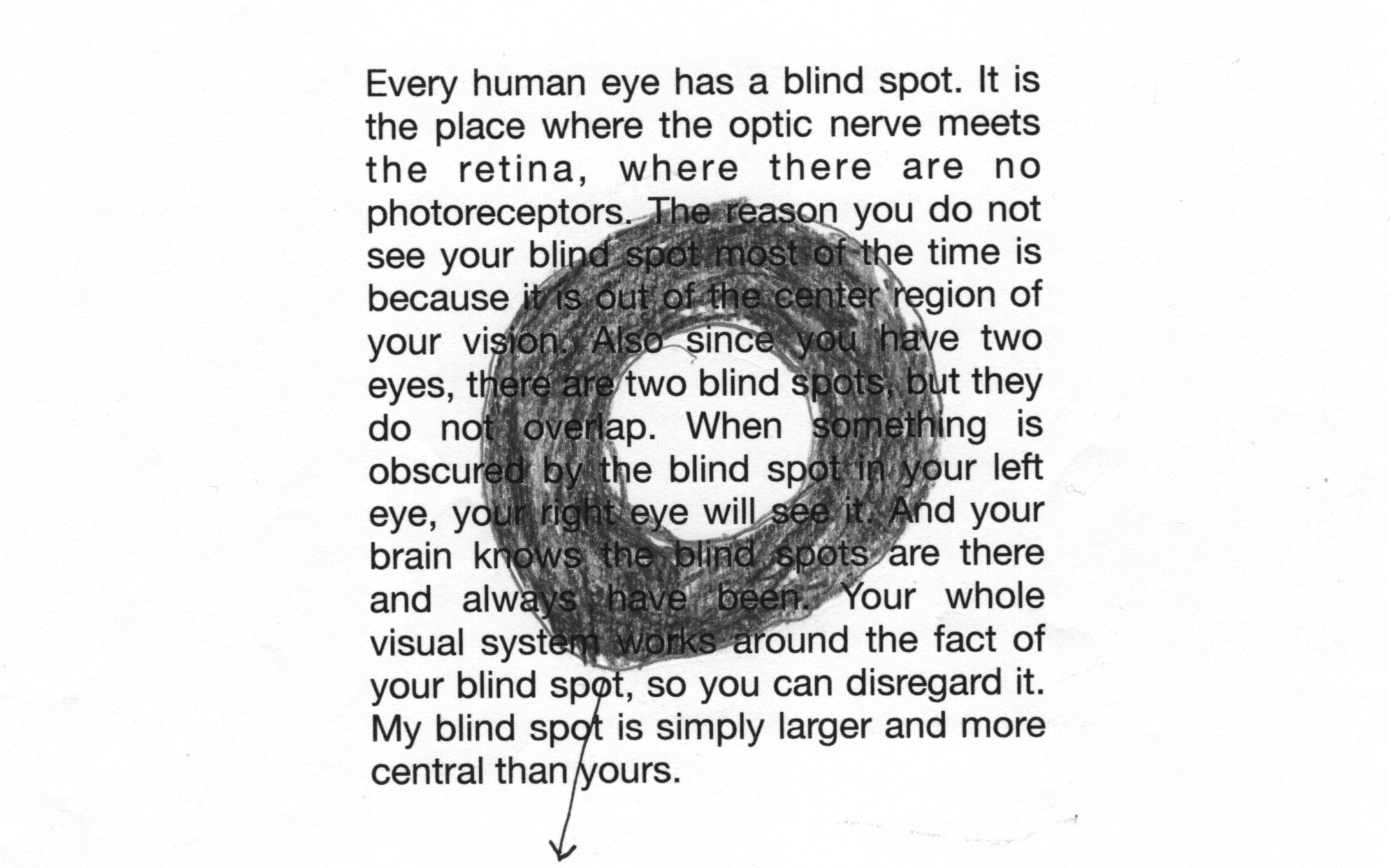
A sudden thought: what about applying my blind spot to a reading? I’ve tried this before, but didn’t stick with it; instead, creating my mood rings.

my blind spot over text from Georgina Kleege’s Sight Unseen

Yes! I’d like to try this again, but with text about the gorge! I need to go back to the wall and see if/how much my ring has grown. I could try it with old books I can no longer read anymore, or with typed-up text.

june 23/RUNWALKSWIM

run: 4.05 miles
minnehaha falls and back
71 degrees
dew point: 66

It felt warmer than 71, the air thicker than a 66 dew point. Had to remind myself a few times that I could stick to my 9/1 plan. And I did — at least through the first 3 cycles. Had to do an extra minute of walking at 32 or 33 minutes in, but then I got right back on track. A victory!

overheard: Just starting my run, I overheard one woman say to the other: that was the first time I ever saw a spider biting me! As opposed to waking up with spider bites, not knowing when you got them, I suppose.

10 Things

  1. one of the recently re-mulched trails that leads down into the oak savanna looked dark and deep and mysterious — partly due to a late June abundance of green leaves blocking out the light, partly the sun behind the clouds
  2. a smattering of young runners in small groups — a high school cross-country team already in training?
  3. empty benches
  4. the steady hum of some construction equipment
  5. a sour smell coming from a trash can
  6. a packed shopping cart parked on the lowest part of the trail that dips below the road
  7. the flash of a very small bird — a hummingbird? — flying past me
  8. an over-the-shoulder sideways glance at the falls: all white foam
  9. 2 people waiting to pay for parking at the falls
  10. mostly overcast with a few stretches of pale sun

A good run. A low average heart rate. A steady pace. A chance to be above the gorge and the river. And, interesting thoughts. Earlier this morning, I was reminded of some ideas about movement and death and the Homeric mind, and they fluttered like loose threads behind and beside me as I ran.

thread 1: entangled, murky, thick-layered

As I ran on the Winchell Trail through the thick green, I thought that when I’m running by the gorge, I think of it in broad, basic ways: tree, rock, bluff, bird, water. Then my mind wandered, and I wondered: (Why) do we need more specific, “technical” names in order to connect with the land? I thought about the importance of names and the violence of occupying and renaming, the value of knowing the history of a place, understanding how it works scientifically, and placing it in a larger context (space, time). Then, as I ran up the short, steep hill by Folwell, I thought about how important it is to learn to think on all of these levels at once, or at least be able to switch back and forth between them. I can experience the gorge as water, rock, tree, bird, wind, or as stolen land occupied and used, abused, restored, protected, ignored, exploited. As a geological wonder, slowly–but not really slowly in geological time, 4 feet per year–carved out by the river eroding the soft St. Peter sandstone. As both wild/natural and cultivated/managed–the site of erosion due to water, and erosion due to the introduction of invasive species, industry, too many hikers, bikers, houses nearby. There isn’t an easy way to reconcile these different understandings and their impacts.

23 june 2021

thread 2: moving as death rearranged

from To chlorophyll, refineries, coal, furnaces beneath early skyscrapers, fossils/ Caroline Kenworthy

Life’s long inhale of nutrients, and longer, hotter exhalation in decay. Packed, still, silent.

Hard to remember that matter hums constantly.
These cars and highways— how much of moving is death rearranged.

I kept thinking about this idea of death rearranged. At point, I thought, of course — recycling, decomposing, rebirth = rearranging. I like this word choice — rearranging.

thread 3: Homeric mind

this physical thing that moves. So, if you imagine a place over the sea, your mind actually has to get there. So, even though it may be as fast as the light, it is physical movement.

 A Conversation with Kit Fan and Alice Oswald

The mind as moving — not just through associations, but literally moving, traveling.

As I thought about movement and connection, and death rearranged on my walk back after the run, I passed by a painted rock at the edge of neighbor’s side garden that read, We are our ancestors with an arrow pointing to plants. Yes. No one is gone, just rearranged, reconfigured. And, we are connected deeply to the green.

walk: 3 miles
east lake library and back
78 degrees

Walked to the library to pick up Anne Carson’s Float. I’ve checked it out once or twice before but I’m thinking this time I might be more interested in it. (2 hours and several naps later: nope. Still don’t understand it or why it’s called float, but I found a review of it and Mary Ruefle’s My Private Property that might help.) It was fun walking through the neighborhood, looking at how different neighbors deal with their slanting lawn. FWA is interested in re-doing ours for us. Wood, rock, stone, mulch, hostas, ornamental grass. My favorite flowers: the vines with the bright purple flowers — clematis, I think, and the dozens of cacti with beautiful yellow blooms. Saw a lime green door, like mine, on a bright blue garage. A perfect blue for the green, but maybe too much for a whole house. And, it clashed with the purple fence. Heard some loud christian rock blasting from a backyard and a 2 story tall skeleton wearing a green t-shirt in a front yard. Kids on scooters, yelling from inside houses, lounging by the pool at longfellow park.

Speaking of kids, we live next to a daycare. It’s never been a problem because the kids usually stay inside so I never hear them. A few months ago, Sheila (our neighbor and owner of the daycare) began letting 2 little girls play outside in their front yard and our side yard. They are very loud and like to scream a lot. And they are right outside of my windows so I hear them and see them flitting and darting out of the corner of my eye. Thankfully they haven’t opened our gate . . . yet. It doesn’t seem like they are being supervised. Today Scott noticed that one of them had picked up a giant branch — taller than them — and was waving it around — through the air, at the other little girl. No adults stopped them until about 15 minutes later when they were scolded. Yikes.

5

point
could
stick
least
first
extra
right
track
other
green
light
cloud
empty
group
cross
smell
front
never
being
story

trash
trail
below
heart
above
loose
thick
gorge
think
basic
bluff
water
order
value
place
short
steep
giant
adult
until

forth
abuse
carve
house
death
early
decay
still
there
about
after
arrow
plant
check
twice
might
later
stone
mulch
hosta

empty group smell
basic bluff order
thick heart track
cloud water light
green house plant
extra loose trash
never think twice

swim: 5 cedar loops (2.5 lake nokomis)
cedar lake open swim
80 degrees

First open swim of the season at Cedar Lake. Wonderful conditions. Warm-enough water and no chop. I felt strong and fast and smooth. I didn’t stray too far to the center. They have a new lifeguard who was actually telling people dogs weren’t allowed in the water and requiring people to have swim caps. Is Cedar Lake going to lose some of its chill vibes?

The water was olive green, but more yellow than the blue of lake nokomis. I didn’t see any fish or get wrapped in vines. No canoes crossed my path, either. Not too many clouds in the sky. No planes or birds.

A great early evening for a swim!

may 3/RUN

3.25 miles
trestle turn around
47 degrees

A little cooler, but sunny. I wore shorts and my legs didn’t feel cold. The green continues to spread. I’m sure I still have a view of the river but I don’t remember looking at it, not even once. I saw some rowers heading down to the rowing club, but didn’t hear them on the water. Greeted Dave, the Daily Walker. Was passed by several groups of young and fast runners. High school or college teams? Not sure.

Mostly I felt good. My heart rate is still high. I guess I lost some fitness on my almost 2 week break. Monday, I’ll try some more deliberate walk-run segments.

Listened to other runners, cars, water gushing out of sewer pipes heading north, my “I’m Shadowing You” playlist heading back south.

Ran on the grass for a few stretches to avoid other runners and walkers. Thought about how several sites recommended running on more gentle surfaces, like grass, when dealing with a herniated disc or sciatica.

before the run

I’m thinking more about open fields, meadows, lawns, boulevards, village greens, grasslands both wild and manufactured. Grassy spaces I recall from childhood, living in sub-divisions in North Carolina and Virginia and Iowa: soccer fields, manicured lawns, pastures just beyond my backyard.

I decided to look through the poems I’ve gathered for more meadow poems. Found Robert Duncan’s Often I Am Permitted to Return to a Meadow. Wow.

as if it were a scene made-up by the mind, 
that is not mine, but is a made place,

that is mine, it is so near to the heart, 
an eternal pasture folded in all thought 
so that there is a hall therein

that is a made place, created by light 
wherefrom the shadows that are forms fall.

An eternal pasture with a hall made by light and shadows. After the poem, I wrote about Duncan’s idea of projective verse

poetry shaped by rhythms of poet’s breath. So cool–I want to explore this more, thinking about breathing when I run vs. walk vs. sit.

“Olson argues that the breath should be a poet’s central concern, rather than rhyme, meter, and sense. To listen closely to the breath, Olson states, “is to engage speech where it is least careless—and least logical.” The syllable and the line are the two units led by, respectively, the ear and the breath: 

“the HEAD, by way of the EAR, to the SYLLABLE 
the HEART, by way of the BREATH, to the LINE”

poetry foundation introduction to “Projective Verse”

The heart, by way of the breath, to the line — This idea will be the start of a moving while writing experiment!

after the run

up to the wind-stripped branches shadow-
signing the ground before you the way, lately, all
the branches seem to, or you like to say they do,
which is at least half of the way, isn’t it, toward
belief — whatever, in the end, belief
is…
(My Meadow, My Twilight/ Carl Phillips)

My husband and I were arguing about a bench we wanted to buy and put in part of our backyard, a part which is actually a meadow of sorts, a half acre with tall grasses and weeds and the occasional wild flower because we do not mow it but leave it scrubby and unkempt. 
(The Bench/ Mary Ruefle)

And, back to the field:

Crossing a field, wading

                   through nothing
        but timothy grass,

imagine yourself passing from
and into. Passing through

doorway after
doorway after doorway.
(Threshold/ Maggie Smith)

After the rain, it’s time to walk the field

again, near where the river bends. Each year

I come to look for what this place will yield –

lost things still rising here.
(After the Rain/ Jared Carter)

april 3/RUN

5.4 miles
franklin loop
40 degrees

It snowed a few wet inches Tuesday night but you wouldn’t know it today. It’s all gone. The paths were clear and dry. I thought about orange things as I ran. I heard lots of dripping water, a few voices, birds. So many birds as I approached the marshall bridge! Oh — and the gobble of a turkey near the Minneapolis Rowing Club! I stopped to try and see it, but I couldn’t. Heading north, just past the trestle, I took the recently redone steps down to the winchell trail and admired the river. Calm, quiet, grayish blueish brown.

10 Orange Things

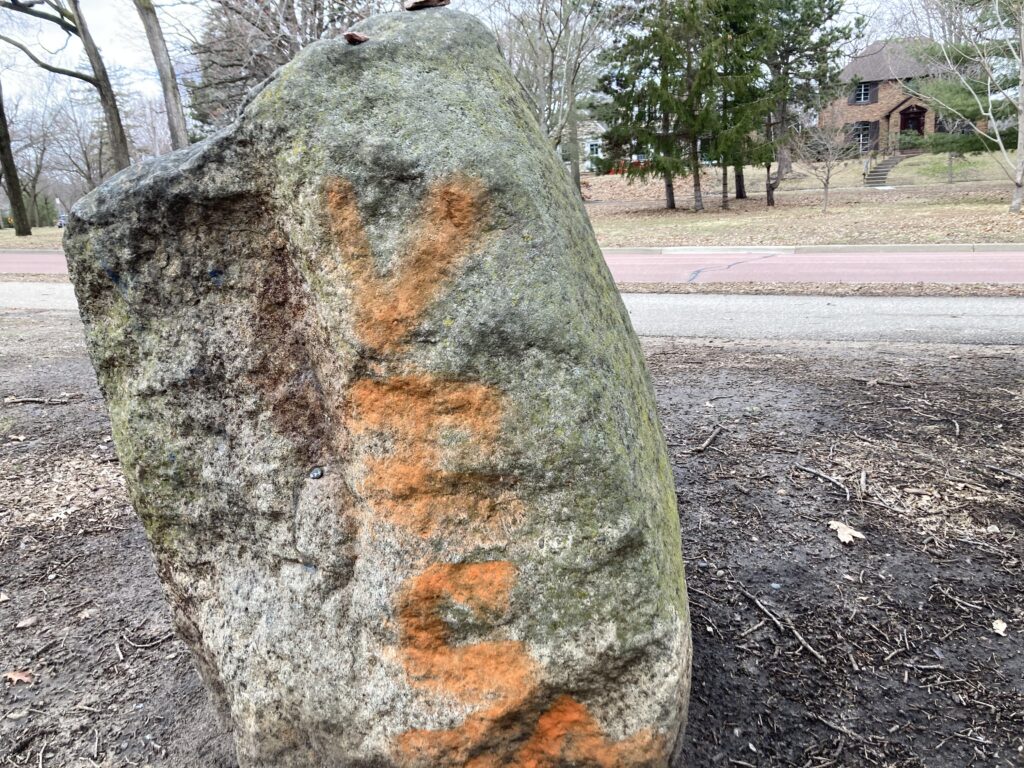
  1. orange lichen on the east side of the ancient boulder*
  2. an orange cone
  3. looking over the edge of the double bridge above longfellow flats, a white barricade with orange stripes had fallen halfway down the steep bluff
  4. orange netting on the fence
  5. an orange stocking cap on a walker
  6. orange bubble-letter graffiti
  7. my orange sweatshirt, worn under a dark blue hooded pull-over
  8. an orange road closed for race sign
  9. orange leaves on the ground
  10. orange rust on a metal plate

*I showed Scott the picture I had taken of the lichen and he said, that’s not lichen, that’s spray paint; it says VISA. I like seeing it as lichen better, but it is frustrating to have been so wrong with what I was seeing. I remember looking at the picture and thinking something else was there, that my idea of it as lichen wasn’t quite right, but this thought didn’t quite make it to the surface.

until Scott told me what I was actually on this rock, I thought it was lichen

I wanted to think about an orange effort as I ran, but I was distracted by my unfinished business. No port-a-potties anywhere. Thankfully I made it home without earning a poop story.

april’s monthly challenge

On April 1, I identified my monthly challenge as steps even as I wondered if it would stick. Yesterday I wasn’t so sure. I started working on a purple hour sonnet, then revising other color poems and converting them into sonnets. This morning I work up hell-bent on orange. I will study orange, steps be damned, I thought. But just now, while reading the chapter, “Orange is the New Brown,” in On Color, I encountered this sentence:

Through the late sixteenth century in England, “orange tawny” is commonly used to mark a particular shade of brown (even though chromatically brown is a low-­ intensity orange, though no one then would have known that). 

On Color, 45

Chromatically? Even though I’ve read/heard this word in relation to color for some time, today it made me pause and wonder about why the chromatic scale (a favorite scale to play) is called a chromatic scale.

The twelve notes of the octave—all the black and white keys in one octave on the piano—form the chromatic scale. The tones of the chromatic scale (unlike those of the major or minor scale) are all the same distance apart, one half step. The word chromatic comes from the Greek chromacolor; and the traditional function of the chromatic scale is to color or embellish the tones of the major and minor scales. It does not define a key, but it gives a sense of motion and tension. It has long been used to evoke grief, loss, or sorrow. In the twentieth century it has also become independent of major and minor scales and is used as the basis for entire compositions.

wikipedia

Searching for a definition, I also found a reference to James Sowerby’s Chromatic Scale:

Chromatic scale of colours arranged as a chart. Sowerby’s accompanying text provides a nomenclature for 63 colours divided into primaries of yellow, blue and red: with binary colours (blends of two primaries) and ternary colours (combinations of three primaries). Sowerby considered this might be useful to artists and considered that in primary colours “Gamboge is most perfect yellow, used in water colours…Carmine, most perfect when good…Prussian, or Berlin blue, most perfect.” Plate 5 from the monograph A new elucidation of colours, original prismatic, and material; showing their coincidence in three primitives, yellow, red and blue…, 

link

The chromatic scale as even steps up or down a musical scale. “The distance between 2 successive notes on a scale is called a scale step — half step or whole step.

Chromatic colors possess a hue (e.g. red, blue, green) while achromatic colors are variations of light and dark (shades of gray, black, white).

What is orange? Why, an orange, 
Just an orange!
(from Color/ Christina Rossetti)

Revisiting my month with Mary Ruefle, I wrote this about orange and Orange Theory:

. . . a red (all out effort) breath might involve being shocked, experiencing such intense awe or surprise that you lose your breath for a minute. Orange breaths involve intense feeling that can be sustained longer, but are still uncomfortable. Orange breaths are anxious breaths.

And now I’m thinking about how Mary Ruefle’s sad color poems — orange sadness, purple sadness, etc. — could be read as happiness poems too: “if you substitute the word sadness for the word happiness, nothing changes.” What is the more positive version of anxious? Excited? Maybe call my poems excitement poems? No, not excitement, attention. Of course, attention!

Earlier today I encountered an amazing poem that fits with the theme of attention:

from I’m Like If Mary Oliver Had Attention Deficit Hyperactivity Disorder/ Rose Azalea

attention is the beginning of devotion is something mary oliver said

. . .

my attention is both deficient & hyperactive i.e. i am touchingfeeling everything constant

devotion is the practice of belonging is something the earth cosplaying as me said

as a joytrans my special pokèmon moves are witness & surrender

.

may 31/RUN

3 miles
2 trails (long)
75 degrees

Warm this morning, but it didn’t feel miserably hot, probably because I was able to be in the shade for most of the run. So much wonderful shade, so many friendly shadows! Ran south above, north below, on the Winchell Trail. Didn’t look at the river much, even when I was closer to it. One glance: between the thickening trees near the southern entrance of the Winchell Trail, I saw a small patch of sparkling water.

today’s color: the blue of the blue jay (I think it was a blue joy) that flashed past me as I rounded the curve at 42nd. Normally I can’t see the color of birds, and I’m not sure if you’d call what I saw seeing, more like the idea of blue or a voice calling out, blue! What kind of blue was it? Not deep or dark but light and intense, almost glowing. But not pale blue — somewhere in-between dark and light.

10 Things I Noticed

  1. the shadow of tree sprawled across the path
  2. the steady flow of water coming out of the sewer pipe near 42
  3. the clicking and clacking of roller skier’s poles up above me near folwell
  4. passing 2 walkers and hearing one of them say walk or should be walking or something like that
  5. the steady stream of cars driving by
  6. a few kids’ voices at the playground
  7. the flash of a white t-shirt up ahead on the trail, then disappearing around the bend
  8. leaning trees creating archways to pass through in several spots on the winchell trail
  9. cottonwood fuzz on the edges of the trail
  10. the metal slats in the ravine were slick and slippery

Mary Ruefle on Eavesdropping, You, and Unhitching in “On Sentimentality”

before the run

Today’s the last day of May and my last day with Mary Ruefle. I just finished reading/skimming her lecture, “On Sentimentality.”

Eavesdropping: In response to a poet who criticizes and laments the too frequent use of a generic You in poetry as too passive, turning us into observers, mere eavesdroppers, Ruefle asks: What’s wrong with eavesdropping? I agree. Today during my run, eavesdrop. Listen in on conversations between birds, the river and the sky, walkers.

YOU: What kind of subject are you (or is You)? And, if you are You, then who is the I? The path, a shadow, that tree? Think about this as you run beside the river.

unhitching: to crudely paraphrase Lévi-Strauss, unhitching happens in brief moments when we can step outside of or beside or just beyond — below the threshold of thought, over and above society — to contemplate/experience/behold the this, the what it is, the essence of everything, Mary Oliver’s eternity. In your run above the gorge, near the river, below the trees, can you unhitch?

during the run

In spite of the warm conditions, I managed to wonder about/wander through or with all 3 of these! A little bit of eavesdropping, some unhitching or at least thinking about how/where unhitching is possible, and becoming a You.

All of these ideas were simmering in my mind the entire time I ran, but I had a breakthrough in the second mile as I passed a walker and a dog on the Winchell Trail. They noticed me before I reached them and moved to the side. I said thank you and the woman replied you’re welcome. As I continued running on the steep-ish trail with no railing I thought about how when I said thank you, I was the I, she was the you. But when she answered you’re welcome, I become the you and she the I. Each of us both. Then I started thinking about the space and time between when we each embodied the pronoun, before my I turned into a you or her you into and I. This is the space of possibility where unhitching can happen, when we can be both a you and an I or something else that doesn’t divide and separate or assign us a fixed role — as active I or passive you. A moment when we can experience or behold the is below the threshold of thought, over and above society and its constructs. Not long after thinking these things, I encountered the blue flash of the bird and it felt magical.

I wanted to hold onto these ideas so I eventually stopped in the ravine, just past the oak savanna, to record my thoughts.

we exchanged the You. First they were the you, then I was, but there was some time in-between before we switched from I to you or you to I that was undetermined or both or nothing and that it’s those moments where we have the opportunity to unhitch.

the immeasurable or barely measurable lag between what we do, what we feel, what we hear, what we see, and our brain and as it travels to the brain then travels back out in whatever form. That is where those moments occur. (I’m thinking about a Radiolab episode I listened to last year)

thoughts recording during my run

And, a few minutes later, after my run was done, I recorded a few more thoughts:

Instead of lamenting the loss of what we once were like in Marie Howe’s “Singularity,” what if we gave more attention to the possibilities that exist in those spaces between the You and the I? Those moments of unhitching …And I was thinking about Robin Wall Kimmerer and the moss again and this idea of enough-ness, being satisfied with the small moments. Not trying to get more, to be more, but to just be, or to not be, or to be passive.

Not an observer or eavesdropper as someone who is spying on, staring at, invading the space of others. Not a lurker, as in lurking troll. Is there another way to understand how to notice the world passively? An absorber? Not a lurker, but a dweller?

thoughts recorded after my run

After my run, I also recorded myself reciting a poem that memorized a few years ago and was trying to keep fresh as one of my 100 poems memorized: Natural Forces/Vincente Huidobro. I almost got every word correct.

after the run

Such a great run, with so many interesting ideas! Arriving home and then trying to put the feeling of the run and the feeling of my thoughts into words, dulled some of the shine. It’s hard to find the right best proper most profound complete words to translate the experience. I didn’t want to lose so many great ideas and the moments of clarity. Then, another thought: what if the goal was not to accurately or exhaustively remember and then record my thoughts and feelings, but to hold onto those feelings and allow them to shift my perspective. I’m not sure that makes sense, but it did to me when I first thought it.

I have enjoyed reading Ruefle all this month. I’ve gotten to know her a little bit better and been able to wander in many different directions. I’ve also experimented with a new way of engaging with ideas/authors/writings. As an academic, I used to spend hours trying to effectively (and comprehensively) summarize the argument of a piece of writing. This summary, what one of my profs called appreciation, was always the first step. With Ruefle, attempting to lay out her entire argument in a neat and logical way doesn’t work. Why try to pin down her wild and wandering thoughts in such a way? Why waste all of my energy trying to summarize something that shouldn’t be summarized? So instead, I’ve been trying to engage with the little bits and bobs (thanks British TV for reminding me of this wonderful phrase!) that resonate for me. For me the point is not to KNOW these poems and lectures and essays by Ruefle but to FEEL them in small and big ways.

Some other ideas in “On Sentimentality” that I want to store away for future Sara:

I You They are invented devices

The words I, and you, and they, are grammatical devices invented simply for arrangement and totally devoid of the intense and exclusive sense usually attributed to them.

“On Life”/ Percy Shelley, quoted in Ruefle’s MRH, page 32

on vague Yous and John Keats’ “This Living Hand”

The poem is nothing but a gigantic, disembodied hand pointing a finger at someone. That finger is a magnet and a conductor: it reaches out to the vague, ill-defined you like God reaching within an inch of Adam, and it charges the reader with all the responsibility in the world: go figure these things out for yourself, while you still have blood in your veins.

page 35

another definition of poetry

a good poem is seldom comfortable; either it vanquishes us with anguish or electrifies us with ecstasy or makes us pause and consider a new sense of the world or unravels us altogether, but never does it make us feel comfortable in the fashing of these ads [part of a discussion about an ad that used the phrase, the poetry of knits].

pages 46-47

unhitching

The possibility, vital for life, of unhitching, which consists … in grasping, during the brief intervals in which our species can bring itself to interrupt its hive-like activity, the essence of what it was and continues to be, below the threshold of thought and over and above society; in the conntemplating of a mineral more beautiful than all our creations; in the scent that can be smelt at the heart of a lily and is more imbued with learning than all our books; or in the brief glance, heavy with patience, serenity and mutual forgiveness, that, through some involuntary understanding, one can sometimes exchange with a cat.

Lévi-Strauss quoted MRH page 52

Returning again to the ideas of You and I and We and Us, I wonder if some of my thoughts were influenced by a poem I read while drinking my coffee:

Soul/ASSOTTO SAINT

I remember the beginning
a dream ancient as dawn
a dream of destiny drumming up the blood
the flesh
this earth
a dream we were once one
soul

may 30/RUN

5 miles
franklin hill turn around
65 degrees
humidity: 76%

When I woke up this morning, I could smell the rain. Waited until it stopped, around 8 am, to go out for my run. Already hotting up, humid, bright sun. But a cool breeze that felt like air conditioning when it hit my sweaty skin. Ran north through the Welcoming Oaks, past the ancient boulder — no stacked stones, instead a woman standing nearby dressed in the same color combo as me, black on bottom and orange on top. I remember running above the old stone steps, but have absolutely no memory of running on the double bridge. I spent a minute trying to remember anything but couldn’t. I do remember running below the lake street bridge and noticing someone sleeping behind a post. Caught a brief glance of the river, almost sparkling, between the trees but forgot to look at it when I had a clearer and closer view at the bottom of the hill. Heard a drumming woodpecker, saw the brightest, glowiest outfit I’ve seen in a while: pink pants and a red jacket. As I ran by, I could feel the pink yelling excitedly at me, PINK!!!!

Listened to the cars whooshing by as I ran north, then put in “Dear Evan Hansen” as I ran back south.

No bugs, no roller skiers, no chill beats booming out of a scooter’s stereo (heard that yesterday on my walk with Scott and Delia). I did see a scooter zoom by. I think they were on the road, pretending to be a car. No eagles, no squirrels, no big groups of walkers or runners. No rowers, no honking geese. And, hardly any yellow.

Before my run, I found a poem, “Butter,” that made me want to focus on yellow as I ran. I kept returning to the task — look for yellow — but all I could see was blue, green, gray. The only yellow I remember was: the dotted lines on the bike path and the neon crosswalk sign. No yellow shirts or yellow bikes or yellow shorts or yellow cars. No yellow thoughts or yellow voices or yellow light or yellow smells.

The butter poem is the poem of the day on Poetry Foundation. As I read it, I thought about my past love of butter and the story, often told about me, that I liked to melt butter in the microwave and eat it like soup. How many times did I actually do that? It also makes me think of my quote from Audre Lorde about the yellow pellet put in the white butter that spreads, adding the Yes! to our no lives. And it makes me think about Mary Ruefle and her yellow happiness.

Thinking about butter, here are a few images that immediately pop into my head from my childhood:

How uncomfortably scratchy and ticklish my throat felt after drinking the butter soup. Even now 40 years later when I eat butter, I sometimes feel a phantom scratch. Yuck!

Our old popcorn machine had a small metal tray that you put butter in then shoved in a slot so it could melt while the corn popped. I remember pouring the liquid butter over the popcorn, always drenching a few kernels until they were soggy. Even more than using it to melt butter, I remember using the little metal tray to try and catch snowflakes with my sister Marji on a rare snow day in North Carolina.

another butter story about me which I have the thinnest. vaguest memory of: at some restaurants, they would put scoops/balls of butter in a dish on the table. Apparently I ate it like ice cream, either because I thought it was ice cream, or because I liked butter that much.

Butter/ Elizabeth Alexander

My mother loves butter more than I do,
more than anyone. She pulls chunks off
the stick and eats it plain, explaining
cream spun around into butter! Growing up
we ate turkey cutlets sauteed in lemon
and butter, butter and cheese on green noodles,
butter melting in small pools in the hearts
of Yorkshire puddings, butter better
than gravy staining white rice yellow,
butter glazing corn in slipping squares,
butter the lava in white volcanoes
of hominy grits, butter softening
in a white bowl to be creamed with white
sugar, butter disappearing into
whipped sweet potatoes, with pineapple,
butter melted and curdy to pour
over pancakes, butter licked off the plate
with warm Alaga syrup. When I picture
the good old days I am grinning greasy
with my brother, having watched the tiger
chase his tail and turn to butter. We are
Mumbo and Jumbo’s children despite
historical revision, despite
our parent’s efforts, glowing from the inside
out, one hundred megawatts of butter.

Had to look up “tiger Mumbo Jumbo” to find the reference: the story of Little Black Sambo. When we lived in North Carolina, we would often eat at Sambos for breakfast.

may 27/RUN

4.5 miles
marshall loop (cleveland)
69 degrees

Another wonderful morning! Maybe a little too warm and sunny for me. I started my run late — almost 10:00 am. Ran through the neighborhood to the lake street bridge. Rowers! 2 or 3 shells with 8 rowers each. I don’t remember what color the water was — probably blue? — but I noticed a few little waves. I hit the lights right and ran all the way up the Marshall hill to Cleveland without stopping. Didn’t stop until I reached the river road a mile later. Walked for a minute and recorded some thoughts about black and darkness into my phone.

Mostly felt strong, but my legs were sore and tired for the last mile. I think I should get my iron levels checked again. Anything else? Didn’t hear the bells at St. Thomas, but heard the roar of a bunch of motorcycles. Encountered 2 kids in a little motorized car on the sidewalk; they were good drivers, giving me lots of space to pass them. I don’t remember hearing birds — I must have? — or seeing roller skiers. Noticed my shadow, sharp and strong next to me at one point.

For the first 3 miles I listened to my breathing or my feet hitting the asphalt or motorcycles. For the last mile and a half, a playlist: “Back in Black,” “Upside Down,” and “I’ll Be There.”

Mary Ruefle and Black Sadness

from My Private Property/ Mary Ruefle

Black sadness is the ashling, its remains are scattered over
several provinces, it is the sadness of takes and hypen-
ated names, of clouds who think they are grapes, it is the
sadness of brooches, which may be worn on the breast or
at the neck but how sad none see the sadness of detail
there, the woman playing a guitar without strings, the
hare leaping from the fox in vain, it is sadness torn and
sadness rent, it is the hold in sadness from which no words
escape and no soul can spring, it is the calorific sadness
of bombs. Many of us used to own a black velvet skirt. It
is like Angie Moss on her way to the fair, it is there she
will have first adventure.

before the run

Today I will do the Marshall loop which goes by Black, the coffee and waffle place, and I will think about black and the dark and things that don’t echo but absorb, swallow, consume. I’d like to think about the comfort of black/the dark — the shade — in face of too much white/light.

during the run

I did it! I ran past Black and thought about black and darkness a lot. Some of the thoughts are gone, but some managed to stay.

10 Black/Dark Thoughts or Ideas or Images

  1. no Black smells — that is, I don’t recall smelling coffee or the wonderful smells-better-than-it-tastes waffle smell from the coffee and waffle bar
  2. today, with the bright, warm sun, I wanted the cooling darkness of shadows. My run was always felt better out of the bright light. Half the run was in shadows, half in bright light
  3. so many pleasing shadows! Mine, sprawling trees, lamp posts, buildings
  4. I didn’t hear the St. Thomas bells and, as I was nearing campus, I wondered if it was because something — the wind? — was absorbing their sound. Black bells ringing with a black, echo-less sound?
  5. the dark/black mystery of deep trails down into the gorge
  6. I saw a few waves on the river, but no sparkles. Thought about Homer’s wine dark and the idea of water as deep and dark and endless
  7. my running shorts are at least 10 years old and were, at one time, black. Now, faded by the sun, they’re still black but barely, almost a very dark gray
  8. running down the summit hill to the river road trail, thought about light as knowledge, liberated from Plato’s dark cave of shadows, then the dark womb and women’s ways of knowing and how light (and scrutiny and classifying — dissecting) are masculine, patriarchal and privileged over other ways of knowing, which are often read as feminine and less than, or to be overcome
  9. if light = certainty (but does it?) and knowing for sure, what happens when we are finally certain? What ends when the darkness is over?
  10. thought about the idea of black hearts and then what a literal black heart might look like or why someone might have it and then wondered if a literal white heart might not be just as disturbing*

*looking up black heart, I found this interesting discussion of its recent usage:

In the late 20th century, many black scholars, writers, artists, activists, and everyday people began variously using black heart to express pride in and love of their black identity and experience, reclaiming the long, historical racism against blackness. On social media, they may use the black heart emoji, released in 2016, for emphasis.

black heart Meaning & Origin

Much of my thinking about black and darkness during the run was from the perspective of understanding black and dark as good, or not the bad/evil to white’s/light’s good. When I stopped to walk 2.5 miles in, I recorded some of my thoughts:

Thinking about black and dark and how important that (dark) is to poets and to mystery. There’s a difference between pure black that absorbs everything and a dark gray so I’m kind of conflating those, but it’s the idea of dark as essential and how light can be too bright. The idea of certainty, where you can see everything in its sharp lines and finally know it, is a conclusion, an ending to the mystery. To life. So, that’s not to say that light and certainty aren’t important but they are not the good to dark’s bad.

I think these ideas made more sense in my head. I should say that much of my thinking about black and dark was particularly inspired by a quote I encountered yesterday about hope being a language that dark voices cannot understand — it was the title of a student’s musical composition at FWA’s concert. When I first heard the quote, I was bothered by the idea of dark voices, which could (and has — I’ve taken entire grad classes on it) be connected to actual dark voices, that is, the voices of Black people, so it literally means we don’t need the dark voices of Black people. I also thought about how light gets connected with seeing, which then becomes the dominant way to access truth. So, if you can’t see well — you’re blind, or going blind like me — it’s understood that there’s something wrong with you.

note: I feel like I have too much to say about all of this, which is causing me to struggle to say anything coherent. Maybe I’m not ready to express it yet?

Anyway, all of that was happening in my head as I ran. None if it stayed too long, only flaring then flying away. One of the last thoughts I remember having was, dark voices absolutely understand the language of hope and they are my primary resources for finding and holding onto it! This thought is true for me literally and figuratively. In both my master’s thesis and dissertation, I studied the deeply rich and messy and complicated tragic hope of critical race theorists (especially Cornell West) and black feminists and womanists (Audre Lorde, Patricia Hill Collins, Alice Walker). And now, ever since 2016, I’ve been looking to poetry and poets, for their safeguarding of bewilderment and mystery and their understandings of hope that come from a sharing of joy that is both grief and delight.

after the run

At the end of the run, and now almost 2 hours after it, I’ve arrived here, thinking that not only is the belief that darkness is bad or that there’s no room for dark voices in the light of hope is problematic, it is ridiculous. How can you have hope without grappling with the dark thoughts of mystery, uncertainty, unknowingness? And how can you have a hope that’s strong enough to help us build better futures for everyone if dark voices aren’t at the center of it?

Wow, this topic really got me going! In the past, I might have taken all of this out, but I’ll keep it for future Sara.

One more random note about black. Ruefle’s idea of black sadness as the hold from which no words can spring, no soul can escape,” reminded me of a favorite line from Rainer Maria Rilke’s “Black Cat“:

A ghost, though invisible, still is like a place
your sight can knock on, echoing; but here
within this thick black pelt, your strongest gaze
will be absorbed and utterly disappear:

may 26/WALK

45 minutes
with Delia the dog
neighborhood + 7 Oaks
78 degrees

Took a walk in the afternoon with Delia the dog through the neighborhood, almost to the river trail, then to 7 Oaks. Felt like summer. RJP told me the other day that the buoys are up at the lake. Next week — maybe on Tuesday? — I’ll test out the water!

10 Things I Noticed

  1. a black capped chickadee
  2. the neighbor on the next block who almost always sits on his front steps smoking was sitting on his front steps smoking
  3. someone at cooper field was dribbling a soccer ball then shooting it into a net set up in the batting area — not sure how old he was, but his bike looked like it was for someone around 12
  4. someone “mocking” in a blue hammock in the grassy area between edmund and the river road. When I walked by, I could hear soft music — not sure what it was
  5. angled solar panels on the roof of a tall and big house — maybe a duplex?
  6. a recently dug up dirt patch in one corner of an otherwise pristine yard — I wondered how upset the woman/gardener who lives there is about this blemish
  7. crossing the street, taking a few steps through someone’s grass to reach the sideway — wow, such thick, soft grass. What did they have to do to have such lush grass?
  8. Delia decided to poop on the edge of another yard in the thickest part of the grass. From a distance, this grass looked like it might be soft too. Nope. Spiky, stiff, sharp
  9. lots of little wrens or sparrows — not sure I can tell the difference
  10. no birdsong coming from the sink hole at 7 Oaks — all the birds were in neighborhood trees

Mary Ruefle and Yellow Sadness

Yellow sadness is the surprise sadness. It is the sadness of
naps and eggs, swan’s down, sachet powder and moist tow-
elettes. It is the citrus of sadness, and all things round and
whole and dying like the sun possess this sadness, which
is the sadness of the first place; it is the sadness of explo-
sion and expansion, a blast furnace in Duluth that rises
over the night skyline to fall reflected in the waters of
Lake Superior, it is a superior joy and a superior sadness,
that of revolving doors and turnstiles, it is the confusing
sadness of the never-ending and the evanescent, it is the
sadness of the jester in every pack of cards, the sadness of
a poet pointing to a flower and saying what is that when
what that it is a violet; yellow sadness is the ceiling fresco
painted by Andrea Mantegna in the Castello di San Gio-
gio in Mantove, Italy, in the fifteenth century, wherein we
look up to see we’re being looked down upon, looked
down upon in laughter and mirth, it is the sadness of that.

The citrus of sadness. I like that. I can also see yellow as the sadness of naps or of expansion and explosion. In “Uses of the Erotic: the Erotic as Power,” Audre Lorde writes about yellow:

During World War II, we bought sealed plastic packets of white, uncolored margarine, with a tiny, intense pellet of yellow coloring perched like a topaz just inside the clear skin of the bag. We would leave the margarine out for a while to soften, and then we would pinch the little pellet to break it inside the bag releasing the rich yellowness into the soft pale mass of margarine. Then taking it carefully between our fingers, we would knead it gently back and forth, over and over, until the color had spread throughout the whole pound bag of margarine, thoroughly coloring it. I find the erotc such a kernel within myself. When released from its intense and constrained pellet, it flows through and colors my life with a kind of energy that heightens and sensitizes and strengthens all my experiences.

“Uses of the Erotic: The Erotic as Power” / Audre Lorde

I remember reading this essay in grad school and liking it this image of the spreading joy that colors everything. Energy, intensity, strength. A warm yellow.

As I walked I looked for yellow — a very bright yellow shirt on a biker, dandelions dotting the grass at 7 oaks. I thought about the sun as leaving smears of yellow and yellow as piercing the eye. I also thought about the strange level at the Guthrie Theater where everything looks yellow. And now, writing this, I’m remembering how I discovered some research about Van Gogh and yellow. He only say yellow, or something like that. An image of mustard came into my head — ballpark mustard, not grainy or spicy mustard. Not sure why not spicy mustard — I like its color and taste much more than “regular” mustard.

may 25/RUN

3.5 miles
2 trails (long)
63 degrees

Breezy and sunny. Felt a little tired during the run; maybe I should have had a snack right before I left? Encountered an adult and a cute little kid on the trail, then another cute kid sitting on the rock that looks like a chair. She called out hello! I waved back. I remember looking at the river but not what it looked like. I remember hearing voices below me, seeing lots of leaning trees, feeling the uneven path below my feet.

Mary Ruefle and Orange Sadness

Orange sadness is the sadness of anxiety and worry, it is
the sadness of an orange balloon drifting over snow-
capped mountains, the sadness of wild goats, the sadness
of counting, as when one worries that another shipment
of thoughts is about to enter the house, that a soufflé or
Cessna will fall on the one day set aside to be unsad, it
is the orange haze of a fox in the distance, it speaks the
strange antlered language of phantoms and dead batter-
ies, it is the sadness of all things left overnight in the oven
and forgotten in the morning, and as such orange sadness
becomes lost among us altogether, like its motive.

before the run

Today I’d like to think (even) more about orange. What is orange to me? What sounds orange? Tastes orange? Feels orange? Smells orange?

during the run

I tried to think about orange, testing out whether I thought something I encountered felt orange or not. Would I call those loud voices below me orange voices? No. Ran down the hill to the south entrance of the winchell trail and smelled the vaguest whiff of the past — the sweet, fresh smell at my family’s farm in the UP. Is that an orange smell? Nope. I’d call it a red smell because when I think of the farm, I think of the bright red of the farmhouse. I noticed lots of little orange things on the ground — orange leaves, a piece of orange string, an orange flash. As I neared the gravel hill at the ravine, I started thinking about orange theory and its main principle of working out in the orange heart rate/effort zone for at least 12 minutes of a 60 minute workout. Running up the gravel on my toes, I thought about orange breaths and orange effort and decided that when I got home, I looked up the orange theory and think more about it.

after the run

Here’s how Orange Theory defines the different zones:

Gray Zone (50-60% Maximum Heart Rate) – This is the least strenuous, most comfortable zone, consisting of very light activity.

Blue Zone (61-70% Maximum Heart Rate) – This zone is specifically geared for warm-up and cool-down exercises. You are preparing your body and mind for high-intensity interval training, but you haven’t unleashed the burn just yet.

Green Zone (71-83% Maximum Heart Rate) – In this zone, you have reached a challenging but doable pace. This is what Orangetheory categorizes as “Base Pace,” a pace you can maintain for 20-30 total minutes. Your body starts to burn fat and carbohydrates evenly.

Orange Zone (84-91% Maximum Heart Rate) – This is where the magic happens and where you achieve “EPOC” (Excess Post-Exercise Oxygen Consumption) – what we call the “Orange Effect / Afterburn.” The goal is to accumulate 12 minutes or more in this zone within a 60-minute period to achieve the maximum caloric burn for up to 36 hours AFTER your workout is completed.

Red Zone (92-100% Maximum Heart Rate) – This zone happens organically and may be achieved during ‘All Out’ efforts when you’re emptying the tank and using every ounce of energy left in your body. You don’t need to set an All Out pace for more than 1 minute at a time to experience maximum results.

I haven’t really worked with heart rate zones when I run, partly because I can’t seem to not stay in the upper range on all of my runs no matter how slow I go, but it seems fun to me to think about orange in terms of effort and heart rate and how that could apply to things outside of (or alongside?) fitness. The orange zone involves a hard effort, where you are doing things that elevate your heart rate a lot, but it’s not all out, not something that makes your heart almost jump out of your chest or pound uncontrollably. That’s red, and a red (all out effort) breath might involve being shocked, experiencing such intense awe or surprise that you lose your breath for a minute. Orange breaths involve intense feeling that can be sustained longer, but are still uncomfortable. Orange breaths are anxious breaths. This morning, as I waited to leave for a doctor appointment, I was breathing with orange breaths and orange lungs — wound up, nervous, not totally sure why. Every time, before an open swim, I breathe orange breaths — nervous about whether or not I will be able to see how to swim across, excited about getting to swim in the lake.

may 24/RUN

4.5 miles
longfellow gardens and back
67 degrees

For today’s run, I decided to go past the falls to Longfellow Gardens. Since I was reading Mary Ruefle’s prose poem about purple sadness, my plan was to visit my favorite purple flowers. When I reached the gardens I discovered that they haven’t been planted yet. Thanks strange spring with your late snow storms and unending cold weather in April!

Another one of those wonderful spring days with sunshine and birdsong. A week ago I would have added “no bugs,” but they’ve arrived. All this week, mosquitoes have been feasting on my elbows, under my knees, my wrist. Today a gnat died on the side of my nose. I could see it through my peripheral vision. Another flew into my eye. Yuck!

My right big toe hurt again for a few minutes, then it was fine.

Heard the wind, water gushing out of the sewer pipes, the falls roaring, kids laughing at the playground, one little kid in a stroller that was over everything, a giant mower or weed whacker or some other noisy machine near the Longfellow House.

Smelled cigarette smoke as I passed a guy on the trail. Was he smoking or was it just his clothes?

surfaces: tightly packed dirt, half buried tree roots, grass, hay, asphalt, concrete, road, street, sidewalk, brick, dead leaves, crumbling asphalt — some mostly asphalt, some with big chunks of asphalt mixed with leaves and dirt, some rubble, limestone steps

Mary Ruefle, Immortal Cupboards, Windows, Offerings, and a Purple Wood

Today I’m reading Ruefle’s lecture, “My Emily Dickinson” and her purple sadness poem.

immortal cupboards

J. D. Salinger once remarked, “A writer, when he’s asked to discuss his craft, ought to get up and call out in a loud voice just the names of the writers he loves…”

My Emily Dickinson” / Mary Ruefle, page 150

That lovely little book. I’ve had nothing affect me quite so much since I discovered haiku. But then you come from Japan! You now inhabit a corner of my immortal cupboard with LZ (especially the short poems), Emily Dickinson, Thoreau, Lucretius, Marcus Aurelius, John Muir, bits from Santayana, D.H. Lawrence, Dahlberg, William Carlos Williams, and haiku. These knew “when / to listen / what falls / glistens now / in the ear.”

Lorine Niedecker in a letter to Cid Corman

Emily Dickinson is also in my immortal cupboard, along with Mary Oliver, Lorine Niedecker, Marie Howe, possibly Alice Oswald, definitely Rita Dove.

windows

Emily Dickinson often looked out of her bedroom window, and many of her poems, if not her worldview, seem framed by this fact; so much has been made of this there is little I can add; to argue whether a window is the emblem of complete objectivity (removal and distance) or complete subjectivity (framing and viewpoint) is an argument without end, for every window has two sides, and they are subsumed in the window, the way yearning, a subsidiary of the window, is subsumed in both the object yearned for, and the subject of its own activity.

“My Emily Dickinson”/ Mary Ruefle, page 151

offerings

But she has a common grave, and I like to go there and leave things, and when I did, I see that many other people have done the same.

“My Emily Dickinson” / Mary Ruefle, page 182

list of offerings left (real or imagined) throughout Ruefle’s lecture:

  • a stone, a penny, a small bronze alien
  • two plastic champagne glasses, pink and purple larkspur, an ear
  • a lemon, a dime, a diamond ring, a parachute
  • a white rose, a fortune-telling passionate fish, ice cream for astronauts
  • a sheaf of flowers from the florist with a thank-you note attached, a plastic fly, a nickel, an egg
  • A stick of gum wrapped in foil. A shard of glass.
  • a plastic watch, a feather, some Kleenex
  • Nothing.
  • lilacs, a spool of thread, a book of matches, a mood ring
  • an envelope, addressed but otherwise empty, a piece of gum in silver paper, a packet of nasturtium seeds, and a button
  • a thimble, an acorn, a quarter, and many, many daffodils
  • yellow snapdragons. A robin made of tin. A child’s block with the letter E. A pen. A pinecone. A tiny hat. An Austrailian coin.
  • a paratrooper, a cork
  • s piece of coal, a candle stub, a chrysanthemum
  • a small gargoyle, a rubber heart, an old key, a guitar pick a sequin, a sprig of heather, and a piece of hair
  • A doorknob.

a purple wood

A lane of yellow led the eye
Unto a Purple Wood
Whose soft inhabitants to be
Surpasses solitude
(Emily Dickinson)

from My Private Property/ Mary Ruefle

Purple sadness is the sadness of classical music and eggplant, the stroke
of midnight, human organs, ports cut off for a part of every year, words
with too many meanings, incense, insomnia, and the crescent moon. It is
the sadness of play money, and icebergs seen from a canoe. It is possible
to dance to purple sadness, though slowly, as slowly as it takes to dig a pit
to hold a sleeping giant. Purple sadness is pervasive, and goes deeper into
the interior than the world’s greatest nickel deposits, or any other sadness
on earth. It is the sadness of depositories, and heels echoing down a long
corridor, it it the sound of your mother closing the door at night, leaving
you alone.

Just discovered how the ends of her lines create another poem:

Stroke
words
it is possible
to dig a pit
deeper into
sadness
a long
leaving

The last words, leaving you alone, reminds me of Ruefle’s discussion of Emily Bronté, and Emily Dickinson in My Emily Dickinson:

Emily Dickinson never lived alone for a single day in her life.
Emily Bronté never lived alone for a single day in her life.

before the run

Today on my run, I want to think about purple, and I plan to run the 2+ miles it takes to get to longfellow gardens where some of my favorite purple flowers dwell (or have dwelled in past springs). What are these flowers called? I have no idea.

other purples to think about: heels echoing, doors creaking closed, deep pits.

during the run

No flowers. well, I did find some flowers that were white, but looked like they could be or would be or should be turning purple. Also, a reddish-purple plant. I took some pictures:

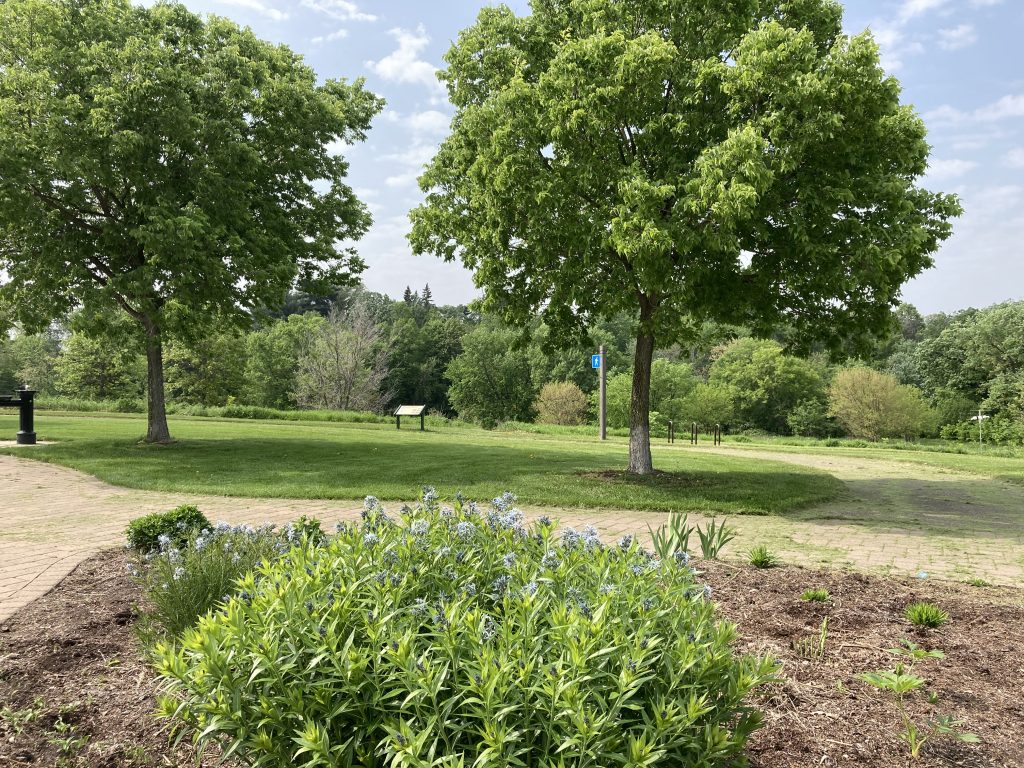
2 trees in the background, a flowering bush with faint purple flowers in the foreground
tiny purple flowers (if you really believe)
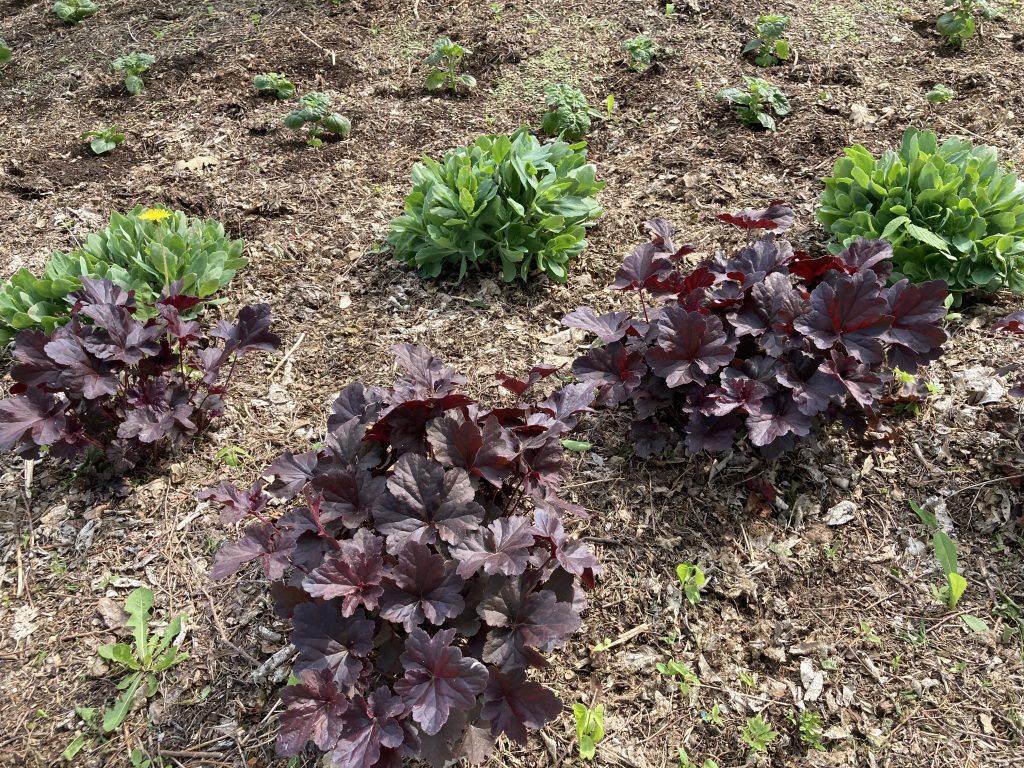
a reddish purplish plant
a reddish, purplish plant

I can’t really see any purple in these, or much of anything, but maybe you can?

Other purple things I remember encountering: the gentle, queer curve of a branch towering over the trail — as I ran under it I thought, that’s very purple. Then the face of a child in the midst of bellowing frustration — I didn’t see their face, but I imagined it could be a deep purple. Purple whispers in the trees.

No purple cars or shirts or shoes or bikes or signs or birds or left behind objects in the grass. Mostly just green and blue.

after the run

Apparently the leaving of strange offerings at Emily Dickinson’s grave is a thing. In her play on Susan Howe’s My Emily Dickinson and Ruefle’s My Emily Dickinson, Meg Shevenock writes, in My My Emily Dickinson:

Then, there’s this: after visiting Emily’s house, my friends and I made a small parade to visit her grave, and the objects I knew would be there, were there. Best of all, a white plastic pen with white cap from a hotel. Or best of all, a blue pencil cracked and dried, that had weathered so much snow. We all want her to say more, write more, about who she was; or, we want to say, I get it, I’m a writer too, and we also know it’s impossible, so we leave an object from the world, from a day long beyond her breathing, to get as close to touching as stone.

My My Emily Dickinson/ Meg Shevenock

may 23/RUN

6 miles
annie young meadows
66 degrees

Another beautiful morning. Sun, birds, clear paths. The big toe on my right foot hurt for the first 5 minutes. Not sure what’s wrong with it, but it started hurting a few weeks ago. A similar thing happened when I was breaking in a new pair of running shoes 2 years ago. Is it because of the new running shoes I started wearing last month? The pain went away by the time I reached lake street and didn’t return.

Ran to franklin then down the hill to annie young meadows. Turned around and took the steps down to the path right next to the retaining wall and the river. The path was covered in soft sand because of the recent flood. Ran to the bottom of the franklin hill, then walked about 1/2 of it. Put in Taylor Swift’s Midnights for the rest of the run.

I encountered 2 roller skiers and one rollerblader! Don’t think I heard any clicking or clacking of ski poles. No rowers. A few bikers, at least one fat tire.

Mary Ruefle and Blue Sadness

before the run

from My Private Property/ Mary Ruefle

Blue sadness is sweetness cut into strips with scissors and then into little pieces by a knife, it is the sadness of reverie and nostalgia: it may be, for example, the memory of a happiness that is now only a memory, it has receded into a niche that cannot be dusted for it is beyond your reach; distinct and dusty, blue sadness lies in your inability to dust it, it is as unreachable as the sky, it is a fact reflecting the sadness of all facts. Blue sadness is that which you wish to forget, but cannot, as when on a bus one suddenly pictures with absolute clarity a ball of dust in a closet, such an odd, unshareable thought that one blushes, a deep rose spreading over the blue fact of sadness, creating a situation that can only be compared to a temple, which exists, but to visit in one would have to travel two thousand miles on snowshoes and by dogsled, five hundred by horseback and another five hundred by boat, with a thousand by rail.

during the run

I wanted to think about blue as I ran. At first flash, lots of things looked blue — cars, t-shirts, the trail. Most of them turned gray or black or anything but blue when I looked at them for longer. It’s funny how when I’m thinking about a color, that’s what my brain sees everywhere. I did see a few blue t-shirts, a bright blue bike parked by the trestle, blue signs, blue sky.

The sky was a pale blue, which made me think of the Ted Kooser line from his poem, “Turkey Vultures” — it is as if they were smoothing one of those tissue paper sewing patterns over the pale blue fabric of the air. I wondered why the sky was a pale blue and not a bright blue and whether it was my vision or something about how the light was (or wasn’t?) scattering.

At one point, I heard a creak somewhere and thought: a blue creak. I think that was the only blue sound I recall hearing.

after the run

Re-reading Ruefle’s blue sadness, I’m thinking about how blue light comes in short, choppy waves that scatter more than red or green waves and how Ruefle’s understanding of blue seems to invoke that: strips and pieces of sweetness, memory — nostalgia, reverie, dust, a temple, scattered and out of reach on a shelf, in a far off land.

I don’t think about blue that often and it doesn’t conjure up powerful images for me. My eyes rarely see blue lights on signs. I suppose I think of water, but the water I see/swim in is rarely blue. Perhaps my favorite blues are: the blue hour early on a winter morning, snow looking blue, cerulean, frozen blueberries (not fresh)

may 22/BIKEYARDWORK

lake nokomis and back
bike: 8.6 miles
80 degrees

The first outdoor bike of the year! I’m always anxious, not knowing how much I’ll be able to see on my earliest bike rides of the season, but today was fine. Hooray! Not scared at all, nothing popping up unexpectedly. okay, maybe once when I was focusing on a bike that was approaching from far off, I didn’t notice another bike that was much closer to me. I was more concerned with my tires, which NEED to be replaced; they’ve been leaking air for a few years now. They were fine too. Several times during the bike ride I had a big smile on my face as I thought, I can still bike! then, I get to bike to the lake and swim across it all summer!

10 Things I Noticed

  1. the wind was rushing in and past my ears as I biked south
  2. several bikers on fat tires — I wondered why. Do they know something about the road conditions that I don’t?
  3. the port-a-potties at the falls for the race this past weekend were still there, so were the detour signs
  4. the duck bridge is temporarily gone — it’s being repaired until ? As I biked by, I noticed a chainlink fence and an asphalt trail abruptly ending where the bridge should be — now that’s an image for one of my nightmares!
  5. squeak squeak squeak On your left — some squeaking bikes approaching from behind, then passing me just past the duck bridge
  6. the lake — open water, but not empty water — some people already swimming
  7. the safety boat — a silvery white beacon across the lake
  8. the surreys (Scott’s nemesis) were lining the trail, ready to torment him
  9. an older guy, sitting in a lawn chair at the beach, telling someone a story about how his baseball card collection isn’t worth anything — he said, you might as well throw it all away. — even this card? it should be worth something?! Nope
  10. an even older guy stopping a woman in a bikini walking by and talking at (not to) her about how there aren’t any lifeguards. Couldn’t quite tell what he was saying, but I assume he meant, but there should be! If he had asked me, I would have said — the season doesn’t start until next weekend and who will you be able to hire this early in the year?

yardwork: 1 hour
mowing, raking, pulling weeds
73 degrees

Mowed the front yard, raked some fallen branches, pulled the irritating garlic mustard that erupts every spring. Least favorite thing about it: it always comes back. Most favorite thing about it: it’s satisfyingly easy to pull; it just pops right out! Listened to an audiobook — the 2nd in a murder mystery series where Agatha Christie’s bff and head housekeeper solves murders. This one’s called, A Trace Poison.

I like mowing the lawn with our reel mower. (I didn’t know that it was called a reel mower. Last summer, when I asked the guy working at the store for help I thought he said real mower, and then I thought, as my daughter would say, he gets it. Yes, the only kind of mower to get is a hand-powered one and not a loud, huge monster mower. But no, he just meant a mower with a reel, a reel mower.) Anyway, it’s fun to be outside, and it’s a chance to move while I listen to my book. Unfortunately, as my vision gets worse (and our yard does too), it’s harder to see where I’ve mowed and where I’ve missed. My aesthetic has always been “almost-chic” or that’s good enough, so I don’t mind, but I think Scott might. So this summer, FWA will have to mow, and I’ll stick to pulling weeds.

Mary Ruefle and not knowing or knowing nothing

Today I finally arrived at the part in Madness, Rack, and Honey in which Mary Ruefle uses one of my favorite quotes of hers, a quote that was an inspiration for my “Bewildered” poem:

The difference between myself and a student is that I am better at not knowing what I am doing.

“Short Lecture on Socrates,” page 250

I am almost positive I did read this exact passage when I checked out this book from the library, but maybe I didn’t? Anyway, reading Ruefle’s book was much later after I had already encountered the quote and fallen in love with the idea of being better at not knowing. I first read it in an article about bewilderment, Less Than Certain. I had no idea (or no memory of it, at least) that the quote is in a lecture about Socrates and the unknowingness/not knowing/knowing nothing as the foundation of Western civilization. Wow. I forgot to take my own advice to always think about the larger context of a quote that I want to use!

Reading this small lecture, recognizing that we know nothing seems to be about humility. Recognizing the limits of what you do or can know. Not believing you can know everything. In another article on this topic that mentions Ruefle’s quote, Jack Underwood echoes this:

What interests me about poetry is that rather than looking up for answers, it tends to lead us back indoors, to the mirror, as if seeing ourselves reflected within its frame, confused, gawping, empty-eyed, and scalded by circumstance, might re-teach us the lesson: that meaning presents itself precisely as a question — therefore, you can’t entertain it by seeking to answer it. Imagine! The old, old universe, arranging itself legibly into a puzzle that our small brains might be qualified to solve with the knowledge we can accrue from our small corner of its tablecloth. Solving the mysteries of the universe: isn’t that just the most arrogant, preposterous thing you ever heard? The idea of there being some sort of Answer to Everything is an admirable feat of imagination but also displays a woeful lack of it.

On Poetry and Uncertain Subjects

Even as I appreciate the importance of humility, I like thinking about this not knowing or knowing nothing in other ways.

Not knowing as an action. To actively not know something. This could mean unlearning it, to be engaged in the act of not knowing it or divesting (disinvesting?) from it. Or it could mean willful ignorance — a refusal to know some fact, someone. I choose to not know! It could be Mary Ruefle’s wonder from “On Secrets” — I would rather wonder than know. Or it could my moment or many moments of refusing to conceal my not knowing to others, to admit/embrace/accept that I can’t see that bird, right over there, that you are pointing out to me.

Knowing nothing as knowing the thing, or things, that is/are nothing, where nothing is a space where time is stopped or where productivity doesn’t happen (Ross Gay). Or where nothing is the Void, the absence, the blank space around which we orbit, trying to find meaning or possibility or connection. Or where nothing is Marie Howe’s singularity:

No I, no We, no one. No was
No verb      no noun
only a tiny tiny dot brimming with

is is is is is

may 21/RUN

3 miles
turkey hollow
66 degrees

Since it was a late Sunday morning on a beautiful day, I decided to avoid the river road path. I ran on Edmund and the grassy boulevard instead. My left hip and knee felt a little sore, and the run didn’t always feel easy, but it was still great to be outside moving. The thing I remember most was the birds at the beginning. So many chirps and tweets and trills. Much louder near my house than by the river.

Greeted Dave, the Daily Walker. Encountered a lot of bikers, runners, a big group of walkers in matching black shirts, 3 kids playing basketball out in the street.

Overheard a conversation and intended to remember what one of the woman said, but I forgot within a few minutes.

Tried to run in the shade, avoid the warm sun. Felt overdressed in shorts and short-sleeved shirt. Next time: tank top.

Looked for turkeys in turkey hollow. Didn’t see even one. Looked at the window of the poem house. Still the same poem from last December.

At the end of the run, as I was walking home, I pulled out my phone, planning to practice reciting the poem I re-memorized the morning — “Writing a Poem”– into it, but there were several people nearby and I felt self-conscious. I was inspired to re-memorize this poem because of the loud weed whacker that was buzzing in my brain late yesterday morning while I was trying to read Mary Ruefle. So loud! It’s dzzzzzzzzzz (not the dizz dizz dizz of the poem) taking over everything.

This morning, during my usual routine or reading poems.org, I discovered this wonderful interview with the poet, Sarah Audsley. There are many things in this interview I’d like to revisit, but especially this:

FWR: You’re also a self-described rural poet. How would you say place and/or the pastoral influence your writing?

Sarah Audsley: “The rural poet” seems like it is in contention with “the city poet.” For me, maybe it is! Because, for me, place and my connection to place is essential. I enjoy visiting cities and being an interloper in city life, but I will always choose to live in a rural place. Walking my dog three times a day, cross country  skiing in the winter, and hiking in the mountains in the summer, offsets all the daily computer grind. I like to think, too, that it feeds the work. To put it in another way, I’m a better poet if I’ve spent some time outside noticing and moving in the woods. The natural world offers me a sense of belonging. So, of course, this will appear in the poems. As for the pastoral poetry tradition, two poets and influences come to mind: Vievee Francis and the “anti-pastoral” poems in Forest Primeval, and Jennifer Chang’s Bread Loaf Lecture, “Other Pastorals: Writing Race and Place” (June 2019, available here.)

Mary Ruefle, “On Secrets”

Secret #7

Every word carries a secret inside itself; it’s called etymology.

It is the DNA of a word. To crack or press a word is to use its etymology to reveal its secrets, all still embedded in the direct action of ancient and original metaphor.

page 91

The psychic energy required and used in writing a poem is also a secret. Where did it come from? How did it get here and where is it going?

These are the questions we ask ourselves when we write, and these are the questions an astronomer asks of the stars.

Consider the word consider, which originally meant “to observe the stars.”

Consideration leads to comprehension, which originally meant “to grasp, to seize something with the hands and hold it tight in the arms”: what the mother does with the child. To hold, to put one’s arms around.

As Jung once wittily noted: “When the neurotic complains that the world does not understand him, he is telling us in a word that he want his mother.”

And who among us is not neurotic, and has never complained that they are not understood? Why did you come here, to this place, if not in the hope of being understood, of being in some small way comprehended by your peers, and embraced by them in a fellowship of shared secrets?

I don’t know about you, but I just want to be held.

To say that consideration leads to comprehension is to say that observation leads to action. The tasks of the outside world must be observed and then embraced privately, just as the astronomer looks through his telescope, considers the stars, and embraces the universe in the closed space of his mind.

Enter the cold dark matter.

Enter the anti-secret of every word. There is no comprehension. Our comprehension is limited. Language can only hold for a moment before the embrace disintegrates.

pages 92-94

The two sides of a secret are repression and expression, just as the two sides of poem are the told and the untold. We must be careful not to take the word as the meaning itself; words no not “capture” a moment as much as they “communicate” it—they are a bridge that, paradoxically, breaks isolation and loneliness without eradicating it. It is the first experience you ever had of reading a decent poem: “Ph, somebody else is lonely, too!”

Secret #9

In the end I would rather wonder than know.

*
Because I would rather wonder than know, my interests and talents lie in the arts rather than the sciences, although, like the monk who discovered champagne–an accidental event that unexpectedly happened to his wine–I have on occasion come running with open arms toward another with the news, “Look! I am drinking the stars!”

page 101

I would rather wonder than know. Yes!

a few hours later: Scrolling through instagram I found a poem by Laura Gilpin:

IV / Laura Gilpin

The things I know:
how the living go on living 
and how the dead go on living with them
So that in a forest
even a dead tree casts a shadow 
and the leaves fall one by one 
and the branches break in the wind 
and the bark peels off slowly 
and the trunk cracks
and the rain seeps in through the cracks 
and the trunk falls to the ground
and the moss covers it

and in the spring the rabbits find it 
and build their nest inside 
and their young will live safely
and have their young
inside the dead tree
So that nothing is wasted in nature
or in love.

I like this poem; I also like the title of the book it’s from — The Hocus-Pocus of the Universe — which made me remember a line from Ruefle’s lecture on secrets:

the sacred word is a secret and cannot be spoken without consequence, be it blessing or curse. There is simply too much power in certain words, and the unnerving force of naming casts a great spell over language and, in one very important sense, created poetry, since to invoke sacred powers, bypass words were employed, incantations without any meaning at all, such as abracadabra, words that of course became imbued with as much power as what they were trying to invoke. And then, as often happens, it worked in reverse, so that very sacred words or phrases bypassed themselves, through a living version of the parlor game Password, where a word is passed or repeated from ear to ear until it changes into gibberish. To my mind, the most paralyzing example of this process is one origin theory of the term hocus-pocus, that it was once hoc est corpus — This is my body ….”

page 81

may 20/RUN

4.5 miles
marshall loop (to cleveland)
67 degrees

Warmer today. The river was glittering as I ran above it, over the lake street bridge. Ended up at the St. Thomas Campus just after graduation was ending. Oops. Crowded sidewalks, a huge group of people waiting behind me at the stop light. A few near misses with people taking over the sidewalk.

I almost forgot — at the very beginning of my run, one block from my house, I heard someone playing Take Five on their saxophone inside somewhere. Then I saw someone working in their front yard and I thought — it’s nice to be outside in the city in the midst of other people doing their Saturday late morning things.

Anything else? no smells or things tasted that I recall. the feel of soft sandy grit on the edge of the bridge sidewalk, softer and deeper than on other parts of the trail. different voices after graduation, talking about parties and parking and — ? saw the shadow of a bird pass over my head.

Mary Ruefle, “Introduction” to Madness, Rack, and Honey

allegiance to poetry

my allegiance to poetry, to art, is greater than my allegiance to knowledge and intelligence, and that stance is harder and harder to maintain in today’s world, because knowledge and intelligence form the corporate umbrella (the academy) that shelters and protects poetry in a culture that cares about other things.

a definition of poetry

I do not think I really have anything to say about poetry other than remarking that it is a wandering little drift of unidentified sound, and trying to say more reminds me of following the sound of a thrush into the woods on a summer’s eve–if you persist in following the thrush it will only recede deeper and deeper into the woods; you will never actually see the thrush (the hermit thrush is especially shy), but I suppose listening is a kind of knowledge, or as close as one can come, “Fret not after knowledge, I have none,” is what the trhursh says. Perhaps we can use our knowledge to preserve a bit of space where his lack of knowledge can survive.

I love this idea of preserving space for things outside of knowledge or what is considered intelligible by those in power. I remember now running across the lake street bridge and thinking about the value of space and room to breathe and be in as many ways as possible.

may 19/RUN

4.75 miles
veterans’ home loop
50 degrees

Wore my orange sweatshirt today. Partly cloudy, cooler, some wind. My legs felt like logs until I warmed up, about a mile into the run. Listened to some blue jays screeching, kids laughing, old guys talking. Forgot to look at the river or listen for the falls. Avoided a BIG school group above the falls — 4 or 5 full-sized school buses in the parking lot. Didn’t stop to walk up the small hill at the veterans’ home. Kept running until I reached 4 miles then walked while I put in my headphones. I listened to Lizzo for the last minutes of the run — Hi motherfuckers, did you miss me? I’ve been home since 2020. I’ve been twerkin’ and making smoothies. It’s called healing and I feel better. I love Lizzo.

Mary Ruefle and the madness of wasting time

continuing my discussion of her lecture, “Madness, Rack, and Honey.”

before the run

A few of the poets/writers Ruefle cites talk about nothing — the Great Nothing (Tess Gallagher), doing nothing (Gertrude Stein). I’m thinking about Auden and Ross Gay and the idea of making nothing happen, which I recently wrote about on march 29, 2023.

during the run

Every so often during the run, I thought about nothing and being useless — at least if usefulness is measured by capitalism and its values. At one point I thought about my running and writing practice — how much time I’ve put into it, or how much time I’ve wasted on it. Here I’m thinking about wasting time as something a poet (or someone who writes poetry) needs, desires.

after the run

I’m revising a few of my mood ring poems in order to submit all of them for a chapbook contest, so I don’t ave a lot of time to spend on reading Ruefle. For now, here’s a little bit on madness:

madness

The madness of poetry is that it creates sweetness, so that the flies might come and eat till it is gone. “To endlessly make an end of things,” says Paul Celan in a poem, and that’s it, inexplicably and exactly. ”

*

If the flies keep feasting, the honey will be gone. Then the flies will go away. And there will be nothing sweet. The poet has to either begin again–poor Creature!–or write a poem that goes on forever, and what a torment that would be! Even the long poem ends.

140

may 17/RUN

6 miles
annie young meadow and back
55 degrees

The perfect temperature for a spring run. The light looked strange. Filtered through trees, clouds, haze? it looked almost pink or light orangish-pink. I liked it. Everything, everywhere thick with green.

note, 19 may, 2023: talked with Scott and RJP about the strange light, which has continued: forest fires

I greeted the Welcoming Oaks and good morninged Mr. Morning! and another regular — did I ever name him? Maybe it was Mr. Holiday?

I chanted in triple berries to keep a steady rhythm — strawberry blueberry raspberry — and tried to stop thinking or noticing anything, to just be on the path, moving and breathing. What did I notice anyway?

10 Things I Noticed When I Wasn’t Noticing

  1. 2 stones stacked on the ancient boulder
  2. down in the flats, the river was moving fast. I tried to race it
  3. white foam on the river, under the I-94 bridge I thought (or hoped?) it was a rowing shell
  4. a fat tire bike sped down the franklin hill, abruptly turned at annie young meadow and almost ran into a parked car, then called out to the guy in the car — his friend — Hey!
  5. the bucket of a big crane curled under the franklin bridge with a worker in it, studying the underside of the bridge
  6. a guy walking on edmund in a bright yellow vest, no other vest wearers or official vehicles in sight
  7. a runner coming down the other franklin hill — the one near the dog park — then entering the river road trail 25 yards? ahead of me
  8. smell: pot, down in the flats
  9. a woman stopped at the edge of the trail, looking through a camera lens at a tree on the other side of the road. I thought about calling out, what’s in the tree?, but didn’t
  10. the weeds on the edge of the trail, poking out of cracks in the asphalt looked monstrous — now I can’t remember what I thought they were at first, just not weeds
  11. bonus: a turkey! chilling in the grassy boulevard between edmund and the river road

I don’t really remember what I heard as I ran without headphones toward franklin. After stopping 3/4 of the way up the hill to walk, I put in music. I thought I put in Lizzo’s Special but I must have forgot to tap something because when I hit the play button it was Dear Evan Hansen again. Oh well.

Mary Ruefle, “Madness, Rack, and Honey”

Last night during Scott’s community jazz band rehearsal, after our regular community band rehearsal, when I sit for an hour and try to read or write or think about my poetry, I started Ruefle’s titular lecture (is that the correct way to use titular?). Now, after my run, I’m back at it again. This lecture is a chewy bagel and I’m determined to not spend too much time on it.

The title is strange — what does she mean by madness, rack, and honey? — and I was pleased to discover that she devotes the lecture to explaining the title. She begins with a Persian poem:

I shall not finish my poem.
What I have written is so sweet
The flies are beginning to torment me.

honey:

It is so simple and clear: the “figurative” sweetness of the author’s verse has become honey, causing “literal” flies to swarm on the page or in around the autor’s ead. This is truly the Word made flesh, the fictive made real, water into wine. That is the honey of poetry: the miracle of its transformation, which is that of creation: once there was a blank page–scary!–now there is something in its place that is attracting flies. Anyone who has not experienced the joy, pleasure, transport, and who has not experienced the joy, pleasure, transport, and sweetness of writing poems has not written poems.

pages 130-131

rack:

Enter the flies who feast. For the poem clearly reminds us that honey has complications–those flies are beginning to torment the poet. Torment, pain, torture, is what I mean by the rack.

page 134

It is what poetry does to the world, what poets do with words, and what words will do to a poet. And that’s the rack of it. And if you have never experienced the rack while working on a poem then you have have never worked on a poem. Have you never put language in an extenuating circumstance with dangerous limits until an acute physical sensation results?

page 135

And, if I have time, I’ll return for madness later today.

One more thing to post before I go eat lunch. Instead of posting the poem, which I also like, I’m only posting the poet’s explanation of it.

About This Poem (Evening)

“Sometimes you hear a word as if for the first time, a word you’ve been saying your whole life. I don’t know what in the brain allows the word, in that moment, to reveal itself, but it always makes me feel very smart and very foolish at once. This poem was written during the period when I had just gotten into gardening and was gaining a new appreciation for everything—food, nature, and time. I wonder what else is waiting to reveal itself to me in such a way, and whether I’ll be distracted enough to receive it.”
Jeremy Radin

Now I’m thinking of the opening lines from Marie Howe’s “The Meadow”: As we walk into words that have waited for us to enter them…is this idea of walking into words similar to words (and new meanings) revealing themselves to us? As I write this question, I’m reminded of a Mary Ruefle piece in My Private Property: “In the Forest”

When I wander in the forest I am drawn towards language, I see meaning is quaintly hidden, shooting up in dark wet woods, by roots of trees, old walls, among dead leaves…

page 74

And these lines helped me to remember a thought I had as I ran this morning on the part of the pedestrian path that dips below the bike path, the two separated by a slight rise and some bushes. When I first started to run this trail, almost 10 years ago, I was a little afraid of taking this lower trail. It was hidden from the road and other people and I wondered if someone might be lurking, waiting for me. Today I thought, how could I have been afraid of this short part of the path, only hidden from view for a few seconds? It does seem ridiculous.

may 15/RUN

3.45 miles
locks and dam #1 hill
57 degrees

Wow! A beautiful spring morning. Sunny, low wind, birds. Favorite part of the run was hearing, then seeing, the geese under the ford bridge. Honking as they flew low then landing in the river, their feet skimming the water — what a beautiful sound that is — not sure how to describe the sound of a bird coming in for a landing.

Listened to the birds, no specific bird, just BIRDS!, as I ran south, then put in “Dear Evan Hansen” at the top of the hill and listened to that as I ran north.

Mostly my body felt strong and sore, especially the big toe on my right foot.

Mary Ruefle, “On Fear”

before the run

The second form of dread is the anticipatory dread of pain, either physical, emotional, spiritual, or psychological, and that, folks, covers nine-tenths of the world’s surface.

Ruefle lists Julian of Norwich’s 4 forms of dread:
dread form 1 = emotion fear — your very first response to smell of smoke
dread form 3 = doubt or despair
dread form 4 = hold dread with which we face that we which we love the most

Dread. I like it better than the word fear because fear, like the unconscious emotion which is one of its forms, has only the word ear inside of it, telling an animal to listen, while dread has the word read inside of it, telling us to read carefully and find the dead, who are are also there.

For some reason, this word play reminded me of a delightful poem I read by Kelli Agodon Russell a few months ago:

Believing Anagrams/ Kelli Agodon Russell

—after being asked why I write so many poems about death and poetry

there’s real fun in funeral,
and in the pearly gates—the pages relate.

You know, i fall prey to poetry,

have hated death.

all my life,
literature has been my ritual tree—

Shakespeare with his hearse speak, Pablo Neruda, my adorable pun.

So when i write about death and poetry, it’s donated therapy

where i converse with
Emily Dickinson, my inky, misled icon.

and when my dream songs are demon’s rags,
i dust my manuscript in a manic spurt

hoping the reader will reread because i want the world

to pray for poets as we are only a story of paper. 

This poem is from her collection, Letters from the Emily Dickinson Room. It seems fitting to read and post this poem on Emily Dickinsons death date — May 15, 1886. I love her anagram for Emily Dickinson: inky, misled icon

during the run

I thought about reciting Dickinson poems as I started running, but forgot about it before I even reached the river. Near the end of the run, while I listened to “Dear Evan Hansen,” I thought about fear and dread and wondered where worry fit in.

after the run

I’m slowly reading more of Ruefle’s “On Fear”:

She talks about the difference between emotions (instinct) and feelings (cognitive), and emergencies of feeling. She lists what other poets have said about fear, then lists her fears. And she returns to Julian of Norwich:

“Fear and dread are brothers,” says Julian of Norwich. As desire is wanting and fear is not-wanting.

After this mention of Norwich, Ruefle devotes several pages to Keats and his idea of negative capabilities. I’ll leave a discussion of that for another day, when I have time.

She ends with a reference to Emily Dickinson, which, like Russell’s poem seems fitting to include:

What has life taught me? I am much less afraid than I ever was in my youth–of everything. That is a fact. At the same time, I feel more afraid than ever. And the two, I can assure you, are not opposed but inextricably linked. I am more or less the same age Emily Dickinson was when she died. Here is what she thought: “Had we the first intimation of the Definition of Life, the calmest of us would be Lunatics!” The calm lunatic–now that is something to aspire to.

The passage from ED comes from a letter and also includes these wonderful lines:

There is a Dove in the Street and I own beautiful Mud – so I know Summer is coming. I was always attached to Mud, because of what it typifies – also, perhaps, a Child’s tie to primeval Pies.

Letter from Emily Dickinson to Mrs. JG Holland (about March 1877)

Two more things I found from an early (1862) letter from Dickinson to Higginson. The first fits with Ruefle’s discussion of fear and poets:

I had a terror-since September-I could tell to none-and so I sing, as the Boy does by the Burying Ground-because I am afraid-

The second I’m including because I find it delightful:

You ask of my Companions Hills- Sir-and the Sundown-and a Dog-large as myself, that my Father bought me-They are better than Beings-because they know-but do not tell-and the noise in the Pool, at Noon – excels my Piano. 

may 11/RUN

5.85 miles
ford loop
62 degrees
humidity: 77%

Too hot, too humid, tired. I tried running earlier today (9 am instead of 10:30), but it was still too late. Even so it was a good run that I’m glad I did. Ran the ford loop and spent the first 3.5 miles convincing myself to keep going, to not stop until I reached the overlook near the ford bridge. (I did it!) Then I put in “Dear Evan Hansen” and started running again, or should I say struggle running. Stopped a few times to walk, feeling wiped out, but kept running again. Whew.

At the start of my run, I heard the robin’s cheer up! cheer up! and a woodpecker’s knock. Later, I heard a pileated woodpecker’s laugh, not sounding exactly like Woody the woodpecker, but close enough.

Smelled wet cinnamon — dripping blossoms? — and thought about chewed-up Big Red.

Felt too hot, my face burning, probably bright red. The drip drip drip of sweat from my ponytail on my neck.

Greeted the Welcoming Oaks, noticed the floodplain forest was hidden in green.

Mary Ruefle, White, Brown

before the run

I’d like to do one color at a time, but I couldn’t decide between her white or brown color poems so I’m including both of them. I think I’ll let running Sara decide. Will she choose to focus on white things or brown things, both or neither?

from My Private Property/ Mary Ruefle

White sadness is the sadness of teeth, bones, fingernails,
and stars, yes, but it is also the sadness of cereal, shower
caps, and literary foam, it is the sadness of Aunt Jenny’s
white hair covering her body like a sheet, down to her toes,
as she lay on the sickbed, terrifying the children who were
brought in one by one to say goodbye. It is the sadness of
radio waves traveling through space forever, it is the voice
of John Lennon being interviewed, his voice growing
weaker and weaker as the waves pass eternally through a
succession of galaxies, not quite there, but still . . .

*

Brown sadness is the simple sadness. It is the sadness of
huge, upright stones. That is all. It is simple. Huge, up-
right stones surround the other sadness, and protect
them. A circle of huge, upright stones–who would have
thought it?

Ruefle’s line about the stars and galaxies in her white sadness poem, makes me think of the new word I learned this morning from the title of a poem: sidereal

sidereal: (adj) of or with respect to the distant stars (i.e. the constellations or fixed stars, not the sun or planets).

pronounced: cy deer e ul

during the run

Running Sara tried to think about both white and brown and it worked, mostly, but green kept declaring, I’m here! Notice me! Green Green Green! So much green everywhere and all of a sudden. There I was, on the trail, running and noticing white sweatshirts tied around waists or brown leaves littering the ground, when green would hijack my thoughts. brown trunk GREEN leaves pale white sky GREEN air

5 Brown Moments and 5 White Ones

  1. river: brown with light brown foam
  2. same river from the other side: deep blue with white foam
  3. brown tree trunks
  4. a brown sound: the knocking of a woodpecker on a dead tree
  5. a flash of the white, almost silver, river through the trees
  6. a limestone wall, the part of it illuminated by sunlight was white
  7. white sands beach, viewed from the other side of the river
  8. the brown trail leading down to Shadow Falls
  9. a white sound: the vigorous tinkling of the falls falling
  10. the brown boulder with 4 small stones stacked on its top

I like listening to “Dear Evan Hansen” while I run. Together they — the emotional lyrics/music combined with how I soften as I exert myself — make me feel things: sad, tender, hopeful, a deep aching joy. I thought of how Ruefle’s color poems can be read as sadness or happiness, which then made me think of Ross Gay’s understanding of joy as both grief and delight.

Another thought I had about brown while running: Thinking about the brown sadness of Ruefle’s huge upright stones, I suddenly thought: the gorge. The gorge, with its huge limestone, sandstone walls is both brown sadness and brown happiness.

after the run

White happiness is the happiness of crisp sheets hang-
ing on the line just to the side of the farmhouse, of soft
shimmering salt pouring out of a cheap salt shaker, of a
button-down oxford reluctantly worn.

Here’s the poem about the white stars that I mentioned earlier in the post:

Sidereal/ Debra Albery

Consider this an elegy with silo and fever.
Call it barn and gravel and gone. Grasses’ obeisance

in the wake of a pick-up, sun searing the leaves
green to gold in the season’s time-elapse.

Where does it go, the Sunday angle of sunlight
once only yours, wide and open as a window?

Here’s what I remember: the flaking mural
on the brick wall of neighborhood grocery, saying

Food for the Revolution for twenty-five years.
Stacked landscapes in my rearview, blank as a calendar

until a bend in the road brought the Blue Ridge;
the pocked metronome of tennis balls outside

while I harnessed what I had lost and missed
in minor-key pentameter. So what, my mentor

talked back to his tercets in draft after draft:
so what so what so what. “This essay is accurate

but never ignited,” the Derridean scrawled
in red ink when I was writing about Bishop writing,

I can scarcely wait for the day of my imprisonment.
Her keen eye ever cast on the homely unheimlich.

Call this a road story about the slow burn of foliage,
about containment, what conspires against arrival.

Astonish us, Diaghilev said to Cocteau,
but all I ever wanted was to consider

its roots in the auguries of our shifting stars.

About This Poem

“‘Sidereal’ is, as the poem declares itself, a road story, a cross-country retrospective traversing decades. It is, as it also states, an elegy—in part honoring a past teacher, Larry Levis. The ‘so-what-so-what’ refrain is his, handwritten above a line on an early draft of his poem ‘Caravaggio: Swirl & Vortex.’ That self-interrogation set in motion a poem of motion that longs for dwelling—as did the swirl and vortex of etymology, sidereal and consider both deriving from sidereus, meaning ‘star,’ itself of uncertain origin.”
Debra Allbery

words I looked up, which I mostly knew, but wanted to be precise:

obeisance: deference
auguries: omens
unheimlich: uncanny

I like the line, barn and gravel and gone. Reading it again, and thinking about this poem about restlessness and belonging, I’m reminded of a time in my life when I tried to (still) belong to a farm that was barn and gravel and gone — a family home place, sold.

may 10/YARDWORK

1 hour
mowing, raking, pulling weeds
70 degrees

After almost 2 months of preparing for, then waiting, then watching it happen, the house is finally painted. Now I can mow and garden and bring out the umbrella for the deck. Hooray! Since I knew I should have a day off from running — having run 4 days in a row, I decided to do yardwork today.

Yardwork. And now the yardwork is over (it is never over), today’s
Stint anyway. Odd jobs, that stretch ahead, wide and mindless
–“Hymn to Life”/ James Schuyler

Today it feels like summer but the backyard looks like early spring. Tulips in full bloom, peonies popping up with their green shoots that look like asparagus — at least to me. Big bare patches from where robins had dropped crabapple seeds in late winter. Dandelions, garlic mustard, creeping charlie, the half-mulched leaves left over from late fall.

I listened to a Maintenance Phase episode — Oprah v. the beef industry — while I mowed and raked and swept up scattered mulch.

10 Things I Noticed

  1. everywhere, in the back and front yards, the ground seemed soft — too soft. is it the ants?
  2. right next to the front step, a giant mound — an ant hill
  3. the soft metallic whirr of the reel mower blades
  4. the distinctive thunk of the blade getting jammed from a small twig
  5. strange — bare vines by the yucca bushes — is this ground cover dead/dying, or have the leaves not appeared yet. is it the ants?
  6. the sloped front lawn, soft and bare, a few patches of weeds, some suspicious looking soft dirt. is it the ants?
  7. weeds infiltrating the red and yellow tulips on the south side of the house
  8. a few bright green leaves growing on the hydrangea twigs
  9. some small maple leaves poking out from the spirea
  10. small asparagus-like stalks emerging from the earth — time to put the cages around the peonies before they get too big to tame!

Mary Ruefle and Washing Dishes

In the opening lines of “Towards a Carefree World,” Ruefle writes:

Many of the most astonishing writers in the world had ser-
vants. It is doubtful they ever really washed the dishes.
Which is too bad; I think they would have enjoyed wash-
ing the dishes, especially after dinner. Repetitive motion
can take your mind off things. By things I mean the cares
of this world.

With these lines, I decided to think about washing dishes.

1

Mother, Washing Dishes/ Susan Meyers

She rarely made us do it—
we’d clear the table instead—so my sister and I teased
that some day we’d train our children right
and not end up like her, after every meal stuck
with red knuckles, a bleached rag to wipe and wring.
The one chore she spared us: gummy plates
in water greasy and swirling with sloughed peas,
globs of egg and gravy.

Or did she guard her place
at the window? Not wanting to give up the gloss
of the magnolia, the school traffic humming.
Sunset, finches at the feeder. First sightings
of the mail truck at the curb, just after noon,
delivering a note, a card, the least bit of news.

2

What the Living Do/ Marie Howe

Johnny, the kitchen sink has been clogged for days, some utensil probably fell down there.
And the Drano won’t work but smells dangerous, and the crusty dishes have piled up

waiting for the plumber I still haven’t called. This is the everyday we spoke of.
It’s winter again: the sky’s a deep, headstrong blue, and the sunlight pours through

the open living-room windows because the heat’s on too high in here and I can’t turn it off.
For weeks now, driving, or dropping a bag of groceries in the street, the bag breaking,

I’ve been thinking: This is what the living do. And yesterday, hurrying along those
wobbly bricks in the Cambridge sidewalk, spilling my coffee down my wrist and sleeve,

I thought it again, and again later, when buying a hairbrush: This is it.
Parking. Slamming the car door shut in the cold. What you called that yearning.

What you finally gave up. We want the spring to come and the winter to pass. We want
whoever to call or not call, a letter, a kiss—we want more and more and then more of it.

But there are moments, walking, when I catch a glimpse of myself in the window glass,
say, the window of the corner video store, and I’m gripped by a cherishing so deep

for my own blowing hair, chapped face, and unbuttoned coat that I’m speechless:
I am living. I remember you.

3

Mostly I like washing dishes. It’s a chance to move after a meal, or as a break from writing. I listen to a podcast — Maintenance Phase, Ali on the Run, Vs., Between the Covers — or an audio book while I soak then scrub then rinse. Sometimes I look out the window at the trees swaying in the wind or the sky glowing orange or a squirrel taunting my dog. Occasionally, but not often, I shatter a dish on the granite countertop.

Usually I can see well enough to properly clean the dirty dishes. Sometimes I rely on feel — if it’s smooth, it’s clean; if it’s rough, it’s dirty. My biggest struggle is with the metal cheese grater. I hold it under the light, tilt it in different directions, trying to see if I missed any streaks of cheese. Almost impossible for me to tell.

We have a dishwasher but it hasn’t been working properly for 2 or 3 years now so I hand wash the dishes. Sometimes I wish our dishwasher worked, sometimes I don’t care. Often I wonder if washing dishes will be one more thing lost to me once all of my central vision is gone.

I don’t remember washing too many dishes with my mom, but I do remember drying them for Scott’s mom and dad after dinner. They always had to do the dishes right after eating. It took me years (15? 20?) to finally feel comfortable enough to help them. They were very particular about how you should wash dishes — don’t waste water, make sure they are absolutely dry before putting any dishes away, use a drying cloth that doesn’t leave lint but also doesn’t dry anything. When they both stopped caring about the dishes and how they were done, I knew we were entering the final stage.

Our kitchen faucet had been dying for three or four years. First, it dripped when you turned it off. Sometimes, if I jiggled it just right, it would almost stop. For at least 3 years this happened. Then, the retractable hose started getting stuck. You could pull it out, but not put it back in. Then you couldn’t move it from one sink to the other. Finally, the whole faucet — base and all — wouldn’t stop moving and leaking water into the cabinet below. When this happened Scott abruptly declared it was time, right this minute, to go out a buy a new faucet. So we did. And when we returned home Scott removed the old faucent, which was hard to get out, and put in the new one, which slid in without a problem. Why, I wondered, had we waited so long to get a new faucet?

may 9/RUN

5 miles
bottom of franklin turn around
66 degrees
humidity: 70%

Just as I started my run, one bird then another flew right across my path. Were they sparrows? Heard the squawk call of the downy woodpecker several times. Smelled a smell like Big Red cinnamon gum. I know it’s a flowering bush or tree, but every year I forget what it is. Tried looking it up; I still don’t know. I was tired and sore so the run was hard. I should probably take a break tomorrow. I remember looking at the river but not what it looked like. Heard a dog collar clanging below then something — a dog, I assume — running through the bushes. Noticed a few cars and bikes with headlights on.

No sun today. Everything a rich green, thick and quiet.

Since last week, painters have been painting the outside of our house. A dark gray (gibraltar) with white trim and a bright green (parakeet) door. Very nice. Not only does it look good but by fixing the rotting boards on the garage, scraping away the peeling paint just below the kitchen, and sanding and painting the deck railing, they have eliminated several of the worries that have simmered on low on the back burner in my brain for years. Of course they’ll be replaced with new worries — bothersome ant hills, a yard with more weeds than grass — but I always like to acknowledge the passing of worries so they don’t continue to haunt me.

Listened to cars, my breathing, birds as I ran north, “Dear Evan Hansen” on headphones as I ran north.

Mary Ruefle, “I Remember, I Remember”

Today’s Ruefle selection is the lecture, “I Remember, I Remember.” Each one of Mary Ruefle’s series of recollections about poetry and writing and childhood begins with the phrase, I remember.

I remember, I remember refers to the a poem by Thomas Hood in the first poetry book she ever owned.

Ruefle remembers sending a poem to the publishing company, Little, Brown, and Company as a child and learning from them that Laura Ingalls Wilder was dead and that one of her favorite characters from the book series had died in a threshing accident.

Ruefle remembers reciting “Ode to a Nightingale” to cows in a field when she was 18 and weeping because she loved the poem so much.

Then she remembers many other things — 16 more pages of them — about writers she encountered and poetry.

before the run

I only read the first page of this lecture before going out for my run.

during the run

I remember, about a mile and a half in, I had a thought about remembering and forgetting. I remembered it and then, when I reached the bottom of the hill, I stopped to record what I remembered into my phone:

Thinking about “I Remember” and remembering, origins and when things began. I thought about how there is a sort of origin point to all of this (my writing poetry) and it’s my eye doctor diagnosing me with a rare eye disease then saying, you should write about it which prompted me to want to work on my writing so I could better explain what I was experiencing. But, I had already been writing and already had those desires, so it was really more of a slight shift, a stutter step or a quick stumble off the path, just briefly, which changed the trajectory, slightly, incrementally. Difficult to pinpoint what all changes your path.

after the run

Ruefle’s recollection of reciting a poem in a field to some cows reminds me of how I liked to memorize poems, especially by Shakespeare, and recite them to 3 of my friends as we trudged through Iowa cornfields de-tasseling corn the summer before heading off to college. At that point, I didn’t think I liked poetry. I guess I did.

I remember when I turned 40 and was trying to remember what happened to me as a child, I felt like I had forgotten everything. I wondered how other people could remember so much, me so little.

I remember reading an article about Marilou Henner and how her brain doesn’t forget anything that happens to her, she remembers every detail of every day. I remember thinking that sounded miserable.

I remember writing the phrase, “remembering to forget” and “forgetting to remember” in two different log entries and thinking those were interesting ideas.

I remember the moment of struggle, trying to remember a word from a poem that I had just memorized, then the moment of awareness, realizing what the word was — the moment when forgetting became remembering. Then thinking that the moment of remembering was invigorating and strange and magical — how suddenly something lost was found.

I remember trying to find someone else’s poem that expressed similar feelings about the joy of remembering, but all I could find were poems of sorrow about forgetting.

may 8/RUN

4.5 miles
veterans’ home loop
61 degrees
humidity: 78%

Went out for my run too late (10:30 am) and paid for it. Very hot. I could feel it in my legs, thick and heavy. I was okay for the first half, but needed to walk a few times in the second half. Too much green air. I could feel it in my lungs, heavy and thick.

I could still see the river through the light green leaves, but I don’t remember what it looked like. Was it blue? Probably. Did I see my shadow? I don’t remember. I didn’t hear or see any rowers.

Lots of people at the falls. I ran up the steps by the bridge right above where the creek water falls, two at a time. Looking down from the high bridge that delivers you to the Veterans’ home, everything looked green. I thought I saw one of those stone bridges below but it looked strange — had it fallen into the rushing water? Not sure. On the grounds of the Veterans’ home, I smelled the freshly mowed grass, noticed the dark streaks of wet grass smeared on the sidewalk. Stopped to admire the water rushing over the concrete at the locks and dam #1. Put in my Sara 2020 playlist.

Listened to birds and shuffling feet as I ran south, Lizzo and Billie Eilish and Nur-D on the way back north.

Mary Ruefle and Green

before the run

As spring happens, the sudden shock of new life everywhere, I’m thinking about green, which makes it a good time to read Mary Ruefle’s prose poem about green sadness:

from My Private Property/ Mary Ruefle

Green sadness is sadness dressed for graduation, it is the
sadness of June, of shiny toasters as they come out of their
boxes, the table laid before a party, the smell of new straw-
berries and dripping roasts about to be devoured; it is the
sadness of the unperceived and therefore never felt and
seldom expressed, except on occasion by polka dancers
and little girls who, in imitation of their grandmothers,
decide who shall have their bunny when they die. Green
sadness weighs no more than an unused handkerchief, it
is the funereal silence of bones beneath the green carpet
of evenly cut grass upon which the bride and groom walk
in joy.

funereal: having the mournful, somber character appropriate to a funeral.

Reading about Ruefle’s “color spectrum of sadness,” somebody else pointed out her final words about her color poems in the last sentence on the last page of her book:

Author’s note: In each of the color pieces, if you substitute the word happiness for the word sadness, nothing changes.

Another thing to note about her note: she describes them as pieces not poems. I wonder if she talks explicitly about how/why/what she names them in an interview somewhere? Answer? I found a 2015 interview with her where (I think) she’s discussing My Private Property and she suggests that it contains fiction, essays, and prose poems, which I’m thinking refers to the color pieces. So I’ll stick with calling them prose poems.

I’m also thinking about green because of the Robin Wall Kimmerer story I encountered in the amazing journal, Emergence. I started listening to her reading of it — she has such a wonderful voice! — but it’s 35 minutes, so it will take some time.

Ancient Green / Robin Wall Kimmerer

One wonderful line I’ve already heard:

Mosses, I think, are like time made visible. They create a kind of botanical forgetting. Shoot by tiny shoot, the past is obscured in green. That’s why we have stories, so we can remember.

Yes, the idea of green obscuring/concealing things. I often think about that as I’m running beside the gorge, unable to see the river or the other side because of so much green.

On today’s run, I hope to think about green.

during the run

My green goal was off to a good start when I spotted a bunny in the alley just before starting to run and thought, the bunny from the line about green sadness, little girls who, in imitation of their grandmothers, decide who shall have their bunny when they die.

10 Green Moments and Feelings

  1. At the start of the run, just above the oak savanna, floating through light green air, both in color and weight
  2. Midway through the run, in Wabun, above Locks and Dam #1, plodding through bright green air, thick and hot
  3. green grass in the boulevard — growing fast
  4. green light shining through the trees — glowing soft
  5. green sinuses, closing up my nose
  6. green voices — kids at the playground
  7. green-stained sidewalks — the whispers of grassy sadness
  8. green sky instead of clean blue air
  9. green weeds pushing through pavers, joining the orange tulips beside Longfellow’s “The Song of Hiawatha” at the park
  10. green curiosity — how much of this green am I actually seeing and how much am I conjuring from when I had more cone cells?

As I ran, I also thought about a mood ring poem that I’m revising: incurable. I’m trying to contrast my disdain for searching for a cure for my vision loss which I’m linking to images of pickling, preserving, curing, with my relief in knowing, with some certainty, that there is no cure — this I’m envisioning as being outside in fresh, open spaces with wider views. As I write this description, I think I need to tighten up my fresh images. Anyway, as I ran, I thought that if these images correspond to colors, then curing would be green and fresh would be blue — or should it be another shade (or is it tint) of green?

after the run

a few passages from Ancient Green / Robin Wall Kimmerer:

If success is measured by widespread distribution, they occupy every continent, from the tropics to Antarctica, and live in nearly every habitat, from desert to rainforest. If success is measured by expanse, consider the vast peatlands of the north, blanketed by sphagnum moss. If success is colonization of new places, mosses are the first to occupy new places after an eruption or a forest fire or a nuclear meltdown. If creativity and adaptation are the metrics, mosses have diversified to fill every niche, generating more than eleven thousand uniquely adapted species, an outpouring of biodiversity. If success lies in beauty—well—just look.

Mosses make minimal demands on their surroundings. All they need is a little light, a sheer film of water, and a thin decoction of minerals, delivered by rainwater or dissolution of rock. If they are hydrated and illuminated, they will exuberantly photosynthesize and expand the green carpet. But when times are tough, most simply stop growing and wait until water returns. They don’t die, they just crinkle up and pause, following the rhythms of the natural world, growing in periods of abundance and waiting through periods of scarcity: a wise strategy for life that is in tune with uncertainty.

Moss lifeways offer a strong contrast to the ways we’ve organized our society, which prioritizes relentless growth as the metric of well-being: always getting bigger, producing more, having more. Infinite growth is ecologically impossible and exceedingly destructive, as it demands the transformation of the lives of other beings into raw materials to feed the fiction. Mosses show us another way—the abundance that emanates from self-restraint, from enoughness. Mosses have lived too long on this planet to be seduced by the nonsense of accumulation, the delusion of permanence, the endless striving for productivity. Maybe our heartbeats slow when we sit with mosses because they remind us that contentment could be ours.

Green teachers. Green patience resilience. Green enoughness.

may 7/RUN

3.1 miles
marshall to dogwood loop
57 degrees

Scott and I ran a slightly shorter version of the marshall loop that ended at dogwood coffee. No coffee today, too crowded. Everything is getting green. No fuchsia funnels yet, but some white blossoms, violets (are they violets, or just violet flowers?), tulips. Chirping birds. A downy woodpecker squawking in a tree. I was just about to write that I didn’t remember looking at the river, but then I remembered: lots of white foam everywhere — swirling in the center, collecting on the edges. No rowers again. Anything else? Muddy, wet, humid, hot when the sun was out, very little breeze.

I told Scott a boring story about noticing runners sprinting on the other side of the road as we ran down cretin. He told me that he felt like he was plodding along, that his legs were like logs thumping down on the ground. Then I imagined his legs as logs, which was fun to do — his legs started as thick logs with rough bark, then after a 1/2 block of awkward steps, they peeled off and his human legs appeared.

Another strange story: running down the hill on the east river trail, beside shadow falls, I saw something up ahead. What it actually was was a big white, fluffy dog. What I saw was the bottom half of very broad hipped person walking towards us. This is an example of how my brain tries (and sometimes fails terribly) to guess what my eyes are actually seeing. After telling Scott what I thought I saw, I said, headless and torsoless hips walking towards me? that’s not even a real thing. Come on, brain!

Mary Ruefle

No time to read from My Private Property or Madness, Rack, and Honey, so here’s one of her poems. I remember reading it sometime in the last few years, but not why or when.

The Bench/ Mary Ruefle

My husband and I were arguing about a bench we wanted to buy and put in part of our backyard, a part which is actually a meadow of sorts, a half acre with tall grasses and weeds and the occasional wild flower because we do not mow it but leave it scrubby and unkempt.  This bench would hardly ever be used and in summer when the grasses were high would remain partially hidden from view.  We both knew we wanted the bench to be made of teak so that it would last a long time in the harsh weather and so that we would never have to paint it.  Teak weathers to a soft silver that might, in November or March, disappear into the gray hills that are the backdrop of our lives.  My husband wanted a four foot bench and I wanted a five foot bench.  This is what we argued about.  My husband insisted that a four foot bench was all we needed, since no more than two people (presumably ourselves) would ever sit on it at the same time.  I felt his reasoning was not only beside the point but missed it entirely; I said what mattered most to me was the idea of the bench, the look of it there, to be gazed at with only the vaguest notion it could hold more people than would ever actually sit down.  The life of the bench in my imagination was more important than any practical function the bench might serve.  After all, I argued, we wanted a bench so that we could look at it, so that we could imagine sitting on it, so that, unexpectedly, a bird might sit on it, or fallen leaves, or inches of snow, and the longer the bench, the greater the expanse of that plank, the more it matched its true function, which was imaginary.  My husband mentioned money and I said that I was happier to have no bench at all, which would cost nothing, than to have a four foot bench, which would be expensive.  I said that having no bench at all was closer to the five foot bench than the four foot bench because having no bench served the imagination in similar ways, and so not having a bench became an option in our argument, became a third bench. We grew very tired of discussing the three benches and for a day we rested from our argument.  During this day I had many things to do and many of them involved my driving past other houses, none of which had benches, that is they each had the third bench, and as I drove past the other houses I could see a bench here and a bench there; sometimes I saw the bench very close to the house, against a wall or on a porch, and sometimes I saw the bench under a tree or in the open grass, cut or uncut, and once I saw the bench at the end of the driveway, blocking the road.  Always it was a five foot bench that I saw, a long sleek bench or a broken down bench, a bench with a slatted back or a bench with a solid, carved back, and always the bench was empty. But I knew that for my husband the third bench was only four feet long and he saw always two people sitting on it, two happy or tired people, two people who were happy to be alive or two people tired from having worked hard enough to buy the bench they were sitting on.  Or they were happy and tired, happy to have reached the end of some argument, tired from having had it.  For these people, the bench was an emblem of their days, which were fruitful because their suffering had come to an end. On my bench, which was always empty, nothing had come to an end because nothing had begun, no one had sat down, though the bench was always there waiting for exactly that to happen.  And the bench was always long enough so that someone, if he desired to, could lie all the way down.  That day passed.  Another day followed it and my husband and I began, once more, to discuss the bench.  The sound of our voices revealed a renewed interest and vigor.  I thought I sensed in him a coming around to my view of the bench and I know he sensed in me a coming around to his view of the bench, because at one point I said that a four foot bench reminded me of rough notes towards a real bench while a five foot bench was like a fragment of an even longer bench and I admitted it was at times hard to tell the difference.  He said he didn’t know anything about the difference between rough notes and fragments but he agreed that between the two benches there was, possibly, just perhaps—he could imagine it—very little difference.  It was, after all, only a foot we were talking about.  And I think it was then, in both of our minds, that a fourth bench came into being, a bench that was only a foot long, a miniature bench, a bench we could build ourselves, though of course we did not.  This seemed to be, essentially, the bench we were talking about.  Much later, when the birds came back, or the leaves drifted downwards, or the snow fell, slowly and lightly at first, then heavier and faster, it was this bench that we both saw when we looked out the window at the bench we eventually placed in the meadow which continued to grow as if there were no bench at all.

may 6/RUN

3.75 miles
marshall loop
58 degrees
humidity: 86%

It rained yesterday and early this morning but by the time I headed out the door it had stopped. Everything wet, even the air. So humid! With summer coming, it’s time to stop tracking the feels like temperature and start tracking the humidity. Ugh. Maybe humidity and I can be friends this year?

10 Things I Noticed

  1. from the lake street bridge, the river was a brownish gray and full of foam — and empty of rowers
  2. heard a runner coming up from behind me on the marshall hill. As they passed, they called out great job! this hill is a killer! I think I grunted, yeah!
  3. heard the bells at St. Thomas twice — at 9:15 and 9:30 (I think?)
  4. a block ahead I saw something orange which I thought was a person but was a construction sign
  5. shadow falls was falling today, a soft gushing
  6. encountered a woman in yellow running shoes — or were they lime green? I can’t remember now
  7. running on cretin I noticed a fast runner on the other side, sprinting past St. Thomas — was it the runner that passed me on the marshall hill? maybe
  8. lots of mud, wet dirt, puddles everywhere
  9. the floodplain forest is all light green now, my view to the forest floor gone
  10. running over the lake street bridge, I heard something rattling — was it wind, or the cars driving over the bridge?

Mary Ruefle, “On Beginnings”

I’m working on a course proposal for a 4 week fall version of my finding wonder in the world and the words and I’m thinking of making one of the weeks about fall as time/space for beginnings and endings. So when I saw Ruefle’s lecture, “On Beginnings,” I decided that should be the next Ruefle thing to read.

before the run

I read through the lecture — more quickly than closely — knowing that I would read it again after the run. It’s about beginnings and how there are more beginnings in poetry than endings. The first note I jotted down in my Plague Notebook, Vol 16 was about the semicolon, which is a punctuation mark that I particularly like. Ruefle has just introduced an idea from Ezra Pound that each of us speaks only one sentence that begins when we’re born and ends when we die. When Ruefle tells this idea to another poet he responds, “That’s a lot of semicolons!” Ruefle agrees and then writes this:

the next time you use a semicolon (which, by the way, is the least-used mark of punctuation in all of poetry) you should stop and be thankful that there exists this little thing, invented by a human being–an Italian as a matter of fact–that allows us to go on and keep on connecting speech that for all apparent purposes unrelated.

then adds: a poem is a semicolon, a living semicolon, and this:

Between the first and last lines there exists–a poem–and if it were not for the poem that intervenes, the first and last lines of a poem would not speak to each other.

This line reminded me of a gameshow I was watching — well, listening to because I was sitting under the tv so I couldn’t see it — in the waiting room of a clinic last week. It’s called “Chain Reaction” and contestants have to link two seemingly disconnected words by creating 3 other words between them. An example: Private and Tension. The chain of words connecting them: Private eye level surface Tension

At some point as I read, I suddenly thought of middles. The in-betweens, after the beginning, before the end. How much attention do these get, especially if we jump right in and start with them. It reminds me of a writing prompt/experiment I came up with for my running log: Write a poem about something that happened during the middle of your run–not at the beginning or the end, but the middle (see nov 27, 019).

As I headed out for my run, I hoped to think about middles.

during the run

Did I think about middles at all during the run? I recall thinking about beginnings, particularly the idea that the beginning of something can feel overwhelming — like a long run: How am I going to be able to run for an entire hour? I have learned to remember that you just have to start and usually something will happen that makes it easier. Did I think about endings? Not that I can remember.

after the run

Here are some bits from the lecture I’d like to remember:

(from Paul Valéry) the opening line of a poem, he said, is like finding a fruit in the ground, a piece of fallen fruit you have never seen before, and the poet’s task is to create the tree from which such a fruit would fall.

Roland Barthes suggests there are three ways to finish any piece of writing: the ending will have the last word or the ending will be silent or the ending will execute a pirouette, so something unexpectedly incongruent.

“But it is growing damp and I must go in. Memory’s fog is rising.” Among Emily Dickinson’s last words (in a letter). A woman whom everyone thought of as shut-in, homebound, cloistered, spoke as if she had been out, exploring the earth, her whole life, and it was finally time to go in. And it was.

Here are more things I wrote in my Plague notebook inspired by this lecture:

the MIDDLE

mid-motion
mid-walk, mid-run
Activity: notice and record what you notice in the midst of motion. Pull out your smart phone and speak your thoughts into it.

Not how you got there or were you’re headed, but here now in-between

Threshold Doors Ways in or out
Inner becomes Outer
Turn inside out

And now, even more about beginnings and endings:

Thinking about poems titled, “Poem Beginning with a Line from [insert poet]” or M Smith’s “Poem Beginning with a Retweet”

Or golden shovel poems that make the last word in each line spell out someone else’s poem — it began with Gwendolyn Brooks and “We Cool.”

Where does a poem begin? When does a project, a plan start? How do you write an origin story? What gets left out/lost/forgotten when we draw the arbitrary lines of begin here and end here?

Ruefle mentions crossing a finish line and also old movies that used to conclude with THE END in big letters across the screen. The satisfaction of a clean, clear ending. How often does that happen?

Is death the end? And of what? Is birth the beginning?

Are beginnings and endings only a product of linear time? Or is it that they take on certain meanings, support certain values (like progress) within a linear model?

a few minutes after posting this entry: Found this on twitter:

from Note 167: “Breathing is the beginning. It is, for us, a first and final movement. In it, we find the prototype of all method, without which: nothing. Breathing, thus, is the foregrounding of all concept—its precursor and first condition, its resolution.”

Between the Covers interview with Christina Sharpe

I haven’t listened to the interview yet, but I would imagine that the breathing here is speaking to and about a lot of things, not the least of which is how black bodies are not allowed to breathe or are forced to stop breathing in ways that white bodies are not.

may 4/RUN

3.5
locks and dam #1 hill loopmiles
60 degrees

Another warm day. Hooray! Another chance to run in shorts and a short-sleeved shirt. Saw Mr. Morning! Heard some voices down below in the gorge. Ran down the hill then back up it at locks and dam #1. Noticed a big pile of something on the path — clumps of dirt, rock, is that a furry tail? Probably not, but I can’t tell. Often, I see dead squirrels that aren’t there. The river was blue and not quite as high as it was last week.

Mary Ruefle and pink

before the run

from My Private Property/ Mary Ruefle

Pink sadness is the sadness of white anchovies. It is the sad-
ness of deprivation, of going without, of having to swallow
when your throat is no bigger than an acupuncture pin;
it’s the sadness of mushrooms born with heads too big for
their bodies, the sadness of having the soles come off your
only pair of soes, or your favorite pair, it makes no differ-
ence, pink sadness cannot be measured by a gameshow
host, it is the sadness of shame when you have done noth-
ing wrong, pink sadness is not your fault, and though even
the littlest twinge may cause it, it is the vast bushy top on
the family tree of sadness, whose faraway roots resemble a
colossal squid with eyes the size of soccer balls.

Today, or this morning at least, I shall think of pink. Here’s another pink poem I bookmarked a few months ago:

Against Pink / DARA YEN ELERATH

Pink is an unhappy hue, not soothing like cerulean, nor calming like lavender or gray. It is the color of fingernails shorn away, blood dripping from the waxen quick. It is the color of a sunburned arm. The color of harm that lingers on cut shins for days. Pink is not the shade of buttercups or daisies. It is the color of poisonous brugmansia blooms, of poppies that bring on sleep. Pink saturates the face in anger. It is the cast left on a cutting board by a hunk of uncooked meat. Pink, too, is the bittersweet shade of passion subdued, passion that has slipped from burgundy to rose. It is only a tincture of desire and so carries the least conviction. It is the tint that drifts away unnoticed in the night. Be frightened of pink. Do not think it the innocent color of dresses or barrettes, the blush of areolas, strawberry snow cones, or grenadine martinis. Try, for once, to see it rightly. It is frightening. It is the hue of a person’s insides, the color of a womb. That room where life arises. That room where babies are made. Where arms, legs, and heads are created. Eyes, blood, and tiny teeth.

And some of my thoughts about pink:

Pink Thing. The pink of gray matter. Pink Think. Pinkaliscious. Preppy Pink and Green. Is it pink or yellow? P!nk. Undercooked meat. Pepto Bismol always pronounced Pepto Bismo. The worst milkshake flavor: strawberry. Pink washing. Peonies in the backyard, drooping dropping petals too soon. The only choice when buying cheap running shorts. My favorite running jacket. Raw. Fleshy. Swim caps.

during the run

Some of my pink thoughts as I ran:

Fuschia funnels. Almost invisible, usually seen as white or yellow or orange. A walker in a pink jacket — the color of salmon flesh.

Pink as tender and vulnerable. Split open, flesh exposed. That vulnerability is both a weakness or a threat but also an opportunity to transform. Open yourself up. Turn yourself inside out. What was out becomes in, and what was in becomes out.

Running, as I listened to a P!nk song — What About Us, I lifted out of my hips, opened my shoulders, and led with my chest. Open.

If all gray flesh is dead flesh (from Listen/ Didi Jackson), then is all pink flesh living flesh?

Gray matter (brain) looks pinkish because of the blood circulating through it.

Both of these facts are true: We live. We die. We are pink. We are gray.

after the run

Reading Facebook earlier today, a post from Henri Mancini popped up — why? James Galway is in New York with Lizzo to record a new version of the Pink Panther theme song. Excellent. Found an article about it with video here.

Came across this poem too — I encountered this poem a few weeks ago, but can’t remember where.

Gift/ Hilda Conkling

This is mint and here are three pinks 
I have brought you, Mother.  
They are wet with rain  
And shining with it.  
The pinks smell like more of them  
In a blue vase:  
The mint smells like summer  
In many gardens.

And one more thing, before I forget. Yesterday I happened upon this delightful line from a Ross Gay poem I gathered a few years ago for this blog: Catalog of Unabashed Gratitude/ Ross Gay

the tiny bee’s shadow
perusing these words as I write them.

Later, sitting on the deck on a warm, sunny day — finally! — and under the service berry bush that’s big enough to be called a tree, I saw a shadow on my notebook as I jotted down a note: a bee! Then another shadow, crossing the page, over my words. Were they perusing them? Love it.

may 3/RUN

5.4 miles
bottom of franklin hill and back
55 degrees

What a beautiful morning for a run! Back to shorts and a short-sleeved shirt. Could it finally be spring? The floodplain forest seems to think so, green everywhere. Saw Dave the Daily Walker, lots of runners, walkers, bikers. Heard some black-capped chickadees and woodpeckers. Smelled some cigarette smoke. The trail is open again in the flats. The river is still high and moving fast but it’s not passing over the railing and onto the road. Ran to the bottom of the hill, stopped to check out the water, put in the soundtrack to “Dear Evan Hansen” (we’re playing it in the community band I’m in), ran up the hill, then, on the way back, ran down on the Winchell Trail. I had to step carefully because the path was slanted with a steep drop off.

During the run, I had several feel good/runner’s high moments. So nice!

Running north, somewhere above the white sands beach, I started thinking about something I was working on earlier today about how my changing vision is closing some doors, opening others. I’m particularly interested in thinking about how it opens doors without ignoring/denying the shut ones too. Anyway, I suddenly had a thought: it’s not just that it opens doors, but it makes it so those doors can’t shut. I waited until I reached the bottom of the hill and then spoke my idea into my phone. Here’s a transcript:

It’s not just that doors open, they won’t shut. I can’t close them to the understandings that I’m both forced to confront but also have the opportunity to explore. But the key thing is that the doors can’t be shut.

my notes recorded during a run on 3 may 2023

I came to this idea after thinking about how vision is strange and tenuous and a lot of guesswork for everyone. A big difference between me and a lot of other people is that I can’t ignore or deny that fact. It’s much easier for people with “normal” vision to imagine, with their sharp vision and their ability to focus fast, that they are seeing exactly what is there. They’re not. Even if I wanted to, I can’t pretend that that is true. I’m reminded all of the time of how tenuous converting electrical impulses into images is and what the brain does for us to make those images intelligible.

Mary Ruefle

Before the Run

I’m trying something different, or maybe it’s not different, just something I often do without recognizing it as an approach: I’m following a wandering path through Ruefle’s work that is not systematic, but seems to suddenly appear as I encounter ideas, words, lines from other poems. This morning, during my daily routine of reading the poem of the day on poets.org, then poetryfoundation.org, then poems.com, I found a wonderful poem that features the color red. Red I said, then thought, why not read Ruefle’s sadness poem about red for today? So I will. First, the poem that set my course:

A Tiny Little Equation/ Shuri Kido

Translated from the Japanese by Tomoyuki Endo & Forrest Gander

For whom is (the evening glow)
“red”?
To human eyes,
the red wavelength shimmering in the air
is reflected,
but to the eyes of birds
which recognize even ultraviolet rays,
the evening glow looks much paler.
And when all the lives on Earth are finally snuffed out,
and the human solstice has passed,
every color will cease to “exist.”
As clouds pile up densely above the sea,
kids get restless
feeling some sort of invitation.
On such occasions, when you’re unable to read a “book”
while splashing around in the sea or river
as though dancing with water gods,
you’ll notice beads of water on your skin
reflecting the world.
In such an optical play,
the summer vanishes;
some people have gone off
with the water gods
and have never come back.
Textbooks, left on a desk unopened,
hold on to their tiny equations.
When each and every living thing has lost its life
and there remains not a single being,
for whom is (the evening glow)
“red”?

This poem! For whom (is the evening glow) “red”? Okay, this will be the next poem I memorize. I want to own every word of it. Should I try to fit one of its lines in my colorblind plate cento? I’ll think about it.

Now, Ruefle’s red sadness:

from My Private Property/ Mary Ruefle

Red sadness is the secret one. Red sadness never appears
sad, it appears as Nijinsky bolting across the stage in mid-
air, it appears in flashes of passion, anger, fear, inspiration,
and courage, in dark unsellable visions; it is an upside-
down penny concealed beneath a tea cozy, the even-tem-
pered and steady-minded are not exempt from it, and a
curator once attached this tag to it: Because of the fragile
nature of the pouch no attempt has been made to extract
the note.

as an aside: In my initial typing up of this poem, I left out the is in the first sentence: Red sadness the secret one. I do that a lot, leave out words. I think it’s partly that my failing vision makes me sloppier, but I wonder if it’s not also because my way of reading/thinking has changed, become more abbreviated. I cut out the unnecessary words, worry less about full sentences, want more condensed, compact ideas. I’m tired of extra words — literally, it hurts my brain when I have to read so many words, but also figuratively, having spent so many years wasting all of my energy on finding the right words (right = smart enough, fancy enough, researched enough) to make an argument that finally maybe almost gets to the point. I also like using less words like a fun experiment — how many words do we actually need in order to understand something or to communicate an idea?

I need to think more about this poem and what it means or does. In the meantime, while searching for an online version of this poem (so I wouldn’t have to type it up myself), I found another red poem by Ruefle. I’ve read it before.

Red/ Mary Ruefle

I fucking depended on you and
you left the fucking wheelbarrow
out and it’s fucking raining
and now the white chickens
are fucking filthy

note: Future Sara, and anyone else reading this, I recommend listening to Ruefle read this poem on the poetry foundation site (link in title). The way she spits out fucking is the best.

another note, 9 oct 2023, from future (but now present) Sara: thanks past Sara! Reviewing this post for a class I’m teaching, I came across the note and listened to Ruefle read “Red.” So fucking great!

Ruefle’s poem is a response to William Carlos Williams iconic red wheel barrow poem. I know that tons of poetry people have studied/obsessed over this poem and have tons of great (and not so great) ideas about what it means. I have not, and am not entirely sure what Ruefle intends/means with her poem. I like it anyway. Maybe she’s sick of all of the attention it’s received?

Read WCW’s poem and Ruefle’s side by side on this twitter thread.

On that same thread, I also found these lines from Fiona Apple and her song, “Red Red Red”:

I don’t understand about complementary colors
And what they say
Side by side they both get bright
Together they both get gray

But he’s been pretty much yellow
And I’ve been kinda blue
But all I can see is
Red, red, red, red, red now
What am I to do

Now it’s time to go out for a run. I’ll try to find red.

During the Run

10 Red Thoughts, Ideas, Things Noticed

  1. the deep and sharp bark of a neighbor’s dog — a red bark, I thought
  2. a red stop sign
  3. a walker up ahead of me, rounding a corner and heading out of sight, a red sweatshirt around their waist
  4. a roller skier in bright red shorts — tomato red
  5. my raspberry red shoes striking the ground
  6. graffiti on a sewer pipe drip drip dripping water, letters in rusted red
  7. a biker in a red shirt zooming by
  8. my face under the bright shadeless sun, a ruddy red
  9. a moment of tenderness inspired by swelling music, a runner’s high, and last night’s haunting and strange dream about cradling my mom’s head not too long before she died: the soft glow of a warm red heart
  10. car, car, car, truck — all red (at least in my head)

A funny thing about looking for red: I found it everywhere. Today anything that registered as a color other than blue, green, brown, or gray was red. Red cars, red shirts, red leaves on the trees from last fall. No orange, hardly any yellow, all red. Red red red.

may 2/WALK

45 minutes
with Scott and Delia
neighborhood
60 degrees

Since I ran yesterday, I decided to walk today. Windy. Fire warning. Everything so dry. The grass in the boulevard sounded like we were walking over plastic. Spent most of the walk frustrated, discussing how to parent — not frustrated with each other, but the situation. As a result, didn’t notice much on the walk. Can I think of 10 things?

10 Things I Noticed

  1. the call of at least one black capped chickadee
  2. all the snow has finally melted at cooper field
  3. our neighbor’s tree has big white blossoms exploding on every limb
  4. the sun was warm, the air dry
  5. a sidewalk marked with the dreaded white dots that mean they need to be replaced — and that the homeowner will have to pay for it. We paid $3200 last year for the squares we needed replaced
  6. same house: beautiful purple flowers all over the grass
  7. the next house: no white dots, even with several chipped squares — have they not come through to mark this section yet?
  8. the trail down to the bottom of the sink hole at 7 oaks was green and inviting
  9. at the very end of our walk, the teenage son of our neighbor pulled up fast in front of their house — okay, I assume it was the teenager because of his reckless way of driving
  10. the worn down tracks from car tires in the grass below edmund and just above the river road — when did a car drive through here?

Mary Ruefle

A brief return to “On Theme”: I found a helpful essay by Ron Slate on Madness, Rack, and Honey yesterday after I posted my entry. His name sounded familiar and his writing so helpful that I imagined I’d encountered him before. Not sure, but I discovered he’s Jenny Slate’s dad. Very cool. Anyway, back to his helpful commentary from his blog On the Seawall. Here is one idea to archive:

In her lectures, Ruefle behaves like a poem:

As a poet, Ruefle has often found the strange sublime wherever her glance settles, and as a teacher she leaps from topic to topic, critiquing American culture here, then quoting Clarice Lispector or Charles Lamb over there on a different subject. Everything coheres through the stickiness of her solitary mind.

Commentary on MRH

To behave like a poem! I love this idea, both as a description of what MR is doing and also as an aspirational goal.

Earlier in his commentary, Slate mentions another one of Ruefle’s lectures, “Someone Reading a Book is a Sign of Order in the World,” so I’ll read that one next.

Someone Reading a Book

At the start of reading this lecture, I’d like to note my current relationship to reading and my deep belief in books: Reading with my diseased eyes is still possible, but difficult. And difficult to explain. It’s not that the words are so fuzzy or faint to be illegible. Mostly I can make them out, but the page and the words seem to be in constant motion, vibrating. Not quickly, but constantly. Or, is it my brain that’s vibrating? I can’t tell. What I can say with some certainty is that my experience of struggling to read with faltering eyes does not involve a harsh voice in my head sternly saying, I can’t read!, or a panicked voice muttering, i can’t read?, which is what I thought would happen if I were to lose my sight when I imagined such a horror as a kid playing a game of would you rather lose your vision or your hearing? Or maybe I thought I’d cry out, Pa! I can’t see!

No, struggling to read involves a lot of distractions and falling asleep mid-sentence and struggling to finish 400 page books within the 3 week check-out period from the local library. Unintentionally skipping entire lines, wanting to get lost in a good book but somehow managing to do anything and everything else instead — dishes, laundry, scrolling through instagram. Even as I wish I could read as much and as fast as I used to, I am grateful to have the small comfort of gradually easing into the loss, not having one single terrifying moment of recognition. Thank you, brain.

I am in year 4 of the 5 that my eye doctor predicted I had before losing all of my central vision. A few cone cells right in the center of my central vision are holding on, diligently delivering data so that I can read Ruefle’s lecture or this entry. But, how well can I actually read this entry? Even as I try to proofread, I often leave out words or spell them wrong. When those cone cells die — is it certain that they will die? — will I finally have that moment of terrible recognition? Will it be like Ruefle describes when she woke up one morning and couldn’t read:

When I was forty-five years old, I woke up on an ordinary day, neither sunny or overcast, in the middle of the year, and I could no longer read….the words that existed so I might read them sailed away, and I was stranded on a quay while everything I loved was leaving. And then it was I who was leaving: a terror seized me and took me so high up in its talons that I was looking helplessly down on a tiny, unrecognizable city, a city I and loved and lived in but would never see again.

(She concludes: “I needed reading glasses, but before I knew that, I was far far away.” In the margins of the book I wrote: drama bomb, which we — me, Scott, RJP, and FWA have been saying a lot lately.) I can’t know for sure, but I doubt that even if I do wake up tomorrow without being able to read the words on a page that this type of terror will seize me. Maybe one reason is that when I can’t read with my eyes, I can still read with my ears. I’ve spent the last 4 years building up my reading-as-listening skills. And there are so many amazing audio books available!

This is not to say that losing my ability to stare endlessly at words and understand them is not painful. It’s strange to walk by the bookshelves crammed full of all my wonderful books from grad school, filled with notes in the margins, and know they’re useless to me. Or to go to a bookstore, which used to be one of my favorite things to do, and hate — or maybe just strongly dislike — being there, unable to read the title of books unless I pick them up and slowly study them. It’s painful, but not tragic or a tragedy.

But, back to Ruefle. Here are a few things from it I’d like to remember:

1 — ridiculousness

I heard someone say, at a party, that D. H. Lawrence should be read when one is in their late teens and early twenties. As I was nearing thirty at the time, I made up my mind never to read him. And I never have. Connoisseurs of reading are very silly people. But like Thomas Merton said, one day you wake up and realize religion is ridiculous and that you will stick with it anyway.

2 — a journal entry

I find nothing in my life that I can’t find more of in books. With the exception of walking on the beach, in the snowy woods, and swimming underwater. That is one of the saddest journal I ever made when I was young.

When I read her journal entry, my first reaction was, yes! Then as I kept reading, it was, why is that so sad? I agree that there is more than books and walking and woods and swimming, but a life filled with these things isn’t sad. But then I remembered that she has her own issues with the body — being outdoors and athletic — which she brought up in “On Theme,” believing “stupidly they will disenhance whatever intellectual qualities I may possess” (59). Being a body, especially an active body moving through outdoor space, does not diminish your ability to think critically or creatively or intellectually. Instead, it can strengthen these abilities.

3 — connection

We are all one question, and the best answer seems to be love — a connection between things. This arcane bit of of knowledge is respoken every day into the ears of readers of great books, and also appears to perpetually slip under a carpte, utterly forgotten. In one sense, reading is a great waste of time. In another sense, it is a great extension of time, a way for one person to live a thousand and one lives in a a single life span….

4 — a list of book titles

In the last section, on page 199, Ruefle offers a list of book titles mixed in seamlessly with types of/ways of reading. The Sun Also Rises with luminous debris and the biography of someone you’ve never heard of.

from Madness, Rack, and Honey/ Mary Ruefle

Against the Grain. Nightwood. The Dead. Notes for the Underground. Fathers and Sons. Eureka. The Living. The Marriage of Heaven and Hell. The Sun Also Rises. Luminous Debris. Childish Things. The Wings of the Dove. The Journal of an Understanding Heart. Wuthering Heights. One Hundred Years of Solitude. Tristes Tropiques. The Tale of Genji. Black Sun. Deep Ocean Organisms Which Live Without Light. The Speeches of a Dictator. The Fundamentals of Farming. The Physics of Lift. A History of Alchemy. Opera for Idiots. Letters from Elba. For Esmé–with Love and Squalor. The Walk. The Physiology of Drowning. Physicians’ Desk Reference. Bleak House. The Gospel according to Thomas. A Biography of Someone You’ve Never heard Of. Forest Management. Black Lamb and Grey Falcon. TGravels in Arabia Deserta. The Collected Works of Paul Valéry. A Book Written in a Language You Do Not Understand. The Worst Journey in the World. The Greatest Story Ever Told. A Guide to Simple First Aid. The Art of Happiness.

inspiration

I really like this lecture and her various accounts of reading books. It makes me want to offer up my own account, especially in the shadow of my vision loss. I appreciate the format of fragments that are their own things but also loosely connect with each other.

may 1/RUN

4.35 miles
minnehaha falls and back
47 degrees
wind: 27 mph

Ugh, the wind! A few times it felt like I was running straight into it. Almost took my breath away. The falls were falling — were they roaring? I can’t remember what they sounded like. The creek was flowing. The park was crowded with walkers and hikers and bikers. I stopped at my favorite spot, took off my sweatshirt, and put in my coming back from injury playlist, which starts with “Back in Black.”

Running south, listened to the black-capped chickadees, the howling wind, a loud wave of kids voices yelling and laughing at the school playground. Running back north, listened to a playlist — “Back in Black,” “Upside Down,” “Fantastic Voyage,” “I’ll Be There,” and “Let’s Go Crazy.”

favorite image of the wind: the leaves whirling and swirling and scattering just in front of me as I ran northwest

least favorite image of the wind: running straight into the wind, my cap bending with the force, my nose closing up from the dust, one of my feet being pushed into the other, finding it difficult to breathe

May with Mary (Ruefle)

Today is the first day of a new month and the start of a new monthly challenge! For May of 2023, I’ll be spending time with another Mary, not Mary Oliver, but Mary Ruefle. Inspired by a tweet last week about Ruefle’s series of poems on the sadness of color, I ordered 2 books of hers that I’ve been thinking about getting for a few years: My Private Property and Madness, Rack, and Honey. I’m very excited!

I thought it might be interesting for me to record my reading/thinking/wandering process with Mary this morning. Perhaps the only person who will appreciate it is future Sara, but that’s okay. I find my wandering process to be fascinating, messy, very energetic, and an accurate reflection of how I encounter and engage with ideas. It’s easy to forget the path it follows, hopefully tracing it here will help.

Since I don’t have a full plan yet for how to read Ruefle, I decided to start by skimming through My Private Property. The third prose poem is, “Please Read,” which might be my first encounter with Ruefle, years ago when it was the poem of the day on poets.org. I had bookmarked it, intending to post it on here someday. Today is not yet that day.

Two pieces later (what do you call her writing in this book? Fragments? Mini essays?) is one of two writings from her that I’ve already posted on here: Observations on the Ground. It would be interesting to read this bit, from the middle of the essay (I’ve decided to call her writing in this book essays, at least for now), beside A. R. Ammons and garbage:

Besides burying the dead in the ground, we bury our garbage, also called trash. Man-made mountains of garbage are pushed together using heavy equipment and then pushed down into the ground. The site of this burial is called a landfill. The site of the dead buried in boxes is called a cemetery. In both cases the ground is being filled. A dead body in a box can be lowered into the ground using heavy equipment, but we do not consider it trash. When the dead are not in boxes and there is a man-made mountain of them we do use heavy equipment to bury them together, like trash. It is estimated that everywhere we walk we are walking on a piece of trash and the hard, insoluble remains of the dead. Whatever the case, the dead and the garbage are together in the ground where we cannot see them, for we do not relish the sight or smell of them. If we did not go about our burying, we would be in danger of being overcome.

“Observations on the Ground”/ Mary Ruefle

Next I read one with an intriguing title, “A Woman Who Didn’t Describe a Thing If She Could,” which had a similar approach to describing things as does “Observations” — from the outside, making no assumptions or judgments or reliance on cultural shorthand (shared things that we all are supposed to know and agree upon as true — is that another way of saying assumptions?).

Then I came across a photocopy of an image from her notebook titled “April’s Cryalog,” which I immediately recognized as part of an essay of Ruefle’s I had read sometime this year, Pause. It’s about menopause, which seems to be starting for me. No thanks. I have the vaguest sense of how I encountered this piece, but it’s too fuzzy to put into words. Did I encounter it in a tweet? Was I searching for poetry about menopause? Anyway, when I first saw this image I immediately stopped reading/skimming the book to look for the essay in my reading list document, which is where all of the poems, essays, articles, tweets go after languishing on my “safari reading list” for weeks or months or years. Of course, if I had just turned the page, I would have seen the essay right there, printed in My Private Property.

Searching through the reading list, I also found a quote from Ruefle that I had saved about the eyes of a poem being more important than its mouth. I looked it up and discovered it’s from “On Theme” in the other book of Ruefle’s that I bought: Madness, Rack, and Honey.

I could reread the menopause essay or keep skimming, but I think I’ll read her lecture from Madness, Rack, and Honey: “On Theme.”

“On Theme”

I’ll attempt to offer some sort of summary: Mary Ruefle doesn’t like themes, especially what happens to them as they grow older and get applied to things beyond their original scope, which is that they lose not only their original meaning but any connection to that meaning. The original idea gets distorted, shrinks. Without getting into the many examples (her parent’s Indian inspired suburb, family fun day with the simple Shakers, Victorian home decorating in the 20th century), I’ll add this: she especially doesn’t like themes in poetry and the trend she observes in poetry journals requesting poems about endless topics: “AIDS” “quilts” “dogs” “sailing” …

But, as I try to continue this summary, I’m realizing that summarizing — the trimming down of her words until they fit in the neat little box of 1-2 sentences — is not the right approach. The meaning and purpose — the magic — of her words is found in all of her random examples, her orbits around her topic, “themes.” To leave those out is to reduce the meaning of her ideas/words.

All of this close reading and summarizing is causing me to spend more time on this essay than I’d like and giving me flashbacks of being an academic. Let me try another approach: I read this essay because it had a quotation in it that I’d was struck by and that a lot of other poetry people liked. I wanted to find the original source of the quotation in order to understand it better, or at least not extrapolate with it (this is a word Mary Ruefle uses in the lecture) to some meaning that completely loses its origins. Here’s the passage:

Auden said a poem should be more interesting than anything that might be said about it. If you take the theme out of a poem and talk about that theme, there should still be some residual being left in the poem that goes on ticking, something like, why not say it, color, something that has an effect on your central nervous system. It is not what a poem says with its mouth, it’s what it does with its eyes.

The passage comes just after a discussion of how impossible it would be to organize books around themes — must I buy 3 copies of each book to ensure that it is placed in all of the themes to which it belongs, she wonders. She concludes that organizing by theme is as arbitrary (and ridiculous) as organizing them by color to match the decor of the room. Then, she offers the Auden passage. After it, she abruptly turns to a rant about the endless calls for poems in “any poetry trade rag.” Then she moves to an interesting discussion of how theme has shifted from meaning topic/subject to attitude, which assumes a someone behind the idea/attitude. And, I’ve decided to stop here because I do want to understand what she’s saying, and it will take longer.

Here’s where I am with the essay and her passage right now: why is this passage so popular with poets? Perhaps I’m not quite getting it yet, but it feels like when people pluck this passage out of the rest of this essay without any context or explanation beyond, it’s good craft advice, they’re performing what Ruefle is railing against: taking an idea and extrapolating with it in a way that shrinks/loses the original meaning. Is Ruefle playing a joke here?

A few more things:

  1. I can’t quite remember, but I think I bookmarked Ruefle’s passage initially because I didn’t like it and the idea of the senses being reduced to the eyes — what the poem does with it eyes.
  2. This lecture seems to be responding to the current state of poetry as a field of study (as of 2012). I’m less interested in conversations about the direction of poetry and literary magazines or young poets vs. old poets. Really, I think I’m only interested in this passage with the mouth and the eyes — why it gets shared so much, what it means, and whether it means what people who share it think it does.

Not today, Satan!

Yes, twitter has too many problems. But it still has poetry people who tweet wonderful poems that they plan to include in their, “Not today, Satan” anthology, so I’m not quitting it just yet.

What I Am Telling You, Jessica, Is That Those Chickens Are Fine/ K.T. Landon

for Jessica Jacobs

You say that a poem that contains a fox
and a henhouse must, at some point, include
a slaughtered chicken, that the rifle on the mantel
must go off in Act Three. But what I am telling you
is that my neighbor has built his coop to last
and surrounded it with a sturdy double fence
of chicken wire, and that that fox is out of luck
this time. And I know that good news for the chickens
is bad news for some vole or field mouse or hapless
housecat. So maybe all I’ve done is point that gun
in another direction or into another poem, but this
is a poem in which no chickens will die. A rabbit
will bound across the road and the car will slow
in time. The fox will discover the trampoline behind
the house next door and with it the wonder of flight.
Everyone I love will live and call me after supper
to say goodnight. My neighbor is a good man,
a minor god who has brought forth a paradise
for chickens. And I know those chickens, clucking
contentedly in their self-important obliviousness,
are too foolish to be a metaphor for hope
(though isn’t hope always foolish?) but in this poem
the chickens stand for joy—for feed scattered
with a free hand and fresh water in the trough,
for a swept house and a warm nest, for the sun
and the breeze and friends to admire your glorious,
feathered self and this single, glorious day.
And we’re in pretty deep now, aren’t we,
speculating about the Inner Life of Chickens,
but can you doubt, watching them watching us,
that they have one? That they, too, understand
the urgency of this still and incandescent moment
that is here and leaving already? I know
it’s not always this way. The gun goes off
eventually. One night the latch will fail to catch
or a hinge will rust through, and the fox will bring
terror and death, as foxes do. Every story ends
with a corpse. But, Jessica, it’s not Act Three yet.
My neighbor, the chickens, the fox, you, me—
we love what we love for as long as we can.
Right now, in this blue and breathing hour
that shines inside us all, those chickens are fine.

Do I love this poem enough to add it to My 100 list of memorized poems? Maybe. Although, as I type this, I’m thinking it could be fun to compose a cento with lines from my favorite darkly hopeful poems. I think I’ll call the poem, “Not today, Satan.”

One other thing to add: when I read this poem to Scott this morning, he was convinced that the Jessica in it was JB Fletcher. Nice!

nov 20/RUN

5.6 miles
franklin loop
19 degrees / feels like 9
5% ice and snow covered

Because it was sunny and because there wasn’t much wind and because I had the right number of layers on, today’s run was great. Not too cold. Maybe it helped that I did a 5 minute warm up on the bike in the basement? Very happy to be out there, beside the gorge, breathing in the cold air, and greeting Mr. Morning! and Dave, the Daily Walker.

The arch of left foot hurts a bit. I think I overdid it with the old shoes, the yak trax and the ice clumps on Thursday. I should not run tomorrow. Bummer.

Layers: 2 pairs of black running tights; pale green long sleeved shirt; pink jacket with hood; gray buff; black fleece lined baseball cap; 2 pairs of gloves — pink with white stripes on top, black underneath

Took the pink and white gloves off about 1 1/2 miles in. Pulled down the buff 5 minutes in, pulled off the pink hood at 1 mile. Unzipped and re-zipped my jackets throughout. At the end of the run I wasn’t cold, just soaked with sweat, my pony-tail dripping.

10 Things I Noticed

  1. the river, 1: running on franklin bridge the river was a clear blueish gray, no ice yet
  2. snow was covering the north face of an ancient boulder on the east side of the river
  3. random goose honks throughout the run, usually a lone goose flying low
  4. the sky was a pale blue, the gorge was giving off a blue-gray hue
  5. the only other colors: brown, white, a runner’s orange jacket, another runner’s pink one
  6. the river, 2: standing above the lake street bridge at my favorite spot on the east side I admired the open river, stretching wide, looking calm
  7. the river, 3: off in the distance the water glowed, burning a silver fire — not white, or any color, just shimmering light
  8. the river, 4: from the lake street bridge the river was studded with ice
  9. a voice on a hill on Edmund: a kid going sledding
  10. ending the run and crossing over to the boulevard the snow crunched in an unusual way. It sounded almost like the crinkle in a dog toy, or like I had some brittle paper stuck on my shoe

I made a recording of the crinkling snow:

crinkling snow / 20 november 2022

Scrolling through twitter, this piece — a prose poem? an essay fragment? — by Mary Ruefle from My Private Property. I might have to buy this book; I’ve posted at least one other essay/poem from it on here already:

from My Private Property/ Mary Ruefle

Gray sadness is the sadness of paper clips and rubber bands, of rain and squirrels and chewing gum, ointments and unguents and movie theaters. Gray sadness is the most common of all sadnesses, it is the sadness of sand in the desert and sand on the beach, the sadness of keys in a pocket, cans on a shelf, hair in a comb, dry-cleaning, and raisins. Gray sadness is beautiful, but not to be confused with the beauty of blue sadness, which is irreplaceable. Sad to say, gray sadness is replaceable, it can be replaced daily, it is the sadness of a melting snowman in a snowstorm.

The everydayness of gray sadness, its mundane, real, nothing special-ness, reminds me of a bit from the lyric essay I posted last week, Ode to Gray. Especially this bit:

Look at enough black-and-white photography and color comes to feel like an intrusion. Eggleston’s photos seem too vital to be real, as though depicting an alternate reality. Each image is delirious with hue, spectacular, delicious, but a little bit too much. The eye craves rest—and mystery, the kind of truth that can be searched only in subtlety. Dorothy may tumble, tornadic, into Technicolor, but still she always wishes to go home.

In addition to exploring gray this month, I’m also thinking about color in general, and colors that have been significant for me in this running log, like green. Here is a great green poem I found a few days ago. I haven’t thought of the coming of green as fire and flame before, but it works.

The Enkindled Spring/ D.H. Lawrence

This spring as it comes bursts up in bonfires green,
Wild puffing of emerald trees, and flame-filled bushes,
Thorn-blossom lifting in wreaths of smoke between
Where the wood fumes up and the watery, flickering rushes.

I am amazed at this spring, this conflagration
Of green fires lit on the soil of the earth, this blaze
Of growing, and sparks that puff in wild gyration,
Faces of people streaming across my gaze.

And I, what fountain of fire am I among
This leaping combustion of spring? My spirit is tossed
About like a shadow buffeted in the throng
Of flames, a shadow that’s gone astray, and is lost.

july 6/RUNSWIM

5 miles
bottom of franklin hill
69 degrees
humidity: 79% / dew point: 64
8:30 am

Even though the dew point was high, it was a good run. I tried my new experiment for the franklin hill route (which I first tried on june 22): run 2.5 miles to the bottom of the hill, turn around and walk back up it while paying attention.

recording:

thoughts while walking up the franklin hill

transcript:

july 6, 2022. 8:54 am. Just ran about 2 and a half miles to the bottom of the franklin hill, and now I’m walking up it, and it’s so LOUD. Everything is loud: the rumbling of the rushing cars and trucks above me on the bridge, the cars whooshing by, the bikes, the air is buzzing. It was doing this last night too when I was at the lake swimming. So much energy in the air, made it seem more intense.

The noise of the traffic is almost drowning out all the birdsong. Occasionally it pierces through the heavy curtain of sound.

When I was running earlier, I started chanting in triple berries as a way to get in the mindset [of being open to noticing]. I did strawberry/blueberry/raspberry, then wondering/wondering/wandering, wondering/wandering/mystery, and then, wonder where/wonder why/wonder when/wonder what. I wonder how that would work if I kept chanting it as a way to get into this trance? If I did, wonder what/wonder what/wonder what until I found something that I wondered about.

Heading under the Franklin bridge, I hear some roller skiers behind me. I love the sound of the click [of their poles]. *the sound of roller skiers’ poles hitting the pavement.* click? maybe a click clack? click? yeah. click click. I can’t quite tell. *me, humming*

note: I find it fascinating to listen back to my transcripts — how I don’t finish my thoughts; speak using run-on sentences with and…and…and; and hum without realizing it!

One more thing: As I was running, I remembered something I’d like to add for my class today in terms of wonder as curiosity: I’m calling it, “fill in the blank.” With this activity, you listen for fragments of conversation and try to imagine what the next word would be. I often hear unfinished bits of conversation as I run near others and I wonder what they were talking about or how they finished the sentence that I only heard the first half of. It’s fun, entertaining, a good way to use your imagination, and might lead to a story or a poem.

Here are 2 things I want to archive from twitter: a poem by Wendell Berry and a quote from Mary Ruefle, and one thing I heard from Scott about creativity and dyslexia:

1

To Know the Dark/ Wendell Berry

To go in the dark with a light is to know the light.
To know the dark, go dark. Go without sight,
and find that the dark, too, blooms and sings,
and is traveled by dark feet and dark wings.

2

John Ashbery, in an interview… : “I waste a lot of time. That’s part of the [creative process] ….The problem is, you can’t really use this wasted time. You have to have it wasted. Poetry disequips you for the requirements of life. You can’t use your time.” — Mary Ruefle in Madness, Rack, and Honey

note: I’m a little confused by this notation but I assume it means that Mary Ruefle is quoting John Ashbery in her quote?

3

An article to check out about how people with dyslexia might think more creatively: Dyslexia Helped Evolutionary Survival of Humans, Research suggest. As with most poplular reporting on scientific research, I want to find the original study that inspired this pop article for Newsweek. A few lines caught my eye, including:

Schools, academic institutes and workplaces are not designed to make the most of explorative learning.

But we urgently need to start nurturing this way of thinking to allow humanity to continue to adapt and solve key challenges.

Yes, we need to radically rethink what skills are taught/learned if we’re going to survive the 21st century!

swim: 1 small loop
cedar lake open swim
80 degrees
6:00 pm

Swam across the lake with my 19 year old son! We’ve been practicing and building up his endurance for the last couple of weeks. Today he didn’t seem to have any problem swimming across and back. Hooray! It was fun to swim with him.

addendum: returning to this post a day later — Besides swimming with FWA, one of the best things about swimming at Cedar Lake last night was how clear the water was. It wasn’t absolutely clear, where you could see all the way to bottom 50 feet below, but it was clear enough that I could my legs and hands under the water (they were glowing white) and FWA as he did the breast-stroke. Then, as we left the beach, we both noticed the vegetation below us, growing up from some bottom that stretched endlessly and invisibly beneath us.

april 14/RUN

3.5 miles
2 trails + extra
32 degrees / feels like 22
wind: 20 mph with 33 mph gusts
light snow

Cold and windy. Snow flurries covering my eyelashes. Winter is back. Glad I went out for a run, but some of it wasn’t fun. The best part: running closer to the river on the Winchell Trail, glancing out at the gorge, seeing everything smudged from the snow falling — almost like looking through a fogged-up window. I also liked how the dirt and grass were white in the corners where the snow was sticking, like a dusting of powdered sugar. Near the end of the run, right after I made it through the tunnel of trees and past the old stone steps, 2 walkers clapped for me. As I ran by, I wasn’t quite, but I think that’s what they were doing, because I was out there, running even in these bad conditions. I’ll take it. How many times in my life will I have people randomly clap for me?

before the run

1 — a tool used to loosen and bury things in the ground

The planet seen from extremely close up is called the ground. The ground can be made loose by the human hand, or by using a small tool held in the human hand, such as a spade, or an even larger tool, such as a shovel

We bury our dead in the ground. Roughly half the dead are buried in boxes and half the dead are buried without boxes. A burying box is an emblem of respect for the dead. 

Besides burying the dead in the ground, we bury our garbage, also called trash. Man-made mountains of garbage are pushed together using heavy equipment and then pushed down into the ground. The site of this burial is called a landfill. The site of the dead buried in boxes is called a cemetery. In both cases the ground is being filled. A dead body in a box can be lowered into the ground using heavy equipment, but we do not consider it trash. When the dead are not in boxes and there is a man-made mountain of them we do use heavy equipment to bury them together, like trash. It is estimated that everywhere we walk we are walking on a piece of trash and the hard, insoluble remains of the dead. 

Also buried in the ground are seeds, which we want to see when they emerge from the ground in their later form–that is, as plants. Plants rising from the ground are essential to life. To bury a seed it to plant it. 

When flowers arise from the ground, colorful and shapely in an astonishing variety of ways, the living are made especially happy.

After a while, the flower that has been separated from the ground dies, and we throw it in the trash. Flowers are often planted where the dead are buried in boxes, but these flowers are never cut. That would be horrible. Whoever did such a thing would be considered a thief. Thoseflowers belong to the dead.

Observations on the Ground“/ Mary Ruefle

To bury is not always to get rid of, but to honor, attend to, plant. A shovel is one tool we use to do this.

2 — digging in and developing foundations

List: Things I have shoveled: sidewalks, snowdrift, holes (for outhouses and bridge abutments and potatoes), driveways, fill pits Also, footings for rock walls, tie-ins for for cribbing, horse shit, dog shit, mule shit, a grave for a songbird caught in an early frost. Coal, gravels, dirt, straw, mud, cedar chips, muck, bark, left-over acorn hulls from a squirrel’s midden, water from a gooey ditch. Once, I lifted a dumb spruce grouse from the middle of the road in a shovel, carried it twenty yards to safer ground.

Look around—an urban subway system, the pilings of a shipyard dock, the basement of your house. Shovels, more than bootstraps, are the secret to success.

from Dirt Work

shovel = digging in = finding home, a place to stay. settle, attend to = remember, praise, honor

“Dirt work is foundation work.”

3 — the Golden Shovel

The Golden Shovel = a poem + poetic form + a way to honor others/ancestors + a place (where the seven pool players play) + a helpful constraint

The Golden Shovel is a poetic form readers might not — yet — be familiar with. It was devised recently by Terrance Hayes in homage to Gwendolyn Brooks, whose centenary year this is. The last words of each line in a Golden Shovel poem are, in order, words from a line or lines taken often, but not invariably, from a Brooks poem. The results of this technique can be quite different in subject, tone, and texture from the source poem, depending upon the ingenuity and imagination of the poet who undertakes to compose one.

Introduction: The Golden Shovel

The Golden Shovel/ TERRANCE HAYES

after Gwendolyn Brooks

I. 1981

When I am so small Da’s sock covers my arm, we
cruise at twilight until we find the place the real

men lean, bloodshot and translucent with cool.
His smile is a gold-plated incantation as we

drift by women on bar stools, with nothing left
in them but approachlessness. This is a school

I do not know yet. But the cue sticks mean we
are rubbed by light, smooth as wood, the lurk

of smoke thinned to song. We won’t be out late.
Standing in the middle of the street last night we

watched the moonlit lawns and a neighbor strike
his son in the face. A shadow knocked straight

Da promised to leave me everything: the shovel we
used to bury the dog, the words he loved to sing

his rusted pistol, his squeaky Bible, his sin.
The boy’s sneakers were light on the road. We

watched him run to us looking wounded and thin.
He’d been caught lying or drinking his father’s gin.

He’d been defending his ma, trying to be a man. We
stood in the road, and my father talked about jazz,

how sometimes a tune is born of outrage. By June
the boy would be locked upstate. That night we

got down on our knees in my room. If I should die
before I wake. Da said to me, it will be too soon.


II. 1991

Into the tented city we go, we-
akened by the fire’s ethereal

afterglow. Born lost and cool-
er than heartache. What we

know is what we know. The left
hand severed and school-

ed by cleverness. A plate of we-
ekdays cooking. The hour lurk-

ing in the afterglow. A late-
night chant. Into the city we

go. Close your eyes and strike
a blow. Light can be straight-

ened by its shadow. What we
break is what we hold. A sing-

ular blue note. An outcry sin-
ged exiting the throat. We

push until we thin, thin-
king we won’t creep back again.

While God licks his kin, we
sing until our blood is jazz,

we swing from June to June.
We sweat to keep from we-

eping. Groomed on a die-
t of hunger, we end too soon.

And here’s the original poem from Gwendolyn Brooks:

We Real Cool/ Gwendolyn Brooks

The Pool Players.
        Seven at the Golden Shovel.

We real cool. We   
            Left school. We

            Lurk late. We
            Strike straight. We

            Sing sin. We   
            Thin gin. We

            Jazz June. We   
            Die soon.

during the run

I tried to think about shovels and digging in and things planted instead of buried, but I think I was too distracted by the wind and the snow to remember anything.

after the run

Thinking more about Mary Ruefle and whether or not to read the collection, My Private Property, from which her prose poem about ground comes. Found and read/skimmed an LARB review about it, with a great definition of poetry:

In her introduction to Madness, Rack, and Honey, Ruefle suggests that poetry maintains its mystery by always being a few steps beyond us. She likens attempting to describe poetry to following a shy thrush into the woods as it recedes ever further, saying: “Fret not after knowledge, I have none.” Ruefle proposes that a reader might “preserve a bit of space where his lack of knowledge can survive.”

Human Lessons: On Mary Ruefle’s My Private Property

Also, scrolling through twitter, found a great passage Ada Limón in her interview for Michigan Quarterly Review:

‘I want to know how we live. How do we live?’. And I mean that in a curious way, but I also mean it in a wondrous way. Because sometimes I think — wow, we do this! And other times I think, how do we do this. It is out of sheer amazement that the question comes out of me — because it is really remarkable to be alive. But the ebbs and flows are just so intense. And I think acknowledging how hard it is, is actually part of the wonderment. You know that’s part of the awe. And I don’t think I knew that until I had experienced my own realization about mortality.

She also offers a great definition of poetry:

that’s what poetry is. It doesn’t just point out the world. It makes it strange to us again. So that we can remember wonder. 

And, one more great thing about not knowing and uncertainty:

When I began as a poet, I thought it was all about knowing. I thought it was about truth, and beauty. And every poem I read, felt wise to me. I could read Anne Sexton, Philip Levine, Lucille Clifton and I would find this deep wisdom. So I thought that’s what I should work towards, a knowingness. And then, the old cliché – and it is a cliché because it’s true – that the more you learn, the more you witness, the more you realize you don’t know. And I think I’m very scared now of certainty. Even when someone says, what’s your opinion about this? Often, I’m like, I don’t know. I don’t 100% know. And that’s because the world is changing so fast. And I can have a sense of morality, of course, and right and wrong, and goodness, but beyond that, I hope I can remain porous and open enough to not think that I know all the answers. And I think a lot of harm comes from that false certainty, that is so attached to our egos, when not only are we completely convinced that we’re right, but to be proven wrong would be almost deadly. And I don’t ever want to be in that position.

What is Enough for a Poem? An Interview with Ada Limón

nov 21/RUN

4.5 miles
franklin loop
38 degrees
wind: 25mph

Ran with Scott on a blustery, dark morning. It was not gloomy, but dark, with a veil over the sun. Strange and beautiful with the bare trees, brown gorge, blue river. Greeted Dave, the Daily Walker and few other runners.

10 Things I Noticed

  1. Extremely windy crossing the franklin bridge, pushing us around, kicking up dirt that got in my eyes
  2. After exiting the bridge, a wind gust from behind pushed us on the path. A wild ride!
  3. The trail below, in the east flats, is finally visible
  4. Last week, or sometime not too long ago, I mentioned a missing fence panel. Today, there was caution tape marking it off
  5. The white line they were painting on the road earlier in the week was straight and bright
  6. Running on the east side, looking over at the west and the bright, glowing white of the white sands beach
  7. Crossing lake street bridge: small waves on the water — straight lines parallel to the shore — making it easy to determine the direction of the wind
  8. A small pack of runners approaching us
  9. The scraping of a ski pole on the asphalt from a roller skier in a bright orange vest
  10. A passing runner, tethered to a dog

Here’s an essay? a prose poem? by Mary Ruefle from her collection, My Private Property:

Observations on the Ground/ Mary Ruefle

The planet seen from extremely close up is called the ground. The ground can be made loose by the human hand, or by using a small tool held in the human hand, such as a spade, or an even larger tool, such as a shovel, or a variety of machines commonly called heavy equipment. We bury our dead in the ground. Roughly half the dead are buried in boxes and half the dead are buried without boxes. A burying box is an emblem of respect for the dead. We are the only species to so envelop our dead. An earlier, more minimal, way to envelop the dead was to wrap them in cloth.

Besides burying the dead in the ground, we bury our garbage, also called trash. Man-made mountains of garbage are pushed together using heavy equipment and then pushed down into the ground. The site of this burial is called a landfill. The site of the dead buried in boxes is called a cemetery. In both cases the ground is being filled. A dead body in a box can be lowered into the ground using heavy equipment, but we do not consider it trash. When the dead are not in boxes and there is a man-made mountain of them we do use heavy equipment to bury them together, like trash. It is estimated that everywhere we walk we are walking on a piece of trash and the hard, insoluble remains of the dead. Whatever the case, the dead and the garbage are together in the ground where we cannot see them, for we do not relish the sight or smell of them. If we did not go about our burying, we would be in danger of being overcome.

Also buried in the ground are seeds, which we want to see when they emerge from the ground in their later form–that is, as plants. Plants rising from the ground are essential to life. To bury a seed it to plant it. When a seed is planted and not seen again, those who buried it are made sad. The anticipated plant of wished-upon seed has not materialized. It is dead, and remains buried. Heavy equipment is used to plant large expanses of ground with seed. When a whole field of shivering grain rises from the earth, there is a growing sense of happiness among those who buried the seeds. Happiness is also present when a tree emerges, or a tree that will bear fruit, or leafy green, edible plants that were formerly planted. When flowers arise from the ground, colorful and shapely in an astonishing variety of ways, the living are made especially happy. Not only are flowers admired for their outward beauty of form, but their scents are capable of overcoming us and therefore prized. Nothing, it seems, makes the living as happy as a flower. Flowers are among the most anticipated things on earth. For this reason, we separate the flower from the ground and present it to another to hold or to look at. After a while, the flower that has been separated from the ground dies, and we throw it in the trash. Flowers are often planted where the dead are buried in boxes, but these flowers are never cut. That would be horrible. Whoever did such a thing would be considered a thief. Those flowers belong to the dead.

nov 5/RUN

2 miles
cooper school loop
60 degrees

Still waiting for the results of the election. Stressful. Feeling the panic simmering just beneath the surface. Slight tightness in chest, deeper breaths needed. Feeling hopeful and scared and impatient.

A beautiful day for a run. Maybe a little warmer than I’d like but sunny and calm. I wore shorts. I don’t remember looking at my shadow as I ran–was she there?–north on Edmund up to 32nd. Lots of people out walking and running. Did a loop around Cooper School. Heard some kids playing on the playground.

geese!

I don’t remember any geese on my run today but I do remember first hearing then seeing 2 different groups of geese flying fast through the sky. So fast! And pretty low in the sky too. I wonder if they were offering a warning about next week’s colder weather?

look at that bird high in the sky!

Walking home after finishing my run I noticed a speck out of the corner of my eye. Something moving high in the sky. At first I couldn’t see it because it was in my central blind spot. I kept trying to spot it my periphery. Suddenly it appeared. I could even see the wings moving. How was I able to see it? Did my brain finally guess correctly or did the bird move into an undamaged part of my central vision? Vision is so strange and fascinating.

Mood Ring: Bewilderment

I’m working on another mood ring poem. After trying to find the best word to describe it I have decided on bewilderment. Here’s a line that I want to use somehow from Mary Ruefle:

The difference between myself and my student is that I am better at not knowing what I am doing.

Not knowing what I’m doing or seeing is a constant experience for me. Learning how to deal with that disorientation, discomfort, uncertainty is a big goal. It used to be central to my pedagogy in the classroom, now it’s central to my daily life.