Another great swim. The water was smooth and calm and not cold. It was overcast, which I thought would help me to see the buoys better — no sun in my eyes — but ended up making it harder. Not enough light for my cone-starved eyes. It didn’t matter; I kept swimming and trusted that my shoulders and hips and feet knew where they were going. They did!
Leaving the shore, and entering the lake, I made the mistake of swimming through a terrible patch of milfoil. So thick and tangled! I had to glide over it in order to not get entangled by the thin vines. Future Sara remember: do not swim close to the two white buoys nearest the swan boats!
I swam 2 loops, then got out for a bathroom break, then 2 more loops. After I was done, as I waited for Scott to finish his long run, I took some notes in my Plague Notebook, vol. 28 about the swim. Without intending to, I started jotting down words grouped by their first letter:
Broken Bells (blasting from a bike in the park), barely there buoys, bridge
marbled legs, monstrous milfoil, mistakes made
in navigation, nose plugs
leaking, lost, looping,
(metal) detector discoveries (a rare nickel)
As I returned to land and gravity, I lost my nose plug: it fell off my finger. I think that’s the second or third nose plug I’ve donated to the lake over the years.
On the last loop, I looked up after passing my the 4th buoy and sighted the final buoy. It looked so far away. I decided to count my strokes to it: 225.
Last night, I was telling Scott about how I always see lifeguards on kayaks that aren’t there. Today, I think I saw why: something about the Cedar bridge and the tree line and the land, far off and to my left, looks almost like the shape of a figure on a kayak. Well, at least to me.
Before leaving for open swim, I re-memorized Tony Hoagland’s awesome poem, “Summer Studies.” For some of the loops, I recited it in my head. I can’t ever recite it, or any other poem, straight through, from beginning to end. I always get distracted or repeat myself. I think I got to the end of the poem just once.
I tried something new today. I picked 5 Emily Dickinson poems that I have memorized, then stopped after each mile to recite one of them into my phone. Mile 1, “Before I got my eye put out”; Mile 2, “We Grow Accustomed to the Dark”; Mile 3, “A Murmur in the Trees”; Mile 4, “A Felt a Funeral in my Brain”; and Mile 5, “A Heard a Fly Buzz when I died.” I didn’t have to stop right at the end of the mile, but just sometime before the next mile. It was fun and made the run go by faster. Sometimes I thought about what I had just recited as I ran, sometimes I didn’t. After “Murmur” I thought about ways to mash its lines up with “We Grow Accustomed” — maybe I’ll work on that more today?
assessment: This experiment was fun and helpfully distracting. I’ll definitely try it again!
10 Things
Hi Dave!
not much snow left on the walking path or the grass — in some places, a lumpy line of snow in the middle of the walking path from where the plow pushed the snow off of the biking trail
a few slippery spots where water was barely ice
the river was mostly frozen with a few spots of dark water
a bird singing, cheeseburger or tea kettle — I guess that’s a chickadee?
the thump of my zipper pull against by neck or chest
a fat bike laboring by — slow and steady
at least one bench was occupied — a person and two dogs
my shadow beside me — sharp and erect
another lone black glove — small
For part of the run, I focused on my rhythmic breathing: 1 2 3 in / 1 2 out. I began chanting: mystery is solved, then history is fact?, then history is wrong, then whose history is that? (which doesn’t quite fit the 3/2), whose story is told, and at whose expense?
Yesterday it rained all day. Today it was wet and gray and leaf-littered. For the first mile, I heard a squeak squeak each time I stepped on the wet leaves. Saw and good morninged a regular: Mr. Walker Sitter. Heard kids yelling at the school playground. Smelled the sewer gas. Avoided city workers and roofers and bikers almost over the white line. Admired the “edge of the world,” now open and looking even more edge-y. Worried about slipping on the wet leaves and falling down the steep slope. Dripped sweat in the humid air. Counted drops falling from the sewer pipe in the ravine. Wondered if the distance/pace was not working properly on my watch. Forgot about everything else.
The color of the day is YELLOW.
tunnels of yellow leaves above me
piles of yellowed leaves under me
yellow cross walk signs glowing in the gloom
a runner’s bright yellow running shirt
(writing this entry): a neighbor’s yellow tree outside my window,
yellow leaves on the hydrangea bush
a stretch of yellow trees, just past their peak, beside me near Folwell
a yellow entrance to the Winchell Trail
The yellow I see is mostly bright. Not gold, but with hints of orange and green.
Before I ran I memorized A Rhyme for Halloween. Then I recited lines from it as I moved. Never all at once, but every so often.
As I was searching for another poem to post I thought about how many poems I’ve already posted and why I keep posting more when I hardly have time to read the ones I’ve already posted. So today, I decided to revisit a poem that I posted on October 25th, 2020: Beginning/ JAMES WRIGHT. Beautiful. Reading it right now, I love the opening:
The moon drops one or two feathers into the field. The dark wheat listens. Be still. Now.
I love the idea of the moon dropping feathers and the dark wheat listening. And now, as I read the third line, Be still. I’m thinking of it less as a command to not move (to be still), and more as an invitation or a plea to continue to exist (be, still). And then I’m connecting that idea to the last 2 lines of the poem:
The wheat leans back toward its own darkness, And I lean toward mine.
Perhaps my darkness involves an impossible wish, that my mom and Scott’s parents were still alive.
6.2 miles minnehaha dog park and back 53 degrees wind: 15 mph
Back on track with the weekly “long” run with Scott. Today we ran past the falls to the dog park, then turned around. Beautiful but windy. Not sure if this has ever happened before, but a gust of wind blew my cap off my head. I joked with Scott that the wind was mad at me for the bad poetry I was composing. Something about how the bright sunlight strobed through the trees while the leaves disrobed and the wind probed the empty space where red and gold and green had been. Pretty bad — I guess I deserved to get my hat knocked off. Thankfully I was able to catch the cap before it blew into the street.
After we passed the falls, which were in full flow, I recited Mary Oliver’s “Can You Imagine” to Scott as we followed the paved trail on the edge of the bluff, above Minnehaha creek as it travels to the Mississippi. When I was finished he admitted he had become distracted when I recited the line, Surely you can’t imagine they just stand there loving every minute of it” because he started thinking about the song with the lyrics, “loving every minute of it.” At the time I couldn’t remember who sang it or how it went, but I just looked it up. Loverboy. Excellent.
10 Things
a bright yellow tree
next to a fiery red one, both glowing from the sun
my favorite orange tree near the double bridge, now bare and looking brittle
3 roller skiers! Before I saw them, I heard their poles click click clacking
a pileated woodpecker laughing, somewhere in the trees
another woodpecker tap tap tapping away at the roof of the kiosk
May Swenson’s scarcely gliding stream from her poem “October”: Minnehaha Creek as seen from the tall bridge that crosses over the Veteran’s Home
from the top of the bluff at Wabun Park, you have a clear view of the new development on the old Ford plant grounds
the glitter effect: the sparkling water burning through a gap in the trees
dodging walkers, a few with coffee cups, as we sprinted down the hill and through the tunnel of trees
4.1 miles minnehaha falls and back 51 degrees / light rain
Ran to the falls. Everything yellow, red, orange. Wow! Encountered some walkers as I got closer to the falls, one or two runners. Chanted triple berries — strawberry/ raspberry/ blueberry. Also recited Mary Oliver’s “Can You Imagine.” I remember starting it, but I don’t think I finished it, and I can’t remember where I stopped. The Minneapolis park workers were out again, patching up cracks in the asphalt with stinky, steaming tar. The falls were gushing. As I ran by them, 3 teenage boys sprinted past me, on their way to the steps. The mother in me hoped they didn’t fall down the slippery stairs. I stopped at my favorite spot on the other side of the park, near where Longfellow’s “The Song of Hiawatha” is etched into the limestone wall, to admire the falls. Today, before starting to run again, I decided to take some video of my view:
The view from my favorite spot of Minnehaha Falls
notes about what I saw: As I was taking this video I saw a flash of movement below: it was one of the teenage boys running over the bridge that crosses the creek after it’s fallen. I tried to pan down to capture him on video, but I can’t see him. Can you? Also, to the left of this frame, there was a person with an easel set up, painting this view from a different angle. When I had approached the spot, I knew there was something/someone else there but I couldn’t tell what/who it was and I didn’t want to stare. It was only after I started walking away and saw the person through my peripheral vision that I figured out what was there.
The rain came in the last mile of my run, right after I finished filming myself running up the edge of the world. (Oops. I screwed up the camera by not starting it when I thought I did. I’ll have to try filming this view some other day). Good timing! I didn’t mind getting wet — I already was, from sweat.
I listened to water dripping, kids yelling from across the road, a dog yipping, the falls rushing, leaves squeaking on the way to the falls. I put in Beyoncé’s “Renaissance” on the way back, but took it out and listened to more water and wheels and my own breathing while running on the Winchell Trail.
We’re getting closer to the end of October and the cold is coming. Looking back through old entries, it had already snowed by this day in past years. Here’s a poem I found in the New Yorker that gets me in the mood for that cold — and it features the color blue!
I miss the cold, but not the cold breaking, not the small limbs sheared, nor the icepick cold white wind working its whole way through you no matter your coat and gloves, and no matter the blue scarf someone tied and tucked tight.
The same cold blue all day in the sky. Frozen blue through limbs of the two standing elms. Brilliant each blue. Blue the color of new snow like wafers on the fields. Come in cold then, and the dark comes with you, kick off your boots
and someone is rubbing your feet so they sting, then stop stinging. Now the bruised-apple- red bottle at the foot of your bed, steaming, and come morning woodsmoke in the kitchen. I miss the cold then, so cold there is singing.
Cooler this morning than yesterday, but that dew point. Ugh! It felt good to run again after taking a short break. My last run was this past Saturday. I started at 7:30. I Listened to the gorge for 2 miles of the run, the put in headphones and started with Swift’s 1989, ended with The Wiz.
Another white-sky morning. I suppose the lack of sun made it feel a little coole, but it also made it feel gloomier.
Quiet. The river road was crowded with cars, their wheels whispering.
I ran on the dirt path between edmund and the river road. Heard some runners chatting across the road. After a few minutes, their voices drifted away behind me.
I don’t remember hearing any birds or acorns dropping, but I do remember the trickling of water through the sewer pipe near 42nd and the buzzy roar of a parks’ riding lawn mower above me as I ran below on the Winchell Trail.
I briefly glanced down at the river and thought: steamy, stagnant.
Haze in the air, hovering. Thoughts about my dying father-in-law hovering too. We went to visit him yesterday afternoon and he was asleep in a hospital bed in his bedroom. Quiet, dark, the only sounds the steady pulse of his oxygen and CPAP machines and Scott gently trying to wake him — Dad Dad Dad Dad. He had slept all day. This is it; we’ve entered the final stage. Another tender September is nearing.
Earlier this morning as I finished my coffee, I refreshed my memory on a poem I memorized a few years ago: Push the button, hear the sound by Helen Mort:
Listen to the lorikeet’s whistling song. Can you hear the call of the mynah bird? Can you hear the flamingos in the water? Can you hear your small heart next to mine and the house breathing as it holds us? Can you hear the chainsaw start, the bones our neighbor’s eucalyptus breaking? It’s summer, high, emptied. Listen to the ground, giddy with thirst. Listen to the dog shit on the lawns, the murderous waterboatmen skimming the green pond. Can you hear the roses rioting on the trellis? Can you make a noise like a cheeky monkey? There are sounds your book lacks names for.
I recited it in my head a few times as I ran, recited it to my phone after I was done. I love how Mort moves back and forth from the command, Listen, to the question, Can you hear? In 2020, I made a list of her “listens” and “can you hears?” and then came up with some of my own: August 9, 2020
And finally, the Turkeys. I almost forget them — how I could forget the turkeys? Running the narrow dirt path between Minnehaha Academy and Becketwood (the gauntlet), I had to veer wide to avoid 3 turkeys chilling out in the grass. As I approached, the closest one trotted away, its wings flapping.
seen and read
Day two of the view of my window — not the view from, but the view of. Decided to go outside and inspect the spider web from the yard, looking through the window from the outside in. The web is still there and this spider looks even bigger up close. Wow, this spider! So big, especially the abdomen. Could she be pregnant? If I keep watching every day, will I be able to see her egg sac explode? How does that work? (Here’s a picture Scott took of the spider and posted on Instagram.)
Late morning, sitting on the HOT (feels like 99 degrees) deck, reading A Good House for Children, an excellent gothic novel featuring two of my favorites: a creepy house and the Dorset coast! One of the moms, Orla, has just taken a few polaroid pictures of her young, mute son:
Orla stood along by the window and watched the Polaroids develop in their enigmatic way, the images appearing as if through a clearing mist. Digital may have been sharper, but she generally preferred the texture of Polaroid, how it make everything look both blurred and hyper-real.
About this description, I wrote in my plague notebook (almost done with vol. 16!): digital photos, sharp images — illusion, saccadic masking, no movement, frozen. Polaroids, the feel of things, a vague sense of movement everywhere, the illusion of vision made visible.
for my fall class
I’m teaching another addition of my “Finding Wonder in the World and the Words While Outside and in Motion” this fall and I might use this poem and Shira Erlichman’s introduction of it for thinking about the value of, and the problems with, naming:
I’ve recently fallen in love. She is fifty-five feet tall and her body is a hive of leaves where little birds zip and hide. She’s a tree. Whenever I round the particular corner toward her emerald and chirping body, I can’t help but give Esperanza a little wave. I didn’t realize I’d named her until, one day while walking our dog, I mentioned to Angel, “Oh look, Esperanza!” Her head up in the sky, she is way too cool to notice me. I admit, when passing her staggering height and chattering trunk, her ivy coat permeating that endless confidence, I get giddy. Like I’ve spotted a celebrity.
Then there’s Bernadette, another celebrity of my block. The little Dachshund-Terrier mix belongs to an older gentleman who dons coke-bottle glasses. When I see her golden-brown body wiggling down the block I actually shout, like paparazzi, “Bernadette! Bernadette––over here!” Her kind owner is used to this by now. Bernadette throws me the look of a seasoned starlet on the red carpet, then flops onto the ground and offers up her belly.
There are more neighborhood stars that catch me swooning. On one Wednesday night per month, my closed windows can’t keep out the raucous karaoke flowing from a nearby bar. At the first hint of a wild note, my heart’s flashbulb pings. “Zo-om-bie, Zo-om-bie,” spills into my living room, poorly, enthusiastically. An auditorium of cheers and laughs trails behind. “You guys,” I mutter to the disembodied voices of strangers entering my living room, “You’re crushing it.” Someone with an extra heap of chutzpah careens screechingly through Lady Gaga’s ‘Bad Romance’ and my heart flutters.
What makes someone famous? The dictionary says it’s the “state of being known or talked about by many people.” But Esperanza, Bernadette, and a boisterous Wednesday night karaoke choir all feel like celebrity sightings. Did I mention the daffodils? When they all of a sudden poked their heads out this spring I could hear my neighbors gossiping, “Did you see them? Did you see?” It’s not fame that made them famous. Today’s poet resituates our cultural obsession with stardom and flips on its head who gets to be fanatically revered.
The loud voice is famous to silence, which knew it would inherit the earth before anybody said so.
The cat sleeping on the fence is famous to the birds watching him from the birdhouse.
The tear is famous, briefly, to the cheek.
The idea you carry close to your bosom is famous to your bosom.
The boot is famous to the earth, more famous than the dress shoe, which is famous only to floors.
The bent photograph is famous to the one who carries it and not at all famous to the one who is pictured.
I want to be famous to shuffling men who smile while crossing streets, sticky children in grocery lines, famous as the one who smiled back.
I want to be famous in the way a pulley is famous, or a buttonhole, not because it did anything spectacular, but because it never forgot what it could do.
Maybe think about this poem in relation to my poem, “The Regulars,” and Emily Dickinson’s “Nobody”?
swim: 4 loops lake nokomis open swim 86 degrees
The last open swim of the season. Not enough lifeguards for a full course, so it was another there and back with 2 orange buoys and one green. Swimming the course, I realized 3 things: I can see the green buoys much better than the orange ones; I am much less likely to encounter off-course swimmers almost swimming into me when the course is a wide loop, than when it’s a there and back (several near misses last night); and because of the shortened course, I’ve missed out experiencing my favorite stretch one more time. It’s the stretch between the final green buoy at one end of the big beach and the first orange buoy past the other end. There’s something strange and dreamy about this wide stretch: it seems longer than other stretches; it’s the one stretch where I am usually able to see the orange buoy looming ahead of me; often, when the water’s choppy, the waves are behind me here, pushing me along, almost as if I were on a people mover; and it’s comes at the end of the loop, so I’m in a state of relief (another loop done!) and recovery (preparing for the next loop or slowing down for the shore).
I would love to craft a poem that might capture a little of the strange dreaminess of these moments — probably around 10 minutes?: vast, wide, open — not endless because I can see the orange buoy end, serene. This moment comes right after the intensity of rounding the final green buoy: the traffic jam of swimmers, the way the current pushes me forward, the changing of views from shore to water, water, everywhere. Yes! Maybe I’ll try.
2.25 loops (2 big + 2 little) lake nokomis open swim 75 degrees
Open swim was delayed this morning by almost 30 minutes. A lifeguard shortage? Not sure. While I waited I, along with several others, swam a few little loops off the main beach. These loops were calmer and more relaxed than the big loops in the middle of the lake. I liked it.
a dead fish
Yuck! Wading near the shore, I saw something stuck in the shallow water: a BIG white fish, belly up. Was it a fish? With my vision, I can’t always tell. I’ve been known to see things wrong, like thinking a furry hat was a dead squirrel. I asked some other swimmers to check. Yep. One of them, named Sara (or maybe Sarah?) too, said it was a northern pike and too big to be in this lake! I looked it up and it might have been a northern pike, but it wasn’t as big as any of images I saw. Whatever it was, I’m glad I don’t ever see this type of fish in the middle of the lake! Maybe it’s one of the silver flashes I often see below me?
The water was warm and buoyant and choppy, especially on the way back. I strained my neck a little lifting it up over the waves to sight the buoys and my other landmarks. Because of my sore neck and needing to go to the bathroom (of course), I decided to stop after 2 loops.
Every so often I chanted the first lines of a Mary Oliver poem to myself: It is time now, I said, for the quieting and deepening of the spirit among the flux of happenings. And it worked, at least the quieting. Not sure I’d say I went deeper. The water was buoyant and my buoy had enough air in it, so it was more like my spirit was quieting and lifting. When I’m swimming I don’t want to sink, but float. This reminds me of some lines from a Maxine Kumin poem that I’ve written about on here before, “To Swim, To Believe”:
Matters of dogma spin off in the freestyle earning that mid-pool spurt, like faith. Where have I come from? Where am I going? What do I translate, gliding back and forth erasing my own stitch marks in this lane? Christ on the lake was not thinking where the next heel-toe went. God did him a dangerous favor whereas Peter, the thinker, sank.
Perhaps to think is to sink, to forget to float? But maybe only when you are in the water.
Warm, but low humidity. Ran later, at 11:30. Some shade, mostly sun. Ran south on the dirt trail between edmund and the river road. Yesterday it was mostly wet and muddy, today dry and dusty. Crossed over to the river road trail, then down to Winchell just before 44th. I don’t remember much about the river except that it was white and very bright. The trees were green and thick. No leaning trunks today. Also no sleeping bodies passed out on the path.
Listened to more acorns dropping — clink clunk thump — and kids yelling as they biked or played at the playground for most of the run. After ascending the 38th street steps, I put in Taylor Swift’s 1989 and she welcomed me to New York.
10 Things
right before starting to run: a dark brown, almost black, squirrel sitting up on its hind legs — did it have an acorn? I couldn’t tell
pale, dusty dirt on the boulevard path
the squeaky groan of the bed of a big truck tilting down to drop off some type of giant machine on the road
passing by a walker on the narrow winchell trail — right behind you! — as water dripped dripped dripped out of the sewer pipe below
running on the tips of my toes as I traveled up the short, very steep grade near folwell
3 or 4 small stones stacked on the ancient boulder by the sprawling oak tree
passing by the old stone steps that lead to the river, the flash of an idea: why not take these steps down to the river? another flash: bugs, heat, no time to stop. So I didn’t
another groups of kids in yellow vests biking on the trail, the leader/adult calling out, stay on your side of the lane!
doing quick steps to avoid the tree roots just barely sticking out of the dirt on the trail at the top of edmund
listening to the line in Taylor Swift’s “Bad Blood”: Did you have to do this? I was thinking that you could be trusted Did you have to ruin what was shiny? Now it’s all rusted and thinking about shiny vs. rusted, and rust in the fall, then I noticed some rust on one of the big metal tubes all around the neighborhood that the city is using for their sewer work — Scott says these tubes get placed vertically in the ground and the workers stand in them as they do their work
I couldn’t tell one song from another, which bird said what or to whom or for what reason. The oak tree seemed to be writing something using very few words.
I couldn’t decide which door to open—they looked the same, or what would happen when I did reach out and turn a knob. I thought I was safe, standing there, but my death remembered
its date: only so many summer nights still stood before me, full moon, waning moon, October mornings: what to make of them? which door?
I couldn’t tell which stars were which or how far away any one of them was, or which were still burning or not—their light moving through space like a long late train,
and I’ve lived on this earth so long, 50 winters, 50 springs and summers, and all this time stars have stood in the sky—in daylight when I couldn’t see them, and
at night, when most nights I didn’t look.
This idea that stars are there all the time, even in the day when we can’t see them, seems to be (at least in my limited experience) a favorite of poets. Also: the moon!, the fact that stars are dead by the time we see them, so we’re looking at ghosts, and the realization that ponies are not baby horses (I encountered this revelation, sometimes with the annoying phrase, I was today years old when I realized that ponies aren’t baby horses, from poetry people). All of these, sources of wonder and delight. I suppose they are for me, well maybe not the horses/ponies thing.
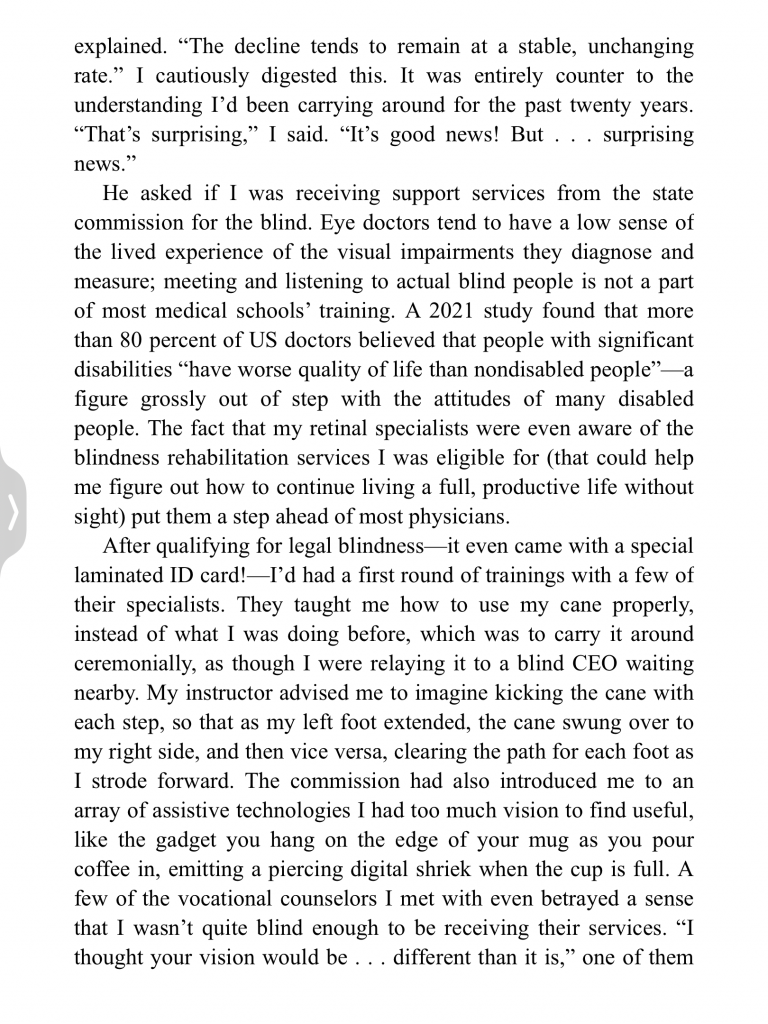
Currently I’m reading Andrew Leland’s The Country of the Blind and it’s amazing. His descriptions of becoming blind, or being in this state of living while losing sight, not living with lost sight, resonate a lot for me, especially the idea of doubting your own vision loss and his experiences with eye doctors:
(note: I didn’t have time to transcribe this page, but I will come back to do it and put in alt text for others who already can’t see the image, and for me who will soon not be able to.
swim: 3 swell loops lake nokomis open swim 82 degrees
So many swells in the water today. For most of it, I felt like I was being pulled down into the water. Not very buoyant. I wondered if I would able to do 3 loops. But as I got deeper into the swim, I felt stronger and more able to keep going.
10 Things
little minnows near the shore — hello friends!
being rocked — not roughly or gently but in a way that made it difficult to push through the water
getting stuck behind a woman swimming backstroke and getting way off course — is she swimming backstroke? is that the green buoy, way over there?
racing a wetsuit on the back end of the first loop. Did he realize we were racing, or was it just me? I won
the far orange buoy was much closer to the little beach than it has been all season
spotted one swan, no sail boat or wandering canoes
sighting other swimmers by the bubbles their feet made under the water
the orange buoys looked like they had white patches as I got closer to them — the sun was shining extra bright on them, I guess
no birds or planes that I remember but one zooming dragonfly
felt like I was on a people mover for the last stretch between the last green buoy and first orange one — swimming so fast, pushed along by the swells behind me
Recited Mary Oliver’s “Swimming, One Day in August” in my head as I swam the last loop and realized something. She writes:
Something had pestered me so much that I felt like my heart would break. I mean, the mechanical part.
The mechanical part? I realized that her heart breaking is a good thing here and that her mechanical heart is the one that follows the beat of organized, tightly contained time, broken down into hours and minutes and seconds so we can be as efficient and productive as possible. Yes! Swimming in the lake can break me open and out of time’s rigid boxes.
Another great Sunday swim. Sunny and a calm. A little cooler, but not too bad. Felt very strong on the first loop, not so strong by the fourth one. Somewhere in the middle, I lost track of the number of loops I was doing. I entered the swimming area at the main beach convinced I had done 5, when I had only done 4. Oh well, that was enough for me. For some reason, today’s swim tired me out more than the 4 loops on Friday. I guess it is a lot of swimming. I swam more miles this week (10.5) than I ran (10). I think I swam more miles than ran this entire month. I did a rough check, and they were basically the same. Wow. I really cut back on running this month and increased my swimming!
Started the swim by being routed by someone with an orange safety buoy. No worries. I just stopped for a minute and regrouped.
Saw at least one plane, many minnows, the swimmer with green arms — I still can’t tell if it’s a wetsuit or a sun shirt (or whatever they’re called), pale legs under the water, sparkles on the water’s surface, a clear sky, then a cloud-filled one, shiny bubbles from my fingers.
I recited a few poems — lines from “A Nude Swim,” “Evaporations,” and “The Meadow.” Thought again about my body losing all of its loneliness.
It is everywhere. It is the water I am trying to teach my daughters to float in. It is the sky I tell them to keep their eyes on. It is the air I tell them to seal in their mouths should they slip underwater. I am a leaky boat, but I am trying to answer their questions. As deep as thirty Christmas trees. As deep as twenty giraffes standing on each other’s backs. There hasn’t been a sea here for seventy-five million years. I cannot explain that number. My daughters’ ankles are sinking into the beryl water. No one can float forever. On the map, pushpins skewer patches of icy green like rare moths. I am trying to say it’s too late without making them too sad. It’s like how you can’t take the blue out of the white paint, like how you can’t hear your name and not turn around. The calving of glaciers is the loudest underwater sound on Earth. I dip my daughters’ ears beneath the surface to let them listen. It’s like how you can’t put a feather back on a bird, like how the bird won’t fit back into its shell. We step backward into the house. I wring the glacier out of their suits. I wring it out of their hair. I wipe it from their faces, but it is everywhere. It is the storm, it is the drowned harbor, it is the current, it is the bathwater that the baby slurps before we can stop her. The horizon rises. It rains. The glacier hammers the roof, the glacier soaks a corner of the bedroom ceiling, which greens with spores. On the map, the pushpins hover over green air, the green air is a spreading shroud. The storm surges ashore, mercurial and summer-smelling. We are not accustomed to the sea, so we describe it like a sky. The waves are tornado green and loud. In the water, the polar bears look like clouds.
5 loops! The most I have swum this summer at one open swim session. I had to get out after 2 loops to go to the bathroom and then stopped for a break after loop 4. With those breaks, I finished 10 minutes before open swim ends. If I began right when open swim started and didn’t take any breaks, could I do 6 loops in the 2 hours? Maybe that should be an end of August goal?
The water was wonderful — calm, not too cold, buoyant. The air was hazy and I couldn’t see the orange buoys at all for sighting. I also couldn’t see the flash of the white boat that I use for sighting. Before starting, I lined up my path with the far shore and the white boat, then began swimming, trusting that my body — my shoulders, my hips, legs, feet, brain — knew the way to go. And they did. And I didn’t panic or wonder if I was off course. All these years of working on letting go of the need to know exactly where I was going, the need for confirmation with a clear view, is paying off. I can swim without needing to SEE.
The water was opaque, the color of brown lentils. I kept seeing flashes just below me. I wondered if they were big fish or just a trick of the light. None of the flashes bumped into me, so I didn’t care what they were.
As I swam, I devoted some of my time to listening to the different gurgling and sloshing and splashing sounds my body made as I moved through the water — the slosh past my ear, the gurgle of my mouth, the splash as my arm lifted out of the water near my leg then reentered above my head.
On the back end of at least 2 loops (the stretch from little beach back to big beach), I recited the Tony Hoaglund poem I just memorized — The Social Life of Water. I thought about the different types of water and then where humans fit in — aren’t we 98% water? I also thought about the last few lines:
But you, you stand on the shore of blue Lake Kieve in the evening and listen, grieving as something stirs and turns within you.
Not knowing why you linger in the dark. Not able even to guess from what you are excluded.
I thought about how different it is to be standing on the shore versus being in the water, swimming through it, being rocked by the waves, hearing sounds underwater, feeling the cold. I don’t think I can understand like the line, all water understands, suggests, but I do believe that I witness the social life of water in a different way when I’m in it.
So warm! Still glad I went out for a run, but it was hard. My knees are sore, my legs sluggish. Heard lots of birds, a roller skier’s clicking poles, talk radio blasting from someone’s car, faint voices from below, water trickling out of a sewer pipe. Encountered bugs — mosquitos? gnats? — near the ravine. Passed by a person on the folwell bench, reading. Was greeted by one walker: good morning! As I ran on the Winchell trail I thought about the importance of giving some gesture — a greeting, eye contact, a stepping over to make room — when nearing another person. Without it, you’re saying to them, to me you don’t exist.
When I finished my run, I pulled out my phone and recited Alice Oswald’s “A Short Story of Falling.” Only two mistakes: I gave it the wrong title and I said “in a seed head” instead of “on a seed head.”
“A Short Story of Falling” / 22 june 2023
wordle challenge
Bad luck with the wordle today. I almost had it in 3, but I had too many choices that could be correct. I had 4 tries but at least 5 options.
At the end of the swim another swimmer called out, these conditions are the best! (or something like that; I can’t quite remember). I agreed. Calm, pleasingly warm water, well-placed buoys. I could barely see the buoys, but I still swam to them without a problem. Lots of swans in the water, a few menacing sailboat — one with a bright orange and red sail.
I swam for a loop and a half then briefly stopped at the little beach for a quick rest. Swam another loop and a half and stopped at the big beach. Got out to go the bathroom, then one more loop. Taking a 5 or so minute break between loops 3 and 4 really helped. I should remember to do that more often.
I’m writing this swim summary the next morning. Can I remember 10 things?
10 Things
at least one plane
half a dozen swan boats lurking at the edges
one swan stuck in the dead zone between buoys
streaks below me — fish?
irritating swimmers: 2 fast women that kept swimming past me, then stopping to get their bearings, then swimming again. With my slower, steadier stroke, I kept getting passed by them, then passing them when they stopped, then getting passed by them again when they restarted their swim
both the orange and green buoys closest to the beaches (orange to the little beach, green to the big) were not that close to the shore
no waves
no ducks
breathed every 5 strokes, sometimes every three, once or twice every six
hardly ever saw one of my landmarks from the past few years: the overturned boat at the little beach
Ran earlier today, at 7:15. A little cooler, quieter. For the first few minutes, I recited Alice Oswald’s “A Short Story of Falling” which I memorized yesterday. Ran south on the grassy boulevard between edmund and the river road. Crossed over at Becketwood, then ran down to the southern entrance of the Winchell Trail.
Listened to the gentle whooshing of car wheels. the clicking and clacking of ski poles, and birds for most of the run. Put in a Bruno Mars playlist for the last mile.
After I finished my run, I recited Alice Oswald’s “A Short Story of Falling” into my phone. Only messed up one line (I think).
10 Things
click clack click clack
the rambling root spread across the dirt trail
the steady dripping — more than a trickle, less than a rush — of the water falling from the sewer pipe
the soft (not mushy) blanket of dead leaves on the winchell trail
the sharp sparkle of the light on the water
shhhhhh — the wind passing through the leaves on the trees
the soft roar of the city underneath everything
the leaning branches have been removed — thanks Minneapolis Parks People!
an almost exchange of the You and I — me: right behind you, excuse me an older woman with a dog: mmhmm
no bugs, no gnats, no geese
wordle challenge
3 tries: front / brine / crane
front runt stunt blunt hunt shunt grunt redundant brine sign fine line shine dine design unwind spine twine crane explain refrain detain rain insane
front
frontispiece:
1
a: the principal front of a building b: a decorated pediment over a portico or window
2
: an illustration preceding and usually facing the title page of a book or magazine
Its back and forth, ad nauseum, ought to make the sea a bore. But walks along the shore cure me. Salt wind’s the best solution for dissolving my ennui in, along with these protean sadnesses that sometimes swim invisibly as comb-jelly a glass or two of wine below my surface. Some regrets won’t untangle. Others loosen as I watch the waves spreading their torn nets of foam along the sand to dry. I walk and walk and walk and walk, letting their haul absorb me. One seal’s hull scuttled to bone staves gulls scream wheeling above. And here… small, diabolical, a skate’s egg case, its horned purse nested on pods of bladderwort that still squirt BRINE by the eyeful. Some oily slabs of whale skin, or —no, just an edge of tire flensed from a commoner leviathan. Everywhere, plastic nurdles gleam like pearls or caviar for the avian gourmand and bits of sponge dab the wounded wrack-line, dried to froths of air smelling of iodine. Hours blow off down the beach like spindrift, leaving me with an immense less-solipsistic sense of ruin, and, as if it’s a gift, assurance of ruin’s recurrence.
crane
“The Crane Wife” parts 1, 2, and 3 from the Decemberists
swim: 1 small loop (1/2 big loop) cedar lake open swim 88 degrees
First open swim with FWA at cedar lake! A great night for it: calm, clear, not too crowded. The buoys were up tonight. Hooray!
Ran with Scott. Another hot, sunny morning. After a few minutes of warming up, I recited the latest poem I memorized for my list of 100 poems: Tony Hoagland’s “Summer Studies.” Later, near the end of the run, I recited 2 Emily Dickinson poems, “I felt a cleaving in my Mind” and “Hope is a thing with feathers.” Reciting the poems, then talking about them a little, helped distract us from our sweaty effort.
The big event of the run that Scott wanted to make sure I mentioned was the set-to between a small pileated woodpecker and a squirrel. We heard the squeak of a bird, then some rustling of leaves, then I saw a furry darting streak in the tree. Who won, I wonder? And why were they fighting?
Other bird events: A female cardinal flew out in front of Scott just as he was running around a tree ahead of me. I saw him flinch, but not the whirr of the brown bird in flight. A band or scold or screech of blue jays shrieked out across the grass between edmund and the river road, which prompted us to have a conversation about how much better crows are then blue jays. No turkeys in turkey hollow.
We ran past the house on edmund that posts a poem in the front window. A new one about sunflowers! I can’t remember what it’s called, or who wrote it. I’ll just have to run by the house again to figure it out. I don’t have strong opinions about sunflowers. Maybe that’s because I hardly ever see them.
Looking for water poems, I found something else, beside a water poem:
After our run, walking Delia the dog, Scott and I talked about Wordle, which I just recently started playing. I told him about my morning routine: a quick look at Facebook, then re-memorize a few poems, read the poem of the day at 3 poetry sites, then wordle. He suggested I try a new experiment: write a poem every day for a month inspired by the wordle that day:
The number of lines = the number of tries I have to make Each line must include the word that I guessed possible bonus = the theme of the poem is the correct word
Today: 4 tries: farce blame beads beast
What a farce to blame the sun for the beads on your brow you, beast, were born to sweat.
I don’t really like this, but it’s a start. Maybe I’ll add one more rule: a 5 minute time limit?
4.35 miles marshall loop to cleveland 52 degrees humidity: 80%
Wet air, wet ground. Everything bright green or muddy brown. Overcast. Ran up the marshall hill and past Cretin to Cleveland. As I approached St. Thomas, I wondered if I’d hear the bells. Yes! Dum dum dum dum at 11:15. Encountered a few other runners, some walkers, bikers, a dog. Scanned the river for rowers, saw a paddleboat! A Mother’s Day brunch? Heard a black-capped chickadee calling out fee bee fee bee, then some blue jays screeching ha ha ha ha. Running right past a bush, a red bird suddenly flew out if it, a whirr of red in my face. Later, heading down the Summit hill, heard the shimmering (or tinkling or fluttering or ?) of water falling over the limestone ledge at Shadow Falls. Noticed near the end of my run that the forest below the tunnel of trees is hidden by a veil of green. I thought about how nice it was that the gnats and mosquitoes hadn’t arrived yet — or the catkin fluff from the cottonwood trees.
A very relaxed run. A nice way to spend a Mother’s Day morning. I don’t feel too sad today, but I don’t like Mother’s Day — especially since I lost my second mother last fall. My current take on the day: it irritates me. Anyway, here’s a beautiful mother poem that I was happy to find this morning:
I discover a piece of stationery, bordered with red-gold
leaves. In the center, her cramped hand reads simply
The snow is so so white today.
How odd to read these words in June, air hung with
humidity, sweat jeweling my lip. Just that one line,
stuck in an old calendar underneath a stack of books.
I upend each one, fanning the pages to search for more
and out they flutter like doves, each one scribbled like
urgent messages from some simpler beyond–
That red bird is back, crashing into the window.
Railroad tracks are the saddest things.
The wood is pretty where it is rotting.
If I could revise our lives, make her survive the cancer
that burned fast and bright through her insides,
I would tell her how wrong she was to say she couldn’t
write, how much I am like her with my mundane
notes, my daydreaming observations, post-its
congregating in each bag, notebooks on each surface,
and I would sit with her and notice every moment,
rebuke her for thinking she was not good enough,
a mistake I still make, one that I am making right now
as I question and regret each line I add to this poem.
I want to talk to her. I want to tell her that cardinal
is back, flying straight at the window again and again.
These lines:
If I could revise our lives, make her survive the cancer/that burned fast and bright through her insides,
After stopping my run at the ancient boulder and crossing the river road, I pulled out my phone and recited a poem that I memorized a few years ago and am memorizing again as part of my 100 poems memorized goal: The Meadow/ Marie Howe. I listened to my recording while looking at the poem just now. Not too bad, only a few missed words, one mixed up line.
3.4 miles river road, south/north 33 degrees 100% clear path
Felt good this morning. Maybe, a week since my 24 hour bug, I’m feeling mostly normal? Today it was colder. No thaw, everything frozen, or not quite frozen. Puddles with a thin sheet of ice on top. Mud hardened. Another layer — gloves, a buff. Ran south and recited the poem I memorized this morning to myself: A Murmur in the Trees — to note. Heard the loud knock of woodpecker nearby — was it in that tree, right there? Also heard a strange version of chickadee’s feebee call and the rhythmic swish of my coat as I moved.
Ran to the locks and dam #1 and decided to head down the hill and back up it instead of running under the ford bridge (I imagined it would be icy and uneven under the bridge). Halfway down, when I encountered a solid sheet of ice, I turned around and ran back up. Nice — I’ll have to add this hill into my routes for the spring and summer. The trails were crowded, some bikers, some walkers with dogs, some runners. Ran most of the route with no headphones; put in a playlist for the last mile.
A Murmur in the Trees – to note – Not loud enough – for Wind – A Star – not far enough to seek – Nor near enough – to find –
A long – long Yellow – on the Lawn – A Hubbub – as of feet – Not audible – as Ours – to Us – But dapperer – More Sweet –
A Hurrying Home of little Men To Houses unperceived – All this – and more – if I should tell – Would never be believed –
Of Robins in the Trundle bed How many I espy Whose Nightgowns could not hide the Wings – Although I heard them try –
But then I promised ne’er to tell – How could I break My Word? So go your Way – and I’ll go Mine – No fear you’ll miss the Road.
I can’t remember if I’ve written about this poem on this log before. When I first read it, I was immediately struck by its connection to “We grow accustomed to the Dark –“. The neighbor’s lamp in that poem, with the long — long Yellow — on the lawn in this one. To meet the Road erect, with no fear you’ll miss the Road. In one poem, ED wants to adjust, for Life to step almost Straight. In the other, she wants to hang out with the little men and the robins in the trundle bed in the Dark. I want to do both of these things too. To find new ways to see so that life steps almost straight. To explore the different ways I see, or the ways I can be without light/sight, to find new, more magical, worlds.
4.5 miles minnehaha falls and back 32 degrees / light snow 99% clear path!
Hooray for slightly warmer weather and finally having a clear trail. This winter has been especially bad for icy, treacherous paths. Today there was some wind and snowflakes flying like daggers in my face, but there was also sizzling in the trees (from dead leaves shaking in the wind), a gushing waterfall, and a flowing creek. I don’t remember looking down at the river even once, but I do remember listening for the sewer pipe at 42nd (more gushing water) and glancing down at the sledding hill at the park (empty of sledders but not of snow). I thought about how this felt like a late winter, early spring snow: not likely to last. I appreciated how the new flakes covered the old ugly gray snow that’s been accumulating since december. Yesterday I noticed it too, while walking and thought it looked like powdered sugar on a cake with a cracked crust.
On the second half of my run, I recited the poem I memorized last night, Listen by Didi Jackson. Not in my head this time, but out loud. Quietly, but more than a whisper. The poem was easy to speak as I moved. Maybe I should road test all of the poems I write? If it’s not easy to recite while moving, it needs to be revised! It can’t be too easy, though.
my body doing strange things
Yesterday after my run, I had something strange and unsettling happen. All of a sudden, without warning, my ears plugged up, my head felt full or stuffed up or about to explode, and I could feel the vibrations of sounds. Everything felt (not just sounded) loud. So loud! Not painful, just uncomfortable. And there was constant noise. Sometimes it sounded like a dryer with something thump thump thumping in it. Sometimes it sounded like I was standing next to the engine of a plane. And sometimes it sounded like the inside of a seashell. My ear often gets plugged up, but never like this. It lasted the rest of the day and until I went to bed (around 12:30 am). I woke up today, and it was gone.
What happened? My best guess is that it was an intense episode of tinnitus, possibly brought on by something that happened Tuesday night during band rehearsal. Whoever was playing timpani decided to hit the drum as hard as they could. BOOM! The noise was so loud it made me jump in my chair.
Before my run, I revisited a poem I first posted on this blog on feb 16, 2019: Hymn to Life by James Schuyler. Wow, is this poem long! Too long for me and my failing vision. But so good. Here is a passage I’d like to remember (and maybe use someday):
The turning of the globe is not so real to us As the seasons turning and the days that rise out of early gray —The world is all cut-outs then—and slip or step steadily down The slopes of our lives where the emotions and needs sprout.
I especially like the idea of early gray as a time when the world is all cut-outs. That’s my world a lot of the time. Flat, not quite real, only forms, cut-outs.
An idea: I think I’ll print out this poem and put it under the glass on my desk to read and reread all month! I haven’t read much James Schuyler, but what I have, I like. Linda Pastan talks about him somewhere (in an interview? a poem — I’ll look it up later) and I can see his influence in this poem. Not too long ago, I found out about his diary and I’ve wanted to get it. It’s out-of-print, with only expensive, used copies available, at least where I’m looking.
update on the previous paragraph: First, I did print it out and am slowly making my way through it. Second, Linda Pastan talks about William Stafford, not James Schuyler. Maybe I was thinking about this discussion (A Day Like Any Other: A Discussion of James Schuyler’s “February”)of Schuyler that I listened to at the same time I was reading Pastan?
Not completely sure if my body — my knees, left hip, lower back — were quite ready to run today, but the rest of me was, and I’m glad I did. The trail was almost completely clear with hardly any ice. And, there was only one short stretch of puddle-y slush so bad that I stopped to walk in the street to avoid it.
10 Things I Remember
the Minneapolis park crew had spread some dirt/sand on the trail to help make it less slippery. It was especially helpful under the lake street bridge on the marshall side
heard the drumming of a woodpecker somewhere in the gorge — it cut through the thick air. Also heard at least two geese, flying low and honking
the flurries were at an angle and I pulled the bill of my cap way down, almost covering my eyes, so that the snow wouldn’t fly directly into my eyes
the river, part 1: the river was gray and open as I crossed the franklin bridge
smelled the sewer a few times — a result of the recent (slight) thaw. Yuck!
the river road on the east side south of franklin was in terrible condition. So many potholes — dozens. I couldn’t tell if they were deep, just that there were a lot of them!
river, part 2: crossing back over the lake street bridge, the river was almost completely open, only one small chunk of ice
the river, part 3: near the small chunk of ice, I noticed that the river looked blueish green. A strange, delightful color. But what was causing it?
don’t remember hearing all the grit under my feet, but I remember feeling it. I like sliding on it. Why? Maybe because it’s more interesting than flat, hard pavement?
Favorite spot: near Meeker Island Dam, there’s a spot with an open view of the river and the other side. Only a few slender tree trunks in the way
Before heading out for my run, I had started revising my “How to Sink” poem. Thought I might get some inspiration by the gorge. Later, as I ran, I realized that I should wait to finish this poem when it’s spring, or at least warmer, when everything is dripping and oozing and flowing down to the river. I thought of this as the sharp flurried stabbed my face. Was thinking that I should do a “How to” poem related to water through the seasons.
Summer = How to Float
Spring = How to Sink
Winter = How to Settle? — something about snow that’s packed, layer, staying (not melting), compacting — How to be compact? or, How to Shrink?
Fall = I need to think about this one some more. What does water do in the fall? Maybe something related to decomposing — leaves falling, drying up, becoming brittle? water leaving — freezing — frost? fog? or, How to Rust?
Recited from memory my ED poem, “I measure every Grief I meet” before the run, then during it as I walked up the hill between the meeker dam and lake street. Recorded it into my phone. Only missed a few prepositions. Nice! My memorizing and reciting has improved over the years. This skill will come in handy when my ability to read gets worse. I’ll be able to memorize my poems for reciting to others.
I recited some of ED’s poem in my head as I ran. It follows a steady beat, so it’s easy to keep in rhythm, harder to recite without getting sucked into a sing song-y cadence.
This poem popped up on my twitter feed this morning:
Lake of the Isles/ Anni Liu
After my grandfather died I waited for him to arrive In Minneapolis. Daily I walked across the water Wearing my black armband Sewn from scraps, ears trained for his voice. Migration teaches death, deprives us Of the language of the body, Prepares us for other kinds of crossings, The endless innovations of grief. Forty-nine days, forty-nine nights— I carried his name and a stick Of incense to the island in the lake And with fellow mourners watched As it burned a hole in the ice. He did not give a sign, but I imagined him Traveling against the grain Of the earth, declining time. Spirit like wind, roughening Whatever of ourselves we leave bare. When he was alive, he and I Rarely spoke. But his was a great And courageous tenderness. Now we are beyond the barriers Of embodied speech, of nationhood. Someday, I will join him there in the country Of our collective future, knowing That loneliness is just an ongoing Relationship with time. It is such a strange thing, to be Continuous. In the weeks without snow, What do the small creatures drink?
About This Poem
My grandfather died during the first winter of the pandemic. His was the first death of someone I loved. That winter, people everywhere experienced the impossibility of being with dying loved ones. No one knew how to mourn in absentia. Having been separated from him and the rest of my family for twenty-two years due to my immigration status, I had had practice. I turned to poetry. Poems can enact impossible journeys. So, even though I wasn’t able to see him or be with my family, I could mourn. Here, in this room I made for us to be together.
A few weeks ago, my daughter walked on the ice at Lake of the Isles with her friend. They didn’t visit the island, but she talked about going back, and she wondered what happened there. I told her about this poem this morning as she made her coffee. Together we wondered if this actually happened, that during the pandemic people visited the island to mourn. Now I wonder, what does it mean to “actually” happen? If it was only conjured for this poem, does that mean it didn’t happen? [No.]
Love these lines:
That loneliness is just an ongoing Relationship with time.
It is such a strange thing, to be Continuous.
In the weeks without snow, What do the small creatures drink?
Now I’m wondering, how would Emily Dickinson measure Liu’s grief?
3.9 miles river road, north/south 22 degrees / feels like 12 75% snow and ice-covered
Another good run. Not too cold, sunny. Near the beginning, I ran with my shadow. The road was slick in spots — that invisible ice that you can’t see, only feel. Greeted Mr. Morning! and a few runners. Noticed the river at the trestle. It was open in a few places just below. The open water wasn’t dark, but gray. Heard the drumming of a woodpecker, the screech of a blue jay, 2 quick caws on repeat from a crow, and countless chirp chirp chirps from some other birds. The path was slightly better, but still mostly uneven ice and snow. Maybe this week, as it climbs to the 30s, the rest of it will melt?
After I finished running, when I was walking home, I remembered that I had memorized the first sentence of Linda Pastan’s “Vertical.” I had intended to recite it in my head as I ran. I was too distracted by the path and forgot. Walking home, I whispered it into the cold air:
Perhaps the purpose of leaves is to conceal the verticality of trees which we notice in December as if for the first time: row after row of dark forms yearning upwards.
Last night I went to Moon Palace books and bought Linda Pastan’s last collection, Almost an Elegy. The rest of February will be dedicated to her and her words — reading them, memorizing them, being with them.
A wonderful fall morning. Sunny, glowing trees, not much wind. I felt great during my run. Easy, relaxed. The problem: when I was done, and walking back, my right kneecap started to act up. Small slides and shifts, not wanting to stay in place. Now, I’m icing it. Bummer. I’m not sure why my knee is having problems.
Lately, it’s a challenge making it to the river. There are redoing so many sidewalks in the neighborhood that it’s hard to know which street to take over to the river road. Today, I zigzagged until I reached edmund, then down the hill until I reached 32nd, then over to the trail.
On the path, a squirrel was running ahead of me. They couldn’t decide which way to go — away from me, or right towards me. They darted away, then back, then away, then back. Fuck, I muttered under my breath.
Running at my favorite spot on the east side, just above the lake street bridge, I was running too close to the railing and didn’t see a pigeon (was it a pigeon?) stopped on a post. Normally birds will fly away before you reach them; this one, just barely in time. I exclaimed, geeze, and held up my hands to my face as its wings flapped furiously. As usual, I wondered how ridiculous I looked to a passing driver.
Recited my favorite section from May Swenson’s “October” — the whole thing this time:
7. Now and then, a red leaf riding the slow flow of gray water. From the bridge, see far into the woods, now that limbs are bare, ground thick-littered. See, along the scarcely gliding stream, the blanched, diminished, ragged swamp and woods the sun still spills into. Stand still, stare hard into bramble and tangle, past leaning, broken trunks, sprawled roots exposed. Will something move? A vision come to outline? Yes, there— deep in—a dark bird hangs in the thicket, stretching a wing. Reversing its perch, it says one “chuck.” The patch on his shoulder that should be red looks gray. This old redbird is planning to stay, this year, not join in the strenuous migration. Better here, in the familiar, to fade.
another word repeated: still
I have loved the line, Stand still, stare hard, ever since I first read this poem a few years ago.
Ran past a big boulder with a plaque. I thought about stopping to read it, but I didn’t want to stop. One day, I’ll stop, I thought. But will I?
Thought about stopping to take off my orange sweatshirt. I didn’t. Thought about stopping to walk up the steep (but less steep now that they’ve rerouted it) sidewalk to ford bridge. I ran the entire 5.5 miles without stopping. Excellent.
Anything else? Running on the east side, past a ravine that’s not too far from the ford bridge, I had a memory of living in northern virginia when I was 10. Such beautiful falls! The leaves, the sun, the winding roads! A happy memory — not of one specific time, but the feeling of fall — crisp air, sun shining on orange leaves, trails to explore, fresh cider to drink. I don’t want to go back to that time, but I like feeling it again. Something about running on the east side of the river helps me to do that. Why the east side, but not the west? Not sure.
6.05 miles bottom of franklin hill and back 51 degrees
A beautiful morning, a good run. Now, minutes after it, I’m wiped out. Ran down the franklin hill, past annie young meadows, to the top of the south fourth st overlook. Stopped to admire the river: blue, with 2 rowers, one in a bright orange top (shirt? vest? jacket?). Started running again, walked up the franklin hill, then ran again, this time with a Taylor Swift playlist.
For the first few miles, I recited lines from May Swenson’s “October”:
Now and then, a red leaf riding the slow flow of gray water. From the bridge, see far into the woods, now that limbs are bare, ground thick-littered. See, along the scarcely gliding stream, the blanched, diminished, ragged swamp and woods the sun still spills into. Stand still, stare hard into bramble and tangle, past leaning, broken trunks, sprawled roots exposed.
As I recited it, I wondered about the repetition of now (now and then; now that limbs are bare) and into (see far into; the sun still spills into). Why does she repeat these words?
10 People I Encountered
Was mornied! by Mr. Morning! I had run past him — only seeing him from behind and not noticing it was him — and he called out. I turned back and called out good morning!
Greeted Dave, the Daily Walker.
Ran past Daddy Long Legs.
a woman walking briskly, wearing a turquoise fleece, talking with
another woman, together they approached me from behind as I walked up the franklin hill. Their voices hovered, growing louder as they neared
a runner dressed in black — first far behind me, then closer, then past me, then far ahead
a person sitting on a bench perched on the rim of the bluff
an older man and woman walking — I think I regularly encounter them? Can’t remember what the woman looks like, but the man is tall, thin, and white with white hair
a roller skier, roller skiing in the flats
a biker blasting music — I couldn’t hear it because I had my headphones in
word of the day: bombinate
I follow Merriam-Webster on twitter. Had to make note of today’s word of the day. “To bombinate is to make a sustained, murmuring sound similar to a buzz or drone.” I strongly dislike anything that bombinates.That low-lying, ever-present rumble that unsettles. I do like saying the word, though.
Taylor Swift’s “Red” came on near the end of my fifth mile. As I listened to the lyrics, I was struck by the chorus:
Losing him was blue, like I’d never known Missing him was dark gray, all alone Forgetting him was like trying to know Somebody you never met But loving him was red Oh, red Burning red
Perhaps this isn’t fair, but I kept thinking about how predictable and unimaginative her color descriptions are. And then I started thinking about synesthesia, which I don’t have, and wondering if people with it see emotions as colors, and what colors they might see. And now, after quickly researching the link between blue and gray and depression, I’m thinking about color psychology and feeling skeptical.
Fall leaves fall! More color, more leaves on the ground, more cool air. Ran south on the river road trail to the southern start of the Winchell Trail. Was almost hit by at least 2 bicycles — bikers biking on the walking path. Didn’t yell, but cried out, Watch out! to one person and exclaimed, Jesus! or Christ! or Jeez! beside another.
Didn’t see any squirrels or almost trip over any acorns. No clicks or clacks from roller skiers’ poles. No fat tires or honking geese. No territorial turkeys — I love how htis sounds! I want to write something that uses this phrase! No rowers or chapel bells. Not a single good morning.
I did hear some kids playing at a school playground. And jackhammers across the road. A weedwacker trimming the hillside. 2 guys talking — I tried to hang onto what the one guy said, but now I can’t remember.
As I was walking back after my run, I tried to recite Hopkin’s “Spring and Fall” and Frost’s “Nothing Gold Can Stay.” I missed a few lines; time to memorize them again!
I think I found this pithy poem on twitter this morning:
6 miles bottom of franklin hill turn around 71 degrees 8:30 am
Warmer this morning. I guess the stretch of slightly cooler days is over. Still a beautiful day. Started in a state where everything was out of focus — initially I wrote, in a daze, but I wasn’t out of it or in a trance. It was more like I had turned my attention down, or maybe I had shifted it, from looking to listening? That kind of captures it; I wasn’t listening acutely, just absorbing the sounds and breathing and being relaxed. Ran down the franklin hill and into the flats, then turned around at 3 miles. I kept running until I reached the bridge, then walked up the hill as I talked into my phone. Turned on Beyoncé’s new music, Renaissance, and ran the rest of the way home. It’s great to run to; I felt like a badass — powerful.
I’m one of one, I’m number one, I’m the only one.
Alien Superstar/ Beyoncé
Here’s the recording I made. I think it would be helpful to find something that transcribed the recording too. But, what? Voice memo for iPhone is good for recording. The notes app does an adequate transcript. What can do both, and how much does it cost? I’ll have to look into it.
5.5 miles bottom of franklin hill and back 64 degrees 8:30 am
Hooray for a cooler morning and a wonderful run! It (almost) gets me excited for fall and winter running. I’m not ready for that yet, though. Still loving the swimming. Ran north on the river road, down the franklin hill, then stopped to walk up it. I dictated notes into my phone about my final lecture. Then, I turned on a playlist and ran faster on the way back.
moment of the day
I encountered a group of camp kids, in their bright yellow vests, biking up the franklin hill. Near the top, I heard one kid lament, This isn’t fun anymore. Or, did he say funny? I can’t remember. Then about halfway down, a counselor was yelling out encouragement to 2 kids struggling to keep biking. Let’s go! You got this Lily! Let’s go Mya! It made me smile. I hope they both made it up the hill okay.
Greeted Dave, the Daily Walker and Mr. Morning! Heard the rowers, faintly, below me. Lots of birds. Was there sun? I can’t remember now — I’m writing this the next morning. Oh — I remember the river down in the flats. So calm, so still, almost a mirror. And yes, there was sun. It was hot as I ran near the Annie Young Meadows parking lot. No stacked stones on the ancient boulder. No roller skiers. No big groups of runners. Someone on one of those e-bikes with the tiny wheels. Several people running with dogs. A woman sitting on a bench.
Why should it be so hated, the word for soil as the farmer longs for it, for the fresh loaf, for the inside of the lips, the indoor pool’s sweet chlorine air when winter burns your throat? For the brush against your thigh of a dog’s nose, for skin vital in its perspiration, the velvet eyelid petal of the rose, those other lips below, and the agile tongue? Maybe only one who has been dry and cold for years under Saturn’s tutelage would need to praise the word that all decry— a word for tears, for the heart, for new ink smudged. A word for the peach after the knife goes in: pried deeply, split, its inner gold now shown.
Sun. Slightly warmer. Less wind. Hooray! Still wore my running tights, winter vest, and gloves, but felt like spring is almost here. Ran around the falls. They were gushing, but the creek was barely moving. Ran past the “big feet” statue. I can’t remember his name — Gunther something, I think — but I do remember that he was a poet, a hymn writer, and a politician from Sweden. Ran the Winchell Trail too. At the start of it, I slipped, but didn’t fall, in the mud. Said a lot of “excuse mes” as I encountered people from behind. Not irritated at all. A good run on a beautiful morning.
before the run
Thinking about roots and how things become rooted in the ground today. This topic is inspired by a favorite poem that I memorized in May of 2020: What Would Root/ Katie Farris. Here’s what I wrote in an entry from may 20, 2020:
I like the idea of this long, wild story, being rooted at the rock from the beginning of the poem. And I love this idea of rooting, being rooted and how the story unfolds around it. I want to spend some more time thinking about what it means to root, be rooted, take root. I’d also like to write a poem like this–with a story at the gorge–about sinking.
I used to have this poem memorized, and I think I can again, with a little practice. For now, I’m going to record myself reading it, then listen to that recording a few times while I run today.
during the run
Started by listening to the recording of myself reading the poem. It was very cool — dreamy, almost disembodied — to listen the words as I ran through the neighborhood and toward the river. Then, when the recording was done, I put my headphones away and thought about roots as I ran south above the gorge. I remember imagining my skin as more porous and open to the world and grass growing through my pores (instead of Farris’ roots).
Halfway through the run, in Wabun park, I stopped to record my thoughts. Here’s a summary:
Thought about being rooted in a place, then being on the inside or the outside and how being rooted means being both in and out, or neither, at the same time. Just there, part of what’s happening.
Then, I wondered, Does rooted always mean we’re tethered or stuck in one place, immobile? What would it mean to be rooted in a place while you were moving?
Then: how are the roots formed? Instead of one solid, thick, sturdy root that’s difficult to cut down, what if we were a network of roots spread throughout the ground, connected and tangled with other? Roots can be networks — shallow and easy to pull out, like weeds, but multiplying and growing when you do that (rhizomes and nodes).
Getting at the root, radical feminism and the root of oppression, the origin/cause of the problem I often think about the origins of my running story — there is no one root or cause or start, but a series (a network) of reasons.
Chanted: root root root root/root root root root/ roo ting roo ting/root root root root/root root root root/roo ted root less I like these simple repetitions. I’d like to try chanting these for several minutes, then seeing what other words/ideas/chants might appear.
Thinking about being inside or outside of yourself and being rooted and what of self/Self that suggests, I’m reminded of a poem I put on my reading list the other day:
Full of yourself— a friend’s touch is sharp as a thorn. A buzzing fly drives you mad.
Forget yourself and what friend can hurt you? You mingle with wild elephants and enjoy the ride.
Caged in self, you drown in anguish. Storm clouds swallow the sun. Your lover flees the scene.
Outside yourself, the night is moonlit. Lovers drink Love’s wine. It flows through you.
Self-conscious, you’re dry as autumn leaves. You bite like frost.
Melt yourself, and winter’s frozen meadows will become spring’s fragrant fields.
(How) can we travel outside of ourselves? What does this untether/uproot us from? I posted this quotation from Jamie Quatro in a log entry from April 19, 2018 about running as prayer:
a state of prayerlike consciousness. Past the feel-good vibes, past the delusions, my attention moves outward: I’m intensely aware of the cadence of a bird’s song, cherry blossoms weighted-down after a rain. Things light up and I experience an interior stillness that somehow syncs me more profoundly with the exterior world. It’s a paradox: only when I’m fully present in my body do I begin to experience the absence of myself.
Does fully present in a body = rooted? I’m also thinking about entanglement and Ross Gay’s critique of buoyancy and floating free (see april 12, 2022). Can we be a self, rooted in a body and a place, and still be other than ourSelf? How do I fit Rumi’s idea of forgetting the self with entanglement?
4.25 miles top of franklin bridge and back 37 degrees wind / rain / snow
Ran in the afternoon, after returning from Austin. A huge wind gust almost blew me off the trail as I ran through the Welcoming Oaks. Later, the tornado siren went off. Because of the wind, I was concerned. Called Scott to check. It’s severe weather week and today they’re testing the sirens. Whew. With all the wind and snow and sirens, I don’t remember looking at the river. Did I? Yes! I just remembered. I admired the snow flurries looking like mist hovering right above the river. Very cool.
I chanted, mostly in my head but a few times out loud, the Christina Rossetti poem, “Who Has Seen the Wind?”:
Who has seen the wind? Neither I nor you: But when the leaves hang trembling, The Wind is passing through.
Who has seen the wind? Neither you nor I: But when the leaves bow down their heads The wind is passing by.
Anything else? Lots of black-capped chickadees. A Minneapolis parks vehicle approaching with a double set of headlights — 2 at the normal spot on the bumper, and 2 up above on the roof.
before the run
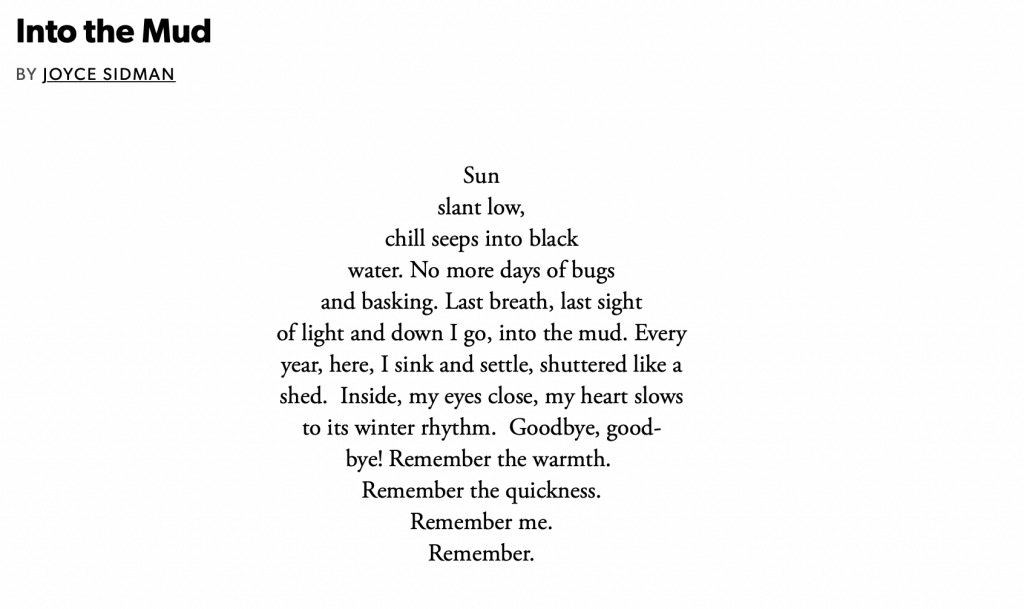
Today dirt = mud and sinking down into the earth. Found this poem by a Minnesota poet, Joyce Sidman (search term: mud):
Sun slant low, chill seeps into black water. No more days of bugs and basking. Last breath, last sight of light and down I go, into the mud. Every year, here, I sink and settle, shuttered like a shed. Inside, my eyes close, my heart slows to its winter rhythm. Goodbye, good- bye! Remember the warmth. Remember the quickness. Remember me. Remember.
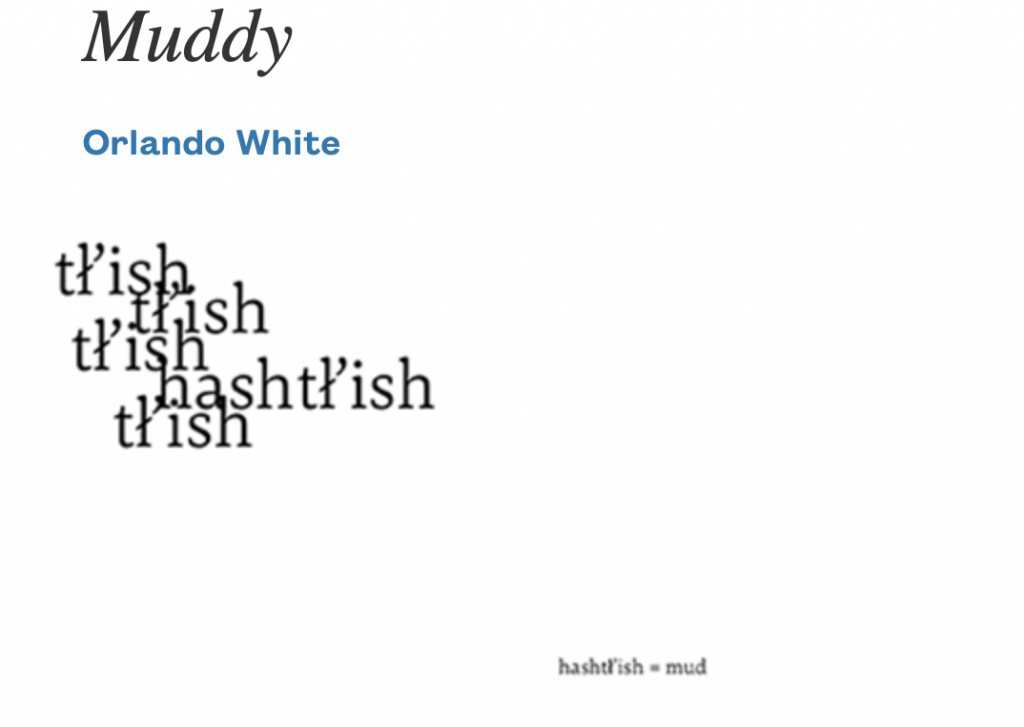
“‘Muddy’ is inspired by the motion and cadence of Diné words. Looking at it on the page, one sees kinetic text and hears onomatopoeia, so the repetition of ‘tł’ish’ reenacts the sound of someone stepping in mud, and then the word itself turns into a poem.” —Orlando White
Mud as where you sink and settle during winter, and the sound of squishing through mud.
during the run
Tried to notice the mud. Mostly, it was on the edge of the trail. I ran over it to avoid 2 walkers. Biggest (and yuckiest) bit of mud was right by the big boulder near the sprawling oak just above the tunnel of trees at the grassy spot between the walking and biking trails. A vehicle had driven through it, leaving deep, muddy tire ruts.
This is what happened the dead were settling in under their mud roof and something was shuffling overhead
it was a badger treading on the thin partition
bewildered were the dead going about their days and nights in the dark putting their feet down carefully and finding themselves floating but that badger
still with the simple heavy box of his body needing to be lifted was shuffling away alive
hard at work with the living shovel of himself into the lane he dropped not once looking up
and missed the sight of his own corpse falling like a suitcase towards him with the grin like an opened zip (as I found it this morning)
and went on running with that bindweed will of his went on running along the hedge and into the earth again trembling as if in a broken jug for one backwards moment water might keep its shape
bindweed: invasive species that can clog harvesting equipment
5.25 miles bottom of franklin hill and back 7 degrees / feels like 0
It’s supposed to be getting warmer, starting today and into next week, but it was cold this morning. Sunny, not too much wind, but cold. No frozen fingers or toes, but I felt the burn of cold air, especially after I was done. A harder run. As I’ve heard some runners say, the wheels came off in the second half. I wondered why and then I remembered I didn’t have any water this morning, just coffee. That might have been a big part of the problem. I stopped to walk at least twice, on the walking path, closer to the river but also covered in uneven snow. I noticed the river had a thin sheet of ice on it again. That should melt this afternoon or tomorrow.
Heard some black capped chickadees and the fee bee song, some cardinals too. Encountered two large (10+ runners) groups on the trails — the first one, just as I entered the river road trail, the second, not too long after the lake street bridge. The first group was all men, the second all women with 2 dogs. Right before I reached them, the women stopped to walk. After I passed them, I could hear cackling and an occasional sharp ruff. For some time, they seemed close, then they disappeared. Near the end, I saw some sledders about to go down the Edmund hill. I wonder how crusty and hard that snow is?
Practiced reciting (almost always in my head) some lines from Emily Dickinson and Richard Siken. First, from Siken, the opening words of his great poem, “Love Song of the Square Root of Negative One”:
I am the wind and the wind is invisible
All the leaves trem ble but I am invisible
(in the actual poem, the line is broken like this: “I am the wind and the wind is invisible, all the leaves/tremble but I am invisible”)
I like reciting this when I’m running into the wind. Then, I returned to ED’s “Life is but life/and breath but breath/Bliss is but bliss/and breath, but breath.” Yesterday I had chanted it with slightly wrong words: “Life is but life/death is but death…” It was difficult to train my brain out of reciting it that way. I played around with different ways of saying it, including:
Life but life Death but death Bliss but bliss Breath but breath
Death is but death and Bliss but bliss Breath is but breath and Life but life
Just thought about this as I was writing this entry:
Life is but death and breath but bliss Death is but life and bliss but breath
Here’s a recording I made after I finished my run and was walking back. You can really hear the wind!
Dickinson chant after run / 12 march
Speaking of the wind, here’s a poem I found yesterday from Alice Oswald that I love (like all her poetry):
Describe the Wind, Wind! Say something marked by discomfort That wanders many cities and harbours, Not knowing the language. Be much travelled. Start with nothing but the hair blown sideways And say: Gentle South-easterly Drift With Rain. Say: Downdraught.
Unglue the fog from the woods from the waist up And speak disparagingly of leaves. Be an old man blowing a shell. Blow over the glumness of a girl Looking up at the air in her red hood And say: Suddenly Violent Short-lived Gust. Then come down glittering With a pair of ducks to rooftop.
Go on. Be North-easterly. Be enough chill to ripple a pool. Be a rumour of winter. Whip the green cloth off the hills And keep on quietly Lifting the skirts of women not wanting to be startled And pushing the clouds like towers of clean linen Till you get to the Thin Cry That Suffers On seas.
Ignore it.
Say Snow.
Say Ditto.
Wait for five days In which everything fades except aging.
Then try to describe being followed by heavy rain. Describe voices and silverings, Say: Strong Wet Southwester From December to March.
Describe everything leaning. Bring a tray of cool air to the back door. Speak increasingly rustlingly. Say something winged On the branch of the heart. Say: Song. Because you know these things. You are both Breath And Breath And your mouth mentions me Just at the point where I end.
So much in this poem to discuss, but what jumped out at me right away was: “Describe everything leaning”. For the past few days, but especially yesterday, I’ve been noticing the bare trees and how some of them lean in one direction, both their trunks and their branches. Usually leaning towards, sometimes away. These leanings can look menacing or graceful, threatening or like surrender. I love straight trees, but i think I love leaning ones more. It would be a fun exercise to go out for a run with the task, “describe everything leaning.” I think I’ll do that tomorrow!
5 miles franklin bridge and back 17 degrees / feels like 7
What a gift this winter-almost-spring run is this morning! A reminder of why I love winter runner with its cold, crisp air and quiet calm. It was a little difficult to breathe, with my nose closing up on me (hooray for sinuses), and it didn’t always feel effortless. Still, I was happy to be outside with the world — the birds (pileated woodpeckers, geese, cardinals), the Regulars (Dave, the Daily Walker and Daddy Long Legs), and the river, sometimes brown, sometimes blue.
Before I went out for my run, I read a lot of different poems and essays about poetry and breath. Decided I would think about rhythmic breathing, running rhythms, and chants. I started by counting my foot strikes, them matching it up with my breathing of In 2 3/ Out 2 or Out 2/ In 2 3: 123/45, 123/45 then 54/321, 54/321. A few miles later, I thought about a verse from Emily Dickinson’s poem, ‘Tis so much joy! Tis so much joy!” that I imagine to be a prayer or a spell or reminder-as-chant. I started repeating it in my head:
Life is but Life! And Death, but Death! Bliss is, but Bliss, and Breath but Breath!
With this prayer/chant, I matched the words up to my foot strikes in several different ways, none of which were 123/45 or 54/321.
Equal stress on each syllable/word, and the altering of the poem slightly:
Life Is But Life Death Is But Death Bliss Is But Bliss Breath Is But Breath
Then in ballad form (I think?), with alternating lines of: stressed un un stressed / 3 stressed but silent beats (or not silent, but voiced by my feet, striking the ground):
Life is but Life x x x Death is but Death x x x Bliss is but Bliss x x x Breath is but Breath x x x
Then in 6, with 2 feet of stressed, unstressed, unstressed (a dactyl):
Life is but Life is but Life is but Life is but Death is but Death is but Death is but Death is but Bliss is but Bliss is but Bliss is but Bliss is but Breath is but Breath is but Breath is but Breath is but
Then in 4 again, one spoken beat, three silent:
Life xxx Life xxx Life xxx Life xxx
Or, like “The Safety Dance”:
Life life life life Death death death death Bliss bliss bliss bliss Breath breath breath breath
These were so much fun to do, and helpful in keeping me going as I grew tired. When I chanted them, my pace was about 8:40 and my heart rate was in the upper 170s (pretty standard for me). At one point, I pulled out my phone and recorded myself mid-run. Later, when I stopped running and was walking back, I recorded myself again.
Dickinson chant during run Dickinson chant after run
It’s interesting to check back with the poem now and see that I had added words to make the rhythm more steady and even. Seeing how Dickinson wrote it, I want to try these chants on another run with the right words. How will I fit “And Death, but Death!” with my feet? Is this part of Dickinson’s disruption of rhythm?
I like the repetition of these chants and how, if you repeat them enough, they lose their meaning, or change meaning, or change the space you’re running through, or change you. It reminds me of some lines from a poem I recently wrote about running by the gorge and rhythmic breathing. It’s in 3/2, In 2 3/Out 2:
I
settle in- to a
rhythm: 3 then 2.
First counting foot strikes,
then chanting small prayers.
I beat out meaning
until what’s left are
syllables, then sounds,
then something new, or
old, returned.
Wow, this is so much fun for me, thinking through how my running, and breath, and poetry, and body, and the words work (and sometimes don’t work) together. Very cool.
And, here’s a poem that doesn’t fit neatly with my running rhythm/chants, but fits with the idea of getting outside to move by the river:
2 miles 43rd north/32nd east/edmund south/37th west/43rd north 22 degrees
A quick run to get the last miles I need for my weekly goal (20 miles), to enjoy the “mild” weather and mostly clear pavement, and to recite the poem I’m re-memorizing today, “Lovesong of the Square Root of Negative One.” I ran through the neighborhood, which I don’t do as much this year now that I’m vaccinated and not as nervous about encountering people. Ran by Cooper School, then the abandoned house that has stood almost, but not quite, finished for at least 3 years now. It’s sealed, with a door and windows, so it’s safe from the elements. I can’t remember if it has siding. If this house were finished, it would probably be worth at least 1/2 million (update, 7 dec 2022: finally someone fixed this house up! I found it on zillow last night during one of my many bout of restless legs. Listing price: $795,000). Strange to see it still here, still not done. Did the builder go bankrupt? When I almost reached the river, staying on edmund instead of crossing the river road, I saw lots of cars — Sunday drivers, I guess.
I recited my poem a few times. Probably because of the cold, I didn’t stop and record myself reciting it at the end. I should start doing that again, to make sure I’m getting all of the words. I noticed how certain bits of the poem worked very well with the steady rhythm of my running: “the trace of the thicket, the key in the lock, as root breaks/ rock, from seed to flower to fruit to rot”. Others did not, like “dark boat in the dark night”.
Scrolling through some of my running instagram (I use twitter for poetry; instagram for running; facebook for family/IRL friends), I discovered the Quadratus Lumborum muscle, which causes lots of problems for runners, and might be why my lower back often hurts. Nice. Never heard of this muscle before. It’s located in the lower back and involves the iliac crest, the lumbar vertebrae, and the 12th rib. Here are some stretches I’m planning to try: Top 5 QL Stretches
4.45 miles top of Franklin and back 19 degrees / feels like 10 50% snow-covered
Yes! What a difference it makes to run outside! It was cold, and I wore a lot of layers, but not nearly as cold as I thought it was going to be. According to the experts, an arctic hellscape blast is headed our way for 7-10 days in the beginning of February. Possibly -20. I wonder what the feels like temp will be? More treadmill, I guess. But, that also means more Dickinson, so it’s not all bad. The run felt good. My hands and feet weren’t too cold. I didn’t have my headphones on as I ran north, but when I turned around, I decided to put them in. One problem: it was so bright, I couldn’t see the screen to find a playlist. After trying for a few minutes without success, I just pushed a few random buttons and listened to whatever came on. I’m not sure what kind of playlist/shuffle it was on, but it started with Gerry Mulligan’s “Israel,” and I was really enjoying it. I like reading and writing while listening to jazz, but I’ve never tried running to it! A new experiment? Seeing how my run changes with different rhythms? That sounds like fun!
Layers
1 pair of socks
2 pairs of running tights
1 long tank top
1 green base layer shirt
1 black 3/4 zip black pull-over
1 pink jacket with hood
black vest
buff
2 pairs of gloves
cap with ear flaps
I’ve decided to refresh my memory on past poems that I’ve memorized in the past. My tentative goal for the year? 100 memorized poems. I’m about halfway there, if I can remember all the ones I’ve already memorized. Today, I revisited Dickinson’s “We Grow Accustomed to the Dark.” I love this poem and how it gives me words for my experiences with vision loss. Throughout the run, I recited it in my head. Favorite verse today:
Either the Darkness alters – Or something in the sight Adjusts itself to Midnight And Life steps almost straight.
In terms of (re)memorizing poems, I think I’ll start with the vision ones first. They might inspire me in my own writing. I’ve decided on this project because memorizing poems makes me feel good, and it’s one of the more effective ways for me to study poetry as craft. Plus, I’ve been working for months on my own poems, and I’d like to devote some attention to other peoples’ words.
10 Things I Noticed
the classic: a lone black glove, abandoned on the middle of the path
the river: all white, covered with snow
some kids sledding down the hill between edmund and the river road
cigarette smoke invading my nose, escaped from a truck
Dave the Daily walker (who I good morninged) was in more than his standard short-sleeved t-shirt. He had on a stocking cap, gloves, and something long-sleeved — a shirt, or a coat? I can’t remember
a chipper was set up in the grass between edmund and the river road, near minnehaha academy, rumbling and grinding and buzzing
a group of 4 or 5 fat tires
a biker approaching with their bike light on
the floodplain forest was white with tall, brown, slender trunks
someone in bright orange, sitting on a bench above the river, almost to franklin
bike: 16 minutes bike stand, basement run: 1.6 miles -5 degrees / feels like -20
Brr. Earlier in the week, I ran when it felt like 20 below, but today that felt too cold, and I’ve run everyday this week, so I decided to run less, and downstairs in the basement. Watched a replay of some Olympic track races while I biked, listened to Taylor Swift’s Reputation while I ran. I wore my new running shoes, the ones that have been redesigned with a much tighter toe box and that made my toe sore earlier this fall. I’m trying to break them in/stretch them out slowly this winter.
In this first week of January, I’m rereading all of my entries from 2021 and putting together a summary. It’s fun (mostly, but a little tedious too) to review them and remember the year. Today I did August and read about swimming and swells and droughts and wildfires and sweating and running on the Winchell Trail.
Hardly any mention of COVID — there was definitely a lull with the pandemic this summer and fall. But…that’s not quite true in Minnesota. Delta hit hard, and even before Omicron hospitals were almost at capacity. In November or early December, the hospitals put out an ad pleading with people to be careful, and that hospitals/ staff were reaching the breaking point. Now, Omicron has hit. I don’t think our numbers are as bad as other places, but here are some thing I’d like future Sara to know about this time:
It looks like Omicron is less severe, which is great, but hospitals are still filling up and mild cases range from almost nothing to being knocked out and miserable for a week.
the mild designation has to do with your oxygen levels. As long as you can breathe and your oxygen rating is in in the upper 90s, and you don’t have to be admitted to the hospital, it’s a mild case. From what I’ve read anecdotally, mild cases can be awful: headaches, fatigue, chills. And then, there’s long covid
full hospitals mean there are no beds/care for people with other emergencies. Just skimmed an article that mentioned wait times at metro area emergency rooms are anywhere from 8 to 24 hours
schools are in-person and one of the main ways they’re trying to manage keeping kids safe is for them to get tested regularly. The problems: rapid at-home test are all sold out everywhere — stores and online; testing sites are booked up for weeks; even if you are able to get tested, results can take more than 72 hours. It is impossible to contain the spread of omicron this way (note: just found out you can pick rapid tests up at school so RJP will get some for us)
schools are running out of staff + substitutes because teachers are getting infected and have to quarantine whether they experience symptoms or not
I am not nearly as stressed out about this wave as I have been for the last (almost) 2 years. My jaw is not tightening, and neither is my chest. Still, this is a drag and I worry about RJP, who wants to go to school and see her friends
reciting while running
After running for about 10 minutes, I decided to record myself reciting my haunt poem again.
bike: 15 minutes bike stand, basement run: 1.35 miles treadmill, basement 10 degrees outside / feels like -6
Biked and ran inside, partly because it felt like 6 below, partly because it’s snowing and there was already a few inches of loosely packed snow on the road, but mostly because I ran outside yesterday and Sunday. Watched a year wrap-up video for the awesome triathlete, Lucy Charles-Barclay while I biked. My left knee did the weird thing it sometimes did this summer after a few minutes of biking: it hurt–a somewhat sharp, hot pain, making it harder to do a fully rotation of the pedal. Stiff, out of place, not displaced, but feeling like it was rubbing or doing something not quite right. I stopped, and when I started again, it was better. Strange. I thought biking was supposed to help, not hurt.
Listened to the first three songs on Taylor Swift’s Reputation. The third song, “I Did Something Bad,” had a good beat for my cadence. After running a little more than a mile and getting my heart rate up to 160, I took out my phone and recorded myself reciting a poem I just wrote for my haunts sequence. I was curious how the 3/2 syllable count would sound.
I go to the gorge / 160 bpm
Yesterday, I recorded myself reciting my haunts poems. Scott’s going to use my recording to make a video of the poems. In discussing how this might look, I mentioned the trails by the gorge, and the trails I’m making with my words, somewhat resemble a palimpsest. I wondered if there was any way to visually represent that in the video. We’re still trying to figure it out. Inspired by this, I decided to make palimpsests the theme for this month. Here’s a poem that fits with this theme:
The walk that led out through the apple trees – the narrow, crumbling path of brick embossed among the clumps of grass, the scattered leaves –
has vanished now. Each spring the peonies come back, to drape their heavy bolls across the walk that led out through the apple trees,
as if to show the way – until the breeze dismantles them, and petals drift and toss among the clumps of grass. The scattered leaves
half fill a plaited basket left to freeze and thaw, and gradually darken into moss. The walk that led out through the apple trees
has disappeared – unless, down on your knees, searching beneath the vines that twist and cross among the clumps of grass, the scattered leaves,
you scrape, and find – simplest of mysteries, forgotten all this time, but not quite lost – the walk that led out through the apple trees among the clumps of grass, the scattered leaves.
Here’s a definition of a palimpsest:
A palimpsest is “a parchment or other writing surface on which the original text has been effaced or partially erased, and then overwritten by another; a manuscript in which later writing has been superimposed on earlier (effaced) writing.” In other words, a palimpsest is a “multi-layered record.”
I first encountered the word, palimpsest, back in October, when I read an essay by Wendell Berry:
I think of the country as a kind of palimpsest scrawled over with the comings and goings of people, the erasure of time already in process even as the marks of passage are put down. There are the ritual marks of neighborhood — roads, paths between houses. There are the domestic paths from house to barns and outbuildings and gardens, farm roads threading the pasture gates. There are the wanderings of hunters and searchers after lost stock, and the speculative or meditative or inquisitive ‘walking around’ of farmers on wet days and Sundays. There is the sprawling geometry of the rounds of implements in fields, and the passing and returning scratches of plows across croplands. Often these have filled an interval, an opening, between the retreat of the forest from the virgin ground and the forest’s return to ground that has been worn out and give up. In the woods here one often finds cairns of stones picked up out of furrows, gullies left by bad framing, forgotten roads, stone chimneys of houses long rotted away or burned.
4.7 miles* minnehaha falls and back 16 degrees / feels like 6 100% snow-covered
*2021 running goal accomplished: 850.5
Hooray for wonderful winter runs! I thought I might feel really cold out there this morning, but I didn’t. Was it the humidity (78%) that made me feel warmer? I wasn’t overheated, but I probably could have skipped one of my layers: the black zip-up. For much of the run, I was alone. On the way to the falls, I think I passed one or two walkers, and no bikers or other runners. There were at least a dozen people at the falls and many more walkers and runners on my way back home. It was never crowded, which was nice. I wore my Yak trax, which helped a lot. On the way back, I recited Longfellow’s “Snow-flake” a few times. Some of the lines were difficult to chant as I ran; they never quite matched my feet.
10 Things I Noticed
the river: completely covered in white snow
a tree trunk far ahead of me on the river road trail: roughly covered in snow, as if a plow had come through and splattered snow on the tree
the other side: some vague construction sounds driftng over the gorge from the st. paul side
an approaching walker: at first, walking on the far side, then partly crossing over, then back again. As we neared each other, they muttered something and I wondered if it was a greeting, they were talking to themselves, or they were annoyed by me
the falls: huge columns of grayish-white ice descending from the top. I could hear some water rushing, almost sizzling, and I think, when I stared hard enough, I could see some steam coming up from the water at the bottom
minnehaha regional park: a family emerging from a parked car, laughing and tromping through the snow, which is only 3 or 4 inches deep
no coyotes or dogs or fat tires or birds
my feet: the crunch of a spiked shoe is sharper and quicker than an unspiked shoe
the walking trail: all of the walking trails were blocked at their entrances and exits by plowed snow
grafitti: big bubble letters in orange (I think?) and some other color on the bike side of the double bridge
I’m thinking of turning my haunts poem into a digital chapbook, or animating it, and/or recording myself reading it. Lots of ideas. Time to figure out what’s actually possible to achieve.
note from future Sara, 30 dec 2023: With Scott’s help, I did a video of the poem in 2021, and now, at the end of 2023, I’m writing another poem that started as a revision of Haunts but has turned into something new. I’ve been writing new words and slowly removing the old ones. In the end, all that will be left of the old Haunts poems is a few lines/phrases. I’m thinking of it almost like a palimpsest and calling it “Haunted.”
note from future Sara, 30 dec 2025: Each fall, I have returned to my haunted poems. In 2024, they become Girl Ghost Gorge, and in 2025: echolocate || echolocated. This latest iteration grew into a book length manuscript (78 pages) that I submitted for several contests.
4.5 miles John Stevens House loop 46 degrees light rain / humidity: 94%
The forecast predicted light rain all day. Decided I wouldn’t mind running in the rain. Wore my vest, which is waterproof or at least water resistant, a baseball cap, bright pink headband, bright yellow shirt, tights, shorts, gloves, and my older running shoes. Ran south to the falls then around the John Stevens House. Ran north until I reached the entrance to the Winchell Trail then took that the rest of the way. Not much wind, not too cold, not too crowded.
10 Things I Noticed
A glowing tree at the falls that, at first, looked all orange, but slowly seemed almost pink: a mix of some red, yellow, green leaves
A rush of noise — leaves blowing in the wind? No. The falls, rushing in the light rain
Water coming out of the sewer at 42nd street — not rushing or gushing or roaring but some other sound that indicates an abundance of flowing water
Running near the river, noticing how the water closer to me was a blue so pale it looked light gray, the water closer to the st. paul shore was deep and dark, reflecting the evergreens
The spot on the Winchell Trail right climbing up to 42nd no longer concealed by leaves, lined with tall, slender tree trunks and a clear view of river gorge st. paul
A few honks, some kids yelling out, a line-up of cars: the beginning of the day at a local elementary school across the grassy boulevard
A very short person walking around Minnehaha Regional Park. Wearing jeans and a dark sweatshirt with the hood up. Walking with a hunched gait
A runner (or walker?) stopped beside the path, taking off a bright pink jacket and tying it around their waist
A strange scraping metallic sound up ahead of me on the Winchell Trail. Then running by a man hunched over a fence post near the curved retaining wall with a hacksaw, sawing. After I passed, he stopped
Squirrel after squirrel darting across the path and into the woods, never circling back to run in front of me
Earlier this morning, right after I woke up and made my coffee, I memorized the second half of one of my favorite Halloween poems: A Rhyme for Halloween. Here’s the bit I memorized:
Our clock is blind, our clock is dumb. Its hands are broken, its fingers numb. No time for the martyr of our fair town Who wasn’t a witch because she could drown.
Now the dogs of the cemetery are starting to bark At the vision of her bobbing up through the dark. When she opens her mouth to gasp for air, A moth flies out and lands in her hair.
The apples are thumping, winter is coming. The lips of the pumpkin soon will be humming. By the caw of the crow on the first of the year, Something will die, something appear.
I recited it in my head throughout my run. I love this poem and its haunting feel (tone? mood?). As I recited the lines, I struggled with the second verse — was it bobbing or bob? gasping or gasp? Why was it difficult for me? I can’t remember now. I like stumbling with the lines; it gives me the chance to reflect on word choice and rhythm. And it helps me to think about what makes some poetry sing, some fall flat.
Favorite lines/images: the blind, dumb clock; the martyr who wasn’t a witch because she could drown; the vision of her bobbing through the dark and gasping for air; the apples thumping — I imagine them falling on the ground; the lips of the pumpkin humming; something dying and something appearing.
Why is this haunting? One obvious reason: it takes up Halloween (spooky) images. But also: the rhymes. They aren’t sing-song-y. Instead, they echo. The rhyming reminds me of part of Edgar Allen Poe’s The Bells:
monody: a poem lamenting a person’s death paean: a song of praise or triumph rune: letters from an alphabet that was used by people in Northern Europe in former times. They were carved on wood or stone and were believed to have magical powers (source). knell: the sound of a bell, especially when rung solemnly for a death or funeral
IV.
Hear the tolling of the bells— Iron bells! What a world of solemn thought their monody compels! In the silence of the night, How we shiver with affright At the melancholy menace of their tone! For every sound that floats From the rust within their throats Is a groan. And the people—ah, the people— They that dwell up in the steeple, All alone, And who tolling, tolling, tolling, In that muffled monotone, Feel a glory in so rolling On the human heart a stone— They are neither man nor woman— They are neither brute nor human— They are Ghouls: And their king it is who tolls; And he rolls, rolls, rolls, Rolls A pæan from the bells! And his merry bosom swells With the pæan of the bells! And he dances, and he yells; Keeping time, time, time, In a sort of Runic rhyme, To the pæan of the bells— Of the bells: Keeping time, time, time, In a sort of Runic rhyme, To the throbbing of the bells— Of the bells, bells, bells— To the sobbing of the bells; Keeping time, time, time, As he knells, knells, knells, In a happy Runic rhyme, To the rolling of the bells— Of the bells, bells, bells— To the tolling of the bells, Of the bells, bells, bells, bells— Bells, bells, bells— To the moaning and the groaning of the bells.
Reading through this again, I’m thinking about how the bells in this verse are not clock bells, tracking the precise, steady passing of time (which reminds me of the lines about the blind, dumb clocks and no time for the martyr). These bells toll, groan, moan, roll, throb, sob, knell. The sound of the bells floats from rusty throats, is muffled, melancholy. When it is mentioned that they keep time, it is not the time of life, but of death.
Damp. Cool, but not cold. A nice, relaxed run. Overcast, windy. Ran north through the welcoming oaks, the tunnel of trees, past the old stone steps, above the winchell trail that steeply climbs out of the gorge, up to the lake street bridge. Over the bridge, down the steps, up the hill — past one of my favorite, uncluttered views, on the st. paul side; past the bench perched above the river; above shadow falls — to the top. Then down the other side of the deep ravine. Around the World War Monument, beside the river on one side, fancy houses the other. A brief stop at the overview, around another ravine, over to the ford bridge. Through the smaller tunnel of trees above the locks and dam, north on the river road, and then, another brief tunnel of trees just before reaching the double bridge and the start of the Winchell Trail. Through the woods, up and down and up and down the undulating path, then finishing on the upper trail near the 35th st parking lot.
10 Things I Noticed
Almost all of the welcoming oaks are bare limbed, the ground covered in crunchy, crispy leaves
The river a pleasing pale blue, not smooth but slightly rippled, except for at one spot where it’s smooth
The trees along the shore have all changed color
The ravine near Shadow Falls, looking very fall-ish, so many yellow leaves
Running up the long hill, hearing the bell at St. Thomas singing the clock song: ding dong ding dong/ding dong ding dong/ ding dong ding dong — stopping short because it was 9:45, not 10
Running beside the fancy houses on east river parkway, hearing a women’s voice call out to someone else, “what a beautiful day!” Immediate thoughts: It’s windy and cool. Is it a beautiful day? (then thinking: yes, it is. I love this end of fall weather.) Also: actual people who notice and enjoy the weather, really live in this impossibly large and pretentious house?
At the overlook near the entrance to the winchell trail, noticing the river. Farther away, it looked white, almost like snow or ice. Closer, and at a different spot, it sparkled and burned bright and white
2 squirrels crossing my path, managing to not double back and trip me
So many dirt trails and breaks in the trees leading into the woods on the edge of the bluff on the st. paul side
After ascending the steps of the overlook on the st. paul side, stopping at a bench and seeing a plaque embedded in the sidewalk for Brian Bates, who died in 2008, about a year before my mom did
seen on the St. Paul side of the river, near an overlook
I was curious, so I looked him up:
Age 60 Died June 12th of Cancer Brian was born July 14, 1947 in St. Paul and was a graduate of Notre Dame University. He spent his early business career in San Francisco. After returning to St. Paul in the early 1980’s, Brian received his law degree from Hamline University. He was active on the Mac/Groveland City Council, Scenic Minnesota, Scenic St. Paul, Clean Air MN, the DFL and other political and environmental endeavors. Brian’s work on environmental issues led him to become well-known in the St. Paul area. He was instrumental in the fight against billboards calling them “litter on a stick”.
Not too long after hearing the bells of St. Thomas (as I climbed the Summit Hill), I decided to take out my phone and record myself mid-run. At the point of recording, I was probably running a 9 minute pace, with my heart rate at 170 (which seems to be my standard heart rate for running):
9:45
Running up summit hill I heard bells at st. thomas chime. Was it 10 o’clock or sometime in 9? 9:45
reciting 9:45
I’ll have to keep working on these. It’s difficult to overcome my self-consciousness over other people see me do this, and my reluctance to slow down enough to get out my phone.
One more thing I almost forgot: Running north on the west river road through the small tunnel of trees before the double bridge, I suddenly noticed the faintest trace of my shadow ahead of me. At first, I wasn’t sure. Had I really seen my shadow or just imagined it? Then, it appeared again, and I noticed the sun had come out. I glimpsed it a few more times, always faint, casting itself on the thick-littered trail. Writing this paragraph, I suddenly wonder about how many times we think we’ve seen something but then discount it with, “it was just my imagination.” More often than not, we are seeing something and it is not being imagined; we just don’t have the right words to describe it, and we don’t trust how our brains see so much more than we realize (or fully process).
Periodically throughout my run, I recited Emily Dickinson’s We grow accustomed to the Dark –, which I re-memorized and then wrote about this morning. At one point, for a few minutes, I stumbled over the 3rd verse. I had no problem with:
And so of larger – Darkness –
But, I couldn’t quite remember the next line: I knew it wasn’t, The Darkness of the Brain or The dimming of the Brain, but the word wasn’t coming to me. Suddenly, it did: evenings:
Those Evenings of the Brain –
Yes. Such a brilliant line, and so helpful and rewarding to spend time thinking about word choice — the right word, so precise and effective, matters.
Decided to run the ford loop this morning and stop at some of the overlooks. Is today one of the last beautiful fall days? Possibly. So much yellow and red everywhere. Leaves drifting down like fat, fluffy flakes. Sun lighting up the surface of the river. Amazing. Writing this, an hour later, the sky is dark. Rain coming. I’m glad I got outside this morning.
10 Things I Noticed
Running above the river, over the lake street bridge: the water looks a deep, dark blue
From the edge of the bluff, on the east side at one of my favorite spots, the river looks lighter, richer, still blue
Heading north, a strong-ish wind in my face
Running beside Shadow Falls, wondering if what I was hearing was water from the falls or the wind in the trees or both
Passing a group of pedestrians, walking 2 by 2 on the edge of the trail
A barking, lunging dog, barely held back by a human also pushing a stroller
The view, 1: from just below an overlook on the St. Paul side, standing on a rock, close to the edge. The bank on the west side of the river is mostly yellow and red, with a few bits of green still holding on. Looking left or right, all I could see were water, shore, trees, rock
The view, 2: from the ford bridge. Mostly brown tree trunks and green/red/yellow leaves. Then, a break. A gleaming white — is this the limestone cave where the trail ends? The spot where STA and I watched the rowers a few weeks ago?
The view, 3: from the overlook at the southern start of the Winchell Trail. The glittering, white heat of water lit by the sun. One way, the ford bridge. The other, trees
Running on the Winchell Trail, right before 42nd, the trails curves close to the edge. As you climb, it looks like you might just keep going, out into the sky, above the river
Before I ran, I studied a passage from U A Fanthorpe’s “Seven Types of Shadow,” especially the lines:
Ghosts of past, present, future. But the ones the living would like to meet are the echoes Of moments of small dead joys still quick in the streets
In particular, I was thinking a lot about echoes and reverberations. Halfway up the Summit Hill, I started thinking about bells and the reverberations of sound they emit after being struck. These thoughts were partly inspired by a passage I read from Annie Dillard in “Seeing” from Pilgrim at Tinker Creek:
Then one day I was walking along Tinker Creek thinking of nothing at all and I saw the tree with the lights in it. I saw the backyard cedar where the mourning doves roost charged and transfigured, each cell buzzing with flame. I stood on the grass with the lights in it, grass that was wholly fire, utterly focused and utterly dreamed. It was less like seeing than like being for the first time seen, knocked breathless by a powerful glance. The flood of fire abated, but I’m still spending the power. Gradually the lights went out in the cedar, the colors died, the cells unflamed and disappeared. I was still ringing. I had been my whole life a bell, and never knew it until at that moment I was lifted and struck.
Seeing/ Annie Dillard
I didn’t want to forget my thoughts, so I pulled out my phone, mid-run, and recorded myself. It was challenge, speaking while running and trying not to feel self-conscious as I passed other people:
Recording While Running / 20 Oct
Here’s a transcript of what I said. I turned it into a poem, using my breaths to break the lines. I’d like to try doing this some more — experiment with recording my thoughts mid-run, then using my breaths to shape the poem.
I’m thinking about how I’m a bell and how we’re all bells and when we are struck — is it at birth or is it like Annie Dillard: there’s a moment of awareness and clarity that makes our bell ring reverberate continue to echo?
added a few hours later: I forgot about how, just before I started recording my thoughts, I heard the bells of St. Thomas. Was it 10 am? or 9:45? Not sure, but it seemed fitting to hear these bells, which I often hear at my house too, as I was thinking about bells.
I thought about a lot of things on today’s wonderful run. Decided I’d like to make a list of the traces, trails, reverberations I encounter on my runs. Also decided to look up and listen to the Radiolab episode about echolocation. And I decided to think/research more about the presence of the WPA at the gorge. As I thought about this I wondered about my grandfather who lived in St. Paul and worked for the WPA. Was he a part of the gorge work — making benches, walls, steps? Shoring up ravines, minnehaha and hidden falls? He’s been dead for almost 30 years now, so I can’t ask him. A further set of questions I pondered as I ran past the steps leading down from the 44th street parking lot: Do I need to know the exact truth about his involvement with the WPA? Or, is it enough to know he was a part of it, and okay to imagine he might have helped build the old stone walls I run by, the benches I want to stop at but never do?
In between admiring the view and thinking about echoes, I recited the first part of the 7th section of May Swenson’s “October” in my head. Such a great part of a poem! I’m a big fan of May Swenson’s work.
Looked it up and found the echolocation episode. It’s from Invisibilia and not Radiolab: How to Become Batman
Hear the sledges with the bells— Silver bells! What a world of merriment their melody foretells! How they tinkle, tinkle, tinkle, In the icy air of night! While the stars that oversprinkle All the heavens, seem to twinkle With a crystalline delight; Keeping time, time, time, In a sort of Runic rhyme, To the tintinabulation that so musically wells From the bells, bells, bells, bells, Bells, bells, bells— From the jingling and the tinkling of the bells.
II.
Hear the mellow wedding bells, Golden bells! What a world of happiness their harmony foretells! Through the balmy air of night How they ring out their delight! From the molten-golden notes, And all in tune, What a liquid ditty floats To the turtle-dove that listens, while she gloats On the moon! Oh, from out the sounding cells, What a gush of euphony voluminously wells! How it swells! How it dwells On the Future! how it tells Of the rapture that impels To the swinging and the ringing Of the bells, bells, bells, Of the bells, bells, bells, bells, Bells, bells, bells— To the rhyming and the chiming of the bells!
III.
Hear the loud alarum bells— Brazen bells! What tale of terror, now, their turbulency tells! In the startled ear of night How they scream out their affright! Too much horrified to speak, They can only shriek, shriek, Out of tune, In a clamorous appealing to the mercy of the fire, In a mad expostulation with the deaf and frantic fire, Leaping higher, higher, higher, With a desperate desire, And a resolute endeavor Now—now to sit or never, By the side of the pale-faced moon. Oh, the bells, bells, bells! What a tale their terror tells Of Despair! How they clang, and clash, and roar! What a horror they outpour On the bosom of the palpitating air! Yet the ear it fully knows, By the twanging, And the clanging, How the danger ebbs and flows; Yet the ear distinctly tells, In the jangling, And the wrangling. How the danger sinks and swells, By the sinking or the swelling in the anger of the bells— Of the bells— Of the bells, bells, bells, bells, Bells, bells, bells— In the clamor and the clangor of the bells!
IV.
Hear the tolling of the bells— Iron bells! What a world of solemn thought their monody compels! In the silence of the night, How we shiver with affright At the melancholy menace of their tone! For every sound that floats From the rust within their throats Is a groan. And the people—ah, the people— They that dwell up in the steeple, All alone, And who tolling, tolling, tolling, In that muffled monotone, Feel a glory in so rolling On the human heart a stone— They are neither man nor woman— They are neither brute nor human— They are Ghouls: And their king it is who tolls; And he rolls, rolls, rolls, Rolls A pæan from the bells! And his merry bosom swells With the pæan of the bells! And he dances, and he yells; Keeping time, time, time, In a sort of Runic rhyme, To the pæan of the bells— Of the bells: Keeping time, time, time, In a sort of Runic rhyme, To the throbbing of the bells— Of the bells, bells, bells— To the sobbing of the bells; Keeping time, time, time, As he knells, knells, knells, In a happy Runic rhyme, To the rolling of the bells— Of the bells, bells, bells— To the tolling of the bells, Of the bells, bells, bells, bells— Bells, bells, bells— To the moaning and the groaning of the bells.
5 miles bottom of franklin and back 58 degrees humidity: 91%
A good run. I’m looking forward to even cooler temps — I wore my shorts and a tank top, which is the same thing I’d wear on the warmest summer day. I wasn’t cold. When I started out, I felt good. Around 2 miles in, I didn’t feel as great but kept going. I planned to stop at the bottom of the hill and walk all of it, but when I got there I felt good enough to keep going. I made it almost to the very top before I stopped to walk for about a minute. Then I ran the rest of the way back.
10 Things I Noticed
The path covered in leaves, making it difficult to see the edge of the asphalt
Chirping birds — not sure what kind, but not geese or crows
Circles–with minneapolis park logo or something else?–stamped into the trail. I saw at least 2
The buzzing, whirring of a speeding back rushing past me at the top of the franklin hill
The branches with red leaves poking out of the big hole at the edge of the trail heading down the hill
Voice below, somewhere on the Winchell Trail
A group of people — in their 60s, maybe — standing at the top of the old stone steps, contemplating whether or not to descend. One person saying, “It’s pretty rough” or “uneven” or “dicey down there” (I can’t remember their exact words)
Someone on a fat tire, talking on a phone, powering up the steep franklin hill, not even out of breath — maybe they were on an ebike?
A walker either talking to herself or through a (invisible, at least to me) bluetooth headset
At least 2 different people walking with 2 dogs each, letting their dogs stretch out over the entire path
Chanted some berry triples: “strawberry, blueberry, raspberry” and recited Mary Oliver’s “Wild Geese” in my head. Didn’t get very far because I kept getting stuck on the second and third lines: “You do not have to walk on your knees/ for a hundred miles through the desert repenting.” I couldn’t remember the order of the clauses: was it walk for a hundred miles, or walk through the desert, or walk on your knees. Not sure why I struggle with this bit.
a theme for october?
I was just starting to write that I’d decided to devote the rest of October to the peripheral, but then, as I typed those words I suddenly thought about ghosts and monsters and october as a scary month. So now I’m not sure. Because I love Halloween and scary movies — at least ones from the 70s and 80s — I think I will spend some time with ghosts, and then maybe monsters, like Medusa. I could also try to find a poem or two about creepy dolls/mannequins. Maybe think about the uncanny valley some more? All of these things are fascinating to me, and have started appearing in my writing (and my thoughts about my writing). Haunting and haunted places; feeling not quite there, floating; dead people, things, ideas suddenly being remembered or forgotten.
I’ll start with a poem that I found in a special feature on ghosts in poems at poets.org:
Warm again this morning. More fall colors — mostly golds with a few hints of red. Recited “Spring and Fall” a few times, but didn’t think about it much. I might memorize a few fall poems for October.
10 Things I Noticed
The river glowing through the trees
A kid’s cry coming from somewhere
Several loud rustling sounds in the dry underbrush
Two or three wild turkeys near the start of the Winchell Trail, on the other side of the chain link fence. I’ve never encountered them here before!
The curve of a log, serving as a bench at the frisbee golf course in Wabun Park
A loud chirping sound that might have been a bird or a squirrel
The flailing arms of an approaching runner
High in the sky, the moon, faintly glowing
The new (is it new?) fence surrounding one side of the bottom of the ford bridge near Locks and Dam #1
A few regulars: the older man (mid 60s, white hair) runner whose fast and friendly and the walker with shoulder length blonde hair
A solid run that improved my mood.
Here’s my approximate/almost/not quite poem of the day:
Nice morning for a run, although I wish it had been less humid and a few degrees cooler. Sunny, not too windy, a clear path. Was initially planning to run 8 miles and the double loop route, but felt too tired. Still pleased with 5.5 miles. Recited Gerard Manley Hopkins’ “Spring and Fall.”
10 Things I Noticed
The wind blowing the leaves off of the trees, sometimes looking like snow, sometimes a bird flying through the air
(started at 8:45) Too crowded near my street — 3 runners, 2 different groups of walkers with dogs
The welcoming oaks turning golden
Multiple towers of stones stacked on the ancient boulder
From the spot above the floodplain forest, the trees are not turning yet. Still green and airy and blocking a view of the river
The all-white bike hanging from the trestle, memorializing the death of a biker a decade or so ago, decorated — flowers or something else?
Nearing the franklin bridge, thinking I saw a rower on the river, then not finding it again as I ran across the bridge
Trying to see the paved path down below on the east river side but not being able to — too much green
Hearing big trucks beeping and bull-dozing down in the gorge
My grandfather killed a mule with a hammer, or maybe with a plank, or a stick, maybe it was a horse—the story varied in the telling. If he was planting corn when it happened, it was a mule, and he was plowing the upper slope, west of the house, his overalls stiff to the knees with red dirt, the lines draped behind his neck. He must have been glad to rest when the mule first stopped mid-furrow; looked back at where he’d come, then down to the brush along the creek he meant to clear. No doubt he noticed the hawk’s great leisure over the field, the crows lumped in the biggest elm on the opposite hill. After he’d wiped his hatbrim with his sleeve, he called to the mule as he slapped the line along its rump, clicked and whistled. My grandfather was a slight, quiet man, smaller than most women, smaller than his wife. Had she been in the yard, seen him heading toward the pump now, she’d pump for him a dipper of cold water. Walking back to the field, past the corncrib, he took an ear of corn to start the mule, but the mule was planted. He never cursed or shouted, only whipped it, the mule rippling its backside each time the switch fell, and when that didn’t work whipped it low on its side, where it’s tender, then cross-hatched the welts he’d made already. The mule went down on one knee, and that was when he reached for the blown limb, or walked to the pile of seasoning lumber; or else, unhooked the plow and took his own time to the shed to get the hammer. By the time I was born, he couldn’t even lift a stick. He lived another fifteen years in a chair, but now he’s dead, and so is his son, who never meant to speak a word against him, and whom I never asked what his father was planting and in which field, and whether it happened before he married, before his children came in quick succession, before his wife died of the last one. And only a few of us are left who ever heard that story.
I found this poem today and picked it for my theme of approximate for a few reasons: 1. The “short story” is never quite “true” with details changing slightly, 2. it’s never quite a story with nothing really happening, 3. it’s not really (not exactly) about killing the animal but something else — what? the grandfather, family, the narrator’s father’s relationship with his dad, memory, passing on/remembering stories? I like this poem. At first, it’s strange and unsatisfying and confusing, but slowly it gives me images and makes me think about farming and my grandparents and illness and aging and how we remember and tell stories (and why). I think the vagueness/fuzziness of this poem makes it more powerful to me than another poem would that was sharper, more exact, more direct with details and with conjuring a scene of the grandfather.
Listening to my Daily Mix 4 on Spotify as I write this, and Jackson Browne’s “Doctor, my eyes” just came on. Because of the title I was curious, so I looked up the lyrics and read them as I listened. I liked his rhythms and slant rhymes (would they be called slant?). Thinking more about how vision works here…
Doctor, my eyes/ Jackson Browne
Doctor, my eyes have seen the years And the slow parade of fears without crying Now I want to understand
I have done all that I could To see the evil and the good without hiding You must help me if you can
Doctor, my eyes Tell me what is wrong Was I unwise to leave them open for so long?
‘Cause I have wandered through this world And as each moment has unfurled I’ve been waiting to awaken from these dreams
People go just where they will I never noticed them until I got this feeling That it’s later than it seems
Doctor, my eyes Tell me what you see I hear their cries Just say if it’s too late for me
Doctor, my eyes They cannot see the sky Is this the prize For having learned how not to cry?
Yes, a cool morning! Ran to the falls and back. Early enough that it wasn’t too crowded. It feels like fall. Lots of yellow, a little orange, some red. Felt strong. I’m writing this a day later, so I don’t remember much. Heard at least one woodpecker. The falls were falling — not rushing or gushing, but falling. Lots of people in the parking lot already, early on a Saturday morning. Saw 2 turkeys chilling by the side of the bike trail near the double bridge. Anything else? I don’t remember any deep thoughts or ideas for a poem.
I recited Robert Frost’s “Nothing Gold Can Stay” in my head as I ran, then recited it right after stopping. Here’s the recording, with my heavy breathing. I imagine my heart rate was still around 140 or 150.
Fall! Ran the ford loop (north to lake street bridge and across, south to ford ave bridge back across, north on west river road). Sunny, hardly any wind. Calm. Thought about stopping at the overlook on the st. paul side but didn’t. Next time, I hope. It’s hard for me to stop.
10 Things I Noticed
Running down through the short steep hill just before reaching the double bridge, a glowing orange tree
Some more slashes of red on the low-lying leaves–what are these trees? Basswood? Buckthorn? Looked it up and I think these leaves come from an ash tree
No leaves changing in the floodplain forest yet. All green
The river was calm and blue and empty
Water at Shadow Falls gushing
Mostly empty benches, often facing a wall of green — no view yet
The small, wooded path down from the Ford Bridge was thick with leaves, dark with only a small circle of sunshine at the bottom
Most of the shoreline was still green too
My feet, shshshushing on the sand on the side of the path
Two women walking, talking, one of them say sarcastically something like, “it’s just money”
Before I went out for my run, I memorized Robert Frost’s short poem, Nothing Gold Can Stay. Recited it in my head for much of the run. Tried to recite it into my phone at the end of my run and blanked on the fifth line — the word subsides — and gave up. More practice needed.
Nature’s first green is gold, Her hardest hue to gold. Her early leaf’s a flower; But only so an hour. Then leaf subsides to leaf, So Eden sank to grief. So dawn goes down to day. Nothing Gold can stay.
At first I didn’t like the ABABABAB rhyme scheme, but it grew on me. It helped to listen to a recording of Frost reciting it and to repeat to myself over and over again.
This morning, as I listened to the rain and absorbed the green gloom, I read more about birds. Today I learned about birds’ unique and highly efficient respiratory systems. Small lungs and a series of air sacs around their bodies that store extra air and act as bellows–typically they have 9 sacs. Birds that fly higher might have more sacs, birds that do a lot of deep diving, less–birds who dive in the water need to be less buoyant. I love thinking about how birds are made up of so much air. I was wondering how much air–what percentage of their bodies is air–but I couldn’t find anything. Instead I found an article about the new record holder for the longest continuous flight: the common swift can stay in the air for 10 months straight! Common swifts raise their chicks for 2 months in Scandinavia, then migrate to sub-Saharan Africa. Wow. I also read that they are lost and “pathetic-looking” when on the ground. Awkward, clumsy, and easy prey.
It’s fun (and maybe a little dangerous because I could wander forever through bird facts) to learn more about birds–to devote attention to these “little dinosaurs” that I have often ignored in the past. And it’s satisfying to move past the generic concept of “birds”, to explore more involved, specific understandings of swifts or cardinals or two birds I read more about today:
guillemot: a deep diving bird that lives on the Arctic coast + rocky shores of Canada and Maine and looks almost like a duck except it’s black with some white and has bright red legs
albatross: a high soaring bird with the largest wing span of birds–11 to 12 feet–who flies long distances, often without even flapping their wings, through the fiercest storms, and that has tubes–called “tubenose”–in and just above their bills that remove salt so they can drink seawater
Speaking of the albatross, I came across the name while searching for “poems about birds” and “bird metaphors in poems”: Bird Metaphors in Writing. The albatross is often used as a symbol of burden or curse. This meaning comes from Samuel Taylor Coleridge’s The Rime of the Ancient Mariner:
Instead of the cross, the Albatross About my neck was hung.
I’ve always thought of the albatross as the burden, as an annoying, pesky bird. But it’s not. It was thought to be good luck for sailors and it’s beautiful and graceful and impressive to see with its long wingspan. The burden is not the albatross, but the sailor’s reckless, immoral act of shooting it. It’s almost as if the albatross is killed twice, first by the sailor/ancient mariner and second by the harmful, negative metaphor it must bear!
Wow, this is a long poem. At some point while reading it I had the idea of challenging myself to memorize it–that was when I thought I was close to being done, but wasn’t. 143 verses. Could I do it? Not sure, but maybe I’ll try to start it and see if it’s possible?I like the challenge because ever since I started memorizing poems, I’ve read about how it used to be required in school, sometimes even this ridiculously long poem. Memorizing this poem could serve as the “final exam” for my memorizing exercises?!
update, 1/2 a day later: Today I memorized the first 10 verses (40 lines), which is 1/2 of the first part of 4. I will experiment with practicing while I’m running tomorrow (may 28).
From the article, “Why We Should Memorize”:
Much of our daily lives would be dizzyingly unrecognizable to people living a hundred years ago: what we wear and what we eat, how we travel, how we communicate, how we while away our leisure time. But, surely, our occasional attempts to memorize a poem would feel familiar to them—those inhabitants of a heyday of verse memorization. Little has changed. They, too, in committing a poem to memory, underwent a predictable gamut of frustrations: the pursuit of stubbornly elusive phrases, the inner hammering of rote repetition, tantalizing tip-of-the-tongue stammerings, confident forward marches that finish in an abrupt amnesiac’s cul-de-sac.
The author mentions the frustrations, but I also think of the joy that happens when you suddenly remember the word or the phrase you’d forgotten. I’ve found many more discussions of forgetting/losing words than of remembering them. Why is that?
may 28/RUN 3.25 miles trestle turn around 49 degrees
Sunny, bright, and cold. Brr. I wore shorts, and warmed up by the end, but at the beginning my hands and feet were cold. Was distracted by an approaching runner that turned around in front of me. She was going about the same speed so I just had to follow her. And I did until we reached the hill from under the lake street bridge and I powered up it faster. I ran faster partly because I sometimes do that when climbing hills and partly because there was a group of elementary school kids biking up the hill and, without realizing it, I decided to race them. Of course, once I passed her, I had to keep going faster so she didn’t catch up, which messed up my plan for an easy run.
All of these encounters distracted me as I tried to recite “The Rime of the Ancient Mariner” in my head. Earlier today, while looking for an audio version of the poem, I found Ian McKellen’s wonderful recitation of it and discovered that there is an earlier, and in my opinion better, version of the poem. It’s from 1797, while the one I had been memorizing is from 1817. Most of the lines are the same, but there are a few different verses, with different lines that I think are helpful for me as I try to not just memorize the poem but convincingly try to tell the story of it from memory. Even though the popularly accepted/known version is from 1817, I’m memorizing the 1797 version.
Anyway, I attempted to recite this version as I ran. Difficult with all of the distractions. I can’t remember if I made it through all of the lines or what I thought about any of them. I struggled with this stanza, one of the few that is different in the 2 versions: “He holds him with his skinny hand/He quoth—There was a ship /Now get thee hence, thou gray beard loon!/Or my staff shall make thee skip!” In looking at it, I realized the problem: I had memorized it wrong and had quoth he at the end instead of ship; everytime I got to the line that ends skip it sounded wrong. Of course it did; it’s supposed to rhyme with ship!
Unless I get out the door early, I don’t like running outside on the weekends. Too crowded on paths already narrowed by snow and ice. So I biked and ran in the basement. Watched the HOKA 100k challenge live online as Jim Walmsley tries to break the world record for 100K (currently held by Japan’s Nao Kazami 6:09:14/ 5:56.5 mile pace for 62.2 miles). Good god. Almost 5 hours in, he’s still holding on, running with blood on his shoulder–he clipped his shoulder on the edge of a fence early into the race. Hard core. Then I listened to my audio book as I ran. I decided to do a relaxed 5k. It’s getting easier to run longer on the treadmill. It will never be as fun or inspiring or invigorating as being outside, but it’s still the chance to move and not feel trapped in my restless body.
Before I starting working out, I memorized Emily Dickinson’s “Snow flakes,” partly because it’s supposed to snow later today. Such a fun little poem! I learned that this poem is only 1 of 3 (out of 1780) poems that Dickinson titled. Cool.
I counted til they danced so their slippers leaped the town — and then I took a pencil to note the rebels down — And then they grew so jolly I did resign the prig — And ten of my most stately toes are marshalled for a jig!
I love the energy and the surrender to the delight of falling snow and her word choices: jolly, resign the prig, stately toes, marshalled a jig.
a moment of sound
Playing with Delia in the backyard, walking up the deck steps, then opening the door to let her in the house. I hear a few birds as the snow begins to fly on this cold (20 degrees/feels like 10) afternoon.
Very wet outside today. Sloppy and icy, the temperature hovering right around freezing. Yuck. Decided to stay inside today and bike and run. Watched a race and then checked the news while I biked, listened to a playlist while I ran. Ran more than I thought I would. Heard songs by Taylor Swift, Harry Styles, Billie Eilish, Justin Timberlake, Demi Lovato, Adele, Miley Cyrus. Mostly avoided thinking about anything, but every so often thoughts about impending violence and possible civil wars and how many people are at risk, and which people are more at risk, crept in. What a terrible time. I mentioned to Scott last night that we need to engage in a lot of public grieving (and reckoning) after all of this is over–Biden should establish a national day of mourning, I think–maybe an annual one.
At the end of my run, as I did my warm down walk, I recited Robert Frost’s “Dust of Snow” from memory. I couldn’t remember the line, “a change of mood.” I said “a better mood” instead. I spent a lot of time yesterday reciting this poem over and over again, working on getting the meter right. Why was it so hard for me to remember the correct lines? Not sure. Also not sure why meter is so hard for me to get right. I can’t seem to hear what’s stressed and what’s not.
a dust of snow, jan 15
a moment of sound
for jan 14: yesterday, I took Delia the dog on a walk when it was just starting to snow. We walked 4 blocks to the gorge, checked out the ravine, and then walked right above the rim to the overlook at 34th st. So beautiful. You can hear Delia’s collar jingling and snow falling on my coat, some cars passing behind us, and several birds: the “chickadeedeedee” song and a woodpecker drumming away + some other birds that I can’t quite identify.
jan 14, 2021
for jan 15: today’s moment of sound was recorded after my workout on my back deck. The crinkling noise is hard pellets (graupels!?) of snow falling on my coat. You can also hear the drip drip dripping of melting snow in a gutter. How delightful and strange and not that common in January to hear falling and melting snow at the same time. And there’s a loud rush/roar sound of city traffic from a freeway. It’s hard to believe, but we live more than a mile away from any freeway. The sound is traveling far today.
So warm! And not too much wind! Tomorrow, snow. Running down 32nd, at the top of a small rise, I could see the gorge ahead. I decided to cross the river road and stop at the edge of the bluff to record my moment of sound. I stood in the snow and looked through the bare branches at the open water. Brown and ice-free. Too warm, I guess. In this moment, you hear an occasional car, some birds down in the gorge, my feet crunching in the snow, the hum of far away freeway traffic. I remember there was a bark from somewhere as I stood there, but I can’t hear it on this recording.
jan 13, 2021
Things I Remember
A whole gaggle of kids playing on the snow banks at Cooper School, making lots of noise as I ran by
A stupid squirrel, running out in front of me, forcing me to stop
Hardly any cars in the parking lot at Minnehaha Academy–are they doing distance learning now?
Admiring the beautiful river, thankful that I decided to stop and stare at it for a minute
Someone way over on the river road trail, speeding by on an outdoor elliptical bike! At least I think it was–I turned my head to look but it was too hard for me to see. The whirring of the wheels sounded like one, and not a bike, but I’ve misheard things before. I’ll choose to believe it was an ElliptaGO and continue to wonder, how does it handle icy, slushy trails?
Earlier today, I did 30 minutes of Yoga. Right after finishing, when I felt the most relaxed and buzzed from the amazing stretching (it almost always feels so good!), I recorded Snow-flakes:
snow-flakes, jan 13, after yoga
I also recited it a little as I ran. While it was easy to match my feet up with the first line–“Out of the bosom of the air”–the second line was hard–“Out of the cloud-folds of her garments shaken.” I’ll have to try it again.
5K 43rd ave, north/32nd st, east/edmund, south 29 degrees sidewalks, some roads: 99% slushy snow-covered
A great day to be outside in the warm sun! Not as great a day for the ankles–so much soft, slightly slippery, slushy snow. I didn’t slip or twist my ankle, but my legs felt sore trudging through the half melted snow. It was worth it to be outside, breathing in the fresh air, noticing the river sparking on the water piercing through the floodplain forest. What a view from up on edmund! What a great opportunity to forget about all of the uncertainty and awfulness happening right now–at least for 30 minutes.
As I started running, I was reciting Longfellow’s “Snow-flakes.” Did I make it to the end? I can’t remember; I was focusing too much on avoiding icy patches and keeping my striking feet soft and my ankles loose.
For my moment of sound, I stopped less than 10 minutes into the run, at the edge of Cooper field, to record some chatting birds and one annoying blue jay (I think. Here are some blue jay calls for comparison–the blue jay call is the worst, overpowering everything else). I also managed to capture a few instances of this rubbing sound–first at 22 seconds in. Not sure what someone was doing to make that noise, but as I approached the corner, a minute earlier, I thought the noise was a dog barking by the church. I almost stopped to try and see what was happening and record it, but decided to keep going. But then the birds were so delightful (except the blue jay) a block later, that I stopped anyway.
jan 11, 2021
Speaking of birds, scrolling through my Safari Reading List, I found this lecture on YouTube that I’d like to watch/listen to sometime soon: Dickinson’s Birds
While I was running, House Democrats announced their intention to impeach Trump for a second time. Yes. Very necessary.
It’s the weekend and since it looked crowded near the gorge when Scott and I took Delia out for a walk this morning, I decided to stay inside and bike and run on the treadmill. Watched some YouTube videos while I biked and then listened to a good playlist as I ran: The Man/Taylor Swift; Sunflower/Harry Styles; Midnight Sky/Miley Cyrus; You Should See Me in a Crowd/Billie Eilish; We Can’t Stop/Miley Cyrus; Tightrope/Janelle Monae. All good songs for staying distracted (or not being distracted?) while running. I still cringe at the lyrics of Miley’s “We Can’t Stop,” but the beat works for my cadence. At the end of my run, as I walked and got my heart rate down, I recorded myself reciting a snow poem I memorized earlier today: Snow-flakes/ Henry Wadsworth Longfellow. What a beautiful poem!
Out of the bosom of the air, Out of the cloud-folds of her garments shaken, Over the woodlands brown and bare, Over the harvest-fields forsaken, Silent, and soft, and slow, Descends the snow.
Even as our cloudy fancies take Suddenly shape in some divine expression, Even as the troubled heart doth make In the white countenance confession, The troubled sky reveals The grief it feels.
This is the poem of the air, Slowly in silent syllables recorded. This is the secret of despair, Long in its cloudy bosom hoarded, Now whispered and revealed To wood and field.
Love the rhythm and the easy rhymes and the idea of snow as the poem of the air. I’m not as enthusiastic about his love of the word “bosom,” although it sings much better than boobs or chest.
Snow-flakes, Jan 10
Earlier today, after returning from my walk with Scott, I recorded a moment of sound on my front steps. I had hoped to capture the sound of the wind chimes we had heard as we walked, but I guess there wasn’t enough wind. Bummer. Not much to hear in this moment: some birds, faintly singing, some traffic one block over, a car rumbling by. It is very quiet on my block, which is nice.
Ran with Scott on the Franklin loop! Warm this morning; snowstorm/blizzard this afternoon. The Weather Channel app predicts 5-8 inches and Dark Sky, 10-15. Yikes. It was great out there today. Not much wind, only a little misty rain, bare pavement. We ran slow and stopped many times. The river was a beautiful gray–no sun today. Noticed the lions in front of a house had Santa hats on. And–almost forgot!–we saw 5 big turkeys crossing the road over in St. Paul. Anything else? I recited the poem (Babel/ Kimberly Johnson) I re-memorized yesterday to Scott as I ran and he mentioned how much it sounded like Captain Beefheart lyrics, especially the line, “while the tesla bees whine loudly at the stunned sky.” I love the idea of tesla bees and a stunned sky.
countdowns
only 28 days/ 672 hours left of Trump! just 3.25 miles left to run to reach my goal of 1000 miles!
3.15 miles turkey hollow 25 degrees/ feels like 16
A great day for a run! Cold but not too cold, not too much wind. No snow or ice (that’s coming tomorrow). Not too many people. Ran south on the river road trail right above the river. O, the river! An unobstructed view. I think it was blue. I don’t remember seeing any ice on it, but I do remember admiring the pleasing contrast between the brown branches and the pale blue water. Saw several groups of walkers down below on the Winchell trail, spotted someone in a bright blue jacket. Why is the jacket always blue when I notice people below me? Is it the same person, always walking when I’m running, or am I only noticing when it’s blue, or is it not blue at all–I just always see blue? I didn’t see any turkeys down in turkey hollow–I made sure to look–but I did see a giant wreath on the door of one of the funkiest, late 70s/early 80s modern houses on that stretch of Edmund.
Sounds
a nail gun on a roof–running south I wondered where it was coming from, running back north I found out: down Dowling Avenue (or is it street? I’m too lazy to check right now)
chainsaws cutting down some trees–sounded like a big tree or many trees
a kid talking to an adult below as I ran above on the trail
the queen of the block (the cat who often escorts me across the sidewalk when I walk by her house) meowing loudly as I tried to recite a poem after my run
Favorite Spot for Admiring the River
Running on the trail, on the stretch between 42nd and 44th, where the bluff is steeper and higher and the lower trail (below me) hugs the edge. So wide and open and gorgeous!
Tried a (slightly) new experiment today. Memorized a poem. Recorded myself reciting it from memory before heading out for my run. Recited it all through my run. Then, recorded it again on my walk home. I wondered what the difference would be? Would I know the poem better after my run? In the first attempt: no. I knew it better before, but I think that had more to do with being tired at the end of my run. The poem I memorized (or re-memorized) was: Babel/ Kimberly Johnson
Babel, before runningBabel, after running
Biggest mistake I noticed: both times I screwed up the verb tense, reciting could instead of can. I might try this experiment again.
Only 8.35 miles left to run until I reach my goal of 1000 miles. Then, a break! Also, only 696 hours until Trump is down–only 2% of his presidency left!
What a beautiful morning for a run! Frost everywhere, even on the road, sparkling in the bright sun. Not too much wind. Encountered a few patches of ice on the sidewalk, but no snow. Heard a strange bird, with a strident double cry, as I ran. Was it a bluejay? Lots of people on the trail and on the grass between Edmund and the river road.
Decided to recite “What Would Root” from memory. Normally it takes me about 3 minutes to recite it all (it’s a long poem), but while running it took 7 and a half minutes. Many distractions and repeated lines. I stumbled over the line, “The squirrels, I mentioned them already, etc, and the lizards ran down the spines of rocks like a bad feeling.” I kept wanting to recite climbed instead of ran even though I felt like that was wrong, which it was. Also got stuck on the line, “that they were a part of my body I could not doubt; they were living and enervated and jutting out.” In my typed up version, I had alive instead of living. Reciting it in my head, that sounded wrong rhythmically, which it was (again). I love the scolding squirrels and the chill red-crested woodpecker that “was not offended I didn’t know his name” and the land spreading greenly before me and the roots in my skull shifting. Such a magical, strange poem!
Gray, damp, chilly but not cold. Some wind, but not too much. Ran the first (almost) 2 miles with no headphones, listening to the gorge and reciting “The Meadow” by Marie Howe in my head. Listened to a playlist for the last three quarters of a mile. Was able to run above the gorge. Heard a kid below me on the Winchell Trail in the Oak Savanna. Hardly anyone else on the trail–I think I passed 2 people. Heard a few voices down on the lower trail, saw someone’s bright blue jacket. Admired the river–a pale blue with a few chunks of ice. I don’t remember hearing any woodpeckers or chickadees or crows or busy squirrels. Noticed a few flurries. Anything else? Felt good, even thought I am tired and ready to take a break. Only 20 miles left until I hit my goal, 1000 miles!
Wondered about some of the words in the poem I was reciting. Is the line, “it knows for certain that two horses walk upon it, weary for hay” or “weary of hay.” [I checked: it’s of hay, which makes more sense] Got distracted somewhere around the line, “Two crows, rising from the hill, fight and caw-cry in mid-flight, then light and fall on the meadow grass” and never returned. Maybe I was thinking about how my son is going to college next year and he just received his financial aid package and he is very smart and I’m so proud of him and he won several big scholarships and it will still be difficult (but not impossible) for us to pay for it because college costs way too much. Or maybe I was just not thinking, letting my body stretch and move and fly and strike the ground in an even rhythm?
Here’s a poem I discovered the other day on twitter:
How It Happens/ W.S. Merwin
The sky said I am watching to see what you can make out of nothing I was looking up and I said I thought you were supposed to be doing that the sky said Many are clinging to that I am giving you a chance I was looking up and I said I am the only chance I have then the sky did not answer and here we are with our names for the days the vast days that do not listen to us