march 1/GETOUTICE

March? March! We’ve made it to March, and March, as I told FWA last night, is a spring month. Weather-wise it will still be winter in Minnesota for 1 or 2 more months, but March is in spring.

Bunny Ears / Rabbit Ears

All of this rabbit exploration is fun and wonderfully distracting. I thought I’d start out today with ears. Last night, I made a note in my Plague Notebook 271: Liam’s bunny ears, Louise’s bunny ears, rabbit ears on top of a tv.

1 — Liam Conejo Ramos and the bunny ears

A widely shared photograph of 5-year-old Liam Conejo Ramos has come to represent ICE’s “Operation Metro Surge” in Minnesota. 

The boy is wearing a knit bunny hat complete with floppy white ears, while an ICE agent stands behind him and pulls slightly on his Spider-Man backpack. 

There have been conflicting stories about how Liam and his father, Adrian Conejo Arias, were detained by ICE at their Columbia Heights home. The differing versions pit local school officials and observers on the scene against federal immigration agencies. 

Mother of Liam Conejo Ramos / ICE detains 5 year old

The conflicting story here is that school officials and observers claim that little Liam was detained by ICE on his walk home from school and used as bait to get his family to open the door. ICE agents claim his father abandoned him as he fled, and that they were protecting him from the cold. Even though there were many adults who could have and wanted to take custody of Liam, ICE took him and his dad and sent them to Texas concentration camp.

In the twin cities and around the world, people were outraged by these actions and moved by the photo with the bunny ears. One example: activists have been crocheting the hat and spreading the pattern online for others to crochet too:

“[Liam] is one of many, but his sweet bunny hat has become an enduring symbol for those of us who oppose the cruelty of this administration and the unchecked violence being perpetrated against our neighbors. There are a lot of tears woven into this silly bunny hat,” the crocheter wrote on social media.

If you want to make your own hat, I think that would be amazing. I would love to see a line of protesters wearing bunny hats, or like-minded individuals putting love out into the world.”

Crocheters make blue bunny hats to honor Liam Conejo Ramos

2 — Louise Belcher and her Bunny Ears

The youngest Belcher on Bob’s Burgers always wears pink bunny ears. Why? Apparently it is explained in the movie, which RJP has been trying to get us to watch for more than a year. I guess we should. Another thing to watch: the episode in which the bunny ears are stolen, “Ear-sy Rider.” Okay, I found the clip on Youtube:

Louise and the bunny ears

In the example of Liam, the bunny ears represent vulnerability — Liam as little and innocent and the ICE actions as a terrible violation. What do they represent for Louise? I’ll have to watch more of the Bob’s Burgers movie to understand that, but it seems like she thinks they represent vulnerability and weakness — she’s thinks she wears them because she’s not brave — but they actually represent a quirkiness she shares with her grandmother. That’s what I got from the clip; I’ll have to wach more of the movie to get a better understanding.

3 — rabbit ears as tv antenna

When I think of rabbit ears, I think of the little antennas2 you put on top of your tv when you don’t have cable. We still have a pair for our upstairs tv.

Marvin P. Middlemark (September 16, 1919 – September 14, 1989) invented the Rabbit Ears television antenna (dipole antenna) in 1953 in Rego Park, Queens, New York. Marvin P. Middlemark revolutionized how television was watched in the United States, as his Rabbit Ears increased the television signal reception made available to the mass market; this move is considered by many as the single most important reason for the television boom of the late 1950s – 1960s.

fandom

4 – rabbit ears — how rabbits hear

Reading about rabbit hearing, I found these two little sad sentences —

The outer ear, known as the pinna, is very different because rabbits need to rely more on their hearing to detect predators. Domestic rabbits can suffer from hearing problems due to selective breeding for a ‘cute’ look.

Hearing in Rabbits

— and this delightful image —

The outer ear also acts as a radiator: rabbits can’t sweat like we do, or pant like dogs, so regulate their temperature by pumping blood into their ears.

Some other things I read about rabbit ears: rabbits can swivel their ears; rabbit ears are kept up by interlocking cartilage, some rabbits can’t keep their ears up because they have a gap in the cartilage (called lopping, and the floppy eared rabbits are called lops); according to a study, rabbits like chill classical music, soft new age, and probably Kenny G (ugh!).

a few more rabbit ears: putting your fingers up in the dark and creating bunny ears with the shadow; doing “bunny ears” as you sing “Little Bunny Foo Foo”; the They Might Be Giant’s refrain, hammer down / rabbit ears, in their song “Rabid Child”

bunny ear silhouette

Writing this last bit I wondered, are the ears the defining shape of a rabbit silhouette? Yes, I think so. Those ears are very distinctive and particular to the animal. The distinctive quality of this shape returns me to my vision: To identify/recognize things, I often rely on their silhouette and its most distinctive features. All I need to see are those two ears and I can tell, rabbit. Now, that’s true for drawings of rabbits, is it true in recognizing them in my yard? I’m not so sure. I’ll have to think about that some more — maybe try to notice what I see when I see something in the yard and think, rabbit (or more likely, bunny).

  1. Just a few more pages to fill before I’m onto vol. 28. I’ve been filling these up since just as the pandemic began, hence the name, the Plague Notebook. ↩︎
  2. Doing some more digging on antennas, I discovered that rabbit ears are used for VHF channels, while a loop and bowtie antennas are for UHF. VHF = longer distances / UHF = better quality ↩︎

a found poem experiment/practice

At any given time, I have A LOT of ideas for experiments buzzing around in my head. Many of them make it into this log as things I’d like to try. Some of them, I try. And a few of them become a dedicated experiment, then a monthly project, then an obsession, then a poem or a series of poems or something even bigger. I rarely predict what will stick and what won’t, and when that might happen. I like living in geologic time — slow and long. Working on something for five or more years is not unusual!

For several months, the idea of doing more erasures has been buzzing around. The recent fascination started with my discovery of Lisa Olstein’s latest collection, Distinguished Office of Echoes — I checked; I discovered it on 20 dec 2025. I should archive all of this (this = discussions, links, ideas, quotes) on one page soon, when I have time. Since that rediscovery, I’ve been thinking about found poems — centos, erasures, white-out, cut-outs, which led to do my series of found love poems about love in the time of (ICE) occupation. Yesterday I mentioned erasure poems again in my Plague Notebook, and this morning I happened upon (following a rabbit search — rabbit Marie Howe — down a rabbit hole) a found poem collection by Annie Dillard. I’ve already requested it from the library!

Last night, a problem: I’d like to do more erasures and try cut-ups, but almost all of the text I find/use is online. What can I do about that? My first solution before going to bed: I should go to thrift stores, used book stores and buy cheap and old used books. My second thought during the purple hour: go to the basement and find that box of old books that I haven’t had time to donate yet. My third thought while down in the basement when I couldn’t find the box: look through the kids’ old books, especially the crappy paperbacks. And my latest thought after gathering some books and as I walked up the stairs: use the ridiculously tall stack of old New Yorkers on the bookcase in the front room! So, that is what I hope to do. I’d like to make it a daily practice — as inspired by Mary Ruefle and her erasure practice. I think I’ll start with the New Yorkers because I have more of them, and once I’m more practiced, I might move onto the books. It’s the first day of March, so I’d like to make this my March challenge.

the preliminary rules for week one: pick (randomly?) 2 pages from the New Yorker, read them several times, then use them to write a sentence or a short poem — link them with dots, lines, and arrows.

Get Out Ice

In the middle of the night, scrolling through Instagram, I found out about the Kaleidoscope of Love Art Mobilization. It happened yesterday afternoon at Powderhorn Park. I wish I would have known about it; I would have tried to go and be a part of it.

YOU are invited to participate in a choreographed movement of more than a thousand people holding colored placards to the sky to create a gigantic open-winged butterfly, surrounded by poetry and choral singing.

Kaleidoscope of Love is a celebration of you; of Minneapolis and Saint Paul; of neighbors who check in, deliver groceries, shovel sidewalks, walk kids to school and friends to work, sing, march, and offer comfort and care. We invite you to celebrate our city at Powderhorn Park in South Minneapolis to lift that spirit of community into the sky, forming a living butterfly in a joyful, shimmering mosaic of color, co-created by you, your neighbors, family and friends.

Lowry Hill Neighborhood (found this action here before finding the project site)

Kaleidoscope of Love was designed the public artist, Christopher Lutter-Gardella. Wow! He also created a giant heart for We Defend the Heart, among many other public art installations/mobilizations.
feb 18/RUNGETOUTICE

It is 1:30 pm. It is sometimes raining, sometimes snowing, and is all-the-time windy. It is also 32 degrees. But the pavement is bare and it might not be this clear for a few days because we are supposed to get some more snow. Should I go out for a short run when I have the chance? Or, are the conditions too crappy, my left knee too sore? Future Sara will let us know! Sara from 2:47: I did it! I went out for a run in this blustery weather!

3.3 miles
river road, south/north/neighborhood, south
31 degrees / feels like 17 / snow
wind: 25 mph gusts

Not the best conditions, but I’m glad I went outside. I started by running south on the river road trail, but it was tough. I was running straight into the wind and stabbing snowflakes. I turned around at the Rachel Dow Memorial Bench, then turned off the river road and onto Lena Smith Boulevard at 32nd. I was plannng to do some hills but the road was blocked off. Instead, I meandered through the neighborhood.

I encountered one other runner, at least one fat tire. Any walkers? I can’t remember. It was difficult to see what was ahead of me. Snow was thick in the air and I pulled the visor of my cap down low to block it. If I saw the river, I don’t remember what it looked like. When I turned around to head north again, it was much easier and more fun. The snow was swirling in front of my face, looking like white confetti or bits of styrofoam. It wasn’t as cool, but it reminded me of the scene at the men’s Free Ski Big Air final that Scott and I watched last night. The sky was black, the heavy snow was illuminated by the bright lights of the venue. I remember admiring it and wishing it would snow here again so I could run through it. Well, the snow today wasn’t nearly as heavy as what I saw on the tv, but it was still delightful. It will probably be a slippery nightmare tomorrow, but today it was fun!

Lisel Mueller!

I’ve posted several poems by Lisel Mueller over the years: When I Am Asked/ Lisel Mueller, The Blind Leading The Blind/ Lisel Mueller, Sometimes, When the Light/ Lisel Mueller, Things/ Lisel Mueller, and Monet Refuses the Operation/ Lisel Mueller. But, I’ve never checked out any of her collections until now. Yesterday I picked up Alive Together: New and Selected Poems / Lisel Mueller. I started at the beginning, and stopped when I found this poem:

Losing My Sight / Lisel Mueller

I never knew that by August
the birds are practically silent,
only a twitter here and there.
Now I notice. Last spring
their noisiness taught me the difference
between screamers and whistlers and cooers
and O, the coloraturas.
I have already mastered the subtlest pitches in our cat’s
elegant Chinese. As the river
turns muddier before my eyes,
its sighs and little smacks
grow louder. Like a spy,
I pick up things indiscriminately:
the long approach of a truck,
car doors slammed in the dark,
the night life of animals—shrieks and hisses,
sex and plunder in the garage.
Tonight the crickets spread static
across the air, a continuous rope
of sound extended to me,
the perfect listener.

coloratura = elaborate ornamentation of a vocal melody, especially in operatic singing by a soprano.

I imagined that Mueller knew something about vision loss when I read her, “Monet Refuses the Operation” a few years ago, but I didn’t know that for the last 20 years of her life (she died in 2020), she was losing her vision and couldn’t read. I found out about that while reading this interview, “Slightly Larger Than Life Size“:

Mueller speaks always in a steady, gentle tone—even when describing the death of her beloved husband, Paul Mueller, in 2001 or the partial loss of vision she has suffered over the last 20 years. “I’m blind for reading, really,” she explains plainly, almost as if she were describing someone else. “I use an enlarging machine. And I have two friends who come read to me.” 

Mueller also no longer writes, in part because of her diminishing vision. She treats this circumstance with the same tough realism—compellingly at odds with the ethereal nature of her poetry—as the other hardships in her life. “I do miss writing,” she replies when asked the obvious question. “But I simply don’t have the images coming to me anymore that would start a poem. The language no longer flows. I would have to force it and come up with some artificial things, and that’s not my way. I’m someone who has learned to put up with things as they are. Because of the blindness, because of what happened to my husband, because of leaving the country that I was born in and coming here—I accommodate myself.”

Slightly Larger Than Life Size

I accommodate myself. Love that line! A title for a poem, I think. I wouldn’t say I put up with things; rather, I adapt and find new ways to be, to see. I like the line about not forcing it and coming up with artificial things. I agree.

In my imagined poem titled, “I accommodate myself,” I might start it with a line from Mueller’s “Losing My Sight”: I never knew . . . . / Now I notice. Maybe I should make a list of all of things I’ve noticed since my vision began declining?

The perfect listener. Reading this line, I immediately thought of Ed Bok Lee’s line in “Halos“:

That visual impairment improves hearing,
taste, smell, touch is mostly myth.

I do notice things much more than I did before my vision loss; I’ve made it a big part of writing/attention practice. I’ve devoted many runs to listening or smelling or feeling the various textures. So, being a good listener didn’t just happen because my vision declined; I worked for it. Yet, even as I’m noticing more with my ears, I do also seem to struggle to hear what people are saying to me. So much so that I asked for my hearing to be checked at my last appointment. It was fine. So, what’s happening? Why do I need more time to process what people are saying, or need to ask them to repeat it? FWA thinks I might have an audio processing disorder — something one of his favorite Youtubers has. Possibly. I think it has more to do with how people use visual cues — gestures, their surroundings — to convey the meaning of their speech. People with normal sight don’t realize how much they are relying on vision when they speak and they don’t recognize how that impacts people who cannot see the things that they are referencing. I find this frustrating and also fascinating to think about how we our senses work together.

One more thing about Mueller’s poem. I’d like to memorize it. There are too many wonderful lines that I don’t want to forget.

Sharing the Love

I have not given much any attention to building an audience here or on social media and, as a result, no one is seeing/responding/sharing my love poems. It is probably also because of the algorithm. Scott suggested that I put the link in the first comment and post a picture of a dog. It’s time for me to think again about if I want a bigger audience. Actually, the better question is: how can I reach people with my work? For me, it’s less about a big audience, more about finding ways to share what I’m doing and connect with others. Experiment time! The goal for me is not a bigger audience, but finding ways to contribute and connect. Hmm . . . I’ll have to think about it some more.

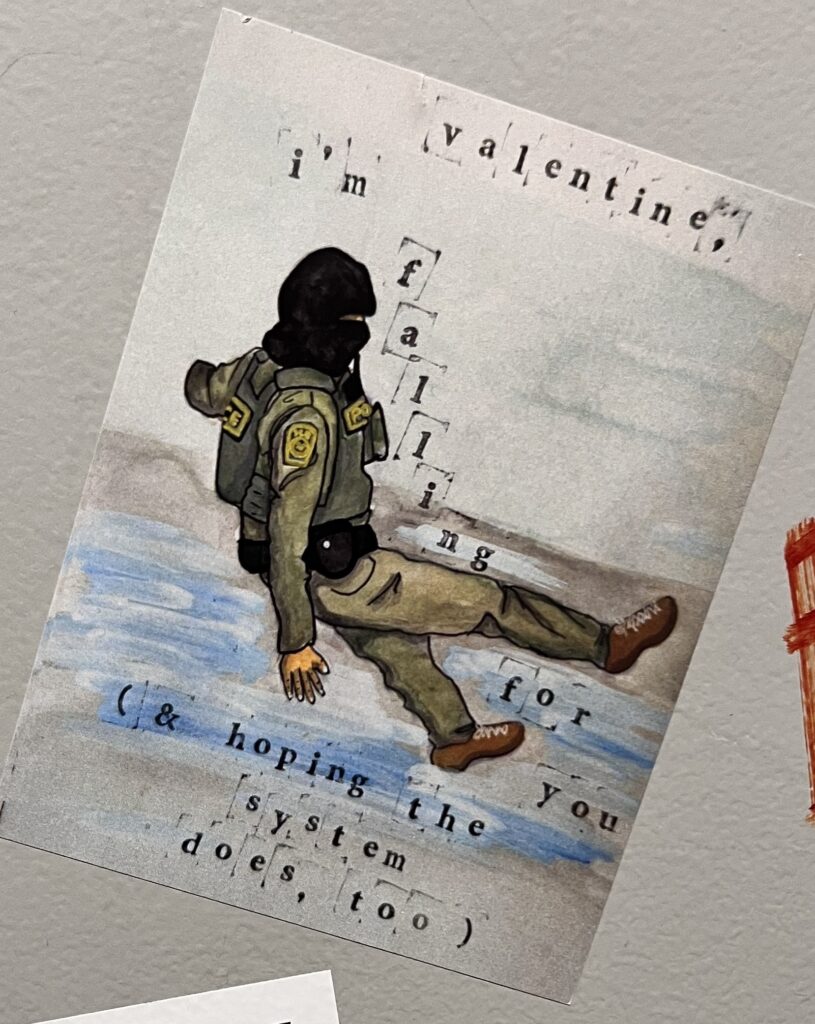
a few minutes later: As a first step, I’ve decided to try sharing my love poems again on Facebook. I put the link in the first comment and posted a photo, not of a dog, but of this Valentine that Scott noticed in the bathroom at Arbeiter Brewing:

Valentine, I’m falling for you & hoping the system does, too.

Also, I posted the STOP ICE photo that I posted here yesterday on my Instagram.

Maybe one of the biggest reasons I’m not sharing on social media is because it’s hard for me to do it with my bad vision. Everything takes so much longer and I can’t always see when I’ve made a mistake. And, I’ve been self-conscious about posting photos that I imagine are poorly cropped or framed strangely. Time to get over that.

Get Out Ice

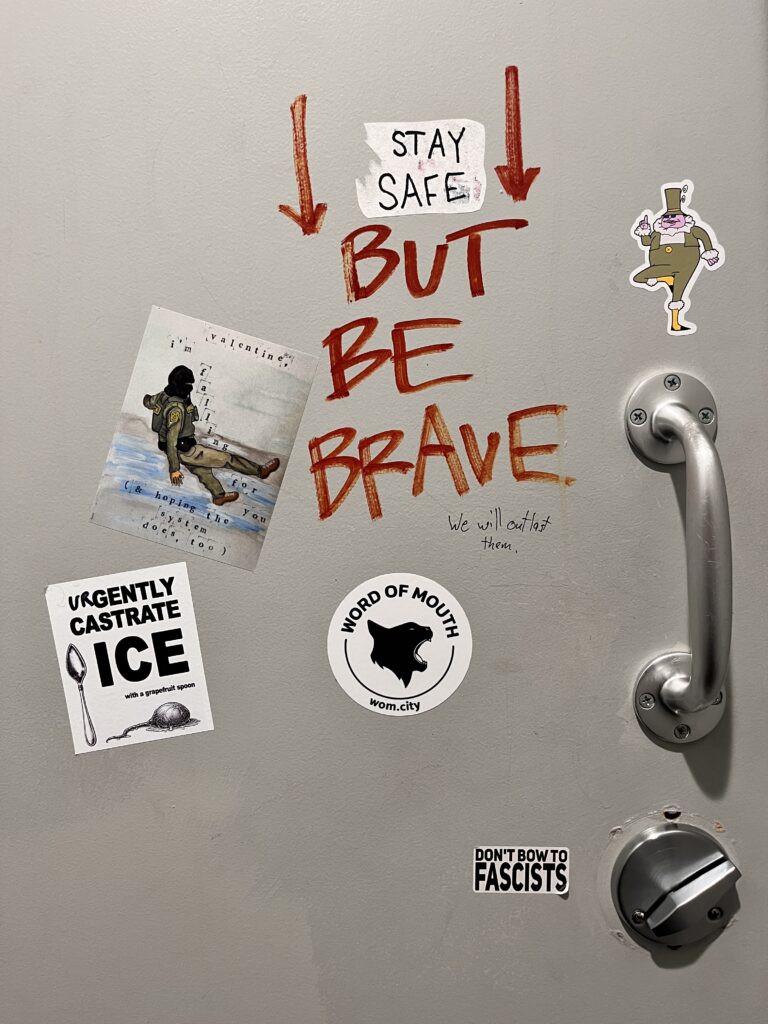
Seen on a bathroom door at Arbeiter Brewing:

sickers on a bathroom door at Arbeiter

feb 17/RUNGETOUTICE

4.3 miles
minnehaha park and back
47 degrees
wind: 13 mph / 32 mph gusts

Warm, but windy, which made it feel colder, but only sometimes. The rest of the time it felt warm. Warm enough for bare arms. My left knee was a bit stiff and sore. Maybe I should take a break from running tomorrow.

overheard as I ran near Minnehaha Academy: a whistle blowing, then an adult voice — Okay fourth graders! I guess recess is over.

10 Things

  1. at least 2 runners were wearing shorts
  2. all of the walkers were bundled up in coats and hats and long pants
  3. open water!? I think the ice has fully cracked on the surface of the river, but it could just be much thinner in parts. Looking down at it, there were blobs of white, with larger stretches of pale grayish, blueish, greenish
  4. the falls were gushing behind thick ice columns
  5. voices below — an adult with several kids — were they hiking behind the falls?
  6. a police vehicle parked sideways in the parking lot at 44th
  7. the cobblestones near the falls overlook were all ice-free, but not puddle-free! squish squish squish
  8. more of the walking path is clear and open — a few clumps of snow, wet and shiny pavement, grit
  9. an old pick-up truck was parked under the ford bridge, up on the sidewalk across the road from the trail — was it hiding — if so, why and from whom?
  10. the walking half of the double bridge was covered in slushy snow, the bike half was mostly clear with a deep puddle in the middle

I decided that I would listen to music for the second half of my run. Because it was windy, I put on my “It’s Windy” playlist. The first song: Sailing / Christopher Cross The last song was the sound of birds chirping. Huh? Oh — checked the title of the track: “Breeze (forest)”

Get Out Ice

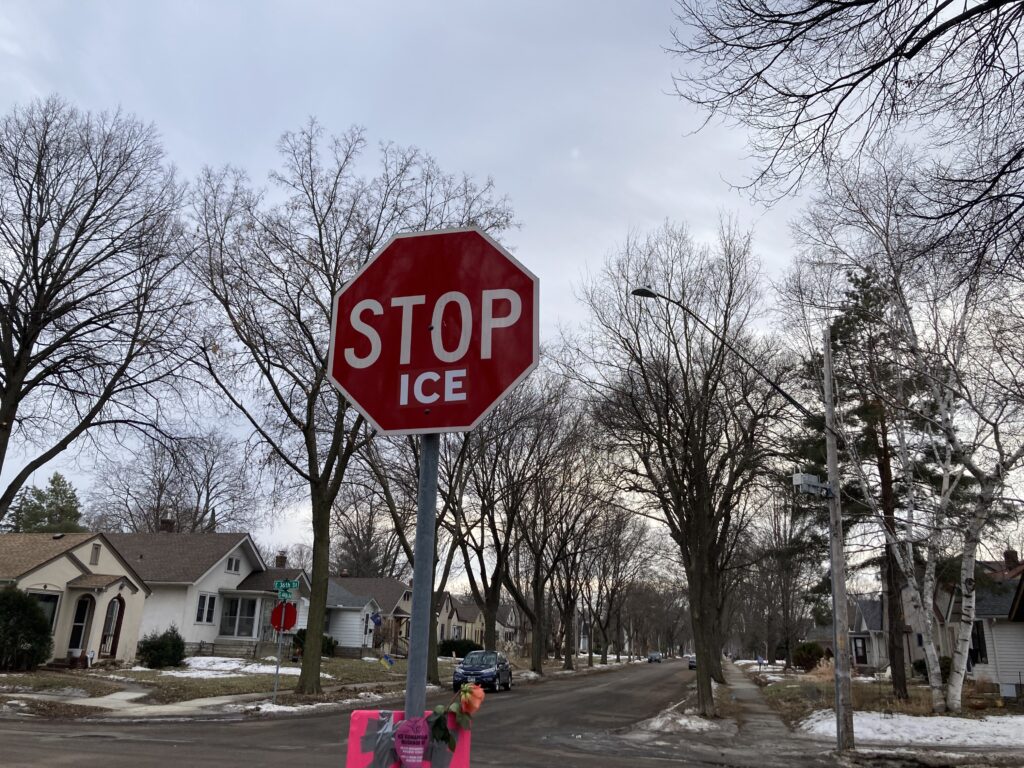
When FWA got home from his errand this morning, he told me that all of the Stop signs in the neighborhood have a stenciled “ICE” under the “STOP” in a matching font. Of course I had to check and take a picture!

STOP ICE

I’m not sure how long these signs have been this way. I hadn’t noticed, but I don’t drive, so I rarely see the stop signs. I wondered how long it took someone/someones to do this? I hope the city leaves them alone.

added, 18 feb 2026: Three notes from Scott. First, as we drove to the library, Scott and I noticed more stop signs with “ICE” and some without. Scott guessed that this stop ice action was probably not that systematic. Second, he also pointed out that it is not a stencil, but a sticker. Would I be able to notice that if I got close enough? I’ll have to take a walk today and check. And third, Scott informed me that these stickers have been on stop signs for several weeks.

Love

I finished my love poems. I decided to call it, We Love, We Love, We Love, We Love. I posted it on instagram, facebook, and as the home page of my author site: sarapuotinen.com

feb 16/RUNGETOUTICE

4.05 miles
river road, north/south
51 degrees
50% sloppy

51 degrees! Another run with bare arms. Lots of puddles, but also lots of dry path. I was able to run on the walking path for long stretches. The surface of the river has cracked — no open water yet, but patches of thinner ice in light gray were scattered all over. A bike passed by blasting music: “Losing my Religion” by REM. I heard some kids’ voices at a playground before I reached the river. Saw/heard an ambulance rumble by on the river road, its LOUD siren freaking out all the nearby dogs. Near the end, recited Alice Oswald’s “A Story of Falling” as I ran — in my head, not out loud. Also near the end, heard the bells of St. Thomas chime twice — it’s 2:00 already? Wow.

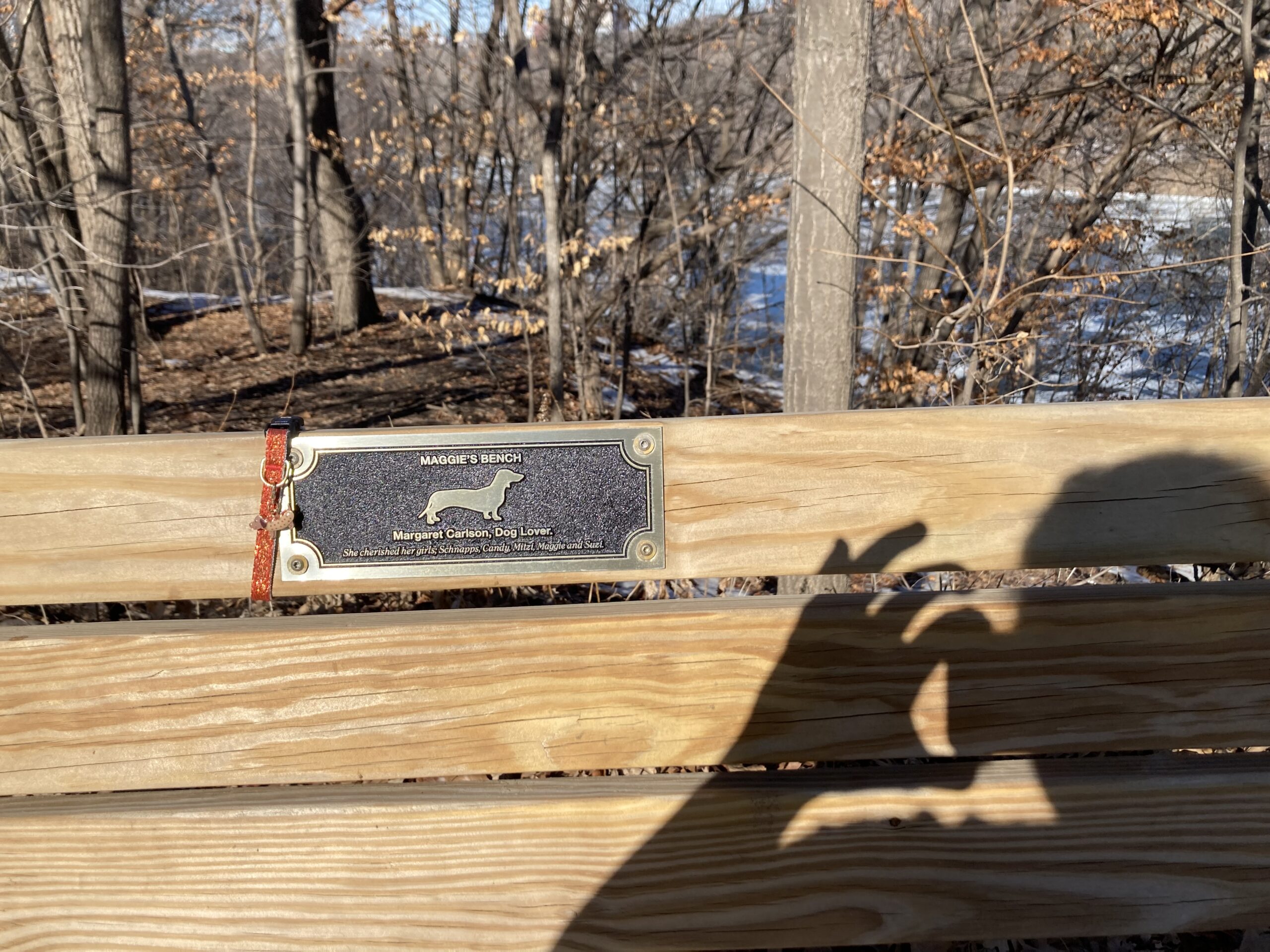
I stopped to walk several times, often because I had become trapped on a part of the path that was suddenly blocked by a short wall of snow or a deep puddle. One of the stops was at a bench nearing Franklin that I have delighted in noticing before. It is dedicated to “Margaret Carlson, Dog Lover.” Today I remembered to take a picture of it!

“She cherished her girls; Schnapps, Candy, Maggie, Mitzi and Suzi*”

*yes, it should be a colon, not a semi-colon, but who cares; I’d rather give my attention to the fact that one of her “girls” is named Schnapps, and another, Candy!

I’m not sure if I’ve written this yet, but I’d like to remember: when I go out running now, I carry a whistle and my passport ID card. And I don’t listen to any music, so I can be better aware of what’s happening around me.

Get Out Ice

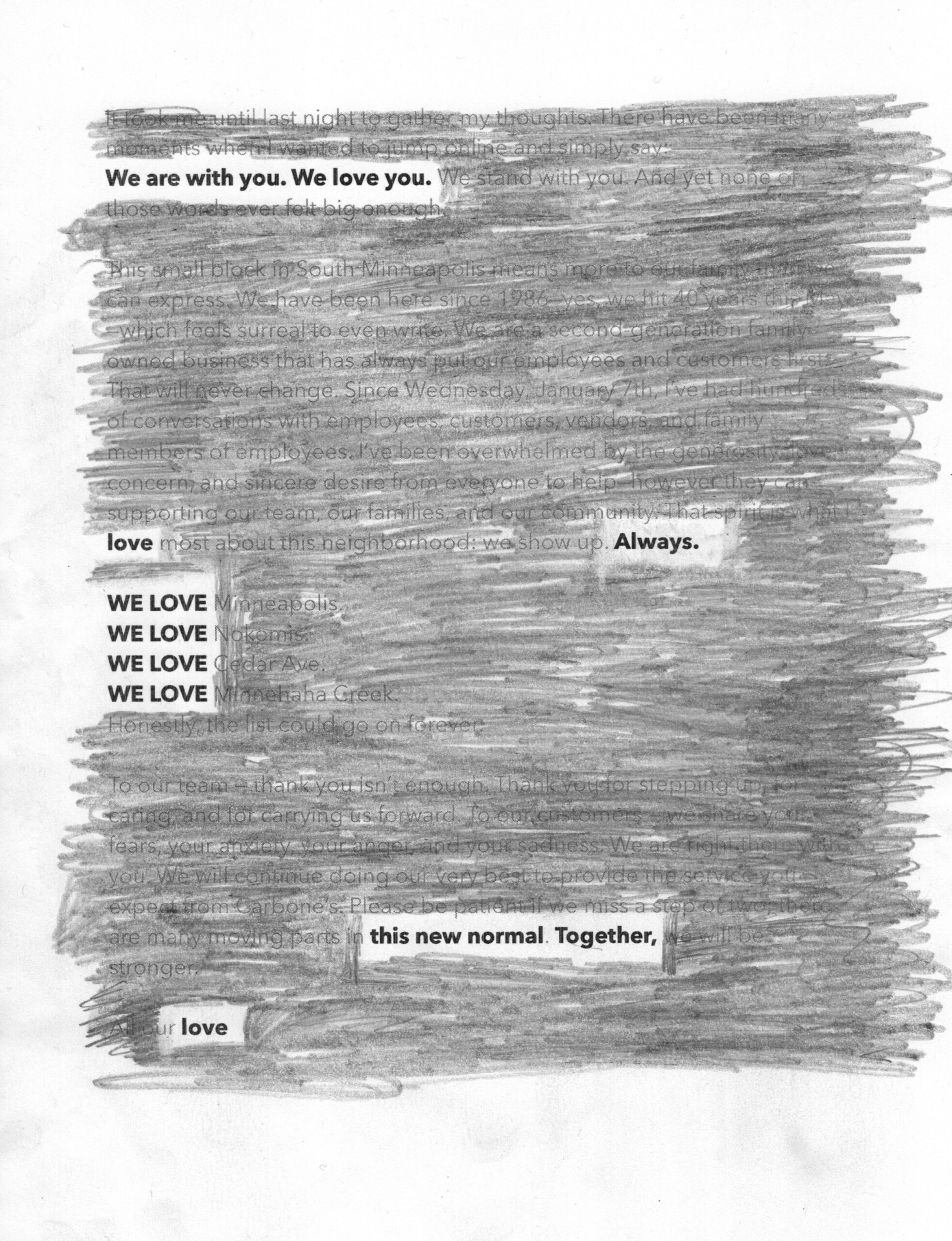
I am almost finished with my collection of love poems. Here’s the final poem, which is an erasure of a Facebook statement by Carbone’s Pizzeria on Cedar near Lake Nokomis:

This New Normal / 15 February 2026

This New Normal

We are with you. We love you.
love Always.
We Love
We Love
We Love
We Love
this new normal together,
love

feb 13/RUNGETOUTICE

3 miles
locks and dam #1 and back
46 degrees!
75% sloppy

Okay first false spring! So many less layers today: running tights, shorts, short-sleeved shirt, pull-over, cap. No gloves or long sleeved base layers or coats or buffs. And, by the end of the run, I took off my outer layer and was walking back with bare arms. Nice! I’ve told the kids for years, whenever they wonder how they can make it through the long winter, once you get through January, it always warms up for a few days around Valentine’s Day. And, like it usually does, it warmed up right around Valentine’s Day!

I felt good during my run. Happy, strong, able to run through moments of wanting to stop. I wasn’t able to avoid puddles though. Squish squish squish. Soaked socks.

10 Things

  1. patch-work surface below: white and pale blue — will the ice split before it gets cold again?
  2. birds! sounding excited for spring
  3. deep puddles everywhere — they were particularly bad on the double bridge, I had to grab onto the wooden railing and climb around them
  4. a car passed me twice blasting some music that sounded like enya
  5. encountered lots of runners — were any wearing shorts? I can’t remember
  6. drip drip drip
  7. the sun was reflecting off of the water on the path, everything was shiny and bright
  8. at least one or two fat tires
  9. a few walkers in bright yellow vests
  10. the grassy boulevard was a combination of mushy snow, very slick snow, and grass, and mud

When I reached the locks and dam #1, I ran halfway down the hill and stopped to record a thought, and some false spring sounds:

False spring / 23 feb 2026

restless / still

At my annual check-up a week ago, I told my cnp that my legs were restless and I was waking up several times a night (which has been the case for a decade now, I think). She ordered a blood test for my ferritin. Yep — very low: 16; she wants it to be at least 40. So, iron pills for a month, another test, then maybe iron transfusions. This description is for future Sara who likes to remember these things, and present Sara who imagines a future Sara that will. This description is also prompted by two references to stillness in my “on this day posts” from past years. In 2021 I posted a passage from an audiobook I was listening to, Wintering:

There are gaps in the mesh of the everyday world and sometimes they open up and you fall through into somewhere else. Somewhere else runs at a different pace to the here and now where everyone else carries on. Somewhere else is where ghosts live, concealed from view and only glimpsed by people in the real world. Somewhere else exists at a delay so that you can’t quite keep pace. Perhaps I was already resting on the brink of somewhere else anyway, but now I fell through as simply and discretely as dust shifting through the floorboards. I was surprised to find I felt at home there. Winter had begun. Everybody winters at one time or another. Some winter over and over again. Wintering is a season in the cold. It is a fallow period in life when you’re cut off from the world, feeling rejected, side-lined, blocked from progress or cast into the role of an outsider.

Wintering / Katherine May

Here stillness = a lack of movement, frozen in the cold, removed from the action. Reading this passage again, I’m not so sure that I think of stillness, but when I read it a few minutes ago, and then read a line from Elizabeth Bishop, I thought, still. Here’s the line from Elizabeth Bishop’s poem, “Five Flights Up”:

Still dark.

When I read this brief line, I thought about how much I like that still can mean more than one thing at a time. Still dark = it is still dark, the dark continues, it is too early for light, we continue to be in the time/place of not-yet-day. And, still dark = it is quiet, there is a lack of movement, everything is still and dark, nothing moves and nothing can be seen.

Maybe I should spend some time studying Bishop? I have read several of her poems, even studying one more closely — The End of March on 30 march 2023. And now I’m thinking of Jorie Graham and studying her, or finally writing a poem about being still and restless? And all of this makes me think, again, of a film still, a photograph, an image frozen — my “how I see” project!

Get Out Ice

Thinking again about today’s false spring weather. FWA asked how many false springs I thought we’d have before it was warm for good and I said, I wasn’t sure but that I knew it would get very cold again. The earliest spring has stayed is the end of March. I added, no one believes that this warm-up will stay, that we’ve made it through winter. What this warm up does it reminds us that a world beyond winter is possible, which is easy to forget when we’re in the deep of it. This feels like a metaphor for ICE’s leaving of Minnesota. It’s not over, they’re not really leaving. No one here believes that. But this withdrawal of troops does signal a victory and demonstrates that a world beyond ICE beyond Trump is possible.

Love

I’m working on the introduction to my love, minnesota-style chapbook. Since I’m a little stuck, I tried to think about it as I ran. A sentence popped into my head, and I recorded in the middle of the run: “Words don’t merely describe something, they do something.” And I added, and I’m particularly interested in what these words did/do to me, to others here in Minneapolis and St. Paul.

feb 12/RUNGETOUTICE!?!

5.4 miles
bottom for franklin and back
41 degrees
40% puddles

Puddles everywhere. After about a mile, I could hear the squish sound of my wet sock with every foot strike. Who cares? Not me. I’m happy for warmer weather and clearer paths. I wasn’t sure how far I’d run, but I just kept going and made it to the bottom of the franklin hill. First I was going to stop at the trestle, then I wanted to make it a little closer to Franklin. When I reached Franklin, I looked down at the uneven, cracking ice on the river’s surface and decided I needed to run to the flats to get a closer inspection. Very cool — cold (temp) and aesthetic (strange and interesting and other-worldly).

I heard birds, felt warm sun on my face, smelled sewer gas (below, near the rowing club), saw a woman biking in a tank top.

Get Out Ice!?!

The official word, announced this morning by Homan, is that ICE is leaving Minnesota and Operation Metro Surge is over. But, is it over, or just taking more hidden forms? And was this move made primarily to get the budget passed and/or ease the pressure being applied in D.C.? Whatever the case, it does seem to be a failure for the Trump administration and it also seems to be bullshit. They are staying and will continue doing bad (as in unconstitutional, terrible) things here and all around the country.

love

While all that I wrote in the last paragraph seems to be true — and scary and difficult to imagine and endure — something else is true: people are speaking out, resisting, caring for each other, paying attention, reclaiming democracy, organizing together, refusing to be intimidated or overwhelmed by the administration’s tactics. Will this stop ICE or Trump? Maybe not, but whatever happens, the love that has been expressed/practiced in Minneapolis for the past 2 months isn’t going away and too many of us have witnessed what it has cracked open that can’t be fully fixed by the administration. There is another world possible.

feb 11/RUNGETOUTICE

4.5 miles
minnehaha falls and back
35 degrees
15% sloppy

Sun! Above freezing! Melting and melted snow! And I think I remember hearing chirping birds somewhere. Plus, the falls were faintly falling! Today’s run felt much better than yesterday’s. I felt stronger and calmer and more capable of handling everything — running included.

10 Things

  1. two benches at the park were occupied, one near Sea Salt and one just across the road from the Longfellow House
  2. a low, dull whine coming from the indoor ice rink at Minneahaha Academy
  3. the gentle curve of the retaining wall wrapped around the ravine between 42nd and 44th, covered in white
  4. much of the snow near the bench above the edge of the world was melted — the bench was empty, the river was white
  5. a few cars in the parking lots at the falls
  6. two people standing on the path at the edge of the falls looking up at something — but what?
  7. 2 fat tires
  8. a man and a dog emerging from a snow-covered trail, climbing a snow bank and then crossing the road
  9. a long honk from a car across turkey hollow
  10. the soft sound and the slide-y feel of my feet striking the grit on the path

As I ran, I thought about my low ferritin and wondered what impact it has made on my running. Is it why I struggle to run more than 4 or 5 miles at a time? Then I imagined how much better my running might be after a few months of taking the iron pills my np (nurse practitioner) prescribed for me.

Here in Minnesota, we have a few months (if we’re lucky!) before it’s spring, but it sure feels like it today. In honor of that feeling, here’s a Mary Oliver poem I just discovered in my recently purchased Little Alleluias:

A Settlement / Mary Oliver

Look, it’s spring. And last year’s loose dust has turned
into this soft willingness. The wind-flowers have come
up trembling, slowly the brackens are up-lifting their
curvaceous and pale bodies. The thrushes have come
home, none less than filled with mystery, sorrow,
happiness, music, ambition.

And I am walking out into all of this with nowhere to
go and no task undertaken but to turn the pages of
this beautiful world over and over, in the world of my
mind.

***

Therefore, dark past,
I’m about to do it.
I’m about to forgive you

for everything.

I love this poem! To turn the pages of this beautiful world, to forgive the dark past, to declare, I’m about to do it in a poem. I want to borrow that line.

Get Out Ice

An IRL friend shared a post on Facebook with some wise words about care and love. The whole post is great, but here’s an excerpt that explicitly discusses care and another form of love: relational humility and the de-centering of needs/desires

So beloved white women kin, please let us watch each other. If you see this happening, please turn towards our kin and ask them to hold a contradiction with you: we need the efforts and care that are being brought forth, this strategy that uses our privileges to build things that are needed but, at the same time, and with the greatest of humility, we have to recognize that we carry within us deeply rooted survival needs that are about our own comfort and centering; our desire to feel and be seen as valuable and worthy. And because those needs are deeply rooted, we often don’t see them when they crop up, although others do. Which is why practicing relational humility rather than defensiveness is key to this moment.

Link arms with each other and say, hey, while we are doing this work, let’s check each other on what we are bringing to it. Who else are we in relationship with? How are we checking our actions against something other than the minds of other white women? Is there anyone else doing the same thing or something similar and can we help them rather than start something new? Is there a part of us doing this thing because we have an image of ourselves as brave and selfless, a kind of inner hero narrative? Come on, loves, tell the truth. Where are we holding on to control rather than care, feeling a sense of ownership to our work that we are attached to, expressing false humility when we actually want the attention, and believing that we know what is best for whatever moment we are in? Are we trying to build an empire or just a moment for the people nearest to us, people we want to create safe? Loves, beloveds, there are a number of white women engaging in empire building right now, even though it is called care.

Raffo Susan

there are a number of white woman engaging in empire building right now, even though it is called care.

love

I have written 14 love poems using words/lines/phrases from the social media statements of local businesses. For Valentine’s Day, I want to gather them in a small chapbook to be shared and spread. I’d like to include a brief introduction that would explain what, why, and how I put these together, and might offer a more straight-forward description of how love is being imagined and practiced here in Minnesota. This afternoon and tomorrow, I need to write this introduction.

feb 10/RUNGETOUTICE

3.7 miles
lena smith hill
33 degrees

Windier today. Colder too. The run wasn’t as easy. As always, there were moments that felt great, when I was strong and joyful. And there were moments that felt not so great, when I was tired and overheated. I did the hill on the river road once and the hill on lena smith 4 times. The road and the trails were mostly clear. It was only when crossing an alley or a block or running up the river road hill that it was icy and uneven. And somewhere — where was it? — there were several deep puddles covering the sidewalk. Oh, I remember: near Minnehaha Academy. 3 deep puddles, at least.

Someone was walking with a dog and holding up a sign. I couldn’t read what the sign said, but people were honking in support, which didn’t sound like support to me. All honks sound threatening or aggressive or seem to signal a warning, especially now when people are using them to alert neighbors of ICE.

Get Out Ice

Read this great story about reclaiming ice on Facebook from Sean Snow:

In an incredible display of solidarity on the East Side of St. Paul, thousands of neighbors gathered at Lake Phalen this weekend for the “Shine Light Over ICE” vigil. Organizers transformed the frozen lake into a massive canvas of resistance, placing thousands of LED luminaries and candles on the ice to spell out messages of welcome and protection for immigrant neighbors. The event was organized by local interfaith and community groups, and was designed to reclaim the word “ICE” from a source of fear back to a source of shared Minnesotan joy.

Freezing weather makes our hearts warm

In Minnesota, we know something the rest of the country doesn’t… the cold has a way of clarifying things. It strips away the unnecessary and forces us to huddle together for survival. We don’t hide from the winter… we drive right out onto the frozen water and light a fire. By turning a frozen lake into a source of warmth and light, our communities proved that no matter how cold the political climate gets, the hearts of Minnesotans burn hot enough to melt the fear. We are winter people, and we know how to keep each other warm.

Source: https://www.twincities.com/…/st-paul-lake-phalen-event…/

We are a winter people and we know how to keep each other warm. Also, the line about the clarity of the cold.

Love #14

In today’s love cento, I took words from 3 different posts by a pub near my house, Merlins Rest. I was unsure what to make out of them until I read this line,

“Community. Connection. Conversation. The Three C’s that Merlins Rest Pub was founded on.”

The Three C’s of Love

Cannot close, Committed
Calling attention, aCcountability: Caught.
Community Connection Conversation
Celebrations Challenges Change
Continue Continue Continue
Cold City Compassion

Does this work? I almost wonder if any of these “3 Cs” could be the title of a poem? I like the idea of creating another poem, using Merlins Rest Pub’s words, with this title, Cold City Compassion.

Cold City Compassion

In the bone-deep Minnesota cold
we invite you to join us.

Together, we will continue 
to keep each other warm.

Maybe I could use the quote about being a winter people as an epigraph for this poem?

feb 8/RUNGETOUTICE

2.6 miles
river road, south/north
28 degrees
25% ice-covered

A beautiful morning for a run! Sunny, warmer, clearer trails. There was some ice, but most of it had been sprinkled with dirt so it wasn’t slick and dangerous — there’s a metaphor there, right? I was glad to be out on the trail, albeit with some anxiety. Two days ago, at my annual check-up, my blood pressure was in the high zone. High enough to need to monitor it daily for a month to see if I need to go on medication. Some other test results were “abnormal,” too: high cholesterol, high thyroid, low ferritin. Bad test results make me anxious, or is my potentially out-of-whack thyroid? Or maybe it’s just living in a city occupied by ICE for more than 2 months and living under a federal administration that is careening towards full totalitarianism vile evil unhinged extremely dangerous falling apart and is desperate to hold onto power. I’m struggling to find the words to effectively describe this administration. So, yes, I was worried as I ran, wondering if my heart rate should sky-rocket the more I ran. Thankfully it didn’t. The run wasn’t easy, and it wasn’t the big escape I had hoped for, but it did bring me some delight and some beautiful moments to look to when I’m feeling overwhelmed. Can I find 10?

11 Moments of Beauty

  1. the sizzling sound of wind moving through the brittle leaves still remaining on a tree
  2. quiet, then the softest knocking cutting through — a woodpecker somewhere close by?
  3. yes! looking up at a tree, I could actually see the white underwing of a downy woodpecker, it’s tiny head hammering a branch
  4. wide stretches of clear, dry trail
  5. stopping at the Rachel Dow Memorial Bench, looking out at the frozen river, wondering what Rachel would do in this moment, then believing she would be part of this amazing love spreading across the city, the state, the country
  6. a good morning from a passing walker
  7. a feeling of movement below me, then spotting a walker on the Winchell Trail, the remembering running down there, nearer to the river on a warm day
  8. the rhythmic clicking of a passing runner’s snow spikes on the bare pavement — click click click
  9. running over the slick ice and not slipping or sliding because Minneapolis Parks had sprinkled dirt — and not salt — on it recently
  10. speaking — out loud, but softly — the words to Alice Oswald’s “The Story of Falling” that I re-memorized earlier this morning — It is the story of the falling rain/to turn into a leaf and fall again/It is the secret of a summer’s shower/to steal the light and hide it in a flower
  11. (added 9 feb) a woman below, on the winchell trail, calling out, her name is Freya!, and a man responding, you’re a good girl! — just yesterday, Scott, Delia, and I had encountered this friendly woman and her dog near 7 Oaks. She was so friendly and kind that we agreed encountering her had made walking out in the cold, on the icy paths, worth it

Just writing this list, and the words preceding it, have made me feel better, more relaxed!

Get Out Ice

Even if I’ve written this before, I’ll write it again: I am finding that focusing on the fierce love and care that Minneapolis is practicing and de-centering/quieting the endless examples of ICE awfulness is helping me to endure this time. Well, more than endure. The love I am witnessing, and attempting to practice in my own way, is inspiring and making me hopeful about possible futures. It is also restoring my belief in democracy.

Here are 2 examples I shared on Facebook today:

1 — Rebecca Solnit post

One of the nuts things about organizing in the Twin Cities right now is that even the most long term organizers who’ve been here for decades can’t keep keep track of all the resistance that is going on. There are so many self-organizing crews just doing work that in any conversation with someone from another neighborhood you might stumble over a whole collective of people resisting in ways you didn’t think of. There’s a crew of carpenters just going around fixing kicked-in doors. There are tow truck drivers taking cars of detained people away for free. People delivering food to families in hiding. So many local rapid response groups that the number is uncertain but somewhere between 80 and the low hundreds . . . .

Rebecca Solnit on Facebook

2 — @terileigh via Liz May

every restaurant, church, karate dojo, dance studio, school, barber shop, and other small business has created their own underground grassroots supportive network to protect their neighbors, get people to and from work, and raise funds to pay everyday bills.

@terileigh

feb 5/RUNGETOUTICE

4.45 miles
minnehaha falls
33 degrees
60% sloppy and wet

A run outside! Above freezing! Less layers! And I made it all the way to the falls! It was sloppy, but I’ve run through worse. No lakes covering the entire path, only small ponds. I felt stronger running up all the small hills; it must be the hill workouts I’ve started doing. Maybe I should run to the falls and do some loops around the park — I could do the hills there multiple times? It’s strange, but I like running up hills now.

10 Things

  1. birds singing and sounding more like spring
  2. the dull, quiet whine of a power tool off in the distance — a drill on a construction site?
  3. the falls are completely frozen, so is the creek
  4. voices rising up from somewhere down below at the base of the falls
  5. faint traces of brown dirt discoloring the snow, making it less winter wonderland, but also less slick
  6. kids yelling and laughing on a playground — a teacher’s whistle blowing (not a warning about ICE)
  7. empty benches everywhere
  8. a few cars in the park parking lot
  9. another runner behind me, beside me, then in front of me. I delighted in hearing the sibilant sounds of their feet striking the slushy snow
  10. a few seconds of honking above on the ford bridge — someone honking at ICE or another car’s driving or in solidarity with a bridge brigade?

Get Out Ice

Today’s Get Out Ice moment is in honor of my mom, who was a fiber artist until she died in 2009, and my daughter, who is a fiber artist now.

AS OF FEBRUARY 5TH.
WE HAVE REACHED A TOTAL OF
$650,000 IN DONATIONS
Funds last week were donated to STEP St. Louis Park emergency assistance for rent and other aid and the Immigrant Rapid Response Fund.
We are working on donations to other local organizations
– stayed tuned for more info.
We are speechless. We are overwhelmed with the generosity of the fiber community and beyond. This outpouring of love and support is felt around the state.
Because of you, we can help so many people who need it.
Thank you thank you thank you.
Keep knitting. Keep resisting. Keep showing up for your neighbors.
Melt. The. Ice.

Needle & Skein Instagram post

The $650,000 came from people purchasing a $5 pattern for the Melt the Ice Hat:

In the nine years that Gilah Mashaal has owned Needle & Skein, a yarn store in the suburbs of Minneapolis, she has tried to maintain a rule that “nobody talks politics” in the shop. But amid the weeks-long occupation of the Twin Cities by federal immigration paramilitaries, Mashaal and one of her employees decided to turn one of their weekly knit-alongs into a “protest stitch-along”.

They didn’t want to return to the “pussy hats” that symbolized women’s resistance to Donald Trump in 2016, so Paul, their employee, did some research and came back with a proposal: a red knit hat inspired by the topplue or nisselue (woolen caps), worn by Norwegians during the second world war to signify their resistance to the Nazi occupation.

‘Rage Knitting’ against the machine

Love #13, version 2

This morning, I was trying out all different ways to create a poem out of text from a few local businesses. Nothing was quite working; partly because I am fixated on erasures and blackouts and can’t see (literally and figuratively) how to execute this effectively. One way out: Mary Oliver. My whole poem centers on a phrase from a MO poem, “Lead”:

I tell you this
to break your heart,
by which I mean only
that it break open and never
close again
to the rest of the world.

Here’s my version of those lines, using words from Social media posts:

Here, now, 
on this day,
my heart
breaks, 
and tomorrow
it will stay open
to everything.

Or this variation:

My heart breaks
here, now,
and tomorrow,
it will stay open
to everything.

feb 4/BIKERUNGETOUTICE

bike: 30 minutes
run: 1.4 miles

The trails looked sloppy and slippery, so I biked and ran inside today. I was planning to watch Poker Face while I biked, but I couldn’t find it. Tried “Pluribus” again but it was too much for me . . . again. Finally settled on the new Knives Out movie, which I really enjoyed. While I ran, I listened to a podcast with one of my favorite triathletes, Taylor Knibb. She talked about her season and her experience DNFing at Kona: she had heat stroke in the last few ks and even though she was winning, had to drop out. When they checked her temperature, it was around 105. Yikes.

I don’t remember much about my short run. One thing: at some point I lifted out of my hips, focused on my arm swing, and felt like a smooth, efficient machine. Fun!

Get Out Ice

This morning, read the news that 700 ICE agents will be leaving Minneapolis today. That’s good, but not nearly good enough. All of ICE should be leaving should not exist. On the way to Costco, driving near the road that leads to the Whipple Building where ICE brings the people they’ve arrested or kidnapped, Scott pointed out a truck hauling several Black Jeep Wagoneers entering the freeway. Black Jeep Wagoneers are the type of vehicle ICE often drives.

For much of the day, I was working on another love poem. I wanted to do another erasure poem, but so far, I’ve been struggling with it. Here’s some of the text that I’ve come up with:

Love #`13

My heart breaks
open, will stay
open
for all
who are feeling this occupation

Do I like it? I’m not sure. It all centers around a heart breaking open, instead of just breaking.

feb 3/RUNGETOUTICE

4.1 miles
river road, south / lena smith, north / hills
13 degrees

13 degrees sounds cold (I guess), but with the sun and all of my layers, I was too warm. Lots of sweat dripping down my forehead. On the way to the river, the sidewalks were bare, but on the trail, they were covered in slick ice and uneven snow. Bummer. Decided to turn off the trail at 42nd and run north on the Lena Smith Boulevard, and then do some hill repeats. It was wet with wide strips of icy snow. If it hadn’t snowed 2 days ago, the path would have been dry and it would have been a wonderful day for a run to the falls or the flats or the lake.

After a fun day yesterday, getting lost in baking m-n-m cookies for Scott and crafting erasure poems out of local business statements, today felt draining and a bit overwhelming. I’m not anxious, just tired and uncreative, which is not surprising. It’s an exhausting, unrelenting time here in Minneapolis.

One bright spot: I discovered this morning that there’s a new Mary Oliver book out: Little Alleluias! It’s 3 books in one: The Leaf and the Cloud, which I own and have taken notes all over the margins, so a fresh copy will be nice; Long Life, which I have checked out of the library enough to wish I owned it; and What Do We Know, which I haven’t read; plus, a foreword by Natalie Diaz. I bought it online from Moon Palace, and will pick it up in a few hours!

Alice Oswald

Still making my way through the Alice Oswald interview for the Paris Review. Here are today’s lines to remember:

Interviewer: Is swimming important to you?

Alice Oswald: It was probably when I took up gardening that I discovered that being was better than thinking–that actually you don’t have to think things through, you can garden all day and your mind will have been moved by the gardening. And it’s the same when you’re in water. You’re thought through by the water rather than having to think.

 an interview with Alice Oswald

I like the distinction between thinking and being, and the idea that doing something physical, like gardening or swimming, will move your mind. What does it mean to be thought through by the water? I’d like to pose this question before/during/after a swim at the Y — which I hope to do this week — and a swim at the lake — which I won’t get to do for 4 months.

Get Out Ice

1 — caregiving as resistance

Here’s a great article that I want to read more carefully when I have a chance: ‘We have to keep showing up for each other’: In Minnesota, caregiving is a form of resistance Wow, I would have loved to write about this on my TROUBLE blog!

2 — protectors not protesters

But behind the violence in Minneapolis—captured in so many chilling photographs in recent weeks—is a different reality: a meticulous urban choreography of civic protest. You could see traces of it in the identical whistles the protesters used, in their chants, in their tactics, in the way they followed ICE agents but never actually blocked them from detaining people. Thousands of Minnesotans have been trained over the past year as legal observers and have taken part in lengthy role-playing exercises where they rehearse scenes exactly like the one I witnessed. They patrol neighborhoods day and night on foot and stay connected on encrypted apps such as Signal, in networks that were first formed after the 2020 killing of George Floyd.

Welcome to the American Winter

3

Minneapolis Parks invite kids to write love letters to the city. I love Minneapolis Parks!

At parks around Minneapolis, heart-shaped love letters from kids are providing some wholesome relief during an especially grueling winter.

(source)

feb 1/RUNGETOUTICE

2 miles
river road, south/ lena smith, north
25 degrees
100% uneven snow-covered

We got about 2 inches of soft, slippery snow this morning. Very pretty and very difficult to run over (through? on?). The trail on the river road hadn’t been cleared yet, and it was uneven. I feel very lucky that I didn’t twist my ankle or roll over my foot. I would have liked to run farther, but decided I should head back after a mile on the road. Lena Smith Boulevard was better, but slippery ~ I could feel and hear my the spikes on my yak trax catching. Even with my not-so-great conditions, I’m still glad I was able to get out to run above the gorge. It looked like a winter wonderland! Everything white and soft gray, sometimes snowing, sometimes not.

I heard some horns in the distance, at least one siren, maybe a whistle. Encountered SUVs and wondered who was driving them. A big part of the resistance and caring for the community is bearing witness and observing ICE. I can’t easily or safely do that with my low vision. I’m trying to find my own ways to show up. One way: I’m writing and giving a lot of attention to the powerful and loving words of small business owners. Another way today: I shoveled the sidewalks of my neighbors on either side when I went out to shovel mine. It’s not much today, but it’s something.

Get Out Ice

Here’s is a recent statement from one of Scott’s oldest clients. They asked him to post it on the main page of all of their restaurants.

Dear Guests and Staff,

Minneapolis and the state of Minnesota have had a very challenging month. Everyone within our communities has been affected by the actions of our federal government these past few weeks. Their original promise, purpose and intent was to ensure safety and to administrate with decent behavior and professionalism. However, it has evolved into a climate and behavior that is unfair according to the principles of our Constitution and individual-civil rights.

Day and night, our owners and staff have been assembling aid in many forms for our immigrant community. During these unprecedented times, we have kept our restaurants open to continue serving our guests and to ensure our workers can remain employed. Any past, current, or future closure of our restaurants in support of a protest was and will be the decision of the majority of the team at each location.

The generosity and care our staff has shown for each other is unselfish and truly inspiring. Many have sacrificed their money, time and efforts in the interest of helping other human beings without asking for anything in return. That is the American way!

We are seeing neighbors and communities come together all around us, and we hope this can be a time for all Americans to unite behind our collective shared values: life, liberty, and happiness.

We believe in civil rights for all and equal justice under the law. Our immigrant-friends and neighbors are one of the many things that make our country great.

In the name peace, calm and law and order for all,
Nova Restaurant Group

Nova Restaurant Group Statement

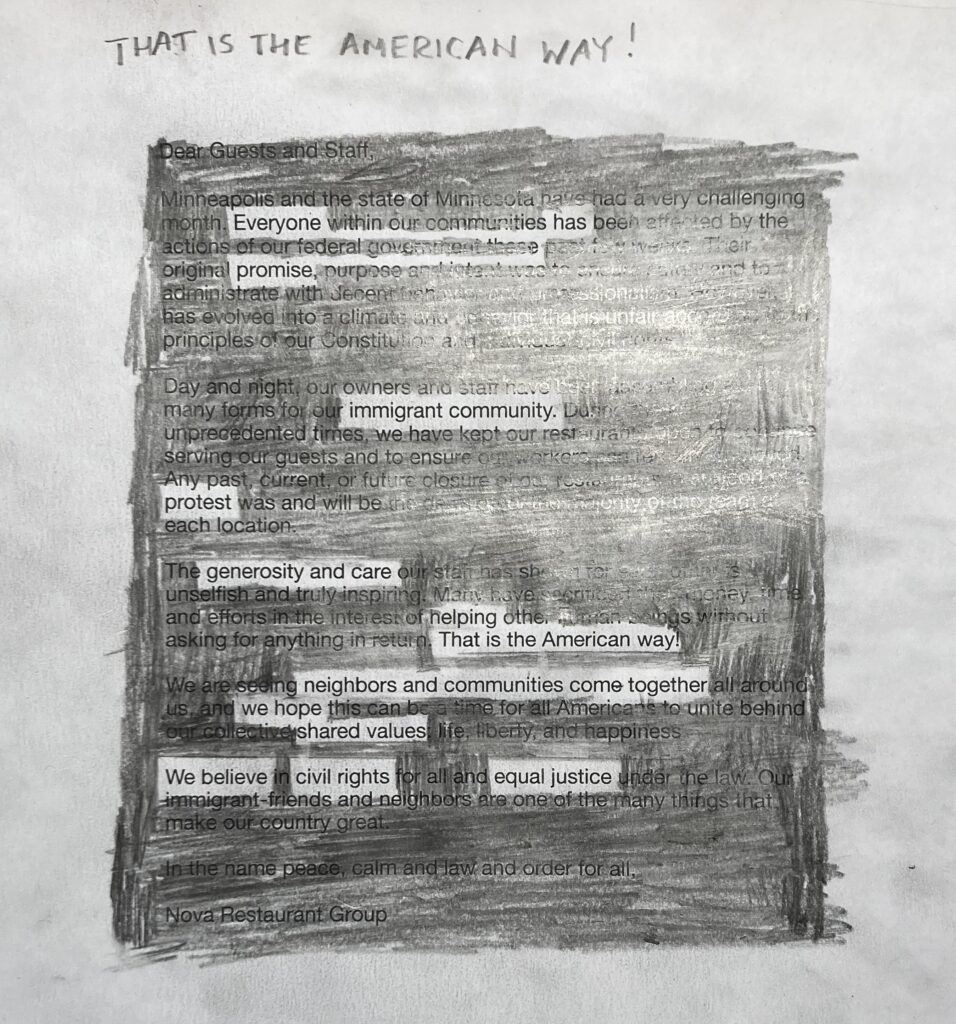
And here’s a draft of an erasure poem (that needs some work), made from the above text:

I like the idea of centering it all around the idea of what is the American way. I’ll keep working on it.

jan 31/RUNGETOUTICE

4.7 miles
river road, north/south
17 degrees
20% snow-covered

More sun, warmer temperatures. Heard lots of honking and chanting on the lake street bridge — people protesting the occupation, I’m guessing. The river looked like a patchwork quilt with squares of white and gray and brown. Heard more birds, wondered if they were singing or calling out a frantic warning. Saw another “Make Good Trouble” snowman by the trestle. Encountered at least a dozen different walkers or runners or bikers. Tried to wave to everyone.

It is such a strange time — so sad and scary and beautiful. The government is actively trying to destroy democracy and the president is more ghoulish and vile than the villain in an sci-fi movie, and yet, all around Minneapolis people are creating the world they want to live in. Practicing love, believing in dignity and rights and the law, caring for their neighbors.

Get Out Ice

The pubic statements against what is happening here continue to grow. Here’s one from Jessie Diggins, the Olympic gold medalist in cross-country skiing from Afton, Minnesota. She posted it on Facebook this morning:

I want to make sure you know who I’m racing for when I get to the start line at the Olympics. I’m racing for an American people who stand for love, for acceptance, for compassion, honesty and respect for others. I do not stand for hate or violence or discrimination.

I get to decide who I’m racing for every single day, and how I want to live up to my values. For everyone out there caring for others, protecting their neighbors and meeting people with love – every single step is for you. YOU are the ones who make me proud.

29 jan/RUNGETOUTICE

3.5 miles
trestle turn around
7 degrees
40% snow-covered

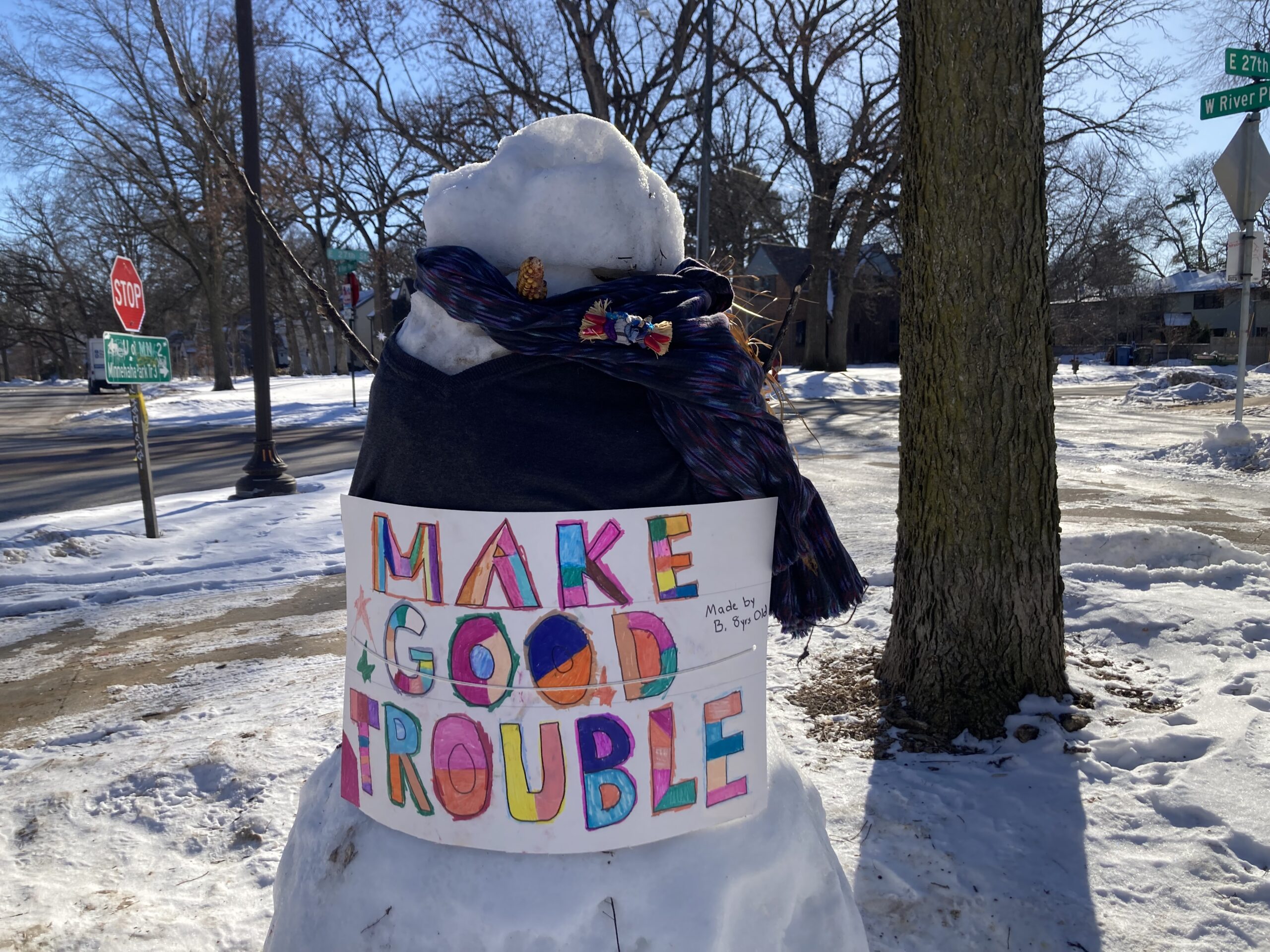
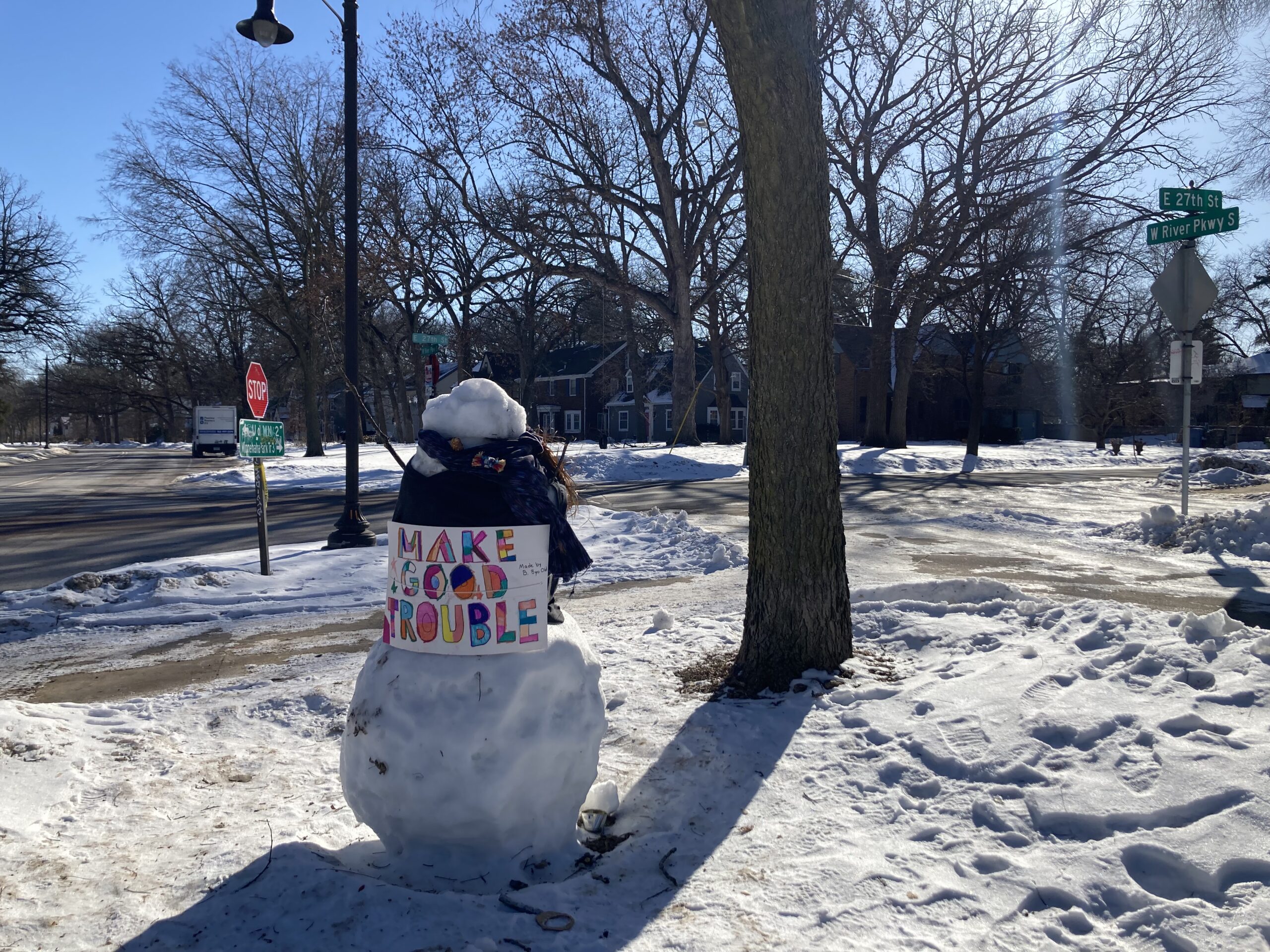
Another run outside! Yesterday, I ran south, today I ran north. RJP had told me that someone had made a snowman then put a sign on that read, “Make Good Trouble” next to the trestle. Of course I needed to go see and document it!

I love the shadows of the tree and the snowman and the message of making good trouble. 15 years ago, I would have posted this in my TROUBLE blog. Now, I’ll post it here. Could Sara from 2011 have even imagined we’d be living through the occupation of a fascist government?

It was a nice run. Slow and relaxed. At first, I was alone out there, but soon I encountered some other walkers, 2 runners. The river surface was cracked white, the sky was blue. I started by running through the neighborhood. Running by a house that was being worked on: empty outside. Had they stopped because of the cold, or was it ICE? Then I heard a drill from inside.

A favorite moment: as I neared the trestle, I heard a loud whooshing sound. Difficult for me to see, but I think it was a train traveling across the trestle! That doesn’t happen very often.

Get Out Ice

Lithub is featuring several Minnesota writers in the series, “Letter from Minnesota”. Here are some bits in a letter from the Minneapolis poet Michael Kleber-Diggs:

1

I am aware of a neighbor who will come to your house, take your trash and recycling to the curb, then, after they’re emptied, return and bring them right up to your door or put them back in your garage.

In times like these I write so I won’t forget. So I’ll keep hold of details that might otherwise slip away. I want to keep hold of exactly what it was like back in 2026.

Normalcy is Impossible Here. Normalcy is Violence

I was not aware of this until I read this letter, but I’m not surprised. On my local Signal group, some neighbors reported an ICE vehicle in our alley one day. When I bring out the trash, I make sure my ID/passport is in my pocket. I tell the kids that even though they hate wearing their coats, they must whenever they go out right now because it is possible that they could encounter ICE and be forced out in the cold for a long time. I read about the internal memo giving ICE permission to violate the 4th amendment and break down doors without a warrant; I see the picture of Hmong elder wrongly dragged out of his home in the 20 degree weather in his underwear. I’ve stopped wearing my pajamas in the morning while I drink my coffee; I put on warm clothes right away.

2

History is rhyming, not repeating; 2026 isn’t exactly like 2020. The violence is more specifically designed to advance authoritarianism. It’s conspicuously race-based. It’s more xenophobic; our Somali siblings are really going through it. The government’s violence and hate is intentional. It’s a feature not a bug, and all of it is out in the open.

Within the broader terror campaign, the administration is focused on the most vulnerable. They’re harming the elderly; they’re going after children. They grab up kids in front of other kids at the end of the school day on purpose: theft plus trauma, violence amplified.

Normalcy is Impossible Here. Normalcy is Violence

Talking with neighbors during the candlelight vigil, one of them mentioned how someone was taken at their church. He explained: ICE waits for people to come for food donations, then they grab them before they can make it inside.

Love #10 / 29 january 2026

Our message to all:
Violence & Intimidation
have no place here. 
100% of this space
is reserved for love.

Words taken from the social media statements by the following local businesses: Parkway Pizza / Norseman Distillery / Olio Vintage / Red Balloon Bookstore / Reverie Cafe + Bar

jan 28/RUN

3.5 miles
under ford bridge and back
7 degrees
50% snow-covered

A run outside! Cold, but not even close to some of my coldest runs in past years (I’ve run in a feels like temp of -20). I haven’t run outside much this month, so I forgot how to dress for it. Today, too many layer. Hand warmers and foot warmers and 3 shirts under my jacket.

Hardly anyone else on the river road path. A few walkers, a few bikers, any other runners? I can’t remember, but I don’t think so. Heard some cars honking in the distance. ICE must be nearby.

The river was white and looked cold. The parts of the path that weren’t covered in snow were stained white from salt — was it salt or something else? I know Minneapolis Parks is committed to not putting down salt because it ends up in the river. Most of the walking trail was buried in snow. Only one stretch, just north of 38th had some bare asphalt. I walked on it, then got stuck when it was covered in snow again. The snow looked brittle and made a sharp crack as I stepped on it. Mostly it wasn’t deep, but when it was, it was uneven and awkward to walk through. Empty benches, sharp shadows, blue sky. A strange feeling all around: unsettled.

Alice Oswald Interview, part 3

[on the idea of a Homeric formula] That seemed entirely wrong to me, this habit of draining the meaning out of the poems, of seeing orality as a machinelike way of composing. I was enraged by being given statistics about how many times a certain word or simile is used. To me, it felt clear that it was a more entranced way of composing, thta the poets would get into a kind of intoxicated state where they could incredibly, almost magically, find exactly the right adjective, the right meaning for the right place in the right melody.

 an interview with Alice Oswald

Get Out Ice

1

a fragment from Facebook: Not deescalate but:

abolish
withdraw

prosecute
witness

2

Love #9: After

We are still here.
We are still loving our neighbors, 
still supporting our community, 
still caring about the constitution.

We are staying warm, 
staying strong, 
staying impossible to ignore. 

Read this poem this morning and remembered when my mom died, how a colleague took me out for coffee and told me that grief is a continued connection to the person you lost. I’ve often thought about her words, and I use them to embrace my grief.

Sisyphus / Sharon Lessley

As if weightlessness were aspirational―
what nonsense―

                                  your death,

        a stone 

I can only hope to shoulder forever. Imagine
it gets better―

                                  what nothing

        am I left with

then? Even despair carries a particular
charge: that fantastic

                                  last whiff of lavender

      detergent

imprinted on the collar of a holiday sweater―

                                    mama,

the mourners are assembling. March me 
up that hill …

Your death a stone I can only hope to shoulder forever.

jan 22/BIKERUNGETOUTICE

bike: 33 minutes
run: 1.5 miles
basement
outside: -4 / feels like -22

Brrrr! And that wind! I was outside this morning, shoveling, but otherwise I’ve been inside. Devoted much of the day to surrounding myself with other Minnesotans words of love and solidarity, then turning them into a cento.

At the start of my bike, I watched the first episode of “Pluribus.” So good! Then I got to the lab scene with the rat and I realized it was too much for me right now. I found an old, “from the vault” 2018 triathlon on youtube and watched that instead. By the end of the bike, my left knee was feeling stiff, like it sometimes does. Hopped on the treadmill and listened to “Mood: Energy” while I ran. The first song was, “Harder Faster Stronger” and somehow it made me feel more anxious instead of less. But, Ok Go’s “Here it goes Again” helped.

Get Out Ice

Here’s what I posted on my new page, Love, Minnesota-style:

After Consulting with our Team, We Are Choosing Love / Sara Lynne Puotinen

This is a call to everyone. This is a call to anyone. 

Here, now, in Minneapolis, our hearts are open.
Here, now, in St. Paul, our hearts beat strong.
Here, now, in Minnesota, we are choosing to take the day
and fill it with resistance, solidarity, reflection, love.

Let us be clear: we are not powerless. 

We are not hopeless. 

Of course we have hope!
And we will find each other.
We will gather,
we will keep moving.

We must raise our voices 
to acknowledge, 
now is not okay.
ICE’s ongoing occupation is fascism.
We are afraid, we are angry, we are exhausted.
And we will continue to show up
and to fill the streets with love.

This is not about choosing sides,
this is about choosing love.

On Friday, January 23, 2026, there is a call for a general strike against ICE: ICE OUT MN. No work, no class, no shopping. As of 22 jan 2026, more than 500 local businesses are participating. 

Many of them have declared their show of solidarity through social media posts. For the past few days, I’ve been gathering their words and turning them into new poems. 

In today’s (1/22) practice, I typed up 3 pages of the words, printed them out, then sat at my desk and read and reread them. I wrote down words and phrases that I noticed on another blank sheet of paper with a jumbo pencil. Then I shifted those around and turned them into new lines. I don’t think it is finished, but I’ll post it here anyway.

jan 20/BIKERUNGETOUTICE

bike: 33 minutes
run: 1.5 miles
basement
outside: 11 degrees

Cold outside, ice on the paths, ICE on the streets. Even if the conditions were better, is it safe for me to go out for a run on my own? Since I am white, probably, but my vision is bad. It’s good enough to navigate the trail — cracks, bumps, curves — but not to get a sense of when I’m in danger. I can’t read signs — words, gestures, signals — and I can’t see faces or identify people well. Out by the river, if someone stopped me, would I be able to tell if they were ICE? If they were threatening me. I don’t know.

Am I being too cautious? Unsure. For now, I’ll go to the Y or the basement. I miss winter running.

Watched Jennifer Lawrence on Good Hang with Amy Poehler while I biked. It’s sponsored by Spotify, which I wish wasn’t the case. I thought it was funny when Amy asked Jennifer what her favorite song was and Jennifer said, ever since the radio went away, I can’t find new music. Where do you find it? I was expected Amy to answer with the obvious: I listen to Spotify. But she didn’t; she said she finds stuff on tik tok then buys it.

I listened to Mood: Energy again while I ran. Pressure / Billy Joel | No Sleep ‘Til Brooklyn / Beastie Boys | Final Countdown / Europe | Iron Man / Black Sabbath. When I wasn’t thinking about ICE instead of iron, I heard a line about boots of lead and thought of Emily Dickinson and “I Felt a Funeral in my Brain” — And then I heard them lift a Box/ And creaked across my Soul/ With those same boots of Lead again / Then Space begin to Toll. Love that poem!

Get Out Ice

Earlier today, writing about my bike and run yesterday, I was feeling a bit extremely overwhelmed by the headlines I encountered on Facebook. I sat with those feelings for several hours. Then, I saw this video from the Minneapolis Art Sled Rally this past weekend, and I snapped out of the deepest fear:

Minneapolis Art Sled Rally / 17 January 2026

Such love, as joy, as whimsy, as defiance! I had an idea: I should post an expression and example of Minneapolis / Twin Cities / Minnesota love every day. These examples are not suggesting that things aren’t bad (they are), but are claiming space for a powerful counter-narrative to fear and defeat and Minneapolis-as-lawless-hellscape: Love! solidarity, care, joy. I’m going to try and post something on facebook every day, something I haven’t ever done. I used to be much more comfortable with social media, and tweeted all the time. Then my vision declined a lot and I lost interest. Then I became too intimidated by it, afraid that I’d do something wrong — this is not an unfounded fear; there are many buttons/directions posted that are very clear to others, but are invisible to me and my cone-starved eyes. But, I have decided to try again, to be brave and share these examples with others.

I have also decided to archive all these examples on a page in my “How to Be” project on UN || DISCIPLINED: Love, Minnesota-style

jan 19/BIKERUNGETOUTICE

bike: 10 minutes
run: 10 minutes
basement
4 degrees / feels like -5

note: I’m writing this first section the next morning because I exercised too late to write it then. I’m writing it after reading several headlines/accounts, watching a tiktok that describes how ICE agents are driving around looking for people who look black, brown, or asian to take. Without any cause, they pull these people out of their cars and take them away, leaving the car abandoned, sometimes still running, in the street. Or they break down their doors, pull them out of their houses, half-dressed (in below zero weather), and take them. I read a headline, posted by Senator Amy Klochubar,”St Paul mayor Kaohly Her “livid” after ICE wrongly targets family friend, escorts him undressed into cold and one from the city of St. Paul putting a temporary ban on towing abandoned vehicles. Unreal. Oh, and this was also after reading the message Trump sent to Norway explaining why he wanted Greenland (he didn’t get the Nobel Peace Prize) and Heather Cox Richardson’s discussion of the significance of this — could this be the final straw? the one that removes him from office?

A quick bike and run in the early evening. Too late and too cold to be outside, and probably too dangerous. Being sick has also made me not want to go outside. Because I’m inside, I haven’t witnessed a lot of ICE activity. Although, even if I was outside, there’s a good chance I wouldn’t see it with my bad vision. I know it’s out there. They target schools, taking parents/kids who look black or brown or Asian, and we live less than 2 blocks from two of them. Just yesterday they were spotted driving through the alley near the end of school.

I watched a running youtuber’s latest video while I biked, listened to a Mood: Energy playlist while I ran. Didn’t think about much. I don’t remembering noticing much either. One thing: after getting off the bike, before putting in my headphones and firing up the treadmill, I could hear the music Scott was playing upstairs while he made popovers. I asked him later what it was, something by Debussy. That’s his comfort music, I think.

Get Out Ice

note: I wrote this on 19 jan, in the morning

Yesterday, I had a great idea: gather together statements by local businesses on social media about what’s happening here, then turn it into a cento poem. And that’s what I did this morning! So wonderful to spend time with words of solidarity and love (and not hate).

What is happening in Minneapolis is terrifying; what is happening in Minneapolis is full of hope. Earlier today, or was it yesterday?, someone posted on facebook about how NBC needs to work on its sloppy reporting, then gave an example: a reporter suggesting Minnesotans are reeling from the protests. Reeling? Not from the protests. The non-violent and fierce ways so many people in Minneapolis and St. Paul are bearing witness and standing together against ICE is inspiring and beautiful and powerful embodiments of love. Here’s my poem:

Love

Love is not
business as
usual.
Love is not
a business.
Love is
a warm place
to land.
Generous
open
big enough
to hold
all who sit
who stand
who show up
for each other
even in fear
and in grief.

Love is a
space where
our hearts our
mouths our feet
our hands
our eyes
activate
love making
love living
love resisting.

In this heavy
moment, we
want to be
clear: we
no longer
accept hate.

And with
these words, we
affirm
what we know
always
to be true:
We love, we love, we love.

The statements I used come from the following businesses: Lynette, Hai Hai, Dogwood Coffee, Fireroast Coffee, Arbeiter Brewing, Venn Brewing, Mother Earth Gardens, Bull’s Horn, Black Coffee and Waffle Bar, Wrecktangle Pizza, Carbone’s, Longfellow Grill, Merlins Rest.

I’d like to do more of these. I’d also like to use this practice as a way to: develop a rich, messy understanding of love, to counter the narratives that suggest Minneapolis is violent and dangerous and needs/deserves to be occupied and punished.

aug 22/RUNSWIM

3.7 miles
marshall loop
61 degrees / humidity: 80%

Cooler, but thicker air. Did the Marshall loop for the first time in months. Running up the Marshall hill wasn’t too bad. I don’t remember what I thought about, except briefly hearing my steady foot strikes and imagining them to be a stillness in contrast with the traffic and the wind and the noises everywhere around me.

10 Things

  1. running up the hill, I felt the presence of orange — pinkish orange light. Was it from a wildfire sun? an orange sign?
  2. zinnias! more orange and pink
  3. running past Black coffee, noticing a man sitting at the counter, facing the window — I think he was reading the paper
  4. running past a walker on the hill, breathing as hard walking as I was running
  5. messed up slats on blinds in the window of the garage that is up against the sidewalk — blinds in a garage?
  6. steady traffic on the east river road
  7. overheard, a runner talking to 2 other runners: and when you got injured, and you got covid, I realized, ok they’re human too
  8. the river, running towards the marshall bridge — slate blue, empty
  9. yellow leaves on one of the earliest trees to change color
  10. an unusual stone stacking! 3 different stacks precariously placed on the slanted part of the boulder

Running on Cretin, I saw (but didn’t stop to read it) another poem from the St. Paul poetry project. I checked the map and maybe it was this one?

Untitled/ Pat Owens (2010)

A dog on a walk,
is like a person in love – You can’t tell them
it’s the same old world.

Saw this quote from Louise Glück and wanted to remember it:

I tell my students who believe passionately in explaining the work they’re sharing, “You know, when you’re dead, you can’t go around explaining this thing–it has to be right there on the page.”

Interview with Paris Review/ Louise Glück

Continuing to think about still and its many meanings.

still (def.)

  1. a static photograph, movie still
  2. an apparatus used for the distillation of liquids
  3. inactive, motionless, static
  4. silent, soundless
  5. placed, quiet, unruffled, tranquil, smooth
  6. noneffervescent, not sparkling
  7. free from noticable current
  8. calm down, quiet, lull, tranquilize
  9. hush, silence, shut up
  10. allay, relieve, ease
  11. without change, interruption, or cessation
  12. however, yet, all the same, even so, nonetheless

swim: 5 nokomis loops
cedar lake open swim
74 degrees

Since Lake Nokomis is closed due to the sewer break, the final open swim was at Cedar Lake. It was windy and felt much cooler, both in and out of the water, than mid 70s. Brrr! Even before I got in the water, I had goosebumps. The water was very choppy — lots of breathing on my right side, some breathing every 2 strokes. I’m glad I didn’t really need to sight because it was difficult to see anything in the choppy water.

10+ Things

  1. sailboat with a white sail — have I ever seen a sailboat at cedar?
  2. a tall person, upright, on a paddle board with a dog
  3. scratchy vine, stuck on my googles
  4. scratchy vine, wrapped around my shoulders
  5. scratching vine, feeling almost like a full body scan as I crossed over it
  6. vine, reaching up from the bottom, clinging to my foot
  7. faint feelings of red and orange in the trees
  8. following behind a swimmer with a pink buoy, always just ahead, sometimes getting lost in the waves
  9. the soft, fading light as the sun dipped lower
  10. pale blue sky with feathery clouds
  11. a seagull span soaring above the water, looking for fish?

The last open swim of the season. As I swam my final loop, tired out from the waves and cold, I tried to take the moment in. Such a wonderful season. I leveled up — swimming much longer and for more loops. I felt strong and confident and not afraid when I couldn’t see anything but water and sky and Tree. Part of me wishes open swim would never end, but the rest of me knows that 10 weeks of swimming this much, especially outside in a lake, is enough. In January and February, I’ll remember the first orange buoy looking like the moon in an afternoon sky or the glow of orange when the light hits the buoy just right or the gentle rocking of the waves or that satisfied feeling after 90 minutes in the water.

july 28/SWIM

4 loops
lake nokomis open swim
71 degrees

Yesterday, it was very windy and HOT — upper 90s with feels like temp of over 100 — so I decided to skip open swim last night. I’m glad I did. I think I would have been sore and tired, having battled the wind and the waves. Instead today was a great swim. Calm water and not too crowded. I felt strong and fast and confident.

Again, I couldn’t see the orange buoys, but it didn’t matter. I was fine. I’ve been writing for years about how I can’t see those buoys. Slowly, what it means to “not see the buoys” has changed. It used to be, I only see the buoys every few minutes, not all the time, or, I only see the flash of orange or a small orange dot. But today, on the way to the little beach, swimming into the sun, I only saw the buoys out of my peripheral as I swam by them, never when I was trying to sight with them. Looking straight ahead, using my central vision, I only saw glare and water, trees, and sky. This did not worry me at all. The only time I could see an orange buoy with my central vision, and again, just barely, was after I rounded the second green buoy as I swam back to the start of the loop. Mostly I could see the green buoys as the idea of green or a small green dot. One time, as I got closer (but I was still 50+ yards away), I knew I was heading toward the second green buoy but I couldn’t actually see it. I paused, lifted my head high out of the water, then turned to look out of my peripheral. There it was. When I looked through my central vision again, I could see it because now my brain knew where it was. That’s one way my brain compensates for bad cones.

On the back half of loops 3 and 4, I recited A Oswald’s “Evaporations,” A Sexton’s “A Nude Swim,” and T Hoagland’s “The Social Life of Water.” Fun! I like reciting these poems. I thought about Sexton’s line, we let our bodies lose all their loneliness and Hoaglund’s lines, all water is a part of other water and no water is lonely water. Also thought about Ed Bok Lee and his idea of water as wise, ebullient, and generous in “Water in Love.” I tried to love like the lake loves, open and generous to everything and everyone. I gave attention to feeling not lonely — connected, entangled, beholding and beholden by the fish or the lifeguards, the other swimmers, the buoys.

10+ Lake Companions

  1. the woman who, as she neared the safety boat by the lifeguard stand on the beach to drop off her stuff, called out, I forgot my cap in the car! Then later, when I asked, pointed out the far orange buoy to me
  2. the lifeguard on the shore, speaking into her walkie talkie, instructing the lifeguards where to place the buoys
  3. the swan boat, far off to my left
  4. the plane sharply ascending above me
  5. the small piece of debris that I accidentally swallowed then felt as it briefly got stuck in my throat
  6. the small piece of debris that somehow got trapped in my googles, then in my eye until I blinked it out
  7. the swimmers with bright pink buoys tethered to their torsos
  8. one of the few swimmers wearing a wet suit on this warm morning
  9. the breaststrokers
  10. the women giggling and calling out to each other as they approached the first orange buoy
  11. the woman discussing her swim with another swimmer after she was done, I’m slow, very very slow

All of us, together, loving the lake and each other.

Before my swim, I read a great interview between two writers discussing illness and the writing life, Sick and Writing: Two Poets Converse. Here are some passages from it that I’d like to remember and reflect on:

detection, diagnosis, disease

poetry is not so much a means of healing as it is a method of detection, occasionally therapeutic but essentially diagnostic. Which of course implies that poetry is rooted not only in dis-ease but in causes hidden.

Jennifer Sperry Steinorth

to articulate what this singular life is like, in the thick of it

Not that we’re writing to solve the mystery of being; it’s more the need to see clearly. To look at the undersides of leaves, to watch butterflies emerge from their chrysalises. To be amazed. To look at the adventure of our infirmities, even. As Marianne Boruch said, it’s about detection.

*

I’ve wondered if I write them [emotions] to feel in control, to feel in connection with others who suffer, or simply to articulate what this singular life is like, in the thick of it.

Fleda Brown

on erasures

I like the idea of receptivity with regard to erasure. I have often used the metaphor of excavation to speak of that work, though I too balk at the idea that I am digging up something that already exists, something latent in the text. Rather, it is as if I am excavating the dead from a text that buried them—a kind of channeling.

JSS

trying to find the awe in awful

The word awful has awe in it, but when I feel awful it doesn’t feel like awe—maybe it should. Pain alienates us from one another, from ourselves, and from language. It disrupts connectivity. But through writing or other forms of making, we struggle against that disconnect.

jss

on taking walks in order to face the lion

 I sometimes need multiple walks a day; movement outside in the ordinary splendor of the world allows me to enter the tragic spaces of the past and the ongoing darkness in the world and in myself, without being swallowed by it. Jane Hirshfield talks about this in her wonderful essay “Facing the Lion,” inspired in part by Allen Ginsberg’s poem “The Lion for Real,” “The trick then is to let the lion into the house without abandoning one’s allegiance to the world of the living: to live amid the overpowering scent of its knowledge, yet not be dragged entirely into its realm.” Moving my body out in the world—outside the intimate spaces where I write—being in conversation with others—all of these help me hold the dark and light together. That this work demands so much discipline—even when I feel otherwise stable—speaks to the toll our work can take.

jss

the relief of a diagnosis

 Sometimes when I tell people my diagnoses they tell me they are sorry, and I understand they think the diagnoses are awful, and I get that, but I am so thankful for the diagnoses. It’s such a relief to know what’s wrong—even when nothing can be done to fix it.

Maybe knowing what’s wrong—the diagnosis—helps us—if not to fix what’s wrong, then to adjust our mind to new uncertainties—to let something go?

jss

Discovered that Fleda Brown has a wonderful blog, The Wobbly Bicycle. I’ll have to keep checking it out!

Here’s the poem-of-the-day from yesterday. If I had swam last night, I would have posted it then. It’s fitting for my swim this morning, thinking about my love for/of others in the water. Also, it’s a nice nod to the swimmer I heard after I exited the lake who said she was slow, very very slow.

Romance/ Susan Browne

I swim my laps today, slowly, slowly,
reaching my arms out & over, my fleshly oars,
the water silken on my skin, my body still able
to be a body & resting at the pool’s lip,
I watch other bodies slip through the blue,
how fast the young are
& how old they become, floating, floating,
forgetting the weight of years
while palm trees sway above us,
a little wind in the fronds, children playing
in the fountains, one is crying, one is eating
a peanut butter & jelly sandwich, I’m hungry
& wonder, has everything important happened
& what is more important than this,
like a secret adventure, like an affair I’m having
with everyone I see, their soft or washboard bellies,
their flat or rounded butts, their rippling hair
or shiny domes, their fragile ankles,
their beautiful bones, all our atoms swimming, swimming
& making us visible & I shove off the wall,
reaching my arms out, embracing the whole
magic show, with ten more laps to go.

feb 13/RUN

5.8 miles
franklin loop
39 degrees
25% puddles

More spring-like weather. Above freezing. Sun. The sound of snow melting everywhere, especially under the lake street bridge. I checked and the last time I ran the franklin loop was on December 13th. It’s nice to get this view of the river again.

Felt relaxed. My knees ached a little — not an injury, just grumbling over the month of uneven, icy paths. Speaking of paths, the trail on the east side of the river was rough — ice, deep puddles — between Franklin and the trestle. I had to stop and walk a few times.

10+ Things I Noticed

  1. a V of geese above me. When I first noticed them through my peripheral vision, I thought they were a plane
  2. a white form up in the air. A cloud? No, a plane. It took me a minute to finally see it in my central vision
  3. crossing the Franklin bridge, the river was covered in a steel blue ice
  4. the bridge trail was mostly clear. The part shaded by the railing was not
  5. everywhere the moisture on the path shone so bright that I couldn’t tell if it was only water or slippery ice. (it was mostly water)
  6. crossing under the railroad trestle on the west side, I heard the beep beep beep of the alarm. I wondered if a train was coming. (I never saw or heard one)
  7. heard some bike wheels behind me, then voices calling out Ice! I moved over and stopped to let them pass, then watched as they slowly navigated the ice on their thin wheels
  8. lots of whooshing wheels and noises that sounded like sploosh! as cars drove through the puddles collecting on the edge of the road
  9. a favorite late fall spot: right before the meeker dam, there’s an opening in the trees and a clear, broad view of the river and the other side
  10. the river down below the trestle on the east side looked like an otherwordly wasteland. Brown, riddled with broken up ice
  11. crossing back over the lake street bridge from east to west, the river looked like an ice rink that had been skated on for too long and needed a Zamboni
  12. running down the hill from the bridge to the path, a woman crossing the river road called out, Oh! As I neared her, I stopped and she said, It’s slippery!

When I stopped running to walk up the lake street bridge steps, I could hear and see the water gushing down through the pipe under the bridge. I had to stop and record it.

feb 13, 2023 / gushing water

Here’s my Pastan poem for the day. I found it before I went out for my run. My goal was to try and listen for voices out there by the gorge, and I did, somewhat. The woman who cried out when she almost slipped. 2 women walking on the bridge above, when I was below. The biker calling out Ice! A tree, its dead leaves rustling in the breeze. The soft not quite gushing of the limestone seeping melting snow. The drip drip drip of water off the bridge.

For Miriam, Who Hears Voices/ Linda Pastan

If the voices are there
you can’t ignore them,
whether they come up through the floorboard
on a conduit of music
or in a rattle of words that make sounds
but no sense.

They can be messages from the sky
in the form of rain at the window, or in the cold
silent statements of snow.
Sometimes it’s the dead talking,
and there is comfort in that

like listening to your parents in the next room,
and perhaps it’s the same parents still talking
years after they’ve gone.

If you’re lucky, the vowels
you hear are shaped like sleep–
simple cries from the thicket
of your dreams. You lie in bed.
If the voices are there, you listen.

I am always looking for poems about love (not necessarily “love” poems). This one popped up on my twitter feed this morning. As a bonus, it’s about winter and fits with my theme of layers for next week AND it has wild turkeys in it!

How to Love/ January Gil O’Neil

After stepping into the world again,
there is that question of how to love, 
how to bundle yourself against the frosted morning—
the crunch of icy grass underfoot, the scrape 
of cold wipers along the windshield—
and convert time into distance. 

What song to sing down an empty road
as you begin your morning commute?
And is there enough in you to see, really see, 
the three wild turkeys crossing the street 
with their featherless heads and stilt-like legs
in search of a morning meal? Nothing to do 
but hunker down, wait for them to safely cross. 

As they amble away, you wonder if they want 
to be startled back into this world. Maybe you do, too, 
waiting for all this to give way to love itself, 
to look into the eyes of another and feel something— 
the pleasure of a new lover in the unbroken night, 
your wings folded around him, on the other side 
of this ragged January, as if a long sleep has ended.

As a bonus, this poem also has another thing I’m always trying to find: a reference to the idea of looking into someone’s eyes and really seeing them as (one of) the key metaphors for being fully human. I’m collecting these examples because they bother me. With my failing central vision, I can’t really look into a person’s eyes and see them. Does this mean I can’t be fully human?

sept 27/RUN

5.5 miles
ford loop
48 degrees

Today, it feels like fall. Wore my running tights under my shorts.

My right knee is a bit sore. It didn’t hurt while I was running, just after, when I was walking. Now, as I write this, I’m icing it.

Windy. Hissing trees. Running across the ford bridge, the wind was blowing off of the river, making my ponytail and pink jacket flap furiously. The water had strange streaks on it — how was the wind making that happen?

Noticed some crows and lots of construction everywhere. They’re redoing all the sidewalks in the neighborhood. Heard some woodpeckers, drumming on trees. Heard a jackhammer across the river and thought about how it sounded like the woodpeckers. Greeted Mr. Walker and Mr. Morning! Overheard some women say something about listening to a podcast.

leaf watch, 2022

A few bright red trees, some yellow. Still well below peak.

Anything else? Heard the St. Thomas bells chime 10 times. Noticed my shadow above shadow falls. Enjoyed the sensation of running over the dirt — the shshsh sound and the soft slide of my feet as the lifted off the gritty ground.

Here are two poems I recently found on twitter, one about love, the other beauty:

I’ve Been Thinking about Love Again/ Vievee Francis

Those who live to have it and
those who live to give it.

Of course there are those for whom both are true,
but never in the same measure.

Those who have it to give are
like cardinals in the snow. So easy
and beautifully lit. Some
are rabbits. Hard to see
except for those who would prey upon them:
all that softness and quaking and blood.

Those who want it
cannot be satisfied. Eagle-eyed and such talons,
any furred thing will do. So easy
to rip out a heart when it is throbbing so hard.

I wander out into the winter.
I know what I am.

A page from Frank: Sonnets/ Diane Seuss

Sometimes I can’t feel it, what some call

beauty. I can see it, I swear, the conifers

and fat bees, ferns like church fans and then

the sea, its flatness as if pressed by stones

like witches were, the dark sand ridged

by tides, strewn with body parts, claws,

the stranded mesoglea of the moon jellyfish,

transparent blob, brainless, enlightened in its clarity.

I stand there, I walk the shore at low tide, the sky

fearless, not open to me, just open, there it is,

the wind, cold, surf’s boom drowning out

thought, I can photograph it, I can name it

beautiful, but feel it, I don’t know that I am

feeling it, when I drown in it, maybe then.

note: more info on mesoglea and the moon jellyfish

march 27/RUN

4 miles
marshall loop
16 degrees / feels like 6

Brrr. I wore almost all the layers today: 2 pairs of running tights, long-sleeved shirt, black 3/4s pullover, pink jacket, black vest, 2 pairs of gloves, winter cap, buff, 1 pair of socks. The only thing missing: hand warmers, mittens, and an extra pair of socks. Like most cold days, it looked (and sounded) warm. Bright sun and singing birds. Because of the cold, it wasn’t that crowded on the trails. I think I only saw 1 bike, some walkers. Was “morning-ed!” by Mr. Morning! and Santa Claus. Nice. Noticed several planes in the sky. With the clear blue and bright sun, they were white smudges, looking almost like the faint trace of the moon during the day. I saw them out of the corner of my eye, but they kept disappearing in my central vision.

the river!

The best thing I noticed today was the river. It was mostly open, but the banks were crusty again, and there were small chunks of ice everywhere. Slushy. Yesterday the wind was moving with the river, pulling it faster south. Today, the wind and water were at odds. The river was moving, but just barely, and away from the wind. Most of its movement was in the sparkling sun bouncing off the gentle ripples. Beautiful.

Saw my shadow off to the side, then in front. Heard my zipper pull clanging against my vest. I don’t remember smelling anything — no, that’s wrong. As I ran by Black Coffee, I smelled the fresh waffles.

a word to remember in the summer

petrichor (pe TRI cor): a pleasant smell that frequently accompanies the first rain after a long period of warm, dry weather. Found on a twitter thread about favorite words rarely heard.

Love this poem, and the idea of creating a list or lists with “More Of This, Please” as the title!

MORE OF THIS, PLEASE / EMILY SERNAKER

In grad school I had a writing teacher who’d completely cream my essays.
Cross-outs and tracked changes. He took me at my word
when I said I wanted to get better. But when he liked something,
he’d point to what was working: More of this please.
Did I mention he was British? This is important because lately,
whenever something is really working, I tend to think to myself,
in a British accent: More of this, please. A lunch date turned dinner date
with a dreamboat who is slightly embarrassed his eyes water in cold weather.
Him looking like he’s tearing up at Shake Shack. More of this, please.
A toddler turning got me at the park holding her hair tie, asking me
to fix her ponytail. Her grandmother nodding to go right ahead, my hands
collecting wisps of yellow. More of this, please. Any time my family is honest
about mental health, what my grandparents were up against. This.
Cough-drop wrappers that say, Bet on Yourself. Pop-up concerts in the city.
Stevie Wonder playing Songs in the Key of Life at 10 AM on a Monday,
hundreds of people stopping mid commute in button-ups and blazers
belting out every word to “Sir Duke” and “Isn’t She Lovely,” saying, “My boss
is just going to have to understand!” The subway tiles under Carnegie Hall
with names of performers who played there: Lena Horne, September 29,
1947. The Beatles, February 12, 1964. Dance classes with live drummers.
An editor saying, I’ll pass this on,” instead of, “I’ll pass on this.”
A stranger falling asleep on my shoulder for several stops. Staring at dates
in authors’ bios: Ruth Stone, 1915-2011. Larry Levis, 1946-1996.
Recommitting to living as much as I can. Realizing the dash between the year
you’re born and the year you die is smaller than your smaller fingernail.
It’s smaller than a strand of saffron in a bottle the size of a thimble
in the spice shop across the street.

This poem is in The Sun Magazine. I found all these wonderful quotations about water there: Sunbeams

jan 3/RUN

5 miles
franklin bridge turn around
16 degrees / feels like 9
100% snow-covered

Cold, but much warmer than the last time I ran. 21 degrees warmer. Was planning to wear my Yak trax, which make the soft, slippery snow much easier to run on, but one of them was broken — some of the rubber had ripped. Bummer. Technically, my Yak trax are only for walking, so maybe running is too much for them. Should I find some intended for running? Is it worth the investment? Probably.

Greeted Dave the Daily Walker. He wished me a happy new year. My dorky, overly formal, response: “happy new year to you too.”

It was a little more difficult than usual, running in soft snow. Less traction, more effort from the leg muscles. I was so focused on watching the path, and making sure I didn’t run over a mound of snow, or on ice, that I forgot to look at the river. Well, maybe I glanced at it, but I have no memory of what it looked like. Was it all covered with snow (probably)? Were there any splits in the ice (probably not)? It always amazes me when I forget to look at the river. It’s so big, it’s so there, just below me, how can I forget to look at it?

10 Things I Noticed

  1. 4 or 5 geese, flying in a loose formation, honking. Just above the lake street bridge
  2. Daddy Long Legs, walking, in a bright orange vest, with black pants
  3. Graffiti on a piling under the franklin bridge — just the outline of letters, no color. I wasn’t able to read the letters or the word they might have been spelling
  4. The closed gate with an orange sign attached to it, blocking off the entrance to the minneapolis rowing club
  5. voices below the lake street bridge
  6. a man standing in the middle of the walking path, talking to someone sitting on a bench overlooking the white sands beach
  7. the trail covered in loosely packed snow, except for a few narrow trails where feet or bike wheels or both had worn it down almost, but not quite, to bare asphalt
  8. passing a runner, both of us raising our hands in greeting
  9. no stones stacked on the ancient boulder
  10. breakfast smells from longfellow grill — no burnt toast this time, just a subtle, gentle, general/generic smell of savory breakfast

Love Letter/ Diane Seuss

But what can it be if love is a past
tense event? And what
was love then
according to my brain
and what
is love now and how do I direct it
like a beam with the power
to excise all that is not love? For a time
I believed getting and keeping
love required lace. Procuring lace
and arranging it
on my body in a certain way.
Isn’t that funny and/or strange?
I modulated my voice to the northern
region of its register. Reddened
my lips. This was love’s drapery
and music and face.
If you’ve read Madame Bovary, if you’ve read
gothic romance, you know
the denouement of that arc.
When I first read the word denouement
out loud my ex-husband laughed
at my mispronunciation.
I include it here as an illustration
of the fact that love does not conquer
all. Now when I think
of love it’s like focusing too hard
on the mechanisms of blinking or breathing.
You can be blinded or suffocated
by that degree of self-consciousness.
Like a love letter, love seems to me to exist
on a thin plane, a disintegrating page
covered in words scratched
onto the surface with purple disappearing ink
cooked up in a chemistry lab.
I’m sure I’ve written a love letter here
and there. Something gauche,
a performance designed toward
the specific outcome of eternity.
I read of a feral dog who could only be captured
by putting the soiled blankets of her puppies
in a live trap. This is my metaphor for a love letter.
I own a letter my father wrote my mother
when they were newly in love.
The stationery is smallish and decorated
with a garish deep red rose in aching
bloom. He spends most
of his language’s currency bemoaning
his bad spelling. No wonder
she found him charming. For my people
it is the flaw that counts, but not for all
people. Our narrative is an object
lesson in the fact that flawed people
deserve to be loved, at least for a while.
That’s the ephemeral part.
I’m much too sturdy now to invest
in the ephemeral. No, I do not own lace
curtains. It’s clear we die a hundred times
before we die. The selves
that were gauzy, soft, sweet, capable
of throwing themselves away
on love, died young. They sacrificed
themselves to the long haul.
Picture girls in white nighties jumping
off a cliff into the sea. I want to say
don’t mistake this for cynicism
but of course, it is cynicism.
Cynicism is a go-to I no longer have
the energy to resist. It’s like living
with a vampire. Finally, just get it
over with, bite me. I find it almost
offensive to use the word love
in relation to people I actually love.
The word has jumped off
so many cliffs into so many seas.
What can it now signify?
Shall I use the word affinity
like J.D. Salinger, not a good
man, put into the mouths
of his child genius characters? I have
an affinity for my parents. An affinity
for you. I will make sure you are fed
and clothed. I will listen to you
endlessly. I will protect your privacy
even if it means removing myself
from the equation. Do those sound
like wedding vows? Are they indiscriminate?
Well then, I am indiscriminate.
I am married to the world.
I have worked it all out in front of you.
Isn’t that a kind of nakedness?
You have called for a love letter.
This is a love letter.

Wow. Things I love about this: affinity instead of love, sturdy instead of ephemeral, “its like living/with a vampire. Finally, just get it/over with, bite me.”, being married to the world, flawed people as charming, and the final line and how the poem leads you to it.

oct 4/RUN

2.1 miles
2 trails
60 degrees

Feeling a little cooler and a lot brighter out by the gorge this late morning. Yellows, reds, and oranges. Heard some kids at the school playground, some women talking. Earlier, when I was walking Delia, I heard a white-haired man on a bike loudly tell his friend, “At the end of next summer, I’m going to Maine, and I’m staying until the leaves have finished falling.” Am I remembering that right? Not totally sure. Saw and heard some people from the parks department chain-sawing some trees in the grassy boulevard. Encountered a few squirrels, heard a honk from a goose. Counted to 4, chanted in triples (strawberry blueberry raspberry). Ended my run at the bottom of the 38th st steps and walked on the Winchell Trail to the Oak Savanna. So many crickets and crunching leaves. One other walker who dramatically moved off to the side to give me room to pass.

Found this poem just now. It doesn’t fit with October or any theme I might have for this month, but it’s a wonderful love poem, to add to my month of love poems from August:

The Patience of Ordinary Things/ Pat Schneider

It is a kind of love, is it not?
How the cup holds the tea,
How the chair stands sturdy and foursquare,
How the floor receives the bottoms of shoes
Or toes. How soles of feet know
Where they’re supposed to be.
I’ve been thinking about the patience
Of ordinary things, how clothes
wait respectfully on closets
And soap dries quietly in the dish,
And towels drink the wet
From the skin of the back.
And the lovely repetition of stairs.
And what is more generous than a window?

The lovely repetition of stairs! The generosity of a window! I love it.

august 31/RUN

7 miles
franklin loop + marshall loop
69 degrees

Thought about biking over to the lake and swimming this morning, but decided to run instead. I need to build up my distance for my 10 mile race in October. Last week I ran 7 miles too, but I stopped for a 5 minute break after 4 miles. Today I ran the entire distance without stopping. Many hills, including one that will be in the race. I ran the franklin loop then, when I reached the lake street bridge, I kept running up the hill on the east river road just above Shadow Falls. At the top, I crossed over to Cretin, which is a reverse of the way I normally run the Marshall loop. Reversing it, I realized that Cretin is all slightly uphill. Ugh.

Things I Remember:

  • Running through the welcoming oaks
  • Noticing that there are no stacked stones on the ancient boulder
  • Smelling the stinky sewer above the ravine
  • Wondering why the trail is closed right by the railroad trestle
  • Greeting Dave, the Daily Walker
  • Smelling the stinky trash, ripening in the heat
  • Slowing down, almost to a stop, to let an approaching runner pass me before we reached a narrow part of the trail
  • Noticing there were no rowers on the river
  • Admiring the wonderful view of the river from one of my favorite spots–on the east side, just above the marshall/lake bridge, right before the crosswalk
  • Wondering why there were so many signs and balloons near the crosswalk–was someone else killed here? Such a dangerous spot. I try to avoid crossing over it; too hard for speeding drivers to see pedestrians, even with the big bright yellow crosswalk sign
  • Listening to the rowdy crows caw-caw-cawing near the ravine–so loud, so many!
  • Working on revisions to a poem I wrote a few years ago. A line contrasting the solid immovability of land with the fluid flow of water popped into my head. Not quite there, but a start

A good, hard run. I’m hoping I have lots of great fall and winter running this year and that I’m able to build up to more miles.

The last day of August, the last day in a month of love poems. Very fitting to finish with the wonderful Katie Farris. A few years ago, my sister Anne asked me who my favorite poets are. I struggled to answer then, but now, having spent a lot more time reading and exploring poetry, I can offer some suggestions: Mary Oliver, Maggie Smith, Aimee Nezhukumatathil, Alice Oswald, Lorine Niedecker, Emily Dickinson, Marie Howe, Richard Siken, Rita Dove, and Katie Farris.

Why Write Love Poetry in a Burning World/ Katie Farris

To train myself to find, in the midst of hell
what isn’t hell.

The body, bald, cancerous, but still
beautiful enough to
imagine living the body
washing the body
replacing a loose front
porch step the body chewing
what it takes to keep a body
going —

this scene has a tune
a language I can read
this scene has a door
I cannot close I stand
within its wedge
I stand within its shield

Why write love poetry in a burning world?
To train myself, in the midst of a buring world,
to offer poems of love in a burning world.

august 29/RUN

1.65 miles
neighborhood
80 degrees

Back from Austin. Even though it was warm and mid-afternoon, I decided to do a quick run through the neighborhood. Listened to a playlist and ran to and around cooper school, then by Minneahaha Academy, up Edmund and back home. I can’t remember if I say any other runners. Saw lots of cars on the river road and some walkers and bikers.

Encountered this excerpt from Natalie Diaz’s Postcolonial Love Story. I had no idea the collection was about water-as-river/river-as-water. Wow! Very cool. I must read the entire collection now.

The First Water Is the Body/ Natalie Diaz

The Colorado River is the most endangered river in the United States— also, it is a part of my body.

I carry a river. It is who I am: ‘Aha Makav. This is not metaphor.

When a Mojave says, Inyech ‘Aha Makavch ithuum, we are saying our name. We are telling a story of our existence. The river runs through the middle of my body.

So far, I have said the word river in every stanza. I don’t want to waste water. I must preserve the river in my body.

In future stanzas, I will try to be more conservative.

august 26/RUNSWIM

4.15 miles
minehaha falls and back
65 degrees

Cooler this morning. Fall running is coming soon! Running south, I noticed lots of cars on the river road. None of them were going too fast but I could tell they were in a hurry to get somewhere. Summer seems over. I’m less sad, more wistful or already nostalgic for the water.

When I reached the falls, they were roaring again. It rained this week. More coming this afternoon and tomorrow. Will it be enough to end the drought? Not sure.

It’s a grayish white morning, quiet, calm. I smelled smoke near the double bridge. A campfire down in the gorge? I glanced at the river a few times when I was on the Winchell Trail. Today it looks blue. Heard a roller skier at the beginning of my run. Greeted a few runners and walkers. Successfully avoided rolling on a walnut–encased in its green shell, looking like a small tennis ball. Don’t remember seeing any squirrels or hearing any rower. Too early for kids on the playground. No music blasting from a bike speaker. I remember making note of a fragment of conversation, but I can’t remember what was said.

A good run. The upper half of my right side felt sore at the beginning of the run, but when I warmed up it was fine. I started to recite Auto-lullaby, but never quite finished. I guess I got distracted. I’d like to get back into combining poetry and running in September.

love, connection, and strangers

Yesterday, I discovered a great article by Elisa Gabbert about missing strangers during the pandemic: A Complicated Energy. It made me think about connection and love and how I miss being around other people–like walking on a busy city street or sitting on a bench in a park–when we are all strangers to each other.

To people-watch, says Baudelaire, is “to see the world, to be at the center of the world, and yet to remain hidden from the world”—to become interchangeable, one of the strangers. For Virginia Woolf, a wander through the city at dusk was an escape from the trap of being “tethered to a single mind,” from the oppression of self: “The evening hour, too, gives us the irresponsibility which darkness and lamplight bestow. We are no longer quite ourselves.” “Let us dally a little longer,” she writes, “be content still with surfaces only.” Strangers are all surface, and if we accessed their depths, they’d cease to be strangers. We’re all surface to them, too—all face. Strangers allow us to be mysterious in a way we can’t when we’re at home, or when alone. With strangers we’re unknown.

I like this idea of surfaces and the unknown, I’m less interested in the idea of people watching and seeing others, probably because I can’t see people very clearly. I do like hearing people’s stories and connecting with them on deeper levels sometimes, but it drains me. More often, I just like being in the midst of them–not too close, no need for talking or touching, being beside each other is enough. This is a meaningful form of connection to me, a form of love. Sometimes more than this is too much.

Woolf’s desire to not be “tethered to a single mind” resonates for me. This tethering and the idea of surfaces makes me think of sinking and floating, with sinking = tethered to the self-as-anchor and floating = being on the surface, unmoored, free to be unknown and unknowing. And then that connection makes me think of some great lines from a Maxine Kumin poem:

Where have I come from? Where am I going?
What do I translate, gliding back and forth
erasing my own stitch marks in this lane?
Christ on the lake was not thinking
where the next heel-toe went. 
God did him a dangerous favor
whereas Peter, the thinker, sank. 
The secret is in the relenting, 
the partnership. I let my body work
accepting the dangerous favor
from the king-size pool of waters. 

To Swim, To Believe/ Maxine Kumin

Love as relenting and letting go of self and ideas. To be tethered to the known (and to knowing) is to sink.

In the next part of the essay, Gabbert laments not being able to see more faces. She misses seeing faces, and she misses seeing faces see her. She is so bothered by this lack of face time that she experiences anxiety, insomnia, and symptoms similar to withdrawal from an anti-depressant. I was struck by discussion here for 2 reasons. First, it gave me more words (and someone else’s words, not just mine) for understanding what I’ve been feeling since 2016 when I stopped being able to see people’s faces clearly. The feelings of loneliness and disconnection, the need to see someone and to see them seeing me. Often I’ve convinced myself that I’m being overly dramatic, that it’s not that big of deal that I can’t see people’s faces, their features, their pupils when they’re talking to me or smiling at me or gesturing to me. But it is. In this essay, Gabbert argues that seeing and being seen are profoundly important–to be seen by others is to become real (and recognized as worthy/worthwhile).

This claim leads me to the second reason I was struck by Gabbert’s words: Why is connection, love, realness so often only (or primarily) understand as an act of sight? This question is not purely academic to me–I post it out of frustration about how the primacy of vision is taken-for-granted–in our everyday thinking and in essays lamenting the loss of connection during the pandemic. With my increasingly limited, unfocused vision, these expressions of recognition and connection are lost on me. Gabbert continues her essay with a discussion of the importance of touch–with a fascinating story about professional cuddlers–so she does offer alternatives to sight for connection. And she offers a broader discussion on the damaging effects of loneliness on our bodies and our mental health. Yet, it still feels like sight and seeing faces are the most important ways of connecting with others. I’d like to find more words about loss of connection that don’t center on faces or seeing. Maybe I’ll have to write them?

One more thing about love. I found this poem by Dorothy Wordsworth while searching for “loving eye” on the poetry foundation site. Her distinction between loving and liking made me curious:

Loving and Liking: Irregular Verses Addressed to a Child/ Dorothy Wordsworth

There’s more in words than I can teach: 
Yet listen, Child! — I would not preach; 
But only give some plain directions 
To guide your speech and your affections. 
Say not you love a roasted fowl 
But you may love a screaming owl, 
And, if you can, the unwieldy toad 
That crawls from his secure abode 
Within the mossy garden wall 
When evening dews begin to fall, 
Oh! mark the beauty of his eye: 
What wonders in that circle lie! 
So clear, so bright, our fathers said 
He wears a jewel in his head! 
And when, upon some showery day, 
Into a path or public way 
A frog leaps out from bordering grass, 
Startling the timid as they pass, 
Do you observe him, and endeavour 
To take the intruder into favour: 
Learning from him to find a reason 
For a light heart in a dull season. 
And you may love him in the pool, 
That is for him a happy school, 
In which he swims as taught by nature, 
Fit pattern for a human creature, 
Glancing amid the water bright, 
And sending upward sparkling light. 

   Nor blush if o’er your heart be stealing 
A love for things that have no feeling: 
The spring’s first rose by you espied, 
May fill your breast with joyful pride; 
And you may love the strawberry-flower, 
And love the strawberry in its bower; 
But when the fruit, so often praised 
For beauty, to your lip is raised, 
Say not you love the delicate treat, 
But like it, enjoy it, and thankfully eat. 

   Long may you love your pensioner mouse, 
Though one of a tribe that torment the house: 
Nor dislike for her cruel sport the cat 
Deadly foe both of mouse and rat; 
Remember she follows the law of her kind, 
And Instinct is neither wayward nor blind. 
Then think of her beautiful gliding form, 
Her tread that would scarcely crush a worm, 
And her soothing song by the winter fire, 
Soft as the dying throb of the lyre. 

   I would not circumscribe your love: 
It may soar with the Eagle and brood with the dove, 
May pierce the earth with the patient mole, 
Or track the hedgehog to his hole. 
Loving and liking are the solace of life, 
Rock the cradle of joy, smooth the death-bed of strife. 
You love your father and your mother, 
Your grown-up and your baby brother; 
You love your sister and your friends, 
And countless blessings which God sends; 
And while these right affections play, 
You live each moment of your day; 
They lead you on to full content, 
And likings fresh and innocent, 
That store the mind, the memory feed, 
And prompt to many a gentle deed: 
But likings come, and pass away; 
’Tis love that remains till our latest day: 
Our heavenward guide is holy love, 
And will be our bliss with saints above. 

swim: 1 mile / 1 loop
lake nokomis open swim
70 degrees

The thunderstorms held off so I could do a final loop in the lake! Now, as I write this at 7:15, it’s dark and raining and a loud clap of thunder just hit somewhere nearby. What joy to get one last loop! Such a strange swim. No one at the lake besides us swimmers–and not too many swimmers. Overcast, eerily quiet, and smoke from wildfires at the Boundary Waters. Another apocalyptic night. Only orange buoys, no green ones. I swam to the white buoy off of the little beach, treaded water for a minute or two, then swam back. What a great season! So happy to have taken full advantage of a great summer. So grateful for the amazing Minneapolis Parks department. STA and I met at Sandcastle for a beer after I finished.

august 25/SWIM

.35 miles / 1 loop
cedar lake open swim
80 degrees

Most likely the final open swim of the season. One more is scheduled for Lake Nokomis tomorrow (Thursday) night, but it is supposed to thunderstorm in the late afternoon, so it will probably be canceled. Forced myself to only swim one loop, even though the water was calm and uncrowded and I would have loved to swim many more. My right side, my upper back and all down my forearm, is very sore and I don’t want to injure it. Even as I wish the season wasn’t ending, my body needs a break, I guess. What a great season. I exceeded my goal of 100 Sara miles and only missed a few open swims at either lake.

The beaches won’t be closed until (at least) after labor day–one year they kept the buoys up until October!–so I’m hoping to swim another week or two. Not sure if I’ll be able to swim indoors at all this winter. In a more perfect world, I would be able to walk a few blocks to an indoor pool. Oh well. More time for fall and winter running!

Unlike Lake Nokomis, which has a huge open parking lot that is directly off of the main beach, Cedar Lake has a small parking lot (that is always filled) and a gravel path with woods on one side, the lake on the other, that leads to a small beach. This difference makes cedar feel more like a lake up north, which I like. As we reached the edge of the gravel on our way out, I noticed a dead tree leaning up against a living one in the woods. I mentioned to STA that I had just read a beautiful poem about two trees like this. This is the poem:

Cello/ Dorianne Laux

When a dead tree falls in a forest
it often falls into the arms
of a living tree. The dead,
thus embraced, rasp in wind,
slowly carving a niche
in the living branch, shearing away
the rough outer flesh, revealing
the pinkish, yellowish, feverish
inner bark. For years
the dead tree rubs its fallen body
against the living, building
its dead music, making its raw mark,
wearing the tough bough down
as it moans and bends, the deep
rosined bow sound of the living
shouldering the dead.

Grief, a burden but also a friend, a companion, is a form (expression?) of love.

august 23/RUNSWIM

run: 7 miles
lake nokomis and back
70 degrees / dew point: 66

My longest run in a few years. I’m tired. Ran to the lake then stopped for a few minutes by the little beach. Walked for a few minutes, then ran next to the parkway until I reached minnehaha falls. On the way to the lake, I ran by the creek. It’s not completely dried up, but there’s hardly any water. I didn’t run through it, just by it, but I’ve seen pictures of minnehaha park–no falls. The entire state of Minnesota is in a drought, with a few parts in severe drought. The creek is almost dry because it gets its water from Lake Harriet and Lake Harriet is too low. I haven’t noticed Lake Nokomis being any lower–is it?

It is 4 miles to lake nokomis. Sometimes it seems longer than that because of all the different areas you run through:

  • river road
  • minnehaha falls
  • mustache bridge on the parkway over hiawatha avenue — which years ago had a handlebar mustache spray-painted on the side, but now (just noticed it yesterday) has a mushroom spray-painted near but not on it
  • near the duck bridge by my old neighborhood
  • the echo bridge
  • my favorite part of the path, right before nokomis avenue
  • the new part of the trail that travels under 28th avenue
  • near lake hiawatha
  • up the hill between hiawatha and nokomis lakes
  • beside lake nokomis rec center on the hill
  • down to the lake

I ran this route partly to check out how dry the creek is. I almost forgot to look, too distracted by the effort of running. Didn’t see any herons or cranes. Heard a few black-capped chickadees. No geese or ducks or turkeys. Encountered bikers, walkers, runners, 2 swimmers.

Yesterday I posted a poem by Rita Dove and wondered about the connection between love and mercy. Here’s a poem by another favorite poet, Carl Phillips, in which this connection is questioned:

Sky Coming Forward/ Carl Phillips

How the birches sway, for example. How they
tilt, on occasion, their made-to-tilt-by-the-wind
crowns. How by then he had turned his head
away, as if a little in fear; or shy, maybe . . . Also
the leaves having stopped their falling. Or there
were no leaves left — left to fall. Which to call
more true? Love
                        or mercy? Both of his hands
upraised, but the better of the two tipped more
groundward, the other a lone bird lifting, as if from
a wood gone steep with twilight. Sometimes, an
abrupt yet gentle breaking of the storm
                                                                       inside me:
for a moment, just the rings that form then disappear
around where some latest desire — lost, or abandoned —
dropped once, and disturbed the water. To forget —
then remember . . . What if, between this one and the one
we hoped for, there’s a third life, taking its own
slow, dreamlike hold, even now — blooming in spite of us?

mercy = compassion, forgiveness
love = deep affection, intense interest in something, attachment, devotion

I need to spend a lot more time with this poem in order to begin to understand it, but here are a few thoughts:

“Which to call/ more true? Love/ or mercy?” Just a few days, I was revisiting another Phillip’s poem I memorized last year, “And Swept All Visible Signs Away.” As I read this question about love and mercy, I was reminded of these lines from “And Swept…”: “And what is a willow doing in the darkness?/ I say it wants less for company than compassion,/ which can come from afar and faceless.” Compassion = mercy, connection = love? I’m fascinated by this distinction between mercy/compassion and love/connection, and Phillip’s almost, but maybe not quite, preference for compassion. What if, as we try to live with/are dependent on and vulnerable to a wide range of people, we thought more about compassion, less about love? Or, could compassion (a form of generosity?) be a different type of love?

“the rings that form then disappear/ around where some latest desire — lost, or abandoned — dropped once, and disturbed the water. To forget –/ then remember . . .” Rings and ripples disturbing the water. Not sure what to do with this yet, but I like the image and the idea (which I’ve explored before) of ripples–traces of something that moved, disrupted, transformed. How long do those ripples last? What does it mean to forget then remember? And then, the idea of rings as loops or orbiting and encircling? Very cool.

“there’s a third life” This reminds me of a quote from a D.H. Lawrence poem that was mentioned in a book I was reading about water:

Water is H2O, hydrogen two parts, oxygen one,
but there is also a third thing, that makes it water

Water as another way to be, another life, another possibility beyond what is and what we want/imagine and hope for? I love this idea and want to spend more time with it.

swim: 2 miles
cedar lake open swim
90 degrees

What a great night for a swim! Warm, sunny, calm. The water was mostly smooth and buoyant, easy to swim in. Felt strong and confident and happy. As I started, someone swimming about my pace was just ahead of me. I followed them for a few laps, occasionally wondering if they noticed me and if they cared I was there. Part of me was enjoying following them, and part of me considered pausing to let them go ahead. Usually I like to swim alone. After two laps, they were gone.

Other Swimmers

  • Someone swimming almost right down the center from buoy to buoy, at times looking like they were way over on the wrong side of the buoy. They probably weren’t that close; it was just my vision and my inability to judge how close or far away someone is — usually, everyone looks closer, too close, which is especially difficult for me because I like/need to have space, room. This swimmer splashed a lot and when they reached the buoy they started to do a tight turn, which I was following, but then abruptly stopped. Narrowly avoided running into them
  • Someone ahead of me, swimming breaststroke. I was swimming into the bright sun, unable to see much of anything but the break in the trees I use for sighting. I began to feel something in the water, some churning. I knew it was another swimmer but I couldn’t see them at all. Finally, a bright pink head appeared. A breaststroker. As I swerved around them I thought about the different ways other than sight that I use to become aware of other people
  • Someone swimming even farther away from the orange buoy than me. I could see their elbows and splash out of the corner of my eye. As we neared the beach, swimming at about the same pace, I wondered when they could cut in closer to round the buoy and whether or not I might have to watch out for them so we wouldn’t collide
  • Another swimmer swimming breaststroke. As usual, it seemed like it took too long to pass them. Once I had, I glanced back over my shoulder as I breathed to see their jerkily bobbing head

Because the water was calm, I was able to breath on both sides (it’s called bilateral breathing). Every five. Sometimes, every 3 then 4. No neck or hip or thigh pain, but a slight twinge under my right shoulder blade. Now, out of the water, writing this the morning after, my upper back on the right side is sore.

Anything else? I swam 4 loops without stopping. Stopped for a minute or two, then did one more loop. Oh–felt some extreme temperature changes in the water right near the shores. Much warmer then much colder. I like the extra cool pockets better than the warm ones. Why was it so warm?

Learned that one popular motto for open water swimming is: No lanes, no lines, no walls (sometimes with the addition: no limits — also found one instance of no mercy). Maybe this could be the title of a poem?

random thought: For several years now, I’ve been reading/listening to Agatha Christie books. Yesterday I finished, Destination Unknown, which is about spies and money as power and hidden labs, and not quaint village murders. The ending of it, which I won’t reveal, reminded me yet again of Christie’s anti-capitalist streak. She writes a lot about the decay of moneyed families, lost wealth (through mismanagement, especially being swindled into investing in worthless Argentinian mines), the nihilism of those trying to hang onto their wealth–their willingness to murder to retain just a bit of it, the decline of the servant class, and how terrible suburbs are. I came up with a title for something — a blog? a poem? a band?: Agatha Christie Hates Suburbs. When I searched “Agatha Christie anti-capitalism,” I found an intriguing article by the postmodern cultural critic (someone I read a lot in grad school) Slavoj Žižek: On Agatha Christie and the Dawn of a Postcapitalist Era. It’s a close reading of her 80th book, Passenger to Frankfurt, which I just started listening to. When I’m finished, I’ll read the article. Nice.

august 22/SWIM

3.75 miles / 3 full loops + 1 slightly shorter loop*
lake nokomis open swim
65 degrees

*About halfway through this swim, I hit 100 Sara miles, which was my goal for the summer. 100 Sara miles is probably a little short of 100 actual miles, but it’s still a big number and was an ambitious goal that encouraged me to swim longer and more frequently than I normally do, so I’m proud of myself for reaching this goal.

Final Sunday open swim of the season. A wonderful morning, a wonderful swim! Sunny, not too windy–at least not until the last loop. I swam 4 loops without stopping. For the final loop, I didn’t swim all the way to the white buoy near the little beach, but just rounded the third orange buoy so it was a little shorter. I felt strong and relaxed and very happy to be swimming. I will miss these swims when they end next week.

Many different thoughts/ideas came to me today:

  • Circling and looping and swimming in the lake from big beach to little beach, my route never forming a perfect circle but triangles and trapezoids and elongated ovals. Always swimming on the edge, not inside or near the center of the marked off swim area. Thought about my interest in edges and Emily Dickinson’s Circumference and Oliver’s and Emerson’s circles
  • As the wind picked up, I wondered about future summers of swimming and how the warming of the oceans/earth and increasingly erratic weather patterns will affect lake nokomis. Will it be windier more often? More thunderstorms? More vegetation? A lower quality of water? Will there be a time when the water is not safe to swim in? I hope not
  • A reminder: I feel so confident in the water. Sure of my self, sure of my abilities. I don’t doubt or question or worry–well, except for my fears of getting another calf cramp or a neck cramp or a knee subluxation–when I’m in the lake. I know it’s not possible to become a fish–and I don’t really want to anyway, but I wish I could bring my lake confidence into the rest of my life. The phrase, “fish out of water” popped into my head as I had these thoughts
  • In the lake, I am never really lost, and if I feel disorientation or bewilderment, I soon figure out a way to re-orient myself, to find some landmark or signal that reassures me that I’m swimming the right way. These indications are small and only come in flashes, but I’m learning how to get by with less information, less certainty. This is not living in bewilderment but living with it–and finding ways to mitigate the confusion and discomfort it provides. So, I’m not living in it all the time, but I’m also not ignoring or avoiding the moments when it happens. I think this makes sense to me…

Here’s a poem from one of my favorite poets, Rita Dove. It’s in her new collection, Playlist for the Apocalypse. I think it fits in with love, if we connect love with kindness and mercy:

Green Koan/ Rita Dove

That the mind can go
wherever it wishes
we’ve come to rely on;
that it returns
unbidden to the soul
it could not banish
and learns to thrive there
is life’s stubborn mercy–given
to soften or harden us,
as we choose.

august 20/SWIMRUN

swim: 2 miles / 2 loops
lake nokomis open swim
75 degrees

More wind, more chop, more rolling waves and swells. Today was a morning swim so the orange buoys were backlit. For me, and my lack of cone cells, this meant they weren’t orange but invisible and then, at fairly close range, dark hulking shapes. Do most people see their orange-ness? As always, I am amazed at how comfortable I’ve become swimming towards something that I can’t see but I trust to be there, based on past experience + deep knowledge of the lake’s layout + my strong, straight shoulders. But this year, there’s another layer to this swimming into nothingness that amazes me: I trust that I’m going the right way, but I also don’t worry if I’m not. So what if I get off course? Who cares if the lifeguards need to nudge me back a little closer to the buoys? I am much less bothered by not knowing, or–and this is a theme for the summer and will feature heavily in a writing project I can tell I’ll be starting in the fall–not quite knowing or roughly/approximately knowing. Not exactly but mostly, almost but never completely. Part of the picture, but never the whole thing. I’ve been writing a lot about bewilderment and unknowingness. This not quite knowing is not bewilderment but something else. Not wild, not lost, but not found either. Hmm….

For the past four times at lake nokomis (sunday, tuesday, thursday, friday), the water has been choppy/rolling in the same way: Smoothest (but not really smooth) from the big beach to the first orange buoy. Swells picking up between buoy 1 and 2, difficult to breath on right side with waves rolling quickly over my head from right to left. Not too bad between the 3rd orange buoy and the white buoy at the little beach. From the little beach back to the big beach, increasingly rough and choppy–waves crashing into me, water spraying up, sometimes difficult to breath on both sides. A wild ride rounding the final green buoy just off the big beach. Swells lifting me up and pushing me along swimming parallel to the shore and heading towards the orange buoy. I like the challenge of choppy water and the energy that it produces but I’m ready for some smoother water. With so many waves, I have to lift my head higher to sight (and breathe?) and my neck is getting sore.

run: 2.7 miles
2 trails
83 degrees

Decided when I got home from swimming that I’d go out for a run. Hot, but a cooler wind. Listened to a playlist for the first half, then the wind mixed with my breathing for the second half. I was able to run in shade most of the time. Very warm in the sun. Don’t remember much of anything. No irritating or memorable people–as I write this now I remember some bikers stopping and blocking the entire path on the way down to the Winchell Trail. Lots of acorns and walnuts on the ground. Don’t remember hearing any birds or seeing any spazzy squirrels. No roaming dogs. Oh–ran past a garbage truck and the smell was terrible. It (the smell) followed me for a few blocks. And I thought again about how I’d like to work with older students (55+) and teach classes that somehow combine critical thinking, creative writing and experiments, deep awareness of place, and physical activity. Still now sure what that would look like or how to start…

loving like the lake

Yesterday I went through poems I gathered about water and made a list, based on these poems and some of my own ideas, about what water does and how it loves. I’m thinking I might use these various things as titles or first lines for poem. Here’s a line I’d like to turn into a poem:

I think the sea is a useless teacher, pitching and falling
no matter the weather, when our lives are rather like lakes

unlocking in a constant and bewildering spring.

From Nowhere/ Marie Howe

august 18/RUNSWIM

run: 3.15 miles
2 trails
78 degrees / dew point 67
sunny

Started and ended with Queen (Another One Bites the Dust) and a running playlist, in the middle, sounds from the gorge — laughing kids at a playground, scurrying animals in the dry brush, crunching gravel, trickling sewer pipes.

Now, sitting at my desk, I’m hearing the electric buzz of the cicadas. …and now, one or two minutes later, they’ve stopped. Now I hear birds–pretty sure it’s cardinals–and a kid repeatedly saying, “Uh oh uh oh uh oh!” An adult in a cooing voice: “Do you need help?” and “You’re not a baby, you’re a BIG girl!”

When I was running on the Winchell Trail, at the steepest part without a railing, I tried looking quickly at the river. Blue. Decided it was better to absorb it through my peripheral. Safer. I thought about how I like these bodily experiments (tracking my thoughts, what I notice) I’m doing as I run and swim. How they enable me to apply theories I’ve been playing around with for decades about epistemology and ontology and ethics.

I’ve been listening to an interview with Kaveh Akbar on Between the Covers, and I was struck by his definition of work in terms of revolutionary poetics:

One thing that I think about a lot is that a revolution comes in two parts; there’s the overthrow and the rebuild. Without either of those parts, it’s not a revolution. There has to be something being turned over and then there has to be something being set up in its place. It’s very easy to inhabit the carapace of revolutionary rhetoric without advancing something new. That, in and of itself by definition, isn’t revolutionary because there’s no rebuild. There’s no gesture towards a rebuild. I’ve talked to my students and my friends and the people with whom I’ve had this conversation in these discussions. I think a lot about the physics definition of work which is the force applied to an object in order to move it. If there’s force applied to an object and nothing moves, that’s not work. Similarly, if an object moves but you haven’t applied force to it, then you haven’t done work. If I say to a room full of people who agree with me, “F*ck Trump,” and I say that in a room full of poetry people, probably the majority of them will be like, “Yeah, f*ck Trump.” I haven’t really caused anything to move. I’ve inhabited the form of revolutionary rhetoric but I haven’t actually moved anything. By the physics definition of work, probably that’s not doing much or any work. 

Kaveh Akbar Interview

I think I’ll add this definition to my work page on undisciplined.

swim: 2 miles / 2 loops
cedar lake open swim
88 degrees / windy

Another windy day, another wave-filled lake. I’d like to be able to compare this to the sea or ocean. I know cedar lake waves are gentle swells, but how much more gentle, how much less choppy than a normal swim in the sea? Tonight, I did a better job of staying on my side of the lake as I swam towards the far beach. For the first few minutes of the swim, I felt weightless, light, but it didn’t take long for the water to drag my body down into the water. I didn’t want to, but I felt like I was having a fight with the water. Every stroke felt slightly off, not smooth, not easy.

Even struggling, it was a great swim. What a wonderful thing to be able to swim so much this summer! Already this week, 4 days in a row. I enjoyed glancing up at the sky sometimes when I breathed. It was mostly sunny, with some hulking clouds. One big cloud hovered behind me as I swam across. It loomed, almost menacingly, but I didn’t mind. I noticed the soft forms of the tree tops to my left and imagined fall coming (too?) soon. To my right, as I headed back, I could see something, not quite shining–I determined it was a small gap in the trees with the sun barely peeking through. Because of the bright sun and my vision, the orange buoy was completely invisible–was it to everyone else? Probably a little, but not as much as it was to me. I knew it was there, so I kept swimming, but I couldn’t see it until I was almost to it. This not-seeing is happening more this summer. It barely bothers me. It’s tiring, but I know I’m swimming the right way–using other landmarks and my established map of the route–so I don’t worry.

I do not like breaststroke. I recognize its value, especially in choppy water, and how it makes some swimmers feel more comfortable in the water, but I dislike being around breaststrokers. The irritating bobbing, which is hardly ever smooth, but jerky. The wide, strong kick. And the way that as I approach someone swimming breaststroke, it always seems very hard to pass them. They seem to be racing me for a bit, then they disappear. I know this is just how I see them–and perhaps it’s distorted by bad vision–and I know that it is ridiculous to dislike breaststroke for these reasons, but I do.

how could I forget this moment?

Had to revisit this log entry to add something that I almost forgot: after I finished swimming, as I was drying off, there was a young kid–less than 5, I think?–who kept repeating, “nanana boo boo.” At least 50 times. In the best (as in most effectively embodying) version of a bratty voice I’ve ever heard. Wow. STA walked by the kid and said he looked and sounded like a cartoon character of a bratty kid. He was not saying this to us, but to another kid, or to himself. Over and over and over again. It was both annoying and delightful. I’m glad I witnessed it and I’m glad it’s over.

The Swimmer/ Mary Oliver

All winter the water
has crashed over
the cold the cold sand. Now
it breaks over the thin

branch of your body.
You plunge down, you swim
two or three strokes, you dream
of lingering

in the luminous undertow
but can’t; you splash
through the bursting
white blossoms,

the silk sheets—gasping,
you rise and struggle
lightward, finding your way
through the blue ribs back

to the sun, and emerge
as though for the first time.
Poor fish,
poor flesh

you can never forget.
Once every wall was water,
the soft strings filled
with a perfect nourishment,

pumping your body full
of appetite, elaborating
your stubby bones, tucking in,
like stars,

the seeds of restlessness
that made you, finally,
swim toward the world,
kicking and shouting

but trailing a mossy darkness—
a dream that would never breathe air
and was hinged to your wildest joy
like a shadow.

Not sure how I feel about this water-as-womb idea. I like the idea of imaging a time before I/we were so separated from everything else, but not sure about the womb imagery. I like the line, “Poor fish,/ poor flesh./ You can never forget.”

august 17/SWIM

2 miles / 2 loops
lake nokomis open swim
88 degrees / windy

Another choppy night. No problems for me. I like the rocking of the waves and the chance to punch the water–not to release any anger, but energy. Heading back to the big beach on the first loop, I noticed a menacing sailboat. I wondered how close they would get–I find it hard to tell. Rounding the final green buoy right off the big beach was fun. It felt like a fast moving lazy river or a log ride. Wild. During the second loop my nose plug was too loose. I tried to stop mid-lake to fix it, but it didn’t help. As air leaked out, it made a strange, strangled noise. Sometimes my nose sounded like it was yelling underwater. I wonder if anyone else could hear it. How far do swimmers’ sounds travel? If I yelled underwater could anyone else hear it?

This month I’m trying to think about love in other forms, but I’m struggling. I think I’ve been distracted. And it’s been hard to find poems that speak to me. And maybe addressing love straight on is too difficult. Maybe I do better when I’m looking for other things, then love can appear on its own terms. Here is a series of 5 poems by Amorak Huey, all about a famous logjam. I love that they wrote not 1 or 2 but 5 poems about the logjam. I read about logging along the Mississippi River gorge in the mid to late 1800s, before the timber was depleted and the flour mills took over. At first, I wasn’t sure how this fit into the theme of love, but love (and water, another recent theme) is in several of the poems.

5 Poems/ Amorak Huey

LOGJAM

               The 1883 logjam on Michigan’s Grand River 
               was one of the biggest in the history of logging.

Listen: one hundred fifty million feet of logs: skew and splinter thirty feet high for seven river-miles. Sky of only lightning, mouth of only teeth, all bite and churn, thrust and spear, the kind of mess made by men who have men to clean up their messes. It rains. Thirty-seven million tons of white pine clears its throat. Water rises. The bridges will go soon. Listen closely: underneath the knock and clatter, the trees still sing. The song is a violence. 

LIKE GREAT HARPS ON WHICH THE WIND MAKES MUSIC

                                         —Henry David Thoreau, on the Eastern White Pine

Dark ghosts, tall as moonlight.
Shadows without shadows.
Listen. This wind will not last.
Such music will never play again.

The smallness of a man
who enters a forest to destroy a forest;
who believes that to name a tree
is to claim its strength as his own—

across the lake, a city burns. 

O-WASH-TA-NONG, MEANING FAR-AWAY-WATER

Across Happy Hollow Road, across Gillespie’s pasture, past barbwire and tree line, the river of my childhood still twists and eddies south toward the gulf, cold as memory’s fist, even on the sunniest day, even decades later as I cross a new river each day, the same river, the only river, the river I’ve invented, shaped and poured to quench my thirst to be loved, a filled trench, a scar left 11,000 years ago as the great glaciers crawled north, meltwater left to find its own way to the lake. The story of a river in America is always a story of destruction.  

“A HUNDRED DOLLARS TO AN OLD HAT SHE HOLDS”

                                      —Local paper, predicting an iron railroad bridge 
                                      would withstand the logjam; the bridge was swept 
                                      away while the ink was still wet.

What if I’ve learned the wrong lesson from every story?
What if a flood, after all, is only a flood, cleansing nothing? 

What if our sins cannot be washed away so easily,
if all our stumbling will leave us lost, still?

Somewhere I learned to love the kind of man I am not. 
Knuckle-scar. Thick forearms. Beer-bottle-dark eyes

and a sense of duty. The strength to hold a tugboat steady in rushing water
while other men sledgehammer pilings into place, an obstacle

to catch what comes our way, it’s a matter of time—
all that’s upstream breaks free.

THE ENGINEER WHO FIXED THE LOGJAM RECEIVES A GOLD WATCH FOR HIS TROUBLE

I know so much about how water moves 
it leaves me dizzy. I know time and rivers
are tools the rich use to make fools 
of the rest of us; no limit to the weight a man 
can heave onto the backs of other men.
What else to do but decide to survive?
Water has no memory, is only memory,
is the world’s purest form of desire,
the relentless drive to return home
whatever the cost. It’s all any of us want,
to have a smoke and finish the job,
carry our weary bodies to a hearth
somewhere, a resting place
and the warmth of someone who loves us.
If water cannot go through, it goes around.

I want to spend more time with these poems to think through some of the lines, like the last one: “If water cannot go through, it goes around.” How does this fit with water as the world’s purest form of desire that can quench our thirst to be loved but never saves or cleanses us, but keeps us lost.

And now I’m wondering about the differences between types of water–the water in a lake as compared to a river, the sea, an ocean, a glass, a pool, a stream, a ditch? How do they express (embody?) love in different ways?

august 16/RUNSWIM

run: 10k
franklin loop + extra
67 degrees

A 10k. I needed to check back through my logs to find out the last time I ran this far. November 4, 2019. Wow. I’ve still been running a lot, just more frequently and less distance. It felt pretty good until the very end. STA and I are signed up to run the 10 mile in October. Will it even happen? Not sure.

It was sunny, not too windy, and mostly not too hot. In the shade it was fine. Ran north on the river road trail until crossing at franklin. Heard the rowers down on the river. Two coxswains, one male, one female. Their voices echoing through the bullhorn. With the echoing, it sounded more serious than a practice. A race? Or was it only how the sound travels differently on the east side, as opposed to the west side of the river. Would more open space, less trees in the gorge, change how the voices traveled?

And, I saw someone riding a unicycle–first time ever while running, I think.

Thought about what a wonderful time I had with my college friends, how great it was to be challenged and stimulated and reminded of the importance of friends and community. Also thought about some of our discussions about how people come together in crises–neighbors helping neighbors when intense storms do severe damage to houses, buildings, towns. We need that sense of community AND we also need to do what we can to prevent these powerful storms/ erratic weather patterns from happening more frequently. Why do so many of us seem unwilling to work on the prevention, on radically transforming how we live, and how we continue to take without (enough) concern for its impact on the earth and all of its inhabitants?

The Clock! That 12-figured moon skull!

Before heading out for my run this morning, I learned about the debut poetry collection from Adam O. Davis: Index of Haunted Houses. Amazing! Found these epigraphs at the beginning and started thinking about other things I had read about clocks and time:

Think of this: When they present you with a watch they are gifting you with a tiny flowering hell, a wreath of roses, a dungeon of air…. They aren’t giving you a watch, you are the gift, they’re giving you yourself for the watch’s birthday.

Julio Cortázar

Years, like any other measure of time, offer mankind the promise of isolated events, of an origin and terminus to history, when in reality there is no isolating time as time has no origin or terminus. 1980 never existed, or, if it did, it has always been 1980.

Muriel Échecs

After all, the chief business of the American people is business. They are profoundly concerned with producing, buying, selling, investing, and prospering in the world. I am strongly of the opinion that the great majority of people will always find these the moving impulses of life.

Calvin Coolidge*

*After writing this, I listened to an excellent podcast–The Scottish Poetry Library--with Adam O. Davis and the host mentioned what Dorothy Parker said about Coolidge after he died: “How can they tell?” Ha!

Here’s something I read just yesterday from Love of Lakes/ Darby Nelson

We talk of time as the river flowing. I never questioned the implications of that metaphor until I was struck by the words of Professor Dave Edmunds, Native American, on a display in the Indian-Western Art Museum in Indianapolis. Edmunds wrote, ‘Time as a river is a more Euro-American concept of time, with each event happening and passing on like a river flows downstream. Time as a pond is a more Native American concept of time, with everything happening on the same surface, in the same area—and each even is a ripple on the surface.’

If I think of time as a river, I predispose myself to think linearly, to see events as unconnected, where a tree branch falling into the river at noon is swept away by current to remain eternally separated in time and space from the butterfly that falls in an hour later and thrashes about seeking floating refuge.

But if I think of time as a lake, I see ripples set in motions by one even touching an entire shore and then, when reflected back toward the middle, meeting ripples from other events, each changing the other in their passing. I think of connectedness, or relationships, and interacting events that matter greatly to lakes.

For Love of Lakes/ Darby Nelson

I’m also thinking of Mary Oliver and her reoccurring clocks as representing the restrictions of ordinary time.

And there is the attentive, social self. This is the smiler and the doorkeeper. This is the portion that winds the clock, that steers through the dailiness of life, that keeps in mind appointments that must be made, and then met. It is fettered to a thousand notions of obligation. It moves across the hours of the day as though the movement itself were the whole task. Whether it gathers as it goes some branch of wisdom or delight, or nothing at all, is a matter with which it is hardly concerned. What this self hears night and day, what it loves beyond all other songs, is the endless springing forward of the clock, those measures strict and vivacious, and full of certainty.

The clock! That twelve-figured moon skull, that white spider belly! How serenely the hands move with their filigree pointers, and how steadily! Eat, speak, sleep, cross a street, wash a dish! The clock is still ticking. All its vistas are just so broad–are regular. (Notice that word.) Every day, twelve little bins in which to order disorderly life, and even more disorderly thought. The town’s clock cries out, and the face on every wrist hums or shines’ the world keeps pace with itself. Another day is passing, a regular and ordinary day. (Notice that world also.)

“Of Power and Time” in Upstream/ Mary Oliver

from a log entry on april 7, 2021

I’m thinking about words like: inefficient, clockwork, pace (as in, “keep up the” or running pace or the hectic pace of modern life), mechanization, industrialization, useless, instrumental, accessible, smooth, easy, fast, relevant, order, discipline, attention economy, rest, restlessness, sleep, internal clocks, spending time vs. passing it, paying or giving attention, eyeballs on the page, obscure, unnoticed, unnoticing.

And that the battery in my apple watch is dying and how, even though I depended on it so much before, I’m considering not replacing it and not wearing a watch. Not keeping track of my pace.

And, I’m thinking about these beautiful lines from Alice Oswald’s “Evaporations”:

In their lunch hour
I saw the shop-workers get into water
They put their watches on the stones and slithered
frightened
Into the tight-fitting river
And shook out cuffs of splash
And swam wide strokes towards the trees
And after a while swam back
With rigid cormorant smiles
Shocked I suppose from taking on
Something impossible to think through
Something old and obsessive like the centre of a rose
And for that reason they quickly turned
And struggled out again and retrieved their watches
Stooped on the grass-line hurrying now
They began to laugh and from their meaty backs
A million crackling things
Burst into flight which was either water
Or the hour itself ascending.

swim: 2.1 miles / 5 loops
cedar lake open swim
84 degrees / windy

Another great swim at cedar lake. The water was very choppy with lots of swells. It was windy. The waves didn’t bother me at all, but my legs were sore from my 10K earlier in the day. My left hip hurt. Swam on the edge of the course to avoid other people–so I wouldn’t have to worry about running into them. Almost ran into a lifeguard on a kayak a few times. I think they might have been trying to get me to swim closer to the buoys. I suppose I was fairly far from them, but I wanted to use the break in the trees as my guide. In years past, being nudged by the lifeguard might have bothered me, making me feel like I was doing something wrong or failing, but not this year. I’m happy to not be so hard on myself or to always need to be doing it the proper/right way.

For much of the loop I could only breathe on one side–when I breathed on the other side, I got a mouth full of water from a wave. I mostly breathed every six strokes. No difficulty breathing, no shortness of breath. I like holding my breath for longer.

I didn’t look at the sky much. It was hard to see in the midst of all the waves. Not sure if there were any planes or birds. Hard to notice anything else but the water and others’ elbows and bright caps and the orange buoys — which I could not really see.

My challenge for the last 3 swims (only 3 left at cedar): to crack the code for the stretch between the start of the loop to the far beach. For some reason, no matter how much I try–stopping briefly at the start to sight the distant orange buoy, swimming farther out and away from the other side–I always end up swimming too close to others swimming the other way. I can’t figure out if there’s a current pushing me that way or something else that makes me lose my wider trajectory. I can barely see the orange buoy, so I’m relying on other things. So far, I haven’t found a helpful landmark on the other shore. I want to figure this out before I’m done for the season.

Still in the month of exploring different notions of love in poetry. Here’s a poem by Paul Tran that I think fits:

Bioluminescence/ Paul Tran

There’s a dark so deep beneath the sea the creatures beget their own
light. This feat, this fact of adaptation, I could say, is beautiful

though the creatures are hideous. Lanternfish. Hatchetfish. Viperfish.
I, not unlike them, forfeited beauty to glimpse the world hidden

by eternal darkness. I subsisted on falling matter, unaware
from where or why matter fell, and on weaker creatures beguiled

by my luminosity. My hideous face opening, suddenly, to take them
into a darkness darker and more eternal than this underworld

underwater. I swam and swam toward nowhere and nothing.
I, after so much isolation, so much indifference, kept going

even if going meant only waiting, hovering in place. So far below, so far
away from the rest of life, the terrestrial made possible by and thereby

dependent upon light, I did what I had to do. I stalked. I killed.
I wanted to feel in my body my body at work, working to stay

alive. I swam. I kept going. I waited. I found myself without meaning
to, without contriving meaning at the time, in time, in the company

of creatures who, hideous like me, had to be their own illumination.
Their own god. Their own genesis. Often we feuded. Often we fused

like anglerfish. Blood to blood. Desire to desire. We were wild. Bewildered.
Beautiful in our wilderness and wildness. In the most extreme conditions

we proved that life can exist. I exist. I am my life, I thought, approaching
at last the bottom of the sea. It wasn’t the bottom. It wasn’t the sea.

Wow! You can listen to Tran read this poem on The New Yorker site. I love their dramatic reading–so powerful and delightful and wonderful. I understand the poem to be about finding/forging/fighting for a love of self. I love their lines about living without light, about finding life beyond the life that needs light to be possible. My relationship to light is changing as my eyesight deteriorates. Earlier on, sunlight could be too bright–it would hurt my eyes. Now that I’ve lost most of my cone cells, it doesn’t bother me as much. Nothing is that bright. I have a low vision lamp that helps me to read more easily. When light isn’t bright enough, the letters become too fuzzy. Some day, even the brightest bulb won’t matter. I must learn to live with less light. It will never be as dark as the deep sea in the poem (at least, most likely not), but it will be faded and not much help. No more shedding light on a situation for me.

august 9/RUNSWIM

run: 4.35 miles
minnehaha falls and back
70 degrees
humidity: 93% / dew point: 68

Ran south to the falls. More rain last night. The dirt, muddy. The tree branches, dripping. Stopped to check out the falls. More water falling. Also noticed how much I was sweating. Hard for my sweat to evaporate when the dew point is so high. Heading north, I turned down on the Winchell Trail. The mud was slippery and the path was crowded–more people on it than I’ve seen in weeks. No noise from the sewer pipe at 44th, but the one at 42nd was gushing. Los of cars and bikes rushing by on the path. A good run.

moment of curiosity

Just south of the double bridge at 44th, the walking trail splits from the bike trail and briefly descends down before climbing back up to meet with the bike trail beside the road again. This path is bumpy and narrow and steep–a perfect place to trip. And it adds an additional mini hill to climb. If you stay up above, the trail is all downhill. I never used to take it because it was easier (and safer) to stay up above, but lately I’ve been enjoying it. Today, as I was climbing out of it, I noticed a suitcase and a lampshade tucked away, under the low branches of a tree, hidden from the road. Who put it there, I wondered, and why? Had they left, and were they coming back for it later? Did they live down below, by the river? Had they hidden it a few days ago, or much longer? What did this suitcase contain? Clothes? Money?

swim: 2.25 miles / 6 loops
cedar lake open swim
84 degrees

A great Cedar Lake swim! Smooth and not too crowded. Near the shore, the water was very cold, but as I swam out deeper, it warmed up. I did a better job of sighting the orange buoy at the far beach and staying away from other swimmers. The thing I remember most: so much milfoil! Scratchy, persistent. It felt like some of it got in my suit–rough and irritating. It wrapped around my shoulder, my arm. Moved slowly down my back. No fish, some paddle boarders, a few planes.

At point beach, there’s a sandbar near the shore, but very soon, it drops away. How deep is the water here? I’m not sure. In other spots, where you can touch bottom, there’s lots of vegetation. The floor feels slimy and soft and gross. At east/hidden beach, the bottom is mostly small rocks.

Rounding the buoy, starting a new loop, a swimmer coming from shore cut me off and I had to stop for a second. I wasn’t upset because I’m never sure who has the right of way here. The swimmer seemed like they were going pretty fast. I followed behind, steadily. I think they almost ran into a few other swimmers. Just before we reached the far buoy, I passed them. Is it bad that this made me feel good? I’m not really competitive in the water, but I do enjoy passing people, not because I’m beating them (well, not too much because of this), but because swimming past someone slower than you makes you feel like you’re swimming fast. It’s fun to feel fast–powerfully gliding on top of the water.

I wanted to be surprised./ Jane Hirshfield

To such a request, the world is obliging.

In just the past week, a rotund porcupine,
who seemed equally startled by me.

The man who swallowed a tiny microphone
to record the sounds of his body,
not considering beforehand how he might remove it.

A cabbage and mustard sandwich on marbled bread.

How easily the large spiders were caught with a clear plastic cup
surprised even them.

I don’t know why I was surprised every time love started or ended.
Or why each time a new fossil, Earth-like planet, or war.
Or that no one kept being there when the doorknob had clearly.

What should not have been so surprising:
my error after error, recognized when appearing on the faces of others.

What did not surprise enough:
my daily expectation that anything would continue,
and then that so much did continue, when so much did not.

Small rivulets still flowing downhill when it wasn’t raining.
A sister’s birthday.

Also, the stubborn, courteous persistence.
That even today please means please,
good morning is still understood as good morning,

and that when I wake up,
the window’s distant mountain remains a mountain,
the borrowed city around me is still a city, and standing.

Its alleys and markets, offices of dentists,
drug store, liquor store, Chevron.
Its library that charges—a happy surprise—no fine for overdue books:
Borges, Baldwin, Szymborska, Morrison, Cavafy.

—2018

I like this poem and thinking about wanting to be surprised, and then about the differences between experiencing pleasure and joy and love and surprise. Is one of these more important than the others?

august 7/RUN

5.75 miles
franklin hill turn around
69 degrees / soft rain

Finally, rain! Not enough, but still helpful. When it stopped for a few minutes, I decided to go out for a run. Ran north on the river road trail all the way to the bottom of the Franklin hill. Turned around, ran all the way back up to the bridge, then walked a few minutes before running again. Everything wet and green. Heard lots of singing birds and imagined their song was a celebration for the rain. So much dripping. I couldn’t tell what was rain and what was water falling from the trees. I didn’t care. It all felt refreshing. Encountered some runners but it wasn’t too crowded for a late Saturday morning. Felt strong and happy and relaxed. I’m running slower these days, but it doesn’t feel too slow, which is nice.

Ran north listening to the gorge, ran south listening to a playlist–Todd Rundgren, The Black Keys, Billy Joel

moment of the run

Heading down into the tunnel of the trees, fog had settled in the mid-story canopy. Everything hazy, a soft white, then a dark green. As I ran deeper into the trees, the air cleared. Then, heading up and out of it on the other side, the fog returned. Such a cool experiences. Mysterious, other-worldly, bewildering.

Small Kindnesses/ Danusha Laméris

I’ve been thinking about the way, when you walk
down a crowded aisle, people pull in their legs
to let you by. Or how strangers still say “bless you”
when someone sneezes, a leftover
from the Bubonic plague. “Don’t die,” we are saying.
And sometimes, when you spill lemons
from your grocery bag, someone else will help you
pick them up. Mostly, we don’t want to harm each other.
We want to be handed our cup of coffee hot,
and to say thank you to the person handing it. To smile
at them and for them to smile back. For the waitress
to call us honey when she sets down the bowl of clam chowder,
and for the driver in the red pick-up truck to let us pass.
We have so little of each other, now. So far
from tribe and fire. Only these brief moments of exchange.
What if they are the true dwelling of the holy, these
fleeting temples we make together when we say, “Here,
have my seat,” “Go ahead—you first,” “I like your hat.”

I love the idea of small, brief moments of exchange carving out a sacred space together. Some might call these “good manners,” but I don’t like how that phrase suggests that displaying/practicing them is about ME and how good and moral I am. Small gestures like thanking someone or moving your legs to let them pass is more about another–about seeing and acknowledging them (beholding their existence and their worthiness). To me, these small, repeated rituals are essential for love and for living in the midst of/ with others.

august 6/SWIM

3.25 miles / 3 full loops + 2 mini loops
lake nokomis open swim
72 degrees

A great morning swim. Sunny, bright. Almost impossible to see anything at the start of the loop. I didn’t try, just trusted my strokes and shoulders and some part of me to know where the far shore was. It worked. Swam straight to the little beach and the overturned rowboat. Again, I marvel at how I can swim without seeing, how I swim straight into a background of vague greens and blues–no landmarks or distinctive forms. Water, sky, trees. About halfway to the other shore, I did get a quick flash of the boat bottom, but only once or twice. Also, a few times, people or lifeguards on kayaks popped up in front of me. I had enough time to avoid running into them. My feet didn’t feel strange, my shoulders didn’t hurt. Next time, I’ll have to swim a little longer. Anything else I remember? My goggles are still fogging up sometimes. I think I saw a fish just below me. A few vines of milfoil brushed past me. Some loud planes roared overhead. A seagull was perched on a white buoy I was approaching near the little beach. A few kayaks crossed my path. I mostly breathed every five, but sometimes I breathed every three or three then five.

Another love poem:

The More Loving One/ W. H. Auden – 1907-1973

Looking up at the stars, I know quite well
That, for all they care, I can go to hell,
But on earth indifference is the least
We have to dread from man or beast.

How should we like it were stars to burn
With a passion for us we could not return?
If equal affection cannot be,
Let the more loving one be me.

Admirer as I think I am
Of stars that do not give a damn,
I cannot, now I see them, say
I missed one terribly all day.

Were all stars to disappear or die,
I should learn to look at an empty sky
And feel its total dark sublime,
Though this might take me a little time.

august 5/RUN

run: 3.1 miles
2 trails the no-stress way
69 degrees
dew point: 64

Decided to try a variation on the 2 trails that would hopefully not be as stressful as the way I’ve been going this summer. Instead of heading south on the river road trail, which involves battling cars at the 4 way stop at 35th, and then avoiding pairs or packs of runners and speeding, crowding bikers, I ran on the grassy boulevard between Edmund and the River Road. I crossed over to the trail at 42nd and only had to run up above, on the more crowded trail, for 2 or 3 minutes. Much better! Love (for other runners and bikers + running by the gorge) restored, irritation avoided. Nice.

Shortly before starting my run, it had rained briefly. Not even enough to dampen all of the ground, everywhere patches of dry, parched dirt. Enough to make it all feel wet though, and to hear sprinkling coming out of the sewer instead of just trickling or dribbling.

Ran by the house on Edmund that posts poems in their front windows. No new poems today. Still 3 poems by June Jordan.

As I ran north on the lower trail, I started thinking about my vision. I imagined that I might need a white cane sometime in my 50s and I thought that it won’t bother me. Well, some parts of it will bother me, I’m sure, but I won’t worry about what other people think.

Yesterday at the eye doctor, during one of the tests the doctor said, “Now, this is the worst part.” It wasn’t bad at all for me, so I asked, “Why is this the worst part? It didn’t bother me at all.” He responded, “That’s because you don’t have any cone cells left.” He was shining a super bright light directly into the center of my eyes. For anyone with “normal” vision, the light would have been painfully bright. I’m glad I learned to ask. It’s helpful to know–a little disturbing too to think about how few cones I have left, and how dead the central vision in my eyes is.

It’s Thursday, so usually I’d be doing open swim too but the threat of a severe thunderstorm forced them to cancel. No storm. Bummer.

This month I’m thinking about love. In particular, I’m trying to think about love in new ways, beyond the clichés of what it means to love and how we represent that love. Here are 2 poems that complicate the ultimate symbol of love, the heart. Before posting them I just want to add, in my most grumpiest voice: I really don’t like the heart gesture that so many athletes are making with their hands at the Olympics as a way to signal their love to friends and family back home. Bring back Carol Burnett’s tug of the ear, I say! Much more personal and meaningful than the trendy, empty gesture of the hand-heart, popularized by Taylor Swift in the 2010s. I read that she tested out several different gestures on her audience and stuck with this one when it got the biggest response. Expression of love focus-grouped. I mentioned my complaint to my daughter and she showed me the heart hand signal that her favorite band, BTS, does. A fist with 2 fingers crossed. To me it looked like an actual heart with the fingers representing the aorta. Probably not, but I thought it was cooler.

Heart/ Maggie Smith

A child of, say, six knows you’re not the shape
she’s learned to make by drawing half along a fold,
cutting, then opening. Where do you open?

Where do you carry your dead? There’s no locket
for that–hinged, hanging on a chain that greens
your throat. And the dead inside you, don’t you
hear them breathing? You must have a hole
they can press their gray lips to. If you open–
when you open–will we find them folded inside?
In what shape? I mean what cut shape is made
whole by opening? I mean beside the heart.

Heart to Heart/ Rita Dove –

It’s neither red
nor sweet.
It doesn’t melt
or turn over,
break or harden,
so it can’t feel
pain,
yearning,
regret.

It doesn’t have
a tip to spin on,
it isn’t even
shapely—
just a thick clutch
of muscle,
lopsided,
mute. Still,
I feel it inside
its cage sounding
a dull tattoo:
I want, I want—

but I can’t open it:
there’s no key.
I can’t wear it
on my sleeve,
or tell you from
the bottom of it
how I feel. Here,
it’s all yours, now—
but you’ll have
to take me,
too.

Rita Dove and Maggie Smith are two of my favorite poets.

august 4/SWIM

2.25 miles/ 6 loops
cedar lake open swim
80 degrees

It’s hard to believe that I didn’t like cedar lake a month ago. What a great place to swim! Relaxed, easier to sight–and also easier to stay on course when you can’t sight, less crowded, shorter loops for faster, continuous swimming. It was windy tonight, and choppy in the water. My feet felt a little weird the first few loops, but they didn’t cramp up.

2 memorable things about the swim:

  1. The sky: noticed several planes above me, moving in and out of clouds. At Nokomis, the planes look like sharks circling in the sky, here they look like birds. Stopped mid-swim to determine if what I was seeing above me was a plane or a bird then watched it (a bird) soaring high.
  2. The vegetation: So many vines being stirred up by the wind and the choppy water. Sharp and scratchy, hitting my face, wrapping around my arm. At least one or two traveled down my back, which was very unpleasant. Several years ago, I remember getting part of a vine in my mouth. Gross.

Because the loops are shorter and I have a clear landmark to sight heading back from east (hidden) to point beach, I don’t have to be thinking constantly about where I was going. I could let my mind wander. I know it did, but I can’t remember what I thought about. Possibly about the optometrist appointment I had earlier in the day. Confirmation, yet again, that my vision is deteriorating. Difficult news every time I hear it, yet reassuring too. I’m not making this up, I really can’t see well. The doctor said almost all of my cone cells were gone. Just two tiny islands, one in each eye, protected by the rod cells I have in the very center. He said he was surprised that I could see as well as I could. So strange how vision works. I hardly have any cone cells left, but the few that remain are working so hard that the vision in my right eye is still 20/20 and 20/40 in my left. What? A new worry: possible deterioration of some of my periphery. It’s called paving stone deterioration. It is not that big of a deal, just something to monitor. Still, it’s unsettling to imagine losing some or all of my peripheral too.

I don’t have a poem about love to add here, but I’m thinking about care and my hard working cone cells and protecting rods and what they’re doing for me and the amount of love they show me everyday. This love is not the primary goal, but is still a part of what our bodies do for us everyday until, one day, they don’t: in spite of the odds and the difficulties, they find a way to keep working, even if that “working” barely works, or works in different ways. Does that make sense?

august 3/RUNSWIM

run: 3 miles
2 trails
69 degrees

A nice morning for a run, even if the smoke from the Canadian wildfires is still lingering. We are in a drought and everything is dry. Only a trickle out of the sewer at 42nd. My steps on the dirt and gravel sound sharper, crisper and the rustling in the bushes, more ominous. All around the leaves and vines droop, gasping for moisture. Running on the lower trail, I could smell the sewer more than usual. Overripe. Unpleasant. Near the start of my run, I could hear the coxswain calling out on the river.

Mostly I enjoyed my run, but I struggled to find the love for others and not just annoyance. Bikers cutting too close, walkers not giving me enough room. Running south on the upper trail in the morning is a challenge. Too many walkers and bikers, all seeming closer with my vision. I uttered, under my breath, “what the fuck?” several times. After the second or third time I thought, “what is wrong with people?,” I decided that it was not them, or me (which is often my next conclusion in these situations), but the trail. From the spot above the oak savanna to 44th, this stretch is a problem. The running and biking paths only separate a few times, and the bike trail is almost always right next to the road and to speeding cars, traveling too fast on a windy, narrow road intended for pleasure drives not commuting. So, to find the love, I will try to avoid running on this part of the trail. Because of how narrow it is and my constant need to look out for others when I’m on it, it isn’t usually much fun. I’m fine with finding other ways to run south. I might try running on Edmund or in the grassy boulevard again.

Here’s one of Maggie Smith’s most well-known poems. It feels fitting for a month about love and finding the love in spite of the world:

Good Bones/ Maggie Smith

Life is short, though I keep this from my children.
Life is short, and I’ve shortened mine
in a thousand delicious, ill-advised ways,
a thousand deliciously ill-advised ways
I’ll keep from my children. The world is at least
fifty percent terrible, and that’s a conservative
estimate, though I keep this from my children.
For every bird there is a stone thrown at a bird.
For every loved child, a child broken, bagged,
sunk in a lake. Life is short and the world
is at least half terrible, and for every kind
stranger, there is one who would break you,
though I keep this from my children. I am trying
to sell them the world. Any decent realtor,
walking you through a real shithole, chirps on
about good bones: This place could be beautiful,
right? You could make this place beautiful.

swim: 2.25 miles / 2.3 loops
lake nokomis open swim
85 degrees

Choppy tonight. So choppy that they removed the green buoys; they were drifting too much. On my first loop, heading towards the little beach, my eyes began to burn. I hadn’t washed enough of the baby wash out that I used to anti-fog my googles. It got so bad, I swam much of it with my eyes closed. Didn’t matter; I still swam straight. I stopped at the white buoy off of the little beach and rinsed my eyes out. Ouch. On the second loop, my feet started feeling weird. Almost like they might cramp up. Unsettling. I paused a few times mid-lake to try to relax them. Stopped after loop 2 thinking I was probably done. Not tired, just scared of foot cramps in the middle of the lake, too far from a shore. Decided to try one more loop. Still felt weird, so I turned around at the second buoy and headed back. Not as much as I would have liked to swim, but still over 2 miles. Met STA for a beer at Sandcastle. Even with the problems in the water, it was a nice night.

august 2/SWIM

2 miles
lake nokomis main beach
75 degrees

Finally, I was able to swim again! Last time I swam was Thursday. Too much smoke all weekend. I ran the most miles in a week that I have in a while, but I missed swimming. Swam around the white buoys at lake nokomis. There might have been one or two people in the water, much nearer to shore. My only companions: an occasional rower or boarder and a seagull that liked to perch on the white buoys as I swam by. I was happy to have the bird’s company, although I worried that they were there to catch a fish–which meant that I was also swimming with a lot of fish–and I wondered if they might try to attack me as I swam by. They didn’t. A few times they flew away, off to another buoy.

Because I’ve been swimming across the lake almost every day, I haven’t had much time to swim laps/loops around the buoys. It’s not as exciting, but it’s less crowded, more relaxed, and I don’t have to worry about sighting or getting off course. I’d like do more of these small loops but I don’t know if I have time (or the energy to add even more swimming).

The water was cold, but felt great. Very calm, no chop. Sunny, but not too bright. My goggles fogged up again. Is it time for a new pair? Heard lots of sloshing and, at one point, a loud shriek from shore. A kid freaking out. I breathed every 5 strokes and worked on closing my mouth before I put it back in the water. Also tried to pull harder and push by hand down more forcefully as it went under my torso. Thought about my dr’s appointment this morning for all of my sinus troubles this last year. No real answers for the sinus pressure or why my jaw would tighten up and my nose and eyes would feel like I had an iron blanket on my face. Was it largely due to stress over the pandemic? It’s both unsettling and fascinating how we respond to stress and anxiety in such physical ways.

Here’s a song about love that I heard on the radio this weekend by one of my favorite Schoolhouse Rock Singers (only second to my ultimate favorite, Blossom Dearie): Bob Dorough. I have always loved song lyrics and the interesting, compelling, complicated ways words are made into music and combined with music.

Love (Webster’s Collegiate Dictionary)/ Bob Dorough

Webster’s New Collegiate Dictionary
tra la la la la
Webster’s New Collegiate Dictionary
tra la la la la

Page 498
Love
L-O-V-E
Love

Webster’s New Collegiate Dictionary
tra la la la la
Webster’s New Collegiate Dictionary
tra la la la la

5 meanings are given

One: Love, a feeling of
strong personal attachment
induced by sympathetic understanding
or by ties of kinship
ardent affection

Two: strong liking for
feeling fondness
having good will
as love of learning
as in love of country

Three: tender
tender and passionate affection
which seeks fulfillment in sex

Four: Cupid or eros
as the god of love
sometimes Venus

Five: tennis
love in tennis means no points scored
and you have nothing

antonym: hate

awesome instrumental interlude

Five: tennis (tennis)
love in tennis
means no points scored
and you have nothing
and I have nothing

antonym: hate

Webster’s New Collegiate Dictionary
tra la la la la
Webster’s New Collegiate Dictionary
tra la la la la

Five meanings of love

Since I mentioned Blossom Dearie, here’s on of my favorite love songs by her:

Down with Love/ Blossom Dearie

Down with love the flowers and rice and shoes
Down with love the root of all midnight blues
Down with things that give you that well-known ping
Take that moon & wrap it in cellophane

Down with love let’s liquidate all its friends
Moon and June and roses and rainbow’s ends
Down with songs that moan about night and day
Down with love yes take it away, away

Take it away
Take it away
Give it back to the birds and bees and the Viennese
Down with eyes romantic and stupid
Down with sighs, down with cupid
Brother let’s stuff that dove
Down with love

I am not down with (romantic) love, but I am tired of the well-worn ways it is represented in songs and poetry. I love the line about liquidating all its friends: moon and june and roses and rainbow’s ends

august 1/RUN

2.25 miles
neighborhood
77 degrees

No open swim again today due to the smoke from Canadian forest fires. No swim tomorrow either. What a bummer. Took a long walk down by the river with STA and Delia this morning, and then a run this afternoon. The air quality is already much better. Hopefully the smoke will stay gone. Could there be any chance that they reconsider open swim tomorrow? Maybe but probably not.

Running on the dirt between Edmund and the river road, I twisted my foot/ankle on a root. I’m pretty sure it’s fine. I hope it’s fine. Yes, it will be fine. Writing this a few hours later: it seems fine. Whew.

Today is the first day of August and have I decided that this month’s theme is love. Not so much romantic love, but a wide range of definitions of what it could mean to love in this time of seemingly intractable divisions and impending, ever nearing collapse. I have decided that this topic is much needed. I am tired of letting hate or fear or dismissal or disgust at how terrible some people seem to be dictate how I see and experience the world. I want to give as little energy to those negative, draining feelings as possible. I want to let love win and I’m interested in exploring the wide range of ways poets express it. This topic is partly inspired by Ed Bok Lee’s poem “Water in Love” and a possible title I have for a poem or a collection: How to Love Like the Lake Loves

the lesson of the falling leaves/ lucille clifton

the leaves believe
such letting go is love
such love is faith
such faith is grace
such grace is god
i agree with the leaves

july 19/RUNSWIM

run: 3.5 miles
austin, mn
62 degrees
humidity: 96% / dew point: 60

Cool but humid. Ran through Austin with Scott. We were in town, but parts of it felt like running through the country, especially the parts with narrow, windy roads and no sidewalks. Reminded me of rural North Carolina where I lived from ages 4-9, and where I would, on the rare occasion, “run” with my mom. A fuzzy memory: asking to run with her, becoming separated when I couldn’t keep up, getting trapped for a few minutes by a loose, barking dog (no leash laws in rural early 1980s North Carolina). How much did the Austin landscape really resemble Hickory, NC? Probably not that much, but enough to trigger this memory and make me look around for any loose dogs that might be about to attack.

swim: 2 miles / 5 cedar lake loops
cedar lake open swim
85 degrees

Back in Minneapolis in the late afternoon. Went to open swim at Cedar Lake. Wow, the water was warm near the shore. Almost too warm. Wore my new suit, my birthday suit–the one I bought with birthday money from Scott’s parents. The “birthday suit” joke never gets old for me. I remember turning 7 or 8 or 9 and getting a bathing suit for my birthday. I ran around the neighborhood, wrapped in a towel, looking like that was all I was wearing, and calling out to anyone nearby: “Want to see my birthday suit?” I’d open the towel, show them my suit, and laugh at their surprise–and relief, I’m sure, to see that I wasn’t naked. I was one of those irritating kids.

I think my central vision is getting a little worse. It’s harder to sight the orange buoys, even when the water is calm, the sun hidden. It doesn’t matter too much because I don’t really need the buoys to know where I’m going. I love my brain and whatever else in my body that’s allowing me to gradually adjust to this loss so that by the time it gets worse, I’ve already adapted enough that it doesn’t matter. Do most people have this experience when they’re losing something?

The swim was great. Earlier in the season, I was criticizing this lake, writing about how I wasn’t chill enough for it, but now I love it again. It feels more like a lake up north than one at the edge of Minneapolis. Gravel trails, no buildings, canoes and kayaks everywhere. What a great night for a swim! I felt buoyant and fast and confident. No planes flying overhead, circling like sharks. Only water and a clear landmark to sight: the split in the trees at the beach. Couldn’t see below me–at its deepest point, the lake is 51 feet down. I wonder if that’s anywhere near where I swim? Had a few encounters with vegetation. Scratchy.

Here’s a poem by Ellen Bass that I found on twitter. I’m posting it for the water image, but the idea of loving the world, in spite of its awfulness, resonates for me too.

The Thing Is/ Ellen Bass

to love life, to love it even
when you have no stomach for it
and everything you’ve held dear
crumbles like burnt paper in your hands,
your throat filled with the silt of it.
When grief sits with you, its tropical heat
thickening the air, heavy as water
more fit for gills than lungs;
when grief weights you like your own flesh
only more of it, an obesity of grief,
you think, How can a body withstand this?
Then you hold life like a face
between your palms, a plain face,
no charming smile, no violent eyes,
and you say, yes, I will take you
I will you love you, again.

Thinking about the image of water as heavy, making the air harder to breathe. When I’m running, and it’s hot, the wet air feels heavy and thick on my skin. Oppressive. But when I’m in the lake, swimming, the water feels light, free. Breathing is much easier for me. Somehow, I don’t need to do it as much, even while I’m wearing a nose plug and can only breathe through my mouth. The more I swim, the less I need to breathe. Every five strokes, then every six or seven. To love life, I don’t want to hold it in my hands and look at it, I want to swim in it. What to do with this image/metaphor?