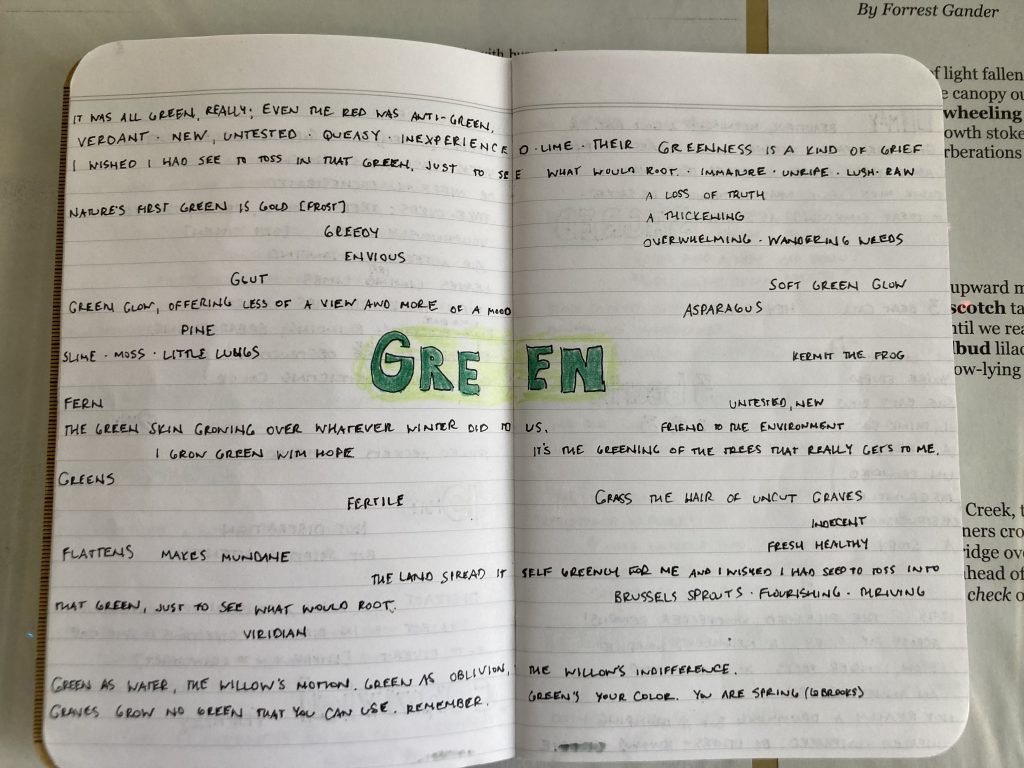
june 11/RUN

5.3 miles
ford loop
65 degrees / steady drizzle

Thought the rain wasn’t coming until later today so I got ready for my run — changed into my running clothes, stretched, put on my running shoes — then opened the door to drizzle. Decided to go anyway. At first, it was intermittent drizzle, but halfway through it became a steady, soft rain. Not enough to soak my shorts but enough to cool me off and to inspire a chant:

drip drip drop
drop
drip drip drip
drop

drop drip
drop drip
drop drip
drip drop

drip drip drip
drop drop drop

drop drop drip
drop drop drip
drop drop drip
drip

I continued my 9 minutes of running, 1 minute of walking plan and was successful. In the last mile, my left started to hurt a little, then my left calf, and my foot. It’s fine, but to be safe, I stopped at 5.3 miles. The run was never easy, but it also wasn’t hard to keep going, knowing that I had a walk break coming.

10 Things

  1. a soft green everywhere
  2. an empty river
  3. new trees wrapped in plastic looking like wild turkeys
  4. a dark tunnel of green with a bright circle of white at the end
  5. on your left / thank you!
  6. front yard tree with a giant boulder just in front of it
  7. empty benches except for the one near folwell: 2 people not sitting, but standing behind it
  8. the rumble of planes sounding like thunder
  9. the sharp clang of a mailbox lid falling shut
  10. chains from a trailer rattling and scraping on the rough road

green haze: Running on the east river road, quick glances over to the gorge — a soft green and silver view of trees and sky

I was delighted to discover halfway in that the poem-of-the-day on the Poetry Foundation is about rust! The entire poem is wonderful, but it’s long, so I’ll only post most of the rust part:

excerpt from “Que Sera Sera”/ A. Van Jordan

Like when a song gets so far out
on a solo you almost don’t recognize it,
but then you get back to the hook, you suddenly

recognize the tune and before you know it,
you’re putting your hands together; you’re on your feet—
because you recognize a sound, like a light,
leading you back home to a color:

rust. You must remember
rust—not too red, not too orange—not fire or overnight
change, but a simmering-summer
change in which children play till they tire

and grown folks sit till they grow edgy
or neighborhood dogs bite those not from your neigborhood
and someone with some sense says Down, Boy,
or you hope someone has some sense

who’s outside or who owns the dog and then the sky
turns rust and the streetlights buzz on
and someone’s mother, must be yours, says
You see those streetlights on don’t you,

and then everybody else’s mother comes out and says
the same thing and the sky is rust so you know
you got about ten minutes before she comes back out
and embarrasses you in front of your friends;

ten minutes to get home before you eat and watch
the Flip Wilson Show or Sanford and Son and it’s time for bed.
And it’s rust you need to remember
when the cop asks, What kind of work you do?

It’s rust you need to remember: the smell
of summer rain on the sidewalk
and the patina on wrought-iron railings on your front porch
with rust patches on them, and the smell

of fresh mowed grass and gasoline and sweat
of your childhood as he takes a step back
when you tell him you’re a poet teaching
English down the road at the college,

when he takes a step back—
to assure you, know, that this has nothing to do with race,
but the rust of a community he believes
he keeps safe, and he says Have a Good One,

meaning day as he swaggers back to his car,
and the color of the day and the face behind sunglasses
and the hands on his hips you’ll always remember
come back gunmetal gray

for the rest of this rusty afternoon.

Rust — I’ve been wanting to write a poem about rust for some time. Is this a sign that I should try today?

may 27/RUN

2.6 miles
river road trail, south/winchell trail, north
64 degrees

Thought briefly about biking to the lake and swimming, but it’s drizzling off and on, and it’s not that warm, and I imagine the water isn’t that warm yet. Just checked the temp: 61 degrees. What’s the coldest water I’ve been in? Probably colder than 61 as a kid in Lake Superior, but as an adult, I’m not sure. Too cold for me today, so I did a short run.

I wanted to run to the south entrance of the Winchell trail but there was a very large — 40 or more? — kids up ahead, walking and blocking the trail, and I didn’t want to encounter them. So I turned down at 42nd. Before I turned, I enjoyed witnessing the kids from afar. They kept trying to get passing cars to honk by yelling honk! honk! honk! They were not quite in unison, and sounded almost like a vee of geese flying overhead. Nice! A few cars honked, one for several seconds — no quick tap, a long HONK! At first I thought they were part of a school group but would teachers let students yell at cars like that? Maybe it was a walk-out protest?

My weather app disagrees, but I think it was very humid. Now that funding for gathering weather data has been taken away, I don’t trust any forecasts. How could it only be 64% humidity when I ‘m sweating this much, and it is drizzling a little?

I ended my run on the dirt trail that climbs up the edge of the grassy boulevard. I had to watch carefully for roots or rocks. On either side, vivid, abundant (or excessive) green grass. In the middle, bare dirt — brownish gray, fuzzy, almost a nothingness that was difficult to see. The green, dizzying, disorienting. Inspiration for my green sonnet?

excerpt from Desire/ Christopher Buckley

Shuffling down
the path in the park, I go on whistling what was once
considered a lively tune, thankful to even be a satchel
of ligaments and bone still able to transact enough chemicals,
one neuron to another,
                                        that I can appreciate the day lilies,
star jasmine, and have some idea about what’s missing
when a streak of grey engraves hosannas of moonlight,
the spindrift off the rocks, anything that sounds
remotely like a prayer
                                       sent into the air to a god who,
in his infinite memory, must know he abandoned us
here—so many self-conscious molecular assemblies—
specs in a starry whirlwind of desire.

Wow — a satchel/ligament and bone still able to transact enough chemicals,/one neuron to another — what a description of a human!

spin-drift: sea spray; fine wind-borne snow or sand

may 14/RUNWALK

4.15 miles
minnehaha falls and back
68 degrees
dew point: 59

Even though it was warm and the dew point was high, my run was good. Managed to bring my heart rate back down and keep it under 170 until I reached my favorite spot at the falls — 2.25 miles in. Excellent. I’m feeling stronger, mentally and physically.

10 Things

  1. a turkey in the middle of the road, honking? squawking? yelling? at the cars unwilling to stop and let him cross
  2. a hazy green above the gorge
  3. the sun hitting the light green leaves so intensely in the distance that I thought it was a bright yellow crossing sign instead of a tree
  4. the falls were rushing, all white foam framed by green trees
  5. a steady procession of cars on the road
  6. roots and rocks hidden in the shadows on the trail — I lightly twisted both ankles, one from a root, the other a rock
  7. the tree that feel in the creek sometime last year was gray — will they remove it?
  8. a line of a dozen or more cars backed up on the parkway, stuck at the stop sign
  9. a crowded trail heading north — bikers and walkers, a few runners, strollers
  10. the water fountains have been turned on again! I stopped for a drink and to wet down my hat

Listened to the hum of traffic as I ran south, my “Doin’ Time” playlist heading back north.

before the run

Thinking about LN’s poem — that I posted yesterday — about standing in the north woods with birch, which led me to think about becoming a tree, like in Katie Farris’ “What Would Root” and Linda Pastan’s “In The Orchard” — I shall come back as a tree.

I’m also thinking about Mary Oliver and “Can You Imagine” — surely you can’t imagine trees don’t dance from the roots up, wishing to travel a little, not cramped as much as wanting a better view, or sun, or just as avidly, more shade.

during the run

I don’t remember thinking about becoming a tree or rooting or stillness while I ran, but I remembered right after I finished and as I walked back home I recited “What Would Root” in my head. I need to practice the second half of the poem. Then I thought about the illusion of stillness and how nothing, not even rocks or trees, stand still. They’re sinking and shifting and swaying and responding to (being changed) by the world around them.

after the run

Still as not not moving but being stuck in a rut, doing the same thing again and again, as in, you’re still doing that?

Still as not needing more, content, at peace, satisfied, stilled desire or anxiety.

Nox Borealis/ Campbell McGrath

If Socrates drank his portion of hemlock willingly,
if the Appalachians have endured unending ages of erosion,
if the wind can learn to read our minds
and moonlight moonlight as a master pickpocket,
surely we can contend with contentment as our commission.

Deer in a stubble field, small birds dreaming
unimaginable dreams in hollow trees,
even the icicles, darling, even the icicles shame us
with their stoicism, their radiant resolve.

Listen to me now: think of something you love
but not too dearly, so the night will steal from us
only what we can afford to lose.

walk: 1 hour
winchell trail / edmund
77 degrees

Remembered to take Delia the dog for a walk before it got too hot. We walked to the Winchell trail than sauntered, me studying the leaves with my fuzzy vision and fingers, and Delia sniffing them with her snout. Warm in the sun, cool in the shadows.

10+ Things

  1. clumps of tallish grass growing through the mulch — a vibrant green
  2. even taller grasses growing among the flowers on the hill, creating a visual effect that was dizzying as my eyes tried to land on anything solid
  3. little bits of some sort of plant scattered along the top of the fence. It looked like it was growing there — a form of lichen? — but I couldn’t tell. It might have just fallen from a tree
  4. the pleasing, easily identifiable shape of the maple tree on the trees close to the trail
  5. sparkling, blue water
  6. blue water, blue sky, green trees
  7. the laugh of a woodpecker
  8. a yard with several bleeding heart bushes, all in bloom
  9. sprawled tree shadows on the grass
  10. the crotch of a tree — standing beside a tree that branched off into two equally sized limbs which looked like thighs to me. I imagined a person planted head first in the ground, which is what happens in “What Would Root”
  11. walking near Hiawatha Elementary, watching as a gym class “ran” around the block, studying the different approaches to “running” — a steady jog, sprint then stop then sprint, skipping, arms flailing and screaming while moving

As I walked with Delia, stopping at almost every tree or tuft of grass or clump of dirt, I thought about the differences between walking and running, this time in relation to a sense of self. Does one enable you to lose yourself or step outside of yourself more easily? I haven’t decided, but I think while walking you can be more aware of what you are doing, how you are attending to the world and noticing what is going on. While running, the attention is less deliberate; you’re too busy managing your effort to carefully study things. There was more to that thought but I lost in the time that it took me to get home.

may 10/WALK

60 minutes
winchell trail
63 degrees

A near perfect morning. Wow! Sunny with a slight breeze. Blue sky. Quiet. A slow walk with lots of stops for Delia. We walked to the winchell trail and took the worn, wooden steps down to the oak savanna, then another set of wooden steps up to an overlook. So much green everywhere — new trees popping up, tufts of grass, moss. We walked behind the mesa along the abandoned chainlink fence and I marveled at the bright green moss. At one point, I bent down and touched it — almost like carpet, but better.

10 Things

  1. the odd curve of the abandoned chainlink fence on the dirt trail behind the mesa
  2. that same fence, buried deep in the dirt and leaves, only the top was visible
  3. rowers! not seen, only heard — the coxswain calling out instructions
  4. a speed boat moving fast near the opposite shore
  5. tall grass in clumps and tufts and patches
  6. someone sitting by a tree stump, hidden in the green until they were right in front of me
  7. the clicking and scraping of a roller ski’s poles
  8. two runners, running by single-file, talking about a video game
  9. a big bird flying high in the sky
  10. on the boulevard between the river road and edmund, the grass was uneven and bare in many spots, studded with dandelions in others

The moment of the walk was when I stopped to let Delia sniff — more like she demanded to stop — and I stood on the edge of the bluff looking out at the blue water and feeling the soft, cool breeze. All around bright green leaves were fluttering. Below, the river surface was glittering. The movement was mesmerizing, meditative.

Against Lawn/ Grace Bauer

The midnight streetlight illuminating
the white of clover assures me

I am right not to manicure
my patch of grass into a dull

carpet of uniform green, but
to allow whatever will to take over.

Somewhere in that lace lies luck,
though I may never swoop down

to find it. Three, too, is
an auspicious number. And this seeing

a reminder to avoid too much taming
of what, even here, wants to be wild.

manicure – patch – carpet – uniform Great words to describe an over-managed lawn. Last night Scott and I were talking about lawns and the moral imperative to maintain your lawn to a certain standard. That is not the case as much in our neighborhood. Most people’s yards don’t have manicured grass. Partly because we live in a quirky neighborhood in the city, and partly because we’re near the river and people know that lawn chemicals get into the groundwater and then travel through the sewer to the river. I mentioned to Scott that I don’t judge people if their lawn isn’t manicured, I judge them if it is because it can only be that way if they’re treating it with chemicals — and if they’re not using chemicals, they’re still wasting water on their laws. But, I don’t want to judge anyone, so I’m trying to work on that.

Somewhere in that lace lies luck. . . What a great line!

a reminder to avoid too much taming
of what, even here, wants to be wild.

I’m always returning to this question of what it means to be wild and where the gorge fits into that. In the spring, when left alone, the small patches of grass on the bluff want to be wild. Tall blades and dandelions and little trees everywhere. Unruly, sometimes almost menacing as they creep closer to the trail, blocking out the view. Not wild, but re-wilding.

may 7/RUN

4 miles
trestle+ turn around
59 degrees

Today I tried the walk/run method: 9 minutes of running, 1 minute of walking. As usual, I followed this method approximately. Run 9:30/Walk 1:30, 8:30/1 — I can’t remember after that. It was good. It’s still difficult, but I’m pushing through more. I greeted 2 regulars! Dave, the Daily Walker and Daddy Long Legs. I noticed how green the floodplain forest was, only the narrowest sliver of river to see. And the view from the sliding bench? Green green green. If someone was walking below, would I even be able to see them? Ran on the grass and the dirt a lot. Thought about taking the short dirt trail that cuts behind a tree nearing the trestle, but didn’t. Next time? Admired someone’s raspberry red running shoes. I used to have shoes that color. Now they’re boring dark gray/almost black.

Ran through gnats. Most of them went in my eye, one in my throat. Also ran through cottonwood, or some white flowery thing that I thought of as cottonwood fuzz. Usually the cottonwood arrives at the beginning of June, so maybe it was something else?

No rowers, no roller skiers, no turkeys or geese or bird shadows. One fat tire. One little kid. Several runners and walkers and cars.

I don’t remember what I heard for the first half of the run, but for the second half, I listened to my windy playlist (it was windy out there!).

edges / middles / context

I started the morning thinking about surfaces and the places where things meet and textures and skin and feet. And then I remembered Emily Dickinson’s love of the circumference and the wonderful site, out of Dartmouth, all about ED in 1862. It has a blog post on ED and circumference.

I was excited to read this bit:

Laura Gribbin argues that Dickinson’s conception of Circumference rejects Emersonian expansion, revises the patriarchal conceptions of the (male) poet’s encompassing consciousness, and resists being taken over by an outside power. It does so by calling attention to “the circle’s necessary boundary or perimeter without which it has neither shape nor meaning.” In Gribbin’s reading,

“Circumference marks the borderline of symbolic and linguistic order.
This border is a highly charged point of convergence where oppositions are collapsed, boundaries are explored, and meaning originates. Circumference is also the space within a circle where life is lived, pain is felt, and death is observed.”

In what amounts to a powerful critique of Romanticism, Dickinson stands not at the center but on the periphery, at the outer limits of knowledge and language, replacing, as Gribbin notes,

“the Romantic impulse toward transcendence with an alternative concept of knowledge gained within the limits of experience.”

Instead of the Emersonian emphasis on sight and specularity, Dickinson emphasizes touch and what can be felt. Because

“Circumference delineates that region where the imagination comes into play, [it] is thus the source of poetry itself.”

White Heat: Emily Dickinson in 1862, a Weekly Blog

While reading my “on this day” posts yesterday, I encountered a discussion of middles from 6 may 2023. It’s in the middle of my summarizing of Mary Ruefle’s essay “On Beginnings”:

It’s about beginnings and how there are more beginnings in poetry than endings. The first note I jotted down in my Plague Notebook, Vol 16 was about the semicolon, which is a punctuation mark that I particularly like. Ruefle has just introduced an idea from Ezra Pound that each of us speaks only one sentence that begins when we’re born and ends when we die. When Ruefle tells this idea to another poet he responds, “That’s a lot of semicolons!” Ruefle agrees and then writes this:

the next time you use a semicolon (which, by the way, is the least-used mark of punctuation in all of poetry) you should stop and be thankful that there exists this little thing, invented by a human being–an Italian as a matter of fact–that allows us to go on and keep on connecting speech that for all apparent purposes unrelated.

then adds: a poem is a semicolon, a living semicolon, and this:

Between the first and last lines there exists–a poem–and if it were not for the poem that intervenes, the first and last lines of a poem would not speak to each other.

At some point as I read, I suddenly thought of middles. The in-betweens, after the beginning, before the end. How much attention do these get, especially if we jump right in and start with them. It reminds me of a writing prompt/experiment I came up with for my running log: Write a poem about something that happened during the middle of your run–not at the beginning or the end, but the middle (see 27 nov 2019). 

the MIDDLE

mid-motion
mid-walk, mid-run
Activity: notice and record what you notice in the midst of motion. Pull out your smart phone and speak your thoughts into it.

Not how you got there or where you’re headed, but here now in-between

the middle: Lucille Clifton’s unfenced is, Alice Oswald’s purpled sea

I like the idea of being dropped in the middle — no need to endure a beginning or an ending, but what’s lost when we’re floating in the middle? Something that grounds or frames the experience: context.

aside: writing that last bit, I recalled a few lines from Jorie Graham’s “Still Life with Window and Fish”:

The whole world outside….
I know it’s better, whole, outside, the world—whole
trees, whole groves–but I
love it in here where it blurs, and nothing starts or
ends, but all is
waving, and colorless,
and voiceless….

This morning, I came across a learning prompt on Poetry Foundation: Context.

The Merriam-Webster Dictionary defines context as “the parts of a discourse that surround a word or passage and can throw light on its meaning.” The word itself comes from the Latin contexere, which means “to weave or join together,” which I interpret as “to make sense of” what we’re reading, particularly when we’re not familiar with the author’s background and/or work. Knowing a poem’s context can give us a sense of place, culture, politics, gender dynamics, etc., and situate us in a specific time and place using concrete references. . . .

A sense of place, a connection, an anchor, a way to ground ourselves and our understandings.

a few hours later: I just remembered Kamala Harris’ coconut tree comment, which RJP loved to quote during the campaign:

context

added the next day: As I read through this entry again the next morning, I suddenly remembered something I posted earlier this spring about how not knowing or acknowledging a person/community’s history is to de-humanize them, to turn them into an object and not a subject. I can’t find where I wrote about it or what I was referencing. After a lot of searching, I found it! It’s in an interview with Jenny Odell about her new book on time, Another Kind of Time. Instead of posting the lengthy quotation here, I’m putting it in my entry for 8 may.

ground contact time

The Apple watch has all sorts of data points, most of which don’t matter to me or are meaningless because I don’t know what to compare them too. One such data point is “ground contact time.” Mine is almost always between 235 and 240 ms. It’s cool to think about how little time my foot is on the ground — and how much time I’m flying! — but what does this number mean? I suppose the fact that it is consistent is good, but should I be spending more time or less on the ground? I found a helpful primer on GCT (ground contact time) that has a chart — and plenty of caveats about that chart — to use for evaluating your ground contact time:

  • < 210 ms: Great
  • 210 – 240 ms: Good
  • 241 – 270 ms: Room for improvement
  • 271 – 300 ms: Needs improvement
  • > 300 ms: Lots to work on

The bottom line: less time on the ground is better. It makes you a more efficient, less injury-prone, faster runner.

So, mine is good, but barely. Ways to improve it include: picking up the cadence, being lighter on your feet, dynamic hip exercises — plyometrics or hill repeats, more deliberate arm swing. Maybe I’ll try some of it; I’d like to fly more! I think I’ll start with hill repeats. I’ve been wanting to do those for some time.

All of this talk about surfaces and edges where things meet — seams — and middles and shortened time on ground is making me want to reread Wendell Berry’s “A Native Hill.” I finally have a physical copy of it. I think I’ll read it and mark it up this afternoon!

may 5/RUNWALK

4.25 miles
minnehaha falls and back
59 degrees

Warm! Nothing hurt, it was just hard. My heart rate was higher. Who cares? No back or calf or hip pain! I’m trying to ease back in. Today I ran 4 minutes/walked 1, 8 times. I was proud of myself for sticking with it, even as my heart rate climbed. Yes, I’m ready for some mental toughness!

10 Things

  1. an abundance of sparkles on the river
  2. more green leaves crawling up the trunks of trees
  3. fee bee fee bee
  4. shadow, 1: a straight-ish line on the path from the fence
  5. shadow, 2: soft, sprawling branches
  6. shadow, 3: me — sharp, upright, satisfied
  7. the faint, slightly off tune dinging of the train bell
  8. flowing falls
  9. park workers had the one set of stairs blocked off — I heard water, were they spraying down the steps?
  10. passing another runner from behind, they were dressed warmly in long pants and a a jacket and breathing heavily

enoughness / contentment / not scarcity

Moss lifeways offer a strong contrast to the ways we’ve organized our society, which prioritizes relentless growth as the metric of well-being: always getting bigger, producing more, having more. Infinite growth is ecologically impossible and exceedingly destructive, as it demands the transformation of the lives of other beings into raw materials to feed the fiction. Mosses show us another way—the abundance that emanates from self-restraint, from enoughness. Mosses have lived too long on this planet to be seduced by the nonsense of accumulation, the delusion of permanence, the endless striving for productivity. Maybe our heartbeats slow when we sit with mosses because they remind us that contentment could be ours.

Ancient Green/ Robin Wall Kimmerer

Summer Day/ Mary Oliver

Who made the world?
Who made the swan, and the black bear?
Who made the grasshopper?
This grasshopper, I mean—
the one who has flung herself out of the grass,
the one who is eating sugar out of my hand,
who is moving her jaws back and forth instead of up and down—
who is gazing around with her enormous and complicated eyes.
Now she lifts her pale forearms and thoroughly washes her face.
Now she snaps her wings open, and floats away.
I don’t know exactly what a prayer is.
I do know how to pay attention, how to fall down
into the grass, how to kneel down in the grass,
how to be idle and blessed, how to stroll through the fields,
which is what I have been doing all day.
Tell me, what else should I have done?
Doesn’t everything die at last, and too soon?
Tell me, what is it you plan to do
with your one wild and precious life?

When I think of green, I think of another concept Robin Wall Kimmerer promotes: abundance — as in, a gift economy and a challenge to the (mostly) myth of scarcity. In May, green is almost too abundant — a gift that is not scarce!

walk: 45 minutes
winchell trail (ravine) / tunnel of trees / edmund
76 degrees

Took Delia out for a walk in the afternoon. The green is taking over. The view from above in the tunnel of trees was only green — no dirt trail below, no sliver of river, no exposed sewer pipe. Just green. As we walked, I thought about another passage I read from RWK in “Ancient Green” this afternoon:

They [green moss] cover the inanimate with the animate. Without judgment, they cover our mistakes, with an unconditional acceptance of their responsibility for healing.

Ancient Green/ Robin Wall Kimmerer

Everywhere green — not moss, but leaves — were covering bare branches, sewer pipes, the gorge. A green skin growing over whatever winter did to us, a return of the strange idea of continuous living despite the mess of us, the hurt, the empty. Did I feel that way about the green I was encountering today? Somewhat, but I also felt it taking over, transforming the floodplain forest in ways I didn’t like: too hidden.

overheard: music from car radios! Someone blasting “Bohemian Rhapsody,” someone else “Rhapsody in Blue.” Until typing these 2, I didn’t make the rhapsody connection.

It must be this rhapsody or none,
The rhapsody of things as they are.
(The Man with the Blue Guitar/ Wallace Stevens)

rhapsody: a portion of an epic poem adapted for recitation

may 4/WALK

40 minutes
winchell trail
66 degrees

What a beautiful morning! This year winter was a blur. It’s hard to believe that we’re only a month away from open swim season. Walked with Scott and Delia down the worn wooden steps to the winchell trail. Took the trail that winds below the mesa. Scott wondered what the trees near the 36th street parking lot were. According to his app, plum trees. He was dubious. We talked about FWA and RJP and the big changes in their lives — one graduating from college, the other moving into their first apartment. After seeing the rowers I wondered, would FWA like rowing? or canoeing? or kayaking? I think he might. Just asked him and his response: Nah. Oh well.

10 Things

  1. the water in the ravine was gushing — heard it first, then saw it — not drip drip dripping, but rushing out of sewer pipe
  2. the hillside that leads up to the trail in the oak savanna was covered in green — more of our view of above, blocked. Last week I was still able to see whole people running and biking above. Today, only the flash of movement through the trees — at first, I thought it was a bird, then I realized it was a biker
  3. 2 bikers on the street — one on a tall bike, the other on a fat tire
  4. so many new leaves on the branches — as I noticed them I thought, a slick new leaf unfurling like a fist to an open palm — a line from Ada Limôn
  5. voices . . . a bullhorn . . . rowers! An 8 person shell + the white motorized boat with the instructor giving instructions to a new class
  6. the annual walk-a-thon was happening — as we ascended the 38th street steps, we saw that the road was blocked off and that there was a row of a dozen port-a-potties
  7. a sharp, whistled call in the savanna — what bird is that?
  8. a cloud of bugs right outside our front door — yuck!
  9. so many tulips in a front yard, causing Scott to quip, we’re living in Holland!
  10. in the stretch between the savanna and the 38th street steps, the chainlink fence was leaning over to the ground, buried in mulch and leaves

Moss, Robin Wall Kimmerer, and Succession

A few days ago, I encountered the concept of succession in ecology. A meadow becomes a thicket. A thicket becomes a forest. Today I noticed that one of RWK’s chapters in Gathering Moss was titled, “Binding Up the Wounds: Mosses in Ecological Succession,” so I decided to read it. RWK is discussing an area of the Adirondacks blighted by a now defunct mine and abandoned. One of her students is doing her thesis on some moss in the area and whether or not they might help seeds, then trees, establish a home in the otherwise inhospitable tailings (the waste material of a mine: sandy, dry soil, slashes of rock).

succession defined: Ecological succession is the process by which the mix of species and habitat in an area changes over time. Gradually, these communities replace one another until a “climax community”—like a mature forest—is reached, or until a disturbance, like a fire, occurs (source).

Out of the carpet of living moss came a crowd of seedlings, the next step in binding up the wounds of the land.

. . . a little grove of aspens that had somehow gotten started in this desolate place that everyone wanted to cover in garbage. We know now that these aspens originated from seeds caught on a patch of moss, and the whole island of shade began to grow from there. The trees brought birds and the birds brought berries which now blossom around us.

Gathering Moss/ Robin Wall Kimmerer

Out of the waste of an abandoned mine, moss. From moss, a seed, then a tree. With a tree, birds and berries and blossoms and shade.

may 3/RUN

3.25 miles
trestle turn around
47 degrees

A little cooler, but sunny. I wore shorts and my legs didn’t feel cold. The green continues to spread. I’m sure I still have a view of the river but I don’t remember looking at it, not even once. I saw some rowers heading down to the rowing club, but didn’t hear them on the water. Greeted Dave, the Daily Walker. Was passed by several groups of young and fast runners. High school or college teams? Not sure.

Mostly I felt good. My heart rate is still high. I guess I lost some fitness on my almost 2 week break. Monday, I’ll try some more deliberate walk-run segments.

Listened to other runners, cars, water gushing out of sewer pipes heading north, my “I’m Shadowing You” playlist heading back south.

Ran on the grass for a few stretches to avoid other runners and walkers. Thought about how several sites recommended running on more gentle surfaces, like grass, when dealing with a herniated disc or sciatica.

before the run

I’m thinking more about open fields, meadows, lawns, boulevards, village greens, grasslands both wild and manufactured. Grassy spaces I recall from childhood, living in sub-divisions in North Carolina and Virginia and Iowa: soccer fields, manicured lawns, pastures just beyond my backyard.

I decided to look through the poems I’ve gathered for more meadow poems. Found Robert Duncan’s Often I Am Permitted to Return to a Meadow. Wow.

as if it were a scene made-up by the mind, 
that is not mine, but is a made place,

that is mine, it is so near to the heart, 
an eternal pasture folded in all thought 
so that there is a hall therein

that is a made place, created by light 
wherefrom the shadows that are forms fall.

An eternal pasture with a hall made by light and shadows. After the poem, I wrote about Duncan’s idea of projective verse

poetry shaped by rhythms of poet’s breath. So cool–I want to explore this more, thinking about breathing when I run vs. walk vs. sit.

“Olson argues that the breath should be a poet’s central concern, rather than rhyme, meter, and sense. To listen closely to the breath, Olson states, “is to engage speech where it is least careless—and least logical.” The syllable and the line are the two units led by, respectively, the ear and the breath: 

“the HEAD, by way of the EAR, to the SYLLABLE 
the HEART, by way of the BREATH, to the LINE”

poetry foundation introduction to “Projective Verse”

The heart, by way of the breath, to the line — This idea will be the start of a moving while writing experiment!

after the run

up to the wind-stripped branches shadow-
signing the ground before you the way, lately, all
the branches seem to, or you like to say they do,
which is at least half of the way, isn’t it, toward
belief — whatever, in the end, belief
is…
(My Meadow, My Twilight/ Carl Phillips)

My husband and I were arguing about a bench we wanted to buy and put in part of our backyard, a part which is actually a meadow of sorts, a half acre with tall grasses and weeds and the occasional wild flower because we do not mow it but leave it scrubby and unkempt. 
(The Bench/ Mary Ruefle)

And, back to the field:

Crossing a field, wading

                   through nothing
        but timothy grass,

imagine yourself passing from
and into. Passing through

doorway after
doorway after doorway.
(Threshold/ Maggie Smith)

After the rain, it’s time to walk the field

again, near where the river bends. Each year

I come to look for what this place will yield –

lost things still rising here.
(After the Rain/ Jared Carter)

may 2/WALK

30 minutes
neighborhood
47 degrees

Brr. Colder today. Walked with Delia around the neighborhood. Purple, white, red, yellow flowers all around, even on the sidewalk. The ephemerals don’t last long! Even with the cold wind it felt like spring. My legs are a little sore from the run yesterday, but my back and glutes are fine. I think I’ve turned a corner with my injury.

before the walk

What’s the difference between a meadow and a field? Looked it up and found this:

A field is used more often to describe an area managed by people. The field before you was once an orchard and pasture belonging to a farmer. A meadow is used to describe a wild area.

Fields and meadows start when trees have been removed from an area. This can occur naturally with a forest fire or flood, or humans may cut down a forest. Seeds from grasses and weeds take root shortly after and a meadow is born.

Meadows can be large or small and can occur anywhere, including in the middle of a forest, alongside a pond or stream, or in the middle of a highway.

Both fields and meadows are open areas with few or no trees. Grasses, and wildflowers are usually the dominant species. Only a limited number of shrubs and trees are present. When allowed to grow larger shrubs will take over a meadow and after years become a thicket. Thickets become forests as tree species take root. This natural process is known as succession.

Fields & Meadows

My family’s farm in the UP had a big field — the front 40. They once grew potatoes, and rocks. When no one mowed it, trees grew quickly. Not fast enough for me to see a forest, just thickets of scrubby trees that housed black snakes and foxes and mice. The back 40 field was a pasture for grazing cattle.

Abandoned orchards reminds me of a favorite essay by Wendell Berry, “A Native Hill.”

I’m inspired by these lines: “When allowed to grow larger shrubs will take over a meadow and after years become a thicket. Thickets become forests as tree species take root. This natural process is known as succession.

succession

A meadow becomes
a thicket. A thicket
becomes a forest.
A forest returns
to meadow. A meadow
grows into a thicket.
A thicket remembers
its forest.

And what about an oak savanna?

An oak savanna is a community of scattered oak trees (Quercus spp.) above a layer of prairie grasses and forbs. The trees are spaced enough so that there is little to no closed canopy and the grasses and forbs receive plentiful amounts of sunlight. The savanna is often thought of as a transition system between the tallgrass prairie and woodland environments, but may contain species that are found only in it and not in either forest or prairie. As a result, it is an important and diverse system containing species from both woodland and prairie, but containing some species that is unique to only savanna.

Once common in Minnesota, the oak savanna is now a rare ecosystem. Before European settlement, oak savanna covered roughly 10% of the state, and now there is only a fraction of that left. What happened? Savannas rely on periodic disturbances such as fire, grazing, and drought to flourish. Such disturbances prevent most tree species from establishing themselves and turning the habitat into a forest community. Fire-adapted trees, such as bur oak trees with their thick, corky bark, and prairie grasses are resilient to fire and do well in environments where fire is a common occurence.

Without fire, tree saplings begin to grow in the savanna and are able to take over, shading out and eliminating the grass and forb species. Soon, where there used to be an oak savanna, there is now a woodland habitat. Oak savannas have become rare because settlers suppressed fires. Farming and development has also helped obliterate the oak savanna ecosystem.

Oak Savanna

Reading about oak savannas, and pastures too, I came across the word, “forbs.” What are forbs? “A forb or phorb is a herbaceous flowering plant that is not a graminoid (grass, sedge, or rush). The term is used in botany and in vegetation ecology especially in relation to grasslands and understory. Typically, these are eudicots without woody stems” (wikipedia).

after the walk

And now I’m thinking about prairies. According to this site, the difference between a savanna and a prairie is the number of trees — less in a prairie.

To make a prairie it takes a clover and one bee,
One clover, and a bee.
And revery.
A prairie alone will do
If bees are few.
(To make a prairies/Emily Dickinson)

Meanwhile, the sun and the clear pebbles of the rain
are moving across the landscapes,
over the prairies and the deep trees
(Wild Geese/Mary Oliver)

And the difference between a prairie and a meadow? For many, they’re interchangeable. For some, prairies have more warm season grasses and meadows have more cool season grasses.

As we walk into words that have waited for us to enter them, so
the meadow, muddy with dreams, is gathering itself together

and trying, with difficulty, to remember how to make wildflowers.
(The Meadow/Marie Howe)

Reading up about different grasslands on an Illinois site, I found this curious fact:

Virtually all of Illinois’ native prairies are gone today. Most of the remaining lots of undisturbed prairie are in railroad rights of way, pioneer cemeteries and other spots that were not conducive to farming

What’s the difference: Prairie or Savanna?

With all of the connections drawn between grass and/as graves by poets, I’m particularly interested in the idea of native prairies in cemetaries.

may 1/RUN

4 miles
minnehaha falls and back
60 degrees

Warm! Green everywhere — tufts of grass on the bluff, leaves unfurling from the trees. Lots of bikers on the trail today. I ran to the falls without stopping, then took several walk breaks on the way back. My heart rate was high, my legs were sore. I think I should do a post-injury walk/run plan to ease back into moving.

As I write this on my deck, a black-capped chickadee is doing their feebee call. So loud! So constant. No answer yet.

10 Things

  1. Sea Salt is open at the falls — I could smell it as I ran through the park — what was the smell? fried and salty?
  2. a group of kids with adults — students/teacher? — below me on the winchell trail
  3. the falls parking lot was full of cars
  4. kids yelling/laughing on the playground
  5. a park worker driving a big mower, cutting grass on the strip between the walking and biking path — the lawn mower had a bright orange triangle on the back
  6. a biker in a bright yellow shirt with a matching bright yellow helmet
  7. someone swinging at the falls playground
  8. a biker biking in wide circles under the ford bridge
  9. flashes of white though the (already) thick green on the trail below me and beside the creek — I think it was the heads of people taking the path that leads to the river
  10. yellow and red tulips near a parking lot

before the run

Thank you past Sara for posting this beautiful Katie Farris poem — Ode to Money, or Patient Appealing Health Insurance for Denial of Coverage — and giving me inspiration for a May challenge with these lines:

America’s optimistic to dye its money
green. Leaves are green
because of chlorophyll, which is the machine
that turns sunlight, water, and carbon dioxide into leaf, stem, and root. All
the little blades of grass left behind by the lawn mower like Civil
War soldiers. Same as cash.

Grass! A whole month with grass? Maybe a whole month with green, one week with grass? Yes! And (at least) a week with Robin Wall Kimmerer’s gathering moss. Will this challenge idea go the way of last month’s steps? Forgotten after a few days? I hope not.

like Civil War soldiers — the line this is referencing in Walt Whitman’s Leaves of Grass was one of my first favorite lines from a poem:

And now it seems to me the beautiful uncut hair of graves.

I posted this section of Song of Myself on 18 may 2020. Here’s another part I want to remember:

They are alive and well somewhere,
The smallest sprout shows there is really no death,
And if ever there was it led forward life, and does not wait at the end to arrest it,
And ceas’d the moment life appear’d.

All goes onward and outward, nothing collapses,
And to die is different from what any one supposed, and luckier.

And now I’m thinking about Mary Oliver and her line about rising up again like grass, and realizing that she was referencing Whitman with it. She loved Walt Whitman. Uh oh — I’m feeling a shift in direction. Will I forgo grass for a study of Walt Whitman?

during the run

As I mentioned in my 10 things list, while I was running, I encountered a park worker mowing the strip of grass between the bike and walking paths. I decided that that would be my image of grass for today. I could smell the freshly cut grass as I ran by. I wonder what the parks’ department’s schedule for mowing grass is — how often? and how many acres of grass do they maintain across the city?

after the run

1

Read Mary Oliver’s chapter in Upstream, “My Friend, Walt Whitman.” I’m pretty sure I’ve posted this line before, but I’ll do it again because it fits:

I learned from Whitman that the poem is a temple–or a green field–a place to enter, and in which to feel.

2

I decided to look up information about minneapolis parks and mowing.

4,660 acres of grass/turf mowed

They divided grassy areas into 3 types: athletic fields, general park turf, reduced mowing areas.

general park turf: “We cut grass to a height of 3 inches on a regular basis as time and weather allows, but grass height may exceed 5 inches at times. This standard applies to most of the Park System including neighborhood parks, boulevards, parkways and active use areas within regional parks.”

reduced mowing areas: “We maintain some park lands through mowing on an infrequent basis. These areas include steep hillsides, erosion prone slopes, shorelines and park lands that are not intensively maintained.”

I love that the parks department posts this information!

Also wanted to add this video. It’s light on sources, especially the early history of grass, but I like the clips from commercials:

And here’s a useful resource to return to, and also to use to supplement the video:

The History of Early American Landscape Design: Lawn

And also this — Get Off My Lawn! — which has an interesting 30 minute podcast, images related to the lawn from the Smithsonian Museum.

july 17/RUN

4.5 miles
longfellow gardens / minnehaha falls
65 degrees

What a morning! Cooler and less humid. Ran to Longfellow Gardens to check out the flowers. In full bloom, mostly red and purple. People sitting on the benches — I couldn’t see them that well, but I imagine some of them were painting or taking photographs.

image: A portable red lawn chair in the shade under a tree. A person sit in it, facing the field with the statue of Longfellow, their back to the flowers.

Returning to the falls, I noticed a few trucks and heard voices chanting. Was it some religious thing? Or military training? A protest? RJP might know; one of her best friends works at the restaurant at the falls.

Took the steps down to the bottom of the falls, which were roaring. So was the creek. Walked then ran beside the water as it rushed by. Eventually it reaches the mississippi, but I crossed the bridge well before that happens. Admired the water that collects in a pool — sparkle and shimmer. In the afternoon, kids congregate here, wading and splashing, but not this morning. Just me, and a few diggers in the distance. What are they digging up?

Took the steps — more than 100 of them — back up to the park. Wow, what a leg burn! Glad I didn’t try running them!

Found this green poem this morning.

Mount Grace Priory/ G.C. Waldrep

It was not a question of not having the language for it—
having two, in fact. The walking towards it,
and then the walking away. How that felt, all the green
gathering itself to the idea of green, lingering
right at the edge of the dark, what we call the dark.
And the languages, both of them, noticing that, envying
it. From their places at the beginning & at the end.

all the green/gathering itself to the idea of green

I want to think about this green and the two languages and the dark, or what we call the dark, some more.

june 23/SWIM

3 loops
lake nokomis open swim
67 degrees

Yes! A wonderful morning swim. As usual, always a mix of excited and nervous before the swim, but once I entered the water, all of it went away. Not always easy — sometimes my back hurts or a shoulder or a foot — but almost always wonderful. I love the dream I enter below the surface and the confidence I feel slicing through the water and the warmth of muscles worked after. Nothing feels as natural as swimming across this lake.

10 Things

  1. the crooked line of orange buoys — the one closest to the big beach much further north
  2. the faint outline of vegetation reaching up from the bottom of the lake, just below me
  3. swimming through a net of green milfoil near the white buoy
  4. only the occasional flash of other swimmers — a bent, bare elbow, a black wetsuit, a yellow safety buoy
  5. the brief flash of “buoy” or “orange” or “triangle” in my head, then nothing — I listened and believed and swam towards it
  6. one menacing sailboat — an orange and red sail
  7. open, empty water with vague trees in the distance
  8. above the surface, vivid blue, below the surface, green with hints of blue and the faintest idea of yellow
  9. my hands stretched out in front of me in the water — pale, glowing, a sharp contrast with the dark water
  10. shafts of light illuminating the particles in the water, everything constantly moving

the best moment: Rounding the final orange buoy for the third and final time, heading back to the big beach, the sun came out from behind the clouds. Suddenly the water was a vivid blue when I looked up to sight or turned my head to breathe. When I went back under, everything a beautiful, rich green: blue, green green green green green, blue, green green green green. At some point a cloud came and the blue grew darker, not quite purple. I thought about Alice Oswald and Odysseus and purple robes and being purpled.

Alice Oswald and Nobody

Was thinking about this before my swim:

Well, as you know, I’m quite fascinated, even obsessed, you might say with Homer. And one of the things that really tantalizes me in Homer is what is the Homeric mind? Because I think it’s very different from a literary mind. And it seems not to be inside the skull, but to be out in the world. So, there is a particular simile in the Iliad, which actually that first bit of the poem is based on, where it talks about two goddesses coming from heaven to the earth. And they’re very physically described. They kind of fall down from heaven to the earth. And then when they land, they take little pigeon steps, steps like doves or pigeons. So you can really picture them. But the way their flight moves from heaven to earth is as a man, you know, as the mind flutters in a man who has traveled widely, so you can turn it the other way around and say the way a man thinks is like this incredibly physical flight of two goddesses coming down to earth a bit like pigeons. And that’s always really interested me, that for Homer, the mind has the limitations of a pigeon, if you like. It is this kind of … this physical thing that moves. So, if you imagine a place over the sea, your mind actually has to get there. So, even though it may be as fast as the light, it is physical movement.

A Conversation with Kit Fan and Alice Oswald

I’m still looking for where in the Iliad these goddesses/pigeons are. And I’m still figuring out what AO might mean here. But it is helpful to read it beside these two parts of Nobody:

1/ page 1

As the mind flutters in a man who has travelled widely
and his quick-winged eyes land everywhere
I wish I was there or there he thinks and his mind

immediately

as if passing its beam through cables

flashes through all that water and lands
less than a second later on the horizon
and someone with a telescope can see his tiny thought-form
floating on the sea-surface wondering what next

2 / page 30

When trees take over an island and say so all at once
some in pigeon some in pollen with a coniferous hiss
and run to the shore shouting for more light
and the sun drops its soft coverlet over their heads
and owls and hawks and long-beaked sea-crows
flash to and fro
like spirits of sight whose work is on the water
shading it blue and thinking

I wish I was there

or there

Is the Homeric mind restless? I wish AO would say more about what she means by the literary mind and its lack of movement. I agree, but I’d like it spelled out. Does my mind work this way when I’m out moving by the gorge, or swimming across the lake? Does it move through or above the water? Maybe it became a fish.

Here’s one more line from the interview that I want to respond to:

. . . feeling of characters who have been eroded by the weather and by the sea is really what I’m feeling in this poem. It’s a poem that just opens itself to the elements and gets kind of washed, it gets its features washed off. . . . I think that’s all part of the erosion, really, it’s like even the forms of visible things have been almost worn down to their abstract shapes.

A Conversation with Kit Fan and Alice Oswald

Visible forms almost worn down to their abstract shapes — that’s how much of the gorge looks to me. Soft forms: trees, trash cans, big boulders.

june 20/RUNSWIM

4.1 miles
minnehaha falls
65 degrees

Overcast this morning. Cool, but humid, sticky. Another run that wasn’t easy or effortless. Keep showing up. It will get easier or you’ll get better or it will (eventually) get cooler. I’m not too worried. Is it the lexapro, or am I just satisfied being able to get outside and move by the gorge?

10 Things

  1. the crater with the tube sock/Florida outline is gone, filled in yesterday
  2. a gnat flew in my eye — a fullness, than a small sharpness, then a watery eye, finally gone!
  3. a motorized scooter on the bike path — hey, you’re supposed to be on the road! (thought, not said)
  4. today’s color palette; green and gray
  5. dark mud, not gooey but slick
  6. laughing kids on a playground
  7. the surreys, all lined up at the falls, one being readied for a family as I ran by
  8. rushing falls, roaring creek, gushing sewer pipe near 42nd
  9. some loud rustling in the bushes
  10. passing a walker, a whiff of subdued perfume — fresh, floral / passing a biker, a sniff of cologne — fresh, earthy

At some point, looking up at the green trees, remembering green water, I thought about Alice Oswald and the connection between water and grief. Then I recalled Tony Hoagland’s poem about swimming and cancer and thought about water and relief.

a few hours later: It’s raining — a soft, light rain — right now (2:30 pm). I’m hoping that open swim will still happen at 5:30. Tomorrow it probably won’t: thunderstorms all day. Anyway, I’m continuing to listen to and think about Alice Oswald’s “Interview with Water.” Very cool! Here’s the next little bit:

Find yourself in the silence underneath an overhanging wave that or thereabouts is the color of a bluish violet ultramarine gown so the great poet sang, “But Odysseus taking his bluish gown in his big hands drew it over his head and hid his face ashamed to let the Phaeacians see his tears.” The gown goes over the head like a wave, the human sits under its sea color with salt water pouring from his eyes. It is one of those places where the form of the poem hurries us forward, the form of the language pulls us back. Porfurion is a word with water inside it like a bucket down in the middle of a line. Already if you look hard at the word you can see the widow’s simile underneath it but Homer is not yet ready to make that gift. With magnificent theatricality, he draws a blue gown across the mind and we, like the Phaeacians, are left looking at it, waiting.

Homer is the foremost poet of the visible. Homer delights in surfaces, but the surface of water is complicated by transparency, and its transparency is complicated by refraction. Water is never the same as itself. Rivers can only exist as similarities, lakes reflect more than their own volume, and what’s more, when you look at water, it allows you to exist twice but more darkly. When you look at it again it evaporates as if moving in and out of existence — it simply requires a bit of sunlight then it reappears as frost. Perfectly symmetrical as if discovering pre-drawn diagrams in thin air. Then it reappears as tears so that any attempt to describe the surface of water tells you to hide your face and inspect your innermost thoughts. All these waverings are part of the word porfurion. The physics or nature of water is metaphysical meaning that its surface expresses more than itself.

Interview with Water

All of AO’s mention of surfaces makes me want to think about surfaces during my swim. I swim on the surface, wanting to stay with my head just below as long as possible. What does the surface look like or feel like when I’m breathing every five (or more) strokes? What if I tried every 2 or 3? What is the color of the surface — from above or below?

swim: 2 loops
lake nokomis open swim
68 degrees

Wow, what a perfect swimming night! The water was warmer than the air temperature. The sky was white and heavy. Everything calm, quiet. I felt fast and strong cutting through the water, breathing every 5 strokes with the occasional 3, at least once, after 2. I tried to give attention to the surface. Just under the water, I watched my hands stretch out in front of me, covered in bubbles. The water was a beautiful deep (but not dark) green, with the feeling of deep blue and gray. I could see the sediment swirling. Above the water, the surface was silver, still.


june 19/RUNSWIM

2.5 miles
2 trails
64 degrees

A quick run before meeting my college friends for lunch. Cooler today. Heard the rowers. Spotted: at least 2 bright yellow shirts, one bright pink. City (or county or park?) workers were out re-tarring a few more spots on the trail. Hooray for less craters! Last week, they finally filled in the big crack that had white spray-paint around it, making it look like a tube sock or Florida (I’ve written about it before). I wonder if they’ll finally fill in the hole that’s been getting deeper every year? The one that would definitely twist your ankle if you stepped in it. I hope so.

I don’t remember hearing any birds or roller skiers or laughing kids, but I do remember the squishy mud on the winchell trail and the bug bite I got as I walked home.

color in/on/under water

Listening to Alice Oswald’s lecture, Interview with Water, I came across this great passage about color. First she’s mentions that poets performing The Odyssey always wore blue robes, then she mentions a line from book 8:

Odysseus
with his strong hands picked up his heavy cloak
of purple, and he covered up his face.
He was ashamed to let them see him cry.
Each time the singer paused, Odysseus
wiped tears, drew down the cloak (8:84-89)

Then she references something she said a few minutes earlier —

I keep a bucket of rainwater under my window and it delights me that green leaves reflected in a black bucket are not quite green. I don’t know what color they are. At certain moments, early in the day, they might be called pre-green, but then the clouds change or the wind moves the surface mark and all at once they seem bright dark and blind silvery then foggy emerald.

— and says this:

To go back to that bucket of water — to wave a blue gown above it and ask, What is that color which Homer calls porfurium? It is not blue exactly; it gets translated as purple but purple is a settled color whereas Homer’s word is agitated. It derives from the sea verb porfurion which means to roll without breaking, so it is already a fluid word, a heaped up word, a word with underswell, not a pigment but an emanation from the nature of water. To get a true sense of porphyrion you need to see the sea in it and for Homer the sea is unhuman full of strange creatures missed colored unplowable and this is my favorite word it is a peritone meaning unfenced. If you want to imagine the colour of Odysseus’ gown you will have to swim out into the unfenced place, the place not of definitions but of affirmations. Yes I’m afraid you will have to find your way to the p volume of Johnson’s unwritten dictionary. There you will discover a dark light word an adjective for edgelessness — a sea word used also of death smoke cloth mist blood between bluish purple and cobalt mauve. It appears mid-ocean when the wind perhaps makes a network of backblowing glitters that the underswell moves sideways as when a big sea swells with noiseless waves. It is used of the heart meaning his heart was a heaving not quite broken wave. It indicates a surface but suggests a depth a mutation of flatness or noiseless sheen, a sea creature, a quality of caves, any inlet or iodine or shaded stone, a type of algae or rockfish, anything excessive or out of focus or subliminal — for example: a swimmer seen from underneath, a rotting smell, a list of low sounds, an evening shadow or sea god, a whole catalogue of simmering grudges storms waves and solitudes or deep water including everyone who has drowned in it. To be purpled is to lose one’s way or name, to be nothing, to grieve without surfacing, to suffer the effects of sea light. to be either sleepless or weightless and cut off by dreams — find yourself in the silence underneath an overhanging way that or thereabouts is the color of a bluish violet ultramarine gown so the great poet sang.

Interview with Water

Wow! So many wonderful things to do with this passage! For now, I want to think about how color works underwater. In an hour, I’m heading over to deep (at least, deeper than Lake Nokomis) Cedar Lake to swim across it. How will color work as I swim? Below water? Above? Is this agitated, moving purple similar to how I see all the time? (Yes, I think.)

swim: 4 cedar loops (= 2 nokomis loops)
cedar lake
72 degrees

The first swim at Cedar Lake! As I’ve mentioned here before, Cedar has a very different vibe than Nokomis. Hidden away, at the end of a gravel road. A small beach. No buildings, the only bathroom a port-a-potty. Chill lifeguards. Today the water was cold but (mostly) calm. Not too many swimmers. 2 lifeguards on kayaks, 2 orange buoys, too much vegetation growing up from the bottom of the lake. I overheard another swimmer mentioning the vines too.

color: Inspired by Alice Oswald, I tried to think about the color of the water. Cloudy, not clear. I could see the vines and the bubbles from my breathing and my hands entering the water but not much else. Not purple or blue but green — not dark green but pale green. Maybe some pale blue — yes — and light gray. Occasionally a shaft of light from above, a dark vine below. Textured bubbles. Not much to see, but not nothing there. Instead, everything small, packed, too dense to decipher. No color and too many colors. Impossible to pin down with “green” or “gray” or “blue.” Not grief, but uncertainty.

june 11/RUN

4.5 miles
veterans home and back
56 degrees

Still struggling with endurance, still showing up. How much of this is mental, how much physical? The sixty-four thousand dollar question, as my dad used to say. I think it’s both, but probably more mental. Maybe the lexapro is already kicking in, but my struggles aren’t bothering me. After the run I thought, these struggles will make showing up at the marathon start line, then finishing 4-5 hours later, much more meaningful.

It rained this morning, so everything was wet, even the air. Everything was also green. Green green green. Any other colors? Nope, not much to break up the green. Green green green green green.

10 Things

  1. lush green, dark, on the part of the path that goes below the road
  2. puddles
  3. a woman ahead of me, running, wearing only one compression sleeve on her right calf
  4. a group of kids walking to the playground at minnehaha
  5. a much bigger group of kids walking near 42nd — a long line, 3 across, took me 10 or 15 or more? seconds to pass them
  6. gushing water near the ravine by the oak savanna
  7. the bright yellow crosswalk sign — my bee — was muted in the gray sky
  8. crossing the bridge high above the creek, all green, no view of the water below
  9. lush green, dark, on the steep hill descending to the locks and dam no 1
  10. a pile of e-bikes parked near a bench — black with blue accents

paean to place/ lorine niedecker

Before my run, I started writing out, by hand, Niedecker’s poem. It’s so long! My hand started cramping up. I had to write slowly to account for my visual errors, like not seeing the words I’ve already written and writing words almost over them or above them instead of below them. The slow work is good, giving me time with each word and line.

Here’s one line I’d like to make note of:

Not hearing sora
rails’s sweet

spoon-tapped waterglass-
descending scale-
tear-drop-tittle

I wondered, what does a sora sound like, so I looked it up and listened. Yes, it sounds like LN described! Listen here to calls 1 and 2.

june 10/RUN

4 miles
minnehaha falls
60 degrees

Ah, summer mornings! Beautiful. Cooler. If I would have slept better, I would have tried to go out even earlier. The first half of the run felt good, then I got hot and it got harder. Today I didn’t worry about what that meant for my training. Instead, I enjoyed the brief minutes of walking, taking in the trees at the falls — so green! so full!

10 Things

  1. the falls, flowing, white, undulating — the water not falling straight, but almost falling over itself — was it hitting some limestone on the way down?
  2. a bundle of something on the ground next to the dirt trail — a hammock?
  3. 2 women with tall hiking packs on their backs walking on the paved path
  4. some animal — a turkey? — upset, calling out, a human voice saying something — hey?
  5. a flash below the double bridge — a sliver of creek almost covered by green
  6. 2 roller skiers near locks and dam no 1
  7. the dirt trail cutting through the small wood near ford bridge looking cool and inviting
  8. happy kids on the minnehaha park playground — happy: green voices, where green = young, outside, tender
  9. (walking back, about to cross 46th ave at 37th street) 2 older women chatting, then greeting me, oh! hello!
  10. (walking back almost to my alley) heard on a radio or from a phone or a computer in neighbor’s backyard, the next one is Scandia — was this talk radio or a zoom meeting or what?

Lorine Niedecker and “Paean to Place”

to dwell with a place:

What is required, however, is sensual, embodied experience—close encounters of awe, wonder, fright, disgust, or even tedium—which remind us both of the real earth with which we dwell, and that we share our home with innumerable cohabitants.

Dwelling with Place: Lorine Niedecker’s Ecopoetics

opening to “Paean to Place”:

Fish
fowl
flood
Water lily mud
My life

in the leaves and on water
My mother and I
born
in swale and swamp and sworn
to water

My father
thru marsh fog
sculled down
from high ground
saw her face

at the organ
bore the weight of lake water
and the cold—
he seined for carp to be sold
that their daughter

might go high
on land
to learn

Wow! Reading this opening, I’m thinking about the Objectivists and the Imagists and Ezra Pound’s 3 rules for writing poetry:

  1. Direct treatment of the “thing,” whether subjective or objective
  2. To use absolutely no word that does not contribute to the presentation
  3. As regarding rhythm: to compose in the sequence of the musical phrase, not in sequence of the metronome

What condensery and music in these lines! And what wonderfully effective descriptions of two people dwelling in and with a particular place, especially her mother, born in swale and swamp and bearing the weight of lake water and the cold.

definition of ecopoetics:

The word itself is an amalgam of two Greek words: oikos [household or family] and poïesis [making, creating, or producing], so that ecopoeticsquite literally means the creation of a dwelling place, or home-making. The term came into special prominence after the influential British literary critic Jonathan Bate published The Song of the Earth in 2000. There, Bate defined ecopoetics as a critical practice in which the central tasks are to ask “in what respects a poem may be a making … of the dwelling-place” and to “think about what it might mean to dwell upon the earth.”

Dwelling with Place: Lorine Niedecker’s Ecopoetics

LN’s opening lines and her descriptions of her parents, reminds me of Mary Oliver’s The Leaf and the Cloud and her brief mentions of her parents in the first section, “Flare.” LN and MO have different experiences but they rhyme, somehow, or echo?

My mother
was the blue wisteria,
my mother
was the mossy stream out behind the house,
my mother, alas, alas,
did not always love her life,
heavier than iron it was
as she carried it in her arms, from room to room,
oh, unforgettable!

Like LN, MO was also an amazing poet of place, but she doesn’t extend her ideas of place to her parents — a deliberate severing:

I mention them now,
I will not mention them again.

It is not lack of love
nor lack of sorrow.
But the iron thing they carried, I will not carry.

So much to say about that iron, but I have run out of time right now. Perhaps more later. . .

I’m back. First, the not carrying the iron makes me think of my mom and her desire for displacement from her abusive parents. More than once she said to me that she wanted to break that cycle of abuse — and she did. And I am grateful. But there’s something to explore here for me and my relationship to place, this place 4 miles from where my mom was born and raised, that I can’t quite get at yet.

The iron also reminds me of the wonderful lines from the opening of LN’s “Lake Superior”:

In every part of every living thing
is stuff that once was rock

In blood the minerals
of the rock

*

Iron the common element of earth

Both MO and LN write about their fathers. First, MO:

My father
was a demon of frustrated dreams,
was a breaker of trusts,
was a poor, thin boy with bad luck.
He followed God, there being no one else
he could talk to;
he swaggered before God, there being no one else
who would listen.

and LN:

He could not
—like water bugs—
stride surface tension
He netted
loneliness. . .

. . . Anchored here
in the rise and sink
of life—
middle years’ nights
he sat

beside his shoes
rocking his chair
Roped not “looped
in the loop
of her hair”

The “looped” quote comes from William Butler Yeats and his poem, Brown Penny and it’s about love. I like how she throws in this line from poets or about poets, like this:

Grew riding the river
Books
at home-pier
Shelly would steer
as he read

I noticed another line of the poem in quotes, “We live by the urgent wave/of the verse.” Looked it up and found an article about “Paean to Place” and thanks to my college-attending son, I have access to it! Time to read it: Lorine Niedecker’s “Paean to Place” and its Fusion Poetics


june 9/RUN

3.7 miles
trestle turn around
65 degrees

Warm and windy. Lots of sweat. Another day of telling myself to keep showing up. A hard run with lots of walking. But, one faster, freer mile, and some scattered thoughts that might lead to something! I’ll take it.

11 Things

  1. under the lake street bridge, the side of the road was packed with parked cars — rowers?!
  2. yes, rowers: heard the coxswain calling out instructions
  3. briefly watched the rowers through a gap in the trestle: a head, an oar, a boat gliding by
  4. ran into a branch while avoiding another runner, just a few inches from my eye, imagined a scenario in my head where the branch had cut my eye
  5. in the tunnel of threes: a sea of swaying green
  6. a woman stretching in the 35th street parking lot, blasting music out of her phone
  7. wind pushing me from behind, making my ponytail swing to one side
  8. a cartoonish figure spray-painted on the sidewalk: bright orange outline
  9. loud rustling in the nearby brush then a hiker emerging from below
  10. whoooosssshhh — the wind rushing through the trees
  11. dragonflies? running near the trestle, an insect with a long, narrow body and wings almost flew into my mouth — no iridescent color, no color. Later, pausing at the top of the steps, I saw half a dozen of them. They opened and closed their wings in the sun

Yesterday, I decided that the theme of color or green wasn’t working for me this month. Instead, I’d like to return (again) to Lorine Niedecker. I’m particularly interested in her form of condensing and how I might apply it to my Haunts poems. Yes, the haunts poems are haunting me again. Before heading out for my run, I found a few lines from LN’s “Paean to Place,” that I especially like:

 grew in green
slide and slant
of shore and shade

            Child-time—wade
thru weeds

Maples to swing from
Pewee-glissando

      sublime
 slime-
song

A few times, I recited the first big: I grew in green/slide and slant/of shore and shade. As I thought about those lines I wondered what I grew up in. Green, for sure, but not by water. Then it came to me: I grew up on the edge of green in subdivisions that butted up against farms and woods, creeping, consuming those green spaces. I also grew up in carefully managed and cultivated green — bike paths through small stretches of trees offering the illusion of nature, privately owned by the subdivision. A very different green than the rural green of my dad’s farm in the UP or the urban green of my mom here by the Mississippi River. I thought about the managed green I run by and the difference between it, a public, national park, and the managed green of my suburban childhood, with its private green parks and private (No Trespassing!) acres of farm land, soon to be sold and converted into more “little boxes.”

Yes! The green I grew in was in-between col-de-sacs, and within small ravines and the slight stretches of trees or creeks developers left for aesthetic reasons. This green has deeply influenced my understanding of the wild and “green” spaces and is one reason why I’m fascinated by the management of nature.

june 7/RUN

4 miles
minnehaha falls and back
62 degrees

Another beautiful morning. Felt drained by the sun, but still managed to push through a few moments when I wanted to stop. Walked a little. My mantra: keep showing up. It might not get easier but I’ll get better at handling it (it = heat and humidity and doubt and the desire to stop). Listened to my Color playlist for the second half, the birds for the first half. Sparrows and woodpeckers and cardinals. The falls and the creek were gushing. I read the other day that, after 2 years, Minnesota is no longer in a drought. Hooray for the farmers! And the flowers! And the trees!

Today, the green was cool, then scraggly. Sprawling, stretching, overstepping. Almost consuming the narrow dirt trail on the grassy boulevard between edmund and the river road.

something for future Sara to remember: On Tuesday, I went to open the lime green umbrella on our deck and noticed something dark in the corner. With my bad vision, I thought it was a leaf at first. Then I saw something that looked like wings — a bat. I dropped the umbrella cord and ran inside. A few minutes later, Scott cautiously opened the umbrella then freaked out when the bat flew out. He staggered back and rammed into the handle of the door — hard. Knocked the wind out of him. Since then, he’s been having intermittent back spasms, which he describes as “charley horses” in his back. I would be freaking out, but he’s handling it fairly well. The worst part: trying to sleep — too painful in the bed, and we don’t have a recliner. Maybe he cracked a rib, maybe it’s a strained muscled. Hopefully it heals soon.

What I remember is seeing the bat wings as it flew away, looking like a Scooby Doo cartoon. Since then, I’ve cautiously opened the umbrella — no bat! Every time I bird flies overhead, their shadow crossing my legs, I wonder — a bird or a bat? A thought: bats as fully fleshed shadows. What if the dark forms we think are shadows are actually bats? That’s both a creepy and delightful thought!

june 5/RUN

5k
trestle turn around
66 degrees

A quick run before taking FWA to buy his biggest purchase ever: an A clarinet. Not an easy run, but a sunny day with fresh air and clear trails. More cool, refreshing green coming from the floodplain forest. Everywhere, mundane, flat green. A green greeting: saying good morning to a runner with headphones on who didn’t me coming. A green sound: a bird’s clicking jaw somewhere below.

A green chant to keep me going:

Sycamore
Cottonwood
Slippery elm

Spoken in my head over and over. It helped me in the tougher moments when I wanted to stop and walk.

green

Even as green is my favorite color, I do not like when green takes over everything. Green = busy doing things, producing, connecting, crowds/crowded/crowding out.

log entry on 28 oct 2019

june 3/RUN

4.2 miles
longfellow garden and back
73 degrees / dew point: 75

Sticky again today, but not as bright. Still hard to run through the thick air. Struggled on the way back — walk run walk run. Trying to remember to keep showing up and believing that it will get easier, or I will get better at handling the difficult moments, or I will finally start getting up early. I tried to think about green.

my favorite green

Running south, just past the ford bridge, nearing the locks and dam no. 1, cool air was coming from the green to my right — a small wood. Refreshing! Often I associate late spring green with thick and stifling, but today it was fresh and generous, making it easier to breathe and to run.

Before my run, I read this green poem:

Making Life on a Palette/ Raina J. León

After Charles Willson Peale (1741–1827), “George Washington at Princeton,” 1779

the color of life
takes sun yellow and bluest blue sky and water
for green ferns
chartreuse buds beading above moss
dappled shamrocks
fragrant healing of sage, laurel,
mint, basil, thyme, rosemary, myrtle
amid the tall wonders of juniper
pine, olive, pear
even the meeting of sea and river—
the sky, an intermingling of viridian and chetwode horizons,
and cerulean clarity—
offers its green seafoam,
its seaweed pats,
the crocodile at the edge of a freshwater marsh
its teeth open gritted in green
against the backdrop of hunter rainforest
dripping in green

heaven is a field of persian green
lit by translucent jade and celadon lamps
a many-roomed chateau scented by aromatic tea leaves
the aperitivo: gin, apple, and bitter lime
the time: midnight green
the guardian: a mantis in prayer

joy: harlequin, verdun, spring
magic: kaitoke forest in its energetic whisper and pulse

green must exist
inside brother james
would he call it camouflage
or nyanza or sap
for washington it’s in the colors of flags
the fields far off
feldgrau or military or empire green
or dollar bill or rifle green
revolution with chains the result
mix the green
like a spell in making
safe life
hush arbor life
nurturing abundant life
free life
bring the background to the fore
ease
ease
ease
life

So many greens! How many different greens can I see? Today, mostly, it was just green (or brown or gray).

Offering some advice on being judicious with your use of adjectives, Ted Kooser writes the following lines:

Morning Glories/ Ted Kooser

We share so much. When I write lattice,

I count on you seeing the flimsy slats

tacked into squares and painted white,

like a French door propped in a garden

with a blue condensed from many skies

pressed up against the panes. I count on

you knowing that remarkable blue,

shaped into the fluted amplifying horns

of Edison cylinder record players.

What? Come on, you know exactly
what I’m talking about. I didn’t need

to describe them like that, but I like to

however a little over my words, dabbling

the end of my finger in the white throats

of those __. You fill it in.

I could go on, but all I really needed to do

was to give you the name in the title.

I knew you’d put in the rest, maybe

the smell of a straw hat hot from the sun;

that’s just a suggestion. You know exactly

what else goes into a picture like this

to make it seem as if you saw it first, 

how a person can lean on the warm

hoe handle of a poem, dreaming,

making a little more out of the world

than was there just a moment before. 

I’m just the guy who gets it started.

Do I know that remarkable blue he’s writing about? Does he see the same blue that I do? Do we need to imagine the same blue to make his poem meaningful?

Reading “Making Life on a Palette” and “Morning Glories,” I’m thinking about the different work they ask of the reader, or, of this reader, me. “Palette” is filled with green words with histories that I don’t know; I had to do a lot of googling to dig into the poem. “Morning Glories” asks me to build an image from the name he offers, to draw upon the shared understanding/image of the flower that I already have.

Lately, I keep coming back to the question, how little data can we have and still “see” what something is? Not much, I think. Yet, to assume that we all see the same thing — the thing as it is — excludes a wide range of experiences and detail and ways of seeing. It leaves out a lot of different shades of green.

Speaking of green, I remembered that I had collected ideas about green in my plague notebook vol 3, June 2020:

june 2/RUN

3.5 miles
2 trail
66 degrees

13 years of running today. I had been planning to celebrate it with a long run, but even before I went outside I knew it wouldn’t happen. Mostly because it already felt too warm and too crowded (at 8:30 am). A rule I should remember to follow: no long runs on the weekends. Too many bikers and runners out on the trails. I also felt tired. During the first mile I chanted triple berries and tried to convince myself I could run 8 miles. By the time I reached Beckettwood, a mile in, I knew it wouldn’t happen. I ran down to the overlook and admired the river for a few minutes. Wow! A circle of white light in one spot, sparkles in another. I watched the light dance on the water through the trees and breathed.

The green and the sparkling water reminded me of a line in “Bein Green” by Kermit the Frog. Yesterday I started working on a color playlist and that was the first song I added:

It’s not easy bein’ green
It seems you blend in
With so many other ordinary things
And people tend to pass you over
‘Cause you’re not standing out
Like flashy sparkles in the water

This blending in and not being flashy makes me think of the line from Wallace Stevens that I posted yesterday:

It must be this rhapsody or none,
The rhapsody of things as they are.

rhapsody: a portion of an epic poem adapted for recitation

When green is all there is to be
It could make you wonder why
But, why wonder? Why wonder?
I’m green and it’ll do fine
It’s beautiful, and I think it’s what I want to be

An epic poem about green as green as mundane, ordinary, everywhere? These days, green is especially ordinary for me. Often I can’t tell the difference between brown and green or gray and green or blue and green.

green

yesterday while waiting to pick up my lexapro at the pharmacy, I noticed an unusual green in the vitamin aisle. A whole section with white and green bottles. Branding. I asked Scott what color green he thought it was, but he didn’t have any answer. Somewhere between jungle green and olive green? I forgot to check what brand of vitamins was using this color. update 28 june 2024: a few days later, I was back at the pharmacy and I did check — Walgreen store brand

overheard on the winchell trail: (a woman describing her breakfast to her friends) and a shit ton of arugula

(from The Secret Lives of Colors) Scheele’s green: named after Swedish scientist, Carl Wilhelm Scheele in 1773 when he discovered the compound, copper arsenite. Scheele’s green was used to print fabrics and wallpapers; to color artificial flowers, paper; and as an artist’s pigment. By 1863, it was all over England. Then people started dying and it was determined that copper arsensite was very poisonous — one 6 inch square sample of paper containing the compound could kill 2 men.

april 30/RUN

5.15 miles
bottom of franklin hill
54 degrees
wind: 3 mph

The sun is back! And so are shorts without tights. And rowers and roller skiers and laughing woodpeckers! A beautiful morning for a run. I remember looking down at the river: smooth and still. Heard a creaking noise under the trestle, almost like an old swing. Did someone hang up a swing down there? Smelled urine just above the flats — yuck! Encountered other runners and walkers and dogs and e-bikes — one was powering up the Franklin hill playing a classic rock song . . . I think it was AC/DC.

Running back through the tunnel of trees, almost done, I saw a dark shape up ahead. I assumed it was a dog. Nope, it was that big turkey again and this time he gobbled at me. The trail was narrow with no choice but to run right past him unless I turned around. Since I’m a wimp and he was staring menacingly at me, I turned around and ran until I reached the end of the fence. Then I climbed up to the bike trail. I’m fine with being a wimp.

Listened to the rowers as I ran north. After turning around and running up most of the hill, I put in Beyoncé’s new album, Cowboy Carter. Earlier today I was posting things about bees on a new resource page, Bees, so I have bees on the brain. Listening to Beyoncé, I heard a line with the word honey in it and thought, Queen Bee! Yes, more bees. I’ll have to add Beyonc´e to my bee page!

Before the run, I read this poem by James Schuyler that I’ve wanted to post ever since I discovered it a few weeks ago. I wanted to wait until it was green. Today it is, so I’m posting it:

A Gray Thought/ James Schuyler (1972)

In the sky a gray thought
ponders on three kinds of green:
Brassy tarnished leaves of lilacs
holding on half-heartedly and long
after most turned and fell to make
a scatter rug, warmly, brightly brown.
Odd, that the tattered heart-shapes 
on a Persian shrub should stay
as long as the northern needles 
of the larch.  Near, behind the lilac,
on a trunk, pale Paris green, green
as moonlight, growing on another time scale
a slowness becoming vast as though
all the universe were an atom
of a filterable virus in a head
that turns an eye to smile
or frown or stare into other
eyes: and not of gods, but creatures
whose size begins beyond the sense of size:
lichens, softly-coloured, hard in durance,
a permanence like rock on a transient tree.
And another green, a dark thick green
to face the winter, laid in layers on
the spruce and balsam or in foxtail
bursts on pine in springy shapes
that weave and pierce
the leafless and unpatterned woods.

I know this is a poem about 3 different greens in the fall, nearing winter. I’m posting it because I love his descriptions of green and wanted to use it to think more about different greens today. That was my plan, at least, as I ran. All I managed to do was chant a few 3-beat greens:

emerald green
army green
jungle green
pear green —
lime green —

Mid-chant I noticed the dandelions on the edge of the trail and condensed the 4-syllable word, dan de li on into 3-syllables: dan dy lines

Dandy lines? Love it. Maybe the title of a poem — a cento with flower lines, or is that too much?

The green I remember most was possibly not even green, depending on who you ask. A biker biked by, wearing the brightest yellow-green (or maybe just yellow?) shirt I’ve been able to see in a long time. Usually yellow or yellow-green is muted for me. Not this shirt. Wow! So bright it almost made my eyes hurt. My vision is so strange. How was I able to see the bright color this time, when I usually can’t see it?

added a few hours later: I almost forgot to mention the little wren that I saw as I was walking back to my house. First, a flash — or flutter or flurry or small explosion* — of movement on the street. Something, I could not tell what, ascending. Then a scan, all around until the source was found: a tiny brown bird on the top of the fence. They stayed long enough for even me to see their little face. Such a tiny bird! What miracle today allowed me to see them?

After lunch, while doing the dishes, I listened to the New Yorker Poetry podcast and heard David Baker read his wonderful poem, Six Notes (notes refers to taking notes for a poem, six sections, and the notes of different birds). The beginning of his poem reminds me of my bird sighting, even though my little wren didn’t make a sound and was rising, not falling:

from Six Notes / David Baker

Come down to us. Come down with your song,
little wren. The world is in pieces.

We must not say so. In the dark hours,
in the nearest branches, I hear you thrum—

Come up to us. Come up with your song,
little wren. The world is in pieces.

We must not say so. In the dark hours,
on the nearest fence post, I see you thrum–

*Having suddenly added explosion of movement as one of my word options, I feel compelled to add the source of that inspiration. It’s from a Chen Chen interview I read yesterday and had been planning to post sometime soon. Here’s what he said:

Poems are the opposite of habits. They are explosions. Sometimes they are small explosions. But loud. Or huge, quiet explosions.

Chen Chen Interview

So, was this little wren’s small explosion up and off the street a poem? Yes!

may 8/RUN

4.5 miles
veterans’ home loop
61 degrees
humidity: 78%

Went out for my run too late (10:30 am) and paid for it. Very hot. I could feel it in my legs, thick and heavy. I was okay for the first half, but needed to walk a few times in the second half. Too much green air. I could feel it in my lungs, heavy and thick.

I could still see the river through the light green leaves, but I don’t remember what it looked like. Was it blue? Probably. Did I see my shadow? I don’t remember. I didn’t hear or see any rowers.

Lots of people at the falls. I ran up the steps by the bridge right above where the creek water falls, two at a time. Looking down from the high bridge that delivers you to the Veterans’ home, everything looked green. I thought I saw one of those stone bridges below but it looked strange — had it fallen into the rushing water? Not sure. On the grounds of the Veterans’ home, I smelled the freshly mowed grass, noticed the dark streaks of wet grass smeared on the sidewalk. Stopped to admire the water rushing over the concrete at the locks and dam #1. Put in my Sara 2020 playlist.

Listened to birds and shuffling feet as I ran south, Lizzo and Billie Eilish and Nur-D on the way back north.

Mary Ruefle and Green

before the run

As spring happens, the sudden shock of new life everywhere, I’m thinking about green, which makes it a good time to read Mary Ruefle’s prose poem about green sadness:

from My Private Property/ Mary Ruefle

Green sadness is sadness dressed for graduation, it is the
sadness of June, of shiny toasters as they come out of their
boxes, the table laid before a party, the smell of new straw-
berries and dripping roasts about to be devoured; it is the
sadness of the unperceived and therefore never felt and
seldom expressed, except on occasion by polka dancers
and little girls who, in imitation of their grandmothers,
decide who shall have their bunny when they die. Green
sadness weighs no more than an unused handkerchief, it
is the funereal silence of bones beneath the green carpet
of evenly cut grass upon which the bride and groom walk
in joy.

funereal: having the mournful, somber character appropriate to a funeral.

Reading about Ruefle’s “color spectrum of sadness,” somebody else pointed out her final words about her color poems in the last sentence on the last page of her book:

Author’s note: In each of the color pieces, if you substitute the word happiness for the word sadness, nothing changes.

Another thing to note about her note: she describes them as pieces not poems. I wonder if she talks explicitly about how/why/what she names them in an interview somewhere? Answer? I found a 2015 interview with her where (I think) she’s discussing My Private Property and she suggests that it contains fiction, essays, and prose poems, which I’m thinking refers to the color pieces. So I’ll stick with calling them prose poems.

I’m also thinking about green because of the Robin Wall Kimmerer story I encountered in the amazing journal, Emergence. I started listening to her reading of it — she has such a wonderful voice! — but it’s 35 minutes, so it will take some time.

Ancient Green / Robin Wall Kimmerer

One wonderful line I’ve already heard:

Mosses, I think, are like time made visible. They create a kind of botanical forgetting. Shoot by tiny shoot, the past is obscured in green. That’s why we have stories, so we can remember.

Yes, the idea of green obscuring/concealing things. I often think about that as I’m running beside the gorge, unable to see the river or the other side because of so much green.

On today’s run, I hope to think about green.

during the run

My green goal was off to a good start when I spotted a bunny in the alley just before starting to run and thought, the bunny from the line about green sadness, little girls who, in imitation of their grandmothers, decide who shall have their bunny when they die.

10 Green Moments and Feelings

  1. At the start of the run, just above the oak savanna, floating through light green air, both in color and weight
  2. Midway through the run, in Wabun, above Locks and Dam #1, plodding through bright green air, thick and hot
  3. green grass in the boulevard — growing fast
  4. green light shining through the trees — glowing soft
  5. green sinuses, closing up my nose
  6. green voices — kids at the playground
  7. green-stained sidewalks — the whispers of grassy sadness
  8. green sky instead of clean blue air
  9. green weeds pushing through pavers, joining the orange tulips beside Longfellow’s “The Song of Hiawatha” at the park
  10. green curiosity — how much of this green am I actually seeing and how much am I conjuring from when I had more cone cells?

As I ran, I also thought about a mood ring poem that I’m revising: incurable. I’m trying to contrast my disdain for searching for a cure for my vision loss which I’m linking to images of pickling, preserving, curing, with my relief in knowing, with some certainty, that there is no cure — this I’m envisioning as being outside in fresh, open spaces with wider views. As I write this description, I think I need to tighten up my fresh images. Anyway, as I ran, I thought that if these images correspond to colors, then curing would be green and fresh would be blue — or should it be another shade (or is it tint) of green?

after the run

a few passages from Ancient Green / Robin Wall Kimmerer:

If success is measured by widespread distribution, they occupy every continent, from the tropics to Antarctica, and live in nearly every habitat, from desert to rainforest. If success is measured by expanse, consider the vast peatlands of the north, blanketed by sphagnum moss. If success is colonization of new places, mosses are the first to occupy new places after an eruption or a forest fire or a nuclear meltdown. If creativity and adaptation are the metrics, mosses have diversified to fill every niche, generating more than eleven thousand uniquely adapted species, an outpouring of biodiversity. If success lies in beauty—well—just look.

Mosses make minimal demands on their surroundings. All they need is a little light, a sheer film of water, and a thin decoction of minerals, delivered by rainwater or dissolution of rock. If they are hydrated and illuminated, they will exuberantly photosynthesize and expand the green carpet. But when times are tough, most simply stop growing and wait until water returns. They don’t die, they just crinkle up and pause, following the rhythms of the natural world, growing in periods of abundance and waiting through periods of scarcity: a wise strategy for life that is in tune with uncertainty.

Moss lifeways offer a strong contrast to the ways we’ve organized our society, which prioritizes relentless growth as the metric of well-being: always getting bigger, producing more, having more. Infinite growth is ecologically impossible and exceedingly destructive, as it demands the transformation of the lives of other beings into raw materials to feed the fiction. Mosses show us another way—the abundance that emanates from self-restraint, from enoughness. Mosses have lived too long on this planet to be seduced by the nonsense of accumulation, the delusion of permanence, the endless striving for productivity. Maybe our heartbeats slow when we sit with mosses because they remind us that contentment could be ours.

Green teachers. Green patience resilience. Green enoughness.

april 25/RUN

3.75 miles
2 trails + extra*
42 degrees

*extra = instead of ending the run at the 38th street steps, I kept going past the oak savanna and the overlook, down through the tunnel of trees, over the double bridge, before crossing over to edmund at 32nd and running back home

Felt warmer than 42 degrees with the sun and too many layers — black running tights, black shorts, long-sleeved bright yellow shirt, bright orange pull-over. The thing I noticed most today were the shadows. Heavy shadows everywhere. The shadows of trees, some stretching across the path, others leaning down, just above me. The shadow of a flying bird, a waiting lamppost.

10 Other Things I Remember from my Run

  1. the loud knocking of a woodpecker
  2. someone complaining to someone else on the phone. I first heard them up ahead of me near the old stone steps, then as I passed them on the trail, then about 10 minutes later from across the river road as I ran on the grass near edmund
  3. the river, blue with less foam, not quite as high. I was planning to admire its sparkle near the south entrance to the winchell trail but I was distracted by 2 walkers just ahead of me on the trail
  4. lower on the winchell trail the gorge below me was all river, no shore in sight
  5. a trickle of water at the 44th st sewer, gushing at 42nd
  6. kids playing at the school playground, yelling, laughing. one adult chanting something
  7. the leaning trees I noticed a few weeks ago are still leaning, almost blocking the trail. A few times, I had to duck to avoid small branches
  8. music playing (not loud enough to describe it as blasting) out of a car’s radio — some sort of rock music that I didn’t recognize
  9. one section of the split rail fence — where? I can’t remember — is broken and needs to be repaired
  10. most walkers I encountered were overdressed in winter coats, hats, gloves

Having finished my series of colorblind plates and feeling unmotivated to read the final sections of Ammons’ garbage, I’m project-less. Not a problem, except the lack of focus makes my mind wander everywhere. Here are just some of the things I thought about before my run this morning:

a new-ish bio

Once or twice a year, I take some time to submit poems to different literary journals. Not sure about the exact math, but I’d say I have about a 5% acceptance rate, which I don’t think is that unusual. I got used to rejection as an academic. Still stings though. Maybe that’s why I don’t submit that often. I think I also haven’t submitted a lot because I don’t care that much about being published, especially as a way to achieve fancy poetry status. But, I’d like to share my poems with a wider audience and if I only post them on my blog they don’t get read by a lot of people and I can no longer submit them to journals (most of the journals I’m encountering consider posting a poem on your personal blog as it being published already). I’d also like to apply for a grant and do an exhibit/installation of my vision test poems and I think having some of them published might help me to get that grant. So, with all that in mind, I’m currently sending poems out to different journals. As part of the submission, you write a cover letter and include a 50-150 word bio. A few days ago, I started playing around with my bio — I included a few in a post log entry on here. This morning I was still thinking about the bio. I was hoping my run would help me find another sentence for this unfinished bio:

Sara Lynne Puotinen lives in south Minneapolis near the Mississippi River Gorge where she enjoys conducting experiments in writing while moving, moving while writing, and doing both while losing her central vision. Sometimes she composes chants while running up hills, or uses her breathing patterns as she swims across a local lake to shape her lines. 

The run didn’t help. In fact, I forgot to even think about my bio. Oh well.

april 21, 2022

As part of my daily, “on this day” review, I was reading through past log entries early this morning. Last year’s was especially good (I almost wrote fire, but thought better of it — okay, I did actually write it, but then deleted it). So many things to put in my ongoing projects list!

First, this:

While I ran, I wanted to try and think about fungi as hidden, always in motion/doing (a verb, not a noun), and below. Had flashes of thought about what’s beneath us, and how I’m often looking down through my peripheral, even as I look ahead with my central vision. 

an experiment to try: While moving outside, give special attention to what’s beneath you, what you see, feel, hear at your feet. Make a list in your log entry.

variation: while trying don’t give attention to anything in particular. Just move. Then, in your log entry, try to remember 10 things you noticed below you.

Second:

I heard the creaking, squeaking branches and thought about old, rusty, long hidden/forgotten doors being opening — a trap door in the forest floor. I didn’t imagine past the open door or the idea that it led to the river basement (using basement here like ED in “I started Early — Took my Dog”). Still, I enjoyed thinking that I could access this door and something in my moving outside was opening a long shut door.

a question to consider: what doors await me in the gorge? where do they lead? how can I open them?

This morning, I was refreshing my memory of a Carl Sandburg poem I memorized a few years ago called “Doors.” If a door is open and you want it open, why shut it? If a door is shut and you want it shut, why open it?

Third: I love this poem — Mushrooms/ Sylvia Plath

Fourth:

An idea I have right now (25 april 2022, that is) for a poem involves playing off of these lines from Mary Oliver:

Listen, I don’t think we’re going to rise
in gauze and halos. 
Maybe as grass, and slowly. 
Maybe as the long leaved, beautiful grass

And this bit from Arthur Sze in an interview with David Naiman:

I began to think I love this idea that the mycelium is below the surface. It’s like the subconscious, then when the mushroom fruits pops up above ground, maybe that’s like this spontaneous outpouring of a poem or whatever.

Between the Covers Interview with Arthur Sze

Something like this?

Maybe like mushrooms, we rise
or not rise, flare
brief burst from below
then a return 
to swim in the dirt…

I (sara in 2023) would like to do something with this fragment, maybe tie it together with some of my thoughts about Ammons and garbage?

grass

Mary Oliver’s mention of grass reminded me of a poem I like by Victoria Chang, which led me to a log entry from Jan 11, 2022:

Left Open / Victoria Chang

We can’t see beyond
the crest of the wooden gate.
We are carriers
of grass yet to be grown. We
aren’t made of cells, but of fields. 

I like this idea of being a carrier of grass yet to be grown. My first thought was of grass on graves — Whitman’s “uncut hair of graves” or Dickinson’s “The color of the grave is green”. Then I thought of Gwendolyn Brooks’ “To the Young Who Want to Die”:

Graves grow no green that you can use.
Remember, green’s your color. You are Spring.

Of course, all this grass talk also reminded me of this part of the cento I just created as one of my colorblind plate poems:

The world mostly g
one, I make it what I want: I 
empty my mind. I stuff it with grass. 
I’m green, I repeat. I grow in green, burst u
p in bonfires of green, whirl and hurl my green
over the rocks of this imaginary life.

This cento is made out of lines from poems I’ve gathered for this log:
The world mostly gone, I make it what I want (Psalm with Near Blindness/ Julia B. Levine)
I empty my mind. I stuff it with grass. I’m green, I repeat. (Becoming Moss/Ella Frears)
I grow in green (Paean to Place/ Lorine Niedecker)
burst up in bonfires of green (The Enkindled Spring/ D. H. Lawrence
whirl and hurl my green over the rocks (Oread)
this imaginary life (The Green Eye/ James Merrill)

addendum, 26 april 2023: Reading back through my entries about A. R. Ammons as I prepare to post my monthly challenge for April, I encountered these lines from Ammons’ pome “Grassy Sound.” How could I have already forgotten them?!

The wind came as grassy sound 
and between its
grassy teeth
spoke words said with grass

Happy Birthday Ted Kooser!

Discovered via twitter that today would* have been Ted Kooser’s 84th birthday. What a wonderful poet! I’ve gathered 6 of his poems for this log:

  1. Grasshopper/ Ted Kooser
  2. The Early Bird/ Ted Kooser
  3. A Heron/ Ted Kooser
  4. In the Basement of the Goodwill Store/ Ted Kooser
  5. Carrie / Ted Kooser
  6. Turkey Vultures/ Ted Kooser

*I realized on 25 april 2024, that Ted Kooser was still alive. Thank goodness!

march 22/WALK

30 minutes, with Delia
neighborhood, near the river
29 degrees

It rained last night, which helped melt some more snow. Everything wet and dripping today. Mud and muck on the edges, puddles in the middle. Walking by a neighbor’s house I heard a rhythmic drip drip drip. Also heard a pair of woodpeckers pecking, then laughing. Whispered Brooks’ “The Crazy Woman” and Oliver’s “Wild Geese” to myself as I walked.

James Schuyler, Hymn to Life, Page 10

Begin with As windows are set, end with What are the questions you ask?

As windows are set in walls in whited Washington. City, begone
From my thoughts: childhood was not all that gay. Nor all that gray,
For the matter of that.

Yesterday I looked it up and discovered that Schuyler grew up in Washington, which I would have figured out anyway after reading this line.

Gay and gray. My favorite use of this pair is in Gwendolyn Brooks’ wonderful poem:

The Crazy Woman by Gwendolyn Brooks

I shall not sing a May song.
A May song should be gay.
I’ll wait until November
And sing a song of gray.

I’ll wait until November
That is the time for me.
I’ll go out in the frosty dark
And sing most terribly.

And all the little people
Will stare at me and say,
“That is the Crazy Woman
Who would not sing in May.”

May leans in my window, offering hornets.

What a line! Speaking of hornets — or wasps? or yellow jackets? or something that stings like that? — we have a few nests in our eaves. Every winter I talk about removing them before it gets too late in the spring, and every year we forget. Will we remember this year?

The fresh mown lawn is a rug underneath
Which is swept the dirt, the living dirt out of which our nurture
Comes, to which we go, not knowing if we hasten or we tarry.

The daily tasks, like mowing the lawn, a way for us to try to keep the inevitable at bay, or to think we have some control over death, or to avoid confronting it.

May
Opens wide her bluest eyes and speaks in bird tongues and a
Chain saw.

I love this line and how he brings together these two sounds! I’m always thinking about, and writing about, hearing the birds mixed in with the buzz of chainsaws or leaf blowers or lawn mowers. I like imagining that all of these sounds are May speaking.

The blighted elms come down. Already maple saplings,
Where other elms once grew and whelmed, count as young trees.

whelmed = archaic; engulfed, buried, submerged.

Was wondering if there are elms in the Mississippi River Gorge. Found some info about the invasive species, Siberian Elm.

Also, just remembered a poem I posted back in 2019:

Elms/ LOUISE GLÜCK

All day I tried to distinguish
need from desire. Now, in the dark,
I feel only bitter sadness for us,
the builders, the planers of wood,
because I have been looking
steadily at these elms
and seen the process that creates
the writhing, stationary tree
is torment, and have understood
it will make no forms but twisted forms.

In
A dishpan the soap powder dissolves under a turned on faucet and
Makes foam, just like the waves that crash ashore at the foot
Of the street. A restless surface. Chewing, and spitting sand and
Small white pebbles, clam shells with a sheen or chalky white.
A horseshoe crab: primeval. And all this without thought, this
Churning energy. Energy!

Sometimes I can be dense, so here’s a potentially dumb question: is he talking literally about waves — I know the narrator of this poem lives near the ocean — or is this a metaphor for the waves of debris on post-winter streets, reemerging in spring? I imagine it could be both. I’ll take it as a metaphor and wonder about what crushed up crustaceans might be unearthed in asphalt eroded by winter salts. Here in Minneapolis, near the Mississippi River Gorge, we were once part of the Ordovician Sea, so I can imagine some of that might still be present in the crushed up rock used to pave our paths and roads.

The sun sucks up the dew; the day is
Clear; a bird shits on my window ledge. Rain will wash it off
Or a storm will chip it loose.

Ha ha. I love the word shit and what it does to this image — it doesn’t cheapen or tarnish it, but makes it more real, mundane, less precious. Oh — and it makes it a little gross, which I like.

Life, I do not understand. The
Days tick by, each so unique, each so alike: what is that chatter
In the grass?

Sometimes I’d like to understand, to have my questions answered, but more often I like not knowing, or not yet knowing what that chatter in the grass is. I like having the space to imagine all the different things it could be. Perhaps what it is is more magical than I could have imagined. Understanding is necessary, and so is imagination and possibility.

May is not a flowering month so much as shades
Of green, yellow-green, blue-green, or emerald or dusted like
The lilac leaves.

A few days ago, while doing some research on colorblindness for the series of color poems I’m currently writing I came across a video about “what it’s like to be colorblind.” In the video they included some side-by-side images of “normal” and “colorblind.” Both images looked almost the same to me, especially what was green. I could tell it was green, but it also could have been gray or brown (and maybe it was in the image that someone who is colorblind would see). The variations of green, the subtle differences between yellow-green or blue-green or emerald green are mostly lost on me. Instead, I see green or light green or dark green or gray green or brown. This May, I’ll have to pay close attention to green and what I see, then write about it.

The lilac trusses stand in bud. A cardinal
Passes like a flying tulip, alights and nails the green day
Down. One flame in a fire of sea-soaked, copper-fed wood:
A red that leaps from green and holds it there.

I have lost the ability to be shocked or startled by red, especially from a cardinal. There is a cardinal that summers in our yard — my daughter has named him Chauncy — but I never see his red coat. I only know him by the shape of his head, looking like an angry bird, and his birdsong. This month he has decided to help usher in spring by perching himself on the tree outside my kitchen window.

A lot is lost and missed when you can’t see the red flash — the flying cardinal, a small blinking light, a flare somewhere — that everyone else sees and instantly understands and assumes that you see too.

Reluctantly
The plane tree, always late, as though from age, opens up and
Hangs its seed balls out.

It’s not just me, right? You are picturing an old guy with his balls hanging out too?

Winter is suddenly so far away, behind, ahead.

Yes, like it never happened, or it happened to someone else. I call her Winter Sara.

From the train
A stand of coarse grass in fuzzy flower.

I love tall, ornamental grasses with fuzzy ends that look like feathers or flowers! Someday I will plant some in my yard.

I like it when the morning sun lights up my room
Like a yellow jelly bean, an inner glow.

I’m not a huge fan of jelly beans, but I appreciate that Schuyler’s line gave me the chance to think about them and to imagine that intense yellow in the center of a jelly bean, one that has a translucent shell, not an opaque one. As an adult, I’ve grown to love the color yellow. I wonder, would a yellow marble work for this too?

May mutters, “Why
Ask questions?” or, “What are the questions you wish to ask?”

I love this as the last line of the poem!

jan 31/RUN

3.5 miles
under the ford bridge and back
0 degrees / feels like -9
75% ice and snow-covered

Brrr. This isn’t the coldest run I’ve done this year, but it felt like it! Well, most of me was fine, just not my feet or my forehead. Running into the frigid wind, I got a brain freeze. A mile in, I had mostly warmed up. The path was in terrible shape. All uneven with long sheets of slick ice. I never worried about falling, but I got tired of moving all around the path trying to find bare patches.

I thought about Bernadette Mayer and her list of experiments, especially this one: “attempt writing in a state of mind that seems less congenial” (Please Add to This List, 12). Extreme cold + uneven, icy paths + lots of layers = less congenial. I wondered how these conditions affected what and how I noticed the gorge.

10+ Things I Noticed

  1. crunching snow, loud and brittle
  2. the smell of smoke from the usual chimney (the one on edmund that I always smell every winter)
  3. the river, half frozen, half open, all cold-looking
  4. the path, 1: almost completely covered in snow and ice
  5. the path, 2: the ice is flat and smooth and light brown
  6. the path, 3: an occasional bare strip, sometimes what I thought was bare was actually brownish grayish ice
  7. at least 2 other runners — we held up our hands in greeting
  8. 2 or 3 walkers — all bundled up, faces covered up to the eyes
  9. the buzzing of a chainsaw, laboring in the cold — workers trimming dead branches at Minnehaha Academy
  10. looking across the ravine from the double bridge, noticing someone dressed in dark colors walking along the retaining wall at the top of the overlook
  11. haunting wind chimes
  12. the sizzling of dead leaves on a neighbor’s tree
  13. the sharp scratch of another dead leaf as the wind blew it across the sidewalk

At the end of my run, walking back home, I marveled at the chattering birds, sounding like spring. I saw them, not their details, just their movements, fluttering, swooping, soaring, flashing. Then I heard the distinctive knocking of a woodpecker on some dead wood. Before I had a chance to enjoy the sound, the beep beep beep of truck backing up silenced the bird.

layers:

  • 2 pairs of black running tights
  • 2 pairs of socks
  • a green long-sleeved shirt
  • a pink jacket with hood
  • a thicker gray jacket
  • a gray buff
  • 1 pair of black gloves
  • 1 pair of pink/red/orange mittens, wool and fleece combo
  • a fleece-lined cap with brim
  • sunglasses

Lots of layers!

Oh, I needed this run! What a difference it makes for my mental health to get outside and move.

This morning, I happened upon this beautiful prose poem:

The Year We Fell in Love with Moss/ Sally Baker

We made our bed in its mounds and all our furniture was covered in mossy baize. We swam through velvet-lined tunnels, swagged ourselves in greenness all winter. It was the green of pond algae, the painted shed at the bottom of the old garden, kale, tourmaline, the needlecord skater’s dress I wore in 1979. It was the emerald brilliance of moray eels, of tree snails; pea soup green. We were moss creatures, felted deep in woods. It was the first plant on earth, at least four hundred and fifty million years old, its rhizoids like a forest of stars, rootless, absorbing moisture and minerals from rain, surviving in the harshest of climates. We became bryophyliacs, singing hymns in the sunken moss cathedrals, while light through the leaves flickered over us in waves, like signals, as if we’d been blessed. I believed moss could live forever. You told me about the Barghest who haunted the valley, could turn you to stone with a look.

I need to add this to my growing list of green poems!

nov 20/RUN

5.6 miles
franklin loop
19 degrees / feels like 9
5% ice and snow covered

Because it was sunny and because there wasn’t much wind and because I had the right number of layers on, today’s run was great. Not too cold. Maybe it helped that I did a 5 minute warm up on the bike in the basement? Very happy to be out there, beside the gorge, breathing in the cold air, and greeting Mr. Morning! and Dave, the Daily Walker.

The arch of left foot hurts a bit. I think I overdid it with the old shoes, the yak trax and the ice clumps on Thursday. I should not run tomorrow. Bummer.

Layers: 2 pairs of black running tights; pale green long sleeved shirt; pink jacket with hood; gray buff; black fleece lined baseball cap; 2 pairs of gloves — pink with white stripes on top, black underneath

Took the pink and white gloves off about 1 1/2 miles in. Pulled down the buff 5 minutes in, pulled off the pink hood at 1 mile. Unzipped and re-zipped my jackets throughout. At the end of the run I wasn’t cold, just soaked with sweat, my pony-tail dripping.

10 Things I Noticed

  1. the river, 1: running on franklin bridge the river was a clear blueish gray, no ice yet
  2. snow was covering the north face of an ancient boulder on the east side of the river
  3. random goose honks throughout the run, usually a lone goose flying low
  4. the sky was a pale blue, the gorge was giving off a blue-gray hue
  5. the only other colors: brown, white, a runner’s orange jacket, another runner’s pink one
  6. the river, 2: standing above the lake street bridge at my favorite spot on the east side I admired the open river, stretching wide, looking calm
  7. the river, 3: off in the distance the water glowed, burning a silver fire — not white, or any color, just shimmering light
  8. the river, 4: from the lake street bridge the river was studded with ice
  9. a voice on a hill on Edmund: a kid going sledding
  10. ending the run and crossing over to the boulevard the snow crunched in an unusual way. It sounded almost like the crinkle in a dog toy, or like I had some brittle paper stuck on my shoe

I made a recording of the crinkling snow:

crinkling snow / 20 november 2022

Scrolling through twitter, this piece — a prose poem? an essay fragment? — by Mary Ruefle from My Private Property. I might have to buy this book; I’ve posted at least one other essay/poem from it on here already:

from My Private Property/ Mary Ruefle

Gray sadness is the sadness of paper clips and rubber bands, of rain and squirrels and chewing gum, ointments and unguents and movie theaters. Gray sadness is the most common of all sadnesses, it is the sadness of sand in the desert and sand on the beach, the sadness of keys in a pocket, cans on a shelf, hair in a comb, dry-cleaning, and raisins. Gray sadness is beautiful, but not to be confused with the beauty of blue sadness, which is irreplaceable. Sad to say, gray sadness is replaceable, it can be replaced daily, it is the sadness of a melting snowman in a snowstorm.

The everydayness of gray sadness, its mundane, real, nothing special-ness, reminds me of a bit from the lyric essay I posted last week, Ode to Gray. Especially this bit:

Look at enough black-and-white photography and color comes to feel like an intrusion. Eggleston’s photos seem too vital to be real, as though depicting an alternate reality. Each image is delirious with hue, spectacular, delicious, but a little bit too much. The eye craves rest—and mystery, the kind of truth that can be searched only in subtlety. Dorothy may tumble, tornadic, into Technicolor, but still she always wishes to go home.

In addition to exploring gray this month, I’m also thinking about color in general, and colors that have been significant for me in this running log, like green. Here is a great green poem I found a few days ago. I haven’t thought of the coming of green as fire and flame before, but it works.

The Enkindled Spring/ D.H. Lawrence

This spring as it comes bursts up in bonfires green,
Wild puffing of emerald trees, and flame-filled bushes,
Thorn-blossom lifting in wreaths of smoke between
Where the wood fumes up and the watery, flickering rushes.

I am amazed at this spring, this conflagration
Of green fires lit on the soil of the earth, this blaze
Of growing, and sparks that puff in wild gyration,
Faces of people streaming across my gaze.

And I, what fountain of fire am I among
This leaping combustion of spring? My spirit is tossed
About like a shadow buffeted in the throng
Of flames, a shadow that’s gone astray, and is lost.

june 8/BIKESWIMBIKE

bike: 8.4 miles
lake nokomis and back

swim: 400 yards
lake nokomis

My first outside bike ride of the year and my first swim! As my vision declines, I never know how hard it will be to bike. Will I be able to see? Will it be too scary? Today was okay. It’s very hard for me to see potholes or react quickly to unexpected things (crowded trails, passing another biker), but as long as I don’t go too fast and I give careful attention (all the time) as I ride, I should be okay. It’s a bit exhausting, but who cares? I can still bike!

Things I Heard While Biking

  1. drumming woodpeckers, twice
  2. the music from the ice cream truck
  3. a biker calling out calmly and quietly as she passed, “on your left”

Biked to the lake with my 19 year-old son, FWA. He’s planning to swim across the lake with me, at least once, although I’m hoping he’ll try it more than once. I’ve been dreaming about one of my kids being old enough to join me in open swim — you have to be 18. They were both on the swim team and are great swimmers. He wasn’t up for the 69 degree water, but I was. It didn’t seem cold to me. I love the cold water on my muscles. Very nice! It didn’t feel as good inside my right ear. Since FWA was with me, and I haven’t swam since last september, I decided to take it easy and only do one loop around the buoys at the big beach.

10 Things I Noticed While Swimming

  1. the season has barely begun and the part of the white buoys under the water was thick with muck…yuck
  2. no clear views below of biggish fish or hairbands or the bottom
  3. near the shore, dozens of minnows parted as I moved through the water
  4. the water was opaque, with shafts of light pushing their way through
  5. I could see the white buoys, mostly the feeling that they were there
  6. the view as I lifted my head to the side and out of the water to breathe was much clearer than my view as I looked straight ahead
  7. I heard some kids laughing as I neared the far end of the beach
  8. when I started, there were a few groups of people swimming, when I stopped, I was one of the few people still in the water
  9. I breathed every five strokes
  10. there was a seagull perched on the white buoy as I neared it. At the last minute, it flew off — was it looking for a big fish?

Here’s Poetry Foundation’s poem of the day. I love how H.D. imagines the trees as water — and how they describe it! Running in the tunnel of trees, past a part that seems surrounded by green, I’ve felt like I was swimming in a sea of trees.

Oread/ H. D.

Whirl up, sea—
whirl your pointed pines,
splash your great pines
on our rocks,
hurl your green over us,
cover us with your pools of fir.

note: Oread = “a nymph believed to inhabit mountains.”

may 2/RUN

6.2 miles
hidden falls scenic overlook loop
42 degrees

It looks like spring is finally coming (for good?) this week. Not yet, but by Wednesday. I was in Austin, MN for the weekend, and it felt like 34 degrees yesterday morning. 34? Boo. Anyway, today’s run was nice. It felt a little difficult, but I kept going and enjoyed it.

Another Monday, another run to above hidden falls. Maybe this is a new tradition? Today I ran past the overlook to some steps that lead down to the falls. They’ve repaired the road and the bridge. As I ran back, I thought that they should rename the falls the “No Longer Hidden Falls” or the “Falls Formerly Known as Hidden” or something like that because they used to be hidden, but now they’re not at all.

Heard some geese freaking out, a few crows, a black capped chickadee or two. Also, some chainsaws and leaf blowers and kids yelling and laughing at the Minnhaha Academy playground. Water trickling, then flowing down the gorge on the st. paul side. Some wet, crudded-up bike wheels slowly approaching from behind. The thud of my feet striking the ground. A woman talking to someone through her phone as she ran.

Noticed the river as I crossed the ford bridge. Blue, framed with brown branches. A few streaks of foam. A white buoy. A construction worker in a bright yellow vest with a shovel near the bridge above hidden falls. The very steep and open rim of the gorge just before hidden falls, a dirt trail leading off of it into nowhere.

Before I went out for my run, I re-visited “The Trees” by Philip Larkin. I recited it in my head throughout the run: “The trees are coming into leaf/Like something almost being said.” This is a great poem to recite while running. Only one line tripped me up rhythmically: “Yet still the unresting castles thresh”

I don’t remember my thoughts as I ran, other than: how am I going to run for 6 miles?, Am I almost done?, This feels amazing!, Wow, that bluff is steep!

their greenness is a kind of grief

The 4th line of Larkin’s poem is: “Their greenness is a kind of grief.” Before my run, I started reading a book I bought earlier in the year and that I’ve been waiting to read until spring: Green Green Green. It’s not green here in Minneapolis yet, but I’m hoping that if I think hard enough about green — and say green green green over and over– it will appear faster. I started the first chapter, “The Eccho in Green.” She describes how green represents both life, newness, hope, health, vitality almost too an intoxicating level AND death, where to look green is to be pale or ill, out of sorts, nearer to death. Then she discusses William Blake’s poem, “The Ecchoing Green” and how the green in it is not the pastoral but the communal/village green, “where people mix with one another, young and old, playing and slowly fading, ecchoing . Green, as it echoes on the green, is the color of human community” (6).

This idea of the public, in-community land, made me think of a passage I encountered this morning that I’d like to return to many times:

These days, it seems like the highest praise a poem can get is someone tweeting in all caps, “This destroyed me!” I have often wondered why someone would want to be destroyed. Rather than immolating the reader, Keene’s poems keep opening up, rippling dynamically outward, playing back and forth between self and other, scene and setting, softly encouraging you in each line to be more generous with your intimacy. What is most startling about reading Punks is that, perceiving the world through Keene’s eyes, you begin imperceptibly relaxing your own spiritual narrowness and start to notice yourself doing the unthinkable. You start loving others beyond the usual perimeter of your affection. 

Friends and Strangers: John Keene’s poetry of others (via twitter)

The author of this paragraph is writing about a new poetry collection by John Keene, Punks. I like this idea of being openned up and how it enables connections — and expressions of love with/for others. Not sure if this makes sense yet, but I wanted to make note of it so I can reflect on these ideas of green space and openness and expansion instead of narrowing.

Here’s the poem by Blake — and recording of someone reciting it:

The Ecchoing Green/ WILLIAM BLAKE

The sun does arise,
And make happy the skies.
The merry bells ring
To welcome the Spring.
The sky-lark and thrush,
The birds of the bush,
Sing louder around,
To the bells’ cheerful sound. 
While our sports shall be seen
On the Ecchoing Green.

Old John, with white hair 
Does laugh away care,
Sitting under the oak,
Among the old folk, 
They laugh at our play, 
And soon they all say.
‘Such, such were the joys. 
When we all girls & boys, 
In our youth-time were seen, 
On the Ecchoing Green.’

Till the little ones weary
No more can be merry
The sun does descend,
And our sports have an end: 
Round the laps of their mothers, 
Many sisters and brothers,
Like birds in their nest,
Are ready for rest;
And sport no more seen,
On the darkening Green. 

I might memorize this one for tomorrow’s run.

may 25/RUN

3 miles
47th st loop, short
72 degrees
humidity: 81%/ dew point: 66

Rained this morning, stopped around 11. Decided even though it was warm and humid and thick, to go out for a run. Not too bad, but still difficult. 3 miles was all I could manage. I do not handle heat and humidity well. Still, very happy to get out there, and most of it felt good. Heard lots of dripping water. My favorite: the gushing of the ravine–I couldn’t see it, but heard so much water rushing out of the pipe, down the limestone ledge and then the concrete. Also heard the water rushing out of the sewer pipe near 42nd. Wow! Don’t remember being irritated by any bugs or road-hoggers or loud talkers. The path was crowded, but I managed to get my 6+ feet of distance except for once. Anything else: lots of puddle and muddy grass which I successfully avoided.

reciting while running: green and color

After learning Farris’s epic “What Would Root,” I’m not sure where to go with my green poems. I have a few more in the queue to memorize but I don’t know–should I stop learning more green poems? Spend more time with the three I already have? This morning I found several articles about poetry and color. Right now, I’m reading Dorothea Lasky’s “What is Color in Poetry.” She writes:

Perhaps when we connect color to language, to sound, in the space of a poem we reconnect and resist what Breton has named the tragic bifurcation of the so-called real and dream worlds that happens to all adults. Perhaps this is poetry’s purpose in our lives, to reconnect the real and dream worlds to one’s own dormant light. Of course, I believe the easiest way to do this with language is through the perfect use of color. 

What are some perfect uses of color? How, where is green used perfectly?

Here are some other color sources to read/listen to:

may 24/RUN

2 miles
1.75 loop + extra
63 degrees
humidity: 94%, dew point: 62

Established another loop for my summer loop project: 1.75 loop/ start at 36th, north on Edmund, then north on the river road at 33rd, loop around 32nd, south on edmund, then south on river road at 36th, loop around 38th, north on edmund, end at 36th. Sounds more complicated than it is. If they weren’t doing some big sewer project near the tunnel of trees which has shut down the river road for a small stretch, this loop would be north on edmund, south on the river road. Found out this morning that this project is expected to last until the fall. Bummer.

Everything was thick and green. Heavy, but also calm and slow. Wore a tank top today which helped with the heat. Heard lots of birds–some robins I think. (Later, walking with Delia the dog, I heard 2 black capped chickadees doing a call and response–except for it was more a response and call. I heard the response first. I’d like to imagine what they might be saying to each other in their reversed conversation. Anything else? No view of the river, no roller skiers, no Daily Walker. No running path, no spazzy squirrels, no woodpecker. No sun, no bugs, no shadows. Only green–green sky, green view, green air.

Thinking some more about “What Would Root” and what is and isn’t mentioned in the poem: it’s May, there’s some sun, but no wind or humidity or weather at all. No shadows. There are scolding squirrels, birds, and lizards, but no bugs–mosquitoes or gnats or moths or butterflies. No evidence of other humans. No road or path or dirt trail. There is a smell–“the air was sweet with pine and Island Mountain lilac,” taste–“I could taste the granite in the spring,” sight–“the land spread itself greenly for me,” and touch–“the rock was very hard,” but no hearing–no wind rustling through the trees, no noises from the scolding squirrels, or slurps from the red hummingbirds dipping their beaks into the little red hoods of penstemon.

Here’s another poem I found on twitter the other day involving vision. Will I have to memorize a series of poems about vision sometime this summer?

Eyesight/ A.R. Ammons

It was May before my
attention came
to spring and

my word I said
to the southern slopes
I’ve

missed it, it
came and went before
I got right to see:

don’t worry, said the mountain,
try the later northern slopes
or if

you can climb, climb
into spring: but
said the mountain
it’s not that way
with all things, some
that go are gone

may 23/RUN

2.4 miles
1.5 mile loop + .75 loop + extra
62 degrees
94% humidity/ dew point: 61

Humid and thick and sticky. Hard to breathe. Yuck! I already miss the fresher, cooler air. Oh well. Decided to run a few miles this morning before the rain arrives. It’s supposed to rain here all weekend. Lots of other people–runners and walkers–had the same idea. I should start getting up much earlier, when it’s cooler and less crowded. Heard some woodpeckers and a bunch of other birds that I couldn’t readily recognize. Don’t remember much else from my run except that there were lots of puddles on the sidewalk, lots of dripping trees. At some point during the run, I got a nice little shower when the wind nudged some wet leaves and they misted me. Recited “What Would Root” a few times. When I finished my run I recited it into my phone.

What Would Root, may 23

Listening back to the recording, I’m pleased with how I remembered almost all of it and struck by how many birds I can hear in the background. As I listened to the line, “that they were a part of my body, I could not doubt; they were living and enervated and jutting out”, I thought about how I am not entirely sure what “enervated” means. Looked it up and was surprised: exhausted, fatigued, weary. I was thinking it would mean the opposite of that but as I think about the rest of the poem it makes sense. The next line is, “I sat down” and a few lines later the narrator says, “I lay down beneath my own branches.” So, does that mean rooting is akin too resting here? Stepping away from the world, “to nuzzle into the earth”? Or maybe it means being restored, revitalized–for me, that fits better with the color green. I love the world Farris creates here and I want to lay beneath my own branches and nuzzle into the earth–at least for a while, until this terrible pandemic is over and the assholes who are making it much worse are gone.

Speaking of the pandemic, we are entering a new phase. Things are opening back up and it seems like some people think this means things are getting better. Who thinks this and why? I can’t decide how much of this attitude is coming from “actual” people, and how much of it is propaganda designed to get us to risk our lives for the sake of spending money. I do not like this phase; I like it less than the last phase.

Found this poem after using the search word “green.” I want to think about it some more as it relates to my vision and how I see color and forms.

I Look Up from My Book and Out at the World through Reading Glasses/ Diane Seuss

The world, italicized.

Douglas fir blurs into archetype,
a black vertical with smeared green arms.
The load of pinecones at the top,
a brown smudge which could be anything: a wreath
of moths, a rabbit strung up
like a flag.

All trees are trees.
Death to modifiers.

A smear of blue, a smear of gold that could be a haystack,
a Cadillac, or a Medal of Honor without a neck to hang upon.

I know the dog killed something today, but it’s lost in fog.
A small red splotch in a band of monochromatic green.
And now, the mountain of bones is only a mountain capped in snow.
 
It’s a paradise of vagaries.
No heartache.
Just an eraser smudge,
smoke-gray.

All forms, the man wrote, tend toward blur.

added 6 april 2024: Here is the source of the “All forms tend toward blur” ending:

The specific reference is on page 243 – the quotation below gives a lot more context to what Bryson is talking about with that particular phrase:

Chardin’s solution to the problem of defamiliarisation is to cultivate a studied informality of attention, which looks at nothing in particular (figs. 13 and 14). He shows no signs of wanting to tighten up the loose world of the interiors he presents. On the contrary, his own intervention is unassuming, and seems so ordinary as to relax rather than heighten attention. This is clearest in his compositional technique. Usually com- position involves a staging of the scene before the viewer, a spectacular interval or proscenium frame between the subject and the scene. The placement of the wafers in Baugin’s Dessert with Wafers, for example, is calculated with immense and evident pains. But Chardin avoids composition of this self-conscious kind. He does not want to disturb the world or to reorganise it before the subject, as though to do so would be to keep the viewer at arm’s length and to push him or her out from the scene, when what is valued is exactly the way the scene welcomes the viewer in without ceremony, to take things as he or she finds them. For the same reason his compositions tend to avoid priorities: one thing is not intrinsically more important than another; to suggest otherwise would be to upset the evenness of regard as it moves with equal interest and equal engagement across the visual field. Chardin undoes the hierarchy between zones that composition normally aims for, by giving everything the same degree of attention, or inattention; so that the details, as they emerge, are striking only because of the gentle pressures bearing down on them from the rest of the painting.

For the same reason also, all the forms tend towards blur–perhaps Chardin’s greatest formal innovation–as though he were trying to paint peripheral as well as central vision, and in this way to suggest a familiarity with the objects in the visual field on such intimate and friendly terms that nothing any more needs to be vigilantly watched. The scene contains no surprises and harbours no shocks, and vision can relax its grip. The blurring of the forms marks a kind of homecoming of the subject into the ground of being: the sign that we really are at home in this world is that we no longer have to strain our eyes.

The balance between ‘Medusal’ vision and ‘anti-Medusal’ vision is a delicate matter, and Chardin’s preference for an informal blurring of forms can be thought of as a critique of still life’s tendency to dwell for too long on the face of familiarity, and thereby to produce visual unease. But the balance can be upset by another potent force, that of display. (pp. 241-244)

Chardin and the Text of Still Life by Norman Bryson. Critical Inquiry, Winter 1989, Vol. 15, No. 2. (jstor)

may 21/RUN

3.25 miles
1.5 mile loop*
61 degrees

This summer, I’m planning to do more loops. Today I decided to do an easy run: 2 loops, starting at 36th, heading south on the river road, turning right on 42nd, then heading back north on edmund. One loop = 1.5 miles + .25 mile run to the river.

green as mood, feeling

Overcast this morning and warm. Everything was green. Thought about the idea of green as something you feel instead of see. What does it mean to feel green? Today’s green, in the absence of bright sun, felt calm and floating. Not solid or sharp or singular but part of everything else–pavement, grass, dirt, trees, sky, birds, the little kid speeding away from his dad on his bike.

I quickly googled green mood and found an article about it: What Does Green Make You Feel. Popular answers: calm, excited, stimulated, compassionate, optimistic, natural, fertile. Some that weren’t mentioned, but that I think about: energized/over-stimulated, mystery, envy, greed, naiveté, queasiness, growth/abundance/excess.

reciting while running: What Would Root

Recited What Would Root again as I ran. The entire poem took about a mile to speak in my head–with a few stops and starts with the words. I thought a little bit about the refrain “I could see everything; it was all green.” Then I thought about how I, with my damaged cones, sees green. Am I actually seeing green–and, how much? Is some of this seeing the memory of green or the logic of green—my brain knows that in spring and summer, trees are green, so it “tells” my eyes to see green? I don’t know. I feel like I’m actually seeing green but how many functional cones do I have left? Could I be seeing green through my peripheral? Lots of questions.

When I finished my run, I recited the poem into my phone as I walked home. I got it almost totally right–I forgot the line, “I sat down, feeling the hairs on the back of my neck, understanding for the first time that they were not hairs, but roots.” It is fascinating to have the poem in front of me and then listen to my recitation, seeing what I get right, what I don’t, which articles/words I add or omit.

what would root, may 21

may 20/RUN

4 miles
last chance before franklin loop*
61 degrees

*edmund, north/river road, north/seabury, south/river road, south/edmund, south. This loop is called the last chance before Franklin because its most northern point where I turn around is the last chance to turn onto Seabury before the the river road slopes down.

Spring! Warmer weather! No layers today, just shorts and a short-sleeved shirt. Windy, overcast, and green. Was able to run right above the river for a few stretches. Streaks of blue breaking through the persistent green. Classic color combination–sky blue + straight up green (not fern or asparagus or pine). Don’t remember seeing–or hearing–any roller skiers. Encountered some annoying road-hogging walkers but was able to cross the road to avoid them.

Recited this week’s poem, What Would Root. I have the entire thing, all 402 words of it, memorized! Running back on Seabury, heading south, I was able to think about the story and meanings in the poem. One thing that’s great, at least for me, about memorizing a poem is that the longer I spend with the poem, the better I can understand it–not completely understand it on every level, but understand it on a basic level. Perhaps everyone else gets these things right away, but it has taken me dozens of readings to get that the line

                 My right eye would not close to this
view; why would it; but when I reached up to touch it, I
felt that there was a twig emerging, and another from my
other eye;

is about how twigs were coming out of both eyes and not just the other eye. Maybe it was because I was trying to quickly memorize so many lines or maybe it was because the idea of twigs emerging from eyes is so strange to me that I couldn’t make sense of the sentence. Whatever the reason, spending time with the words is enabling me to understand them better.

Another revelation: near the beginning of the poem, the narrator “stopped to lean against a rock.” While running, I suddenly realized, they never leave that rock–the entire poem takes place there! I figured this out as I wondered about the rock in the line near the end, “I had to wiggle a bit to/ find a place to lay my head; the rock was very hard.” When I got home, I thought my theory wasn’t quite right because of the line: “soon, I crested a rise,” but now, as I write this, I’m wondering about what crested means here–to walk up a rise? to have their eyes travel to the top of it?

I like the idea of this long, wild story, being rooted at the rock from the beginning of the poem. And I love this idea of rooting, being rooted and how the story unfolds around it. I want to spend some more time thinking about what it means to root, be rooted, take root. I’d also like to write a poem like this–with a story at the gorge–about sinking.

One more thing: re-reading this poem just now, I’m thinking about how important seeing and eyes are. “I could see everything” is repeated 4 times, twigs emerge from the narrator’s eyes, and the poem all starts because the narrator is struck with “some sort of flying detritus” in both eyes. What’s up with that? Maybe tomorrow I can think about it as I run?

Right before climbing the hill at Edmund, I stopped in the grass, looking over at the fence above the tunnel of trees, and recorded myself reciting the poem.

what would root, may 20

I can’t believe I screwed up the first line and forgot the “cathedral”! I love the idea of a cathedral of trees. Overall, I’m happy with this recording. I messed up a few of the words, but I got almost all of it right. I’ll keep working on it for the rest of the week. I think it’s funny that I added “toss a coin” to the line “I wished for seed so I could toss it into that green”

may 19/RUN

2.55 miles
42nd st loop
57 degrees

Did a shorter run today. Warmer, overcast, not too windy. Heard some black capped chickadee’s doing their fee-bee call before I headed out, then the loud drumming of a woodpecker about a mile into the run. As usual, everything was green. Anything else I remember from my run? Saw and heard some roller skiers clickity-clacking. Also heard a kid calling out to an adult–“Let me go first!” And heard a woman, with a lot of anger in her voice, recounting a story about what some other woman had done–I don’t know what it was but I know that “she REALLY shouldn’t have done it!”

Memorized the rest of the Katie Farris poem, What Would Root. An epic undertaking! 402 words. Too much for reciting while running, I think. I do really like this poem and am glad to have memorized it. Will I try another this long again? Not sure. Sometimes Farris uses articles (like the) and sometimes she doesn’t. Sometimes she includes a that, sometimes she doesn’t. I find it hard to always remember when. I like how she repeated the phrase “I could see everything” 4 times.

Listening back to the recording I made, right after I finished my run, staring into the sink hole at 7 Oaks, I noticed I dropped or added a few words. And I forgot one of my favorite lines: “that they were a part of my body I could not doubt, there were living and enervated and jutting out.”Not too bad for my first attempt at memorizing the entire thing. What a strange, wonderful poem. What does it all mean? Not sure about that yet. After I fully memorize it, I’ll have to dig into the lines, maybe on a longer run?

What Would Root, may 19

Last night, I worked some more on my Ode to Green poem. I’m still trying to figure out the form of the lines–tercets? a prose poem? one long series of lines? In “Ode to My Right Knee” Rita Dove uses couplets but I don’t think those works with my lines. Here’s the tercet version:

Ode to Green/ Sara Lynne Puotinen

Greedy gorge gobbler grifting
vistas. Vanishing views.
Overrunning overlooks. Orchestrating

take-overs–trees tressed,
scenes stolen, senses smothered. Stop.
Yield your yearly

domination. Dress down. Decide
against always
exuding excess.

Oh overabundant obstruction,
we want windows, ways
out, openings, other

perspectives, possibilities. Please
share some space. Surely
room remains

for faithful friends forever
craving crowd-less calm
where water waits, wants witnessing, where

laboring lungs long
to take
bigger, bug-less breaths beside
river’s rim?

may 18/RUN

3.5 miles
47th st loop
54 degrees

Sunny but windy this morning. So green! Was able to run right above the river for a few minutes. Hardly any view, mostly variations of green. At one spot, near the bench next to the boulder, I caught a glimpse of the river. So bright, it was almost white. Heard some birds but cannot remember what kinds or what their songs sounded like. Encountered some bikers, walkers, runners, all from more than 6 feet of distance. Forgot to look for the turkeys down by the tree graveyard/turkey hollow (I think I might have named it turkey meadow last week, but I like turkey hollow better). Avoided the big muddy puddles in the grass on the dirt trail near Becketwood by running in the road. Don’t remember much else because I spent most of my time reciting the first half of my next green poem: What Would Root.

Reciting While Running: What Would Root/Katie Farris

Started memorizing this poem about an hour before my run. I decided because it was longer, I’d divide it up and only memorize the first half now, then the rest later. Love this poem! It helps so much to memorize it. It forces me to pay close attention to all the words and to do more than just try to get to the end–which is something that can happen when I’m reading.

When I was finished running, I recorded myself reciting it into my phone. I got most of it right–except for the title and a word here and there. I think I screwed it up partly because I was self-conscious, walking near (but not too near, always 10 feet away) to others. One day, I will not be self-conscious at all. I am already better than I used to be.

what would root, may 18

I like the line, “scolded by squirrels/in their priestly black, their white collars/wagging with the force of their scolding,” although I can’t picture these squirrels. None of the ones around me are priestly black with white collars–about once or twice a year I might see a black squirrel, but the ones in my yard and by the gorge are brown. My favorite lines today: “and stopped to lean against a rock/to scrub it (I thought) away. It was May/it was May, it was May” I love the assonance with stopped, rock, and thought and the rhyme with away and May. And I love the break and refrain of “it was May, it was May, it was May” I also like the line, “it was all green, really;/even the red was anti-green”

a word I didn’t know or know how to pronounce

penstemon: pen stee muhn [from Merriam Webster] “any of a genus (Penstemon) of perennial, chiefly North American herbs or low shrubs of the snapdragon family typically with spikes of showy, two-lipped, tubular flowers with two lobes on the upper lip and three lobes on the lower lip”

Also called beardtongue because the flower often looks like an open mouth with a fuzzy tongue protruding.

Have I seen any of these? Probably, although it’s hard for me to tell from the images I found.

may 17/BIKERUN

bike: 27 minutes, stand, basement
run: 1.75 miles, treadmill, basement
raining and windy all day

No break in the rain today so I biked and ran in the basement. Decided to try reciting the 2 green poems I learned this week while biking, and then again while running. A fun challenge. I messed up a few lines but did surprisingly well speaking the lines while my heart rate was up–about 120 BPMs while biking, 165 BPMs while running. I need to work on getting the phone closer to my mouth and speaking louder while running. It would probably be easier to record while running on the road where I can vary my pace, instead of on the treadmill where I had to keep my pace steady.

The Trees/Phillip Larkin

biking, 120 BPM
running, 165 BPM

Instructions on Not Giving Up/ Ada Limón

biking, 120 BPM
running, 165 BPM

Next week, I’ll start on my third green poem. After all this rain, it will be extra green! Speaking of green, I continue to work on a poem inspired by Rita Dove’s alliteration in “Ode to My Right Knee.” It’s about the excess of green and how it hides my beautiful view of the river and its other side every year, from May to October.

Here’s my latest version:

Ode to Green/ Sara Lynne Puotinen

Greedy gorge gobbler grifting
vistas. Vanishing views.
Overruning overlooks. Orchestrating
take-overs–trees tressed,
scenes stolen, senses smothered. Stop.
Yield your yearly
domination. Dress demurely. Decide
against always
exuding excess.
O, overabundant obstruction,
we want windows, ways
out, openings, other
perspectives, possibilities. Please
share some space. Surely
room remains
for faithful friends?


may 16/RUN

4.3 miles
Edmund, north/river road, north/seabury, south/river road, south/edmund, south
57 degrees

What a wonderful morning run! The overcast sky made the green glow even more. Even as there were people out on the trails, there were stretches of solitude. Often, the closed road was empty. I was able to run right above the river a few times. Why can’t I remember what the river looked like? Encountered a large group of bikers–over 10, maybe 15 or 20?–by the railroad trestle, getting ready to head out somewhere. Glad I didn’t see them again. Heard some voices way below me, peered down the old wooden steps just north of the trestle to the Winchell Trail–so green and mysterious and buggy, I bet. Heard a murder of crows, then looked up and watched them circling in the sky. Also heard some Northern Cardinals and the strident, irritating call of a few bluejays (I think?).

Recited my poem a few times more. The line about the baubles and trinkets seems to have a bit more movement. Recited it into my phone right after I finished walking, when my heart rate was still high and my breathing heavy, but got distracted by some approaching walkers and momentarily forgot a line. Still made it through the whole poem.

Instructions on Not Giving Up, may 16

open swim

Last night I found out that they are not cancelling open swim. This confuses me. How can it be safe enough to gather and swim? And it saddens me. As much as I love my fellow swimmers when we are all in the lake, I am not confident we can social distance in the water. How can I? With my bad vision–barely able to see buoys or bobbing caps–I might run into someone else. It was difficult to miss out on swimming when I thought it was cancelled. It is even harder to have to make the choice not to do it when it’s still happening.

Thought I’d end with another rumination on green. This time, green grass and one of my favorite parts of Song of Myself.

Song of Myself, 6 [A child said, What is the grass?]/ Walt Whitman

A child said What is the grass? fetching it to me with full hands;
How could I answer the child? I do not know what it is any more than he.
I guess it must be the flag of my disposition, out of hopeful green stuff woven.

Or I guess it is the handkerchief of the Lord,
A scented gift and remembrancer designedly dropt,
Bearing the owner’s name someway in the corners, that we may see and remark, and say Whose?

Or I guess the grass is itself a child, the produced babe of the vegetation.

Or I guess it is a uniform hieroglyphic,
And it means, Sprouting alike in broad zones and narrow zones,
Growing among black folks as among white,
Kanuck, Tuckahoe, Congressman, Cuff, I give them the same, I receive them the same.

And now it seems to me the beautiful uncut hair of graves.

Tenderly will I use you curling grass,
It may be you transpire from the breasts of young men,
It may be you are from old people, or from offspring taken,
It may be if I had known them I would have loved them, soon out of their mothers’ laps,
And here you are the mothers’ laps.

This grass is very dark to be from the white heads of old mothers,
Darker than the colorless beards of old men,
Dark to come from under the faint red roofs of mouths.

O I perceive after all so many uttering tongues,
And I perceive they do not come from the roofs of mouths for nothing.

I wish I could translate the hints about the dead young men and women,
And the hints about old men and mothers, and the offspring taken soon out of their laps.
What do you think has become of the young and old men?
And what do you think has become of the women and children?

They are alive and well somewhere,
The smallest sprout shows there is really no death,
And if ever there was it led forward life, and does not wait at the end to arrest it,
And ceas’d the moment life appear’d.

All goes onward and outward, nothing collapses,
And to die is different from what any one supposed, and luckier.

Favorite line for a long time: “the beautiful uncut hair of graves”

may 15/RUN

4 miles
32nd st loop
51 degrees

Decided to run the whole loop, from 32nd to 42nd to 32nd again to see how long it is: 3.2 miles. Added on some extra in the neighborhood to make it to 4 miles. Not too bad. I wonder how many loops I could do? Should that be a goal this summer? Maybe. I suppose if I can’t loop in the lake, I’ll have to do it on land.

Another beautiful spring morning. Not too windy or crowded. I think I remember hearing a black capped chickadee (and I can hear them outside of my window as I type this). Not sure about any other birds–I bet they were chattering but I tuned them out. Noticed the soft green glow of the leaves over the gorge offering less of a view and more of a mood or a feeling. Was almost able to get a glimpse of the river but the rim of the bluff was too far away and it was too green. I didn’t run on the trail at all today, just the road.

reciting while running

Recited “Instructions on Not Giving Up” over and over again. A few times I even whispered it out loud. Didn’t really stumble over any words, except for maybe, “the world’s baubles and trinkets,” because it seems to stop the flow of the sentences. Does it or is it that I haven’t fully memorized the poem yet? My favorite line today: “more than the neighbor’s/ almost obscene display of cherry limbs shoving/ their cotton-candy color blossoms to the slate/ sky of spring rains.” I remember now how I stumbled over “cotton candy color blossoms” a few times–I’d think candy cotton or cotton-candy colored instead. Why does she use color and not colored? Or, why do I assume it should be colored–because of phrases like “rose colored glasses”?

update, may 21: Looking over this poem again, I noticed that it DOES say “cotton-candy colored.” Why did I see it as cotton-candy color before? Must be my very bad vision.

Right after I finished running, I pulled out my phone and recorded myself reciting the poem. I almost got it all right, except: 1. I said through instead of out of the crabapple tree, 2. their green skin instead of the green skin, and 3. continuously living instead of continuous living.

Instructions on Not Giving Up, may 15

Found this poem the other day and bookmarked it. I love poems that give advice in unconventional ways.

ADVICE FROM A BAT/ Michael T. Young

Hunt only at night. Fly erratically.
Defy even your own expectations.
Feed on beetles, moths, and mosquitoes,
whatever is small and annoying.
Cultivate the myths about you
until every predator fears your legend.
When hunting, be guided by a language
only you can hear. The same is true
when courting the one you love.
Clean fangs and fur nightly. Crawl
or climb to confuse the observant.
Retreat to a cave no one believes in.
Let the day and the world pass
while you sleep, and sleep upside down,
ready to wake and fall into flight.

A few favorite lines: “Defy even your own expectations”, “Feed on…whatever is small and annoying”, and “Retreat to a cave no one believes in.”

may 14/WALK

Woke up this morning and decided I should take a day off from running. Went on 2 walks instead and enjoyed being outside on my deck as much as possible while my high school aged son took 2 AP tests–AP Chemistry and AP Physics–back to back in his room. Such a strange time.

I memorized my next green poem on the deck: Instructions for Not Giving Up/ Ada Limón. It was easier to memorize than Larkin’s The Trees. Why? I think formal meter trips me up. Sitting on the deck, repeating the first line over and over–“More than the fuchsia funnels breaking out of the crabapple tree” “More than the fuchsia funnels breaking out of the crabapple tree”–I wasn’t thinking at all about the fuchsia funnels breaking out of the big crabapple tree in my backyard. This year, the blossoms are exceptional. It wasn’t until I was out walking through the neighborhood with Scott and Delia the dog, looking at the brightly colored flowers on the trees, that I realized it. I guess I was too focused on remembering the words. I love how memorizing these poems helps me to spend more time with them and to acquire better words for the world around me. I wouldn’t have thought to describe the flowers as fuchsia funnels, but it really fits. Now, as I walk around the neighborhood, all I can see is one fuchsia funnel after another.

a hiding bird + more turkeys!

Maybe I should start calling the tree graveyard turkey meadow instead? Every time I’m there I see wild turkeys. Last night, Scott and I watched one crossing the road, its head awkwardly bobbing back and forth. A few minutes, later we heard a bird calling out loudly, repeatedly. We stopped and stared up at the big tree where we thought it was, but neither of us could spot it. I wish I would have recorded its call. I can’t remember it now. Was it another Northern Cardinal? A goldfinch?

may 13/RUN

3.5 miles
32nd st loop*
52 degrees

*edmund, north/32nd st, east/river road, south/42nd st, east/edmund, north/34th st, west)

Tried a variation on the loop I did yesterday by making it a little longer. My loop yesterday from home to 36th to 42nd to 36th again was about 1.8 miles; the loop today from home to 32nd to 42nd to 34th was about 3 miles. Next time, I should try continuing on until 32nd and see how long a complete loop is. It’s fun to figure out different routes. I’m thinking this might be the summer of loops.

It’s overcast this morning. Rain coming soon. Everything was green and quiet and expectant. Up on edmund early in the run, I saw a roller skier down below. A few minutes later, I passed them on the hill. Can’t remember if I heard them clickity-clacking. Saw a few other runners, walkers, and bikers. Not too crowded except for the spot on the road right before the tunnel of trees. Trucks were blocking half the road, working on high speed internet lines. Couldn’t see the river because I was too far away from the bluff. At some point, when I was closest to the bluff, I heard some rustling in the bushes just beyond the trail. What was down there? A squirrel? A bird? A coyote?

bird sounds

Didn’t hear any black-capped chickadees this morning but as I was nearing 42nd, I hear a few other birds that sounded like laser beams or guns from 70s science-fiction movies. Pew pew pew. Looked it up and I’m pretty sure it was a few northern cardinals. As I was turning onto Edmund, I thought about how much more I’m paying attention to bird sounds this year and how my language/description is getting more specific. In the past, when I talked about birds, I might describe them as singing or chirping or trilling but I wasn’t really thinking about the specific sounds they were making. I was using those verbs generically. I should start making a big list of words for bird sounds that I find.

reciting while running

Recited The Trees again this morning. Over and over. Thought about the meter and how it was easy to lock into a cadence that sounded too rhythmic until I got to the line, “Yet still the unresting castles thresh.” Can’t remember that much else about the poem while I was running but later, while walking Delia the dog, I thought about the first line and the unique, musical and literal way he describes the leaves returning to the trees–“The trees are coming into leaf.” Then I thought about the second line–“Almost like something being said.” Later in the poem, Larkin tells us what they seem to say: “Last year is dead” and “Begin afresh afresh afresh” I wonder, what else might the leaves be saying? What do I hear them saying?

sidewalk poetry

Yesterday, during our evening walk, Scott and I noticed some writing on the sidewalk. If I had stopped and spent a few minutes staring at it, I could have read it, even with my bad vision. Luckily I didn’t have to; Scott could read it instantly. A haiku by the famous Japanese poet Issa about a snail climbing Mt. Fuji slowly. I am familiar with Issa but haven’t really studied them–I’ve read up a little more on one of the other notable Japanese poets, Basho. Very cool. I love how literary my neighborhood is–we live in the Cooper (as in James Fenimore Cooper) part of Longfellow (as in Henry Longfellow) neighborhood. Within a few blocks of me are 2 different poetrees (trees with poem prompts affixed to them). I’d like to chalk some Emily Dickinson on our sidewalk–maybe “In the name of the Bees—And the Butterflies—And the Breeze—Amen!”

Speaking of Issa, when I looked him up on the poetry foundation site, I found this delightful poem:

[the snow is melting]
BY KOBAYASHI ISSA, TRANSLATED BY ROBERT HASS

The snow is melting 
and the village is flooded 
      with children.

may 12/RUN

4 miles
river road, south/42nd street, west/edmund, north x 2 + extra on edmund at end
42 degrees

Decided to try looping today. Starting at the end of my block, turning right at the river, looping back on edmund twice = 3.44 miles. Stayed on edmund after the second loop past 36th and kept running until 34th. Not too bad. Maybe next time I loop, I’ll try turning left on edmund, running north until 33rd, running south on the river road until 42nd. How much more distance will that add?

Wore a new pair of running shoes today: some Saucony grid cohesions that I bought 6 months ago. Slate gray with mint green accents. I had thought, when I ordered them online, that they were black (because the description said they were black) but gray will do. The favorite color I’ve had so far? Electric blue. I wish I could still get those.

A good run. Still cold outside but not for long. Maybe the 80s next week. I wore my winter vest + long sleeve green shirt + winter tights. I’m ready to put away all these layers!

Sounds

  • a black-capped chickadee singing the “feebee” song
  • a woodpecker drumming on a tree
  • a few crows
  • the clickity-clack of a roller skier
  • some part of my vest banging against my shoulder, sounding like another runner approaching from behind
  • a tin whistle chirp from some bird I couldn’t identify (I think it’s a Robin)
  • car wheels slowly approaching from behind
  • a group of three walkers talking

Made sure to look down at the river for the short time that I was able to run right above the gorge. Blue framed in green. Don’t remember noticing it sparkling or shimmering or undulating or doing anything but being below me. After I crossed over to the road, I noticed the soft green glow of the new leaves lining the bluff. I think this spring and summer are going to much more about green than blue.

reciting while running

On my second day of reciting The Trees by Phillip Larkin, I did a much better job of remembering all the lines. I don’t think I stumbled over any this time. Thought a lot about the line, “Last year is dead, they seem to say/Begin afresh, afresh, afresh” For me, when does a new year begin–the fall or the spring? And where does winter fit into all of it? Also thought about the line “Their greenness is a kind of grief” and the contrast between Larkin’s grief as the greening of the trees and Gerard Manley Hopkins’s golden unleaving grief. How do these griefs differ for me? Which one is more difficult? At the end of my run, I recorded myself reciting the poem. Not perfect, but okay. The only glaring mistake is the last line. Instead of saying “Begin afresh” I say “Be afresh.” Begin sounds so much better, makes much more sense, than be.

The Trees, may 12

Since I mentioned Hopkins, I thought I’d put in Spring and Fall again (which is one of the first poems I remember memorizing and loving back in high school):

Spring and Fall 
BY GERARD MANLEY HOPKINS

to a young child

Márgarét, áre you gríeving 
Over Goldengrove unleaving? 
Leáves like the things of man, you
With your fresh thoughts care for, can you? 
Ah! ás the heart grows older 
It will come to such sights colder 
By and by, nor spare a sigh 
Though worlds of wanwood leafmeal lie; 
And yet you wíll weep and know why. 
Now no matter, child, the name: 
Sórrow’s spríngs áre the same. 
Nor mouth had, no nor mind, expressed 
What heart heard of, ghost guessed: 
It ís the blight man was born for, 
It is Margaret you mourn for.

may 11/RUN

3.7 miles
47th ave loop, short
43 degrees

A little too cold but beautiful and sunny and not too crowded. I don’t remember getting close enough to look down at the river but I do remember noticing the trees glowing in a soft green light. Ran on the trail, the grass, the road, the dirt, and the sidewalk. Felt relaxed and strong and not consumed with worry.

reciting while running

I began reciting my new poem today, the first in my “green” series: The Trees by Phillip Larkin. Before heading out for my run, I memorized it while sitting at the dining room table. Then I repeated it over and over again in my head as I ran. 3 quatrains, abba rhyme. The more I recited it, the more I locked in the iambic tetrameter. Except for the first line of the third stanza: “Yet still the unresting castles thresh.” This line seems strange to me. It doesn’t quite fit the meter; there’s an extra beat with the word “the.” Would it work better without that word–“Yet still unresting castles thresh”? Why does he add “the”? Today my favorite lines were: “Is it that they are born again,/ And we grow old? No, they die too./ Their yearly trick of looking new/ Is written down in rings of grain.” I especially enjoyed discovering the rhythm in the first 2 lines as I ran.

birds! birds! birds!

I saw 6 wild turkeys grazing in the tree graveyard. I slowed down to count them. Almost stopped to take a picture or a video, but decided against it. Heard the low drumming of a woodpecker–was it our Pileated friend? About 3 miles in, I heard a male black capped chickadee singing the 3 syllable “hey sweetie” song. Until now, I’ve only heard the 2 syllable “feebee” song. So cool! I tried looking for a recording of the 3 syllable sound but I couldn’t find it. I wish I would have stopped to record it! I thought about doing it but I didn’t. Why don’t I ever stop? Just to be sure, I checked the site and re-read the song description: “In most of North America, the song is a simple, pure 2 or 3-note whistled fee-bee or hey, sweetie.”

added 11 may 2024: Looked it up and found the 3 note call. It’s the first song on the sounds page.

may 8/RUN

3.3 miles
river road, north/river road, south/edmund, south
40 degrees

Brrr. Colder today but still sunny and green and spring-y. No surprise snow storms here. (note: after writing this smug sentence, I came across a tweet by MPR weather–we might get some snow on Sunday. Less than a inch, but still snow. I promise to not be smug again!) Ran a little later and was able to greet Dave, the Daily Walker. I’m not sure the last time I saw him–a week ago? Didn’t hear any woodpeckers or black capped chickadees or geese or roller skiers. Did hear my feet shshshushing on the grit at the edge of the road. Also heard my iPhone banging against my headphones in my chest pocket at the beginning of my run. I don’t remember hearing it later. Did it stop or settle or did I tune it out? Saw a few runners, some bikers, more walkers. Was able to keep my distance almost all of the time. I might have gotten closer than 6 feet for a few seconds once near the rowing club. I ran on the trail, the dirt, the road, the grit, and the grass. Don’t remember looking down at the river or noticing how abundantly green it was. I do remember running through the Welcoming Oaks and greeting every single one of them. I noticed that all but one of the cairns on the ancient boulder had blown off in the wind or been knocked off by something. Also noticed that they have closed down the entire parkway starting at the trestle and heading north. Will that make it much more crowded on Seabury and Edmund? I hope not. I bet it will make it super crowded on the parkway in the late afternoon.

what happened?

Yesterday, on our daily evening walk, Scott and I heard a lot of sirens. When we got near the river, we saw them all lined up near folwell. 7 or 8 emergency vehicles. What happened? I hope no one was seriously hurt or killed.

reciting while running is a success

Recited “Ode to My Right Knee Again.” I have finally mastered pronouncing obstreperous. Briefly contemplated taking out my phone and trying to recite it into the voice memo app but I wimped out. Now, I wish I would have. I’ll have to try tomorrow or Sunday on the treadmill. Last night Scott and I were discussing the poem as we finished up our walk–we talked about the phrase leathery Lothario and which word in it was worse. He agreed that leathery was awful, explaining that Lothario is not specific enough to be too terrible, but that leathery conjures up a specific image for him of an older woman who has spent too much time in the sun and smoked too much. I think it is very cool to spend this much time with these words and really thinking through what they might mean and how they affect the reader. The reciting while running project is turning out to be a big success!

Speaking of running while reciting, here’s another possible poem to memorize this month:

The Trees/ Philip Larkin

The trees are coming into leaf
Like something almost being said;
The recent buds relax and spread,
Their greenness is a kind of grief.

Is it that they are born again
And we grow old? No, they die too,
Their yearly trick of looking new
Is written down in rings of grain.

Yet still the unresting castles thresh
In fullgrown thickness every May.
Last year is dead, they seem to say,
Begin afresh, afresh, afresh.

Click on the link to watch an awesome animated video with Larkin’s reading of the poem. Sweet!

I love the lines, “Their greenness is a kind of grief.” and “Their yearly trick of looking new” Something about this poem and the full-grown thickness every May reminded me of Williams Carlos Williams’ “Winter Trees.” I’d like to memorize this poem and maybe compose a companion poem, “Summer Trees.”

I think this poem, Larkin’s “The Trees” will be the next poem I memorize. I find the rhyme scheme–abba, which I discovered is called enclosed rhyme–to be a bit awkward sounding. I wonder how it will move when I’m running?

may 7/RUN

2.5 miles
river road, south/edmund, north/34th, west/44th, south
50 degrees

A shorter run today because I’ve already run 3 days in a row this week. Another sunny, calm, beautiful morning. Ran on the trail right above the river heading south. Oh, the river! So sparkly and shiny and inviting. Almost stopped to look at it for a few minutes. I need to do that someday soon when it’s early. Didn’t hear the black capped chickadee. Did I hear any birds? I can’t remember. Heard at least one person talking. A leaf blower and a lawn mower. A kid explaining something to an adult–his mom, maybe? Felt strong and relaxed.

Recited “Ode to My Right Knee” again a few times. Got distracted, so I didn’t recite it straight through. Lots of stopping and starting again. I think the phrase that generates the most negative reaction from me is “leathery Lothario.” Which part of it is worse, leathery or Lothario? I think it’s leathery. Anything leathery sounds gross to me. A leathery knee? Yuck. But what does the Lothario mean here? The knee as seducer, foppish rake?

the howling dog

My new morning running routine is to run, return home, and pick up Delia the dog for a short walk around a block or two. So calm and quiet and beautiful! As Delia stopped at every tree to sniff, I stood straight and slowly breathed in the trees and peonies and the gentle breeze. On the next block, Delia sniffed up and down a new branch shooting out of the bottom of a trunk and a dog barked from a backyard. As we walked away, it started to howl. It howled for a long time–20 or 30 seconds–and sounded like a wounded animal. It did not sound like a dog. So strange. At first, I tried not to laugh because it was so weird but then I thought about how lonely and sad this dog might be–or maybe that’s just how it complains or shouts out its “good morning?” I wish I had had my phone with me to record the sound. I’ll have to take Delia by that house again tomorrow and bring my phone.

May/ Jonathan Galassi

The backyard apple tree gets sad so soon,
takes on a used-up, feather-duster look
within a week.

The ivy’s spring reconnaissance campaign
sends red feelers out and up and down
to find the sun.

Ivy from last summer clogs the pool,
brewing a loamy, wormy, tea-leaf mulch
soft to the touch

and rank with interface of rut and rot.
The month after the month they say is cruel
is and is not.

Love the images of a sad apple tree looking like a used-up feather-duster and the sludge in the pool as a loamy, wormy, tea-leaf mulch that is “rank with interface of rut and rot.” Also appreciate and agree with the idea that May is both cruel and not cruel. Everything is getting too green too fast and yet, it’s wonderful and so needed to have all the green. My backyard looks full and glowing–the weeds aren’t too much yet but they’re already starting to establish their supremacy. It’s mostly in the 60s with sun, but every day that’s colder seems even colder and crueler by comparison. Speaking of colder, the northeast is supposed to get a huge winter storm this weekend. Upstate New York and New England could get up to a foot of snow and lots of frozen slushy stuff.

Thinking more about the green ode I started yesterday. I like using Dove’s form for it–but maybe making it seem more excessive than she does with all my alliteration. For the rest of May, I’d like to memorize some green poems to get more ideas about green and excess and abundance.

Green in Poetry

oct 28/RUN

5.45 miles
franklin loop
33 degrees/feels like 26

Cold today. Overcast. Fairly calm. Beautiful. The leaves are past their peak. My favorite spot, in the tunnel of trees, on the rim of the gorge, feels so much wider without leaves on any of the trees lining the path. Expansive. Airy. Capacious. Climbing out of the tunnel, still heading north, I could see the river below. With the gray sky, it didn’t sparkle, but it wasn’t dull either.

For a few weeks now, I’ve been trying to figure out why I find being able (finally) to see the river or the forest floor or further into the gorge so delightful. It’s not a need to know or a fear of the unknown. Something to do with more space and room to breathe, I think. Mulling it over in my head at one point during the run, I thought about how the excess of green in late spring/summer/early fall intoxicates and suffocates, choking out words and ideas that aren’t green. Even as green is my favorite color, I do not like when green takes over everything. Green = busy doing things, producing, connecting, crowds/crowded/crowding out.

Crossed the Franklin bridge and noticed how the trees behind me on the west side glowed. Kept turning back to look, wishing I had reversed the loop today so I could watch them come into view. Felt good and strong and relaxed. No walk breaks. Ran up the hill past the lake st/marshall bridge to take in the view at my favorite spot on the east side then crossed the road to the bridge. Noticed the white bike memorial near the crosswalk and thought about the runner that died here a few years ago: hit by a distracted driver while crossing in the crosswalk. Admired the red, orange and yellow trees lining the west side as I crossed the bridge back to the west side. Crossing the parkway again and entering the trail on the west side, I could smell breakfast at Longfellow Grill. No roller skiers. No Daily Walker or Man in Black or fat tires. No annoying squirrels or honking geese or random coyotes. Just me, running free.

How Wonderful
BY IRVING FELDMAN

How wonderful to be understood,
to just sit here while some kind person
relieves you of the awful burden
of having to explain yourself, of having
to find other words to say what you meant,
or what you think you thought you meant,
and of the worse burden of finding no words,
of being struck dumb . . . because some bright person
has found just the right words for you—and you
have only to sit here and be grateful
for words so quiet so discerning they seem
not words but literate light, in which
your merely lucid blossoming grows lustrous.
How wonderful that is!

And how altogether wonderful it is
not to be understood, not at all, to, well,
just sit here while someone not unkindly
is saying those impossibly wrong things,
or quite possibly they’re the right things
if you are, which you’re not, that someone
—a difference, finally, so indifferent
it would be conceit not to let it pass,
unkindness, really, to spoil someone’s fun.
And so you don’t mind, you welcome the umbrage
of those high murmurings over your head,
having found, after all, you are grateful
—and you understand this, how wonderful!—
that you’ve been led to be quietly yourself,
like a root growing wise in darkness
under the light litter, the falling words.

How wonderful to be able to read this poem early on a Monday morning and then realize, hours later, that it might open up some new understanding in how to both like one thing (for Feldman, to be quietly understood; for me, to be rid of the excess of green) and its (almost?) opposite (to be quietly misunderstood; to love green as my favorite color). Also, how wonderful to end a poem with the idea of being led to be quietly yourself like a root growing in darkness! This line evokes winter–and maybe that’s why I like winter and its darkness and slow, unnoticed growth (or, if not growth, at least continuing to be). I like being led (or left) to be quietly myself.

may 25/RUN

4 miles
to minnehaha falls and back again
67 degrees/91% humidity/dewpoint 61

Ran early this morning. 6 am and already 67 degrees. Today, 90. Tomorrow, 95. Sunday, 97. I do not like running in the heat. This morning it was okay, especially since I was only running 4 miles. When I got to the river, I turned right instead of my usual left and headed towards the falls. A few minutes after me, Scott went out for a run too, but turned left at the river. My path was clear but his was blocked by a big tree, split in two during the heavy winds and thunderstorm last night. Listened to my running playlist so I didn’t hear birds or rushing water or snapping branches. I have no memory of what I thought about while I ran other than mundane running thoughts like: “I feel like I’m running fairly fast but I bet I’m running slow. I shouldn’t look because then I will just feel bad.” or “I need to make sure to focus on using my left leg so I can build up the muscles in it.” or “I don’t know if this rhythmic breathing works for me.” What else do I remember about my run? Running right by the falls and enjoying the coolness of the spray from the gushing water on my face and arms. Happily drinking water from the fountain that has finally been turned on. Feeling soaked from sweat even before the end of the first mile.  No bikes. No roller skiers or roller bladers or dogs or bugs. One squirrel that almost darted in front of me but then wisely turned around. Several pairs of runners, one trio. A woman stretching her calves on the concrete ledge where Longfellow’s “The Song of Hiawatha” is etched.

Again, everything was green. A lush, post-rain green that glows and overwhelms and spills out over the path from below and above. Late May is very early for that shaggy, scruffy, weedy, much too green feeling. I usually don’t feel that until July or August. I love the green, but I’m ambiguous about weeds. In theory, I appreciate their unruly resilience but, even so, I struggle to see beyond their disruptive excess–blocking my view of the river, covering the path, housing too many bugs. Here are 2 poems for reflecting further on this ambiguity, one that I encountered today, the other I read last fall:

Long Live the Weeds/Theodore Roethke

Long live the weeds that overwhelm
My narrow vegetable realm!—
The bitter rock, the barren soil
That force the son of man to toil;
All things unholy, marked by curse,
The ugly of the universe.
The rough, the wicked, and the wild
That keep the spirit undefiled.
With these I match my little wit
And earn the right to stand or sit,
Hope, look, create, or drink and die:
These shape the creature that is I.

Surrender/Geraldine Connolly

Rogue seedlings flank
the front bank.

Aspen roots lift
asphalt
from the driveway’s face.

I can hear
growth

like a crackle
of flames.
I watch a frantic

squirrel hoard
pinecones,
strip them clean.

Weeds choke the garden,
thorns and buffelgrass.
Wild blackberries seethe.

I scrub green moss.
Still it spreads its stain

across the deck, and
falls into cracks where
green sprouts flare up.

I fight against surrender but
the trees call to me
as they creep forward.
The forest wants to take us back.

may 8/5.5 MILES

71 degrees
franklin hill turn around

Green. So green! Everywhere I ran, I saw light green. Maybe like the color of the inside of an avocado or the tips of asparagus or the skin of a pear? Running above the floodplain forest, I quickly glanced down. Almost all I could see were green leaves and just the faintest memory of a sandy path winding through the woods to the river. I think it looked even greener because rain was coming. Now, as I write this a few hours later, it is raining and will be for the rest of the day. I like how green looks when the sky is gray. Of course, it’s shimmers in the sunlight, which is beautiful, but the clouds do something special to the green–at least as I see it, with my diseased eyes. It’s more vibrant or deeper or melancholy or? I’m not sure, but I’ve always liked cloudy overcast rainy green best.

I ran down the Franklin hill and kept going for a few more tenths before turning around. Ran back up the hill for a little bit then walked for about 2 minutes. Then ran the rest of the way home. It didn’t feel easy, but I know it wasn’t that hard. But hard enough that I found it difficult to do much more than think about how much I had left to run. Tried chanting “raspberry strawberry blueberry” which helped keep me focused. Did I notice much else? Lots of cars driving on the river road–a steady stream. My pony-tail was dripping a lot of sweat on my shoulder. The wind felt good in my face. Saw the Daily Walker but wasn’t able to greet him. The river in the flats looked brownish-gray. When I got tired of running and wanted to be done, I paid attention to the white line on the path, dividing the bikers from the walkers. Mostly unbroken white with a few worn patches. I think they painted this line last spring. I wonder if they’ll repaint it this year?

In honor of so much green, I found a few green poems on Poetry Foundation that I like:

Green/D.H. Lawrence

The dawn was apple-green,
The sky was green wine held up in the sun,
The moon was a golden petal between.

She opened her eyes, and green
They shone, clear like flowers undone,
For the first time, now for the first time seen.

Answer in Green/Florence Dickinson Sterns

I spoke to the grass that brushed against my knees:
Are you the answer or Empedocles
Who gave to life a scientific core,
And thus proclaimed himself conspirator
With what a man can dedicate to reason?

Does science solve the problem of the season,
That gives a blossom to the bough or ice to the eaves,
Or brings a livelier color to the changing leaves?

We rustle pages of our Aristotle,
And keep the Hylozoists in a bottle.
Unlike the ancient Genji lost to view,
They claimed a philosophic residue
Persisting through a labyrinth of years.

A robin does not argue. It appears.
It lives its day and lets discussion pass.
“Perhaps you’ve solved the problem,” said the grass.

The Green Eye/James Merrill

Come, child, and with your sunbeam gaze assign
Green to the garden as a metaphor
For contemplation, seeking to declare
Whether by green you specify the green
Of orchard sunlight, blossom, bark, or leaf,
Or green of an imaginary life.

A mosaic of all possible greens becomes
A premise in your eye, whereby the limes
Are green as limes faintly by midnight known,
As foliage in a thunderstorm, as dreams
Of fruit in barren countries; claims
The orchard as a metaphor of green.

Aware of change as no barometer
You may determine climates at your will;
Spectrums of feeling are accessible
If orchards in the mind will persevere
On their hillsides original with joy.
Enter the orchard differently today:

When here you bring your earliest tragedy,
Your goldfish, upside-down and rigidly
Floating on weeds in the aquarium,
Green is no panorama for your grief
Whose raindrop smile, dissolving and aloof,
Ordains an unusual brightness as you come:

The brightness of a change outside the eye,
A question on the brim of what may be,
Attended by a new, impersonal green.
The goldfish dead where limes hang yellowing
Is metaphor for more incredible things,
Things you shall love among, things seen, things known.