dec 31/RUN

4.5 miles
minnehaha falls and back
26 degrees / feels like 20
90% snow-covered

The last run of the year. A beautiful winter morning. Not much wind, not too cold, not too crowded. In the beginning, the sun was behind some clouds. The light was eerie and subdued. Everything soft gray. Almost reverent. I felt relaxed and happy and open to the world, moving with it and through it instead of against it. I tried to keep my back strong and straight, feeling the pressure release from my hips. Deep breath in through my nose, out through my mouth.

Lots of thinking about being open that I don’t quite remember now. Something about George Sheehan and a mixture of these quotes from his essay, “Running”:

…each day I take to the roads as a beginner, a child, a poet. Seeking the innocence of the beginner, the wonder of the child and the vision of the poet. Hoping for a new appreciation of the landscape, a new perspective of my inner world, some new insights on life, a new response to existence and myself.

I must listen and discover forgotten knowledge. Must respond to everything around me and inside me as well. 

Poets do this naturally. A really good poet, wrote James Dickey, is like an engine with the governor off….

The best most of us can do is to be a poet an hour a day. Take the hour when we run 0r tennis or golf or garden; take that hour away from being a serious adult and become serious beginners.

Running / George Sheehan, 1978

I like the idea of combining the wonder of the child with the vision of a poet, but not really the innocence of a beginner. Instead of innocence, I’d say the openness of a beginner, or maybe even the ignorance? — unknowingness might be better — the enthusiasm, lack of judgment or preconceived notions? Innocence seems too connected to purity and whiteness for me, in terms of how it gets imagined. Yes, I like openness.

I wasn’t thinking about innocence as I ran, just openness and being open to everything around me and inside of me. When I lifted from my hips, my shoulders relaxed and dropped, my chest opened. I smiled a lot, greeted almost all the other runners with a morning or a wave, didn’t worry about my upcoming colonoscopy. I didn’t try to hold onto everything I was seeing or hearing or smelling or feeling, but let it move through me.

Returning to Sheehan’s quotes, his emphasis on new — new appreciations, new perspectives, new insights, new response — made me think of an essay I read just before my run:

As we enter this December, we can hunker down to endure a dark winter, or we can head out and see familiar paths with new eyes. As we taste the crisp, fresh air and float through the white quiet we may feel a spark of long-forgotten magic, and maybe even hope; hope for a different spring, one we’ll be ready to embrace with the youthful strength of a winter well lived.

The Magic of Winter Running/ Jonathan Beverly

I ran without headphones or yaktrax and in lots of layers: 2 pairs of black running tights, a green shirt, a pink jacket with a hood, a black vest, 1 pair of black gloves, a black fleece-lined cap, a gray buff.

10 Things I Noticed

  1. a male runner in shorts with bare legs
  2. the sun came out by the time I reached the falls
  3. minnehaha creek just before the falls was completely covered in white
  4. a dry leaf skittering across the snow-covered path. no sound, only movement — sharp, brittle, frantic
  5. the smell of smoke in the usual spot
  6. kids’ voices, laughing and yelling as they sled down the hill between wabun and the falls
  7. my shadow running next to me
  8. a fat tire approaching the river road trail, then carefully crossing over the hard chunks of snow and ice as it entered the trail
  9. a black capped chickadee with a strange call — not the fee bee call and not chickadeedeedee. Do they have a different winter call?
  10. a pileated woodpecker calling out in response, and another bird that I can’t identify

Forgot to look at the river. Didn’t hear any geese. Decided not to stop at my favorite spot at the falls and put in a playlist.

Back to the black capped chickadee. I was running on edmund, thinking about something else, when suddenly I heard the chickadee. A welcomed interruption! I started thinking about a fun experiment to try with my students that’s about being more open to hearing sounds, like this call. It involves going outside and recording a moment of sound. Then later, listening back and giving attention to the sounds in the recording that you didn’t notice, or that you ignored (maybe always ignore). What sounds are around us that we tune out? Rumbling planes, crunching footsteps.

Speaking of sounds around us, I almost forgot to mention the constant presence of the hum of the city. Starting my run, I noticed how loud it was — not noisy traffic right around me, but buzzing off in the distance. So loud! But not unpleasant.

Tried out the minson form (14 letter sonnet). So fun! Not sure if I’m quite capturing the spirit of a sonnet — what is that exactly? does it require a volta? how do you do that in 14 letters? The following are based on my log entry above:

another gray day

more muted magic

bare leg bravery

nervous fat tire

all of it strange

emptied of geese

quiet leaf waltz

forgotten river

remembered bird

opened the doors

a kid a sled a hill

a being shadowed

the frozen falls

I like the double meaning of this last one, frozen falls. I didn’t slip on any ice, or see anyone else stumble as they moved over the occasional ice patch, but the frozen sidewalk probably did cause somebody to fall.
dec 30/SWIM

1 mile
ywca pool

Another fun swim with RJP! Today, instead of continuous 200s, I mixed it up with a few faster 50s, 3 100 IMs, and a bunch of 200s. I stopped several times to talk with RJP. At one point, we were swimming together. I kept looking at her underwater, trying to catch her eye. She never noticed.

Anything else? The water was clear. The chlorine didn’t burn my nose. My googles only leaked a little. I don’t remember hearing many sounds — no squeaks from my nose plug. As usual, it was all about orange. Every time I turned my head, I saw orange (the orange signs on the pool deck) or looked for orange (the orange of Scott’s swim trunks).

a new form: the minison

Found a new poetic form that I’d never heard of before: minison. A mini sonnet. The only “rule” is that the poem is 14 letters long. Wow. Discovered The Minison Project and went down a rabbit hole.

rabbit hole trip (14 letters):

begin here: Issue 0 of the zine
go deeper here: The Minison Zine
get your bearings here: The Minison Project
find other examples here: corkwood blossom and the fourteen ghosts
fall further here: Seymour Mayne – Hail: 14 word Sonnets

a few favorite minisons:

fourteen ghosts
between the snow
nonstop farting
about aboutness

a favorite 14 word sonnet:

DECEMBER FLIGHT/ Seymour Maynes

These
starlings
swerve
in
flocks,
turning
their
frantic
wings
towards
the
sun’s
slanting
light.

So much fun! I could see these as being great for playing around with words, experimenting, and finding better words for describing a run or a swim. What could I say about my swim today?

  • butterfly hurts
  • winter swimming
  • flip turn fiasco
  • leaking goggles
  • staring at Rosie
  • I only see orange

When I have more time, I’d like to try these out more. Maybe suggest them in my class?!

dec 29/RUN

5 miles
franklin hill turn around
34 degrees / humidity: 87%
60% snow and slush covered

A nice run, even if it was a little too slushy and slick. After I was done, walking on edmund, I took out my phone and recorded my thoughts and the sounds of this wintery Thursday morning. Very cool to listen back to the recording: the steady crunch crunch crunch of my feet, car wheels whooshing through the slushy puddles, the hum of the city, birds chirping, melted snow drip drip dripping through the metal gutter, the brief moments when my feet go silent as I cross over bare pavement.

Ran north with no headphones, south with a playlist (summer 2014).

post run winter morning sounds

10 Things I Noticed

  1. a congress of crows, cawing loudly (congress, council, and consideration are J. Drew Lanham’s collective name for crows instead of murder)
  2. greeting Dave the Daily Walker, good morning Dave!
  3. the river is white, completely covered
  4. in some spots, the trail was 1/2 slush, with a few spots of ice
  5. in other spots, bare pavement
  6. a woman in a yellow vest, running fast in the road. I marveled at the steady rhythm of her feet and before I knew it she was way over on the other side of 36th. I spotted her as a bright yellow dot in the distance
  7. the scraping of ski poles to the side of me — not quick thrusts, but the steady drag of poles down a hill
  8. some of the snow was white, some gray, some light brown
  9. several runners, many walkers, a few fat tires
  10. 2 women walking in the middle of the trail, in the barest spot, stopping every few seconds to stare at something — what?

Here are a few passages about the wonder of winter from Dallas Lore Sharp and his book Winter. I originally heard about him on The Marginalia.

I love the winter…its bare fields, empty woods, flattened meadows, its ranging landscapes, its stirless silences, its tumult of storms, its crystal nights with stars new cut in the glittering sky, its challenge, defiance, and mighty wrath. I love its wild life–its birds and animals; the shifts they make to conquer death. And then, out of this winter watching, I love the gentleness that comes, the sympathy, the understanding!

you must see how close you had passed to and for all summer to the vireo’s nest, hanging from the fork on a branch of some low bush or tree, so near to the path that it almost brushed your hat. Yet you never daw it! Go on and make a study of the empty nests….Study how the different birds build — materials, shapes, finish, supports; for winter is the better season in which to make such study, the summer being so crowded with interests of its own.

When the snow hardens, especially after a strong wind, go out to see what you can find in the wind furrows of the snow–in the holes, hollows, pockets, and in footprints in the snow. Nothing? Look again, closely — that dust — wind-sweepings — seeds!

winter, when the leaves are off, the ground bare, the birds and flowers gone, and all is reduced to singleness and simplicity — winter is the time to observe the shapes, colors, varieties, and growth of the lichens.

What a world of gray days, waste lands, bare woods, and frozen waters there is to see! And you should see them — gray and bare and waste and frozen. But what is a frozen pond for if not to be skated on? and waste white lands, but to go sleighing over? and cold gray days, but so many opportunities to stay indoors with your good books?

You will see the fishermen on the ponds catching pickerel through the ice — life swimming there under the frozen surface! You will see the bare empty woodland fresh budded to the tip of each tiny twig — life all over the trees thrust forward to catch the touch of spring! You will see the wide flinty fields thick sown with seeds — life, more life than the sun and the soil can feed, sleeping there under “the tender, sculturesque, immaculate, warming, fertilizing snow”!

The air was crisper; the snow began to crackle underfoot; the twigs creaked and rattled as I brushed along; a brown beech leaf wavered down and skated with a thin scratch over the crust…These were not the voices, colors, odors, and forms of summer. The very face of things had changed; all had been reduced, made plain, simple, single, pure! There was less for the senses, but how much keener now their joy! The wide landscape the frosty air, the tinkle of tiny icicles, and, out of the quiet of the falling twilight, the voice of the quail!

dec 28/SWIM

1 mile
ywca pool

Just RJP and me today. We swam for about 1/2 hour. Crowded. We still managed to find a lane to split. At some point, I noticed a line of kids walking the pool deck. Otters swim team. RJP and FWA were on the team for 4 or 5 years. I wonder if it was strange for RJP to see all of them out of the corner of her eye as she kept swimming? I forgot to ask.

update (later that day): I asked RJP and she said that the kids weren’t Otters. They were just learning to swim and had on swimming vests. I asked, were the vests orange? Yes, she said. Of course, orange. Every time I swim at the y, I see orange, always orange. Will that make it into my orange poem? Possibly.

There were 2 women swimming next to us. One of them pushed off the wall for her first lap in a sprint. At least it looked like a sprint. The other woman was a little slower, more measured. 3 lanes across, a guy was swimming fast, doing a hard set. Another woman was walking underwater and stretching her legs.

There was a low buzz from the leisure pool as kids burned off holiday energy.

A good swim. I’d like to figure out how to swim for longer. It’s hard because RJP and Scott don’t want to stay quite as long as me, and they’re the ones who can drive. I’ll figure something out. For now, I’m just happy to be swimming in the winter!

Later, in the car, RJP told me about some older women she overheard in the locker room. They seemed like old friends, she said, and were happily chatting away. I love this about locker rooms. So many people are happy, having just worked out. I’m glad RJP noticed it too.

Here’s a color poem I discovered yesterday. I want to study it to see how it can help me with my color poems.

Against Pink / Dara Yen Elerath

Pink is an unhappy hue, not soothing like cerulean, nor calming like lavender or gray. It is the color of fingernails shorn away, blood dripping from the waxen quick. It is the color of a sunburned arm. The color of harm that lingers on cut shins for days. Pink is not the shade of buttercups or daisies. It is the color of poisonous brugmansia blooms, of poppies that bring on sleep. Pink saturates the face in anger. It is the cast left on a cutting board by a hunk of uncooked meat. Pink, too, is the bittersweet shade of passion subdued, passion that has slipped from burgundy to rose. It is only a tincture of desire and so carries the least conviction. It is the tint that drifts away unnoticed in the night. Be frightened of pink. Do not think it the innocent color of dresses or barrettes, the blush of areolas, strawberry snow cones, or grenadine martinis. Try, for once, to see it rightly. It is frightening. It is the hue of a person’s insides, the color of a womb. That room where life arises. That room where babies are made. Where arms, legs, and heads are created. Eyes, blood, and tiny teeth.

dec 27/RUN

3.3 miles
under ford bridge and back
18 degrees / feels like 8
95% snow-covered, a few slick spots

And, goal achieved! In the middle of my run, I reached 1000 miles. Probably as I ran over the double bridge on my way back, maybe as I encountered another person who was stopped on the bridge. We did that annoying thing where we both went the same way, then shifted and went the same way again, then finally went in opposite ways.

A good run. It felt hard at the beginning. Difficult to breathe through a stuffed-up nose. I’m not sick, it’s just living inside in the dry air for too much of the day. As I warmed up, it got a little easier. The sidewalks were covered in packed, uneven snow, slick in spots.

I think I saw my shadow. I can’t remember if I saw them today, but a few days ago, driving on the river road, I admired the long, dark, twisted shadows the trees were casting on the completely white, completely snow-covered river road.

I heard some chirping birds, sounding like spring. As I started the run on my block, I heard a howl or a bellow. A dog? A coyote? A dog. Whining at the back door of a neighbor’s house. And I heard my feet striking the packed snow on the path. No pleasing crunch, or delightfully annoying grind. Only muffled thuds. Thought I heard some wind chimes coming from a neighbor’s deck. No headphones heading south, my “swim meet motivation” playlist heading back north.

Smelled the fire at the house on edmund that always seems to have a fire in the winter.

Felt my feet slip a little as I ran over slick spots. Enjoyed feeling the dry pavement — solid, secure — on the very rare and brief spots where the path was dry. Felt my burning, flushed face — was I overdressed? Felt a strong, sharp wind blowing in my face.

At some point in the run, I was interrupted by the sound of the wind rushing through some dead, orange leaves on an oak tree. What was I interrupted from? Maybe thinking too much about my effort or whether or not I would encounter another person or concentrating on the words to the song I was listening to. This interruption reminded me that one key way I use moving outside to pay attention is through passive noticing, answering when the world calls to me. Making myself open and available to the world. Yes! Before I went out for a run, I was working on the schedule for the class I’m teaching in the winter. I was trying to figure out how to tighten it up, rein it in a little, so I didn’t have too much (too many ideas, activities, readings) that might overwhelm students. I think this idea of passive attention and letting the world in, being open, is key to that. Cool.

Speaking of my class, here are some passages from an essay (Thinking Like a Sidewalk) on sidewalks and running in the winter that I might want to use in my class:

gradations of gray

My hometown of Carbondale, Colorado is buried in enough snow each winter to force most of us to become connoisseurs of concrete. Having spent the spring inviting peaking greens, all summer squinting across a singed expanse, and the fall celebrating the leafy explosion, each winter I relearn how to appreciate the gradations between smoke, cool ash, slate, pewter and pearl.

treadmill window

I realized what made me feel part of the wild was not physical proximity, but emotional. The intimate connections I formed with my wintery tableau from the treadmill felt as real and important as any experience on the trail. I became more familiar with that patch of snowy creekbed than many people ever would, and even worried when my nuthatch friend failed to report for pine-branch duty (If you’re reading this, please reach out). 

The treadmill window allowed me to become what Ralph Waldo Emerson called the “transparent eyeball” in his essay, “Nature.”

I am nothing, I see all. 

a practice

Similar to a new strength routine, or a pre-race visualization, cultivating the habit of noticing the confident posture of a rook on its telephone pole perch takes focus, intent and repetition.

This demands turning attention toward the rustle of grass that says you aren’t running solo or the shallow pawprint that shows you aren’t the only critter perfecting their strides. Each run offers an opportunity to broaden our understanding of what wildness is, and connect with it in and around ourselves. 

Perhaps the sidewalk doldrums are due less to the monochrome concrete as the decline in our ability to appreciate the wilderness that exists between the cracks, and that exists in us.  It’s one thing to value a majestic vista worthy of posting on Instagram, something more subtle to celebrate the subtlety of snowy sidewalk. 

Thinking Like a Sidewalk

Wow! I’m definitely going to use bits of this essay for my class. Love it. note: the title, Thinking Like a Sidewalk, is a reference to Aldo Leopold and his essay, Thinking Like a Mountain.

Other things I want to read that are mentioned in the essay:

dec 26/RUNSWIM

run: 2.5 miles
ywca track

Went to the Y with Scott and RJP this morning, so I ran there. First time running on the track in 4 or 5 years. Wasn’t too bad — not that crowded. Very quiet. I forgot to count laps so my distance is approximate — my watch never seems to be accurate indoors. Listened to “swim meet motivation” playlist and observed people as I passed them.

10 People I Noticed on the track

  1. a man, sometimes running (slowly), sometimes walking, wearing black gloves — not boxing gloves but also not winter gloves
  2. another guy, pulling a sled at the far corner
  3. a woman running, the key to her locker jangling in her pocket with every step
  4. an older white woman with white hair — was she wearing a pink sweatshirt, or was it blue? I can’t remember now. She walked pretty fast on the track, but was slow on the stairs when I was behind her earlier
  5. RJP, walking — I waved at her every time I passed by. Was it annoying?
  6. someone using rattle ropes, off to the side, furiously lifting them up and down
  7. a woman on an eliptical machine in front of one of the windows
  8. an older white guy with white hair in jeans and a maroon shirt walking around the track
  9. Scott, running
  10. another older white man wearing gray shorts, walking

I don’t remember thinking about much, or noticing anything that interesting, or overhearing some strange conversation.

swim: .25 miles
ywca pool

Only needed a quarter of mile to reach my year goal of 120 miles. Not a very ambitious goal for an entire year of swimming; this goal was mostly for the open swim season. I’m thinking this year, since I’m swimming in the pool, I need to make it a lot bigger. 200 or 300? Not sure. Split a lane with RJP. Crowded today because of the break. All I remember was swimming next to a bunch of swim team kids, feeling sluggish in my first lap underwater, and noticing how the water was clearer than it had been last week.

Found this hybrid journal online, Cutbow Quarterly review (2025: clicked on the link and it no longer exists). A call for submissions from jan 1-2. I want to submit something — either a mood ring or a colorblind plate, but which? One note: some of the site is almost unreadable for my bad vision. Not nearly enough contrast! Thankfully the journal pdf is easier to read.

I love lists, so I was excited to see this poem in the first issue:

List of Things to Make a List of/ Beth Mulcahy

Make a list of
things that sound like thunder but are not conversations to have
hard conversations to have
what makes conversations hard what makes conversations easy
things to do to get through a hard day
songs that helps with getting through a hard day
people to tell about it what to tell them
people not to tell
ways to prevent it
how to describe it
how to tell people the truth when to tell people the truth things you have said
things you should not have said things you should have said things you should say
to someone specific to anyone
to no one
how to let go of retroactive anxieties
things you used to care about that you don’t anymore things you wish you cared more about
things that used to be different
examples of passive aggressive statements examples of things that are too direct (harsh)
ways of beating around the bush
ways of cutting to the chase
how to calm yourself down
apologies you owe
things you can’t forgive
things you can’t forget
things you should forget
things that are your fault
things that are not your fault
the hardest things you’ve had to do
how to make things easier
for self
for others things you can explain
things that you cannot explain things you can’t describe things to write through
things that are private
people who love you
people who love you and also like you
things you have to offer
things to say to people you love things to say about the weather people you talk to every single day people you don’t know anymore people you loved who are dead ways to let things go
how to keep from having to let go ways to pay attention
things to pay attention to
things to ignore
places to fly away to
ways to be where you are

dec 23/BIKERUN

bike: 10 minute warm-up
run: 3.35 miles
basement
outside temp: -7 / feels like -25

Scott, RJP, and I braved the cold and drove over to the Y. Empty parking lot. Closed early for the holidays because of the extreme cold and wind. Oh well. Drove back home and did another treadmill workout. Covered the display panel, turned on a running podcast, and ran with hardly any idea of how long I was moving. I wanted to check my watch a few times, but I decided to wait until there was a pause in the podcast for the sponsor. Almost 33 minutes. Wow, I had no idea I had been running for that long. Mostly listened to the Olympic 1500 runner Heather MacLean discuss being an introvert, talking to the trees in a Flagstaff forest, and struggling with the pressure of running at the Olympics. I tried to think about color and the idea of orange and buoys.

This morning I had thought about orange in relation to navigation and reorienting myself in terms of open water swimming and life and wanting to become a bird (using quantum mechanics and blue light for navigation) or one of the monarch butterflies that fly across lake superior on a route designed to avoid a mountain that hasn’t existed for centuries. Orange, literally and figuratively, is about navigation and orientation for me. It’s the first color I couldn’t see that started my awareness that something was wrong with my vision. It’s the color of the buoys that I’ve used every summer since I was diagnosed for practicing “how to be when I cannot see” — learning how to negotiate/navigate without the certainty of sight. It’s the color that I’ve noticed the most when I tracking how my peripheral vision works and is helping me use the remaining bits of central vision.

2 past entries to review:

On bird navigation and quantum mechanics
On monarch butterflies and missing mountains

Found this poem the other day on Poets.org:

Owl/ Anne Haven McDonnell

In winter, we find her invisible 
against the furrows 
of cottonwood bark. Her swivel 
and lean follow us until 
we sit on the old polished log 
we call creature. She blinks, 
swells her feathers out, shakes and settles. 

It’s a good day when I see an owl. 
We watch until she drops—a fall 
opening to swoop and glide. What is it 
with lesbians and owls? Someone 
asked. I’ll leave the question 
there. There’s a world 

the old trees make of water 
and air. I like to feel the day 
undress its cool oblivion, currents 
moving the one mind of leaves, 
shadows deeper with the breath 
of owls. Just the chance she might 
be there watching makes me 
love—no—makes me loved.

So much I love about this poem: the short lines, economy of words, how the narrator has named the log creature, that it’s a good day when she sees an owl (not because it’s an owl, although that’s cool, but because she thinks that if she sees a certain something, she’ll have a good day. Mine is roller skiers or turkeys), the cool oblivion, the breath of owls, shadows as both (?) a noun and a verb, the ending line.

dec 22/BIKERUN

bike: 12 minute warm-up
run: 3.25 miles
basement
outside temp: -6 / feels like -25

Dangerously cold today, or as the winter storm warning described it, life-threatening. Yikes. In order to chip away at those last miles I need to reach my goal of 1000 miles, I ran on the treadmill.

current total (after this run): 991.95

Warmed up (because it was cold in the basement!) on the bike first, while watching Erin Azar (Mrs. Space Cadet) and her latest “uncomfy” challenge. A self-proclaimed struggle runner and content creator, Azar is completing (and filming) a bunch of things that make her feel uncomfortable. This one was working out with a college lacrosse team. I like her and I enjoyed this video, partly for her perspective, partly for the positive energy of the college athletes, and partly for the speed drills. Some useful stuff in there, I think.

After the bike warm-up, I ran for 31 minutes. Decided to try listening to my latest audiobook, a story collection about an elderly woman in Sweden who likes to solve her problems with murder: An Elderly Lady is Up to No Good. I really like stories with smart, capable, thriving (not always physically, but in terms of their perspective that when you get old you’re not just waiting for death to come) older women. I also like that it’s a story collection — as opposed to a ridiculously long novel — and that it’s translated from Swedish. I covered the display panel on the treadmill with a towel, didn’t look at my watch, and ran while listening to Maud (the old lady) murder a terrible gold digger and a selfish, needy sister. Wow. I lost track of time and was surprised when I gave in and looked at my watch and saw that 26 minutes had gone by. I struggle to run for a long time on a too steady treadmill in a boring basement. Listening to this book helped.

Earlier today, I continued reading Maggie Nelson’s Bluets. Here’s #51:

51. You might as well act as if objects had the colors, the Encyclopedia says.—Well, it is as you please. But what would it look like to act otherwise?

Bluets/ Maggie Nelson

I wrote this in reaction (as opposed to a thought out response) to the idea of acting otherwise: What would this look like for me? I am not acting as if they had no colors, nor do I need to. I can still see colors. My world is not black and white or even gray. The colors just work differently, unreliably. Colors speak in a language that is sometimes silent for me. Color-coded, color as signal, sign. Color to get your attention to communicate something more quickly than a word could do. Color as a practical language. I’ve lost, am losing the ability to USE color as an efficient/effective/persuasive form of communication. Or — to be used by it. Some of this is good, but some of it prevents me from receiving important messages: mold on food, danger in the road, stay away, stop.

Back to Nelson and Bluets. I’m struck by how she cites and uses other writers/thinkers/poets in this book. The first book I read by Nelson was a more recent one, The Argonauts, way back in 2015. The citation is different in this book, but it’s worth mentioning:

Perhaps the biggest thing that has struck me so far is Nelson’s way of citing her sources. When she’s using someone else’s theory or idea, she puts that theorist’s name in the margin, beside her own text. Sometimes she directly quotes the theorist, sometimes she merely invokes them.

story log entry / 6 dec 2015

Here are 2 examples from Bluets:

12. And please don’t talk to me about “things as they are” being changed upon any “blue guitar.” What can be changed upon a blue guitar is not of interest here. 

I wasn’t what she meant here, but when I googled “blue guitar things as they are” I easily found the reference: Wallace Stevens, “The Man with the Blue Guitar”

107. Many people do not think the writing of Gertrude Stein “means” anything. Perhaps it does not. But when my students complain that they want to throw Tender Buttons across the room, I try to explain to them that in it Stein is dealing with a matter of pressing concern. Stein is worried about hurt colors, I tell them. “A spectacle and nothing strange a single hurt color and an arrangement in a system to pointing,” I read aloud, scanning the room for a face that also shows signs of being worried about hurt colors.

This reference, which involves the invoking of a line, a direct quotation, and a story about her students. It led me to Stein’s poem: A Carafe, that is a Blind Glass and a helpful explanation: The Difference is Spreading: On Gertrude Stein

What to make of this, or why am I mentioning it? I’d like to play more with how I cite my references in my color poems. I also like the idea of the various bits of information/passages/lines of poetry I’ve acquired being much of the substance of my poem.

dec 21/SWIM

2 miles
ywca pool
winter storm warning — snow, wind, cold

Got to the Y with RJP and Scott just as the big winter storm was beginning. Swam for an hour, which is the most I’ve done since open swim ended in August. Mostly, I felt strong. A little tired, a little sore. It was fun to share a lane with RJP. It makes me very happy that she’s swimming again.

10 Things I Noticed

  1. there was a lifeguard today
  2. the leisure pool was open with lots of happy kids, at least one screaming, not in anger but delight
  3. one woman next to me did some side lunges as she walked in her lane
  4. another woman did a strange butterfly stroke — was it butterfly? She was doing the arm motions but not much else, and barely that
  5. as usual, orange everywhere. I looked up and the only color I could see was the orange from the 2 signs on the pool deck
  6. the water seemed a little less cloudy, clearer
  7. some new things (or things I haven’t noticed before) on the pool floor: 2 white somethings — what were they?
  8. after one of the women left, another swimmer came, a man wearing a blue speedo
  9. my nose squeaked as my noseplug shifted, my googles leaked a few times
  10. noticed what a great job RJP does with her streamline off the walls

Before heading over to the y, as I was drinking my coffee, I read some more of Maggie Nelson’s Bluets. Here’s an excerpt that I was thinking about:

40. When I talk about color and hope, or color and despair, I am not taking about the red of a stoplight, a periwinkle line on the white felt oval of a pregnancy test, a black sail strung from a ship’s mast. I am trying to talk about what blue means, or what it means to me, apart from meaning.

Bluets/ Maggie Nelson

I’m interested in how this distinction between meaning and what it means to me works in understandings of color. Also, what meaning means here. Not truth, or what color something actually is, but how it comes to mean something to us. How we’ve collectively decided that a stop sign is red, for example. Not sure if this makes sense, but I’m also thinking about the collective decision we’ve made to understand the line on a pregnancy test as blue and not green or gray or some other color that some of us might be seeing instead. With this last sentence, I’m thinking about more than my vision issues, but the idea that how we see color can be at least partly determined by how we’ve named it. See: Crayola-fication of the world

dec 20/RUN

3.6 miles
trestle turn-around
0 / feels like -16
100% snow-covered

Last year I decided that my limit for cold was a feels like temp of -20. Since it was only -16, I went out for a run by the gorge. It was cold, but not too cold. It felt good to be outside, breathing in fresh air, moving in sunlight, being beside frozen water and snow-covered trees.

10 Things I Noticed

  1. checked out the river at the trestle: all frozen, white and gray, solid, stiff
  2. the steady crunch crunch crunch of my yaktrax on the cold powder
  3. solid chunks of ice littering the path, not boulders, but big enough to hurt my foot or twist my ankle if I ran into or over them
  4. a skein of geese! first I heard their honks, then I stopped to watch them fly across the sky
  5. the roar of a plane
  6. the shadow of a big bird
  7. one other runner, one or two walkers, no dogs, no fat tires, no roller skiers
  8. two walkers below me, walking through the tunnel of trees
  9. a snow blower up above, near longfellow grill
  10. the path was slick and slippery with stripes of ice glowing in the sun

layers

2 pairs of black running tights; 2 pairs of socks –1 gray, 1 white; a green long-sleeved shirt; a pink jacket with hood; a running belt for holding my phone; a gray Hot Dash 10 mile 2017 jacket; a gray buff; a black fleece-lined cap; sunglasses; black gloves; reddish pinkish fleece-lined mittens

Enough layers. The mittens were especially warm. Did it help that I had warmed up on the bike in the basement before heading out for my run? Probably. Neither my fingers or toes were too cold. Hooray?

feels like

It felt cold, but not cold enough to give me a brain freeze. I wore a buff over my mouth to warm my breath. My snot froze a little but not too much. After I took my sunglasses off, because they had fogged up, my eyelashes acquired a few bits of ice. The tops of my thighs felt cold and tingly by the end. No itchy legs or feet that felt like blocks of concrete. Dripping with sweat by the end. My braid, which had wicked all the sweat, froze again into a hard, twisted mass–or mess?

It feels like winter is here for good. Maybe the snow on the trail, too?

Listened to a playlist with only one headphone in, so I could hear the crunching snow and the gorge too. Did I hear any other birds beside the geese? I can’t remember.

I’m very glad I made it outside. I love these winter runs!

ongoing projects, dec 2022

Thought it might be interesting and helpful (for present and future Sara) to make a list of what I’m working on right now:

  • Reading through my entries from 2022 and adding to summaries of my runs, ideas and quotes, and a huge list of things I noticed. Right now I’m halfway through April.
  • Thinking about, reading up on color, especially orange. Trying to write a colorblind plate about orange, particularly how shifty and unreliable it is, and my obsession with seeing/not seeing orange buoys at open swim. Checked out Maggie Nelson’s Bluets for inspiration on how to write about color.
  • Planning my winter writing/creative process class for The Loft. Right now, I’m gathering poems and essays and thinking about my weekly lectures. As part of this, I’m reading/listening to Adam Gopnik’s Winter: 5 Windows on the Season.

dec 18/SWIM

.75 miles
ywca pool

Swam with my 16 year old daughter this morning! She used to be on the swim team and was really good. Then she stopped for years. I hope she starts again. She’s a great swimmer and it was fun to swim next to her. Because I was swimming with her, and it was her first time back, and we have to leave to pick up her brother from college in the late morning, I only had time to swim 1325 yards. Felt good. Noticed that the man next to me was missing part of his leg, from the kneecap down. Wondered how it felt to be moving through the water — more freeing? awkward? hard? easy?

Noticed more people wearing masks as they moved around the locker room and near the track. Was there more masks, or was I just noticing them more? Should I be wearing a mask in the locker room? Will masks be required again sometime this winter?

dec 18/BIKERUN

bike: 15 minutes
stand, basement
run: 1.2 miles
treadmill
outside: 5 / feels like -3

Stayed inside all day because of the cold and feeling sore from my outdoor run yesterday. Didn’t decide to run until the late afternoon. Watched some world championships swimming while I biked, listened to the “swim meet motivation” playlist while I ran. I’m getting closer to my 1000 miles — about 15 miles left!

This morning I read chapter one of Adam Gopnik’s Winter: Five Windows on the Season: Romantic Winter. It was good, but I was thinking it would help if I was listening to it instead of straining my eyes by looking at it. Just now, I found this: The CBC Massy Lectures: Winter, Five Windows on the Season, all 5 parts! Excellent.

Speaking of winter, I’m thinking about a poem I might use parts of it for my class:

Winter Journal: Disseminate Birds Over Water/ Emily Wilson

The reservoir churned and cloud-deformed
The far line of hills, fused, bunched color
bitter wind against this hunch
my folded bones
I can see the rust earth beneath trees, the rough mats
gathering weight in semi-darkness, dim
nesting bases of trees
Graft of dark cloud upon lighter one behind, building up
of something, a thickening, deposit of cold air, dark web
of insistence, built up in me
How long can it be here?
A simmering of trees, a dark moiling
a winter weight
a mid-shimmering of heat-distorted things
The positioning of bolts of deep orange, gold-green and amber
molded, wicked in together
Drops in pressure, now, a field of cold, a shift
between rain and snow
The movement into this remembering
of separate things, train sounding its horn, removing
itself from the scene
Snow thickening the far bars of trees, graying them in
Blotting, dulling, gauzing over this dream
It is snowfalling, it is beauty-filling and cleansing
this burn of words
it is delivering something seeming to uplift and to begin
pressing downward, this ink into frozen droplet
this thing

Snow plinking in the leaves, the left hands of trees
the neat levers and pulls
the odd weeds
The rich fringe of emptying trees
the shifted pins
the breaks into dense pines into period reeds into gutterings
What happens to the opposite shore
is untenable
is unmanageable to me
That stratagem of damage, that unmattering
Believe me it is some abomination of things being killed and
that mattering to me
That exquisite built thing that is obliterated
its tiny white amplitude, its singing crushed into
particles, its must on the undersides of leaves
Now I am sure
the world has not unfolded before me
anymore but has closed into rows
of its foldings
Something in the collections of those trees
bare branches upthrust, the brush of them
bare branches up-brushed
their lip along mesh of shore weeds, the flanged grasses
the scrim of their midst
I am in them again
meddling in darks that are in them
and the white gold that is their outermost
screen that is their leafleting their grief that is in me
thin dredge of pebbles and
strange glandular patternings of trees
against trees against cut-bank against breath

The rubied lung of sumac
tragedian


dec 17/RUN

4.5 miles
minnehaha falls and back
18 degrees / feels like 8
100% slick snow

Another dusting of snow last night. Just a slow, steady accumulation. Everything a bright, blinding white — the sky, the path, the trees, even the river, at least in one spot where the sun hit it just right and made it burn or glare or whatever word you might use to describe a blinding white light. Wow.

Layers: 2 pairs of black running tights, green shirt, pink jacket, gray jacket, buff, black fleece-lined cap with brim, 2 pairs of glovers (black, pink and white striped)

No headphones on the way to the falls; an old playlist titled “swim meet motivation” on the way back — David Bowie, Beck, Todd Rundgren, Ozzy Osbourne, Pat Benetar

10 Things I Noticed

  1. the creek was flowing and the falls were falling, making a delightful rushing sound
  2. when I stopped just before my favorite spot (because a couple and a kid were already at my spot), I could hear the falls as they fell. When I looked, all I could see was one white tree after the next
  3. the trail was not too slippery, but slippery enough to make my legs work harder
  4. I think it was between locks and dam #1 and the double bridge — as a car passed me , I smelled hot chocolate. did it come from the car, or was that just a coincidence?
  5. on the way back, stopped to walk on side of the double bridge that doesn’t get plowed in the winter. I looked down into the white ravine as I trudged through the snow
  6. glancing at the river through the trees, something about all the white in the trees, the light, and my vision made the river look like it was sepia-toned
  7. nearing the ford bridge, looking ahead, I noticed something that looked like an animal. I couldn’t see an owner and wondered if it was a coyote and not a dog. As I got a little closer I realized it was a person wearing a shirt so light — pale blue? gray? white? — that it blended into the sky. The dark I had seen was their pants. This is not the first time this has happened to me
  8. running by some steps saw the briefest flash of orange — must be a sign warning people not to enter, I guessed
  9. one car crawling along the river road, the line of cars growing behind it
  10. a runner in a bright orange stocking cap and bright yellow jacket

Discovered Wendell Berry’s window poems. I like collecting window poems. This morning, I was thinking about them in relation to winter and windows as frame for the world, and layer between you and the world, and a place to be delighted when it’s too cold to be outside. I think I want to add something about windows to the section in my winter wonder class about layers.

As I was writing this last sentence, I started thinking about Emily Dickinson and how she wrote so many of her poems sitting in front of her windows, so I googled, “Emily Dickinson window” and this post was one of the top results: Emily Dickinson and the Poetics of Glass. Very cool!

Aside from working in the garden and walking the grounds of the property, looking through windows was her primary mode of relating to the landscape around her.  Fortunately for Dickinson, she lived in a house abundantly punctuated by windows.

There were approximately seventy-five windows at the Dickinson Homestead.

Emily Dickinson and the Poetics of Glass/ Xiao Situ

Thinking about the literal windows in ED’s house, made me think of Berry’s Window Poem 3#:

from Windows/ Wendell Berry

The window has forty
panes, forty clarities
variously wrinkled, streaked
with dried rain, smudged,
dusted. The frame
is a black grid
beyond which the world
flings up the wild
graph of its growth,
tree branches, river,
slope of land,
the river passing
downward, the clouds blowing,
usually, from the west,
the opposite way.
The window is a form
of consciousness, pattern
of formed sense
through which to look
into the wild
that is a pattern too,
but dark and flowing,
bearing along the little
shapes of the mind
as the river bears
a sash of some blinded house.
This windy day
on one of the panes
a blown seed, caught
in cobweb, beats and beats.

To add to this wandering, I remembered listening to Fiona Apple’s Extraordinary Machine (the album that I had listened to over and over while writing my dissertation back in 2004/5) earlier this week and noticing her song about breaking the window. Had I ever thought about these lyrics in all those dissertation writing listenings?

Window/ Fiona Apple

I was staring out the window
The whole time he was talking to me
It was a filthy pane of glass
I couldn’t get a clear view
And as he went on and on
It wasn’t the outside world I could see
Just the filthy pane that I was looking through

So I had to break the window
It just had to be
Better that I break the window
Than him or her or me

I was never focused on just one thing
My eyes got fixed when my mind got soft
It may look like I’m concentrated on 
A very clear view
But I’m as good as asleep
I bet you didn’t know
It takes a lot of it away
If you do

I had to break the window
It just had to be
Better that I break the window
Than him or her or me

I had to break the window 
It just had to be
It was in my way
Better that I break the window
Than forget what I had to say
Or miss what I should see

Because the fact being that
Whatever’s in front of me
Is covering my view
So I can’t see what I’m seeing in fact
I only see what I’m looking through

So again I done the right thing
I was never worried about that
The answer’s always been in clear view
But even when the window was cleaned
I still can’t see for the fact
That it’s so clear I can’t tell what I’m looking through

So I had to break the window
It just had to be
It was in my way
Better that I break the window
Than him or her or me

I had to break the window
It just had to be
Better that I break the window
Than miss what I should see

I had to break the window
It just had to be
It was in my way
Better that I break the window
Than forget what I had to say
Or miss what I should see
Or break him her or me
Especially me

dec 16/SWIM

1.5 miles
ywca pool

Another swim! Felt good. A little sluggish at the beginning, but strong. Mostly steady splits and only stopped a few times. Didn’t count laps at all and had no idea how long I had been swimming until Scott showed up at the end of my lane. Unintentionally raced the guy swimming on one side of me. Well, more like, he tried to race me. Admired the stroke of the older swimmer on the other side. Could tell he was a good swimmer. After I was done, Scott and I talked with him for a few minutes in the hot tub. He’s in his mid to late 60s and was a distance swimmer 45 years ago. Wow — I bet he was good in college.

10 Things I Noticed

  1. the water was a little cloudy
  2. the guy next to me (the one who raced me) started by walking down his lane to the edge of the deep end
  3. this same guy hardly kicked at all, as far as I could see. Was he using a pull buoy?
  4. during my start ritual — pushing off and swimming underwater until I reach the blue line right before the deep end — I swam just above the bottom. I watched the blue tiles, 6 across, as I kicked my legs and tried to squeeze my outstretched arms to my ears
  5. lifting my head out of the water and seeing orange
  6. the red racing suit of a woman in the hot tub — not lifeguard red, darker and deeper than that
  7. my nose squeaking because my nose plug had shifted
  8. the water being churned up by a woman next to me as she did a fast 50
  9. almost every time I raised my eyes out of the water to see if Scott was there, or someone else who wanted to split a lane, I mistook my blue towel for a woman in a blue bathing suit
  10. the flip turn of the woman next to me, especially the phase of it when she was on her back, before the pushed off and twisted around

Earlier this morning, I shoveled the deck and the sidewalk. Heavy, wet snow that stuck to my bright orange plastic shovel. I could hear the whirr and the buzz of several snow blowers. Felt my forearm and elbow ache after I was done. Mostly, I don’t mind shoveling. It’s satisfying and a chance to be outside, breathing in the air, giving attention to the snow.

Looking for poems about shoveling snow and snowblowers (which is difficult), I came across a mention of “The Snowblower Ballet.” Here’s a description from a funding request for a snowblower ballet in the twin cities from 2016. Wow!

The Snowblower Ballet is a project that would involve dancers, wielding snowblowers and shovels, clearing a snow-covered surface in a dance set to music. In addition to performing a dance, they’ll create a pattern, an image in the snow, captured by a drone flying above, transforming the familiar but dreary toil of snow removal into unexpected joyful art. We want to stage a large scale Busby Berkeley version of the project on Harriet Island in St. Paul in January 2018, as well as a smaller scale pas de deux between two snowblowers on White Bear Lake in February 2017 as part of the Art Shanty Project. The Harriet Island version will be funded with a Knight Foundation grant, but only if we get matching funds. Art Shanty will pay us $200 for the White Bear Lake performance, but that’s not enough to hire dancers and a choreographer. That’s where we hope an Awesome grant will come in. We hope that a grant from Awesome will make the Art Shanty dance possible, which we can then turn into a video to generate excitement to raise money to make the expanded Harriet Island version a reality. Won’t you help us turn snow shoveling into art and bring joy to Minnesotans in the depth of winter.

The Snowblower Ballet

It doesn’t look like they ever got the funding they needed for it. Or did they?

dec 15/RUN

3.35 miles
trestle turn around
33 degrees / snow
100% snow-covered

It started snowing in the early morning. By the time I was ready for a run, a few inches of sloppy snow had already covered the sidewalks, the road, the trail. A winter wonderland. Everything white, not yet gray.

Decided to wear my yaktrak and go for a short run. Wow! Beautiful. Not too slippery or cold or crowded. Greeted Dave, the Daily Walker. He called out, Not the best day (or something like that), and I responded, I think it’s great. I love the snow!

Did I notice the river? I don’t remember.

Near the end of the run, I decided to take the walking trail through the tunnel of trees. I ran for a bit of it, but when it became too uneven and slippery I stopped to walk. Very cool. All the trees below painted in white. I could hear the soft sizzle of the wet snow hitting more wet snow. Such a quiet, peaceful sound.

A White City/ James Schuyler

My thoughts turn south
a white city
we will wake in one another’s arms.
I wake
and hear the steampipe knock
like a metal heart
and find it has snowed.

dec 14/RUN

4.5 miles
minnehaha falls and back
35 degrees
5% ice / 25% big, sloppy puddles

No big snow storm here in Minneapolis, just lots of sloppy, wet trails. Wore an old pair of shoes and got them soaked in minutes. A little bit slippery, but not too bad. Lots of wind, but never in my face. It almost knocked me over, coming in from the side. The falls were rushing and gushing. When I stopped at my favorite spot to admire them, I could see the water pouring off the limestone ledge. Heard the kids on the playground at the school. Lots of laughter, one ear piercing scream. The river was a brownish-gray and open. I nervously eyed a squirrel on the path, wondering if it would double-back and trip me (it didn’t).

a ridiculous performance

Haven’t posted one of these in a while. Near the start of my run, as I ran above the oak savanna, a walker ahead of me started singing loudly (and not very well). Why? Not sure. What was she singing? I couldn’t tell.

Encountered this poem on poetsorg’s Instagram account yesterday:

Dead Stars/ Ada Limón

Out here, there’s a bowing even the trees are doing.
Winter’s icy hand at the back of all of us.
Black bark, slick yellow leaves, a kind of stillness that feels
so mute it’s almost in another year.

I am a hearth of spiders these days: a nest of trying.

We point out the stars that make Orion as we take out
the trash, the rolling containers a song of suburban thunder.

It’s almost romantic as we adjust the waxy blue
recycling bin until you say, Man, we should really learn
some new constellations.

And it’s true. We keep forgetting about Antlia, Centaurus,
Draco, Lacerta, Hydra, Lyra, Lynx.

But mostly we’re forgetting we’re dead stars too, my mouth is full
of dust and I wish to reclaim the rising—

to lean in the spotlight of streetlight with you, toward
what’s larger within us, toward how we were born.

Look, we are not unspectacular things.
We’ve come this far, survived this much. What

would happen if we decided to survive more? To love harder?

What if we stood up with our synapses and flesh and said, No.
No, to the rising tides.

Stood for the many mute mouths of the sea, of the land?

What would happen if we used our bodies to bargain

for the safety of others, for earth,
if we declared a clean night, if we stopped being terrified,

if we launched our demands into the sky, made ourselves so big
people could point to us with the arrows they make in their minds,

rolling their trash bins out, after all of this is over?

dec 13/RUN

5.65 miles
franklin loop
33 degrees
sleet/rain

Just as the sidewalks and path get completely cleared, another storm moves in. This afternoon rain then snow. Oh well. This morning it was great to run on a dry, almost ice-free path.

A gray day. Not dark gray, but heavy. Difficult to see clearly, everything out of focus. Reviewing my entries from the past year for my annual summary, I came across this description of trying to see on a gray day from March 2nd:

This light/color really messes with my vision and lack of cone cells. Looking up, the sky was almost pixelated, or maybe it was more like static? Not total static, like when tv stations would end programming for the night, but static sprinkled into the image, making everything dance or bounce or just barely move.

log entry from 2 march 2022

I was able to greet Dave, the Daily Walker and notice that the river was open and full of ripples from the wind. I don’t remember hearing any birds, but I did hear something rumbling or buzzing, some sort of equipment for repairing the street.

I ran most of the way with no headphones. For the last mile, I put in Taylor Swift’s 1989.

10 Things I Noticed

  1. on the west side, the river was a dark gray
  2. on the east side, the river looked more grayish-brown
  3. hardly any color, almost everything gray, a few dead leaves in orangish-brownish-gold
  4. one panel of the black steel fence on the east side of the river is slightly bent and bows in the center
  5. several times dark, hulking shapes out of the corner looked like people approaching. They were trees
  6. tried to sync up my steps with a car horn that was honking repeatedly
  7. the wind was swirling, sometimes in my face, sometimes my back, helping me to run faster
  8. heard some dripping under the lake street bridge on the east side
  9. saw a tarp or a blanket on the ground under the lake street bridge on the west side
  10. noticed lots of leaves skittering across the snow, being pushed around by the wind

Completed a draft of another colorblind plate poem. I have 5 now. I’m pleased with all off the longer poems that fill the circle, but a little unsatisfied with the one word versions of the poems that are hidden in the colorblind test. It’s difficult to condense a poem into one 3-5 letter word!

dec 12/SWIM

1.5 miles
ywca pool

After a week and a half off because of COVID quarantining (daughter RJP had it, not me), I was able to go back to the pool. Crowded. Did my usual swim — continuous 200s, breathing every 3/4/5/6 by 50s, not stopping until I saw Scott at the end of the lane. I felt strong and steady and happy to be using my muscles differently. My kneecap (or was it just above my knee?) felt weird once, but otherwise was fine.

10 Things I Noticed

  1. Miss Luna came about 20 minutes into my swim
  2. my nose plug kept shifting and I had to stop a few times to adjust it. I didn’t feel any water coming in my nose, but I could feel my air coming out
  3. after the first few flip turns, my nose burned from the chlorine
  4. looking straight ahead underwater, I watched as my hands made bubbles as they entered the water
  5. the woman one lane over was swimming breaststroke, her frog kick looked extra froggy
  6. a man in black swim trunks was walking the length of the pool by the far wall. Why?
  7. looking up, I noticed someone at the end of my lane. She asked to share a lane. Sure! I think I might have said yep too.
  8. the woman sharing my lane kicked a lot as she swam freestyle. I saw, but didn’t feel, the water churning as I swam past
  9. turning on the wall, pushing off, looking ahead and noticing the bubbles of my lane partner, and thinking about how I was gaining on her*
  10. orange: my orange bag, the orange sign saying No lifeguard on duty, Scott’s orange swimming trunks

*I’m not really that competitive (am I?), but I do get some pleasure in being faster and passing people. I don’t want to race them, just pass them. It makes me feel like I’m going faster.

In the middle of my swim I started thinking about the Ishihara plate I’m working on, the one about the test and why it, and the Ishihara plate as form, is important to me. I thought about how the draft I worked on this morning seems to offer a redemptive conclusion — I will choose to see my changing vision not as losing it, but it being made strange. Then I thought about how I don’t want to do that, to resolve it, to make it a moment of redemption. As I circled around the pool, I wondered how to make this Ishihara poem more messy and uncertain. Even as I do prefer to understand my vision as strange and not lost, I don’t want to conclude the poem with this idea. As I was thinking this — and in far less words than I’m writing now! — I thought of something else, how I find the Ishihara plate pleasing with its many circles and dots — I love polka dots! — and colors, but I also find it a little gross and upsetting. It looks like disease or cancer cells under a microscope. I’m thinking about cancer a lot right now. Scott’s mom just died of lung cancer, and we’re watching Walter White deal with lung cancer on Breaking Bad — FWA finally convinced us to watch it and wow, what a show! What to do with this idea in the poem? Not sure, but I’m also thinking about cancer cells as uncontrolled growth and the uncontrolled growth of the market as progress in capitalism, and then how the version of cone dystrophy I have is progressive — it gradually worsens, so here progress is not about getting better, but getting worse. Whew — that’s a lot! Not sure how, if it all, I’ll use this in the poem, but it was helpful to think about it in flashes as I moved through the water.

dec 11/RUN

3.4 miles
trestle turn around
31 degrees
10% snow-covered

Getting closer to my running goal for the year: 1000 miles. With today’s run, I have just over 34 miles left! Sloppy today — not so much on the bike trail, which was mostly dry, but the sidewalks and the roads. Everything slushy, almost melting. My socks splattered with mud.

Another good run. Started slow, stuck behind a runner who was going about my speed. I kept my distance (40 or 50 feet?) but I wondered if they were irritated by my constant presence. Or is that just me? A mile in, as we climbed the hill out from under the lake street bridge, I sped up and passed her.

I listened to an old playlist titled, bday2018. Lizzo, Justin Bieber, Little River Band, Lorde.

Greeted Mr. Morning! and waved at a bunch of runners. Slipped on a few stray bits of ice. Noticed the river — white, covered in snow. Didn’t look at the sky. (Checking now, it’s gray). Saw walkers, dogs, fat tires. No birds or squirrels or coyotes.

I’m working on my fifth colorblind/Ishihara plate poem. This one is about the Ishihara plate and why it’s a significant test for me. I want to do something with the circles and loops and the idea of taking this test and not seeing the number as the first big moment of recognition that there was something wrong with me. I dismissed it, thinking only that it meant I was one of those rare, quirky people who saw color strangely. But it was the first moment of acknowledgement that whatever strange things I had been experiencing for years weren’t just in my head. Others — my husband and kids — could see that I saw differently too. I feel like I keep writing this in different ways on this log, over and over, trying to find the right way to express it. Maybe that’s part of the circles/circling too? There’s something about the idea of inside and outside here too — this test made what had only been inner (my unexpressed/not-yet-understood thoughts about seeing strangle) outer (visible to the word, acknowledgement as a problem, or as a real thing that I was experiencing).

dec 10/RUM

5 miles
minnehaha falls and back
32 degrees / sleet
20% snow-covered

A wonderful morning run. I was worried that it would be icy, but it was fine. Only a few slick patches. A gray day. The sky, mostly white with some gray. The ground, white and gray and almost brown. Didn’t really see the river; I was too focused on avoiding slick spots and approaching runners. Not too crowded, but more runners and walkers, 2 fat tires that I first encountered at the falls. Greeted lots of walkers with a good morning! and runners with a smile or a wave of my hand. I felt relaxed and strong as I ran above the gorge. On the way back, when I reached 42nd I crossed over to edmund to avoid the growing number of people on the path.

10 Things I Noticed

  1. smoke from a chimney as I ran by a house on edmund– in the same spot, all winter, every winter
  2. a strange whirring or dripping or buzzing sound coming from “Carly’s house” (or, as RJP pronounces it, Kerler’s house) — named after RJP’s classmate, Carly, who lives there
  3. a frozen falls
  4. 2 women hardly moving over at all on the path. I almost brushed elbows with one of the women, even as I tried to go as close to the edge I could, which prompted me to mutter, fuck, under my breath after I passed her
  5. the tinny recording of the bells of the light rail car leaving the 50th street station
  6. near the end I felt wetness on my face — sleet? rain? snow?
  7. 2 runners approaching from behind, one of them talking about planting seeds, I think?
  8. someone walking through turkey hollow, everything white and covered with snow
  9. heading back, running on edmund, I noticed a runner over on the river road running slightly faster than me. Suddenly I heard someone yell out to them — another runner who knew them was greeting them enthusiastically (I think?)
  10. finishing up my run, crossing 46th avenue, I heard some people greeting each other at the mailbox — Merry Christmas!

Found this poem the other day. How? I think I might have been searching for green? Anyway, a great poem to add to my bird poems and poems about naming and knowing:

Praise/ Michelle Poirier Brown

It is not yet time for singing.
Although I could allow this lake stroking the shore as song.

I feel a tenderness towards the small stones under my feet.
That’s a good sign.

And gratitude for the sun warming my neck.

I am learning the names of birds.
At the pond last week,
a soft-colored green bird with a white stripe down its head.
A widgeon.

And just now, a small shore bird, black with hints of red at the back of its neck,
hops across the wave foam, pert and legged like a gymnast.
It has a name.

For praise, one needs vocabulary,
to know the difference between a call and a song,
and that birds that sing are among the passerines.

passerine: A passerine is a perching bird in the formal scientific order Passeriformes. These are the most familiar, typical birds and the term can be applied to more than half the world’s unique bird species, including all the classic songbirds, sparrows, and finches (Guide to Passerine Birds).

dec 9/BIKERUN

bike: 25 minutes
bike stand, basement
run: 1.25 miles
treadmill

Not too cold outside, but a bit icy, uneven. Today’s workout was all about adding another mile to my year total and getting a chance to move after sitting at my desk all morning while working on a poem. Watched a race while I biked, listened to Lizzo while I ran.

Worked all morning on a colorblind plate poem. This one is a cento and includes lines with colors from some of the almost 800 poems I’ve gathered on this RUN! log. Yesterday afternoon, I gathered them and discovered something: many — most? — of the poems I’ve gathered don’t mention color. Colors popped into my head as I pictured the images in the poems, but because of association and the colors I connect with certain things, not because color words were used. This was surprising to me.

The name of this poem is In (or inner if Scott can fit it in the colorblind plate), which refers to my inner color world, how I imagine color now that I can’t see it as well. Here it is:

draft of IN

Lines from the following poems:

Separation / W.S. Merwin
Ars Poetic / Aracelis Girmay
Cold Morning / Eamon Grennan
Becoming Moss / Ella Frears
Wild Geese / Mary Oliver
With A Song / Christina Pugh
Paean to Place / Lorine Niedecker
Trilliums / Mary Oliver
The Road Not Taken / Robert Frost
Forsythia / Ada Limón
Autumn / Linda Paston
Colors passing through us / Marge Piercy
A Rhyme for Halloween / Maurice Kilwein Guevara
Orange / Wendy Cope

Here’s one of the poems that I hadn’t posted yet. It’s a great one for winter; I might use it for my class!

With A Song/ Christina Pugh

There’s something about music: the wish to
be in the dark. Like I don’t know what person
this voice must belong to. At times I love
a secret, what sheers away from intellect.
Intrepid horn of birdsong when you won’t
see or know the bird. Or sometimes
I’m riding in the car on I-80, dipping
my eyes into the glamour of Ohio, its red
barns or white barns severally unpainted
by tactile fingers of winter weather.
White barns with green roofs. Sky-blue
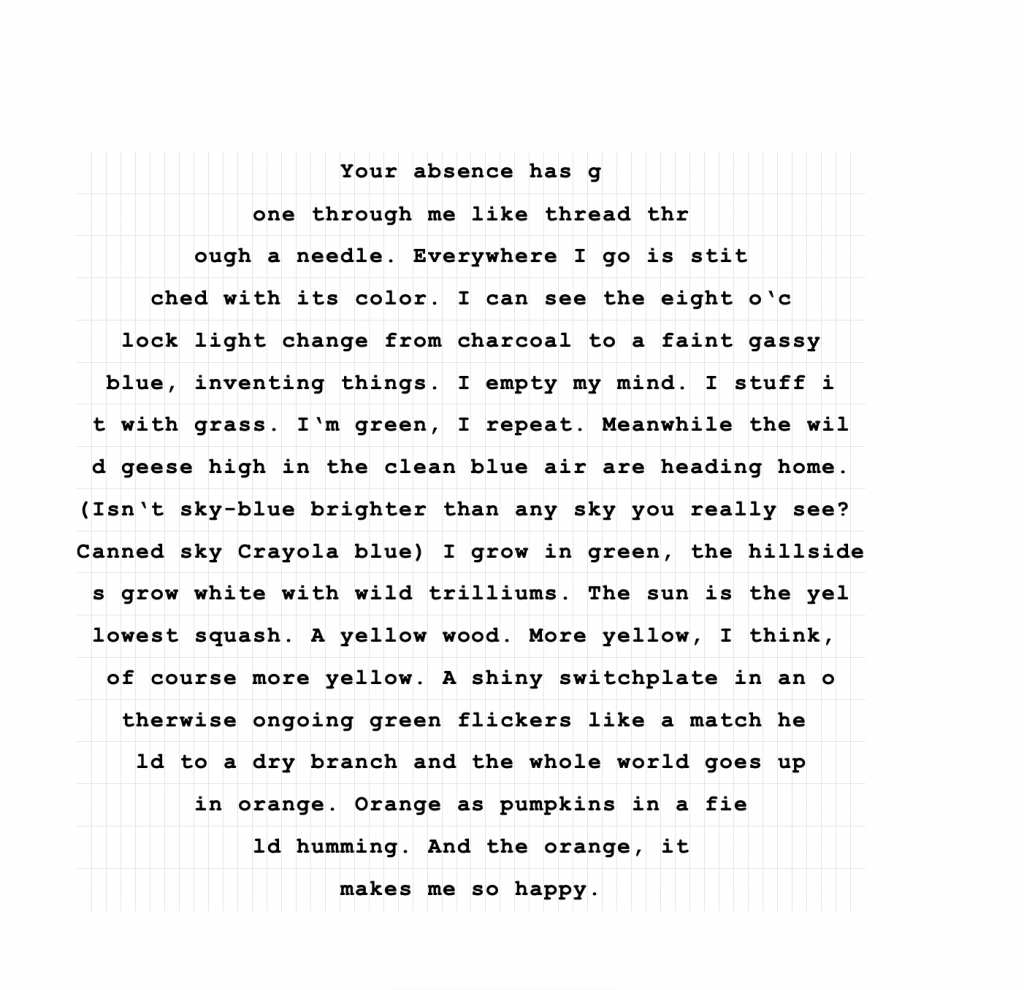
with white roofs. Wait, isn’t sky-blue brighter
than any sky you really see? Canned sky,
you might reply, hyperbole of color. Platonist
Crayola blue. Would anyone trade a teal
feather for a trill? The highway will line
with mud and snow stripes along a fence,
then apple orchards spider in the ice.
A long stand of pines before the strip mall.
And still from the radio, an alto atremble:
I love not knowing who it belongs to.


dec 8/RUN

5.5 miles
bottom of franklin hill and back
19 degrees
80% snow-covered

Hooray for blue sky, not too much wind, staying upright on slippery paths! Another wonderful winter run. Ran north without headphones. Greeted Dave, the Daily Walker. Noticed how the river was almost completely white — the dusting of snow we got yesterday morning covered the thin ice. Heard some chirping birds. Saw a few runners in bright yellow shirts, one running fast with a dog. Right before turning around at the bottom of the hill, I noticed a few open spots on the river — dark water in contrast to the white ice. Ran back up the hill. When I reached the top, I stopped, fumbled with my headphones, and put in a playlist. I ran back south listening to Harry Styles, Elton John, Foo Fighters, and Queen.

Inciting Joy: Skateboarding, the Fifth Incitement

For December, I’m reading Ross Gay’s Inciting Joy. Here are some notes for the fifth incitement.

Skateboarding: skateboarding with a friend, beholding each other as you attempt to do tricks in a dark parking lot after hours — a feeling of groundless (the mysterious, unknown). Also: sharing extra parts with skateboarding buddies (practicing gift economy). Gay places this practice of possible joy/ethics of sharing in larger context of 80s excess/hoarding of wealth, especially in terms of property and the criminalizing of skateboarding in public spaces, or private spaces that weren’t yours.

a new word: USUFRUCT “the right to enjoy the use and advantages of another’s property short of the destruction or waste of its substance.” As in, “Gonz (famous skateboarder) is just one of a trillion apostles of the form, the genre–is because he usufructs the skateable world, which includes benches, picnic tables, walls, handrails, flights of steps, curbs, fire hydrants, ledges, parking lots, sidewalks, driveways, loading docks, loading ramps, bus stops…” (Gay, 60).

Wow. Gay’s ability to move between his particular lived experiences and a more general context is amazing. What a writer! And the idea of joy as not looking away from the larger, less joyful context, is so powerful and helpful.

I love the ethics and possibilities for joy around sharing your bucket of parts:

It was the just the case that whatever you had extra–and skateboarding, with its many components (decks, wheels, bearings, trucks, bushings, riser pads, rails, Rip Grip, bolts, etc. ) made for extra–you passed along. Most of us had a bucket of some sort where, when someone needed something, we dug around to find it. I never once heard anyone express it as an ethics (sharing, redistribution, commonwealthing), though if you tried to keep your extra to yourself, if you spoke to no one of your bucket, and then it got out you had one…the reaction would be an ethical one: Yo, that’s fucked up, man.

Sharing the bucket = sharing parts; sharing in the experience of skating into the unknown, over railings, across dark parking lots, over bumps; sharing space — public, private, off limits; and sharing “skateable” locations. I love the last line of the chapter:

join us at the new spot, this new stain , this wreckage, this abandonment, this ruin, this commons, this c’mon.

Found this poem on Instagram this morning, via The Slowdown. I love its compact lines and the idea of “the soft dislodging of eyes.”

sunrise through mount vernon, wa/ Jasmine Khaliq

after beauty I am
entranced by the soft
dislodging of eyes:

blurs of cows
necks sloping
lapped-rainbows

colors thinner
than water
and running

this is where
I most miss
the dead:

a highway pasture
bisected body
and always

I am on the other side

dec 6/RUN

5.6 miles
franklin loop
20 degrees / felt like 12
25% snow-covered

A wonderful run on a wonderful, wintery morning! Sunny, calm, cold but not too cold. I know I noticed many different things, had lots of interesting thoughts, but I’m distracted now, having read a beautiful, caring, generous post from a friend from grad school about sickness and death and recently being diagnosed with cancer. Ugh. I wanted to write a comment, to do more than “like” her Facebook post, but…too many thoughts. I’m thinking about Ross Gay and inciting joy and grief and how joy can show up when we’re willing to let others meet our sorrow and willing to take the time to meet theirs. About how much I appreciate my friend’s words and her story, how awful it is that she’s living in limbo for weeks, waiting to hear how bad her cancer is, how I felt every word and didn’t look away. About how cancer and death and grief are everywhere — Scott lost 2 aunts, a mother, and a beloved godmother in the second half of 2022, one after the other: August, September, October, November. And about the beautiful words I heard from the poet Kemi Alabi on the VS. podcast when she was asked what was moving her:

Grief is moving me. Like it’s literally running me, I feel so governed by grief. And not just personally or with my community, but collectively just seems like you can’t walk down the street without encountering, stumbling on this grief. So I’m thinking about Rebellious Mourning. That’s actually the name of an anthology, where a lot of poets thinkers and movement builders are considering what it means to mobilize around our grief, understanding that so many social movements are catalyzed by collective grief at the injustices that we’re experiencing. Grief can be a really powerful force to harness for transformation, if we’re allowed the space to be together with it, to honor it, and to actually move through it together, to let it move us, and to not run from it. 

Kemi Alabi vs. Divinity

Typing all of this out reminds me of one feeling I had throughout the run. I felt tender — not quite raw, but vulnerable, open to others, having experienced great loss recently. Apparently Scott hates the word tender; it ranks up there as one of the worst words with moist. I love it, devoted September to it. I don’t think I’d say I enjoy being tender, but I deeply appreciate the space it allows me to inhabit, the openness it offers.

10+ Things I Noticed

  1. the river: mostly frozen over with a thin skin of ice. Where the ice was thinner, it looked gray, thicker white
  2. a strange back-up on the franklin bridge. not sure what was happening. Cars were stopped, one was diagonal. No evidence of a collision. Heard some honking after I passed it
  3. a man walking 3, or was it 4?, dogs
  4. at least one bike
  5. saw my shadow off to the side, dark-ish gray
  6. colors: a lot of gray, pale blue sky, an orange cone, my pink jacket and gloves, red stop sign, sepia-toned ice, yellow dividing line on the bike path, yellow truck
  7. the air was cold as I breathed it in
  8. the biking path on the east side of the river, mostly clear
  9. some loud thuds — from the construction being done on a house across from the river?
  10. the sharp, whining whirr of a drill, or some other tool, being used by a road worker in a yellow vest in a hole in the street
  11. lifting my knees as I powered up the last hill

Near the end of my run, walking up the steps to the lake street bridge, I stopped and recorded the following thoughts. Then I put in a Taylor Swift playlist.

notes / dec 6

dec 5/RUN

4.5 miles
minnehaha falls and back
27 degrees / feels like 21
75% snow and ice covered

Icier than I expected so I went slower. A gray day. Fuzzy, unformed or unfixed or out of focus. The sky filled with static. I ran south, planning to check out my favorite winter spot — just past the oak savanna where the hills part and open to a view of the river — but I forgot, or I was distracted as I tried to avoid slippery spots and pedestrians.

About a mile in, was passed by another runner. I could hear their soft footsteps approaching. After they passed I watched them fly away. Their gait seemed a little erratic, like they were almost about to slip on the snow with each step. Speaking of slips, running up the hill between Locks and Dam #1 and the double-bridge, I witnessed a biker almost wipe out on some chunks of ice the plow had kicked up from the street. Yikes. I stopped to let him go by safely.

The falls were frozen. The river was too, but not completely.

10 (groups of) People I Encountered

  1. a group of walkers, paused by the sign for the bike surreys at the falls
  2. another group of walkers near locks and dam #1. Heard one of them say, “The farmer had to fish her out of the river.”
  3. a guy and an exuberant dog by the Longfellow poem at the park
  4. the speedy runner I mentioned above
  5. the biker who almost fell
  6. someone on a fat tire
  7. kids at the school playground across the street, more subdued than usual, but still laughing and yelling
  8. a guy blasting his phone or radio as he walked. I think he was listening to music, but I can’t remember what kind
  9. a runner in a bright blue jacket, over on the trail, when I was on edmund. we ran parallel for a few minutes then he inched ahead
  10. a runner carefully crossing over some ice as she talked on a bluetooth phone to someone

Running back from the falls, I crossed over to edmund to avoid the crowd, and the ice on the trail. Stopped at my favorite poetry house that puts a poem on their front window. Was there a new one? Yes! Here it is:

Maybe Alone On My Bike/ William Stafford

I listen, and the mountain lakes
hear snowflakes come on those winter wings
only the owls are awake to see,
their radar gaze and furred ears
alert. In that stillness a meaning shakes;

And I have thought (maybe alone
on my bike, quaintly on a cold
evening pedaling home), Think!–
the splendor of our life, its current unknown
as those mountains, the scene no one sees.

O citizens of our great amnesty:
we might have died. We live. Marvels
coast by, great veers and swoops of air
so bright the lamps waver in tears,
and I hear in the chain a chuckle I like to hear.

I’m glad to have found this poem. Think! and we might have died. We live. Marvels/coast by, great veers and swoops of air I love the title of the poem and where it sits at the start of the second stanza. Weather and light like today — the gray, overcast, wintery light, not dim, but not bright either — is conducive for thinking and reflecting and being grateful to be alive and to notice the veers and swoops of air, the chuckle of a bike chain.

Yes, gray is for thinking and wondering and for opening up to the world.

Inciting Joy: Through My Tears I Saw [Death: the Second Incitement]

Before heading out for a run, I read Gay’s second incitement about the death of his father. I don’t want to summarize it because it’s not meant to be summarized, but experienced, endured, read closely without looking away. Wow — Gay is an amazing writer. His descriptions of his dad’s diagnosis of cancer, his illness and decline, his death, are so powerful and vivid. I could feel the pain of my own grief — over my two moms, one dead for 13 years, the other for 2 months — in my body, especially in my sinuses and throat. My body tightening, tingling, wanting to close up.

At one point, as I read the 17 page chapter, I thought of Marie Howe and her entreaty to not look away, even when it’s painful. To face the sadness and grief, to let it in. In the poem I posted yesterday, Levine writes about how this letting in — dragging our grief out of the river and putting our mouth on it — can lead to a loosening, an opening up, a joy. Gay writes about this too, in the conclusion to the chapter, as he says goodbye to his dying father:

Can you hear me Dad, Can you hear me, and by now I was crying hard, and I was kissing my father’s face again and again, telling him I loved him again and again, it was the softest face in the world, my father’s face, so quiet like that, I never knew it, I had never touched it before, I was crying onto his eyelids and cheeks and kissing him and telling him again and again I loved him, I love you Dad, his brown face was lit with my tears. and with my forehead pressed into his, and my hands on his cheeks, I noticed that my father had freckles sprinkled around the bridge of his nose and his upper cheeks. It was like a gentle broadcast of carrot seeds blending into his skin, flickering visible from this distance. It was through my tears I saw my father was a garden. Or the two of us, or the all-of-us, not here long maybe it is. And from that what might grow.

dec 4/WALKBIKERUN

walk: 20 minutes
neighborhood
32 degrees

note: Reviewing this entry the next morning I’ve found several typos, which I corrected just now. There are probably more that I still can’t see. As my ability to see clearly diminishes, I imagine these typos will increase.

COVID update: RJP’s doing fine, felt like her usual cold. She’s been in her room since Wednesday night, only leaving to go to the bathroom or eat. So far, Scott and I are okay. He tested today: negative. Neither of us are too anxious.

update from the next morning: Even though she feels fine, RJP is still testing positive. It was the same for FWA when he had it in September. He thought he had a cold. Finally tested near the end of it. Felt fine, tested positive for 10 days.

Scott and I took Delia the dog for a quick walk around the neighborhood. Warmer, sunny, slushy sidewalks. Fresh air! He talked about video games, I talked about this log and the latest episode of ‘You’re Wrong About.” The only memorable thing about the walk: the field at Howe School was covered in snow — not smooth or flat but filled with mini mounds from hundreds of boots kicking and stomping, and hundreds of bodies rolling around in it during recess last week.

bike: 14 minutes
bike stand, basement
run: 2.2 miles
treadmill

Too dark to run outside in the later afternoon, so I went to the basement. Watched Miss Space Cadet on YouTube while biking, listened to Apple’s 80s “Fitness” playlist on the treadmill — “Holding Out for a Hero,” “Material Girl,” “Super Freak,” and “Wake Me Up Before You Go Go.” I need to put together a running playlist again. Didn’t think about much while I ran. As always, it felt good to move.

Inciting Joy: Day One, The First Incitement

This afternoon I started Ross Gay’s wonderful book, Inciting Joy. I’m going to try and read an incitement (there are nine) this month. Here are some notes and thoughts for the first incitement:

To define joy, he begins by saying what it’s not: it’s not sparking joy or capitalist-joy-as-acquiring-better-stuff-or-doing-big-things. It’s not the happy place where you go to be safe or comfortable — a sanctuary protected with a heavy lock, keeping out all the bad stuff: heartbreak, sadness, worry. It’s not unserious or frivolous to talk about (or experience), even as we are made to think it is, and it’s not separate from pain and suffering:

But what happens if joy is not separate from pain? What if joy and pain are fundamentally tangled up with one another? Or even more to the point, what if joy is not only entangled with pain, or suffering, or sorrow, but is also what emerges from how we care for each other through those things? What if joy, instead of refuge or relief from heartbreak, is what effloresces from us as we help each other carry our heartbreaks?

effloresces = blossoms

He suggests that instead of avoiding/ignoring/quarantining sorrow that we invite it in, and invite others in too so they can meet our sorrow, and we can meet theirs. Then he offers a vivid description of what that party might look like, all of us bringing a dish for a potluck, along with our sorrow, breaking bread together (and some furniture, I guess):

…and the thud skips the record back to the beginning of Sly Stone’s “Family Affair” and the dancing, which has been intermittent, just blasts off, all of us and our sorrows, sweaty, stomping and shaking, tearing it up, the pictures falling off the walls, the books from the shelves, some logs ablaze even spilling from the stove, riotous this care, this carrying, this incitement, this joy.

At the end of the chapter, he describes the goal of his book: to investigate what stuff we think/do/believe that incites joy and to wonder what joy might incite. He has a hunch — it might incite solidarity, which incites more joy, and then more solidarity — not over the same sorrows but over the shared experience of sorrow. This sharing of sorrow might lead us to discover what we do or might love together, which might help us survive.

I deeply appreciate this idea of joy as connected to suffering and that, when shared and cared for, might lead to love. Did that last sentence make sense? I’m excited to read the rest of these incitements. I think I might add my own incitement: gray days. Or, I might develop my own idea of gray joy?

Gay’s vision of a raucous party, overflowing with people meeting each others’ sorrows, seems a bit overwhelming to me. I’m not sure I would find joy in caring and developing solidarity in such a big, messy crowd. But, there are others ways, I think, in which we can invite sorrow in too. Gay’s discussion reminded me of another psalm poem I read by Julia B. Levine, especially her last lines:

Psalm with Wren in Daylight Saving Time/ Julia B. Levine

Late afternoon, I chop onions by feel,
listening to crows cry to each other across the ridge.

Gone now, white recipe card on the white floor,
green sea glass found on a Humboldt beach.

But this hour I have been given back, carried out
of gorse, red flash of maples, finches in our cedar.

Meaning, today I returned for the first time
to the moment I understood I was going blind.

Months I hid from myself that the V of geese
flying over the valley extinguished too soon into fog,

a darkness fine as sugar sifted over the chard, the roses.
Now I hear the soft tick of a bird landing on the counter.

Feel her gaze turn away from mine. When she hops
table to chair to floor, I open all the windows and doors.

Sometimes we must drag our grief out of the river
and put our mouth on it. And then a loosening comes.

One morning I rose and sat outside on my lawn
under budded glory vines. There is no hurry, I say

to the stirrings of one so small it has to be a wren.
Once I let the missing in, there was possibility.

There was a heavy rain in sun—every blade of grass
blurred, and for a moment after, only shine.

Let that missing in! Open those doors and windows! Drag the grief out of the river! I imagine this opening up to grief as more than a solitary practice. It’s an opening up to and connecting with the world.

dec 3/RUN

3.5 miles
trestle turn around
15 degrees / feels like 4
99% snow-covered

Almost the exact same run as on Wednesday, with a few differences: the actual temp was 2 degrees colder, I ran in the afternoon, I wore my regular black running shoes, a gray jacket and mittens instead of yaxtrax, a black vest and an extra pair of gloves, there was less wind and less swirling leaves, and the river is more frozen over.

A good but tiring run. I think it was because I ran in the afternoon, instead of right after breakfast, and I had to work harder on the slippery snow without the yaktrax. Encountered some dogs and their walkers. At least one fat tire. Any other runners? I don’t think so. Hear some kids sledding across the road — wheeeee!

The only part of me that felt cold for most of the run were my feet, like little blocks of concrete. The mittens kept my hands very warm, which is good because my hands tend to stay cold sometimes.

It snowed again last night unexpectedly — to me, at least. I was so surprised that when I opened the door to let Delia out for her final hurrah, I cried out into the dark, What? note: For some reason I started calling Delia’s final time outside for the night the final hurrah, and it stuck, and sometimes is shortened to fh, as in, Dealz, it’s time for your fh! All 4 (RJP, FWA, Scott, me) use this term and Delia understands it. It wasn’t much snow — a dusting, but it feels like the start of a steady accumulation. No grass until March or April.

It’s a little too soon to have to say goodbye to the bare, brown gorge, but I love the snow, especially listening to it crunch underfoot. As I walked home after my run, I marveled at the 2 sounds my feet made — a creaky crunch and a soft shuffle, caused by one foot lifting off and other touching down. The sounds shifted between my feet — was it a constant, steady sound?

To a Wreath of Snow/ Emily Brontë

O transient voyager of heaven! 
   O silent sign of winter skies! 
What adverse wind thy sail has driven 
   To dungeons where a prisoner lies? 

Methinks the hands that shut the sun 
   So sternly from this morning’s brow 
Might still their rebel task have done 
   And checked a thing so frail as thou. 

They would have done it had they known 
   The talisman that dwelt in thee, 
For all the suns that ever shone 
   Have never been so kind to me! 

For many a week, and many a day 
   My heart was weighed with sinking gloom 
When morning rose in mourning grey 
   And faintly lit my prison room 

But angel like, when I awoke, 
   Thy silvery form so soft and fair 
Shining through darkness, sweetly spoke 
   Of cloudy skies and mountains bare; 

The dearest to a mountaineer 
   Who, all life long has loved the snow 
That crowned her native summits drear, 
   Better, than greenest plains below. 

And voiceless, soulless, messenger 
   Thy presence waked a thrilling tone 
That comforts me while thou art here 
   And will sustain when thou art gone 

Emily sure loves winter and snow. I memorized and often recite her poem, Fall, Leaves, Fall and the lines,

I shall smile when wreaths of snow 
Blossom where the rose should grow;

dec 2/RUN

5.75 miles
bottom of franklin hill and back
34 degrees
50% snow-covered

Found out last night that RJP has COVID. She’s had a cold all week. So far, I feel okay, so does Scott. Will we get it? I’m a little worried, but only a little. A few years ago, I would have been freaking out. Thank you vaccines and better treatments and less severe variants! Unless I feel like total crap, I’m going out for a run when I can. Today I don’t feel like total crap, so I went out for a run. It felt good. Breathing in fresh air! Moving my legs! Admiring the half frozen river!

A great run. Just above freezing, not too slippery. Some wind, but mostly at my back. Ran north with no headphones, south with a playlist.

12 Things I Noticed

  1. a honking goose, its mournful cry amplified by the bridge
  2. a big bird flying above. I think it was a crane
  3. a runner in an orange shirt, running with a dog
  4. another runner — tall, wearing a white sweatshirt and shorts, moving fast, with long, bouncing strides
  5. passing Dave, the Daily Walker: Good Morning, Dave!
  6. a group of young people, high school or college students?, hanging out by the franklin bridge, blocking the path
  7. no sun, but not gloomy, a grayish-white sky. everything bright but with very little color
  8. the river! down at the start of the flats, the river was gray and half-frozen. Not flat or dull but interesting. Not gloomy either, but vast and quiet. Not desolate, but detached, otherworldly
  9. a car, I think it was a Prius, whooshing through a stretch of the road that was part snow, part bare pavement, then suddenly turning silent as it reached a part of the road that was all soft snow. So strange to watch it move without sound
  10. Climbing the franklin hill, encountering a line of cars with their headlights on, crawling down the hill
  11. the faint trace, in light gray, of my shadow ahead of me
  12. the knock knock knock of a woodpecker

Still figuring out my theme for December as I continue working on some color poems — currently, a gray one. Today, I’m posting something from Ross Gay about joy. Wow!

Yes, that’s how it seems to me, that we need practices, or we need to notice the practices we have, that help us be present with our sorrow. I’m not saying that help us drown in our sorrow—I’m saying be present with it, acknowledge it, befriend it even, lest we do some wretched or devastating shit trying to pretend it’s not there, or trying to hide it. And to do it in a mutual way—which, again, might be in some of our practices: dancing, gardening, mourning—but it might also be how we live, how we attend to one another, with the awareness that, yup, like me, your heart is broken. Probably not in exactly the same way, but probably, no, definitely, it’s broken. And it will go on being broken in various ways. It does not make us special, it seems to me. It makes us like each other. It un-others us from each other in fact. What happens if we live like that? My sense is that we’re more inclined to care for one another, we’re more inclined to love one another, which, yes, might be a kind of resistance to institutions who have little care for us, but it might also end up being a kind of offense to them. When we care for each other, and consequently are less reliant on the institutions or systems that, a lot of them anyway, do not care for us, we make those systems less necessary. We might be replacing those systems with something like love.

Cultivating Delight and Meaning with Ross Gay

Be present with our sorrow. Befriend it. It seems difficult sometimes to express sorrow, a brokenness, vulnerability, without it seeming weak or eliciting pity or the frustrating, You’re so brave! Or in ways that put it beside, in conversation with, delight or happiness. To me, gray holds both delight and grief, often in equal measures.

I like this idea that sorrow and broken hearts are something that connects all of us. I was thinking about that as I reread this poem by Didi Jackson, especially the last lines. The first song that is in all songs is that of sorrow/grief/mutual suffering.

Listen/ Didi Jackson

Like a hundred gray ears
the river stones are layered

in a pile near the shed where mourning
doves slow their peck and bobble to listen

to a chorus of listening.
Small buds on the lilac perk up.

A cardinal’s torpedoed call comes
in slow waves of four,

round after round. It’s a love call;
a call to make him known to himself.

The stones listen harder,
decipher the song; attempt

to offer back its echo.
But fail.

This is not a poem of coming Spring.
This is a poem well aware

that gray flesh is dead flesh.
All of the ripe listening

comes at a cost. The first
sky is in all skies.

The first song
is in all songs.

And just now, thinking even more about Jackson’s poem, I realized that the delightful gray ears that the stones become has another meaning. Gray = neutral. The gray ears listen without judgment, are open to witnessing, beholding, hearing what is said without rebuke. Another meaning of gray! Love it. Those gray ears are going in one of my gray poems, for sure!

dec 1/SWIM

1.5 miles
ywca pool

Back to the pool. Hooray! Swam a lot of loops — 99 laps — while breathing every 3, then 4, 5, then 6. Worked on breathing on my weaker side (left) when breathing every 4. Decided not to count, just swam until Scott entered the pool area and stood at the top of my lane. Not very crowded today. A guy in swim trunks to my right, swimming a lot of side stroke. It was fun to watch the wide sweep of his hands as he moved through the water on his side. Empty to my left, then Miss Luna arrived. Almost positive it was Miss Luna — the regular swimmer who swims with fins and paddles and does butterfly, and wears a pale green suit, with pale blue too, that makes me think vaguely of a luna moth. She wasn’t in pale green with blue today, but a similar suit. Same strong stroke, same fins.

They must have added chlorine since my last swim. Much clearer, sharper too. The blue of the tiles on the bottom that make the lines dividing the sides of the lane were a vivid blue instead of almost looking navy or black. Speaking of color, kept seeing yellow and orange when I lifted my head.

Felt strong and happy and buoyant, riding the surface, smoothly powering through the water. At some point, I started thinking about my color poems. I’ve written one about yellow, another about color in general. Before swimming, I started one about gray. Almost everything is gray or seems gray or leads to gray. Other colors are only pops, flashes, suggestions. I thought about making the poem mostly variations on the phrase, a gray day, or singing a song of gray, or gray area, or grayed out. Then I thought about having the poem visually mimic how I often see color. It’s frequently a flat or hazy gray until suddenly, to the side, a slash or pop of color appears, like orange or red. So, most of the words are gray, gray day, gray dreams, sing a song of gray, then off to the side, “orange” appears. Could this work? I’ll give it a try!

december challenge

I’m not sure what my challenge for this month will be. I’m in the thick of working on these color poems and prepping for my finding wonder in the winter writing class in late January (so excited to teach this one!). Should it be about orange? Or the poet that just wrote a collection partly about her degenerative eye disease — Julia B. Levine — titled, Ordinary Psalms? Or joy, inspired by recently purchasing Ross Gay’s Inciting Joy and my desire to explore what gray joy could be? I’ll give it another day, but I’m leaning towards Gay and joy. In the meantime, here’s one of Levine’s psalms from Ordinary Psalms:

Psalm with Near Blindness/ Julia B. Levine

i. 
The world mostly gone, I make it what I want: 
from the balcony, the morning a silver robe of mist.

I make a reckless blessing of it—the flaming, 
flowering spurge of the world, the wind 

the birds stir up as they flock and sing. 
Edges yes, the green lift and fall of live oaks,

something metal wheeling past, 
and yet for every detail alive and embodied— 

the horses with their tails switching back and forth, 
daylilies parting their lobes to heat— 

I cannot stop asking, Sparrow or wren? Oak
or elm? Because it matters 

if the gray fox curled in sleep 
is a patch of dark along the fence line,

or if the bush hung with fish kites 
is actually a wisteria in flower. Though 

even before my retinas bled and scarred 
and bled again, I wanted everything 

different, better. And then this afternoon, 
out walking the meadow together,

my husband bent to pick a bleeding heart.
Held it close as I needed 

to see its delicate lanterns, 
the shaken light. 

ii. 
Deer, he says, our car stopped in traffic. 
And since I can’t see them, I ask, Where?

Between the oaks, he answers,
and since I can’t see the between,
                                                                I ask, In the dappling?                        
He takes my hand and points 
to the darkest stutter in the branches 
                                                                and I see a shadow 

in the sight line of his hand, his arm, 
his blue shirt with its clean scent of laundry, 

my hand shading my eyes from glare. 
There! he says, and I can see 
                                                              the dark flash of them 
                                                              leaping over a fence (or is it reeds?), 

                                                              one a buck with his bony crown, 
                                                         and one a doe, and one smaller, a fawn,

but by then it seems they’ve disappeared 
and so I ask, Gone?
and he nods. 

We’re moving again,

                                                               and so I let the inner become outer 

                                                               become pasture and Douglas firs 
                                                               with large herds of deer, elk, even bison, 

                                                               and just beyond view, a mountain lion 

auburn red, like the one we saw years before, 
hidden behind a grove of live oaks, 

                                                                                        listening.

Oh, I am so excited to find this poem and the brilliant work of this poet! I can relate to so many of her words! The silver mist of the morning, the edges mostly gone, the emphasis on movement, her husband helping her to see, the inner becoming outer. Some differences too (probably partly because I imagine my vision isn’t quite as bad as hers): I don’t think the world is gone, more shifted, italicized, transformed. And I don’t need to know exactly what type of tree I’m seeing. I’d like to be able to tell the difference between a deer or a bush — sometimes I can’t — but the fine details matter less.

My thoughts on this last bit, about seeing exactly what’s there, are partly inspired by Levine’s response in an interview about the psalm. She says:

As I worked on it, this poem felt to me like a meditation on one particular dilemma of near blindness: that is, in the absence of a clear visual image, how the mind fills in, and what relationship this kind of seeing” has to spiritual notions of “vision” as opposed to a medical/anatomical definition of “sight.”

To explain further, there are some absences of visual perception that I actually like: I don’t see how dirty my house is, or whether or not my clothes are covered in blonde dog hair, and my friends and family all look very beautiful to me since I cannot see their wrinkles or whatever else might be considered “flaws.”

But I have loved the natural world since I was a small child and it is my inability to see it accurately that pains me. So, in the poem, I am interested in both how tounderstand what I do “see” as a amalgam of my own mind and memory, plus the relational construction that primarily my husband lends to me, and finally, what I can actually perceive. The result of this perceptual construction can sometimes feel like an important “truth” as opposed to visual fact.

I have loved the natural world since I was a small child and it is my inability to see it accurately that pains me.

Interview with Julia B. Levine

I love the natural world, but I’ve never needed to see it accurately in the ways that Levine seems to be invoking. I’m not interested in critiquing her perspective, but in positioning mine in relation to it. Also, I’d like to understand more of what she means by accurate. The more I (attempt to) study how vision and sight work, the more I’m fascinated by how much guesswork it involves for everyone, even “normally” sighted people. The brain filters, guesses, fills in. What does it mean to see nature accurately? Also, what about other senses? Can they enable us to access parts of nature that our limited/biased vision can’t? Losing some sight and the ability to easily, and more quickly, with much more detail, sucks, and I struggle with it. But I’m also interested in ways of knowing/understanding/recognizing/becoming familiar with beyond central vision and fine detail. I have a different project than Levine, but I deeply appreciate her words.