7 miles
ford loop+
61 degrees / dew point: 59
drizzle, off and on
Moist. Humid air mixed with sweat mixed with rain-soaked bushes mixed with occasional drizzle. Overcast. Encountered several walkers with umbrellas or rain jackets. Ran past some geese, a few wild turkeys. Heard the bells of St. Thomas.
10 Wet Things
- my upper arm after brushing against wet leaves
- the sidewalk — a little slick
- puddles on the path, making visible cracks I might not have seen otherwise
- the surface of the river, crossing the ford bridge: scaled, gray
- shadow falls was falling vigorously
- the big fountain in front of a fancy house on the river road, bubbling
- my shirt, soaked at the top
- stopped at the water fountain near the skate park
- my pony-tail, dripping
- they’re doing work at the old steam plant/ Ford Area C — an orange something looking like a thick lane line in the water near shore, a big crane, yellow-vested workers all around
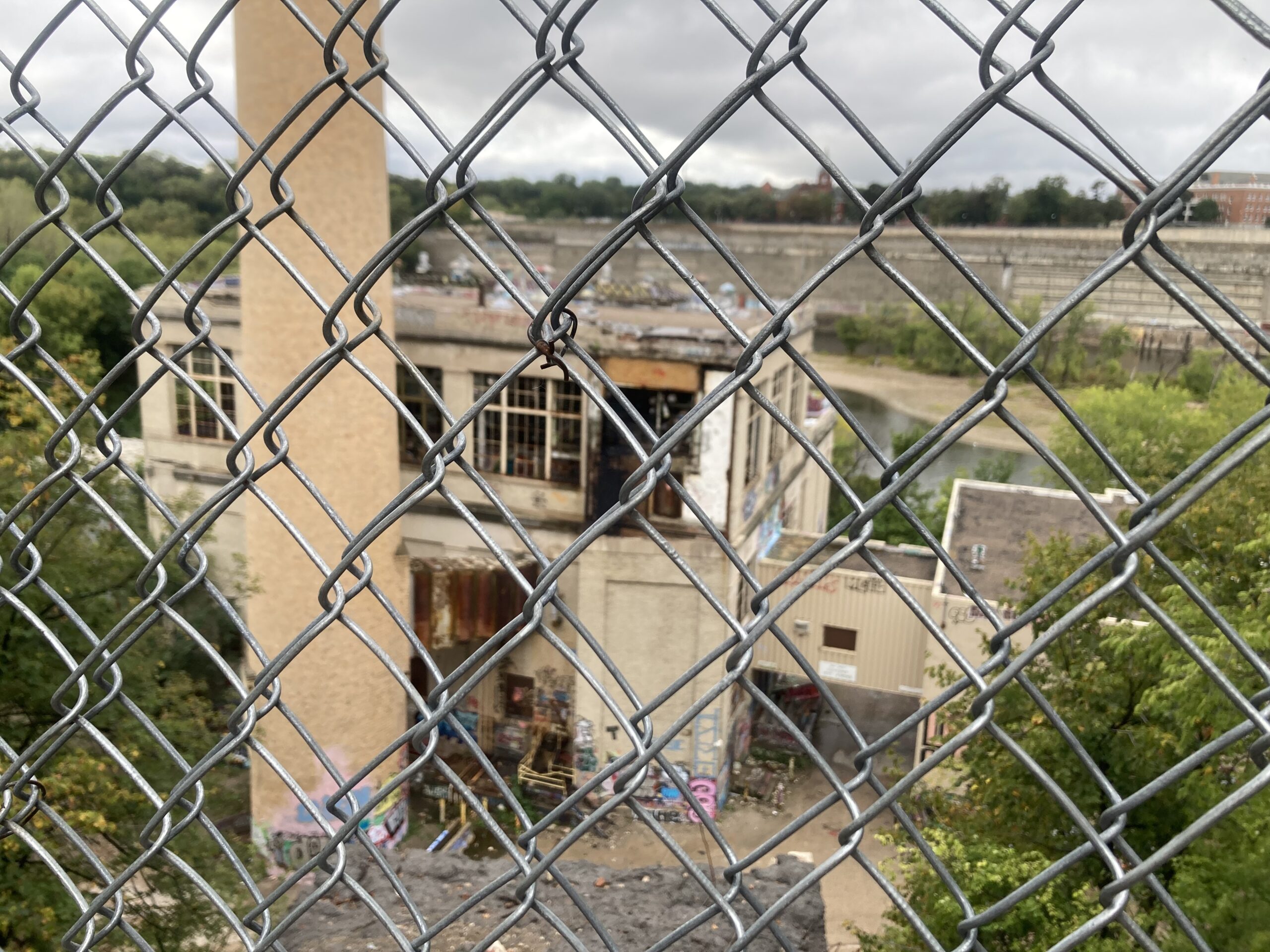
While working on a poem about Ford Area C and the abandoned power plant yesterday, I read about how Ford, which still owns this building/land, had to submit a plan for cleaning up the toxic dump that has been there for more than 80 years — is that what they’re doing down there, cleaning up? Something else they’ve already done is remove a small building up on the bluff, just off of the trail. Today I made that my turn around point (note to future Sara, if you’re planning to run 7 miles, this is about 1/2 mile short). I walked out near the edge and took a few pictures of the open view to the plant below, including this one:
Friends of the Mississippi River (FMR) put together a helpful timeline of Ford Area C. Here are a few key dates:
1945-1966 — Ford dumps waste solvents over the bluff and deposits barrels of paint waste onto the Mississippi River floodplain, creating what is eventually named “Area C.” (The primary manufacturing campus includes parcels “A” and “B.”)
1965-66 — Ford deposits large amounts of construction debris on top of the hazardous waste at Area C.
1979 — The U.S. Army Corps of Engineers, with Ford’s permission, adds construction debris to the top of the Area C dump during nearby lock and dam reconstruction, making removal of the hazardous waste underneath more difficult. Ford is paid by the yard for the disposed-of waste.
Fall 2025 — Ford has submitted a draft cleanup plan (feasibility study) to the MPCA. The MPCA will hold a community meeting and seek public comments in January 2026 before selecting a cleanup alternative with Ford.
In January of 2026, the MPCA held public meetings to discuss Area C clean-up plans. I haven’t found much more information. Looking at the MPCA site for Ford Area C, I found a timeline that claims 2027 is when the clean-up will happen.
Returning to the MPCA site and their description of Ford Area C:
From approximately 1945 through the mid-1960s, Ford disposed of paint sludge and solvents used in automobile painting operations at the base of the bluff. Although the specific disposal practices are not known, it appears that liquid solvents may have been dumped over the edge of the bluff, while barrels of paint sludge were buried. Disposal of industrial waste stopped in about 1966. Ford also disposed of construction rubble, contaminated soil, scrap metal, and other types of debris at Area C.
During the reconstruction of Lock & Dam No. 1 in the late 1970s and early 1980s, the U.S. Army Corps of Engineers disposed of a large volume of construction rubble and sand on top of and surrounding the industrial waste. In the mid-1980s, Ford covered the top of the construction rubble pile with a paved parking lot. The city of Saint Paul placed additional rubble at Area C during reconstruction of Mississippi River Boulevard in the late 1980s.
Dumped over the edge of the bluff, buried in the ground, covered with rubble, sand, a parking lot.