may 18/RUNHIKE

run: 8 miles
around lake nokomis and back
62 degrees
humidity: 86%

A long run with Scott. 8 miles this week. It felt easier than the 7 miles last week. The only problem: my feet. About 4 miles in, I noticed my socks were bunching up and under the ball of my feet, which was painful and made me alter my gait. Next time: different socks.

I started the conversation with Alice in Wonderland and the scene with the Cheshire Cat; it’s an inspiration for my found poem about landing in the logic of blur and almost. Scott talked about his YouTube channel — the main one and one of his secondary channels that he jokingly created for one of the gnomes in our backyard. I also talked about shifting my perspective on my unfinished business problem: not trying to avoid it, but learning how to accept and manage it while I’m running. What else did Scott talk about? A lot, I just can’t remember what.

10 Things

  1. the green looked and felt greener, the brown richer and darker after last night’s rain
  2. birds! so much birdsong everywhere and all the time
  3. a mini-ambulance parked on minnehaha parkway, a Ghostbusters logo painted on the side
  4. an older man with a cane calling out to us as we ran around the lake — the birds are attacking me! Just then, a bird swooped down on him
  5. a little dog with a big, fluffy tail, shaking their butt as they walked
  6. the view of the lake from the cedar avenue bridge: completely still, the reflection of ascending plane travelling across it
  7. puddles — most of them on the lake trail
  8. stopping at the port-a-potty near the little beach: no toilet paper in either one
  9. more benches than last year set up around the stage at the falls — Scott guessed that they start out with a lot, but the number dwindles over the course of the summer as the benches get broken, I wondered if people stole them
  10. the view near the bench above the edge of the world is gone until next fall, now it’s a wall of green green green

hike: an hour
minnehaha off-leash dog park
61 degrees

The air was cool, but thick down in the floodplain. The ground was soft and firm, in some spots muddy. So many birds! I wish I would have had my phone and recorded them. Hardly anyone was at the park — because of last night’s rain? and today’s humidity? The few cars were all parked on the one side of the parking lot. No one, including FWA, wanted to be the first to park on the other side. The surface of the water was covered in some sort of scum. When we got closer we realized what it was: seeds.

dog names: Dolly (or Ollie), Squirrel, and ? — I can’t remember the name of the Corgi we encountered.

We talked about the social life of birds and Subnautica 2 and delighted in Delia’s joy. I noticed she seemed to be leaping more as she ran; we agreed that it was probably because of the firmer ground.

added the next morning: I forgot to mention the moss, or was it lichen?, that I studied on the side of some big trees down in the floodplain. Very cool — an intense green covering the soft and wet bark on one side, while dry and rough bark was on the other side.

The greens and browns were enchanting. So were the birds. And the quiet — so peaceful and still.

And today, after months of focusing almost exclusively on my “how I read”/ holes poems, here’s a bit of a beautiful poem from Tracy K. Smith:

God of Song/ Tracy K. Smith

My son listens into daylight,
head tilted, eyes tuned
past the range of  the seen.

What he seeks to see is
vibratory. A butterfly’s itch.
The pitch at which a mind

is freed to dart, spark, break
into flight. His gaze rakes space.
What does his ear see? Beads

of  breath rising from the body
of a bee. A whiff of rain batting
a new green leaf. I watch him—

What does his ear see? I like the images of hearing in this poem.

hole 4b

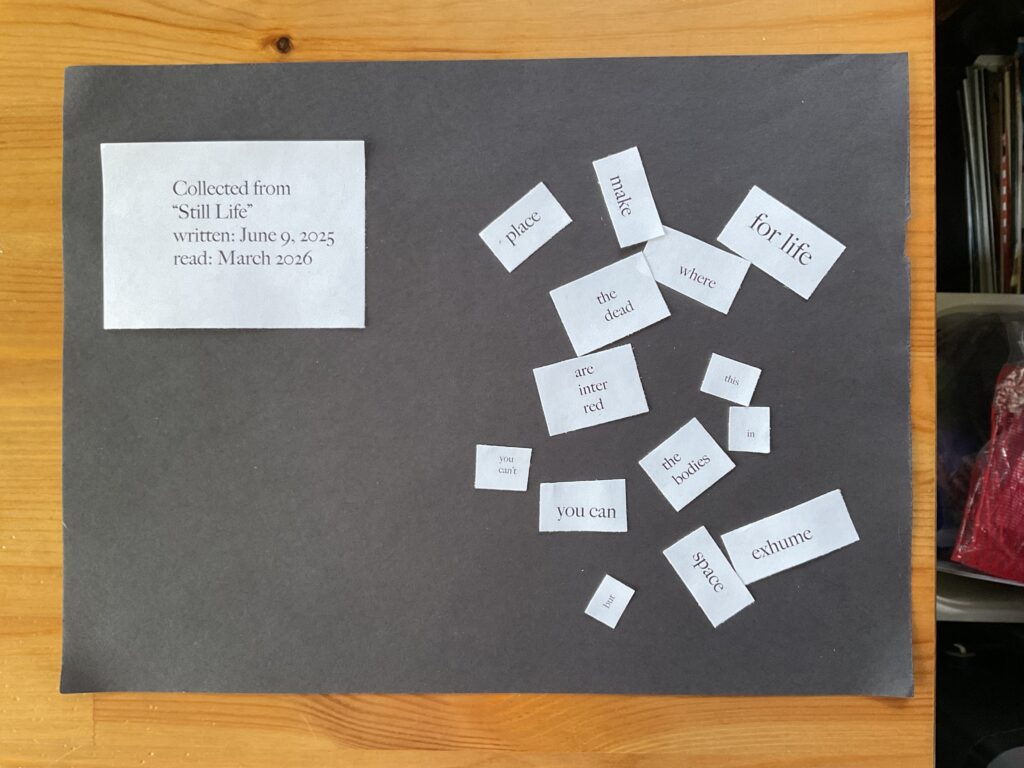
Yesterday, I spent some more time with my found poem inspired by a specimen board. It’s slowly coming together, but I have more work (thinking, executing) to do with it.

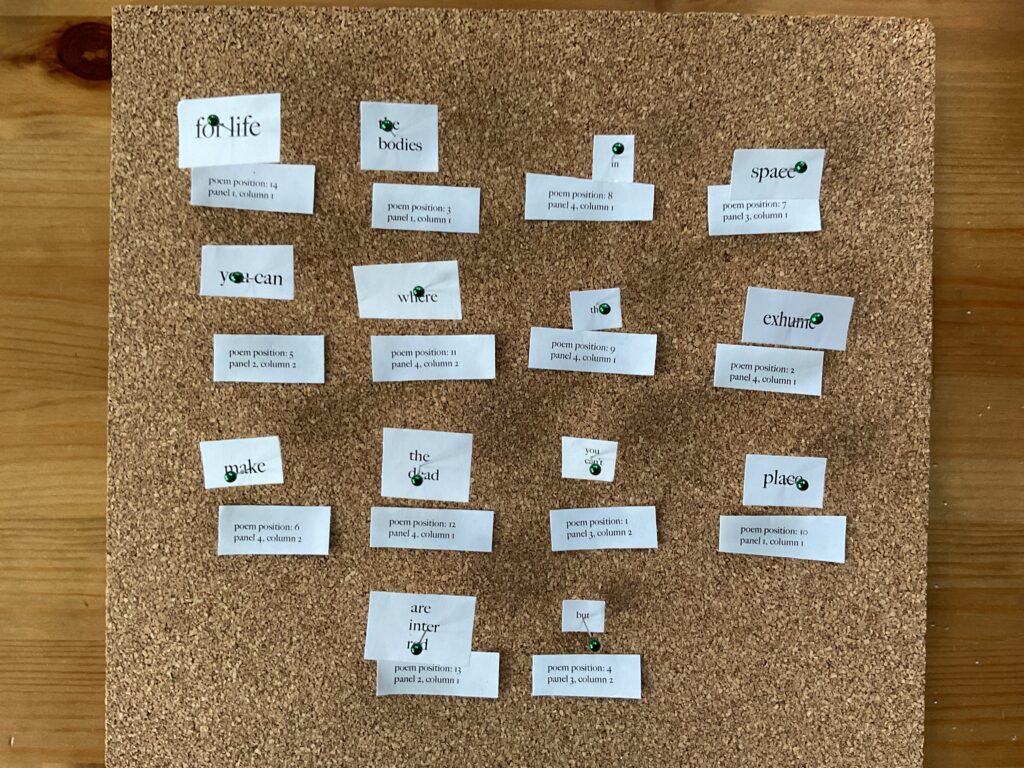
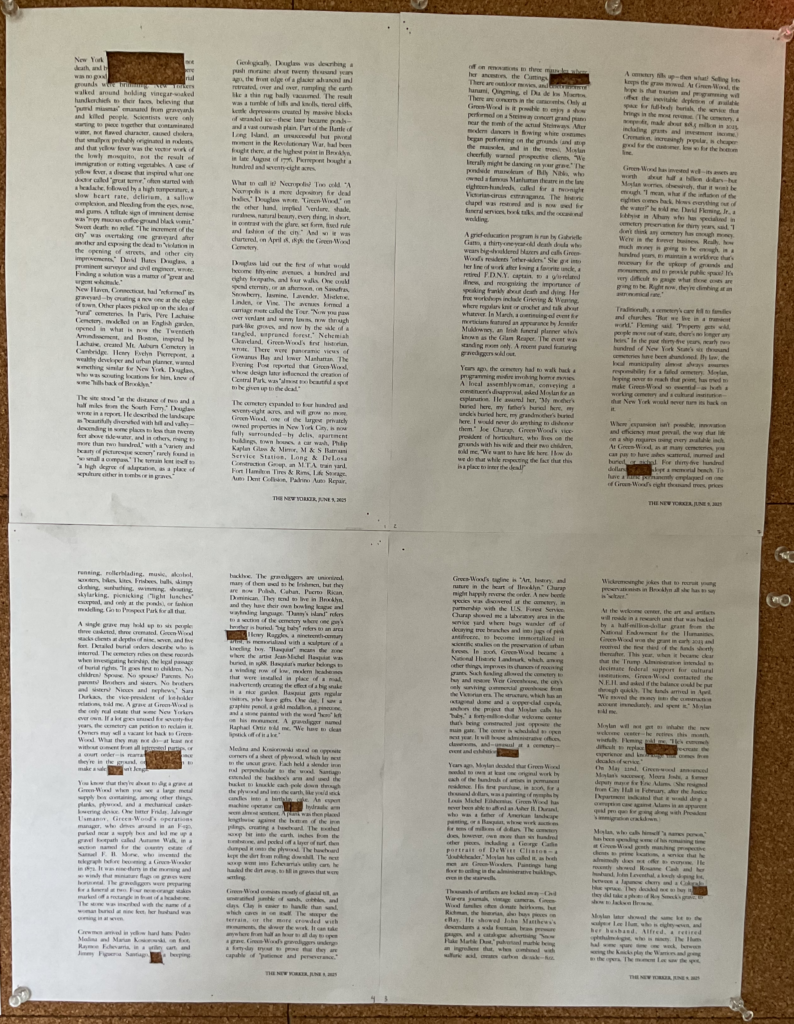
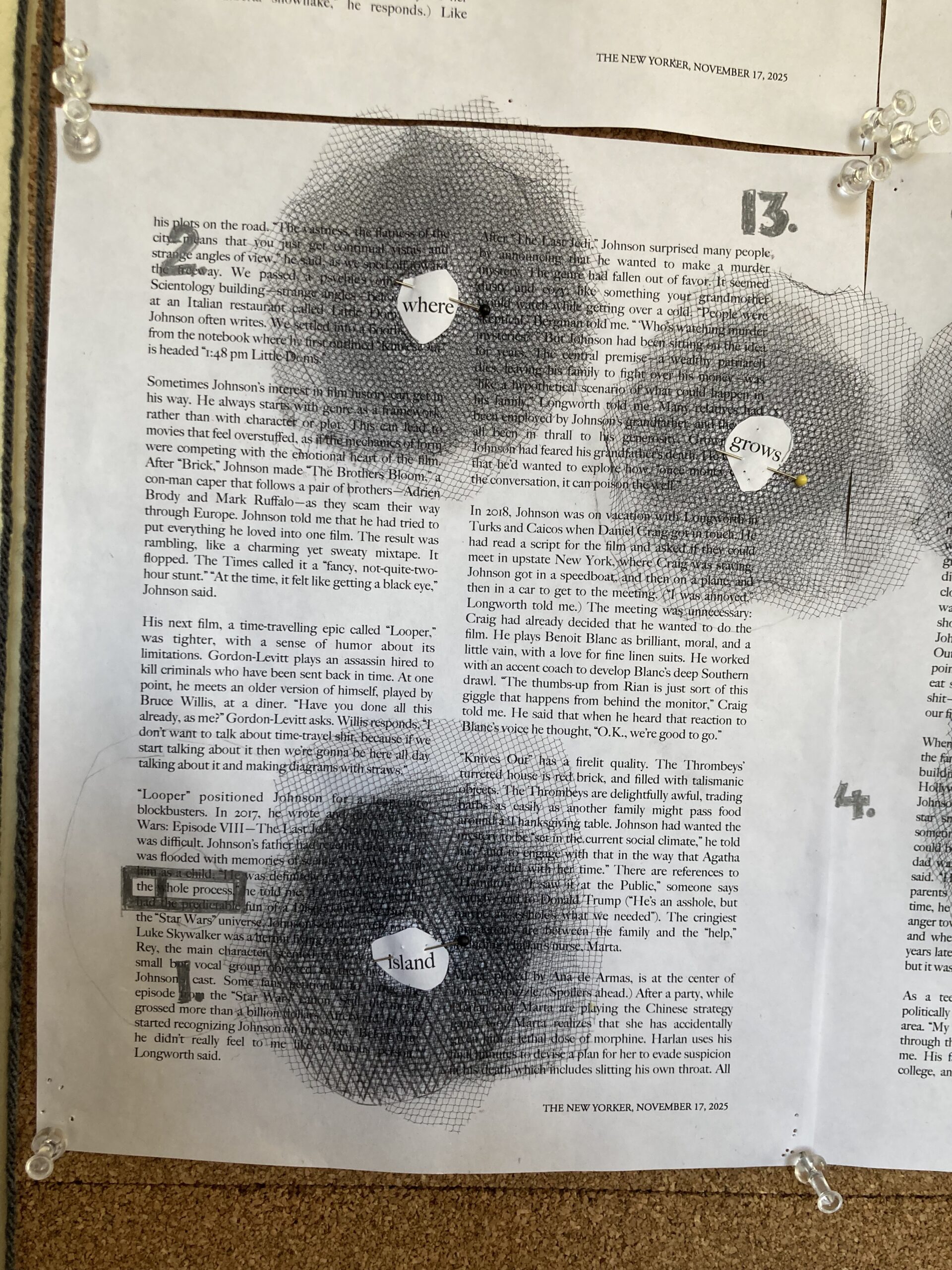
So far, I’ve cut the words out of the essay, leaving holes where they were. I printed out the words — in sizes according to their importance. I also cut out labels for each word, with the poem position and location. I need to figure out how I’d like to put the “board” on the panels — glue the labels directly on the page along with the pinned words OR make this board on a different page to be placed over the existing text. It would be easier (and less risky) to do it on a separate page, but I like the idea of doing it directly on the panels.

I took some pictures to document my progress:

here’s the board with the words arranged by size with their labels
Here are the 4 panels of the essay. The big space where there are no holes is where the “board” will be placed
I was inspired by the Manitoba Museum picture I posted the other day to take this one

Today, I began working on it some more, but it is dark outside today and I mostly rely on natural light to see in my studio space, so no more cutting or drawing or pasting for me today. Maybe it isn’t just the light; after my 8 mile run and hour long hike, I’m tired!

hole 3

Before running this morning, I thought a little more about another hole that is in the preliminary stage. The text involves the phrases, land in the logic of blur and almost and glitching just enough to scramble what’s real and imagined. I think the Cheshire Cat could be inspiration for these lines. How? Visually, I’m not quite sure yet, but I’m struck by the cat’s song at the beginning. The words sound like words, and they’re almost English, but they’re not quite. And the cat appears in varying degrees of visibility: just a mouth, a full body, indented footprints in the dirt.

“Most everyone’s mad here. You may have noticed that I’m not all there myself”

The caterpillar scene was about words and language and As, Es, Is, Os, and Us; the Cheshire Cat scene seems to be about finding your way when you’re lost in a world of nonsense and madness (where madness = beyond/outside of logic, upside down). Yes, locating and being located. Reading and language helps locate us and us locate/orient ourselves. I’ll think some more about how the Cheshire scene might inspire me.

april 21/RUNHIKE

4.2 miles
shadow falls / monument and back
50 degrees

The earliest run I’ve done in some time. I started just after 8, which would have been a late run five years ago. I want to get back to early morning runs as it gets warmer. Even in 50 degrees, I was sweating. Is it the effort of hot flashes?

I decided to run through the neighbor hood, and past the Church daycare. The kids were outside already and having fun. It sounded like one kid was playing some sort of game where he was blasting his enemies as he ran near the perimeter of the fence — take that! pew pew pew! I admired the river as I ran over the lake street bridge. Blue, calm, inviting reflections. No rowers yet. At the Monument, I could hear Shadow Falls roaring, which only happens after rain, so I stepped off the trail and hiked for a closer look. A runner with a dog passed me at one point, both of them having no problems navigating the narrow and steep trail on the edge of the bluff — good morning! thank you! / hi! sure! I couldn’t see the falls falling but I heard the gentle rushing of water. In a flash, I thought of the poem I wrote last year, especially this part:

Deep in
the autumn
when rain
rarely happens
and nothing
flows down
off the ledge,
listen
for something
other
than water,
listen for
shadows instead.

Shadows of

soldiers,

Shadows of

mothers, 

Shadows of

paved-over creeks.
Shadows that
signal
what else could
be here now
Shadows that dwell
in-between.

Speaking of shadows, I saw mine, down in the ravine, beside me on the path, climbing a tree.

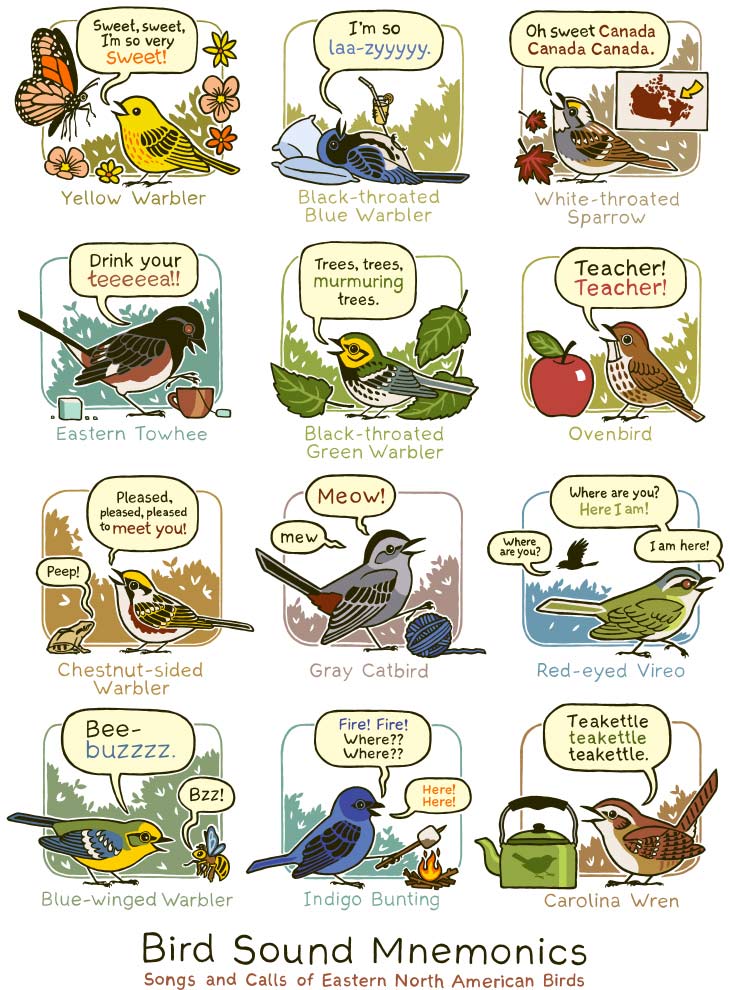
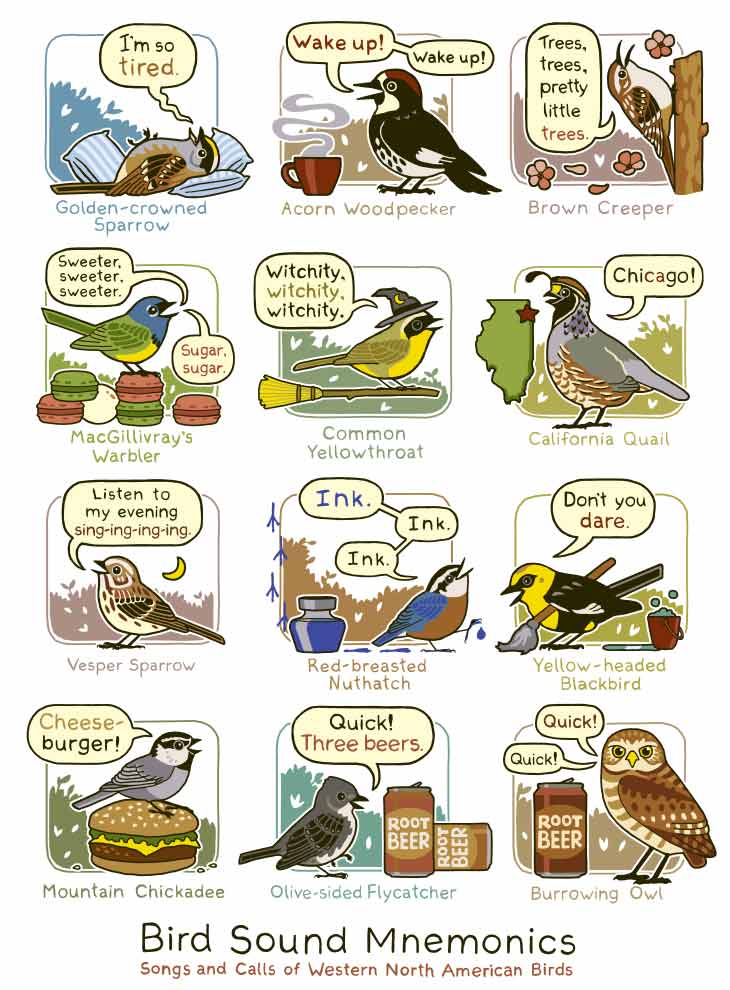
In addition to the runner and the dog, there was another hiker on the trail, and a few different pairs of fast runners near the hill that climbs out of the monument park. I heard the roar of a plane, then saw the flash of silver in the sky. Also heard cheeseburger cheeseburger — I think that’s a carolina wren? Yes! Looking it up, the results said it was a black capped chickadee, but I knew it wasn’t. I found the carolina wren when I remembered the other words people think this song sounds like: tea kettle tea kettle.

This run wasn’t easy — sore legs, unfinished business — but I’m glad I did it. I love being outside in the early-ish morning. Today it was 8, but I’d like to be up and out by 6:30 or 7 this summer.

With summer, and high humidity coming, here’s a poem to help me endure it:

Ode on Humidity/ P. Scott Cunningham

What am I if not what happens
when I try to run away?

Water falls out of me like
an opinion. I’m like a screen
door banging between two rivers.

Dear air, what’s inside me
you’re so desperate to take?

I put on the Atlantic like a sweater.
My head bobs on the surface
of a lake I’m named after.

Where do I belong?
My head asks. My body,
exasperated, answers.

hike: 60 minutes
minnehaha off leash dog park
with FWA and Delia
63 degrees

Ahhh! A wonderful late morning for a hike. The green continues to creep up the trees. More exploding shadows of new buds. I only recall hearing one dog name: Liza. Liza, don’t you ambush that dog! That dog was Delia, and if there was any ambushing being done, it was by Delia to Liza and her human. Delia loves to get other dogs worked up, which the humans don’t see, or ignore. They assume because Delia is small and cute she is always the one being preyed upon. Ha! Another typical Delia dog encounter: a big talk playing fetch in the water. Delia thought it looked fun and wanted to join in. The big dog barked at her, which seem to translate to: back off! this is my game, and this is my stick!

Often as we’re walking, FWA and I talk about video games or the past or One Piece. Today we wer’re mostly quiet, except for my occasional commentary on this tree or that leaf. I was fine not talking; I liked having the chance to listen to all the different sounds: birds, footsteps, a nearby stream rushing or gushing or swirling in an eddy.

holes

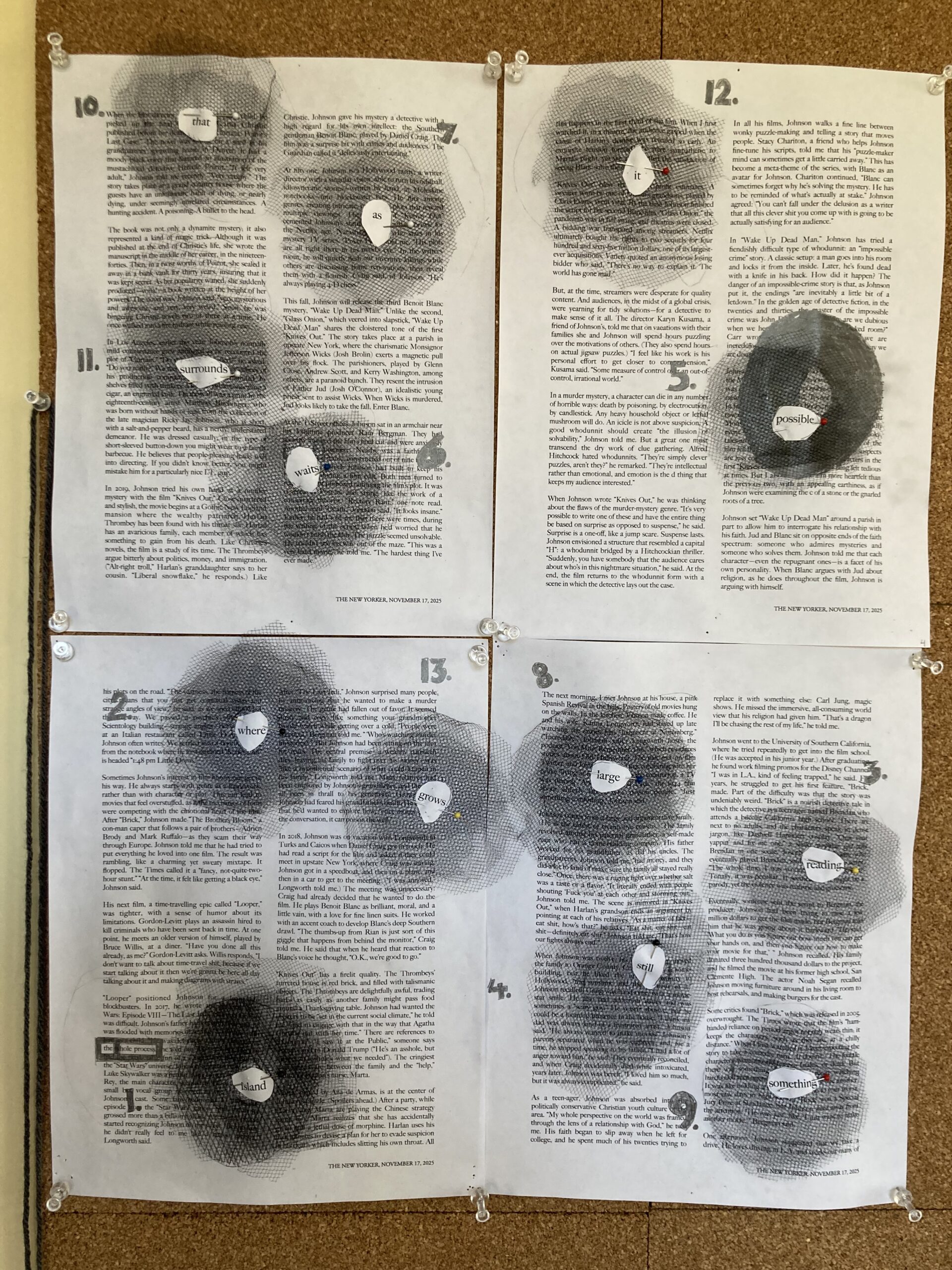
Today, more cutting out black netting holes and layering and mapping them on the paper. For now, I’m pinning them, but I’m wondering if I could fasten them with a button through the center and then glue the word to the button? Would that work on paper? Only one way to find out — I just need more buttons and a needle!

Here’s one version of Holes 1. I wrote numbers directly on the page to indicate how to read it, but I’m not sure if I want to keep them. Also, I kept the cross-hatched hole and the pencil shaded one for now.

the numbered version

another note: the shape of the word is the shape of my working central vision. In theory, I like doing this, but I think the shape looks awkward. I’d prefer a circle instead.

the hole process
island
where
reading
still
possible
waits
as
large
something
that
surrounds
it
grows

another note: I want to make the shade part around the hole process larger
also: instead of individual numbers, I could number the 4 pages/panels and identify the location of the words in a small key

word
island
where
reading
still
possible
waits
as
large
something
that
surrounds
it
grows

panel
1
1
1
2
3
4
4
2
2
4
4
3
`1

jan 5/RUN

4 miles
river road, north/south
30 degrees
100% loose snow

Loose snow. Difficult to move through. For almost all of the run, it was fine. I was careful, deliberate, light on my feet. On the last stretch, running up that a hill, I ran faster to pass a woman with 2 dogs. She was walking fast and I was irritated? Was she doing something worthy of irritation? She and her dogs were walking in such a way that took over most of the path and forced me into the uneven snow. And, she seemed to speed up as I neared her, like she was racing me. Not long after passing her, it happened. I rolled my ankle in the loose snow. oh shit, I exclaimed. It was fine for the rest of the run, and it seems fine an hour later. I’m RICEing (rest ice compression elevate) to be safe. To increase the odds that all will continue to be fine, it’s time for some fun with medical terms: RICE

R I C E

  • routinely, I crave eggplant
  • rust is corroding energy
  • rapt, I consider everything
  • rippled ice concerns Edgar
  • reciting Issa causes enlightenment
  • rabbits implore, cancel Easter!
  • rooted in creative excess
  • restive, impatient, contrary, edgy
  • rude individuals can’t empathize
  • ribald, irritating, caterwauling, egomaniacs
  • Rosie is counting elements
  • Rankled, I cry, Enough!
  • river island causeway eddy


Other memories from the run: the bells of St. Thomas playing a Christmas song, but which one?; crows cawing steadily, and syncing my steps to their song; several cars swinging wide to avoid splashing me with the melted snow; waving twice at a guy in a red jacket — once on my way north, then again on my way south; stopping several times to walk when the snow became too soft and uneven; small splashes of yellow dotting the snow, some bright, some faded; the road was bare and wet, the trail was not; feeling strong as I lengthened my torso, stretched out of my hips, opened my chest, and increased my cadence.

On This Day: January 5, 2025

Found these beautiful lines from the wonderful Carl Phillips while revisiting 2025’s January 5th entry:

Moving With: Carl Phillips

What if, bet-
ween this one
and the one

we hoped for,
there’s a third
life, taking

its own slow,
dreamlike hold,
even now —

blooming in
spite of us?
(from “Sky Coming Forward”)

Moving with Li-Young Lee:

for those three
primary
colors: staying,
leaving, and
returning.
(Big Clock/Li-Young Lee)

Found this delightful poem this morning. I thought about the contrary crows when I heard the crows by the gorge.

Birds on Statues/ Cole Swensen

On one side of the pond, a woman heads west in stone, while on the other, it’s a man heading east, but with the same extravagant gestures of headlong flight—one leg thrown back and both hands launched forward. And sometimes it’s on the tip of one of the lifted heels that a pigeon sits, and sometimes it’s on a thumb, but usually it’s on a head, often one on each, making a mockery of the phrase “in headlong flight.”

Though now they’re rebuilding the pond, so they’ve drained it, with the odd result that the pigeons have gone and have been replaced by crows. They too particularly like to perch on the statues’ heads, but, determined to assert their alterity, they make sure that they’re always facing backward.

nov 26/BIKERUN

bike: 16 minutes
run: 1.25 miles
basement

It rained, then snowed last night. Today: 2 inches of icy snow on the ground. Even so, I decided to go out for a run. I got bundled up and headed out. Almost immediately I realized it was too icy and my legs and feet tensed up. I was less worried that I would slip and fall, and more that I would run strangely and strain something. So I ran for a few blocks, then turned up a block and walked back. It was disappointing because it felt good to be outside, to breathe in the cold air. Returning, I heard a strange, almost squeaking, creaking noise. I thought it might be some branches rubbing near a fence, but when I looked at them I couldn’t see anything. A minute later, I encountered a woman with a dog. She called out, it’s the sandhills! they’re migrating! I said — oh, they’re up in the sky?! how cool! I’m assuming she meant sandhill cranes — I just looked it up and yes, it was Sandhill cranes! I listened to their call and it sounded like what I was hearing earlier. Nice! I’m so glad I got outside!

Before I biked, I had to put my bike back on the stand and pump up the tires. It’s the first indoor bike of the season. I watched the rest of Lucy Charles Barclay’s race recap from the 70.3 World Champs. I’m always impressed with the mental toughness of the professional runners and triathletes.

Running on the treadmill wasn’t fun. I needed better music — and a better attitude, I guess. I’d rather be running outside or at the ywca track. I listened to a podcast, which didn’t help me forget that I was running in the dark basement on a treadmill. I’m still glad I did it and that I can burn some energy in the basement when the weather is too bad to be outside or to drive to the y.

june 27/BIKESWIM

bike: 8.6 miles
lake nokomis and back
61/64 degrees

Cooler this morning. When I got up I briefly thought, I don’t need to go today; it’s too cold. Silenced that voice and went — a great bike ride! The gray made it harder to see, but I didn’t care. I don’t remember having a single scary moment. Encountered runners and walkers and other bikers, several surreys just past the park, one chill biker with a dog in the front, listening to music (I think it was jazz?) as he went. Heard the creek rushing, had to dismount when the new part of the path was covered with black sandbags, noticed a few people sitting in the grass on the stretch between lake hiawatha and lake nokomis.
My favorite part: rounding the curve, seeing the orange buoys in the water as I neared the beach. Open swim!

swim: 4 loops
lake nokomis open swim
62 degrees

4 loops today! 3 in a row, a bathroom break (out of the water!), then back in for another loop. The water was warmer than the air and clear near the shore. Starting my last loop, I swam through the swimming area and was able to see the bottom the entire way — only “unnatural” thing I saw was a bright colored pair of goggles.

The first buoy was far away from the big beach. The second buoy kept moving — and not just because of wind, I watched as the lifeguard tugged it to a different spot during one loop, then dragged it to the third orange buoy during the 3rd loop — why?

Today there was a sailboat out in the water. Not menacing — it hugged the edge of the shore, staying far from the course.

Most of the bubbles looked like scooby-doo bubbles — translucent and outlined (for clip/discussion, see 2 aug 2024), but the one at the bottom end of visual field kept looking like a glob of snot — gross!

The water was a darkish green-blue. The milfoil was orange-green. The sky, pale blue.

Someone parked in the parking lot had their headlights on and before I realized that, I was using it to sight, thinking it was the far green buoy. Nope.

It was a great morning for a swim. What a loss it would have been if I had skipped it, what a gift to have gone!

overheard, at 11:15 (open swim ends at 11:00): one swimmer talking to another — I kept making excuses until I finally said to myself, you have to go! stop doing the dishes!

birds

On mornings when the birds singing — which is most days, but not today — I’d like to remember and chant these lines from the end of “Birdsong of Shaker Way” by Ann-Margaret Lim:

one more day, filled with birds—
brightened, lightened, trilled by birds:

precious, diamond-throated
sweet song, miracle-toting birds
the-gift-of-day-is-here birds.

Bird, bird, bird. Hello bird.
You lift me up bird.
You sing the day beautiful, bird.

finds from my On This Day practice

1

Reading my past entries from 27 june, I reunited with some favorite lines from the wonderful poet, Tomas Tranströmer in his poem, “Under Pressure.” I decided to fit them into my breathing form:

You can see
beauty

only from
the side,

hastily,
Dense grain

on the field,
colours

in a yellow
stream. Rest-

less shadows
in my head

are drawn there.
They want

to creep in
to grain

and turn gold.

2

From 27 june 2023, definitions of about:

about: reasonably close to; almost; on the verge of; on all sides; around the outside; in many different directions — here and there; near; concerning . . . out and about (oot and a boot — Minnesota style)

3

From 27 june 2024, blessing the boats/ lucille clifton

As I read this poem, I thought about how I often imagine myself as a boat in the water. Not a fish deep in the lake, but a boat, on the line between surfaced and submerged, half of me underwater, half always exposed to the air.

5

today
voice
curve
water
beach
clear
shore
think
third
green
sight

great
scary
chill
biker
front
music
heard
creek
black
grass
would

today: great — a chill felt on the curve
I heard music: a grass voice a water voice a green voice a shore voice a creek voice — all here today, singing together
here in the water, would clear sight make anything less scary?
a chill in the water

update, 28 june, 2025: This morning, reading through past entries, I remembered a few more things about the swim yesterday. First, breathing. I did my usual 1 2 3 4 5 breathe, but also 1 2 3 and 1 2 3 4 5 breathe right 1 2 3 4 breathe right 1 2 3 4 5 breathe left. Then I tried 1 2 3 breathe right 1 2 breathe right 1 2 3 breathe left 1 2 breathe left. I’ve been trying out how it feels to stroke less between breaths. I also was conscious of how my sighting fit into all of this — 1 2 3 4 5 breathe right 1 2 3 sight 4 5 breathe left. I never breathe when I sight; I just lift my forehead out of the water. Why does this matter? Beyond its impact on the biomechanics of my stroke and on my ability to keep straight and moving towards the buoy even when I can’t see it, stroke/sight/breath is fascinates me in terms of the spaces/moments it creates above and below the surface, in water and air, as fish and human, boat body and mind. Which of these spaces is more real, which less? If both are real, what reality do they offer?

When I’m swimming, how much time do I spend with my head and half my body submerged versus above the water? That is, how long do I get to inhabit my water world?

Second, planes. Lake Nokomis is near the airport, so there are often planes high above — circling like sharks, I like to imagine. During the swim I noticed several places that seemed to be sped up. It looked like they were moving extra fast? Where they? Or was I just seeing them strangely?

april 11/WALK

50 minutes
32nd to edmund to 7 oaks
45 degrees

Took a late morning walk with Delia and Scott on an overcast day. The theme: critters! Birds and dogs and little kids. As Scott said, the stars of the show were the 2 very big eagles perched at the top of a tall tree on edmund. Some walkers across the road pointed them out to us. At first I couldn’t see them. Scott was describing where they were and I tried to spot them, but I couldn’t see anything, only the feeling that there was something there. Somewhere in my head an idea occurred to me as I scanned the branches — there’s a blob there — but it never turned into an actual thing I was seeing. And then, suddenly, it did. A dark form with a white head, perched on a branch. A few minutes later, I saw the other one too. Still, stoic, only shifting its wings once. Wow!

Other critters: the energetic voices of little kids on a preschool playground, a tiny giggle from a girl getting out of a car, the feebee of a black-capped chickadee, a dog I’ve encountered before that likes to plop down in the middle of the road and not move.

It was chilly — I wore my gloves — but it felt like spring. Spring! Scott talked about some problem he was having with his plug-in involving time codes and microsoft not recognizing standard ones and Helsinki and sisu. I talked about my latest experiment: a crown of sonnets compromised of other people’s words about color. They’re connected by the last line of the one poem mentioning the color of the next one. So far I’ve done green and orange and yellow-red. I’m set up to start purple. I’m thinking of doing blue and metallics or silver, and green-brown-gray. Not sure about that last one — maybe just brown, but ending with a green line to bring it full circle?

april 8/BIKEWALK

bike: 35 minutes
basement
outside temp: 38 degrees

After two days of running in a row, a break. Decided to bike in the basement and check out a show FWA recommended, The Residence. The detective is a birder, which is cool on its own, but she’s also black, which is even cooler because it raises the visibility of black birding (see J. Drew Lanham and “Birding While Black”). Thank goodness for the audio description — I like how it’s voiced by a black actor — because I would have missed so much of the show without it! I like the detective, Cordelia Cup. Her m.o. is attention and focus, filtering out distractions, but not shutting down possible evidence or suspects. Much of that attention is visible, but she also relies on hearing and touch and smell. I’m about 1/2 done with the episode. I like it, so I’ll keep watching.

walk: 45 minutes
longfellow flats
44 degrees

A beautiful afternoon! Warm sun, low wind. Delia and I took the 15 worn wooden steps down to the winchell trail and walked along the chainlink fence. I noticed a few small slabs of asphalt and wondered how long ago this was paved. 10 years? Less, more? A flash of color in my peripheral: electric blue spray paint. Admired the soft oak tree shadows stretched across the paved trail. Heard, but couldn’t see, a woodpecker high in a tree. Passed 2 guys in bright orange shirts. Took the old stone steps down to the river. Looking across to the other side, I noticed a door carved into the bluff, only accessible by boat. On this side, I noticed the gentle lapping of the water over some big rocks.

The color of the day: brown. Everything, brown: dirt, tree trunks, branches, dead leaves, bluff, steps. I suppose I might consider some of it, especially the things lit my sunlight, as orange — deep orange.

march 26/RUNWALK

5.25 miles
bottom of franklin and back
46 degrees

More excellent running weather. Sunny and calm and warm(er). Birds singing and swooping and perching on tree branches right in front of me. I felt relaxed and strong and my back only hurt once, when I stood up after re-tying my shoe. I ran without stopping to walk to the bottom of the hill and right next to the river. It was swirling foam on the edges. Ran back up to under the franklin bridge then stopped to walk the rest of the hill. I noticed a sign — Trail closed starting March 31st — uh oh. Just looked it up; it’s only for 2 weeks:

Bike and walk trails along West River Parkway will close between the I-94 Bridge and Franklin Avenue for up to two weeks beginning Monday, March 31, 2025.

The closure is necessary for contractors hired by the Minnesota Department of Transportation to install a safe span system that will protect trail users during repairs to the bridge this year.

Trail users will be detoured to the upper West River Parkway roadway between the I-94 Bridge and Franklin Avenue. This same closure will be repeated in August so that workers can remove the safe span system after repairs are complete.

Listened to a mood playlist: energy for the rest of the run. The best (or worst?) song on the playlist was “Hocus Pocus” by Focus. I love the song, but it was too fast to try and run to!I had to increase my cadence to 200 bpm to match it! The song also does not have a steady rhythm; it just keeps getting faster and faster, probably because they were on cocaine while they recorded it.

10 Things

  1. the water was a brownish greenish blue
  2. in the flats I leaned over the ledge and watched the swirling foam slowly travel down stream
  3. workers on the road above the tunnel of trees, doing something to sewer which released a sour smell
  4. the workers were wearing bright yellow vests
  5. passed a walker who refused to move over — they were walking right next to the line. I suddenly wondered, are they neuro-divergent? then, maybe I should chill out about people needing to follow the accepted rules about where and how to walk on the trail
  6. stopped at the sliding bench, 1: heard a cardinal — it was somewhere nearby — looked up and saw that it was on a branch close to me. Was it red? I couldn’t tell, but I did noticed how its tail quivered slightly all the time — I’m assuming it was keeping its balance. Do birds have to constantly adjust while perched?
  7. stopped by the sliding bench, 2: looking down at the white sands beach, hoping for movement. Yes, there, deep in — a walker moving through the trees
  8. the small shadow of a bird crossing my path, flying fast!
  9. my sharp shadow in front of me, crossing over the softer shadows of tree branches
  10. the shadow of a tree with dead leaves on it — looking almost like a messed-up pom pom

At the end of the run, as I was walking home, I had a thought about CA Conrad’s and their idea of the “extreme present,” which I wrote about on here earlier this month on march 5th:

“extreme present” where the many facets of what is around me wherever I am can come together through a sharper lens.

intro to ecodeviance / CA Conrad

Conrad creates their soma(tic) rituals to make being anything but present is nearly impossible. Running by the gorge can put/force me into the extreme present. This sense of the extreme present doesn’t happen for the entire run, but I can achieve it in moments. In their lengthy, day-long rituals — wear a red wig, eat only red food — is Conrad able to achieve this extreme present for longer?

birdsong!

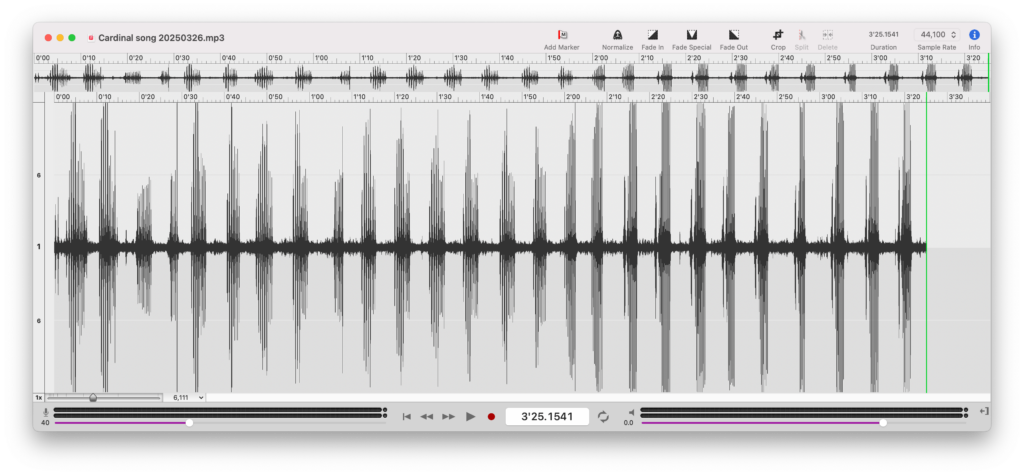
This morning Scott heard the cardinals outside his window and because he wanted to use some birdsong in his latest music project, he placed his phone on a chair on the deck and recorded some. I liked how he described it: I left the phone out on the deck then returned inside and went quietly about my business. When he told me about how similar each wave of sound looked, I asked if he could screen shot it and send me the sound file so I could post it here:

cardinal song, an image of sound waves
cardinal song / 26 march 2025

Wow! So uniform.

Happy 151st Birthday Robert Frost!

When the poem of the day on poetry foundation was a Robert Frost one, I figured it must be his birthday. Yep — 26 march 1874.

For Once, Then Something/ Robert Frost

Always wrong to the light, so never seeing
Deeper down in the well than where the water
Gives me back in a shining surface picture
Me myself in the summer heaven godlike
Looking out of a wreath of fern and cloud puffs.
Once, when trying with chin against a well-curb,
I discerned, as I thought, beyond the picture,
Through the picture, a something white, uncertain,
Something more of the depths—and then I lost it.
Water came to rebuke the too clear water.
One drop fell from a fern, and lo, a ripple
Shook whatever it was lay there at bottom,
Blurred it, blotted it out. What was that whiteness?
Truth? A pebble of quartz? For once, then, something.

A beautiful sonnet — 14 lines, 11 beats per line, almost iambic pentameter. Is that right? I always struggle to hear meter properly.

Love the description of a reflection: Me myself in the summer heaven godlike/Looking out of a wreath of fern and cloud puffs

And that something white, uncertain, seen briefly then lost to a ripple. Yesterday I posted some lyrics from “The Windmills of Your Mind” about the ripples from a pebble. Ripple is a great word.

Seeing this sonnet is making me think I should try that form for my color poems. I could study a few different ways of doing the sonnet — Diane Seuss, Terence Hayes, William Shakespeare. Any others?

oh orchid o’clock

A good morning on the poetry sites. Not only did I find Robert Frost’s poem, but I found a cool collection that fits in with my study of time: Oh Orchid O’Clock by Endi Bogue Hartigan. (note: I just emailed Moon Palace Books about ordering it! update: I ordered it!)

/it is the president’s turned up o’clock it is America’s deadliness and dailiness

o’clock / it is glued to the headline o’clock

it is lunchhour-beeline o’clock / it is it’s only Tuesday o’clock another

curbside memorial o’clock another caterpillar miracle o’clock another

people emptying from their lives o’clock or into

their lives o’clock the Nile floods the Nile floods every hotspell in this week

I discovered this book through poems.com, which had one of its poems posted today:

hour entry: I fall asleep with a rain sound/ Endi Bogue Hartigan

I fall asleep with the rain sound app of my cellphone, the app includes distant thunderclap sounds and there are people who recorded or simulated these sounds, and it is time to disagree and thank the dawn. I disagree with this rain, I feel absurd for thesimulation of it and yet my brain waves have come to depend on it, depend onsimulated porous points between the raindrops. Always the porous dream, always theneural authority, the reaction meme, always the authority of always, the puncture ofalways, time spent saying always, the spider legs of always, the sleep command, thewake spindles, the spider leg threatening to break from the spider.

So cool! Encountering Hartigan’s work, I was inspired to think about time in relation to my blind spot and the practice of running beside the gorge that has happened beside (and because of?) my vision loss. I wrote the following in my Plague Notebook:

my blind spot
breaks open seconds
pries apart the hard edges of
a beat invites me
to dwell inside

I am suspended between
beats as time slows
but never stops
with moves so slight it takes
a practiced eye to see
their soft shimmering
embrace what is not seen but felt —
wind
the rotation of the earth
a bench sliding into the gorge
rock crumbling
cone cells collapsing
a blind spot expanding

walk: 40 minutes
neighborhood / winchell trail / oak savanna
54 degrees

What a great afternoon walk with Delia the dog! No coat. No mud. Walked to the Winchell Trail then down beside the chain link fence. Drip Drip Drip — the sewer pipe in the ravine. Everything washed out — light brown, tan, yellowed. Up on the mesa in the savanna, a great view of the river. Was able to walk on the dirt path between the savanna and the 38th street stairs. They’ve put down some mulch, so it’s not as muddy. As I neared the entrance to the Winchell Trail, I passed the spot where I fell in the mud, straight on my tailbone. No mud now, only memories and a still-sore back.

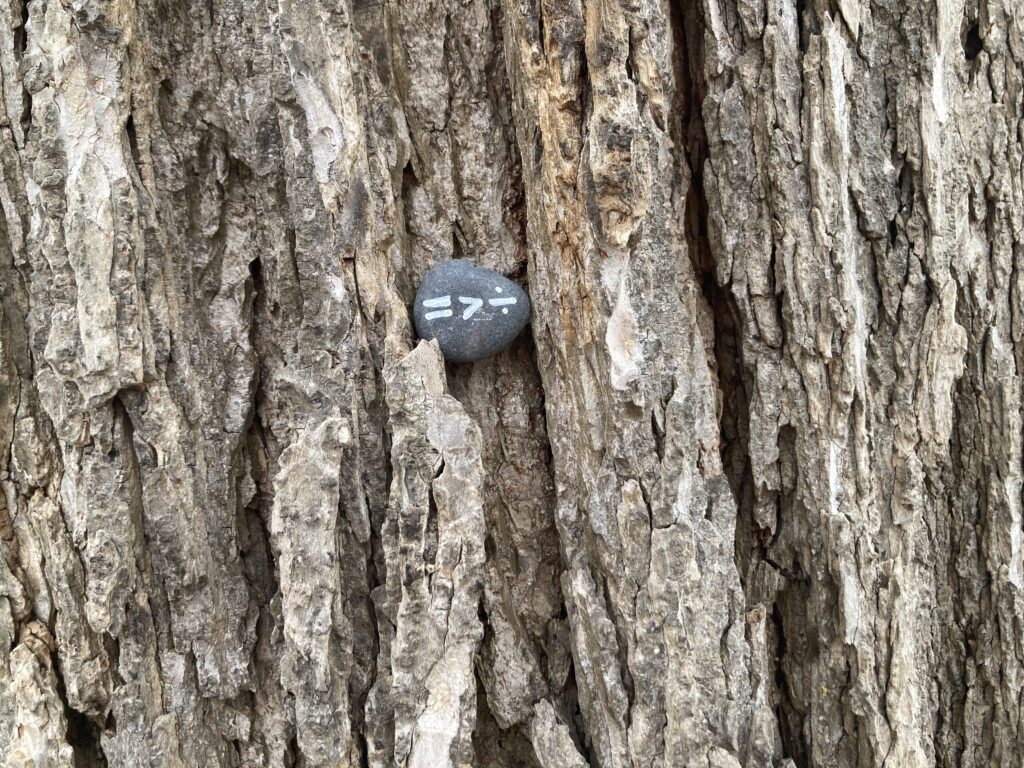
On the way to the river, I noticed something interesting hidden on the tree trunk while Delia sniffed around. I took a picture of it:

= > ÷

When I was looking at it in person, I thought someone had carved the message in the tree, but studying it now, it looks like it’s a rock wedged in a crack. I probably should have taken another picture that wasn’t quite as close-up for scale. That is one tiny rock.

I had to look up how to type the division sign on a mac. Hold down option and /

dec 18/RUN

4.25 miles
minnehaha falls and back
26 degrees

Ran in the afternoon. Sometimes sunny, sometimes cloudy, streaks of a brilliant blue mixed with fluffy clouds. The river was mostly open with a few stretches of ice. The shore glowed white. The gorge slopes were different versions of brown. The creek was flowing fast and the falls were rushing over the edge. When I looked at them from my favorite spot all I could see was movement — the fast falling water looked like wavy vertical lines on an old tv. For the first mile, I was the only one out on the trail, then I passed a walker. Far ahead I could see lights flickering — headlights passing by trees on the other side of the ravine. Just past the double bridge, I heard a hammer hitting some wood then some other construction noises — men talking, some song coming out of the radio, a saw buzzing.

Yesterday, one version of my Girl Ghost Gorge poem was published in Last Syllable Literary Journal!

Ah, this poem, featuring windows and shadows and birds!

Some Things Last/ Ahmad Almallah

These windows, these panes, at the beginning of light
looking where they look, eyeing the east and the rust
and here they are, protected by shade and shadows:
branches and birds strike them, fly into them and out.
You can see nothing through them, you can only see what
bounces off: back at the world and then you return,
to the lemon, that is the self, squeezing drop after drop—
there’s nothing left of you now, no juice! Can you go on
lubricating the mind, musing on you as disaster,
and the rest of you as the elements?
Here, they go one by one
into a flame set down, beneath all the steps, at the very
bottom of it all … and God! The eyes wish you didn’t!
They look away from the blank space remaining—oh these
birds in the mornings are funny and the little tricks they
repeat and repeat, like these sounds they make, in order:
they fly off together or one by one, puffing up their small
bodies, extending a peak that opens up a view, that finds
space in whatever looks shut and closed—a wall has
some hole, a tree trunk can manage a crack, and under
the ledge, a window knows something
of the hidden world.

april 19/RUN

4.9 miles
veterans’ bridge and back
36 degrees / snow flurries
wind: 16 mph / gusts: 31 mph

Windy, some snow flurries. They started when I started. At first, they looked like glitter falling from the sky, later they felt like sharp pins pricking my face. Difficult conditions, but I didn’t mind — well, not that much.

Saw a BIG turkey heading for the edge of the park. Also saw a bird — a robin, I think — running fast across the grass. It’s fun to watch birds run. Had a sudden thought: Where on the Beaufort Scale would you fit the description, birds opt for running instead of flying or flying is inconvenient for birds? In my head, I began composing lines for a poem that features this bird. Another description to add to the scale: a fallen leaf will outrun you — that’s not quite right, but something about how I noticed a leaf in front of me being pushed by the wind so fast that I couldn’t catch up to it.

Was too busy battling the wind to notice the river. I wonder, were there any foam or white horses on it?

Running south, I listened to the howling wind. Heading back north, I put in Taylor Swift’s new album: The Tortured Poet’s Department

Another 5 on the Beaufort Scale. As I ran I wondered about factors other than wind speed, like wind direction — head winds, tail winds, crosswinds. I never really thought about crosswinds before I started watching cycling races. Now, like many others, I look forward to windy days of a tour when there’s a chance that some bikers will get “caught out by the crosswinds” and the peloton will splinter.

Eula Biss, Pain Scale

Before moving onto level 2 on Biss’ pain scale, I’m trying to think more about 1 and what lines of poetry might fit it. Can’t find anything yet, but I’m imagining level 1 to be the type of pain so minor, so barely there, that we doubt its existence. If 0 is faith, then 1 is doubt.

2

The sensations of my own body may be the only subject on which I am qualified to claim expertise. Sad and terrible, then, how little I know. “How do you feel?” the doctor asks, and I cannot answer. Not accurately. “Does this hurt?” he asks. Again, I’m not sure. “Do you have more or less pain than the last time I saw you?” Hard to say. I begin to lie to protect my reputation. I try to act certain. Okay, so 2 is also doubt. That gray area when we’re not certain. I don’t mind not knowing, when knowing is not possible — embracing the mystery — but not being certain, not knowing when you feel like you should know, are supposed to know, is very difficult.

And here Biss introduces the Beaufort Scale!

Wind, like pain, is difficult to capture. The poor windsock is always striving, and always falling short. There’s the difficulty of describing, and there’s the difficulty of feeling, knowing, experiencing accurately . . .

It took sailors more than two hundred years to develop a standardized numerical scale for the measure of wind. The result, the Beaufort scale, provides twelve categories for everything from “Calm” to “Hurricane.” The scale offers not just a number, but a term for the wind, a range of speed, and a brief description. Creating a standard — a common language from which to communicate and connect with others, a scale that is practical

A force 2 wind on the Beaufort scale, for example, is a “Light Breeze” moving between four and seven miles per hour. On land, it is specified as “wind felt on face; leaves rustle; ordinary vanes moved by wind.”

3

Left alone in the exam room I stare at the pain scale, a simple number line complicated by only two phrases. Under zero: “no pain.” Under ten: “the worst pain imaginable.” Too much is contained between these numbers. . . . This idea of “the worst pain imaginable” produces anxiety. I don’t want to even imagine what the worst pain imaginable might be.

“Three is nothing,” my father tells me now. “Three is go home and take two aspirin.”

“You are not meant to be rating world suffering,” my friend in Honduras advises. “This scale applies only to you and your experience.” At first, this thought is tremendously relieving. It unburdens me of factoring the continent of Africa into my calculations. But the reality that my nerves alone feel my pain is terrifying. I hate the knowledge that I am isolated in this skin—alone with my pain and my own fallibility.

The more I read of Biss’ essay, the more I’m thinking about the purpose of these scales and what other purposes descriptions/words/language can offer. The wind scale is for utility: to help sailors estimate the wind speed using visual observations. The pain scale’s purpose: to better understand and care for patients.

4

conflating physical and emotion pain — is there actually a distinction? hurting vs. feeling?

pain as seen in a face — Biss wonders, no face, no pain? Then she describes how there are no visible markers of her pain — there was nothing to illustrate my pain except a number, which I was told to choose from between zero and ten. My proof. I’m thinking about how invisible my vision problem often is to others and also, how the doctors could tell immediately that something wasn’t right: I got a diagnosis. What relief! I’m also thinking of a New Yorker article I read recently about gaslighting that mentions how the gaslit crave a diagnosis because it offers irrefutable evidence of something being wrong.

Okay, more of the pain scale in the next entry. I’m thinking about a key distinction between the Beaufort and Pain scales: the Beaufort offers brief descriptions to accompany the numbers, not just the numbers.

And, returning to point of these scales: they’re practical, which would seem to make them, at least to some, not poetry. Poetry is impractical and about making strange what we thought was familiar. It removes the utility of language, making it delightfully useless. Of course many poets disagree with this simplistic assessment, myself included. One reason I’ve turned to poetry is because it is useful; it gives me language and a method for describing my strange ways of seeing to others.

I found the following poem in an entry from aug 1, 2019. I think the descriptions might offer a more compelling and practical way than numbers on a scale to understand what pain feels like.

Let us for a moment call this pain by other words/Dominik Parisien

Ask, How many roses does the hammer weigh

when it bears down on your skull? 

Does the sword seem toothed like a toddler’s smile

or sharp as your first ice skates?

On a scale of anglerfish to northern lights

how bright are the flashes in your head? 

When I touch this, here, which constellations

light the sky behind your eyes?

Would you say that pulsing is the flicker of a satellite 

or the stubborn heartbeat of a newborn chick?

Ask, Can we for a moment make of beauty

the measure of our pain? and I will answer.

april 17

5.15 miles
franklin loop
44 degrees
wind: 15 mph / gusts: 30 mph

So windy! A crosswind heading north towards Franklin, then straight into it heading west over the Lake Street bridge. Cooler too. Wore my running tights and my orange sweatshirt. My left knee felt tight for the first few minutes, then fine for the rest of the run.

Wet and green. Noticed that the floodplain forest is filling in. Last week, bare and brown. Today, an outline of green. The river was gray with ripples. When I looked down at it from the bridge I could tell by the ripples that it was blowing south.

All of the pedestrians I encountered were bundled up in hats and winter coats. One runner was in shorts and white shoes. After he passed me I was mesmerized by his heels floating up and down, up and down, up and down. So smooth and rhythmic.

No eagle on the dead tree branch. Spotted 2 lone black gloves discarded at different parts of the path. Heard one woman talking to another. She said something strange, but I can’t remember what. Heard lots of black capped chickadees but no geese or woodpeckers.

more on wind: According to the Beaufort Scale, today was a 5 — fresh breeze. Brisk? Bracing. Stiff. Not breath-taking but ponytail whipping and energy sapping and eye watering. A few times, it howled in the trees. No dust in eyes or big branches falling from trees, but leaves whirling on the ground. At one point, running across the bridge, I felt like I was being held up by the wind — both slowed down and suspended in mid-air. Running south, with the wind at my back, it felt easier, like the wind was pushing me along.

beaufort scale

Thinking about wind some more and wondering if I shouldn’t narrow my focus to the Beaufort Scale? Maybe try to play around with my own Beaufort Scales. Today, while reviewing Marie Howe’s “The Moment” I thought about gathering lines from poems that fit with the scale. The line in Howe’s poem that Inspired this was the last one:

the white cotton curtains hanging still

The poem is about that moment when everything stands still and is silent. No to-do lists. No traffic. No I-should-bes. With these curtains, I think Howe is referencing sitting silently in her brother’s room, as he was dying. I imagine this moment of stillness as 0 on the Beaufort Scale.

And here’s another stillnes from Rime of the Ancient Mariner / Samuel Coleridge

Down dropt the breeze, the sails dropt down,
’Twas sad as sad could be;
And we did speak only to break
The silence of the sea

All in a hot and copper sky,
The bloody Sun, at noon,
Right up above the mast did stand,
No bigger than the Moon.

Day after day, day after day,
We stuck, nor breath nor motion;
As idle as a painted ship
Upon a painted ocean.

Water, water, every where,
And all the boards did shrink;
Water, water, every where,
Nor any drop to drink.

a bird moment, possibly for my bird project: After I finished my run, walking back on Edmund, I heard 2 black capped chickadees calling back and forth. Their notes were slightly different than I usually hear. By the time I got out my phone to record them, only one chickadee was calling. No response. They kept trying their fee bee call, maybe 5 or 6 times, but no reply.

april 11/RUN

3.1 miles
edmund, south/river road, north/edmund, south
56 degrees
wind: 12 mph/ gusts: 22 mph

Shorts and bare legs again today. Hooray! Was planning to do the 2 trails, but when I reached the entrance to the winchell trail I heard some very noisy rustling of leaves. Too big for a squirrel. A dog? A bear? A human? I tried to look ahead but all I saw was a black blob. I thought it was a person with a stroller so I moved a little closer. Nope — a male turkey with its tail spread like a peacock, a red wattle glowing, even for me with my bad color vision. Wow. I mentioned it to a man walking down the hill and he said, well, this is the way I’m going! and slowly and calmly walked toward the turkey. A showdown. After 30 seconds or so, the turkey relented and the man walked past. Not me, I climbed the hill and ran on the trail next to the road. This encounter will be my birding poem for the day!

10 Things Other Than Tom Turkey

  1. a woodpecker cry — pileated, I think
  2. another woodpecker cry a few minutes later — was this bird following me?
  3. loud kids at the playground, mostly having fun
  4. 2 bikers heading north — we can ride the wind now. I thought this meant that they would have the wind at their backs, so I would too, when I turned around. No. Wind was in my face heading north, later in the run
  5. admiring the view of the river from the overlook — the water on the other shore was sparkling
  6. mud and roots on the dirt trail between edmund and the river
  7. the clickity-clack of roller skiers poles behind me
  8. several of the benches had people on them — more than half?
  9. bird shadows
  10. a shrieking blue jay above me

After turning around because of the territorial turkey, I put in my “It’s Windy” playlist: They Call the Wind Maria/ the furies; Dust in the Wind/ insignificant or fleeting

The wind wasn’t overpowering but it was everywhere, coming from every direction. I remember noticing how it played with my hair, making my ponytail bob and my little loose strands fly around my face. Only once did I need to adjust my hat for fear that the wind might blow it off. I don’t remember hearing any skittering leaves or getting dust in my eyes, grit in my teeth. The wind didn’t sing or howl. It did push me forward and hold me back. And I think it made the whole run harder.

Earlier this morning, I checked out Mary Oliver’s West Wind and found this delightful part of a poem about wild turkeys. It seems fitting to include today after seeing several hens — being guarded by the male turkey on Winchell.

from Three Songs/ Mary Oliver

1

A band of wild turkeys is coming down the hill. They are coming
slowly—astheywalkalongthey look under the leaves for things to 
eat, and besides it must be a pleasure to step alternately through the
pale sunlight, then patches of slightly golden shade. they are all hens
and they lift their thick toes delicately. With such toes they could
march up one side of the state and down the others, or skate on water,
or dance the tango. But not this morning. As they get closer the sound
of their feet in the leaves is like the patter of rain, then rapid rain. My
dogs perk their ears, and bound from the path. Instead of opening their
dark wings the hens swirl and rush away under the trees, like little
ostriches.

Returning to my birding poem for the day. I’m having a little difficulty finding the focus, so I thought I’d write a little more around this little poem. What are the details that I remember, that I might want to write about?

  • First thing noticed: an unusually loud rustling sound that I thought was too big for a squirrel, too much for a human
  • the moment of seeing something but not knowing what it was — a bear? a dog? a stroller? Not feeling scared, but feeling like I should stay back until I figured it out, feeling that it was something unusual. This moment last a long time, which was fine because I had time, but wouldn’t have been if I had needed to make a quick decision, like if the turkey was running towards me
  • the turkey was so big! its tail was up and spread out like a peacock, making him look even bigger and framing his face
  • the face — fuzzy but clear enough to know that this turkey was telling me to back off! I couldn’t make out his eyes, but I could see — or, maybe I guessed a little — when he was facing me — yes, it was the contrast of light and dark — when he was turned away, he was just a dark, hulking shape, when he was turned toward me I saw a pale beak
  • the red wattle — was it bright? I can’t quite remember, but I know it was red and big
  • when I felt fairly certain it was a turkey, I still couldn’t see details — just a small, light head with red, framed by broad dark tail feathers — how much of his bigness was because of his tail, how much his body? the form — menacing and comical at the same time, with its big circle for a body and its tiny head
  • the approaching man — I said to him, there’s a big turkey down there! He said something like, well, THIS is the way I’m planning to go! His tone wasn’t too jerky, just matter-of-fact. When he approached the turkey he called out sternly but not too aggressively — hey hey move! At first, the turkey wouldn’t budge and the guy looked back at me, but after some time, the turkey moved

Reflecting on these details some more, I’m thinking that the guy, albeit interesting, is unnecessary for my purposes. I think adding him might take the poem in a different direction. . . although, I am struck by the encounter between me, him, and the turkey. The guy didn’t seem like a jerk, but he did give off some older white guy energy — this is the way I’m going turkey! Your puffed up feathers can’t stop me! I was happy to stand back and observe the turkeys from a (respectful?) distance, while he was ready to keep moving through the turkeys.

The uncertainty from not being able to see what the turkey was is what I’d like to focus on, although I want to weave in the strange mix of menacing and comical too. Here’s a long passage from Georgina Kleege that is helpful in explaining my own process of seeing things. She is able to see most things because she expects to see them; it’s the unexpected things that make it difficult. oh — I like this idea of bringing surprise in here!

Expectation plays a large role in what I perceive. I know what’s on my desk because I put it there. If someone leaves me a surprise gift, it may take a few seconds to identify it, but how often does that happen? . . . . I can recognize most things through quick process of elimination. And that process is only truly conscious on the rare occasions when the unexpected occurs, as when my cats carry objects out of context. A steel wool soap pad appears in the bath tub. I see it as a rusty, graying blob. Though touch would probably tell me something, it can be risky to touch something you cannot identify some other way. . . . I once encountered a rabid raccoon on a sidewalk near my house. I learned what it was from a neighbor watching it from his screened porch. What I saw was an indistinct, grayish mass, low to the ground and rather round. It was too big to be a cat and the wrong shape to be a dog. Its gait was not only unfamiliar but unsteady. It zigzagged up the pavement. I moved my gaze around it as my brain formed a picture of raccoon. The raccoon in my mind had the characteristic mask across its face, a sharply pointed nose, striped tail, brindled fur. Nothing in the hazy blob at my feet, no variations in color or refinements in form, corresponded with that image. Its position was wrong. The raccoon in my image was standing up on its haunches, holding something in its front paws. And what does a rabid raccoon look like?

Sight Unseen/ Georgina Kleege (105-106, print version)

Kleege grew up, from age 11, with a big blind spot in the center of her vision. That was roughly 50+ years ago, so she’s had time to learn how to guess and eliminate and handle identifying unexpected objects. I’m still learning. Mostly, it doesn’t bother me, although i occasionally worry about my safety. Anyway, I find Kleege’s description of her process helpful in enabling me to describe what I did. Kleege saw “an indistinct, grayish mass, low to the ground and rather round.” I saw an indistinct, dark mass, somewhat low to the ground and rather round. My dark mass moved slowly but not awkwardly and was accompanied by a loud racket. I might have guessed turkey earlier if he, and his hens, hadn’t been so loud, and if he hadn’t been so big and round.

How many times have I seen a male turkey with its feathers puffed up? Looking it up, I read that this puffing could be a courtship ritual or a sign of intimidation — in my encounter, was it both? The courtship version involves a strut and a gobble — oh, I wish I would have heard him gobble! The only noises my turkeys made were with their beaks or feet as they rooted around for food. And, maybe his low, un-awkward (graceful?) gait was a strut that I couldn’t quite see?

possible ideas, images, descriptions to add: gobble-less, unexpected and unusual for this regular route, rotund (or round or a puffed up dark dot/circle), rooting racket.

clues to choose from: a dark mass too big for a bird (or so I thought), too small for a bear, a slow strut.

Something to think about: was it just the puffed up feathers that made seeing turkeys strange? I think so.

I almost forgot. I took a picture! Look at me, at a safe distance!

turkey sighting / 11 april 2024

april 10/RUN

5.1 miles
bottom of franklin and back
61 degrees
wind: 8 mph / gusts: 18 mph

Ah, spring! Sun and shorts and short sleeves! Birds — black-capped chickadees, pileated woodpeckers, downy woodpeckers, a turkey! I looked at the river but I don’t remember what I saw. Too distracted by blue sky and sharp shadows and the spring breeze — which is less relaxed than a summer breeze, but still pleasant — a word my mom used to say, or did she say it just that once when I was barely four and was talking with her in our new backyard in Hickory, North Carolina as she hung laundry out to dry. It feels pleasant out here or It’s a pleasant day. It’s a terribly bland word, but I love it because I always think of her and that moment.

Encounters:

  • Dave: Hi Sara!
  • while running up a hill, a woman walking down it: Looking good! me: Thank you!
  • two women walking towards me after I finished my run: Well, you look springy!

overheard:

  • from talk radio across the road: Don’t you think I think about it? Don’t you think it keeps me up at night?
  • distorted music coming out of a bike radio

Listened to birds, my breathing, and the smooth wheels of a rollerblader as I ran north. Ran up the franklin hill and sang, Running up that hill, in my head. Put in “It’s Windy” playlist: Let’s Go Fly a Kite: not childish but childlike; Don’t Mess Around with Jim: karma; Ride Like the Wind: haul ass; You’re Only Human (Second Wind) — be generous to yourself; Summer Breeze: relax

my birding moment: running north, listening to Billy Joel, distracted by the song or memories or some thought, something suddenly appeared in front of me — a turkey! It wasn’t too close, but close enough that I was able to watch it awkwardly run across the path. For the poem: distraction, interruption, awkwardness, dragged out of the inner into the outer

Stuck inside
a thought

Unaware
seeing

only bare
path when

Poof! Bobbing
head sleek

body move
past me

faster than
I thought

possible
I watch

then admire
this show

grateful to
be dragged

out into
the world.

a breeze

Before I run, I decided today’s version of the wind would be: breeze.

breeze 1

The old chest in the corner, cool waxed floors,
White curtains softly and continually blown
(from The Work of Happiness/ May Sarton/May Sarton)

breeze 2

definition of breezy: pleasantly wind; airy, nonchalant — as in, breezy indifference

breezy 3

Easy breezy beautiful cover girl
Beautiful skin can be a breeze with sea breeze — or, what my sister Marji used to sing, Beautiful skin can be a breeze with sea grease

breeze 4

Yet again, the ekphrasis appears!

How to Look at Pictures/ Rebecca Morgan Frank

title after Robert Clermont Witt, 1906

Refuse to make eye contact with the subject.
He has been following you around the gallery.
You are certain that he can see down your shirt.
Look at other subjects, but know that they, too,
are not of primary interest. Even when they watch
you. Try not to consider what happened
to the small girl staring furiously, the thin-faced
woman wanly looking away. Do not think about
what they had for breakfast, if the bread was hard.
Certainly do not consider the odors underneath
their arms and skirts. Do not allow a breeze into
the room they sit in. Do not assume I am talking
about any painting: step away from the subject.
All subject. Was the painter in love? Do not ask
the question. Imagine you are the painter,
blocking out everything you don’t want to see.
Everything is out of the picture. Stop looking.
Stop seeking what isn’t there. Tuck your narratives
back in your pocket. Look for perspective, light,
shade. Let your eyes wander back to the girl.
She is trying to say something but her mouth
has been painted deliberately shut. Her lips, thin.

april 7/RUN

3.3 miles
trestle turn around
41 degrees
wind: 15 mph / 35 mph gusts

More wind. Ran between raindrops and beside a 10 mile race. The wind was at my back running north, in my face south. Those racers were hardcore, running the first 5 miles into that wind — yuck! Puddles and mud and an over-sized green rain jacket puffing up like a balloon about to float away:

Oh, lift me as a wave, a leaf, a cloud!

from Ode to the West Wind/ Percy Bysshe Shelley

Listened to the racers, spectators, a drummer drumming, a runner giving a motivational speech as he ran — good job! you can do it! the finish line is almost here! you got this! — which might have been inspirational or insufferable depending on how you felt six miles into a race that started with rain and cold and continued with wind. At the turn around I stopped and put in my wind playlist. Today: Wind it Up — sexual empowerment (I know he thinks you’re fine and stuff, but does he know how to wind you up?). Classical Gas – the 70s, Bohemian Rhapsody – fate, and Don’t Mess Around with Jim – street smarts

After I finished running, as I was walking back, I noticed the flash of a bird fly up from the street to the top of a sign, then 3 or 4 other small birds fly out of the tree and into the air. The small dark dots against the smudged sky looked like static or the stars I see when I’m dizzy or had too much caffeine, or (sorry not sorry to be gross) dropped a big deuce — am I the only one that happens to? I decided that these birds would be the subject of my birding poem for today.

Make me thy lyre, even as the forest is

from Ode to the West Wind/ Percy Bysshe Shelley

Yesterday, Scott and I met up with FWA in St. Peter. After taking him shopping for his clarinet recital next week, we went back to campus and took a walk through the Arb. So windy! I didn’t have a hair tie and my hair was swirling around my face as we walked on the uneven dirt trail in the open field. Later, winding through the pine trees we had some shelter. Scott saw the tiniest bird, then I saw it too, first as a flash of movement, then as a small dark form on a low limb. FWA guessed that it was a warbler, which it probably was. We listened for birds and heard a creak: one tree rubbing against another — Shelley’s forest lyre! I told Scott and FWA that I knew a beautiful poem that I wish I had memorized for this occasion — Cello by Dorianne Laux

april 5/RUN

3.1 miles
trestle turn around
54 degrees
wind: 5 mph

What a day! Took Delia out for a walk this morning. An hour later, sat on the deck and was inspired by the birds to write a beautiful little poem conjuring my mom. Then, around 12:30, went for a run by the gorge. Okay spring! The run wasn’t easy, but wasn’t hard either. My legs are sore from running every day since Tuesday. Tomorrow I’ll take a break.

Listened to birds running north, my “It’s Windy” playlist on the way back south. Wind songs heard today: “Ride Like the Wind” — fast? frantic? under pressure? and “You’re Only Human (Second Wind); — forgiving and resilient and a reprieve

I’m sure I looked at the river, but I don’t remember doing it, or what it looked like. I do remember that the floodplain forest looked open and brown and full of trees that had been through a flood or two. No roller skiers or rowers. No radios or impatient cars. Did hear a few unpleasant goose honks near the lake street bridge.

Beaufort Scale

The History of the Beaufort Scale

Before the run I reviewed the Beaufort Scale and rediscovered a Beaufort Scale poem by Alice Oswald. Gave myself the task of trying to describe the wind today:

running north: make your own wind — or breeze?
south: hair raising . . . leg hair raising . . . calf hair raising
east: no need to shield the microphone; a welcomed air-conditioning after a hard effort; still leaves still; the branches moving so slightly my cone-dead eyes cannot detect their movement — no trees waving to me today . . . rude; flag flapping but no wind chiming

Alice Oswald on wind:

Everything you write about the wind really has to be about something else, because the wind itself is so non-existent. I like the way the Beaufort Scale [a system used to estimate wind speed based on observation of its effects] categorizes something so abstract and undefinable. That is partly what drew me to the project. I regard the words as secondary to the silences in my poetry, so I’m drawn to write about things that will exist without the words. The poems are full of gaps and silences through which something that isn’t linguistic can be heard.

A Poem A Day

wind will exist without the words

Beaufort Poem Scale – Alice Oswald

As I speak (force 1) smoke rises vertically,
Plumed seeds fall in less than ten seconds
And gossamer, perhaps shaken from the soul’s hairbrush
Is seen in the air.

Oh yes (force 2) it’s lovely here,
One or two spiders take off
And there are willow seeds in clouds

But I keep feeling (force 3) a scintillation,
As if a southerly light breeze
Was blowing the tips of my thoughts
(force 4) and making my tongue taste strongly of italics

And when I pause it feels different
As if something had entered (force 5) whose hand is lifting my page

(force 6) So I want to tell you how a whole tree sways to the left
But even as I say so (force 7) a persistent howl is blowing my hair horizontal
And even as I speak (force 8) this speaking becomes difficult

And now my voice (force 9) like an umbrella shaken inside out
No longer shelters me from the fact (force 10)
There is suddenly a winged thing in the house,
Is it the wind?

april 3/RUN

3.15 miles
2 trails
41 degrees
wind gusts: 35 mph

Windy! Overcast. Quiet. A good run. Slow and relaxed until I reached a runner ahead of me with a dog who stopped then started then stopped again. At this point, I passed them and picked up the pace, hoping to avoid any more encounters. It worked! I felt good enough to keep running faster and faster. Fun!

Listened to the wind and some yelling in the gorge running south and on the winchell trail. Put in my winter playlist for the last mile, heading north on the trail.

10+ Things

  1. wind 1: soft, gentle, haunting wind chimes
  2. wind 2: a small branch of a pine tree with some green needles on the sidewalk
  3. wind 3: a swishing ponytail
  4. an empty playground, or a quiet playground
  5. nearing the Cleveland overlook: the memory of the very LOUD knocking of a woodpecker
  6. an open view of the river — can’t remember what the river looked like, just that it was wide and open
  7. mud on the trail
  8. empty benches
  9. the strong smell of weed in the 36th street parking lot
  10. wind 4: leaves scratching the street
  11. wind 5: a white plastic bag rolling across the street, then stopping in the middle, once side being lifted up
  12. wind 6: a waving bush

before the run

The difference between a sunset and a sun set/ting.

or, the moment or the space that exists between a sun set/ting and a sunset. Ever since I read James Schuyler’s “Hymn to Life” and misread a sunset for a sun set, I’ve been thinking about the difference between them — one is a object (sunset), the others an action (sun set) or a process (sun setting). The difference between something fixed and something happening, moving, doing. Why does a sun set/ting appeal to me more? One obvious reason: understanding the sun as a subject, the natural world as an actor. Another reason: movement. A sunset is a fixed image, a sun set/ting moves. Poetry is about movement — associations between ideas, the flow of words and rhythms, the refusal to land (stand still) on one meaning or ending for too long or at all. My life is about movement — restlessness; the practice of running and writing; a difficulty in ever seeing objects as fixed, always slightly fuzzy, buzzing like static, not flickering but bouncing or shaking (or something like that). (quick thought: I’m drawn to light, but just as much to motion. How true is that for people with all of their cone cells?)

note: writing about this sparked new ideas, including a tentative focus for April, and some thoughts for a artist statement — more on that below.

Since last month, I’ve been playing around with a poem that attempts to describe the differences between a sunset and a sun set/ting. It’s slow-going. Here’s something to add to my already swirling, meandering thoughts: it’s a poem by Nikky Finney from Ross Gay’s discussion of her work in his talk, Be Camera, Black-Eyed Aperture. It’s not about a sun set/ting, but one rising. The italics are Gay’s; I’m keeping them because they’re helpful for seeing the connections to the movement of a sun set/ting:

The Squatting Sun/ Nikky Finney

6:38, flying east, I witness birth,
pushing out of the blushing vaginal rim

like some wide cherry-dropped child.
All the colors that make red have come

to the only straight line on the earth.
Ghostly, I blink, my eyes tweak her nipples,

she releases and the head does not wait
for my awe.

I thought I knew what red looked like.
Believed I had seen this daily drama before;

the earth in morning-mother motion,
the first bowl of earth-bread sipped,

but never had I been asked
inside the sun’s womb so deep.

What I see has so much to do
With the permission to look
.

My egg-white eyes labor to midwife
this moment out all the way.

The baby day pushes clean,
a quarter rim of cherry-spilled earth

lands in a head-back wail
inside my ladling pupils,

the first rising brightness, its long
equatorial head bursts, then crests;

new life passed on
to a pan of waiting salted water.

Some thoughts on the poem by Ross Gay:

. . .this poem witnesses the quiet interior horizon of experience, during which the unfathomably beautiful emerges, and is the contemplation of it. As Finney says, “I thought I knew what red looked like, / believed I had seen this daily drama.” Indeed, it’s the quiet looking that brings the sunrise, the day, wailing into the speaker’s eyes. 

Be Camera, Black-Eyed Aperture/ Ross Gay

Gay’s mention of quiet looking here is about black interiority and comes from Kevin Quashie’s The Sovereignty of Quiet. I’m thinking about the quiet looking as the labor it takes to see something — the process from light to cell to signal, from retina to optic nerve to brain, from being distracted to quieting to noticing. Usually, this labor is invisible; we believe we just see things, they are just there for our camera eye or eye-as-camera to see.

Whew — that’s a lot to think about and to try to make sense of. Anyway, back to what this sunset and sun set/ting thread inspired. An April challenge: wind! And, some thoughts for an artistic statement:

To describe the world (primarily in poetry) from the perspective of the peripheral and from where some central vision exists but is not/no longer centered. . . . new ways of writing about noticing the world that don’t center central vision or that rely on but don’t center peripheral vision (because peripheral vision, by virtue of how it works, can never be centered in the same way that central vision was/is). . . . a few images I’m currently obsessed with: birds, wind, the idea of the Form, not as Platonic but as vague, basic, lacking the specificity of focus — Tree Bird Cloud. 

after the run

After I finished the run, I took out my phone and recorded some thoughts, including:

Somewhat similar to sunset vs. sun set/ting: windblown vs. wind blowing
windblown = evidence that wind existed, witnessed, after the fact
wind blowing = moving through a seemingly invisible force that is happening right now

another example: the absence of birdsong — very quiet, which could have been caused by the birds not singing in the wind, but also by the wind carrying the sound elsewhere

birding: thought about the memory of the woodpecker’s knock near the overlook

i.

an echo
almost

memory
of dead

wood hit hard
somewhere

across the
ravine

ii.

Quiet. Not
absence

of singing
birds but

the presence
of wind

carrying
their notes OR their tune

somewhere else.

A good start. I don’t think I should use somewhere for both.

wind!

So many possibilities for this monthly challenge!

  1. Gathering all of the wind poems I’ve already collected.
  2. A wind playlist.
  3. Tagging related entries with “wind”.
  4. Reading The Wind in the Willows, which I was reminded of by Mary Ruefle when she described it as one of her favorite book on a podcast.
  5. Exploring the idea of wind as both a noun for a weather condition and a verb for wrapping something around something else — a scarf around a neck — or for traversing a curving course.
  6. Returning to the Beaufort Scale

april 2/RUN

5.2 miles
ford loop
38 degrees
snow flurries into rain drops

Woke up this morning to snow. What? A little stuck on the deck but nowhere else. Sometime during the run it turned into rain. Or, was that sweat? I think it was rain.

A good run. Right before I left the house, I had a little calf pain — a few flares of dull pain. Why? Not sure, but I decided it would be fine. In fact, it might help to go out and move. It was and it did. Whenever my calf grumbled, which it didn’t do very often, I sang the song, “Old Friends” from Merrily We Roll Along in my head. Hey old friend/ are you okay old friend? I’m trying to shift my perspective and remember to think about my body, pain, worry as old friends.

Before the run, I was adding some things to my “How to be” project on Undisciplined about not looking away:

An occasional poem by Danni Quintos:

Once I wrote a poem on a bridge
because you told me to find my ghosts.
I remembered you once said, Our job as poets
is to not look away. I looked & wrote
the scariest thing I could think & after
you read it, you gave me a book
(to borrow) which I hugged so hard
that the million synonyms inside
could hear my heart beating.

This looking, described above by Finney and Quintos, this black-eyed opening—this not looking away—is a poetics, yes, but as any poetics is, it is also an ethics. What we look at, what we see, and how, and if we say what we see, is an ethics.

Be Camera, Black-Eyed Aperture / Ross Gay

Unable to see faces, often staring into a void or a smudge or a darkness, it is hard to see, difficult to not look away. How do I reimagine this ethical beholding in ways that I can practice? What might not looking away mean without the looking? Not turning away? 

This is a problem of language, and more than a problem of language, I think. 

Behold is to eyes as ___ is to ears?
An ear-witness?

While I was running, I wanted to think about how I could reframe this not looking away. What does being present, noticing, witnessing mean for me? A thought popped into my head: be with the bird. To be with the bird — to notice them, not try to identify or know or classify them. Ever since I heard J Drew Lanham discuss this concept with Krista Tippett, I’ve loved it. Today I tried to be with the birds. Mostly I was, except for when my calf flared or when I smelled burnt toast —

The other day, I told my son that it smelled like coffee or burnt toast outside. He asked jokingly, are you having a stroke? Maybe I’ve heard this before and had forgotten, but the smell of burnt toast is, according to Scott and FWA, the sign of a stroke. . . . Just looked it up, and there’s no evidence to support that claim. Whew. Anyway, it is irritating and ridiculous and embarrassing to admit that I did contemplate whether or not I might be having a stroke as I smelled the burnt smell. Fairly quickly I concluded: no fucking way. It’s just smoke from somewhere.

Be with the Bird, 10 Things

  1. the soft, sharp knocking on wood somewhere
  2. a flicker from a tree branch, flight, then a shower on my head, then birdsong
  3. an eagle-less tree by the bridge
  4. tweet tweet tweet
  5. chirp chirp
  6. fee bee
  7. a thought: could it be what I’m hearing is not birdsong, but bird warning calls alerting others to my presence?
  8. birds singing in the far off trees
  9. birds calling in the bushes beside me
  10. another thought: do birds like the rain?

a few poetry inspirations

1 — my weather description: snow flurries into rain drops. This transformation of states reminded me of a poem I read in an entry of april 2, 2020:

Because You Asked about the Line Between Prose and Poetry/ Howard Nemerov – 1920-1991

Sparrows were feeding in a freezing drizzle
That while you watched turned to pieces of snow 
Riding a gradient invisible
From silver aslant to random, white, and slow.

There came a moment that you couldn’t tell.
And then they clearly flew instead of fell.

Of course today, the water went the opposite way, snow to rain. So poetry to prose?

2 — to rain, raining. As I ran beside the gorge, I frequently heard water falling below me. The snow/rain was creating waterfalls on the limestone and through the sewer pipes, making it sound like it was raining. Suddenly I thought: there’s no rain, but it’s raining, which reminded me of a poem I posted a few days ago:

an excerpt from Raining, Outlined/ Margarita Pintado Burgos

Translated from the Spanish by Alejandra Quintana Arocho

The forest. To say the forest. To suggest some music.
To carve the breeze.
To see a landscape. See it raining. Without rain but with raining.

march 30/RUN

4 miles
river road, north/south
36 degrees

Hello spring! Much of the snow has melted and the sun was out. There were rowers on the river — not seen, but heard. Passed so many happy runners — Hi! Good Morning! Heard lots of birds. Felt strong and happy and free, able to forgot about the bad mood I woke up with. No calf pain today, hooray!

Listened to the birds running north, my winter playlist running south.

10 Things

  1. the river, sparking and burning a bright white
  2. only a few clumps of snow on the trail
  3. a squirrel that I first thought was a dark tuft of grass — or maybe a ripped up bit of weed blocker, which makes no sense because this was above the gorge, not near someone’s lawn
  4. the coxswain’s voice, calling out instructions
  5. a group of women running, talking about tempos and repeats
  6. the floodplain forest — open, bare, a white floor
  7. voices on the old stone steps
  8. bright blue sky
  9. stopped at the trestle — someone moving just below
  10. at the very beginning, birds calling out — can’t remember how they sounded, just that I felt like they were telling me to have a good run

Walking back, heard more birds. Stopped to record them just as a plane roared above — a duet? Watched the silvery white plane, its nose up, cutting through the blue sky. Listened to the recording. Not a duet, more like layers of sound, disconnected, no noticing of each other. The birds kept on singing their song, the plane buzzing its buzz.

noisy trills
in trees

the buzzing
of a

plane — neither
seem to

notice the
other

I see a
silver

nose rising
but no

small throats . . . ?

Not quite finished with this little birding poem. I’ll try to come back to it later today.

Raining, Outlined/ Margarita Pintado Burgos

Translated from the Spanish by Alejandra Quintana Arocho

The forest. To say the forest. To suggest some music.
To carve the breeze.
To see a landscape. See it raining. Without rain but with raining.
With that raining that I always conjure when slowly, softly,
filled to the brim with tiny traces of an air that’s weightless,
I say to myself I’ll see it rain. I say it again, beside the window,
that it’s going to rain. That I’m going to see it rain.

To put forth the idea of rain before. The downpour plants
all its doubts.

To pour oneself on the raining. Allow oneself to rain.

To see raining. To say I see it’s raining.
Until the raining.
Until the rain.
Until then.
Until.

I love this poem and idea of rain/to rain versus raining.

I’m thinking about the connection between a rich green or heavy gray and the word, raining, appearing in my head — maybe, it’s about to be raining? I’m also thinking about my interest in the difference between the sun setting (raining) and a sunset (rain).

To see a landscape. See it raining. Without rain but with raining.
This line makes me think of looking off in the distance and seeing it raining, or have Scott tell me its raining — and not having rain where we are. Raining without rain.

march 28/RUN

4.15 miles
minnehaha falls and back
28 degrees

Back outside! There were a few patches of ice and some of the walking trails were covered in snow, but the rest was clear and dry. So bright, not just the sun but the sun reflecting off of the snow. My calf continues to make noise — mostly gentle whispers or soft, short groans. Today I didn’t wear the calf sleeves during my run. Maybe I should next time.

Did my usual thing: ran south listening to the world, north to music — Winter 2024

Heard lots of chirping and tweeting birds. Sharp squirrel claws on rough bark. A noise that I thought was a bird or a drill but decided was a dog that wouldn’t shut up — bark bark bark bark bark bark

The favorite shadow I (thought I) saw: approaching a tree, I suddenly saw a shadow moving up the trunk, then realized it was actually a squirrel climbing up the tree.

birding:

Right after my lower calf near the ankle — or was it a tendon? — tightened a little and I was worried, I saw the shadow of a small bird flying over the snow, almost like it was saying, don’t worry; notice me instead.

tweeting birds. I heard: TWEET tweet tweet tweet tweet — Walking back, this tweeting mixed with water dripping from a gutter, a squirrel’s nails scratching tree bark, a kid across the street squealing with delight.

One mixed with
many

the drips and
squeals and

scratching feet
and the

Tweet tweet tweet
tweet tweet

That’s the version I spoke into my phone. I’ll work on it some more.

before the run

one

Red Shoulder Hawk by Ciona Rouse was the poem of the day on poets.org. Instead of just posting the poem, as I usually do, I

We met in the middle of the street only to discuss 
the Buteo lineatus, but we simply said hawk 
because we knew nothing of Latin. We knew nothing 
of red in the shoulder, of true hawks versus buzzards, 
or what time they started their mornings, 
what type of snake they stooped low 
and swift to eat. We knew nothing.

I like how we meet in the middle sounds. The discussion of not knowing the latin name of the bird reminds me of J Drew Lanham and his interview with Krista Tippet — you don’t have to know the name, just be with the bird. It also makes me think of Robin Wall Kimmerer and how she navigates her scientific and indigenous ways of knowing, how she values the Latin names but also the names beings call themselves. And it makes me think of May Swenson and section 7 of her wonderful poem, “October,” which is part of my My 100 list of memorized poems: His shoulder patch/which should be red looks gray. I like how this first sentence unspools.

Or, I should say, at least I knew nothing, 
and he said nothing of what he knew that day 
except one thing he said he thought, but now I say 
he knew: I’m going to die soon, my neighbor said to me 
and assured he had no diagnosis, just a thought. He said it 
just two weeks before he died outdoors just 
twenty steps away from where we stood that day— 
he and I between the porch I returned to and twisted 
the key to my door to cross the threshold into my familiar 
like always I do and the garage he returned to 
and twisted some wrench probably on a knob of the 
El Camino like always he did every day when usually 
I’d wave briefly en route from carport to door 
sometimes saying “how’s it going,” expecting 
only the “fine” I had time to digest.
 

I knew nothing, and he said nothing of what he knew. Is this a chiasmus, where the order of the words is reversed for dramatic effect (I wrote about this device on 13 nov 2023)? Again, the unspooling of the story is wonderful: how the neighbor’s death is revealed, the details that help us to imagine the scene. There is punctuation in these lines, but there are also a lot of lines that are written in a way that make sense without punctuation. I’m reminded of June Jordan’s rules for critiquing other people’s poems:

Punctuation (Punctuation is not word choice. Poems fly or falter according to the words composing them. Therefore, omit punctuation and concentrate on every single word. E.g., if you think you need a question mark then you need to rewrite so that your syntax makes clear the interrogative nature of your thoughts. And as for commas and dashes and dots? Leave them out!)

June Jordan

I don’t know if I completely agree with her, and I know Emily Dickinson wouldn’t, but I do like the idea of trying to focus on each word and trying to have them work without punctuation.

I think I like, to cross the threshold into my familiar like always I do. Do I? I like the use of threshold into my familiar instead of home, but is it too wordy, and awkward with the like always I do?

Except today 
when I stepped out of my car, he waved me over to see 
what I now know to call the Buteo. When first I read its 
Latin name, I pronounced it boo-TAY-oh 
before learning it’s more like saying beauty (oh!).
 
I can’t believe I booed when it’s always carrying awe.

Booed instead of awed? Love it.

Like on this day, the buzzard—red-shouldered and 
usually nesting in the white pine—cast a shadow 
upon my lawn just as I parked, and stared back at us— 
my mesmerized neighbor and me—perched, probably hunting, 
in the leaning eastern hemlock in my yard. Though 
back then I think I only called it a tree because I knew nothing 
about distinguishing evergreens because I don’t think I ever asked 
or wondered or searched yet. I knew nothing about how they thrive 
in the understory. Their cones, tiny. And when they think 
they’re dying, they make more cones than ever before. 

A bird casting a shadow — a favorite of mine. The way time works in this poem is interesting. I didn’t know yet. How far in the future is the narrator telling their story? How long after the neighbor’s death did they begin learning trees? note: I keep wanting to refer to the narrator as he — why? I can’t distinguish evergreens and I’m constantly calling pine trees fir trees and all evergreens fir. Will I ever learn? Something in my brain resists this sort of specificity, and not just because of my bad vision. A line from Diane Seuss in “I look up from my book and look out at the world through reading glasses: All trees are just trees/ death to modifiers

How did he 
know? Who did he ask and what did he search to find 
the date that he might die, and how did he know 
to say soon to me and only me and then, right there 
in that garage with his wrench and the some other parts 
unknown for the El Camino and the radio loud as always 
it was, stoop down, his pledge hand anxious against his chest,
and never rise again?
 

I’m always fascinated by how people know certain things, like, how did Truman in The Truman Show know that something wasn’t right? What enabled him to trust that knowing and not discount it? Or, another perspective: how do our wandering brains lead us to knowing? I like tracing the strange circuits I take to arrive at ideas.

There are many details in this poem, but also many details left out. What kind of loud music is coming out of the radio?

And now the hemlock, which also goes 
by 
Tsuga canadensis, which is part Latin, part Japanese, 
still leans, still looks like it might fall any day now, weighed 
down by its ever-increasing tiny fists. And the 
Buteo returns 
each winter to reclaim the white pine before spring.

The passing of time, vague: now, still, returns each winter

Most hawks die by accident—collision, predation, disease. 
But when it survives long enough to know it’s dying, it may 
find a familiar tree and let its breath weaken in a dark cranny.

to know it’s dying — Back to Swenson’s “October”: this old redwing has decided to/ stay, this year, not join the/ strenuous migration. Better here,/ in the familiar, to fade.

And my neighbor’s wife and I now meet in the middle, 
sometimes even discussing birds but never discussing 
that day. And I brought her roses on that first anniversary 
without him because we sometimes discuss a little more 
than birds. And the 
Buteo often soar in twos, sometimes solo. 
So high I cannot see their shoulders, but I know their voices 
now and can name them even when I don’t see them. No matter 
how high they fly, they see me, though I don’t concern them. 
They watch a cottonmouth, slender and sliding 
silent in tall grass.
 

Birding by ear, the indifference of nature. Another line, this one from Frederic Gros: You are nothing to the trees. To me, this is a good thing.

And the cardinals don’t sing. 
They don’t go mute, either. They tink. 
Close to their nests and in their favorite trees, they know 
when the hawk looms. And their voices turn 
metallic: tink, tink, tink.

A metallic tink as warning call? I’ll have to listen for that. I like how the poem ends with the robins and the narrator-as-transformed-through-curiosity. The narrator has been changed by their neighbor’s death, they have learned to notice and to listen. As I write this, I realize that these last few lines are all about listening and not looking. Very cool!

two

I keep returning to the ekphrastic poem, or ideas close-by/near-enough to the ekphrastic. Thinking about made things and things being made and makers and the world somewhere between wild (as “untouched”?) and civilized (culture/made). Landscapes as not just there, but the living beings/systems, crafted through various “hands” — three in particular: the brain and its way of filtering and guessing and shaping visual data into something I can see; the Minneapolis Parks Department (and maybe other actors in and of the city, too: Army Corps, with its locks and dam and timber and flour industries) and how they’ve managed the land and created the paths I run on, the views I admire — and also created illusions of the “wild”; and water — the river, seeps, springs, drips down to limestone ledge, all carving out and slicing through rock, making: a gorge, rubbled asphalt, cracks, rust, waterfalls.

With all of this I wonder, What is Art? Who is/can be an artist? What is the difference between art and the everyday? There are too many things I could read about how other artists/poets have approached this — that would be the work of past Academic-Sara. And maybe I don’t want to answer these questions, just pose them through my juxtapositions? Or, maybe I should try to stop asking these questions, and just start writing!

march 20/RUN

4 miles
trestle+ turn around
22 degrees
wind: 21 mph gusts

Straight into the wind running north. Not fun, but not nearly as bad as yesterday. Felt stronger, faster for parts of it. Running up the hill just south of the lake street bridge my calf tightened up a little. I stopped, walked, then started again, more cautious this time. Thought about Thomas Gardner and Poverty Creek Journal and his brief descriptions of sore calves after a tough session of hill repeats. After lots of anxiety for weeks, calf pain is now just a normal/regular part of my running. I’m glad — not for the off and on pain, but for the everydayness of it.

Some shadows — soft, crooked, in motion: birds, gnarled tree branches, broken fence rails. Other shadows — dark, on trees, looking like someone standing there. Don’t remember seeing the river but I do remember the floodplain forest — open, bare, beautiful. No chain across the top of the old stone steps. Wondered what will happen in a few days; big snow predicted, well, possible.

Listened to birds and cars and grit on the trail running north, my winter playlist running south.

before the run

Encountered these lines on twitter this morning, from Charles Wright:

When what you write about is what you see, what do you write about when it’s dark?

Charles Wright

I like thinking/reading/writing about the dark. Imagining it otherwise, not as the absence of light, where light = life and happiness and safety, but as where more things are possible, outside the scrutiny of those watching and judging and classifying. The dark, soft. The dark, no need for sharp vision or eye contact. The Dark, where Emily Dickinson’s little men hurry home to their house unperceived and robins in a trundle bed try and fail to hide their wings under their nightgowns. Where Carl Phillip’s willow wants more for compassion than for company. The dark: the moon, the stars, louder silence. The dark, where reds and greens and blues and yellows are no longer necessary —

A strange thing I’ve realized about my color vision. I can still see colors — the light green placemat my computer sits on, the purplish-reddish-blueish of my computer desktop, my bright blue hydroflask. And I can still see when things are in color. But, when something lacks color, like a movie in black and white or the middle of the night in my bedroom, I can’t tell that there isn’t any color. It looks and feels the same.

4 moments when I noticed this:

one and two: from a log entry on 13 nov 2022

1 Yesterday afternoon, in the chapel at Gustavus, which was not dim but not bright either, I started to notice that looking one direction, toward the far window on the other side, the only color I could see was an occasional red square embedded in the walls (I double-checked with Scott; there were also a bunch of blue squares too). The hymnals 15-20 feet away, which I know are red, looked dark but colorless. Staring out at the crowd of people, everyone looked like they were dressed in dark or light — not quite black or white, just dark clothes or light clothes. No variation, no purples or blues or oranges or anything but dark and light. It was strange, partly because it didn’t feel strange. It wasn’t like I thought, where is all the color?

2 It felt more like when I wake up in the dark and, after my eyes adjust, I see the room and it looks like the room, but just darker, dimmer and without color. And, usually I don’t think there’s no color — sometimes I might even think I see color because I know my robe is purple or the pillow is yellow, or I don’t see yellow, but I recognize the pillow on the couch as that yellow pillow because I already know it’s yellow.

three: from a log entry on 12 jan 2024

The other day, Scott, FWA, and I were discussing the scenes in Better Call Saul that are set in the present day and are in black and white. Scott and FWA both agreed that those were harder to watch — they had to pay more careful attention — because they lacked color, which is harder because visual stories often rely heavily on color to communicate ideas/details. I said I didn’t realize that they were in black and white; they didn’t look any different to me than the other scenes, which are in vivid color (at least that’s what they tell me). I realized something: it’s not that I don’t see color, it just doesn’t communicate anything to me, or if it communicates it’s so quiet that I don’t notice what it’s saying.

four: this week

A few days ago, we decided to finally watch Maestro. Wow! We haven’t finished it yet, but Scott and I are really enjoying it. The first scene is in color, which is intended to represent the present, at least the present as it exists in the movie. The second scene is in black and white and represents Bernstein just before his big break. After watching it for a minute or two Scott said, you see that this in black and white, right? And I said, oh, is it? I didn’t notice. I was focused on the contrast — the dark, closed-curtain window and the outline of brightness around it.

Color exists, it just doesn’t speak to me in the same ways (as it used to, or as it does to other people). It’s not a foreign language, it is just turned down, whispering. Yes, it does make it harder to understand visual stories that rely on color to tell part of the story — a favorite: present times = color; the past = black and white — but it doesn’t bother me that much. Instead, I find it fascinating, the opportunity to notice the constructs of color and to see the world (and color) differently.

Okay, that was a long ramble about color and black and white, but I think I’d like to write another color poem about it.

Now back to the quote from Charles Wright on twitter. As is often the case, there was no mention of where it came from, other than it was from Charles Wright. I always find this frustrating. But, I found it easily enough: Littlefoot, 32 in The New Yorker, 2007. Such a wonderful poem!

Back yard, my old station, the dusk invisible in the trees,
But there in its stylish tint,
Everything etched and precise before the acid bath
—Hemlocks and hedgerows—
Of just about half an hour from now,
Night in its soak and dissolve.
Pipistrello, and gun of motorcycles downhill,
A flirt and a gritty punctuation to the day’s demise
And one-starred exhalation,

V of geese going south,
My mind in their backwash, going north.

my old station: love this way of describing a usual spot to sit
the stylish tint: oh, the softness of near-night!
everything etched and precise: I love walking at night in the winter and noticing the contrast between the sky and the bare branches, which I can see more clearly than at any other time. During the day, those branches are a fuzzy blur, but at night they are etched!
Hemlocks and Hedgerows: sounds like a musical act or a comedy duo Scott adds: proto Prog rock/psychedelic band, Margaret’s Electric Forest or Garden, first album: Hemlocks & Hedgerows
a pipistrello is Italian for bat, or “small mouse-like animal that flies”
sounds of day’s demise: a flirt of a bat, the gritting punctuation of a motorcycle’s gun downhill
one-starred exhalation: me, almost every night — o, look at the stars!
I love hearing, then seeing, a V of geese in the evening. The choice of backwash instead of wake is interesting — and flying south/mind going north is a wonderful way to suggest being out of sync

Wow, that is one packed first stanza! I’ll skip the next one to get to the quoted lines:

When what you write about is what you see,
what do you write about when it’s dark?
Paradise, Pound said, was real to Dante because he saw it.
Nothing invented.
One loves a story like that, whether it’s true or not.
Whenever I open my eyes at night, outside,
flames edge at the edge
Of everything, like the sides of a nineteenth-century negative.
If time is a black dog, and it is,
Why do I always see its breath,
its orange, rectangular breath
In the dark?
It’s what I see, you might say, it’s got to be what my eyes see.

I’ll have to think about these lines some more. Right now I wonder, when your peripheral vision is fraying, do you see strange things, like flames, at the edges? What do edges look like to me in the dark? I’ll try to remember to notice when I wake up in the middle of the night tonight, like every night. In the light, they are fuzzy and dance a soft shimmy.

It’s real because we see it? Different ways to respond to this. I’m thinking about how so much of what our eyes see is illusion or guessing based on habits and repeated practice and context and other brain tricks. Even so, most people believe that what they are seeing is real. If they believe, and act as if what they are seeing is real, why can’t I believe and act as if what I’m seeing is real too? All those soft, generous things; those strange headless and legless torsos walking towards me; that river burning with a white heat that sets the trees on fire?

Okay, it’s almost 11 am. I need to go out for my run before I finish this!

during the run

Did I think about this poem at all while I was running? I can’t remember.

after the run

During the run, I noticed bird shadows crossing my feet, both of us flying, the birds in the air, be just above the trail. I decided to add it into a fun poem I’m writing called “Birding.” It’s a series of small verses in my 3/2 form in which I describe how I see birds with my cone-dead eyes.

Not sure if this works:

vi.

a shadow
travels

over feet
running

downhill — flight
4 ways:

the moving
shadow

the descending
runner

a belief
shadows

signal some

thing and

the small form
gliding

closer to

the sun.

shadows

1

And just like that, my plan to return to Wright’s poem will have to wait. Instead, I’m thinking about shadows, which is something I’ve wanted to do ever since I realized, earlier this month, that shadows see more real to me (as in, having more substance, easier to see as solid) than the object from which they’re cast — is that the most awkward way to say that? Here’s what I wrote on march 9, 2024:

As I was admiring the fence railing shadows I thought about how clear and real they seemed to me. Much more there than the actual fence railing, which was staticky and vague.

log / 9 march 2024
2

So, in the draft of my poem, I wrote: a belief/shadows/signal some/thing. In a different version, I wrote: a belief/shadows/have substance. Do I like that better? I can’t decide. I think it was inspired by a passage I read in Becoming Animal (which was a recommendation from my super smart niece):

One of the marks of our obliviousness, one of the countless signs that our thinking minds have grown estranged from the intelligence of our sensing bodies, is that today a great many people seem to believe that shadows are flat. If I am strolling along a street on a cloudless afternoon and I notice a shapeshifting patch of darkness accompanying me as I walk, splayed out on the road perpendicular to my upright self, its appendages stretching and shrinking with the swinging of my limbs, I instantly identify this horizontal swath as my shadow. As thought a shadow was merely this flatness, this kinetic pancake, this creature of two dimensions whom one might peel of the street and drape over the nearest telephone wire.

Becoming Animal / David Abram

I haven’t finished the chapter yet, but I was able to access it through the reading sample on amazon — so I’ll return to finish later.

3

The line about draping the shadow over a telephone wire enabled me to remember a delight poem I read by Paige Lewis a few years ago:

When I Tell My Husband I Miss the Sun, He Knows/ Paige Lewis

what I really mean. He paints my name

across the floral bed sheet and ties the bottom corners
to my ankles. Then he paints another

for himself. We walk into town and play the shadow game,
saying Oh! I’m sorry for stepping on your

shadow! and Please be careful! My shadow is caught in the wheels
of your shopping cart.
It’s all very polite.

Our shadows get dirty just like anyone’s, so we take
them to the Laundromat—the one with

the 1996 Olympics themed pinball machine—
and watch our shadows warm

against each other. We bring the shadow game home
and (this is my favorite part) when we

stretch our shadows across the bed, we get so tangled
my husband grips his own wrist,

certain it’s my wrist, and kisses it.


march 17/RUN

6.2 miles
minnehaha dog park and back
wind: 13 mph / gusts: 27 mph

Another weekend run with Scott. We talked about Ada Limón’s National Park project and I recited Scott’s favorite line from one of the poems featured in the project. The line — Surely you can’t imagine they just stand there loving every minute of it. The poem — Can You Imagine/ Mary Oliver. Scott likes the line because it’s also a line from the Loverboy song, “Loving Every Minute of it.” As we ran into the wind I mentioned the terrible wind (and rain and cold) in the 2018 Boston Marathon. Scott talked about a dream he had last night that he went to a friend’s gig and how, when he woke up, he realized that that friend did actually have a gig last night. He also talked about birds — wild turkeys and his favorite encounter with them when he saw two walking side-by-side down a busy sidewalk near lake street.

When we started running, it was snowing — small flurries. At some point it stopped, but it stayed cold and windy. Writing this now, a half an hour later, I’m still cold.

image of the day: a robin on the edge of path, hopping along then flying across the path. Having noticed the leaves skittering in the wind on the other side of the path, at first I thought the robin was a leaf. But then, when it landed on the fence, I could tell it was a bird. After mentioning it to Scott, I recited a line from ED’s “A bird came down the Walk –“. I think I’ll write a little birding poem about this Robin!

10 Things

  1. skittering leaves
  2. a robin — first on the ground as a dark form that could be anything and that I thought was a bird, then fluttering across the path, then landing on the top of the fence
  3. flurries in the air — steady, then swirling, then a clump of them dumped
  4. water falling at the falls, a few bits of ice near the edge
  5. the creek, mostly flowing, but still on the edge, and low
  6. a walker with an unleashed dog, wandering around the trail
  7. the view of the river obscured by a screen of thin, unleafed branches
  8. the fake bells of the light rail on the other side of Hiawatha
  9. the curve of the river below us as we ran south toward fort snelling
  10. a steady cadence — the lift lift lift of my feet, slightly slower than Scott’s

march 12/RUN

4 miles
minnehaha falls
52 degrees

Another wonderful spring morning! Warm, low wind, clear sky. Birds! Shorts! Shadows! Ran south on the dirt trail between edmund and the river road. Only a few stretches of mud. Reached the falls: more cars in the parking lot, people at the overlook. Stopped at my favorite spot and put in my headphones and my winter 2024 playlist.

Earlier today my feet felt a little strange, almost like they wanted to cramp, but during the run, they were fine. My calf complained a few times but mostly felt okay. I’m still anxious about it — should I be resting my calf more? Is it healing? Will I ever stop worrying about it?

Finished a poem in 3 parts about how I see, in particular, how I see birds:

one = the sound of sharp wings, sounding like snipping scissors
two = a shadow overhead, then the idea bird and the feeling of flight
three = a distinctive call, movement from/in the trees, a form comes into view

I think I’ll call it “Birding.”

march 11/WALK

35 minutes
Drs. Dorothy and Irving Bernstein Scenic Rest Area*
52 degrees

*This is the first time, after almost 10 years of living here that I recall reading the sign at the 35th street parking lot overlook. After a quick search, I couldn’t determine who Dorothy and Irving are and what type of doctors they were.

What a wonderful spring day. High of 64 and sun! Such a strange time. Winter hardly happened. The snow total this year: 7.3 inches. Last year: 89.7.

see: The Lost Winter

I miss the crunching snow and the cold air and the big flakes hitting my face and layers and running on ice without slipping and snow walls and desolate river views. And, I’m happy to see spring early — to hear more birds, wear less layers, sit on the deck, open the windows.

Once we reached Drs. Dorothy and Irving Bernstein Scenic Rest Area, we took the gravel path down and around the ravine: a shelf of snow and slick slats on the grate over the seeping water. Otherwise, mostly dry and without mud. Walking back through the neighborhood we noticed some birds — first, their tin-whistle song, then their fleeting forms fluttering across the thin branches. Could I turn this into a part of my bird triptych poem? At first we thought they might be blue jays, but then settled on robins. Did Scott see that they were robins? Not me. All I saw was a small, but not too small form, up in the trees. Mostly, quick, darting movement, then flight, once, hovering on a high-up branch.

Before the walk I wanted to archive two sources:

to archive

james schuyler and color: Reading a past entry from march 11, 2023, I was reminded of James Schuyler and his wonderful use of color. I had forgotten that he was an art critic. Searched, “james schuyler ekphrasis” and found this LARB review of a then recent book (circa 2011) of Schuyler’s poems: Scrappiness. The review gave a lot of attention to one of the poems, which is about a painting, but (maybe?) not an ekphrasis: A Blue Shadow Painting. Here are some color lines I’d like to remember:

It’s like this: the orange assertions, dark there-ness
of the tree, malleable steel-gray blueness of the ground; and sky; 
set against, no, with, living with, existing alongside and part of, 
the helter-skelter of rust brown, of swift indecipherables. The day
is passing, is past: mutable and immutable, came to live, 
on a small oblong of stretched canvas. Blue shadowed day, 
under a milk-of-flowers sky, you’re a talisman, my Calais. 

another line to remember: Not Make it new, but See it, hear it freshly.
listen to the full poem: A Blue Shadow Painting, audio

charles simic: I found a link to this article — Charles Simic and Me/ Dana Levin — on poems.com the other day. I like the brevity of Simic, at least what I’ve read in The New Yorker.

Williams used to say that he could revise a poem twenty different times just by changing the line breaks.

Charles Simic and Me / Dana Levin

Reading this, I immediately thought of an essay I read a few years back: Learning the Poetic Line/ Rebecca Hazelton. I’d like to reread it, and practice its 6 S’s. But — what are some ways other than line breaks to shape the story? Are these line breaks too visual, only achieving their effect when read with eyes and not ears? How can I represent line breaks in a way that resembles how I see? And/or what, other than line breaks, can I use to represent how I find/make/experience the world?

and is more interesting than but

Simic practiced this philosophy of and in all his poems, a metaphysics of radical inclusion: brutality and death were everywhere in life, and they were ordinary.

Charles Simic and Me/ Dana Levin

the real task, for him [WCW], was not to chronicle the development of knowing but to enact, via enjambment, the struggle of seeing—and so to find himself asking the reader to participate in that struggle too, to work with him in empathy?

Charles Simic and Me/ Dana Levin

the struggle of seeing — asking the reader to participate in that struggle too

poems as made things—products of decision, as much as magic

What a wonderful, thought-provoking essay! I think one of the problems with my Haunts poems are the line breaks and the music of the words? I’m using the breathing rhythm of 3/2, but do they all need to fit that strict form? How can the 3/2 feeling being played with in the lines? Adhered to, but in new ways? Yes! I will work on line breaks today and try to see my poems in not new, but fresh ways!

Found this Charles Simic poem in his collection, The Lunatic. My answer to his questions: yes, I have.

Late-Night Inquiry/ Charles Simic

Have you introduced yourself to yourself
The way a visitor at your door would?

Have you found a seat in your room
For every one of your wayward selves

To withdraw into their own thoughts
Or stare into space as if it were a mirror?

Do you have a match you can light
To make their shadows dance on the wall

Or float dream-like on the ceiling
the way leaves do on summer afternoons,

Before they take their bow and the curtain drops
As the match burns down to your fingertips?

march 9/RUN

4 miles
river road, north/south
25 degrees

Oh, I love running in weather like it was this morning! Sunny, calm, crisp air. So many shadows, some sharp some soft. Sparkling, shimmering, simmering river. Today my legs didn’t feel heavy and my calf was quiet, or maybe it was humming happily? My IT band didn’t hurt either! No compression sleeve while I ran, just after, for recovery.

I felt good. When I reached 2 miles I stopped, spoke a few notes into my phone, put on Beyoncé’s Renaissance and ran south.

10 Things

  1. shadows of the fence railing above the ravine, 1: 3 slightly crooked lines on the path, very solid and sturdy and thick
  2. fence railing, 2: the 3 lines became straight and crisp, seeming more real than the actual fence railing to my eyes
  3. shadow, 3: another solid sharp thick line from a tree’s branch
  4. shadow, 4: a soft, almost fluffy, form made from a cluster of small branches
  5. shadow, 5: a flash of dark overhead — a big bird in flight?
  6. shadow, 6: not a flash, but a flutter or flurry of movement — a few darting birds?
  7. a small white dot in the sky — was it a plane? the moon? I tried to find it in my peripheral vision but couldn’t
  8. something dark and plastic looking down below on the winchell trail — a sleeping person?
  9. young voices rising up from longfellow flats
  10. hopefully mis-overheard — one older woman to another: I farted and then the diaper filled with blood — what?

As I was admiring the fence railing shadows I thought about how clear and real they seemed to me. Much more there than the actual fence railing, which was staticky and vague.

At some point in the run, I had an idea for the triptych poem I was working on earlier this morning: intentionally do not mention the type of bird I’m writing about. It’s all about these different ways that I see birds through my peripheral — swishing wings, a call/cry/sound?, a sense of feathers and a shadow. Yes!

This weekend, I need to finish the wonderful book I’m listening to before it gets automatically returned to the library: The Ten Thousand Doors of January. I’m thinking about doors a lot lately. Wrote this before breakfast:

an open
door says

come in and
a shut

door says who
are you

but a door
opening

does not speak, 
it sings.

Does it work? Not sure. And here’s a wonderful poem by W.S. Merwin:

Door/ W.S. Merwin

This is a place where a door might be
here where I am standing
In the light outside all the walls

there would be a shadow here
all day long
and a door into it
where now there is me

and somebody would come and knock
on this air
long after I have gone
and there in front of me
a life would open

oct 2/RUN

3.5 miles
2 trails and a hill
69 degrees / dew point: 60

Another hot, sticky morning. Yesterday it was so warm that they cancelled the Twin Cities Marathon. Wow. It wasn’t just the temp — it got up to 91 — but the dew point and the humidity.

I’m calling this route, “2 trails and a hill,” because I did my 2 trails route (running above heading south, running below on the Winchell Trail heading north), but also kept running south to the locks and dam no. 1, then down the hill and back up it before heading north and entering the Winchell Trail.

I’m on day 10 of being sick. I’m almost over it, but still have congestion — stuffy nose, crud on my chest. Our (me, Scott, RJP who is sick now) latest theory is that this sickness is the flu. Scott’s not getting it because he got his flu shot. Makes sense to me. This sickness shares some similarities with my usual cold, but is also different. It has knocked me out more, making it harder to run. My heart rate was unusually elevated for a day. I have a swollen lymph node in my armpit. I’m ready for it to be over.

bird tryptych

one: Sitting on the deck early this morning with my coffee, I heard one goose honking, then the sound of something sharply cutting through the air. Almost like scissors — swish swish swish swish. I looked up and saw a vee of geese! Maybe a dozen, speeding by in formation, not a single honk, only the swish of their wings.

two: Running south, just past the double bridge near the 44th st parking lot, I saw movement in the trees. 2 birds — were they geese or turkeys? I couldn’t tell — they were hiding in the bushes and I was moving too fast — but I decided they must be turkeys.

three: Running back north, close to the double bridge again, I saw the birds again. Definitely turkeys. They flapped their wings a little as they moved to the side for me. Thanks friends! A few seconds later, a bike passed me. I heard the biker ringing his bell over and over to alert the turkeys. ding ding ding ding ding ding

added the next morning, a bonus bird!: Last night Scott and I walked over to Sea Salt. On our way home, on the winchell trail, we saw a turkey on the fence — or, Scott saw a turkey and kept pointing it out to me until I finally saw it too. As we neared it, it flew away and into a tree. Crash! That might be the first time I’ve ever seen a turkey fly!

10 Things

  1. nearing the entrance to the Winchell trail: the water was almost white and very bright from the sun
  2. at the bottom of the hill, looking ahead at the ford bridge: the curve of the bridge was reflected in the water, almost, but not quite, looking like a smile
  3. more glimpses of the river, white and glittery, through the trees
  4. a biker on the hill, climbing it, then looping around to descend and climb again
  5. the sound of water steadily dropping from the sewer pipe at 42nd
  6. the buzz of crickets
  7. the croak of a few frogs
  8. car after car after car heading north on the river road — difficult to cross
  9. all around, rustling sounds — dry, brittle leaves being disturbed by critters moving through the brush
  10. beep beep beep beep beep — a truck backing up on edmund, trying not to hit the dumpster parked on the street

When I approached the “edge of the world,” I decided to stop and take a picture of it:

At the bottom of a paved section of the Winchell Trail, covered in red and yellow and brown leaves. On the edge of the path, an old chain link fence attempts to hold back leaves, the trunks of a few trees, and the open air of the gorge.
at the edge of the world / 2 oct 2023

When I finished my run, a mile and half later, I stopped at the 35th overlook to admire the view. When I saw my shadow, I decided to take her picture:

The shadow of a runner and the railing from an overlook above the Mississippi River. One hand of the shadow is holding a phone to her face, the other is perched on her hip.
Sara and her shadow / 2 oct 2023

july 16/SWIM

4 loops
lake nokomis open swim
68 degrees
foggy and drizzly

Hooray for 4 loops! A few sprinkles before I started, then some rain while I swam. Difficult to tell that it was raining; I couldn’t see it dropping through the opaque water, but I did hear hit the surface. Felt strong and happy, not too sore. Every so often my knees would lock up, but my new trick of doing 2 or 3 frog kicks was all I needed to unlock them. The water was full of swells and rocked me back and forth. The last lap was the worst. With the small waves coming from behind, it was hard to get power with my stroke. I knew I was moving, but I felt like Shaggy running in place.

Swam 3 loops then got out of the water to make the long trek to the bathroom. Annoying, but even if I wanted to (which I don’t) I can’t get myself to pee in the lake. Nothing comes out. Got back in the water and felt strange — warmed up, floating through emptiness, hardly feeling anything

10 Things

  1. before starting: cold air and cold water
  2. a woman in a pink suit, bracing herself before running in the water, first yelling, I can’t do this! then letting out a battlecry as she dove in
  3. hazy, foggy, fuzzy view — I thought my goggles were fogged up, but it was just the moisture in the air
  4. the sound of someone letting the air out of their buoy after they finished
  5. feeling buoyant, on top of the water, fast
  6. a bright light off in the distance — a car’s headlights in the parking lot
  7. bright green arms — does someone have a green wetsuit?
  8. the first orange buoy at the other end of the lake far from me as I rounded the second green buoy
  9. an empty lake in front of me then suddenly a yellow buoy appeared (with plenty of time for me to avoid the buoy and the swimmer dragging it)
  10. waves rushing over me, into my side, from behind — sometimes I could see a light spray out of the corner of my eyes caused by my body crashing into the wave

An important thing to remember

This summer some bird that I don’t ever remember hearing before has been screeching regularly. A very irritating sound that cuts through everything else, especially when it happens over and over. Scott figured out what it is: a kestrel! Beautiful, graceful birds when they’re flying, but not when they’re calling out their warnings!

dec 10/RUM

5 miles
minnehaha falls and back
32 degrees / sleet
20% snow-covered

A wonderful morning run. I was worried that it would be icy, but it was fine. Only a few slick patches. A gray day. The sky, mostly white with some gray. The ground, white and gray and almost brown. Didn’t really see the river; I was too focused on avoiding slick spots and approaching runners. Not too crowded, but more runners and walkers, 2 fat tires that I first encountered at the falls. Greeted lots of walkers with a good morning! and runners with a smile or a wave of my hand. I felt relaxed and strong as I ran above the gorge. On the way back, when I reached 42nd I crossed over to edmund to avoid the growing number of people on the path.

10 Things I Noticed

  1. smoke from a chimney as I ran by a house on edmund– in the same spot, all winter, every winter
  2. a strange whirring or dripping or buzzing sound coming from “Carly’s house” (or, as RJP pronounces it, Kerler’s house) — named after RJP’s classmate, Carly, who lives there
  3. a frozen falls
  4. 2 women hardly moving over at all on the path. I almost brushed elbows with one of the women, even as I tried to go as close to the edge I could, which prompted me to mutter, fuck, under my breath after I passed her
  5. the tinny recording of the bells of the light rail car leaving the 50th street station
  6. near the end I felt wetness on my face — sleet? rain? snow?
  7. 2 runners approaching from behind, one of them talking about planting seeds, I think?
  8. someone walking through turkey hollow, everything white and covered with snow
  9. heading back, running on edmund, I noticed a runner over on the river road running slightly faster than me. Suddenly I heard someone yell out to them — another runner who knew them was greeting them enthusiastically (I think?)
  10. finishing up my run, crossing 46th avenue, I heard some people greeting each other at the mailbox — Merry Christmas!

Found this poem the other day. How? I think I might have been searching for green? Anyway, a great poem to add to my bird poems and poems about naming and knowing:

Praise/ Michelle Poirier Brown

It is not yet time for singing.
Although I could allow this lake stroking the shore as song.

I feel a tenderness towards the small stones under my feet.
That’s a good sign.

And gratitude for the sun warming my neck.

I am learning the names of birds.
At the pond last week,
a soft-colored green bird with a white stripe down its head.
A widgeon.

And just now, a small shore bird, black with hints of red at the back of its neck,
hops across the wave foam, pert and legged like a gymnast.
It has a name.

For praise, one needs vocabulary,
to know the difference between a call and a song,
and that birds that sing are among the passerines.

passerine: A passerine is a perching bird in the formal scientific order Passeriformes. These are the most familiar, typical birds and the term can be applied to more than half the world’s unique bird species, including all the classic songbirds, sparrows, and finches (Guide to Passerine Birds).

august 10/RUN

3.4 miles
river road path, north/south
73 degrees / dew point: 66
10:10 am

A later start. A warmer day. Still a great run. Relaxed. Thought about thoughts and trying to let them pass through me like the wind. Decided it’s easier to think about something else than trying to stop thinking about something. Recited Emily Dickinson’s “Before I got my eye put out –” Favorite lines today: “The motion of the dipping birds/the morning’s amber road” Greeted Mr. Morning! and overhead a conversation that I can’t remember now. Thought I heard the rowers below, but I’m not sure.

Walking through the alley after my run finished, I heard a blue jay. First, the tin whistle sound, then the screech. I’ve decided that, whether I like it or not, the blue jay is my new bird for this year. With that in mind, here’s an ee cummings poem I found. It’s making me appreciate the blue jay just a little bit more.

crazy jay blue/ ee cummings

crazy jay blue)
demon laughshriek
ing at me
your scorn of easily

hatred of timid
& loathing for(dull all
regular righteous
comfortable)unworlds

thief crook cynic
(swimfloatdrifting
fragment of heaven)
trickstervillain

raucous rogue &
vivid voltaire
you beautiful anarchist
(i salute thee

I haven’t read much ee cummings, so I had to look up how to read/make sense of his parenthesis. Here’s something helpful I found in What is the key to reading E.E. Cummings poetry?:

“Cummings often arranges the lines of his poems in seemingly strange ways:

un(bee)mo

vi
n(in)g
are(th
e)you(o
nly)

asl(rose)eep

(Cumming Complete Poems 691)

The key is to read everything within the parentheses first, then to begin again at the top with the remaining words: Bee in the only rose, unmoving. Are you asleep? If that is all he meant to say, why didn’t he write it that way? He wants us to discover the bee for ourselves as perhaps a bee surprised him when he peered into the heart of a rose. Why the “only” rose? Because our attention is completely focused at the moment on one particular blossom, it is as though no other rose exists. Why isn’t the bee moving? Is he dead? Is  he sleeping the sleep of the sated?”

august 5/SWIM

3 loops
lake nokomis open swim
80 degrees
9:40 am

Standing at the picnic table where Scott was sitting after open swim, looking out at the sparkling water, feeling the breeze, I said, “Ah, this is the life!” That about sums it up for me. Open water swimming at this lake is one of my most favorite things to do. It doesn’t matter if it’s choppy, which it was, or hard to sight, that too. I love it. I feel calm and strong and satisfied.

images of the day

A vee of geese flying fairly low over the lake, maybe a dozen? I couldn’t hear them, but I’m pretty sure that’s what I was seeing. It’s not unusual to see geese already starting to fly south in august. I’m pretty sure I’ve written about them in past august entries.

Another swimmer, only appearing as dancing light on the surface of the water.

Anything else? Waves, swells, making it hard sometimes to do a full stroke. A few planes flying above me, and seagulls. Some dude doing tai-chi at the edge of the beach. One white sailboat — this one wasn’t menancing.

a line I should recite before entering the water:

It is time now, I said,
for the deepening and quieting of the spirit
among the flux of happenings.

from “Swimming, one day in August”/ Mary Oliver

Another bird call identified! At least since last year, I’ve been hearing this metallic, kind of like a tin whistle, call from a bird, but I couldn’t figure out what kind of bird was making it. This morning, while finishing up my oatmeal, I heard it again. This time right out in our big service berry bush, which has become more like tree than bush. I couldn’t see it, but I heard it make this call a few times, then right before it flew away, it did another call. This call I knew — the irritating shriek of the blue jay. A blue jay? Looked it up and found the call on allaboutbirds.org! Well, not exactly but almost. It’s the sixth call down, the one from Florida, 1962. Excellent!

Scott and FWA are both playing in the pit for Mary Poppins this week in Austin. We went to the show last night; it was great. Kept thinking about the last song, “Anything Can Happen”:

Anything can happen if you let it

Stretch your mind beyond fantastic
Dreams are made of strong elastic

Turn it on it’s head then pirouette it
Anything can happen if you let it.

If you reach for the stars
All you get are the stars

But we’ve found a whole new spin
If you reach for the heavens
You get the stars thrown in.

There are different ways to intepret this song; I like the idea of it being about letting go, not getting in your own way, not trying too hard to do one thing but doing something else and seeing what happens. You could read these lyrics as making your dreams bigger, more expansive. I like that, but I also like thinking about them as advice for approaching your goals from the side instead of head on.

The idea of not getting in your own way, reminds me of Ron Padgett’s great poem, How to Be Perfect:

Imagine what you would like to see happen, and then don’t do
anything to make it impossible.

march 2/RUN

5.5 miles
franklin loop
29 degrees
puddles + a few icy spots

Early this morning, or late last night, it snowed/sleeted. Only a little, but enough to make me wonder if I should run in the basement instead of outside by the gorge. Decided it would be fine, and went outside. Excellent decision. It was wet, occasionally slick, and great conditions for a run — at least for my run. Overcast, not too cold, uncrowded.

The river is no longer white but a few different shades of gray. I thought it was completely open/iced out, but running across the franklin bridge, I noticed a thin skin of gray ice. In a few spots, where the skin had split, it was dark. Later, as I approached the lake street bridge from the east side, the water opened up. As I ran across the lake street bridge, I noticed little ripples in the water from the wind.

The sky was mostly white-ish gray with a hint of blue. This light/color really messes with my vision and lack of cone cells. Looking up, the sky was almost pixelated, or maybe it was more like static? Not total static, like when tv stations would end programming for the night, but static sprinkled into the image, making everything dance or bounce or just barely move. All of this movement is so slight that I wonder if I’m imagining it, or making too big of a deal out of it, or if this isn’t just the “normal” way that most people see.

the delight of the day

Running on the east side of the river, lost in thought, or the absence of thought, I suddenly heard a loud noise. It sounded like a turkey gobble. I stopped and looked behind me. On the other side of the road, maybe 25 yards back, there was a small group of very big turkeys chilling out on someone’s lawn. I stood still and watched them for a minute, delighted and grateful that the turkeys reminded me to notice them. I imagined what the gobbling turkey had been thinking as I passed by, oblivious to its awesomeness: “Oh hell no, girl! Notice me now!” And I did, and now my day has been made. So often, it’s the wild turkeys that get me through the tough times.

Wild turkeys are probably my favorite. I also like woodpeckers, black-capped chickadees, and geese. Crows are okay, so are cardinals. Today I heard all of these birds by the gorge — and more that I couldn’t identify. Because of my vision, and the fact that I’m in motion, I rarely see these birds. Instead, I hear them.

Some poetry people posted about a new tool that removes everything but the questions from a text. Here’s an article by the creator of the tool. Very cool. Hooray for questions!

Randomly opened up Arthur Sze’s collection, The Glass Constellation, to this beautiful, bewildering poem:

Unfolding Center/ Arthur Sze

1

Tea leaves in a black bowl:
green snail spring waiting to unfurl.
Nostrils flared, I inhale:

expectancy’s a seed—
we planted two rows
of sunflowers then drove to Colorado—

no one could alter the arrival
of the ambulance,
the bulged artery; I had never

seen one hundred crows
gathered at the river,
vultures circling overhead;

I saw no carcass, smelled no rot;
the angers radiating from him
like knives in sunlight; I sit

at a river branching off a river:
three vultures on cottonwood branches
track my movement;

surrounded by weeds, I cut
two large large sunflower heads off
six-footed stalks, Apache plume

blossoms near the gate; we wake
and embrace, embace and wake,
my fingers meshed

with your fingers. Nostrils flared,
I inhale: time, time
courses through the bowl of my hands.

feb 28/RUN

4.25 miles
minnehaha falls and back
35 degrees
30% puddle-covered

Another wonderful, spring-like day, if you consider 35 degrees and white ground everywhere spring-like, which I do. When the sun is this warm, the sky this blue, the birds this chatty, how can you not think of spring? Everywhere, wet: drips, drops, wide puddles stretched across the trail soaking my socks.

10 Things I Noticed

  1. that same bird call that I’ve been hearing and wondering about happened again, right before I reached the river. I heard it, then hoped it would be followed by some drumming. It was! I’m calling it; this sound is a pileated woodpecker
  2. a distant goose, or geese?
  3. cawing crows
  4. cardinals, doing at least 3 or 4 of their 16 (is it 16?) songs
  5. black-capped chickadees
  6. my shadow: off to the side, then behind, then finally in front of me
  7. the shadow of the old-fashioned lamp posts on the trail. So big, they almost looked ,\like giant potholes to me
  8. the river slowly opening. Still white, but darkening and thinning
  9. a kid yelling at the playground. At first, I thought they were a siren — so high-pitched and insistent!
  10. a mixing of sounds: an airplane, a bobcat, a crow, a kid, all crying out

As I left for my run, I remembered something I didn’t want to forget. I’m pleased that I still remember what it was after my run. Scott and I watched the first episode of After Party last night. Very good. Anyway, this episode focused on Aniq. For much of the episode he looked ridiculous: someone/s had drawn cat whiskers and ears on his face, along with the word “nerd” in big letters. It’s very obvious and a crucial element in understanding who he is as a character. Because of my vision problems — my lack of cone cells, limited central vision — I did not see any of this on his face until someone, the detective, finally referenced it. Up to that point, about 40 minutes, it was all invisible to me. I could see his face (well, roughly, I guess) and mostly follow what was going on, but I had no idea anyone had drawn on him. He looked “normal” to me. I wanted to remember this as an example of how my vision works, or doesn’t work, how much I miss that I’m not aware of. It doesn’t seem like that big of a deal, but you miss out on a lot of what’s happening and how it’s being communicated when you can’t see certain things and don’t even realize you’re not seeing them (and no one else realizes you’re not seeing them either; they just think you’re not paying attention or being stupid, or that you don’t care).

Here are two poems featuring birds that I encountered today. Both wonderful, both about much more than birds.

Egrets/ Kevin Young

Some say beauty
may be the egret
in the field

who follows after
the cows
sensing slaughter—

but I believe
the soul is neither
air nor water, not

this winged thing
nor the cattle
who moan

to make themselves
known.
Instead, the horses

standing almost fifteen
hands high—
like regret they come

most the time
when called.
Hungry, the greys eat

from your palm,
tender-toothed—
their surprising

plum-dark tongues
flashing quick
& rough as a match—

striking your hand,
your arm, startled
into flame.

In her discussion of the poem for The Slowdown Show, Ada Limón discusses the soul:

The Portuguese writer José Saramago wrote: “Inside us there is something that has no name, that something is what we are.” This seems clear enough. The soul is the part of you that you cannot name. One of the reasons I love the obsession that writers have with the soul is that their interest is not confined to what happens to the soul after you die. Rather, writers seem to be interested in what the soul is doing right now. Can the soul have likes or dislikes, coffee or tea, can one soul connect to another in what is called a soul mate? Is our soul only alive in relation to others, in community with nature, with something larger?

And here’s the other poem. It’s about cardinals. I heard, but never saw, many cardinals this morning on my run.

Statement of Teaching Philosophy/ Keith Leonard

In February’s stillness, under fresh snow,
two bright red cardinals leaping 
inside a honeysuckle bush.
All day I’ve thought that would make
for a good image in a poem. 
Washing the dishes, I thought of cardinals.
Folding the laundry, cardinals.
Bright red cardinals while I drank hot cocoa.
But the poem would want something else.
Something unfortunate to balance it,
to make it honest. A recognition of death
maybe. Or hunger. Poems are hungry things.
It can’t just be dessert, says the adult in me.
It can’t just be joy. But the schools are closed
and despite the cold, the children are sledding.
The sound of boots tamping snow are the hinges 
of many doors being opened. The small flames 
of cardinals and their good talk in the honeysuckle.

Wow, do I love this line: “The sound of boots tamping snow are the hinges/of many doors being opened.”

One more thing. After my run was done, and I was home, I went outside on my back deck and sat in the sun. Then I recorded this moment of sound. I’m calling it, Spring coming, drip by drip. As I listen back to it, I’m disappointed that trucks are so much louder than the drips.

spring coming, drip by drip / 28 feb 2022

feb 23/BIKERUN

bike: 25 minutes
run: 2.4 miles
basement
3 degrees / feels like -10
about 5 inches of snow

Brr. I thought about running outside (I almost always do), but the feels like temperature is -10 and the paths are covered in snow, which is probably hiding ice, so I went to the basement. Tomorrow it will be as cold as today, but I’ll go anyway.

Finished the rest of the Dickinson episode I was watching where Emily and her family take a “daycation” (Lavinia’s words) to an insane asylum. Emily’s dad does not commit her in order to become a trustee. Emily’s mom wants to stay, but isn’t allowed, so when they return home, she announces that she will be going upstairs to sleep. Confused and concerned, Lavinia asks, “For a short nap?” The elder Emily answers, “No. Wake me up when the war is over.” Meanwhile, Henry (a free Black man who used to work for the Dickinsons, abolitionist, married to Betty, who traveled South to fight for the Union) is teaching a group of free Black soldiers, or almost soldiers if the white men in charge would give them the rank and better uniforms and weapons and the pay they deserve, to read. Emily’s mentor, Higginson, is the main white man in charge and, although his intentions seem good, he patronizes and bullshits them. It’s an interesting juxtaposition: Higginson as both Emily’s mentor and a well-meaning but clueless white savior/liberal.

As the Dickinsons are leaving the asylum, Emily recites this poem (in her usual way on this show: voice-over, with the cursive words scrolling fleetingly across the screen):

A little Madness in the Spring (1356) / Emily Dickinson

A little Madness in the Spring
Is wholesome even for the King,
But God be with the Clown – 
Who ponders this tremendous scene – 
This whole Experiment of Green – 
As if it were his own!

As I ran, I listened to Taylor Swift’s Reputation again. I tried to avoid looking at my watch, so the time would pass faster, or without notice. It mostly worked; it is still much harder to run for more than 20 minutes on the treadmill. Much easier outside. I didn’t think about anything as I ran — did I? I don’t plan to run on the treadmill much beyond February. I should try to experiment with ways to find delight, or be curious, or to track how words move as I do before March happens.

And here’s another poem that isn’t really about anything else I’ve mentioned here yet, but I wanted to remember it, especially the lines about the bird:

The Husband’s Answers/ Rebecca Hazelton


The images don’t explain a story. They are a counterpoint. 

It’s understandable to mistake them for metaphor, but still, a mistake. 

The trouble comes from thinking. I could stop there. The trouble comes from thinking an image is a story. 

This is how painting began. Little glimpses into little worlds. Little glimpses into the faces of the divine. 

But we know that the gods don’t really look like us. 

Yes, all Western art. 

I can’t speak to that. 

Berger says the image, disconnected from a fixed location, proliferates, and changes through new context, strange juxtapositions, reframing. 

What they do to us, yes. The stories they tell us, and how we accept those stories. 

He is less interested in the stories we bring. 

If I show you an image of a bird flying, you might think freedom, or graceful, or wings. You might remember your mother pointing to the sky, naming the bird starlingheroncrow. But all of that is yours. 

The bird is just the bird, flying, following the magnetic fields of the earth home. 

I did not say the trouble was a bad thing. I only said that it was trouble. 

may 30/RUN

5 miles
downtown loop
56 degrees

STA and I drove to the Bohemian Flats parking lot then ran to downtown Minneapolis: starting on the steep hill, past the Guthrie, under the Hennepin Avenue bridge, over the Plymouth bridge, through Boom Island Park, over the railroad bridge, over the North line tracks, on the cobblestones in St. Anthony Main, over the Stone Arch Bridge, up past the Guthrie again, and down the steep hill. My IT band was tight afterwards, but it feels okay now. I guess I need to keep taking it easy. A great run. It almost felt normal. A few things I wrote down in my plague notebook to remember: ran up the entire steep hill, noticed the calm water, heard so many birds everywhere–not cardinals or robins or chickadees, maybe finches and warblers and sparrows? Lunging dogs, porta potty stops, and the rush of the light rail crossing the Washington Avenue Bridge as I stretched in the flats parking lot.

Right as we reached the Stone Arch Bridge, I remembered Scott saying that the past tense of glow should be glued not glowed (he said this after I remarked on how someone’s bright yellow vest glowed in my peripheral vision), which made me wonder if “glued” might be an archaic past tense, which then made me think about the archaic words in “The Rime of the Ancient Mariner,” like swound–“The ice was here. The ice was there./The ice was all around./It cracked and growled and roared and howled/like noises of a swound.” Swound is an archaic version of swoon, but I like thinking of it in the context of the poem as a collection or gathering of swoons–noises of a swound would be all the noise you’d hear when a bunch of people fainted, like maybe in a revival tent or at a pentecostal service. A rushing and wailing and whooshing and thudding and gnashing.

Yesterday I finished memorizing the first section of “The Rime of the Ancient Mariner”– all 80 lines. Last night I recited it to STA on the deck while we drank some beer. Then we listened to Iron Maiden’s epic, 13+ minute tribute to it. Very cool. It was hard to make out the words because they were sung so fast, but it was exciting when I heard “wedding guests” or “hermit” or “the albatross” or the dice. Nice! I’m going to try memorizing some (or all) of the next part today. I’m a little reluctant because I don’t want memorizing this epic poem to consume me. I’ll see how I feel after today.

In the midst of memorizing this poem, I came across Robert Frost’s “The Oven Bird,” and wondered, why the hell is it called an oven bird? Looked it up: it’s because the nest of this bird is shaped like an old-fashioned oven. It has a small round hole for an opening.

may 28/RUN

may 27/REST

This morning, as I listened to the rain and absorbed the green gloom, I read more about birds. Today I learned about birds’ unique and highly efficient respiratory systems. Small lungs and a series of air sacs around their bodies that store extra air and act as bellows–typically they have 9 sacs. Birds that fly higher might have more sacs, birds that do a lot of deep diving, less–birds who dive in the water need to be less buoyant. I love thinking about how birds are made up of so much air. I was wondering how much air–what percentage of their bodies is air–but I couldn’t find anything. Instead I found an article about the new record holder for the longest continuous flight: the common swift can stay in the air for 10 months straight! Common swifts raise their chicks for 2 months in Scandinavia, then migrate to sub-Saharan Africa. Wow. I also read that they are lost and “pathetic-looking” when on the ground. Awkward, clumsy, and easy prey.

It’s fun (and maybe a little dangerous because I could wander forever through bird facts) to learn more about birds–to devote attention to these “little dinosaurs” that I have often ignored in the past. And it’s satisfying to move past the generic concept of “birds”, to explore more involved, specific understandings of swifts or cardinals or two birds I read more about today:

guillemot: a deep diving bird that lives on the Arctic coast + rocky shores of Canada and Maine and looks almost like a duck except it’s black with some white and has bright red legs

albatross: a high soaring bird with the largest wing span of birds–11 to 12 feet–who flies long distances, often without even flapping their wings, through the fiercest storms, and that has tubes–called “tubenose”–in and just above their bills that remove salt so they can drink seawater

Speaking of the albatross, I came across the name while searching for “poems about birds” and “bird metaphors in poems”: Bird Metaphors in Writing. The albatross is often used as a symbol of burden or curse. This meaning comes from Samuel Taylor Coleridge’s The Rime of the Ancient Mariner:

Instead of the cross, the Albatross 
About my neck was hung. 

I’ve always thought of the albatross as the burden, as an annoying, pesky bird. But it’s not. It was thought to be good luck for sailors and it’s beautiful and graceful and impressive to see with its long wingspan. The burden is not the albatross, but the sailor’s reckless, immoral act of shooting it. It’s almost as if the albatross is killed twice, first by the sailor/ancient mariner and second by the harmful, negative metaphor it must bear!

Wow, this is a long poem. At some point while reading it I had the idea of challenging myself to memorize it–that was when I thought I was close to being done, but wasn’t. 143 verses. Could I do it? Not sure, but maybe I’ll try to start it and see if it’s possible?I like the challenge because ever since I started memorizing poems, I’ve read about how it used to be required in school, sometimes even this ridiculously long poem. Memorizing this poem could serve as the “final exam” for my memorizing exercises?!

update, 1/2 a day later: Today I memorized the first 10 verses (40 lines), which is 1/2 of the first part of 4. I will experiment with practicing while I’m running tomorrow (may 28).

From the article, “Why We Should Memorize”:

Much of our daily lives would be dizzyingly unrecognizable to people living a hundred years ago: what we wear and what we eat, how we travel, how we communicate, how we while away our leisure time. But, surely, our occasional attempts to memorize a poem would feel familiar to them—those inhabitants of a heyday of verse memorization. Little has changed. They, too, in committing a poem to memory, underwent a predictable gamut of frustrations: the pursuit of stubbornly elusive phrases, the inner hammering of rote repetition, tantalizing tip-of-the-tongue stammerings, confident forward marches that finish in an abrupt amnesiac’s cul-de-sac.

Why We Should Memorize

The author mentions the frustrations, but I also think of the joy that happens when you suddenly remember the word or the phrase you’d forgotten. I’ve found many more discussions of forgetting/losing words than of remembering them. Why is that?

may 28/RUN
3.25 miles
trestle turn around
49 degrees

Sunny, bright, and cold. Brr. I wore shorts, and warmed up by the end, but at the beginning my hands and feet were cold. Was distracted by an approaching runner that turned around in front of me. She was going about the same speed so I just had to follow her. And I did until we reached the hill from under the lake street bridge and I powered up it faster. I ran faster partly because I sometimes do that when climbing hills and partly because there was a group of elementary school kids biking up the hill and, without realizing it, I decided to race them. Of course, once I passed her, I had to keep going faster so she didn’t catch up, which messed up my plan for an easy run.

All of these encounters distracted me as I tried to recite “The Rime of the Ancient Mariner” in my head. Earlier today, while looking for an audio version of the poem, I found Ian McKellen’s wonderful recitation of it and discovered that there is an earlier, and in my opinion better, version of the poem. It’s from 1797, while the one I had been memorizing is from 1817. Most of the lines are the same, but there are a few different verses, with different lines that I think are helpful for me as I try to not just memorize the poem but convincingly try to tell the story of it from memory. Even though the popularly accepted/known version is from 1817, I’m memorizing the 1797 version.

Anyway, I attempted to recite this version as I ran. Difficult with all of the distractions. I can’t remember if I made it through all of the lines or what I thought about any of them. I struggled with this stanza, one of the few that is different in the 2 versions: “He holds him with his skinny hand/He quoth—There was a ship /Now get thee hence, thou gray beard loon!/Or my staff shall make thee skip!” In looking at it, I realized the problem: I had memorized it wrong and had quoth he at the end instead of ship; everytime I got to the line that ends skip it sounded wrong. Of course it did; it’s supposed to rhyme with ship!

Here’s the version I’m using: The Original Lyric Ballads Version of Coleridge’s “The Rime of the Ancient Mariner”
And here’s a link to Ian McKellen reciting the poem (the video is 30 minutes long! Yikes): Ian McKellen reads “The Rime of the Ancient Mariner”

may 26/RUNBIKE

2.4 miles
43rd ave, north/31st st, east/river road trail, south/edmund, north
55 degrees

Decided to run a little less distance today to make sure my knee was doing okay. It is. Cooler and windy this morning. Crowded with cars, but not people. Sunny. What do I remember from my run? Not much. Avoiding the uneven, cracked up sidewalk on 31st, looking carefully for cars as I crossed the street, noticing there were no stones stacked on the boulder, hearing voices at the overlook. I forgot to glance down at the river when I had a chance. I don’t remember hearing any woodpeckers or black-capped chickadees or red-breasted nuthatches. I’m sure I heard many cardinals and robins. No geese or ducks or hawks circling the sky. No rowers on the river. Maybe I didn’t notice much because I was worrying about my knee and listening to the rushing wind?

bike: 4 miles
to the falls and back
62 degrees

Biked with RJP in the afternoon. Wasn’t too worried about my vision, more about my left knee, which started to hurt a few minutes into the ride. When I was done, my quad–or the IT band?–felt strange and tight. Should I keep up my goal of biking every day, or take a break from it too? It’s supposed to rain tomorrow, so the weather will probably decide for me. Aside from the knee pain, I’m liking the biking. It’s a little scary, but not anything I can’t handle. Yes! I hope I can bike a lot this summer.

Before I went out for my run, I started thinking about birds in songs. It started with Nelly Furtado’s “I’m Like a Bird,” which I remember liking back in the day (2001). Wow, 2001. I was living in Atlanta, working on my Ph.D.

I’m Like a Bird/ Nelly Furtado

I’m like a bird, I’ll only fly away
I don’t know where my soul is (Soul is)
I don’t know where my home is
And baby, all I need for you to know is
I’m like a bird, I’ll only fly away

Looking up the song, I also watched the video. I’m impressed that the clothes don’t seem too dated; I’d love to have those jeans and orange shirt! Anyway, I’m not digging her simile of a bird here. The part about flying away makes sense, but “I’m like a bird…because I don’t have a soul…because I don’t know where my home is?” When I think of birds, one of the fundamental characteristics of most (all?) birds is their amazing navigation skills, their ability to find home as they migrate. I started to wonder about birds who are bad navigators–do they exist?–and then found this source about 7 Birds Who Will Never Leave You and 1 That Really Ought To (tl;dr: mallards, ravens, black-capped chickadees, northern cardinals, turkey vultures, red-tailed hawks, great horned owl are the 7; european starling is the 1). When I told Scott about my search for bad navigating birds and birds who don’t migrate, he said something about flightless birds which got me wondering what characteristics define a bird, and also about what a major bummer it would be to be a bird that couldn’t fly. Then we started talking about how costly (energy zapping) it is for bird’s to fly and I thought about how many poets go on and on about birds and the freedom of flight and wanting to be as free as a bird without mentioning the immense cost of that freedom. In the process of thinking about this and searching more online, I found the article, Big Birds Don’t Fly:

Many will cite a bird’s ability to fly, sing and use its feathered wings to take flight. So it may seem a bit strange that included in the more than 10,000 species of birds in the world today is a group that literally cannot fly or sing, and whose wings are more fluff than feather. 

These are the ratites: the ostrich, emu, rhea, kiwi and cassowary.

I wonder what are the defining characteristics for birds that poets use? Is it: feathers, flight, birdsong. Anything else? Eating worms? Getting up early? Migration? I think I could follow this rabbit hole a lot deeper if I didn’t stop myself. I loved to read about the physics of flight, and search for references to birds in poems that didn’t involve flying or plumage or song, and keep trying to find out about birds that get lost, but I need to stop myself.

But of course, stopping is hard, and so I didn’t and found an article–Why do birds get lost?–that mentions new research that suggests birds use quantum mechanics to navigate–something about how cryptochromes (blue light sensitive proteins found in the retina of birds and some other animals) respond to magnetic field to create an inner compass. Wow. Is it just me or does using quantum in a phrase instantly make it seem smarter and fancier and less intelligible. Also in that article: birds are good navigators and when they get lost, it’s because something has malfunctioned–their ability to make a compass, bad weather. And: scientists discovered that some birds have magnetic particles in their ear hairs(!) so they believed that they used those particles to navigate. But, those particles are in non-sensory cells so they can’t function as compasses. Woah.

And, just one more article…In this one–Why don’t birds get lost?–I found this very exciting passage, which made me call out, “Oh my god!”:

It’s thought that light-sensitive proteins called cryptochromes — which have been found in the retinas of birds, butterflies, fruit flies, frogs and humans, among others — are at the center of the mystery. When light strikes the proteins, it creates radical pairs that begin to spin in synchrony; they’re entangled.

Ever since I listened to a podcast with Ross Gay (VS) and heard him discussing entanglement, I’ve been fascinated by that word and concept. What does it mean in the context of cryptochromes, birds, and navigation? I will stop myself from looking now.

Whew. As I mentioned before falling down this rabbit hole, I was thinking about birds in songs before my run, earlier in the morning. I had already typed up a few notes:

Don’t Worry/ Bob Marley

Three little birds
Pitch by my doorstep
Singin’ sweet songs
Of melodies pure and true,
Sayin’, (“This is my message to you-ou-ou: “)

What kind of bird are these 3 little birds? Googling it, I found a source that suggests 2 answers: 1. the 3 canaries that Marley would see every morning and 2. his 3 back-up singers

Edge of Seventeen/ Stevie Nicks

Just like the white winged dove
Sings a song, sounds like she’s singing
Ooh, ooh, ooh
Just like the white winged dove
Sings a song, sounds like she’s singing
Ooh, baby, ooh, said ooh

Here’s some more information about the white-winged dove, which resides in the southwest in desert thickets. It does make an “ooh ooh” call. This song is about the death of Nick’s uncle and the white-winged dove represents his soul leaving the body. The idea of the bird being the soul reminds me of ED and her poem, “‘Hope’ is a thing with feathers.” It also makes me think about Furtados line about being like a bird who doesn’t know where her soul is.

In another lyric from this song, Nicks sings about the night bird telling her to “come away.” I thought the night bird might be a blackbird, which made me think of The Beatles song “Blackbird.” Bird is slang for girl in England and Paul McCartney wrote the song after reading an article about Little Rock, Ruby Bridges, and desegregation. Ruby Bridges is the black bird he’s singing about. Speaking of McCartney, he’s big into birds. He has another great bird song: “Bluebird” with his band, Wings. And he wrote a poetry collection, released in 2001, called Blackbird.

may 25/BIKE!
to the falls and back
77 degrees

Today I rode my bike outside on the trail for the first time since September 28, 2019. A few days shy of 20 months. The absence of outdoor biking is because of the pandemic–mostly because I didn’t want to get too close to others who might have covid, but also because more people were biking last summer and it was too difficult for me, with my bad vision, to feel safe navigating the trails.

Since my last bike ride, I have learned more about my vision and how my brain, specifically my visual cortex, adjusts to the quantity and quality of data it receives from my cone cells. As I understand it, the brain is constantly adjusting and adapting to incomplete, insufficient data. For me, this adjustment is not immediate; it requires practice and repetition. My brain slowly and gradually learns how to see something even when the data is fuzzy or blurry or too bright or barely registering a fast-moving form approaching. It’s not perfect or precise, and I definitely need to travel at a slower pace and use my brakes, but I can see enough to bike. As I write this, I’m realizing that just as my visual cortex learns to do more with less data, other parts of my brain learn to live with more discomfort and uncertainty. I stop being so afraid of my unfocused view and start using my other senses to help me navigate.

The bottom line: if I keep practicing–pushing through the panic, traveling on the trails, being careful and trusting in my ability to notice and navigate and not bike into anything–it will become easier, less scary, enjoyable, manageable. And I should get better at it–unless I go through another burst of rapid deterioration of cone cells (I wanted a phrase that means the opposite of a growth spurt, but I couldn’t find it, so I went with “burst of rapid deterioration” but I’ll keep looking because I don’t quite like this phrase).

Today was my first day of trying to do this. It went well. I was scared, especially before I started, but also as other bikers approached and I tried to make sure I wasn’t missing a walker or a runner. Today’s ride involved a lot of faith and hope and willingness to trust my abilities. It didn’t involve trusting other people to see me or make room for me. I am trying to work on this lack of trust because I am sure there are many people who pay attention and share the trail and don’t expect/demand that everyone else look out for them, but they hardly ever seem to be on the trail when I am. It helps tremendously that I have memorized this trail. I know all the curves, and when it narrows or joins the walking trail or dips down or veers toward the road. And I know most of the bumps and cracks and fissures and splits.

One thing I was reminded of that I really need to remember: When a person is walking a dog I rarely can see the leash or the dog, especially when they’re small and/or not right next to their human. I have never run into a leash or a dog, but it could happen if I don’t give a wide berth to anyone I’m passing–which can be difficult when the path is crowded. Of course, if walkers kept their dogs on a tighter leash, this also wouldn’t be a problem.

Other than feeling scared about what I could and could not see, the bike ride was good. No-shift-Sara is back (I wrote about her 2 summers ago); I need to practice shifting my gears more, I think. When I got to the falls, I stopped by the Longfellow fountain–an elaborate fountain that no longer holds water but plants and that has “The Song of Hiawatha” etched on a small retaining wall that creates a rectangular perimeter around the fountain. I walked my bike to the overlook. There was someone playing the accordion and some people sitting on benches while others peered over the retaining wall admiring the view. Very nice. As I headed back, I passed a small flock of black birs, some on the grass, some in the sky, and I wondered if they were crows or ravens or rooks or what.

Googled, “birds bike poem” and found this one:

Going Down Hill on a Bicycle/ Henry Charles Beeching

A Boy’s Song

With lifted feet, hands still,
I am poised, and down the hill
Dart, with heedful mind;
The air goes by in a wind.

Swifter and yet more swift,
Till the heart with a mighty lift
Makes the lungs laugh, the throat cry:—
“O bird, see; see, bird, I fly.

“Is this, is this your joy?
O bird, then I, though a boy,
For a golden moment share
Your feathery life in air!”

Say, heart, is there aught like this
In a world that is full of bliss?
‘Tis more than skating, bound
Steel-shod to the level ground.

Speed slackens now, I float
Awhile in my airy boat;
Till, when the wheels scarce crawl,
My feet to the treadles fall.

Alas, that the longest hill
Must end in a vale; but still,
Who climbs with toil, wheresoe’er,
Shall find wings waiting there.

may 24/RUN!

3 miles
river road trail, south/winchell trail, north/river road trail, north
71 degrees/ 90% humidity
dew point: 69

For the past few weeks, my left knee + left quad has been sore. After my run on the 17th, when my knee hurt enough to make it difficult to walk, I decided to take more of a break. Today is my first day back since then. Sunny, still (at least it seemed still), humid. Wow–90% humidity. Summer running. Ran at 8:30, which is not my favorite time to run. Too warm already + too many cars on the road, making crosswalks difficult and drowning out bird sounds with their whooshing wheels.

I felt a little stiff and over-heated, but it was a good run. Very happy to be back out by the gorge, admiring the river and assessing the progress of the leaves and the wildflowers. No mosquitos…yet…or sex-crazed gnats. I remember hearing a loud cardinal in some tree on the edge of trail, rapidly trilling and calling out, “what cheer what cheer.”

Things I Remember

  • almost slipping on the muddy, wet leaves at the edge of the concrete steps leading down to the Winchell Trail
  • not hearing the sewer pipe near 44th and my favorite retaining wall curve, but hearing it gushing at 42nd
  • feeling the glow of the water below out of the corner of eye as I ran on the part of the winchell trail without railing that seems too close to the edge of the steep bluff–I turned briefly to glance down at the bright water
  • noticing more bikers than runners and walkers on the trail
  • wondering when the bugs and the cottonwood fuzz will be arriving
  • breathing in through my nose for 3 beats, out through my mouth for 2
  • feeling a little anxious about my knee and my left IT band, hoping that I took enough time off

Here’s my bird poem for the day:

Of Being is a Bird/ Emily Dickinson

Of Being is a Bird
The likest to the Down
An Easy Breeze do put afloat
The General Heavens — upon —

It soars — and shifts — and whirls —
And measures with the Clouds
In easy — even — dazzling pace —
No different the Birds —

Except a Wake of Music
Accompany their feet —
As did the Down emit a Tune —
For Ecstasy — of it

It’s helpful for me to read through The Prowling Bees’s analysis of this poem (linked in poem title), although I still don’t totally understand ED’s words. I’m struck by her use of easy twice. Ever since I encountered Mary Oliver’s use of easy in her poems (first mentioned on April 14, 2021), I’ve been thinking about the differences between easy and difficult and about how easy is dismissed as immoral or not noble and not nearly as good as difficult. If it’s too easy, you’re not working hard enough, or you’re taking the easy way out, or you’re lazy. I’ve been thinking about it even more after reading Richard Siken’s “The Language of Birds”–see below–and his line about it being easy to ask how, much harder to ask why:

Why paint a bird? Why do anything at all? Not how, because hows are easy—series or sequence, one foot after the other—but existentially why bother, what does it solve?

Why does everything have to hard to be good? Can easy ever be better? Can we fetishize the difficult–making things more difficult for ourselves than we should?

may 18/STIFF RIGHT KNEE, HARD TO WALK

Yesterday, after taking 2 days off from running, I ran again. Not too long after I finished, my left knee felt stiff and sore. Not a good sign, but, surprisingly, I’m chill about it. Just need to take more of a break I guess. Maybe the whole week? If my knee feels a little better tomorrow, and I can walk without limping or tensing up, I’ll try out my bike. After 2 years in the basement, it’s time bring it outside to test it out. Will I be able to see? Eventually, I’m sure, my brain will adjust enough.

Spending a lot of time sitting today. Started early-ish (7:30) this morning by sitting cross-legged on a cushion on the deck, trying to not move much. I was inspired by the wonderful essay I read about “just sitting” yesterday: Private Practice: Toward a Philosophy of Just Sitting/ Antonia Pont

Then I sat at a chair and listened to the daycare kids next door playing outside. I’m not sure how long they were outside, but I took notes about their interactions with the unprepared, harried daycare worker. A lot of fun (not for the daycare worker) and a great exercise in paying attention and taking notes about it. At one point, they played “Ring Around the Rosie.” I wrote in my notes: plague rhyme. I wondered, what other cautionary, plague-related rhymes do children still chant? Googled it and became increasingly skeptical about any nursery rhymes that claim to be about plagues. Then I found this very helpful source–Ring Around the Rosie: Metafolklore, Rhyme and Reason from the Library of Congress. Lots of interesting information about why it’s doubtful that the ring around the rosie is about the plague.

Refreshed my memory of a poem I memorized last summer–Love Song of the Square Root of Negative One by Richard Siken. Love this poem and love Siken. Found another great poem in the same collection (War of the Foxes): The Language of the Birds

The Language of the Birds/ Richard Siken

1

A man saw a bird and found him beautiful. The bird had a song inside him, and feathers. Sometimes the man felt like the bird and sometimes the man felt like a stone—solid, inevitable—but mostly he felt like a bird, or that there was a bird inside him, or that something inside him was like a bird fluttering. This went on for a long time.


2

A man saw a bird and wanted to paint it. The problem, if there was one, was simply a problem with the question. Why paint a bird? Why do anything at all? Not how, because hows are easy—series or sequence, one foot after the other—but existentially why bother, what does it solve?

And just because you want to paint a bird, do actually paint a bird, it doesn’t mean you’ve accomplished anything. Who gets to measure the distance between experience and its representation? Who controls the lines of inquiry? We do. Anyone can.

Blackbird, he says. So be it, indexed and normative. But it isn’t a bird, it’s a man in a bird suit, blue shoulders instead of feathers, because he isn’t looking at a bird, real bird, as he paints, he is looking at his heart, which is impossible.

Unless his heart is a metaphor for his heart, as everything is a metaphor for itself, so that looking at the paint is like looking at a bird that isn’t there, with a song in its throat that you don’t want to hear but you paint anyway.

The hand is a voice that can sing what the voice will not, and the hand wants to do something useful. Sometimes, at night, in bed, before I fall asleep, I think about a poem I might write, someday, about my heart, says the heart.


3

They looked at the animals. They looked at the walls of the cave. This is earlier, these are different men. They painted in torchlight: red mostly, sometimes black—mammoth, lion, horse, bear—things on a wall, in profile or superimposed, dynamic and alert.

They weren’t animals but they looked like animals, enough like animals to make it confusing, meant something but the meaning was slippery: it wasn’t there but it remained, looked like the thing but wasn’t the thing—was a second thing, following a second set of rules—and it was too late: their power over it was no longer absolute.

What is alive and what isn’t and what should we do about it? Theories: about the nature of the thing. And of the soul. Because people die. The fear: that nothing survives. The greater fear: that something does.

The night sky is vast and wide.

They huddled closer, shoulder to shoulder, painted themselves in herds, all together and apart from the rest. They looked at the sky, and at the mud, and at their hands in the mud, and their dead friends in the mud. This went on for a long time.


4

To be a bird, or a flock of birds doing something together, one or many, starling or murmuration. To be a man on a hill, or all the men on all the hills, or half a man shivering in the flock of himself. These are some choices.

The night sky is vast and wide.

A man had two birds in his head—not in his throat, not in his chest—and the birds would sing all day never stopping. The man thought to himself, One of these birds is not my bird. The birds agreed.

may 20/ABLE TO WALK, CLICKING KNEECAP

Feeling much better today. I can walk almost normally, even if I have to remind myself how to do it when I start: bend the knee! I was planning to get out my bike and try it on the trail, but it’s raining, so maybe I’ll bike inside and watch another Dickinson? I want to take a break from running until next Monday, I think, just to be safe. Hopefully that is enough time to recover from whatever happened to my knee. Sitting in the front room, with the windows wide open, I’m enjoying listening to the rain hitting the pavement. It’s a soft, steady, gentle rain. I also hear a siren a few streets over.

Returning to this post, a few hours after I wrote the previous paragraph: Took Delia for a walk around the block and did 30 minutes on the bike in the basement while watching the ITU Yokohama Men’s Triathlon. Most memorable moment: It was a tough, hot race–30 degrees celsius (86 F)–and racers were exhausted at the finishing line. As the commentary continued, I could hear several racers puking in the background. No mention of it by the commentators. Gross, yet a good reminder of how ridiculously hard these races are and how much these racers have learned to push their bodies. I’m troubled by and in awe of that ability.

Thinking about Richard Siken’s “The Language of the Birds”:

1.
A man saw a bird and found him beautiful. The bird had a song inside him, and feathers. Sometimes the man felt like the bird and sometimes the man felt like a stone—solid, inevitable—but mostly he felt like a bird, or that there was a bird inside him, or that something inside him was like a bird fluttering. This went on for a long time.

I love this first stanza. Thinking about ED and “Hope” is thing with feathers. Also thinking about MO and some great lines from The Leaf and the Cloud, which, when I found them again, I realized were even more fitting with this poem or at least my reading of it right now:

from “Gravel” in The Leaf and the Cloud/ Mary Oliver

6.
It is the nature of stone
to be satisfied.
It is the nature of water
to want to be somewhere else.

Everywhere we look: the sweet guttural swill of the water
tumbling.
Everywhere we look:
the stone, basking in the sun,

or offering itself
to the golden lichen.

It is our nature not only to see
that the world is beautiful

but to stand in the dark, under the stars,
or at noon, in the rainfall of light,

frenzied,
writing our hands,

half-mad, saying over and over:

what does it mean, that the world is beautiful–
what does it mean?

What is alive and what isn’t and what should we do about it? Theories: about the nature of the thing. And of the soul. Because people die. The fear: that nothing survives. The greater fear: that something does.

Siken’s poem isn’t really about a bird; it’s about metaphor and representation and the work of doing something useful (meaningful?) with the noticing of a beautiful bird. And it’s about the doubt an artist/writer feels when they try to create something in response to that bird, and about what language does to the artist’s connection to the bird, the distance it creates between “experience and representation.” And, it’s about asking the question: why do anything at all? “existentially why bother, what does it solve?”

And maybe it’s also about not answering this question, not trying to find ultimate meaning, not trying to solve “it”–where it = the problem of death/that everyone dies, or it = the overwhelming “vast and wide” night sky,” or it = our inability to capture/own a bird in our representation (painting, poem) of them.

Yesterday, when I looked up “The Language of the Birds” I discovered this: The Mantiq al-tair(Language of the Birds) of 1487. I had discovered this Sufi poem earlier in the month when I looked up conference of birds, which is it’s more known title. Very cool. Here’s some more information:

Attar (ca. 1142–1220), the author of the Mantiq al-tair, is one of the most celebrated poets of Sufi literature and inspired the work of many later mystical poets. The story is as follows: The birds assemble to select a king so that they can live more harmoniously. Among them, the hoopoe, who was the ambassador sent by Sulaiman to the Queen of Sheba, considers the Simurgh, or a Persian mythical bird, which lives behind Mount Qaf, to be the most worthy of this title. When the other birds make excuses to avoid making a decision, the hoopoe answers each bird satisfactorily by telling anecdotes, and when they complain about the severity and harshness of the journey to Mount Qaf, the hoopoe tries to persuade them. Finally, the hoopoe succeeds in convincing the birds to undertake the journey to meet the Simurgh. The birds strive to traverse seven valleys: quest, love, gnosis, contentment, unity, wonder, and poverty. Finally, only thirty birds reach the abode of the Simurgh, and there each one sees his/her reflection in the celestial bird. Thus, thirty birds see the Simurgh as none other than themselves. In this way, they finally achieve self-annihilation. This story is an allegorical work illustrating the quest of Sufism; the birds are a metaphor for men who pursue the Sufi path of God, the hoopoe for the pir (Sufi master), the Simurgh for the Divine, and the birds’ journey the Sufi path.

One of the valleys the birds have to travel through is the valley of wonder/astonishment/bewilderment. This makes me think of the Sufi poet Rumi and their focus on bewilderment, which I discovered through Fanny Howe. Here’s “Bewilderment” by Rumi:

Bewilderment/ Rumi

There are many guises for intelligence.
One part of you is gliding in a high windstream,
while your more ordinary notionstake little steps and peck at the ground.

Conventional knowledge is death to our souls,
and it is not really ours. It is laid on.
Yet we keep saying we find “rest” in these “beliefs.”

We must become ignorant of what we have been taught
and be instead bewildered.

Run from what is profitable and comfortable.
Distrust anyone who praises you.
Give your investment money, and the interest
on the capital, to those who are actually destitute.

Forget safety. Live where you fear to live.
Destroy your reputation. Be notorious.
I have tried prudent planning long enough.
From now on, I’ll be mad.

Since I keep wanting to put these bird poems in conversation with Mary Oliver and Emily Dickinson, I’ll add that Mary Oliver loved the poetry of Rumi. In her interview with Krista Tippett, she describes how she reads a different Rumi poem each day. And, the last line of “Bewildernment” reminds me of this ED poem:

Much Madness is divinest Sense – (620)/ EMILY DICKINSON

Much Madness is divinest Sense –
To a discerning Eye –
Much Sense – the starkest Madness –
’Tis the Majority
In this, as all, prevail –
Assent – and you are sane –
Demur – you’re straightway dangerous –
And handled with a Chain –

may 21/WALKED 2 BLOCK ON A SLIGHTLY STIFF KNEE

My left knee continues to improve. The kneecap still shifts and clicks, but I can bend and move my knee without pain. I continue to remind my knee how to walk. Rain on and off all day. Showers then sun then showers with sun. Will it ever end? Pumped up the tires in my bike. It’s still in the basement, but soon I’ll bring it upstairs. Heard so many birds this morning: cardinals and woodpeckers and black-capped chickadees and robins. Heard a metallic 2 note song in a neighbor’s tree as I walked around the block with Delia the dog. Was that robin too? Also heard a rapid trilling that sounded like a car alarm. I’m pretty sure it’s a cardinal.

Finishing up a great book, Late Migrations by Margaret Renkl. Here’s one of her essays? prose poems? that uses one of my favorite words: still, which can be used as an adjective (not moving, calm), a verb (to calm down, to quiet), a noun (a period of calm or silence), and an adverb (up to a time, to an even greater degree, nevertheless).

Still/ Margaret Renkl

I pause to check the milkweed, and a caterpillar halts midbite, its face still lowered to the leaf.

I walk down my driveway at dusk, and the cottontail under the pine tree freezes, not a single twitch of ear or nose.

On the roadside, the doe stands immobile, as still as the trees that rise above her. My car passes; her soft nose doesn’t quiver. Her soft flanks don’t rise or fall. A current of air stirs only the hairs at the very tip of her tail.

I peek between the branches of the holly bush, and the redbird nestling looks straight at me, motionless, unblinking.

Every day the world is teaching me what I need to know to be in the world.

In the stir of too much motion:
Hold still.
Be quiet.
Listen.
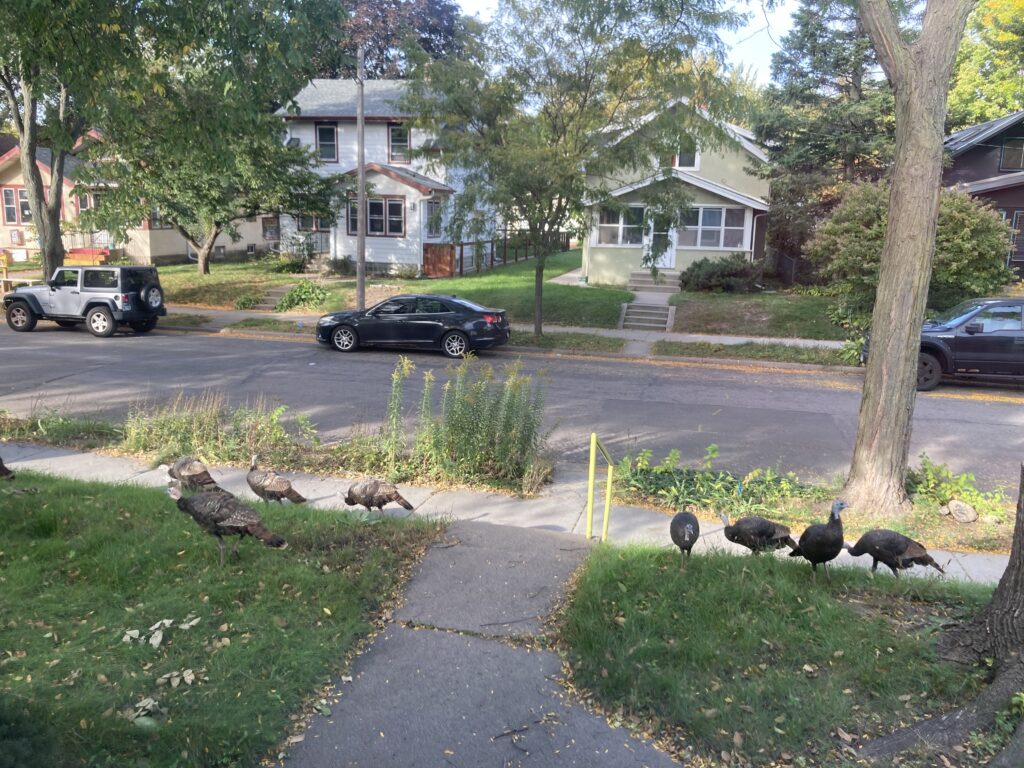
may 17/RUN

4 miles
river road trail, south/north/Winchell Trail, north/edmund, north
66 degrees

Took 2 days off to rest my left knee/IT Band. No big deal. Warm and sunny this morning. Calm, beautiful. As I started, I heard a bird with three long tweets then a trill of 4 or 5 shorter notes, then repeated. Looked it up–checking the chart I posted on May 3rd + allaboutbirds.org + birds of the mississippi river gorge pdf–and I think it might be a yellow-rumped warbler which migrates through the gorge in the spring. Looks like a yellow-rumped warbler is one of the May, “wave of warblers” that I wrote about last week. Nice.

Running down on the part of the trail just past the double bridge, where the walking path dips down below the road and then up again, I encountered my nemesis: the frantic squirrel that darts across the path in front of me, forcing me to stop or stutter step to avoid it. For the first time ever, this particular dipshit ran right into my foot. No damage done, at least not to me. Why do squirrels do this? Googled it and couldn’t find a “field-tested” answer. One hypothesis: over the years they have evolved to evade predatory birds by zig-zagging; they have not yet evolved to account for the behavior of cars or running Saras. In one of the articles I consulted, they wrote: “squirrels devote much of their life to not-dying.” How much time do humans devote to it?

Very early this morning, before sunrise, I heard a bird right outside my window. It woke me up then kept me up until I got up and closed the window. I was curious about what bird it might have been–not that I can remember what it sounded like now, hours later and after coffee–so I googled early bird and found the delightful phrase “dawn chorus” and this poem:

Dawn Chorus/ SASHA DUGDALE

March 29, 2010

Every morning since the time changed
I have woken to the dawn chorus
And even before it sounded, I dreamed of it
Loud, unbelievably loud, shameless, raucous

And once I rose and twitched the curtains apart
Expecting the birds to be pressing in fright
Against the pane like passengers
But the garden was empty and it was night

Not a slither of light at the horizon
Still the birds were bawling through the mists
Terrible, invisible
A million small evangelists

How they sing: as if each had pecked up a smoldering coal
Their throats singed and swollen with song
In dissonance as befits the dark world
Where only travelers and the sleepless belong

The insistent chirping of an early bird also brought to mind a poem by ED that I encountered sometime in the last year:

The Birds begun at Four o’clock —/ Emily Dickinson

The Birds begun at Four o’clock —
Their period for Dawn —
A Music numerous as space —
But neighboring as Noon —

I could not count their Force —
Their Voices did expend
As Brook by Brook bestows itself
To multiply the Pond.

The Listener – was not —
Except occasional man —
In homely industry arrayed —
To overtake the Morn —

Nor was it for applause —
That I could ascertain —
But independent Ecstasy
Of Universe, and Men –  

By Six, the Flood had done —
No Tumult there had been
Of Dressing, or Departure —
And yet the Band – was gone —

The Sun engrossed the East —
The Day Resumed the World —  controlled
The Miracle that introduced
Forgotten, as fulfilled.

Of course, I’m pretty sure I only heard one bird and not an entire chorus of them.

may 16/WALK

My second day off from running. My IT band is tight and I don’t want to risk making it worse, so I’m taking a 2 day break. It is hard not to run when you want to, especially when I could be doing the franklin loop with STA, but I did it and I’m glad. Walked with Delia the dog over the Dogwood Coffee for the first time in a year and a half? 2 years? for an iced coffee. As we waited outside while STA got the coffees, I noticed some crows on the roof of a house across the street. They were fighting, I think. Cawing, and swooping down, and crashing into each other as they circled around the roof. I’m pretty sure they were crows and not ravens or rooks–when in doubt, I always think a cawing, big, all-black bird is a crow. Were they fighting or playing or something else? Watching one crow circling then flying away, I noticed how huge their wing span is and how much bigger they look while flying than when perched on the point of a roof. I thought about how ungraceful their flapping wings looked, more bat than bird.

After writing this sentence about their lack of grace I decided to google it and found this interesting discussion of the difference between ravens and crows:

In flight, crows flap their way across the landscape while ravens skim along in a far more graceful manner.

The dead giveaway, however, is the fact that crows “caw” and ravens “cronk.” Once you learn to detect their ringing “cronk, cronk, cronks,” you’ll never be in doubt about which species you’re observing.

Ravens should not be confused with Crows

So, ravens are more graceful than crows, and they “cronk” instead of “caw.” Do I ever see or hear ravens?

may 14/RUN

5.25 miles
ford loop
60 degrees

To celebrate being fully vaccinated, Scott and I ran the Ford loop together. Today marks 2 weeks since our second pfizer shots.

Things I Remember

  1. The river looking blue and calm
  2. Seeing a robin’s red breast as they walked down the path in front of us
  3. Hearing but not seeing some rowers starting out from the rowing club dock
  4. Thinking about the eagle that used to perch on the dead branch right by the lake street bridge as we walked down the steps from the bridge to the trail
  5. Noticing how big some of the houses on the east river road were
  6. Hearing the water at shadow falls gushing down in the ravine as we ran up the big hill towards Summit Avenue
  7. Stopping at the overlook and admiring the view while talking about how having more than a billion dollars was not evidence of success but of unconscionable excess
  8. STA counting the pillars on Ford–according to him there are 101. Today he only counted 98
  9. As we headed down the hill back to the trail hearing geese honking
  10. Waving and greeting lots of people

Seeing the robin and their red breast on the walk in front of us, reminded me of Emily Dickinson and her poem about the bird that came down the walk one day and did not know she saw, but since I already posted that one in March, I looked for another ED robin poem. I like this one:

If I shouldn’t be alive/ Emily Dickinson

If I shouldn’t be alive
When the Robins come,
Give the one in Red Cravat,
A Memorial crumb –

If I couldn’t thank you,
Being fast asleep,
You will know I’m trying
With my Granite lip!

may 12/RUN

5 miles
Franklin Hill Turn-around
58 degrees

What a wonderful morning for a run! Hardly any wind, warm, sunny, green. I wasn’t planning to run to the Franklin Hill, only the trestle, but when I reached the trestle, I just kept going. They’ve repaved the trail at this spot and replaced the crumbling steps leading down to the Winchell Trail. Nice! I’ll have to try out those steps sometime soon. As I approached the Franklin Hill, I heard some voices below on the river. Rowers! As I reached the bottom of the hill, I caught a glimpse of the shell with eight rowers illuminated by the sun. Running up the hill wasn’t too hard. I can’t remember the last time I ran up this hill–was it just before the pandemic hit last March? No, I looked it up: last October 4th. Reading the log entry, I remember the geese, but I don’t remember seeing them just this past fall. Thanks again, past Sara, for keeping a record of these runs so I can remember them!

Running south, after cresting the hill, I overheard a few people talking, one asking the other something that I’m assuming was about what they had seen. Seen what? The answer was something like, “the red stars” or the “red starts”? Was it about rowers with red shirts or migrating birds called red stars? Close–I looked it up and I’m pretty sure they were talking about the American Redstart, which is a bird that, according to Dave Zumeta’s handy list, breeds near the gorge. Very cool!

A lively warbler that hops among tree branches in search of insects, the male American Redstart is coal-black with vivid orange patches on the sides, wings, and tail. True to its Halloween-themed color scheme, the redstart seems to startle its prey out of the foliage by flashing its strikingly patterned tail and wing feathers. Females and immature males have more subdued yellow “flash patterns” on a gray background. These sweet-singing warblers nest in open woodlands across much of North America.

Reading further about them, I saw this helpful backyard tip:

In late summer, redstarts visit plants with small berries and fruits, such as serviceberry and magnolia.

Excellent! We have two big serviceberry trees right at the edge of our deck and birds often visit them in the summer.

Birdcall/ Alicia Ostriker – 1937-

    —for Elizabeth Bishop

Tuwee, calls a bird near the house,
Tuwee, cries another, downhill in the woods.
No wind, early September, beeches and pines,

Sumac aflame, tuwee, tuwee, a question and a faint
But definite response, tuwee, tuwee, as if engaged
In a conversation expected to continue all afternoon,

Where is?—I’m here?—an upward inflection in
Query and in response, a genetic libretto rehearsed
Tens of thousands of years beginning to leave its indelible trace,

Clawprint of language, ritual, dense winged seed,
Or as someone were slowly buttoning a shirt.
I am happy to lie in the grass and listen, as if at the dawn of reason,

To the clear communal command
That is flinging creaturely will into existence,
Designing itself to desire survival,

Liberty, companionship,
Then the bird near me, my bird, stops inquiring, while the other
Off in the woods continues calling faintly, but with that upward

Inflection, I’m here, I’m here,
I’m here, here, the call opens a path through boughs still clothed
By foliage, until it sounds like entreaty, like anxiety, like life

Imitating the pivotal move of Whitman’s “Out of the Cradle,”
Where the lovebird’s futile song to its absent mate teaches the child
Death—which the ocean also whispers—

Death, death, death it softly whispers,
Like an old crone bending aside over a cradle, Whitman says,
Or the like the teapot in Elizabeth Bishop’s grandmother’s kitchen,

Here at one end of the chain of being,
That whistles a song of presence and departure,
Creating comfort but also calling for tears.

Reference to Elizabeth Bishop: Sestina
Reference to Walt Whitman: Out of the Cradle Endlessly Rocking

may 11/WALK

Took Delia the dog for a walk: through the neighborhood, down the worn wooden steps, up to a spot with a warped chainlink fence and a view of the ravine and the oak savanna, but not the river—too many leaves already. Down around the ravine, up the other side to another overlook with a sliver of sparkling river, past the ancient boulder with no stacked stones, down through the tunnel of trees and beside the crumbling rocks. We crossed the river road just before the old stone steps and made our way to Seven Oaks to be with the birds. Stopped. Listened. Watched for motion. Heard lots of chirping and tweeting and trilling and rustling. Saw some branches moving. Didn’t really try to identify bird sounds, just let all the music envelop me.

Earlier heading down to the ravine, I noticed another downy woodpecker on a tree, trying to find a good spot to drum. It’s amazing how such a tiny bird can produce such a loud sound! Today, they flew away before drumming, but yesterday I was able to see a little head rapidly striking the trunk. Sometimes it’s hard to believe how much I can still see, and how much I can’t. Noticed a few bikers. It’s time to get out my bike and try it. I’m nervous, because I haven’t biked in 2 years. How difficult will it be with my vision–will it be harder? scarier?

This morning I’m revisiting an essay I read at least 2 years ago and appreciating it so much more: Thirteen Ways of Looking at a Black Bird by Naomi Cohn. I discovered Cohn when I read her work Cell in the Feb 2019 issue of Poetry. She is legally blind and writes about her vision loss, which began in her 30s and happened over several decades. She’s local—I think she lives less than 2 miles from me–and I’ve been wanting to email her for some time now. I haven’t yet, but I should. Why not?

It’s so great to reread this piece while in the midst of my month of birds. Here are a few passages that especially resonated:

Back then I was drawn to see the rare, the out-of-place, the new to my eyes, the precious sight of feathers that could be added to my life list, a check mark in my field guide, its pages ruffled with a history of rainy wetlands. Wilderness tamed by naming.

I had no need to “collect” another red-winged blackbird, but stopped to look.

I like the statement: wilderness tamed by naming. I don’t really miss this taming—scrutinizing, staring, owning, collecting. And mostly, I’m okay with not being able to see details, sometimes mixing up or missing color. Of course, reading Cohn’s essay, I kept thinking about how much better my vision is than hers–at least, for now. I was able to see that small downy woodpecker on the tree today, after all.

The eye listens. The song of the red-winged blackbird translated to a sonogram, a shape on a page, a whistle heard in the head that has shape and volume. It triggers a mental image of yellow feet clutching a cattail, of a red quarter circle, so red against glossy black.

An ear sees. As the decay progressed, I began to learn bird song. I invested in “birding by ear” CDs, the little platters spinning endlessly in my cheap boom box. At my most tuned up, I probably knew 150 songs.

I would have kept the old way of looking at a blackbird if I could–it takes a good sized hole in your life to fill all those hours listening to bird tapes.

But there is this to looking at a bird through its song: Your eye, even a good eye, only looks at one thing at a time, only focusses on one bird at a time, but the ear listens in all directions. Paddling across a Canadian lake, red and white pines tall around the shore, the bird song comes from every direction, every compass point, every point on the whole half dome of the world above the water and shore.

Yes. I love this idea of sound coming from every direction, while sight can only come from one. As I was standing at the edge of the sink hole, I was listening in all directions. Sight encourages singularity: single ideas, single perspectives, either this or that but not both at the same time. Hearing encourages plurality: both/and, this and that, multiple perspectives at once.

To see a bird demands both perception and attention. For years I supplied the relatively subtle gaps of perception with attention. Over time, this was not enough. Motion was less my friend. I needed time to make things out, to dart my eye back and forth and up and down to try to get a glimpse of something, to see around the edges of my blind spots,  sending a set of broken, incomplete messages to my visual cortex, which on a good day, would assemble a convincing hypothesis of what I was perceiving.

This is all any of us ever do.

Yes! I think this line “This is all any of us ever do” is important. You can read it as metaphor, with blind spots representing those limitations in everyone’s understandings and perspectives. But you can also read it as literal. The more I read about how we see, the more I learn how complicated it is for everyone–good vision or bad—to make sense of images. The brain guesses a lot. Of course, those guesses are better when the brain is given more data, but even then, the brain guesses.

The title of this essay is referring to the famous poem of the same name by Wallace Stevens. I’ve read it several times; I even did an homage poem of it for a class 3 years ago. Anyway, here’s the original:

Thirteen Ways of Looking at a Blackbird/ WALLACE STEVENS

I
Among twenty snowy mountains,   
The only moving thing   
Was the eye of the blackbird.   

II
I was of three minds,   
Like a tree   
In which there are three blackbirds.   

III
The blackbird whirled in the autumn winds.   
It was a small part of the pantomime.   

IV
A man and a woman   
Are one.   
A man and a woman and a blackbird   
Are one.   

V
I do not know which to prefer,   
The beauty of inflections   
Or the beauty of innuendoes,   
The blackbird whistling   
Or just after.   

VI
Icicles filled the long window   
With barbaric glass.   
The shadow of the blackbird   
Crossed it, to and fro.   
The mood   
Traced in the shadow   
An indecipherable cause.   

VII
O thin men of Haddam,   
Why do you imagine golden birds?   
Do you not see how the blackbird   
Walks around the feet   
Of the women about you?   

VIII
I know noble accents   
And lucid, inescapable rhythms;   
But I know, too,   
That the blackbird is involved   
In what I know.   

IX
When the blackbird flew out of sight,   
It marked the edge   
Of one of many circles.   

X
At the sight of blackbirds   
Flying in a green light,   
Even the bawds of euphony   
Would cry out sharply.   

XI
He rode over Connecticut   
In a glass coach.   
Once, a fear pierced him,   
In that he mistook   
The shadow of his equipage   
For blackbirds.   

XII
The river is moving.   
The blackbird must be flying.   

XIII
It was evening all afternoon.   
It was snowing   
And it was going to snow.   
The blackbird sat   
In the cedar-limbs.

may 10/RUN

3.6 miles
turkey hollow + Seven Oaks
46 degrees

Ran on the trail but barely noticed the river. Distracted by walkers, and dog collars, and a noise that I think was a bird song but could have been someone whistling in the savanna. Heard a bird song that reminded me of the feebee call but was very different. Tried to find some words to match it, but couldn’t. A long note then a few shorter ones. No turkeys in turkey hollow, no red-breasted nuthatches near Becketwood. As I ran north on edmund, I thought about the poem I posted yesterday (which I actually posted this morning) about bird names. In trying to identify birds and birdsongs am I just trying to collect them? What might it mean to resist that urge to name, to know? Then I thought about the value of names, of knowing and noticing. Both–not knowing and knowing–have value. I also thought about different ways of noticing and being with birds that don’t involve staring and studying and collecting. Feeling the shadow of a bird flying overhead, sensing their graceful and frenetic motions.

Ended my run at Seven Oaks again to be with the birds. I think stopping there will be my new thing for May. So many sounds, so much movement all around–flying and rustling. Noticed a tiny bird–some sort of warbler?–just above me. I couldn’t see any distinctive colors on its head or feather and it didn’t call out. Watched a downy woodpecker slowly climbing up a tree. Moved when I was stared down by a squirrel, then returned when I heard the quiet drumming of the black and white feathered bird. Very cool. What an amazing way to end my run!

Here are two recordings I took as I walked around the rim of the Seven Oaks’ sink hole:

May 10/ birds, 1
May 10/ birds, 2

I think I might hear a cardinal and a robin, but what else? And are those birds even there, or am I just hearing robins and cardinals everywhere?

For the Birds/ JOHN SHOPTAW

For the abundant along with the rare birds at my feeder of late
For all kinds of birds I’ve lived with here are turning rarer
For the chestnut-backed chickadee, who carries her sunflower chip to the buckthorn to dine on between her toes
For the chickadees once came to my feeder in bunches
For the big round plain brown pair of California towhees who eat in parallel from the bird-crumb table
For though they crumb it clean without a glance or a cheep, I believe this remote old couple is as entwined as any two polarized photons
For the fearsome indigo Steller’s jays, black hooded and crested, Tapper and Sly, as I call them
For Tapper taps twice on an overhanging plum branch at two clucks from my tongue so I’ll know him
For Sly hangs back and shrieks me over and only shows himself after I place on the table their morning quincunx of unsalted peanuts
For he knows Tapper will quack to announce them and then squawk indignantly when he slyly swoops in
For the vast majority
For the dark-eyed juncos, the wide-eyed titmice, the narrow-eyed redbreasted nuthatches, who feed right-side up as they see it, the other birds upside down
For Audubon’s yellow-rumped, Wilson’s and Townsend’s warblers, nobody’s birds, who feed, drink and breed as they can
For the song sparrow’s song and the sparrow who exults in singing it
For a song—how long will that phrase mean what it means
For them all I refill the feeder, even this morning, when all blown-down things crackle underfoot and the Diablo wind seems to growl diabolically and scrape from all corners at once against a sky the color of flint
For the lesser goldfinches, symbolically fierce, who part their beaks at any other kind who would peck a chip in their presence
For the pine siskins, their symbolic match, who used to expose their underwings back at them with its dreadful yellow stripe
For two years running, no siskins at the feeder
For the brown-crowned, as-yet-unkindled sparrows, wintering from Oregon or the Farallon Islands, I sing my two-note welcome, hel-low, pointless
For they won’t learn it with my face masked against wild smoke migrating from the north
For the species too little or big or otherwise unsuited for the feeder
For Anna’s hummingbirds, who love to suck on our pineapple sage
For the red-tailed hawk perched in the smoke-fogged redwood
For soon it’ll be pestered by a twister of crows cawing hawkawkawkawkaw
For a red-tailed hawk I mistook it—something larger, ruffled molten
For the golden eagle it turned out to be—weird—hunched in the chill
For another flew up out of thick air and followed it south out of eyeshot
For those two—not migrants—evacuees clasping their emotional baggage
For the birds, then, what have I to offer
For what kind of refuge is my catalog
For I can’t reckon how to make good their losses
For I meant not to make a life list I meant
For others to partake in my pleasure
For it pleases me to look after the birds

This poem makes me think of the question I was pondering while I ran about collecting bird identifications. “For I mean not to make a life list”. Here’s an explanation of a life list:

life list

A life list is a cumulative record of the bird species an individual birder successfully identifies, and keeping a list is the easiest way to track which birds you have seen. Birders often keep life lists for other reasons as well, however, such as for motivation to see a greater number of species or to garner the prestige that comes from having higher count numbers. Life lists can also be submitted to some birding organizations for recognition or for contest purposes. For most birders, however, it is just fun to keep a life list and add up how many bird species you have seen.

What Species Can Count for a Bird Life List?

The article suggests that you can create your list however you want, but if you want the “prestige” of having it officially recognized, there are rules, which you can read in the article. I am not interested in creating a life list, of cataloging the birds I’ve seen as proof that I’m a good noticer. I like how this poem offers an alternative reason for why you would compile a list–a memory of what has been lost, a celebration of delights, a catalog of unabashed gratitude (the name of a collection by Ross Gay).

The line “For a song—how long will that phrase mean what it means” reminds me of the idea of dead metaphors, like “at a glacial pace”, that no longer have meaning because of dramatic/violent shifts in ecosystems and the destruction of the environment. Does Shoptaw mean it in this way?

may 9/RUN

2.1 miles
river road trail, south/42nd st, west/44th ave, north
63 degrees

A short run in the afternoon with STA. Lots of bikes, not too many runners or walkers. Talked about being useless and doing useless things as forms of resistance to capitalism (me) and as clever instagram descriptions (STA). Also, I complained about Mother’s Day and how much I dislike “special days” like it or birthdays–partly because my mom is dead, partly because they create unrealistic expectations about what it means to celebrate and be celebrated.

Here’s one of the first poems I read from J. Drew Lanham’s Sparrow Envy last week:

Octoroon Warbler/ J. Drew Lanham

As a taxonomic committee of one,
I alone have decided
that the past transgressions of long ago dead and rotted
bird watchers must be amended.
That it is my sole responsibility—and pleasure—
to right the wrongs
of racist slave-holding artist ornithologists.
of genocidal complicit naturalists.
of grave-robbing skull-fondling phrenologists.
of the lot of white-supremacist men with the
self-serving penchant
for naming things after themselves.
I hereby declare my solo vote singularly unanimous.
Everything I decide here and now—
passes.
So shall it be written. Let it be done.
Word is bond.
My opinions good as any other treaty
signed in the shifting sand of time.
I do hereby exchange, alter or replace
the names of the birds that follow.
Their former identities by patriarchal rule to be expunged.
That they should have new identities
by my demand.
Bachman’s sparrow, denizen of long-leaf pine savannah;
of wiregrass, of fire-kissed sandy ground
shall be once again be
“pine woods.”
A true great again recovery worthy of celebration!
And whilst I’m releasing species from bondage,
consider the likely forever gone warbler
of the same Charleston preacher’s
human-chattel-possessing label,
can we not do better?
Yes.
“Swamp Cane warbler,”
appropriately by design of damp dank place
it so chose when still in existence, escaping notice.
I would have suggested “Tubman’s warbler,”
but then why make it any easier to erase blackness
when extinction has already done the job?
LeConte’s Sparrow will hence forward be
“orange-faced.”
The brown-backed secretive skulker
of wet weedy rank with tangled overgrown fields,
hider in thickety traces, deserves better fate than linkage
to a Confederate armorer working
to put in place a permanent apartheid nation.
Townsend’s Solitaire,
thrush-esque thing of western slope migration
is now “Up-and-Down Solitaire.”
Mobile altitudinal propensity
taken into full account.
The lemon yellow-headed black and white
western jewel of a warbler
tagged by that same Indian grave-robbing man,
shall now be a “Doug Fir” specifically,
knowing for its tied to evergreen boughs.
No disarticulated Native heads required.
To correct an oversight
of Manifest Destiny,
(and opening the western door to indigenous genocide
not accepted),
behold Clarke’s Nutcracker,
the capacious resourceful intelligent corvid,
given title by the fire-haired Captain of the Corps!
Henceforth shall be York’s Crow.
Designated the first bird so named for a man of color
About damn time the brother got credit
for saving the Corps of Discovery’s always imperiled bacon.
Even as property his contributions went largely
without merit.
To even the score a bit more
redact the other leader Lewis
from the northern Rockies woodpecker.
He of Trail of Tears Cherokee removal infamy.
Christen the gorgeous picid Sacagawea’s Woodpeecker
instead.
As for John James Audobon,
“JJ,” if I might?
He of the posed painted birds,
of ego larger than life to go along
with his Baby Elephant folio.

What does a slave-owning,
man-passing for white might deserve?
What might the demigod of birdome merit
after all these years?
Let his name now be struck.
For malfeasance to humanity.
For being prickish and a generally abhorrent man,
Audubon’s orioles shall be Rio Grande.
The sea-going petrel with the artist’s moniker shall now be
“Warm-Sea Wanderer.”
An identity worthy of its tropic-trotting status.
And last but not least, for review
the yellow-rumped warbler of occidental “race,”
occurring beyond the Mississippi to points beyond that.
Since Johnny couldn’t bear the very thought
of interracial miscegenation,
let’s call the butter-butted bird what it is
in hindsight of his own mixed-raced denial.
The Octoroon Warbler.
Thus, I proclaim on this very day,
whenever this ruling shall be read on whatever future date,
that we remember the identity of the birds for what they are,
and never forget the signs of past imperfections too,
to not repeat the hubris of taking good for granted.
But letting creatures have their own names.
No interference from haters required.

An important history of naming that I didn’t know. I looked up Townsend and his warbler and found an article about his grave-robbing: Stealing from the Dead: Scientists, Settlers, and Indian Burial Sites in 19th Century Oregon Also found this: Townsend, John Kirk | Bird Names for Birds. And, found this more general article: A Bird Named for a Confederate General Sparks Calls for Change

may 8/RUN

3 miles
austin, mn
50 degrees

Windy and cool. Ran in Austin with STA. Less than a week away from being fully vaccinated.

Vanishing/ Brittney Corrigan

Nearly one-third of the wild birds in the United States
and Canada have vanished since 1970, a staggering
loss that suggests the very fabric of North America’s
ecosystem is unraveling.
–The New York Times (September 19, 2019)

As the world’s cities teem
with children—flooding
our concrete terrains with shouts
and signs—as the younglings balance
scribbled Earths above their heads,
stand in unseasonal rain
or blistering sun,

the birds quietly lessen
themselves among the grasslands.
No longer a chorus but a lonely,
indicating trill: Eastern meadowlark,
wood thrush, indigo bunting—
their voices ghosts in the
chemical landscape of crops.

Red-winged blackbirds veer
beyond the veil. Orioles
and swallows, the horned lark
and the jay. Color drains from
our common home so gradually,
we convince ourselves
it has always been gray.

Little hollow-boned dinosaurs,
you who survived the last extinction,
whose variety has obsessed
scientific minds, whose bodies
in the air compel our own bodies
to spread and yearn—
how we have failed you.

The grackles are right to scold us,
as they feast on our garbage
and genetically-modified corn.
Our children flock into the streets
with voices raised, their anger
a grim substitute
for song.

may 7/RUN

3.25 miles
43rd ave, north/tunnel of trees/welcoming oaks/oak savanna/edmund, north/7 Oaks
49 degrees

Hooray for wonderful runs! Sunny, warm enough for shorts, clear trails, welcoming oaks, robins who sound like they’re singing “hurry up hurry up hurry up.” Ran on the trail but don’t remember looking at the river; too busy looking out for other people. After reading an article about “The Warbler Wave” at 7 Oaks, decided to end my run there and listen. According to local bird expert Dave Zumeta (I have his Birds of the Mississippi Guide pdf), mid-May is a great time to see/hear warblers as they migrate south, and 7 Oaks is the best place to do it:

Warblers are Zumeta’s favorite birds, bar none. He not only knows the subtleties of their markings, but can also recognize their songs. His favorite place to watch for warblers isn’t Costa Rica or the Greater Antilles Islands. It’s a sinkhole on 34th St. and 47th Ave. just a stone’s throw from his house. He said, “Seven Oaks Park is the reason we moved where we did. I think it’s one of the best places to bird watch anywhere – and it’s a warbler magnet.”

Wow, I love where I live! Here’s the recording I took as I stood on the edge of the sinkhole:

May 7th, birds at 7 Oaks

I have loved Marie Howe ever since I read one of her amazing poem from What the Living Do and listened to her On Being interview. Such beautiful words! Here’s one that features a bird:

From Nowhere/ Marie Howe

I think the sea is a useless teacher, pitching and falling
no matter the weather, when our lives are rather lakes

unlocking in a constant and bewildering spring. Listen,
a day comes, when you say what all winter

I’ve been meaning to ask, and a crack booms and echoes
where ice had seemed solid, scattering ducks

and scaring us half to death. In Vermont, you dreamed
from the crown of a hill and across a ravine

you saw lights so familiar they might have been ours
shining back from the future.

And waking, you walked there, to the real place,
and when you saw only trees, come back bleak

with a foreknowledge we have both come to believe in.
But this morning, a kind day has descended, from nowhere,

and making coffee in the usual way, measuring grounds
with the wooden spoon, I remembered,

this is how things happen, cup by cup, familiar gesture
after gesture, what else can we know of safety

or of fruitfulness? We walk with mincing steps within
a thaw as slow as February, wading through currents

that surprise us with their sudden warmth. Remember,
last week you woke still whistling for a bird

that had miraculously escaped its cage, and look, today,
a swallow has come to settle behind this rented rain gutter,

gripping a twig twice his size in his beak, staggering
under its weight, so delicately, so precariously it seems

from here, holding all he knows of hope in his mouth.

I love the idea of our lives as thawing lakes in a bewildering spring, and the kind day descending and things happening cup by cup, gesture by gesture, and the surprise of sudden warmth, and the delicate, staggering bird. The line about the bird reminds me of Ada Limón’s interview on VS:

Ada Limón: Yeah. I think, for me, there are a couple of new poems I’ve been working on. One of them, just recently, where I saw a beautiful kestrel that was on a really small branch. And I kept sort of loving this image of a heavier bird being held up by a small branch, right. And I kept thinking, I’ve got to do something with this, I’ve got to do something with this. And then, really, towards the end of the poem, I realized, like, I want this image to somehow tell me that as the branch, I can bear more, and I can bear a lot. And as the bird, I can balance on barely, you know, on something that’s barely there. And yet, in the poem, I recognize that it’s not telling me that, right. That that’s actually—all it is is a bird doing its thing, landing where it needs to land. And, you know, I want to look at those lessons. But I also need to pull back and think, okay, maybe it’s just a noticing, and that’s what my job was. And not always turning it into a … fable, you know. (LAUGHS) Or an idea that will somehow rescue the speaker. And in this case, you know, the speaker being me.

Franny Choi: Yeah, that helps me totally see what you mean when you say, allow the animal to be an animal alongside us as animals. Like To just like, be with them in an environment together, rather than being a colonizer like, be like, th, like, how is this tree useful for me? How is this bird useful? What can I -what can I make it for?

It’s interesting how these images of birds are opposites: Limón’s is too big for the branch, Howe’s is too small for the twig, but both are about the too-muchness of life—the world’s weight, too much for our small branched bodies, and hope’s sudden and unexpected appearance, almost too much to bear.

May 6/WALK

A break from running today. Took Delia on 2 walks instead, one just me, the other with STA and RJP. One down by the ravine, the other in the grass between the river road and Edmund.

Starlings/ Maggie Smith from Goldenrod

The starlings choose one piece of sky above the river
and pour themselves in. Like a thousand arrows
pointing in unison one way, then another. That bit of blue
doesn’t belong to them, and they don’t belong to the sky,
or to the earth. Isn’t that what you’ve been taught–nothing is ours?
Haven’t you learned to keep the loosest possible hold?
The small portion of sky boils with birds.
Near the river’s edge, one birch has a knot so much
like an eye, you think it sees you. But of course it doesn’t.

I’m not sure if I’ve ever seen starlings in person. I checked my bird list and they do live in the Mississippi Gorge. Maybe someday I’ll see them? Anyway, I picked this poem because it uses two interesting bits of information that I’ve wanted to use in a poem ever since I found out about them: 1. a boil of birds and 2. the tree with eyes.

a boil of birds

On March 9th, 2020, one day before I got my first of many sinus infections and just days before the pandemic became real in Minnesota, I went for a walk and noticed a big bird circling in the sky. Wondering why it circled, I looked it up and found out about thermals and boils of birds. Here’s what I wrote:

Thermals are updrafts of warm air that rise from the ground into the sky. By flying a spiraling circular path within these columns of rising air, birds are able to “ride” the air currents and climb to higher altitudes while expending very little energy in the process. Solitary birds like eagles and hawks often take advantage of thermals to extend their flight time as they search for food. Social birds that fly in large flocks also use thermals to gain altitude and extend their range during migration. The sight of dozens or hundreds of birds riding a thermal has been said to resemble the water boiling in a kettle, so the terms kettle or boil are sometimes used as a nickname for a flock of birds circling in a thermal updraft. The benefits of thermals are not limited to the animal world either as glider pilots often take advantage of them to gain altitude as well.

I want to see hundreds of birds riding a thermal and looking like water boiling in a kettle! Mostly so I can see them doing it but also so I can write about the boil of birds I just saw.

a tree with eyes

On June 18th, 2020, walking with STA and Delia the dog, we noticed a tree that looked like it had eyes. Here’s what I wrote:

Every day, in the late afternoon around 5, Scott and I take Delia the dog on a long walk between Edmund Boulevard and the River Road. This week, while stopped near the upper campus of Minnehaha Academy–the one that was recently rebuilt after the old building exploded a few years ago, Scott noticed all the eyes on an aspen tree and took a picture of it. I remember remarking, “oh, I bet there’s a name for that. I’ll have to look it up.” I finally did just now. The most popular answer? Aspen eyes. According to several sites I found, these eyes are formed through self-grooming, when aspens shed their smallest branches.

walking and listening this morning

On my walk this morning with Delia the dog, I heard black-capped chickadees, pileated woodpeckers, cardinals, and the red-breasted nuthatch I just identified yesterday. Also might have heard the plink plink of a bobolink–is that possible?Standing at the rim of the giant sinkhole that’s been turned into a city park at 7 Oaks, I heard so many other birds, including one that I hear all the time but I can’t yet identify. I manage to record it (along with other birds). \

May 6th, a one-syllable bird call at 7 Oaks

Birding by ear is difficult and overwhelming at first. Too many different sounds that I can’t distinguish. So, I’m looking for tips, like these: Six tips for birding by ear. In it, they suggest some things to listen for.

Some things to listen for:
  • is it high
  • sweet
  • does it rise or fall in pitch
  • is it in groups of 2 or 4
  • is there a space between each bout?

may 5/RUN

3.25 miles
turkey hollow
54 degrees

An overcast, cooler day. Not quite gray but not blue either. Wore my new raspberry red shoes. I have wanted red shoes for a few years now. Felt faster, stronger. Tried to listen for more birds. Heard the usual (or uje as FWA and RJP like to say) singers: black-capped chickadees, cardinals, crows, pileated woodpeckers not drumming but calling out, sounding like a loon to me. Ran the final 1/2 mile with my spotify running playlist.

I heard a bird that I thought was a crow calling out and tried to figure out what word their call sounded like but I couldn’t. It was one syllable and shrill. I looked on the birdsong charts that I posted a few days ago for one syllable calls and found the red-breasted nuthatch. Listened to its call and it sounded like what I remember. Then, I looked it up on a birds of the mississippi river gorge guide that I found a few years ago. Yes! Red-breasted nuthatches are permanent residiences here. Nice! On the birdsong chart, the word used to describe the call is “ink” but I can’t hear that when I listen to it. Googling it, I found “ank ank” which sounds more like it to me. Here’s how all about birds describes them:

An intense bundle of energy at your feeder, Red-breasted Nuthatches are tiny, active birds of north woods and western mountains. These long-billed, short-tailed songbirds travel through tree canopies with chickadees, kinglets, and woodpeckers but stick to tree trunks and branches, where they search bark furrows for hidden insects. Their excitable yank-yank calls sound like tiny tin horns being honked in the treetops.

They like to hang out with chickadees and woodpeckers? That sounds right. I remember hearing “chick a dee dee dee” a lot too. I need to look up how to record/make not of a bird sound–what information do people usually include? Here’s a page with some helpful information that I’ll check out later. For now, I’ll write:

May 5, 10:25
At the corner of 44th and West River Parkway near Becketwood
Red-breasted nuthatch call—“ank ank ank”

In the description, kinglets are mentioned too. Looked it up and we have those in the gorge as well. I’m thinking it might be helpful to look up the birds I know and then find out what other birds they hang out with. Also, when hearing bird sounds, try to listen for where they’re coming from–high up in the trees? the grass? lower branches?–then look up habitats. I feel this birding my ear will be slow work; I’ll consider it a big accomplishment if I can identify 2 or 3 more birds this month.

One last thing: I never would have guessed that the irritating, loud call I was hearing came from such a small bird. And I never would have guessed that it wasn’t a crow or a raven or a rook.

Looking through my safari reading list, I found this letter from Emily Dickinson to her cousins. I saved it a few years ago, I think. Why? Oh, past Sara what was in here that you wanted to keep? I’m not sure, but I think it’s fitting for the month of birds and birdsong. I’ll need to read her lines many more times before I feel close to understanding them, but I’m glad to have them.

TO: Louise and Frances Norcross
FROM: ED

Sisters,

I hear robins a great way off, and wagons a great way off, and rivers a great way off, and all appear to be hurrying somewhere undisclosed to me. Remoteness is the founder of sweetness; could we see all we hope, or hear the whole we fear told tranquil, like another tale, there would be madness near. Each of us gives or takes heaven in corporeal person, for each of us has the skill of life. I am pleased by your sweet acquaintance. It is not recorded of any rose that it failed of its bee, though obtained in specific instances through scarlet experience. The career of flowers differs from ours only in inaudibleness. I feel more reverence as I grow for these mute creatures whose suspense or transport may surpass my own. Pussy remembered the judgment, and remained with Vinnie. Maggie preferred her home to “Miggles” and “Oakhurst,” so with a few spring touches, nature remains unchanged.

The most triumphant bird
I ever knew or met,
Embarked upon a twig to-day, –
And till dominion set
I perish to behold
So competent a sight –
And sang for nothing scrutable
But impudent delight.
Retired and resumed
His transitive estate;
To what delicious accident
Does finest glory fit!

What to do with the contrast between the mute rose and the bird who sings for “nothing scrutable/But impudent delight”?

may 4/RUN

3.5 miles
river road trail, south/under ford bridge turn-around/river road trail, north/Winchell Trail, north
48 degrees

Yes! I ran on the trail all the way today: headed south on the upper trail, turned around just past the ford bridge, then back home on the lower trail. Heading down to the lower (Winchell) trail, I admired the sparkling river again. I wish the lower trail was longer; I really enjoy being a little closer to the river and running under the trees and on the edge of the bluff. It was mostly sunny, but occasionally the sun would hide behind a cloud and the trail and the trees would turn from lime greens and dark browns to dull gray.

Ran past the 42nd street sewer pipe and I listened to the water, I figured out some words that fit between dripping and gushing (which was my problem from yesterday’s run): falling, flowing, (a gentle) flushing. As I tried to hold onto those words so I could remember them for this entry, I heard a sharp beeping or tweeting noise. At first I thought it was a bird, then I realized it was a truck backing up. Then I thought: when we hear the beeping of the truck, do we need to put the idea that it’s a truck backing up into words, or do we have a more immediate understanding of it? How intelligible/recognizable in language do these sounds need to be for us to know and respond to them? Thinking I might forget this thought, I decided to stop at the top of the short but steep hill near Folwell and record some notes.

May 4th/ notes mid run

I was inspired to think about sound and syllables and language because of my bird poem for the day. I became aware of it after two different bird articles (or books?) that I read yesterday used a bit of it for an epitaph. I think they both used this bit:

is it o-ka-lee
or con-ka-ree, is it really jug jug,
is it cuckoo for that matter?–
much less whether a bird’s call
means anything in
particular, or at all.

Syrinx/ Amy Clampitt – 1920-1993

Like the foghorn that’s all lung,
the wind chime that’s all percussion,
like the wind itself, that’s merely air
in a terrible fret, without so much
as a finger to articulate
what ails it, the aeolian
syrinx, that reed
in the throat of a bird,
when it comes to the shaping of
what we call consonants, is
too imprecise for consensus
about what it even seems to
be saying: is it o-ka-lee
or con-ka-ree, is it really jug jug,
is it cuckoo for that matter?–
much less whether a bird’s call
means anything in
particular, or at all.

Syntax comes last, there can be
no doubt of it: came last,
can be thought of (is
thought of by some) as a
higher form of expression:
is, in extremity, first to
be jettisoned: as the diva
onstage, all soaring
pectoral breathwork,
takes off, pure vowel
breaking free of the dry,
the merely fricative
husk of the particular, rises
past saying anything, any
more than the wind in
the trees, waves breaking,
or Homer’s gibbering
Thespesiae iache:

those last-chance vestiges
above the threshold, the all-
but dispossessed of breath.

aeolian (def):
(adj) giving forth or marked by a moaning or sighing sound or musical tone produced by or as if by the wind.
(adj) borne, deposited, produced, or eroded by the wind
god of the winds (greek)
aeolian mode: natural minor scale

iache (noun): any kind of inarticulate cry; most likely it is an onomatopoeia, an imitation of human sounds that are not language; most frequently used of the shouts that accompanied Greek religious ritual
thespesiae (adj): divine, especially in the sense of mysterious or inaccessible to human understanding
terms from Homer’s Odyssey, found in this helpful study guide for the poem

Click on this image to see how the syrinx works over at one of my favorite bird sites: All About Birds

Click here to go to site to animate the syrinx

Her line about the “pure vowel/breaking free” made me think of Robert Bly and his discussion of vowels in the documentary‘ STA and I watched the other day. He read this bit from his long poem, “As If Someone Else is With Me” from Morning Poems:

So it’s a bird-like thing then, this hiding
And warming of sounds. They are the little low
Heavens in the nest; now my chest feathers
Widen, now I’m an old hen, now I am satisfied.

And here’s some helpful advice for starting to think about birding by ear:

How to “Bird by Ear”: Getting Started

To speed up the learning process, don’t just listen passively: Focus and analyze what you’re hearing. Describe the sound to yourself, draw a diagram, or write it down. If it’s a complicated song, figure out how many notes it has. Do all the notes have the same tone and vibe? Does the tune rise or fall? Can you adapt the “syllables” into words and make a mnemonic? The Barred Owl, for instance, hoots Who cooks for you, and the Common Yellowthroat sings Wichity-wichity-wichity. But you don’t have to just settle for published mnemonics; listen carefully and then invent your own. Little memory hooks like these will make birding easier the next time around. And as always, repetition helps.

Birding by Ear, Part One/ Audubon Society

may 3/RUN

4 miles
43rd ave, north/32nd, east/river road trail, south/winchell trail, north
54 degrees

What a wonderful run! Not too fast, not too hard, not too windy. Before I went out for my run, I started thinking more about birds and what I might focus on this month. More how birds sound and less how they look—their coloring, eyes, feathers, etc. Maybe some research on bird biomechanics and migration and navigation and how their feathers and bones and brains work? Too much to tackle in one month. As I wrote this last sentence, I thought about Annie Lamott’s book on writing, Bird by Bird, which I read many years ago and have now requested from the library in audiobook form. I could focus on one bird for each day of the month? I’ll think about it.

Anyway, at the start of my run I was thinking about birdsong and some sites I found with mnemonic devices for recognizing them, like this one: Memorizing bird songs made easy with mnemonics. This site has 2 great comics to help out:

I think I should look up the most common birds in the gorge and then try to learn the mnemonic devices for their sounds. At the beginning of my run, I thought I heard a bird song that started with a tweet tweet, but I don’t think it was a yellow warbler (see comic above). Last summer I wanted to learn more bird calls, but it was too overwhelming and I became distracted with other projects. Thinking about this more, at the end of my run, I remembered an idea I had earlier about not becoming overwhelmed by trying to learn too many things or feeling that there’s always too much that you don’t know. I want to learn just enough to make it interesting–not to become obsessed with knowing every bird song, or depressed by how much others already know. And by interesting, I mean: delightful, creating wonder and astonishment, enabling me to devote attention, provoking my curiosity, connecting me further to a place.

Here are some notes I took about my run shortly after I returned:

  • the sewer pipe in the ravine on the Winchell Trail by 44th was dripping/dribbling water, while the pipe by 42nd was—not gushing or rushing or pouring, but more than dripping…what’s the word for that? and why is there more water at 42nd?
  • running through the tunnel of trees and hearing at least 3 booms–what were they? transformers blowing or construction-related or a car back-firing?
  • so many glints, sparkling like jewels, on the river as I approached the overlook at the start of the Winchell Trail!
  • so many sounds of lawn mowers and leaf blowers and bird calls–not a wall of sound, but a veil
  • the steep slope up on the Winchell trail near folwell looking insurmountable from a distance

Look!

Near the old stone steps, I heard a deep hollow drumming from a hidden woodpecker, then saw 2 older women standing at the edge of the bluff peering into the trees and trying to find the source of the sound. This reminded me of a passage from Margaret Renkl’s essay “Seeing” in Late Migrations:

One of the nicest things about the lake where I like to walk is that there is nearly always someone on the trail saying, “Look!” Thanks to that natural human urge to share something wonderful, even with a stranger, I have learned this lake’s terrain over the years and know where to look for the well-disguised secrets I would miss on an unfamiliar path. I know that a barred owl frequently perches in a dead tree near a particular bridge. I know that a great blue heron often stand as still as a photograph on a submerged log in one cove. I know the rise whee wild turkeys drag their wing feathers on the ground and blend in with the leaf litter, and I know the bank where beavers climb soundlessly out of the lake. One summer I knew where to look for a hummingbird’s nest because of a stranger with better eyes than mine.

“Seeing” from Late Migrations/ Margaret Renkl

When I read this passage a few days ago, I decided that I want to believe that the strangers on the trail that I encounter could be as generous as this, and I want to take the time to stop and to look or try to look or at least listen to their description of what they see. I want do this instead of assuming the strangers are irritating or clueless or selfish space hoggers. I want to be open to the world instead of closed to it.

Here is a bird poem I found while looking back through my safari reading list. Ted Kooser is wonderful.

A Heron/ Ted Kooser

Maybe twenty yards out from the shoreline
a great blue heron waiting, motionless,
upon a post that seemed to have no purpose
other than to stand there stained with rings
of history as the old lake, breathing sunlight,
rose and fell.

The heron was the color of the water
so that it seemed that I could see the water
through her, as if she were a creature blown
of glass, not smeared by anybody’s fingers,
still clean and delicate and waiting to be filled
with color

although I saw that she was filled already,
from the bulb of her body to the tip of her beak,
not with a color that anyone knew but with
a cloudy fluid that had been distilled
from summer light and now was being aged
and mellowed

though how much longer it might take was
anybody’s guess. But I had been imagining
too long, and she had felt it, too, that threat
of too much beauty being forced upon her,
and spread her glassy wings and lifted off
and flapped away across the water.

What a beautiful poem! I think I want to memorize it so I can have it forever.

may 2/RUN

4.5 miles
franklin loop
62 degrees

Ran with STA this morning. Very nice. Noticed the river as we crossed Lake Street. It was brown and calm. No rowers this morning. Are we too early or too late to see them? Ran in reverse today and noticed many houses for the first time. Over-sized houses on over-sized lots. STA pointed out three benches in a half circle, facing the sun with no trees, sitting in a triangle of grass just off of Franklin near a bus stop. He said he hadn’t noticed them before. I don’t think I have either. They don’t look like much fun, sitting there facing the sun–except for maybe on bright, warm-ish days in the winter. Crossing the Franklin bridge we noticed how the sky north of us, over downtown, had an ominous purple tint, while the sky south of us, closer to the falls, was a placid blue. Stopped at STA’s favorite spot–a big tree above the river road–and noticed how much the leaves by the gorge have filled in. Goodbye view to the other side. I can’t remember when it happened during the run, but I remember a robin right in front of us on the path and STA jokingly calling out, “Get outta here, you Robin” and then as it scampered or scuttled? off, STA remarking, “I like how it couldn’t be bothered to fly.” As I remember it, the Robin kind of looked like someone crossing the street and doing that strange hurrying but not hurrying walk run.

may’s exercise?

A new month, which means a new monthly exercise. March was Emily Dickinson, April Mary Oliver. At first I was thinking Robert Bly for May because STA and I just watched this awesome documentary about him on the local PBS channel, but Bly seems more fitting for the winter. Tentatively I have decided not to focus on a single poet, but on a theme: birds. I’ve been reading a great collection of bird poems by the ornithologist J. Drew Lanham, and slowly watching/listening/reading a lecture from Marta Werner on her project, Dickinson’s Birds. Both ED and MO feature birds in many of their poems, and so do so many other poets. Will I want to read about birds for the entire month? Not sure yet.

GROUP THINK: NEW NAMES FOR PLURAL BIRDS/ J. Drew Lanham

A Hemorrhage of cardinals
red-staining the backyard
A Consideration, Council
or Congress of crows;
call them anything but murderers, please.
A Whir of hummingbirds
A Riff (or Mood) of any bird that’s blue
A Thicket of sparrows
A Mine of goldfinches
A Skulk of thrashers
A Cuddle of chickadees. (Cute is a definite field mark.)
A Thuggery of jaegers
A Piracy of skuas
A Crucifixion of shrikes
A Mattering of Black birds—
Lives ignored, hated and dissed.
How did darkness become so despised?
A Melody of thrushes
A Palette of painted buntings
An Audacity of wrens—
finding every crevice ever created
and signing loudest about that fact.
A Vomitus of vultures.
A Swarm of flycatchers—
Empidonax “spuh” be damned.
A Tide of shorebirds—
rising more than falling,
wishful thinking on past abundance;
knots, whimbrel, peeps, plovers, curlews
darkening salt marsh skies.
A Privilege of all birds white—
though it’s not their fault
for almost always being given the benefit of doubt or being
mostly respected; usually liked.
An Immigration of starlings,
loved to tears in distant murmuration
but deplored to legalized killing on the street.
Deprived of breath without penalty or cause.
A Herd of cowbirds. Given the gift of never parenting.
Evolutionary brillance.
A Flurry of snowbirds;
juncos my grandmother claimed she pitied
and threw them handfuls of grits.
A Wandering of warblers
An Envy or swallow-tailed kites
A Front of waterfowl
—forecasting gray winter days to come.
A Cache of nuthatches
A Wheeze of gnatcatchers
A Throne of kinglets (or court if you please).
A Missing of Carolina parakeets,
too smart for their own good.
An Echo of passenger pigeons
—billions dwindled to none.
A Memory of ivory-bills
in praise of the Great Lord God
maybe not all gone.
An Inclusion of mixed migratory flocks,
hopefully integrated by choice
and not forced to co-mingle
in whatever gulfs they must cross.
Wondering what they would call themselves?
if there is disagreement over plumage color, wing bar width,
leg hue, call tone or habitat of origin?
How would they name us? Would the tables turn?
Am I a greater Southern Black-backed two-legged thing?
You perhaps a common White-fronted human being?
Someone else named after a passerine of respectable fame
or raptor of murderous infamy?
Here in gratitude of everyone there ever was—
Whatever the name.
A Love of birds. My collective label.

some terms I looked up after reading this poem:

a thuggery of jaegers/piracy of skuas:

Parasitic Jaegers, known as arctic skuas in Europe, are fast-flying relatives of gulls with a piratical lifestyle. They breed on the Arctic tundra, where they prey mainly on birds and their eggs. They spend the rest of the year on the open ocean, harrying other seabirds and sometimes attacking in groups, until they give up their catch. Jaegers come in several color morphs. Immatures can be extremely difficult to separate from other jaeger species.

All About Birds

a crucifixion of shrikes:

The Loggerhead Shrike is a songbird with a raptor’s habits. A denizen of grasslands and other open habitats throughout much of North America, this masked black, white, and gray predator hunts from utility poles, fence posts and other conspicuous perches, preying on insects, birds, lizards, and small mammals. Lacking a raptor’s talons, Loggerhead Shrikes skewer their kills on thorns or barbed wire or wedge them into tight places for easy eating. Their numbers have dropped sharply in the last half-century.

All About Birds

Empidonax “spuh” is twitcher’s jargon (committed birdwatchers who travel far distances to see a new species to add to their “life list”
Empid (US): any of the flycatchers of the genus Empidonax, infamous among North American birders for being difficult to identify in the field without the aid of vocalizations.
spuh: birds that are only identifiable to genus level

Juncos:

Juncos are neat, even flashy little sparrows that flit about forest floors of the western mountains and Canada, then flood the rest of North America for winter. They’re easy to recognize by their crisp (though extremely variable) markings and the bright white tail feathers they habitually flash in flight. 

All About Bird

passerine (def):
(adj) relating to or denoting birds of a large order distinguished by feet that are adapted for perching, including all songbirds.
(noun) a perching bird

Thinking about collective nouns for animals and insects, partly because of this poem, partly because I love collective nouns, and partly because of the ending to this short essay, “Seeing” from Late Migrations that I read yesterday:

Farther down the trail, my beautiful niece, whose eyes see twenty-twenty even without glasses, paused before a fallen tree covered with shelf fungi. She pointed to a ladybug nearly hidden in the folds. “When I was hiking in Colorado, I saw a whole bunch of ladybugs, so I checked Google to see if there’s a name for a group that gathers in one place,” she said. “It’s called a ‘loveliness.'”

“Seeing” from Late Migrations/ Margaret Renkl

jan 31/BIKERUN

bike: 22 minutes
run: 1.8 miles
basement

Scott and I took Delia for a longer walk this morning, which was wonderful. Not too cold, hardly any wind, a few fluffy flakes falling from the sky. Lots of other people out too. So I decided to head to the basement again for my workout. While I biked, I continued watching Margaret Livingstone’s fascinating lecture about  vision and art. Then, after I finished biking, I listened to a playlist and tried to run faster, which I did but not necessarily because of the playlist. It’s time to make a new one, I think.

I’m enjoying Livingstone’s lecture. I’m not necessarily learning anything new, but it’s reinforcing thoughts I already had or ideas that I had encountered elsewhere. Maybe it’s the academic in me, but I like to have my ideas confirmed by others, especially by those who have devoted themselves to studying vision and the brain. After discussing how “your visual system has higher acuity in the center of gaze” (acuity = sharper, finer detail), she says:

But your peripheral vision isn’t bad, it’s just different. Your peripheral vision is designed to see big blurry things; your central vision is designed to see small detailed things and actually cannot see big blurry things as well as your peripheral vision. So there’s a trade-off.

It’s the forest from the trees again!

a moment of sound

jan 31, 2021

I stuck with it and recorded a moment of sound every day this month–31 moments. Nice. This final one is short and is from my walk with Scott and Delia. I can hear the chapel bells chiming from across the river at St. Thomas University in St. Paul; at least two birds–including a coo or trill or something at 15 seconds in; Delia huffing (at 22 seconds); traffic on the road; Scott and I discussing, mostly in whispers, what kind of bird we heard; snow crunching underfoot; Delia’s collar jangling; and the wind.

Slowly but surely, I am falling in love with birds. A few years ago I wrote a poem in response to Mary Oliver’s goldfinch poem “Invitation, in which I asked, “Anyway, who cares about the birds?” I do, now. I’m hoping to learn more of their calls in the upcoming months.

Speaking of birds, I found this video on Brain Pickings:

dec 14/BIKERUN

bike: 18 minutes
bike stand, basement
run: 5k
treadmill, basement

Because I’m feeling extra sore at the end of the year and because it’s icy and cold (feels like 5) outside, I biked and ran in the basement this morning. While I biked, I watched more of Netflix’s Prom. Still not sure if I like it, but it’s good to watch while biking. A nice distraction. Near the end of my biking, I stopped the movie, pulled out my phone, and recorded myself reciting an excerpt of “Halos.” Several mistakes, but not too bad. I love this poem with its myopic me and soul ubiquitous like water and the idea that “to the dead, we’re the ghosts.”

Reciting Halos/ Biking, heart rate 120 bpm

While running I listened to a spotify playlist that included some Harry Styles, Janelle Monae, Demi Lovato, and ended with Miley Cyrus’s “Party in the U.S.A.” Wow, that last song. Not too bad to run to, with its slow steady beat, but those lyrics. Yikes. That was a particularly bad phase for Cyrus–so much troubling cultural appropriation. Wore my new berry red shoes and felt fast and free–even though my app claimed I was running slow. Pretty sure that my speed on the treadmill is always faster than it says. I ran for a little over 30 minutes–that’s a lot for me on the treadmill.

Today the electoral college votes. Foolishly I had assumed that that would be it, all of the doubt and unsubstantiated claims about the election will end. But then I reviewed how all of this works and realized that we still have the potential shit show of January 6th, when Congress can chose to debate the results. Of course, it couldn’t be resolved in 2020–2020 must continue to (mostly) suck.

Here’s a poem I’ve been meaning to post for some time now; I wanted to wait until it was winter, or at least felt like winter: cold, with snow on the ground. It’s from December 1972.

In Wiry Winter/ James Schuyler

The shadow of a bird
upon the yard upun
a house: it’s gone.
Through a pane a
beam like a warm hand
laid upon an arm.
A thin shell, trans-
parent, blue: the
atmosphere in which
to swim. Burr. A
cold plunge. The bird
is back. All the same,
to swim, plunging
upward, arms as wings,
into calm cold. Warm
within the act,
threading air, a
shadow on the yard.
Or floating, gliding,
a shadow on the roofs
and drives, in action
warm, the shadow cold
but brief. To swim
in air. No, Not in
this wiry winter air.
A beam comes in the
glass, a hand to
warm an arm. A hand
upon the glass
finds it a kind
of ice. The Shadow
of a bird less cold.
Window, miraculous
contrivance, sun
hot wires in
meshed cold.
The bird goes
quick as a wish
to swim up
and cast, like
it, a shadow
on the years.

july 2/RUN

2.5 miles
a figure 8 + extra*
77 degrees
humidity: 90%/ dew point: 75

*43rd ave, north/32nd st, east/river road, south/33rd st, west/edmund, south/river road, south/38th st, west/edmund, north/river road, north/river road, south

Same temperature as yesterday but higher dew point and sun. Hot. Managed to recite all of the bird poems in my head as I ran. Pretty cool. Made sure to check out the aspen eyes as I ran by them. Was able to run in the shade for more than half of the run. Wanted to find a sprinkler to run under up on edmund, but the only one on wasn’t watering the street or the sidewalk today. Encountered a few other runners, walkers, 1–or was it 2?–roller skiers, bikers. Didn’t see the river. Felt strong and relaxed until around a mile and a half when I started feeling the heat. I remember hearing a black capped chickadee right before I left the house but not near the gorge. I am sure there were many birds chirping away as I ran but I don’t remember hearing them. Also don’t remember what I thought about.

black capped chickadee

This is my bird of the summer. I hear it all the time. Last night, sitting on the deck with Scott, I heard it call, “chickadeedeedeedee” right before it landed in the tree above my head. Usually, I struggle to see these small birds, but I was able to see this one. Nice!

The World Has Need of You/ Ellen Bass

everything here
seems to need us

Rainer Maria Rilke

I can hardly imagine it
as I walk to the lighthouse, feeling the ancient
prayer of my arms swinging
in counterpoint to my feet.
Here I am, suspended
between the sidewalk and twilight,
the sky dimming so fast it seems alive.
What if you felt the invisible
tug between you and everything?
A boy on a bicycle rides by,
his white shirt open, flaring
behind him like wings.
It’s a hard time to be human. We know too much
and too little. Does the breeze need us?
The cliffs? The gulls?
If you’ve managed to do one good thing,
the ocean doesn’t care.
But when Newton’s apple fell toward the earth,
the earth, ever so slightly, fell
toward the apple.

O, this poem from Bass’s collection Like a Beggar! I love how she describes walking as “the ancient/prayer of my arms swinging/in counterpoint to my feet” and being “suspended between the sidewalk and twilight.” Invisible tug is great too–another IT acronym. And, “we know too much/and too little” seems like a great theme for a set of poems to memorize.

The line, “If you’ve managed to do one good thing,/the ocean doesn’t care” reminds me of this Mary Oliver poem, which has a slightly different meaning but still speaks to the wonderful indifference of the water:

I Go Down To The Shore/ Mary Oliver

I go down to the shore in the morning
and depending on the hour the waves
are rolling in or moving out,
and I say, oh, I am miserable,
what shall–
what should I do? And the seas says
in its lovely voice:
Excuse me, I have work to do.