oct 3/HIKE

60 minutes
with Delia and FWA
Minnehaha Off-leash Dog Park
80 degrees

A new ritual: hiking at the dog park with Delia-the-dog and my son, FWA. Every Thursday or Friday, more often Friday. What a park. On the edge of Minnehaha Falls Regional Park, next to Coldwater Springs, heading towards Fort Snelling, down in the floodplain, across from Hidden Falls in St. Paul. Such a great space for Delia to run and play with other dogs, and for FWA and I to hike and talk about roots and fungal nets and Mars and abundance and scarcity and Robin Wall Kimmerer, and the sand mafia and Fall Out 76 and poetry and anxiety and . . . . In past years, parts of this park have been flooded. Hiking through, the evidence is everywhere: soft sand, the bones of giant trees, ridges and cracks and wide open spaces with tall canopies, dirt studded with rocks and pebbles and stones.

Earlier this morning, Scott sent me this link: Minneapolis witch coven takes to their paddleboards for spooky lake gathering. I wish I could have seen that!

After reading the witch article, I returned to Girl Ghost Gorge and my air section. A thought: Instead of Girl Ghost Gorge, should I call this collection, River Rock Air? I don’t think so, but I’ll keep it open as a possibility. Today’s focus started out as time and the re-reading of Chloe Garcia Robert’s “Temporal Saturation,” and I’m still thinking about that, but it shifted slightly when I reached this line:

Temporal saturation . . . is used to explain both the canyons that can appear inside moments of great rending, joyous or horrific, entombing an incarnation of the self which will never again exist; as well as the median intervals of floating passivity that resist recollection and whose ending is marked by a feeling of awakening: a drowsy startle or a gradual reconsciousness.

Temporal Saturation/ Chloe Garcia Roberts

canyons. The gorge! The gash, gap, open space where more is possible, between beats, where Nothing happens and where there is (good) Air to breathe. Does it entomb an incarnation of the self which will never again exist? Ooo–I have thought about the idea of different Saras intermingling above/beside/in the gorge. It’s not that they don’t ever exist again, but that they only exist (together) here in this space. It’s the gorge as holding everything — not trapping or entombing, but holding — beholding, witnessing.

inside moments of great rending: rending = tearing — splitting and cracking open, ripping, breaking, eroding

floating passivity — resist recollection, or thinking, those spaces on the trail that are lost, when you let go, stop thinking, soft attention?

amplifies the moment, in joy or terror, both feeling like falling, joy, a falling into, terror a falling through

When I first encountered this book last spring, it wasn’t too long after I had read JJJJJerome Ellis’s amazing book, Aster of Ceremonies, which inspired me to think about my blind spot as (almost) a gorge, similar to how Ellis imagines their stutter as clearing. So now I’m reviewing my old Plague Notebook from that time, vol. 24. Here are some notes:

We all have a blind spot, mine is just bigger than yours (sight unseen/ G. Kleege). Not a lack, not nothing, Nothing. A gap, a gorge, an opening, both solid and unstable / limestone and sandstone / a break, a rupture

And then a Plank in Reason, broke/ and I dropped down and down/and hit a World at every plunge/and finished knowing then (ED — from memory so punctuation is a bit off)

a going under — not a drowning/disorientation/underwater/submersion/immersion/more porous, less divisions

cracks/erosion/waring away

from Octagon of Water, 3/ JJJJJerome Ellis

The name of that silence is these Grasses in the wind, and the name of these Grasses in this wind is that other place on the other side of this instant. This instant is divided by curtains of water and the sound of shuddering time.

time stopping, pause

erosion = pressure + time

ED’s elemental rust: ‘Tis first a cobweb in the soul/ A cuticle of dust/ A borer in the Axis / An elemental rust

big enough to hold all — expansion/room/possibility/generosity/holds multitudes — WWhitman — contradictions, ambiguities

entangled connected not needing to be resolved

a silence — And me and Silence some strange race wrecked solitary here (ED)
unseen unstable

weather — a different language of time (See Jenny Odell, Another Kind of Time)

extraction, dehumanizing, people outside of time, with no history

“Like a clearing in a forest, the stutter, for Ellis, can open a space of gathering for Ellis and the People he is communicating with” (Angel Bat Dawid and JJJJJerome Ellis).

erosion can lead to reclaiming, re-wilding as less abundance, a clearing away

a blind spot — no critical judgment, usually read as uncritical, but what if we read it as free of judgment, a generosity? See 19 march 2025 for more on this!

AOswald on erosion: worn down to abstract form, anonymity of weathered sculptures — “I love erosion: I like the way that the death of one thing is the beginning of something else.”

erosion, a softening, a vulnerability, a tenderness

Find the ceremony in every instant. — Ellis

At this point in the notebook, I moved on to color and my chapbook, I Empty My Mind.

Reading through Plague Notebook, Vol 25, I stopped on a mention of familiar with intimate. Yes! I’ve been thinking about worn in as a form of familiarity. Habit, accustomed to, familiar, family, and now, intimate/intimacy.

Okay, it’s Friday almost evening, and I need to stop!

recap for next time: exposure to air = rust = erosion — write more about the process / I’ve written about the open space of the gorge in time (Between Beats), now I need to write about in space, with an engagement with the blind spot! / the familiar/family/intimacy among us edge-dwellers at the gorge / keep revisiting Roberts’ temporal saturation / and, more on Air
june 21/RUN

4 miles
the Monument and back
82 degrees
dew point: 74

Last night I decided I would get up early and do a 7 mile run. Then I checked the forecast. 80 at 6 am. What? No thanks. I went to bed thinking I might skip running today and tomorrow (the low is 80). Then I woke up at 6 and even though it felt oppressive outside, I decided to go for a run. Maybe a 5k. Somehow, without meaning to, I ran 4 miles. It was hard. I felt almost dizzy once as I walked up the lake street bridge steps. And I’m glad I did it. Even with a few extra walk breaks I consider this run a victory.

Yes, it was warm and uncomfortable, but it was worth it for the quiet and for the strange light: darker, a little ominous, the green so deep, not glowing but pulsing? not sure what word I would use.

10+ Things

  1. on the lake street bridge from east to west, to the right a pale blue sky, to the left darker blueish-purple
  2. on the lake street bridge, wind blowing hard from the south, a bird getting a boost and flying so fast
  3. from the monument, I could her Shadow Falls dripping
  4. small white caps on the river
  5. the gentle slope of a mowed stretch of grass between Shadow Falls and the Monument
  6. the shuffling of a runner’s feet across the road
  7. the clicking and clacking of ski poles through the trees and on the other side of the ravine
  8. at the Monument, the line of narrow paving stones near the water fountain — they looked old — when were they placed here and who did it?
  9. the swirling and waving of some wildflowers in the wind
  10. taking off my cap on the bridge because of the wind, feeling it hit my face and grab my hair
  11. encountered the runner who wears bright orange compression socks*

*I’ve encountered this runner enough that they’re officially a regular. I think I’ll call him Mr. Orange Socks

Listened to the wind and dripping water and the heavy air for 3 of the miles. Put in my “It’s Windy” playlist for the final mile. Windy has stormy eyes that flash at the sound of lies.

Encountered two Anne Carson poems this morning and it feels like a sign, or a nudge, to keep reading her The Anthropology of Water. One of this poems was from an 21 june entry in 2022 (Could I), and this one from today’s poem of the day:

Between Us And/ Anne Carson

BETWEEN US AND
animals is a namelessness.
We    flail    around
generically      —
camelopardalis   is   what
the Romans came up with
or  ”giraffe” ( it looked to
them like a camel crossed
with a leopard ) or get the
category wrong — a musk
Ox isn’t an ox at all but
more closely cognate with
the  goat —  and   when
choosing   to    name
individual  animals  we
pretend they are objects
(Spot) or virtues (Beauty)
or just other selves (Bob).

The idea of knowing the names of things has come up before on this blog. There’s the act of naming something, which is addressed in this poem and evidenced in my naming of “regulars,” and there is also the act of learning the name that a living thing calls itself. Robin Wall Kimmerer (Gathering Moss in 22 march 2024 entry), JJJJJerome Ellis (“A Litany of Names” from Aster of Ceremonies), and Alice Oswald (“Violent” in 16 feb 2025 entry) all describe this in their writing.

an hour later: Taking up the nudge to read more Anne Carson, I returned to The Anthropology of Water. I focused on the final section, “Margins: An Essay on Swimming By My Brother.” Wow! So many great descriptions of what it feels like to swim in a lake! I need to make a list.

I may have posted this bit before, but here’s Carson’s answer to the question, How does swimming figure into your writing?

It keeps me from being morose and crabby. Sometimes I think in the pool. Usually it’s a bad idea. The ideas you have in the pool are like the ideas you have in a dream, where you get this sentence that answers all questions you’ve ever had about reality and you get up groggily and write it down, and in the morning, it looks like “let’s buy bananas” or something completely irrelevant. Plus, I like water. Some people just need to be near water.

Interview in Paris Review

I am one of those people who needs be near water.

Back to the “An Essay on Swimming.” I like how it’s structured: journal entries titled with day of the week and time and either swimming or not swimming. Here’s the second entry:

Friday 4:00 p.m. Swimming.

In late afternoon the lake is shaded. There is the sudden luxury of the places where the cold springs come flooding up around the swimmer’s body from below like an opening dark green geranium of ice. Marble hands drift enormously in front of his face. He watches them move past him down into the lower water where red stalks float in dust. A sudden thin shaft of fish smell. No sleep here, the swimmer thinks as he shoots along through the utterly silent razor-glass dimness. One drop of water entirely awake.

I like how there’s no date. It’s placed in time, but vaguely.

that sudden luxury! I welcome those cold patches in lake nokomis when I swim but I don’t think they’re from cold springs. What are they from? Now when I feel them I will think: I’m being flooded with a dark green geranium of ice!

marble hands — yes! that’s how I should describe the pale legs and hands of swimmers that I’ve seen recently.

where red stalks float in dust — for me: curled green feathers that do more than float, they seem to reach up to/for me.

that’s me: one drop of water entirely awake

Recap, and to put on a list of Carson’s water descriptions to use/think about as I swim:

  • I’m being flooded with a dark green geranium of ice!
  • marble hands and legs
  • stalks that reach to/for me
  • me as one drop of water entirely awake

march 19/RUN

4.25 miles
minnehaha falls and back
38 degrees
wind: 18 mph / 37 mph gusts

Ran south and had the wind at my back for the first half, which was nice but it meant that I’d be running straight into it on the home. Not as difficult as I thought, but still draining. Wore the bright yellow shoes I bought last year and promised myself I’d never wear again because they make my feet hurt and calves cramp. They’ve been sitting in the rack all year, and looked so spring-y today that I couldn’t resist trying them again. Will I regret it? Probably. I should donate them instead of trying to make them happen.

10 Things

  1. little kid voices somewhere down in the savanna
  2. empty benches
  3. something glittering through the trees, up ahead — car headlights through the trees at the bend in the road
  4. a faster runner in a white shirt off to the side, heading down to the Winchell Trail — I followed above, watching as they slowly inched out of sight
  5. I don’t remember hearing the falls, just seeing them at a distance, from my favorite spot — white foam, moving rapidly at the corner of my central vision
  6. pale blue water, soft brown trees
  7. dead leaves on the ground — feeling orange to me
  8. the bluff on the other side was mostly brown with a few slashes of white — frozen seeps
  9. branches rubbing and creaking in the wind, sounding less like rusty door hinges and more like whimpering kids: soft, insistent, whiny
  10. running on the winchell trail, about to head up the 38th steps, I looked back and thought I saw someone approaching — nope, just the wrought iron fence

before the run: my blind spot

Yesterday, I read an interview with JJJJJerome Ellis and was inspired by their renaming of their Stutter as clearing:

Ellis’s glottal block stutter—which manifests as intervals of silence in his speech flow—is represented in this interview with the word clearing. Ellis offers this term as an alternative to words like stutter or stammer. Like a clearing in a forest, the stutter, for Ellis, can open a space of gathering between Ellis and the people he is communicating with.

Angel Bat Dawid and JJJJJerome Ellis

After a little digging, I found out more about the clearing and how it works for Ellis in their work:

Stuttering (especially in the form I present with, the glottal block) creates unpredictable, silent gaps in speech. I call these gaps ‘clearings’. Slaves sang in the fields, and whites heard them; but they also sang (and danced) in the woods at night, out of earshot. Undergirding the clearing created by my stutter is that other clearing, in the woods, where my enslaved ancestors stole away to keep healing, resisting and liberating through music – work that I continue today.

The Clearing/ JJJJJerome Ellis

Wow! What an amazing way to think about the stutter. In their follow-up book, the one that introduced me to Ellis, Aster of Ceremonies, they connect the Stutter explicitly with plants and place. I want to connect my blind spot — that growing lack of functioning cone cells in my macula — with water and stone and the gorge. As I try to explain this more, I have so many thoughts, too many words!

Just looked up blind spot and found these exciting definitions:

an area in which one fails to exercise judgment or discrimination

Merriam-Webster online

In this definition, a lack of judgment is a failure. And it is sometimes. But refusing to judge, keeping a space open for listening and beholding and bearing witness without judgment or the reduction of someone or something to a category (discrimination) is also essential.

Another helpful definition:

a portion of a field that cannot be seen or inspected with available equipment

Merriam-Webster online

during the run: my blind spot

I thought about my blind spot every so often as I ran, especially the idea of how it softens and fuzzes my vision. It’s difficult to see with precision, to scrutinize or make detailed observations that encourage me to identify and classify things. As a result, I devote less time to trying to name them, and more time to being with them. Here I’m thinking of Robin Wall Kimmerer and J. Drew Lanham.

I’m sure I had more thoughts, but I didn’t record them. If I had, would I even be able to hear them over the howling wind in any recording I would make today?

after the run: my blind spot

A space without judgment. Back when I was a scholar and teaching queer ethics, I was exploring what an ethics without judgement might look like, one that emphasized room to breathe and, as Judith Butler puts it, good air. I often invoked a quotation from Michel Foucault:

I can’t help but dream about a kind of criticism that would try not to judge but to bring an oeuvre, a book, a sentence, an idea to life; it would light fires, watch the grass grow, listen to the wind, and catch the sea foam in the breeze and scatter it. It would multiply not judgments but signs of existence; it would summon them, drag them from their sleep.

The Masked Philosopher/ Michel Foucault

A few days ago, I read something else about not judging from Cole Swensen:

. . . an instance of witness, with witness defined as the act of being present to something, whether it’s an event, a situation, a person, a view. To be present to is to present yourself, to offer yourself, to attend without judgment, opinion, intervention, appropriation or even evaluation, and yet to be present to is not to be passive; it is an act, the act of anchoring the witnessed in history, confirming it, acting as the “second” that fixes it . . . . It is the ear that turns the falling tree to sound.

Walk/ Cole Swensen

Witnessing, being with, beholding. The gorge — a widening gap, a broad space where fires are lit, the grass grows, the wind howls, and river foam scatters. A generous place for holding all of the messy, entangled, conflicting, complicated stories of a place: of preserving and maintaining it, of stealing it, of losing it, of dead mothers who disowned it, of daughters who are attempting to reclaim it, of erosion and transformation and haunting, of a girl losing her central vision and searching for somewhere to be — to feel less alienation and more connection. There’s a lot here!

For the first half of the run, I listened to kids’ voices, for the second half, my “Doin’ Time” playlist. Speaking of time, here’s something great I read by Hanif Abdurraqib about nostalgia:

Another question I was asked about There’s Always This Year was about the use of nostalgia in my work, and the function of it, and I had this long answer I was going to give, but I look back on recent moments, and I realize that a major function of my relationship with nostalgia is actually tied to a committed and principled relationship with my present life. I am in pursuit, often, of a moment I will live and miss before it’s even gone. And the awareness of the longing to come offers me an opportunity to slow down time, to pay closer attention, to say I know something will end, but I would like a vivid catalog of its existence. My favorite Robert Hayden poem is “Double Feature,” which opens its final stanza with “Oh how we cheered to see the good we were / destroy the bad we’d never be.” I love that line. There’s a lot of bad to dismantle, and only some of it is housed within. The world houses the rest, and it is abundant. I require whatever good I can steal and then hoard. It fuels me to the fight(s,) which isn’t the same as a kind of whimsical nostalgia, but it is me saying that I remember there are things I love enough to fight for, even when it doesn’t feel like it. There are things I miss that I haven’t even experienced yet, and I want to get to them, eventually. And then get to what’s next.

instagram post

added later: I want to add these thoughts from an Alice Oswald interview about erosion here, too:

DN: I wanted to switch to another topic that infuses your work, and that is the process of erosion—erosion by water, erosion by wind, erosion by light—the topic of your first Oxford lecture but also, something that feels very present to Nobody. You said in one interview that the anonymity you were striving after for this book was inspired by eroded Cycladic sculptures, sculptures where the features had been nearly washed away. I was hoping you could talk about erosion in relationship to this and to the text.

AO: I suppose that comes back to your question about thinking. The poem conveys a kind of eroded thinking. It’s as if the thoughts have had reality washing away at them; a sentence sets out then gets blown in another direction. Erosion is important to me in that I think poetry has a particular duty and relationship towards time. Poems are miniature human clots I think, they’re full of time keeping in the way that a piece of music is full of timekeeping. In some way, they set their own time but they need to be awake to actual time moving around them. A poem has to offer itself up to the erosion that’s going on in the world. Nobody, more than any of my poems, I think gives in completely to that force of erosion where I would normally try to maintain some human presence in the face of it. I think Nobody allows itself to get weathered to a Cycladic blankness.

This idea of a poem offering itself up to erosion and to being within time, reminds me of something I heard from Jenny Odell the other day in “Another Kind of Time.” She’s talking about how being part of time, having a past, present, and future — and not just being timeless — makes something/someone a subject/actor instead of thing to be commodified/exploited. To be timeless/without time is to lack a context and a life. I’m also thinking about how preventing erosion often requires a sealing up and away from oxygen, water, wind. Erosion and decay are a necessary part of life.

DN: This talk of erosion and time makes me think of that famous Marguerite Yourcenar essay, That Mighty Sculptor, Time. I’m just going to read a couple of lines from it, “On the day when a statue is finished, its life, in a certain sense, begins. The first phase, in which it has been brought, by means of the sculptor’s efforts, out of the block of stone into human shape, is over; a second phase, stretching across the course of centuries, through alternations of adoration, admiration, love, hatred, and indifference, and successive degrees of erosion and attrition, will bit by bit return it to the state of unformed mineral mass out of which its sculptor had taken it.” I was thinking of this when I encountered your interview with Claire Armitstead where you said you think of your poems less as poems than as sound carvings which made me think that the sound these poems were making is eating away at something which then by extension suggests that both the blank page and silence are not really absences in this framing at all but presences.

AO: Yeah, I like that. I’ve always felt that in some way, a poem is really a framing of its silences, that the musical art poetry is all about leading you to those silences in a way that you hear them where normally one doesn’t necessarily hear a silence or an absence, both the sound is eating away that silence but then also, the sounds are, in their own way, erosions made so I let my voice get blown around by the information it’s taken in if you like. The feeling of not quite holding your own. . . .

DN: Let me ask you something about Homer’s syntax that you’ve said in light of sound carvings being a description of your poems. You said about Homer’s syntax, “The tendency of his grammar is therefore cumulative, like a cairn. Each clause is a separable unit. It might be placed loosely on another and held there with a quick connective, but it never loses its essential singleness; which is why you often find that one end of his sentence turns away from the other.” On the one hand, this feels like a process of accretion rather than erosion, an accumulation, but the singleness and the separateness of each component, and that each is surrounded by silence of the white page made me wonder if perhaps, this accumulation is the product of erosion like I imagine the scree that builds at the at the bottom of a cliffside of all the piles of rocks that are single but also part of this erosive process.

I love erosion: I like the way that the death of one thing is the beginning of something else (source).

march 15/RUN

4.1 miles
river road north/south
38 degrees / humidity: 84%

Colder today. Back to winter layers: long-sleeved green shirt, orange sweatshirt, black vest, black tights, gray buff, black gloves, purple/pink baseball cap, bright pink headband

A gray sky and a slight drizzle. Bright headlights through the trees where the road curves. Grit. Wet leaves on the trail. Pairs of fast runners approaching.

Listened to other runners’ voices, the sandy grit under my feet, car wheels as I ran north, put in my “Doin’ Time” playlist heading south, including Good Times by Chic. My favorite lines:

I want to live the sporty life

and

Clams on the half shell, and roller skates, roller skates — here’s the full verse:

A rumor has it that it’s getting late
Time marches on, just can’t wait
The clock keeps turning, why hesitate?
You silly fool; you can’t change your fate
Let’s cut the rug, a little jive and jitterbug
We want the best, we won’t settle for less
Don’t be a drag; participate
Clams on the half shell, and roller skates, roller skates

Good Times was released in June of 1979. The clam shells and roller skates line seems ridiculous (and it is, in a delightful way), but it also captures the vibe of 1979.

After seeing several orange things, I decided that would be my 10 things list. I could only remember 8.

8 Orange Things

  1. a giant orange water jug set up on a table for runners
  2. orange lichen (or moss?) on the north side of the ancient boulder
  3. orange bubble letter graffiti on the underside of the bridge
  4. my orange sweatshirt
  5. the flesh of a tree where a branch used to be, newly trimmed and exposed to the elements (water, air): rusty orange
  6. leaves on the ground: burnt orange
  7. an orange effort: a higher heart rate (see 25 may 2023)
  8. hot pink spray paint on the iron fence that I initially saw as orange

ceremony/ritual/circumambulation

A few things related to my planning of a loop run as ceremony:

first, something to chant, from James Schuyler’s Hymn to Life:

Press your face into the
Wet April chill: a life mask. Attune yourself to what is happening
Now, the little wet things

The whole thing, or maybe just the last bit, starting with “Attune yourself”? See also: 14 march 2024, 15 march 2024

Second, the bells! The bells of St. Thomas signaling the start of the ceremony, or the start of some part of the ceremony? Accompanied by:

Then Space – began to toll,

As all the Heavens are a Bell,
And Being, but an Ear,
And I, and silence, some strange Race,
Wrecked, solitary, here –

or

I was still ringing. I had been my whole life a bell, and never knew it until at that moment I was lifted and struck.

Pigrim at Tinker Creek/ Annie Dillard

converted into my 3/2 form:

My whole life
I’d been 
a bell but
never
knew until
I was
lifted and
struck. Now
I am still
ringing.

Third, form inspirations? A psalm, like Julia B. Levine’s Ordinary Psalms?

Megan Feifer: Both of your poems share the words “Ordinary Psalm.” Why did you choose to name these poems as such? Does a psalm lose its reverence when it becomes ordinary? Is that the point? 

Julia B. Levine: I am currently at work on a (hopefully) book-length collection of Ordinary Psalms. In these poems I am interested in the idea that the ordinary, if deeply lived and carefully attended to, are valid entryways into sacred or reverent experience. As a child I attended a Reform Jewish synagogue and always disliked the prayer books, though I loved the Torah. The difference, it seemed, had to do with the formal and vague language of prayer as contrasted with the heroic, vivid, and oftentimes earthy details of the weekly Torah readings. On reflection, this tonal difference in language may be the primary reason I don’t feel any sense of reverence toward an Old Testament God, but I do believe in the transcendent power of myth and stories. So, in contrast to psalms that rely on a formal address to an anthropomorphic God, I wanted to create a kind of personal prayer book that uses the living language of everyday details and experience to name and praise those aspects of this world that, for me, embody divinity.

Writer’s Insight: Julia B. Levine

JJJJJerome Ellis’ litany of names? Mary Oliver’s prayer as the attention before the words? lucille clifton’s praise of impossible things:

All Praises/ lucille clifton

Praise impossible things
Praise to hot ice
Praise flying fish
Whole numbers
Praise impossible things. 
Praise all creation
Praise the presence among us
of the unfenced is.

Oh, that unfenced is! That line gets me every time.

march 12/RUN

3 miles
minnehaha falls and back
50 degrees

What a beautiful spring-y day! Ran with Scott to the falls in the early afternoon. He talked about the bolt he had to replace on his guitar neck which isn’t a bolt but a bone — a synthetic bone, in his case. He needs to sand it down and he’s planning to use sandpaper that’s been in his clarinet case since college — about 30 years! I pointed out the pile of branches on the side of the trail and mentioned how I’d seen the workers pull up in the parking lot as I ran by a few days ago. I figured they were planning to trees; I was right.

The falls were falling fast and hard over the limestone and under the one ice column remaining. There were lots of people at the park, admiring them. A few bikers, but mostly walkers. A school bus, but no sign of the kids. Was there a field trip, or a bus driver taking a break?

I noticed angular shadows everywhere — small branches, a street lamp, fence slats. Soft shadows too: us.

Only a few random clumps of snow on parts of the grass that rarely get sun.

time

Many different thoughts about time this morning: metronomes (see entries from 10 june 2024 and 29 august 2024); erosion needing time and pressure; stuck in a moment unable to get out vs. suspended in time and not wanting to leave; Mary Ruefle’s pause, Emily Dickinson’s hesitation, JJJJJerome Ellis’ Stutter; a time slip, a shift; Mary Oliver’s ordinary and eternal time.

While reading a book, I encountered this purple description:

The light in the sky was fading, the clouds now purple and dark, the meadows and the surrounding wood losing their color, fading into grainy variations of gray.

Kind Worth Killing/ Peter Swanson

(fading twice?) I thought: purple represents the space between light and dark, between the last bit of color and gray, between not seeing well and not seeing at all (with my central vision), after the crumbling of cone cells and before the total collapse (the last cell gone). This is my purple hour. I want to use that in a poem playing with my literal and figurative meanings of purple.

march 5/SHOVEL

32 minutes
about 8 inches
26 degrees

The biggest snowfall of the season. Of course it happened on the day that FWA and his college friends were taking the train to Chicago. Last year, when FWA and RJP were flying to Chicago: a big snow storm all day.

The snow is the worst kind for shoveling — heavy, wet, deep. It will probably melt by the end of the week.

The view from my desk: a man walking his dog in the street wearing snowshoes — the man, not the dog! Will I get to see any skiers too? I hope so.

Today is my mom’s birthday. She would have been 83. She’s been dead for 15.5 years. Last night at community band rehearsal I laughed at something my friend Amanda said — I can’t remember what. And my laugh was my mother’s, at least it sounded like it to me. Sometimes I hear her in my laugh, and sometimes one of my older sisters. I can’t describe the laugh — it’s been too long since I heard it — but I felt it and her last night. That’s how my memories of her work now; they are faint and fleeting and difficult to put into words.

The president’s address to congress was last night. Neither of us talked about it until it was over, but then Scott and I admitted to each other that we had been a little worried he might do something extreme, like declaring the dissolving of congress or pronouncing himself king for life. Thankfully, no. What a world.

circumambulation

In the fall of 2023, when I first started thinking about Gary Snyder and circumambulation, I printed out the Mt. Tamalpais poem, along with a related one my Forrest Gander, and put them under the glass on my desk. They have been there, beneath my fingers, ever since. Today, I reread them and was inspired. I’m thinking about creating another National Park-like unigrid pamphlet for the Franklin-Ford loop. Like the Mt. Tamalpais poem, it would have particular spots on the loop (the poem has 10) where you stop and chant. In the poem, you chant Buddhist prayers, but in my pamphlet, I’m tentatively thinking you will chant some of my favorite poetry lines — or lines I write (inspired by JJJJJerome Ellis and their prayers to their Stutter in Aster of Ceremonies). My lines would be about my blind spot.

I’m also thinking about creating somatic rituals related to these spaces — I’m using CA Conrad as inspiration for them. Yesterday I requested their book, Ecodeviance: (soma) tics for the future wilderness from my local library.

In the introduction to Ecodeviance, also posted here, Conrad describes how their (soma) tics are designed to fight the factory approach to writing poetry they had been using by creating rituals “where being anything but present was next to impossible.” For Conrad, these rituals create an

“extreme present” where the many facets of what is around me wherever I am can come together through a sharper lens.

intro to ecodeviance / CA Conrad

While Conrad identifies the factory model as the source of their key problem of not being aware of place in the present, the model that I’m trying to fight in my writing/creating is the academic one, which shares some similarities with the factory.

Am I brave enough to try any of Conrad’s rituals? For one of them, they fully immersed themselves in the color red for the day —

When I say fully immerse myself in the colors I mean ONLY eating foods of the color of the day, as well as wearing something or keeping something of that color on or around me at all times.

The red experiment is part of a 7 poem sequence, (soma) tic MIDGE. For more on it, see: You write what you eat. This essay describes the poems and has links to audio recordings of Conrad reading them. Very cool.

In their introduction, Conrad describes purple in this way:

Purple being the natural transformative pivotal color which is born only when the starting color red (fire) and the last color blue (water) bleed together.

Introduction / CAConrad

And here is their poem inspired by a day immersed in purple: smells of summer crotch smells of new car’s purple MAjestY (2:05): MP3

More mentions of purple!

feb 27/WALK

am: 25 minutes
neighborhood
40 degrees

One more day to rest my back. It only feels a little sore, so I think it’s okay, but I’m trying to be cautious. This is the longest break (5 days) I’ve taken in a year? I’m not sure. Another morning walk with Scott and Delia. Sunny and spring-like. All the snow has melted, almost all of the puddles have evaporated.

Picked up a new pair of Brooks’ Ghosts in the early afternoon. I’ll save them for after late April/early May, once sloppy season is done . Black with white and gray. On my walk I wore my bright yellow Saucony’s — the ones that hurt my feet last year. I’m going to give them another chance. Maybe they’ll work this time?! Forgive me, future Sara.

the purple hour

No purple hour last night. I slept straight through, only waking up briefly at 5:30 when Delia jumped on the bed. This sleeping straight through only happens a couple times a month.

In non-purple hour purple thoughts, yesterday afternoon I finished listening to/reading along with JJJJJerome Ellis’ Aster of Ceremonies. So good! The connection to purple is: purple asters, a big chunk of the book is printed in purple ink, I envision the Stutter/pause as purple. Here are some passages I want to remember:

Dr. Bejoian, a speech therapist I worked with from 2012-2013, taught me a technique called soft contact. “If you’re struggling to say a word that starts with p, b, or m, try starting the word as softly as possible.,” she said. Sometimes this made the syllable hard to hear. “Pause” could sound like “awes”; “brain” like “rain”; “master” like “Aster.” I want to follow this softness offered by the Stutter. Thank you, Dr. Bejoian.

For most of my life, my relationship to my stutter was rooted in shame, anger, and despair. I responded to these emotions by trying, and failing, to master my stutter through various means: undergoing hypnosis; making a fist while I stuttered, opening the first to release the work; talking in singsong; expanding my diaphragm while speaking; saying my name is “John”(my middle name) or “Shawn.” Failure has led me to a grove of unknowing. If I can’t master the Stutter, what can I do? What might it mean to try to Aster my stutter?

Aster of Ceremonies (123) / JJJJJerome Ellis

Follow the softness. I love this idea and generosity (to Self and Stutter) it offers. My vision gives softness too, not in sound, but in image. Things that are never in sharp focus are never harsh or exact, but fuzzy and gentle.

Teach me to Aster You. Teach me to treat You as an Elder that has so much to teach me. I will surrender and attend to Your ensemble of blossoms. Your Dandelion Clock* will be my timekeeper. I will seek not to overcome You but to come with You; not to pray to be rid of You, but to pray for your continued presence in my life. To stay with the mystery You steward.

What might it mean to Aster You? To pray that You Aster me? Instead of “I speak with a stutter,” what if I “advertised” to someone by saying: “I speak with an Aster. My speech is home to a hundred blooms. These silences you may hear hold more than I could ever know. Thank you for your patience as I pause to admire their beauty.”

Aster of Ceremonies (124) / JJJJJerome Ellis

I was incredibly lucky to find, a few years into my diagnosis, Georgina Kleege’s book, Sight Unseen. Her generous approach to her own central vision loss — including not understanding it to be a death sentence and giving attention to how her seeing works and to challenging assumptions about the infallibility of vision — helped me to be curious about how seeing works and to develop my own relationship with both being without seeing and seeing in new ways. Even as I struggle with not being able to see that well, I also welcome the new knowledge my strange seeing/ not-seeing is giving me. I imagine Ellis’s “astering the Stutter” to share some similarities.

Ellis connects their Stutter to the Aster and to the many plants (he names them Elders) that their ancestors relied on. They feel a strong connection to these Elders. Such a powerful idea to bring all of this things — ancestors, plants, a glottal Stutter — together. Wow! Inspired by this approach, I’m thinking about how I experience my central vision loss in relation/beside the gorge and the eroding rocks and relentless, remembering river. What ceremonies could I create to honor the different layers of rock? The seeps and springs and floodplains? How does the wearing away of stone, the persistence of water, and my eroding cone cells open a door to a new space in which to dwell to explore to learn from? ooo — I like this idea. I want to give a little more time to thinking through how Ellis makes their connections, and how I can make mine.

feb 16/RUN

note: I’m starting this post at 9:50 am. The temp is 4 degrees / fees like -11. The wind is 11 mph with gusts up to 20 mph. At this point, I’m thinking I will run inside on the treadmill. Will I, or will some part of me convince the rest to run outside?

3.5 miles
ford bridge and back
7 degrees / feels like -10
50% snow-covered

We did it. Good job legs and lungs and heart, you convinced brain that we really needed to be outside this late morning! Almost all of the layers were on: 2 pairs of black running tights; dark gray tank top; green long-sleeved shirt; orange pullover; dark purplish/blueish/grayish pullover with hood; purple jacket; orange striped buff; black fleece cap with ear flaps; black gloves; pink striped gloves; 2 pairs of socks — gray (long) / black (short). At times, I was too warm.

It was wonderful and sometimes hard, especially when I was running into the wind on the way back. It was also bright — glad I had my sunglasses. Encountered someone in orange with their hand up to shield their eyes as they walked south. Saw the round shadow of a street lamp and the jagged shadow of a small tree. Passed a group of four walkers, laughing and yelling and having fun on the double bridge.

Did I think about purple at all? I can’t remember now. The only color I recall noticing was orange.

the purple hour (15th and 16th of feb)

3:38 am / dining room / 15 feb

the heat turnning on, the house shifting settling, my legs restless
purple mountains — in Japan, looking out at the mountains, different shades of purple — fall, 1994
Emily Dickinson purple — sunsets and sunrises
someone shoveling at 4 am

[discussion below added at 10:30 am on 16 feb]

Where Ships of Purple—gently toss — / Emily Dickinson

Where Ships of Purple—gently toss —
On Seas of Daffodil—
Fantastic Sailors—mingle—
And then—the Wharf is still!
F296 (1862) 265

No one does sunsets better than Dickinson. I wonder if Amherst sunsets are still so colorful. Where I’ve lived sunsets are primarily red, pink, and gold, but the ones she describes often have purple. This one does, too. Here she sees great ships, large purple clouds, gently tossing in their moorings. The sea beneath them is tinted golden, “Daffodil,” from the setting sun. The mingling and fantastic sailors are no doubt smaller clouds that move among the larger ship-like ones, their shapes constantly changing. When the sun sets the sky turns dark and “the Wharf is still!”

the prowling bee

The prowling bee has been such a wonderful resource for me. Reading the comments for this poem, there was speculation about why the Amherst sunsets were so brilliant and purple:

Romantic era sunsets WERE particularly vivid, due to volcanic ash from several cataclysmic eruptions worldwide. The Hudson River School artists and their sunsets might not have been hyperbole, after all, nor were ED purple sunsets.

Another commenter doubted this suggestion, so I did a quick search and found a pop science article about a study on sunset paintings and volcanic ash: How Paintings of Sunset Immortalize Past Volcanic Eruptions

Volcanoes can cause some of the world’s most spectacular sunsets. An eruption spews small particles of gas, dust and ash, called aerosols, high into the atmosphere where they can spread around the world. The particles can’t be seen during the day, but about 15 minutes after sunset, when conditions are right, these aerosols can light up the sky in brilliant “afterglows” of pink, purple, red or orange.

The impact of climate/climate disruptions on how we see color? Fascinating. Earlier this morning, while doing my “on this day” practice, I reread my entry from 16 feb 2024. In it, I described a photo I took above the gorge.

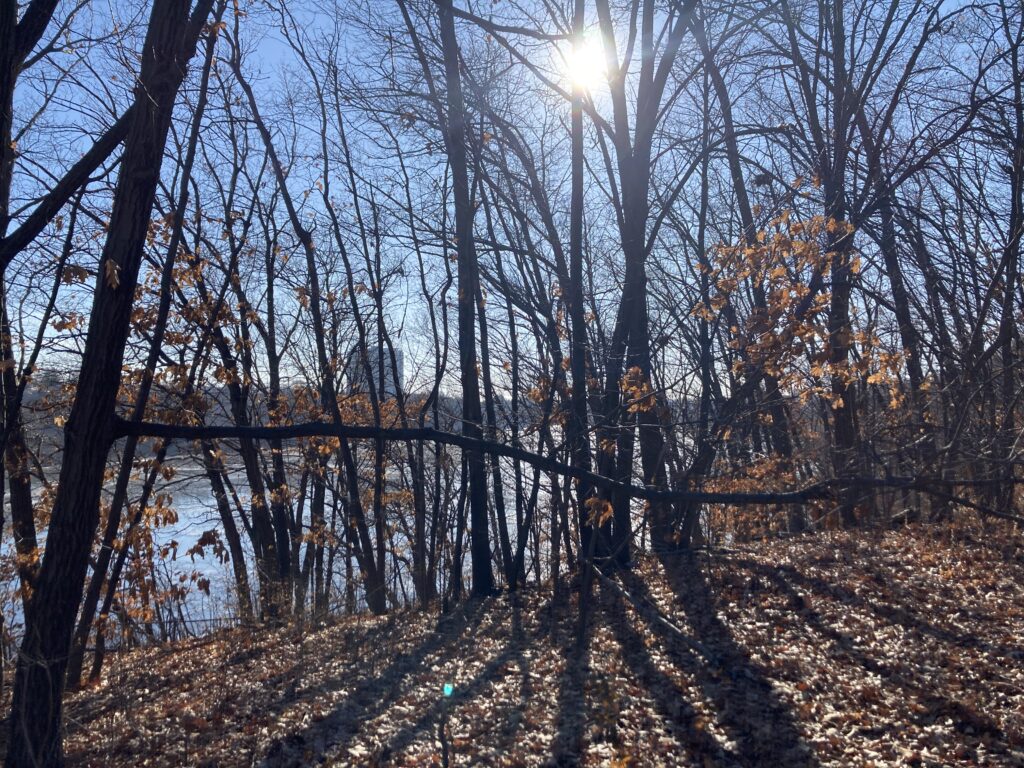
The most important thing about this image is how the branches create a net which mimics how my vision often works — I can almost see what’s there, but not quite. Secondary, but connected, is the feeling of being disoriented, off, almost but not quite, untethered, which comes from swirling forms and the climate crisis — there’s almost always snow on tthe ground here in February. Where are my Minnesota winters?

This last bit about climate crisis and lack of snow returns me to the ash in the sky and its effect on how 19th century artists saw and depicted the world. Many places to go with this, for now I’m thinking about how my vision loss (or the making strange of my vision) has enabled me to be more open (than many people with “normal” vision) to understanding vision as complex and not as simple or straightforward as “what you see is what you get.” Does that make sense?

1:50 am / dining room / 16 feb

doorways/thresholds are definitely purple — a deep, dark purple
the air above the gorge: different versions (tints/shades) of purple
purple hums, a soft lavender static in my ears
lachrymose purple 
originally wrote violet static, but looked up the color again and thought it was too dark for the static I was hearing in my head

9:46 am / front room / 16 feb

Thought more about violet. Decided to search, “Alice Oswald violet.” Found this beautiful poem:

Violet/ Alice Oswald

Recently fallen, still with wings out,

she spoke her name to summon us to her darkness.

Not wanting to be seen, but not uncurious,

she spoke her name and let her purple deep eye-pupil

be peered into.

‘Violet,’ she said

and showed her heart under its leaf.

Then she leant a little frightened forwards

and picked a hand to pick her.

And her horrified mouseface, sniffed and lifted close,

let its gloom be taken and all the sugar licked off its strangeness

while we all stood there saying, ‘Violet! Violet!’

fingering her blue bruised skin.

Finally she mentioned

the name of her name

which was something so pin-sharp,

in such a last gasp of a previously unknown language,

it could only be spoken as a scent,

it could only be heard as our amazement.

“purple deep eye pupil”: so good!

“the name of her name” — I wrote in my notes: the flower is never one solid, consistent color — the color is an abstraction, a taking one part for the whole, a disconnection — to name a color is to reduce the experience and perception of that color to one thing — colors cannot be fully named

What is lost — in our perception, experience of the world — when we reduce what we see to a fixed color/fixed name?

This question reminds me of something I read in Turning to Stone on the importance of naming yesterday:

The names themselves are, of course, human constructs, but the act of naming requires making distinctions that sharpen the powers of observation.

*

Taxonomy is comforting because it creates a sense of control and finitude in a chaotic and open-ended world.

Turning to Stone / Marcia Bjornerud

Lists! I love lists. My lists aren’t taxonomies, but something else . . .

The proper name of God is a list.

Valentina Izmirlieva in Aster of Ceremonies

Once I get the audiobook of Aster of Ceremonies, I want to put name as taxonomy and control in conversation with JJJJJerome Ellis’ “Liturgy of the Name” and “Benediction.”

feb 11/BIKERUN

bike: 25 minutes
run: 3 miles
outside temp: 1 degree/ feels like -7

Too cold for me today. Watched some races while I biked — I need to find a good movie or show!, listened to “Energy” while I ran. I stopped at 15 minutes for a few seconds, but when a good song came on — I can’t remember what — I decided to start running again. Then I kept going until I hit 30 minutes. Nice! My small victory for the day.

During the first half of the run I couldn’t quite lock into a rhythm. My feet seemed slightly off with the belt; I was on the edge of the beat. When I made the treadmill just a little faster, I entered the beat. I could barely hear my feet striking and I couldn’t feel the belt moving. Very cool. It felt similar to when I’ve locked in with the metronome. The other thing I remember is looking up at the dark window with the reflection of the light — the one that I’ve written about several times before, describing it as looking like an inverted moon on lake superior — and thinking it didn’t look like the moon anymore. I remembered why: Scott changed the light bulb from a round one to a rectangle one. It’s brighter too. My moon is gone. Bummer.

the purple hour

3:10 am / bedroom
Full moon bright, spied through the dark slats of the blinds
Slanted square of window with blinds cast in the carpet

Shadow of the blinds cast on McPherson* forearm: stripes
Only seen in dim light; the light of this iPad erases it

*a typo — I decided to keep it in here. I don’t remember what I was trying to write that would have been autocorrected to McPherson. Was it just a slip of my fingers as I typed my?

(written 11 feb, 9:30 am) I remember the moon early this morning. Wow! So bright through the blinds. I wanted to walk over to the window and peek through the slats but I was afraid that it would wake Delia the dog, asleep on the couch. It was so bright that even from the floor with the blinds closed all the way, I could see it if I tilted my head just right.

I turned down the brightness of the iPad as much as I could, but it still made the room too bright. Right after I put my iPad away, the shadows were gone. I wondered if clouds were covering the moon. But once my eyes adjusted, the shadows were back.

We inherited these blinds from the old owner of this house. They let light in even when fully closed. How dark would it be in this room if we had different (better?) blinds? How much longer would it take my eyes to adjust to (grow accustomed to?) the dark?

I think these blinds, with their gaps, create a dark that has some light: purple light.

purple thoughts/stories

violet: the very shortest spectral wavelength humans can see
to re-create the color purple requires excess: shellfish, lichen

Reading about mauve in The Secret Lives of Colors, I was reminded of the connection between old woman and purple. (I recall thinking about the connection as I ran the other day when the Red Hat Ladies with their purple clothes popped into my head.)

Soon enough, however, mauve went into that most Victorian of things: a decline. Overconsumption, as well as the continuing loyalty of an older generation, meant that the color soon became shorthand for a particular kind o faging lady.

The Secret Lives of Colors / Kassia St. Clair (170)

Then I thought about the final stanza of a poem (this whole poem is amazing, btw). I gathered for this blog a few years ago:

It’s a small deposit,
but I’m putting my faith in reincarnation. I need to believe
in the sweetness of one righteous image,
in Bill Parcells trapped in the body of a teacup poodle,
as any despised thing,
forced to yap away his next life staked to
a clothesline pole or doing hard time on a rich old matron’s lap,
dyed lilac to match her outfit.
I want to live there someday, across that street,
and listen to him. Yap, yap, yap.
(I Heart Your Dog’s Heart/ Erin Belieu)

Which led to another random thought about a recent (2019?) hair trend: lavender gray. Looking at some of the pictures I wonder if I could pull this look off — I already have the gray.

The Color Purple

Inspired by my study of purple, I decided to reread Alice Walker’s The Color Purple which I read and wrote about in my masters’ coursework. I was really into Walker and Morrison and the link between women’s spirituality and sexual pleasure. I haven’t read it since then — 25 years ago. So far — 40 pages in — I’m enjoying it. Why is it called The Color Purple? I had to look it up, because I’ve forgotten. There are plenty of answers, here’s one:

I think it pisses God off if you walk by the color purple in a field somewhere and don’t notice it.

Shug Avery in The Color Purple/ Alice Walker

A helpful source: Unearth the Root of Alice Walker’s The Color Purple. It describes the importance of nature and flowers to Walker’s vision of spirituality. This reminds me of Walker’s wonderful essay, “In Search of Our Mother’s Gardens.” Of course, I can’t find my copy of it right now. I’ll have to keep searching. The article also discusses the importance of horticulture for Black Americans and their African ancestors. I’m reminded of JJJJJerome Ellis’ Aster of Ceremony and their project of researching, naming, invoking the Plants that grew in the area where their enslaved ancestors “ran away”. A big chunk of the book is a Benediction, including the names of these plants, printed in purple. I’ve been reluctant to read it because it looked overwhelming with my bad eyes, but now I want to try. I think it will be another version of “The Purple Hour.”

update, a few minutes later: I started to read this section with my eyes, but it was difficult. I looked it up and discovered that my local library has the audio book. I requested it! A 2 week wait, but hopefully sooner. I’ll start on this whenl I can read the audiobook along with the paper book.

feb 3/RUN

4.4 miles
minnehaha falls and back
22 degrees
50% snow-covered

It snowed last night. 1 or 2 inches. By the time I went out for a run after noon, the sidewalks and bike path were cleared. I didn’t need to wear my yaktrax, but I did, so I was able to run on the snow-covered walking path. Fun! The snow was soft and slick but not slippery.

The first mile felt tough — my lower back was a bit sore — and I wasn’t sure I could make it all the way to the falls, but I stopped at the bench above the edge of the world to admire the view, then kept moving forward until I reached the falls. There was a moment in the 44th street parking lot where I thought about turning off and descending to the Winchell Trail to walk back but at the last minute I just kept going on the double bridge towards the falls. It felt less like deciding to keep going, and more like deciding not to not keep going, or not deciding anything, just continuing to do what I was already doing. I often think about and remember the moment before/ the moment of deciding to stop or give up or turn around or not. Once it’s decided, it’s over. Sometimes I have to stop, but other times I could have pushed through and kept going. One of the my goals: push through those moments.

There were at least 2 other people walking by the falls and one park plow. Anyone else? I don’t think so. It was quiet; no water falling, or creek rushing. Were there any cars in the parking lot? I don’t remember noticing.

The river was white and so was the sky and the sun. I stopped at Godfrey to let a car cross and noticed a BIG bird soaring above me. What a wing span! An eagle, maybe?

10 more things

  1. Kids laughing on the playground
  2. a few stretches of deep snow where the walking and biking trail split
  3. the smell of cigarettes as a car drove by
  4. bare pavement then a thin strip of snow on the edge of the bike path
  5. thin, short poles, placed on the edge of the sidewalk to alert plows and people of where the path is
  6. the rumble of a plow approaching in the park
  7. the green gate above the falls — closed and locked
  8. briefly running parallel to someone with a dog on the snow-covered boulevard between the river road and edmund
  9. the falls, frozen, almost all white with one dark spot off to the side
  10. the sledding hill near godfrey was empty but covered in snow, ready to be used by someone — maybe after school?

Read on a message/poetry board in someone’s yard: What are you doing to protect democracy? I initially wrote this in response: A great question, and one to ask, and try to answer, every day. But now, thinking about it some more, I don’t like the use of “protection.”

What are you doing today to support democratic communities? What are you doing to help and prevent harm? Or maybe: What can you do today to resist totalitarianism? What could you do today to make space for more stories?

sleep dreams attention distraction

I haven’t figured out my monthly theme yet, but I am orbiting around some things: dreams, sleep, insomnia, restlessness, distraction, non-thought, reverie, stillness, Anne Carson, JJJJJerome Ellis and stuttering, the space between beats or fully inside the beat. Swirling, looping, circling — not coming or going in any one direction, but surrounding.

Today’s cluster is inspired by recent encounters with:

1

Distraction is a time between times, a time in which we become momentarily subject to the non-thought inside thought.

In Search of Distraction

2

Is it, in fact, good to pay attention? Whose purposes does it serve?

*

The loudest calls to attention have been directed toward subordinates, schoolchildren, and women. “Atten-TION!” military commanders shout at their men to get them to stand straight. The arts of attention are a form of self-discipline, but they’re also ways to discipline others.

*

Successful attention capitalists don’t hold our attention with compelling material, but, instead, snatch it over and over with slot-machine gimmicks. They treat us as eyeballs rather than individuals.

*

Is the ostensible crisis of attention, at bottom, a crisis of authority? Is “people aren’t paying attention” just a dressed-up version of “people aren’t paing attention to me?

*

Ours is an era of obsession as much as distraction, of long forms as much as short ones, of zeal as much as indifference.

Check This Out/ Daniel Limmerwahr

3

The best remedy for insomnia, as with most things in life, is learning to live with it. In time, we come to understand that the psychological cost of stressing over sleeplessness is greater than the physical cost of not having slept, and so we adjust.
*
Insomnia is a mark of the insubordinate imagination.
*
To be awake is to be alive. Mind racing at 3 A.M., we are in tune with what may be the truly unique, only-once-in-the-universe gift of consciousness. That’s some comfort. We’ll sleep long enough soon enough.

Chasing a Dream/ Adam Gopnik

jan 28/BIKE

25 minutes
basement
outside: wind gusts, 32 mph

I woke up with a sore right glute/lower back. Not terribly painful, but sore and a bit worrisome. Wanted to run in the warmer weather but wondered if it was a bad idea. Then I heard the howling wind and decided to believe that it was a sign: don’t run! So I went to the basement and biked instead. It helped! I should work on biking longer in the basement. It’s boring. My bike is on a basic stand — no shifting, no zwifting, just pedaling and watching something on my iPad. Today I watched some races; next time, a show or a movie.

Before my bike: I’m in the process of re-reading all of the poems I gathered this year and choosing lines to turn into my own poem. This process inspired three directions of thought:

1 — open

The airy sky has taken its place leaning against the wall.
It is like a prayer to what is empty.
And what is empty turns its face to us
and whispers:
“I am not empty, I am open.”
(Vermeer/ Tranströmer)

When the door of my vocal cords closes, another opens. And through that open door I escape into a region I do not know what to call but which is vaster than the space of my body. You could say: my name is the door to my being, and in that interval when I’m stuttering, the door is left wide open and my being rushes out. What rushes in?
(from Liturgy of the Name/ JJJJJerome Ellis)

Open doors say, “Come in.”
(Doors/ Carl Sandburg)

This discussion of open doors reminded me of something I remembered thinking/writing about in a log entry, but not when I wrote it. It took a few minutes, but I found it!

Running north, somewhere above the white sands beach, I started thinking about something I was working on earlier today about how my changing vision is closing some doors, opening others. I’m particularly interested in thinking about how it opens doors without ignoring/denying the shut ones too. Anyway, I suddenly had a thought: it’s not just that it opens doors, but it makes it so those doors can’t shut. I waited until I reached the bottom of the hill and then spoke my idea into my phone. Here’s a transcript:

It’s not just that doors open, they won’t shut. I can’t close them to the understandings that I’m both forced to confront but also have the opportunity to explore. But the key thing is that the doors can’t be shut. my notes recorded during a run on 3 may 2023

I came to this idea after thinking about how vision is strange and tenuous and a lot of guesswork for everyone. A big difference between me and a lot of other people is that I can’t ignore or deny that fact. It’s much easier for people with “normal” vision to imagine, with their sharp vision and their ability to focus fast, that they are seeing exactly what is there. They’re not. Even if I wanted to, I can’t pretend that that is true. I’m reminded all of the time of how tenuous converting electrical impulses into images is and what the brain does for us to make those images intelligible.

log entry from 3 may 2023

2 — walls

The ears experience a buzz, perhaps it’s depth or perhaps height.
It’s the pressure from the other side of the wall,
the pressure that makes each fact float
(Vermeer/ Tramströmer)

I wandered all along the street that hugs the walls,
a needle floating
on its cloth. Once
I shut my eyes and felt my way
along the stone. Outside
is the cash crop, sunflowers, as far as one can see. Listen,
the wind rattles in them,
a loose worship
seeking an object
an interruption. Sara,
the walls are beautiful. They block the view.
And it feels rich to be
inside their grasp.
(To a Friend Going Blind/ Jorie Graham)

Here I’m thinking about inner and outer and the interior walls of a house and the limestone and sandstone and concrete walls of the falls and lock and dams and the gorge.

3 — blind

What Would You Give Up?/ Dorianne Laux    

Not the nose on my face, but the spite, the grindstone.
Not an arm or a leg, but the money.
Not the length of the arm, but the lie, the shot, the list, the twist.
Not the ear, but the lending, the boxing, the out on.
Not the eye, but the naked, the catching, in the blink of, 
the keeping it peeled, the turning a blind.
Not the elbow but the grease, the room.
Not the leg, but the pulling.
Not the back, but the shirt on, the breaking of, the scratch, the
     stab, 
the turning, the water off a duck’s.
Not the neck, but the sticking it out, the in-shit-up-to. 
Not the throat, but the jump down, the frog in.
Not the feet, but the ground, the dragging, the cold.
Not the heel, but the down at, the under.
Not the fingers, but the light, the butter.
Not the thumb, but the green, the sore, the twiddle. 
Not the tongue, but the slip.
Not the tooth, but the nail, the long in, the sweet.
Not the brain, but the drain, the picking of, the all brawn and no.
Not the breast, but the beating. 
Not the body, but the temple.
The bird in the hand, the foot in the grave.

This poem is one of five published in the Cortland Review in the spring of 2009. As an aside, the spring of 2009 was when I started my first blog, TROUBLE, which transformed my life, and also when my mom was in the final stage of pancreatic cancer; she died in the fall of 2009.

Not the eye, but the naked, the catching, in the blink of, 
the keeping it peeled, the turning a blind.

Yes, let’s give up these expressions. I am reminded of Naomi Cohn and her listing of expressions using blind:

Entries from the Braille Encyclopedia (excerpt) / Naomi Cohn

Blind

Blind alley a dead end.
Blind pig an illegal saloon.
Blind drunk what you get there.
Blind staggers a disease of horses.
Blind story floor of a building without windows.
Blind spot where the car lurks in the next lane.

Looking for this writing, I discovered that Cohn’s book, Braille, is finally out! How did I miss that it was published this past October? Oh, I know — I was worried about the election and dealing with the mental health crises of my two kids! I immediately ordered Cohn’s book at my local awesome book store, Moon Palace! Pick up later today. Hooray!

Didn’t Georgina Kleege do a riff on “blind” in her book, Sight Unseen? Just checked, yes!

The word blind has always meant more than merely the inability to see. The Anglo-Saxon translators of the Gospels make the metaphoric leap from literal sightlessness to spiritual or cognitive incapacity. Of course they were only following an ancient lead. Throughout the history of the language and in common usage today, the word connotes a lack of understanding or discernment, a willful disregard or obliviousness, a thing meant to conceal or deceive. In fact, when you stop to listen, the word is far more commonly used in its figurative than its literal sense. And it comes up so often: blind faith, blind devotion, blind luck, blind lust, blind trust, blind chance, blind rage, blind alley, blind curve, blind-nail flooring, blind date (more dangerous than you think), duck blind, window blind, micro-mini blind (when open, they’re hard to see), blind taste test, double-blind study, flying blind, following blind, blind leading the blind, blind landing, color blind, blind submission, blind side, blind spot, blindfold, blindman’s bluff, three blind mice (have you ever seen such a sight in your life?).

Sight Unseen/ Georgian Kleege

memories

Writing about walls and the inner and outer, I started thinking about Severance and innies and outies and the relationship between them. Scott and I are listening to the Scott/Stiller podcast recapping the first season and watching all of the episodes, before screening season 2. Anyway, I remembered Helly R’s consent speech:

My name is Helly R. I’m making this video roughly two hours before it will be shown to me. I have, of my own free accord, elected to undergo the procedure colloquially known as severance. I give consent for my perceptual chronologies to be surgically split, separating my memories between my work life and my personal life. I acknowledge that, henceforth, my access to my memories will be spatially dictated. I will be unable to access outside recollections whilst on Lumon’s severed basement floor, nor retain work memories upon my ascent. I am aware that this alteration is comprehensive and irreversible. I make these statements freely.

What does the severing process do to the brain? Is it all about dividing inner and outer memories? What is the role of memory and remembering in the forming/understanding/experience of selfhood? Irving gives a little speech about how our sense of self is shaped by our memories/stories/history to Helly in episode 3:

It’s an unnatural state for a person to have. No history. History makes us someone. It gives us a context, a shape.

jan 13/BIKERUN

bike: 30 minutes
run: 1 mile
basement
outside: 3 degrees / feels like -3

Cold and icy and windy outside, so inside in the basement for me. Watched an old track race while I biked, listened to my remember to forget playlist as I ran. Happy to move my legs and work up a sweat. What did I notice? I don’t remember.

remember — inheritance

gestures, ways of speaking, expressions, eye diseases, anxiety disorders, curiosity, persistence, restlessness, strong legs, a love of water, a need for being outside, the impulse to run away, an edge dweller, conflict avoider, a storyteller

for more on inheritance, see 4 nov 2021

Mary Ruefle and I Remember

I remember a lecture I read by Mary Ruefle in Madness, Rack, and Honey.

Thinking about “I Remember” and remembering, origins and when things began. I thought about how there is a sort of origin point to all of this (my writing poetry) and it’s my eye doctor diagnosing me with a rare eye disease then saying, you should write about it which prompted me to want to work on my writing so I could better explain what I was experiencing. But, I had already been writing and already had those desires, so it was really more of a slight shift, a stutter step or a quick stumble off the path, just briefly, which changed the trajectory, slightly, incrementally. Difficult to pinpoint what all changes your path.

9 may 2023

remember my name

The first song that came up on my playlist was Fame. As I listened to the lyrics — Fame! I’m gonna live forever / Baby remember my name — I started thinking about being remembered forever and fame and names and immortality and Emily Dickinson and JJJJJerome Ellis and their “Liturgy of the Name” in Asters of Ceremonies.

from Liturgy of the Name/ JJJJJerome Ellis

My name, in the time when I cannot utter it, maps the space within me. In an instant the Stutter shuttles me from the present–the barber just asked me my name, my voice fluttering in my throat, struggling not to tremble as the razor presses on my temples–to an ancient place of breath, name, silence, time, creation.

. . .

When the door of my vocal cords closes, another opens. And through that open door I escape into a region I do not know what to call but which is vaster than the space of my body. You could say: my name is the door to my being, and in that interval when I’m stuttering, the door is left wide open and my being rushes out. What rushes in?

jan 11/WALKYOGA

walk – 30 minutes
neighborhood
26 degrees

Winter white. White sky, white grass, white sidewalks — at least some of the sidewalks are still white. Warmer. Still, quiet, calm. Deep breaths — ahhh! cold air! A happy dog. Walked past 7 Oaks and thought about how it’s a sinkhole. then wondered how long it’s been this way. “Thousands of years” was as specific as I could get. While looking for its age, I also found a Sinkhole Study from a few years ago. I’ll have to look through it when I have more time.

yoga – 30 minutes

Two days ago, I promised to try out a low vision yoga video. Loved it!

The slow and careful way that the instructor described the movements was very helpful. Similar to audio descriptions on shows and movies, I didn’t realize how much I needed a description of the moves until I had one and could feel the difference — easier, less stressful.

grass

This morning, during my “On This Day” practice, I re-encountered these lines from Victoria Chang in her poem, “Left Behind”:

We are carriers
of grass yet to be grown. We
aren’t made of cells, but of fields.

Then, while reading JJJJJerome Ellis’ “Benediction” in Asters of Ceremony, I encountered these beautiful lines,

The more I live with my stutter, with the Stutter that I steward in my body, the more I feel and know, or unknow, that this stutter is no less a part of the earth than the rest of my body. This stutter has come from the land and the water. It knows the Plant Elders, and there is much I can learn, and have learned, about my stutter by spending time with these Elders. Names run through the Grasses, and when I stutter on my name, I am brought into the field.

Benediction from Asters of Ceremony/ JJJJJerome Ellis

Both Chang and Ellis, but especially Chang, reminded me of Mary Oliver’s mention of grass in The Leaf and the Cloud:

Listen, I don’t think we’re going to rise
in gauze and halos.
Maybe as grass, and slowly,
Maybe as the long-leaved, beautiful grass.

jan 10/RUN

4.5 miles
minnehaha falls and back
21 degrees
100% snow-covered

Today the winter I want: big flurries, everything covered in a thin layer of snow, not too much wind, warmer, not slick — especially with my with Yaktrax on. Nothing was quite easy, but everything wasn’t as hard as my last run on Wednesday.

10 Things

  1. a white sky
  2. the contrast between shoveled and un-shoveled sidewalks — both still white, but the shovelled ones had a tint of gray or brown peeking through
  3. the clacking jawbone of a bird’s beak — a blue jay?
  4. the river was all white — if you didn’t know better, you could believe it was a field or a meadow
  5. approaching from above, hearing the falls rushing over the limestone
  6. kids yelling and laughing at the playground, one loud, high-pitched sound — was it a kid screaming or a whistle?
  7. amongst the kid voices, a deeper, more knowing laugh — was that from a teacher?
  8. the contrast on the creek surface: white snow with blackish-gray water
  9. every so often, a flash of orange — not always sure what it was, just a voice whispering, orange — a snow fence? a construction cone? a sign?
  10. bright headlights cutting through the sky, which was both bright — everything white! — and heavy

Listened to my “Remember to Forget” playlist on the way back. The first song up, Do You Remember Walter? by The Kinks. Two different bits stuck with me:

one: Walter, you are just an echo of a world I knew so long ago.
two: Yes, people often change./ But memories of people can remain.

This second bit got me thinking about how I can’t always (can I ever?) see faces clearly. When the face is too dark and shadowed, I just ignore it altogether. But when there’s some light and I can sort of see them, I often re-construct the features I can’t see with memories of their face from before I lost most of my cone cells. I’m not remembering their face, but creating it. After thinking that the idea of remembering as re-memembering — putting a body back together — popped into my head. Yes! I take my image of face, only as fragments — the curve of a nose or a chin, a bit of eye — and turn it into something whole.

As I kept running, I thought more about remembering and memories and my vision and how I rely on past experience and habits to navigate. And now as I write this, I’m thinking about how everyone’s vision — not just mine — relies on a building up of past experiences (memories?) with things to be able to see them. Here I’m remembering something that I read in Robin Wall Kimmerer’s Gathering Moss:

the sensation of sudden visual awareness is produced in part by the formation of a “search image” in the brain. In a complex visual landscape, the brain initially registers all the incoming data, without critical evaluation. Five orange arms in a starlike pattern, smooth black rock, light and shadow. All this is input, but the brain does not immediately interpret the data and convey their meaning to the conscious mind. Not until the pattern is repeated, with feedback from the conscious mind, do we know what we are seeing.

Learning to See in Gathering Moss/ Robin Wall Kimmerer

I’m continuing to read JJJJJerome Ellis’ Aster of Ceremonies. Wow!

Prayer to My Stutter #2/ JJJJJerome Ellis

You restore
a living
shoreline
between word
and silence

This beautiful prayer moves right into the next offering, Octagon of Water, Movement 3, which was titled by its first line when it was published in Poetry:

excerpts from The name of that Silence is These Grasses in the Wind/ JJJJJerome Ellis

1

The name of that silence is these grasses in this wind, and the name of these grasses in this wind is that other place on the other side of this instant. This instant is divided by curtains of water and the sound of shuddering time. A sunflower reeling with sun, six hands stretched in offering. This unsearchable, uncancellable instant wraps the shoulders of the grasses like a shawl stilled by the stoppage. 

How is/isn’t the instant similar to Marie Howe’s moment? If you listen to the recording on Poetry, you can hear the stretched silence as Ellis’ voice stops before pronouncing certain words.

2

This morning come shyly or boldly into the fertile field, however you are, come, come and stay in the rearrangement, the pressure of thumb on fescue blade, a year wheeling within a day, two round moments of warm mouth, finally at peace. The psalm is a key if only we can find the door. Do not swallow your dysfluent voice. Let it erupt in its volcanic flowering. Stoppage thence passage, aporia, poppy bursting with fragrant seed. 

What a beautiful description and reclaiming of a stuttering voice on the other side of the stoppage! The erupting bursting flowering dysfluent voice.

I’m inspired by how Ellis takes his stutter and turns it into this beautiful instant between silence and word. For them, the stoppage is a/the key aspect of the stuttering. What are the most important elements of my strange vision?

jan 8/RUN

4.5 miles
minnehaha falls and back
12 degrees

Another sunny, sharp shadow day. Ran south to the falls and listened to cars, birds, kids on the playground, and some guy coughing too loudly. Stopped at my favorite spot to admire the falls, then put in my “Remember to Forget” playlist. Sometimes I felt strong, and sometimes I felt tired. My legs wanted us to stop. I did a few times, including at the bench above “the edge of the world.” I took two pictures. One had a clearer view of the ice on the river, but I picked the other one, with its branches and shadows and white sun:

Most of the image is of dark, bare branches and their shadows on a snow-less ground. Through the trees is an iced river and the sun.
above the edge of the world / 8 jan 2024

10 Things

  1. chirping birds
  2. my shadow, clear and strong
  3. shadows of trees in the park, soft and fuzzy
  4. a shadow of the lamp post, sharp and menacing
  5. someone who looked like Dave the Daily Walker from behind — a tucked shirt and not jacket, tucked into dark track pants — but wasn’t
  6. the creek — bright white snowy surface mixed with fast, flowing water
  7. the falls were gushing through the ice columns
  8. a man with a bad cough near the overlook
  9. a cold wind on my ears when I put my hood down
  10. the shadow of a tree sprawled across the trail that dips below the road, looking like an actual branch that might hit me as I ran by

For a moment, I thought I had completely forgot running the stretch down to, then over, the bridge that crosses above the falls, but then I remembered it: what the creek looked like, seeing some people (one of them, the man with the cough) as I crossed, but then not seeing them, and then seeing them again near the closed gate.

before the run

Last night, I started reading JJJJJerome’s Aster of Ceremonies, which I bought in october of 2023 and hadn’t read yet. Wow! Here’s a bit I’d like to take with me on my run:

What is the wound
reopening during the stutter?
How does it relate
to Morrison’s flooding? When
the Mississippi returns
to its former contours,
does the suture
we created by straightening
it open?
(Octagon of Water, Movement 2/JJJJJerome Ellis)

Last week, I was just writing about how the natural shape of the Mississippi River in the gorge is long gone, reshaped by the city and the Army Corps. After my run, I’ll read Toni Morrison’s essay to which Ellis refers.

added a few hours later: I tracked down the quotation that Ellis puts in a footnote for this poem from Toni Morrison in The Site of Memory (1995, 99):

You know, they straightened out the Mississippi River in places, to make room for houses and livable acreage. Occasionally the river floods these places. “Floods” is the word they use, but in fact it is not flooding; it is remembering. Remembering where it used to be. All water has a perfect memory and is forever trying to get back to where it was. Writers are like that: remembering where we were, what valley we ran through, what the banks were like, the light that was there and the route back to our original place. It is emotional memory – what the nerves and the skin remember as well as how it appeared. And a rush of imagination is our “flooding.” Along with personal recollection, the matrix of the work I do is the wish to extend, fill in and complement slave autobiographical narratives. But only the matrix. What comes of all that is dictated by other concerns, not least among them the novel’s own integrity. Still, like water, I remember where I was before I was “straightened out.”

The Site of Memory/ Toni Morrison

So good! I’m excited to think about these ideas some more and figure out my relationship to flooding and being straightened out and rivers before and after Minneapolis and the Army Corps of Engineers “fixed” them.

Thinking about Ellis’ stutter in relation to my vision problems. In some ways, I have a visual stutter — there’s a long pause between looking at something and actually seeing it. I need time for things to make sense. Also, images stutter, shake, fizz, are always moving, never still or sharp or clear.

remember/forget

1 — will

the differences between what we notice and try to remember and what we ignore or try to forget (16 april 2024)

2 — memory

When I heard the line, Seems like we’re livin’ in a memory, I thought about how I mostly can’t see people’s faces clearly and that I’ve either learned to tune it out and speak/look into the void, or I just fill in the smudge with the memory of their face. I’m used to it, and often forget I’m doing it until suddenly I wonder as I stare at the blob, am I looking in the right place, into their eyes, or am I staring at their chin? I don’t care, but I imagine the other person might, so I try to find their eyes again (9 may 2024).

In jan of 2024, I’m thinking about the daily, mundane bodily functions that we forget we’re doing, or don’t notice — what’s the difference between not noticing and forgetting here? I’m also thinking about this idea of memory and its relationship to the real. When is remembering “only a memory” and when can the act of remembering keep something real? Can we understand remembering as more than thinking about things from the past? What about remembering what is present, here still, real, connected to us?

3 — pay attention, be astonished, tell about it

Thinking more about the difference between noticing and remembering, I’m thinking about the different acts involved here. Yes, it is inspired by Mary Oliver’s instructions for living a life! First, we notice, then we are open to feeling something about what we noticed, then we put that noticing and our feelings into words. For my practice, I don’t try to remember to notice or to be astonished, they just happen — at least, that’s the goal. Remembering comes in when I try to put my attention and astonishment into words. So, the connection between writing and remembering.

4 — writing to remember

I’m not writing it down to remember it later, I’m writing it down to remember it now.

Field Notes slogan

Many different directions I could go with this idea of remembering and writing, but I like this idea of the act of writing about something as the remembering. I rarely look back at my (Field Notes brand) Plague Notebooks when I’m finished with them; it’s the act of writing in them that helps me remember what I noticed or was thinking about. This method is approximate and doesn’t work all of the time. In my practice, I use the act of making a list on my log of 10 things I noticed as the moment of remembering what I didn’t even realize I noticed. But, unlike my plague notebooks, I do return to my log to read past entries and remember what I wrote before — in at least 3 ways: my monthly challenge pages in which I review and summarize what I did in relation to my theme each month; my “on this day” morning reviews, in which I reread past entries from that day in different years; and my annual summary, month-by-month of my log entries.

5 — forget the body

I like my body when I’m in the woods
and I forget my body. I forget that arms,
that legs, that nose. I forget that waist,

that nerve, that skin. And I aspen. I mountain.
I river. I stone. I leaf. I path. I flower.
(Yes, That’s When/Rosemerry Wahtola Trommer)