april 3/RUN

3.15 miles
2 trails
41 degrees
wind gusts: 35 mph

Windy! Overcast. Quiet. A good run. Slow and relaxed until I reached a runner ahead of me with a dog who stopped then started then stopped again. At this point, I passed them and picked up the pace, hoping to avoid any more encounters. It worked! I felt good enough to keep running faster and faster. Fun!

Listened to the wind and some yelling in the gorge running south and on the winchell trail. Put in my winter playlist for the last mile, heading north on the trail.

10+ Things

  1. wind 1: soft, gentle, haunting wind chimes
  2. wind 2: a small branch of a pine tree with some green needles on the sidewalk
  3. wind 3: a swishing ponytail
  4. an empty playground, or a quiet playground
  5. nearing the Cleveland overlook: the memory of the very LOUD knocking of a woodpecker
  6. an open view of the river — can’t remember what the river looked like, just that it was wide and open
  7. mud on the trail
  8. empty benches
  9. the strong smell of weed in the 36th street parking lot
  10. wind 4: leaves scratching the street
  11. wind 5: a white plastic bag rolling across the street, then stopping in the middle, once side being lifted up
  12. wind 6: a waving bush

before the run

The difference between a sunset and a sun set/ting.

or, the moment or the space that exists between a sun set/ting and a sunset. Ever since I read James Schuyler’s “Hymn to Life” and misread a sunset for a sun set, I’ve been thinking about the difference between them — one is a object (sunset), the others an action (sun set) or a process (sun setting). The difference between something fixed and something happening, moving, doing. Why does a sun set/ting appeal to me more? One obvious reason: understanding the sun as a subject, the natural world as an actor. Another reason: movement. A sunset is a fixed image, a sun set/ting moves. Poetry is about movement — associations between ideas, the flow of words and rhythms, the refusal to land (stand still) on one meaning or ending for too long or at all. My life is about movement — restlessness; the practice of running and writing; a difficulty in ever seeing objects as fixed, always slightly fuzzy, buzzing like static, not flickering but bouncing or shaking (or something like that). (quick thought: I’m drawn to light, but just as much to motion. How true is that for people with all of their cone cells?)

note: writing about this sparked new ideas, including a tentative focus for April, and some thoughts for a artist statement — more on that below.

Since last month, I’ve been playing around with a poem that attempts to describe the differences between a sunset and a sun set/ting. It’s slow-going. Here’s something to add to my already swirling, meandering thoughts: it’s a poem by Nikky Finney from Ross Gay’s discussion of her work in his talk, Be Camera, Black-Eyed Aperture. It’s not about a sun set/ting, but one rising. The italics are Gay’s; I’m keeping them because they’re helpful for seeing the connections to the movement of a sun set/ting:

The Squatting Sun/ Nikky Finney

6:38, flying east, I witness birth,
pushing out of the blushing vaginal rim

like some wide cherry-dropped child.
All the colors that make red have come

to the only straight line on the earth.
Ghostly, I blink, my eyes tweak her nipples,

she releases and the head does not wait
for my awe.

I thought I knew what red looked like.
Believed I had seen this daily drama before;

the earth in morning-mother motion,
the first bowl of earth-bread sipped,

but never had I been asked
inside the sun’s womb so deep.

What I see has so much to do
With the permission to look
.

My egg-white eyes labor to midwife
this moment out all the way.

The baby day pushes clean,
a quarter rim of cherry-spilled earth

lands in a head-back wail
inside my ladling pupils,

the first rising brightness, its long
equatorial head bursts, then crests;

new life passed on
to a pan of waiting salted water.

Some thoughts on the poem by Ross Gay:

. . .this poem witnesses the quiet interior horizon of experience, during which the unfathomably beautiful emerges, and is the contemplation of it. As Finney says, “I thought I knew what red looked like, / believed I had seen this daily drama.” Indeed, it’s the quiet looking that brings the sunrise, the day, wailing into the speaker’s eyes. 

Be Camera, Black-Eyed Aperture/ Ross Gay

Gay’s mention of quiet looking here is about black interiority and comes from Kevin Quashie’s The Sovereignty of Quiet. I’m thinking about the quiet looking as the labor it takes to see something — the process from light to cell to signal, from retina to optic nerve to brain, from being distracted to quieting to noticing. Usually, this labor is invisible; we believe we just see things, they are just there for our camera eye or eye-as-camera to see.

Whew — that’s a lot to think about and to try to make sense of. Anyway, back to what this sunset and sun set/ting thread inspired. An April challenge: wind! And, some thoughts for an artistic statement:

To describe the world (primarily in poetry) from the perspective of the peripheral and from where some central vision exists but is not/no longer centered. . . . new ways of writing about noticing the world that don’t center central vision or that rely on but don’t center peripheral vision (because peripheral vision, by virtue of how it works, can never be centered in the same way that central vision was/is). . . . a few images I’m currently obsessed with: birds, wind, the idea of the Form, not as Platonic but as vague, basic, lacking the specificity of focus — Tree Bird Cloud. 

after the run

After I finished the run, I took out my phone and recorded some thoughts, including:

Somewhat similar to sunset vs. sun set/ting: windblown vs. wind blowing
windblown = evidence that wind existed, witnessed, after the fact
wind blowing = moving through a seemingly invisible force that is happening right now

another example: the absence of birdsong — very quiet, which could have been caused by the birds not singing in the wind, but also by the wind carrying the sound elsewhere

birding: thought about the memory of the woodpecker’s knock near the overlook

i.

an echo
almost

memory
of dead

wood hit hard
somewhere

across the
ravine

ii.

Quiet. Not
absence

of singing
birds but

the presence
of wind

carrying
their notes OR their tune

somewhere else.

A good start. I don’t think I should use somewhere for both.

wind!

So many possibilities for this monthly challenge!

  1. Gathering all of the wind poems I’ve already collected.
  2. A wind playlist.
  3. Tagging related entries with “wind”.
  4. Reading The Wind in the Willows, which I was reminded of by Mary Ruefle when she described it as one of her favorite book on a podcast.
  5. Exploring the idea of wind as both a noun for a weather condition and a verb for wrapping something around something else — a scarf around a neck — or for traversing a curving course.
  6. Returning to the Beaufort Scale

april 2/RUN

5.2 miles
ford loop
38 degrees
snow flurries into rain drops

Woke up this morning to snow. What? A little stuck on the deck but nowhere else. Sometime during the run it turned into rain. Or, was that sweat? I think it was rain.

A good run. Right before I left the house, I had a little calf pain — a few flares of dull pain. Why? Not sure, but I decided it would be fine. In fact, it might help to go out and move. It was and it did. Whenever my calf grumbled, which it didn’t do very often, I sang the song, “Old Friends” from Merrily We Roll Along in my head. Hey old friend/ are you okay old friend? I’m trying to shift my perspective and remember to think about my body, pain, worry as old friends.

Before the run, I was adding some things to my “How to be” project on Undisciplined about not looking away:

An occasional poem by Danni Quintos:

Once I wrote a poem on a bridge
because you told me to find my ghosts.
I remembered you once said, Our job as poets
is to not look away. I looked & wrote
the scariest thing I could think & after
you read it, you gave me a book
(to borrow) which I hugged so hard
that the million synonyms inside
could hear my heart beating.

This looking, described above by Finney and Quintos, this black-eyed opening—this not looking away—is a poetics, yes, but as any poetics is, it is also an ethics. What we look at, what we see, and how, and if we say what we see, is an ethics.

Be Camera, Black-Eyed Aperture / Ross Gay

Unable to see faces, often staring into a void or a smudge or a darkness, it is hard to see, difficult to not look away. How do I reimagine this ethical beholding in ways that I can practice? What might not looking away mean without the looking? Not turning away? 

This is a problem of language, and more than a problem of language, I think. 

Behold is to eyes as ___ is to ears?
An ear-witness?

While I was running, I wanted to think about how I could reframe this not looking away. What does being present, noticing, witnessing mean for me? A thought popped into my head: be with the bird. To be with the bird — to notice them, not try to identify or know or classify them. Ever since I heard J Drew Lanham discuss this concept with Krista Tippett, I’ve loved it. Today I tried to be with the birds. Mostly I was, except for when my calf flared or when I smelled burnt toast —

The other day, I told my son that it smelled like coffee or burnt toast outside. He asked jokingly, are you having a stroke? Maybe I’ve heard this before and had forgotten, but the smell of burnt toast is, according to Scott and FWA, the sign of a stroke. . . . Just looked it up, and there’s no evidence to support that claim. Whew. Anyway, it is irritating and ridiculous and embarrassing to admit that I did contemplate whether or not I might be having a stroke as I smelled the burnt smell. Fairly quickly I concluded: no fucking way. It’s just smoke from somewhere.

Be with the Bird, 10 Things

  1. the soft, sharp knocking on wood somewhere
  2. a flicker from a tree branch, flight, then a shower on my head, then birdsong
  3. an eagle-less tree by the bridge
  4. tweet tweet tweet
  5. chirp chirp
  6. fee bee
  7. a thought: could it be what I’m hearing is not birdsong, but bird warning calls alerting others to my presence?
  8. birds singing in the far off trees
  9. birds calling in the bushes beside me
  10. another thought: do birds like the rain?

a few poetry inspirations

1 — my weather description: snow flurries into rain drops. This transformation of states reminded me of a poem I read in an entry of april 2, 2020:

Because You Asked about the Line Between Prose and Poetry/ Howard Nemerov – 1920-1991

Sparrows were feeding in a freezing drizzle
That while you watched turned to pieces of snow 
Riding a gradient invisible
From silver aslant to random, white, and slow.

There came a moment that you couldn’t tell.
And then they clearly flew instead of fell.

Of course today, the water went the opposite way, snow to rain. So poetry to prose?

2 — to rain, raining. As I ran beside the gorge, I frequently heard water falling below me. The snow/rain was creating waterfalls on the limestone and through the sewer pipes, making it sound like it was raining. Suddenly I thought: there’s no rain, but it’s raining, which reminded me of a poem I posted a few days ago:

an excerpt from Raining, Outlined/ Margarita Pintado Burgos

Translated from the Spanish by Alejandra Quintana Arocho

The forest. To say the forest. To suggest some music.
To carve the breeze.
To see a landscape. See it raining. Without rain but with raining.

march 6/RUN

3.45 miles
trestle turn around
48 degrees

Another run with no calf pain! Wore my compression sleeves again. My left IT band hurt a little and my legs felt heavy and tired, but no calf pain — victory!

IT fun: I think, I theorize, I twist, I triumph, is tall, is taught, is taut, is temerous*, is tiny, itchy tetherballs, iffy tire-swings, impossible teeter-totters

*temerous: this word appears several times in the great book I’m listening to right now: The Ten Thousand Doors of January

Today the river was brown. Is that all I remember about the run? There were a few moments it was easy, effortless, but mostly it felt difficult.

Heard lots of birds — lots of irregular, out-of-sync rhythms. A few drumming woodpeckers. My nose kept almost running. Thought I heard some voices down in the floodplain forest.

Ended at 7 Oaks. Recited “I felt a Funeral in my Mind” and thought about rhythms and interruptions and sense breaking through.

Before the run, I wrote about clocks, priming myself for noticing rhythms while I ran:

That 12-figured Moon Skull!

Today, I’m inspired by my march 6 entry from last year. Here’s what I wrote in that entry:

During the run I listened to the latest “Nobody Asked Us with Des and Kara.” They were talking about recent races, super shoes, fast times, and the future of track. Reflecting on how world records keep being broken Kara asked Des: “What do you think would happen if they took away the clock? Would the race still be exciting?” Des thought it could be, while my mind started wandering. First thinking about how I’ve been trying to forget the clock/watch and not care about pace — mostly, I’ve been successful. Second thinking about Clocks and how I’ve collected some lines (from poems and essays) about the clock, or what Mary Oliver calls it: 

The clock! That twelve-figured moon skull, that white spider belly! How serenely the hands move with their filigree pointers, and how steadily! Twelve hours, and twelve hours, and begin again! Eat, speak, sleep, cross a street, wash a dish! The clock is still ticking. All its vistas are just so broad–are regular. (Notice that word.) Every day, twelve little bins in which to order disorderly life, and even more disorderly though. The town’s clock cries out, and the face on every wrist hums or shines; the world keeps pace with itself. Another day is passing, a regular and ordinary day. (Notice that word also.)

Upstream/ Mary Oliver

So many places to go with the idea of the Clock. Mary Oliver’s ordinary versus extraordinary time. Routines, habits, delight in the daily, repeated events. The Moment between time and its tight ticks, or right before something has happened, or when time (and sense) are disrupted. The time of the day dream. Outside of time and its relentless march forward, towards Death, motivated by progress. Losing time, syncing up with time. What other ways to we have for measuring meaning that don’t involve time passing?

Yes, so many ways to think about the idea of time and clocks!

interjection: Listening to an Apple playlist, ’70s Movie Essentials, and the song, “Time Warp” just came on.

pace definitions (from Merriam Webster)

  • rate of movement, the runner’s pace, especially : an established rate of locomotionrate of progress
  • specifically : parallel rate of growth or development, supplies kept pace with demand
  • rate of performance or delivery : TEMPO, a steady pace, on pace to set a record, especially : SPEED
  • rhythmic animation : FLUENCY
  • a manner of walking : TREAD
  • any of various units of distance based on the length of a human step
  • GAIT, especially : a fast 2-beat gait (as of the horse) in which the legs move in lateral pairs and support the animal alternately on the right and left legs
  • verb: paced; pacing — to walk with often slow or measured tread, to move along : PROCEED, to go at a pace —used especially of a horse
  • to measure by pacing —often used with off: paced off a 10-yard penalty
  • to cover at a walk — could hear him pacing the floor
  • to establish a moderate or steady pace for (oneself)
  • to keep pace with

my new pace: rhythm

I sink in
to a

rhythm: 3
then 2

First counting
foot strikes

then chanting
small prayers.

I beat out
meaning

until what’s
left are

syllables,
then sounds,

then something
new, or

old returned.

My rhythm for breathing, running, and writing. . .and for possessing favorite lines:

from “Practice”/ Ellen Bryant Voight

original:
at night in order to weep, to wait
for the whisker on the face of the clock
to twitch again, moving
the dumb day forward—

mine, in 3/2 rhythm:
wait for the
whisker

on the clock’s
face to

twitch again
to move

the dumb day
forward.

original:
if I came back as a bird
I’d remember that—

mine: 3/2
You — when I
come back

as a bird
will I

remember?

my new pace: a ghost, haunting the trails, inhabiting and possessing words and worlds

Was talking with two of the other clarinet players in band last night about the Calgon, take me away! commercial. Neither of them had heard of it; they’re Millennials. Does a Calgon, take me away, moment disrupt or resist or challenge capitalist time or reinforce it, or both?

Ross Gay and stopping capitalist time: from 29 march 2023

you, too, might’ve been praying for a way to stop the march of so-called time, and poems, sometimes, might do that. Poems are made of lines, which are actually breaths, and so the poem’s rhythms, its time, is at the scale and pace and tempo of the body, the tempo of our bodies lit with our dying. And poems are communicated, ultimately, body to body, voice to ear, heart to heart.9 Even if those hearts are not next to one another, in space or time. It makes them so. All of which is to say a poem might bring time back to its bodily, its earthly proportions. Poetry might make nothing happen. Inside of which anything can happen, maybe most dangerously, our actual fealties, our actual devotions and obligations, which is to the most rambunctious, mongrel, inconceivable assemblage of each other we could imagine.

Gay’s explicit connection to time and against capitalism resonates deeply for me. Stop those clocks, those planes, that machinery we’re using to destroy the planet, the future.

ED’s new grammar of humility and hesitation

Emily Dickinson took the scraps from the separate “higher” female education many bright women of her time were increasingly resenting, combined them with voracious and “unladylike” outside reading, and used the combination. She built a new poetic form from her fractured sense of being eternally on inteIlectual borders, where confident masculine voices buzzed an alluring and inaccessible discourse, backward through history into aboriginal anagogy. Pulling pieces of geometry, geology, alchemy, philosophy, politics, biography, biology, mythology, and philology from alien territory, a “sheltered” woman audaciously invented a new grammar grounded in humility and hesitation. HESITATE from the Latin, meaning to stick. Stammer. To hold back in doubt, have difficulty speaking. “He may pause but he must not hesitate”-Ruskin. Hesitation circled back and surrounded everyone in that confident age of aggressive industrial expansion and brutal Empire building. Hesitation and Separation. The Civil War had split American in two. He might pause, She hesitated. Sexual, racial, and geographical separation are at the heart of Definition.My Emily Dickinson

I really like this idea of hesitation and humility and aboriginal anagogy as a sharp contrast to progress, aggression, confidence/hubris, and time as always moving forwards (teleology). I tried to find a source that could explain exactly what Howe means by aboriginal anagogy but I couldn’t. I discovered that anagogy means mystical or a deeper religious sense and so, when I connect it to aboriginal, I’m thinking that she means that ED imbues pre-Industrial times (pre Progress!, where progress means trains and machines and cities and Empires and factories and plantations and the enslavement of groups of people and the increased mechanization of time and bodies and meaning and, importantly, grammar) with the sacred.

Hesitant
humble —

Okay, now I should go out for a fun. Should I pay attention to rhythms? Chant in triple berries? Look for disruptions? Focus on my breaths?

On my run, I listened to many different rhythms not quite in sync with my own and thought about interruptions and disruptions and how my breathing rhythm is sometimes how I breathe when I run and sometimes my imagined rhythm — real, embodied and also not real, the rhythm I’d like to have.

Concluded the run with an idea that I spoke into my phone: “Regular” time is necessary — I want the conveniences it allows for! — but we need to safeguard that space outside of that time. Poets do that. I try to do that, to keep the door open to that time/space for others.

I’ll end with a wonderful time poem:

[My favorite time is in time’s other side]/ Etel Adnan

My favorite time is in time’s other side, its other identity, the kind that collapses and sometimes reappears, and sometimes doesn’t. The one that looks like marshmallows, pomegranates, and stranger things, before returning to its kind of abstraction. I used to be fond of time as it was a matter that helped us feel intelligent. Those days have gone to where days go, in their own cemeteries. Today I see eternity everywhere. I had yesterday an empty glass of champagne on the table, and it looked both infinite and eternal, though it left me indifferent. At least, I was in good company, and a day closer to all sorts of annihilations.

cemeteries for gone days — to see eternities everywhere — time that looks like pomegranates and marshmallows

feb 8/RUN

5.3 miles
ford loop
47 degrees

Hooray for feeling strong and happy and unbothered by the wind! A good run, even though it feels strange with no snow. Scott told me it’s 5 degrees warmer here in Minneapolis than it is where we used to live in Upland, California. Wow.

Starting last night and lingering through the morning: rain. Not snow, but rain. Everything was wet and muddy and slippery. At the end of my run I noticed that I had specks of mud on my shirt — how did that happen?

Around mile 3, as I ran straight into the wind, a biker approached from behind. I heard her call out Fast! I wasn’t sure what to say, so I said, there’s a lot of wind! She agreed. Later I encountered the biker on the ford bridge — she was walking her bike while I was still running — There’s goes that fast runner! I waved and smiled. I did a lot of smiling at every person I encountered.

a strange winter sight: roller skiers, one of them wearing shorts!

Talked with Dave, the Daily Walker about how I’m missing the snow. He agreed, but only when it’s windy and there’s lots of snow and no one else out on the trail. Then it’s fun, he said. His version of fun is one reason why I like Dave so much.

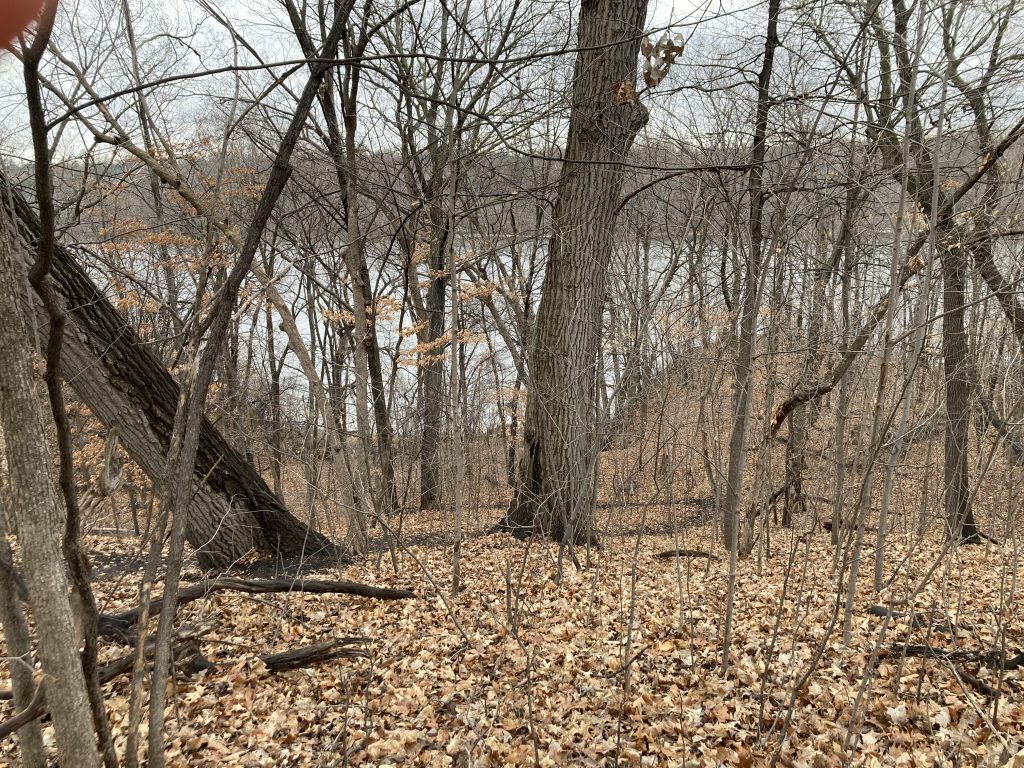
Took 2 pictures of my view. Both are just south of the double bridge and the Horace W.S. Cleveland Overlook. Here’s one of them:

My view from above the gorge: bare limbed trees, all trunk and thin branches. A few trunks are thick -- like the one near the center of the image or the one leaning on the left side -- but most are thin, creating a transparent screen between runner (me) and river. The ground, in the bottom third of the picture, is mostly dead, curled-up brown leaves.
My view from above the gorge: bare limbed trees, all trunk and thin branches. A few trunks are thick — like the one near the center of the image or the one leaning on the left side — but most are thin, creating a transparent screen between runner (me) and river. The ground, in the bottom third of the picture, is mostly dead, curled-up brown leaves. Sometimes, this is what I see even when there aren’t thin, bare branches everywhere — my view slightly obscured by something in the way — dead cone cells, I think — creating fuzz or static or a slight pulsing or wavering of lines. Also, if this picture were in black and white I wouldn’t be able to tell the difference. Often I have to ask Scott: is this in color or black and white?

peripheral: how I see

before the run

Before my run, while I was reviewing my Oct 2023 log entries and encountering several of my “how I see” photos, it came to me: this should be the new version of my vision poems. I want to study the ekphrasis form (An ekphrastic poem is a vivid description of a scene or, more commonly, a work of art. Through the imaginative act of narrating and reflecting on the “action” of a painting or sculpture, the poet may amplify and expand its meaning — def). Then I want to write a series of “how I see” poem/descriptions. These will be about experimenting with the form and exploring ways to describe how I see. I wrote in my notes: not about what I can’t see, but what I can. I’m also interested in experimenting with the idea of alt-text as form — I have a few sources for this. I’ll read some Georgina Kleege and her latest book, More Than Meets the Eye. These poems will be practical — describing the literal way I see — but also poetic — strange, unsettling, more than a report.

I’m thinking that these poems would involve describing what I see in the photo and what I saw when I was taking the photo. Also, they’re as much about HOW I see (the mechanics/process) as WHAT I see. I love this idea; I hope it sticks!

some sources:

during the run

While I ran lots of different thoughts flashed. First I thought about Marie Howe and the idea of observing and not looking away. Describing what you see with details not metaphors. Then I thought about how “looking” works for me, how it’s harder because of what I can and can’t see. How much can any of us (no matter where we are on the spectrum of seeing/blind) actually see? Then I started thinking about Huidobro’s poem, “Natural Forces” and all of the different glances he describes — One glance to shoot down the albatross. What do my different glances see?

right after the run

During my walk back home, I thought more about how I see (and spoke those thoughts into my phone). I was reminded of Robin Wall Kimmerer and her chapter, “Learning to See” in Becoming Moss. It’s about how we can learn to see the small things — like moss — that were invisible to us before.

I also thought about how I’m interested in the process we use to see and how that shapes what we see and how it enhances or detracts from our ability to behold/witness. Yes! This connects back to Ross Gay and beholding, which I discussed on here a few years ago.

I’m interested in how we sense without seeing, or how we see with our other senses (like sound). And I’m interested in thinking about how vision isn’t the primary mode in which we understand and make sense of things. It is only one of many ways, not THE way.

Ekphrasis

The verbal representation of visual representation.

Basically, an ekphrasis is a literary description of art. Like other kinds of imagery, ekphrasis paints a picture with words. What makes it different from something like pictorialism is that the picture it paints is itself a picture: ekphrasis stages an encounter between representations in two mediums, one visual and one verbal.

What is Ekphrasis?

key feature of an exphrasis poem: it engages with an artistic representation — does this fit for my project? I think so, especially if I make the taking of the photo as part of the description.

Another helpful definition of Ekphrasis from Poets.org:

Ekphrasis is the use of vivid language to describe or respond to a work of visual art.

Ekphrasis

The purpose of ekphrasis was to describe a thing with such detail that the reader could envision it as if it were present. 

I’m interested in using language to help others experience how/what I see.

may 22/BIKEYARDWORK

lake nokomis and back
bike: 8.6 miles
80 degrees

The first outdoor bike of the year! I’m always anxious, not knowing how much I’ll be able to see on my earliest bike rides of the season, but today was fine. Hooray! Not scared at all, nothing popping up unexpectedly. okay, maybe once when I was focusing on a bike that was approaching from far off, I didn’t notice another bike that was much closer to me. I was more concerned with my tires, which NEED to be replaced; they’ve been leaking air for a few years now. They were fine too. Several times during the bike ride I had a big smile on my face as I thought, I can still bike! then, I get to bike to the lake and swim across it all summer!

10 Things I Noticed

  1. the wind was rushing in and past my ears as I biked south
  2. several bikers on fat tires — I wondered why. Do they know something about the road conditions that I don’t?
  3. the port-a-potties at the falls for the race this past weekend were still there, so were the detour signs
  4. the duck bridge is temporarily gone — it’s being repaired until ? As I biked by, I noticed a chainlink fence and an asphalt trail abruptly ending where the bridge should be — now that’s an image for one of my nightmares!
  5. squeak squeak squeak On your left — some squeaking bikes approaching from behind, then passing me just past the duck bridge
  6. the lake — open water, but not empty water — some people already swimming
  7. the safety boat — a silvery white beacon across the lake
  8. the surreys (Scott’s nemesis) were lining the trail, ready to torment him
  9. an older guy, sitting in a lawn chair at the beach, telling someone a story about how his baseball card collection isn’t worth anything — he said, you might as well throw it all away. — even this card? it should be worth something?! Nope
  10. an even older guy stopping a woman in a bikini walking by and talking at (not to) her about how there aren’t any lifeguards. Couldn’t quite tell what he was saying, but I assume he meant, but there should be! If he had asked me, I would have said — the season doesn’t start until next weekend and who will you be able to hire this early in the year?

yardwork: 1 hour
mowing, raking, pulling weeds
73 degrees

Mowed the front yard, raked some fallen branches, pulled the irritating garlic mustard that erupts every spring. Least favorite thing about it: it always comes back. Most favorite thing about it: it’s satisfyingly easy to pull; it just pops right out! Listened to an audiobook — the 2nd in a murder mystery series where Agatha Christie’s bff and head housekeeper solves murders. This one’s called, A Trace Poison.

I like mowing the lawn with our reel mower. (I didn’t know that it was called a reel mower. Last summer, when I asked the guy working at the store for help I thought he said real mower, and then I thought, as my daughter would say, he gets it. Yes, the only kind of mower to get is a hand-powered one and not a loud, huge monster mower. But no, he just meant a mower with a reel, a reel mower.) Anyway, it’s fun to be outside, and it’s a chance to move while I listen to my book. Unfortunately, as my vision gets worse (and our yard does too), it’s harder to see where I’ve mowed and where I’ve missed. My aesthetic has always been “almost-chic” or that’s good enough, so I don’t mind, but I think Scott might. So this summer, FWA will have to mow, and I’ll stick to pulling weeds.

Mary Ruefle and not knowing or knowing nothing

Today I finally arrived at the part in Madness, Rack, and Honey in which Mary Ruefle uses one of my favorite quotes of hers, a quote that was an inspiration for my “Bewildered” poem:

The difference between myself and a student is that I am better at not knowing what I am doing.

“Short Lecture on Socrates,” page 250

I am almost positive I did read this exact passage when I checked out this book from the library, but maybe I didn’t? Anyway, reading Ruefle’s book was much later after I had already encountered the quote and fallen in love with the idea of being better at not knowing. I first read it in an article about bewilderment, Less Than Certain. I had no idea (or no memory of it, at least) that the quote is in a lecture about Socrates and the unknowingness/not knowing/knowing nothing as the foundation of Western civilization. Wow. I forgot to take my own advice to always think about the larger context of a quote that I want to use!

Reading this small lecture, recognizing that we know nothing seems to be about humility. Recognizing the limits of what you do or can know. Not believing you can know everything. In another article on this topic that mentions Ruefle’s quote, Jack Underwood echoes this:

What interests me about poetry is that rather than looking up for answers, it tends to lead us back indoors, to the mirror, as if seeing ourselves reflected within its frame, confused, gawping, empty-eyed, and scalded by circumstance, might re-teach us the lesson: that meaning presents itself precisely as a question — therefore, you can’t entertain it by seeking to answer it. Imagine! The old, old universe, arranging itself legibly into a puzzle that our small brains might be qualified to solve with the knowledge we can accrue from our small corner of its tablecloth. Solving the mysteries of the universe: isn’t that just the most arrogant, preposterous thing you ever heard? The idea of there being some sort of Answer to Everything is an admirable feat of imagination but also displays a woeful lack of it.

On Poetry and Uncertain Subjects

Even as I appreciate the importance of humility, I like thinking about this not knowing or knowing nothing in other ways.

Not knowing as an action. To actively not know something. This could mean unlearning it, to be engaged in the act of not knowing it or divesting (disinvesting?) from it. Or it could mean willful ignorance — a refusal to know some fact, someone. I choose to not know! It could be Mary Ruefle’s wonder from “On Secrets” — I would rather wonder than know. Or it could my moment or many moments of refusing to conceal my not knowing to others, to admit/embrace/accept that I can’t see that bird, right over there, that you are pointing out to me.

Knowing nothing as knowing the thing, or things, that is/are nothing, where nothing is a space where time is stopped or where productivity doesn’t happen (Ross Gay). Or where nothing is the Void, the absence, the blank space around which we orbit, trying to find meaning or possibility or connection. Or where nothing is Marie Howe’s singularity:

No I, no We, no one. No was
No verb      no noun
only a tiny tiny dot brimming with

is is is is is

may 19/RUN

4.75 miles
veterans’ home loop
50 degrees

Wore my orange sweatshirt today. Partly cloudy, cooler, some wind. My legs felt like logs until I warmed up, about a mile into the run. Listened to some blue jays screeching, kids laughing, old guys talking. Forgot to look at the river or listen for the falls. Avoided a BIG school group above the falls — 4 or 5 full-sized school buses in the parking lot. Didn’t stop to walk up the small hill at the veterans’ home. Kept running until I reached 4 miles then walked while I put in my headphones. I listened to Lizzo for the last minutes of the run — Hi motherfuckers, did you miss me? I’ve been home since 2020. I’ve been twerkin’ and making smoothies. It’s called healing and I feel better. I love Lizzo.

Mary Ruefle and the madness of wasting time

continuing my discussion of her lecture, “Madness, Rack, and Honey.”

before the run

A few of the poets/writers Ruefle cites talk about nothing — the Great Nothing (Tess Gallagher), doing nothing (Gertrude Stein). I’m thinking about Auden and Ross Gay and the idea of making nothing happen, which I recently wrote about on march 29, 2023.

during the run

Every so often during the run, I thought about nothing and being useless — at least if usefulness is measured by capitalism and its values. At one point I thought about my running and writing practice — how much time I’ve put into it, or how much time I’ve wasted on it. Here I’m thinking about wasting time as something a poet (or someone who writes poetry) needs, desires.

after the run

I’m revising a few of my mood ring poems in order to submit all of them for a chapbook contest, so I don’t ave a lot of time to spend on reading Ruefle. For now, here’s a little bit on madness:

madness

The madness of poetry is that it creates sweetness, so that the flies might come and eat till it is gone. “To endlessly make an end of things,” says Paul Celan in a poem, and that’s it, inexplicably and exactly. ”

*

If the flies keep feasting, the honey will be gone. Then the flies will go away. And there will be nothing sweet. The poet has to either begin again–poor Creature!–or write a poem that goes on forever, and what a torment that would be! Even the long poem ends.

140

may 11/RUN

5.85 miles
ford loop
62 degrees
humidity: 77%

Too hot, too humid, tired. I tried running earlier today (9 am instead of 10:30), but it was still too late. Even so it was a good run that I’m glad I did. Ran the ford loop and spent the first 3.5 miles convincing myself to keep going, to not stop until I reached the overlook near the ford bridge. (I did it!) Then I put in “Dear Evan Hansen” and started running again, or should I say struggle running. Stopped a few times to walk, feeling wiped out, but kept running again. Whew.

At the start of my run, I heard the robin’s cheer up! cheer up! and a woodpecker’s knock. Later, I heard a pileated woodpecker’s laugh, not sounding exactly like Woody the woodpecker, but close enough.

Smelled wet cinnamon — dripping blossoms? — and thought about chewed-up Big Red.

Felt too hot, my face burning, probably bright red. The drip drip drip of sweat from my ponytail on my neck.

Greeted the Welcoming Oaks, noticed the floodplain forest was hidden in green.

Mary Ruefle, White, Brown

before the run

I’d like to do one color at a time, but I couldn’t decide between her white or brown color poems so I’m including both of them. I think I’ll let running Sara decide. Will she choose to focus on white things or brown things, both or neither?

from My Private Property/ Mary Ruefle

White sadness is the sadness of teeth, bones, fingernails,
and stars, yes, but it is also the sadness of cereal, shower
caps, and literary foam, it is the sadness of Aunt Jenny’s
white hair covering her body like a sheet, down to her toes,
as she lay on the sickbed, terrifying the children who were
brought in one by one to say goodbye. It is the sadness of
radio waves traveling through space forever, it is the voice
of John Lennon being interviewed, his voice growing
weaker and weaker as the waves pass eternally through a
succession of galaxies, not quite there, but still . . .

*

Brown sadness is the simple sadness. It is the sadness of
huge, upright stones. That is all. It is simple. Huge, up-
right stones surround the other sadness, and protect
them. A circle of huge, upright stones–who would have
thought it?

Ruefle’s line about the stars and galaxies in her white sadness poem, makes me think of the new word I learned this morning from the title of a poem: sidereal

sidereal: (adj) of or with respect to the distant stars (i.e. the constellations or fixed stars, not the sun or planets).

pronounced: cy deer e ul

during the run

Running Sara tried to think about both white and brown and it worked, mostly, but green kept declaring, I’m here! Notice me! Green Green Green! So much green everywhere and all of a sudden. There I was, on the trail, running and noticing white sweatshirts tied around waists or brown leaves littering the ground, when green would hijack my thoughts. brown trunk GREEN leaves pale white sky GREEN air

5 Brown Moments and 5 White Ones

  1. river: brown with light brown foam
  2. same river from the other side: deep blue with white foam
  3. brown tree trunks
  4. a brown sound: the knocking of a woodpecker on a dead tree
  5. a flash of the white, almost silver, river through the trees
  6. a limestone wall, the part of it illuminated by sunlight was white
  7. white sands beach, viewed from the other side of the river
  8. the brown trail leading down to Shadow Falls
  9. a white sound: the vigorous tinkling of the falls falling
  10. the brown boulder with 4 small stones stacked on its top

I like listening to “Dear Evan Hansen” while I run. Together they — the emotional lyrics/music combined with how I soften as I exert myself — make me feel things: sad, tender, hopeful, a deep aching joy. I thought of how Ruefle’s color poems can be read as sadness or happiness, which then made me think of Ross Gay’s understanding of joy as both grief and delight.

Another thought I had about brown while running: Thinking about the brown sadness of Ruefle’s huge upright stones, I suddenly thought: the gorge. The gorge, with its huge limestone, sandstone walls is both brown sadness and brown happiness.

after the run

White happiness is the happiness of crisp sheets hang-
ing on the line just to the side of the farmhouse, of soft
shimmering salt pouring out of a cheap salt shaker, of a
button-down oxford reluctantly worn.

Here’s the poem about the white stars that I mentioned earlier in the post:

Sidereal/ Debra Albery

Consider this an elegy with silo and fever.
Call it barn and gravel and gone. Grasses’ obeisance

in the wake of a pick-up, sun searing the leaves
green to gold in the season’s time-elapse.

Where does it go, the Sunday angle of sunlight
once only yours, wide and open as a window?

Here’s what I remember: the flaking mural
on the brick wall of neighborhood grocery, saying

Food for the Revolution for twenty-five years.
Stacked landscapes in my rearview, blank as a calendar

until a bend in the road brought the Blue Ridge;
the pocked metronome of tennis balls outside

while I harnessed what I had lost and missed
in minor-key pentameter. So what, my mentor

talked back to his tercets in draft after draft:
so what so what so what. “This essay is accurate

but never ignited,” the Derridean scrawled
in red ink when I was writing about Bishop writing,

I can scarcely wait for the day of my imprisonment.
Her keen eye ever cast on the homely unheimlich.

Call this a road story about the slow burn of foliage,
about containment, what conspires against arrival.

Astonish us, Diaghilev said to Cocteau,
but all I ever wanted was to consider

its roots in the auguries of our shifting stars.

About This Poem

“‘Sidereal’ is, as the poem declares itself, a road story, a cross-country retrospective traversing decades. It is, as it also states, an elegy—in part honoring a past teacher, Larry Levis. The ‘so-what-so-what’ refrain is his, handwritten above a line on an early draft of his poem ‘Caravaggio: Swirl & Vortex.’ That self-interrogation set in motion a poem of motion that longs for dwelling—as did the swirl and vortex of etymology, sidereal and consider both deriving from sidereus, meaning ‘star,’ itself of uncertain origin.”
Debra Allbery

words I looked up, which I mostly knew, but wanted to be precise:

obeisance: deference
auguries: omens
unheimlich: uncanny

I like the line, barn and gravel and gone. Reading it again, and thinking about this poem about restlessness and belonging, I’m reminded of a time in my life when I tried to (still) belong to a farm that was barn and gravel and gone — a family home place, sold.

may 4/RUN

3.5
locks and dam #1 hill loopmiles
60 degrees

Another warm day. Hooray! Another chance to run in shorts and a short-sleeved shirt. Saw Mr. Morning! Heard some voices down below in the gorge. Ran down the hill then back up it at locks and dam #1. Noticed a big pile of something on the path — clumps of dirt, rock, is that a furry tail? Probably not, but I can’t tell. Often, I see dead squirrels that aren’t there. The river was blue and not quite as high as it was last week.

Mary Ruefle and pink

before the run

from My Private Property/ Mary Ruefle

Pink sadness is the sadness of white anchovies. It is the sad-
ness of deprivation, of going without, of having to swallow
when your throat is no bigger than an acupuncture pin;
it’s the sadness of mushrooms born with heads too big for
their bodies, the sadness of having the soles come off your
only pair of soes, or your favorite pair, it makes no differ-
ence, pink sadness cannot be measured by a gameshow
host, it is the sadness of shame when you have done noth-
ing wrong, pink sadness is not your fault, and though even
the littlest twinge may cause it, it is the vast bushy top on
the family tree of sadness, whose faraway roots resemble a
colossal squid with eyes the size of soccer balls.

Today, or this morning at least, I shall think of pink. Here’s another pink poem I bookmarked a few months ago:

Against Pink / DARA YEN ELERATH

Pink is an unhappy hue, not soothing like cerulean, nor calming like lavender or gray. It is the color of fingernails shorn away, blood dripping from the waxen quick. It is the color of a sunburned arm. The color of harm that lingers on cut shins for days. Pink is not the shade of buttercups or daisies. It is the color of poisonous brugmansia blooms, of poppies that bring on sleep. Pink saturates the face in anger. It is the cast left on a cutting board by a hunk of uncooked meat. Pink, too, is the bittersweet shade of passion subdued, passion that has slipped from burgundy to rose. It is only a tincture of desire and so carries the least conviction. It is the tint that drifts away unnoticed in the night. Be frightened of pink. Do not think it the innocent color of dresses or barrettes, the blush of areolas, strawberry snow cones, or grenadine martinis. Try, for once, to see it rightly. It is frightening. It is the hue of a person’s insides, the color of a womb. That room where life arises. That room where babies are made. Where arms, legs, and heads are created. Eyes, blood, and tiny teeth.

And some of my thoughts about pink:

Pink Thing. The pink of gray matter. Pink Think. Pinkaliscious. Preppy Pink and Green. Is it pink or yellow? P!nk. Undercooked meat. Pepto Bismol always pronounced Pepto Bismo. The worst milkshake flavor: strawberry. Pink washing. Peonies in the backyard, drooping dropping petals too soon. The only choice when buying cheap running shorts. My favorite running jacket. Raw. Fleshy. Swim caps.

during the run

Some of my pink thoughts as I ran:

Fuschia funnels. Almost invisible, usually seen as white or yellow or orange. A walker in a pink jacket — the color of salmon flesh.

Pink as tender and vulnerable. Split open, flesh exposed. That vulnerability is both a weakness or a threat but also an opportunity to transform. Open yourself up. Turn yourself inside out. What was out becomes in, and what was in becomes out.

Running, as I listened to a P!nk song — What About Us, I lifted out of my hips, opened my shoulders, and led with my chest. Open.

If all gray flesh is dead flesh (from Listen/ Didi Jackson), then is all pink flesh living flesh?

Gray matter (brain) looks pinkish because of the blood circulating through it.

Both of these facts are true: We live. We die. We are pink. We are gray.

after the run

Reading Facebook earlier today, a post from Henri Mancini popped up — why? James Galway is in New York with Lizzo to record a new version of the Pink Panther theme song. Excellent. Found an article about it with video here.

Came across this poem too — I encountered this poem a few weeks ago, but can’t remember where.

Gift/ Hilda Conkling

This is mint and here are three pinks 
I have brought you, Mother.  
They are wet with rain  
And shining with it.  
The pinks smell like more of them  
In a blue vase:  
The mint smells like summer  
In many gardens.

And one more thing, before I forget. Yesterday I happened upon this delightful line from a Ross Gay poem I gathered a few years ago for this blog: Catalog of Unabashed Gratitude/ Ross Gay

the tiny bee’s shadow
perusing these words as I write them.

Later, sitting on the deck on a warm, sunny day — finally! — and under the service berry bush that’s big enough to be called a tree, I saw a shadow on my notebook as I jotted down a note: a bee! Then another shadow, crossing the page, over my words. Were they perusing them? Love it.

april 8/RUN

3.85 miles
marshall loop
42 degrees

Less layers this morning! Bright sun and lots of noisy birds. Hooray for Spring! By next Saturday will all the snow be melted and lake nokomis be iced out? I hope so. Speaking of birds, I heard a caw-cophony near the river. Yes, a bad pun. Not crows, but seagulls, I think. I’ve heard seagulls in grocery store parking lots, but rarely down by the river.

And here’s another story about birds. This one’s from yesterday. Walking Delia the dog with my son FWA in the afternoon, I noticed 2 crows, high in the sky, harassing another bird. They seemed to be running into it mid-air while cawing furiously. A block later, we saw them again, still at it. Then, a few blocks further, just one crow, which both FWA and I assumed was one of the combative crows. It flew by, cawing, then perched on a lamp post and looked down at us. It had something in its mouth. FWA quipped, the other bird’s eyeball. My response: Yes! In my world, that’s exactly what it is. As we kept walking the caw continued to look at us, almost to say, watch out or I’ll take your eyeballs next!

Anything else about today’s run? Wet, muddy, filled with fast moving cars, other runners in bright orange running shirts, and walkers. Smelled waffles as I passed by Black Coffee and Waffles. Heard kids down by Shadow Falls.

A.R. Ammons’ garbage

before the run

Starting with section 3 today. Here are some thoughts:

In yesterday’s post, I wanted to distinguish humility from humiliation, which was inspired by these lines:

where but in the very asshole of comedown is
redemption: as where but brought low, where

but in the grief of failure, loss, error do we
discern the savage afflictions that turn us around:

where but in the arrangements love crawls us
through, not a thing left in our self-display

unhumiliated, do we find the sweet seed of
new routes

This morning, reading through my post for april 8, 2022, I was reminded of dirt and decomposition and a Ross Gay interview where he describes our entanglement (interconnectedness/dependence) with the world and the decomposition of the self, not as a loss, or a humiliation, but a recognition of our connections and dependence on each other. Humility in terms of vulnerability and openness instead of just humiliation and weakness.

Reading these lines again, I’m also reminded of CAConrad’s “Ignition Chronicles” and the idea that it is not grief/loss/despair that enables new routes, but how that grief disrupts our routines and forces us to focus. The key is focus not despair. So, we don’t need grief, or in the case of Ammons humiliation/breaking down, for new routes. We need focus, which maybe is another word for attention here?

One reason I’m reading this poem is to learn more about how poets write. Poetry is not just a matter of line breaks and rhymes, poetry is about how you approach stories, subjects, the way you use language to make something or do something. For me, this means studying lots of lines (I’m a slow thinker, a ruminator, and mostly new to poetry, so I need lots of lines) to see how poets use language in ways that are very different than I’m used to with my decades of training in academic writing. One small example, here’s how Ammons describes dead/decomposing worms in a puddle after the rain:

young earthworms,

drowned up in macadam pools by spring rains, moisten
out white in a day or so and, round spots,

look like sputum or creamy-rich, broken-up cold
clams.

I particularly like the idea of puddles as macadma pools, but this whole description is delightfully gross!

Studying poets and poems is also about thinking about what they’re doing and making. In section 3, Ammons writes:

no use to linger over beauty or simple effect:
this is just a poem with a job to do: and that

is to declare, however roundabout, sideways,
or meanderingly (or in those ways) the perfect

scientific and materialistic notion of the
spindle of energy

I love all of Ammons’ discussion of roundabouts, sideways, meanderings, and the periphery:

keeping the aberrant periphery worked

clear so the central current may shift or slow
or rouse adjusting to the necessary dynamic

But, even as I love this idea of wandering and the periphery, I’m a bit overwhelmed by the length of his roundabouts and sidetracks. So many words! So many pages! Too many doors opened by too many ideas! I might need to read through these sections faster or I’ll get too tired or too lost and never make it to the end!

All of Ammons talk about garbage and poetry makes me wonder about his book’s connection to eco-poetry. I found a helpful article to read: The Semiotics of Garbage, East and West: A Case Study of A. R. Ammons and Choi Sung-ho

march 29/RUN

5.3 miles
bottom of franklin hill and back
18 degrees

Yes, 18 degrees. Brr. Yesterday the weather app predicted 20 inches of snow for next week. Thankfully today it’s predicting 2 inches of rain instead. Who knows what will actually fall (please, please, no snow!).

A nice run. Mostly relaxed, although my left hip/knee was a little tight. No headphones for the first 3 miles, then a playlist for the last 2.

Noticed the river — open and brown just off to the side as I ran down Franklin hill, a bright blue far off in front of me. Also noticed an orange sign announcing a road closure for a race this weekend at the bottom of the hill and to the left. I kept moving my eyes — straight ahead, then off to the right, off to the left — to see how that would change what I saw. Not much, although the orange did seem to disappear in my peripheral a few times. Strange.

Heard the knocking of a woodpecker on some dead wood in the gorge. Ran on more of the walking path. Shuffled on some grit. Felt a cold wind on my face.

Look!

Just restarting my run near the top of the hill, a woman stopped me and asked if I wanted to see a baby screech owl. It was 10 or 12 feet up in a small hollow in a tree. I was worried that I wouldn’t be able to see it, but I did! It looked like a little bat to me. I thanked the woman for stopping to show it to me, wished her a great morning, then began running again with a big smile on my face. I have wanted to stop and answer someone’s kind look! for some time now, but I’ve never managed to do it; I’ve just kept running, too intent on keeping moving. Today I stopped and it felt good.

Happy Birthday to my 2 wonderful kids, FWA (20) and RJP (17), born on the same day 3 years apart. I rarely mention their birthdays on my blogs — I just spent the last 5 minutes looking through Trouble, Story, and RUN! and found only 2 instances of it. It’s hard to believe that I started this log, and found poetry again, when FWA was 14 and RJP 11.

before the run

I’m still trying to work on a series of color poems. Right now: orange, later in May: green. It’s a lot of showing up, sitting in front of the page, trying to find a way into ideas about orange as the color that takes up the most space in my practical life. Orange, everywhere. Rarely bright orange — no pops of vermillion or citrus — but orange as usually (not always) the only color that registers as color, something other than gray or dark. In the midst of trying to figure this out, I returned to an essay I remembered reading last year (see: april 16, 2022) about poetry and the void. I thought of it because so much of seeing orange, especially when swimming across the lake in the summer, is about feeling its absence.

sometimes when I’m swimming across the lake I feel a presence that I can’t see — the idea of orange, a hulking shape…I look but nothing is there…yet, I feel its absence…something is there — the trees don’t look quite right

june 26, 2022: hardly ever saw the orange of the orange buoy, mostly just a hulking shape or a void surrounded by a “normal” view — there was no buoy, just an empty space that disrupted the expanse of sky and trees. 

from my notes for Orange

Elisa Gabbert offers this interesting line about poetry:

I think poetry leaves something out. All texts leave something out, of course — otherwise they’d be infinite — but most of the time, more is left out of a poem.

The Shape of the Void: Toward a Definition of Poetry/Elisa Gabbert

At this point, I was planning to write more, but it was already 10:45 and I wanted to go out for a run before it got much later, so I stopped. If I had kept writing, I would have included more from Gabbert, like this:

Verse, by forcing more white space on the page, is constantly reminding you of what’s not there. This absence of something, this hyper-present absence, is why prose poems take up less space than other prose forms; the longer they get, the less they feel like poems. It’s why fragments are automatically poetic: Erasure turns prose into poems. It’s why any text that’s alluringly cryptic or elusive — a road sign, assembly instructions — is described as poetic. The poetic is not merely beauty in language, but beauty in incoherence, in resistance to common sense. The missingness of poetry slows readers down, making them search for what can’t be found. 

The hyper-present absence of something (orange orange everywhere) as poetry. Its inability to reveal itself in “normal” and straightforward ways to me (as in: look with my eyes and see orange). Its missingness makes me notice/attend to it even more.

In the next line, Gabbert suggests that the frustration of incoherence, mystery, not being able to make sense of something is alluring, erotic. It’s why many of us are drawn to poetry — to slow down, notice, get the chance to dwell in the unknown. Before I left for my run, I was thinking about how my perspective is slightly different. I don’t need to be encouraged to slow down or given the chance to embrace incoherence, resist common sense. Because of failing vision and my overworked brain, I am already slow. Much of what I see is incoherent — or never quite coherent. Common sense ideas of how we see or how to be in the world have already been upended for me. I see poetry, and its way of navigating or negotiating or communicating/finding meaning not as desirable, but as necessary, practical, useful, a way to be that speaks to where I already am.

during the run

I started out thinking about the hyper-presence of an absence as I ran in terms of the open space of the gorge, but these thoughts didn’t last long. I became distracted by my effort. Did I ever return to them? If I did, I can’t remember.

after the run

After highlighting two delightful letters by poets Emily Dickinson and Rainer Marie Rilke, Gabbert writes:

In these letter-poems, poetry reveals itself as more a mode of writing, a mode of thinking, even a mode of being, than a genre. The poem is not the only unit of poetry; poetic lines in isolation are still poetry. The poem is a vessel; poetry is liquid.

Poetry as a mode of writing, thinking, being. Made of more than just poems. Yes! I do feel that often my way of navigating losing my vision, finding a way to be when I cannot see, is through the approach of poetry and embracing uncertainty and the unknown.

The architect Christopher Alexander thought big plate glass windows were a mistake, because “they alienate us from the view”: “The smaller the windows are, and the smaller the panes are, the more intensely windows help connect us with what is on the other side. This is an important paradox.” To state the Forsterian obvious again, adding breaks to a paragraph is not always going to make an interesting poem — but most poets don’t write that way. They write in the line, in the company of the void. That changes how you write — and more profoundly, how you think, and even how you are, your mode of being. When you write in the line, there is always an awareness of the mystery, of what is left out. This is why, I suppose, poems can be so confounding. Empty space on the page, that absence of language, provides no clues. But it doesn’t communicate nothing — rather, it communicates nothing. It speaks void, it telegraphs mystery.

To write, to think, to be in the company of the void — the absence that leaves a residue or that can’t be seen but is always felt.

This idea of communicating nothing (with nothing not as no thing but as something in and of itself) reminds me of something else I read earlier this year about “making nothing happen” but couldn’t remember where I had read it. It took me almost an hour to track it down yesterday. The “make nothing happen” is in W. H. Auden poem for Yeats:

from In Memory of W. B. Yeats/ W. H. Auden

II

You were silly like us; your gift survived it all:
The parish of rich women, physical decay,
Yourself. Mad Ireland hurt you into poetry.
Now Ireland has her madness and her weather still,
For poetry makes nothing happen: it survives
In the valley of its making where executives
Would never want to tamper, flows on south
From ranches of isolation and the busy griefs,
Raw towns that we believe and die in; it survives,
A way of happening, a mouth.

And the reading about it comes from Ross Gay and one of his incitements in Inciting Joy, which I first read as an essay for the October 2022 issue of Poetry:

I can’t tell you how many times I’ve heard conversations about W. H. Auden’s famous line from his poem “In Memory of W.B. Yeats”: “poetry makes nothing happen.”…At some point, probably I heard someone else say it,7 it occurred to me that all these poets, and all these conversations, were misreading Auden’s line, and that he was really talking about (inasmuch as a poem is him talking about something) what poetry makes, the sometimes product or effect or wake or artifact of poetry, of a poem. Granted the line feels emphatic, grand, provocative even—seriously, I can’t tell you how many tweed-jacketed refutations to Auden’s line I have endured; no one has ever explained to me the elbow patch—but what the line makes made is not nothing, but nothing happening. Or rather, nothing happening. The happening it makes is nothing. In other words, a poem, or poetry, can stop time, or so-called time at least. First of all, what a good reminder it is that a poem is an action, and as Auden has it, a powerful one, too. Secondly, and not for nothing, this is one of the suite of poems Auden wrote in the late thirties and early forties, a period when one might have wanted so-called time—the clock, the airplanes, the trains, the perfectly diabolical synchronous goosestep rhythm of time itself—to stop.

Out of Time (Time: The Fourth Incitement)/ Ross Gay

He adds:

you, too, might’ve been praying for a way to stop the march of so-called time, and poems, sometimes, might do that. Poems are made of lines, which are actually breaths, and so the poem’s rhythms, its time, is at the scale and pace and tempo of the body, the tempo of our bodies lit with our dying. And poems are communicated, ultimately, body to body, voice to ear, heart to heart.9 Even if those hearts are not next to one another, in space or time. It makes them so. All of which is to say a poem might bring time back to its bodily, its earthly proportions. Poetry might make nothing happen. Inside of which anything can happen, maybe most dangerously, our actual fealties, our actual devotions and obligations, which is to the most rambunctious, mongrel, inconceivable assemblage of each other we could imagine.

Perhaps I’m wandering too far away from the orange void here? Poetry as speaking the void, making Nothing happen, existing outside of the normal/rational/obvious/taken-for-granted. Gay’s explicit connection to time and against capitalism resonates deeply for me. Stop those clocks, those planes, that machinery we’re using to destroy the planet, the future.

The poem’s lines as breaths, as bodily rhythms. In a poem about the color gray I mentioned gray breaths. What are orange breaths? Orange time, orange rhythm?Orange devotions and obligations?

One last thing, and a return to Gabbert’s essay. Gabbert claims that the mystery of poetry is not simply metaphor or making things strange, but how we use or don’t use language to shape our relationship to the Void. And, she suggests it is the missing mountain in Shane McCrae’s “The Butterflies the Mountain and the Lake”:

the / Butterflies monarch butterflies huge swarms they
Migrate and as they migrate south as they
Cross Lake Superior instead of flying

South straight across they fly
South over the water then fly east
still over the water then fly south again / And now
biologists believe they turn to avoid a mountain
That disappeared millennia ago.

The missing mountain is still there. The no longer visible orange buoy is still there too.

added a few hours later: Trying to find a source for this cool butterfly fact, I discovered that it was written about in Annie Dillard’s Pilgrim at Tinker Creek:

Monarchs are “tough and powerful, as butterflies go.” They fly over Lake Superior without resting; in fact, observers there have discovered a curious thing. Instead of flying directly south, the monarchs crossing high over the water take an inexplicable turn towards the east. Then when they reach an invisible point, they all veer south again. Each successive swarm repeats this mysterious dogleg movement, year after year. Entomologists actually think that the butterflies might be “remembering” the position of a long-gone, looming glacier. In another book I read that geologists think that Lake Superior marks the site of the highest mountain that ever existed on this continent. I don’t know. I’d like to see it. Or I’d like to be it, to feel when to turn.

Pilgrim at Tinker Creek, page 253-254 in the 1988 edition

Even as I’m disappointed that Dillard didn’t offer any sources for her facts here, I LOVE her last lines: I don’t know. I’d like to see it. Or I’d like to be it to feel when to turn. Not to see, but to be it, to feel it. Wow — this idea is going in my orange poem, for sure. Not to see orange, but to be it, or to feel when to turn around it. I do feel that, but can I ever put it into words?

feb 25/RUN

5k
ywca track

Ran on the track with Scott this morning, not together but at the same time. I thought about swimming, but knew it would be crowded, so I ran. Listened to a playlist titled, Sara 2020. Started with Tower of Power’s “What is Hip” and ended with Prince’s “Let’s Go Crazy.” Focused on my cadence, arm swing, and not running into people as I passed them, including 2 runners who were running in the far lane. There were soccer games going on below me in the big gym, but I didn’t notice them at all. Too lost in my run.

The thing I noticed the most were the people:

  1. a man with white hair, wearing shorts and a tank top, running
  2. a woman in turquoise shorts and a tank top, running in the far lane, making it difficult to pass
  3. another runner in dark sweatpants and a light shirt running in the far lane
  4. 2 people walking, one of them carrying dumbells
  5. another pair of women, the one in the middle lane wearing a bright blue shirt
  6. a woman in mid-calf light blue patterned running tights and a white tank top running in the middle lane
  7. someone in tan shorts walking faster than the other walkers
  8. a woman stretching her calf muscles on the steps in the far corner
  9. a guy in gray, walking
  10. someone in red (I think?) sitting on the bench near the punching bag and the exit

I was listening to music, so I couldn’t hear what anyone was saying, but Scott told me that he overheard 3 interesting things from the pair of women walkers (#5 above). He called them chatty Cathys, he guessed they were in college, and he heard them say this: First, just as he passed them, he overheard one of them call out in disgust, Yuck! Next time, They’ll see it on your transcripts. Finally, You should really stop binging. Binging a show, food, alcohol? What will they see on your transcripts, and is this a good thing, or a bad thing? I love overheard conversations and imagining what they’re about.

Here are two poems I discovered today that move in opposite directions:

Rain/Jack Gilbert

Suddenly this defeat.
This rain.
The blues gone gray
And the browns gone gray
And yellow
A terrible amber.
In the cold streets
Your warm body.
In whatever room
Your warm body.
Among all the people
Your absence
The people who are always
Not you.

I have been easy with trees
Too long.
Too familiar with mountains.
Joy has been a habit.
Now
Suddenly
This rain.

Love: I have been easy with trees/too long.

Opera Singer/Ross Gay

Today my heart is so goddamned fat with grief
that I’ve begun hauling it in a wheelbarrow. No. It’s an anvil
dragging from my neck as I swim
through choppy waters swollen with the putrid corpses of hippos,
which means lurking, somewhere below, is the hungry
snout of a croc waiting to spin me into an oblivion
worse than this run-on simile, which means only to say:
I’m sad. And everyone knows what that means.

And in my sadness I’ll walk to a café,
and not see light in the trees, nor finger the bills in my pocket
as I pass the boarded houses on the block. No,
I will be slogging through the obscure country of my sadness
in all its monotone flourish, and so imagine my surprise
when my self-absorption gets usurped
by the sound of opera streaming from an open window,
and the sun peeks ever-so-slightly from behind his shawl,
and this singing is getting closer, so that I can hear the
delicately rolled r’s like a hummingbird fluttering the tongue
which means a language more beautiful than my own,
and I don’t recognize the song
though I’m jogging toward it and can hear the woman’s
breathing through the record’s imperfections and above me
two bluebirds dive and dart and a rogue mulberry branch
leaning over an abandoned lot drags itself across my face,
staining it purple and looking, now, like a mad warrior of glee
and relief I run down the street, and I forgot to mention
the fifty or so kids running behind me, some in diapers,
some barefoot, all of them winged and waving their pacifiers
and training wheels and nearly trampling me
when in a doorway I see a woman in slippers and a floral housedress
blowing in the warm breeze who is maybe seventy painting the doorway
and friends, it is not too much to say
it was heaven sailing from her mouth and all the fish in the sea
and giraffe saunter and sugar in my tea and the forgotten angles
of love and every name of the unborn and dead
from this abuelita only glancing at me
before turning back to her earnest work of brushstroke and lullaby
and because we all know the tongue’s clumsy thudding
makes of miracles anecdotes let me stop here
and tell you I said thank you.

This poem! The beauty that interrupts us and forces us out of ourselves and into the world! Ross Gay is wonderful.

My Emily Dickinson, part two

a new grammar grounded in humility and hesitation

Emily Dickinson took the scraps from the separate “higher” female education many bright women of her time were increasingly resenting, combined them with voracious and “unladylike” outside reading, and used the combination. She built a new poetic form from her fractured sense of being eternally on inteIlectual borders, where confident masculine voices buzzed an alluring and inaccessible discourse, backward through history into aboriginal anagogy. Pulling pieces of geometry, geology, alchemy, philosophy, politics, biography, biology, mythology, and philology from alien territory, a “sheltered” woman audaciously invented a new grammar grounded in humility and hesitation. HESITATE from the Latin, meaning to stick. Stammer. To hold back in doubt, have difficulty speaking. “He may pause but he must not hesitate”-Ruskin. Hesitation circled back and surrounded everyone in that confident age of aggressive industrial expansion and brutal Empire building. Hesitation and Separation. The Civil War had split American in two. He might pause, She hesitated. Sexual, racial, and geographical separation are at the heart of Definition.

Here’s something I wrote about this passage on March 17, 2021:

I really like this idea of hesitation and humility and aboriginal anagogy as a sharp contrast to progress, aggression, confidence/hubris, and time as always moving forwards (teleology). I tried to find a source that could explain exactly what Howe means by aboriginal anagogy but I couldn’t. I discovered that anagogy means mystical or a deeper religious sense and so, when I connect it to aboriginal, I’m thinking that she means that ED imbues pre-Industrial times (pre Progress!, where progress means trains and machines and cities and Empires and factories and plantations and the enslavement of groups of people and the increased mechanization of time and bodies and meaning and, importantly, grammar) with the sacred. Is that right? Is it clear what I’m saying?

A few paragraphs later, Howe writes this about ED’s grammar of “hesitation and humility”:

Naked sensibilities at the extremest periphery. Narrative expanding contracting dissolving. Nearer to know less before afterward schism in sum. No hierarchy, no notion of polarity. Perception of an object means loosing and losing it. …Trust absence, allegory, mystery–the setting not the rising sun is Beauty. No outside editor/”robber.” Conventional punctuation was abolished not to add “soigne stitchery” but to subtract arbitrary authority. Dashes drew liberty of interruption inside the structure of each poem. Hush of hesitation for breath and for breathing….only Mutability certain.

Some of this is starting to make sense. The periphery, the dashes as hesitation, mystery. I was curious about her take on sunsets over sunrises so I googled it and found this ED poem and helpful account from the Prowling Bee (love her!). She includes a list of ED’s sunset poems.

Howe ends Part One with one more description of ED’s hesitation and humility:

Forcing, abbreviating, pushing, padding, subtraction, riddling, interrogating, re-writing, she pulled text from text (29).

jan 12/SWIM

1.5 miles
ywca pool

Another swim this week! Noticed in the locker room that a few more people were wearing masks. Should I wear one? Before my swim, a strange sound: a woman walking into the shower area fully clothed, including sneakers that were clicking and clopping like she had yaktrax on. Did she? She went into a shower stall to find the stuff she’d left behind.

A nice swim. My googles leaked a few times, so did my nose plug. Did continuous 200s with my hypoxic breathing (3/4/5/6). Near the end, I turned it into 2 400s and changed my breathing every 100 instead of 50.

Three things I noticed:

1 — looking up at the flip turns

During one flip turn at the far wall, I looked up from underwater as I turned. In a flip turn, as you head into the wall you flip on your back underwater, then twist back on your stomach as you push off the wall (at least I do). I looked up while I was on my back, just before I pushed off. I noticed a yellowish-orangish glow. The lights from above water. It looked so cool that I made sure to look up several more times as I flipped. I couldn’t see anything but bright lights, which was a nice contrast to the pale blue of being underwater.

2 — gurgle, slosh, squeak

In a few of my recent log entries about pool swimming, I’ve mentioned that I didn’t hear anything but an occasional squeak from my nose plug. For a few laps today, I decided to listen. I heard some gurgling, a lot of sloshing as the water washed over my head, and a few squeaks from my nose plug. Nothing too exciting, but sound, always there. I guess I usually tune it out.

3 — crud on the pool floor

In addition to the usual specks of junk on the tiles, there was another chunk of white something on one tile, and some fuzzy brown things floating near the bottom of the lane next to me. Sometimes when I’m swimming, I think I see a thing floating off to the side. I check: it seems like nothing. Maybe it is nothing, or the trick of the light, and maybe it is something, some small bit of visual data sent to my brain that my eyes barely saw.

This week, I’ve been working on the class I’m teaching this winter about developing a practice of noticing and wonder and turning it into better words. Yesterday and today, I’ve focused on wonder as delight and curiosity. In the midst of this, my sister sent me a link to an article about the value of being in awe. Excellent. I enjoyed the article and I’m always excited when ideas about wonder, being open, and practicing awe are spread, and yet there’s something about the discussion that bothered me, something that seemed to be missing. Instead of dissecting the article and cutting down the things I didn’t like about it, which I used to do in my past life as an academic, I’d like to offer an expansion to one of the recommendations for how to learn to be in awe:

Practice mindfulness.

Distraction, Dr. Keltner said, is an enemy of awe. It impedes focus‌, which is essential for achieving awe‌.

“We cultivate awe through interest and curiosity,” Ms. Salzberg said. “And if we’re distracted too much, we’re not really paying attention.”

Mindfulness helps us focus‌ and lessens the power of distractions. “If you work on mindfulness, awe will come.” And ‌some studies show‌ that people who are meditating and praying also experience more awe.

“Awe has a lot of the same neurophysiology of deep contemplation,” Dr. Keltner said. “Meditating, reflecting, going on a pilgrimage.”

So spending time slowing down, breathing ‌deeply and reflecting — on top of their own benefits — have the added advantage of priming us for awe.

In this section, mindfulness seems to be loosely defined as focusing attention on something, being curious about it — the key here is IT. What you’re paying attention to is the object for you (the subject) and your focused gaze. What if this idea of paying attention (and being present to the world, which is another slogan for mindfulness) was reciprocal with the world? What if the world wasn’t the object, but subject or subjects? What if the value of being in awe was not only about confronting the vastness of the world beyond each of us as individuals, but about opening us up to experience how we are connected to/entangled with the world? I am pretty sure that what I’m trying to say doesn’t make sense to anyone else but me right now. That’s fine. Instead of spending the rest of the afternoon trying to make it intelligible (which is something else I would have done in my former academic life), I’ll offer up a poem that I found by searching, “mindfulness” on the Poetry Foundation site. I think this poem speaks to an expansion of what mindfulness could/can be as a creative, imaginative, reciprocal practice — a practice of not just focusing, but looking, seeing, beholding (see Ross Gay here). It’s that eye at the end — not only expanding what noticing is, but (I think, at least) speaking to the eye in Elizabeth Bishop’s poem about the fish. See my jul 7, 2021 entry for more of a discussion of fish eyes and beholding.

Pot of Gold/ Ingrid Wendt

For Elizabeth Bishop, 1911–1979, with gratitude

We talk, you and  I, of  mindfulness, here in the world above
          water, but what’s below is watchfulness,
                     pure and simple: creatures trying not to be eaten,
          creatures relentlessly prowling or simply waiting for meals to
 
cruise on by. Except maybe parrotfish.
          Ever industrious, ever in motion, it’s hard to find one not
                     chomping on Yucatán limestone reefs. What we see as
          dead, bleached coral or crusted limestone shelves, for them

is re-embodied Fish Delight. Which means I find them by
          eavesdropping. Ah, those castanet choruses clicking, clacking,
                     a coven of  promises leading me on until there:
          below my mask and snorkel, a dozen or more upside-down

Princesses sway as one, in their pink and blue checkerboard
          gowns, their long, long dorsal crowns
                     cobalt-striped, and turquoise, and fuchsia—useless—
          no Prince to be found, not even in fish identification books,

just me and my ardor. Bewitched, each day I hang, transfixed,
          above them in a slightly different
                     place in that once-pristine, once-undiscovered Yal-Ku lagoon,
          its cradling mix of salt and fresh water

letting me hold myself, and time, and the rest of the world
          stock still. Sometimes I’m even luckier: out of the deepest
                     shadows (as out of my book) ventures
          the shy Midnight Parrot, a constellation of neon blue

mosaic scrawled on its head, its body—two feet long—
          as dark as blue can get and still
                     not be black, its parrot beak (that family
          trait) munching rocks and shitting sand. Puffs of it,

great big clouds of  it, murking the water until
          finally settling down
                     (it’s how, some scientists
          say, sandy floors of  tropical reefs are born).

But had I dared the slightest move, my Midnight
          would have, just like that, become Dawn.
                     And so it could have been, as well, with that one
          tremendous fish, secretive, off at the edge, among

the maze of  boulders piled on boulders, broken sandstone
          columns, deep channels between them, there—
                     in a shaft of  sun, the end of all my seeking
          and what I hadn’t known I’d sought—three feet long, at least

and all alone, clown-sized lips and eyelids the brightest possible aqua
          blue in an orange-gold face,
                     the way a child might rub its mother’s most dramatic
          eye shadow onto the most unlikely places:

forehead, cheeks, even the outermost edges of  every single
          emerald-green fin, even the edge of  the deep red tail, its tips
                     turned up at the corners—that tremendous fish was eating
          nothing, that fish wasn’t moving at all, except it turned its head

and one tremendous eye caught mine. And held it. Taut.
          Oh, I almost stopped
                     breathing. And the fish stopped
          everything, too, except for slowly pulsing gills—opening,

closing, opening, closing—in sync with my own
          pounding heart. Was I
                     the watcher or the watched? How long did we stay
          like that, hooked to one another, held in water’s palm,

as through my every cell, over and over, rang Rainbow, unstoppable
          Rainbow, until I had no beginning, I had no end,
                     Rainbow I was and happily would
          be still, had not a wayward cloud blundered in.

dec 8/RUN

5.5 miles
bottom of franklin hill and back
19 degrees
80% snow-covered

Hooray for blue sky, not too much wind, staying upright on slippery paths! Another wonderful winter run. Ran north without headphones. Greeted Dave, the Daily Walker. Noticed how the river was almost completely white — the dusting of snow we got yesterday morning covered the thin ice. Heard some chirping birds. Saw a few runners in bright yellow shirts, one running fast with a dog. Right before turning around at the bottom of the hill, I noticed a few open spots on the river — dark water in contrast to the white ice. Ran back up the hill. When I reached the top, I stopped, fumbled with my headphones, and put in a playlist. I ran back south listening to Harry Styles, Elton John, Foo Fighters, and Queen.

Inciting Joy: Skateboarding, the Fifth Incitement

For December, I’m reading Ross Gay’s Inciting Joy. Here are some notes for the fifth incitement.

Skateboarding: skateboarding with a friend, beholding each other as you attempt to do tricks in a dark parking lot after hours — a feeling of groundless (the mysterious, unknown). Also: sharing extra parts with skateboarding buddies (practicing gift economy). Gay places this practice of possible joy/ethics of sharing in larger context of 80s excess/hoarding of wealth, especially in terms of property and the criminalizing of skateboarding in public spaces, or private spaces that weren’t yours.

a new word: USUFRUCT “the right to enjoy the use and advantages of another’s property short of the destruction or waste of its substance.” As in, “Gonz (famous skateboarder) is just one of a trillion apostles of the form, the genre–is because he usufructs the skateable world, which includes benches, picnic tables, walls, handrails, flights of steps, curbs, fire hydrants, ledges, parking lots, sidewalks, driveways, loading docks, loading ramps, bus stops…” (Gay, 60).

Wow. Gay’s ability to move between his particular lived experiences and a more general context is amazing. What a writer! And the idea of joy as not looking away from the larger, less joyful context, is so powerful and helpful.

I love the ethics and possibilities for joy around sharing your bucket of parts:

It was the just the case that whatever you had extra–and skateboarding, with its many components (decks, wheels, bearings, trucks, bushings, riser pads, rails, Rip Grip, bolts, etc. ) made for extra–you passed along. Most of us had a bucket of some sort where, when someone needed something, we dug around to find it. I never once heard anyone express it as an ethics (sharing, redistribution, commonwealthing), though if you tried to keep your extra to yourself, if you spoke to no one of your bucket, and then it got out you had one…the reaction would be an ethical one: Yo, that’s fucked up, man.

Sharing the bucket = sharing parts; sharing in the experience of skating into the unknown, over railings, across dark parking lots, over bumps; sharing space — public, private, off limits; and sharing “skateable” locations. I love the last line of the chapter:

join us at the new spot, this new stain , this wreckage, this abandonment, this ruin, this commons, this c’mon.

Found this poem on Instagram this morning, via The Slowdown. I love its compact lines and the idea of “the soft dislodging of eyes.”

sunrise through mount vernon, wa/ Jasmine Khaliq

after beauty I am
entranced by the soft
dislodging of eyes:

blurs of cows
necks sloping
lapped-rainbows

colors thinner
than water
and running

this is where
I most miss
the dead:

a highway pasture
bisected body
and always

I am on the other side

dec 6/RUN

5.6 miles
franklin loop
20 degrees / felt like 12
25% snow-covered

A wonderful run on a wonderful, wintery morning! Sunny, calm, cold but not too cold. I know I noticed many different things, had lots of interesting thoughts, but I’m distracted now, having read a beautiful, caring, generous post from a friend from grad school about sickness and death and recently being diagnosed with cancer. Ugh. I wanted to write a comment, to do more than “like” her Facebook post, but…too many thoughts. I’m thinking about Ross Gay and inciting joy and grief and how joy can show up when we’re willing to let others meet our sorrow and willing to take the time to meet theirs. About how much I appreciate my friend’s words and her story, how awful it is that she’s living in limbo for weeks, waiting to hear how bad her cancer is, how I felt every word and didn’t look away. About how cancer and death and grief are everywhere — Scott lost 2 aunts, a mother, and a beloved godmother in the second half of 2022, one after the other: August, September, October, November. And about the beautiful words I heard from the poet Kemi Alabi on the VS. podcast when she was asked what was moving her:

Grief is moving me. Like it’s literally running me, I feel so governed by grief. And not just personally or with my community, but collectively just seems like you can’t walk down the street without encountering, stumbling on this grief. So I’m thinking about Rebellious Mourning. That’s actually the name of an anthology, where a lot of poets thinkers and movement builders are considering what it means to mobilize around our grief, understanding that so many social movements are catalyzed by collective grief at the injustices that we’re experiencing. Grief can be a really powerful force to harness for transformation, if we’re allowed the space to be together with it, to honor it, and to actually move through it together, to let it move us, and to not run from it. 

Kemi Alabi vs. Divinity

Typing all of this out reminds me of one feeling I had throughout the run. I felt tender — not quite raw, but vulnerable, open to others, having experienced great loss recently. Apparently Scott hates the word tender; it ranks up there as one of the worst words with moist. I love it, devoted September to it. I don’t think I’d say I enjoy being tender, but I deeply appreciate the space it allows me to inhabit, the openness it offers.

10+ Things I Noticed

  1. the river: mostly frozen over with a thin skin of ice. Where the ice was thinner, it looked gray, thicker white
  2. a strange back-up on the franklin bridge. not sure what was happening. Cars were stopped, one was diagonal. No evidence of a collision. Heard some honking after I passed it
  3. a man walking 3, or was it 4?, dogs
  4. at least one bike
  5. saw my shadow off to the side, dark-ish gray
  6. colors: a lot of gray, pale blue sky, an orange cone, my pink jacket and gloves, red stop sign, sepia-toned ice, yellow dividing line on the bike path, yellow truck
  7. the air was cold as I breathed it in
  8. the biking path on the east side of the river, mostly clear
  9. some loud thuds — from the construction being done on a house across from the river?
  10. the sharp, whining whirr of a drill, or some other tool, being used by a road worker in a yellow vest in a hole in the street
  11. lifting my knees as I powered up the last hill

Near the end of my run, walking up the steps to the lake street bridge, I stopped and recorded the following thoughts. Then I put in a Taylor Swift playlist.

notes / dec 6

dec 5/RUN

4.5 miles
minnehaha falls and back
27 degrees / feels like 21
75% snow and ice covered

Icier than I expected so I went slower. A gray day. Fuzzy, unformed or unfixed or out of focus. The sky filled with static. I ran south, planning to check out my favorite winter spot — just past the oak savanna where the hills part and open to a view of the river — but I forgot, or I was distracted as I tried to avoid slippery spots and pedestrians.

About a mile in, was passed by another runner. I could hear their soft footsteps approaching. After they passed I watched them fly away. Their gait seemed a little erratic, like they were almost about to slip on the snow with each step. Speaking of slips, running up the hill between Locks and Dam #1 and the double-bridge, I witnessed a biker almost wipe out on some chunks of ice the plow had kicked up from the street. Yikes. I stopped to let him go by safely.

The falls were frozen. The river was too, but not completely.

10 (groups of) People I Encountered

  1. a group of walkers, paused by the sign for the bike surreys at the falls
  2. another group of walkers near locks and dam #1. Heard one of them say, “The farmer had to fish her out of the river.”
  3. a guy and an exuberant dog by the Longfellow poem at the park
  4. the speedy runner I mentioned above
  5. the biker who almost fell
  6. someone on a fat tire
  7. kids at the school playground across the street, more subdued than usual, but still laughing and yelling
  8. a guy blasting his phone or radio as he walked. I think he was listening to music, but I can’t remember what kind
  9. a runner in a bright blue jacket, over on the trail, when I was on edmund. we ran parallel for a few minutes then he inched ahead
  10. a runner carefully crossing over some ice as she talked on a bluetooth phone to someone

Running back from the falls, I crossed over to edmund to avoid the crowd, and the ice on the trail. Stopped at my favorite poetry house that puts a poem on their front window. Was there a new one? Yes! Here it is:

Maybe Alone On My Bike/ William Stafford

I listen, and the mountain lakes
hear snowflakes come on those winter wings
only the owls are awake to see,
their radar gaze and furred ears
alert. In that stillness a meaning shakes;

And I have thought (maybe alone
on my bike, quaintly on a cold
evening pedaling home), Think!–
the splendor of our life, its current unknown
as those mountains, the scene no one sees.

O citizens of our great amnesty:
we might have died. We live. Marvels
coast by, great veers and swoops of air
so bright the lamps waver in tears,
and I hear in the chain a chuckle I like to hear.

I’m glad to have found this poem. Think! and we might have died. We live. Marvels/coast by, great veers and swoops of air I love the title of the poem and where it sits at the start of the second stanza. Weather and light like today — the gray, overcast, wintery light, not dim, but not bright either — is conducive for thinking and reflecting and being grateful to be alive and to notice the veers and swoops of air, the chuckle of a bike chain.

Yes, gray is for thinking and wondering and for opening up to the world.

Inciting Joy: Through My Tears I Saw [Death: the Second Incitement]

Before heading out for a run, I read Gay’s second incitement about the death of his father. I don’t want to summarize it because it’s not meant to be summarized, but experienced, endured, read closely without looking away. Wow — Gay is an amazing writer. His descriptions of his dad’s diagnosis of cancer, his illness and decline, his death, are so powerful and vivid. I could feel the pain of my own grief — over my two moms, one dead for 13 years, the other for 2 months — in my body, especially in my sinuses and throat. My body tightening, tingling, wanting to close up.

At one point, as I read the 17 page chapter, I thought of Marie Howe and her entreaty to not look away, even when it’s painful. To face the sadness and grief, to let it in. In the poem I posted yesterday, Levine writes about how this letting in — dragging our grief out of the river and putting our mouth on it — can lead to a loosening, an opening up, a joy. Gay writes about this too, in the conclusion to the chapter, as he says goodbye to his dying father:

Can you hear me Dad, Can you hear me, and by now I was crying hard, and I was kissing my father’s face again and again, telling him I loved him again and again, it was the softest face in the world, my father’s face, so quiet like that, I never knew it, I had never touched it before, I was crying onto his eyelids and cheeks and kissing him and telling him again and again I loved him, I love you Dad, his brown face was lit with my tears. and with my forehead pressed into his, and my hands on his cheeks, I noticed that my father had freckles sprinkled around the bridge of his nose and his upper cheeks. It was like a gentle broadcast of carrot seeds blending into his skin, flickering visible from this distance. It was through my tears I saw my father was a garden. Or the two of us, or the all-of-us, not here long maybe it is. And from that what might grow.

dec 4/WALKBIKERUN

walk: 20 minutes
neighborhood
32 degrees

note: Reviewing this entry the next morning I’ve found several typos, which I corrected just now. There are probably more that I still can’t see. As my ability to see clearly diminishes, I imagine these typos will increase.

COVID update: RJP’s doing fine, felt like her usual cold. She’s been in her room since Wednesday night, only leaving to go to the bathroom or eat. So far, Scott and I are okay. He tested today: negative. Neither of us are too anxious.

update from the next morning: Even though she feels fine, RJP is still testing positive. It was the same for FWA when he had it in September. He thought he had a cold. Finally tested near the end of it. Felt fine, tested positive for 10 days.

Scott and I took Delia the dog for a quick walk around the neighborhood. Warmer, sunny, slushy sidewalks. Fresh air! He talked about video games, I talked about this log and the latest episode of ‘You’re Wrong About.” The only memorable thing about the walk: the field at Howe School was covered in snow — not smooth or flat but filled with mini mounds from hundreds of boots kicking and stomping, and hundreds of bodies rolling around in it during recess last week.

bike: 14 minutes
bike stand, basement
run: 2.2 miles
treadmill

Too dark to run outside in the later afternoon, so I went to the basement. Watched Miss Space Cadet on YouTube while biking, listened to Apple’s 80s “Fitness” playlist on the treadmill — “Holding Out for a Hero,” “Material Girl,” “Super Freak,” and “Wake Me Up Before You Go Go.” I need to put together a running playlist again. Didn’t think about much while I ran. As always, it felt good to move.

Inciting Joy: Day One, The First Incitement

This afternoon I started Ross Gay’s wonderful book, Inciting Joy. I’m going to try and read an incitement (there are nine) this month. Here are some notes and thoughts for the first incitement:

To define joy, he begins by saying what it’s not: it’s not sparking joy or capitalist-joy-as-acquiring-better-stuff-or-doing-big-things. It’s not the happy place where you go to be safe or comfortable — a sanctuary protected with a heavy lock, keeping out all the bad stuff: heartbreak, sadness, worry. It’s not unserious or frivolous to talk about (or experience), even as we are made to think it is, and it’s not separate from pain and suffering:

But what happens if joy is not separate from pain? What if joy and pain are fundamentally tangled up with one another? Or even more to the point, what if joy is not only entangled with pain, or suffering, or sorrow, but is also what emerges from how we care for each other through those things? What if joy, instead of refuge or relief from heartbreak, is what effloresces from us as we help each other carry our heartbreaks?

effloresces = blossoms

He suggests that instead of avoiding/ignoring/quarantining sorrow that we invite it in, and invite others in too so they can meet our sorrow, and we can meet theirs. Then he offers a vivid description of what that party might look like, all of us bringing a dish for a potluck, along with our sorrow, breaking bread together (and some furniture, I guess):

…and the thud skips the record back to the beginning of Sly Stone’s “Family Affair” and the dancing, which has been intermittent, just blasts off, all of us and our sorrows, sweaty, stomping and shaking, tearing it up, the pictures falling off the walls, the books from the shelves, some logs ablaze even spilling from the stove, riotous this care, this carrying, this incitement, this joy.

At the end of the chapter, he describes the goal of his book: to investigate what stuff we think/do/believe that incites joy and to wonder what joy might incite. He has a hunch — it might incite solidarity, which incites more joy, and then more solidarity — not over the same sorrows but over the shared experience of sorrow. This sharing of sorrow might lead us to discover what we do or might love together, which might help us survive.

I deeply appreciate this idea of joy as connected to suffering and that, when shared and cared for, might lead to love. Did that last sentence make sense? I’m excited to read the rest of these incitements. I think I might add my own incitement: gray days. Or, I might develop my own idea of gray joy?

Gay’s vision of a raucous party, overflowing with people meeting each others’ sorrows, seems a bit overwhelming to me. I’m not sure I would find joy in caring and developing solidarity in such a big, messy crowd. But, there are others ways, I think, in which we can invite sorrow in too. Gay’s discussion reminded me of another psalm poem I read by Julia B. Levine, especially her last lines:

Psalm with Wren in Daylight Saving Time/ Julia B. Levine

Late afternoon, I chop onions by feel,
listening to crows cry to each other across the ridge.

Gone now, white recipe card on the white floor,
green sea glass found on a Humboldt beach.

But this hour I have been given back, carried out
of gorse, red flash of maples, finches in our cedar.

Meaning, today I returned for the first time
to the moment I understood I was going blind.

Months I hid from myself that the V of geese
flying over the valley extinguished too soon into fog,

a darkness fine as sugar sifted over the chard, the roses.
Now I hear the soft tick of a bird landing on the counter.

Feel her gaze turn away from mine. When she hops
table to chair to floor, I open all the windows and doors.

Sometimes we must drag our grief out of the river
and put our mouth on it. And then a loosening comes.

One morning I rose and sat outside on my lawn
under budded glory vines. There is no hurry, I say

to the stirrings of one so small it has to be a wren.
Once I let the missing in, there was possibility.

There was a heavy rain in sun—every blade of grass
blurred, and for a moment after, only shine.

Let that missing in! Open those doors and windows! Drag the grief out of the river! I imagine this opening up to grief as more than a solitary practice. It’s an opening up to and connecting with the world.

dec 2/RUN

5.75 miles
bottom of franklin hill and back
34 degrees
50% snow-covered

Found out last night that RJP has COVID. She’s had a cold all week. So far, I feel okay, so does Scott. Will we get it? I’m a little worried, but only a little. A few years ago, I would have been freaking out. Thank you vaccines and better treatments and less severe variants! Unless I feel like total crap, I’m going out for a run when I can. Today I don’t feel like total crap, so I went out for a run. It felt good. Breathing in fresh air! Moving my legs! Admiring the half frozen river!

A great run. Just above freezing, not too slippery. Some wind, but mostly at my back. Ran north with no headphones, south with a playlist.

12 Things I Noticed

  1. a honking goose, its mournful cry amplified by the bridge
  2. a big bird flying above. I think it was a crane
  3. a runner in an orange shirt, running with a dog
  4. another runner — tall, wearing a white sweatshirt and shorts, moving fast, with long, bouncing strides
  5. passing Dave, the Daily Walker: Good Morning, Dave!
  6. a group of young people, high school or college students?, hanging out by the franklin bridge, blocking the path
  7. no sun, but not gloomy, a grayish-white sky. everything bright but with very little color
  8. the river! down at the start of the flats, the river was gray and half-frozen. Not flat or dull but interesting. Not gloomy either, but vast and quiet. Not desolate, but detached, otherworldly
  9. a car, I think it was a Prius, whooshing through a stretch of the road that was part snow, part bare pavement, then suddenly turning silent as it reached a part of the road that was all soft snow. So strange to watch it move without sound
  10. Climbing the franklin hill, encountering a line of cars with their headlights on, crawling down the hill
  11. the faint trace, in light gray, of my shadow ahead of me
  12. the knock knock knock of a woodpecker

Still figuring out my theme for December as I continue working on some color poems — currently, a gray one. Today, I’m posting something from Ross Gay about joy. Wow!

Yes, that’s how it seems to me, that we need practices, or we need to notice the practices we have, that help us be present with our sorrow. I’m not saying that help us drown in our sorrow—I’m saying be present with it, acknowledge it, befriend it even, lest we do some wretched or devastating shit trying to pretend it’s not there, or trying to hide it. And to do it in a mutual way—which, again, might be in some of our practices: dancing, gardening, mourning—but it might also be how we live, how we attend to one another, with the awareness that, yup, like me, your heart is broken. Probably not in exactly the same way, but probably, no, definitely, it’s broken. And it will go on being broken in various ways. It does not make us special, it seems to me. It makes us like each other. It un-others us from each other in fact. What happens if we live like that? My sense is that we’re more inclined to care for one another, we’re more inclined to love one another, which, yes, might be a kind of resistance to institutions who have little care for us, but it might also end up being a kind of offense to them. When we care for each other, and consequently are less reliant on the institutions or systems that, a lot of them anyway, do not care for us, we make those systems less necessary. We might be replacing those systems with something like love.

Cultivating Delight and Meaning with Ross Gay

Be present with our sorrow. Befriend it. It seems difficult sometimes to express sorrow, a brokenness, vulnerability, without it seeming weak or eliciting pity or the frustrating, You’re so brave! Or in ways that put it beside, in conversation with, delight or happiness. To me, gray holds both delight and grief, often in equal measures.

I like this idea that sorrow and broken hearts are something that connects all of us. I was thinking about that as I reread this poem by Didi Jackson, especially the last lines. The first song that is in all songs is that of sorrow/grief/mutual suffering.

Listen/ Didi Jackson

Like a hundred gray ears
the river stones are layered

in a pile near the shed where mourning
doves slow their peck and bobble to listen

to a chorus of listening.
Small buds on the lilac perk up.

A cardinal’s torpedoed call comes
in slow waves of four,

round after round. It’s a love call;
a call to make him known to himself.

The stones listen harder,
decipher the song; attempt

to offer back its echo.
But fail.

This is not a poem of coming Spring.
This is a poem well aware

that gray flesh is dead flesh.
All of the ripe listening

comes at a cost. The first
sky is in all skies.

The first song
is in all songs.

And just now, thinking even more about Jackson’s poem, I realized that the delightful gray ears that the stones become has another meaning. Gray = neutral. The gray ears listen without judgment, are open to witnessing, beholding, hearing what is said without rebuke. Another meaning of gray! Love it. Those gray ears are going in one of my gray poems, for sure!

june 27/RUNSWIM

4.35 miles
minnehaha falls and back
60 degrees
7:30 am

A cooler morning, an earlier start, better conditions for running. Not sure how much that helped, parts of the run still felt hard, but it was nice not to be sweating as much. Ran south on the river road trail to the falls. Stopped at my favorite spot — the overlook near the former fountain with Longfellow’s poem etched on the benches surrounding it — and put in my headphones. Listened to music on the way back. Mostly ran, but stopped a few times to walk.

10 Things I Noticed

  1. a recumbant bike
  2. a roller skier
  3. a tall-ish woman in black walking — I think I’ve encountered her in past summers, walking this same route
  4. the dirt trail was tightly packed with very dry earth between Becketwood and 38th
  5. the dirt trail was loose, sandy dust between 38th and 36th
  6. the river was completely hidden behind a veil of green
  7. 2 hikers with backpacks and hiking poles, emerging from the short stretch of trail that dips below the road right after the double bridge
  8. the falls were rushing over the limestone ledge, but were less visible, tucked in behind all of the green leaves
  9. no surreys or bikes-for-rent at the falls yet. When do they put them out?
  10. bikers on the dirt path: first, a young kid with a walking adult, next, a mountain biker

Don’t remember how I found it, but I’m very glad I did: an interview between poets Ross Gay and Tess Taylor discussing the connections between gardens and poetry. Here’s something from it I’d like to remember:

TAYLOR: It’s funny, too, because poems remind us that we live in breath, which also reminds us that we live in bodies. Poems are about breath. Poems are about sharing breaths, sharing little beautiful musical measures of breath.

GAY: That’s exactly right. Like, poems are made of breath. So poems are bodily in themselves. And when we read them to other people, they become part of other people’s bodies. Or when we read other people’s lives, the way they’ve constructed a poem, we’re breathing them.

Here’s What Makes Poetry and Gardens a Perfect Pair

little beautiful musical measures of breath. Nice.

swim: 2 loops (4 little loops)
cedar lake
84 degrees
6:00 pm

First swim at Cedar Lake! Calm, not too cold, water. Blue skies, a few clouds. Barely any problems sighting the buoys and staying on course. A great swim!

june 4/RUN

3.5 miles
marshall loop
65 degrees

Saturday, mid-morning. I was worried that the path would be very crowded, but it wasn’t too bad. Maybe that was because I avoided some of the trail right above the river, through the tunnel of trees? Ever since I realized that I’m often hearing bluejays when I think I’m hearing crows, I hear bluejays all the time. Should I try to build some affection for them, or wallow in my annoyance? Mostly a good run. My left hip felt tight towards the end. Thought about trying to let the wonder win and being more open and generous to everything and everyone I encounter. It’s difficult. I suppose today’s run (and most of my runs) helped. So many other people out by the gorge, sharing in its awesomeness (can I find a better word? I wanted to say amazing-ness but, is that an actual word? I’m tired of “beauty” and it doesn’t quite capture what the gorge is, or what it does (to me). I’m using “wonder” too much. Fabulous? I’ll keep searching).

10 Things I Noticed

  1. heading east, over the lake street bridge, the water was blue and had lots of white, ghostly streaks near the surface. Not swirls but something else — what causes these cloudy currents? A few years ago, I wrote about these, referring to them as cataracts, or the clouds that come when eyes develop cataracts
  2. heading west, over the lake street bridge, the water was brown and the ghostly streaks less visible, even more ghostly
  3. lots of traffic everywhere — on the bridge, up the marshall hill. Running on the sidewalk, a safe distance from the road, I was able to pass some cars as they waited to merge or at the light
  4. running up the hill, I smelled some flowering bush. Not lilacs, but something else that I should remember but can’t right now. Too much!
  5. running at the top of the hill, I smelled waffles from Blacks coffee
  6. a kind pedestrian moved out of the way to let me pass on the sidewalk. When I thanked them, they replied, “Oh, no problem!” or something friendly like that
  7. some sort of sporting event happening at st. thomas. I could hear the cheers and an announcer saying something over the loudspeaker
  8. 3 bikers biked passed me on the bridge. I was pressed as close to the railing as I could. One of them whizzed by so closely that I almost felt their breeze. I whispered under my breath, “people suck.”
  9. music coming out of (I don’t think it was loud enough to be described as blasting) the speakers of a passing bike. No doppler effect
  10. emerging from the tunnel of trees, I heard (but didn’t see) the click click clack of the ski poles of a roller skier!

Listening/watching again Aimee Nezhukumatathil’s book launch for World of Wonders, I finally found the source of one of my new mantras: let the wonder win. In the Q & A at the end, AN says:

It’s there. A grief is there. Sadness and rage is always there. And then the wonder wins. I make sure the wonder wins. And definitely there are harder days than others, but that’s where the practice is. I try with all my might to make the wonder win by the end of the day.

Live with Aimee Nezhukumatathil and Ross Gay

Yes, that is where the practice is for me: struggling, finding ways, working dilligently on letting the wonder win out over everything else. Hanging onto the love and the joy and the generosity and the belief that there are good, delightful, beautiful, amazing things in the world that always make it worth it. Letting the wonder win is an expression/performance? of hope.

Found this poem by Jane Hirshfield on twitter this morning:

Termites: An Assay/ Jane Hirshfield

So far the house still is standing.
So far the hairline cracks wandering the plaster
still debate, in Socratic unhurry, what constitutes a good life.
An almost readable language.
Like the radio heard while traveling in a foreign country—
You know that something important has happened, but not what.

What is an assay? Searched online and found this: “the term, she says, is used as it is ‘in the mining industry, where a substance is disassembled and analysed to determine the strengths and quality of its various parts; only in this case the examination is done with the imaginative mind rather than the chemical one.’

april 19/RUN

4.75 miles
veterans’ home loop
33 degrees

Sun. Slightly warmer. Less wind. Hooray! Still wore my running tights, winter vest, and gloves, but felt like spring is almost here. Ran around the falls. They were gushing, but the creek was barely moving. Ran past the “big feet” statue. I can’t remember his name — Gunther something, I think — but I do remember that he was a poet, a hymn writer, and a politician from Sweden. Ran the Winchell Trail too. At the start of it, I slipped, but didn’t fall, in the mud. Said a lot of “excuse mes” as I encountered people from behind. Not irritated at all. A good run on a beautiful morning.

before the run

Thinking about roots and how things become rooted in the ground today. This topic is inspired by a favorite poem that I memorized in May of 2020: What Would Root/ Katie Farris. Here’s what I wrote in an entry from may 20, 2020:

I like the idea of this long, wild story, being rooted at the rock from the beginning of the poem. And I love this idea of rooting, being rooted and how the story unfolds around it. I want to spend some more time thinking about what it means to root, be rooted, take root. I’d also like to write a poem like this–with a story at the gorge–about sinking.

I used to have this poem memorized, and I think I can again, with a little practice. For now, I’m going to record myself reading it, then listen to that recording a few times while I run today.

during the run

Started by listening to the recording of myself reading the poem. It was very cool — dreamy, almost disembodied — to listen the words as I ran through the neighborhood and toward the river. Then, when the recording was done, I put my headphones away and thought about roots as I ran south above the gorge. I remember imagining my skin as more porous and open to the world and grass growing through my pores (instead of Farris’ roots).

Halfway through the run, in Wabun park, I stopped to record my thoughts. Here’s a summary:

  1. Thought about being rooted in a place, then being on the inside or the outside and how being rooted means being both in and out, or neither, at the same time. Just there, part of what’s happening.
  2. Then, I wondered, Does rooted always mean we’re tethered or stuck in one place, immobile? What would it mean to be rooted in a place while you were moving?
  3. Then: how are the roots formed? Instead of one solid, thick, sturdy root that’s difficult to cut down, what if we were a network of roots spread throughout the ground, connected and tangled with other? Roots can be networks — shallow and easy to pull out, like weeds, but multiplying and growing when you do that (rhizomes and nodes).
  4. Getting at the root, radical feminism and the root of oppression, the origin/cause of the problem I often think about the origins of my running story — there is no one root or cause or start, but a series (a network) of reasons.
  5. Chanted: root root root root/root root root root/ roo ting roo ting/root root root root/root root root root/roo ted root less I like these simple repetitions. I’d like to try chanting these for several minutes, then seeing what other words/ideas/chants might appear.

after the run

Here’s a sad, scary headline: Report lists Mississippi as one of ‘most endangered’ U.S. rivers

And here’s a hopeful story about activists making a difference and changing the future of the river: The untold story of our national park’s founding

Thinking about being inside or outside of yourself and being rooted and what of self/Self that suggests, I’m reminded of a poem I put on my reading list the other day:

Full of yourself/ Rumi

Translated from the Farsi by Haleh Liza Gafori

Full of yourself—
a friend’s touch is sharp as a thorn.
A buzzing fly drives you mad.

Forget yourself
and what friend can hurt you?
You mingle with wild elephants
and enjoy the ride.

Caged in self,
you drown in anguish.
Storm clouds swallow the sun.
Your lover flees the scene.

Outside yourself,
the night is moonlit.
Lovers drink Love’s wine.
It flows through you.

Self-conscious,
you’re dry as autumn leaves.
You bite like frost.

Melt yourself,
and winter’s frozen meadows
will become spring’s fragrant fields.

(How) can we travel outside of ourselves? What does this untether/uproot us from? I posted this quotation from Jamie Quatro in a log entry from April 19, 2018 about running as prayer:

a state of prayerlike consciousness. Past the feel-good vibes, past the delusions, my attention moves outward: I’m intensely aware of the cadence of a bird’s song, cherry blossoms weighted-down after a rain. Things light up and I experience an interior stillness that somehow syncs me more profoundly with the exterior world. It’s a paradox: only when I’m fully present in my body do I begin to experience the absence of myself.

 Running as prayer

Does fully present in a body = rooted? I’m also thinking about entanglement and Ross Gay’s critique of buoyancy and floating free (see april 12, 2022). Can we be a self, rooted in a body and a place, and still be other than ourSelf? How do I fit Rumi’s idea of forgetting the self with entanglement?

april 12/RUN

4 miles
marshall loop
40 degrees

When I started my run, I wasn’t sure where I was headed, except north. At some point, I decided to cross the bridge and run the marshall loop. Not much sun, lots of gray and brown. The river was a dull blue with small waves from the wind. Don’t remember many birds, except for a few crows. I felt cold when I started, in tights, shorts, a long-sleeved shirt, a sweatshirt, and warm when I was done.

before the run

Thought about expressions and songs with the word dirt in them. Here’s an incomplete list:

  • dirt bag + Teenage Dirt Bag
  • dirt nap
  • dirt bath
  • dirt ball
  • as old as dirt
  • dish out the dirt
  • dig up some dirt
  • hit pay dirt
  • as poor as dirt
  • eat dirt
  • Dirty Deeds Done Dirt Cheap
  • Dirty Laundry
  • opp.: clean up my act
  • dust: Another One Bites the Dust
  • dirty and low down

dirt = dirty = bad = undesirable, unwanted = death = uncivilized = impure = contaminated So much to say about how being clean (and not dirty) is partly about establishing/protecting status and power over others and the earth, and about establishing boundaries and hierarchies. Also clean = pure = discrete = uncluttered, not messy = neat = separate

during the run

Thought about the hierarchies that the vilifying of dirt creates, then thought about the binaries too, when things are divided into pairs, with one member of the pair being better/having more power and status: clean/dirty, white/black, rich/poor, men/women, culture/nature, mind/body. Then I thought (again) about how much these unjust distributions of power are connected and decided entangled was a better word. Connected almost seems too neat, like they’re linked in some row or continuous chain. The webs of power overlap and aren’t neat or linear. This lead me to remember Ross Gay’s criticism of buoyancy and the idea that we are free, able to float above, untethered. We are entangled — down in the dirt with everything and everyone else.

Later running on the bridge, I stopped briefly to read one of the many yellow tags attached to the railings. It said, “this is not the end of your story” and had a hashtag. I didn’t stop long enough to read the # carefully, but it was something like #youarenotalone Was this about suicide prevention? Nearing the bridge from the St. Paul side, I saw a sign: Citywide Clean-up Campaign. The phrase, “clean up your mess” came into my head and it bothered me to think about a clean-up campaign beside the message about your story not ending — one wants you get rid of something, the other to not. I thought about the violence of cleaning as eliminating, erasing, removing, expunging, rendering non-existent or having never existed.

after the run

Here, in the second half of a poem by Aracelis Girmay, is another way of saying, “taking a dirt nap”:

from Kingdom Animalia/ Aracelis Girmay

one day, not today, not now, we will be gone
from this earth where we know the gladiolas.
My brother, this noise,
some love [you] I loved
with all my brain, & breath,
will be gone; I’ve been told, today, to consider this
as I ride the long tracks out & dream so good

I see a plant in the window of the house
my brother shares with his love, their shoes. & there
he is, asleep in bed
with this same woman whose long skin
covers all of her bones, in a city called Oakland,
& their dreams hang above them
a little like a chandelier, & their teeth
flash in the night, oh, body.

Oh, body, be held now by whom you love.
Whole years will be spent, underneath these impossible stars,
when dirt’s the only animal who will sleep with you
& touch you with
its mouth.

“when dirt’s the only animal who will sleep with you”

Girmay’s mentioning of bones and dreams and plants, reminds me of something else I looked up before my run but decided to save for later: the kids’ song Garden Song, or what I refer to as “the inch by inch song”– “inch by inch, row by row/gonna make this garden grow.” Here’s the verse I’m reminded of:

Pullin’ weeds and pickin’ stones
Man is made of dreams and bones
Feel the need to grow my own
‘Cause the time is close at hand

So much about dirt is the mixing of life and death, growth and decay. Dirt is where we come from, where we’re going.

april 8/RUN

4.75 miles
Veterans’ Home loop
39 degrees
wind: 12 mph, 21 mph gusts

Sunny and windy and cold. I’m ready to put away my running vest and tights. Headed south to the falls. Noticed how the river was sparkling in the distance as I ran above the gorge. Heard kids yelling at the Minnehaha Academy playground. I thought I heard someone yell, “Girl! Girl!” in an accusing way. Kept listening. The underlying hum of all the noise seemed menacing, not like kids having fun on the playground, but kids being mean to each other. Was I hearing that right? Watched the creek as it rumbled over the falls. Later, going down the hill above Locks and Dam No. 1, I noticed a small eddy in the water. I almost stopped to stare, but didn’t. Thought about how many benches were occupied with a person sitting, admiring the view. Descended to the Winchell Trail and appreciated the bare branches and the empty space they offered. Heard the sewer pipe at 42nd gushing water.

before the run

Today’s dirt topic is: fungi, decomposition, entanglement, mycelium. Here are some words/ideas I want to gather:

1 — decomposition of the self

RG: One of my favorite metaphors when I talk about joy is a mycelial metaphor. It’s like the story or the fact that in healthy forests, there’s constant communication happening in the soil. It’s a shuttling of nutrients that is trying to make this system work or this system live. Anna Tsing, The Mushroom at the End of the World does a lot of this in thinking about ruins, capitalism, and stuff. But I consider it a childish notion of joy, I’m just saying it’s not joy, I’m saying it’s something else and something that I’m not aspiring too actually, it does probably like the feeling of being a really free discreet individual, not beholden. That is a kind of joy or happiness. I like the word buoyant, you can lift above everything as opposed to what we know biologically, etc. is the case, that doesn’t happen, [laughs] it just doesn’t happen nor is that my aspiration. If it is my aspiration, despite my best intentions, I don’t want it to be. My practice is toward entanglement, toward recognizing.

DN: Is it toward a decomposition of the self? Like when I think of the way these mushrooms are the result of death but they’re also the processors of death 

RG: Yeah. One of the things that’s so great about a garden is that you’re studying a kind of mutuality. A healthy garden has a lot of the life that comes from decomposition and it seems like hanging around that alerts us to decomposition but it also alerts us to what emerges, what happens in a garden, what happens from decomposition which is food and flowers, then which is related to all these critters, like gazillion critters that are making this happen.

Between the Covers Interview with Ross Gay

2 — mutuality and symbiosis, underneath and on the edges

A mycelium is a network of fungal threads or hyphae. Mycelia often grow underground but can also thrive in other places such as rotting tree trunks. A single spore can develop into a mycelium. The fruiting bodies of fungi, such as mushrooms, can sprout from a mycelium.

Mycelia are of vital importance to the soil. They break down organic material, making its raw materials available again for use in the ecosystem. On top of this, 92% of plant families interact with fungi. This kind of symbiosis is termed mycorrhiza. Hyphae are also an important source of food for insects and other invertebrates.

Mycelium

The term “mycorrhiza” is assembled from Greek words for “fungus” and “root”; fungi and plant roots become intimately entangled in mycorrhizal relations. Neither the fungus nor the plant can flourish without the activity of the other (see pages 137-139 for a more detailed discussion).

The Mushroom at the End of the World: On the Possibility of Life in Capitalist Ruins/ Anna Tsing

Ross Gay: And it’s basically sort of talking about how mycelium … the more and more we know, is that like, you know, healthy forests are really connected. And there’s all this shuttling of nutrients and all of this other information. Like this knowledge beyond anything that we can ever comprehend. But finally, we’re starting to like, tap it a little bit, or become aware of it a little bit. But she’s sort of talking about how mushrooms themselves and that whole sort of world, they resist things of like scale, the way the plantation, the logics of the plantation have a certain kind of relationship to scale, you know. Like, if we could make like, 10 of these, how do we figure out how to make a hundred of these. How do we figure—

Ross Gay: You know, mushrooms resist capitalist logics. They just resist it.

Ross Gay: They’re kind of funny that way, you know.

Franny Choi: Wait, how do mushroom’s resist that, like, plantation scale?

Ross Gay: Because you can’t plant mushrooms like that.

Ross Gay: You know, you can’t—you know, to some extent, you can. But certain mushrooms, like she’s studying this mushroom called matsutake mushroom. And it comes when it comes, you know.

Ross Gay: And people who know—and a lot of the people who know who are foragers are sort of marginal people. So, in the margins, there’s this different relationship. And folks are selling them and all this stuff. So they’re in a kind of market. But the market is this other kind of market.

Ross Gay vs. Entanglement

3 — precarity and alienation

To live with precarity requires more than railing at those who put us here (although that seems useful too, and I’m not against it). We might look around to notice this strange new world, and we stretch our imagination to grasp its contours. This is where mushrooms help. Matsutake’s willingness to emerge in blasted landscapes allows us to explore the ruins that has become our collective home.

Matsutake are wild mushrooms that live in human-disturbed forests. Like rats, raccoons, and cockroaches, they are willing to put up with some of the environmental messes humans have made….

…the history of the human concentration of wealth through making both humans and nonhumans into resources for investment. This history has inspired investors to imbue both people and things with alienation, that is, the ability to stand alone, as if the entanglements of living did not matter. Through alienation, people and things become mobile assets; they can be removed from their life worlds in distance-defying transport to be exchanged with other assets from other life worlds, elsewhere….Alienation obviates living-space entanglements. The dream of alienation inspires landscape modification in which only one stand-alone asset matters; everything else becomes weeds or waste.

The Mushroom at the End of the World

4 — the fungus among us

The Puotinen family farm, sold in 2005, is located 12 miles from Crystal Falls, Michigan in the Upper Peninsula. It’s where my dad, in the late 50s, went to high school, and where my Grandma Ines, in the 70s (I think?) worked as a secretary at a gas company. As a kid, living in North Carolina or Virginia or Iowa, I would visit it in the summer. I never went to the Humoungus Fungus Festival, but I remember hearing about it.

It was three decades ago when the Armillaria gallica was discovered near Crystal Falls. 

The city since has celebrated the world’s largest continuous mushroom by playing host to the Humongous Fungus Festival. The living organism spreads over more than 37 subterranean acres, weighs an estimated 100 tons and is about 1,500 years old.

The fun fungus among us

And here’s the trailer for a new documentary about the fungus. Nice!

5 — mushroom valley

Wondering about what kinds of mushrooms exist here at the Mississippi River Gorge, I searched and found out about the caves of Mushroom Valley in St. Paul.

According to the boast, it was the mushroom capital of the Midwest. “Mushroom Valley” was the informal name for several miles of the Mississippi River gorge in St. Paul, including what are now Plato, Water, and Joy Streets. The mushrooms were grown in the more than 50 caves dug out of the soft St. Peter Sandstone bluffs. Although called caves, they were man-made, often beginning as silica (sand) mines and later used for various purposes. One cave operated by the Becker Sand & Mushroom Company was the largest of all with 35-foot ceilings and nearly a mile of passages. Its wonderful hybrid name epitomized the valley and the multiple uses of the caves found there. Other uses included the aging of blue cheese, lagering, storage, and even nightclubs.

According to the article, these caves began in the 1880s. The last was cleared out in the 1980s with the creation of Harriet Island-Lilydale Regional Park. Wow. Reading a little further, the more known name for these caves is the Wabasha Street Caves. You can take a tour and hear stories about their speakeasy past. The caves housed an underground nightclub, Castle Royal, in the 20s. They were used again for growing mushrooms (and cheese and beer) in the 30s and up until the 80s.

6 — call for poems on entanglement

Do I want to try and submit something for this call for poems?

EcoTheo Review invites poems that explore the relationship between ecology and theology, our senses of nature and place as well as our senses of spirituality and divinity. For our Summer print issue we will be particularly interested in work that addresses themes of entanglement. How do the root systems of plants and the architecture of mycelia, lichens, etc. reflect and contrast human forms of entanglement? In what ways do images of wrestling with spiritual beings inspire and trouble us? Where do you find hope and where do you long for healing in our entangled bodies? 

EcoTheo Review

7 — Arthur Sze

Entanglement/ Arthur Sze

Before sunrise, you listen for deer beyond
the gate: no signs of turkeys roosting on branches,
no black bear overturning garbage bins
along the street. The day glimmers
like waves undulating with the tide:
you toss another yellow cedar log
into the wood stove on the float house;
a great blue heron flaps its wings,
settles on the railing outside the window;
a thin low cloud of smoke hangs over the bay.
When you least expect it, your field
of vision* tears, and an underlying landscape
reveals a radiating moment in time.
Today you put aside the newspaper,
soak strawberry plants in a garden bed;
yet, standing on land, you feel the rise
and fall of a float house, how the earth
under your feet is not fixed but moves with the tide.

*I put a post-it note on the cover of Sze’s collection of poems: “so many references to failing vision in later poems.” For example, in another section of this poem, Sze refers to floaters — “floaters in my eyes wherever I go.” Floaters can indicate a retinal tear.

AS: I do. I want to personalize it and say that again, this came very slowly over time. Years ago, my son picked up a mushroom on a lawn and I was like, “Don’t eat that.” I didn’t know anything about mushrooms, I was just like the alarm father saying, “Wait a minute, you don’t know what you have there, you could die from it.” Then a few months later, my son and I saw that at Santa Fe Community College, a local mycologist, Bill Isaacs, was teaching a mushroom identification class and I thought, “This would be great bonding for father and son. We’ll go out and hunt mushrooms. This will be fun and we could learn something.” My son loved the idea. He was really into it, so we signed up and every Saturday for eight weeks in the summer, we joined this group and we would go out into the mountains of Northern New Mexico, and hunt for an hour. We’d bring back everything we found and we’d lay them out on park benches, and tables and Bill would say, “Oh, you’re going to die from this one.” He was the head of the New Mexico Poison Control, so it wasn’t just learning the choice edibles, it was  learning this whole arena of new knowledge. Then it fascinated me to see the early, middle, and late stages of the mushroom. It also fascinated me that I couldn’t identify any of them by looking in a field guide. I didn’t know what to look for. In the rocky mountains, there are different varieties, there are all these special nuances and Bill would say, “Well, why didn’t you dig out the bottom below the surface because we need that information?” I was like, “Well, I didn’t know how to do that. I just cut it off at the ground.” He’s like, “You missed crucial stuff.” It was like this whole learning of a new ecology, a new field that I loved going out into nature every Saturday and Sunday. We did it for like six summers. Again, it wasn’t like, “Oh, I’m going to learn mushrooms and that’s going to be like this metaphor for language.” It was just a wonderful thing to do with my son. I got really excited by it. Of course, the edible ones are delicious. It was a lot of fun and it was also a challenge. I began to really like going into an environment and knowing, for instance, if I go to the Santa Fe Ski Basin, and I’m at ten thousand feet where ponderosa pine is too low, I’m not even going to find any of the boletes and chanterelles, the really choice edibles. I’ve got to get higher up into the spruce and fir. I loved learning breeding a landscape, like even before looking at a mushroom, I had to look at the vegetation and what wildflowers were blooming. It was a way for me to really experience nature in a kind of detail I had never done before, then to be hunting the mushrooms, collecting them, and also scattering them in these baskets. It just became a whole new field of learning. Then ultimately, I began to think I love this idea that the mycelium is below the surface. It’s like the subconscious, then when the mushroom fruits pops up above ground, maybe that’s like this spontaneous outpouring of a poem or whatever. You can be too logical or whatever. 

Between the Covers with Arthur Sze

during the run

I didn’t really think about mushrooms while I ran, but I did think about decomposition as deconstructing and undoing as I ran over the asphalt that is reverting to dirt in the first stretch of the Winchell Trail. I thought, when things break down through decomposition, they aren’t being destroyed, with nothing to replace them. Instead, something new is created. I thought, in vague, broad terms, about the different ways humans and industry and birds and water and soil and rock are entangled. I wonder what was the difference between the terms “symbiosis” and “entanglement.” Finally, and for more time than anything else, I thought about Arthur Sze’s poem and his lines:

your field
of vision tears, and an underlying landscape
reveals a radiating moment in time.

I reflected on the underlying landscape as layers that can’t be seen with your eyes, only smelled or felt or imagined. And I delighted in the idea of so much happening, so much present beneath me that I couldn’t see, that I didn’t need to see, for it to exist or to affect me or to be connected to me.

after the run

I want to know, What is the distinction between symbiosis and entanglement? Found the article, Entangled Flourishings: Ideas in Conversation with Resisting Reductions, with the following description: “Dominant paradigms of ecology reduce life into ‘parts,’ failing to articulate the symbiosis of such communities, or of organisms as intricately nested collectives. To understand organisms, we must use the language of symbiotic ecology.” Here’s an awesome phrase that should be the title of a poem, or a line in a poem:

organisms are ecosystems

Skimming through the article, I found a part which reminded me of what I had already read in Tsing before leaving for my run. Symbiotic relationships are mutually advantageous. But to be entangled doesn’t necessarily guarantee that the interactions will be beneficial. In the article, the authors argue that this means the relationship is one of ongoing negotiations, where “the relationship is dynamic. It is constantly negotiated. At any one time, plants or fungi may be giving more than they receive, or vice versa.” If I’m reading Tsing correctly, the affiliations/connections aren’t a one-to-one relationship or set of negotiations, but part of a much broader network of entanglements with a wide range of organisms having an impact on each other in a broad range of unanticipated ways:

But many ectomycorrhizas are not limited to one collaboration: the fungus forms a network across plants. In a forest, fungi connect not just trees of the same species, but often many species. If you cover a tree in the forest, depriving its leaves of light and thus food, its mycorrhizal associates may feed it from teh carbohydrates of other trees in the network. Some commentators compare mycorrhizal networks to the Internet, writing of the “woodwide web.” Mycorrhizas form an infrastructure of interspecies interconnection, carrying information across the forest.

The Mushroom at the End of the World

I’m ending this packed post with a couple paragraphs from an essay for Guernica, “Mycelium“:

Everyone is excited about mushrooms this year. A friend says it’s because they thrive amidst decay and death, making new life under the rot. I’d never noticed before this summer that the forest is half rot, half life. All the fallen trees, twisting slowly into the ground, all the mushrooms growing on the downed trees, and speckling the trunks with their Turkey Tails and Chicken of the Woods and Shelf Mushrooms. I used to think of the woods as a slowly changing place, turned by seasons, but it’s constantly in motion. If I could get closer, closer, maybe I could hear the leaves sprouting and disintegrating, the fungus spreading underground, and bark cells multiplying.

Out at Echo Lake, I notice all the birches that take root in the rotting stumps, making their homes from decay. How strong those curved roots are, how cunning to find purchase here, in what might look useless. I notice trees perched on cliffs, clinging with curled roots to the dirt, and impossibly arched trunks that reach out over rivers or other trees. My favorite is the pine tree that tilts further and further toward the lake each year but is somehow still alive.

Mycelium / Rachel May

Something to try on a future run: notice and remember the decay. Make a list of what’s rotting, and what’s growing out of that rot.

july 7/RUNSWIM

5.5 miles
franklin loop
56 degrees
humdity: 88%/ dew point 55

Much cooler this morning. Overcast, excessively green, quiet. The sky was a light gray, almost white. The river, grayish blue–not quite livid, which I discovered is the name for a blueish-gray color. I could tell the dew point was close to the temperature because I was sweating a lot and felt hot. I ran north on the river road, past the railroad trestle and the steps leading to the Winchell Trail that were just redone earlier this year. Ran over the Franklin Bridge, looking for rowers on the river. None. Noticed the big ancient boulder, wedged between the walking and biking trails on the east side of the river. After running up the hill just past the Meeker Dam Dog Park, I tried to slow my heart rate down by chanting, “I/need to go/slower/so/that my pulse/will lower.” Not sure if it lowered my pulse, but it helped me to lock into a steady rhythm and recover from the hill. I should start doing chants again; I haven’t done them for a while. Also haven’t done triple berry chants. What have I been doing instead? Not sure.

Open Water/ Ada Limón

It does no good to trick and weave and lose
the other ghosts, to shove the buried deeper
into the sandy loam, the riverine silt, still you come,
my faithful one, the sound of a body so persistent
in water I cannot tell if it is a wave or you
moving through waves. A month before you died
you wrote a letter to old friends saying you swam
with a pod of dolphins in open water, saying goodbye,
but what you told me most about was the eye.
That enormous reckoning eye of an unknown fish
that passed you during that last-ditch defiant swim.
On the shore, you described the fish as nothing
you’d seen before, a blue-gray behemoth moving slowly
and enduringly through its deep fathomless
North Pacific waters. That night, I heard more
about that fish and that eye than anything else.
I don’t know why it has come to me this morning.
Warm rain and landlocked, I don’t deserve the image.
But I keep thinking how something saw you, something
was bearing witness to you out there in the ocean
where you were no one’s mother, and no one’s wife,
but you in your original skin, right before you died,
you were beheld, and today in my kitchen with you
now ten years gone, I was so happy for you.

Oh, that fish’s eye! “something saw you, something/was bearing witness to you out there in the ocean”…”you were beheld”. Wow. Makes me think about all of the recent talk of beholding/beholden (my introduction: the wonderful work of Ross Gay). It also makes me think of Jaws 2, a movie I watched repeatedly on cable when I was kid. Chief Brody looking at a photograph of something dark and sinister in the water. It could be nothing, or it could be another great white shark. That eye haunted/haunts me. Someone mentioned on twitter–where I found this poem–that it reminded them of Elizabeth Bishop’s The Fish. Rereading The Fish, I see the connection, but the witnessing (in Limón’s poem, by the big fish of the mother/ in Bishop’s, by the narrator (I) of the fish) seems different in terms of who is the subject/who is the object, and how their subjectivity is represented. I really like both of these poems, but I think I like the subjectivity of the fish in Limón’s poem better.

swim: 1.7 miles/4 loops
cedar lake open swim
69 degrees

Much cooler today. Brr, on the shore. Wore my wetsuit for the first time. I prefer swimming without a wetsuit, but it was nice to keep warmer and more buoyant. I’m sure I went faster too. Yesterday I asked the Open Swim page on facebook for clarification on which way we should be swimming and they answered: keep the buoy on your right shoulder. It helps me to know. Everybody seemed to know now too; almost all of us were going the same way. Tonight I was attacked by the lake. At least, by the vegetation in the lake. Vines wrapping around my wrist and shoulder, scratching my face. I didn’t care. It was a great swim!

may 26/RUNBIKE

2.4 miles
43rd ave, north/31st st, east/river road trail, south/edmund, north
55 degrees

Decided to run a little less distance today to make sure my knee was doing okay. It is. Cooler and windy this morning. Crowded with cars, but not people. Sunny. What do I remember from my run? Not much. Avoiding the uneven, cracked up sidewalk on 31st, looking carefully for cars as I crossed the street, noticing there were no stones stacked on the boulder, hearing voices at the overlook. I forgot to glance down at the river when I had a chance. I don’t remember hearing any woodpeckers or black-capped chickadees or red-breasted nuthatches. I’m sure I heard many cardinals and robins. No geese or ducks or hawks circling the sky. No rowers on the river. Maybe I didn’t notice much because I was worrying about my knee and listening to the rushing wind?

bike: 4 miles
to the falls and back
62 degrees

Biked with RJP in the afternoon. Wasn’t too worried about my vision, more about my left knee, which started to hurt a few minutes into the ride. When I was done, my quad–or the IT band?–felt strange and tight. Should I keep up my goal of biking every day, or take a break from it too? It’s supposed to rain tomorrow, so the weather will probably decide for me. Aside from the knee pain, I’m liking the biking. It’s a little scary, but not anything I can’t handle. Yes! I hope I can bike a lot this summer.

Before I went out for my run, I started thinking about birds in songs. It started with Nelly Furtado’s “I’m Like a Bird,” which I remember liking back in the day (2001). Wow, 2001. I was living in Atlanta, working on my Ph.D.

I’m Like a Bird/ Nelly Furtado

I’m like a bird, I’ll only fly away
I don’t know where my soul is (Soul is)
I don’t know where my home is
And baby, all I need for you to know is
I’m like a bird, I’ll only fly away

Looking up the song, I also watched the video. I’m impressed that the clothes don’t seem too dated; I’d love to have those jeans and orange shirt! Anyway, I’m not digging her simile of a bird here. The part about flying away makes sense, but “I’m like a bird…because I don’t have a soul…because I don’t know where my home is?” When I think of birds, one of the fundamental characteristics of most (all?) birds is their amazing navigation skills, their ability to find home as they migrate. I started to wonder about birds who are bad navigators–do they exist?–and then found this source about 7 Birds Who Will Never Leave You and 1 That Really Ought To (tl;dr: mallards, ravens, black-capped chickadees, northern cardinals, turkey vultures, red-tailed hawks, great horned owl are the 7; european starling is the 1). When I told Scott about my search for bad navigating birds and birds who don’t migrate, he said something about flightless birds which got me wondering what characteristics define a bird, and also about what a major bummer it would be to be a bird that couldn’t fly. Then we started talking about how costly (energy zapping) it is for bird’s to fly and I thought about how many poets go on and on about birds and the freedom of flight and wanting to be as free as a bird without mentioning the immense cost of that freedom. In the process of thinking about this and searching more online, I found the article, Big Birds Don’t Fly:

Many will cite a bird’s ability to fly, sing and use its feathered wings to take flight. So it may seem a bit strange that included in the more than 10,000 species of birds in the world today is a group that literally cannot fly or sing, and whose wings are more fluff than feather. 

These are the ratites: the ostrich, emu, rhea, kiwi and cassowary.

I wonder what are the defining characteristics for birds that poets use? Is it: feathers, flight, birdsong. Anything else? Eating worms? Getting up early? Migration? I think I could follow this rabbit hole a lot deeper if I didn’t stop myself. I loved to read about the physics of flight, and search for references to birds in poems that didn’t involve flying or plumage or song, and keep trying to find out about birds that get lost, but I need to stop myself.

But of course, stopping is hard, and so I didn’t and found an article–Why do birds get lost?–that mentions new research that suggests birds use quantum mechanics to navigate–something about how cryptochromes (blue light sensitive proteins found in the retina of birds and some other animals) respond to magnetic field to create an inner compass. Wow. Is it just me or does using quantum in a phrase instantly make it seem smarter and fancier and less intelligible. Also in that article: birds are good navigators and when they get lost, it’s because something has malfunctioned–their ability to make a compass, bad weather. And: scientists discovered that some birds have magnetic particles in their ear hairs(!) so they believed that they used those particles to navigate. But, those particles are in non-sensory cells so they can’t function as compasses. Woah.

And, just one more article…In this one–Why don’t birds get lost?–I found this very exciting passage, which made me call out, “Oh my god!”:

It’s thought that light-sensitive proteins called cryptochromes — which have been found in the retinas of birds, butterflies, fruit flies, frogs and humans, among others — are at the center of the mystery. When light strikes the proteins, it creates radical pairs that begin to spin in synchrony; they’re entangled.

Ever since I listened to a podcast with Ross Gay (VS) and heard him discussing entanglement, I’ve been fascinated by that word and concept. What does it mean in the context of cryptochromes, birds, and navigation? I will stop myself from looking now.

Whew. As I mentioned before falling down this rabbit hole, I was thinking about birds in songs before my run, earlier in the morning. I had already typed up a few notes:

Don’t Worry/ Bob Marley

Three little birds
Pitch by my doorstep
Singin’ sweet songs
Of melodies pure and true,
Sayin’, (“This is my message to you-ou-ou: “)

What kind of bird are these 3 little birds? Googling it, I found a source that suggests 2 answers: 1. the 3 canaries that Marley would see every morning and 2. his 3 back-up singers

Edge of Seventeen/ Stevie Nicks

Just like the white winged dove
Sings a song, sounds like she’s singing
Ooh, ooh, ooh
Just like the white winged dove
Sings a song, sounds like she’s singing
Ooh, baby, ooh, said ooh

Here’s some more information about the white-winged dove, which resides in the southwest in desert thickets. It does make an “ooh ooh” call. This song is about the death of Nick’s uncle and the white-winged dove represents his soul leaving the body. The idea of the bird being the soul reminds me of ED and her poem, “‘Hope’ is a thing with feathers.” It also makes me think about Furtados line about being like a bird who doesn’t know where her soul is.

In another lyric from this song, Nicks sings about the night bird telling her to “come away.” I thought the night bird might be a blackbird, which made me think of The Beatles song “Blackbird.” Bird is slang for girl in England and Paul McCartney wrote the song after reading an article about Little Rock, Ruby Bridges, and desegregation. Ruby Bridges is the black bird he’s singing about. Speaking of McCartney, he’s big into birds. He has another great bird song: “Bluebird” with his band, Wings. And he wrote a poetry collection, released in 2001, called Blackbird.

may 25/BIKE!
to the falls and back
77 degrees

Today I rode my bike outside on the trail for the first time since September 28, 2019. A few days shy of 20 months. The absence of outdoor biking is because of the pandemic–mostly because I didn’t want to get too close to others who might have covid, but also because more people were biking last summer and it was too difficult for me, with my bad vision, to feel safe navigating the trails.

Since my last bike ride, I have learned more about my vision and how my brain, specifically my visual cortex, adjusts to the quantity and quality of data it receives from my cone cells. As I understand it, the brain is constantly adjusting and adapting to incomplete, insufficient data. For me, this adjustment is not immediate; it requires practice and repetition. My brain slowly and gradually learns how to see something even when the data is fuzzy or blurry or too bright or barely registering a fast-moving form approaching. It’s not perfect or precise, and I definitely need to travel at a slower pace and use my brakes, but I can see enough to bike. As I write this, I’m realizing that just as my visual cortex learns to do more with less data, other parts of my brain learn to live with more discomfort and uncertainty. I stop being so afraid of my unfocused view and start using my other senses to help me navigate.

The bottom line: if I keep practicing–pushing through the panic, traveling on the trails, being careful and trusting in my ability to notice and navigate and not bike into anything–it will become easier, less scary, enjoyable, manageable. And I should get better at it–unless I go through another burst of rapid deterioration of cone cells (I wanted a phrase that means the opposite of a growth spurt, but I couldn’t find it, so I went with “burst of rapid deterioration” but I’ll keep looking because I don’t quite like this phrase).

Today was my first day of trying to do this. It went well. I was scared, especially before I started, but also as other bikers approached and I tried to make sure I wasn’t missing a walker or a runner. Today’s ride involved a lot of faith and hope and willingness to trust my abilities. It didn’t involve trusting other people to see me or make room for me. I am trying to work on this lack of trust because I am sure there are many people who pay attention and share the trail and don’t expect/demand that everyone else look out for them, but they hardly ever seem to be on the trail when I am. It helps tremendously that I have memorized this trail. I know all the curves, and when it narrows or joins the walking trail or dips down or veers toward the road. And I know most of the bumps and cracks and fissures and splits.

One thing I was reminded of that I really need to remember: When a person is walking a dog I rarely can see the leash or the dog, especially when they’re small and/or not right next to their human. I have never run into a leash or a dog, but it could happen if I don’t give a wide berth to anyone I’m passing–which can be difficult when the path is crowded. Of course, if walkers kept their dogs on a tighter leash, this also wouldn’t be a problem.

Other than feeling scared about what I could and could not see, the bike ride was good. No-shift-Sara is back (I wrote about her 2 summers ago); I need to practice shifting my gears more, I think. When I got to the falls, I stopped by the Longfellow fountain–an elaborate fountain that no longer holds water but plants and that has “The Song of Hiawatha” etched on a small retaining wall that creates a rectangular perimeter around the fountain. I walked my bike to the overlook. There was someone playing the accordion and some people sitting on benches while others peered over the retaining wall admiring the view. Very nice. As I headed back, I passed a small flock of black birs, some on the grass, some in the sky, and I wondered if they were crows or ravens or rooks or what.

Googled, “birds bike poem” and found this one:

Going Down Hill on a Bicycle/ Henry Charles Beeching

A Boy’s Song

With lifted feet, hands still,
I am poised, and down the hill
Dart, with heedful mind;
The air goes by in a wind.

Swifter and yet more swift,
Till the heart with a mighty lift
Makes the lungs laugh, the throat cry:—
“O bird, see; see, bird, I fly.

“Is this, is this your joy?
O bird, then I, though a boy,
For a golden moment share
Your feathery life in air!”

Say, heart, is there aught like this
In a world that is full of bliss?
‘Tis more than skating, bound
Steel-shod to the level ground.

Speed slackens now, I float
Awhile in my airy boat;
Till, when the wheels scarce crawl,
My feet to the treadles fall.

Alas, that the longest hill
Must end in a vale; but still,
Who climbs with toil, wheresoe’er,
Shall find wings waiting there.

may 10/RUN

3.6 miles
turkey hollow + Seven Oaks
46 degrees

Ran on the trail but barely noticed the river. Distracted by walkers, and dog collars, and a noise that I think was a bird song but could have been someone whistling in the savanna. Heard a bird song that reminded me of the feebee call but was very different. Tried to find some words to match it, but couldn’t. A long note then a few shorter ones. No turkeys in turkey hollow, no red-breasted nuthatches near Becketwood. As I ran north on edmund, I thought about the poem I posted yesterday (which I actually posted this morning) about bird names. In trying to identify birds and birdsongs am I just trying to collect them? What might it mean to resist that urge to name, to know? Then I thought about the value of names, of knowing and noticing. Both–not knowing and knowing–have value. I also thought about different ways of noticing and being with birds that don’t involve staring and studying and collecting. Feeling the shadow of a bird flying overhead, sensing their graceful and frenetic motions.

Ended my run at Seven Oaks again to be with the birds. I think stopping there will be my new thing for May. So many sounds, so much movement all around–flying and rustling. Noticed a tiny bird–some sort of warbler?–just above me. I couldn’t see any distinctive colors on its head or feather and it didn’t call out. Watched a downy woodpecker slowly climbing up a tree. Moved when I was stared down by a squirrel, then returned when I heard the quiet drumming of the black and white feathered bird. Very cool. What an amazing way to end my run!

Here are two recordings I took as I walked around the rim of the Seven Oaks’ sink hole:

May 10/ birds, 1
May 10/ birds, 2

I think I might hear a cardinal and a robin, but what else? And are those birds even there, or am I just hearing robins and cardinals everywhere?

For the Birds/ JOHN SHOPTAW

For the abundant along with the rare birds at my feeder of late
For all kinds of birds I’ve lived with here are turning rarer
For the chestnut-backed chickadee, who carries her sunflower chip to the buckthorn to dine on between her toes
For the chickadees once came to my feeder in bunches
For the big round plain brown pair of California towhees who eat in parallel from the bird-crumb table
For though they crumb it clean without a glance or a cheep, I believe this remote old couple is as entwined as any two polarized photons
For the fearsome indigo Steller’s jays, black hooded and crested, Tapper and Sly, as I call them
For Tapper taps twice on an overhanging plum branch at two clucks from my tongue so I’ll know him
For Sly hangs back and shrieks me over and only shows himself after I place on the table their morning quincunx of unsalted peanuts
For he knows Tapper will quack to announce them and then squawk indignantly when he slyly swoops in
For the vast majority
For the dark-eyed juncos, the wide-eyed titmice, the narrow-eyed redbreasted nuthatches, who feed right-side up as they see it, the other birds upside down
For Audubon’s yellow-rumped, Wilson’s and Townsend’s warblers, nobody’s birds, who feed, drink and breed as they can
For the song sparrow’s song and the sparrow who exults in singing it
For a song—how long will that phrase mean what it means
For them all I refill the feeder, even this morning, when all blown-down things crackle underfoot and the Diablo wind seems to growl diabolically and scrape from all corners at once against a sky the color of flint
For the lesser goldfinches, symbolically fierce, who part their beaks at any other kind who would peck a chip in their presence
For the pine siskins, their symbolic match, who used to expose their underwings back at them with its dreadful yellow stripe
For two years running, no siskins at the feeder
For the brown-crowned, as-yet-unkindled sparrows, wintering from Oregon or the Farallon Islands, I sing my two-note welcome, hel-low, pointless
For they won’t learn it with my face masked against wild smoke migrating from the north
For the species too little or big or otherwise unsuited for the feeder
For Anna’s hummingbirds, who love to suck on our pineapple sage
For the red-tailed hawk perched in the smoke-fogged redwood
For soon it’ll be pestered by a twister of crows cawing hawkawkawkawkaw
For a red-tailed hawk I mistook it—something larger, ruffled molten
For the golden eagle it turned out to be—weird—hunched in the chill
For another flew up out of thick air and followed it south out of eyeshot
For those two—not migrants—evacuees clasping their emotional baggage
For the birds, then, what have I to offer
For what kind of refuge is my catalog
For I can’t reckon how to make good their losses
For I meant not to make a life list I meant
For others to partake in my pleasure
For it pleases me to look after the birds

This poem makes me think of the question I was pondering while I ran about collecting bird identifications. “For I mean not to make a life list”. Here’s an explanation of a life list:

life list

A life list is a cumulative record of the bird species an individual birder successfully identifies, and keeping a list is the easiest way to track which birds you have seen. Birders often keep life lists for other reasons as well, however, such as for motivation to see a greater number of species or to garner the prestige that comes from having higher count numbers. Life lists can also be submitted to some birding organizations for recognition or for contest purposes. For most birders, however, it is just fun to keep a life list and add up how many bird species you have seen.

What Species Can Count for a Bird Life List?

The article suggests that you can create your list however you want, but if you want the “prestige” of having it officially recognized, there are rules, which you can read in the article. I am not interested in creating a life list, of cataloging the birds I’ve seen as proof that I’m a good noticer. I like how this poem offers an alternative reason for why you would compile a list–a memory of what has been lost, a celebration of delights, a catalog of unabashed gratitude (the name of a collection by Ross Gay).

The line “For a song—how long will that phrase mean what it means” reminds me of the idea of dead metaphors, like “at a glacial pace”, that no longer have meaning because of dramatic/violent shifts in ecosystems and the destruction of the environment. Does Shoptaw mean it in this way?

april 28/RUN

4 miles
river road trail, south/waban park/turkey hollow/edmund, north
50 degrees

Shorts! Sun! Spring! Yesterday’s cold rain really pushed me over the edge. I’m ready for more sun, more sitting on the deck, more spring-y weather. Today the river was calm and blue, peeking through the green that is already starting to spoil my view. Ran on the river road trail all the way to the turn-off to Wabun park, then ran up and turned right just before reaching the Ford Bridge.

Thought a lot about listening, partly inspired by a podcast I began this morning: Taylor Johnson vs. Listening:

Franny Choi: there’s something different between maybe like, looking versus listening, right? Like, I feel like there’s some, I don’t know, what is that thing.

Taylor Johnson: I think there’s a goal in mind. I think with searching, it’s like, I know I’m gonna come out, let’s say, onto the sidewalk or in the woods, and I’m gonna see a particular X, Y, and Z, you know what I mean? Whereas listening, it’s like, things kind of wash over you and happen with you, rather than you having something in your mind where it’s like, I need to see this particular thing, or I’m listening for this particular thing. It’s kind of a more open, open experience.

I listened as I started my run and I remember taking note of many different sounds, all mixing into each other, none seeming that distinctive. Birds, traffic, laughing kids on the playground, shuffling feet on debris, someone raking a yard, wind chimes, my breathing as I settled into my run, a song blasting from a car radio, the faint jingle of my house key in my running belt, a woman sneezing–or was it coughing?

I also thought about Mary Oliver and a few things I was reading this morning–poems and an article by Rose Lucas about MO: Drifting in the Weeds of Heaven: Mary Oliver and the Poetics of the Immeasurable. And thought about the idea of the self and their relationship to nature as observer and observed, as someone who stares/pays attention to the world and someone who participates in it. Then I had a thought—I remember having it just as I was crossing 42nd from the stretch of grass between 42nd and Becketwood (what STA and I call the gauntlet because it’s narrow and close to the road and difficult to avoid other people if they’re on it too) and the wide boulevard of grass separating Edmund and the River Road—about how Mary Oliver’s ethical poetics of noticing, being astonished, and telling others about it involves a lot of standing back and still, staring, stopping, taking notes, sitting at a desk and writing. Yes, becoming connected or immersed in what you are noticing does happen, but the emphasis is on observing/seeing/staring at the world at some sort of distance and when you have stopped moving or doing anything. You stop to notice, or notice then stop, observe or behold (this makes me want to revisit Ross Gay and the idea of beholding), then sit and write. What if you didn’t stop? What if you observed while moving (while running?) Took notes while moving? Wrote while moving? I wonder how far I can push at the limits of writing about the gorge while running at the gorge–not running and noticing then writing, but running while noticing while writing.

Notes from the run, April 28th

Before I went out for my run, I was thinking about a few poems.

Here are two different versions of the same general idea: being lifted out of the tyranny of your thoughts by the beauty of nature.

Enough/ Jeffrey Harrison

It’s a gift, this cloudless November morning
warm enough to walk without a jacket
along your favorite path. The rhythmic shushing
of your feet through fallen leaves should be
enough to quiet the mind, so it surprises you
when you catch yourself telling off your boss
for a decade of accumulated injustices,
all the things you’ve never said circling inside you.

The rising wind pulls you out of it,
and you look up to see a cloud of leaves
wheeling in sunlight, flickering against the blue
and lifting above the treetops, as if the whole day
were sighing, Let it go, let it go,
for this moment at least, let it all go.

Terns/ Mary Oliver

Don’t think just now of the trudging forward of thought,
but of the wing-drive of unquestioning affirmation.

It’s summer, you never saw such a blue sky,
and here they are, those white birds with quick wings,

sweeping over the waves,
chattering and plunging,

their thin beaks snapping, their hard eyes
happy as little nails.

The years to come — this is a promise —
will grant you ample time

to try the difficult steps in the empire of thought
where you seek for the shining proofs you think you must have.

But nothing you ever understand will be sweeter, or more binding,
than this deep affinity between your eyes and the world.

The flock thickens
over the roiling, salt brightness. Listen,

maybe such devotion, in which one holds the world
in the clasp of attention, isn’t the perfect prayer,

but it must be close, for the sorrow, whose name is doubt,
is thus subdued, and not through the weaponry of reason,

but of pure submission. Tell me, what else
could beauty be for? And now the tide

is at its very crown,
the white birds sprinkle down,

gathering up the loose silver, rising
as if weightless. It isn’t instruction, or a parable.

It isn’t for any vanity or ambition
except for the one allowed, to stay alive.

It’s only a nimble frolic
over the waves. And you find, for hours,

you cannot even remember the questions
that weigh so in your mind.

For most of my life, up until last year when, during the pandemic, I felt compelled to finally notice them, I haven’t payed attention to birds. So I wasn’t familiar with terns–that might also be because, sadly, I’ve never lived by the sea. Anyway, terns is not a term I’ve known. In fact, my first encounter with it happened just last month, while reading a New Yorker article about the marvelous methods animals have for navigating and not getting lost. Buried deep in the article is this interesting bit of trivia:

Or consider the Arctic tern, which has a taste for the poles that would put even Shackleton to shame; it lays its eggs in the Far North but winters on the Antarctic coast, yielding annual travels that can exceed fifty thousand miles. That makes the four-thousand-mile migration of the rufous hummingbird seem unimpressive by comparison, until you realize that this particular commuter weighs only around a tenth of an ounce. The astonishment isn’t just that a bird that size can complete such a voyage, trade winds and thunderstorms be damned; it’s that so minuscule a physiology can contain a sufficiently powerful G.P.S. to keep it on course.

Why Animals Don’t Get Lost/ Kathryn Schulz

Very cool. MO’s line about gathering up the loose silver reminds me of a ED poem that I read in March:

A Bird came down the Walk—/ Emily Dickinson

A Bird came down the Walk—
He did not know I saw—
He bit an Angleworm in halves
And ate the fellow, raw,

And then he drank a Dew
From a convenient Grass—
And then hopped sidewise to the Wall
To let a Beetle pass—

He glanced with rapid eyes
That hurried all around—
They looked like frightened Beads, I thought,
He stirred his Velvet Head—

Like one in danger, Cautious,
I offered him a Crumb
And he unrolled his feathers
And rowed him softer Home—

Than Oars divide the Ocean,
Too silver for a seam—
Or Butterflies, off Banks of Noon
Leap, plashless as they swim.

I have many thoughts about these three poems that I can’t quite express. About the narrator and their involvement in the scene they’re describing, about the “You”—who they are, what they’re for, about being didactic, about circling, about silver and seams and when the observed becomes the observer. And, about this line from MO:

But nothing you ever understand will be sweeter, or more binding,
than this deep affinity between your eyes and the world.

So I’m thinking about this in relation to my quote about the difference between looking and listening at the beginning of this post, and in terms of my own desire to feel with senses other than sight, or with sight not as Sight (as an objective, unfiltered way of being in and with the world). This idea of sight not as Sight, comes out of my thinking about how I see through my damaged eyes. I can see, but not with sharp focus or precision or mastery–I don’t look and See, as in, capture/own what I see with my eyes. My seeing is softer and involves more fluid waves and forms being felt. Returning to MO’s poem, I could definitely be delighted by the terns as I watched them moving—sweeping and plunging and thickening–because you detect motion in your peripheral vision and my peripheral vision is great. But I probably couldn’t see how many terns there are or how their thin beaks snapped. And I wouldn’t be able to see their hard eyes happy as little nails. But, seriously, can anyone see bird eyes in this way, other than MO?

Thinking about how MO uses seeing as a way to pay attention reminds me of another poem of hers with one of my favorite titles:

The Real Prayers Are Not the Words, But the Attention That Comes First

The little hawk leaned sideways and, tilted,
rode the wind.  Its eye at this distance looked
like green glass; its feet were the color
of butter.  Speed, obviously, was joy.  But
then, so was the sudden, slow circle it carved
into the slightly silvery air, and the
squaring of its shoulders, and the pulling into
itself the sharp-edged wings, and the
falling into the grass where it tussled a moment,
like a bundle of brown leaves, and then, again,
lifted itself into the air, that butter-color
clenched in order to hold a small, still
body, and it flew off as my mind sang out oh
all that loose, blue rink of sky, where does
it go to, and why?

I remember reading this a few years ago and thinking how little I might have been able to see of the hawk she describes. I could see the tilting, the riding of the wind, the circling and carving, but not the color of its feet or its green eyes or that it was holding something in its claws. It’s interesting to read these poems and think about them in relation to my vision and the limits of my seeing. I especially like thinking about the ways I can still see and how they might be reflected/communicated in a poem about attention. This idea of describing how I see differently is as important to me as learning how to feel with senses other than sight.

Wow, lots of not quite focused thoughts in this post. Not sure if it makes sense but the act of writing it has been helpful for me in thinking about MO, and attention, and my project of writing while running and running while writing.

march 26/WALK

1.5 miles
mississippi river gorge
31 degrees

I wanted to run this morning, but my body and I decided that we should take another day off from it. For the last year, I’ve been running more frequently, almost every day. Mostly my body feels okay, but my back is a little sore and so are my knees. Instead of the run, I took Delia on a walk. For the first time this year, we left the paved path and descended the set of worn wooden steps that I wrote about in one of my haibuns:

6. Above the Ravine

Even now with the green glut gone, the bare bones of forest exposed, the ravine is hidden. Leave the paved path near the road and descend a set of worn wooden steps. Follow the remnants of a chainlink fence deeper to a grated walkway not quite above a seep of water slicking the metal slats. Stand still, listen up. Hear the water dribble out of the sewer pipe, over the limestone ledge, down to the river. Imagine that the painted keys, fastened with wire rings to the wrought iron fence in the summer of 2017, are still there, offering a way in.

Sometimes when you want
to enter, all that’s needed
is a key that fits.

Very cool. The steps were even more worn but the dirt was dry and so were the metal slats. I could hear the water trickling down to the forest floor. It was overcast, so no blue, only brown everywhere. As we ascended on the other side, I could hear the clickity-clacking of a roller skier! My first sighting this year. These skiers don’t waste any time switching from wood to wheels. I wonder, which they miss most: sliding on the snow when it’s summer, or rolling on the asphalt when it’s winter? I would imagine the snow, but who knows?

Emily Dickinson: Yellow

For as long as I can remember, green has been my favorite color and yellow my least. But lately–as in the last 3 or 4 years–I’ve grown to appreciate yellow. I keep intending to buy some yellow shoes or a yellow shirt or a yellow something. Maybe this spring I finally will? What does that have to do with Emily Dickinson and yellow? My poem for yesterday was “A lane of Yellow and the eye” and, after reading it and thinking about my new fondness for yellow, I decided to search for yellow poems over at the Prowling Bee. Here are 3 (“A lane…” and 2 more I found) that interested me:

One: Yellow as highlighter, calling attention

A lane of Yellow led the eye (1650)/ Emily Dickinson –

A lane of Yellow led the eye
Unto a Purple Wood
Whose soft inhabitants to be
Surpasses solitude
If Bird the silence contradict
Or flower presume to show
In that low summer of the West
Impossible to know –

I love this first line and how she describes the early evening (would you call this the gloaming or twilight?)–the purple woods, the quiet, the soft inhabitants, the sun setting as “the low summer of the West.” The “soft inhabitants” makes me think of how in dimmer light everything looks softer, fuzzier. I enjoy this in the winter, walking outside right before the sun sets, noticing how soft the tree branches look. Of course, because of my cone dystrophy, I have this dim view much more frequently than a normally sighted person. Often, all I see are soft inhabitants. Mostly, I don’t mind. I like this phrase–soft inhabitants. I think I’ll try to use it in my writing sometime instead of fuzzy forms.

I also like this image of someone at the edge of a wood (either standing at the edge, or peering into the wood from a window which is what I imagine ED might be doing) and wondering what’s in it, but not being able to tell. Here, the “impossible to know” is not a lament of someone on the outside, unable to enter, but an invitation to imagine what might be in there, a sense of delight in the mystery and possibility of it. I like running on the edge of the gorge, looking down into the thick trees, seeing a winding path, and wondering what/who could be in there that I can’t see. So many delightful, scary, interesting things!

ED writes frequently about circumference in her letters and poems. Is this an example of it?

Two: Yellow as excess (too bright, too cheerful, too much)

I dreaded that first Robin, so,/ Emily Dickinson (1862)

I dreaded that first Robin, so,
But He is mastered, now,
I’m accustomed to Him grown,
He hurts a little, though—

I thought If I could only live
Till that first Shout got by—
Not all Pianos in the Woods
Had power to mangle me—

I dared not meet the Daffodils—
For fear their Yellow Gown
Would pierce me with a fashion
So foreign to my own—

I wished the Grass would hurry—
So when ’twas time to see—
He’d be too tall, the tallest one
Could stretch to look at me—

I could not bear the Bees should come,
I wished they’d stay away
In those dim countries where they go,
What word had they, for me?

They’re here, though; not a creature failed—
No Blossom stayed away
In gentle deference to me—
The Queen of Calvary—

Each one salutes me, as he goes,
And I, my childish Plumes,
Lift, in bereaved acknowledgment
Of their unthinking Drums –

In her discussion of it, the Prowling Bee understands the coming of spring as a metaphor for the passing of time and that ED is depressed by the inevitability of death, creeping closer with each new singing robin or bright daffodil or buzzing bee. This makes sense, especially with the last verse–the childish Plumes, bereaved acknowledgment, their unthinking Drums. What if we also thought of it literally? Maybe ED can’t bear the robin because their Shout hurts her head or the Yellow of the Daffodil is too bright for her eyes or the droning of the Bees is too relentless for her ears? Maybe she’s having a migraine or is overwhelmed by the too-muchness of spring? In the comments, someone wrote: “I think of this poem whenever my springtime allergies kick in. :)” Yes, I love how ED captures the feeling of being physically overwhelmed by the senses. As I work to find better words to describe my physical feelings, I appreciate ED’s ability to do it so well.

Three: Yellow as light, all-powerful Sun

To interrupt His Yellow Plan/ Emily Dickinson (1863)

To interrupt His Yellow Plan
The Sun does not allow
Caprices of the Atmosphere —
And even when the Snow

Heaves Balls of Specks, like Vicious Boy
Directly in His Eye —
Does not so much as turn His Head
Busy with Majesty —

‘Tis His to stimulate the Earth —
And magnetize the Sea —
And bind Astronomy, in place,
Yet Any passing by

Would deem Ourselves — the busier
As the minutest Bee
That rides — emits a Thunder —
A Bomb — to justify —

I really appreciate PB’s (prowling bee) analysis here (and the comments by others too. Click on the poem to read all of it). Very helpful. I especially like her last bit about the Bee and her suggestion that ED is poking fun at Isaac Watt’s “Little Busy Bee”:

Now, as to Watts’ poem about the “Little Busy Bee”. The first two stanzas praise the bee who is industrious, skilful, and neat. Such attributes “Improve each shining hour”. The last two stanzas find the poet wanting to emulate the bee for two reasons: to lead a good life and to stay busy so that the Devil can’t make use of his ‘idle hands’.
        I imagine Dickinson reading this poem and finding it deeply ironic. Most of her countrymen were exposed to this poem. Many of them spent their childhoods “In books, or work, or healthful play” and later strove to be busy in ‘works of labor or of skill’. And yet rather than a society like the humming hive, they found no way out of their deep divisions except by busily building and employing the engines of war.

How doth the little busy bee
Improve each shining hour,
And gather honey all the day
From every opening flower! 

How skilfully she builds her cell!
How neat she spreads the wax!
And labors hard to store it well
With the sweet food she makes. 

In works of labor or of skill,
I would be busy too;
For Satan finds some mischief still
For idle hands to do. 

In books, or work, or healthful play,
Let my first years be passed,
That I may give for every day
Some good account at last.
                                     Isaac Watts, 1715

Yes! Lately I’ve been thinking a lot about the bullshit of busy work, which seems to be a lot of what work is these days. While Watts champions the busy work of bees, constantly contributing to the health of the hive, I wonder about the value of work now (which has made busy-ness and distraction an end in itself and that often doesn’t contribute to the greater health of the community)? What, in the 21st century in the midst of a global climate crisis and a pandemic that necessitates we do less, is work for? What is our work doing–to the world? to us? And, what work are we valuing most? Least?

Thinking about work in relation to religion and as a counter to Watt’s “idle hands do the devil’s work,” I’m reminded of David Naimon’s “Between the Covers” interview with Ross Gay:

DN: “What parts of my day, in relationship to the Earth, aren’t extractive on a species level versus relational and giving back?” It feels 99 to 1….I wonder about spiritual technologies that we used to use, like in its best form, the Sabbath where you’re not supposed to do anything that moves you forward in the world, you don’t exchange money, you don’t get in a car, you spend time with people you love, you attend to the moment with no sense of the future. It’s supposed to be this recreation of the Garden of Eden once a week but also, along with that, in the Bible, you were supposed to let the land rest every seven years….

David Naimon

Do we offer any meaningful space for rest now? (I don’t think so.) Why not?

Not sure if that totally makes sense, but I’m thinking about the limits and dangers of our understandings of work–who benefits from it, who is exploited by it, what does it produce/cause/contribute/harm? And, as we (in the US) live through this terrible time–ecological devastation, over half a million deaths from COVID-19, a divided nation, an unchecked/barely checked white supremacist capitalist patriarchy (see bell hooks for definition), suffering, extreme poverty, no safety net or support for the most vulnerable citizens–what has all our work achieved? I think this might come across as a little preachier and darker than I am intending. I am not trying to preach. Instead, I am struggling to make sense of my relationship to work and to contend with my extreme disappointment over how much we have been taught/encouraged/required to believe work = success and achievement, and how little that has prepared us to respond to our current crises in ways that are meaningful, caring, and reparative.

feb 26/BIKERUN

bike: 25 minutes
run: 2.3 miles
basement
outside: 40 degrees (wind: 30 mph gusts)

Warmish but windy. I think I’ll stay inside. Trying to unclench my jaw this morning; too much stress over the abrupt total re-opening of the high school with very little plan or convincing argument for how this is safe and good for most of the teachers and students. It took about 20 minutes on the bike to relax. Watching a Dickinson episode helped. In this one, “Fame is a fickle food,” Emily is not a recluse, like she was in the last episode. (And, her vision is completely fine now. No more discussion of that traumatic event, I guess). She wants to win (and does) the baking contest at the county fair and has no problem leaving her room to attend the crowded fair, or to walk through town with a newspaper editor the next day. I especially enjoyed the goofy moments when Emily and her siblings got excited about going to the county fair.

After I finished biking, I started listening to another podcast with Ross Gay about his work. This one is with Parker Palmer (I recall reading one of his books for my pedagogy class) and Carrie Newcomer. I chose it because I thought they might talk more about Gay’s work in relation to religion/spirituality, something which was completely absent in other interviews I heard with him. So far, they haven’t, but I’m enjoying their discussion about the importance of practice. Gay mentions how he partly wrote The Book of Delights because he deeply needed practice in studying delight, and attending to what he loved. Yes! This made me think (and not for the first or second time) about how much of what I’ve been doing is practicing/developing practices around attending to what I love (and need). A few minutes later Parker Palmer mentioned how important being able to experience delight is for resisting those things (systems, structures, leaders) that strip away our delight in order to weaken/demoralize/depress us. This made me think of Aimee Nezhukumatathil and her suggestion, “Always let the wonder win,” which has become a constant goal for me–to strive for remembering and noticing the wonder, even in the midst of anxiety and anger and sadness and uncertainty over all of the terrible shit happening in the U.S.

My morning routine lately has been to get up, feed the dog, make some coffee, check Facebook, and then poets.org for the poem of the day. Today’s poem was especially wonderful.

Skin Tight/ Ishmael Reed – 1938-

The internal organs were growling
According to them
They did all of the work while
Skin got all of the attention
He’s an organ just like us
They groused
Even the heart, which, a
Century ago, was the Queen
Of metaphors, but now
Was reduced to the greetings
Cards section of CVS,
Chimed in

They decided to call skin
On the carpet.
Skin arrived from Cannes
Where he’d been the subject
Of much fuss as actresses
Fed him luxurious skin
Food prepared by Max Factor
Estée Lauder, L’Oreal,
And Chanel
They
Caressed him daily
Sometimes for hours before
They made the red carpet
Shine

He was petted
And preened

Others
Pleaded with him
To erase wrinkles to
Make them look younger
To tighten their chins

Skin tried to appease the
Critics, greeting them with
His familiar “give me some skin”
But his gesture went unheeded

Brain did all the talking
Brain said, “Here’s the skinny
Why do you get
All of the press
Your color
Your texture discussed
Endlessly
Nicole Kidman never

Did an ad about us

Cole Porter never
Wrote a song about us
Nor were we mentioned
In a Thornton Wilder novel
You’ve given us no
Skin in the game”

“What about the nasty
Things they say about
Me,” skin replied
“What about skin deep
For superficiality
Or
Skin trade
To denote something
Unsavory

How would you
Like acne rashes
Eczema

Boils
Pellagra
Leprosy
And
Conditions
That astonish
Even dermatologists

I wear my blemishes
In public while you guys
Hide yours”

“Without me and heart
You’d be nothing,” the brain said
“That’s not true,” protested
The liver, “without me he’d
Be nothing”
“No,” the kidney said
“It’s me who keeps the
Body functioning”
The bladder and
The kidney began
To quarrel with
Gallbladder
The lung twins spoke
Up
“Without us
He couldn’t breathe”
Even the esophagus
And the thyroid
And the pancreas
Joined the outbreak
“What about us?”

The eyes said
“Without eyes you
Can’t see”

Their squabble distracted
Them
When they looked
Up from their dust up
Skin’s
Helicopter was up
He was scheduled to
Address a convention of
Plastic surgeons at
The Beverly Hills
Hotel
Escaping by the skin
Of his teeth
His opponents gave
Chase
But above the roar
Of the chopper
They heard him say
“Don’t worry fellas
I got you covered”

a moment of sound: dripping and blowing

feb 26, 2021

feb 23/BIKERUN

bike: 20 minutes
run: 3.25 miles
basement
outside: 38 degrees

Warm enough outside, but wet, and I ran outside Sunday and Monday. And I needed to take a break and bike some today. Watched the next episode of Dickinson, which featured one of my favorite poems:

Before I got my eye put out–
I liked as well to see
As other creatures, that have eyes–
And know no other way–

And it deals with her temporary vision loss when she was in her mid 30s in 1863 and 1864. I wonder how they’ll end this episode? I’ll find out next time. In this season, she’s becoming much more of a recluse, barely leaving her room.

After the bike, I ran and listened to my playlist. I don’t remember what I thought about, except: 1. how many songs do I need to listen to before I check the time?, 2. raising my head, working on my posture, 3. lifting my right hip, 4. is all this running good for me, or will it give me arthritis and weaken me so much when I’m almost 80 that I sometimes struggle to move (which is what is happening to my dad right now)?, 4. who is that walking upstairs, making such loud thumping noises? That’s all I remember–oh, and looking at the lightbulb, reflected in the far window, which is dark because it’s under the deck, and no longer thinking it looked like a moon with clouds above Lake Superior (which is what I thought it looked like last February).

Between biking and running, I managed to not go upstairs to pee. One step closer to breaking that habit (or at least making sure it doesn’t fully form). It’s pretty mundane, but since my work is on ethics and ways of breaking and re-making habits (undisciplining), I’m always interested in our daily practices and how they become solidified into necessary and automatic actions. Often, we don’t notice them forming until it becomes very difficult to change them.

Yesterday, I listened to some amazing podcasts. First, I finished up the Ross Gay interview on Between the Covers. After I finish writing this entry, I’m planning to transcribe parts of it because they haven’t posted the transcript yet. Then, I listened to another interview with Ross Gay on Franny Choi’s and Danez Smith’s amazing podcast, VS. And, finally, I listened to their interview with Ada Limón.

I really appreciate what Limón says about what poetry does for us–and who it does it for:

I do feel like there’s a lot of “the arts will save us.” You know, there’s a part of me that really believes that, right? I mean, I believe that poetry can heal us and help us. But, I mean, if I’m very honest, I think they can only do that for the poet. (LAUGHS) And then they may, if we’re lucky, help someone else or move someone else or inspire someone else or get them out of a rut. But I think it begins with like, I write my own poems to save myself. You know, then if, in, you know, some series, lucky series of events, a poem becomes larger than me and reaches someone else, that’s, that’s beautiful. But I don’t always know that that’s gonna happen, right? I have to start by how is this poem recommitting me to the world?

VS Podcast Interview

Yes! How is this poem recommitting me to the world? And, I write to save myself.

a moment of sound

Today’s sound is water. Dripping water, whooshing water. Water slowly, almost, but not quite, silently absorbing into the ground.

feb 23, 2021

feb 19/BIKERUN

bike: 25 minutes
run: 2.25 miles
basement
outside: 15 degrees

I started my bike by listening to Dr. Michael Osterholm’s podcast on COVID-19–he’s the infectious diseases expert/director at the University of Minnesota. He often gives worst case scenarios but his latest assessment tracks with another expert I check in with on twitter: Bob Wachter, the chair of the department of medicine at UCSF, who is a little more optimistic generally. Today’s episode of his podcast is titled Hurricane Warning and it’s about the likely category five hurricane of covid destruction that the B.1.1.7 variant (also known as the UK variant) could bring in the next month if we open up and let down our guard. While I don’t like hearing this news, I appreciate the reminder that my concerns about things opening up, including schools, are not unfounded. I’ve heard Osterholm say this several times: “Americans like to pump the brakes after the car is wrapped around the tree.” Meaning, we’re reckless and then try to be cautious after it’s too late. Looks like that’s what’s happening now. Numbers are down, people are tired of sheltering, so it’s time to open back up. This attitude makes me sad and concerned about our (U.S., the world) ability to make hard choices for our survival–not just with COVID but with the climate crisis. Most of the time I am an optimist, able to see past the bad to the good (in people, in situations), but the selfish, short-sighted way that many (at least those with the most power) have responded to crisis is chipping away at that optimism. Slowly, I’m letting the pessimistic “people suck” attitude creep in. I need to focus more on delight and people who are delighted and delightful.

Speaking of which, after biking I listened to a podcast with Ross “Book of Delights” Gay and his new book-length poem, Be Holding. Well, first I tried listening to my audio book Wintering but it was an extra dark chapter about insomnia that was bumming me out too much so I turned it off. Ross Gay is wonderful and his ideas about beholding as attending and looking with love, which reminded me of Maria Lugones’ idea of loving (as opposed to arrogant) perception, are very inspiring and help me restore my optimism. I look forward to when the transcript of the interview comes out–hopefully soon. In the part I listened to today, they were talking about looking and vision. The phrase “eyes of poetry” was used. It made me think about my relationship to vision and what I’m trying to do with my work (and my practices, and my strategies for coping with vision loss). Two things I’m doing:

First, a critical intervention in the privileging of vision/sight—an exploration of other ways of attending and other language for that attention. Not just seeing but listening and feeling. What might be some aural-centric words to counter vision, insight, focus? Thinking about this reminded me of a poem I memorized this summer: And Swept All Visible Signs Swept Away/ Carl Phillips

Easy enough, to say it’s dark now.
But what is the willow doing in the darkness?
I say it wants less for company than for compassion,

which can come from afar and faceless. What’s a face, to a willow?
If a willow had a face, it would be a song. I think.
I am stirred, I’m stir-able, I’m a wind-stirred thing.

Here, I’m thinking about listening and the expression of self through song, as opposed to through face and vision. The “visible signs” have been swept away by the wind, yet compassion and recognition (to beholden) are still possible.

Second, an expansion of what vision/seeing is—how do we see, what does it mean to see? what are others ways of seeing are possible? what are the different ways I do/can use my vision (e.g. peripheral instead of central)? This second project is inspired by Georgina Kleege’s book Sight Unseen and the descriptions of her own ways of seeing–even though she is legally blind, she likes to go to movies and art museums. She can still watch the movies and see the paintings, just in different ways.

So, the other thing I’m doing today (besides worrying about variant strains and high schools opening too soon, or loving looks and Ross Gay) is collecting definitions, expressions, descriptions of cure/curing as a method for preserving food. In my mood ring poem, I want to introduce this language subtly throughout the poem in order to create more impact with the final lines–which I’m thinking might be part of the inner blind ring. So much fun!

  • canned
  • jarred
  • jammed, jam-packed
  • pickled
  • expired, expiration date
  • spoiled
  • shelf-life, stored
  • shelved, put on the shelf
  • decay
  • needed in times of scarcity
  • embalm
  • preserve body for medical experiments
  • dried out, old
  • hardened, tough exterior, leathered, weathered
  • drawing moisture out
  • airtight, removing oxygen, sealing out air
  • inside, packed, put away

2 Habits formed, one bad, one good

Currently I am very aware of the forming of two habits through repeated practices. The first habit, which I see as good, is my daily moment of sound. I have recorded enough of them that it is a routine practice for me to step outside, no matter how cold, and listen for a moment. The second habit, which I see as mostly bad, is my need to pee every time I am done with biking inside and before I start running. I can feel the practice become entrenched, something I have to do every time. I know I could have tried harder to stop it, but instead I’ve been observing how it has been happening. Is it too late now to stop? I hope not, but I’m not too concerned. It’s fascinating to witness it forming. I just remembered how I had this same habit in high school during swim practice–I always had to pee after warm-up and before the main set.

a moment of sound

Today’s moment of sound happened right after I took the recycling out–around 7:30 in the morning. Birds!

feb 19, 2021

oct 18/RUN

3 miles
river road trail, south/42nd st/edmund, north/33rd st, west/43rd ave, south
31 degrees

Below freezing this morning. Sunny. Clear, uncrowded paths. A delightful view of the gorge. The wind has done a wonderful job of taking down most of the leaves so I could see the sparkling river and the bluff on the other side. I don’t think I will ever tire of that view, especially when the sun is shining through the few remaining leaves, making everything glow yellowish-orange. Running on Edmund, I admired an amazing, almost fully leaved tree. At first glance, it looked light orange to me, but gradually it looked more yellow. What color was it actually? Since I don’t have many cone cells left–the photoreceptor cells in the macula that enable us to see color–my colors are sometimes strange. Duller, off. You might see yellow when I see pink, gold when I see green. Recited a few Emily Dickinson poems as I moved. I need to start reciting poems again. How many of the poems I memorized this summer do I still remember?

The Precision of Pain and the Blurriness of Joy/ Yehuda Amichai

16
The precision of pain and the blurriness of joy. I’m thinking
how precise people are when they describe their pain in a doctor’s office.
Even those who haven’t learned to read and write are precise:
“This one’s a throbbing pain, that one’s a wrenching pain,
this one gnaws, that one burns, this is a sharp pain
and that––a dull one. Right here. Precisely here,
yes, yes.” Joy blurs everything, I’ve heard people say
after night of love and feasting, “It was great,
I was in seventh heaven.” Even the spaceman who floated
in outer space, tethered to a spaceship, could say only, “Great,
wonderful, I have no words.”
The blurriness of joy and the precision of pain––
I want to describe, with a sharp pain’s precision, happiness
and blurry joy. I learned to speak among the pains.

Oh, I love this poem and the idea of finding more precise ways to describe/catalog joy. Makes me think of how I want to describe, in more specific words, the joy I feel when looking out at the gorge (and why). It also makes me think of Ross Gay and his book of delights and Eula Biss and her essay on the pain scale.

Even as I like this poem and the idea of precision, particularly in terms of giving attention to joy in the same way we do pain, I’m also thinking about precision as cutting, sharp, violent. Blurriness as soft, less harsh, spreading wider, gentle.

(a few hours later)

Wow, the poetry people on twitter are really delivering today. Here’s another great poem that I don’t (yet) understand, but I love the topic of the other side of the river:

Wrong Side of the River/ Stanley Plumly

I watched you on the wrong side
of the river, waving. You were trying
to tell me something. You used both hands
and sort of ran back and forth.
as if to say look behind you, look out
behind you
. I wanted to wave back.
But you began shouting and I didn’t
want you to think I understood.
So I did nothing but stand still,
thinking that’s what to do on the wrong side
of the river. After a while you did too.
We stood like that for a long time. Then
I raised a hand, as if to be called on,
and you raised a hand, as if to the same question. 

august 18/RUN

3.1 miles
turkey hollow loop
62 degrees

Another nice morning for a run. Low 60s, not too much wind, sunny. Ran on the trail and spent a lot of time focused on avoiding other people. I remember looking down at the river near the steps at 38th st, but I don’t remember anything about it. With all the sun, it must have been sparkling. Didn’t hear any rowers on the river but I bet there were some somewhere. Maybe closer to the bridge? No turkeys in turkey hollow again today. No geese or ducks or woodpeckers. At some point, I heard a crow.

Most distinctive sound I remember hearing while running: the plink–or was it plunk?–of small acorns bouncing on the road.

Most distinctive sound I remember hearing while walking: the loud, uncovered sneeze of a woman inside a house somewhere on my block.

Recited the first part of Shirley Geok-lin Lim’s “Writing a Poem” as I ran. Thought about trying to write a poem while unable to block out an annoying noise as Bernadette Mayer’s exercise in “Please Add to this List”: Attempt writing in a state of mind that seems least congenial. There weren’t any annoying noises that I remember today. No leaf blowers or roaring planes or honking cars or zooming motorcycles or walkers whose voices cut through everything or slowly approaching runners or dog collars clanging or kids with high-pitched whistles that blow them over and over and over again.

Right after finishing my run, I took out my phone and recorded myself reciting it. Too many errors–heavy instead of giant machine, mixing up helpless and hopeless. Need more practice memorizing. Probably the most interesting thing about this recording is the cicada’s buzzing in the background. So loud! I don’t remember hearing them.

Writing a Poem, August 18

Let the Wonder Always Win

Last night, I attended a virtual book launch for Aimee Nezhukumatathil’s “World of Wonders.” I think she’s my favorite poet. Ross Gay (who is also amazing) was interviewing her. He asked about how she balances a love of wonder with sadness, grief, and rage. She said something about how she’s not happy or joyful all the time; she feels a lot of sadness and rage, but she always lets the wonder win. I love that line. It might be my new mantra.

Earlier in the talk, she also discussed how, as young kids, we are always exclaiming, excitedly calling out, Look! Look at the flower! or look at that cloud, shaped like a horse! Later on in life, we forget or are too self-conscious of that enthusiasm for wondering. We need to reclaim our love of exclaiming. Yes!

This makes me think of this poem (one of my favorites) by Maggie Smith:

Poem Beginning with a Retweet/ Maggie Smith

If you drive past horses and don’t say horses
you’re a psychopath. If you see an airplane
but don’t point it out. A rainbow,
a cardinal, a butterfly. If you don’t
whisper-shout albino squirrel! Deer!
Red fox! If you hear a woodpecker
and don’t shush everyone around you
into silence. If you find an unbroken
sand dollar in a tide pool. If you see
a dorsal fin breaking the water.
If you see the moon and don’t say
oh my god look at that moon. If you don’t smell
smoke and don’t search for fire.
If you feel yourself receding, receding,
and don’t tell anyone until you’re gone.

july 18/RUN

2.5 miles
43rd ave, south/42nd st, west/edmund, north
74 degrees
humidity: 87%/ dew point: 71

Hot this morning! Very crowded too. Started out running with Scott but after avoiding too many people together, we decided to split up. Some clueless walkers, but mostly just lots of people. Encountered several cars on Edmund too. Don’t remember any roller skiers or runners. No rowers or river views. Any birds? Not that I heard. Finished by running around the block. Discovered it was .5 miles. Good to know.

Discovered Copper Canyons wonderful collection of poems about connection during COVID yesterday via twitter. So good! Scrolling through them, I found two that connect with the poems I’m reading/thinking about right now:

joy and suffering beside each other (Ross Gay, Book of Delights)

What Issa Heard/ David Budbill

Two hundred years ago Issa heard the morning birds
singing sutras to this suffering world.

I heard them too, this morning, which must mean,

since we will always have a suffering world,
we must also always have a song.

“This is what you’ve been waiting for” (Marie Howe/ “The Gate”)

Goshen/ Ruth Stone

For fifteen years I have lived in a house
without running water or furnace.
In and out the front door
with my buckets and armloads of wood.
This is the mountain.
This is the fortress of ice.
This is the stray cat skulking in the barn.
This is the barn with vacant windows
that lifts like a thin balsa kite
in the northeasters.
These are the winter birds
that wait in the bushes.
This is my measuring rod.
This is why I get up in the morning.
This is how I know where I am going.

july 17/RUN

2.5 miles
river road, south/north
75 degrees
humidity: 77%

Warmer this morning. Sunny. Decided to listen to a playlist this morning–Van Halen’s “Hot for Teacher,” Crowded House’s “Don’t Dream It’s Over”, Bruno Mars’ “Uptown Funk” and Sia’s “Cheap Thrills”. A relaxed first mile, a much faster second mile mostly because I was behind a roller skier at the start of the second mile that was going about the same pace that I was. I imagined staying in her COVID slipstream for the rest of the run–no thanks! So I sped up a lot to pass her and then kept the pace so she wouldn’t pass me again. First mile: 9:26; Second mile: 8:11.

Because I was listening to music, I didn’t recite the poem I memorized yesterday afternoon, Marie Howe’s “The Gate.” I’ve decided to memorize 5 different poems by her:

  • The Meadow from The Good Thief (1988)
  • The Gate from What the Living Do (1999)
  • What the Living Do from What the Living Do (1999)
  • Magdalene: Seven Devils from Magdalene: Poems (2017)
  • Singularity (2019)

The Gate/ Marie Howe

I had no idea that the gate I would step through
to finally enter this world

would be the space my brother’s body made. He was
a little taller than me: a young man,

but grown, himself by then,
done at twenty-eight, having folded every sheet,

rinsed every glass he would ever rinse under the cold
and running water.

This is what you’ve been waiting for, he used to say to me.
And I’d say, What?

And he’d say, This, holding up my cheese and mustard sandwich.
And I’d say, What?

This, he’d say, sort of looking around.

The first line of this poem, about the space her brother’s body made as the gate she would step through to finally enter this world, was confusing to me at first but it has something to do with grief and how his death helped her to remember and value living — but I think there’s more to it than that. I love the way she describes that he’s dead, “done at twenty-eight, having folded every sheet, rinsed every glass he would ever rinse under the cold and running water.” And I love the use of “This” here — the this, encompassing everything and not one thing in particular.

Spending a little more time googling Howe and thinking about her work, I found a very helpful essay from 2008 on oprah.com: Not to Look Away. In it, she talks about her friend Jason who’s funeral she was attending and the gate:

I’m looking for the gate, Jason used to say when he was in pain. I can’t find the gate, but I’m looking. What was this gate my friend Jason was looking for? Maybe he wanted to find the door in the room of suffering, so that he might walk through it into another story. 

and here’s how she describes what story can do:

Is this what a story can do? Emerge from the most painful event and transform it into something else, too? So sad. So funny. Both. And life is there, for a moment, almost adequately represented. 

the story as window?

The days and nights of my life walk by, arm in arm with time, and the gate to the new story stands just outside the circle of my attention. Sometimes I lie here, Jason said, and walk through the old house of my childhood, through all the rooms, and look out all the windows. 

This might be the most difficult task for us in postmodern life: not to look away from what is actually happening. To put down the iPod and the e-mail and the phone. To look long enough so that we can look through it—like a window.

To be present, not to look away, and to transform suffering into something else also–still suffering but more too. Wow, this makes me think so much about Ross Gay and his idea of joy and suffering in the Book of Delights (I checked it out of the library a year ago, and just ordered my own copy arriving today)!

dec 16/ RUN

4 miles
top of Franklin hill turn around
22 degrees/ feels like 15
99% snow covered

Warmer air. Great temperature for a run. The path was almost completely covered with soft, loose snow. So difficult! A great workout for my legs. Hopefully the path will be more packed or clear soon. Can that be my Christmas present? Greeted Dave the Daily Walker. Was passed–actually briefly swallowed up–by a trot of male runners–a cross country team? Looked at the river a lot. Completely snow covered. If you didn’t know, you might not think it was a river, just a big white field. When I started I wondered how I could keep going–so slick, not slippery but difficult to move in–but by the end, I felt much better. Still happy to stop at 4 miles.

Love this beautiful poem and the final line! I copied it down in my notebook last March and rediscovered it this morning when I was reviewing my notes.

Rapture/ Linda Hogan

Who knows the mysteries of the poppies
when you look across the red fields,
or hear the sound of long thunder,
then the saving rain.
Everything beautiful,
the solitude of the single body
or sometimes, too, when the body is kissed
on the lips or hands or eyelids tender.
Oh for the pleasure of living in a body.
It may be, it may one day be
this is a world haunted by happiness,
where people finally are loved
in the light of leaves,
the feel of bird wings passing by.
Here it might be that no one wants power.
They don’t want more.
And so they are in the forest,
old trees,
or those small but grand.
And when you sleep, rapture, beauty,
may seek you out.
Listen. There is
secret joy,
sweet dreams you may never forget.
How worthy the being
in the human body. If,
when you are there, you see women
wading on the water
and clouds in the valley,
the smell of rain,
or a lotus blossom rises out of round green leaves,
remember there is always something
besides our own misery.

remember there is always something
besides our own misery

What if this final line was changed to beside our own misery? Reminds me of Ross Gay and his book of delights. He talks about how our experiences of joy are always in tandem with suffering and can be linked with others to create beautiful communities.

sept 9/RUN

1.5 miles
river road, north/south
60 degrees

Did a short run today in-between rain drops. It’s starting to look like fall. A few trees are losing leaves or turning red and yellow. Will there be bright orange this fall too? I hope so. In my 20s and 30s, I didn’t appreciate orange. Too bright or earthy or… orange. Green–darker, more muted–was my favorite. I still love green but I love orange now too. Is it because it was my mom’s favorite color? Maybe. I love bright oranges that glow unnaturally. And earthy, rusty oranges. It’s funny that I like orange now, when I can’t always see it because of my cone dystrophy. I’m thinking of getting some orange sneakers to wear this fall–not to run in, but just to wear and admire.

Right now I’m reading Ross Gay’s The Book of Delights and listening to podcast interviews with him and thinking about his ethics/politics/pedagogy of delight. So wonderful! Here’s one of his poems from a few years back:

Sorrow Is Not My Name
BY ROSS GAY

—after Gwendolyn Brooks
No matter the pull toward brink. No
matter the florid, deep sleep awaits.
There is a time for everything. Look,
just this morning a vulture
nodded his red, grizzled head at me,
and I looked at him, admiring
the sickle of his beak.
Then the wind kicked up, and,
after arranging that good suit of feathers
he up and took off.
Just like that. And to boot,
there are, on this planet alone, something like two
million naturally occurring sweet things,
some with names so generous as to kick
the steel from my knees: agave, persimmon,
stick ball, the purple okra I bought for two bucks
at the market. Think of that. The long night,
the skeleton in the mirror, the man behind me
on the bus taking notes, yeah, yeah.
But look; my niece is running through a field
calling my name. My neighbor sings like an angel
and at the end of my block is a basketball court.
I remember. My color’s green. I’m spring.
—for Walter Aikens

“there are, on this planet alone, something like two/million naturally occurring sweet things,/some with names so generous as to kick/the steel from my knees…”

april 4/BIKE

basement, bike stand
30 minutes

I wanted to run today but decided to rest my back and bike in the basement. I suppose I could have biked outside but its only 42 and windy and I’m not ready to take my bike off of its stand yet. I was planning to write about how I’m struggling today, worrying about my back and what might be wrong with it, but then I remembered: Taking a walk with Delia, I heard a wedge of geese (more on wedge in a moment) flying above me. Dozens or more. So high in the overcast sky. Then I heard another, smaller, group. So cool to watch. So exciting to see because they signal warmer weather.

About wedge: I was wondering what to call the group of geese so I googled it and found this wonderful answer:

If you come upon geese on land, you would refer to them as a gaggle. Gaggle, as we learned last time, was also recorded by Juliana Berners in the Book of Saint Albans to describe a group of swans. This is much the same as we would use ‘herd’ for a group of cows or deer. We can also refer to a group of geese on the ground as a herd and a corps.

If the geese are on water, they are a plump.

If in flight, geese are referred to as a skein. The online resource Dictionary.com defines skein as: a flock of geese, ducks, or the like, in flight.

A skein of geese would be a random in pattern in the sky – perhaps small clusters. If geese are in flight, and flying in a V formation, you would refer to them as a wedge, probably inspired by the shape.

Collective Nouns for Birds Near and Far

This small moment of beauty/joy/distraction/wonder reminds me of one of my favorite Robert Frost poems:

Dust of Snow
BY ROBERT FROST

The way a crow
Shook down on me
The dust of snow
From a hemlock tree

Has given my heart
A change of mood
And saved some part
Of a day I had rued.

And, this idea of small delights, reminds me of Ross Gay’s new book of essays (which I just requested from the library): The Book of Delights. Thinking about of all of this has made me feel so much better–less anxious, energized–and I have decided that finding ways to avoid darker thoughts by marking and meditating on the joys is what works for me. Maybe I should buy the Ross Gay book so I don’t have to wait a month or two for it to be returned? While I try to decide, I’ll read his essay in the The Paris Review, Loitering is Delightful.

feb 25/RUN

3.3 miles
mississippi river road path, north/south
0 degrees/feels like -11
100% snow-covered, 40% ice-covered

Cold today. Not much wind, but lots of ice on the sidewalk and the trail. Reached the river road and encountered something strange: the path, right at the entrance, was covered in black, smoky snow and jagged black ice–like something had made the snow quickly melt then reform. Must have been some sort of fire–what happened? Heard lots of birds while walking to the river. Greeted the Daily Walker and a few other runners. Tried not to worry about my right knee which grumbled with short, sharp pains a few times. Didn’t look at the river even once. Did I look at the floodplain forest? (at least once, I remember now). I did look down at the Minneapolis Rowing club building. Spent most of my time watching the path, making sure I wasn’t running on extra slick spots or over chunks of snow. With less than a mile left to run, I started chanting a rhythm in my head: 123/45, 123/45, 123/45, 321 then 54/321, 54/321, 54/321, 321. How would these beats work in a poem? I’ll have to play around with them…

It is almost the end of February–the snowiest February in recorded snowfall history and the 6th snowiest month since they started keeping track in 1872. We started the day with a feels like temp of -23 and are facing a week of cold cold cold. Another snow emergency has been declared and then, after that, cars will only be able to park on the right side of any street until April. In light of this bleakness, I want some darkly hopeful poems. Here are two:

Catalog of Unabashed Gratitude
BY ROSS GAY
an excerpt

Friends, will you bear with me today,
for I have awakened
from a dream in which a robin
made with its shabby wings a kind of veil
behind which it shimmied and stomped something from the south
of Spain, its breast aflare,
looking me dead in the eye
from the branch that grew into my window,
coochie-cooing my chin,
the bird shuffling its little talons left, then right,
while the leaves bristled
against the plaster wall, two of them drifting
onto my blanket while the bird
opened and closed its wings like a matador
giving up on murder,
jutting its beak, turning a circle,
and flashing, again,
the ruddy bombast of its breast
by which I knew upon waking
it was telling me
in no uncertain terms
to bellow forth the tubas and sousaphones,
the whole rusty brass band of gratitude
not quite dormant in my belly—
it said so in a human voice,
“Bellow forth”—
and who among us could ignore such odd
and precise counsel?

I want to have this dream, although I imagine my bellowing would be more woodwinds than brass–deep throat-toned clarinets, trilling piccolos, a jaunty bassoon.

Instructions on Not Giving Up
Ada Limón, 1976

More than the fuchsia funnels breaking out
of the crabapple tree, more than the neighbor’s
almost obscene display of cherry limbs shoving
their cotton candy-colored blossoms to the slate
sky of Spring rains, it’s the greening of the trees
that really gets to me. When all the shock of white
and taffy, the world’s baubles and trinkets, leave
the pavement strewn with the confetti of aftermath,
the leaves come. Patient, plodding, a green skin
growing over whatever winter did to us, a return
to the strange idea of continuous living despite
the mess of us, the hurt, the empty. Fine then,
I’ll take it, the tree seems to say, a new slick leaf
unfurling like a fist to an open palm, I’ll take it all.

I love how she reads it on the poets.org site. Click on the link in the title to hear it. Spring isn’t here for a while. But, it’s coming. The greening of the trees and the green skin growing–so much green soon!–will come in a few months.