april 30/YOGAWALK

yoga: 20 minutes
hip opening

Last week, RJP sent me a yoga video that’s been very helpful with tight hips/glutes/sciatica. I did it this morning and it was great. Was it why I felt so calm and relaxed on my walk?

walk: 50 minutes
winchell trail south to folwell
58 degrees

Deep into spring — red tulips everywhere, light green leaves, grass. Birds, shadows, bikers.

Overheard —
biker 1: I just love biking!
biker 2: me too

Walked to the winchell trail, then to the back of the oak savanna, on the other side of the mesa, then to the paved part of the path. Warm and peaceful. Some wind.

10 Things

  1. a biker listening to music — it probably wasn’t, but it reminded me of the Macarena
  2. water dripping steadily and with an echo over the limestone ledge in the ravine
  3. more green in the savanna
  4. the chain link fence beyond the mesa was almost buried in the bluff — steep and slowly eroding — how many years before this fence is buried or falls in?
  5. silver sparkles on the blue waves
  6. a trail runner passing by — hello / hi! — I liked watching their heels lift and drop, lift and drop
  7. the graffiti I noticed last week on the 38th street steps is still there
  8. tree trunks and thick roots emerging from the hill, many intertwined, some gnarled and knobby and knotted
  9. 2 distinct and soft horizontal lines dividing bluff and tree line from sky
  10. the soft shadows of trees stretching across the greenish grass on the boulevard

What a wonderful walk! What a beautiful day! No back or hip or leg pain. No anxiety. Lots of deep breaths and flashes of past spring hikes on the edges of suburban developments in the little bit of woods still left. Briefly, I thought about orange (which I had been thinking about before my walk). I pulled out my phone and made a note about Alice Oswald’s Dart and Nobody and how she sees orange underwater.

Here’s the AO reference, which I posted about on 28 july 2024.

excerpt from Dart/ Alice Oswald

He dives, he shuts himself in a deep, soft-bottomed
silence,
which underwater is all nectarine, nacreous. He lifts
the lid and shuts and lifts the lid and shuts and the sky
jumps in and out of the world he loafs in. 
Far off and orange in the glow of it he drifts 

nacreous = iridescent/iridescence = “a lustrous rainbowlike play of color caused by differential refraction of light waves (as from an oil slick, soap bubble, or fish scales) that tends to change as the angle of view changes (Merriam-Webster Dictionary). 

Last week, the water had streaks of red — or maybe tangerine? — in it. Today, blue-green. Not iridescent below, maybe above?

A different take on the far off orange glow: a buoy, or the idea of a buoy, or the certainty that a buoy, orange and glowing, is there.

Orange

It’s the last day of April. My theme was supposed to be steps but ended up being color. It seems fitting to end it with orange, the color that matters the most to me and that I can’t always see. I posted this poem a few days ago. This morning, I’m returning to it to explore its various references.

Orange/ Noel Quiñones

If I have a gender, let it be a history learned from orange
Freak            Sun Sucker           Queer            Orange Boy

Rumor of 6th grade sunrise, dressed in you I was a child
of unspeakable obsession. Archaic language, Giolureade

rumor: not sure what this (if anything) a reference to, but it reminded me of the opening of Carl Phillips’ poem, “Night Comes and Passes Over Me”: There’s a rumor of light that/any dark starts off as.
obsession: because I can’t see it, but seemingly, in order to swim across the lake, I need to, I have become obsessed with orange.
giolureade: portmanteau, yellow-red

Until Margaret Tudor, Queen of Scots. Her lips unlocked
your sarcenet line, my fingers knew taste before the orange

Margaret Tudor: The earliest known use of orange as a color name in English was in 1502, in a description of an item of Margaret Tudor’s clothing. 
sarcenet line: thin, soft lining often in bright colors and used in elaborate dresses

Dared on Norwood apartments, Dutch colonies
hunted man straight into your family crests of orange

Dutch colonies: William and the House of Orange

Scraped from dust to crown our bruises, warriors we
stared directly into the sun, Tainos dyed in orange

dust/bruises: arnica?
Tainos: original inhabitants of Puerto Rico

As if we always knew we were history. Amber hardened into gold
tricking mortals, mortals tricking gods asking Was it the fruit or the color?

amber tricking mortals: alchemy?

First, Tibbets’ grove, millions of fruits grafted
instead of born, from two parent orange trees

Timmerts’ grove: “In 1873 Eliza Tibbets received two new grafted orange trees to grow and test, from the botanist William Saunders, the Director of the new U.S. Department of Agriculture in Washington, D.C.[4] He had ordered the original cuttings from Bahia, Brazil.”

The key to a philosopher’s stone: Colormen flirting
with volcanos to retrieve your arsenic orpiment

philosopher’s stone/volcano/orpiment: “From antiquity to the end of the 19th Century, a volcanic mineral found in sulphurous fumaroles (great gashes in the Earth’s crust) was a significant source for the harvesting of orange pigment. The highly toxic orpiment, rich in lethal arsenic, ripens from mellow yellow into outrageous orange when subjected to the heat of a fire. Convinced that the luminous shimmer of orpiment (its name is a contraction of Latin aurum, meaning ‘gold’, and pigmentum meaning ‘colour’) must be a key ingredient in concocting the Philosopher’s Stone, alchemists for centuries risked exposure to the noxious substance” (source).

Forever in danger of sliding into another color, I ran
after you, tracing rivers and creeks and streams of citrus

sliding into another color: “forever in danger of sliding into another color category” (The Secret Lives of Color)

The Washington Navel Orange, a second fruit protruding:
not a twin, nor translation, but a new name every season.

not a twin, nor translation, new name: “For centuries, growers noticed that orange trees would occasionally, spontaneously produce individual fruit different from the that of rest of the tree, with fewer or more seeds, a thicker or thinner skin, a sweeter or sourer taste” (source).
april 29/WALKRUN

walk: 25 minutes
neighborhood
52 degrees

Took a walk with Delia the dog through the neighborhood. The sky was very blue, with no clouds. Had the wind blown them all away?

A beautiful contrast: a silvery birch (or aspen?) with no leaves against the bright blue sky

Earlier today, I bent over too far and tweaked my back (see below). As I walked, I felt stiff and too cautious. Everything tight and anxious, like when I’m walking on a sidewalk covered with ice.

A favorite moment: turning a corner and walking under the bright green leaves of an enormous willow tree

before the walk

No tornadoes! No 85 mph wind! No golf ball sized hall or thunder or giant trees crashing down! No damaged roofs or freaked out dogs or power outages! Not even rain. Several tornadoes touched down in southern Minnesota, south of FWA, but by the time the line of storms reached the edge of the twin cities, it split in two, with one section angling north of us, and one angling south. Whew.

Whatever has been happening with my back/piriformis/glutes/? seems to have turned a corner. Not fully healed, but feeling much stronger. A new problem: a dull, restless ache in my left hamstring. It doesn’t hurt that much, just feels uncomfortable. If it’s a muscle, I think it’s my semitendinosus or maybe the satorius?

20 minutes later: Ever since I bent over and experienced a burst of sharp pain in my lower back 2 days ago, I’ve been trying to avoid bending over with my legs straight. Reaching down to put a baking sheet away, I forgot. Ouch! oh oh oh oh oh oh — that’s what I chanted after it happened. Damn, that’s some pain. Now, reverberations. Boo. Decided to call and make an appointment with a spine specialist — May 23rd. I hope everything is better before then!

Doing some more research about running and herniated discs (I think that’s what I might have), I read that low-impact running might help — something about the movement producing spinal fluid? So, with some trepidation, I decided to go out for a short run —

run: 2.4 miles
2 trails
54 degrees

I was very nervous to take the first few steps, but after a block, I started to feel good. My back and legs didn’t hurt at all and it was wonderful to be out moving beside the gorge. No pain at all during the run! (I walked some, too)

10 Things

  1. a turkey on the edge of the path near the Horace Cleveland Overlook
  2. a roller skier and a biker
  3. several of the benches along the trail were occupied
  4. the soft, sprawling shadows of tree branches
  5. a runner moving fast, working hard with slapping feet and jagged breaths
  6. kids laughing and yelling at the playground across the road
  7. swarming gnats near the 42nd entrance to the winchell trail
  8. someone in a big white hat, below me, on a path closer to the river
  9. a bird — but not a cardinal — calling out the same note in quick succession, maybe 15 or so times
  10. soft purple flowers on the edge of the trail — not Siberian squill

The Bog Wife

Down to the wire. I had to finish this wonderful book by the end of the day before it was automatically returned. I did it! What a wonderful ending, and so fitting for my thinking about entanglement. A beautiful story about a history of compacts with the land.

compact: an agreement or covenant, to knit or draw together

the compact / The Bog Wife

april 28/WALKBIKE

50 minutes
neighborhood / edmund / river road trail
64 degrees

Took a walk in the late morning with Scott and Delia. A few hours ago it rained, so everything is wet and green and gray. Puddles, mud, dripping leaves. Scott talked about irritating AI generated images on facebook and how he hardly ever notices the trees. I talked about orange and my back and pointed out interesting looking oaks. When I pointed out a gnarled, leafless one, Scott said, now that tree is a hot mess! I also mentioned D.H. Lawrence’s poem, “The Enkindled Spring,” and the idea of green spreading like a fire all over the forest. We saw tulips and explosions of green and several trees growing closely beside each other — expressions of intimacy (Scott described them as intimate). Intimacy is a key topic in the conversation between Forrest Gander and Anne Pringle that I mention below.

We heard a woodpecker laughing in the gorge and some robins encouraging us to cheer up! cheer up! in the neighborhood. On the river road trail, Scott suggested that it smelled very porky. A fire perhaps? I sang, or tried to sing, the Woody Woodpecker Show and Friendship from Anything Goes, which irritated Scott. Don’t get those dumb songs in my head!

My back didn’t hurt, but it felt tight. I need to relax.

before the walk/bike

Orange! The poem of the day at poets.org is a fabulous poem about orange!

Orange/ Noel Quiñones

If I have a gender, let it be a history learned from orange
Freak            Sun Sucker           Queer            Orange Boy

Rumor of 6th grade sunrise, dressed in you I was a child
of unspeakable obsession. Archaic language, Giolureade

Until Margaret Tudor, Queen of Scots. Her lips unlocked
your sarcenet line, my fingers knew taste before the orange
The earliest known use of orange as a colour name in English was in 1502, in a description of an item of Margaret Tudor’s clothing.  By the 17th Century, the fruit and its colour were familiar enough for ‘orange-coloured’ become ‘orange’ as an adjective.
Sarcenet line: thin, soft lining often in bright colors and used in elaborate dresses

Dared on Norwood apartments, Dutch colonies
hunted man straight into your family crests of orange
the color, Dutch Orange

Scraped from dust to crown our bruises, warriors we
stared directly into the sun, Tainos dyed in orange

As if we always knew we were history. Amber hardened into gold
tricking mortals, mortals tricking gods asking Was it the fruit or the color?

First, Tibbets’ grove, millions of fruits grafted
instead of born, from two parent orange trees

The key to a philosopher’s stone: Colormen flirting
with volcanos to retrieve your arsenic orpiment

Forever in danger of sliding into another color, I ran
after you, tracing rivers and creeks and streams of citrus

The Washington Navel Orange, a second fruit protruding:
not a twin, nor translation, but a new name every season.

Wow, this poem! I love how the poet weaves in interesting facts about orange. I started looking some of them up, but I don’t have time to finish right now.

The risk of severe weather in the late afternoon and early evening — tornadoes, strong thunderstorms, high winds. Hopefully nothing will happen.

Yesterday afternoon while leaning down to take off my compression sock, something suddenly hurt — OUCH! Was it a pop or a slide or a snap? I’m not sure. All I know is that after it happened, my leg/back hurt and it was difficult to find a position that wasn’t uncomfortable. I think the pain started in/near my piriformis. Within an hour, it was slightly better. I was worried that I would have trouble sleeping, but it was fine. Now today, everything is back to how it has been for the past 2 months — manageable and occasional pain and stiffness. I checked this log and the first time I mentioned back pain was on 25 feb. About 2 months. If it is my piriformis, which I think it is, it looks like (according to several sources online) that I can run as long as it isn’t painful. Thought about running today, but I think I should stick with my original plan to not run again until May.

motion/movement

Reading my 28 april post from 2021, I came across this:

Mary Oliver’s ethical poetics of noticing, being astonished, and telling others about it involves a lot of standing back and still, staring, stopping, taking notes, sitting at a desk and writing. Yes, becoming connected or immersed in what you are noticing does happen, but the emphasis is on observing/seeing/staring at the world at some sort of distance and when you have stopped moving or doing anything. You stop to notice, or notice then stop, observe or behold (this makes me want to revisit Ross Gay and the idea of beholding), then sit and write. What if you didn’t stop? What if you observed while moving (while running?) Took notes while moving? Wrote while moving? I wonder how far I can push at the limits of writing about the gorge while running at the gorge–not running and noticing then writing, but running while noticing while writing.

A sudden thought: for May as I read more of CA Conrad, I want to create rituals that involve writing while moving/moving while writing. I’d also like to play around with the word/idea/feeling of still — yet, motionless, still life paintings. And I want to explore different ways motion/movement matter: movement in poetry — associations, rhythms, movement in diagnosing injuries, motion = energy, restlessness, the color of motion — not green (like Carl Phillips suggests in a poem) but silver.

Speaking of silver, 2 lines came up in the 28 april 2021 entry: ED’s too silver for a seam and MO’s gathering up the loose silver.

Getting back to MO’s practice/ethics of noticing:

But nothing you ever understand will be sweeter, or more binding,
than this deep affinity between your eyes and the world.

So I’m thinking about this in relation to my quote about the difference between looking and listening at the beginning of this post, and in terms of my own desire to feel with senses other than sight, or with sight not as Sight (as an objective, unfiltered way of being in and with the world). This idea of sight not as Sight, comes out of my thinking about how I see through my damaged eyes. I can see, but not with sharp focus or precision or mastery–I don’t look and See, as in, capture/own what I see with my eyes. My seeing is softer and involves more fluid waves and forms being felt. Returning to MO’s poem, I could definitely be delighted by the terns as I watched them moving—sweeping and plunging and thickening–because you detect motion in your peripheral vision and my peripheral vision is great. But I probably couldn’t see how many terns there are or how their thin beaks snapped. And I wouldn’t be able to see their hard eyes happy as little nails. But, seriously, can anyone see bird eyes in this way, other than MO?

28 april 2021

This discussion of sensing beyond vision, reminds me of something I heard yesterday while listening to an interview with the poet Forrest Gander and the mycologist Anne Pringle:

At 18:30, Pringle says:

I think a lot about humans being visual creatures. We study with our eyes almost as much as — almost more in a way — than with any other sense. But fungi, for example mushrooms, don’t see each other. I know that will be a shock and a revelation to your audience. So I’m constantly thinking about interpreting Visual Evidence and what it means to use your eyes to study something that doesn’t see.

What does it mean to use your eyes to study something that doesn’t see?

In my 28 april 2023 entry, I read about A.R. Ammons and his book garbage. And now I want to read it again and think about it in relation to motion. Here’s a recap I wrote using Ammons’ own words:

Energy and motion. The spindle of energy, motion as spirit, all forms translated into energy: value systems, physical systems, artistic systems, from the heavy (stone) to the light (wind) and back again. Loops, returns, the constant recycling of stone to wind to stone, waste into something new then returning to waste, using words to find a moment of the eternal, losing it again, the words becoming waste to break down and rebuild. Always motion, flow, decomposing, returning. Always behind it all, the relief of indifferent stars: twinkle, twinkle: just a wonder. And old people dying, bodies falling apart, individual existence ending. All of it happening, whether we believe in or not. All of us motion: a whirlwind becoming gross body, all navel and nipple and knee, then vaporized, refined, distilled into a place not meaning yet or never to mean.

28 april 2023

bike: 32 minutes
basement
outside: 68 degrees / 40 mph gusts / dew point: 63

Began watching a documentary about an upcoming 250 mile ultra running race. The doc = The Chase, the race = Cocodona in Arizona. Wow, that’s a lot of miles, and a lot of hallucinations!

The biking didn’t bother my legs or back.

I’m not watching The Residence while I bike anymore because Scott and I are watching it together. It’s helpful to watch it with Scott because he picks up on things I can’t see and/or the person doing the audio description doesn’t mention, like that Jane Curtain is playing the alcoholic mother-in-law (I couldn’t recognize her) and Bronson Pinchot is the pastry chef.

april 26/BIKE

30 minutes
basement
outside: 57 degrees

It’s beautiful out there today, but I think it’s too crowded on the trails for me to bike outside with my failing vision. Plus, I didn’t want to miss the live coverage of Ironman Texas, so I biked in the basement while I watched it. It felt good to move my legs, which were restless from less activity. No pain while I biked, only a slightly stiff left knee 20 minutes in.

Before I biked, some pain in my lower glutes/upper hamstrings — a dull ache? Not sharp, but constant, a little uncomfortable.

injury spells

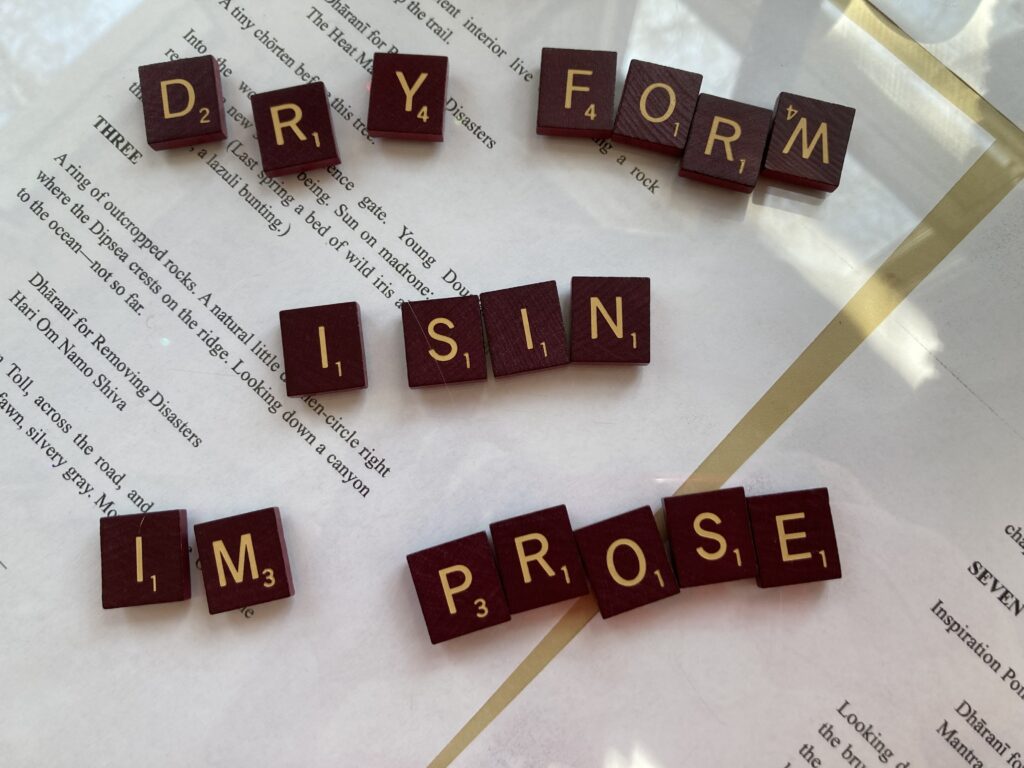
Yesterday I found the scrabble tiles for P I R I F O R M I S S Y N D R O M E and put them on my table. This morning I worked on them some more, trying to find a way to use all the tiles to make a phrase. The idea is that once I do, I will have a spell to break open or through my latest injury. Here are some of attempts:

  • Do I personify? [MMIRRS]
  • Miss Fiery Moon Drip [R]
  • Or is my form inspired? — all tiles used!
  • O sir, my form inspired! — all tiles used!
  • I inform my spired rods — all tiles used!
  • Miss Merry Porfirio [DN] — porfirio = purple-clad person, surname in Spanish/Portuguese
  • Is my sniper mood fir? [R]
  • Sir, spin my fired room — all tiles used!
  • Rim mood: spiny fires [R]
  • I spy: red moon, fir rims — all tiles used!
  • I spy: fir moon, red rims OR I spy: fir’s moon, red rim
  • (dry form) I sin, I’m prose! — all tiles used!

I might like this last one the best.

yes, that is an upside down W. We’re missing an M.

On Thursday I FINALLY picked up CA Conrad’s Ecodeviance, which I requested on march 4 and was planning to use that month. In the book, Conrad is interested in making it impossible to not be present in place by performing rituals that access the “extreme present.” A quick, perhaps half-baked, thought about Conrad’s soma(tic) rituals: from the ones I’ve read so far, a key element seems to be making other people uncomfortable.

Example: (Conrad riding an elevator repeatedly) “At the top and bottom of each ride I would show photographs of myself to strangers and ask, “EXCUSE ME, have you seen this person?”

I laughed out loud when I read this, but I also wondered about other ways of accessing the extreme present were possible that didn’t involve confronting strangers.

Conrad performs these rituals for days/weeks and take notes. From the notes, they write poems. A line from one reminded me of a delightful image from Mary Oliver that I read yesterday:

Six/ CA Conrad

a golden needle
stitches my head to
my knee leaving me
aching along the river

from The Book of Time/ Mary Oliver

those silver sheets, with the occasional golden staple,

I love MO’s description of a storm!

april 25/WALK

52 minutes
winchell / ravine / steps / longfellow / river trail
55 degrees

A great afternoon walk with Delia the dog. Sometimes there was sun, but mostly it was cloudy and overcast. Some wind. Bright green everywhere, even on the felled trees in the floodplain forest. Heard lots of singing birds, people talking, a sharp clanging noise. When it was sunny, I admired the soft shadows of tree limbs and Delia’s stubby legs and long body.

10 Things

  1. creeeaakkk — the tall trees in the floodplain forest were swaying in the wind and some branches were rubbing together to make a soft (and sinister) creaking noise
  2. the top step of the stone steps had a big puddle of water — watch out!
  3. stopping to wait for a trail runner to pass before heading back up the steps. They looked too warm and had a sweatshirt wrapped around their waist
  4. the soft lapping of the water against a log on the edge of the shore
  5. someone in a bright orange jacket following behind, talking to someone on a phone
  6. the sky above the forest was more open than usual, the ground more cluttered with tree trunks
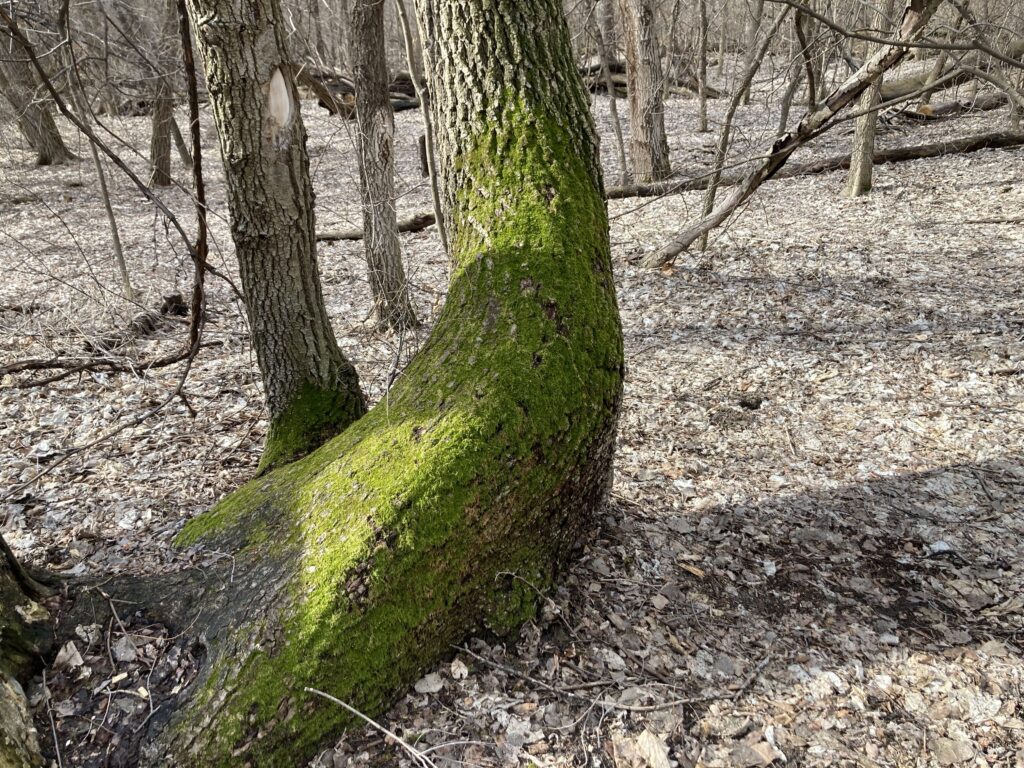
  7. the gentle curve of a tree trunk, almost like an arched back
  8. a loud splash in the water, then a flash of movement — a fish jumping out of the water?
  9. a retaining wall in the oak savanna, across the ravine, was painted bright colors — blue, yellow, red
  10. someone on a scooter, someone else on a bike, both masked and on the walking trail

before the walk

Woke up stiff and sore, which I’ve been doing for the past month. Most of me is okay, only my lower glutes and hips and hamstrings hurt, especially when I leaned down to throw something away in the organics. Ouch! After a few minutes, it should get better. Is it worse this morning because of yesterday’s biking? I don’t think so.

Other things I woke up to:

  • a thought: I have to wheel the recycling bin down before the truck comes!
  • a rejection: “After careful consideration, we decided this submission is not the right fit for us”
  • green green green grass from all the rain yesterday and early this morning

Rejections are not fun. Even though I know how difficult it is to get something published — less than 5% acceptance rate + your poem needs to fit with the others already selected — it still stings. But only for a few minutes. Now I’m thinking about grass and spring and noisy birds outside my window — the torpedoed call of a cardinal. I wish I would have counted their repeated chirps — 10 or 12 or more in a row!

A video came up on YouTube about piriformis syndrome, which I may or may not have, but probably don’t because it’s very rare — 6% chance: Piriformis Syndrome — STOP Stretching. I checked it out, and I’m willing to try the 2 exercises it suggests for contracting/strengthening my piriformis muscle instead of stretching/lengthening it. Will it work? I’m not sure, but I don’t think it will hurt to do them as I wait for my far off doctor appointment.

I’ve come a long way in my reactions to injury over the years. I’m not freaking out or in despair, even though I haven’t been able to run for 10 days. The pain isn’t making me anxious, like it did last year with my calf. I’m sure my more relaxed attitude is partly due to more experience with injury, less fear over tight glutes than knots in calves, and the lexapro. Whatever it is, I’m grateful to not be in constant panic mode.

So, is it piriformis syndrome? Who knows. What else could it be? Time to get out the scrabble tiles and make some anagrams!

P I R I F O R M I S S Y N D R O M E is tough one —

  • In moss drip form (not used: I R E Y)
  • Permission from Id (not used: Y R)
  • Osprey mind forms (not used: R I I)
  • Spry of mind, I rise (M O R)

after the walk

I’m continuing to read Robin Wall Kimmerer’s The Serviceberry. I think I might need to buy it. The part I’m currently reading is about ecological economics.

We’ve created a system such that we self-identify as consumers first before understanding ourselves as ecosystem citizens. In ecological economics, the focus is on creating an economy that provides for a just and sustaianable future in which both human life and nonhuman life can flourish.

The Serviceberry/ RWK

competition is not the primary force regulating evolutionary success

competition only makes sense when we consider the unit of evolution to be the individual. When the focus shifts to the level of a group. cooperation is a better modle not only for surviving but for thriving.

since competition reduces the carrying capacity for all concerned, natural selection favors those who can avoid competition. Oftentimes this avoidance is achieved by shifting one’s needs away from whatever is in short supply, as though evolution were suggestion “If there’s not enough of what you want, then want something else.”

april 24/BIKE

30 minutes
basement
outside: 52 degrees

A little cooler today, but not cold. Overcast, with rain coming. I could have brought my bike up and gone for a ride outside, but I wanted to watch more of The Residence, and my hip was hurting a little so I thought it would be hard to carry my bike up the stairs. I had a good ride. Hardly any pain — only the regular kind for less than a minute in my left knee. I finished episode 2 and started episode 3. Realized halfway through that the titles of the episodes (I had hardly noticed them before) mean something. Episode 3 Knives Out. Does it go deeper than the fact that this episode is about the pastry chef and the bloody knife? I need to watch the rest of the episode. And I need to convince Scott to watch this show. He will like it.

I pushed a little harder on the bike and got my heart rate up in the 130s for at least some time. I worked hard enough to sweat. Hooray! This is my first time sweating from exercise in over a week — last Tuesday. I’ve missed it. If my body feels okay tonight, I’ll have to do more biking tomorrow. Maybe it would help me recover to get a little more exercise? Future Sara, let me know.

Before I biked, I archived some things I read this morning:

1

Entanglements, connections, understandings of self in relation to others — it keeps coming up. Today, I found it in the poem of the day on Poetry Foundation, Speakers/ Dimitri Reyes

About this Poem

This poem finds me in my early twenties, being mentored by an owner of a thrift store in Newark, New Jersey, who became a father figure to my wife and me. Pete was the first Puerto Rican elder I knew who showed me that you can be connected to Ricanness while shuffling setlists between Metallica, Ozomatli, John Coltrane, and Joe Bataan; who showed me that it was cool to enjoy art and philosophize for the sake of dreaming. He is no longer here with us, but I am still philosophizing and dreaming. Currently, I am intrigued by how character sketches teach us how to live, to survive, to love. If life and time are indeed our teachers, the interactions we have among one another are the ever-changing curriculum.

Speakers/ Dimitri Reyes

The interactions we have among one another are the ever-changing curriculum. This idea of curriculum makes me think of a favorite poem, What You Missed That Day You Were Absent from Fourth Grade/ Brad Aaron Modlin.

I have been playing around with the idea of creating a curriculum for my experiences with poetry. I guess that is what my How to Be project is. It might be fun to work on it a little more, to fit in the form of a curriculum with syllabi, learning outcomes, etc.

2

I’m in the process of memorizing Emily Dickinson’s wonderful poem, “The Mushroom is the Elf of the Plants.” I’m looking at it on Poetry Foundation. At the bottom of the page, I read this:

Notes: 

The Poetry Foundation often receives questions about Emily Dickinson’s poems. Read a note from the digital archive editor about Dickinson’s “errors.”

I laughed out loud when I read this part:

Dickinson technically misuses the apostrophe in the poem “A Route of Evanescence, (1489)” and makes similar errors in other poems. Some of these can be explained as unintentional errors and some scholars have made this case. Other scholars, however, contend that Dickinson often intentionally played with typos and other errors as a sort of linguistic mischief-making in her poems and in her considerable correspondence.

The error ED makes is using it’s when she should have used its. This is a huge pet peeve of Scott’s. Just as I was reading this passage, he came downstairs, so I explained the note and paraphrased the key part for him: she’s fucking with you! Ha Ha. I love Emily Dickinson.

3

I was disappointed to check and find that I hadn’t written about mushrooms and entanglement on april 24, 2022. But then I was grateful to find that I had posted a beautiful Mary Oliver poem on april 24, 2021. Thanks past Sara and Mary Oliver! That ending!

Listen, everyone has a chance. 
Is it spring, is it morning?
Are there trees near you, 
and does your own soul need comforting?
Quick, then—open the door and fly on your heavy feet; the song
may already be drifting away.

And here’s a moment of connection and community:

first, I stood still
and thought of nothing. 
Then I began to listen. 
Then I was filled with gladness—
and that’s when it happened, 
when I seemed to float, 
to be myself, a wing or a tree—
and I began to understand
what the bird was saying, 
and the sands in the glass
stopped
for a pure white moment
while gravity sprinkled upward
like rain, rising, 
and in fact
became difficult to tell just what it was that was singing—
not a single thrush, but himself, and all his brothers, 
and also the trees around them, 
as well as the gliding, long-tailed clouds
in the perfectly blue sky—all, all of them
were singing. 
And, of course, so it seemed, 
so was I.

4

Yesterday I started reading Robin Wall Kimmerer’s The Serviceberry. Today I encountered her offering of a definition of economics outside of the scarcity model and within an understanding of gifts and abundance:

Economics is “the study of scarcity, the study of how people use resources and respond to incentives.” (the American Economic Association)

With scarcity as the main principle, the mindset that follows is based on commodification of goods and services.

Economics is “how we organize ourselves to sustain life and enhance its quality. It’s a way of considering how we provide for ourselves” (from the U.S. Society for ecological Economics).

The currency in a gift economy is relationship, which is expressed as gratitude, as interdependence and the ongoing cycles of reciprocity. A gift economy nurtures the community bonds that enhance mutual well-being; the economic unit is “we” rather than “I,” as all flourishing is mutual.

april 23/WALKBIKE

60 minutes
winchell trail / dowling community garden / neighborhood
61 degrees

Even better than yesterday! What a wonderful late morning. Delia and I walked to the Winchell trail, then up to the mesa in the oak savanna. More winchell until the folwell bench, then across the road through the 1960s neighborhood and into the community garden. So many birds! Lots of green and white flowers too, blooming all over the hillside in the oak savanna. I found out what these white blossoms were called a few years ago, but I can’t remember — maybe it’s one of these?

10 Things

  1. a steady dripping down in the ravine
  2. 2 dark holes — caves in the rock
  3. more of the chainlink fence is ripped away from the posts
  4. yesterday I noticed ugly red graffiti on the 38th street steps. Was it still there today? I forgot to check, but surely I would have noticed, right?
  5. less mud, more dirt
  6. sometimes sunny, sometimes overcast / sometimes blue, sometimes light brown
  7. in a wood near the community garden: 2 (or more?) birds making a racket up in a tree, sounding like the drum at the beginning of Van Halen’s “Hot for Teacher” — nice!
  8. the river: patches of smooth water, patches of rougher water — not from wind, but from sandbars?
  9. calm, still, the water was barely moving — only after staring at it for a moment could I see a slight shimmer out of the corner of my eye
  10. a woman in bright pink, sitting near the 38th street steps, silent except for the repeated clearing of her throat

before the run

Reading through my entries from april of 2022, I’m returning to thoughts of entanglement and mushrooms and precarity and ruins. Here is today’s inspiration from 23 april 2022:

  • a different sort of We, not a me or an I, but a we, an us
  • a different way of looking/sensing/becoming aware: not seeing straight on, but feeling, looking across and to the side, down, beneath and below
  • stop looking up to the heavens, start feeling/sensing what’s below
  • a hope that is not predicated on evidence, when evidence = seeing and Knowing and fully understanding (seeing things as parts or discrete categories or individual things)
  • entangled is not separate or pure but messy and enmeshed

this is why we are all here — from my haibun and what I heard coming out of the little old lady’s phone

this 
why 
we 
all
here

why = curiosity, wonder

The why is not an explanation — this is why/this is THE reason — but an invitation to imagine differently, expansively, wildly.

we all = ecosystems, organisms, networks, asemblages

Organisms are ecosystems. 
I find myself surrounded by patchiness, that is, a mosaic of open-ended assemblages of entangled ways of life, with each further opening into a mosaic of temporal rhythms and spatial arcs (Tsing, 4) .

here = a place, located in history, a specific place, not transferable or easily translatable, can’t be scaled up or turned into assets

I picked up Mushrooms at the End of the World, and found this in the preface:

The time has come for new ways of telling stories beyond . . . Man and Nature . . , such stories might be simultaneously true and fabulous. How else can we account for the fact that anything is alive in the mess we have made?

The Mushrooms at the End of the World/ Anna Lowenhaupt Tsing (viii)

fabulous = resembling or suggesting a fable of an incredible, astonishing, or exaggerated nature

invented and true

[about this book] what follows a riot of short chapters. I wanted them to be like the flashes of mushrooms that come up after a rain: an over-the-top bounty; a temptation to explore; an always too many.

explosion / too much, too many / after the rain eruptions of excess

This explosion bit reminded me of Arthur Sze in an interview with David Naiman:

I began to think I love this idea that the mycelium is below the surface. It’s like the subconscious, then when the mushroom fruits pops up above ground, maybe that’s like this spontaneous outpouring of a poem or whatever.

during the run

I thought about something else I read in the entry with this Sze passage. It’s a fragment of a poem I wrote in response to Sze and a few Mary Oliver lines:

Maybe like mushrooms, we rise
or not rise, flare
brief burst from below
then return 
to swim in the dirt…

I was thinking about not wanting to swim in the dirt, but be out in the air, exposed, vulnerable to erosion and rust/ing.

after the run

In The Mushrooms at the End of the World, Tsing discusses how matsutake mushrooms develop their fungi networks in locations of ruin — edges of volcanos, forest destroyed by logging and lumber companies. So, there’s a relationship between the flare/the fruit (the mushroom) and decay/ruin/erosion. Now I’m thinking about my version of what the moment of ruin can produce, where the moment of ruin = ruined eyes. What poetry might burst forth as I reckon with my dying/dead cone cells?

Mushrooms came up in the fiction book I’m reading, too: The Bog Wife.

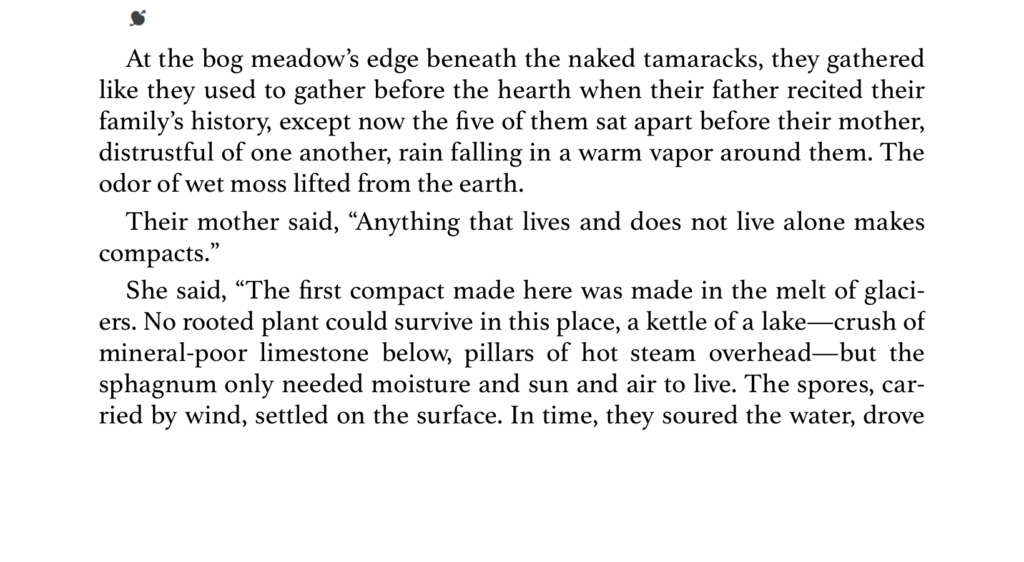
But when he returned to the bog, he found a row of trespassers sprouting where the swale met the hinged door to the Cranberry River. These trespassers retained their heads, and Percy knew as soon as he saw them that his suspicions were correct; they were mushrooms. His heart sank. He sometimes saw mushrooms in the sparse forest on the west end of the property, modest white-headed clumps strewn across the soil or fringed gray dishes sticking out like frills from the trunks of trees. But he had never seen any of their ilk here, where the soil was not mushroom soil because it was bog soil, a dense wet batter that supported only the shallow-rooted and perpetually thirsty.

They would never tolerate any of the mushrooms, Percy thought. The mushrooms had all been trespassers. He tore out the orange mushrooms and gathered up the torn stems for burning, but he knew it wouldn’t make a difference. Mushrooms could not be dug up. They could not be evicted.

The Bog Wife/ Kay Chronister

I’m reading Emily Dickinson’s “The Mushroom is the Elf of Plants” and refreshing my memorizing of Sylvia Plath’s “Mushrooms.” Nobody sees us, stops us — SP envisions mushrooms as trespassers.

And here are a few more passages from Mushrooms at the End of the World, that I want to archive:

a network of (mostly) invisible influences

Below the forest floor, fungal bodies extend themselves in nets and skein, binding roots and mineral soils, long before producing mushrooms. All books emerge from similarly hidden collaborations.

The Mushrooms at the End of the World/ ALT

a gift and a guide

The uncontrolled lives of mushrooms are a gift — and a guide — when the uncontrolled world we thought we had fails.

promise and ruin, promise and ruin

This is a story we need to know. Industrial transformation turned out to be a bubble of promise followed by lost livelihoods and damaged landscapes. And yet: such documents are not enough. If we end the story with decay, we abandon all hope—or turn our attention to other sites of promise and ruin, promise and ruin.

bike: 20 minutes
basement

It was definitely nice enough to bike outside today, but I wanted to test out how riding a bike would feel on my back/hips/glutes for taking my bike off the stand and carrying upstairs. Plus I wanted to watch more of The Residence. Great show!

Almost 2 hours later, my back feels okay. We’ll see how it is when I want to go to sleep. If it’s okay, I might try biking outside tomorrow!

april 22/WALK

45 minutes
winchell trail south / folwell bench
58 degrees

Wow wow wow! Spring. Little explosions of bright green everywhere — out of sidewalk cracks, under fences, on slender branches. I think explosion is the right word — not pops or flashes, well maybe flares. Almost overnight, green! Not yet annoying or oppressive; I still have my view of the gorge and the other side. I could see fuzzy details, branches, rippling water, houses, but what I felt was the horizons of gray (river), brown (shore/trees), and blue (sky). 3 distinct lines dividing my view into 3 colors.

Delia and I walked to the river then down the uneven wooden steps to the trail. We walked even slower than usual to let two walkers move past. One of them was talking about a friend (or a partner?): we’re both from the same town, and we went to the same school! I smiled and greeted a friendly runner, called out Hi Dave! to Dave. Delia jumped up and walked all of the walls on the trail. We ended at the folwell/the WWDD bench (see below) and sat for a moment, taking in the view.

10 Things

  1. the air was hazed with humidity, making everything look even fuzzier, more distant
  2. minneapolis park workers have cleared out old trees in the savanna, turned them into mulch that they put on the trail
  3. the small rise up to the paved trail is more visible now — all dirt and dead leaves and stubs of tree trunks
  4. the cave below the limestone ledge in the ravine seems to be expanding — how long is this process? how long before the ledge collapses?
  5. mud on the part of winchell on the hill between the savanna and the 38th street steps
  6. the repeated honk from a lone goose, below us. It always seemed the same distance from us. Was it following us, or taking a walk with us?
  7. a loud, rhythmic clanging above us that I couldn’t quite place. A thought: was it someone banging on a fire hydrant to open it up? Near the end of my walk, I saw one open and gushing water
  8. sitting at the folwell bench, overheard — an older walker to a younger one: we haven’t even gone 20 minutes yet
  9. someone pushing a walker through the grass on the boulevard between edmund and the river road, stopping to check out each tree
  10. the husk of some big trees leaning at awkward angles in the oak savanna

A wonderful walk! I felt relaxed and calm and grateful to be outside and moving (without pain) this morning.

before the run

Reading through my “on this day” entries from past april 22nd entries, I was inspired by Mary Oliver and a little old lady walking and listening to a radio and a bench dedicated to a woman who fell through the ice one winter and a fragment overheard on the little old lady’s radio — this is why we are all here — especially the this, which is echoed in Marie Howe’s poem, The Gate. Instead of trying to explain these connections–entanglements?– I’ll gather them here:

1 — the little old lady

For the third time, encountered the little old lady walking with her hiking poles listening to a radio show or an audio book or something. Today I heard, “which reminds us of why we are all here.” Decided that I should create a poem or some piece of writing around this phrase. This phrase could be the title or the ending line of the whole poem or a sentence or a refrain (5 aug 2019).

…the little old lady slowly shuffling by, swinging her hiking poles, a voice TED-talking out of her phone’s speaker reminding you that this is why we are all here. Do not bother the bench resting on the rim of the gorge to ask what this is (22 april 2022 — a draft of my poem).

note: reviewing these entries, I’m noticing how I changed what I heard from “reminds us why” to “this”. I’m almost prefer the original — the reminder, that doesn’t have to be the answer, just a pointing to it — a finger pointing! a definition of poetry!

2 — The Gate

from The Gate/ Marie Howe

This is what you have been waiting for, he used to say to me.
And I’d say, What?

And he’d say, This—holding up my cheese and mustard sandwich.

And I’d say, What?
And he’d say, This, sort of looking around.

3 — This is why we are all here

which reminds us why we are all here…

We are here. Me and joints and muscles and bones and ligaments and lungs. Us. me
and blood and cells and electrolytes and sweat and saliva. we. me
and hands and feet, a heart, two diseased eyes, a knee that displaces. we. me
worn out running shoes, threadbare worries. we. me
and those oak trees, that wrought iron fence, this rutted, dirt path, that short, steep hill. we. me river. that we are here with the old woman who slowly shuffles in her straw hat with her hiking poles and a voice that calls out from her radio speakers, “which reminds us why we are all here.”
here. above the river and the gorge and the floodplain forest, below the bike path and the road, the cars and the boulevard.
here. in this heat and humidity and haze. here. on a monday morning. here.

We are all here.

(from 22 april 2022)

4 — Mary Oliver

Reading MO, I’ve noticed, and have been trying to articulate, a tension in her poems between the I, the World, Nature, God, Eternity, Work. This tension seems to take many forms and MO imagines it to be endlessly intriguing and part of the process of living. Never to be resolved but to be puzzled over. One element of this tension involves the plight of the human—born to doubt and argue and question what it all means, to be both brought closer to and further away from the world by language and the power and beauty of words, which are never as powerful or beautiful as the world itself. To want a name and a useful place, to claim a life, but also to belong to the world, to be “less yourself than part of everything.”

(from 22 april 2021)

From The Book of Time in The Leaf and the Cloud

5.
What is my name, 
o what is my name
that I may offer it back
to the beautiful world?

from “Gravel” in The Leaf and the Cloud

6.

It is our nature not only to see
that the world is beautiful

but to stand in the dark, under the stars,
or at noon, in the rainfall of light, 

frenzied, 
wringing our hands, 

half-mad, saying over and over:

what does it mean, that the world is beautiful—
what does it mean?

5 — the words/reminder

from “Work” in The Leaf and the Cloud

3.
Would it be better to sit in silence?
To think everything, to feel everything, to say nothing?

This is the way of the orange gourd.
This is the habit of the rock in the river, over which
the water pours all night and all day.
But the nature of man is not the nature of silence.
Words are the thunders of the mind.
Words are the refinement of the flesh.
Words are the responses to the thousand curvaceous moments—
we just manage it—
sweet and electric, words flow from the brain
and out the gate of the mouth. 

We make books of them, out of hesitations and grammar.
We are slow, and choosy. 
This is the world.

Words can help us to remember a beloved but long dead dog:

And now she’s nothing
except for mornings when I take a handful of words
and throw them into the air
so that she dashes up again out of the darkness,

5 — the bench

I have run by this bench hundreds of times, stopped and sat once or twice, even wrote about it, but I’ve never noticed this small plaque on it. How did I see it today? I love these little surprises, just waiting to be found! I had no idea what this plaque meant — WWDD? I looked it up and found a facebook page for the Rachel Dow Memorial. Wow. She was loved by so many. I read a little about her life — a passionate, social justice minded, free-spirit — and her death — she fell through the ice at the river and died of hypothermia. Maybe I’ll write a poem about her and the others I’ve found through their plaques. All of them share with me a deep love for this river. And maybe one day, I’ll have a plaque there too (from 8 sept 2022).

6 — Jane Hirshfield

Termites: An Assay/ Jane Hirshfield

So far the house still is standing.
So far the hairline cracks wandering the plaster
still debate, in Socratic unhurry, what constitutes a good life.
An almost readable language.
Like the radio heard while traveling in a foreign country—
You know that something important has happened, but not what.

What to do with all of this? I’m not quite sure yet.

during the run

Occasionally, I thought about these ideas as I walked, and when I sat on the folwell bench. What did I think? I hardly remember. Once, I thought about how words were not the most important part, that being out there by the gorge, feeling everything was.

april 21/WALK

45 minutes
minnehaha academy loop*
50 degrees

*43rd ave, north / 32nd street, east, past Minnehaha Academy / edmund, south / 34th street, west, past 7 oaks / home

Before taking a walk with Delia and Scott, I “watched” the Boston Marathon, where watching = tracking runners on the app, listening to the Citius Mag watching party, and watching the last 5 minutes of the women’s race on an unofficial YouTube feed. Wow, they were fast!

It looked warm and sunny, but it felt colder than 50. It was the wind, I think. For the first half we talked about kids and wanting to be empty-nesters and how to have hard conversations about the future and the series finale of The Americans — we finished it last night. In the second half, Scott pointed out a strange mash-up of a garage and I pointed out the Siberian Squill. I wondered if we were seeing it more now because we’ve named it, but we agreed that it has become more abundant in the past few years. There was a particularly impressive patch of it in the yard of the house on the south corner of edmund and 34th. Taking in the entire patch, it looked blue. Focusing on a flower, it looked purple.

10 Things

  1. siberian squill, everywhere, including at the edge of our yard
  2. a loud dog in a fenced-in backyard
  3. an empty parking lot at minnehaha, no school for Easter
  4. a metal sign at Cooper School, bent and leaning to the side
  5. a security guard car parked in front of the gate to the field at minnehaha academy
  6. the boulevard on the edge of the academy that used to have a small line of aspensmwith aspen eyes, now only has one aspen
  7. a woman stapling a poster to a pole
  8. mud on a boulevard — Delia, stay out of the mud! — a deep brown
  9. the wind chimes chiming at the house with an Easter Island head on the front stoop
  10. looking over at the river road and seeing/feeling the open space between the west and east banks

Back/hip/leg update: today it is a little uncomfortable to sit in the chair at my desk. Is that because I went down and up the old stone steps to the river?

april 20/WALK

40 minutes
longfellow flats (river)
48 degrees

Spring! Hello black capped chickadees! Hello drumming woodpeckers! Hello bikers and runners and walkers with dogs! Hello green shoots and damp earth and soft air! Water gently lapping the shore, echoing voices, ringing bells! Hips (hopefully) healing and backs growing stronger! A wonderful morning for a walk through the neighborhood and to the river.

I wasn’t willing to stop and stare, so I could be mistaken, but it looked like a woman was taking her dog on an easter egg hunt — with the dog searching for the eggs while the woman encouraged them. If that wasn’t what I saw, I will still believe it was. Is that a thing, people arranging egg hunts for their dogs? I hope so!

I’m continuing to work on crown of color sonnets. I’m on the final one, no. 7, blue. I want to link this sonnet back up with the first one, so I’m ending with green. I’m thinking of returning to the green poem I drew from a lot, Oread by H.D.. Something about the sky not being pure blue but a mix of blue and green, or sometimes just green — especially in the spring and summer when green takes over the gorge. I’m leaving these last few sentences in, but as I worked on it more, I decided to go in a different direction. I’m taking lines from a beautiful essay about a blue wall in Leadville and writing about my efforts to make blue meaningful even though I can’t always see it.

april 19/WALK

35 minutes
neighborhood
50 degrees

Walked with Scott and Delia the dog. My hips feel a little sore, but otherwise I’m okay. Not in pain, not stressed about taking a break from running. I know I need this break. Scott and I noticed more Siberian Squill, taking over. I admired the big turtle in someone’s front yard, Scott critiqued some out of place columns holding up a trellis-like porch at the front of a house. He asked, how have I never noticed these columns before? My response: Really? These columns are the defining characteristic of this block for me. Scott wondered if a robin, standing still in a yard, was dead. Nope, we saw it move its head. I pointed out a house that was very big. The wind was coming at us from almost every direction — not quite stiff, but irritating. Even with the chilled air, it felt like spring was here to stay. Hooray!

La Guerre (II)/ e.e. cumming

O sweet spontaneous
earth how often have
the
doting

               fingers of

prurient philosophers pinched
and
poked

thee
,has the naughty thumb
of science prodded
thy

       beauty     how

often have religions taken
thee upon their scraggy knees
squeezing and

buffeting thee that thou mightest conceive
gods
(but
true

to the incomparable
couch of death thy
rhythmic
lover

             thou answerest

them only with

                             spring)

april 18/WALK

30 minutes
neighborhood
50 degrees

Went on a walk with Delia and FWA. He’s home for Easter weekend. We talked about the show Russian Doll and the 4th dimension and the limits of language and how it shifts meanings and experiences of the world. FWA wondered what it might feel like to experience the world outside of language and I talked about my work on this log and with poetry, particularly soft attention and my 10 things practice. I mentioned Mary Oliver’s poem “The Real Prayers Are Not the Words but the Attention that Comes First.” I pointed out the small stone embedded in a tree that reads, = > ÷.

Years ago, I remember feeling disconnected from FWA, not knowing how to talk with him, wondering why he was so distant. A deep sadness. I couldn’t have imagined (or hoped for) our wonderful, wandering conversation this afternoon. Not the same, but an echo of the ones I used to have with my mom.

It was not raining. Things felt open and possible, not closed and finished. Everything almost opposite of Bert Meyers’ poem, “Rainy Day.” Even so, I’ll post it here for later:

Rainy Day/ Bert Meyers

Outside, nothing moves: only the rain
nailing the house up like a coffin.

Remember, in childhood, when it rained?
Then, the whole world sailed down the alley:

leaves, paper, old shoes, the buildings,
everything like a circus going to sea.

Now, the rain, the iron rain, with its little keys
is closing all the doors . . .

and I think we’re all dead. See how the sky
sits like a tombstone on the roofs.

april 17/WALK

30 minutes
neighbohood
55 degrees

note: I’m writing this on the 19th.

Walked with Delia through the neighborhood. Since I’m writing this a few days later, I don’t remember much, only the broad swatch of Siberian Squill in a front yard at the northwest corner of 46th avenue and 34th street. Bunches of little flowers peeking out from a big boulder, covering a small swell of grass, hiding behind a fir tree. When I glanced at one flower, it looked light purple, but when I took them all in at once, they were blue. A strange sight to see the color switch from purple to blue, purple to blue, as I shifted my gaze.

april 16/WALK

40 minutes
neighborhood
50 degrees

Woke up this morning unable to bend down to put on socks. I’ve been having a mild version of this problem for a few weeks, but today it was worse. Time to shut it down for a while. I scheduled an appointment with the doctor. First available: June 12th. Oh well, I’m on the wait list, and I feel like there’s a good chance this problem will get better on its own — iff (if and only if), I take a proper break. No running for at least a week. No biking either. The problem has been in my upper glutes/lower back, today I felt pain all down my leg to my calf. It’s worse in the morning, after not moving for most of the night. I can stand and walk but bending down in a certain way hurts too much. I am not bothered by this injury. Of course, I’d like to be running and biking, but it’s okay. The uncertainty is gone — am I injured or not? I know I am and that I need to take a break.

Thankfully, I can still walk! Went with Delia and Scott. Beautiful — blue sky, birds, and the feeling that spring is here. Oh — and little purple flowers. Scott looked them up: siberian squill. According to the Minnesota Wildflower site, they’re not purple, but blue, and invasive. Originally from Russia, these colorful flowers are hearty and take over gardens. Not even critters want to touch them. Unfortunately, some gardeners continue to plant them. At the bottom of the entry, in bold, is:

Please, all you gardeners out there: stop planting this.

The site recommends planting native species, like phlox or bluebells. Before Scott identified them with his app, I had guessed that they might be phlox.

Wow, I just read the comments and discovered a fight — on a wildflower site? I’m not sure I agree with Sandy, but I enjoyed her spirited comment.

Petyr:  It is as bad if not worse than garlic mustard – you can’t even pull this crap.

Which gardeners are now willing to stand up and take responsibility, or is this just another “so sorry”? Gardeners, this is stupid… mindless… enough!

Sandy: Finally, after 40 years of living in the same house, I have identified the little blue flowers that blossom with the snow on the ground. Early Siberian Squill. They grow wild along the front of my house. I find them to be quite beautiful. I find nothing offensive about them. A whole lot prettier than dandilions, which I wish were gone, gone, gone. So all you gardeners out there, bite me. My Squill will be left in peace, while I continue to fight a war on the big ‘D’.

There is a poem here, I think, featuring Sandy.

april 15/RUN

2.5 miles
2 trails
44 degrees / wind: 15 mph

Windy this morning and warmer than I thought it would be. I was overdressed in a short-sleeved shirt, a hooded pull-over, and short running tights. I continue to feel sore, so I wondered if I should run. Luckily. my back and glutes didn’t hurt when I was running. In fact, they felt better, like the movement was loosening them up. There were lots of shadows on the trail — from me, trees, the fence. I’m thinking about indigo today so I briefly wondered if I’d call the darker shadows indigo. Nope, they weren’t dark enough. The sun made the river sparkle as I looked to the south. Wow!

Encounter: a woman with her dog on the narrow winchell trail. As I ran by she called out, Look out for his poop! I couldn’t see it, but I leaped and hoped for the best. Success!

Anything else? Someone was sitting on the bench at the Horace W.S. Cleveland overlook. A street cleaning truck was clearing out leaves and making a ruckus across the road. The wind has strong and in my face as I ran north, and even stronger as I ran west.

before the run

Today I’m thinking about indigo. In the entry for indigo in The Secret Lives of Color, I read about indigo dye and the plants that are used to create indigo (including woad) and the process of soaking it in alkaline and drying it and collecting the powdery residue and forming it into blocks to be sent off to market. I think some part of this line might make it into my poem:

changes color upon coming into contact with the air, turning from yellowish green to sea green before settling on a deep, stolid blue.

The Secret Lives of Color/ Kassia St. Clair (190)

stolid: calm, dependable, and showing little or not emotion

Later googling “indigo,” I encountered the indigo bunting. Of course!

looks like a scrap of sky with wings

All About Birds
  1. “Like all other blue birds, Indigo Buntings lack blue pigment. Their jewel-like color comes instead from microscopic structures in the feathers that refract and reflect blue light, much like the airborne particles that cause the sky to look blue” (All About Birds).
  2. “Indigo Buntings migrate at night, using the stars for guidance. Researchers demonstrated this process in the late 1960s by studying captive Indigo Buntings in a planetarium and then under the natural night sky. The birds possess an internal clock that enables them to continually adjust their angle of orientation to a star—even as that star moves through the night sky” (All About Birds).

Knowing names correctly is everything; it’s a key to connection and tenderness and a turn to kindness. When you get to learn about an animal or plant, get to know their names, when you learn that there are birds out there who read the stars to fly home at night (indigo buntings), and how wondrous and lovely that is — maybe it might become harder to want to use a product that clogs up the sky with smog so these birds can’t see the stars?

Short Conversation with Poets: Aimee Nezhukumatathil

after the run

Found a PBS documentary on jeans, Riveted: The History of Jeans. I watched it online through my local library. Some things to remember:

  • “In Africa, the indigo cloth is considered the next layer to the skin. It holds a person’s soul, their spirit.”
  • many African captives who were enslaved in the new world brought with them the knowledge of making indigo dye and how to fix it to fabric. “Indigo is one of the ways in which slave holding became tied to the economic fortunes of the colonial experiment.”
  • indigo was the second biggest cash crop behind rice in South Carolina (1770s)

Now I’m reading the chapter on indigo in On Color. Before Isaac Newton decided it was a color in the 1670s, it was only a dye.

But if colors, at least for humans, are the particular visual experiences triggered by the detection of electromagnetic waves between about 390 and 700 nanometers, there are no new colors to be seen, only new colors to be named. Any new color is just a thinner segment than has previously been recognized of an infinitely divisible continuum. It isn’t new; it was always there. So why not indigo?

On Color

Finally, I found a blue poem with some useful lines that I might read as indigo:

Blue variations/ Lubna Safi

Blue is the blue of distance, “the ink that I use is the blue blood of the swan” (Cocteau), of the sea, of the faraway, a discriminating blue, of your eyes, of memory, the blue of baby boys, of glaciers, of a last light, the great blue chord of a nocturnal symphony, of being cold, of shallow holes, of tender bruises, the gathered blue of my mother’s laughter, of once in a moon, of mountains, of blueprints, of the hottest fire, of silence, of nostalgia, of herons, of dreams, lakes, and skies, of reading The Holy Book, the blue-black of my grandfather’s hair and Hayden’s cold mornings, of the horizon, blue taste of summer, off-blue of concentric waves, of elsewhere, “this blue that opened the way to you” (Bennis), of feeling, of late nights, of blues notes, of edges, of memories of your eyes, of piercing, of the afterimages of Lorca’s words, of stones and storms, blue like thought, like time, the past and present blended together, blue tent of refugee camps, of veins, faded blue of childhood’s tongue, of cold lips, glacial blue of the Arctic nights, of God’s unfolding hand (C. D. Wright), of our pale dot, of the tepid pool water, of the elemental hue of the upper sky “that seems to retire from us” (Goethe), of the typical heavenly color (Kandinsky), blue turning deeper and deeper before going out.

april 12/WALKBIKE

35 minutes
7 oaks
58 degrees

Last night and this morning my glutes ached, so no running today. I did some more research and I think the exercises in this video might help. Future Sara will let us know!

a pain in the butt

Walked with Delia and Scott. Warmer today, windy too. My favorite sound: the wind rushing through a big pine tree. I noticed some dry leaves skittering in front of us as we walked east. Heard the St. Thomas bells and their extra long chimes at noon. Saw lots of runners and walkers and bikers. Scott talked about how farmers are getting screwed by the new tariffs, and I talked about Indigo. A few times my back ached — was it a spasm? Not sure.

indigo

For the past few days, I’ve been working on a crown of color sonnets, using the words of other writers (cento). The plan is to write 7 sonnets, with each one setting up the next with its color mentioned in the last line. I started with green, then went to orange, then yellow-red, then purple. I wasn’t sure what would come next — I thought it would probably be blue — but in the last line of the purple sonnet indigo appeared. I haven’t studied indigo that much, so before writing a sonnet about it, I’d like to spend some time with it.

Indigo began working its way into my sonnets a few days ago, when I attempted to list colors I’d seen on my run in using the ROYGBIV system. I couldn’t recall seeing anything indigo. Then yesterday, while looking for a passage by Oliver Sacks on yellow I encountered this description (which I read a few years ago, but had forgotten):

I had long wanted to see “true” indigo, and thought that drugs might be the way to do this. So one sunny Saturday in 1964, I developed a pharmacologic launchpad consisting of a base of amphetamine (for general arousal), LSD (for hallucinogenic intensity), and a touch of cannabis (for a little added delirium). About twenty minutes after taking this, I faced a white wall and exclaimed, “I want to see indigo now—now!” And then, as if thrown by a giant paintbrush, there appeared a huge, trembling, pear-shaped blob of the purest indigo. Luminous, numinous, it filled me with rapture: It was the color of heaven, the color, I thought, which Giotto had spent a lifetime trying to get but never achieved—never achieved, perhaps, because the color of heaven is not to be seen on earth. But it had existed once, I thought—it was the color of the Paleozoic sea, the color the ocean used to be. I leaned toward it in a sort of ecstasy. And then it suddenly disappeared, leaving me with an overwhelming sense of loss and sadness that it had been snatched away. But I consoled myself: Yes, indigo exists, and it can be conjured up in the brain. For months afterward, I searched for indigo. I turned over little stones and rocks near my house, looking for it. I examined specimens of azurite in the natural history museum—but even they were infinitely far from the color I had seen. And then, in 1965, when I had moved to New York, I went to a concert in the Egyptology gallery of the Metropolitan Museum of Art. In the first half, a Monteverdi piece was performed, and I was utterly transported. I had taken no drugs, but I felt a glorious river of music, four hundred years long, flowing from Monteverdi’s mind into my own. In this ecstatic mood, I wandered out during the intermission and looked at the ancient Egyptian objects on display—lapis lazuli amulets, jewelry, and so forth—and I was enchanted to see glints of indigo. I thought: Thank God, it really exists! During the second half of the concert, I got a bit bored and restless, but I consoled myself, knowing that I could go out and take a “sip” of indigo afterward. It would be there, waiting for me. But when I went out to look at the gallery after the concert was finished, I could see only blue and purple and mauve and puce—no indigo. That was nearly fifty years ago, and I have never seen indigo again.

Hallucinations/ Oliver Sacks (found here)

His description of standing in front of blank wall reminded me of my mood rings experiment: facing a blank wall, staring at it, waiting for my blind spot to occur. I wonder, could I see indigo doing this (and without the drugs)?

I recall reading something about indigo and debates over whether or not it existed. I’ll have to look for that source.

At the time, because I was working on a yellow poem, I didn’t dwell on the indigo. But later that day, it returned in a Mary Oliver poem — I was looking for another orange poem:

Poppies/ Mary Oliver

The poppies send up their
orange flares; swaying
in the wind, their congregations
are a levitation

of bright dust, of thin
and lacy leaves.
There isn’t a place
in this world that doesn’t

sooner or later drown
in the indigos of darkness,
but now, for a while,
the roughage

shines like a miracle
as it floats above everything
with its yellow hair.
Of course nothing stops the cold,

black, curved blade
from hooking forward—
of course
loss is the great lesson.

But also I say this: that light
is an invitation
to happiness,
and that happiness

when it’s done right,
is a kind of holiness,
palpable and redemptive,
Inside the bright fields,

touched by their rough and spongy gold,
I am washed and washed
in the river
of earthly delight—

and what are you going to do—
what can you do
about it—
deep, blue night?

A thought occurs to me in reading this — actually, a reminder: here in the city, on a street with street lights and security lights and light pollution of other kinds, a deep, blue night is impossible to see. And, ever since the family farm in the UP was sold in 2005, I rarely am in a place remote enough to lack light.

bike: 30 minutes
basement

Finally had a chance to finish up the first episode of The Residence and start the second one. Wow, it’s good. One moment that I couldn’t quite figure out, even with the audio description: Cordelia Cup encounters the male chef sitting on the floor, against the wall and under a row of knives. He looks motionless and dead to me, but no one reacts and the audio description says his eyes followed Cordelia as she left the room. I watched again and still couldn’t tell. His eyes looked dead to me, but that happens a lot — that is, when I actually see someone’s eyes.

april 11/WALK

50 minutes
32nd to edmund to 7 oaks
45 degrees

Took a late morning walk with Delia and Scott on an overcast day. The theme: critters! Birds and dogs and little kids. As Scott said, the stars of the show were the 2 very big eagles perched at the top of a tall tree on edmund. Some walkers across the road pointed them out to us. At first I couldn’t see them. Scott was describing where they were and I tried to spot them, but I couldn’t see anything, only the feeling that there was something there. Somewhere in my head an idea occurred to me as I scanned the branches — there’s a blob there — but it never turned into an actual thing I was seeing. And then, suddenly, it did. A dark form with a white head, perched on a branch. A few minutes later, I saw the other one too. Still, stoic, only shifting its wings once. Wow!

Other critters: the energetic voices of little kids on a preschool playground, a tiny giggle from a girl getting out of a car, the feebee of a black-capped chickadee, a dog I’ve encountered before that likes to plop down in the middle of the road and not move.

It was chilly — I wore my gloves — but it felt like spring. Spring! Scott talked about some problem he was having with his plug-in involving time codes and microsoft not recognizing standard ones and Helsinki and sisu. I talked about my latest experiment: a crown of sonnets compromised of other people’s words about color. They’re connected by the last line of the one poem mentioning the color of the next one. So far I’ve done green and orange and yellow-red. I’m set up to start purple. I’m thinking of doing blue and metallics or silver, and green-brown-gray. Not sure about that last one — maybe just brown, but ending with a green line to bring it full circle?

april 10/RUN

4.5 miles
river road, north/south
51 degrees

Today I wore shorts! I did a variation on the beat workout. Mile 1 = chanting triples / Mile 2 = metronome at 175 / Mile 3 = Playlist (Color). The variation was that I took a little longer between miles and I tried to get faster with each one. I felt faster and more locked into the beat, which was fun.

Right after I started the run, the tornado sirens went off. Hmm — it’s not Wednesday and it’s not the first week of the month, so what was happened? I asked a walker I encountered and she told me it was tornado prevention month. Of course!

10 Things

  1. the river road was crowded with a steady stream of cars as I entered the path
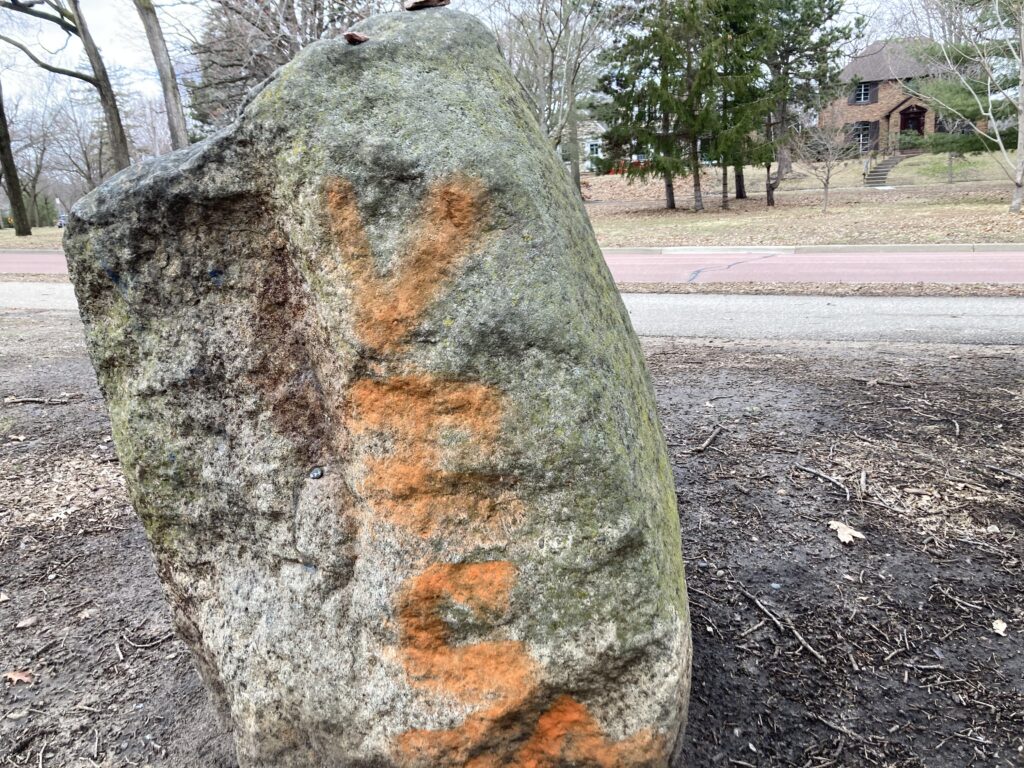
  2. a small tree beside the path, some of its tops were spray painted orange
  3. a bike was hidden behind the feet of the lake street bridge
  4. a man and a woman standing next to 2 overturned lime scooters — the man had his phone out, was he about to rent them?
  5. a tree leaning heavily against the wooden fence above the ravine — how long until the tree falls or the fence breaks or the park workers fix it?
  6. a runner ahead of me wearing white mid-calf socks, looking smooth and relaxed
  7. the part of the road between the franklin and I-94 bridges is open again
  8. I mistook the tree trunk with a burl at the height of a head for a person again
  9. a heavy gray sky
  10. road closed April 12th — what for? a race?

color

Today’s ROYGBIV:

Red — Taylor Swift’s song, “Red”
Orange — my sweatshirt
Yellow — another runner’s bright yellow shirt
Green — the grass, a pale green
Blue — a recycling trashcan along the route
Indigo — ?, maybe the color of a car?
Violet — the sky, the palest, slightest hint of violet

I’m reading more of the book, On Color. Here are some passages/ideas I’d like to archive from the introduction:

1

Color is an unavoidable part of our experience of the world, not least as it differentiates and organizes the physical space in which we live, allowing us to navigate it.

Often, this navigation is assumed, taken for granted, unspoken. It is not that I can’t see color; it is that I see it in unreliable ways. Sometimes it’s there, sometimes it isn’t. Sometimes green is brown, yellow pink. Red is gray. Orange makes an object invisible.

2

But for all color’s inescapability, we don’t know much about it. There is no comparably salient aspect of daily life that is so complicated and so poorly understood. We are not quite sure what it is. Or maybe it is better to say we are not quite sure where it is. It seems to be “there,” unmistakably a property of the things of the world that are colored. But no scientists believe this, even though they don’t always agree with one another about where (they think) it is.

Chemists tend to locate it in the microphysical properties of colored objects; physicists in the specific frequencies of electromagnetic energy that those objects reflect; physiologists in the photoreceptors of the eye that detect this energy; and neurobiologists in the neural processing of this information by the brain.

*

For artists, the precise scientific nature of color is more or less irrelevant. What matters is what color looks like (and also, and not to be underestimated, how much the paint costs). 

3

Color vision must be universal. The human eye and brain work the same way for nearly all people as a property of their being human—determining that we all see blue. But the color lexicon, meaning not merely the particular words but also the specific chromatic spacethey are said to mark, clearly has been shaped by the particularities of culture. Since the spectrum of visible colors is a seamless continuum, where one color is thought to stop and another begin is arbitrary. The lexical discrimination of particular segments is conventional rather than natural. Physiology determines what we see; culture determines how we name, describe, and understand it. The sensation of color is physical; the perception of color is cultural.

4

Always with color, what we see is what we think is there.

A Crown of Sonnets?

A few days ago while working on my color sonnets I suddenly remembered that sonnet crowns existed. I wasn’t quite sure what one was, I just knew of them. Could this work for my color poems? I like the thought of it, but I’m not sure I can make it work — but I’ll try, at least!

7 sonnets linked through a structure: the last line of one poem is the first line of the next, and the last line of the final sonnet is the first line of the firsts sonnet. Tricky to not make it sound contrived. (see Learning the Sonnet)

Some variations — link with lines throughout but don’t make the last line of the last sonnet the first line of the first OR do the first/last line with 1 and 7, but not throughout.

april 9/RUN

4.6 miles
ford overlook and back
45 degrees

Overcast, warm. I was overdressed in a short-sleeved shirt with a hooded pull-over. I tried a slightly new route today: south on the river road trail, up to Wabun park, over the ford bridge, along the river in st. paul, stopping at the ford overlook, then turning around. A harder run today. I felt tired and had to convince myself to keep running a few times. Recited the poem I re-memorized this morning as I ran — Still Life with Window and Fish/ Jorie Graham. Such an amazing poem!

10 Things

  1. a brown leaf whirling in the wind then startling me as it landed in front of me
  2. kids yelling on the playground, one voice sounded frantic at first, like the kid was hurt. As I listened longer, their voice sounded less pained and more playful
  3. a tall runner with long legs loping (with a long, bounding stride) — not graceful but awkward, gawky
  4. 2 (or was it 3?) big birds with wide wingspans riding the thermals near the overlook — almost floating, smooth, slow, silent
  5. reading the plaque describing the giant rusted paddle wheel on display at the overlook — from 1924, part of the hydroelectric power plant — the rust was deep red-brown and speckled with orange
  6. a skateboarder heading to the empty skate park
  7. crossing the ford bridge from west to east, noticing how steep and crumbling the slope at the edge of the bridge was — I wondered how soon this would need to be reinforced
  8. the river was a deep and dark blue with small waves and no shadows
  9. someone playing frisbee golf in wabun park — not seen, but heard: the clanging of the chain netting as it caught the frisbee
  10. running above on the paved trail, noticing a man walking a dog below, feeling tall and fast as I passed them

Here’s a poem I found the other day. I love the idea of writing a thank you poem to a poet. Maybe I’ll do one?

For Allen Ginsberg/ Dorothy Grossman

Among other things,
thanks for explaining
how the generous death
of old trees
forms
the red powdered floor
of the forest.

april 8/BIKEWALK

bike: 35 minutes
basement
outside temp: 38 degrees

After two days of running in a row, a break. Decided to bike in the basement and check out a show FWA recommended, The Residence. The detective is a birder, which is cool on its own, but she’s also black, which is even cooler because it raises the visibility of black birding (see J. Drew Lanham and “Birding While Black”). Thank goodness for the audio description — I like how it’s voiced by a black actor — because I would have missed so much of the show without it! I like the detective, Cordelia Cup. Her m.o. is attention and focus, filtering out distractions, but not shutting down possible evidence or suspects. Much of that attention is visible, but she also relies on hearing and touch and smell. I’m about 1/2 done with the episode. I like it, so I’ll keep watching.

walk: 45 minutes
longfellow flats
44 degrees

A beautiful afternoon! Warm sun, low wind. Delia and I took the 15 worn wooden steps down to the winchell trail and walked along the chainlink fence. I noticed a few small slabs of asphalt and wondered how long ago this was paved. 10 years? Less, more? A flash of color in my peripheral: electric blue spray paint. Admired the soft oak tree shadows stretched across the paved trail. Heard, but couldn’t see, a woodpecker high in a tree. Passed 2 guys in bright orange shirts. Took the old stone steps down to the river. Looking across to the other side, I noticed a door carved into the bluff, only accessible by boat. On this side, I noticed the gentle lapping of the water over some big rocks.

The color of the day: brown. Everything, brown: dirt, tree trunks, branches, dead leaves, bluff, steps. I suppose I might consider some of it, especially the things lit my sunlight, as orange — deep orange.

april 7/RUN

5.4 miles
franklin loop
30 degrees

Wore my new Brooks for the first time today. I need to adjust the laces at the top, but otherwise, they’re great. Hooray for past Sara for buying these shoes, and hooray for new shoes! Sunny and cooler today. Wind. I felt strong and relaxed, occasionally my back was tight.

10 Things

  1. a flash of silver in the sky — a plane
  2. a blue sky — cerulean — no clouds or birds
  3. the river, 1: from the trestle on the west side: blue
  4. the river, 2: from the franklin bridge: small waves, textured
  5. the river, 3: from the lake street bridge: sparks of light moving fast, making my head buzz in disorientation and delight
  6. the deep bellow of a train horn on the east side
  7. the soft knocking of a woodpecker
  8. a turkey on the trail — as I neared them, they flared their feathers then moved over
  9. another turkey in the brush on the edge of the trail
  10. the bridge railing casting a thick grid of shadows on the path

Listened to voices in the gorge below — high-pitched, a laughing kid or a startled animal? — and wind and water in the trees for most of the run. Put in my color playlist on the bridge. Went deep inside the beat as I listened to “Mr. Blue Sky.”

Tried to think about my orange poem — I’m a little stuck — but got distracted by my effort and the wind and the turkeys. Now, after the run, here’s some inspiration:

excerpt from Notes on Orange/ Jennifer Huang

In case you’re wondering, the fruit came first, the color
name second. They called it red-yellow for some time, and
for some time it was just that. Red brought nearer to
humanity by yellow
, as Kandinsky described it. I am just
that: a human who wants to be closer to god. What is the
true opposite of human? Maybe orange. A piece of sun, its
properties have been known to help us recall the feeling of
cool-blue grass under toes, the chime of a baby robin, the
holy scent of ripe mud. What is it that makes us want to get
close? To the gods, to summer, to sweetness, before we
retreat again . . .

One section — right now, it’s the beginning — of my orange poem is this:

Before word fruit and before fruit color
not as concept but movement, a certain
length of light finding its way to the back
of an eye, to a brain, through a body.
More than sight, sensation, the feeling
of heat* bursting out of the blue**

*or flame?
**blue as orange’s contrast color and blue as the lake water surface an orange buoy sits upon

hmm . . . I’ll play around with this some more. I need to connect this section with my experiences with seeing and not seeing orange buoys.

april 6/RUN

4.15 miles
minnehaha falls steps and back
45 degrees

Yes, spring! Bright sun and clear paths. Warmer air. Lots of runners and walkers and one roller skier in a bright yellow shirt. My lower back/glutes did not hurt when I was running — even though they had ached slightly (or softly?) yesterday and last night.

Did a slightly different route today: river road trail, south / godfrey / hiked down the steep trail then ran across the flat, grassy part below the falls where the creek pools and begins to bend / walked up the 100+ steps / climbed over the green gate / ran through the park / north river road, trail / boulevard grass

Running south I listened to the roller skiers poles striking the ground and happy voices, returning north, my color playlist. An orange song happened at the end, Shake it Well/ Koo Koo. Like most orange words, its about the fruit.

10 Things

  1. a loud rustling in the dry leaves below the double bridge
  2. a big turkey on the winchell trail, they moved off to the side to let me pass — no hissing or gobbling
  3. white foaming water falling beside slabs of ice
  4. the creek, moving past over the rocks, glittering in the sun
  5. a woodpecker somewhere in the trees, laughing
  6. the bench above the edge of the world, empty
  7. something big and bright and shining across the river
  8. something else big and white — at first I thought it might be the sky through a gap in the trees but later I decided it was a building
  9. my shadow in front of me — sharp, looming, distracting
  10. a lumpy shadow cast on the paved trail by a gnarled tree branch leaning over a crooked fence

This month, I’m slowly incorporating steps into my training, and my thinking about color, especially but not exclusively, orange. Here’s a color poem I discovered yesterday:

Black lake, black boat, / Emily Skaja

black fog I can’t find my way
through. Black trees, black
moon. I once knew the sky
from the water. This course
I remember, its narrowing.
How I crept my way down
the ladder like clutching
the gluey rungs of a throat.
I know you know how I’ve been.
Like you, like blood sucked
from a cut. A hot metal gash,
a beat of alarm, too late.
The water is listening.
That’s my name in its mouth.

april 4/WALK

55 minutes
ravine / longfellow flats / 7 oaks
34 degrees

Took Delia for a walk this morning. With the sun and the birds and the dry ground, it felt warmer than 34. Spring! What a wonderful morning! Walked down the wood steps to the winchell trail just above the ravine. Heard the steady, soothing drip of water falling out of the sewer pipe and onto the scattered rocks — riprap — then over the limestone ledge to the exposed pipe on the forest floor. No more ice or slick spots. The soft light made all the brown and rusted orange glow. I studied the husk of a tree on the edge of the gravel trail — still upright, but not much of a trunk left, and no leaves, one or two rotted branches. Climbed out and over to the Drs. Dorothy and Irving Bernstein Scenic Rest Area Overlook to check out the view. Then went down the steps to the abandoned dirt and leaf-littered trail that hugs the edge. Part of this trail only has the posts for a chainlink fence, part of it has the whole fence half-buried. Walked through the tunnel of trees, then down the old stone steps to Longfellow Flats. Walked past a huge tree on the ground, moved off to the side of the trail by park workers. The trunk was stripped clean and bare at the top, and thick with bark at the bottom — a very noticeable contrast in girth and texture. The river was beautiful and blue up close, all silvery sparkle from a distance. Powered back up the steps, which felt good on my glutes and calves, crossed the river road and made our way past 7 oaks to home.

Steps Taken

  1. worn wooden steps at the edge of the 36th street parking lot
  2. the makeshift steps closer to the ravine made from slabs of rock sticking out of the dirt
  3. limestone steps at the Drs. Bernstein Overlook
  4. the old stone steps to longfellow flats — 112 steps

10 Things

  1. silvery river burning through a break in the trees
  2. drip drip drip — water falling into the ravine
  3. bright blue graffiti on a wall only seen when you’re deep in the ravine
  4. the abandoned posts of a chainlink fence above the gorge
  5. the way the thinned-out trees, the soft sand, and the small curve of the path frames the water and the air — wide open, vast, yet contained enough to take in all at once
  6. at least 2 woodpeckers softly knocking on rotting wood, later one of the woodpeckers laughing
  7. the st. thomas bells
  8. voices behind, then two walkers passing past us
  9. on the forest floor, looking up at the top of the bluff, watching as runners glided by, looking so high and small
  10. in the floodplain forest, not too far from where the trees open to the river, a tree covered with bright green moss
tree with moss and shadow

orange

During the walk, I thought about orange, especially in terms of the history of the color that I had just read yesterday. The fruit came before the name of the color. It wasn’t that the color didn’t exist until it was given a name, it’s just that people didn’t recognize it as orange. It was yellow-red or brown. I also thought about what I had read about Van Gogh and his still life painting with oranges, how his focus was not the fruit, but the color. The color as its own thing. I pulled out my phone, and spoke this idea into it:

Orange existed before it was attached to a word, before it was attached to an object.

april 3/RUN

5.4 miles
franklin loop
40 degrees

It snowed a few wet inches Tuesday night but you wouldn’t know it today. It’s all gone. The paths were clear and dry. I thought about orange things as I ran. I heard lots of dripping water, a few voices, birds. So many birds as I approached the marshall bridge! Oh — and the gobble of a turkey near the Minneapolis Rowing Club! I stopped to try and see it, but I couldn’t. Heading north, just past the trestle, I took the recently redone steps down to the winchell trail and admired the river. Calm, quiet, grayish blueish brown.

10 Orange Things

  1. orange lichen on the east side of the ancient boulder*
  2. an orange cone
  3. looking over the edge of the double bridge above longfellow flats, a white barricade with orange stripes had fallen halfway down the steep bluff
  4. orange netting on the fence
  5. an orange stocking cap on a walker
  6. orange bubble-letter graffiti
  7. my orange sweatshirt, worn under a dark blue hooded pull-over
  8. an orange road closed for race sign
  9. orange leaves on the ground
  10. orange rust on a metal plate

*I showed Scott the picture I had taken of the lichen and he said, that’s not lichen, that’s spray paint; it says VISA. I like seeing it as lichen better, but it is frustrating to have been so wrong with what I was seeing. I remember looking at the picture and thinking something else was there, that my idea of it as lichen wasn’t quite right, but this thought didn’t quite make it to the surface.

until Scott told me what I was actually on this rock, I thought it was lichen

I wanted to think about an orange effort as I ran, but I was distracted by my unfinished business. No port-a-potties anywhere. Thankfully I made it home without earning a poop story.

april’s monthly challenge

On April 1, I identified my monthly challenge as steps even as I wondered if it would stick. Yesterday I wasn’t so sure. I started working on a purple hour sonnet, then revising other color poems and converting them into sonnets. This morning I work up hell-bent on orange. I will study orange, steps be damned, I thought. But just now, while reading the chapter, “Orange is the New Brown,” in On Color, I encountered this sentence:

Through the late sixteenth century in England, “orange tawny” is commonly used to mark a particular shade of brown (even though chromatically brown is a low-­ intensity orange, though no one then would have known that). 

On Color, 45

Chromatically? Even though I’ve read/heard this word in relation to color for some time, today it made me pause and wonder about why the chromatic scale (a favorite scale to play) is called a chromatic scale.

The twelve notes of the octave—all the black and white keys in one octave on the piano—form the chromatic scale. The tones of the chromatic scale (unlike those of the major or minor scale) are all the same distance apart, one half step. The word chromatic comes from the Greek chromacolor; and the traditional function of the chromatic scale is to color or embellish the tones of the major and minor scales. It does not define a key, but it gives a sense of motion and tension. It has long been used to evoke grief, loss, or sorrow. In the twentieth century it has also become independent of major and minor scales and is used as the basis for entire compositions.

wikipedia

Searching for a definition, I also found a reference to James Sowerby’s Chromatic Scale:

Chromatic scale of colours arranged as a chart. Sowerby’s accompanying text provides a nomenclature for 63 colours divided into primaries of yellow, blue and red: with binary colours (blends of two primaries) and ternary colours (combinations of three primaries). Sowerby considered this might be useful to artists and considered that in primary colours “Gamboge is most perfect yellow, used in water colours…Carmine, most perfect when good…Prussian, or Berlin blue, most perfect.” Plate 5 from the monograph A new elucidation of colours, original prismatic, and material; showing their coincidence in three primitives, yellow, red and blue…, 

link

The chromatic scale as even steps up or down a musical scale. “The distance between 2 successive notes on a scale is called a scale step — half step or whole step.

Chromatic colors possess a hue (e.g. red, blue, green) while achromatic colors are variations of light and dark (shades of gray, black, white).

What is orange? Why, an orange, 
Just an orange!
(from Color/ Christina Rossetti)

Revisiting my month with Mary Ruefle, I wrote this about orange and Orange Theory:

. . . a red (all out effort) breath might involve being shocked, experiencing such intense awe or surprise that you lose your breath for a minute. Orange breaths involve intense feeling that can be sustained longer, but are still uncomfortable. Orange breaths are anxious breaths.

And now I’m thinking about how Mary Ruefle’s sad color poems — orange sadness, purple sadness, etc. — could be read as happiness poems too: “if you substitute the word sadness for the word happiness, nothing changes.” What is the more positive version of anxious? Excited? Maybe call my poems excitement poems? No, not excitement, attention. Of course, attention!

Earlier today I encountered an amazing poem that fits with the theme of attention:

from I’m Like If Mary Oliver Had Attention Deficit Hyperactivity Disorder/ Rose Azalea

attention is the beginning of devotion is something mary oliver said

. . .

my attention is both deficient & hyperactive i.e. i am touchingfeeling everything constant

devotion is the practice of belonging is something the earth cosplaying as me said

as a joytrans my special pokèmon moves are witness & surrender

.

april 1/RUN

3.5 miles
2 trails
39 degrees / wind: 27 mph gusts

Windy and cold. Cold enough to bust out my black vest, but not cold enough for the purple jacket. Lots of swirling and floating leaves. Did I hear any birds? Not that I remember, but I did hear voices — kids on the playground and a squeal near longfellow flats that I think was an excited little kid but could have also been a hurt animal. Saw one roller skier twice, or 2 different roller skiers once.

My back was stiff this morning, but didn’t hurt at all while I was running. The run was relaxed — I stopped several times to look for rusty things – and felt good. The wind didn’t bother me while I was running, but now, sitting at my desk, my ears are burning.

Also, sitting at my desk, looking out my window, a runner that often see is running by. This is the first time I’ve seen her at home, the other times have been near the ravine at 36th. I suppose I should include her as one of the regulars. The distinctive thing about her, the thing that makes it possible for me notice and remember her even with my bad vision, is her strange gait. She runs with a hitch in her step. I marvel at it: how can she keep running with that hitch? how does she not get injured? does she feel the hitch, or is she unaware of it? Tentatively, I’ll call her, Miss Hirple Hip because I learned last month, while looking for a word that rhymes with purple, that hirple means limp and because her limp starts in her hip.

Before the run I wrote about my chosen challenge for the month: steps (see below). I made a list of things I want to explore. After that, I briefly wrote about 2 poems that I re-memorized this morning, which brought me to color and rust. I thought about the process (the steps) of rusting — oxidation — and decided to search for rusty things while I ran. Has my plan for the month already derailed? Instead of steps, will I fixate on rust? Future Sara will find out!

10 Rusty Things

  1. the bolts on a bench at 42nd street
  2. the metal plates at the entrance to the sidewalk on the next block
  3. almost every chain link fence
  4. the sound of the st. thomas bells ringing from across the river
  5. wind chimes in a yard
  6. the bottom of a lamp post on the edge of the trail
  7. just above the wheel well of a car
  8. a metal pole that used to hold a sign but no longer does
  9. a cover for the wires stretching up from the ground to a power line pole
  10. the sound of the dead leaves as they rustle in the wind

Some general thoughts I had about rust as I ran: rust is an edge dweller / while there are lots of edges around here, there isn’t that much rust, at least where I was looking

Steps

Last month, I came up with a challenge for this month. Steps. Will I stick with it? I can’t ever be sure, but it is a very promising theme. So many things I can do with it. Here are just a few:

  1. identify and list all of the steps on the franklin/ford loop
  2. take them, describe them, count them
  3. explore the history of these steps
  4. explore the public staircases of St. Paul
  5. incorporate stair climbing into marathon/strength training
  6. explore the history of step as a concept — a measurement
  7. how are steps designed — what regulations exist around steps, best practices, etc.
  8. steps and low vision, steps and accessibility
  9. step-by-step instructions + how to manuals
  10. activities that require a certain sequence, activities that do not
  11. ladders
  12. memorable steps in literature and poetry
  13. step counters and 10,000 steps
  14. feet — it begin here: feet first, following

Refreshing My Memory

It’s been almost a year (I think?) since I checked that I can still recite the poems in my 100 list, so during April — for National Poetry Month! — I’m revisiting my poems and refreshing my memory. I’m working in reverse order:

Crumbling is not an instant’s Act — / Emily Dickinson — I decided to memorize this poem because of its description of erosion — all of it, but specifically the line, An Elemental Rust. Erosion — as evidenced by the gorge and in my dying cone cells, is a key theme for me right now. Also: rust as a process, a color. I want to add to my collection of color poems with one about rust.

Tattoo/ Wallace Stevens — I first read this poem in a dissertation about Lorine Niedecker and her nystagmus. Immediately I thought of Alice Oswald and Dante and insects that travel from your eye to the world and back again to deliver data so you can see. I love this idea and have been playing around with it in terms of color vision while I’m swimming — I imagine light as the fish in me escaping to determine the color of the water/waves, and then reporting back to me. Another mention of color — I think I should return to my color poems!