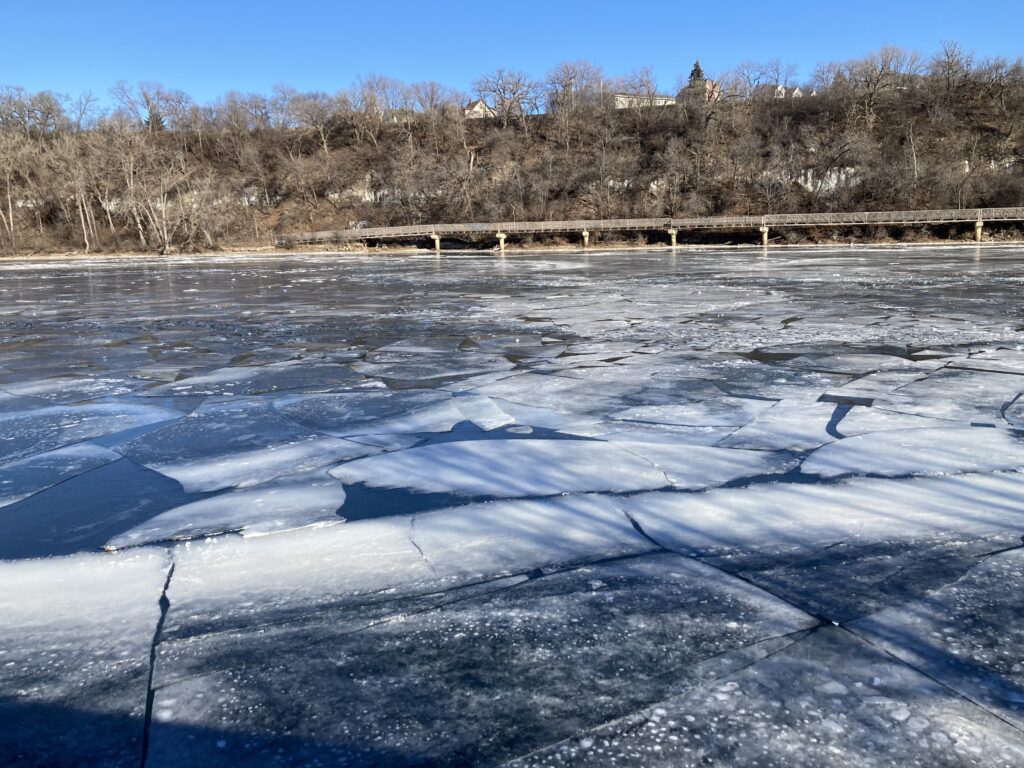
oct 9/RUN

3.6 miles
bottom of locks and dam no. 1
48 degrees

Another cool morning! Today, I glowed: a bright orange sweatshirt, bright blue running shorts with lighter blue swirls, bright yellow running shoes, a purple-pink-blue running hat. Did it make me run faster? Maybe. I felt much better on the run this morning. Was it because I didn’t have any unfinished business, or because I was going only about half the distance? Or a little bit of both? I ran south and recited part of my new You Are Here poem about the grassy boulevard. I like it.

10 Things

  1. red leaves
  2. the occasional thump of an acorn hitting the ground
  3. the loud rumble of a school bus approaching Dowling
  4. scales on the river near the locks and dam — no clear reflection of the bridge today, instead more of an impressionist painting of it
  5. the bridge in the 44th street parking lot was empty, so was the one near folwell
  6. a dog’s bark, deep and loud, in the trees near Becketwood
  7. more golden light through the trees
  8. heading north, descending on the path that dips below the road, seeing a big but not the trail — hidden behind leaves
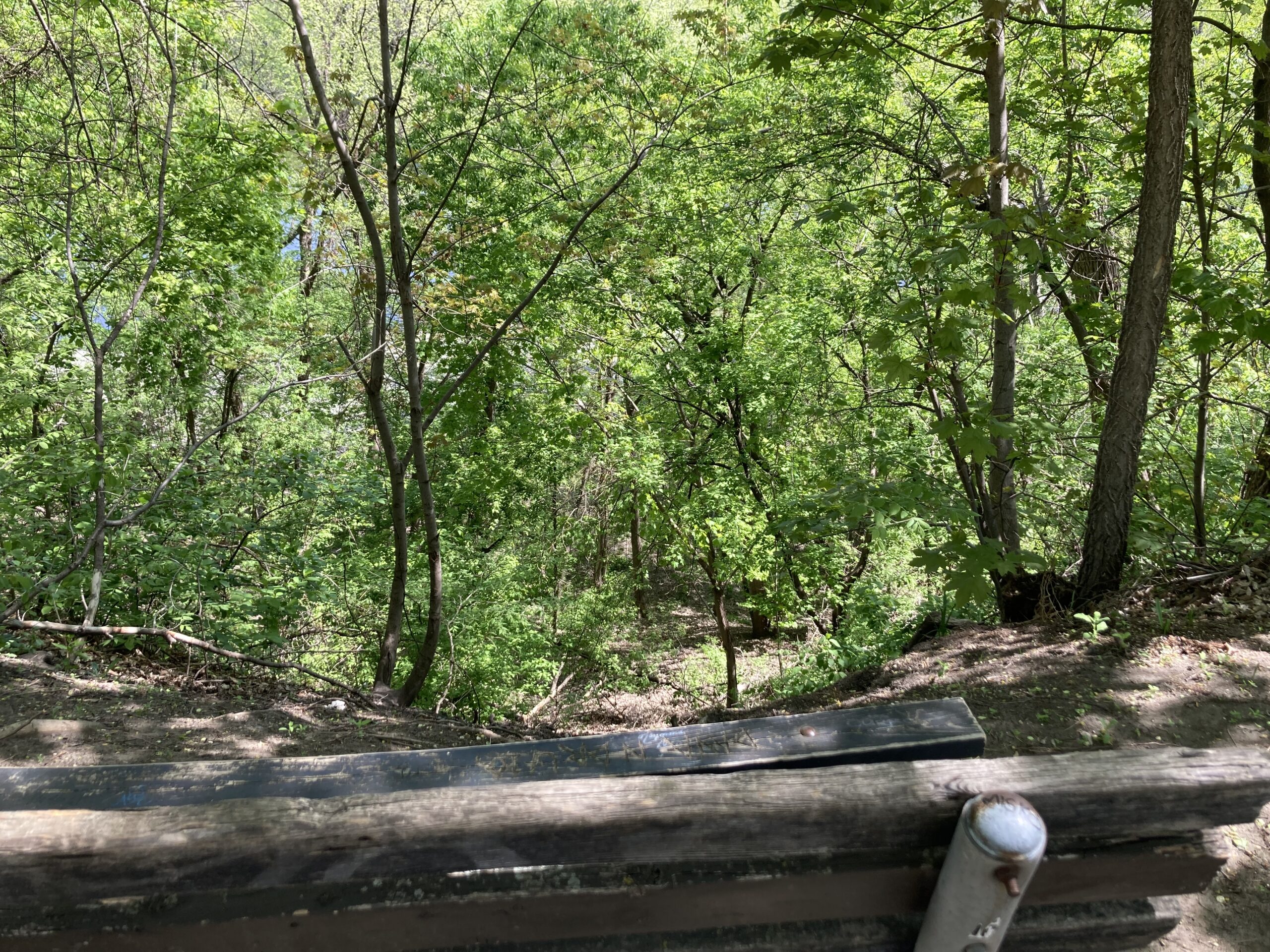
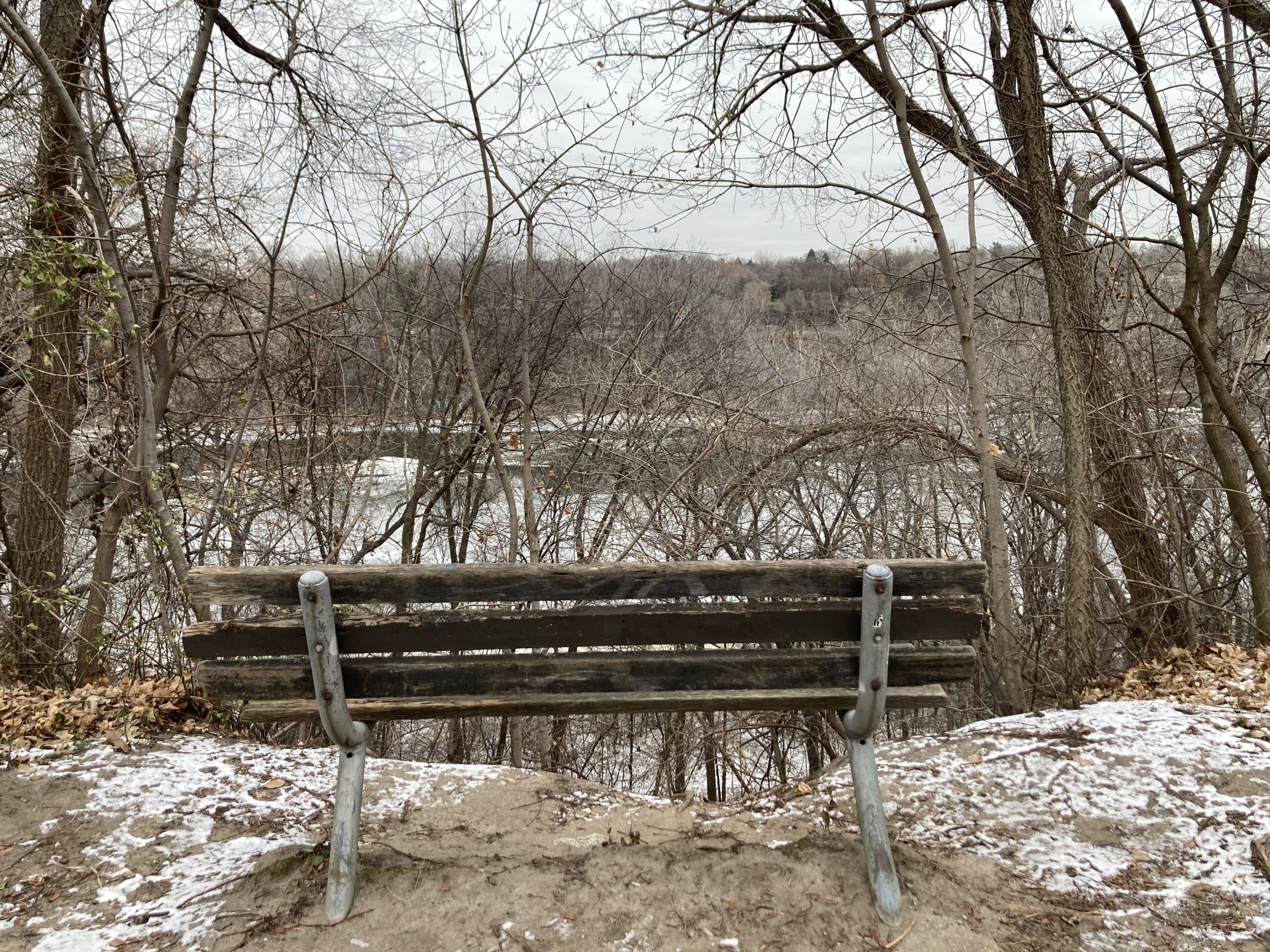
  9. the bench at the edge of the world: empty
  10. a buoy (not orange) bobbing in the river under the ford bridge

Listened to cars and dogs as I ran south. Put in “Taylor Swift” essentials retuning north.

Since I wrote about the grassy boulevard this morning, and being alone, and freedom, here’s a fitting poem:

Grass, 1967/ Victoria Chang

When I open the door, I smile and wave to people who only
have eyes and who are infinitely joyful. I see my children,
but only the backs of their heads. When they turn around, I
don’t recognize them. They once had mouths but now only
have eyes. I want to leave the room but when I do, I am
outside, and everyone else is inside. So next time, I open the
door and stay inside. But then everyone is outside. Agnes
said that solitude and freedom are the same. My solitude is
like the grass. I become so aware of its presence that it too
begins to feel like an audience. Sometimes my solitude grabs
my phone and takes a selfie, posts it somewhere for others
to see and like. Sometimes people comment on how
beautiful my solitude is and sometimes my solitude replies
with a heart. It begins to follow the accounts of solitudes
that are half its age. What if my solitude is depressed? What
if even my solitude doesn’t want to be alone?

Chang’s version of solitude involves being watched, stared at, judged and assessed, evaluated. And it involves a distance created with eyes and staring and being on display. My solitude, or maybe my loneliness, involves a lack of seeing — not of being seen, but of not seeing when I’m being seen.

june 1/RUN

3.15 miles
trestle turn around
56 degrees

Excellent weather this morning for a run. I decided to run without stopping to walk, instead of doing the 9/1, just to see if I could do it. I could. At the end of the run, a thought: I should do a 3 mile run like this on the first of each month and compare times and effort. Maybe I should do this test twice a month?

The thing I remember most about the run was the orange light. It’s from wildfires up in Canada. I didn’t see an orange sun, or orange light in the sky. I saw orange light on the paved trail. Strange. I wondered if it really looked orange, or it just felt orange. And, was anyone else seeing the light on the trail and thinking, orange?

The thing I remember second most was the cottonwood fuzz, everywhere. Lining the trail, turning the grass pale green. I think I inhaled some; it got caught in my throat and made it hard to breathe.

There were chatty bikers and small packs of runners and walkers, a few dogs. I think I might have heard the rowers briefly. I didn’t look for the river or hear any geese. I did witness a car ignore a stop sign. And I admired another runner’s bright orange compression socks. I noticed that the grass near the trail had been trimmed and wondered how short the parks had trimmed it. No more rubbery dandelion stalks.

To keep a steady pace, I chanted in triple berries: strawberry / blueberry / raspberry

Picked up Brian Teare’s Companion Grasses from the library. I’m particularly inspired by the sections/pieces/poems? that combine his hiking notes with descriptions and references to other thinkers.

from Tall Flatsedge Notebook/ Brian Teare

A mile’s hike outside the fence-enclosed vista point
we sat hillside so inside experience I wrote the wrong date
down–March twenty second–noticing no thought
but things : “when I think they animate my interior speech,
they haunt it as the little phrase.” Oceans tilted, the whole thing
leaning green, coastal prairie poised pre-Spring
a prosody for seeing landscape as aural, ambient trick
to hear the ear’s eye : far bass, near treble, I saw

I heard
low drone wind
cut by distant cliffs’ sheer fall

Above it below the hill

surf’s purr
& nearer

wind-shirred grass
bright brown birdsong

in back of one bee far
barking seals–

*

I wanted a hello sort of like I know you as if
to call a grass a subject like I can’t back home :
urbanity : a class-based lack of grasses shared
people, fog, sidewalks, architecture, money,
the smells of jasmine & feces, & five sounds :

suck of tread in water

window clicking against frame

recycling knicked from bins

footsteps above

heater’s hiss

A few pages later, he offers this quote:

at the edge
of what is bearable
in an image.

In the margins he provides a source: The Object Stares Back/ James Elkins. I looked this source up and got very excited. It’s all about how we see and our myths about what we think we’re seeing and doing when we see. Very cool. I requested the book from the libary; it should be ready in a few days.

update, 28 dec 2025: Reviewing this entry at the end of the year, I (vaguely) recall getting this book and being disappointed. It wasn’t written poorly; it just wasn’t helpful to me in whatever moment I was in in early June.

may 27/RUN

2.6 miles
river road trail, south/winchell trail, north
64 degrees

Thought briefly about biking to the lake and swimming, but it’s drizzling off and on, and it’s not that warm, and I imagine the water isn’t that warm yet. Just checked the temp: 61 degrees. What’s the coldest water I’ve been in? Probably colder than 61 as a kid in Lake Superior, but as an adult, I’m not sure. Too cold for me today, so I did a short run.

I wanted to run to the south entrance of the Winchell trail but there was a very large — 40 or more? — kids up ahead, walking and blocking the trail, and I didn’t want to encounter them. So I turned down at 42nd. Before I turned, I enjoyed witnessing the kids from afar. They kept trying to get passing cars to honk by yelling honk! honk! honk! They were not quite in unison, and sounded almost like a vee of geese flying overhead. Nice! A few cars honked, one for several seconds — no quick tap, a long HONK! At first I thought they were part of a school group but would teachers let students yell at cars like that? Maybe it was a walk-out protest?

My weather app disagrees, but I think it was very humid. Now that funding for gathering weather data has been taken away, I don’t trust any forecasts. How could it only be 64% humidity when I ‘m sweating this much, and it is drizzling a little?

I ended my run on the dirt trail that climbs up the edge of the grassy boulevard. I had to watch carefully for roots or rocks. On either side, vivid, abundant (or excessive) green grass. In the middle, bare dirt — brownish gray, fuzzy, almost a nothingness that was difficult to see. The green, dizzying, disorienting. Inspiration for my green sonnet?

excerpt from Desire/ Christopher Buckley

Shuffling down
the path in the park, I go on whistling what was once
considered a lively tune, thankful to even be a satchel
of ligaments and bone still able to transact enough chemicals,
one neuron to another,
                                        that I can appreciate the day lilies,
star jasmine, and have some idea about what’s missing
when a streak of grey engraves hosannas of moonlight,
the spindrift off the rocks, anything that sounds
remotely like a prayer
                                       sent into the air to a god who,
in his infinite memory, must know he abandoned us
here—so many self-conscious molecular assemblies—
specs in a starry whirlwind of desire.

Wow — a satchel/ligament and bone still able to transact enough chemicals,/one neuron to another — what a description of a human!

spin-drift: sea spray; fine wind-borne snow or sand

may 25/RUN

3.5 miles
trestle turn around
63 degrees

Felt good today. Ran a little faster, felt a little freer. Even though the weather is great, it’s Sunday, and it’s almost noon, the paths weren’t that crowded. Was it because it’s memorial day weekend? Whatever the reason, I appreciate not having to dodge bikers or groups of walkers.

10 Things

  1. sea
  2. stacked
  3. stink
  4. staring
  5. shadows
  6. craters
  7. purple
  8. soft
  9. sitting
  10. saw

Running through the tunnel of trees above the floodplain forest, a sea of green. No sky or river or solid ground.

4 stones stacked on the ancient boulder.

Above the rowing club, a slight stink from the sewers — sweet and sour.

Running up the hill, past the old stone steps, 2 walkers and a dog about to descend the old stone steps. I couldn’t see their faces, but I felt like they were staring at me.

At the start of my run, bird shadows: a big one swooping, several smaller ones shooting across the street like bullets.

The craters in the patched crack near the trestle seem to be growing deeper.

Running past a tree, a flash of purple in the otherwise green leaves. Was that a trick of the light?

The soft sound of water falling or wind gently rustling the leaves near the ravine.

I was planning to stop at the sliding bench, but 2 people were already sitting there.

Before I began running, I heard a woman’s voice — you did it! Then the sound of a saw buzzing, then good job! Her tone sounded like she was praising a little kid. I wondered if that were true and how old the kid was that she was teaching to use a power saw — not in judgment, in wonder.

indigo

I have returned to my color poems. Before I ran, I was thinking about indigo again. During the run, an idea popped in my head, so just past the trestle I stopped to record it:

Thinking about indigo and idea of wanting this time, at night, that is dark without stars. Which is referencing how, when I lose all of my cone cells, there may never be true dark. And then thinking also about how true dark is not possible (in the city) because of light pollution. The idea that indigo is something both wished for and feared.

another grass line

It will soon be cold here,
and dark here;
the grass will lie flat
to search for its spring head.
(Love in the Weather’s Bells/ Jay Wright)

may 22/WALK

60 minutes
winchell trail, south/grassy boulevard, north
55 degrees

The rain is over. Now, warm sun and green green green! A beautiful morning for a walk with Delia the dog. Calm and quiet and wonderful.

10 Things

  1. lilac bushes
  2. BLUE!
  3. BEEP! BEEP!
  4. velvet
  5. squish
  6. tin-whistle
  7. friends
  8. dappled
  9. dandelions
  10. unruly

Walking by a row of lilac bushes up against a fence, breathing in the sweet, flowery smell. No memories conjured, just a smile spreading across my face and a feeling of satisfaction.

With my polarized sunglasses on, the sky looked almost too blue to be true. The kind of blue that is so intensely BLUE! that it seems ominous.

Walking in the grass with Delia, our reverie was interrupted by a BEEP! BEEP! as a car attempted to pass 3 cars on the river road before quickly slotting in behind a fourth right as a car was approaching from the other way.

On the winchell trail, I reached out to a basswood (also known as linden) tree and its lined leaf. A soft shock — the leaf felt like velvet!

After the rain, I wondered how wet the dirt would be. Wet! I stepped cautiously on it and squish, mud!

That sound! Sharp. Metallic. I think it was a robin with its tin-whistle call, echoing throughout the savanna.

Up on the mesa, we encountered another dog and their human. Delia and the other dog, about her size and temperament, chased each other while we — the humans — wished good morning to each other. A brief encounter with new friends.

The trees cast their shadows on the grass. All around, dappled light.

The slender, rubbery stalks of dandelions with their fluffy white heads dotted the grass. I wondered what this stage is called so I looked it up: AI says, seed head or blowball. I prefer blowball!

Everywhere I looked, green. Green grass, green trees, green view. Unruly green leaves reaching through the slats of the fence. Oh, to be that green! To claim space with such wild abandon!

note: This is the second day I’ve tried a new experiment with my 10 Things. Instead of describing the things in the list, I’m picking 10 words and then writing about each in sentences and/or paragraphs.

air / breath

Was reminded of this beautiful poem from my entry on this day in 2017:

as everyone with lungs breathes the space between the hands and the space around the hands and the space of the room and the space of the building that surrounds the room and the space of the neighborhoods nearby and the space of the cities and the space of the regions and the space of the nations and the space of the continents and islands and the space of the oceans and the space of the troposphere and the space of the stratosphere and the space of the mesosphere in and out.
(This Connection of Everyone with Lungs/ Juliana Spahr)

I want to connect this idea of lungs and breath to a favorite fragment of mine about feet first, following. Feet syncing up with breath.

Spahr’s lines make me think of the moment as a space, a Nothing space. Not empty, but no words or memories or history or self. A shared space possessed by no one, Chloe Garcia Roberts’ the median intervals of floating passivity that resist recollection.

In the time that it took me to find the Roberts line, I lost my train of thought. Maybe it is dwelling in that space between? Can I return to it?

Not sure if this is the thought I lost, but I’m also thinking of this space/time — moment — as when/where I encounter a walker on the winchell trail and I thank them for moving over to let me pass. The moment after I say, thank you, and before they say, you’re welcome, when the you is floating between us, in the process of being exhanged from them to me.

No, I think this might have been it: Not the floating passivity of Roberts — a nothing in-between — but more like dirt in Sharon Olds’ “Ode to Dirt“:

Dear dirt, I am sorry I slighted you, I thought that you were only the background for the leading characters—the plants and animals and human animals. It’s as if I had loved only the stars and not the sky which gave them space in which to shine.

That space, that air — and here I’m thinking especially of the air above and within the gorge — that is a character in my story, not just the background —

When I understood I had never honored you as a living equal, I was ashamed of myself, as if I had not recognized a character who looked so different from me

I’ve devoted a lot of attention to water and stone beside the gorge, but the air has always been there, too. Air as the space between things, which isn’t really empty, but filled with stuff too small to see.

sinkhole

Last night at dinner, FWA mentioned that a sinkhole had opened up somewhere in St. Paul. I hadn’t heard about it. Just now I looked it up. A 35 foot — 35! — hole happened in the middle of busy 7th street. Watching a news clip about it, the director of public works said, we’re not sure how it happened yet. We need to dig down 35 feet to the sanitary sewer and fix that. Wow — so the sewer line is 35 feet below the surface? 35 feet is more than 6 Saras stacked! The sinkhole opened up on 8 may. I couldn’t find any update about it. I wonder when and if we’ll find out what caused it.

may 21/RUN

5.5 miles
ford loop
44 degrees
drizzle

Wasn’t planning to run the ford loop, but I started it and then just kept going. It felt good, relaxed, not hard to keep my heart rate a little lower. My pace was slow, but it didn’t feel slow, or fast, or any speed really.

10 Things

  1. mist
  2. dripping
  3. spray
  4. mirrors
  5. puddles
  6. graffiti
  7. traffic
  8. bridge
  9. debris
  10. slick

It rained all day yesterday, and some early in the morning. Started again during my run. Everything dripping wet, including me, although I didn’t really feel it, or couldn’t distinguish it from my sweat. Before I started running, as I walked through the neighborhood, I looked into the puddles on the sidewalk and admired how they had become mirrors, reflecting the sky and the trees. Running over the river, I looked down at the east bank and saw colorful graffiti all over the rocks at the base of the lake street bridge. In spots, the trail was slick with mud or covered in debris — fallen leaves, broken branches, grit. Crossing the ford bridge, I looked north and was delighted by the mist, making everything seem fuzzy and unformed. The traffic on the bridge was thick — I couldn’t see or feel any spray coming off of their wheels, but I could hear it.

overheard: one runner to another — you can bank the time.
Another use of time as a commodity.

Listened to the water, in its various forms, for the first half of my run. Put in my “moment” playlist for the second half. The most memorable song today: One Moment in Time/ Whitney Houston

A line that stood out to me:

And in that one moment of time
I will feel
I will feel eternity

I thought about Mary Oliver’s definition of eternity and how Whitney Houston’s doesn’t fit with it. MO understands eternity as creative time that’s outside of the ordinary and beyond the self. Houston’s eternity seems more like eternal glory.

As I listened to all of the lyrics, I thought about Whitney Houston’s tragic life and terrible death — an overdose. I also thought about the idea of one moment and what happens after that moment is over. And this made me think about post-Olympic blues, or post-marathon blues, or post-publishing a poem blues.

To keep myself distracted and steady, I chanted in triple berries —– strawberry blueberry raspberry. Then I chanted my poem — I go to the gorge/to find the soft space/between beats.

more on the moment as between

Read a very brief interview with Marie Howe the other day. She mentioned a poem that inspired her and that she wished everyone would read: The Season of Phantasmal Peace/ Derek Walcott. Beautiful! Here’s a line to remember that describes the moment:

and this season lasted one moment, like the pause
between dusk and darkness, between fury and peace

Before my run, I began listening to a talk by Jennifer Chang, “Other Pastorals: Writing Race and Place“. She mentions one between in the presentation of her thesis statement: how poets of color use pastoral to grapple with the complex composition of place as a tension between lived and learned experience. She recites another between from Rick Barot’s “On Gardens”: somewhere between/what the eye sees and what the mind thinks/is the world, landscapes mangled/into sentences, one color read into rage.

Chang also mentions context: If you look at the word “garden” deep enough you see it blossoming in an enclosure meant to keep out history and disorder.

Chang’s lecture is part of the Bread Loaf conference in 2019. This page has many great links for future Sara to explore.

And here is a helpful essay with some ideas for thinking about the pastoral, and links to poems, like Rita Dove’s Reverie in Open Air, which I’ve already posted on this log. The second half of Dove’s poems fits with early May’s theme of grass:

But this lawn has been leveled for looking,   
So I kick off my sandals and walk its cool green.   
Who claims we’re mere muscle and fluids?   
My feet are the primitives here.   
As for the rest—ah, the air now   
Is a tonic of absence, bearing nothing   
But news of a breeze.

And a few more grass lines from Jennifer Chang:

Stalk of wither. Grass-
noise fighting weed-noise. Dirt
and chant. Something in the
field.
(Pastoral/ Jennifer Chang)

What sound does grass make? Wind through the grass, crunching over dry, brittle grass, feet on grass — bunny’s feet:

 I think my favorite sound was the soft footsteps of the bunny hurrying across the lawn. A silvery whisper only possible to hear on a calm summer morning like today. I love the sound of animal feet moving — running or hopping through the grass

log entry on 16 july 2024

may 14/RUNWALK

4.15 miles
minnehaha falls and back
68 degrees
dew point: 59

Even though it was warm and the dew point was high, my run was good. Managed to bring my heart rate back down and keep it under 170 until I reached my favorite spot at the falls — 2.25 miles in. Excellent. I’m feeling stronger, mentally and physically.

10 Things

  1. a turkey in the middle of the road, honking? squawking? yelling? at the cars unwilling to stop and let him cross
  2. a hazy green above the gorge
  3. the sun hitting the light green leaves so intensely in the distance that I thought it was a bright yellow crossing sign instead of a tree
  4. the falls were rushing, all white foam framed by green trees
  5. a steady procession of cars on the road
  6. roots and rocks hidden in the shadows on the trail — I lightly twisted both ankles, one from a root, the other a rock
  7. the tree that feel in the creek sometime last year was gray — will they remove it?
  8. a line of a dozen or more cars backed up on the parkway, stuck at the stop sign
  9. a crowded trail heading north — bikers and walkers, a few runners, strollers
  10. the water fountains have been turned on again! I stopped for a drink and to wet down my hat

Listened to the hum of traffic as I ran south, my “Doin’ Time” playlist heading back north.

before the run

Thinking about LN’s poem — that I posted yesterday — about standing in the north woods with birch, which led me to think about becoming a tree, like in Katie Farris’ “What Would Root” and Linda Pastan’s “In The Orchard” — I shall come back as a tree.

I’m also thinking about Mary Oliver and “Can You Imagine” — surely you can’t imagine trees don’t dance from the roots up, wishing to travel a little, not cramped as much as wanting a better view, or sun, or just as avidly, more shade.

during the run

I don’t remember thinking about becoming a tree or rooting or stillness while I ran, but I remembered right after I finished and as I walked back home I recited “What Would Root” in my head. I need to practice the second half of the poem. Then I thought about the illusion of stillness and how nothing, not even rocks or trees, stand still. They’re sinking and shifting and swaying and responding to (being changed) by the world around them.

after the run

Still as not not moving but being stuck in a rut, doing the same thing again and again, as in, you’re still doing that?

Still as not needing more, content, at peace, satisfied, stilled desire or anxiety.

Nox Borealis/ Campbell McGrath

If Socrates drank his portion of hemlock willingly,
if the Appalachians have endured unending ages of erosion,
if the wind can learn to read our minds
and moonlight moonlight as a master pickpocket,
surely we can contend with contentment as our commission.

Deer in a stubble field, small birds dreaming
unimaginable dreams in hollow trees,
even the icicles, darling, even the icicles shame us
with their stoicism, their radiant resolve.

Listen to me now: think of something you love
but not too dearly, so the night will steal from us
only what we can afford to lose.

walk: 1 hour
winchell trail / edmund
77 degrees

Remembered to take Delia the dog for a walk before it got too hot. We walked to the Winchell trail than sauntered, me studying the leaves with my fuzzy vision and fingers, and Delia sniffing them with her snout. Warm in the sun, cool in the shadows.

10+ Things

  1. clumps of tallish grass growing through the mulch — a vibrant green
  2. even taller grasses growing among the flowers on the hill, creating a visual effect that was dizzying as my eyes tried to land on anything solid
  3. little bits of some sort of plant scattered along the top of the fence. It looked like it was growing there — a form of lichen? — but I couldn’t tell. It might have just fallen from a tree
  4. the pleasing, easily identifiable shape of the maple tree on the trees close to the trail
  5. sparkling, blue water
  6. blue water, blue sky, green trees
  7. the laugh of a woodpecker
  8. a yard with several bleeding heart bushes, all in bloom
  9. sprawled tree shadows on the grass
  10. the crotch of a tree — standing beside a tree that branched off into two equally sized limbs which looked like thighs to me. I imagined a person planted head first in the ground, which is what happens in “What Would Root”
  11. walking near Hiawatha Elementary, watching as a gym class “ran” around the block, studying the different approaches to “running” — a steady jog, sprint then stop then sprint, skipping, arms flailing and screaming while moving

As I walked with Delia, stopping at almost every tree or tuft of grass or clump of dirt, I thought about the differences between walking and running, this time in relation to a sense of self. Does one enable you to lose yourself or step outside of yourself more easily? I haven’t decided, but I think while walking you can be more aware of what you are doing, how you are attending to the world and noticing what is going on. While running, the attention is less deliberate; you’re too busy managing your effort to carefully study things. There was more to that thought but I lost in the time that it took me to get home.

may 11/RUN

4.3 miles
ford overlook
63 degrees

Ran earlier today, which helped. The first half was windy. Windy enough that I needed to take my cap off on the ford bridge. Sunny. A mental victory: thought about stopping on the bridge but then just kept going. Made it through the hard moment. The second half of the run, I felt stronger, everything was easier.

I don’t remember noticing the river sparkling, but I did see scales on its surface as I ran west on the bridge. No rowers, no roller skiers, only a few bikers. One small pack of shirtless runners.

Ran up the steep hill that starts under the ford bridge and ends in Wabun park. At the top, I stopped at the fence and looked down at the dam. I studied the tall grass pushing up against the fence. I thought about fences for a moment, how many I encounter while I run by the gorge, some maintained, some abandoned, many damaged by leaning trees or critters or hikers. Wooden, chainlink, iron, stone. Noticed another fence at the ford overlook: chainlink.

Listened to the wind and birds until I reached the ford overlook, then I put in my “Wheeling Life” playlist. Started with “Windmills of Your Mind,” ended with “Watching the Wheels.” Thought about FWA and how he might appreciate John Lennon’s song.

Speaking of playlists, I forgot to mention this in my entry 2 days ago. Listening to my “Slappin’ Shadows” playlist and Cream’s “White Room” came on. I wanted to remember this description of eyes:

Silver horses, ran down moonbeams
In your dark eyes

Is this a gleam? Or is she crying?

suburban lawns

I’m still thinking about grass. If I were to make a list of grassy things, which I should and will, the suburban lawn would be on it. I’ve thought about it before, imagining my version of Lorine Niedecker’s growing in green (from her poem, “Paean to Place,”) as the lawn and the patches of green that grow on the edge between suburbs and the few remaining farms they haven’t yet consumed. That was my childhood. Here’s a poem I found this morning to add to the image of the lawn:

Observation/ Nicholas Friedman

In the wilds of our suburban lawn,
the natural world inclines to fable:
Gray squirrels, unperturbed by rain,
jockey for position at what our landlord
speaks of, nominally, as the bird feeder.
Below, dark-eyed juncos peck at fallen millet,
masked like hangmen from another time.
The great, unwritten order of it all
scrambles when Max, our landlord’s aging chow,
starts loping toward the scene. This is his work,
so in a sense, he’s adding order, too.

One squirrel has shifted to a fencepost
where it twitches its tail and rearranges
in quarter turns like a guard. In total, there’s
more movement than the eye can account for,
all of it framed in the window’s tic-tac-toe.
The glass weeps condensation. It’s early, but
already the dog has slumped down for a nap.
There’s plenty of time to lumber after thoughts
that rise and disperse, dark-feathered things
returning when I manage to be still.

may 10/WALK

60 minutes
winchell trail
63 degrees

A near perfect morning. Wow! Sunny with a slight breeze. Blue sky. Quiet. A slow walk with lots of stops for Delia. We walked to the winchell trail and took the worn, wooden steps down to the oak savanna, then another set of wooden steps up to an overlook. So much green everywhere — new trees popping up, tufts of grass, moss. We walked behind the mesa along the abandoned chainlink fence and I marveled at the bright green moss. At one point, I bent down and touched it — almost like carpet, but better.

10 Things

  1. the odd curve of the abandoned chainlink fence on the dirt trail behind the mesa
  2. that same fence, buried deep in the dirt and leaves, only the top was visible
  3. rowers! not seen, only heard — the coxswain calling out instructions
  4. a speed boat moving fast near the opposite shore
  5. tall grass in clumps and tufts and patches
  6. someone sitting by a tree stump, hidden in the green until they were right in front of me
  7. the clicking and scraping of a roller ski’s poles
  8. two runners, running by single-file, talking about a video game
  9. a big bird flying high in the sky
  10. on the boulevard between the river road and edmund, the grass was uneven and bare in many spots, studded with dandelions in others

The moment of the walk was when I stopped to let Delia sniff — more like she demanded to stop — and I stood on the edge of the bluff looking out at the blue water and feeling the soft, cool breeze. All around bright green leaves were fluttering. Below, the river surface was glittering. The movement was mesmerizing, meditative.

Against Lawn/ Grace Bauer

The midnight streetlight illuminating
the white of clover assures me

I am right not to manicure
my patch of grass into a dull

carpet of uniform green, but
to allow whatever will to take over.

Somewhere in that lace lies luck,
though I may never swoop down

to find it. Three, too, is
an auspicious number. And this seeing

a reminder to avoid too much taming
of what, even here, wants to be wild.

manicure – patch – carpet – uniform Great words to describe an over-managed lawn. Last night Scott and I were talking about lawns and the moral imperative to maintain your lawn to a certain standard. That is not the case as much in our neighborhood. Most people’s yards don’t have manicured grass. Partly because we live in a quirky neighborhood in the city, and partly because we’re near the river and people know that lawn chemicals get into the groundwater and then travel through the sewer to the river. I mentioned to Scott that I don’t judge people if their lawn isn’t manicured, I judge them if it is because it can only be that way if they’re treating it with chemicals — and if they’re not using chemicals, they’re still wasting water on their laws. But, I don’t want to judge anyone, so I’m trying to work on that.

Somewhere in that lace lies luck. . . What a great line!

a reminder to avoid too much taming
of what, even here, wants to be wild.

I’m always returning to this question of what it means to be wild and where the gorge fits into that. In the spring, when left alone, the small patches of grass on the bluff want to be wild. Tall blades and dandelions and little trees everywhere. Unruly, sometimes almost menacing as they creep closer to the trail, blocking out the view. Not wild, but re-wilding.

may 9/RUN

5.2 miles
franklin loop
67 degrees

Felt like summer today. Hot! A common refrain: I need to get up earlier and get out there before it gets too warm! Difficult. I can tell that the 2+ week break got me out of cardio shape. My heart rate got higher faster. I’m sure the heat had something to do with it too. After a mile, I decided to switch from 9/1 to walking every time my heart rate went above 170, then running again when it went down to 135. A did a lot of walking.

At first, I listened to the traffic and the kids at the church daycare and my feet, but after a few miles, I put in my shadows playlist — if I could find the shadows on the path, I’d find them in the music!

From the Franklin bridge the river was beautiful — so many sparkles. I noticed a few sandbars just below the surface. No rowers. They were probably here earlier in the morning — another reason to get up and run early!

I smelled the flowers — a hint of Big Red cinnamon gum. Heard the birds and construction trucks backing up. Gave attention to the grass, filled with clover and dandelions. At the end, nearing the corner of my block, I watched the shadows of leaves dancing on the grass and dirt — a big patch that was more dirt than grass. Ants? We have several of those in our backyard.

As I looked at the grass and thought about the blade and the sheath, I remembered/realized something: I can’t really see individual grass. Not enough cone cells for that. I write really because I can sometimes see an individual leaf, but just barely, and more the idea that there’s a blade, but definitely not the sheath.

I forgot to post this earlier: I stopped at the sliding bench, noticed how much green there was, and decided to take a picture in order to compare it to a pre-green picture:

grass roots and astroturfing

Looking through my Plague Notebook, Vol 25 notes from yesterday, I saw this: grass roots — origins of the phrase. So, I looked it up and found this on wikipedia:

A grassroots movement is one that uses the people in a given district, region or community as the basis for a political or continent movement. Grassroots movements and organizations use collective action from volunteers at the local level to implement change at the local, regional, national, or international levels. Grassroots movements are associated with bottom-up, rather than top-down decision-making, and are sometimes considered more natural or spontaneous than more traditional power structures.
*
The earliest origins of “grass roots” as a political metaphor are obscure. In the United States, an early use of the phrase “grassroots and boots” was thought to have been coined by Senator Albert Jeremiah Beveridge of Indiana, who said of the Progressive Party in 1912, “This party has come from the grass roots. It has grown from the soil of people’s hard necessities”.

In the entry, it also mentioned astroturfing, which is an organization that presents itself as grassroots, but is really lead by an outside organization/corporation.

Astroturf — I wanted to find the origins of this term:

The synthetic grass product that eventually became known as AstroTurf® was originally designed as an urban playing surface meant to replace the concrete and brick that covered the recreation areas in city schoolyards. During the Korean War, the U.S. Army had found urban recruits to be less physically fit than rural recruits. Attributing this to lack of green space in cities, the Ford Foundation funded research for Monsanto to create a synthetic grass replica in 1962. It had to be wear-resistant, cost efficient, comfortably cushioned, and traction tested. Two years later employees of the Chemstrand Company, a subsidiary of Monsanto Industries, developed a synthetic surface called ChemGrass and installed it at the Moses Brown School, a private educational facility in Providence, Rhode Island.

Astroturf: The Story Behind the Product

What is the Grass?/ Mark Doty

On the margin
in the used text
I’ve purchased without opening

—pale green dutiful vessel—

some unconvinced student has written,
in a clear, looping hand,
Isn’t it grass?

How could I answer the child?
I do not exaggerate,
I think of her question for years.

And while first I imagine her the very type
of the incurious, revealing the difference
between a mind at rest and one that cannot,

later I come to imagine that she
had faith in language,
that was the difference: she believed

that the word settled things,
the matter need not be looked into again.

And he who’d written his book over and over, nearly ruining it,
so enchanted by what had first compelled him
—for him the word settled nothing at all.

I’m with Whitman. How boring it would be if the word settled everything!

may 8/BIKE

8.5 miles
lake nokomis and back
60 degrees

The first outdoor bike ride of the year. I’m always nervous, not knowing how it will go. Can I still see enough to bike? Will it be too scary? Yes, I can see! No, I wasn’t scared! I was a bit disoriented with all of the dappled light and I had to take some deep breaths a few times, but it went well. It’s a combination of: a memorized path — all of the cracks and bumps and tricky spots from years of biking; a familiarity and acceptance of not knowing or seeing everything; a few still-working cone cells and the ability to compensate with peripheral vision and other senses; and a belief that I can bike. Oh — and biking a little slower.

The lake was beautiful. I can’t wait to swim across it in a month. I signed up for open swim yesterday — signed FWA and RJP up too. Summer is almost here.

7 Grassy Things

  1. there’s a certain stretch of grass on the bike trail that separates it from the road and helps me to see where to go — I need because the gray of the trail can blend in with the gray of the road
  2. had to bike through the grass when I turned off the trail too early — I remembered biking through this grass with FWA 2 summers ago
  3. an open field between the duck and echo bridges — a beautiful green studded with bright yellow dandelions
  4. someone spread out a blanket and is sitting in that grass — how buggy is it?
  5. what a bright blue sky! a great contrast with the green trees and grass
  6. shadows of new leaves waving in the wind on the grass near lake nokomis
  7. a bright yellow trailer and half a dozen cars parked on the grassy hill between lake hiawatha and lake nokomis — they’re redoing the path and (I had to look it up) adding a pedestrian bridge: “A new pedestrian bridge over Minnehaha Creek next to Lake Hiawatha is scheduled to be installed May. The bridge will be delivered in pieces, assembled onsite and then set in place with a crane.”

Other things: someone listening to a song on their phone as they walked — a new one from Lorde?; the bog near my favorite part of the path was completely dry; a sign, loose gravel — thankfully there wasn’t any; bird shadows on the path; lots of people walking around the lake

a grounding, a frame, a context

I mentioned in my entry for 7 may that I would post a quotation from Jenny Odell about context here:

I think a really interesting mental exercise to do with anything or anyone is to think about whether they have been afforded experience, the ability to experience, which means like having a past and a future. So one of the most fascinating things that I came across in researching the book, that I talk about somewhere in the middle of the book, is a study about the lesser minds bias. It’s not something you would immediately think has to do with time, but it’s a bias that other people, especially people in out-groups—so people you don’t identify with—don’t have as rich of an emotional inner life as you do. And so in this study that I referenced, the people running the study ask the participants to think about houseless people and show that the part of their mind that has to do with theory of mind, and imagining that someone has an inner life, is not lighting up when they’re thinking about these people. And then they ask them the question, what kind of vegetable do you think they would like, this person? Just imagine that and then suddenly it is lighting up, right? And my interpretation of that in the book was, well, someone who wants something and has desire must have a past and must have hopes for the future. For something to have desire, it has to exist in time. And so it’s almost like—that participant who’s thinking about them—it’s almost like this person has entered a time with them. Like this person is now also an actor. This person has wants and needs and regrets. And I think that kind of flipping is a really helpful and interesting way to think about why we do or don’t afford that to, you know, the nonhuman world, and also many groups within the human world—like out-groups, as they were talking about in the study. And it is that relegating of part of life to the realm of the timeless—like it might be cyclical, but it’s considered timeless—that is so much at the root of the logic of extracting it. It’s lifeless. But it’s the same mechanism that’s behind dehumanizing someone, because you’re seeing a person as almost like an instance. To go back to people without housing, it’s interesting that people don’t think about how someone might go in and out of housing within their life. You know, what led to that? What might be in their future? They’re just sort of seen as they’re just there. And so I think that’s an example of what happens when you take something out of time, or it doesn’t seem to inhabit time in the same way you do.

Another Kind of Time/ Jenny Odell

As I write this, I’m listening (by pure accident) to the Rolling Stones, “Time is on my side” and now I’m thinking about returning to time. Reviewing past entries for 2025, it seems like I’m all over the place. Maybe, but I’m also orbiting around a cluster of ideas related to the gorge and my larger poem, or series of poems, about haunting the gorge. At some point, something will stick and I’ll stop to write, but for now I’ll keep moving and circling ideas.

is a really helpful and interesting way to think about why we do or don’t afford that to, you know, the nonhuman world

What is desire to the grass? And, what is the grass as a subject? One blade/leaf? A lawn? A clump in a sea of dirt? I suddenly thought about the smell of freshly cut grass, a frequent scent in May. As a kid, it was one of my favorite smells, then I read or heard somewhere that it was the grass crying or bleeding, and I stopped liking it. I decided to look it up and found a PBS segment, That Fresh Cut Grass Scent is Really a Signal of Distress. But, according to PBS, the grass isn’t crying, it’s communicating, sending out a message to other plants, or other parts of themselves, to be prepared for trouble.

The idea that the grass is crying, or screaming, still abounds. Here’s the opening line from an article for Lawnstarter, a lawn care company:

Inhale deeply. That heavenly fresh-cut grass smell you savor while mowing your back 40 is actually your lawn screaming in pain from the hell of a hurtful haircut.

Fresh cut grass is your lawn’s shriek of despair, science says

Science (not scientists, or a scientific study), says? Wow. Anyway, I’m struck by how the idea that grass is communicating (the PBS clip) offers more agency to the grass than depicting them as shrieking or screaming in despair (the article). The article offers some of the science, then moves onto a discussion of why we might like the smell of freshly mown grass and then gives examples of how that love is depicted in song.

I wrote in my Plague Notebook, vol. 25, what is the root system for grass. Looked it up and found this helpful resource: How does Grass Grow?

Grass typically has a fibrous root system, characterized by a dense network of fine, thread-like roots that spread outward and downward.

Fibrous? I posted something a poet said about being fibrous a year or so ago. Can I find it again? No. It had something to do with someone thinking of themselves as made up of fibers, of their idea of the self as fibrous? I wish I could remember!

One last thing: Over the past weeks, I’ve encountered references to Dads and their obsessions with the lawn, how lawn maintenance is gendered male. I found this interesting site when I searched “gender lawn” from Lady Science: Liberate Your Lawn from the Legacy of Masculine Science.

In Crabgrass Frontier: The Suburbanization of the United States, Kenneth T. Jackson shows that the American Neighbor’s attachment to his lawn, since its takeover of the suburban consciousness after the Second World War, is the result of the affluence and financial security that the lawn represents. The lawn is a simple status symbol that signals to the little-n neighbors that The Neighbor has achieved a level of economic comfort that affords him both the money to pay his exorbitant water bill and the free time to mow thrice weekly in the summer. I think, however, if we want to break the American Neighbor of the lawn — and we should, because it’s not good for the environment that 2 percent of the land in the U.S is taken up by monocultural swathes of ornamental grass — we might consider that the lure of the lawn is deeper.

Hmm. . . this crabgrass book looks interesting.

may 6/RUN

2 miles
2 trails
69 degrees

It was nice and I felt good, so I decided to go for a short run this morning. Hot! I wore my summer attire: tank top and shorts. Sunny. Sharp shadows, still air, not much shade. Ran right by the Minnehaha Academy playground and heard all of the kids shouting and shoving and having fun. I peeked at the river through the trees: a flat blue. No turkeys or roller skiers or gushing water. No headphones either. Instead, I listened to the kids and the cars and the loud rumbling of a truck. Also heard: someone’s workout program on their phone, you have complete 3 miles — or something similar to that.

before the run

This morning, I’m reading another chapter of RWK’s Gathering Moss: The Advantages of Being Small: Life in the Boundary Layer. I was excited/please/inspired to encounter this passage:

Mosses inhabit surfaces: the surfaces of rocks, the bark of trees, the surface of a log, that small space where earth and atmosphere first make contact. This meeting ground between air and land is known as the boundary layer. Lying cheek to cheek with rocks and logs, mosses are intimate with the contours and textures of their substrate.

Gathering Moss/ Robin Wall Kimmerer

surfaces / where earth and atmosphere meet / boundary layer / intimate / contours / textures

I’m interested in surfaces, both ground surfaces by the gorge and water surfaces at the lake. I’ve gathered poems and thought about them before. And there is a line from my Haunts project that I’m still trying to write around/beside/through: It begins here: from the ground up, feet first, following. Today, I want to think about surfaces and boundary layers and textures and the intimacy that is created when air and land, foot and ground, meet.

things we did on grass

When you lie on the ground on a sunny summer afternoon to look up and watch the clouds go by, you place yourself in the boundary of the earth’s surface. When you are flat on the ground, the wind speed is reduced, you can scarcely feel the breeze that would ruffle your hair if you were standing up.

Things we did on grass is a line from an XTC song. I’ve been wanting to experiment with it. RWK is inspiring me!

still

the air becomes progressively slower and slower until, immediately adjacent to the surface, the air is perfectly still, captured by the friction with the surface itself. It is this layer of still air that you experience while lying on the ground.

Such a rich word and idea, still. I’ve been orbiting around it for years. And yet, the opposite of restlessness, something I can’t do: sit still, a calmness and willingness to stop and just be.

during the run

Since I’m thinking of surfaces, especially grass, I decided to run on the grassy boulevard between edmund and the river road. After the run, as I was walking home, I recorded some thoughts:

[transcript] may 6th. I’m thinking about surfaces and moss and where air and ground meet and these little spaces that are sheltered, that are a little warmer and still and allow for friction without total erosion. Then I was thinking about how I like those spaces — those small spaces, those enough spaces. Then RWK’s bit at the end of the chapter, about how moss still need to germinate and seed and they can’t in these sheltered spaces so they have to expose themselves. Also thinking about the back deck as a sheltered space. It’s interesting to put this in a context of the pandemic because of how the surfaces and how this dirt trail is surely wider because people were running and walking and using it during the pandemic. All the different ways that (the pandemic) is written on this surface, this boundary layer.

surfaces: asphalt, concrete, grass, roots, packed dirt, soft dirt, mulching leaves, rubbled asphalt, limestone

Earlier in the run, I was also thinking about friction in relation to surfaces meeting. In particular, my feet and the ground, but also RWK’s example of free flowing air being disrupted and altered by rock. My thought: we need that friction to feel bodies, to feel our bodies. A flash of Wittgenstein and his rough ground (as opposed to smooth ice) flashed through my head.

I thought about the benefits of being small and a discussion I had with FWA the other day when he was suggesting that humans are resilient in the way that small trees that can bend and lean with the wind during a heavy storm are.

after the run

Ideas to give some attention:

  • Intimacy and Forrest Gander and Anne Pringles’ conversation about intimacy as an encounter that transforms you and Scott describing two trees growing out of the same spot and intertwining as intimate
  • the texture of wind when encountering objects, makes me think of light on surfaces and how the ancient greeks took that into account in their understandings of, and names for, color
  • surfaces and feet first, following — the encounter between foot and ground is the space where a poem can be written and offered
  • the boundary layer visible to our eye as the horizontal lines I mentioned last month: the line between blue and brown
  • where earth and atmosphere meet = violet
  • grass as threshold (a boundary space): the threshold between neighborhood and park, between life and death — grass as a space where the dead and living can meet
  • the dirt trail through the grass as a record of the pandemic
  • not too deep, at the surface: humus, loam

may 5/RUNWALK

4.25 miles
minnehaha falls and back
59 degrees

Warm! Nothing hurt, it was just hard. My heart rate was higher. Who cares? No back or calf or hip pain! I’m trying to ease back in. Today I ran 4 minutes/walked 1, 8 times. I was proud of myself for sticking with it, even as my heart rate climbed. Yes, I’m ready for some mental toughness!

10 Things

  1. an abundance of sparkles on the river
  2. more green leaves crawling up the trunks of trees
  3. fee bee fee bee
  4. shadow, 1: a straight-ish line on the path from the fence
  5. shadow, 2: soft, sprawling branches
  6. shadow, 3: me — sharp, upright, satisfied
  7. the faint, slightly off tune dinging of the train bell
  8. flowing falls
  9. park workers had the one set of stairs blocked off — I heard water, were they spraying down the steps?
  10. passing another runner from behind, they were dressed warmly in long pants and a a jacket and breathing heavily

enoughness / contentment / not scarcity

Moss lifeways offer a strong contrast to the ways we’ve organized our society, which prioritizes relentless growth as the metric of well-being: always getting bigger, producing more, having more. Infinite growth is ecologically impossible and exceedingly destructive, as it demands the transformation of the lives of other beings into raw materials to feed the fiction. Mosses show us another way—the abundance that emanates from self-restraint, from enoughness. Mosses have lived too long on this planet to be seduced by the nonsense of accumulation, the delusion of permanence, the endless striving for productivity. Maybe our heartbeats slow when we sit with mosses because they remind us that contentment could be ours.

Ancient Green/ Robin Wall Kimmerer

Summer Day/ Mary Oliver

Who made the world?
Who made the swan, and the black bear?
Who made the grasshopper?
This grasshopper, I mean—
the one who has flung herself out of the grass,
the one who is eating sugar out of my hand,
who is moving her jaws back and forth instead of up and down—
who is gazing around with her enormous and complicated eyes.
Now she lifts her pale forearms and thoroughly washes her face.
Now she snaps her wings open, and floats away.
I don’t know exactly what a prayer is.
I do know how to pay attention, how to fall down
into the grass, how to kneel down in the grass,
how to be idle and blessed, how to stroll through the fields,
which is what I have been doing all day.
Tell me, what else should I have done?
Doesn’t everything die at last, and too soon?
Tell me, what is it you plan to do
with your one wild and precious life?

When I think of green, I think of another concept Robin Wall Kimmerer promotes: abundance — as in, a gift economy and a challenge to the (mostly) myth of scarcity. In May, green is almost too abundant — a gift that is not scarce!

walk: 45 minutes
winchell trail (ravine) / tunnel of trees / edmund
76 degrees

Took Delia out for a walk in the afternoon. The green is taking over. The view from above in the tunnel of trees was only green — no dirt trail below, no sliver of river, no exposed sewer pipe. Just green. As we walked, I thought about another passage I read from RWK in “Ancient Green” this afternoon:

They [green moss] cover the inanimate with the animate. Without judgment, they cover our mistakes, with an unconditional acceptance of their responsibility for healing.

Ancient Green/ Robin Wall Kimmerer

Everywhere green — not moss, but leaves — were covering bare branches, sewer pipes, the gorge. A green skin growing over whatever winter did to us, a return of the strange idea of continuous living despite the mess of us, the hurt, the empty. Did I feel that way about the green I was encountering today? Somewhat, but I also felt it taking over, transforming the floodplain forest in ways I didn’t like: too hidden.

overheard: music from car radios! Someone blasting “Bohemian Rhapsody,” someone else “Rhapsody in Blue.” Until typing these 2, I didn’t make the rhapsody connection.

It must be this rhapsody or none,
The rhapsody of things as they are.
(The Man with the Blue Guitar/ Wallace Stevens)

rhapsody: a portion of an epic poem adapted for recitation

may 3/RUN

3.25 miles
trestle turn around
47 degrees

A little cooler, but sunny. I wore shorts and my legs didn’t feel cold. The green continues to spread. I’m sure I still have a view of the river but I don’t remember looking at it, not even once. I saw some rowers heading down to the rowing club, but didn’t hear them on the water. Greeted Dave, the Daily Walker. Was passed by several groups of young and fast runners. High school or college teams? Not sure.

Mostly I felt good. My heart rate is still high. I guess I lost some fitness on my almost 2 week break. Monday, I’ll try some more deliberate walk-run segments.

Listened to other runners, cars, water gushing out of sewer pipes heading north, my “I’m Shadowing You” playlist heading back south.

Ran on the grass for a few stretches to avoid other runners and walkers. Thought about how several sites recommended running on more gentle surfaces, like grass, when dealing with a herniated disc or sciatica.

before the run

I’m thinking more about open fields, meadows, lawns, boulevards, village greens, grasslands both wild and manufactured. Grassy spaces I recall from childhood, living in sub-divisions in North Carolina and Virginia and Iowa: soccer fields, manicured lawns, pastures just beyond my backyard.

I decided to look through the poems I’ve gathered for more meadow poems. Found Robert Duncan’s Often I Am Permitted to Return to a Meadow. Wow.

as if it were a scene made-up by the mind, 
that is not mine, but is a made place,

that is mine, it is so near to the heart, 
an eternal pasture folded in all thought 
so that there is a hall therein

that is a made place, created by light 
wherefrom the shadows that are forms fall.

An eternal pasture with a hall made by light and shadows. After the poem, I wrote about Duncan’s idea of projective verse

poetry shaped by rhythms of poet’s breath. So cool–I want to explore this more, thinking about breathing when I run vs. walk vs. sit.

“Olson argues that the breath should be a poet’s central concern, rather than rhyme, meter, and sense. To listen closely to the breath, Olson states, “is to engage speech where it is least careless—and least logical.” The syllable and the line are the two units led by, respectively, the ear and the breath: 

“the HEAD, by way of the EAR, to the SYLLABLE 
the HEART, by way of the BREATH, to the LINE”

poetry foundation introduction to “Projective Verse”

The heart, by way of the breath, to the line — This idea will be the start of a moving while writing experiment!

after the run

up to the wind-stripped branches shadow-
signing the ground before you the way, lately, all
the branches seem to, or you like to say they do,
which is at least half of the way, isn’t it, toward
belief — whatever, in the end, belief
is…
(My Meadow, My Twilight/ Carl Phillips)

My husband and I were arguing about a bench we wanted to buy and put in part of our backyard, a part which is actually a meadow of sorts, a half acre with tall grasses and weeds and the occasional wild flower because we do not mow it but leave it scrubby and unkempt. 
(The Bench/ Mary Ruefle)

And, back to the field:

Crossing a field, wading

                   through nothing
        but timothy grass,

imagine yourself passing from
and into. Passing through

doorway after
doorway after doorway.
(Threshold/ Maggie Smith)

After the rain, it’s time to walk the field

again, near where the river bends. Each year

I come to look for what this place will yield –

lost things still rising here.
(After the Rain/ Jared Carter)

may 2/WALK

30 minutes
neighborhood
47 degrees

Brr. Colder today. Walked with Delia around the neighborhood. Purple, white, red, yellow flowers all around, even on the sidewalk. The ephemerals don’t last long! Even with the cold wind it felt like spring. My legs are a little sore from the run yesterday, but my back and glutes are fine. I think I’ve turned a corner with my injury.

before the walk

What’s the difference between a meadow and a field? Looked it up and found this:

A field is used more often to describe an area managed by people. The field before you was once an orchard and pasture belonging to a farmer. A meadow is used to describe a wild area.

Fields and meadows start when trees have been removed from an area. This can occur naturally with a forest fire or flood, or humans may cut down a forest. Seeds from grasses and weeds take root shortly after and a meadow is born.

Meadows can be large or small and can occur anywhere, including in the middle of a forest, alongside a pond or stream, or in the middle of a highway.

Both fields and meadows are open areas with few or no trees. Grasses, and wildflowers are usually the dominant species. Only a limited number of shrubs and trees are present. When allowed to grow larger shrubs will take over a meadow and after years become a thicket. Thickets become forests as tree species take root. This natural process is known as succession.

Fields & Meadows

My family’s farm in the UP had a big field — the front 40. They once grew potatoes, and rocks. When no one mowed it, trees grew quickly. Not fast enough for me to see a forest, just thickets of scrubby trees that housed black snakes and foxes and mice. The back 40 field was a pasture for grazing cattle.

Abandoned orchards reminds me of a favorite essay by Wendell Berry, “A Native Hill.”

I’m inspired by these lines: “When allowed to grow larger shrubs will take over a meadow and after years become a thicket. Thickets become forests as tree species take root. This natural process is known as succession.

succession

A meadow becomes
a thicket. A thicket
becomes a forest.
A forest returns
to meadow. A meadow
grows into a thicket.
A thicket remembers
its forest.

And what about an oak savanna?

An oak savanna is a community of scattered oak trees (Quercus spp.) above a layer of prairie grasses and forbs. The trees are spaced enough so that there is little to no closed canopy and the grasses and forbs receive plentiful amounts of sunlight. The savanna is often thought of as a transition system between the tallgrass prairie and woodland environments, but may contain species that are found only in it and not in either forest or prairie. As a result, it is an important and diverse system containing species from both woodland and prairie, but containing some species that is unique to only savanna.

Once common in Minnesota, the oak savanna is now a rare ecosystem. Before European settlement, oak savanna covered roughly 10% of the state, and now there is only a fraction of that left. What happened? Savannas rely on periodic disturbances such as fire, grazing, and drought to flourish. Such disturbances prevent most tree species from establishing themselves and turning the habitat into a forest community. Fire-adapted trees, such as bur oak trees with their thick, corky bark, and prairie grasses are resilient to fire and do well in environments where fire is a common occurence.

Without fire, tree saplings begin to grow in the savanna and are able to take over, shading out and eliminating the grass and forb species. Soon, where there used to be an oak savanna, there is now a woodland habitat. Oak savannas have become rare because settlers suppressed fires. Farming and development has also helped obliterate the oak savanna ecosystem.

Oak Savanna

Reading about oak savannas, and pastures too, I came across the word, “forbs.” What are forbs? “A forb or phorb is a herbaceous flowering plant that is not a graminoid (grass, sedge, or rush). The term is used in botany and in vegetation ecology especially in relation to grasslands and understory. Typically, these are eudicots without woody stems” (wikipedia).

after the walk

And now I’m thinking about prairies. According to this site, the difference between a savanna and a prairie is the number of trees — less in a prairie.

To make a prairie it takes a clover and one bee,
One clover, and a bee.
And revery.
A prairie alone will do
If bees are few.
(To make a prairies/Emily Dickinson)

Meanwhile, the sun and the clear pebbles of the rain
are moving across the landscapes,
over the prairies and the deep trees
(Wild Geese/Mary Oliver)

And the difference between a prairie and a meadow? For many, they’re interchangeable. For some, prairies have more warm season grasses and meadows have more cool season grasses.

As we walk into words that have waited for us to enter them, so
the meadow, muddy with dreams, is gathering itself together

and trying, with difficulty, to remember how to make wildflowers.
(The Meadow/Marie Howe)

Reading up about different grasslands on an Illinois site, I found this curious fact:

Virtually all of Illinois’ native prairies are gone today. Most of the remaining lots of undisturbed prairie are in railroad rights of way, pioneer cemeteries and other spots that were not conducive to farming

What’s the difference: Prairie or Savanna?

With all of the connections drawn between grass and/as graves by poets, I’m particularly interested in the idea of native prairies in cemetaries.

may 1/RUN

4 miles
minnehaha falls and back
60 degrees

Warm! Green everywhere — tufts of grass on the bluff, leaves unfurling from the trees. Lots of bikers on the trail today. I ran to the falls without stopping, then took several walk breaks on the way back. My heart rate was high, my legs were sore. I think I should do a post-injury walk/run plan to ease back into moving.

As I write this on my deck, a black-capped chickadee is doing their feebee call. So loud! So constant. No answer yet.

10 Things

  1. Sea Salt is open at the falls — I could smell it as I ran through the park — what was the smell? fried and salty?
  2. a group of kids with adults — students/teacher? — below me on the winchell trail
  3. the falls parking lot was full of cars
  4. kids yelling/laughing on the playground
  5. a park worker driving a big mower, cutting grass on the strip between the walking and biking path — the lawn mower had a bright orange triangle on the back
  6. a biker in a bright yellow shirt with a matching bright yellow helmet
  7. someone swinging at the falls playground
  8. a biker biking in wide circles under the ford bridge
  9. flashes of white though the (already) thick green on the trail below me and beside the creek — I think it was the heads of people taking the path that leads to the river
  10. yellow and red tulips near a parking lot

before the run

Thank you past Sara for posting this beautiful Katie Farris poem — Ode to Money, or Patient Appealing Health Insurance for Denial of Coverage — and giving me inspiration for a May challenge with these lines:

America’s optimistic to dye its money
green. Leaves are green
because of chlorophyll, which is the machine
that turns sunlight, water, and carbon dioxide into leaf, stem, and root. All
the little blades of grass left behind by the lawn mower like Civil
War soldiers. Same as cash.

Grass! A whole month with grass? Maybe a whole month with green, one week with grass? Yes! And (at least) a week with Robin Wall Kimmerer’s gathering moss. Will this challenge idea go the way of last month’s steps? Forgotten after a few days? I hope not.

like Civil War soldiers — the line this is referencing in Walt Whitman’s Leaves of Grass was one of my first favorite lines from a poem:

And now it seems to me the beautiful uncut hair of graves.

I posted this section of Song of Myself on 18 may 2020. Here’s another part I want to remember:

They are alive and well somewhere,
The smallest sprout shows there is really no death,
And if ever there was it led forward life, and does not wait at the end to arrest it,
And ceas’d the moment life appear’d.

All goes onward and outward, nothing collapses,
And to die is different from what any one supposed, and luckier.

And now I’m thinking about Mary Oliver and her line about rising up again like grass, and realizing that she was referencing Whitman with it. She loved Walt Whitman. Uh oh — I’m feeling a shift in direction. Will I forgo grass for a study of Walt Whitman?

during the run

As I mentioned in my 10 things list, while I was running, I encountered a park worker mowing the strip of grass between the bike and walking paths. I decided that that would be my image of grass for today. I could smell the freshly cut grass as I ran by. I wonder what the parks’ department’s schedule for mowing grass is — how often? and how many acres of grass do they maintain across the city?

after the run

1

Read Mary Oliver’s chapter in Upstream, “My Friend, Walt Whitman.” I’m pretty sure I’ve posted this line before, but I’ll do it again because it fits:

I learned from Whitman that the poem is a temple–or a green field–a place to enter, and in which to feel.

2

I decided to look up information about minneapolis parks and mowing.

4,660 acres of grass/turf mowed

They divided grassy areas into 3 types: athletic fields, general park turf, reduced mowing areas.

general park turf: “We cut grass to a height of 3 inches on a regular basis as time and weather allows, but grass height may exceed 5 inches at times. This standard applies to most of the Park System including neighborhood parks, boulevards, parkways and active use areas within regional parks.”

reduced mowing areas: “We maintain some park lands through mowing on an infrequent basis. These areas include steep hillsides, erosion prone slopes, shorelines and park lands that are not intensively maintained.”

I love that the parks department posts this information!

Also wanted to add this video. It’s light on sources, especially the early history of grass, but I like the clips from commercials:

And here’s a useful resource to return to, and also to use to supplement the video:

The History of Early American Landscape Design: Lawn

And also this — Get Off My Lawn! — which has an interesting 30 minute podcast, images related to the lawn from the Smithsonian Museum.

jan 11/WALKYOGA

walk – 30 minutes
neighborhood
26 degrees

Winter white. White sky, white grass, white sidewalks — at least some of the sidewalks are still white. Warmer. Still, quiet, calm. Deep breaths — ahhh! cold air! A happy dog. Walked past 7 Oaks and thought about how it’s a sinkhole. then wondered how long it’s been this way. “Thousands of years” was as specific as I could get. While looking for its age, I also found a Sinkhole Study from a few years ago. I’ll have to look through it when I have more time.

yoga – 30 minutes

Two days ago, I promised to try out a low vision yoga video. Loved it!

The slow and careful way that the instructor described the movements was very helpful. Similar to audio descriptions on shows and movies, I didn’t realize how much I needed a description of the moves until I had one and could feel the difference — easier, less stressful.

grass

This morning, during my “On This Day” practice, I re-encountered these lines from Victoria Chang in her poem, “Left Behind”:

We are carriers
of grass yet to be grown. We
aren’t made of cells, but of fields.

Then, while reading JJJJJerome Ellis’ “Benediction” in Asters of Ceremony, I encountered these beautiful lines,

The more I live with my stutter, with the Stutter that I steward in my body, the more I feel and know, or unknow, that this stutter is no less a part of the earth than the rest of my body. This stutter has come from the land and the water. It knows the Plant Elders, and there is much I can learn, and have learned, about my stutter by spending time with these Elders. Names run through the Grasses, and when I stutter on my name, I am brought into the field.

Benediction from Asters of Ceremony/ JJJJJerome Ellis

Both Chang and Ellis, but especially Chang, reminded me of Mary Oliver’s mention of grass in The Leaf and the Cloud:

Listen, I don’t think we’re going to rise
in gauze and halos.
Maybe as grass, and slowly,
Maybe as the long-leaved, beautiful grass.

jan 6/RUN

5.5 miles
bottom of franklin hill
11 degrees / feels like 5

Another sunny, snowless day. A little wind, some cold air. Wasn’t planning to run 5 miles, but I wanted to get to the bottom of the hill so I could see the surface up close. Iced over — not smooth, but with seams and cracks.

The Mississippi river at the bottom of the franklin hill. White ice, cracks, and shadows on its surface. Beyond it, the east bank with barre branches and blue sky.
ice on mississippi river / 6 jan 2025

I’m glad I took a picture because I did not remember it looking like this! I was visually a surface that was more gray and uniform with cracks creating big and flat sheets of ice. I didn’t remember the shadows or the blue or how uneven it all looked.

As I ran, I listened to my “Remember to Forget” playlist. It started with “I Remember it Well,” from Gigi. I heard the opening lines:

We met at 9
We met at 8
I was on time
No, you were late
Ah yes
I remember it well

I thought — wait, if he thought they were meeting at 9, he wouldn’t have thought he was late if he got there after 8 — yes, these are they thoughts I have as I run. I thought about how subjective memory can be and wondered how certain we could be that she remembered correctly. Then I heard these lyrics:

Ah yes
I remember it well
You wore a gown of gold
I was all in blue

I remembered that meme 4 or 5 years ago with the dress — is it gold or blue? — and thought again about how we can remember things differently. When is it lack of memory, and when did we always just remember it wrong, or unusually, or with a focus on different details, or in a different light?

10 Things

  1. the hollow knocking of a woodpecker
  2. the thumping of wheels over something on the road on the bridge above
  3. 4 stones tightly stacked on the ancient boulder
  4. a section of the fence above a steep part of the bluff, missing, marked off with an orange barricade
  5. the icy river through the trees — blue and white and lonely
  6. daddy long legs at his favorite bench
  7. shadows, 1: mine, off to the side, in the brush next to the trail
  8. shadows, 2: a tree trunk, tall, stretched, looking like a dinosaur
  9. stopping at the edge to put in my headphones, seeing a flare of movement below: someone walking on the winchell trail
  10. the limestones still stacked under the bridge, still looking like a person sitting up and leaning against the bridge

A poem about forgetting:

Said a Blade of Grass/ Kahlil Gibran

Said a blade of grass to an autumn leaf, “You make such a noise falling!  You scatter all my winter dreams.”
 
Said the leaf indignant, “Low-born and low-dwelling!  Songless, peevish thing!  You live not in the upper air and you cannot tell the sound of singing.”
 
Then the autumn leaf lay down upon the earth and slept.  And when spring came she waked again—and she was a blade of grass.
 
And when it was autumn and her winter sleep was upon her, and above her through all the air the leaves were falling, she muttered to herself, “O these autumn leaves!  They make such noise!  They scatter all my winter dreams.”

more forget lines

1

like the moment just before you forgot what it was you were about to say, it was like that, and after that, it was still like that, only all the time.
(Part of Eve’s Discussion/Marie Howe)

2

It’s almost romantic as we adjust the waxy blue
recycling bin until you say, Man, we should really learn
some new constellations.

And it’s true. We keep forgetting about Antlia, Centaurus,
Draco, Lacerta, Hydra, Lyra, Lynx.

But mostly we’re forgetting we’re dead stars too
(Dead Stars/Ada Limón)

3

See whatever you want
to see. Even
at the moment of death
forget the door

opening on darkness.
See instead the familiar faces
you thought were lost.
(Squint/Linda Pastan)

4

According to Howe, most (all?) of the critical studies of ED as a poet (up to 1985, when this book was written), read ED’s decision to stay isolated in her bedroom for the rest of her life as tragedy and a failure to celebrate herself as a poet (Whitman) or declare herself confidently as the Poet, the Sayer, the Namer (Emerson). Howe argues that she made another choice and writes the following:

She said something subtler. ‘Nature is a Haunted House–but Art–a House that tries to be haunted.’ (L459a)

Yes, gender difference does affect our use of language, and we constantly confront issues of difference, distance, and absence when we write. That doesn’t mean I can relegate women to what we ‘should’ or ‘must’ be doing. Orders suggest hierarchy and category. Categories and hierarchies suggest property. My voice formed from my life belongs to no one else. What I put into words is no longer my possession. Possibility has opened. The future will forget, erase, or recollect and deconstruct every poem. There is a mystic separation between poetic vision and ordinary living. The conditions for poetry rest outside each life at a miraculous reach indifferent to worldly chronology.

My Emily Dickinson/ Susan Howe

june 7/RUN

4 miles
minnehaha falls and back
62 degrees

Another beautiful morning. Felt drained by the sun, but still managed to push through a few moments when I wanted to stop. Walked a little. My mantra: keep showing up. It might not get easier but I’ll get better at handling it (it = heat and humidity and doubt and the desire to stop). Listened to my Color playlist for the second half, the birds for the first half. Sparrows and woodpeckers and cardinals. The falls and the creek were gushing. I read the other day that, after 2 years, Minnesota is no longer in a drought. Hooray for the farmers! And the flowers! And the trees!

Today, the green was cool, then scraggly. Sprawling, stretching, overstepping. Almost consuming the narrow dirt trail on the grassy boulevard between edmund and the river road.

something for future Sara to remember: On Tuesday, I went to open the lime green umbrella on our deck and noticed something dark in the corner. With my bad vision, I thought it was a leaf at first. Then I saw something that looked like wings — a bat. I dropped the umbrella cord and ran inside. A few minutes later, Scott cautiously opened the umbrella then freaked out when the bat flew out. He staggered back and rammed into the handle of the door — hard. Knocked the wind out of him. Since then, he’s been having intermittent back spasms, which he describes as “charley horses” in his back. I would be freaking out, but he’s handling it fairly well. The worst part: trying to sleep — too painful in the bed, and we don’t have a recliner. Maybe he cracked a rib, maybe it’s a strained muscled. Hopefully it heals soon.

What I remember is seeing the bat wings as it flew away, looking like a Scooby Doo cartoon. Since then, I’ve cautiously opened the umbrella — no bat! Every time I bird flies overhead, their shadow crossing my legs, I wonder — a bird or a bat? A thought: bats as fully fleshed shadows. What if the dark forms we think are shadows are actually bats? That’s both a creepy and delightful thought!

may 8/RUN

4.5 miles
veterans’ home loop
61 degrees
humidity: 78%

Went out for my run too late (10:30 am) and paid for it. Very hot. I could feel it in my legs, thick and heavy. I was okay for the first half, but needed to walk a few times in the second half. Too much green air. I could feel it in my lungs, heavy and thick.

I could still see the river through the light green leaves, but I don’t remember what it looked like. Was it blue? Probably. Did I see my shadow? I don’t remember. I didn’t hear or see any rowers.

Lots of people at the falls. I ran up the steps by the bridge right above where the creek water falls, two at a time. Looking down from the high bridge that delivers you to the Veterans’ home, everything looked green. I thought I saw one of those stone bridges below but it looked strange — had it fallen into the rushing water? Not sure. On the grounds of the Veterans’ home, I smelled the freshly mowed grass, noticed the dark streaks of wet grass smeared on the sidewalk. Stopped to admire the water rushing over the concrete at the locks and dam #1. Put in my Sara 2020 playlist.

Listened to birds and shuffling feet as I ran south, Lizzo and Billie Eilish and Nur-D on the way back north.

Mary Ruefle and Green

before the run

As spring happens, the sudden shock of new life everywhere, I’m thinking about green, which makes it a good time to read Mary Ruefle’s prose poem about green sadness:

from My Private Property/ Mary Ruefle

Green sadness is sadness dressed for graduation, it is the
sadness of June, of shiny toasters as they come out of their
boxes, the table laid before a party, the smell of new straw-
berries and dripping roasts about to be devoured; it is the
sadness of the unperceived and therefore never felt and
seldom expressed, except on occasion by polka dancers
and little girls who, in imitation of their grandmothers,
decide who shall have their bunny when they die. Green
sadness weighs no more than an unused handkerchief, it
is the funereal silence of bones beneath the green carpet
of evenly cut grass upon which the bride and groom walk
in joy.

funereal: having the mournful, somber character appropriate to a funeral.

Reading about Ruefle’s “color spectrum of sadness,” somebody else pointed out her final words about her color poems in the last sentence on the last page of her book:

Author’s note: In each of the color pieces, if you substitute the word happiness for the word sadness, nothing changes.

Another thing to note about her note: she describes them as pieces not poems. I wonder if she talks explicitly about how/why/what she names them in an interview somewhere? Answer? I found a 2015 interview with her where (I think) she’s discussing My Private Property and she suggests that it contains fiction, essays, and prose poems, which I’m thinking refers to the color pieces. So I’ll stick with calling them prose poems.

I’m also thinking about green because of the Robin Wall Kimmerer story I encountered in the amazing journal, Emergence. I started listening to her reading of it — she has such a wonderful voice! — but it’s 35 minutes, so it will take some time.

Ancient Green / Robin Wall Kimmerer

One wonderful line I’ve already heard:

Mosses, I think, are like time made visible. They create a kind of botanical forgetting. Shoot by tiny shoot, the past is obscured in green. That’s why we have stories, so we can remember.

Yes, the idea of green obscuring/concealing things. I often think about that as I’m running beside the gorge, unable to see the river or the other side because of so much green.

On today’s run, I hope to think about green.

during the run

My green goal was off to a good start when I spotted a bunny in the alley just before starting to run and thought, the bunny from the line about green sadness, little girls who, in imitation of their grandmothers, decide who shall have their bunny when they die.

10 Green Moments and Feelings

  1. At the start of the run, just above the oak savanna, floating through light green air, both in color and weight
  2. Midway through the run, in Wabun, above Locks and Dam #1, plodding through bright green air, thick and hot
  3. green grass in the boulevard — growing fast
  4. green light shining through the trees — glowing soft
  5. green sinuses, closing up my nose
  6. green voices — kids at the playground
  7. green-stained sidewalks — the whispers of grassy sadness
  8. green sky instead of clean blue air
  9. green weeds pushing through pavers, joining the orange tulips beside Longfellow’s “The Song of Hiawatha” at the park
  10. green curiosity — how much of this green am I actually seeing and how much am I conjuring from when I had more cone cells?

As I ran, I also thought about a mood ring poem that I’m revising: incurable. I’m trying to contrast my disdain for searching for a cure for my vision loss which I’m linking to images of pickling, preserving, curing, with my relief in knowing, with some certainty, that there is no cure — this I’m envisioning as being outside in fresh, open spaces with wider views. As I write this description, I think I need to tighten up my fresh images. Anyway, as I ran, I thought that if these images correspond to colors, then curing would be green and fresh would be blue — or should it be another shade (or is it tint) of green?

after the run

a few passages from Ancient Green / Robin Wall Kimmerer:

If success is measured by widespread distribution, they occupy every continent, from the tropics to Antarctica, and live in nearly every habitat, from desert to rainforest. If success is measured by expanse, consider the vast peatlands of the north, blanketed by sphagnum moss. If success is colonization of new places, mosses are the first to occupy new places after an eruption or a forest fire or a nuclear meltdown. If creativity and adaptation are the metrics, mosses have diversified to fill every niche, generating more than eleven thousand uniquely adapted species, an outpouring of biodiversity. If success lies in beauty—well—just look.

Mosses make minimal demands on their surroundings. All they need is a little light, a sheer film of water, and a thin decoction of minerals, delivered by rainwater or dissolution of rock. If they are hydrated and illuminated, they will exuberantly photosynthesize and expand the green carpet. But when times are tough, most simply stop growing and wait until water returns. They don’t die, they just crinkle up and pause, following the rhythms of the natural world, growing in periods of abundance and waiting through periods of scarcity: a wise strategy for life that is in tune with uncertainty.

Moss lifeways offer a strong contrast to the ways we’ve organized our society, which prioritizes relentless growth as the metric of well-being: always getting bigger, producing more, having more. Infinite growth is ecologically impossible and exceedingly destructive, as it demands the transformation of the lives of other beings into raw materials to feed the fiction. Mosses show us another way—the abundance that emanates from self-restraint, from enoughness. Mosses have lived too long on this planet to be seduced by the nonsense of accumulation, the delusion of permanence, the endless striving for productivity. Maybe our heartbeats slow when we sit with mosses because they remind us that contentment could be ours.

Green teachers. Green patience resilience. Green enoughness.

april 25/RUN

3.75 miles
2 trails + extra*
42 degrees

*extra = instead of ending the run at the 38th street steps, I kept going past the oak savanna and the overlook, down through the tunnel of trees, over the double bridge, before crossing over to edmund at 32nd and running back home

Felt warmer than 42 degrees with the sun and too many layers — black running tights, black shorts, long-sleeved bright yellow shirt, bright orange pull-over. The thing I noticed most today were the shadows. Heavy shadows everywhere. The shadows of trees, some stretching across the path, others leaning down, just above me. The shadow of a flying bird, a waiting lamppost.

10 Other Things I Remember from my Run

  1. the loud knocking of a woodpecker
  2. someone complaining to someone else on the phone. I first heard them up ahead of me near the old stone steps, then as I passed them on the trail, then about 10 minutes later from across the river road as I ran on the grass near edmund
  3. the river, blue with less foam, not quite as high. I was planning to admire its sparkle near the south entrance to the winchell trail but I was distracted by 2 walkers just ahead of me on the trail
  4. lower on the winchell trail the gorge below me was all river, no shore in sight
  5. a trickle of water at the 44th st sewer, gushing at 42nd
  6. kids playing at the school playground, yelling, laughing. one adult chanting something
  7. the leaning trees I noticed a few weeks ago are still leaning, almost blocking the trail. A few times, I had to duck to avoid small branches
  8. music playing (not loud enough to describe it as blasting) out of a car’s radio — some sort of rock music that I didn’t recognize
  9. one section of the split rail fence — where? I can’t remember — is broken and needs to be repaired
  10. most walkers I encountered were overdressed in winter coats, hats, gloves

Having finished my series of colorblind plates and feeling unmotivated to read the final sections of Ammons’ garbage, I’m project-less. Not a problem, except the lack of focus makes my mind wander everywhere. Here are just some of the things I thought about before my run this morning:

a new-ish bio

Once or twice a year, I take some time to submit poems to different literary journals. Not sure about the exact math, but I’d say I have about a 5% acceptance rate, which I don’t think is that unusual. I got used to rejection as an academic. Still stings though. Maybe that’s why I don’t submit that often. I think I also haven’t submitted a lot because I don’t care that much about being published, especially as a way to achieve fancy poetry status. But, I’d like to share my poems with a wider audience and if I only post them on my blog they don’t get read by a lot of people and I can no longer submit them to journals (most of the journals I’m encountering consider posting a poem on your personal blog as it being published already). I’d also like to apply for a grant and do an exhibit/installation of my vision test poems and I think having some of them published might help me to get that grant. So, with all that in mind, I’m currently sending poems out to different journals. As part of the submission, you write a cover letter and include a 50-150 word bio. A few days ago, I started playing around with my bio — I included a few in a post log entry on here. This morning I was still thinking about the bio. I was hoping my run would help me find another sentence for this unfinished bio:

Sara Lynne Puotinen lives in south Minneapolis near the Mississippi River Gorge where she enjoys conducting experiments in writing while moving, moving while writing, and doing both while losing her central vision. Sometimes she composes chants while running up hills, or uses her breathing patterns as she swims across a local lake to shape her lines. 

The run didn’t help. In fact, I forgot to even think about my bio. Oh well.

april 21, 2022

As part of my daily, “on this day” review, I was reading through past log entries early this morning. Last year’s was especially good (I almost wrote fire, but thought better of it — okay, I did actually write it, but then deleted it). So many things to put in my ongoing projects list!

First, this:

While I ran, I wanted to try and think about fungi as hidden, always in motion/doing (a verb, not a noun), and below. Had flashes of thought about what’s beneath us, and how I’m often looking down through my peripheral, even as I look ahead with my central vision. 

an experiment to try: While moving outside, give special attention to what’s beneath you, what you see, feel, hear at your feet. Make a list in your log entry.

variation: while trying don’t give attention to anything in particular. Just move. Then, in your log entry, try to remember 10 things you noticed below you.

Second:

I heard the creaking, squeaking branches and thought about old, rusty, long hidden/forgotten doors being opening — a trap door in the forest floor. I didn’t imagine past the open door or the idea that it led to the river basement (using basement here like ED in “I started Early — Took my Dog”). Still, I enjoyed thinking that I could access this door and something in my moving outside was opening a long shut door.

a question to consider: what doors await me in the gorge? where do they lead? how can I open them?

This morning, I was refreshing my memory of a Carl Sandburg poem I memorized a few years ago called “Doors.” If a door is open and you want it open, why shut it? If a door is shut and you want it shut, why open it?

Third: I love this poem — Mushrooms/ Sylvia Plath

Fourth:

An idea I have right now (25 april 2022, that is) for a poem involves playing off of these lines from Mary Oliver:

Listen, I don’t think we’re going to rise
in gauze and halos. 
Maybe as grass, and slowly. 
Maybe as the long leaved, beautiful grass

And this bit from Arthur Sze in an interview with David Naiman:

I began to think I love this idea that the mycelium is below the surface. It’s like the subconscious, then when the mushroom fruits pops up above ground, maybe that’s like this spontaneous outpouring of a poem or whatever.

Between the Covers Interview with Arthur Sze

Something like this?

Maybe like mushrooms, we rise
or not rise, flare
brief burst from below
then a return 
to swim in the dirt…

I (sara in 2023) would like to do something with this fragment, maybe tie it together with some of my thoughts about Ammons and garbage?

grass

Mary Oliver’s mention of grass reminded me of a poem I like by Victoria Chang, which led me to a log entry from Jan 11, 2022:

Left Open / Victoria Chang

We can’t see beyond
the crest of the wooden gate.
We are carriers
of grass yet to be grown. We
aren’t made of cells, but of fields. 

I like this idea of being a carrier of grass yet to be grown. My first thought was of grass on graves — Whitman’s “uncut hair of graves” or Dickinson’s “The color of the grave is green”. Then I thought of Gwendolyn Brooks’ “To the Young Who Want to Die”:

Graves grow no green that you can use.
Remember, green’s your color. You are Spring.

Of course, all this grass talk also reminded me of this part of the cento I just created as one of my colorblind plate poems:

The world mostly g
one, I make it what I want: I 
empty my mind. I stuff it with grass. 
I’m green, I repeat. I grow in green, burst u
p in bonfires of green, whirl and hurl my green
over the rocks of this imaginary life.

This cento is made out of lines from poems I’ve gathered for this log:
The world mostly gone, I make it what I want (Psalm with Near Blindness/ Julia B. Levine)
I empty my mind. I stuff it with grass. I’m green, I repeat. (Becoming Moss/Ella Frears)
I grow in green (Paean to Place/ Lorine Niedecker)
burst up in bonfires of green (The Enkindled Spring/ D. H. Lawrence
whirl and hurl my green over the rocks (Oread)
this imaginary life (The Green Eye/ James Merrill)

addendum, 26 april 2023: Reading back through my entries about A. R. Ammons as I prepare to post my monthly challenge for April, I encountered these lines from Ammons’ pome “Grassy Sound.” How could I have already forgotten them?!

The wind came as grassy sound 
and between its
grassy teeth
spoke words said with grass

Happy Birthday Ted Kooser!

Discovered via twitter that today would* have been Ted Kooser’s 84th birthday. What a wonderful poet! I’ve gathered 6 of his poems for this log:

  1. Grasshopper/ Ted Kooser
  2. The Early Bird/ Ted Kooser
  3. A Heron/ Ted Kooser
  4. In the Basement of the Goodwill Store/ Ted Kooser
  5. Carrie / Ted Kooser
  6. Turkey Vultures/ Ted Kooser

*I realized on 25 april 2024, that Ted Kooser was still alive. Thank goodness!

march 22/WALK

30 minutes, with Delia
neighborhood, near the river
29 degrees

It rained last night, which helped melt some more snow. Everything wet and dripping today. Mud and muck on the edges, puddles in the middle. Walking by a neighbor’s house I heard a rhythmic drip drip drip. Also heard a pair of woodpeckers pecking, then laughing. Whispered Brooks’ “The Crazy Woman” and Oliver’s “Wild Geese” to myself as I walked.

James Schuyler, Hymn to Life, Page 10

Begin with As windows are set, end with What are the questions you ask?

As windows are set in walls in whited Washington. City, begone
From my thoughts: childhood was not all that gay. Nor all that gray,
For the matter of that.

Yesterday I looked it up and discovered that Schuyler grew up in Washington, which I would have figured out anyway after reading this line.

Gay and gray. My favorite use of this pair is in Gwendolyn Brooks’ wonderful poem:

The Crazy Woman by Gwendolyn Brooks

I shall not sing a May song.
A May song should be gay.
I’ll wait until November
And sing a song of gray.

I’ll wait until November
That is the time for me.
I’ll go out in the frosty dark
And sing most terribly.

And all the little people
Will stare at me and say,
“That is the Crazy Woman
Who would not sing in May.”

May leans in my window, offering hornets.

What a line! Speaking of hornets — or wasps? or yellow jackets? or something that stings like that? — we have a few nests in our eaves. Every winter I talk about removing them before it gets too late in the spring, and every year we forget. Will we remember this year?

The fresh mown lawn is a rug underneath
Which is swept the dirt, the living dirt out of which our nurture
Comes, to which we go, not knowing if we hasten or we tarry.

The daily tasks, like mowing the lawn, a way for us to try to keep the inevitable at bay, or to think we have some control over death, or to avoid confronting it.

May
Opens wide her bluest eyes and speaks in bird tongues and a
Chain saw.

I love this line and how he brings together these two sounds! I’m always thinking about, and writing about, hearing the birds mixed in with the buzz of chainsaws or leaf blowers or lawn mowers. I like imagining that all of these sounds are May speaking.

The blighted elms come down. Already maple saplings,
Where other elms once grew and whelmed, count as young trees.

whelmed = archaic; engulfed, buried, submerged.

Was wondering if there are elms in the Mississippi River Gorge. Found some info about the invasive species, Siberian Elm.

Also, just remembered a poem I posted back in 2019:

Elms/ LOUISE GLÜCK

All day I tried to distinguish
need from desire. Now, in the dark,
I feel only bitter sadness for us,
the builders, the planers of wood,
because I have been looking
steadily at these elms
and seen the process that creates
the writhing, stationary tree
is torment, and have understood
it will make no forms but twisted forms.

In
A dishpan the soap powder dissolves under a turned on faucet and
Makes foam, just like the waves that crash ashore at the foot
Of the street. A restless surface. Chewing, and spitting sand and
Small white pebbles, clam shells with a sheen or chalky white.
A horseshoe crab: primeval. And all this without thought, this
Churning energy. Energy!

Sometimes I can be dense, so here’s a potentially dumb question: is he talking literally about waves — I know the narrator of this poem lives near the ocean — or is this a metaphor for the waves of debris on post-winter streets, reemerging in spring? I imagine it could be both. I’ll take it as a metaphor and wonder about what crushed up crustaceans might be unearthed in asphalt eroded by winter salts. Here in Minneapolis, near the Mississippi River Gorge, we were once part of the Ordovician Sea, so I can imagine some of that might still be present in the crushed up rock used to pave our paths and roads.

The sun sucks up the dew; the day is
Clear; a bird shits on my window ledge. Rain will wash it off
Or a storm will chip it loose.

Ha ha. I love the word shit and what it does to this image — it doesn’t cheapen or tarnish it, but makes it more real, mundane, less precious. Oh — and it makes it a little gross, which I like.

Life, I do not understand. The
Days tick by, each so unique, each so alike: what is that chatter
In the grass?

Sometimes I’d like to understand, to have my questions answered, but more often I like not knowing, or not yet knowing what that chatter in the grass is. I like having the space to imagine all the different things it could be. Perhaps what it is is more magical than I could have imagined. Understanding is necessary, and so is imagination and possibility.

May is not a flowering month so much as shades
Of green, yellow-green, blue-green, or emerald or dusted like
The lilac leaves.

A few days ago, while doing some research on colorblindness for the series of color poems I’m currently writing I came across a video about “what it’s like to be colorblind.” In the video they included some side-by-side images of “normal” and “colorblind.” Both images looked almost the same to me, especially what was green. I could tell it was green, but it also could have been gray or brown (and maybe it was in the image that someone who is colorblind would see). The variations of green, the subtle differences between yellow-green or blue-green or emerald green are mostly lost on me. Instead, I see green or light green or dark green or gray green or brown. This May, I’ll have to pay close attention to green and what I see, then write about it.

The lilac trusses stand in bud. A cardinal
Passes like a flying tulip, alights and nails the green day
Down. One flame in a fire of sea-soaked, copper-fed wood:
A red that leaps from green and holds it there.

I have lost the ability to be shocked or startled by red, especially from a cardinal. There is a cardinal that summers in our yard — my daughter has named him Chauncy — but I never see his red coat. I only know him by the shape of his head, looking like an angry bird, and his birdsong. This month he has decided to help usher in spring by perching himself on the tree outside my kitchen window.

A lot is lost and missed when you can’t see the red flash — the flying cardinal, a small blinking light, a flare somewhere — that everyone else sees and instantly understands and assumes that you see too.

Reluctantly
The plane tree, always late, as though from age, opens up and
Hangs its seed balls out.

It’s not just me, right? You are picturing an old guy with his balls hanging out too?

Winter is suddenly so far away, behind, ahead.

Yes, like it never happened, or it happened to someone else. I call her Winter Sara.

From the train
A stand of coarse grass in fuzzy flower.

I love tall, ornamental grasses with fuzzy ends that look like feathers or flowers! Someday I will plant some in my yard.

I like it when the morning sun lights up my room
Like a yellow jelly bean, an inner glow.

I’m not a huge fan of jelly beans, but I appreciate that Schuyler’s line gave me the chance to think about them and to imagine that intense yellow in the center of a jelly bean, one that has a translucent shell, not an opaque one. As an adult, I’ve grown to love the color yellow. I wonder, would a yellow marble work for this too?

May mutters, “Why
Ask questions?” or, “What are the questions you wish to ask?”

I love this as the last line of the poem!

april 3/RUN

4.05* miles
minnehaha creek path, between lake nokomis and lake harriet
40 degrees

*Scott’s watch said 4 miles, mine 4.1, so I’m splitting the difference here. Also did the .05 because my total miles was at a .45 and needed the .05 to round it out.

Ran with Scott along the Minnehaha Creek trail between lake nokomis and lake harriet. Nice. Not too cold or windy, relaxed. An easy pace with several walk breaks. I haven’t run this route in many years. Crossed over the creek several times, noticing the water: blueish gray, gently flowing, almost whispering its splashes.

before the run

At the end of my post from 2 days ago I decided on my project and, of course, I am already abandoning it, or maybe just wandering with it a little? This wandering is one joy of my undisciplined approach to writing/engaging/being in the world. The project/challenge: do a different B Mayer “Please Add to this List” experiment each day. Yesterday, I picked my first one: “Compose a list of familiar phrases, or phrases that have stayed in your mind for a long time–from songs, from poems, from conversation.”

I began a list:

  • You’ll get no commercials
  • There’s a new girl in town
  • As long as it’s gum and that’s for me
  • Life is life, and death but death, Bliss but bliss, and breath but breath
  • I am the wind and the wind is invisible
  • Think of a sheep knitting a sweater, think of your life getting better and better
  • Like sands through the hourglass, these are the days of our lives
  • Wake up in the morning, feeling sad and lonely. Gee, I got to go to school
  • What a world, what a world!
  • Heaven, I’m in heaven, and my heart beats so that I can hardly speak
  • Raindrops on roses and whiskers on kittens
  • What do you do when your kid is a brat?
  • Pious glory
  • The buzz saw snarled and rattled in the yard
  • I’m a wheel watcher
  • Remember I love you, I won’t be far away. I’ll just close my eyes and think of yesterday
  • I’ll be yours in springtime when the flowers are in bloom. We’ll wander through the meadows in all their sweet perfume
  • Of course you do
  • Eastbound and down, loaded up and trucking’
  • Hey y’all
  • trouble is inevitable, and the task, how best to make it, what best way to be in it
  • You were not there
  • All will be revealed
  • And you never will be
  • Tell all the truth but tell it slant
  • Try to remember the days of september
  • the boobie hatch
  • the worms crawl in, the worms crawl out, the worms play pinnacle on your snout
  • Miss Suzy had a steamboat, the steamboat had a bell. Miss Suzy went to heaven, the steamboat went to…

Then I stopped. I started thinking about “the worms crawl in, the worms crawl out” and remembered my sister Marji singing that to me when we were kids, then us gleefully singing it together. Something clicked. I thought about worms and dirt and death and graves and really gross things about bodies and being delighted in singing about those gross things and Diane Seuss’s commencement address and her invoking of these lines by Walt Whitman:

I bequeath myself to the dirt to grow from the grass I love,
If you want me again look for me under your boot-soles.

I decided what I really want to do this month is study dirt. It’s fitting for April as I begin to notice dirt again as it emerges from under the snow. It also follows nicely from Oswald and her emphasis on physical labor — working in the dirt and gardening, getting your hands dirty — and minerals all the way down. And, it returns me to my extended exploration of both ghosts and haunting and earth/rock/stone/erosion. So many different ways to wander and wonder with this word!

I’ll start today with a little more on “the worms crawl in” song. Here’s how I remember singing it when I was a kid:

Did you ever think when the hearse went by
that you would be the next to die?
They wrap you up in thick white sheets
bury you down 6 feet deep.

All goes well for about a week
then your coffin begins to leak.
The worms crawl in, the worms crawl out
the worms play pinnacle on your snout.

Your stomach turns a slimy green.
Pus runs out like thick whipped cream.

It starts getting fuzzy at this point in the song. It would end with something like, “And that’s where you go when you die.” I can’t quite remember. I decided to look it up. Found some interesting things about it. Here’s a brief summary from Wikipedia:

The Hearse Song” is a song about burial and human decomposition, of unknown origin. It was popular as a World War I song, and was popular in the 20th century as an American and British children’s song, continuing to the present. It has many variant titles, lyrics, and melodies, but generally features the line “the worms crawl in, the worms crawl out”, and thus is also known as “The Worms Crawl In“.

And here’s a cover that adds many more lyrics than I remember and sounds like the Violent Femmes:

There are LOTS of variations of this song. Check out the comments on this post for some of them. I’m fascinated by this song as part of an oral tradition of poetry — the poem/words aren’t owned by any one poet, they travel and transform. The best (most compelling, memorable) are kept as people recite/sing it, the others discarded. What holds it all together is: “the worms crawl in, the worms crawl out.” If I’m getting it right, those lines are iambic dimeter — 2 feet of unstressed/unstressed.

This focus on the worms reminds me of Cornel West and how, in lectures and the film, The Examined Life, he liked to say:

For me, philosophy is fundamentally about our finite situation. You can define that in terms of being towards death, featherless two legged linguistically conscious creatures born between urine and faeces whose body will one day be the culinary delight of terrestrial worms. That’s us. Beings towards death. At the same time we have desire, why we are organisms in space and time, and so desire in the face of death. 

When I was a kid, I loved singing this song, took delight in the grossness. It didn’t scare or haunt me with its reminder that I would die one day. Now, as a middle-aged adult, it doesn’t either, even as I encounter more death and reminders of death. I actually find it comforting (is that the right word?) or helpful to think about the relationship between bodies and dirt and worm food.

during the run

Because Scott and I were talking about many different things (most of which I can’t remember now), we didn’t talk about “the worms crawl in…”. Possibly we didn’t talk about it because he never sang the song as a kid and doesn’t find it fun now. Boo. I do remember remarking on all the brown and noticing the mulched leaves on the ground. Thinking about things that decompose or have decomposed.

after the run

Not much to add here, except this poem I found when searching, “worms and poetry”:

Feeding the Worms/ Danish Lameris

Ever since I found out that earth worms have taste buds
all over the delicate pink strings of their bodies,
I pause dropping apple peels into the compost bin, imagine
the dark, writhing ecstasy, the sweetness of apples
permeating their pores. I offer beets and parsley,
avocado, and melon, the feathery tops of carrots.

I’d always thought theirs a menial life, eyeless and hidden,
almost vulgar—though now, it seems, they bear a pleasure
so sublime, so decadent, I want to contribute however I can,
forgetting, a moment, my place on the menu.

april 1/RUN

5.7 miles
franklin loop
36 degrees

With the sun and hardly any wind, 36 degrees felt warm and like spring. Ran north on the river road trail, noticing how the floor of the floodplain forest was covered with snow. The river was calm, brown in the middle, pale then darker blue as it reached the shore.

Tracked a plane in the sky in my peripheral vision. When I tried to spot in my central vision it disappeared. Visible from my peripheral, then hidden in my central. It took 3 times of switching between the two before it showed up in my central. Was that because my brain adjusted, or because it had reached a part of my central vision that still has cones cells?

4 distinct smells:

  1. cigarette smoke from a passing car
  2. pot down in the gorge
  3. breakfast — sausage, I think, from Longfellow Grill
  4. fresh paint from the railing on the steps leading up to the lake street bridge, being painted as I ran by

Noticed how the snow and ice emerging from cracks and caves in the bluff made them easy to spot from across the river.

Before the Run

I wrote the following shortly before heading outside for my run:

A new month, time for a new challenge. As is often the case, I have too many ideas at the beginning of the month. It takes a few days (at least) to settle into something. I could read The Odyssey, then Oswald’s Nobody, but I think I’d like to wait until it’s warmer and I’m in the water for open swims. I’ve also thought about doing more on walking, starting with Cole Swenson’s chapbook, Walking, or reading the book on green that I bought last month. I’m unsure. Just now, I came up with another idea, after looking up a quotation from Emily Dickinson that I found on twitter the other day: Reading through some of ED’s correspondence with Higginson. Will this stick? Who knows.

Here’s the ED quotation that inspired my search, as it appeared at the end of a twitter thread by the wonderful poet Chen Chen:

To live is so startling, it leaves but little room for other occupations

@chenchenwrites

And here’s the original in ED’s letter to Thomas Wentworth Higginson from late 1872 (14 years before her death in 1886):

To live is so startling, it leaves but little room for other occupations though Friends are if possible an event more fair.

letter

I’m thinking about what, if any, difference it makes to add that last bit about Friends. My first reactions: adding it depicts ED as a social being, not the recluse she is popularly known as, and it tempers the pursuit of astonishment as the only one we do/should have time for. Second reaction: is it mostly (or simply) a polite (and/or affectionate) acknowledgement of Higginson and his friendship? Third, and related to my first reaction: being startled/astonished/in wonder needs to be tempered. To be in that state all the time is too much, at least for me.

Reading Chen Chen’s thread, I found this great idea: “deep delight as a compass, a map.” I really like this, and I’m thinking about how I might switch out the word delight for wonder. Now I need to revisit the terms “delight,” “wonder,” “astonishment,” “joy,” and “surprise.” That might be a great challenge for the month too: thinking/reading/working through these different terms?

Getting back to ED’s letter, I found a description of the change is season from summer to winter in it that I’d like to remember:

When I saw you last, it was Mighty Summer‹Now the Grass is Glass and the Meadow Stucco, and “Still Waters” in the Pool where the Frog drinks.

letter

Grass is Glass and the Meadow Stucco? Love it!

I just looked up “startle” in Ed’s lexicon. Here are the two definitions offered:

  1. Shake or twitch due to terror or unexpected surprise.
  2. Be filled with fright; become shocked.

It also directed me to see “start.” Here are those definitions:

start (-ed), v. [OE ‘to overthrow, overturn, empty, to pour out, to rush, to gush out’.] (webplay: quick, quickened).

  1. Spring to attention.
  2. Become active; to come into motion.
  3. Begin; to come into being.
  4. Incite; startle; suddenly bother; abruptly rouse with alarm; movement of body involuntarily due to surprise, fright, etc.
  5. Begin a trip or journey to a certain destination.

And, here’s a poem from ED with startled grass:

PRESENTIMENT is that long shadow on the lawn
Indicative that suns go down;
The notice to the startled grass
That darkness is about to pass.

note: presentiment = foreboding

Returning to the letter and connecting to something else I found in an article titled, “The Sound of Startled Grass” about how composers are inspire by ED:

But I think composers are attracted to more than just her [ED] poems’ musicality. She repeatedly presents herself as a music-maker, surrounded by music. Her experience is constantly musical.

The Sound of Startled Grass

Connected to this quotation, here’s something ED writes in the letter:

These Behaviors of the Year hurt almost like Music – shifting when it ease us most. Thank you for the “Lesson.”

letter

During the Run

I think I only thought about some of these themes very briefly as I ran. I recall running, listening to birds singing, feeling the sun shining, and then wondering about how it would feel, at this moment, to be startled by a darting squirrel or a lunging dog or a reckless bike. I wasn’t, and I soon forgot about being startled. I also remember thinking about the sound of startled grass — how would that sound? And then I thought about what startled grass might look like, how it might startle us. Then I thought about the grass on graves and Whitman’s uncut hair and ED’s “The Color of the Grave is Green”:

The Color of the Grave is Green –
The Outer Grave –  I mean – 
You would not know it from the Field –
Except it own a Stone –

To help the fond –  to find it – 
Too infinite asleep
To stop and tell them where it is – 
But just a Daisy –  deep – 

After the Run

After bookmarking it at least a week ago, I finally read Diane Seuss’s fabulous Commencement Address to the Bennington Writing Seminars posted on LitHub. I didn’t anticipate how it might fit with my before and during run thoughts, but it does, particularly the bit about grass and graves and the dead speaking to us, and us giving our attention.

A thought: Could we be the startled grass, surprised, shocked, fearful, but astonished, in wonder, alive and willing to reach down to the dead to give attention and life to their stories and to tell our own? For this to make sense, I should probably spend a little more time with Seuss’s speech…

Wow, I’m no closer to figuring out what my theme will be for this month. Here are the possibilities that I discovered in the midst of writing this entry:

  1. Read, explore ED’s correspondence with Higginson
  2. Define delight, wonder, astonishment, joy, surprise. Find poems that offer definitions
  3. Grass (dirt is also mentioned in the speech)

addendum: 5:20 pm

So, I have figured out what I want to do for my challenge this month. In honor of National Poetry month, I’d like to return to where my recent love of poetry began: with Bernadette Mayer’s list of writing prompts that I discovered in an amazing class in the spring of 2017. I’m hoping to try a different experiment every day. I want to do this so I can push myself to be stranger or more whimsical or ridiculous (in the wonderful Mary Oliver way) in my writing. Lately, it seems like I’m too serious. A goal: to craft a poem that I feel is wonderfully strange enough to submit to Okay Donkey.

may 16/RUN

4.3 miles
Edmund, north/river road, north/seabury, south/river road, south/edmund, south
57 degrees

What a wonderful morning run! The overcast sky made the green glow even more. Even as there were people out on the trails, there were stretches of solitude. Often, the closed road was empty. I was able to run right above the river a few times. Why can’t I remember what the river looked like? Encountered a large group of bikers–over 10, maybe 15 or 20?–by the railroad trestle, getting ready to head out somewhere. Glad I didn’t see them again. Heard some voices way below me, peered down the old wooden steps just north of the trestle to the Winchell Trail–so green and mysterious and buggy, I bet. Heard a murder of crows, then looked up and watched them circling in the sky. Also heard some Northern Cardinals and the strident, irritating call of a few bluejays (I think?).

Recited my poem a few times more. The line about the baubles and trinkets seems to have a bit more movement. Recited it into my phone right after I finished walking, when my heart rate was still high and my breathing heavy, but got distracted by some approaching walkers and momentarily forgot a line. Still made it through the whole poem.

Instructions on Not Giving Up, may 16

open swim

Last night I found out that they are not cancelling open swim. This confuses me. How can it be safe enough to gather and swim? And it saddens me. As much as I love my fellow swimmers when we are all in the lake, I am not confident we can social distance in the water. How can I? With my bad vision–barely able to see buoys or bobbing caps–I might run into someone else. It was difficult to miss out on swimming when I thought it was cancelled. It is even harder to have to make the choice not to do it when it’s still happening.

Thought I’d end with another rumination on green. This time, green grass and one of my favorite parts of Song of Myself.

Song of Myself, 6 [A child said, What is the grass?]/ Walt Whitman

A child said What is the grass? fetching it to me with full hands;
How could I answer the child? I do not know what it is any more than he.
I guess it must be the flag of my disposition, out of hopeful green stuff woven.

Or I guess it is the handkerchief of the Lord,
A scented gift and remembrancer designedly dropt,
Bearing the owner’s name someway in the corners, that we may see and remark, and say Whose?

Or I guess the grass is itself a child, the produced babe of the vegetation.

Or I guess it is a uniform hieroglyphic,
And it means, Sprouting alike in broad zones and narrow zones,
Growing among black folks as among white,
Kanuck, Tuckahoe, Congressman, Cuff, I give them the same, I receive them the same.

And now it seems to me the beautiful uncut hair of graves.

Tenderly will I use you curling grass,
It may be you transpire from the breasts of young men,
It may be you are from old people, or from offspring taken,
It may be if I had known them I would have loved them, soon out of their mothers’ laps,
And here you are the mothers’ laps.

This grass is very dark to be from the white heads of old mothers,
Darker than the colorless beards of old men,
Dark to come from under the faint red roofs of mouths.

O I perceive after all so many uttering tongues,
And I perceive they do not come from the roofs of mouths for nothing.

I wish I could translate the hints about the dead young men and women,
And the hints about old men and mothers, and the offspring taken soon out of their laps.
What do you think has become of the young and old men?
And what do you think has become of the women and children?

They are alive and well somewhere,
The smallest sprout shows there is really no death,
And if ever there was it led forward life, and does not wait at the end to arrest it,
And ceas’d the moment life appear’d.

All goes onward and outward, nothing collapses,
And to die is different from what any one supposed, and luckier.

Favorite line for a long time: “the beautiful uncut hair of graves”

may 8/5.5 MILES

71 degrees
franklin hill turn around

Green. So green! Everywhere I ran, I saw light green. Maybe like the color of the inside of an avocado or the tips of asparagus or the skin of a pear? Running above the floodplain forest, I quickly glanced down. Almost all I could see were green leaves and just the faintest memory of a sandy path winding through the woods to the river. I think it looked even greener because rain was coming. Now, as I write this a few hours later, it is raining and will be for the rest of the day. I like how green looks when the sky is gray. Of course, it’s shimmers in the sunlight, which is beautiful, but the clouds do something special to the green–at least as I see it, with my diseased eyes. It’s more vibrant or deeper or melancholy or? I’m not sure, but I’ve always liked cloudy overcast rainy green best.

I ran down the Franklin hill and kept going for a few more tenths before turning around. Ran back up the hill for a little bit then walked for about 2 minutes. Then ran the rest of the way home. It didn’t feel easy, but I know it wasn’t that hard. But hard enough that I found it difficult to do much more than think about how much I had left to run. Tried chanting “raspberry strawberry blueberry” which helped keep me focused. Did I notice much else? Lots of cars driving on the river road–a steady stream. My pony-tail was dripping a lot of sweat on my shoulder. The wind felt good in my face. Saw the Daily Walker but wasn’t able to greet him. The river in the flats looked brownish-gray. When I got tired of running and wanted to be done, I paid attention to the white line on the path, dividing the bikers from the walkers. Mostly unbroken white with a few worn patches. I think they painted this line last spring. I wonder if they’ll repaint it this year?

In honor of so much green, I found a few green poems on Poetry Foundation that I like:

Green/D.H. Lawrence

The dawn was apple-green,
The sky was green wine held up in the sun,
The moon was a golden petal between.

She opened her eyes, and green
They shone, clear like flowers undone,
For the first time, now for the first time seen.

Answer in Green/Florence Dickinson Sterns

I spoke to the grass that brushed against my knees:
Are you the answer or Empedocles
Who gave to life a scientific core,
And thus proclaimed himself conspirator
With what a man can dedicate to reason?

Does science solve the problem of the season,
That gives a blossom to the bough or ice to the eaves,
Or brings a livelier color to the changing leaves?

We rustle pages of our Aristotle,
And keep the Hylozoists in a bottle.
Unlike the ancient Genji lost to view,
They claimed a philosophic residue
Persisting through a labyrinth of years.

A robin does not argue. It appears.
It lives its day and lets discussion pass.
“Perhaps you’ve solved the problem,” said the grass.

The Green Eye/James Merrill

Come, child, and with your sunbeam gaze assign
Green to the garden as a metaphor
For contemplation, seeking to declare
Whether by green you specify the green
Of orchard sunlight, blossom, bark, or leaf,
Or green of an imaginary life.

A mosaic of all possible greens becomes
A premise in your eye, whereby the limes
Are green as limes faintly by midnight known,
As foliage in a thunderstorm, as dreams
Of fruit in barren countries; claims
The orchard as a metaphor of green.

Aware of change as no barometer
You may determine climates at your will;
Spectrums of feeling are accessible
If orchards in the mind will persevere
On their hillsides original with joy.
Enter the orchard differently today:

When here you bring your earliest tragedy,
Your goldfish, upside-down and rigidly
Floating on weeds in the aquarium,
Green is no panorama for your grief
Whose raindrop smile, dissolving and aloof,
Ordains an unusual brightness as you come:

The brightness of a change outside the eye,
A question on the brim of what may be,
Attended by a new, impersonal green.
The goldfish dead where limes hang yellowing
Is metaphor for more incredible things,
Things you shall love among, things seen, things known.