6 loops! In the 13 years I’ve been doing open swim, I think I’ve swum 6 loops once before. It took a little less than 2 hours. What a great way to start my swimming one day in August month! The conditions were great: calm water that wasn’t too cold or too warm, sun, a clear sky. As they announced the opening of the course, a lifeguard mentioned that it was slightly shorter because of a staffing shortage. In the past, a shorter course meant eliminating the green buoys and just swimming from beach to beach, but today’s “shortened” course had all 5 buoys and didn’t look that much shorter. Having swum it and checked my number of strokes and the distance, I don’t think it was short.
10 Things
a dozen geese flying not too far above the water — not in a tight formation, but an approximate V
the color of the water near the surface: a pale green
the color of the water, deep below: dark green
the color of the water on the surface: purple
the sky: a pale blueish purple
several planes in the air: most were parallel to the water, one nearly perpendicular, climbing straight up
nearing the buoy #3 (green, closest to the little beach) the water surface was mostly flat, and calm, with flecks of golden light
a tri clinic on the edge of the beach: women preparing for next Sunday’s sprint distance triathlon
stopping in the middle of the lake: quiet, still
the surface of the water glowing green or orange as I rounded a buoy
Today was the first day of my “swimming one day in August” project. A cumulative total of 24 hours spent in the water during August, partly inspired by Mary Oliver’s poem of the same name. As I stroked through the water, I recited the lines and thought about what Oliver means by, It is time now, I said, for the deepening and quieting of the spirit among the flux of happenings. I thought about the deepening and the bottom, about 18 feet below me that I couldn’t see. Then I remembered a line from the poet, Maxine Kumin: the thinker’s the sinker. Too much thinking, too much trying to go deeper into the murky depths, makes you lose your buoyancy. I thought about the quieting of the spirit and ways to understand it in the midst of moving. A strong, steady core? I recalled more lines from the poem, I went down in the afternoon to the sea, which held me until I grew easy. Even when the sea is calm — and how often does that happen? — the waves are not quiet or still, but relentless. A deepening and quieting is about settling into a rhythm. Then I started thinking that that deepening is not about sinking deeper into your own interior, but opening up to the world outside of yourself. The quieting, then, is about quieting the “I” and those things that make us believe we are separate from others and the world.
I think these thoughts, which came and went, probably comprised 10 or 15 percent of my swim. The rest of it was counting strokes between breaths (12345) or between buoys (buoys 3 to 4 = 200 strokes / buoys 5 to 1 = 100 strokes) or trying to sight the course or not running into some swimmers, racing others or noticing colors or listening to my nose squeak and water slosh over my ear or stopping myself from worrying about whether or not my feet were cramping.
When I finished, I was tired and a little sore, but my left shoulder didn’t ache and my calves or feet weren’t cramping. Hooray!
Here are today’s colors. Orange, green, yellow buoys. Water: purple surface, pale green just under, dark green deep below. Pale blueish purple sky with streaks of bright blue and a white cloud or two. Green trees lining the shore, light brown sand on the beach, too white swan boats.
Hot, so hot! And hard, especially when I was running in the sun, which was a lot of the time. As I neared the monument, I could hear shadow falls — it hasn’t rained in several days, where is that falling water coming from? I also heard construction workers working on a huge house (the U of M President’s house that Gov. Walz was living in while they repaired the governor’s mansion) on the river road and a carolina wren calling, cheeseburger cheeseburger or tea kettle tea kettle. I decided on cheeseburger because I like cheeseburgers, but not tea. I passed by a small break in the trees and saw a flash of white — was it a plastic bag or a white cat? On my return trip I wondered what I’d see: nothing. A few options: either someone picked up the bag or I saw something that wasn’t there or it was an animal and that animal moved. Another thought: maybe it was a possum? I didn’t hear any rowers or roller skiers or fragments of conversation. On the bridge, I stopped at the overlook to study the surface of the water. Tiny scales or corrugation. No sparkle spots, but small waves moving upstream. I also looked at the texture of the green leaves; it was giving me broccoli vibes.
Before I started running again, I turned on my color playlist and heard the line from “Bein’ green”:
It’s not that easy bein’ green Having to spend each day The color of the leaves
*
It’s not easy bein’ green It seems you blend in With so many other ordinary things And people tend to pass you over ‘Cause you’re not standing out Like flashy sparkles in the water
As I walked the final blocks back to my house, a phrase appeared in my head, not moving through but moving in. Not passing through a place, but dwelling in it. Before my run, I had been thinking about echolocation and navigation and what it means to be located in/by a place. I started thinking about Lorine Niedecker and an article I read about her ecopoetics as dwelling with place. With — I had misremembered it as in, but now I want to add moving with a place to my thinking about being located in space and time. Hearing this phrase, moving with a place, makes me think of Juliana Spahr and breathing and the space around everyone with lungs.
swim: 2 loops lake nokomis open swim 87 degrees
Choppy water! A storm is moving in, I think. It might rain all day tomorrow — I hope not. I want to do open swim tomorrow morning and/or run. The water was rough all the way through, from above to below. The feeling of an undertow, waves, getting rocked roughly. It was so choppy that one of the green buoys kept moving around. I’m not sure what was happening — was it the wind or lifeguard error — but as I swam towards buoy 2, I saw that buoy 4 was right next to it, and on the wrong side: close to the left instead of far to the right. I kept swimming towards the little beach and didn’t worry about it. A few minutes later, I neared the 4th buoy, now in place, or I thought it was in place, but as I kept swimming towards it, it wasn’t getting closer but farther away. Then I realized what was happening; the lifeguards were dragging it. I finally gave up on trying to swim around the far edge of it and just cut in towards the big beach. Chaos! It was fun to swim in the chaos and the choppy waves, but it was also tiring. And, my goggles were fogging up, which made it even more challenging to try and sight anything. I decided 2 loops was enough for me.
I did a lot of breathing every 5 and every 6 with some every 3 or every 4. I can’t remember what color the water was, but I do remember seeing bubbles around my hands. The milfoil seemed to be thickening again near the far white buoy. Bummer.
bike: 4.5 miles the falls and back 82 degrees AQI: 66
Two slow, short bike rides to the falls and back. Only 12 minutes, even with a delayed start after turning my workout on, from the falls to my garage. So close! I didn’t have any problems biking. I thought about the echolocation video I watched a few days ago and Molly’s (the blind YouTuber) words about wishing she could bike,
I had to stop riding bikes when I was eight, because I rode into a pole. And ever since then I’ve had to use a tandem bike.And that was frustrating for me, and that’s always one of the things, when people ask me what I miss about being sighted, I always say the things that I miss the most are the things give you freedom.
Freedom. Yes! I like walking places, but biking is so much faster, and you can go farther.
hike: 40 minutes from the falls to the river 85 degrees
Took the steps down to the dirt trail that winds beside the creek until it reaches the river. Stopped at a shaded bench for a few minutes to listen and be lulled by the water as it rushed over small rocks. A gentle, constant sound, occasionally interrupted by people passing by. I thought about sound and echoes and how the senses are entangled — particularly, how sound is textured and how it works (or seems to work, I don’t know that much about it yet) with touch when tapping a white cane.
When I met with my vision occupational therapist last month, she encouraged me to get white cane training sooner rather than later: it’s easier when you still have some sight left to learn it. Makes sense to me, so maybe at my next appointment, I’ll ask her how to sign up for it. I’m not scared of the white cane, but curious about how it works and how I’ll feel becoming so visibly disabled when I use it.
My cane tip tells me whether a dark line is thin shadow or a garden hose. I can test whether the ground’s dry, wet, or icy. Dry sounds like a scrape of plastic against pavement. Ice is a slippy hiss. Puddles gurgle.
*
My cane and I build a map of sounds and feelings. With each step, each tap or slide, I gain another data point. A sound, a vibration, a resistance or its absence. I think of Seurat building a picture of the world with repeated movement, the painter adding tiny dabs of paint to a canvas.
After 15 minutes, I got up and took the metal slat walkway until it turned into dirt again. Dirt that was packed, then wet, then loose. I stopped beside the limestone wall where decades of passersby have scratched into the soft stone, including RJP and FWA over 10 years ago.
10 Things
the bridge linking the 2 sides of the creek at the mouth of the river has several warper slats — I walked over it carefully
across the river, on the east bank, a lone figure, walking on the beach
the sound of a collar clanging — a dog and their human approaching on the trail
someone from behind — footsteps getting louder, a cough — morning! a guy passed me then turned and climbed up and under the bridge
constant noise of the creek going over the rocks
a disembodied voice: a kid, whining
such deep, dark, lush green, looking even more magical when the sun went the clouds covered the sun
2 women talking — one to the other, he didn’t even make it to the 3rd inning!
rustling in the leaves — a bird? a mouse? a squirrel?
taking the 100+ steps 2 at a time, hearing a guy say to his friend, will you drag me back up?
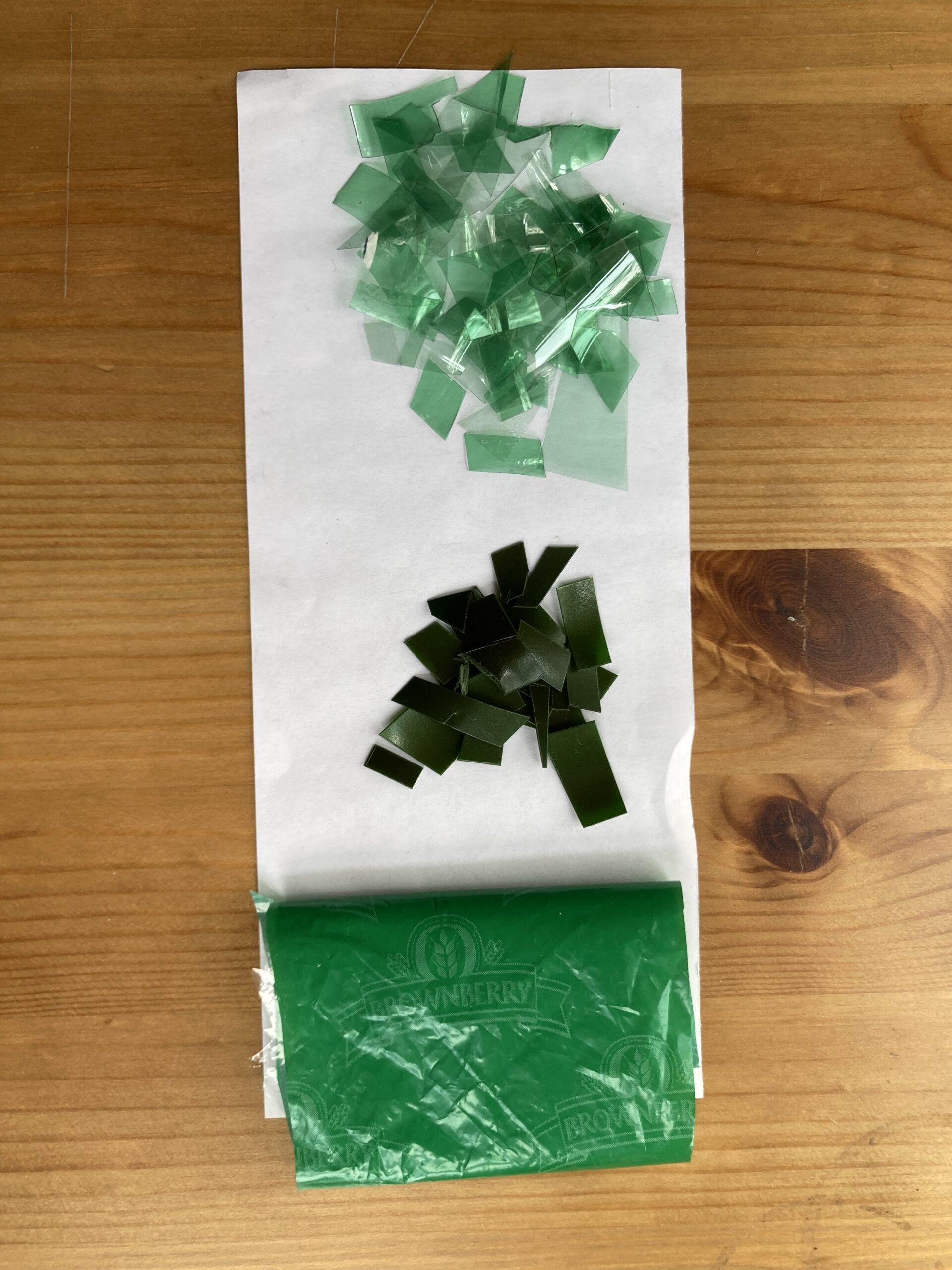
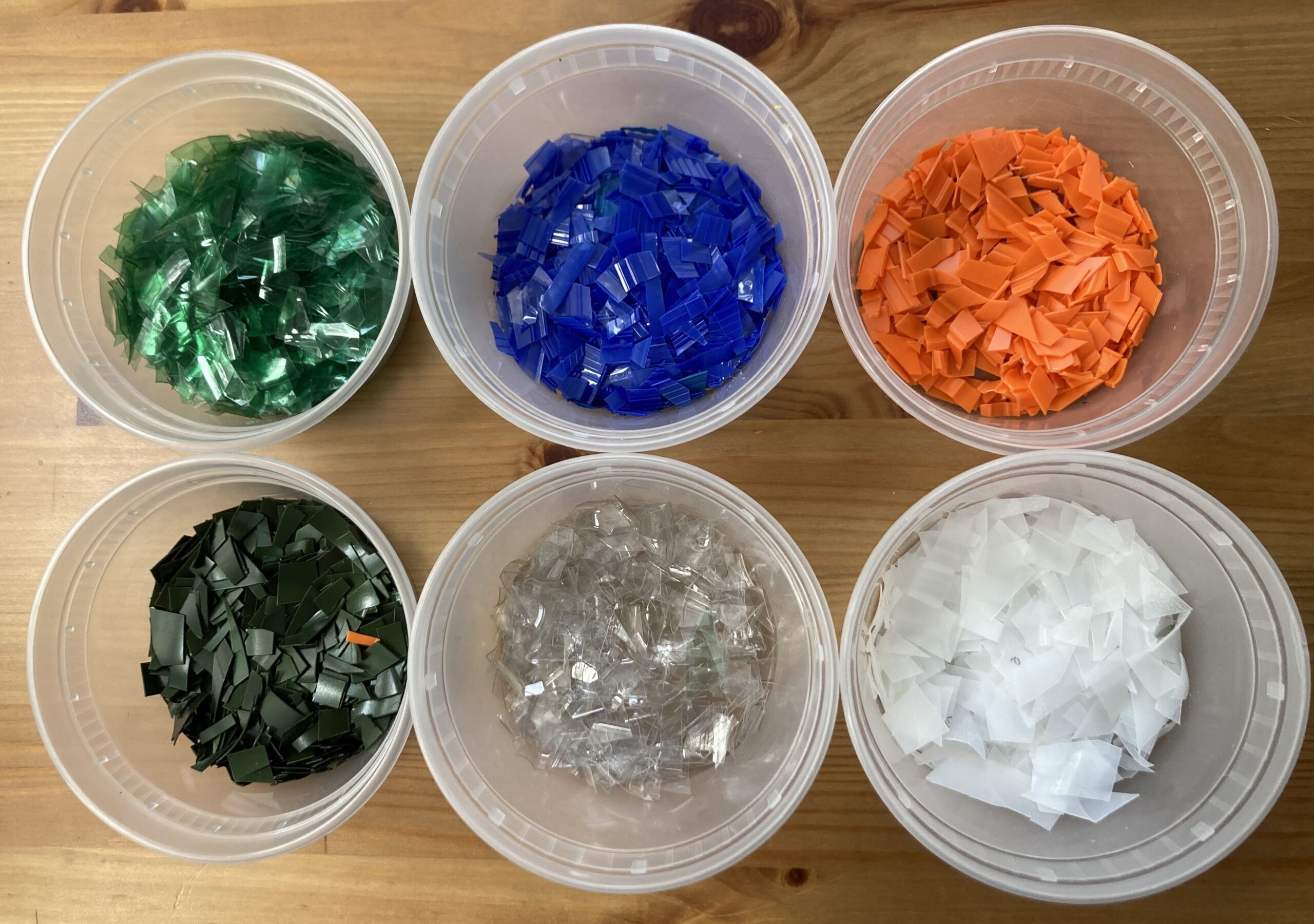
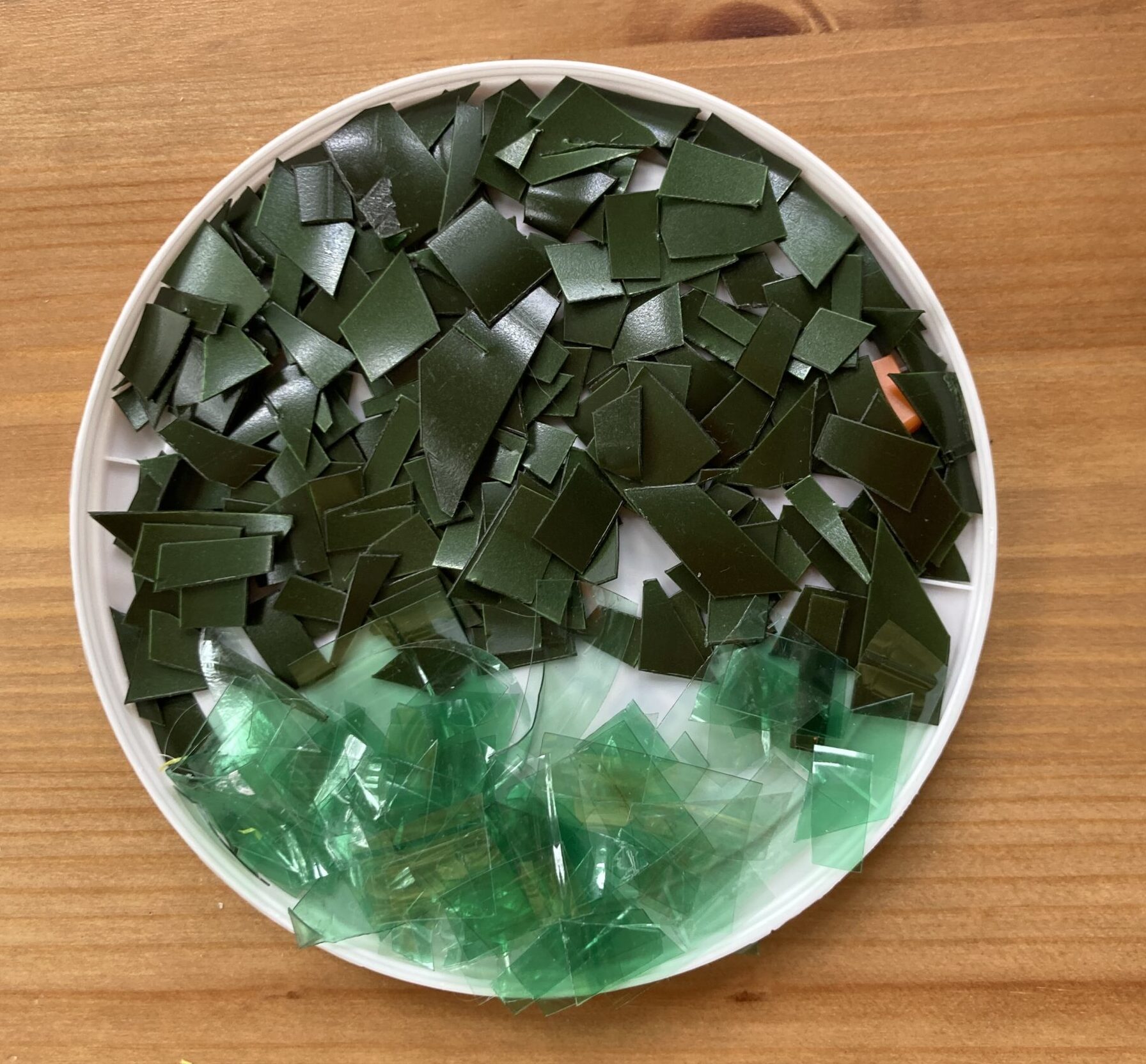
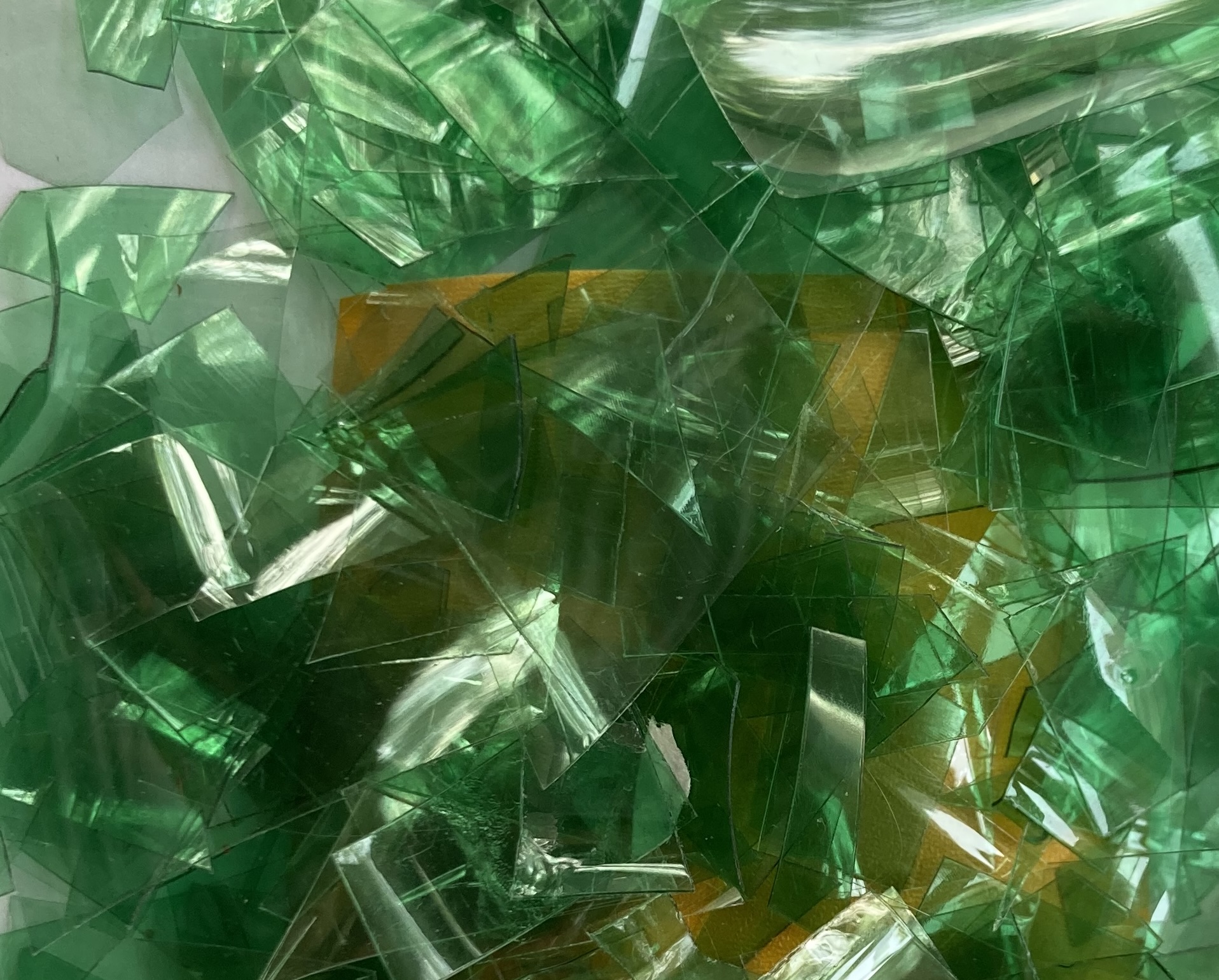
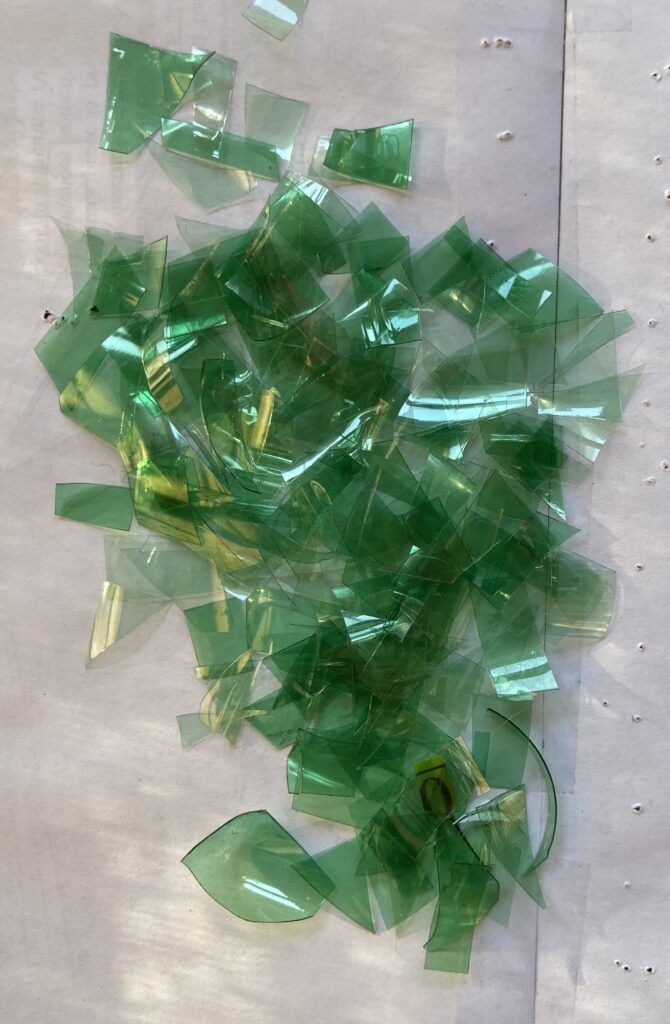
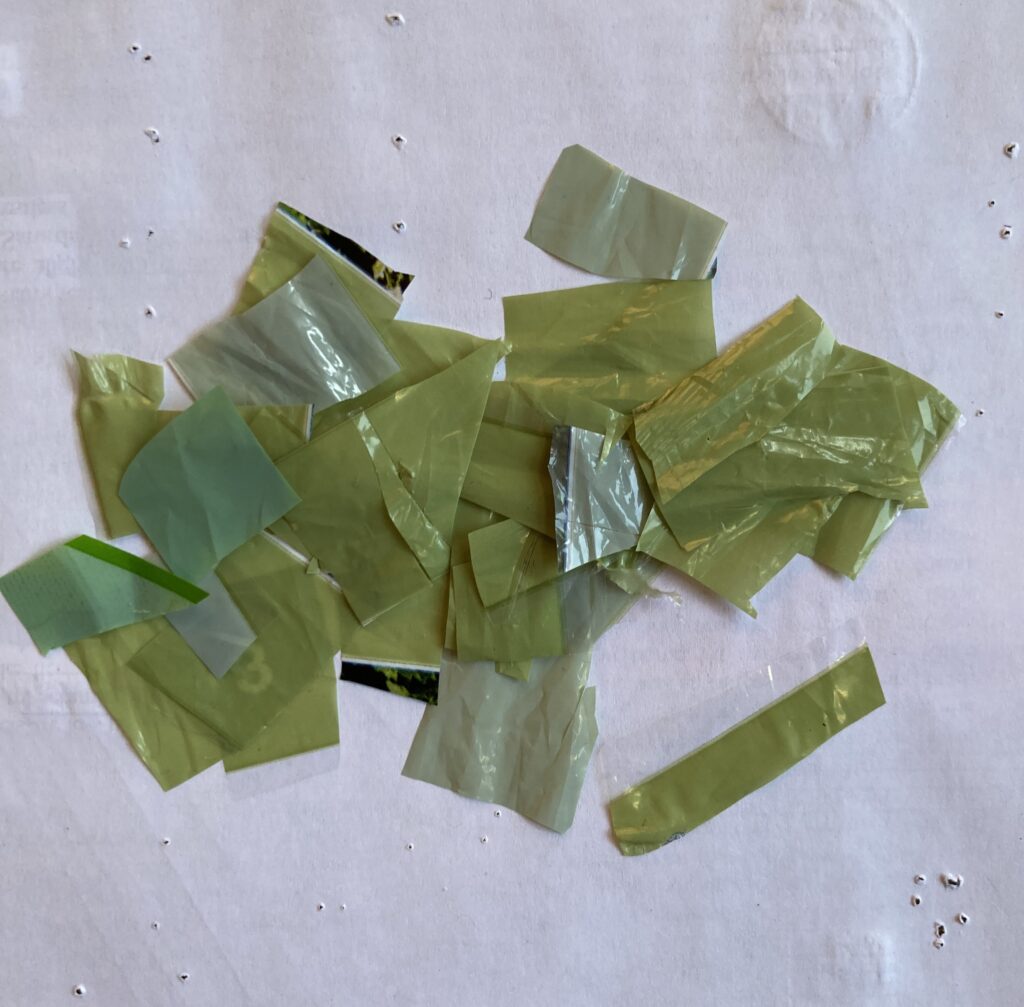
Oh that green! Usually this deep into summer, so much green is accompanied by lots of bugs. Yes, I heard the buzz of cicadas, but there weren’t any mosquitoes or gnats. Where are all the bugs? Returning to the green, these different plastics roughly represent the green, either as I saw it, or as I remember feeling it:
seltzer bottle / olive oil bottle / bread bag
swim: 2 loops (4 minis) cedar lake open swim air: 90 / water: 87 AQI: 75
The water was warm and opaque — low visibility. Yellowish green. A few bubbles, some scratchy vines, but no sparkle friends. The water was heavy and smooth on the way to hidden beach and choppy on the way back. Lots of swimmers were having difficulty navigating and ended up swimming on the wrong side. I almost ran into a pair of swimmers going the wrong way. I didn’t care.
On the back half of the final loop, I started racing another swimmer. We were going the same speed for much of the time, until I turbo-charged it by breathing every 6 strokes and pulled away. When I reached shore, they approached me — I think I was racing you; it was fun! thanks! It was fun.
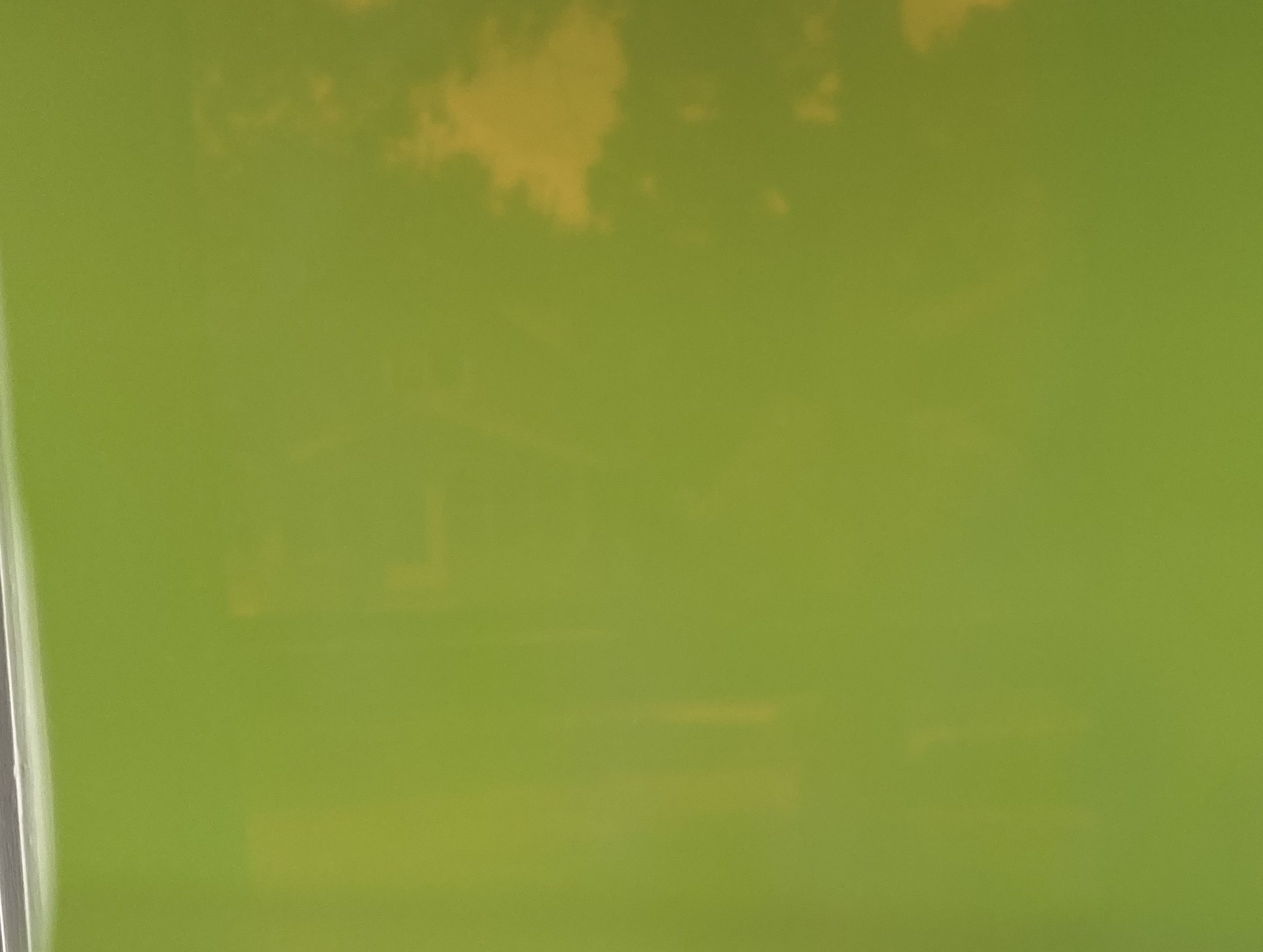
Today’s water color:
yellowish green cedar lake
Is this too yellow? Possibly, but at the beginning of the swim, before I settled in, I remember the lake looking this yellow to me.
bike: 8.7 miles lake nokomis and back 84/88 degrees
As the European grand tour cycling announcers say, it’s hotting up out there. Scott said that the dew point was 81 at the airport this morning. The record (for all recorded weather here) is 82. Yikes. Instead of running, I decided to bike to the lake and swim. I haven’t biked over to the lake when it wasn’t an open swim this summer for several reasons: 1. the milfoil around the buoys made it too annoying (and dangerous) to swim; 2. I was swimming a lot already at open swims; 3. and because I was already swimming too much, I injured my shoulder. But, the milfoil has been removed, or at least thinned out (hooray!): I can’t do open swim at cedar tonight; and my shoulder is feeling better. Another reason to come over here on my bike besides the facts that it’s too hot to run and I haven’t driven a car in 5 years: my Apple watch activity challenge for July is 5 bike rides of 5 minutes or more. Even though that’s not a challenging challenge, I haven’t achieved it yet this month because it’s been too hot, too smoky, and I’ve been too sick.
The bike ride was easy. I didn’t have to try and pass anyone and I could see well enough to navigate. The paths were not crowded. No big groups of kids or silver riders. No packs of runners. Part of the trail was closed, but I could see and follow the detour signs.
10 Bike Things
the parking lot at the falls was almost empty, one 1 or 2 cars
a bird near the lake — cheer up cheer up — a robin
thwack thwack — the pickleballers are at it again, playing on the court at the rec center, no shade anywhere
a handful of single runners sprinkled throughout my ride
the creek under the echo bridge was low and bright and still
an adult with a kid in a seat sped past on an e-bike
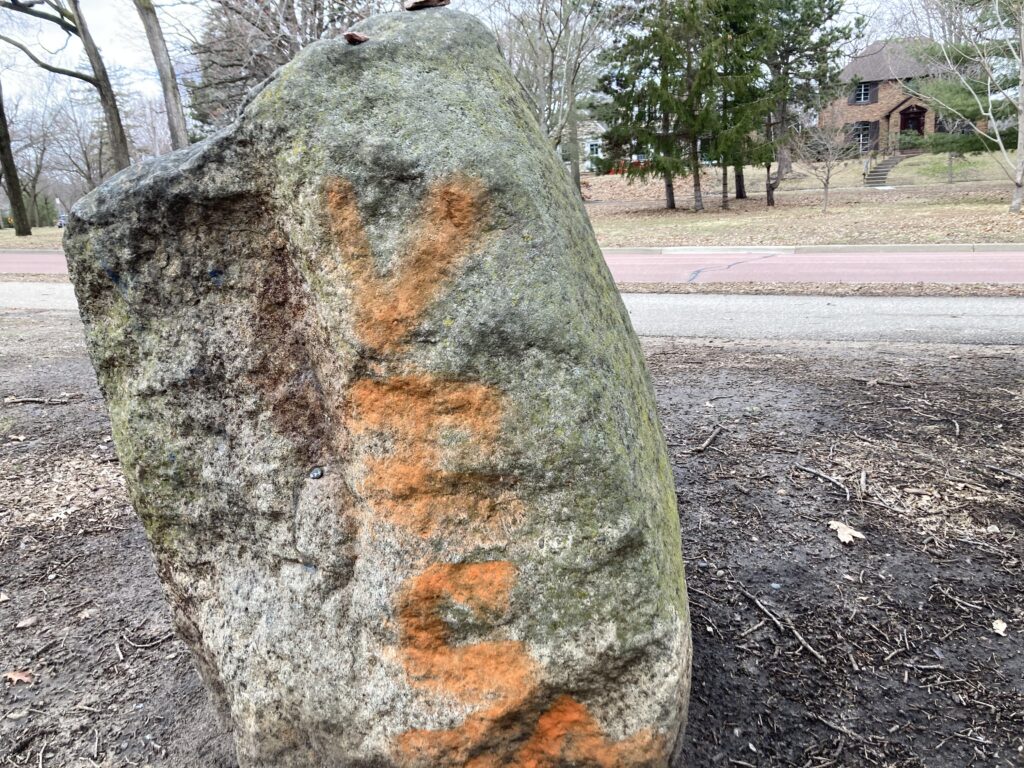
orange paint around the cracks on the trail near my favorite part of the path
just past that: trail closed for road (or sewer?) work on nokomis
biking over some bumps on the part of the path sandwiched between the light rail and the creek, my chain was jammed — I slowed down, preparing to stop and fix it, but it unjammed itself
minneapolis park workers out doing some work — mowing? cutting down limbs? I’m no sure
swim: 1.5 loops lake nokomis, main beach 86 degrees AQI: 57
A wonderful swim! The water was calm and not too warm. Only one other person was swimming loops, and they were doing it much closer in. No boats or paddle boards to watch out for. Hardly any milfoil, or the usual (from past years) and manageable amount of ghost vines reaching up from the bottom. A few more vines floating free near the surface. I swam at a relaxed pace, stopping to notice the quiet lake at the end of every loop. I listened to a dad talking his little kid — kid: am I going to grow taller? Dad: yes, you just need to keep eating your growing up food. I exchanged something (not words, but a feeling, mutual acknowledgment/recognition?) with a seagull that was perched on the far white buoy for the entire time I swam. Hello friend — are you waiting to catch a fish? A brief thought: how many fish are beneath me right now?
As I stroked beside the white buoys, I thought about how swimming in this deep-ish water off the big beach is a different experience than swimming across the lake. Here, with the shorter loop and the buoys beside me, I hardly have to sight. I can just swim until I reach a far buoy, then loop around it, and swim until I reach the other far buoy. Here, I barely need vision. For that reason, and because I’m not swimming far out into the middle of the lake, you might think that swimming here would be less scary. But, I’m always a little more on edge during these swims than the ones from shore to shore. Will I get too tangled in the vines? Are there fish lurking under the buoys?
At the end of my loops, I swam in between the faded red buoys and floated, my head resting on my yellow buoy. Then I sunk under the water and swam with my face just above the lake floor, studying the brown, sandy bottom. Ah! What a way to start the day!
Today’s color palette: white cylindrical buoys, faded pinkish-reddish spherical buoys, pale green water, bright blue sky, the clear bubbles and underside of water’s surface, a light brown sandy bottom.
(l to r) blue sky, brown sand, white buoys, faded pink buoys, clear bubbles, green water
a return to echolocation
Even as I’m trying to think about water and swimming, I’ve also returned to my manuscript from last year, which has gone through a number of names: Haunts, then Girl Ghost Gorge then Echolocate || Echolocated and now Echolocation. I was compelled to return to this project 2 months early (usually I work on it in the fall) because I noticed a call for manuscripts at one of my favorite presses. And I’m writing about it here because I realized, as I searched for past thoughts and words about this project, that even as I remember thinking about some poem or essay or fact that I’ve come across, I can’t find it on this log1. Did I write about it in a pages document or in Plague Notebook entry? If I don’t post it here, it’s more likely to get lost. So, more posting here.
As I fine-tune my manuscript, I want to weave in more direct references to echolocation and what I mean by making it the title of my collection. It’s literal and figurative. I’m writing about the location of echoes (the gorge and the trail above it), where echoes = the bouncing back of sound in wide open spaces and traces of the past/ghosts. I’m also writing about the act of echolocation, which is used by blind and low vision people to navigate the world. I’ve read about passive echolocation (hearing sounds/echoes that already exist to navigate) and active (creating sound with tongue or cane clicks or footsteps to bounce off of objects. I’m also interested in a third version of this, which is both (or neither?) active and passive: being the object or the solid thing in the world that can be located by others’ sounds. Does that make sense? Here’s a video that I just found that I’d like to archive and use to think more about echolocation:
passive and active echolocation
Not being able to find past essays/histories that I know I was reading and thought I was writing about has also come up with my “this isn’t the sea” project. I was almost positive I wrote about Dr. Christian Lambertsen and his SCUBA testing at Lake Nokomis but, after a long search, I couldn’t find anything. ↩︎
3 loops! lake nokomis open swim 81 degrees AQI: 69
3 loops! Finally, I’m feeling better — less anxiety and crud on my chest and no shoulder pain. I was planning to only do 2 loops today, but when I felt good at the end of loop 2, I decided to do one more. Who knows when the smoke might come back and make it impossible to swim?
The water was wonderful. A little cooler, more buoyant. Talking with a woman after swimming, we agreed that the water was much nicer than on Friday, when it was choppy.
I felt very relaxed and powerful. Strong shoulders and back. Sometimes I breathed every 5 strokes, more often every 3 or 4 or 3 then 4. I had no problem staying on course, a combination of seeing the buoys more frequently, and straight, even strokes.
note: I’m trying to write this as I watch the final stage of the tour, which is not easy because Pogachar is going for it. As one of the announcers remarked, “He’s racing like it’s the end of days out there!”
11 Things
as I started, near shore, the water was a dark green, almost the color of my olive oil bottle shards
clear bubbles bursting from my hands as I pierced the water
my sparkle friends! sediment being illuminated by the light, coming towards me
bright pink buoys bobbing in the water, tethered to torsos
200 strokes from buoy 4 to buoy 5
a few planes high in the air above me
a glitter path and sparkles on the water’s surface
some floating vine fragments getting tangled in my fingers as I stroked through the water
the view below me: a deep green nothingness
the view above me, from underwater: the surface, green then clear then bubbles
a church service was happening near Painted Turtle; as I paused in the middle of the lake to enjoy
Wow! What a finish to the Tour. The most exciting one I think I’ve ever seen — a showdown between Matthew van der Poel and Pogachar. Then van der Poel hung on to win, as the sprinters were closing in.
5 miles bottom of franklin hill and back 77 degrees / dew point: 72 AQI: 52
Went out for my run at 10 so I could watch the queen stage of the Tour de France. It was hot, but worth it to watch all the drama of the final climb. Sepp Kuss crashing twice and barely saving himself from falling over the edge of the mountain. Yikes. Carapaz won the stage. Pogachar acted as a domestique for del Toro.
It was warm, but there was a cool breeze and no sun, which helped. I was able to greet Dave the Daily Walker at the beginning – Good morning Sara! / Hi Dave! I heard the rowers down below, encountered lots of runners, most of them running by themselves, like me. Was passed by many bikers and roller skiers. I ran down the franklin hill then stopped at the river to study its surface — a thin film of something was on it in streaks. Down in the flats, by the low retaining wall, I noticed a single shell and the white coxswain’s boat taking a break in the middle of the river.
Even though my chest has some crud, I feel much better today. My resting heart rate is lower and I’m less anxious. The effects on inhaling wildfire smoky air = 4 days of feeling like I had a bad cold.
10 Things
white sky
thick, moist air
deep greens
no bugs — where are the bugs?
overheard: one guy walking down the franklin hill, meeting up with someone halfway down and turning around to walk with him, I‘m glad I don’t have to walk up the entire hill!
the big crack north of the trestle is growing deeper and is still barricade off — is too deep and dangerous to patch?
stopped at the sliding bench — a deep, dark green view below
a woman crossing over the road ot the trail, carrying a coffee, not wearing any shoes
no stones stacked on the ancient boulder
a horn blasting from somewhere — a train horn? deep and loud
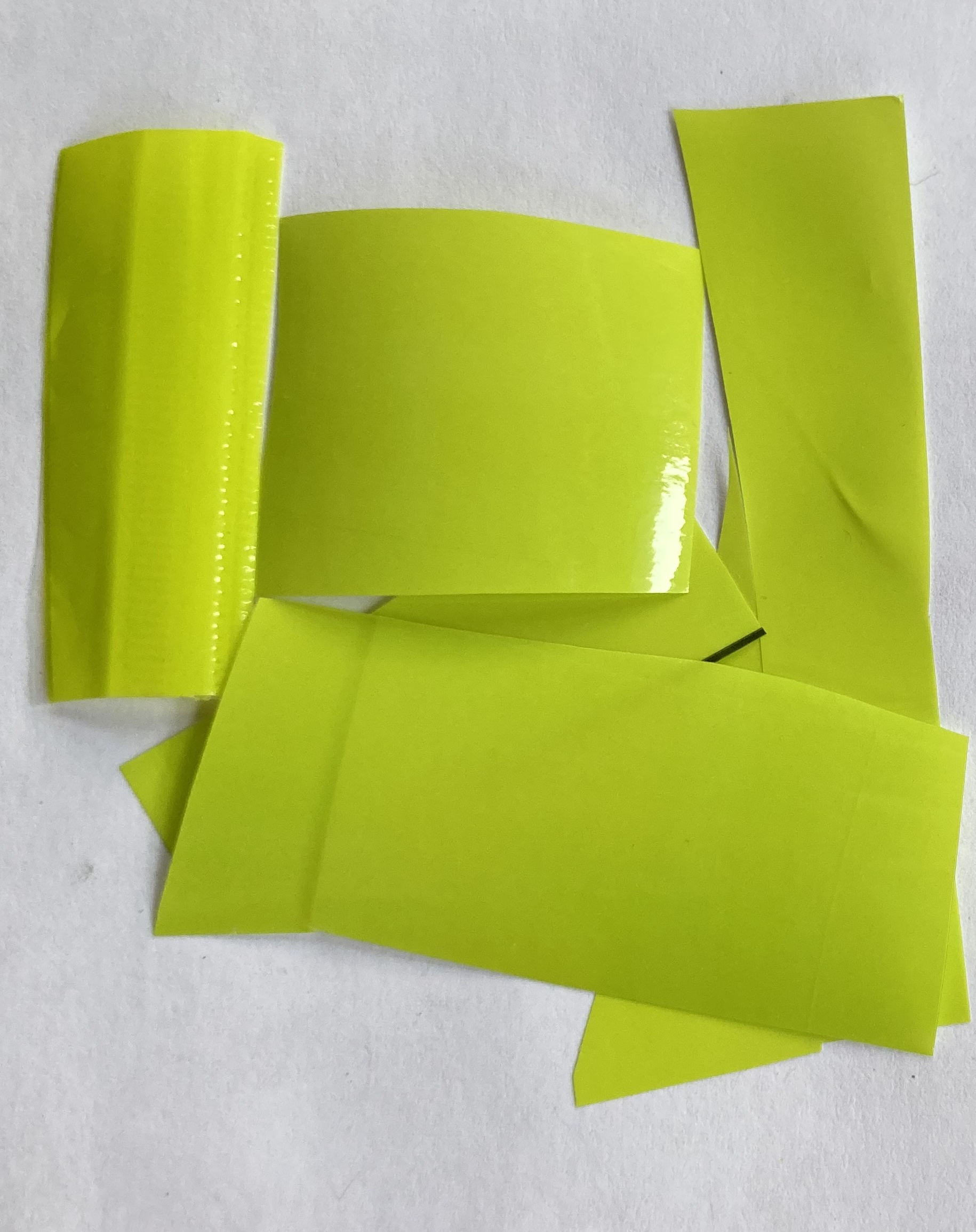
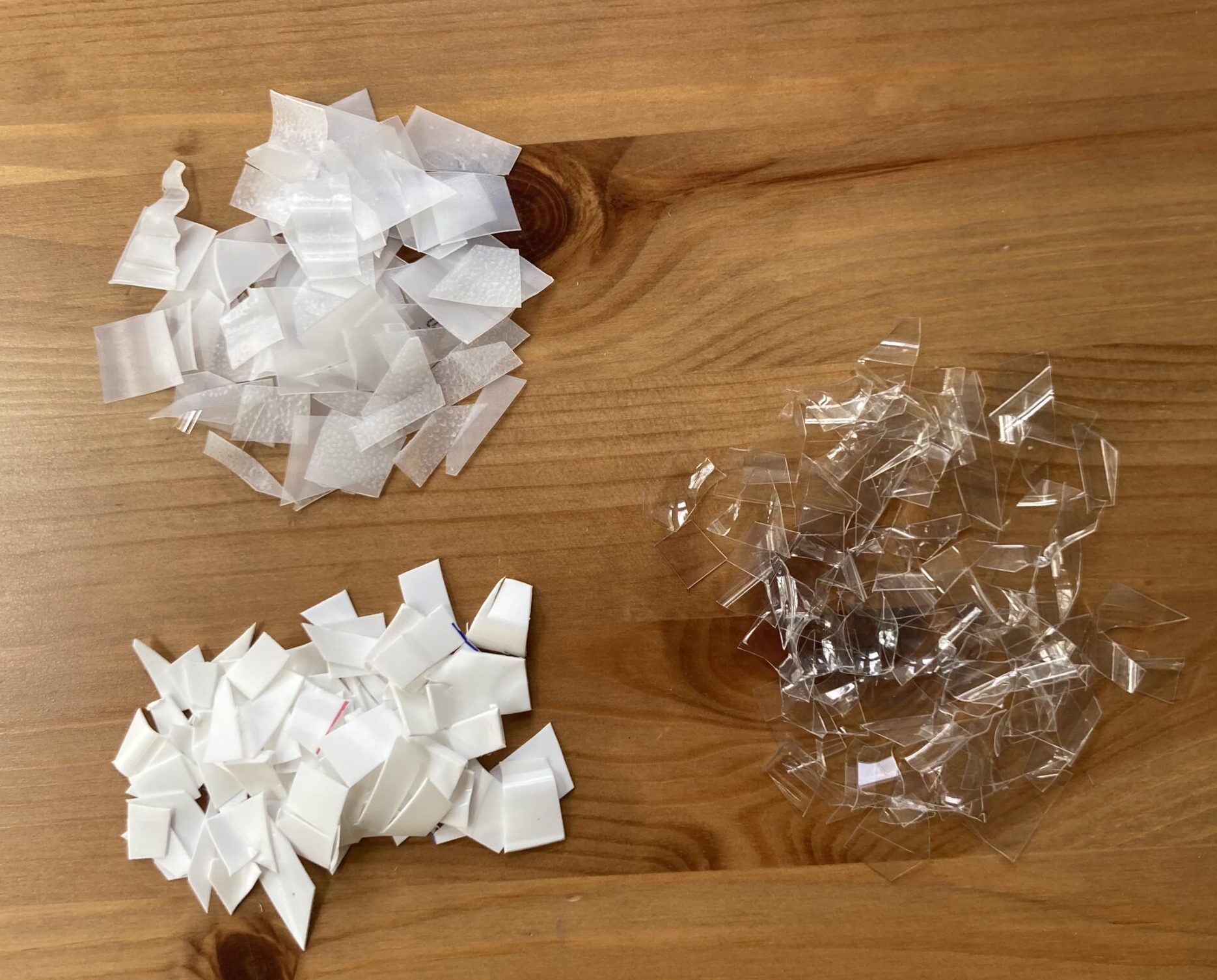
today’s colors in plastic
At different times, depending on the how bright the light behind the clouds was, the sky looked either 1, 2, or 3:
the “white” sky
Standing behind the sliding bench, looking down at the green gorge, I saw these 2 greens:
4.6 miles locks and dam / wabun hill / veterans home / falls 76 degrees / dew point 72 AQI: 70
Hot! So much sweat! Sun. The air was thick but not smoky. I’ll take it. Yesterday, while I was swimming, Scott ran around the lake once, which is not quite 3 miles. The AQI was almost double at 137. Last night his throat started burning, like swallowing acid, he said, and his throat closed up a little. He thinks it’s because of the high AQIand that he breathes only through his mouth when he runs. I thought about what happened while I was running and noticed how I was breathing in through my nose and out through my mouth. It’s all of my rhythmic breathing, I think: In 2 3 / Out 2.
I listened to my Plastic Fantastic playlist. I was particularly struck by The Sugercube’s “Dear Plastic,” so I looked up the lyrics:
p-p-p-plastic n-n-n-nylon te-te-te-terylene
made of atoms by tender fingers and determined heads of inventors tickling perfection
p-p-p-plastic r-r-r-rayon
I was born aeons ago before anything human was known my friends the alchemists told me everything was natural and always will be that way and possible to make gold from dirt
p-p-p-plastic n-n-n-nylon
dear plastic be proud don’t imitate anything you’re pure, pure, pure
p-p-p-plastic n-n-n-nylon
I believed I was their dustbin for knowledge took everything and digested of course I became big, big and really really strong
today I’m old and withering away my friends the alchemists long disappeared into dust I no longer get anything fruity no longer gold made from dirt the only thing I get is spacefood on a tray
p-p-p-plastic p-p-p-plastic p-p-p-plastic…
As I was walking the last few blocks after I finished running, I thought about Elastigirl from Pixar’s The Incredibles and how her superpower is the ability to stretch and transform into (almost) any shape she wants or needs and then return to her original shape. Plastic can make new shapes without returning to the original shape. I looked up, “elasticity vs. plasticity” and found this:
Objects deform when pushed, pulled, and twisted. Elasticity is the measure of the amount that the object can return to its original shape after these external forces and pressures stop.
The opposite of elasticity is plasticity; when something is stretched, and it stays stretched, the material is said to be plastic (source).
AQI (1:00pm): 45 AQI (4:40pm):61
swim: 1 loop (2 cedar loops)
cedar lake open swim 88 degrees AQI (5:30pm): 61
I would have loved to swim more loops, but it was warm and windy and my shoulder started hurting near the end of the first loop. A bummer, but at least I was able to swim for almost 30 minutes in the lake. No terrible air quality. I am grateful for any chance to swim.
The vibe was very cedar lake, with the disgusting, almost totally filled porta potty with no toilet paper, randos swimming out the buoy and getting in the way of swimmers — watch out! — and open swim club members swimming as close to or as far from the buoy as they wanted, occasionally crossing the path of swimmers going the other way.
The water was green with notes of yellow and opaque. I was able to see a few of my bubble friends, but nothing else. No fish or milfoil or sparkle friends. I don’t think I ever see sparkle friend here — not the sediment sparkles under water or the glittery sparkles on the surface.
added the next day: I wanted to replicate the color of the water with my plastics, but didn’t have time last night. I’m not sure either of these quite capture the mix of (mostly) green with some yellow:
123
1: back of cukes plastic bag held close to the window 2: back of cukes plastic bag held far from the window 3: a square of a yogurt container covered with seltzer water shards
I think 2 is too yellow. I think there’s a section of 3, on the right side, that might best capture my memory of the water. I also like the overall color of 1.
Will we have open swim in an hour and a half? They haven’t cancelled it yet. I went outside to water the tomatoes and peppers and I could feel the smoke, but it wasn’t too bad. 113 is “unhealthy for sensitive groups.”
In other health news for future Sara when she talks to her doctor at the end of the month: another night with restless legs and (almost) a calf cramp. I felt the same sort of wave of something strange pass through my lower calf as I did a few years ago. Back then, it made me very anxious, last night, not as much. Is it the wrong level of estrogen or progesterone, or my body getting used to the HRT, or something else? Whatever it was, I slept poorly: only 5 hours even though I went to bed at 10:30.
AQI (8:15am): 123
swim: 2 loops lake nokomis open swim 76 degrees AQI: 137
Open swim happened! Hooray! I was disappointed that the air quality was bad, but it wasn’t that bad and it made for a cool effect on the water. So much smoke and haze, all of it white and dreamy. Harder to see for everyone, at least I imagine it was harder for normally sighted people too. It didn’t bother me because I already can’t see that well, and don’t really need sight to navigate.
Before the swim, my entire body was bubbling with anxiety — a combination of adjusting to the hormone flux, and strong physical reactions to any strange sensations in my calves. I think I was worried that I might have a calf cramp in the middle of the lake. As I started swimming everything felt strange, surreal. Smoke, warm water, a gentle rocking. I tried to distract myself by focusing on colors, but the anxiety kept bubbling up near the edge, like boiling pasta water on the stove. Just before it boiled over, I abruptly stopped swimming and listened to the silence in the middle of the lake. I saw a lifeguard silhouetted in the smoked-out sun and the bright pink buoy of another swimmer and I was able to calm down. I started stroking again — 1 2 3 4 5 breathe right 1 2 3 4 5 breathe left — as I passed the second, then third buoy.
I was able to swim about 40 minutes without stopping and with only a few more anxiety flare-ups. The water was a pale blue-ish green below me. Looking up and just beneath the surface, it started as pale green, then turned into a clear band at the edge. Above, it was the hint of a purply blue.
10 Things
a lot of the Eurasian milfoil is gone!
some non-open swimmers were blasting a speaker at the lifeguard stand where open swimmers leave their stuff, the LOUD throbbing of the beat increased my anxiety
overheard, 1 swimmer to another: I’m just going to swim to the second buoy and back
overheard, 1 swimmer to another: I have no illusions about my swimming ability!
overheard, 1 swimmer to another: Let’s put our ages on our (Women’s Tri race) caps! You don’t have to, but it’s fun to see everyone’s age when you’re running!
arriving at the lake, the smoke on the water looked so thick — everything was white
the occasional bent elbow of another swimmer, some foam, a bright pink or orange buoy tethered to a torso
a few shredded clouds hanging in the sky
a slight ache in my left shoulder by the start of loop 2
rounding the fifth buoy and sighting the first one in the distance: a small, bright orange dot
AQI (12:30pm): 156
The water offered a gentle rocking for the first half of the first loop, then turned choppier. I could see my bubble friends and hear the sloshing of water over my head.
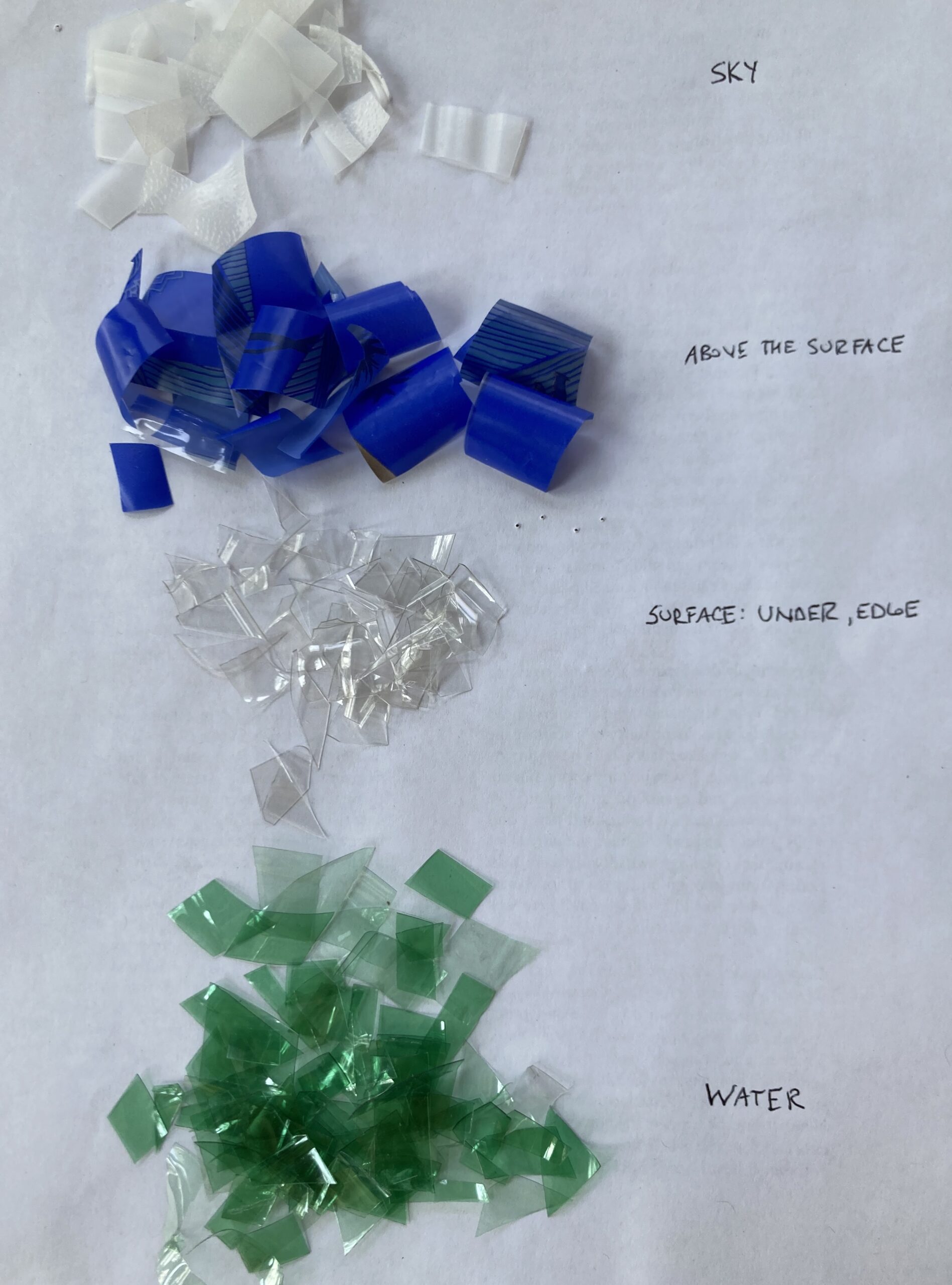
color in layers: underwater / underside of surface / surface from above / sky
water / under surface / above surface / sky | seltzer bottle / danish container / ziploc / milk jug
Playlist: Plastic Fantastic
Created this plastic playlist yesterday. I’m looking forward to listening to it on my next run.
Plastic Hearts/ Miley Cyrus
Midnight Sky/ Miley Cyrus
PLASTIC/ sakehands (feat. Marty Valentine & Lo)
Plastic/ Moses Sumney
Fake Plastic Trees/ Radiohead
Plastic/ New Order
Plastic/ Portishead
Plastic Doll/ Lady Gaga
Barbie Girl/ Aqua
Plastic Romance/ A Toys Orchestra
Dear Plastic/ The Sugarcubes
Plastic Jesus/ Jello Biagra & MoJo Nixon
Welcome to the World of the Plastic Beach/ Gorillaz (feat. Snoop Dogg and Hypnotic Brass Ensemble)
Plastic Beach/ Gorillaz (feat. Mick Jones and Paul Simonon
Synthetic World/ Swamp Dogg
Plastico/ Ruben Blades
Plastic Girl/ CAPSULE (feat. EeL)
The Bomb/ L7
Plastic Factory (Mono)/ Captain Beefheart & His Magic Band
Another hot morning. Another successful run. Not fast, but steady. Mostly running with some walking. 2 Regulars sightings: Santa Claus and the walker that always wears a skirt and sandals — I feel like I named her, but I can’t remember what. I checked the log and I have mentioned the woman wearing sandals and a skirt 3 times, but have never named her. I think I’ll call her Skirt with Sandals, which is a reference to a phrase we’ve (Scott, RJP, FWA, and me) used many times over the years: socks with sandals. It’s from the show within a Disney show: So Random in “Sonny with a Chance.” I used to unironically wear socks with sandals frequently.
I heard the far off echo of workers hammering something, trickling water, the click and clacking of roller skiers’ poles above me. As the skiers passed me, I heard 2 of them discussion “Love Island.” At least one of them didn’t like the show. I’ve never watched it, but RJP was very invested in this most recent season which ended earlier this week.
In Hawaiʻi, you often hear the term “island time,” referring to the slow pace that pervades the culture here. But for me, standing on land just a few hundred years old, island time is a reminder that this is a place in the process of being both made and unmade. Here in ʻĀhihi, there are barely any trees—the soil still thin atop the hardened rivers of basalt and scoria. Not enough time has passed to erode these sharp and porous remnants into dirt. Yet in that short stretch of centuries, between that time and this one, the island has changed irrevocably. When I began snorkeling, I was warned there was little left to see on Maui, most reefs dead and dying—a result of rampant tourism, overfishing, commercial runoff, and warming waters.
island time — land just a few hundred years old — I’m thinking about lake time and how lake nokomis only celebrated its 100th birthday in 2014 (see: 12 july 2025). Before that it was marshy land — wider and shallower. 100 years is the approximate time it takes for a human-made lake (nokomis was a marsh, dredged, made into a lake) to act like a natural like
“I settle into my liminal position, turning my back to the earth as I know it: the solid ground under my feet replaced by weightlessness. I trespass into this unknown world—below me, I feel how time itself has turned the stone to sand. At last, I cross the threshold with my entire body.“
“I am held in the veil between these worlds that are each, astonishingly, part of this place that we call Earth. Within minutes, my cells acclimate to the cool buoyancy. I am carried away from everything I know. As I kick out, the mechanisms of my movement grow more and more effortless. Anything heavy or painful drains from me. In the water, I am held—a child rocked in a mother’s arms. My body moves differently here, swaddled and swept in the cadence of waves, alongside all the creatures who share this space. . . .”
“I am flying now—a wingless bird gazing down, seeing the universe anew. Like Icarus, I feel the warmth of the sun against my back. Between realms, I face an ecosystem nothing like my own.”
seeing the universe anew — in the ocean, everything might be clear and vivid below, but in lake nokomis, and with my bad eyes, everything is murky, muddled, felt in the briefest of flashes.
“Beneath the inscrutable blue-black mirror of the water’s surface lies this universe in technicolor. “
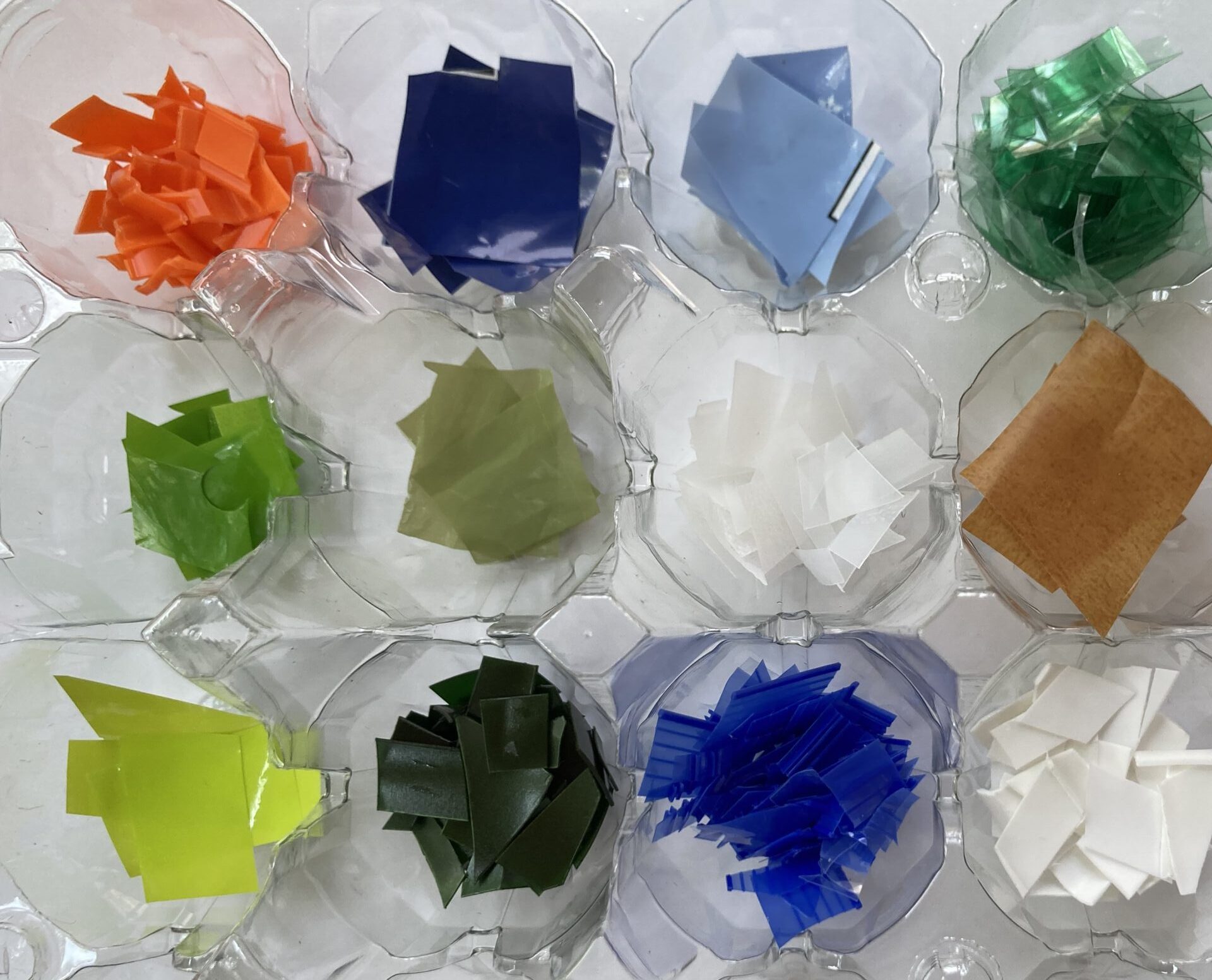
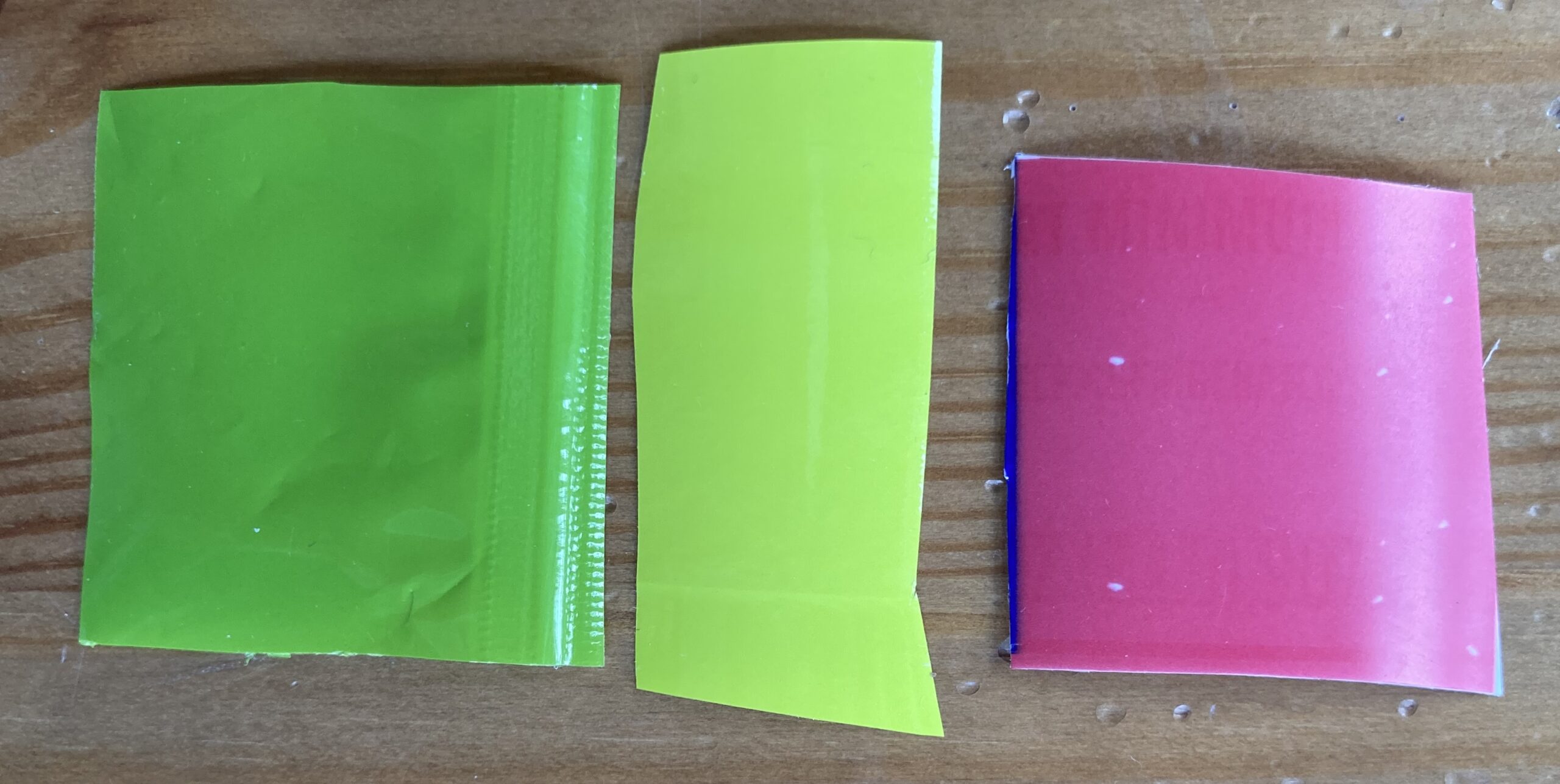
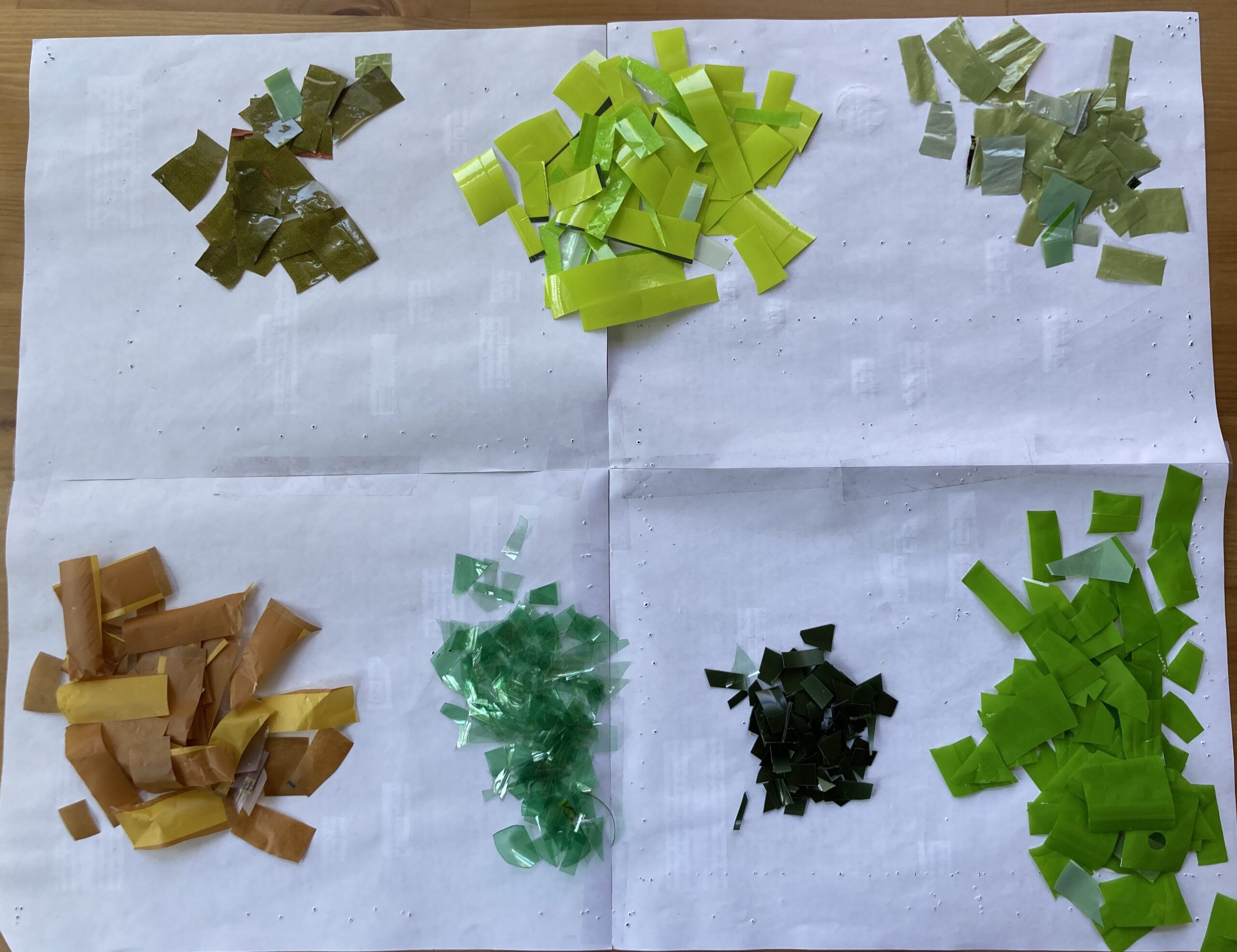
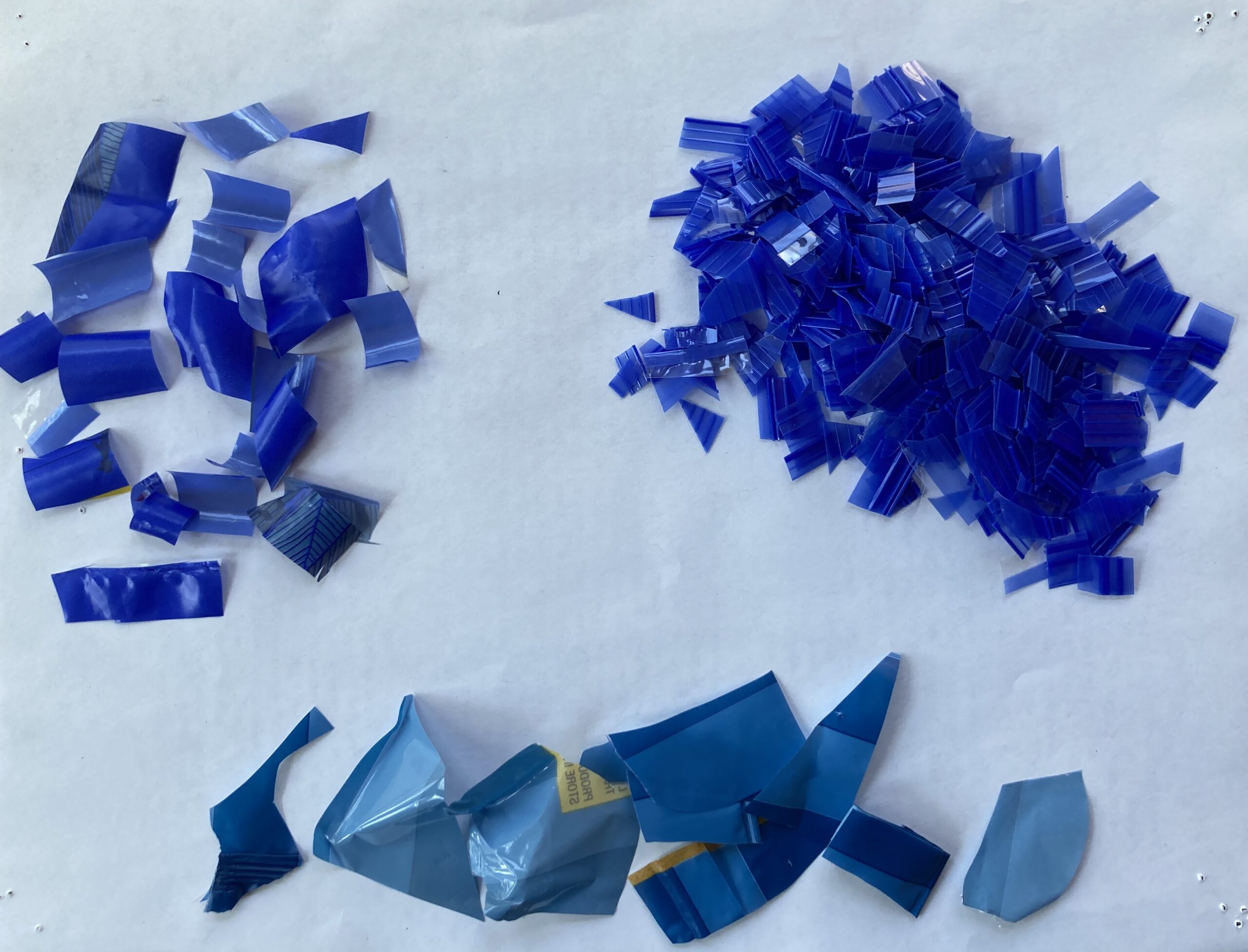
What is the color of the lake water? As part of my plastics project, I’m gathering the colors of the water that I see when I swim. The plastics project = keeping as much of the plastic that my family uses for visual poetry projects — produce bags, seltzer water bottles, ziploc baggies, miscellaneous. packaging, T Joes’ pasta/rice bags. Here are the colors I’ve collected so far in greens and blues. (The lake is usually much moregreen than blue.)
plastic origins, from top left to bottom right: granola bag, little cukes bag, russet potato bag, Trader joe’s pasta bag, bottle of olive oil, bottle of seltzer water, squash bag
Are these all “green”? I see them that way. The bright green of the upper center is what the water looks like when a blue-green algae bloom is present. Last night’s warm and stirred up water at cedar lake resembles the brownish yellowy green in the lower left. Number 2 and 3 in the bottom row are shards from bottles, while the rest are bags, only colored on one side.
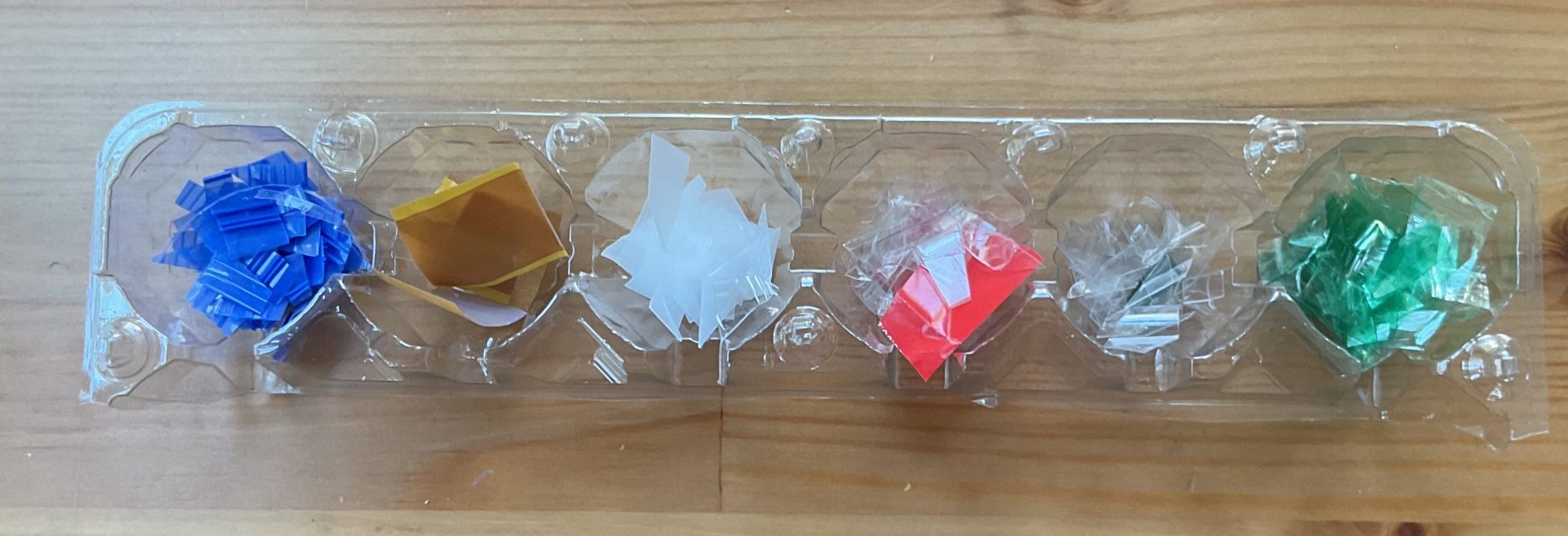
lake nokomis blue
plastic origins, from top left, top right, bottom: Trader Joes’ rice bag, shards of the locks from ziploc baggies, Trader Joes’ pasta bag. I don’t think I ever seen the lake water look like this below the surface, but above, when it’s sunny and I’m looking at it from the right angle: blue, often with purple vibes.
Scott asked me what I plan to do with these colors. I’m not sure yet, but I know it will be part of something that expresses how I see color and how color works in a city lake that resides in a lake city that prioritizes access for everyone and that is working hard to keep the lake and its people safe and healthy in the midst of a climate crisis (almost apocalypse?).
Once I gather more colors that fit, I could create some visual poem to place beside this poem, which is in by chapbook, Inklings:
Fish 3 between buoys 3 and 4
The fish in us escape. They flash and streak and leap, then return to bubble whisper the names of water’s colors.
swim: 2 loops lake nokomis open swim air: 96 degrees water: 84 degrees
Hooray! 2 (almost) pain-free loops at lake nokomis open swim! Before it started, I was able to talk with 2 other swimmers about how much we love open swim. They were a little older than me — 5 or 10? years — and just as enthusiastic about the water.
10 Things
2 girls — older high schoolers or in college? — flirting with 2 guys at Painted Turtle: loud, awkward giggles
a guy playing guitar, accompanied by a recording — I know I enjoyed 2 of his songs, even danced to one, but I can only remember the other — an instrumental “Careless Whispers”
very choppy water — not the type of waves that put up a fair fight, that you can punch, but the ones that unsettle, disorient, jostle
swallowing a wave of water, which made me more careful about when and where I breathed and stroked
1 2 3 4 5 breathe right 1 2 3 4 breathe right 1 2 3 breathe left
a very LOUD metallic buzz beneath the surface — somewhere someone was doing something that was causing this noise — was it a boat? a machine drilling somewhere?
slosh slap
bubble friends!
being routed by lifeguards when I swam too wide of an angle
the first orange buoy was almost in the middle of the lake — maybe the farthest I’ve ever seen it
The water was opaque and the color was somewhere between these 2 colors:
shovel: 30 minutes 12 degrees / feels like 0 bright sun
The official word is that MSP (airport), which is only a couple of miles away, got 5.8 inches of snow. It wasn’t too hard to shovel; thankfully it got a lot colder yesterday and overnight. No longer heart attack snow. Under the powdery stuff, there was some crust, but it didn’t seem too slippery either. I would love to go out for a run by the gorge, but I don’t think that’s a good idea for my glute/hip/back. It’s tough to resist.
10 Things
bright blue sky
warm sun on my face
fogged up sunglasses
an unsettling creaking noise above me: some frozen branches on our big maple in the front which seems to be dying (evidence: big branches have already fallen this fall + several woodpeckers have been drumming on the wood)
the whiny rumble of a snow blower in the distance
a cold spray on my face when the wind blew some of the snow I’d just shoveled
the recycling and trash can lids frozen shut
rabbit prints along the side of the house, near the garage
a sharp rumble nearby: another slow blower, closer and in the alley
sprawled branches of the crab apple tree, weighed down with snow and ice
bike: 35 minutes basement
Resisted the urge to go outside and run; biked in the basement instead. Almost finished the first episode of season 2 of Wednesday. Like in the first season, she attends a boarding school, Nevermore. Did I know that Edgar Allan Poe was the founder? Probably. Some outcasts are psychics or wolves, can control bugs or shoot electricity out of their fingertips. I can’t remember if there’s only one siren or more. This season has Steven Buscemi as the principal and a scar-faced crow. It was helpful to watch the episode with audio description on — such relief to actually see and understand and to not not know what is going on. Yes, that is a double negative, and yes, I meant to write it — the feeling of uncertainty is not knowing, so the relief is in not being in that state of not knowing: to not not know
walk: 20 minutes neighborhood 13 degrees
Managed to convince Scott to go outside for a quick walk around the block. It was cold, especially walking into the wind, but I had hand warmers in my gloves, which helped a lot. Scott did not, so he was very cold, and didn’t want to walk for long.
What did I notice? One neighbor had put salt down on their sidewalk (boo). Most of the sidewalks were shoveled. The street 2 blocks over had lights strung up from one end of the street to the other. I never see these lit up, because I don’t walk this way at night. A friendly woman greeted us halfway down another block — hello! / hi!. She was giving treats to a cute dog. Anything else? I can’t remember.
Translated from the Swedish by Kira Josefsson with Judith Kiros
is it only words. On and on. If you shook up the words. On a particular shade of purple being extracted from spiraling shells. If the repetition had less to do with the broken-apart sea, see my skin and my arms rippling like a wave, on and on again, I’ve dyed them navy. On receiving a gift in your childhood, a purple doll with foaming skirts, beneath them nothing, between her legs nothing, what a perfect wave of black nymph. On violet. Or on lavender. On being lowered into an ocean of colors. On your head being pushed beneath the surface, on and on again, to the tune of seashells knotting their purple insides. Don’t give yourself up for free; there is a point in talking back to the sea. On a particular shade of vague purple. On the way a shadow struts, violet, across the page.
a particular shade of purple: tyrian purple, made from snail shells violet, lavender, being lowered into an ocean, pushed beneath the surface: this makes be think of Alice Oswald and Nobody and Odysseus and his purplish-blueish cloak
I like the idea of being lowered into an ocean of colors shade of vague purple
My favorite: the way a shadow struts,/violet, across the page
Also discovered this morning: Fragment Thirty-six / HD and the reading guide by Dan Beachy-Quick — I’d like to return to this some other day, when I have time.
one final note: I have posted a log entry, either running or biking, on this day every year that I’ve written in this log: 2017-2025. Tomorrow, I’d like to experiment with mashing up or combining or erasing or scrambling or cutting up the words in these entries to make a new piece of writing — most likely, a poem.
Not an easy run, but I kept going and was happy to be outside, above the gorge, for almost an hour. Some walking, more running. Was able to greet Dave, the Daily Walker. Noticed something sticking out in the middle of the river as I ran across the lake street bridge. People swimming across? No, tree branches stuck on the sandbar. The bridge steps were wet. Not rain, but a hose?
3 moments of color
1
Running across the Lake Street bridge, looking out through the railing, pink. Someone had spray-painted the railing with a thin line of bright pink, maybe bright green too, or was that my bad vision? Or maybe the bright sunlight doing strange things? Whatever it was, it looked magical.
2
Descending into the tunnel of trees from the north, a pool of reddish-orange light ahead of me. A wildfire sun? No, reflections from some orange paint on a nearby tree and red leaves on the ground.
3
Again on the lake street bridge: a very bright circle of light on the water, silver with streaks of orange, or an orange tone? or the idea of orange?
Found a powerful poem on Poetry Daily this morning, Schrödinger/ Katie Erbs.
a little thought experiment gone sideways an idea trapped in ovum the cedar chest the bride suffocates in the refrigerator’s magnetic closure invented only after one too many kids got trapped inside leaving little claw marks on the insides of little coffins how I dreamed of the little bell to ring from inside the box to let everyone know I’m alive inside still
Just yesterday, I was reading a novel, Victorian Psycho, that mentioned these bells in coffins. I don’t think I had ever heard of them before.
I am convinced I can hear bells — the bells that chime from inside the safety coffins in the Hopefernon churchyard. ‘To ensure one isn’t buried alive,’ explained the Reverend when I first remarked upon them as a child. ‘They can only be rung from inside the coffin.’
‘But I hear them at night,’ I had told him, and the Reverend had sighed and shaken his face full of wrinkles . . . .
Cooler this morning. Quiet. Ran earlier than usual: 7:30. Lots of traffic on the road, some on the trail too: walkers, runners, bikers, strollers, at least 2 roller skiers. I could hear one of the roller skiers as it approached, scraping their poles on the ground. No clicks and clacks, just scraaaape scraaaape. Running past the rowing club, I encountered a group of people in bright yellow vests emerging from below. Were they rowers, and did they wear those vests on the water?
After reaching the river, I noticed the fence slat, pushed loose by a leaning tree trunk, was looser today. Greeted the Welcoming Oaks, good morning! hello friend! The sunlight was beautiful in the tunnel of trees — thin strips of light coming through the leaves.
Found this poem yesterday. It’s great for my interest in ekphrastic poetry and color:
bike: 8.6 miles lake nokomis and back 61 degrees (there) / 68 (back)
It’s great to bike! Independence! Not having to rely on someone else to get me to the lake. And, being on a bike is much more fun than being in a car.
Overcast and cool. Some wind as I biked south and west. I might have glimpsed the river through the trees, looking almost white, but I don’t remember. Heard the rush of the light rail going past on the other side of the barricade. Also heard the rush of the creek, moving past the spot where all the kids like to swim. Heard the rhythmic thwack of the pickle ball hitting the racket. The pickle ball courts by the lake nokomis rec center are always full. And, as I neared the big beach, I heard a shrill sound on repeat. Scott and I had heard it last night and thought it was a person whistling. Nope. Was it a bird? What else could it have been?
swim: 3 loops lake nokomis open swim 64 degrees
A little tired today after last night’s swim. Otherwise, I felt good, buoyant, high up on the surface of the water. My sparkle friends were coming right at me as I swam across to the little beach. The sky was covered in clouds. The positioning of the buoys was closer today than last nigh, so a much shorter course. Two things: the green buoy closest to the little beach was farther away this morning than last night and the middle green buoys were closer together — a tighter angle. According to my watch, I swam a mile and 1000 less strokes today.
I had trouble keeping my nose plug on; it was leaking air which made a funny nose underwater. I wondered if other swimmers could hear it. Have I heard the noises of other swimmer’s underwater before? Not in lake, but I’ve heard clicking elbows in the pool.
Mostly my stroke pattern was: 1 2 3 4 5 breathe right 1 2 3 4 5 breathe left Occasionally: 1 2 3 4 5 6 or 1 2 3 breathe right 1 2 3 4 breathe right 1 2 3 left 1 2 3 4 left
I recited Alice Oswald, mostly the one about microscopic insects that catch pigment on their shivering hair-like receptors. I wanted to recite the new lines I tried to memorize last night, but I got stuck on the first line. I couldn’t remember disintegrating certainty.
Yesterday I watched a little of the 5k open water swim world championships from Singapore. The competitors were swimming in a shipping lane with an over-sized lane line on one side. This lane line was enormous, much bigger proportionately than a pool lane line. It looked strange and unreal.
10 Colors
orange buoy
red lifeguard kayak
white swan
an occasional dot of robin’s egg blue — the green buoy getting closer
lime green buoy
yellow safety buoy
pink cap
green vine, floating
pale greenish-brown vine from milfoil reaching up from the bottom
a smear of green so dark it almost looked black near the ford bridge: a dark dirt trail that winds through the woods
EXAQUA
Last week, I returned to a poem I posted on this log a few years back: EXAQUA / Jan-Henry Gray. So many good lines about water. I decided to request it from the library — it’s in Gray’s collection, Documents. Yesterday RJP and I went and picked it up. Exaqua is several pages long, with multiple sections. Today I’ll start reading it more closely.
I wondered about the title. What does it mean? In a note, Gray writes that the title comes from the “Notanda” section of M.NourbeSe Philip’s Zong. I’ve heard of Zong! before. JJJJJermoe Ellis writes about it in Aster of Ceremonies. I had to do a little more digging to find out what it means in Zong! Found a masters thesis with an explanation:
When Morrison writes, “By and by all trace is gone, and what is forgotten is not only the footsteps but the water too and what is down there,” she gestures toward the material remains of the enslaved who we know to have been drowned by those waters—the “Sixty Million and more” to whom Beloved (324). It is in an attempt to remember “the water and what is down there” that NourbeSe attempts to do the work of recovering, reclaiming, or exhuming those bodies from their liquid graves. The term NourbeSe uses to describe this process is exaqua: that is, to exhume the bodies of the Zong’s victims from the water. In lieu of the enslaved’s literal, material remains—their scoured bones— Zong! orients itself toward creating a textual space where their voices may sound out. When we have observed that a voice is singular, this observation has rested on the embodiedness of our voices. As sound, our voices are constituted by the materialities of our bodies that produces them, thereby carrying something of our bodies outside of ourselves and spacing it out into the material world. For NourbeSe, then, Zong! as a material object is like the surface from which the sound of the captives’ voices reemerge.
This definition is fascinating. I want to keep thinking about it as I do a close reading of the different sections of the poem. An immediate thought: the idea of surface here is interesting — surface as where what is inside us travels outside.
immersion
The only way to know a song is to sing it. The only way to know an ocean is to swim it. (from Across the Pacific Ocean/ Jan-Henry Gray)
These lines are from an earlier poem in the collection, but I’ve been thinking about them and I think they can be put into conversation with EXQUA. I’d also like to put them into conversation with my own thoughts on being in the water as opposed to being near it or beside it or above it (like I am with the river).
I think about all that I know or understand or am familiar with because of the time I’ve been in lake nokomis over the last 12 years. The quality of the water, its currents, its colors, its buoyancy, its temperatures. The sediments, the ducks, seagulls, loons, dragonflies, the vegetation.
In the water, you feel the ripples, the swells, the rocking of the waves, the wind. Out of the water, you might see a textured surface or a whitecap, but you might only see flat, calm water.
4.25 miles monument and back 71 degrees dew point: 64
Hot! I’ve never liked running in the heat but now that I’m taking lexipro my heat intolerance has increased. For some moments of the run I felt great, other moments I didn’t. So I walked some, ran some, and walked again at different stretches.
10 Things
I kept seeing orange flashes — a sign, a cone, a tree marked for removal
kids yelling and laughing outside at a daycare attached to a church
the river from above, on the bridge, heading east: brown, and looking shallow — were those sandbars I was seeing near the surface?
trickling water out of the limestone below the bridge
the sound of shadow falls, falling
a kid’s voice rising from the ravine
construction on the other side of the lake street bridge — orange cones, trucks, yellow-vested workers, the buzz of equipment
the river from above, on the bridge, heading west: blue and covered in the reflections of clouds*
click clack — a roller skier
seen, not heard: a dog, by the clanging of their collar
*stopped at the bridge overlook to take a picture of the clouds reflected on the surface of the water. Is it just me, or does this look like an impressionist painting?
river with clouds, 7 july 2025
the color of water
How to Read Water is fascinating. Here are some things I’d like to remember from the chapter on color:
The colors we see in water depend on the brightness and angle of the light and the water’s depth, as well as what’s on, in, and under that water.
How to Read Water
something to consider: are you looking at water, or something in or under the water, or a reflection on water’s surface. Is it the color of water, or the color of the ground beneath the water (a puddle), or the color of cloud on its surface? What angle are you looking from?
. . . in many circumstances when we think we are looking at the water, we are actually looking at something different and in the distance. Looking out to the sea in the distance is a great example: What we see in that situation is dominated by the reflection of the sky even further in the distance. This is why the distant sea appears blue in fine weather and gray on overcast days.
How to Read Water
This water looks blue because it’s reflection the sky is one I’ve heard a lot, but I think I’ve always heard it as the reason, not one reason under certain circumstances.
What about when we see different colors — which I often do as I run across the bridge and look down at the water? The different colors are based on how much of the water we are actually seeing. Sometimes I see brown, sometimes blue.
You will notice this if you look for it, but not if you don’t because our brain has gotten used ot this effect and so oesn’t register it as at all peculiar.
something to try: Can you find the area/the moment where the shift takes place from looking only at reflections to being able to see water?
the exact color that can travel furtherest through the water without being absorbed: blue-green color, wavelength = 480 nanometers
Is it a big cloud or Jaws? People often think it has gotten deeper or there are fish around when the water darkens, but it might just be a big cloud.
eutrophication = excessive nutrients — algal blooms reduce light, use up a lot of oxygen, change the color of the water
oligotrophic = low in nutrients, clear
my sparkle friends! “A lot of the particles that see in water will be inorganic, a mixture of mud, sand, clay, silt, chalk, and other substances, each one affecting the colors we see.” Do I see them as anything other than the color sparkle?
Today I’m swimming at Cedar Lake, which is much deeper than Lake Nokomis. It is also more of a “natural” lake than nokomis. What impact do these factors have on its colors and my experiences of them?
swim: 2.5 loops (5 cedar lake loops) cedar lake open swim 82 degrees
The water by the orange buoy closest to Point Beach was almost hot — so warm! It was a little cooler in the middle of the lake and near Hidden Beach, but not that cool. It was also calm. Not much wind, no waves. A few vines floating over and under and around me. Some milfoil by the beach. I forgot to look at the color of the water from above, but I did look below. Blue-green, a few hints of yellow. Opaque.
10 Things
driving past another part of the lake: the surface covered with green vegetation
clear blue sky, then a few clouds, the more clouds, then dark
the first orange buoy seemed much farther out in the water
breathing to my right, seeing some other swimmers halfway across the lake
yellow safety buoys
something in the sky — a plane? a bird? I’m uncertain
the warm water was buoyant; I felt higher on the water
bubbles around my hands
a line of white buoys at hidden beach
a breaststroker, stroking with intensity — are they trying to race me?
Is that what bothers me about breaststrokers I encounter: that they always look so intense and like they are trying to race me or keep up with me? I think of breaststroke as a chill stroke, where you glide and kick as you travel on the surface of the water, able equally to see above and below. But, there’s nothing chill or relaxed about the breaststrokers i encounter!
Before swimming, I worked on memorizing some more lines from Alice Oswald, this time from Nobody, but I got stuck on the beginning and wasn’t able to recite them in my head as I swam:
There are said to be microscopic insects in the eye who speak Greek and these invisible ambassadors of vision never see themselves but fly at flat surfaces and back again with pigment caught in their shivering hair-like receptors and this is how the weather gets taken to and fro and the waves pass each other from one color to the next (Nobody/ Alice Oswald)
A late start, almost 10 am. Hot! A beautiful summer morning. Sun, soft shadows, sprinkling water, green, blue. I didn’t hear it, but it rained last night. Puddles and mud on the winchell trail. The river was brown and still.
overheard: a counselor to a group of camp kids taking a nature walk — be careful not to brush up and against anything! if you see poison ivy, don’t touch it!
Walkers, runners, bikers. No rowers or roller skiers. A strange sight near the crosswalk to the river trail: a stuck semi at a strange angle — the cab going one way, the trailer the other. What happened?
Above the trail was hot and dry, below slick, slippery, shaded. Voices drifting down. Shadows shifting. Dripping, rustling.
I chanted in triple berries, trying to keep my left and right foot strikes even. Soon, I’d like to pull out my phone and record my running — is it steady, or could I have some strange hitch I’m not aware of?
Was thinking about my colorblind plates again and what feelings taking and failing that test evoked. The snellen chart feeling is anxiety, uncertainty. The amsler grid, more curiosity and wonder and validation/recognition. The Ishihara Colorblind plates? A door opening — not only sudden awareness but a shifting and passing through something that, before, had only lived inside my head. A new understanding.
I was thinking about the dots in the plate. Dots. Circles. Loops. Os.
opened occupy orbit organic outcast official obvious oracle occipital oak overt O! oof ointment oddity omen or outfield outrage/ous ostrich ossify outage outstanding
open online orifice onset organs outer limits ophthalmology olfactory organization orange orchard Oh! oaf ornamental odor obscure/d orphaned occult opt/ion octopus out of control outlet outdoors
For more O inspiration, I’m looking to O/ Claire Wahmanholm. I posted it on here back on 12 june 2020. Here are some of her Os:
once oil overgrown ore only oblivion outdated
operation opus olive obelisk origin overrun oxygen
Oh, obstreperous one. Ornery, outside of ordinary. . .
Does this help me to get any closer to figuring out what to do with my colorblind test? Maybe. Regardless, it was fun!
before the run
Today’s morning reading-while-drinking-coffee was wonderful. Here are some things I encountered:
one
hey, I get it. But look! how much pleasure is on the other side of that which only momentarily torments you! Think about the miracle of the other side, if you can get there, and you can! I get it! There is much we have to do to keep ourselves alive! Much of it mundane and some of it displeasing, but sunsets are cool and if you do enough of the mundane you get to see one of those from time to time! . . . Imagine the other side, the next moment, the thing that awaits beyond what exhausts you!
@nifmuhammad / Hanif Abduraqib
What luck to be alive at the same time as Hanif Abduraqib. So wise and loving. For years, I have been monitoring, imagining, writing about the other side in this log. It’s a real place: the opposite side of the gorge, usually the east side because I run on the west side more. My mother was born and raised on that other side. And, it’s an imagined place — a view, a vista, open space for breathing and being otherwise; the moments when, I don’t want to stop running.
“In concussion recovery therapy, there is an exercise where you must go through the alphabet, and list words that correspond with the letters as you go. Each round, you are given a theme. These themes can include names of people, cities, countries, foods, colors, and more. Doing this week after week, as I rewired my brain, I couldn’t help but think of the learned alphabets unique to every individual—the ones we inherit, the ones we claim, [and] the ones we try and run away from. From there, I wrote into one of my loudest alphabets: manic depression.”
The alphabets we inherit, we claim, we try and run away from. Wow!
swim: 2.5 loops (5 cedar lake loops) cedar lake open swim 74 degrees
A little windier and choppier today. A current in the lake was pushing everyone swimming west to the wrong side of the buoy. By the fourth and fifth laps, I had finally figured out how to stay on course. I kept noticing the sky. First it was blue with only a few clouds. Then half of it was blue, the other half darker. By the last lap: gray. When I reached the shore I realized that it was raining. I had no idea!
No scratchy vines or clear bubbles. No flashes of fish or crazy kayaks. No planes or birds or dragonflies. All I remember is opaque water and occasionally sighting the orange dots and yellow and pink safety buoys tethered to torsos. Oh — and someone/something touching my calf. Most likely another swimmer.
I didn’t think about much as I swam except 1 2 3 4 5 breathe 1 2 3 4 5 breathe. I felt how my right arm has been getting stronger as I swim more and that I could use my tricep to move higher and faster through the water. I was irritated by some swimmers. Raced a few others, most likely without them knowing I was.
Thought the rain wasn’t coming until later today so I got ready for my run — changed into my running clothes, stretched, put on my running shoes — then opened the door to drizzle. Decided to go anyway. At first, it was intermittent drizzle, but halfway through it became a steady, soft rain. Not enough to soak my shorts but enough to cool me off and to inspire a chant:
drip drip drop drop drip drip drip drop
drop drip drop drip drop drip drip drop
drip drip drip drop drop drop
drop drop drip drop drop drip drop drop drip drip
I continued my 9 minutes of running, 1 minute of walking plan and was successful. In the last mile, my left started to hurt a little, then my left calf, and my foot. It’s fine, but to be safe, I stopped at 5.3 miles. The run was never easy, but it also wasn’t hard to keep going, knowing that I had a walk break coming.
10 Things
a soft green everywhere
an empty river
new trees wrapped in plastic looking like wild turkeys
a dark tunnel of green with a bright circle of white at the end
on your left / thank you!
front yard tree with a giant boulder just in front of it
empty benches except for the one near folwell: 2 people not sitting, but standing behind it
the rumble of planes sounding like thunder
the sharp clang of a mailbox lid falling shut
chains from a trailer rattling and scraping on the rough road
green haze: Running on the east river road, quick glances over to the gorge — a soft green and silver view of trees and sky
I was delighted to discover halfway in that the poem-of-the-day on the Poetry Foundation is about rust! The entire poem is wonderful, but it’s long, so I’ll only post most of the rust part:
Like when a song gets so far out on a solo you almost don’t recognize it, but then you get back to the hook, you suddenly
recognize the tune and before you know it, you’re putting your hands together; you’re on your feet— because you recognize a sound, like a light, leading you back home to a color:
rust. You must remember rust—not too red, not too orange—not fire or overnight change, but a simmering-summer change in which children play till they tire
and grown folks sit till they grow edgy or neighborhood dogs bite those not from your neigborhood and someone with some sense says Down, Boy, or you hope someone has some sense
who’s outside or who owns the dog and then the sky turns rust and the streetlights buzz on and someone’s mother, must be yours, says You see those streetlights on don’t you,
and then everybody else’s mother comes out and says the same thing and the sky is rust so you know you got about ten minutes before she comes back out and embarrasses you in front of your friends;
ten minutes to get home before you eat and watch the Flip Wilson Show or Sanford and Son and it’s time for bed. And it’s rust you need to remember when the cop asks, What kind of work you do?
It’s rust you need to remember: the smell of summer rain on the sidewalk and the patina on wrought-iron railings on your front porch with rust patches on them, and the smell
of fresh mowed grass and gasoline and sweat of your childhood as he takes a step back when you tell him you’re a poet teaching English down the road at the college,
when he takes a step back— to assure you, know, that this has nothing to do with race, but the rust of a community he believes he keeps safe, and he says Have a Good One,
meaning day as he swaggers back to his car, and the color of the day and the face behind sunglasses and the hands on his hips you’ll always remember come back gunmetal gray
for the rest of this rusty afternoon.
Rust — I’ve been wanting to write a poem about rust for some time. Is this a sign that I should try today?
4 miles past the trestle turn around 62 degrees / drizzle
Drizzle. Refreshing. All around, dark green, deep brown, gray. The sky was a pale blue, and so was the river. I decided to be disciplined today: 9 minutes of walking, 1 minute of running until I reached 4 miles. I did it. Not easy, but not difficult or, was it both easy and difficult?Walking to the river, I saw something strange by a neighbor’s garage. I looked again — a turkey! Staring at the wall, making a noise, not quite a gobble.
I’m thinking about yellow today. Running north, I started chanting:
yellow is yellow is yellow is is yellow is yellow is yellow
Did I see anything yellow? The dotted, dividing lines on the bike path — if you count that as yellow. Scott calls that orange. No yellow flowers or yellow signs or bright yellow shirts. The only color I remember noticing was the bright blue of the recycling bin on the trail.
2.6 miles river road trail, south/winchell trail, north 64 degrees
Thought briefly about biking to the lake and swimming, but it’s drizzling off and on, and it’s not that warm, and I imagine the water isn’t that warm yet. Just checked the temp: 61 degrees. What’s the coldest water I’ve been in? Probably colder than 61 as a kid in Lake Superior, but as an adult, I’m not sure. Too cold for me today, so I did a short run.
I wanted to run to the south entrance of the Winchell trail but there was a very large — 40 or more? — kids up ahead, walking and blocking the trail, and I didn’t want to encounter them. So I turned down at 42nd. Before I turned, I enjoyed witnessing the kids from afar. They kept trying to get passing cars to honk by yelling honk! honk! honk! They were not quite in unison, and sounded almost like a vee of geese flying overhead. Nice! A few cars honked, one for several seconds — no quick tap, a long HONK! At first I thought they were part of a school group but would teachers let students yell at cars like that? Maybe it was a walk-out protest?
My weather app disagrees, but I think it was very humid. Now that funding for gathering weather data has been taken away, I don’t trust any forecasts. How could it only be 64% humidity when I ‘m sweating this much, and it is drizzling a little?
I ended my run on the dirt trail that climbs up the edge of the grassy boulevard. I had to watch carefully for roots or rocks. On either side, vivid, abundant (or excessive) green grass. In the middle, bare dirt — brownish gray, fuzzy, almost a nothingness that was difficult to see. The green, dizzying, disorienting. Inspiration for my green sonnet?
Shuffling down the path in the park, I go on whistling what was once considered a lively tune, thankful to even be a satchel of ligaments and bone still able to transact enough chemicals, one neuron to another, that I can appreciate the day lilies, star jasmine, and have some idea about what’s missing when a streak of grey engraves hosannas of moonlight, the spindrift off the rocks, anything that sounds remotely like a prayer sent into the air to a god who, in his infinite memory, must know he abandoned us here—so many self-conscious molecular assemblies— specs in a starry whirlwind of desire.
Wow — a satchel/ligament and bone still able to transact enough chemicals,/one neuron to another — what a description of a human!
spin-drift: sea spray; fine wind-borne snow or sand
Ran to the falls. Every day, my legs are feeling stronger. Will I be ready to run almost 8 miles next week? Yes! I listened to all the walkers and bikers and roller skiers and runners out by the gorge as I ran south, my “color” playlist as I ran north. I stopped a few times to record some ideas about my blue poem. Yesterday was indigo, today it’s blue.
10 Things
roots
sky
roar
flags
voices
bikers
Sawyer
horns
picnic
honks
Near the end of my run, I ran on the grassy boulevard between the river road and edmund. There were a lot of them, but I managed to not trip over any of the roots popping out of the dry dirt.
The sky was a cloudless blue, sometimes bright, sometimes pale.
At the park, I didn’t run near the falls, but I could still hear its roar as it rushed over the edge.
Memorial Day. At the Veterans home, the road was lined with flags.
Crossing over the creek on the high bridge, I could hear kids’ voices below, laughing and calling out to each other. I couldn’t hear any splashing, but I could tell by their tone that they were in the water.
The path was thick with fast moving bikers.
No — Sawyer — no! Two adults called out to their toddler when he tried to follow me as I ran by.
Running down the steep hill near locks and dam no. 1, I heard horns on the ford bridge. Was it in support of memorial day? Against a war or a dictator? (update, minutes later: Scott ran too. He saw someone walking through the park with a sign that read, Democracy dies in silence.)
At Wabun, a dozen or more people were having a picnic under one of the pavilions.
About a mile into my run, a cacophony above the trees. Geese! I followed their honks up into the sky and witnessed a wedge heading north.
blue
Today, I’m thinking about blue and trying to write a sonnet about it. As I ran, some ideas flashed in my head, so I stopped to record them:
after mile 1: inspired by the cacophony of honking geese, I thought about blue as an action, a verb, a phenomenon, not a noun or a pigment. Also: unfenced water, scattered sky.
after mile 2: Thinking about me as blue — as sparkling and shimmering and scattering and flinging waves of light all around. Blue as a happening that is not solid or tangible but imagined, a trick of the light, a “real” that we create for ourselves out of desire. Blue cannot capture the color, the feeling, the happening that blue is.
afterfinishing the run: The blue sky is not smooth or seamless. I see the scattering, the static, the pixels — the veil that hides the illusion of sight and seeing color, has been lifted.
Searching through my archive for thoughts about blue, I came across this fact, which inspired my thinking about scattering:
Like all other blue birds, Indigo Buntings lack blue pigment. Their jewel-like color comes instead from microscopic structures in the feathers that refract and reflect blue light, much like the airborne particles that cause the sky to look blue.
Felt good today. Ran a little faster, felt a little freer. Even though the weather is great, it’s Sunday, and it’s almost noon, the paths weren’t that crowded. Was it because it’s memorial day weekend? Whatever the reason, I appreciate not having to dodge bikers or groups of walkers.
10 Things
sea
stacked
stink
staring
shadows
craters
purple
soft
sitting
saw
Running through the tunnel of trees above the floodplain forest, a sea of green. No sky or river or solid ground.
4 stones stacked on the ancient boulder.
Above the rowing club, a slight stink from the sewers — sweet and sour.
Running up the hill, past the old stone steps, 2 walkers and a dog about to descend the old stone steps. I couldn’t see their faces, but I felt like they were staring at me.
At the start of my run, bird shadows: a big one swooping, several smaller ones shooting across the street like bullets.
The craters in the patched crack near the trestle seem to be growing deeper.
Running past a tree, a flash of purple in the otherwise green leaves. Was that a trick of the light?
The soft sound of water falling or wind gently rustling the leaves near the ravine.
I was planning to stop at the sliding bench, but 2 people were already sitting there.
Before I began running, I heard a woman’s voice — you did it! Then the sound of a saw buzzing, then good job! Her tone sounded like she was praising a little kid. I wondered if that were true and how old the kid was that she was teaching to use a power saw — not in judgment, in wonder.
indigo
I have returned to my color poems. Before I ran, I was thinking about indigo again. During the run, an idea popped in my head, so just past the trestle I stopped to record it:
Thinking about indigo and idea of wanting this time, at night, that is dark without stars. Which is referencing how, when I lose all of my cone cells, there may never be true dark. And then thinking also about how true dark is not possible (in the city) because of light pollution. The idea that indigo is something both wished for and feared.
another grass line
It will soon be cold here, and dark here; the grass will lie flat to search for its spring head. (Love in the Weather’s Bells/ Jay Wright)
Ah, another wonderful morning. Sunny and just the right amount of warm. Ran with Scott. He talked about the book he’s reading — a murder mystery set in Austin, MN and Minneapolis. I talked about turning my color poems in to a chapbook. Also discussed: a YouTube video about taking a train from D.C. to Seattle (me), UAE cycling team doing altitude training (Scott), favorite and least favorite running shirts (me), possibly ordering a new bass (Scott), and voltas and vueltas and a tour as turn as hero’s quest (both of us). We also discussed an annoying woman last summer who wouldn’t let us use one of the drinking fountains because she was using the other to slowly fill up her big water bottle (both of us).
I don’t recall looking down at the river even once. Would I have been able to see it? A rare sight: a rollerblader, not a roller skier. Shirtless runners. The white foam of the falls. A stick flying up from under Scott’s foot. The cool green just before reaching the ford bridge.
bank
The other day I overheard one runner say to another something about banking time. I thought about the word bank and embankment popped into my head. Then I wondered about bank’s origins. Reading the poem-of-the-day this morning on Poetry Foundation, I encountered another bank line:
I’ve decided to turn my color poems into a chapbook for a contest. Time to study color some more. I need to write a sonnet about green, indigo, and blue. Maybe yellow, too? Here’s a wonderful yellow poem to inspire me:
If I stay, I might notice things—the color of buttercups, their bright faces en masse floating in green-grass-clouds, the lolling fields.
Butter—browned in a pan for the sauce to dress an expensive dead fish.
Yellow yolks make cake, custards, or the exact shade for stasis.
Or shame. I always think of yellow so.
A primary color, it arrives in packages, crushed natural iron oxide from a quarry in France.
Combine yellow with red, make orange. Shades shift by proportion.
The painter tells me about the color wheel, not the grey fear-sphere spinning in my head, or anything I know something about.
The beehive above, swaying. Yellow bits move in and out.
How yellow the yellow finches’ bodies, how they lift so easily into the air.
The in-between color—traffic lights say, stop. Then, go.
The striking of a single ray of sunlight can cause cancerous cells to grow, mutate.
Paint the kitchen walls a shade—warms and comforts.
Color of the piss puddle I left on the hardwood floor. Little ballerina shoes tiptoed around the mess. I did raise my hand, I did ask to go, I did try to do the right thing.
Tutus and twirls. Mrs. Stein said, Wait. Hold it! Her black leotard plastered to the curvature of her small breasts rose with her commands.
If you prefer gold fillings, and can afford them, the dentist will place them inside decayed teeth. Gold is a soft metal.
Combine yellow with blue, make green.
Are we back in the field, yet? Why do I ever leave it? The forest needs no grammar. Water splits rock. Hawk shreds yellow birds’ feathers. The mind, an unending sieve.
Dandelion wine is made from the tufts of heads, collected and boiled. Alcohol is for adults. Some bitterroot.
Never dress Asian babies in yellow, my mother tells me. Clashes with their skin. I learned from you, she says.
And, there is a fox running the median line on the bumpy road. I am not there, but I’m driving fast, headlights off, because there is a full-bodied moon, and I want to move in the dark like I know exactly, no precisely, without any hesitation, where I am going.
Barreling ahead.
Each hour the light changes, each minute angles shift.
Skylights are key in the studio. Naked. Put on my skin in layers—how many? What can the painter see?
I prefer to sleep through sunrise. I trust the heliocentric turning of things that are difficult to understand.
About yellowface I cannot say—enough. What is enough?
The channeling knife is the tool to make a lemon twist. I use it. Hovering over the glass, making the cut infuses the air in the space above the liquid with the essence of the fruit.
Once, I plucked an entire bucket of lemons and lavender. Made lemonade.
I don’t believe in that phrase…because my mother took to the tug of the bottle. More often than not, vomit is yellow.
In another dream, I am the lone sunflower swaying, shaken by the anticipation from the smell of the oncoming distant rain.
Last week, RJP sent me a yoga video that’s been very helpful with tight hips/glutes/sciatica. I did it this morning and it was great. Was it why I felt so calm and relaxed on my walk?
walk: 50 minutes winchell trail south to folwell 58 degrees
Deep into spring — red tulips everywhere, light green leaves, grass. Birds, shadows, bikers.
Overheard — biker 1: I just love biking! biker 2: me too
Walked to the winchell trail, then to the back of the oak savanna, on the other side of the mesa, then to the paved part of the path. Warm and peaceful. Some wind.
10 Things
a biker listening to music — it probably wasn’t, but it reminded me of the Macarena
water dripping steadily and with an echo over the limestone ledge in the ravine
more green in the savanna
the chain link fence beyond the mesa was almost buried in the bluff — steep and slowly eroding — how many years before this fence is buried or falls in?
silver sparkles on the blue waves
a trail runner passing by — hello / hi! — I liked watching their heels lift and drop, lift and drop
the graffiti I noticed last week on the 38th street steps is still there
tree trunks and thick roots emerging from the hill, many intertwined, some gnarled and knobby and knotted
2 distinct and soft horizontal lines dividing bluff and tree line from sky
the soft shadows of trees stretching across the greenish grass on the boulevard
What a wonderful walk! What a beautiful day! No back or hip or leg pain. No anxiety. Lots of deep breaths and flashes of past spring hikes on the edges of suburban developments in the little bit of woods still left. Briefly, I thought about orange (which I had been thinking about before my walk). I pulled out my phone and made a note about Alice Oswald’s Dart and Nobody and how she sees orange underwater.
Here’s the AO reference, which I posted about on 28 july 2024.
excerpt from Dart/ Alice Oswald
He dives, he shuts himself in a deep, soft-bottomed silence, which underwater is all nectarine, nacreous. He lifts the lid and shuts and lifts the lid and shuts and the sky jumps in and out of the world he loafs in. Far off and orange in the glow of it he drifts
nacreous = iridescent/iridescence = “a lustrous rainbowlike play of color caused by differential refraction of light waves (as from an oil slick, soap bubble, or fish scales) that tends to change as the angle of view changes (Merriam-Webster Dictionary).
Last week, the water had streaks of red — or maybe tangerine? — in it. Today, blue-green. Not iridescent below, maybe above?
A different take on the far off orange glow: a buoy, or the idea of a buoy, or the certainty that a buoy, orange and glowing, is there.
Orange
It’s the last day of April. My theme was supposed to be steps but ended up being color. It seems fitting to end it with orange, the color that matters the most to me and that I can’t always see. I posted this poem a few days ago. This morning, I’m returning to it to explore its various references.
If I have a gender, let it be a history learned from orange Freak Sun Sucker Queer Orange Boy
Rumor of 6th grade sunrise, dressed in you I was a child of unspeakable obsession. Archaic language, Giolureade
rumor: not sure what this (if anything) a reference to, but it reminded me of the opening of Carl Phillips’ poem, “Night Comes and Passes Over Me”: There’s a rumor of light that/any dark starts off as. obsession: because I can’t see it, but seemingly, in order to swim across the lake, I need to, I have become obsessed with orange. giolureade: portmanteau, yellow-red
Until Margaret Tudor, Queen of Scots. Her lips unlocked your sarcenet line, my fingers knew taste before the orange
Margaret Tudor: The earliest known use of orange as a color name in English was in 1502, in a description of an item of Margaret Tudor’s clothing. sarcenet line: thin, soft lining often in bright colors and used in elaborate dresses
Dared on Norwood apartments, Dutch colonies hunted man straight into your family crests of orange
Dutch colonies: William and the House of Orange
Scraped from dust to crown our bruises, warriors we stared directly into the sun, Tainos dyed in orange
dust/bruises: arnica? Tainos: original inhabitants of Puerto Rico
As if we always knew we were history. Amber hardened into gold tricking mortals, mortals tricking gods asking Was it the fruit or the color?
amber tricking mortals: alchemy?
First, Tibbets’ grove, millions of fruits grafted instead of born, from two parent orange trees
Timmerts’ grove: “In 1873 Eliza Tibbets received two new grafted orange trees to grow and test, from the botanist William Saunders, the Director of the new U.S. Department of Agriculture in Washington, D.C.[4] He had ordered the original cuttings from Bahia, Brazil.”
The key to a philosopher’s stone: Colormen flirting with volcanos to retrieve your arsenic orpiment
philosopher’s stone/volcano/orpiment: “From antiquity to the end of the 19th Century, a volcanic mineral found in sulphurous fumaroles (great gashes in the Earth’s crust) was a significant source for the harvesting of orange pigment. The highly toxic orpiment, rich in lethal arsenic, ripens from mellow yellow into outrageous orange when subjected to the heat of a fire. Convinced that the luminous shimmer of orpiment (its name is a contraction of Latin aurum, meaning ‘gold’, and pigmentum meaning ‘colour’) must be a key ingredient in concocting the Philosopher’s Stone, alchemists for centuries risked exposure to the noxious substance” (source).
Forever in danger of sliding into another color, I ran after you, tracing rivers and creeks and streams of citrus
sliding into another color: “forever in danger of sliding into another color category” (The Secret Lives of Color)
The Washington Navel Orange, a second fruit protruding: not a twin, nor translation, but a new name every season.
not a twin, nor translation, new name: “For centuries, growers noticed that orange trees would occasionally, spontaneously produce individual fruit different from the that of rest of the tree, with fewer or more seeds, a thicker or thinner skin, a sweeter or sourer taste” (source).
50 minutes neighborhood / edmund / river road trail 64 degrees
Took a walk in the late morning with Scott and Delia. A few hours ago it rained, so everything is wet and green and gray. Puddles, mud, dripping leaves. Scott talked about irritating AI generated images on facebook and how he hardly ever notices the trees. I talked about orange and my back and pointed out interesting looking oaks. When I pointed out a gnarled, leafless one, Scott said, now that tree is a hot mess! I also mentioned D.H. Lawrence’s poem, “The Enkindled Spring,” and the idea of green spreading like a fire all over the forest. We saw tulips and explosions of green and several trees growing closely beside each other — expressions of intimacy (Scott described them as intimate). Intimacy is a key topic in the conversation between Forrest Gander and Anne Pringle that I mention below.
We heard a woodpecker laughing in the gorge and some robins encouraging us to cheer up! cheer up! in the neighborhood. On the river road trail, Scott suggested that it smelled very porky. A fire perhaps? I sang, or tried to sing, the Woody Woodpecker Show and Friendship from Anything Goes, which irritated Scott. Don’t get those dumb songs in my head!
My back didn’t hurt, but it felt tight. I need to relax.
before the walk/bike
Orange! The poem of the day at poets.org is a fabulous poem about orange!
If I have a gender, let it be a history learned from orange Freak Sun Sucker Queer Orange Boy
Rumor of 6th grade sunrise, dressed in you I was a child of unspeakable obsession. Archaic language, Giolureade
Until Margaret Tudor, Queen of Scots. Her lips unlocked your sarcenet line, my fingers knew taste before the orange The earliest known use of orange as a colour name in English was in 1502, in a description of an item of Margaret Tudor’s clothing. By the 17th Century, the fruit and its colour were familiar enough for ‘orange-coloured’ become ‘orange’ as an adjective. Sarcenet line: thin, soft lining often in bright colors and used in elaborate dresses
Dared on Norwood apartments, Dutch colonies hunted man straight into your family crests of orange the color, Dutch Orange
Scraped from dust to crown our bruises, warriors we stared directly into the sun, Tainos dyed in orange
As if we always knew we were history. Amber hardened into gold tricking mortals, mortals tricking gods asking Was it the fruit or the color?
First, Tibbets’ grove, millions of fruits grafted instead of born, from two parent orange trees
The key to a philosopher’s stone: Colormen flirting with volcanos to retrieve your arsenic orpiment
Forever in danger of sliding into another color, I ran after you, tracing rivers and creeks and streams of citrus
The Washington Navel Orange, a second fruit protruding: not a twin, nor translation, but a new name every season.
Wow, this poem! I love how the poet weaves in interesting facts about orange. I started looking some of them up, but I don’t have time to finish right now.
The risk of severe weather in the late afternoon and early evening — tornadoes, strong thunderstorms, high winds. Hopefully nothing will happen.
Yesterday afternoon while leaning down to take off my compression sock, something suddenly hurt — OUCH! Was it a pop or a slide or a snap? I’m not sure. All I know is that after it happened, my leg/back hurt and it was difficult to find a position that wasn’t uncomfortable. I think the pain started in/near my piriformis. Within an hour, it was slightly better. I was worried that I would have trouble sleeping, but it was fine. Now today, everything is back to how it has been for the past 2 months — manageable and occasional pain and stiffness. I checked this log and the first time I mentioned back pain was on 25 feb. About 2 months. If it is my piriformis, which I think it is, it looks like (according to several sources online) that I can run as long as it isn’t painful. Thought about running today, but I think I should stick with my original plan to not run again until May.
motion/movement
Reading my 28 april post from 2021, I came across this:
Mary Oliver’s ethical poetics of noticing, being astonished, and telling others about it involves a lot of standing back and still, staring, stopping, taking notes, sitting at a desk and writing. Yes, becoming connected or immersed in what you are noticing does happen, but the emphasis is on observing/seeing/staring at the world at some sort of distance and when you have stopped moving or doing anything. You stop to notice, or notice then stop, observe or behold (this makes me want to revisit Ross Gay and the idea of beholding), then sit and write. What if you didn’t stop? What if you observed while moving (while running?) Took notes while moving? Wrote while moving? I wonder how far I can push at the limits of writing about the gorge while running at the gorge–not running and noticing then writing, but running while noticing while writing.
A sudden thought: for May as I read more of CA Conrad, I want to create rituals that involve writing while moving/moving while writing. I’d also like to play around with the word/idea/feeling of still — yet, motionless, still life paintings. And I want to explore different ways motion/movement matter: movement in poetry — associations, rhythms, movement in diagnosing injuries, motion = energy, restlessness, the color of motion — not green (like Carl Phillips suggests in a poem) but silver.
Speaking of silver, 2 lines came up in the 28 april 2021 entry: ED’s too silver for a seam and MO’s gathering up the loose silver.
Getting back to MO’s practice/ethics of noticing:
But nothing you ever understand will be sweeter, or more binding, than this deep affinity between your eyes and the world.
So I’m thinking about this in relation to my quote about the difference between looking and listening at the beginning of this post, and in terms of my own desire to feel with senses other than sight, or with sight not as Sight (as an objective, unfiltered way of being in and with the world). This idea of sight not as Sight, comes out of my thinking about how I see through my damaged eyes. I can see, but not with sharp focus or precision or mastery–I don’t look and See, as in, capture/own what I see with my eyes. My seeing is softer and involves more fluid waves and forms being felt. Returning to MO’s poem, I could definitely be delighted by the terns as I watched them moving—sweeping and plunging and thickening–because you detect motion in your peripheral vision and my peripheral vision is great. But I probably couldn’t see how many terns there are or how their thin beaks snapped. And I wouldn’t be able to see their hard eyes happy as little nails. But, seriously, can anyone see bird eyes in this way, other than MO?
28 april 2021
This discussion of sensing beyond vision, reminds me of something I heard yesterday while listening to an interview with the poet Forrest Gander and the mycologist Anne Pringle:
At 18:30, Pringle says:
I think a lot about humans being visual creatures. We study with our eyes almost as much as — almost more in a way — than with any other sense. But fungi, for example mushrooms, don’t see each other. I know that will be a shock and a revelation to your audience. So I’m constantly thinking about interpreting Visual Evidence and what it means to use your eyes to study something that doesn’t see.
What does it mean to use your eyes to study something that doesn’t see?
In my 28 april 2023 entry, I read about A.R. Ammons and his book garbage. And now I want to read it again and think about it in relation to motion. Here’s a recap I wrote using Ammons’ own words:
Energy and motion. The spindle of energy, motion as spirit, all forms translated into energy: value systems, physical systems, artistic systems, from the heavy (stone) to the light (wind) and back again. Loops, returns, the constant recycling of stone to wind to stone, waste into something new then returning to waste, using words to find a moment of the eternal, losing it again, the words becoming waste to break down and rebuild. Always motion, flow, decomposing, returning. Always behind it all, the relief of indifferent stars: twinkle, twinkle: just a wonder. And old people dying, bodies falling apart, individual existence ending. All of it happening, whether we believe in or not. All of us motion: a whirlwind becoming gross body, all navel and nipple and knee, then vaporized, refined, distilled into a place not meaning yet or never to mean.
Began watching a documentary about an upcoming 250 mile ultra running race. The doc = The Chase, the race = Cocodona in Arizona. Wow, that’s a lot of miles, and a lot of hallucinations!
The biking didn’t bother my legs or back.
I’m not watching The Residence while I bike anymore because Scott and I are watching it together. It’s helpful to watch it with Scott because he picks up on things I can’t see and/or the person doing the audio description doesn’t mention, like that Jane Curtain is playing the alcoholic mother-in-law (I couldn’t recognize her) and Bronson Pinchot is the pastry chef.
Spring! Hello black capped chickadees! Hello drumming woodpeckers! Hello bikers and runners and walkers with dogs! Hello green shoots and damp earth and soft air! Water gently lapping the shore, echoing voices, ringing bells! Hips (hopefully) healing and backs growing stronger! A wonderful morning for a walk through the neighborhood and to the river.
I wasn’t willing to stop and stare, so I could be mistaken, but it looked like a woman was taking her dog on an easter egg hunt — with the dog searching for the eggs while the woman encouraged them. If that wasn’t what I saw, I will still believe it was. Is that a thing, people arranging egg hunts for their dogs? I hope so!
I’m continuing to work on crown of color sonnets. I’m on the final one, no. 7, blue. I want to link this sonnet back up with the first one, so I’m ending with green. I’m thinking of returning to the green poem I drew from a lot, Oread by H.D.. Something about the sky not being pure blue but a mix of blue and green, or sometimes just green — especially in the spring and summer when green takes over the gorge. I’m leaving these last few sentences in, but as I worked on it more, I decided to go in a different direction. I’m taking lines from a beautiful essay about a blue wall in Leadvilleand writing about my efforts to make blue meaningful even though I can’t always see it.
Walked with Delia through the neighborhood. Since I’m writing this a few days later, I don’t remember much, only the broad swatch of Siberian Squill in a front yard at the northwest corner of 46th avenue and 34th street. Bunches of little flowers peeking out from a big boulder, covering a small swell of grass, hiding behind a fir tree. When I glanced at one flower, it looked light purple, but when I took them all in at once, they were blue. A strange sight to see the color switch from purple to blue, purple to blue, as I shifted my gaze.
Windy this morning and warmer than I thought it would be. I was overdressed in a short-sleeved shirt, a hooded pull-over, and short running tights. I continue to feel sore, so I wondered if I should run. Luckily. my back and glutes didn’t hurt when I was running. In fact, they felt better, like the movement was loosening them up. There were lots of shadows on the trail — from me, trees, the fence. I’m thinking about indigo today so I briefly wondered if I’d call the darker shadows indigo. Nope, they weren’t dark enough. The sun made the river sparkle as I looked to the south. Wow!
Encounter: a woman with her dog on the narrow winchell trail. As I ran by she called out, Look out for his poop! I couldn’t see it, but I leaped and hoped for the best. Success!
Anything else? Someone was sitting on the bench at the Horace W.S. Cleveland overlook. A street cleaning truck was clearing out leaves and making a ruckus across the road. The wind has strong and in my face as I ran north, and even stronger as I ran west.
before the run
Today I’m thinking about indigo. In the entry for indigo in The Secret Lives of Color, I read about indigo dye and the plants that are used to create indigo (including woad) and the process of soaking it in alkaline and drying it and collecting the powdery residue and forming it into blocks to be sent off to market. I think some part of this line might make it into my poem:
changes color upon coming into contact with the air, turning from yellowish green to sea green before settling on a deep, stolid blue.
The Secret Lives of Color/ Kassia St. Clair (190)
stolid: calm, dependable, and showing little or not emotion
Later googling “indigo,” I encountered the indigo bunting. Of course!
“Like all other blue birds, Indigo Buntings lack blue pigment. Their jewel-like color comes instead from microscopic structures in the feathers that refract and reflect blue light, much like the airborne particles that cause the sky to look blue” (All About Birds).
“Indigo Buntings migrate at night, using the stars for guidance. Researchers demonstrated this process in the late 1960s by studying captive Indigo Buntings in a planetarium and then under the natural night sky. The birds possess an internal clock that enables them to continually adjust their angle of orientation to a star—even as that star moves through the night sky” (All About Birds).
Knowing names correctly is everything; it’s a key to connection and tenderness and a turn to kindness. When you get to learn about an animal or plant, get to know their names, when you learn that there are birds out there who read the stars to fly home at night (indigo buntings), and how wondrous and lovely that is — maybe it might become harder to want to use a product that clogs up the sky with smog so these birds can’t see the stars?
Found a PBS documentary on jeans, Riveted: The History of Jeans. I watched it online through my local library. Some things to remember:
“In Africa, the indigo cloth is considered the next layer to the skin. It holds a person’s soul, their spirit.”
many African captives who were enslaved in the new world brought with them the knowledge of making indigo dye and how to fix it to fabric. “Indigo is one of the ways in which slave holding became tied to the economic fortunes of the colonial experiment.”
indigo was the second biggest cash crop behind rice in South Carolina (1770s)
Now I’m reading the chapter on indigo in On Color. Before Isaac Newton decided it was a color in the 1670s, it was only a dye.
But if colors, at least for humans, are the particular visual experiences triggered by the detection of electromagnetic waves between about 390 and 700 nanometers, there are no new colors to be seen, only new colors to be named. Any new color is just a thinner segment than has previously been recognized of an infinitely divisible continuum. It isn’t new; it was always there. So why not indigo?
On Color
Finally, I found a blue poem with some useful lines that I might read as indigo:
Blue is the blue of distance, “the ink that I use is the blue blood of the swan” (Cocteau), of the sea, of the faraway, a discriminating blue, of your eyes, of memory, the blue of baby boys, of glaciers, of a last light, the great blue chord of a nocturnal symphony, of being cold, of shallow holes, of tender bruises, the gathered blue of my mother’s laughter, of once in a moon, of mountains, of blueprints, of the hottest fire, of silence, of nostalgia, of herons, of dreams, lakes, and skies, of reading The Holy Book, the blue-black of my grandfather’s hair and Hayden’s cold mornings, of the horizon, blue taste of summer, off-blue of concentric waves, of elsewhere, “this blue that opened the way to you” (Bennis), of feeling, of late nights, of blues notes, of edges, of memories of your eyes, of piercing, of the afterimages of Lorca’s words, of stones and storms, blue like thought, like time, the past and present blended together, blue tent of refugee camps, of veins, faded blue of childhood’s tongue, of cold lips, glacial blue of the Arctic nights, of God’s unfolding hand (C. D. Wright), of our pale dot, of the tepid pool water, of the elemental hue of the upper sky “that seems to retire from us” (Goethe), of the typical heavenly color (Kandinsky), blue turning deeper and deeper before going out.
Last night and this morning my glutes ached, so no running today. I did some more research and I think the exercises in this video might help. Future Sara will let us know!
a pain in the butt
Walked with Delia and Scott. Warmer today, windy too. My favorite sound: the wind rushing through a big pine tree. I noticed some dry leaves skittering in front of us as we walked east. Heard the St. Thomas bells and their extra long chimes at noon. Saw lots of runners and walkers and bikers. Scott talked about how farmers are getting screwed by the new tariffs, and I talked about Indigo. A few times my back ached — was it a spasm? Not sure.
indigo
For the past few days, I’ve been working on a crown of color sonnets, using the words of other writers (cento). The plan is to write 7 sonnets, with each one setting up the next with its color mentioned in the last line. I started with green, then went to orange, then yellow-red, then purple. I wasn’t sure what would come next — I thought it would probably be blue — but in the last line of the purple sonnet indigo appeared. I haven’t studied indigo that much, so before writing a sonnet about it, I’d like to spend some time with it.
Indigo began working its way into my sonnets a few days ago, when I attempted to list colors I’d seen on my run in using the ROYGBIV system. I couldn’t recall seeing anything indigo. Then yesterday, while looking for a passage by Oliver Sacks on yellow I encountered this description (which I read a few years ago, but had forgotten):
I had long wanted to see “true” indigo, and thought that drugs might be the way to do this. So one sunny Saturday in 1964, I developed a pharmacologic launchpad consisting of a base of amphetamine (for general arousal), LSD (for hallucinogenic intensity), and a touch of cannabis (for a little added delirium). About twenty minutes after taking this, I faced a white wall and exclaimed, “I want to see indigo now—now!” And then, as if thrown by a giant paintbrush, there appeared a huge, trembling, pear-shaped blob of the purest indigo. Luminous, numinous, it filled me with rapture: It was the color of heaven, the color, I thought, which Giotto had spent a lifetime trying to get but never achieved—never achieved, perhaps, because the color of heaven is not to be seen on earth. But it had existed once, I thought—it was the color of the Paleozoic sea, the color the ocean used to be. I leaned toward it in a sort of ecstasy. And then it suddenly disappeared, leaving me with an overwhelming sense of loss and sadness that it had been snatched away. But I consoled myself: Yes, indigo exists, and it can be conjured up in the brain. For months afterward, I searched for indigo. I turned over little stones and rocks near my house, looking for it. I examined specimens of azurite in the natural history museum—but even they were infinitely far from the color I had seen. And then, in 1965, when I had moved to New York, I went to a concert in the Egyptology gallery of the Metropolitan Museum of Art. In the first half, a Monteverdi piece was performed, and I was utterly transported. I had taken no drugs, but I felt a glorious river of music, four hundred years long, flowing from Monteverdi’s mind into my own. In this ecstatic mood, I wandered out during the intermission and looked at the ancient Egyptian objects on display—lapis lazuli amulets, jewelry, and so forth—and I was enchanted to see glints of indigo. I thought: Thank God, it really exists! During the second half of the concert, I got a bit bored and restless, but I consoled myself, knowing that I could go out and take a “sip” of indigo afterward. It would be there, waiting for me. But when I went out to look at the gallery after the concert was finished, I could see only blue and purple and mauve and puce—no indigo. That was nearly fifty years ago, and I have never seen indigo again.
His description of standing in front of blank wall reminded me of my mood rings experiment: facing a blank wall, staring at it, waiting for my blind spot to occur. I wonder, could I see indigo doing this (and without the drugs)?
I recall reading something about indigo and debates over whether or not it existed. I’ll have to look for that source.
At the time, because I was working on a yellow poem, I didn’t dwell on the indigo. But later that day, it returned in a Mary Oliver poem — I was looking for another orange poem:
Poppies/ Mary Oliver
The poppies send up their orange flares; swaying in the wind, their congregations are a levitation
of bright dust, of thin and lacy leaves. There isn’t a place in this world that doesn’t
sooner or later drown in the indigos of darkness, but now, for a while, the roughage
shines like a miracle as it floats above everything with its yellow hair. Of course nothing stops the cold,
black, curved blade from hooking forward— of course loss is the great lesson.
But also I say this: that light is an invitation to happiness, and that happiness
when it’s done right, is a kind of holiness, palpable and redemptive, Inside the bright fields,
touched by their rough and spongy gold, I am washed and washed in the river of earthly delight—
and what are you going to do— what can you do about it— deep, blue night?
A thought occurs to me in reading this — actually, a reminder: here in the city, on a street with street lights and security lights and light pollution of other kinds, a deep, blue night is impossible to see. And, ever since the family farm in the UP was sold in 2005, I rarely am in a place remote enough to lack light.
bike: 30 minutes basement
Finally had a chance to finish up the first episode of The Residence and start the second one. Wow, it’s good. One moment that I couldn’t quite figure out, even with the audio description: Cordelia Cup encounters the male chef sitting on the floor, against the wall and under a row of knives. He looks motionless and dead to me, but no one reacts and the audio description says his eyes followed Cordelia as she left the room. I watched again and still couldn’t tell. His eyes looked dead to me, but that happens a lot — that is, when I actually see someone’s eyes.
Took a late morning walk with Delia and Scott on an overcast day. The theme: critters! Birds and dogs and little kids. As Scott said, the stars of the show were the 2 very big eagles perched at the top of a tall tree on edmund. Some walkers across the road pointed them out to us. At first I couldn’t see them. Scott was describing where they were and I tried to spot them, but I couldn’t see anything, only the feeling that there was something there. Somewhere in my head an idea occurred to me as I scanned the branches — there’s a blob there — but it never turned into an actual thing I was seeing. And then, suddenly, it did. A dark form with a white head, perched on a branch. A few minutes later, I saw the other one too. Still, stoic, only shifting its wings once. Wow!
Other critters: the energetic voices of little kids on a preschool playground, a tiny giggle from a girl getting out of a car, the feebee of a black-capped chickadee, a dog I’ve encountered before that likes to plop down in the middle of the road and not move.
It was chilly — I wore my gloves — but it felt like spring. Spring! Scott talked about some problem he was having with his plug-in involving time codes and microsoft not recognizing standard ones and Helsinki and sisu. I talked about my latest experiment: a crown of sonnets compromised of other people’s words about color. They’re connected by the last line of the one poem mentioning the color of the next one. So far I’ve done green and orange and yellow-red. I’m set up to start purple. I’m thinking of doing blue and metallics or silver, and green-brown-gray. Not sure about that last one — maybe just brown, but ending with a green line to bring it full circle?
Today I wore shorts! I did a variation on the beat workout. Mile 1 = chanting triples / Mile 2 = metronome at 175 / Mile 3 = Playlist (Color). The variation was that I took a little longer between miles and I tried to get faster with each one. I felt faster and more locked into the beat, which was fun.
Right after I started the run, the tornado sirens went off. Hmm — it’s not Wednesday and it’s not the first week of the month, so what was happened? I asked a walker I encountered and she told me it was tornado prevention month. Of course!
10 Things
the river road was crowded with a steady stream of cars as I entered the path
a small tree beside the path, some of its tops were spray painted orange
a bike was hidden behind the feet of the lake street bridge
a man and a woman standing next to 2 overturned lime scooters — the man had his phone out, was he about to rent them?
a tree leaning heavily against the wooden fence above the ravine — how long until the tree falls or the fence breaks or the park workers fix it?
a runner ahead of me wearing white mid-calf socks, looking smooth and relaxed
the part of the road between the franklin and I-94 bridges is open again
I mistook the tree trunk with a burl at the height of a head for a person again
a heavy gray sky
road closed April 12th — what for? a race?
color
Today’s ROYGBIV:
Red — Taylor Swift’s song, “Red” Orange — my sweatshirt Yellow — another runner’s bright yellow shirt Green — the grass, a pale green Blue — a recycling trashcan along the route Indigo — ?, maybe the color of a car? Violet — the sky, the palest, slightest hint of violet
I’m reading more of the book, On Color. Here are some passages/ideas I’d like to archive from the introduction:
1
Color is an unavoidable part of our experience of the world, not least as it differentiates and organizes the physical space in which we live, allowing us to navigate it.
Often, this navigation is assumed, taken for granted, unspoken. It is not that I can’t see color; it is that I see it in unreliable ways. Sometimes it’s there, sometimes it isn’t. Sometimes green is brown, yellow pink. Red is gray. Orange makes an object invisible.
2
But for all color’s inescapability, we don’t know much about it. There is no comparably salient aspect of daily life that is so complicated and so poorly understood. We are not quite sure what it is. Or maybe it is better to say we are not quite sure where it is. It seems to be “there,” unmistakably a property of the things of the world that are colored. But no scientists believe this, even though they don’t always agree with one another about where (they think) it is.
Chemists tend to locate it in the microphysical properties of colored objects; physicists in the specific frequencies of electromagnetic energy that those objects reflect; physiologists in the photoreceptors of the eye that detect this energy; and neurobiologists in the neural processing of this information by the brain.
*
For artists, the precise scientific nature of color is more or less irrelevant. What matters is what color looks like (and also, and not to be underestimated, how much the paint costs).
3
Color vision must be universal. The human eye and brain work the same way for nearly all people as a property of their being human—determining that we all see blue. But the color lexicon, meaning not merely the particular words but also the specific chromatic spacethey are said to mark, clearly has been shaped by the particularities of culture. Since the spectrum of visible colors is a seamless continuum, where one color is thought to stop and another begin is arbitrary. The lexical discrimination of particular segments is conventional rather than natural. Physiology determines what we see; culture determines how we name, describe, and understand it. The sensation of color is physical; the perception of color is cultural.
4
Always with color, what we see is what we think is there.
A Crown of Sonnets?
A few days ago while working on my color sonnets I suddenly remembered that sonnet crowns existed. I wasn’t quite sure what one was, I just knew of them. Could this work for my color poems? I like the thought of it, but I’m not sure I can make it work — but I’ll try, at least!
7 sonnets linked through a structure: the last line of one poem is the first line of the next, and the last line of the final sonnet is the first line of the firsts sonnet. Tricky to not make it sound contrived. (see Learning the Sonnet)
Some variations — link with lines throughout but don’t make the last line of the last sonnet the first line of the first OR do the first/last line with 1 and 7, but not throughout.
After two days of running in a row, a break. Decided to bike in the basement and check out a show FWA recommended, The Residence. The detective is a birder, which is cool on its own, but she’s also black, which is even cooler because it raises the visibility of black birding (see J. Drew Lanham and “Birding While Black”). Thank goodness for the audio description — I like how it’s voiced by a black actor — because I would have missed so much of the show without it! I like the detective, Cordelia Cup. Her m.o. is attention and focus, filtering out distractions, but not shutting down possible evidence or suspects. Much of that attention is visible, but she also relies on hearing and touch and smell. I’m about 1/2 done with the episode. I like it, so I’ll keep watching.
walk: 45 minutes longfellow flats 44 degrees
A beautiful afternoon! Warm sun, low wind. Delia and I took the 15 worn wooden steps down to the winchell trail and walked along the chainlink fence. I noticed a few small slabs of asphalt and wondered how long ago this was paved. 10 years? Less, more? A flash of color in my peripheral: electric blue spray paint. Admired the soft oak tree shadows stretched across the paved trail. Heard, but couldn’t see, a woodpecker high in a tree. Passed 2 guys in bright orange shirts. Took the old stone steps down to the river. Looking across to the other side, I noticed a door carved into the bluff, only accessible by boat. On this side, I noticed the gentle lapping of the water over some big rocks.
The color of the day: brown. Everything, brown: dirt, tree trunks, branches, dead leaves, bluff, steps. I suppose I might consider some of it, especially the things lit my sunlight, as orange — deep orange.
Wore my new Brooks for the first time today. I need to adjust the laces at the top, but otherwise, they’re great. Hooray for past Sara for buying these shoes, and hooray for new shoes! Sunny and cooler today. Wind. I felt strong and relaxed, occasionally my back was tight.
10 Things
a flash of silver in the sky — a plane
a blue sky — cerulean — no clouds or birds
the river, 1: from the trestle on the west side: blue
the river, 2: from the franklin bridge: small waves, textured
the river, 3: from the lake street bridge: sparks of light moving fast, making my head buzz in disorientation and delight
the deep bellow of a train horn on the east side
the soft knocking of a woodpecker
a turkey on the trail — as I neared them, they flared their feathers then moved over
another turkey in the brush on the edge of the trail
the bridge railing casting a thick grid of shadows on the path
Listened to voices in the gorge below — high-pitched, a laughing kid or a startled animal? — and wind and water in the trees for most of the run. Put in my color playlist on the bridge. Went deep inside the beat as I listened to “Mr. Blue Sky.”
Tried to think about my orange poem — I’m a little stuck — but got distracted by my effort and the wind and the turkeys. Now, after the run, here’s some inspiration:
In case you’re wondering, the fruit came first, the color name second. They called it red-yellow for some time, and for some time it was just that. Red brought nearer to humanity by yellow, as Kandinsky described it. I am just that: a human who wants to be closer to god. What is the true opposite of human? Maybe orange. A piece of sun, its properties have been known to help us recall the feeling of cool-blue grass under toes, the chime of a baby robin, the holy scent of ripe mud. What is it that makes us want to get close? To the gods, to summer, to sweetness, before we retreat again . . .
One section — right now, it’s the beginning — of my orange poem is this:
Before word fruit and before fruit color not as concept but movement, a certain length of light finding its way to the back of an eye, to a brain, through a body. More than sight, sensation, the feeling of heat* bursting out of the blue**
*or flame? **blue as orange’s contrast color and blue as the lake water surface an orange buoy sits upon
hmm . . . I’ll play around with this some more. I need to connect this section with my experiences with seeing and not seeing orange buoys.
4.15 miles minnehaha falls steps and back 45 degrees
Yes, spring! Bright sun and clear paths. Warmer air. Lots of runners and walkers and one roller skier in a bright yellow shirt. My lower back/glutes did not hurt when I was running — even though they had ached slightly (or softly?) yesterday and last night.
Did a slightly different route today: river road trail, south / godfrey / hiked down the steep trail then ran across the flat, grassy part below the falls where the creek pools and begins to bend / walked up the 100+ steps / climbed over the green gate / ran through the park / north river road, trail / boulevard grass
Running south I listened to the roller skiers poles striking the ground and happy voices, returning north, my color playlist. An orange song happened at the end, Shake it Well/ Koo Koo. Like most orange words, its about the fruit.
10 Things
a loud rustling in the dry leaves below the double bridge
a big turkey on the winchell trail, they moved off to the side to let me pass — no hissing or gobbling
white foaming water falling beside slabs of ice
the creek, moving past over the rocks, glittering in the sun
a woodpecker somewhere in the trees, laughing
the bench above the edge of the world, empty
something big and bright and shining across the river
something else big and white — at first I thought it might be the sky through a gap in the trees but later I decided it was a building
my shadow in front of me — sharp, looming, distracting
a lumpy shadow cast on the paved trail by a gnarled tree branch leaning over a crooked fence
This month, I’m slowly incorporating steps into my training, and my thinking about color, especially but not exclusively, orange. Here’s a color poem I discovered yesterday:
black fog I can’t find my way through. Black trees, black moon. I once knew the sky from the water. This course I remember, its narrowing. How I crept my way down the ladder like clutching the gluey rungs of a throat. I know you know how I’ve been. Like you, like blood sucked from a cut. A hot metal gash, a beat of alarm, too late. The water is listening. That’s my name in its mouth.
It snowed a few wet inches Tuesday night but you wouldn’t know it today. It’s all gone. The paths were clear and dry. I thought about orange things as I ran. I heard lots of dripping water, a few voices, birds. So many birds as I approached the marshall bridge! Oh — and the gobble of a turkey near the Minneapolis Rowing Club! I stopped to try and see it, but I couldn’t. Heading north, just past the trestle, I took the recently redone steps down to the winchell trail and admired the river. Calm, quiet, grayish blueish brown.
10 Orange Things
orange lichen on the east side of the ancient boulder*
an orange cone
looking over the edge of the double bridge above longfellow flats, a white barricade with orange stripes had fallen halfway down the steep bluff
orange netting on the fence
an orange stocking cap on a walker
orange bubble-letter graffiti
my orange sweatshirt, worn under a dark blue hooded pull-over
an orange road closed for race sign
orange leaves on the ground
orange rust on a metal plate
*I showed Scott the picture I had taken of the lichen and he said, that’s not lichen, that’s spray paint; it says VISA. I like seeing it as lichen better, but it is frustrating to have been so wrong with what I was seeing. I remember looking at the picture and thinking something else was there, that my idea of it as lichen wasn’t quite right, but this thought didn’t quite make it to the surface.
until Scott told me what I was actually on this rock, I thought it was lichen
I wanted to think about an orange effort as I ran, but I was distracted by my unfinished business. No port-a-potties anywhere. Thankfully I made it home without earning a poop story.
april’s monthly challenge
On April 1, I identified my monthly challenge as steps even as I wondered if it would stick. Yesterday I wasn’t so sure. I started working on a purple hour sonnet, then revising other color poems and converting them into sonnets. This morning I work up hell-bent on orange. I will study orange, steps be damned, I thought. But just now, while reading the chapter, “Orange is the New Brown,” in On Color, I encountered this sentence:
Through the late sixteenth century in England, “orange tawny” is commonly used to mark a particular shade of brown (even though chromatically brown is a low- intensity orange, though no one then would have known that).
On Color, 45
Chromatically? Even though I’ve read/heard this word in relation to color for some time, today it made me pause and wonder about why the chromatic scale (a favorite scale to play) is called a chromatic scale.
The twelve notes of the octave—all the black and white keys in one octave on the piano—form the chromatic scale. The tones of the chromatic scale (unlike those of the major or minor scale) are all the same distance apart, one half step. The word chromatic comes from the Greek chroma, color; and the traditional function of the chromatic scale is to color or embellish the tones of the major and minor scales. It does not define a key, but it gives a sense of motion and tension. It has long been used to evoke grief, loss, or sorrow. In the twentieth century it has also become independent of major and minor scales and is used as the basis for entire compositions.
Searching for a definition, I also found a reference to James Sowerby’s Chromatic Scale:
Chromatic scale of colours arranged as a chart. Sowerby’s accompanying text provides a nomenclature for 63 colours divided into primaries of yellow, blue and red: with binary colours (blends of two primaries) and ternary colours (combinations of three primaries). Sowerby considered this might be useful to artists and considered that in primary colours “Gamboge is most perfect yellow, used in water colours…Carmine, most perfect when good…Prussian, or Berlin blue, most perfect.” Plate 5 from the monograph A new elucidation of colours, original prismatic, and material; showing their coincidence in three primitives, yellow, red and blue…,
The chromatic scale as even steps up or down a musical scale. “The distance between 2 successive notes on a scale is called a scale step — half step or whole step.
Chromatic colors possess a hue (e.g. red, blue, green) while achromatic colors are variations of light and dark (shades of gray, black, white).
What is orange? Why, an orange, Just an orange! (from Color/ Christina Rossetti)
Revisiting my month with Mary Ruefle, I wrote this about orange and Orange Theory:
. . . a red (all out effort) breath might involve being shocked, experiencing such intense awe or surprise that you lose your breath for a minute. Orange breaths involve intense feeling that can be sustained longer, but are still uncomfortable. Orange breaths are anxious breaths.
And now I’m thinking about how Mary Ruefle’s sad color poems — orange sadness, purple sadness, etc. — could be read as happiness poems too: “if you substitute the word sadness for the word happiness, nothing changes.” What is the more positive version of anxious? Excited? Maybe call my poems excitement poems? No, not excitement, attention. Of course, attention!
Earlier today I encountered an amazing poem that fits with the theme of attention:
Windy and cold. Cold enough to bust out my black vest, but not cold enough for the purple jacket. Lots of swirling and floating leaves. Did I hear any birds? Not that I remember, but I did hear voices — kids on the playground and a squeal near longfellow flats that I think was an excited little kid but could have also been a hurt animal. Saw one roller skier twice, or 2 different roller skiers once.
My back was stiff this morning, but didn’t hurt at all while I was running. The run was relaxed — I stopped several times to look for rusty things – and felt good. The wind didn’t bother me while I was running, but now, sitting at my desk, my ears are burning.
Also, sitting at my desk, looking out my window, a runner that often see is running by. This is the first time I’ve seen her at home, the other times have been near the ravine at 36th. I suppose I should include her as one of the regulars. The distinctive thing about her, the thing that makes it possible for me notice and remember her even with my bad vision, is her strange gait. She runs with a hitch in her step. I marvel at it: how can she keep running with that hitch? how does she not get injured? does she feel the hitch, or is she unaware of it? Tentatively, I’ll call her, Miss Hirple Hip because I learned last month, while looking for a word that rhymes with purple, that hirple means limp and because her limp starts in her hip.
Before the run I wrote about my chosen challenge for the month: steps (see below). I made a list of things I want to explore. After that, I briefly wrote about 2 poems that I re-memorized this morning, which brought me to color and rust. I thought about the process (the steps) of rusting — oxidation — and decided to search for rusty things while I ran. Has my plan for the month already derailed? Instead of steps, will I fixate on rust? Future Sara will find out!
10 Rusty Things
the bolts on a bench at 42nd street
the metal plates at the entrance to the sidewalk on the next block
almost every chain link fence
the sound of the st. thomas bells ringing from across the river
wind chimes in a yard
the bottom of a lamp post on the edge of the trail
just above the wheel well of a car
a metal pole that used to hold a sign but no longer does
a cover for the wires stretching up from the ground to a power line pole
the sound of the dead leaves as they rustle in the wind
Some general thoughts I had about rust as I ran: rust is an edge dweller / while there are lots of edges around here, there isn’t that much rust, at least where I was looking
Steps
Last month, I came up with a challenge for this month. Steps. Will I stick with it? I can’t ever be sure, but it is a very promising theme. So many things I can do with it. Here are just a few:
identify and list all of the steps on the franklin/ford loop
incorporate stair climbing into marathon/strength training
explore the history of step as a concept — a measurement
how are steps designed — what regulations exist around steps, best practices, etc.
steps and low vision, steps and accessibility
step-by-step instructions + how to manuals
activities that require a certain sequence, activities that do not
ladders
memorable steps in literature and poetry
step counters and 10,000 steps
feet — it begin here: feet first, following
Refreshing My Memory
It’s been almost a year (I think?) since I checked that I can still recite the poems in my 100 list, so during April — for National Poetry Month! — I’m revisiting my poems and refreshing my memory. I’m working in reverse order:
Crumbling is not an instant’s Act — / Emily Dickinson — I decided to memorize this poem because of its description of erosion — all of it, but specifically the line, An Elemental Rust. Erosion — as evidenced by the gorge and in my dying cone cells, is a key theme for me right now. Also: rust as a process, a color. I want to add to my collection of color poems with one about rust.
Tattoo/ Wallace Stevens — I first read this poem in a dissertation about Lorine Niedecker and her nystagmus. Immediately I thought of Alice Oswald and Dante and insects that travel from your eye to the world and back again to deliver data so you can see. I love this idea and have been playing around with it in terms of color vision while I’m swimming — I imagine light as the fish in me escaping to determine the color of the water/waves, and then reporting back to me. Another mention of color — I think I should return to my color poems!
4.1 miles river road north/south 38 degrees / humidity: 84%
Colder today. Back to winter layers: long-sleeved green shirt, orange sweatshirt, black vest, black tights, gray buff, black gloves, purple/pink baseball cap, bright pink headband
A gray sky and a slight drizzle. Bright headlights through the trees where the road curves. Grit. Wet leaves on the trail. Pairs of fast runners approaching.
Listened to other runners’ voices, the sandy grit under my feet, car wheels as I ran north, put in my “Doin’ Time” playlist heading south, including Good Times by Chic. My favorite lines:
I want to live the sporty life
and
Clams on the half shell, and roller skates, roller skates — here’s the full verse:
A rumor has it that it’s getting late Time marches on, just can’t wait The clock keeps turning, why hesitate? You silly fool; you can’t change your fate Let’s cut the rug, a little jive and jitterbug We want the best, we won’t settle for less Don’t be a drag; participate Clams on the half shell, and roller skates, roller skates
Good Times was released in June of 1979. The clam shells and roller skates line seems ridiculous (and it is, in a delightful way), but it also captures the vibe of 1979.
After seeing several orange things, I decided that would be my 10 things list. I could only remember 8.
8 Orange Things
a giant orange water jug set up on a table for runners
orange lichen (or moss?) on the north side of the ancient boulder
orange bubble letter graffiti on the underside of the bridge
my orange sweatshirt
the flesh of a tree where a branch used to be, newly trimmed and exposed to the elements (water, air): rusty orange
leaves on the ground: burnt orange
an orange effort: a higher heart rate (see 25 may 2023)
hot pink spray paint on the iron fence that I initially saw as orange
ceremony/ritual/circumambulation
A few things related to my planning of a loop run as ceremony:
first, something to chant, from James Schuyler’s Hymn to Life:
Press your face into the Wet April chill: a life mask. Attune yourself to what is happening Now, the little wet things
The whole thing, or maybe just the last bit, starting with “Attune yourself”? See also: 14 march 2024, 15 march 2024
Second, the bells! The bells of St. Thomas signaling the start of the ceremony, or the start of some part of the ceremony? Accompanied by:
Then Space – began to toll,
As all the Heavens are a Bell, And Being, but an Ear, And I, and silence, some strange Race, Wrecked, solitary, here –
or
I was still ringing. I had been my whole life a bell, and never knew it until at that moment I was lifted and struck.
Pigrim at Tinker Creek/ Annie Dillard
converted into my 3/2 form:
My whole life I’d been a bell but never knew until I was lifted and struck. Now I am still ringing.
Third, form inspirations? A psalm, like Julia B. Levine’s Ordinary Psalms?
Megan Feifer: Both of your poems share the words “Ordinary Psalm.” Why did you choose to name these poems as such? Does a psalm lose its reverence when it becomes ordinary? Is that the point?
Julia B. Levine: I am currently at work on a (hopefully) book-length collection of Ordinary Psalms. In these poems I am interested in the idea that the ordinary, if deeply lived and carefully attended to, are valid entryways into sacred or reverent experience. As a child I attended a Reform Jewish synagogue and always disliked the prayer books, though I loved the Torah. The difference, it seemed, had to do with the formal and vague language of prayer as contrasted with the heroic, vivid, and oftentimes earthy details of the weekly Torah readings. On reflection, this tonal difference in language may be the primary reason I don’t feel any sense of reverence toward an Old Testament God, but I do believe in the transcendent power of myth and stories. So, in contrast to psalms that rely on a formal address to an anthropomorphic God, I wanted to create a kind of personal prayer book that uses the living language of everyday details and experience to name and praise those aspects of this world that, for me, embody divinity.
JJJJJerome Ellis’ litany of names? Mary Oliver’s prayer as the attention before the words? lucille clifton’s praise of impossible things:
All Praises/ lucille clifton
Praise impossible things Praise to hot ice Praise flying fish Whole numbers Praise impossible things. Praise all creation Praise the presence among us of the unfenced is.
Oh, that unfenced is! That line gets me every time.
The biggest snowfall of the season. Of course it happened on the day that FWA and his college friends were taking the train to Chicago. Last year, when FWA and RJP were flying to Chicago: a big snow storm all day.
The snow is the worst kind for shoveling — heavy, wet, deep. It will probably melt by the end of the week.
The view from my desk: a man walking his dog in the street wearing snowshoes — the man, not the dog! Will I get to see any skiers too? I hope so.
Today is my mom’s birthday. She would have been 83. She’s been dead for 15.5 years. Last night at community band rehearsal I laughed at something my friend Amanda said — I can’t remember what. And my laugh was my mother’s, at least it sounded like it to me. Sometimes I hear her in my laugh, and sometimes one of my older sisters. I can’t describe the laugh — it’s been too long since I heard it — but I felt it and her last night. That’s how my memories of her work now; they are faint and fleeting and difficult to put into words.
The president’s address to congress was last night. Neither of us talked about it until it was over, but then Scott and I admitted to each other that we had been a little worried he might do something extreme, like declaring the dissolving of congress or pronouncing himself king for life. Thankfully, no. What a world.
circumambulation
In the fall of 2023, when I first started thinking about Gary Snyder and circumambulation, I printed out the Mt. Tamalpais poem, along with a related one my Forrest Gander, and put them under the glass on my desk. They have been there, beneath my fingers, ever since. Today, I reread them and was inspired. I’m thinking about creating another National Park-like unigrid pamphlet for the Franklin-Ford loop. Like the Mt. Tamalpais poem, it would have particular spots on the loop (the poem has 10) where you stop and chant. In the poem, you chant Buddhist prayers, but in my pamphlet, I’m tentatively thinking you will chant some of my favorite poetry lines — or lines I write (inspired by JJJJJerome Ellis and their prayers to their Stutter in Aster of Ceremonies). My lines would be about my blind spot.
I’m also thinking about creating somatic rituals related to these spaces — I’m using CA Conrad as inspiration for them. Yesterday I requested their book, Ecodeviance: (soma) tics for the future wilderness from my local library.
In the introduction to Ecodeviance, also posted here, Conrad describes how their (soma) tics are designed to fight the factory approach to writing poetry they had been using by creating rituals “where being anything but present was next to impossible.” For Conrad, these rituals create an
“extreme present” where the many facets of what is around me wherever I am can come together through a sharper lens.
While Conrad identifies the factory model as the source of their key problem of not being aware of place in the present, the model that I’m trying to fight in my writing/creating is the academic one, which shares some similarities with the factory.
Am I brave enough to try any of Conrad’s rituals? For one of them, they fully immersed themselves in the color red for the day —
When I say fully immerse myself in the colors I mean ONLY eating foods of the color of the day, as well as wearing something or keeping something of that color on or around me at all times.
The red experiment is part of a 7 poem sequence, (soma) tic MIDGE. For more on it, see: You write what you eat. This essay describes the poems and has links to audio recordings of Conrad reading them. Very cool.
In their introduction, Conrad describes purple in this way:
Purple being the natural transformative pivotal color which is born only when the starting color red (fire) and the last color blue (water) bleed together.
bike: 30 minutes run: 3.05 miles outside temp: -1 degree / feels like -18
Public schools were canceled today because of the cold. I don’t have a kid in public school anymore (hooray!) but I do rehearse at a high school on Tuesday nights for community band. When schools are closed band is canceled. Bummer.
I have run when it felt like 20 below, but 18 below was too cold for me today. Also, I figured out something I wanted to watch while I was biking: The Gorge. There is very little talking in it; it’s almost all visual. Luckily, I had the audio description on. I think I would have missed most of the movie without it. What a relief, for my eyes and brain, to hear the descriptions. About 20 or 30 minutes in, the movie was dragging and I wondered if I could keep watching it. Then bam, a suprise! I was done with my bike so I stopped, but I’m looking forward to watching more of it now. The lead actor is a poet and writes every day. Will he ever mention one of his favorite poets, or quote a line from them? In one of the last scenes I watched before I stopped, he told the other main character that he was writing a poem about her. He would only give her the tentative title: She collapsed the night (I think it was collapsed, but it could have been collapses?). added, 20 feb 2025: Finished the movie and Levi’s poem is mentioned, but Eliot’s line is not — an unsatisfying ending.
I started the run with a podcast, but moved to my energy playlist again. Listened to a few rock songs with electric guitar and thought: electric purple. Then, purple sparking on the surface or on the underside of the surface shimmering shaking distorting and dis or mis or strangely coloring my perception of the world. Purple as energetic electric chemical reactions with ganglion cells. Then I heard another song — why can’t I remember which song? — with a great beat that I was able to get inside of: feet, the beat of the song, the speed of the treadmill, a chorus in tight unison. Could this be the purple part of the beat?
During my morning poem-a-day practice, I read this:
The title is from [Immanuel] Kant’s description of reason, and I want to pry what’s moving and plaintive about it apart from what’s world-ending. Not because I care about Kant but because, from the standpoint of reason, genocide can be justified.
This explanation brings me back to my first year of grad school — fall 1996, Claremont, CA — in a class on Horkheimer and Adorno and critical theory. I remember learning about the limits of reason and the violence of modernity and the hypocrisy of claims for freedom and democracy by those in power.
plum = part of the rose family, prunes when dried, something sweet — a plum job, a plum deal, plummy (adj)
plumb = pipes/plumbing, plumbum (Latin/lead), lead weight attached to line — used to indicate vertical direction, vertically (adj), absolutely — plumb wrong / exactly — plumb in the middle (adv), plumb the depths (v)
plump = having a full rounded form (adj), dropping placing or sinking suddenly and heavily — they plumped down (v), making or becoming plump — plumping a pillow (v)
a plum assignment plumb out of luck plump up an ego
the stain of love is upon the world! Yellow, yellow, yellow it eats into the leaves, smears with saffron the horned branches that lean heavily against a smooth purple sky! There is no light only a honey-thick stain that drips from leaf to leaf and limb to limb spoiling the colors of the whole world—
you far off there under the wine-red selvage of the west!
Yellow and purple. Reminds me, again, of Robin Wall Kimmerer and asters and goldenrods!
If a fountain could jet bouquets of chrome yellow in dazzling arches of chrysanthemum fireworks, that would be Canada Goldenrod. Each three-foot stem is a geyser of tiny gold daisies, ladylike in miniature, exuberant en masse. Where the soil is damp enough, they stand side by side with their perfect counterpart, New England Asters. Not the pale domesticates of the perennial border, the weak sauce of lavender or sky blue, but full-on royal purple that would make a violet shrink. The daisylike fringe of purple petals surrounds a disc as bright as the sun at high noon, a golden-orange pool, just a tantalizing shade darker than the surrounding goldenrod. Alone, each is a botanical superlative. Together, the visual effect is stunning.
Why do they sand beside each other when they could grow alone? Why this particular pair?
Color perception in humans relies on banks of specialized receptor cells, the rods and cones in the retina. The job of the cone cells is to absorb light of different wave lengths and pass it on to the brain’s visual cortex, where it can be interpreted. The visible light spectrum, the rainbow of colors, is broad, so the most effective means of discerning color is not one generalized jack-of-all-trades cone cell, but rather an array of specialists, each perfectly tuned to absorb certain wavelengths. The human eye has three kinds. One type excels at detecting red and associated wavelengths. One is tuned to blue. The other optimally perceives light of two colors: purple and yellow.
The human eye is superbly equipped to detect these colors and send a signal pulsing to the brain. This doesn’t explain why I perceive them as beautiful, but it does explain why that combination gets my undivided attention. I asked my artist buddies about the power of purple and gold, and they sent me right to the color wheel: these two are complementary colors, as different in nature as could be. In composing a palette, putting them together makes each more vivid: In an 1890 treatise on color perception, Goethe, who was both a scientist and a poet, wrote that “the colors diametrically opposed to each other . . . are those which reciprocally evoke each other in the eye.” Purple and yellow are a reciprocal pair. Our eyes are so sensitive to these wavelengths that the cones can get oversaturated and the stimulus pours over onto the other cells.
Goldenrod and asters appear very similarly to bee eyes and human eyes. We both think they’re beautiful. Their striking contrast when they grow together makes them the most attractive target in the whol emeadow, a beacon for bee.s Growing together, both receive more pollinator visits than they would if they were growing alone.
Braiding Sweetgrass / Robin Wall Kimmerer
3:06 / dining room / 18 feb
the rattle of the vent as the warm air is forced through it
my dark reflection on the stainless steel dishwasher door, caused by the dim string of lights in the front room cast on me as I stood on the rug in the dining room — silvery purple
a creaking house, settling after the heat stopped
a hiss in my head
what are the origins of magenta? why were the vikings purple and gold?
purplish blue = indigo
reddish purple = magenta, purplish red = fuchsia
the crab apple trees and their fuchsia funnels (Ada Limón)
Magenta is named after a town in Italy (Magenta) and a bloody battle for independence in 1859
10:00 am / front room
Searching for magenta on poetryfoundation.org, I found some very cool looking exercises from Rebecca Lindenberg about perception, including one using Ezra Pound’s ideogram. Lindenberg offers this example:
CHERRY FLAMINGO ROSE IRON RUST
Say the students choose, for example, yellow. It is likely they will start by suggesting, again, the usual concrete items we associate with that color—lemons, bananas, the sun, corn on the cob, sunflowers. After they’ve exhausted those, it’s important to keep asking—what else is yellow? Taxis, rubber duckies, corn tortillas, rain slickers, caution tape, butter. Then, onion skins, sticky notes, school buses, yield signs, egg yolks, urine, grapefruit rinds, fog—and now we’re getting somewhere. Now we’re not talking so much about what we think of as yellow, we’re talking about what we actually see as yellow.
Once the board or screen is full of things we see as yellow, it’s worth pausing to remind students that we aren’t just making a picture of yellow. What the class chooses will suggest something about yellow—but it doesn’t have to be everything there is to say about yellow. It doesn’t have to be comprehensive, just visceral, evoking “yellow-ness” (or “teal-ness” or “tan-ness”). Then, another vote. Or rather, a few rounds, in which each student gets two votes, until you narrow it down to the final four. And ka-pow! You’ve made an ideogram.
Lindenberg suggests a homework assignment: pick a color, brainstorm at least 25 things related to the color, narrow it down to four, write a paragraph of explanation. I think I’ll try this with purple — just one, or a series of purple moods?!
note: I’m resisting the inclination to dig deep into articles/essays/posts about Pound and imagism. I might (will) get lost in theories and concepts and schools and jargon and devote all my time to understanding and knowing instead of making and feeling. That’s Dr. Sara’s style, not mine!
updated a few hours later: Watched about 20 more minutes of The Gorge. In one scene they’re walking through a yellow fog and into a purple wood. I used my phone to take a picture. Don’t think it quite captures the intense colors.
yellow into purple
In this scene, yellow and purple are used to evoke a hellscape. The half-dead skeletons with trees growing out of them are referred to as hollow men, which is a reference to T.S. Eliot’s poem. The poem keeps coming up; I think I should read it. Wow — just read it. Here’s a bit from the middle and the last lines, which Levi, one of the main characters, recites as they walk in purple (violet) air.
Shape without form, shade without colour. Paralysed force, gesture without motion;
Those who have crossed With direct eyes, to death’s other Kingdom Remember us—if at all—not as lost Violent souls, but only As the hollow men
II
Eyes I dare not meet in dreams In death’s dream kingdom These do not appear: There, the eyes are Sunlight on a broken column There, is a tree swinging And voices are In the wind’s singing More distant and more solemn Than a fading star.
—
This is the way the world ends This is the way the world ends This is the way the world ends Not with a bang but a whimper.
note: I’m starting this post at 9:50 am. The temp is 4 degrees / fees like -11. The wind is 11 mph with gusts up to 20 mph. At this point, I’m thinking I will run inside on the treadmill. Will I, or will some part of me convince the rest to run outside?
3.5 miles ford bridge and back 7 degrees / feels like -10 50% snow-covered
We did it. Good job legs and lungs and heart, you convinced brain that we really needed to be outside this late morning! Almost all of the layers were on: 2 pairs of black running tights; dark gray tank top; green long-sleeved shirt; orange pullover; dark purplish/blueish/grayish pullover with hood; purple jacket; orange striped buff; black fleece cap with ear flaps; black gloves; pink striped gloves; 2 pairs of socks — gray (long) / black (short). At times, I was too warm.
It was wonderful and sometimes hard, especially when I was running into the wind on the way back. It was also bright — glad I had my sunglasses. Encountered someone in orange with their hand up to shield their eyes as they walked south. Saw the round shadow of a street lamp and the jagged shadow of a small tree. Passed a group of four walkers, laughing and yelling and having fun on the double bridge.
Did I think about purple at all? I can’t remember now. The only color I recall noticing was orange.
the purple hour(15th and 16th of feb)
3:38 am / dining room / 15 feb
the heat turnning on, the house shifting settling, my legs restless purple mountains — in Japan, looking out at the mountains, different shades of purple — fall, 1994 Emily Dickinson purple — sunsets and sunrises someone shoveling at 4 am
[discussion below added at 10:30 am on 16 feb]
Where Ships of Purple—gently toss — / Emily Dickinson
Where Ships of Purple—gently toss — On Seas of Daffodil— Fantastic Sailors—mingle— And then—the Wharf is still! F296 (1862) 265
No one does sunsets better than Dickinson. I wonder if Amherst sunsets are still so colorful. Where I’ve lived sunsets are primarily red, pink, and gold, but the ones she describes often have purple. This one does, too. Here she sees great ships, large purple clouds, gently tossing in their moorings. The sea beneath them is tinted golden, “Daffodil,” from the setting sun. The mingling and fantastic sailors are no doubt smaller clouds that move among the larger ship-like ones, their shapes constantly changing. When the sun sets the sky turns dark and “the Wharf is still!”
The prowling bee has been such a wonderful resource for me. Reading the comments for this poem, there was speculation about why the Amherst sunsets were so brilliant and purple:
Romantic era sunsets WERE particularly vivid, due to volcanic ash from several cataclysmic eruptions worldwide. The Hudson River School artists and their sunsets might not have been hyperbole, after all, nor were ED purple sunsets.
Volcanoes can cause some of the world’s most spectacular sunsets. An eruption spews small particles of gas, dust and ash, called aerosols, high into the atmosphere where they can spread around the world. The particles can’t be seen during the day, but about 15 minutes after sunset, when conditions are right, these aerosols can light up the sky in brilliant “afterglows” of pink, purple, red or orange.
The impact of climate/climate disruptions on how we see color? Fascinating. Earlier this morning, while doing my “on this day” practice, I reread my entry from 16 feb 2024. In it, I described a photo I took above the gorge.
The most important thing about this image is how the branches create a net which mimics how my vision often works — I can almost see what’s there, but not quite. Secondary, but connected, is the feeling of being disoriented, off, almost but not quite, untethered, which comes from swirling forms and the climate crisis — there’s almost always snow on tthe ground here in February. Where are my Minnesota winters?
This last bit about climate crisis and lack of snow returns me to the ash in the sky and its effect on how 19th century artists saw and depicted the world. Many places to go with this, for now I’m thinking about how my vision loss (or the making strange of my vision) has enabled me to be more open (than many people with “normal” vision) to understanding vision as complex and not as simple or straightforward as “what you see is what you get.” Does that make sense?
1:50 am / dining room / 16 feb
doorways/thresholds are definitely purple — a deep, dark purple the air above the gorge: different versions (tints/shades) of purple purple hums, a soft lavender static in my ears lachrymose purple originally wrote violet static, but looked up the color again and thought it was too dark for the static I was hearing in my head
9:46 am / front room / 16 feb
Thought more about violet. Decided to search, “Alice Oswald violet.” Found this beautiful poem:
Violet/ Alice Oswald
Recently fallen, still with wings out,
she spoke her name to summon us to her darkness.
Not wanting to be seen, but not uncurious,
she spoke her name and let her purple deep eye-pupil
be peered into.
‘Violet,’ she said
and showed her heart under its leaf.
Then she leant a little frightened forwards
and picked a hand to pick her.
And her horrified mouseface, sniffed and lifted close,
let its gloom be taken and all the sugar licked off its strangeness
while we all stood there saying, ‘Violet! Violet!’
fingering her blue bruised skin.
Finally she mentioned
the name of her name
which was something so pin-sharp,
in such a last gasp of a previously unknown language,
it could only be spoken as a scent,
it could only be heard as our amazement.
“purple deep eye pupil”: so good!
“the name of her name” — I wrote in my notes: the flower is never one solid, consistent color — the color is an abstraction, a taking one part for the whole, a disconnection — to name a color is to reduce the experience and perception of that color to one thing — colors cannot be fully named
What is lost — in our perception, experience of the world — when we reduce what we see to a fixed color/fixed name?
This question reminds me of something I read in Turning to Stone on the importance of naming yesterday:
The names themselves are, of course, human constructs, but the act of naming requires making distinctions that sharpen the powers of observation.
*
Taxonomy is comforting because it creates a sense of control and finitude in a chaotic and open-ended world.
Turning to Stone / Marcia Bjornerud
Lists! I love lists. My lists aren’t taxonomies, but something else . . .
The proper name of God is a list.
Valentina Izmirlieva in Aster of Ceremonies
Once I get the audiobook of Aster of Ceremonies, I want to put name as taxonomy and control in conversation with JJJJJerome Ellis’ “Liturgy of the Name” and “Benediction.”
3. under ford bridge and back 9 degrees / feels like 0 100% snow-covered trail
Winter running! Sun, low wind, shadows, snow. I wouldn’t say it was an easy run, but it felt great to be outside and above the river. I don’t remember breathing in the cold air, but I do remember hearing the strange crunch of my foot as it struck the ground. Maybe not a crunch. Some noise that sounded like my foot was slipping or sliding on the snow. A thrust then a momentary stuck-ness before lifting off.
10 Things
the sharp shadow of the street lamp with its pointy top
my shadow crossing over and through another street light shadow
the smell of weed down below in the oak savanna
the thin, crooked shadow of a small tree cast on the snow
an equal mix of solitary and paired runners
the river was mostly covered in still white snow with a few patches of darker ice
today’s small victory: Instead of stopping at the turn around — which is what I usually do — I ran through it and back north, past locks and dam no. 1, past the part of the trail that dips below the road, and up the hill.
With the bright blue sky and the fresh white snow, I would have described the light as blue, but today I saw it as a faint purple. Another purple thought: purple grief is grief tinged with and/or beside joy. Dark, difficult, but more than that, too.
the purple hour
Up twice last night/this morning for the purple hour. Here are my notes:
12:04 am dining room
too many naps today? rich dinner? restless legs
uncomfortable purple
purple gas, purple ache, purple discomfort
the purple buzz of the refrigerator
the purple clicking of the coputer keys
everything chilled, a heavy stillness — not still, as in resting, calm, quiet, but still as in trapped — a purple pause
a memory from a run by the gorge: l.e.d. car headlights — not white but bright and purple, or the suggestion of purple
2:01 bedroom
Womanist is to feminist as purple is to lavender (Alice Walker)
The color purple — should I read it again?
The lavender menace — Betty Friedan’s homophobia
2 sets of snores: dog, Scott
purple light — the air in the room almost gray, but not, soft, dull, patches of very deep purple, and in-between shadows that are lighter than deep purple, but darker than the purple air
morning reflections: Sitting at my desk, bright from the cold sun, I look around and see blue and green and red and yellow and cream. Purple demands a different sort of light, or lack of light. I thought, suddenly, purple is peripheral. Then I remembered standing in front of a mirror this morning, looking directly into it, not seeing my face, but a purplish gray glob. So, purple is my central vision. Maybe it’s both, but in different ways?
Looked up “purple peripheral” and the first page of search results were all about cyanosis and a lack of oxygen to the extremities (hands, feet).
Somewhere in this search I remember something else about purple: it’s the color associated with pancreatic cancer. You wear a purple ribbon to support pancreatic cancer research. My mom died from pancreatic cancer. Looked it up and it’s a purple ribbon in honor of the founder’s mother whose favorite color was purple and who was diagnosed with and died from pancreatic cancer in 1996.
5.3 miles bottom franklin hill 16 degrees 10% snow and ice covered trail
Less wind today. Cold, but not as cold as yesterday and still. Ran north on the bike trail. My lower back was still a bit tight and sore, my neck too, at least for the first mile. Then things loosened up. Mostly I felt relaxed and strong and glad to be outside on a clear path. I tried running on the snow-covered walking trail for a minute, but it was too uneven. Greeted Dave the Daily Walker, although it took me a little too long to say Hi Dave because I didn’t quite recognize him. Has his arm swing become less pronounced, or has my vision become worse? Chanted triples, first berries, then the world around me: big old tree/big pine tree/red stop sign/motorbike/rumblin’ truck/passing car
10 Things
a strong smell of weed when I stopped at a bench above franklin
orange — or was it pink or red? — bubble lettered graffiti under the 1-94 bridge
the river was mostly covered, but the surface ice was uneven — some thick, some thin, some white, some gray — I thought I saw a few footprints on it — is that what they were?
chickadeedeedee
empty benches
the faint jangle of a dog collar somewhere below me
for a few stretches, the trail had strips of snow or ice or both — none of it slick or wet or a problem
thought about how long the hill was from the bottom of lake street to the top — is it as long as franklin? how much less steep is it?
mostly solitary male runners, one trio of women
the air was cold and crisp and felt clean as I inhaled it through my nose, exhaled it through my mouth
purple hour
Before writing about last night’s purple hour, a thought: At some point early in the run I realized I was wearing a purple jacket. Of course I know it’s purple and I’ve noted that on this log lots of times, but today it clicked that it was purple. I started imagining my time by the gorge in the winter as another purple hour. Then a George Sheehan passage echoed in my head:
I must listen and discover forgotten knowledge. Must respond to everything around me and inside me as well….The best most of us can do is to be a poet an hour a day. Take the hour when we run or tennis or golf or garden; take that hour away from being a serious adult and become serious beginners.
Running / George Sheehan, 1978
There’s something cool about how I (unintentionally) wear purple during these purple hours — a purple jacket during winter running, a purple robe during winter nights. It’s also interesting to me that I didn’t choose this color, both of them were chosen by my mother-in-law. When she died, I inherited her purple jacket; the purple robe was a christmas present from her years ago.
I like this idea of multiple meanings of the purple hour and how I can call these purple hours just because they involve me wearing purple — my purple habit (get what I did there? habit = a regular practice and clothing worn, like a nun’s habit).
Later in my run, I thought about dark purple and how closely it resembles, at least to me, dark brown tree trunks or dark water. Purple as another name for dark.
And now onto last night’s purple hours: two of the times I woke up in the middle of the night (how many times did I wake up and get out of bed?), I wrote about purple. Once on the ball in my bedroom (1:49 am), one at the dining room table (3:06).
1:49 am
Dark purple door (open closet)
Rustling dog
Droning fan layers of noise
3:08 am
midnights (tswift) lavender haze
violet purple lilac lavender
tints/shades of purple = mauve, orchid, eggplant, heather, iris
purple noise inside my ear — when the heat turns off
the house settling, unsettling
the other room, not illuminated by the light of my computer screen: deep ,dark purple
rhw (note: what is rhw? what word was trying to write?) hum, buzz from inside me stirring up the air
purple robe/comfy
Reviewing this list this morning, a thought: does anything rhyme with purple? Looked it up: hirple, to walk with a limp. I can envision purple as the color of limping. Now I’m thinking of having a hitch in your step which reminds me of un-hitching and Mary Ruefle and Claude Lévi-Strauss.
unhitching: to crudely paraphrase Lévi-Strauss, unhitching happens in brief moments when we can step outside of or beside or just beyond — below the threshold of thought, over and above society — to contemplate/experience/behold the this, the what it is, the essence of everything, Mary Oliver’s eternity. In your run above the gorge, near the river, below the trees, can you unhitch? (from log entry on 31 may 2023)
unhitching
The possibility, vital for life, of unhitching, which consists … in grasping, during the brief intervals in which our species can bring itself to interrupt its hive-like activity, the essence of what it was and continues to be, below the threshold of thought and over and above society; in the contemplating of a mineral more beautiful than all our creations; in the scent that can be smelt at the heart of a lily and is more imbued with learning than all our books; or in the brief glance, heavy with patience, serenity and mutual forgiveness, that, through some involuntary understanding, one can sometimes exchange with a cat.
A pigeon walking dainty in the street; The morning mist where backyard fences meet; An old Victoria—and in it, proud, An old, old woman, ready for her shroud: These are the purple sights for me, Not palaces nor pageantry.
purple prose
I just learned about purple prose: excessive, overly verbose, wordy, too many metaphors, similes, adverbs, adjectives, language that calls attention to itself and lacks substance, a drama bomb. Just realized that Lumpy Space Princess, who coined “drama bomb” is lavender.Also, remembering Lumpy Space Princess inspired me to find and order a Drama Bomb t-shirt.
According to wikipedia, purple prose originates with the Roman poet Horace in his “Ars Poetica”:
Weighty openings and grand declarations often Have one or two purple patches tacked on, that gleam Far and wide, when Diana’s grove and her altar, The winding stream hastening through lovely fields, Or the river Rhine, or the rainbow’s being described. There’s no place for them here. Perhaps you know how To draw a cypress tree: so what, if you’ve been given Money to paint a sailor plunging from a shipwreck In despair?
Warmer today! Still wore lots of layers, but it wasn’t close-school cold like yesterday. After reading my post from a year ago when I wrote about running to the frozen springs in the flats, I decided to do it again this year. On my way north, I started chanting triple berries:
bright orange coat speeding cars little dog blue trash can yellow shirt gray-white sky falling flakes empty bench
When I reached the spring, I could hear it falling from the rock, but couldn’t see it, hidden behind the thick ice. Also heard but didn’t see the water it left on the road as cars whooshed over it.
Stopped at the river to check out the surface. Very cool. I took some pictures but I’m not sure they can capture the opaque greenish ice. It was a grayish-green, drab and looked slushy and cold and thick.
Mississippi River / 22 jan 2024
And I stopped at my favorite sliding bench and looked down at the white sands beach. Quiet, empty, white with snow, not sand.
Early on in the run, I greeted Dave, the Daily Walker. Hi Dave! Hi Sara! How are you doing? I’m good. How are you doing? I’m out here.
added a few hours later: I almost forgot something I was thinking about. As I listened to the song, Remember (lullaby) from Coco, I thought about people I miss and remembering them and then I thought about how sometimes it’s more than memory that helps me stay connected, like the time I opened my mom’s old book and saw her signature in the front. It was a physical trace of her reaching out to me. As I thought about this trace and the reaching out I remembered Diane Seuss commencement address and her discussion of Keats and his invisible hand reaching up from the grave. I’m glad I remembered the Keats bit because I remember having that thought then forgetting it almost immediately as I kept running.
an emptied mind — emptied of memories, emptied of everything
During my “on this day” practice, I encountered this phrase in Occasional Poem/ Jacqueline Woodson: zapped all the ideas from my head. I started thinking about this feeling of going blank or losing words or a sudden rush of nothing but space between your ears. What are some different ways that words describe being emptied of thought — the moment it happens and/or the feeling of emptiness?
the fish in us escaping, dandelion seed scattering, bees leaving the hive,
more than memory
I started a post yesterday (21 jan) and added this, intending, but failing, to finish it.
The wall is, for me and maybe me alone, a holy place. A place of pilgrimage, both full of meaning and void of meaning. I take photos, and the photos hold the memories still. The photos make the wall mean more than memory can, but with meaning, like a fact. No longer in motion, no longer something to which one can return and brush your fingers against (and feel the peeling paint).
*
Maybe a place like this pursues its meaning. Like when you say love and what you say means less than the actual word means. We love a place or a person, or we say a word, trying to stop time, hold something still. Maybe a place makes meaning how a dream might, in opposition to logic, inventing its own sense with presence.
*
Maybe we borrow meaning with a word, like how a photograph borrows a place, hoping meaning might remain recognizable if we say the word with the right angle of light, seeking something definite in a breath. How the impossible blue of a blue wall couldn’t be the blue of memory, a blue no photograph can contain.
Maybe to make a place holy, you must remember it more than real life allows, with all the truth of a squint, all the grace of peeling paint.
*
I’d like to look into one of those photographs, past the image, past what the image contains, past memory and regret and all the salt that sticks to the skin, into experience, into a love known true in one moment, undeniable, un-understandable, the kind of thing that splits everything in half. If I could find that photo of Cassie at the blue wall and step inside it and ask her to stay alive in a world where she was loved, maybe then I could finally know what a word means.
I could almost believe holiness is a process of remembering, but then I see the wall again, in all that sunlight, paint peeling, the blue not only the remembered blue, but more blue in the now of being seen, so I can barely stand to stand beside it, holy as it is with the fact of its own meaning.
Moist this morning. Wet sidewalk, wet leaves, wet air. Something was squeaking — my shoes on the leaves or the leaves on my shoes? Only one stone on the boulder, looking lonely and flat. The black stocking cap I mentioned yesterday was still there on the pole. Today I remembered that it was above the old stone steps. Greeted Dave, the Daily Walker with a good morning Dave!, greeted Daddy Long Legs with a wave. He was with his walking partner again. Smiled and gave a head nod to another walker who I think I’ve mentioned before. They always wear a long skirt with tights, and most of the year, a blue puffer jacket. They have gray hair in a long braid. I looked it up, and when I wrote about them before (26 jan 2024), I described them as wearing a dress and tentatively named them, All Dressed Up.
Anything else? I’m pretty sure I looked at the river, but I don’t remember what I saw. No fat tires or roller skiers or geese — where are all the geese? — or turkeys. More YELLOW leaves, falling fast. Some sour sewer smells, puddles, empty benches.
I listened to squeaking leaves and thudding feet as I ran north, then my Color playlist returning south: “Not Easy Bein’ Green,” “Roxanne,” “Mellow Yellow,” and “Let’s Go Crazy.” Speakig of color, I discovered this excellent color poem yesterday afternoon:
There’s a rumor of light that any dark starts off as. Plato speaks here and there of colors, but only once, I think, does he break them down into black and white, red, and a fourth color. By then they’d reached for California high country where, knowing none of the names for all the things that grew there, they
began to make names up. But to have trained an animal to come just a bit closer because here, here’s blood, doesn’t mean you’ve tamed it. Trans- lations vary for what Plato calls his fourth color: what comes closest to a combination of (since they aren’t the same) radiant and bright–what shifting water does,
with light? Violence burnishes the body, sometimes, though we call it damage, not burnishing, more its opposite, a kind of darkness, as if to hide the body, so that what’s been
done to it might, too, stay hidden, the way meaning can, for years, until some pattern by which to trace it at last emerges. There’s a rumor of light.
I need to give more time to this poem; there’s so much I don’t quite get. But I love the discussion of Plato and color and what shifting water does to light.
The first day of marathon week. The 15th anniversary of my mom’s death. 11 years after witnessing the marathon near Lake Nokomis, feeling the magic of it, and knowing that one day I wanted to run this race. In 2013, I had been running for 2 years, not that long but long enough to believe that this distance was possible.
The horrible way my mom died in 2009 — slowly, painfully, her strong body prolonging her suffering for more than a year– forced me to confront a truth I hadn’t yet, even though I was 35: our bodies will fail us.
note, 1 oct, 2024: Instead of fail, I first wrote betray, our bodies will betray us. It seemed too strong, but fail doesn’t seem strong enough. Maybe: our bodies can betray us? Or, instead of “forced me to confront” I could say, The horrible way my mom died in 2009, transformed my understanding of my body; I began to fear it, to believe that one day it would betray me.
For me, training for and getting to the start line of this marathon, especially not being able to do so in 2017, is an acceptance of that failing and an expression of deep (and complicated) love for my body.
I love how athletes believe in the body and know it will fail them.
Love/ Alex Dimitrov
Inspired by a writing prompt, I just checked out Marianne Moore’s collection, Observations. Another color poem!
In the Days of Prismatic Color/ Marianne Moore
not in the days of Adam and Eve but when Adam was alone; when there was no smoke and color was fine, not with the fineness of early civilization art but by virtue of its originality; with nothing to modify it but the
mist that went up, obliqueness was a varia- tion of the perpendicular, plain to see and to account for: it is no longer that; nor did the blue red yellow band of incandescence that was color keep its stripe: it also is one of
those things into which much that is peculiar can be read; complexity is not a crime but carry it to the point of murki- ness and nothing is plain. complexity moreover, that has been committed to darkness, instead of granting it-
self to be the pestilence that it is, moves all a- bout as if to bewilder us with the dismal fallacy that insistence is the measure of achievement and that all truth must be dark. Principally throat, sophistication is as it al-
ways has been — at the antipodes from the init- ial great truths. “Part of it was crawling, part of it was about to crawl, the rest was torpid in its lair.” In the short legged, fit- ful advance, the gurgling and all the minutiaæ — we have the classic
multitude of feet. To what purpose! Truth is no Apollo Belvedere, no formal thing. The wave may go over it if it likes. Know that it will be there when it says: “I shall be there when the wave has gone by.”
I do not understand this poem or get many of its references, but it’s about color and there’s something in her mist and murkiness and the dark that is inviting me to read it a few more times.
3 loops lake nokomis open swim 66 degrees / drizzle / mist
Open swim is open through drizzle and rain — as long as it’s not thundering or pouring. I’m glad because I enjoy swimming in the rain. Today there was a soft, steady drizzle. Much of the world was gray — a grayish white sky, gray-green-blue water — but some of it was glowing orange (3 buoys), yellow (lifeguard boat/jacket), and green (2 sighting buoys, a swimmer’s safety buoy).
image: Nearing the orange buoy — an equilateral triangle, glowing ORANGE! Everything else gray, washed out, smudged.
The water was cold and buoyant and, after the first loop, choppy. I felt strong and fast and like a machine — a boat cutting through the water, heading straight for the buoy. 1 2 3 4 5 breathe right 1 2 3 4 5 breathe left. Between the green buoys, when the water was washing over me on my left side, I breathed only to my right. 1 2 3 4 breathe right 1 2 3 4 breathe right 1 2 3 4 breathe right. Breathing only to one side seems strange, unbalanced, intense.
image: Heading to shore at the end of my third loop, watching a swimmer ahead of me. All I could see was the green dot of their cylindrical safety buoy, bobbing brightly in the gray water.
10 Things
a thick mist just above the surface of the water
getting briefly tangled in a floating vine mid-lake
flinging a leaf stuck on my arm mid-stroke
waves off to my side looking like swimmers
a big splash in the water but no swimmer around to have made it — was it a fish jumping out of the water?
orange buoys in a straight line
a dozen other swimmers with yellow, pink, and green safety buoys
sweet solitude, stroking through the mist
one swimmer doing backstroke
another swimmer using their safety boat as a float, turning their face up to receive the rain
I stopped a few times in the middle of the lake to adjust my googles or sight the buoys or take in the solitude and silence. So quiet and empty. Heard a few sloshes but otherwise, nothing or Nothing. Wow.
As we were driving back, I told Scott that another great thing about open swim was the hot shower afterwards. Ah! It’s the only time I take a long shower. I love standing there, rinsing off the muck, feeling the heat of the water on my warm muscles.
This was the last Friday swim of the season. Next Thursday, open swim ends. On Friday RJP moves into her dorm. FWA returns of campus on Sept 2. Then, Scott and I are empty-nesters.
4 loops lake nokomis open swim 77 degrees wind: 11 mph, 21 mph gusts
Choppy today. Lots of swells and breathing on my right side. Sun, haze, sparkling water. I might have seen a few sparkle friends underwater, but no seagulls or fish. At least one swan boat and one paddle boarder. No algae or prickly vines. The water was a pale green with a hint of blue. Mostly opaque, although I could see my hands and the beautiful bubbles they shed. The sky was a pale blue with a few clouds.
The swim was hard. My back was sore from having to stretch higher to sight buoys and other swimmers hidden behind waves. I grew tired from battling the swells. I loved it — what a great workout! For short stretches, I got into a steady rhythm and felt Mary Oliver’s deepening and quieting of the spirit. I didn’t stop thinking. I didn’t feel like I was outside of myself. I felt relaxed and emptied, suspended in water, moving up and down, side to side. Not worried, just shoulders and calves and triceps and lungs rotating and kicking and flexing and breathing.
wave/swell pattern: Side to side rocking heading east from the big beach to the first buoy, the current pushing me a little to the north. Choppy, but no water crashing into or over me. Somewhere between the last orange buoy and the first green one, rough. Mostly breathed to my right. The buoy and other swimmers were lost in the waves. Draining. This is where my back would start to ache. The most challenging spot was rounding the green buoy closest to the big beach. Big waves wanting to push me under the buoy. It took 4 tries, but on the last loop I angled my boat-body right to avoid this pushing. Heading north, parallel to the big beach, the water rippled behind and over me. Mostly giving me a boost, sometimes sucking the energy out from under me. As I swam this last stretch, I wondered if I could learn to ride the waves or angle in ways that avoided the roughest contact.
image: I love the almost/half/barely-view of the first orange buoy after rounding the green buoy. I think I’ve written this before, but it reminds me of the faintest trace of the moon in the afternoon sky. Sometimes a faint orange, sometimes only the silhouette of something that makes the Sara in the back of my head whisper, moon.
This might be the image of the summer. Maybe I could put it in a poem with the image of the moon on water that I used to see in the dark basement window, made by a lightbulb, as I ran on the treadmill? Yes!
I’m continuing to revisit AO’s Dart. we change ourselves into the fish dimension. The fish dimension? I love it! Sounds like a great title for a poem.
excerpt from Dart/ Alice Oswald
He dives, he shuts himself in a deep, soft-bottomed silence, which underwater is all nectarine, nacreous. He lifts the lid and shuts and lifts the lid and shuts and the sky jumps in and out of the world he loafs in. Far off and orange in the glow of it he drifts
I feel the silence under the water, but I also feel it above. A few times during my swim today, I stopped stroking and tread water, my head out in the air. Quiet. Only a few soft slaps of the water by other swimmers’ hands and feet.
nacreous = iridescent/iridescence = “a lustrous rainbowlike play of color caused by differential refraction of light waves (as from an oil slick, soap bubble, or fish scales) that tends to change as the angle of view changes (Merriam-Webster Dictionary).
Last week, the water had streaks of red — or maybe tangerine? — in it. Today, blue-green. Not iridescent below, maybe above?
I love describing stroking through the water as lifting and shutting the lid! Also, the sky jumping in and out the world he loafs in. So good! I want to play with these images!
A different take on the far off orange glow: a buoy, or the idea of a buoy, or the certainty that a buoy, orange and glowing, is there.
Did a one-way run to the lake to meet RJP for a swim. Now that she’s 18, she’s old enough to swim across the lake, but she needs to get used to the scary, unsettling feeling of lake swimming, when you can’t see anything and scratchy vines reach up to grab your leg and there’s no bottom to touch. Her first attempt overwhelmed her — staring into a void of yellow, nothing to see in front, nothing solid to feel below. I told her about the first time I swam out to the buoys and across the lake. It was hard and I was scared. I kept thinking about Jaws. I could only swim 1 loop. It’s taken me 10 years to build up physically and mentally to swim as much as I do, I said. Later, when we were home, she said she wants to try again; she liked how it felt after she swam and maybe it wouldn’t be so scary once she got used to it. I hope it works out. I love swimming with her and feel so much joy watching her strong arms cut through the water.
One more thing about the swim: After RJP got out of the water, I swam a loop. If you ignored the algae scum, it was perfect water: still, not cold, empty. As I neared each white buoy, I displaced a seagull from their perch. Seagulls! I haven’t seen them much this summer, maybe that’s because I haven’t been swimming alone, in the morning?
Before meeting RJP, I ran. Hot! Some shade, lots of sun. I felt pretty relaxed for the first 2 miles, then I started negotiating with my legs: Can you make it to the turn-off past the mustache bridge before we walk? How about until we get over the duck bridge? Okay, we’ll take a quick walk break under the echo bridge. And we did, 2.6 miles into the run, but only for 10 or 15 seconds. When I started running again, I thought about how hard it is to notice anything when you’re distracted by the heat and the effort and your legs pestering you to walk. Can I name 10 things I noticed?
10 Things Noticed While Distracted by Heat and Fatigue
park workers out near the trail, moving and weed-whacking
since the last time I ran on the dirt trail between edmund and the river road someone has trimmed the tree branch that leaned over the trail — thank you, park worker!
a little mud, some soft, sandy dirt, scattered tree limbs
water rushing out of the sewer pipe — steady, soft
someone biking on the walking path
the creek was high and tumbling over rocks, impersonating a babbling brook
through the trees, a kayak gliding down the creek — would they stay in until just below the mustache bridge? Does anyone turn around and paddle against the current?
thwack thwack people playing on the pickleball court, hitting the balls hard
a haunting call — was it a mourning dove or a kid? difficult to tell
heading to the water fountain, wondering if that was where the person approaching was heading too, realizing finally that it was RJP — always unsettling when I don’t recognize the kids or Scott
Found this poem that I had archived in a document named, “Reading Links List” a few years ago: My First Black Nature Poem/ LaTasha N. Nevada Diggs. So many great lines. Here’s what I wanted to remember today:
the green clearness. so mud olive I cannot see the bottom.
Mud olive — that’s the color I’ve been trying to name. That’s the mix of yellow and green with a hint of blue that I’ve been seeing as I swim across the lake!
But not this morning. This morning the lake was pale yellow; near the surface it almost looked white. Not nearly as pleasing as olive colored!
Before the run and swim, I drank coffee and looked for inspiration from the few people still on twitter. Jackpot! Found some wonderful poems from Moist (which I’ll save for another entry) and the Ten Muses of Poetry — from the writer, Andrei Codescru, in his book, The Poetry Lesson. I’ve never heard of Codescru — he’s great. I found the chapter his Ten Muses are in and read it. Funny and strange and great. I wonder, would I enjoy taking a class from him? Probably.
The Ten Muses of Poetry
Mishearing
Misunderstanding
Mistranslating
Mismanaging
Mislaying
Misreading
Misappropriating cliches
Misplacing objects belonging to roommates or lovers
Misguided thoughts at inappropriate times, funerals, etc.
Mississippi (the river)
Ending with the Mississippi? Yes!
read / heard / watched
read: Just finished reading this book excerpt on lithub: Kinds of Blue: On the Human Need to Swim. It’s an excerpt from Abundance/ Karen Lloyd. After reading the wonderful essay, I requested to book from the library!
heard: Listening to a 6 part series called Tested, written and recorded by Rose Eveleth for NPR and CBC.
Who gets to compete? Since the beginning of women’s sports, there has been a struggle over who qualifies for the women’s category. Tested follows the unfolding story of elite female runners who have been told they can no longer race as women, because of their biology. As the Olympics approach, they face hard choices: take drugs to lower their natural testosterone levels, give up their sport entirely, or fight. To understand how we got here, we trace the surprising, 100-year history of sex testing.
watched: This short video about Katie Ledecky came up on YouTube for me the other day. As a long distance swimmer, I think Katie Ledecky is amazing. I wanted to archive it for 2 reasons. First, starting at 2 minutes when she discusses how she knew that she loved swimming when she broke her arm and still wanted to get into the water. She even put a plastic bag over her arm so she could. I was thinking about this idea, but not remembering where it came from, when I was talking to RJP about trying to swim again in the lake. When you love something, you’re willing to try almost anything to keep doing it.
The second reason I wanted to archive this video was because of the story about her kid-self and how she never loses sight of the fact that swimming is something she “started just for fun, on a summer league swim team” (video start: 4:08). That idea, combined with the old footage of her as a very young kid, makes me think of Sara, age 8, and how much of what I’m trying to do now, is to reclaim her spirit and try to translate it for Sara, age 50, without losing the fun and the passion and the exuberance I had back then.
bike: 3 miles arbeiter and moon palace books 84 degrees
I was planning to do open swim at cedar lake at 5:30, but I checked the weather and learned that an intense storm would be moving through at 6 — high winds, thunder, hail. Not good for the car, or for someone swimming in the lake. What a bummer! I had a book to pick up at the book store, Gave / Cole Swensen, so we decided to bike to Moon Palace and then wait out the storm at Arbeiter Tap Room. What a storm! Wind, rain, thunder, but no hail. We thought we were leaving after the storm, but as we unlocked our bikes, more rain.
5.8 miles bottom of franklin hill and back 69 degrees / humidity: 84%
More progress! Running a little longer before stopping to walk, then running a little longer before stopping again. Increased my distance and time on my feet too. Step by small step I’ll get there.
Almost 9 am on Saturday morning. As I warmed up with a walk, it was quiet, calm. No cars or kids or other adults around. Just birds and my footsteps on the sidewalk. Ah, I love summer mornings!
During the run: hot, humid, lots of sweat. Greeted the Welcoming Oaks. Passed a group of runners in the tunnel of trees — good morning! Noticed an orange water station set up at the top of lake street, above the rowing club. Chanted triple berries — strawberry/raspberry/blueberry. Someone running up the hill turn around in front of me and descended again — hill repeats? Some bikers bombed down the franklin hill, others crawled up it. No rowers. The surface of the river seemed to have an oily skin on it. No foam or waves. Two runners passed me, one of them talking about his sister’s upcoming wedding. Waved at a regular runner, the white-bearded Mr. Santa Claus. At the bottom of the hill, two men fished in the river. Did they catch anything?
image: an older man running in BRIGHT blue shorts and matching long socks. As blue as a cloudless sky.
For the first half of the run, I listened to the quiet. Walking up the hill, I put in some music: Beyoncé’s “Cowboy Carter” and then the movie soundtrack to “The Wiz.”
Ran with Scott around the lake before open swim. Hot! For most of it, I felt fine, but the last few minutes were hard. I can’t remember what we talked about — Scott mentioned something about selling a few subscriptions to his plugin during his band rehearsal last night — nice. I remember admiring the sparkling water and noticing some small waves, hearing many different birds singing, feeling the lack of shade in the stretch between the bridge and the little beach. Saw some geese and ducks — oh, here’s something I talked about: I mentioned to Scott how I wasn’t seeing many birds while I swam — no ducks crossing my path and no seagulls perched on the white buoys. I wonder why I’m not — are they not there, or am I just not noticing them?
swim: 4 loops lake nokomis open swim 80 degrees
Warm, both the air and the water. Even so, it was refreshing after the run. The green slimy stuff was everywhere. Most of the swimming area at the big beach had globs of it on the surface. I told Scott it made me think of ectoplasm from Ghostbusters. Still gross, but I’m getting used to it, and now that I know it won’t get me sick, I don’t care that much. Some of it was dried out, a little more brittle, less slimy.
The water was rougher than I expected. No big waves, but enough chop that I had to breathe mostly on my right side and felt more tired at the end of each loop. Also, it was difficult to see much because of the swells.
My favorite part of the swim was the reflections on top of and below the surface. Above, the bright buoys made the water glow orange and green as I rounded them. Noticing this I wondered what reflections I might see on the underside of the surface. I swam a little deeper and looked up at the surface of the water from below: a reflection of my hands! Very cool looking.
My least favorite part of the swim was the algae and the thick branch that I swam into in the middle of the lake. First I was startled, then I had a flash of memory: Chief Brodie sees something in the surf and wades out; a charred dead body falls on him (from Jaws). Watching that movie when I was a kid still haunts me.
The color of the water was delightful. Mostly, I looked at it and thought green. Sometimes the green had hints of blue. Sometimes, when I was swimming near the ectoplasm-algae, it was bright green. And sometimes, when I noticed light streaming down from above, it had flecks of gold. Writing this last bit I realized that I haven’t seem much of the sediment this week — all the vibrating flecks looking like sparkles. I hope they come back (and the algae leaves!).
added several hours later: A few things I forgot: man walking in the shallow water with a metal detector, two women expressing concern about the algae floating near the start of the swim, and two women celebrating after checking their watches and seeing how far they swam. Finally, the “official” name for the green slime in the water is algae scum, according to the lake quality site. For the water quality at Lake Nokomis main beach, there’s a note in the special consideration section: “Stay out of algae scum if blown into beach area.” Well, I tried! Algae scum seems a fitting name for this gross stuff.
Finally, the water was warm! Warm enough that I wasn’t freezing on the drive home, wrapped in blankets. And I didn’t have to take a long, hot shower to thaw out. Another wonderful swim. Strong, confident strokes. Steady, barely a break in the rhythm — 1 2 sight 3 4 5 breathe left 1 2 3 breathe right 1 2 sight 3 4 5 breathe left — once to adjust my nose plug, a few times to avoid drifting swimmers, and once to stand at the big beach between loops 3 and 4.
today, 4 loops = 3800 yards
10+ Lake Things
getting ready to start, overheard: a tiny, older woman in wetsuit to another women in a tri-suit — are you ready to swim? the tri-suit replies: no, I don’t want to do this wetsuit: you don’t want to swim? tri-suit: no, but I have a race on the 14th
a delightfully creaking swing, sounding almost like it was calling out or scolding me — creeaakkk creeaakk
glittering sediment in the water
pale, ghostly legs near the buoys
lifeguards for the win: the course set up and open 5 minutes early! and the buoys were fairly in line with each other!
no swans or geese or ducks or minnows (at least that I recall)
loop 1: sun, a few clouds
loop 2: less sun, more clouds, half the sky turning white
loop 3: more sun again
bubbles, bubbles everywhere from exhaling and piercing the water
I added to the collection of sad, scattered hairbands at the lake floor by accidentally dropping mine at the end of the swim
at the beginning: a metal detector dude, wading in the water!
A few random thoughts: I don’t miss the silver-boat bottom and even if it were still here, the course is set up in a way that would make it unhelpful for guiding me. I only breathe through my mouth when I swim because of my nose plug. Longterm, what kind of impact does that have on my swimming, breathing, fitness? It’s me, hi, I’m the problem it’s me: breaststrokers always seem to be trying to race me. They irritate me. Not that I’m complaining, but how come I never see any snakes in this water (or eels)?
During loop two, I recited Anne Sexton’s “The Nude Swim” as I swam. All this in us had escaped for a minute is still my favorite line, although I also like, we entered in completely and let our bodies lose all their loneliness. I also recited a bit from MO: It is time now, I said, for the deepening and quieting of the spirit among the flux of happenings.
scott’s big band concert
Last night, FWA and I went to Scott’s big band concert. It was outside beside a beautiful lake in a small town northwest of Minneapolis. It lasted for 2 hours. Sitting there, I witnessed the changing light — from bright to shadows to sun descending, sky suggesting pink. At one point, I turned to FWA and mentioned the pink then asked, is it pink? And he said, no and looked at me a little strangely. I responded, I love how my vision makes everything magical. It didn’t look PINK! but more like a whisper, a trace, the slightest hint of pink, as if someone was whispering to me, pink. Was I anticipating the sunset I expected? Or maybe just more attuned than FWA to the changing light, having given so much attention in the past few years to subtle shifts in color?
10 Things During the Concert
at the end of a song, just as the singer was hitting a fabulous high note, a train passed nearby, its horn blaring, sounding like part of the music
someone was smoking a pipe nearby — later Scott complained that he could smell it on stage; I smelled it, but it didn’t bother me
a woman behind me cackling
another woman in a flowing turquoise skirt walking by then stopping to listen to the Stevie Wonder medley then swaying to — now I can’t remember which Wonder song it was, Sir Duke?
no bugs!
birds! — high in the sky, one bird awkardly flapping its wings, frantic with speed
birds! — shooting up in the sky like fireworks or static on a screen, one at a time
the lake behind me — I could feel it but couldn’t see it because to turn and look would seem as if I was staring at the people behind me — oh, why didn’t they position the band shell in front of the lake!
during the concert, people were playing basketball at the court next to the stage — I don’t remember hearing them, just seeing bodies moving back and forth
in the distance, to my right, carnival rides — a spinn-y ride lit up in red and green and blue lights — as dusk neared, I watched the lights glow
It was a long night — we left the house at 3:45 pm, got to the concert venue at 5, waited around until the concert started at 6, then listened for 2 hours, and finally got home at almost 10. But I’m glad I went, and grateful that FWA came too. So many cool images to witness and remember.
Feeling a little off since yesterday afternoon — the slightest sore throat, a little stuffy, tired. Can’t decide if it’s allergies from swimming in the lake or something else (tested, not COVID). Future Sara, let me know.
This first July run was the same as most of my June runs: difficult, but worth it. The first half was fine, the second half hard. Sore legs, hard to keep going. I think a lot of it is mental, but I’m not sure how to fix it. For now, more swimming, shorter runs.
One thing that helped in the first half was reciting two poems: Still Life with Window and Fish / Jorie Graham and The Social Life of Water / Tony Hoagland. It was a good distraction. I think it might help if I figured out a task or project or activity before each run. That has helped me in the past.
10 Things
greeted the Welcoming Oaks — good morning! good morning!
admired the green view down to the floodplain forest — deep green, scraggly excess
noticed the purple flowers lining the trail
heard the rowers below — not yet on the river, but down below near the boathouse, laughing
encountered a long line of unevenly spaced kids in yellow vests on bikes — lots of stragglers near the back
not a single view of the river that I remember
heading north: wind pushing from behind, heading south: in my face, cooling me off
one bug almost landing in my eye
several stones stacked on the ancient boulder — was it 4 again?
the outline of an orange cat spray-painted on the sidewalk — even though it probably doesn’t look like Garfield, every time I see it I think, Garfield
Why was the cat named Garfield? The other day, when Scott and I were walking, I thought I heard a woman call out to their dog, Neil! Come here Neil! And I thought that that would be an awesome name for a dog, but not as awesome as Bob Barker. Update: In mid-July, running by this orange spray-painted figure, I realized that it looks more like a turkey with feathers than a cat. Of course, I still haven’t stopped to study it more carefully; I only see what my diseased eyes can see as I run by. I should probably stop to check, but I doubt I will.
Alice Oswald and color vision
I’m fascinated by something that I read in Alice Oswald’s interview with Kit Fan:
and this may again be an effect of thinking about the project with an artist, I was just thinking an awful lot about light and vision and the way … well, light as an insect, really, which is not just Homer, it’s also Dante. I always loved this part of Dante where he talks about the spiriti visivi, I think they’re called. And this idea that when you look at things, what’s happening is these kind of, you know, these creatures are sort of moving out from your eye to the world and moving from the world back into your eye. I was trying to sort of slow down my senses while I wrote this poem and imagine even a sort of passage between myself and the world was a creature, living creature of some kind
And here are 2 places where that idea shows up in Nobody:
from Nobody/ Alice Oswald
page19
There are said to be microscopic insects in the eye who speak Greek and these invisible ambassadors of vision never see themselves but fly at flat surfaces and back again with pigment caught in their shivering hair-like receptors and this is how the weather gets taken to and fro and the waves pass each other from one color to the next and sometimes mist a kind of stupefied rain slumps over the water like a teenager and sometimes the sun returns whose gold death mask with its metallic stare seems to be
blinking
page 30
When trees take over an island and say so all at once some in pigeon some in pollen with a coniferous hiss and run to the shore shouting for more light and the sun drops its soft coverlet over their heads and owls and hawks and long-beaked sea-crows flash to and fro like spirits of sight whose work is on the water where the massless mind undulates the intervening air shading it blue and thinking
I wish I was there
or there
I was planning to think about these lines as I swam at the cedar lake open swim, but when we got there it was too windy. No buoys, no lifeguards. People were still swimming, and I might have too, if I didn’t feel so tired and — not stuffed up, but congested in some way, like I’d swallowed too much lake water at the last swim. So many waves, almost 30 mph wind gusts.