may 31/RUN

3.5 miles
top of wabun hill and back
67 degrees

Hot! Sunny! It’s summer. Another successful 9 min run/1 min walk session. Building up discipline. I wasn’t sure what my route would be; I just went where my feet lead me, which was halfway down the hill at Locks and Dam no. 1, then all the way up the hill to Wabun park. At the top, I turned around and descended to the parking lot, then to the river road trail heading north.

10 Things

  1. goose
  2. beard
  3. sliver
  4. hiking poles
  5. twang
  6. braid
  7. bench
  8. LOUD!
  9. trail
  10. chartreuse

A honk, then a big shadow on the path in front of me. A goose flying overhead!

At the top of the Wabun hill, a guy in a wheelchair, at an angle, looking down at the river. His white beard glowed in the sunlight.

Remembered to look for the river. Only saw a sliver of it through the tree.

Running up the hill at the locks and dam, passing by 2 people powering up the hill, using hiking poles.

A car — or was it a bike? — blasting country music. Not sure who or what it was. All I could hear was twang.

Approaching then passing another runner from behind, noticing her long, white braid. I couldn’t quite hear, but I think she called out, good job!

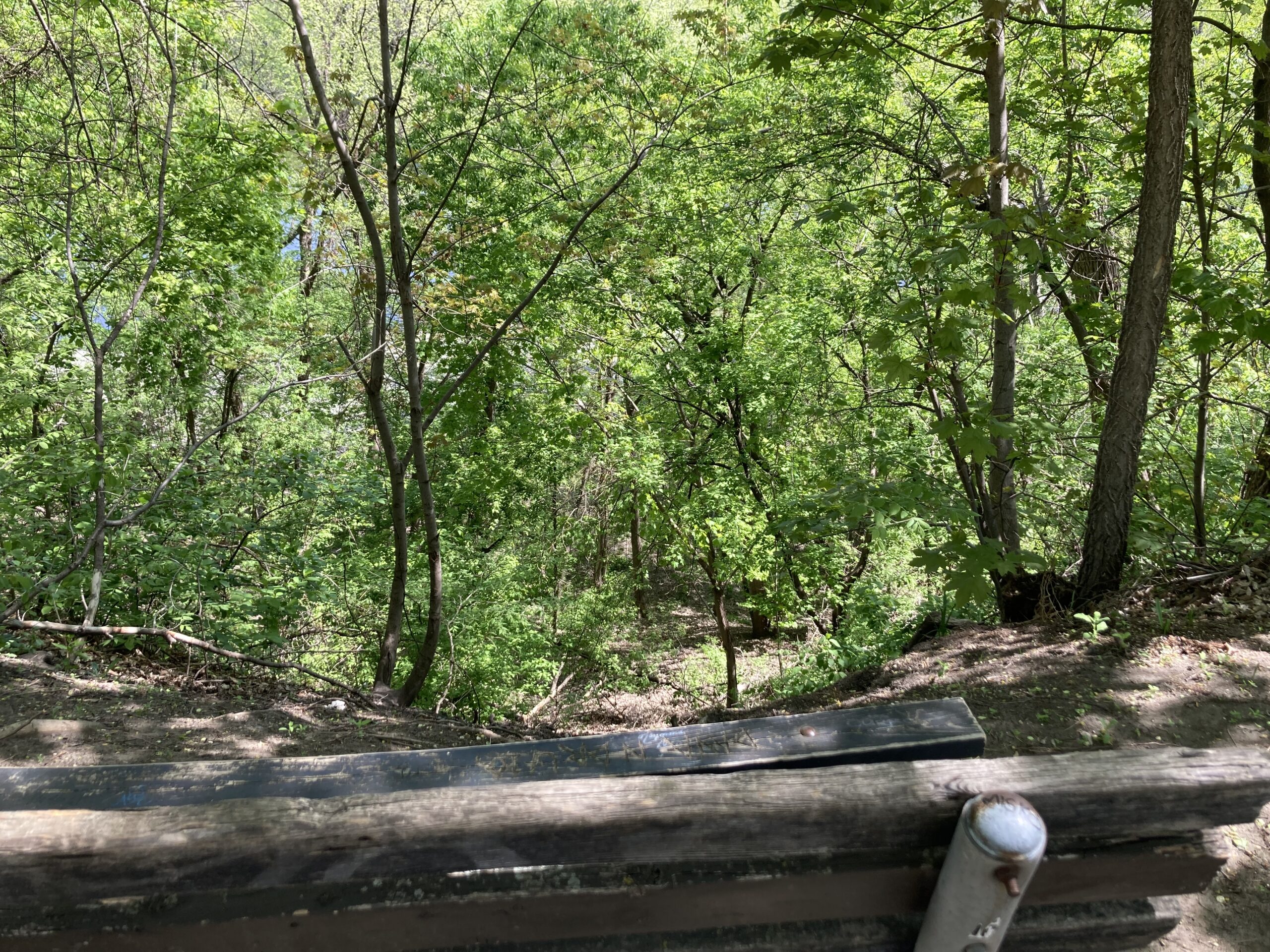
A bench facing a wall of green. Someone was sitting on it, taking in the green view.

A mini peloton of 30 or so riders on the road. Their whirring wheels were so LOUD!

Running down the short stretch of the path that dips below the road, I noticed a steep trail descending to the river. I’d like to take it some day.

Seen on the wabun hill: a walker wearing chartreuse shorts.

I did it. I struggled to come up with 10 things. Maybe because it was a shorter run or because I was hot or because not much was happening on the trail this morning. No — not that last one. There’s always something happening on or near the trail!

may 29/RUN

4 miles
minnehaha falls and back
62 degrees

Another 9 min run/ 1 min walk day. Ran a little faster, felt a little bit easier. Not easy, but easier. A small victory. I’d like to continue stacking these small victories to draw on when the runs get harder and longer this summer.

Walking before my run, I was passed by someone walking a lot faster than me. I marveled at how quickly she was almost out of sight then wondered if I would pass her again when I started running. I did, and felt slightly smug about it. Walking after my run, I encountered a turkey. I think it’s the same one from yesterday that was staring at a neighbor’s garage. I enjoyed watching the turkey’s small head bobbing awkwardly.

I’m close to finishing my collection of color poems! I’m also working on a submission for a special issue on blurred genre pieces. I had a thought during my run: submit my mood ring poem, Incurable, and include a how-to guide + an image of my blind spot + a few notes about the process.

update, 14 jan 2025: I did submit it, and it was published, here!

Listened to the zipper on my running belt softly hitting my shirt with each step as I ran south. Put in my “It’s Windy” playlist — because it’s windy today! — as I ran north.

may 28/RUN

4 miles
past the trestle turn around
62 degrees / drizzle

Drizzle. Refreshing. All around, dark green, deep brown, gray. The sky was a pale blue, and so was the river. I decided to be disciplined today: 9 minutes of walking, 1 minute of running until I reached 4 miles. I did it. Not easy, but not difficult or, was it both easy and difficult?Walking to the river, I saw something strange by a neighbor’s garage. I looked again — a turkey! Staring at the wall, making a noise, not quite a gobble.

I’m thinking about yellow today. Running north, I started chanting:

yellow is
yellow is
yellow is
is yellow
is yellow
is yellow

Did I see anything yellow? The dotted, dividing lines on the bike path — if you count that as yellow. Scott calls that orange. No yellow flowers or yellow signs or bright yellow shirts. The only color I remember noticing was the bright blue of the recycling bin on the trail.

may 27/RUN

2.6 miles
river road trail, south/winchell trail, north
64 degrees

Thought briefly about biking to the lake and swimming, but it’s drizzling off and on, and it’s not that warm, and I imagine the water isn’t that warm yet. Just checked the temp: 61 degrees. What’s the coldest water I’ve been in? Probably colder than 61 as a kid in Lake Superior, but as an adult, I’m not sure. Too cold for me today, so I did a short run.

I wanted to run to the south entrance of the Winchell trail but there was a very large — 40 or more? — kids up ahead, walking and blocking the trail, and I didn’t want to encounter them. So I turned down at 42nd. Before I turned, I enjoyed witnessing the kids from afar. They kept trying to get passing cars to honk by yelling honk! honk! honk! They were not quite in unison, and sounded almost like a vee of geese flying overhead. Nice! A few cars honked, one for several seconds — no quick tap, a long HONK! At first I thought they were part of a school group but would teachers let students yell at cars like that? Maybe it was a walk-out protest?

My weather app disagrees, but I think it was very humid. Now that funding for gathering weather data has been taken away, I don’t trust any forecasts. How could it only be 64% humidity when I ‘m sweating this much, and it is drizzling a little?

I ended my run on the dirt trail that climbs up the edge of the grassy boulevard. I had to watch carefully for roots or rocks. On either side, vivid, abundant (or excessive) green grass. In the middle, bare dirt — brownish gray, fuzzy, almost a nothingness that was difficult to see. The green, dizzying, disorienting. Inspiration for my green sonnet?

excerpt from Desire/ Christopher Buckley

Shuffling down
the path in the park, I go on whistling what was once
considered a lively tune, thankful to even be a satchel
of ligaments and bone still able to transact enough chemicals,
one neuron to another,
                                        that I can appreciate the day lilies,
star jasmine, and have some idea about what’s missing
when a streak of grey engraves hosannas of moonlight,
the spindrift off the rocks, anything that sounds
remotely like a prayer
                                       sent into the air to a god who,
in his infinite memory, must know he abandoned us
here—so many self-conscious molecular assemblies—
specs in a starry whirlwind of desire.

Wow — a satchel/ligament and bone still able to transact enough chemicals,/one neuron to another — what a description of a human!

spin-drift: sea spray; fine wind-borne snow or sand

may 26/RUN

4.6 miles
veterans home
63 degrees

Ran to the falls. Every day, my legs are feeling stronger. Will I be ready to run almost 8 miles next week? Yes! I listened to all the walkers and bikers and roller skiers and runners out by the gorge as I ran south, my “color” playlist as I ran north. I stopped a few times to record some ideas about my blue poem. Yesterday was indigo, today it’s blue.

10 Things

  1. roots
  2. sky
  3. roar
  4. flags
  5. voices
  6. bikers
  7. Sawyer
  8. horns
  9. picnic
  10. honks

Near the end of my run, I ran on the grassy boulevard between the river road and edmund. There were a lot of them, but I managed to not trip over any of the roots popping out of the dry dirt.

The sky was a cloudless blue, sometimes bright, sometimes pale.

At the park, I didn’t run near the falls, but I could still hear its roar as it rushed over the edge.

Memorial Day. At the Veterans home, the road was lined with flags.

Crossing over the creek on the high bridge, I could hear kids’ voices below, laughing and calling out to each other. I couldn’t hear any splashing, but I could tell by their tone that they were in the water.

The path was thick with fast moving bikers.

No — Sawyer — no! Two adults called out to their toddler when he tried to follow me as I ran by.

Running down the steep hill near locks and dam no. 1, I heard horns on the ford bridge. Was it in support of memorial day? Against a war or a dictator? (update, minutes later: Scott ran too. He saw someone walking through the park with a sign that read, Democracy dies in silence.)

At Wabun, a dozen or more people were having a picnic under one of the pavilions.

About a mile into my run, a cacophony above the trees. Geese! I followed their honks up into the sky and witnessed a wedge heading north.

blue

Today, I’m thinking about blue and trying to write a sonnet about it. As I ran, some ideas flashed in my head, so I stopped to record them:

after mile 1: inspired by the cacophony of honking geese, I thought about blue as an action, a verb, a phenomenon, not a noun or a pigment. Also: unfenced water, scattered sky.

after mile 2: Thinking about me as blue — as sparkling and shimmering and scattering and flinging waves of light all around. Blue as a happening that is not solid or tangible but imagined, a trick of the light, a “real” that we create for ourselves out of desire. Blue cannot capture the color, the feeling, the happening that blue is.

after finishing the run: The blue sky is not smooth or seamless. I see the scattering, the static, the pixels — the veil that hides the illusion of sight and seeing color, has been lifted.

Searching through my archive for thoughts about blue, I came across this fact, which inspired my thinking about scattering:

Like all other blue birds, Indigo Buntings lack blue pigment. Their jewel-like color comes instead from microscopic structures in the feathers that refract and reflect blue light, much like the airborne particles that cause the sky to look blue.

All About Birds

may 25/RUN

3.5 miles
trestle turn around
63 degrees

Felt good today. Ran a little faster, felt a little freer. Even though the weather is great, it’s Sunday, and it’s almost noon, the paths weren’t that crowded. Was it because it’s memorial day weekend? Whatever the reason, I appreciate not having to dodge bikers or groups of walkers.

10 Things

  1. sea
  2. stacked
  3. stink
  4. staring
  5. shadows
  6. craters
  7. purple
  8. soft
  9. sitting
  10. saw

Running through the tunnel of trees above the floodplain forest, a sea of green. No sky or river or solid ground.

4 stones stacked on the ancient boulder.

Above the rowing club, a slight stink from the sewers — sweet and sour.

Running up the hill, past the old stone steps, 2 walkers and a dog about to descend the old stone steps. I couldn’t see their faces, but I felt like they were staring at me.

At the start of my run, bird shadows: a big one swooping, several smaller ones shooting across the street like bullets.

The craters in the patched crack near the trestle seem to be growing deeper.

Running past a tree, a flash of purple in the otherwise green leaves. Was that a trick of the light?

The soft sound of water falling or wind gently rustling the leaves near the ravine.

I was planning to stop at the sliding bench, but 2 people were already sitting there.

Before I began running, I heard a woman’s voice — you did it! Then the sound of a saw buzzing, then good job! Her tone sounded like she was praising a little kid. I wondered if that were true and how old the kid was that she was teaching to use a power saw — not in judgment, in wonder.

indigo

I have returned to my color poems. Before I ran, I was thinking about indigo again. During the run, an idea popped in my head, so just past the trestle I stopped to record it:

Thinking about indigo and idea of wanting this time, at night, that is dark without stars. Which is referencing how, when I lose all of my cone cells, there may never be true dark. And then thinking also about how true dark is not possible (in the city) because of light pollution. The idea that indigo is something both wished for and feared.

another grass line

It will soon be cold here,
and dark here;
the grass will lie flat
to search for its spring head.
(Love in the Weather’s Bells/ Jay Wright)

may 24/RUN

4 miles
minnehaha falls and back
54 degrees

Ah, another wonderful morning. Sunny and just the right amount of warm. Ran with Scott. He talked about the book he’s reading — a murder mystery set in Austin, MN and Minneapolis. I talked about turning my color poems in to a chapbook. Also discussed: a YouTube video about taking a train from D.C. to Seattle (me), UAE cycling team doing altitude training (Scott), favorite and least favorite running shirts (me), possibly ordering a new bass (Scott), and voltas and vueltas and a tour as turn as hero’s quest (both of us). We also discussed an annoying woman last summer who wouldn’t let us use one of the drinking fountains because she was using the other to slowly fill up her big water bottle (both of us).

I don’t recall looking down at the river even once. Would I have been able to see it? A rare sight: a rollerblader, not a roller skier. Shirtless runners. The white foam of the falls. A stick flying up from under Scott’s foot. The cool green just before reaching the ford bridge.

bank

The other day I overheard one runner say to another something about banking time. I thought about the word bank and embankment popped into my head. Then I wondered about bank’s origins. Reading the poem-of-the-day this morning on Poetry Foundation, I encountered another bank line:

from Ode to the Midwest/ Kevin Young:

I want to jog
down to the river

& make it my bed—

I want to walk
its muddy banks

& make me a withdrawal.

a return to color

I’ve decided to turn my color poems into a chapbook for a contest. Time to study color some more. I need to write a sonnet about green, indigo, and blue. Maybe yellow, too? Here’s a wonderful yellow poem to inspire me:

Crown of Yellow/ Sarah Audsley

If I stay, I might notice things—the color of buttercups, their bright faces
en masse floating in green-grass-clouds, the lolling fields.

Butter—browned in a pan for the sauce to dress an expensive dead fish.

Yellow yolks make cake, custards, or the exact shade for stasis.

Or shame. I always think of yellow so.

A primary color, it arrives in packages, crushed natural iron oxide from a quarry in France.

Combine yellow with red, make orange. Shades shift by proportion.

The painter tells me about the color wheel, not the grey fear-sphere spinning in my head, or
anything I know something about.

The beehive above, swaying. Yellow bits move in and out.

How yellow the yellow finches’ bodies, how they lift so easily into the air.

The in-between color—traffic lights say, stop. Then, go.

The striking of a single ray of sunlight can cause cancerous cells to grow, mutate.

Paint the kitchen walls a shade—warms and comforts.

Color of the piss puddle I left on the hardwood floor. Little ballerina shoes tiptoed around the mess.
I did raise my hand, I did ask to go, I did try to do the right thing.

Tutus and twirls. Mrs. Stein said, Wait. Hold it! Her black leotard plastered to the curvature of her
small breasts rose with her commands.

If you prefer gold fillings, and can afford them, the dentist will place them inside decayed teeth.
Gold is a soft metal.

Combine yellow with blue, make green.

Are we back in the field, yet? Why do I ever leave it? The forest needs no grammar. Water splits
rock. Hawk shreds yellow birds’ feathers.
The mind, an unending sieve.

Dandelion wine is made from the tufts of heads, collected and boiled.
Alcohol is for adults. Some bitterroot.

Never dress Asian babies in yellow, my mother tells me. Clashes with their skin.
I learned from you, she says.

And, there is a fox running the median line on the bumpy road. I am not there, but I’m driving fast,
headlights off, because there is a full-bodied moon, and I want to move in the dark like I know
exactly, no precisely, without any hesitation, where I am going.

Barreling ahead.

Each hour the light changes, each minute angles shift.

Skylights are key in the studio. Naked. Put on my skin in layers—how many? What can the painter
see?

I prefer to sleep through sunrise. I trust the heliocentric turning of things that are difficult to
understand.

About yellowface I cannot say—enough. What is enough?

The channeling knife is the tool to make a lemon twist. I use it. Hovering over the glass, making the
cut infuses the air in the space above the liquid with the essence of the fruit.

Once, I plucked an entire bucket of lemons and lavender. Made lemonade.

I don’t believe in that phrase…because my mother took to the tug of the bottle.
More often than not, vomit is yellow.

In another dream, I am the lone sunflower swaying, shaken by the anticipation from the smell of the
oncoming distant rain.

may 23/RUN

4 miles
minnehaha falls and back
56 degrees

Didn’t feel the greatest — unfinished business — but managed to keep running and feeling strong, especially in my legs. Today is another beautiful day. When I walked outside, I whispered, wow! Sun, blue sky, warm air, birds, dry paths.

10 Things

  1. scary
  2. runner!
  3. cooler
  4. busker
  5. bikes
  6. busy
  7. left
  8. cobblestones
  9. unstacked
  10. hitch

In the bathroom at the falls, a little boy in the next stall was scared by the loud sounds — toilets flushing, hand dryers buzzing. His mom said, try putting your hands over your ears and I imagined him trying — wide-eyed with tiny sticky hands up to his ears.

Running south on the trail, a long train of young bikers — a school field trip? — slowly passed me. As each biker approached me, they would call out to the others behind them, runner! I was impressed until one of them yelled it right in my ear. Ouch!

Taking the part of the trail that dips lower than the road and into the shade, everything was darker, dimmer, cooler.

Running through the park, I passed a busker playing an instrument that I couldn’t see because I was running too fast or hear because I had headphones on.

The kids that had biked past me on the trail had stopped at the falls. Their bikes had taken over a grassy hill near the playground. So many bikes!

The park was busy — people walking, biking, taking pictures, eating outside at Sea Salt or near the pavilion.

A woman on a bike with a kid on a seat behind her extended her right arm to signal a left turn. There was something about how straight and stiff her arm was that made me remember the gesture.

Ran over the cobblestones near the falls overlook. Later, leaving the park, listened to Simon & Garfunkel sing about cobblestones and feelin’ groovy. Thought about how my ophthalmologist told me I had signs of cobblestones in my peripheral vision a few years ago.

The white plastic chairs I wrote about a few days ago that were stacked, are now unstacked and set up side by side in the shade of the building.

A runner passed me. I couldn’t see it, but I heard a slight hitch in his step as one foot strike was always slightly louder and longer than the other. I wondered, what do people hear in my foot strikes?

before the run

Reading the poem-of-the-day on Poetry Foundation — We/ Joshua Bennett, I was struck by a word near the end, apprehension.

he is a father now, with a boy he is trying to teach
the benefits of apprehension.

I wanted to dig into apprehension, so I looked it up and found this, on Merriam-Webster:

There’s quite a bit to comprehend about apprehension, so let’s take a closer look at its history. The Latin ancestor of apprehension (and of comprehendprehensile, and even prison, among others) is the verb prehendere, meaning “to grasp” or “to seize.” When it was first used in the 14th century, apprehension could refer to the act of learning, a sense that is now obsolete, or the ability or power to understand things—learning and understanding both being ways to “grasp” knowledge or information. It wasn’t until the late 16th century that apprehension was used, as it still is today, for the physical seizure of something or someone (as an arrest). The most commonly used sense of apprehension today refers to a feeling that something bad is about to happen, when you seize up, perhaps, with anxiety or dread, having grasped all the unpleasant possibilities.

entry for apprehension

I started to think about prehension too. It feels vaguely religious/spiritual to me. I looked it up: “apprehension by the senses.”

I like how apprehension and its grasp, can mean to understand or “get” something — to grasp it, but also to be seized or held by it — is this seizing always negative/oppressive?

All of this musing over the different meanings of apprehension, returns me to the beginning of the poem and the narrator’s wrestling with different meanings of attention — as the money of the mind or care or access to the Divine. Of course, to care can also lead to caring too much, being preoccupied with, worried, anxious, apprehensive. Now I’m thinking about the color of the therapist’s dress and the disagreement over whether it is a yellow-based red or a blue-based red. And I’m thinking about this line —

still studying the difference between
what a man proclaims in speech and what he says with his
body.

The difference between comprehension (knowing in language) and apprehension (knowing through senses). All of these tensions with opposing meanings. I mentioned this Scott at breakfast and added, wow, the word apprehension comes near the end of the poem. It’s the volta — the moment in which the poem turns, shifts, a door opens to unlock understanding or to upend understanding!

The Italian word for “turn,” a volta is a rhetorical shift that marks the change of a thought or argument in a poem. 

Other common names for volta include turn, fulcrum, or hinge. The volta marks a shift from the main narrative or idea of the poem and awakens readers to a different meaning or to a reveal in the conclusion of the poem. They often use words like “but,” “yet,” or “however” to distinguish a reversal or shift in thought. 

Voltas are part of the sonnet form. In the Petrarchan sonnet, the volta occurs between the eighth and ninth lines. In the Shakespearean sonnet, the volta occurs before the final couplet. Voltas are also characteristics of other poetic forms, and can even occur in free verse poems. 

Volta

And now, writing this last sentence, I’m realizing that the volta is a MOMENT, to put beside my other definitions of moment.

I go to the gorge

I go to the gorge/to find the soft space/between beats. Woke up this morning to the news that a favorite poem of mine, written in the late fall of 2022, will be published this August. Hooray! Yesterday, watching a book trailer for Litany for the Long Moment — a book that I’d like to read, but might have to ILL or buy it to do so, I had an idea for a video project. Something about the mix of music, text on the screen, and the flash of images, made me think about my ritual/circumambulation project and the idea of chanting,

I go to
the gorge

over and over and finishing the phrase differently each time with cuts between text/voice and images from the gorge. I imagine an acceleration of this text and images until something breaks open and ? — maybe silence, the image of the air above the gorge, and then voice-over of the entire poem. After that, a return to more images, softer and slower this time, and more chanting.

I go to/the gorge || to open/a door
I go to/the gorge || to be with/ my mom
I go to the gorge ||to become/ shadow

names

a connection between the two other poems-of-the-day:

1

from Poetry Daily and Visitation/ Kelly Hoffer

my nameis the last name my mother refused
to change. so as not to lose you, the hospital
lists your name with your mother’s on your
baby wristlet. thislife is a repetition that knows
no bounds, tracing a tablet into a waxing
oval that spirals outward. seed of a
seed sowing itself into the ground. this name
just happens to be the size of the concept growing.

2

from Poets.org and Naming/ Julia Kolchinsky

For the first month of life, I was 
unnamed. To my Mama, my body belonged 
to one nameand to my Babushka, another, so 

they called me LyalyaLyalichka, little 
doll, baby, because neither would bend 
their letters and though I was already known 

to scream, to refuse sleep and strangers, 
they couldn’t have known then how, 
silently, I’d keep screaming, keep refusing 

any name they’d give me, how in my mouth, 
it wouldn’t feel like mine, and on the tongues 
of others, even less like I belonged. 
may 22/WALK

60 minutes
winchell trail, south/grassy boulevard, north
55 degrees

The rain is over. Now, warm sun and green green green! A beautiful morning for a walk with Delia the dog. Calm and quiet and wonderful.

10 Things

  1. lilac bushes
  2. BLUE!
  3. BEEP! BEEP!
  4. velvet
  5. squish
  6. tin-whistle
  7. friends
  8. dappled
  9. dandelions
  10. unruly

Walking by a row of lilac bushes up against a fence, breathing in the sweet, flowery smell. No memories conjured, just a smile spreading across my face and a feeling of satisfaction.

With my polarized sunglasses on, the sky looked almost too blue to be true. The kind of blue that is so intensely BLUE! that it seems ominous.

Walking in the grass with Delia, our reverie was interrupted by a BEEP! BEEP! as a car attempted to pass 3 cars on the river road before quickly slotting in behind a fourth right as a car was approaching from the other way.

On the winchell trail, I reached out to a basswood (also known as linden) tree and its lined leaf. A soft shock — the leaf felt like velvet!

After the rain, I wondered how wet the dirt would be. Wet! I stepped cautiously on it and squish, mud!

That sound! Sharp. Metallic. I think it was a robin with its tin-whistle call, echoing throughout the savanna.

Up on the mesa, we encountered another dog and their human. Delia and the other dog, about her size and temperament, chased each other while we — the humans — wished good morning to each other. A brief encounter with new friends.

The trees cast their shadows on the grass. All around, dappled light.

The slender, rubbery stalks of dandelions with their fluffy white heads dotted the grass. I wondered what this stage is called so I looked it up: AI says, seed head or blowball. I prefer blowball!

Everywhere I looked, green. Green grass, green trees, green view. Unruly green leaves reaching through the slats of the fence. Oh, to be that green! To claim space with such wild abandon!

note: This is the second day I’ve tried a new experiment with my 10 Things. Instead of describing the things in the list, I’m picking 10 words and then writing about each in sentences and/or paragraphs.

air / breath

Was reminded of this beautiful poem from my entry on this day in 2017:

as everyone with lungs breathes the space between the hands and the space around the hands and the space of the room and the space of the building that surrounds the room and the space of the neighborhoods nearby and the space of the cities and the space of the regions and the space of the nations and the space of the continents and islands and the space of the oceans and the space of the troposphere and the space of the stratosphere and the space of the mesosphere in and out.
(This Connection of Everyone with Lungs/ Juliana Spahr)

I want to connect this idea of lungs and breath to a favorite fragment of mine about feet first, following. Feet syncing up with breath.

Spahr’s lines make me think of the moment as a space, a Nothing space. Not empty, but no words or memories or history or self. A shared space possessed by no one, Chloe Garcia Roberts’ the median intervals of floating passivity that resist recollection.

In the time that it took me to find the Roberts line, I lost my train of thought. Maybe it is dwelling in that space between? Can I return to it?

Not sure if this is the thought I lost, but I’m also thinking of this space/time — moment — as when/where I encounter a walker on the winchell trail and I thank them for moving over to let me pass. The moment after I say, thank you, and before they say, you’re welcome, when the you is floating between us, in the process of being exhanged from them to me.

No, I think this might have been it: Not the floating passivity of Roberts — a nothing in-between — but more like dirt in Sharon Olds’ “Ode to Dirt“:

Dear dirt, I am sorry I slighted you, I thought that you were only the background for the leading characters—the plants and animals and human animals. It’s as if I had loved only the stars and not the sky which gave them space in which to shine.

That space, that air — and here I’m thinking especially of the air above and within the gorge — that is a character in my story, not just the background —

When I understood I had never honored you as a living equal, I was ashamed of myself, as if I had not recognized a character who looked so different from me

I’ve devoted a lot of attention to water and stone beside the gorge, but the air has always been there, too. Air as the space between things, which isn’t really empty, but filled with stuff too small to see.

sinkhole

Last night at dinner, FWA mentioned that a sinkhole had opened up somewhere in St. Paul. I hadn’t heard about it. Just now I looked it up. A 35 foot — 35! — hole happened in the middle of busy 7th street. Watching a news clip about it, the director of public works said, we’re not sure how it happened yet. We need to dig down 35 feet to the sanitary sewer and fix that. Wow — so the sewer line is 35 feet below the surface? 35 feet is more than 6 Saras stacked! The sinkhole opened up on 8 may. I couldn’t find any update about it. I wonder when and if we’ll find out what caused it.

may 21/RUN

5.5 miles
ford loop
44 degrees
drizzle

Wasn’t planning to run the ford loop, but I started it and then just kept going. It felt good, relaxed, not hard to keep my heart rate a little lower. My pace was slow, but it didn’t feel slow, or fast, or any speed really.

10 Things

  1. mist
  2. dripping
  3. spray
  4. mirrors
  5. puddles
  6. graffiti
  7. traffic
  8. bridge
  9. debris
  10. slick

It rained all day yesterday, and some early in the morning. Started again during my run. Everything dripping wet, including me, although I didn’t really feel it, or couldn’t distinguish it from my sweat. Before I started running, as I walked through the neighborhood, I looked into the puddles on the sidewalk and admired how they had become mirrors, reflecting the sky and the trees. Running over the river, I looked down at the east bank and saw colorful graffiti all over the rocks at the base of the lake street bridge. In spots, the trail was slick with mud or covered in debris — fallen leaves, broken branches, grit. Crossing the ford bridge, I looked north and was delighted by the mist, making everything seem fuzzy and unformed. The traffic on the bridge was thick — I couldn’t see or feel any spray coming off of their wheels, but I could hear it.

overheard: one runner to another — you can bank the time.
Another use of time as a commodity.

Listened to the water, in its various forms, for the first half of my run. Put in my “moment” playlist for the second half. The most memorable song today: One Moment in Time/ Whitney Houston

A line that stood out to me:

And in that one moment of time
I will feel
I will feel eternity

I thought about Mary Oliver’s definition of eternity and how Whitney Houston’s doesn’t fit with it. MO understands eternity as creative time that’s outside of the ordinary and beyond the self. Houston’s eternity seems more like eternal glory.

As I listened to all of the lyrics, I thought about Whitney Houston’s tragic life and terrible death — an overdose. I also thought about the idea of one moment and what happens after that moment is over. And this made me think about post-Olympic blues, or post-marathon blues, or post-publishing a poem blues.

To keep myself distracted and steady, I chanted in triple berries —– strawberry blueberry raspberry. Then I chanted my poem — I go to the gorge/to find the soft space/between beats.

more on the moment as between

Read a very brief interview with Marie Howe the other day. She mentioned a poem that inspired her and that she wished everyone would read: The Season of Phantasmal Peace/ Derek Walcott. Beautiful! Here’s a line to remember that describes the moment:

and this season lasted one moment, like the pause
between dusk and darkness, between fury and peace

Before my run, I began listening to a talk by Jennifer Chang, “Other Pastorals: Writing Race and Place“. She mentions one between in the presentation of her thesis statement: how poets of color use pastoral to grapple with the complex composition of place as a tension between lived and learned experience. She recites another between from Rick Barot’s “On Gardens”: somewhere between/what the eye sees and what the mind thinks/is the world, landscapes mangled/into sentences, one color read into rage.

Chang also mentions context: If you look at the word “garden” deep enough you see it blossoming in an enclosure meant to keep out history and disorder.

Chang’s lecture is part of the Bread Loaf conference in 2019. This page has many great links for future Sara to explore.

And here is a helpful essay with some ideas for thinking about the pastoral, and links to poems, like Rita Dove’s Reverie in Open Air, which I’ve already posted on this log. The second half of Dove’s poems fits with early May’s theme of grass:

But this lawn has been leveled for looking,   
So I kick off my sandals and walk its cool green.   
Who claims we’re mere muscle and fluids?   
My feet are the primitives here.   
As for the rest—ah, the air now   
Is a tonic of absence, bearing nothing   
But news of a breeze.

And a few more grass lines from Jennifer Chang:

Stalk of wither. Grass-
noise fighting weed-noise. Dirt
and chant. Something in the
field.
(Pastoral/ Jennifer Chang)

What sound does grass make? Wind through the grass, crunching over dry, brittle grass, feet on grass — bunny’s feet:

 I think my favorite sound was the soft footsteps of the bunny hurrying across the lawn. A silvery whisper only possible to hear on a calm summer morning like today. I love the sound of animal feet moving — running or hopping through the grass

log entry on 16 july 2024

may 20/REST

Rain, all day. Soft, soothing, but maybe only from inside somewhere, looking out and listening. I’m devoting the morning to Chloe Garcia Roberts. I discovered her yesterday on Poetry Daily, when her poem-essay, Temporal Saturation, was the poem of the day. Yesterday I wondered if I should buy the book that this piece comes from, but today I know for sure. Yes!

It started when I noticed that Roberts had written an essay for Poetry Daily about the poem, Towards (A) Lyric Science. Here are some bits I’d like to remember today:

on teaching poetry like it was a high school shop class

Each week I bring a selection of poems to class which manifest some particular structural element we are learning. We read these poems aloud and observe their movements, and as we dissect them, we analyze their poetic systems, their energy sources, their gestures. We then reconstruct and rebuild approximations of their functions so as to better learn how to create our own poems from our own language and experiences.

Towards (A) Lyric Science

She envisions poetry as (a) technology. Describes the pleasure of reading “Goethe’s “Theory of Colours” as an example of writing that blurs and even perhaps erases the line between what they [her engineering students at MIT] are learning in my classroom and what they are learning outside of it.” And aims to combine the lyric and the analytic:

Temporal Saturation” was an attempt to build a poetic form that reflected that reality, between poetry and prose, in English but articulating an existence between languages and cultures, and a first foray into a place that lies between the poles of the lyric (the melodic, subjective, sentimental) and the scientific (systematic, objective, and exacting). In other words, in this piece I am writing towards the beckoning betweenness of a lyric science.

Towards (A) Lyric Science

I checked out her website — love the content and the design.

Read an excerpt from Fire Eater: A Translator’s Theology.

Listened to the podcast, Voices in the River, and an episode with CG Roberts, Translating the Trees. She gives some background on Fire Eater:

So I had been working for many years on a translation project of a classical Chinese poet, Li Xiangyin, and in order to do that and give myself permission to even approach this canonical poet’s work in a language that I had learned, not grown up with, was I kept lists and notebooks of word choices and where those words came from and mapping them onto the English. And then I finished the product and I had all these notebooks and I went back to them and they were maps.

And I thought, could I use these maps to translate my own life, to articulate episodes or questions that I have about my own memories and my own experience?

And yes, they did. They did. A word would come to me, and then I would look it up, and I would look deeper and deeper and deeper into its root, and I would find, oh, it connects this meaning with this meaning, which then connects to a certain episode of my life.

So it’s 10 essays, poem essays. Writing the book felt like remembering it. It did not feel like creating it.

Translating the Trees

She describes it as a “divination with the dictionary.”

Wow. How wonderful to have found this writer and to dwell in the place she has created with her words and ideas! I can’t wait to get her book — I definitely can’t wait until my birthday next month!

Early on in the podcast, Roberts offers these words about being like a tree:

Each memory felt like a little root that I was extending and connection to that present moment [sitting inside her childhood home, creating memories, before it was torn down], not separate, not the past, not the future, not the present, but all together. This is like living like a tree. The tree is all of the moments of its growth at the same time.

Like a tree!? This reminds me of something I wrote last week in here, on 16 may about Lorine Niedecker and her line, stand among the birch, where among, at least to me, means to be a birch, to become one of them. I also wrote about noticing the split in a tree between two main branches and seeing a crotch and two legs and imagining a person, upside down, planted in the ground. And realizing that Katie Farris’s poem, “What Would Root” ends with the beginning of this image as the top of the narrator’s head comes off and is placed in the ground to drink/absorb water.

And now I’m thinking of the wonderful challenge (and, to Roberts, spiritual practice) of translating the feeling of being/becoming a tree into language.

may 19/RUN

4 miles
minnehaha falls and back
54 degrees
wind: 15 mph

Even though I’ve run the past 3 days, I decided to run again today for 2 reasons: 1. it’s supposed to rain all day tomorrow and Wednesday and I don’t want to run in the rain and 2. we have leftover butternut squash mac and cheese, and I always like to run before eating it for lunch. A good run. Managed to keep my heart rate lower until I reached the falls. Had to stop at the bathroom in the park building for some unfinished business. Will that be a problem again this summer? After, I put in my “Moment” playlist and ran again until I reached the bench above the edge of the world. I was planning to stop, but I noticed someone was sitting there. Bummer

Because I wanted to eat right when I got back, I gave myself about 3 minutes to jot down 10 things I remembered from the run (the jotted list was brief; below was written after I ate):

10 Things

  1. didn’t see the falls, but heard it — not a roar, but a rush of water
  2. looking ahead, seeing someone on the dirt trail next to the path — is that a kid? It looked like they were moving towards me. As I got closer — 15 or 20 feet, I realized it was not a person, but a bike — and a bike that had been parked there yesterday too
  3. a strong wind — for one stretch I was worried it would rip my cap off of my head
  4. 2 plastic white chairs stacked on the side of the park building — later in the summer they will be unstacked and people will usually be sitting in them
  5. a long row of port-a-potties (20 or more?) still standing after Saturday’s race. I wondered if they were planning to pick them up or if there was another race this weekend
  6. a walker, passed twice, bundled up in a winter coat, a winter cap (with a ball on top), and a mask
  7. the faint laughter and yelling of kids on a playground
  8. the dim roar and rush and rustle of the wind moving through the trees
  9. a fully parking lot at the falls
  10. noticed beneath the dirt next the trail just north of the 44th street parking lot: netting left behind from a failed attempt at re-grassing this stretch

more on the moment

Looking at my Plague Notebook, vol. 26, I saw that I had written CONTEXT for yesterday’s entry — as in, moments have a context, a history, a location in space. I remember being reminded of context as I walked back home after my run while listening to Rut by Wimps:

Each day is
the same as the last
There is no future
There is no past

I like routine
It’s my favorite thing
No new memories
Don’t change my scenery

Note: I listened to some other songs on the City Lights, the album “Rut” comes from. Wow — it’s all about losing your Self when you become a Mom.

Responding to the word context in yesterday’s entry, for today I wrote: Yes, context is important! A moment is not out of time, but deeper in it — geologic time.

For future Sara, who will want to bring context into any writing we do with the moment, past Sara discussed it in these entries: 6 may, 7 may, 8 may 2025

Poetry Daily’s poem-of-the-day is a great one for thinking about moments: Temporal Saturation by Chloe Garcia Roberts in their book, Fire Eater. I might want to buy this book for my birthday?

temporal saturation—the explanation for why certain moments of your life seem to spill or shrink, to transcend or subvert their physical duration, and color differently their surrounding time.

This is a wonderful description of a Moment!

Temporal saturation is an elusive measurement disproving any correlation between quantity and influence that is used to explain both the canyons that can appear inside moments of great rending, joyous or horrific, entombing an incarnation of the self which will never again exist; as well as the median intervals of floating passivity that resist recollection and whose ending is marked by a feeling of awakening: a drowsy startle or a gradual reconsciousness.

Difficult to measure / length of time does not determine significance / the canyons inside moments — canyons = the Mississippi River Gorge?! / not entombing a past or gone self but holding it / floating passivity = the space between beats?

saturation = the state or process that occurs when no more of something can be absorbed || Can I make a connection with the dew point and its impact on a moving body? dew point = “the temperature at which the air becomes saturated with water vapor”

High levels of temporal saturation are evidenced by a languorous stretching of the experienced present, which then refracts and amplifies the emotion of the moment. The joy making this spreading pleasurable, the fear terrible, though both poles can be described in terms of the sensation of falling. The difference being that the first is a falling into and the latter a falling through

refracts = deflects / distorts / bends / disrupts

falling through = And then a plank in reason broke / And I dropped down and down / And hit a World at every plunge / And finished knowing then (I wrote these lines from “I Felt a Funeral in my Brain,” from memory so the punctuation and capitalization aren’t quite right).

Low levels of temporal saturation are evidenced by malaise, an involuntary refusal on the part of the individual to knit themselves to the place they occupy. Home-sickness—the corporeal and spiritual longing for a physical and temporal point of greatest belonging—is the best diagnosis to describe these ebbs of existence.

No moments = a lack of connection, an untethering, no home

The measurement of temporal saturation then can be used to quantify both the abscesses and the vividities, these gestures floating in great swathes of meaningless automation. Just as the atoms composing a human body can condense smaller than the head of a pin, the self can, like a black hole collapse, like a poem reduce. And the proof of the emptiness that oceans those bright livings is how they sparkle and call to each other despite the expanse of the interims, be they seconds, decades, lifetimes. Inlaid in space, they form the constellation of the soul.

water images: floating, condensation, oceans, sparkle — like waves hit by light
the sparkle reminds me of swimming across the lake and seeing the sparkling water, realizing that each cluster of sparkles was another swimmers’ hand piercing the water

seconds, decades, lifetimes: Aren’t we all just masses of energy and light in a jumbled future or past, stopping to embrace one another for a moment or decades before passing too far for sight? (Halos/ Ed Bok Lee)

The dew point is the temperature when air condenses on the skin and turns into sweat.

Lorine Niedecker and the poet’s work: condensing. “A condensary is where condensed milk is made. In order to make condensed milk, you evaporate a significant amount of water from milk and what you’re left with is
something delicious and much more concentrated and powerful” (Close Reading).

may 18/RUN

3.3 miles
locks and dam no. 1
48 degrees

Still not as warm as last week, but great weather! Sunny, calm, a slight chill so I didn’t overheat. There were stretches on the trail, at least during the first mile, when there were no cars or people, only quiet. Just before reaching under the ford bridge, I decided to turn off on the dirt trail that goes through a small woods beside the bridge. I’ve never taken it, but always wondered how it went — I already knew where it went: up to the trail beside ford that descends to locks and dam parking lot. I didn’t get lost, but was a bit uncertain as to where to go as the trail wound through trees and tall grass and huge chunks of abandoned asphalt or concrete.

another moment: not when you’re lost, but just after you realize you don’t know where you are and just before you locate yourself, or accept and embrace being lost.

Emerging from the woods, I took off my sweatshirt and put in my “Moment” playlist before descending the hill and heading back north.

Listened to:

“Learning to Fly”/ Pink Floyd — I remember liking it, and thinking it was fitting for the theme, but I can’t remember why. I’ll have to listen to it again.

“Between the Devil and Deep Blue Sea”/ Ella Fitzgerald — thought about the moment when you’re faced with a difficult, impossible decision — “Sophie’s Choice” came into my head and I thought about this fall and how I almost had to make one of those impossible decisions over which of my kids to save.

“Threshold” / Steve Miller — This is the opening to another Steve Miller song, or they’ve been mashed together like, We Will Rock You and We are the Champions. The song, Jet Airliner. It was strange to be listening to Threshold and anticipating the opening of Jet Airliner.

“The Moment”/ Tame Impala. Favorite line, I fell in love with the sound of my heels on the wooden floor

“Iris”/ Goo Goo Dolls — RJP’s suggested this one. Very 90s. RJP mentioned that it transports her back to a rough place. I thought about her as I listened to the lyrics and I recalled a 90s song that did that to me: “I Can’t Make You Love Me” / Bonnie Raite.

After I finished my run, I heard, “Vienna”/ Billy Joel, “Rut”/ Wimps, and “Before He Cheats”/ Carrie Underwood. So glad I added “Rut” — never heard of it, but it fits nicely with my theme.

10 Things

  1. a huge trunk of a tree in the woods — hollowed out, having fallen some time ago, empty of any roots or dirt or even bugs
  2. a slab of concrete or asphalt that used to be part of the road or a trail, half buried in dirt in the woods
  3. voices in the gorge — the coxswain and a rower or two
  4. a white pick-up truck turning into the locks and dam no. 1 parking lot then backing up, turning around, and leaving
  5. the sound of water falling softly, or wind through the leaves, or both
  6. persistent (or insistent?) movement out of the corner of my eye — a runner across the road, running in the grass
  7. approaching 2 runners taking up too much of the path as a biker sped towards us — me having to run through the middle of them, squeezing my shoulders tight to fit — the woman seemed to huff, as if annoyed that I was crowding her — did I imagine that last bit?
  8. filled bench, 1: a person sitting
  9. filled bench, 2: a person standing next to a bike — I got the feeling they seemed uncertain but I’m not sure why I thought that — how could I see that, I was moving so fast?
  10. 2 people standing in the middle of the walking trail, looking at their phone — were they confused? lost?

also noticed: a roller skier, a song coming out of someone’s radio, 2 people walking with a dog in the grass that’s across the river road from the double bridge, many runners, port-a-potties and orange cones from yesterday’s race

another moment: Distracted from passing another runner and listening to my playlist, I lost some moments — the moments between the 44th street parking lot and the folwell bench. I can’t recall running them. I remember thinking that I didn’t remember right as it was happening.

moment — some wanderings

“You can never even say what happened, because what happened is rarely said, but it occurs among the glasses with water and lemon in them. And so you can’t say what happened but you can talk about the glasses or the lemon. And that something is in between all that” (Marie Howe).

The other day, I asked FWA why he didn’t talk to his therapist about not wanting to go on a trip before it was too late, and he said I didn’t know I didn’t want to go. I couldn’t put into words what I was feeling. I responded: instead of trying to find the words, why not describe what you are actually doing, or not doing, in your every day life, and he’ll figure out that something is wrong.

The idea of describing the things — habits or lemons or glasses — when you can’t describe what’s happening, seems similar, but not the same, to via negativa. Maybe the other side of it?

Instead of finding meaning by describing what is not there, or what you don’t know (via negativa), you’re determining the meaning of the unknown/absent by what frames it, or surrounds it, or shows evidence of its absence, or its hidden presence.

For more on via negativa, see 7 sept 2023.

I’m thinking of a moment as something out of the ordinary, or something so ordinary it’s exceptional, happening, and instead of being framed by beats (or ticks of the clock) like a minute is, it’s framed by objects or actions of everyday life.

note for post-run Sara: think about the idea of the moment in relation to Mary Oliver’s eternal time.

may 17/RUN

5.15 miles
bottom of franklin turn around
44 degrees

More layers today. When I checked the weather on my watch before my run, the feels like temperature was 32 degrees. Didn’t feel that cold, but it didn’t feel warm either. I worked at trying to lower my heart rate as I ran when it as creeping up to 170. It’s getting easier. My goal is to be able to run to the lake (8 miles) for my 14th runniversary on 2 june.

10 Things

  1. the tail end of a race — Women Run the Cities, 1: one of the police cars blocking off the road was blasting “She Works Hard for the Money”
  2. race, 2: cowbells ringing in the distance
  3. race, 3: orange cones in a tight row blocking the entrance to the river road
  4. some sort of vehicle — a train? a truck? — crossing over the trestle. My view was blocked by green
  5. voices below — rowers?
  6. a roller skier climbing the franklin hill
  7. white foam on the river in the flats
  8. the view from the sliding bench is completely blocked by green leaves
  9. noticed for the first time: a dirt path leading behind a fence and down to the river near the 94 bridge
  10. an adult making funny noises, then a toddler giggling across the road — that deep, genuine laugh of delight that toddlers can do

Listened to spectators cheering and cowbells and my feet sliding on wet dirt as I ran north. Put in a new playlist — “Moment” — heading south. Heard U2’s “Stuck in a Moment You Can’t Get Out of”; Olivia Newton John’s “Suspended in Time”; “Right Where You Left Me”/ Taylor Swift; “Lose Yourself”/ Eminem; “A Moment Like This”/ Kelly Clarkson. Listening to U2, I thought about ruts vs. grooves. During Eminem I sprinted in the chorus and slowed down in the verses. And with Kelly Clarkson, I thought about big moments then everyday moments, not one but an accumulation of them as a way to create magic or find meaning. This idea of accumulation reminded me of a section of a poem I read during my morning ritual of reading poems-of-the-day.

from Remote Disjunctions/ Mónica de la Torre

You’d taken yourself
to places whose specifics you’d chosen to forget. You said you
weren’t there to keep track, but to experience. Which, when
I’m feeling negative, I translate as ditching the thing as soon as
you’re done with it onto the heap of junk you’re not accumulating.

may 16/RUN

4.15 miles
trestle+ turn around
60 degrees
wind: 35 mph gusts

Another earlier run. Cooler and windy! Luckily, I wasn’t running straight into it for that long, or if I was, it didn’t bother me. I felt strong and relaxed and like I’m slowly getting back into the groove.

Right after my run, we drove down to St. Peter to help FWA move out of his dorm. He graduated a few weeks ago. I didn’t have time to write this entry until I got back. Can I remember 10 things?

10 Things

  1. the green has taken over the gorge, no more wide open view of the river, only a splotch of bright white through the small gap in the trees
  2. heard, not seen: a roller skier’s clicking poles
  3. Good Morning! to Mr. Morning!, twice
  4. running past the field at Minneahaha Academy, all dug up. Scott thinks they’re putting in a new irrigation system
  5. little purple flowers — not sure if it was Siberian Squill, maybe some other purple flower?
  6. empty benches
  7. passed the dirt rail near the trestle and thought about taking it but didn’t
  8. a small blue ball under the trestle
  9. most of the stones stacked on the ancient boulder — there had been 6 — were blown over in yesterday’s storms, only 2 small pebbles were still stacked
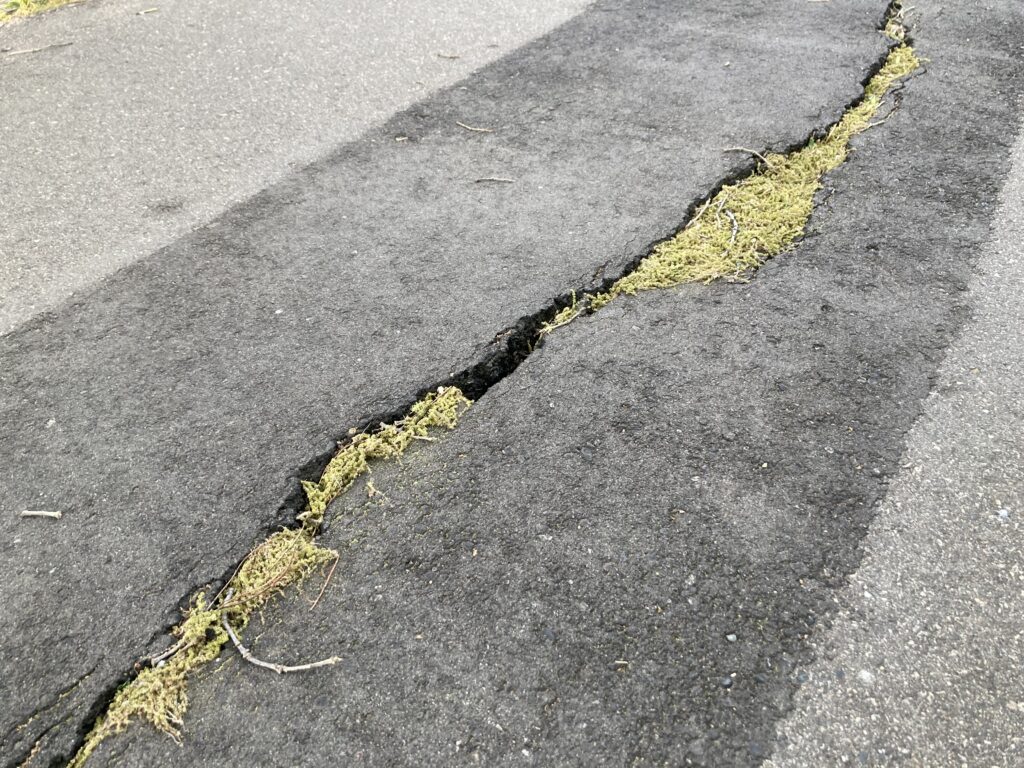
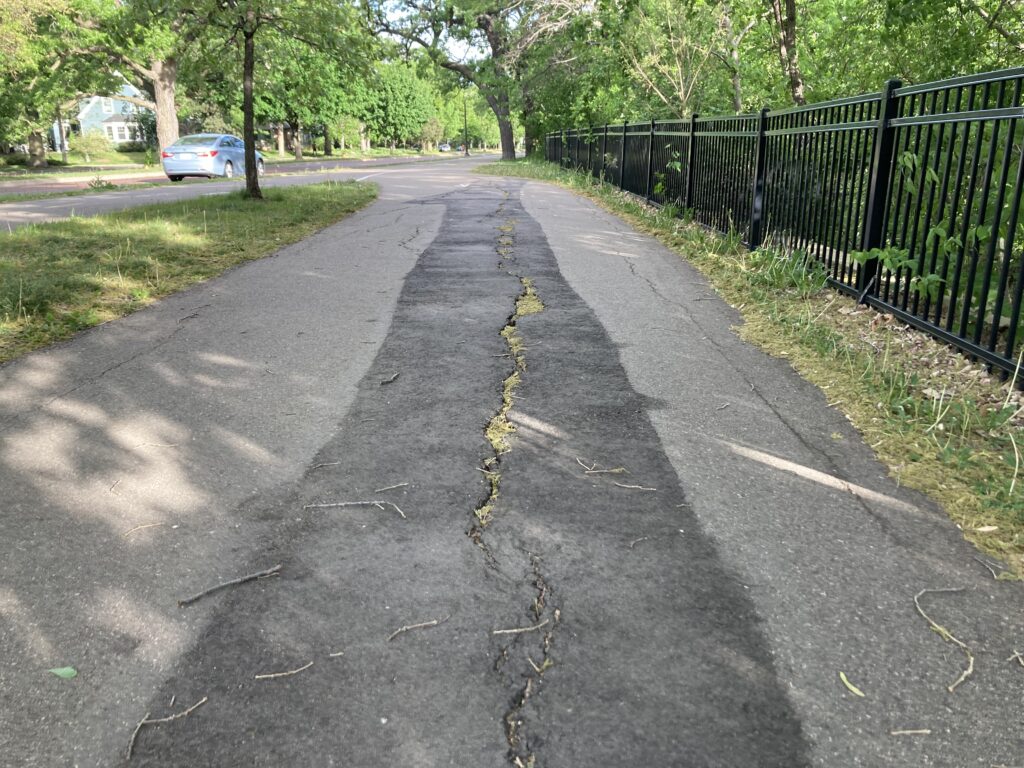
  10. the big crack just past the trestle that they’ve patched up several springs in a row is cracking again. 2 out of the 3 sections of it have big cracks, the one closest to the trestle has a big crater

I decided to stop and take a picture of it:

Listened to the blowing wind as I ran north, my “Beaufort Scale” playlist running south.

among / between

When I read and posted Lorine Niedecker’s poem about standing among the birch last week —

For best work
you ought to put forth
some effort
to stand
in north woods
among birch.

I was struck by the word among and wondered how it was different from between. I looked it up this afternoon and, after wading through discussions about how between is used with 2 items, among with more than 2, I came across a helpful distinction in Merriam Webster:

We use between when we want to express a relation to things and have them considered as individual and usually equal entities.

Among, on the other hand is the best word to use when referring to things collectively and imprecisely.

I like among in LN’s poem, although I wonder about the effect of using between (or beside or with) instead. to stand/in north woods/between birch. Among indicates a kinship — among all of us trees, but between suggests an actual place — stand between this birch and that birch and an exchange — between us. I like both meanings. I like imaging my best work as trying to become a tree. But I also like the idea of my best work happening when I stand between birch — giving and receiving air.

I was reminded of among and between while reading this passage from Marie Howe:

That was really a big deal. I was given this place to be without any expectations really. And everything changed so that the particulars of life—this white dish, the shadow of the bottle on it—everything mattered so much more to me. And I saw what happened in these spaces. You can never even say what happened, because what happened is rarely said, but it occurs AMONG the glasses with water and lemon in them. And so you can’t say what happened but you can talk about the glasses or the lemon. And that something is in BETWEEN all that.

You can name/describe the collection of things (among), but you can’t find words to describe how their meaning has changed in that moment. Often when I think about the slight shifts in meaning between small words, like among or between, I’m reminded of an essay I read about Mary Oliver and her mousier words. I love mousy words! Meanwhiles and in-betweens and yous and wes and usses (is that the plural of us?).


…it’s tempting to be blinded by the more immediately visible parts of speech: the monolithic nouns, the dynamic verbs, the charismatic adjectives. Mousier ones—pronouns, prepositions, particles—go ignored.

Mary Oliver and the Nature-esque

may 15/WALK

50 minutes
winchell trail / ravine / grassy boulevard
75 degrees
wind: 18 mph / gusts: 34 mph

Windy and warm and green. Nearing the crosswalk that leads to the 36th street parking lot and the winchell trail, an intense smell: cannabis. After crossing, 2 guys near the bench, with scooters, talking: dogs are the coolest. I love dogs! and wanna keep going? I’ve got plenty of charge! So chill and enthusiastic and generous to the world.

Delia and I descended the split and worn wooden steps into a strange, green world. Something seemed different down here today. What was it? Some trees leaning over the trail, three trees right up against a chainlink fence that I’ve admired before seeming taller. A tree trunk mixed in with the riprap.

Delia managed to poop right near a trashcan. Nice work! And then again, close to home. A new trend for her: double poops on walks. Better on a walk than hidden in grass in our yard! While leaning over to pick up her poop, something flew into my eye. I thought of Katie Farris’ “What Would Root.” I was hit simultaneously in both eyes with some sort of flying detritus (pollen or seed). Love that poem. Ever since I connected her poem with the image of a tree as a person upside and nuzzled into the earth, I can’t unsee it. All around the neighborhood, people planted in the ground, their legs sticking out. I thought about what it would be like to have your head/mind in the dirt, among the roots and nets of trees and fungi, and your body in the air. The opposite of Alice Oswald’s idea of the mind/body split in swimming with your body immersed in the water and your head in the air.

I was planning to take the old stone steps down to the river, but Delia wasn’t interested in that today. We kept walking on the trail above and I admired the blue of the water below. No sparkles or rowers or speed boats or paddle boats or canoes.

suspension / pause / hesitation / a moment

Before my walk, I read Siddhartha Menon’s thoughts on his poem, “Captivity,” which I posted a few days ago. It is sparking many different thoughts and is returning me to one of my obsessions: the moment.

Though “Captivity” ends in something like paralysis (as does “Liberation”) I now slightly regret its final line: “You are paralyzed.” It suggests the fatal indecision of a rabbit caught in a hunter’s flashlight, and snaps the poem shut. This is a plausible way for the poem to conclude but I was actually more interested in the kind of creative suspension in which an either/or gives way to a neither. You are with the bird in the moment, seeking to neither see it more clearly nor shutter it into your camera, seeking indeed nothing at all that would interfere with the moment. This is less paralysis than a kind of shimmering equilibrium.

Siddhartha Menon on Epigraphs

either/or gives way to neither, no choice is necessary
seeking nothing, or Nothing — the space/time beyond judgment or decision or the need to act

Thinking about this idea, I recalled a line from Georgina Kleege in Sight Unseen and wrote about it in my Plague Notebook, vol. 25:

Everyone has a blind spot, mine is just bigger than yours.

I added, the moment between seeing and sight, between receiving light and comprehension, between signal and image. Everyone has a moment between seeing and sight, mine is just longer than yours.

Now I’m thinking about Radiolab and their episode about how long it takes for sight to happen. I found where I last mentioned it, on 16 july 2024

may 14/RUNWALK

4.15 miles
minnehaha falls and back
68 degrees
dew point: 59

Even though it was warm and the dew point was high, my run was good. Managed to bring my heart rate back down and keep it under 170 until I reached my favorite spot at the falls — 2.25 miles in. Excellent. I’m feeling stronger, mentally and physically.

10 Things

  1. a turkey in the middle of the road, honking? squawking? yelling? at the cars unwilling to stop and let him cross
  2. a hazy green above the gorge
  3. the sun hitting the light green leaves so intensely in the distance that I thought it was a bright yellow crossing sign instead of a tree
  4. the falls were rushing, all white foam framed by green trees
  5. a steady procession of cars on the road
  6. roots and rocks hidden in the shadows on the trail — I lightly twisted both ankles, one from a root, the other a rock
  7. the tree that feel in the creek sometime last year was gray — will they remove it?
  8. a line of a dozen or more cars backed up on the parkway, stuck at the stop sign
  9. a crowded trail heading north — bikers and walkers, a few runners, strollers
  10. the water fountains have been turned on again! I stopped for a drink and to wet down my hat

Listened to the hum of traffic as I ran south, my “Doin’ Time” playlist heading back north.

before the run

Thinking about LN’s poem — that I posted yesterday — about standing in the north woods with birch, which led me to think about becoming a tree, like in Katie Farris’ “What Would Root” and Linda Pastan’s “In The Orchard” — I shall come back as a tree.

I’m also thinking about Mary Oliver and “Can You Imagine” — surely you can’t imagine trees don’t dance from the roots up, wishing to travel a little, not cramped as much as wanting a better view, or sun, or just as avidly, more shade.

during the run

I don’t remember thinking about becoming a tree or rooting or stillness while I ran, but I remembered right after I finished and as I walked back home I recited “What Would Root” in my head. I need to practice the second half of the poem. Then I thought about the illusion of stillness and how nothing, not even rocks or trees, stand still. They’re sinking and shifting and swaying and responding to (being changed) by the world around them.

after the run

Still as not not moving but being stuck in a rut, doing the same thing again and again, as in, you’re still doing that?

Still as not needing more, content, at peace, satisfied, stilled desire or anxiety.

Nox Borealis/ Campbell McGrath

If Socrates drank his portion of hemlock willingly,
if the Appalachians have endured unending ages of erosion,
if the wind can learn to read our minds
and moonlight moonlight as a master pickpocket,
surely we can contend with contentment as our commission.

Deer in a stubble field, small birds dreaming
unimaginable dreams in hollow trees,
even the icicles, darling, even the icicles shame us
with their stoicism, their radiant resolve.

Listen to me now: think of something you love
but not too dearly, so the night will steal from us
only what we can afford to lose.

walk: 1 hour
winchell trail / edmund
77 degrees

Remembered to take Delia the dog for a walk before it got too hot. We walked to the Winchell trail than sauntered, me studying the leaves with my fuzzy vision and fingers, and Delia sniffing them with her snout. Warm in the sun, cool in the shadows.

10+ Things

  1. clumps of tallish grass growing through the mulch — a vibrant green
  2. even taller grasses growing among the flowers on the hill, creating a visual effect that was dizzying as my eyes tried to land on anything solid
  3. little bits of some sort of plant scattered along the top of the fence. It looked like it was growing there — a form of lichen? — but I couldn’t tell. It might have just fallen from a tree
  4. the pleasing, easily identifiable shape of the maple tree on the trees close to the trail
  5. sparkling, blue water
  6. blue water, blue sky, green trees
  7. the laugh of a woodpecker
  8. a yard with several bleeding heart bushes, all in bloom
  9. sprawled tree shadows on the grass
  10. the crotch of a tree — standing beside a tree that branched off into two equally sized limbs which looked like thighs to me. I imagined a person planted head first in the ground, which is what happens in “What Would Root”
  11. walking near Hiawatha Elementary, watching as a gym class “ran” around the block, studying the different approaches to “running” — a steady jog, sprint then stop then sprint, skipping, arms flailing and screaming while moving

As I walked with Delia, stopping at almost every tree or tuft of grass or clump of dirt, I thought about the differences between walking and running, this time in relation to a sense of self. Does one enable you to lose yourself or step outside of yourself more easily? I haven’t decided, but I think while walking you can be more aware of what you are doing, how you are attending to the world and noticing what is going on. While running, the attention is less deliberate; you’re too busy managing your effort to carefully study things. There was more to that thought but I lost in the time that it took me to get home.

may 13/RUN

3.3 miles
2 trails
66 degrees

Went out earlier today. Already warm. High in the mid 80s today. At the beginning of the run, my body felt awkward. Stiff neck, plodding feet — no, not plodding, but feet that were landing wrong, not pushing off of the ground easily. Gradually my body warmed up and I felt smooth by the third mile. Started my run a little after 7 and enjoyed a different vibe than at 9 or 10. Softer, fuzzier, cool green glow instead of harsh blue light.

My favorite view today was when I turned down from the 44th street parking lot to enter the winchell trail. A path winding down a small hill to a stone wall then hazy, glowing air framed by trees and water. The river was below that sky but I don’t remember noticing it, just knowing it was there.

surfaces: dirt, dead leaves, grass, rubbled asphalt, rutted and slanting asphalt, concrete, smooth asphalt

number of stones stacked on the ancient boulder: 6

bird, heard not seen: woodpecker — a deep, hollow knocking
bird, seen not heard: a little sparrow darting into a bush as I ran by

No rowers, no roller skiers, no turkeys. No thoughts or lines of poetry popping into my head. No shadow, no memories of my mom. Nothing interrupting me.

Chanted triple berries in my head to keep a steady beat: strawberry / blueberry / raspberry.

Listened to the gentle buzz of cars, dripping water, voices as I ran south. Put in my “Doin’ Time” playlist on the way back north. Two versions of “What Time is It?” came on, one from The Spin Doctors, the other from High School Musical 2.

restraint and the work of being still

Yesterday, I found a wonderful podcast episode on Lorine Niedecker and a close reading of her poem, “A Poet’s Work.” So much of the episode was great. Today I’m thinking about the discussion of stillness and restraint in LN’s work, which includes another LN poem:

For best work
you ought to put forth
some effort
to stand
in north woods
among birch

I thought about movement and moving through a place instead of standing still in it, which reminded me of a passage from Cole Swensen:

Then sitting still, we occupy a place; when moving through it, we displace place, putting it into motion and creating a symbiotic kinetic event in which place moves through us as well.

Walk/ Cole Swensen

And now I’m thinking of something I posted, and then condensed, from Wendell Berry:

The slops along the hollow steepen still more and I go in under the trees. I pass beneath the surface. I am enclosed, and my sense, my interior sense, of the country becomes intricate. There is no longer the possibility of seeing very far. The distances are closed off by the trees and the steepening walls of the hollow. One cannot grow familiar here by sitting and looking as one can up in the open on the ridge. Here the eyes become dependent on the feet. To see the woods from the inside one must look and move and look again.

A Native Hill/ Wendell Berry

finding a stillness in movement?

Thinking more about moving and how it does/doesn’t fit with stillness — as in, an inner stillness — I turned to Brian Teare and his discussion of writing while moving in En Plein Air Poetics:

I’m heading up the AT to the North Trail, the kind of hike during which my mind goes from translucent to luminous, its usual wash of thought polished to a transparency that lets in the world with a force I adore. After a mile on foot, details come into focus with an oxygenated crispness. Thought can be a block to feeling the intertwining of self and world, the mesh of phenomena and the qualia of self, and hiking unblocks that feeling by muting my mind and allowing it to flood with a kind of proprioceptive ecstasy. My sense of self disappears into smell, color, sound, touch.

En Plein Air Poetics/ Brian Teare

Have I ever heard of qualia? Not sure. Here’s a helpful explanation:

Feelings and experiences vary widely. For example, I run my fingers over sandpaper, smell a skunk, feel a sharp pain in my finger, seem to see bright purple, become extremely angry. In each of these cases, I am the subject of a mental state with a very distinctive subjective character. There is something it is like for me to undergo each state, some phenomenology that it has. Philosophers often use the term ‘qualia’ (singular ‘quale’) to refer to the introspectively accessible, phenomenal aspects of our mental lives. 

Stanford Encyclopedia of Philosophy

proprioceptive: “of, relating to, or being stimuli arising within the organism”

Here’s something else helpful from Teare about shifting away from vision as the primary sense:

Paying attention to a fully intercorporeal relation to a specific site in the field dethrones eyesight as the most valued sense through which we acquire knowledge of nonhuman bodies—the eye is no longer the portal of empiricism through which the rational mind accesses the world.

For instance, hearing and touch are senses rarely accused of the kind of imperialism associated with vision; they are powers that alert other parts of the brain to our embodied relationships with the world.

A listening, touching human mammal is an embodiment that is not all eye and mind, a sensate creature whose language—its rhythms and structures—is derived in part from encountering the sonic landscape, felt textures, and the human and nonhuman bodies that populate and constitute the field.

After all, each ecosystem produces a unique biophony that envelopes us, and writing itself is haptic, a specialized kind of touch.   

may 12/WALK

45 minutes
longfellow flats
70 degrees

Took Delia the dog on a walk to the river. So much green everywhere. Birds, blue sky, soft breeze. Everything out of focus. Walked above the winchell trail and the ravine. Made note of the angle of the leaning tree on the wooden fence. Couldn’t see anything below through the thick leaves. Encountered 2 women with coffees deliberating whether or not to descend the old stone steps. Let’s go further and take the road down. I took the steps down to the trail that leads to the river. The river was blue and sparkling with small waves lapping the shore. A boat must have just come through — I didn’t see it. I wish I could have stayed there for longer but Delia wanted to keep moving. Returned to steps and waited for someone descending. At the bottom, they turned around and walked back up. Did they change their mind, or were they doing a stair workout?

For the rest of the walk Delia was difficult. Refusing to go in certain directions, wanting to stop and pee near every tree, slowing down right in front of me. I want to forget my irritation and remember what a beautiful morning it was, how the river looked, how the air felt. Breathing it in, a sense of calm and euphoria enveloped me.

before the run

Yesterday I came across this call for submissions:

What does it mean to be a poet engaged with the physical material of the world around us? How does poetic form change in the encounter with other beings? How do we write collaboratively with—rather than about—nonhuman beings and ecologies?

For the Fall 2025 issue, Arc is seeking experimental eco-poetry that engages with the possibilities of organic form. We welcome experiments with lyric, visual poetics, material poetries, and sound poetries.

I want to spend today (at least) exploring what this might mean for my writing around/beside/within the gorge. And, if I can manage it, I’d like to find another home for some of my favorite lines: it begins here, from the ground up: feet first, following. I started to write, finally find a home, but then I remembered that I’ve actually used the line in a poem that was published earlier this year: Girl Ghost Gorge

My organic form is based on breathing and foot strikes: 1 2 3 breathe in/ 1 2 breathe out. Is this experimental enough?

How do write collaboratively with the nonhuman? Does my form, based on foot strikes, impose an order on the nonhuman? Does it offer a way outside of myself and into somewhere else?

How does poetic form change in the encounter with other beings? I’m thinking about water and stone and wondering how they inform my poetry about the gorge.

during the run

I tried to think about my form as I walked. Mostly, it’s easier for me to think about the words/content than about form and shapes of the words. I wondered about absence and the gorge as eroding/eroded and how that affects the page. An blank space that is not empty but open. Yes, can I push at the idea more?

after the run

I think some inspiration would help in thinking through how form can be inspired by place. Time to revisit Susan Tichy and her collection North | Rock | Edge.

distills somatic observations down their bones. Tichy describes an immersive, granular experience exploring the contours, rocks, winds, and waters of Shetland, a remote northern archipelago between Scotland, the Faroe Islands, and Norway. In isolated yet accumulative images and line breaks, she details the distances and resonances between geology and language, minutely mutable coastscapes, and how to write and walk in a time of planetary change.

distills / somatic / immersive / granular
contours / rocks / winds / waters
isolated yet accumulative images and line breaks

In the interview, Tracy Zeman suggests:

The islands’ bays, rugged edges, and jagged protrusions correlate with the way the poems look on the page, a varied right margin, short lines, and a proliferation of line breaks. There are few stopping points in the poems, no periods, and sparse punctuation generally, so that pacing and rhythm are made with line, as if the reader is part of one continuous yet staggered experience.

In my poems about the gorge, I’m less interested in having the words look like the place, but I like the idea of the few stopping points, lack of punctuation and a poem that is part of a continuous experience. Maybe a mostly continuous experience with a few pauses?

There are rhythms to walking on rough ground, a step-after-step persistence that swallows obstacles, like irregular lines that nonetheless carry forward through the poem. There’s also a sensory excitement in a sea-rock-light-wind-bird-flower-seal-seep-peat-rain-salt—oh look, there’s a whale!—environment that subsumes attention to any one thing into the press of the whole.

I like this idea of the sensory excitement that doesn’t subsume attention to any one thing, even as there is one thing: the gorge as gap, gash, bowl.

Tracy Zeman: you also eschew the “I.” I feel that the lack of “I” allows the reader to experience the place as the poem’s speaker does, and that the landscape stays primary and the human secondary in the action. Can you explain why you made this choice and what effect you hoped it would have on the reader’s experience of the text?

Susan Tichy: To me, the poems feel so intensely somatic and personal that the grammatical sign felt unnecessary. Here and there, I drafted other people’s words to express the sensation more directly, such as Robert Macfarlane’s thought diffusing /at body’s edge in “Eshaness | Is It Force Failure.”

Where do I/the poet fit into my poems? I wrote in Plague Notebook, no. 25: To be with the gorge, to witness/behold it, demands participation not observation. It is intimate — contact, meeting, interfacing — and transforms you. You transform it (the gorge world), too.

I feel like this poem that read today on Poetry Daily (poems.com) speaks to and against that:

Captivity/ Siddhartha Menon

it is impossible
to kill and question at the same time.
—Louise Glück, “Liberation”

Or to watch and at the same time
to capture.
A restive robin in your path
flew onto a low cable
and you had to choose between
binoculars and camera. You knew
it would not stay for both.
So near: a killing
to capture it forever here.
Only to watch is a kind of questioning.
You are paralyzed.

captivate = to hold something’s attention
captivated = rapt, enthralled, cannot look or turn away

may 11/RUN

4.3 miles
ford overlook
63 degrees

Ran earlier today, which helped. The first half was windy. Windy enough that I needed to take my cap off on the ford bridge. Sunny. A mental victory: thought about stopping on the bridge but then just kept going. Made it through the hard moment. The second half of the run, I felt stronger, everything was easier.

I don’t remember noticing the river sparkling, but I did see scales on its surface as I ran west on the bridge. No rowers, no roller skiers, only a few bikers. One small pack of shirtless runners.

Ran up the steep hill that starts under the ford bridge and ends in Wabun park. At the top, I stopped at the fence and looked down at the dam. I studied the tall grass pushing up against the fence. I thought about fences for a moment, how many I encounter while I run by the gorge, some maintained, some abandoned, many damaged by leaning trees or critters or hikers. Wooden, chainlink, iron, stone. Noticed another fence at the ford overlook: chainlink.

Listened to the wind and birds until I reached the ford overlook, then I put in my “Wheeling Life” playlist. Started with “Windmills of Your Mind,” ended with “Watching the Wheels.” Thought about FWA and how he might appreciate John Lennon’s song.

Speaking of playlists, I forgot to mention this in my entry 2 days ago. Listening to my “Slappin’ Shadows” playlist and Cream’s “White Room” came on. I wanted to remember this description of eyes:

Silver horses, ran down moonbeams
In your dark eyes

Is this a gleam? Or is she crying?

suburban lawns

I’m still thinking about grass. If I were to make a list of grassy things, which I should and will, the suburban lawn would be on it. I’ve thought about it before, imagining my version of Lorine Niedecker’s growing in green (from her poem, “Paean to Place,”) as the lawn and the patches of green that grow on the edge between suburbs and the few remaining farms they haven’t yet consumed. That was my childhood. Here’s a poem I found this morning to add to the image of the lawn:

Observation/ Nicholas Friedman

In the wilds of our suburban lawn,
the natural world inclines to fable:
Gray squirrels, unperturbed by rain,
jockey for position at what our landlord
speaks of, nominally, as the bird feeder.
Below, dark-eyed juncos peck at fallen millet,
masked like hangmen from another time.
The great, unwritten order of it all
scrambles when Max, our landlord’s aging chow,
starts loping toward the scene. This is his work,
so in a sense, he’s adding order, too.

One squirrel has shifted to a fencepost
where it twitches its tail and rearranges
in quarter turns like a guard. In total, there’s
more movement than the eye can account for,
all of it framed in the window’s tic-tac-toe.
The glass weeps condensation. It’s early, but
already the dog has slumped down for a nap.
There’s plenty of time to lumber after thoughts
that rise and disperse, dark-feathered things
returning when I manage to be still.

may 10/WALK

60 minutes
winchell trail
63 degrees

A near perfect morning. Wow! Sunny with a slight breeze. Blue sky. Quiet. A slow walk with lots of stops for Delia. We walked to the winchell trail and took the worn, wooden steps down to the oak savanna, then another set of wooden steps up to an overlook. So much green everywhere — new trees popping up, tufts of grass, moss. We walked behind the mesa along the abandoned chainlink fence and I marveled at the bright green moss. At one point, I bent down and touched it — almost like carpet, but better.

10 Things

  1. the odd curve of the abandoned chainlink fence on the dirt trail behind the mesa
  2. that same fence, buried deep in the dirt and leaves, only the top was visible
  3. rowers! not seen, only heard — the coxswain calling out instructions
  4. a speed boat moving fast near the opposite shore
  5. tall grass in clumps and tufts and patches
  6. someone sitting by a tree stump, hidden in the green until they were right in front of me
  7. the clicking and scraping of a roller ski’s poles
  8. two runners, running by single-file, talking about a video game
  9. a big bird flying high in the sky
  10. on the boulevard between the river road and edmund, the grass was uneven and bare in many spots, studded with dandelions in others

The moment of the walk was when I stopped to let Delia sniff — more like she demanded to stop — and I stood on the edge of the bluff looking out at the blue water and feeling the soft, cool breeze. All around bright green leaves were fluttering. Below, the river surface was glittering. The movement was mesmerizing, meditative.

Against Lawn/ Grace Bauer

The midnight streetlight illuminating
the white of clover assures me

I am right not to manicure
my patch of grass into a dull

carpet of uniform green, but
to allow whatever will to take over.

Somewhere in that lace lies luck,
though I may never swoop down

to find it. Three, too, is
an auspicious number. And this seeing

a reminder to avoid too much taming
of what, even here, wants to be wild.

manicure – patch – carpet – uniform Great words to describe an over-managed lawn. Last night Scott and I were talking about lawns and the moral imperative to maintain your lawn to a certain standard. That is not the case as much in our neighborhood. Most people’s yards don’t have manicured grass. Partly because we live in a quirky neighborhood in the city, and partly because we’re near the river and people know that lawn chemicals get into the groundwater and then travel through the sewer to the river. I mentioned to Scott that I don’t judge people if their lawn isn’t manicured, I judge them if it is because it can only be that way if they’re treating it with chemicals — and if they’re not using chemicals, they’re still wasting water on their laws. But, I don’t want to judge anyone, so I’m trying to work on that.

Somewhere in that lace lies luck. . . What a great line!

a reminder to avoid too much taming
of what, even here, wants to be wild.

I’m always returning to this question of what it means to be wild and where the gorge fits into that. In the spring, when left alone, the small patches of grass on the bluff want to be wild. Tall blades and dandelions and little trees everywhere. Unruly, sometimes almost menacing as they creep closer to the trail, blocking out the view. Not wild, but re-wilding.

may 9/RUN

5.2 miles
franklin loop
67 degrees

Felt like summer today. Hot! A common refrain: I need to get up earlier and get out there before it gets too warm! Difficult. I can tell that the 2+ week break got me out of cardio shape. My heart rate got higher faster. I’m sure the heat had something to do with it too. After a mile, I decided to switch from 9/1 to walking every time my heart rate went above 170, then running again when it went down to 135. A did a lot of walking.

At first, I listened to the traffic and the kids at the church daycare and my feet, but after a few miles, I put in my shadows playlist — if I could find the shadows on the path, I’d find them in the music!

From the Franklin bridge the river was beautiful — so many sparkles. I noticed a few sandbars just below the surface. No rowers. They were probably here earlier in the morning — another reason to get up and run early!

I smelled the flowers — a hint of Big Red cinnamon gum. Heard the birds and construction trucks backing up. Gave attention to the grass, filled with clover and dandelions. At the end, nearing the corner of my block, I watched the shadows of leaves dancing on the grass and dirt — a big patch that was more dirt than grass. Ants? We have several of those in our backyard.

As I looked at the grass and thought about the blade and the sheath, I remembered/realized something: I can’t really see individual grass. Not enough cone cells for that. I write really because I can sometimes see an individual leaf, but just barely, and more the idea that there’s a blade, but definitely not the sheath.

I forgot to post this earlier: I stopped at the sliding bench, noticed how much green there was, and decided to take a picture in order to compare it to a pre-green picture:

grass roots and astroturfing

Looking through my Plague Notebook, Vol 25 notes from yesterday, I saw this: grass roots — origins of the phrase. So, I looked it up and found this on wikipedia:

A grassroots movement is one that uses the people in a given district, region or community as the basis for a political or continent movement. Grassroots movements and organizations use collective action from volunteers at the local level to implement change at the local, regional, national, or international levels. Grassroots movements are associated with bottom-up, rather than top-down decision-making, and are sometimes considered more natural or spontaneous than more traditional power structures.
*
The earliest origins of “grass roots” as a political metaphor are obscure. In the United States, an early use of the phrase “grassroots and boots” was thought to have been coined by Senator Albert Jeremiah Beveridge of Indiana, who said of the Progressive Party in 1912, “This party has come from the grass roots. It has grown from the soil of people’s hard necessities”.

In the entry, it also mentioned astroturfing, which is an organization that presents itself as grassroots, but is really lead by an outside organization/corporation.

Astroturf — I wanted to find the origins of this term:

The synthetic grass product that eventually became known as AstroTurf® was originally designed as an urban playing surface meant to replace the concrete and brick that covered the recreation areas in city schoolyards. During the Korean War, the U.S. Army had found urban recruits to be less physically fit than rural recruits. Attributing this to lack of green space in cities, the Ford Foundation funded research for Monsanto to create a synthetic grass replica in 1962. It had to be wear-resistant, cost efficient, comfortably cushioned, and traction tested. Two years later employees of the Chemstrand Company, a subsidiary of Monsanto Industries, developed a synthetic surface called ChemGrass and installed it at the Moses Brown School, a private educational facility in Providence, Rhode Island.

Astroturf: The Story Behind the Product

What is the Grass?/ Mark Doty

On the margin
in the used text
I’ve purchased without opening

—pale green dutiful vessel—

some unconvinced student has written,
in a clear, looping hand,
Isn’t it grass?

How could I answer the child?
I do not exaggerate,
I think of her question for years.

And while first I imagine her the very type
of the incurious, revealing the difference
between a mind at rest and one that cannot,

later I come to imagine that she
had faith in language,
that was the difference: she believed

that the word settled things,
the matter need not be looked into again.

And he who’d written his book over and over, nearly ruining it,
so enchanted by what had first compelled him
—for him the word settled nothing at all.

I’m with Whitman. How boring it would be if the word settled everything!

may 8/BIKE

8.5 miles
lake nokomis and back
60 degrees

The first outdoor bike ride of the year. I’m always nervous, not knowing how it will go. Can I still see enough to bike? Will it be too scary? Yes, I can see! No, I wasn’t scared! I was a bit disoriented with all of the dappled light and I had to take some deep breaths a few times, but it went well. It’s a combination of: a memorized path — all of the cracks and bumps and tricky spots from years of biking; a familiarity and acceptance of not knowing or seeing everything; a few still-working cone cells and the ability to compensate with peripheral vision and other senses; and a belief that I can bike. Oh — and biking a little slower.

The lake was beautiful. I can’t wait to swim across it in a month. I signed up for open swim yesterday — signed FWA and RJP up too. Summer is almost here.

7 Grassy Things

  1. there’s a certain stretch of grass on the bike trail that separates it from the road and helps me to see where to go — I need because the gray of the trail can blend in with the gray of the road
  2. had to bike through the grass when I turned off the trail too early — I remembered biking through this grass with FWA 2 summers ago
  3. an open field between the duck and echo bridges — a beautiful green studded with bright yellow dandelions
  4. someone spread out a blanket and is sitting in that grass — how buggy is it?
  5. what a bright blue sky! a great contrast with the green trees and grass
  6. shadows of new leaves waving in the wind on the grass near lake nokomis
  7. a bright yellow trailer and half a dozen cars parked on the grassy hill between lake hiawatha and lake nokomis — they’re redoing the path and (I had to look it up) adding a pedestrian bridge: “A new pedestrian bridge over Minnehaha Creek next to Lake Hiawatha is scheduled to be installed May. The bridge will be delivered in pieces, assembled onsite and then set in place with a crane.”

Other things: someone listening to a song on their phone as they walked — a new one from Lorde?; the bog near my favorite part of the path was completely dry; a sign, loose gravel — thankfully there wasn’t any; bird shadows on the path; lots of people walking around the lake

a grounding, a frame, a context

I mentioned in my entry for 7 may that I would post a quotation from Jenny Odell about context here:

I think a really interesting mental exercise to do with anything or anyone is to think about whether they have been afforded experience, the ability to experience, which means like having a past and a future. So one of the most fascinating things that I came across in researching the book, that I talk about somewhere in the middle of the book, is a study about the lesser minds bias. It’s not something you would immediately think has to do with time, but it’s a bias that other people, especially people in out-groups—so people you don’t identify with—don’t have as rich of an emotional inner life as you do. And so in this study that I referenced, the people running the study ask the participants to think about houseless people and show that the part of their mind that has to do with theory of mind, and imagining that someone has an inner life, is not lighting up when they’re thinking about these people. And then they ask them the question, what kind of vegetable do you think they would like, this person? Just imagine that and then suddenly it is lighting up, right? And my interpretation of that in the book was, well, someone who wants something and has desire must have a past and must have hopes for the future. For something to have desire, it has to exist in time. And so it’s almost like—that participant who’s thinking about them—it’s almost like this person has entered a time with them. Like this person is now also an actor. This person has wants and needs and regrets. And I think that kind of flipping is a really helpful and interesting way to think about why we do or don’t afford that to, you know, the nonhuman world, and also many groups within the human world—like out-groups, as they were talking about in the study. And it is that relegating of part of life to the realm of the timeless—like it might be cyclical, but it’s considered timeless—that is so much at the root of the logic of extracting it. It’s lifeless. But it’s the same mechanism that’s behind dehumanizing someone, because you’re seeing a person as almost like an instance. To go back to people without housing, it’s interesting that people don’t think about how someone might go in and out of housing within their life. You know, what led to that? What might be in their future? They’re just sort of seen as they’re just there. And so I think that’s an example of what happens when you take something out of time, or it doesn’t seem to inhabit time in the same way you do.

Another Kind of Time/ Jenny Odell

As I write this, I’m listening (by pure accident) to the Rolling Stones, “Time is on my side” and now I’m thinking about returning to time. Reviewing past entries for 2025, it seems like I’m all over the place. Maybe, but I’m also orbiting around a cluster of ideas related to the gorge and my larger poem, or series of poems, about haunting the gorge. At some point, something will stick and I’ll stop to write, but for now I’ll keep moving and circling ideas.

is a really helpful and interesting way to think about why we do or don’t afford that to, you know, the nonhuman world

What is desire to the grass? And, what is the grass as a subject? One blade/leaf? A lawn? A clump in a sea of dirt? I suddenly thought about the smell of freshly cut grass, a frequent scent in May. As a kid, it was one of my favorite smells, then I read or heard somewhere that it was the grass crying or bleeding, and I stopped liking it. I decided to look it up and found a PBS segment, That Fresh Cut Grass Scent is Really a Signal of Distress. But, according to PBS, the grass isn’t crying, it’s communicating, sending out a message to other plants, or other parts of themselves, to be prepared for trouble.

The idea that the grass is crying, or screaming, still abounds. Here’s the opening line from an article for Lawnstarter, a lawn care company:

Inhale deeply. That heavenly fresh-cut grass smell you savor while mowing your back 40 is actually your lawn screaming in pain from the hell of a hurtful haircut.

Fresh cut grass is your lawn’s shriek of despair, science says

Science (not scientists, or a scientific study), says? Wow. Anyway, I’m struck by how the idea that grass is communicating (the PBS clip) offers more agency to the grass than depicting them as shrieking or screaming in despair (the article). The article offers some of the science, then moves onto a discussion of why we might like the smell of freshly mown grass and then gives examples of how that love is depicted in song.

I wrote in my Plague Notebook, vol. 25, what is the root system for grass. Looked it up and found this helpful resource: How does Grass Grow?

Grass typically has a fibrous root system, characterized by a dense network of fine, thread-like roots that spread outward and downward.

Fibrous? I posted something a poet said about being fibrous a year or so ago. Can I find it again? No. It had something to do with someone thinking of themselves as made up of fibers, of their idea of the self as fibrous? I wish I could remember!

One last thing: Over the past weeks, I’ve encountered references to Dads and their obsessions with the lawn, how lawn maintenance is gendered male. I found this interesting site when I searched “gender lawn” from Lady Science: Liberate Your Lawn from the Legacy of Masculine Science.

In Crabgrass Frontier: The Suburbanization of the United States, Kenneth T. Jackson shows that the American Neighbor’s attachment to his lawn, since its takeover of the suburban consciousness after the Second World War, is the result of the affluence and financial security that the lawn represents. The lawn is a simple status symbol that signals to the little-n neighbors that The Neighbor has achieved a level of economic comfort that affords him both the money to pay his exorbitant water bill and the free time to mow thrice weekly in the summer. I think, however, if we want to break the American Neighbor of the lawn — and we should, because it’s not good for the environment that 2 percent of the land in the U.S is taken up by monocultural swathes of ornamental grass — we might consider that the lure of the lawn is deeper.

Hmm. . . this crabgrass book looks interesting.

may 7/RUN

4 miles
trestle+ turn around
59 degrees

Today I tried the walk/run method: 9 minutes of running, 1 minute of walking. As usual, I followed this method approximately. Run 9:30/Walk 1:30, 8:30/1 — I can’t remember after that. It was good. It’s still difficult, but I’m pushing through more. I greeted 2 regulars! Dave, the Daily Walker and Daddy Long Legs. I noticed how green the floodplain forest was, only the narrowest sliver of river to see. And the view from the sliding bench? Green green green. If someone was walking below, would I even be able to see them? Ran on the grass and the dirt a lot. Thought about taking the short dirt trail that cuts behind a tree nearing the trestle, but didn’t. Next time? Admired someone’s raspberry red running shoes. I used to have shoes that color. Now they’re boring dark gray/almost black.

Ran through gnats. Most of them went in my eye, one in my throat. Also ran through cottonwood, or some white flowery thing that I thought of as cottonwood fuzz. Usually the cottonwood arrives at the beginning of June, so maybe it was something else?

No rowers, no roller skiers, no turkeys or geese or bird shadows. One fat tire. One little kid. Several runners and walkers and cars.

I don’t remember what I heard for the first half of the run, but for the second half, I listened to my windy playlist (it was windy out there!).

edges / middles / context

I started the morning thinking about surfaces and the places where things meet and textures and skin and feet. And then I remembered Emily Dickinson’s love of the circumference and the wonderful site, out of Dartmouth, all about ED in 1862. It has a blog post on ED and circumference.

I was excited to read this bit:

Laura Gribbin argues that Dickinson’s conception of Circumference rejects Emersonian expansion, revises the patriarchal conceptions of the (male) poet’s encompassing consciousness, and resists being taken over by an outside power. It does so by calling attention to “the circle’s necessary boundary or perimeter without which it has neither shape nor meaning.” In Gribbin’s reading,

“Circumference marks the borderline of symbolic and linguistic order.
This border is a highly charged point of convergence where oppositions are collapsed, boundaries are explored, and meaning originates. Circumference is also the space within a circle where life is lived, pain is felt, and death is observed.”

In what amounts to a powerful critique of Romanticism, Dickinson stands not at the center but on the periphery, at the outer limits of knowledge and language, replacing, as Gribbin notes,

“the Romantic impulse toward transcendence with an alternative concept of knowledge gained within the limits of experience.”

Instead of the Emersonian emphasis on sight and specularity, Dickinson emphasizes touch and what can be felt. Because

“Circumference delineates that region where the imagination comes into play, [it] is thus the source of poetry itself.”

White Heat: Emily Dickinson in 1862, a Weekly Blog

While reading my “on this day” posts yesterday, I encountered a discussion of middles from 6 may 2023. It’s in the middle of my summarizing of Mary Ruefle’s essay “On Beginnings”:

It’s about beginnings and how there are more beginnings in poetry than endings. The first note I jotted down in my Plague Notebook, Vol 16 was about the semicolon, which is a punctuation mark that I particularly like. Ruefle has just introduced an idea from Ezra Pound that each of us speaks only one sentence that begins when we’re born and ends when we die. When Ruefle tells this idea to another poet he responds, “That’s a lot of semicolons!” Ruefle agrees and then writes this:

the next time you use a semicolon (which, by the way, is the least-used mark of punctuation in all of poetry) you should stop and be thankful that there exists this little thing, invented by a human being–an Italian as a matter of fact–that allows us to go on and keep on connecting speech that for all apparent purposes unrelated.

then adds: a poem is a semicolon, a living semicolon, and this:

Between the first and last lines there exists–a poem–and if it were not for the poem that intervenes, the first and last lines of a poem would not speak to each other.

At some point as I read, I suddenly thought of middles. The in-betweens, after the beginning, before the end. How much attention do these get, especially if we jump right in and start with them. It reminds me of a writing prompt/experiment I came up with for my running log: Write a poem about something that happened during the middle of your run–not at the beginning or the end, but the middle (see 27 nov 2019). 

the MIDDLE

mid-motion
mid-walk, mid-run
Activity: notice and record what you notice in the midst of motion. Pull out your smart phone and speak your thoughts into it.

Not how you got there or where you’re headed, but here now in-between

the middle: Lucille Clifton’s unfenced is, Alice Oswald’s purpled sea

I like the idea of being dropped in the middle — no need to endure a beginning or an ending, but what’s lost when we’re floating in the middle? Something that grounds or frames the experience: context.

aside: writing that last bit, I recalled a few lines from Jorie Graham’s “Still Life with Window and Fish”:

The whole world outside….
I know it’s better, whole, outside, the world—whole
trees, whole groves–but I
love it in here where it blurs, and nothing starts or
ends, but all is
waving, and colorless,
and voiceless….

This morning, I came across a learning prompt on Poetry Foundation: Context.

The Merriam-Webster Dictionary defines context as “the parts of a discourse that surround a word or passage and can throw light on its meaning.” The word itself comes from the Latin contexere, which means “to weave or join together,” which I interpret as “to make sense of” what we’re reading, particularly when we’re not familiar with the author’s background and/or work. Knowing a poem’s context can give us a sense of place, culture, politics, gender dynamics, etc., and situate us in a specific time and place using concrete references. . . .

A sense of place, a connection, an anchor, a way to ground ourselves and our understandings.

a few hours later: I just remembered Kamala Harris’ coconut tree comment, which RJP loved to quote during the campaign:

context

added the next day: As I read through this entry again the next morning, I suddenly remembered something I posted earlier this spring about how not knowing or acknowledging a person/community’s history is to de-humanize them, to turn them into an object and not a subject. I can’t find where I wrote about it or what I was referencing. After a lot of searching, I found it! It’s in an interview with Jenny Odell about her new book on time, Another Kind of Time. Instead of posting the lengthy quotation here, I’m putting it in my entry for 8 may.

ground contact time

The Apple watch has all sorts of data points, most of which don’t matter to me or are meaningless because I don’t know what to compare them too. One such data point is “ground contact time.” Mine is almost always between 235 and 240 ms. It’s cool to think about how little time my foot is on the ground — and how much time I’m flying! — but what does this number mean? I suppose the fact that it is consistent is good, but should I be spending more time or less on the ground? I found a helpful primer on GCT (ground contact time) that has a chart — and plenty of caveats about that chart — to use for evaluating your ground contact time:

  • < 210 ms: Great
  • 210 – 240 ms: Good
  • 241 – 270 ms: Room for improvement
  • 271 – 300 ms: Needs improvement
  • > 300 ms: Lots to work on

The bottom line: less time on the ground is better. It makes you a more efficient, less injury-prone, faster runner.

So, mine is good, but barely. Ways to improve it include: picking up the cadence, being lighter on your feet, dynamic hip exercises — plyometrics or hill repeats, more deliberate arm swing. Maybe I’ll try some of it; I’d like to fly more! I think I’ll start with hill repeats. I’ve been wanting to do those for some time.

All of this talk about surfaces and edges where things meet — seams — and middles and shortened time on ground is making me want to reread Wendell Berry’s “A Native Hill.” I finally have a physical copy of it. I think I’ll read it and mark it up this afternoon!

may 6/RUN

2 miles
2 trails
69 degrees

It was nice and I felt good, so I decided to go for a short run this morning. Hot! I wore my summer attire: tank top and shorts. Sunny. Sharp shadows, still air, not much shade. Ran right by the Minnehaha Academy playground and heard all of the kids shouting and shoving and having fun. I peeked at the river through the trees: a flat blue. No turkeys or roller skiers or gushing water. No headphones either. Instead, I listened to the kids and the cars and the loud rumbling of a truck. Also heard: someone’s workout program on their phone, you have complete 3 miles — or something similar to that.

before the run

This morning, I’m reading another chapter of RWK’s Gathering Moss: The Advantages of Being Small: Life in the Boundary Layer. I was excited/please/inspired to encounter this passage:

Mosses inhabit surfaces: the surfaces of rocks, the bark of trees, the surface of a log, that small space where earth and atmosphere first make contact. This meeting ground between air and land is known as the boundary layer. Lying cheek to cheek with rocks and logs, mosses are intimate with the contours and textures of their substrate.

Gathering Moss/ Robin Wall Kimmerer

surfaces / where earth and atmosphere meet / boundary layer / intimate / contours / textures

I’m interested in surfaces, both ground surfaces by the gorge and water surfaces at the lake. I’ve gathered poems and thought about them before. And there is a line from my Haunts project that I’m still trying to write around/beside/through: It begins here: from the ground up, feet first, following. Today, I want to think about surfaces and boundary layers and textures and the intimacy that is created when air and land, foot and ground, meet.

things we did on grass

When you lie on the ground on a sunny summer afternoon to look up and watch the clouds go by, you place yourself in the boundary of the earth’s surface. When you are flat on the ground, the wind speed is reduced, you can scarcely feel the breeze that would ruffle your hair if you were standing up.

Things we did on grass is a line from an XTC song. I’ve been wanting to experiment with it. RWK is inspiring me!

still

the air becomes progressively slower and slower until, immediately adjacent to the surface, the air is perfectly still, captured by the friction with the surface itself. It is this layer of still air that you experience while lying on the ground.

Such a rich word and idea, still. I’ve been orbiting around it for years. And yet, the opposite of restlessness, something I can’t do: sit still, a calmness and willingness to stop and just be.

during the run

Since I’m thinking of surfaces, especially grass, I decided to run on the grassy boulevard between edmund and the river road. After the run, as I was walking home, I recorded some thoughts:

[transcript] may 6th. I’m thinking about surfaces and moss and where air and ground meet and these little spaces that are sheltered, that are a little warmer and still and allow for friction without total erosion. Then I was thinking about how I like those spaces — those small spaces, those enough spaces. Then RWK’s bit at the end of the chapter, about how moss still need to germinate and seed and they can’t in these sheltered spaces so they have to expose themselves. Also thinking about the back deck as a sheltered space. It’s interesting to put this in a context of the pandemic because of how the surfaces and how this dirt trail is surely wider because people were running and walking and using it during the pandemic. All the different ways that (the pandemic) is written on this surface, this boundary layer.

surfaces: asphalt, concrete, grass, roots, packed dirt, soft dirt, mulching leaves, rubbled asphalt, limestone

Earlier in the run, I was also thinking about friction in relation to surfaces meeting. In particular, my feet and the ground, but also RWK’s example of free flowing air being disrupted and altered by rock. My thought: we need that friction to feel bodies, to feel our bodies. A flash of Wittgenstein and his rough ground (as opposed to smooth ice) flashed through my head.

I thought about the benefits of being small and a discussion I had with FWA the other day when he was suggesting that humans are resilient in the way that small trees that can bend and lean with the wind during a heavy storm are.

after the run

Ideas to give some attention:

  • Intimacy and Forrest Gander and Anne Pringles’ conversation about intimacy as an encounter that transforms you and Scott describing two trees growing out of the same spot and intertwining as intimate
  • the texture of wind when encountering objects, makes me think of light on surfaces and how the ancient greeks took that into account in their understandings of, and names for, color
  • surfaces and feet first, following — the encounter between foot and ground is the space where a poem can be written and offered
  • the boundary layer visible to our eye as the horizontal lines I mentioned last month: the line between blue and brown
  • where earth and atmosphere meet = violet
  • grass as threshold (a boundary space): the threshold between neighborhood and park, between life and death — grass as a space where the dead and living can meet
  • the dirt trail through the grass as a record of the pandemic
  • not too deep, at the surface: humus, loam

may 5/RUNWALK

4.25 miles
minnehaha falls and back
59 degrees

Warm! Nothing hurt, it was just hard. My heart rate was higher. Who cares? No back or calf or hip pain! I’m trying to ease back in. Today I ran 4 minutes/walked 1, 8 times. I was proud of myself for sticking with it, even as my heart rate climbed. Yes, I’m ready for some mental toughness!

10 Things

  1. an abundance of sparkles on the river
  2. more green leaves crawling up the trunks of trees
  3. fee bee fee bee
  4. shadow, 1: a straight-ish line on the path from the fence
  5. shadow, 2: soft, sprawling branches
  6. shadow, 3: me — sharp, upright, satisfied
  7. the faint, slightly off tune dinging of the train bell
  8. flowing falls
  9. park workers had the one set of stairs blocked off — I heard water, were they spraying down the steps?
  10. passing another runner from behind, they were dressed warmly in long pants and a a jacket and breathing heavily

enoughness / contentment / not scarcity

Moss lifeways offer a strong contrast to the ways we’ve organized our society, which prioritizes relentless growth as the metric of well-being: always getting bigger, producing more, having more. Infinite growth is ecologically impossible and exceedingly destructive, as it demands the transformation of the lives of other beings into raw materials to feed the fiction. Mosses show us another way—the abundance that emanates from self-restraint, from enoughness. Mosses have lived too long on this planet to be seduced by the nonsense of accumulation, the delusion of permanence, the endless striving for productivity. Maybe our heartbeats slow when we sit with mosses because they remind us that contentment could be ours.

Ancient Green/ Robin Wall Kimmerer

Summer Day/ Mary Oliver

Who made the world?
Who made the swan, and the black bear?
Who made the grasshopper?
This grasshopper, I mean—
the one who has flung herself out of the grass,
the one who is eating sugar out of my hand,
who is moving her jaws back and forth instead of up and down—
who is gazing around with her enormous and complicated eyes.
Now she lifts her pale forearms and thoroughly washes her face.
Now she snaps her wings open, and floats away.
I don’t know exactly what a prayer is.
I do know how to pay attention, how to fall down
into the grass, how to kneel down in the grass,
how to be idle and blessed, how to stroll through the fields,
which is what I have been doing all day.
Tell me, what else should I have done?
Doesn’t everything die at last, and too soon?
Tell me, what is it you plan to do
with your one wild and precious life?

When I think of green, I think of another concept Robin Wall Kimmerer promotes: abundance — as in, a gift economy and a challenge to the (mostly) myth of scarcity. In May, green is almost too abundant — a gift that is not scarce!

walk: 45 minutes
winchell trail (ravine) / tunnel of trees / edmund
76 degrees

Took Delia out for a walk in the afternoon. The green is taking over. The view from above in the tunnel of trees was only green — no dirt trail below, no sliver of river, no exposed sewer pipe. Just green. As we walked, I thought about another passage I read from RWK in “Ancient Green” this afternoon:

They [green moss] cover the inanimate with the animate. Without judgment, they cover our mistakes, with an unconditional acceptance of their responsibility for healing.

Ancient Green/ Robin Wall Kimmerer

Everywhere green — not moss, but leaves — were covering bare branches, sewer pipes, the gorge. A green skin growing over whatever winter did to us, a return of the strange idea of continuous living despite the mess of us, the hurt, the empty. Did I feel that way about the green I was encountering today? Somewhat, but I also felt it taking over, transforming the floodplain forest in ways I didn’t like: too hidden.

overheard: music from car radios! Someone blasting “Bohemian Rhapsody,” someone else “Rhapsody in Blue.” Until typing these 2, I didn’t make the rhapsody connection.

It must be this rhapsody or none,
The rhapsody of things as they are.
(The Man with the Blue Guitar/ Wallace Stevens)

rhapsody: a portion of an epic poem adapted for recitation

may 4/WALK

40 minutes
winchell trail
66 degrees

What a beautiful morning! This year winter was a blur. It’s hard to believe that we’re only a month away from open swim season. Walked with Scott and Delia down the worn wooden steps to the winchell trail. Took the trail that winds below the mesa. Scott wondered what the trees near the 36th street parking lot were. According to his app, plum trees. He was dubious. We talked about FWA and RJP and the big changes in their lives — one graduating from college, the other moving into their first apartment. After seeing the rowers I wondered, would FWA like rowing? or canoeing? or kayaking? I think he might. Just asked him and his response: Nah. Oh well.

10 Things

  1. the water in the ravine was gushing — heard it first, then saw it — not drip drip dripping, but rushing out of sewer pipe
  2. the hillside that leads up to the trail in the oak savanna was covered in green — more of our view of above, blocked. Last week I was still able to see whole people running and biking above. Today, only the flash of movement through the trees — at first, I thought it was a bird, then I realized it was a biker
  3. 2 bikers on the street — one on a tall bike, the other on a fat tire
  4. so many new leaves on the branches — as I noticed them I thought, a slick new leaf unfurling like a fist to an open palm — a line from Ada Limôn
  5. voices . . . a bullhorn . . . rowers! An 8 person shell + the white motorized boat with the instructor giving instructions to a new class
  6. the annual walk-a-thon was happening — as we ascended the 38th street steps, we saw that the road was blocked off and that there was a row of a dozen port-a-potties
  7. a sharp, whistled call in the savanna — what bird is that?
  8. a cloud of bugs right outside our front door — yuck!
  9. so many tulips in a front yard, causing Scott to quip, we’re living in Holland!
  10. in the stretch between the savanna and the 38th street steps, the chainlink fence was leaning over to the ground, buried in mulch and leaves

Moss, Robin Wall Kimmerer, and Succession

A few days ago, I encountered the concept of succession in ecology. A meadow becomes a thicket. A thicket becomes a forest. Today I noticed that one of RWK’s chapters in Gathering Moss was titled, “Binding Up the Wounds: Mosses in Ecological Succession,” so I decided to read it. RWK is discussing an area of the Adirondacks blighted by a now defunct mine and abandoned. One of her students is doing her thesis on some moss in the area and whether or not they might help seeds, then trees, establish a home in the otherwise inhospitable tailings (the waste material of a mine: sandy, dry soil, slashes of rock).

succession defined: Ecological succession is the process by which the mix of species and habitat in an area changes over time. Gradually, these communities replace one another until a “climax community”—like a mature forest—is reached, or until a disturbance, like a fire, occurs (source).

Out of the carpet of living moss came a crowd of seedlings, the next step in binding up the wounds of the land.

. . . a little grove of aspens that had somehow gotten started in this desolate place that everyone wanted to cover in garbage. We know now that these aspens originated from seeds caught on a patch of moss, and the whole island of shade began to grow from there. The trees brought birds and the birds brought berries which now blossom around us.

Gathering Moss/ Robin Wall Kimmerer

Out of the waste of an abandoned mine, moss. From moss, a seed, then a tree. With a tree, birds and berries and blossoms and shade.

may 3/RUN

3.25 miles
trestle turn around
47 degrees

A little cooler, but sunny. I wore shorts and my legs didn’t feel cold. The green continues to spread. I’m sure I still have a view of the river but I don’t remember looking at it, not even once. I saw some rowers heading down to the rowing club, but didn’t hear them on the water. Greeted Dave, the Daily Walker. Was passed by several groups of young and fast runners. High school or college teams? Not sure.

Mostly I felt good. My heart rate is still high. I guess I lost some fitness on my almost 2 week break. Monday, I’ll try some more deliberate walk-run segments.

Listened to other runners, cars, water gushing out of sewer pipes heading north, my “I’m Shadowing You” playlist heading back south.

Ran on the grass for a few stretches to avoid other runners and walkers. Thought about how several sites recommended running on more gentle surfaces, like grass, when dealing with a herniated disc or sciatica.

before the run

I’m thinking more about open fields, meadows, lawns, boulevards, village greens, grasslands both wild and manufactured. Grassy spaces I recall from childhood, living in sub-divisions in North Carolina and Virginia and Iowa: soccer fields, manicured lawns, pastures just beyond my backyard.

I decided to look through the poems I’ve gathered for more meadow poems. Found Robert Duncan’s Often I Am Permitted to Return to a Meadow. Wow.

as if it were a scene made-up by the mind, 
that is not mine, but is a made place,

that is mine, it is so near to the heart, 
an eternal pasture folded in all thought 
so that there is a hall therein

that is a made place, created by light 
wherefrom the shadows that are forms fall.

An eternal pasture with a hall made by light and shadows. After the poem, I wrote about Duncan’s idea of projective verse

poetry shaped by rhythms of poet’s breath. So cool–I want to explore this more, thinking about breathing when I run vs. walk vs. sit.

“Olson argues that the breath should be a poet’s central concern, rather than rhyme, meter, and sense. To listen closely to the breath, Olson states, “is to engage speech where it is least careless—and least logical.” The syllable and the line are the two units led by, respectively, the ear and the breath: 

“the HEAD, by way of the EAR, to the SYLLABLE 
the HEART, by way of the BREATH, to the LINE”

poetry foundation introduction to “Projective Verse”

The heart, by way of the breath, to the line — This idea will be the start of a moving while writing experiment!

after the run

up to the wind-stripped branches shadow-
signing the ground before you the way, lately, all
the branches seem to, or you like to say they do,
which is at least half of the way, isn’t it, toward
belief — whatever, in the end, belief
is…
(My Meadow, My Twilight/ Carl Phillips)

My husband and I were arguing about a bench we wanted to buy and put in part of our backyard, a part which is actually a meadow of sorts, a half acre with tall grasses and weeds and the occasional wild flower because we do not mow it but leave it scrubby and unkempt. 
(The Bench/ Mary Ruefle)

And, back to the field:

Crossing a field, wading

                   through nothing
        but timothy grass,

imagine yourself passing from
and into. Passing through

doorway after
doorway after doorway.
(Threshold/ Maggie Smith)

After the rain, it’s time to walk the field

again, near where the river bends. Each year

I come to look for what this place will yield –

lost things still rising here.
(After the Rain/ Jared Carter)

may 2/WALK

30 minutes
neighborhood
47 degrees

Brr. Colder today. Walked with Delia around the neighborhood. Purple, white, red, yellow flowers all around, even on the sidewalk. The ephemerals don’t last long! Even with the cold wind it felt like spring. My legs are a little sore from the run yesterday, but my back and glutes are fine. I think I’ve turned a corner with my injury.

before the walk

What’s the difference between a meadow and a field? Looked it up and found this:

A field is used more often to describe an area managed by people. The field before you was once an orchard and pasture belonging to a farmer. A meadow is used to describe a wild area.

Fields and meadows start when trees have been removed from an area. This can occur naturally with a forest fire or flood, or humans may cut down a forest. Seeds from grasses and weeds take root shortly after and a meadow is born.

Meadows can be large or small and can occur anywhere, including in the middle of a forest, alongside a pond or stream, or in the middle of a highway.

Both fields and meadows are open areas with few or no trees. Grasses, and wildflowers are usually the dominant species. Only a limited number of shrubs and trees are present. When allowed to grow larger shrubs will take over a meadow and after years become a thicket. Thickets become forests as tree species take root. This natural process is known as succession.

Fields & Meadows

My family’s farm in the UP had a big field — the front 40. They once grew potatoes, and rocks. When no one mowed it, trees grew quickly. Not fast enough for me to see a forest, just thickets of scrubby trees that housed black snakes and foxes and mice. The back 40 field was a pasture for grazing cattle.

Abandoned orchards reminds me of a favorite essay by Wendell Berry, “A Native Hill.”

I’m inspired by these lines: “When allowed to grow larger shrubs will take over a meadow and after years become a thicket. Thickets become forests as tree species take root. This natural process is known as succession.

succession

A meadow becomes
a thicket. A thicket
becomes a forest.
A forest returns
to meadow. A meadow
grows into a thicket.
A thicket remembers
its forest.

And what about an oak savanna?

An oak savanna is a community of scattered oak trees (Quercus spp.) above a layer of prairie grasses and forbs. The trees are spaced enough so that there is little to no closed canopy and the grasses and forbs receive plentiful amounts of sunlight. The savanna is often thought of as a transition system between the tallgrass prairie and woodland environments, but may contain species that are found only in it and not in either forest or prairie. As a result, it is an important and diverse system containing species from both woodland and prairie, but containing some species that is unique to only savanna.

Once common in Minnesota, the oak savanna is now a rare ecosystem. Before European settlement, oak savanna covered roughly 10% of the state, and now there is only a fraction of that left. What happened? Savannas rely on periodic disturbances such as fire, grazing, and drought to flourish. Such disturbances prevent most tree species from establishing themselves and turning the habitat into a forest community. Fire-adapted trees, such as bur oak trees with their thick, corky bark, and prairie grasses are resilient to fire and do well in environments where fire is a common occurence.

Without fire, tree saplings begin to grow in the savanna and are able to take over, shading out and eliminating the grass and forb species. Soon, where there used to be an oak savanna, there is now a woodland habitat. Oak savannas have become rare because settlers suppressed fires. Farming and development has also helped obliterate the oak savanna ecosystem.

Oak Savanna

Reading about oak savannas, and pastures too, I came across the word, “forbs.” What are forbs? “A forb or phorb is a herbaceous flowering plant that is not a graminoid (grass, sedge, or rush). The term is used in botany and in vegetation ecology especially in relation to grasslands and understory. Typically, these are eudicots without woody stems” (wikipedia).

after the walk

And now I’m thinking about prairies. According to this site, the difference between a savanna and a prairie is the number of trees — less in a prairie.

To make a prairie it takes a clover and one bee,
One clover, and a bee.
And revery.
A prairie alone will do
If bees are few.
(To make a prairies/Emily Dickinson)

Meanwhile, the sun and the clear pebbles of the rain
are moving across the landscapes,
over the prairies and the deep trees
(Wild Geese/Mary Oliver)

And the difference between a prairie and a meadow? For many, they’re interchangeable. For some, prairies have more warm season grasses and meadows have more cool season grasses.

As we walk into words that have waited for us to enter them, so
the meadow, muddy with dreams, is gathering itself together

and trying, with difficulty, to remember how to make wildflowers.
(The Meadow/Marie Howe)

Reading up about different grasslands on an Illinois site, I found this curious fact:

Virtually all of Illinois’ native prairies are gone today. Most of the remaining lots of undisturbed prairie are in railroad rights of way, pioneer cemeteries and other spots that were not conducive to farming

What’s the difference: Prairie or Savanna?

With all of the connections drawn between grass and/as graves by poets, I’m particularly interested in the idea of native prairies in cemetaries.

may 1/RUN

4 miles
minnehaha falls and back
60 degrees

Warm! Green everywhere — tufts of grass on the bluff, leaves unfurling from the trees. Lots of bikers on the trail today. I ran to the falls without stopping, then took several walk breaks on the way back. My heart rate was high, my legs were sore. I think I should do a post-injury walk/run plan to ease back into moving.

As I write this on my deck, a black-capped chickadee is doing their feebee call. So loud! So constant. No answer yet.

10 Things

  1. Sea Salt is open at the falls — I could smell it as I ran through the park — what was the smell? fried and salty?
  2. a group of kids with adults — students/teacher? — below me on the winchell trail
  3. the falls parking lot was full of cars
  4. kids yelling/laughing on the playground
  5. a park worker driving a big mower, cutting grass on the strip between the walking and biking path — the lawn mower had a bright orange triangle on the back
  6. a biker in a bright yellow shirt with a matching bright yellow helmet
  7. someone swinging at the falls playground
  8. a biker biking in wide circles under the ford bridge
  9. flashes of white though the (already) thick green on the trail below me and beside the creek — I think it was the heads of people taking the path that leads to the river
  10. yellow and red tulips near a parking lot

before the run

Thank you past Sara for posting this beautiful Katie Farris poem — Ode to Money, or Patient Appealing Health Insurance for Denial of Coverage — and giving me inspiration for a May challenge with these lines:

America’s optimistic to dye its money
green. Leaves are green
because of chlorophyll, which is the machine
that turns sunlight, water, and carbon dioxide into leaf, stem, and root. All
the little blades of grass left behind by the lawn mower like Civil
War soldiers. Same as cash.

Grass! A whole month with grass? Maybe a whole month with green, one week with grass? Yes! And (at least) a week with Robin Wall Kimmerer’s gathering moss. Will this challenge idea go the way of last month’s steps? Forgotten after a few days? I hope not.

like Civil War soldiers — the line this is referencing in Walt Whitman’s Leaves of Grass was one of my first favorite lines from a poem:

And now it seems to me the beautiful uncut hair of graves.

I posted this section of Song of Myself on 18 may 2020. Here’s another part I want to remember:

They are alive and well somewhere,
The smallest sprout shows there is really no death,
And if ever there was it led forward life, and does not wait at the end to arrest it,
And ceas’d the moment life appear’d.

All goes onward and outward, nothing collapses,
And to die is different from what any one supposed, and luckier.

And now I’m thinking about Mary Oliver and her line about rising up again like grass, and realizing that she was referencing Whitman with it. She loved Walt Whitman. Uh oh — I’m feeling a shift in direction. Will I forgo grass for a study of Walt Whitman?

during the run

As I mentioned in my 10 things list, while I was running, I encountered a park worker mowing the strip of grass between the bike and walking paths. I decided that that would be my image of grass for today. I could smell the freshly cut grass as I ran by. I wonder what the parks’ department’s schedule for mowing grass is — how often? and how many acres of grass do they maintain across the city?

after the run

1

Read Mary Oliver’s chapter in Upstream, “My Friend, Walt Whitman.” I’m pretty sure I’ve posted this line before, but I’ll do it again because it fits:

I learned from Whitman that the poem is a temple–or a green field–a place to enter, and in which to feel.

2

I decided to look up information about minneapolis parks and mowing.

4,660 acres of grass/turf mowed

They divided grassy areas into 3 types: athletic fields, general park turf, reduced mowing areas.

general park turf: “We cut grass to a height of 3 inches on a regular basis as time and weather allows, but grass height may exceed 5 inches at times. This standard applies to most of the Park System including neighborhood parks, boulevards, parkways and active use areas within regional parks.”

reduced mowing areas: “We maintain some park lands through mowing on an infrequent basis. These areas include steep hillsides, erosion prone slopes, shorelines and park lands that are not intensively maintained.”

I love that the parks department posts this information!

Also wanted to add this video. It’s light on sources, especially the early history of grass, but I like the clips from commercials:

And here’s a useful resource to return to, and also to use to supplement the video:

The History of Early American Landscape Design: Lawn

And also this — Get Off My Lawn! — which has an interesting 30 minute podcast, images related to the lawn from the Smithsonian Museum.