june 1

4 miles
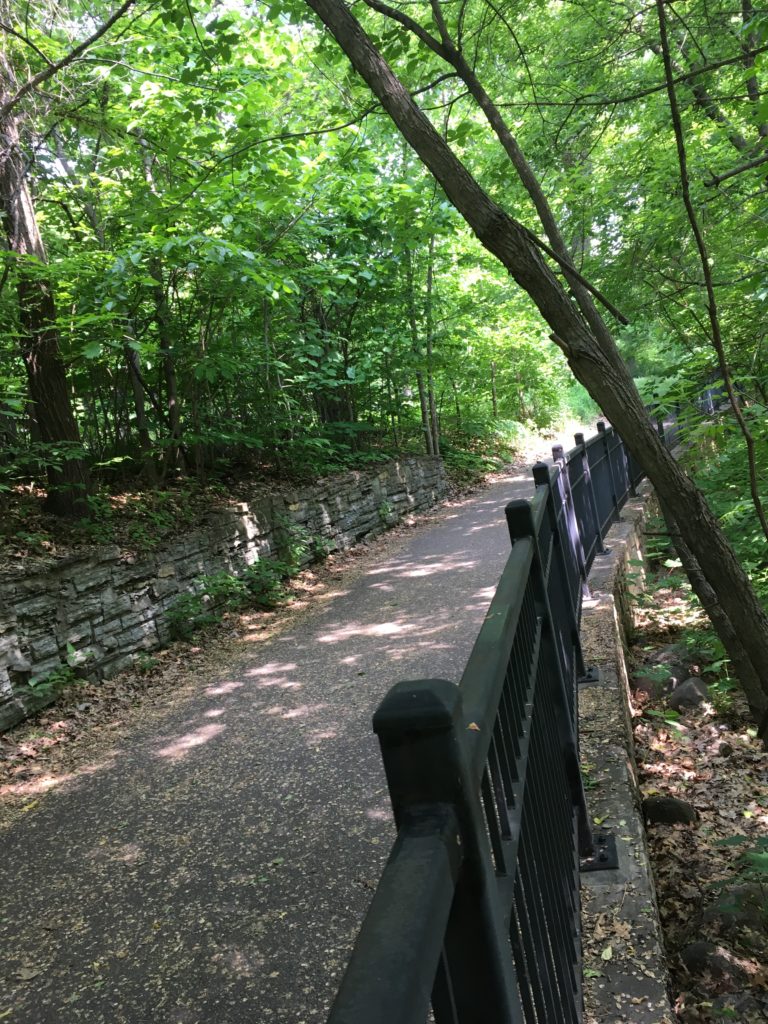
ford overlook, east river
64 degrees
humidity: 84%

Ran with Scott on his 15th run-a-versary. (Mine is tomorrow.) We talked about his gig two nights ago — the jazz combo that he plays bass in, when we started running, and whether or not I got covid a few months ago, which would explain some of my strange ailments + uneven test results. We were supposed to run 8 miles today but even before the run started, we reduced that amount. I wore my new Saucony Cohesions: navy blue with lavender lining and soles. They felt better, but not amazing. I realized that I need to retrain my stride so I don’t run on my toes. Did I start running on my toes more when I switched to Brooks? Possibly.

Writing this entry several hours later, my feet feel pretty good, so I think the switch to the new shoes might help my feet recover better.

It rained off and on yesterday and most of last night; everything was damp today: the sidewalk, the overgrown limbs with their new leaves, my face. The air was still and the surface of the river was flat and motionless. We heard a strange sound near some trees. We think it was a bird, but right before we passed it later in the run, Scott read a handmade brown sign that said, Warning. Coyote den nearby, and we wondered if a coyote had made the loud alarm-like sound we had heard earlier.

rabbit hole

In February, I studies rabbits and bunnies and rabbit holes. This afternoon, I was listening to Lily Allen’s latest album, West End Girl, and I heard these lyrics at the begging of the last song, “Let You W/in”:

I’ve become invisible, stuck here in my palace
I’m so fucking miserable in my rabbit hole, yeah, I’m Alice
And I’m expected to be nice picking up the pieces
What is it you sacrifice? I’m protecting you from your secrets

Does rabbit hole work here as anything other than a way to use Alice to rhyme with palace? I’m not sure. Regardless, I really like this album. Speaking of rabbit holes, I’ve written about how Heather Cox Richardson loves to use the expression in her daily YouTube chats — that’s a rabbit hole I don’t have time for right now. Last week, she said it again and added, I should write books about all of the rabbit holes I’m mentioning. From the 1950s Disney animated Alice, rabbit hole seems to mean daydreaming or reverie or being led astray — or too deep in — by one’s curiosity. HCR seems to be referring to actual rabbit holes, with their labyrinth of twisty tunnels. Of course, she’s also using it in the way that it is popularly used now: getting lost in a topic, ending up somewhere strange and unexpected.

march 23/HIKERUN

hike: 60 minutes
minnehaha dog park
37 degrees

Went to the dog park with FWA and Delia this morning. Chilly but sunny and still down in the floodplain. Beautiful. No snow, hardly any mud, lots of felled trees. Halfway in we encountered an awesome dog carrying a stick that was 3 times as wide as his head. His owner said, the governor is about 200 feet ahead. Last summer, I recalled watching a video of Gov. Walz being interviewed at the dog park, so I knew he came here. About 5 minutes later, there he was! Alone and friendly. Hello! Hi! Of course, I couldn’t see well enough to recognize him, but FWA could. I wish I could have seen that it was him. I would have told him thank you.

5 Dog Park Things / 5 Winchell Trail Things

  1. a section of the river, sparkling in the sun
  2. the bark of the giant felled tree that FWA and I have walked around all this year had been stripped recently — a huge section of the trunk was barkless and gleaming white
  3. faint footprints through the small stretches of mud
  4. a motorboat rumbling by, making waves that rushed onto the shore near Delia
  5. a woodpecker knocking on some dead wood, another (or the same one?) laughing
  6. shadows everywhere — trees, the fence, lamp posts
  7. the winchell trail path was covered in dry leaves that made a delightful crunch as I ran over them
  8. a steady stream of cars (at 3:30 pm)
  9. empty benches
  10. no snow, no puddles

2.8 miles
river road / winchell / lena smith
46 degrees

A quick run — in time and distance and speed. I should have slowed it down; it would have been easier. It’s hard to slow down in my new shoes! I was tired and felt the beginnings of a side stitch a mile in — I ate a protein bar too soon.

Today has been an off day — not terrible, there were many good moments in the hike and the run. But I woke earlier than I should have and felt, for lack of better word, weird. Untethered, fuzzy, maybe a little woozy, tired.

holes

As I continue to work on my holes poems, it has emerged that a few things are present in all of five of them: a hole, that hole’s impact on how I read, my blind spot, and the Amsler grid.

Why the Amsler Grid?

  1. it connects these hole poems with my last round of visual vision poems, mood rings, which take the shape of an amsler grid
  2. it ties in with the larger theme of all of my visual vision poems: vision tests — first, the snellen charts, then the amsler grid
  3. it gives a context for my vision loss and grounds it in within a scientific/medical model of seeing/not seeing
  4. it offers another way to visualize my untethering from that model/logic of test/diagnosis

This 4th one is especially interesting to me. I’m imagining fun ways to play with the implosion or destruction or destabilizing of the sharp, stable, rigid lines of a grid. The lines coming loose, or the lines a ladder without rungs — no way out of the hole, the lines collapsing and being sucked into the black hole, the lines forming a new path, a break in the lines — a gap, a dash, a slash, a breaking out of the lines — an opening, an exit, a room a door unlocked. What could that look like as part of my erasure poem? I mean, what, with my very limited skills in visual art, could I make possible?

I think I need to watch Alice in Wonderland again — should I read it, too? The hole in my vision as Alice’s rabbit hole. A passing through to wonderland. One difference: for Alice, Wonderland is the opposite of sense or nonsense.

everything would be what it wasn’t

I’d like to take this idea of non-sense out of the binary, Sense/Nonsense, to imagine non-sense as being more than just not sense. What if non-sense was its own kind of sense, just like Nothing is not nothing but something outside of our logic or language or ability to name it. Or, like I say in Holes 4, “a nothing that is something not sharing its secrets.

a flash: as I was working on the above list, I suddenly thought about the debate over whether or not listening to an audio book was reading. Does reading only happen with eyes? I like to distinguish it this way: reading with my eyes and reading with my ears. After this thought, a further thought: what if I created a holes poem that wasn’t visual, but aural? I could pick one of the New Yorker stories/articles that you can listen to, and figure out a poem from that. How might that work?

I had intended to work on all of this today, but I was busy all day: a birthday week coffee run with RJP, the dog park with FWA, weekly shopping with Scott, a run + cooking and laundry and a nap.

sleep

I decided to use my Apple watch this week to monitor my sleep. I’m averaging 6 1/2 hours a night, which I think is good for me, but only “okay” for my sleep score. Maybe that’s because I’m waking up every 2 hours. I have to get out of bed and stretch or go to the bathroom or walk around for 10 or 20 or more minutes before falling back asleep again. A thought occurred to me: could my low vision be contributing to my sleep problems? I googled it and yes, it might:

Visual impairment can lead to disturbances in the circadian rhythm20 and exacerbate neuropsychiatric conditions such as anxiety and depression, ultimately impairing central nervous system functionality and contributing to the development of insomnia21. Existing research underscores the negative impact of visual impairment on sleep patterns. Studies conducted in Russia found that individuals with visual impairment had more than twice the odds of reporting insomnia symptoms compared to those without, with this association remaining significant even after adjusting for factors such as age and gender21. This finding further confirms the link between visual dysfunction and sleep disturbances. Community research in the U.S. suggested that older adults with visual impairment are more likely to experience various sleep issues, such as difficulty falling asleep, trouble staying asleep, early morning awakenings, and daytime sleepiness22. Additionally, such individuals often report increased disrupted sleep patterns and a higher prevalence of sleep/wake disturbances23.

low vision and insomnia study

But, this study studied different visual impairments than I have. What about cone dystrophy or macular degeneration, which has similar effects? I looked it up and found some articles that link it, but it’s mostly about anxiety over vision loss that cause the sleep disturbances. I know I have some anxiety about the final break, when none of my cone cells work and all of my central vision is gone, but I think the connection between sleeping and not seeing or seeing differently is more complicated for me. I’ll have to ask the ophthalmologist at my appointment next month.

march 11/RUNGETOUTICE

4.25 miles
minnehaha falls and back
35 degrees

Snow. A dusting last night, then a little more in the morning. An inch? Enough to make everything white. I was happy to be done with winter, but I don’t mind the snow. Since past snow has already melted and the ground has already warmed up, the snow didn’t stick around. By the time I went out for my run in the afternoon, almost everything was clear. The run didn’t feel easy, but I pushed through several difficult moments and kept going. Hooray for mental victories!

I listened to the dripping and gushing and the wheel whooshing as I ran south, 2 playlists — “Bunnies and Rabbits” and “the Wheelin’ Life” — as I ran back north.

10 Things

  1. sh sh sh — the shifting grit under my feet
  2. the wet pavement was shining and sparkling in the sun — so bright sometimes that I thought it was slick ice
  3. entering minnehaha park, the parking lot was empty
  4. exiting the park 10 or more minutes later, there was one car at the far end of the parking lot
  5. the creek was rushing
  6. the sidewalk on the bridge just above the falls was wet and clear — last week someone had chalked a long message on it, which I couldn’t read because of my bad vision
  7. on the walk just before I started, I noticed a small black bird skittering along the grass — it had a small circle of white feathers below its eye
  8. a runner in a bright red jacket stopped at the Rachel Dow Memorial Bench, a minute later they ran down a hill on the winchell trail
  9. only 1 or 2 small patches of ice, a few puddles
  10. I almost didn’t remember this one! — three people on the bridge over the falls, looking over the creek side. One, to the others, pointing down at the creek: look, there’s 75 cents! One of the others, joked (I hope): better go down there and get it!

Rabbit Recap

Slowly but surely, I’m getting to the end of my rabbit recap, but not today! See past rabbit recaps here: 9 march, 6 march, 5 march, and 4 march.

14 — 25 march 2026

Here’s a useful explanation of some reasons why I do monthly challenges about new topics, like rabbits (or wind or dirt, etc.):

And what’s the point of all of this? Following the rabbit down the rabbit hole is a wonderful distraction. It is also an excellent opportunity to learn. And to learn more about rabbits, which leads to caring about them as living things and as symbols. This caring might (is) enabling me to open up a closed part of myself (closed = strong dislike of rabbits). And it is helping me to think more broadly and specifically about the impacts of humans and human encroachment on environments and the consequences of that encroachment for humans and non-humans. Plus, all (or any) of it could inspire new poems.

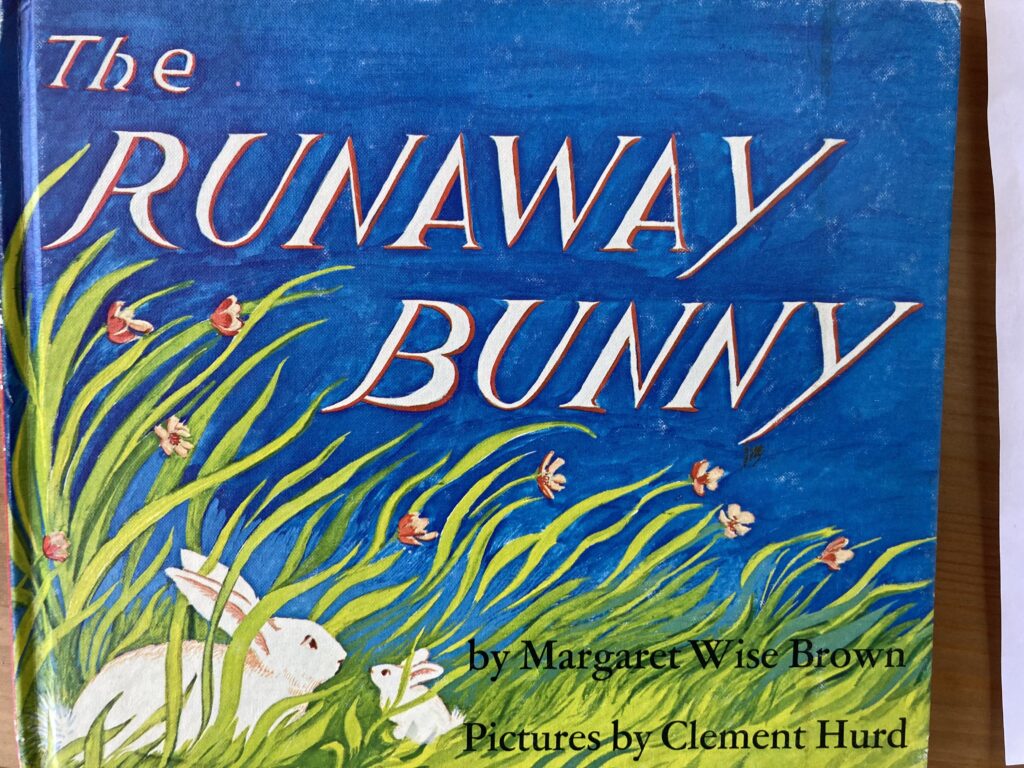
A quick summary of some rabbits references and reveries: the killer bunny in Monty Python; Bunny Lebowski; Rabbit in Red matchbook from Halloween; Jimmy Stewart’s invisible bunny in Harvey; Max and Ruby; the PBS doc The Pill; Rabbit in Winnie-the-Pooh; the Cadbury Creme Egg Bunny; The Runaway Bunny; fix me hausenpffefer right away!

Rabbits in Diane Seuss:

excerpt from backyard song / Diane Seuss — I LOVE this whole poem. I’d like to use it as inspiration for a hole poem and a bunny poem!

Uncorked, I had a thought: I
want the want
I dreamed of wanting once, a
quarter cup of sneak-peek
at what prowls in the back, at
what sings in the
wet rag space behind the garage, back
where the rabbits nest

excerpt from Her first poem had a rabbit / Diane Seuss — I want to bring in the optical illusion of the bunny and duck + the idea of what seems mild but is really wild

She tended
toward rabbits back then.
Toward the theoretically mild

that are really
wild. Like ducks on a pond
that is really a moon

full of menacing weeds.

What form should my rabbit poems take? an inspiration — Seven American Centuries

New Yorker Experiment: A hole through the bottom of the known world

Today I worked on the template for my hole poem that erases the “Whisker Wars.” It has some of my blind spot, some big circles (from a iron pill cap), some medium sized-circles (lexipro cap), small (a quarter), and extra small (a penny). I want to create texture for the blind spots but leave the circles alone as pencil/gray.

a hole through the bottom of the known world

My choice of blind spots vs. circles, and the size of the circles, was mostly decided by what would fit where, but there might be some room to play around with some of it. I’ll think about it some more.

The words: nothing still / details drift like snow / cut off heads with pewter-colored faces float / a hole through the bottom of the known world / here it’s unprofitable to have faith in the visible — should it be what is visible?

added an hour later: I realized a further clarification on the idea of the hole and holes. The blind spot creates a hole in my vision, an absence that has created an uneasy fellowship with the world and made it unprofitable to have faith in the visible. But, there is also the small hole that remains in the otherwise dark blind spot that enables me to still read — it’s a small hole, and it’s getting smaller, but it’s still there. I’m noticing that my whisker wars poem offers many different sizes of holes depending on how many words I’m trying to fit in it. I need to have a poem that highlights that tiny hole holdout — ooo, holdout is a word in the whiskey wars article. Should I do a completely different poem using the same text?

Get out ICE

Each morning a local journalist, Sean Snow, offers updates on what’s happening in Minnesota, both what ICE and those in state and federal government that support ICE are doing, and how people and their communities are fighting back. I read them on Facebook, but he also posts them on Threads, Instagram, Tiktok, and YouTube. Today one of his examples

sitting at the dining room table, drinking my coffee while I write this, I just heard a long goose fly by — honk honk —

was about “a real act of public memory” n St. Paul:

Testimony Builds The Record: Minnesota residents, advocates, and families testified Tuesday in St. Paul before the chair of the U.S. Commission on Civil Rights about what they experienced during Operation Metro Surge. Star Tribune reported that people described racial discrimination, abusive detention conditions, treatment of protesters, and the deaths of two citizens, all in hopes of pushing the commission toward a formal investigation. This was not a final ruling or a courtroom win. But it was a real act of public memory and accountability on a day when it would have been easy for the country to start looking away.

Sean Snow on Facebook / 11 march 2026

march 9/RUNGETOUTICE

4.5 miles
veterans home and back
50 degrees

With the sun and the bare ground it felt warmer than 50 degrees, so I wore shorts! I started with long-sleeves, but by 2 miles, I shed that skin and ran the rest of the way with bare arms too. Ah, spring! Not the easiest run. It might have been because I didn’t wait long enough after my second breakfast/early lunch.

1

One of the best things about the run was heading south and admiring the river. Waves on the surface reflecting the light. A shimmer scene. Dazzling. I haven’t seen sun on open water like this for many months.

2

Since I’m thinking about holes and spots, which also means circles and loops, I thought about a playlist I made a year ago (25 march 2025), and decided to listen to it. Much of it is about seasons and cycles, but as I ran I thought about the hole inside the wheel and falling through it — into another dimension? another way of being? a space not consumed by the expected (normal) life? Then I thought about my growing blind spot and how it has cracked open “normal” life — this cracking can be painful and difficult, but it has offered new possibilities and an entrance to another way of being.

3

After stopping to put in my playlist, as I ran down the hill and away from the park, by right foot felt strange. Was there a rock in my tread? I finally stopped and looked. Not a rock, a hole in my shoe where my middle toes strikes down. I guess that proves it: I’m not a heel or mid-foot but a toe striker! Unlike the hole in my vision, I don’t really see an upside to this hole in my shoe — well, I guess it means I have get to buy new shoes, and, if any are still available, in a bright color!

minutes later: Done! My new Brooks Ghost 17s are dark blue, turquoise, and green!

a close-up of the bottom of my running shoe with a white circle which is a hole that goes all the way through
a hole in my running shoe

I have never had a hole in the bottom of my running shoe. I’ve had holes on the side where my bunion/wide foot has pushed through, but never a hole on the bottom. I think it’s funny that this hole happened just as I’m thinking and writing about holes. I feel like I need to incorporate this hole into my project!

A Return to my Rabbit Recap

11 continued — 20 march 2026

sources of bunny inspiration: 1. rabbits who eat buckthorn bark may pee smurf blue; 2. identifying the dark forms in the backyard as rabbits; 3. origins of “bold as brass”; 4. optical illusion — duck or bunny; 5. a cup full of 3 rabbit breaths (poem); 6. jackrabbit trapped in a wildfire (poem); 7. the rock that is not a rabbit (poem); 8. little girls deciding who will have their bunny when they die (poem); 9. a rabbit offering themselves to quell a woman warrior’s hunger (book)

12 — 24 march 2026

Bunny as muse? nudge? pest? ghost?

What am I doing as I keep putting the two bunnies in my backyard into my poems? And why do I insistent on calling these wild and mature eastern cottonwood rabbits bunnies? I’m not sure these rabbits are indifferent to me, but I think they notice me in terms of whether or not I am a threat to their main activity: grazing in the grass.

A title for a poem? Crepuscular. Why don’t rabbits flee when I approach? Do they see me as non-threatening? Has human encroachment screwed up their sense of friend and foe? My mom, a pesky bunny, and a drive out the country. Peter Rabbit: the horror movie.

the rabbit hole: 

“Down the rabbit hole” is an English-language idiom or trope which refers to getting deep into something, or ending up somewhere strange. Lewis Carroll introduced the phrase as the title for chapter one of his 1865 novel Alice’s Adventures in Wonderland, after which the term slowly entered the English vernacular. The term is usually used as a metaphor for distraction.[1] In the 21st century, the term has come to describe a person who gets lost in research or loses track of time while using the internet.wikipedia

Out-of-control curiosity. Distraction. Losing track of time. Getting lost in strange worlds. These are presented as bad things. Are they? Many of them are embraced within poetry. And they are great tools of refusal and resistance against late-capitalism and wannabe fascist governments — you’re not working for/perpetuating the system while you’re following the rabbit hole.

The rabbit hole online.

13 — 27 feb 2026

The rabbit hole. “Back to hole-less cottontails. A new metaphor is needed — not falling down and through to other worlds, but something about edges and shadows and the fringes — the periphery! Dwelling on the edges, in the corners, not traveling to new worlds, but noticing the other worlds that are already there, have always existed in the midst of my world.”

I want to think more about this shifting metaphor in my understanding and use of hole in my erasure poem (or poems?)

New Yorker Experiment #5

First, an update on Holes. There’s an empty space without text in the lower left corner. I’m thinking of putting a definition or a quote or a line there. Or, I could put my poem written out in a straightforward way in the space. Would that undercut of enhance the experience of reading the poem? The text could also be an explanation of my version of reading; peripheral — big picture / central — one word or small phrase at a time, often experienced in isolation.

I’ve started (just barely) working on experiment #5. I’m using an article from July 28, 2025 titled “The Whisker Wars.” All I’ve done so far is write down words that stood out to me on two out of the three pages. I want to try experimenting directly on the New Yorker pages so I have a decision to make: two of the pages are back to back, so I need to pick either the first or second page. I’ll read through both of them and see which one I like better.

Hmmm….there’s a cartoon on the second page with the caption, “That’s an area for creativity and unstructured play.” I might want to use a few of those words.

words/phrases the stand out, page 1:

  • portrait
  • a game of Now You See It, Now You Don’t
  • in the beginning, not a whisper
  • otherwise
  • drift like snow
  • wonder
  • notice
  • russet-and-gray
  • pewter-colored
  • abrupt shift
  • who left
  • entanglements
  • weirdness
  • yellow
  • bore a hole through the bottom (of my coffin)
  • still

page 2

  • traces
  • people saw it as separate (from the body)
  • replaced by a view
  • faith
  • framed
  • revealed
  • meanwhile
  • from
  • however
  • trends
  • norms
  • world all know / known
  • waves
  • an area for creativity and unstructured play
  • lies details
  • natural
  • rather
  • nothing
  • believe (rs)
  • teach you
  • visible
  • cut
  • choice

Get Out ICE

On 5 march 2026, NPR posted a story about how doctors and nurses in Minnesota have created an underground network of medical care for people who are too scared to leave their homes. “There are now about 150 doctors — a volunteer “rapid response” team that has made more than 135 home visits” (When ICE came, Minneapolis created underground health networks).

These members of the care network have helped women in labor, babies with the flu, “At the Faribault clinic where Carroll works, staff members deliver medicine, food and other necessities to patients. A staffer drives 12 middle and high school kids to and from school every day in a clinic van.”

For more on ICE’s impact on healthcare in Minnesota, listen to this podcast: How ICE’s presence is affecting health care in Minnesota

march 7/RUNGETOUTICE

2.5 miles
44th street parking lot and back
35 degrees

Ran in the afternoon. Colder today. I wore gloves and a headband to cover my ears. It felt harder, maybe I ran too soon after lunch?

It snowed last night. Not much — not even an inch, but enough to cover the grass and make everything glow white. By the time I went out for my run, the paths were clear.

omens of spring-to-come: someone was roller blading! Not roller skiing, but roller blading. And, a woman was running in shorts. It’s not unusual to see a man running in shorts during the winter, but it’s rare to see a woman. That usually doesn’t happen until it’s spring, or feels like spring, or is warm enough to be spring.

I was planning to finish my rabbit recap today, but then I started thinking about and experimenting with my holes poem. No time for the rabbits — well, except for several paragraphs below, when I realize that my naming of this poem, Holes (or hole?), is probably at least partly a reference to the rabbit hole!

New Yorker Experiment #4, continued

Today some part of me decided that we (the Saras) would offer a more detailed account of the process of thinking through my latest poem, so that’s what we’re doing.

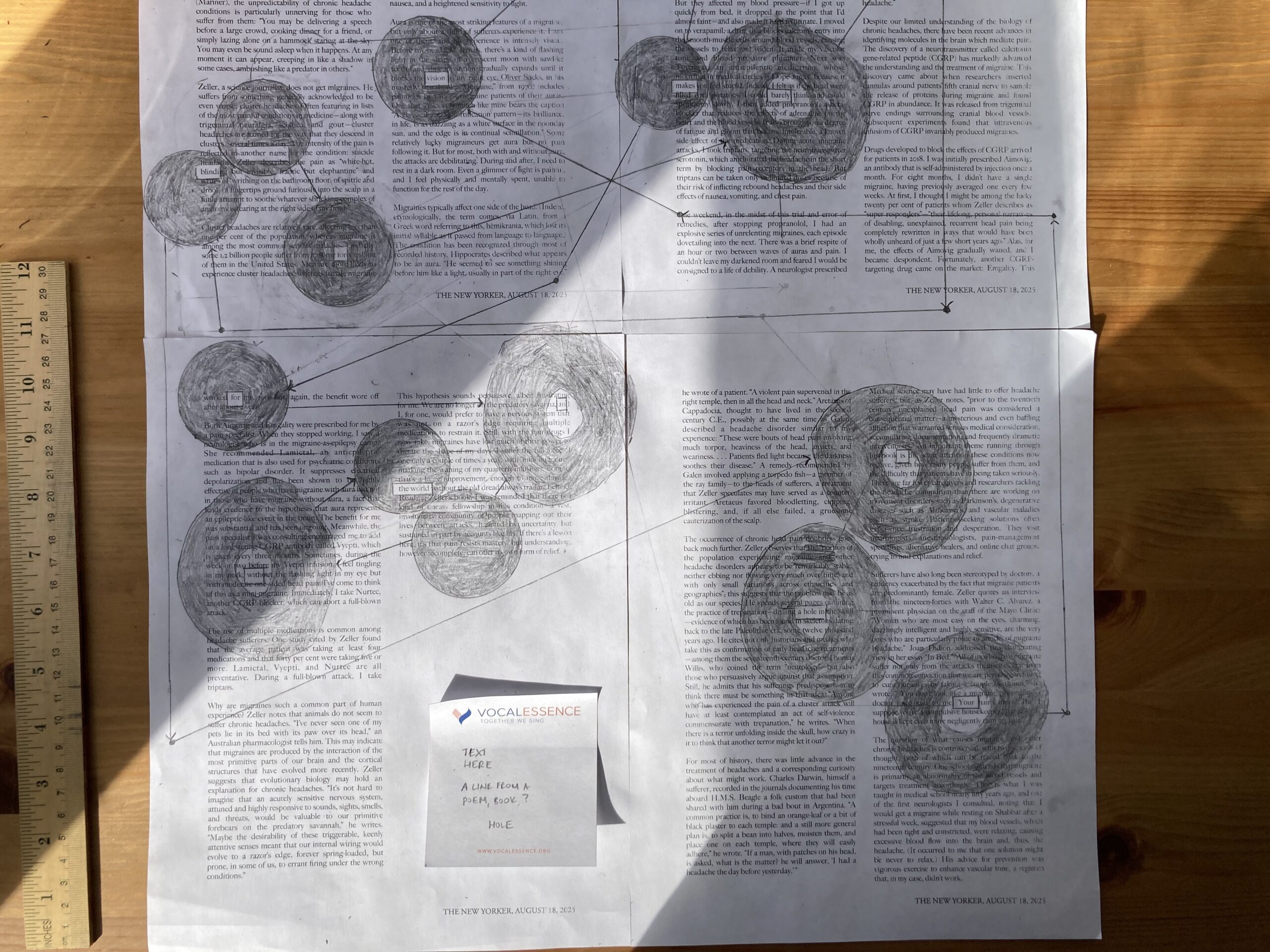
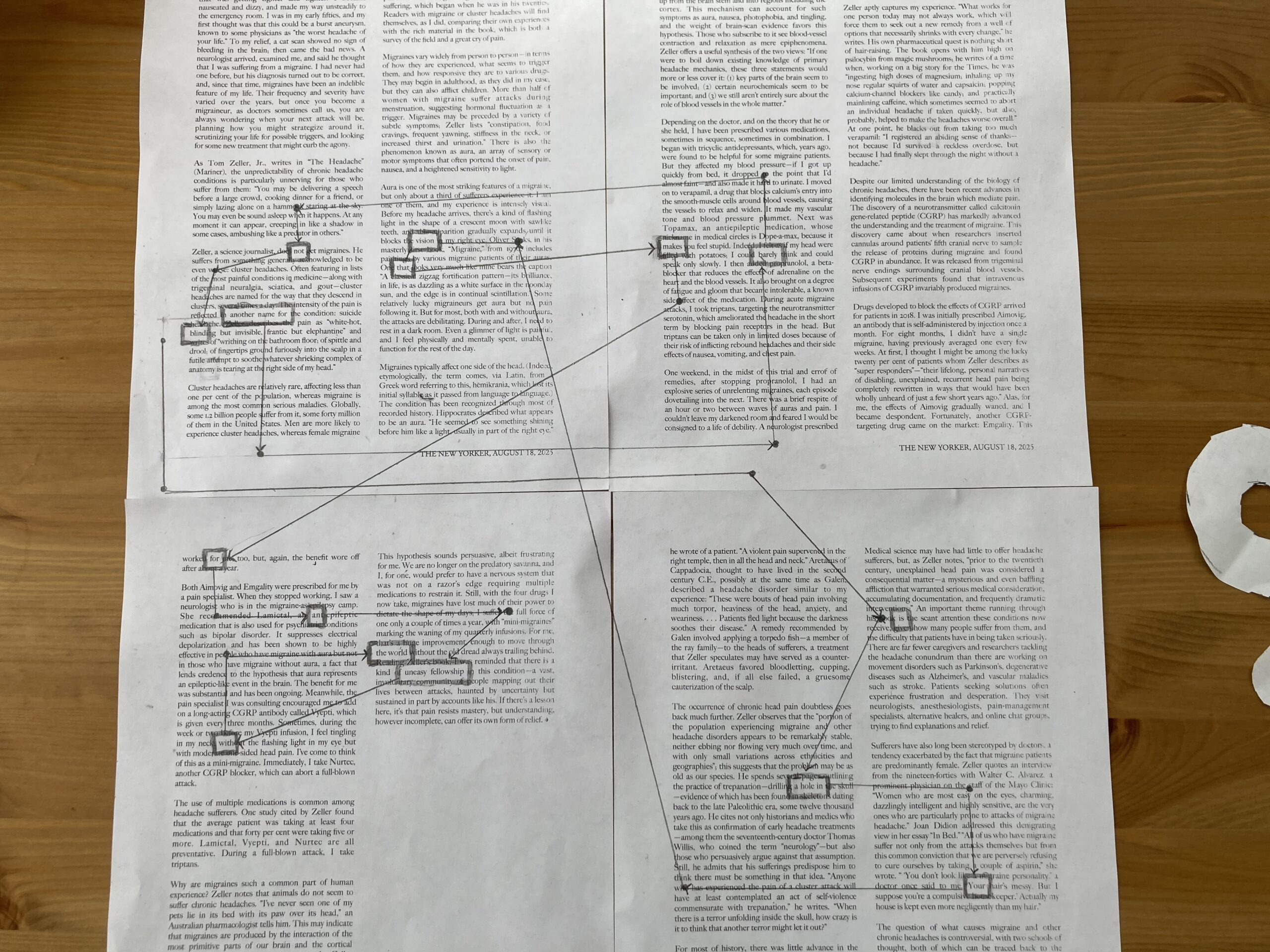
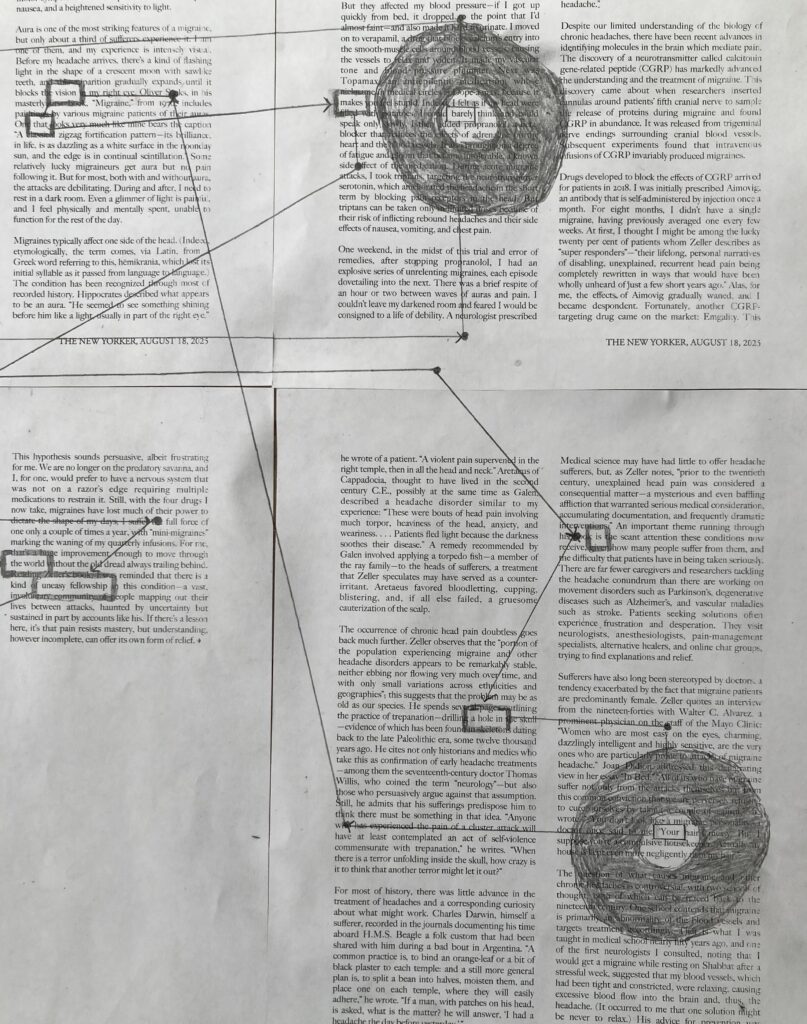
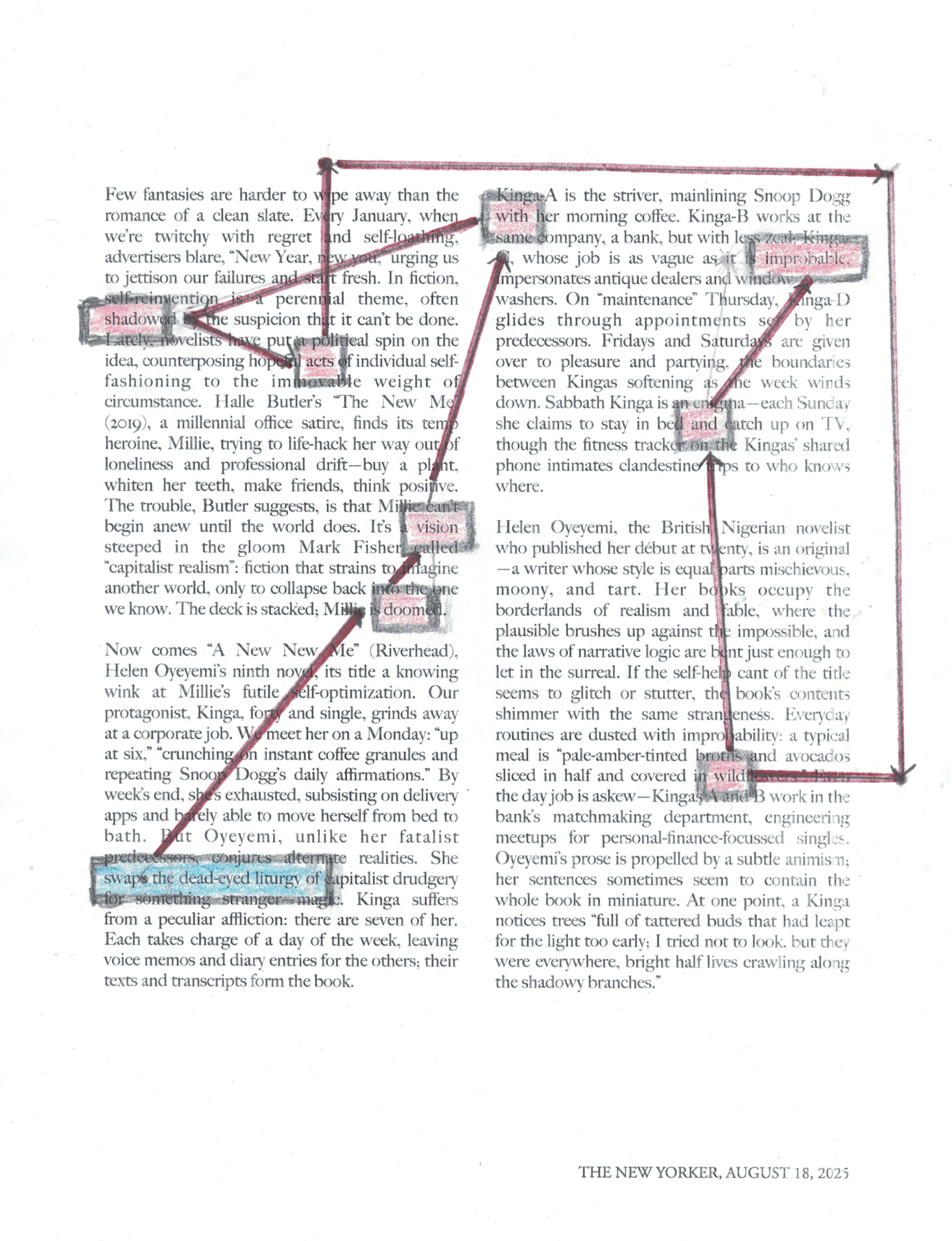
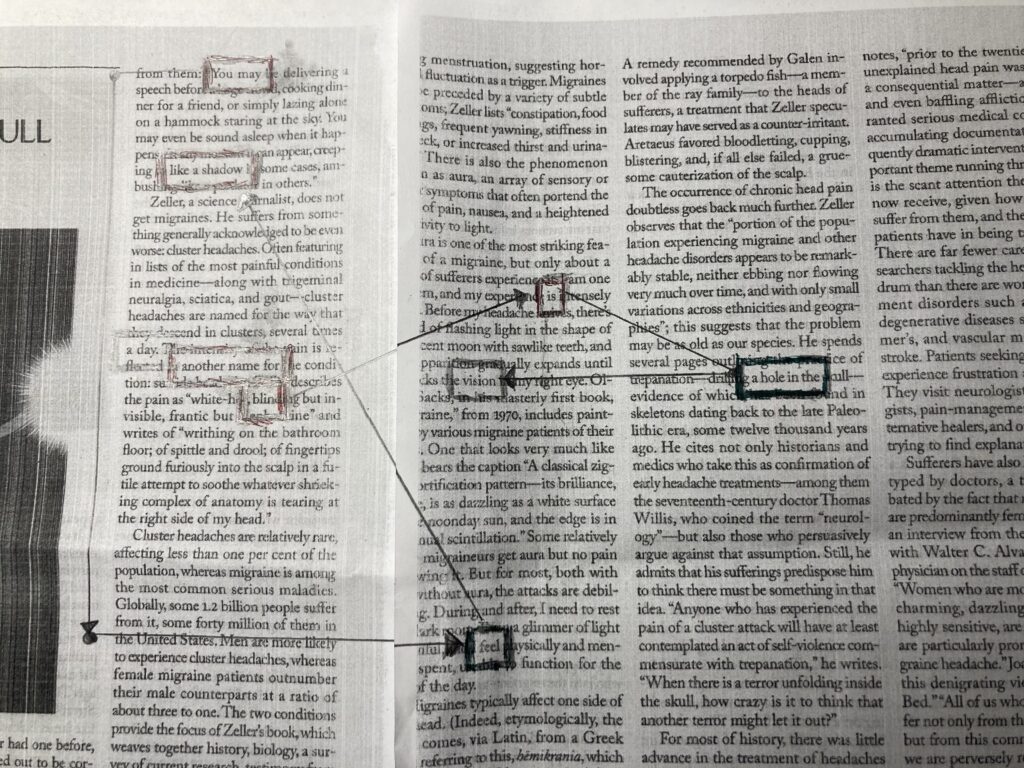
I want to keep working on my fourth experiment. Yesterday afternoon, I printed out the New Yorker article, “A Screaming Skull,” and found my poem on its four pages. Then I taped the pages together and mapped the poem out. The theme: holes. I imagine it as part of a larger project about my blind spot. Maybe this project won’t be all erasure/found poems; I might try to connect it to some other work on the blind spot — work I’ve been doing for several years now, but haven’t quite figured out how to turn it into something. Yes! Experiment #3 — swap the dead-eyed liturgy of doomed vision with shadow (or shadowed?) acts, wild and improbable could connect with my study of JJJJJerome Ellis, the stutter, and his liturgy of the name! Very cool!

I took a picture of what I’ve done so far:

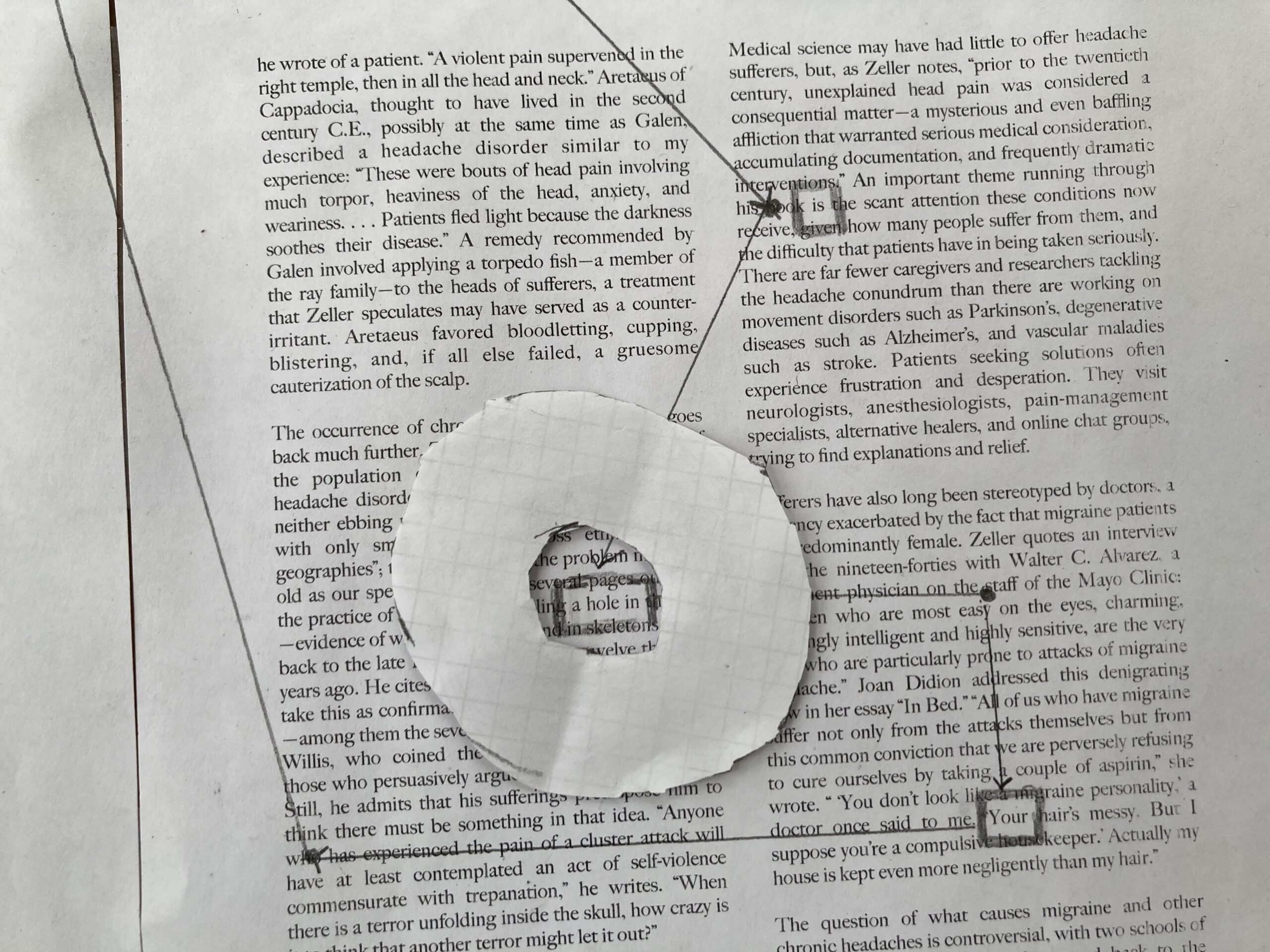
What to do next? The second image offers a possible approach: Applying my blind spot — the one I recently created by staring at a blank wall until it appeared, then tracing it — to each of the “found” words. I could sketch the blind spot directly on the page, around the word, OR I could place a cut-out version of the blind spot on top of the word. Maybe I’ll try a practice sketch. Another idea, which is probably definitely beyond my technical ability: create an animation of the process of reading this that starts with an overview of the poem, then zooms into the first word, encircled by the blind spot which appears as I read it. Then it moves to the next word/phrase, and the next, and the next until the poem is finished. I could also do it as a series of stills (instead of an animation). You could look at each one individually1, the image as a whole, and the series of images in a gallery.

I like this last idea! The focus on individual words — isolated from the other words and the meaning as a whole, which is how I read, because what’s left of my central vision is so small it can only fit a few words, and which is how I often (but not always) experience the world with my big blind spot — in isolation, and removed from others. A question: should I keep the larger poem as a square, stacked 2 x 2 pages? Or should I have it extend as 4 pages across? I can play around with it.

an hour or two later: Here’s something I tried with a paper cut-out of my blind spot as a template. I’m thinking I should ask Scott to make a sturdier, cardboard version of this template.

an image of words, 2 circles with a hole in the center, sketched in pencil, representing my blind spot
in progress / 1 PM / 7 march 2026

Something to think about: should I have the blind spots on the entire poem/map? I was going to write: no, because that’s not how I would see it; I would see a somewhat fuzzy version of the map of the poem. But this poem is not an accurate representation of how I see. I hardly ever see my blind spot as a gray blob. But the blind spot is there and it distorts how/what I see and I need to represent in some way that others can see too.

Another question: should I hand-sketch this poem, or figure out how to do it on the computer? I like the hand drawing — the material aspect of it + I can do it all myself — but drawing it by hand is messy and unreliable. I’m thinking that this series will be part of my vision art installation — along with my snellen charts and mood rings. It seems too messy if I don’t do it on a computer.

Also: how should the individual stills look? Should they be a close-up on that part of the poem, or just the word/phrase centered in an otherwise blank page? Should they include the blind ring? If I have more of the text, should it be too fuzzy/distorted to read, or should I have it surrounded by gray? Looking at the words on this screen, I see: 1 or 2, maybe 3 short words in focus, then other words too dim or fuzzy to read, and, after staring for a few seconds, a glowing dark ring around it. This ring is not solid or very dark, it’s almost gauzy, like a veil, or the feeling that there’s a ring there. Does that sound strange?

(rabbit) holes: Today I start a new volume of my Plague Notebook: vol. 28! I’m calling it, What about Epstein, Trump? As I was writing in it, describing my latest visual poem, Holes, a thought: Am I calling this holes (or hole?) partly because of my recent study of rabbit holes?! Maybe! And maybe I could bring rabbit holes into a poem about my blind spot!?

Get Out ICE

“Accountability in this case looks incredibly simple. Minnesota must investigate the violation of constitutional rights at the hands of Noem and her ICE agents and prosecute where appropriate. The best part about this process is that Trump can’t pardon state convictions.” Boom.
(from a Occupy Democracy post, citing a MSNOW interview with Tim Walz)

  1. While applying my blind spot to the phrase, “another word for,” I realized that that phrase was too big to fit inside the inner ring. So, that’s a new limit to how I can construct this, and other blind spot, poems: the phrases/lines must be able to fit within my blind spot. It wasn’t a big deal in this poem; I just took out the for from “another name for” and found it somewhere else in the article. ↩︎

march 6/RUNGETOUTICE

3.5 miles
locks and dam no. 1
48 degrees / drizzle

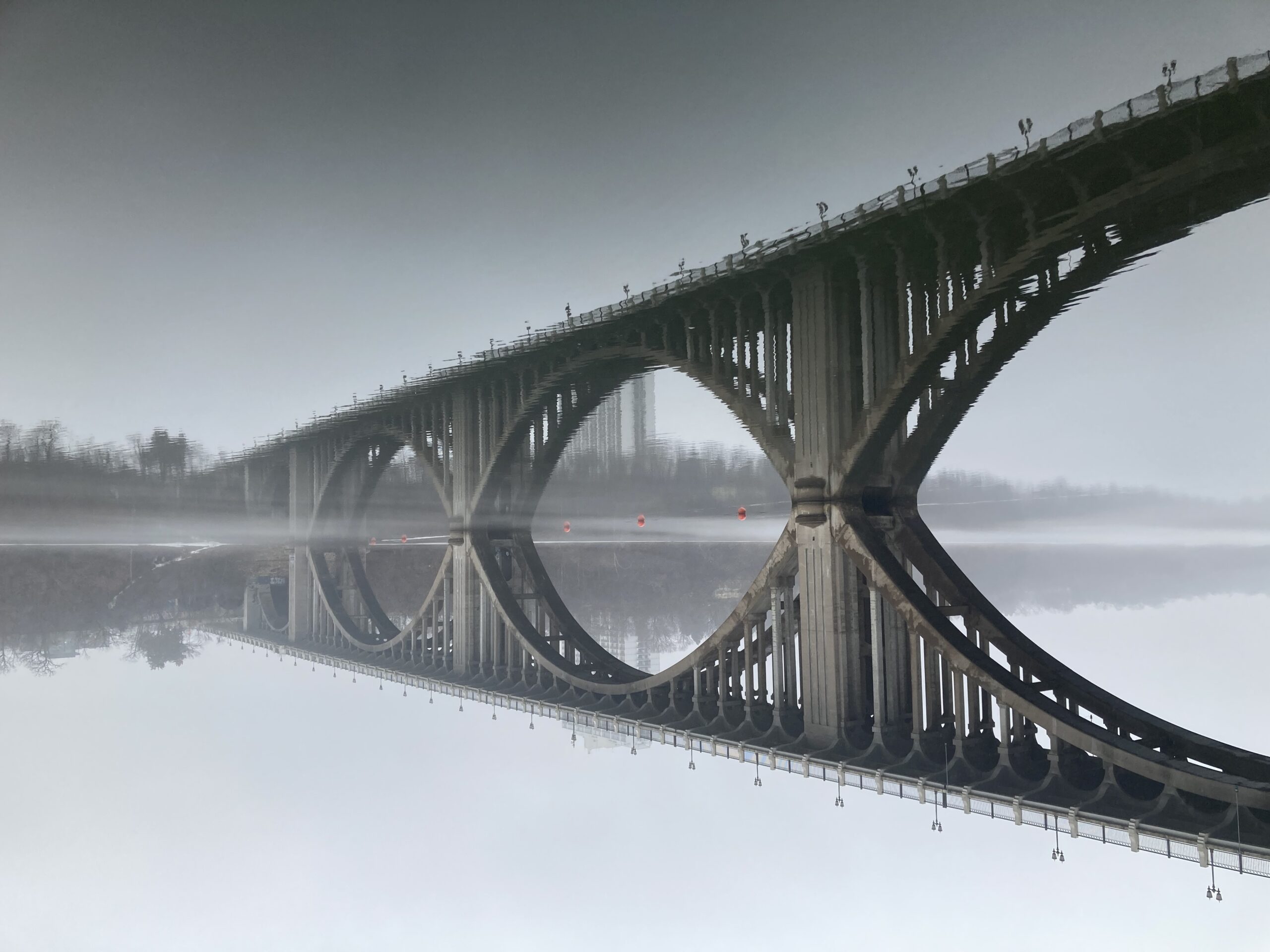
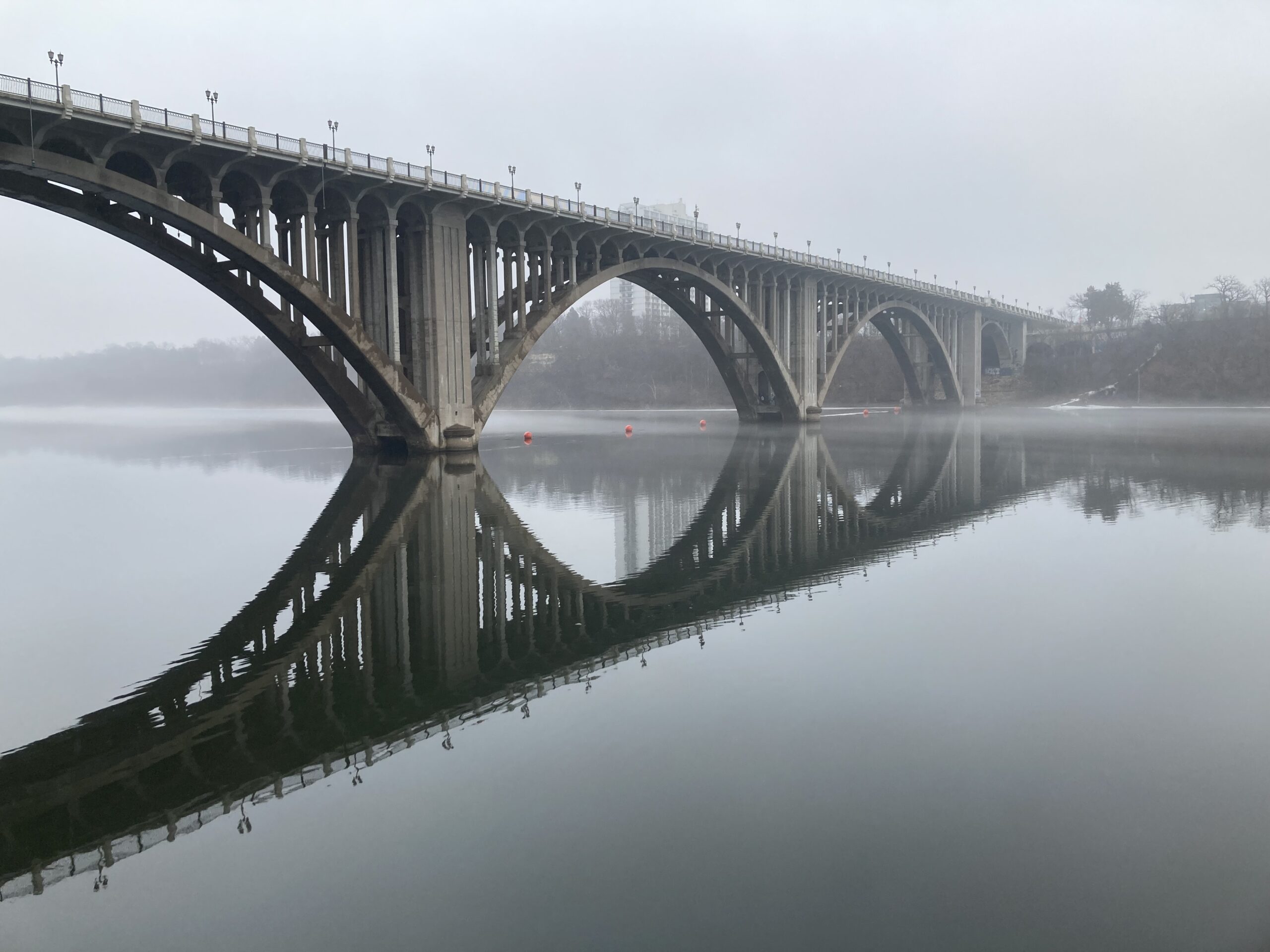
A few more warm days, then cold again. I didn’t mind the drizzle, everything was gray and soft and misty and wet. Dripping and whooshing and seeping. Of course, now that I’m home, the rain has stopped and the sun is almost out. I ran to the bottom of the locks and dam no. 1 hill and admired the ford bridge. It looked more like a painting than an actual bridge — although it sounded like a bridge, with trucks rumbling overhead!

I love the reflections in this picture I took, especially the upside down street lamps and railings.

If the sky were a little darker, the river a little lighter, you might not be able to tell which bridge is up, which is down — at least, I wouldn’t be able to tell!1

Smiled at several runners and walkers and bikers. Made note of all the empty benches and parking lots. There were not too many people out there. For the last bit of the run I was able to get deeper into the mist by running on the Winchell trail. Very haunted and other-worldly!

I listened to water for the first half of the run, and “Bunnies and Rabbits” playlist for the second. A new song popped up: Rabbit // Hole by Siddhartha Khosla. It’s part of teh music for a one-season series called Rabbit // Hole with Kiefer Sutherland. It’s a great song to run to. Near the beginning, the music breaks up for a few seconds then plays again then breaks up. I imagined a fast moving rabbit passing by an object when the music broke up, then being in the clear (when the music resumed), then passing my another object when the music broke up again.

Rabbit Recap, part 3

Can I finish this rabbit recap today? Nope. I got distracted with other stuff.

11 — 20 feb 2026

All late fall and winter, 2 or more bunnies have been hanging out under our crab apple tree — at night, in the afternoon, at sunrise and sunset. They’re very bold, these bunnies, not running off when I walk by. When this happens, I’ve started saying, these bunnies are as bold as brass! Why? Not sure. And, I don’t want you to get the wrong idea: I like bunnies or rabbits about as much as I like squirrels, which is not at all.

Get Out ICE

Yesterday afternoon, Scott came to my desk n the front room and said, Do you want to hear some good news? I mean, some actual good news? Kristi Noem was fired!

from Needle & Skein (the red hat people)

As of March 5th, we have raised an incredible $705,000 to help our immigrant communities here in MN. This is just us. Other yarn shops in Minnesota and around the country have also raised money and generously donated both here and locally. ICE is still here. Our fight is not over. Join us. ❤️

If you are a business who has raised money, please send us a message. We would love to try and get a full picture of what the amazing fiber community worldwide has accomplished.

Facebook post

Read the comments for more on how the fiber arts community is showing up!

New Yorker experiment #5

These experiments are slow-going. I run out of time to work on them. I struggle to see what I’m doing. I’m messy and haven’t figured out how to work with glossy magazine paper. So why am I continuing these experiments? I asked that to Scott and FWA in the kitchen the other day and then answered it myself: For some reason, I2 want to do these erasures, so I’ll keep doing them until I don’t want to or can’t (because it is too hard with my bad vision).

a flash of an idea: As I was writing that last paragraph, I was thinking about how visual poetry is increasingly inaccessible to me as my few remaining cone cells die (are the dying or just malfunctioning?) Then this popped into my head: yesterday’s erasure involved using marker to cover almost the entire text. When I had FWA and RJP read it, they both got marker on their hands — not in big streaks, but in tiny marks that almost looked like cuts or scratches. What if I made these erasures about touch too? My first thought was about doing the erasure in such a way that created a residue. Second thought: what if these erasures involved texture and touch — here, I’m reminded of the kids’ book Pat the Bunny and its different textures to touch: the soft bunny fur, the rough bunny . . . nose? I can’t remember what was the rough thing in the book. If you can touch these erasures and their textures, which would somehow speak to the words/ideas on the page, maybe you can hear them too? I’m thinking of scales, and thick layers of paper, maybe some holes where the paper has been ripped open, some extra rough sections, some smooth, like a thin film, crinkly, soft, sharp-ish. And — maybe in terms of the visual aspect, find ways to cover it that reflect or glow or shimmer or sparkle. I can see these textures in a way that I can’t see the typical flat, black expanse of an erasure. So things like glitter, little mirrors, metallic surfaces, ridges. What about covering it with things that offer colors only visible in the light — thinking of bird feathers here. So many ideas! Again, difficult to execute without it looking like a mess, but fun to try.

Before I had that last flash of inspiration, I was thinking about how I’ve decided (as of yesterday) that the overarching theme of these found poems is my vision and how I see. Then I thought, I should apply my blind spot to these pages. Create an amsler grid out of the text, and then place a cut-out of my blind spot (found while starting at a blank wall and then drawing what I see) on top of the words to find the poem.

Maybe some of these erasures could be all/only about texture, some all/only about my blind spots, and some both. And just now, another thought: What if these erasures were all about my blind spot and the idea of blind spots? Would this work: one of the erasures could be covered in spots or dots or holes in the paper?

So many fun ideas to try. I imagine that some of them will only ever be ideas that are good in theory but don’t work on the page.

Oh — I almost forgot, until I looked over at an open tab that reads, “tools to use for magazine erasure poems,” I started writing about this experiment because I wanted to mention my need for better materials. I love how writing in this log opens me up and helps me to see new things to try! Before writing about textures, the supplies I thought I needed were: sharpies, an exacto knife (can I see well enough to use this?) and possibly paint. Texture through thicker and thinner layers of paint is an interesting idea. Now I’m thinking I need scraps of fabric — next week, RJP and I should go to the fabric scrap store at the Textile Museum! — that are soft and rough and bumpy and gauzy. I need glitter and sparkles and little things that reflect and crinkle. Fun!

Here’s a new version of experiment #3. I decided to paste the text into a document so I could have an easier time drawing on the text. Is this a good solution? I’m not sure, but I do like how this version looks:

an erasure poem, spelling out: swap the dead-eyed liturgy of / doomed / vision / with / shadow / acts / wild / and / improbable
swap the dead-eyed liturgy

Bummer. I just realized that I erased the ed on doomed. It is supposed to read: of doomed vision (I guess doom vision could work?).

text:

swap the dead-eyed liturgy of
doom OR doomed3
vision
with
shadow
acts
wild
and
improbable

And now I’m redoing yesterday’s experiment:

text:

Another name for
barely

not
blind
is a hole in
your vision
that
makes
for
an
uneasy fellowship
with
the world.

march 5/RUNGETOUTICE

4.65 miles
veterans home and back
46 degrees

Still feeling like spring, another run with bare arms for the second half. Chirping birds, rushing falls, a knocking woodpecker. Kids on a field trip, walking on the river road trail. Only a few random clumps of snow remaining in the grass. I’m sure we will still get snow, either later this month, or in April, but it won’t stick around. Spring is coming!

I recited Alice Oswald’s “The Story of Falling” and Lisa Olstein’s “Dear One Absent This Long While.” I intended to think about my mom on her birthday, but I forgot to, or did I? I’m sure she was there when I recited — in my head — the last lines of Olstein’s poem: Your is the name the leaves chatter/at the edge of the unrabbited woods.

As I listened to the rushing falls, I recalled my discussion yesterday about the poster with the words, Believe Your Eyes. I thought more about why you should Believe Your Ears and Your Eyes, although less catchy, is more accurate. I recorded a thought into my phone:

5 march 2026

transcript: the sound of minnehaha falls and, occasionally, some wind. “I’m thinking about my poster and switching it from Believe Your Eyes, to Believe Your Ears and Your Eyes. And I’m thinking about, on their own, they’re both unreliable, but when they work together, and with the other senses, they offer a more accurate representation of what’s happening.”

Listened to the birds, my feet striking the grit on the path, someone say, I’m a classroom teacher near the overlook, the falls, sounding like a June rainstorm on the first half of my run. Listened to my “Bunnies and Rabbits” playlist on the second half. I started with “Rabbit Fur Coat,” and was struck by this verse:

She put a knife to her throat
“”Hand over that rabbit fur coat””
When my ma refused, the girl kicked dirt on her blouse
“”Stay away from my mansion house””

My mother really suffered for that
Spent her life in a gold plated body cast.

This last bit about the gold plated body cast — what a great way to describe someone who is obsessed with objects, like gold or fur coats, that bring status and luxury.

Happy Birthday Mom

If she hadn’t died in 2009, my mom would be celebrating her 84th birthday today. 17 years gone. Some memories of her have softened, lost their edges, others have been condensed into a flash or a few words. I was reminded of some of those words the other day when I heard Heather Cox Richardson say, oopsie poopsies. As I remember it, Mom was driving me and my best friend (JO) home. When we pulled into the garage, she called out, Front door service, Missy Doodles! I can’t remember our reaction in that moment — did JO and I exchange looks? did we laugh at her? — but I do remember that it became something we repeated to each other later for a laugh and as a way to mock my mom (mostly good-naturedly, I think).

Why does this dumb sentence stick, when others don’t? Maybe it’s partly because my mom often had a strange way of saying things — happy as a clam bake is another one that comes to mind; also, the way she pronounced absurd — abzurd — and milk — melk (I do that one too). There must be many more that I’m not remembering now; I should ask my sisters. These strange ways of speaking were part of her charm. Front door service, Missy Doodles fits with these others. I googled it just now, thinking it might be a famous catch-phrase from before my time, or that Missy Doodles might have been a character on some show from the 50s or 60s. Nope.

Returning to HCR’s oopsie poopsies, I’m thinking about how she uses it instead of swearing.1 Another connection to my mom surfaces: not swearing, or rarely swearing, or swearing in French or German. And now I’m thinking about her shit rock, which is now my shit rock. I created a digital story about it 10 or so years ago. I also posted about it on my TROUBLE blog. I need to find the video and a transcript of the story somewhere on a hard drive. I’ll post it when I find it.

the Rabbit Recap continues

Yesterday, working backwards, I made it through page 5, page 4, and half of page 3 of entries tagged, rabbit.

6 — 15 nov 2022

The optical illusion: the rabbit or the duck

I surmise that my general visual experience is something like your experience of optical illusions. Open any college psychology textbook to the chapter on perception and look at the optical illusions there. You stare at the image and see it change before your eyes. In one image, you many see first a vase and then two faces in profile. In another, you see first a rabbit then a duck. These images deceive you because they give your brain inadequate or contradictory information. In the first case, your brain tries to determine which part of the image represents the background. In the second case, your brain tries to to group the lines of hte sketch together into a meaningful picture. In both cases there are two equally possible solutions to the visual riddle, so your brain switches from one to the other, and you have the uncanny sensation of “seeing” the image change. When there’s not much to go — no design on the vase, no features on the faces, no feathers, no fur — the brain makes an educated guess. 

When I stare at an object I can almost feel my brain making such guesses.

Sight Unseen / Georgina Kleege

7 — 27 sept 2022

Those who have it to give are
like cardinals in the snow. So easy
and beautifully lit. Some
are rabbits. Hard to see
except for those who would prey upon them:
all that softness and quaking and blood.
(I’ve Been Thinking about Love Again/ Vievee Francis)

rabbits — visible only to those who prey upon them — all that softness and quaking and blood.

8 — 1 dec 2021

You only spot the rabbit’s ears and tail:

when it moves, you locate it against speckled gravel,
but when it stops, it blends in again;
(First Snow / Arthur Sze)

So, does a bunny have two distinctive aspects to their form: ears and tail? Ears if it’s only the head, ears and tail if it’s the entire silhouette. Most things blend into the backyard if they’re still for me. I only see them by their movement and maybe the flash of a tail streaking away.

9 — 25 dec 2025

A child’s plush stuffed rabbit. 
(Ode to Gray / Dorianne Laux)

Why are stuffed animal toy bunnies usually gray when real rabbits are more often brown?

10 — 15 may 2025

“It suggests the fatal indecision of a rabbit caught in a hunter’s flashlight. . . .” Rabbits as prey, always needing a way to be escape, when cornered, they shut down. Survival strategy: run until you can’t then go stiff, play dead. The idea of always looking for an exit resonates for me. I would much rather avoid a bad/dangerous/uncomfortable situation than confront it. Wherever I go, I always look for the exits, or the entrances into other worlds.

And now I’m wondering about rabbits playing dead and how that works. According to a few different sites, it’s called tonic immobility or trancing and it is”

a behavioural response to a perceived threat, characterised by muscular rigidity, profound motor inhibition, and suppressed vocal behaviour. This behaviour occurs when freezing in response to a predator approach, fight, or flight are no longer perceived as options (Gallup 1974, Gallup 1977).
McBride et al. (2006) observed that rabbits held in a tonic immobility position had elevated respiratory rates, heart rates, and plasma corticosterone concentration. Additionally, they expressed fear behaviours such as widened eyes and flattened ears, and demonstrated more hiding behaviours and fewer grooming behaviours post-trancing.

Trancing / Tonic Immobility
  1. In yesterday’s Politics Chat, talking about her reaction to the news that Trump was bombing Iran, she said, “I said all the swear words you never think I say.” ↩︎

Get Out ICE

From Recovery Bike Shop in Northeast Minneapolis:

This is what community looks like. This is what “bustling” looks like. This is looking out for our neighbors. This is taking care of our own. This is supporting our city.

We feel safer when other people are around. We are those people. We are the ones we’ve been waiting for. And when we make our street a place that’s comfortable for walking, more people will feel comfortable walking. It’s a virtuous cycle. And it’s something we can do.

So come walk with us every Thursday evening at 5:30. Meet at Recovery Bike Shop. (And next week we’ll be walking in the sun!)

Note: any time you are out walking, you are making your community safer.

Recovery Bike Shop

Any time you are out walking, you are making your community safer. I love this idea!

New Yorker Experiment #4

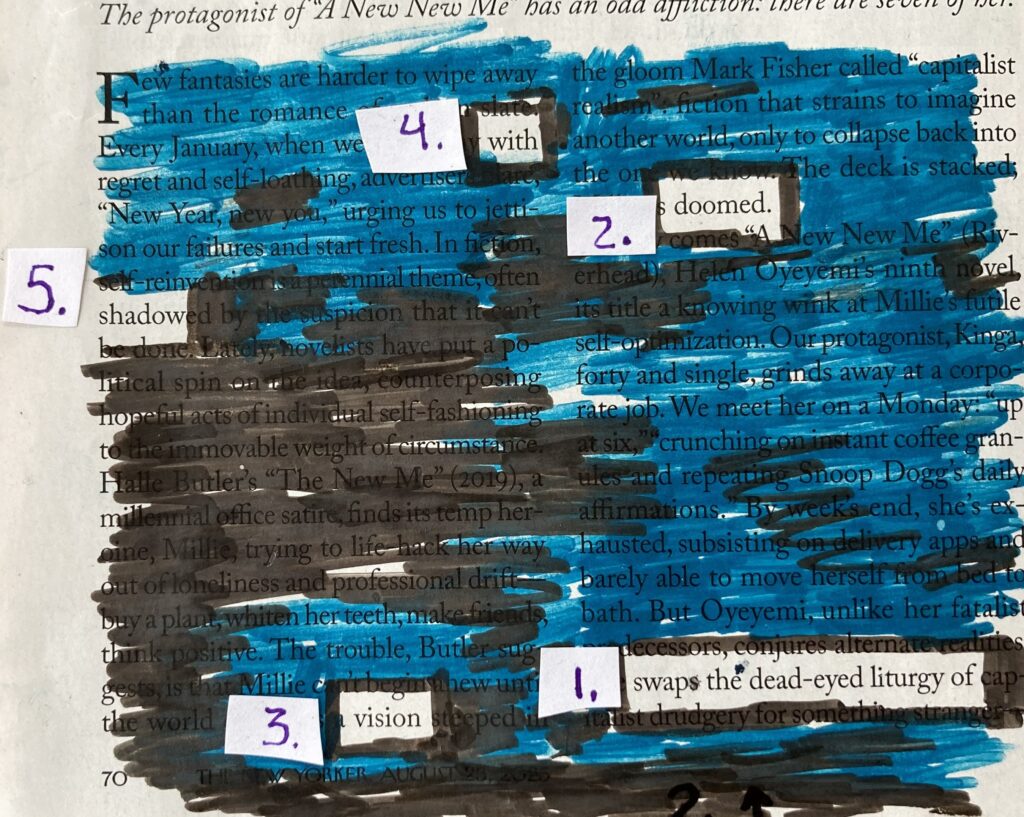
But before I move onto #4, I added some numbers to #3, so it was easier to follow the path of the poem:

text, moving from bottom  right to top right to bottom middle to top middle to mid left: 1. swap the dead-eyed liturgy of 2. doomed 3. vision 4. with 5. shadow

Experiment #4: A Screaming Skull / New Yorker 18 august 2025

text:

You may
feel
like a shadow.

Another name for
blind
is
a hole in the
vision

You may feel like a shadow.

I tried photocopying the pages from the New Yorker, but the quality is terrible. Also, I ran out of time. I like the idea of another name for blind is . . . but I could find the right words to fill that in. I’ll work on this one more tomorrow. I think that my theme for these is my vision.

march 4/WALKGETOUTICE

45 minutes
neighborhood with Scott and Delia
48 degrees

No sun today so it felt cooler. Mud and puddles mixed with bare grass. Noticed some bright green moss at the base of a tree. It was nice to take a walk with Scott; we haven’t done an afternoon walk like this in months.

a Rabbit recap*

*which is a summary, not a redux (revival). Rabbit Redux is the second book in John Updike’s series about Harry “Rabbit” Angstrom The first book is Rabbit Run, which I just checked out of the library.

This morning I reviewing all of my entries tagged, “rabbit” and seeing what I can find.

1 — 2 june 2019

Something there is that doesn’t love a wall,
That sends the frozen-ground-swell under it,
And spills the upper boulders in the sun;
And makes gaps even two can pass abreast.
The work of hunters is another thing:
I have come after them and made repair
Where they have left not one stone on a stone,
But they would have the rabbit out of hiding,
To please the yelping dogs. The gaps I mean
(The Mending Wall/ Robert Frost)

What a wonderful first line! The rabbits and the gaps — I wrote about this a few days ago in my rabbit eyes section. I am less interested in going down rabbit holes and more in exploring rabbit peripheries, in the shadows, on the edges, in the unnoticed corners. For me, this isn’t about hiding-as- prey, but about dwelling on the edges, near the exits and the entrances to other places.

2 — 20 aug 2020

Listen to the black capped chickadee’s 2 note song. 
Can you hear him posing a question to the gorge?
Can you hear the honking geese overhead?
Can you hear your lungs grasping for air
and the green leaves thickening as they hold us?
Can you hear the chainsaw start, the tight weave
of the savanna’s oak unraveling?
It’s August, thick, crowded. Listen 
to the path, cluttered with acorns. Listen
to the sewer stink near the ravine, the sex-crazed
gnats swarming the hill. Can you hear 
the virus spreading through the neighborhood?
Can you make a noise like a panicked rabbit? There are
sounds your tweet lacks names for.
(Homage poem to Helen Mort / Sara Lynne Puotinen)

Rereading this poem from that first pandemic summer, another word popped into my head: cornered, as in Can you make a noise like a cornered rabbit? Which is better? Not sure. I like this poem; maybe I should do something more with it? Maybe that something should involve hybrid writing about that summer? And maybe I should return to Mary Oliver’s Long Life for inspiration?

3 — 24 april 2020

Lisa Olstein’s unrabbited woods in “Dear One Absent This Long While.” Yours is the name the leaves chatter/at the edge of the rabbited woods. So good! I memorized this poem five years ago; I need to refresh my memory. Just did!

4 — 24 feb 2020

A cup holds
sugar, flour, three large rabbit breaths of air
(My Weather / Jane Hirshfield)

I love imagining how much air is 3 large rabbit-breaths worth. How big is this rabbit? And, in general, how big are rabbit breaths (from the 2020 entry)? Yes! A rabbit’s breath! I should look it up. Googled “rabbit breathing” and this listing of a rabbit’s vital signs1 came up first:

  • A rabbit’s body temperature should ideally be between 101.5°F and 104.2°F.
  • The normal respiratory rate for rabbits ranges from 30-60 breaths per minute.2
  • A healthy rabbit’s heart rate averages 205 and has a resting range from 180-350 beats per minute.

While sifting through links, including watching a brief video on how bunnies apologize to each other — they touch heads, and if the other bunny doesn’t accept the apology, they run away,3 I read a line about how rabbits are very smart mammals and then this: “The rabbit is commonly used as a laboratory animal for inhalation toxicology tests” (source). I wondered, do rabbits feel pain? “Rabbits have the same neurophysiological mechanisms as humans to produce pain and therefore have the same capacity to feel pain as humans” (source). How awful!

A few more random breathing facts: rabbits breathe through their noses; respiratory issues are a main cause of death; if a rabbit is healthy, their breath should not stink.

I didn’t have any luck when I googled, ” how big is a bunny breath,” but since they breathe a lot per minute, I imagine it’s fairly small. In the middle of writing this sentence I looked up “rabbit lung capacity.” One of the, People also ask, was, Are rabbit lungs good for dogs? The answer, “High-value: Rabbit Lung is considered a super food due to its nutritional composition,” comes from a site selling rabbit lung treats.

All of these results are reminding me of a line from yesterday’s research about how rabbits are unique in their position as both beloved pet and food source.

5 — 21 may 2023

This
is a poem in which no chickens will die. A rabbit
will bound across the road and the car will slow
in time. The fox will discover the trampoline behind
the house next door and with it the wonder of flight.
Everyone I love will live and call me after supper
to say goodnight.
(What I Am Telling You, Jessica, Is That Those Chickens Are Fine/ K.T. Landon)

I discovered this poem from a poetry person on twitter. It was part of their running list of “Not Today, Satan” poems. Have I ever noticed a rabbit road kill? I must have, but I don’t remember it. Near me, it’s mostly squirrel or raccoon roadkill. Anyway, I love this poem so much that I might need to memorize it. And, like I wrote in this 2023 entry, I might need to create my own “Not today, Satan” list!

6 — 15 april 2023

these are the
going closures that organize mind, allowing

and limiting, my mind’s ways: the rabbit’s
leaps and halts, listenings, are prosody of

a poem floating around the mind’s brush
(garbage / A.R. Ammons

This! For today’s entry, I only posted the rabbit part, but the rest of the excerpt I posted on april 15 is wonderful too. All about motion and our interactions with the land/our surrounding and how they shapes our motions. The halts and leaps and listenings of a rabbit as it responds to its surroundings — the terrain, predators, the weather. These are the rhythms and sounds of a poem (prosody) — not a poem on the page, but a poem in the flesh, a poem that is a living and breathing and moving creature being made by and making the world. So good! I say, I am a poem. A rabbit is a poem. Any and all of us who move through the world, responding to its winds and rivers and storms, is a poem!

  1. In a footnote, there’s a link to a pdf comparing vital signs of several different animals ( ↩︎
  2. The average human’s breathing rate (whatever average means here) is 12 – 25 breaths per minute. I’m not going to try counting mine because that would stress me out too much. I don’t want to think about breathing; I just want to keep doing it! ↩︎
  3. From another more reliable source (reliable = trained expert, cites sources), I discovered that this head touching idea is from the 2018 movie, Peter Rabbit. According to the Bunny Lady, rabbits might groom each other after a disagreement. But this begs the question, why do bunnies disagree? What does a bunny argument look like? ↩︎

Get Out ICE

Protest art around the cities:

The banners, flags and posters can be seen in storefronts and porch windows, on telephone poles and electrical boxes, in neighborhoods across the metro area. They are part of an explosion of art made in response to ICE’s presence that has included protest songscomics and zines and coloring books, snow and ice sculptures, stickers and buttons and whistles 3D-printed in every color of the rainbow.

Winning Hearts and Minds

Through this article, I found out about Heart Your Art and their ICE OUT posters and this event tonight at the Witch’s Hat:

This Wednesday, The ICE OUT Protest Posters take over the Witch’s Hat Water Tower for a one night outdoor projection.
.
Large scale. Public. After dark.

Instagram post

One of the posters from Heart Your Art struck a chord with me. The poster says, Believe Your Eyes, and it features the text in big block letters in the top half with two open eyes below it, and then a quote from George Orwell in smaller text at the bottom: “The party told you to reject the evidence of your eyes and your ears. It was their final, most essential, command.”

In the description of the poster, the artist writes:

It is important now, more than ever, to believe your eyes. You know what happened. Don’t let anyone tell you differently. The narrative is trying to sway you — to make you question yourself. You know the truth!

I deeply appreciate all of these posters and the artists who are designing them. I also agree with the call to resist the double-speak of the Trump administration and to never stop challenging the lies they present as truth.

And, I struggle with the privileging of sight and eyes as (the most) pure and reliable truth tellers. Eyes are not always reliable, and not just for people like me with low vision. As I’ve mentioned before on this log, eyes are not just cameras sending pictures to the brain. There is filtering and guessing and selective seeing — some things are seen, some ignored, some the brain filters out.

You might argue that this is not the point here and I would agree and disagree. Yes, there is a bigger message here about resisting manipulation and calling out fascist propaganda and trusting your own experiences of events. And yes, the inaccurate promotion of seeing/eyes as the way to access the truth, is easily manipulated by those in power. In the era of AI and the altering of images in such convincing ways that even my husband — whose attention to detail and nose for sniffing fakery out is very impressive — has been fooled, relying on eyes is not just wrong, it’s dangerous.

So, what would I like the poster to say instead? I’ll have to think about that; maybe I’ll try to collaborate with Scott on my own version? A preliminary response: Believe Your Eyes and Your Ears — which is what Orwell’s quote does; it’s not just looking/seeing but hearing and listening. I’m not satisfied with that as the solution, but I’ll leave it for now. I’ve already written abouteyes and witnessing on this log in different contexts, and I’m sure I’ll return to it again and again.

New Yorker experiment #3

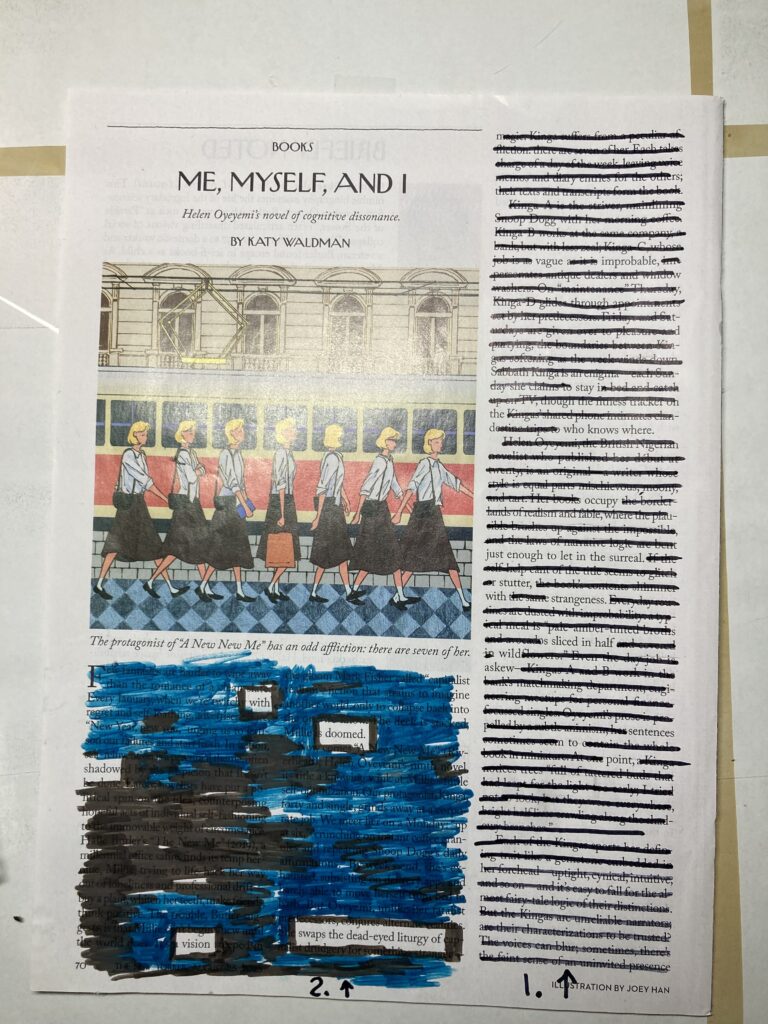
Today’s experiment comes from a book review in the 25 august 2025 issue titled “Me, Myself, and I.”

text:

1
point to
sentences
sliced in half
askew
wile
with strangeness.
Stutter
just enough to let in the surreal.

Occupy who knows where
stay
vague improbable

2
swap the dead-eyed liturgy of
doomed
vision
with
shadow

thoughts: Again, find markers that work before I start using them. Also, the second poem needs arrows but I didn’t know how to do that with the blackout. And, I wanted to add another word to shadow: reinvention, but I accidentally colored over it. Oops.

march 3/RUNGETOUTICE

5.2 miles
bottom of franklin hill
44 degrees

Another SPRING day! It felt so warm that halfway through the run, I took off my pull-over and ran with bare arms. No gloves, nothing covering my ears. Even with less layers I was warm. The walking path was clear enough that I was able to run past the Welcoming Oaks and the tunnel of trees. There were a few puddles and chunks and sheets of ice and for one stretch near the lowest point, snow covered almost the entire path. A few times my foot slipped a little but never enough to make me worry I’d fall.

I felt good and my legs felt strong. I was able to run up 3/4 of the franklin hill before I stopped for a walk break. The only part of me that hurt was one of my toes on my right foot. I was wearing different shoes than I normally do — a Saucony Ride instead of a Brooks Ghost — and something about this version of the has never worked for me. I’ve had these shoes for more than a year — 2 years? — and they always cause something to hurt, like my toe or my calf.

10 Spring Things

  1. open river! down in the flats, when I could get very close to it, I watched the small spots of foam as they slowly floated downstream
  2. sh sh sh — the sound of my feet running over the grit on the edge of the trail
  3. good morning! hello friends! — greeting the Welcoming Oaks
  4. the loud and steady sound of water rushing down over the ledges in the ravine
  5. a woman running in shorts and a jog bra
  6. mud, on the edge of the path — once, as I turned a corner, I stepped in it and almost twisted something
  7. whoosh! car wheels speeding through a puddle, water flying up
  8. along with the mud, bare dirt, some grass
  9. last week, running under the franklin bridge when it was even wetter than today, I noticed a black jacket on the ground, soaked. Today that same jacket was hanging from a branch, dry
  10. like yesterday, where there was ice on the path, there were also dead leaves — suddenly realized: someone from Minneapolis Parks had most likely spread the leaves as a natural way to make the path less slippery (as opposed to ice-melt and all of its chemicals)

Rabbits in Art

1 — Rabbit by Jeff Koons

I’m fairly certain that I’ve seen and/or heard of Koons’s Rabbit, but I only thought of it for this “rabbits in art” exploration when it came up in my google search.

DETAILS

Jeff Koons (b. 1955)
Rabbit
stainless steel
41 x 19 x 12 in. (104.1 x 48.3 x 30.5 cm.)
Executed in 1986.D

You can find the image, both close-up and to scale, on Christies auction house site. I’m choosing not to post the image in this entry because of copyright concerns. Even though my use of the image should easily fall under fair use.1

In 2019, this controversial sculpture sold for $91 million. Christies’ page for this auction item has a lot of good information about the sculpture — it’s history, significance, probably all of the citations to articles about it that you might ever need.

Here’s the opening paragraph of Christies’ essay about it:

Since its creation in 1986, Jeff Koons’s Rabbit has become one of the most iconic works of 20th-century art. Standing at just over three feet tall, this shiny steel sculpture is at once inviting and imposing. Rabbit melds a Minimalist sheen with a naïve sense of play. It is crisp and cool in its appearance, yet taps into the visual language of childhood, of all that is pure and innocent. Its lack of facial features renders it wholly inscrutable, but the forms themselves evoke fun and frivolity, an effect heightened by the crimps and dimples that have been translated into the stainless steel from which it has been made. Few works of art of its generation can have the same instant recognizability: it has been on the cover of numerous books, exhibition catalogues and magazines; a monumental blow-up version even featured in the 2007 Macy’s Thanksgiving Day Parade. For an artist such as Koons, who is so focused on widening the sphere in which art operates and communicates, Rabbit is the ultimate case in point.

Christies

Childhood — all that is pure and innocent. Fun and frivolity.

And here’s what Jeff Koons says about it, cited in Kurt Varnadoe’s essay for Art Forum, 1986: Jeff Koons’s Rabbit:

This snarky little thumper has other stories to tell too. Koons said, “To me the Rabbit has many meanings. It is a symbol of the playboy, of fantasy and also of resurrection.” (The joining of those last two terms alone can provide food for long thought, or skepticism.) “But to me, the Rabbit is also a symbol of the orator making proclamations, like a politician. A masturbator, with a carrot to the mouth.” 

1986: Jeff Koons’s Rabbit

2 — Rabbit as Symbol

Drawing from “Going down the rabbit hole” and “Rabbit as Symbol: The Significance of Rabbits in Dreams, Literature, and Art,” here are some things that rabbits represent:

  • mortality (They are born, live and die within a short time, in line with the seasons)
  • fertility / abundance / sensuality (their rapid breeding rate)
  • innocence and vulnerability (a prey animal)
  • the Diaspora (introduced to the UK from Spain by the Romans)
  • a reliable source of food (The ability to keep rabbits would mean a fairly consistent source of meat for a struggling family)
  • treasured pet2
  • magic/mysticism/wonder/curiosity
  • gentle
  • agile
  • playful

3 — Medieval Killer Rabbits

I mentioned Monty Pythons killer rabbit last week. It comes up again in this article about drawings of bad bunnies in medieval art.

Rabbits can often be found innocently frolicking in the decorated borders or illuminations of medieval manuscripts, but sometimes, for reasons unknown, these adorable fluffy creatures turn into stone-cold killers. These darkly humorous images of medieval killer bunnies still strike a chord with modern viewers, always proving a hit on social media and popularised by Monty Python and the Holy Grail’s Beast of Caerbannog, ‘the most foul, cruel, and bad-tempered rodent you ever set eyes on!’.

Medieval Killer Rabbits

I like this explanation for why bunnies were depicted as killers:

In real life, rabbits and hares are docile prey animals. But in decorated initials and marginalia, medieval artists often depicted ‘the world turned upside down’, where roles are reversed and the impossible becomes the norm. So here, rabbits are violent hunters hellbent on punishing anyone who has committed crimes against rabbit-kind.

Medieval Killer Rabbits
the Beast of Caerbannog

Last week when I mentioned Monty Python, I didn’t know they were referencing a trend in medieval art/manuscripts of rabbits behaving badly, I thought they made it up as a joke!

I think it might be time to synthesize/summarize some of this bunny information. But, that’s a project for this afternoon! Now it’s time for day two of my New Yorker Found Poem experiment!

  1. “Fair use allows limited, unlicensed use of copyrighted images for purposes like criticism, commentary, news reporting, teaching, scholarship, or research. It is a legal defense based on four factors: purpose (e.g., non-profit, educational), nature of the work, amount used, and effect on the market” (source). I have been unfairly fined before, for using an image on an academic blog (over $700 in 2012).   ↩︎
  2. “It is rare for a domesticated animal to be both considered food and a treasured pet” (source). ↩︎

New Yorker Found Poem Experiment #2

10:30 am — Before starting to work with an article, I decided to sort through RJP’s old markers and find ones that still work. At some point during the process, I realized that this looking through old markers was making me dizzy; something about it was too much for my brain and my cone-starved eyes. I stopped sorting. I should have taken a break, instead I did something else. A few minutes later, I felt woozy and needed to sit down. My hands were shaking and my legs felt tingly. My pulse was fine, but my blood pressure was elevated — 158. I think I was having a mild panic attack, triggered by the dizziness from my bad vision. Boo. It seems as if my anxiety is back. I had a nice stretch of a year+ without it. It also seems like I will need to be more careful with how I use my eyes. Too much trying to closely see something might trigger another one of these. Am I right in my assessment?

I am noticing that my vision has deteriorated more. It’s even harder to recognize the faces of actors on tv, harder to see my kids’ faces when they talk to me. Am I getting closer to the complete end of central vision?

Because of this incident, I did not start my second experiment this moring. Should I now, at 2:10 pm, or will it trigger more dizziness and anxiety?

Yes, I did it. I need to make sure I test out/find the right tools and be more deliberate in what I’m doing. I’m very messy — which is mainly because of my vision, but not completely. I’ve always been an almost and a that’s good-enough girl.

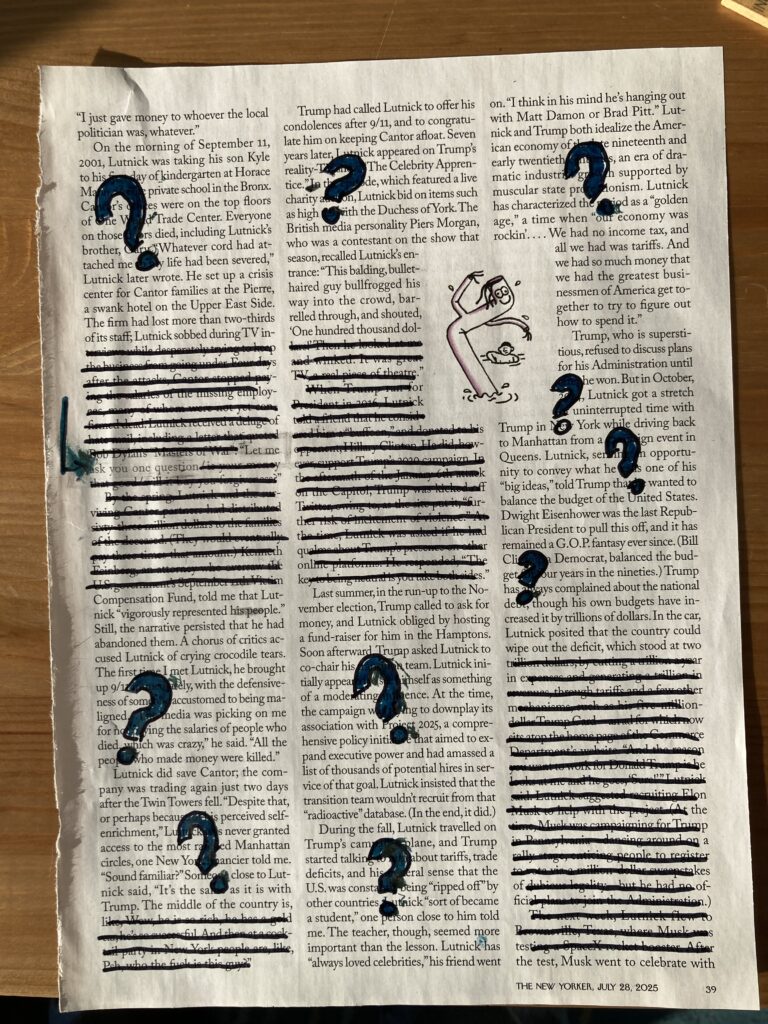
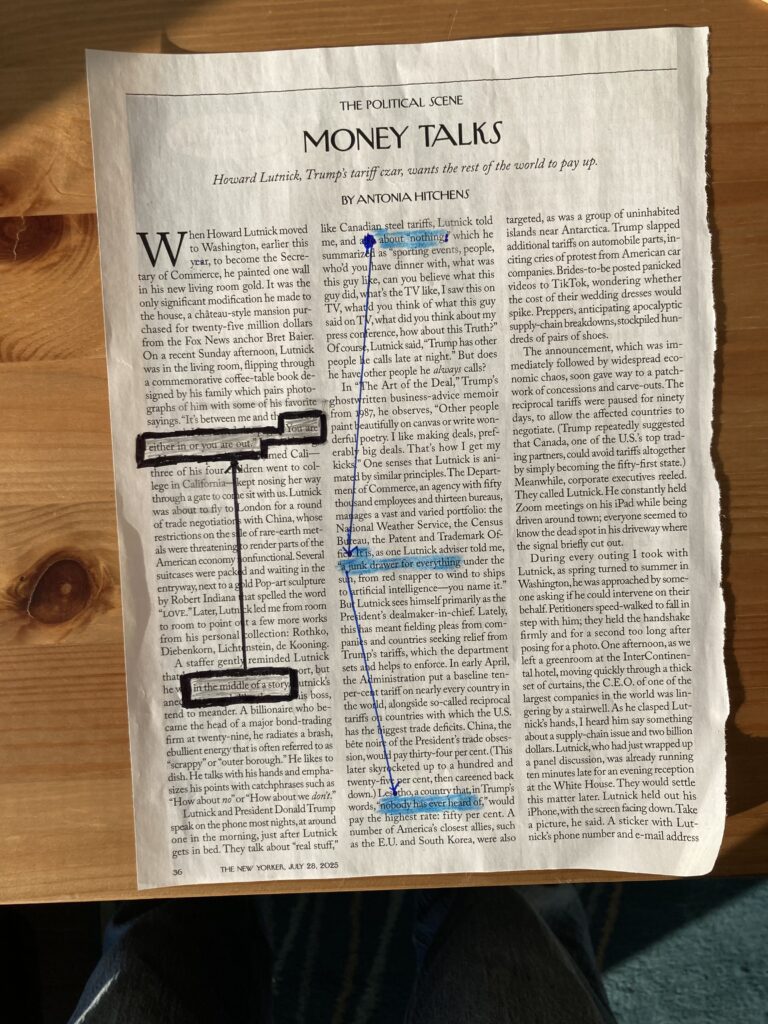
These poems are from a July 2025 article, Money Talks:

1 — Let me ask you a question

I like the idea of this, with all of the questions marks, but it is really sloppy and it doesn’t highlight the text that I’m using, “Let me ask you a question.” I would try this one again, but if I plan it more carefully and work on my question marks!

2 and 3

2: In the middle of a story, you are either in or you are out
3 — About nothing: it is a junk drawer for everything nobody ever heard of

Again, messy and poorly executed. I like that I used less words than the last one. I need to figure out a way to draw that I can do with my unreliable vision. It’s hard to see enough to color within the box or to draw straight lines, even with a ruler!

I like the idea of nothing as a junk drawer. It might make even more sense if I found a much, and could make nothing into nothing much.

I am listening to HCR’s politics chat for today and she said, as she often does, OOPSIE POOPSIE. I love when she says that!

march 2/RUNGETOUTICE

4.35 miles
minnehaha falls and back
39 degrees

Spring-y! Sun, above freezing, and a clear walking path! I was able to take the trail that dips below the road between the double bridge and locks and dam no. 1! Also: birds and grass and no gloves. A good run. I feel more power in my legs and able to run for longer without stopping. I heard kids on the playground, the call of a bird that sounded mechanical — similar to the strange, high-pitched siren I heard earlier today, and the doppler effect on the light rail bells as I ran south to the falls. I heard Panic at the Disco, Radiohead, Gene Autry, and The Jazz Crusaders on the way back home.

Speaking of hearing, as I write this at my desk, I can hear a woodpercker outside my window pecking on a tree in our front yard that I think is dead or dying. Every peck is saying, right right right right (you’re) right. Ugh! Is it time to call a tree service?

At some point during the run I thought about I wasn’t thinking about much of anything. Then I thought, the purpose of today’s run is not to work out a writing problem, or encounter some inspiration, but to move and breathe, feel the sun on my face, and be by the river.

10 Things

  1. a thin skin of ice on the river
  2. larger areas of the creek open with dark water, some snow stretching out from the banks
  3. an occupied bench! someone is sitting on the bench at the 44th street parking lot
  4. overheard: some guy talking to his two friends about something being only 2 loops — when I passed them a few minutes later, I noticed they had on shorts and running shoes on
  5. that same truck that seemed to be hiding under the bridge last week was back again today — why?
  6. a few parts of the trail that still had any ice or snow were also covered with dead leaves
  7. enough snow had melted so that I could cross the road and walk on a wide strip of grass instead of mud and snow
  8. vision mistake: up ahead of me, it looked like a truck was parked on the path, blocking the way. I crossed over to the parking lot then immediately realized the curve in the trail made it look like the truck was blocking it, but it wasn’t. Oops
  9. more people near the falls, more cars parked in the parking lot
  10. stopped at Rachel Dow Memorial bench to admire the view through the slender tree trunks and to take a few pictures.
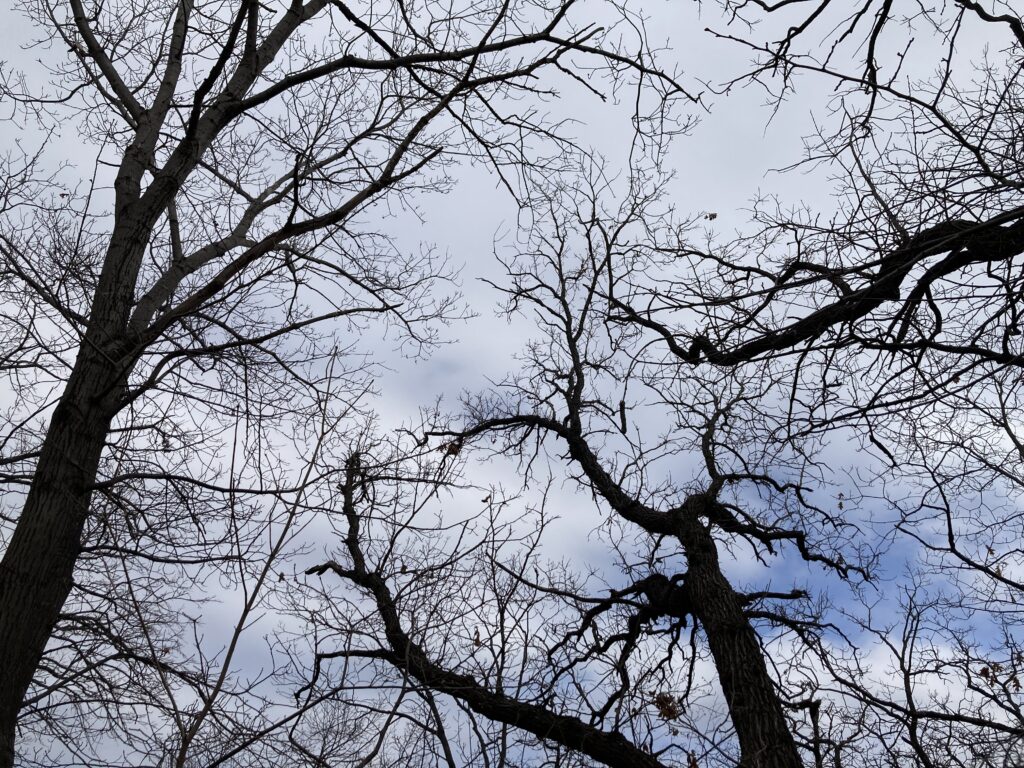
bare branches, some thick, some thin, against a gray sky with hints of blue
sitting beneath the bench looking up at the trees / 2 march 2026

more rabbits bunnies

It started on 20 feb, this occupation with bunnies.1 When will it end? Not today! Here are some more bunny things I’d like to archive:

1 — buuuuunnies

In footnote 1, I mention that bunny is fun to say. That might be partly because when I say it, I think of how Tom Haverford says it on Parks and Recreation2:

2 — Boynton Bunnies

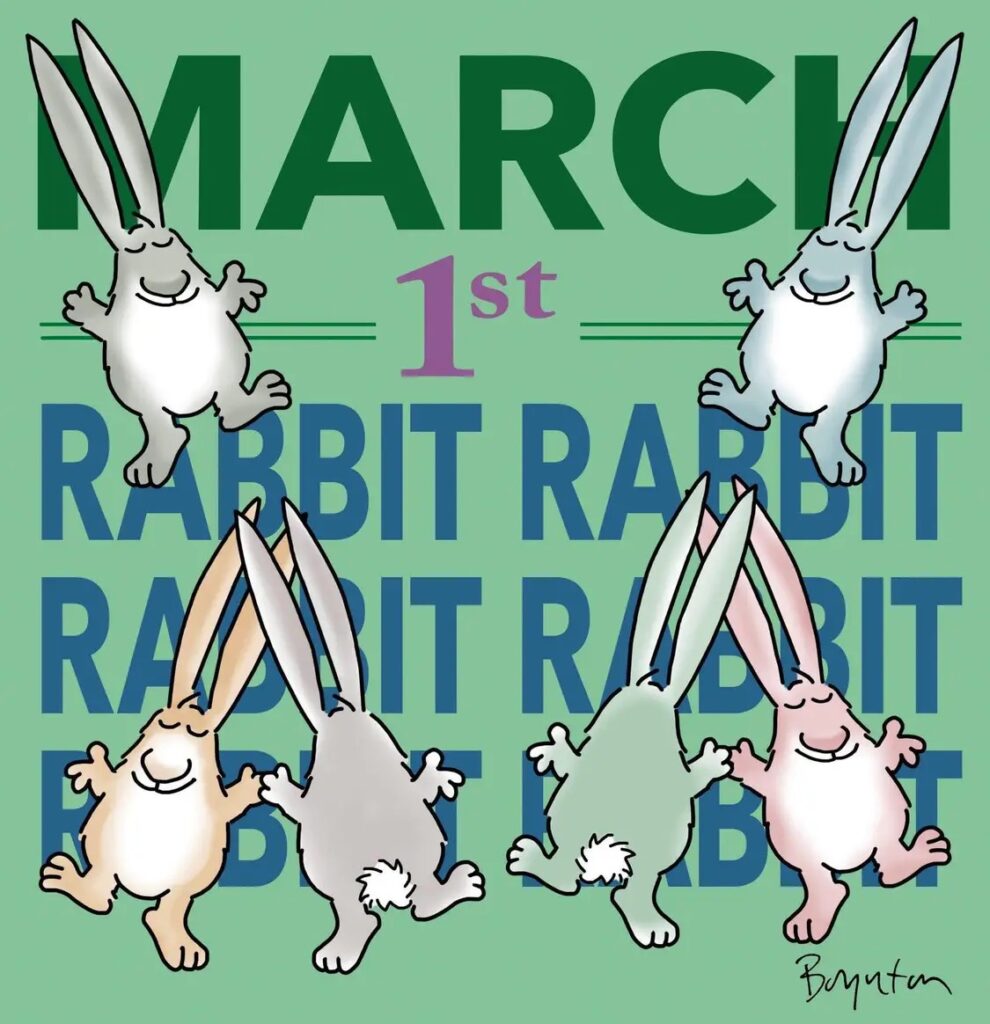
At first he was skeptical, but I’ve managed to get Scott thinking about and noticing bunnies and bunny-related things everywhere! This morning he sent me an image someone posted on social media:

text: MARCH rabbit rabbit rabbit rabbit combined with cartoon rabbits, looking cute (and not remotely real)
you say rabbits, and I say bunnies / you say comics, and I say funnies

Actually, I don’t say funnies — who says funnies? — but it worked for the reference to “Let’s Call the Whole Thing Off.” Is Sandra Boynton still popular in 2026? I remember her greeting cards in the 80s and her kids books in the aughts. What was the one with the cd/songs that FWA and RJP loved? did they love it? I can’t remember; I think they at least liked it, or was that just me who did? I think the book/album was Philadelphia Chickens.

In addition to sending me random bunny images he finds, Scott was willing to watch the Disney Alice in Wonderland, which was awesomely weird, and sadly could never be made now, I think. Some of the nonsense in it, which was fabulous, reads not as kooky kid imagination but as being under the influence of psychedelics. There was also this menacing edge to the characters Alice encounters: they seemed fun or dangerous at any given moment. Two examples: the flowers in the garden — that head Rose! — and Tweedle-dee and Tweedle-dum — doing fun acrobatics but also stopping Alice from leaving.

3 — the Bronze Bunny

Their official name is “Cottontail on the Trail” because they are a bronze statue of a cottontail and they are right on the minnehaha bike trail, but I always call them the bronze bunny. Other people call them the Minnehaha Bunny.

The sculpture has garnered the nickname of the “Minnehaha Bunny” from residents.[4] Children often climb on the sculpture and people who live nearby have frequently costumed and decorated it based on seasonal occasions or topical events such as leaving eggs by the sculpture during Easter or cladding the mouth of the sculpture with a large cloth face mask during the COVID-19 pandemic.

Wikipedia entry

I’ve written about this bunny on here before. They’re 4.5 or so miles from my house so I only see them on bike rides and long runs when I am training for the marathon. Passing the bunny on a run is a big deal; it means that I’m fit enough to run for 10 miles or more.

This bunny was erected in 2002, but it seems like it’s been here much longer.

  1. I’ve tried to say rabbits, but I just like bunnies better. I think it’s partly because of how it sounds as I say it. ↩︎
  2. Finding and creating this clip took WAY longer than it should have. I kept at it because I was determined to get the clip, not because Tom saying “buuunnies” was worth it (I think I spelled buuuunnies with one n in my title, ugh), but because I wanted to figure this out. Before losing most of my cone cells it was so much easier to do stuff like this. ↩︎

Get Out Ice

Here’s an example of an existing group using their established community to provide mutual aid and support to people during the ICE occuption: How a Dungeons & Dragons meetup turned into mutual aid during ICE operations. Members have organized “know your rights” workshops, accompanied immigrants to appointments, coordinated food donations, and made barbecue for families in need.

This quotation fits with the erasure poem I’ve been working on this morning:

“In a story, you can be the underdog who defeats the big, bad, evil entity,” said D&D player Kat Hennan. “I think that having that kind of thought exercise and storytelling right now is extremely important.”

New Yorker Found Poetry Experiment, Day 1:

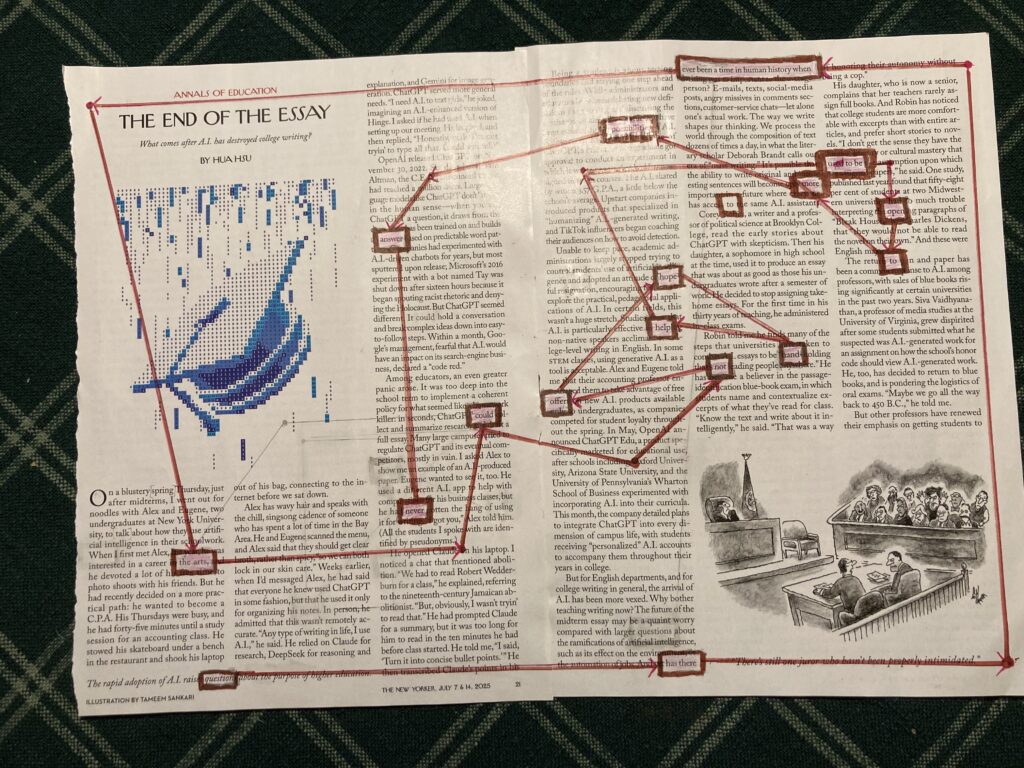
Picked a random old New Yorker. Found an interesting article, “The End of the Essay: What comes after A.I has destroyed college writing? / Hua Hsu. Put my watch timer on for 30 minutes.

Poem:

question: Has there ever been a time in human history when the arts could not offer hope and help us to be open to more possibilities?
answer: Never

A good first try. It’s funny that I want to do these visual poems when I struggle so much to see the words or how to make the boxes and lines that I need, but something in me keeps persisting, so I’ll keep trying. Hopefully it will get easier.

It’s messy — and with my vision, it will always be. and I added an extra to that’s just floating out there, disconnected. It’s too busy with too many lines. But it was fun and challenging and I like the poem I came up with a response to an article about AI ruining college writing.

When I showed it to Fletcher, he liked it and said there were ways to refine it. I agree, but not to this poem. I wrote on the original essay and I don’t have another copy. The question: next time should I scan the essay before drawing on it, or is the risky (you only get one shot) approach part of the challenge and the fun?

note: I also need to learn how to take better pictures of my work!

march 1/GETOUTICE

March? March! We’ve made it to March, and March, as I told FWA last night, is a spring month. Weather-wise it will still be winter in Minnesota for 1 or 2 more months, but March is in spring.

Bunny Ears / Rabbit Ears

All of this rabbit exploration is fun and wonderfully distracting. I thought I’d start out today with ears. Last night, I made a note in my Plague Notebook 271: Liam’s bunny ears, Louise’s bunny ears, rabbit ears on top of a tv.

1 — Liam Conejo Ramos and the bunny ears

A widely shared photograph of 5-year-old Liam Conejo Ramos has come to represent ICE’s “Operation Metro Surge” in Minnesota. 

The boy is wearing a knit bunny hat complete with floppy white ears, while an ICE agent stands behind him and pulls slightly on his Spider-Man backpack. 

There have been conflicting stories about how Liam and his father, Adrian Conejo Arias, were detained by ICE at their Columbia Heights home. The differing versions pit local school officials and observers on the scene against federal immigration agencies. 

Mother of Liam Conejo Ramos / ICE detains 5 year old

The conflicting story here is that school officials and observers claim that little Liam was detained by ICE on his walk home from school and used as bait to get his family to open the door. ICE agents claim his father abandoned him as he fled, and that they were protecting him from the cold. Even though there were many adults who could have and wanted to take custody of Liam, ICE took him and his dad and sent them to Texas concentration camp.

In the twin cities and around the world, people were outraged by these actions and moved by the photo with the bunny ears. One example: activists have been crocheting the hat and spreading the pattern online for others to crochet too:

“[Liam] is one of many, but his sweet bunny hat has become an enduring symbol for those of us who oppose the cruelty of this administration and the unchecked violence being perpetrated against our neighbors. There are a lot of tears woven into this silly bunny hat,” the crocheter wrote on social media.

If you want to make your own hat, I think that would be amazing. I would love to see a line of protesters wearing bunny hats, or like-minded individuals putting love out into the world.”

Crocheters make blue bunny hats to honor Liam Conejo Ramos

2 — Louise Belcher and her Bunny Ears

The youngest Belcher on Bob’s Burgers always wears pink bunny ears. Why? Apparently it is explained in the movie, which RJP has been trying to get us to watch for more than a year. I guess we should. Another thing to watch: the episode in which the bunny ears are stolen, “Ear-sy Rider.” Okay, I found the clip on Youtube:

Louise and the bunny ears

In the example of Liam, the bunny ears represent vulnerability — Liam as little and innocent and the ICE actions as a terrible violation. What do they represent for Louise? I’ll have to watch more of the Bob’s Burgers movie to understand that, but it seems like she thinks they represent vulnerability and weakness — she’s thinks she wears them because she’s not brave — but they actually represent a quirkiness she shares with her grandmother. That’s what I got from the clip; I’ll have to wach more of the movie to get a better understanding.

3 — rabbit ears as tv antenna

When I think of rabbit ears, I think of the little antennas2 you put on top of your tv when you don’t have cable. We still have a pair for our upstairs tv.

Marvin P. Middlemark (September 16, 1919 – September 14, 1989) invented the Rabbit Ears television antenna (dipole antenna) in 1953 in Rego Park, Queens, New York. Marvin P. Middlemark revolutionized how television was watched in the United States, as his Rabbit Ears increased the television signal reception made available to the mass market; this move is considered by many as the single most important reason for the television boom of the late 1950s – 1960s.

fandom

4 – rabbit ears — how rabbits hear

Reading about rabbit hearing, I found these two little sad sentences —

The outer ear, known as the pinna, is very different because rabbits need to rely more on their hearing to detect predators. Domestic rabbits can suffer from hearing problems due to selective breeding for a ‘cute’ look.

Hearing in Rabbits

— and this delightful image —

The outer ear also acts as a radiator: rabbits can’t sweat like we do, or pant like dogs, so regulate their temperature by pumping blood into their ears.

Some other things I read about rabbit ears: rabbits can swivel their ears; rabbit ears are kept up by interlocking cartilage, some rabbits can’t keep their ears up because they have a gap in the cartilage (called lopping, and the floppy eared rabbits are called lops); according to a study, rabbits like chill classical music, soft new age, and probably Kenny G (ugh!).

a few more rabbit ears: putting your fingers up in the dark and creating bunny ears with the shadow; doing “bunny ears” as you sing “Little Bunny Foo Foo”; the They Might Be Giant’s refrain, hammer down / rabbit ears, in their song “Rabid Child”

bunny ear silhouette

Writing this last bit I wondered, are the ears the defining shape of a rabbit silhouette? Yes, I think so. Those ears are very distinctive and particular to the animal. The distinctive quality of this shape returns me to my vision: To identify/recognize things, I often rely on their silhouette and its most distinctive features. All I need to see are those two ears and I can tell, rabbit. Now, that’s true for drawings of rabbits, is it true in recognizing them in my yard? I’m not so sure. I’ll have to think about that some more — maybe try to notice what I see when I see something in the yard and think, rabbit (or more likely, bunny).

  1. Just a few more pages to fill before I’m onto vol. 28. I’ve been filling these up since just as the pandemic began, hence the name, the Plague Notebook. ↩︎
  2. Doing some more digging on antennas, I discovered that rabbit ears are used for VHF channels, while a loop and bowtie antennas are for UHF. VHF = longer distances / UHF = better quality ↩︎

a found poem experiment/practice

At any given time, I have A LOT of ideas for experiments buzzing around in my head. Many of them make it into this log as things I’d like to try. Some of them, I try. And a few of them become a dedicated experiment, then a monthly project, then an obsession, then a poem or a series of poems or something even bigger. I rarely predict what will stick and what won’t, and when that might happen. I like living in geologic time — slow and long. Working on something for five or more years is not unusual!

For several months, the idea of doing more erasures has been buzzing around. The recent fascination started with my discovery of Lisa Olstein’s latest collection, Distinguished Office of Echoes — I checked; I discovered it on 20 dec 2025. I should archive all of this (this = discussions, links, ideas, quotes) on one page soon, when I have time. Since that rediscovery, I’ve been thinking about found poems — centos, erasures, white-out, cut-outs, which led to do my series of found love poems about love in the time of (ICE) occupation. Yesterday I mentioned erasure poems again in my Plague Notebook, and this morning I happened upon (following a rabbit search — rabbit Marie Howe — down a rabbit hole) a found poem collection by Annie Dillard. I’ve already requested it from the library!

Last night, a problem: I’d like to do more erasures and try cut-ups, but almost all of the text I find/use is online. What can I do about that? My first solution before going to bed: I should go to thrift stores, used book stores and buy cheap and old used books. My second thought during the purple hour: go to the basement and find that box of old books that I haven’t had time to donate yet. My third thought while down in the basement when I couldn’t find the box: look through the kids’ old books, especially the crappy paperbacks. And my latest thought after gathering some books and as I walked up the stairs: use the ridiculously tall stack of old New Yorkers on the bookcase in the front room! So, that is what I hope to do. I’d like to make it a daily practice — as inspired by Mary Ruefle and her erasure practice. I think I’ll start with the New Yorkers because I have more of them, and once I’m more practiced, I might move onto the books. It’s the first day of March, so I’d like to make this my March challenge.

the preliminary rules for week one: pick (randomly?) 2 pages from the New Yorker, read them several times, then use them to write a sentence or a short poem — link them with dots, lines, and arrows.

Get Out Ice

In the middle of the night, scrolling through Instagram, I found out about the Kaleidoscope of Love Art Mobilization. It happened yesterday afternoon at Powderhorn Park. I wish I would have known about it; I would have tried to go and be a part of it.

YOU are invited to participate in a choreographed movement of more than a thousand people holding colored placards to the sky to create a gigantic open-winged butterfly, surrounded by poetry and choral singing.

Kaleidoscope of Love is a celebration of you; of Minneapolis and Saint Paul; of neighbors who check in, deliver groceries, shovel sidewalks, walk kids to school and friends to work, sing, march, and offer comfort and care. We invite you to celebrate our city at Powderhorn Park in South Minneapolis to lift that spirit of community into the sky, forming a living butterfly in a joyful, shimmering mosaic of color, co-created by you, your neighbors, family and friends.

Lowry Hill Neighborhood (found this action here before finding the project site)

Kaleidoscope of Love was designed the public artist, Christopher Lutter-Gardella. Wow! He also created a giant heart for We Defend the Heart, among many other public art installations/mobilizations.

feb 28/RUNGETOUTICE

3.95 miles
wabun hill loop*
20 degrees

*wabun loop = river road, south/ go down locks and dam road / go up the steep hill that leads to wabun / through the park and back down to the river road / river road, north

future Sara might want to remember this, present Sara hopes it’s more like Venezuela, less like starting WW3: Trump, without approval from Congress, and Israel bombed the hell out of Iran last night or early this morning.

Colder today, but hardly any wind or sun. Last night the temperature dropped so quickly that there was a very wide ring around the moon. Showed it to Scott and he said it was a moon dog. I don’t recall ever seeing one of these before. Yesterday meteorologists were predicting snow today/tonight, but the forecast has shifted again. No snow, just cold.

My legs felt awkward for the first 5 minutes of the run, but then I warmed up and they felt better. By the third mile, they felt strong and efficient. It feels like I have more energy and power in my legs. Are the iron pills I’m taking to raise my ferritin working, or is it just a placebo effect?

When I got to the lock and dam no. 1, I decided — just seconds before I did it — to turn and run up the steep hill that leads to Wabun Park. It was mostly covered in ice, but also dead leaves, so it didn’t seem too slippery. As I neared the top, I walked for a stretch. At the top, I stopped to admire the view through the chainlink fence of the river and the island and the St. Paul side, then I walked until the ice had stopped. In the park, there were several small ice rinks where melted water had refroze.

10 Things

  1. someone was on the frisbee golf course at Wabun park — I couldn’t quite see, but I’m assuming they were playing
  2. at the top of the bluff, a big stretch of the paved path was covered in a thick sheet of ice
  3. also at the top of the bluff, on the other side neared to the park, there was a small clearing with a decomposing trunk and thick logs — do people come here to sit at night and watch the lights on the bridge?
  4. the hill leading up to wabun was mostly thin layers of ice mixed with thick, jagged layers of ice, butat least part of the trail was coated with dry leaves
  5. although there were walls of snow or thick chunks of ice at some of the entrances and exits, the walking paths were mostly clear
  6. empty benches, empty parking lots
  7. running, looking down at the winchell trail and seeing a person walking — they looked so far down, I felt so high up
  8. stopping to walk on the double bridge, hearing the loud shuffling of a runner’s feet approaching from behind
  9. do I remember any color, or was it all just pale gray and white today?
  10. the low rumble of a LOUD truck driving too fast on the river road

Like yesterday, I don’t remember what I listened to when I wasn’t listening to headphones and my “Bunnies and Rabbits” playlist. Traffic? The shuffling of my own feet? No birds or bells or fragments of conversation from other runners or walkers. A memorable song on my playlist: The Young Rabbits / the Jazz Crusaders

Rabbit Eyes: how they se, what they see

Rabbits have 3 eyelids, 3 tear glands, one tear duct. They rarely blink — only 12 times an hour — and can sleep with their eyes open which helps keep them safer. How? It

allows their light receptors to remain active. If a predator nears, their brain receives signals faster, enabling a quicker response than if their eyes were closed.

Rabbit Eye: a Complete Guide

To see without actively seeing. Two immediate thoughts: 1. I’m fascinated by passive seeing and how it works in the human brain (especially mine) and 2. how exhausting to sleep with your eyes open! I’d like to learn more about how this works.

How to tell when a rabbit is sleeping? Their nose stops twitching.

Here’s something I have in common with rabbits: they can’t see red and have a lot less cone cells than a normally sighted human. I can see red, but not that often. Also, they rely more on rod cells (and they have more of them than humans) and see better (best?) in low light. Peripheral vision!

rabbit eyes were built to excel in low light situations. Rabbits are usually the most active in the hours around dawn and dusk, when it’s not too bright out but also not pure darkness. This is a time of day when rabbits have the advantage over both predators that are nocturnal and see best in the dark, and predators that are diurnal and see best when there is bright light. 

7 fun facts about rabbit eyes / the bunny lady

Crepuscular!

360 degree view: “the rabbit visual system is designed–not for foraging and locomotion–but to quickly and effectively detect approaching predators from almost any direction. The eyes are placed high and to the sides of the skull, allowing the rabbit to see nearly 360 degrees, as well as far above her head” (What Do Rabbits See?)

Rabbits have a blind spot in front of their face.1 Like me! I wonder how the sizes of our blind spots compare? “The central blind spot in the rabbit’s field of view precludes a three-dimensional view of nearby objects. When your bunny cocks her head and seems to be looking at you “sideways,” she is actually looking as straight at you as is possible for a bunny” (What Do Rabbits See?). Sideways! Periphery! Me too. To really see something straight on, like where eyes are on a face, I need to look off to the side, at a shoulder. Sometimes when I watch tv, I look off to the edge of the screen to see what’s happening in the center.

And this!: “The image formed by the area centralis is relatively “grainy” compared to the one formed by your (normally sighted human with all cone cells intact) fovea, but it serves the rabbit well. Using this image, your voice, body movements and scent as cues, your rabbit can recognize you (his favorite human)–as long as you’re not carrying a scary box that completely changes your familiar shape!” (What Do Rabbits See?). Yes! Sometimes, like when I’m in a store and have separated from whoever I’m with, I use a combination of voice, body movement, overall silhouette, known distinctive features — like glasses or haircut or unusual dress — to identify them. My sense of smell is not good enough to identify by scent, though.

lack of depth perception and parallax motion: “rabbits have evolved in creative ways to overcome this limitation, enhancing their ability to spot predators and make a quick escape. Rabbits employ a method known as “parallaxing”, moving their heads back and forth to gauge the distance and size of distant objects” (Rabbit Eye: A Complete Guide). Sometimes I have trouble with depth perception. Could I use parallaxing to help me navigate better? I googled, “Can visually impaired humans use parallax motion to detect depth.” Yes! I should practice this parallaxing when I’m out running above the gorge! I found this answer on a Reddit thread that was started with this question, if we need both eyes in order to see depth (depth perception), why is it also possible to see said depth when you close one eye? What a useful thread about how our brains fill in gaps and determine depth based on patterns and a library of known depths. And even better than this thread, here’s an article about a scientific study that was designed to explore and answer the question, “Can people with different forms of low vision use motion parallax to improve depth judgments?” The answer? Yes! And many people with low vision use it without realizing. And it should be introduced to people with low vision as a tool early on in their vision loss. And not enough research has been done on it. This study is from 1997. Has more research been done since then? Has it been adapted by low vision educators?

Here’s something I found from Duke Health in 2013. It’s specifically about low vision as having vision only in one eye, but it’s still helpful:

Adults who lose vision in one eye also have more collisions when walking, especially on the side where they lost the vision. That’s where sessions with an orientation and mobility specialist can help.

“The emphasis is on helping people to judge distances by using monocular clues, such as something called motion parallax. If you’ve ever seen a cat moving its head or eyes side to side before it jumps, that’s motion parallax,” Dr. Whitaker said.

Duke Health

Returning to the parallaxing quote: “This behavior is less common in familiar environments (such as their home), as rabbits memorize their surroundings. However, introducing a rabbit to a new home or a new furniture layout often prompts this scanning technique during initial explorations.” Yes! I’ve memorized my surroundings, which has made it easier to navigate both my physical environment and my new reality of living with a lot less vision — inside my familiar world, I am far less aware of a loss. New environments can be scary, unsettling, upsetting. I need to be brave2 and build up skills and explore new environments.

This last sentence, and footnote 2 below, highlights something that I am doing with my poetry/attention/moving practice. Not only am I working on my craft (writing poetry) and increasing my capacity for care and attention and my commitment to where I live and the many creatures I live with, I’m also acquiring tools and learning how to see in new ways. For example, today I’m studying rabbits in a wide range of ways because it’s fascinating and delightful and because how they see shares some similarities with how I see. Like the bat (and echolocation), rabbits offer strategies for seeing with less (or without) central vision.3

hinged skulls/big feet: “When they do smell, see or hear a predator, rabbits have to be able to make quick escapes. To help with this bunnies have very large back feet, and hinged skulls to absorb shock. Their cranial hingeallows rabbits to run at speeds above which the impact of their feet would rattle their brain around” (Rabbits have hinged skulls).

family:  Leporidae / order: lagomorpha / backyard rabbits: eastern cottontail, sylvilagus floridanus

Looking through the wikipedia entry for eastern cottontails, I found this about habitat:

The eastern cottontail is a territorial species that relies on speed and agility to evade predators. When chased, it typically escapes in a zigzag pattern and can reach speeds of up to 18 mph (29 km/h). Cottontails favor habitats where they can feed in the open but quickly retreat to cover when threatened. Preferred environments include forest edges, swamps, brushy thickets, hedgerows, and open fields with nearby shelter. Instead of digging burrows, eastern cottontails rest in a form—a shallow, scratched-out depression in grass or beneath dense vegetation. . . .

The rabbit eye in A Young Hare

There was a moment in the year 1502, so the story goes, that the eye of a dead rabbit reflected the real window of Albrecht Dürer, who, with his watercolors and genius and passion for detail, painted that eye with the window in it. It then became art, and, then, art again: the painted eye with the painted window in Diane Seuss’s “Young Hare” that connects the artist to the poem’s speaker. “Why does the window feel so intimate in the hare’s unreadable eye?” the speaker asks, and the answer is that the window in the eye represents a straddling between worlds, between then and now, between artist and viewer, between life and art.

Diane Seuss

I’ve tried looking at the painting online and my eyes cannot offer enough detail to see the hare’s eye and the window in it. I have read Diane Seuss’ poem about it, The Young Hare, and believe I don’t need to see the eye myself to understand its significance or its beauty.

The Young Hare / Diane Seuss

Oh my love, Albrecht Dürer, your hare

is not a spectacle, it is not an exploding hare,

it is not a projection of the young hare

within you, the gentleness in you, or a disassembled hare,

nor a subliminal or concealed hare,

nor is it the imagination as hare

nor the soul as a long-eared, soft-eared hare,

Dürer, you painted this hare,

some say you killed a field hare

and brought it into your studio, or bagged a live hare

and caged it so you could look hard at a wild hare

without it running off into thorn bushes as hares

will do, and you sketched the hare

and laid down a watercolor wash over the hare

and then meticulously painted-in all the browns of hare,

toast brown, tawny, dim, pipe-tobacco brown of hare,

olive, fawn, topaz, bone brown until the hare

became dimensional under your hand, the thick hare

fur, the mottled shag, the nobility of the nose, the hare

toenails, black and sharp and curved, and the dense hare

ears, pod-shaped, articulated, substantial, erect, hare

whiskers and eyebrows, their wiry grace, the ruff of hare

neck fur, the multi-directional fur over the thick hare

haunches, and did I say the dark inside the hare

ears, how I want to follow the darkness of the hare

and stroke the dark within its ears, to feel the hare

ears with my fingers, and the white tuft, the hare

anomaly you painted on its side, and the fleshy hare

cheeks, how I want to squeeze them, and the hare

reticence, how I want to explore it, and the downturned hare

eye, it will not acknowledge or appease, the black-brown hare

eye in which you painted the reflection of a window in the hare

pupil, maybe your studio window, in the hare’s

eye, why does that window feel so intimate in the hare’s

unreadable eye, why do I press my face to the window to see the hare

as you see it, raising your chin to look and then back to the hare

on the page, the thin hair of your brush and your own hair

waving gold down your back, hair I see as you see the hare.

In the hare’s eye you see me there, my swaying black hair.

Oh, I love this poem and how it allows me to reflect on what it means to study/explore/be inspired by something and someone.4 And what wonderful work she does with her linking of hare with the hair of the paint brush, the hair of the artist, the hair of the person viewing the painting/writing and reading? the poem!5

  1. They also have a blind spot in the center of the back of their head, preventing full 360 degree vision. ↩︎
  2. I don’t usually like the use of the word brave to describe how I’m navigating new ways of seeing — as in, someone responding to hearing that I’ve lost vision with, you’re so brave! As if just continuing to exist with such a diagnosis, which they really imagine as a death sentence, is being brave. But seeking out unfamiliar situations that frighten/unsettle me in order to get better at navigating because I want a fuller life is me being brave. ↩︎
  3. Additionally, the language used to describe how low light animals see/navigate can be helpful in understanding and communicating to others the strange ways I see. Maybe I can borrow that language as I try to describe how I see? ↩︎
  4. Taking this discussion back to its origins a week ago, I’m returning to the muse. I don’t see the rabbit as my muse, but as both a gate — an opening — and a teacher. ↩︎
  5. Reading this poem is making me want to read Seuss’ “Two Dead Peacocks” collection again, and more closely, as part of my ekphrastic project. I just ordered it from Moon Palace Books! ↩︎

Get Out Ice

As a reminder of some of the ways Minnesotans have resisted ICE this winter, Racket offered this list:

Fifty-thousand people thronging the streets of downtown Minneapolis in subzero temperatures to protest ICE’s presence in the Twin Cities. Thousands more pedaling their bikes through south Minneapolis, many in “peaceful observer, don’t shoot” vests, to honor a cyclist killed by state violence. Massive papier-mâché puppets presiding over rallies and memorials as brass bands play songs of liberation, and luminaries on frozen lakes spelling out messages like “ABOLISH ICE” and “ICE OUT 4 GOOD.” 

Anti-ICE Ice Fishing, Subzero Marches, and Art Sled Activism: A Winter of Protest in the Twin Cities

The rest of the article describe the bike ride, sponsored by Angry Catfish, in honor/memory of Alex Pretti.
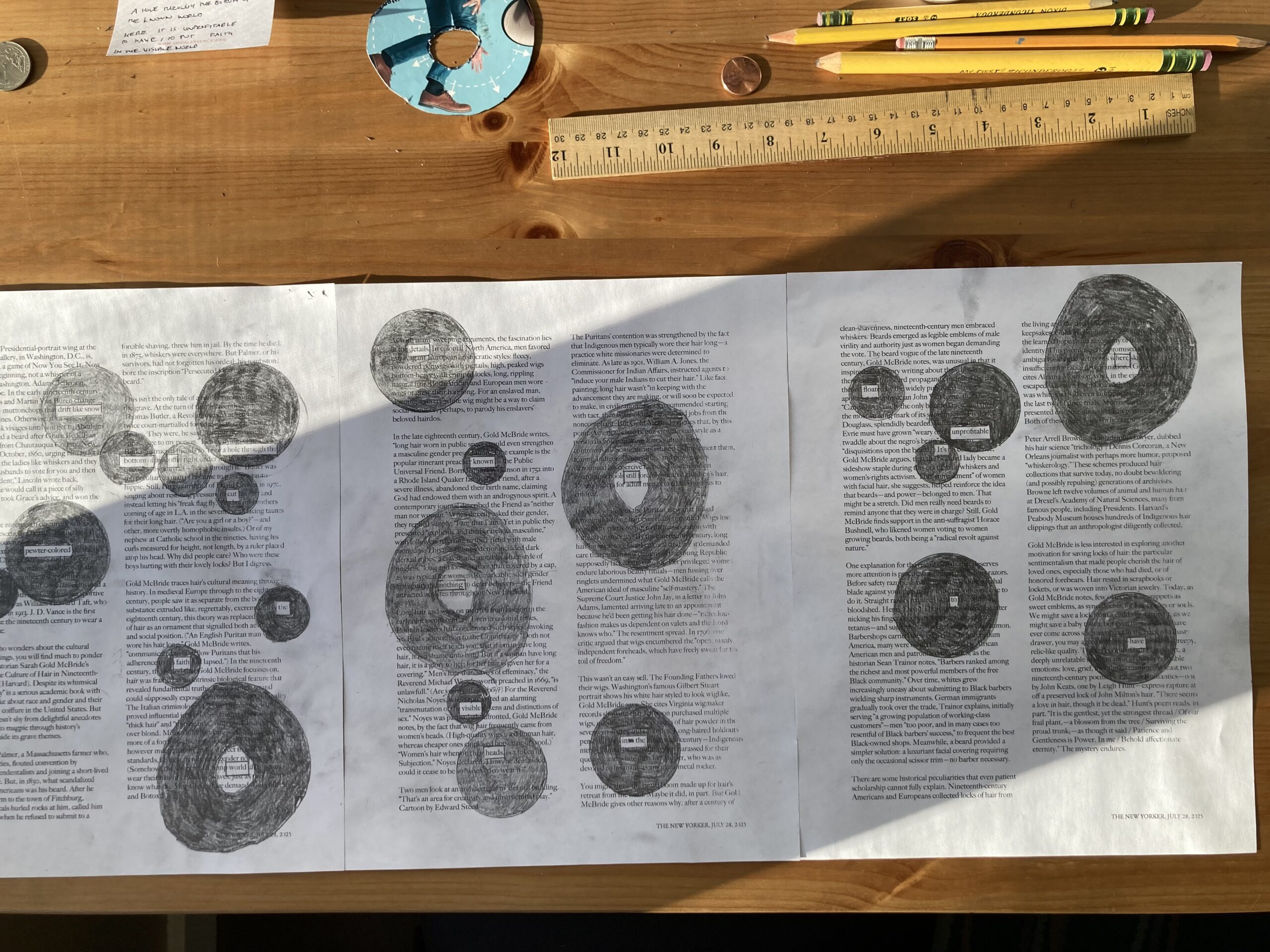
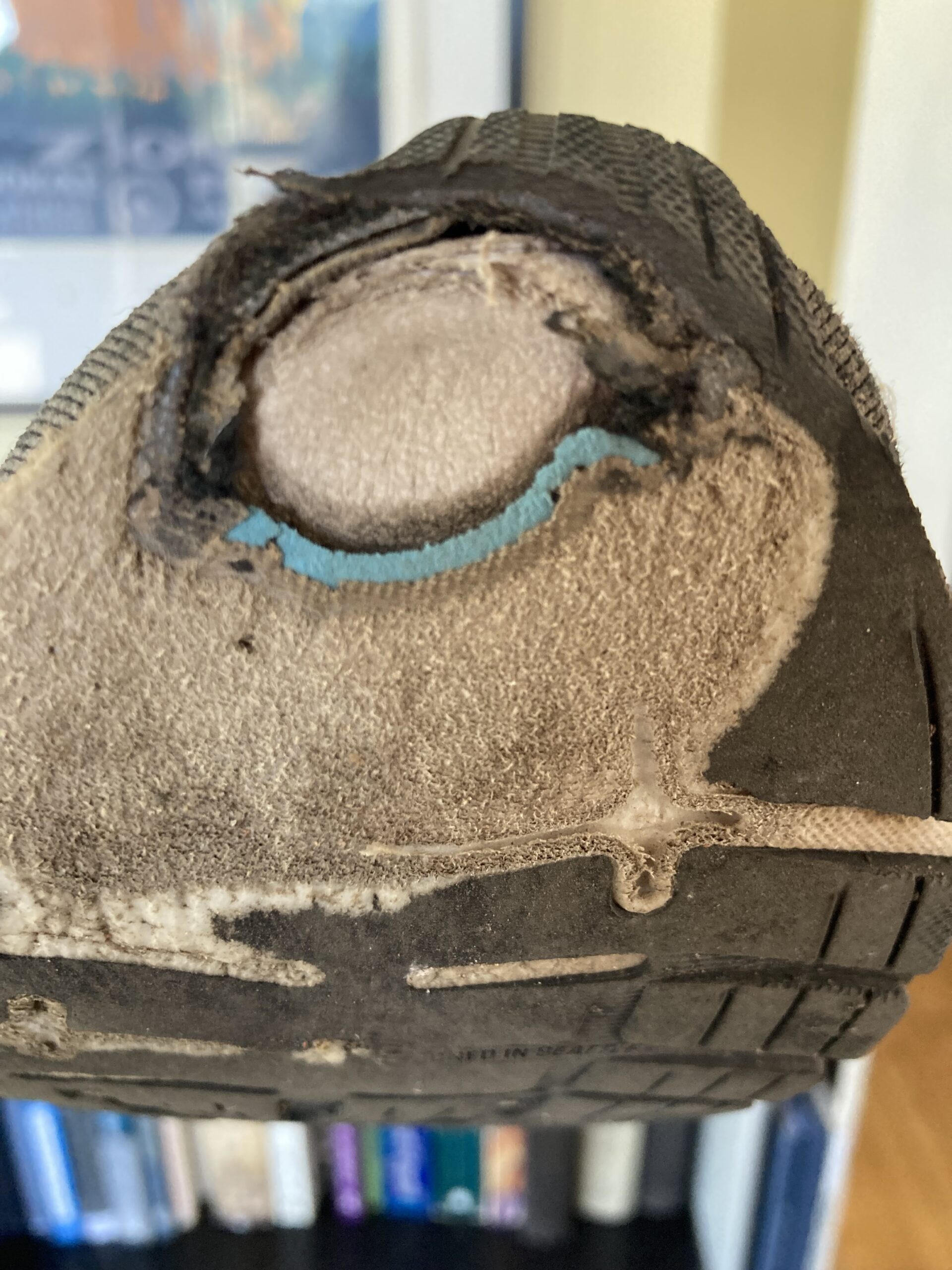
feb 27/RUNGETOUTICE

5 miles
river road, north/river road, south/lena smith
50 degrees
50% puddles / 5% mud, dead leaves
wind: 10 mph / 35 mph gusts

Sunny, warmer, windy! Had to tighten my cap so it wouldn’t fly off. It felt like spring, or like spring is coming soon, and I loved it. There was a moment, early on, when I ran past dead leaves on a lawn and the sun hit them just right so that they gave off a smell that I remember from childhood: late fall in Northern Virginia, walking through a small stretch of woods on the edge of suburbia. A good memory, even if I don’t like suburbs.

So many puddles and slow-moving streams on the sidewalk. I wondered how long it would take for at least one of my socks to get soacked. Not even a block! I didn’t see the puddle I stepped in, just suddenly felt cold in my left foot. Oh well. A soaked sock was always going to happen. I think it took a mile for the squish squish squish to begin.

This run was wonderful! I went farther than I thought I would — all the way to the Franklin bridge. And I felt stronger. I even did some strides at the end. I can’t remember what I heard besdie the gorge for the first half, but for the second half I put on my “Bunnies and Rabbits” playlist. The first song that came on, “Young Rabbits,” a jazz song by The Jazz Crusaders, was wonderful to run to. Later, “Mad as Rabbits” came on and I wondered the origins of that expression. Is it from Alice in Wonderland too? Yes and no. Probably the modern use of it comes from the character, the March Hare, who throws a mad tea party in AIW, but its earlier origins are this, according to wikipedia:

To be as “mad as a March hare” is an English idiomatic phrase derived from the observed antics said to occur[1] only in the March breeding season of the European hare (Lepus europaeus). The phrase is an allusion that can be used to refer to any other animal or human who behaves in the excitable and unpredictable manner of a March hare.

Mad as a March Hare

Near the very end of my run, a sudden thought about a rabbit that plays a pivotal role in a dystopia novel I read 2 or more years ago. I can’t remember the name of the novel. Thankfully I can look it up on my library checkout history! Found it: The Memory of Animals / Claire Fuller. I would check it out again, but for some reason, my library no longer makes it available as an e-book. Boo.

rabbit fur coat, part 2

My favorite reader just texted to remind me of a infamous rabbit fur coat reference in a song: Miss Thang’s “Thunder and Lightning”:

You’re walking around like you SO fly in that 37 Dollar Rabbit Coat! Honey, That coat had to be destroyed last week after it bit the neighbors child!

This line is from the album, The Answer: Rap vs. Rap (1987) and is in response to lyrics from Orange Juice Jones in his song (The Rain) about discovering that his girlfriend was cheating on him:

And my first impulse was to run up on you and do a Rambo Whip out the jammy and flat-blast both of you But I ain’t wanna mess up this 3700 dollar lynx coat

So good! A few days ago, at the end of my run, I had remembered Miss Thang’s line (which is superior to Jones’, imho), but then forgot it again before I returned home. I’m so grateful that my best friend reads this blog and remembered us listening to it in high school and texted me from Tokyo about it!

I wish I could add it to my actual playlist, but sadly it’s not on Apple music, so I’ll just have to include it in my written one and imagine Miss Thang singing back to Jones as I listen to “The Rain” on the apple music playlist (because of course, his song is streaming even those hers isn’t).

Miss Thang’s scathing reference to a rabbit, and not a lynx, fur coat, reinforces my sense of Jenny Lewis’ rabbit fur coat; it is low-end luxury and barely status, owned by those who want to appear wealthy but aren’t. In the case of Lewis’ mom, the coat represents a toxic fixation on status and wealth. In the case of Jones, the coat represents the illusion of status.

A bonus: not only did remembering this song give me another example of the rabbit fur coat, it solved a recent mystery. For the past few days, I’ve been trying to remember who references the Trix slogan in a song — silly rabbit, Trix are for kids. Now I know: it’s Orange Juice Jones in “The Rain”!

Here’s a video with the 2 songs mashed-up. Go to YouTube to see all of the lyrics:

that 37 Dollar Rabbit Coat? Honey, That coat had to be destroyed last week after it bit the neighbors child!

rabbit hole

In yesterday’s entry I mentioned that Heather Cox Richardson said, at least twice in her Politics Chat, that she wouldn’t go down the rabbit hole. But today, I will!

1 — Disney Animation

Last night after waking up from my first sleep1, I went downstairs and started watching Disney’s classic animated Alice in Wonderland (1951). I only got as far as the rabbit hole scene, which is delightfully trippy and brings back memories of my many visits to Disney World as a kid in the 80s (my grandparents lived in Deltona — not Daytona, as people used to try and correct — a small town outside of Orlando). Details I remember from my 1 am viewing: 1. she falls down a hole after entering a tunnel, her kitten does not — her POV: far down below, looking up at a small hole of light and kitten — she calls out excitedly, goodbyeeeee!!!; 2. the speed of her fall slows as the bottom of her blue dress billows like a parachute; 3. she passes armchairs and side table on her way down; 4. at one point she lands in a rocking chair and begins rocking, while still floating down; 5. there’s a brief shot of the exterior of this opening/vertical tunnel: it’s a queerly angled tall and narrow brick building; she calls out to the White Rabbit at some point — he’s falling through, too; just before she lands she catches her foot on something — a window frame? — and softly tumbles to the ground.

How much of that is correct? Can I find a clip to watch to check? Yes!

down the rabbit hole

Mostly I was right2, but I missed many delightful details: her bright eyes glowing in the otherwise darkness; she pulls a chain, and turns on a small lamp; she catches a passing book and begins reading it; she sees her reflection in the mirror, which is upside down. Oh, this animation — I love it!

2 — I’m late! I’m late! For a very important date!

In my visions of the white rabbit, I had forgotten his pocket watch and mutterings of being late, which are why Alice follows him. She wonders, what is he late for? It must be something important, like a party! How does time work in this animated film? In the original Lewis Carrol book? In terms of the rabbit hole in the popular imagination, time in the rabbit hole is twisted, slowed down, gets wasted. The rabbit hole is the enemy of time’s efficiency, productivity, precision. When explaining why she couldn’t dig into something, HCR says, I don’t have time for that right now.

3 — rabbit holes / burrows / warrens

In a preliminary search3, I discovered this interesting fact:

Rabbits live underground in warrens. Hares live in aboveground nests. (Cottontail rabbits are the exception: like hares, they live in aboveground nests.)

source

So, because the rabbits that live in my backyard are cottontails, there are no rabbit holes for me to fall through!

Also, here’s the difference between warrens and burrows: a burrow is one rabbit’s home, a warren is the neighborhood/network of tunnels for a colony of rabbits.

Looked on the Minnesota DNR site and found out this about cottontail habitat and range:

Throughout the year, cottontails are found in brushy areas such as woodlots, shelterbelts, and even around shrub and conifer plantings in suburban areas. During summer they feed on grasses and clovers, but in winter they eat twigs and bark, especially of fruit trees. Large tree and brush piles are popular shelters for rabbits. The range of one cottontail is no more than five acres (about the size of four football fields). They run along trails within thick brush to escape predators.

Eastern Cottontail / Minnesota DNR

A thing for “gardener” Sara to note: when winterizing the backyard, DON’T trim back the hydrangeas or hostas anymore! Leave them for the rabbits!

Also found these disturbing “fun facts” — they are listed under the heading, “Fun facts”,” but, are they fun? Not for the rabbits!

Cottontails are nervous animals that may die of shock if handled or caged. Cottontail meat is tasty favored by gourmet chefs who often cook it fried, in stews, or braised with herbs and vegetables.

Back to hole-less cottontails. A new metaphor is needed — not falling down and through to other worlds, but something about edges and shadows and the fringes — the periphery! Dwelling on the edges, in the corners, not traveling to new worlds, but noticing the other worlds that are already there, have always existed in the midst of my world.

  1. First sleep is a reference to historian A. Roger Ekirch’s book, At Days Close and a BBC article that I posted about on 17 jan 2025 about sleeping habits in the 17th and 18th centuries. Instead of 8 straight hours, a sleep, a waking, then another sleep. My sleeping doesn’t quite work that way lately and involves more than 2 sleeps: a sleep, getting out of bed to pace or bounce on an exercise ball, another sleep, watching 20 minutes of something, a sleep, a bounce, a sleep. ↩︎
  2. it’s the exterior of another building; she’s doesn’t get her foot caught but lands upside down hanging from the window ↩︎
  3. My searches are mostly just googling the terms and looking through AI and then, independently, several of the sources in the search results. I have never really used/relied on AI before, so this was a good opportunity to suss it out. It can be helpful, but its conclusions are uneven and information unreliable. AI can make broad claims based on singular sources, and those sources aren’t always primary, but sometimes a rando’s blog entry. In terms of search results, the links are often businesses selling a product; any information posted is ultimately in service of selling that product. Or, the links have information designed for an individual/consumer. For example, the rabbit/bunny information my searches yielded were often for pet owners (how to take care of your rabbit) or homeowners who need to manage/get rid of rabbits-as-pests. ↩︎

a few more rabbit related things

Here’s a list of 20 pop culture rabbits/bunnies. One I had forgotten: the boiled pet rabbit in Fatal Attraction.

Dust bunnies; the Energizer Bunny; Bunny from Season 2 of “Only Murders in the Building”; Watership Down (which I remember my sister reading, but I never have); Liam (here in the twin cities, taken by ICE) and his bunny ears / Louise from Bob’s Burgers and hers; Bugs Bunny and “Kill the Rabbit”; bunny ears as tv antennas; lucky rabbit’s foot; playboy bunnies and staying at the Playbook Hotel in Buffalo because it was the cheapest option when I was 8; calling my daughter honey-bunny

And here’s a wonderful poem that I found the other day. It fits with the theme of rabbit holes and underground dwellings:

[Rabbit] / by Amy Wolstenholme

In Portland we don’t use the word, we dance around it –  furry things, we’d say, the furry things are in backfield again. As a child I only knew I should never look directly at them, the same way I knew not to look at the sun. It was wrong. It would hurt later on. My grandfather called them underground mutton – the first time I heard the phrase I laughed, and he didn’t. I guess that means it’s okay to eat them. That it’s okay to roast and spit them but never see them. As an adult I learnt the fear behind the superstition – my home is always on the brink of slipping, because long ago we built mines where we shouldn’t. And, like always, nature far outshone the humans: the furry things would run before the rockfalls, the men would disappear beneath them. So when they skipped in fields en masse, bobtails flashing, we would know that somewhere below ground people were trapped, were crushed, were suffocating. We would know that when the underground mutton set to dancing, the Earth was eating the miners.

One more rabbit thing: Inspired by my talk of the periphery, I think I will give attention to rabbit vision and rabbit eyes tomorrow. 3 sources to start with: “rabbit vision” google search, Rabbit Eye, and this discussion of a famous painting with a rabbit eye that inspired Diane Seuss.

Get Out Ice

Part of what I’m trying to do in my “get out ice” effort is to document examples of resistance. I’d like to turn it into an archive of practices of care-as-resistance (love) Here’s one I found from Sean Snow, who provides great daily summaries on Facebook:

Dungeons & Dragons Mutual Aid: A Twin Cities gaming group with 2,500 members made headlines for pivoting from tabletop adventures to a sophisticated mutual aid network. They are now coordinating food deliveries, “Know Your Rights” workshops, and legal support for members affected by recent events. What began as a social club has evolved into a logistical hub that leverages existing trust to provide real-world refuge. This grassroots response demonstrates how established community bonds can be repurposed to protect neighbors during times of crisis.

Sean Snow

feb 26/RUNGETOUTICE

4.3 miles
minnehaha falls and back
35 degrees

A much better run today than yesterday. One difference: I had a big snack — yogurt, blue, pumpkin seed granola — before I went out. It was sunny and above freezing. Less layers! 1 pair of tights, shorts, 1 shirt, 1 pull-over, gloves, baseball cap. Listened to the snow melting, wheels whooshing, kids playing, a playground whistle blowing, grit scratching the asphalt as I ran sound, my “Bunnies and Rabbits” playlist on the way back. Listened to Jenny Lewis’ “Rabbit Fur Coat” again and want to look up rabbit fur coats — how do they compare to mink or fox in terms of status? who wears rabbit?

10 Things

  1. looked up — cerulean blue sky, no clouds, no birds, no planes
  2. drip drip drip drip — water falling down the gutter
  3. the strong smell of weed — like a skunk — in the 44th street parking lot, or was it the locks and dam no. 1 lot?
  4. the annual puddles have returned on certain neighbor’s sidewalks
  5. a thin sheet of ice on the river
  6. a few more cars in the falls parking lot, a few more people at the overlook
  7. an older man standing near my favorite spot, reading the old — how old? 1940s or 50s? — plaque about the falls, his partner just ahead, patiently waiting
  8. the cobblestones were clear! no ice, no snow, only 1 or 2 puddles
  9. running south, nearing the double bridge, my eyes fixed on a something shining BRIGHT — sun reflecting off of an object — the top of a trashcan?
  10. standing behind the Rachel Dow Memorial bench, stretching and looking down at the river, out and over to the other side, watching a car travel the east river road

updated in the evening, rabbit-related: I’m watching Heather Cox Richardson’s Politics Chat for today (she is amazing), and she said in her discussion of Hillary Clinton’s closed testimony on the Epstein files today, she was an interesting Secretary of State, I think, but that’s a rabbit hole I won’t go down. This isn’t the first time HCR has used that expression when discussion a topic she doesn’t have time for, it’s often a rabbit hole she won’t go down. Another update, a few minutes later: she referenced a rabbit hole again!

rabbit fur coat

My “research” didn’t yield that much, but enough to guess that the coat symbolizes Lewis’ mom’s obsession with attaining status, obtaining wealth.

Commercial fur trade of rabbit took off in the 20s. Less expensive than other animal furs, easily dyed and plucked to resemble other fur. A more accessible status symbol.

crepuscular

A few days ago, I used the word crepuscular (“Rabbits are crepuscular grazers” — 24 feb 2026) and suggested it would make a good title for a poem. This morning I’m exploring how other poets have used the word in their poems.

crepuscule: twilight (rare: noun)

crepuscular: of or relating/resembling1 twilight;
of an animal active in twilight (adjuective)

1 — from The Possessed / John Berryman

There was a time crepuscular was mild, 
The hour for tea, acquaintances, and fall 
Away of all day’s difficulties, all 
Discouragement. Weep, you are not a child. 

The equine hour rears, no further friend, 
Intolerant, foam-lathered, pregnant with 
Mysterious grave watchers in their wrath
Let into tired Troy. You are near the end. 

Midsummer Common loses its last gold, 
And grey is there. The sun slants down behind 
A certain cinema, and the world is blind
But more dangerous. It is growing cold. 

Light all the lights, heap wood upon the fire
To banish shadow. Draw the curtains tight. 
But sightless eyes will lean through and wide night 
Darken this room of yours. As you desire. 

2 — from Le crépuscule du soir / Charles Baudelaire / trans. Roy Campbell

But insalubrious demons of the airs,
Like business people, wake to their affairs
And, flying, knock, like bats, on walls and shutters.
Now Prostitution lights up in the gutters
Across the glimmering jets the wind torments.
Like a huge ant-hive it unseals its vents.
On every side it weaves its hidden tracks
Like enemies preparing night-attacks.

3 — from Crepuscle with Muriel / Marilyn Hacker

the void of an hour seeps out, infects
the slit of a cut I haven’t the wit to fix
with a surgeon’s needle threaded with fine-gauge silk
as a key would thread the cylinder of a lock.
But no key threads the cylinder of a lock.
Late afternoon light, transitory, licks
the place of the absent cup with its rough tongue, flicks
itself out beneath the wheel’s revolving spoke.
Taut thought’s gone, with a blink of attention, slack,
a vision of “death and distance in the mix”
(she lost her words and how did she get them back
when the corridor of a day was a lurching deck?
The dream-life logic encodes in nervous tics
she translated to a syntax which connects
intense and unfashionable politics
with morning coffee, Hudson sunsets, sex;
then the short-circuit of the final stroke,
the end toward which all lines looped out, then broke).

4 — twilight school / early 20th-century Italy / Britannica entry

crepuscolarismo, (Italian: “twilight school”), a group of early 20th-century Italian poets whose work was characterized by disillusion, nostalgia, a taste for simple things, and a direct, unadorned style. Like Futurism, a contemporaneous movement, crepuscolarismo reflected the influence of European Decadence and was a reaction to the florid ornamental rhetoric of the Italian author Gabriele D’Annunzio. It differed from the militant Futurist movement in its passivity, but both movements expressed the same spirit of desolation, and many crepuscolari later became futuristi.

crepuscular animals / wikipedia

Ten examples of crepuscular animals, active at dawn and dusk, include raccoons, deer, rabbits, skunks, bobcats, foxes, bats, house cats, coyotes, and moose, with many mammals, insects, and some birds fitting this activity pattern to avoid extreme heat and predators. 

Bats! I’ve been gathering poetic lines about bats for several years now! Not because I like bats (although, after all my thinking about them, I’m starting to!), but because the poetic language used to describe them is helpful in my own thinking about how I navigate the world in my less defined light.

  1. I’m interested in this idea of resembling, particularly in relation to light and my perception of it as I lose more cone cells. Does crepuscular describe me? Am I perpetually in the light of dawn and dusk? I’m also interested in it in terms of time, where twilight = that small/brief in-between time before day/light turns to night/darkness, the stage just before a final loss (in my case, all of my central vision) ↩︎

Get Out ICE

I’ve continued to tag my entries with “Get out ICE” because ICE is still here in Minnesota and is still awful. But that is about it; it’s time to return to posting examples of ice out. Here’s one small “ICE OUT” example that I heard about as I listened to a running podcast. As she was recounting her 100k 8-hour trail race, Molly Seidel wore “ICE OUT” on her vest. She said it was important for her to make this statement:

I haven’t been super vocal on social media just because I don’t feel like that’s where I can put my voice to best use sometimes. But I think being able to make a statement on what I wear through what I do and wear that for 62 miles mattered a lot to me.

Molly Seidel / Ali on the Run podcast

I can’t remember if I mentioned it here or just on Facebook, but I have posted about Olympic athletes speaking out against ICE, most notably Jessie Diggins. Local professional sports teams, like the Timberwolves and the Frost are too.

Somewhat related, but also very different, cycling communities in the twin cities have been very vocal in their opposition to ICE. A week after Alex Pretti was murdered, thousands of cyclists did a ride in honor of him. And Recovery Bike Shop on Central in NE Minneapolis has been very active, both in resistance and in caring for immigrant communities. Just today they posted a flyer about training people for bike patrols and wrote this:

This is a game changer for our communities. Patrollers on bikes can cover A LOT more ground and reach active incidents much faster.

And bikes are not trackable like cars.

We’re still walking Central Ave TONIGHT (and every Thursday) at 5:30.

And the Holland Neighborhood Association will be at Recovery Bike Shop at 7:00pm with Council Member Elliott Payne. Find out ways to engage in the community. This is where change happens.

facebook

feb 25/RUNGETOUTICE

2 miles
river road, north/lena smith, south
22 degrees

Sunny, cold, shadowed. Most distinctive shadow: the ball-like one, made by the light of the street light. It was nice weather for a run. Not too cold, or too warm, clear trails. Unfortunately, I struggled. Sore legs, unfinished business, and some fatigue. And now I’ll struggle not to worry about what caused the bad run — this worrying about my health is the way my anxiety is expressed. No fun.

Even with my not-so-great run, can I remember 10 things I liked (or loved)?

10 Things

  1. the feel of my feet sliding on the grit as I ran up the lake street hill
  2. the bright orange graffiti under the lake street bridge
  3. the surface of the river, covered in a thin skin of ice, a pale gray
  4. the bright blue and empty sky
  5. the deep footprints on the snow-covered walking path, descending just below the road
  6. feeling strong and relaxed as I ran up the hill from under the bridge
  7. the sheen of the thin glaze of ice on the shaded sidewalk
  8. some puddles on the sidewalk where snow from a yard had melted
  9. looking through a net of bare, slender trunks
  10. chirping birds, all around

For the first part of my run, I listened to the traffic and my feet striking the gritty ground. For the second part of the run and the walk, I put in my new “Bunnies and Rabbits” playlist — see below. I heard these songs today:

  1. Rabbot Ho / Thundercat
  2. Baile InoLVIDABLE / Bad Bunny
  3. Rabbit Fur Coat / Jenny Lewis
  4. Abracadabra / Steve Miller Band
  5. I’m Drivin’ My Life Away / Eddie Rabbit

I’d liked the speed/fast beat of the Bad Bunny song, the storytelling in “Rabbit Fur Coat,” the 80s kid nostalgia of Abracadabra, and the little North Carolina Sara nostalgia of Eddie Rabbit (from June 1980, when I was 6). Jenny Lewis’ story about her poor (both, no money and tragic figure) mom made me think of Diane Seuss and her use of a rabbit motif — see below and this diane seuss and rabbits.

Rabbits, Rabbits, Everywhere — written earlier today

As is usually the case when I give attention to something I haven’t given much attention to before, that something is suddenly everywhere, or not everywhere, but the instances of it seem to grow exponentially (you might say, they breed like rabbits). The rabbit/bunny/hare floodgate has been opened! This morning, I’m finding so many rabbit references!

And what’s the point of all of this? Following the rabbit down the rabbit hole is a wonderful distraction. It is also an excellent opportunity to learn. And to learn more about rabbits, which leads to caring about them as living things and as symbols. This caring might (is) enabling me to open up a closed part of myself (closed = strong dislike of rabbits). And it is helping me to think more broadly and specifically about the impacts of humans and human encroachment on environments and the consequences of that encroachment for humans and non-humans. Plus, all (or any) of it could inspire new poems.

Here are a few rabbit-related things:

1

The killer rabbit in Monty Python and the Holy Grail. I should rewatch this movie because I remember the rabbit in the cave (or is it a bunny) at the end, but not that clearly. Is the joke that rabbits/bunnies are soft and cute and frail and couldn’t possibly be vicious killers?

2

Bunny Lebowski in The Big Lebowski. It’s been long enough since I’ve seen this film that I all I can remember is that she is the young wife of the Big Lebowski, who is kidnapped and is a catalyst for much of the action. Is that right? I could look it up, but I’d rather use this lack of remembering as a reason to watch the movie again.

3

Rabbit in Red matchbox from Halloween. Near the beginning of the movie, the nurse who has accompanied Dr. Loomis to pick up Michael Myers from the mental hospital and bring him to his parole hearing lights a cigarette using a match from this matchbook just before Micheal Myers attacks them and escapes in their car. Later that same matchbook appears in the grass near the dead body of a mechanic. A clue! Michael Myers must have been here! And now he’s going home to finish what he started!

4

Harvey, a Jimmy Stewart movie from 1950 in which Stewart befriends a 6 foot tall invisible rabbit. I have never seen it, but when I was younger, after having watched Rear Window, I developed a bit of a crush on Jimmy Stewart. Maybe that’s why I thought of this? I looked to see if it was streaming anywhere or available from the library. Nope.

5

Max and Ruby, Ruby and Max. A cartoon with baby brother/big sister bunnies. My kids watched this when they were young, thanks to hand-me-down dvds from my sister whose kids watched it when they were young. When and where did it air? What I remember most about this show was that the adults were almost non-existent and Ruby was the suffering big sister who rarely got to have any fun because she had to mother clueless Max. The gendering in this one — wow!

6

The documentary from PBS, The Pill. When I taught a class about debated issues within feminism, we usually started with a section on Reproductive Justice. Instead of focusing on abortion, we looked more broadly at women’s reproductive health and their access to care and control over their own bodies. I often screened this documentary and I recall a section with rabbits in a lab that also included the story of how they experimented on women in Puerto Rico. I can’t easily stream this again, so I’m relying on my memory and the transcript. The section is called, “A Cage of Ovulating Females.” Here’s the mention of the rabbits:

Margaret Marsh, Historian: Gregory Pincus wasn’t a physician, he was a scientist. And so he could give the pill to as many rabbits as he wanted to. Rabbits everywhere could take this pill. But he couldn’t give the pill to women. He wasn’t a doctor. He couldn’t run a clinical trial on human beings.

The Pill

And here’s one bit about Puerto Rico:

Getting the pill to market would require approval from the Food & Drug Administration, and that would entail a large-scale human trial. In exasperation, Katharine McCormick, asked, “Where can we find a cage of ovulating females?”

Puerto Rico had a network of birth control clinics and no Comstock laws. Pincus called it “the perfect laboratory.”

The Pill

The experiments on Puerto Rican women were considered a success, but some of the women suffered terrible side effects: headaches, nausea, dizziness, vomiting.

7

Rabbit from Winnie-the-Pooh — Winnie-the-Pooh’s neighbor who sometimes wishes he wasn’t — there’s a real Dennis the Menace vibe happening here, with Pooh as Dennis, Rabbit as the menaced neighbor. Yesterday I read about how Lewis Carrol intended the White Rabbit to be a sharp contrast to Alice:

For her ‘youth’, ‘audacity’, ‘vigour’, and ‘swift directness of purpose’, read ‘elderly’, ‘timid’, ‘feeble’, and ‘nervously shilly-shallying’, and you will get something of what I meant him to be. I think the White Rabbit should wear spectacles. I’m sure his voice should quaver, and his knees quiver and his whole air suggest a total inability to say ‘Boo’ to a goose!”

The White Rabbit in Fandom

I see a similar contrast between Pooh (as Alice) and the Rabbit (as White Rabbit):

8

Cadbury Creme Egg Bunny. Growing up, I LOVED these eggs. Unlike now, in the 80s and 90s you could only get them around Easter. More than any other, these eggs are my favorite childhood candy. Do they hold up? Not really. I remember the commercial with the bunny that sounds like a chicken:

the 1983 commercial with copy read by the Smuckers guy!

9

9

Diane Seuss and rabbits. Yesterday I remembered a line from a favorite Diane Seuss poem, I Look Up at my Book and out at the World Through Reading Glasses:

The load of pinecones at the top,
a brown smudge which could be anything: a wreath
of moths, a rabbit strung up
like a flag.

She’s referencing some famous still life painting with the rabbit, I think — this is in her collection all about still life paintings, Still LIfe with Two Dead Peacocks and a Girl. I looked up “Diane Seuss and rabbits” and found two other poems by her with rabbits in them!1

excerpt from backyard song / Diane Seuss

Uncorked, I had a thought: I
want the want
I dreamed of wanting once, a
quarter cup of sneak-peek
at what prowls in the back, at
what sings in the
wet rag space behind the garage, back
where the rabbits nest

Her first poem had a rabbit/ Diane Seuss

in it. Life
story at age fourteen sifted
through a rabbit.

It had a tattoo on a hand
in it. And cherries, the kind
that come in a can.

She tended
toward rabbits back then.
Toward the theoretically mild

that are really
wild. Like ducks on a pond
that is really a moon

full of menacing weeds.
The duck gets ready for noon,
she wrote. Yes,

nonsense, I guess.
She embroidered a poem
on a foam

pillow with a felt pen.
Pinned an actual
cherry on it back then

life story sifted through a rabbit — drawing upon this poem and a few others, AI suggests that Seuss frequently uses the motif of rabbit to explore themes of wildness, vulnerability, and the grotesque. In the summary, it (AI) misnames the poem “Basket,” which is the name of the journal, not this poem.

theoretically mild, really wild

Ducks on a pond, right next to the rabbit? That has to be reference to the optical illusion — do you see a duck or a rabbit? — right?

11

The Runaway Bunny — This was one of my favorite books as a kid. At first, I wondered why I thought that, then I found the book and opened it and saw why:

book inscription: To little Sara on Easter 1978 -- from Mommy and Daddy
my copy from 1978

added, 28 feb 2026: I was never a big Velveteen Rabbit fan, but there is another bunny book I loved as a kid, Pat the Bunny.

11

Looney Tunes: I want hasenpfeffer! I am almost certain that when I watched this cartoon as a kid, this was the first time I had heard of hasenpfeffer or imagined that rabbit was something you could eat. I still never have, but whenever I hear the word hasenpfeffer I think of this cartoon.

Hasenpfeffer

From a comment: “The King wants Hasenpfeffer which is traditional Dutch and German stew made from marinated rabbit or hare, cut into stewing-meat sized pieces and braised with onions and a marinade made from wine and vinegar.”

What to do with all of this rabbit-holing? I want to orbit around all, or at least many, of these ideas. Bring them into poems. Write a series of small poems about rabbits and bunnies and hares. As I was writing this last line, another bunny zapped into my head — The Runaway Bunny! I’ll add it above. What form should these rabbit poems take? Could this be an inspiration — Seven American Centuries? Whatever the form, I like the idea of returning repeatedly to century bunny/rabbit themes, and telling a story across the poems, not in one poem.

  1. Yesterday I realized I could easily do footnotes and I’m here for it! Googling “Diane Seuss and rabbits” the AI explanation seemed useful and it was, but also a bit suspect. When I clicked on the links offered at the end of the AI summary and read the source, it often wasn’t saying what AI claims it saying. AI takes some liberties, I think. ↩︎

a Rabbit/Bunny/Hare playlist

When Scott reminded me of Thundercat’s song “Rabbot Ho,” I knew I needed to make a playlist for this recent preoccupation!

  1. Rabbot Ho / Thundercat
  2. Baile InoLVIDABLE / Bad Bunny
  3. Rabbit Fur Coat / Jenny Lewis
  4. Abracadabra / Steve Miller Band
  5. I’m Drivin’ My Life Away / Eddie Rabbit
  6. The Young Rabbits / The Jazz Crusaders
  7. Let’s Pretend We’re Bunny Rabbits / Magnetic Fields
  8. Rabbit Heart (Raise It Up) / Florence + the Machine
  9. Rabbit Fighter / T. Rex
  10. Jack Rabbit / Elton John
  11. Here Comes Peter Cottontail / Gene Autry
  12. White Rabbit / Jefferson Airplane
  13. White Rabbit / George Benson
  14. Rabbit Will Run / Iron & Wine
  15. Breathe (in the Air) / Pink Floyd
  16. Pink Rabbits / The National
  17. Mycomatosis / Radiohead
  18. Alice / Peggy
  19. Mad as Rabbits / Panic at the Disco
  20. Bunny is a Rider / Caroline Polachek

feb 24/RUNGETOUTICE

4.3 miles
minnehaha falls
35 degrees
25% puddles

Sitting at my desk in the morning, I heard some noise — rustling, I think? — just outside the window. Freezing rain or snow — graupels. Then it started snowing, not too hard, but enough to cover everything. No! I wanted to run today. Luckily, it warmed up and by the time I was ready to run, everything had melted.

10 Things

  1. a police car parked parallel to the road in the first falls parking lot
  2. aside from the police car, the lots were empty
  3. a lime scooter leaning against a bench
  4. one guy standing at the bridge overlooking the falls, with an orange hat or an orange something else (I couldn’t see)
  5. voices below on the other side of the wall, down in the falls
  6. no one else in the park
  7. big puddles everywhere — my one foot was soaked only 5 minutes into the run
  8. kids yelling and laughing on the playground
  9. the river was covered with ice and snow with one sliver of open water
  10. a walker approaching me, walking 3 tiny dogs — this made me smile

The run was mostly great. At times, my legs felt heavy (or, at least, heavier than they usually do) and I stopped to talk a few extra times. Were they sore or my lack of ferritin or some other ailment? The second half felt easier.

bunnies — nudge? muse? pest? ghost?

note: I started writing this section yesterday and have spent over four hours this morning wandering through the spaces it created . There’s a lot of movement in it — traveling from thought to thought to thought, here to here to here. Future Sara, and anyone else reading this, you might get lost.

So far I’ve written two bunny poems without really trying to. I’m starting to believe they want me to write about them. This very idea suddenly appeared in my third poem. I started writing about the moment when I first noticed the bunnies in the backyard at night and realized they had probably always been there. Then I wrote in my Plague Notebook 27: I didn’t choose to notice them as much as they decided to be noticed. And I thought: muse! Could this poem be about bunnies in the backyard and about bunnies as the thing that has decided it’s time for me to write, and write about them? For years now, I’ve disliked bunnies, and never imagined writing about them. But now here I am, writing about them, and I fear that I might learn to like bunnies.

All of this has me wondering, what is a/my muse? I’m familiar with the term, but have never seriously studied it, either as a concept or through examples of it in the popular imagination. Do I want to now? Is it necessary for my poem? Maybe instead of devoting a month to it — although that could be fun! — I’ll give it a day or two?

Muse/ Linda Pastan

No angel speaks to me.
And though the wind
plucks the dry leaves
as if they were so many notes
of music, I can hear no words.

Still, I listen. I search
the feathery shapes of clouds
hoping to find the curve of a wing,
and sometimes, when the static
of the world clears just for a moment

a small voice commes through,
chastening. Music
is its own language, it says.
Along the indifferent corridors
of space, angels could be hiding.

If the bunnies are my muse, I didn’t seek them out. I looked out the window one winter night and saw them on the lawn, not knowing what they were. Did they seek me out, or are they indifferent to me? Did they reveal themselves, or did I just happen to notice them one day? I think I do less trying to find a muse, more trying to create the conditions where it could be possible. I noticed the bunnies because I was doing a month-long practice I called the purple hour. It involved using the time when I woke up in the middle of the night, unable to sleep, to notice purple and write about it. One night, I was studying the different purples in the backyard and there they were, the bunnies. And maybe it’s more than creating the conditions where it’s possible; it’s also about being open to what could be a muse, letting it in.

Muse — to be occupied by, possessed, taken over, haunted, held captive, in the thrall of?

This idea of captivity reminded me of the poem, Captivity/ Siddhartha Menon which I posted on this log on 15 may of this year. In an essay, Menon wrote this about the final line of the poem:

“You are paralyzed.” It suggests the fatal indecision of a rabbit caught in a hunter’s flashlight, and snaps the poem shut” (Siddhartha Menon on Epigraphs).

My rabbit/bunny is back! This sentence is the only mention of a rabbit in a 872 word essay about a poem that features a bird. Where will my bunnies appear next?

Returning to definitions of muse, I googled it, and just past the dictionary entry — the nine daughters of Zeus, a person/personified force who is the inspiration for an artist — in the “People also ask” section was this question: What makes a woman a muse? Here’s the AI generated answer:

A woman becomes a muse through qualities like enigmatic allure, deep connection, and embodying creative energy, acting as a profound source of inspiration for an artist, often sharing a unique bond that fuels artistic expression, though not always romantically. Muses can be captivating personalities, friends, lovers, or even strangers who embody traits like wisdom, charisma, or mystery, prompting the artist to create, often embodying a living, breathing work of art themselves, inspiring everything from specific works to an artist’s entire focus. 

Eww. The uneven power dynamics here, between the subject (isn’t it most often a male artist?) and the object (a woman who is not an artist, or is not considered an artist) that inspires them bother me. After images of male artists and their models flashed in my mind, a phrase appeared: Manic Pixie Dream Girl. I recalled encountering a critical feminist essay about this trope back in the day (around 2007 or 2008, when I was teaching pop culture and queer theory at the University of Minnesota). I searched for it. Not an essay, a video from Feminist Frequency. Yes! I remember them. This video holds up. Around 4 and a half minutes in, they link the trope directly with the Muse:

manic pixie dream girl

And now I’m thinking about birds in poetry and how they’re used to do a lot of the heavy lifting of a poem. She’s not the only poet to write about it, but here’s a good example of this idea from Ada Limón:

does this bird want to be in this poem today? Maybe it doesn’t. You know, we always want to turn the animal into something else, right. And sometimes I want to let the animal be. Of course animals are symbols, of course they turn into our metaphors. I mean, that happens. But I also think there are moments when you just think, okay, the birds aren’t going to save me.1

VS Podcast Interview with Ada Limón

All of this makes me wonder: what am I doing as I keep putting the two bunnies in my backyard into my poems? And why do I insistent on calling these wild and mature eastern cottonwood rabbits bunnies? I’m not sure these rabbits are indifferent to me, but I think they notice me in terms of whether or not I am a threat to their main activity: grazing in the grass.

Now I’m remembering an interesting fact I encountered the other day: much of the eastern cottonwood rabbit’s time is spent eating, 6-8 of the day, both during the day and at night!) Okay, I looked it up again and I was right about the 6-8 hours a day, but here’s a delightful detail: primarily during dawn and dusk. Rabbits are crepuscular grazers. Crepuscular (cre PUS cular)?! What a word, and a good title for a poem?!

But, back to if rabbits (I still want to call them bunnies) notice me or not. Is my assumption correct about noticing me in terms of my threat level? Another google:

Wild rabbits are acutely aware of humans, perceiving them primarily as potential predators due to their innate, high-alert survival instincts. They utilize exceptional hearing and a keen sense of smell to detect people, often fleeing immediately to safety. While they may learn to tolerate consistent, non-threatening human presence over time, they generally maintain a healthy fear of people.

Yes! So, here’s something interesting: in the poem I’m working on right now, tentatively titled, Bold as Brass, my backyard bunnies do not care that I’m passing by; they keep grazing. They’re seemingly so indifferent that I’ve started calling out a pre-boomer phrase (and unironically!) to anyone around me: those bunnies are bold as brass! Where’s their healthy fear of humans? Is it that they can tell I am no threat, or are they being impudent? Or, has something screwed up their “normal” behaviors, and could that something be human-caused (like the over-developing of land, the loss of “natural” habitats, the increased need to live in the midst of humans?) Could that be the true heart of this poem?

Possibly, but first, another plunge2 down that rabbit hole! What do “experts” say about my theory of encroaching landscapes? Looked up “rabbits encroaching landscape” and What to do about wild bunnies? appeared. Here’s the subtitle: “Timid wild rabbits may occasionally eat plants in the garden, but usually live unnoticed on the fringes of our yards.” Usually unnoticed and on the fringes? Two favorite themes in my poems! Also included in one of the first paragraphs: edges, in-betweens.3 Back to “usually unnoticed,” here’s another useful bit from the article:

Here today, gone tomorrow is one way to describe rabbits in suburbia. Given the many predators who make meals of rabbits, their populations can rise and fall dramatically over the course of a year.

Come on, now, the pun was set up for you: hare today, gone tomorrow! Anyway, does my recent (for the last year) notice of backyard rabbits, almost every day, count as part of this normal rise and fall of rabbit populations? Or does it indicate something else?

The line about the gardens make me think of two things. First, a memory. My mom loved gardening and was especially proud of her West Des Moines garden (I created a digital story about it a few years ago). I recall the rabbits liked her flowers, especially her roses. On the advice of a neighbor, she sprinkled bone meal around the bush, which didn’t work. Not wanting to kill the rabbit, she managed to catch it — I can’t remember how, maybe with the help of that same neighbor — and drove 10 or 15 miles out of town and into the prairie to release the rabbit.

Second, a few feelings I recall having decades ago when reading the section in Peter Rabbit when Peter Rabbit’s coat gets caught on Mr. McGregor’s fence and he’s trapped and then when he manages (barely, at least how I remember it) to make it home and has to recuperate in bed. The feelings: not fear or relief but an understanding that life was dangerous and serious and an ambiguity as to who was in the wrong — the bold, misbehaving Peter who disobeyed his mother’s orders and stole vegetables, or the hard-working farmer who was planning to kill Peter as punishment. I recall thinking I was supposed to think Peter was in the wrong, but I wasn’t buying it.

What to do with these rabbit wanderings? And where has my plunge down the rabbit hole led me? It seems fitting to conclude this ramble with the rabbit hole, which is a reference to Alice’s Adventures in Wonderland and her following of the white rabbit down into Wonderland. Of course, “down the rabbit hole” is also a term used for getting lost on the internet:

“Down the rabbit hole” is an English-language idiom or trope which refers to getting deep into something, or ending up somewhere strange. Lewis Carroll introduced the phrase as the title for chapter one of his 1865 novel Alice’s Adventures in Wonderland, after which the term slowly entered the English vernacular. The term is usually used as a metaphor for distraction.[1] In the 21st century, the term has come to describe a person who gets lost in research or loses track of time while using the internet.

wikipedia

Out-of-control curiosity. Distraction. Losing track of time. Getting lost in strange worlds. These are presented as bad things. Are they? Many of them are embraced within poetry. And they are great tools of refusal and resistance against late-capitalism and wannabe fascist governments — you’re not working for/perpetuating the system while you’re following the rabbit hole.

Does that work when the getting lost is online, where the rabbit hole is designed to be the way curiosity is monetized: the more levels of the rabbit hole you enter, the longer you stay lost in all of the information offered, the more attention you give to a site and its advertisers.

I started this ramble yesterday after realizing my third bunny poem might be about the muse. That realization was partly inspired by a recent rereading of an excerpt from Tommy Pico’s poem, “IRL.” Somehow I’ve made it back to that beginning. Here’s the last section of that excerpt:

All I need is my phone.
Subway, elevator, drifting off
in a convo—no one really seems
to notice, occupied by their own
gleaming pod of longing.
I am the captain of my shit,
possessed by the spirit
of Instagram I am omnipotent
on Twitter on Blurb on Vine
Soap boxes on the street corner
of my mind Clear, boosted, boundless
something come stop the shaking
A sun to fly towards iMean
something to do: mimicry
of purpose. The injury
of hunger is: death. The word
of the day is: Gloze.
To explain away.
Glowing gauze glozes the
etc. Weather.com says
Stay inside forever, or
drop dead. We’ve ads
for you to click. You n me?
It’s going to take soooo long
for us to know each other
ten years.

I don’t understand all that is happening in this excerpt, but the more I read it, the more doors it opens for me and my thinking about the internet, IRL, and the Muse.4

  1. “the birds aren’t going to save me” — I suppose my initial turn to the bunnies was with that expectation, where saving = giving me something else to think about other than ICE and Occupation Minneapolis and fascism and my high blood pressure and insomnia ↩︎
  2. My choice of plunge is deliberate; it’s a reference to Emily Dickinson’s “I felt a funeral in my Brain” — And then a Plank in Reason, broke,/And I dropped down, and down,/ And hit a World, with every plunge,/And Finished knowing – then↩︎
  3. Something else included: “rabbits will excrete, eat and re-digest their own droppings to obtain the maximum amount of nutrients.” I wonder if that’s part of what the rabbits in my yard are doing when they spend so much time stock-still in the snow. ↩︎
  4. One last thing about the Muse that I want to mention for a future discussion. What if the bunnies/rabbits are not a muse, or a catalyst for action (which was said of the white rabbit in Alice in Wonderland), but a gate? As in, Marie Howe opening in “The Gate”: I had no idea that the gate I would step through / to finally enter this world / would be the space my brother’s body made ↩︎

feb 20/BIKEGETOUTICE

32 minutes
basement

Watched the women’s cross-country relay for most of the bike, then Alysa Liu’s amazing Free Skate for the last 10 minutes. Scott and I watched Liu’s performance last night, and I watched it again this morning. Admittedly, I can’t really see that much of it — no details, not her beaming face, none of her lines, only the feel and speed of her movement, the energy of her joy. And I guess as I watch it I am a little sad not to be able to fully witness her artistry. But I still loved it. And I’ll be watching it again and again as an antidote to all the other shit happening right now.

Bunnies

Earlier today, I read in an old log entry about my discovery, last february, of two backyard bunnies. Then I read a post on Facebook from Minneapolis Parks about how some rabbits pee blue. It felt like a nudge, today you should write about bunnies!

Here are some sources for inspiration (or more) about rabbits/bunnies:

1

Have you seen weird blue spots in the snow lately? There’s a good chance it’s rabbit pee. Eastern cottontails (the most common rabbit in Minnesota, you’ve probably seen them running around yards at dusk) sometimes eat buckthorn branches and bark, especially toward the end of winter. Buckthorn contains a phytochemical that turns urine blue after being exposed to sunlight.
So, don’t be alarmed if you come across one of these spots, it probably means a well hydrated rabbit stopped by. (Minneapolis Parks)

2

Looking out the kitchen window, seeing 2 dark forms in the white snow — bare patches or something more? Staring for a few mnutes — am I imagining that slight shift? No, 2 animals, standing still for minutes. What are they doing? Quick movement, then bounding figures. Rabbit-like. But these animals look so dark — is it a trick of the dim light — bunny fir darkened in the lilac light? [there is no indigo in a backyard illuminated by neighbor’s security lights.] Or, could these creatures be raccoons?

update, 20 feb 2026: A definite answer: bunnies! All late fall and winter, 2 or more bunnies have been hanging out under our crab apple tree — at night, in the afternoon, at sunrise and sunset. They’re very bold, these bunnies, not running off when I walk by. When this happens, I’ve started saying, these bunnies are as bold as brass! Why? Not sure. And, I don’t want you to get the wrong idea: I like bunnies or rabbits about as much as I like squirrels, which is not at all.

3

The idiom bold as brass describes someone who exudes extreme confidence, someone who is brazen or very forward. The term bold as brass is ascribed to the Lord Mayor of London in the 1770s, Brass Crosby. Crosby defied the House of Parliament by supporting the printing of a pamphlet regarding the proceedings of Parliament. The phrase bold as brass was first recorded in Life’s Painter of Variegated Characters in Public and Private Life by George Parker published in 1789, some time after the incident involving Brass Crosby. Some say this disproves the link between Crosby and the idiom bold as brass, others say it reinforces the link. In fact, the word brass was used to mean boldness or brazenness for at least forty years before the appearance of Brass Crosby on the political scene. The idiom bold as brass reached the zenith of its popularity in the early 1900s.

4

an illusion: duck or bunny

5

A cup holds
sugar, flour, three large rabbit-breaths of air.
(My Weather / Jane Hirshfield)

6

But then the rabbits tire
And the fire catches up,
Stuck onto them like the needles of the cactus,
Which at first must be what they think they feel on their skins.
They’ve felt this before, every rabbit.
But this time the feeling keeps on.
And of course, they ignite the brush and dried weeds
All over again, making more fire, all around them.
I’m sorry for the rabbits.
And I’m sorry for us
To know this.
(Rabbits and Fire/ Alberto Rios)

7

The rock that is not a rabbit suns itself
in the field, its brown coat that isn’t fur
furred with light. The rock that isn’t a rabbit
would be warm to a palm but wouldn’t
quicken or strain from touch.
(The Rock that isn’t a Rabbit / Corey Marks)

8

it is the
sadness of the unperceived and therefore never felt and
seldom expressed, except on occasion by polka dancers
and little girls who, in imitation of their grandmothers,
decide who shall have their bunny when they die.
(Green Sadness / Mary Ruefle)

9

A white rabbit hopped beside me and for a moment I thought it was a blob of snow that had fallen out of the sky. The rabbit and I studied each other. Rabbits taste like chickens. My My mother and father had taught me how to hit rabbits over the head with wine jugs, then skin them cleanly for fur vests. “It’s a cold night to be an animal,” I said, “so you want some fire too, do you? Let me put on another branch, then.” I would not hit it with the branch. I had learned from rabbits to kick backward. Perhaps this one was sick because normally the animal did not like fire. The rabbit seemed alert enough, however, looking at me acutely, bounding up to the fire. But it did not stop when it got to the edge. It turned its face once towards me then jumped into the fire. The fire went down for a moment as if crouching in surprise, then the flames shot up taller than before. When the fire became calm again I saw that the rabbit had turned into meat, browned just right. I ate it, knowing the rabbit had sacrificed itself for me. It had made me a gift of meat.
(The Woman Warrior / Maxine Hong Kingston)

I ended up doing other things today and didn’t have much time to work on it. I found a title and some opening lines:

There is no Indigo

In a backyard illuminated
by a neighbor’s security lights
there is only lilac.

I think I’m going to also need to include the line about how I like bunnies as much as I like squirrels, which is not at all.

Get Out Ice

The only ice I am into today is the Olympic ice and Alysa Liu’s free skate!

jan 6/SHOVELSWIM

shovel: 20 minutes
slushy, icy, thick snow
33 degrees

Yuck! It’s an awful mess out there on the sidewalk, the roads. After he got back from his walk I asked FWA if it was, a. doable and b. worth it to go out and shovel. He said yes to both, so I did, but now I’m wiped out and sore and not sure if it was either of those things. Looking out my window right now at the street, I am disheartened. One big soupy, slushy mess. Will more of it melt and be cleared out before it freezes again? I hope so.

A quick note about my ankle: crisis averted! The RICEing (both resting icing compressing and elevating AND playing around with acronym) must have helped. My ankle feels fine today!

Sara from 4 jan 2026 asked me to let her know if anything big and terrible happened today. Not yet (as of 4:49 pm), but there’s a lot of talk about invading Greenland and I keep seeing the headline, The Danish PM says a US invasion of Greenland will mean the end of NATO.

In other shitty news: I noticed, while clearing trying to clear the deck that a wide stretch of snow under our crab apple tree has been turned into a port-a-potty by the two rabbits who visit every night to feast on fallen apples. Very gross! Some scat here, some scat there, scat scat everywhere. The snow is glowing brown — I’ll have to try and get a picture of it, because my words can’t quite convey the color or the grossness — a picture probably can’t either.

update: I pointed out the tree/rabbit/shit situation to Scott and we agreed it wasn’t all rabbit scat and it wasn’t glowing brown. A lot of it was discarded apple bits from birds or squirrels or the bunnies and the snow beneath the tree’s wide canopy was glowing a faint orange, not brown.

swim: 1.75 loops
123 laps / 55 minutes
ywca pool

Decided to swim without stopping until Scott showed up at the end of my lane. I was hoping to go longer — distance and time. Maybe that can be next week’s goal: to get to 140 laps, which is 2 miles. I’d like to do it in 1 hour. It felt great to be swimming again.

shadows: the afternoon light coming in the window created lots of shadows on the pool floor. Today I decided that it looked less like the floor was dancing and more like it was crawling. As I swam, I suddenly thought of the line from Raiders of the Lost Ark: why does the floor move? Other memorable shadows: the lane lines on the shallow floor, then the lane lines casting a shadow at the far end, all the way up the wall, from the deep bottom to the top. Such a cool image. I liked admiring it every time I neared the far wall.

10 Pool Friends

  1. the yellow! grout between the bright blue tiles on the pool floor in the middle of each lane — I never noticed it was yellow and not white — is it, or was it just dirty?
  2. the bright blue tiles marking a cross at the end of each lane — usually I read them as black or dark navy
  3. some crud on a tile beneath me
  4. a small red chunk of something that started on the pool floor a lane over, near the spot where it slopes down, then slowly shifted down each lap — tile after tile — until it made it to the bottom and then under me in my lane — I was fascinated by this red thing and enjoyed tracking it — I prefer not knowing what it is/was
  5. a guy in black swim trunks 2 lanes over that I raced (in my head) and beat
  6. someone in fins one lane over
  7. the silver trail of bubbles that the swimmers’ fins made as they kicked
  8. a lifeguard in a BRIGHT yellow jacket
  9. a swimmer in green swimming on their back, doing some sort of reverse breaststroke
  10. a swimmer in red doing freestyle then sidestroke then walking then kicking with a kickboard

Halfway through, I swam breathing every 5 strokes and tried to think one word each time I surfaced to breathe: 1 2 3 4 5 light 1 2 3 4 5 tile 1 2 3 4 5 window 1 2 3 4 5 door 1 2 3 4 5 tree — Nothing that interesting . . . yet . . . I’ll have to keep working at it, see if I can open myself up to more words. The bigger challenge: can I remember them? Nearing the end of the swim I was getting into a groove and thinking about how swimming for almost an hour without stopping is good practice for longer runs/marathon training. I was also thinking — okay, now the fun starts — as in, I’ve swum enough today to get into a flow state, what could happen if I kept going? What doors might open for me? What wonderfully strange ideas could I have? What delightfully tiny poems could I craft? I didn’t get to find out because Scott arrived and my swim was over, which was fine for today. I’d like to experiment with this longer swim this winter, see what I can do with it.

Little House Update

A few days ago, we made it to season 3 of Little House on the Prairie. We both knew something had shifted in the wrong direction when we heard the opening theme song: season 2’s funky 70s bass line had been replaced with a cheesy swing.

The first episode guest-starred Johnny Cash and June Carter Cash. It was enjoyable, but had lost some of the dark edge of realism that we enjoyed in seasons 1 and 2. Episode 2 was the beginning of evil Nellie, which is camp-tastically awesome, but lacks a grounding in a real time and place. It was exaggerated and over-dramatic, shifting the story away from the lives of people trying to not die in the unforgiving frontier of the 1870s, to an epic battle between the flawed and feisty goodness of Laura and the pure, irredeemable evil of Nellie Oleson. Nellie and her twisted, unhinged glare. Nellie silent and still, lurking at the window. Nellie and her old-fashioned temper tantrums, one on the bed, wailing and squealing and pounding her fists into her pillow; another pacing the room, shrieking and breaking porcelain dolls on the wall, smashing an expensive dollhouse with a hammer on the floor. I do find Nellie’s antics to be entertaining, and get some pleasure in loathing Mrs. Oleson, but I miss the quieter, darker depictions of the difficult frontier life that we witnessed in seasons 1 and 2.

After Little House we’ve been watching an episode of Love Boat from season 1. We’re enjoying it. Such a contrast to Little House. It makes me want to watch the whole line-up from a 70s evening.* I’ll have to ask Scott what that would be; as a kid he memorized the tv guide and probably remembers exactly what was on and when. That would be a fun and enlightening project, to revisit the 70s values/perspectives/preoccupations represented in prime-time tv that we were both raised on.

*perhaps the more accurate recreating of our early kid viewing experience of these shows would be to figure out the reruns that ran back-to-back on TBS.

Wow, this entry went on a ramble! Before ending it, I’ll just add that I have been shocked by how relevant the themes in Little House are right now. Yes, I have problems with the show — too much God-talk and not enough discussion of what it means to live on stolen land less than 2 decades after the civil war — but the hope and resistance and the desire for social justice of the 70s shapes these stories in ways that I had forgotten ever existed (because: Reagan). I am resisting the urge to devote an hour or more to offering specific examples of what I mean here. I don’t have time today.

dec 29/SHOVELBIKEWALK

shovel: 30 minutes
12 degrees / feels like 0
bright sun

The official word is that MSP (airport), which is only a couple of miles away, got 5.8 inches of snow. It wasn’t too hard to shovel; thankfully it got a lot colder yesterday and overnight. No longer heart attack snow. Under the powdery stuff, there was some crust, but it didn’t seem too slippery either. I would love to go out for a run by the gorge, but I don’t think that’s a good idea for my glute/hip/back. It’s tough to resist.

10 Things

  1. bright blue sky
  2. warm sun on my face
  3. fogged up sunglasses
  4. an unsettling creaking noise above me: some frozen branches on our big maple in the front which seems to be dying (evidence: big branches have already fallen this fall + several woodpeckers have been drumming on the wood)
  5. the whiny rumble of a snow blower in the distance
  6. a cold spray on my face when the wind blew some of the snow I’d just shoveled
  7. the recycling and trash can lids frozen shut
  8. rabbit prints along the side of the house, near the garage
  9. a sharp rumble nearby: another slow blower, closer and in the alley
  10. sprawled branches of the crab apple tree, weighed down with snow and ice

bike: 35 minutes
basement

Resisted the urge to go outside and run; biked in the basement instead. Almost finished the first episode of season 2 of Wednesday. Like in the first season, she attends a boarding school, Nevermore. Did I know that Edgar Allan Poe was the founder? Probably. Some outcasts are psychics or wolves, can control bugs or shoot electricity out of their fingertips. I can’t remember if there’s only one siren or more. This season has Steven Buscemi as the principal and a scar-faced crow. It was helpful to watch the episode with audio description on — such relief to actually see and understand and to not not know what is going on. Yes, that is a double negative, and yes, I meant to write it — the feeling of uncertainty is not knowing, so the relief is in not being in that state of not knowing: to not not know

walk: 20 minutes
neighborhood
13 degrees

Managed to convince Scott to go outside for a quick walk around the block. It was cold, especially walking into the wind, but I had hand warmers in my gloves, which helped a lot. Scott did not, so he was very cold, and didn’t want to walk for long.

What did I notice? One neighbor had put salt down on their sidewalk (boo). Most of the sidewalks were shoveled. The street 2 blocks over had lights strung up from one end of the street to the other. I never see these lit up, because I don’t walk this way at night. A friendly woman greeted us halfway down another block — hello! / hi!. She was giving treats to a cute dog. Anything else? I can’t remember.

Found a purple poem earlier this morning:

an excerpt from Language Lessons/ Judith Kiros

Translated from the Swedish by Kira Josefsson with Judith Kiros

is it only words. On and on. If you shook up the words. On a
particular shade of purple being extracted from spiraling shells.
If the repetition had less to do with the broken-apart sea, see my
skin and my arms rippling like a wave, on and on again, I’ve
dyed them navy. On receiving a gift in your childhood, a purple
doll with foaming skirts, beneath them nothing, between her
legs nothing, what a perfect wave of black nymph. On violet.
Or on lavender. On being lowered into an ocean of colors. On
your head being pushed beneath the surface, on and on again,
to the tune of seashells knotting their purple insides. Don’t give
yourself up for free; there is a point in talking back to the sea. On
a particular shade of vague purple. On the way a shadow struts,
violet, across the page.

a particular shade of purple: tyrian purple, made from snail shells
violet, lavender, being lowered into an ocean, pushed beneath the surface: this makes be think of Alice Oswald and Nobody and Odysseus and his purplish-blueish cloak

I like the idea of being lowered into an ocean of colors
shade of vague purple

My favorite: the way a shadow struts,/violet, across the page

I love the word strut, especially when it involves a shadow! Immediately, it reminds me of another favorite line from “My Invisible Horse and the Speed of Human Decency “/ Matthew Olzmann:

I’m not asking for much.  A more tender world 

with less hatred strutting the streets.

Also discovered this morning: Fragment Thirty-six / HD and the reading guide by Dan Beachy-Quick — I’d like to return to this some other day, when I have time.

one final note: I have posted a log entry, either running or biking, on this day every year that I’ve written in this log: 2017-2025. Tomorrow, I’d like to experiment with mashing up or combining or erasing or scrambling or cutting up the words in these entries to make a new piece of writing — most likely, a poem.

dec 25/WALK

30 minutes
neighborhood
34 degrees / mist-drizzle

An afternoon walk with Scott and Delia. Gray, mild, misting. Some ice on the sidewalk, few cars on the road. Walking on Lena Smith Boulevard, looking over the hill and down into the gorge, I said, that looks so pretty, then realized it probably didn’t to anyone else. The view was gray sky, brown trees, rusted leaves, and the feeling of a river beyond it — a flash of a car or a runner traveling through the tunnel of trees. Scott said, it’s peaceful, but I wouldn’t call it pretty. At first I agreed, but then I decided it did look pretty to me.

A low-expectations Christmas. RJP made gifts for all of us: for Scott, a dark gray hat with yellow trim; for me, a neck warmer in green with a purple stripe; for FWA, light gray mittens. Beautifully crafted. We had a nice dinner, then watched Die Hard for the first time since it came out in 1988. Loved it — even though I could only see about half of it. Scott and I agree: a new tradition.

in the morning

Another Christmas is here. I’m sitting at the dining room table while everyone else is still asleep or hiding out in their rooms. Looking for something, I decided to search through my Safari Reading list — it’s the main way I save links. Found Dorianne Laux’s “Ode to Gray” at the bottom. Very cool! I love this poem and the idea of creating a list of all of the things of a certain color that are meaningful to me.

Ode to Gray/ Dorianne Laux

Mourning dove. Goose. Catbird. Butcher bird. Heron.
A child’s plush stuffed rabbit. Buckets. Chains.

Silver. Slate. Steel. Thistle. Tin.
Old man. Old woman.
The new screen door.

A squadron of Mirage F-1’s dogfighting
above ground fog. Sprites. Smoke.
“Snapshot gray” circa 1952.

Foxes. Rats. Nails. Wolves. River stones. Whales.
Brains. Newspapers. The backs of dead hands.

The sky over the ocean just before the clouds
let down their rain.

Rain.

The seas just before the clouds
let down their nets of rain.

Angelfish. Hooks. Hummingbird nests.
Teak wood. Seal whiskers. Silos. Railroad ties.

Mushrooms. Dray horses. Sage. Clay. Driftwood.
Crayfish in a stainless steel bowl.

The eyes of a certain girl.

Grain.

Ode to Gray/ Dorianne Laux

Oh, and the absolute first thing I have saved on my reading list is a wonderful poem from Tomas Tranströmer (love his poetry!):

After Someone’s Death./ Tomas Tranströmer

Once there was a shock
that left behind a long, pale, shimmering comet’s tail.
It shelters us. It makes the TV images fuzzy.
It settles in cold droplets on the power lines.

You can still shuffle along on skis in the winter sun
through groves where last year’s leaves hang on.
Like pages torn from old telephone books—
all of the names swallowed up by the cold.

It’s still pleasant to feel the heart beating.
But the shadow often seems more real than the body.
The samurai looks insignificant
beside his armor of black dragon scales.

it makes the TV images fuzzy / you can still shuffle along on skis / last year’s leaves / the shadow often seems more real than the body — so many lines that speak to me!

may 21/RUN

5.5 miles
ford loop
44 degrees
drizzle

Wasn’t planning to run the ford loop, but I started it and then just kept going. It felt good, relaxed, not hard to keep my heart rate a little lower. My pace was slow, but it didn’t feel slow, or fast, or any speed really.

10 Things

  1. mist
  2. dripping
  3. spray
  4. mirrors
  5. puddles
  6. graffiti
  7. traffic
  8. bridge
  9. debris
  10. slick

It rained all day yesterday, and some early in the morning. Started again during my run. Everything dripping wet, including me, although I didn’t really feel it, or couldn’t distinguish it from my sweat. Before I started running, as I walked through the neighborhood, I looked into the puddles on the sidewalk and admired how they had become mirrors, reflecting the sky and the trees. Running over the river, I looked down at the east bank and saw colorful graffiti all over the rocks at the base of the lake street bridge. In spots, the trail was slick with mud or covered in debris — fallen leaves, broken branches, grit. Crossing the ford bridge, I looked north and was delighted by the mist, making everything seem fuzzy and unformed. The traffic on the bridge was thick — I couldn’t see or feel any spray coming off of their wheels, but I could hear it.

overheard: one runner to another — you can bank the time.
Another use of time as a commodity.

Listened to the water, in its various forms, for the first half of my run. Put in my “moment” playlist for the second half. The most memorable song today: One Moment in Time/ Whitney Houston

A line that stood out to me:

And in that one moment of time
I will feel
I will feel eternity

I thought about Mary Oliver’s definition of eternity and how Whitney Houston’s doesn’t fit with it. MO understands eternity as creative time that’s outside of the ordinary and beyond the self. Houston’s eternity seems more like eternal glory.

As I listened to all of the lyrics, I thought about Whitney Houston’s tragic life and terrible death — an overdose. I also thought about the idea of one moment and what happens after that moment is over. And this made me think about post-Olympic blues, or post-marathon blues, or post-publishing a poem blues.

To keep myself distracted and steady, I chanted in triple berries —– strawberry blueberry raspberry. Then I chanted my poem — I go to the gorge/to find the soft space/between beats.

more on the moment as between

Read a very brief interview with Marie Howe the other day. She mentioned a poem that inspired her and that she wished everyone would read: The Season of Phantasmal Peace/ Derek Walcott. Beautiful! Here’s a line to remember that describes the moment:

and this season lasted one moment, like the pause
between dusk and darkness, between fury and peace

Before my run, I began listening to a talk by Jennifer Chang, “Other Pastorals: Writing Race and Place“. She mentions one between in the presentation of her thesis statement: how poets of color use pastoral to grapple with the complex composition of place as a tension between lived and learned experience. She recites another between from Rick Barot’s “On Gardens”: somewhere between/what the eye sees and what the mind thinks/is the world, landscapes mangled/into sentences, one color read into rage.

Chang also mentions context: If you look at the word “garden” deep enough you see it blossoming in an enclosure meant to keep out history and disorder.

Chang’s lecture is part of the Bread Loaf conference in 2019. This page has many great links for future Sara to explore.

And here is a helpful essay with some ideas for thinking about the pastoral, and links to poems, like Rita Dove’s Reverie in Open Air, which I’ve already posted on this log. The second half of Dove’s poems fits with early May’s theme of grass:

But this lawn has been leveled for looking,   
So I kick off my sandals and walk its cool green.   
Who claims we’re mere muscle and fluids?   
My feet are the primitives here.   
As for the rest—ah, the air now   
Is a tonic of absence, bearing nothing   
But news of a breeze.

And a few more grass lines from Jennifer Chang:

Stalk of wither. Grass-
noise fighting weed-noise. Dirt
and chant. Something in the
field.
(Pastoral/ Jennifer Chang)

What sound does grass make? Wind through the grass, crunching over dry, brittle grass, feet on grass — bunny’s feet:

 I think my favorite sound was the soft footsteps of the bunny hurrying across the lawn. A silvery whisper only possible to hear on a calm summer morning like today. I love the sound of animal feet moving — running or hopping through the grass

log entry on 16 july 2024

may 15/WALK

50 minutes
winchell trail / ravine / grassy boulevard
75 degrees
wind: 18 mph / gusts: 34 mph

Windy and warm and green. Nearing the crosswalk that leads to the 36th street parking lot and the winchell trail, an intense smell: cannabis. After crossing, 2 guys near the bench, with scooters, talking: dogs are the coolest. I love dogs! and wanna keep going? I’ve got plenty of charge! So chill and enthusiastic and generous to the world.

Delia and I descended the split and worn wooden steps into a strange, green world. Something seemed different down here today. What was it? Some trees leaning over the trail, three trees right up against a chainlink fence that I’ve admired before seeming taller. A tree trunk mixed in with the riprap.

Delia managed to poop right near a trashcan. Nice work! And then again, close to home. A new trend for her: double poops on walks. Better on a walk than hidden in grass in our yard! While leaning over to pick up her poop, something flew into my eye. I thought of Katie Farris’ “What Would Root.” I was hit simultaneously in both eyes with some sort of flying detritus (pollen or seed). Love that poem. Ever since I connected her poem with the image of a tree as a person upside and nuzzled into the earth, I can’t unsee it. All around the neighborhood, people planted in the ground, their legs sticking out. I thought about what it would be like to have your head/mind in the dirt, among the roots and nets of trees and fungi, and your body in the air. The opposite of Alice Oswald’s idea of the mind/body split in swimming with your body immersed in the water and your head in the air.

I was planning to take the old stone steps down to the river, but Delia wasn’t interested in that today. We kept walking on the trail above and I admired the blue of the water below. No sparkles or rowers or speed boats or paddle boats or canoes.

suspension / pause / hesitation / a moment

Before my walk, I read Siddhartha Menon’s thoughts on his poem, “Captivity,” which I posted a few days ago. It is sparking many different thoughts and is returning me to one of my obsessions: the moment.

Though “Captivity” ends in something like paralysis (as does “Liberation”) I now slightly regret its final line: “You are paralyzed.” It suggests the fatal indecision of a rabbit caught in a hunter’s flashlight, and snaps the poem shut. This is a plausible way for the poem to conclude but I was actually more interested in the kind of creative suspension in which an either/or gives way to a neither. You are with the bird in the moment, seeking to neither see it more clearly nor shutter it into your camera, seeking indeed nothing at all that would interfere with the moment. This is less paralysis than a kind of shimmering equilibrium.

Siddhartha Menon on Epigraphs

either/or gives way to neither, no choice is necessary
seeking nothing, or Nothing — the space/time beyond judgment or decision or the need to act

Thinking about this idea, I recalled a line from Georgina Kleege in Sight Unseen and wrote about it in my Plague Notebook, vol. 25:

Everyone has a blind spot, mine is just bigger than yours.

I added, the moment between seeing and sight, between receiving light and comprehension, between signal and image. Everyone has a moment between seeing and sight, mine is just longer than yours.

Now I’m thinking about Radiolab and their episode about how long it takes for sight to happen. I found where I last mentioned it, on 16 july 2024

feb 20/RUN

5.5 miles
bottom of franklin hill and back
9 degrees

Outside! Very bright today. A mix of moments of feeling great and feeling not so great — more feeling great. Foot prints in the snow, lamp post shadows, patches of brown ice. Black capped chickadees! A white river, a barren beach, a fat tire e-bike buzzing past me. A BLUE! sky — wow! Fogged up sunglasses. A delayed greeting: Hi Dave!

During mile 2, I chanted purples:

lavender / lavender / lavender
amethyst / amethyst / amethyst
indigo / indigo / indigo
grape
orchid / orchid / orchid
iris / iris / iris
wisteria

Thought about a blueberry looking more purple than blue, then the shade of purple: sucker. I like the word sucker — a candy, a fool, someone who sucks on something, a person on a straw, or something that sucks on something, a plunger on a toilet, an octopus on an arm.

Listened to the birds, the cars, and the gurgling sewer on the way north. Listened to an energy playlist — Don’t Stop Me Now, Work it, Sabotage — on the way back south.

the purple hour

12:45 am / dining room

restless, difficult to be still enough to type/think

(remembering, 7:05 am) looking out the kitchen window, seeing 2 dark forms in the white snow — bare patches or something more? Staring for a few mnutes — am I imagining that slight shift? No, 2 animals, standing still for minutes. What are they doing? Quick movement, then bounding figures. Rabbit-like. But these animals look so dark — is it a trick of the dim light — bunny fir darkened in the lilac light? [there is no indigo in a backyard illuminated by neighbor’s security lights.] Or, could these creatures be raccoons?

update, 20 feb 2026: A definite answer: bunnies! All late fall and winter, 2 or more bunnies have been hanging out under our crab apple tree — at night, in the afternoon, at sunrise and sunset. They’re very bold, these bunnies, not running off when I walk by. When this happens, I’ve started saying, these bunnies are as bold as brass! Why? Not sure. And, I don’t want you to get the wrong idea: I like bunnies or rabbits about as much as I like squirrels, which is not at all.

2:44 am

a word appears in my head: amethyst — February stone, quartz, ancient Greeks believed it would prevent intoxication

7:49 am / dining room

A journal: Amethyst Review

In a Robert Frost poem, October:

Release one leaf at break of day;
At noon release another leaf;
One from our trees, one far away.
Retard the sun with gentle mist;
Enchant the land with amethyst.
Slow, slow!
For the grapes’ sake, if they were all,
Whose leaves already are burnt with frost,
Whose clustered fruit must else be lost—
For the grapes’ sake along the wall.

A myth created in the 1500s about a nymph and Bacchus:

In his poem “L’Amethyste, ou les Amours de Bacchus et d’Amethyste” (Amethyst or the loves of Bacchus and Amethyste), the French poet Rémy Belleau (1528–1577) invented a myth in which Bacchus, the god of intoxication, of wine, and grapes was pursuing a maiden named Amethyste, who refused his affections. Amethyste prayed to the gods to remain chaste, a prayer which the chaste goddess Dianaanswered, transforming her into a white stone. Humbled by Amethyste’s desire to remain chaste, Bacchus poured wine over the stone as an offering, dyeing the crystals purple.

wikipedia

A cluster of grape gems to buy.

In a Dan Beachy-Quick poem:

Anniversary/ DAN BEACHY-QUICK

You are for me as you cannot be
For yourself, chaos without demand
To speak, the amethyst nothing
Hidden inside the trinket shop’s stone,
Dark eyes dark asterisks where light
Footnotes a margin left blank. You
Don’t look up to look up at the sky.
Your ears parenthesize nothing
That occurs, that I keep from occurring,
In the poem, on the page, as you are
For me, not a shadow, but a shade
Whose darkness drops from no object
But is itself yourself, a form of time
Spanning nothing, never is your name.

9:46 am / kitchen

Telling Scott about how the word amethyst popped into my head and that it was the birthstone for February, he said that he knew that because his grandmother was born in February and she often wore amethyst jewelry.

12:31 pm / front room — chair

Thinking more about Dan Beachy-Quick’s lines:

not a shadow, but a shade
Whose darkness drops from no object

Thinking about shade as a hue with black added to make it darker (as opposed to tint, where white is added to make something lighter). Also thinking about shade as relief on a hot day, a welcomed darkness.

added hours later: Rereading the poem, “Anniversary,” I looked it up: amethyst is given for the 6th wedding anniversay.

sept 22/RUN

20 miles
bde maka ska and back*
52 degrees

*river road, south/minnehaha falls/minnehaha creek path — past lake hiawatha, lade nokomos, the bunny/lake harriet/william berry parkway/bde maka ska and back

20 miles! The first half of it was fine, then I had some unfinished business and no porta potty for miles. I had to wait 3, or was it 4?, miles before I reached one at lake harriet. Then I went to another one at bde maka ska. I should have returned to the lake harriet one again before heading out into the porta potty dead zone, but I didn’t. Soon, it was difficult to run, so I did more walking than running for the rest of the time. Finally at the lake nokomis pickleball courts, another porta potty! As I waited to use it, I appreciated how lively and crowded it was: packed pickleball courts and playground. It’s great to see people using the park so much. In terms of the unfinished business, why is it such a problem? It is the cliff blocks I’m taking every 3 miles?

I listened to a cozy murder mystery — The Marlow Murder Club — which seems like a pale imitation of the Thursday Murder Club, but was a good distraction. I took out my headphones between the bunny and lake harriet and listened to the creek and a wailing kid.

20 Things

  1. sparkling river water through the trees
  2. heard, not seen — laughing kids across the creek — joyful exuberance
  3. minnehaha creek — first calm and flat, then bubbling, then gushing
  4. the path by nokomis, which was closed for the summer, has reopened — no more running on sharp gravel!
  5. early, around 8:30, the pickleball court was already filled
  6. a few barks from a dog, then a strange, terrible whining noise that I think (hope) was a machine and not an animal
  7. a hopping squirrel — so graceful and fast, moving across the shaded grass
  8. 2 adults, an upset kid, and a stroller under the bridge
  9. more slashes of red, but not much color anywhere else
  10. heard, not seen — more laughin exuberant kids playing at the creek at the spot where the tall, pedestrian bridge crosses over to the other side of the creek
  11. lake harriet was crowded — difficult to dodge walkers with dogs coming both ways
  12. a beach with no buoys, an empty lifeguard’s chair
  13. a woman adjusting her hiking poles, almost whacking me with them
  14. taking william berry parkway to reach bde make ska, running down a steep hill
  15. a striking contrast: waving blue water with bright green grass
  16. images of butterflies imprinted in the sidewalk
  17. a honking noise, sounding like a big ship — what was that?
  18. a flotilla of sailboats, all with white sails
  19. a real bunny hopping through the grass / a bronze bunny beside the creek path trail
  20. a single, small leaf, floating under the duck bridge as I crossed it

20 miles was difficult and uncomfortable, but not terrible. I can definitely go farther in 2 weeks. During the last mile, I kept smiling, proud of myself for what I was accomplishing and how far I’ve come since getting injured during marathon training in 2017.

july 16/RUNSWIM

4 miles
river road, north/south
73 degrees
humidity: 86% / dew point: 60

A wonderful sunny morning. Not too hot yet, although the humidity took its toll. By the end of the run, I was dripping sweat. Another improved run. Went farther before I stopped for a quick break, then convinced myself to keep going on the way back. Believing again that I can do the marathon in October.

Decided to listen today. Thinking about how delightful it is to move through the neighborhood, passing from sound to sound.

Sounds

  1. a chorus of BIRD — chattering, chirping, cheeping
  2. a little toddler voice trying to repeat binoculars after his mom said it in a neighbor’s backyard
  3. the shshshsh of my feet striking grit on the sidewalk
  4. overheard from one biker to another — and it was so quiet you could hear the water lapping against the shore
  5. a male coxswain below instructing rowers
  6. my house key softly jingling in my pack
  7. a walker’s keys jangling loudly in his pocket
  8. whoosh after whoosh after whoosh of car wheels passing on the road
  9. the buzz on a riding lawn mower — a park working mowing the grass beside the trail
  10. 2 sets of tap tap tap tapping from roofers — about a dozen taps each, at slightly different speeds, then a short break, then more taps
  11. the quiet hops of a bunny moving across a neighbor’s grass
  12. a lawn mower hitting a twig or a root — thwack!
  13. the clicking of a roller skier’s poles

I think my favorite sound was the soft footsteps of the bunny hurrying across the lawn. A silvery whisper only possible to hear on a calm summer morning like today. I love the sound of animal feet moving — running or hopping through the grass, thundering over hard dirt, scampering in the soft snow.

I posted this poem on here 2 years ago:

The Locust/ Leonara Speyer

Its hot voice sizzles from some cool tree
Near-by:
It seems to burn its way through the air
Like a small, pointed flame of sound
Sharpened on the ecstatic edge of sunbeams.

Speyer is describing a locust but as I wrote on the 16 july 2022, her description makes me think of a brood of cicadas. This sound is LOUD and interrupts you, demanding you notice it. The bunny’s soft footsteps were quiet and easily unnoticed. It feels like an accomplishment to have been quiet and aware enough to hear them.

So, I’m thinking about sound today. Another inspiration: Ears don’t lie.

Hearing is our fastest sense. (Who knew?!) Horowitz says that it takes our brain at least one-quarter of a second to process visual recognition. But sound? You can recognize a sound in 0.05 seconds. And our brain is so adept at hearing the differences between sounds, we can sense changes of sound that occur in “less than a millionth of a second,” according to Horowitz’s book [The Universal Sense: How Hearing Shapes the Mind].

Ears don’t lie

This source led me to a Radiolab story that includes Horowitz: Never Quite Now. This story is not just about sound, but our nerves and neurons and how long it takes for us to process the world. Here’s a helpful description of how our body sees and then wants a pen:

JAD: Okay, so the eye takes the light that’s reflected off the pen, turns it into a little electrical signal, and then sends that deep into the middle of the brain.

CARL ZIMMER: Takes a couple hundredths of a second.

JAD: Bounces around for a bit, and then within …

CARL ZIMMER: A few more hundredths of a second …

JAD: The signal has made it …

CARL ZIMMER: All the way back to the rear end of the brain, where you start processing vision.

JAD: But this is just the beginning.

CARL ZIMMER: Right. Now you’ve gotta like figure out what you’re seeing.

JAD: So our jolt is off again, this time toward the middle of the brain and then down toward the bottom.

CARL ZIMMER: To these other regions ..

JAD: That start to decode the signal.

CARL ZIMMER: The first visual region is called V1.

JAD: Next up …

CARL ZIMMER: V2, V4, and so on. And they’re gonna sharpen the image, make out contrasts, edges.

JAD: And then electricity goes back towards the front of the brain.

CARL ZIMMER: After, let’s see, another tenth of a second or so …

JAD: We finally get to a place where we think …

CARL ZIMMER: “Oh, that’s a pen.”

ROBERT: We haven’t gotten yet to “I want it”.

CARL ZIMMER: Exactly.

JAD: For that to happen, the electricity has to jump from one part of the front of the brain to another and another before you can finally say …

CARL ZIMMER: “That’s a nice pen. I could use a pen.”

JAD: [laughs]

ROBERT: [laughs]

CARL ZIMMER: And we are still not done, you know. Then—then—then …

JAD: Little jolt heads northCARL ZIMMER: To sort of the top of your brain. So we—we’ve gone from your eyes to the back of your brain, around up to the front of your brain again. And now we’re up to the top of your head where you set up motor commands, and then you can grab the pen.

ROBERT: Christ!

JAD: So I mean, you add all this up and what are we talking about here

CARL ZIMMER: About a quarter of a second.

Never Quite Now

Later in the story, Seth Horowitz describes how hearing is the fastest sense and mentions the startle circuit:

SETH HOROWITZ: A sudden loud noise activates a very specialized circuit from your ear to your spinal neurons.

JAD: You mean it bypasses the brain?

SETH HOROWITZ: Yeah, it’s the startle circuit. If you suddenly hear a loud noise, within 50 milliseconds, that’s 50 thousandths of a second, so you’re talking 20 times faster than cognition, your body jumps, will begin the release of adrenaline. No consciousness involved. It’s five neurons, and it takes 50 milliseconds.

Never Quite Now

I’ve written about the word startle before — I especially like Emily Dickinson’s startled grass. There’s a poem in here somewhere, involving bodily recognition (or reaction?) versus brain cognition.

swim: 5 loops
lake nokomis open swim
79 degrees

5 loops! What a great night for swimming in the lake! Calm, goo-free water, strong shoulders, a willing back, enough time to swim an extra loop. Amazing. Writing this a few hours later, I’m wiped out, but I felt good the whole time I was swimming. I swam for 80 minutes without stopping.

I wanted to give attention to sound as I swam, and I did. Mostly, I heard the sloshing of the water as I moved through it. Once I heard a plane roaring above me and another time I heard a lifeguard calling out. Not much else. In past years, I’ve heard squeaks or strange clanging noises, but not tonight. Just slosh slosh slosh.

The water was a pale green with the idea of pale yellow — I didn’t see yellow as much as feel that it was there. Visibility was limited, but I could see my hand in front of me, bubbles, and the underside of the water’s surface, which was very cool.

There were a few menacing swans and some kayaks.

From the shore I could see that the orange buoys were in a straight line. In the water, swimming past them, it didn’t seem as straight. At least once for each loop, I could see the orange dots of the three buoys. The green buoys were more difficult. I didn’t care; I knew where they should be and swam that way.

jan 10/RUN

4.85 miles
minnehaha falls and back
23 degrees / feels like 16

Yes! A much better run than yesterday. My legs were sore at the beginning, but the path was clear and I had enough layers to keep warm. As I ran south, I noticed the river was gray — pewter, I think — or was it steel?

Heading towards the falls, I listened to the kids laughing on the playground, the rushing water at the falls, and the ding ding dinging of the light rail bells leaving the station. Heading home, I listened to a playlist (10K 2018). First song: Vampire Weekend’s “Step.” Memorable line: they don’t know how to dress for the weather

10 Things

  1. smoke coming from the house on edmund that always smells like smoke in the winter
  2. a woodpecker’s laugh
  3. pewter river
  4. city workers across the road near becketwood — what were they doing?
  5. the big dip on the edge of the biking path, almost to Godfrey, has finally been patched
  6. a man — not driving an official truck or wearing an official uniform — emptying the cash out of parking meter kiosk near the old Minnehaha depot
  7. traffic rushing by on hiawatha
  8. the creek was dark and open, no ice, just a little foam
  9. 2 humans and a small dog, walking across the grass near the falls
  10. a fast running speeding by me as I stood at my favorite falls spot and put in my headphones

the windows I encounter while running outside:

  • familiar houses, on the route I take almost every day — does a neighbor notice me (like I notice the runners and walkers that pass by my window) and think, there goes that woman running again, or maybe they mark their day with my run: she ran past, time for another cup of coffee
  • car windows — I can’t ever see in these windows — I never visualize people, just imagine what they might be thinking: I wish I was out there running or Why would anyone run in this weather?
  • John Steven’s house windows — are they boarded up from the fires last year?
  • Minnehaha Depot windows
  • Light rail windows — could anyone on the train see me from that far away

question: Do windows have to have glass to be windows? Is an empty frame enough?
answer: Yes? one def: an opening especially in the wall of a building for admission of light and air that is usually closed by casements or sashes containing transparent material (such as glass) and capable of being opened and shut

The other day I wrote in my Plague Notebook, Vol 18: post-pandemic window poems? And here’s something great that’s not a poem. I found it on my reading list in the 21st spot.

The window as isolation, shelter, protection, connection to the outside world, hope, longing. So many wonderful things happening in this story (essay?)! Instead of just posting it, I want to comment on each window.

APRIL 2020, FROM MY WINDOWS/ Kleopatra Olympiou

Second floor window, across:
A man who plays the piano at all times of the day, his keyboard by the window. I see the staccato movement of his fingers but hear no sound. His expression is thoughtful and I can’t say if the notes are right, if he’s pleased, or what he’s feeling. Sometimes he plays in his underwear and I avert my gaze. He could see me if he looks up, but never does – it’s dusk and I have the lights on. When he turns his own light off and leaves the room, I catch a reflection of myself doing the dishes in the mirror at the back of his bedroom.

details that strike me: no sound — why not? too cold (or hot) to have the window open? he has headphones on? my choice: her apartment is sealed up tight — isolation; the piano player’s expression is unreadable or empty; the narrator averts her eyes; the narrator has her lights on, is on display, but he never looks; that reflection of herself in his mirror — wow

Window next door, a wall away from the pianist:
Sometimes, a woman looking bored on her laptop. Most of the time the curtain is drawn, and in the darkness all I can see is the yellow that leaks out. This window doesn’t want to be looked at, so I leave it alone.

the yellow that leaks out; the way the narrator respects the bored looking woman’s privacy; again, no sound

Next door, downstairs:
A living room I often catch in the cool half-light of the TV screen, watching the rippled colour move like the walls of an aquarium. Submerged and elsewhere. On the half-obscured sofa to the right I glimpse a hand slowly stroking a bare calf.

submerged and elsewhere; the stroking hand/stroked calf; limited vision: the cool half-light, half-obscured sofa, disembodied hand and calf

To the left, first floor:
A guy in his twenties, probably, laughing into a video call, or he’s taking a selfie, or updating his Instagram story, I can’t be sure since he quickly lowers his arm and loses the grin. For a long time he types on his phone.

no sound, no clear understanding of what’s happening

In the street in front:
The pavement is partly overgrown with weeds, and in the morning I watch a father and young son diligently clear them away. Through the glass I can’t hear what they’re saying. The boy gesticulates energetically from somewhere within the depths of a coat, hat, gloves, wellies. His dad laughs, and with thick gardening gloves brushes the rough shavings of soil out of the way. The boy is serious when he nods his approval – this is no game, but real community service.

an acknowledgment of the lack of sound: through the glass I can’t hear, people outside — only one window (narrator’s) between them

Further left, in a garden:
A middle-aged man waters some flowers while a woman refills a birdfeeder with seeds. Soon they go back indoors and I can see nothing but the glaze of the white sky on their window.

women outside (one window), visible, women go back inside (two windows — the women’s the narrator’s), hidden by the reflection of sky in a window

From my living room window:
Three veterinary nurses in green uniforms walking dogs on the grass by the graveyard. They play fetch and the dogs fire off into the trees – soon they all go, and will return tomorrow, and the day after.

even if the window tightly shut, can’t you hear the dogs barking? dogs are LOUD.

From the same window, later in the afternoon:
A woman and a little girl stand in front of a fresh grave, neat and lined with wood. Some days ago I watched a man from the church shovel grass and dirt away, and another day five figures gathered while a priest read mutely from an open book. The priest and his book went away to the church (chimney smoking) and, among the guests, I stood silent at my window, part of the ceremony. Today only the woman and the girl visit the grave, holding hands.

the narrator was part of the ceremony

It is dusk again at the living room window:
A magpie stops on one of the bony branches across, later a crow, a pigeon, a robin. In the distance I see the white bobbing of rabbits running among the tombstones.

Birds! a tree branch, a bobbing rabbit (nice work, resisting the impulse to write, bobbing bunnies

Then there is me, quarantined and at my nightly window, weaving my hair into a braid:
I listen to the creaks in the kitchen and Google my building, searching for estate agent photos of the other apartments, trying to piece together a virtual whole. I imagine a flat identical to mine next door, inverted – maybe the silent neighbours I’ve never spoken to are also at their windows, looking out. Maybe the pianist can see us, our kitchens a wall apart, divided. In my living room the curtains are never drawn. At night I sit illuminated and hope, for something.

sound — a creaking kitchen, silent neighbors

And, one more window thing. I’m slowly reading through Wendell Berry’s Window poems. Here’s 15. So good!

15. / Wendell Berry

The sycamore gathers
out of the sky, white
in the glance that looks up to it
through the black crisscross
of the window. But it is not a glance
that it offers itself to.
It is no lightning stroke
caught in the eye. It stays,
an old holding in place.
And its white is not so pure
as a glance would have it,
but emerges partially,
the tree’s renewal of itself,
among the mottled browns
and olives of the old bark.
Its dazzling comes into the sun
a little at a time
as though a god in it
is slowly revealing himself.
How often the man of the window
has studied its motley trunk,
the out-starting of its branches,
its smooth crotches,
its revelations of whiteness,
hoping to see beyond his glances,
the distorting geometry
of preconception and habit,
to know it beyond words.
All he has learned of it
does not add up to it.
There is a bird who nests in it
in the summer and seems to sing of it–
the quick light among its leaves
–better than he can.
It is not by his imagining
its whiteness comes.
The world is greater than its words.
To speak of it the mind must bend.

some thoughts:

WB’s glance can’t capture what the sycamore is

love this:
lightning stroke caught in the eye as description of seeing

the tree emerges at a different pace — not fast/immediate/NOW! that we expect with our glances
emerges partially — dazzle coming into the sun a little at a time

the man of the window

beyond his glances
the distorting geometry of preconception and habit?
beyond words
more than what he has learned/seen/understands
the bird here reminds me of A.R. Ammons and his discussion of language in garbage — see april 10, 2023

mind must bend? be at a slant (Emily Dickinson)?

dec 5/RUN

4.5 miles
minnehaha falls and back
32 degrees
10% snow-covered

It snowed last night. Less than an inch? Enough to cover everything, making it look like winter, but not enough to cause any problems running on the path. Wonderful! I love winter running. I started out a little cold, with my hood up against the wind, but ended over-heated: lots of sweat and a flushed face. My right IT band hurt a little, but not enough to end the run. I did stop at the halfway point — my favorite spot near “The Song of Hiatwatha,” admiring the falls from a distance. I took some video:

minnehaha falls / 5 dec 2023

video: Minnehaha Creek rushing over the limestone ledge, frozen water on either side of the rushing water, a bridge above, a bridge below.

10 Things

  1. the river: brownish-gray, flat, empty
  2. caw caw caw
  3. the snow is soft and not slick or clumpy, easy to run over
  4. a path winding through the savanna revealed by settled snow
  5. a leaning tree branch, dusted with snow. The snow making visible the trunks texture
  6. rustling in the brush — a squirrel
  7. the voices of kids laughing on the playground
  8. running near the overlook of the falls, not stopping to see the water, just hearing it rushing over the limestone
  9. beep beep beep beep beep beep then a few beats of silence on repeat — a service truck near the roundabout
  10. rabbit footprints all over my driveway — such big footprints!

before the run

This morning, while doing the dishes, I began listening to Chris Dombrowski’s The River You Touch. Here are a few passages I’d like to remember:

What does a mindful, sustainable inhabitance on this small planet look like in the Anthropocene? is no longer an academic question but rather a necessary qualifier to each step we take. For answers, we who have proven ourselves such untrustworthy stewards of our home might look to what Barry Lope called “myriad enduring relationships of the landscape,” to our predecessors, in other words, whose voices are the bells that must sound before any gritty ceremony of community can truly being.

The River We Touch/ Chris Dombrowski

bells — I like this idea of bells as signaling the start of a ceremony. Each loop around the gorge, or run beside the gorge is the start of a ritual, a ceremony, both sacred and mundane. What else do bells signal? I want to review my notes and weave other meanings into my poem.

“listening,” refers to direct contact, engagement, what the forager Jenna Rozelle calls the “primacy of immediate experience.” Callouses on palms formed by friction between human skin and oar handle. Shoulder muscles straining to pull oar blade through current, the oar stroke negotiating with the wave train’s brute liquid force.

The River We Touch/ Chris Dombrowski

The mention of callouses reminds me of Thoreau and his essay on walking:

Living much out of doors, in the sun and wind, will no doubt produce a certain roughness of character—will cause a thicker cuticle to grow over some of the finer qualities of our nature, as on the face and hands, or as severe manual labor robs the hands of some of their delicacy of touch. So staying in the house, on the other hand, may produce a softness and smoothness, not to say thinness of skin, accompanied by an increased sensibility to certain impressions. Perhaps we should be more susceptible to some influences important to our intellectual and moral growth, if the sun had shone and the wind blown on us a little less; and no doubt it is a nice matter to proportion rightly the thick and thin skin. But methinks that is a scurf that will fall off fast enough—that the natural remedy is to be found in the proportion which the night bears to the day, the winter to the summer, thought to experience. There will be so much the more air and sunshine in our thoughts. The callous palms of the laborer are conversant with finer tissues of self-respect and heroism, whose touch thrills the heart, than the languid fingers of idleness. That is mere sentimentality that lies abed by day and thinks itself white, far from the tan and callus of experience.

physical dialogue (contact…encounter between feet and land)…sensorial empathy

The faculty of wonder—which, in this context, is simply the unsentimental ability to identify with astonishment the earth and its inhabitants as relational—is diminishing as quickly as any endangered species. If it vanishes as an inevitable byproduct of decreased direct encounters with the physical world, so, too, may go the instinct to protect the very places that sustain us.

Concluding a story about kayaking with his son, encountering a sea otter, attempting to capture the moment with his phone and then dropping the phone in the ocean, Dombrowski writes:

I scanned our ambit for further sign of the otter, weighing the value of what I’d beamed in on 4G versus the salt drying on the hand Luca had dragged through the water. I sensed the latter would form a more lasting kind of knowing.

The River We Touch/ Chris Dombrowski

Before heading out for my run, I wanted to think about some of these ideas, especially: touch, physical dialogue, and sensorial empathy.

during the run

I recall thinking about my feet and rough ground and how much I enjoy feeling the ground as I move. The snow today was fun to run over/through. It wasn’t hard or crusty or sharp or too soft or thick or soggy or slick. It felt almost like running over a carpet of grass. A nice break from the hard asphalt. I also thought about breath and air and how much they are a part of touching/experiencing the gorge.

Near the end of my run, a song came up on my playlist: Breathe (2 AM)/ Anna Nalick. I’ve had it on a running playlist for over a decade now. As she sang, breathe, just breathe, I breathed. Maybe more than feet, lungs and breathing and breath have been central to my writing on this log.

I also thought about the gorge as an emptiness, a void, mystery, the ineffable/inaccessible, that I return to when I run because I want to encounter this void. I want to face the mystery.

after the run

Sitting at my desk now, I’m hungry. After I eat, I’d like to think more about the Thoreau quote and feet and callouses and the physical impact of running around the gorge as part of this haunting experience.

may 21/RUN

3 miles
turkey hollow
66 degrees

Since it was a late Sunday morning on a beautiful day, I decided to avoid the river road path. I ran on Edmund and the grassy boulevard instead. My left hip and knee felt a little sore, and the run didn’t always feel easy, but it was still great to be outside moving. The thing I remember most was the birds at the beginning. So many chirps and tweets and trills. Much louder near my house than by the river.

Greeted Dave, the Daily Walker. Encountered a lot of bikers, runners, a big group of walkers in matching black shirts, 3 kids playing basketball out in the street.

Overheard a conversation and intended to remember what one of the woman said, but I forgot within a few minutes.

Tried to run in the shade, avoid the warm sun. Felt overdressed in shorts and short-sleeved shirt. Next time: tank top.

Looked for turkeys in turkey hollow. Didn’t see even one. Looked at the window of the poem house. Still the same poem from last December.

At the end of the run, as I was walking home, I pulled out my phone, planning to practice reciting the poem I re-memorized the morning — “Writing a Poem”– into it, but there were several people nearby and I felt self-conscious. I was inspired to re-memorize this poem because of the loud weed whacker that was buzzing in my brain late yesterday morning while I was trying to read Mary Ruefle. So loud! It’s dzzzzzzzzzz (not the dizz dizz dizz of the poem) taking over everything.

This morning, during my usual routine or reading poems.org, I discovered this wonderful interview with the poet, Sarah Audsley. There are many things in this interview I’d like to revisit, but especially this:

FWR: You’re also a self-described rural poet. How would you say place and/or the pastoral influence your writing?

Sarah Audsley: “The rural poet” seems like it is in contention with “the city poet.” For me, maybe it is! Because, for me, place and my connection to place is essential. I enjoy visiting cities and being an interloper in city life, but I will always choose to live in a rural place. Walking my dog three times a day, cross country  skiing in the winter, and hiking in the mountains in the summer, offsets all the daily computer grind. I like to think, too, that it feeds the work. To put it in another way, I’m a better poet if I’ve spent some time outside noticing and moving in the woods. The natural world offers me a sense of belonging. So, of course, this will appear in the poems. As for the pastoral poetry tradition, two poets and influences come to mind: Vievee Francis and the “anti-pastoral” poems in Forest Primeval, and Jennifer Chang’s Bread Loaf Lecture, “Other Pastorals: Writing Race and Place” (June 2019, available here.)

Mary Ruefle, “On Secrets”

Secret #7

Every word carries a secret inside itself; it’s called etymology.

It is the DNA of a word. To crack or press a word is to use its etymology to reveal its secrets, all still embedded in the direct action of ancient and original metaphor.

page 91

The psychic energy required and used in writing a poem is also a secret. Where did it come from? How did it get here and where is it going?

These are the questions we ask ourselves when we write, and these are the questions an astronomer asks of the stars.

Consider the word consider, which originally meant “to observe the stars.”

Consideration leads to comprehension, which originally meant “to grasp, to seize something with the hands and hold it tight in the arms”: what the mother does with the child. To hold, to put one’s arms around.

As Jung once wittily noted: “When the neurotic complains that the world does not understand him, he is telling us in a word that he want his mother.”

And who among us is not neurotic, and has never complained that they are not understood? Why did you come here, to this place, if not in the hope of being understood, of being in some small way comprehended by your peers, and embraced by them in a fellowship of shared secrets?

I don’t know about you, but I just want to be held.

To say that consideration leads to comprehension is to say that observation leads to action. The tasks of the outside world must be observed and then embraced privately, just as the astronomer looks through his telescope, considers the stars, and embraces the universe in the closed space of his mind.

Enter the cold dark matter.

Enter the anti-secret of every word. There is no comprehension. Our comprehension is limited. Language can only hold for a moment before the embrace disintegrates.

pages 92-94

The two sides of a secret are repression and expression, just as the two sides of poem are the told and the untold. We must be careful not to take the word as the meaning itself; words no not “capture” a moment as much as they “communicate” it—they are a bridge that, paradoxically, breaks isolation and loneliness without eradicating it. It is the first experience you ever had of reading a decent poem: “Ph, somebody else is lonely, too!”

Secret #9

In the end I would rather wonder than know.

*
Because I would rather wonder than know, my interests and talents lie in the arts rather than the sciences, although, like the monk who discovered champagne–an accidental event that unexpectedly happened to his wine–I have on occasion come running with open arms toward another with the news, “Look! I am drinking the stars!”

page 101

I would rather wonder than know. Yes!

a few hours later: Scrolling through instagram I found a poem by Laura Gilpin:

IV / Laura Gilpin

The things I know:
how the living go on living 
and how the dead go on living with them
So that in a forest
even a dead tree casts a shadow 
and the leaves fall one by one 
and the branches break in the wind 
and the bark peels off slowly 
and the trunk cracks
and the rain seeps in through the cracks 
and the trunk falls to the ground
and the moss covers it

and in the spring the rabbits find it 
and build their nest inside 
and their young will live safely
and have their young
inside the dead tree
So that nothing is wasted in nature
or in love.

I like this poem; I also like the title of the book it’s from — The Hocus-Pocus of the Universe — which made me remember a line from Ruefle’s lecture on secrets:

the sacred word is a secret and cannot be spoken without consequence, be it blessing or curse. There is simply too much power in certain words, and the unnerving force of naming casts a great spell over language and, in one very important sense, created poetry, since to invoke sacred powers, bypass words were employed, incantations without any meaning at all, such as abracadabra, words that of course became imbued with as much power as what they were trying to invoke. And then, as often happens, it worked in reverse, so that very sacred words or phrases bypassed themselves, through a living version of the parlor game Password, where a word is passed or repeated from ear to ear until it changes into gibberish. To my mind, the most paralyzing example of this process is one origin theory of the term hocus-pocus, that it was once hoc est corpus — This is my body ….”

page 81

may 8/RUN

4.5 miles
veterans’ home loop
61 degrees
humidity: 78%

Went out for my run too late (10:30 am) and paid for it. Very hot. I could feel it in my legs, thick and heavy. I was okay for the first half, but needed to walk a few times in the second half. Too much green air. I could feel it in my lungs, heavy and thick.

I could still see the river through the light green leaves, but I don’t remember what it looked like. Was it blue? Probably. Did I see my shadow? I don’t remember. I didn’t hear or see any rowers.

Lots of people at the falls. I ran up the steps by the bridge right above where the creek water falls, two at a time. Looking down from the high bridge that delivers you to the Veterans’ home, everything looked green. I thought I saw one of those stone bridges below but it looked strange — had it fallen into the rushing water? Not sure. On the grounds of the Veterans’ home, I smelled the freshly mowed grass, noticed the dark streaks of wet grass smeared on the sidewalk. Stopped to admire the water rushing over the concrete at the locks and dam #1. Put in my Sara 2020 playlist.

Listened to birds and shuffling feet as I ran south, Lizzo and Billie Eilish and Nur-D on the way back north.

Mary Ruefle and Green

before the run

As spring happens, the sudden shock of new life everywhere, I’m thinking about green, which makes it a good time to read Mary Ruefle’s prose poem about green sadness:

from My Private Property/ Mary Ruefle

Green sadness is sadness dressed for graduation, it is the
sadness of June, of shiny toasters as they come out of their
boxes, the table laid before a party, the smell of new straw-
berries and dripping roasts about to be devoured; it is the
sadness of the unperceived and therefore never felt and
seldom expressed, except on occasion by polka dancers
and little girls who, in imitation of their grandmothers,
decide who shall have their bunny when they die. Green
sadness weighs no more than an unused handkerchief, it
is the funereal silence of bones beneath the green carpet
of evenly cut grass upon which the bride and groom walk
in joy.

funereal: having the mournful, somber character appropriate to a funeral.

Reading about Ruefle’s “color spectrum of sadness,” somebody else pointed out her final words about her color poems in the last sentence on the last page of her book:

Author’s note: In each of the color pieces, if you substitute the word happiness for the word sadness, nothing changes.

Another thing to note about her note: she describes them as pieces not poems. I wonder if she talks explicitly about how/why/what she names them in an interview somewhere? Answer? I found a 2015 interview with her where (I think) she’s discussing My Private Property and she suggests that it contains fiction, essays, and prose poems, which I’m thinking refers to the color pieces. So I’ll stick with calling them prose poems.

I’m also thinking about green because of the Robin Wall Kimmerer story I encountered in the amazing journal, Emergence. I started listening to her reading of it — she has such a wonderful voice! — but it’s 35 minutes, so it will take some time.

Ancient Green / Robin Wall Kimmerer

One wonderful line I’ve already heard:

Mosses, I think, are like time made visible. They create a kind of botanical forgetting. Shoot by tiny shoot, the past is obscured in green. That’s why we have stories, so we can remember.

Yes, the idea of green obscuring/concealing things. I often think about that as I’m running beside the gorge, unable to see the river or the other side because of so much green.

On today’s run, I hope to think about green.

during the run

My green goal was off to a good start when I spotted a bunny in the alley just before starting to run and thought, the bunny from the line about green sadness, little girls who, in imitation of their grandmothers, decide who shall have their bunny when they die.

10 Green Moments and Feelings

  1. At the start of the run, just above the oak savanna, floating through light green air, both in color and weight
  2. Midway through the run, in Wabun, above Locks and Dam #1, plodding through bright green air, thick and hot
  3. green grass in the boulevard — growing fast
  4. green light shining through the trees — glowing soft
  5. green sinuses, closing up my nose
  6. green voices — kids at the playground
  7. green-stained sidewalks — the whispers of grassy sadness
  8. green sky instead of clean blue air
  9. green weeds pushing through pavers, joining the orange tulips beside Longfellow’s “The Song of Hiawatha” at the park
  10. green curiosity — how much of this green am I actually seeing and how much am I conjuring from when I had more cone cells?

As I ran, I also thought about a mood ring poem that I’m revising: incurable. I’m trying to contrast my disdain for searching for a cure for my vision loss which I’m linking to images of pickling, preserving, curing, with my relief in knowing, with some certainty, that there is no cure — this I’m envisioning as being outside in fresh, open spaces with wider views. As I write this description, I think I need to tighten up my fresh images. Anyway, as I ran, I thought that if these images correspond to colors, then curing would be green and fresh would be blue — or should it be another shade (or is it tint) of green?

after the run

a few passages from Ancient Green / Robin Wall Kimmerer:

If success is measured by widespread distribution, they occupy every continent, from the tropics to Antarctica, and live in nearly every habitat, from desert to rainforest. If success is measured by expanse, consider the vast peatlands of the north, blanketed by sphagnum moss. If success is colonization of new places, mosses are the first to occupy new places after an eruption or a forest fire or a nuclear meltdown. If creativity and adaptation are the metrics, mosses have diversified to fill every niche, generating more than eleven thousand uniquely adapted species, an outpouring of biodiversity. If success lies in beauty—well—just look.

Mosses make minimal demands on their surroundings. All they need is a little light, a sheer film of water, and a thin decoction of minerals, delivered by rainwater or dissolution of rock. If they are hydrated and illuminated, they will exuberantly photosynthesize and expand the green carpet. But when times are tough, most simply stop growing and wait until water returns. They don’t die, they just crinkle up and pause, following the rhythms of the natural world, growing in periods of abundance and waiting through periods of scarcity: a wise strategy for life that is in tune with uncertainty.

Moss lifeways offer a strong contrast to the ways we’ve organized our society, which prioritizes relentless growth as the metric of well-being: always getting bigger, producing more, having more. Infinite growth is ecologically impossible and exceedingly destructive, as it demands the transformation of the lives of other beings into raw materials to feed the fiction. Mosses show us another way—the abundance that emanates from self-restraint, from enoughness. Mosses have lived too long on this planet to be seduced by the nonsense of accumulation, the delusion of permanence, the endless striving for productivity. Maybe our heartbeats slow when we sit with mosses because they remind us that contentment could be ours.

Green teachers. Green patience resilience. Green enoughness.

may 1/RUN

4.35 miles
minnehaha falls and back
47 degrees
wind: 27 mph

Ugh, the wind! A few times it felt like I was running straight into it. Almost took my breath away. The falls were falling — were they roaring? I can’t remember what they sounded like. The creek was flowing. The park was crowded with walkers and hikers and bikers. I stopped at my favorite spot, took off my sweatshirt, and put in my coming back from injury playlist, which starts with “Back in Black.”

Running south, listened to the black-capped chickadees, the howling wind, a loud wave of kids voices yelling and laughing at the school playground. Running back north, listened to a playlist — “Back in Black,” “Upside Down,” “Fantastic Voyage,” “I’ll Be There,” and “Let’s Go Crazy.”

favorite image of the wind: the leaves whirling and swirling and scattering just in front of me as I ran northwest

least favorite image of the wind: running straight into the wind, my cap bending with the force, my nose closing up from the dust, one of my feet being pushed into the other, finding it difficult to breathe

May with Mary (Ruefle)

Today is the first day of a new month and the start of a new monthly challenge! For May of 2023, I’ll be spending time with another Mary, not Mary Oliver, but Mary Ruefle. Inspired by a tweet last week about Ruefle’s series of poems on the sadness of color, I ordered 2 books of hers that I’ve been thinking about getting for a few years: My Private Property and Madness, Rack, and Honey. I’m very excited!

I thought it might be interesting for me to record my reading/thinking/wandering process with Mary this morning. Perhaps the only person who will appreciate it is future Sara, but that’s okay. I find my wandering process to be fascinating, messy, very energetic, and an accurate reflection of how I encounter and engage with ideas. It’s easy to forget the path it follows, hopefully tracing it here will help.

Since I don’t have a full plan yet for how to read Ruefle, I decided to start by skimming through My Private Property. The third prose poem is, “Please Read,” which might be my first encounter with Ruefle, years ago when it was the poem of the day on poets.org. I had bookmarked it, intending to post it on here someday. Today is not yet that day.

Two pieces later (what do you call her writing in this book? Fragments? Mini essays?) is one of two writings from her that I’ve already posted on here: Observations on the Ground. It would be interesting to read this bit, from the middle of the essay (I’ve decided to call her writing in this book essays, at least for now), beside A. R. Ammons and garbage:

Besides burying the dead in the ground, we bury our garbage, also called trash. Man-made mountains of garbage are pushed together using heavy equipment and then pushed down into the ground. The site of this burial is called a landfill. The site of the dead buried in boxes is called a cemetery. In both cases the ground is being filled. A dead body in a box can be lowered into the ground using heavy equipment, but we do not consider it trash. When the dead are not in boxes and there is a man-made mountain of them we do use heavy equipment to bury them together, like trash. It is estimated that everywhere we walk we are walking on a piece of trash and the hard, insoluble remains of the dead. Whatever the case, the dead and the garbage are together in the ground where we cannot see them, for we do not relish the sight or smell of them. If we did not go about our burying, we would be in danger of being overcome.

“Observations on the Ground”/ Mary Ruefle

Next I read one with an intriguing title, “A Woman Who Didn’t Describe a Thing If She Could,” which had a similar approach to describing things as does “Observations” — from the outside, making no assumptions or judgments or reliance on cultural shorthand (shared things that we all are supposed to know and agree upon as true — is that another way of saying assumptions?).

Then I came across a photocopy of an image from her notebook titled “April’s Cryalog,” which I immediately recognized as part of an essay of Ruefle’s I had read sometime this year, Pause. It’s about menopause, which seems to be starting for me. No thanks. I have the vaguest sense of how I encountered this piece, but it’s too fuzzy to put into words. Did I encounter it in a tweet? Was I searching for poetry about menopause? Anyway, when I first saw this image I immediately stopped reading/skimming the book to look for the essay in my reading list document, which is where all of the poems, essays, articles, tweets go after languishing on my “safari reading list” for weeks or months or years. Of course, if I had just turned the page, I would have seen the essay right there, printed in My Private Property.

Searching through the reading list, I also found a quote from Ruefle that I had saved about the eyes of a poem being more important than its mouth. I looked it up and discovered it’s from “On Theme” in the other book of Ruefle’s that I bought: Madness, Rack, and Honey.

I could reread the menopause essay or keep skimming, but I think I’ll read her lecture from Madness, Rack, and Honey: “On Theme.”

“On Theme”

I’ll attempt to offer some sort of summary: Mary Ruefle doesn’t like themes, especially what happens to them as they grow older and get applied to things beyond their original scope, which is that they lose not only their original meaning but any connection to that meaning. The original idea gets distorted, shrinks. Without getting into the many examples (her parent’s Indian inspired suburb, family fun day with the simple Shakers, Victorian home decorating in the 20th century), I’ll add this: she especially doesn’t like themes in poetry and the trend she observes in poetry journals requesting poems about endless topics: “AIDS” “quilts” “dogs” “sailing” …

But, as I try to continue this summary, I’m realizing that summarizing — the trimming down of her words until they fit in the neat little box of 1-2 sentences — is not the right approach. The meaning and purpose — the magic — of her words is found in all of her random examples, her orbits around her topic, “themes.” To leave those out is to reduce the meaning of her ideas/words.

All of this close reading and summarizing is causing me to spend more time on this essay than I’d like and giving me flashbacks of being an academic. Let me try another approach: I read this essay because it had a quotation in it that I’d was struck by and that a lot of other poetry people liked. I wanted to find the original source of the quotation in order to understand it better, or at least not extrapolate with it (this is a word Mary Ruefle uses in the lecture) to some meaning that completely loses its origins. Here’s the passage:

Auden said a poem should be more interesting than anything that might be said about it. If you take the theme out of a poem and talk about that theme, there should still be some residual being left in the poem that goes on ticking, something like, why not say it, color, something that has an effect on your central nervous system. It is not what a poem says with its mouth, it’s what it does with its eyes.

The passage comes just after a discussion of how impossible it would be to organize books around themes — must I buy 3 copies of each book to ensure that it is placed in all of the themes to which it belongs, she wonders. She concludes that organizing by theme is as arbitrary (and ridiculous) as organizing them by color to match the decor of the room. Then, she offers the Auden passage. After it, she abruptly turns to a rant about the endless calls for poems in “any poetry trade rag.” Then she moves to an interesting discussion of how theme has shifted from meaning topic/subject to attitude, which assumes a someone behind the idea/attitude. And, I’ve decided to stop here because I do want to understand what she’s saying, and it will take longer.

Here’s where I am with the essay and her passage right now: why is this passage so popular with poets? Perhaps I’m not quite getting it yet, but it feels like when people pluck this passage out of the rest of this essay without any context or explanation beyond, it’s good craft advice, they’re performing what Ruefle is railing against: taking an idea and extrapolating with it in a way that shrinks/loses the original meaning. Is Ruefle playing a joke here?

A few more things:

  1. I can’t quite remember, but I think I bookmarked Ruefle’s passage initially because I didn’t like it and the idea of the senses being reduced to the eyes — what the poem does with it eyes.
  2. This lecture seems to be responding to the current state of poetry as a field of study (as of 2012). I’m less interested in conversations about the direction of poetry and literary magazines or young poets vs. old poets. Really, I think I’m only interested in this passage with the mouth and the eyes — why it gets shared so much, what it means, and whether it means what people who share it think it does.

Not today, Satan!

Yes, twitter has too many problems. But it still has poetry people who tweet wonderful poems that they plan to include in their, “Not today, Satan” anthology, so I’m not quitting it just yet.

What I Am Telling You, Jessica, Is That Those Chickens Are Fine/ K.T. Landon

for Jessica Jacobs

You say that a poem that contains a fox
and a henhouse must, at some point, include
a slaughtered chicken, that the rifle on the mantel
must go off in Act Three. But what I am telling you
is that my neighbor has built his coop to last
and surrounded it with a sturdy double fence
of chicken wire, and that that fox is out of luck
this time. And I know that good news for the chickens
is bad news for some vole or field mouse or hapless
housecat. So maybe all I’ve done is point that gun
in another direction or into another poem, but this
is a poem in which no chickens will die. A rabbit
will bound across the road and the car will slow
in time. The fox will discover the trampoline behind
the house next door and with it the wonder of flight.
Everyone I love will live and call me after supper
to say goodnight. My neighbor is a good man,
a minor god who has brought forth a paradise
for chickens. And I know those chickens, clucking
contentedly in their self-important obliviousness,
are too foolish to be a metaphor for hope
(though isn’t hope always foolish?) but in this poem
the chickens stand for joy—for feed scattered
with a free hand and fresh water in the trough,
for a swept house and a warm nest, for the sun
and the breeze and friends to admire your glorious,
feathered self and this single, glorious day.
And we’re in pretty deep now, aren’t we,
speculating about the Inner Life of Chickens,
but can you doubt, watching them watching us,
that they have one? That they, too, understand
the urgency of this still and incandescent moment
that is here and leaving already? I know
it’s not always this way. The gun goes off
eventually. One night the latch will fail to catch
or a hinge will rust through, and the fox will bring
terror and death, as foxes do. Every story ends
with a corpse. But, Jessica, it’s not Act Three yet.
My neighbor, the chickens, the fox, you, me—
we love what we love for as long as we can.
Right now, in this blue and breathing hour
that shines inside us all, those chickens are fine.

Do I love this poem enough to add it to My 100 list of memorized poems? Maybe. Although, as I type this, I’m thinking it could be fun to compose a cento with lines from my favorite darkly hopeful poems. I think I’ll call the poem, “Not today, Satan.”

One other thing to add: when I read this poem to Scott this morning, he was convinced that the Jessica in it was JB Fletcher. Nice!

april 15/RUN

3.8 miles
marshall loop
45 degrees
drizzle?

As expected, much cooler today. It is supposed to rain until late afternoon, so I’m happy I managed to run between raindrops. I think it started drizzling towards the end of the run, but it was hard to tell because I was overheated and sweating. Yesterday I wore a tank top and shorts, today the same shorts but with tights, a long sleeved shirt and my winter vest. Tomorrow it might snow. April in Minnesota.

Listened to “swim meet motivation” playlist so I didn’t give much attention to the world. I took my headphones out for a few seconds and heard lots of birds. What else?

10 Things I Noticed

  1. near St. Thomas, 2 runners in red jackets on the other side of Cretin, sprinting down the sidewalk
  2. the river: brown, dull, flat
  3. later, exiting the lake street bridge, I noticed an unusual number of cars turning off from the river road. An event somewhere?
  4. I think a house I always pass by on this loop has a new fence, or has it always been there and I just noticed it today?
  5. the sky was dark and gloomy
  6. most of the cars had their headlights on. I could see them through the bare trees on the other side of the ravine by shadow falls
  7. one car didn’t have their headlights on and I could barely see them
  8. 2 different lime scooters parked in awkward spots, one blocking part of the sidewalk on marshall, the other up against the railing on the lake street bridge
  9. no eagle perched on the dead tree on the east side of the lake street bridge
  10. mud + leafy muck + water collecting at the sidewalk curb entrances. a few times I stepped right in it

A. R. Ammons’ garbage

Section 13 took me a few read throughs to find a way in. In section 12, Ammons had railed against words, too many words! In section 13, he describes two types of men who use too many words: the blabbermouth and the loudmouth. Then he ends with this:

whirlwind, not human, I’m the whirlwind: the
creaking hills, not human, my silence cracks and

creaks: the flow of clouds not mine, my
motions trained clear by clouds: and the

streams’ yielding bending fathers my winding:
and the semicircles’ gusts before storms make

grassclumps draw in the sand—these are the
going closures that organize mind, allowing

and limiting, my mind’s ways: the rabbit’s
leaps and halts, listenings, are prosody of

a poem floating around the mind’s brush: I
mix my motions in with the mix of motions, all

motions cousins, conveyors, purveyors, surveyors,
rising from the land, eddying coils of wash,

bristling with fine-backed black clarity as with
brookripples over stone, spreading out, evaporating

or seeping in under, soaking, salt flats, the
turkey buzzard whirling, the wind whirling,

the giant “stills” of the sea and I, and sand,
whirling, stalling, breaking out, getting on,

coming round—cousins, not silent, either,
communicative, but not with human sound,

communicative motions making sounds, much mutual
glistening in a breezy grove of spring aspen speech

prosody: I know I know this word, having encountered dozens of times, but somehow I still forget what it means. I looked it up: the patterns of rhythm and sound used on poetry

This bit reminds me of Ammons’ earlier discussion in section 7 about non-human languages — whales, horses, birds. Here it’s the language of motions. I love this last line:

much mutual
glistening in a breezy grove of spring aspen speech

Spring aspen speech? So good. Reading this part about all the motion, I’m thinking of one of my introductions to Ammons and the initial inspiration for studying him this month: “Corsons Inlet.” Once I finish garbage I’ll have to read that poem again.

nov 30/RUN

3.5 miles
trestle turn around
17 degrees / feels like 4
99% snow-covered

Is this the coldest day of the season? Just checked, and the next coldest was on November 20th when it was 19, feels like 9. I was worried it might be too cold, but it felt great! What a winter wonderland. White ground, pale blue sky, dark gray river. The trails were plowed — thanks Minneapolis Parks! — with only a few rough spots. I didn’t notice the ice because I was wearing yak trax. Just past the railroad trestle, I stopped to put in my headphones and a Taylor Swift playlist.

layers

  • 2 pairs of black running tights
  • green base layer shirt
  • pink jacket with hood
  • black vest
  • 2 pairs of gloves — 1 black, 1 pink and white striped
  • 1 pair of white socks with stripes, mismatched — 1 with green stripes, the other teal
  • fleece lined cap with ear flaps
  • buff
  • sunglasses
  • yak trax, a new pair

10 Things I Noticed

  1. a pale blue sky — not an intense BLUE! sky, more like the hint of blue, like if someone had taken a black and white photo of the gorge and painted in a blue sky
  2. lots of dry, brittle leaves swirling in the wind. Running by the double bridge to the north, I watched something dark fly through the fence then back again. A bug? A bird? No, a dead leaf
  3. Later on, I saw a few birds flying very fast across the path in front of me. They added to the chaos of the blustery wind and the swirling leaves
  4. 2 other runners, one near the trestle, the other further south
  5. a few walkers — any dogs? I don’t think so
  6. a group, some kids and adults, spread across the entire path, getting ready to go sledding down by the river
  7. remember to look at the river. A strange illusion. It was a dark, dark gray with a hint of brown and it looked like a wall. Instead of stretching flat on the gorge floor, it looked like it rose out of it, up towards the other bank. I’ve written about this wall of water in past winters
  8. the path was covered in mostly packed snow. The sun illuminated some of the slicker spots
  9. smelled a burnt something — I think I might have seen bits of rubber on the side of the road
  10. a truck with a plow, clearing the parking lot above the tunnel of trees

I don’t remember thinking about gray at all. Did I? Thought more about how I love running in the winter and whether or not my fingers were going numb or if my sunglasses would fog up or my foot would be sore again later today. Oh, and of course, I wondered what the drivers thought when they saw me running on this cold and windy day.

Today on the last day for singing a song of gray, I’m thinking about gravel. Here’s a bit from Mary Oliver’s “Gravel” in The Leaf and the Cloud. I’m struck by how she makes gray here with equal mentions of black and white: the black bog and white-circled eye, the white lilies and the black ant.

from “Gravel” in The Leaf and the Cloud/ Mary Oliver

Even the mosquito’s
 dark dart,
flashing and groaning;
 even the berries, softening back
into the black bog;
 even the wood duck’s
white-circled eye,

and the first white lilies
on the shaggy pond,

and the big owl, shaking herself
out of the pitchpines,

even the turtle scratching in the dust,
even the black ant, climbing the mile-high hill,

even the little chattering swift
diving down into the black chimney.

Everything is participate.
Everything is a part of the world
 we can see, taste, tickle, touch, hold onto,

and then it is dust.
Dust at last.
Dust and gravel.

In the distance, the rabbit-field.
Ben—his face in the grass, his chomping.
His sweet, wild eyes.

Thinking about gray as balanced, as both dark and light, black and white, grief and delight.

nov 15/RUN

4.5 miles
minnehaha falls and back
30 degrees / steady light snow
walking path: 60% snow-covered / bike path: 10% snow-covered

The first winter run in the snow of the season! Wonderful. Slushy, a few slick spots, little snow flakes occasionally pelting my face. Loved it! Not too many people on the trails. Exchanged greetings with Mr. Morning! Morning! Good morning!

I forgot to look at the river or, if I looked, I don’t remember what I saw. It was probably blue gray. There’s no way it was white yet.

We already have a few inches on the ground, so it looks like a winter wonderland. Some of the snow has painted the trees white.

The falls were falling, but not gushing.

The sky is a very light gray. Almost everything some shade of gray. Somewhere on the trail — maybe near the falls — I saw some light green leaves decorating a tree. How is that possible?

Thought about Emily Dickinson and the idea I had earlier this morning, based on my current reflections on gray and my devotion to her poem, “We grow accustomed to the Dark –“: I grow accustomed to the Gray. For me, not everything is dark, really. It’s gray. Literally — as colors drain away in light that isn’t just right, many things often look gray. I don’t usually notice it until I think about how that dark car over there isn’t dark blue or dark red, it’s just dark gray. Or that fir tree outside of my writing studio window isn’t dark green but a very dark gray. It’s also metaphorical — I’m in this in-between state, where I can sometimes see, sometimes can’t. Or I can see well enough to get by, but not very well. I’m in transition, in the process of losing, not in the state of having lost.

today’s gray: gray area

definition from google: an ill-defined situation or field not readily conforming to a category or to an existing set of rules.

Not sure if this really fits, but the in-betweeness and ambiguity of a gray area, makes me think of optical illusions like the duck and the rabbit, or the old lady and the young woman, or the white and gold or blue and black dress, which makes me think of this passage from Georgina Kleege:

I surmise that my general visual experience is something like your experience of optical illusions. Open any college psychology textbook to the chapter on perception and look at the optical illusions there. You stare at the image and see it change before your eyes. In one image, you many see first a vase and then two faces in profile. In another, you see first a rabbit then a duck. These images deceive you because they give your brain inadequate or contradictory information. In the first case, your brain tries to determine which part of the image represents the background. In the second case, your brain tries to to group the lines of hte sketch together into a meaningful picture. In both cases there are two equally possible solutions to the visual riddle, so your brain switches from one to the other, and you have the uncanny sensation of “seeing” the image change. When there’s not much to go — no design on the vase, no features on the faces, no feathers, no fur — the brain makes an educated guess.

When I stare at an object I can almost feel my brain making such guesses.

Sight Unseen / Georgina Kleege

Sometimes, but not always, I can feel my brain making guesses. I usually notice this when it guesses wrong and then I realize what the thing I’m looking at actually is. Or, maybe it is more like this: I see something that seems strange to me, like a dead or sleeping squirrel on a big rock. That’s what it looks like, what the visual data is telling me (Sara’s brain) it is, but I can’t quite believe it. It seems off. I look closer. Finally, after staring for too long, I realize it is a stocking cap with a furry brim.

Ambiguous. It could mean this or that or this and that.

sept 27/RUN

5.5 miles
ford loop
48 degrees

Today, it feels like fall. Wore my running tights under my shorts.

My right knee is a bit sore. It didn’t hurt while I was running, just after, when I was walking. Now, as I write this, I’m icing it.

Windy. Hissing trees. Running across the ford bridge, the wind was blowing off of the river, making my ponytail and pink jacket flap furiously. The water had strange streaks on it — how was the wind making that happen?

Noticed some crows and lots of construction everywhere. They’re redoing all the sidewalks in the neighborhood. Heard some woodpeckers, drumming on trees. Heard a jackhammer across the river and thought about how it sounded like the woodpeckers. Greeted Mr. Walker and Mr. Morning! Overheard some women say something about listening to a podcast.

leaf watch, 2022

A few bright red trees, some yellow. Still well below peak.

Anything else? Heard the St. Thomas bells chime 10 times. Noticed my shadow above shadow falls. Enjoyed the sensation of running over the dirt — the shshsh sound and the soft slide of my feet as the lifted off the gritty ground.

Here are two poems I recently found on twitter, one about love, the other beauty:

I’ve Been Thinking about Love Again/ Vievee Francis

Those who live to have it and
those who live to give it.

Of course there are those for whom both are true,
but never in the same measure.

Those who have it to give are
like cardinals in the snow. So easy
and beautifully lit. Some
are rabbits. Hard to see
except for those who would prey upon them:
all that softness and quaking and blood.

Those who want it
cannot be satisfied. Eagle-eyed and such talons,
any furred thing will do. So easy
to rip out a heart when it is throbbing so hard.

I wander out into the winter.
I know what I am.

A page from Frank: Sonnets/ Diane Seuss

Sometimes I can’t feel it, what some call

beauty. I can see it, I swear, the conifers

and fat bees, ferns like church fans and then

the sea, its flatness as if pressed by stones

like witches were, the dark sand ridged

by tides, strewn with body parts, claws,

the stranded mesoglea of the moon jellyfish,

transparent blob, brainless, enlightened in its clarity.

I stand there, I walk the shore at low tide, the sky

fearless, not open to me, just open, there it is,

the wind, cold, surf’s boom drowning out

thought, I can photograph it, I can name it

beautiful, but feel it, I don’t know that I am

feeling it, when I drown in it, maybe then.

note: more info on mesoglea and the moon jellyfish

april 18/RUN

4 miles
marshall loop
35 degrees / feels like 25
wind: 16 mph / snow flurries

Before heading out for a run, watched the Boston Marathon. The thing I remember most about it was during the men’s push-rim race, when the announcer (who I think was a push-rim racer himself) talking about the racer’s gloves: they’re plastic and 3D-printed for precision, and when they bang on the metal wheel rim, they create a steady rhythm that the racer’s use for pacing themselves. Very cool. Later, I remembered this fact as I neared the end of my run.

Today, it is cold and windy and snowing again, but the birds are singing and calling — lots of fee bees — so I know spring will be here soon. Maybe by next weekend? I picked the right route for the direction of the wind. It was at my back as I ran over the lake street bridge and up the Marshall Hill. The only part where I was running directly into it was on the way back over the bridge.

Heard: the bells chiming near Shadow Falls; a dog barking and kid yelling below in the gorge; and the branches creaking from the wind again. This time the branches creaking sounded almost like a rusty hinge, with a door slowly creaking open. I like that image and the idea that some sort of door to somewhere was opening for me at that moment — and that there was something mysterious and scary about this door leading down into the woods or the earth. I like mysterious and scary.

Near the end of my run, I think after I remembered the rhythm of the gloves hitting the push-rim, I started chanting some of an ED poem:

Life is but life/And death but death/Bliss is but bliss/And breath but breath

Stopped to study the river for a minute — and to get a break from the wind — on the lake street bridge: it was a steely gray with ripples and a few eddies.

One more thing: Running above the floodplain forest and the Hiawatha Sand Flats, I heard a ferocious dog bark, then a whimper, almost but not quite, like a squeaky toy. Was the dog chasing or killing a bunny down there? Possibly. A minute later, I heard the deep voice of a human calling out repeatedly, then a steady rhythm of dog barks and sharp commands of some sort.

before the run

Scrolling through poems I’ve archived on my Safari Reading List, I found one that builds off of being dug up and excavated, but is also about returning, caring for, and re-planting:

Pear Snow/ Todd Dillard

A flood unzips a graveyard.
Cadavers sluice down Main St.
It’s my job to find the dead,
chauffeur them back to their plots.
The problem being the dead speak.
They want to swing by their old places,
check on spouses, kids grandkids
glimpsed in sepia windows
beneath the blue of evening news.
They whisper: “That tree was a sapling when I planted it,”
or: “I forgot what her laugh was like,”
or they call a dog that refuses to come.
Then, embarrassed by their weeping,
by how dry it is,
the dead ask me to take them home,
and on the drive I recite this line I’m working on
about the graininess of two-day-old snow.
“Pear snow,” I call it.
The dead say nothing
in response. The air velvets
as if it’s going to rain,
though the sky is clear,
the moon wet as the light in a child’s pupil.
Gentle, I lower the dead
back into their cradles. The earth,
for all its stripped rancor,
heavy in my shovel.
The work hard, but familiar.
The pay, at least, good.

What do we do with the ghosts that resurface, whether we want them to or not? How do we care for the stories of those who came before us?

Here’s another poem I posted last year about what the earth can yield and how we might notice it:

After the Rain/ jared Carter

After the rain, it’s time to walk the field
again, near where the river bends. Each year
I come to look for what this place will yield –
lost things still rising here.

The farmer’s plow turns over, without fail,
a crop of arrowheads, but where or why
they fall is hard to say. They seem, like hail,
dropped from an empty sky,

Yet for an hour or two, after the rain
has washed away the dusty afterbirth
of their return, a few will show up plain
on the reopened earth.

Still, even these are hard to see –
at first they look like any other stone.
The trick to finding them is not to be
too sure about what’s known;

Conviction’s liable to say straight off
this one’s a leaf, or that one’s merely clay,
and miss the point: after the rain, soft
furrows show one way

Across the field, but what is hidden here
requires a different view – the glance of one
not looking straight ahead, who in the clear
light of the morning sun

Simply keeps wandering across the rows,
letting his own perspective change.
After the rain, perhaps, something will show,
glittering and strange.

during the run

I tried to think about these two poems and excavating truths and caring for ghosts and noticing the things that are buried in the ground, but I couldn’t hang onto my thoughts. It could have been wind or the effort I was making to run in it that distracted me. Near the end of my run I thought about this before/during/after the run experiment and how it works sometimes and not others. I think I need to fine-tune it — maybe narrow my focus, or be more deliberate with what I want to think about before I head out on my run?

One other thing I remember was thinking about surfaces and depths, and the value of both. And now, writing this entry hours later, I’m thinking about how both of the poems in my “before the run” section involve water (rain) and how it brings the things buried to the surface. This reminds me of writing about water last July and Maxine Kumin’s idea of the thinker as the sinker (july 22, 2021). I’m also thinking about floating and bobbing to the surface and how humus (which I wrote about earlier this month) is the top layer of soil — 12 inches at the surface.

after the run

I want to return to the creaky branches sounding like the rusty hinge of a door. Last April, I read a poem by Mary Oliver with a hinge in it:

from Dogfish/ Mary Oliver

I wanted
my life to close, and open
like a hinge, like a wing, like the part of the song
where it falls
down over the rocks: an explosion, a discovery

I’m thinking of door hinges and poems as opening a thousand doors and the wings of the seven white butterflies and “how they bang the pages/or their wings as they fly/to the fields of mustard and yellow/and orange and plain/gold all eternity” (Seven White Butterflies/ from West Wind)

march 26/RUN

4.8 miles
Veteran’s Home Loop
22 degrees / feels like 11
wind: 14 mph / 22 mph gusts

Sunny and cold and windy. Wore lots of layers: vest, jacket, long-sleeved shirt, tights, gloves, buff, winter cap. My watched died 1 1/2 miles in so I don’t know exactly how far I ran or how fast. It doesn’t really matter. Ran to the falls, over the creek, under the arbor, behind John Stevens’ House, across the tall bridge, up to the bluff, beside the river, through the edge of turkey hollow, past Beckettwood with its bright red sign that looks newly painted (or brighter in the early spring sun). A nice run. I didn’t feel fantastic the entire time, but not miserable either. And now, being done, I feel glad to have gone outside in this blustery weather.

Thinking about this line I reread this morning before my run:

your eyes are made mostly of movement

Dart / Alice Oswald (45)

I deduced to make this my task for noticing the world on my run today: What is moving on my run (besides me)?

10 Things I Noticed: Movement

  1. swirling leaves (seen)
  2. a woodpecker’s bill rapidly pecking on hollow wood (heard)
  3. the rush of fast-moving air on my arm (felt)
  4. Minnehaha Creek bouncing off of the limestone ledge then falling over the falls (seen)
  5. the river moving swiftly downstream under the Ford Bridge, encouraged by the wind (seen)
  6. dead leaves in a tree, shaking (heard)
  7. a shadow barely creeping over the creek under the tall bridge (seen)
  8. a black truck crossing the bridge then turning right (seen)
  9. many runners, including one moving slightly slower than me over by the gorge, as I ran on Edmund (seen)
  10. a flag at half mast (for Madeline Albright) waving gently (I expected it to be flapping in this wind, but it wasn’t) (seen)

No flashes. And the shadows I did see, tree trunks, lamp posts, stop signs, were all still. No darting squirrels, or dancing water, or soaring birds.

One other imagine I’d like to remember: the big rock that stands next to the lonely and inviting bench — the one I always wanted to stop at but never did during my early pandemic runs — looked like it had inched closer to the path. This rock is BIG so this is very unlikely. A closer look: its shadow was creeping onto the trail.

Back to movement. Here are two poems that fit with the theme of movement and eyes. One of them I read today, the other I posted a few months ago:

The Rock that Is Not a Rabbit/ Corey Marks

The rock that is not a rabbit suns itself
in the field, its brown coat that isn’t fur
furred with light. The rock that isn’t a rabbit
would be warm to a palm but wouldn’t
quicken or strain from touch. It doesn’t ache
with hunger or pine with rabbit-lust,
doesn’t breathe the world in, translating
scent into some rabbit understanding.
The world is beyond its understanding.
And yet the rock that is not a rabbit will
outlast the hawk banking above, the fox
sloughing free of its den, the wheel nicking
off the road to disturb the gravel berm,
the mower coughing up the neighbor’s yard.
Even so, its ears fold back against its body
as if to make itself small, a secret,
though when a breeze disorders the grass,
the rock’s stillness appears like wild motion.

Had to look up berm:

noun

a flat strip of land, raised bank, or terrace bordering a river or canal.

a path or grass strip beside a road.

an artificial ridge or embankment, e.g., as a defense against tanks.”berms of shoveled earth”

Saccadic Masking/ Paige Lewis from Space Struck

a phenomenon where the brain blocks out blurred images created by movement of the eye

All constellations are organisms
and all organisms are divine
and unfixed. I am spending 
my night in the kitchen. There
is blood in the batter—dark
strands stretch like vocal 
cords telling me I am missing
so much with these blurred
visions: a syringe flick, the tremor
of my wrist—raised veins silked
green. I have seen the wings
of a purple finch wavering
around its body, stuck, burned
to the grill of my car, which means
I have failed to notice its flight—
a lesson on infinities, a lesson I 
am trying to learn. I am trying.
Tell me, how do I steady my gaze
when everything I want is motion?

dec 1/RUN

6 miles
ford loop
38 degrees
humidity: 91%

It might reach the mid 50s today, but I couldn’t wait for that warmer weather to run. 38 is fine with me. I’d prefer less humidity, but I didn’t mind the gray sky and the cool mist on the river that it created. Not too many people out there. I did wave to Santa Claus — the tall, lean, older white male runner with a long-ish white beard — and “good mornied” the exuberant walker who always greets me with great enthusiasm.

Working on another of my haunt poems and started the run looking for a better word for the ending of it. Yes! Within 10 minutes, it came to me: lodged. What a wonderful thing moving and being outside is for my writing!

10 Things I Noticed

  1. Clear views of forest floors, the gorge, the other side
  2. Running up above on the lake street bridge: 2 people walking on the part of the winchell trail that winds under the bridge. Up here they looked like tiny black specks
  3. Below the lake st bridge on the st paul side: a crew in bright yellow jackets in a boat or some sort of floating dock — were they repairing something or looking for someone who fell in the river? Both are possible
  4. The stairs descending to the trail from the bridge: closed
  5. Empty bench after bench, each with a wide and clear view of the river and the west bank of the river
  6. A white dog pooping in the grass. It’s human bending over to pick up the poop
  7. People working on the 3.25 million dollar house being built by the east river road
  8. A leaf blower, the sound of its buzzing undulating as the person holding it squeezed and then released the grip
  9. Sirens and flashing cuts lights: an ambulance turning into Becketwood
  10. Shadow Falls: water trickling + patches of ice everywhere

I’m not sure what December’s theme will be yet. Maybe snow? Or the fragile, fleeting nature of everything? (This would be a contrast to October and November, in which I focused more on ghosts, as that which endure, remains, never fully leaves).

First Snow/ Arthur Sze

A rabbit has stopped on the gravel driveway:

           imbibing the silence,
           you stare at spruce needles:

                                 there’s no sound of a leaf blower,
                                 no sign of a black bear;

a few weeks ago, a buck scraped his rack
           against an aspen trunk;
           a carpenter scribed a plank along a curved stone wall.    

                      You only spot the rabbit’s ears and tail:

when it moves, you locate it against speckled gravel,
but when it stops, it blends in again;

           the world of being is like this gravel:

                      you think you own a car, a house,
                      this blue-zigzagged shirt, but you just borrow these things.    

Yesterday, you constructed an aqueduct of dreams
                      and stood at Gibraltar,
                                            but you possess nothing.

Snow melts into a pool of clear water;
           and, in this stillness,

                      starlight behind daylight wherever you gaze.

jan 9/BIKERUN

bike: 20 minutes
run: 1.3 miles
basement

Watched a race while I biked. Ran with a playlist, then remembered a runner mentioning listening to “thunderstruck” while they ran and liking it, so I switched to that for my final minutes. Nice. AC/DC is fun to run to. Didn’t think about anything except that I breathe better when I’m working out. I also breathe better outside and in the winter, which I noticed (again) earlier today when Scott and I were walking Delia the dog. So bright with the white snow.

A nice relaxing day. Managed to stop myself from obsessively checking the news every few minutes. Sat on the couch and read Agatha Christie’s “The Secret Adversary” with the sleuthing duo, Tommy and Tuppence. Scott and I discovered their 1982 (or 83?) BBC show a week or so ago and we’ve been watching it almost every night. I like their dynamic and saying “Tuppence” as much as I can–maybe Tuppence and Bunty from Father Brown should team up for a show. Such strange names.

Went out on the deck for my moment of sound this afternoon. Managed to convince my 14 year old daughter to join me. Today’s sound is mostly the scampering of Delia the dog–her collar clanging as she shakes, her claws scratching the deck, her scampering paws. Delia loves leaping through the snow like a bunny.

jan 9, 2021

I’m already liking these moments of sound. The quality isn’t that great and maybe what I’m capturing isn’t that interesting, but the act of capturing a moment of sound outside and then listening back to it and writing about it is helping me develop (or reinforce) great habits–making sure I get outside and that I stop and stand still and listen are important/helpful things to do right now. Plus, it helped me to get my daughter outside to play in the snow for a few minutes–something she hardly ever does.

Discovered this afternoon that there’s an animation for an awesome poem by Marie Howe:

And here’s a poem I found the other day that I like:

I Refuse to Report Bugs to Their Creator/ BRAYAN SALINAS

During roll call
a black beetle
wanders to the sink,
near my toothbrush,
and I say,
“Poor thing,
I better let you go.”

                                 My father says,
                                 “You better smash that thing
                                 before it multiplies.”
                                 I think he says the
                                 same about me.

I lie awake at night
and think
about crunchy leaves
crushed in the autumn.

                                 My mother sees
                                 six red ants
                                 running around
                                 the loaf of bread
                                 anticipating their breakfast.
                                 She says to me,
                                 “Get those things off
                                 the table.”

My sister panics
at the sight of a spider.
She runs to the kitchen
and screams bloody murder.
I remind her,
“We don’t find
scary things
scary anymore.”

                                 My mother flicks
                                 the grasshopper off  her book.
                                 She asks how I am doing.
                                 I lie to her
                                 and say,
                                 “I’m doing quite all right,
                                 I smashed a bug
                                 with my shoe.
                                 We all do
                                 what we don’t want to do.”

I see a cockroach
on the ground.
“Gregor,” I whisper,
“you better run fast.”
He says to me,
“I only need to run faster
than you.”

august 29/RUN

3.05 miles
43rd ave, north/lake st, east/46th ave, south/32nd st, east/edmund, south/river road, north/hill
61 degrees

What a beautiful morning! Sunny and cool. Quiet, calm. As I started the run, I could hear the gentle hum of traffic from a far off freeway. Thought about my latest writing project on blind spots; I’m working on a poem about my feelings of wonder over discovering a way to see my blind spot. As I ran, I asked myself, should I try to convey a tone of wonder by asking lots of questions? (Probably not.)

Things I Remember

  • the strong smell of cologne as I ran on Edmund
  • two women running below in the tunnel of trees talking loudly
  • a couple of crows calling out to each other
  • being blinded by the sun as I ran east
  • the tree that usually glows a glorious yellow in late september has already changed colors; today it looks a mix of dull orange/red/brown

on metaphor and mood

Right now I’m in the phase of my writing project where I have ideas that I’m really excited about but that don’t quite work yet. I’m immersed in the project, thinking about it most of the time, but I can’t figure out my way forward. So far, I have decided I’d like to do a series of poems about my mood related to my growing blind spot that somehow incorporate my actual blind spot (the one that I was able to trace by staring at a blank sheet of paper, taped to a wall at eye level, and tracing the dark ring that I saw). Because my spot is not yet a spot but a thickening ring, I’m calling this series, Mood Rings. Now I’m wondering how to write about my moods–a literal description? metaphor? something else? A few days I encountered a writing prompt for mood ring poems:

(from Laura Deutsch Writing the Senses via Market Street Writers)

Pick an emotion—joy, anger, frustration, sadness, etc.—and complete your own poem.

When I feel [name emotion] __________________

It is the color _____________________ – like _____________________

I hear ___________________ – like _____________________________

I taste _______________ – like _________________________________

I smell _____________ – like __________________________________

I see ____________________ – like _____________________________

I feel ___________________ – like ______________________________

I want to ___________________ and ___________________________

But ___________________________.

I’m not sure I like this prompt or want to try it–maybe I will?–but it got me thinking about metaphor and how I might try to express my mood of wonder. Will metaphor enable me to get closer to expressing what I actually feel or further away from the IS/THIS of it? In a blog post for poetry foundation, Sabrina Orah Mark argues that metaphor, which means transport in Greek, reduces distance, bringing us closer to the feeling of what is being expressed. But, this transport only happens when the metaphor is encased within a world that supports it and its meaning. Metaphors fail when they don’t have a world, or that world no longer exists (does this fit with the failure of “doing something at a glacial pace” to work anymore now that glaciers are melting faster?). Does this fit with my own struggles to think about metaphor in my poem about wonder? I’m not sure, but I really liked this post and wanted to mention it here, especially this part:

But what if we can no longer tell if the world we are writing from is inside out or outside in? Up above or down below? The future or the past? What if the rules, like clouds, are becoming a rabbit, no an ambulance, no a dragon, no an unraveling spool of thread. What happens to our imagination when the unimaginable has imagined us up first? Is there an emergency hotline for metaphors?

Regardless of how much sense this discussion is making, it is helping me to come up with some more ideas. Now I’m thinking about ring as metaphor:

RING

  • ring of fire, burning a hole through my retina
  • tree rings, expanding, thickening like my blind spot as time passes and my vision deteriorates
  • boxing rings, brass rings, a ring of truth?

august 13/RUN

3 miles
43rd ave, north/32nd st, east/river road trail, south/edmund, north
72 degrees
humidity: 87%
dew point: 69

Warmer today. Started slow and got faster each mile. Ran north on 43rd again, noticing more of the familiar houses. I run on the right side so I miss running by one of my other favorite 43rd avenue houses on the left side: the one with the 2 lion statues guarding their stoop, at the edge of the sidewalk. For every season, they wear different visors. Since the pandemic began, they’ve been wearing masks–or at least they have the last time I checked, which was a month ago. In the spring, they wear bunny ears, in July, spangled stars, at Christmas-time, reindeer antlers. I know they do something for Halloween too, but I can’t remember what.

Ran past the field at Cooper school, the Aspen eyes, the parking lot at Minnehaha Academy, filling up with cars. Decided to try running on the trail through the tunnel of trees again. No problem! Forget to check out the amphitheater of green air, but did notice the construction trailer–where they’re doing the sewer work–and how, on this side, it was heavily tagged with graffiti. I was moving too fast to read what it said, but it looked cool with the big, brightly colored block letters. Heard the voices of 2 women behind me somewhere. So loud! Was it the two runners I passed–and managed to get 6 feet of distance from because I ran up the side of a small hill–right before entering the tunnel of trees? Ran through the welcoming oaks and above the ravine. Wondered why I wasn’t hearing any water gushing through the pipe, over the limestone ledge, down to the river after all of the rain yesterday. Stayed on the trail until 42nd st when I turned around but was too busy looking out for other people to notice the river. It is often difficult for me to see when a person is ahead–most of the time I can, but I have to be extra careful for those times when I can’t. Haven’t run into anyone yet!

Tried reciting the poem I started memorizing this morning: “Babel” by Kimberly Johnson. I thought I had it memorized, but I got hopelessly stuck halfway through. I thought about briefly stopping and looking up the words on my phone but didn’t.

My God, it’s loud down there, so loud the air
is rattled. Who with the hissing of trees,
the insect chatter, can fix devotion

on holy things, the electrical bugs
so loud the air is stunned, windy the leaves’
applause redoubled by the clapping wings

of magpies? Who with their whispered psalm
can outvoice their huckster cackle, their huckster cackle, their huckster cackle!?

Stuck. I knew the next line had something to do with trees but no matter how hard I concentrated, patiently waiting for the words to appear, they didn’t. When I got home, I checked and, of course!, the line is:

can outvoice their huckster cackle, the trees
blustered to howls while the tesla bees

whined loudly to the shocked air?

Yes! How could I have forgotten those howls or the tesla bees? Are tesla bees a thing? I looked it up and aside from a mention of Nikola Tesla’s idea that women would soon rule the world as “Queen Bees” and references to the “tesla of honey” on a beekeeping forum, I couldn’t find anything. I asked Scott and he wondered if it could be a reference to the buzzing sound a Tesla coil makes. When I looked up, “Tesla coil sound” I found an article about a band that gets the Tesla coil to “sing”. Wow.

Here’s the full poem:

Babel/ Kimberly Johnson

My God, it’s loud down here, so loud the air
is rattled. Who with the hissing of trees,
the insect chatter, can fix devotion

on holy things, the electrical bugs
so loud the air is stunned, windy the leaves’
applause redoubled by the clapping wings

of magpies? Who with their whispered psalm
can outvoice their huckster cackle, the trees
blustered to howls while the tesla bees

whine loudly to the shocked air? O who
can think of heaven in such squall, shrill wind
of trees, magpie wings, and throats in fracas,

the bluebottle static, the air stupid
with the shrieks of devils,— of angels,—
who in such squall can think of anything

but heaven?

I love this poem and all its chatter. I was thinking about it this morning as I drank my coffee, sitting in the chair I always sit in while drinking my coffee with all the windows open, listening to all the birds and the low insistent hum of the crickets. So much noise!

added 13 aug 2025: I’m sitting at the dining room table (my 2025 place to sit while drinking coffee) and drinking my coffee. All the windows are open. Reading this last paragraph, I realize that it’s loud out there this morning — probably louder than in 2020. Birds, cars, waves of thumps as acorns drop from the trees, a woman dropping her kid off at the daycare next door — good-bye! I have to go.

august 9/RUN

3.1 miles
43rd ave, north/32nd st, east/river road, south/42nd st, west/edmund, north
77 degrees
humidity: 80%
dew point: 70

Much warmer this morning. Still managed a 5k without stopping. As I ran down 32nd toward the river I thought about how glad I was that they had closed the road for the sewer work at 32nd instead of 33rd–that way I can run on a long block of the river road without worrying about cars. Then, when I reached the river, I saw that they had moved the road closure ahead to 33rd. No more running on the river road. Bummer.

Was able to run on the trail above the river from 36th to 42nd! Heard some rowers, saw some shining water. Glanced at the empty benches. Don’t remember hearing any birds or crunching on any acorns–they’re covering many of the sidewalks in the neighborhood. No roller skiers or music blasting from bike speakers. No big groups of runners or bikers.

Recited “Push the Button” one time and thought about the constant refrain throughout the poem, “Listen to the…” “Can you hear the…?” I’m curious about how Mort decided which things she wanted us to listen to and which things she wondered if we could hear:

Listen to…

  • the lorikeet’s whistling song
  • the ground giddy with thirst
  • the dog shit on the lawns, murderous water boatmen skimming the green pond
  • the casual racists in the family pub
  • the house Shiraz I drink as if it’s something’s blood
  • my fear, blooming in my chest, and how I water it
  • the noisy penguins on the ice
  • my late night online purchases
  • your half-sister hissing to her friends at 2 am
  • the panic in their emojis
  • the utter indifference of the stars
  • “The Trout” by Schubert
  • the blackbird’s chirpy song
  • that waltz by Paganini
  • the stage as we walk clear off the front of it

Can you hear…?

  • the call of the mynah bird
  • flamingos in the water
  • your small heart next to mine and the house breathing as it holds us
  • the chainsaw start
  • the roses rioting on the trellis
  • the sleepless girls in Attercliffe
  • the aspirin of the sun dissolving
  • your grandfather’s lost childhood
  • the suburban library shutting, the door closing, the books still breathing
  • your father lighting his first cigarette
  • the foxes mating all the way to oblivion
  • me holding you, closer than my life

And two variations on “Can you hear…?”:

O, can you hear the budget tightening?
Can you hear that, Alfie?

I’ll have to study this list some more, I guess, to find a pattern, if there is one. What’s the difference between the command, “listen” and the question, “can you hear?”

Here’s a quick draft of my homage to Mort’s original poem:

Listen to the black capped chickadee’s 2 note song.
Can you hear him posing a question to the gorge?
Can you hear the honking geese overhead?
Can you hear your lungs grasping for air
and the green leaves thickening as they hold us?
Can you hear the chainsaw start, the tight weave
of the savanna’s oak unraveling?
It’s August, thick, crowded. Listen
to the path, cluttered with acorns. Listen
to the sewer stink near the ravine, the sex-crazed
gnats swarming the hill. Can you hear
the virus spreading through the neighborhood?
Can you make a noise like a panicked rabbit? There are
sounds your tweet lacks names for.

may 23/RUN

2.4 miles
1.5 mile loop + .75 loop + extra
62 degrees
94% humidity/ dew point: 61

Humid and thick and sticky. Hard to breathe. Yuck! I already miss the fresher, cooler air. Oh well. Decided to run a few miles this morning before the rain arrives. It’s supposed to rain here all weekend. Lots of other people–runners and walkers–had the same idea. I should start getting up much earlier, when it’s cooler and less crowded. Heard some woodpeckers and a bunch of other birds that I couldn’t readily recognize. Don’t remember much else from my run except that there were lots of puddles on the sidewalk, lots of dripping trees. At some point during the run, I got a nice little shower when the wind nudged some wet leaves and they misted me. Recited “What Would Root” a few times. When I finished my run I recited it into my phone.

What Would Root, may 23

Listening back to the recording, I’m pleased with how I remembered almost all of it and struck by how many birds I can hear in the background. As I listened to the line, “that they were a part of my body, I could not doubt; they were living and enervated and jutting out”, I thought about how I am not entirely sure what “enervated” means. Looked it up and was surprised: exhausted, fatigued, weary. I was thinking it would mean the opposite of that but as I think about the rest of the poem it makes sense. The next line is, “I sat down” and a few lines later the narrator says, “I lay down beneath my own branches.” So, does that mean rooting is akin too resting here? Stepping away from the world, “to nuzzle into the earth”? Or maybe it means being restored, revitalized–for me, that fits better with the color green. I love the world Farris creates here and I want to lay beneath my own branches and nuzzle into the earth–at least for a while, until this terrible pandemic is over and the assholes who are making it much worse are gone.

Speaking of the pandemic, we are entering a new phase. Things are opening back up and it seems like some people think this means things are getting better. Who thinks this and why? I can’t decide how much of this attitude is coming from “actual” people, and how much of it is propaganda designed to get us to risk our lives for the sake of spending money. I do not like this phase; I like it less than the last phase.

Found this poem after using the search word “green.” I want to think about it some more as it relates to my vision and how I see color and forms.

I Look Up from My Book and Out at the World through Reading Glasses/ Diane Seuss

The world, italicized.

Douglas fir blurs into archetype,
a black vertical with smeared green arms.
The load of pinecones at the top,
a brown smudge which could be anything: a wreath
of moths, a rabbit strung up
like a flag.

All trees are trees.
Death to modifiers.

A smear of blue, a smear of gold that could be a haystack,
a Cadillac, or a Medal of Honor without a neck to hang upon.

I know the dog killed something today, but it’s lost in fog.
A small red splotch in a band of monochromatic green.
And now, the mountain of bones is only a mountain capped in snow.
 
It’s a paradise of vagaries.
No heartache.
Just an eraser smudge,
smoke-gray.

All forms, the man wrote, tend toward blur.

added 6 april 2024: Here is the source of the “All forms tend toward blur” ending:

The specific reference is on page 243 – the quotation below gives a lot more context to what Bryson is talking about with that particular phrase:

Chardin’s solution to the problem of defamiliarisation is to cultivate a studied informality of attention, which looks at nothing in particular (figs. 13 and 14). He shows no signs of wanting to tighten up the loose world of the interiors he presents. On the contrary, his own intervention is unassuming, and seems so ordinary as to relax rather than heighten attention. This is clearest in his compositional technique. Usually com- position involves a staging of the scene before the viewer, a spectacular interval or proscenium frame between the subject and the scene. The placement of the wafers in Baugin’s Dessert with Wafers, for example, is calculated with immense and evident pains. But Chardin avoids composition of this self-conscious kind. He does not want to disturb the world or to reorganise it before the subject, as though to do so would be to keep the viewer at arm’s length and to push him or her out from the scene, when what is valued is exactly the way the scene welcomes the viewer in without ceremony, to take things as he or she finds them. For the same reason his compositions tend to avoid priorities: one thing is not intrinsically more important than another; to suggest otherwise would be to upset the evenness of regard as it moves with equal interest and equal engagement across the visual field. Chardin undoes the hierarchy between zones that composition normally aims for, by giving everything the same degree of attention, or inattention; so that the details, as they emerge, are striking only because of the gentle pressures bearing down on them from the rest of the painting.

For the same reason also, all the forms tend towards blur–perhaps Chardin’s greatest formal innovation–as though he were trying to paint peripheral as well as central vision, and in this way to suggest a familiarity with the objects in the visual field on such intimate and friendly terms that nothing any more needs to be vigilantly watched. The scene contains no surprises and harbours no shocks, and vision can relax its grip. The blurring of the forms marks a kind of homecoming of the subject into the ground of being: the sign that we really are at home in this world is that we no longer have to strain our eyes.

The balance between ‘Medusal’ vision and ‘anti-Medusal’ vision is a delicate matter, and Chardin’s preference for an informal blurring of forms can be thought of as a critique of still life’s tendency to dwell for too long on the face of familiarity, and thereby to produce visual unease. But the balance can be upset by another potent force, that of display. (pp. 241-244)

Chardin and the Text of Still Life by Norman Bryson. Critical Inquiry, Winter 1989, Vol. 15, No. 2. (jstor)

april 25/WALK

walk: 4.75 miles
extended 47th ave loop
65 degrees
Deaths from COVID-19: 244 (MN)/ 53,070 (US)

Woke up feeling sore all over. I think it’s from the hours I’ve spent trying to scrape the paint off the deck railing. Decided to take a long walk with Scott and Delia the dog instead of running. Amazing spring weather. Bright, warm sun. Hardly any wind. Calm, gentle air. Lots of people walking, biking, and running out by the gorge this morning. Didn’t see any wild turkeys but did see a tiny baby rabbit. I said to Scott, “that’s the only time I think rabbits are cute.” I really don’t like rabbits. Also saw this super cool sculpture in someone’s front yard:

photo by room34

I want a front yard like this! No grass and an awesome sculpture. It’s fun walking by the gorge and then winding through longfellow neighborhood. People are delightfully quirky around here. Anything else? We talked about if the virus will ebb some in the summer and how terrible it must be for some kids now that they are closing down all the playgrounds and skate parks and removing the nets from basketball hoops and tennis courts. How will some kids entertain themselves? So tough.

When we got home, I sat on our warm deck in full sun and felt nostalgic for past springs and summers as a kid, when I would soak in the sun, still able to enjoy feeling hot because it was novel. Then I composed another version of Emily Dickinson’s “It’s all I have to bring today”:

It’s all I have to bring today—
This, and my knee, beside—
This, my knee, and all the gorge
And all the river wide—
Be sure to count—should I forget
Some one the Sum could tell—
This, and my knee, and every Tree
Bare-branched without its Veil—

I think I like this version better than my last.

After composing this poem and reciting it to my wonderful daughter who was willing to listen, I sat in my chair and heard the birds. I didn’t actually have a choice, they were insistent that I eavesdrop on their conversation. Repeating it over and over and over again. Of course, when I finally decided to record them, they weren’t as chatty. Still, I did manage to record a few lines. 2 syllables each. One bird started low, then went higher. The other responded higher, then went lower*. I imagined them to be singing: “Up high/ Down low” What else could they be saying?

2 birds chatting

Subway/Eat fresh
Be nice/Fuck you
Hey there!/What’s up?
Mustard/Ketchup
Doughnut/Ice cream
Mad Men/Ozark
Mustache/Goatee
Pizza/Nachos
Dumb luck/Hard work
Winter/Summer

*correction, 2024: for years, I’ve been hearing the feebee song wrong. I’ve always heard it as the fee going up, the bee going down, but a few weeks ago, I finally heard it correctly — with some help from Scott. The first bird starts with a higher fee than the second bird, but both birds start high, then drop lower.

april 24/RUN

3.75 miles
47th ave loop
47 degrees
Deaths from COVID-19: 221 (MN)/ 50,031 (US)

Wow, what a glorious morning! Soft light, hardly any wind, singing birds, uncrowded paths. Everything felt calm, relaxed. I don’t remember looking at the river that often, but I do remember the sky over the gorge and the view on the bluff near Folwell. Beautiful.

Anything else I remember from my run? I’ve noticed–today and yesterday, at least–that the morning sun makes it hard for me to see people sometimes. It also makes it almost impossible for me to determine if people are coming towards me or are moving away from me–is that the cone dystrophy or my near-sightedness? Not sure.

I recited Emily Dickinson’s “It’s all I have to bring today” again and I’m liking it more. The second line with the anapest–“This, and my heart beside”–is still awkward, but I like running to “this, my heart, and all the fields/and all the meadows wide” and “this, and my heart, and all the bees, which in the clover dwell.”

When I got back from my run, I started thinking about changing the words of Dickinson’s poem to fit with my run:

It’s all I have to bring today—
This, and my knee beside—
This, my knee and all the trees—
And all the river wide
Be sure to count — should I forget
Some one the sum could tell —
This, and my knee, and all the Birds
whose songs can cast a Spell.

Not totally happy with my words, but I’ll work on it some more. I struggle to understand “some one the sum could tell.” It mostly makes sense, but it still trips me up.

more wild turkey sightings!

Yesterday on our walk, near the tree graveyard, we saw 2 more wild turkeys! Scott took some video and posted it on instagram:

https://www.instagram.com/p/B_WHkvilZON/?utm_source=ig_web_copy_link

Finally, looking back through my log posts from 2018, I found this beautiful poem. It will be the next one that I memorize. So many lines I am looking forward to learning and keeping.

Dear One Absent This Long While/ Lisa Olstein 

It has been so wet stones glaze in moss;
everything blooms coldly.

I expect you. I thought one night it was you
at the base of the drive, you at the foot of the stairs,

you in a shiver of light, but each time
leaves in wind revealed themselves,

the retreating shadow of a fox, daybreak.
We expect you, cat and I, bluebirds and I, the stove.

In May we dreamed of wreaths burning on bonfires
over which young men and women leapt.

June efforts quietly.
I’ve planted vegetables along each garden wall

so even if spring continues to disappoint
we can say at least the lettuce loved the rain.

I have new gloves and a new hoe.
I practice eulogies. He was a hawk

with white feathered legs. She had the quiet ribs
of a salamander crossing the old pony post road.

Yours is the name the leaves chatter
at the edge of the unrabbited woods.

feb 24/RUN

5.5 miles
franklin hill turn around
39 degrees
5% slick ice covered

Waited a little longer to go out running this morning. Needed to let the thin sheets of ice covering the puddles melt. A nice day for a run! Not too much wind, not too many people. Sun. Clear paths. I got my layers right today: 1 shirt, 1 vest, 1 pair of running tights, 1 headband, 1 pair of gloves, 1 pair of socks. It was warm enough today to smell the earth thawing–why does it smell like dog poop? I think I like the smell of death in the fall–the musty, mulching leaves–over the smell of life in the almost spring.

David Lee Roth is in town with KISS for a concert tonight. Scott read somewhere that he always brings his bike to Minneapolis and loves biking along the river. Today, I kept looking for him, hoping he’d bike by. No luck. Bummer.

Glanced down at the river a few times. Enjoyed hearing the sibilant sounds of my striking feet on the grit covered path. Ran hard up the hill, then stopped to a walk for a few minutes when I reached the bridge. Thought about the body that was found just north of this bridge early yesterday morning. Managed to mostly avoid the secret slippery spots where the water on the path was still frozen. Also managed to avoid getting soaked by cars rushing through big puddles on the road.

With less than a mile left, I had an idea about my current project and decided, even though I was running well, enjoying going faster, to stop and record my thoughts.

Uh oh.

Just tried to find and transcribe my voice memo, but it wasn’t there. I must have hit the wrong button when I was trying to record it. Here’s what I remember. For a few minutes before stopping, I was chanting. How to be/periphery, How to be/periphery. Then I realized: I need a (big) project to focus on, a project that involves structure and daily practice. A concrete project. This is the project I think I’m working on–and in many ways, it is what I’m working on–but, I’m also working on something else, off to the side, at the periphery, which is the real work I need/want to do. What a bummer. I feel like I can’t remember a key to my thought that helped it make sense. It connects with the article I read about how to be a procrastinator a few years ago, and with the idea of not approaching projects/thoughts/goals head on, but slant or sideways or sneakily (tricking your brain). Argh! I wish I hadn’t screwed up the recording.

My Weather/ Jane Hirshfield

Wakeful, sleepy, hungry, anxious,
restless, stunned, relieved.

Does a tree also?
A mountain?

A cup holds 
sugar, flour, three large rabbit-breaths of air.

I hold these.

What do I hold? Ever since I encountered the phrase, “inner and outer weather” (from a Frost poem about a tree at the window, via Edward Hirsch), I have been thinking about weather as metaphor for one’s mood/emotions/feelings. Love this poem and how it plays with this idea. And I love imagining how much air is 3 large rabbit-breaths worth. How big is this rabbit? And, in general, how big are rabbit breaths?

jan 4/ RUN

2.5 miles
river road, south/north
28 degrees
90% sharp, crusty snow and ice

Should have worn my yaktrax today. So slick and uneven. What a bummer. The river was open and beautiful, the sun glowing through the gray gloom, the air not too cold. But the path was terrible–too rough and uneven and dangerous.

Walking earlier this morning with the dog, my left kneecap couldn’t find its groove. It wasn’t completely sliding out, but it was rubbing. Not sure why, but running helps it get back into place. Oh, the body is such a strange thing.

Encountered lots of runners. A few bikers. Some walkers. No Daily Walker. Turned around at the double-bridge parking lot and put on a playlist. Started with my new favorite song: Black Wizard Wave by Nur-d. I would have been flying down the path if it hadn’t been so icy.

Still playing around with my favorite lines of poetry from all the poems I gathered in 2019. So much fun.

Cento/ Sara Lynne Puotinen

VI.

I’m sorry for the rabbits.
And I’m sorry for us
To know this.
Suffice it to say I am sorry all the time.

VII.

All that trees can ever learn they know now
clear cut and certain, they rise, telling me
Go forth to the forests and grow wise
and who among us could ignore such odd
and precise counsel?

VIII.

Meanwhile, even the birds sing
to-do lists and quietly
the doe does what does do.

VIX.

for no reason
the windowed ones in their windowed world
lock the door

oct 2/RUN

1.6 miles
river road, north/south
50 degrees

A short run in the afternoon. Pretty sure I listened to a playlist, but I can’t remember now, writing this days later. Ran up from under the lake street bridge, around the rim above the rowing club, then turned around and headed back. It’s getting cooler outside. Looking more like fall too. Yellows and oranges and reds.

Rabbits and Fire
BY ALBERTO RÍOS

Everything’s been said
But one last thing about the desert,
And it’s awful: During brush fires in the Sonoran desert,
Brush fires that happen before the monsoon and in the great,
Deep, wide, and smothering heat of the hottest months,
The longest months,
The hypnotic, immeasurable lulls of August and July—
During these summer fires, jackrabbits—
Jackrabbits and everything else
That lives in the brush of the rolling hills,
But jackrabbits especially—
Jackrabbits can get caught in the flames,
No matter how fast and big and strong and sleek they are.
And when they’re caught,
Cornered in and against the thick
Trunks and thin spines of the cactus,
When they can’t back up any more,
When they can’t move, the flame—
It touches them,
And their fur catches fire.
Of course, they run away from the flame,
Finding movement even when there is none to be found,
Jumping big and high over the wave of fire, or backing
Even harder through the impenetrable
Tangle of hardened saguaro
And prickly pear and cholla and barrel,
But whichever way they find,
What happens is what happens: They catch fire
And then bring the fire with them when they run.
They don’t know they’re on fire at first,
Running so fast as to make the fire
Shoot like rocket engines and smoke behind them,
But then the rabbits tire
And the fire catches up,
Stuck onto them like the needles of the cactus,
Which at first must be what they think they feel on their skins.
They’ve felt this before, every rabbit.
But this time the feeling keeps on.
And of course, they ignite the brush and dried weeds
All over again, making more fire, all around them.
I’m sorry for the rabbits.
And I’m sorry for us
To know this.

Such a sad and beautiful poem. What a storyteller Ríos is!

june 3/RUN

2.9 miles
north to railroad bridge/stairs to path below/white sands/rowing club/upper path
68 degrees

My legs are sore today. Partly because it’s my third day in a row running and partly because I decided to start runner’s world’s squat challenge this morning (since my lower back has been bugging me intermittently for the past 6 months, I’m always looking for ways to strengthen it). Decided to listen to my audio book and run past the part of the path above the floodplain forest and towards the railroad trestle. Noticed right away that it was hard to breathe–the cottonwood trees are snowing cotton. The edges of the path were a soft white and little bits of fuzz floated in the air in front of me.

Ran to the railroad trestle and felt wiped out. Took the steps down below and walked the Winchell trail, halfway up the gorge. Beautiful! I was a bit uneasy because after seeing no one but one man, I looked up at the sides of the limestone gorge and realized, in all the green, how hidden I was and how steep any path out would be. No steps leading up. No winding dirt trail. But my unease wasn’t too bad. I started running and caught quick glimpses of the river through the breaks in the tree line. Made it to the Minneapolis Rowing Club and walked up the steep driveway. Started running again and kept going until I returned to my favorite part of the run: where the walking path dips below the road and follows the edge of the bluff right above the floodplain forest.

I stopped on the edge to look down at the forest and noticed that I was in the midst of three fences: a wrought iron fence on the edge of the hill, a stone retaining wall dividing the lower walking path from the upper biking path, and a split rail fence above the wall beside the biking path. So cool to have all 3 fences here, especially since I’ve been wanting to write about this section and about the different types of fences on this route.

The other thing I noticed as I walked up, along the edge, was how green everything was. Different shades (or tints?) of green covering the ground, blotting out the sky. No river, no sky, no forest floor. Only green with the occasional brown trunk or branch. Disorienting, but really cool. At this part, the footpath is flanked on both sides with green–a tunnel of trees, with a smallish circle of light up the hill (the opposite direction of this picture), leading out to 2 big boulders and a porta potty at the northern edge of the 35th street parking lot.

The Prose Poem
Campbell McGrath

On the map it is precise and rectilinear as a chessboard, though driving past you would hardly notice it, this boundary line or ragged margin, a shallow swale that cups a simple trickle of water, less rill than rivulet, more gully than dell, a tangled ditch grown up throughout with a fearsome assortment of wildflowers and bracken. There is no fence, though here and there a weathered post asserts a former claim, strands of fallen wire taken by the dust. To the left a cornfield carries into the distance, dips and rises to the blue sky, a rolling plain of green and healthy plants aligned in close order, row upon row upon row. To the right, a field of wheat, a field of hay, young grasses breaking the soil, filling their allotted land with the rich, slow-waving spectacle of their grain. As for the farmers, they are, for the most part, indistinguishable: here the tractor is red, there yellow; here a pair of dirty hands, there a pair of dirty hands. They are cultivators of the soil. They grow crops by pattern, by acre, by foresight, by habit. What corn is to one, wheat is to the other, and though to some eyes the similarities outweigh the differences it would be as unthinkable for the second to commence planting corn as for the first to switch over to wheat. What happens in the gully between them is no concern of theirs, they say, so long as the plough stays out, the weeds stay in the ditch where they belong, though anyone would notice the wind-sewn cornstalks poking up their shaggy ears like young lovers run off into the bushes, and the kinship of these wild grasses with those the farmer cultivates is too obvious to mention, sage and dun-colored stalks hanging their noble heads, hoarding exotic burrs and seeds, and yet it is neither corn nor wheat that truly flourishes there, nor some jackalopian hybrid of the two. What grows in that place is possessed of a beauty all its own, ramshackle and unexpected, even in winter, when the wind hangs icicles from the skeletons of briars and small tracks cross the snow in search of forgotten grain; in the spring the little trickle of water swells to welcome frogs and minnows, a muskrat, a family of turtles, nesting doves in the verdant grass; in summer it is a thoroughfare for raccoons and opossums, field mice, swallows and black birds, migrating egrets, a passing fox; in autumn the geese avoid its abundance, seeking out windrows of toppled stalks, fatter grain more quickly discerned, more easily digested. Of those that travel the local road, few pay that fertile hollow any mind, even those with an eye for what blossoms, vetch and timothy, early forsythia, the fatted calf in the fallow field, the rabbit running for cover, the hawk’s descent from the lightning-struck tree. You’ve passed this way yourself many times, and can tell me, if you would, do the formal fields end where the valley begins, or does everything that surrounds us emerge from its embrace?

june 2/RUN

3.1 miles
railroad bridge and back
62 degrees

Wow. Sunny. A slight breeze. Low humidity. What a wonderful way to celebrate 8 years of running. Saw the Man in Black and the quartet of in-sync rollerbladers (what should I call them? first thought: the 4 horsemen of the apocalypse, but that doesn’t quite fit–I need to think of another famous group of four–the Beatles?). Encountered a lot of runners, a large group of walkers and some bikers. Busy on the trail this morning. The run felt easy then hard then easy again. Let gravity do the work as I ran down the hill under lake street bridge. Then managed to outrun two bikers up the hill–I think one of them was around 10 so maybe it’s not that impressive? Listened to my audio book for most of the run then switched to Lizzo on my running playlist. The only time I looked at the river was when I briefly stopped to study the railroad bridge. Even then, I barely saw it. I was too busy studying the trestle. Turning around and running south, I noticed the black metal fence on the other side of the trestle and I started thinking about the different types of fences that line the trail: wooden split rail, abandoned chainlink (on the lower path), black wrought iron, stone. I want to add some of that detail into my haibun or write something else about these different types (or do both).

Mending Wall
BY ROBERT FROST

Something there is that doesn’t love a wall,
That sends the frozen-ground-swell under it,
And spills the upper boulders in the sun;
And makes gaps even two can pass abreast.
The work of hunters is another thing:
I have come after them and made repair
Where they have left not one stone on a stone,
But they would have the rabbit out of hiding,
To please the yelping dogs. The gaps I mean,
No one has seen them made or heard them made,
But at spring mending-time we find them there.
I let my neighbour know beyond the hill;
And on a day we meet to walk the line
And set the wall between us once again.
We keep the wall between us as we go.
To each the boulders that have fallen to each.
And some are loaves and some so nearly balls
We have to use a spell to make them balance:
“Stay where you are until our backs are turned!”
We wear our fingers rough with handling them.
Oh, just another kind of out-door game,
One on a side. It comes to little more:
There where it is we do not need the wall:
He is all pine and I am apple orchard.
My apple trees will never get across
And eat the cones under his pines, I tell him.
He only says, “Good fences make good neighbours.”
Spring is the mischief in me, and I wonder
If I could put a notion in his head:
“Why do they make good neighbours? Isn’t it
Where there are cows? But here there are no cows.
Before I built a wall I’d ask to know
What I was walling in or walling out,
And to whom I was like to give offence.
Something there is that doesn’t love a wall,
That wants it down.” I could say “Elves” to him,
But it’s not elves exactly, and I’d rather
He said it for himself. I see him there
Bringing a stone grasped firmly by the top
In each hand, like an old-stone savage armed.
He moves in darkness as it seems to me,
Not of woods only and the shade of trees.
He will not go behind his father’s saying,
And he likes having thought of it so well
He says again, “Good fences make good neighbours.”

dec 25/RUN

3.1 miles
austin, mn
35 degrees

Ran with Scott around Austin Christmas day. Hardly any snow and not too much wind. What do I remember? Wishing Merry Christmas to a man walking his dog that crossed our path. Noticing that the sky was almost all white with gray smudges. Checking to see if Bessie–the big plastic cow at the county fairgrounds–was wearing a scarf (she wasn’t). Watching a rabbit haul ass across the road–they can run fast! Listening to a dog’s bark echo across the open field. Cutting through the parking lot of the Japan Panda (Japanda) restaurant and noticing they were open and one car was in the parking lot. I don’t remember seeing that many holiday decorations. No Santa Claus. Didn’t hear any Christmas music. Or smell any good food.