june 30/SWIM

4 loops
lake nokomis open swim
65 degrees

Wow wow wow! What a wonderful swim for my birthday weekend. The air was cooler, but the water was fine and the sun was warm. Not much wind, so few waves, but the sun reflecting off the water sparked light everywhere. Felt strong and sore, then not sore, then sore again: mostly my neck from sighting and breathing. I didn’t wear my safety buoy and it felt strange, like I was missing something.

1

The water was clearer, lighter. Less greenish-blue and empty, more greenish-yellow and full of living things — particles, vines, sediment — and light. Shafts of light everywhere underwater — not straight down, but at angles and coming up from the bottom not down from the sky. An illusion, but fun to imagine the light source as down below. The opposite of Lorine Niedecker’s “ocean’s black depths” (Paean to Place) and Alice Oswald’s “violet dark” (Nobody). I noticed the shafts of light the most in the stretch of water between the last green buoy and the first orange one.

2

After I finished my 4th loop, swimming just inside the pink buoys, I looked underwater — clear enough to see the sandy, rocky bottom, but not clear enough to see any hairbands. Writing this reminded me of what I witnessed before the swim: minnows! As I waded in the shallow water, dozens of little fish scattered as I approached. None of them nibbled at my toes, or if they did, I didn’t feel it.

3

During the first loop somewhere between the first and second orange buoys an alarming thought appeared: what if I fainted in the middle of the lake? In the past this thought might have caused panic which I would feel in my body — a flushed face, harder to breathe, hot tingling on the top of my head. Not today. No physical effect. Within a few minutes the thought was gone. Is this because of the lexapro? FWA says that sometimes he feels the lexapro working — he’ll start having overwhelming thoughts but instead of spiraling, he feels himself become separated from those thoughts — they become abstract and distant. I wondered about this as I stroked then connected it to Alice Oswald’s Homeric mind and the idea of thoughts not just living in our head but traveling outside of our bodies from there to there.

3

I only saw the orange buoys when I was right next to them. I was almost always swimming straight at them, so some part of me knew they were there, just not my eyes. No panic or fear or negative thoughts as I looked at the nothingness of water and sky and a vague, generic tree line.
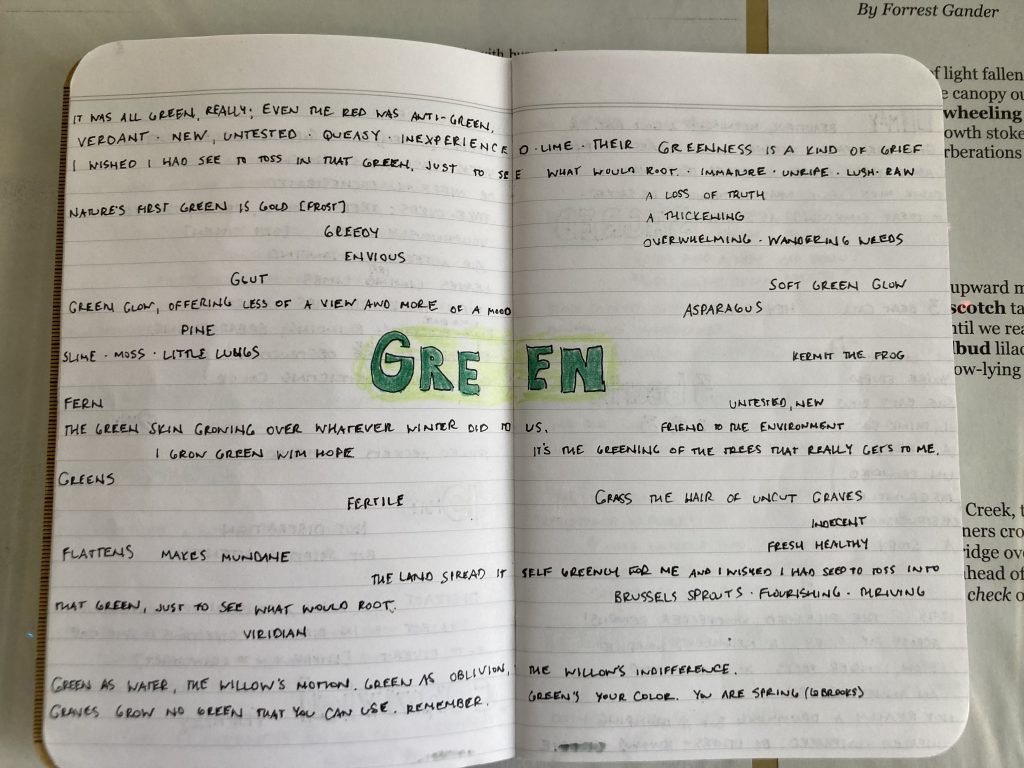
june 29/RUN

3 miles
trestle turn around
66 degrees

A beautiful morning for a birthday run! Green shade, breeze. The run wasn’t easy, but it was wonderful to be outside with everyone else — bikers, runners. walkers, roller skiers, rowers, birds, river, rocks, trees, wind, glittering leaves, stacked stones.

For a little while, I chanted Emily Dickinson:

life is but life
death is but death
bliss is but bliss
breath is but breath

Today I am 50. I’ve decided that I will recite the 50 poems I’ve memorized gradually — possibly spread out over a week or a month — to Scott. Maybe a few to the kids too. No formal thing. How long would it take, I wonder, to recite all 50 poems at one time? Too long!

So far, I’ve recited Sylvia Plath’s “Mushrooms” and Mary Oliver’s “Swimming, One Day in August”

Other fun birthday things: celebrated at the amazing Millie’s Wine Bar last night with Scott, FWA, and RJP. Walked to the library and picked up Mz N. Had a pint of Bee Sting at Arbeiter. Watching the first stage of Le Tour tonight! Tomorrow, open swim. A wonderful birthday!

june 27/RUNSWIM

5 miles
bottom of franklin hill and back
69 degrees

Another run that started easy then got hard. My left hip and knee were stiff and sore. Walked several times on the way back.

Listened to feet shuffling on the grit, some keys jangling in a bucket. Smelled something floral and sweet near the franklin bridge. Felt a cool breeze on my warm face, sweat dripping off of my pony tail. Saw blue, red, and orange graffiti under the lake street bridge and a man helping a dog get through a hole in the chain link fence halfway down the franklin hill.

Ran by a break in the trees with an inviting dirt trail and thought again about how I love seeing these trails and wondering where they lead. Then I thought about how I prefer trails that have already been made by others — an invitation from past feet to explore and to step off the paved path.

Saw this poem online this morning and was surprised that I hadn’t already posted it:

blessing the boats/ lucille clifton

may the tide
that is entering even now
the lip of our understanding
carry you out
beyond the face of fear
may you kiss
the wind then turn from it
certain that it will
love your back may you
open your eyes to water
water waving forever
and may you in your innocence
sail through this to that

swim: 3 loops
72 degrees
light rain

I like swimming in the rain — when it’s a light rain. Have I ever swam in a hard rain? I’m not sure. When you are already wet, it’s difficult to tell what’s rain and what’s lake. Another great swim. I’m struggling in my runs, but loving the water.

10 things

  1. a steady rain that I couldn’t feel or see as I swam
  2. water, a darker green with some blue
  3. tangled in several thin, loose vines — one on my head, another my shoulders, and another on my legs — most were just slimy, but one was sharp and scratchy
  4. pale vines stretching up from the deepest parts of the lake — how tall are these vines this year? they glowed like the moon behind the clouds
  5. particles in the water, almost looking like glitter — or, was that raindrops breaking the surface?*
  6. mostly breathing every five — a few sixes, some threes, at least one two
  7. pink orange yellow safety buoys tethered to swimmers
  8. rounding the second green buoy, sighting the first orange buoy — so far off and lonely — just it and water — and only appearing in my vision when it wanted to
  9. some sort of disturbance below me — was it a big fish? — nothing seen, only felt, the water moving beneath me
  10. standing up near the beach after I finished, noticing the rain, then hearing some kids in the water excitedly yelling, It’s raining!

*It wasn’t until I wrote this out that I realized I was noticing the rain. It was very cool. The rain drop glitter made the water feel more alive, active — stirred up and swirling

I was surprised by how many people were at the beach. It had been raining all afternoon. People were still having picnics, kids were still in the water, several dozen swimmers were out on the course

june 25/RUNSWIM

3.1 miles
2 trails
73 degrees / dew point: 66

Another hot and humid morning. Another difficult run. Is it strange that I don’t mind that it’s hard? Some shade, lots of sun.

10 Things

  1. squish! stepping down in thick, gooey mud on the winchell trail
  2. thwack thwack thwack a runner approaching from behind
  3. pardon me that same runner letting me know he was passing
  4. running down to the south entrance of the winchell trail, looking at the river through the trees — not sparkling in the sun, but flat and brown — somehow this made it look even hotter and less refreshing
  5. rowers down below, heard not seen
  6. the sewer at 42nd, a steady stream of water falling
  7. the sewer at 44th, more of a dribble
  8. honking geese
  9. 4 stones stacked on the ancient boulder
  10. a squirrel ahead of me on the winchell trail — running then stopping then running, finally jumping through the fence and off the trail — was it waiting to dart out right in front of me? no

Alice Oswald and Lorine Niedecker and water’s depths

from Paean to Place/Lorine Niedecker

How much less am I
in the dark than they?

Effort lay in us
before religons
at pond bottom
all things move toward
the light

Except those
that freely work down
to ocean’s black depths
in us an impulse tests
the unknown

from Nobody/ Alice Oswald

The sea she said and who could ever drain it dry
has so much purple in its caves the wind at dusk
incriminates the waves
and certain fish conceal it in their shells
at ear-pressure depth
where the shimmer of headache dwells
and the brain goes

dark

purple

from “Interview with Water”/ Alice Oswald

To be purpled is to lose one’s way or name, to be nothing, to grieve without surfacing, to suffer the effects of sea light, to be either sleepless or weightless and cut off by dreams.

swim: 4 loops
lake nokomis open swim
82 degrees

4 loops! A beautiful summer night! The water was a bit choppy but it didn’t bother me. Saw some silver flashes below — fish? Also, beautiful shafts of light illuminating the particles swimming with me and a few ghostly vines reaching up from the bottom. In certain stretches it felt like the water wanted to pull me down to the lake floor — difficult to kick and keep high near the surface.

New breathing/sighting pattern I noticed last night at cedar: 1 2 3 breathe right 1 2 look up to sight (no breath) 3 4 5 breathe left

above the surface: A few times I paused in the middle of the lake to give attention to the surface. Once I saw a dragonfly. Another time, a plane. The water was blue but not as intense as on Sunday.

below the surface: bubbles, my hands, could feel the movement before I saw any swimmers, then bubbles and pale legs kicking. The water was green but with less blue and more yellow.

june 24/SWIM

2.5 big loops (5 cedar loops)
cedar lake open swim
84 degrees
20+ wind gusts

Big wind gusts as Scott and I walked on the gravel trail to the lake. I wondered how choppy it would be — not bad. No waves forcing me to breathe on just one side. Felt stronger than last Wednesday.

I’m writing this entry the next morning. What do I remember?

10 Things

  1. swimming through a loose vine — wrapped around my shoulders for a moment — not sharp or scratchy
  2. a swimmer in a pink cap (this year’s cap color is an ugly bronze)
  3. a tangled patch of vegetation growing up from the bottom right by the buoy
  4. black, wet-suited arms beside me for a few strokes
  5. the water above, a dull blue
  6. the water below, a vague empty green
  7. no waves but sometimes it was hard to stay up on the surface
  8. the lifeguard’s kayak gliding by me, fast and smooth and red
  9. more vegetation from below in the middle of lake — how tall are these vines?
  10. last year, the far buoy was placed very close to the swimming area at hidden beach, this year it is farther out

Alice Oswald and Nobody

I’m having fun returning to Nobody, feeling like I’ve found some ways into AO’s watery dream-world. I love reading it and Lorine Niedecker and then swimming across a lake.

1

Reviewing my notes in my Plague Notebook, Vol 21 (!), I found this, from AO in “Interview with Water”: continuous present, dream time. This reminds me of Mary Oliver’s now and now and now, which comes up in The Leaf and the Cloud and “Can You Imagine”:

but now and now and now

Swimming across the lake is both a continuous present and not a continuous present. I’m not aware of time, but I do keep track of loops. Maybe each loop is its own continuous present? It would be interesting to try and get lost in the loops, to not count them. I can set up an alarm or a distance workout on my watch that will alert me when I reached a certain amount of time or distance. (How) would the dream-state be different in this loopy state?

2

I’d like to remember (memorize?) this part of Nobody which I imagine is about making poems:

About an hour ago she surfaced and shook her arms
and peered around and dived again and surfaced
and saw someone and dived again and surfaced
and smelt all those longings of grass-flower smells
and bird-flower sounds and the vaporous poems
that hang in the chills above rivers

Those vaporous poems! The diving and surfacing and diving and surface! I love this as a description of a poet — me? — finding words hanging just above the surface. Could they be there for me today during my swim?

3

This definition of day turning to night — wow!

I’ve always loved the way when night happens
the blood is drawn off is sucked and soaked upwards
out of the cliff-flowers the way they worn out
surrender their colors and close and then the sky
suffers their insights all the shades of mauve green blue
move edgelessly from west to east the cold
comes ghostly out of holes and the earth it’s strange
as soon as she shuts her sky-lids her hindsights open
and you can see right out through her blindness
as far as the ancient stars still making their precise points
still exactly visible and then not exactly

june 23/SWIM

3 loops
lake nokomis open swim
67 degrees

Yes! A wonderful morning swim. As usual, always a mix of excited and nervous before the swim, but once I entered the water, all of it went away. Not always easy — sometimes my back hurts or a shoulder or a foot — but almost always wonderful. I love the dream I enter below the surface and the confidence I feel slicing through the water and the warmth of muscles worked after. Nothing feels as natural as swimming across this lake.

10 Things

  1. the crooked line of orange buoys — the one closest to the big beach much further north
  2. the faint outline of vegetation reaching up from the bottom of the lake, just below me
  3. swimming through a net of green milfoil near the white buoy
  4. only the occasional flash of other swimmers — a bent, bare elbow, a black wetsuit, a yellow safety buoy
  5. the brief flash of “buoy” or “orange” or “triangle” in my head, then nothing — I listened and believed and swam towards it
  6. one menacing sailboat — an orange and red sail
  7. open, empty water with vague trees in the distance
  8. above the surface, vivid blue, below the surface, green with hints of blue and the faintest idea of yellow
  9. my hands stretched out in front of me in the water — pale, glowing, a sharp contrast with the dark water
  10. shafts of light illuminating the particles in the water, everything constantly moving

the best moment: Rounding the final orange buoy for the third and final time, heading back to the big beach, the sun came out from behind the clouds. Suddenly the water was a vivid blue when I looked up to sight or turned my head to breathe. When I went back under, everything a beautiful, rich green: blue, green green green green green, blue, green green green green. At some point a cloud came and the blue grew darker, not quite purple. I thought about Alice Oswald and Odysseus and purple robes and being purpled.

Alice Oswald and Nobody

Was thinking about this before my swim:

Well, as you know, I’m quite fascinated, even obsessed, you might say with Homer. And one of the things that really tantalizes me in Homer is what is the Homeric mind? Because I think it’s very different from a literary mind. And it seems not to be inside the skull, but to be out in the world. So, there is a particular simile in the Iliad, which actually that first bit of the poem is based on, where it talks about two goddesses coming from heaven to the earth. And they’re very physically described. They kind of fall down from heaven to the earth. And then when they land, they take little pigeon steps, steps like doves or pigeons. So you can really picture them. But the way their flight moves from heaven to earth is as a man, you know, as the mind flutters in a man who has traveled widely, so you can turn it the other way around and say the way a man thinks is like this incredibly physical flight of two goddesses coming down to earth a bit like pigeons. And that’s always really interested me, that for Homer, the mind has the limitations of a pigeon, if you like. It is this kind of … this physical thing that moves. So, if you imagine a place over the sea, your mind actually has to get there. So, even though it may be as fast as the light, it is physical movement.

A Conversation with Kit Fan and Alice Oswald

I’m still looking for where in the Iliad these goddesses/pigeons are. And I’m still figuring out what AO might mean here. But it is helpful to read it beside these two parts of Nobody:

1/ page 1

As the mind flutters in a man who has travelled widely
and his quick-winged eyes land everywhere
I wish I was there or there he thinks and his mind

immediately

as if passing its beam through cables

flashes through all that water and lands
less than a second later on the horizon
and someone with a telescope can see his tiny thought-form
floating on the sea-surface wondering what next

2 / page 30

When trees take over an island and say so all at once
some in pigeon some in pollen with a coniferous hiss
and run to the shore shouting for more light
and the sun drops its soft coverlet over their heads
and owls and hawks and long-beaked sea-crows
flash to and fro
like spirits of sight whose work is on the water
shading it blue and thinking

I wish I was there

or there

Is the Homeric mind restless? I wish AO would say more about what she means by the literary mind and its lack of movement. I agree, but I’d like it spelled out. Does my mind work this way when I’m out moving by the gorge, or swimming across the lake? Does it move through or above the water? Maybe it became a fish.

Here’s one more line from the interview that I want to respond to:

. . . feeling of characters who have been eroded by the weather and by the sea is really what I’m feeling in this poem. It’s a poem that just opens itself to the elements and gets kind of washed, it gets its features washed off. . . . I think that’s all part of the erosion, really, it’s like even the forms of visible things have been almost worn down to their abstract shapes.

A Conversation with Kit Fan and Alice Oswald

Visible forms almost worn down to their abstract shapes — that’s how much of the gorge looks to me. Soft forms: trees, trash cans, big boulders.

june 22/RUN

3.15 miles
river road south/north
67 degrees
93% humidity / dew point: 65

Very tough on the legs! That dew point — ugh! Another difficult run. Still glad I did it. I heard some chattering birds and water gushing out of the sewer pipe near 42nd. Ran over puddles, slippery leaves, mud, recently re-tarred asphalt, dirt, roots. I remember looking at the river through the trees but I don’t remember what it looked like — probably a very pale blue or white, like the sky.

Inspired by all of my time with Alice Oswald lately, I’m thinking of starting Nobody again this afternoon. Listening to an interview she did with Kit Fan, back in 2020, I’m intrigued by what she said about her approach to writing it:

[The poem] sets out really to drown the reader. I wanted it not to feel like a sort of intellectual exercise where you would emerge kind of clarified and simplified, but literally to be as if you were inhaling water. … I find the people who I think get most out of it are those who don’t expect it to be conveying a thought, but expect it to be more like the experience of being outdoors, where you simply are assaulted by all kinds of different tunes and beings.

A Conversation with Kit Fan and Alice Oswald

And here, AO talks about color:

Well, I always feel that the Odyssey is a very bright emerald green because it has this incredible sort of vegetative life in it. It’s like a plant that just cannot stop growing. You know, the sentences grow all over the place. So, even though it’s a poem about the sea, I actually feel that kind of bright green of spring leaves in it. But I mean, I did kind of quite terrifying things to my mind when I was writing this poem, because I got quite interested in theories of color and sort of trying to watch what my mind was doing, particularly looking at colors in water and how your mind will tell you that’s green because you know it’s a leaf, but actually when you look at it, it’s not because it’s in a black river. And so, just trying to notice what the mind does and try, as I’m always trying, to get away from my own mind and out into the world. I was trying to see what colors are beyond my mind. And I think they probably don’t exist beyond the mind. So, it was actually an experience of almost unsettling all my perceptions really.

And being stuck, and going nowhere — is this similar to my looping!?

So these stories don’t get anywhere. They’re all stuck. And I like sort of, you know, Celtic patterns that just go on and on doing the same thing. So I didn’t want to make a poem that got anywhere, really. I wanted a poem that was stuck, whose stories couldn’t quite move forward, that had simply been tossed about by the weather, really.

later (5 pm): At the risk of making this entry too long, I’d like to add a few thoughts/notes after reading part of AO’s Nobody again, having read it before in 2022. It was very helpful to listen to AO’s lecture, “Interview with Water” and listen to/read the transcript of her interview with Kit Fan.

Before the poem begins, AO describes the similar (using similar like she does in “Interview with Water” — not the same, but resembling but varied, like water by currents) stories of Agamemnon, whose wife was not faithful and Odysseus, whose wife was.

This poem lives in the murkiness between those stories. Its voice is wind-blown, water-damaged, as if someone set out to sing the Odyssey, but was rowed to a stony island and never discovered the poem’s ending.

Nobody/ Alice Oswald

It helped me to read that beside AO’s words in her interview with Kit Fan:

. . .the poem is very much a kind of strange reading of the Odyssey. The Odyssey I see is a beautifully patterned wedding hymn about Odysseus’s marriage to Penelope and how they are driven apart by the Trojan War, and then they come back together. But embedded in that story, you’ve got the opposite story, which is the wedding of Agamemnon who goes off to the same war and comes back and is murdered by his wife whose taken another. And it’s that reverse Odyssey that I was writing in this poem, partly because the poet who is abandoned on the island is part of Agamemnon’s household. So, from his point of view, the Odyssey is being seen differently, from that other, much darker story. 

A Conversation with Kit Fan and Alice Oswald

Her use of darker here, reminds me of something she said in “Interview with Water”: “when you look at water, it allows you to exist twice but more darkly.”

june 21/RUN

4.15 miles
the monument and back
67 degrees
humidity: 91% / dew point: 65

Yuck! The air is so thick, everything heavy with moisture. We were supposed to have thunderstorms this morning — 90% chance — so I ruled out open swim, but they haven’t happened yet. Bummer. I bet it would have been a good swim.

I ran through the neighborhood, over the lake street bridge, up the summit hill and to the monument. Then I turned around and ran back, this time running south on the river road path instead of through the neighborhood.

10 Things

  1. 3 stones stacked on the ancient boulder
  2. a strange whimpering, soft howling or moaning sound coming from under the bridge on the east side — a non-human animal? a bird?
  3. no rowers on the river
  4. a foul, rotting smell as I ran over the bridge — I thought of the rot* that Alice Oswald mentioned in “Interview with Water” and the scarlet rot that FWA told me about yesterday when he recounted some “Elden Ring lore”
  5. a dark, deep green everywhere
  6. flowers alongside the trail on the east side: green leaves, fanned like ferns, pale white or purple flowers, small, dotting the green
  7. new (or newly noticed) graffiti under the bridge on the east side — brick red, I think
  8. the dark reflections of tree in the water near the shore — so dark that they look like shadows to me
  9. the faintest trace of a sandbar under the bridge
  10. the usual puddles near shadow falls are back, almost covering the entire path

*AO and rot: “anything excessive or out of focus or subliminal — for example: a swimmer seen from underneath, a rotting smell. . .”

Here’s another Alice Oswald water poem that I uncovered in a dissertation about Oswald, Jorie Graham, and water!

Sea Sonnet/ Alice Oswald

Green, grey and yellow, the sea and the weather
instantiate each other and the spectrum
turns in it like a perishable creature.
The sea is old but the blue sea is sudden.

The wind japans the surface. Like a flower,
each point of contact biggens and is gone.
And when it rains the senses fold in four.
No sky, no sea – the whiteness is all one.

So I have made a little moon-like hole
with a thumbnail and through a blade of grass
I watch the weather make the sea my soul,
which is a space performed on by a space;

and when it rains, the very integer
and shape of water disappears in water.

Almost forgot: japan is a new word for me. Here are some definitions, both noun and verb:

noun:

  1. any of several varnishes yielding a hard brilliant finish
  2. a hard dark coating containing asphalt and a drier that is used especially on metal and fixed by heating — called also japan black

verb:

  1. to cover with or as if with a coat of japan
  2. to give a high gloss to

june 20/RUNSWIM

4.1 miles
minnehaha falls
65 degrees

Overcast this morning. Cool, but humid, sticky. Another run that wasn’t easy or effortless. Keep showing up. It will get easier or you’ll get better or it will (eventually) get cooler. I’m not too worried. Is it the lexapro, or am I just satisfied being able to get outside and move by the gorge?

10 Things

  1. the crater with the tube sock/Florida outline is gone, filled in yesterday
  2. a gnat flew in my eye — a fullness, than a small sharpness, then a watery eye, finally gone!
  3. a motorized scooter on the bike path — hey, you’re supposed to be on the road! (thought, not said)
  4. today’s color palette; green and gray
  5. dark mud, not gooey but slick
  6. laughing kids on a playground
  7. the surreys, all lined up at the falls, one being readied for a family as I ran by
  8. rushing falls, roaring creek, gushing sewer pipe near 42nd
  9. some loud rustling in the bushes
  10. passing a walker, a whiff of subdued perfume — fresh, floral / passing a biker, a sniff of cologne — fresh, earthy

At some point, looking up at the green trees, remembering green water, I thought about Alice Oswald and the connection between water and grief. Then I recalled Tony Hoagland’s poem about swimming and cancer and thought about water and relief.

a few hours later: It’s raining — a soft, light rain — right now (2:30 pm). I’m hoping that open swim will still happen at 5:30. Tomorrow it probably won’t: thunderstorms all day. Anyway, I’m continuing to listen to and think about Alice Oswald’s “Interview with Water.” Very cool! Here’s the next little bit:

Find yourself in the silence underneath an overhanging wave that or thereabouts is the color of a bluish violet ultramarine gown so the great poet sang, “But Odysseus taking his bluish gown in his big hands drew it over his head and hid his face ashamed to let the Phaeacians see his tears.” The gown goes over the head like a wave, the human sits under its sea color with salt water pouring from his eyes. It is one of those places where the form of the poem hurries us forward, the form of the language pulls us back. Porfurion is a word with water inside it like a bucket down in the middle of a line. Already if you look hard at the word you can see the widow’s simile underneath it but Homer is not yet ready to make that gift. With magnificent theatricality, he draws a blue gown across the mind and we, like the Phaeacians, are left looking at it, waiting.

Homer is the foremost poet of the visible. Homer delights in surfaces, but the surface of water is complicated by transparency, and its transparency is complicated by refraction. Water is never the same as itself. Rivers can only exist as similarities, lakes reflect more than their own volume, and what’s more, when you look at water, it allows you to exist twice but more darkly. When you look at it again it evaporates as if moving in and out of existence — it simply requires a bit of sunlight then it reappears as frost. Perfectly symmetrical as if discovering pre-drawn diagrams in thin air. Then it reappears as tears so that any attempt to describe the surface of water tells you to hide your face and inspect your innermost thoughts. All these waverings are part of the word porfurion. The physics or nature of water is metaphysical meaning that its surface expresses more than itself.

Interview with Water

All of AO’s mention of surfaces makes me want to think about surfaces during my swim. I swim on the surface, wanting to stay with my head just below as long as possible. What does the surface look like or feel like when I’m breathing every five (or more) strokes? What if I tried every 2 or 3? What is the color of the surface — from above or below?

swim: 2 loops
lake nokomis open swim
68 degrees

Wow, what a perfect swimming night! The water was warmer than the air temperature. The sky was white and heavy. Everything calm, quiet. I felt fast and strong cutting through the water, breathing every 5 strokes with the occasional 3, at least once, after 2. I tried to give attention to the surface. Just under the water, I watched my hands stretch out in front of me, covered in bubbles. The water was a beautiful deep (but not dark) green, with the feeling of deep blue and gray. I could see the sediment swirling. Above the water, the surface was silver, still.


june 19/RUNSWIM

2.5 miles
2 trails
64 degrees

A quick run before meeting my college friends for lunch. Cooler today. Heard the rowers. Spotted: at least 2 bright yellow shirts, one bright pink. City (or county or park?) workers were out re-tarring a few more spots on the trail. Hooray for less craters! Last week, they finally filled in the big crack that had white spray-paint around it, making it look like a tube sock or Florida (I’ve written about it before). I wonder if they’ll finally fill in the hole that’s been getting deeper every year? The one that would definitely twist your ankle if you stepped in it. I hope so.

I don’t remember hearing any birds or roller skiers or laughing kids, but I do remember the squishy mud on the winchell trail and the bug bite I got as I walked home.

color in/on/under water

Listening to Alice Oswald’s lecture, Interview with Water, I came across this great passage about color. First she’s mentions that poets performing The Odyssey always wore blue robes, then she mentions a line from book 8:

Odysseus
with his strong hands picked up his heavy cloak
of purple, and he covered up his face.
He was ashamed to let them see him cry.
Each time the singer paused, Odysseus
wiped tears, drew down the cloak (8:84-89)

Then she references something she said a few minutes earlier —

I keep a bucket of rainwater under my window and it delights me that green leaves reflected in a black bucket are not quite green. I don’t know what color they are. At certain moments, early in the day, they might be called pre-green, but then the clouds change or the wind moves the surface mark and all at once they seem bright dark and blind silvery then foggy emerald.

— and says this:

To go back to that bucket of water — to wave a blue gown above it and ask, What is that color which Homer calls porfurium? It is not blue exactly; it gets translated as purple but purple is a settled color whereas Homer’s word is agitated. It derives from the sea verb porfurion which means to roll without breaking, so it is already a fluid word, a heaped up word, a word with underswell, not a pigment but an emanation from the nature of water. To get a true sense of porphyrion you need to see the sea in it and for Homer the sea is unhuman full of strange creatures missed colored unplowable and this is my favorite word it is a peritone meaning unfenced. If you want to imagine the colour of Odysseus’ gown you will have to swim out into the unfenced place, the place not of definitions but of affirmations. Yes I’m afraid you will have to find your way to the p volume of Johnson’s unwritten dictionary. There you will discover a dark light word an adjective for edgelessness — a sea word used also of death smoke cloth mist blood between bluish purple and cobalt mauve. It appears mid-ocean when the wind perhaps makes a network of backblowing glitters that the underswell moves sideways as when a big sea swells with noiseless waves. It is used of the heart meaning his heart was a heaving not quite broken wave. It indicates a surface but suggests a depth a mutation of flatness or noiseless sheen, a sea creature, a quality of caves, any inlet or iodine or shaded stone, a type of algae or rockfish, anything excessive or out of focus or subliminal — for example: a swimmer seen from underneath, a rotting smell, a list of low sounds, an evening shadow or sea god, a whole catalogue of simmering grudges storms waves and solitudes or deep water including everyone who has drowned in it. To be purpled is to lose one’s way or name, to be nothing, to grieve without surfacing, to suffer the effects of sea light. to be either sleepless or weightless and cut off by dreams — find yourself in the silence underneath an overhanging way that or thereabouts is the color of a bluish violet ultramarine gown so the great poet sang.

Interview with Water

Wow! So many wonderful things to do with this passage! For now, I want to think about how color works underwater. In an hour, I’m heading over to deep (at least, deeper than Lake Nokomis) Cedar Lake to swim across it. How will color work as I swim? Below water? Above? Is this agitated, moving purple similar to how I see all the time? (Yes, I think.)

swim: 4 cedar loops (= 2 nokomis loops)
cedar lake
72 degrees

The first swim at Cedar Lake! As I’ve mentioned here before, Cedar has a very different vibe than Nokomis. Hidden away, at the end of a gravel road. A small beach. No buildings, the only bathroom a port-a-potty. Chill lifeguards. Today the water was cold but (mostly) calm. Not too many swimmers. 2 lifeguards on kayaks, 2 orange buoys, too much vegetation growing up from the bottom of the lake. I overheard another swimmer mentioning the vines too.

color: Inspired by Alice Oswald, I tried to think about the color of the water. Cloudy, not clear. I could see the vines and the bubbles from my breathing and my hands entering the water but not much else. Not purple or blue but green — not dark green but pale green. Maybe some pale blue — yes — and light gray. Occasionally a shaft of light from above, a dark vine below. Textured bubbles. Not much to see, but not nothing there. Instead, everything small, packed, too dense to decipher. No color and too many colors. Impossible to pin down with “green” or “gray” or “blue.” Not grief, but uncertainty.

june 18/RUN

3.1 miles
trestle turn around
76 degrees / feels like 82
dew point: 71

Ugh! I knew it was going to be tough when I felt too hot even before I started running. More rain last night — enough to cancel our final community band concert — and more thick, sticky air this morning.

Greeted Mr. Morning! and Mr. Holiday. Saw Dave the Daily Walker but he was too far away to greet. Counted the stacked stones on the ancient boulder: 4. Heard some strange creaks below the trestle — what were people doing down there? Also heard the rowers on the river. Felt the sweat pooling on my face, my shorts sticking to my legs.

When the dew point temperature and air temperature are equal, the air is said to be saturated.

Observed Dew Point Temperature

Almost saturated — temp = 76, dew point = 71.

Looking through the trees somewhere near the trestle, I could see the river burning bright white — even the water looked hot!

Oh, this beautiful poem by Tony Hoagland! He died in 2018 (at the age of 64) from pancreatic cancer. My mom died from pancreatic cancer. It’s terrible. This poem was published in 2007.

Barton Springs/ Tony Hoagland

Oh life, how I loved your cold spring mornings
of putting my stuff in the green gym-bag
and crossing wet grass to the southeast gate
to push my crumpled dollar through the slot.

When I get my allotted case of cancer,
let me swim ten more times at Barton Springs,
in the outdoor pool at 6AM, in the cold water
with the geezers and the jocks.

With my head bald from radiation
and my chemotherapeutic weight loss
I will be sleek as a cheetah
—and I will not complain about life’s

pedestrian hypocrisies,
I will not consider death a contractual violation.
Let my cancer be the slow-growing kind
so I will have all the time I need

to backstroke over the rocks and little fishes,
looking upwards through my bronze-tinted goggles
into the vaults and rafters of the oaks,
as the crows exchange their morning gossip

in the pale mutations of early light.
It was worth death to see you through these optic nerves,
to feel breeze through the fur on my arms
to be chilled and stirred in your mortal martini.

In documents elsewhere I have already recorded
my complaints in some painstaking detail.
Now, because all things are joyful near water,
there just might be time to catch up on praise.

june 17/RUN

4 miles
minnehaha falls and back
65 degrees / dew point: 61

Today’s word: saturated. What Lorine Niedecker aimed for in her water poetry. Not floating or dry but sinking and soaked.

Rain off and on all day. Maybe thunderstorms starting in the afternoon.

No rain as I ran, but everything was wet or dripping. Moist. My face, more moist than a sponge. The falls, gushing over the limestone then rushing down the gorge to the Mississippi.

Evidence of the rain and thunderstorms last night all along the trail. Above the oak savanna it looked like some creature had tore through the green, ripping small limbs and leaves off the trees and throwing them to the ground.

The parking lot at the falls was packed with cars. Not the best day to be at the falls — but maybe it was? A chance to witness the falls in full cry, I guess. Also a chance to get wet or slip in the mud. I thought I might, but didn’t.

Anything else? A black squirrel sighting, which reminded me of the line from “What Would Root”: scolded by squirrels in their priestly black

Discovered the poet, Maureen N. McLane this morning and was delighted by her serial poem about Mz. N. Requested the book from the library. Possibly an inspiration for some writing about Sara, age 8?

an excerpt from Mz N: the serial/ Maureen N. McLace

The child Mz N sat on her bed
and wondered: that tree
outside her window
shifted
when her eye
shifted. What to make
of that?

                                          §

Mz N and her siblings
had a dog for some time.
They went on vacation &
when they came back
no dog.
They asked the parents:
the dog?
who replied:
what dog?
And some people wonder
why others distrust the obvious.

Speaking of the serial poem — LN’s “Paean to Place” is considered one — here’s a helpful definition:

The serial form in contemporary poetry, however, represents a radical alternative to the epic model. The series describes the complicated and often desultory manner in which one thing follows another. Its modular form–in which individual elements are both discontinuous and capable of recombination–distinguishes it from the thematic development or narrative progression that characterize other types of the long poem. The series resists a systematic or determinate ordering of its materials, preferring constant change and even accident, a protean shape and an aleatory method. The epic is capable of creating a world through the gravitational attraction that melds diverse materials into a unified whole. But the series describes an expanding and heterodox universe whose centrifugal force encourages dispersal. The epic goal has always been encompassment, summation; but the series is an ongoing process of accumulation. In contrast to the epic demand for completion, the series remains essentially and deliberately incomplete.

Seriality and the Contemporary Long Poem/ Joseph Conte

I had to look up a few words from this excerpt that I wasn’t quite sure of:

desultory: marked by lack of definite plan/purpose, not connected to main subject
protean: displaying great diversity or variety, versitle
aleatory: relating to luck, depending on an uncertain event or contingency

This idea of a serial poem as “an ongoing process of accumulation” is very cool and fits with my approach to Haunts and a story in long form.

june 16/SWIM

swim: 2 loops
lake nokomis open swim
75 degrees / choppy

A choppy swim. Fun, but not easy with my out-of-swimming-shape body. I didn’t swim at all this winter: sore back, neck, shoulders. Wow, do I love open swim! I was nervous before the swim, wondering again if I’d be too disoriented. Nope. I just kept swimming and made it to all of the buoys. I love how approximate open swim is; you don’t have to take the straightest, most direct line, you just need to stay on the right side of the 5 buoys and on the left side of the 4 or so lifeguards on kayaks.

10 Things

  1. the water felt COLD when I first entered, but wonderful as I swam
  2. a strange pale vine just below the surface
  3. small waves to my right, making it harder to breathe
  4. swells from behind making it hard to stroke on the stretch parallel to the big beach
  5. my eyes couldn’t see the far orange buoy, but my brain did: sighting, a voice in my head said, it’s straight ahead — this happens a lot, these days. The trick, to trust
  6. on the other loop: that same orange buoy in sight but so far away, seeming to get farther away with every stroke
  7. breathed: a mix of every 5 or 4 or 3, a few 2s when it was extra choppy
  8. more vegetation, pale, ghostly, reaching up from the bottom
  9. exiting the water, a woman speaking to some friends: I was nervous, so I didn’t wait. I already swam./ another woman: Did you like it?/I loved it!
  10. no birds or planes or strange noises underwater

An essay to return to: Friday essay: ‘an engineering and biological miracle’ – how I fell for the science, and the poetry, of the eye

Okay, I’m returning to it now (added a few hours later). I wasn’t planning to, but I read something in a recent New Yorker story that decided for me that I should. Two moments, one from the article and one from the story:

1

Iris presents to me with failing vision. Examining her eyes, I see “geographic atrophy”, little islands of missing retinal tissue worn away over time. This is a form of incurable, age-related, macular degeneration. It results in permanent loss of central vision, with peripheral vision remaining intact.

It’s not good news; my stomach tightens as I prepare to deliver it.

Iris replies, tearily, that she just lost her husband of 60 years. She’s now alone and becoming blind. I’m taken aback – what can one honestly say to this?

Sure, there are visual magnifiers, home modifications, other practical aids that may guardrail her physical safety. But her anguish goes beyond this; she’s on the edge of a personal precipice, and teetering. There’s electricity in the consult room, a lightning-rod moment for sure.

How might a poet view this scene?

Then, a few sentences later:

Good poetry must go further, seeking the patterns beneath the surface. What precisely is it about Iris that moves me so? She is losing things, important things. Witnessing this touches my deepest fears, knowing that, like an unwelcome house guest, loss visits us all, sometimes staying for good. 

As my Persian countryman Rumi wrote, “this human being is a guest house”. Losing our own physical abilities or our loved ones, what would become of us?

Distilling this further, what exactly is loss, its weight and texture?

Inversions,
your cherished glass of shiraz shatters
on the tiles, your laden table
upended. Warmth whistles
out through the cracks, cold rises up.
Midnight:
your reasons for living dwindle,
walking out the door
one by one.

Friday essay

2

Farah put up her hand. She said, “I don’t find it difficult to think about . . . ,” then paused in surprise at not being able to say “dying,” “about choosing not to live if I’m going blind.”

Beyond Imagining (fiction) / Lore Segal

Wow. I am not as old as Iris, and I didn’t just lose my husband, but the description of her vision loss (albeit a different condition) is the same as mine: all central vision gone, peripheral sight stays. I don’t doubt that many “Irises” feel this despair when confronted with this diagnosis, but it’s not the only way that people respond. It is not how I responded. It is, however, the way that most haunts our imaginations — the blind specter. I’d rather be dead than blind!

I’ve read the whole article, but I stopped reading the short story. I should return to it and see what happens. Maybe I’ll be surprised, maybe it will go deeper than the tired trope of the blind specter.

june 15/RUN

5 miles
bottom franklin hill and back
72 degrees / dew point: 60

Whew! I was sure the dew point would be even higher. It felt very uncomfortable out there. And difficult. But I kept moving and didn’t push myself too hard. I ran to the bottom of the hill then walked up it. Then ran, walked, ran until I was back to the ancient boulder — no stones stacked on it today.

Last night RJP graduated from high school. I’m very proud of her for surviving it. I’m proud of myself too. It was very hard and I am tired. No more k-12 public school! Hooray! I loved many of the teachers and the music programs, but I won’t miss being subject to this schooling process.

RJP’s graduation was delayed by almost an hour because a fight broke out at the previous school’s graduation and someone was hauled away in an ambulance. FWA said he saw the guy, and he looked like he was probably fine and not in much pain. Other than the delay, the graduation was great. The awesome poet Bao Phi gave the address — so good! He, along with the student speakers, centered the experiences of BIPOC students.

10 Things

  1. white sky
  2. dark green mystery
  3. at least 2 specks in the sky — a plane? a bird?
  4. click clack — roller skiers powering up the franklin hill
  5. foamy water
  6. glowing orange shoes on a runner
  7. voices below near white sands beach
  8. one runner to another: well, that killed about an hour and a half — huh?
  9. a greeting from Mr. Holiday!
  10. a few days ago I mentioned something in orange spray painted on the sidewalk — it’s the outline of a cat (but not Garfield, I think?)

a section from Wintergreen Ridge/ Lorine Niedecker

Reading (again, for the 3rd or 4th time?) LN’s “Wintergreen Ridge,” I was delighted by her connections and associations:

Women saved
a pretty thing: Truth:

“a good to the heart”
It all comes down
to the family

“We have a lovely
finite parentage
mineral

vegetable
animal”
Nearby dark wood—

I suddenly heard
the cry
my mother’s

where the light
pissed past
pistillate cone

how she loved
closed gentians
she herself

so closed
and in this to us peace
the stabbing

pen
friend did it
close to the heart

pierced the woods
red
(autumn?)

Sometimes it’s a pleasure
to grieve

june 13/RUNSWIM

5 miles
bottom of franklin hill and back
70 degrees / dew point: 60

Overcast, which helped it feel a little less warm. Sticky, thick air. A lot of sweat, especially on my face. Dripping ponytail. So green even the air was green. Greeted the Welcoming Oaks — hello friends! Descended into the tunnel of trees and was enveloped in green. Chanted triple trees: sycamore/sycamore/sycamore/red oak leaf/silver birch. Heard the rowers through the trees. Admired the barely moving, calm water under the bridge — the surface was dotted with foam and reflected clouds. Saw a speck in the sky out of the corner of my eye. Tried to look at it, gone. Tried again, a plane almost covered in fog. Saw a dark ring around it — my ring scotoma? Appreciated how the outline of the treetops on either side of the river road echoed the shape of the river banks. Walked up the hill — it took me 7 minutes — then ran, walked, ran back. Ended with a dozen roller skiers above me while I climbed out of the tunnel of trees.

For the first mile, in the dark green quiet, everything was dreamy. Thought again about how running puts me in a strange, surreal state. Nothing quite real. Then thought about Lorine Niedecker and the physical act of seeing with messed up eyes and using the poetic form to represent that. I’m not aware of how my eyes move as I see except for when I look to the peripheral as a way for my central vision to see something. I imagine having nystagmus makes you more easily register the movement of your eyes. How conscious was LN of her eye movement and how it was mimicked in her lines? When I think about how I see — the mechanics of it and its physicality — I think more about what happens when the corrupt or limited data travels as electrical impulses through the optic nerve and to the brain. Are the effects of nystagmus primarily physical — strain on eyes, the rapid movement creating dizziness and headaches? I should read more about it. . . . The physical impact of my vision sometimes reads as dizziness and light-headedness, but mostly it’s just a vague sense of unease and fatigue — more naps. I rarely feel the eye strain or get headaches from my effort.

In the article I was reading about LN’s nystagmatic poetics, this poem was discussed:

Tattoo/ Wallace Stevens

The light is like a spider.

It crawls over the water.

It crawls over the edges of the snow.

It crawls under your eyelids

And spreads its webs there—

Its two webs.

The webs of your eyes

Are fastened

To the flesh and bones of you

As to rafters or grass.

There are filaments of your eyes

On the surface of the water

And in the edges of the snow.

note at 11 am: Today is my first day of open swim! After the swim, I’ll return to this entry.

I’m spending the afternoon on the deck, reading Niedecker and thinking about Alice Oswald and Niedecker and my Haunts poems. Here are some jumbled thoughts:

You have been in my mind/between my toes/agate — Lake Superior/LN

You’ve been in
my mind

beneath my
feet Mom

Look for me under your boot-soles — Walt Whitman

Ars Poetica/ Arcelis Girmay

May the poems be
the little snail’s trail.

Everywhere I go,
every inch: quiet record

of the foot’s silver prayer.
             I lived once.
             Thank you. 
             I was here.

“We a lovely/finite parentage/mineral/vegetable/animal” — Wintergreen/ LN

I’m interested in how many layers you can excavate in personality. At the top it’s all quite named. But you go down through the animal and the vegetable and then you get to the mineral. At that level of concentration you can respond to the non-human by half turning into it.

Alice Oswald interview for Falling Awake

To write a poem is to be a maker. And to be a maker is to be down in the muck of making and not always to fly so high above the muck.

Poetry is Not a Project/ Dorothy Lasky

We can’t float or fly for long, above. We are part of the muck, not stuck but entangled, beholden

to work down/ to ocean’s black depths/us us an impulse tests/the unknown — Paean to Place/ LN

2 loops / 1.5 miles
lake nokomis open swim
80 degrees

Open swim! Open swim! I was nervous before the swim, wondering if I would see the buoys. I did! The water felt wonderful — a little cold, but not too cold, and wavy but not choppy. I watched the sun filtering through the water, avoided the vegetation growing up from the bottom and the swan boat stuck right by the orange buoy. That menacing swan was a little too close as I neared the buoy. The last green buoy was so far from the orange buoy — it seemed to take forever to reach the beginning of the loop. Oh, I love open swim and what joy to have had a good first swim!

june 12/WALK

1 mile with Scott
neighborhood
82 degrees

Was planning to bike to the lake and swim today, but it rained. On and off all day. So I read about Lorine Niedecker and took notes. Then, a quick walk with Scott.

Here are some observations from my deck, the yard, the window at my desk, and the walk:

10+ Things

  1. deck: the sky heavy, gray, expectant — but it’s not supposed to rain today! — it did and then did again
  2. deck: under the lime green umbrella, hearing the first drops, soft and slight
  3. deck: the service-berry bush at the edge of the deck did a better job of keeping the deck dry than the umbrella!
  4. front yard: after rain today, and the wind the past few days, the yard was almost as much twig as grass. Our neighbor’s tall tree with the wandering limbs offers unwanted gifts all year
  5. desk/window: in the left window, a blob stretches above the other hydrangea leaves — dark, diseased — what is it?
  6. side yard: not sure what this blob is even up close — could it be army worms? or is it just a failed unfurling?
  7. side yard: near the gate, a rogue tree is growing outside of our neighbor’s window. Will they cut it down before it gets too big and becomes a problem for us?
  8. desk/window: rain, pouring down, missing the gutter and sliding straight off the roof in sheets — too much debris/dirt in the gutter?
  9. no lightening but far off thunder rumbles
  10. green green green green green green green green
  11. cabbage or lettuce or something else green growing in a neighbor’s planter
  12. the sweet snell of pine after the rain
  13. convinced I was seeing a giant fish sculpture until Scott told me it was wrapping over a tree
  14. workers re-roofing a sharply angled roof with no harnesses

Here ares some thoughts to remember from Niedecker:

1

LN’s life by/with/on water involves saturation not transcendence.

2

Thru birdstart
wingdrip
weed-drift
of the soft and serious
water
(from “My Life on Water”/ LN)

3

Reading is a bodily act — within the body, not transcending the body. The physical act of reading words with diseased eyes.

4

Time to challenge the myth that not being able to see “naturally” makes your hearing improve — That visual impairment improves hearing, taste, touch, smell, is mostly myth — Halos. Ed Bok Lee — LN used sound in remarkable ways, and also explored seeing differently.

5

One of the traditions LN draws from, Objectivism, believed in the clear, straight-seeing eye. In later work, like “Wintergreen Ridge,” she challenged the possibility of this straight-seeing.

Tell all the truth but tell it Slant — ED
Alice Oswald and the slow, oblique, slight squinting of the Old Women in the Illiad

6

Imagists (Ezra Pound, HD): to see the world as it is, the IS, the this, scrubbing away to the essence

Objectivists (Zukofsky, Williams Carlos Williams): to look with clear eyes, pay attention, as is in context

Oh my scouring eye/that scrubs clean the sky — “perhaps you tire of birds”/ Donika Kelly

7

I used to think I was goofing off unless I held only to the hard, clean image, the think you could put your hand on. But now I dare do this reflection.

LN

8

Video, My Life By Water

june 11/RUN

4.5 miles
veterans home and back
56 degrees

Still struggling with endurance, still showing up. How much of this is mental, how much physical? The sixty-four thousand dollar question, as my dad used to say. I think it’s both, but probably more mental. Maybe the lexapro is already kicking in, but my struggles aren’t bothering me. After the run I thought, these struggles will make showing up at the marathon start line, then finishing 4-5 hours later, much more meaningful.

It rained this morning, so everything was wet, even the air. Everything was also green. Green green green. Any other colors? Nope, not much to break up the green. Green green green green green.

10 Things

  1. lush green, dark, on the part of the path that goes below the road
  2. puddles
  3. a woman ahead of me, running, wearing only one compression sleeve on her right calf
  4. a group of kids walking to the playground at minnehaha
  5. a much bigger group of kids walking near 42nd — a long line, 3 across, took me 10 or 15 or more? seconds to pass them
  6. gushing water near the ravine by the oak savanna
  7. the bright yellow crosswalk sign — my bee — was muted in the gray sky
  8. crossing the bridge high above the creek, all green, no view of the water below
  9. lush green, dark, on the steep hill descending to the locks and dam no 1
  10. a pile of e-bikes parked near a bench — black with blue accents

paean to place/ lorine niedecker

Before my run, I started writing out, by hand, Niedecker’s poem. It’s so long! My hand started cramping up. I had to write slowly to account for my visual errors, like not seeing the words I’ve already written and writing words almost over them or above them instead of below them. The slow work is good, giving me time with each word and line.

Here’s one line I’d like to make note of:

Not hearing sora
rails’s sweet

spoon-tapped waterglass-
descending scale-
tear-drop-tittle

I wondered, what does a sora sound like, so I looked it up and listened. Yes, it sounds like LN described! Listen here to calls 1 and 2.

june 10/RUN

4 miles
minnehaha falls
60 degrees

Ah, summer mornings! Beautiful. Cooler. If I would have slept better, I would have tried to go out even earlier. The first half of the run felt good, then I got hot and it got harder. Today I didn’t worry about what that meant for my training. Instead, I enjoyed the brief minutes of walking, taking in the trees at the falls — so green! so full!

10 Things

  1. the falls, flowing, white, undulating — the water not falling straight, but almost falling over itself — was it hitting some limestone on the way down?
  2. a bundle of something on the ground next to the dirt trail — a hammock?
  3. 2 women with tall hiking packs on their backs walking on the paved path
  4. some animal — a turkey? — upset, calling out, a human voice saying something — hey?
  5. a flash below the double bridge — a sliver of creek almost covered by green
  6. 2 roller skiers near locks and dam no 1
  7. the dirt trail cutting through the small wood near ford bridge looking cool and inviting
  8. happy kids on the minnehaha park playground — happy: green voices, where green = young, outside, tender
  9. (walking back, about to cross 46th ave at 37th street) 2 older women chatting, then greeting me, oh! hello!
  10. (walking back almost to my alley) heard on a radio or from a phone or a computer in neighbor’s backyard, the next one is Scandia — was this talk radio or a zoom meeting or what?

Lorine Niedecker and “Paean to Place”

to dwell with a place:

What is required, however, is sensual, embodied experience—close encounters of awe, wonder, fright, disgust, or even tedium—which remind us both of the real earth with which we dwell, and that we share our home with innumerable cohabitants.

Dwelling with Place: Lorine Niedecker’s Ecopoetics

opening to “Paean to Place”:

Fish
fowl
flood
Water lily mud
My life

in the leaves and on water
My mother and I
born
in swale and swamp and sworn
to water

My father
thru marsh fog
sculled down
from high ground
saw her face

at the organ
bore the weight of lake water
and the cold—
he seined for carp to be sold
that their daughter

might go high
on land
to learn

Wow! Reading this opening, I’m thinking about the Objectivists and the Imagists and Ezra Pound’s 3 rules for writing poetry:

  1. Direct treatment of the “thing,” whether subjective or objective
  2. To use absolutely no word that does not contribute to the presentation
  3. As regarding rhythm: to compose in the sequence of the musical phrase, not in sequence of the metronome

What condensery and music in these lines! And what wonderfully effective descriptions of two people dwelling in and with a particular place, especially her mother, born in swale and swamp and bearing the weight of lake water and the cold.

definition of ecopoetics:

The word itself is an amalgam of two Greek words: oikos [household or family] and poïesis [making, creating, or producing], so that ecopoeticsquite literally means the creation of a dwelling place, or home-making. The term came into special prominence after the influential British literary critic Jonathan Bate published The Song of the Earth in 2000. There, Bate defined ecopoetics as a critical practice in which the central tasks are to ask “in what respects a poem may be a making … of the dwelling-place” and to “think about what it might mean to dwell upon the earth.”

Dwelling with Place: Lorine Niedecker’s Ecopoetics

LN’s opening lines and her descriptions of her parents, reminds me of Mary Oliver’s The Leaf and the Cloud and her brief mentions of her parents in the first section, “Flare.” LN and MO have different experiences but they rhyme, somehow, or echo?

My mother
was the blue wisteria,
my mother
was the mossy stream out behind the house,
my mother, alas, alas,
did not always love her life,
heavier than iron it was
as she carried it in her arms, from room to room,
oh, unforgettable!

Like LN, MO was also an amazing poet of place, but she doesn’t extend her ideas of place to her parents — a deliberate severing:

I mention them now,
I will not mention them again.

It is not lack of love
nor lack of sorrow.
But the iron thing they carried, I will not carry.

So much to say about that iron, but I have run out of time right now. Perhaps more later. . .

I’m back. First, the not carrying the iron makes me think of my mom and her desire for displacement from her abusive parents. More than once she said to me that she wanted to break that cycle of abuse — and she did. And I am grateful. But there’s something to explore here for me and my relationship to place, this place 4 miles from where my mom was born and raised, that I can’t quite get at yet.

The iron also reminds me of the wonderful lines from the opening of LN’s “Lake Superior”:

In every part of every living thing
is stuff that once was rock

In blood the minerals
of the rock

*

Iron the common element of earth

Both MO and LN write about their fathers. First, MO:

My father
was a demon of frustrated dreams,
was a breaker of trusts,
was a poor, thin boy with bad luck.
He followed God, there being no one else
he could talk to;
he swaggered before God, there being no one else
who would listen.

and LN:

He could not
—like water bugs—
stride surface tension
He netted
loneliness. . .

. . . Anchored here
in the rise and sink
of life—
middle years’ nights
he sat

beside his shoes
rocking his chair
Roped not “looped
in the loop
of her hair”

The “looped” quote comes from William Butler Yeats and his poem, Brown Penny and it’s about love. I like how she throws in this line from poets or about poets, like this:

Grew riding the river
Books
at home-pier
Shelly would steer
as he read

I noticed another line of the poem in quotes, “We live by the urgent wave/of the verse.” Looked it up and found an article about “Paean to Place” and thanks to my college-attending son, I have access to it! Time to read it: Lorine Niedecker’s “Paean to Place” and its Fusion Poetics


june 9/RUN

3.7 miles
trestle turn around
65 degrees

Warm and windy. Lots of sweat. Another day of telling myself to keep showing up. A hard run with lots of walking. But, one faster, freer mile, and some scattered thoughts that might lead to something! I’ll take it.

11 Things

  1. under the lake street bridge, the side of the road was packed with parked cars — rowers?!
  2. yes, rowers: heard the coxswain calling out instructions
  3. briefly watched the rowers through a gap in the trestle: a head, an oar, a boat gliding by
  4. ran into a branch while avoiding another runner, just a few inches from my eye, imagined a scenario in my head where the branch had cut my eye
  5. in the tunnel of threes: a sea of swaying green
  6. a woman stretching in the 35th street parking lot, blasting music out of her phone
  7. wind pushing me from behind, making my ponytail swing to one side
  8. a cartoonish figure spray-painted on the sidewalk: bright orange outline
  9. loud rustling in the nearby brush then a hiker emerging from below
  10. whoooosssshhh — the wind rushing through the trees
  11. dragonflies? running near the trestle, an insect with a long, narrow body and wings almost flew into my mouth — no iridescent color, no color. Later, pausing at the top of the steps, I saw half a dozen of them. They opened and closed their wings in the sun

Yesterday, I decided that the theme of color or green wasn’t working for me this month. Instead, I’d like to return (again) to Lorine Niedecker. I’m particularly interested in her form of condensing and how I might apply it to my Haunts poems. Yes, the haunts poems are haunting me again. Before heading out for my run, I found a few lines from LN’s “Paean to Place,” that I especially like:

 grew in green
slide and slant
of shore and shade

            Child-time—wade
thru weeds

Maples to swing from
Pewee-glissando

      sublime
 slime-
song

A few times, I recited the first big: I grew in green/slide and slant/of shore and shade. As I thought about those lines I wondered what I grew up in. Green, for sure, but not by water. Then it came to me: I grew up on the edge of green in subdivisions that butted up against farms and woods, creeping, consuming those green spaces. I also grew up in carefully managed and cultivated green — bike paths through small stretches of trees offering the illusion of nature, privately owned by the subdivision. A very different green than the rural green of my dad’s farm in the UP or the urban green of my mom here by the Mississippi River. I thought about the managed green I run by and the difference between it, a public, national park, and the managed green of my suburban childhood, with its private green parks and private (No Trespassing!) acres of farm land, soon to be sold and converted into more “little boxes.”

Yes! The green I grew in was in-between col-de-sacs, and within small ravines and the slight stretches of trees or creeks developers left for aesthetic reasons. This green has deeply influenced my understanding of the wild and “green” spaces and is one reason why I’m fascinated by the management of nature.

june 7/RUN

4 miles
minnehaha falls and back
62 degrees

Another beautiful morning. Felt drained by the sun, but still managed to push through a few moments when I wanted to stop. Walked a little. My mantra: keep showing up. It might not get easier but I’ll get better at handling it (it = heat and humidity and doubt and the desire to stop). Listened to my Color playlist for the second half, the birds for the first half. Sparrows and woodpeckers and cardinals. The falls and the creek were gushing. I read the other day that, after 2 years, Minnesota is no longer in a drought. Hooray for the farmers! And the flowers! And the trees!

Today, the green was cool, then scraggly. Sprawling, stretching, overstepping. Almost consuming the narrow dirt trail on the grassy boulevard between edmund and the river road.

something for future Sara to remember: On Tuesday, I went to open the lime green umbrella on our deck and noticed something dark in the corner. With my bad vision, I thought it was a leaf at first. Then I saw something that looked like wings — a bat. I dropped the umbrella cord and ran inside. A few minutes later, Scott cautiously opened the umbrella then freaked out when the bat flew out. He staggered back and rammed into the handle of the door — hard. Knocked the wind out of him. Since then, he’s been having intermittent back spasms, which he describes as “charley horses” in his back. I would be freaking out, but he’s handling it fairly well. The worst part: trying to sleep — too painful in the bed, and we don’t have a recliner. Maybe he cracked a rib, maybe it’s a strained muscled. Hopefully it heals soon.

What I remember is seeing the bat wings as it flew away, looking like a Scooby Doo cartoon. Since then, I’ve cautiously opened the umbrella — no bat! Every time I bird flies overhead, their shadow crossing my legs, I wonder — a bird or a bat? A thought: bats as fully fleshed shadows. What if the dark forms we think are shadows are actually bats? That’s both a creepy and delightful thought!

june 5/RUN

5k
trestle turn around
66 degrees

A quick run before taking FWA to buy his biggest purchase ever: an A clarinet. Not an easy run, but a sunny day with fresh air and clear trails. More cool, refreshing green coming from the floodplain forest. Everywhere, mundane, flat green. A green greeting: saying good morning to a runner with headphones on who didn’t me coming. A green sound: a bird’s clicking jaw somewhere below.

A green chant to keep me going:

Sycamore
Cottonwood
Slippery elm

Spoken in my head over and over. It helped me in the tougher moments when I wanted to stop and walk.

green

Even as green is my favorite color, I do not like when green takes over everything. Green = busy doing things, producing, connecting, crowds/crowded/crowding out.

log entry on 28 oct 2019

june 3/RUN

4.2 miles
longfellow garden and back
73 degrees / dew point: 75

Sticky again today, but not as bright. Still hard to run through the thick air. Struggled on the way back — walk run walk run. Trying to remember to keep showing up and believing that it will get easier, or I will get better at handling the difficult moments, or I will finally start getting up early. I tried to think about green.

my favorite green

Running south, just past the ford bridge, nearing the locks and dam no. 1, cool air was coming from the green to my right — a small wood. Refreshing! Often I associate late spring green with thick and stifling, but today it was fresh and generous, making it easier to breathe and to run.

Before my run, I read this green poem:

Making Life on a Palette/ Raina J. León

After Charles Willson Peale (1741–1827), “George Washington at Princeton,” 1779

the color of life
takes sun yellow and bluest blue sky and water
for green ferns
chartreuse buds beading above moss
dappled shamrocks
fragrant healing of sage, laurel,
mint, basil, thyme, rosemary, myrtle
amid the tall wonders of juniper
pine, olive, pear
even the meeting of sea and river—
the sky, an intermingling of viridian and chetwode horizons,
and cerulean clarity—
offers its green seafoam,
its seaweed pats,
the crocodile at the edge of a freshwater marsh
its teeth open gritted in green
against the backdrop of hunter rainforest
dripping in green

heaven is a field of persian green
lit by translucent jade and celadon lamps
a many-roomed chateau scented by aromatic tea leaves
the aperitivo: gin, apple, and bitter lime
the time: midnight green
the guardian: a mantis in prayer

joy: harlequin, verdun, spring
magic: kaitoke forest in its energetic whisper and pulse

green must exist
inside brother james
would he call it camouflage
or nyanza or sap
for washington it’s in the colors of flags
the fields far off
feldgrau or military or empire green
or dollar bill or rifle green
revolution with chains the result
mix the green
like a spell in making
safe life
hush arbor life
nurturing abundant life
free life
bring the background to the fore
ease
ease
ease
life

So many greens! How many different greens can I see? Today, mostly, it was just green (or brown or gray).

Offering some advice on being judicious with your use of adjectives, Ted Kooser writes the following lines:

Morning Glories/ Ted Kooser

We share so much. When I write lattice,

I count on you seeing the flimsy slats

tacked into squares and painted white,

like a French door propped in a garden

with a blue condensed from many skies

pressed up against the panes. I count on

you knowing that remarkable blue,

shaped into the fluted amplifying horns

of Edison cylinder record players.

What? Come on, you know exactly
what I’m talking about. I didn’t need

to describe them like that, but I like to

however a little over my words, dabbling

the end of my finger in the white throats

of those __. You fill it in.

I could go on, but all I really needed to do

was to give you the name in the title.

I knew you’d put in the rest, maybe

the smell of a straw hat hot from the sun;

that’s just a suggestion. You know exactly

what else goes into a picture like this

to make it seem as if you saw it first, 

how a person can lean on the warm

hoe handle of a poem, dreaming,

making a little more out of the world

than was there just a moment before. 

I’m just the guy who gets it started.

Do I know that remarkable blue he’s writing about? Does he see the same blue that I do? Do we need to imagine the same blue to make his poem meaningful?

Reading “Making Life on a Palette” and “Morning Glories,” I’m thinking about the different work they ask of the reader, or, of this reader, me. “Palette” is filled with green words with histories that I don’t know; I had to do a lot of googling to dig into the poem. “Morning Glories” asks me to build an image from the name he offers, to draw upon the shared understanding/image of the flower that I already have.

Lately, I keep coming back to the question, how little data can we have and still “see” what something is? Not much, I think. Yet, to assume that we all see the same thing — the thing as it is — excludes a wide range of experiences and detail and ways of seeing. It leaves out a lot of different shades of green.

Speaking of green, I remembered that I had collected ideas about green in my plague notebook vol 3, June 2020:

june 2/RUN

3.5 miles
2 trail
66 degrees

13 years of running today. I had been planning to celebrate it with a long run, but even before I went outside I knew it wouldn’t happen. Mostly because it already felt too warm and too crowded (at 8:30 am). A rule I should remember to follow: no long runs on the weekends. Too many bikers and runners out on the trails. I also felt tired. During the first mile I chanted triple berries and tried to convince myself I could run 8 miles. By the time I reached Beckettwood, a mile in, I knew it wouldn’t happen. I ran down to the overlook and admired the river for a few minutes. Wow! A circle of white light in one spot, sparkles in another. I watched the light dance on the water through the trees and breathed.

The green and the sparkling water reminded me of a line in “Bein Green” by Kermit the Frog. Yesterday I started working on a color playlist and that was the first song I added:

It’s not easy bein’ green
It seems you blend in
With so many other ordinary things
And people tend to pass you over
‘Cause you’re not standing out
Like flashy sparkles in the water

This blending in and not being flashy makes me think of the line from Wallace Stevens that I posted yesterday:

It must be this rhapsody or none,
The rhapsody of things as they are.

rhapsody: a portion of an epic poem adapted for recitation

When green is all there is to be
It could make you wonder why
But, why wonder? Why wonder?
I’m green and it’ll do fine
It’s beautiful, and I think it’s what I want to be

An epic poem about green as green as mundane, ordinary, everywhere? These days, green is especially ordinary for me. Often I can’t tell the difference between brown and green or gray and green or blue and green.

green

yesterday while waiting to pick up my lexapro at the pharmacy, I noticed an unusual green in the vitamin aisle. A whole section with white and green bottles. Branding. I asked Scott what color green he thought it was, but he didn’t have any answer. Somewhere between jungle green and olive green? I forgot to check what brand of vitamins was using this color. update 28 june 2024: a few days later, I was back at the pharmacy and I did check — Walgreen store brand

overheard on the winchell trail: (a woman describing her breakfast to her friends) and a shit ton of arugula

(from The Secret Lives of Colors) Scheele’s green: named after Swedish scientist, Carl Wilhelm Scheele in 1773 when he discovered the compound, copper arsenite. Scheele’s green was used to print fabrics and wallpapers; to color artificial flowers, paper; and as an artist’s pigment. By 1863, it was all over England. Then people started dying and it was determined that copper arsensite was very poisonous — one 6 inch square sample of paper containing the compound could kill 2 men.

june 1/RUN

4.15 miles
marshall loop (cleveland)
65 degrees
humidity: 85% / dew point: 60

Mostly overcast, a few moments of sun, no shadows. Sticky, everything damp, difficult. I felt better during the run — distracted by the dew point and the marshall hill — but when I finished, I felt a heaviness: hormones. The NP agrees: perimenopause. The good news: I’m healthy, the new NP I went to is awesome, I don’t feel anxious, I have an order in for an SSRI (lexapro). The bad news: I feel bummed out (depression doesn’t quite fit, I think), there’s some problem with insurance so they can’t fill the prescription so I have no idea when I can actually start taking the medication. But it’s June, I have several cool books to dig into, and I just got a hug from my daughter so I’ll be okay.

10 Things

  1. the red of a cardinal seen as a flash
  2. one small white boat on the river
  3. shadow falls falling, sounding like silver
  4. the smell of breakfast at Black — faint, sweet
  5. pink peonies about to pop
  6. click clack click clack — a roller skier’s poles: orange happiness
  7. the strong smell of fresh green paint on the base of a streetlamp
  8. the next streetlamp base: disemboweled, gray wire guts hanging out
  9. a purple greeting: morning! — good morning!
  10. a group of people in bright yellow vests laughing and walking on the road near the Danish American center — why?

added a few hours later: When writing this entry, I forgot about all the chanting I did. Started with triple berries:

raspberry strawberry blueberry
strawberry blueberry raspberry

Then added in some other 3 beat words:

intellect mystery history
remember remember remember

Then played with remember:

remember
try to re

member try
to remem

ber try to
remember

Then I decided to chant some of my favorite lines from Emily Dickinson:

Life is but Life
and Death but Death
Bliss is but bliss
and Breath but Breath

Life is but life is but life is but life
Death is but death is but death is but death
Bliss is but bliss is but bliss is but bliss
Breath is but breath is but breath is but breath

Life life life life
Death death death death
Bliss bliss bliss bliss
Breath breath breath breath

something important to remember: Donald Trump was convicted on all 34 counts of falsifying business records. He is now a felon and will be sentenced on July 11th. He can still run for office, but most likely won’t be able to vote (for) himself.

I’d like to focus on color this summer: June, July, and August. I’m not sure how I’ll do it, yet. Will I break it down my color? Possibly. Yesterday I picked up 2 color books that I had checked out 4 or 5 years ago. I’m anticipating that I’ll find them more useful now: The Secret Lives of Color and Chroma.

I also checked out Diane Seuss’ latest, Modern Poetry. Here’s one of her poems with some color in it:

Legacy/ Diane Seuss

I think of the old pipes,
how everything white
in my house is rust-stained,
and the gray-snouted
raccoon who insists on using
my attic as his pee pad,
and certain
sadnesses losing their edges,
their sheen, their fur
chalk-colored, look
at that mound of laundry,
that pile of pelts peeled away
from the animal, and poems,
skinned free of poets,
like the favorite shoes of that dead
girl now wandering the streets
with someone else’s feet in them.

At the beginning of the book, Diane Seuss offers a quote from Wallace Steven’s poem, Man with Blue Guitar, which I first learned of while reading Maggie Nelson’s Bluets. It is a long poem, so I won’t include all of it, just the part that Seuss quotes, with a few lines before that too:

from The Man with the Blue Guitar/ Wallace Stevens

Here, for the lark fixed in the mind,
in the museum of the sky. The cock

will claw sleep. Morning is not sun,
it is the posture of the nerves,

It is as if a blunted player clutched
The nuances of the blue guitar.

It must be this rhapsody or none,
The rhapsody of things as they are.