march 14/RUN

4.2 miles
minnehaha falls and back
63! degrees

Last night, I read this on Instagram from a local weather blog: Thursday feels like spring, Friday like summer, and snow on Saturday. What? Reading more, the snow should be north of us. Instead, we’ll get thunderstorms. That’s March (and April, and sometimes May) in Minnesota. This morning does feel like summer: warm. I wore shorts and a short-sleeved shirt and a light-weight sweatshirt. Halfway, the sweatshirt came off. The falls were gushing. I think I overheard some woman exclaim, How can there still be ice?! I didn’t look closely, but I imagine the one ice column beside the falling water is lingering.

Mostly I felt fine while I ran. My back didn’t hurt. Both of my hips are a little sore, but not like they’re injured sore. Almost like I’ve been doing too many core/hip exercises sore.

Listened to the birds and bikers and kids on the playground as I ran south. Put in my “Doin’ Time” playlist at the falls and as I ran north.

Playing for Time/ Peter Gabriel
What Time is It?/ Spin Doctors
Time of the Season/ Zombies

10 Things

  1. shadow 1: mine, beside me
  2. shadow 2: fence slats on the trail
  3. shadow 3: a flying bird
  4. a kid at the falls wearing a bright blue jacket with a logo on it that reminded me of a jacket I got from a race a few years ago. Did he run the race too?
  5. my favorite bench above the edge of the world was occupied by a person and a bike
  6. matching bright yellow shirts on 2 bikers biking up the hill between the double bridge and locks and dam no. 1
  7. running under the ford bridge, appreciating the cool, shaded air
  8. the river sparkling silver through the trees as I ran south, below the road
  9. the dirt trail on the boulevard, mostly mud
  10. stopped at the folwell bench to admire the river — all I remember is that it was open and blue

After I finished, I recited the Emily Dickinson poem I memorized yesterday: Crumbing is not an Instant’s Act. I remembered almost all of it, only struggling with this verse:

Ruin if formal — Devil’s work
????? and slow —
Failing in an instant, no man did
Falling Slipping — is Crashe’s law —

I couldn’t think if the right word for the second line. Sequenced? Ordered? Organized? No. It’s “Consecutive.” Of course!

I’ve liked this poem for a few years now, especially the second verse and “An Elemental Rust.” I decided to memorize it as I study time and think about its relationship to erosion (and to my vision).

lunar eclipse

Woke up around 1:30 and realized that there was a lunar eclipse. Got RJP (who was still up, natch) and we sat outside and watched it slowly happen. Well. at least 15 minutes of it. We didn’t have the patience to wait until it was completely covered. RJP and I always check out sunsets and the moon together. It’s one of our things. I am reminds me of a story I read years ago. Can I find it? Yes, but it took a long time. I had a title — October — but not the author or the journal. Lots of searching online and in my files and through my books. Nothing. More than an hour later sitting on the deck, the name Jill popped into my head. How? Why? I searched for “Jill essay October” and found it, except that wasn’t the right essay. This one was about her ex-husband and Texas and leaves; the one I remember was about her daughter and Texas and rain — but it had leaves (or leavings) in the title! Searched, “Jill essay daughter” and bingo! It’s funny how memory works.

Late last night, a surprise rain. My seventeen-year-old daughter and I rushed out to the deluge in bare feet, our T-shirts darkening with each drop. We raised our arms, spinning on the walkway and laughing until lightning seared the sky. I pointed to the tree’s thick arms, thinking about the way they stretch as if waving. We huddled under the light on the porch while rivers swelled against the curbs of the parking lot. When I told her we’ve been running into the rain since she was little, she grinned and nodded, her long blonde hair matted on her shoulders and against her neck.

*

It was there in Utah, when Indie was two and three and four, that I started the tradition: as soon as we hear rain, we throw open the door. During those first rains, I carried her. She was too young to know my sorrow, the way I waited for word from her father, the way I worried about my bank account every month. But when the rain came, all want and worry washed away. And then in the later rains, she beat me to the middle of the yard or the sidewalk or the walkway.

All Our Leavings/ Jill Talbot
jan 31/RUN

3.2 miles
locks and dam no. 1 loop
34 degrees

Breezy. Wind coming from the north. Sunny, too. Lots of shadows. Today’s run wasn’t effortless but it wasn’t hard either. Somewhere in-between. Listened to my “Remember to Forget” playlist for the last day of the month. Even with my headphones in, I could hear kids on the playground across the road, some hikers talking on the trail below.

Listening to the songs, I thought about the tenderness of remembering and the satisfaction of forgetting. Also thought about how we all remember things differently, and most of us inaccurately.

10 Things

  1. the river was a patchwork of white and gray
  2. only a few lumps of snow scattered on the grass and the trail
  3. slick puddles
  4. a sagging fence, casting a crooked and forlorn shadow
  5. BLUE! sky
  6. a few of the benches were occupied — at least 2
  7. my favorite bench, above the “edge of the world” was empty, so was the one near folwell
  8. ran on all of the walking paths — clear!
  9. the sparkle of broken glass in a pile of leaves on the street in front of a neighbor’s house
  10. a chain link fence below on the winchell trail, illuminated by the sun, on the edge, at the part of the trail that is slowly sliding into the gorge (the rubbled asphalt stretch just past 38th street)

before the run

These evenings of long light
Must be high festival to them. It’s the time
When the light seems tender in the needles
Of the pine, the shimmer of the aspen leaves
Seems kindly on the cliff face, gleams
On the patches and gullies of snow summer
Hasn’t touched yet. 
(from The Creek at Shirley Canyon/ Robert Haas)

Reading this description of light in this beautiful poem, I’m reminded of Wednesday’s afternoon light. Stepping out on the deck around 4, I gasped as I noticed the light on the bare trees, glowing a soft green. An olive green, Scott thought. It seemed to be offering a glimpse of the future when winter was over. How should I describe that light? Not tender — dazzling? a show-stopper? But maybe tender, too. The light was soft on the trees — bathing them in light? — coaxing out them of their dreamed of leaves in the forms of the green glow.

And the creek is flush
With life, streams of snow melt cascading down
The glacial spills of granite in a turbulence
The ouzel, picking off insects in the spray,
Seems thrilled by, water on water funneling,
Foam on foam, existence pouring out
Its one meaning, which is flow. 
(from The Creek at Shirley Canyon/ Robert Haas)

The glacial spills of granite? Water on water funneling? Existence’s one meaning: flow? Wow! I love this description of water.

Read, We Could Just Gaga Our Grammar, this morning and it got me thinking that I need to do some more strange, fun, playful experiments on here. Return to the erasures? Sentence scrambling? Pick something off of Meyer’s Please Add to this List list?

Encountered, Lullaby of Jazz Land: A Found Poem Composed of Titles from the American Songbook, and am thinking of doing something with the titles or lyrics from my Remember to Forget playlist.

Turned randomly to a page in The Braille Encyclopedia and read “Body”.

The rest of the body works to compensate for what the eye can no longer do.

The Braille Encyclopedia/ Naomi Cohn

Cohn discusses a sore neck and back, muscle spasms, headaches. Do I feel any of these things? The occasional headache. Starting these sentences, I had forgotten about the dizziness, then I remembered when I felt it — the world suddenly swimming for a moment as I tried to read and write in this entry.

Then she mentions feeling very tired —

A kind of tired that feels like most of my trillions of mitochondria have decided they’ve cooked their last energy-meal, turned off the stove, hung up their aprons, kicked off their pinching shoes, and gone to lie down somewhere. For a very long time.

The Braille Encyclopedia/ Naomi Cohn

I feel tired often — maybe not as tired as Cohn. I take naps, or fall asleep mid-sentence. I have the luxury of measuring my efforts, (and lowering my expectations), not doing things that are too draining too often. Shopping is draining, especially grocery shopping. A few weeks ago, I had to stop at the end of the aisle, hang onto the cart, and close my eyes for a minute. Too many things I couldn’t quite see, lights that were too bright. Deep breaths. This used to make me anxious, but now, with the help of lexapro and the understanding that this dizziness is caused by an uncertain and overworked brain, I don’t worry as much.

after the run

After discovering James Longenbach’s poem, “In the Village,” earlier this month, I requested his collection Seafarer from the library. Here’s part 4:

from In the Village/ James Longenbach

Of ghosts pursued, forgotten, sought new—
Everywhere I go
The trees are full of them.

From trees come books, that, when they open,
Lead you to expect a person
On the other side:

One hand having pulled

The doorknob
Toward him, the other

Held out, open,
Beckoning
You forward

jan 30/RUN

5.25 miles
ford loop
38 degrees

38 degrees! Sun and hardly any wind and less layers. The snow is almost all melted and all the paths were clear. I repeated yesterday’s experiment: run a mile; stop to walk, pull out my phone, and recite an ED poem into it; start running again (repeat, 5 times total). Today I recited: We Grow Accustomed to the Dark; A Murmur in the Trees — to note; I Felt a Funeral in my Brain; I heard a Fly buzz when I died; and A lane of yellow led the Eye. Like yesterday, it helped me to stay steady with my pace. The lines that stuck with me the most are at the end of A Murmur in the Trees — to note:

But then I promised n’ere to tell
How could I break my word
So go your way and I’ll go mine
No fear you’ll miss the road

I thought about this road in relation to the road in We Grow Accustomed:

A Moment — We uncertain step
For newness of the Night
Then fit our vision to the Dark
And meet the road erect

You adjust and get back on the road, where life steps almost straight (the ending line of “We Grow”), and I’ll stay here in the Dark with the little men in their little houses and the robins in their trundle bed and this whimsical, strange world (images from A Murmur).

10 Things

  1. my shadow, far below in the ravine near Shadow Falls
  2. the view from the top of the hill after climbing from under the lake/marshall bridge — wide, open, iced surface
  3. the bells of St. Thomas ringing
  4. running on the east side, across the river from one of the schools, I could hear the kids on the playground all the way over here
  5. my shadow, on the railing of the ford bridge — I kept looking down to the iced river, searching for more of my shadow on the shadow of the bridge’s railing
  6. the river, near the ford bridge was all white, but further north, it was gray with white splotches
  7. the port a potty at the Monument was covered in black graffiti and the door didn’t look like it could fully shut
  8. close to where I heard the kids across the gorge, I noticed how steep the slope was — don’t get too close to this edge!
  9. a man below on the Winchell trail talking to little kid (or a dog?) — momma’s coming — as a woman approached them
  10. a kid on the playground: it’s soooo warm!

memory

Memory can edit reality in some such way and then the edited version is too good to let go. Memory makes what it needs to make.

A Lecture on Corners/ Anne Carson

I picked up Naomi Cohn’s The Braille Encyclopedia at Moon Palace last night!

Now, in my sixties, the Velcro of memory has lost its grip, glutted with lint. This makes learning braille–all its letters, punctuation, symbols, contractions, and their rules for use–puzzling. The mind’s memory fail. What takes over? Muscle memory, body memory, skin memory. My fingertip remembers more braille than my hippocampus.

The Braille Encyclopedia/ Naomi Cohn

So many different types of memory to think about!

An alternative to vision.

The Braille Encyclopedia/ Naomi Cohn

I rely on memory a lot to help me see.

jan 28/BIKE

25 minutes
basement
outside: wind gusts, 32 mph

I woke up with a sore right glute/lower back. Not terribly painful, but sore and a bit worrisome. Wanted to run in the warmer weather but wondered if it was a bad idea. Then I heard the howling wind and decided to believe that it was a sign: don’t run! So I went to the basement and biked instead. It helped! I should work on biking longer in the basement. It’s boring. My bike is on a basic stand — no shifting, no zwifting, just pedaling and watching something on my iPad. Today I watched some races; next time, a show or a movie.

Before my bike: I’m in the process of re-reading all of the poems I gathered this year and choosing lines to turn into my own poem. This process inspired three directions of thought:

1 — open

The airy sky has taken its place leaning against the wall.
It is like a prayer to what is empty.
And what is empty turns its face to us
and whispers:
“I am not empty, I am open.”
(Vermeer/ Tranströmer)

When the door of my vocal cords closes, another opens. And through that open door I escape into a region I do not know what to call but which is vaster than the space of my body. You could say: my name is the door to my being, and in that interval when I’m stuttering, the door is left wide open and my being rushes out. What rushes in?
(from Liturgy of the Name/ JJJJJerome Ellis)

Open doors say, “Come in.”
(Doors/ Carl Sandburg)

This discussion of open doors reminded me of something I remembered thinking/writing about in a log entry, but not when I wrote it. It took a few minutes, but I found it!

Running north, somewhere above the white sands beach, I started thinking about something I was working on earlier today about how my changing vision is closing some doors, opening others. I’m particularly interested in thinking about how it opens doors without ignoring/denying the shut ones too. Anyway, I suddenly had a thought: it’s not just that it opens doors, but it makes it so those doors can’t shut. I waited until I reached the bottom of the hill and then spoke my idea into my phone. Here’s a transcript:

It’s not just that doors open, they won’t shut. I can’t close them to the understandings that I’m both forced to confront but also have the opportunity to explore. But the key thing is that the doors can’t be shut. my notes recorded during a run on 3 may 2023

I came to this idea after thinking about how vision is strange and tenuous and a lot of guesswork for everyone. A big difference between me and a lot of other people is that I can’t ignore or deny that fact. It’s much easier for people with “normal” vision to imagine, with their sharp vision and their ability to focus fast, that they are seeing exactly what is there. They’re not. Even if I wanted to, I can’t pretend that that is true. I’m reminded all of the time of how tenuous converting electrical impulses into images is and what the brain does for us to make those images intelligible.

log entry from 3 may 2023

2 — walls

The ears experience a buzz, perhaps it’s depth or perhaps height.
It’s the pressure from the other side of the wall,
the pressure that makes each fact float
(Vermeer/ Tramströmer)

I wandered all along the street that hugs the walls,
a needle floating
on its cloth. Once
I shut my eyes and felt my way
along the stone. Outside
is the cash crop, sunflowers, as far as one can see. Listen,
the wind rattles in them,
a loose worship
seeking an object
an interruption. Sara,
the walls are beautiful. They block the view.
And it feels rich to be
inside their grasp.
(To a Friend Going Blind/ Jorie Graham)

Here I’m thinking about inner and outer and the interior walls of a house and the limestone and sandstone and concrete walls of the falls and lock and dams and the gorge.

3 — blind

What Would You Give Up?/ Dorianne Laux    

Not the nose on my face, but the spite, the grindstone.
Not an arm or a leg, but the money.
Not the length of the arm, but the lie, the shot, the list, the twist.
Not the ear, but the lending, the boxing, the out on.
Not the eye, but the naked, the catching, in the blink of, 
the keeping it peeled, the turning a blind.
Not the elbow but the grease, the room.
Not the leg, but the pulling.
Not the back, but the shirt on, the breaking of, the scratch, the
     stab, 
the turning, the water off a duck’s.
Not the neck, but the sticking it out, the in-shit-up-to. 
Not the throat, but the jump down, the frog in.
Not the feet, but the ground, the dragging, the cold.
Not the heel, but the down at, the under.
Not the fingers, but the light, the butter.
Not the thumb, but the green, the sore, the twiddle. 
Not the tongue, but the slip.
Not the tooth, but the nail, the long in, the sweet.
Not the brain, but the drain, the picking of, the all brawn and no.
Not the breast, but the beating. 
Not the body, but the temple.
The bird in the hand, the foot in the grave.

This poem is one of five published in the Cortland Review in the spring of 2009. As an aside, the spring of 2009 was when I started my first blog, TROUBLE, which transformed my life, and also when my mom was in the final stage of pancreatic cancer; she died in the fall of 2009.

Not the eye, but the naked, the catching, in the blink of, 
the keeping it peeled, the turning a blind.

Yes, let’s give up these expressions. I am reminded of Naomi Cohn and her listing of expressions using blind:

Entries from the Braille Encyclopedia (excerpt) / Naomi Cohn

Blind

Blind alley a dead end.
Blind pig an illegal saloon.
Blind drunk what you get there.
Blind staggers a disease of horses.
Blind story floor of a building without windows.
Blind spot where the car lurks in the next lane.

Looking for this writing, I discovered that Cohn’s book, Braille, is finally out! How did I miss that it was published this past October? Oh, I know — I was worried about the election and dealing with the mental health crises of my two kids! I immediately ordered Cohn’s book at my local awesome book store, Moon Palace! Pick up later today. Hooray!

Didn’t Georgina Kleege do a riff on “blind” in her book, Sight Unseen? Just checked, yes!

The word blind has always meant more than merely the inability to see. The Anglo-Saxon translators of the Gospels make the metaphoric leap from literal sightlessness to spiritual or cognitive incapacity. Of course they were only following an ancient lead. Throughout the history of the language and in common usage today, the word connotes a lack of understanding or discernment, a willful disregard or obliviousness, a thing meant to conceal or deceive. In fact, when you stop to listen, the word is far more commonly used in its figurative than its literal sense. And it comes up so often: blind faith, blind devotion, blind luck, blind lust, blind trust, blind chance, blind rage, blind alley, blind curve, blind-nail flooring, blind date (more dangerous than you think), duck blind, window blind, micro-mini blind (when open, they’re hard to see), blind taste test, double-blind study, flying blind, following blind, blind leading the blind, blind landing, color blind, blind submission, blind side, blind spot, blindfold, blindman’s bluff, three blind mice (have you ever seen such a sight in your life?).

Sight Unseen/ Georgian Kleege

memories

Writing about walls and the inner and outer, I started thinking about Severance and innies and outies and the relationship between them. Scott and I are listening to the Scott/Stiller podcast recapping the first season and watching all of the episodes, before screening season 2. Anyway, I remembered Helly R’s consent speech:

My name is Helly R. I’m making this video roughly two hours before it will be shown to me. I have, of my own free accord, elected to undergo the procedure colloquially known as severance. I give consent for my perceptual chronologies to be surgically split, separating my memories between my work life and my personal life. I acknowledge that, henceforth, my access to my memories will be spatially dictated. I will be unable to access outside recollections whilst on Lumon’s severed basement floor, nor retain work memories upon my ascent. I am aware that this alteration is comprehensive and irreversible. I make these statements freely.

What does the severing process do to the brain? Is it all about dividing inner and outer memories? What is the role of memory and remembering in the forming/understanding/experience of selfhood? Irving gives a little speech about how our sense of self is shaped by our memories/stories/history to Helly in episode 3:

It’s an unnatural state for a person to have. No history. History makes us someone. It gives us a context, a shape.

jan 24/RUN

4.5 miles
minnehaha falls
20 degrees / feels like 8

Above 0, but still felt cold. It was the wind, swirling softly in all directions, that did it. Ran south to the falls. Wasn’t sure if I’d make it all the way there — it felt difficult — but I did! The creek and the falls were almost all frozen, only a small stream buried under the ice. Looking at the falls from my favorite spot, across the way, it looked like a giant column of ice, which it was.

10 Things

  1. a strong smell of cigarette smoke near the parking lot
  2. thin patches of ice on the cobblestone at the park
  3. kids’ laughter coming from across the road, at the school playground
  4. my favorite bench, above the edge of the world, was not empty today
  5. near the bench, the snow where someone had written “DAVIDSON” had melted
  6. the mottled walking trail at the park — mostly white snow, with grayish asphalt splotching through
  7. a lone black glove, dropped on the trail
  8. a dark gray chunk of snow, upright, looking like a squirrel waiting to cross the road
  9. a few runners, a few walkers, no bikers
  10. glanced down at the big sledding hill at the park — not much snow and no one sledding down it

I had wanted to thinking about stillness (inspired by an entry from 21 aug 2024) or to chant triple berries but mostly I forgot. I put in a mood playlist: energy at the halfway point and focused on the music, including Britney Spears’ “Work Bitch.” Wow.

before the run

This month, I’ve been reviewing all my entries from 2024 and giving attention to remembering and forgetting and then getting in too deep with thinking and theorizing and organizing ideas around themes. Past Sara — Dr. Sara who is too enamored with theories and ideas and being clever — wants to return. Present Sara needs to figure out some ways to prevent that from happening! Yesterday I decided to take out my scrabble tiles and make anagrams out “remember forget” and “I remember to forget.”

remember forget
bee or germ fret [m]
more bereft germ
beet form merger
forge meter [brm]
frog meter berm
beef rot merger [m]

I Remember to Forget
Got more meter fiber
Orbit form tree gem
bee form griot meter

What anti-theorizing thing can I do today?

A line remembered during my “on this day” practice:

Tell me, how do I steady my gaze
when everything I want is motion?
(Saccadic Masking/ Paige Lewis)

Everything I see is motion or in motion or never not in motion.

Last night we watched a Voyager’s episode in which the crew was experiencing strange symptoms — Captain Janeway had terrible headaches and couldn’t sleep; Chakotay was aging way too fast; Nelix was transforming into another species; and another red shirt went into shock then died. After 7 of 9 shifts into a different phase, she is able to witness what is happening: there are tons of people (human looking) on the ship hovering around the crew members and injecting them with needles. They are experimenting on them in the name of “medical research.” Yikes. Janeway’s headaches are not due to working too hard and not getting enough sleep or exercise, but because they are injecting her with dopamine. They keep increasing the dose to see how much she can take. I said to Scott, can you imagine if our headaches were caused by imaginary creatures messing with us? Then I started to imagine that this was the case. I also started to think about all the things we can’t see that live with us, like mites and bacteria and more. Surprisingly this didn’t freak me out.

Here is a poem I discovered yesterday. I love that first line and what it does as it follows from the title! I found it before I watched the Star Trek Voyager episode, but it is interesting to put them together to think about who/what we live with that we don’t see, or refuse to see:

The Houseguest / Marci Calabretta Cancio-Bello

Forgiveness was sitting in your kitchen when you got home, and now rests elbows on the table to watch you reach for a knife. You scrape the papery skin from a ginger root and slice it into thin coins. You think too hard about which mugs to pull from your cupboard: you might reveal too much; should you offer the one with the uncomfortable handle? Water boils. You divide the ginger evenly into both cups and pour. Spoonful of honey. You stir slowly, eyes down as though you might be able to forget. You stir too long. Forgiveness coughs politely, so you turn, place both mugs on the table, sit. Forgiveness leans forward. You lean back. You have forgotten what it is like to live with someone who eats all your cut watermelon, picks clean the skeletal vine of red grapes, shakes water spots onto your bathroom mirror without wiping them away. What thresholds of welcome have you crossed and recrossed? Most mornings, you listen for the body to move through your house and out the door before leaving your bedroom. Most nights, you ghost around each other without speaking. But now, as the rain drizzles into gloaming, you settle into your chairs, inevitable, a cupful of hesitation finally beginning to loosen your tongues.

And here’s part of a poem I encountered this morning that seems to fit or could be interesting to put beside “The Houseguest” and the Voyager episode:

If/ Imtiaz Dharker

If we could pray. If
we could say we have come here
together, to grow into a tree,
if we could see our blue hands
holding up the moon, and hear
how small the sound is
when it slips through
our fingers into water,
when the meaning of words melts
away and sugarcane speaks
in fields more clearly
than our tongues

That small sound, those blue hands, when words melt away! To give attention, to pray!

Continuing to review past august entries, past Sara wrote this for me, January 2025 Sara:

In January and February, I’ll remember the first orange buoy looking like the moon in an afternoon sky or the glow of orange when the light hits the buoy just right or the gentle rocking of the waves or that satisfied feeling after 90 minutes in the water.

log entry 22 aug 2024

I remember the faintness of that buoy, like the moon in the afternoon visible mostly by my belief that it was there. I also remember swimming that stretch, trying to avoid other swimmers and the ghost vines growing up from the bottom of the lake, seeming extra tall this summer. I’ll remember finally reaching that buoy and rounding it for the start of another loop, unable to see the far shore of a lifeguard or the other 2 orange buoys.

I remember the way the water glowed orange from the reflection of the buoy, or the quick flash of the smallest whisper of an orange dot, or the orange appearing only as a feeling of some disruption in the shoreline scenery — not really seen with my eyes, but registered by my brain — the idea that something was looming ahead.

I don’t remember gentle rocking, but I remember the wild ride of rounding the far green buoy and being pushed around by the water, or how the water seemed so hard to stroke in sometimes.

jan 22/RUN

6.1 miles
flats and back
24 degrees / flurries

Warmer today! Still wore lots of layers, but it wasn’t close-school cold like yesterday. After reading my post from a year ago when I wrote about running to the frozen springs in the flats, I decided to do it again this year. On my way north, I started chanting triple berries:

strawberry/blueberry/raspberry

then: mystery/history/magical . . .illusion/confusion/contusion

Then I was inspired by what I noticed:

bright orange coat
speeding cars
little dog
blue trash can
yellow shirt
gray-white sky
falling flakes
empty bench

When I reached the spring, I could hear it falling from the rock, but couldn’t see it, hidden behind the thick ice. Also heard but didn’t see the water it left on the road as cars whooshed over it.

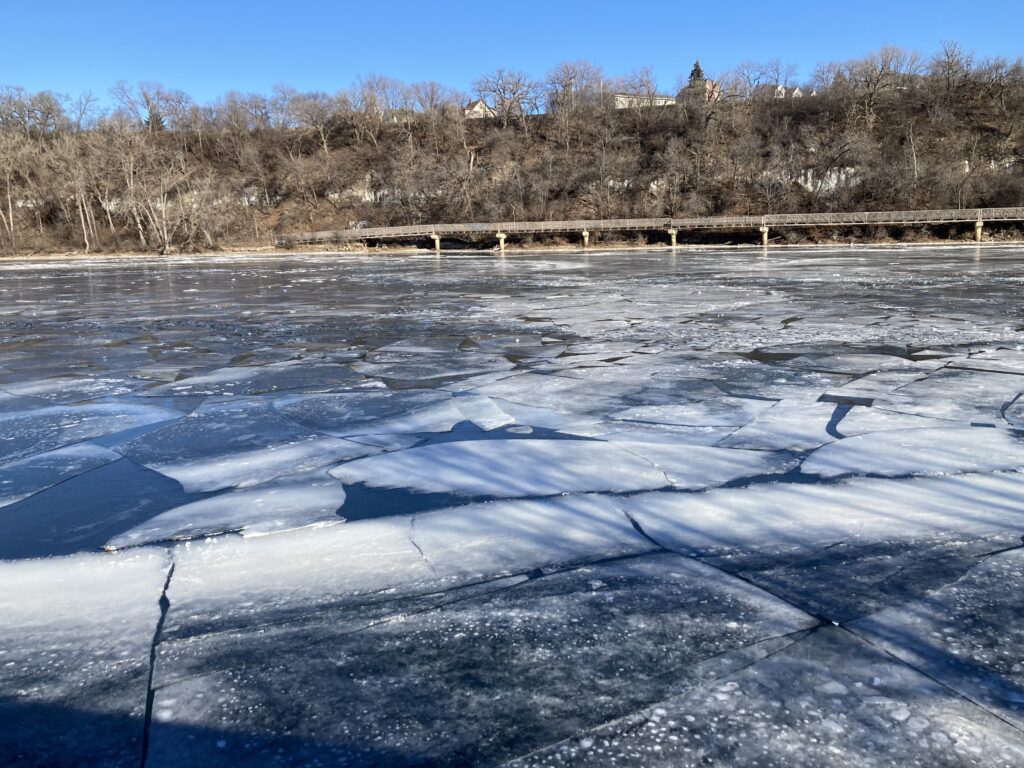
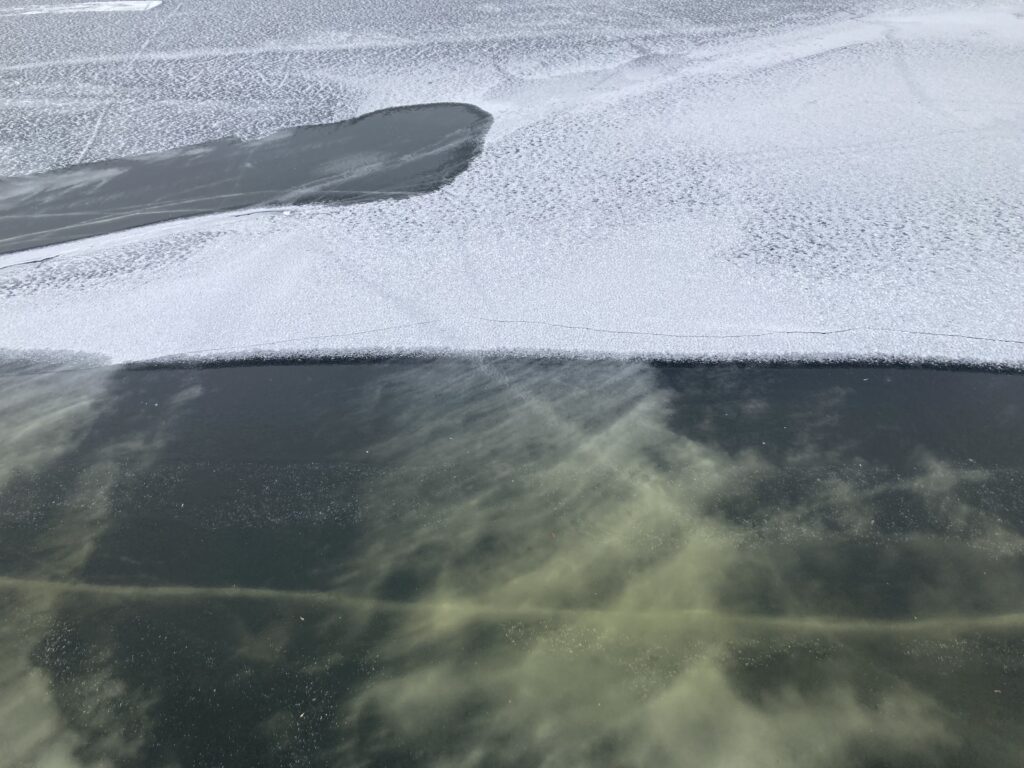
Stopped at the river to check out the surface. Very cool. I took some pictures but I’m not sure they can capture the opaque greenish ice. It was a grayish-green, drab and looked slushy and cold and thick.

Mississippi River / 22 jan 2024

And I stopped at my favorite sliding bench and looked down at the white sands beach. Quiet, empty, white with snow, not sand.

Early on in the run, I greeted Dave, the Daily Walker. Hi Dave! Hi Sara! How are you doing? I’m good. How are you doing? I’m out here.

added a few hours later: I almost forgot something I was thinking about. As I listened to the song, Remember (lullaby) from Coco, I thought about people I miss and remembering them and then I thought about how sometimes it’s more than memory that helps me stay connected, like the time I opened my mom’s old book and saw her signature in the front. It was a physical trace of her reaching out to me. As I thought about this trace and the reaching out I remembered Diane Seuss commencement address and her discussion of Keats and his invisible hand reaching up from the grave. I’m glad I remembered the Keats bit because I remember having that thought then forgetting it almost immediately as I kept running.

an emptied mind — emptied of memories, emptied of everything

During my “on this day” practice, I encountered this phrase in Occasional Poem/ Jacqueline Woodson: zapped all the ideas from my head. I started thinking about this feeling of going blank or losing words or a sudden rush of nothing but space between your ears. What are some different ways that words describe being emptied of thought — the moment it happens and/or the feeling of emptiness?

the fish in us escaping, dandelion seed scattering, bees leaving the hive,

more than memory

I started a post yesterday (21 jan) and added this, intending, but failing, to finish it.

The wall is, for me and maybe me alone, a holy place. A place of pilgrimage, both full of meaning and void of meaning. I take photos, and the photos hold the memories still. The photos make the wall mean more than memory can, but with meaning, like a fact. No longer in motion, no longer something to which one can return and brush your fingers against (and feel the peeling paint).

*

Maybe a place like this pursues its meaning. Like when you say love and what you say means less than the actual word means. We love a place or a person, or we say a word, trying to stop time, hold something still. Maybe a place makes meaning how a dream might, in opposition to logic, inventing its own sense with presence.

*

Maybe we borrow meaning with a word, like how a photograph borrows a place, hoping meaning might remain recognizable if we say the word with the right angle of light, seeking something definite in a breath. How the impossible blue of a blue wall couldn’t be the blue of memory, a blue no photograph can contain.

Maybe to make a place holy, you must remember it more than real life allows, with all the truth of a squint, all the grace of peeling paint.

*

I’d like to look into one of those photographs, past the image, past what the image contains, past memory and regret and all the salt that sticks to the skin, into experience, into a love known true in one moment, undeniable, un-understandable, the kind of thing that splits everything in half. If I could find that photo of Cassie at the blue wall and step inside it and ask her to stay alive in a world where she was loved, maybe then I could finally know what a word means.

I could almost believe holiness is a process of remembering, but then I see the wall again, in all that sunlight, paint peeling, the blue not only the remembered blue, but more blue in the now of being seen, so I can barely stand to stand beside it, holy as it is with the fact of its own meaning.

This is the Place: A Blue wall in Leadville / Mathias Svalina

Words I’ve been studying: dream, memories, photograph, motion, still, light, breath, remember, squint, blue, real, love, now

jan 19/BIKERUN

bike: 25 minutes
run: 1.4 miles
basement
outside: -5 degrees / feels like -10

I have run in colder weather than -5, but I was not interested in going out there today. Do I regret it? I don’t think so, but . . . . While I biked I watched some track races from the Paris Olympics, and while I ran I listened to the Apple Music “Feel Good” playlist. Listening to a different version of this playlist earlier in the week helped the run to go by faster, but the songs weren’t quite as motivating today. Had to skip through several of them until Rio by Duran Duran came on. Next: Rosanna/Toto, then Brandy/Looking Glass, then as I walked Afternoon Delight/Starland Vocal Band. That last one, wow. I don’t remember thinking about much as I ran. I remember imagining myself falling off of the treadmill. I wondered what song would come on next. I tried to lift out of my hips. I debated if Rosanna was a “feel good” song. And now that I think about it, Brandy as feel good? It’s sad. When Afternoon Delight came on I thought about Anchorman and Glee and wondered how anyone would not get what this song was about.

I memorized Wallace Stevens’ “Tattoo” and was planning to recite it while I biked and ran but then I forgot.

One-line poems, and/or poem starters:

Edgar Allen Poe,
exercise enthusiast.

Sara doing Sara things.

A shadow
crosses.

The tree outside
my window.

jan 18/RUN

2.6 miles
river road, south/north
8 degrees / feels like -1
25% snow-covered

I didn’t feel exceptionally cold, but it felt hard, my legs thick. I stopped at the bench above the “edge of the world” and looked out at the covered river. Someone wrote the name “Davidson” in the snow earlier this week and it’s still there. As I ran, I started chanting in triples:

strawberry/raspberry/blueberry
winter cold/winter snow/winter ice
arctic air/sizzling leaves/crusty snow

10 Things

  1. BLUE! sky
  2. crunch crunch crunch
  3. the river was white and closed except for a few spots that were dark and open
  4. a (non-fat tire) bike
  5. a runner’s raspy, hello
  6. running into the wind, being exhausted by it, wondering how the runners at Boston 2017, when it was cold and windy and raining, managed to run the whole marathon
  7. bright, blinding sun heading south
  8. some of the ice on the path was smooth, more of it was jagged and rough
  9. empty benches
  10. a truck driving by, then the strong smell of weed

My Heart Has Known Its Winter/ Arna Bontemps

A little while spring will claim its own, 
In all the land around for mile on mile 
Tender grass will hide the rugged stone. 
My still heart will sing a little while. 

And men will never think this wilderness 
Was barren once when grass is over all, 
Hearing laughter they may never guess 
My heart has known its winter and carried gall.

gall? I looked this word up and dismissed the definition I knew — gall as bold, impudent, he had the gall (read: nerve) to — because it didn’t make sense to me. Instead, I decided the poet meant

abnormal growths that occur on leaves, twigs, roots, or flowers of many plants. Most galls are caused by irritation and/or stimulation of plant cells due to feeding or egg-laying by insects such as aphids, midges, wasps, or mites. Some galls are the result of infections by bacteria, fungi, or nematodes and are difficult to tell apart from insect-caused gall

Plant Galls

I wasn’t satisfied with Merriam-Webster’s online definitions, so I logged into my library and accessed the OED (very cool that I can do this!) for more definitions. This one sort of works:

Something galling or exasperating; a state of mental soreness or irritation.

this one, too:

A place rubbed bare; an unsound spot, fault or flaw; in early use also a breach. Now only technical.

and this:

A bare spot in a field or coppice (see gall v.1 3). In the southern U.S. a spot where the soil has been washed away or exhausted.

Erosion, exhaustion.

I love the way the word gall with its plant/ field meanings and its human meanings reinforces the association being made between human’s exposed than covered grief and the ground’s exposed winter stone covered in spring’s grass.

I wanted to remember this poem because of the grass and the stone and the forgetting of winter when spring arrives. I don’t totally agree with its use of winter as metaphor for misery.

I like winter. I like breathing in the cold, the sound of snow falling, smelling the air. The silence and the sharp sounds. The view of the river — vast and bare. The subdued colors — pale blues and grays and dark browns. The less crowded trails. The bare-branched silhouettes. Movement slowed, stilled, suspended. Layers. The bright, cold sun.

jan 17/RUN

5.4 miles
bottom franklin hill and back
37 degrees
20% snow-covered

37 degrees and a mostly clear path! A great run. I felt relaxed and strong and able to shift gears and keep going. I greeted almost every walker, runner, or biker I encountered by raising my right hand. At the bottom of the hill I stopped to check out the water — open, moving thickly, a few flat and wide sheets of ice floating by. Smelled weed. Heard birds — laughing and chirping. Slipped (only a little) on a few bits of ice. Stopped at the sliding bench to admire the view — so bare and quiet and alone. Put in my headphones at the top of the hill and listened to my “Remember to Forget” playlist. Some of today’s lyrics made me think about regret and longing for the past, some of them about the joy of forgetting, and some of them commanded, remember! or don’t you forget it!

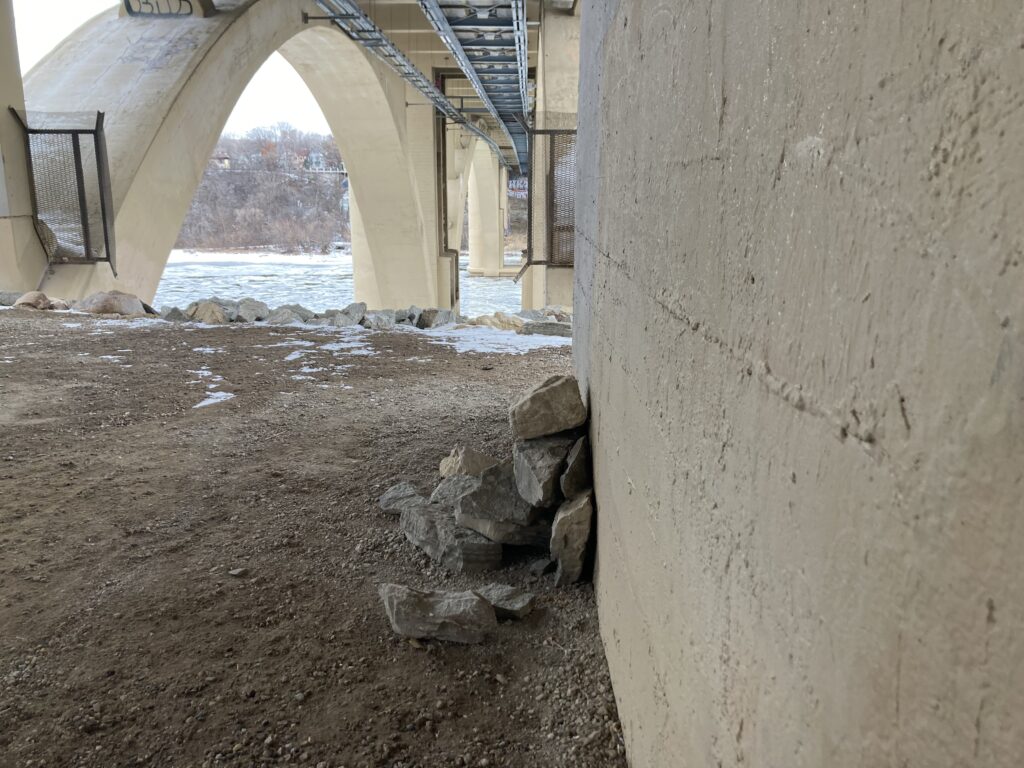
added a few hours later: I almost forgot to post the picture I took. It’s of the pile of rocks under the franklin bridge that I keep thinking is a person sitting up against the wall. I know these are rocks, but I always first think: person

limestone mistaken for a man

Inspired by my triple berry chant exercise (see below), I chanted in triples. Can I remember 10 of them?

10 Triple Berry Chants

  1. empty bench
  2. grayish sky
  3. ritual
  4. down the hill
  5. ice and snow
  6. soaring bird
  7. sloppy trail
  8. lake street bridge
  9. noisy wheel
  10. 3 stacked stones

confession: I did chant a few of these, but the rest I created as I wrote this list. I just can’t remember what I chanted.

early morning coffee

1 — strange sleeping habits

A morning ritual: coffee, Facebook, poets.org, poetryfoundation.org, poems.com, “on this day.” While scrolling through Facebook I found an interesting article about sleep: The forgotten medieval habit of two sleeps. The concept isn’t new to me; I read the book that it’s based on, At Day’s Close, more than a decade ago. One new thing, or thing that I had read in the book but forgot, was about the author’s initial research and how he looked to court transcripts for information about daily life:

he had found court depositions particularly illuminating. “They’re a wonderful source for social historians,” says Ekirch, a professor at Virginia Tech, US. “They comment upon activity that’s oftentimes unrelated to the crime itself.”

I started thinking more about sleep. Last night was not very good: restless legs, sore hip, getting up 3 or 4 times, walking up earlier than I’d like because of my restlessness. At one point, the author, Roger Ekirch, mentioned how recognizing the long history of getting up in the middle of the night as normal and natural could relieve some anxiety for those of us who can’t sleep straight through the night. I suddenly thought, and not for the first time: I need to accept my crazy sleep instead of fighting or worrying about it, and I should turn it into something creative. Track it, or write into it, or . . . . I wonder if there are “insomnia writing experiments?

a list-writing experiment

The first thing that came up in my google search was a scientific study about writing and falling asleep faster. Perhaps if I had searched, “insomnia writing exercises” or “insomnia poetry prompts” I would have gotten different results.

Bedtime worry, including worrying about incomplete future tasks, is a significant contributor to difficulty falling asleep. Previous research showed that writing about one’s worries can help individuals fall asleep. We investigated whether the temporal focus of bedtime writing—writing a to-do list versus journaling about completed activities—affected sleep onset latency. Fifty-seven healthy young adults (18–30) completed a writing assignment for five minutes prior to overnight polysomnography recording in a controlled sleep laboratory. They were randomly assigned to write about tasks that they needed to remember to complete the next few days (to-do list) or about tasks they had completed the previous few days (completed list). Participants in the to-do list condition fell asleep significantly faster than those in the completed-list condition. The more specifically participants wrote their to-do list, the faster they subsequently fell asleep, whereas the opposite trend was observed when participants wrote about completed activities. Therefore, to facilitate falling asleep, individuals may derive benefit from writing a very specific to-do list for five minutes at bedtime rather than journaling about completed activities.

The Effects of Bedtime Writing on Difficulty Falling Asleep

Lists? I love lists! I think I’ll try this, or my own version of it. Maybe I’ll start with a to-do list, another night a completed list, then a things I love list, or a things that bother me list, my favorite poets list, things I notice in the dark, reasons I can’t sleep list, and on and on. Eventually, maybe I can turn this into a series of list poems?

2 — idea/poem starters, an inspiration

The visual poem on poems.com for today, Good Riddance, reminded me of something I started thinking about in march 2024. The poem is a grid with a fragment of thought in each box. There are arrows directing you across or down, or across then down then across again. However your eyes choose to read the boxes creates a slightly different poem. Anyway, I started thinking about the different boxes and mixing and matching the phrases and I remembered this idea from my “to do list for 2022, 23, and 24”:

a 3/2 idea: create fragments of 2-4 lines with a “complete” thought that can be the start of a new poem, or be put together in new ways to create new poems — almost like prompts:

a shadow

crosses

And now I’m remembering an even earlier experiment from 3 may 2019 with triple (3 beat) chants:

Speaking of chanting, I have a new exercise I want to try. First, I want to think up a bunch of 3 syllable phrases (down the hill, walk to work, eat down town, out the door, sunday best, monday worst, turnip greens, climate change, just say please, in and out…). Then I’ll write these on small slips of paper and put them in a hat or a bowl or a bag. I’ll randomly pick out 8-10 and turn them into a poem (either in the order I select them or in an order of my choosing). Maybe the phrases should be a mixture of things from the run and popular or whimsical expressions? So much fun!

added an hour later: While reviewing old entries from June of 2024, I came across a delightful typo. Instead of writing “the tunnel of trees” I wrote, “the tunnel of threes.” I love it! Maybe the title of a poem that uses triple berry chants?

jan 16/WALKRUN

walk: 30 minutes with Delia
neighborhood
35 degrees!
morning

Sun! Above freezing! Shadows!

10 Walking Things

  1. the sharp clang of something metal dropping on hard concrete
  2. low-note wind chimes, bing-bonging in the breeze
  3. standing tall, lifting out of my lower back and hips, feeling my legs ground themselves on the sidewalk
  4. soft snow
  5. the contrast between bare black pavement and white sidewalks
  6. drip drip drip
  7. bare branches 1: the welcoming oaks, the shape of their thick, sprawling branches making silhouettes
  8. bare branches 2: a maple’s small twigs at the bottom looking like hair
  9. a sizzling sound in the trees: wind on dead leaves
  10. a beautiful blue sky peeking through fluffy, fast moving clouds

run: 3.5 miles
godfrey and back
33 degrees
afternoon

Less layers this afternoon: running tights, shorts, tank top, long shirt, pull-over with hood, headband, gloves, sunglasses. My face was a little cool, especially the ears which weren’t quite covered by the headband. The sidewalks were sloppy and so was the trail. No ice, but some slushy snow. Encountered a few fat tires, walkers, at least one other runner. Stopped at the bench and remembered looking out at the river, but I can’t remember what I saw other than white. Oh — I saw a person climbing up and out of the winchell trail

Before the run I was listening to an interview with Jenny Odell that I first heard last May. I started thinking about different notions of time and then how memories rarely follow linear time. They don’t move forward in a row, confidently attached to years. They’re all over the place and in the wrong place and on top of each other. I tried to think about that as I was running. I imagined a mess of memories filling up the gorge, but not taking up any space. Then I imagined myself running through and beside them. These memories barely left a trace and I couldn’t feel them.

yesterday’s delights

Driving us on the river road, RJP pointed out two delightful things to me: one — a biker on a fat tire doing a wheelie for at least a minute and for dozens of feet. They were pedaling forward on one wheel, the other wheel was hanging in the air. That seems hard! added 17 jan: I looked it up and found this video. And two — turkeys! one flying!! and dozens more spread out all around turkey hollow.

jan 15/RUN

4.1 miles
trestle+ turn around
15 degrees / feels like 1
75% snow-covered

Hooray for getting back outside! I never felt cold. Hands and feet were fine, torso too. About halfway in, I overheated. Off with the mittens, down with the hood. The run didn’t feel easy; my legs were sore. But I bargained with myself — make it to the trestle, keep going until the sliding bench, don’t stop until after the hill! And I was able to shift gears, settling into something different with my legs (hard to explain). I lifted out of my hips, relaxed my shoulders and kept going for longer than I thought I would. Greeted Dave, the Daily Walker. Stopped running to witness a wedge of geese flying overhead. Heard the rattling jawbone of some bird. Noticed that the river was open and dark under the trestle. Everywhere else it was white.

10 Things

  1. a honk cutting through the quiet then less than a dozen geese flying in a loose formation — I think I heard the swish of their wings as they passed directly above me
  2. the smell of tobacco beside me — did it come from the open window of a passing car?
  3. the smell of weed below me
  4. 3 stones stacked on the ancient boulder, half covered with snow
  5. a runner approaching from behind with a dog on a leash tethered to their waist, running faster than me through the snow
  6. the constant view beside me: slender bare brown slanted branches white river a white brown bluff on the other side of the river
  7. a flash of BRIGHT orange to my left — someone in an orange jacket walking below near the old stone steps
  8. a big dog — golden retriever? — squatting and pooping on the side of the path, their owner waiting with a bag
  9. a light brown cobblestone carriage walk in front of a fancy house on edmund
  10. the sharp crunch of one foot striking the crusty snow in my alley, the soft grind of the other foot leaving the snow

shades, shadows, memories

Before the run, I was reviewing May 2024 entries. This bit about the children’s book, The Shades, inspired some thoughts:

 . . .they live in the garden. All of their food comes from the shadow’s cast by real food, their house cast from the shadow of the old summer house that “broke Emily’s heart” when it was torn down. Most of the time they do what they want, but when a human enters the garden, whichever of them best fits that human’s form must shadow them around the garden. Sometimes this shadowing is fun, other times it’s tedious, and occasionally it’s dangerous: if a human climbs over the garden wall, the shadow must follow and be lost to the outside world forever.

log entry 20 may 2024

Thinking about the shadow’s independence from the object that cast them and their attaching forms that approximately fit, I started thinking about memories and the gorge. I imagined countless memories (as shadows?) living there, made and left behind by everyone that has spent time at the gorge. Then I imagined running through/with/beside them and some of them attaching to me (in some way). The memories weren’t mine exactly; they were independent of me with their own experiences and histories and feelings. But, beside the gorge, we become entangled. Maybe I can add this to the poem I started about shadows. I’d also like to add this idea: the silhouette as “a radical condensation of faith in shadows” from 17 may 2024.

jan 14/BIKERUN

bike: 30 minutes
run: 2.7 miles
basement
outside: 7 degrees / feels like -9

Tomorrow it’s supposed to be slightly warmer, so I decided to wait until then to run outside. While I biked, I watched the 2017 5000m men’s world championships with Mo Farrah. While I ran, I turned on an Apple Music made “Energy” playlist. It was great. I don’t really remember the environment — oh, except for that I was cold at first, in our unfinished basement, but then warmed up fast — but I remember my body during the bike. I was working on keeping my back straight and long over the handlebars. During the run, I remember the music and the stretches when I only noticed my legs when they were off the ground. Listening to the music and getting lost in my thoughts about vision and faces and names, I forgot chunks of time.

before the run — remember/forget: names and faces

Last night, I drifted off to sleep thinking about names and nobodies and how I wanted to gather past accounts about them today in this entry. During my “on this day” practice, while revisiting 14 jan 2020, I came across the documentary, Notes on Blindness, and John Hull’s description of losing all of his sight and the ability to remember faces. Hull asks, 

To what extent is the loss of the image of the face tied up with the loss of the image of the self and with the consequent feeling of being a ghost or a mere spirit?

So now I’m expanding my thinking to names and faces.

First, a question, prompted by a bit of the Hull that I listened to/watched just now: What senses produce the strongest memories? answer: smell

a short from the longer documentary

I watched the part after Hull’s quote about the face and the self, and it helped clarify the quote more. First, his wife says:

I can’t look into his eyes and be seen. There’s no beholding in that sense of being held in somebody’s look.

To be seen is to exist. This is what lies behind the thought my older daughter has expressed, Oh Daddy, I wish you could see me!

It is not the person who cannot see the face that is the ghost, but the person who cannot be seen. Even as I often feel like a ghost moving through the world, I also feel like everyone else is a ghost or a specter, that I’m the only real and living thing. It’s complicated because I feel both: haunting and haunted.

Of course, sometimes I can see faces, or at least parts of faces, and I can still see gestures and bodies, so my feeling of loss and disconnection is much different from Hull.

And there’s more messiness about my understanding of all of this. To be sure, there has been a tremendous feeling of loss over not being able to see faces clearly, or to hold someone with a look; to behold and witness others seems to be part of what makes us feel human. But (or and?), some of this is illusion and cultural construct. Sight and seeing someone is not the only way we connect with them, or see them as a self. In fact, it’s not the most reliable. For me, there is something exciting (is that the right word?) about gaining a new perspective on vision and its limits, and about being motivated to care about the process of seeing, which I used to ignore.

Wow — how far am I wandering from remembering and forgetting here?

Now I’m thinking about names and faces and phrases like, put a name to the face. For a little less than a year, Scott and I have been regularly going to a pub near our house, The Blue Door. Much of the time, we’ve had the same waitress. I always recognize her — less by her face than her gestures — but I haven’t known her name. A few days ago, Scott finally realized he could check the bill for her name so now we know it. I wonder, what difference does it make? (How) do I feel more connected to her now that I know her name?

after the run: music

All of the songs I heard were good for energy and distraction, but a few of them felt especially connected to what I had been thinking about prior to my workout.

Reputation/ Joan Jett and the Blackhearts
An’ I don’t give a damn ’bout my reputation
Never said I wanted to improve my station
An’ I’m only doin’ good when I’m havin’ fun
An’ I don’t have to please no one
I don’t give a damn ’bout my reputation
I’ve never been afraid of any deviation
An’ I don’t really care if you think I’m strange
I ain’t gonna change

I think it was around the time she sang about not wanting to improve her station, I started thinking about names and “being somebody” and notoreity/notoriousness and when wanting to be known is desirable and when it’s not. Usually it’s not for me. I like to be left alone to do what I want to do. I also thought Alice Oswa

Poker Face/ Lady Gaga
Can’t read my, can’t read my
No, he can’t read my poker face
(She’s got me like nobody)
Can’t read my, can’t read my
No, he can’t read my poker face
(She’s got me like nobody)

Wow, these lyrics! Yikes. Anyway, I’m interested in the idea of an unreadable, stone face. That’s how most faces are to me all of the time. I can’t see small gestures or tells that help you to make sense of what’s being said. Now I’m wondering about non-facial poker tells. Here are two that I found: how they handle the chips/cards and table talk.

Rhythm Nation/ Janet Jackson
With music by our side to break the color lines
Let’s work together to improve our way of life
Join voices in protest to social injustice
A generation full of courage, come forth with me

As I heard these words, I thought about my discussion below about seeing, looking, beholding each other as the primary way to recognize each other’s humanity/selfhood. What about hearing and listening and playing music?

Bonus: It’s Raining Men/ The Weather Girls

Not directly related to faces and names, but hearing this song reminded me of one of my favorite sections in the blindness documentary. It is nine and a half minutes in and it’s about rain and how its different sounds on a tree or a roof or a garbage can help us to “see” a place with our ears.

jan 13/BIKERUN

bike: 30 minutes
run: 1 mile
basement
outside: 3 degrees / feels like -3

Cold and icy and windy outside, so inside in the basement for me. Watched an old track race while I biked, listened to my remember to forget playlist as I ran. Happy to move my legs and work up a sweat. What did I notice? I don’t remember.

remember — inheritance

gestures, ways of speaking, expressions, eye diseases, anxiety disorders, curiosity, persistence, restlessness, strong legs, a love of water, a need for being outside, the impulse to run away, an edge dweller, conflict avoider, a storyteller

for more on inheritance, see 4 nov 2021

Mary Ruefle and I Remember

I remember a lecture I read by Mary Ruefle in Madness, Rack, and Honey.

Thinking about “I Remember” and remembering, origins and when things began. I thought about how there is a sort of origin point to all of this (my writing poetry) and it’s my eye doctor diagnosing me with a rare eye disease then saying, you should write about it which prompted me to want to work on my writing so I could better explain what I was experiencing. But, I had already been writing and already had those desires, so it was really more of a slight shift, a stutter step or a quick stumble off the path, just briefly, which changed the trajectory, slightly, incrementally. Difficult to pinpoint what all changes your path.

9 may 2023

remember my name

The first song that came up on my playlist was Fame. As I listened to the lyrics — Fame! I’m gonna live forever / Baby remember my name — I started thinking about being remembered forever and fame and names and immortality and Emily Dickinson and JJJJJerome Ellis and their “Liturgy of the Name” in Asters of Ceremonies.

from Liturgy of the Name/ JJJJJerome Ellis

My name, in the time when I cannot utter it, maps the space within me. In an instant the Stutter shuttles me from the present–the barber just asked me my name, my voice fluttering in my throat, struggling not to tremble as the razor presses on my temples–to an ancient place of breath, name, silence, time, creation.

. . .

When the door of my vocal cords closes, another opens. And through that open door I escape into a region I do not know what to call but which is vaster than the space of my body. You could say: my name is the door to my being, and in that interval when I’m stuttering, the door is left wide open and my being rushes out. What rushes in?

jan 12/RUN

2.45 miles
2 trails
20 degrees
100% snow-covered

A short run because it snowed last night and they haven’t plowed the trail yet. I wore my yaktrax but the soft, uneven snow seemed too much for already sore muscles.

Interruption: as I sit at my desk writing this, after my run, a dog zipped by my window. Ace — the dog two doors down who likes to break out his backyard and roam the neighborhood. I used to worry about him, but I know he’ll return….just after finishing that last sentence, I saw a blur of movement — Ace again, across the street.)

It was a nice, relaxed run through a wonderfully wintery world! Snow covering everything — path, trees, river. Occasionally I heard a crunch when my foot hit some icy snow, but mostly the snow was soft and silent. I descended to the Winchell trail at 42nd and ran closer to the river. The path was a mix of snow and dead leaves. I continued past the 38th street steps and down into the oak savanna. Then beside the ravine and over the icy slats — that part was slippery! No running, barely even walking, at this part.

10 Things

  1. river hidden under snow
  2. a pack of runners approaching — the movement of their thin, muscular legs made them look like galloping horses
  3. a fat tire up ahead — at first, all I could see was a dark figure and I thought it might be a dog or a bear or the territorial turkey
  4. hi! — hello! greeting an approaching walker
  5. the heavy breathing of a fast runner passing by me
  6. a flash of orange — was it a snow fence?
  7. the wind heading north on the upper trail was cold and harsh
  8. the slow trickling of water below the ravine
  9. a tree bent over the trail so low I almost had to duck to get under it
  10. all the benches were empty

Happy 8th Anniversary to this log! On January 12th, 2017 I posted my first entry for this RUN! project. I had no idea where it would lead. What a life it has given me! It seems fitting for my love of the approximate that I started on the 12th instead of the 1st. It also seems fitting that the post began with no fanfare or introduction to some big project and that it was about restlessness. 9 years and 7660.2 miles of running (and around 500 miles of swimming) later, I’m just as or more restless. Wanting to move, to be outside, to connect with the world. To read, to write, to experiment with new ways to be. My restlessness drives my creativity and curiosity and also my unease and discomfort (and anxiety and suffering).

remember — inheritance

This Be the Verse/ Philip Larkin

They fuck you up, your mum and dad.
They may not mean to, but they do.
They fill you with the faults they had
And add some extra, just for you.

But they were fucked up in their turn
By fools in old-style hats and coats,
Who half the time were soppy-stern
And half at one another’s throats.

Man hands on misery to man.
It deepens like a coastal shelf.
Get out as early as you can,
And don’t have any kids yourself.

I first encountered this poem after . . .

Interruption. Sitting here at my desk in front of the window before my run, someone just walked by pushing a shovel. I think they decided to walk and shovel everyone’s sidewalk at the same time. That’s feeding two birds with one scone. Nice!)

. . . reading then memorizing Philip Larkin’s The Trees. I didn’t like it. That last verse — so harsh and unforgiving. But this morning my study of remembering and forgetting led me to the idea of passing down/inheriting trauma from past generations, and I came across this poem again. I continue to struggle with the conclusion, but I’m reading the rest of it differently — as a daughter who is beginning to understand the trauma she inherited from her mother and how she responded to abusive parents, and as a mother confronting the impact of her parenting choices on her kids. I had planned to write more about this now, but I don’t have time; FWA is returning to college today!

When I have time, I want to read/summarize this article: How Parents’ Trauma Leaves Biological Traces in Children. And I want to think about epigenetics and slavery and how inheritance works on a broader, more systemic level, within communities. Whew — that’s a lot!

jan 10/RUN

4.5 miles
minnehaha falls and back
21 degrees
100% snow-covered

Today the winter I want: big flurries, everything covered in a thin layer of snow, not too much wind, warmer, not slick — especially with my with Yaktrax on. Nothing was quite easy, but everything wasn’t as hard as my last run on Wednesday.

10 Things

  1. a white sky
  2. the contrast between shoveled and un-shoveled sidewalks — both still white, but the shovelled ones had a tint of gray or brown peeking through
  3. the clacking jawbone of a bird’s beak — a blue jay?
  4. the river was all white — if you didn’t know better, you could believe it was a field or a meadow
  5. approaching from above, hearing the falls rushing over the limestone
  6. kids yelling and laughing at the playground, one loud, high-pitched sound — was it a kid screaming or a whistle?
  7. amongst the kid voices, a deeper, more knowing laugh — was that from a teacher?
  8. the contrast on the creek surface: white snow with blackish-gray water
  9. every so often, a flash of orange — not always sure what it was, just a voice whispering, orange — a snow fence? a construction cone? a sign?
  10. bright headlights cutting through the sky, which was both bright — everything white! — and heavy

Listened to my “Remember to Forget” playlist on the way back. The first song up, Do You Remember Walter? by The Kinks. Two different bits stuck with me:

one: Walter, you are just an echo of a world I knew so long ago.
two: Yes, people often change./ But memories of people can remain.

This second bit got me thinking about how I can’t always (can I ever?) see faces clearly. When the face is too dark and shadowed, I just ignore it altogether. But when there’s some light and I can sort of see them, I often re-construct the features I can’t see with memories of their face from before I lost most of my cone cells. I’m not remembering their face, but creating it. After thinking that the idea of remembering as re-memembering — putting a body back together — popped into my head. Yes! I take my image of face, only as fragments — the curve of a nose or a chin, a bit of eye — and turn it into something whole.

As I kept running, I thought more about remembering and memories and my vision and how I rely on past experience and habits to navigate. And now as I write this, I’m thinking about how everyone’s vision — not just mine — relies on a building up of past experiences (memories?) with things to be able to see them. Here I’m remembering something that I read in Robin Wall Kimmerer’s Gathering Moss:

the sensation of sudden visual awareness is produced in part by the formation of a “search image” in the brain. In a complex visual landscape, the brain initially registers all the incoming data, without critical evaluation. Five orange arms in a starlike pattern, smooth black rock, light and shadow. All this is input, but the brain does not immediately interpret the data and convey their meaning to the conscious mind. Not until the pattern is repeated, with feedback from the conscious mind, do we know what we are seeing.

Learning to See in Gathering Moss/ Robin Wall Kimmerer

I’m continuing to read JJJJJerome Ellis’ Aster of Ceremonies. Wow!

Prayer to My Stutter #2/ JJJJJerome Ellis

You restore
a living
shoreline
between word
and silence

This beautiful prayer moves right into the next offering, Octagon of Water, Movement 3, which was titled by its first line when it was published in Poetry:

excerpts from The name of that Silence is These Grasses in the Wind/ JJJJJerome Ellis

1

The name of that silence is these grasses in this wind, and the name of these grasses in this wind is that other place on the other side of this instant. This instant is divided by curtains of water and the sound of shuddering time. A sunflower reeling with sun, six hands stretched in offering. This unsearchable, uncancellable instant wraps the shoulders of the grasses like a shawl stilled by the stoppage. 

How is/isn’t the instant similar to Marie Howe’s moment? If you listen to the recording on Poetry, you can hear the stretched silence as Ellis’ voice stops before pronouncing certain words.

2

This morning come shyly or boldly into the fertile field, however you are, come, come and stay in the rearrangement, the pressure of thumb on fescue blade, a year wheeling within a day, two round moments of warm mouth, finally at peace. The psalm is a key if only we can find the door. Do not swallow your dysfluent voice. Let it erupt in its volcanic flowering. Stoppage thence passage, aporia, poppy bursting with fragrant seed. 

What a beautiful description and reclaiming of a stuttering voice on the other side of the stoppage! The erupting bursting flowering dysfluent voice.

I’m inspired by how Ellis takes his stutter and turns it into this beautiful instant between silence and word. For them, the stoppage is a/the key aspect of the stuttering. What are the most important elements of my strange vision?

jan 9/YOGAWALK

hip/lower back yoga – 20 minutes

I tried out a new yoga routine this morning for hips and lower back release. I liked it (mostly), but it was difficult to follow; I couldn’t see the movements she was making very easily. I’m sure some of it was because I wasn’t familiar with the movements, but I also think it was her (visually) busy set-up. Of, maybe it’s the dark floor? Yes, there’s not enough contrast with the floor and I couldn’t see what her body is doing.

yoga / difficult to see

The yoga routine I usually do has a light/white floor so I can the yoga instructor’s arms and legs more easily — at least where her arms and back are bare:

yoga / easier to see

It’s possible that I could see the second yoga instructor more easily because I’ve watched this video hundred of times and I started watching ir when my vision was better than it is now.

I decided to look up “low vision accessible yoga” on YouTube. I found, Yoga For People with Low Vision, which I think I’ll try tomorrow. There’s not enough contrast (for me) between the instructor and the mat, but I imagine the emphasis on describing the movements might help. Thinking more about why it was more difficult for me to follow in the first video, I’m remembering how chatty the instructor was about random stuff. Some moments she offered great descriptions of the movements, but other moments she went too fast or spent more time talking about something else. In my favorite yoga video, there’s no chatting. Just a clear, straight-forward, rehearsed voice-over.

I found a video with advice on how to instruct blind or low vision yoga students, and I found this part about intentionality particularly important:

Yes! Intentionality, mind-body connections, listening — and not just for the students with low vision.

walk with Delia – 20 minutes
neighborhood
20 degrees

Scott and I took Delia on a walk around 2 blocks. Brrr!! It felt colder than 20 degrees. Was it sunny? Now I can’t remember. Wait, it was, I wore my sunglasses. The thing I remember most about the walk were the talkative birds in a neighbor’s bush. I think they were sparrows? I didn’t see them, but I sure heard them! Another thing I remembered were the bare branches of the trees — gnarled and sprawled and looking straight out of a dark fairy tale.

Memory and Forgetting

I came across a Radiolab episode from last spring on memory and forgetting. The first section was particularly great.

SCIENTIST: On a literal level it’s an act of creation.

SCIENTIST: Yeah, exactly.

SCIENTIST: We’re reconstructing those memories.

SCIENTIST: Construction.

JAD: Maybe it’s more like painting or sculpture.

SCIENTIST: Everyone’s constantly their own artist.

SCIENTIST: We take bits and pieces of experience.

SCIENTIST: Some things get sharpened, other things leveled.

SCIENTIST: And infused with imagination and …

SCIENTIST: Out of that construct …

SCIENTIST: Construct. Construct.

*

A memory is a structure that connects one brain cell to another.

Associations! Another thing that creates connections and associations: metaphor

JONAH LEHRER: That the act of remembering on a literal level, it’s an act of creation. Every memory is rebuilt anew every time you remember it.

jan 8/RUN

4.5 miles
minnehaha falls and back
12 degrees

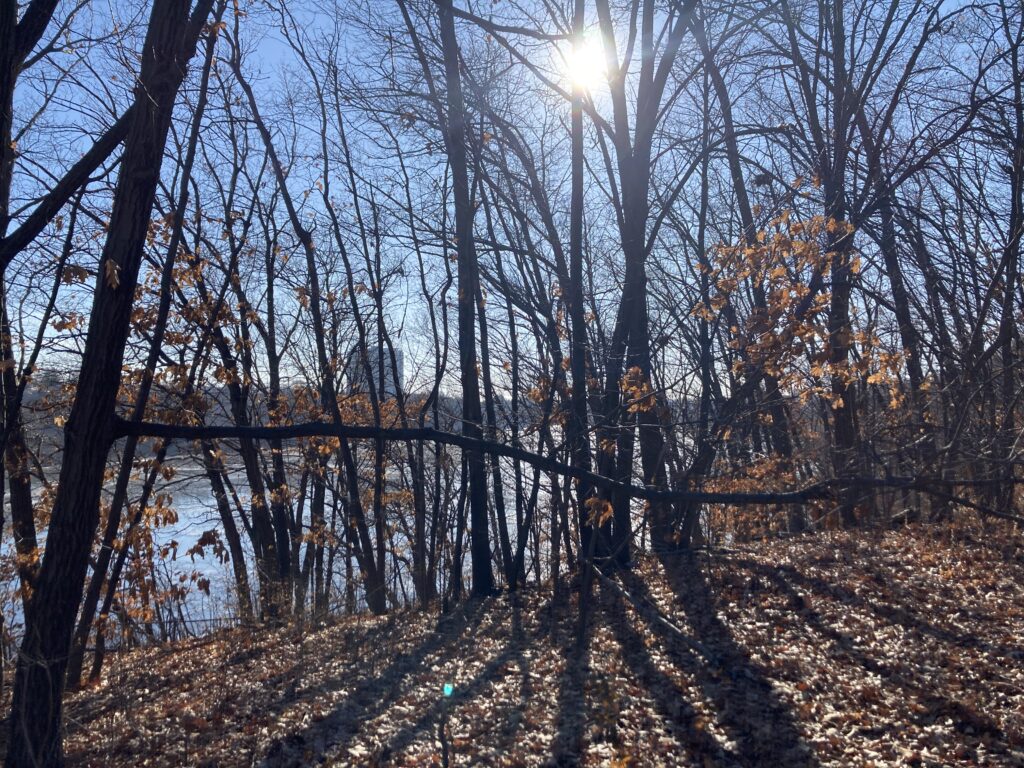
Another sunny, sharp shadow day. Ran south to the falls and listened to cars, birds, kids on the playground, and some guy coughing too loudly. Stopped at my favorite spot to admire the falls, then put in my “Remember to Forget” playlist. Sometimes I felt strong, and sometimes I felt tired. My legs wanted us to stop. I did a few times, including at the bench above “the edge of the world.” I took two pictures. One had a clearer view of the ice on the river, but I picked the other one, with its branches and shadows and white sun:

Most of the image is of dark, bare branches and their shadows on a snow-less ground. Through the trees is an iced river and the sun.
above the edge of the world / 8 jan 2024

10 Things

  1. chirping birds
  2. my shadow, clear and strong
  3. shadows of trees in the park, soft and fuzzy
  4. a shadow of the lamp post, sharp and menacing
  5. someone who looked like Dave the Daily Walker from behind — a tucked shirt and not jacket, tucked into dark track pants — but wasn’t
  6. the creek — bright white snowy surface mixed with fast, flowing water
  7. the falls were gushing through the ice columns
  8. a man with a bad cough near the overlook
  9. a cold wind on my ears when I put my hood down
  10. the shadow of a tree sprawled across the trail that dips below the road, looking like an actual branch that might hit me as I ran by

For a moment, I thought I had completely forgot running the stretch down to, then over, the bridge that crosses above the falls, but then I remembered it: what the creek looked like, seeing some people (one of them, the man with the cough) as I crossed, but then not seeing them, and then seeing them again near the closed gate.

before the run

Last night, I started reading JJJJJerome’s Aster of Ceremonies, which I bought in october of 2023 and hadn’t read yet. Wow! Here’s a bit I’d like to take with me on my run:

What is the wound
reopening during the stutter?
How does it relate
to Morrison’s flooding? When
the Mississippi returns
to its former contours,
does the suture
we created by straightening
it open?
(Octagon of Water, Movement 2/JJJJJerome Ellis)

Last week, I was just writing about how the natural shape of the Mississippi River in the gorge is long gone, reshaped by the city and the Army Corps. After my run, I’ll read Toni Morrison’s essay to which Ellis refers.

added a few hours later: I tracked down the quotation that Ellis puts in a footnote for this poem from Toni Morrison in The Site of Memory (1995, 99):

You know, they straightened out the Mississippi River in places, to make room for houses and livable acreage. Occasionally the river floods these places. “Floods” is the word they use, but in fact it is not flooding; it is remembering. Remembering where it used to be. All water has a perfect memory and is forever trying to get back to where it was. Writers are like that: remembering where we were, what valley we ran through, what the banks were like, the light that was there and the route back to our original place. It is emotional memory – what the nerves and the skin remember as well as how it appeared. And a rush of imagination is our “flooding.” Along with personal recollection, the matrix of the work I do is the wish to extend, fill in and complement slave autobiographical narratives. But only the matrix. What comes of all that is dictated by other concerns, not least among them the novel’s own integrity. Still, like water, I remember where I was before I was “straightened out.”

The Site of Memory/ Toni Morrison

So good! I’m excited to think about these ideas some more and figure out my relationship to flooding and being straightened out and rivers before and after Minneapolis and the Army Corps of Engineers “fixed” them.

Thinking about Ellis’ stutter in relation to my vision problems. In some ways, I have a visual stutter — there’s a long pause between looking at something and actually seeing it. I need time for things to make sense. Also, images stutter, shake, fizz, are always moving, never still or sharp or clear.

remember/forget

1 — will

the differences between what we notice and try to remember and what we ignore or try to forget (16 april 2024)

2 — memory

When I heard the line, Seems like we’re livin’ in a memory, I thought about how I mostly can’t see people’s faces clearly and that I’ve either learned to tune it out and speak/look into the void, or I just fill in the smudge with the memory of their face. I’m used to it, and often forget I’m doing it until suddenly I wonder as I stare at the blob, am I looking in the right place, into their eyes, or am I staring at their chin? I don’t care, but I imagine the other person might, so I try to find their eyes again (9 may 2024).

In jan of 2024, I’m thinking about the daily, mundane bodily functions that we forget we’re doing, or don’t notice — what’s the difference between not noticing and forgetting here? I’m also thinking about this idea of memory and its relationship to the real. When is remembering “only a memory” and when can the act of remembering keep something real? Can we understand remembering as more than thinking about things from the past? What about remembering what is present, here still, real, connected to us?

3 — pay attention, be astonished, tell about it

Thinking more about the difference between noticing and remembering, I’m thinking about the different acts involved here. Yes, it is inspired by Mary Oliver’s instructions for living a life! First, we notice, then we are open to feeling something about what we noticed, then we put that noticing and our feelings into words. For my practice, I don’t try to remember to notice or to be astonished, they just happen — at least, that’s the goal. Remembering comes in when I try to put my attention and astonishment into words. So, the connection between writing and remembering.

4 — writing to remember

I’m not writing it down to remember it later, I’m writing it down to remember it now.

Field Notes slogan

Many different directions I could go with this idea of remembering and writing, but I like this idea of the act of writing about something as the remembering. I rarely look back at my (Field Notes brand) Plague Notebooks when I’m finished with them; it’s the act of writing in them that helps me remember what I noticed or was thinking about. This method is approximate and doesn’t work all of the time. In my practice, I use the act of making a list on my log of 10 things I noticed as the moment of remembering what I didn’t even realize I noticed. But, unlike my plague notebooks, I do return to my log to read past entries and remember what I wrote before — in at least 3 ways: my monthly challenge pages in which I review and summarize what I did in relation to my theme each month; my “on this day” morning reviews, in which I reread past entries from that day in different years; and my annual summary, month-by-month of my log entries.

5 — forget the body

I like my body when I’m in the woods
and I forget my body. I forget that arms,
that legs, that nose. I forget that waist,

that nerve, that skin. And I aspen. I mountain.
I river. I stone. I leaf. I path. I flower.
(Yes, That’s When/Rosemerry Wahtola Trommer)

jan 7/YOGAWALK

yoga, 30 minutes
walk, 20 minutes
neighborhood
18 degrees

The same 30 minute yoga for flexibility routine I’ve been doing for 5 years. I like it, but I should try something else this month. Later, a short walk outside with Delia the dog. Brisk.

10 Things

  1. faint shadows, mine, tall, beside Delia’s, short
  2. the metallic buzz of a table saw
  3. a ridge of snow, refusing to melt on a neighbor’s narrow boulevard
  4. the fast flash of Delia’s tail when she’s excited or relieved or happy to be heading back
  5. cold air seeping through my hood and hat, into my ears
  6. bare grass
  7. the 6 inch gap under the gate of a yard a block away
  8. the smooth asphalt of a nearby driveway
  9. the sculpture of a turtle — bigger than an ancient tortoise — in a front yard — it looks heavy, is it made out of bronze?
  10. the buzz of workers all around the neighborhood — brrr!

forgetting/remembering

1 — the body

On jan 7, 2019, I wrote this about forgetting and remembering my body as I ran:

I found myself worrying constantly about my back or my IT band or my knee. At one point I wondered, what would it feel like to not notice my body? To simply run? Of course, this did happen many times during the run, but I remember more the times when I was too aware of my body. 

running log, 7 jan 2019

2 — never forget

Scrolling through facebook this morning, I encountered several “never forget” posts about the pro-Trump terrorist attack on congress on Jan 6, 2021. Then I read my On this Day post from jan 7, 2021 which begins with a brief description of the attack. I thought about how I use this log and my “on this day” practice to not forget things (typing this, I started wondering about the differences between not forgetting and remembering). Not forgetting is an important act of resistance.

I also read my jan 7, 2020 entry about the dogs in our neighborhood. Most of those dogs are gone now. Or, if they’re not gone, I don’t ever see them anymore. But, I remember them often as we walk past their houses. Delia does too. Not forgetting is an important ritual of staying connected to a place.

Simply looking. A car goes over a rise and there are birches snow
Twisted into cabalistic shapes: The Devil’s Notch; or Smuggler’s
Gap. At the time you could not have imagined the time when you
Would forget the name, as apparent and there as your own.

(from Hymn to Life/James Schuyler)

As I travel around my neighborhood, by foot or car, I speak about things that are no longer there — the tree with teeth, the big branch that sprawled above the road, the mustache on the mustache bridge, Bridgemans restaurant — and reflect on how easy it is to forget things that are no longer there. Without memories, it’s as if it was always like it is now, like the gone things never existed. Speaking of the mustache bridge, FWA mentioned it the other day. He referred to it (the bridge that crosses Hiawatha on the parkway) as the mustache bridge even though it only had a spray-painted mustache on it for a few months 10 years ago. I thought it was fascinating that this name has stuck. Will there be a time when we forget why we call it that?

3 — losing

I watch other bodies slip through the blue,
how fast the young are
& how old they become, floating, floating,
forgetting the weight of years
(Romance/Susan Browne)

Lose something every day. Accept the fluster
of lost door keys, the hour badly spent.
The art of losing isn’t hard to master.

Then practice losing farther, losing faster:
places, and names, and where it was you meant
to travel. None of these will bring disaster.
(One Art/Elizabeth Bishop)

jan 6/RUN

5.5 miles
bottom of franklin hill
11 degrees / feels like 5

Another sunny, snowless day. A little wind, some cold air. Wasn’t planning to run 5 miles, but I wanted to get to the bottom of the hill so I could see the surface up close. Iced over — not smooth, but with seams and cracks.

The Mississippi river at the bottom of the franklin hill. White ice, cracks, and shadows on its surface. Beyond it, the east bank with barre branches and blue sky.
ice on mississippi river / 6 jan 2025

I’m glad I took a picture because I did not remember it looking like this! I was visually a surface that was more gray and uniform with cracks creating big and flat sheets of ice. I didn’t remember the shadows or the blue or how uneven it all looked.

As I ran, I listened to my “Remember to Forget” playlist. It started with “I Remember it Well,” from Gigi. I heard the opening lines:

We met at 9
We met at 8
I was on time
No, you were late
Ah yes
I remember it well

I thought — wait, if he thought they were meeting at 9, he wouldn’t have thought he was late if he got there after 8 — yes, these are they thoughts I have as I run. I thought about how subjective memory can be and wondered how certain we could be that she remembered correctly. Then I heard these lyrics:

Ah yes
I remember it well
You wore a gown of gold
I was all in blue

I remembered that meme 4 or 5 years ago with the dress — is it gold or blue? — and thought again about how we can remember things differently. When is it lack of memory, and when did we always just remember it wrong, or unusually, or with a focus on different details, or in a different light?

10 Things

  1. the hollow knocking of a woodpecker
  2. the thumping of wheels over something on the road on the bridge above
  3. 4 stones tightly stacked on the ancient boulder
  4. a section of the fence above a steep part of the bluff, missing, marked off with an orange barricade
  5. the icy river through the trees — blue and white and lonely
  6. daddy long legs at his favorite bench
  7. shadows, 1: mine, off to the side, in the brush next to the trail
  8. shadows, 2: a tree trunk, tall, stretched, looking like a dinosaur
  9. stopping at the edge to put in my headphones, seeing a flare of movement below: someone walking on the winchell trail
  10. the limestones still stacked under the bridge, still looking like a person sitting up and leaning against the bridge

A poem about forgetting:

Said a Blade of Grass/ Kahlil Gibran

Said a blade of grass to an autumn leaf, “You make such a noise falling!  You scatter all my winter dreams.”
 
Said the leaf indignant, “Low-born and low-dwelling!  Songless, peevish thing!  You live not in the upper air and you cannot tell the sound of singing.”
 
Then the autumn leaf lay down upon the earth and slept.  And when spring came she waked again—and she was a blade of grass.
 
And when it was autumn and her winter sleep was upon her, and above her through all the air the leaves were falling, she muttered to herself, “O these autumn leaves!  They make such noise!  They scatter all my winter dreams.”

more forget lines

1

like the moment just before you forgot what it was you were about to say, it was like that, and after that, it was still like that, only all the time.
(Part of Eve’s Discussion/Marie Howe)

2

It’s almost romantic as we adjust the waxy blue
recycling bin until you say, Man, we should really learn
some new constellations.

And it’s true. We keep forgetting about Antlia, Centaurus,
Draco, Lacerta, Hydra, Lyra, Lynx.

But mostly we’re forgetting we’re dead stars too
(Dead Stars/Ada Limón)

3

See whatever you want
to see. Even
at the moment of death
forget the door

opening on darkness.
See instead the familiar faces
you thought were lost.
(Squint/Linda Pastan)

4

According to Howe, most (all?) of the critical studies of ED as a poet (up to 1985, when this book was written), read ED’s decision to stay isolated in her bedroom for the rest of her life as tragedy and a failure to celebrate herself as a poet (Whitman) or declare herself confidently as the Poet, the Sayer, the Namer (Emerson). Howe argues that she made another choice and writes the following:

She said something subtler. ‘Nature is a Haunted House–but Art–a House that tries to be haunted.’ (L459a)

Yes, gender difference does affect our use of language, and we constantly confront issues of difference, distance, and absence when we write. That doesn’t mean I can relegate women to what we ‘should’ or ‘must’ be doing. Orders suggest hierarchy and category. Categories and hierarchies suggest property. My voice formed from my life belongs to no one else. What I put into words is no longer my possession. Possibility has opened. The future will forget, erase, or recollect and deconstruct every poem. There is a mystic separation between poetic vision and ordinary living. The conditions for poetry rest outside each life at a miraculous reach indifferent to worldly chronology.

My Emily Dickinson/ Susan Howe

jan 5/RUN

5.3 miles
va bridge and back
9 degrees / feels like -3

A little colder today, so more layers: 2 pairs of running tights; one long-sleeved shirt, two sweatshirts, one with a hood; a jacket; gloves; mittens; buff; 2 pairs of socks; sunglasses; cap.

My IT band was sore again. Time to play around with i and t! — in too deep; into gorge; intonation; in today’s economy?; intoxicating; intolerable; in top form; into the woods

10 Things

  1. bright blue sky
  2. sharp, solid shadows, 1: mine, running right in front of me
  3. shadows, 2: slender, twisted branches on the asphalt
  4. birds!, 1: rooting around in the dry brush, making a loud noise
  5. birds!, 2: fluttering, flickering, flashing in and out of the bare branches on the edge of the trail
  6. the falls!, 1: nearing them from above I could hear that they were more frozen as water fell over ice columns and made a sharp, tinkling sound
  7. the falls!, 2: from my favorite spot, thick ice columns with water gushing through
  8. the river! — everywhere I looked, swaths of white placed over the surface — not everything was white, but what was looked extra white, almost like frosting
  9. the faint and fleeting scent of smoke
  10. the view from the bench above the edge of the world was enormous and open and bright desolation

After turning around at the entrance of the VA bridge, I thought about the veterans across the bridge and I wondered who lived there and for long and whether or not they get the resources they needed. With all of the other layers of life — past and present — here, I don’t often think of them, and I don’t know much about the history of this place. Not too far down the river is Fort Snelling and the big cemetery. My Uncle Tim who died in Vietnam before I was born is buried there, and my grandfather’s ashes, too. My mother was devastated by her brother’s death, and she rarely ever talked about him to me. Too painful for her to remember? Strange to think about how close I am in proximity to my family on my mom’s side and how little I know about them.

1

As I continue to tag past entries with “remember/forget,” I came across these lovely lines from Carl Phillips:

just the rings that form then disappear
around where some latest desire — lost, or abandoned —
dropped once, and disturbed the water. To forget —
then remember . . . What if, between this one and the one
we hoped for, there’s a third life, taking its own
slow, dreamlike hold, even now — blooming in spite of us?
(Sky Coming Forward/Carl Phillips)

2

And if my father says haunt

he doesn’t mean the way rooms forget him
once he’s gone; he’s saying his leather chair
now in his coworker’s office, his locker
in the back room newly purged
of its clutter, or his usual table
in the break room where he sits
at 10:30 each night eating
the same steak club and chips
(Haunt/Maya Phillips)

3

Crossing between gain and loss:
learning new words for the world and the things in it.
Forgetting old words for the heart and the things in it.
And collecting words in a different language
for those three primary colors:
staying, leaving, and returning.
(Big Clock/Li-Young Lee)

4

And here’s a quotation from Alice Oswald in an interview for Falling Awake:

It’s good to remember how to forget. I’m interested in the oral tradition: what keeps the poems alive is a little forgetting. In Homer you get the sense that anything could happen because the poet might not remember.

Re-reading this idea, I’m reminded of AO’s discussion of her method for her book-length poem, Dart:

I decided to take along a tape-recorder. At the moment, my method is to tape a conversation with someone who works on the Dart, then go home and write it down from memory. I then work with these two kinds of record – one precise, one distorted by the mind – to generate the poem’s language. It’s experimental and very against my grain, this mixture of journalism and imagination, but the results are exciting. Above all, it preserves the idea of the poem’s voice being everyone’s, not just the poet’s.source

I’d like to try doing this with the documenting of my runs: experimenting with combining recordings with my memory/imagination of what happened (from log entry 14 march 2022).

I’m not interested, at least at this point, in interviewing people by the river, but I wonder if I could play around with recordings and memory — how what I remember strays from what actually happened? Maybe not with words but images? Or, I could play around with recordings of sounds, using this Steve Healey poem which I reread this morning during my “on this day” practice:

2 Mississippi/ Steve Healey

a map?

The other day, as I mentioned the “edge of the world” in a post, I thought about how I’d like to add a map to this log. This map would include all of my landmarks, with the names I use for them in my entries: the old stone steps, the double bridge, the edge of the world, the tunnel of trees, the ancient boulder with the stacked stones, the sliding bench. Ideally, this map would be hand-drawn, but I don’t think that’s possible with my bad vision. Maybe Scott could help me and we could get it printed and framed for the wall?

jan 4/WALK

20 minutes with Delia
neighborhood
7 degrees / feels like 4

Winter! Heading north, an arctic wind, but otherwise, not bad. Warm sun, no snow. I love being outside and moving. A thought: I should commit to doing one or two long-ish walks each week to somewhere. The library? A coffee place?

10 Things

  1. dead, brown leaves on top of a pile of crusty snow
  2. a high-pitched, quiet whine from a truck on the next block
  3. the bare, gnarled, tall branches of the oak tree on the corner
  4. 2 green dumpsters on the sidewalk outside of Turtle Bread
  5. almost stumbling as I stepped on a small rock or hard chunk of snow
  6. a neighbor on the next block having an animated conversation with the mailman
  7. bark! — Delia the dog unexpectedly barking at them from across the street
  8. bark! bark! bark! — a dog in a backyard calling out to Delia
  9. the tree on the corner across from the Blue Door — dead, most of it trimmed away, more than a stump with a few dead branches still remaining
  10. the sun! heading south, warming my face and making it difficult to see if anyone was approaching

While tagging old entries with “remember/forget,” I came across Emily Dickinson’s poem about forget-me-nots on 2 march 2021, which helped me to remember that I was thinking about it — vaguely — as I ran yesterday!

There are spaces for living
and spaces for forgetting.
Sometimes they’re the same.
(Voiceover/ Rita Dove)

jan 3/RUN

3.5 miles
trestle turn around
12 degrees / feels like -3

With the sun, it didn’t feel like -3 to me. No brain freeze from the wind, or numb fingers, or frozen snot in my nose. Well, as I’m write this I’m remembering that my legs felt slightly disconnected from my body, like logs or stumps, which is because of the cold.

My shadow ran in front of me as I headed north. She never wandered from the trail. I was just about to write that I forgot to look at the river, or forgot what I saw when I looked at the river, but then I remembered: sheets of white spread across, from east to west, between lake street bridge and the trestle. The ice looked like white waves and very cold. I stopped at the sliding bench for a moment and admired the river, then stopped a few minutes later to admire it again. Quiet, calm, a soft blueish-gray.

I listened to my new playlist (see below), so I don’t remember noticing much else. I was re-energized when Taylor Swift’s “I Forgot that You Existed” came on, and had some interesting ideas during “Veronica” about memories and the mind and thoughts and when and where they do and don’t travel and how and when we can’t access them anymore. Then I thought of an image for thoughts scattering and one’s mind being blown that I read on twitter several years ago: a mind being blown as not being blown up, but as being scattered like someone blowing on a dandelion — each thought or idea or memory is one of the dandelion seeds being spread. Now I’m thinking about each memory or thought as a bee swarming from a hive . . .

remember and forget

It’s looking more and more like remembering and forgetting might be my theme for january. It seems fitting for the first month of the year, when I’m trying to remember some things and forget others from 2024. I’m excited about this topic, and have thought about it before. There are so many ways I could approach it: the moment of remembering, the softness of forgetting, memorizing poems, memory loss . . .

Here’s my tentative remember to forget playlist:

  1. Remember the Time/ Michael Jackson
  2. I Don’t Remember/ Peter Gabriel
  3. I Keep Forgettin’/ Michael McDonald
  4. Try to Remember/ The Fantasticks
  5. Don’t You (Forget About Me)/ Simple Minds
  6. I Remember/Molly Drake
I
  7. Forget to Remember to Forget/ Johnny Cash
  8. September/ Earth, Wind, and Fire
  9. I Forgot that you Existed/ Taylor Swift
  10. Veronica/ Elvis Costello
  11. I Love You and Don’t You Forget It/ Sarah Vaughn
  12. Do You Remember Rock n Roll Radio/Ramones
  13. Do You Remember Walter?/ The Kinks
  14. Remember/ A Little Night Music
  15. I Remember it Well/ Gigi
  16. Forget You/ Cee Lo Green
  17. (Love Will) Turn Back the Hand of Time/ Grease 2
  18. Memory/ Barbara Streisand


and here are a pair of lines from two different poems, one about forgetting, one about remembering:

the snow
has forgotten
how to stop
(Blizzard/ Linda Pastan)

As we walk into words that have waited for us to enter them, so
the meadow, muddy with dreams, is gathering itself together

and trying, with difficulty, to remember how to make wildflowers.
(The Meadow/Marie Howe)

jan 2/RUN

5 miles
bottom franklin hill and back
18 degrees / feels like 10

A beautiful, sunny morning. Cold enough to make my eyes water but not my feet numb. Birds, sharp shadows, a clear path. Only a few small chunks of hard snow on the walking path. From the distance, the river looked completely open and ice-free. When I stopped at the bottom of the hill to check, I noticed a few lumps scattered around the surface. If I hadn’t stopped, I never would have seen them — there were so few of them, and they were so small!

I remembered to look at the river. I forgot the sudden and unexpected surge of anxiety I experienced before the run, while I was sitting at my desk — not panic, but a rush of something then shaking hands, chattering teeth — then remembered it, and then forgot it again. This happened throughout the run. I remembered to breathe and to stay relaxed. I forgot to check my watch. I remembered to zip up my jacket pocket so one of my black gloves wouldn’t fall out. I forgot to check and see if June’s ghost bike was still hanging on the trestle. I remembered the time I ran up the franklin hill and recorded myself describing it. I forgot to look for fat tires.

Halfway up the franklin hill, I stopped to walk and put in my “Slappin’ Shadows” playlist, since the shadows were wonderful today. The fourth song to come on was Cream’s “White Room.” I thought about the second verse and these lyrics:

You said no strings could secure you at the station
Platform ticket, restless diesels, goodbye windows

First, I was struck by the strings. I thought about invisible threads or tugs, then Taylor Swift’s invisible strings. Then, I was struck by nouns in the second line, especially the restless diesels and goodbye windows. I’m not sure if I thought about it while I was running, but now I’m thinking about one of RJP’s favorite books as a kid, The Hello Goodbye Window.

Before the run, and before my surge of anxiety, I edited and added to some lines about descending into the gorge that I had started last week. I was partly inspired by a discussion with FWA yesterday about his walk down the old stone steps to the beach. The lines aren’t quite finished, but here’s what I have. I’m hoping to have FWA read them to see if they capture any of his experience:

From the bottom, she
looks up to behold
a steep set of stone
steps wedged in loam by
grandfathers. At the top,
the edge, and beyond,
the trail, then the road,
wind-bent trees, worn grass,
a neighborhood. Down
here feels different — wild,
untouched, real, above
only distant dream.
The girl follows a
break in the trees to
a white sand beach and
the river. She shuts
her eyes and listens
for the bells that chime
four times an hour.
Once or twice, instead,
she’s heard a bagpipe’s
mournful skirl float
down from the cenotaph
on the other bluff.
A moment, a breath —
she opens her eyes
returns through the trees
ascends the steps and
breaks the spell.

And, speaking of remembering and forgetting, here’s another fragment I’m working on:

One day the girl sees
the river and re-
members what she saw.
One day she sees the
river and does not.
And one day she for-
gets to look. How strange
it is to not notice
what is right there,
looming so large it
has shaped this whole world.

jan 1/RUN

4.5 miles
minnehaha falls and back
15 degrees / feels like 3 / flurries

2025, I’m not sure how I feel about you. Not dread, but not exuberant hope either. I guess I’m trying not to think about you and what you might bring that much. Running beside the gorge helps. Very few, what ifs, many more now and now and nows. Today’s run was great. I was surprised to see that the feels like temp was 3. It didn’t feel that cold. I guess I picked the right layers: 2 pairs of black running tights, a black fleece-lined cap with ear flaps, a gray buff, a faded green long-sleeved shirt, a bright orange sweatshirt, a purple jacket, gray long socks, black short socks, black gloves, pink and white striped gloves. At the halfway point, one pair of gloves came off.

While I ran, I thought about remembering and forgetting and decided when I returned home, my 10 things list would be of things remembered and things forgotten.

10 Things Remembered or Forgotten

  1. I remembered to look down at the river
  2. I remembered what it looked like: steel blue, a few thin sheets of ice
  3. I remembered to stop at the bench above the edge of the world to take in the openness — soft, almost still except for a single leaf fluttering and several leaves sizzling, and was the water moving very slowly or was that just the staticky buzz of my glitching cone cells?
  4. I forgot about my headache
  5. I forgot about my IT band
  6. In mile 3, I remembered my IT band and thought about how it’s impossible to fully forget your body, which is good, because why would I want to do that?
  7. I forgot the election
  8. I remembered to look carefully, and more than once, before crossing from the trail to the grassy boulevard
  9. I remembered to stop at my favorite view of the falls — the water was gushing over the side
  10. I remembered what I overheard above the falls: a dad — no hiking today, a mom: we can take a walk instead!

I suppose it’s easier to remember what you remembered, than to remember what you forgot!

Reading through a past entry from 1 jan 2019, I was reminded of how I used to gather favorite lines at the end of the year and turn them into a new poem. I’d like to do that again this year!

The poems that I’ve been writing this fall about the gorge, are mostly about water and stone, but the open space of the gorge is important too. I’d like to devote some time to it as air, as openness, as possibility, as room to breathe, as Nothingness, as mystery, as inexplicable, as . . . . Here are two different fragments that may or may not turn into something:

When water cut through
rock, sandstone wore away,
limestone broke up, and
an abundance of
air arrived.

*

When water cut through
sandstone and limestone,
it made of the rock
still standing a frame
to loosely hold the
newly formed space. And
what a space! Such an
abundance of air!
Such room to breathe and
to be! Big enough
to hold more than is
seen or imagined
or witnessed with words.

dec 30/WALK

1.5 mile walk with Delia
the gorge, from 36th to 34th
32 degrees / fog

Good job, Sara. You resisted the urge to run. A walk with Delia was wonderful. So quiet and calm and relaxed! Moist, too. I loved breathing in the cool air and almost floating through the fog. All of it, a soft dream. Occasionally I encountered others — some walkers and runners — but mostly it was just us. At one point, descending through the tunnel of trees, which isn’t really a tunnel anymore because they cut it back at some point, the only thing I could hear was a hammer pounding across the road. No cars or voices or striking feet. Wow! Several times, I felt a warm buzz.

10 Things

  1. a white sky
  2. open water
  3. wet asphalt
  4. grass covered in brown leaves
  5. a dark form descending into the ravine — silent, featureless
  6. a brown view of the floodplain forest — all slender trunks and bare branches, no river or sky poking through
  7. a runner in the neighborhood emerging from an alley in a sprint, then returning to the alley, then appearing again, then disappearing around the corner
  8. thump thump thump the striking feet of a runner across the street — the same one? I’m not sure
  9. the silvery sparkle of the sign at the 35th street overlook — is this sign new?
  10. overheard: a woman running alongside a kid on a bike, talking to the kid — you had your pink backpack and your droopy dog stuffed animal — did she say droopy, or some other word?

I wanted to think about my Ars Poetica poem as I walked, and I did, but I’m still stuck. Something about letting things breathe and be exposed to the air to see what happens and erosion and ruins. I’ll give it until the end of the year, and if I’m still stuck, I’ll put it away for a bit.

forget what you are

While reading poet’s Cynthia Cruz’s explanation of how her poem, “Dark Register” is shaped by Hegel’s Philosophy of Spirit, I encountered these lines about habit:

“Habit,” in the third stanza refers to Hegel’s concept of habit: the act of repeating an action that, through this repetition, becomes second nature. For Hegel, habit implies forgetting: we forget what we are doing once the action becomes habit.

Cynthia Cruz on “Dark Register”

we forget what we are . . . . I immediately thought of Marie Howe’s beautiful poem, “The Meadow” and her lines about her dying brother:

I want to add my cry to those who would speak for the sound alone.

But in this world, where something is always listening, even
murmuring has meaning, as in the next room you moan

in your sleep, turning into late morning. My love, this might be
all we know of forgiveness, this small time when you can forget

what you are.

This forgetting also reminds me of Mary Rueffle’s reference to Levi-Strauss’ “unhitching, which I wrote about on may 31, 2023. First, my rough paraphrasing:

unhitching happens in brief moments when we can step outside of or beside or just beyond — below the threshold of thought, over and above society — to contemplate/experience/behold the this, the what it is, the essence of everything, Mary Oliver’s eternity.

Second, a quote from Levi-Strauss in Mary Ruefle:

The possibility, vital for life, of unhitching, which consists … in grasping, during the brief intervals in which our species can bring itself to interrupt its hive-like activity, the essence of what it was and continues to be, below the threshold of thought and over and above society; in the contemplating of a mineral more beautiful than all our creations; in the scent that can be smelt at the heart of a lily and is more imbued with learning than all our books; or in the brief glance, heavy with patience, serenity and mutual forgiveness, that, through some involuntary understanding, one can sometimes exchange with a cat.

Lévi-Strauss quoted MRH page 52

Wow, all of this is making me think of something I wrote, referencing Mary Oliver, about the gorge. Initially I added it on the end of my geologic time poem, and maybe it should stay there and be extended, or maybe it should be another poem? Here are the lines:

Every day this place
erodes the belief
that rock will stand still,
is here forever,
unmoved, unmoving. 
And yet, with its slow 
slight shifts on a scale 
almost beyond her 
comprehension, these 
rocks might be as close 
as the girl can get
to eternity.

So many more connections I could make with forgiveness and forgetting and remembering and now and now and now!

nov 28/RUN

3.1 miles
locks and dam no. 1
23 degrees / snow flurries

A 5k run with Scott in the snow! Flurries collecting on the edge of path and in the cracks of the asphalt. Flurries in the air making my already pixelated view — due to dead cone cells — even more pixelated. Strange, dreamy, disconnected. It was cold, but not too cold. I was overdressed: double gloves, double tights, a buff, a hood, a cap. Before the end of the first mile I was losing layers: 1 pair of gloves, then a hood.

We talked about last year’s marathon, and doing it again next year, and how it wasn’t as cold as we thought it would be. I mentioned that one of my favorite views is blocked because of too many branches. Scott liked how I described it, thick with thin branches.

10 Things

  1. brown leaves on the edge of the path, mixing with the snow
  2. a white-gray sky
  3. the flurries with big and clumpy, one flew in Scott’s throat and he freaked out a little
  4. the ravine below the double bridge was open and brown and bare
  5. a steady stream of cars, distanced from each other, flowing south on the river road
  6. all the benches were empty
  7. as we ran on edmund, a car behind us gently revved to alert us to their presence
  8. bright green leaves on a tree near the savanna
  9. a biker biking by in bright yellow shoes
  10. after the run, FWA driving us, we counted 6 wild turkeys crossing the road

That was hard to come up with 10 things today!

1

In January of 2024, I devoted a month to windows. This morning, on poets.org, I found this beautiful window poem, Wooden Window Frames / Luci Tapahonso. Here are the opening lines:

The morning sun streams through the little kitchen’s  
wooden panes; its luminescence tempts me to forego coffee.  
But I don’t. The dark coffee scent melds with the birds’ 
chirping along the hidden acacia. Then, a small bird 
alights on the cross of the wooden clothesline.  
Its tiny head turns from side to side, then as if sensing me,  
it gazes at me through a window square.  
We ponder each other, then remember our manners,  
and it flies off into the clean, cold air. 

2

My Faith Unfolds Itself/ Alafia Nicole Sessions

after Faith Ringgold’s exhibit, “Black is beautiful,” at the Picasso Museum, Paris, 2023

like a ribbonless plait:            
the rain outside descends in strands:
percussive opera for the sheltered:            

petrichor of hominy and green:
grief everywhere, all at once : and then
            the sun : reminds me I’m not new:

they are my dowry : the gone ones
            and their light : refracted through
the body’s fluids : o rivers : how to

            marry threads of water with faith:
predates language : but the word was
            the beginning : have we come this far by fate:

roots fracture, forget, then return : curse
            the pattern of rupture then mend : not unlike
the making of a quilt, or muscle : broth born

            of fire and water : fists full of ephemerals:
blood-honey : water always finds her way:
            I plump and soften : like soaked grain.

nov 6/RUN

4.1 miles
minnehaha falls and back
45 degrees

Even as I knew deep down it was possible, it’s shocking that Trump won and that after all of the terrible things he promised, so many people would vote for him. I started my practice of writing and moving not too long after Trump was elected in 2016, and now I will need to lean on it as I endure another 4 years.

As I ran, I kept trying to remember Lorine Niedecker’s geologic time: slow, long, layered. This terrible moment, a blip. Limestone, sandstone, shale, holding evidence of when Minnesota was part of the Ordovician sea millions of years ago. Glacial boulders still standing, indifferent to humans. The endless dripping and seeping and wearing down of ancient water. Not untouched (or left unharmed) by humans, but on a scale so much bigger than us or what we can comprehend.

When I started the run, there was still fog, but by the end, sun. It felt warmer than 45 degrees. I was overdressed in running tights, shorts, gloves, and my sweatshirt. It felt good to move and to almost forget everything for 40 minutes. When I passed by walkers, I listened for words about the election, but I didn’t hear any. I wondered how other people are feeling today.

The creek was a deep grayish blue and moving fast. The falls were foamy white. I heard a woman calling out a license plate number to a man at the parking kiosk. Tried to use the port-a-potty, but it was out of toilet paper. Noticed that the green gate at the top of the stone steps leading down to the falls was still open.

No geese or turkeys or roller skiers. One fat tire e-bike zooming by. Several dogs. Wet, slippery leaves.

nov 1/RUN

5.6 miles
ford loop
40 degrees

I overdressed this morning in a long-sleeved shirt, sweatshirt, tights and gloves. The sun was warmer than I thought. Most of the leaves are off the trees and on the ground. The ravine near Shadow Falls was a beautiful rusty red. The thin creek running through it shimmered in spots.

It helped to get outside and be beside the gorge. It’s an exhausting time. Both of my kids are supposed to be in college this semester, neither of them are. They are each working on their mental health. It’s hard to see them suffer. On top of that, the impending election is terrifying. While I ran, I forgot about all of this.

10 Things

  1. the bells of St. Thomas tolling twelve times as I crested the Summit hill
  2. 2 small bowls on a neighbor’s front steps, filled with full-sized reese’s peanut butter cups
  3. a man walking a dog listening to talk radio without headphones — I couldn’t tell if it was about politics or sports
  4. water falling softly from shadow falls
  5. the river from lake street bridge: gray, rippled, a shimmering line of light near the east shore
  6. a graffitied port-a-potty with the door very slightly ajar — was it open, or was the door unable to fully close?
  7. the trees on the west side of the river near locks and dam no. 1 were bare and a fuzzy brown
  8. the sudden start of sirens close by — a fire truck coming up the hill from the locks
  9. the stinky mulch that had been piled on the edge of the path was gone
  10. an opening on the bluff — what a view of the river and the other side!

Yes, That’s When/ Rosemerry Wahtola Trommer

I like my body when I’m in the woods
and I forget my body. I forget that arms,
that legs, that nose. I forget that waist,

that nerve, that skin. And I aspen. I mountain.
I river. I stone. I leaf. I path. I flower.
I like when I evergreen, current and berry.

I like when I mushroom, avalanche, cliff.
And everything is yes then, and everything
new: wild iris, duff, waterfall, dew.

may 23/RUN

5.35 miles
flats and back
61 degrees

10 Things

  1. globs of white foam on the river surface, moving slowly south, flat, brown, opaque water near the shore
  2. a hissing goose
  3. dazed, dreamy, almost disembodied, running fast up the franklin hill
  4. dandelion stalks on the grass, right before the ancient boulder, illuminated by sun, casting ragged shadows
  5. looking down at the green of the grass, seeing it as just a clump of green, wondering if people with better vision than me can see the individual blades
  6. walking along the cracked concrete wall that holds back the river, comparing the actual wall to its shadow, noticing what I see better in each. The shadow, the line/edge of the wall, especially when it is cracked — noticing how the shadow breaks there. The “actual” wall: texture, not in fine detail but roughly — all over, not smooth / specifically, gray depressions where shadows inhabit the spots the wall has broken off
  7. approaching a person standing in the middle of the path under the trestle, realizing at the last minute they were not alone, but hugging another person — were they comforting them (or vice versa)? or were they just expressing affection? They held the hug for a long time, much longer than one would in a greeting
  8. Hi Dave!
  9. (how could I almost forget!?) catkin fuzz! white fuzz from cottonwood trees, looking like a dusting of snow, lining the edges of the path. White fuzz, not looking like snow, floating through the air. I had fun trying to bat it around
  10. Taking a walk break, feeling a strange drop of water on the back of my knee, wondering what happened, realizing it was a drip of sweat from my ponytail

Not an easy run. Somewhat of a grind. The first 3 miles were fine. Then I stopped to walk for a few minutes until I returned to the bottom of the hill. Put in a playlist and picked up speed as I run up the hill. Walked for a minute near the crosswalk, then ran faster up the rest of the hill. Ran then walked then ran again for the rest of the run.

No rowers or shadows from birds or big groups of runners or frantic squirrels or unleashed dogs or menacing turkeys. At least one roller skier. Today my shadow only appeared at the end of the run, looking strong with broad shoulders.

the shadow of death

Yesterday as I was reading more of C.D. Wright’s Casting Deep Shade, I was thinking about how she unexpectedly died before it was published, wondering what “unexpectedly” meant. So I looked it up. Maybe a little out of morbid curiosity, but mostly because concrete details about death help me (us, I think) to engage with death in deeper ways that go beyond fear or discomfort or dismissal. Anyway, I looked it up and discovered that she died at 67 in her sleep from a blood clot she got on an overly long plane ride from Chile. Woah — that is unexpected. Thinking about this unexpected fact while I was running this morning, I thought that, for the person dying at least, this might not be a bad way to go — in your sleep. Then I wondered what experience of dying you might miss out on in your sleep. Would you dream about going into a light? Would your life still flash before your eyes as you slept? Or would all just be suddenly nothing?

A few days ago, someone somewhere (a poetry person on instagram?), posted a poem by Lucie Brock-Broido: After the Grand Perhaps. She died a few years ago. I remember that it was shocking and upsetting to many poetry people. She had been 61 and it was a brain tumor. Reading another poet’s account of her, I know she knew she was dying for at least a few months. I thought about her as I ran today, too.

2 shadow moments from After the Grand Perhaps/ Lucie Brock-Broido

After the pain has become an old known
friend, repeating itself, you can hold on to it.
The power of fright, I think, is as much
as magnetic heat or gravity.
After what is boundless: wind chimes,
fertile patches of the land,
the ochre symmetry of fields in fall,
the end of breath, the beginning
of shadow

*

After what is arbitrary: the hand grazing
something too sharp or fine, the word spoken
out of sleep, the buckling of the knees to cold,
the melting of the parts to want,
the design of the moon to cast
unfriendly light, the dazed shadow
of the self as it follows the self

may 12/RUN

3.1 miles
turkey hollow
67 degrees

Too hot this morning! My usual refrain: get up and go out earlier! Lots of shadows, birds — several turkeys in the neighborhood just past turkey hollow! None of them menacing today. I decided to put together another shadow playlist with all my favorites. Called it “Slappin’ Shadows.” I listened to it for the whole run instead of the birds.

I remember these lyrics from “Moonshadow” especially:

Did it take long to find me?
I asked the faithful light
Oh, did it take long to find me?
And are you gonna stay the night?

I’m bein’ followed by a moonshadow
Moonshadow, moonshadow

10 Surfaces I Ran Over

  1. sidewalk
  2. street — smooth
  3. street — cracked, rutted
  4. grass
  5. roots
  6. soft, sandy, slippery dirt
  7. soft dirt that was mud 2 day s ago
  8. curb
  9. paved trail
  10. edge of road, slanted, over a grate

Last week, I checked out Dorianne Laux’s new collection, Life on Earth. I especially love this poem:

Mugged By Poetry/ Dorianne Laux    

—for Tony Hoagland who sent me a handmade chapbook made from old postcards called OMIGOD POETRY with a whale breaching off the coast of New Jersey and seven of his favorite poems by various authors typed up, taped on, and tied together with a broken shoelace.

Reading a good one makes me love the one who wrote it, 
as well as the animal or element or planet or person 
the poet wrote the poem for. I end up like I always do, 
flat on my back like a drunk in the grass, loving the world.  
Like right now, I’m reading a poem called “Summer” 
by John Ashbery whose poems I never much cared for, 
and suddenly, in the dead of winter, “There is that sound 
like the wind/Forgetting in the branches that means 
something/Nobody can translate…” I fall in love 
with that line, can actually hear it (not the line 
but the wind) and it’s summer again and I forget 
I don’t like John Ashbery poems. So I light a cigarette 
and read another by Zbigniew Herbert, a poet 
I’ve always admired but haven’t read enough of, called 
“To Marcus Aurelius” that begins “Good night Marcus
put out the light/and shut the book For overhead/is raised 
a gold alarm of stars…” First of all I suddenly love 
anyone with the name Zbigniew. Second of all I love 
anyone who speaks in all sincerity to the dead
and by doing so brings that personage back to life, 
plunging a hand through the past to flip off the light.  
The astral physics of it just floors me. Third of all 
is that “gold alarm of stars…” By now I’m a goner, 
and even though I have to get up tomorrow at 6 am 
I forge ahead and read “God’s Justice” by Anne Carson, 
another whose poems I’m not overly fond of 
but don’t actively disdain. I keep reading one line 
over and over, hovering above it like a bird on a wire 
spying on the dragonfly with “turquoise dots all down its back 
like Lauren Bacall”. Like Lauren Bacall!! Well hell, 
I could do this all night. I could be in love like this 
for the rest of my life, with everything in the expanding
universe and whatever else might be beyond it 
that we can’t grind a lens big enough to see. I light up 
another smoke, maybe the one that will kill me, 
and go outside to listen to the moon scalding the iced trees.  
What, I ask you, will become of me?

may 9/RUN

4.25 miles
minnehaha falls and back
53 degrees

Overcast, then sun, then overcast again. This cycle happened throughout the run. Enough sun to admire the soft shadows — leaves stirring in the wind, tree trunks, fence slats, me. Went out earlier today and noticed more cars on the river road. No kids on the playground yet. No big turkeys. Greeted Mr. Morning! and smiled at a roller skier. Said good morning to a few other runners. Saw lots of light, glowing green, the small dark form of a flying bird.

Listened to car wheels whooshing and birds chirping as I ran to the falls. Put in my “I’m Shadowing You” playlist on the way back and kept working my way through the songs.

White Shadow/ Peter Gabriel
Glamour Professional/ Steely Dan
Hot Lunch Jam/ Irene Cara
We Three (My Echo, My Shadow, and Me)

It’s hard to tell black from white
When you wake up in the middle of the night

I thought I heard the line as, in the middle of the light, which makes more sense to me. Maybe I can’t see “white” at night, but I can see contrasts, light from dark, very easily. It’s color I can’t see. Waking up in the middle of light would be far more blinding, I think.

Reading the lyrics for “White Shadow” I was turned off by the rhymeiness of it all; he even did that annoying thing of altering the words a little to make them fit the rhyme. Ugh. But, dammit, when I listened to him singing them again, he made them sound cool. How can you make No one knew if the spirit died/All wrapped up in Kentucky Fried sound cool?

“Glamour Profession” was Scott’s addition. I kept waiting to hear where shadow fit in, but didn’t. I missed it; maybe because I was distracted by the name, Hoop McCann:

6:05 p.m., outside the stadium 
Special delivery for Hoops McCann 
Brut and charisma poured from the shadow where he stood 
Looking good, he’s a crowd-pleasing man

Shady Sadie/Serving Lady skimming off the top, making the same cheap and barely edible lunch for those Fame kids and pocketing the rest of the money. I always thought Irene Cara sang, southern lady. If it’s yellow, then it’s yellow/if it’s blue it could be stew

I want to include all of the lyrics for “We Three”:

We three, we’re all alone
Living in a memory
My echo, my shadow, and me

We three, we’re not a crowd
We’re not even company
My echo, my shadow, and me

What good is the moonlight
The silvery moonlight that shines above?
I walk with my shadow
I talk with my echo
But where is the one I love?

We three, we’ll wait for you
Even till eternity
My echo, my shadow, and me

“We three we’re all alone. Seems like we’re livin’ in a memory. 
That’s my echo my shadow and me. 
We three we ain’t no crowd. 
Fact is we ain’t even company. 
That’s my echo my shadow and me.
You know I been wonderin’ what good is the
moonlight that silvery moonlight that shines way, way up above? 
Yeah, I walk with my shadow, I talk with my echo, but where is that gal that I love?”

We three, we’ll wait for you
Even till eternity
My echo, my shadow, and me

I really like this song and thinking about the relationship between a self, its echo, and its shadow, although I think more positively of these three than the Ink Spots do.

At some point during the run, I remember thinking about how some shadows are still, frozen, sharply formed, while others stutter or flutter or vibrate like echoes.

When I heard the line, Seems like we’re livin’ in a memory, I thought about how I mostly can’t see people’s faces clearly and that I’ve either learned to tune it out and speak/look into the void, or I just fill in the smudge with the memory of their face. I’m used to it, and often forget I’m doing it until suddenly I wonder as I stare at the blob, am I looking in the right place, into their eyes, or am I staring at their chin? I don’t care, but I imagine the other person might, so I try to find their eyes again.

Almost home, the playlist returned to the beginning and I hear, “I’m shadowing You” again. This time I thought about shadowing as obsessing over something. To shadow someone or something is to be obsessed with it.

silhouette theory

Read about the silhouette theory this morning —

The Silhouette Theory of character design. What you do is take your lead character (or characters) and reduce them down to a silhouette — plain old black and white — and see how distinctive they look.
    It’s a common technique in animation. One of the initial decisions in creating a character is to choose a shape (before contour or even color) that is eye-catching and conveys attitude, so the character ‘lands’ in the animated world, has impact, and is easy to track.
    It works because our minds tend to register size, posture, shape and body language before processing other cues, like facial expressions or actions.

There is poem in here. Time to write it!

april 16/BIKERUN

bike: 16 minutes
run: 2.3 miles
basement
outside: 54 degrees / rain, wind

Before I started writing this but after my workout, I got up from my chair and my right kneecap missed the groove and slipped out hard. So hard that I uncontrollably yelled, “God Dammit!” No pain and it went right back in, or I was able to pop it back in. But it was shocking — mentally and physically. My LCL or meniscus seem as reticent to walk as my brain does — a strange sentence to write: can you imagine ligaments feeling something independent of the brain? Now I’m nervous about when this might happen again. As is usually the case, I had absolutely no warning. I didn’t do anything abrupt or dramatic; I just stood up and turned. I’ll get over it in a few minutes and stop imagining different scenarios in my head when the kneecap suddenly slides and it hurts and I can’t get it back into place. For now, I’ll breathe and attempt to remember how happy I was to work out before my subluxation.

It’s raining today, and there’s a wind advisory. Decided to go to the basement and do a bike run combo. After pumping up the air in my tire — it is still leaking air even though I got new tires last spring — I found the SuperLeague e-tri championships. I’ve been watching SuperLeague while biking in the basement since it started — when? 2018? Then I ran for 22.5 minutes while I listened to a “If Books Could Kill” podcast and then a playlist.

I don’t remember thinking about much except for that I had to go to the bathroom. Scott and I have new euphemism for it: unfinished business. Anything else? I recall looking straight ahead at the water heater and I remember feeling like a badass when I increased my cadence to try and match the bikers I was watching.

Here’s a victory: I didn’t think at all about the text exchange I had with FWA about what “fun” or “interesting” or “non-music” classes he could take to fill up his pretty bare schedule for senior year. No double major or minors for him. Just music, which he’s very good at, but still . . . . I’m trying to let him figure out his own way, but it’s so hard to watch him make choices that seem foolish or short-sighted. Sigh. Parenting is hard; backing off is hard; trusting is hard. When I worry too much, I’ll go back and watch his recital from Sunday and remember how proud I am of him and that he can (and is) creating an exciting future for himself.

update: I didn’t need to worry; he figured out some great classes on his own: Japanese!, Environmental Geography, and Criminology.

before the bike and run

Yesterday was the poet, Tomas Tranströmer’s birthday. He would have been 92. I’ve posted a few poems from him on here before. While looking for “air” poems, I found this one. It’s an ekphrastic! Those ekphrastic poems keep appearing. Are they trying to encourage me to keep working on my ekphrastic project? I’d like to believe so. Anyway, here’s the Tranströmer poem I found:

Vermeer / Tomas Tranströmer

translated by Robert Bly

It’s not a sheltered world. The noise begins over there, on the other side of the wall
where the alehouse is
with its laughter and quarrels, its rows of teeth, its tears, its chiming of clocks,
and the psychotic brother-in-law, the murderer, in whose presence
everyone feels fear.

The huge explosion and the emergency crew arriving late,
boats showing off on the canals, money slipping down into pockets
— the wrong man’s —
ultimatum piled on the ultimatum,
widemouthed red flowers who sweat reminds us of approaching war.

And then straight through the wall — from there — straight into the airy studio
in the seconds that have got permission to live for centuries.
Paintings that choose the name: “The Music Lesson”
or ” A Woman in Blue Reading a Letter.”
She is eight months pregnant, two hearts beating inside her.
The wall behind her holds a crinkly map of Terra Incognita.

Just breathe. An unidentifiable blue fabric has been tacked to the chairs.
Gold-headed tacks flew in with astronomical speed
and stopped smack there
as if there had always been stillness and nothing else.

The ears experience a buzz, perhaps it’s depth or perhaps height.
It’s the pressure from the other side of the wall,
the pressure that makes each fact float
and makes the brushstroke firm.

Passing through walls hurts human beings, they get sick from it,
but we have no choice.
It’s all one world. Now to the walls.
The walls are a part of you.
One either knows that, or one doesn’t; but it’s the same for everyone
except for small children. There aren’t any walls for them.

The airy sky has taken its place leaning against the wall.
It is like a prayer to what is empty.
And what is empty turns its face to us
and whispers:
“I am not empty, I am open.”

I love this poem and how it imagines the world outside of the painting and its relationship to the world inside of it. Starting with the first line: It’s not a sheltered world. The noise begins over there, on the other side of the wall . . . . That alehouse, that psychotic brother-in-law. The explosion, the money being dropped into the wrong man’s pocket. Then the airy studio and the seconds that have got permission to live for centuries — the differences between what we notice and try to remember and what we ignore or try to forget — what is worthy of attention, a painting, and what is not.

What is worth noticing in a poem describing a painting, and what is not? The Vermeer painting the poem is titled, “Woman in Blue Reading a Letter,” but there’s no mention of the letter or the woman’s expression, and the blue described by Tranströmer is the blue fabric on the chair, not of the woman’s jacket.

This poem is about the wall, the other side of the wall, the pressure that the other side creates, pressing in on us. The wall between our interior and the exterior world. The edge of the void, the abyss. All of this is kind of, almost, not quite making sense to me. I should spend some more time rereading Tom Sleigh’sToo Much of the Air: Tomas Tranströmer“.

I’m struck by the last lines:

The airy sky has taken its place leaning against the wall.
It is like a prayer to what is empty.
And what is empty turns its face to us
and whispers:
‘I am not empty, I am open.’

I’m thinking of the gorge here and the limestone walls that contain it and how it is both empty of land/rock and filled with air and openness. To think of the void — the unknowable, unsayable, mystery — as both frightening (emptiness, nothingness) and inviting (openness, possibility).

Yesterday I talked about believing in the unseen. Today I’m thinking about what it could mean to be believe in the unseeable. Unseen could mean, not-yet-seen or unnoticed, but unseeable suggests that seeing is never possible.

Before writing this, I was reviewing an old log entry from April 16, 2022. In it, I discuss Elisa Gabbert’s article about poetry and the Void.

They [poets] write in the line, in the company of the void. That changes how you write — and more profoundly, how you think, and even how you are, your mode of being. When you write in the line, there is always an awareness of the mystery, of what is left out. This is why, I suppose, poems can be so confounding. Empty space on the page, that absence of language, provides no clues. But it doesn’t communicate nothing — rather, it communicates nothing. It speaks void, it telegraphs mystery.

By “mystery” I don’t mean metaphor or disguise. Poetry doesn’t, or shouldn’t, achieve mystery only by hiding the known, or translating the known into other, less familiar language. The mystery is unknowing, the unknown — as in Jennifer Huang’s “Departure”: “The things I don’t know have stayed/In this home.” The mystery is the missing mountain in Shane McCrae’s “The Butterflies the Mountain and the Lake”:

the / Butterflies monarch butterflies huge swarms they
Migrate and as they migrate south as they
Cross Lake Superior instead of flying

South straight across they fly
South over the water then fly east
still over the water then fly south again / And now
biologists believe they turn to avoid a mountain
That disappeared millennia ago.

The missing mountain is still there.

The Shape of a Void / Elisa Gabbert

This past weekend, Scott and I watched the 2 part documentary about Steve Martin, STEVE! I really enjoyed it. I remember responding to this idea offered by one of Steve Martin’s artist friends:

How to close the void. I think that’s the nature and the drive in art, it comes from that deep awareness of that void.

STEVE! — 53:30, part 2

I agree with the second part of that statement, about the deep awareness of the void, but not the first — at least how it’s worded. It’s not to close the void, but to navigate it, develop a relationship to it, engage with it, learn how to live with it. I mentioned this to Scott and he argued that the void in this quotation is not the unknown or mystery, but something else. Maybe lack or longing? A desire to be whole? To have/feel meaning? I still don’t like the word close. Can you ever close the void? Tranströmer doesn’t think so; it’s always on the other side of that wall. Even with a wall between you and it, you feel its pressure in your ears. And it’s this pressure that drives/shapes/enables your art — that makes each fact float/and makes the brushstroke firm.

A final (for now) word on this ekphrastic poem: I like how Tranströmer is responding to the work of art in this poem, how we uses the image to reflect on the abyss/void, history, interior/exterior, and why we make art. I want to think about it some more and try to write something for my “How to See” project inspired by his approach.

march 8/WALKDATASILENCE

A late afternoon walk with Delia and Scott. Colder than expected. 38 degrees. Full winter layers. Winter coat, double gloves, hat. Lots of sun and long shadows leaving gnarled shapes across the sidewalk. A Bluejay screeching. A kid laughing, playing baseball with an adult (his dad?) at the Howe playground. Cars commuting home on the river road.

We talked about a new word I learned: nocebo (as opposed to placebo) and Scott’s work today. I mentioned that I’m feeling out of sorts with my writing practice. Too many directions, too many BIG concepts. I want to get back to writing my small poems.

earlier in the day

After 3 days of running in a row and a calf feeling much better but still on the mend, it’s time for a break. I decided to leave my watch off too. No stands or workout minutes or calories burned. No monitoring of my heart rate or my balance. I’m still moving — baking and cleaning and doing laundry and taking the dog for a walk — even if that movement isn’t making a sound.

Speaking of watches, 2 days ago I wrote about time and the clock. Here are some more references to time I’d like to remember:

1

That loneliness is just an ongoing 
Relationship with time. 
(Lake of the Isles/ Anni Liu)

2

Time is a kind friend, he will make us old.
(Let it be Forgotten/ Sara Teasdale)

3

When the big clock at the train station stopped,
the leaves kept falling,
the trains kept running,
my mother’s hair kept growing longer and blacker,
and my father’s body kept filling up with time.
(Big Clock/ Li-Young Lee)

4

Mosses, I think, are like time made visible. They create a kind of botanical forgetting. Shoot by tiny shoot, the past is obscured in green. That’s why we have stories, so we can remember.

The mosses remember that this is not the first time the glaciers have melted. If time is a line, as western thinking presumes, we might think this is a unique moment for which we have to devise a solution that enables that line to continue. If time is a circle, as the Indigenous worldview presumes, the knowledge we need is already within the circle; we just have to remember it to find it again and let it teach us. That’s where the storytellers come in.
(Ancient Green/ Robin Wall Kimmerer)

5

IN THE ANISHINAABE languages of Skywoman, our words for moss, aasaakamig and aasaakamek, carry the meaning “those ones who cover the earth.” Soft, moist, protective, they turn time into life, covering the transient and softening the transition to another state.
(Ancient Green/ Robin Wall Kimmerer)

6

Time is a circle reminded me of the tracking of the “wheeling life” that I did while running last year. I was inspired by Forrest Gander’s poem “Circumambulation of Mount Tamalpas”:

maculas of light fallen weightless from
pores in the canopy our senses
part of the wheeling life around us and through
an undergrowth stoked with the unseen
go the reverberations of our steps

the wheeling life: 10 things

  1. car wheels, near the road — relentless, too fast, noisy
  2. car wheels, below, on the winchell trail — a gentle hum, quiet, distant
  3. bike wheels, approaching from behind very slowly — a little kid biking to school with his mom who had a carrier with another kid behind her seat
  4. bike wheels, nearby, another kid and adult on the way to school
  5. the wheel of life as a loop: a favorite route, running south, looping back north, first on edmund, then on the winchell trail
  6. the wheel of life as transformation: red leaves decorate a tree halfway to the river
  7. the wheel of life as cycles: not the end of the year, but the beginning — school time: kids at the elementary school
  8. the wheel of life as constant motion: on the trail, below the road and above the river, everything is active: birds calling, squirrels rustling, wheels traveling, river flowing, feet moving, leaves and lungs breathing
  9. the wheels of life as cycle: always in late september, hot and humid and too sunny
  10. the wheels of life as transformation: thinning leaves, falling acorns, a small view of the river

march 6/RUN

3.45 miles
trestle turn around
48 degrees

Another run with no calf pain! Wore my compression sleeves again. My left IT band hurt a little and my legs felt heavy and tired, but no calf pain — victory!

IT fun: I think, I theorize, I twist, I triumph, is tall, is taught, is taut, is temerous*, is tiny, itchy tetherballs, iffy tire-swings, impossible teeter-totters

*temerous: this word appears several times in the great book I’m listening to right now: The Ten Thousand Doors of January

Today the river was brown. Is that all I remember about the run? There were a few moments it was easy, effortless, but mostly it felt difficult.

Heard lots of birds — lots of irregular, out-of-sync rhythms. A few drumming woodpeckers. My nose kept almost running. Thought I heard some voices down in the floodplain forest.

Ended at 7 Oaks. Recited “I felt a Funeral in my Mind” and thought about rhythms and interruptions and sense breaking through.

Before the run, I wrote about clocks, priming myself for noticing rhythms while I ran:

That 12-figured Moon Skull!

Today, I’m inspired by my march 6 entry from last year. Here’s what I wrote in that entry:

During the run I listened to the latest “Nobody Asked Us with Des and Kara.” They were talking about recent races, super shoes, fast times, and the future of track. Reflecting on how world records keep being broken Kara asked Des: “What do you think would happen if they took away the clock? Would the race still be exciting?” Des thought it could be, while my mind started wandering. First thinking about how I’ve been trying to forget the clock/watch and not care about pace — mostly, I’ve been successful. Second thinking about Clocks and how I’ve collected some lines (from poems and essays) about the clock, or what Mary Oliver calls it: 

The clock! That twelve-figured moon skull, that white spider belly! How serenely the hands move with their filigree pointers, and how steadily! Twelve hours, and twelve hours, and begin again! Eat, speak, sleep, cross a street, wash a dish! The clock is still ticking. All its vistas are just so broad–are regular. (Notice that word.) Every day, twelve little bins in which to order disorderly life, and even more disorderly though. The town’s clock cries out, and the face on every wrist hums or shines; the world keeps pace with itself. Another day is passing, a regular and ordinary day. (Notice that word also.)

Upstream/ Mary Oliver

So many places to go with the idea of the Clock. Mary Oliver’s ordinary versus extraordinary time. Routines, habits, delight in the daily, repeated events. The Moment between time and its tight ticks, or right before something has happened, or when time (and sense) are disrupted. The time of the day dream. Outside of time and its relentless march forward, towards Death, motivated by progress. Losing time, syncing up with time. What other ways to we have for measuring meaning that don’t involve time passing?

Yes, so many ways to think about the idea of time and clocks!

interjection: Listening to an Apple playlist, ’70s Movie Essentials, and the song, “Time Warp” just came on.

pace definitions (from Merriam Webster)

  • rate of movement, the runner’s pace, especially : an established rate of locomotionrate of progress
  • specifically : parallel rate of growth or development, supplies kept pace with demand
  • rate of performance or delivery : TEMPO, a steady pace, on pace to set a record, especially : SPEED
  • rhythmic animation : FLUENCY
  • a manner of walking : TREAD
  • any of various units of distance based on the length of a human step
  • GAIT, especially : a fast 2-beat gait (as of the horse) in which the legs move in lateral pairs and support the animal alternately on the right and left legs
  • verb: paced; pacing — to walk with often slow or measured tread, to move along : PROCEED, to go at a pace —used especially of a horse
  • to measure by pacing —often used with off: paced off a 10-yard penalty
  • to cover at a walk — could hear him pacing the floor
  • to establish a moderate or steady pace for (oneself)
  • to keep pace with

my new pace: rhythm

I sink in
to a

rhythm: 3
then 2

First counting
foot strikes

then chanting
small prayers.

I beat out
meaning

until what’s
left are

syllables,
then sounds,

then something
new, or

old returned.

My rhythm for breathing, running, and writing. . .and for possessing favorite lines:

from “Practice”/ Ellen Bryant Voight

original:
at night in order to weep, to wait
for the whisker on the face of the clock
to twitch again, moving
the dumb day forward—

mine, in 3/2 rhythm:
wait for the
whisker

on the clock’s
face to

twitch again
to move

the dumb day
forward.

original:
if I came back as a bird
I’d remember that—

mine: 3/2
You — when I
come back

as a bird
will I

remember?

my new pace: a ghost, haunting the trails, inhabiting and possessing words and worlds

Was talking with two of the other clarinet players in band last night about the Calgon, take me away! commercial. Neither of them had heard of it; they’re Millennials. Does a Calgon, take me away, moment disrupt or resist or challenge capitalist time or reinforce it, or both?

Ross Gay and stopping capitalist time: from 29 march 2023

you, too, might’ve been praying for a way to stop the march of so-called time, and poems, sometimes, might do that. Poems are made of lines, which are actually breaths, and so the poem’s rhythms, its time, is at the scale and pace and tempo of the body, the tempo of our bodies lit with our dying. And poems are communicated, ultimately, body to body, voice to ear, heart to heart.9 Even if those hearts are not next to one another, in space or time. It makes them so. All of which is to say a poem might bring time back to its bodily, its earthly proportions. Poetry might make nothing happen. Inside of which anything can happen, maybe most dangerously, our actual fealties, our actual devotions and obligations, which is to the most rambunctious, mongrel, inconceivable assemblage of each other we could imagine.

Gay’s explicit connection to time and against capitalism resonates deeply for me. Stop those clocks, those planes, that machinery we’re using to destroy the planet, the future.

ED’s new grammar of humility and hesitation

Emily Dickinson took the scraps from the separate “higher” female education many bright women of her time were increasingly resenting, combined them with voracious and “unladylike” outside reading, and used the combination. She built a new poetic form from her fractured sense of being eternally on inteIlectual borders, where confident masculine voices buzzed an alluring and inaccessible discourse, backward through history into aboriginal anagogy. Pulling pieces of geometry, geology, alchemy, philosophy, politics, biography, biology, mythology, and philology from alien territory, a “sheltered” woman audaciously invented a new grammar grounded in humility and hesitation. HESITATE from the Latin, meaning to stick. Stammer. To hold back in doubt, have difficulty speaking. “He may pause but he must not hesitate”-Ruskin. Hesitation circled back and surrounded everyone in that confident age of aggressive industrial expansion and brutal Empire building. Hesitation and Separation. The Civil War had split American in two. He might pause, She hesitated. Sexual, racial, and geographical separation are at the heart of Definition.My Emily Dickinson

I really like this idea of hesitation and humility and aboriginal anagogy as a sharp contrast to progress, aggression, confidence/hubris, and time as always moving forwards (teleology). I tried to find a source that could explain exactly what Howe means by aboriginal anagogy but I couldn’t. I discovered that anagogy means mystical or a deeper religious sense and so, when I connect it to aboriginal, I’m thinking that she means that ED imbues pre-Industrial times (pre Progress!, where progress means trains and machines and cities and Empires and factories and plantations and the enslavement of groups of people and the increased mechanization of time and bodies and meaning and, importantly, grammar) with the sacred.

Hesitant
humble —

Okay, now I should go out for a fun. Should I pay attention to rhythms? Chant in triple berries? Look for disruptions? Focus on my breaths?

On my run, I listened to many different rhythms not quite in sync with my own and thought about interruptions and disruptions and how my breathing rhythm is sometimes how I breathe when I run and sometimes my imagined rhythm — real, embodied and also not real, the rhythm I’d like to have.

Concluded the run with an idea that I spoke into my phone: “Regular” time is necessary — I want the conveniences it allows for! — but we need to safeguard that space outside of that time. Poets do that. I try to do that, to keep the door open to that time/space for others.

I’ll end with a wonderful time poem:

[My favorite time is in time’s other side]/ Etel Adnan

My favorite time is in time’s other side, its other identity, the kind that collapses and sometimes reappears, and sometimes doesn’t. The one that looks like marshmallows, pomegranates, and stranger things, before returning to its kind of abstraction. I used to be fond of time as it was a matter that helped us feel intelligent. Those days have gone to where days go, in their own cemeteries. Today I see eternity everywhere. I had yesterday an empty glass of champagne on the table, and it looked both infinite and eternal, though it left me indifferent. At least, I was in good company, and a day closer to all sorts of annihilations.

cemeteries for gone days — to see eternities everywhere — time that looks like pomegranates and marshmallows

feb 22/REST

I tweaked or strained or something my calf muscle when I unwisely ran after experiencing a bad cramp early Sunday morning. So now I’m resting for the rest of the week and trying to get over myself and my fears about pain and injury. I’ve turned to what often helps: writing and wondering and spending some time getting acquainted with my pain.

one

For future Sara who will want to remember these details, and present Sara who doesn’t want to forget them and anyone else who wants to witness a Sara who is trying to be more open (and less) guarded about what she’s thinking/feeling:

Early Sunday morning, while I was sleeping, I got a leg cramp (a charley horse, as we called it when I was kid) in my right leg. A sudden burst of intense pain that woke me up. I stood and shook my leg and thought my shaking had stopped the cramp from even happening. A few hours later, when I woke up, my calf was sore but Scott and I were scheduled to do our weekly run and I wanted to make sure I got in my miles, so I ran anyway, almost 6 miles. No pain! The next day, I ran another 5 miles and felt mostly fine. But then, sitting at my desk, writing my log entry for feb 19, my leg suddenly felt strange — a constricting? contracting? cramping? of the muscle (or tendon?) at the bottom of my calf, near the heel. No sharp pain, just a flare of heat that burned for a few seconds then stopped when I shook out my leg. To me, it felt like a cramp just about to happen — that moment right before it tightens, just before the pain hits — slams into you? takes your breath away? seizes you? For the rest of the day, I was unsettled. The flares kept coming, not all the time, but throughout the day. By the evening, I was very anxious; the flares were coming every few minutes. For a couple of hours I sat on my bed and made note of each instance:

a quick flare of pain — not sharp — above my ankle/lower calf that goes away when I move my leg/shake my foot
6:09
6:22 (after bending my leg, then crossing it over and on top of my other foot
7:09 (only after bending my leg, raising my knee up for a minute
7:12 another slight flare of pain, the need to shake my leg
7:20 another very mild, slight flare – not pain, almost like a contraction or brief tightening
7:33 a brief construction — slight pain — after I walked downstairs and back up and stood for a minute
7:40 another quick flare
7:43 brief flare
7:49 — a very brief flare
7:52 — another slight constriction
7:59 — a little flare

notes from 20 feb 2024

Then I had dinner and a shot of bourbon and watched old episodes of Seinfeld with Scott and (mostly) forgot about it. Since then, I’ve been trying to be careful with my calf — no running for the rest of this week, or at least until Saturday or Sunday. My calf still feels strange sometimes, and sometimes it doesn’t. Also: stiff, tight, unsettled. Went for a short walk with Delia and Scott yesterday and it felt like it wasn’t quite firing. A fear simmering somewhere within: will it happen again? do I have a calf tear? is something even worse about to happen?

two

I am deeply afraid of these calf cramps. I even wrote about that fear way back on February 16, 2017:

At the end of a 2 mile swim, back and forth across Lake Nokomis, I placed my right foot down in the shallow water and experienced a charley horse from hell. My right calf knotted up so painfully that I began to yell out. I dropped down in the water, trying not to panic, and frantically shook my leg, hoping to loosen the knot. It didn’t take that long to loosen it, but long enough to disorient me so much that I dropped (and lost) my favorite goggles, long enough to make my calf ache for weeks and not feel quite right for a year and long enough to make me feel perpetually terrified of my calf and the excruciating pain it could cause.

That calf pain still haunts me. I’m not really sure how much pain I can take; I did give birth to both of my kids without any drugs so I must be able to tolerate a reasonable amount. But I’m scared of that pain. The threat of it often hovers there, subtly shaping my workouts. Whenever my calf feels strange, during a swim across the lake or while doing a hard run, I wonder, is it coming for me again?

Why am I so afraid of these cramps? With this first one, in 2017, I became afraid (still am, a little) that I would cramp up in the middle of lake and not be able to shake it off; I’d have to endure terrible pain as I swam across, or I wouldn’t be able to swim, and would struggle to stay afloat. I think it’s about the loss of control — being possessed by something that I can’t do anything about — and it’s about that particular type of pain — so sharp and blunt and arresting. Give me the dull ache and tightness of hip pain over calf pain every time! Give me the uncertainty and confusion and unreadable books of gradual vision loss — isn’t that strange?

three

When I was a kid — probably 5th grade — we lived in a DC suburb. I remember going to the Smithsonian and seeing an exhibit on pain. I have an image of one of my older sisters leaning over a glass display case reading something about the history of pain. I also remember being struck by her interest in this topic, wondering why. Looked it up: 1983 / Pain and Its Relief / National Museum of American History – oh, how I loved visiting that museum almost every weekend!

four

The only excruciating pain I recall experiencing as a kid were the terrible stomach cramps I would get when I was 11 or 12 — I hadn’t started my period yet. Such agonizing knots of pain, crashing into me, wave after wave. I would lie on my top bunk bed, staring at the ceiling, and just try to endure them for however long they lasted — hours? How often did they happen, and for how many years? When I told my mom about them, she said something about how these “twists in the intestines” run in our family. Am I remembering that right?

Oh — and the ear infections from swimming. In the middle of the night, I’d leave my bedroom and pace the house, wanting nothing but this horrible ache in the side of my head to stop. Or how my teeth would ache after a teeth cleaning at a rare visit to the dentist. I would wish I could record that pain, be able to feel it anytime I wanted to skip brushing my teeth.

five

Dance with the pain 

That last one is something I describe a lot. What does that even mean?
It means to greet the pain or discomfort like an old friend. Know that it’s always there waiting for you. If you accept it, and envision yourself enjoying its company, it’s much more manageable.

from a race recap at the Chicago Marathon — @emmajanelbates

from a log entry 27 oct 2023: Being content with the doubt and greeting pain as an old friend. Accepting doubt and being content with it I think I can do, but befriending pain? I’ve been trying to work on that as part of this larger writing/living/moving project. The pain I’m thinking of is the pain in my knees or my back or my hips, but it’s also other, deeper pains: the pain of aging, loved ones dying, living within a body that doesn’t work as well. Not sure if I’d call it a friend yet, more like an acquaintance, a familiar. I think it’s possible, but what does enjoying the company of pain look like, outside of the model of sadomasochism?

six

I’ve read/heard it enough times that I can’t remember where or when: the difference between a great runner and a good runner is the ability to endure pain. I don’t want to be a great runner, but I’d like to develop a better relationship to pain. I’d like to find more ways to endure it, to live with it. In middle school and high school, I read several memoirs from people enduring extreme conditions and surviving, mostly political prisoners in China and Russia, who were locked up in small cells alone for years. Almost 40 years later, I can’t remember the specifics of what they suffered or how they survived, I only remember my fascination with these accounts. Now I like following the races and stories of ultra marathoners and long course triathletes. Athletes who spend more time than many deep in the pain cave. One of my favorites is Courtney Dauwalter. She frequently talks about embracing the pain cave:

Is that what it means to dance with/befriend your pain?

I’m not sure how I feel about embracing the pain cave or pushing yourself to the limits in order to enter it. I admire it, and her, and I’m also disturbed by the accounts of pushing yourself so much — regularly hallucinating, temporarily losing all vision, falling on a rock and gushing blood but not stopping (read this, Inside the Pain Cave, for more). Is it too much for a body? Even as I wonder this, I know that I tend toward the opposite end: too cautious, too guarded, unwilling to push myself to the limit if the limit is uncomfortable.

seven

Discussing Dauwalter with Scott, he mentioned that there are different types of pain — some of it we just need to get over and endure, and some a warning to be careful! or stop! before we do real damage. My problem: I’m often thinking that the pain is always a warning of something bad about to happen.

eight

I am uncomfortable writing about pain because my pain seems so insignificant compared to other people living with chronic pain.

nine

Growing up, my family didn’t discuss pain: you were supposed to suffer in silence. I feel compelled (called? driven?) to make visible my pain, to recognize how it is part of me, to share it with others, to normalize vulnerability.

ten

It is difficult to witness other people’s pain. Last night, someone delivering food fell off a step on our block and twisted? sprained? her ankle. She lay on the ground, wailing in pain, her sobs echoing down the street for several minutes as we waited for an ambulance to arrive.

Will this thoughts about pain turn into something bigger? Who know, but I’d like to spend some more time with them. I just discovered a book by one of my favorite poets, Lisa Olstein: Pain Studies. Checked it out of the library! Also, I should reread Eula Biss’ “The Pain Scale.” And, I want to put these 2024 thoughts in conversation with what I wrote about pain in 2017: 18 august 2017

feb 19/RUN

5 miles
john stevens’ house
34 degrees

So bright out by the gorge today. Sharp shadows. Clear path. Black-capped chickadees, downy woodpeckers, construction workers, little kids all chattering. Before I saw the creek, I heard it gushing below me near the falls. Oh — and wild turkeys! A dozen of them pecking the snow just north of locks and dam no. 1.

My favorite part of the run was in minnehaha park near John Stevens’ house, where the serpentine sidewalk — completely cleared and dry — snaked through the grass covered in several inches of untouched snow. O, the sun and the shadows and the curves and the warmer air and the dry paths and the open lungs and humming legs!

an illusion

Glance one: running south on the stretch near 38th street, I noticed something dark and solid up ahead on the trail. A loose dog or wild animal? No.
Glance two: Still staring, the black thing turned into a dark, deep puddle on the road.
Glance three: How could I have mistook this puddle for an animal?
Glance four: Wait — it’s not a puddle, it’s someone’s disembodied legs in dark pants walking on the edge of the path.
Glance five: And their legs are attached to a torso in a light colored (gray? tan? pale blue?) jacket which blended into the sky.
Glance six: Getting closer, I can see a head, some shoes

This illusion is not unusual for me. Mostly, it doesn’t bother me because I am used to it and I have time to figure out what it is I’m seeing. Sometimes, when I don’t have time to look and think and guess, it’s scary and unsettling and dangerous.

Found an interview with Andrew Leland from Joeita Gupta and The Pulse this morning and wanted to remember this helpful definition of blindness:

The Pulse

What is blindness? Blindness isn’t merely an absence of sight. Blindness is a central identity for some, a neutral or marginal characteristic for others. Not all blind people are the same. There are blind vegetarians, athletes, academics, you name it. Some people have been blind from birth, others lose their vision as adults. Blindness can come on suddenly or gradually. Blindness is then more than a physical experience. It has its own culture, language, and politics. Blindness is not the same for any two blind people anymore than sight is experienced the same way by two sighted individuals.

note: This podcast has some other great episodes, including one about birding while blind, which I added to my May is for the Birds page.

How I See

I’m continuing to work on my alt-text/ekphrastic image project. Still trying to figure out the best way into the actual poems. Not quite writer’s block, but a grasping, grappling with, wrangling ideas. Anyway, maybe detouring will help a little. I’d like to gather lines from vision poems that describe how I see. I’ll begin with one of the most well-known blind poets, Jorge Luis Borges:

 In Praise of Darkness / Jorge Luis Borges

Old age (the name that others give it)
can be the time of our greatest bliss.
The animal has died or almost died.
The man and his spirit remain.
I live among vague, luminous shapes
that are not darkness yet.
Buenos Aires,
whose edges disintegrated
into the endless plain, has gone back to being the Recoleta, the Retiro,
the nondescript streets of the Once,
and the rickety old houses
we still call the South.
In my life there were always too many things.
Democritus of Abdera plucked out his eyes in order to think:
Time has been my Democritus.
This penumbra is slow and does not pain me;
it flows down a gentle slope,
resembling eternity.
My friends have no faces,
women are what they were so many years ago,
these corners could be other corners,
there are no letters on the pages of books.
All this should frighten me,
but it is a sweetness, a return.
Of the generations of texts on earth
I will have read only a few–
the ones that I keep reading in my memory,
reading and transforming.
From South, East, West, and North
the paths converge that have led me
to my secret center.
Those paths were echoes and footsteps,
women, men, death-throes, resurrections,
days and nights,
dreams and half-wakeful dreams,
every inmost moment of yesterday
and all the yesterdays of the world,
the Dane’s staunch sword and the Persian’s moon,
the acts of the dead,
shared love, and words,
Emerson and snow, so many things.
Now I can forget them. I reach my center,
my algebra and my key,
my mirror.
Soon I will know who I am.

penumbra: shroud, fringe, a shaded region surrounding the dark portion of a sunspot, in an eclipse the partially illuminated space between full shadow and light

Here are a few lines that I think describe how I see:

This penumbra is slow and does not pain me;
it flows down a gentle slope,
resembling eternity.
My friends have no faces,
women are what they were so many years ago,
these corners could be other corners

A slow, gentle deterioration. No dramatic or sudden shifts. / When I look at people directly, I usually can’t see their faces. / I either see a smudge or darkness or the face I remember from before, when I could see. / sharp edges or corners are difficult to see and streets once familiar are strange. Traveling to a new street corner, I struggle to read signs, to recognize where I am, everything there but not, everything the same forms: Building, Sign, Door

nov 6/RUN

5 miles
bottom of franklin hill and back
50 degrees / wind: 14 mph

Warmer this morning, so I wore shorts without tights, a short-sleeved gray t-shirt, and my orange sweatshirt. At the bottom of the hill when I turned around, I took off the sweatshirt and ran the second half with bare arms and legs. The only part of me that was cold was my ears, from the wind. A good run. Greeted Dave, the Daily Walker:

me: Hi Dave!
Dave: Hi Sara! How are you doing today?
me: I’m good. How are you?
Dave: I’m very good. Thanks for asking.

Today I thought about how both of us almost always say the same thing, but they aren’t empty words. We both are always good when we’re outside, moving; we are our best selves: happy, free, able to forget and to admire everything around us.

10 Things

  1. honking geese, heard not seen, hidden in some brambles
  2. wind chimes, softly ringing at the start of my run
  3. mostly gray and overcast, once sun and my shadow — hello friend!
  4. approaching the Welcoming Oaks, all bare now, a deep red tree — have I ever noticed before that they are a few maples mixed in with the oaks
  5. several of the Welcoming Oaks had broken branches — the branch that remained looked jagged and gnarled
  6. an open view down to the floodplain forest! only a few patches of green
  7. no stones stacked on the ancient boulder
  8. more chickadee dee dees
  9. Daddy Long Legs crossing the street
  10. a slight haze everywhere, covering everything

what the wind can do

A block into my run, the wind picked up and gathered the leaves, pushing them forward. They looked almost like kids running — frantic and fast — towards something fun or away from something boring. This image reminded me of the other day when Scott and I were waiting in the drive-up line at the pharmacy. The wind was pushing an open wrapper. Instead of swirling around, the silver wrapper looked like it was dancing or marching. It didn’t look like a wrapper, but like a bug or some creature that was alive. One more wind/leaves image: Running south, the wind was at my back. A few times it pushed the leaves and we (me and the leaves) raced. I won, of course.

loops, repetitions, projects, time, and echoes

I’m still orbiting around ideas, trying to figure out what to do next. I’m getting closer. I know that it involves my not-yet-finished haunts poems and repetitions and restlessness and the untethering of project from progress, looping and leaving and returning, and time. Time keeps coming up. I’ve thought/written/theorized about time for decades. I even wrote about it in a doctoral exam. On this log, I frequently discuss it — how it drips or disappears when I’m running, my need to slow down the time it takes me to run (pace), rethinking time outside of clocks and the tight boxes of seconds, minutes, hours, trying to imagine time in much larger and longer scales across generations and centuries, Mary Oliver’s eternal vs. ordinary time, Marie Howe’s moments, past present and future Saras, cycles and seasons.

The other day I came across an amazing new endeavor (note: I’m resisting using project here), by Graywolf Press: a series of labs in which several artists come together to discuss, share, collaborate, imagine new possibilities for a theme. The first lab’s theme is time and, as I read through it (I read the transcript first, I’ll listen to their podcast next), I was inspired. Too many ideas to try and write down in this entry. I was particularly struck by Lisa Chen (LC) and her novel (I’m starting it after I finish this entry!), Activities of Daily Living. Here’s how she describes the book:

it’s about this durational artist Tehching Hsieh who was active in downtown New York in the seventies, eighties, nineties. And the, the novel is about a woman named Alice, who’s, has a day job but is trying to make something artistic. And she decides she’s gonna do a project about this artist just because he’s on her mind at the same time that her father is declining from dementia.

And the book is partly organized by going through these six seminal projects that the artist is known for before he stopped making work. And right, so, so the “Time Clock Piece,” he punched a time clock on the hour, every hour for like a year. And he missed, he missed a few. So again, Alice is trying to make a project out of this work so part of it is she’s digging into each of these durational projects and trying to think about what it stimulates or what she can make of it.

In the conversation, LC distinguishes between artist-time and life-time and projects we work on outside of capitalist/work-time. This makes me think of the many discussions I’ve had about being useless and un-productive and engaging in work outside of/in resistance to “the clock.” For me, this sort of time conversation is about what it means to work as an artist — I should return to Mary Oliver and the ways she struggles with this in The Leaf and the Cloud! Haunting questions: what’s the point? but, what does it do?

In the midst of all my thinking about time and progress and projects, I’ve been reflecting on repetitions and echoes in my own work. After rereading an entry from nov 5, 2019, I wrote this in my notes:

Reading through entries from past years on this day and feeling like I could have written/experienced the same thing on a run today — the same river, the same gray sky, the same dying vision, the same words feelings thoughts. This sameness points to a larger time scale and a resistance to progress! and improvement! but I also wonder if it suggests that I’m stuck in the same loop — be outside, move, notice, write. Where is it all going? Does it have to go anywhere? I feel these doubts in these moments when I’m in-between projects, when I have too many doors to enter and I don’t know which one to choose. This tension of restlessness and looping and resisting and in-between and the life of a writer should all be part of this collection. It should be haunted by these themes. 

my notes

I also wrote about this theme in an “On This Day” entry this morning:

I’m thinking about my echo discussion for nov 4, 2020 and how an echo repeats but slightly differently each time — fainter or softer or distorted. So much of what I write (and experience) as I move is almost the same from year to year. The view, or lack of view, of the river. The wonderful cold air. How much I love running in the cold. Often I start with, A wonderful run or a beautiful run or another great run. What distinguishes these entries are the small and brief moments and the images they create, like the snow and the bridge. That moment only lasted a few seconds, but it creates the echo here. (if that makes sense.) 

Sara, age 49, on November 4, 2023, is thinking a lot of repetition and looping and wondering about the differences between being stuck in a rut of repetition and using the grooves to sing a beautiful song. (not sure if that metaphor works). Put another way: I’ve been doing this practice of moving outside, noticing, writing about it for almost 7 years. So many of the entries contain the same descriptions, or almost the same descriptions. Am I just repeating myself, stuck on the same path, or is each entry an echo, a variation, with (sometimes) slight differences, difficult to discern?

On This Day: November 4

Wow, this is a lot. Right before my run, as I was thinking about all of these things in a kind of jumbled mess, this idea flashed in my head: find the echoes. Start with the moments, over the 7 years of writing in this log, in which I repeat myself (sometimes word for word) and put them together into some sort of chant or small poem or something. Sprinkle them throughout “Haunts.” Mix them in with other examples of echoes — in the geography, the history, the setting? How many echoes can I find?

sept 12/RUN

2.25 miles
dogwood run
61 degrees / 71% humidity

Cool. Wore my pink jacket this morning. Thick air. Fall is here. The Welcoming Oaks are starting to turn golden. Everywhere, the feeling of soft yellow. We ran north on the river road trail. I was on the outside and was nearly hit a few times by bikers speeding by without warning. Oh well. I’ll try to remember the kind bikers I encountered on Saturday and forget today’s jerks.

Saw one of my running regulars, Santa Claus! Also, as we ran through the tunnel of trees, I recounted to Scott the time I noticed some guy silently sitting in a tree. What was he doing? added an hour later: I just realized that this strange tree sitting happened on september 11, 2019. I can’t remember what we talked about, and I forgot to look down at the river.

10 Things

  1. several stacked stones on the ancient boulder
  2. the port-a-potty is back near the overlook
  3. slippery trail, a few squeaking leaves
  4. burnt toast or burnt coffee bean smell near the Lake Street bridge
  5. passing a fast walker on the inside near the trestle
  6. encountering a runner almost sprinting on the greenway
  7. a duet of chainsaws in the gorge below, probably cutting up the giant tree that we noticed on the ground last Sunday on our hike
  8. yellow vests at Brackett Park — park workers mowing the lawn?
  9. clashing colors: a pale green bench next to a pale blue church
  10. after finishing, walking to Dogwood, passing a welcome mat with thick stripes of black and white

august 11/SWIM

2.25 loops (2 big + 2 little)
lake nokomis open swim
75 degrees

Open swim was delayed this morning by almost 30 minutes. A lifeguard shortage? Not sure. While I waited I, along with several others, swam a few little loops off the main beach. These loops were calmer and more relaxed than the big loops in the middle of the lake. I liked it.

a dead fish

Yuck! Wading near the shore, I saw something stuck in the shallow water: a BIG white fish, belly up. Was it a fish? With my vision, I can’t always tell. I’ve been known to see things wrong, like thinking a furry hat was a dead squirrel. I asked some other swimmers to check. Yep. One of them, named Sara (or maybe Sarah?) too, said it was a northern pike and too big to be in this lake! I looked it up and it might have been a northern pike, but it wasn’t as big as any of images I saw. Whatever it was, I’m glad I don’t ever see this type of fish in the middle of the lake! Maybe it’s one of the silver flashes I often see below me?

The water was warm and buoyant and choppy, especially on the way back. I strained my neck a little lifting it up over the waves to sight the buoys and my other landmarks. Because of my sore neck and needing to go to the bathroom (of course), I decided to stop after 2 loops.

Every so often I chanted the first lines of a Mary Oliver poem to myself: It is time now, I said, for the quieting and deepening of the spirit among the flux of happenings. And it worked, at least the quieting. Not sure I’d say I went deeper. The water was buoyant and my buoy had enough air in it, so it was more like my spirit was quieting and lifting. When I’m swimming I don’t want to sink, but float. This reminds me of some lines from a Maxine Kumin poem that I’ve written about on here before, “To Swim, To Believe”:

Matters of dogma spin off in the freestyle
earning that mid-pool spurt, like faith.
Where have I come from? Where am I going?
What do I translate, gliding back and forth
erasing my own stitch marks in this lane?
Christ on the lake was not thinking
where the next heel-toe went. 
God did him a dangerous favor
whereas Peter, the thinker, sank.

Perhaps to think is to sink, to forget to float? But maybe only when you are in the water.

july 28/SWIM

4 loops
lake nokomis open swim
71 degrees

Yesterday, it was very windy and HOT — upper 90s with feels like temp of over 100 — so I decided to skip open swim last night. I’m glad I did. I think I would have been sore and tired, having battled the wind and the waves. Instead today was a great swim. Calm water and not too crowded. I felt strong and fast and confident.

Again, I couldn’t see the orange buoys, but it didn’t matter. I was fine. I’ve been writing for years about how I can’t see those buoys. Slowly, what it means to “not see the buoys” has changed. It used to be, I only see the buoys every few minutes, not all the time, or, I only see the flash of orange or a small orange dot. But today, on the way to the little beach, swimming into the sun, I only saw the buoys out of my peripheral as I swam by them, never when I was trying to sight with them. Looking straight ahead, using my central vision, I only saw glare and water, trees, and sky. This did not worry me at all. The only time I could see an orange buoy with my central vision, and again, just barely, was after I rounded the second green buoy as I swam back to the start of the loop. Mostly I could see the green buoys as the idea of green or a small green dot. One time, as I got closer (but I was still 50+ yards away), I knew I was heading toward the second green buoy but I couldn’t actually see it. I paused, lifted my head high out of the water, then turned to look out of my peripheral. There it was. When I looked through my central vision again, I could see it because now my brain knew where it was. That’s one way my brain compensates for bad cones.

On the back half of loops 3 and 4, I recited A Oswald’s “Evaporations,” A Sexton’s “A Nude Swim,” and T Hoagland’s “The Social Life of Water.” Fun! I like reciting these poems. I thought about Sexton’s line, we let our bodies lose all their loneliness and Hoaglund’s lines, all water is a part of other water and no water is lonely water. Also thought about Ed Bok Lee and his idea of water as wise, ebullient, and generous in “Water in Love.” I tried to love like the lake loves, open and generous to everything and everyone. I gave attention to feeling not lonely — connected, entangled, beholding and beholden by the fish or the lifeguards, the other swimmers, the buoys.

10+ Lake Companions

  1. the woman who, as she neared the safety boat by the lifeguard stand on the beach to drop off her stuff, called out, I forgot my cap in the car! Then later, when I asked, pointed out the far orange buoy to me
  2. the lifeguard on the shore, speaking into her walkie talkie, instructing the lifeguards where to place the buoys
  3. the swan boat, far off to my left
  4. the plane sharply ascending above me
  5. the small piece of debris that I accidentally swallowed then felt as it briefly got stuck in my throat
  6. the small piece of debris that somehow got trapped in my googles, then in my eye until I blinked it out
  7. the swimmers with bright pink buoys tethered to their torsos
  8. one of the few swimmers wearing a wet suit on this warm morning
  9. the breaststrokers
  10. the women giggling and calling out to each other as they approached the first orange buoy
  11. the woman discussing her swim with another swimmer after she was done, I’m slow, very very slow

All of us, together, loving the lake and each other.

Before my swim, I read a great interview between two writers discussing illness and the writing life, Sick and Writing: Two Poets Converse. Here are some passages from it that I’d like to remember and reflect on:

detection, diagnosis, disease

poetry is not so much a means of healing as it is a method of detection, occasionally therapeutic but essentially diagnostic. Which of course implies that poetry is rooted not only in dis-ease but in causes hidden.

Jennifer Sperry Steinorth

to articulate what this singular life is like, in the thick of it

Not that we’re writing to solve the mystery of being; it’s more the need to see clearly. To look at the undersides of leaves, to watch butterflies emerge from their chrysalises. To be amazed. To look at the adventure of our infirmities, even. As Marianne Boruch said, it’s about detection.

*

I’ve wondered if I write them [emotions] to feel in control, to feel in connection with others who suffer, or simply to articulate what this singular life is like, in the thick of it.

Fleda Brown

on erasures

I like the idea of receptivity with regard to erasure. I have often used the metaphor of excavation to speak of that work, though I too balk at the idea that I am digging up something that already exists, something latent in the text. Rather, it is as if I am excavating the dead from a text that buried them—a kind of channeling.

JSS

trying to find the awe in awful

The word awful has awe in it, but when I feel awful it doesn’t feel like awe—maybe it should. Pain alienates us from one another, from ourselves, and from language. It disrupts connectivity. But through writing or other forms of making, we struggle against that disconnect.

jss

on taking walks in order to face the lion

 I sometimes need multiple walks a day; movement outside in the ordinary splendor of the world allows me to enter the tragic spaces of the past and the ongoing darkness in the world and in myself, without being swallowed by it. Jane Hirshfield talks about this in her wonderful essay “Facing the Lion,” inspired in part by Allen Ginsberg’s poem “The Lion for Real,” “The trick then is to let the lion into the house without abandoning one’s allegiance to the world of the living: to live amid the overpowering scent of its knowledge, yet not be dragged entirely into its realm.” Moving my body out in the world—outside the intimate spaces where I write—being in conversation with others—all of these help me hold the dark and light together. That this work demands so much discipline—even when I feel otherwise stable—speaks to the toll our work can take.

jss

the relief of a diagnosis

 Sometimes when I tell people my diagnoses they tell me they are sorry, and I understand they think the diagnoses are awful, and I get that, but I am so thankful for the diagnoses. It’s such a relief to know what’s wrong—even when nothing can be done to fix it.

Maybe knowing what’s wrong—the diagnosis—helps us—if not to fix what’s wrong, then to adjust our mind to new uncertainties—to let something go?

jss

Discovered that Fleda Brown has a wonderful blog, The Wobbly Bicycle. I’ll have to keep checking it out!

Here’s the poem-of-the-day from yesterday. If I had swam last night, I would have posted it then. It’s fitting for my swim this morning, thinking about my love for/of others in the water. Also, it’s a nice nod to the swimmer I heard after I exited the lake who said she was slow, very very slow.

Romance/ Susan Browne

I swim my laps today, slowly, slowly,
reaching my arms out & over, my fleshly oars,
the water silken on my skin, my body still able
to be a body & resting at the pool’s lip,
I watch other bodies slip through the blue,
how fast the young are
& how old they become, floating, floating,
forgetting the weight of years
while palm trees sway above us,
a little wind in the fronds, children playing
in the fountains, one is crying, one is eating
a peanut butter & jelly sandwich, I’m hungry
& wonder, has everything important happened
& what is more important than this,
like a secret adventure, like an affair I’m having
with everyone I see, their soft or washboard bellies,
their flat or rounded butts, their rippling hair
or shiny domes, their fragile ankles,
their beautiful bones, all our atoms swimming, swimming
& making us visible & I shove off the wall,
reaching my arms out, embracing the whole
magic show, with ten more laps to go.

june 19/RUNSWIM

5.1 miles
franklin hill turn around
71 degrees

Warm again this morning. I need to start my run sooner. I heard the coxswain below instructing the rowers, but I forget to look for them as I ran down the franklin hill. I don’t remember looking at the river at all. Did I? I was too distracted by people — bikers, runners, walkers.

Best part of the run: heading down the hill, feeling good, someone else running up the hill called out, looking strong! I called back, you too! Her words made me feel good and even stronger. Such a kind gesture. I started thinking again about these small exchanges and how they give us the chance to be both an I (who recognizes) and a you (who is recognized).

Listened to rowers, birds, and cheering runners as I ran north. Listened to Hamilton on my headphones on the way back south. it’s a blur sir

wordle challenge

6 tries (with a hint from FWA): chirp / doubt / smoke / flank / wagon / KAZOO

In the morning

when the birds chirp
doubt goes up in smoke
delight outflanks grief
and regret hitches a wagon ride
out of town.
Only the faint buzz of his kazoo lingers
then joins in the cardinal chorus.

swim: 2.5 big loops (5 little loops)
cedar lake open swim
88 degrees

The first open swim at cedar! Wonderful. The water wasn’t too choppy or cold. Everyone was (mostly) swimming the right way. No leg cramps or worry about swimming off course.

10 Things

  1. the beach was packed with people
  2. the water, which is usually clear here, was opaque
  3. a few silver flashes below me — fish?
  4. stopping near the beach for a minute, I looked down in the water and saw shafts of light
  5. itchy vines, floating into me
  6. I swam over one vine floating horizontally and it felt like I was getting a full body scan
  7. many of the vines were attached — at both beaches I swam through a thick forest of underwater vegetation
  8. no buoys, only lifeguards on kayaks set up in the middle of the lake, which was no problem for sighting (at least for me)
  9. 2 different paddleboarders crossed right in front of me
  10. birds flying over the lake above me — I couldn’t tell how big they were

may 23/RUN

6 miles
annie young meadows
66 degrees

Another beautiful morning. Sun, birds, clear paths. The big toe on my right foot hurt for the first 5 minutes. Not sure what’s wrong with it, but it started hurting a few weeks ago. A similar thing happened when I was breaking in a new pair of running shoes 2 years ago. Is it because of the new running shoes I started wearing last month? The pain went away by the time I reached lake street and didn’t return.

Ran to franklin then down the hill to annie young meadows. Turned around and took the steps down to the path right next to the retaining wall and the river. The path was covered in soft sand because of the recent flood. Ran to the bottom of the franklin hill, then walked about 1/2 of it. Put in Taylor Swift’s Midnights for the rest of the run.

I encountered 2 roller skiers and one rollerblader! Don’t think I heard any clicking or clacking of ski poles. No rowers. A few bikers, at least one fat tire.

Mary Ruefle and Blue Sadness

before the run

from My Private Property/ Mary Ruefle

Blue sadness is sweetness cut into strips with scissors and then into little pieces by a knife, it is the sadness of reverie and nostalgia: it may be, for example, the memory of a happiness that is now only a memory, it has receded into a niche that cannot be dusted for it is beyond your reach; distinct and dusty, blue sadness lies in your inability to dust it, it is as unreachable as the sky, it is a fact reflecting the sadness of all facts. Blue sadness is that which you wish to forget, but cannot, as when on a bus one suddenly pictures with absolute clarity a ball of dust in a closet, such an odd, unshareable thought that one blushes, a deep rose spreading over the blue fact of sadness, creating a situation that can only be compared to a temple, which exists, but to visit in one would have to travel two thousand miles on snowshoes and by dogsled, five hundred by horseback and another five hundred by boat, with a thousand by rail.

during the run

I wanted to think about blue as I ran. At first flash, lots of things looked blue — cars, t-shirts, the trail. Most of them turned gray or black or anything but blue when I looked at them for longer. It’s funny how when I’m thinking about a color, that’s what my brain sees everywhere. I did see a few blue t-shirts, a bright blue bike parked by the trestle, blue signs, blue sky.

The sky was a pale blue, which made me think of the Ted Kooser line from his poem, “Turkey Vultures” — it is as if they were smoothing one of those tissue paper sewing patterns over the pale blue fabric of the air. I wondered why the sky was a pale blue and not a bright blue and whether it was my vision or something about how the light was (or wasn’t?) scattering.

At one point, I heard a creak somewhere and thought: a blue creak. I think that was the only blue sound I recall hearing.

after the run

Re-reading Ruefle’s blue sadness, I’m thinking about how blue light comes in short, choppy waves that scatter more than red or green waves and how Ruefle’s understanding of blue seems to invoke that: strips and pieces of sweetness, memory — nostalgia, reverie, dust, a temple, scattered and out of reach on a shelf, in a far off land.

I don’t think about blue that often and it doesn’t conjure up powerful images for me. My eyes rarely see blue lights on signs. I suppose I think of water, but the water I see/swim in is rarely blue. Perhaps my favorite blues are: the blue hour early on a winter morning, snow looking blue, cerulean, frozen blueberries (not fresh)

may 9/RUN

5 miles
bottom of franklin turn around
66 degrees
humidity: 70%

Just as I started my run, one bird then another flew right across my path. Were they sparrows? Heard the squawk call of the downy woodpecker several times. Smelled a smell like Big Red cinnamon gum. I know it’s a flowering bush or tree, but every year I forget what it is. Tried looking it up; I still don’t know. I was tired and sore so the run was hard. I should probably take a break tomorrow. I remember looking at the river but not what it looked like. Heard a dog collar clanging below then something — a dog, I assume — running through the bushes. Noticed a few cars and bikes with headlights on.

No sun today. Everything a rich green, thick and quiet.

Since last week, painters have been painting the outside of our house. A dark gray (gibraltar) with white trim and a bright green (parakeet) door. Very nice. Not only does it look good but by fixing the rotting boards on the garage, scraping away the peeling paint just below the kitchen, and sanding and painting the deck railing, they have eliminated several of the worries that have simmered on low on the back burner in my brain for years. Of course they’ll be replaced with new worries — bothersome ant hills, a yard with more weeds than grass — but I always like to acknowledge the passing of worries so they don’t continue to haunt me.

Listened to cars, my breathing, birds as I ran north, “Dear Evan Hansen” on headphones as I ran north.

Mary Ruefle, “I Remember, I Remember”

Today’s Ruefle selection is the lecture, “I Remember, I Remember.” Each one of Mary Ruefle’s series of recollections about poetry and writing and childhood begins with the phrase, I remember.

I remember, I remember refers to the a poem by Thomas Hood in the first poetry book she ever owned.

Ruefle remembers sending a poem to the publishing company, Little, Brown, and Company as a child and learning from them that Laura Ingalls Wilder was dead and that one of her favorite characters from the book series had died in a threshing accident.

Ruefle remembers reciting “Ode to a Nightingale” to cows in a field when she was 18 and weeping because she loved the poem so much.

Then she remembers many other things — 16 more pages of them — about writers she encountered and poetry.

before the run

I only read the first page of this lecture before going out for my run.

during the run

I remember, about a mile and a half in, I had a thought about remembering and forgetting. I remembered it and then, when I reached the bottom of the hill, I stopped to record what I remembered into my phone:

Thinking about “I Remember” and remembering, origins and when things began. I thought about how there is a sort of origin point to all of this (my writing poetry) and it’s my eye doctor diagnosing me with a rare eye disease then saying, you should write about it which prompted me to want to work on my writing so I could better explain what I was experiencing. But, I had already been writing and already had those desires, so it was really more of a slight shift, a stutter step or a quick stumble off the path, just briefly, which changed the trajectory, slightly, incrementally. Difficult to pinpoint what all changes your path.

after the run

Ruefle’s recollection of reciting a poem in a field to some cows reminds me of how I liked to memorize poems, especially by Shakespeare, and recite them to 3 of my friends as we trudged through Iowa cornfields de-tasseling corn the summer before heading off to college. At that point, I didn’t think I liked poetry. I guess I did.

I remember when I turned 40 and was trying to remember what happened to me as a child, I felt like I had forgotten everything. I wondered how other people could remember so much, me so little.

I remember reading an article about Marilou Henner and how her brain doesn’t forget anything that happens to her, she remembers every detail of every day. I remember thinking that sounded miserable.

I remember writing the phrase, “remembering to forget” and “forgetting to remember” in two different log entries and thinking those were interesting ideas.

I remember the moment of struggle, trying to remember a word from a poem that I had just memorized, then the moment of awareness, realizing what the word was — the moment when forgetting became remembering. Then thinking that the moment of remembering was invigorating and strange and magical — how suddenly something lost was found.

I remember trying to find someone else’s poem that expressed similar feelings about the joy of remembering, but all I could find were poems of sorrow about forgetting.

may 1/RUN

4.35 miles
minnehaha falls and back
47 degrees
wind: 27 mph

Ugh, the wind! A few times it felt like I was running straight into it. Almost took my breath away. The falls were falling — were they roaring? I can’t remember what they sounded like. The creek was flowing. The park was crowded with walkers and hikers and bikers. I stopped at my favorite spot, took off my sweatshirt, and put in my coming back from injury playlist, which starts with “Back in Black.”

Running south, listened to the black-capped chickadees, the howling wind, a loud wave of kids voices yelling and laughing at the school playground. Running back north, listened to a playlist — “Back in Black,” “Upside Down,” “Fantastic Voyage,” “I’ll Be There,” and “Let’s Go Crazy.”

favorite image of the wind: the leaves whirling and swirling and scattering just in front of me as I ran northwest

least favorite image of the wind: running straight into the wind, my cap bending with the force, my nose closing up from the dust, one of my feet being pushed into the other, finding it difficult to breathe

May with Mary (Ruefle)

Today is the first day of a new month and the start of a new monthly challenge! For May of 2023, I’ll be spending time with another Mary, not Mary Oliver, but Mary Ruefle. Inspired by a tweet last week about Ruefle’s series of poems on the sadness of color, I ordered 2 books of hers that I’ve been thinking about getting for a few years: My Private Property and Madness, Rack, and Honey. I’m very excited!

I thought it might be interesting for me to record my reading/thinking/wandering process with Mary this morning. Perhaps the only person who will appreciate it is future Sara, but that’s okay. I find my wandering process to be fascinating, messy, very energetic, and an accurate reflection of how I encounter and engage with ideas. It’s easy to forget the path it follows, hopefully tracing it here will help.

Since I don’t have a full plan yet for how to read Ruefle, I decided to start by skimming through My Private Property. The third prose poem is, “Please Read,” which might be my first encounter with Ruefle, years ago when it was the poem of the day on poets.org. I had bookmarked it, intending to post it on here someday. Today is not yet that day.

Two pieces later (what do you call her writing in this book? Fragments? Mini essays?) is one of two writings from her that I’ve already posted on here: Observations on the Ground. It would be interesting to read this bit, from the middle of the essay (I’ve decided to call her writing in this book essays, at least for now), beside A. R. Ammons and garbage:

Besides burying the dead in the ground, we bury our garbage, also called trash. Man-made mountains of garbage are pushed together using heavy equipment and then pushed down into the ground. The site of this burial is called a landfill. The site of the dead buried in boxes is called a cemetery. In both cases the ground is being filled. A dead body in a box can be lowered into the ground using heavy equipment, but we do not consider it trash. When the dead are not in boxes and there is a man-made mountain of them we do use heavy equipment to bury them together, like trash. It is estimated that everywhere we walk we are walking on a piece of trash and the hard, insoluble remains of the dead. Whatever the case, the dead and the garbage are together in the ground where we cannot see them, for we do not relish the sight or smell of them. If we did not go about our burying, we would be in danger of being overcome.

“Observations on the Ground”/ Mary Ruefle

Next I read one with an intriguing title, “A Woman Who Didn’t Describe a Thing If She Could,” which had a similar approach to describing things as does “Observations” — from the outside, making no assumptions or judgments or reliance on cultural shorthand (shared things that we all are supposed to know and agree upon as true — is that another way of saying assumptions?).

Then I came across a photocopy of an image from her notebook titled “April’s Cryalog,” which I immediately recognized as part of an essay of Ruefle’s I had read sometime this year, Pause. It’s about menopause, which seems to be starting for me. No thanks. I have the vaguest sense of how I encountered this piece, but it’s too fuzzy to put into words. Did I encounter it in a tweet? Was I searching for poetry about menopause? Anyway, when I first saw this image I immediately stopped reading/skimming the book to look for the essay in my reading list document, which is where all of the poems, essays, articles, tweets go after languishing on my “safari reading list” for weeks or months or years. Of course, if I had just turned the page, I would have seen the essay right there, printed in My Private Property.

Searching through the reading list, I also found a quote from Ruefle that I had saved about the eyes of a poem being more important than its mouth. I looked it up and discovered it’s from “On Theme” in the other book of Ruefle’s that I bought: Madness, Rack, and Honey.

I could reread the menopause essay or keep skimming, but I think I’ll read her lecture from Madness, Rack, and Honey: “On Theme.”

“On Theme”

I’ll attempt to offer some sort of summary: Mary Ruefle doesn’t like themes, especially what happens to them as they grow older and get applied to things beyond their original scope, which is that they lose not only their original meaning but any connection to that meaning. The original idea gets distorted, shrinks. Without getting into the many examples (her parent’s Indian inspired suburb, family fun day with the simple Shakers, Victorian home decorating in the 20th century), I’ll add this: she especially doesn’t like themes in poetry and the trend she observes in poetry journals requesting poems about endless topics: “AIDS” “quilts” “dogs” “sailing” …

But, as I try to continue this summary, I’m realizing that summarizing — the trimming down of her words until they fit in the neat little box of 1-2 sentences — is not the right approach. The meaning and purpose — the magic — of her words is found in all of her random examples, her orbits around her topic, “themes.” To leave those out is to reduce the meaning of her ideas/words.

All of this close reading and summarizing is causing me to spend more time on this essay than I’d like and giving me flashbacks of being an academic. Let me try another approach: I read this essay because it had a quotation in it that I’d was struck by and that a lot of other poetry people liked. I wanted to find the original source of the quotation in order to understand it better, or at least not extrapolate with it (this is a word Mary Ruefle uses in the lecture) to some meaning that completely loses its origins. Here’s the passage:

Auden said a poem should be more interesting than anything that might be said about it. If you take the theme out of a poem and talk about that theme, there should still be some residual being left in the poem that goes on ticking, something like, why not say it, color, something that has an effect on your central nervous system. It is not what a poem says with its mouth, it’s what it does with its eyes.

The passage comes just after a discussion of how impossible it would be to organize books around themes — must I buy 3 copies of each book to ensure that it is placed in all of the themes to which it belongs, she wonders. She concludes that organizing by theme is as arbitrary (and ridiculous) as organizing them by color to match the decor of the room. Then, she offers the Auden passage. After it, she abruptly turns to a rant about the endless calls for poems in “any poetry trade rag.” Then she moves to an interesting discussion of how theme has shifted from meaning topic/subject to attitude, which assumes a someone behind the idea/attitude. And, I’ve decided to stop here because I do want to understand what she’s saying, and it will take longer.

Here’s where I am with the essay and her passage right now: why is this passage so popular with poets? Perhaps I’m not quite getting it yet, but it feels like when people pluck this passage out of the rest of this essay without any context or explanation beyond, it’s good craft advice, they’re performing what Ruefle is railing against: taking an idea and extrapolating with it in a way that shrinks/loses the original meaning. Is Ruefle playing a joke here?

A few more things:

  1. I can’t quite remember, but I think I bookmarked Ruefle’s passage initially because I didn’t like it and the idea of the senses being reduced to the eyes — what the poem does with it eyes.
  2. This lecture seems to be responding to the current state of poetry as a field of study (as of 2012). I’m less interested in conversations about the direction of poetry and literary magazines or young poets vs. old poets. Really, I think I’m only interested in this passage with the mouth and the eyes — why it gets shared so much, what it means, and whether it means what people who share it think it does.

Not today, Satan!

Yes, twitter has too many problems. But it still has poetry people who tweet wonderful poems that they plan to include in their, “Not today, Satan” anthology, so I’m not quitting it just yet.

What I Am Telling You, Jessica, Is That Those Chickens Are Fine/ K.T. Landon

for Jessica Jacobs

You say that a poem that contains a fox
and a henhouse must, at some point, include
a slaughtered chicken, that the rifle on the mantel
must go off in Act Three. But what I am telling you
is that my neighbor has built his coop to last
and surrounded it with a sturdy double fence
of chicken wire, and that that fox is out of luck
this time. And I know that good news for the chickens
is bad news for some vole or field mouse or hapless
housecat. So maybe all I’ve done is point that gun
in another direction or into another poem, but this
is a poem in which no chickens will die. A rabbit
will bound across the road and the car will slow
in time. The fox will discover the trampoline behind
the house next door and with it the wonder of flight.
Everyone I love will live and call me after supper
to say goodnight. My neighbor is a good man,
a minor god who has brought forth a paradise
for chickens. And I know those chickens, clucking
contentedly in their self-important obliviousness,
are too foolish to be a metaphor for hope
(though isn’t hope always foolish?) but in this poem
the chickens stand for joy—for feed scattered
with a free hand and fresh water in the trough,
for a swept house and a warm nest, for the sun
and the breeze and friends to admire your glorious,
feathered self and this single, glorious day.
And we’re in pretty deep now, aren’t we,
speculating about the Inner Life of Chickens,
but can you doubt, watching them watching us,
that they have one? That they, too, understand
the urgency of this still and incandescent moment
that is here and leaving already? I know
it’s not always this way. The gun goes off
eventually. One night the latch will fail to catch
or a hinge will rust through, and the fox will bring
terror and death, as foxes do. Every story ends
with a corpse. But, Jessica, it’s not Act Three yet.
My neighbor, the chickens, the fox, you, me—
we love what we love for as long as we can.
Right now, in this blue and breathing hour
that shines inside us all, those chickens are fine.

Do I love this poem enough to add it to My 100 list of memorized poems? Maybe. Although, as I type this, I’m thinking it could be fun to compose a cento with lines from my favorite darkly hopeful poems. I think I’ll call the poem, “Not today, Satan.”

One other thing to add: when I read this poem to Scott this morning, he was convinced that the Jessica in it was JB Fletcher. Nice!

april 17/RUN

4.25 miles
minnehaha falls and back
37 degrees / feels like 32
wind: 21 mph

It snowed most of the day yesterday, only a dusting. Today it’s windy and much colder than a week ago. That wind! My ears ache from it now, sitting at my desk, 20 minutes after finishing.

Difficult to pay attention to anything other than the wind. In the first mile, I started chanting, I am the wind and the wind is invisible. All the leaves tremble, but I am invisible. Then I thought about how I might not be able to see the wind, but I could sure feel it! At that point, I began to wander a little. I’ll try to remember: I can’t see wind, but I believe in it/not seeing is believing/what you see is not what you get/belief/last year’s monthly challenge — wysiwyg

Tried to notice things that moved or sparkled but got distracted. Instead I gave attention to the shadows and thought about contrast — distinct lines, sharp divisions, dark shadows / light pavement, ground, grass

Forgot to look at the river. I bet it was sparkling.

The falls were roaring. The park was crowded. Lots of kids at the playground. An adult playing “hot/cold” with someone. I could hear her calling out, hot! warm warm cold! cold!

Ran on some grit, listened to it sizzle.

Encountered some walkers and runners. I don’t remember seeing any bikers — was that because of all the wind, or did I just forget that I saw them?

For the last mile of the run, I was slowly creeping up on another runner. I tried to slow down so I could keep an even (and far) distance behind him, but I still kept creeping up. Finally, I crossed over to edmund so we were running parallel to each other, divided by the boulevard and the parkway. Within 30 seconds, I passed him.

Tracked the Boston Marathon this morning. Happy that Helen Obiri won and that Emma Bates ran so well. Bummed that Des Linden and Eluid Kipchoge didn’t have great days.

Listened to the rushing wind, yelling kids, sizzling sand, gushing water on the way to the falls. Listened to my swim meet motivation playlist on the way back north.

A. R. Ammonds’ garbage

Onto section 14 today.

the leavings…

anything
thrown out to the chickens will be ground fine

in gizzards or taken underground by beetles and
ants: this will be transmuted into the filigree

of any feelers’ energy vaporizations: chunk and
smear, grease and glob will boil refined in

time’s and guts alembics

alembics = a distilling apparatus used in alchemy

I love the pairing of time and guts here.

on meaningless:

meaningless = a place not meaning yet OR never to mean, which is the emptiness and endlessness of space, the distances of stars OR what to make of so many meanings

it is
fashionable now to mean nothing, not to exist,

because meaning doesn’t hold, and we do not exist
forever; this is forever, we are now in it;

Not sure what to do with this section, except this: I don’t want to try and summarize it. Even as I didn’t grasp everything, I enjoyed reading it, like his references back to earlier parts of the poem, including his love of the baked potato. starch (in Arch) in the potato/meets with my chemistry to enliven by chemistry and the comfort he finds in being free of the complexes of big meaning. And I love his vivid descriptions of breaking down/decomposing. garbage is influencing my writing of my colorblind plate poems, but in slight, slant, off to the side ways.

a final colorblind plate (the 8th)

I have decided that I have one more plate poem to write. It will be about silver and the glitter effect and seeing color as movement and contrast and poetry. Inspired by something I heard on my new favorite show (Escape to the Chateau), I searched “luster” on the Poetry Foundation and found a wonderful poem by another one of my favorite poets, Eamon Grennan. (The line I heard was: Dorothy does glitter, I do luster. It was spoken by mom Angel and refers to her 5 year-old daughter Dorothy. I might have to find room for the differences between glitter and luster in my poem!)

Lark-Luster/ Eamon Grennan

Gravity-defying, the lark in the clear air of a June morning stays aloft on a hoist of song only, and only when song goes as breath gives out does the bird let itself down the blue chute of air in such an aftermath silence so profound you’d think it was a double-life creature: one life aloft in blue, all clarity, the other hidden in the green swaddle of any rocky field out here where, when summer happens, you’d almost see the long silver ribbons of song the bird braids as if binding lit air to earth that is all shadows, to keep us (as we walk our grounded passages down here) alive to what is over our heads—song and silence—and the lot of us leaning up: mind-defeated again, just harking to it.

Oh, that long silver ribbon of song that you can almost see! Love it.

april 15/RUN

3.8 miles
marshall loop
45 degrees
drizzle?

As expected, much cooler today. It is supposed to rain until late afternoon, so I’m happy I managed to run between raindrops. I think it started drizzling towards the end of the run, but it was hard to tell because I was overheated and sweating. Yesterday I wore a tank top and shorts, today the same shorts but with tights, a long sleeved shirt and my winter vest. Tomorrow it might snow. April in Minnesota.

Listened to “swim meet motivation” playlist so I didn’t give much attention to the world. I took my headphones out for a few seconds and heard lots of birds. What else?

10 Things I Noticed

  1. near St. Thomas, 2 runners in red jackets on the other side of Cretin, sprinting down the sidewalk
  2. the river: brown, dull, flat
  3. later, exiting the lake street bridge, I noticed an unusual number of cars turning off from the river road. An event somewhere?
  4. I think a house I always pass by on this loop has a new fence, or has it always been there and I just noticed it today?
  5. the sky was dark and gloomy
  6. most of the cars had their headlights on. I could see them through the bare trees on the other side of the ravine by shadow falls
  7. one car didn’t have their headlights on and I could barely see them
  8. 2 different lime scooters parked in awkward spots, one blocking part of the sidewalk on marshall, the other up against the railing on the lake street bridge
  9. no eagle perched on the dead tree on the east side of the lake street bridge
  10. mud + leafy muck + water collecting at the sidewalk curb entrances. a few times I stepped right in it

A. R. Ammons’ garbage

Section 13 took me a few read throughs to find a way in. In section 12, Ammons had railed against words, too many words! In section 13, he describes two types of men who use too many words: the blabbermouth and the loudmouth. Then he ends with this:

whirlwind, not human, I’m the whirlwind: the
creaking hills, not human, my silence cracks and

creaks: the flow of clouds not mine, my
motions trained clear by clouds: and the

streams’ yielding bending fathers my winding:
and the semicircles’ gusts before storms make

grassclumps draw in the sand—these are the
going closures that organize mind, allowing

and limiting, my mind’s ways: the rabbit’s
leaps and halts, listenings, are prosody of

a poem floating around the mind’s brush: I
mix my motions in with the mix of motions, all

motions cousins, conveyors, purveyors, surveyors,
rising from the land, eddying coils of wash,

bristling with fine-backed black clarity as with
brookripples over stone, spreading out, evaporating

or seeping in under, soaking, salt flats, the
turkey buzzard whirling, the wind whirling,

the giant “stills” of the sea and I, and sand,
whirling, stalling, breaking out, getting on,

coming round—cousins, not silent, either,
communicative, but not with human sound,

communicative motions making sounds, much mutual
glistening in a breezy grove of spring aspen speech

prosody: I know I know this word, having encountered dozens of times, but somehow I still forget what it means. I looked it up: the patterns of rhythm and sound used on poetry

This bit reminds me of Ammons’ earlier discussion in section 7 about non-human languages — whales, horses, birds. Here it’s the language of motions. I love this last line:

much mutual
glistening in a breezy grove of spring aspen speech

Spring aspen speech? So good. Reading this part about all the motion, I’m thinking of one of my introductions to Ammons and the initial inspiration for studying him this month: “Corsons Inlet.” Once I finish garbage I’ll have to read that poem again.

march 17/BIKERUN

bike: 30 minutes
run: 1.75 miles
basement
outside: 13 degrees / feels like -5

Yes, you read that correctly. It feels like 5 below outside. And, there’s a thin coating of soft snow and ice on every sidewalk. Maybe if we didn’t have a 20 mph wind too, I might have gone outside, despite the cold and snow. But, I can hear the wind howling from my desk and see the shadows of the branches swaying. I’m staying inside.

Watched an episode of Emily in Paris while I biked. I’m not sure I like the show — Emily is mostly likable but a little obnoxious, and I’m not interested in her job of protecting her clients’ brands while making them compelling for American consumers — but I’m giving it a chance. I listened to a Ruth Ware book as I ran. No deep thoughts or insights, just the chance to move my body and get away from my desk.

I had been planning to do some sort of workout yesterday, but I ran out of time. Early in the day, I wrote the following:

tree outside my window: update

Yesterday, because of the mild 45 degree weather, Scott and I decided to deal with the big branch of the tree that had fallen from our neighbor’s yard on March 6th. The branch stretched from the sidewalk near their front door, across their front yard, to the edge of the south side of our house. It wasn’t too cold outside, and the task wasn’t too difficult. My part: stripping off the ugly berries and breaking up the small branches to fit into a lawn and leaf bag. Scott trimmed the tree until all that was left was the thickest part, which he estimates is 6-8 inches in diameter and 6-8 feet long. We left this part because it looked heavy and I didn’t want either of us injuring ourselves as we tried to lift it.

Yesterday I saw a bird on the branch, this morning Scott saw a squirrel frantically attempting to recover some hidden nuts. I’m hoping our neighbors leave it where it is so I can see what else comes to visit — maybe a woodpecker?! — as I work.

James Schuyler, Hymn to Life, Page 7

Begins with Simply looking, and ends with A friend waving from a small window.

Simply looking. A car goes over a rise and there are birches snow
Twisted into cabalistic shapes: The Devil’s Notch; or Smuggler’s
Gap. At the time you could not have imagined the time when you
Would forget the name, as apparent and there as your own.

Simply looking at a car and the twisted trees. Did Schuyler name these shapes, or did someone else?

Rivers
Reflecting silver skies, how many boys have swum in you? A rope
Tied to a tree caught between my thighs and I was yanked headfirst
And fell into the muddy creek. What a long time it seemed, rising
To the surface, how lucky it didn’t catch me in the groin. That
Won’t happen twice, I imagine.

The boys are back — he mentions boys throughout the poem. I don’t think he ever mentions women.

That
Won’t happen twice, I imagine.

A reference to Heraclitus and the river. You can find paraphrases of his statement all over the web. I wanted to find a more accurate version, so I went to the Stanford Encyclopedia of Philosophy and found this:

Plato’s own statement:

Heraclitus, I believe, says that all things pass and nothing stays, and comparing existing things to the flow of a river, he says you could not step twice into the same river. (Plato Cratylus 402a = A6)

The established scholarly method is to try to verify Plato’s interpretation by looking at Heraclitus’ own words, if possible. There are three alleged “river fragments”:

B12. potamoisi toisin autoisin embainousin hetera kai hetera hudata epirrei.

On those stepping into rivers staying the same other and other waters flow. (Cleanthes from Arius Didymus from Eusebius)

B49a. potamois tois autois … 

Into the same rivers we step and do not step, we are and are not. (Heraclitus Homericus)

B91[a]. potamôi … tôi autôi …

It is not possible to step twice into the same river according to Heraclitus, or to come into contact twice with a mortal being in the same state. (Plutarch)

Heraclitus, 3.1 Flux

I’m partial to the second, Yoda-y version (B49a). Interesting — it’s not that we are not the same, and the river is not the same, BUT we/the river are both the same and not the same. They’re both true. Very cool.

One more thing about this line: I love how poets drop references without direct citation. It’s much more fun (rewarding? interesting?) when it’s not spelled out — Like Heraclitus said… In an early poem for my chapbook You Must Change Your Life, I admit that I did this:

Heraclitus claimed you can’t step into the same river twice.

Did you know you also can’t
run beside the same river twice?

I like recognizing a reference. I also like when I don’t recognize it, and all that I learn when I look it up. The trick, I think, is to reference something in a way that isn’t alienating. To make it easy to be found, if you take the time to search for it.

That summer sun was the same
As this April one: is repetition boring? Or only inactivity?

Repetition can be boring, but it’s more comforting to me. Usually I’m too restless to be inactive — maybe that’s why it isn’t boring to me, but novel, wanted.

And, what’s wrong with boring? This reminds me of the psychoanalyst Adam Phillips and his book, On Kissing, Tickling, and Being Bored, which I know I read a decade ago, but don’t remember much about. The Marginalia has a helpful essay to remind me of what Phillips wrote. In terms of Schuyler and his poem, I’m thinking about boredom as emptiness, being in a state of doing nothing with (too much) time to think and reflect, to look at yourself. On page 6, Schuyler offers the line:

Why watch
Yourself? You know you’re here, and where tomorrow you will probably
Be.

Quite
A few things are boring, like the broad avenues of Washington
D.C. that seem to go from nowhere and back again. Civil servants
Wait at the crossing to cross to lunch at the Waffle House.

What’s the difference between boring and ordinary? And, is boring the opposite of interesting?

In
This twilight Degas a woman sits and holds a fan, it’s
The just rightness that counts. And how have you come to know just
Rightness when you see it and what is the deep stirring that it
Brings? Art is as mysterious as nature, as life, of which it is
A flower.

This just rightness makes me think of a quote I like from Oscar Wilde, which I wrote about on my trouble blog in 2012:

It is absurd to divide people into good and bad. People are either charming or tedious.

Good = just, right Not sure how/if this totally fits, but Schuyler’s discussion of boredom, then his mention of just rightness made me think of it.

Under the hedges now the weedy strips grow bright
With dandelions, just as good a flower as any other.

Again, I’m amazed at how Schuyler predicts, or does he set me up for, some of my questions. On March 14th, looking at page 5 I asked: What is a weed and what is a wildflower? The implication: which plants do we value as flowers, and which do we dismiss as weeds? And now here he is, two pages later, answering my question!

You see death shadowed out in another’s life. The threat
Is always there, even in balmy April sunshine. So what
If it is hard to believe in? Stopping in the city while the light
Is red, to think that all who stop with you too must stop, and
Yet it is not less individual a fate for all that. “When I
was born, death kissed me. I kissed it back.”

Death, a common fate, but felt uniquely by each of us. The same river twice, and not twice.

Meantime, there
Is bridge, and solitaire, and phone calls and a door slams, someone
Goes out into the April sun to take a spin as far as the
Grocer’s, to shop, and then come back. In the fullness of time,
Let me hand you an empty cup, coffee stained. Or a small glass
Of spirits: “Here’s your ounce of whisky for today.” Next door
The boys dribble a basketball and practice shots. Two boys
Run by: high spirits. The postman comes. No mail of interest.
Another day, there is. A postcard of the Washington Monument,
A friend waving from a small window at the needle top.

Life — the fullness and emptiness of time — is both ordinary (cards, calls, door slams) and extraordinary (spirits, spirited boys, postcards of the Washington Monument). The empty, coffee stained cup reminds me of a line from page 6 that I don’t think I mentioned:

the sun
Comes out from behind unbuttoned cloud underclothes—gray with use—

Gray. Stained with use. Used up. Old bones, old bodies.

Wow, this exercise of slowly reading Schuyler’s poem, a page a day, is so much fun! It does take time, which can be difficult to find.

march 14/RUN

5.35 miles
bottom of franklin hill and back
22 degrees
95% clear path

Sun! Blue skies! Clear path! Birds — chirps and trills and pecks and caws! Both of my knees are sore, and my hamstrings too, but it was a good run. Was able to greet Dave, the Daily Walker at the beginning, in-between dodging patches of rough ice on the one stretch that wasn’t dry. Thought about why the sky, then later the river, looked blue. The sky, always blue. The river, blue then brown then gray, depending on how much sun it was getting. Also thought about something I just on some ways ancient Greeks classified color:

Glitter effect and material — scattering and textural effects resulting from the type of surface being observed — things like the shimmering of pigeon neck-feathers. 

How to make sense of ancient Greek colors

Studied the snow and thought about texture and what impact it makes on what color it is to us. Then later, when I was running back up the Franklin hill, I thought about texture and a line from Schuyler (below): Gray depression. A depression = a hollow. I noticed how most of the snow, in the bright sun, was white, or maybe a blueish white, but certain bits, where there was a depression in the snow that caused a shadow to be cast, were gray. Gray depression!

Listened to the birds, my feet on the gritting ground, and random voices as I ran north. After turning around and running more than halfway up, I stopped and put in a playlist.

Schuyler, Hymn to Life, page 5

Begins with It behind its ears, and ends with Not to quarrel? note: There’s a thread throughout this section between the cat, Schuyler’s lover, and the Sun that I’ve left out because it didn’t quite fit with what I’m currently moved by in this poem.

Meantime, those branches go
Ungathered up. I hate fussing with nature and would like the world to be
All weeds. I see it from the train, citybound, how the yuccas and chicory
Thrive.

I like weeds, mostly pulling them, so I’m not sure if I’d like to leave them alone. These lines make me think of my reading/research on the management of the gorge — so much regular effort needed to maintain these spaces: pulling up invasive species such as garlic mustard, trimming away dead branches, removing trees that have fallen over the path, mowing the patches of lawn. Often in the summer, in-between the Minneapolis Parks’ scheduled mows, I witness how quickly the land can revert to uncontrolled green. What is a weed, what a wildflower? Here’s some information about native and invasive species at the Mississippi River Gorge.

So much messing about, why not leave the world alone? Then
There would be no books, which is not to be borne. Willa Cather alone is worth
The price of admission to the horrors of civilization. Let’s make a list.
The greatest paintings. Preferred orchestral conductors. Nostalgia singers.
The best, the very best, roses.

These remind me of my love or delight lists, except for Schuyler’s seem to be judging and assessing which things are best, the greatest. Mine are meant to be without judgment.

After learning all their names—Rose
de Rescht, Cornelia, Pax—it is important to forget them. All these
Lists are so much dirty laundry. Sort it out fast and send to laundry
Or hurl into washing machine, add soap and let’er spin.

Make a list, then forget it. Does this mean the act of making the list is more important than the list itself?

I wish I could take an engine apart and reassemble it.
I also wish I sincerely wanted to. I don’t.

I feel these lines.

There’s a song for you. Another is in the silence
Of a windless day. Hear it? Motors, yes, and the scrabbling of the surf
But, too, the silence in which out of the muck arise violet leaves
(Leaves of violets, that is).

The silence as a song. Silence not as absence, but as something too.

The days slide by and we feel we must
Stamp an impression on them. It is quite other. They stamp us, both
Time and season so that looking back there are wide unpeopled avenues
Blue-gray with cars on them, parked either side, and a small bridge that
Crosses Rock Creek has four bison at its corners, out of scale
Yet so mysterious to childhood, friendly, ominous, pattable because
Of bronze.

These bronze bison monuments make me think of some interesting things I learned about color and the ancient Greeks: the sky was not blue, but bronze, because the ancient Greeks classified it in terms of brightness, not color. It might be even more complicated than that — need to read more before I can write about it.

Gray depression and purple shadows, the daffodils feigning sunlight
That came yesterday.

Gray depression — a lowering of physical or mental vitality; a hollow or a place than the surrounding area. Purple shadows — at twilight, ED’s purple woods. Yellow as daffodils with yesterday’s sun.

One day rain, one day sun, the weather is stuck
Like a record.

I don’t have time to write about this, but I’d like to remember it for later.

march 13/SWIMRUN

swim: 1.25 miles
ywca pool

I love to swim. Today felt really good, relaxed. I didn’t even care that my latest vision problem happened again. Walking on the pool deck, staring intently at the lanes, trying to see if the lane I’m looking at is as empty as I think it is. I checked at least 3 times, staring at the water. It seemed empty. Then I put my stuff down and was about to get in when I noticed someone in the lane. Very frustrating and unsettling to look closely, for a long time, and still not see what is right there. But really, it’s not that big of a deal. I didn’t jump in on top of anyone or cause a swimmer to mess up their rhythm. I just need to get used to it and accept that it will continue to happen.

Lots of friends in the water with me today: weird white, almost translucent, bits near the bottom, a balled up bandaid in one lane over, and perhaps the most disturbing, a fuzzy brown ball floating halfway up to the surface, slowly making it’s way to below me. Would I accidentally suck it up? Yuck! Must have gotten distracted because I lost track of it.

Noticed the sloshing sound of water as my hands broke the surface.

Everything was blue underwater. Blue tiles, a blue lower-cased t on the wall, blue-tinted water. Dark blue shadows below, cast by the trees outside the window, making the pool floor look alive.

Lots of breaststroke around me, some backstroke, an occasional freestyle. One woman was using a kick board. I used a pull buoy for a set.

run: 3.1 miles
under ford bridge and back
29 degrees
95% clear path

Ran in the afternoon, which is always harder than running in the morning for me. I feel more tired, heavier. My legs don’t want to move as much. No headphones on the way south, Beyoncé’s Renaissance on the way back north. The sky was mostly blue, with a few clusters of clouds. I felt a shadow cross over me as I started my run. Hello bird! I think I looked at the river, and I think it was open. Heard the drumming of a woodpecker. Admired the wide open view near Folwell and the Rachel Dow memorial bench. Now I remember seeing the river! Right there by that bench — brownish-gray and open. Encountered walkers, dogs, a runner with a stroller.

Down below, in a discussion of a gray line in Schuyler’s poem, I wonder if I could write about silver. I noticed it today, out on the trail. The blazing bright reflection off a car’s hood, the sun shining on wet pavement.

Schuyler, Hymn to Life, Page 4

Begins with Bring no pleasure and ends with As one strokes a cat.

And if you thought March was bad
Consider April, early April, wet snow falling into blue squills
That underneath a beech make an illusory lake, a haze of blue
With depth to it.

I love his illusory lake and the haze of blue with depth to it. Squills = a sea onion, a plant in the lily family with slender, strap-like leaves and blue flowers. Until I looked up squills, I didn’t get that the illusory lake was really a cluster of spring flowers. Maybe that’s because April in Minneapolis creates a different kind of fake lake: the giant puddle!

That is like pain, ordinary household pain,
Like piles, or bumping against a hernia.

First reaction: recognition. I am struggling through an extended bout of unexplained constipation that has resulted in piles. Nothing big or overly painful, ordinary, a part of the daily routine. Unsettling. Annoying. A low-lying worry that the ordinary could become something more.

Second reaction: In his episode for VS, Jericho Brown says this:

in any poem, anytime you write something down, one of the things that I’m always doing is I’m trying to make sure it’s opposite soon gets there. Soon as I write something down, I’m like, well, the opposite needs to be there too. The sound opposite, the sense opposite, the image opposite. How do you get the opposites in the poem? Because you want the poem to be like your life.

Jericho Brown VS The Process of Elimination

I’m thinking about how just as the ordinary includes the comfort of the mundane and routine, it includes the discomfort — the steady aches and pains that are nothing special, just always present, a part of the day.

And in the sitting room people sit
And rest their feet and talk of where they’ve been, motels and Monticello,
Dinner in the Fiji Room.

I love this plain, ordinary image of people in a sitting room doing what you do in a sitting room: sitting. There’s something magical about the sitting and talking and not doing anything grander, resting.

Someone forgets a camera. Each day forgetting:
What is there so striking to remember?

Each day forgetting.

The rain stops. April shines,
A Little

Gray descends.
An illuminous penetration of unbright light that seeps and coats
The ragged lawn and spells out bare spots and winter fallen branches.

Yardwork.

What a wonderful description of gray light! It shines a little, an unbright light that seeps and coats and exposes (spells out) the worn spots and the ordinary work needed to be done every spring. Lately, when I think of gray, I think of the opposite — not how it makes everything look shabby, worn, tired, but that it softens everything, making it mysterious and more gentle, relaxed.

It seems like Schuyler could be writing against one classic image of luminous gray light or, it made me think of this at least: the silver lining. Wondering about the origins of the phrase, I looked it up. John Milton’s poem, Comus:

That he, the Supreme good t’ whom all all things ill
are but as slavish officers of vengeance,
Would send a glistring Guardian if need were
To keep my life and homour unassail’d.
Was I deceiv’d, or did a sable cloud
Turn forth her silver lining on the night?
I did not err, there does a sable cloud
Turn forth her silver lining on the night,
And casts a gleam over this tufted Grove.

Thinking about my color poems, and my interest in gray, I wonder how I could write about silver? For me, silver is the color that burns and shines when concentrated on the iced-over river, too bright for my eyes. Silver is also the color of the path when ice is present — it’s a warning sign, a whisper, Watch Out! Slippery.


And now the yardwork is over (it is never over), today’s
Stint anyway. Odd jobs, that stretch ahead, wide and mindless as
Pennsylvania Avenue or the bridge to Arlington, crossed and recrossed

I like wide and mindless, mundane tasks. Well, mostly I do. Tasks that can help me to shift into a different mental space where I wander and day dream. Mowing the lawn, pulling the weeds, doing the dishes.

And there the Lincoln Memorial crumbles. It looks so solid: it won’t
Last. The impermanence of permanence, is that all there is?

I’m reminded of an ED poem with Schuyler’s use of crumbling:

Crumbling is not an instant’s Act (1010)/ EMILY DICKINSON

Crumbling is not an instant’s Act
A fundamental pause
Dilapidation’s processes
Are organized Decays —

‘Tis first a Cobweb on the Soul
A Cuticle of Dust
A Borer in the Axis
An Elemental Rust —

Ruin is formal — Devil’s work
Consecutive and slow —
Fail in an instant, no man did
Slipping — is Crashe’s law —

Crumbling is routine, everyday life. Slow and steady, nothing special, ordinary. Not Ruin.

is that all there is? To look
And see the plane tree.

What an awesome enjambment! Sometimes all we need (or all we have) is that tree outside the window.

For this is spring, this mud and swelling fruit tree buds, furred
On the apple trees. And yet it still might snow: it’s been known

This poem is about D.C.. Here in Minneapolis, it almost always snows — a big storm — in April.

march 10/SHOVELWALK

shovel: 25 minutes
about 2 inces

At some point during the speculation over this storm, they predicted 3-5 inches. We might have gotten 3 total, over 2 days of on and off snow. The snow was soft and not too difficult to shovel, except for the bits caked on that my shitty Target shovel couldn’t seem to scrape.

walk: 1 mile
neighborhood with Scott and Delia

A beautiful walk through a winter wonderland. We headed north on Edmund and I was able to admire the white Welcoming Oaks from across the road. Later, on 34th, I made sure to check and see if the house that recently acquired new owners still had the little anemometer (measures wind speed) perched on the fence near the garage. Yes! Noticed how all the snow on the streets had melted. Excellent.

the tree outside my window

During my month with Linda Pastan, I read a lot about the tree outside her window. The tree outside my window belongs to my neighbor. Earlier this week, the heavy, wet snow caused a a big section of it (which is a big tree) to fall. Here’s what I wrote about it on Monday:

Woke up this morning, walked downstairs, opened the blinds. Hello huge tree branch sprawled across the side yard! Sometime during the night as it snowed a branch from my neighbor’s tree fell. It starts in their yard and ends by the edge of my house. Luckily, no damage. I wonder how long it will be before it’s removed?

RUN! log entry from 6 march 2023

How long will it be? It’s still there. Yesterday Scott and I talked about whether or not we should do anything about it. We decided we’ll wait until it’s warmer. It’s not blocking anything, or causing any damage, and it is their responsibility. I wouldn’t mind clearing off some of the branches, but the biggest part of the fallen tree looks heavy and will be difficult to remove. Of course, this fallen tree isn’t a big deal, but it’s difficult to ignore when it’s right outside my window, always there, reminding me that something will need to done about it at some point, and that I’m incapable of talking with my neighbors about it.

a mini-project on Schuyler

Yesterday I decided to print out James Schuyler’s lllooonnnnggg poem, Hymn to Life. 10 pages 1.1 spaced in 13 pt Helvetica-Neue. It just fits on my desk, under the glass. My plan is to spend some time with a different page each day (or each time I read it and write about it) and pick out bits that stand out for me.

James Schuyler, Hymn to Life, Page 2

Today I worked on page 2, which begins with As the seasons turning, and ends with bigger gravestones than the lesser fry. Why did I begin with page 2 and not page 1? Maybe it was because I’ve read the first page many times, but rarely beyond it — I was too daunted by the number of lines left to read. And because I discussed the first page a little yesterday.

tree, that dominates this yard, thick-waisted, tall/ And crook branched. Its bark scales off like that which we forget:/ Pain, an introduction at a party, what precisely/ happened umpteen Years or days or hours ago. This line reminds me of a bit of Schuyler’s diary that I read yesterday:

March 5 — in this case from 1971:

“As beautiful a morning as ever was, as though the two days wind had blown something away and left — not spring, by any means: a kind of russet flash in this swept clean clarity.  The plane tree looks as though it’s shedding its flakes and scabs of bark in the interest of a new nakedness, its upper trunk like a sinewy throat. 


Putting these two fragments together complicates and deepens my understanding of that which we forget. When I initially read the poem, I was thinking more about the regret of forgetting someone’s name, or what happened in the past. Also — just last week, RJP had a check-up at the dentist. After she was safely done, I told her about how painful one of my cleanings had been and how I wished I could have recorded that pain I felt because I hadn’t flossed enough and play it back for myself every time I didn’t want to floss! Now reading the lines in Schuyler’s diary about shedding bark and becoming something new, I’m thinking about why I sometimes want to forget, to let go of old memories and experiences, to become something new. So, some things we want to forget — like me and the problem of the tree — and some things we want to remember — like the voices and gestures of someone we love, the pain of a bad cleaning. Both are true, and the tree bark can be about forgetting as welcomed or feared.

And that same blue jay returns, or perhaps/ It is another. All jays are one to me. This makes me think of bird as form, which is how I often understand birds because of my inability to see their fine details. Although, as I learn more of their songs, I can distinguish between some types. Just this past fall I finally realized that what I thought was an irritating crow call is actually the screech of a blue jay, and that the tin-whistle song that I always here is a blue jay too. I’m also thinking about the rare occasion when I wonder about the life span of the creatures I encounter — squirrels, birds, butterflies, bees. I looked up blue jay: 7 years, on average, but as old as 27. I’ve lived in my current house for 8 years, so I might be encountering the same bird each year.

But not the sun which seems at/ Each rising new, as though in the night it enacted death and rebirth I don’t imagine the sun in this way. Is this because I hardly ever sit and watch it set? I should. What would it feel like to imagine that the sun is performing death every night, being reborn every morning? How could that shift my perspective on everything?

a future which is just more Daily life. I love daily life — the mundane, sometimes made magical, but often small and quiet and repeated. I find comfort in the patterns, find meaning in the accumulation of day after day.

It/Is spring. It is also still really winter. Not a day when you say,/“What a beautiful spring day.” A day like twilight or evening when/You think, “I meant to watch the sun set.”

I meant to watch the sun set. This line comes after the flowers blooming, daily life, and a bit about his cat is always getting into fights. A fun surprise to realize, just now as I read this again, that Schuyler was setting me up for regret about not seeing a sun set! And now, noticing how I wrote sunset and he wrote sun set, I’m thinking about the difference between the two, one as a noun, the other a verb, and how believing in the sun setting as opposed to the sunset is much more fun, and open, and makes imagining that the sun could be doing something like performing death every night much more possible. Verbs are the best!