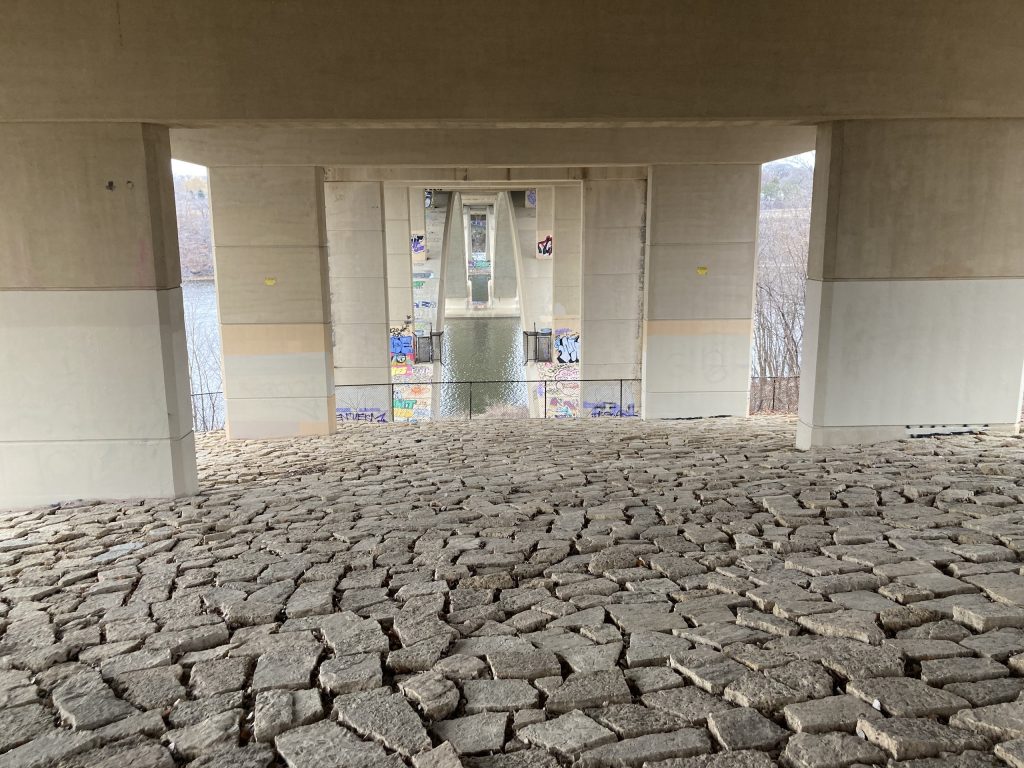
feb 28/RUNGETOUTICE

3.95 miles
wabun hill loop*
20 degrees

*wabun loop = river road, south/ go down locks and dam road / go up the steep hill that leads to wabun / through the park and back down to the river road / river road, north

future Sara might want to remember this, present Sara hopes it’s more like Venezuela, less like starting WW3: Trump, without approval from Congress, and Israel bombed the hell out of Iran last night or early this morning.

Colder today, but hardly any wind or sun. Last night the temperature dropped so quickly that there was a very wide ring around the moon. Showed it to Scott and he said it was a moon dog. I don’t recall ever seeing one of these before. Yesterday meteorologists were predicting snow today/tonight, but the forecast has shifted again. No snow, just cold.

My legs felt awkward for the first 5 minutes of the run, but then I warmed up and they felt better. By the third mile, they felt strong and efficient. It feels like I have more energy and power in my legs. Are the iron pills I’m taking to raise my ferritin working, or is it just a placebo effect?

When I got to the lock and dam no. 1, I decided — just seconds before I did it — to turn and run up the steep hill that leads to Wabun Park. It was mostly covered in ice, but also dead leaves, so it didn’t seem too slippery. As I neared the top, I walked for a stretch. At the top, I stopped to admire the view through the chainlink fence of the river and the island and the St. Paul side, then I walked until the ice had stopped. In the park, there were several small ice rinks where melted water had refroze.

10 Things

  1. someone was on the frisbee golf course at Wabun park — I couldn’t quite see, but I’m assuming they were playing
  2. at the top of the bluff, a big stretch of the paved path was covered in a thick sheet of ice
  3. also at the top of the bluff, on the other side neared to the park, there was a small clearing with a decomposing trunk and thick logs — do people come here to sit at night and watch the lights on the bridge?
  4. the hill leading up to wabun was mostly thin layers of ice mixed with thick, jagged layers of ice, butat least part of the trail was coated with dry leaves
  5. although there were walls of snow or thick chunks of ice at some of the entrances and exits, the walking paths were mostly clear
  6. empty benches, empty parking lots
  7. running, looking down at the winchell trail and seeing a person walking — they looked so far down, I felt so high up
  8. stopping to walk on the double bridge, hearing the loud shuffling of a runner’s feet approaching from behind
  9. do I remember any color, or was it all just pale gray and white today?
  10. the low rumble of a LOUD truck driving too fast on the river road

Like yesterday, I don’t remember what I listened to when I wasn’t listening to headphones and my “Bunnies and Rabbits” playlist. Traffic? The shuffling of my own feet? No birds or bells or fragments of conversation from other runners or walkers. A memorable song on my playlist: The Young Rabbits / the Jazz Crusaders

Rabbit Eyes: how they se, what they see

Rabbits have 3 eyelids, 3 tear glands, one tear duct. They rarely blink — only 12 times an hour — and can sleep with their eyes open which helps keep them safer. How? It

allows their light receptors to remain active. If a predator nears, their brain receives signals faster, enabling a quicker response than if their eyes were closed.

Rabbit Eye: a Complete Guide

To see without actively seeing. Two immediate thoughts: 1. I’m fascinated by passive seeing and how it works in the human brain (especially mine) and 2. how exhausting to sleep with your eyes open! I’d like to learn more about how this works.

How to tell when a rabbit is sleeping? Their nose stops twitching.

Here’s something I have in common with rabbits: they can’t see red and have a lot less cone cells than a normally sighted human. I can see red, but not that often. Also, they rely more on rod cells (and they have more of them than humans) and see better (best?) in low light. Peripheral vision!

rabbit eyes were built to excel in low light situations. Rabbits are usually the most active in the hours around dawn and dusk, when it’s not too bright out but also not pure darkness. This is a time of day when rabbits have the advantage over both predators that are nocturnal and see best in the dark, and predators that are diurnal and see best when there is bright light. 

7 fun facts about rabbit eyes / the bunny lady

Crepuscular!

360 degree view: “the rabbit visual system is designed–not for foraging and locomotion–but to quickly and effectively detect approaching predators from almost any direction. The eyes are placed high and to the sides of the skull, allowing the rabbit to see nearly 360 degrees, as well as far above her head” (What Do Rabbits See?)

Rabbits have a blind spot in front of their face.1 Like me! I wonder how the sizes of our blind spots compare? “The central blind spot in the rabbit’s field of view precludes a three-dimensional view of nearby objects. When your bunny cocks her head and seems to be looking at you “sideways,” she is actually looking as straight at you as is possible for a bunny” (What Do Rabbits See?). Sideways! Periphery! Me too. To really see something straight on, like where eyes are on a face, I need to look off to the side, at a shoulder. Sometimes when I watch tv, I look off to the edge of the screen to see what’s happening in the center.

And this!: “The image formed by the area centralis is relatively “grainy” compared to the one formed by your (normally sighted human with all cone cells intact) fovea, but it serves the rabbit well. Using this image, your voice, body movements and scent as cues, your rabbit can recognize you (his favorite human)–as long as you’re not carrying a scary box that completely changes your familiar shape!” (What Do Rabbits See?). Yes! Sometimes, like when I’m in a store and have separated from whoever I’m with, I use a combination of voice, body movement, overall silhouette, known distinctive features — like glasses or haircut or unusual dress — to identify them. My sense of smell is not good enough to identify by scent, though.

lack of depth perception and parallax motion: “rabbits have evolved in creative ways to overcome this limitation, enhancing their ability to spot predators and make a quick escape. Rabbits employ a method known as “parallaxing”, moving their heads back and forth to gauge the distance and size of distant objects” (Rabbit Eye: A Complete Guide). Sometimes I have trouble with depth perception. Could I use parallaxing to help me navigate better? I googled, “Can visually impaired humans use parallax motion to detect depth.” Yes! I should practice this parallaxing when I’m out running above the gorge! I found this answer on a Reddit thread that was started with this question, if we need both eyes in order to see depth (depth perception), why is it also possible to see said depth when you close one eye? What a useful thread about how our brains fill in gaps and determine depth based on patterns and a library of known depths. And even better than this thread, here’s an article about a scientific study that was designed to explore and answer the question, “Can people with different forms of low vision use motion parallax to improve depth judgments?” The answer? Yes! And many people with low vision use it without realizing. And it should be introduced to people with low vision as a tool early on in their vision loss. And not enough research has been done on it. This study is from 1997. Has more research been done since then? Has it been adapted by low vision educators?

Here’s something I found from Duke Health in 2013. It’s specifically about low vision as having vision only in one eye, but it’s still helpful:

Adults who lose vision in one eye also have more collisions when walking, especially on the side where they lost the vision. That’s where sessions with an orientation and mobility specialist can help.

“The emphasis is on helping people to judge distances by using monocular clues, such as something called motion parallax. If you’ve ever seen a cat moving its head or eyes side to side before it jumps, that’s motion parallax,” Dr. Whitaker said.

Duke Health

Returning to the parallaxing quote: “This behavior is less common in familiar environments (such as their home), as rabbits memorize their surroundings. However, introducing a rabbit to a new home or a new furniture layout often prompts this scanning technique during initial explorations.” Yes! I’ve memorized my surroundings, which has made it easier to navigate both my physical environment and my new reality of living with a lot less vision — inside my familiar world, I am far less aware of a loss. New environments can be scary, unsettling, upsetting. I need to be brave2 and build up skills and explore new environments.

This last sentence, and footnote 2 below, highlights something that I am doing with my poetry/attention/moving practice. Not only am I working on my craft (writing poetry) and increasing my capacity for care and attention and my commitment to where I live and the many creatures I live with, I’m also acquiring tools and learning how to see in new ways. For example, today I’m studying rabbits in a wide range of ways because it’s fascinating and delightful and because how they see shares some similarities with how I see. Like the bat (and echolocation), rabbits offer strategies for seeing with less (or without) central vision.3

hinged skulls/big feet: “When they do smell, see or hear a predator, rabbits have to be able to make quick escapes. To help with this bunnies have very large back feet, and hinged skulls to absorb shock. Their cranial hingeallows rabbits to run at speeds above which the impact of their feet would rattle their brain around” (Rabbits have hinged skulls).

family:  Leporidae / order: lagomorpha / backyard rabbits: eastern cottontail, sylvilagus floridanus

Looking through the wikipedia entry for eastern cottontails, I found this about habitat:

The eastern cottontail is a territorial species that relies on speed and agility to evade predators. When chased, it typically escapes in a zigzag pattern and can reach speeds of up to 18 mph (29 km/h). Cottontails favor habitats where they can feed in the open but quickly retreat to cover when threatened. Preferred environments include forest edges, swamps, brushy thickets, hedgerows, and open fields with nearby shelter. Instead of digging burrows, eastern cottontails rest in a form—a shallow, scratched-out depression in grass or beneath dense vegetation. . . .

The rabbit eye in A Young Hare

There was a moment in the year 1502, so the story goes, that the eye of a dead rabbit reflected the real window of Albrecht Dürer, who, with his watercolors and genius and passion for detail, painted that eye with the window in it. It then became art, and, then, art again: the painted eye with the painted window in Diane Seuss’s “Young Hare” that connects the artist to the poem’s speaker. “Why does the window feel so intimate in the hare’s unreadable eye?” the speaker asks, and the answer is that the window in the eye represents a straddling between worlds, between then and now, between artist and viewer, between life and art.

Diane Seuss

I’ve tried looking at the painting online and my eyes cannot offer enough detail to see the hare’s eye and the window in it. I have read Diane Seuss’ poem about it, The Young Hare, and believe I don’t need to see the eye myself to understand its significance or its beauty.

The Young Hare / Diane Seuss

Oh my love, Albrecht Dürer, your hare

is not a spectacle, it is not an exploding hare,

it is not a projection of the young hare

within you, the gentleness in you, or a disassembled hare,

nor a subliminal or concealed hare,

nor is it the imagination as hare

nor the soul as a long-eared, soft-eared hare,

Dürer, you painted this hare,

some say you killed a field hare

and brought it into your studio, or bagged a live hare

and caged it so you could look hard at a wild hare

without it running off into thorn bushes as hares

will do, and you sketched the hare

and laid down a watercolor wash over the hare

and then meticulously painted-in all the browns of hare,

toast brown, tawny, dim, pipe-tobacco brown of hare,

olive, fawn, topaz, bone brown until the hare

became dimensional under your hand, the thick hare

fur, the mottled shag, the nobility of the nose, the hare

toenails, black and sharp and curved, and the dense hare

ears, pod-shaped, articulated, substantial, erect, hare

whiskers and eyebrows, their wiry grace, the ruff of hare

neck fur, the multi-directional fur over the thick hare

haunches, and did I say the dark inside the hare

ears, how I want to follow the darkness of the hare

and stroke the dark within its ears, to feel the hare

ears with my fingers, and the white tuft, the hare

anomaly you painted on its side, and the fleshy hare

cheeks, how I want to squeeze them, and the hare

reticence, how I want to explore it, and the downturned hare

eye, it will not acknowledge or appease, the black-brown hare

eye in which you painted the reflection of a window in the hare

pupil, maybe your studio window, in the hare’s

eye, why does that window feel so intimate in the hare’s

unreadable eye, why do I press my face to the window to see the hare

as you see it, raising your chin to look and then back to the hare

on the page, the thin hair of your brush and your own hair

waving gold down your back, hair I see as you see the hare.

In the hare’s eye you see me there, my swaying black hair.

Oh, I love this poem and how it allows me to reflect on what it means to study/explore/be inspired by something and someone.4 And what wonderful work she does with her linking of hare with the hair of the paint brush, the hair of the artist, the hair of the person viewing the painting/writing and reading? the poem!5

  1. They also have a blind spot in the center of the back of their head, preventing full 360 degree vision. ↩︎
  2. I don’t usually like the use of the word brave to describe how I’m navigating new ways of seeing — as in, someone responding to hearing that I’ve lost vision with, you’re so brave! As if just continuing to exist with such a diagnosis, which they really imagine as a death sentence, is being brave. But seeking out unfamiliar situations that frighten/unsettle me in order to get better at navigating because I want a fuller life is me being brave. ↩︎
  3. Additionally, the language used to describe how low light animals see/navigate can be helpful in understanding and communicating to others the strange ways I see. Maybe I can borrow that language as I try to describe how I see? ↩︎
  4. Taking this discussion back to its origins a week ago, I’m returning to the muse. I don’t see the rabbit as my muse, but as both a gate — an opening — and a teacher. ↩︎
  5. Reading this poem is making me want to read Seuss’ “Two Dead Peacocks” collection again, and more closely, as part of my ekphrastic project. I just ordered it from Moon Palace Books! ↩︎

Get Out Ice

As a reminder of some of the ways Minnesotans have resisted ICE this winter, Racket offered this list:

Fifty-thousand people thronging the streets of downtown Minneapolis in subzero temperatures to protest ICE’s presence in the Twin Cities. Thousands more pedaling their bikes through south Minneapolis, many in “peaceful observer, don’t shoot” vests, to honor a cyclist killed by state violence. Massive papier-mâché puppets presiding over rallies and memorials as brass bands play songs of liberation, and luminaries on frozen lakes spelling out messages like “ABOLISH ICE” and “ICE OUT 4 GOOD.” 

Anti-ICE Ice Fishing, Subzero Marches, and Art Sled Activism: A Winter of Protest in the Twin Cities

The rest of the article describe the bike ride, sponsored by Angry Catfish, in honor/memory of Alex Pretti.
jan 3/RUN

4.5 miles
minnehaha falls
20 degrees
100% snow-covered

Not a single bare spot on the trail or the road. Hard on the ankles, calves, and the eyes — so bright and white and endlessly nothing. Difficult to see where the snow was loose and where it wasn’t. It didn’t bother me; I’m just happy to be outside moving, connected to this place. Tried to greet everyone I saw — runners, walkers, at least one biker — with a wave or a hello.

10 Things

  1. the smell of chimney smoke lingering near a neighbor’s house
  2. soft ridges of sand-colored* snow covering the street — tricky to run over and through
  3. empty benches
  4. (almost) empty parking lots
  5. a hybrid/electric car singing as it slowly rounded a curve near locks and dam no. 1
  6. the sound of the falls falling over the ledge: almost gushing
  7. scattered voices echoing around the park — at least one of them was from an excited kid
  8. stopping to tighten my laces, a woman in a long coat nearby, standing and admiring the falls
  9. splashes of yellow on the snow
  10. bird song then a burst of birds briefly filling the sky

*sand-colored: using these words, I immediately thought of a favorite poem that I’ve memorized, I Remember/ Anne Sexton: the grass was as tough as hemp and was no color — no more than sand was a color

I listened to the quiet — barely any wind — for the first half of the run, then put in my “Sight Songs” playlist on the way back. Memorable songs: Sheena Easton’s nasally high notes in “For Your Eyes Only,” and the lyrics in the refrain —

The passions that collide in me
The wild abandoned side of me
Only for you, for your eyes only

Yikes. Also, these lines from The Who’s “Behind Blue Eyes”:

And if I swallow anything evil
Put your finger down my throat

And if I shiver please give me a blanket
Keep me warm, let me wear your coat

And these, from Bonnie Tyler’s “Total Eclipse of the Heart,” which I don’t recall ever hearing:

Every now and then I know you’ll never be the boy you always wanted to be. . .

. . .Every now and then I know there’s no one in the universe as magical and wondrous as you

(Almost) 9 Years!

Typically each year, I mark the anniversary of this log as the first of January, with a new year beginning on that day. But, that’s not the real anniversary of this log. It’s January 12th, 2017. Why the 12th and not the 1st? I’m not quite sure; I’ll have to look through my journal from that year. It seems fitting, with my affinity (see D. Seuss below) for the approximate, the almost, to not start on the first day of the year!

On This Day: January 3, 2022

Reading this past entry today, I re-discovered this beautiful poem by a favorite poet, Diane Seuss, Love Letter. Rereading it, so many words, phrases, ideas tapped me on the shoulder, invited me it! Here’s the second half of the poem:

I’m much too sturdy now to invest
in the ephemeral. No, I do not own lace
curtains. It’s clear we die a hundred times
before we die. The selves
that were gauzy, soft, sweet, capable
of throwing themselves away
on love, died young. They sacrificed
themselves to the long haul.
Picture girls in white nighties jumping
off a cliff into the sea. I want to say
don’t mistake this for cynicism
but of course, it is cynicism.
Cynicism is a go-to I no longer have
the energy to resist. It’s like living
with a vampire. Finally, just get it
over with, bite me. I find it almost
offensive to use the word love
in relation to people I actually love.
The word has jumped off
so many cliffs into so many seas.
What can it now signify?
Shall I use the word affinity
like J.D. Salinger, not a good
man, put into the mouths
of his child genius characters? I have
an affinity for my parents. An affinity
for you. I will make sure you are fed
and clothed. I will listen to you
endlessly. I will protect your privacy
even if it means removing myself
from the equation. Do those sound
like wedding vows? Are they indiscriminate?
Well then, I am indiscriminate.
I am married to the world.
I have worked it all out in front of you.
Isn’t that a kind of nakedness?
You have called for a love letter.
This is a love letter.

sturdy! I love this word — the sound and the feeling of it: I like being sturdy. My Girl (in my Girl Ghost Gorge poem, the preferred version of me — Sara, age 8).

the “gauzy, soft, sweet selves” — these gothic girls, jumping off cliffs into the sea — a very different version/vision of a girl than mine

Linking these lines to others from Seuss, I imagine one version of her girl to be the one that died when her father did — she writes about him in Still Life with Two Dead Peacocks and a Girl. That girl’s father became sick when she was 2 and died when she was 7.

Of course, this is only one version of her girl. How many different versions of girls do I have? Do I write about?

Affinity?! Yes, I need to put that beside my list of “love?” words, accustomed, familiar, acquainted, known. Affinity = kinship, attraction, liking/affection, causal relationship, attractive force, “a relation between biological groups involving resemblance in structural plan and indicating a common origin”

Right now, I’m reading “You” as the poem and poetry.

Indiscriminate = not marked by careful distinction — ambiguous, sloppy? a (too) rough approximation?

love letter world . . . suddenly, I’m thinking of Emily Dickinson: This is my letter to the world that never wrote to me

That was fun, giving some time to these words! I am drawn — do I have an affinity? — to Diane Seuss’s words. Is it because my introduction to her was her fabulous poem about vision that begins with the line, the world, italicized? Or her ekphrastic poems, in Still Life with Two Dead Peacocks and a Girl?

a return to the ekphrastic! I am reminded of my past reading and writing about still life, especially with Diane Seuss. I’m imagining my “how to see” series of ekphrastic poems with a section on still life paintings and one on pastoral poems! Also, a section on artists with vision conditions or that particularly resonate for my vision: Magritte, Monet, Vincent Van Gogh. Ideally, a series of poems. But first, taking the time to gather all of the resources together, then to stay open to what could happen! I’m also imagining a section on cut-outs/silhouettes, which I studied during my shadow month.

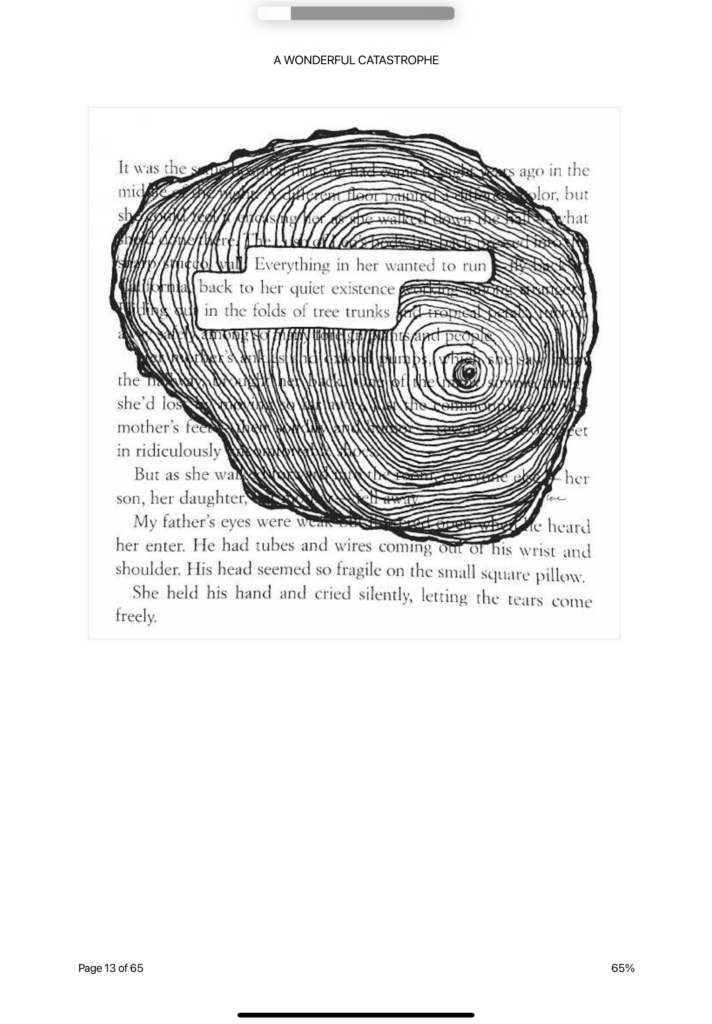
Colette Love Hilliard and the erasure poem

Last night I bought CLH’s  a wonderful catastrophe. Wow! I love it. This one reminded me of my blind spot/mood ring visual poetry:

from A Wonderful Catastrophe / Colette Love Hilliard

dec 20/BIKERUN

bike: 30 minutes
run: 1.5 miles
basement

Windy, icy, cold, so I decided to stay inside. Finally began watching The Thursday Murder Club while I biked. I like it; especially with audio descriptions. Listened to my new audiobook, Tommy Orange’s Wandering Stars, while I ran.

No great thoughts or images on the bike or the treadmill. Just a chance to be distracted from difficult feelings — frustration, worry, regret, sadness — felt as I try to help FWA figure out his future.

a fun experiment

For many years now, I’ve been thinking about how I might be able to use a text that’s been meaningful to me in my thinking and writing about the Mississippi River Gorge: a 2002 Gorge Management Plan prepared by Great River Greening. In writing about the gorge, I’ve often referred back to this 140 page document for information about the geography, geology, ecology, and cultural/social history of the area. And I’ve thought about using its text in some way. An erasure poem? A blackout? Those are the two types of found poetry that I’m most familiar with. Today, reading an interview with Lisa Olstein about her new collection, Distinguished Office of Echoes, I was reminded of a third type of found poetry: cut-outs. Here’s an excerpt and another from the book. My first reaction: yes, I should try this! But then, as I (tried to) read Olstein’s examples, I realized that these poems aren’t accessible and are almost impossible for me to read. I don’t want to write in a form that I can’t even read myself. But, maybe I can think about/think through another version of found poetry that is accessible to readers (like me) that have low vision or no vision.

A first thought: find phrases or one syllable words that can be made into chants/running rhythms.

Another thought: expand the words I’m using to include original sources from Horace WS (William Shaler) Cleveland. Maybe, find something in here?

And, I’m realizing that this idea of writing something with Cleveland’s words is leading me a project I’ve been thinking about for a few years: ekphrastic poems + how I see + writing about the gorge/gorge management as a work of art as ekphrastic + anti/anti-pastoral poems. Just the other day I was thinking — maybe I wrote about it, too — about 2 directions I could go for 2026: M(e)y(e) Emily Dickinson, on ED’s vision poems and their importance for me, and How I See — ekphrastic/pastoral/visual art.

aug 28/RUN

3.8 miles
river road, north/south
61 degrees

Cooler this morning. Quiet. Ran earlier than usual: 7:30. Lots of traffic on the road, some on the trail too: walkers, runners, bikers, strollers, at least 2 roller skiers. I could hear one of the roller skiers as it approached, scraping their poles on the ground. No clicks and clacks, just scraaaape scraaaape. Running past the rowing club, I encountered a group of people in bright yellow vests emerging from below. Were they rowers, and did they wear those vests on the water?

After reaching the river, I noticed the fence slat, pushed loose by a leaning tree trunk, was looser today. Greeted the Welcoming Oaks, good morning! hello friend! The sunlight was beautiful in the tunnel of trees — thin strips of light coming through the leaves.

Found this poem yesterday. It’s great for my interest in ekphrastic poetry and color:

A Lexicon of Light/ George Looney

     –after Claude Monet’s Charing Cross Bridge series

It’s not accurate to say we know
what we see. Truth is, few understand

the physics of color. What Monet knew
had little to do with science. He was

intent on getting the bridge, and everything
that gave the bridge context, right. Language

isn’t accurate enough. To depict the world
with color and form—to make a place

and moment of time a composition—is
no more precise a vocabulary. Vision

tends to end up being an imposition
more than a recognition of how the fog

consumes much of the bridge, as if nothing
is able to fully connect one side

of the Thames to the other. Distance
often asks too much of us, and Monet

found ways to accept that insistence. His
endlessly varied harmonies of color

wrote a new definition of accuracy. The bridge
is more than a construction passed over

by trains and imbued with shifting colors
with the time of day. It becomes, for the artist,

a lexicon of light and all that light does
to this world. At times everything is more

certain, and we want to stand on the bridge
and compose a tune, humming, that the sun,

glittering in the river, inspires. Other times,
we want to be nothing but a faint music,

too distant or muted to be identified,
drifting along with the soothing mist and fog.

accurate / know /
see / Truth

physics of color


not accurate, right


color and form

composition
not precise

vision as more imposition than recognition of how the fog consumes the bridge?


harmonies of color — a new definition of accuracy


shifting colors with the time of day

lexicon of light and all that light does to this world

july 7/RUNSWIM

4.25 miles
monument and back
71 degrees
dew point: 64

Hot! I’ve never liked running in the heat but now that I’m taking lexipro my heat intolerance has increased. For some moments of the run I felt great, other moments I didn’t. So I walked some, ran some, and walked again at different stretches.

10 Things

  1. I kept seeing orange flashes — a sign, a cone, a tree marked for removal
  2. kids yelling and laughing outside at a daycare attached to a church
  3. the river from above, on the bridge, heading east: brown, and looking shallow — were those sandbars I was seeing near the surface?
  4. trickling water out of the limestone below the bridge
  5. the sound of shadow falls, falling
  6. a kid’s voice rising from the ravine
  7. construction on the other side of the lake street bridge — orange cones, trucks, yellow-vested workers, the buzz of equipment
  8. the river from above, on the bridge, heading west: blue and covered in the reflections of clouds*
  9. click clack — a roller skier
  10. seen, not heard: a dog, by the clanging of their collar

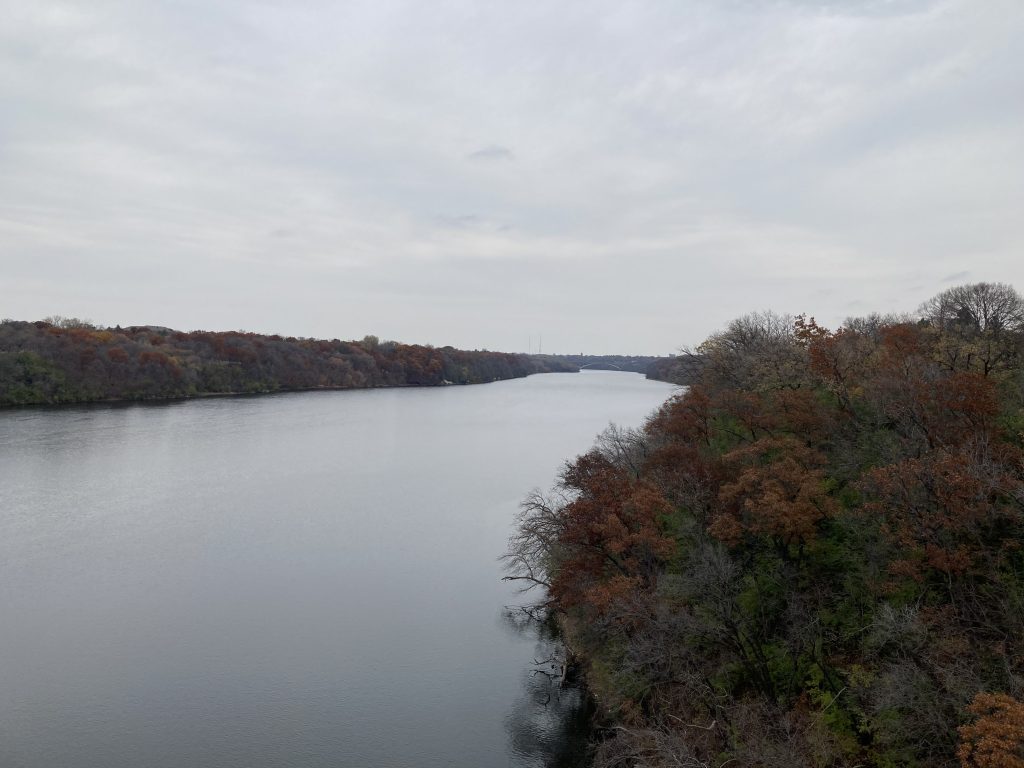
*stopped at the bridge overlook to take a picture of the clouds reflected on the surface of the water. Is it just me, or does this look like an impressionist painting?

a view from above the river: gray, corrugated water with reflections of clouds and trees
river with clouds, 7 july 2025

the color of water

How to Read Water is fascinating. Here are some things I’d like to remember from the chapter on color:

The colors we see in water depend on the brightness and angle of the light and the water’s depth, as well as what’s on, in, and under that water.

How to Read Water

something to consider: are you looking at water, or something in or under the water, or a reflection on water’s surface. Is it the color of water, or the color of the ground beneath the water (a puddle), or the color of cloud on its surface? What angle are you looking from?

. . . in many circumstances when we think we are looking at the water, we are actually looking at something different and in the distance. Looking out to the sea in the distance is a great example: What we see in that situation is dominated by the reflection of the sky even further in the distance. This is why the distant sea appears blue in fine weather and gray on overcast days.

How to Read Water

This water looks blue because it’s reflection the sky is one I’ve heard a lot, but I think I’ve always heard it as the reason, not one reason under certain circumstances.

What about when we see different colors — which I often do as I run across the bridge and look down at the water? The different colors are based on how much of the water we are actually seeing. Sometimes I see brown, sometimes blue.

You will notice this if you look for it, but not if you don’t because our brain has gotten used ot this effect and so oesn’t register it as at all peculiar.

something to try: Can you find the area/the moment where the shift takes place from looking only at reflections to being able to see water?

the exact color that can travel furtherest through the water without being absorbed: blue-green color, wavelength = 480 nanometers

Is it a big cloud or Jaws? People often think it has gotten deeper or there are fish around when the water darkens, but it might just be a big cloud.

eutrophication = excessive nutrients — algal blooms reduce light, use up a lot of oxygen, change the color of the water

oligotrophic = low in nutrients, clear

my sparkle friends! “A lot of the particles that see in water will be inorganic, a mixture of mud, sand, clay, silt, chalk, and other substances, each one affecting the colors we see.” Do I see them as anything other than the color sparkle?

Today I’m swimming at Cedar Lake, which is much deeper than Lake Nokomis. It is also more of a “natural” lake than nokomis. What impact do these factors have on its colors and my experiences of them?

swim: 2.5 loops (5 cedar lake loops)
cedar lake open swim
82 degrees

The water by the orange buoy closest to Point Beach was almost hot — so warm! It was a little cooler in the middle of the lake and near Hidden Beach, but not that cool. It was also calm. Not much wind, no waves. A few vines floating over and under and around me. Some milfoil by the beach. I forgot to look at the color of the water from above, but I did look below. Blue-green, a few hints of yellow. Opaque.

10 Things

  1. driving past another part of the lake: the surface covered with green vegetation
  2. clear blue sky, then a few clouds, the more clouds, then dark
  3. the first orange buoy seemed much farther out in the water
  4. breathing to my right, seeing some other swimmers halfway across the lake
  5. yellow safety buoys
  6. something in the sky — a plane? a bird? I’m uncertain
  7. the warm water was buoyant; I felt higher on the water
  8. bubbles around my hands
  9. a line of white buoys at hidden beach
  10. a breaststroker, stroking with intensity — are they trying to race me?

Is that what bothers me about breaststrokers I encounter: that they always look so intense and like they are trying to race me or keep up with me? I think of breaststroke as a chill stroke, where you glide and kick as you travel on the surface of the water, able equally to see above and below. But, there’s nothing chill or relaxed about the breaststrokers i encounter!

Before swimming, I worked on memorizing some more lines from Alice Oswald, this time from Nobody, but I got stuck on the beginning and wasn’t able to recite them in my head as I swam:

There are said to be microscopic insects in the eye
who speak Greek and these invisible
ambassadors of vision never see themselves
but fly at flat surfaces and back again
with pigment caught in their shivering hair-like receptors
and this is how the weather gets taken to and fro
and the waves pass each other from one color to the next
(Nobody/ Alice Oswald)

july 2/RUN

4 miles
franklin loop
68 degrees
humidity: 81%

Started at 7:30 a.m. and it was already hot and humid. That sun! Ran with Scott. We talked about AI and whether or not art was a purely human expression and how, within running circles, humidity is considered a “poor man’s altitude training.” We ran over the lake street bridge and the franklin bridge and above the mississippi rowing club and wondered what the loud buzzing noise below was. Trucks. My guess: doing something with the sewer vents by the rowing club. Scott’s guess: pulling a car out of the river.

10 Things

  1. a single rower on the river
  2. graffiti under the lake street bridge: Stop Hate
  3. cloudless blue sky
  4. everywhere, a thick green veil
  5. all the benches we ran by were facing a wall of green — on the other side of that: an unseen river
  6. 2 runners ahead of us disappearing into the trees — passing the spot a minute later, we noticed a steep dirt trail
  7. the cracked pavement that I’ve been monitoring for years has grown into a sinkhole
  8. the color of the river: brown in the foreground, blue in the background
  9. I don’t remember seeing shadows, just experiencing the cooling effects of shade
  10. beep beep beep — a truck backing up somewhere nearby

We started out doing 9/1, but had to take an extra minute of walking after the second interval. Still, we got outside and moved over 4 miles in the heat. Small victories: we ran more again in the last 2 miles and we ran up the entire section of the franklin hill even though I had initially wanted to walk it.

Found this definition of poetry by Wang Ping. Several years ago, she wrote a wonderful poem about the Mississippi River Gorge.

That’s what poetry is: a wind, a leaf of grass that ties time and space together (Wang Ping).

field

Continuing to think about the visual field test and the idea of my visual field. Today: what is a field? and can I play around with the idea of a field?

The visual field is “that portion of space in which objects are visible at the same moment during steady fixation of the gaze in one direction”; in ophthalmology and neurology the emphasis is mostly on the structure inside the visual field and it is then considered “the field of functional capacity obtained and recorded by means of perimetry”.

wikipedia

A single, fixed view from one direction — the space, and what’s contained within that space that can be seen.

I think I’ll leave thoughts about visual fields alone for now. Instead, I want to turn to a wonderful chapbook I just bought — as part of an entry fee for a chapbook contest — from Driftwood Press: Questions about Circulation

ruins/ Charles Malone

III.

The kitchen ceiling falls to the floor—
soaked plaster, moldy wood.
Hundred-year-old floors warp
something more sinister than time
in the farmhouse.
Plants grow to cover the windows,
the smell chokes
a massive colony of honeybees takes up in the siding,
raccoons come and go from the basement window.

This is the process by which a home becomes not,
a process other than a real estate transaction—
spills, arguments, accidents, cruelties.
You see other farmhouses stripped of paint
ducking behind wilding shrubs and flowering weeds.
The boundary between in and out blurs,
a sign with shameful orange letters on the door.
What action and inaction, what ruins a house
for the body and the lungs and recollection?
Rain, the creep of ivy, the sedimentary accumulation of dirt
this is the opposite of the joy of work.

1

Scott and I recently discovered more seasons of the Great House Revival where people take abandoned houses in Scotland Ireland (oops) and restore them. There are lots of discussions of water damage and rotten floorboards and overgrown yards and critters wandering in and out of basements and kitchens and first-floor (which is the second floor in a U.S. house) bedrooms.

2

Ever since I discovered the concept of re-wilding, I’ve been thinking about my eyes becoming wild again. At some point, my cone cells began scrambling then leaking then scarring then dying. Sometimes, I think of my central vision less like a wilderness, and more like a wasteland. But, there is something wild/feral about the refusal to fix/tame an image. Everything moves slightly — shakes, shimmers, fuzzes, fizzes. Nothing is still.

june 10/RUNSWIM

4.5 miles
veterans home
59 degrees
poor air quality

The smoke from Canadian wild fires didn’t bother me much, although the inside of my nose was coated with something which made breathing a little more difficult. Other than that, it was a nice morning for a run. More shade than sun, low wind. Another 9/1 success. I’m continuing to build up the mental strength — a belief that I can keep going. Chanting in triple berries helped: strawberry raspberry blueberry.

Yesterday I mentioned possibly focusing on benches as a monthly theme — or a 1 or 2 week theme? As I ran south, I made note of a few of the benches.

9 Benches

  1. near the worn wooden steps leading to the winchell trail — wooden slats — empty
  2. at the top of a mulched trail descending into the oak savanna — a worn boulder that looks and acts as a bench — someone was standing there today, writing something on a piece of paper
  3. above the 38th street steps — wooden slats — empty
  4. beside a boulder in a part of the walking path that splits from the bike path — wooden slats — empty
  5. in a patch of grass above the “edge of the world” — wooden slats — empty
  6. on the edge of the 44th street parking lot — wooden slats — occupied by a bike/biker
  7. near John Stevens house and a cluster of picnic tables — wooden slats — empty
  8. at the bus stop across from the veterans home — green metal back/wooden slat seat — empty
  9. above the locks and dam no. 1 — green metal back/wooden slat seat — empty

Other things noticed: 4 or 5 turkeys in the grassy boulevard, a group of 8-10 roller skiers, the roar of the falls through the trees, a human with 2 dogs trotting to the creek bank, the light rail horn blasting a warning, the sweet/sour smell of earth on the hill descending below the ford bridge, headlights from a bobcat below me in the woods — I think they’re building a new walking path that goes deeper into the gorge!

For the first 3 miles, I listened to voices and wheels and the echo of a dog’s bark. For the last 1.5 miles, my color playlist.

still life

In the middle of the night, during one of several bouts of restlessness, I started reading a book I got from the library: Still Life/ Jay Hopler. Why did I request this book? It must have been because of the title and my interest in the word, still, and still life paintings. Reading more about it, I discovered this:

When Jay Hopler was diagnosed with metastatic prostate cancer and told he only had two years left to live, he chose to spend his time writing this book: a rare gift to our world in all its ways. The book seems to be both a representation of all the moving parts of the dying, as well as an antithesis to how we usually converse about death, namely a dying person.

Still Life review

still life w/ wet gems/ Jay Hopler

lightnings bang their jaggeds on the cloud-glower
the cloud-glower is a broken necklace spilling its wet gems
its wet gems w/ facets cut uncountable
uncountable the reflections of the world in those gems
uncountable the version of the world into its dry self crashing
the shards of those worlds like shrapnel blasting skyward
slicing skyward or sidewise through the dune grass
the dune grass flattened by that splatter even as i write
the words

To My Wife on Our Anniversary/ Jay Hopler

In Castiglione del Lago, the pines are iron-spined. When the wind
blows, they stand still & the earth sways. If only God had forged me thus!
Forced into a stooped form & told to straighten up, that’s as far as His
blessings ever extended in my direction. You know what keeps me from
falling apart? Luck & duct tape. Even so, those trees have nothing on me.
Blessed as they are, all they get to hold today is a sick man’s attention &,
maybe, a few birds.

After reading still life w/ wet gems last night, I thought about my “how I see” project and the idea of writing around landscape and still life paintings — maybe portraits, too?

swim: 2 loops
lake nokomis open swim
81 degrees
water temp: 68 degrees

Open swim! Open swim! Open swim! There aren’t enough exclamation points to convey my joy over another summer of swimming across the lake. I swam 2 loops without stopping at the beach in-between. It felt good and then it didn’t and then it did again. Sore arms, the strange feeling of muscles not worked for a year waking up again. Now, a warm buzz. With no access to a pool, I haven’t swum since last august, so I’m impressed that I did as much as I did. I didn’t worry about not seeing the buoys, even when I couldn’t. Just kept swimming and reached them. Hooray for swimming without seeing (much)! Hooray for Minneapolis Parks for keeping open swim the same! Hooray for my muscles and tendons and lungs enabling me to do this thing I love!

The water was a deep green-blue. I could see the milfoil reaching up from the bottom, looking ghostly. Also saw pale legs kicking in front of me. No fish, no dragonflies, no menacing swans.

june 7/RUN

3 miles
trestle turn around
70 degrees

Wow, summer! Sunny, not too warm. Strong legs, mental toughness. A good morning to be outside and moving. Heard the rowers and a roller skier, someone blasting an old rock song — what was it? I remember identifying it and thinking that I needed to try and remember the title, but now I can’t. Encountered lots of bikers and walkers and runners, but no turkeys or squirrels or lunging dogs.

10 Things

  1. siren
  2. coxswain
  3. hearing the glittering of trees
  4. click (ity clack)
  5. bugs
  6. headphone fail
  7. pack(ed)
  8. radio
  9. fragment (overheard)
  10. concealed

A police siren that I thought was a loon, the coxswain’s voice calling out instructions, a breeze passing through the leaves and hearing the glittering of trees. The click of roller skier’s poles striking the ground, an itchy bite from a bug. Turning on my “Doin’ Time” playlist, expecting to hear the music in my ears, instead hearing it all around — a headphone fail. Someone blasting music from a radio. A fragment of a conversation overheard, the words now forgotten. The river, the rowers, the ground below, concealed by a wall of green.

Walking back, after I was done, I heard a Dad reading to his son about a baby bird in a tree. Very sweet. It almost sounded like, are you my mother? Was it?

Finished reading through Hardly Creatures for the first — but not the last — time. Their playing around with what access means is fascinating. I’m thinking about my ekphrastic/alt-text project and how access might work in it. In my next read through of the book, I’ll think about access and what it means to me and take notes on the different ways Colgate practices/invokes/addresses it.

feb 16/RUN

note: I’m starting this post at 9:50 am. The temp is 4 degrees / fees like -11. The wind is 11 mph with gusts up to 20 mph. At this point, I’m thinking I will run inside on the treadmill. Will I, or will some part of me convince the rest to run outside?

3.5 miles
ford bridge and back
7 degrees / feels like -10
50% snow-covered

We did it. Good job legs and lungs and heart, you convinced brain that we really needed to be outside this late morning! Almost all of the layers were on: 2 pairs of black running tights; dark gray tank top; green long-sleeved shirt; orange pullover; dark purplish/blueish/grayish pullover with hood; purple jacket; orange striped buff; black fleece cap with ear flaps; black gloves; pink striped gloves; 2 pairs of socks — gray (long) / black (short). At times, I was too warm.

It was wonderful and sometimes hard, especially when I was running into the wind on the way back. It was also bright — glad I had my sunglasses. Encountered someone in orange with their hand up to shield their eyes as they walked south. Saw the round shadow of a street lamp and the jagged shadow of a small tree. Passed a group of four walkers, laughing and yelling and having fun on the double bridge.

Did I think about purple at all? I can’t remember now. The only color I recall noticing was orange.

the purple hour (15th and 16th of feb)

3:38 am / dining room / 15 feb

the heat turnning on, the house shifting settling, my legs restless
purple mountains — in Japan, looking out at the mountains, different shades of purple — fall, 1994
Emily Dickinson purple — sunsets and sunrises
someone shoveling at 4 am

[discussion below added at 10:30 am on 16 feb]

Where Ships of Purple—gently toss — / Emily Dickinson

Where Ships of Purple—gently toss —
On Seas of Daffodil—
Fantastic Sailors—mingle—
And then—the Wharf is still!
F296 (1862) 265

No one does sunsets better than Dickinson. I wonder if Amherst sunsets are still so colorful. Where I’ve lived sunsets are primarily red, pink, and gold, but the ones she describes often have purple. This one does, too. Here she sees great ships, large purple clouds, gently tossing in their moorings. The sea beneath them is tinted golden, “Daffodil,” from the setting sun. The mingling and fantastic sailors are no doubt smaller clouds that move among the larger ship-like ones, their shapes constantly changing. When the sun sets the sky turns dark and “the Wharf is still!”

the prowling bee

The prowling bee has been such a wonderful resource for me. Reading the comments for this poem, there was speculation about why the Amherst sunsets were so brilliant and purple:

Romantic era sunsets WERE particularly vivid, due to volcanic ash from several cataclysmic eruptions worldwide. The Hudson River School artists and their sunsets might not have been hyperbole, after all, nor were ED purple sunsets.

Another commenter doubted this suggestion, so I did a quick search and found a pop science article about a study on sunset paintings and volcanic ash: How Paintings of Sunset Immortalize Past Volcanic Eruptions

Volcanoes can cause some of the world’s most spectacular sunsets. An eruption spews small particles of gas, dust and ash, called aerosols, high into the atmosphere where they can spread around the world. The particles can’t be seen during the day, but about 15 minutes after sunset, when conditions are right, these aerosols can light up the sky in brilliant “afterglows” of pink, purple, red or orange.

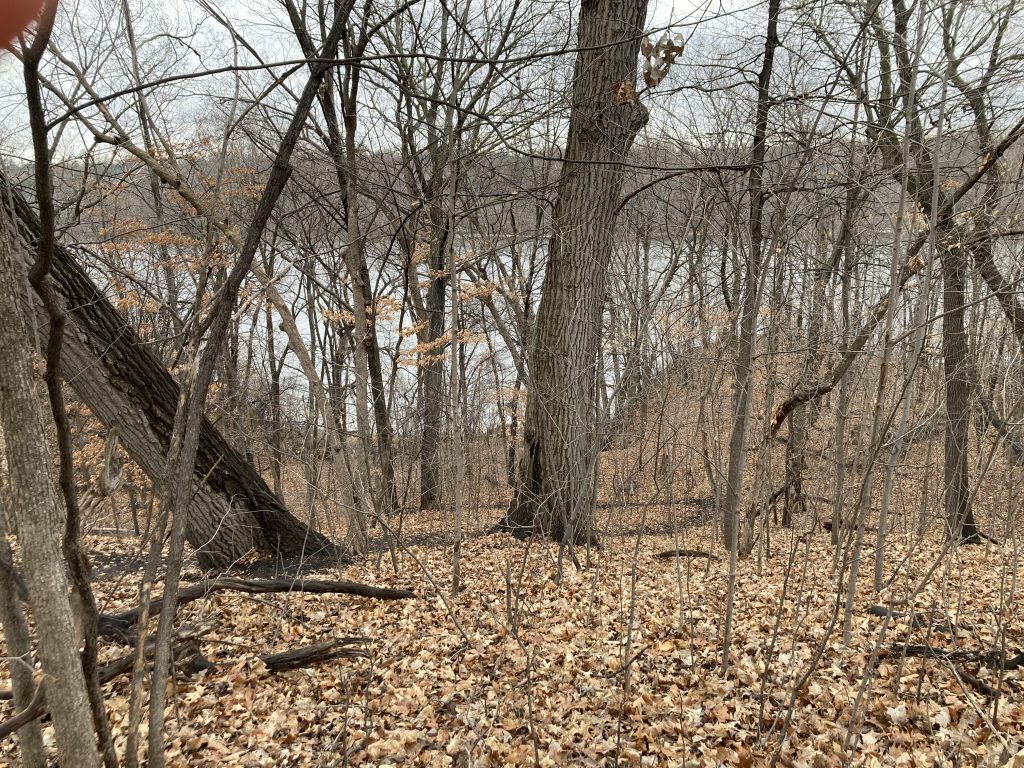
The impact of climate/climate disruptions on how we see color? Fascinating. Earlier this morning, while doing my “on this day” practice, I reread my entry from 16 feb 2024. In it, I described a photo I took above the gorge.

The most important thing about this image is how the branches create a net which mimics how my vision often works — I can almost see what’s there, but not quite. Secondary, but connected, is the feeling of being disoriented, off, almost but not quite, untethered, which comes from swirling forms and the climate crisis — there’s almost always snow on tthe ground here in February. Where are my Minnesota winters?

This last bit about climate crisis and lack of snow returns me to the ash in the sky and its effect on how 19th century artists saw and depicted the world. Many places to go with this, for now I’m thinking about how my vision loss (or the making strange of my vision) has enabled me to be more open (than many people with “normal” vision) to understanding vision as complex and not as simple or straightforward as “what you see is what you get.” Does that make sense?

1:50 am / dining room / 16 feb

doorways/thresholds are definitely purple — a deep, dark purple
the air above the gorge: different versions (tints/shades) of purple
purple hums, a soft lavender static in my ears
lachrymose purple 
originally wrote violet static, but looked up the color again and thought it was too dark for the static I was hearing in my head

9:46 am / front room / 16 feb

Thought more about violet. Decided to search, “Alice Oswald violet.” Found this beautiful poem:

Violet/ Alice Oswald

Recently fallen, still with wings out,

she spoke her name to summon us to her darkness.

Not wanting to be seen, but not uncurious,

she spoke her name and let her purple deep eye-pupil

be peered into.

‘Violet,’ she said

and showed her heart under its leaf.

Then she leant a little frightened forwards

and picked a hand to pick her.

And her horrified mouseface, sniffed and lifted close,

let its gloom be taken and all the sugar licked off its strangeness

while we all stood there saying, ‘Violet! Violet!’

fingering her blue bruised skin.

Finally she mentioned

the name of her name

which was something so pin-sharp,

in such a last gasp of a previously unknown language,

it could only be spoken as a scent,

it could only be heard as our amazement.

“purple deep eye pupil”: so good!

“the name of her name” — I wrote in my notes: the flower is never one solid, consistent color — the color is an abstraction, a taking one part for the whole, a disconnection — to name a color is to reduce the experience and perception of that color to one thing — colors cannot be fully named

What is lost — in our perception, experience of the world — when we reduce what we see to a fixed color/fixed name?

This question reminds me of something I read in Turning to Stone on the importance of naming yesterday:

The names themselves are, of course, human constructs, but the act of naming requires making distinctions that sharpen the powers of observation.

*

Taxonomy is comforting because it creates a sense of control and finitude in a chaotic and open-ended world.

Turning to Stone / Marcia Bjornerud

Lists! I love lists. My lists aren’t taxonomies, but something else . . .

The proper name of God is a list.

Valentina Izmirlieva in Aster of Ceremonies

Once I get the audiobook of Aster of Ceremonies, I want to put name as taxonomy and control in conversation with JJJJJerome Ellis’ “Liturgy of the Name” and “Benediction.”

dec 15/RUN

4.3 miles
minnehaha falls and back
36 degrees
70% ice-covered

A great temperature — mild — but not great surface conditions. Neighborhood sidewalks and the trail had a thin layer of ice with only a few clear patches. The worst stretch was at the falls. I stopped and walked in the snowy grass for a few minutes. But, I didn’t fall. If the conditions had been better, I would have gone for a few more miles. Oh well, at least I got out there. It felt good to be outside, above the gorge. Fresh, cool air, a moving body, the river.

10 Things

  1. a laughing kid somewhere across the road — not seen, only heard
  2. the river, some of it open water, some ice, all of it gray
  3. a runner in BRIGHT yellow shoes
  4. a lot of the snow that fell last week is gone, now there’s grass and brown leaves all over the ground
  5. a slick path near the falls parking lot — I didn’t feel nervous that I’d fall, but my feet weren’t getting any traction
  6. near the overlook by the falls, dirt or grit of something had been used to make it less slippery
  7. the falls were gushing
  8. the dirt trail in the small wood near the ford bridge was visible and inviting and cleared of snow
  9. stopped at a bench above “the edge of the world” — admired the clear, colorless view of the river
  10. can’t remember where, but I encountered a faint smell — tangy, sour — of the sewer

Finished another section of my poem yesterday. It’s very exciting to have found a way to put all these words together. How many more section do I have in me before january? Yesterday’s section is titled, Geologic time, and it’s about experiencing time at the gorge on a longer, deeper, slower scale.

Here’s discussion of ekphrasis that I’d like to remember and return to when I finally get to my ekphrasis, how I see, project:

Some of the “paintings” and “photographs” are purely ekphrastic, in the sense that the images, associations, and overall tone were conceived in the moment of looking at a certain artwork hung in a museum or in my memory. Others are more of a collapsing between that moment of looking and earlier or later situationally unrelated impressions; some poems contain a dueling ekphrasis in which impressions of multiple artworks blend. So, yes, most refer to a specific artwork(s), but then the question becomes: What is ekphrasis in the pure sense? And what does pure even mean—another something that Heti can weigh in on. Doesn’t all ekphrasis—the act of looking, and reading, and possibly “interpreting” a text—include a necessary degree of subjectivity and, therefore, can’t it help but become saturated with personal associations and allusions? 

Lindsay Turner and Stella Corso

random note for future Sara: Scott and I are rewatching all of The Brady Bunch. It’s been 10 years and I still think Mike and Carol are the worst parents in the world. Also, my least favorite character is Bobby, and my favorite is Alice. I was going to write that Jan was my favorite but then I remember the season 2 episode when she plays practical jokes on everyone. She’s obnoxious.

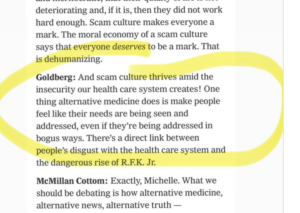
how I don’t see yellow

Yesterday on Instagram, I looked at a block of text and couldn’t see that part of it was circled in bright yellow until I shifted my eyes to the left or right. Straight on, no circle. Look slightly to the left, yellow circle. I took a screen shot of it so I could post it here as an example of how I don’t see yellow.

sept 26/RUN

10k
flats and back
59 degrees

Warmer than I thought this morning. Lots of sweat. Sun. Shadows. Sparkling water. Ran past the road closed on Oct 6 (that’s for the marathon!) and smiled. Not long now. I felt fine. My big toe on my right foot stung a little. My right foot is a bit of a mess: an in-grown big toenail, a blackish-purplish second toe, another possible in-grown toenail on the fourth toe. I think it will all be fine — nothing’s infected and it doesn’t hurt that much.

10 Things

  1. a coxswain’s voice, calling out instructions
  2. a motorboat’s wake, leaving soft ripples on the surface of the river, moving upstream and contrasting with the motion of the water heading downstream
  3. ahead of me, under the 1-94 bridge, the river sparking silver
  4. water seeping out of the limestone below the U of M’s west bank, wanting to be a waterfall
  5. my shadow, running ahead of me: sharp and solid
  6. several of the benches were occupied — one person at each
  7. a few more red leaves — a bright, fiery red
  8. the rhythmic snap of a fast runner’s striking feet
  9. cracks in the asphalt just north of the trestle — they just patched these in late spring and the entire stretch was redone 2 or 3 years ago — in 10 years will you even able to run on this section, or will it have slid into the gorge?
  10. someone left the lid of the trashcan below the lake street bridge open — wow, it stinks!

Here’s a poem I read yesterday that I liked to add to my collection of shadow poems — I might also add it to my growing group of moment poems too:

On a Walk/ Heather Christle

My child is upset that they cannot jump over their shadow.
They want me to help them. They want me to teach them
how it’s done. The best I can do is an invitation

to jump over each other’s shadows instead. This satisfies them
for a moment and then the moment is gone. In sunlight
my shadow loves to give me a little dose of sorrow,

the beams having traveled so far only for the lump of me
to get between them and the ground. They came so close.
If I were the earth I would resent me too. My child

has gone into the next moment. I have to catch up. They say
they are riding a horse. They point and it drags them away.

I read this wonderful quote from Hanif Abdurraqib the other day in one of my favorite former grad student’s newsletter. It’s about the ekphrasis form and is helpful for thinking about my “How to See” project:

Many of us live in an ekphrasis mindset. We are often executing ekphrasis storytelling…creating a story based off of that witnessing. I don’t ever want to move beyond that desire to say, I saw something and I know that you were not there to see it. But I can build the world wherein you felt like you have witnessed it alongside me.

via rachael anne jolie

I want to build a world about how I see with my dead-coned eyes in my poems, partly to feel less alone and isolated and partly to invite people to think more what it means to see (and to not see).

Last night, Scott and I were watching “Escape to the Country” and one of the escapees (Carol from Hertfordshire) was registered blind. She sometimes used a white cane and had some help from her husband in navigating, but she could make eye contact and see some of what was going on. When the host (Jules) asked her to explain her vision, she said she could see about 20% of what he could, enough to get a sense of the space, but not clearly. I appreciated that Jules had asked her to explain her vision (and impressed with the positive, non-tragic way they depicted her throughout the episode), but I wanted more. I wished she (and/or the show) had had an ekphrasis mindset and offered additional details about what seeing/not seeing is for her. The host, Jules, suggests, “Fundamentally, understanding how she sees the world is going to be crucial to finding properties that will absolutely deliver.” Even a sentence or two more might have helped in that understanding.

I wondered what someone who had never thought about the process of seeing or the spectrum of no-sight to full-sight made of her description and how she (fairly) easily/”naturally” moved through the world. After my run, I decided to google the episode and see if I could find more information about the woman, like what her condition was, etc. I was disappointed to discover headlines describing her blindness as “heartbreaking” or that she told of it, “with tears in her eyes.” That’s not how I perceived it. Admittedly, I can’t see faces clearly enough to grasp slight facial expressions, but this woman did not seem heartbroken and if she had any tears in her eyes, it was because she was looking into the sun. This was not a tragic episode; she and her husband were excited to move. These headlines seem to be typical examples of writers projecting their own fears and negative understandings of blindness onto blind people (or people with low vision, or people who see differently). Blind = tragic = heartbreaking = pity.

Scott and I watched the brief, 10 second clip that this “heartbreaking” description is based on, and he agreed that she wasn’t upset or crying. Her description was neutral and matter-of-fact. Sigh.

At the beginning of my run, I thought more about the ekphrastic mindset and asked myself, what is art? I didn’t come up with an answer — a task for another run!

one more thing to add: Talking with RJP about my various projects, she introduced me to a new phrase for describing the dirt trails that walkers/runners make in the grass: desire paths. That should be a title for one of my gorge poems, for sure!

june 3/RUN

4.2 miles
longfellow garden and back
73 degrees / dew point: 75

Sticky again today, but not as bright. Still hard to run through the thick air. Struggled on the way back — walk run walk run. Trying to remember to keep showing up and believing that it will get easier, or I will get better at handling the difficult moments, or I will finally start getting up early. I tried to think about green.

my favorite green

Running south, just past the ford bridge, nearing the locks and dam no. 1, cool air was coming from the green to my right — a small wood. Refreshing! Often I associate late spring green with thick and stifling, but today it was fresh and generous, making it easier to breathe and to run.

Before my run, I read this green poem:

Making Life on a Palette/ Raina J. León

After Charles Willson Peale (1741–1827), “George Washington at Princeton,” 1779

the color of life
takes sun yellow and bluest blue sky and water
for green ferns
chartreuse buds beading above moss
dappled shamrocks
fragrant healing of sage, laurel,
mint, basil, thyme, rosemary, myrtle
amid the tall wonders of juniper
pine, olive, pear
even the meeting of sea and river—
the sky, an intermingling of viridian and chetwode horizons,
and cerulean clarity—
offers its green seafoam,
its seaweed pats,
the crocodile at the edge of a freshwater marsh
its teeth open gritted in green
against the backdrop of hunter rainforest
dripping in green

heaven is a field of persian green
lit by translucent jade and celadon lamps
a many-roomed chateau scented by aromatic tea leaves
the aperitivo: gin, apple, and bitter lime
the time: midnight green
the guardian: a mantis in prayer

joy: harlequin, verdun, spring
magic: kaitoke forest in its energetic whisper and pulse

green must exist
inside brother james
would he call it camouflage
or nyanza or sap
for washington it’s in the colors of flags
the fields far off
feldgrau or military or empire green
or dollar bill or rifle green
revolution with chains the result
mix the green
like a spell in making
safe life
hush arbor life
nurturing abundant life
free life
bring the background to the fore
ease
ease
ease
life

So many greens! How many different greens can I see? Today, mostly, it was just green (or brown or gray).

Offering some advice on being judicious with your use of adjectives, Ted Kooser writes the following lines:

Morning Glories/ Ted Kooser

We share so much. When I write lattice,

I count on you seeing the flimsy slats

tacked into squares and painted white,

like a French door propped in a garden

with a blue condensed from many skies

pressed up against the panes. I count on

you knowing that remarkable blue,

shaped into the fluted amplifying horns

of Edison cylinder record players.

What? Come on, you know exactly
what I’m talking about. I didn’t need

to describe them like that, but I like to

however a little over my words, dabbling

the end of my finger in the white throats

of those __. You fill it in.

I could go on, but all I really needed to do

was to give you the name in the title.

I knew you’d put in the rest, maybe

the smell of a straw hat hot from the sun;

that’s just a suggestion. You know exactly

what else goes into a picture like this

to make it seem as if you saw it first, 

how a person can lean on the warm

hoe handle of a poem, dreaming,

making a little more out of the world

than was there just a moment before. 

I’m just the guy who gets it started.

Do I know that remarkable blue he’s writing about? Does he see the same blue that I do? Do we need to imagine the same blue to make his poem meaningful?

Reading “Making Life on a Palette” and “Morning Glories,” I’m thinking about the different work they ask of the reader, or, of this reader, me. “Palette” is filled with green words with histories that I don’t know; I had to do a lot of googling to dig into the poem. “Morning Glories” asks me to build an image from the name he offers, to draw upon the shared understanding/image of the flower that I already have.

Lately, I keep coming back to the question, how little data can we have and still “see” what something is? Not much, I think. Yet, to assume that we all see the same thing — the thing as it is — excludes a wide range of experiences and detail and ways of seeing. It leaves out a lot of different shades of green.

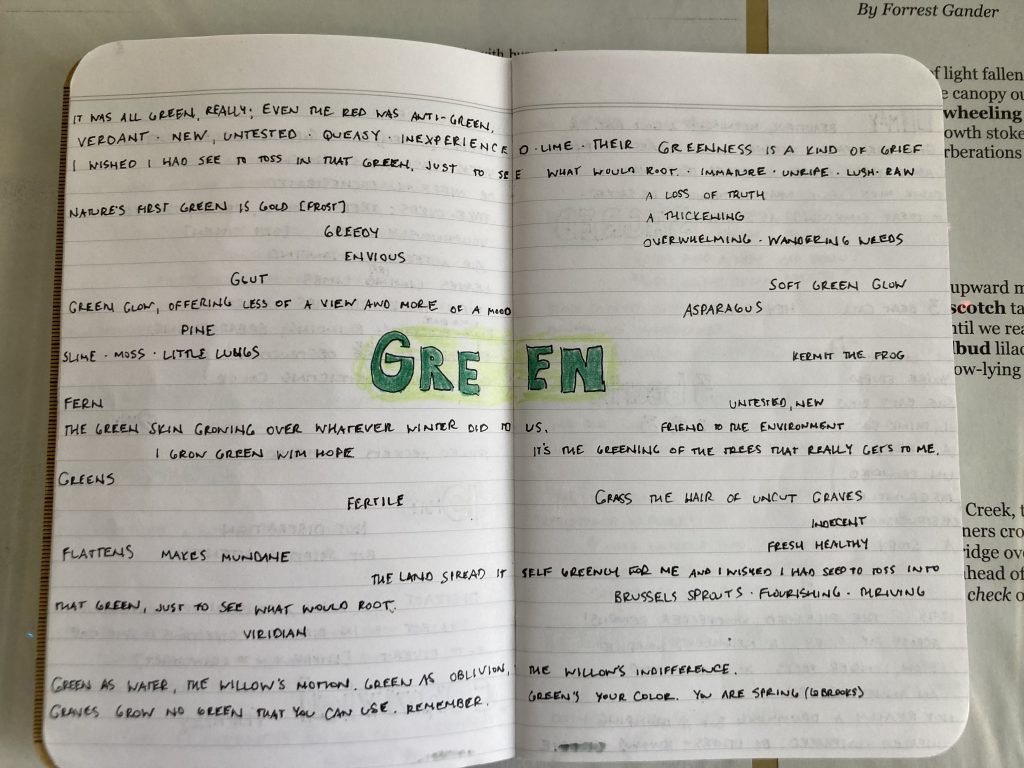
Speaking of green, I remembered that I had collected ideas about green in my plague notebook vol 3, June 2020:

may 14/RUN

7.5 miles
lake nokomis and back
59 degrees

Whew, that was hard. Running to the lake wasn’t too bad but on the way back, my legs were tired and I was hot and thirsty. I managed to bargain with myself — just keep going until you get to the water fountains or the light or the top of the hill — and do more running than walking in the second half. I think I needed to start earlier and bring some water.

I’m wiped out now, writing this, but I don’t care. It was worth it to get to run to Lake Nokomis and watch the glittering water, hear the seagulls, feel the lake air. Summer and open water swimming is coming! I signed myself, and FWA and RJP up for open swim this year! Will either of them swim? Hopefully at least once or twice. One more thing to note: looking out at the water, then to the little beach, I noticed the lifeguard boat — the main marker I use to navigate when I can’t see the buoys — has been moved. Hopefully it will be moved back again or I’ll have some difficulty sighting this summer.

Listened to the birds and the traffic and a song drifting out of a car window as I ran to the lake. Put in my “Slappin’ Shadows” playlist on the way back:

Moonshadow
Golden Years
The Shadow of Your Smile
I’m Beginning to See the Light
I’m Shadowing You
Shadow Dancing
If You Go Away
Hot Lunch Jam
Watching the Wheels / John Lennon

The last one about the wheels was just added last night. In addition to watching the wheels going ’round, he’s also doing time, watching the shadows on the wall. After he’s done singing, the song ends with random street noise: clopping horses, a person’s foot steps, someone talking. The clopping horses made me think of one of the rooms in an exhibit at Minneapolis Institute of Arts (MIA). You sit on a bench in the room as a day cycles through, complete with the light changing throughout the day to simulate dawn, midday, dusk, evening, and with a recording of sounds outside of the room, including . . . horses clopping. I recall having some deep thought about shadows and my relationship to them as I listened to this song, but I can’t remember what it was. I recall having a general feeling of agreement: letting it go and just watching the wheels go ’round or the shadows on the wall sounds good to me!

One other random shadow thing I remember: In the middle of the night, during one of 3 or 4 sessions of being restless and getting out of bed, I looked around the room and noticed the shadows. The moon must have been bright last night because there were lots of shadows even though we have the blinds closed. At one point, a car drove by and their headlights looked cool and strange traveling across the wall.

As I ran along the creek and switched from sun to shade to sun again, I thought about how welcome shade is on a too sunny day. When I’m running in the spring and summer, I almost always cheer for the shadows and the coolness they offer.

Yesterday I picked up a book I requested from the library, Margaret Livingstone’s Vision and Art. Very cool. I got it so I could read more about how artists have used luminance and shadows and light to create images that look real.

Another thought I recall as I drifted in and out of sleep last night: I’d like to think about how the way artists manipulate light and shadow to create their illusions of realness, might be similar to how the brain does it for us. The brain as an artist — filling in, filtering, transforming signals into images that we can use and admire.

Yesterday I revisited Jorie Graham’s poem, “Still Life with Shadow and Fish” and understood it in a way I hadn’t before. Wow! I decided to listen to/read something else by her. Listening to this recording helped me to understand it a little better.

Two Paintings by Gustav Klimt/ Jorie Graham

Although what glitters
on the trees,
row after perfect row,
is merely
the injustice
of the world,

the chips on the bark of each
beech tree
catching the light, the sum
of these delays
is the beautiful, the human
beautiful,

body of flaws.
The dead
would give anything
I’m sure,
to step again onto
the leafrot,

into the avenue of mottled shadows,
the speckled
broken skins. The dead
in their sheer
open parenthesis, what they
wouldn’t give

for something to lean on
that won’t
give way. I think I
would weep
for the moral nature
of this world,

for right and wrong like pools
of shadow
and light you can step in
and out of
crossing this yellow beech forest,
this buchen-wald,

one autumn afternoon, late
in the twentieth
century, in hollow light,
in gaseous light. . . .
To receive the light
and return it

and stand in rows, anonymous,
is a sweet secret
even the air wishes
it could unlock.
See how it pokes at them
in little hooks,

the blue air, the yellow trees.
Why be afraid?
They say when Klimt
died suddenly
a painting, still
incomplete,

was found in his studio,
a woman’s body
open at its point of
entry,
rendered in graphic,
pornographic,

detail—something like
a scream
between her legs. Slowly,
feathery,
he had begun to paint
a delicate

garment (his trademark)
over this mouth
of her body. The mouth
of her face
is genteel, bored, feigning a need
for sleep. The fabric

defines the surface,
the story,
so we are drawn to it,
its blues
and yellows glittering
like a stand

of beech trees late
one afternoon
in Germany, in fall.
It is called
Buchenwald, it is
1890. In

the finished painting
the argument
has something to do
with pleasure.

may 7/WALK

30 minute walk
neighborhood, with Delia
65 degrees

Walked around the neighborhood on a beautiful, windy morning. A few hours before, it had been raining. Puddles everywhere. Mud, too. Birds, laughing kids, yellow and orange and red tulips all around. Also: overgrown weeds, dandelions, unruly grass. Oh — and pollen! I know that it could be much worse, but I still felt it: scratchy throat, itchy eyes, fatigue.

This morning I renewed my driver’s license. For me, it was a big deal. I was diagnosed with cone dystrophy in 2016, two months after I had barely renewed my license because I couldn’t initially read the Snellen chart. The woman behind the counter was generous — I remember her looking at me strangely after I said the wrong letters and then asking, Do you want to try that again? Slowly? For years I had been nervous about the vision test without knowing why.

When the ophthalmologist first told me I would probably lose all of my central vision, I felt relief — I just renewed my license so I don’t have to worry about doing the vision test until 2020! — and worry — What’s will happen in four years? As 2020 approached, my anxiety increased. But, because of the pandemic, I was able to renew my license online. No vision test! Another reprieve for four years!

Next month I turn 50 and it’s time to renew my license again. I decided to do it early, partly to get it over with and partly because Scott and FWA had both renewed their license’s two months ago and the person behind the counter didn’t make them take a vision test. Could I be so lucky? I hoped so.

This morning I was anxious. I tried to convince myself that it would be fine if I had to take the test — I told Scott, it’s great material for a poem. But the same guy was there and I didn’t have to take the test and now I have another four year reprieve.

10 Small Things I Remember

  1. the woman at the front desk was wearing blue gloves
  2. before we entered, a group of teenagers were called in — Anyone planning to take the test should follow me!
  3. I heard those same teenagers giggling a few minutes later
  4. my number, ended with a 54
  5. when it was called, I was told to go to A14
  6. the guy who issued my license asked me to meet him around the corner at A17 for my picture
  7. he had two thick textbooks on the counter — did he ever have time to study? I couldn’t read the titles
  8. for the first time, I wore glasses for my picture — before he took it he said, look at the blue dot. I couldn’t see any blue dot, but the picture turned out fine
  9. earlier, nearing the entrance to the building, a man held a door for a woman as she walked out. She apologized when she almost ran into him and said, I’m sorry, I’m in my own head right now
  10. also nearing the building: birds! so much birdsong!

I am not planning to drive. I haven’t for five or six years. It’s too scary and dangerous. Still, it’s nice to have my license, just in case.

My anxiety over the vision test has some layers, I think. It’s not just about failing it, or even primarily about failing it. I think it’s time to do some digging.

the allegory of the cave, part 2

Yesterday Scott and talked about Plato’s Cave and what we remembered from when he first heard/read about it. Then I watched a few more videos about it, all of which connected the cave and the shadows to a hero’s quest and being enlightened by a Philosopher King. Thought about writing against that and decided I didn’t want to. Instead, I attempted to read Jack Collum’s hard-to-understand-poem, Arguing with Something Plato Said. Some of it, I think I understand and some of it, I don’t. Learned a new word: chiaroscuro

This is an Italian term which literally means ‘light-dark’. In paintings the description refers to clear tonal contrasts which are often used to suggest the volume and modelling of the subjects depicted.

Artists who are famed for the use of chiaroscuro include Leonardo da Vinci and Caravaggio. Leonardo employed it to give a vivid impression of the three-dimensionality of his figures, while Caravaggio used such contrasts for the sake of drama. Both artists were also aware of the emotional impact of these effects.

Nice! With my interest in ekphrastic poems, I plan to think about this concept some more.

may 3/RUN

4.25 miles
minnehaha falls and back
58 degrees

Warm, too warm. I need to remember to start these runs much earlier and to wear a tank top. A beautiful morning. All sun. Perfect for giving attention to shadows. Noticed many, cast from: new leaves on trees, tree trunks, lamp posts, a swooping bird, a parks truck, me.

Listened to water — dripping then trickling then gushing, vigorous rustling in the brush, some frogs in the marshy meadow near the ford bridge as I ran south to the falls. Put in my “I’m Shadowing You” playlist on the way back north.

I’m Shadowing You/ Blossom Dearie
Me and My Shadow/ Frank Sinatra
Shadowboxer/ Fiona Apple
My Shadow/ Keane
Shadow Dancing/ Andy Gibb

I didn’t think too much about the first two songs, but when I got to “Shadowboxer” it hit me: shadow box. I wrote the following before the run:

May is for shadows and I was thinking that I’d like to reread/study Plato’s Cave until I read this line in Readers recommend: songs about shadows without them everything would be a floating morass of light and colour — drop shadows bring a third dimension to the 2D world. It made me think about one of my ongoing obsessions: ekphrastic poems and visual art. Just yesterday afternoon, I was reading Diane Seuss’ Still Life with Two Dead Peacocks and a Girl. (The title is a reference to Rembrandt’s “Still Life with Two Dead Peacocks and a Girl“) In several of the poems I read, Seuss describes the dark and light in some famous paintings — does she ever mention shadows? Here’s one of my favorites, both her poem and the painting:

Quince, Cabbage, Melon, and Cucumber/ Diane Seuss

Anything can be a marionette. A quince, a cabbage, a melon, a cucumber,
suspended against a black background, illuminated by a curious
white light. In this little show, the quince plays a full gold moon. The cabbage
is the antagonist, curled outer leaves fingering the charcoal void.
Cucumber’s the peasant, nubby belly to the ground like a frog.
That leaves melon, center stage, rough wedge hacked out of her butter side.
Each object holds its space, drawing the eye from quince to cabbage, melon
to cucumber, in a left to right, downward-sloping curve. Four bodies
hang in the box of darkness like planets, each in its private orbit.
It’s a quiet drama about nothing at all. No touch, no brushing
up against each other, no oxygen, no rot, so that each shape, each
character, is pure, clean in its loyalty to its own fierce standard.
Even the wounded melon exudes serenity. Somewhere, juice runs
down a hairy chin, but that is well beyond the border of the box.

This poem is about a painting by Sánchez Cotán: Quince, Cabbage, Melon, and Cucumber

What would these four objects look like without the shadows around the curves, in the cracks, below the belly? Would they look more real? Less real? This painting is strange and haunting, and both difficult and easy for me to see. Can I remember it on the first part of my run? I’ll try. I’ll also try to notice how shadows offer depth, make things seem real, substantial, not just dots or flat objects.

side note: These fruits and vegetables as subjects reminds me of a movie that Scott and I rewatched the other week: The Four Seasons, with Alan Alda, Rita Moreno, and Carol Burnett. One of the other characters, Anne, has taken up photography and has spent the last 2? years photographing vegetables, one at a time. Her husband thinks this is ridiculous and offers it up as evidence for how little she does, and as one of the reasons he’s divorcing her. Reading Seuss’ poem and staring at Sánchez Cotán’s painting, I am far less judgmental of her choice than my 7 or 8 year old self was when she watched this movie, over and over, on HBO.

I searched for a clip from the movie and found it! Unfortunately it starts right after the photographs of the vegetables are shown.

Still Life with Vegetables and an Asshole Husband

During the run, I kept thinking about the painting and the objects painted in a box. How each of them were separated from each other, isolated, with some amount of light shining on them to display them. I thought about how sometimes I feel like I’m on display, a bright light shining on me, blinded, unable to see other people clearly even as I know they can see me. Disconnected from the world by the box. The shadow box, which brings me back to the Fiona Apple song, “Shadowboxer.” I started wondering about shadowboxing as a verb that didn’t mean boxing at shadows, but the act of putting someone on display, isolating them, turning them into a keepsake in a box on a wall, like the set of small boxes my mom had hanging in our many houses when I was growing up. I also thought about how there’s no reference point for size in the painting. What if the box was a small shadow box, and what if the fruit were miniatures, made out of wood or silk or plastic? (my mom loved wooden fruit) These thoughts made me want to study the history of shadow boxes.

Okay, just looked up shadow box origins and found some interesting stuff, which I’ll get to in a minute.

But first, any connection between Apple’s song and my version of shadowboxing? These lyrics seem promising:

Oh, your gaze is dangerous
And you fill your space so sweet
If I let you get too close
You’ll set your spell on me

Now, the history of shadow boxes. I had no idea —

Sailors were the first to create shadow boxes. They made them out of wood salvaged from their ships. They made them out of fear. Sailors believed that if their shadow reached shore before they did, their life on land would be cursed. The box, containing the sum total of a sailor’s personal effects, protected their true self.

Shadow Box — The Art of Assemblage

In this post, Karen Kao also mentions Cornell Boxes, named after Joseph Cornell who collected objects then arranged them in whimsical and weird ways in little wooden boxes. Adam Gopnik wrote about for the New Yorker in 2003: Sparkings.

Kao opens her post with an intriguing way to think about shadow boxes:

Think of a literal box, perhaps protected by a glass front, inside of which resides a world of whimsy. Think of it as found poetry in three-dimensional form.

Interesting, but what does this have to do with shadows? Not much, or at least not much in the way I expected. Shadow boxes don’t involve literal shadows, but figurative ones — the shadow-self as embodied through cherished objects. Am I getting that right? This shadow-self, serving as proxy for the real self, needs to be protected, plucked out of the world and made safe, preserved, in its own little box.

The idea of the shadow-self and the shadow as the property of the self bothers me a little. Even as I imagine my shadow to be connected to me, I don’t see it as me, mine. This leads me to a question for another day: what is the relationship between an object and the shadow it casts?

I want to return to the painting and Seuss’ poem and the shadows and dark and light within them, but I also want to finish this entry so I can go outside and sit in the sun.

Okay, I sat (and napped) in the sun for about an hour. I’m looking at the painting of the quince, cabbage, melon, and cucumber and thinking about light and darkness and shadows. Then, color. I think that this painting would look the same to me if it were in black and white — I searched for a black and white version, but couldn’t find one. Okay, back to shadows. They offer texture, especially on the cabbage. They also suggest that the light source is coming from the left side — a window? Anything else? I’ll keep thinking about it.

april 23/WALK

walk 1: 30 minutes with Delia, neighborhood
walk 2: 75 minutes to the library

I haven’t walked to the library in a long time. 5 or 6 or 7 years? Why has it been so long? Partly the pandemic and the library almost being burned down and then closed for a long time are to blame, but it’s also all the running and having a dog. If I have any time or energy left to walk, I need to take Delia the dog along, and the library is too far for her. Also, she’s not allowed inside.

It’s more than a mile, but less than 2 one way. It was great. I listened to Taylor Swift’s new album on the way there, and Beyoncé’s on the way back (Cowboy Carter). Wow! The Tortured Poets Department was good but Cowboy Carter was amazing.

10 Things

  1. a big white dog sitting quietly and calmly in a dirt back yard next to a chain link fence
  2. a cedar fence that looked almost new, with shiny wood, bulging out towards the sidewalk — what happened?
  3. red tulips in full bloom right up against the foundation of a house
  4. a big tree with a full set of yellowish-green leaves
  5. a terraced yard, all dirt, looking neat and ready to be filled with flowers
  6. a little free library packed with books, its glass door wide open
  7. music blasting from an open door at the Trinity Church, playing “Shake It Off”
  8. 2 squirrels winding up a tree, one chasing the other, their nails scratching the rough bark
  9. my favorite stone lions in front of a house wearing purple flower headbands in honor of spring
  10. a big moving truck backed into a driveway blocking all of the sidewalk and half the street

earlier today

This past Saturday, I took a class on public art and ekphrastic poetry with the new poet laureate of Minneapolis, Heid E. Erdrich. A great class. When I signed up for it, I was just interested in taking a class with Erdrich and learning more about ekphrastic poetry; I didn’t realize that public art would also be a part of it. Very cool. Anyway, the class inspired me to think more deeply about public poetry projects. I have several ideas for my own, with very little understanding of how to make them happen. Perhaps studying other examples will help educate and inspire me. Plus, studying them is another way to learn more about the place I live. First up: Sidewalk Poetry St. Paul

Sidewalk Poetry, St. Paul

Sidewalk Poetry is a systems-based work that allows city residents to claim the sidewalks as their book pages. This project re-imagines Saint Paul’s annual sidewalk maintenance program with Public Works, as the department repairs 10 miles of sidewalk each year. We have stamped more than 1,200 poems from a collection that now includes 73 individual pieces all written by Saint Paul residents. Today, everyone in Saint Paul now lives within a 10-minute walk of a Sidewalk Poem. 

This art project began with previous Public Art Saint Paul City Artist Marcus Young in 2008 under the name “Everyday Poems for City Sidewalks,” and continues today with evolved stamping approaches, as well as poetry submission and review processes. Our 2023 Sidewalk Poetry accepts poetry submissions in Dakota, Hmong, Somali, Spanish, and English. The poetry on our streets celebrates the remarkable cultures that make our City home and that makes our City strong. With this as a beginning, other languages may be added in years to come.

Sidewalk Poetry St Paul

I think the first step for me in getting to know this project is to visit some of the poems. I’d like to start running to them! Here’s a map to help me out: Public Art Sidewalks

I think I’ll start (tomorrow) with a favorite poet of mine, Naomi Cohn. She has one on the Southeast corner of Juno and Finn. Very close to it is one by Pat Owen, on the southside of Juno between Finn and Cleveland.

Almost forgot to post this: the first song on Beyoncé’s album, “American Requiem” sings about the wind!

Can we stand for something?
Now is the time to face the wind (Ow)
Coming in peace and love, y’all
Oh, a lot of takin’ up space
Salty tears beyond my gaze
Can you stand me?

Can we stand for something?
Now is the time to face the wind
Now ain’t the time to pretend
Now is the time to let love in

april 20/RUN

4.5 miles
marshall loop (cleveland)
35 degrees
wind: 12 mph

Woke up this morning to snow on the back deck. Only a dusting that melted before Scott got up a few hours later. Cold. Wore my running tights, winter vest, and gloves. It felt windier than 12 mph, especially on the bridge. I took my cap off so it wouldn’t blow away.

10 Things

  1. cold wind in my face, making my eyes water
  2. little ripples on the river, looking like scales
  3. running past street lamps on the st paul side, noticing the wires at the base pulled out
  4. an empty white kitchen trash bag draped over a bench
  5. 2 teen aged boys jumping the fence near the lake street bridge steps
  6. rowers on the river! how do they row in this wind?
  7. the clicking and clacking of roller ski poles
  8. the clicking and clacking of a woman’s running gait — she had a hitch and stepped down in a strange way that made a scraping noise — they way she contorted her body with each step made my hips hurt just watching!
  9. volunteers on earth day just above the floodplain forest, picking up trash — I was almost taken out by little Giovanni — Giovanni! Watch out! an adult called
  10. little birds — sparrows? — swooping, low to the ground, just in front of me

Before I went out for my run, I was reading about images and metaphors and literal and figurative language. As I was finishing up my run, I was thinking that my image of the day — the image I’d like to think about and write around — is the street lamp on the side of the paved trail, its door open and wires hanging out . . . or maybe the image is not just one of them, but lamp after lamp all the way down the hill above shadow falls, all of them gutted or disemboweled, their wire guts hanging out. The idea of them being gutted seems too easy as a metaphor — perhaps I need to think about who or what gutted them? Or something more specific about the guts as veins or tendons? Now I’m thinking about cut wires and losing the circuit and being disconnected.

This afternoon, I took a 3 hour zoom class on ekphrastic poetry. I wrote most of this entry before it; I’m finishing now, after it. A great class with Heid E. Erdrich. Lots of inspiration for public art and responding to art. Erdrich mentioned writing poems or finding poems that fit as labels for artwork in museums. This made me think of my interest in alt-text. I’d like to explore this connection more. Very cool.

april 16/BIKERUN

bike: 16 minutes
run: 2.3 miles
basement
outside: 54 degrees / rain, wind

Before I started writing this but after my workout, I got up from my chair and my right kneecap missed the groove and slipped out hard. So hard that I uncontrollably yelled, “God Dammit!” No pain and it went right back in, or I was able to pop it back in. But it was shocking — mentally and physically. My LCL or meniscus seem as reticent to walk as my brain does — a strange sentence to write: can you imagine ligaments feeling something independent of the brain? Now I’m nervous about when this might happen again. As is usually the case, I had absolutely no warning. I didn’t do anything abrupt or dramatic; I just stood up and turned. I’ll get over it in a few minutes and stop imagining different scenarios in my head when the kneecap suddenly slides and it hurts and I can’t get it back into place. For now, I’ll breathe and attempt to remember how happy I was to work out before my subluxation.

It’s raining today, and there’s a wind advisory. Decided to go to the basement and do a bike run combo. After pumping up the air in my tire — it is still leaking air even though I got new tires last spring — I found the SuperLeague e-tri championships. I’ve been watching SuperLeague while biking in the basement since it started — when? 2018? Then I ran for 22.5 minutes while I listened to a “If Books Could Kill” podcast and then a playlist.

I don’t remember thinking about much except for that I had to go to the bathroom. Scott and I have new euphemism for it: unfinished business. Anything else? I recall looking straight ahead at the water heater and I remember feeling like a badass when I increased my cadence to try and match the bikers I was watching.

Here’s a victory: I didn’t think at all about the text exchange I had with FWA about what “fun” or “interesting” or “non-music” classes he could take to fill up his pretty bare schedule for senior year. No double major or minors for him. Just music, which he’s very good at, but still . . . . I’m trying to let him figure out his own way, but it’s so hard to watch him make choices that seem foolish or short-sighted. Sigh. Parenting is hard; backing off is hard; trusting is hard. When I worry too much, I’ll go back and watch his recital from Sunday and remember how proud I am of him and that he can (and is) creating an exciting future for himself.

update: I didn’t need to worry; he figured out some great classes on his own: Japanese!, Environmental Geography, and Criminology.

before the bike and run

Yesterday was the poet, Tomas Tranströmer’s birthday. He would have been 92. I’ve posted a few poems from him on here before. While looking for “air” poems, I found this one. It’s an ekphrastic! Those ekphrastic poems keep appearing. Are they trying to encourage me to keep working on my ekphrastic project? I’d like to believe so. Anyway, here’s the Tranströmer poem I found:

Vermeer / Tomas Tranströmer

translated by Robert Bly

It’s not a sheltered world. The noise begins over there, on the other side of the wall
where the alehouse is
with its laughter and quarrels, its rows of teeth, its tears, its chiming of clocks,
and the psychotic brother-in-law, the murderer, in whose presence
everyone feels fear.

The huge explosion and the emergency crew arriving late,
boats showing off on the canals, money slipping down into pockets
— the wrong man’s —
ultimatum piled on the ultimatum,
widemouthed red flowers who sweat reminds us of approaching war.

And then straight through the wall — from there — straight into the airy studio
in the seconds that have got permission to live for centuries.
Paintings that choose the name: “The Music Lesson”
or ” A Woman in Blue Reading a Letter.”
She is eight months pregnant, two hearts beating inside her.
The wall behind her holds a crinkly map of Terra Incognita.

Just breathe. An unidentifiable blue fabric has been tacked to the chairs.
Gold-headed tacks flew in with astronomical speed
and stopped smack there
as if there had always been stillness and nothing else.

The ears experience a buzz, perhaps it’s depth or perhaps height.
It’s the pressure from the other side of the wall,
the pressure that makes each fact float
and makes the brushstroke firm.

Passing through walls hurts human beings, they get sick from it,
but we have no choice.
It’s all one world. Now to the walls.
The walls are a part of you.
One either knows that, or one doesn’t; but it’s the same for everyone
except for small children. There aren’t any walls for them.

The airy sky has taken its place leaning against the wall.
It is like a prayer to what is empty.
And what is empty turns its face to us
and whispers:
“I am not empty, I am open.”

I love this poem and how it imagines the world outside of the painting and its relationship to the world inside of it. Starting with the first line: It’s not a sheltered world. The noise begins over there, on the other side of the wall . . . . That alehouse, that psychotic brother-in-law. The explosion, the money being dropped into the wrong man’s pocket. Then the airy studio and the seconds that have got permission to live for centuries — the differences between what we notice and try to remember and what we ignore or try to forget — what is worthy of attention, a painting, and what is not.

What is worth noticing in a poem describing a painting, and what is not? The Vermeer painting the poem is titled, “Woman in Blue Reading a Letter,” but there’s no mention of the letter or the woman’s expression, and the blue described by Tranströmer is the blue fabric on the chair, not of the woman’s jacket.

This poem is about the wall, the other side of the wall, the pressure that the other side creates, pressing in on us. The wall between our interior and the exterior world. The edge of the void, the abyss. All of this is kind of, almost, not quite making sense to me. I should spend some more time rereading Tom Sleigh’sToo Much of the Air: Tomas Tranströmer“.

I’m struck by the last lines:

The airy sky has taken its place leaning against the wall.
It is like a prayer to what is empty.
And what is empty turns its face to us
and whispers:
‘I am not empty, I am open.’

I’m thinking of the gorge here and the limestone walls that contain it and how it is both empty of land/rock and filled with air and openness. To think of the void — the unknowable, unsayable, mystery — as both frightening (emptiness, nothingness) and inviting (openness, possibility).

Yesterday I talked about believing in the unseen. Today I’m thinking about what it could mean to be believe in the unseeable. Unseen could mean, not-yet-seen or unnoticed, but unseeable suggests that seeing is never possible.

Before writing this, I was reviewing an old log entry from April 16, 2022. In it, I discuss Elisa Gabbert’s article about poetry and the Void.

They [poets] write in the line, in the company of the void. That changes how you write — and more profoundly, how you think, and even how you are, your mode of being. When you write in the line, there is always an awareness of the mystery, of what is left out. This is why, I suppose, poems can be so confounding. Empty space on the page, that absence of language, provides no clues. But it doesn’t communicate nothing — rather, it communicates nothing. It speaks void, it telegraphs mystery.

By “mystery” I don’t mean metaphor or disguise. Poetry doesn’t, or shouldn’t, achieve mystery only by hiding the known, or translating the known into other, less familiar language. The mystery is unknowing, the unknown — as in Jennifer Huang’s “Departure”: “The things I don’t know have stayed/In this home.” The mystery is the missing mountain in Shane McCrae’s “The Butterflies the Mountain and the Lake”:

the / Butterflies monarch butterflies huge swarms they
Migrate and as they migrate south as they
Cross Lake Superior instead of flying

South straight across they fly
South over the water then fly east
still over the water then fly south again / And now
biologists believe they turn to avoid a mountain
That disappeared millennia ago.

The missing mountain is still there.

The Shape of a Void / Elisa Gabbert

This past weekend, Scott and I watched the 2 part documentary about Steve Martin, STEVE! I really enjoyed it. I remember responding to this idea offered by one of Steve Martin’s artist friends:

How to close the void. I think that’s the nature and the drive in art, it comes from that deep awareness of that void.

STEVE! — 53:30, part 2

I agree with the second part of that statement, about the deep awareness of the void, but not the first — at least how it’s worded. It’s not to close the void, but to navigate it, develop a relationship to it, engage with it, learn how to live with it. I mentioned this to Scott and he argued that the void in this quotation is not the unknown or mystery, but something else. Maybe lack or longing? A desire to be whole? To have/feel meaning? I still don’t like the word close. Can you ever close the void? Tranströmer doesn’t think so; it’s always on the other side of that wall. Even with a wall between you and it, you feel its pressure in your ears. And it’s this pressure that drives/shapes/enables your art — that makes each fact float/and makes the brushstroke firm.

A final (for now) word on this ekphrastic poem: I like how Tranströmer is responding to the work of art in this poem, how we uses the image to reflect on the abyss/void, history, interior/exterior, and why we make art. I want to think about it some more and try to write something for my “How to See” project inspired by his approach.

april 10/RUN

5.1 miles
bottom of franklin and back
61 degrees
wind: 8 mph / gusts: 18 mph

Ah, spring! Sun and shorts and short sleeves! Birds — black-capped chickadees, pileated woodpeckers, downy woodpeckers, a turkey! I looked at the river but I don’t remember what I saw. Too distracted by blue sky and sharp shadows and the spring breeze — which is less relaxed than a summer breeze, but still pleasant — a word my mom used to say, or did she say it just that once when I was barely four and was talking with her in our new backyard in Hickory, North Carolina as she hung laundry out to dry. It feels pleasant out here or It’s a pleasant day. It’s a terribly bland word, but I love it because I always think of her and that moment.

Encounters:

  • Dave: Hi Sara!
  • while running up a hill, a woman walking down it: Looking good! me: Thank you!
  • two women walking towards me after I finished my run: Well, you look springy!

overheard:

  • from talk radio across the road: Don’t you think I think about it? Don’t you think it keeps me up at night?
  • distorted music coming out of a bike radio

Listened to birds, my breathing, and the smooth wheels of a rollerblader as I ran north. Ran up the franklin hill and sang, Running up that hill, in my head. Put in “It’s Windy” playlist: Let’s Go Fly a Kite: not childish but childlike; Don’t Mess Around with Jim: karma; Ride Like the Wind: haul ass; You’re Only Human (Second Wind) — be generous to yourself; Summer Breeze: relax

my birding moment: running north, listening to Billy Joel, distracted by the song or memories or some thought, something suddenly appeared in front of me — a turkey! It wasn’t too close, but close enough that I was able to watch it awkwardly run across the path. For the poem: distraction, interruption, awkwardness, dragged out of the inner into the outer

Stuck inside
a thought

Unaware
seeing

only bare
path when

Poof! Bobbing
head sleek

body move
past me

faster than
I thought

possible
I watch

then admire
this show

grateful to
be dragged

out into
the world.

a breeze

Before I run, I decided today’s version of the wind would be: breeze.

breeze 1

The old chest in the corner, cool waxed floors,
White curtains softly and continually blown
(from The Work of Happiness/ May Sarton/May Sarton)

breeze 2

definition of breezy: pleasantly wind; airy, nonchalant — as in, breezy indifference

breezy 3

Easy breezy beautiful cover girl
Beautiful skin can be a breeze with sea breeze — or, what my sister Marji used to sing, Beautiful skin can be a breeze with sea grease

breeze 4

Yet again, the ekphrasis appears!

How to Look at Pictures/ Rebecca Morgan Frank

title after Robert Clermont Witt, 1906

Refuse to make eye contact with the subject.
He has been following you around the gallery.
You are certain that he can see down your shirt.
Look at other subjects, but know that they, too,
are not of primary interest. Even when they watch
you. Try not to consider what happened
to the small girl staring furiously, the thin-faced
woman wanly looking away. Do not think about
what they had for breakfast, if the bread was hard.
Certainly do not consider the odors underneath
their arms and skirts. Do not allow a breeze into
the room they sit in. Do not assume I am talking
about any painting: step away from the subject.
All subject. Was the painter in love? Do not ask
the question. Imagine you are the painter,
blocking out everything you don’t want to see.
Everything is out of the picture. Stop looking.
Stop seeking what isn’t there. Tuck your narratives
back in your pocket. Look for perspective, light,
shade. Let your eyes wander back to the girl.
She is trying to say something but her mouth
has been painted deliberately shut. Her lips, thin.

march 28/RUN

4.15 miles
minnehaha falls and back
28 degrees

Back outside! There were a few patches of ice and some of the walking trails were covered in snow, but the rest was clear and dry. So bright, not just the sun but the sun reflecting off of the snow. My calf continues to make noise — mostly gentle whispers or soft, short groans. Today I didn’t wear the calf sleeves during my run. Maybe I should next time.

Did my usual thing: ran south listening to the world, north to music — Winter 2024

Heard lots of chirping and tweeting birds. Sharp squirrel claws on rough bark. A noise that I thought was a bird or a drill but decided was a dog that wouldn’t shut up — bark bark bark bark bark bark

The favorite shadow I (thought I) saw: approaching a tree, I suddenly saw a shadow moving up the trunk, then realized it was actually a squirrel climbing up the tree.

birding:

Right after my lower calf near the ankle — or was it a tendon? — tightened a little and I was worried, I saw the shadow of a small bird flying over the snow, almost like it was saying, don’t worry; notice me instead.

tweeting birds. I heard: TWEET tweet tweet tweet tweet — Walking back, this tweeting mixed with water dripping from a gutter, a squirrel’s nails scratching tree bark, a kid across the street squealing with delight.

One mixed with
many

the drips and
squeals and

scratching feet
and the

Tweet tweet tweet
tweet tweet

That’s the version I spoke into my phone. I’ll work on it some more.

before the run

one

Red Shoulder Hawk by Ciona Rouse was the poem of the day on poets.org. Instead of just posting the poem, as I usually do, I

We met in the middle of the street only to discuss 
the Buteo lineatus, but we simply said hawk 
because we knew nothing of Latin. We knew nothing 
of red in the shoulder, of true hawks versus buzzards, 
or what time they started their mornings, 
what type of snake they stooped low 
and swift to eat. We knew nothing.

I like how we meet in the middle sounds. The discussion of not knowing the latin name of the bird reminds me of J Drew Lanham and his interview with Krista Tippet — you don’t have to know the name, just be with the bird. It also makes me think of Robin Wall Kimmerer and how she navigates her scientific and indigenous ways of knowing, how she values the Latin names but also the names beings call themselves. And it makes me think of May Swenson and section 7 of her wonderful poem, “October,” which is part of my My 100 list of memorized poems: His shoulder patch/which should be red looks gray. I like how this first sentence unspools.

Or, I should say, at least I knew nothing, 
and he said nothing of what he knew that day 
except one thing he said he thought, but now I say 
he knew: I’m going to die soon, my neighbor said to me 
and assured he had no diagnosis, just a thought. He said it 
just two weeks before he died outdoors just 
twenty steps away from where we stood that day— 
he and I between the porch I returned to and twisted 
the key to my door to cross the threshold into my familiar 
like always I do and the garage he returned to 
and twisted some wrench probably on a knob of the 
El Camino like always he did every day when usually 
I’d wave briefly en route from carport to door 
sometimes saying “how’s it going,” expecting 
only the “fine” I had time to digest.
 

I knew nothing, and he said nothing of what he knew. Is this a chiasmus, where the order of the words is reversed for dramatic effect (I wrote about this device on 13 nov 2023)? Again, the unspooling of the story is wonderful: how the neighbor’s death is revealed, the details that help us to imagine the scene. There is punctuation in these lines, but there are also a lot of lines that are written in a way that make sense without punctuation. I’m reminded of June Jordan’s rules for critiquing other people’s poems:

Punctuation (Punctuation is not word choice. Poems fly or falter according to the words composing them. Therefore, omit punctuation and concentrate on every single word. E.g., if you think you need a question mark then you need to rewrite so that your syntax makes clear the interrogative nature of your thoughts. And as for commas and dashes and dots? Leave them out!)

June Jordan

I don’t know if I completely agree with her, and I know Emily Dickinson wouldn’t, but I do like the idea of trying to focus on each word and trying to have them work without punctuation.

I think I like, to cross the threshold into my familiar like always I do. Do I? I like the use of threshold into my familiar instead of home, but is it too wordy, and awkward with the like always I do?

Except today 
when I stepped out of my car, he waved me over to see 
what I now know to call the Buteo. When first I read its 
Latin name, I pronounced it boo-TAY-oh 
before learning it’s more like saying beauty (oh!).
 
I can’t believe I booed when it’s always carrying awe.

Booed instead of awed? Love it.

Like on this day, the buzzard—red-shouldered and 
usually nesting in the white pine—cast a shadow 
upon my lawn just as I parked, and stared back at us— 
my mesmerized neighbor and me—perched, probably hunting, 
in the leaning eastern hemlock in my yard. Though 
back then I think I only called it a tree because I knew nothing 
about distinguishing evergreens because I don’t think I ever asked 
or wondered or searched yet. I knew nothing about how they thrive 
in the understory. Their cones, tiny. And when they think 
they’re dying, they make more cones than ever before. 

A bird casting a shadow — a favorite of mine. The way time works in this poem is interesting. I didn’t know yet. How far in the future is the narrator telling their story? How long after the neighbor’s death did they begin learning trees? note: I keep wanting to refer to the narrator as he — why? I can’t distinguish evergreens and I’m constantly calling pine trees fir trees and all evergreens fir. Will I ever learn? Something in my brain resists this sort of specificity, and not just because of my bad vision. A line from Diane Seuss in “I look up from my book and look out at the world through reading glasses: All trees are just trees/ death to modifiers

How did he 
know? Who did he ask and what did he search to find 
the date that he might die, and how did he know 
to say soon to me and only me and then, right there 
in that garage with his wrench and the some other parts 
unknown for the El Camino and the radio loud as always 
it was, stoop down, his pledge hand anxious against his chest,
and never rise again?
 

I’m always fascinated by how people know certain things, like, how did Truman in The Truman Show know that something wasn’t right? What enabled him to trust that knowing and not discount it? Or, another perspective: how do our wandering brains lead us to knowing? I like tracing the strange circuits I take to arrive at ideas.

There are many details in this poem, but also many details left out. What kind of loud music is coming out of the radio?

And now the hemlock, which also goes 
by 
Tsuga canadensis, which is part Latin, part Japanese, 
still leans, still looks like it might fall any day now, weighed 
down by its ever-increasing tiny fists. And the 
Buteo returns 
each winter to reclaim the white pine before spring.

The passing of time, vague: now, still, returns each winter

Most hawks die by accident—collision, predation, disease. 
But when it survives long enough to know it’s dying, it may 
find a familiar tree and let its breath weaken in a dark cranny.

to know it’s dying — Back to Swenson’s “October”: this old redwing has decided to/ stay, this year, not join the/ strenuous migration. Better here,/ in the familiar, to fade.

And my neighbor’s wife and I now meet in the middle, 
sometimes even discussing birds but never discussing 
that day. And I brought her roses on that first anniversary 
without him because we sometimes discuss a little more 
than birds. And the 
Buteo often soar in twos, sometimes solo. 
So high I cannot see their shoulders, but I know their voices 
now and can name them even when I don’t see them. No matter 
how high they fly, they see me, though I don’t concern them. 
They watch a cottonmouth, slender and sliding 
silent in tall grass.
 

Birding by ear, the indifference of nature. Another line, this one from Frederic Gros: You are nothing to the trees. To me, this is a good thing.

And the cardinals don’t sing. 
They don’t go mute, either. They tink. 
Close to their nests and in their favorite trees, they know 
when the hawk looms. And their voices turn 
metallic: tink, tink, tink.

A metallic tink as warning call? I’ll have to listen for that. I like how the poem ends with the robins and the narrator-as-transformed-through-curiosity. The narrator has been changed by their neighbor’s death, they have learned to notice and to listen. As I write this, I realize that these last few lines are all about listening and not looking. Very cool!

two

I keep returning to the ekphrastic poem, or ideas close-by/near-enough to the ekphrastic. Thinking about made things and things being made and makers and the world somewhere between wild (as “untouched”?) and civilized (culture/made). Landscapes as not just there, but the living beings/systems, crafted through various “hands” — three in particular: the brain and its way of filtering and guessing and shaping visual data into something I can see; the Minneapolis Parks Department (and maybe other actors in and of the city, too: Army Corps, with its locks and dam and timber and flour industries) and how they’ve managed the land and created the paths I run on, the views I admire — and also created illusions of the “wild”; and water — the river, seeps, springs, drips down to limestone ledge, all carving out and slicing through rock, making: a gorge, rubbled asphalt, cracks, rust, waterfalls.

With all of this I wonder, What is Art? Who is/can be an artist? What is the difference between art and the everyday? There are too many things I could read about how other artists/poets have approached this — that would be the work of past Academic-Sara. And maybe I don’t want to answer these questions, just pose them through my juxtapositions? Or, maybe I should try to stop asking these questions, and just start writing!

march 24/BIKERUN

bike: 15 minutes
run; 1 mile
basement
outside: snowing

A big storm, just starting, but not quite. Now, light snow. We’re expecting 5-9 inches. I wasn’t sure how icy the sidewalks were or how ready my calf was to run, so I decided to work out in the basement.

calf update, for future Sara (and maybe her physical therapist?): during the race yesterday, my calf felt a little strange a few times — a slight tightening? no pain — but was otherwise fine. After the race: some soreness and tightness. today during the bike: a few more flares, an occasional twinge with a little pain. during the run: started feeling sore about 8 minutes, then a little strange. It’s so hard to know what the right thing to do is — stop running? ignore it as nothing, or as a calf that cramped and is now recovering? schedule a pt appointment? If I can get an appointment, I’d like to see a pt. Even if the calf is nothing, it would great to be checked out before serious marathon training begins.

Watched the women’s road race (cycling) from Tokyo while I biked. When the silver medalist, Annemiek Van Vleuten, crossed the line, she thought she had won gold; she didn’t realize that someone in the breakaway had stayed away. background: A. Van Vleuten had been about to win the gold in Rio but had a horrific crash into a cement barricade. She put off retiring for another 5 years just to try and win the gold in Tokyo. Wow. How do you recover from that disappointment? I’m always amazed at the resilience of athletes.

While I ran, I listened to a winter playlist. Other than my calf, I felt good.

Earlier today, I found an article about James Schuyler and this wonderful poem, which I may have read before, but was delighted by today:

The Bluet/ James Schuyler

And is it stamina
that unseasonably freaks
forth a bluet, a
Quaker lady, by
the lake? So small,
a drop of sky that
splashed and held,
four-petaled, creamy
in its throat. The woods
around were brown,
the air crisp as a
Carr’s table water
biscuit and smelt of
cider. There were frost
apples on the trees in
the field below the house.
The pond was still, then
broke into a ripple.
The hills, the leaves that
have not yet fallen
are deep and oriental
rug colors. Brown leaves
in the woods set off
gray trunks of trees.
But that bluet was
the focus of it all: last
spring, next spring, what
does it matter? Unexpected
as a tear when someone
reads a poem you wrote
for him: “It’s this line
here.” That bluet breaks
me up, tiny spring flower
late, late in dour October.

The analysis in this essay is all helpful to me, but I was particularly struck by this bit:

. . . Schuyler’s description of the flower transforms it into art, and that this kind of transformation is his signature poetic activity; it happens again and again in his poems: he describes what he sees before him as if it were a painting so that observation of the natural world becomes ekphrasis. That’s why—to skip down a little—the leaves are likened to a rug, crossing outside and inside, nature and culture, and those leaves “set off” the gray the way a painter or sharp dresser uses one color to set off or complement another, why the air is like a made thing, too, if one you eat, and why the bluet is called “the focus,” the way art critics say something is “the focus of the composition.” Schuyler’s words are paintbrushes, what he describes becomes a painting (though he treats it as already painted)—paint, a medium that splashes and then holds. There are examples of this everywhere in his books. In “Evenings in Vermont,” for instance, a rug again mediates between inside and outside, art and nature: “I study / the pattern in a red rug, arabesques / and squares, and one red streak / lies in the west, over the ridge.” In “Scarlet Tanager,” the bird in the tree provides “the red touch green / cries out for.” In “A Gray Thought,” “a dark thick green” is “laid in layers on / the spruce …” And so on. Touches, layerings: color as paint, natural phenomena perceived as art.  

It’s This Line / Here” : Happy Belated to Birthday James Schuyler

This idea of natural phenomena as art and of Schuyler as describing flowers with painting terms and of him doing ekphrastic poems might be a way into my “How I See” ekphrasis project!

march 5/RUN

2.6 miles
2 trails
39 degrees

Sun! Blue skies! Hardly any wind! Wore compression socks while I ran for the first time. I felt fine while I was running and after I stopped, so they must be working (or, at least not not working).

Heard birds. No particular bird, just birds. Earlier, while walking with Scott to our polling station to vote in the primary, I heard a downy woodpecker and blue jays and cardinals. But, just now, running, only Bird.

I know I saw the river, but I can’t remember what it looked like. The leaves on the winchell trail were slippery, the mud up above was not. I thought about my mom a few times — mostly about her prolonged death and how I recently started understanding it as an expression of resistance and rage against cancer and dying too young and “redemption” and the expectation that she should/would be a good girl who died a nice and neat death.

Do not go gentle into that good night.
Rage, rage against the dying of the light.

I’ve written before about how I dislike the idea of this Dylan Thomas poem. I’ve changed my mind.

earlier today

A morning of wandering (and some worrying too — not quite panic, but unease, discomfort for no real reason — peri-menopause anxiety?). Began with some thoughts about my mom, who would be 82 today if she were still alive, and a beautiful poem-of-the-day about a daughter’s grief and guilt. Then a skim of an article about W. H. Auden, which led me to his poem, “Musée des Beaux Arts” — an ekphrasis! — and the memory of an amazing, interactive essay about the poem by Elisa Gabbert, which I found and then read. I recall encountering this essay when it first came out, thinking it was great, but not having any interest in studying it. Now, on my dead mom’s birthday and with a new interest in ekphrastic poetry, I was ready for it.

encounters:

Musée des Beaux Arts/ W.H. Auden

About suffering they were never wrong,
The Old Masters: how well they understood
Its human position; how it takes place
While someone else is eating or opening a window or just walking dully along

How, when the aged are reverently, passionately waiting
For the miraculous birth, there always must be
Children who did not specially want it to happen, skating
On a pond at the edge of the wood:
They never forgot
That even the dreadful martyrdom must run its course
Anyhow in a corner, some untidy spot
Where the dogs go on with their doggy life and the torturer’s horse
Scratches its innocent behind on a tree.

In Brueghel’s Icarus, for instance: how everything turns away
Quite leisurely from the disaster; the ploughman may
Have heard the splash, the forsaken cry,
But for him it was not an important failure; the sun shone
As it had to on the white legs disappearing into the green
Water; and the expensive delicate ship that must have seen
Something amazing, a boy falling out of the sky,
Had somewhere to get to and sailed calmly on.

In her wonderful essay about this poem, Gabbert writes:

No matter how familiar a poem is, rereading it always gives me a sense of first encounter, as though I’ve gone back to sleep and re-entered the dream through a different door.

Each time I return to this one, I’ve read a lot of other poems in the interim, which change and expand my reading. But I’ve also done more living, so I understand more about suffering myself. Pain is a kind of wisdom, maybe. As I age, I’m making the poem better.

A Poem (and a Painting) About the Suffering That Hides in Plain Sight/ Elisa Gabbert

Today, reading the first lines — the first stanza-long sentence — almost took my breath away. There it was, what I felt when my mom was dying and dying then dead, that suffering happens in the midst of others’ living their daily, mundane lives. This can lead to indifference, as Gabbert describes Auden as suggesting (he wrote this on the brink of WWII), but it can also lead to relief or acceptance or an expanded understanding of how we are all living and grieving and suffering and eating and walking at any given time. Life is defined by all of those things together, not just one of them. I suddenly thought of some lines from Mary Oliver’s “Wild Geese”: Tell me about despair, yours, and I will you mine/Meanwhile, the world goes on.

I could spend the rest of the afternoon trying to find better, more precise and coherent, words to describe what I mean here, but I don’t want to. Maybe future Sara can take it up?

even more fun with medical terms!

I mentioned that I bought compression socks, or compression sleeves: they stop at the ankles, so nothing for the foot. Anyway, I decided to take out my scrabble tiles and try to do something with the letters for compression then compression sleeve.

compression

  • Ms. Ion Corpse
  • Price on moss?
  • O Prim Scones!
  • Poem is scorn
  • Poems r icons

compression sleeve

  • Impress Console Eve
  • Crisp moon sleeves (leftover e)
  • O seem clovers spines
  • Poems never close [is]
  • moon splice verses (leftover e)

feb 23/WALK

20 minute walk with Delia
neighborhood
33 degrees

A short walk through the neighborhood with Delia the dog. My calf is feeling better. I think I’ll try running 1 or 2 miles tomorrow morning. Today, just a walk. Brrr. The thing I’d like to remember from the walk — other than the happy feeling of walking without fear of cramping — was the exclamation point on the sold sign in front of house 1 block south. Sold! Maybe I’ve missed it, but I don’t think sold signs usually have exclamation points. I love exclamation points! So did Emily Dickinson and Walt Whitman!

Searched through my archives and found a reference to exclamation points in a Diane Seuss sonnet:

how many exclamation points can I 
get away with in this life, who was it who said only two
or maybe seven, Bishop? Marianne Moore?

In that 27 march 2023 entry, I tried finding the reference — Bishop or Moore — but couldn’t. Still can’t.

Returning to Emily Dickinson, I think my favorite exclamation point poem by her is ‘Tis so much joy! ‘Tis so much joy! — especially these lines, which I like to chant on some runs:

Life is but Life! And Death, but Death!
Bliss is, but Bliss, and Breath but Breath!

While rereading the entry for feb 23, 2022, I re-discovered these poems by Rebecca Hazelton — 2 examples of ekphrastic poetry: The Husband’s Answers

feb 19/RUN

5 miles
john stevens’ house
34 degrees

So bright out by the gorge today. Sharp shadows. Clear path. Black-capped chickadees, downy woodpeckers, construction workers, little kids all chattering. Before I saw the creek, I heard it gushing below me near the falls. Oh — and wild turkeys! A dozen of them pecking the snow just north of locks and dam no. 1.

My favorite part of the run was in minnehaha park near John Stevens’ house, where the serpentine sidewalk — completely cleared and dry — snaked through the grass covered in several inches of untouched snow. O, the sun and the shadows and the curves and the warmer air and the dry paths and the open lungs and humming legs!

an illusion

Glance one: running south on the stretch near 38th street, I noticed something dark and solid up ahead on the trail. A loose dog or wild animal? No.
Glance two: Still staring, the black thing turned into a dark, deep puddle on the road.
Glance three: How could I have mistook this puddle for an animal?
Glance four: Wait — it’s not a puddle, it’s someone’s disembodied legs in dark pants walking on the edge of the path.
Glance five: And their legs are attached to a torso in a light colored (gray? tan? pale blue?) jacket which blended into the sky.
Glance six: Getting closer, I can see a head, some shoes

This illusion is not unusual for me. Mostly, it doesn’t bother me because I am used to it and I have time to figure out what it is I’m seeing. Sometimes, when I don’t have time to look and think and guess, it’s scary and unsettling and dangerous.

Found an interview with Andrew Leland from Joeita Gupta and The Pulse this morning and wanted to remember this helpful definition of blindness:

The Pulse

What is blindness? Blindness isn’t merely an absence of sight. Blindness is a central identity for some, a neutral or marginal characteristic for others. Not all blind people are the same. There are blind vegetarians, athletes, academics, you name it. Some people have been blind from birth, others lose their vision as adults. Blindness can come on suddenly or gradually. Blindness is then more than a physical experience. It has its own culture, language, and politics. Blindness is not the same for any two blind people anymore than sight is experienced the same way by two sighted individuals.

note: This podcast has some other great episodes, including one about birding while blind, which I added to my May is for the Birds page.

How I See

I’m continuing to work on my alt-text/ekphrastic image project. Still trying to figure out the best way into the actual poems. Not quite writer’s block, but a grasping, grappling with, wrangling ideas. Anyway, maybe detouring will help a little. I’d like to gather lines from vision poems that describe how I see. I’ll begin with one of the most well-known blind poets, Jorge Luis Borges:

 In Praise of Darkness / Jorge Luis Borges

Old age (the name that others give it)
can be the time of our greatest bliss.
The animal has died or almost died.
The man and his spirit remain.
I live among vague, luminous shapes
that are not darkness yet.
Buenos Aires,
whose edges disintegrated
into the endless plain, has gone back to being the Recoleta, the Retiro,
the nondescript streets of the Once,
and the rickety old houses
we still call the South.
In my life there were always too many things.
Democritus of Abdera plucked out his eyes in order to think:
Time has been my Democritus.
This penumbra is slow and does not pain me;
it flows down a gentle slope,
resembling eternity.
My friends have no faces,
women are what they were so many years ago,
these corners could be other corners,
there are no letters on the pages of books.
All this should frighten me,
but it is a sweetness, a return.
Of the generations of texts on earth
I will have read only a few–
the ones that I keep reading in my memory,
reading and transforming.
From South, East, West, and North
the paths converge that have led me
to my secret center.
Those paths were echoes and footsteps,
women, men, death-throes, resurrections,
days and nights,
dreams and half-wakeful dreams,
every inmost moment of yesterday
and all the yesterdays of the world,
the Dane’s staunch sword and the Persian’s moon,
the acts of the dead,
shared love, and words,
Emerson and snow, so many things.
Now I can forget them. I reach my center,
my algebra and my key,
my mirror.
Soon I will know who I am.

penumbra: shroud, fringe, a shaded region surrounding the dark portion of a sunspot, in an eclipse the partially illuminated space between full shadow and light

Here are a few lines that I think describe how I see:

This penumbra is slow and does not pain me;
it flows down a gentle slope,
resembling eternity.
My friends have no faces,
women are what they were so many years ago,
these corners could be other corners

A slow, gentle deterioration. No dramatic or sudden shifts. / When I look at people directly, I usually can’t see their faces. / I either see a smudge or darkness or the face I remember from before, when I could see. / sharp edges or corners are difficult to see and streets once familiar are strange. Traveling to a new street corner, I struggle to read signs, to recognize where I am, everything there but not, everything the same forms: Building, Sign, Door

feb 18/RUN

5.8 miles
down the franklin and back
31 degrees

A little icy, a little windy, a little crowded. Difficult to run together in these conditions, so Scott and I split up. The sun was bright and I saw some wonderful shadows of trees — gnarled and sprawling across the sky. Heard some geese, smelled some bacon.

When we ran together, Scott and I talked about the half frozen river and how it looked like a gray slushy. What flavor is gray slushy, I wondered. Scott suggested, all the flavors then added, I bet that would taste good. I wondered if this “everything” slushy would include blueberry. No, Scott said, blue raspberry. I mentioned how there is no consensus on the origins of the rasp in raspberry, which I had come across while reading a past entry a few days ago.

How I See

As I continue to work on this project, I want to return to ekphrastic poems. In an article for Lithub — Back to School for Everyone: Ekphrastic Poetry with Victoria Chang — Chang offers some helpful thoughts about the form:

how poets engage with visual art:

  • write about the scene or subject being depicted in the artwork
  • write in the voice of the person or object represented
  • write about their personal experiences
  • fictionalizing a scene within the art
  • write about the work in the context of its socio-political history

In essence, ekphrastic poems are a way to interact with the world and a way to respond to the world. The process of writing ekphrastic poetry also brings into question aspects of viewing, the culture of viewing, and the gaze, always asking the questions of who is looking at what, when, and why?

3 thoughts about Ekphrasis

1: I’m as interested in how someone is looking as who, what, when, or why they are looking.

2: Maybe part of the ekphrasis angle is the idea that sometimes the world looks like a painting to me — pointillism or abstract expressionism or?

3: the contrast between how a photo captures/stills the image in a way that my eyes never can

A view from the ford bridge, poorly framed. Not sure what color other people might see here, but to me it's all gray: light gray sky and river, broken up by chunks of dark gray trees. I like how the sky and the river look almost the same color to me.
8 nov 2023

original description: A view from the ford bridge, poorly framed. Not sure what color other people might see here, but to me it’s all gray: light gray sky and river, broken up by chunks of dark gray trees. I like how the sky and the river look almost the same color to me.

5 nouns/ 5 adjectives/ 5 verbs

nouns: river, water, shore, trees, sky, branches, a bend, surface
adjectives: winding, scraggly, soft, fuzzy, drab, dark, light, gray, wide, flat, contrast, wide
verb: stretching, reaching, standing, stilled, separated, cutting through,\

one sentence about the most important thing in image: The sky and the river are the same color; only the disruption of trees enables me to distinguish between them.

a second sentence about the second most important thing: Everything gray: light gray sky and river, broken up by chunks of dark gray trees.

a third sentence about the third most important thing: In this soft, wide open view, when everything is stilled, silent, nothing is happening.

The nothing that’s happening in this image is full of meaning. Here nothing = no things are doing anything/ nothing to see; nothing = a void, absence, unknowingness; nothing = a rest for my eyes, no movement, everything still, satisfied, stable.

The idea of no separation, no edges or divisions between forms, reminds me of a wonderful poem that I thought I’d posted already, but hadn’t. I think when I first encountered it a few years ago, it didn’t resonate for me. Now, I want to call out, yes!, with almost every line.

Monet Refuses the Operation/ Lisel Muller

Doctor, you say there are no haloes
around the streetlights in Paris
and what I see is an aberration
caused by old age, an affliction.
I tell you it has taken me all my life
to arrive at the vision of gas lamps as angels,
to soften and blur and finally banish
the edges you regret I don’t see,
to learn that the line I called the horizon
does not exist and sky and water,
so long apart, are the same state of being.
Fifty-four years before I could see
Rouen cathedral is built
of parallel shafts of sun,
and now you want to restore
my youthful errors: fixed
notions of top and bottom,
the illusion of three-dimensional space,
wisteria separate
from the bridge it covers.
What can I say to convince you
the Houses of Parliament dissolve
night after night to become
the fluid dream of the Thames?
I will not return to a universe
of objects that don’t know each other,
as if islands were not the lost children
of one great continent. The world
is flux, and light becomes what it touches,
becomes water, lilies on water,
above and below water,
becomes lilac and mauve and yellow
and white and cerulean lamps,
small fists passing sunlight
so quickly to one another
that it would take long, streaming hair
inside my brush to catch it.
To paint the speed of light!
Our weighted shapes, these verticals,
burn to mix with air
and change our bones, skin, clothes
to gases. Doctor,
if only you could see
how heaven pulls earth into its arms
and how infinitely the heart expands
to claim this world, blue vapor without end.

feb 17/CORE

Too cold for Scott (and me, too — the lack of cold this winter has un-conditioned me to the cold) today. Or maybe it’s more the wind? We will do our weekly run tomorrow. Today, more core. I did the Madfit 30 minute all body workout again. Tried the reverse lunges, and they weren’t as bad for my knees as I thought…until they were, at the end. Now, having finished, my lower back hurts a bit on the left side. Should I be worried?

something future Sara might like to know: Today for the first time in decades a world cup cross-country ski race is happening at Theodore Wirth Park. Until we got about 1/2 foot of snow last week, I wondered how it could happen. But it did snow, and today it happened. Very cool.

How I See

Yesterday in my description of my image I wrote the following:

one sentence about the most important thing in image: This cluttered view of bare trunks and thin branches creates a screen between runner (me) and river and resembles what I sometimes see even when there aren’t thin, bare branches everywhere — my view obscured by something in the way, that I can’t move, that keeps the real (focused, clear, open) view just out of reach.

a second sentence about the second most important thing: The image is only of swirling forms — tree, leaf, river — as my eye struggles (and fails) to land on solid lines, instead bouncing from branch to trunk to leafy floor to river to sky to branch again. (This cramped, thickly tangled space overwhelms my eyes and my brain.)

Rereading these sentences, I’m realizing that the first one is a bit misleading. My view is not obscured by a fog or haze, like some veil is covering/concealing the river. My view is obscured because of what I write in sentence 2: images don’t have solid shape, clear and defined lines. They’re constantly moving, buzzing, vibrating.

The idea of cloudy, foggy vision is more associated with cataracts:

from Cataracts/ Linda Pastan

Like frosted glass, 
you blur the hard edges
of the cruel world. 

Like summer fog, you obscure
the worse even an ocean can do.

Frosted glass, a blur, summer fog.

from Ekphrasis as Eye Test/Jane Zwart

But usually the picture dims proportionally, cataracts
stirring gray into haystacks and ground and dust-ruffle
sky. Maybe you will finally understand Monet, his play
in thirty acts, his slow lowering of the lights in Giverny.
At last there is nothing left to squint against.

Wow, the more I return to this poem, the more I love it, and relate to it.

After realizing that fog or smoke or haze or gray mist isn’t what happens to me and my vision, I wrote a few notes:

The something that is in the way is not some cloud or obstruction — no fog or haze — but something that refuses to come into focus — bouncing around from object to object, television static — not fuzz but fizz — everything shaking wobbling lines wavering such small movements it’s difficult to detect, shimmering simmering — what is that effect when you see the heat on the road? look that up* — like most things with my vision, it’s not obvious or direct. I don’t look and see wavy lines, I feel wavy lines, a restless unsettling not fixed an unhinging coming undone vibrations pulsing throbbing crowded cramped moving always, slightly shaken, a constant stirring

*best answers: heat haze or heat shimmer

I like a lot of these lines. Right now, I especially like: not fuzz but fizz. Constant movement is key to my dying vision — I think it’s exhausting me and making me even more restless. Is my brain constantly trying to make sense of these images? or are the moving images just making me feel unsettled most of the time? How does my sense of moving images feel different than people with nystagmus (“An involuntary eye movement which may cause the eye to rapidly move from side to side, up and down, or in a circle, and may slightly blur vision.” — wikipedia). One of my favorite poets, Lorine Niedecker suffered from nystagmus. Interesting — if I’m reading my source correctly, nystagmus is not a vision problem, but a balance one.

Speaking of nystagmus and Niedecker, here’s a source: Nystagmatic Poetics in Lorine Niedecker

feb 16/BIKERUN

bike: 15 min warm-up
run: 1.5 miles
basement

Finished the 2nd episode of season 1 of Dickinson, started the 3rd while biking. I’m really appreciating the audio descriptions. So much easier to watch shows! I’m also surprised at how normal/natural/not disruptive the audio descriptions are. Is it that way for people with good vision? I’ll have to ask Scott after we watch something with AD turned on.

Listened to a winter playlist while I ran. Just a short run to burn off some restlessness, to rest my eyes from reading/writing, and to add to my weekly total of miles.

Before the run, I worked on another image for my “how I see”project. Maybe I should take the 3 I’ve already done and do more with them?

 My view from above the gorge: bare limbed trees, all trunk and thin branches. A few trunks are thick — like the one near the center of the image or the one leaning on the left side — but most are thin, creating a transparent screen between runner (me) and river.
8 feb 2024

original description: My view from above the gorge: bare limbed trees, all trunk and thin branches. A few trunks are thick — like the one near the center of the image or the one leaning on the left side — but most are thin, creating a transparent screen between runner (me) and river. The ground, in the bottom third of the picture, is mostly dead, curled-up brown leaves. Sometimes, this is what I see even when there aren’t thin, bare branches everywhere — my view slightly obscured by something in the way — dead cone cells, I think — creating fuzz or static or a slight pulsing or wavering of lines. Also, if this picture were in black and white I wouldn’t be able to tell the difference. Often I have to ask Scott: is this in color or black and white?

5 nouns/ 5 adjectives / 5 verbs

nouns: tree, trunks, leaves, river, twigs, bank, bramble, sky, veil, net, screen
adjectives: brown, thin, thick, pale, blue, gray, soft. cluttered, tangled, obscured, disoriented
verbs: blocking, concealing, decaying, settled, crowding (out), decomposing, swirling

one sentence about the most important thing in image: This cluttered view of bare trunks and thin branches creates a screen between runner (me) and river and resembles what I sometimes see even when there aren’t thin, bare branches everywhere — my view obscured by something in the way, that I can’t move, that keeps the real (focused, clear, open) view just out of reach.

a second sentence about the second most important thing: The image is only of swirling forms — tree, leaf, river — as my eye struggles (and fails) to land on solid lines, instead bouncing from branch to trunk to leafy floor to river to sky to branch again. (This cramped, thickly tangled space overwhelms my eyes and my brain.)

a third sentence about the third most important thing: With its bare ground and dead leaves, it looks like this picture should be of the gorge in November or April, but it was taken in one of the first Februarys without at least 1/2 foot of snow on the ground. 

The most important thing about this image is how the branches create a net which mimics how my vision often works — I can almost see what’s there, but not quite. Secondary, but connected, is the feeling of being disoriented, off, almost but not quite, untethered, which comes from swirling forms and the climate crisis — there’s almost always snow on the ground here in February. Where are my Minnesota winters?

feb 15/BIKERUN

bike: warm-up
run: 3 miles
basement
outside: 4 inches of snow

Snow! Finally. My first real shovel session of the winter. Thought briefly about running outside on the trail, but when Scott told me he had heard the city hadn’t plowed the bike path, I decided against it. I watched more of the first episode of Dickinson with the audio description on while I biked. Listened to my winter playlist while I ran. I blocked the display panel, so I wouldn’t know the time. When I finally checked, I thought it would be 15 minutes at the most. It was 25. Wow.

Watching/listening to the audio description, it was interesting to notice when/how they chose to describe something and when they didn’t. An example: In one scene, Sue is sitting in the parlor. We see her looking and pointing, then we see a basket with a letter in it hanging outside of the window. Sue says, Austin. Look. At this point, the audio description (AD) says, Sue points to a hanging basket. Austin opens the basket and removes a small envelope addressed to Sue. I was struck by the AD choice to wait to describe Sue’s pointing until after the action was over. Something — poetic whimsy? — was lost in not describing Sue’s strange pointing — it seemed, at least to me, almost comical. Should it have been described? I’m not sure; I mention it to highlight how ADs involve choices of what to include or not include, often for clarity or brevity.

I must have still been thinking about this choice to not immediately describe the pointing while I was running because I suddenly had an idea about the significance of what my image descriptions leave out. I wanted to remember my thought so I pulled out my phone to record it, but the audio is messed up and I can’t understand what I’m saying. Bummer. My descriptions will be explicitly subjective. I want to emphasize how we always make choices when describing what we’re seeing — what’s important and what’s not. Our brains do this too when we’re seeing — it’s called filtering.

before the run

While rereading an entry from this day (15 feb) in 2022, I discovered that past Sara had been thinking about alt-text as poetry. I mentioned wanting to create alt-text for my beloved mannequin photos and posted some links:

I’ve already started using the first link. Just now, I read through the twitter thread. Very helpful! Here are some highlights — BTW, putting together these notes has used up a lot of my visual “spoons” for the day.

Not describing everything, but getting to why the image is there:

I think people who find providing alt text overwhelming think too much about describing every last detail in the image, when it’s more like, ok, why did YOU post it? …focus on why you’re posting the image or what it’s supposed to do or how other people would recognize it

Alt-text predates “accessibility”:

“alt” here is short for “alternate” and originates from HTML—back in Ye Olde Days if an image took 10 minutes to load or otherwise broke, you’d provide alt text that the browser would display in place of the image so you still knew what was going on

different than an image description, alt-text is only for necessary images, not decorative ones:

and alt text is different from image descriptions; alt text describes the purpose of the image and isn’t typically included if something is purely decorative—but do note that even a gif for example carries semantic meaning and is thus NOT purely decorative

intended to be brief

alt text is meant to be short, as it would get cut off by the image bounding edges otherwise

example of alt-text vs. image description

alt text for a chart: “Graph showing increase in alt text use on Twitter”
image description for a chart: “A graph titled ‘Increase in alt text use on Twitter.’ The y-axis shows percentage of images including alt text. The x-axis shows time in years from 2008–2022…”

craft it

don’t be afraid to put your personality into alt text or be funny or use alt text to extend your shitpost, like imagine using a screenreader & your entire TL is dry descriptions until “a dog so cute I screeched” appears

look to audio descriptions for good examples of image description and using brevity

I think there’s a lot to learn from audio descriptions too for how to provide alt text & image descriptions! try turning on audio descriptions on a show or movie and observe how to pack in detail, especially given the time constraints—you only have a few seconds to describe smtg — boba fett’s audio descriptions are amazing, they’re wonderfully evocative while also including details I wouldn’t have known, not being a star wars fan (like they note that the palace is jabba’s and name which character’s helmet he picks up)

it’s subjective

accessibility is a fluid concept that depends a lot on audience; there’s no one “best” way to write alt text or an image description, because fundamentally it’s about what details other people care about, and that will change across topics and groups

an extended example of using alt-text to further/enhance the story

I am DYING, here is an incredible example of alt text augmenting the experience for someone using accessibility features—it calls out only the visual features that are important (’90s aesthetic, scalloped border) and provides the context that makes this reply hilarious

Katherine Crighton
@c_katherine

Screencapture of a Denny’s tumblr ad. Of key interest, aside from its very 1990s aesthetic, is the scalloped border around the ad–at the time, it was intended by Tumblr’s parent company to denote to casual readers that the contents within the border were a paid advertisement. Specifically, only those who had paid for space would be granted the scalloped border. Denny’s, the restaurant chain and purveyor of surreal humor on social media, demonstrated with this ad that while the intent was to monetize this border, in actuality all one had to do was take a screencap, drop in your own ad, and then post the resulting image via the normal, non-monetized process– it would then appear the same way to the end-user, whether or not Tumblr’s owner recieved a dime. This method of deriving ad income was dropped shortly after the Denny’s “ad” pointed out this flaw.

Some very helpful ideas in this thread —

the why/purpose is the focus. In my “how I see” images, I’m not interested in describing everything in the image — I probably can’t because of my limited vision, but the ways it serves as an example of “how I see.” I’m also interested in bringing some elements of ekphrasis into this — what are those? I need to spend more time thinking about that!

the idea of brevity. I’d like to make these descriptions short. I think it might be helpful for my creative process to pick a meaningful number of characters or words or syllables. I’ll think about that some more.

listening to audio descriptions for guidance — I think I’ll bike this morning and watch/listen to a Dickinson episode! I did!

a ramble of thoughts:

thought one: Recently, I’ve started proof-reading my poems by listening as the screen reader reads them. I noticed that the speaker (mine is Fred — according to system preferences on my mac) can do enjambments (a sentence split up over multiple lines) when the sentence is at the beginning of the line. But when the sentence begins in the middle of a line, Fred pauses at the end of that line and reads the next line as a new sentence. Enjambment is much more a visual device. My alt-text poems should not use visual devices, but rely on aural ones. What are these? I know rhyme, meter, alliteration, assonance. Time to study! I’ll start with my Mary Oliver poetry handbook!

thought two: I’m just remembering a great line from June Jordan in her guidelines for critiquing a poem:

Punctuation (Punctuation is not word choice. Poems fly or falter according to the words composing them. Therefore, omit punctuation and concentrate on every single word. E.g., if you think you need a question mark then you need to rewrite so that your syntax makes clear the interrogative nature of your thoughts. And as for commas and dashes and dots? Leave them out!)

So, try writing my descriptions without punctuation. BUT, I’m also thinking of Dickinson and how important punctuation (em dashes, for example) were for her. How could I use punctuation to shape how Fred speaks my words?

thought three (barely formed): One feature of many ekphrastic poems is a contentious/combative dialogue between word and image. What about twisting that to push at the conflicts between hearing a word versus seeing an image?

All these thoughts might be too much, and might not lead anywhere I want to go, but I’ll keep with them for a little bit longer. I was just telling Scott last night, or was it this morning?, that I appreciate how past Sara includes discussions of intended plans. Sometimes I don’t act on these plans — and maybe it seems like I have too many ideas or that I’m all over the place, or that I’m not following through — but it’s cool to be able to trace the origins of the projects that do happen. And the plans that I didn’t act upon? Maybe I just not ready for them yet.

a few hours later:

Here are some notes from Bojana Coklyat in Conversation with Shannon Finnegan:

we can get more out it alt-text than just compliance:

SF: Something that has always been a hope of mine with the project is that for people who aren’t as familiar with access, it introduces them to a way of thinking about access as creative and generative and collaborative and process-oriented, and that might also influence the way they think about access in other parts of their lives.

BC: Alt text is so often approached through the lens of compliance, like, Okay, let’s just get this done. But when you’re paying attention to the language you’re using and how you’re putting it together, that’s already changing things. That’s already shifting things.

space and symbolism

BC: I was talking to Chancey Fleet, who works at the Andrew Heiskell Braille and Talking Book Library in New York, and Chancey said something to me and I was just like, Whoa, I have to really think about that. She said, “Is it that we really live in such a visual culture? Is the most important thing visual, or is it space and symbolism?”

I was thinking about that all day yesterday. And going back to this exhibit I went to yesterday, there was a metal piece that kind of looked like scaffolding or architecture. And then we had the chance to walk through it, and it was like, Yeah, this is the experience. It’s walking through it and understanding the space of it. It’s not necessarily, OK, this part’s five feet tall, it’s metal, and it intersects with this piece that’s metal. It was so much more about walking through it, navigating it, and even navigating it with someone.

I think that might be something I’ll start to think about more with alt text: symbolism and space and how those fit in when you’re describing something.

SF: I love that idea of thinking about symbolism. I often find that in descriptions, when someone uses a metaphor or a comparison, it really helps me understand what the subject of the description is really like, and that feels really related to this idea of symbolism. It’s like: What are your associations with this thing, rather than just with how 

feb 14/RUN

6.7 miles
franklin loop+*
37 degrees

*The + is because when I reached the lake street bridge, instead of taking the steps up to it, I kept running up the summit hill until I reached the top, then turned around.

When I started my run, the sky was blue and the sun was shining. I wondered how a winter storm could move in by this afternoon. But, by the time I was done running, it was overcast. We could get up to 4 inches. Finally, I’ll get some snow. That’s what Dave, the Daily Walker said when I saw him on the trail. My response: I know!

10 Things

  1. woodpecker, 1: loud drumming
  2. woodpecker, 2: a downy woodpecker call, sounding like a loon to me
  3. the lake street bridge, its arch reflecting a smile in the river
  4. the light reflecting off of the stream in the ravine near shadow falls — a bright white
  5. shadows — mine, of lamps, trees, railings
  6. a sandbar in the river the trestle
  7. the sun illuminating all of the patched-up cracks on the path just under the lake street bridge on the east side
  8. paw prints in mud
  9. the river, pale blue with one shiny circle in the middle
  10. smells: fried and savory (from longfellow grill?), weed

I took several pictures, but I’ll save them for posting after I experiment with them.

more experiments with alt-text

A close-up image of tree bark that is rough and brownish gray (or grayish brown). There are streaks of greenish-yellow lichen on the bark. While taking this picture, with my face close to trunk, I could see the lichen, and if I put my face close to the screen I can still see it. But at a normal (1 foot) distance, it almost blends in, not looking yellow or green but light brown.
12 october 2023

initial description of image from 12 oct: A close-up image of tree bark that is rough and brownish gray (or grayish brown). There are streaks of greenish-yellow lichen on the bark. While taking this picture, with my face close to trunk, I could see the lichen, and if I put my face close to the screen I can still see it. But at a normal (1 foot) distance, it almost blends in, not looking yellow or green but light brown.

The trunk of a tree with rough bark. A few more trees and a road behind it.

12 oct 2023

5+ nouns / 5 adjectives / verbs of first image of the trunk:

nouns: tree, bark, cracks, depressions, ridges, textures
adjectives: dark, rough, light, weathered, gray, bumpy, old
verbs: hiding, aging, enduring, exposed, weathered, entangled

one sentence about the most important thing in image: Close up, with my face almost on the bark (or the screen), I can see the green lichen near the bottom of the image, but from a foot back, the bark is only brownish-gray or light with dark depressions or rough.

a second sentence about the second most important thing: The rough texture on this bark, made visible by the constrasts between light and dark, offers an interesting pattern.

a third sentence about the third most important thing: Just off center (by less than an inch?) there’s a light spot with a dark hole in its middle that is where the bark has worn off but that looks almost like a belly button, making it impossible for me to see anything else but it, and hear only belly-button in my head instead of tree or bark.

Oh, I’m enjoying this experiment! Each of my sentences speaks to a different thing about my vision. Sentence one is about how I rarely see color beyond gray or brown. The yellowish-green, which I imagine is very obvious to people with all of their cone cells, is invisible until I look very close or to the side, through my peripheral vision.

Sentence two is about how I have replaced ROYGBIV colors (like green or yellow) with contrast; the 2 primary colors for me are light and dark. They are how meaning is made for me.

Sentence three is about how when I’m focused on one thing, like the light spot near the center, (most) others things are invisible. I only see the spot and not the rest of the tree, or even that it is a tree. I’m sure this is true to some extent for other people with working cone cells, but it is more extreme for me. An example: when I’m running on the trail and my attention is focused on a biker approaching from a distance, the runner much closer to me is completely invisible. I don’t see them at all until we’re fairly close. It’s happened several times over my years of running with low vision. I’ve never run into anyone because I always see them with enough time to adjust. But it’s unsettling and doesn’t feel normal, or at least like how I used to see before so many of my cone cells died.

feb 13/CORE

30 minute video
squats, planks, push-ups
outside: 34 degrees

A fine day for running, but I’m taking a break to work on my core/hips. Tomorrow I’ll do a longer run before we get a dusting of snow. I’m continuing to do the 30 minute total body workout I discovered a few weeks ago. I’m a little less sore after all the exercises, but the 2 minute plank blast at the end and the 45 seconds x 2 of continuous push-ups are a challenge. Currently I’m doing knee push-ups. Next step: to do those for 45 seconds without struggling. The the step after that: 45 seconds of toe push-ups. How long will it take me to get to that step?

for future Sara: feeling tired after a few days of bad sleep — restless legs, or sore left hip, or both waking me up a several times in the night. I should really start making note of any night where I sleep straight through. Does that ever happen? It must, some time. Cumulatively, I get enough sleep, it’s just never without interruptions and moments trying to relax my leg.

another note for future Sara: currently watching White Lotus, Death and Other Details, and Seinfeld. Enjoying all three. Loving the complicated characters in White Lotus. Finding Seinfeld hold up better than I thought; also finding moments of it to be shocking in their insensitivity. Death and Other Details also has complicated characters that you can’t totally dismiss. I don’t think I’d be able to watch it without Scott describing some things I’ve missed with my bad eyes.

Back to my Ekphrasis / alt-text project:

features of poetry that help with alt-text

  • attention to language: word choice — meaning, intent, tone, perspective — and how it contrasts with image
  • word economy: brevity!
  • experimental spirit: experimenting with new ways to make it accessible, to translate image into words

key feature of alt-text to remember: alt-text is about making images/the web/communication more accessible. Accessibility must be one of the primary goals/factors of the descriptive writing.

And, centering accessibility does not mean it’s only for people who need access. In their article about audio descriptions as pedagogical tools. Georgina Kleege and Scott Wallin, argue that the careful, slow attention that audio descriptions requires provide great learning opportunities for all students:

Once we reject audio description’s traditional role as a detached, neutral act of translation that functions only as an enabling accommodation, we may regard its multiple functions and contingencies as fertile ground to be explored and utilized. For example, because audio description is inextricably part of whatever discursive practice it seeks to relate, we can explore the aesthetic, ideological, political and ethical underpinnings of this work of representation and its described object or event. In terms of pedagogy, audio description can be a dynamic tool for facilitating student engagement and analysis. 

Audio Description as a Pedagogical Tool

side note here: I’d like to watch a few shows/movies with audio description on. My hunch is that these descriptions are great AND they will require some practice getting used to. I might begin with some episodes of Dickinson to get me started.

How I See — more experimenting

My view facing south from the overlook on the lake street. The Mississippi River with trees in the background and an apartment building in the upper right corner. This photo is in color -- with blue water, green trees with hints of yellow and orange, but to me it looks black and white, or gray and brown.
October 10, 2023

my initial description of the image from 10 oct: My view facing south from the overlook on the Lake Street bridge. The Mississippi River with trees in the background and an apartment building in the upper right corner. This photo is in color — blue water, green trees with hints of yellow and orange –but to me it looks black and white, or gray and brown.

5+ nouns / 5 adjectives / verbs:

nouns: river, waves, trees, cloud, sky, building, road
adjectives: gray, shiny, glittery, small, wide, pewter, west
verbs: stretching, sparkling, sparking, waving, hovering, standing, holding up, cutting through, leading

one sentence about the most important thing in image: The only colors I can see in this image are gray and glitter.

a second sentence about the second most important thing: I stand on a bridge facing southeast and watch light reflecting off of the waves to create a pewter path on the otherwise dull water.

a third sentence about the third most important thing: The dark trees stand at the edge, holding back the water, holding up a road, and leading to a dark rectangular shape that I know is an apartment building.

I took these exercises from Alt Text as Poetry Workbook. I can see potential here.

What if I used the poem, Medical History/ Nicole Sealey, as an inspiration — listing mundane details, then ending with a stinger: The only colors I can see in this image are gray and glitter?

feb 12/RUN

3.1 miles
trestle turn around
35 degrees

Feels like spring. When I got back, I told Scott: In a normal winter, this would have been one of those days that makes you believe spring is coming. But it’s not a normal winter — no snow, only a short stretch of below freezing temps in January.

So many wonderful birds! As I listened to them chirp and tweet, I imagined the sounds as dots on a scatter plot — but what are the variables on this chart? I’ll have to think about that one. I don’t remember using scatter plots very often. All I can think of is the scatter plot on my kids’ yearly wellness checks for charting growth (variables: height and weight). The idea of scatter plot does sound intriguing as a form. I wonder what fun I could have with it?

An okay run. The conditions were wonderful, my left IT was not. It was sore — time for more fun with the IT band:

  • incandescent tripe
  • imbibing Taylors (apparently Taylor Swift impressively chugged a beer after KC won the super bowl yesterday)
  • implacable termites
  • impending trauma
  • instant triumph (in the last seconds of the first quarter of overtime, Kansas City scored a touchdown and won the game — and just like that, it was over)

As I ran, I thought about how my vision seems to be getting worse. There are some signs that I can’t see things as well, but it’s more that my eyes are straining more to read and I’m getting tired/having headaches from it. Time to put more energy to finding new, less wordy, ways to be. Part of me wishes I didn’t have to, but more of me is up for the challenge and curious about what interesting doors it might open.

I also thought about my ekphrasis project and where it might lead. I stopped and took a few pictures to use for my “how to see” project. Here’s one:

A white bike suspended from a brace on the underside of the railroad trestle.
A white bike suspended from a brace on the underside of the railroad trestle. I can barely see it in the photo, so my description comes more from my memory of when I was looking up at it to take the photo. I think it has flowers and vines wrapped around it. From a “normal” distance, I see some color — blue sky, red and yellow flowers — but they’re muted. When I put my nose right on the screen, the colors are much more vivid, but scattered. My eye is drawn to the lighter sky in the lower left hand corner, which makes everything else even more of a blur. I think I was able to “see” this bike because I know it’s there — I’ve studied it and looked up why it’s there. I even wrote a poem about it. I often rely on memory for seeing.

Looking, or trying to look, at this photo, I’m struck by how different of an experience it is than being below the bike on the trail. (How) is that true for everyone? How much do my vision issues shape these differences? I think it has something to do with the static nature of the image and the absence of other sensory data: no smells, no hearing the wind, no feeling of blue or bike or flower that I usually get when seeing beyond the narrow frame of a photo.

The poem I wrote about this ghost bike — that’s what these white bikes that are left on the trail to honor someone who died are called — as part of my larger Haunts project.

Ghost bike:
under the
trestle
for June
hit and killed
while fix
ing her bike
in a
parking lot.

Flowers:
next to
June’s ghost bike
plastic
placed in the
remains 
of a post
once part
of metal
railing
now only
open
cylinder 

Note: In the winter, someone hangs the bike up higher. Usually, for the rest of the year, it’s lower to the ground, with flowers placed nearby.

Found this poem the other day. I love the listing, then the pow at the end with the final line.

Medical History/ Nicole Sealey

I’ve been pregnant. I’ve had sex with a man
who’s had sex with men. I can’t sleep.
My mother has, my mother’s mother had,
asthma. My father had a stroke. My father’s
mother has high blood pressure.
Both grandfathers died from diabetes.
I drink. I don’t smoke. Xanax for flying.
Propranolol for anxiety. My eyes are bad.
I’m spooked by wind. Cousin Lilly died
from an aneurysm. Aunt Hilda, a heart attack.
Uncle Ken, wise as he was, was hit
by a car as if to disprove whatever theory
toward which I write. And, I understand,
the stars in the sky are already dead.

feb 9/RUN

3 miles
trestle turn around
32 degrees

Colder today, windier too. Back to winter layers. A lot of the run was a blur — or was it quick flashes?

10 Flashes

  1. looking down at the bare branches of the floodplain forest
  2. wet pavement by the welcoming oaks
  3. waving water under the lake street bridge
  4. uneven limestone also under the lake street bridge
  5. a woman with 2 dogs, one on each side, sprawled out on the trail
  6. the light blue-gray river below as I neared the trestle
  7. wind rushing past my ears
  8. a muddy trail on the grassy boulevard
  9. flashing lights from a parks truck
  10. the tree that looks like a person, with a burl right at eye level that looks like a head

before the run

Before the run, I gathered some more resources for my “how I see” project:

Reviewing more descriptions of ekphrasis, I’m wondering how it fits with what I’m trying to do. I wrote in my notes that my project exists somewhere between alt-text and ekphrasis.

Here’s a condensed version of a helpful article (Conventions of Ekphrasis) I found out conventions within the ekphrasis:

  • Speaking out: giving a voice to the mute art object , artwork speaks to the artist or the poem will speak to the mute visual artifact , poet may implore the painting/sculpture to speak or to justify the artist or poet’s work — technical term for giving a voice to the mute art object is prosopopeia
  • Praise: poet/persona frequently praises the mastery of the visual artist and his work
  • Paragone Competition:competitive relationship between words and images, an implicit critique of the material, its stasis, and its immutability, Poet may seek to establish superiority of words over the painter/sculptor and his material limitations by suggestion they have: more immediate access to the real; more immediate access to the divine; that one art has a more direct relationship with Truth; that one exists in either time or space and therefore is more accurately representative through the accuracy of its resemblance; more education, learning and talent or that it is less crude 
  • Emotional response: deeply moving visual experience that triggers a latent or unresolved emotional vulnerability, “transfixing” the poet, speechlessness, ability to “trick” the poet into believing that the work is “real”, the painting “breathes” life while the poet remains “breathless” before it
  • Stasis of the art object: painting is mute poetry and poetry a speaking picture
  • Enargia: to make the object lively appear before the reader’s eye through detailed description, use of sensory information, imagery, etc… In other words, so ekphrasis will also attempt to visually reproduce the art object for the reader so that the reader can experience the same arresting effect as the poet
  • Actions of the painter: linger on the actions of the visual artist concentrating on the act of creation and often paralleling the act of artistic creation with divine creation
  • Artist’s studio: reference or be wholly concentrated upon the artist’s studio
  • Museum ekphrasis: poet is wandering through the museum looking at various pieces and each begins to bleed into the poet’s poem/thoughts

during the run

Right before the run, I reviewed the ekphrastic conventions and decided to think about the competition between image and word — which has more access to the real? to truth? the divine? I had many thoughts — so many of them still floating, not quite remembered. I’ve decided to not try; if the thoughts are important, I’ll remember them at some point.

after the run

I kept trying to make more happen here — to find words for some of my thoughts, but we’re driving down to St. Peter for FWA’s band concert and I’m feeling the pressure to pack and get ready. So, that’s it. Oh — and this. I stopped at 2 miles to take this photo of the lake street bridge from below. I was inspired to take it because of a story RJP told me on our walk a few days ago. She and her friends hopped over a fence and walked up the arch over the water. Apparently there’s a room with a door and couch somewhere up in the arch where kids like to hang out. I thought about trying to get close to see it, but that would have required descending the uneven bricks and possibly twisting my ankle.

Under the Lake Street bridge. The bottom third of the image is of uneven limestone rocks sloping down to 2 pilings, a chain link fence, then river. Beyond the river more bridge -- cream colored or pale yellow -- with graffiti.
Under the Lake Street bridge. The bottom third of the image is of uneven limestone rocks sloping down to 2 pilings, a chain link fence, then river. Beyond the river more bridge — cream colored or pale yellow — with graffiti. The graffiti at the lower left looks black to me until I put the computer screen right up to my nose. Then I can see that it’s blue or purple or some bright color. Overall, I can see the edges of the limestone in the foreground, but the rest of the image is fuzzy and hazy and looks more like a dream or an abstract painting than a photo of a real bridge.

feb 8/RUN

5.3 miles
ford loop
47 degrees

Hooray for feeling strong and happy and unbothered by the wind! A good run, even though it feels strange with no snow. Scott told me it’s 5 degrees warmer here in Minneapolis than it is where we used to live in Upland, California. Wow.

Starting last night and lingering through the morning: rain. Not snow, but rain. Everything was wet and muddy and slippery. At the end of my run I noticed that I had specks of mud on my shirt — how did that happen?

Around mile 3, as I ran straight into the wind, a biker approached from behind. I heard her call out Fast! I wasn’t sure what to say, so I said, there’s a lot of wind! She agreed. Later I encountered the biker on the ford bridge — she was walking her bike while I was still running — There’s goes that fast runner! I waved and smiled. I did a lot of smiling at every person I encountered.

a strange winter sight: roller skiers, one of them wearing shorts!

Talked with Dave, the Daily Walker about how I’m missing the snow. He agreed, but only when it’s windy and there’s lots of snow and no one else out on the trail. Then it’s fun, he said. His version of fun is one reason why I like Dave so much.

Took 2 pictures of my view. Both are just south of the double bridge and the Horace W.S. Cleveland Overlook. Here’s one of them:

My view from above the gorge: bare limbed trees, all trunk and thin branches. A few trunks are thick -- like the one near the center of the image or the one leaning on the left side -- but most are thin, creating a transparent screen between runner (me) and river. The ground, in the bottom third of the picture, is mostly dead, curled-up brown leaves.
My view from above the gorge: bare limbed trees, all trunk and thin branches. A few trunks are thick — like the one near the center of the image or the one leaning on the left side — but most are thin, creating a transparent screen between runner (me) and river. The ground, in the bottom third of the picture, is mostly dead, curled-up brown leaves. Sometimes, this is what I see even when there aren’t thin, bare branches everywhere — my view slightly obscured by something in the way — dead cone cells, I think — creating fuzz or static or a slight pulsing or wavering of lines. Also, if this picture were in black and white I wouldn’t be able to tell the difference. Often I have to ask Scott: is this in color or black and white?

peripheral: how I see

before the run

Before my run, while I was reviewing my Oct 2023 log entries and encountering several of my “how I see” photos, it came to me: this should be the new version of my vision poems. I want to study the ekphrasis form (An ekphrastic poem is a vivid description of a scene or, more commonly, a work of art. Through the imaginative act of narrating and reflecting on the “action” of a painting or sculpture, the poet may amplify and expand its meaning — def). Then I want to write a series of “how I see” poem/descriptions. These will be about experimenting with the form and exploring ways to describe how I see. I wrote in my notes: not about what I can’t see, but what I can. I’m also interested in experimenting with the idea of alt-text as form — I have a few sources for this. I’ll read some Georgina Kleege and her latest book, More Than Meets the Eye. These poems will be practical — describing the literal way I see — but also poetic — strange, unsettling, more than a report.

I’m thinking that these poems would involve describing what I see in the photo and what I saw when I was taking the photo. Also, they’re as much about HOW I see (the mechanics/process) as WHAT I see. I love this idea; I hope it sticks!

some sources:

during the run

While I ran lots of different thoughts flashed. First I thought about Marie Howe and the idea of observing and not looking away. Describing what you see with details not metaphors. Then I thought about how “looking” works for me, how it’s harder because of what I can and can’t see. How much can any of us (no matter where we are on the spectrum of seeing/blind) actually see? Then I started thinking about Huidobro’s poem, “Natural Forces” and all of the different glances he describes — One glance to shoot down the albatross. What do my different glances see?

right after the run

During my walk back home, I thought more about how I see (and spoke those thoughts into my phone). I was reminded of Robin Wall Kimmerer and her chapter, “Learning to See” in Becoming Moss. It’s about how we can learn to see the small things — like moss — that were invisible to us before.

I also thought about how I’m interested in the process we use to see and how that shapes what we see and how it enhances or detracts from our ability to behold/witness. Yes! This connects back to Ross Gay and beholding, which I discussed on here a few years ago.

I’m interested in how we sense without seeing, or how we see with our other senses (like sound). And I’m interested in thinking about how vision isn’t the primary mode in which we understand and make sense of things. It is only one of many ways, not THE way.

Ekphrasis

The verbal representation of visual representation.

Basically, an ekphrasis is a literary description of art. Like other kinds of imagery, ekphrasis paints a picture with words. What makes it different from something like pictorialism is that the picture it paints is itself a picture: ekphrasis stages an encounter between representations in two mediums, one visual and one verbal.

What is Ekphrasis?

key feature of an exphrasis poem: it engages with an artistic representation — does this fit for my project? I think so, especially if I make the taking of the photo as part of the description.

Another helpful definition of Ekphrasis from Poets.org:

Ekphrasis is the use of vivid language to describe or respond to a work of visual art.

Ekphrasis

The purpose of ekphrasis was to describe a thing with such detail that the reader could envision it as if it were present. 

I’m interested in using language to help others experience how/what I see.

feb 6/SWIM

2 miles
ywca pool

Met RJP at the pool again after she was done with her classes. Added in about 1000 yards of swimming with the pull buoy. I tried reciting the poem I memorized yesterday — Linda Pastan’s “Vertical” — while I swam, but it was difficult. I couldn’t sync up the lines with my breathing rhythms. I don’t think I was ever able to recite the whole thing, only the first bit: “Perhaps the purpose of leaves is to conceal the verticality of trees which we notice in December as if for the first time: row after row of dark forms yearning upwards.”

10 Things

  1. cloudy water, at least as much, maybe more?, crud than the last time I swam: floating hairballs, some strange stain on the wall tiles in my lane
  2. when I got in the pool, there was only one other swimmer. More people came, then left. At one point, most of the lanes were filled, but it was never too crowded
  3. I could see that a storm was moving in by how the pool floor kept getting darker then lighter as the thickening clouds moved past the sun
  4. heard a click underwater several times. Decided it was caused by the swimmer next to me — her knee of elbow clicking as she did the breaststroke
  5. watching my daughter swimming freestyle underwater — looking strong and serious. Once as I passed her, I kept my head below looking over at her until she looked back
  6. doing my starting ritual of pushing off and them swimming underwater until I reached the blue line and the end of the shallow water, I held my arms out straight in front of me, almost squeezing my ears. I felt like I could have stayed underwater until I reached the wall
  7. the muscle I felt most while I was swimming today was my calf, and especially as I kicked harder during my first lap. It wasn’t sore, and it didn’t hurt, I just felt it more
  8. following behind my daughter, trying to stay slow and never pass her, I started my flip turn then stayed at the wall, suspended underwater
  9. worked on my flip turn, trying to flip with my core, and not my arms
  10. every so often, when the sun came out from behind the clouds, I saw a circle of light on the pool floor

Yesterday I posted a poem from Linda Pastan that describes a sparrow as “brief as a haiku.” That made me think of the first poem in her final collection, Almost an Elegy:

Memory of a Bird/ Linda Pastan

Paul Klee, watercolor and pencil on paper

What is left is a beak,
a wing,
a sense of feathers,

the rest lost
in a pointillist blur of tiny
rectangles.

The bird has flown,
leaving behind
an absence.

This is the very
essence
of flight—a bird

so swift
that only memory
can capture it.

All of this quick movement and the brevity of the bird in flight, also made me think of another poem by Pastan I discovered today:

The Birds/ Linda Pastan

are heading south, pulled
by a compass in the genes.
They are not fooled
by this odd November summer,
though we stand in our doorways
wearing cotton dresses.
We are watching them

as they swoop and gather—
the shadow of wings
falls over the heart.
When they rustle among
the empty branches, the trees
must think their lost leaves
have come back.

The birds are heading south,
instinct is the oldest story.
They fly over their doubles,
the mute weathervanes,
teaching all of us
with their tailfeathers
the true north.

Because of my interest in peripheral vision and what it means to see movement (as opposed to sharp, fixed details), I’m always trying to find poems that offer details and descriptions of movement. I love how much Pastan focuses on how the birds move — they swoop and gather, cast wing shadows, rustle like leaves. She doesn’t offer any descriptions of their color, size, or sound. She doesn’t even name them. I don’t miss those details. The description of their movement is enough.

I love all of this poem, but today, especially this:

They fly over their doubles,
the mute weathervanes,
teaching all of us
with their tailfeathers
the true north.

Their doubles, the mute weathervanes? Tailfeathers as teachers? So good!

august 13/RUN

1.8 miles
river road path, north/south
64 degrees
9:00 am

Overcast and cooler. Feeling more like fall is coming. Breezy. Heard lots of shivering leaves, some roller skiers’ poles clicking and clacking. Got a “good morning!” and “have a great day!” from Mr. Morning! and a “Say hi to my wife!” from Dave, the Daily Walker. No rowers or views of the lake. Lots of voices — from runners and walkers — hovering in the air.

Scrolling through my Safari Reading List, I found two poems I had saved, both featuring ants:

The Sunset and the Purple-Flowered Tree/ Joshua Jennifer Espinoza

I talk to a screen who assures me everything is fine.

I am not broken. I am not depressed. I am simply

in touch with the material conditions of my life. It is

the end of the world, and it’s fine. People laugh

about this, self-soothing engines sputtering

through a nosedive. Not me. I’ve gone and lost my

sense of humor when I need it most. This is why I

speak smoke into a scene. I dance against language

and abandon verse halfway through, like a broken-

throated singer. I wander around the front yard,

pathless as a little ant at the tip of a curled-up

cactus. Birds flit in and out of shining branches.

A garden blooms large in my throat. Color and life

conspire against my idea of the world. I have to

laugh until I am crying, make an ocean to land

upon in this sea of flames. Here I am.  

Another late-winter afternoon,

            the sunset and the purple-flowered tree

trying their best to keep me alive.

With Ant and Celan/ Eamon Grennan

This tiniest mite of an ant, no bigger
than a full stop, is making its careful
way across a poem by Celan and
stopping to inspect with its ant
feelers (can it smell or see? is all in
the idiom of touch?) each curve of
each letter, knowing nothing of the
mill of thinking that ground into it,
into each resonant syllable of each
word. The ant stops on Sprache and
sniffs at its ins and outs, its blank
whites and curlicues of black, then
moves on to the next word, Sprache,
and busies itself with its own ant-
brand of understanding; but finding
nothing of what it seeks it moves to
the blank margin of nothing more,
stumbles over the edge of the page
and I have to imagine it is saying (if
that’s the word) to itself something
that translated means No food.
Nothing here . . . And so now, gone
back into its own weird world of
stones and weeds and grass and sun-
shadows, it is lost to me as I go back
into the dark wood of Celan’s poem—
a world of words I feel my diligent
way through, sniffing at its tangle of
branches, its brief sun-flower flashes: 
Language, language, it will sing in
translation: Partner-Star . . . Earth-
NeighborPoorer. Open . . . Then: 
Homelike. Homely. Homelandlike.
Heimatlich. And so I take its final
word to heart, the way that most
minuscule creature might take back
to its own earth-burrow a seed, a
scrap of anything either edible or
useful, anything it could translate to
nourishment, and live a little with it.

I have posted several poems by Eamon Grennan before. Such beautiful poetry! Here’s a link to more poems, read by the author.

june 9/RUN

3.5 miles
2 trails, longer version*
70 degrees

*the longer version = paved river road trail, south/take the paved trail down to the overlook in the 44th street parking lot/Winchell Trail, north — past the 38th street steps, through the oak savanna, down the dirt hill studded with rocks in the ravine, up the gravel/ return to the paved river road trail, north, through the tunnel of trees, past the old stone steps/cross the river road to edmund at 33rd, go south on edmund

Is summer finally here? Warm and sunny this morning. Most of the time, I ran in the shade. I may not like how the leaves conceal my view of the other side of the gorge, but I appreciate how they make it cooler and shield me from the sun. A good run, no big revelations or moments of delight. Thought about the class I’m prepping and how grateful I am for the practice I developed of getting outside, moving, then writing about it. I started it partly as a way to survive the new administration in 2016, then relied on it a lot during the early years of the pandemic. Now, it’s central to my work on care and wonder. These thoughts, while I ran, came in flashes or bursts or flares — which word do I like best?

10 Things I Noticed

  1. the river! It was a beautiful blue. I didn’t stare straight at it, but noticed it off to the side, looking extra blue because of the sun and the green that framed it. No details to add, like sparkling waves or fast moving currents or big branches floating downstream. Just blue. As I ran, I felt the constant, pleasant presence of blue.
  2. running in the 36th street parking lot, past the entrance to the Winchell Trail, I heard a strange horn-like sound. It was LOUD — what was it? Then I saw a very little kid on a bike, no adult that I could see (which doesn’t mean they weren’t there; I often don’t see people who are there). They called out, “daddy?” a few times. I wondered if I should stop to see if they were okay, but their “daddy” didn’t sound urgen or scared so I kept going
  3. 4 people gathered on the walking trail, sort of, but not quite, off to the side
  4. a few kids crossing the river road just past the gathered group
  5. encountering several bikes, staying in their same, still seeming too close
  6. a squirrel standing still, which I initially mistook for a cardinal (because, yes, my vision is that bad)
  7. a person, or 2 people?, stretched out on one of the many benches resting right above the river — not the bench by the big old rock or near folwell, but near the old stone steps
  8. water trickling out of the sewer pipes
  9. update on #1: passing through the oak savanna at the end of my run, I encountered “daddy,” the kid, and the source of the loud horn: an extra loud bike horn. The dad blasted it for his kid’s amusement right before I reached them. He was on a fat tire, the kid on one of those training bikes without pedals — what are those called?
  10. the smell of chemicals for a lawn, or water from a hose

No clicks or clacks from a roller skier’s poles, no doppler effect from a radio, no chirping robins or screeching blue jays, no rowers, and, again, no memory of what happened while I ran through the tunnel of trees. Forgetting this stretch of 3 or 4 minutes has happened twice now. Interesting….

Five Landscapes/ COLE SWENSEN

One

Green moves through the tops of trees and grows
lighter greens as it recedes, each of which includes a grey, and among the
greys, or beyond them, waning finely into white, there is one white spot,
absolute; it could be an egret or perhaps a crane at the edge of the water
where it meets a strip of sand.

Two

There is a single, almost dazzling white spot of a white house out loud
against the fields, and the forest in lines
receding, rises,
and then planes. Color,

in pieces or entire; its presence
veneers over want; in all its moving parts, it could be something else

half-hidden by trees. Conservatory, gloriette, gazebo, or bandshell,
a door ajar on the top floor.

Three
The trees are half air. They fissure the sky; you could count the leaves, pare
time
defined as that which,
no matter how barely, exceeds
what the eye could grasp in a glance;
intricate woods opening out before a body of water edged
with a swatch of meadow where someone has hung a bright white sheet
out in the sun to dry.

Four

A white bird in a green forest is a danger to itself. Stands out. Shines. Builds
up inside. Like it’s dangerous to cry while driving or to talk to strangers or to
stare at the sun and a thousand other things
we’ve always heard
people who wear white see better at night, though they gradually lose this
trait as they age.

note, added 9 june 2025: Reading this poem this morning, I realized that it is a helpful model for my alt-text/ekphrastic “how I see” project. So I’m tagging it with alt-text/ekphrasis and I might try coming back to it this month.