18 miles lake harriet bandshell and back 67 degrees / humidity: 92%
That was hard. Like most of the runs in this marathon build, hot and humid. Lots of sweating. Near the end of hour 2, I looked down and noticed that my shirt was drenched. The first half felt mostly good: 3 minutes of running, 1 minute of walking, over and over. The second half was more difficult. I switched to 90 seconds of running and 30 seconds of walking and did 10 sets before I took a slightly longer walk break.
18 Things
past lake nokomis, on the creek path, the wind passing through the trees, sounding like water — no specific memory, but a reminder of the farm and how I would often hear that sound there
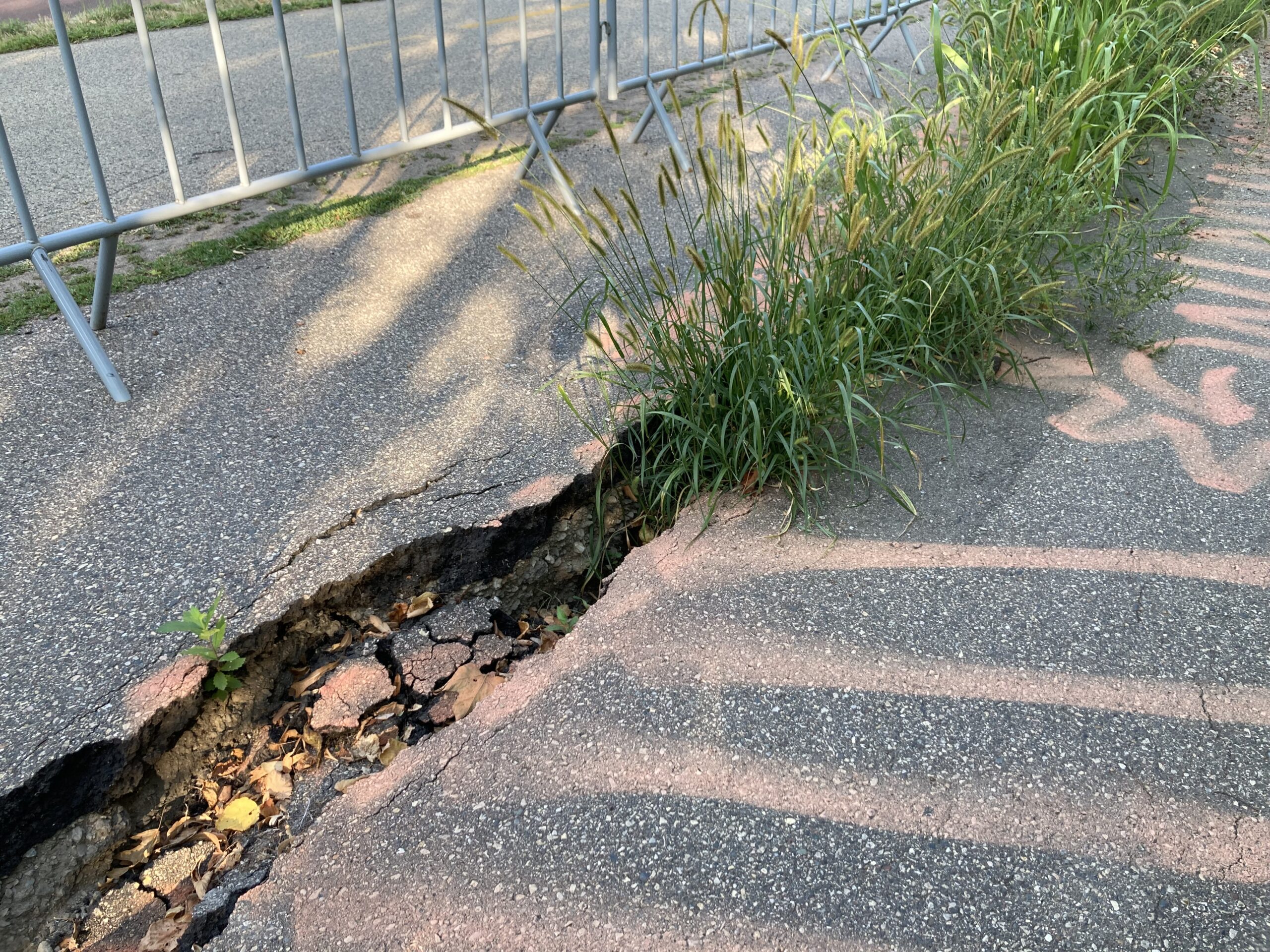
cracked asphalt on the creek path — marked with orange paint, some of the paint was zigzagged and some of it was loops, looking almost like flower petals
signs on the pickle ball fence: 2 giant monarch butterflies for the monarch butterfly festival — is that today? no, I checked, it’s 12 sept
a real monarch butterfly, fluttering through the trees next to the path
just after mile 1: a shirtless runner, pushing a strollers and holding onto a dog’s leash — talking to the kid he was pushing and/or someone on the phone — at one point he called out, GOBBLE GOBBLE GOBBLE! did he see a turkey, or were he and his kid just remembering another time when they saw/heard a turkey
the dog was a beautiful golden retriever — not light golden fur, but dark, like copper — and was also very graceful and relaxed as they ran
an e-bike blasting “Let it Be” from their radio — the voices were clear until the bike passed, then distorted from the doppler effect
the creek continues to be very low, a lot more mud and dirt showing than normal
a mom on one bike, her very young daughter on another, carefully crossing the road and passing by an older man in a recumbent bike — he greeted them and called out to the girl with an encouraging, hey!
reaching the bandshell at lake harriet, looking for a water fountain, encountering about 50 people doing yoga on yoga mats, facing the lake — what an image! I think I heard to woman leading them say something about gratitude — wow, I looked it up and they had free yoga EVERY DAY this summer at lake harriet! today was the last day — I wish I would have known; I would have gone at least once
windy at lake harriet, I watched/listened to the water lapping the shore — I briefly thought about taking a 5 or 10 minute break to sit on the beach and be with the water, but decided it might be too hard to start up again
what a crowded path at harriet! too many people taking up too much space, making it hard for me to run easily
a group of adults gathered around a little girl, laughing (not at, but with the girl) and calling out, oh, her face, look at that face! not sure what was happening
2 bikers, one of them explaining to the other that they were redoing a bridge — it’s going to be really cool!
slowing down to let a faster runner pass me — good morning! / good morning!
a few honks, up in the air, geese far off somewhere
stopping at the back of the nokomis rec center to refill my water bottle with the jet-powered bottler filler, noticing a group of 6 or so older people standing around — from what I heard, I think they were about to rehearse a song they were planning to sing — I left before they started
two school gardens, one at Hiawatha, one at Howe, spread over several big planters, looking abundant and desperate for water
That run was not easy. My quads and hips and, occasionally my knees, hurt, so did my left ankle. And everything was sore by the end. I was slow and walked way too much for the last 4 miles. But, I did it. I was out there moving for 18 miles, and I was able to be on a trail that I’m rarely on these days. And I got to run all the way to lake harriet. I didn’t have to go to the bathroom. I didn’t have any terrible cramps. And, any negative thoughts I had (this is too hard or how will I be able to run a marathon in 4 weeks) didn’t last long. Victory!
For the first 14 miles, I listened to water and wind through trees and cars moving and dogs barking and some dad yelling out, gobble gobble gobble. For the last 4 miles, I put in headphones and listened to my “Remember to Forget” playlist.
Today I was supposed to run my 18 miler, but yesterday I woke up to an angry right knee. I think my kneecap shifted and the ligaments around it are a bit inflamed. This morning, my knee is still sore, so I’m postponing the run until tomorrow. Nothing too worrisome, as long as I take it seriously and rest, which I am. Today, I RICE (rest, ice, compression, elevate). Tomorrow, an 18 mile run.
Also, today, I’m writing more poems for Girl Ghose Gorge. First up, Haunts: Lock and Dam no. 1. I decided to look up the Ford power plant because I recently hiked by it and because I’ve mentioned it in an early draft of the poem. I found this video that provides incredible footage of the interior of the steam plant. This plant shut down in 2011 and, even though it’s fenced off, urban explorers, like the creators of this video, frequently visit it.
note: skip the 1.5 min intro and the annoying voiceover
themes: abandoned industry; urban explorers (a form of ghost, often invisible/hidden, haunting certain places, dwelling in the dark edges); a river returning (flooded basements). Mentioned in the comments and a vivid image remembered by me as K and I hiked up the steep road: the vacant parking lot halfway up the road — cracked asphalt, weeds/plants growing through the cracks, several feet high).
Another element: the future of the locks and dam no. 1 (and the 2 other lock and dams in Minneapolis)– it’s currently being studied by the Army Corps of Engineers, who own it, to determine 1 of 3 futures: the Army Corps continues to own and operate it; they sell it to a local, state, or private entity; or they dismantle the lock and dam and let the river flow freely. A report will be released for public review in the spring of 2027. In July, 2026, MPR reported on the uncertain future of the locks and dams: What would removing twin cities locks and dams mean for the Mississippi River?
The report says removing the locks and dams could reshape how people experience the Mississippi in the Twin Cities, with places to explore, hike, fish and bird watch. It also could offer an opportunity to reconnect with sacred Dakota places along the river.
Federal land around the Upper St. Anthony Falls Lock and Dam is being restored by a Dakota-led nonprofit, Owámniyomni Okhódayapi. The organization plans to turn the site into a place of healing, restoration and connection.
Down river, the Wakaŋ Tipi Center, a 27-acre Native-led cultural and environmental interpretive center, recently opened on the Mississippi River in St. Paul.
Here’s an ending line that I’d like to think about: removing the dams could take 10-20 years.
The MPR article lists ecological, recreational, economic, and cultural/spiritual reasons. I’m reminded of past park plans I’ve read and the shifting perspectives on what matters most and how to pitch decisions to the public. I’d like to think about this some more and possibly use it a poem I’m thinking of writing that uses text from different documents about managing the park (regional/national).
While exploring resources about the river, I came across a reference to PUBLIC LAW 100–696, November 18, 1988. It’s the establishing by Congress of
(1) The Mississippi River Corridor within the Saint Paul-Minneapolis Metropolitan Area represents a nationally significant historical, recreational, scenic, cultural, natural, economic, and scientific resource.
(2) TThere is a national interest in the preservation, protectionand enhancement of these resources for the benefit of the people of the United States.
preservation, enhancement, enjoyment, and utilizationof the nationally significant resources of the Mississippi River Corridor / to protect, preserve and enhance the significant values of the waters and land / establish manage enforce
What about PUBLIC LAW 100–696 as the title of a poem?
It’s 5:31 pm: My knee seems somewhat better. I’ve iced it twice. It is still a little angry. I can’t decide if the kneecap is continuing to shift and agitate it, or if the area around the knee feels tight/inflamed because of an initial shift. My current thought is, whatever has happened, I should be okay to run tomorrow morning.
16 miles lake harriet and back 68 degrees humidity: 90%
16 miles! It was warm. That humidity! As I’ve heard several pro runners (on youtube or podcasts) say, humidity is the poor man’s altitude, which means I could expect to go slower — in fact, I should go slower — to account for the extra effort that hot and humid air demands. Before I started, I reminded myself that this run would be harder because of the humidity so I should take it easy. A mantra: if you’re not going slower, you’re going too fast. I also told myself that I only needed to worry about the first 8 miles to lake harriet because once I did that I was halfway and would have to run and/or walk another 8 miles back. Keeping my expectations low and being kind to myself helped.
I drank a lot of water, chewed on 6 or 7 Cliff blocks and sweat a lot. Somewhere between miles 10 and 12 I realized that my shirt was completely soaked and sticking to me. It was so wet that I was almost able to wring it out. Other than the humidity, the thing that made the run the hardest was my sore legs, especially my knees. I think that was partly due to all of the walking at the state fair we did 2 days ago. My knees felt stiff and sore even before I started!
3 things I did well: 1. even though I know I had unfinished business, it wasn’t a problem at all — no cramps, no need to stop at a port-a-potty!; 2. a steady pace for the first half + never totally going off the rails for the second half; and 3. believed I could do it the whole time and never gave into negative thoughts.
3 things to work on: 1. eat a bigger breakfast + drink more water before; 2. keep a steady pace with consistent run/walk sets when it gets tough — instead of taking a walk break, do easier run/walk sets, like 1 min run/ 1 min walk; and 3. try drinking electrolytes, and not just water, during the run.
16 Things
rowers on the river! I could hear the coxswain barking out instructions at the start of my run
minnehaha creek was so low, pt 1: near the duck bridge, there has hardly any water, but lots of green aquatic plants
minnehaha creek was so low, pt 2: under the echo bridge, a huge sandbar (or, dirtbar?) in the middle of the creek
a biker, biking slowly, and singing to herself, I am so tired
minnehaha creek was so low, pt 3: mostly, the creek was quiet and still, with only the occasional whisper/babble
running under the freeway, where the walking path is on the other side of the creek, I could hear something hissing and squeaking above me — bats?!
thud thud –– the steady feet of a fast runner behind me, then beside me, then in front of me, then gone
thwack thwack thwack pickle balls being hit hard on the pickle ball court near lake nokomis
the strong gust of water coming out of the water bottle refill fountain — nice!
reaching lake harriet to an empty beach with inviting water — I briefly thought about cooling off for a few minutes, but decided against it — too much sand in my shoes on the run back!
lake harriet trails were crowded — lots of runners and bikers and walkers (and talkers!)
a BIG peloton (30 or more riders) on the road
mostly cloudy, every so often, sun
orang spray paint, painted in zigzags over cracks and craters and bumps on the path that need to be fixed — there was a lot of it near the Rosie and Fletcher bridges
people packing up after a church service at the falls
one roller blader spotted near the beginning — I can’t remember if I heard their poles clicking, I just remember that they passed me on the trail
For the first 12 miles of the run, I listened to the world around me: hissing bats, rushing cars, a crying baby, laughter from kids somewhere beyond what I could see; moving water. For the last 4 miles, I put in my “Hello, Goodbye” playlist.
During the first few miles, I thought about part of a poem I’m working on. It begins with a quote from a PBS video about echolocation:
There’s sound and there’s a lack of sound, and a lack of sound still makes noise. We call it a sound shadow.
As I ran, I thought about this pair sound/lack of sound and other pairs I encounter at the gorge, like space/lack of space, or ground/lack of ground (gap/gorge). Sound shadows are also called acoustic shadows. I looked them up and found an article about bats, accoustic shadows, and echolocation: Acoustic shadows help gleaning bats find prey
“We propose that bats perceive a change in depth profile and an ‘acoustic shadow’ cast by prey. The shadow is more salient than prey echoes and particularly strong on smooth surfaces.” Wow, I’m just thinking about how there are echoes, and there are acoustic shadows, but I’m still not sure I understand acoustic shadows.
Here’s the wikipedia definition:
“An acoustic shadow or sound shadow is an area through which sound waves fail to propagate, due to topographical obstructions or disruption of the waves via phenomena such as wind currents, buildings, or sound barriers” (source).
The deeper I dig into this, the more I think it is for a future project that explores echolocation more broadly.
Found this poem in the July/August issue of Poetry:
A friend tells me he was holding his mother’s hand as she lay dying. At the end, her final words were, “I’ll find Dad and tell him you said hello.” “Find,” she said. Not “I’ll see him” or “we’ll be together again” but “I’ll find Dad.” How astonishing that language almost means then frightens us when it doesn’t— love, we say, God, we write, and the words fall short. We dream of lost vocabularies, and from nowhere, a word is worth a thousand pictures. What you say doesn’t have to be true. It only has to be imaginable. Where is my friend’s father? In the kitchen of that big house making coffee, say, or sorting nails in the workshop. Or in the yard, unlearning the constellations so he can see the stars.
Notes: This poem includes lines from Jack Gilbert’s “The Forgotten Dialect of the Heart” and “Tear It Down.”
—
I like this idea of putting in two lines from these Gilbert poems for a few reasons: he doesn’t italicize which lines and it’s an invitation to find and read 2 more poems and put them into conversation with his poem. I want to try this out for my poems — the ones I’ve already written using others’ lines + the ones I’d like to write using those lines.
the bells: another meaning: the bell announcing the final lap of a track race
One of my favorite runners said the following in an interview after winning UTMB’s OCC (50k) race this past week:
The most played out race strategy of all time in the 1500. It’s like the bell rings and everybody goes with 400 to go.
I’m like this is such a predictable strategy. Everyone knows this is going to happen. But it’s kind of like what happened yesterday where it’s like something about crossing over that bridge and hitting the town and that’s like the bell ringing and something changes and your adrenaline spikes and you can actually like will the last bit of yourself.
9 miles! Still not easy, but I felt strong and relaxed and steady. For most of it, I ran 3 min, then walked 1. For 2 of the miles, I ran 90 sec, walked 30. Those miles were about 40 seconds faster, which might have been too fast; I think they made me more tired and increased my heart rate. When I hit mile 8, I thought, on Sunday, this will only be the halfway point of my run, but before I could dwell on it and wonder how I could run that much more on Sunday, I thought about something else, or I stopped thinking altogether.
When I was in the shade, which was about half the time, I felt cool-ish, but when I was in the sun, I was hot. So much sweat! I hope it cools down in September.
I wasn’t sure which route I would take this morning — to Lake Nokomis and back or the Confluence. I told Scott, I’m going to run south on the river road and let my body decide which one — either I’ll turn at Locks and Dam no. 1, or I’ll keep going past the falls. I’m not sure when I decided but, by the time I got to the locks and dam, there was no doubt I was turning.
11 Things
looking down from the ford bridge, the water was smooth and still — I think I saw some sandbars just beneath the surface
the river water was also low — I could see a long stretch of green (grass, I think) where there has been water in past years
the gate that K and I had to squeeze through because it was locked a few weeks ago was open today
hidden falls was quietly falling
a tall man sitting on a bench, his long legs sprawled out in front of him, talking on the phone — I remember that I hear what he said, but I don’t remember what it was
the click of a bikers shoes clicking into their pedals
uneven brick — not broken but raised by (un) settling ground
stopping at my favorite bench, which was in the shade, reading the plaque beside it as sweat dripped off of my face
a lone skateboarder at the skateboard park — saw them in flash, heard the scuffing of the wheels
more filled benches than empty ones
almost forgot this one: everything was dry — the grass, the dirt that trickled down the bluff almost like water, the leaves, which sounded very loud in the quiet morning
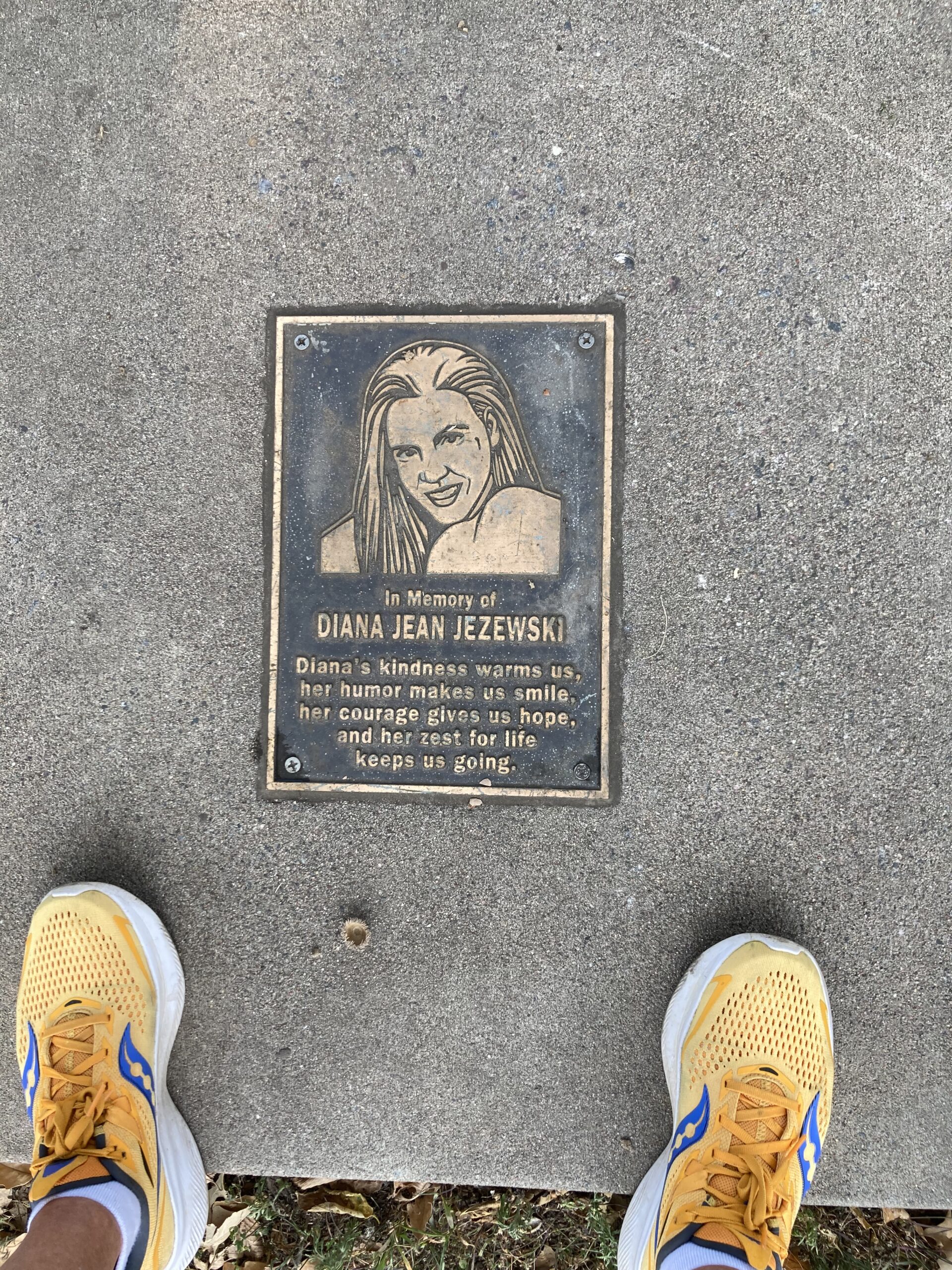
Diana’s kindness warms us, her humor makes us smile, and her zest for life keeps us going.
I’ve decided to leave my shoes in the picture because I like the color of them. I just received an email that my new pair or Saucony Rides are arriving today — they are navy with aquamarine.
Looking up her name online, I found this short video that offers more images of where I was when I took this picture:
Diana Jean Jezewski was 20 when she died of cancer in 1999. So young! She was born 5 years after me. She graduated from Highland Park High School and had been captain of the volleyball team. What type of cancer did she have?
Looking at the poems-of-the-day, I found this fitting one on poets.org:
once again i’ve brought my dead dog to the party. not the box of ashes, but the pen-drawn sketch my friend lenny made six days after she died.
or five. i saw it coming, the way mimsy went. the hard part was saying it, so i wrote it down: something small i love is leaving me.
now it’s late morning in abiquiu & i’m alone in the courtyard, rolling around on the flagstone breathing, a drawing of mimsy in the shade,
a mug cooling at her side. i said i don’t drink coffee or need a week to myself but look at me now, trying not to lie. so i listen: a shrill of pinyon jays
in a juniper trills me from ghost to cobalt sky. all winter i didn’t see them, not a single thrill of murmuration & though it’s a hideous sound—a jay’s call, like a
small computer dying slow—to live, to move like that: seven siblings at my side, six at each of theirs, my god! not thinking where’s the threat but being
more than one, not less than any . . . the nearly-noon shadows recede & soon mimsy’s in full sun, where i leave her, the light
too bright to stay, the shrill too clear. i say yes, i’ve seen a rock wren & no, that is a fishless osprey circling the steppe & tomorrow i might make a cairn of quartz
just to knock it down, slip a stone into my pocket, put nine postcards in the mail, or begin another poem for lenny i’ll try to finish when i’m home—
you had a friend once. now she’s different. we remember what we need.
Much to think about and love in this poem. A question: does a bluejay really sound like a computer dying slowly? I guess I don’t know what a computer dying slowly sounds like. What I know is that a bluejay screech is grating and terrible — I recall thinking it sounded like (or, maybe felt like?) a dull knife hacking the silence until it ripped open.
14 miles franklin / ford / almost confluence 56 degrees
14 miles! For my route, I ran north on the river road, over the lake street bridge to north on the east river road. Took the franklin bridge back over to the west side and then south on west river road. When I reached the lake street bridge, I crossed it again and headed south on east river road until I almost but not quite reached the confluence. On the way back, I crossed over the ford bridge, ran through Wabun park, down Godrey, back under the ford bridge, down and back up the road to locks and dam no. 1, then north on the river road. The route was a variation on the franklin-ford loop — instead of a loop, a figure eight — combined with the confluence loop. Mostly, I ran 3 min, then walked 1. When it got harder, in the last few miles, I switched to 90 seconds of running, 30 seconds of walking.
For the first hour, I listened to the quiet — hardly any cars, early on a Sunday morning! — and the rowers and water seeping out of the limestone. For the rest of the run, I listened to my “Hello, Goodbye” playlist. The thing I remember most, was 867-5309 and this lyric with a double meaning:
Jenny, Jenny, you’re the girl for me Oh, you don’t know me, but you make me so happy I tried to call you before, but I lost my nerve I tried my imagination, but I was disturbed.
I heard disturbed meaning 2 things at once: the more popular, interrupted, but also, unhinged. Was this double-meaning intended? Not sure, but that’s how I heard it, and I liked the multiplicity of it.
the rowers!As I crossed over the lake street bridge for the first time, I saw them. A speck, a streak, then 3 shells approaching from the south. The first coxswain had a deep voice and was explaining the order to the rowers: male single shells and female single shells together. A few minutes later a coxswain with a higher voice tried to pump up the rowers. A few times, the words became distorted as the voice got louder and more excited. I did hear something about starting at the trestle. I could see the rowers for most of my run north towards the franklin bridge. Oh — I almost forgot — when I first noticed the rowers, it was quiet enough that I could hear their oars slapping the water awkwardly. I could also hear the oars creaking as the rowers lifted them out of the water.
14 Other Things
a carolina wren — cheeseburger cheese burger
the gate at the entrance to the no longer used for power plant was locked again
a shimmering sound — water leaking out of the limestone below me
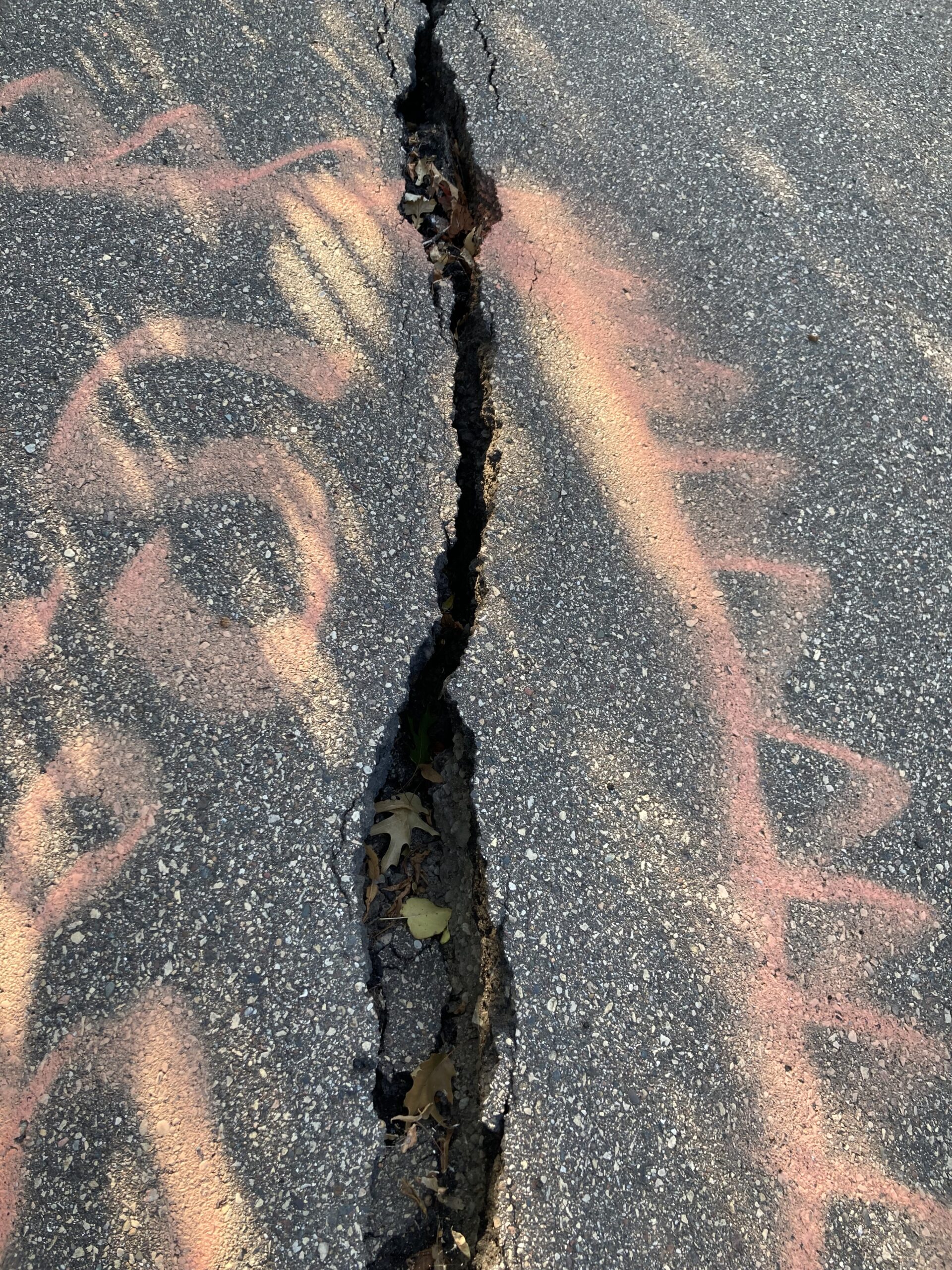
the crack in the sidewalk just north of the trestle is getting worse — tall plants are growing out of it at one end, while it grows deeper on the other*
click clack click clack — a roller skier hitting, then scraping their poles
the sliding bench — shaded, surrounded by green
on 2 different occasions — a tall man, walking alone, talking very loudly on a phone — their voice echoing
no tent near ford bridge today, but someone sitting on a tall chair, facing the road, an umbrella giving them shade
click click click click a walker approaching me, striking the asphalt rhythmically with her hiking poles
the sky was blue and a little hazy — was it humidity burning off or my bad vision?
I stopped at a bench above hidden falls to tighten my shoe laces: it was in the sun and empty
a single red leaf on an otherwise green tree — fall is coming
the flat, smooth surface of the river as seen from above on the ford bridge
the reflection of the bridge on the surface of the river as seen from below the ford bridge
Just remembered something else about the surface of the river below the ford bridge: it was an unnatural green on the closest edge, It reminded me of the color of algae blooms. It looked oily and smelled strange. What spilled/was spilled into the river here?
That run wasn’t easy and I am tired. My calf and knees started to hurt around mile 11. But, I did it and, an hour later, I’m already feeling better. I will be able to run 16 miles next week.
I’m not putting this in my 10 things, but I could. The grass is not really green, but brown. In some spots in the strips along the river, it is so dry, it’s yellow. I remembered these images of grass, when I read poets.org’s poem of the day by Carl Sandburg. I like his poetry — whimsical and weird.
Summer grass aches and whispers. It wants something; it calls and sings; it pours out wishes to the overhead stars.
The rain hears; the rain answers; the rain is slow coming; the rain wets the face of the grass.
*Running beside the crack in the path, I decided to stop and take a few pictures of it. I wonder, are they planning to fix it, or accept defeat and reroute the walking path here?
crack north of the trestle / 23 aug 2026split open / 23 aug 2026
before the swim: Tired this morning. My throat is sore, not from sickness (I hope) but from keeping the window just above my head open all night. Reviewed yesterday’s entry and thought more about a place-based MO swimming poem: Swimming in One Place in August or Swimming in Place in August. Swimming in place is about repetition and loops and returning again and again to here. Not accumulating time but becoming more and more aware of the world around me — the flashes and flickers, the color of the water, the sounds underwater, the bubbles just below the surface.
About time in the water: While I’m swimming, I have very little idea of what time it is. I know that a loop is about 20 minutes, so I can figure it out, but I can’t read my watch when I’m constantly stroking 1 2 3 4 5 breathe right 1 2 3 4 5 breathe left.
4 loops lake nokomis open swim 81.5 minutes 72 degrees
Before the swim I reminded myself of how much I love swimming across the lake and how much I’ll miss it when it’s over in a week. Another season almost over. As always, it has gone by too fast!
The first loop was very relaxed — my stroke, my breathing, the water. A steady rhythm and hardly any waves. Between buoys 3 and 4, a V of geese flew low over the water. They felt so close, but probably weren’t that close; swimming in the water distorts your perceptions of distance and size. Buoy 5 was almost as far as it’s been to the left. So far, that I thought the course/the triangles the buoys make was bigger than usual. Nope. I’m not sure how this is possible, but the course was actually a little shorter this morning.
As I swam, I thought about place — swimming in place, returning to a place, becoming familiar with a place. I know I had more interesting thoughts, but now I can’t remember them. Oh well, if they were important, I’ll remember them.
10 Things
a vee of geese, flying low
a seagull flying/floating in the wind
a place, parallel to the water, also flying low
my sparkle friends — most of them swimming straight at me
glitter paths! the rough surface of the water, glittering in the sun
a big splash off to my left — another swimmer who is not that efficient with their stroke/kick
the green buoy, way off in the distance, becoming lost among the white sailboats
clouds then sun then clouds then sun then all sun
a haze in the air — not smoke but humidity
swimming from buoys 1 to 2 on loop 3 when the water was choppier — even harder to sight the buoys, imagining lifeguards on kayaks were right in front of me when it was just the strange effect of waves and trees on the shore
When I finished, Scott was still running, so I took my towel and sat on the beach. What a morning! two moms and 2 kids.
overheard/witnessed after the swim
Mom 1, carrying a small kid out of the water: let’s get you into your robe, it’s cold! Mom 2, also carrying a small kid: I really wish I would have thought to bring a cover-up for her! I bet a cover-up would feed nice and warm. Mom 1: atowel should work.
(a few minutes later, after Mom and kid 1 left): Mom 2 to her kid, okay, let’s get you in this warm towel! LOUD SHRIEKS Fine, no towel it is. Let’s walk to the bathroom. Kid 2 makes noises like they’re very cold. I bet a towel would really warm you up right now, but you made it very clear that you didn’t want one.
At some point during the swim, I had an idea for my long (12+ mile) run tomorrow: a Hello Goodbye playlist. I brainstormed songs as I stroked: Hello/Lionel Richie; Hello/Adele; Hello it’s Me/Todd Rundgren.
Hello Goodbye Playlist
Hello, goodbye/ Beatles
Hello/ Lionel Richie
Goodbye Yellow Brick Road/ Elton John
Hello/ Adele
Goodbye Stranger / Supertramp
Hello it’s Me/ Todd Rundgren
Goodbye to You/ Scandal
Operator/ Jim Croce
Here’s a Quarter, Call Someone Who Cares/ Travis Tritt
Call Me Maybe/ Carly Rae Jepsen
Call Me/ Blondie
Telephone ft. Beyonce/ Lady Gaga
Where the hell is my phone?/ Lizzo
Telephone Line/ ELO
Mr. Telephone Man/ New Edition
867-5309/ Tommy Tutone
Don’t Call Us, We’ll Call You/ Sugarloaf
Hello / The Book of Morman
Bye Bye Bye/ N’Sync
Hello I Love You/ the Doors
So long, Farewell/ The Sound of Music
Hello 12, Hello 13, Hello Love/ a Chorus Line
Look at Me, I’m Sandra Dee (Goodbye to Sandra Dee)/ Olivia Newton John
Scenes from an Italian Restaurant/ Billy Joel
I’ll Be Seeing You/ Billie Holiday
Hi Hi Hi/ Paul McCartney and Wings
Because I Got High / Afroman
Why’d You Only Call Me when You’re High?/ Arctic Monkeys
Rocky Mountain High/ John Denver
Hey Good Lookin’/ Hank Williams
Never Can Say Goodbye/ Jackson 5
Welcome to the Jungle/ Guns n’ Roses
You’re Outta Here/ Lorraine Feather
The First Goodbye / 25th Annual Putnam County Spelling Bee
The Second Goodbye / 25th Annual Putnam County Spelling Bee
The Final Goodbye / 25th Annual Putnam County Spelling Bee
Hey, That’s No Way to Say Goodbye / Roberta Flack
Na Na Hey Hey Kiss Him Goodbye / Steam
The Goodbye Look/ Donald Fagan
Goodbye Blue Sky/ Pink Floyd
I had wanted to make this playlist 2.5 hours, but I couldn’t quite get there. It’s 2 hrs and 23 minutes.
10.1 miles confluence and back 62 degrees AQI: 36!
10 miles. That was not easy. Much cooler today, better air quality, but still warm. I sweat a lot. By mile 5, my pony tail was dripping. I could feel it on my shoulder, hear the wet strands of my hair swishing as I moved. I decided not to bring my handheld water bottle, which was a big mistake. Two thirds of the way through, I ran out of gas.
3 things that worked well:
managed my unfinished business — even before I finished mile 1, I felt like I needed a port-a-potty, but taking walk breaks and not thinking about it, helped the need to poop go away
just kept moving (mostly running, some walking) — I wasn’t sure how much I could run today and when I realized that the route to the confluence and back was almost 2 miles short, I could have stopped sooner, but I decided I need to keep going, so I did
nice route — even though this route was too short, I liked it — the stretch of the east river road between hidden falls and the confluence is beautiful — such amazing views!
3 things to work on:
don’t forget the water bottle
don’t forget snacks
work on being more consistent with the run/walk method — on the next run, try 90/30 again
As I ran under the road at Hidden Falls, I thought about the small stretch of hidden falls that was daylighted when they redid this area a few years ago. I listened as it rushed to the edge then fell over it and smelled its fishy smell.
10 Things
running over the ford bridge, admiring the river, 1: the brownish water was calm, still, flat, not even a ripple
running over the ford bridge, admiring the river, 2: because the surface was still, I could see below it — the faint outline of several sandbars
a short (under 5 ft) older woman i, stretching next to the hidden falls park sign, at the top of the hill, later I encountered her again; she was walking, I was running
a strange pair of sounds on either side of the road, call and response. Bird song I had never heard before, sounding almost like machines or alarms — was it 2 birds, or 2 people with some kind of device making the noise?
what a view! — 1/2 mile from the confluence overlook, the trail and a bench are high above a bend in the river where you can see the mississippi and the minnesota rivers — I would have stopped but someone had brought a chair and was sitting in front of the bench
near the far entrance to hidden falls — a roller skier perched at the top — were they about to bomb down the steep hill?
at the confluence — a lime green bike, wedged in the corner of the overlook — too many leaves below to see anything — a warm water water fountain
a bird crying out, sounding like they were in distress — a woman came to the edge where I was standing and said the sound came from an eagle on the other shore
2 men running on the ford bridge, one of them was turned around and running backwards
2 older men, carrying signs to place along the bike path that said something like, bikers, use caution! alert walkers with an “on your left” or a bell — Yes!
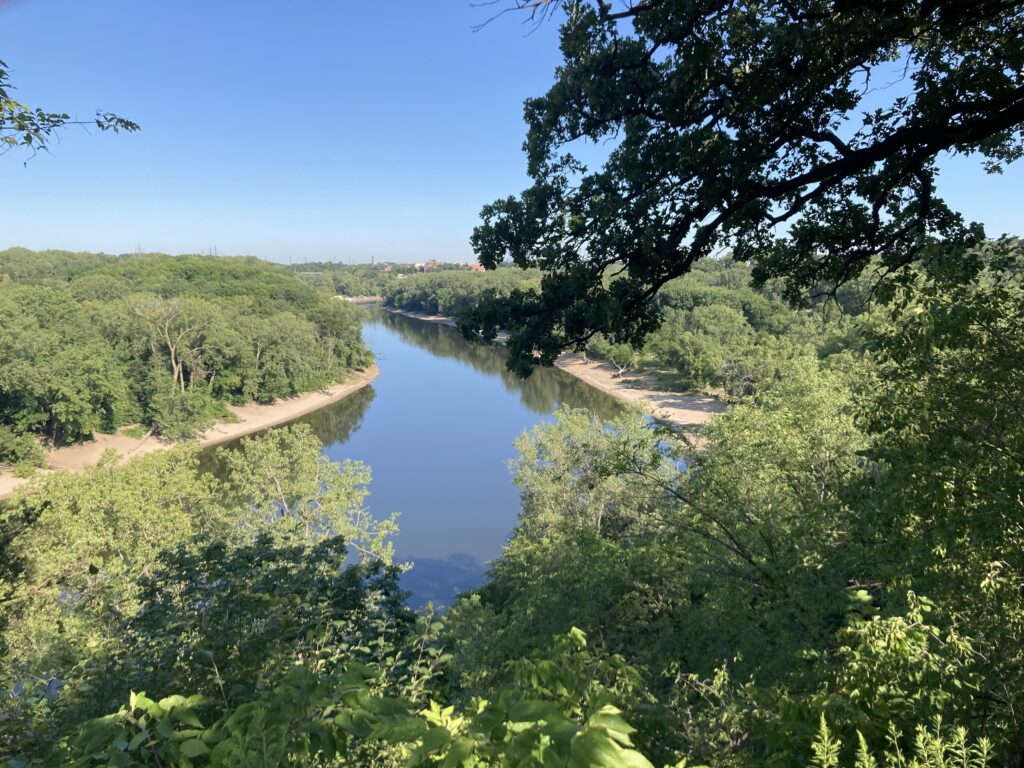
Just before I heard the eagle (mentioned in #8), I took a picture of a view of the river:
east river road, heading to downtown St. Paul
Running near where this picture was taken, I suddenly remembered a conversation I had with FWA at the dog park earlier this year. We were deep in the gorge, looking up at this bluff I was running on this morning. I said, this summer, when I’m training for the marathon, I want to run up there. And I am!
1 Day in August
Bummer! As I write this, I received an email from Open Swim. It’s cancelled tonight because there are blue-green algae blooms at one of the Cedar Lake beaches. Must be serious if they’re cancelling the swim; usually they just post an advisory and caution club memebers to “swim at your own risk.”
Reading the first verse of Mary Oliver’s poem again, my eyes stopped on among the flux of happenings” and I thought about the floating particles I encounter while swimming in Lake Nokomis. Often I call them my sparkle friends. They are the little bits of sediment or muck or aquatic plant that float in the water in front of me. They sparkle because of shafts of light in the water, and they seem to be in a constant motion of floating at me. I imagine some people might think my friends are gross, but I don’t, and I love the strange, trippy effect they create as I swim through them. I wrote one of my inklings about them:
Particles before buoy 1
Lit by thin shafts of light, they put on a show. Their frenzied disco of shimmer sparkle shake stirs us up.
I like MO’s use of among here — among the flux of happenings. The deepening and quieting of my spirit comes among this flux, these little happenings.
I know I’ve written about “among” before; found it! On 16 may 2025, past Sara wrote a lot of things that are very helpful to present Sara as I think about MO’s use of among!
side note: the more I follow my muse here — and, maybe, my muse is a fish or floating milfoil or a sparkle friend? — the more clear it becomes: this year’s Swimming One Day in August is about engaging in a deeper reading of MO’s words — expanding on meanings, connecting them to her other work, reading thembeside my experiences in the lake.
But, back to among. Here’s what I wrote in my 16 may 2025 entry:
among / between
When I read and posted Lorine Niedecker’s poem about standing among the birch last week —
For best work you ought to put forth some effort to stand in north woods among birch.
I was struck by the word among and wondered how it was different from between. I looked it up this afternoon and, after wading through discussions about how between is used with 2 items, among with more than 2, I came across a helpful distinction in Merriam Webster:
We use between when we want to express a relation to things and have them considered as individual and usually equal entities.
Among, on the other hand is the best word to use when referring to things collectively and imprecisely.
5 aug 2026 Sara, interjecting here: using among to refer to things collectively reminds me of a favorite (and very popular line) from MO in “Wild Geese”:
Whoever you are, no matter how lonely, the world offers itself to your imagination, calls to you like the wild geese, harsh and exciting – over and over announcing your place in the family of things.
among: your place in the family of things — so, the deepening and quieting of the spirit could be finding one’s place in the world? Where you belong? when you’re in your element? Of course this reading is different from the predominant one in which quieting your spirit among the flux of happenings means being present and calm, not worrying about all the noise around you.
I like among in LN’s poem, although I wonder about the effect of using between (or beside or with) instead. to stand/in north woods/between birch. Among indicates a kinship — among all of us trees, but between suggests an actual place — stand between this birch and that birch and an exchange — between us. I like both meanings. I like imaging my best work as trying to become a tree. But I also like the idea of my best work happening when I stand between birch — giving and receiving air.
I was reminded of among and between while reading this passage from Marie Howe:
That was really a big deal. I was given this place to be without any expectations really. And everything changed so that the particulars of life—this white dish, the shadow of the bottle on it—everything mattered so much more to me. And I saw what happened in these spaces. You can never even say what happened, because what happened is rarely said, but it occurs AMONG the glasses with water and lemon in them. And so you can’t say what happened but you can talk about the glasses or the lemon. And that something is in BETWEEN all that.
You can name/describe the collection of things (among), but you can’t find words to describe how their meaning has changed in that moment. Often when I think about the slight shifts in meaning between small words, like among or between, I’m reminded of an essay I read about Mary Oliver and her mousier words. I love mousy words! Meanwhiles and in-betweens and yous and wes and usses (is that the plural of us?).
…it’s tempting to be blinded by the more immediately visible parts of speech: the monolithic nouns, the dynamic verbs, the charismatic adjectives. Mousier ones—pronouns, prepositions, particles—go ignored.
Reading through this past entry, and thinking about MO’s next verse —
Something had pestered me so much I thought my heart would break. I mean, the mechanical part —
I remembered MO’s words in another of her poems:
I Go Down To The Shore/ Mary Oliver
I go down to the shore in the morning and depending on the hour the waves are rolling in or moving out, and I say, oh, I am miserable, what shall– what should I do? And the seas says in its lovely voice: Excuse me, I have work to do.
Here the sea doesn’t hold her until she grows easy or tell her what she should do, but they (the sea is they, because the sea is not an it) offer a suggestion, find your place in the family of things, do the work you were meant to do.
And there is the thing that one does, the needle one plies, the work, and within that work a chance to take thoughts that are hot and formless and to place them slowly and with meticulous effort into some shapely heat-retaining form, even as the gods, or nature, or the soundless wheels of time have made forms all across the soft, curved universe–that is to say, having chosen to claim my life, I have made for myself, out of work and love, a handsome life.
Upstream/ Mary Oliver
I use this passage in the introduction to my “How to Be” project on my Undisciplined site.
an idea: Perhaps I should revisit Upstream and Long Life. I own both of them. Also, how about another read through of The Leaf and the Cloud?
12 miles franklin + ford + hidden falls + veterans home + falls 67 degrees humidity: 86% / dew point: 65
Ugh! That was hard. It was too hot, too sunny, too humid. My feet hurt from warts and a big blister. I almost altered the route to cut off 2 miles. And I did it. And I felt okay for the last mile, like I could have kept going. Success! I’m proud of myself for persisting today.
3 things I did right
I didn’t have any unfinished business problems! I brought my water and made sure to keep drinking from it. I didn’t give up.
3 things to work on
Bring more snacks/fuel. A bandaid around my toe doesn’t work — it created a juicy blister — find other solutions. Be more intentional with music or mantras or experiments to try for distraction/focus.
10 Things
Mr. Morning! upped his game today with his greeting. Instead of just, morning! He added: Have a Great Day!
rowers!, 1: a coxswain’s voice, giving instructions through a megaphone
rowers!, 2: the gentle slap of the oars hitting the water
the crack just north of the trestle is bigger (again) — they’ve barricaded it off with metal gates
the part of the trail near the trestle on the east side was blocked off — some sort of work with a tall crane
the bells of st. thomas chiming
a skate boarder at the skate park: doing a wide arc at the edge of the course
filling up my water bottle: at the monument, near the skate park
a group of three bikers — 2 adults, one kid — biking slowly in front of me
stopping in the grass to adjust my laces (at least 5xs), stopping at a bench to take off my shoe to inspect my toe (1)
I have to do this again next week, but for the rest of today, I’ll celebrate the accomplishment of running (with some walking) 12 miles and moving for more than 2 hours.
For the first hour, I listened to birds, fragments of conversations, cars, trickling water, and bells. For the next 45 minutes, I listened to a Ruth Ware audiobook. And for the rest of the time: my Color playlist.
I’ve just barely started reading Kohn’s How Forests Think, which I was able to get through RJP’s college library. This is one of the opening lines in chapter 2, “The Living Thought”:
This chapter develops the claim that all living beings, and not just humans, think, and explores another closely related claim, that all thoughts are alive. It is about “the living thought.” What does it mean to think? What does it mean to be alive? Why are these two questions related, and how does our approach to them, especially when seen in terms of the challenges of relating to other kinds of beings, change our understanding of relationality and “the human”?
If thoughts are alive and if that which lives thinks, then perhaps the living world is enchanted. What I mean is that the world beyond the human is not a meaningless one made meaningful by humans. Rather, mean-ings—means-ends relations, strivings, purposes, telos, intentions, functions and significance—emerge in a world of living thoughts beyond the human in ways that are not fully exhausted by our all-too-human attempts to define and control these. More precisely, the forests around Ávila are animate. That is, these forests house other emergent loci of mean-ings, ones that do not necessarily revolve around, or originate from, humans. This is what I’m getting at when I say that forests think. It is to an examination of such thoughts that this anthropology beyond the human now turns.
How Forests Think / Eduardo Kohn
I’d like to put this chapter and the questions, What does it mean to think? and What does it mean to be alive?, beside Alice Oswald’s Homeric mind, with thoughts that don’t reside in the brain but travel outside of it, over the sea, Emily Dickinson’s bees, and the possibility that thoughts might be creatures themselves — and not just metaphorically. I’ve written about this before, and I’ll find where, either later today or tomorrow.
the next day:
1 — Alice Oswald on the Homeric mind:
Well, as you know, I’m quite fascinated, even obsessed, you might say with Homer. And one of the things that really tantalizes me in Homer is what is the Homeric mind? Because I think it’s very different from a literary mind. And it seems not to be inside the skull, but to be out in the world. So, there is a particular simile in the Iliad, which actually that first bit of the poem is based on, where it talks about two goddesses coming from heaven to the earth. And they’re very physically described. They kind of fall down from heaven to the earth. And then when they land, they take little pigeon steps, steps like doves or pigeons. So you can really picture them. But the way their flight moves from heaven to earth is as a man, you know, as the mind flutters in a man who has traveled widely, so you can turn it the other way around and say the way a man thinks is like this incredibly physical flight of two goddesses coming down to earth a bit like pigeons. And that’s always really interested me, that for Homer, the mind has the limitations of a pigeon, if you like. It is this kind of … this physical thing that moves. So, if you imagine a place over the sea, your mind actually has to get there. So, even though it may be as fast as the light, it is physical movement.
Here’s an article about the origins of the phrase. According to the article, the phrase is still being used in popular culture. I use it, usually when I notice Scott hell-bent on some task — and usually it seems like a task, or idea, that is fool-hardy but that he needs to work through and figure out for himself.
Sometimes instead of saying, bee in your bonnet, I say that someone (or me) is hellbent. Of course, writing that immediately makes me think of Jackie from the 1979 Death on the Nile:
Jacqueline De Bellefort : One must follow one’s star wherever it leads. Hercule Poirot : Even to disaster? Jacqueline De Bellefort : Even to Hell itself.
When I envision a bee in my bonnet, I see something that is relentless, impossible to ignore, urgently needing to be dealt with. That’s not quite how I imagine my preoccupation with haunts and ghosts and writing about the gorge. Still, I like the idea of bees in bonnets, and bees in general, so maybe I’ll spend more time with them this morning?
Reading through several ED “bee” poems, I suddenly had a thought: could the bee in your bonnet be your soul, trying to escape the confines of the body?
This thought was inspired by a poem I wrote about in an On This Day post: Body and Soul/ Sharon Bryan. I didn’t mention it in the post, but the description of the soul in the poem, as leaving the body at night to roam around, reminded me of an ED poem I read a few weeks ago, when I was thinking about the difference between the brain and the mind:
If ever the lid gets off my head And lets the brain away The fellow will go where he belonged — Without a hint from me,
And the world — if the world be looking on — Will see how far from home It is possible for sense to live The soul there — all the time.
3 — thoughts as a swarm of bees, uncontrollable and unwanted
As I started thinking more about my discussion of thoughts as bees, I also thought about how those bees, especially if they are swarming in your head without the lid being removed, could be overwhelming, incapacitating. Then I found this in my log entry from 30 june 2024:
“During the first loop somewhere between the first and second orange buoys an alarming thought appeared: what if I fainted in the middle of the lake? In the past this thought might have caused panic which I would feel in my body — a flushed face, harder to breathe, hot tingling on the top of my head. Not today. No physical effect. Within a few minutes the thought was gone. Is this because of the lexapro? FWA says that sometimes he feels the lexapro working — he’ll start having overwhelming thoughts but instead of spiraling, he feels himself become separated from those thoughts — they become abstract and distant. I wondered about this as I stroked then connected it to Alice Oswald’s Homeric mind and the idea of thoughts not just living in our head but traveling outside of our bodies from there to there.”
Don’t you wish they would stop, all the thoughts swirling around in your head, bees in a hive, dancers tapping their way across the stage?
Who with their whispered psalm can outvoice their huckster cackle, the trees blustered to howls while the tesla bees
whine loudly to the shocked air?
other links: I have a page about bees in my “How to Be” project on Un || Disciplined (I had forgotten that I did this — thanks, past Sara!)
one more thing: Finding my archive of bee-related things, is putting a bee in my bonnet. I need to archive all of my resources — or, as many as I can — before my central vision is completely gone. I imagine it will be much harder to do this once that happens!
run: 11 miles ford loop + veterans home + lake nokomis (x2) 66 degrees humidity: 92% dew point: 60+
I did it! It was humid and hot in the sun and my feet started hurting by mile 4, but I did it! I ran through the neighborhood, then over the lake street bridge, up shadow falls’ hill, past the monument and (mostly) up the east side of the river. I crossed the ford bridge, went through wabun park to the veterans’ home, crossed over another bridge, ran on the edge of the park, then beside minnehaha creek. When I reached Lake Nokomis, I had to run around it twice.
10 Things
teakettle teakettle — a carolina wren
a single rowing shell on the river
from the bridge, the water looked fuzzy, the air above it hazy
just past the monument, I heard the St. Thomas bells — I think it was 7:30
mostly dry dirt, or slightly damp earth on the desire path beside the paved trail — one spot was squishy mud and I almost twisted my ankle on it
cloudy then sunny then shade then sun and sun and sun then shade
someone on the other side of the mustache bridge, running and pushing a stroller, blasting some upbeat music that I didn’t recognize
the creek water is high! I especially noticed that as I ran over my favorite part of the trail
a woman with a dog — she wasn’t holding the leash tight enough and the dog leaned over and licked my knee as I ran by (surprisingly, I didn’t care)
running and walking over the cedar bridge, looking down at the water’s surface: a soft gray blue with reflections of clouds
For more than half of the run, I listened to the birds and my feet and the sloshing water in my handheld water bottle. Near the falls, I put in “Olivia Rodrigo Essentials.” Even though I’ve turned it off many times before, apple music was still set to fading songs, which means it took the last few measures of one song and made its beat match the beat of the next song. When this first happened, the last bit of the first song suddenly slowed, sounding so strange that I was worried I might be having heat stroke. Why does Apple do this? Boo.
3 things to celebrate / 3 things to work on
I kept the negative thoughts away (hooray)
I was able to eat a fig bar during the run and didn’t feel an urgent need to go to teh bathroom (yay)
My legs felt good in the last mile and I had some energy (woo hoo)
My feet hurt for almost half of the run (boo)
My ankles hurt some too — I need to tie my shoes tighter and/or get shoes in a smaller size (bummer)
As is often the case after a hard effort, I was cranky at the end when I met up with Scott (grr)
swim: 2 loops lake nokomis open swim 71 degrees
The plan: run to the lake for open swim. Scott would bring my bag with my stuff. I wanted to do at least one loop of swimming. I imagined it would be refreshing and restorative for my sore legs. And it was. Wow, that water! Almost perfect. Calm and warm enough. There was milfoil but no blue green algae. As I neared the beach, I could see clumps of the milfoil washed up on shore. Yuck!
The swimming felt easy and relaxing. Steadily, I stroked, breathing every 5 strokes. Occasionally I stopped stroking and listened to the quiet as I tread water. All I could hear was the soft slap of the water from another swimmer’s hand.
Today, I started counting strokes as I passed by the 4th buoy. 275 to get to 5th and final buoy.
A strange feeling: as I swam from buoy 3 to 4, I could see the green buoy up ahead. It seemed like I kept drifting out, almost too far to the left. Trying to correct my path felt strange and awkward. I briefly wondered if there was a current I wasn’t consciously feeling or if my run had made me less able to swim straight.
overheard: one swimmer to another: not many people here this morning! and you don’t have to rush off after we’re done, do you? and the water is wonderful! Except for the weeds!
Today I decided to start at the normal spot, instead of entering at the far end of the swimming area. The weeks were there, and I had to shorten my stroke when I reached them, but they weren’t too bad and didn’t last that long.
Speaking of weeds, I noticed a bad patch just below the cedar bridge when I was running. So thick, just below the surface. Looking brown and orange, then dark dark green.
Today would have been a perfect day to swim 5 loops. And if I hadn’t run for 2 hours before swimming, I would have done it. I wish I could have, but I’m glad I didn’t try. That would have been too much!
added at the end of the day: Even though I ran 11 miles and swam 1.5 miles today (and achieved 300% of my move goal), I don’t feel wiped out or that sore. Only my feet hurt, and that’s because of the warts (yuck!).
earlier today, I was looking through my 5 july entries from past years. I would like to remember some things from them, including:
1 — 2025
Yesterday, in a ramble about rumors and whispers, I stumbled upon a tentative theme for the month: the language of water. First step: read/skim How to Read Water.
Here’s an interesting bit I’d like to remember:
. . . ponds and lakes are far from permanent; rivers will tend to grow naturally with time as they do their own excavating, but the opposite is true for still water. Unless ponds and lakes are given some help, they will all eventually return to land, It starts with algae, then the rushes and other shallow water plants getting a foothold, and this allows sediments to gather, water turns to wet mud, and a reinforcing cycle begins that culminates in the water losing the battle against the encroaching land.
How to Read Water/ Tristan Gooley
Shallow water plants getting a foothold. No!
2 — 2024
Because the buoys are positioned by lifeguards every swim — they paddle out on kayaks where they are advised by someone on shore where to drop their anchor — and because there’s no exact spot for each of buoys, the loop distance varies. Today it was long, which I like — the more distance, the better! Here’s a comparison on 3 different 4 loop swims by number of strokes I took / distance (which I’m pretty sure my watch doesn’t measures accurately):
25 june 2024: 2094 strokes / 3100 yards 30 june 2024: 2124 strokes / 3600 yards 5 july 2024: 2374 strokes / 4000 yards
I like how approximate the course is. Some things about it are set, some aren’t.
3 — 2021
Why I do and don’t like Cedar Lake + differences between Nokomis and Cedar Lake (see 23 June 2021). The first time I ever swam at Cedar Lake was 14 August 2019.
10 miles ford loop + hidden falls + veterans home + falls + locks and dam 60 degrees humidity: 80%
10 miles. It’s been a few years since I ran 10 miles. I just looked it up and, according to my records, it’s been since Sept 29, 2024. That’s a week before the marathon. Wow. It wasn’t easy. I wasn’t fast. My feet really hurt in the last mile. And I did it. And I feel good about it. More than good, great. These long runs are really helpful for me as I try to work on my mental strength and endurance.
Yesterday I was listening to Kara Goucher giving advice on her podcast. What I remember her saying is this: find something positive to focus on for each stretch. Don’t allow yourself to think about what’s going wrong; think about what you are doing right. For many of the running stretches I felt strong and bouncy and in a dreamy state. Not sure I’d call it a flow state, but a state of non-thinking. Of being.
When I was thinking, I thought about my running. In the last three miles, I thought: I need to be particularly intentional in these last miles of my long run to not let it fall apart. I need to work at keeping to my schedule of walk runs. Keeping to this schedule should be something I work on in future long runs.
my route
My route took me many different places: through the neighborhood, past the daycare at the church, over the lake street bridge, beside shadow falls and the monument, on the edge of the new Highland bridge development, just above Hidden Falls, next to a skate park, over the ford bridge, past Wabun and the splash pad, through the veterans’ home grounds, behind the John Stevens’ house; above the falls, back up to wabun, down to the locks and dam no. 1, then north on the west river parkway. There was lots of shade and only a few stretches of direct sun. It was cool and overcast for the first half, a little warmer and sunny for the second half.
10 Things
one rowing shell out on the river — I noticed in my peripheral as I crossed the lake street bridge — kept trying to see it in my central vision, but never could
a woman’s voice at the construction site for home being renovated — she said something like, they’ll be here to hook up the garbage disposal — is that what she said? I can’t quite remember
the soft shushing of my feet as they stuck the soft dirt then slid backward
music blasting from a bike
the soft rushing of water down the channel under the bridge that leads to a hidden falls overlook
a ladder at an angle, leaning against a house, reaching a window on the second story
the hum of skateboard wheels, a flash of a skater behind me, the sound of the board flipping as the skater went up a ramp
a woman sitting on a bench near the veterans home, reading something
2 people, close together, on the little bridge overlooking the falls, taking a selfie
the thwack of the flag rope hitting the pole in the wind
For the first mile, I listened to the traffic, then I put in Olivia Rodrigo’s new album. I listened to it 3 times as I ran. They lyrics I remember most come from the song “Expectations”: past mistakes are just new information
swim: 2 loops lake nokomis open swim 74 degrees
I entered and exited the swim course at the other end of the beach and avoided the worst patches of milfoil. Only a few ghostly vines not quite reaching my toes. Nice. I like starting there, much closer to the last green buoy. It’s less crowded and it shifts where and when a new loop begins. At least, this is what I thought as I swam the second loop and reached the second orange buoy, which was now the third buoy I swim by in a loop and not the second.
The water was a little warmer, or I was. Whatever the reason, the result: no freezing feet or fingers. I witnessed lots of bubbles, some menacing swims, lifeguards that were too close to the buoys, forcing me to take sharper angles around them. No fish seen below, one bird, flying low with its wings spread wide, above, a duck near the shore as I swam into the beach. Two little girls, chasing after it.
Overheard: one of the girls to the other — then he picked it up with his bare hands and threw it!
Overheard: one kid to another, on the beach — how old are you? Eight, you’re eight?!
A big exercise day today. Almost 1500 active calories. 10 miles of running, a mile and half of swimming. It felt good.
run: 7 miles walk: 2 miles around lake nokomis and back 52 degrees
A long run with Scott. The plan: run to lake nokomis and around it, stop at falls coffee, walk home the rest of the way. Falls coffee was too crowded, so we tried Aria instead. Very good. Most of the run felt good. We did 9/1, then at the lake run 1 mile, walk 1/10th of a mile. The last 1/4 of mile was the hardest. My feet hurt and my legs were sore. The walk back was hard — too long + not enough stretching. Now I’m icing my right knee, which is very stiff.
It was fun to run to the lake. It is the first time this year. Last night we walked to Minnehaha Falls, today we ran to Lake Nokomis. It’s officially summer, Scott said. Hooray! Less than a month until open swim. I couldn’t believe it, but the buoys are already up! Wow, that water must be cold!
Scott told me about a YouTube video he had recently watched: a biker discussing one way the people are stealing bikes, and how we almost fell for it. They lock their bike to your bike, then wait until it’s dark, then they cut your lock. How to avoid this: carry extra locks to buy some time, or try to find a police officer and get them to cut the lock off. Also: lock your bike in a public, clearly visible place, and don’t lock to a pole that someone might be able to lift or unbolt. I talked about my holes project, memories of past runs, and how June 1st (Scott) and June 2nd) will be our 15th running anniversary. I also returned us to a discussion from a few days ago about what it might have looked like when passenger pigeons covered the sky in the late 1800s. When I had described it a few days ago as “blotting out the sun,” Scott had said that that poetic imagery wasn’t accurate. Today I talked about how, when I’m swimming in the lake and a cloud covers the sun, it does feel dramatic and like the sun if being blotted out. We agreed that it wasn’t as complete as a solar eclipse, but that it probably made the sky darker. Like day for night, I said.
quick research after the run: Here’s a quote I found that describes this blotting out:
In the early 1800s, ornithologist Alexander Wilson observed a single flock, which he estimated at 2.3 billion passenger pigeons, that blacked out the sky and took three days to pass overhead.
2 of the pickleball courts were empty — is pickleball falling out of favor, or is there some other explanation?
the lake water was blue and choppy
halfway around the lake, a loud splash — was it a fish jumping out of the water, a duck diving down?
running past Howe, noticing a plane ascending at (what seemed to me to be) a very steep pitch
nokomis road at the spot that crosses the bike path was closed again — why? — last summer it was closed, too
the little beach barely seems like a beach these days — the big tree, which offered so much shade, is gone, and the water has claimed half of the sand
the condition of the path was terrible — big cracks marked with orange spray paint everywhere
crossing the cedar bridge, near a light post, hearing this squeaking noise, we both wondered if the noise was made by a bird or the tall post
no flowers yet at longfellow garden
walking home, a memory flashed — the last time I remember walking home this way — after a run, with coffee in my hand, was on my birthday in 2021. I didn’t know it, but I had covid
note: we ran beside the creek for more than a mile, but I can’t remember noticing it at all. Was it high? Low? Babbling or gushing? I have no recollection.
holes
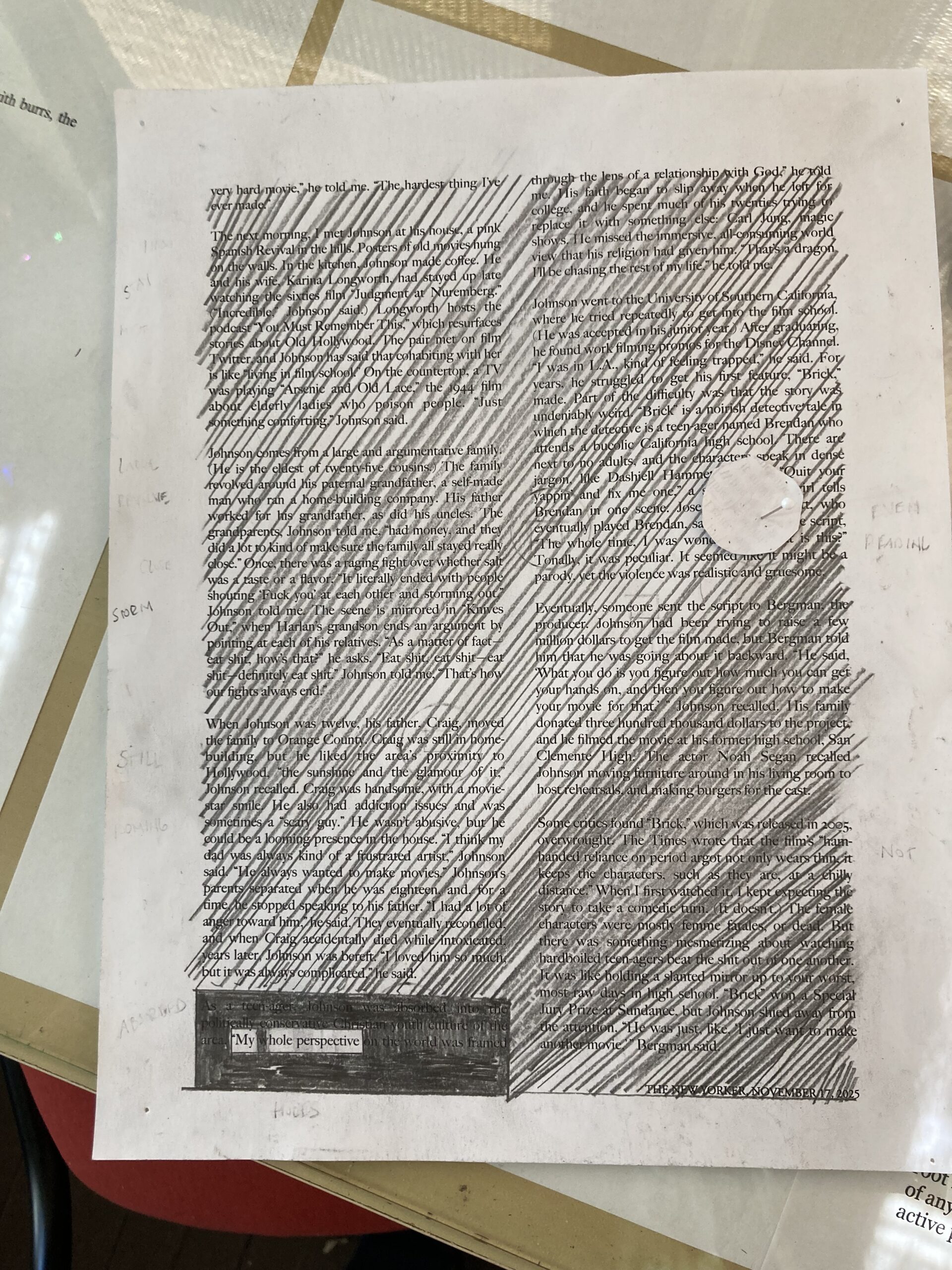
Today, I hope to finish drawing the numbers on Hole 5c (the hole process). I’m also working on Hole 5a (my hole perspective): life on the way to wonder land / a what is this? feeling grows / as text blooms into nonsense This version of the hole is referencing Alice in Wonderland and going down the rabbit hole. Do the images of the falling down a hole and blooms work together? Could I combine a page made dark with lines and thread with blooms of text? For the blooms, I’m thinking of making petals out of cut out words from the essay. I like this idea of texture; the blooms would stick out of the flat essay pages. Blooms/bursts/flares of light with the center of the flower being the word of the poem?
during the run: As I mentioned my ideas to Scott, I had another thought — what if the blooming was like my favorite spring shadows, the shadows of the little leaf explosions on the tips of branches. Instead of making those shadows dark, they would be bursts of white/light against the dark text?
As a place to start, I’m trying out slanted lines for darkening the text. Is this enough? I think I’ll try drawing in some more lines. An additional question: how will it look when all the panels are put together?
My hole perspective, lines 1
The white dot is where some wirds from the poem are on the page and the center of a future bloom.
I found a tutorial for making paper roses. It’s more than I imagine I’ll do, but a starting point for thinking how to create a bloom on the page.
ideas for blooming paper
I won’t use cardstock for my petals, but another print out of the essay. Will it work? Sunday (or Monday) Sara will find out!
I almost forgot. I signed RJP and I up for open swim!! It starts in a month.
7 miles lake superior boardwalk, duluth 37 degrees
An impromptu trip to Duluth with Scott. Our first trip alone since last April when we went to visit my best friend in Iowa. We need more of these. This morning, we ran together above Lake Superior through Leif Erikson park and 3 miles north, then turned around and headed back. As we ran, I told Scott that the theme of the run was water.
10 Water Things
thin sheets of ice on the water! earlier from the window of our room, I had noticed the texture of the water and wondered what was causing the strips of rough water amongst the smooth stretches
water gushing out of a sewer pipe embedded in a ravine
crack crackle crackle the ice sheet butting up against the rocks near shore and cracking — such a cool sound!
drip drip drip water dripping out of some pipe deep in a backyard
the rushing of the creek under the high wooden bridge we ran over
Lake Superior — blue and beautiful, one giant ship, anchored miles from shore
drip drip drip sweat dripping off my face
a pool of water on the floor of the port-a-potty
benches dotted on the bluff, filled with people enjoying the view
almost all of the ice gone — I thought all of it was, until I noticed a few sheets still on the surface as we walked up the steps after the run
While we ran, we talked about our kids and Star Trek and an article Scott had read about fraternal twin girls with the same mother but different fathers. I saw my shadow and started singing Me and my Shadow. Scott asked who had sung it and when I said, I wasn’t sure but I had a version with Frank Sinatra and Sammy Davis on my shadows playlist, he said, Sammy Davis Jr. is his shadow? Yikes. And I said, Jesus, how have I never noticed that before. Then a string of associations: I mentioned that they sang it on a tv special which led to a discussion of the Andy Williams Christmas special, then the kids in it, which reminded Scott of the scared kid on the Ray Coniff Christmas Special who hears a creepy story about a little gray lamb read to her by the guy who played Wilbur on Mr. Ed — Scott couldn’t remember the actor’s name. Scott started reminiscing about watching Mr. Ed with his mom on Nick at Nite, which prompted me to start singing the theme song from “The Patty Duke Show” — because, of course I would.
It was a good run, and a great mental victory. As I said to Scott, I’m excited to push myself mentally to run these longer distances. It is a wonderful feeling to successfully push through these tough moments.
a quick note about grids
Yesterday, while driving back from 2 Harbors to our hotel in Duluth we started talking about the show Alone and then what it means to be “off the grid,” Yes — another meaning of grids! How can I play around with this in my exploration of grids?!
My first run after the marathon! I wasn’t sure how much I would do, but I felt good, so I ran to the bottom of franklin hill and back, and I did it without stopping to walk. I haven’t done that for several months. Almost perfect weather, calm and cool. Wore my bright orange sweatshirt and managed to take it off while running down the franklin hill. No roller skiers or rowers or Dave, the Daily Walker. But shadows and blue water and fluttering leaves.
As I ran, I chanted: I am flying/I am free/and I am where/ I want to be. I felt some soreness/tightness in my left hip, a slight pang in my right foot, but nothing in my knees.
I tried to think about my haunts poem and girls, ghosts, and gorges. I’m trying to put together a draft to submit for a journal that’s due on the 15th. Like in the past, I’m struggling — too many ideas and threads. I keep getting stuck and lost and in a rut of repetition. I started chanting, girl girl girl ghost ghost ghost gorge gorge gorge.
10 Things
red leaves on bushes — or are they young trees? — at the edge of trail, a red that burned dark and deep and seemed to yell out, I am RED!
yellow leaves, like lemon sugar
orange leaves, with a hint of pink
the occasional dead leaf fluttering down
the sound, somewhere above, of a nut being cracked open
most of the leaves are still green
a stinky, sewer smell above the ravine, a faint sourness
a man on a bench — I think it was Daddy Long Legs — calling out, hello!
a quick glimpse of something sitting under the franklin bridge — was it a person, sleeping? No. On the way back up the hill, I could see it better: stacked limestone blocks
2 black garbage bags, full, beside the trash can near the lake street bridge — did they come from the gorge?
26 Marathon Things: r-z
river. Crossing the Franklin bridge near 2 other runners, I heard one of them look at the river — a blue ribbon sparkling in the sun — and say something like, this marathon is hard, but we get to see this! And I thought, yes! this is the beautiful river I get to run beside almost every day!
strong. During the last 10 miles of the race, I regrouped. It was still difficult, but I ran more than I thought I could. And every time I ran, I felt strong. Several of the spectators called to me, you’re looking so strong! you’ve got this. Once when I stopped for a walk break, a kind runner passed me, gently touched my back, and said, I’ve been watching you and you look so strong. You can do this! Keep going!
t-rex. At least twice, I saw someone dressed in a t-rex costume by the side of the road. The first time, Scott pointed them out to me, but the second time I saw them on my own. What’s the deal with t-rexes? (I asked Scott and he said the t-rex has been a thing for several years).
unreadable. It didn’t bother me, because I’m used to it, but with my bad vision I couldn’t read any of the fun or encouraging or strange signs that people were holding up. When Scott laughed at one, I asked what it said. Run bitch!
vikings. In past years, I’ve enjoyed watching football, but recently I’ve lost my love for it, especially for the Vikings who always seem to disappoint. Even so, this year they are undefeated, and hearing spectators calling out the score as we ran, 10 – 0, 20 – 0, or listening to the game while they cheered, was fun and distracting and felt very Minnesotan. Scott’s dad, a big vikings fan, would have loved the season so far if he were still alive. Maybe that’s one of the reasons I enjoyed hearing the score; it reminded me of his dad.
walz. At mile 20, you run by gov. walz’s house. I thought I heard someone cheering there and imagined how cool it would be if it were gov walz. I don’t think he was there when I passed by but later Scott told me that he had been outside cheering on runners.
eXhilarated. At the beginning of the race, during the first 2 miles, Scott was so excited. He talked about running this race again and how pumped up he was. I was happy to be there, but couldn’t match his enthusiasm. I was not exhilarated, I was waiting for the moment when it got very hard.
you can do hard things. So much support from spectators. Most of it straightforward encouragement, you’ve got this, you can do hard things, you’re amazing. Some of it slanted: you’re crazy! or look at you out here running and look at me enjoying my bagel! The one sign I could actually read just said, Why?
zephyr*. While the wind wasn’t gentle, it was blowing from the west. In the first mile, it almost blew my hat off. Then it was at our backs. Then I forgot about it until we reached the east side of Lake Nokomis where it was really blowing. A woman’s signs, stacked on a table, blew off and into the road. I briefly thought about stopping to help her then remembered I was racing and should probably keep going.
*I was struggling to come up with a z. Thankfully Scott thought up zephyr, which means west wind
26.2 miles / 5:35:27 twin cities marathon 50 degrees
I did it! It was hard. I was slow, but I did it. And I smiled and sometimes felt strong and had a deep love for everyone else out there — racers and spectators. I never thought of quitting, even though I knew it was going to be a long day when, at mile 11, I had to use the port-a-potty and felt like I might pass out (a combination of constipation and failing to drink enough water in the first 10 miles, I think).
I never cried or neared my breaking point which, as I write this the next morning, is a little disappointing. It’s been a very difficult fall — one kid deferring their first semester of college, the other shutting down in their last year of college. I was hoping to have a big moment of release. It never came. What held me back? I never allowed myself to push closer to my physical limits. If it felt too hard, I walked.
Uh oh. Writing about my disappointment, then talking to Scott about it, I realized something: I want to do another marathon. I want to dig deeper and break down that wall I’ve built around myself — the one that keeps everyone and everything at a (slight) distance. I want another chance to figure out my fueling and my pooping and to not be afraid that my body will fail me.
I am proud of myself and this accomplishment. And I’m grateful to have made it to start and finish line. And, wow, what a beautiful marathon course!
26 Things: a-h*
*Instead of creating a very long entry with all 26 marathon things, I’ve decided to break it up over several entries.
asphalt. For the first half of the race, the road was cracked and cratered and rutted. A few of the biggest holes were marked with bright orange or green spray paint. The asphalt was the worst at Bde Maka Ska.
brrr. The weather was wonderful during the race, but chilly before it started. So much wind! Most people had on extra sweatshirts that they planned to donate at the start line — me too. A few brave runners were in tank tops. Even with extra layers, it was cold. A woman ahead of me in the port-a-potty line who was wearing running tights and a running jacket was violently shaking.
caboose. I was not at the very end of the race — I finished ahead of 450 people — but I was near the end. The winner finished in 2 hours and 10 minutes. I finished in 5 hours and 37 minutes. That’s a long time for people to be out on the course cheering. The spectators were still amazing, but I could tell the energy was not at its highest level. In the last few miles I noticed people leaving the course, their signs tucked under their arms. Walking through the finish area, volunteers were packing up and most of the food was already gone.
dogs. Some spectators brought dogs. The only dog I recall seeing was a GIANT ball of black fur asleep next to a guy sitting in a lawn chair on the edge of the road. I do remember hearing lots of runners calling out, dogs! or puppies! or your dog is so cute! or hi, puppy!
electrolytes. At the hydration stops, you could grab a cup of water or a cup of electrolytes. Almost always, I grabbed water, but once I foolishly grabbed electrolytes. Yuck! Not sure why, but I was expecting something that would taste like Gatorade. It did not. It tasted like salt water and made me feel sick.
finish line. Miles 22-25ish are on Summit, high above the capitol. For the last stretch, you run down a hill, the finish line in sight. You’re almost there!, people were calling out, you can see the finish line! Yes, I could see the finish line, but it didn’t feel like I was almost there. It looked so far away, and it was, until it wasn’t, and I was done and Scott was waiting there for me.
glimping. After the race, I mentioned to Scott that I would probably be limping the next day (yep, I am), and he thought I said “glimping” which led us both to try and imagine what glam limping (think, glamping but for limps) might look like.
hat. At the beginning of the race, we were following behind a guy in a pink hat. He looked relaxed and smooth and Scott said, look for the chill guy in the pink hat and run like him. We were near him until Bde Maka Ska, but lost track of him when he stopped to use the port-a-potty.
1 mile river road, north to loons coffee 56 degrees
A final shake-out run before tomorrow’s marathon with Scott. My left hip is still a little tight/sore, but I’m believing it will be okay, especially once I warm up and run more miles. It’s supposed to be windy — 15+mph. When Scott mentioned this I replied (and with no sarcasm), great! I can recite some of my favorite wind poems while we run! I am the wind and the wind is invisible. All the leaves tremble, but I am invisible.
Yesterday we picked up our bibs and shirts at the expo and the line to go through security was ridiculously long, stretching the entire length of the River Center then curving through 2 hallways. Scott panicked and briefly wanted to rage quit the line (and the marathon!), but I remained calm and a nice guy behind us started commiserating with us about how long the line was. Scott got over it and the line started moving. Even with the long line, it only took us 15 minutes to get in. Whew!
I am nervous and excited and ready to push at my limits. To be broken open and find out how I respond. To feel grief and delight and wonder and whatever else 26.2 miles will pull out of me.
Finally, fall weather! Wore my bright orange sweatshirt today, which was too warm during the last mile. Ran above on the paved trail heading south, below on the Winchell trail heading north. Sunny, breezy, cool, dreamy. Tree shadows. My left hip was a little sore, but otherwise I felt strong and relaxed. I chanted Emily Dickinson for part of the run: life is but life/ and death but death/ bliss is but bliss/ and breath but breath then life is life/death is death/bliss is bliss/breath is breath then life life life life/death death death death/bliss bliss bliss bliss/breath breath breath breath.
Thought about the marathon and how long it’s been since I ran on the winchell trail and FWA and My Neighbor Totoro, which Scott and I watched last night. Also thought about zombies, which is my theme for October. Mostly I thought about bodies without minds and feeling like you’re trapped in a body and soul-less, indifferent, relentless bodies.
10 Things
heading down to the Horace Cleveland Overlook, I was blinded by a circle of light on the river — so bright! impossible to see anything else
the sharp crack of a squirrel opening an acorn
kids on the playground — laughing, yelling
water trickling out of the sewer pipe at 44th
a few more slashes of red, a golden feeling*
the surface of the winchell trail is in terrible condition — cracked, slanted, cratered
bikers on a bench, taking a snack break
a woman on the narrow winchell trail with a dog, off to the side and facing me, talking on a phone I couldn’t see, saying something about walking after 60
someone sitting on the bench in a blue shirt near the overlook
big trees on the ground, cut into sections and stacked beside the trail
*For the past few weeks, I’ve been seeing trees turning yellow everywhere, but when I mention it to Scott he says that they look perfectly green to him, not yellow at all. Since my color vision is questionable, I’ll take his word for it. I’ve decided to believe that I’m seeing the yellow that is coming, or the slightest idea — the inkling — of yellow that has arrived but only as a feeling or the whisper, yellow. This morning, as I stood at the kitchen counter, about to make my coffee, I noticed the reflection of my neighbor’s tree on the granite countertop. Yellow! Wow, I said to myself out loud, has that tree turned when I wasn’t looking? I looked out the window and checked the real tree: a golden feeling, but nothing more.
Another gold/en thing: Admiring the sun spilling through the treetops, feeling the crisper air, W.S. Merwin’s line from “To the Light of August” popped into my head: Still the high, familiar, endless summer, yet with a glint of bronze in chill mornings. I thought, not bronze, but gold.
some marathon experiments
During and after my run, I had 2 ideas for things to try while running 26.2 miles. First: pick 26 poems I’ve memorized to recite in my head as I run. One for each mile. The problem with this idea is not memorizing all the poems. I’ve already done that. The problem is remembering which poems I picked and for which mile! I imagined attempting to write a list on my arm, which seemed ridiculous and too unruly.
Second: for each mile, notice things that begin with one particular letter. Do this in alphabetical order. So, mile 1 = a, mile 2 = b, etc. I could also make a list of as many words that start with that letter as possible. This experiment might be fun, but it could also get tedious.
In addition to these experiments, I’ve been thinking that I need a mantra and/or a few lines from favorite poems to chant in difficult moments or when I want to be distracted. Yes! I’ll have to make a list today. Of course, ED’s life/death/bliss/breath is on this list!
zombies!
Today is the first day of Zombie month! I’m excited to explore this topic, which I don’t know that much about. Since the marathon is this Sunday and I’m also thinking a lot about that, I’ll ease into zombies this week.
When I think of zombies, I think: relentless, indifferent, hungry, mindless, brainless bodies. And this makes me think of Jaws as a relentless killing machine. Here’s a great poem I found on poetryfoundation:
I don’t realize I’m starved for the color until the blood
washes up on the beach. I’m craving red but still
haven’t seen the creature, just the quick whip and slither
of its tail in the wake —and then there I am,
facing the skin side of the animatronic shark.
The slick apertures of its eyes. The mythic teeth.
The anvil nose beating the deck, cracking windows.
The shark, like the moon, is pockmarked, unstoppable,
never showing its hidden side. Surely space is just another underwater,
the messages we send from satellites a bleeding haze of infrared:
This is my blood type, this is where I keep my body at night,
and I tell no one about the times my body, taking over,
stands waist-deep in the surf, some wild need inside me
ticking into place.
The slick apertures of its eyes. Yes — Jaws’ eyes are the worst: huge, empty, black. Is much made of zombies’ eyes? Anything distinctive, or do they just look dead and empty?
The first day of marathon week. The 15th anniversary of my mom’s death. 11 years after witnessing the marathon near Lake Nokomis, feeling the magic of it, and knowing that one day I wanted to run this race. In 2013, I had been running for 2 years, not that long but long enough to believe that this distance was possible.
The horrible way my mom died in 2009 — slowly, painfully, her strong body prolonging her suffering for more than a year– forced me to confront a truth I hadn’t yet, even though I was 35: our bodies will fail us.
note, 1 oct, 2024: Instead of fail, I first wrote betray, our bodies will betray us. It seemed too strong, but fail doesn’t seem strong enough. Maybe: our bodies can betray us? Or, instead of “forced me to confront” I could say, The horrible way my mom died in 2009, transformed my understanding of my body; I began to fear it, to believe that one day it would betray me.
For me, training for and getting to the start line of this marathon, especially not being able to do so in 2017, is an acceptance of that failing and an expression of deep (and complicated) love for my body.
I love how athletes believe in the body and know it will fail them.
Love/ Alex Dimitrov
Inspired by a writing prompt, I just checked out Marianne Moore’s collection, Observations. Another color poem!
In the Days of Prismatic Color/ Marianne Moore
not in the days of Adam and Eve but when Adam was alone; when there was no smoke and color was fine, not with the fineness of early civilization art but by virtue of its originality; with nothing to modify it but the
mist that went up, obliqueness was a varia- tion of the perpendicular, plain to see and to account for: it is no longer that; nor did the blue red yellow band of incandescence that was color keep its stripe: it also is one of
those things into which much that is peculiar can be read; complexity is not a crime but carry it to the point of murki- ness and nothing is plain. complexity moreover, that has been committed to darkness, instead of granting it-
self to be the pestilence that it is, moves all a- bout as if to bewilder us with the dismal fallacy that insistence is the measure of achievement and that all truth must be dark. Principally throat, sophistication is as it al-
ways has been — at the antipodes from the init- ial great truths. “Part of it was crawling, part of it was about to crawl, the rest was torpid in its lair.” In the short legged, fit- ful advance, the gurgling and all the minutiaæ — we have the classic
multitude of feet. To what purpose! Truth is no Apollo Belvedere, no formal thing. The wave may go over it if it likes. Know that it will be there when it says: “I shall be there when the wave has gone by.”
I do not understand this poem or get many of its references, but it’s about color and there’s something in her mist and murkiness and the dark that is inviting me to read it a few more times.