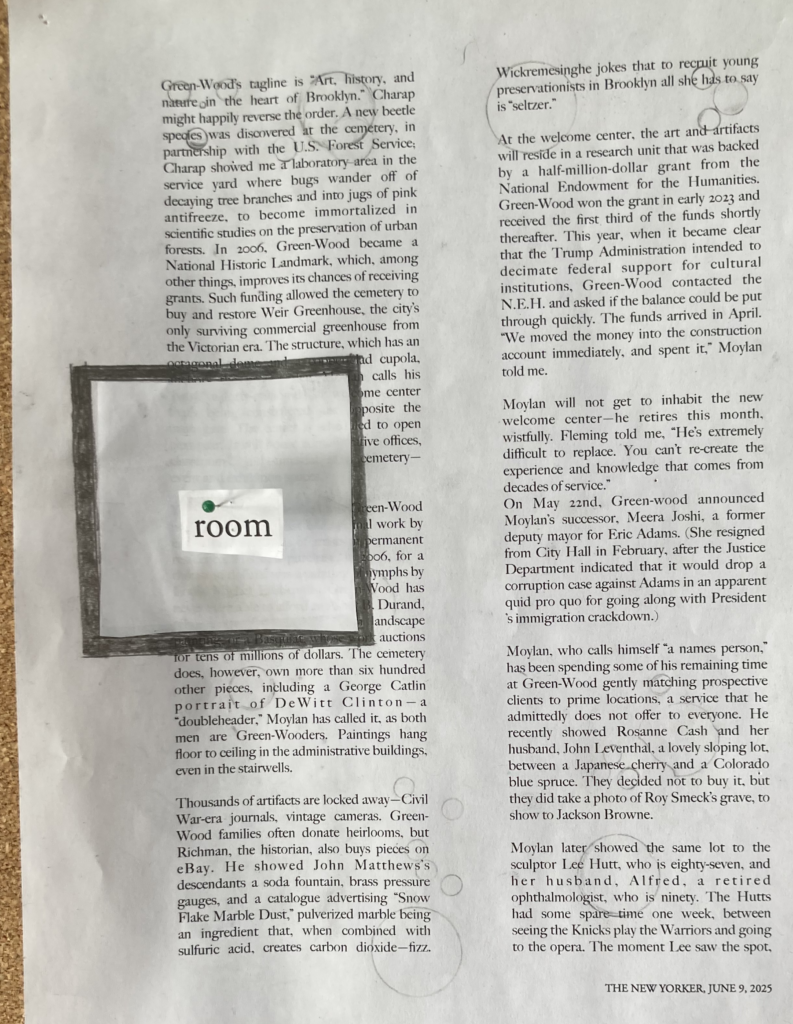
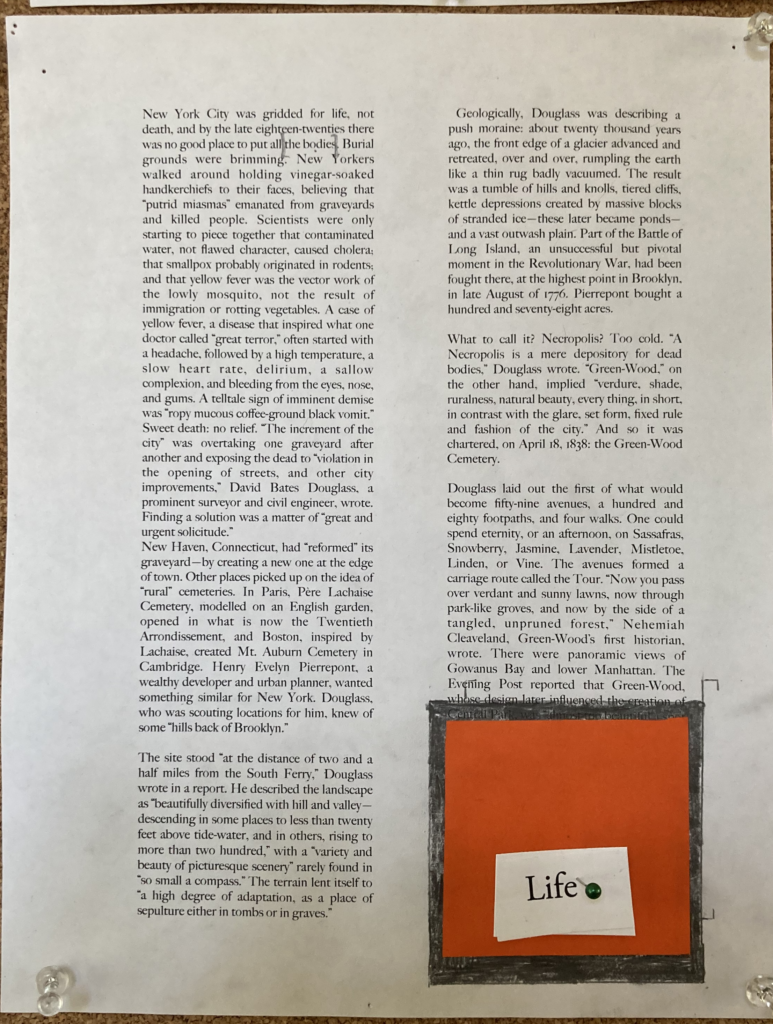
Sunny, cool-ish. Overdressed in tights and my hooded pullover. Everywhere green and gorgeous. I was too dazzled by the green to notice the river. Was it sparkling? I also didn’t notice the falls — how hard and fast were they falling? I do remember giving a quick glance to the creek: gray, open, flowing fast.
When I wasn’t thinking about anything, which was much of the time, I thought about not running too fast and pushing through tough moments
10 Things
a class-sized group of kids down in the oak savanna — running above, I heard their voices, then saw them hiking below the mesa on the winchell trail
passing a guy on veterans bridge — I was about the say hi when I noticed he was talking into a phone
the surrey kiosk is up — today, on a wednesday, it was empty and closed
running down the locks and dam hill, passing a man, exchanging greetings — hello / hi
encountering a series of bikers — spaced far enough apart that I wondered if they were together — the first two had bright headlights on
from behind, the faint noise of bike wheels moving very slowly, finally passing — a woman very upright in a bright yellow jacket biking very casually
explosions of white blossoms on some of the trees lining the trail
a mower at wabun, the smell of freshly cut grass
the parking lot at veterans home was crowded and full
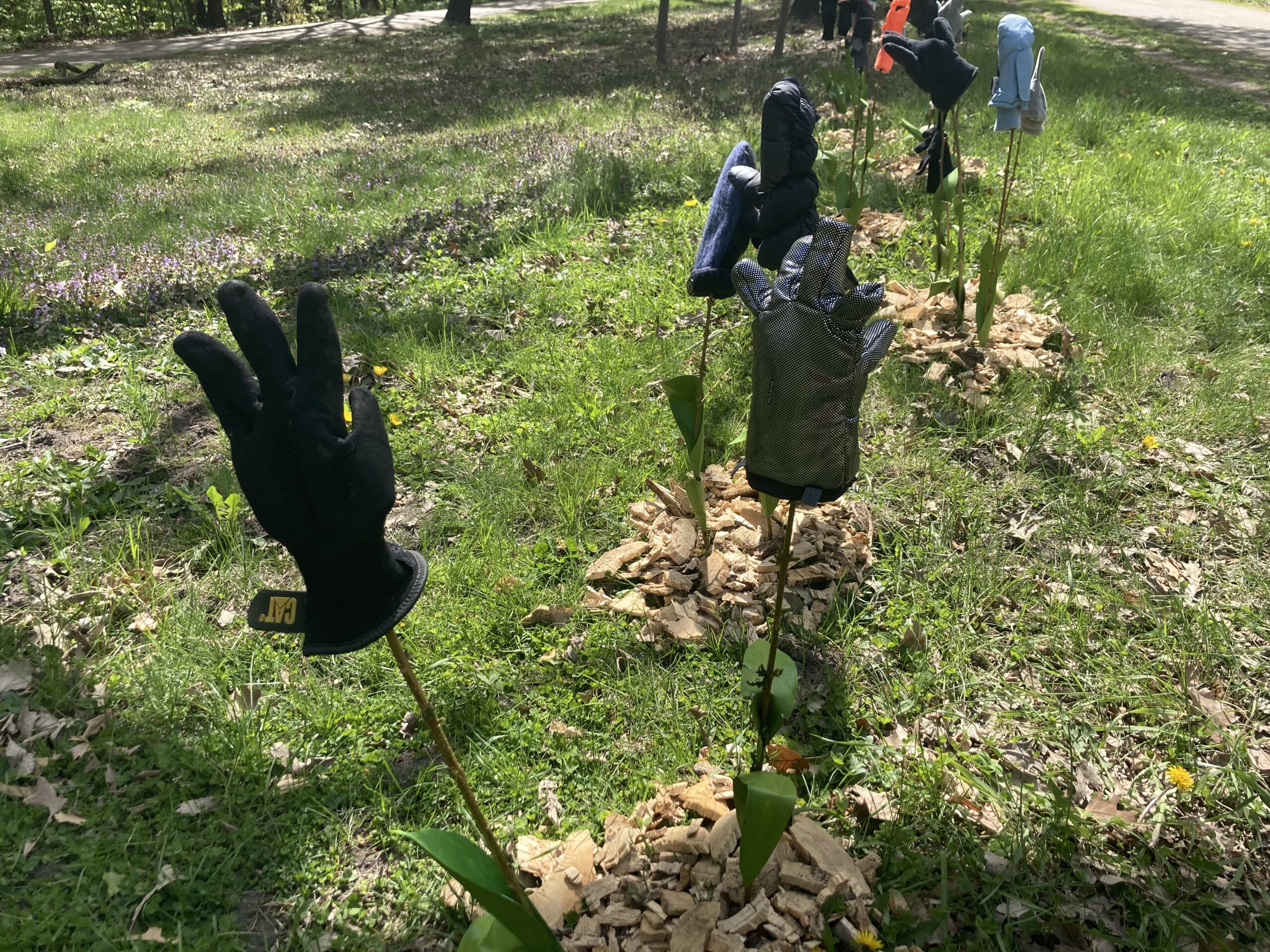
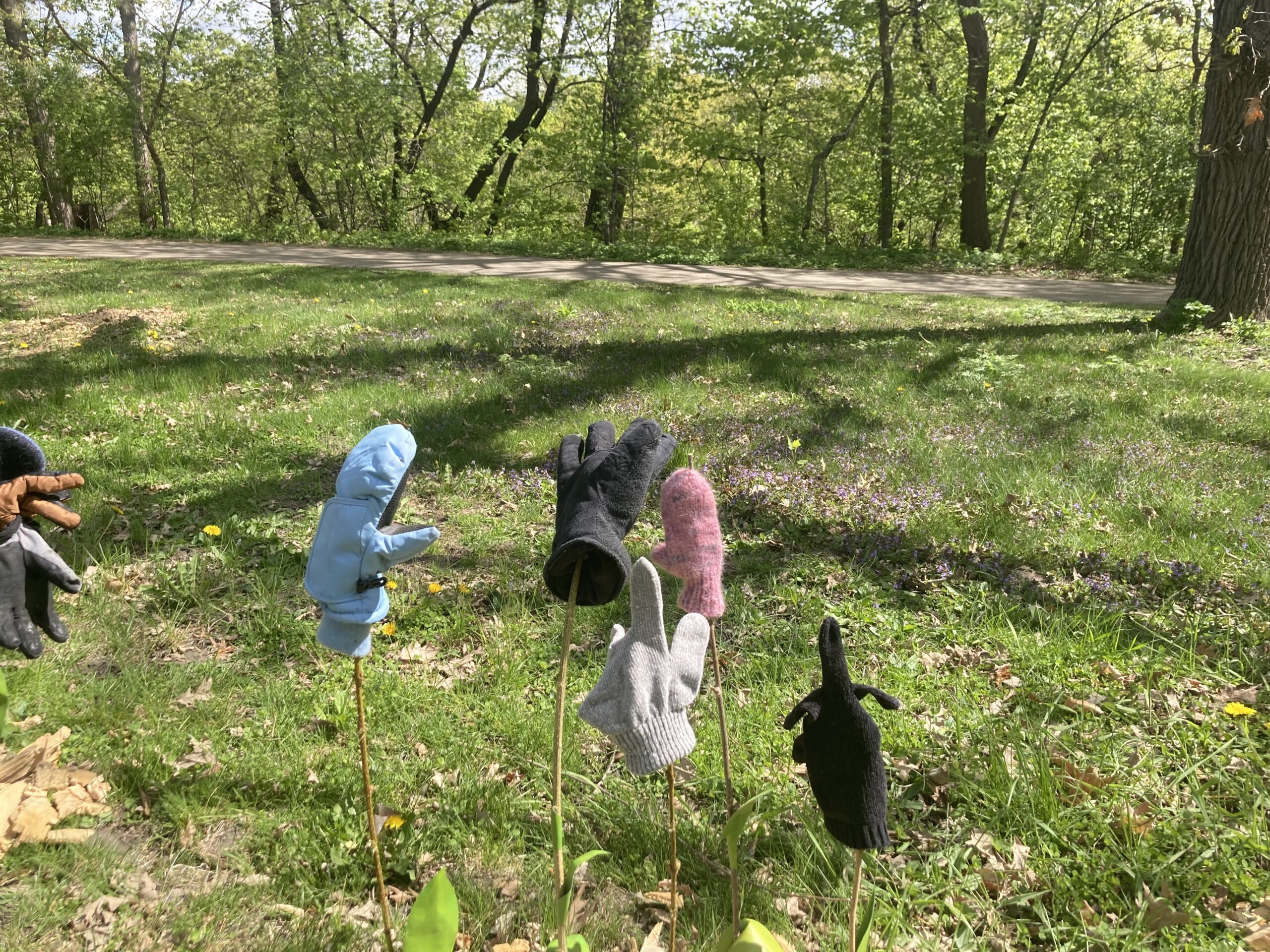
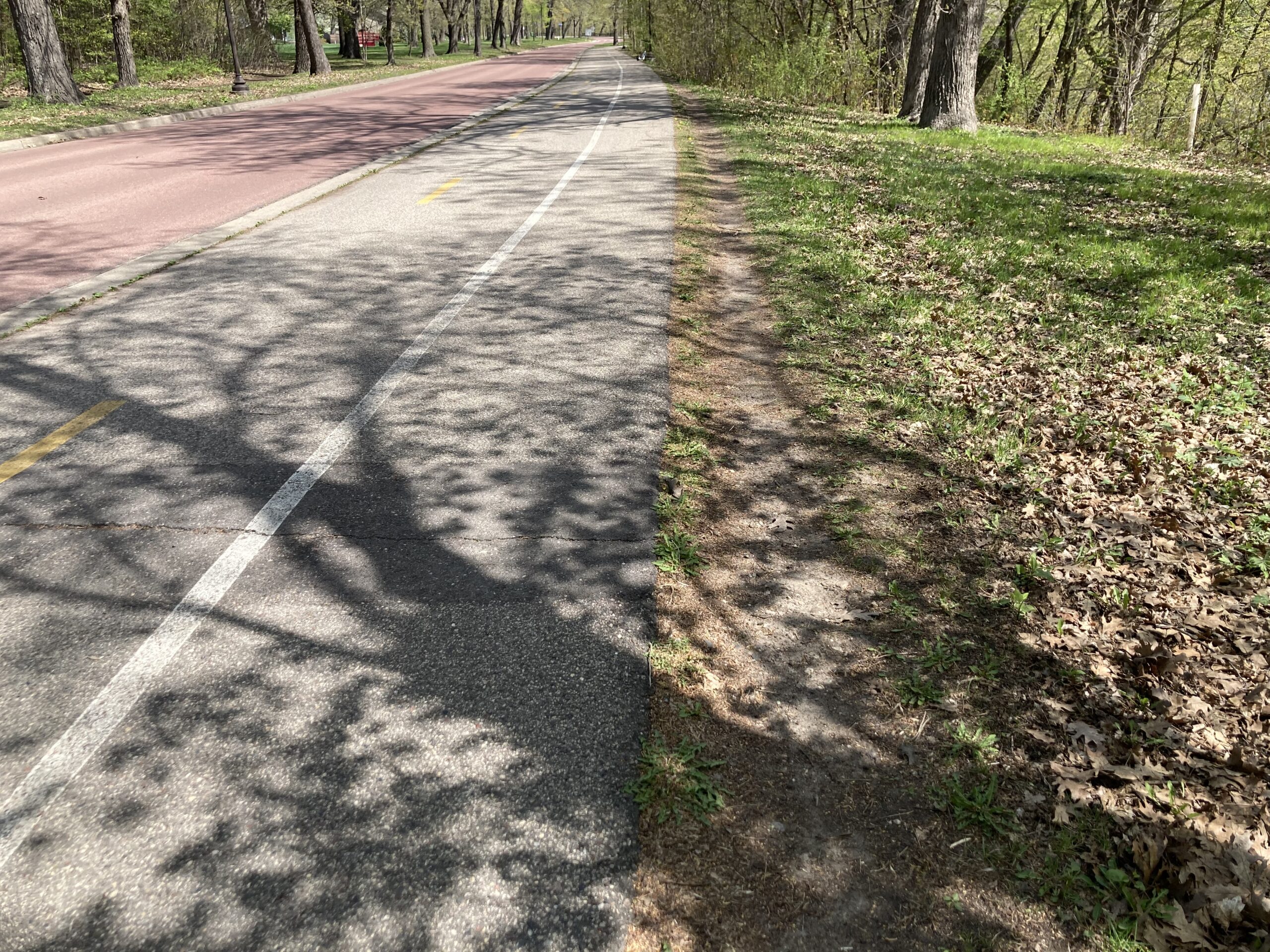
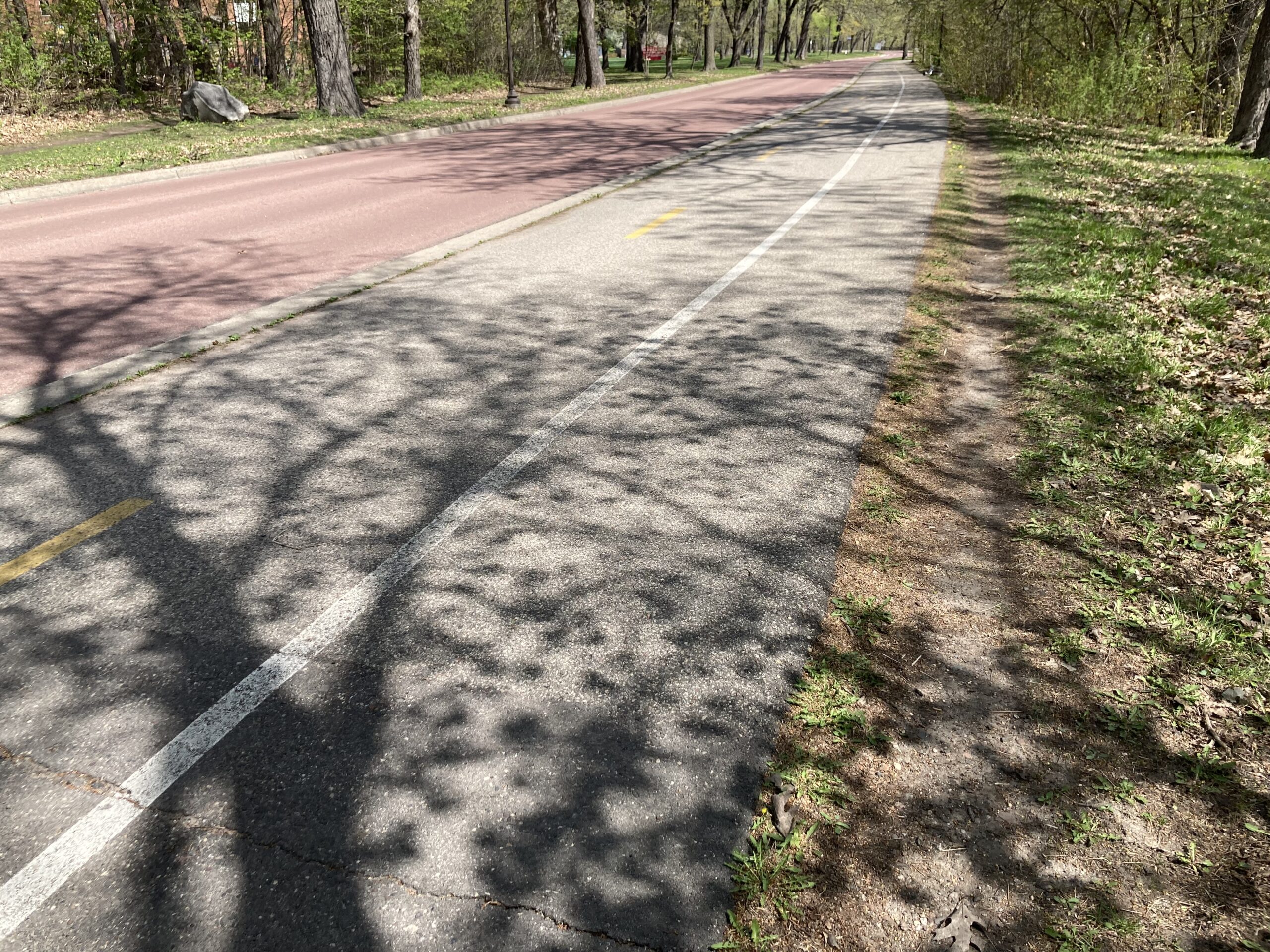
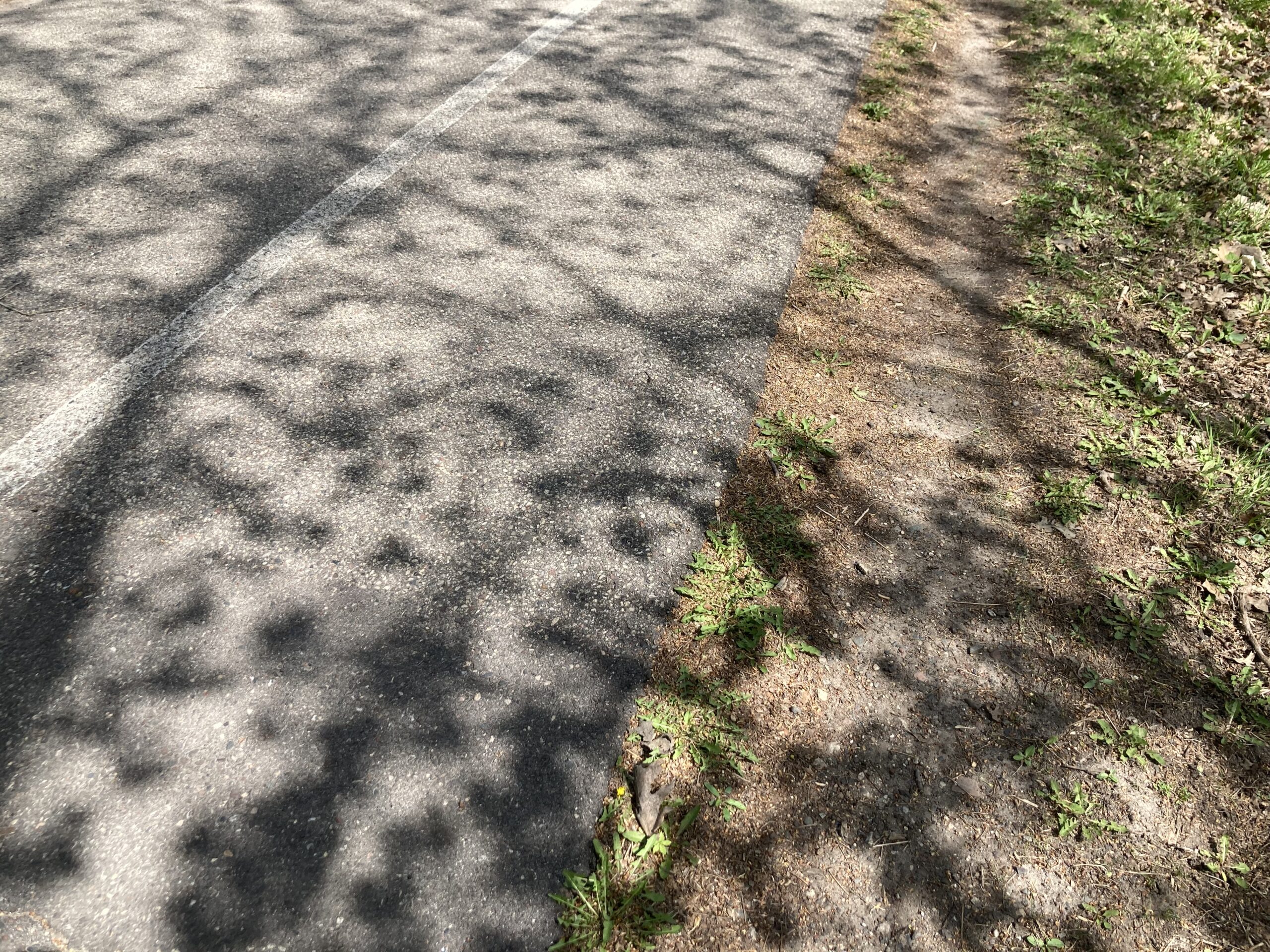
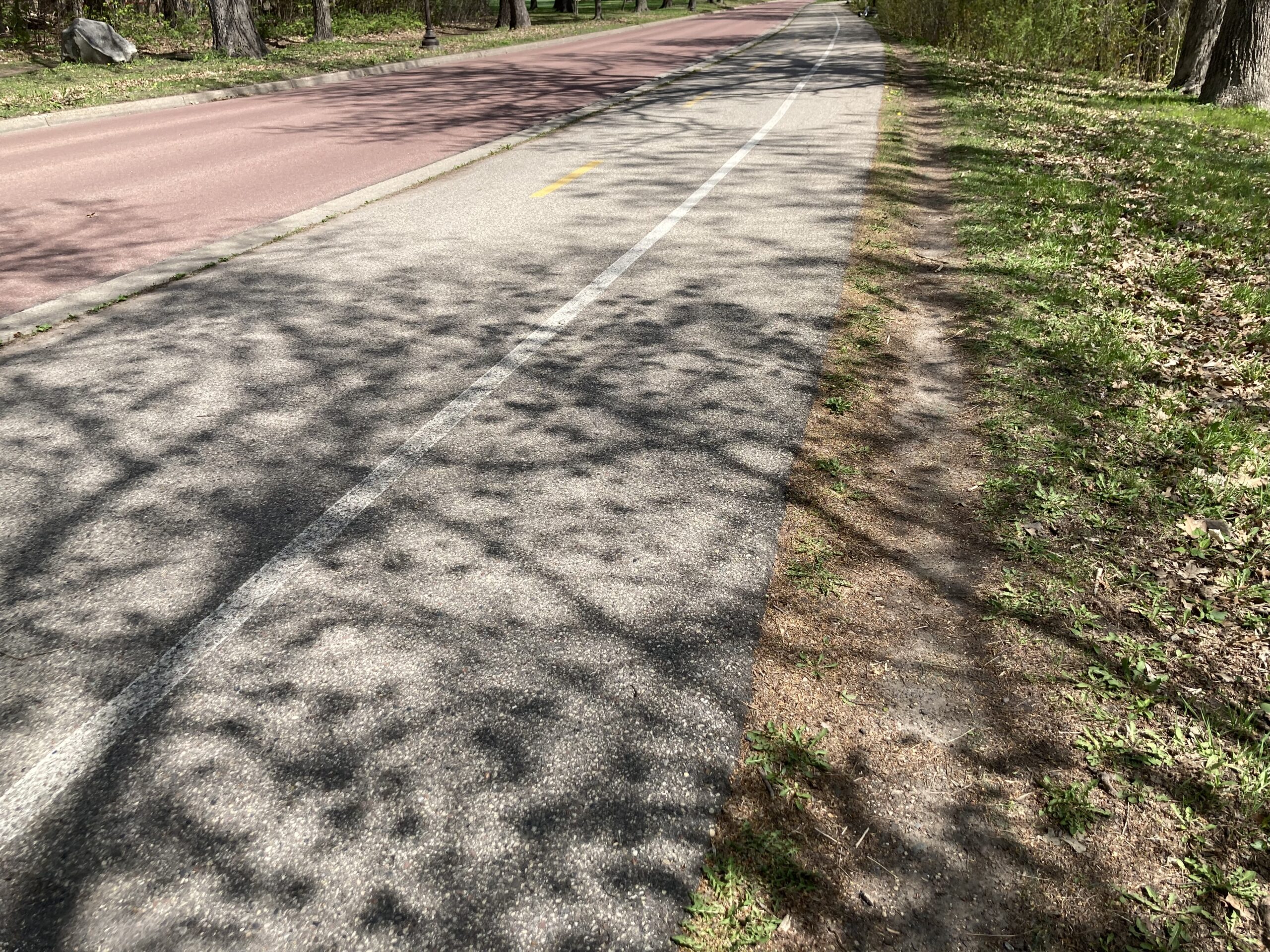
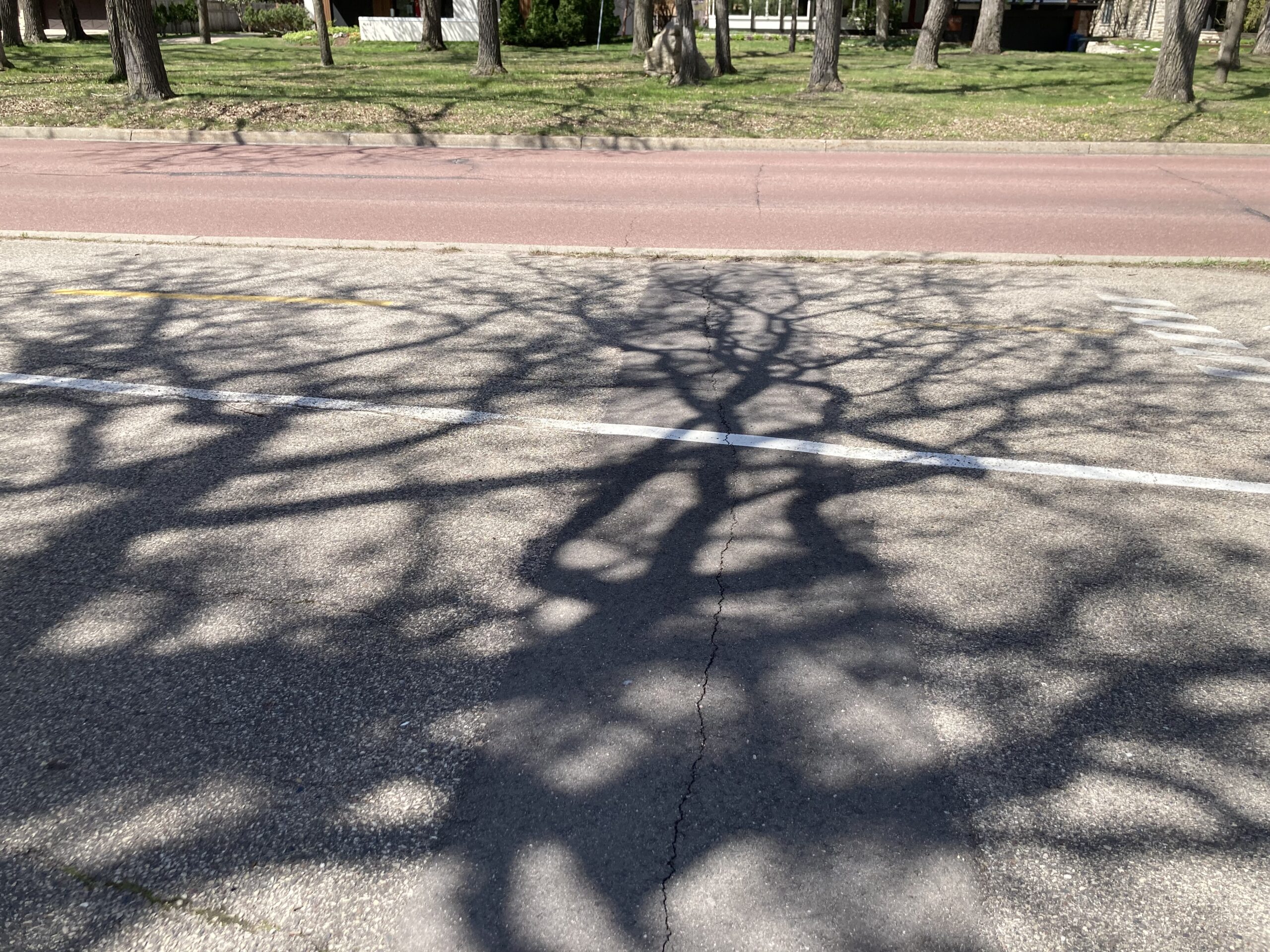
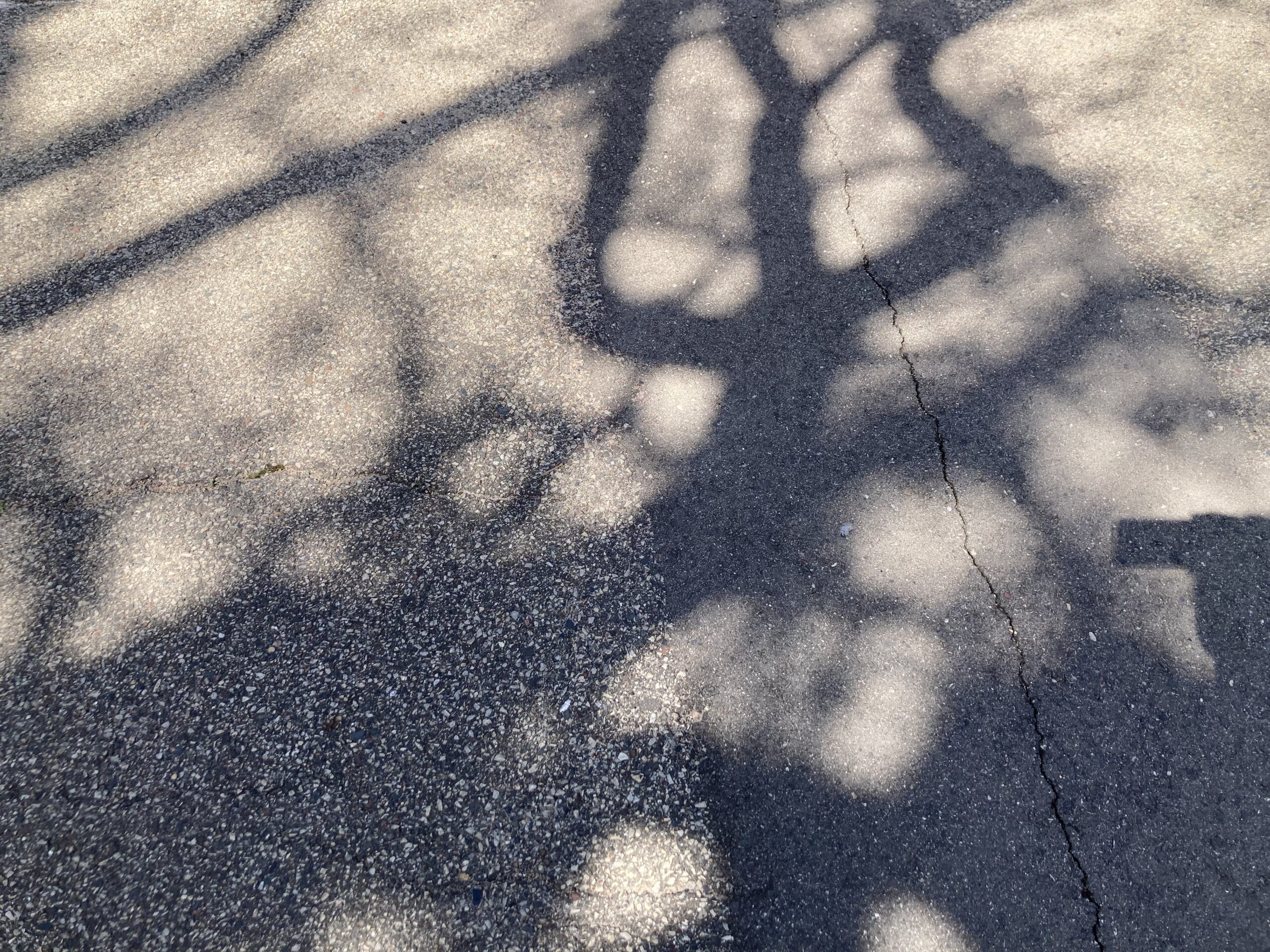
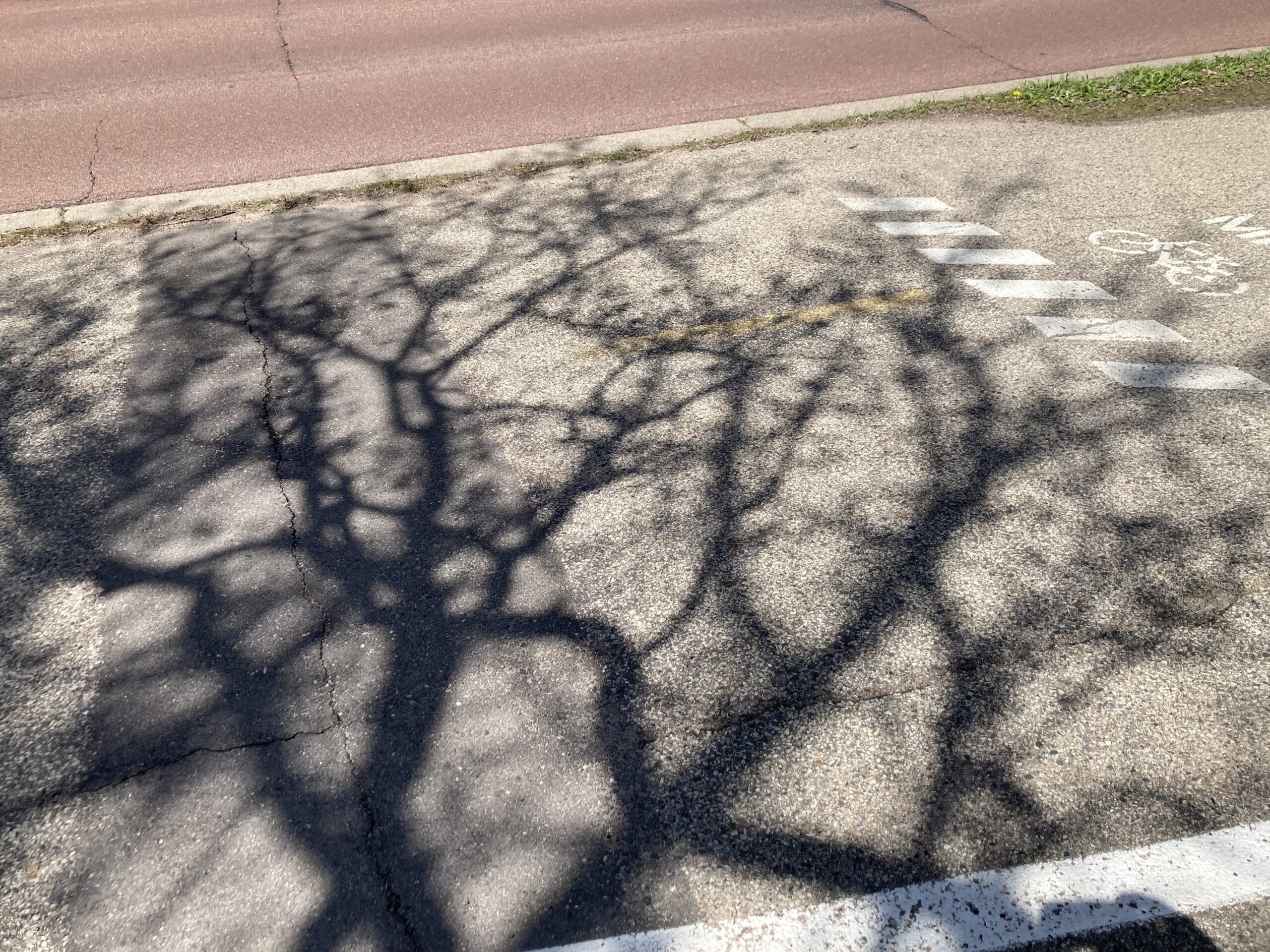
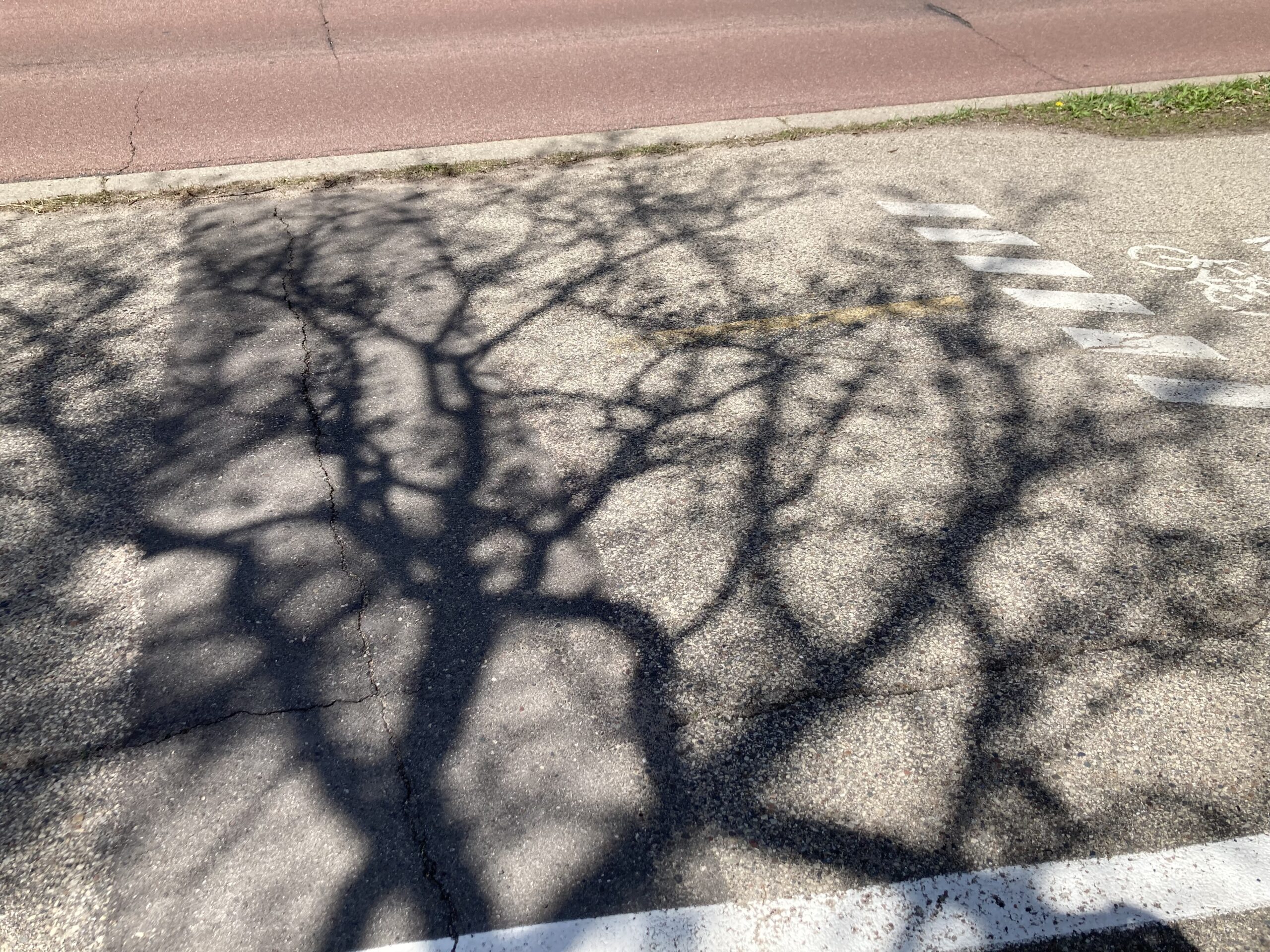
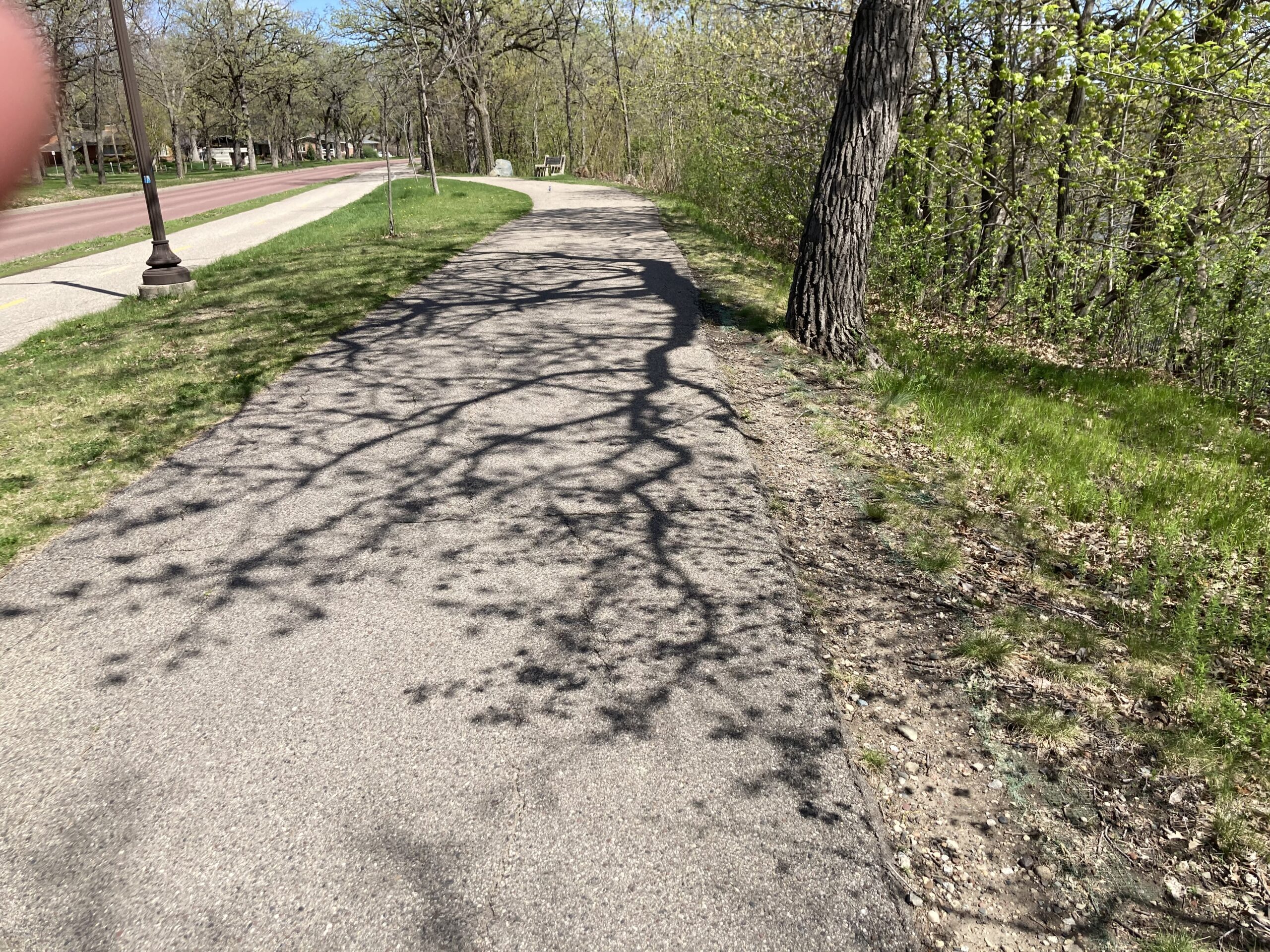
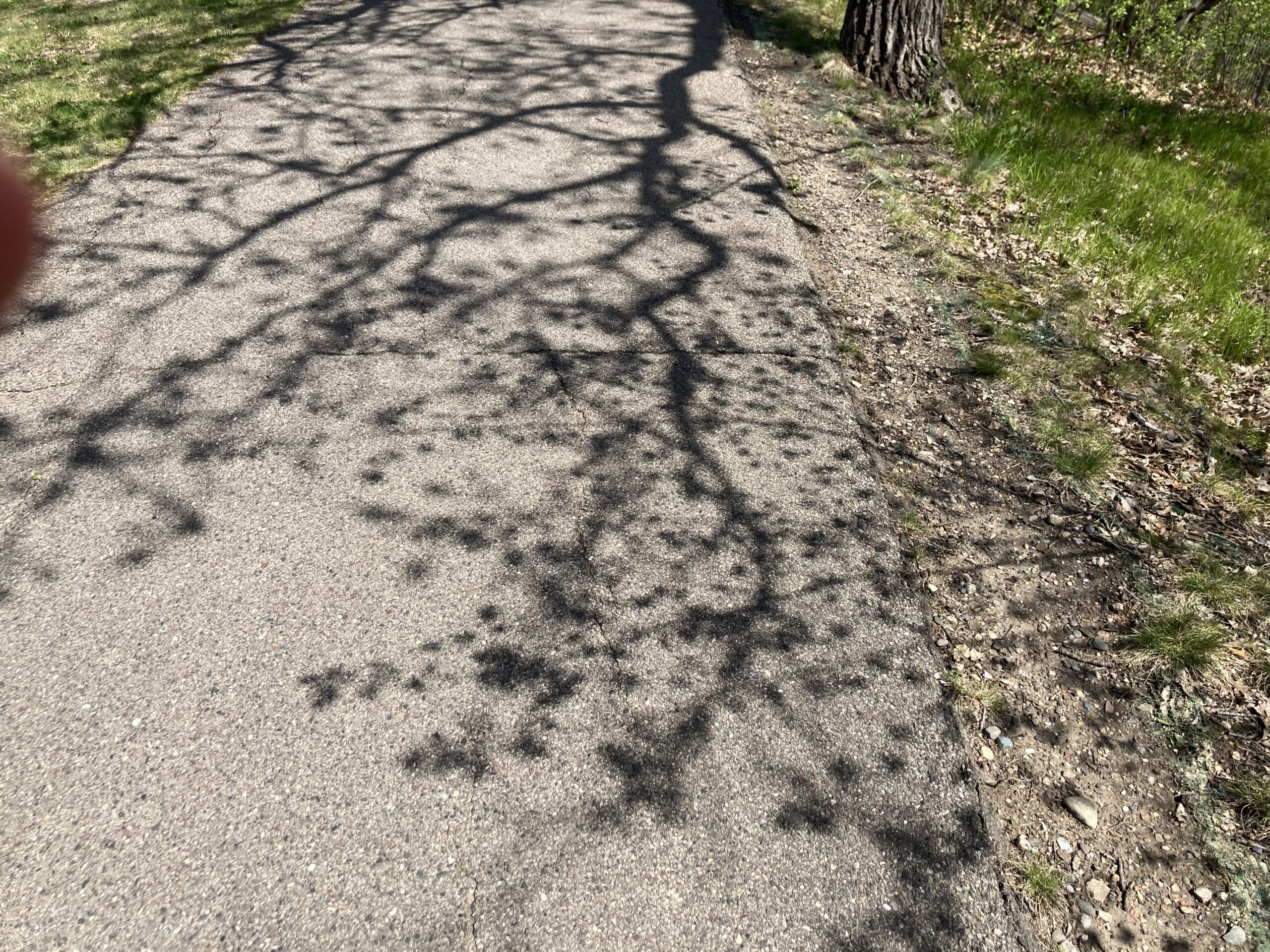
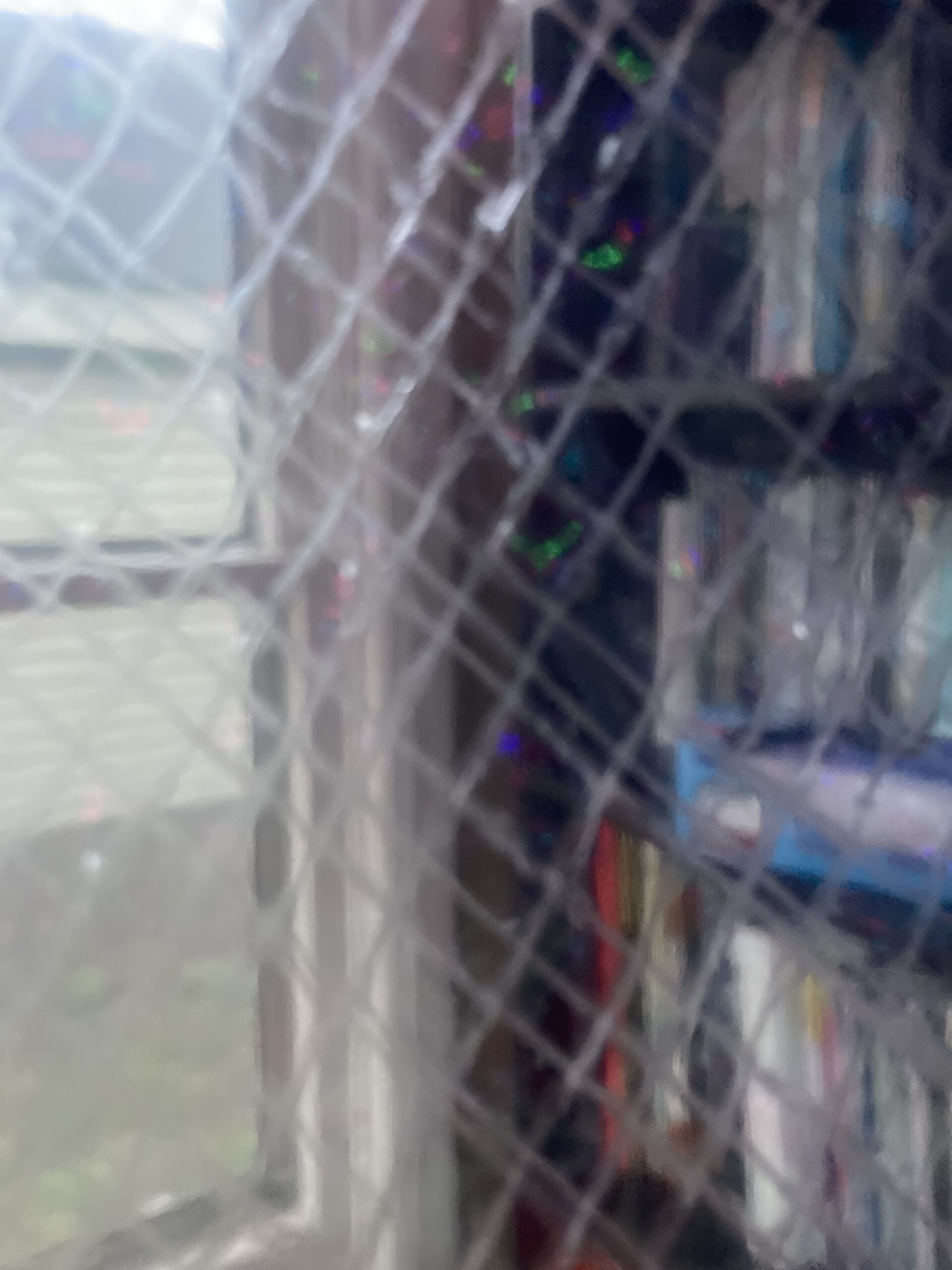
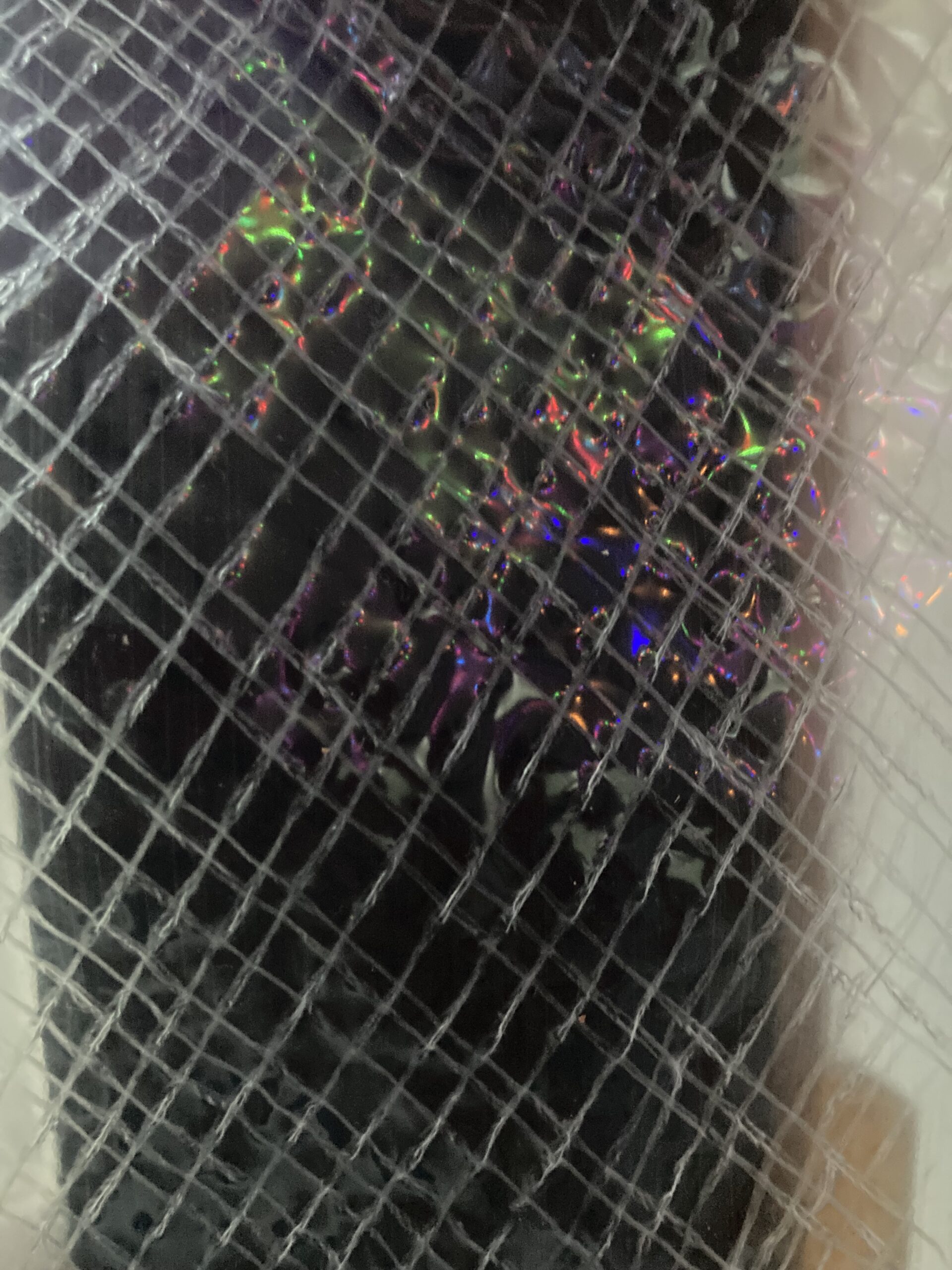
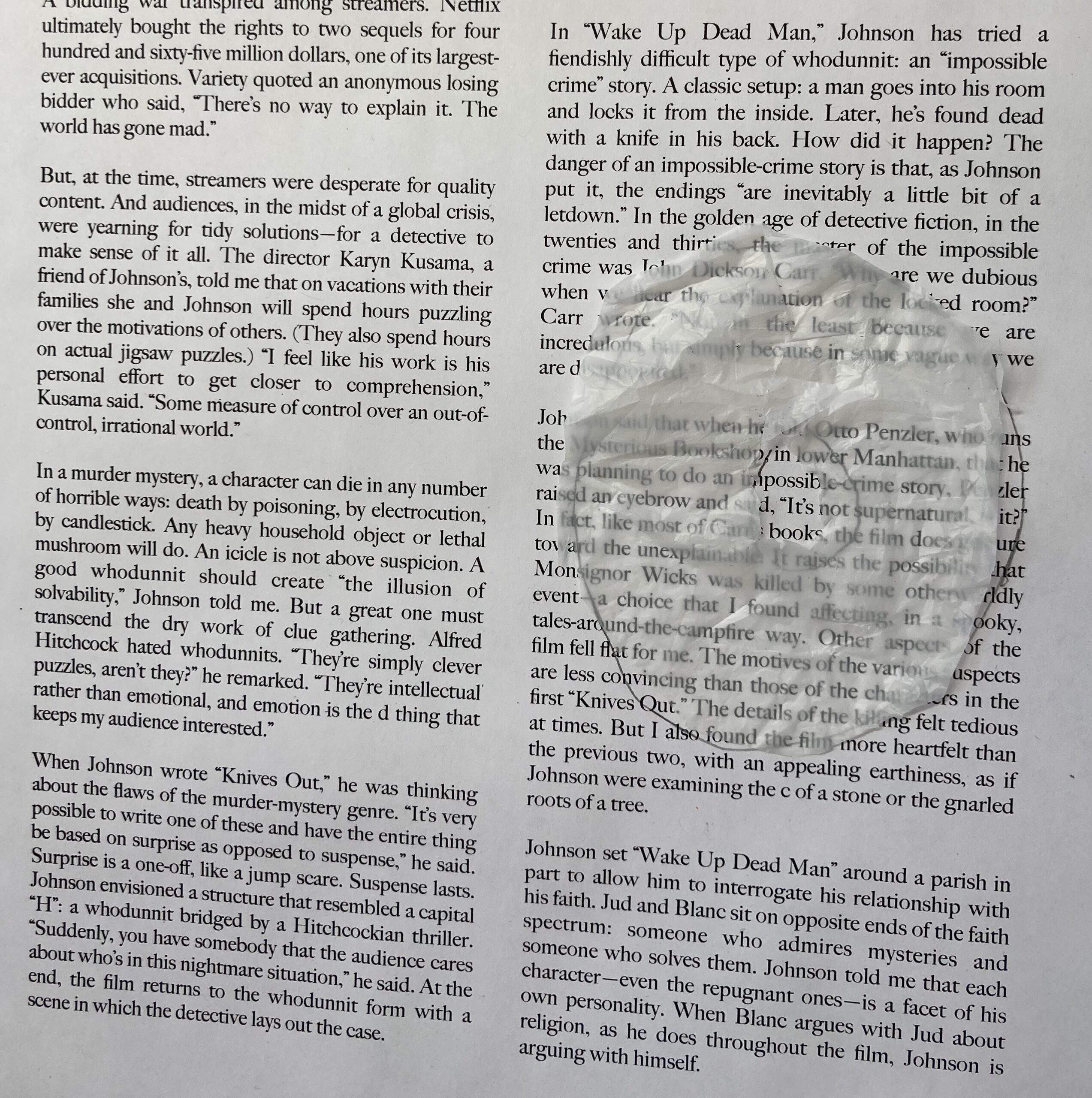
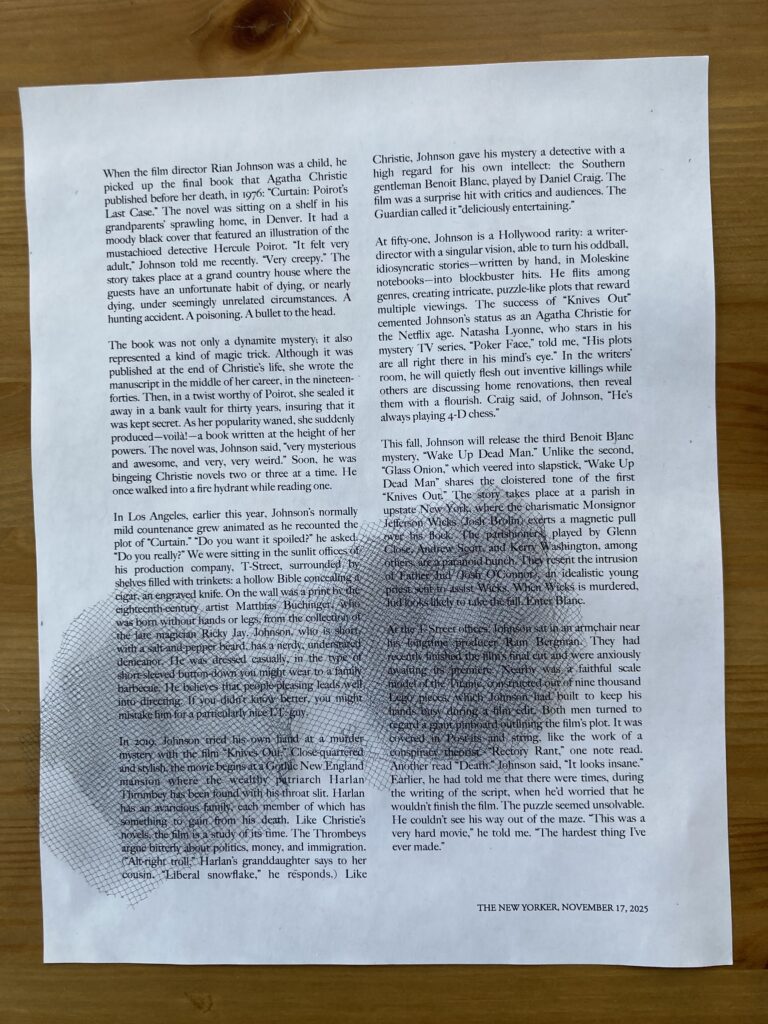
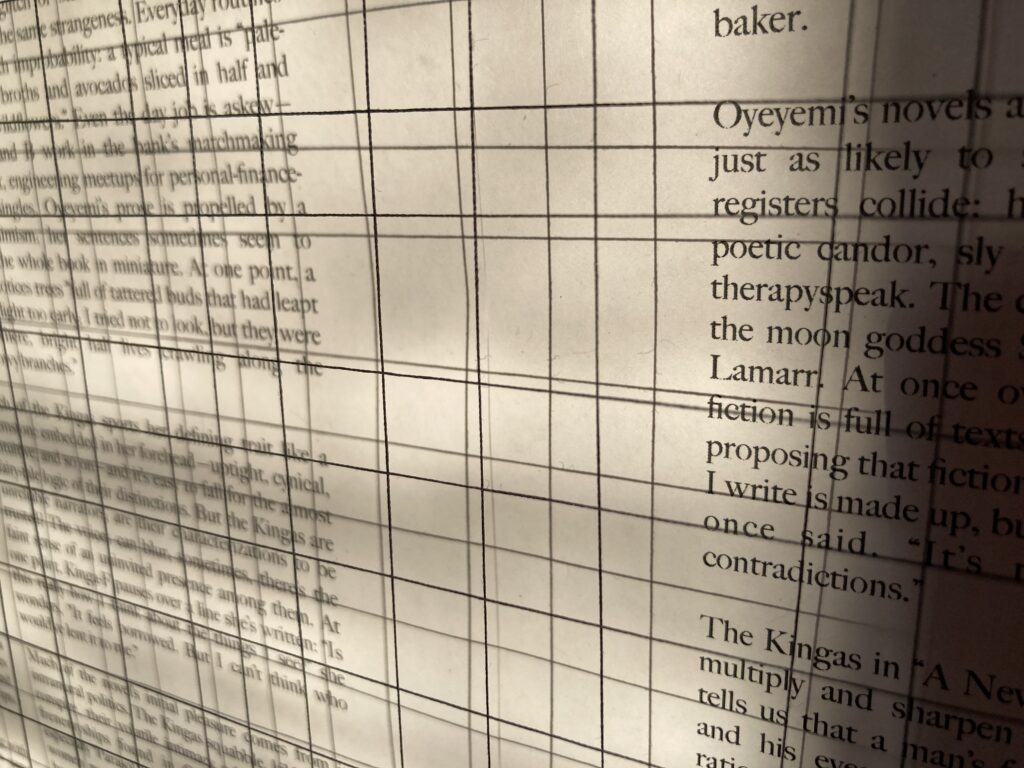
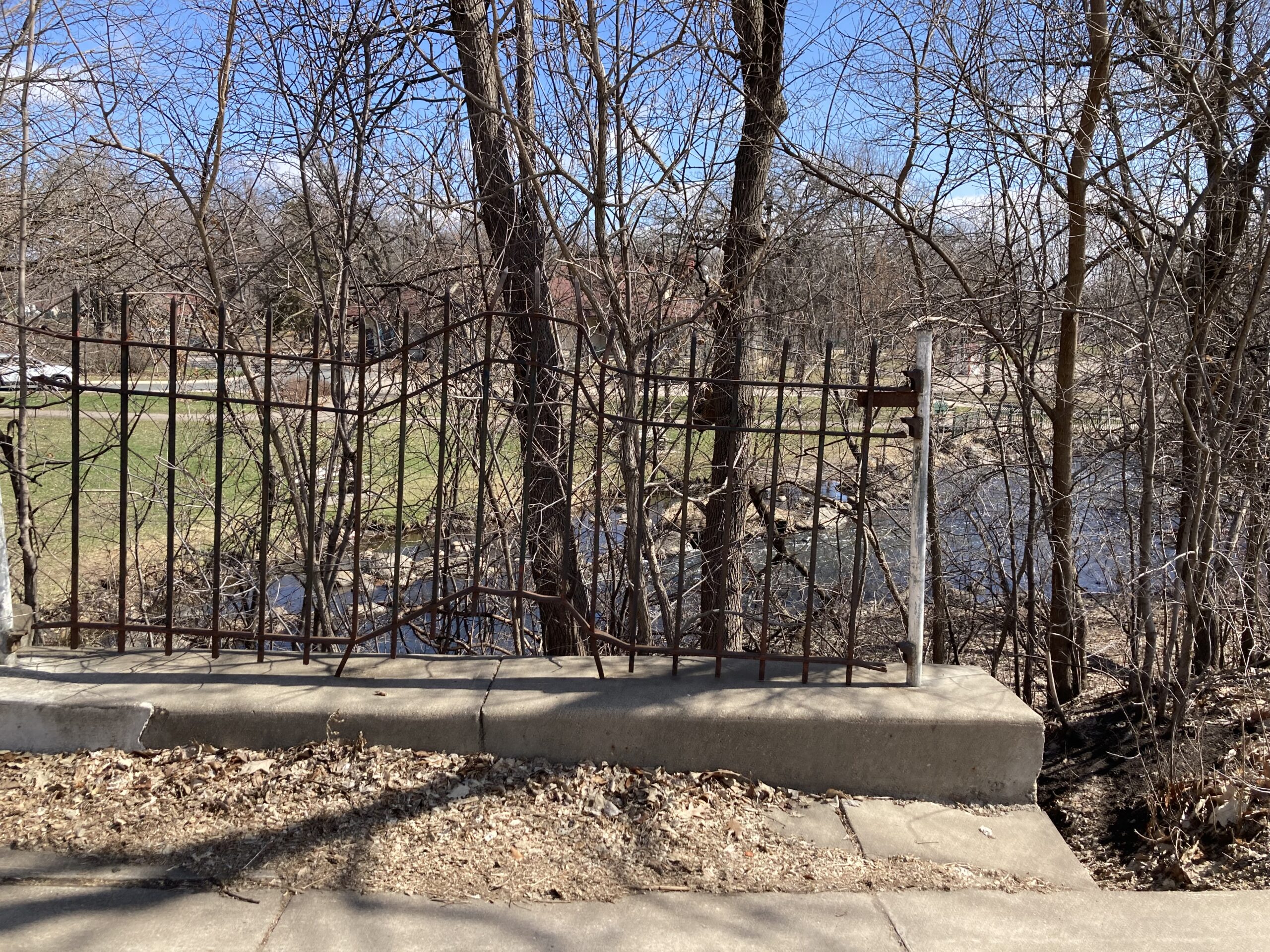
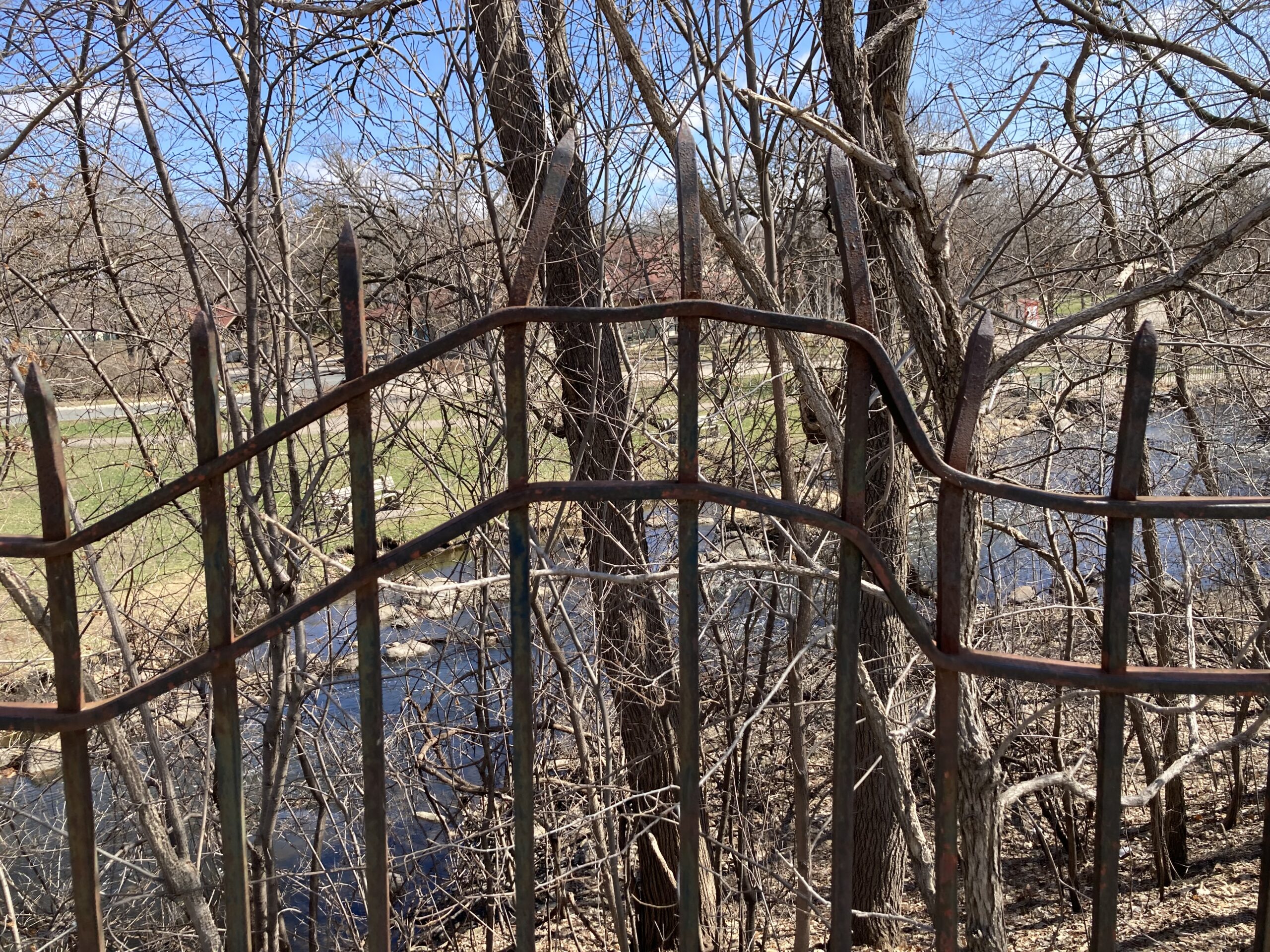
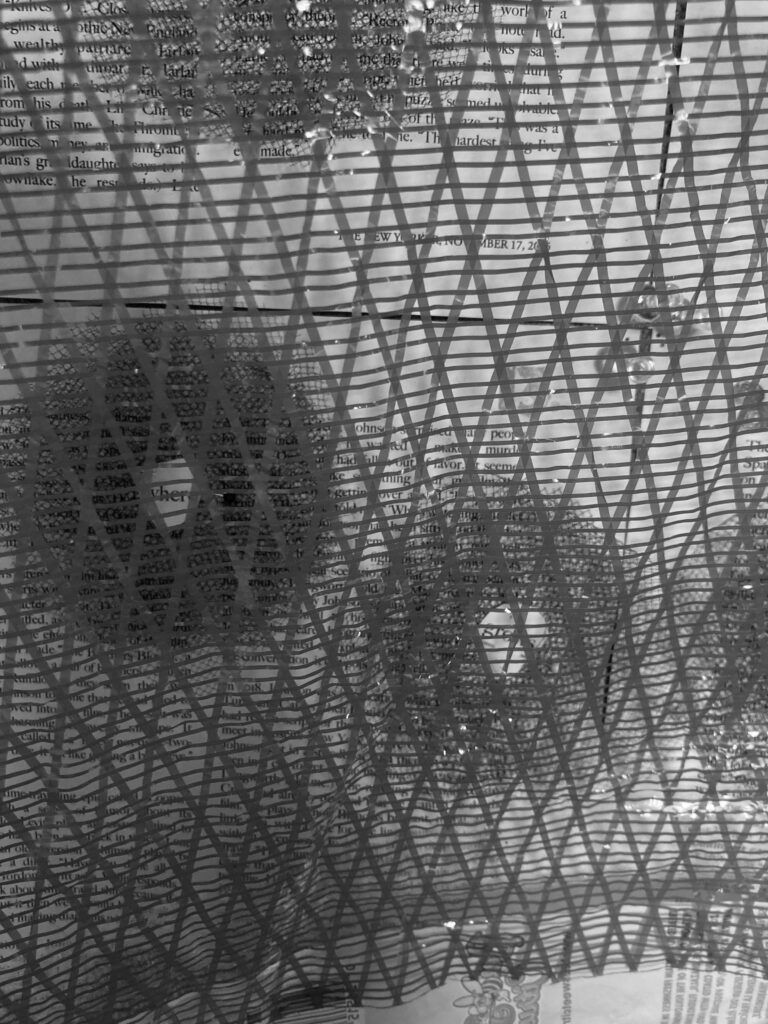
a moment: running just north of the 44th street parking lot — shadows then suddenly more light: a net or web of shadows, some sprawled, some with little circles at the tips (the buds of trees)
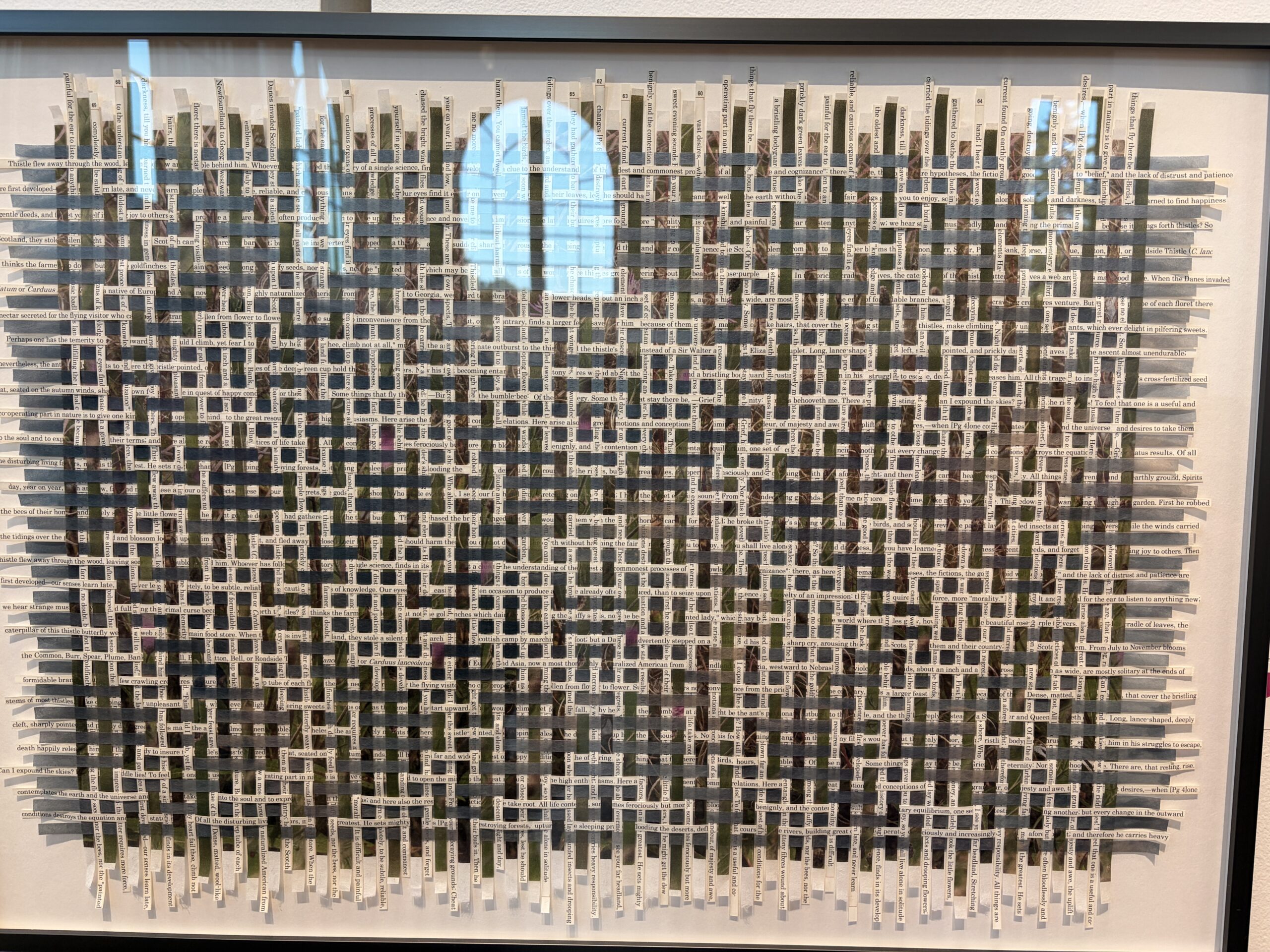
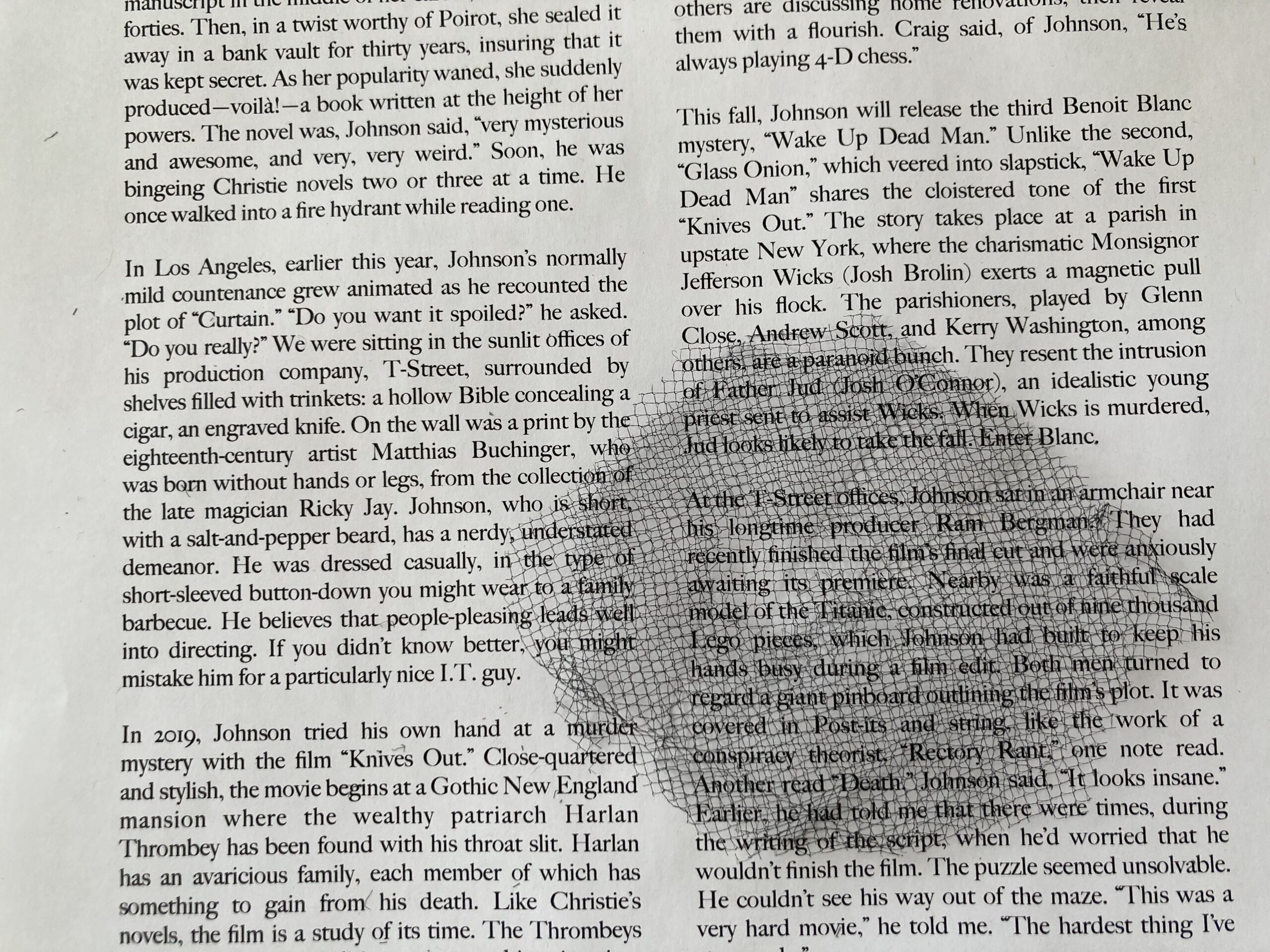
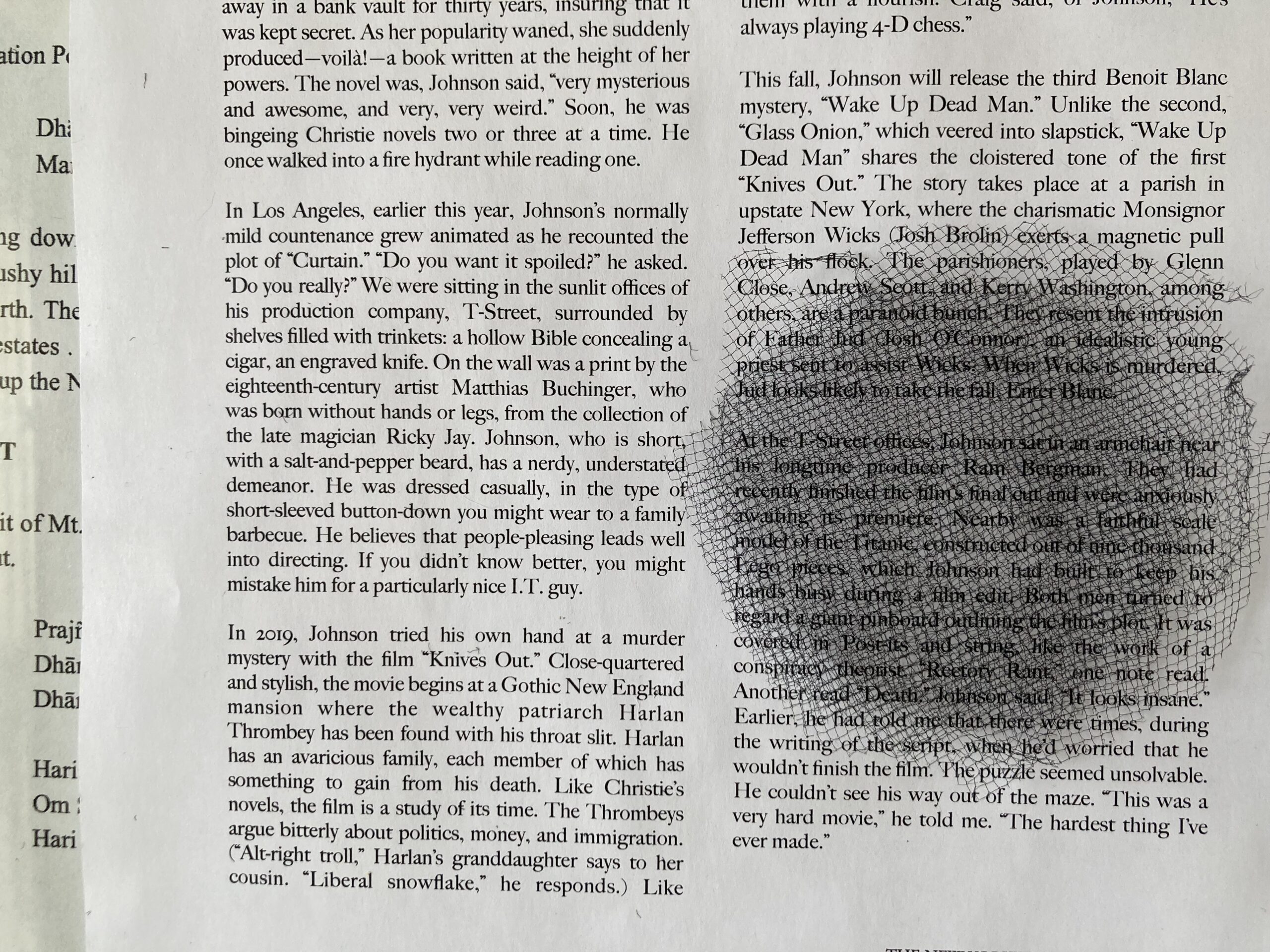
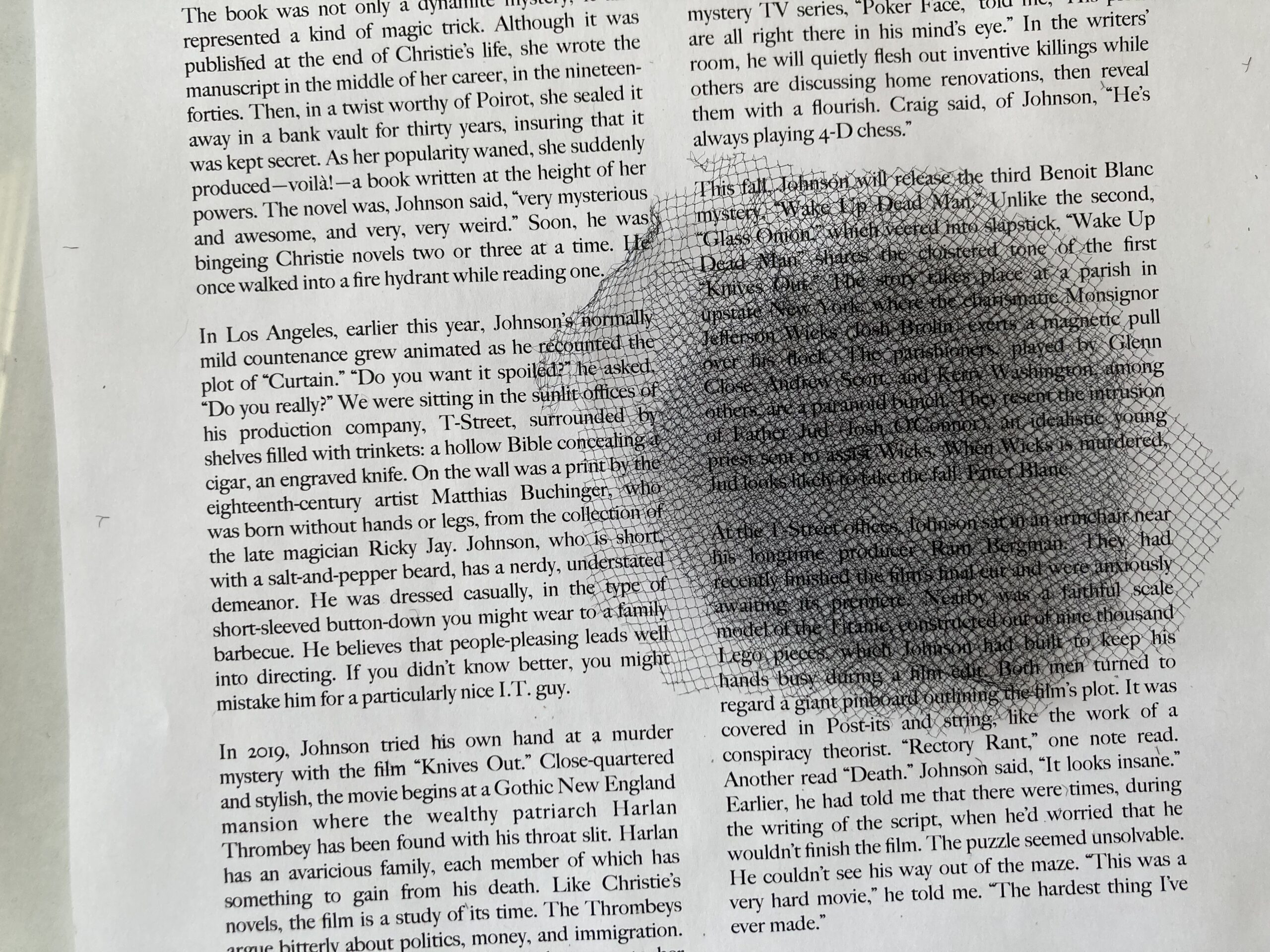
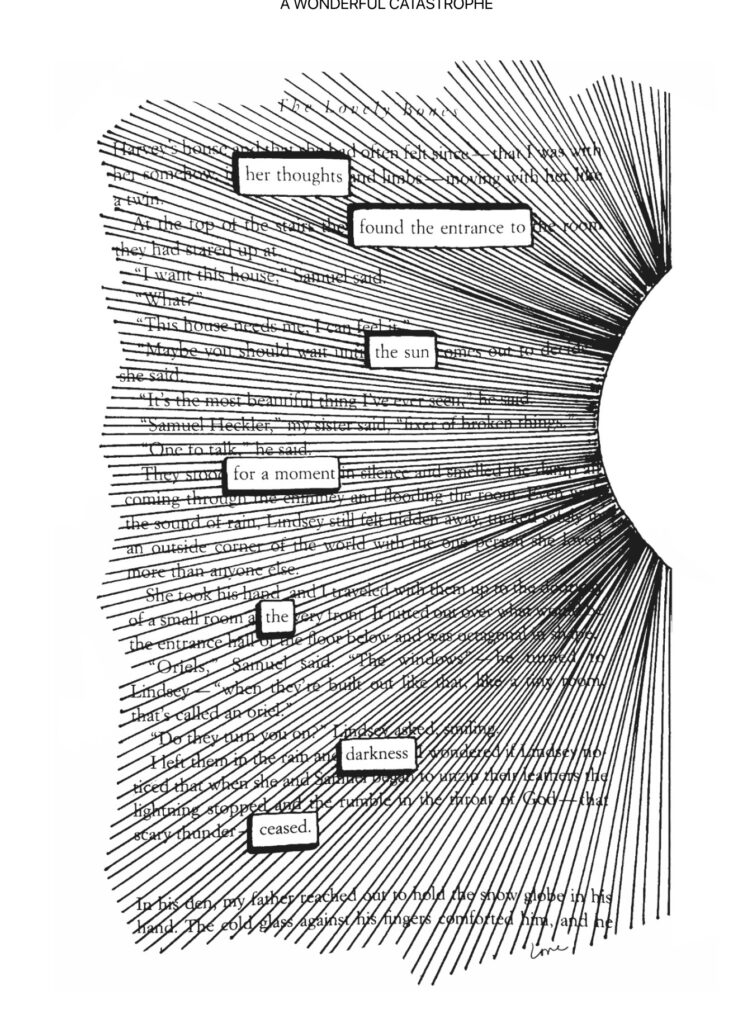
When I saw these shadows I stopped running, pulled out my phone, and took a few pictures. A thought: this net of shadows would be the grid/net obscuring the text of a NYer essay. I’ll have to play around with it. As I kept running, I thought about shadowboxes and silhouettes and playing around with them in a visual poem. I stopped twice more to take shadowed pictures.
12345678910
I decided to post all the pictures that I took so I could study them some more. I like imagining these shadows as a net or a veil, a weaving/gathering of threads/strings/lines that affect my view of what is beneath them. Here it is the sidewalk, on the NYer page, it’s the words.
a thought: I’ve been trying to create neat and precise (well, precise-ish) grids of lines to mimic the Amsler grid, but does that really express/show how I see, or how I feel about, the words as I try to read them? What if I drew a “normal” grid directly on the text and then made the grid elevated above it more slanted, askew, not straight or orderly?
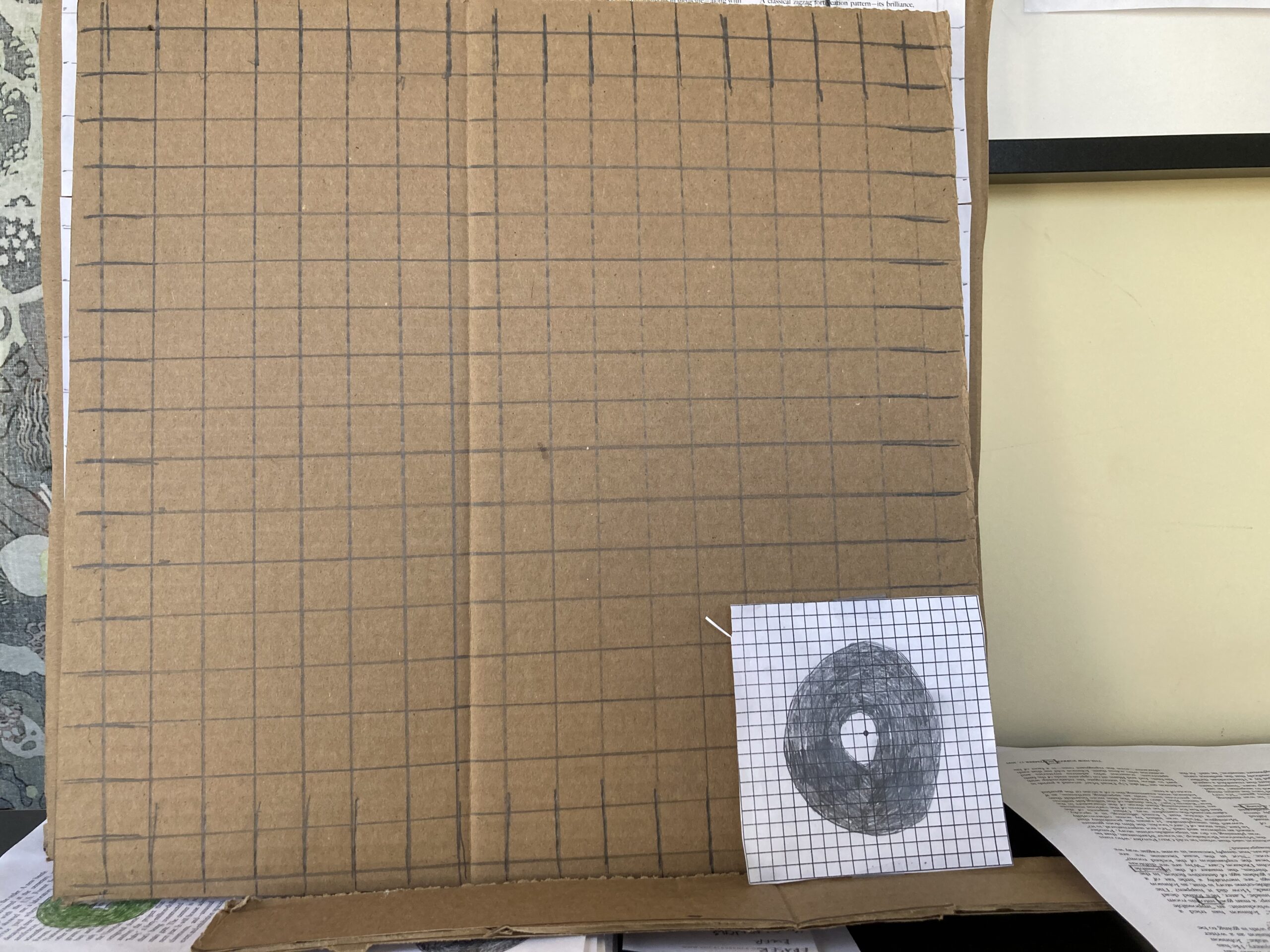
a few hours later: I made another frame out of cardboard and then tried to turn it into a loom that I could thread a grid on. Unsuccessful. Too hard to cut the slats enough so I could wind thread through it. I’m not completely giving up on this idea, but I think I’ll take a break from it. A little discouraging, but that’s okay. I think I just need some time to build up the skills to figure it out.
Before working on my Holes project, a quick walk as the rain hit with Delia the dog. At first only a drizzle, but by the time we made it around the 2nd block, rain. I could barely tell with my raincoat on — a bright green jacket inherited from my dead mother-in-law — and my hood up. For the rest of the day: rain. No heavy storms, just a steady rain.
drip drip drop little April showers
Making
First, more fun with distressing plastic. I “drew” an Amsler Grid on a ziploc bag. Then I draw another one with my blind spot in the center. Then I cut the center of the spot out. I like this technique, and it’s very easy to do, and to replicate!
The perpetual problem with this plastic: it looks cool when I hold it up, but it doesn’t quite work when placed on the page: you can’t see the distressed grid and it doesn’t obscure enough of the words.
At some point, another thought: create a frame out of strips of cardboard. First I tried strips that were 2 inches thick. I slotted the strips to make the frame, then put the distressed plastic with the amsler grid/blind spot over it. I placed this frame over one panel of Holes 4. I liked it, but it was messy. And difficult to read. I wondered, would making a thinner frame help? I made one with 1 inch strips and added a different distressed Amsler grid. Still messy, still not quite right.
assessment: I like the idea of the frame, but I need to work on the execution — learn to cut the cardboard more neatly. Also: I need to make the words just a little more legible — if not, the actual words, the shadow of their presence.
1234
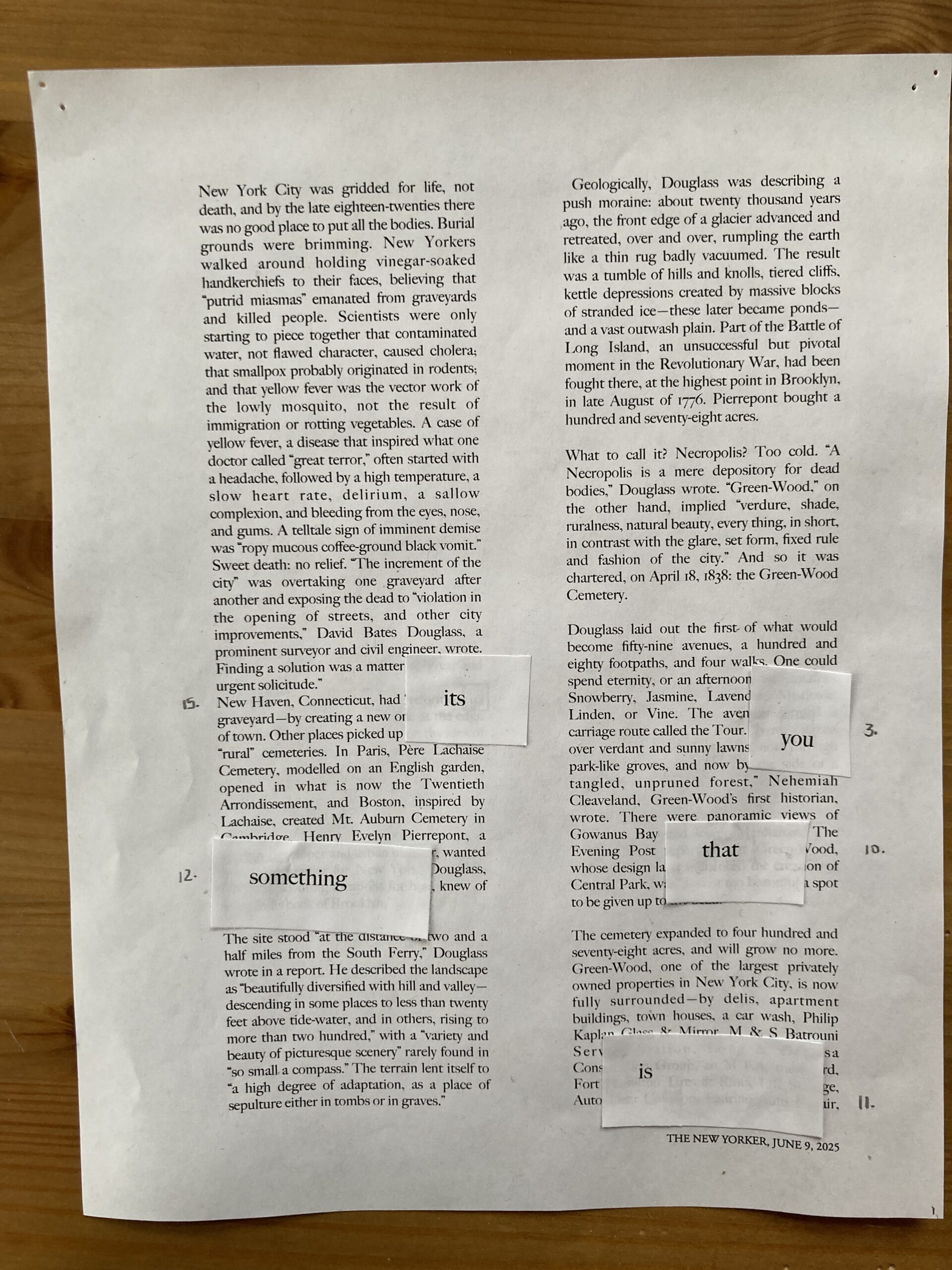
image of poem panel — I like how the words of this panel create their own poem: it‘s you that is something (yes, I know that it is technically its and not it’s, but I don’t care)
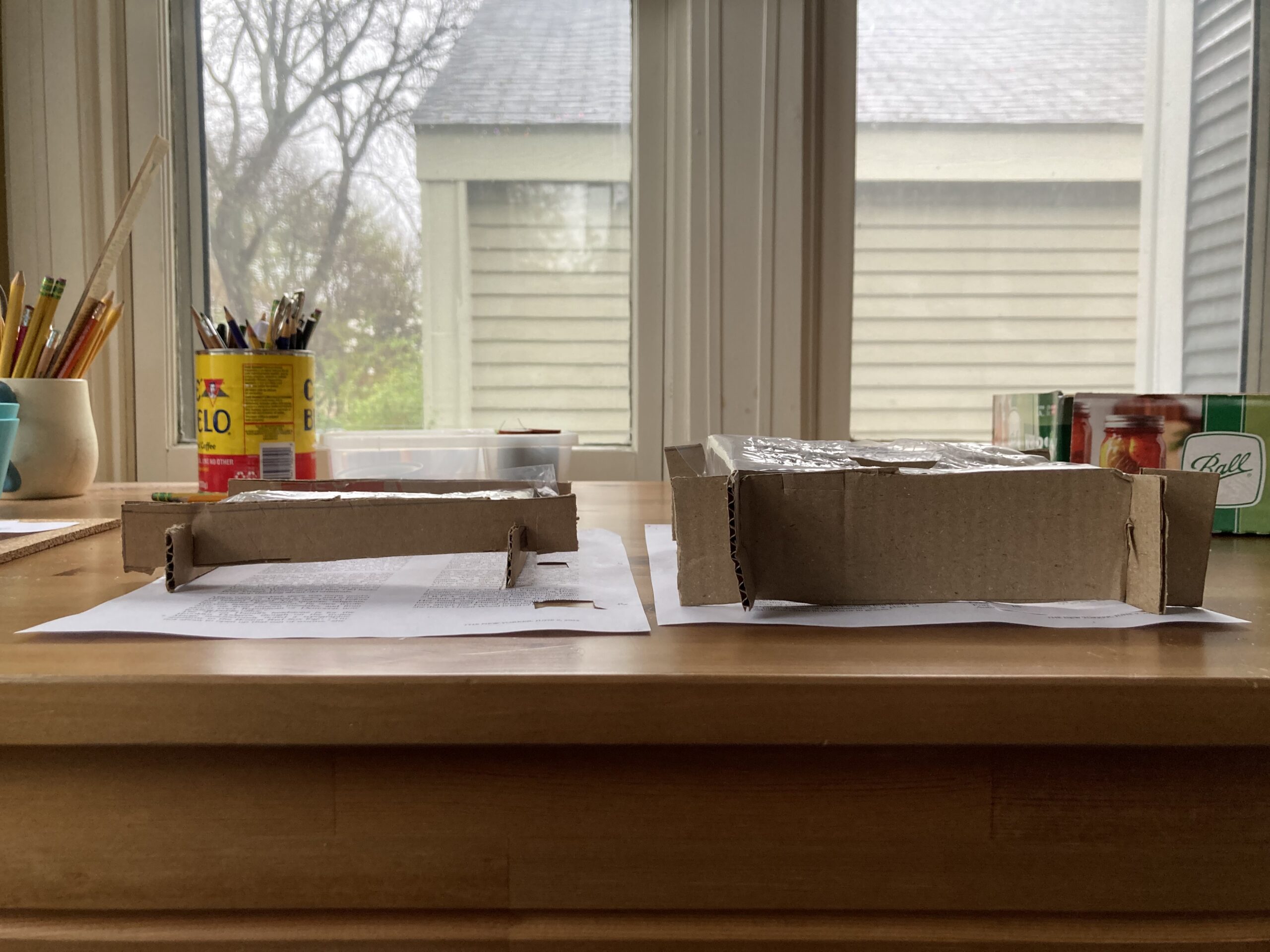
side profile of 2 frames
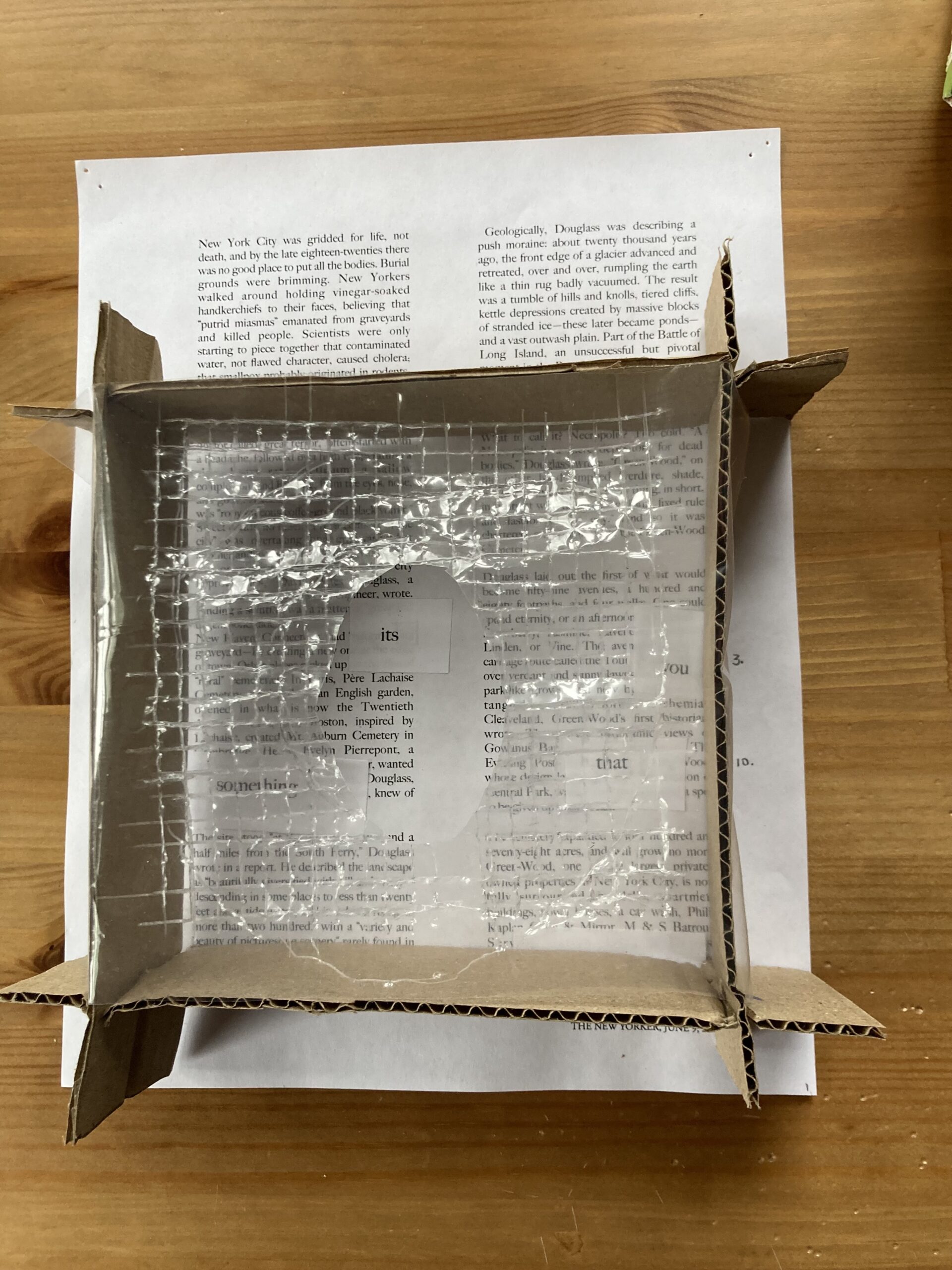
the first attempt with the thicker frame
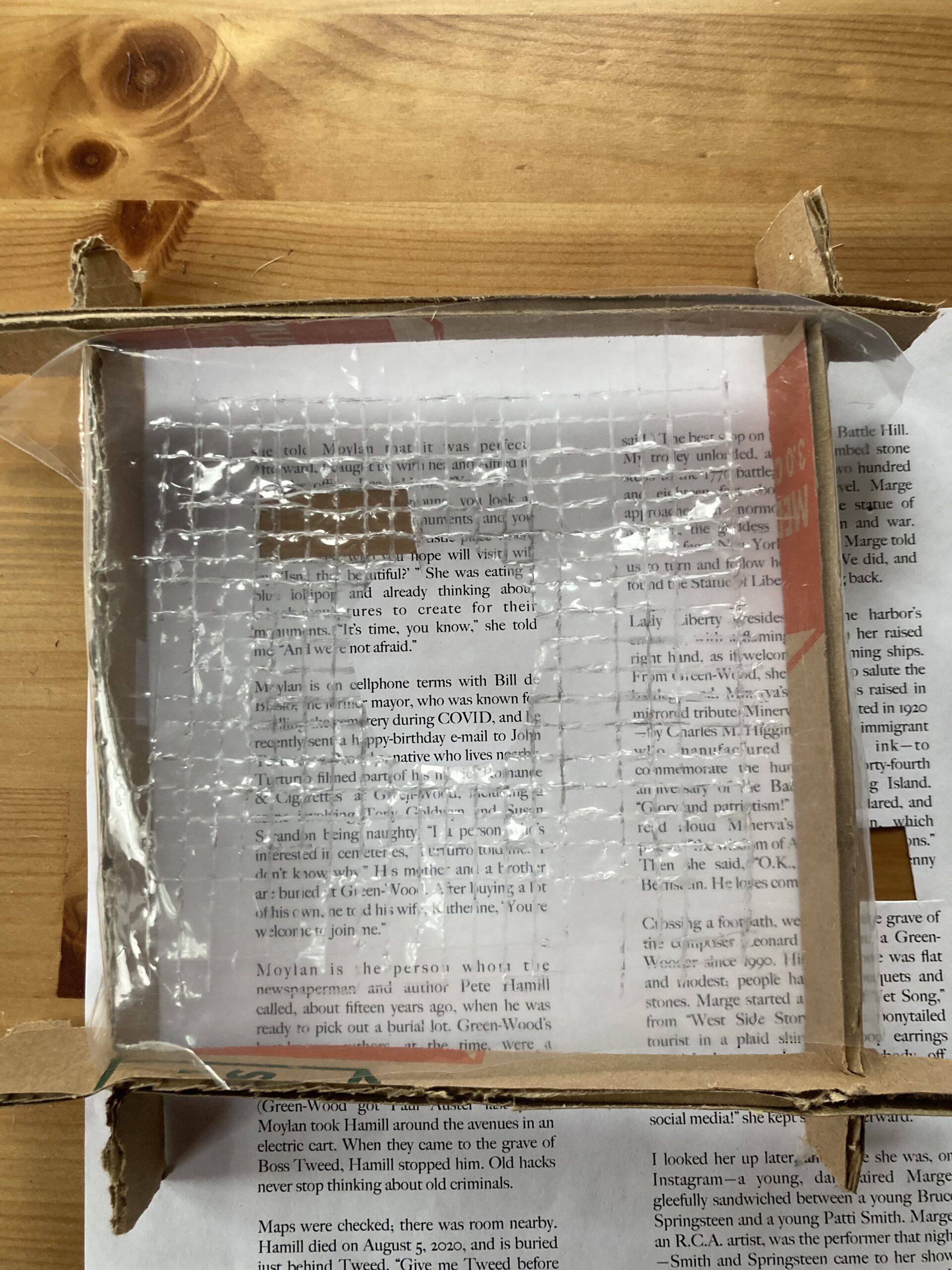
second attempt with the thinner frame placed over a panel where the words of the poem have been cut out
None of what I made was very successful, but it’s so much fun to try making things. Even as I still am not very good at it, I love that I keep trying. And I can tell I’m gaining confidence and improving. I still struggle to cut through cardboard effectively, but my lines are getting straighter. I’m glad I’ve stopped using my bad vision as an excuse!
note: if I can figure out how to more effectively execute the cardboard frame, I could use it as a loom for my thread grid!
also
Here are 3 other things that I’d like to make note of, and return to:
1 — achilles exercises
To help with achilles pain, strength the calf muscles: the gastrocnemius and soleus. I want to check out the 5 exercises mentioned in this post.
2 — The Art of Kindness, Helen J. Shen interview
I’ve barely started listening to this amazing interview with Helen J. Shen! There’s some great insight on the difference between being nice and kind and how to acknowledge, then let of of imposter feelings, and that’s just in the first 17 minutes!
3 — crocheted technology
Scott sent RJP and I a link to this brief post about crocheting — I don’t crochet, but I’m thinking a lot more about fiber arts these days!
For tomorrow: a run, a ophthalmologist appointment (how bad is my vision these days?), and reading more poems — and posting one here. I’m really enjoying all the making and experimenting, but I haven’t been reading other people’s poetry that much in the last month1.
Right after writing and publishing this thought I realized that I have been looking at and posting poetry — I’m reading Her Read by Jennifer Sperry Steinorth and loving it. I’ve been looking at visual poetry, but not any other forms. ↩︎
4 miles up wabun / down locks and dam 59 degrees overcast
It is supposed to rain all day tomorrow, so I ran today. Warm — shorts and a short-sleeved shirt. Spring! I ran south on the trail. Lots of bikers but no reckless biking. I almost wrote that I forgot to look at the river, or that I don’t remember what I saw when I looked at the river, but then I remembered that I noticed it at the bottom of the locks and dam hill. Blue-gray and choppy,
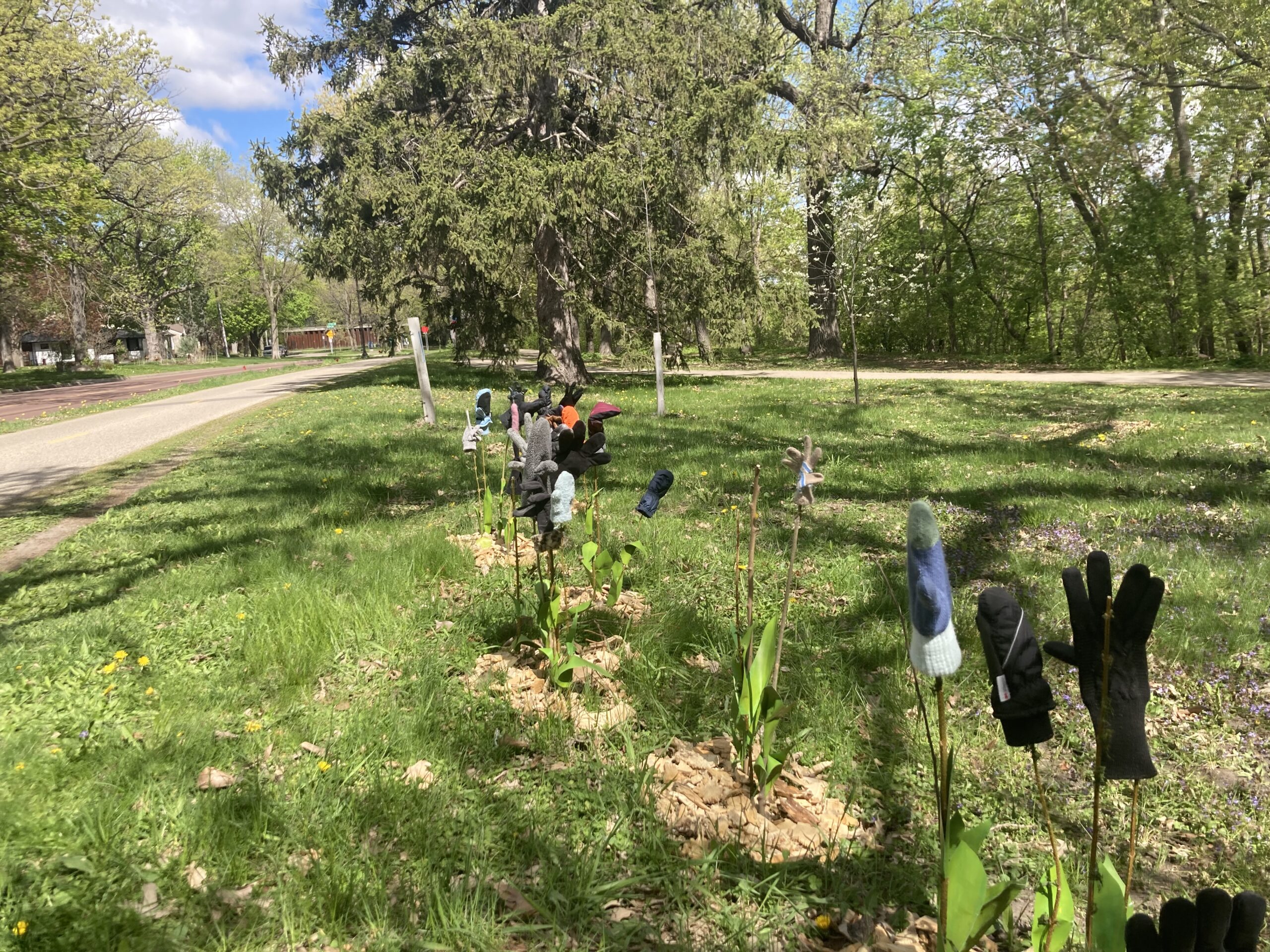
sight of the day:a little kid (2 or 3?) hanging over the edge of a part of the wooden fence on the edge of the hill leading down to the oak savanna, an adult holding onto them tightly. What can you tell from a scene while running of a little kid with their back to you? Not much, I guess, but it felt like the kid had a wonderful curiosity, and the adult with them was supporting/encouraging/safeguarding it.
running thoughts: I felt strong and more confident, having run the 10k race yesterday. I ran too fast — I need to slow down! After the run was finished my achilles felt a little strained or strange or both. One of my funning YouTubers has achilles problems and they keep them in check by doing calf raised after every run. Maybe I should try that?
10 Things
smell: cannabis somewhere nearby
a cardinal’s pew pew pew call
a bike peloton (15-20 bikes) on the paved path
someone on e-bike zooming by on the road
more green buds
some empty benches, some occupied
someone on a bike biking alongside a runner — marathon training, maybe for Grandma’s Marathon?
a white car speeding down the locks and dam hill, turning around, then speeding back up it
gnats! one landing on my check near the edge of my eye — I could see a black spot in my peripheral vision
the boot hanging off a stalk in a neighbor’s yard is still there, a month later
holes
Today I’m experimenting with different ways to visualize my Holes 4 poem:
you look at words. you don’t see the gaping hole. you see seltzer fizz and a nothing that is something not sharing its secrets.
First, I cut up a ziploc bag and made dots in it with a pencil. This looks like fizz or static or snow, which is cool. A problem: you can feel it, but you can’t really see it. How to make those marks show up? Then I cut the static ziploc into the shape of my blind spot — actually, I cut out 20 of them. It’s still not visible, but I like the texture and the idea of making the visual less visible. I think I’ll use these somewhere.
After spending some time with distressed ziploc bag and not getting anywhere, I tried a different approach. First, streamline the poem, get rid of the fizz, and get over the idea of trying to represent fizz or static. Here’s the new version of the poem:
you look at words, you don’t see the gaping hole, you see a nothing that is something not sharing its secrets.
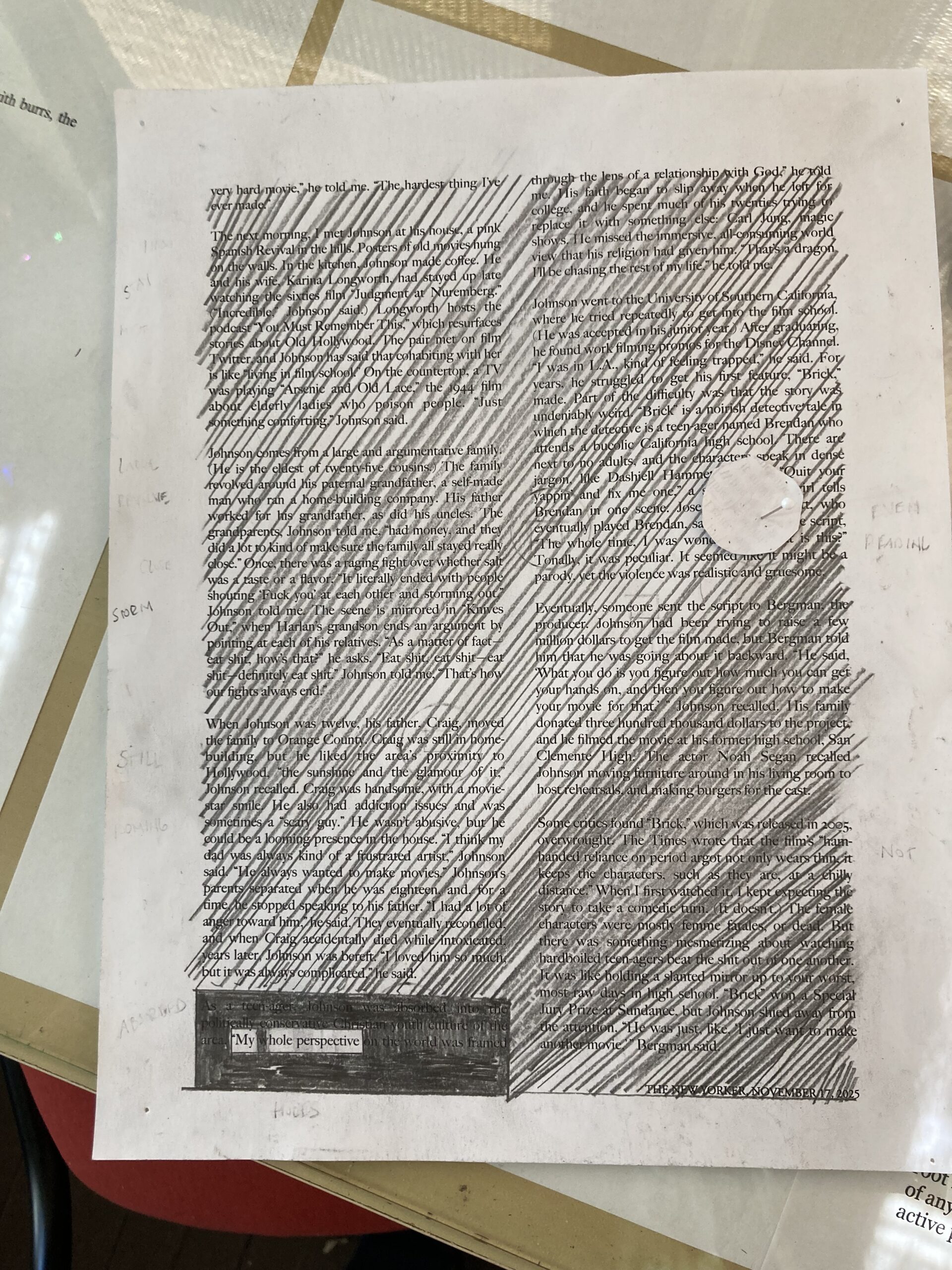
When I shortened the poem, I was able to “find” it on four instead of six of the pages of the new yorker essay.
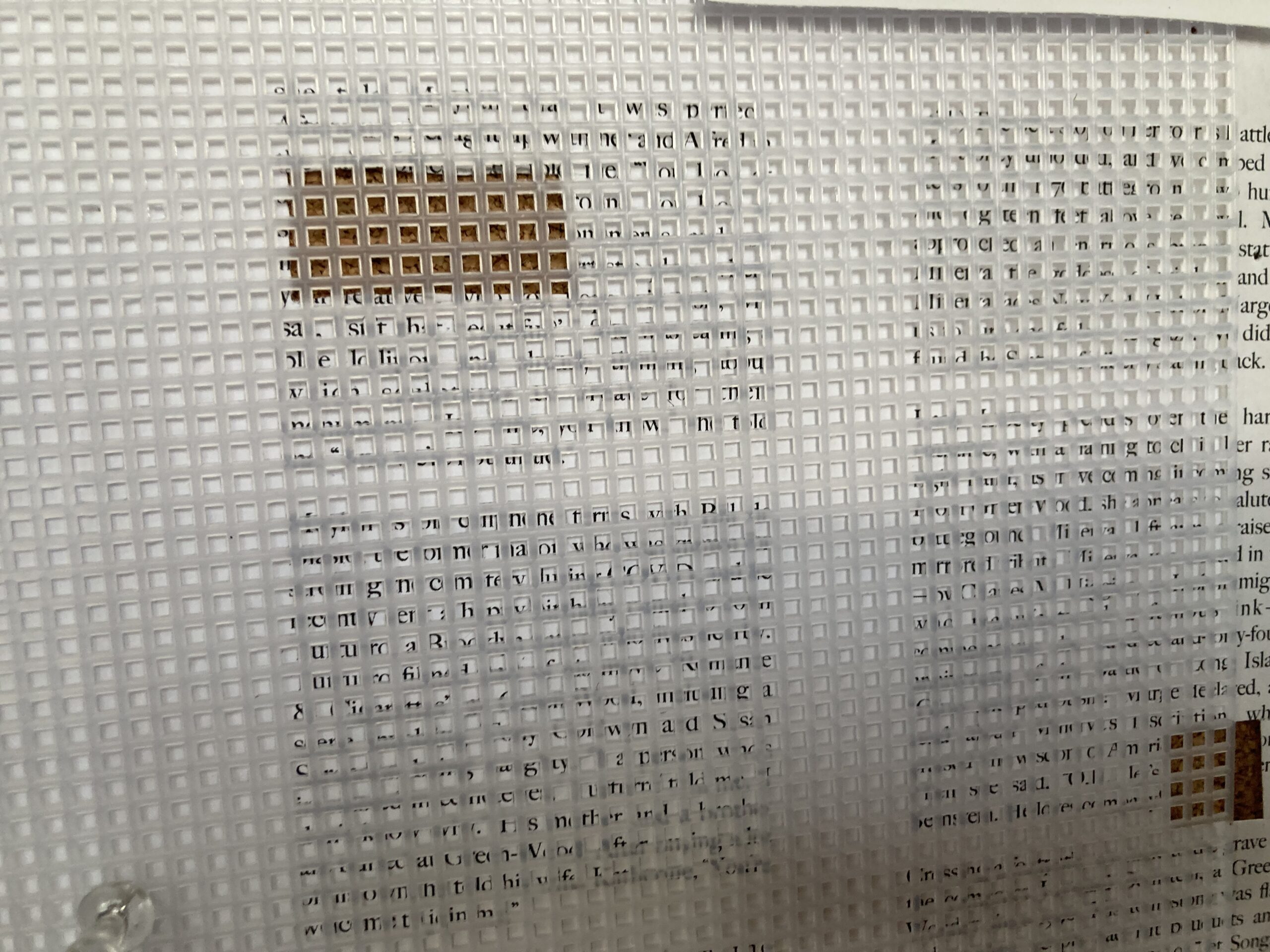
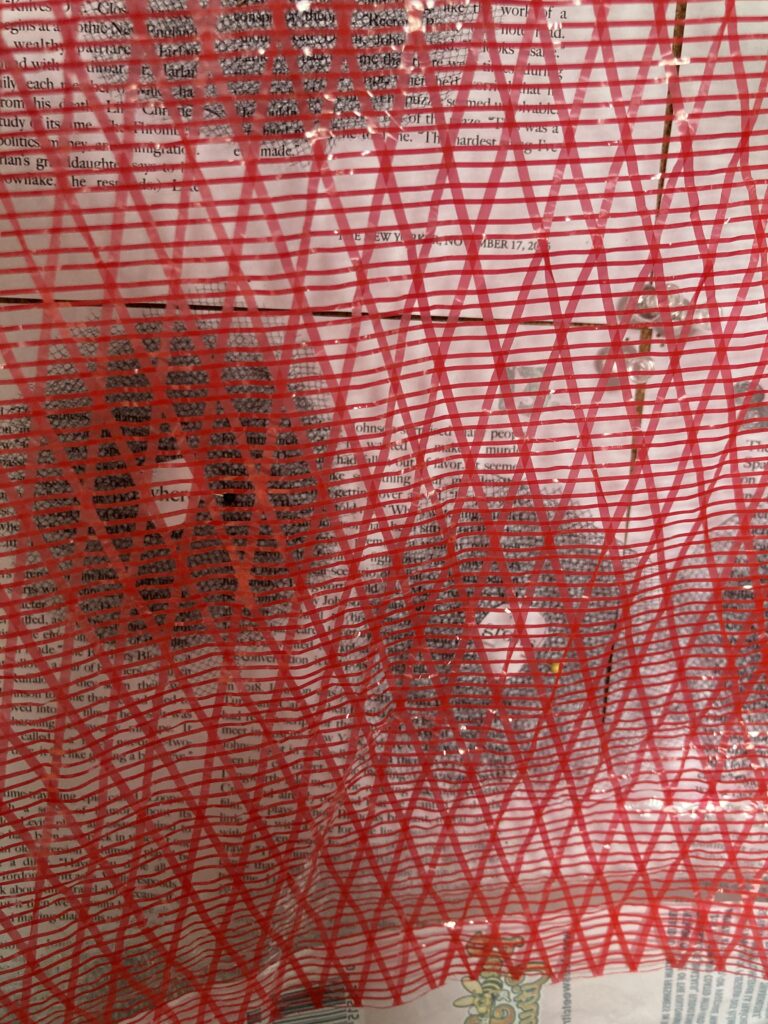
Next, instead of trying to make fizz, I decided to distress a new sheet of ziploc plastic with a criss-cross pattern. I really like it!
view 1view 2
I really like this way of distressing the plastic. And, it’s easy to do and to replicate! When I put it directly over the text of the essay, it didn’t obscure the text enough. Soon I realized that it needs to be at a slight distance. I keep coming back to the idea that these poems need to be 3-D. How should I do that?
55 minutes minnehaha off leash dog park 49 degrees
Cooler today, but sunny with a soft breeze. Wonderful for moving. FWA and I agreed that there was energy in the air, a lifting — of impending storms, oppressive heat, humidity. The dog park vibe today: chill. Dogs moving quickly and quietly.
today’s dog name: Sunny (or Sonny?)
10 Things
glittering water
a small boat, fishing near the end of the trail
the LOUD knocking from a pileated woodpecker
a very big uprooted trunk, almost upright, leaning in the hollow of a living tree
deep, soft sand
the slapping sound of Delia’s water running through the water at the edge of the shore
the soft, thundering thump of Delia’s running feet on the soft dirt
2 HUGE fluffy white dogs
a small (smaller than delia) dog emerging from the woods — first, a flash, then right in front of of us — first they jumped up on me, then FWA, as if to say, hi! hi!
even more green on the trees, on the ground
While we hiked, FWA and I discussed Ariadne (see below). It started with me asking FWA if he was familiar with Ariadne’s thread from his reading of The Odyssey in college, or Percy Jackson in elementary school. He said, sure, but I mostly know it from Tarkov (a Steam video game). Of course. I’m always fascinated by all the stories/history FWA knows from playing video games. A few minutes later,FWA said, I think I also know it from Kaos (a Netflix show about greek mythology starring Jeff Goldblum as Zeus.
holes and strings and words
This morning, I feeling a bit overwhelmed and disoriented by all of my ideas about holes and strings and threads. Instead of trying to think and theorize my way out of it, which is my inclination — I’ve decided to stop trying to figure it out and follow some more trails. These trails may offer some answers, or they may cause me to get even more entangled (ensnared, knotted).
1 — Ariadne’s Thread
In yesterday’s post, Ariadne came up in a quote from the intro to Her Read. I knew the name, but couldn’t remember why. Just as I began typing In yesterday’s post, I remembered! It was mentioned in a poem about Icarus that I posted here on 19 june 2025: Altitude/ Airea D. Matthews. This poem has a favorite line, which I think fits here:
Bliss is a body absconding warp speed toward a dwarf star whispering, Unsee the beheld.
In that 19 june post, I kept thinking about unseeing:
Unsee as different than not-seeing (which I ‘ve thought/written about before). Not seeing is a static thing; you just don’t see it. To unsee is more active and also suggests a process of unravelling which is where my vision is at.
A few minutes later in the walk, I thought about flipping the phrase to, behold the unseen.
I like thinking about to unsee as a verb, an act, a process, a type of prayer? Just as seeing is not a static thing, where you simply see, but a process of light and signals and filtering and guessing by the brain, unseeing is a process of slow (or sporadic) unravelling then adapting — a brain doing mysterious and magical things with the scrambled and limited data it receives, a mind developing new ways to witness/behold without stable and dependable eyes.
Wow. All of this thinking about unseeing the beheld and unraveling vision, returns me to another thread in the book review about Helen Oyeyemi’s new book: swap the dead-eye liturgy of doomed vision for shadow acts wild and improbable. Is there something there to return to?
In my brief searching for Ariadne’s thread, I found a description of it as a method in logic for “solving a problem which has multiple apparent ways to proceed—such as a physical maze, a logic puzzle, or an ethical dilemma—through an exhaustive application of logic to all available routes” (wikipedia).
I found this bit about how Ariadne’s thread differs from “trial and error” interesting:
The terms “Ariadne’s thread” and “trial and error” are often used interchangeably, which is not necessarily correct. They have two distinctive differences:
“Trial and error” implies that each “trial” yields some particular value to be studied and improved upon, removing “errors” from each iteration to enhance the quality of future trials. Ariadne’s thread has no such mechanism, and hence all decisions made are arbitrary. For example, the scientific method is trial and error; puzzle-solving is Ariadne’s thread.
Trial-and-error approaches are rarely concerned with how many solutions may exist to a problem, and indeed often assume only one correct solution exists. Ariadne’s thread makes no such assumption, and is capable of locating all possible solutions to a purely logical problem.
In short, trial and error approaches a desired solution; Ariadne’s thread blindly exhausts the search space completely, finding any and all solutions.
The goal is not the solution/answer, but an exploration of possibilities. I also like the idea of using the thread approach in my erasing of text in a New Yorker article. The key: it’s arbitrary!
With a little more research, I also found this brief description:
The phrase “Ariadne’s Thread” refers to to the problem-solving technique of keeping a meticulous record of each step taken, so that you can always backtrack and try alternatives if your first efforts fail to yield results.
side note: this might be helpful in tracking my creative experiments so I don’t lose some of my initial ideas.
Before I left for the dog park with FWA, I had an exciting idea about how Ariadne’s thread seems to contrast with Alice’s rabbit hole. Here are some notes I jotted down so I wouldn’t forget:
tension = going down a rabbit hole (free fall, untethering, getting lost) versus ariadne’s thread (logic, finding, tethered to the world/meaning/language) — part of the feeling/process/practice of reading — what is the relationship to the word, how do I read? I answer with a mix of phenomenology (describing/showing my mechanics or reading words on a page) and an invitation to a new relationship with words, a new way for meaning and connecting and communicating not based on progression or logic or efficient understanding.
2 — a plastic bag
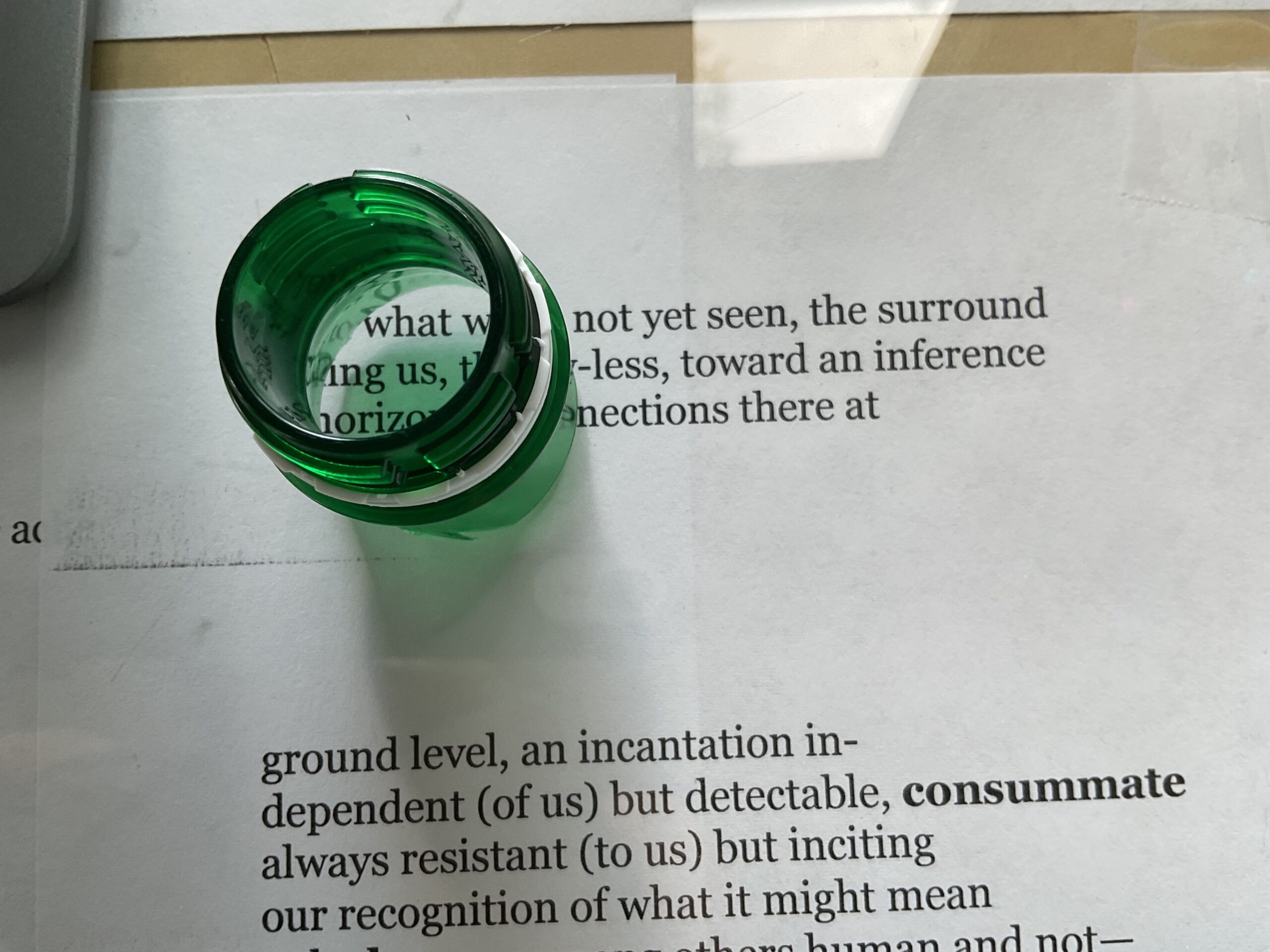
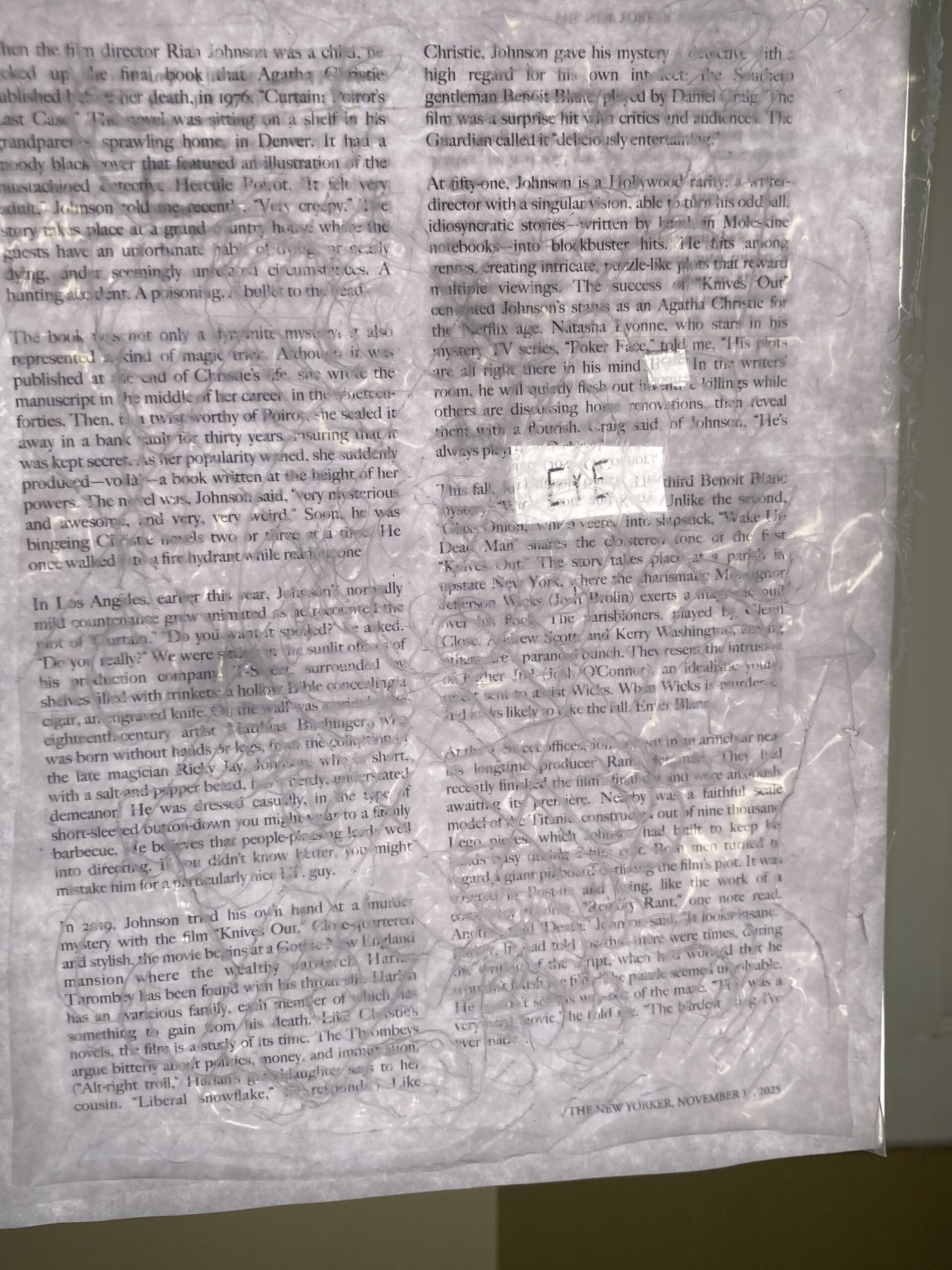
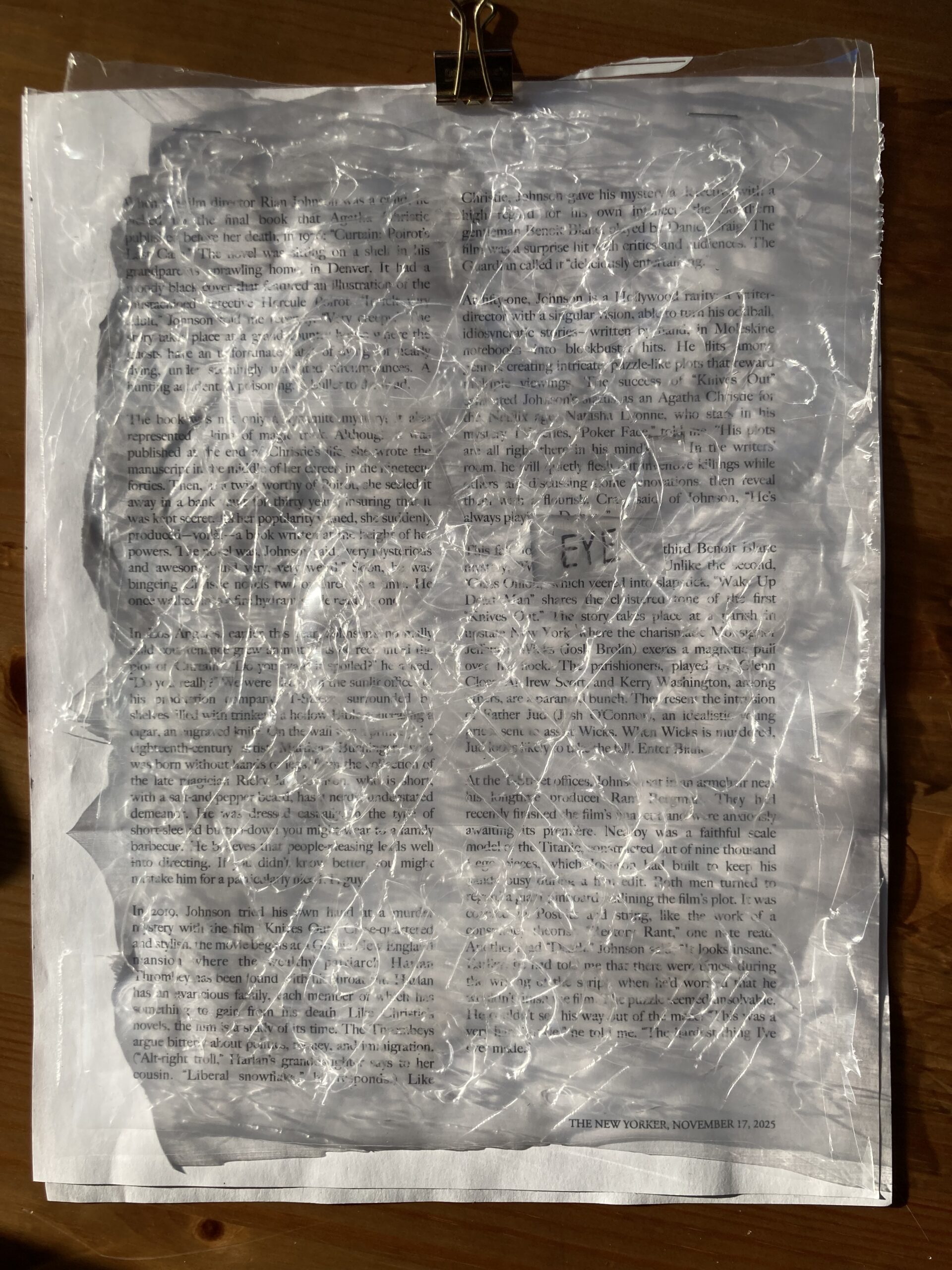
Some good ideas with the thread, but also too much thinking and theorizing and trying to fit ideas into a concept. I want to be led by the making and experimenting, not some concept. So, I returned to playing around, this time with my ziploc bag again. I like this material as the material for the hole or the effect the hole makes on words. I decided to deconstruct (that is, cut and spread open) the bag, the distress it with a pencil (drawing spirals and lines and zigzags on it). Then I realized it was almost the size of a single page: I can use it as a veil over the entire page!. I decided to create two bag sheets to make the text more difficult to read. Then I put them on 2 stacked pages of an essay — the same page. I found a word, eye, and cut it out of the one page so that you could still see it on the second (same) page. A hole in the page — I like this idea. Unfortunately, this version of it didn’t quite work; I’ll have to play with it more. Running out of time, I decided to write the word in bigger letters just to test out the effect. It needs some work, but it has potential.
a test: 2 sheets of distressed ziploc bag over text with a hole cut out to reveal a poem
For this picture, I held the papers up in front of the window with sun streaming in. I need to distress the plastic more.
same pages/poem, light source on, not through
A thought: as I work on these poems about reading, consider the light source; it strongly impacts how and what I can see. How can I replicate different levels of light, from BRIGHT to dim.
Another thought: more frequently, I’ve been placing holes on the page to erase the text, like my blind spot made out of black netting. I like the idea of experimenting with ways to cover the text, like with this distressed ziploc. I could also use layers of netting and thread grids — ones that are straight and ordered, others that are tangled and slanted.
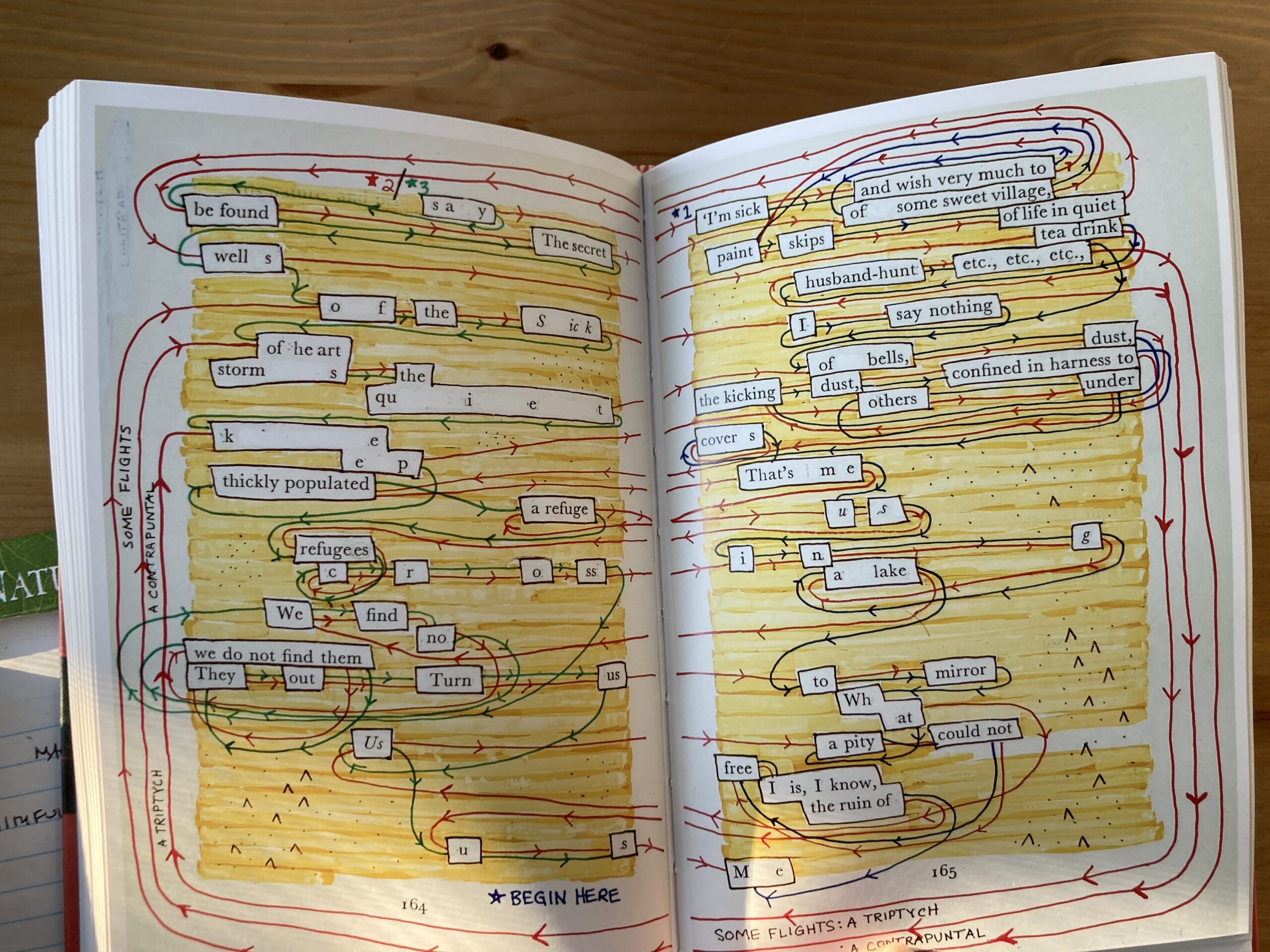
Her Read
a page from Her Read/ Jennifer Sperry
Wow, this is very cool! I’d like to use this as inspiration. I’ll have to spend some time with this to see if I can read it. I like the color and how the words for the poem are all over the place and the arrows/directions.
No run today. I’m taking it easy because Scott and I are running a 10k race this Saturday. Neither of us are ready and we will certainly be walking some of it, but it’s the official start of marathon training, which is exciting.
youtube
Yesterday at Arbeiter, Scott and I talked about YouTube and possibilities for vision-related videos. He talked about consistency, fine-tuning the process, and finding a small and regular way to create videos. I mentioned one idea: I could do brief videos — shorts? — in which I describe a moment of Sara-seeing, or Sara not-seeing. Strange examples happen every day — not seeing words that I’ve already written and writing over them; not being able to read text quickly or billboards at all; not seeing something that is bright red and obvious to everyone else — like a cardinal; not seeing a face and automatically looking through my peripheral to find it. Most of these I’ve mentioned aren’t that funny, but I have lots of instances of strange/absurd/funny ones too. The key for starting this project: keep it simple and short; I’m not interested in having this take over the other things I’m doing right now. The next step: figure out the process and start doing them.
holes
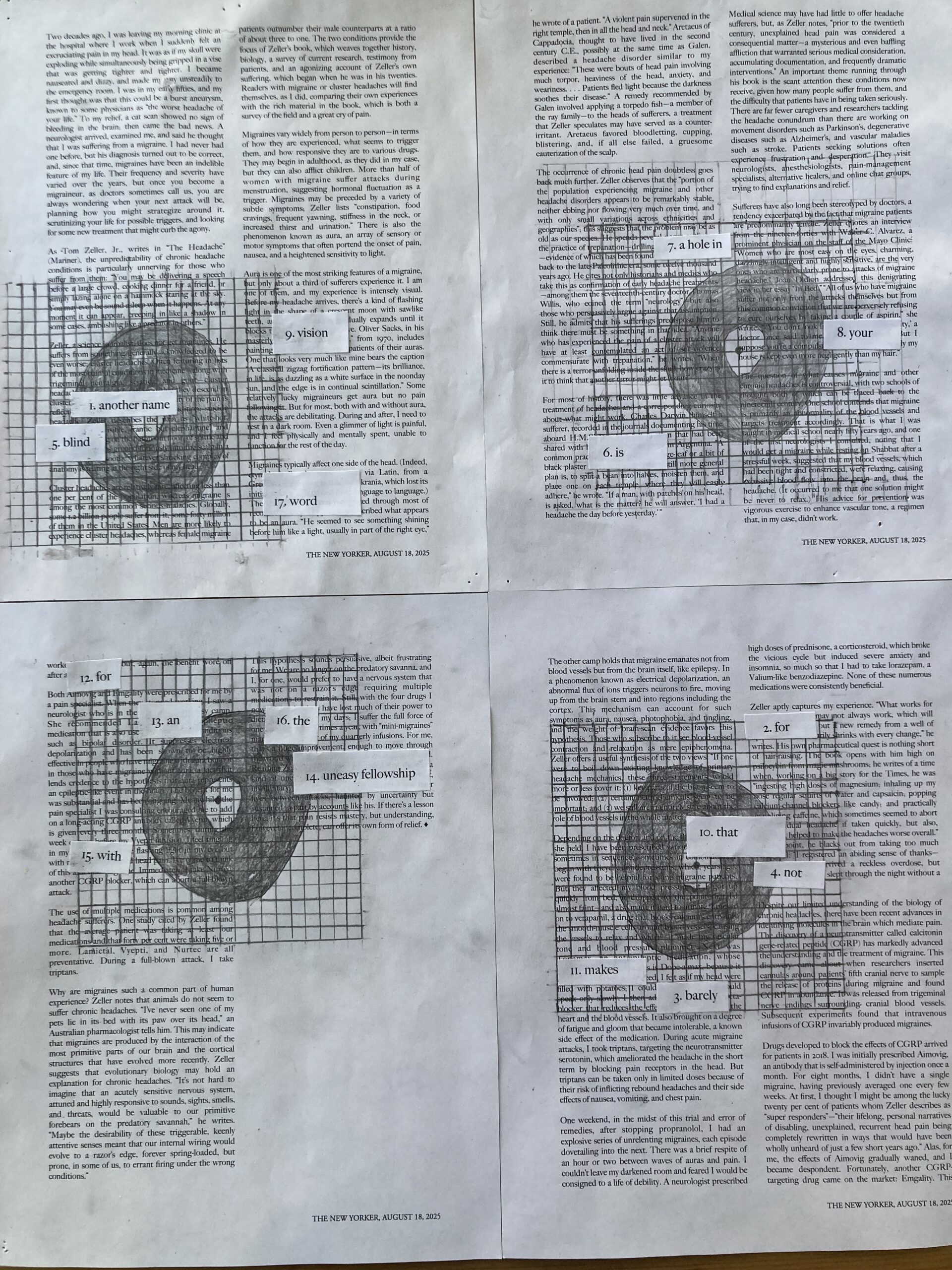
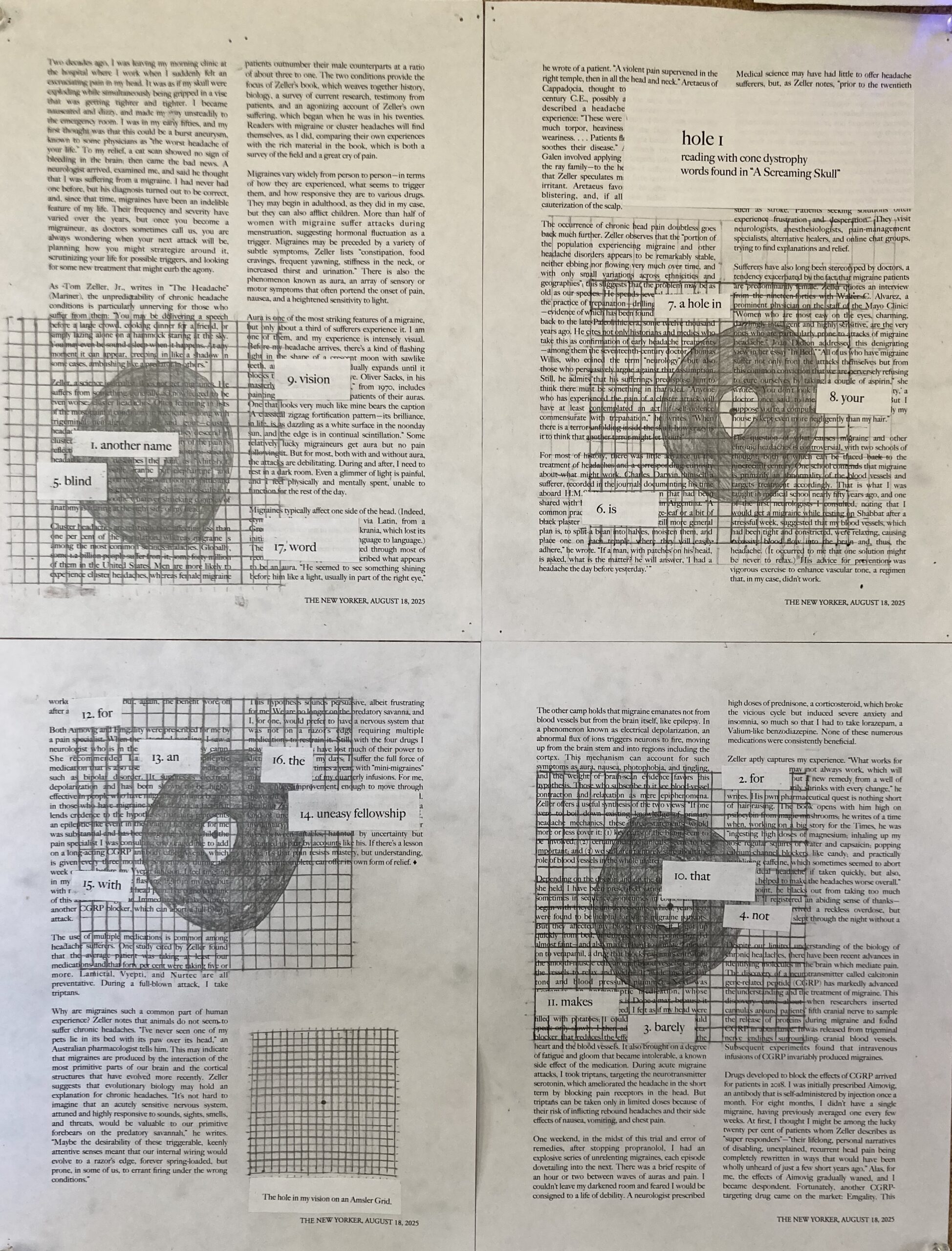
This morning, I’m re-working Holes 1. So far, I’ve drawn the Amsler Grid directly on the text for panels/pages 1 and 2. Then I printed and cut out the words of the poem and placed them on/over the grid. When I looked at the picture I had taken of it, I wasn’t satisfied. The words weren’t visible enough. Next I tried something I keep returning to but haven’t quite figured out: a 3D grid made from thread and pins above the grid + blind spot on the page. I like the effect of this, but now I need to figure out how to attach the words to the grid. Should I create a third layer with only the words? And should that layer be on top or in the middle –and, if in it’s in the middle, how do I do that?
holes 1, sideholes 1, above
I discovered something interesting as I worked on this poem as 4 different panels/pages. Each of the pages, which include words from different parts of the longer poem, create their own poem. Some of those poems work better than others, but they can all be read individually. The smaller poem in this panel is:
a hole in your is
Okay, the other panels don’t work as well as poems, but I bet I can tweak them to make them work. Another challenge!
A recap for Holes 1: keep thinking about how/where the words fit on the grid (and how they make visible the idea of the poem, a hole making an uneasy fellowship with the word; ruminate: should there be a single or double grid on this one?; and how can I tweak the words to make 4 individual poems?
big picture thoughts: This series offers a progression towards more confusion, or a more peculiar relationship with the word as a reader. I want to demonstrate that progression visually through the changing configuration of the hole, the string/line/thread, and the word. So far, I’ve been experimenting with what material to use to represent the hole — pencil shading, black netting. Next up, the plastic bag! I also want to try making the “magic” blind spot decoder that I mentioned yesterday: when you place it over a certain spot, a new poem is revealed.
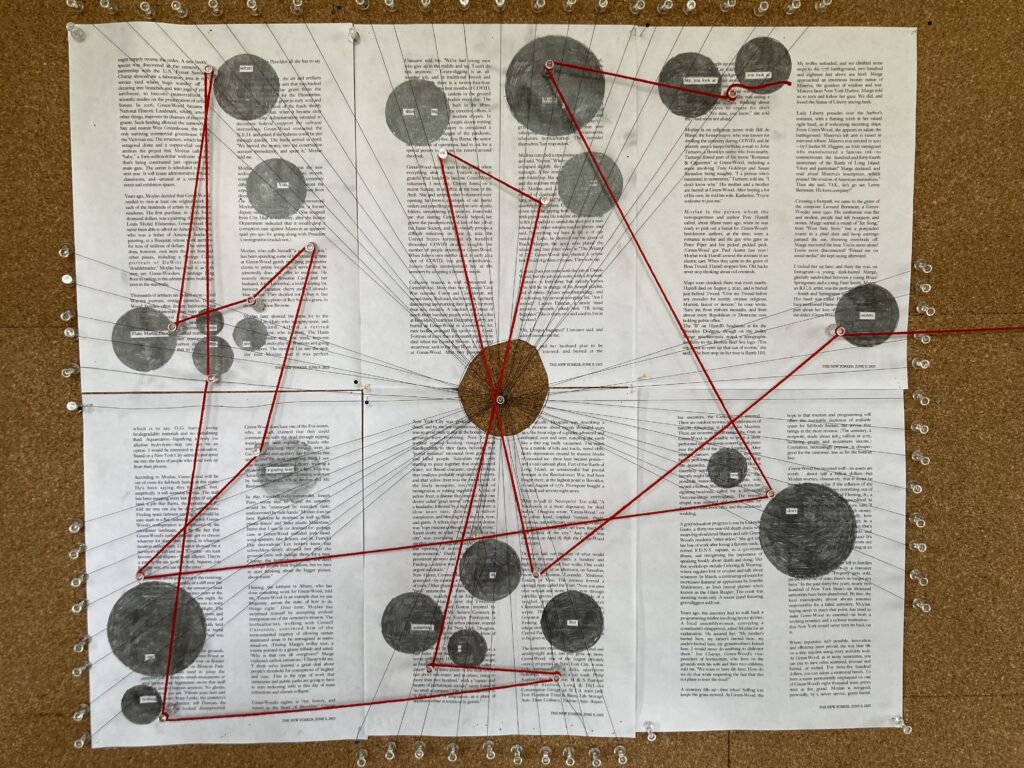
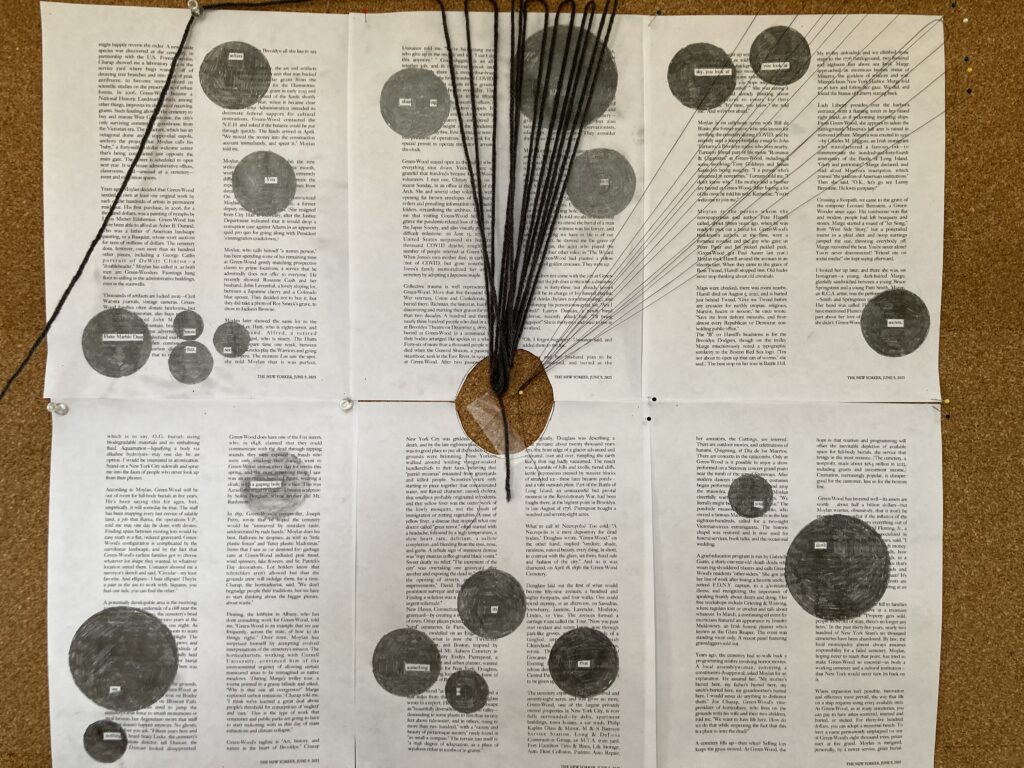
As for the string/line/thread, I’m using a double grid. I also want to try a crime board, where the thread becomes a string that connects all of the words. And, a hanging mobile with the words dangling from strings — does it need to spin? Other thoughts: broken or knotted strings AND strings coming out of the center hole and angling out to sections of words. I should write these up and match them to my poems!
Her Read/ Jennifer Sperry
This book! It’s an erasure of a history of art book by Herbert Read that only includes one woman sculpture, and only as an afterthought.
From the introduction to the erasure:
Thread, fabric, the Fates, the spin, life span — women in all the ages past made what was both essential and perishable: life, cloth, food.
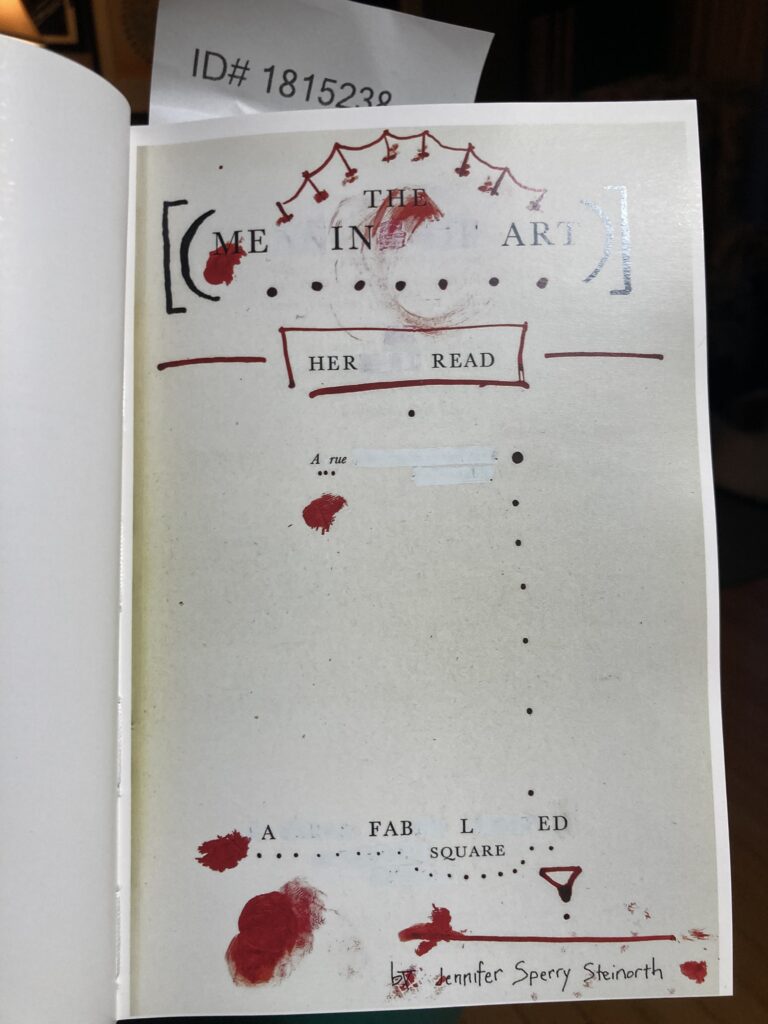
When you look at the cover of this book, you find an identity inextricable from embroidery: the cover of Herbert Read’s book, its original title and author, are altered with stitching and patchwork — so we are first called to think of erasure by cross stitching, a crossing out that is, at the same time, a women’s traditional kind of making, and not unlike the fibrous threads that close a wound. Or, Ariadne’s thread, a clew that leads out of the labyrinth of Western iconography.
Some great thread thoughts! I’m mentioned this a few weeks ago: I want to use thread in my found poems/erasures as a way to connect with my fiber artist Mom who died in 2009, and my fiber artist daughter, RJP, who is currently majoring in fashion design in college. And, to my grandmothers — one, a sewer, knitter, and cross stitcher (Orliss), the other a weaver (Ines). And more broadly to women’s way of making. This mention of Ariadne is intriguing to me — I need to revist that story; I like the idea of the line of the grid as a thread that leads me out of a maze of some sort.
cover, Her Read / Jennifer Sperry
I think I read that the red splotches are Sperry’s blood, from a wound she received while using a knife to cut the spine of the book.
I thought I might take a walk today, or a run, but in the end I decided to watch the Boston Marathon and then experiment with different materials. Fun!
holes
A few more experiments: a plastic grocery bag (1); black netting (2)
1 — grocery bag
This material was difficult to cut and not as effective as the ziplock bag: effective = distorted, harder to read, creating a disconnection with the words
2 — black netting
I like the netting and the feeling of black. However, this netting was hard to cut! So hard that I couldn’t manage to cut the inner hole to expose the word/s of the poem. I should ask RJP for advice, or have her cut it. Examining the effect closer, I like it. Now I need to find out how to cut a hole into for the poem word! And, how should I attach this netting?
2 layers3 layers4 layers2 layers / 2 holes
I asked FWA which version he preferred and he liked the lighter look with 2 layers. I can’t decide. It will probably be easier to decide when I figure out how to cut out the center and expose the words. Which one offers the better balance of emphasizing the poem word while not being too dark.
I asked Scott and he thought that working with black netting might be too difficult and that the look of it also had been done before. He’s a fan of the ziploc bag look. I like that look, but I don’t think it translates from a distance, and the “big picture” is part of what I’m trying to achieve. Also, as I told RJP, part of why I am doing these poems is to show what my vision is like as I read (and, if I’m being honest, to “prove” that it’s real and substantial). I’m still liking the netting most. Is there another material that could achieve a similar effect but was easier to work with? What about window screens? I like window screens because they are already framed. Could I find some used ones at ReStore? Does the screen offer enough of a distortion?
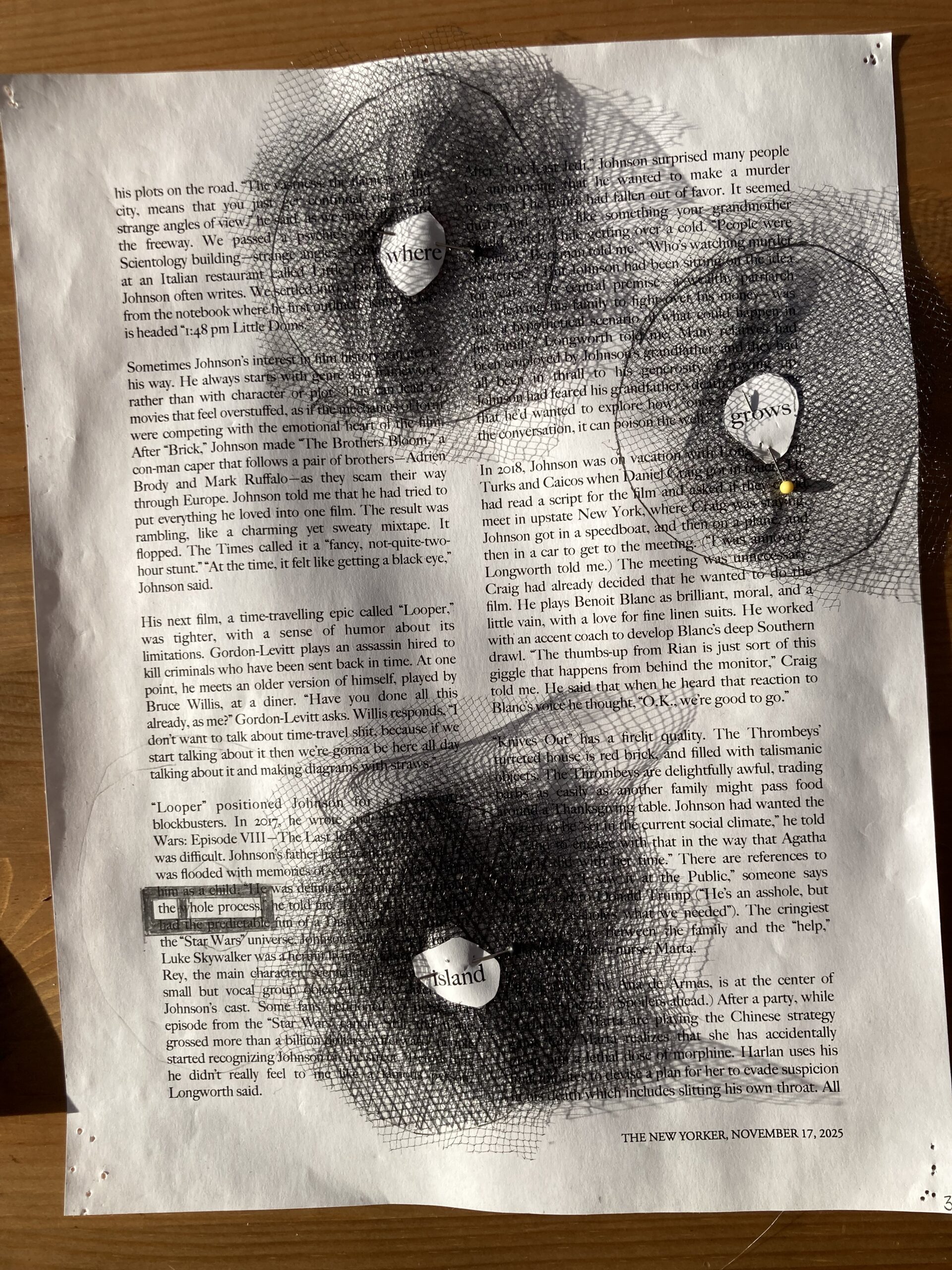
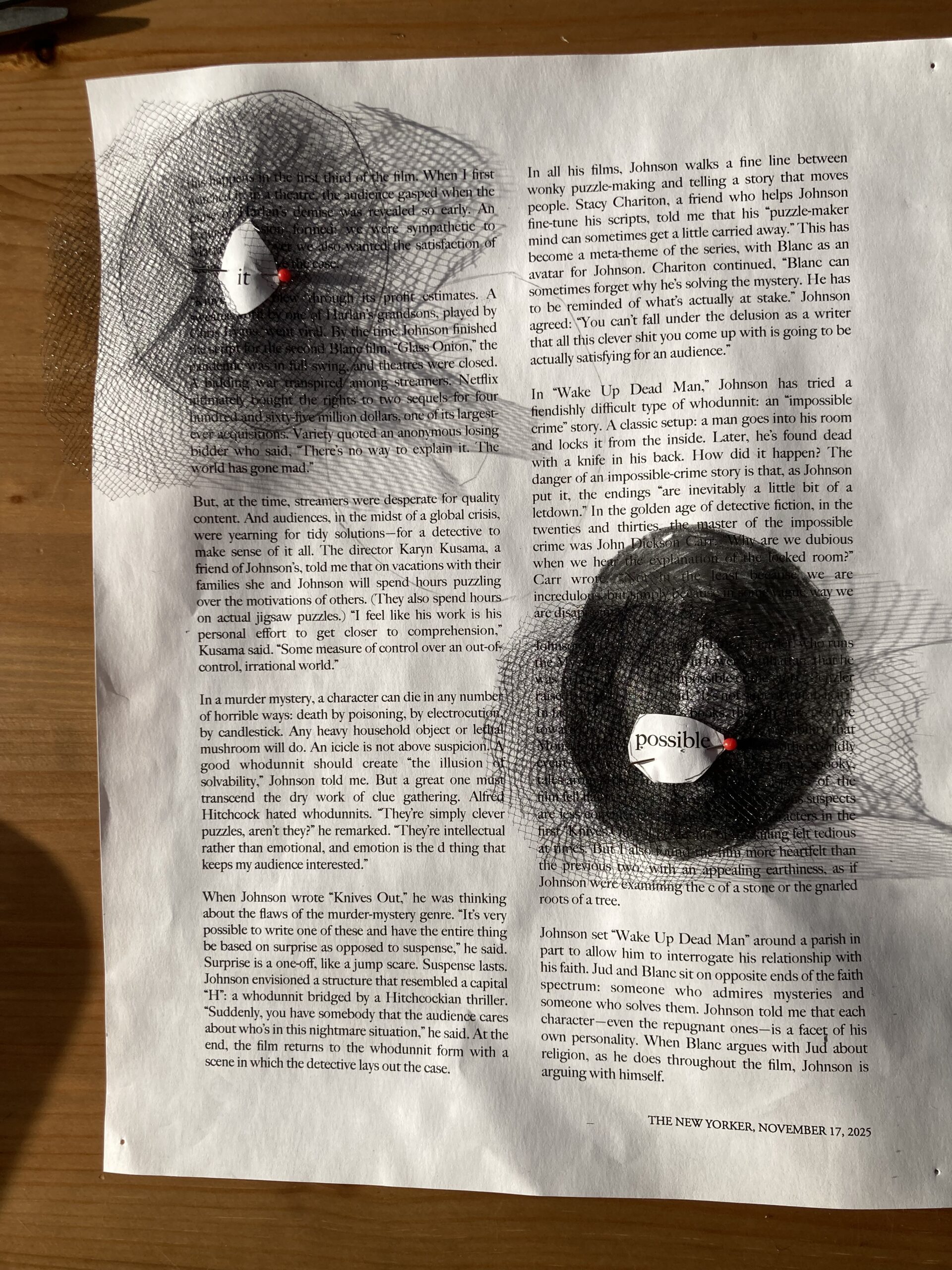
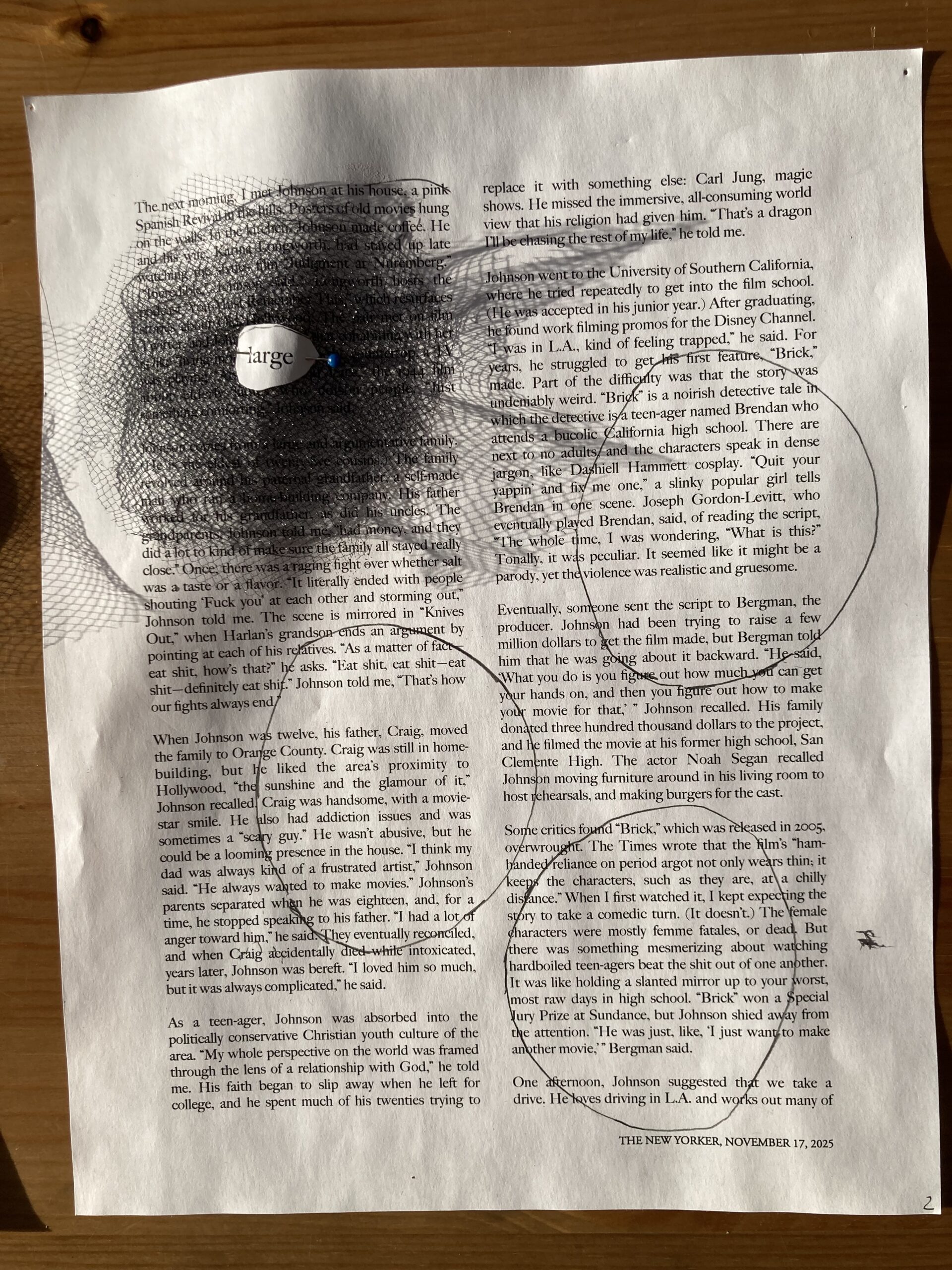
No time to look for screens today, so I decided to play around with the netting some more. I printed out the words and pinned them on top of 3-5 net holes. One of them has a lattice drawn under it, one is shaded in with pencil, a few have 3 holes, some four, one five. The hole with five also has the outline of the hole erased. Which treatment works best?
Impatient as I am, I quickly pinned the word to the nets to the paper and took the picture in full sun. It’s a bit messy and the shadows are obscuring part of the text. Even so, I like this effect! I’m looking forward to working on it some more tomorrow. Future Sara (or, Sara sent somewhere — still not sure if that works) also needs to figure out how to direct the viewer/reader to the order of the words of the poem. A number by each? A key with panel numbers next to the word?
5.25 miles franklin loop 63 degrees / drizzle humidty: 85%
I beat the storm! Yes, there was drizzle, but no strong wind or thunder, so I’ll take the victory. Today I felt strong and relaxed and capable. Not anxious or overwhelmed. Today I also feel vulnerable and open to the world, ready to embrace any slight shifts in perspective.
Image of the Day: Running north on the east bank, looking down at the river: a sea of bright, fresh green. On this side of the gorge, between lake and franklin, there used to be a park down below, so there’s wide stretches of cleared land and open grass. Even knowing that, the green looked like water not grass to me, high up on the bluff.
Realization of the day: Returning to the west bank, running south, admiring the straight-ish ridge line across the gorge and wondering how it could be almost uniform, I realized something: this ridge line was made by humans — leveled after logging and road and residence building. What did it look like before settler colonists arrived?
on training for the marathon: Today I ran 9, walked 1. After crossing over Franklin, I did a 5 minute walk to get my heart rate below 170. Then another 9/1. After this last one I checked how long it took to get my heart rate down to 135: 2 minutes. A goal for future Sara: cut that time in half, or even more.
10 Things
flashes of white flowers on the edge of the bluff: the spring ephemerals!
little kid voices, laughing, somewhere deep in the gorge
a guy yelling near a car parked across the parkwy on seabury — was it “fun” yelling as he played with a kid, or “unhinged” yelling at someone?
chickadeedeedee
a verbal greeting with a walker: good moring! / good morring!
honking geese, a honking car horm
a grayish-brownish-blue river, empty
bright LED headlights, cutting through the thick gray air
slashes of bright green are beginning to appear in the floodplain forest!
several stones stacked on the ancient boulder
grids and strings and threads (oh my)
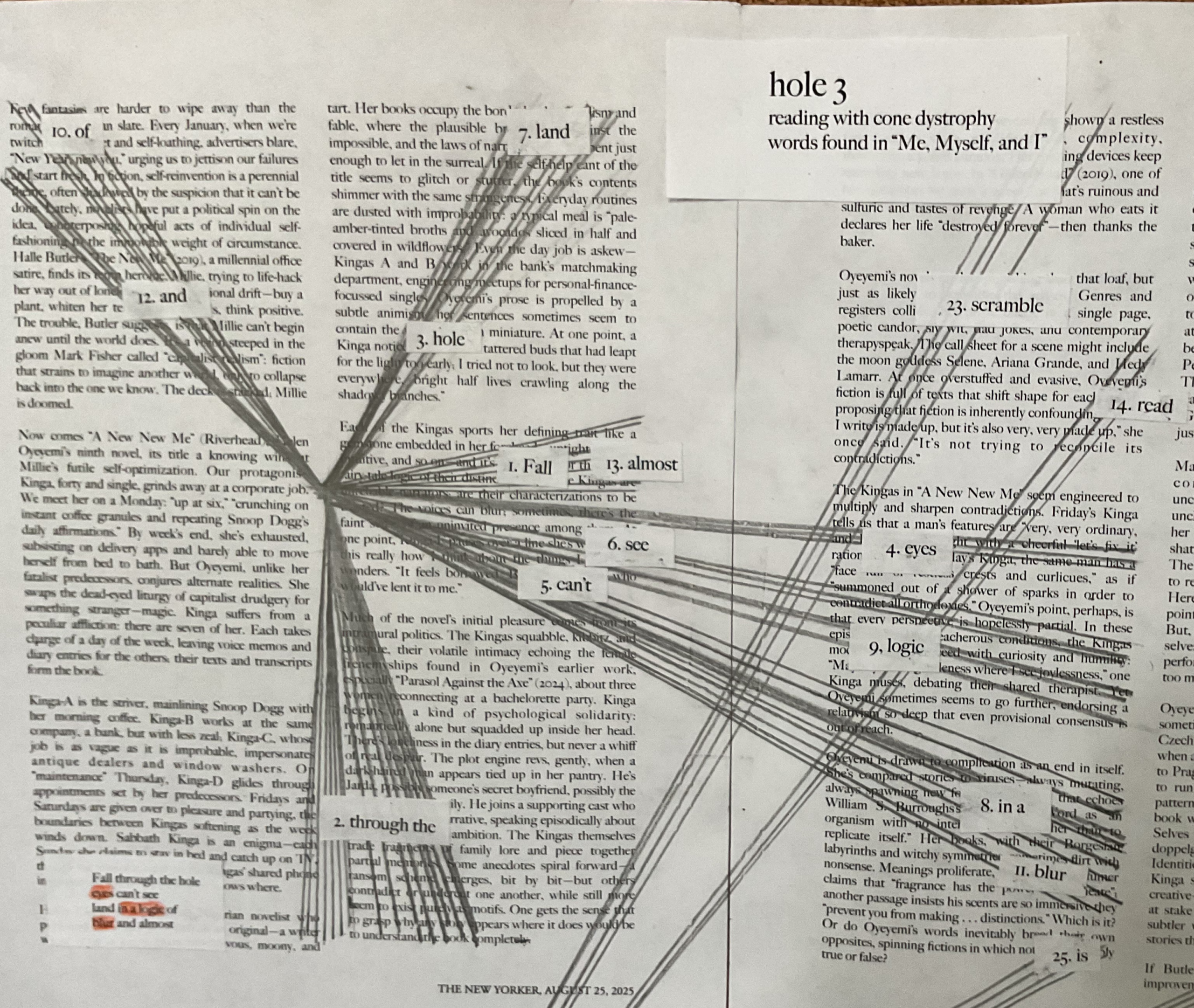
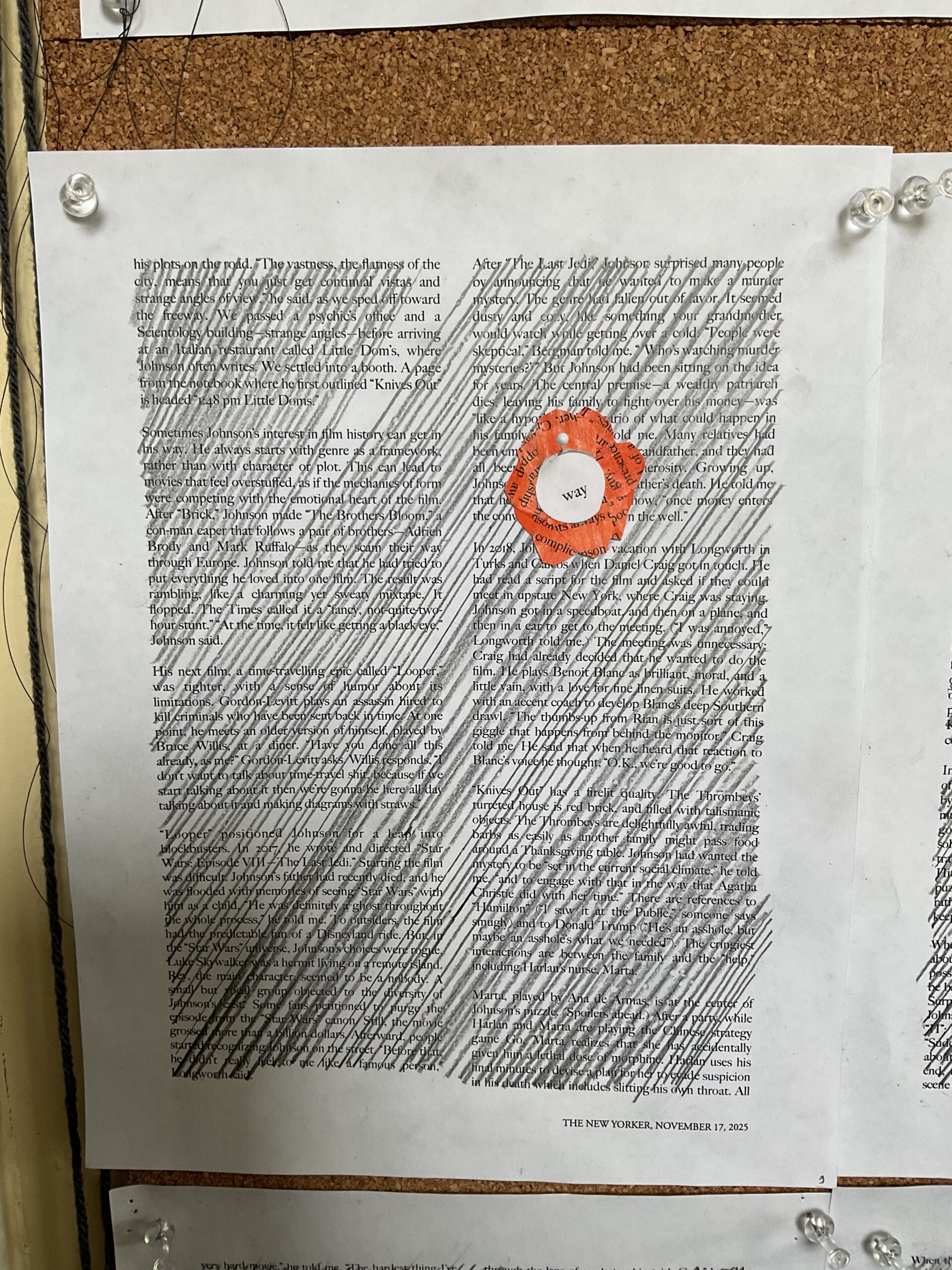
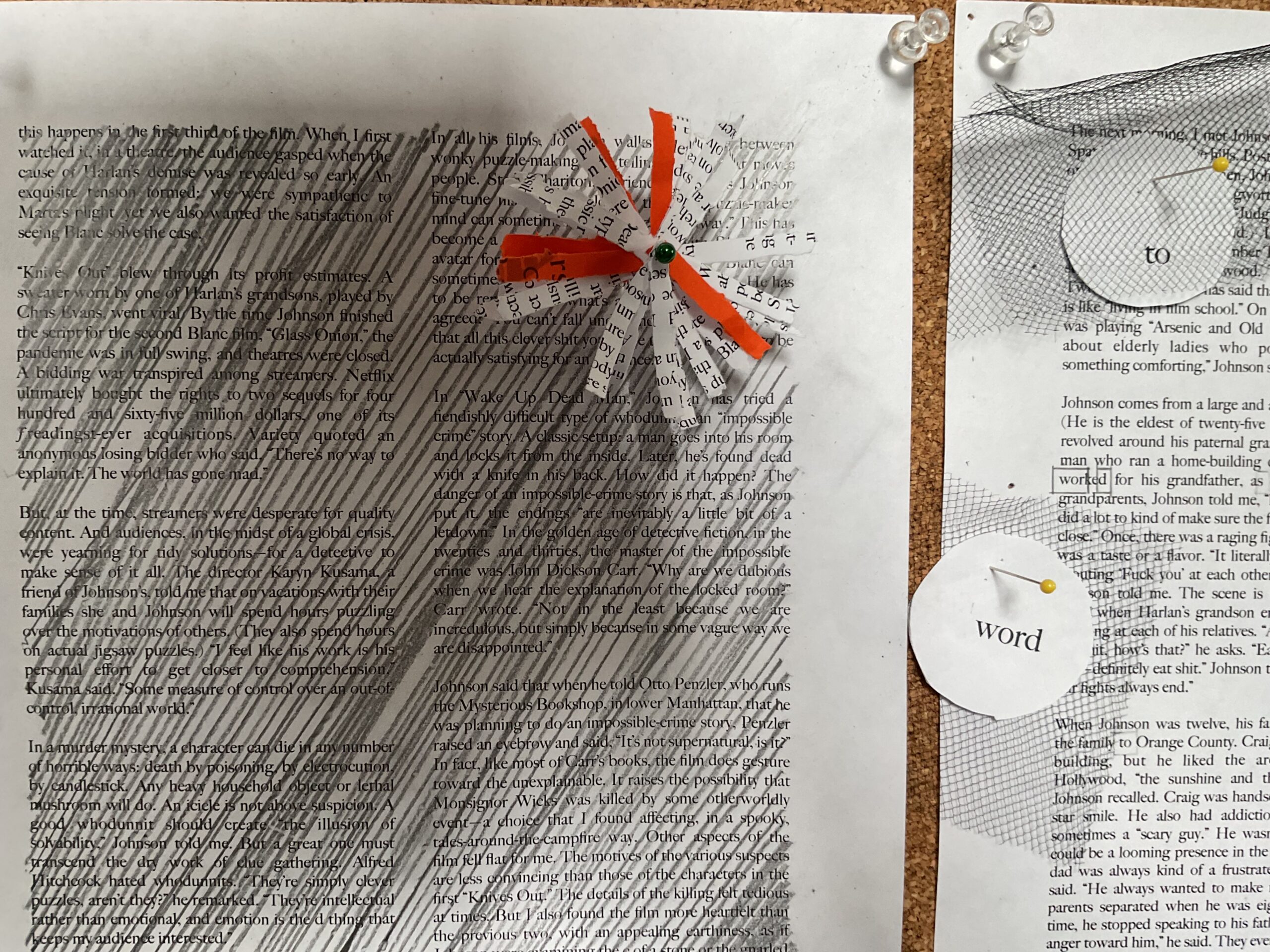
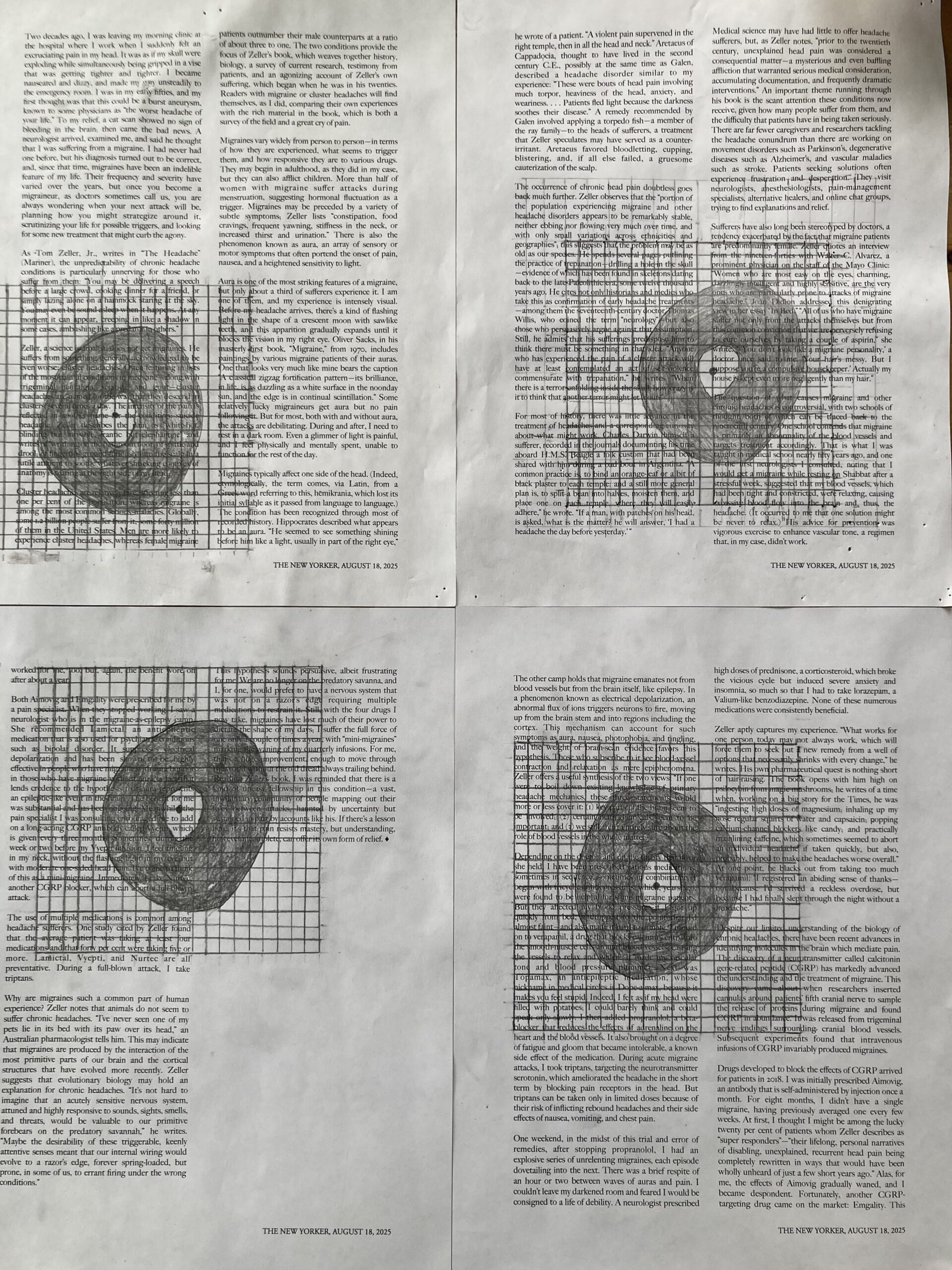
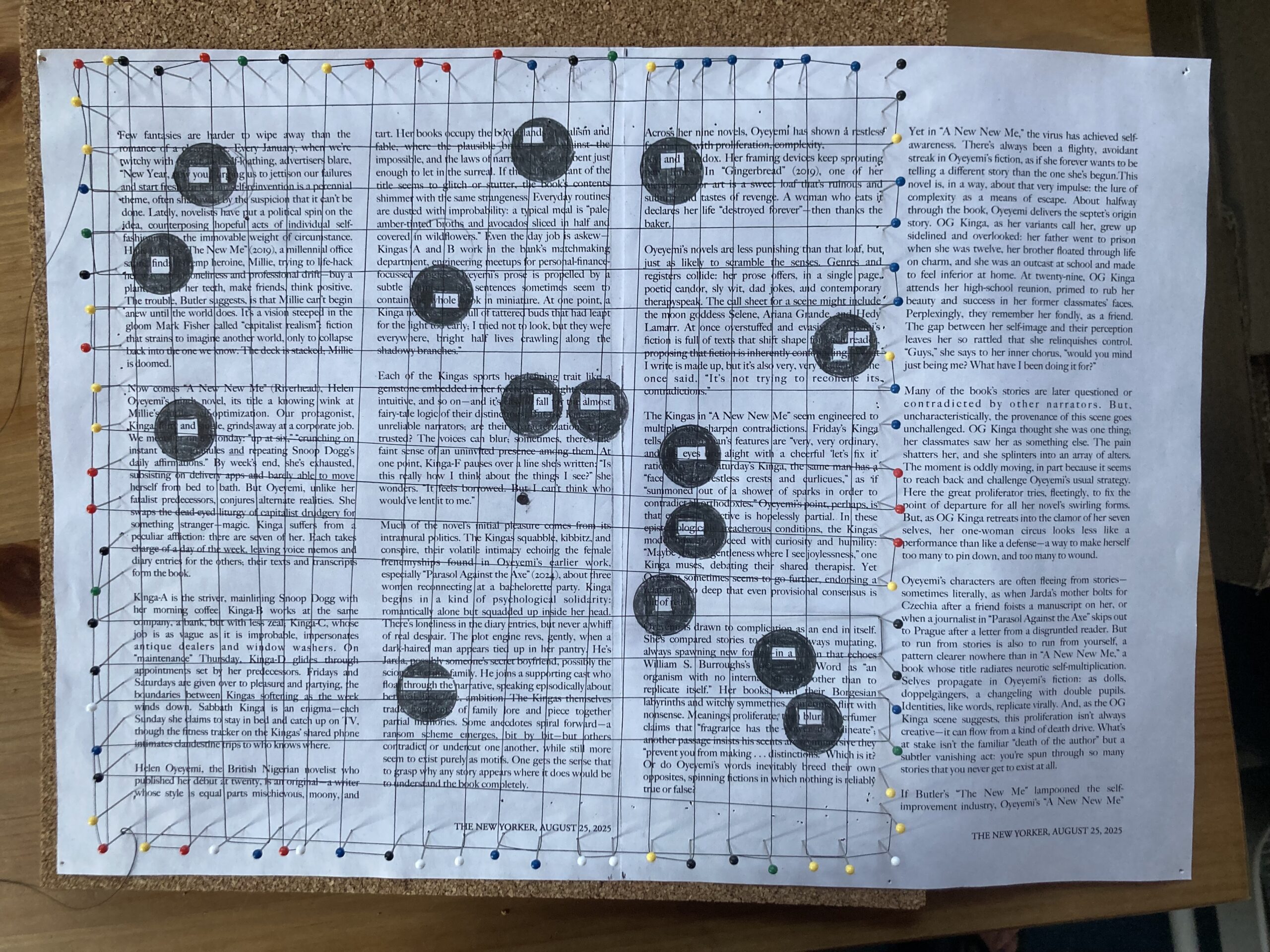
It’s a few hours after I returned from my run and it’s hailed twice and thundered and dropped 15 degrees since then. Boo. I tried a new thing with Holes 3: drew a graph directly on the words, mapped the words on the xy axis, lightly shaded in the words, repinned the grid over that, and then used thread to finish it. I like the doubling, almost out of focus feeling that the pencil grid and the string grid create. I don’t think the words are clear enough yet. I’ll have to keep working on that.
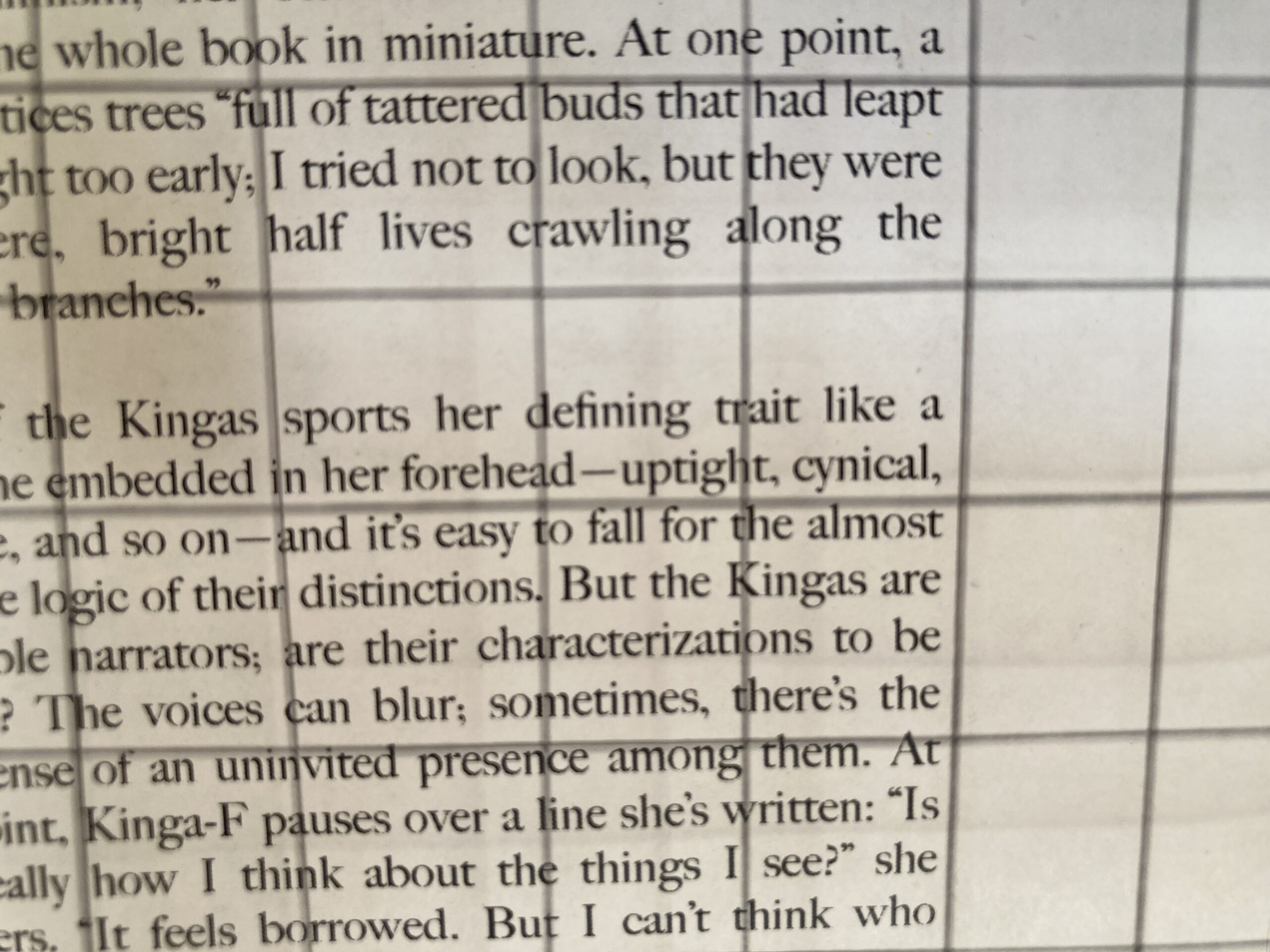
double griddouble grid, a slightly closer look (find fall and almost)
Here’s something else I tried: encasing the words in circles (using a penny) then roughly erasing the circles:
ghost hole effect
Another thought: map the words on a grid, then color in the rest of the grid box around the word or phrase from the poem. How would that look?Maybe I’ll try it on a smaller scale?
60 minutes Minnehaha Off-Leash Dog Park 68 degrees
Another hike with FWA and Delia. So beautiful! Today, FWA shared a realization about something that happened to him in 5th grade that was traumatic and has had a lasting impact. This realization explains so much about him and how he retreated into himself in middle school. My heart aches for that sweet, young boy! Oh, how I wish I would have recognized it when it was happening for what it was! But, I’m not sure I could have; I don’t think he even realized how much it impacted him until now.
dog names overheard: Daphne (a french bulldog); Carly (a standard poodle); and Danny, short for Lt. Dan (from Forest Gump (a corgie — Lt. Dan because he has no/short legs) and Ari (no idea what kind of dog Ari was, I never saw them, just heard their owner irritatingly calling for them ALL the time — Ari! Ari! Aaaaarrrriiii!)
10 Things
a stopped, silent motor boat
thin white foam on lapping the shore
a log floating by, looking like a beaver (at least to me)
more flashes of green
a gaggle of honking geese, first flying then landing somewhere under a bridge
a black puppy with white paws the same size as 10 yr old Delia
a dirty golden retriever jumping on me (I didn’t care)
a sweet mid-sized white dog acting like a cat, approaching then leaning into me (also didn’t care)
a new entrance to the dog park, set farther in and farther from the road
woodpeckers knocking on wood! Once, a deep and very hollow sound — FWA and I guessed it was a big bird and a very hollow piece of wood. Another time, a quicker, softer knocking, sounding like a rattling jawbone to me
Near the end I mentioned hearing a rock bouncing off a hollow spot in the packed dirt, which prompted FWA to start talking about sink holes. There are lots of sink holes all around the river. At one point during this discussion, I thought about my holes project and how our discussion fit. Here’s one way to think about it: as we talked about sink holes I mentioned (or thought, I can’t remember) how freaky the idea of a hole opening up in the ground and swallowing someone or something unsettled me. Why is this so unsettling to me? The idea of being swallowed, of disappearing without a trace, of being trapped without an escape from somewhere deep? Could it also be the falling part too? The dizziness, your stomach dropping, the total loss of control? Possibly. Three thoughts related to my Holes series:
1
Dizziness. Feeling dizzy, like I might pass out, then a soft panic after trying to read for too long, or while trying to read labels at a grocery store. More than once, I’ve stopped and closed my eyes and held onto the grocery cart to ground myself.
2
Disorientation and feeling lost. I can’t read the names of stores or restaurants on the signs outside of buildings, so it can be very hard to get my bearings in a new place.
3
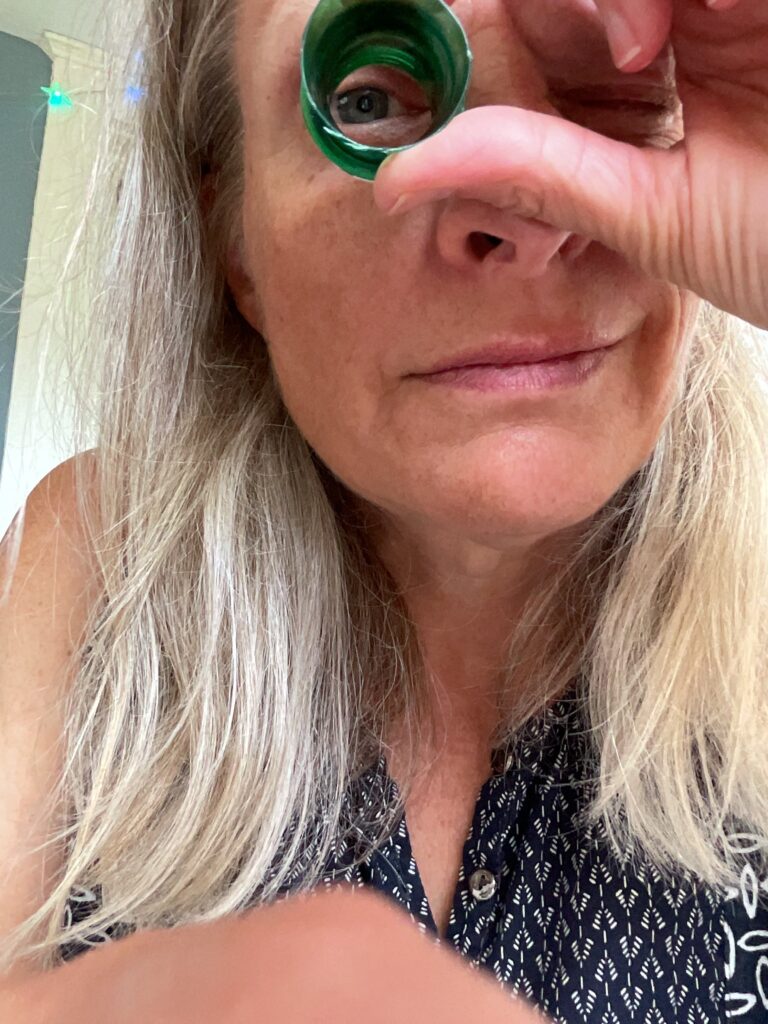
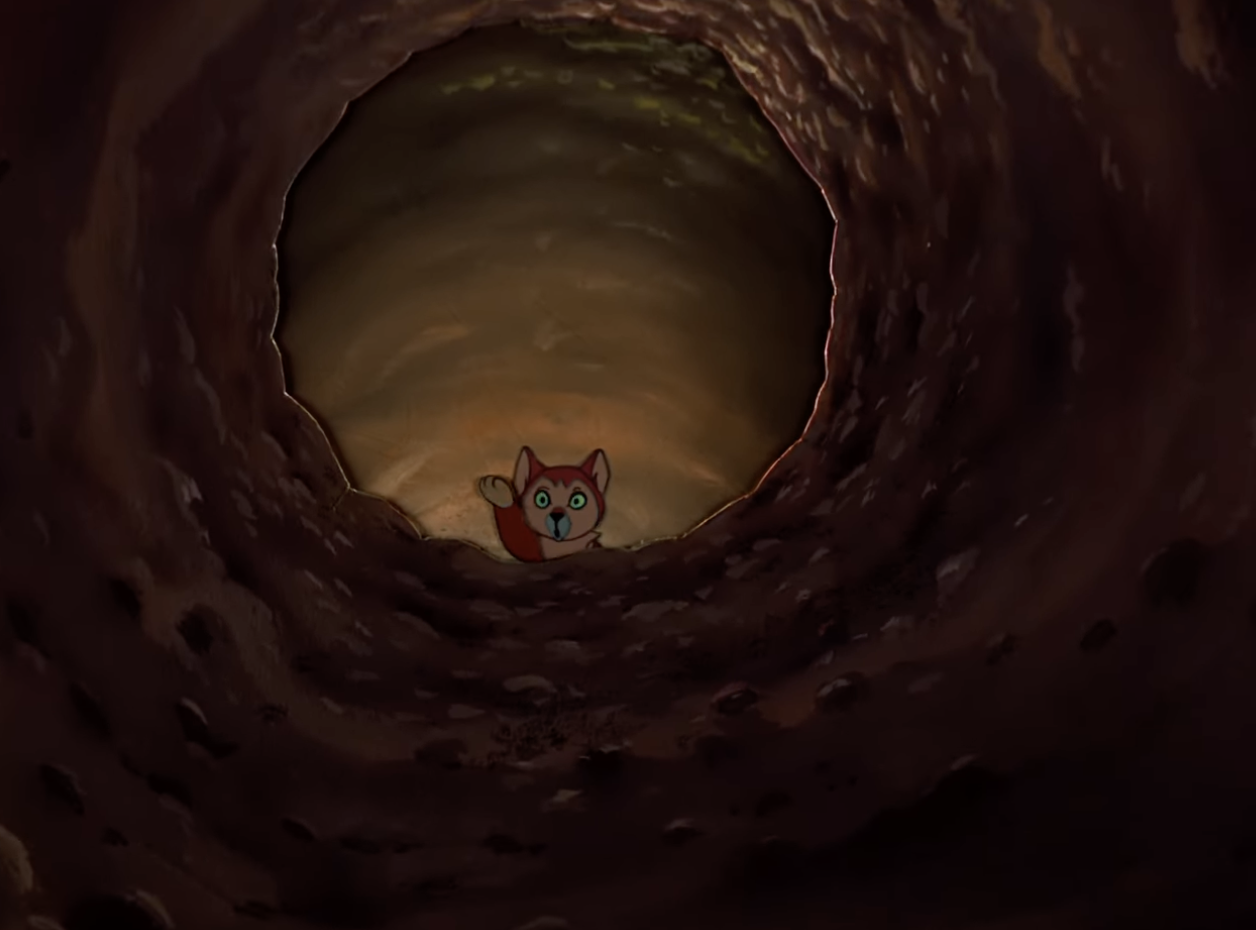
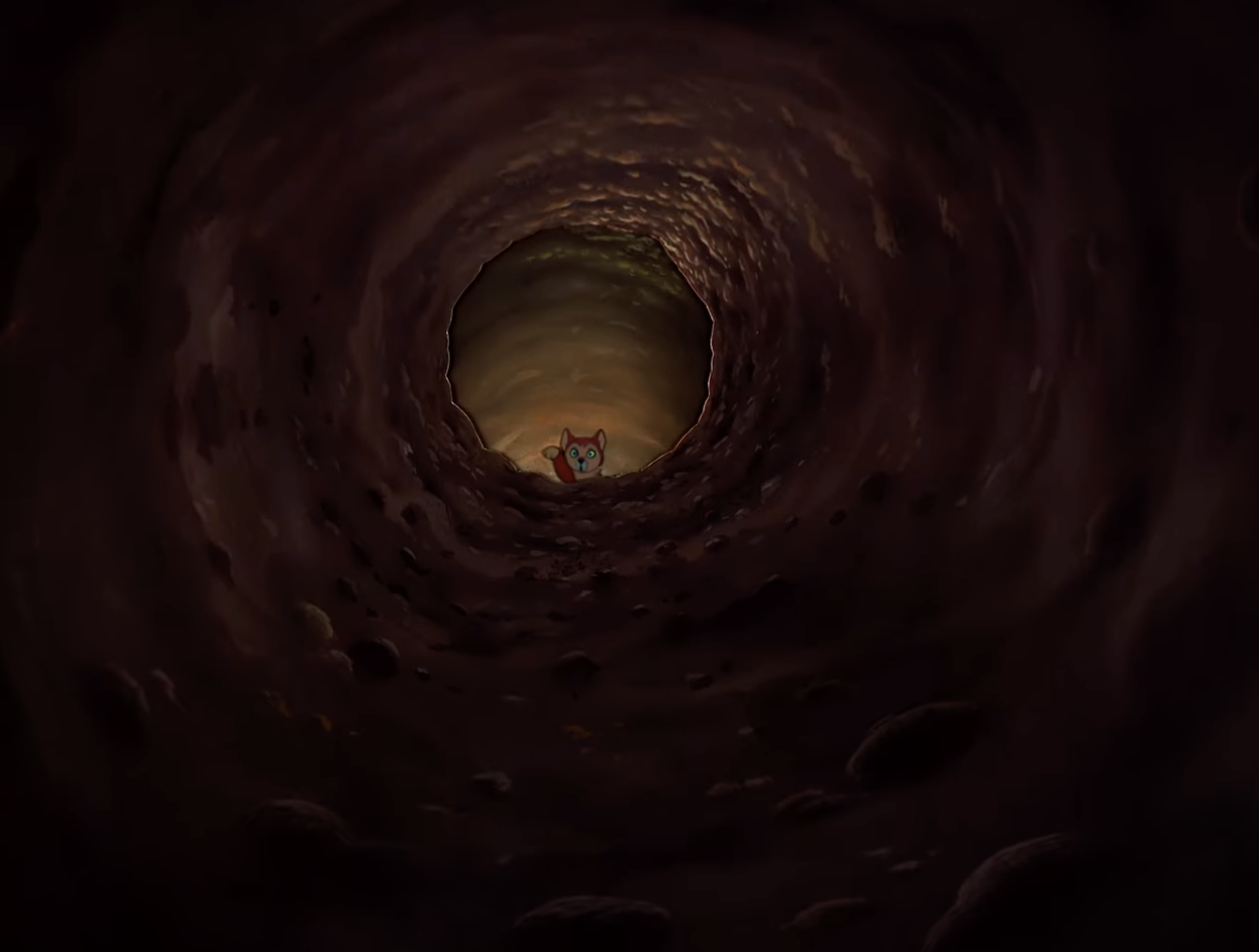
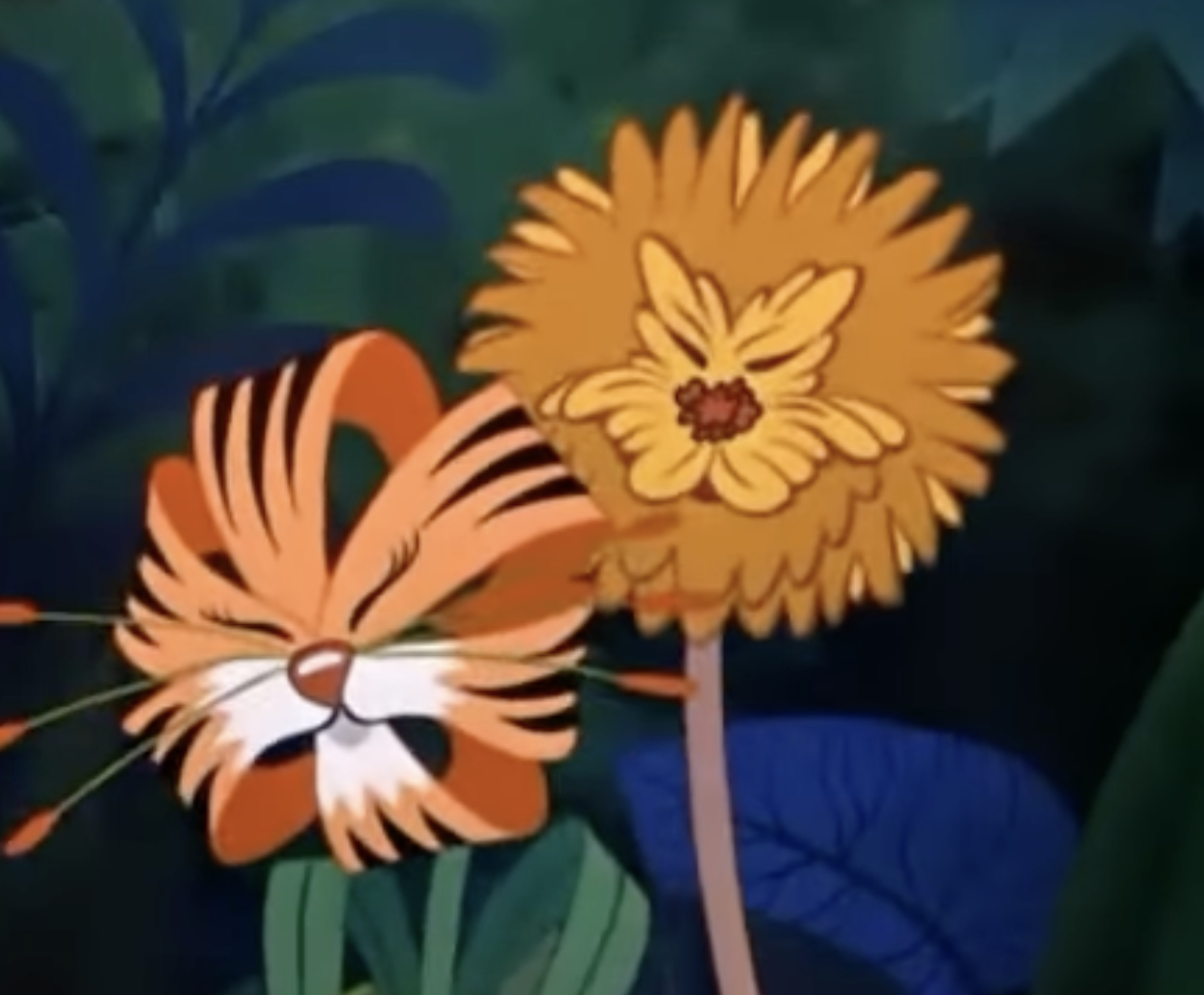
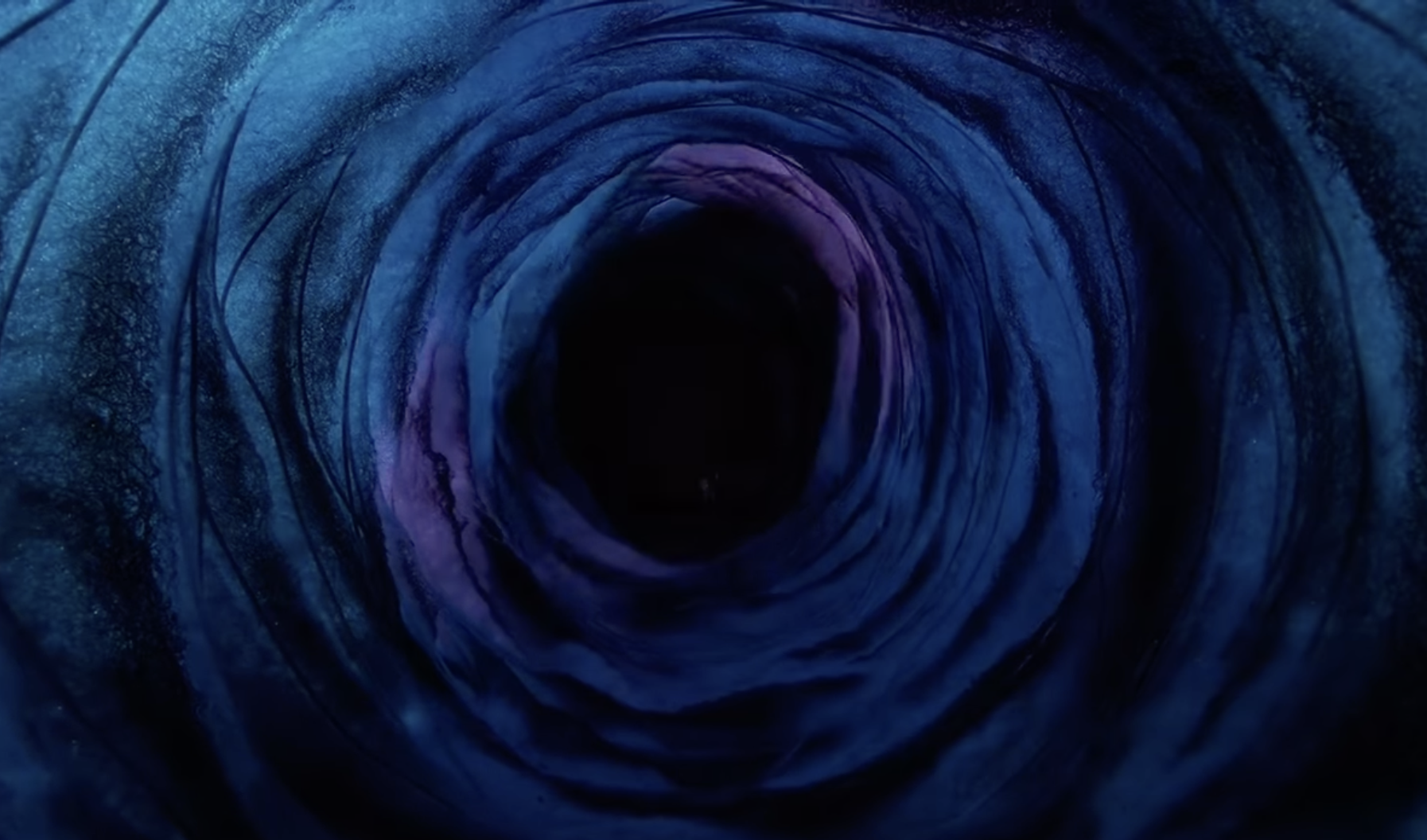
Delight. This morning, I watched the scene from the animated Alice in Wonderland again and marveled (again) at Alice’s reaction to falling down the hole. As she plunges into the darkness, she looks back at her cat standing at the top of the hole, and calls out to them in a delighted and excited voice, Good bye Dinah! Goodbyeeeeeeeee! Alice is not terrified or confused. As she continues to fall, she says something like, Now I will think nothing of falling down stairs!
grids and lines and threads
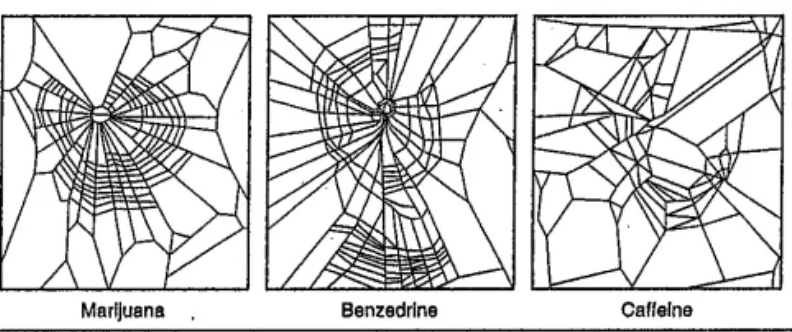
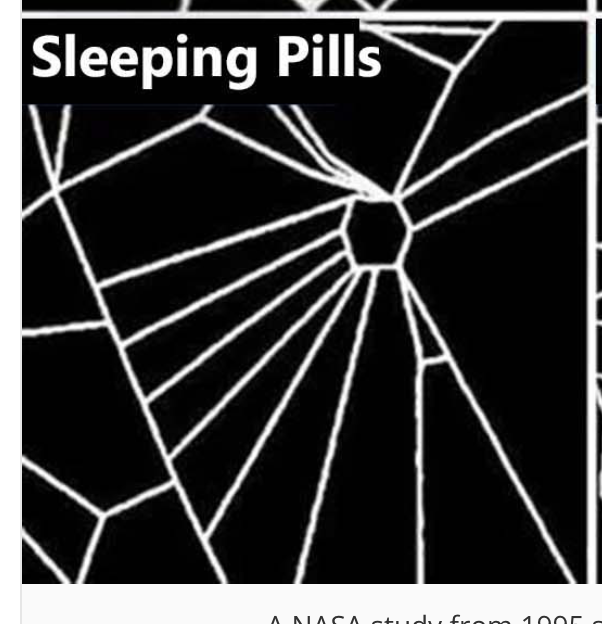
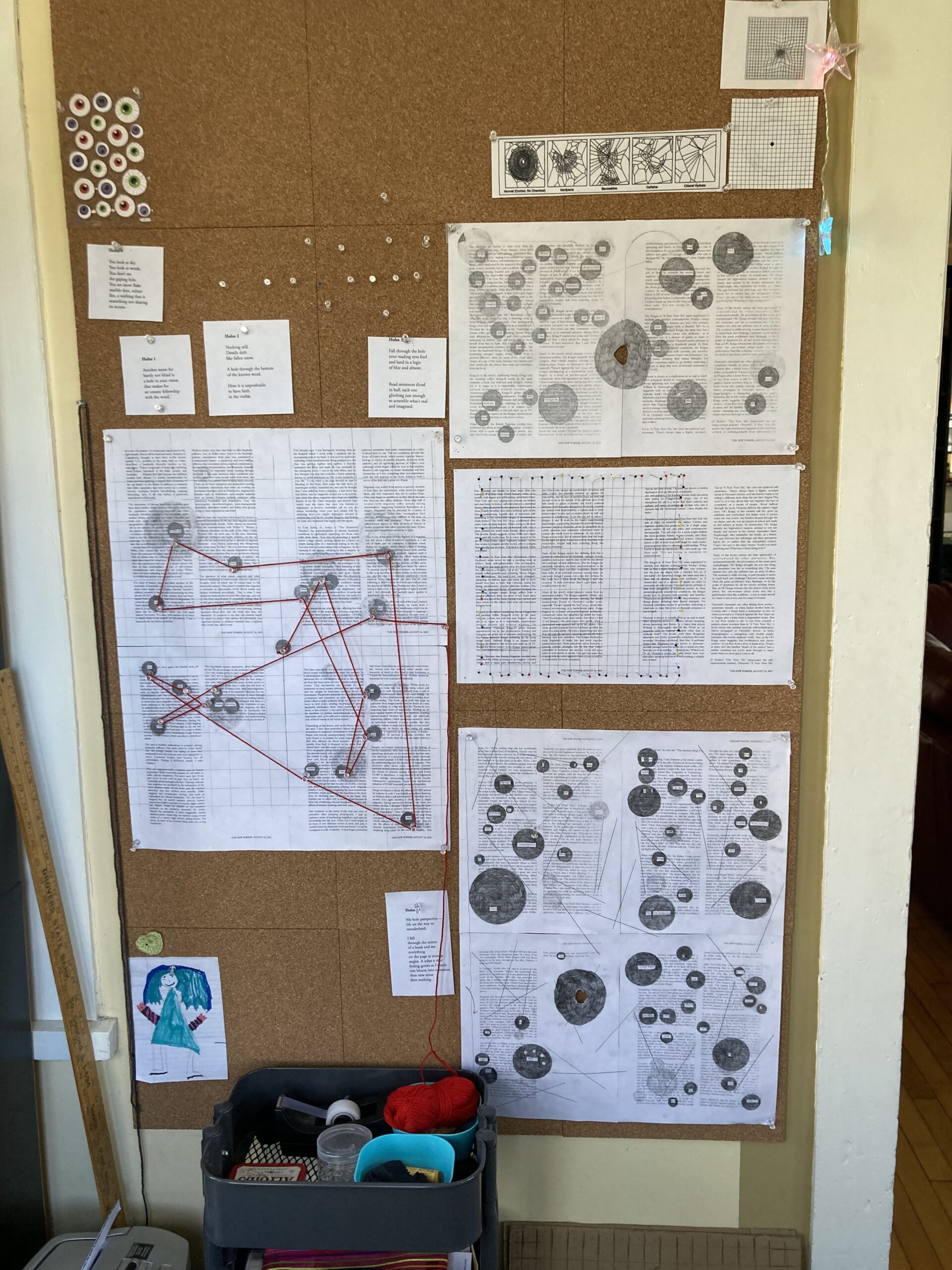
This morning, a return to thinking through the bigger picture of this series. A reminder from my thoughts from 7 april: the jacked-up spider web experiment in which NASA scientists gave spiders several different substances than studied the webs they created on those substances. A visual inspiration for this series! I’m printing out some images to put at the top of my cork board.
my cork board with the spider webs in the top right corner
Before the hike, I gave myself 3 tasks for today: 1. collect/work on Holes 5a, b, and c, also known as Hole Perspective, Hole Time, and Hole Process. Try to include “strings” or “pull the strings” in one of these poems; 2. draw/shade the dots encasing the words for Holes 3; and 3. work on the poem for Holes 6/Strings 1 — the book review about daughter’s memoirs
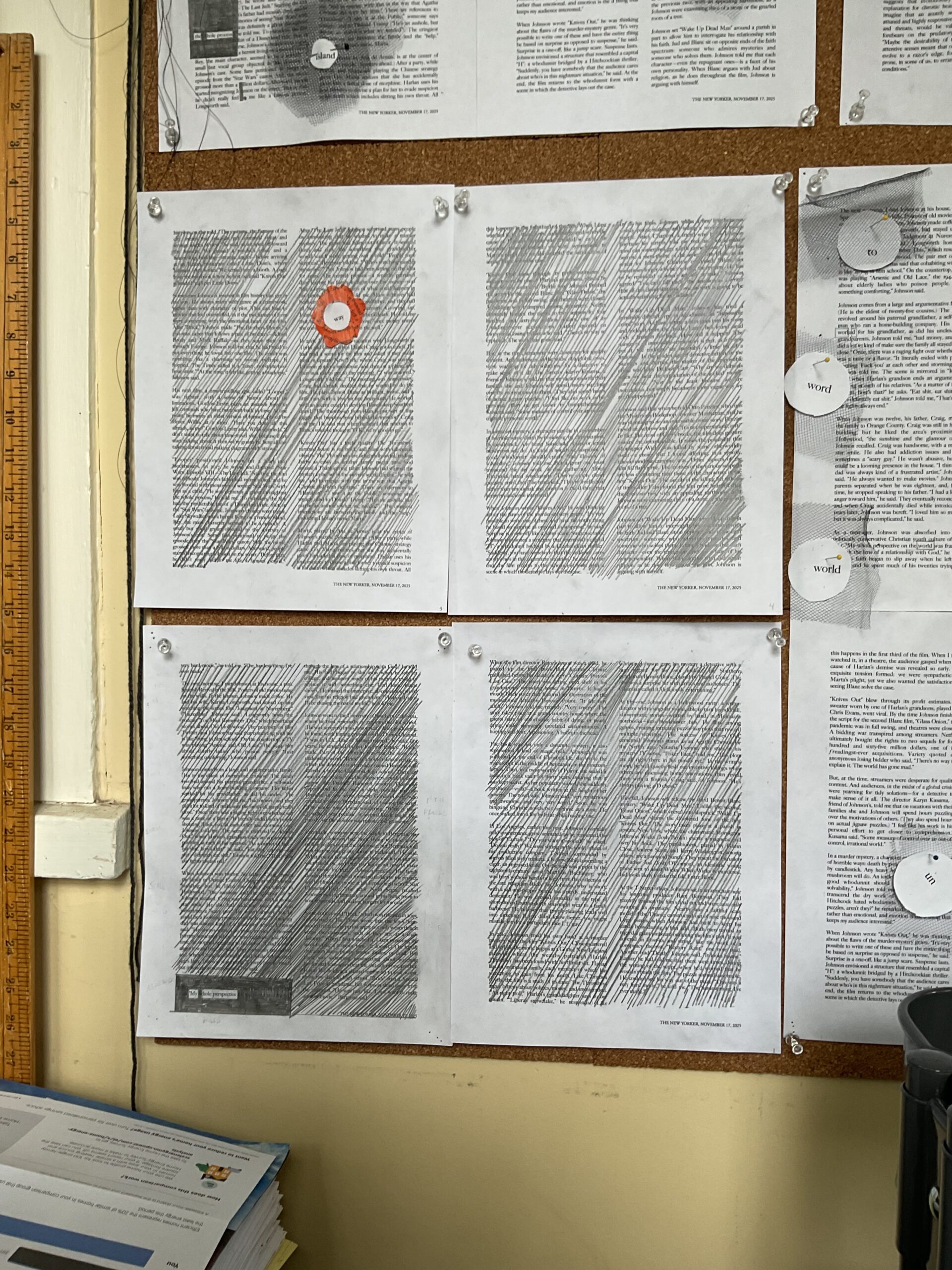
Holes 5a, 5b, 5c and Strings 1
Holes 5a
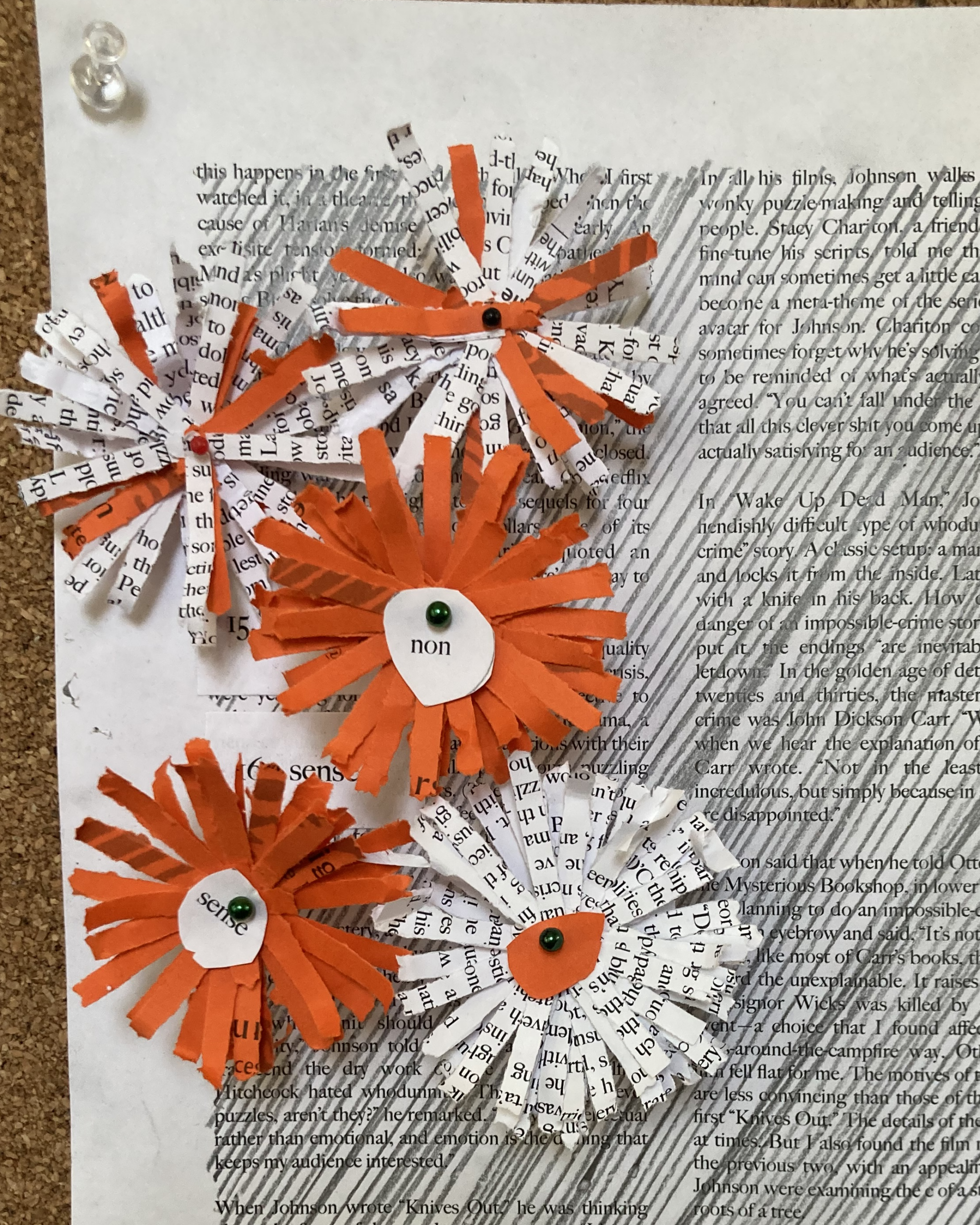
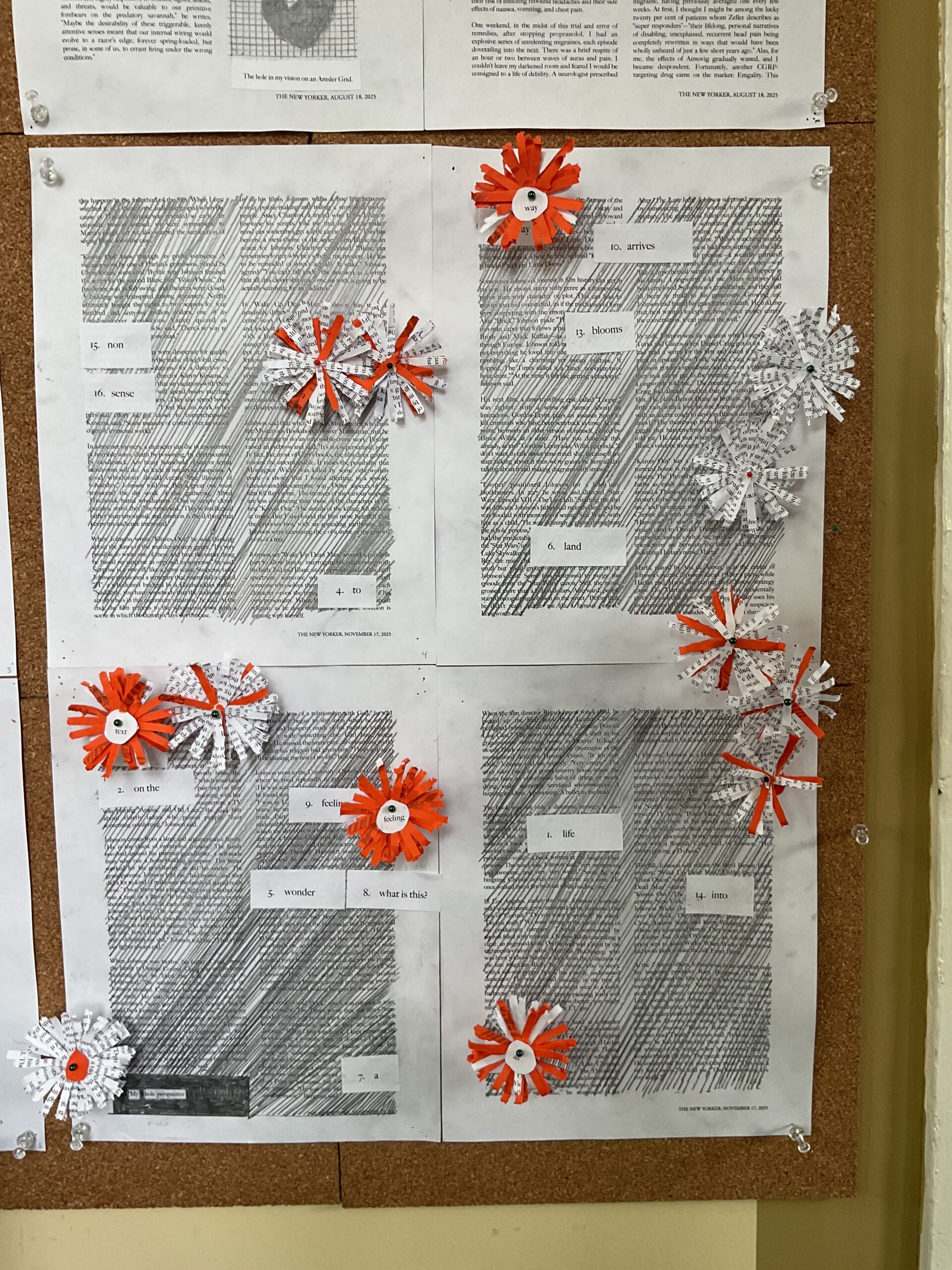
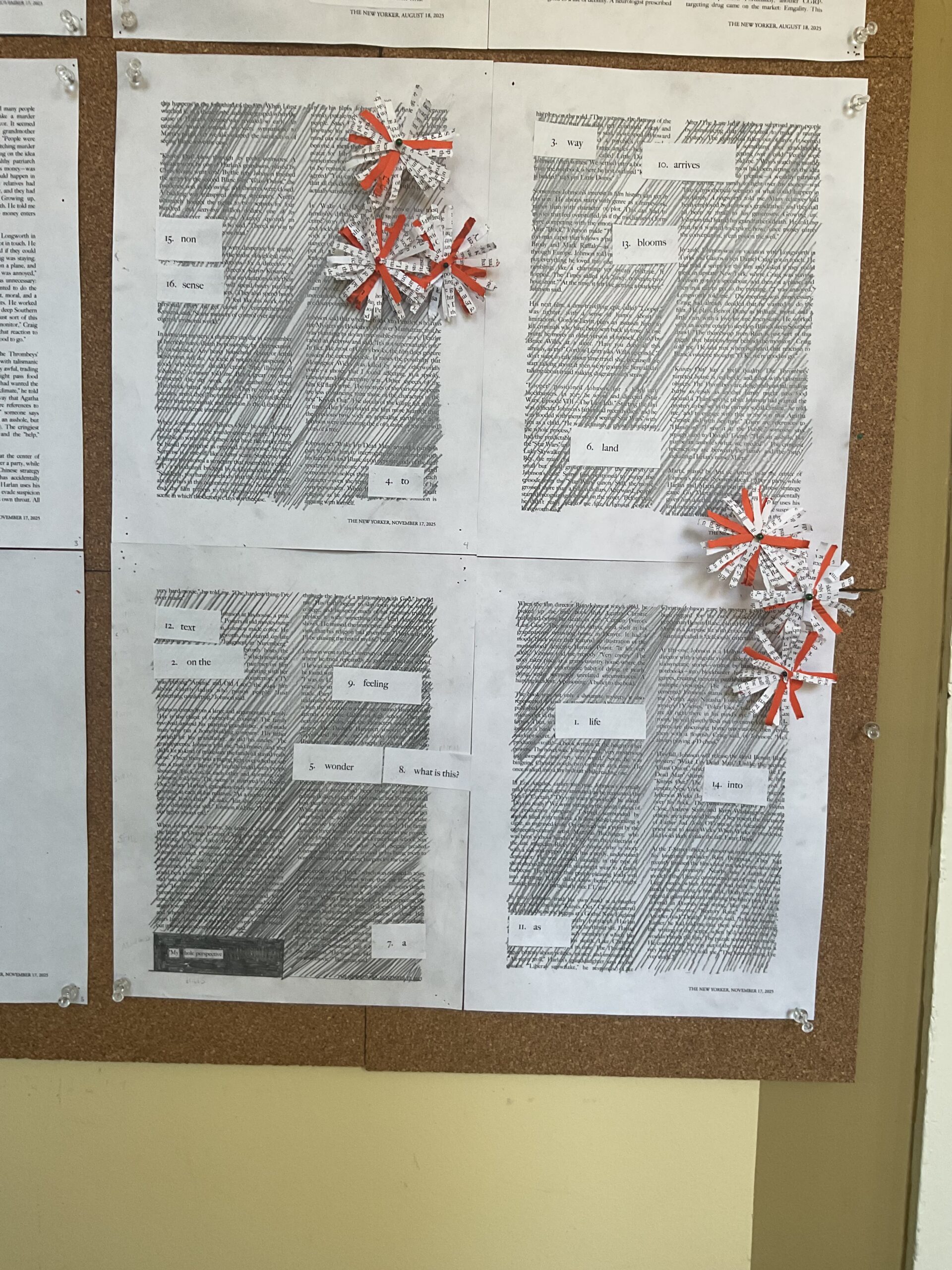
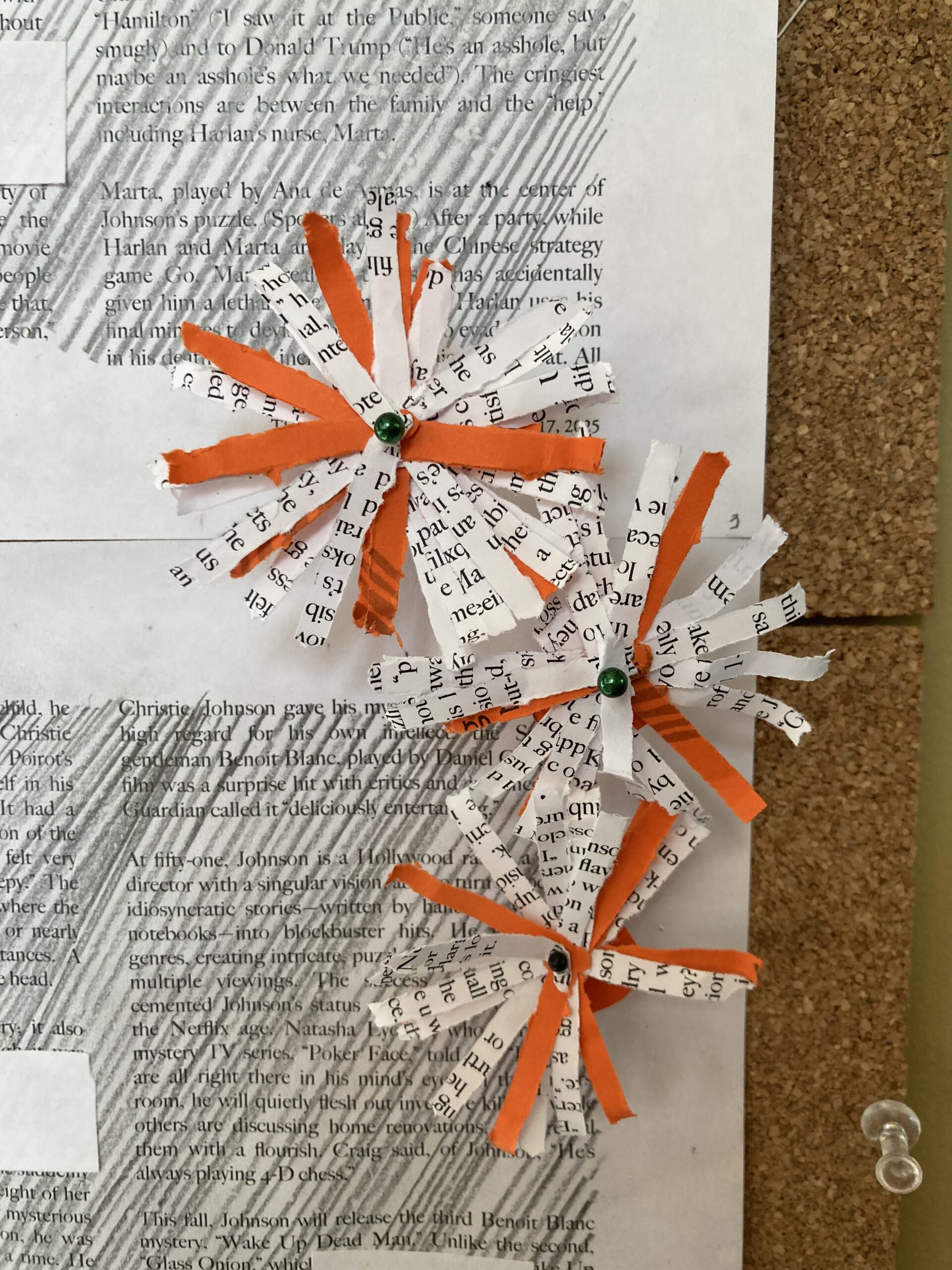
My hole perspective — life on the way to wonderland.
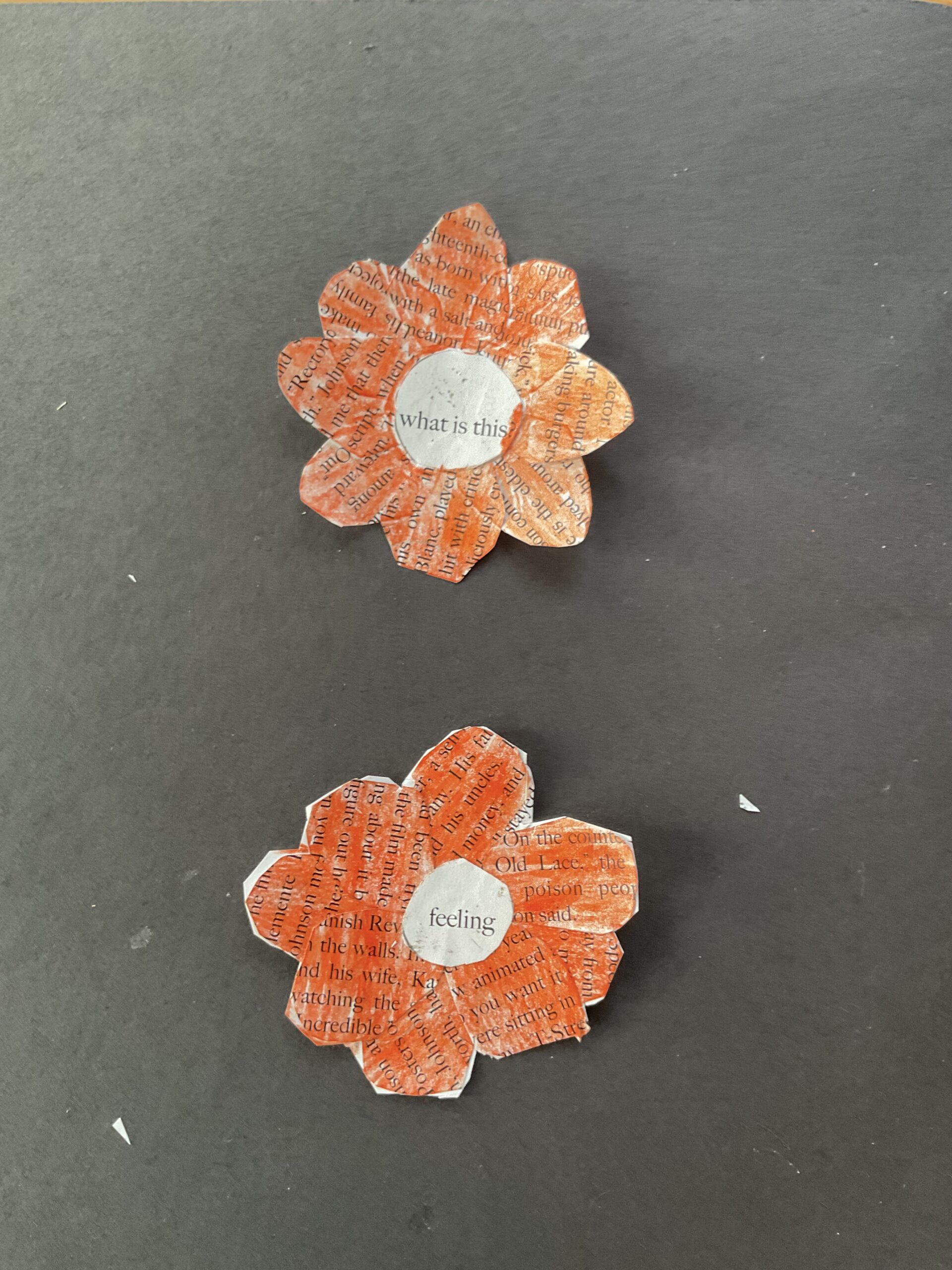
I fall through a what is this? feeling as text bloom into nonsense.
Holes 5b
hole time — measured in word (or words) one word then one then one word
Holes 5c
the hole process — a small island where reading is still possible waits as the large nothing that surrounds it grows
Strings 1
the strings that tie words to the world of meaning have come un done
I like these!
2 — Draw the holes in Hole 3
I did it. And it took much longer than I anticipated, so no third thing today. I drew larger holes and then created an elevated grid over it, first on my wall board and then on a piece of cork board on my desk. I think the holes are too big; they should be dots to match the center dot of the amsler grid and of points mapped on the x and y axis.
grid with big dots
I’d like to plot the small dots on the map of the text and then place the grid over it. I think I need to print the text directly on a graph to plot it properly — or is there another (easier?) way to do this?
Hot! Time to start running much earlier in the day! Yes, a return to morning running could be the next step in my efforts to regain some healthy discipline.
Earlier today I found another song to add to my “Remember to Forget” playlist — Forget Me Nots / Patrice Rushen, so I decided to listen to it while I ran for 9 minutes, then walked one. Midway through the playlist, “Forget Me Nots” came on and as I listened to it, I thought about Emily Dickinson’s “If recollecting were forgetting”. Listening to Elvis Costello’s “Veronica” about a woman with dementia, I thought about how the new name Scott came up with for present Sara, Sara this second, has a much different meaning when applied to someone who has no memory beyond the now.
10 Things
flashes of bright green in my periphery as I ran by trees with new buds
hot sun
music coming from the grassy boulevard: people sitting in chairs, listening to music
squirrels squawking at each other
a loud thumping noise at the skate park
someone in white sitting on the ledge looking over the river
a biker in an orange shirt, biking very slowly over the ford bridge
the voices of kids laughing and yelling on the playground
a biker in a winter coat with a stocking cap and gloves on
the desire path on the grassy boulevard is a mix of packed dirt, mud, roots, and greening grass
holes and grids and threads
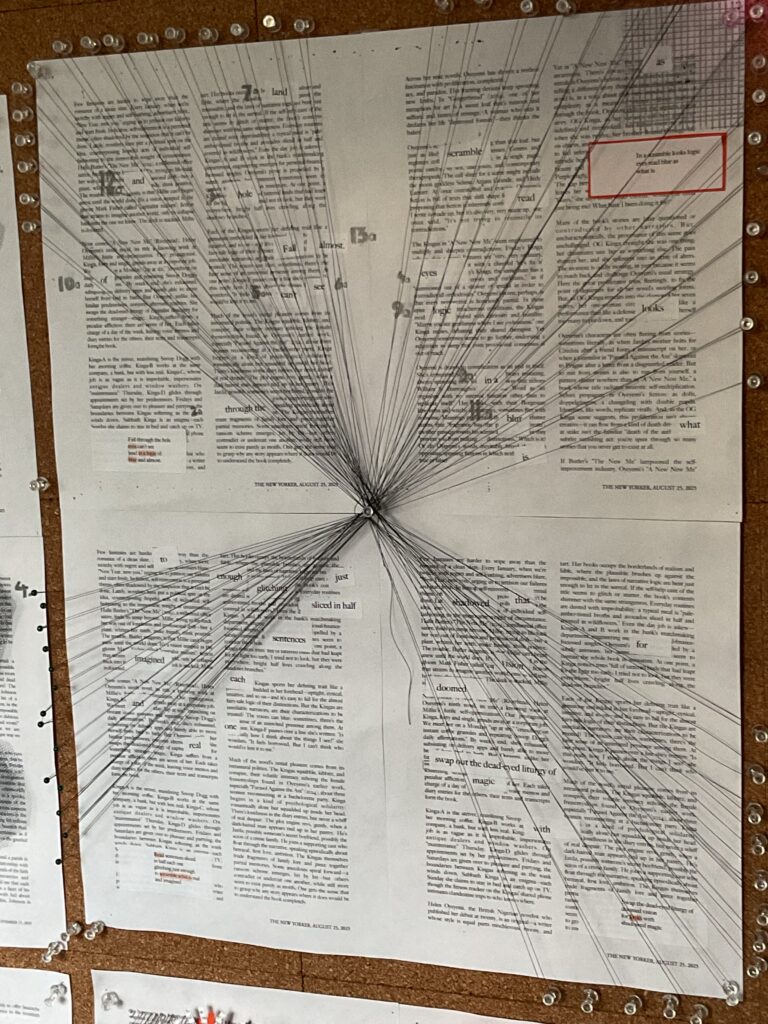
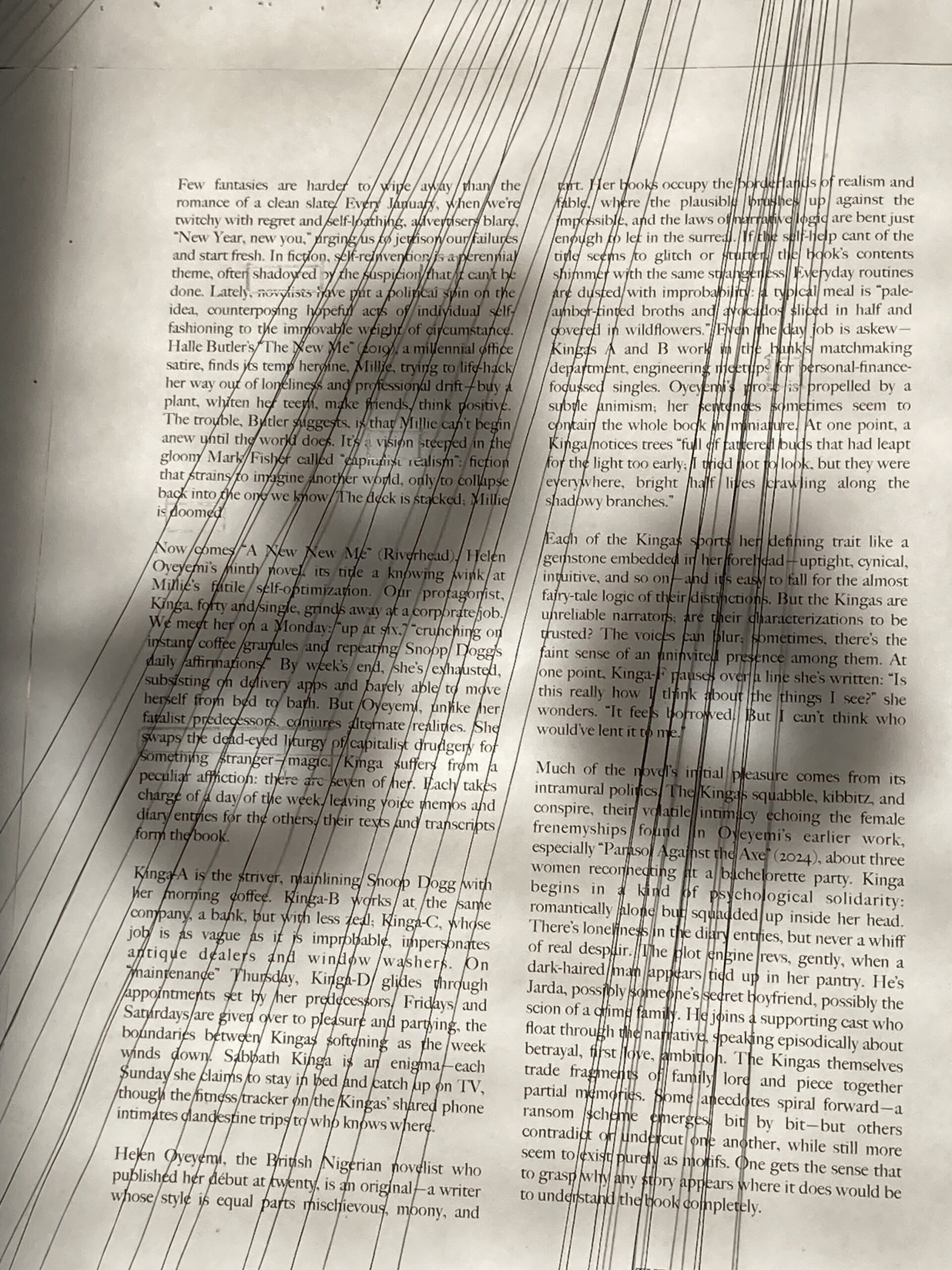
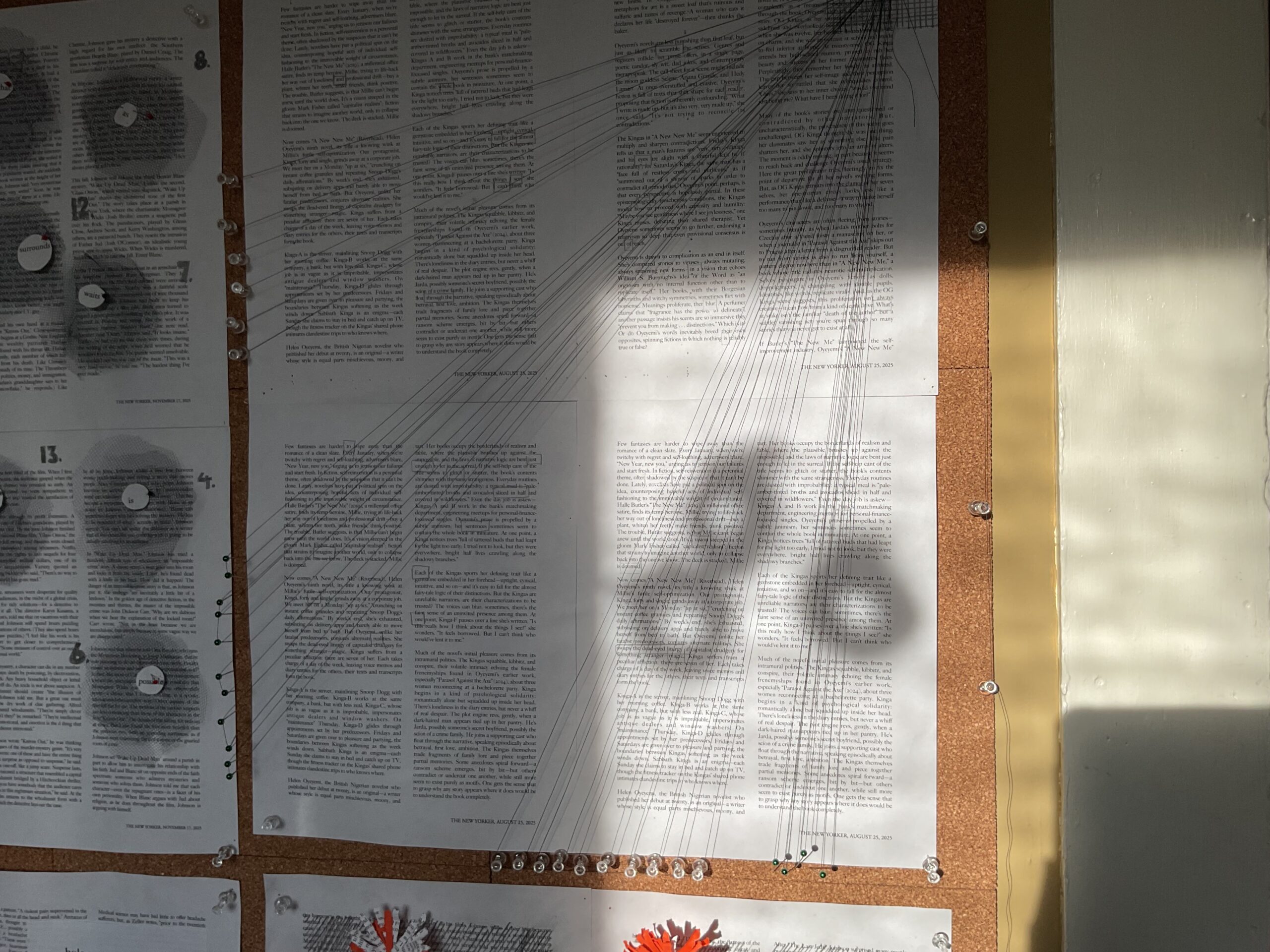
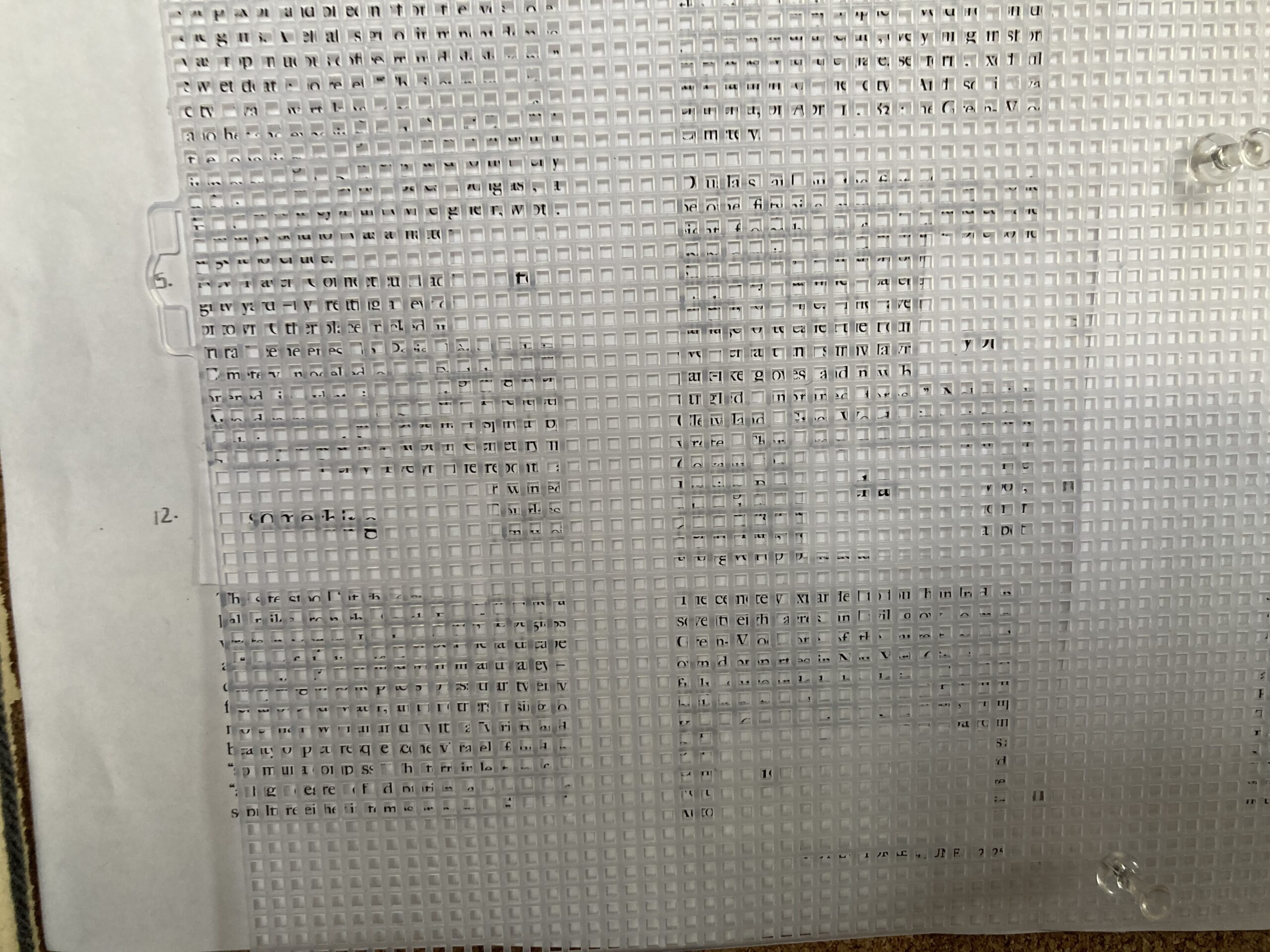
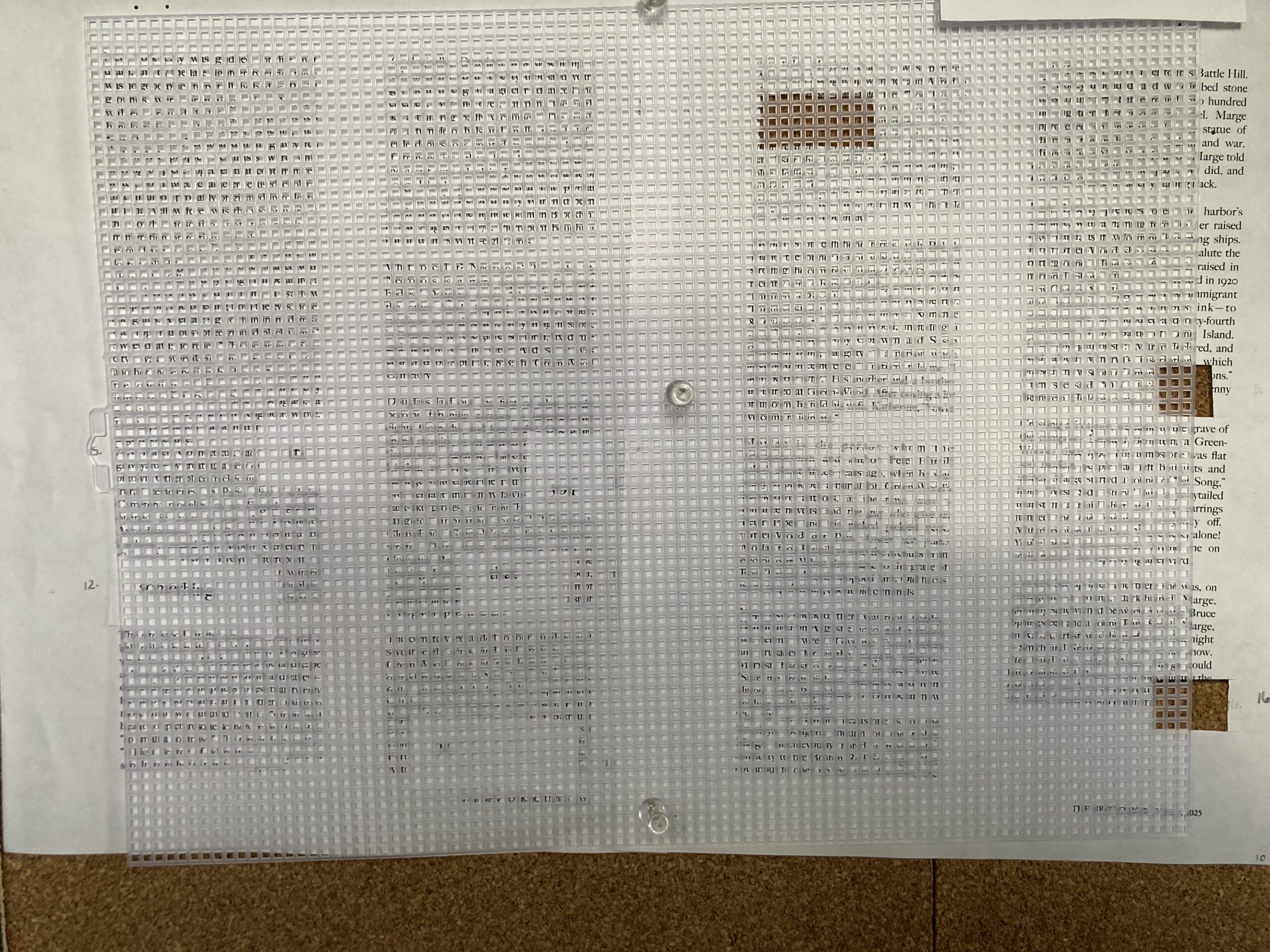
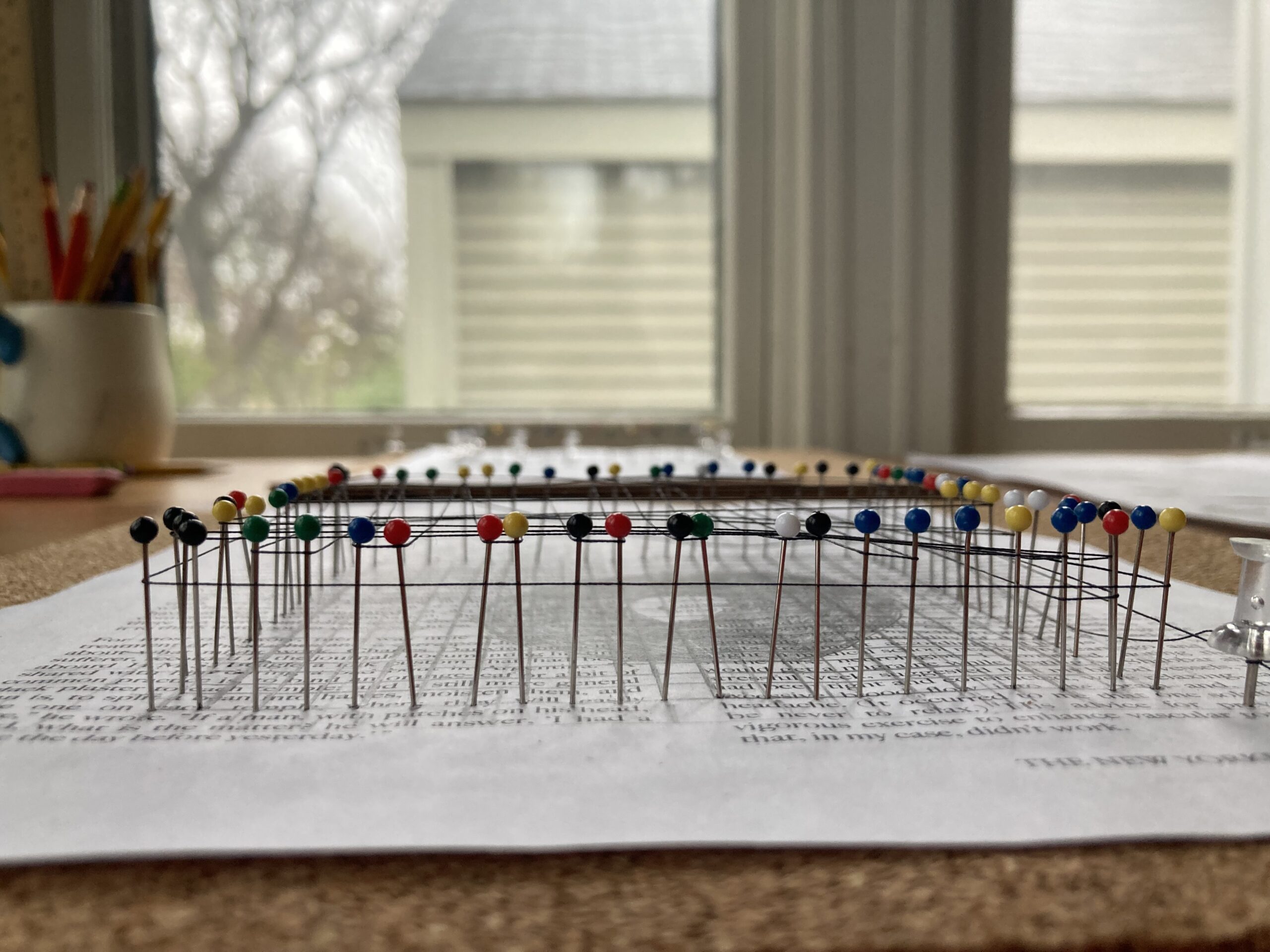
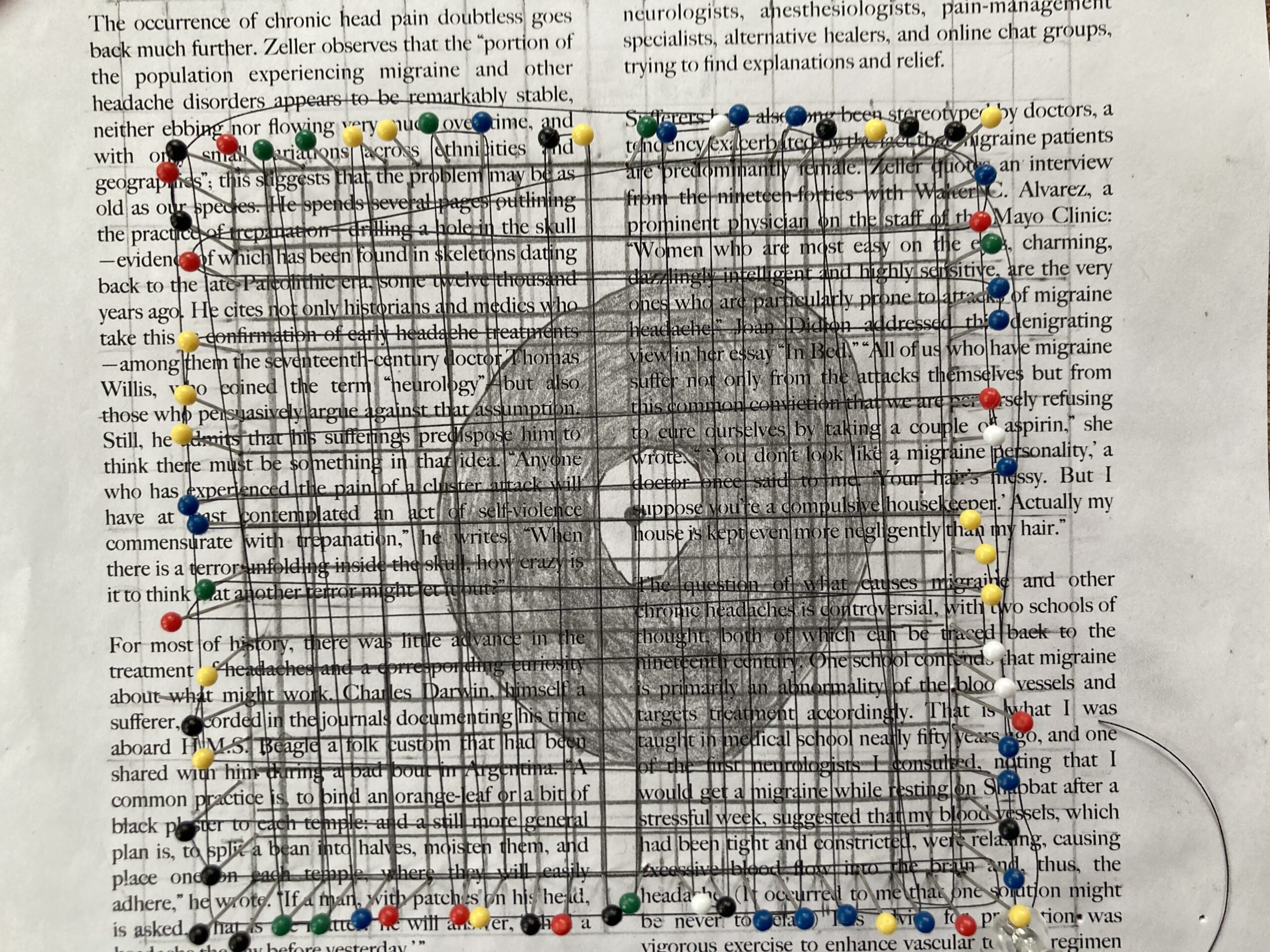
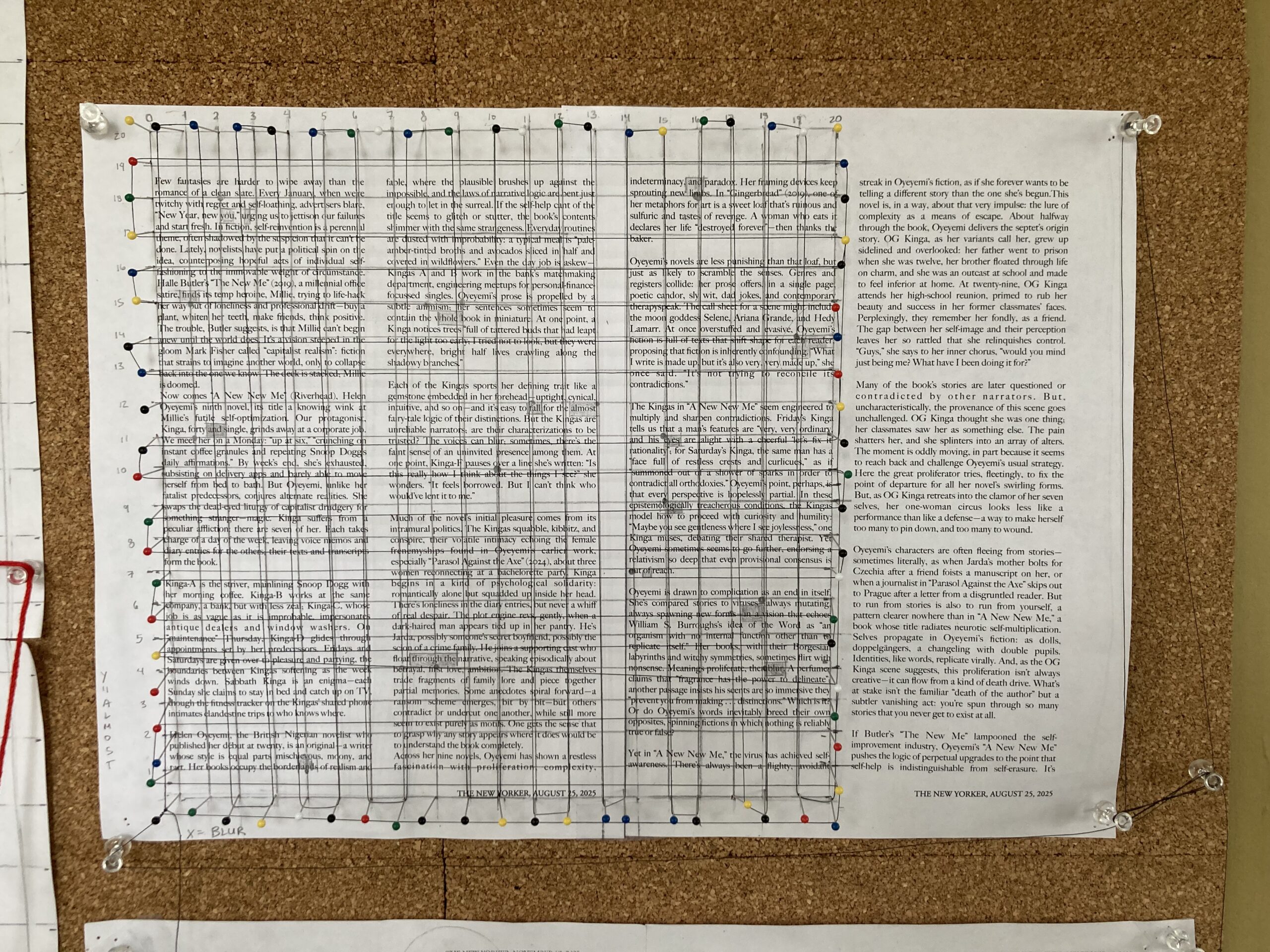
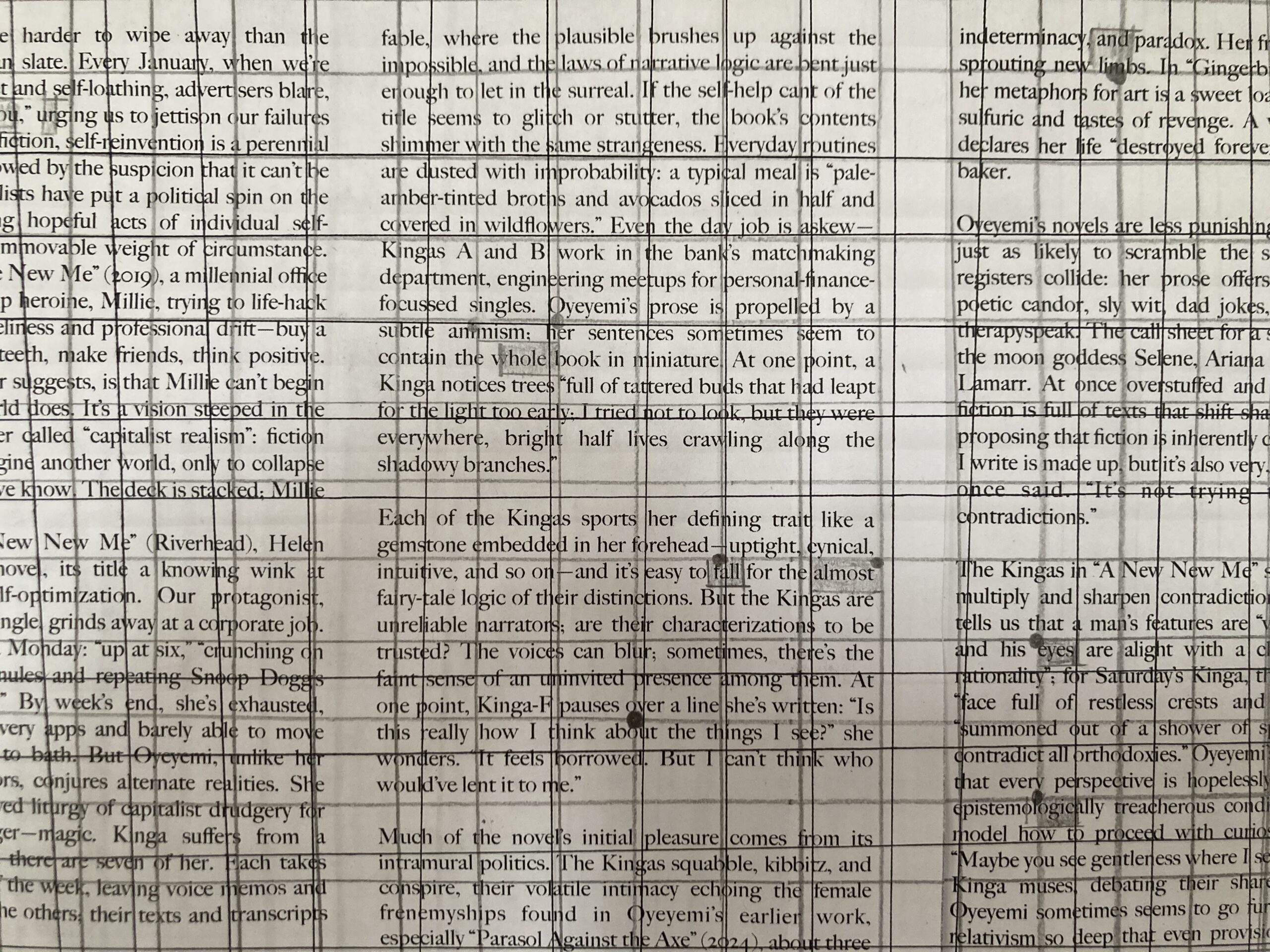
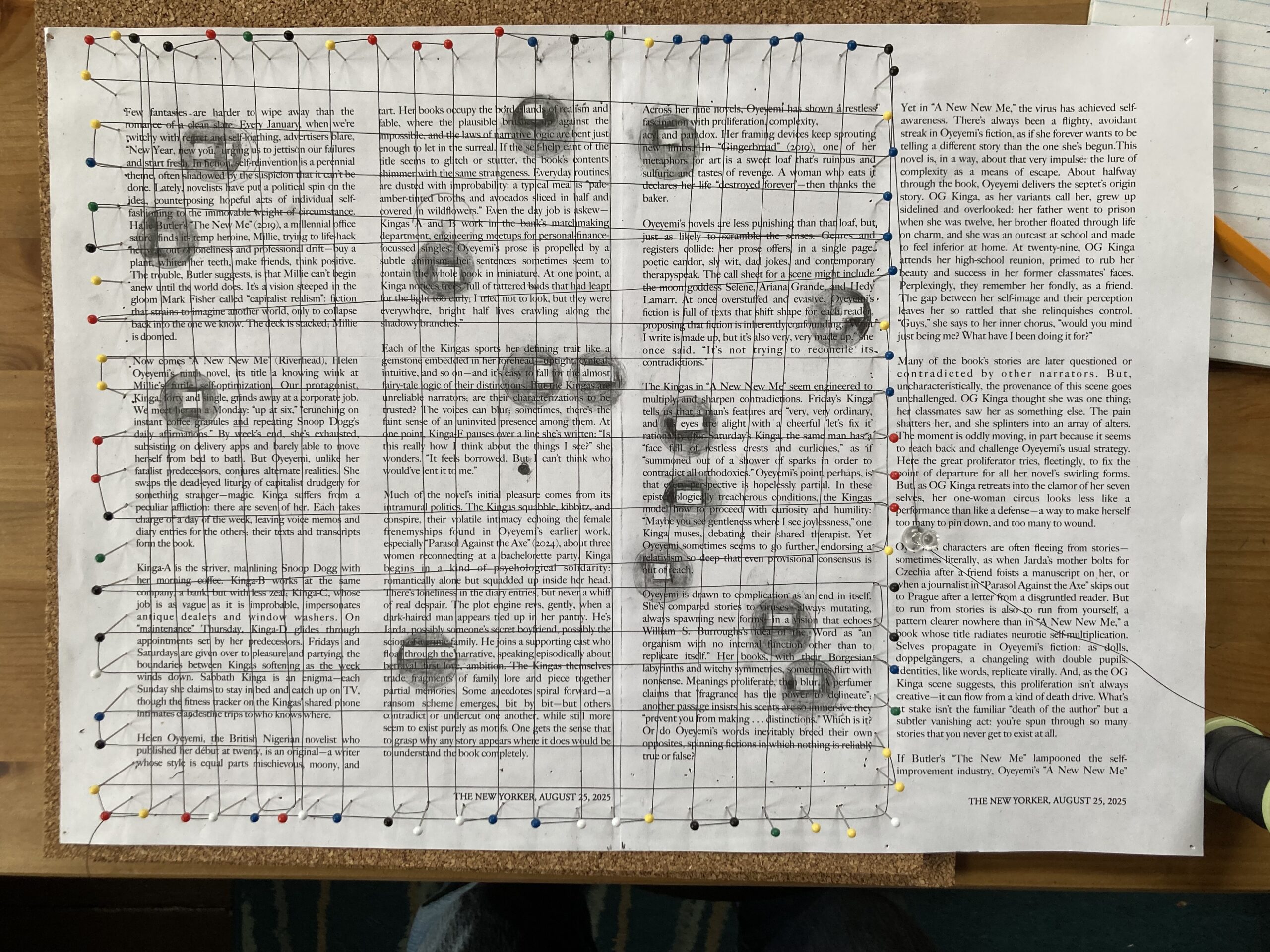
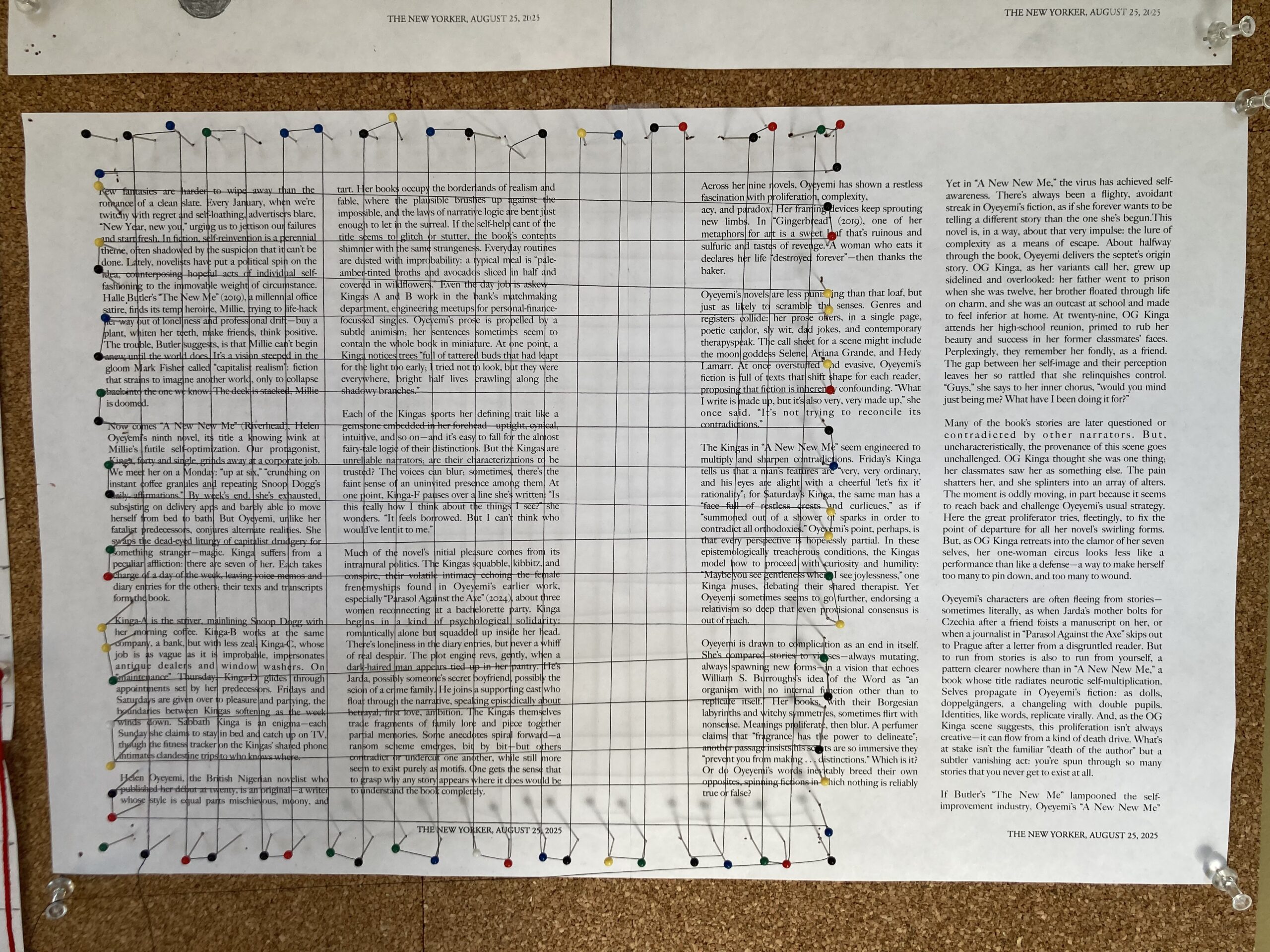
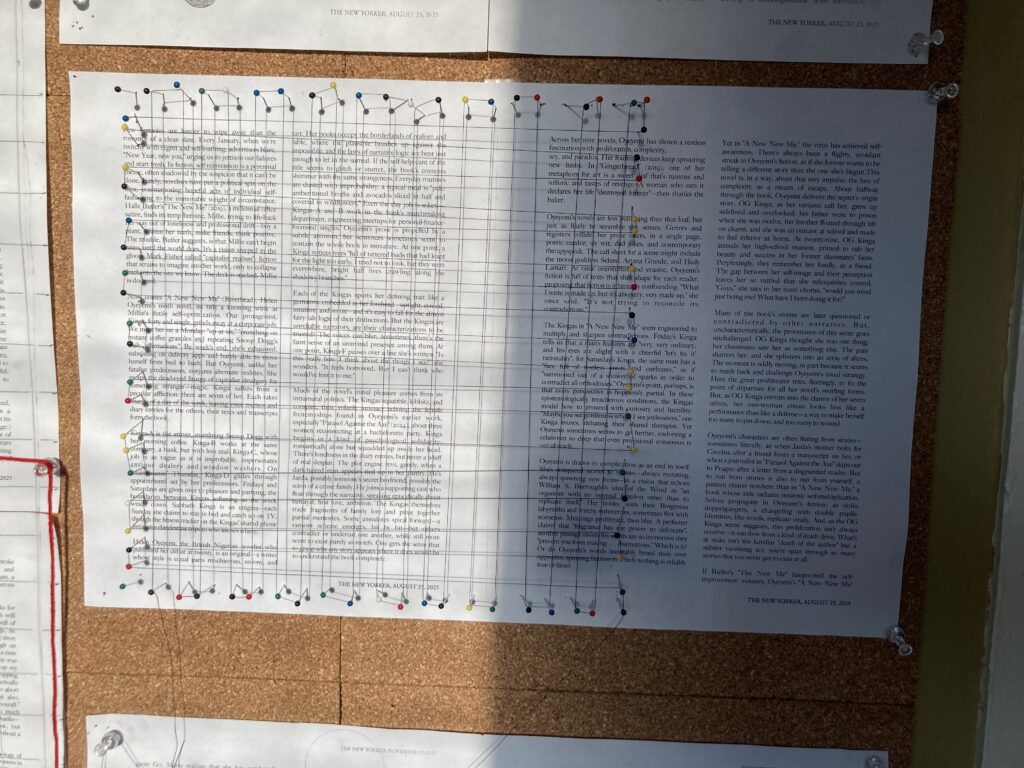
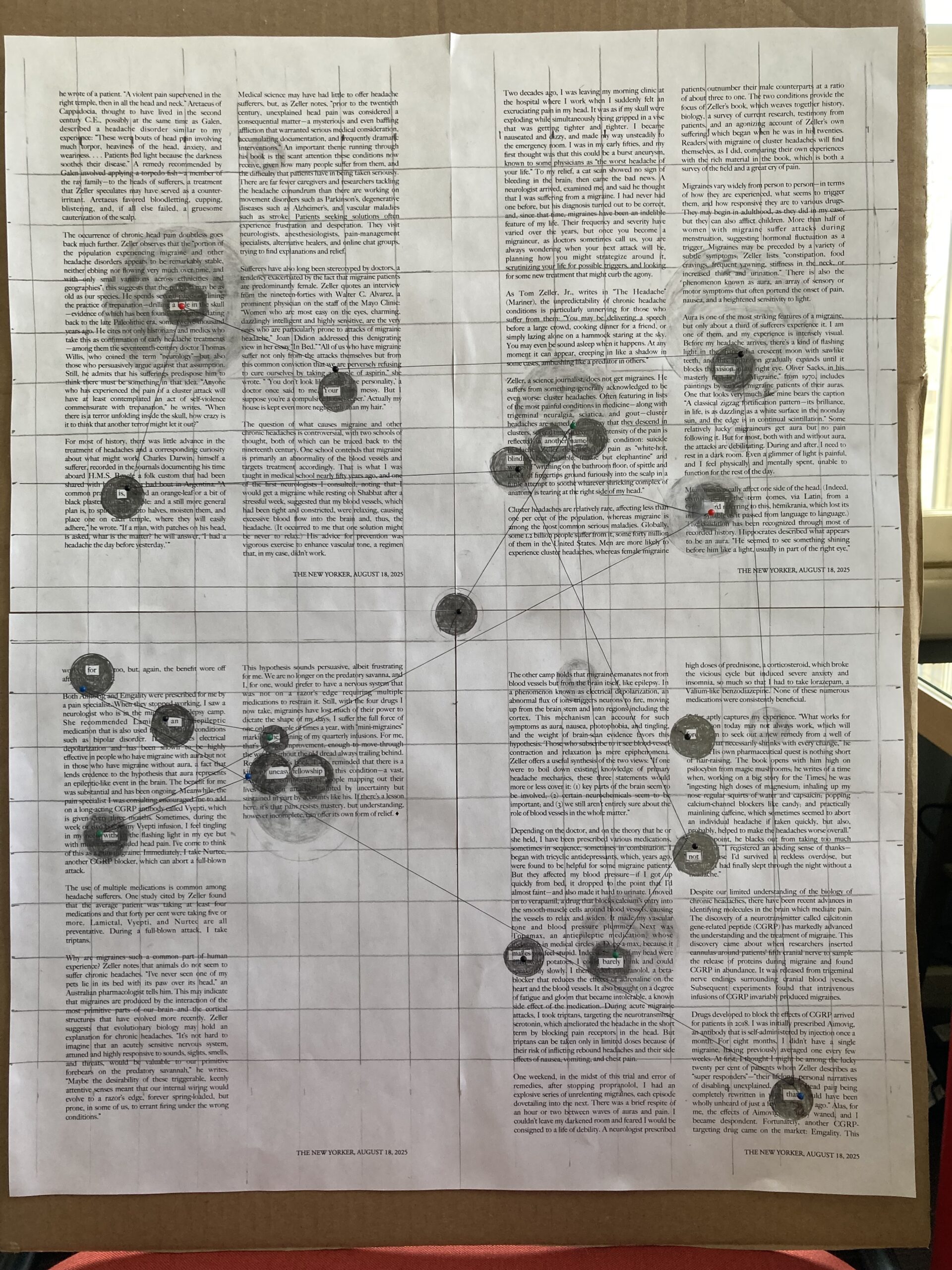
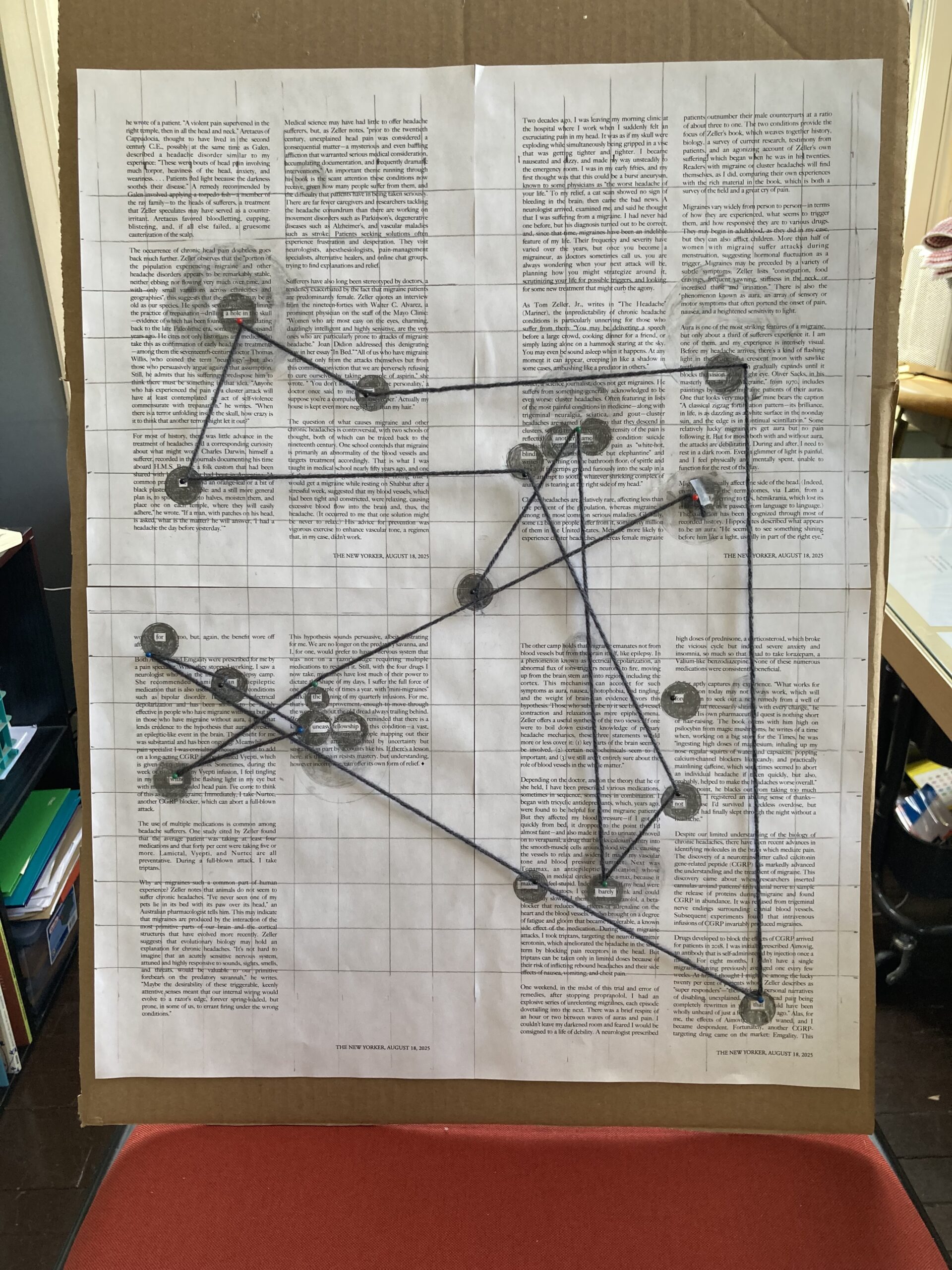
The saga continues. I said to Scott earlier, after pushing my eyes to the limit with measuring 9/16th of an inch and attempting to cut straight slits and placing 84 pins 1/2 inch apart to create a grid, why I am so stubbornly committed to this project when it is to fiddly and challenging for my limited vision? I am not sure, but something in me won’t quit. I want to make a series of visual poems that use grids made out of thread and string and yarn and that require skills far beyond my ability (at least my ability right now) and that are exhausting and frustrating and take a lot of time. And, I WILL make it, dammit! I could use graph paper for the grid, but I want to use thread/string and have the lines be 3-dimensional. The thread/yard is partly as a connection to my fiber artist mom and my fiber artist daughter. The 3D is for the shadows and for what the floatinggrid boxes do to how we see/don’t see the words within them. I just finished my first attempt on placing the grid over Holes 3. I measured a 10×10 square over the words and then placed 21 pins on each of the 4 sides. Then I wound the thread around the pins to create the grid.
a 10×10 grid made of black thread and pins, placed over a NYer book review of Helen Oyeyemi’s new booka closer look at the grid and the first word of the poem, fall
I really like this grid overlay, even as I recognize that I need to do more to it to make it make sense to a reader/viewer. The pins are difficult to work with on the thin cork board. They twist and bend out of place. What will I use for a different/the final version of this poem? I showed it to Scott and he suggested a frosted plexiglass layer with only the words of the poem visible. At least, I think that’s how he described it; I’m not quite understanding what he means. I’m wondering if encasing the words in a small dot (both a reference to the center dot of an Amsler grid AND xy coordinates on a graph) might work. One problem: I don’t want to remove the pins and draw the dot in, then have to re-string/pin the grid. I need a better solution for that!
I do like the elevated grid and the way you have to look through and around it to find the right word. I also like the thin thread that you almost can’t see. That’s how my vision often works: it’s not a solid wall of black, but the faint trace of something, sometimes feeling like a net or a screen that makes it harder to focus on anything. One more thing: when I ‘m reading, it does feel like each word or phrase is encase in a grid, with nothing outside of the grid in focus.
note: I’m warming to Scott’s plexiglass idea, even as I’m still not totally understanding what Scott means. What does the plexiglass do to the effect of the grid-thread? The focus on this poem is the graph-grid and the x = blur, y = almost coordinates.
It’s 5:38 and the sun is streaming in my front room studio. I’m waiting for it to hit my grid poem, and hoping it leads to cool grid shadows!
It’s 6:38 pm and some shadows have finally arrived! I asked Scott to take the picture because I wasn’t sure I could capture it effectively.
pin shadows
At first I didn’t notice the pin shadows, I just thought the pins had become twisted out of shape. But no — the pins are fine; it’s their shadows that are all askew. Nice!
Delighted by the result, I decided to take my own picture:
Only 56 degrees? It felt much warmer than that! My hair is soaked with sweat, my face feels flushed still, minutes after finishing. Spring is here! I listened to a piece we’re playing for community band concert in a week, Bookmarks as I ran south, and my “Doin’ Time” playlist running north.
I waved and smiled at as many people I encountered as I could. Did I ever speak? I think I did, once. Even with my music playing, I could hear the kids having fun on the playground and the roar of the falls at the park. At least a dozen people were walking around the park, 4 of them were standing at my usual spot. As I stopped to take off my sweatshirt, I heard a thump thump thump behind me: a young kid running over to the steps. They were fast! A few minutes later, I heard several people calling out, woooooo or weeeeee, close to those steps. It sounded like someone was being swung in the air, or lifted up and down.
Anything else? Several of the benches were occupied, but not the one above the edge of the world. I stopped there to admire the river. I don’t remember what it looked like, just that it was open and wide and peaceful.
at the clinic (earlier this morning)
Today I had to go to the clinic to get two cervical polyps removed. No big deal — an easy procedure with only a 1% chance that the polyps would be cancerous. I was hardly anxious at all, even when they took my blood pressure, which is huge improvement from my last visit in early February. Hooray!
A few observations: Passing by a door, hearing a kid on the other side losing their shit. Hearing them a minute later while in the bathroom at the lab. This was never verified, but I think they were also at the lab, getting blood drawn. Yikes for the drawer of that blood and for the one getting it drawn!
Heading towards the lobby, passing an older woman (with all gray hair) about to be weighed, taking off her shoes and jacket, saying, hold on, I want to take off as much as possible to weigh as little asI can! I’m kidding. Was she, though? Hearing this, I though about my mom and how, when she was on chemo for stage 4 pancreatic cancer, she desperately didn’t want to lose weight because she was already too thin, and I thought about the doctor on a Facebook post who specializes in peri/menopausal discussing how being strong is so much more important than being skinny, especially for older women. With these thoughts, I wasn’t giving shade to the woman getting weighed; I was reflecting on the discord with older women’s bodies and the impact of oppressive beauty standards on their bodies.
Anything else? Oh — on my back on the table, feet in the stirrups, I looked up at the ceiling and noticed a dot. I stared at it, trying to imagine the Amsler Grid and to see my blind spot. Did I? I can’t remember now.
Driving home, I struggled to find a fun/pleasing/alliterative way to describe Sara in the present moment. I mentioned to Scott how well it worked with our daughter’s name: RJP right now. Scott suggested two awesome versions for me:
Sara this second Sara since Saturday
I love both of these so much. How much? Enough to try and write a poem about them! I’ll try to think about them on my run1. One reason I like Sara this second is because I love the idea that I have so many present Saras that they can’t be contained in minutes; I need seconds! And Sara since Saturday? I said to Scott, this is an example of alliteration helping you to find more meaning. Sara last Saturday isn’t nearly as awesome as Sara since Saturday!
grids holes thread
I was planning to work on the grid for Holes 3 this afternoon — current options: drawing a grid directly on the text OR creating a loom frame and making a grid out of thread to place over the text — but I’m not sure I have enough energy or vision for it. Maybe I need some more food?! The snack has happened, some water too. A recharge! I want to start with a loom frame for my 2 panel poem. I’ve cut out the frame and figured out the measurements for the grid, but now I’ve run out of time!
Well, I tried to think about them, but I forgot before I reached the river. I recall a flash of Sara since Saturday and then wondering why he chose Saturday, with 3 syllables, instead of Sunday, with two. Is it because Sunday doesn’t sound quite right? ↩︎