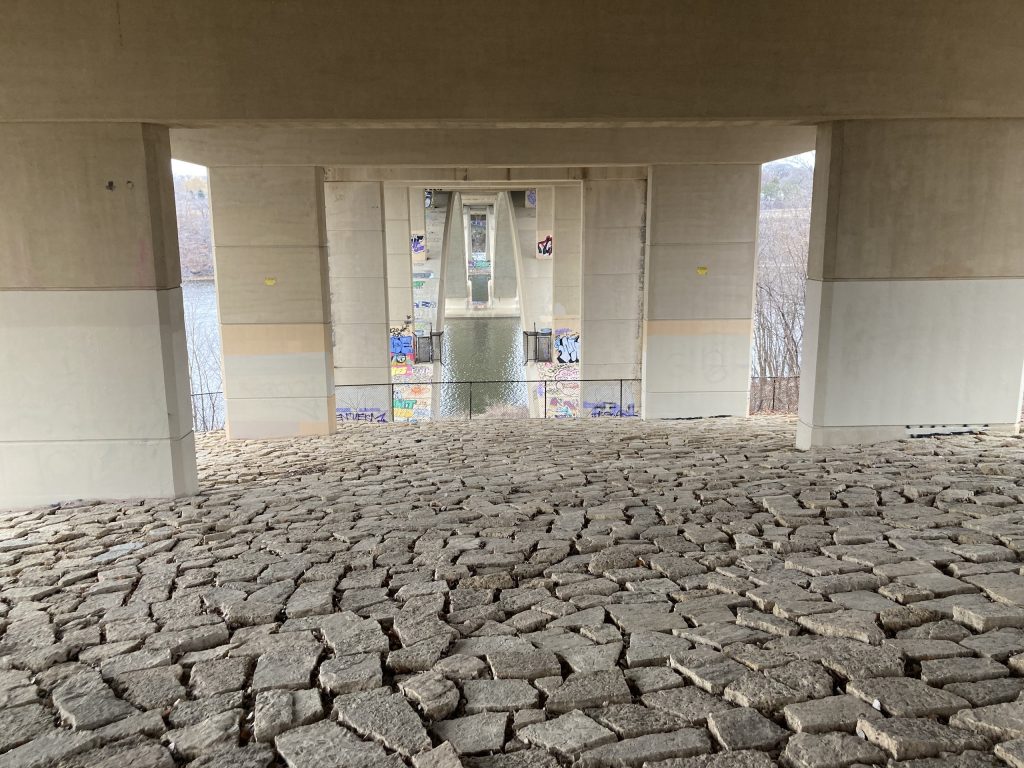
feb 29/RUN

5.15 miles
bottom of franklin and back
33 degrees

Some wind, lots of sun and shadows and spring feelings. Heard some black-capped chickadees, was dazzled by the sun shining off a parked car, saw some new graffiti on a sign at the bottom of the hill.

Often my legs felt heavy. But my calves were quiet.

Heard a woodpecker knocking on wood somewhere near the rowing club and thought: a door!

Anybody
home? The
woodpecker
knocks on
the tree like
it was
dinner’s door.

Recited ED’s “I felt a Funeral, in my Brain” throughout the run and got most of the lines.

Had some great thoughts while I ran about ED’s funeral poem and how it fits with running and the feeling of moving past (beside) your Self to a space beyond thinking and seeing, where you’re feeling and hearing. Thought about the gradual process ED describes — her repeated use of and and then — for how we break through to a different world where Space — began to toll/As all the Heavens were a Bell/And being, but an Ear. I had many other thoughts, but I’d like to think through them and post tomorrow.

ED’s Daily Delight (feb 28)

the line: Superior — for doors — (from “I dwell in Possibility”)

In November and December, while I was working on the revision of my Haunts poem, I started writing a series of door poems, inspired by a Mary Oliver line from Upstream:

I did not think of language as the means to self-description. I thought of it as the door–a thousand opening doors!–past myself.

Upstream/ Mary Oliver

Looking for
ways out,
hoping for 
ways in,
finding doors
open
everywhere

Then I wrote a series of brief 3/2 poems describing the “doors” I’ve found by the gorge. I’d like to keep adding to them, using my 10 Things lists for inspiration.

Before I do that, I found this reference to doors while rereading a Feb 28, 2022 entry:

The sound of boots tamping snow are the hinges 
of many doors being opened. 
(from Statement of Teaching Philosophy/ Keith Leonard

I like the idea of doors opening or being opened. Opening/being opened suggests that something — language or poetry or the sound of boots triggering memories — is doing that opening. But I also like the idea of doors already open that you have to notice.

from December 2023 “10 Things” Lists:

dec 1: most of the steps down to the Winchell Trail are closed off with a chain, but not the old stone steps — why not?

Just one set
of stairs

without a
chain stretched

across the
top step.

Just one door
calling

out to you,
Come in!

dec 1: there are certain stretches I don’t remember running through — like the part of the walking trail that separates from the bike path right before the trestle. Why can’t I picture it?

stretches of
the path

forgotten
moments

I enter
a space

outside of
myself.

dec 3: running by a house I walk by often, seeing the door looking different — a new color? orange? have they painted their house or is the light just weird for me today?

today the
color

of this door
has changed —

a new paint
job or

a trick of
the light?

dec 5: a path winding through the savanna revealed by settled snow

a path winds
through the

savanna
often

invisible
today

revealed by
new snow

dec 6: wet path, shimmering — is it just water, or is it super slick ice?

Here, two doors,
both

possible.
One’s safe

the other
more fun.

note: As I write these, I’m thinking that part of their point is to open up and to get into the habit of converting things noticed into my form. Many of them aren’t great, but they are good practice and could help to loosen me up. For the first time in a few years, ran to Lake Nokomis and back.

dec 15: kids laughing on a playground* (*as I listened to the kids, I thought about how this sound doesn’t really change. Over the years, it comes from different kids, but the sound is the same. Season after season, year after year.)

no matter
the year

recess sounds
the same

the difference
is you

and how you
hear it

dec 18: hot sun on my face, once or twice

hot sun on
my face

I pretend
spring’s door

has opened

dec 19: as I ran south, some white thing out of the corner of my eye kept calling out, notice me! So I did: it was an arch of the lake street bridge

Sometimes doors
don’t speak

and sometimes
they scream

Open me,
enter!

dec 22: halfway down the hill, I noticed some stairs on the other side of the road I’ve never noticed before. Were they leading to the franklin terrace dog park?

halfway down
the hill

surprise stairs
noticed

just today.
Where do

they lead? What
doors do

they open?

feb 27/RUN

4.5 miles
VA bridge and back
46 degrees
wind: 16 mph, 29 mph gusts

What a wonderful morning for a run! Okay, maybe the wind was a bit much, but the sun and the warm air and the clear paths made up for it. I felt good and strong and relaxed. A few times my right calf reminded me it was there — no pain, just a strange stretched feeling. I recited ED’s “I heard a Fly buzz — when I died –” several times, mostly in my head, but once, as I climbed out of minnehaha park, out loud! Should I be celebrating this? Do I want to be that person who doesn’t care if others hear her reciting poems as she runs? Yes, I do.

10 Things

  1. the hollow knocking of a woodpecker on dead wood, echoing across the gorge
  2. lots of black capped chickadees calling to each other
  3. oak tree shadows, sprawled everywhere
  4. the brown creek water lazily heading towards the limestone ledge
  5. rustling below me, on the winchell trail — someone walking over the leaves
  6. climbing up from the part of the path that dips below the road, seeing the shadow of trunk on the path that was so sharp and dark I thought it was a fallen tree
  7. sirens on Hiawatha, getting louder as they off the walls of the tunnel near 50th
  8. passing a runner — What a beautiful morning!Yes! Almost perfect!
  9. a biker in a bright yellow shirt, as bright as the one I was wearing
  10. the meandering curves of the sidewalks that wind through the part of minnehaha falls near John Stevens’ house

This morning, while drinking my coffee, I decided to write about the delightful noise of geese wings cutting through the air that I’d recalled hearing a few weeks ago on my back deck — I remembered it after reading a list of 10 things from a feb 27th from another year. I wrote a draft of a poem, then decided I’d like to start writing delight poems every morning. No pressure — just patch a few words together and don’t try to make them elaborate — this isn’t a competition but a doorway into thanks and a silence in which another voice may speak (Praying/ Mary Oliver) — just the opportunity to sit with one of the delights I’ve encountered while running beside the gorge. A few minutes later, I had a further idea about including Emily Dickinson:

The practice, elements:

  • write a poem each day
  • the poem should be about some delight noticed on the run — either from that day or a past entry
  • any form running/breathing form: couplets of 3 syllables/2 syllables
  • uses, in some way, a favorite line from an Emily Dickinson poem

Here’s the poem I wrote this morning:

Too Silver for a Seam / Sara Lynne Puotinen

Even more than the sight of them
it is the sounds they make
that move me.

Usually it is the mournful calls
from within a tight formation
then the lone honk of the last in line,

but today the geese were low enough
to hear the sharp swish of their wings
cutting the air.

In their wake only the echo
of scissors and sharpening knives
and movement too silver for a seam.

The ED line is too silver for a seam and it comes from “A Bird came down the Walk”:

And he unrolled his feathers
And rowed him softer Home—

Than Oars divide the Ocean,
Too silver for a seam—

I like it! It needs a little work, but it makes me happy and captures my delight in hearing this sound. Scott wondered about the scissors and sharpening knives — such violent imagery — so I explained — the scissors make me think of Scott’s mom and the old scissors I inherited from her that make a wonderfully sharp scissor-y sound when you use them — it also makes me think of my mom who was always using scissors for her fiber art. The sharpening knives make me think of Scott’s dad and the enthusiastic and dilligent way he would sharpen their knives with their knife sharpener. I think I might need to add a line or two that signals my affection for these sounds without making it too obvious.

During the last mile of the fun, I started reciting other ED poems, including:

To make a prairie it takes a clover and one bee,
One clover, and a bee.
And revery.
The revery alone will do,
If bees are few.

Note: This seems like an edited version from Mabel Todd, with all its punctuation and no capitalizing of clovers or bees.

As I recited this small poem, I suddenly thought about how I was a bee, wearing my bright yellow shirt with my black running shorts and tights. I kept running, feeling ready to stop, looking ahead and wondering how close I was to being done. Suddenly I saw it: the bright yellow crosswalk sign with black figures at 38th street! I’m almost done when I reach that sign! I watched it getting closer and thought, it takes one bee or, it takes a bee?

update, six hours later: I’m back. Decided that I might want to add one more rule to this ED delight daily practice: I want to use my running/breathing form of 3 syllable/2 syllable couplets. I tightened up the poem I wrote earlier using that form. Here’s the new version:

Today the
geese flew

low enough
to hear

the quick swish
of wings

slicing through
the air. (I could leave air for the unintentional rhyme or switch to sky)

In their wake —
echoes

of scissors
cutting

knives being
sharpened

their blades too
silver

for a seam.

feb 26/WALK

40 minutes
to the river and back
57 degrees

A warm, windy February afternoon. Took a walk with Delia the dog and Scott. Heard some kids on the playground that I mistook for a siren. Then later, heard some actual sirens. Also heard some ragtime music coming from a bike on the path. Marveled at the gnarled oaks and the jagged shadow one cast on another branchless tree. Noticed how high the bluff was above the forest floor. Encountered many happy, chatting walkers, one runner without a shirt.

It’s Windy

Is it the strange, too-early spring weather? The fact that I’m turning 50 in 4 months and that my kids are turning 21 and 18? Not sure, but my thoughts have been scattered lately, flitting from one idea to the next without landing anywhere for too long. Maybe it’s the wind. This morning I said to Scott, what a beautiful morning! Too bad it’s windy. Then Scott started singing “Windy” by the Association — I tried to join in, but I was in the wrong key (as usual). I should have a t-shirt that says, I’m always in the wrong key, I said (which, I think, isn’t always a bad thing to be in). Anyway, I decided to listen to the song and read the lyrics. It’s actually about wind! How delightful!

Who’s tripping down the streets of the city
Smilin’ at everybody she sees
Who’s reachin’ out to capture a moment
Everyone knows it’s Windy

And Windy has stormy eyes
That flash at the sound of lies
And Windy has wings to fly
Above the clouds (above the clouds)

I think I might create a page of wind poems/songs and add this, along with “They call the wind Mariah” from Paint Your Wagon and “I Take to the Wind” by King Crimson.

an idea (for the future? now?): Yesterday I posted a poem that uses an Emily Dickinson line in the title (I heard a fly buzz), then obliquely references her in the poem. A year or so ago, I had the idea that I’d like to write a series of poems that use some of my favorite Emily Dickinson lines as titles for my poems about vision loss, how I see, and how I’ve been carving out a new way of being with my moving practice. I’ve already written one that was published this past December in the print journal, Door is a Jar:

The Motions of the Dipping Birds/ Sara Lynne Puotinen

Because I can no longer see
her face, when my daughter talks I watch

her small hands rise and fall,
sweep the air, flutter.

I marvel at the soft feathers her fingers make
as they soar then circle then settle

on the perch of her hips waiting
to return to the sky for another story.

I think Victoria Chang’s collection, The Trees Witness Everything, in which she uses W.S. Merwin poem titles and then writes her own poem, might be a good inspiration. I’ve been wanting to do this project for several years, but I wasn’t quite ready. Am I now? I’ve already been moving towards it with my interest in memorizing 50 Emily Dickinson poems before my 50th birthday — did I mention that in here, or was it just in my “to do” list? Oh, I hope this idea sticks and helps me to write more poetry. Lately, I’ve had tons of ideas that I start, but that really don’t go anywhere.

As part of this Dickinson project, and inspired by yesterday’s poem, I decided to memorize ED’s “I heard a fly buzz — when I died”. After memorizing it, I listened to someone else’s reading of it and noticed a line change:

[original] The stillness in the Room
[alternate in video] The stillness round my form

Which is correct, I wondered. At first, I thought the alternate might be the correct one, but it didn’t seem quite right — form neatly rhymes with the last line of the verse: Between the Heaves of Storm. ED liked slant rhymes, not straight ones. I looked it up and discovered that ED’s first editor, Mabel Loomis Todd, had changed the line to form. She also took out ED’s dashes. I’ve read about the fraught relationship between ED and Todd (who was ED’s brother’s lover) and Todd’s heavy-handed editing, so I’m sticking with the original!

medical term fun!

I’m still working with g a s t r o c n e m i u s and s o l e u s scrabble tiles. Last night’s favorite:

Guess a minute’s colors

I told RJP and she said, 7:42 is yellowish-green. Do I see any particular minute’s colors? No. But I do like trying to describe what colors I see at any given minute.

What happens when I reverse 2 words: Guess a color’s minutes?
Or, Minutes colors a guess?
Or, As color, minutes guess
Or, minutes: a color’s guess (as in, meeting minutes)
Or, a guess colors minutes

Back to ED’s buzzing fly. Whenever I read this poem, I think about an article I discovered a few years ago that discusses how accurately and effectively ED describes the physiology of the dying eye — 15 march 2021

feb 25/RUN

5 miles
franklin loop
45 degrees

A regular run! It felt mostly fine, a few times strange. I told Scott that often when something is sore or stiff or hurts, it just feels strange to me. I need better words.

A few time my calf felt strange…but what does that mean? It felt like it was trying to talk to me, like it wasn’t used to moving, like it was complaining. During the run, once or twice, the smallest flare of something that wasn’t quite pain yet. After the run, tight, a little sore along the outside of my calf starting near the knee and moving down. Here’s some information that I might want to look at: Calf Muscle Tightness

While we ran, we talked about Scott’s latest work project involving wrangling a lot of data about water quality and temperature and more and turning it into a user-friendly widget. I talked about Courtney Dauwalter and listening to your body and pushing your limits and the memory palace. Near the end of the run, we encountered people protesting Israel’s invasion/war against Palestine on the bridge. I almost called out from the river to the sea! but didn’t — do I wish I had? yes, I think so. Saw some Palestinian flags and people with signs. A few minutes later, we heard a bullhorn from up on the bridge — were they marching to the capital?

earlier today

While reviewing the feb 25 entry from 2022, I came across a reference to the memory palace. I’d like to do something with this idea — an experiment, a poem, something else? Found a helpful discussion of it in a Paris Review article about Wordsworth:

The idea of the mind as a palace or church, whose individual rooms can be explored with training, is familiar from the memory treatises of antiquity and the Middle Ages. The “memory palace” as a mnemonic device was widely used before the advent of printing to organize and remember vast amounts of information. By memorizing the spatial layout of a building and assigning images or ideas to its various rooms, one could “walk” through the imaginary building and retrieve the ideas relegated to the separate parts.

The Celestial Memory Palace/ Aysegul Savas

I mentioned the memory palace in a feb 25, 2022 entry. In a feb 25, 2020 entry, I also wrote about place, the house:

I’d like to put this poem (A Skull) and the idea of the skull as a house beside the two other poems with houses that I posted on feb 22.

Two different, yet connected, versions of imagined place. Can I do something with these?

Here’s a delightful poem from a chapbook, Cheap Motels of my Youth, that I just got in the mail:

I Heard a Fly Buzz/ George Bilgere

I stumbled out in to the kitchen,
got the coffee maker started,
did the dishes from last night,
and then you came out in your robe,
wondering why I was up so early,
and I realized I’d misread the clock,
I’d actually gotten up at 7, not 8,
and suddenly I had a whole hour
bestowed upon me by the gods
who dole out our span to time.

And this was long ago, years ago, but
I still have that hour, I’ve guarded it
zealously, and when the time comes
and the darkness is closing in, and perhaps
I even hear a fly buzz—I’ll take out
that hour from the secret place
where I keep it, I’ll show it to all of you
gathered around my bedside
and I’ll cry out, Look! Another hour!

And that fly will pause in its
goddam buzzing, and all of you—
and that means you, Michael and Alex—
all of you will be forced to smile
and say, Really? That’s just awesome!

And I shall continue with my reminiscences.

I love this poem — the way it gently references Emily Dickinson, the delightful story it tells, his use of goddam in the second to last stanza, the calling out of his kids in the poem, how the first stanza is all one sentence, and that last bit about reminiscing as what he’d want to do with his bonus hour.

I like his use of goddam, and I wonder: how often do women poets use goddam? It seems like a swear word male poets would use. What are some good examples of women poets using goddam in their poems? I looked up “women poets goddam” and came across Nina Simone’s “Mississippi Goddam.” Listened to it — wow — and found this article for later: The long story behind Nina Simone’s protest song, “Mississippi Goddam” Kept scrolling in my search and found a link to a Book Notes series in which authors create a playlist for their books. Cool! What does this have to do with goddam? Nothing, but I love that I found this site, especially after creating a playlist for my windows month.

Okay, time to stop wandering. I think I’ll go study and memorize Emily Dickinson’s “I heard a Fly buzz — when I died”

Almost forgot: still playing around with the tiles for the two main muscles in the calf: gastrocnemius and soleus

Glass moon curse suite

feb 24/RUN

1.25 miles
neighborhood
27 degrees

A short run to see how my calf was doing. I think it’s okay. No pain. My heel felt a little strange by the end, but that could be from the cold — I didn’t run long enough to warm it up. (a cautious) Hooray!

My favorite parts of today’s run: cresting the hill on edmund and seeing the river burning a bright silvery white in the distance; the comforting smell of a fire burning in someone’s fireplace; and the wind chimes echoing through the alley as I walked home.

before the run

While searching for calf stretches I came across this delightful fact: the calf is often referred to as the peripheral heart!

Throughout the calf muscles is a network of veins, arteries and nerves. The calf muscles and the deep veins have a network of valves and pumps. This system is called your “peripheral heart.” This is because, when you’re in an upright position, the calf muscles work against gravity to close the valves – contracting and driving blood from your legs towards your heart.

Sore Calves: A Full Guide

Very helpful. I remember reading about calf heart attacks and I wondered why they were called that. Now it makes sense! Also good to remember: the calf is made up of 2 muscles: gastrocnemius (bulging one) and soleus (flat, underneath).

Before heading out for my run, I tried out these stretches. I liked them:

after the run: fun with medical terms!

I haven’t done one of these for some time. I want to turn gastrocnemius and soleus into something else. Inspired by Mia Farrow in Rosemary’s Baby, I’ve pulled out my scrabble letters and I’m making new words or phrases.

  • gout ocular messiness
  • regulate moss cousins
  • smile across us tongue
  • oust uncola’s regimes! this has an extra s that I couldn’t fit, but it was too good not to mention

That’s all I have right now. I think I’ll keep working on it later today. It’s fun, but the tiles are harder to see than I thought.

feb 23/WALK

20 minute walk with Delia
neighborhood
33 degrees

A short walk through the neighborhood with Delia the dog. My calf is feeling better. I think I’ll try running 1 or 2 miles tomorrow morning. Today, just a walk. Brrr. The thing I’d like to remember from the walk — other than the happy feeling of walking without fear of cramping — was the exclamation point on the sold sign in front of house 1 block south. Sold! Maybe I’ve missed it, but I don’t think sold signs usually have exclamation points. I love exclamation points! So did Emily Dickinson and Walt Whitman!

Searched through my archives and found a reference to exclamation points in a Diane Seuss sonnet:

how many exclamation points can I 
get away with in this life, who was it who said only two
or maybe seven, Bishop? Marianne Moore?

In that 27 march 2023 entry, I tried finding the reference — Bishop or Moore — but couldn’t. Still can’t.

Returning to Emily Dickinson, I think my favorite exclamation point poem by her is ‘Tis so much joy! ‘Tis so much joy! — especially these lines, which I like to chant on some runs:

Life is but Life! And Death, but Death!
Bliss is, but Bliss, and Breath but Breath!

While rereading the entry for feb 23, 2022, I re-discovered these poems by Rebecca Hazelton — 2 examples of ekphrastic poetry: The Husband’s Answers

feb 22/REST

I tweaked or strained or something my calf muscle when I unwisely ran after experiencing a bad cramp early Sunday morning. So now I’m resting for the rest of the week and trying to get over myself and my fears about pain and injury. I’ve turned to what often helps: writing and wondering and spending some time getting acquainted with my pain.

one

For future Sara who will want to remember these details, and present Sara who doesn’t want to forget them and anyone else who wants to witness a Sara who is trying to be more open (and less) guarded about what she’s thinking/feeling:

Early Sunday morning, while I was sleeping, I got a leg cramp (a charley horse, as we called it when I was kid) in my right leg. A sudden burst of intense pain that woke me up. I stood and shook my leg and thought my shaking had stopped the cramp from even happening. A few hours later, when I woke up, my calf was sore but Scott and I were scheduled to do our weekly run and I wanted to make sure I got in my miles, so I ran anyway, almost 6 miles. No pain! The next day, I ran another 5 miles and felt mostly fine. But then, sitting at my desk, writing my log entry for feb 19, my leg suddenly felt strange — a constricting? contracting? cramping? of the muscle (or tendon?) at the bottom of my calf, near the heel. No sharp pain, just a flare of heat that burned for a few seconds then stopped when I shook out my leg. To me, it felt like a cramp just about to happen — that moment right before it tightens, just before the pain hits — slams into you? takes your breath away? seizes you? For the rest of the day, I was unsettled. The flares kept coming, not all the time, but throughout the day. By the evening, I was very anxious; the flares were coming every few minutes. For a couple of hours I sat on my bed and made note of each instance:

a quick flare of pain — not sharp — above my ankle/lower calf that goes away when I move my leg/shake my foot
6:09
6:22 (after bending my leg, then crossing it over and on top of my other foot
7:09 (only after bending my leg, raising my knee up for a minute
7:12 another slight flare of pain, the need to shake my leg
7:20 another very mild, slight flare – not pain, almost like a contraction or brief tightening
7:33 a brief construction — slight pain — after I walked downstairs and back up and stood for a minute
7:40 another quick flare
7:43 brief flare
7:49 — a very brief flare
7:52 — another slight constriction
7:59 — a little flare

notes from 20 feb 2024

Then I had dinner and a shot of bourbon and watched old episodes of Seinfeld with Scott and (mostly) forgot about it. Since then, I’ve been trying to be careful with my calf — no running for the rest of this week, or at least until Saturday or Sunday. My calf still feels strange sometimes, and sometimes it doesn’t. Also: stiff, tight, unsettled. Went for a short walk with Delia and Scott yesterday and it felt like it wasn’t quite firing. A fear simmering somewhere within: will it happen again? do I have a calf tear? is something even worse about to happen?

two

I am deeply afraid of these calf cramps. I even wrote about that fear way back on February 16, 2017:

At the end of a 2 mile swim, back and forth across Lake Nokomis, I placed my right foot down in the shallow water and experienced a charley horse from hell. My right calf knotted up so painfully that I began to yell out. I dropped down in the water, trying not to panic, and frantically shook my leg, hoping to loosen the knot. It didn’t take that long to loosen it, but long enough to disorient me so much that I dropped (and lost) my favorite goggles, long enough to make my calf ache for weeks and not feel quite right for a year and long enough to make me feel perpetually terrified of my calf and the excruciating pain it could cause.

That calf pain still haunts me. I’m not really sure how much pain I can take; I did give birth to both of my kids without any drugs so I must be able to tolerate a reasonable amount. But I’m scared of that pain. The threat of it often hovers there, subtly shaping my workouts. Whenever my calf feels strange, during a swim across the lake or while doing a hard run, I wonder, is it coming for me again?

Why am I so afraid of these cramps? With this first one, in 2017, I became afraid (still am, a little) that I would cramp up in the middle of lake and not be able to shake it off; I’d have to endure terrible pain as I swam across, or I wouldn’t be able to swim, and would struggle to stay afloat. I think it’s about the loss of control — being possessed by something that I can’t do anything about — and it’s about that particular type of pain — so sharp and blunt and arresting. Give me the dull ache and tightness of hip pain over calf pain every time! Give me the uncertainty and confusion and unreadable books of gradual vision loss — isn’t that strange?

three

When I was a kid — probably 5th grade — we lived in a DC suburb. I remember going to the Smithsonian and seeing an exhibit on pain. I have an image of one of my older sisters leaning over a glass display case reading something about the history of pain. I also remember being struck by her interest in this topic, wondering why. Looked it up: 1983 / Pain and Its Relief / National Museum of American History – oh, how I loved visiting that museum almost every weekend!

four

The only excruciating pain I recall experiencing as a kid were the terrible stomach cramps I would get when I was 11 or 12 — I hadn’t started my period yet. Such agonizing knots of pain, crashing into me, wave after wave. I would lie on my top bunk bed, staring at the ceiling, and just try to endure them for however long they lasted — hours? How often did they happen, and for how many years? When I told my mom about them, she said something about how these “twists in the intestines” run in our family. Am I remembering that right?

Oh — and the ear infections from swimming. In the middle of the night, I’d leave my bedroom and pace the house, wanting nothing but this horrible ache in the side of my head to stop. Or how my teeth would ache after a teeth cleaning at a rare visit to the dentist. I would wish I could record that pain, be able to feel it anytime I wanted to skip brushing my teeth.

five

Dance with the pain 

That last one is something I describe a lot. What does that even mean?
It means to greet the pain or discomfort like an old friend. Know that it’s always there waiting for you. If you accept it, and envision yourself enjoying its company, it’s much more manageable.

from a race recap at the Chicago Marathon — @emmajanelbates

from a log entry 27 oct 2023: Being content with the doubt and greeting pain as an old friend. Accepting doubt and being content with it I think I can do, but befriending pain? I’ve been trying to work on that as part of this larger writing/living/moving project. The pain I’m thinking of is the pain in my knees or my back or my hips, but it’s also other, deeper pains: the pain of aging, loved ones dying, living within a body that doesn’t work as well. Not sure if I’d call it a friend yet, more like an acquaintance, a familiar. I think it’s possible, but what does enjoying the company of pain look like, outside of the model of sadomasochism?

six

I’ve read/heard it enough times that I can’t remember where or when: the difference between a great runner and a good runner is the ability to endure pain. I don’t want to be a great runner, but I’d like to develop a better relationship to pain. I’d like to find more ways to endure it, to live with it. In middle school and high school, I read several memoirs from people enduring extreme conditions and surviving, mostly political prisoners in China and Russia, who were locked up in small cells alone for years. Almost 40 years later, I can’t remember the specifics of what they suffered or how they survived, I only remember my fascination with these accounts. Now I like following the races and stories of ultra marathoners and long course triathletes. Athletes who spend more time than many deep in the pain cave. One of my favorites is Courtney Dauwalter. She frequently talks about embracing the pain cave:

Is that what it means to dance with/befriend your pain?

I’m not sure how I feel about embracing the pain cave or pushing yourself to the limits in order to enter it. I admire it, and her, and I’m also disturbed by the accounts of pushing yourself so much — regularly hallucinating, temporarily losing all vision, falling on a rock and gushing blood but not stopping (read this, Inside the Pain Cave, for more). Is it too much for a body? Even as I wonder this, I know that I tend toward the opposite end: too cautious, too guarded, unwilling to push myself to the limit if the limit is uncomfortable.

seven

Discussing Dauwalter with Scott, he mentioned that there are different types of pain — some of it we just need to get over and endure, and some a warning to be careful! or stop! before we do real damage. My problem: I’m often thinking that the pain is always a warning of something bad about to happen.

eight

I am uncomfortable writing about pain because my pain seems so insignificant compared to other people living with chronic pain.

nine

Growing up, my family didn’t discuss pain: you were supposed to suffer in silence. I feel compelled (called? driven?) to make visible my pain, to recognize how it is part of me, to share it with others, to normalize vulnerability.

ten

It is difficult to witness other people’s pain. Last night, someone delivering food fell off a step on our block and twisted? sprained? her ankle. She lay on the ground, wailing in pain, her sobs echoing down the street for several minutes as we waited for an ambulance to arrive.

Will this thoughts about pain turn into something bigger? Who know, but I’d like to spend some more time with them. I just discovered a book by one of my favorite poets, Lisa Olstein: Pain Studies. Checked it out of the library! Also, I should reread Eula Biss’ “The Pain Scale.” And, I want to put these 2024 thoughts in conversation with what I wrote about pain in 2017: 18 august 2017

feb 19/RUN

5 miles
john stevens’ house
34 degrees

So bright out by the gorge today. Sharp shadows. Clear path. Black-capped chickadees, downy woodpeckers, construction workers, little kids all chattering. Before I saw the creek, I heard it gushing below me near the falls. Oh — and wild turkeys! A dozen of them pecking the snow just north of locks and dam no. 1.

My favorite part of the run was in minnehaha park near John Stevens’ house, where the serpentine sidewalk — completely cleared and dry — snaked through the grass covered in several inches of untouched snow. O, the sun and the shadows and the curves and the warmer air and the dry paths and the open lungs and humming legs!

an illusion

Glance one: running south on the stretch near 38th street, I noticed something dark and solid up ahead on the trail. A loose dog or wild animal? No.
Glance two: Still staring, the black thing turned into a dark, deep puddle on the road.
Glance three: How could I have mistook this puddle for an animal?
Glance four: Wait — it’s not a puddle, it’s someone’s disembodied legs in dark pants walking on the edge of the path.
Glance five: And their legs are attached to a torso in a light colored (gray? tan? pale blue?) jacket which blended into the sky.
Glance six: Getting closer, I can see a head, some shoes

This illusion is not unusual for me. Mostly, it doesn’t bother me because I am used to it and I have time to figure out what it is I’m seeing. Sometimes, when I don’t have time to look and think and guess, it’s scary and unsettling and dangerous.

Found an interview with Andrew Leland from Joeita Gupta and The Pulse this morning and wanted to remember this helpful definition of blindness:

The Pulse

What is blindness? Blindness isn’t merely an absence of sight. Blindness is a central identity for some, a neutral or marginal characteristic for others. Not all blind people are the same. There are blind vegetarians, athletes, academics, you name it. Some people have been blind from birth, others lose their vision as adults. Blindness can come on suddenly or gradually. Blindness is then more than a physical experience. It has its own culture, language, and politics. Blindness is not the same for any two blind people anymore than sight is experienced the same way by two sighted individuals.

note: This podcast has some other great episodes, including one about birding while blind, which I added to my May is for the Birds page.

How I See

I’m continuing to work on my alt-text/ekphrastic image project. Still trying to figure out the best way into the actual poems. Not quite writer’s block, but a grasping, grappling with, wrangling ideas. Anyway, maybe detouring will help a little. I’d like to gather lines from vision poems that describe how I see. I’ll begin with one of the most well-known blind poets, Jorge Luis Borges:

 In Praise of Darkness / Jorge Luis Borges

Old age (the name that others give it)
can be the time of our greatest bliss.
The animal has died or almost died.
The man and his spirit remain.
I live among vague, luminous shapes
that are not darkness yet.
Buenos Aires,
whose edges disintegrated
into the endless plain, has gone back to being the Recoleta, the Retiro,
the nondescript streets of the Once,
and the rickety old houses
we still call the South.
In my life there were always too many things.
Democritus of Abdera plucked out his eyes in order to think:
Time has been my Democritus.
This penumbra is slow and does not pain me;
it flows down a gentle slope,
resembling eternity.
My friends have no faces,
women are what they were so many years ago,
these corners could be other corners,
there are no letters on the pages of books.
All this should frighten me,
but it is a sweetness, a return.
Of the generations of texts on earth
I will have read only a few–
the ones that I keep reading in my memory,
reading and transforming.
From South, East, West, and North
the paths converge that have led me
to my secret center.
Those paths were echoes and footsteps,
women, men, death-throes, resurrections,
days and nights,
dreams and half-wakeful dreams,
every inmost moment of yesterday
and all the yesterdays of the world,
the Dane’s staunch sword and the Persian’s moon,
the acts of the dead,
shared love, and words,
Emerson and snow, so many things.
Now I can forget them. I reach my center,
my algebra and my key,
my mirror.
Soon I will know who I am.

penumbra: shroud, fringe, a shaded region surrounding the dark portion of a sunspot, in an eclipse the partially illuminated space between full shadow and light

Here are a few lines that I think describe how I see:

This penumbra is slow and does not pain me;
it flows down a gentle slope,
resembling eternity.
My friends have no faces,
women are what they were so many years ago,
these corners could be other corners

A slow, gentle deterioration. No dramatic or sudden shifts. / When I look at people directly, I usually can’t see their faces. / I either see a smudge or darkness or the face I remember from before, when I could see. / sharp edges or corners are difficult to see and streets once familiar are strange. Traveling to a new street corner, I struggle to read signs, to recognize where I am, everything there but not, everything the same forms: Building, Sign, Door

feb 18/RUN

5.8 miles
down the franklin and back
31 degrees

A little icy, a little windy, a little crowded. Difficult to run together in these conditions, so Scott and I split up. The sun was bright and I saw some wonderful shadows of trees — gnarled and sprawling across the sky. Heard some geese, smelled some bacon.

When we ran together, Scott and I talked about the half frozen river and how it looked like a gray slushy. What flavor is gray slushy, I wondered. Scott suggested, all the flavors then added, I bet that would taste good. I wondered if this “everything” slushy would include blueberry. No, Scott said, blue raspberry. I mentioned how there is no consensus on the origins of the rasp in raspberry, which I had come across while reading a past entry a few days ago.

How I See

As I continue to work on this project, I want to return to ekphrastic poems. In an article for Lithub — Back to School for Everyone: Ekphrastic Poetry with Victoria Chang — Chang offers some helpful thoughts about the form:

how poets engage with visual art:

  • write about the scene or subject being depicted in the artwork
  • write in the voice of the person or object represented
  • write about their personal experiences
  • fictionalizing a scene within the art
  • write about the work in the context of its socio-political history

In essence, ekphrastic poems are a way to interact with the world and a way to respond to the world. The process of writing ekphrastic poetry also brings into question aspects of viewing, the culture of viewing, and the gaze, always asking the questions of who is looking at what, when, and why?

3 thoughts about Ekphrasis

1: I’m as interested in how someone is looking as who, what, when, or why they are looking.

2: Maybe part of the ekphrasis angle is the idea that sometimes the world looks like a painting to me — pointillism or abstract expressionism or?

3: the contrast between how a photo captures/stills the image in a way that my eyes never can

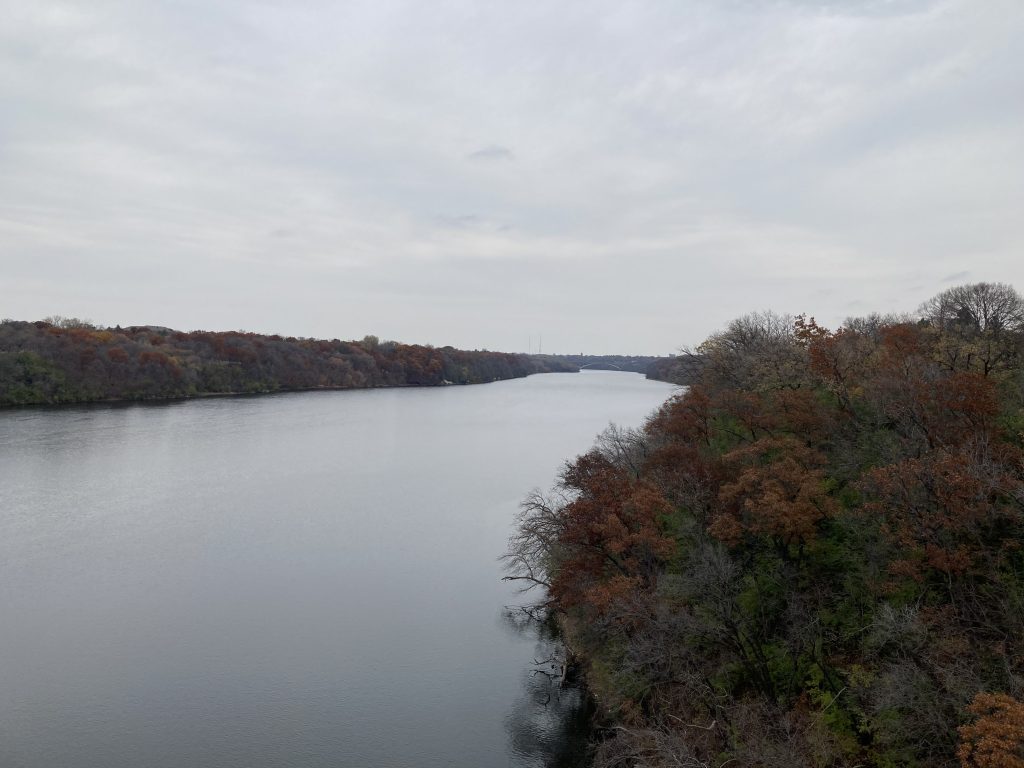
A view from the ford bridge, poorly framed. Not sure what color other people might see here, but to me it's all gray: light gray sky and river, broken up by chunks of dark gray trees. I like how the sky and the river look almost the same color to me.
8 nov 2023

original description: A view from the ford bridge, poorly framed. Not sure what color other people might see here, but to me it’s all gray: light gray sky and river, broken up by chunks of dark gray trees. I like how the sky and the river look almost the same color to me.

5 nouns/ 5 adjectives/ 5 verbs

nouns: river, water, shore, trees, sky, branches, a bend, surface
adjectives: winding, scraggly, soft, fuzzy, drab, dark, light, gray, wide, flat, contrast, wide
verb: stretching, reaching, standing, stilled, separated, cutting through,\

one sentence about the most important thing in image: The sky and the river are the same color; only the disruption of trees enables me to distinguish between them.

a second sentence about the second most important thing: Everything gray: light gray sky and river, broken up by chunks of dark gray trees.

a third sentence about the third most important thing: In this soft, wide open view, when everything is stilled, silent, nothing is happening.

The nothing that’s happening in this image is full of meaning. Here nothing = no things are doing anything/ nothing to see; nothing = a void, absence, unknowingness; nothing = a rest for my eyes, no movement, everything still, satisfied, stable.

The idea of no separation, no edges or divisions between forms, reminds me of a wonderful poem that I thought I’d posted already, but hadn’t. I think when I first encountered it a few years ago, it didn’t resonate for me. Now, I want to call out, yes!, with almost every line.

Monet Refuses the Operation/ Lisel Muller

Doctor, you say there are no haloes
around the streetlights in Paris
and what I see is an aberration
caused by old age, an affliction.
I tell you it has taken me all my life
to arrive at the vision of gas lamps as angels,
to soften and blur and finally banish
the edges you regret I don’t see,
to learn that the line I called the horizon
does not exist and sky and water,
so long apart, are the same state of being.
Fifty-four years before I could see
Rouen cathedral is built
of parallel shafts of sun,
and now you want to restore
my youthful errors: fixed
notions of top and bottom,
the illusion of three-dimensional space,
wisteria separate
from the bridge it covers.
What can I say to convince you
the Houses of Parliament dissolve
night after night to become
the fluid dream of the Thames?
I will not return to a universe
of objects that don’t know each other,
as if islands were not the lost children
of one great continent. The world
is flux, and light becomes what it touches,
becomes water, lilies on water,
above and below water,
becomes lilac and mauve and yellow
and white and cerulean lamps,
small fists passing sunlight
so quickly to one another
that it would take long, streaming hair
inside my brush to catch it.
To paint the speed of light!
Our weighted shapes, these verticals,
burn to mix with air
and change our bones, skin, clothes
to gases. Doctor,
if only you could see
how heaven pulls earth into its arms
and how infinitely the heart expands
to claim this world, blue vapor without end.

feb 17/CORE

Too cold for Scott (and me, too — the lack of cold this winter has un-conditioned me to the cold) today. Or maybe it’s more the wind? We will do our weekly run tomorrow. Today, more core. I did the Madfit 30 minute all body workout again. Tried the reverse lunges, and they weren’t as bad for my knees as I thought…until they were, at the end. Now, having finished, my lower back hurts a bit on the left side. Should I be worried?

something future Sara might like to know: Today for the first time in decades a world cup cross-country ski race is happening at Theodore Wirth Park. Until we got about 1/2 foot of snow last week, I wondered how it could happen. But it did snow, and today it happened. Very cool.

How I See

Yesterday in my description of my image I wrote the following:

one sentence about the most important thing in image: This cluttered view of bare trunks and thin branches creates a screen between runner (me) and river and resembles what I sometimes see even when there aren’t thin, bare branches everywhere — my view obscured by something in the way, that I can’t move, that keeps the real (focused, clear, open) view just out of reach.

a second sentence about the second most important thing: The image is only of swirling forms — tree, leaf, river — as my eye struggles (and fails) to land on solid lines, instead bouncing from branch to trunk to leafy floor to river to sky to branch again. (This cramped, thickly tangled space overwhelms my eyes and my brain.)

Rereading these sentences, I’m realizing that the first one is a bit misleading. My view is not obscured by a fog or haze, like some veil is covering/concealing the river. My view is obscured because of what I write in sentence 2: images don’t have solid shape, clear and defined lines. They’re constantly moving, buzzing, vibrating.

The idea of cloudy, foggy vision is more associated with cataracts:

from Cataracts/ Linda Pastan

Like frosted glass, 
you blur the hard edges
of the cruel world. 

Like summer fog, you obscure
the worse even an ocean can do.

Frosted glass, a blur, summer fog.

from Ekphrasis as Eye Test/Jane Zwart

But usually the picture dims proportionally, cataracts
stirring gray into haystacks and ground and dust-ruffle
sky. Maybe you will finally understand Monet, his play
in thirty acts, his slow lowering of the lights in Giverny.
At last there is nothing left to squint against.

Wow, the more I return to this poem, the more I love it, and relate to it.

After realizing that fog or smoke or haze or gray mist isn’t what happens to me and my vision, I wrote a few notes:

The something that is in the way is not some cloud or obstruction — no fog or haze — but something that refuses to come into focus — bouncing around from object to object, television static — not fuzz but fizz — everything shaking wobbling lines wavering such small movements it’s difficult to detect, shimmering simmering — what is that effect when you see the heat on the road? look that up* — like most things with my vision, it’s not obvious or direct. I don’t look and see wavy lines, I feel wavy lines, a restless unsettling not fixed an unhinging coming undone vibrations pulsing throbbing crowded cramped moving always, slightly shaken, a constant stirring

*best answers: heat haze or heat shimmer

I like a lot of these lines. Right now, I especially like: not fuzz but fizz. Constant movement is key to my dying vision — I think it’s exhausting me and making me even more restless. Is my brain constantly trying to make sense of these images? or are the moving images just making me feel unsettled most of the time? How does my sense of moving images feel different than people with nystagmus (“An involuntary eye movement which may cause the eye to rapidly move from side to side, up and down, or in a circle, and may slightly blur vision.” — wikipedia). One of my favorite poets, Lorine Niedecker suffered from nystagmus. Interesting — if I’m reading my source correctly, nystagmus is not a vision problem, but a balance one.

Speaking of nystagmus and Niedecker, here’s a source: Nystagmatic Poetics in Lorine Niedecker

feb 16/BIKERUN

bike: 15 min warm-up
run: 1.5 miles
basement

Finished the 2nd episode of season 1 of Dickinson, started the 3rd while biking. I’m really appreciating the audio descriptions. So much easier to watch shows! I’m also surprised at how normal/natural/not disruptive the audio descriptions are. Is it that way for people with good vision? I’ll have to ask Scott after we watch something with AD turned on.

Listened to a winter playlist while I ran. Just a short run to burn off some restlessness, to rest my eyes from reading/writing, and to add to my weekly total of miles.

Before the run, I worked on another image for my “how I see”project. Maybe I should take the 3 I’ve already done and do more with them?

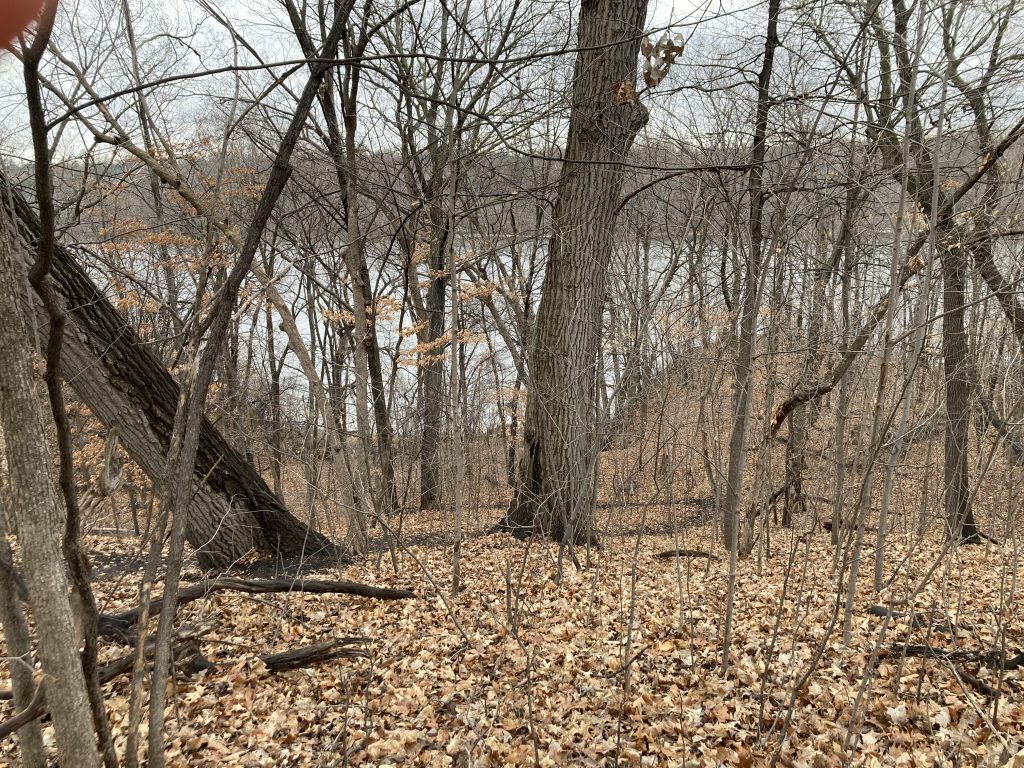
 My view from above the gorge: bare limbed trees, all trunk and thin branches. A few trunks are thick — like the one near the center of the image or the one leaning on the left side — but most are thin, creating a transparent screen between runner (me) and river.
8 feb 2024

original description: My view from above the gorge: bare limbed trees, all trunk and thin branches. A few trunks are thick — like the one near the center of the image or the one leaning on the left side — but most are thin, creating a transparent screen between runner (me) and river. The ground, in the bottom third of the picture, is mostly dead, curled-up brown leaves. Sometimes, this is what I see even when there aren’t thin, bare branches everywhere — my view slightly obscured by something in the way — dead cone cells, I think — creating fuzz or static or a slight pulsing or wavering of lines. Also, if this picture were in black and white I wouldn’t be able to tell the difference. Often I have to ask Scott: is this in color or black and white?

5 nouns/ 5 adjectives / 5 verbs

nouns: tree, trunks, leaves, river, twigs, bank, bramble, sky, veil, net, screen
adjectives: brown, thin, thick, pale, blue, gray, soft. cluttered, tangled, obscured, disoriented
verbs: blocking, concealing, decaying, settled, crowding (out), decomposing, swirling

one sentence about the most important thing in image: This cluttered view of bare trunks and thin branches creates a screen between runner (me) and river and resembles what I sometimes see even when there aren’t thin, bare branches everywhere — my view obscured by something in the way, that I can’t move, that keeps the real (focused, clear, open) view just out of reach.

a second sentence about the second most important thing: The image is only of swirling forms — tree, leaf, river — as my eye struggles (and fails) to land on solid lines, instead bouncing from branch to trunk to leafy floor to river to sky to branch again. (This cramped, thickly tangled space overwhelms my eyes and my brain.)

a third sentence about the third most important thing: With its bare ground and dead leaves, it looks like this picture should be of the gorge in November or April, but it was taken in one of the first Februarys without at least 1/2 foot of snow on the ground. 

The most important thing about this image is how the branches create a net which mimics how my vision often works — I can almost see what’s there, but not quite. Secondary, but connected, is the feeling of being disoriented, off, almost but not quite, untethered, which comes from swirling forms and the climate crisis — there’s almost always snow on the ground here in February. Where are my Minnesota winters?

feb 15/BIKERUN

bike: warm-up
run: 3 miles
basement
outside: 4 inches of snow

Snow! Finally. My first real shovel session of the winter. Thought briefly about running outside on the trail, but when Scott told me he had heard the city hadn’t plowed the bike path, I decided against it. I watched more of the first episode of Dickinson with the audio description on while I biked. Listened to my winter playlist while I ran. I blocked the display panel, so I wouldn’t know the time. When I finally checked, I thought it would be 15 minutes at the most. It was 25. Wow.

Watching/listening to the audio description, it was interesting to notice when/how they chose to describe something and when they didn’t. An example: In one scene, Sue is sitting in the parlor. We see her looking and pointing, then we see a basket with a letter in it hanging outside of the window. Sue says, Austin. Look. At this point, the audio description (AD) says, Sue points to a hanging basket. Austin opens the basket and removes a small envelope addressed to Sue. I was struck by the AD choice to wait to describe Sue’s pointing until after the action was over. Something — poetic whimsy? — was lost in not describing Sue’s strange pointing — it seemed, at least to me, almost comical. Should it have been described? I’m not sure; I mention it to highlight how ADs involve choices of what to include or not include, often for clarity or brevity.

I must have still been thinking about this choice to not immediately describe the pointing while I was running because I suddenly had an idea about the significance of what my image descriptions leave out. I wanted to remember my thought so I pulled out my phone to record it, but the audio is messed up and I can’t understand what I’m saying. Bummer. My descriptions will be explicitly subjective. I want to emphasize how we always make choices when describing what we’re seeing — what’s important and what’s not. Our brains do this too when we’re seeing — it’s called filtering.

before the run

While rereading an entry from this day (15 feb) in 2022, I discovered that past Sara had been thinking about alt-text as poetry. I mentioned wanting to create alt-text for my beloved mannequin photos and posted some links:

I’ve already started using the first link. Just now, I read through the twitter thread. Very helpful! Here are some highlights — BTW, putting together these notes has used up a lot of my visual “spoons” for the day.

Not describing everything, but getting to why the image is there:

I think people who find providing alt text overwhelming think too much about describing every last detail in the image, when it’s more like, ok, why did YOU post it? …focus on why you’re posting the image or what it’s supposed to do or how other people would recognize it

Alt-text predates “accessibility”:

“alt” here is short for “alternate” and originates from HTML—back in Ye Olde Days if an image took 10 minutes to load or otherwise broke, you’d provide alt text that the browser would display in place of the image so you still knew what was going on

different than an image description, alt-text is only for necessary images, not decorative ones:

and alt text is different from image descriptions; alt text describes the purpose of the image and isn’t typically included if something is purely decorative—but do note that even a gif for example carries semantic meaning and is thus NOT purely decorative

intended to be brief

alt text is meant to be short, as it would get cut off by the image bounding edges otherwise

example of alt-text vs. image description

alt text for a chart: “Graph showing increase in alt text use on Twitter”
image description for a chart: “A graph titled ‘Increase in alt text use on Twitter.’ The y-axis shows percentage of images including alt text. The x-axis shows time in years from 2008–2022…”

craft it

don’t be afraid to put your personality into alt text or be funny or use alt text to extend your shitpost, like imagine using a screenreader & your entire TL is dry descriptions until “a dog so cute I screeched” appears

look to audio descriptions for good examples of image description and using brevity

I think there’s a lot to learn from audio descriptions too for how to provide alt text & image descriptions! try turning on audio descriptions on a show or movie and observe how to pack in detail, especially given the time constraints—you only have a few seconds to describe smtg — boba fett’s audio descriptions are amazing, they’re wonderfully evocative while also including details I wouldn’t have known, not being a star wars fan (like they note that the palace is jabba’s and name which character’s helmet he picks up)

it’s subjective

accessibility is a fluid concept that depends a lot on audience; there’s no one “best” way to write alt text or an image description, because fundamentally it’s about what details other people care about, and that will change across topics and groups

an extended example of using alt-text to further/enhance the story

I am DYING, here is an incredible example of alt text augmenting the experience for someone using accessibility features—it calls out only the visual features that are important (’90s aesthetic, scalloped border) and provides the context that makes this reply hilarious

Katherine Crighton
@c_katherine

Screencapture of a Denny’s tumblr ad. Of key interest, aside from its very 1990s aesthetic, is the scalloped border around the ad–at the time, it was intended by Tumblr’s parent company to denote to casual readers that the contents within the border were a paid advertisement. Specifically, only those who had paid for space would be granted the scalloped border. Denny’s, the restaurant chain and purveyor of surreal humor on social media, demonstrated with this ad that while the intent was to monetize this border, in actuality all one had to do was take a screencap, drop in your own ad, and then post the resulting image via the normal, non-monetized process– it would then appear the same way to the end-user, whether or not Tumblr’s owner recieved a dime. This method of deriving ad income was dropped shortly after the Denny’s “ad” pointed out this flaw.

Some very helpful ideas in this thread —

the why/purpose is the focus. In my “how I see” images, I’m not interested in describing everything in the image — I probably can’t because of my limited vision, but the ways it serves as an example of “how I see.” I’m also interested in bringing some elements of ekphrasis into this — what are those? I need to spend more time thinking about that!

the idea of brevity. I’d like to make these descriptions short. I think it might be helpful for my creative process to pick a meaningful number of characters or words or syllables. I’ll think about that some more.

listening to audio descriptions for guidance — I think I’ll bike this morning and watch/listen to a Dickinson episode! I did!

a ramble of thoughts:

thought one: Recently, I’ve started proof-reading my poems by listening as the screen reader reads them. I noticed that the speaker (mine is Fred — according to system preferences on my mac) can do enjambments (a sentence split up over multiple lines) when the sentence is at the beginning of the line. But when the sentence begins in the middle of a line, Fred pauses at the end of that line and reads the next line as a new sentence. Enjambment is much more a visual device. My alt-text poems should not use visual devices, but rely on aural ones. What are these? I know rhyme, meter, alliteration, assonance. Time to study! I’ll start with my Mary Oliver poetry handbook!

thought two: I’m just remembering a great line from June Jordan in her guidelines for critiquing a poem:

Punctuation (Punctuation is not word choice. Poems fly or falter according to the words composing them. Therefore, omit punctuation and concentrate on every single word. E.g., if you think you need a question mark then you need to rewrite so that your syntax makes clear the interrogative nature of your thoughts. And as for commas and dashes and dots? Leave them out!)

So, try writing my descriptions without punctuation. BUT, I’m also thinking of Dickinson and how important punctuation (em dashes, for example) were for her. How could I use punctuation to shape how Fred speaks my words?

thought three (barely formed): One feature of many ekphrastic poems is a contentious/combative dialogue between word and image. What about twisting that to push at the conflicts between hearing a word versus seeing an image?

All these thoughts might be too much, and might not lead anywhere I want to go, but I’ll keep with them for a little bit longer. I was just telling Scott last night, or was it this morning?, that I appreciate how past Sara includes discussions of intended plans. Sometimes I don’t act on these plans — and maybe it seems like I have too many ideas or that I’m all over the place, or that I’m not following through — but it’s cool to be able to trace the origins of the projects that do happen. And the plans that I didn’t act upon? Maybe I just not ready for them yet.

a few hours later:

Here are some notes from Bojana Coklyat in Conversation with Shannon Finnegan:

we can get more out it alt-text than just compliance:

SF: Something that has always been a hope of mine with the project is that for people who aren’t as familiar with access, it introduces them to a way of thinking about access as creative and generative and collaborative and process-oriented, and that might also influence the way they think about access in other parts of their lives.

BC: Alt text is so often approached through the lens of compliance, like, Okay, let’s just get this done. But when you’re paying attention to the language you’re using and how you’re putting it together, that’s already changing things. That’s already shifting things.

space and symbolism

BC: I was talking to Chancey Fleet, who works at the Andrew Heiskell Braille and Talking Book Library in New York, and Chancey said something to me and I was just like, Whoa, I have to really think about that. She said, “Is it that we really live in such a visual culture? Is the most important thing visual, or is it space and symbolism?”

I was thinking about that all day yesterday. And going back to this exhibit I went to yesterday, there was a metal piece that kind of looked like scaffolding or architecture. And then we had the chance to walk through it, and it was like, Yeah, this is the experience. It’s walking through it and understanding the space of it. It’s not necessarily, OK, this part’s five feet tall, it’s metal, and it intersects with this piece that’s metal. It was so much more about walking through it, navigating it, and even navigating it with someone.

I think that might be something I’ll start to think about more with alt text: symbolism and space and how those fit in when you’re describing something.

SF: I love that idea of thinking about symbolism. I often find that in descriptions, when someone uses a metaphor or a comparison, it really helps me understand what the subject of the description is really like, and that feels really related to this idea of symbolism. It’s like: What are your associations with this thing, rather than just with how 
feb 14/RUN

6.7 miles
franklin loop+*
37 degrees

*The + is because when I reached the lake street bridge, instead of taking the steps up to it, I kept running up the summit hill until I reached the top, then turned around.

When I started my run, the sky was blue and the sun was shining. I wondered how a winter storm could move in by this afternoon. But, by the time I was done running, it was overcast. We could get up to 4 inches. Finally, I’ll get some snow. That’s what Dave, the Daily Walker said when I saw him on the trail. My response: I know!

10 Things

  1. woodpecker, 1: loud drumming
  2. woodpecker, 2: a downy woodpecker call, sounding like a loon to me
  3. the lake street bridge, its arch reflecting a smile in the river
  4. the light reflecting off of the stream in the ravine near shadow falls — a bright white
  5. shadows — mine, of lamps, trees, railings
  6. a sandbar in the river the trestle
  7. the sun illuminating all of the patched-up cracks on the path just under the lake street bridge on the east side
  8. paw prints in mud
  9. the river, pale blue with one shiny circle in the middle
  10. smells: fried and savory (from longfellow grill?), weed

I took several pictures, but I’ll save them for posting after I experiment with them.

more experiments with alt-text

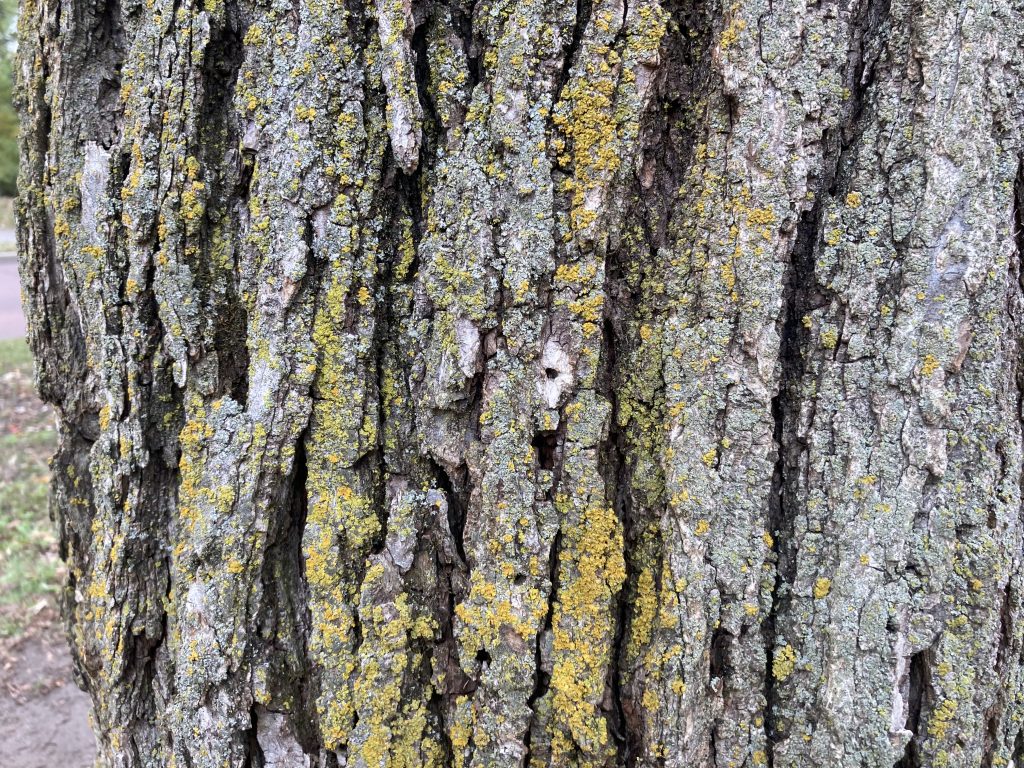
A close-up image of tree bark that is rough and brownish gray (or grayish brown). There are streaks of greenish-yellow lichen on the bark. While taking this picture, with my face close to trunk, I could see the lichen, and if I put my face close to the screen I can still see it. But at a normal (1 foot) distance, it almost blends in, not looking yellow or green but light brown.
12 october 2023

initial description of image from 12 oct: A close-up image of tree bark that is rough and brownish gray (or grayish brown). There are streaks of greenish-yellow lichen on the bark. While taking this picture, with my face close to trunk, I could see the lichen, and if I put my face close to the screen I can still see it. But at a normal (1 foot) distance, it almost blends in, not looking yellow or green but light brown.

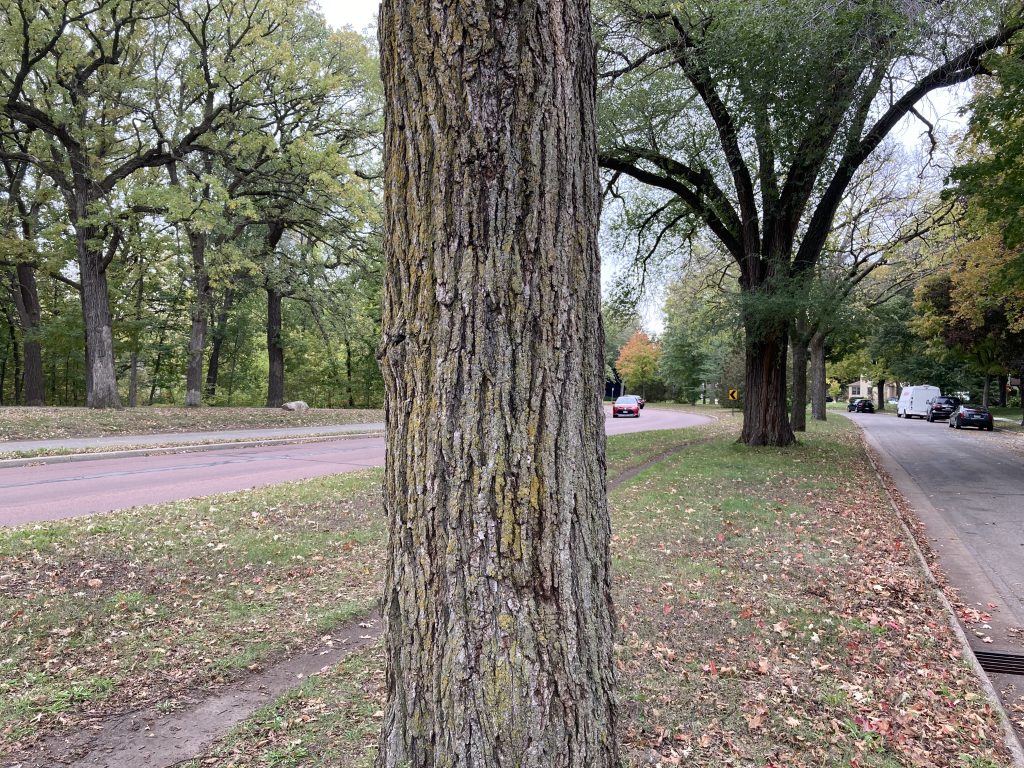
The trunk of a tree with rough bark. A few more trees and a road behind it.

12 oct 2023

5+ nouns / 5 adjectives / verbs of first image of the trunk:

nouns: tree, bark, cracks, depressions, ridges, textures
adjectives: dark, rough, light, weathered, gray, bumpy, old
verbs: hiding, aging, enduring, exposed, weathered, entangled

one sentence about the most important thing in image: Close up, with my face almost on the bark (or the screen), I can see the green lichen near the bottom of the image, but from a foot back, the bark is only brownish-gray or light with dark depressions or rough.

a second sentence about the second most important thing: The rough texture on this bark, made visible by the constrasts between light and dark, offers an interesting pattern.

a third sentence about the third most important thing: Just off center (by less than an inch?) there’s a light spot with a dark hole in its middle that is where the bark has worn off but that looks almost like a belly button, making it impossible for me to see anything else but it, and hear only belly-button in my head instead of tree or bark.

Oh, I’m enjoying this experiment! Each of my sentences speaks to a different thing about my vision. Sentence one is about how I rarely see color beyond gray or brown. The yellowish-green, which I imagine is very obvious to people with all of their cone cells, is invisible until I look very close or to the side, through my peripheral vision.

Sentence two is about how I have replaced ROYGBIV colors (like green or yellow) with contrast; the 2 primary colors for me are light and dark. They are how meaning is made for me.

Sentence three is about how when I’m focused on one thing, like the light spot near the center, (most) others things are invisible. I only see the spot and not the rest of the tree, or even that it is a tree. I’m sure this is true to some extent for other people with working cone cells, but it is more extreme for me. An example: when I’m running on the trail and my attention is focused on a biker approaching from a distance, the runner much closer to me is completely invisible. I don’t see them at all until we’re fairly close. It’s happened several times over my years of running with low vision. I’ve never run into anyone because I always see them with enough time to adjust. But it’s unsettling and doesn’t feel normal, or at least like how I used to see before so many of my cone cells died.

feb 13/CORE

30 minute video
squats, planks, push-ups
outside: 34 degrees

A fine day for running, but I’m taking a break to work on my core/hips. Tomorrow I’ll do a longer run before we get a dusting of snow. I’m continuing to do the 30 minute total body workout I discovered a few weeks ago. I’m a little less sore after all the exercises, but the 2 minute plank blast at the end and the 45 seconds x 2 of continuous push-ups are a challenge. Currently I’m doing knee push-ups. Next step: to do those for 45 seconds without struggling. The the step after that: 45 seconds of toe push-ups. How long will it take me to get to that step?

for future Sara: feeling tired after a few days of bad sleep — restless legs, or sore left hip, or both waking me up a several times in the night. I should really start making note of any night where I sleep straight through. Does that ever happen? It must, some time. Cumulatively, I get enough sleep, it’s just never without interruptions and moments trying to relax my leg.

another note for future Sara: currently watching White Lotus, Death and Other Details, and Seinfeld. Enjoying all three. Loving the complicated characters in White Lotus. Finding Seinfeld hold up better than I thought; also finding moments of it to be shocking in their insensitivity. Death and Other Details also has complicated characters that you can’t totally dismiss. I don’t think I’d be able to watch it without Scott describing some things I’ve missed with my bad eyes.

Back to my Ekphrasis / alt-text project:

features of poetry that help with alt-text

  • attention to language: word choice — meaning, intent, tone, perspective — and how it contrasts with image
  • word economy: brevity!
  • experimental spirit: experimenting with new ways to make it accessible, to translate image into words

key feature of alt-text to remember: alt-text is about making images/the web/communication more accessible. Accessibility must be one of the primary goals/factors of the descriptive writing.

And, centering accessibility does not mean it’s only for people who need access. In their article about audio descriptions as pedagogical tools. Georgina Kleege and Scott Wallin, argue that the careful, slow attention that audio descriptions requires provide great learning opportunities for all students:

Once we reject audio description’s traditional role as a detached, neutral act of translation that functions only as an enabling accommodation, we may regard its multiple functions and contingencies as fertile ground to be explored and utilized. For example, because audio description is inextricably part of whatever discursive practice it seeks to relate, we can explore the aesthetic, ideological, political and ethical underpinnings of this work of representation and its described object or event. In terms of pedagogy, audio description can be a dynamic tool for facilitating student engagement and analysis. 

Audio Description as a Pedagogical Tool

side note here: I’d like to watch a few shows/movies with audio description on. My hunch is that these descriptions are great AND they will require some practice getting used to. I might begin with some episodes of Dickinson to get me started.

How I See — more experimenting

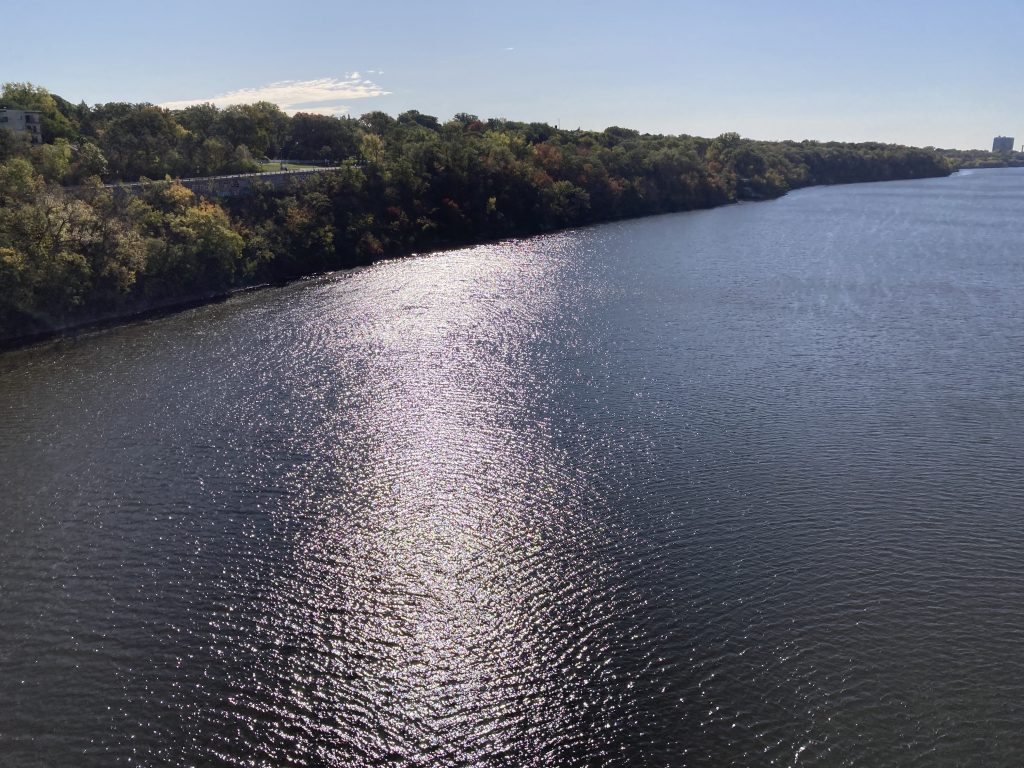
My view facing south from the overlook on the lake street. The Mississippi River with trees in the background and an apartment building in the upper right corner. This photo is in color -- with blue water, green trees with hints of yellow and orange, but to me it looks black and white, or gray and brown.
October 10, 2023

my initial description of the image from 10 oct: My view facing south from the overlook on the Lake Street bridge. The Mississippi River with trees in the background and an apartment building in the upper right corner. This photo is in color — blue water, green trees with hints of yellow and orange –but to me it looks black and white, or gray and brown.

5+ nouns / 5 adjectives / verbs:

nouns: river, waves, trees, cloud, sky, building, road
adjectives: gray, shiny, glittery, small, wide, pewter, west
verbs: stretching, sparkling, sparking, waving, hovering, standing, holding up, cutting through, leading

one sentence about the most important thing in image: The only colors I can see in this image are gray and glitter.

a second sentence about the second most important thing: I stand on a bridge facing southeast and watch light reflecting off of the waves to create a pewter path on the otherwise dull water.

a third sentence about the third most important thing: The dark trees stand at the edge, holding back the water, holding up a road, and leading to a dark rectangular shape that I know is an apartment building.

I took these exercises from Alt Text as Poetry Workbook. I can see potential here.

What if I used the poem, Medical History/ Nicole Sealey, as an inspiration — listing mundane details, then ending with a stinger: The only colors I can see in this image are gray and glitter?

feb 12/RUN

3.1 miles
trestle turn around
35 degrees

Feels like spring. When I got back, I told Scott: In a normal winter, this would have been one of those days that makes you believe spring is coming. But it’s not a normal winter — no snow, only a short stretch of below freezing temps in January.

So many wonderful birds! As I listened to them chirp and tweet, I imagined the sounds as dots on a scatter plot — but what are the variables on this chart? I’ll have to think about that one. I don’t remember using scatter plots very often. All I can think of is the scatter plot on my kids’ yearly wellness checks for charting growth (variables: height and weight). The idea of scatter plot does sound intriguing as a form. I wonder what fun I could have with it?

An okay run. The conditions were wonderful, my left IT was not. It was sore — time for more fun with the IT band:

  • incandescent tripe
  • imbibing Taylors (apparently Taylor Swift impressively chugged a beer after KC won the super bowl yesterday)
  • implacable termites
  • impending trauma
  • instant triumph (in the last seconds of the first quarter of overtime, Kansas City scored a touchdown and won the game — and just like that, it was over)

As I ran, I thought about how my vision seems to be getting worse. There are some signs that I can’t see things as well, but it’s more that my eyes are straining more to read and I’m getting tired/having headaches from it. Time to put more energy to finding new, less wordy, ways to be. Part of me wishes I didn’t have to, but more of me is up for the challenge and curious about what interesting doors it might open.

I also thought about my ekphrasis project and where it might lead. I stopped and took a few pictures to use for my “how to see” project. Here’s one:

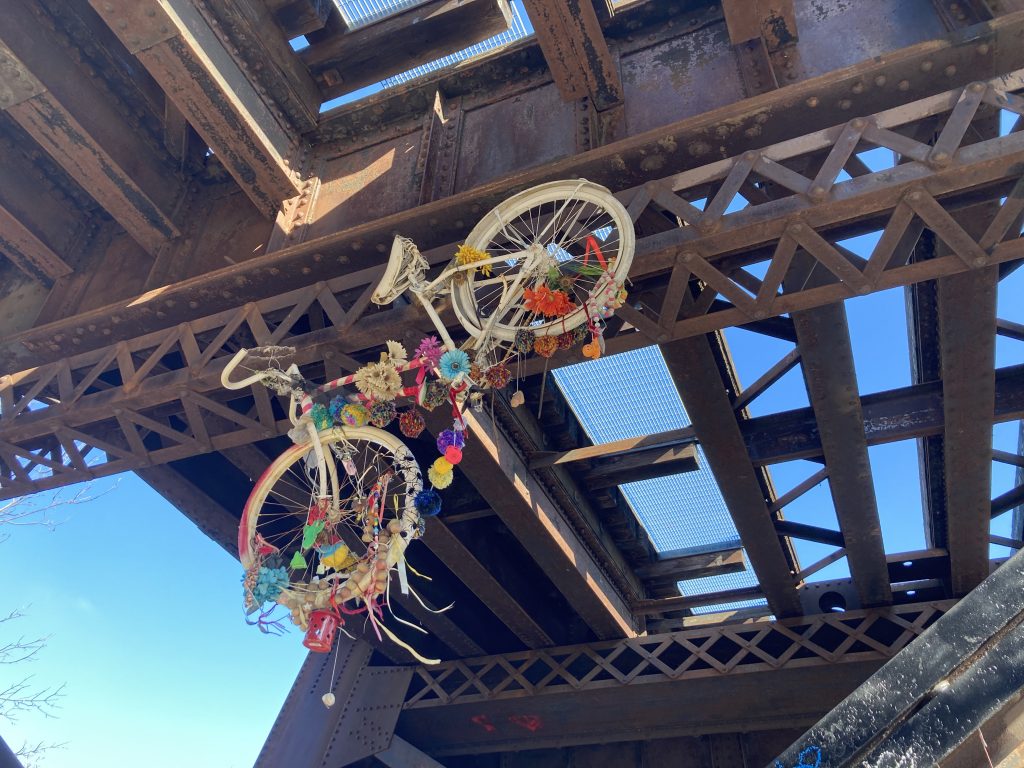
A white bike suspended from a brace on the underside of the railroad trestle.
A white bike suspended from a brace on the underside of the railroad trestle. I can barely see it in the photo, so my description comes more from my memory of when I was looking up at it to take the photo. I think it has flowers and vines wrapped around it. From a “normal” distance, I see some color — blue sky, red and yellow flowers — but they’re muted. When I put my nose right on the screen, the colors are much more vivid, but scattered. My eye is drawn to the lighter sky in the lower left hand corner, which makes everything else even more of a blur. I think I was able to “see” this bike because I know it’s there — I’ve studied it and looked up why it’s there. I even wrote a poem about it. I often rely on memory for seeing.

Looking, or trying to look, at this photo, I’m struck by how different of an experience it is than being below the bike on the trail. (How) is that true for everyone? How much do my vision issues shape these differences? I think it has something to do with the static nature of the image and the absence of other sensory data: no smells, no hearing the wind, no feeling of blue or bike or flower that I usually get when seeing beyond the narrow frame of a photo.

The poem I wrote about this ghost bike — that’s what these white bikes that are left on the trail to honor someone who died are called — as part of my larger Haunts project.

Ghost bike:
under the
trestle
for June
hit and killed
while fix
ing her bike
in a
parking lot.

Flowers:
next to
June’s ghost bike
plastic
placed in the
remains 
of a post
once part
of metal
railing
now only
open
cylinder 

Note: In the winter, someone hangs the bike up higher. Usually, for the rest of the year, it’s lower to the ground, with flowers placed nearby.

Found this poem the other day. I love the listing, then the pow at the end with the final line.

Medical History/ Nicole Sealey

I’ve been pregnant. I’ve had sex with a man
who’s had sex with men. I can’t sleep.
My mother has, my mother’s mother had,
asthma. My father had a stroke. My father’s
mother has high blood pressure.
Both grandfathers died from diabetes.
I drink. I don’t smoke. Xanax for flying.
Propranolol for anxiety. My eyes are bad.
I’m spooked by wind. Cousin Lilly died
from an aneurysm. Aunt Hilda, a heart attack.
Uncle Ken, wise as he was, was hit
by a car as if to disprove whatever theory
toward which I write. And, I understand,
the stars in the sky are already dead.

feb 11/RUN

5 miles
Veterans’ Home and back
32 degrees

Another weekend run with Scott. Usually we run on Saturdays, but yesterday we were in St. Peter, so we ran today instead. Colder, windier, sunny. Sharp shadows. My favorite shadow: running under the ford bridge, a big shadow crossed over my head. A bird? No, a bike up on the bridge.

We talked about ones and zeroes and the differences between null, zero, and false in coding. I mentioned how when it gets to the brain, seeing is about signals firing and not firing. Then we talked about a recent controversy with Margaret Livingstone’s research on animals, which led us to a discussion about scientific experiments as material practices, the ethical dilemma of using knowledge gained from unethical experiments, and then a mention of Newton’s experiments on himself — shoving something in his eye to learn about color. Some fun discussions!

I forgot to notice the falls or look down the river, I recall seeing someone in yellow running on the Winchell Trail. I smelled the smoke near the house that always smells like smoke. I heard a dog’s collar clanging behind us. Felt the cold wind almost taking my breath away.

before the run

Started rewatching Margaret Livingstone’s lecture about artists and vision. Also found her book, Vision and Art — the “read sample” is helpful here.

Near the beginning of the video, Livingstone emphasizes this idea: “Visual information processing is not image transmission.” She adds: you don’t transmit information up to your brain because there’s nobody up there to look. In her book, she elaborates on this idea, giving it a name: the homunculas fallacy — homunculas means “little man.” The fallacy: some little man is up in your brain “looking” at the image. I love this name and the idea of a little man; I’d like to put it in a poem!

feb 9/RUN

3 miles
trestle turn around
32 degrees

Colder today, windier too. Back to winter layers. A lot of the run was a blur — or was it quick flashes?

10 Flashes

  1. looking down at the bare branches of the floodplain forest
  2. wet pavement by the welcoming oaks
  3. waving water under the lake street bridge
  4. uneven limestone also under the lake street bridge
  5. a woman with 2 dogs, one on each side, sprawled out on the trail
  6. the light blue-gray river below as I neared the trestle
  7. wind rushing past my ears
  8. a muddy trail on the grassy boulevard
  9. flashing lights from a parks truck
  10. the tree that looks like a person, with a burl right at eye level that looks like a head

before the run

Before the run, I gathered some more resources for my “how I see” project:

Reviewing more descriptions of ekphrasis, I’m wondering how it fits with what I’m trying to do. I wrote in my notes that my project exists somewhere between alt-text and ekphrasis.

Here’s a condensed version of a helpful article (Conventions of Ekphrasis) I found out conventions within the ekphrasis:

  • Speaking out: giving a voice to the mute art object , artwork speaks to the artist or the poem will speak to the mute visual artifact , poet may implore the painting/sculpture to speak or to justify the artist or poet’s work — technical term for giving a voice to the mute art object is prosopopeia
  • Praise: poet/persona frequently praises the mastery of the visual artist and his work
  • Paragone Competition:competitive relationship between words and images, an implicit critique of the material, its stasis, and its immutability, Poet may seek to establish superiority of words over the painter/sculptor and his material limitations by suggestion they have: more immediate access to the real; more immediate access to the divine; that one art has a more direct relationship with Truth; that one exists in either time or space and therefore is more accurately representative through the accuracy of its resemblance; more education, learning and talent or that it is less crude 
  • Emotional response: deeply moving visual experience that triggers a latent or unresolved emotional vulnerability, “transfixing” the poet, speechlessness, ability to “trick” the poet into believing that the work is “real”, the painting “breathes” life while the poet remains “breathless” before it
  • Stasis of the art object: painting is mute poetry and poetry a speaking picture
  • Enargia: to make the object lively appear before the reader’s eye through detailed description, use of sensory information, imagery, etc… In other words, so ekphrasis will also attempt to visually reproduce the art object for the reader so that the reader can experience the same arresting effect as the poet
  • Actions of the painter: linger on the actions of the visual artist concentrating on the act of creation and often paralleling the act of artistic creation with divine creation
  • Artist’s studio: reference or be wholly concentrated upon the artist’s studio
  • Museum ekphrasis: poet is wandering through the museum looking at various pieces and each begins to bleed into the poet’s poem/thoughts

during the run

Right before the run, I reviewed the ekphrastic conventions and decided to think about the competition between image and word — which has more access to the real? to truth? the divine? I had many thoughts — so many of them still floating, not quite remembered. I’ve decided to not try; if the thoughts are important, I’ll remember them at some point.

after the run

I kept trying to make more happen here — to find words for some of my thoughts, but we’re driving down to St. Peter for FWA’s band concert and I’m feeling the pressure to pack and get ready. So, that’s it. Oh — and this. I stopped at 2 miles to take this photo of the lake street bridge from below. I was inspired to take it because of a story RJP told me on our walk a few days ago. She and her friends hopped over a fence and walked up the arch over the water. Apparently there’s a room with a door and couch somewhere up in the arch where kids like to hang out. I thought about trying to get close to see it, but that would have required descending the uneven bricks and possibly twisting my ankle.

Under the Lake Street bridge. The bottom third of the image is of uneven limestone rocks sloping down to 2 pilings, a chain link fence, then river. Beyond the river more bridge -- cream colored or pale yellow -- with graffiti.
Under the Lake Street bridge. The bottom third of the image is of uneven limestone rocks sloping down to 2 pilings, a chain link fence, then river. Beyond the river more bridge — cream colored or pale yellow — with graffiti. The graffiti at the lower left looks black to me until I put the computer screen right up to my nose. Then I can see that it’s blue or purple or some bright color. Overall, I can see the edges of the limestone in the foreground, but the rest of the image is fuzzy and hazy and looks more like a dream or an abstract painting than a photo of a real bridge.

feb 8/RUN

5.3 miles
ford loop
47 degrees

Hooray for feeling strong and happy and unbothered by the wind! A good run, even though it feels strange with no snow. Scott told me it’s 5 degrees warmer here in Minneapolis than it is where we used to live in Upland, California. Wow.

Starting last night and lingering through the morning: rain. Not snow, but rain. Everything was wet and muddy and slippery. At the end of my run I noticed that I had specks of mud on my shirt — how did that happen?

Around mile 3, as I ran straight into the wind, a biker approached from behind. I heard her call out Fast! I wasn’t sure what to say, so I said, there’s a lot of wind! She agreed. Later I encountered the biker on the ford bridge — she was walking her bike while I was still running — There’s goes that fast runner! I waved and smiled. I did a lot of smiling at every person I encountered.

a strange winter sight: roller skiers, one of them wearing shorts!

Talked with Dave, the Daily Walker about how I’m missing the snow. He agreed, but only when it’s windy and there’s lots of snow and no one else out on the trail. Then it’s fun, he said. His version of fun is one reason why I like Dave so much.

Took 2 pictures of my view. Both are just south of the double bridge and the Horace W.S. Cleveland Overlook. Here’s one of them:

My view from above the gorge: bare limbed trees, all trunk and thin branches. A few trunks are thick -- like the one near the center of the image or the one leaning on the left side -- but most are thin, creating a transparent screen between runner (me) and river. The ground, in the bottom third of the picture, is mostly dead, curled-up brown leaves.
My view from above the gorge: bare limbed trees, all trunk and thin branches. A few trunks are thick — like the one near the center of the image or the one leaning on the left side — but most are thin, creating a transparent screen between runner (me) and river. The ground, in the bottom third of the picture, is mostly dead, curled-up brown leaves. Sometimes, this is what I see even when there aren’t thin, bare branches everywhere — my view slightly obscured by something in the way — dead cone cells, I think — creating fuzz or static or a slight pulsing or wavering of lines. Also, if this picture were in black and white I wouldn’t be able to tell the difference. Often I have to ask Scott: is this in color or black and white?

peripheral: how I see

before the run

Before my run, while I was reviewing my Oct 2023 log entries and encountering several of my “how I see” photos, it came to me: this should be the new version of my vision poems. I want to study the ekphrasis form (An ekphrastic poem is a vivid description of a scene or, more commonly, a work of art. Through the imaginative act of narrating and reflecting on the “action” of a painting or sculpture, the poet may amplify and expand its meaning — def). Then I want to write a series of “how I see” poem/descriptions. These will be about experimenting with the form and exploring ways to describe how I see. I wrote in my notes: not about what I can’t see, but what I can. I’m also interested in experimenting with the idea of alt-text as form — I have a few sources for this. I’ll read some Georgina Kleege and her latest book, More Than Meets the Eye. These poems will be practical — describing the literal way I see — but also poetic — strange, unsettling, more than a report.

I’m thinking that these poems would involve describing what I see in the photo and what I saw when I was taking the photo. Also, they’re as much about HOW I see (the mechanics/process) as WHAT I see. I love this idea; I hope it sticks!

some sources:

during the run

While I ran lots of different thoughts flashed. First I thought about Marie Howe and the idea of observing and not looking away. Describing what you see with details not metaphors. Then I thought about how “looking” works for me, how it’s harder because of what I can and can’t see. How much can any of us (no matter where we are on the spectrum of seeing/blind) actually see? Then I started thinking about Huidobro’s poem, “Natural Forces” and all of the different glances he describes — One glance to shoot down the albatross. What do my different glances see?

right after the run

During my walk back home, I thought more about how I see (and spoke those thoughts into my phone). I was reminded of Robin Wall Kimmerer and her chapter, “Learning to See” in Becoming Moss. It’s about how we can learn to see the small things — like moss — that were invisible to us before.

I also thought about how I’m interested in the process we use to see and how that shapes what we see and how it enhances or detracts from our ability to behold/witness. Yes! This connects back to Ross Gay and beholding, which I discussed on here a few years ago.

I’m interested in how we sense without seeing, or how we see with our other senses (like sound). And I’m interested in thinking about how vision isn’t the primary mode in which we understand and make sense of things. It is only one of many ways, not THE way.

Ekphrasis

The verbal representation of visual representation.

Basically, an ekphrasis is a literary description of art. Like other kinds of imagery, ekphrasis paints a picture with words. What makes it different from something like pictorialism is that the picture it paints is itself a picture: ekphrasis stages an encounter between representations in two mediums, one visual and one verbal.

What is Ekphrasis?

key feature of an exphrasis poem: it engages with an artistic representation — does this fit for my project? I think so, especially if I make the taking of the photo as part of the description.

Another helpful definition of Ekphrasis from Poets.org:

Ekphrasis is the use of vivid language to describe or respond to a work of visual art.

Ekphrasis

The purpose of ekphrasis was to describe a thing with such detail that the reader could envision it as if it were present. 

I’m interested in using language to help others experience how/what I see.

feb 6/RUN/WALK

6.2 miles
dog park and back
44 degrees

Another warm, spring-like day. More mud, no snow. Overcast. The wonderful sounds of birds. For 2/3 of the run, I listened to cars and my feet striking and voices and water gushing. For the last 1/3, I put in a playlist — Winter 2024.

I felt good — so much better than yesterday. Most of the time, I was zoned out, listening but not looking more than I needed to. I know that I glanced down at the river, but all I remember is that it was open. Somewhere near the shore little strips of snow still remained.

I felt strong and sore and not amazing, but certain that I’d be able to keep running.

A few hours later, RJP and I took Delia on a walk. I often ask and RJP rarely says yes, so today was a nice surprise. We ended up taking the old stone steps down to the river at Longfellow flats — a fitting destination because I just found out today that my poem about these steps and the spot by the river will be published in Scrawl Place. Wonderful news! The poem is titled `112 steps — the number of steps you take to get to the bottom. I counted 111 today, but I think I forgot to count the top step.

added the next morning: I almost forgot about the turkeys! Running south, somewhere near locks and dam no. 1, I saw them: 6 or 7 turkeys crossing the path. One of them sped up to pass before I got to them — a half walk half run that was more efficient than the human version but just as awkward. Hooray for wild turkeys!

peripheral

some notes from The Plentitude of Distraction

William James: (in his Laws of Habit lecture) the ability to experience subtle degrees of emotion depends on practice, on a regular encounter with non-teleological ways of apprehending the world. Once the brain stops cultivating gratuitous pursuits–music, poetry, painting–and limits its range to the recording of facts, to the single-minded quest for information, then its emotional and aesthetic elasticity deteriorates.

Work, unlike leisure, usually follows one direction and points toward a clear goal. This endows it with a reassuring automaticity. Art and play, on the other hand, tap into untried areas of the brain, calling for greater effort and elasticity not readily available to the untrained mind.

He believes in mental, not just physical aerobics, pushing for a veritable gymnastics of the spirit.

what might a poetics and spiritual gymnastics — that involves the body too — look like?

a problem: when attention is more about busyness than wonder

disengaged engagement

a heightened yet singularly unfocused relationship to phenomena

slow, not fast-paced result-oriented engagement, requires a particular sort of endurance — boredom as a necessary step to lasting absorption

endurance exercises to practice — I love this idea of thinking about disengaged engagement as an exercise, one to be added to my exercise plan: runs, core, stretching, building up ways to be distracted

being human means to inhabit a presence-absence mood — detached attentiveness, letting the minor and major coexist, active and passive

listening to furniture music from Erik Satie

Montaigne: no linear thinking, float along with the light, winged flights of fancy…nothing worthwhile can be harvested immediately — important: this type of wandering/distraction is not the same as our current culture of distraction (finger swipes and taps on screens)

Walter Benjamin: delicious idleness

Focus is useless without distraction, and distraction, without motivation and a pinch of single-mindedness, rapidly dwindles into listless lethargy.

Virginia Woolf, from A Room of One’s Own: “It is in our idleness, in our dreams, that the submerged truth sometimes comes to the top.”

If you set your goals of efficiency and productivity aside, if you stop measuring your days by what you can report to your boss or to your conscience, you might be ready to call your symptoms of distraction by another name—reverie, daydreaming, ruminating.

Now listening to the score for Better Call Saul.

Roland Barthes and emptiness training — stepping away, slowing down, slowly gaining access to a world that will eventually demand focus

inventiveness can only be culled from the outer margins of consumerism

All this talk of slowness and gradual focus and learning how to not understand the plot right away or to make sense of everything instantly is a key part of my seeing through peripheral vision. Or, is it? Could it be more about not seeing, as opposed to seeing differently? I’ll think about that.

key themes for distraction: slow, gradual, idle, non-linear, reverie/daydreaming, a practice/skill

Aerial View/ Jericho Brown

People who romanticize an Africa
They’ve never seen
Like to identify themselves
With lions. It’s all roar and hunt,
Quick fucks and blond manes.
People love the word pride.
Haven’t you seen the parades?
Everybody adores a lion
But me. I want to be a giraffe.
I’m already tall and long-necked.
In the real Sahara, a giraffe beats
A lion’s ass every day
On Instagram. I’ve seen
A giraffe shake the leaping cat
Off its back and toss it like litter.
I’ve seen a giraffe stomp hooves
Down hard on the lion’s face
Before it got the chance
To meow. I want to be a giraffe
And eat greens of every variety
Straight out the tree. I already
Like to get high. Lions need
Animals like us. We need no prey.
I already won’t chase anybody
For my food. But maybe
I can still be romantic. Maybe
I can still be romantic in spite
Of my pride. Someone will notice.
Up the sky, not down the street.
You can watch me while I watch you
And the rest of the savanna
From my aerial view. Lord,
Let me get higher. Just one of me
Is a parade.

What a beautiful poem! I love Jericho Brown’s work and his interviews and the brief podcast he did about Dickinson. I wish I would have been at Emory when he was there — would I have been brave enough to take one of his classes?

feb 5/RUN

3.2 miles
locks and dam no. 1 and back
45 degrees

Ran in the afternoon. 45 degrees and no snow. Spotted one lone chunk of ice floating in the river. Very mild. I was overheated in my layers: black tights, black shorts, long-sleeved green shirt, orange sweatshirt. For a few minutes of the run I felt good, but for most of it I felt off. Some gastro thing, I think.

In my state of discomfort and distraction, did I happen to notice 10 things?

10 Things

  1. overheard, one woman walker to another: It’s been five years and a lot has changed
  2. kids yelling on the playground
  3. a flash of white car up ahead — were they driving the wrong way in the parking lot? No, the car I was seeing was on the road, on the other side of the ravine
  4. someone roller blading — not roller skiing
  5. the short dirt trail where folwell climbs up to the top of the bluff then back down again was all mud
  6. lots of bikers on the bike path
  7. lots of walkers down below on winchell
  8. (as mentioned above) the river was open except for one big chunk of ice
  9. playing chicken with a walker who was walking on my side until the last minute — were they playing chicken too or just oblivious?
  10. no grit on the path or shadows or honking geese or regulars

today’s peripheral: just a distraction

daydreams reveries distractions

When ideas float in our mind, without any reflection or regard of the understanding, it is that which the French call reverie; our langauge has scarce a name for it.

John Locke, cited in The Plentitude of Distraction

To make a prairie/ Emily Dickinson

To make a prairie it takes a clover and one bee,
One clover, and a bee.
And revery.
The revery alone will do,
If bees are few.

This short book takes a second look at distraction, extracting untold pleasures and insights from its alleged dangers, defending and celebrating the unfocused life for the small and great miracles it can deliver.

The Plentitude of Distraction/ Marina can Zuylen

Reverie in Open Air/ Rita Dove

I acknowledge my status as a stranger:
Inappropriate clothes, odd habits
Out of sync with wasp and wren.
I admit I don’t know how
To sit still or move without purpose.
I prefer books to moonlight, statuary to trees.

But this lawn has been leveled for looking,
So I kick off my sandals and walk its cool green.
Who claims we’re mere muscle and fluids?
My feet are the primitives here.
As for the rest—ah, the air now
Is a tonic of absence, bearing nothing
But news of a breeze.

feb 4/CORE

30 minutes

30 minutes of squats and planks and leg lifts and clam shells and bridges. This is my second time doing the workout; it felt much easier (but not easy!) than the first time.

Today’s example of peripheral is a journal I discovered a few months ago: Peripheries. Here’s a description from their About page:

Peripheries is a non-profit literary and arts journal established in 2017 that publishes artistic work that is, broadly understood, “peripheral”; work that explores the interstices between discourses, traditions, languages, forms, and genres. In this spirit, along with publishing poetry, visual art, and short stories, our scope is expansive, including translations, interviews, reviews, aphorisms, recipes, instructions, and manifestos; we also enjoy material peripheral to published work, such as storyboards, drafts, sketches, and word lists. We encourage formal experimentation that is in a mutually-informing, organic relation to the artist’s topic or question, which might also explore the peripheral: the marginal, the incidental, the boundary-experience, the tangential, the borderline, and particularly the metaxical spaces (that both attract and repel) between artistry, theological speculation, mystical experience, and religious traditions. We are excited to expand these discussions in whatever way is meaningful to you and bring your myriad interpretations into dialogue on our pages. 

peripheral as interstices — a space that intervenes between things, especially closely spaced things / a gap or break in something generally continuous / a short space of time between events — I really like this idea of interstices … Scott is just informing me that interstitial is commonly used in web development. It’s a page you get sent to when you’re clicking on a link that will take you to another site. It warns you that you’re leaving their site so they’re no longer responsible for what happens to you.

I don’t have any more time to write about this now, but I’d like to return to it — think more about what it means and read at least one of the issues that I already downloaded (3).


feb 3/RUN

5 miles
ford loop
38 degrees

Ran with Scott on the ford loop. Today I talked about the US Olympic Marathon Trials, which I watched this morning. A runner from Minnesota, Dakotah Lindwurm, got third. Scott talked about the music project he worked on before the run — a little jam with his new keyboard and bass. We also mentioned slippery mud, tight shins (Scott), cramped toes (me), running up the Summit hill during the marathon, and mistaking a fire hydrant (Scott) and a black fence (me) for people. I was surprised that there weren’t more people out running — it’s not that cold and the paths are clear. Maybe it was the time of day — 12:30?

10 Things

  1. an empty bench on the bluff
  2. a wide (r than I remembered) expanse of grass between the path and the edge
  3. the crack trail
  4. some strange decorations on the fence in front of the church — yarn? paper chains?
  5. a car blasting music at an overlook parking lot — the only lyric I remember was senorita
  6. a wide open view of the river and the other side
  7. a double lamp post on the ford bridge — one light was on, the other was not
  8. the dead-leafed branch that’s been pushed up agains the other side of the double bridge for months — still there with all of its dead leaves
  9. no poem on the poetry window — have they stopped doing it? was it just for the pandemic?
  10. ice on river, near the east shore, one chunk almost the shape of a right triangle

Searching “peripheral” on the Poetry Foundation site, I found this interesting blurb:

Poet Tan Lin edited issue 6 of EOAGH, for which he invited contributors to submit a piece of “peripheral” writing – that is, a text that doesn’t directly supply the material or inspiration for the authors’ work, but is in some tangential, peripheral, or ambient way, related.

blurb

I would like to play around with this idea of the peripheral text in my own writing. What are the peripheral texts, ideas, practices that contribute to my poems, especially my Haunts poems?

feb 2/RUN

4.7 miles
river road trail, north/south
35 degrees

Another beautiful and disturbingly mild late morning. No snow or ice. Glancing over at the gorge, it looked like April not January. Noticed my shadow — first she was in front of me, then behind and off to the side. Heard a pileated woodpecker laughing somewhere above me. Smelled something sour just below me, near the rowing club. Almost slipped on some mud.

I thought about, and tried emphasizing, my peripheral vision as I ran. What did I see? I can’t remember.

Listened to birds and traffic and my striking feet as I ran north. Put in Jesus Christ Superstar running south.

Peripheral

This month’s challenge: peripheral. The first thing I did was to search through my old entries and tag any mention of the peripheral.

The next thing I wanted to do was to create a playlist of peripheral songs, like I did with windows last month, but not much was coming up — except poet-singer Fiona Apple’s excellent Periphery. So, I’m taking a different approach: peripheral music = incidental music or ambient or background music. Maybe even a movie or tv score? Erik Satie’s furniture music (I discovered this term on apple music last year when I was searching for “chill” music). Here’s something about Satie that I found:

the idea of “music to be ignored” was first articulated by Erik Satie, who wrote what he called “furniture music” (musique d’ameublement).   This was music which had no set form and sections could be re-arranged as a performer or conductor wished, much like furniture in a room, and to act as part of the ambiance or furnishings.

Antecedents of Ambient Music

As I write this, I’m listening to one of the most well-known of the background/ambient genre: Ambient 1: Music for Airports by Brian Eno. In an article about ambient music, Open Culture offers these words from Eno in an interview:

“For me, the central idea was about music as a place you go to,” he said in an interview about his recent ambient album Reflection. “Not a narrative, not a sequence that has some sort of teleological direction to it — verse, chorus, this, that, and the other. It’s really based on abstract expressionism: Instead of the picture being a structured perspective, where your eye is expected to go in certain directions, it’s a field, and you wander sonically over the field.”

Hear the Very First Piences of Ambient, Erik Satie’s Furniture Music

Yes! I love things that aren’t driven by a narrow story or purpose — no teleology — but create a place to inhabit. Poems are often described as places — a house or an open field. The idea of the eye (or the ear) wandering through a field immediately makes me think of peripheral vision — it doesn’t offer focused, detailed images, but a broader sense of the whole picture — less the trees, more the forest.

All this writing about ambient music makes me think of one of Eno’s longtime collaborators, Robert Fripp. In 2020, he released an ambient track, culled from his decades of recording, every Friday. I’m listening to a playlist of them on Apple Music right now: Music for Quiet Moments 1: Pastorale (Mendoza 3rd June 2007). I love what Fripp writes about these moments on his blog (I like the design of his blog too!)

Music For Quiet Moments…

I

A Quiet Moment is how we experience a moment: the moment which is here, now and available.

Quiet moments are when we put time aside to be quiet;
and also where we find them.
Sometimes quiet moments find us.

Some places have an indwelling spirit, where quiet is a feature of the space:
perhaps natural features in the landscape;
perhaps intentionally created, as in a garden;
perhaps where a spirit of place has come into being over time, as in an English country churchyard.

Quiet may be experienced with sound, and also through sound;
in a place we hold to be sacred, maybe on a crowded subway train hurtling towards Piccadilly or Times Square.

A Quiet Moment is more to do with how we experience time than how we experience sound.

A Quiet Moment prepares the space where Silence may enter.

Silence is timeless.

II

My own quiet moments, over fifty-one years of being a touring player, have been mostly in public places where, increasingly, a layer of noise has intentionally overlaid and saturated the sonic environment.

III

Quiet Moments of my musical life, expressed in Soundscapes, are deeply personal; yet utterly impersonal: they address the concerns we share within our common humanity.   

Paradoxically, they have mostly taken place in public contexts inimical and unsupportive of quiet.

Some of these Soundscapes are inward-looking, reflective.
Some move outwards, with affirmation.
Some go nowhere, simply being where they are.

Robert Fripp’s blog post

The peripheral as the space/time where these quiet moments are possible.