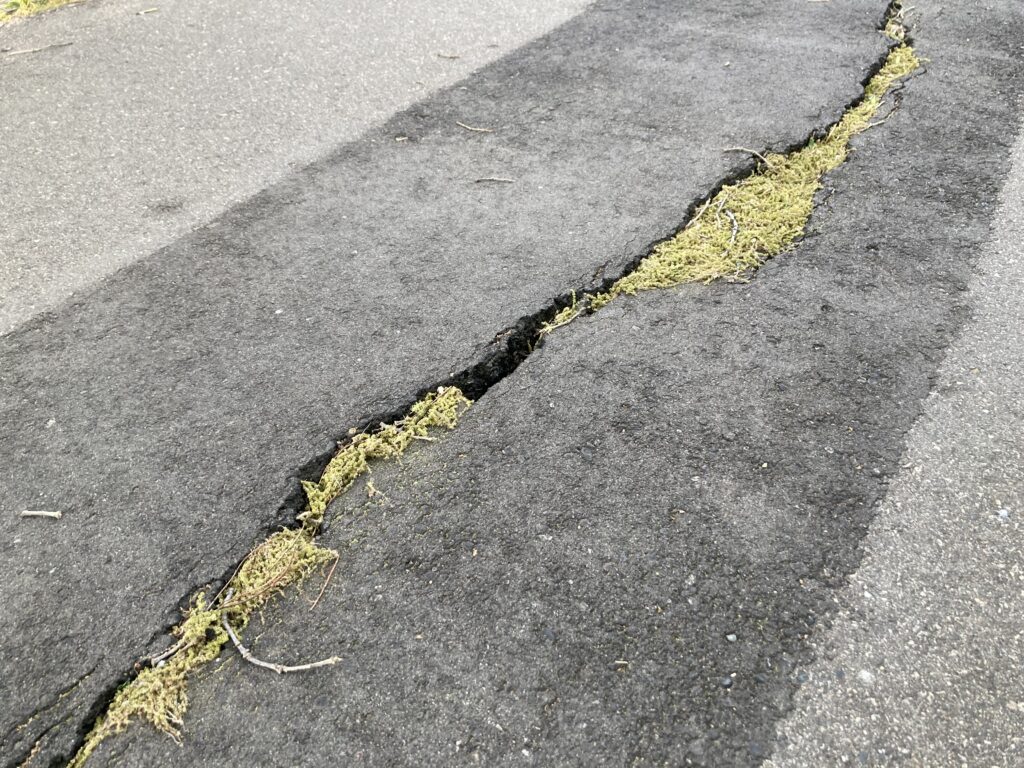
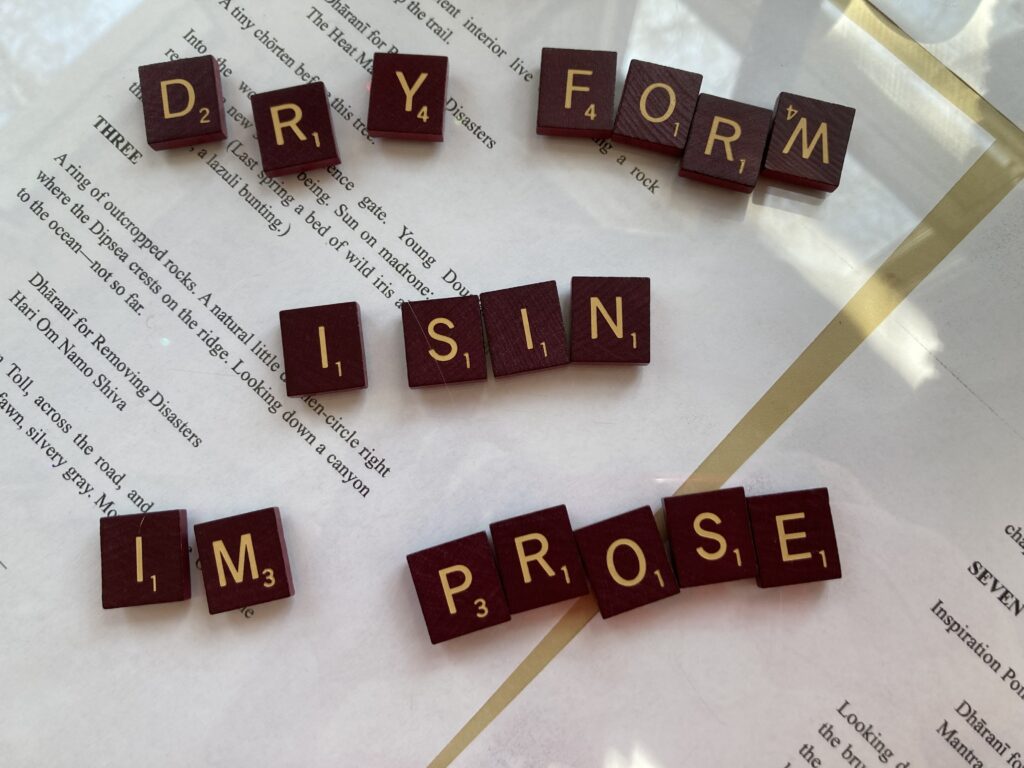
aug 20/RUNSWIM

9 miles
the confluence
62 degrees

9 miles, and it’s not even my long run for the week. I’m deep in the marathon training. For the first half, I ran 3 minutes, then walked 1. When I reached the Confluence, I took a 3 or 4 minutes walk break, then I did 4 sets of 90sec r/30 sec w, then a mix of 2 or 3 mins of running with 1 min of walking. Finally, I ended strong, with the help of a few upbeat songs, to run/walk my fastest mile of the run. Nice!

Early on in the run, I started thinking about my poetry manuscript. In particular, I thought about the series of poems, sprinkled throughout, that feature a specific location (a few possible titles: You Are Here, Echo Locations). The current form for each of them is: a brief description of location in 3 beat lines or 3 / 2 beat lines, then ending with a rhyming verse, roughly formal, but not in any specific form. I like the rhymes, but I’m not satisfied with them. Are they too rhyme-y? As I ran, I thought about taking the feeling that the rhyme creates, but getting rid of the rhyme — could we call this an echo? — Condensing the idea, eliminating excess words. I thought about my Tunnel of Trees poem. Here’s the verse:

Oh, where is the sky?
And where is the ground?
Neither can be seen.
Moving feet strike only air,
and eyes see only green
.

What about this instead:

sky ground gone
only green
green green green

Well, this is what I thought as I ran, but I don’t think it quite works. The idea that feet feel air, eyes see green is missing. I’ll work on it some more. Other related thoughts: should I make this haibun-esque, with a prose poem description poem and the condensed haiku at the end? I’ll try it. I like the condensed version of the rhyme part, because it feels more accurate to how I chant when I run — not in rhyming verses, but in single words repeated and ringing out.

I also thought about a poem I’m writing about the spot, on the edge of Wabun park and above the Locks and Dam no. 1. From it, you can see across to the abandoned ford power plant. My thought: perhaps I should add in some more details about that plant now that I’ve hiked among its ruins?

11 Things

  1. passed a regular: shorts with sandals
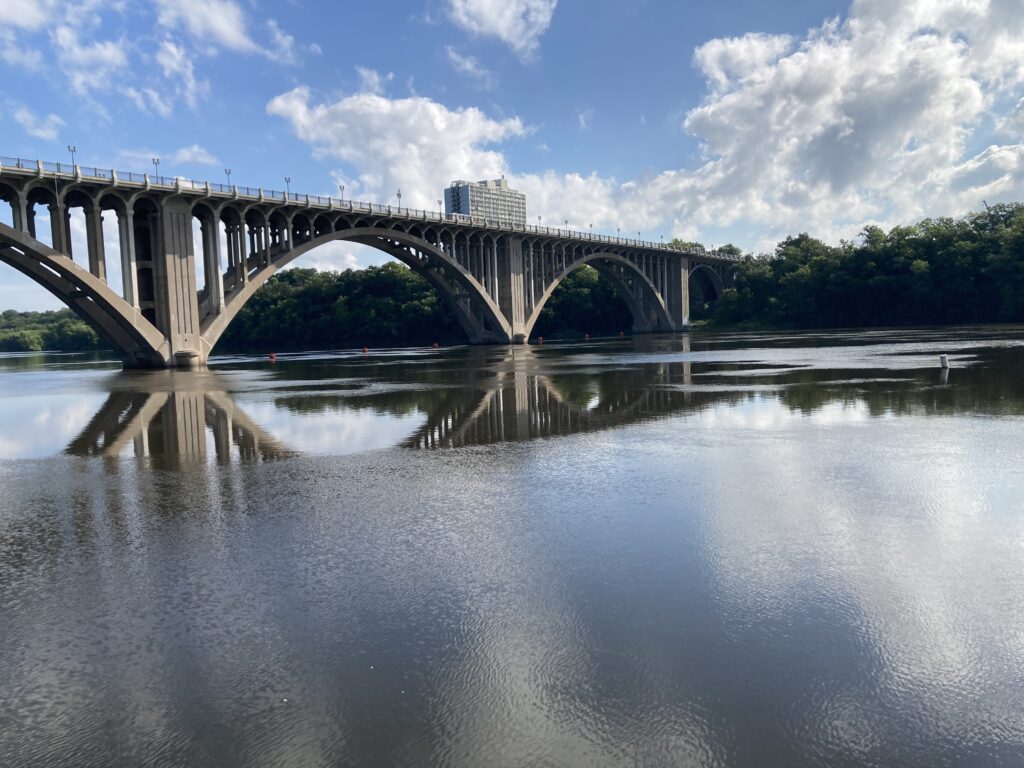
  2. view of river, ford bridge: a flat, smooth surface reflecting pale clouds and abruptly ending at the edge of the dam, looking like an infinity pool
  3. a tent set up on the grassy hill next to the ford bridge — a wheelchair in front of the tent’s entrance — the tent wasn’t hidden, but it was mostly sheltered and obscured by its position on the hill
  4. a VW van, almost looking like the Mystery Machine: green! A guy sitting in it, taking out some stuff — parked near the tent — is he sleeping in the tent?
  5. one skate boarder at the skate park — he was skilled — as I ran by, I admired his grace as he went up a ramp
  6. the gate that was closed and that trapped me and my friend 2 weeks ago, was wide open today — I wondered if it’s usually open on weekdays and closed only on weekends? I’ll try to remember to check next time I run by it
  7. the soft falling of water at Hidden Falls1
  8. my new favorite bench: empty and in the shade
  9. just before I reached my bench, I heard a dog bark at the off-leash park on the other side of the river
  10. there were no stones stacked on the top of the ancient boulder, but little pebbles piled in several indentations on the boulder’s side
  11. walking through the alley, almost home, I could hear acorns hitting garage roofs and see little leaves falling — fall is coming

see footnote below: I thought I had written about the history of Shadow Falls before on this log, but I can’t find anything. So, I googled it. First, I found this, about a nearby and now gone falls:

Kavanagh Falls were a cascade over several steps of rough limestone ledges named after the former owner of the land these falls were once on, the land today is now in the grounds of the Town and Country Club. In an 1891 article, a columnist wrote of Kavanagh Falls, “The plateau falls abruptly away to a picturesque glen or gorge, through which a brook purls to the level of the lawn, and then leaps laughingly to the river below. To make travel in the area easier, a bridge once spanned the Kavanagh Gorge. The spring that once fed Kavanagh falls remains on the grounds of the Town and Country Club. However, the bridge and gorge that these falls once tumbled into has since been filled to provide additional parking spaces for the Town and Country Club members. 

The Cascades of Minneapolis and St. Paul

Then I found another source, Equatorial Minnesota, which I’m pretty sure I read before. Among other interesting things, including a reference to “goat trails on the bluff”!?, they refer to Shadow Falls Creek. They also write this, “Today if you stop by, though, there is a panel of information detailing its history and geology (source).” I’ve never seen this info! I wonder if it’s at the entrance at the top of Summit Hill? I’ll have to look next time I run there! I’ll have to return to this blog; it’s a great resource.

swim: 2 loops
lake nokomis open swim
48 minutes
79 degrees

The final open swim, and I was able to do it! Sara-from-a-week-ago would have liked to swim for the full 2 hours, but after my congestions or bacterial infection or whatever it was, I am very excited that I was able to swim 2 loops. The water was some of the choppiest I’ve ever swum in, which was fun. Only a few waves crashing directly into me, mostly water pushing me around and rocking me back and forth. I liked it!

Only 3 buoys today, so had to swim straight across and back. I think that swimming to the little beach and back is actually longer than the typical 5 buoy triangle. How is that possible? I’m not quite sure. But, this isn’t the first time I’ve noticed it.

Oh, how can open swim be over already? In a better world, I’d be able to swim every day of the year, or at least more than just 10 weeks in the lake. Will I join the Y this winter? Wouldn’t that be wonderful.
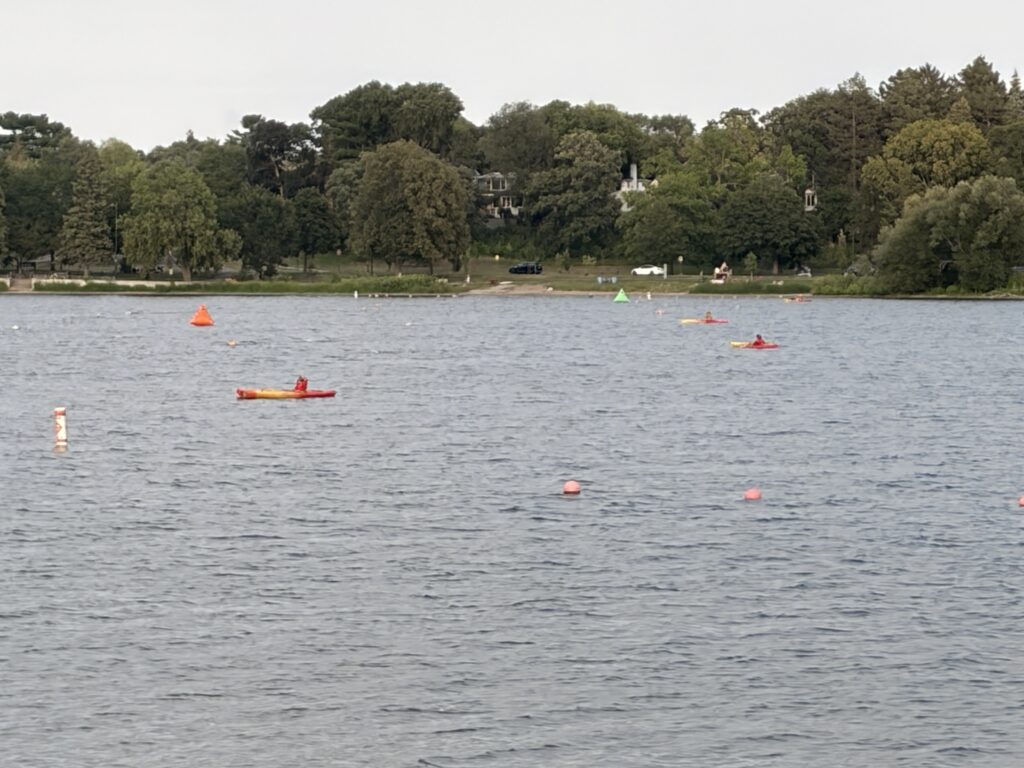
lifeguards on kayaks / 2 buoys

Sitting at Painted Turtle and drinking a beer after I was done, Scott took a picture of the lake. He had to zoom in a lot. It’s funny how the water doesn’t look nearly as choppy as it felt.

  1. As I listened to Hidden Falls Creek fall over the ledge, I wondered if the water at Shadow Falls, which is the subject of one of the poems I was thinking about, was called Shadow Falls creek. I’ve looked it up before, but I can’t remember; I’ll have to find the entry in which I wrote about it….I looked, but couldn’t find anything. Did I write about the history? ↩︎
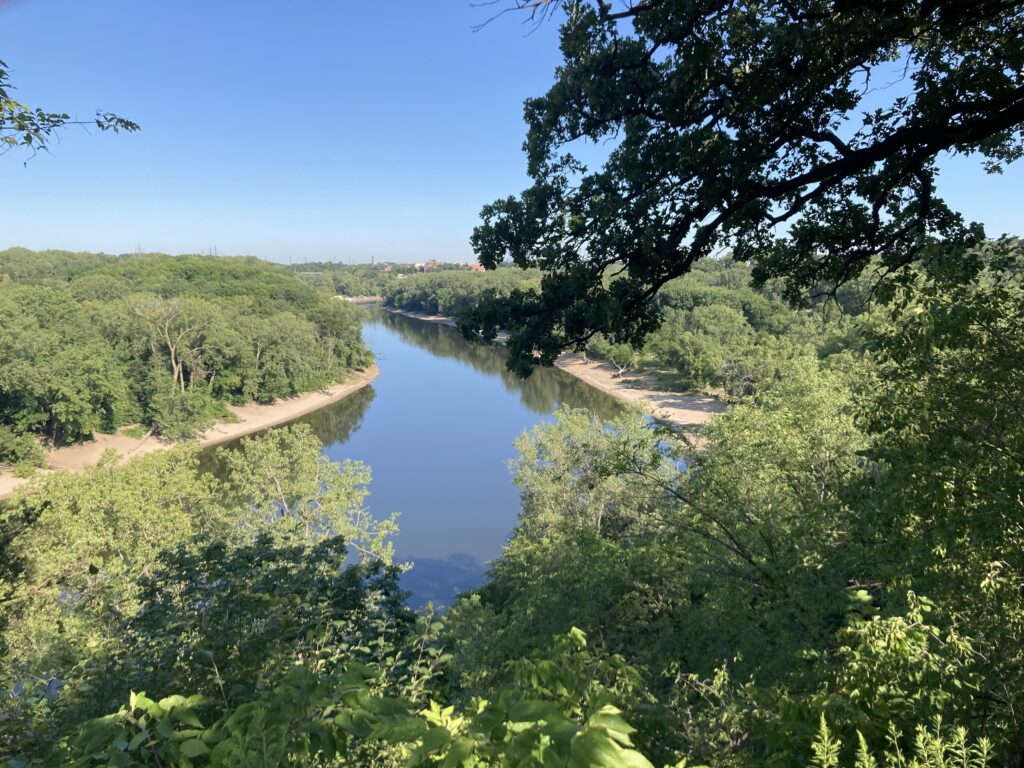
aug 19/SWIM

1 loop (2 mini loops)
cedar lake open swim
30 minutes
80 degrees

The final cedar lake open swim of the season. A beautiful night! Calm water, not too crowded. Since I’m still dealing with congestion, I decided to be cautious and only swim 2 loops. When I was done, I stayed in the water for a few minutes, first squatting, then floating, using my buoy as a pillow.

As I walked to the beach, I recited MO’s poem in my head. I thought again about her wording — it is TIME NOW and it will be TIME AGAIN. Among other things, this wording makes it easier for me to remember the poem. I tried to go deeper and quieter in the water, but I was worried about whether or not the water would make me more congested, so it was hard.

10 Things

  1. overheard — 2 swimmers talking, one had already finished, the other about to start — the one starting: I’m a teacher and tonight is my last chance to chill out before the craziness of the year
  2. a blue sky with streaks of clouds
  3. pale, yellow vines reaching up from way below
  4. bubbles, 1 — the ones my hand made as they pierced the water
  5. bubbles, 2 — in front of me — a warning that I was about the run into another swimmer — much smaller and lower in the water than the ones my hands make
  6. the buoy at hidden beach was almost on the beach — so close to shore!
  7. last year, some of the trees on the edge of the lake looked like they were changing colors, but not this year — everything is still green
  8. nearing the beach before the swim, a little girl to her dad: Daddy, can you see the moon? The moon the moon the moon is here! Can you see it, Daddy — the moon?
  9. floating in the water, hearing another swimmer coming in from a loop, breathing heavily
  10. an almost empty beach

Another great season. I feel strong and satisfied — although, like always, I wish I could swim every day of the year. I also feel deep gratitude for open swim — that it exists, that I can participate in it, that the water is still (mostly) clean enough for open swim to happen at all.

aug 18/RUNSWIM

4.1 miles
wabun / edge of falls / river road, north
67 degrees / humidity: 90%

Something different today: a little more speed. 2 miles steady at a moderate pace / 5 min walk / 1-2 minutes fast run, 1 min walk (5xs). It felt good to move faster — more like flying and with better form.

For the first 2 miles, I (almost) finished my Hello, Goodbye playlist. The most memorable songs: the beginning of “Never Can Say Goodbye” when it sounds like Michael Jackson says, Never can STAY goodbye — at least to me; and the slow and long wind-up of Barbara Streisand’s “Hello Dolly.” After the 5 minute walk, I switched to my “Wheelin’ Life” playlist. My favorite fast song on that playlist was: “Proud Mary”/ Ike and Tina Turner. It’s really fun to sprint to.

10 Things

  1. buzzzzzzz of cicadas
  2. a faint voie down below — the coxswain instructing the rowers
  3. waving to Santa Claus and to Mr. Morning!
  4. 2 different birds — one was a bluejay, I think — squawking at each other: what? / WHAT!
  5. puddles on the trail from last night’s rain
  6. empty benches
  7. park workers mowing a stretch of grass near the road
  8. some faint moaning sounds coming from a house near 7 oaks — was it a dog, or a person?
  9. my shirt, soaked with sweat — not sticking to me1, but saturated, making the color of it a deeper blue
  10. the pulp of all the acorns that have fallen in the alley and been crushed by car wheels — turned into paste from last night’s rain — in a thick layer on the asphalt

lake water congestion update: My sinus are no longer inflamed, my throat doesn’t hurt, and I can breathe easily through my nose. Hooray! But, I am full of snot, I have crud in my chest, and my cough sounds scary. Boo. Open Swim ends on Thursday. Will I feel good enough to go for a swim before it ends? I hope so, but I’m not sure.

echo locations

Fall has started early, I guess. At least for me and Scott. Last night he said, let’s make today the official start of Halloween season? Yes! To mark the occasion, we watched, “Thriller” and I attempted (badly, I’m sure) the zombie dance near the end. Another marker of fall: working on my river running manuscript. Its first name — Haunts, then, Girl Ghost Gorge, then, Echolocate || Echolocated, now, Echo Locations. I decided to look up “echo” on Poetry Daily. I found this wonderful poem from A.E. Stallings:

Echo/ A.E. Stallings

What tales we tell what tales
About the girls gone quiet
The story-telling ones
Who entertained the heart
Till suddenly they ceased.
What makes the tongue inert?
What turns the voice to swords
Cutting the throat? What takes,
The name from the alibi
Of the body? We were stern:
Stories, we said, are lies,
We told her, don’t repeat them.

What ails?
Yet
once
art
eased
hurt.
Words,
aches,
I
turn

ice
eat them.

I love the different echoes in this poem! Some rhyme, some almost rhyme, some almost sound the same, and some are almost, but not quite, the same. Fun!

Looking through my tags, I noticed several for “echolocation” and one for “echoes.” When I clicked on the echo entry (from 1 sept 2025), I discovered these wonderful ideas about echoing a favorite poet:

The Poetry Daily’s poem-of-the-day is I, Lorine Niedecker. Very cool and difficult for my cone-compromised eyes to read, I’m glad they included an essay by the author about the process of writing the poem. 

Surely, the finest way to appreciate Niedecker would be to read her well. And then repeated reading, reading aloud, transcribing the vibrant phrases on to paper, oh and even framing then. But how to linger in the presence of this voice, and let it echo within oneself, make her a part of oneself? Perhaps by applying Niedecker to Niedecker, I would arrive at a new condensary. De- and re- constructing her poems, deleting words, conflating words, writing through her writing.  

Mani Rao on Writing

After their explanation, Rao offers a writing prompt: 

Pick a poet who moves you, isolate their characteristics, and apply this to their work. Using words from within their own work, write the narrative of their poetics or/and biography. Example: Get romantic and didactic with Wordsworth, apply surrealism on André Breton … 

Imitation is the best form of flattery, but also of ridicule—so this kind of repetition can function as a spotlight or a spoof. I suggest choosing a poet you absolutely adore, as it’s better to have such a voice under your skin.

Mani Rao on Writing

I’m not sure if I want to follow this prompt, but her suggestions about echoing a favorite poet have me thinking, and wanting to experiment more with how I can create echoes out of my favorite poems, poets, words. Last fall, I tried “quarrying” 2 favorite Emily Dickinson poems, “Before I Got My Eye Put Out” (13 dec) and “We Grow Accustomed to the Dark” (14 dec) —

An experiment with quarrying words. Find all of the one, two, and three syllable words in a favorite poem. Turn them into a new poem that offers echoes of the original (13 dec 2025).

Maybe I should try one with “I Felt a Funeral in my Brain”?

swim: 1 loop
lake nokomis open swim
23 minutes
80 degrees

Open swim! After all of my congestion and having trouble breathing and coughing, I wasn’t sure if I would feel okay enough to swim across the lake another time. But, I’m feeling better today and when I saw the forecast for the last open swim on Thursday — 40% chance of thunderstorms — I decided I better go tonight and say goodbye to the lake. Maybe I’ll be able to swim again on Thursday, but if not, I did it tonight, and that’s enough. I was a little scared, worried that I might trigger my congestion, but I decided it was important to risk it. As I swam across the lake, I tried hard not to swallow any water and wore my nose plug (which I’ve been doing for at least 10 years). The course was short because many of the college aged lifeguards were already back at school, so there were only 3 buoys. No triangle, just a straight line with the buoys always on your left. There was wind, so the water was choppy. I tried to think about MO and “Swimming, One Day in August,” but I was distracted by my effort to not swallow water. When I returned to the big beach, I floated on my back, using my yellow buoy as a pillow, and recited the poem in my head.

After exiting the water, I met up with Scott and had a beer. We talked about marathon training and how much we love running. Then we walked over to a bench and looked out at the sailboats on the lake — very Sailboat (as in, the Platonic form of a sailboat). I told Scott about how happy I am to live in the midst of water — a mighty river, a creek, this wonderful lake.

It was a wonderful night — a reminder of how great it is to live where we do.

  1. Yesterday, while reviewing “circumambulation entries”, I reread my discussion of a Forrest Gander poem in which the narrator is running with a sweaty shirt that clings to his torso. I mentioned that, even as I sweat a lot, my shirt rarely clings to me. ↩︎

aug 14/SWIM

before the swim: Tired this morning. My throat is sore, not from sickness (I hope) but from keeping the window just above my head open all night. Reviewed yesterday’s entry and thought more about a place-based MO swimming poem: Swimming in One Place in August or Swimming in Place in August. Swimming in place is about repetition and loops and returning again and again to here. Not accumulating time but becoming more and more aware of the world around me — the flashes and flickers, the color of the water, the sounds underwater, the bubbles just below the surface.

About time in the water: While I’m swimming, I have very little idea of what time it is. I know that a loop is about 20 minutes, so I can figure it out, but I can’t read my watch when I’m constantly stroking 1 2 3 4 5 breathe right 1 2 3 4 5 breathe left.

4 loops
lake nokomis open swim
81.5 minutes
72 degrees

Before the swim I reminded myself of how much I love swimming across the lake and how much I’ll miss it when it’s over in a week. Another season almost over. As always, it has gone by too fast!

The first loop was very relaxed — my stroke, my breathing, the water. A steady rhythm and hardly any waves. Between buoys 3 and 4, a V of geese flew low over the water. They felt so close, but probably weren’t that close; swimming in the water distorts your perceptions of distance and size. Buoy 5 was almost as far as it’s been to the left. So far, that I thought the course/the triangles the buoys make was bigger than usual. Nope. I’m not sure how this is possible, but the course was actually a little shorter this morning.

As I swam, I thought about place — swimming in place, returning to a place, becoming familiar with a place. I know I had more interesting thoughts, but now I can’t remember them. Oh well, if they were important, I’ll remember them.

10 Things

  1. a vee of geese, flying low
  2. a seagull flying/floating in the wind
  3. a place, parallel to the water, also flying low
  4. my sparkle friends — most of them swimming straight at me
  5. glitter paths! the rough surface of the water, glittering in the sun
  6. a big splash off to my left — another swimmer who is not that efficient with their stroke/kick
  7. the green buoy, way off in the distance, becoming lost among the white sailboats
  8. clouds then sun then clouds then sun then all sun
  9. a haze in the air — not smoke but humidity
  10. swimming from buoys 1 to 2 on loop 3 when the water was choppier — even harder to sight the buoys, imagining lifeguards on kayaks were right in front of me when it was just the strange effect of waves and trees on the shore

When I finished, Scott was still running, so I took my towel and sat on the beach. What a morning! two moms and 2 kids.

overheard/witnessed after the swim

Mom 1, carrying a small kid out of the water: let’s get you into your robe, it’s cold!
Mom 2, also carrying a small kid: I really wish I would have thought to bring a cover-up for her! I bet a cover-up would feed nice and warm. Mom 1: a towel should work.

(a few minutes later, after Mom and kid 1 left): Mom 2 to her kid, okay, let’s get you in this warm towel! LOUD SHRIEKS Fine, no towel it is. Let’s walk to the bathroom. Kid 2 makes noises like they’re very cold. I bet a towel would really warm you up right now, but you made it very clear that you didn’t want one.

At some point during the swim, I had an idea for my long (12+ mile) run tomorrow: a Hello Goodbye playlist. I brainstormed songs as I stroked: Hello/Lionel Richie; Hello/Adele; Hello it’s Me/Todd Rundgren.

Hello Goodbye Playlist

  1. Hello, goodbye/ Beatles
  2. Hello/ Lionel Richie
  3. Goodbye Yellow Brick Road/ Elton John
  4. Hello/ Adele
  5. Goodbye Stranger / Supertramp
  6. Hello it’s Me/ Todd Rundgren
  7. Goodbye to You/ Scandal
  8. Operator/ Jim Croce
  9. Here’s a Quarter, Call Someone Who Cares/ Travis Tritt
  10. Call Me Maybe/ Carly Rae Jepsen
  11. Call Me/ Blondie
  12. Telephone ft. Beyonce/ Lady Gaga
  13. Where the hell is my phone?/ Lizzo
  14. Telephone Line/ ELO
  15. Mr. Telephone Man/ New Edition
  16. 867-5309/ Tommy Tutone
  17. Don’t Call Us, We’ll Call You/ Sugarloaf
  18. Hello / The Book of Morman
  19. Bye Bye Bye/ N’Sync
  20. Hello I Love You/ the Doors
  21. So long, Farewell/ The Sound of Music
  22. Hello 12, Hello 13, Hello Love/ a Chorus Line
  23. Look at Me, I’m Sandra Dee (Goodbye to Sandra Dee)/ Olivia Newton John
  24. Scenes from an Italian Restaurant/ Billy Joel
  25. I’ll Be Seeing You/ Billie Holiday
  26. Hi Hi Hi/ Paul McCartney and Wings
  27. Because I Got High / Afroman
  28. Why’d You Only Call Me when You’re High?/ Arctic Monkeys
  29. Rocky Mountain High/ John Denver
  30. Hey Good Lookin’/ Hank Williams
  31. Never Can Say Goodbye/ Jackson 5
  32. Welcome to the Jungle/ Guns n’ Roses
  33. You’re Outta Here/ Lorraine Feather
  34. The First Goodbye / 25th Annual Putnam County Spelling Bee
  35. The Second Goodbye / 25th Annual Putnam County Spelling Bee
  36. The Final Goodbye / 25th Annual Putnam County Spelling Bee
  37. Hey, That’s No Way to Say Goodbye / Roberta Flack
  38. Na Na Hey Hey Kiss Him Goodbye / Steam
  39. The Goodbye Look/ Donald Fagan
  40. Goodbye Blue Sky/ Pink Floyd

I had wanted to make this playlist 2.5 hours, but I couldn’t quite get there. It’s 2 hrs and 23 minutes.

aug 13/SWIM

4 loops
lake nokomis open swim
81 minutes
79 degrees

Wow, 79 degrees felt cool — at least, the air, when we got there. The water was fine — not too warm or too cold. The lifeguards claimed the triangle was shorter because of staffing issues, but it seemed about the same size to me. I counted strokes from buoys 4 to 5: 250. My goggles kept fogging up and the milfoil was thick, but the rest of the swim was great. Steady strokes, buoys sighted, collisions with other swimmers narrowly avoided. The water was the same pale green it has been all summer. I don’t remember any of my sparkle friends — probably because there was no sun, which was covered by a thick blanket of white. Today the sky is heavy. Me to Scott: This sky is unsettling, like something is about to happen but isn’t, or like it’s later in the day than it is.

10 Things

  1. Arriving at the lake, I heard a few ducks furiously quacking
  2. After the swim, I noticed two ducks rooting around in different clusters of towels that had been temporarily abandoned by their swimming owners
  3. even without the sun, the orange buoy left an orange reflection on the flat and mostly still water
  4. lots of stray vines, floating through the water, 1: making my skin itch briefly
  5. lots of stray vines, floating through the water, 2: one long strand got stuck on my head — as I stroked, I flung it off
  6. a sailboat, moving on the edge of the course
  7. overheard one swimmer to another: I know the milfoil is there and it still makes me panic every time I swim into it
  8. swimming over the top of a thick thatch of miloil, swinging my arms wide, trying to keep them as close to the surface as possible so they wouldn’t get wrapped around a vine
  9. finishing the swim, hearing some kids playing Marco / Polo / Marco / Polo
  10. stopping in the middle of the lake, overhearing 2 swimmers chatting — were they treading water? using kickboards? I couldn’t see, partly because I didn’t look

before the swim

At the end of yesterday’s entry, I wondered what “Swimming, One Day in August” would be if Mary Oliver had centered place instead of time. That question was inspired by listening to the New Yorker Poetry podcast with Richard Siken as he discusses Jorie Graham’s poem, “I Catch Sight of the Now” with the host, Kevin Young. Here’s what Siken says:

Some poets build out of space, and some poets build out of time. And this (I Catch Sight of the Now/ Jorie Graham) is definitely built out of time. It moves through considerations of always and never and now and then. And these choices are able to point to the inevitable and the timeless while still pulling in to be absolutely timed locked….She’s playing with temporality rather than geography.

New Yorker Poetry Podcast, Richard Siken reads Jorie Graham

Here’s some of that beautiful poem. Click on the title to listen to Graham read the poem. Wow!

excerpt from I Catch Sight of the Now/ Jorie Graham

unforgettable though then hardly noticed green
tiled ledge
just up to my right in the glistening shower stall, slightly above my open
eyes, square window in it, & slender citrine
lip onto which I place, gently, this first handful of hair—always I see it—the window-
pane up there letting anything in and out that
wishes to pass
thru—so freely—drops from the steam of the shower
on it, the slipping of forever & for-
ever all down the
pane, where, beyond the still-wet clump, all seems to shine and
murmur it’s just day, just this day, another day, filled with the only
of this minute, this split minute, in which if I
reach now I can feel
the years, the fissure in them,
these fractions here inside the
instant—

Her mention of the window reminds me of a favorite poems of hers that I’ve memorized, Still Life with Window and Fish. In her introduction to that poem, she mentions being stuck inside with an extended illness.

it’s just day, just this day, another day, filled with the only
of this minute, this split minute, in which if I
reach now I can feel

Back to my earlier question, how does MO’s poem — both the written one and my echoing/embodying/re-writing of it with my August swimming practice — change when I center place instead of time? Swimming, One Lake in Minneapolis? Or, two lakes — Nokomis and Cedar? What words/images are used in a poem about geography and not temporality? For someone else, perhaps this is an easy question, but for me, it requires more pondering. Is that because I am so much more rooted in time words/imagery than in place ones? hmm. . .

during the swim

As I looped the buoys, I thought about place and swimming in one place1 in August — this lake, here. Then: here and here and here. This is the place here where we sink and settle . . . . No — I don’t want to sink to or settle at the bottom of the lake; I want to be just above and under its surface — that between, threshold space. I didn’t come up with any other words to describe what a quieting of the spirit might look like in terms of locating/grounding yourself in a place? Submerging? On land, it’s rooting; what is it in water? Fixing your position? The coordinates. I thought about how locating/orienting myself in a place seems much more important than fixing myself in time. Then I thought about the geometry of water and angles and points/coordinates.

  1. Rereading this entry the next morning to make sure I don’t have too many typos, I thought, swimming in place, looping again and again, going nowhere or to the same heres again and again. ↩︎

aug 12/RUNSWIM

8.5 miles
franklin + ford loop
70 degrees / humidity: 70%

That was hard! I had barely started and I already felt too hot, my legs too sore. By the time I reached 3 miles, I abandoned my system of run 3 mins, walk 1 min and the doubt started creeping in — how can I possibly run a marathon in less than 2 months? The pressure and worry too — I have to run more this week or I’ll get too off track!

a brief flash: this run is a failure / you can’t do the marathon

The flash passed and I simply kept going. I walked when I needed to — which seemed often — and ran when I could. I drank water and ate an energy chew. And I kept going. One foot in front of the other. A step then another step then another. Sometimes running, often walking.

heart broken: I noticed the gentle and labored whirr of a bike wheel — deep, quiet, singular — and thought about how, in my state of struggle, I was tender and open to the world and its different sounds. Every sensation — a man’s disembodied voice high on a hill, a bird calling from the gorge, a cool-ish breeze on my sweat-soaked face, the strong smell of weed near the overlook — was clear, acute. Not irritating or overwhelming, like sensations can be when I’m anxious, but calling to me, like the wild geese, harsh and exciting –over and over announcing my place
in the family of things.

10 Things

  1. a carolina wren calling out cheeseburger cheeseburger cheeseburger
  2. a loud sound — is that a radio on a bike? no, a kid shrieking in a bike trailer, then the adult biking calling out sternly, what’s going on back there?
  3. a single canoe on the river with at least 3 people in it, hugging the west side of the shore
  4. a coxswain’s voice, giving instructions, his voice distorted by a bullhorn
  5. Mr. Morning! — morning! / good morning!
  6. a spring gushing through the rock on the east side of the river — not seen, only heard
  7. footsteps behind me, never gaining, just hovering in the air
  8. playing chicken with a woman walking with ski poles on the bridge — I won because I wasn’t going to move and I was on the proper side
  9. a man in the grass, near the locks and dam no. 1 parking lot lifting one heavy barbell — squatting and thrusting with it — his movement reminded me of a shot putter preparing to hurl the shotput
  10. more than half a dozen roller skiers, going fast up the hill, their poles clicking on the asphalt, several of them continuing past me, 4 of them turning around in front of me — sharply, quickly — the last one misjudging the turn and stumbling, then apologizing to me for almost getting in my way

I reflected on the run, which was both a failure and a success — a failure because I had to walk much more than I planned, a success because I didn’t give up and wasn’t nearly as slow as I thought I would be.

I heard Des Linden’s words in my head, you can do hard things. Yes. Most of the point of running another marathon is to give me the opportunity to prove that to myself — I can do hard things. There is something satisfying about facing a difficult/overwhelming task that you can’t imagine being able to do, and just starting to do it and never stopping until it’s done. To a lesser degree that happened at my swim last night. On loop 1 of 4, I felt tired and awkward, my body heavy in the water. A brief thought — can I really do this for an hour and a half? Then I stroke and kicked and breathed until I finished loop 4. Never quite believing or not believing; just doing and not thinking.

A deepening and quieting of the spirit = a deepening of the resolve, a quieting of the voices that encourage you to quit / a muting of an ego/I that believes going slow or walking or straying from an exact plan = failing, a digging into the depths for new forms of belief


breaking news: an audiobook I requested from the library just became available! I Contain Multitudes / Ed Yong.

Every animal, whether human, squid, or wasp, is home to millions of bacteria and other microbes. Ed Yong prompts us to look at ourselves and our animal companions in a new light — less as individuals and more as the interconnected, interdependent multitudes we assuredly are.

from the “about this title” blurb in Libby

I’ve tried reading or listening to a more recent book by Yong. I can’t remember what about it made me stop. It would be wonderful if I liked this book and could listen to it on my long run (at least 12 miles) on Saturday.


Back to hearts breaking apart. I looked up, “breaking apart” and Poetry Daily (poems.com) and found this excellent poem. I’m thinking of it less in terms of my 1 day in august project and more in terms of my Holes/How I Read project.

A Seam of Electricity [an excerpt] / Ian U Lockaby

Language is breaking apart in our hands. In the darkness, we can only make out
the shapes of letters on the pages. We’ve been reading like this for hours, or forever,
it seems, but now the sun fades out our windows and particles of darkness block
the white bays the letters gather in their limbs— the blank spaces that make them
legible, where the illuminate of the pale page makes shape.

Each word, suddenly the shape of a small animal. Lines of small animals creating a
blurred grid on the page.

A moment longer and the darkening brings out the beady eyes, glowing, reflecting
the light from the headlight of our eyes.

(An inherent light inside the eye— who had that idea, that I feel now in my sockets?)                                                                                                                           

In the neighboring darkyards 
not cherryglow but
a single candle left flickering out

I want to return to this poem, later, when I’m working on Holes again. There is some great ways of describing reading in low light and with limited vision!

swim: 3 loops (6 mini)
cedar lake open swim
71 minutes
86 degrees

The past two cedar lake swims were cancelled because of blue-green algae. Today it was open and almost empty and wonderful. There were lifeguards and more than a dozen open swimmers, but hardly anyone else. Was it because they just opened the beach at 3pm today?

Hardly any wind and only a few waves. Lots of floating strands of milfoil. I was subject to at least one full body scan as I passed over a vine. A few kayaks and canoes. I saw bubbles but now sparkle friends. No flashes of fish either.

The air was hazy. I kept thinking my goggles were fogged, but it looked as fuzzy with or without the goggles. Difficult to see, but just enough for me to navigate. Other swimmers weren’t able to navigate in the haze and sinking light. Or, they didn’t care whether they were swimming on course or not. I noticed several swimmers swimming way over on the wrong side. Cedar vibes.

Before leaving home for the swim, I thought about how MO’s poem would change if you focused on space instead of time — There is space here for the sinking and settling of the spirit? Every so often, I thought about space and here in relation to my swimming, but I don’t remember what I thought. A task for tomorrow?

aug 11/SWIM

4 loops
lake nokomis open swim
120.5 minutes
86 degrees

A beautiful night. The water had a few more pockets of cool water and was choppier, but was still wonderful. Before I started, I heard the lifeguard say something about the course being shorter due to limited lifeguards. And it was shortened, but not by that much. All I noticed was that the lifeguards were too close to the buoys and that green buoys 4 and 5 were a lot shorter.

10 Things

  1. more menacing swans
  2. the sun, sinking, its soft reflection on the water
  3. one plane, low in the sky, parallel to the water
  4. water color: pale blueish green
  5. every so often, a burst of birds — 6 or so of them flying together above the water
  6. almost running into a swimmer in front of me — I could see her orange buoy ahead of me and them, boom, it was right there — I didn’t run into her, which seems like a miracle
  7. at the start — a thick, overcast sky — no smoke or rain, just heavy and covering the sun
  8. no buoy in sight no buoy no buoy then BUOY
  9. the slimy bottom of the lake floor near shore — vines or leaves or some aquatic plant matter
  10. little swirls, almost like Ss with a flourish, just below me — little bubbles were my hands had been, pulling through the water

swimming one day in august

I’ve been working on filling up the different squares of my cork board with thoughts about key words or phrases from MO’s poem. I noticed that the most sparsely filled space is: my heart would break. Time to think more about the heart and how it breaks. What does it mean to break a heart/have a heart broken? And, in terms of those meanings, what is breaking my heart these days?

Heart break/broken: Something had pestered me so much/I thought my heart would break = being bothered, worried, upset, saddened, agitated overwhelm with grief, undone by a deep pain, beside yourself, out of your mind with worry? Not an actual break, but a feeling of, an almost

heart break = running too fast, swimming too hard, causing your heart to beat too fast and to stop working properly

heart break = a line break in a poem that shifts the meaning; the volta/turn of the poem?

a heart broken . . . open: MO discusses this at the end of her poem, “Lead,” and Maggie Smith does, too, in “Heart”:

And the dead inside you, don’t you
hear them breathing? You must have a hole
they can press their gray lips to. If you open–
when you open–will we find them folded inside?
In what shape? I mean what cut shape is made
whole by opening? I mean beside the heart.

Your heart could break in two, or scattered into a thousand pieces. Could it be that every time I swim my heart breaks open (here, a broken heart is an opened, and not closed (off) heart), then bursts into the little clear bubbles that trail me all over the lake . . . or, the heart is the surface of the water that I’m breaking open with my strokes.

You won’t be needing this …. This clip from The Simpsons isn’t exactly a heart being broken, but a heart being ripped out. Close enough for me:

“You won’t be needing This!”

Thinking about MO’s use of the word pester — something had pestered me so much — and bugs pop into my head — pestered by the mosquito, the gadfly. Searching through love poems I’d gathered, I found this:

When I see you, watching the violinist, his eyes shut, the Russian
composer’s concerto in his head, white horsehair fraying on the bow,
and your face is bright with tears, and there it is again, the word love,
not a fly or a mosquito, not a cricket or a bee, but the Luna moth
we saw one night, luminous green wings knocking at the screen
on the window as if to say I have a week to live, let me in, and I do.

(from Love is a Luminous Insect at the Window/ Martin Espada)

And this response to the poem by Ada Limón:

During my cynical years, I wrote drafts of poems about how love was rather dumb really. I distrusted anyone who asked me out and tried to spew some romantic crap my way. I was good at it, that being alone and being walled like a protected ancient city. I felt better being skeptical and side-eyed than I did when I was open and willing to believe any and all flirtatious banter tossed my way. I knew who I was. I was a house with a locked door. It was safe in there. My ribs made a nice cage for the beating heart that needed protection.

Then of course, love did happen. And it wasn’t what I expected. It wasn’t what I had known before. And on top of everything it wasn’t painful. It was easy and kind. I didn’t know that kind of love, the one that wasn’t mercurial and sometimes hurtful. And when that did happen it felt like realizing that the word “love” can’t do all the different kinds of love justice. It can’t cover all that ground and the muddy waters in between.

source

An open heart = an easy heart, a heart at ease, a heart eased

Next, I read “Love Letter” from Diane Seuss, which is on my list of additional love poems, and found these great lines:

Now when I think
of love it’s like focusing too hard
on the mechanisms of blinking or breathing.
You can be blinded or suffocated
by that degree of self-consciousness.

Mechanisms, mechanics, mechanical — thinking (too much) about how something works or doesn’t work. To break the mechanical part of a heart is to break apart your thinking about how that heart works. To break thinking altogether.

And then the (she searches for the right word) instruction of balancing along in the water, the ten thousand adjustments of vivid action, the staining together of mind and time so that she is no longer miles and miles apart from her life, watching it differently unfold, but in it, as it, it.

(1=1/ Anne Carson)

So, what is breaking my heart? I could write about the terrible things closing my heart, but I’d rather give attention to what is opening it. Maybe I’ll try, while looping, to list them with each breath?!

update, after the swim: I thought about making a list a few times, but each time a bird would be in the sky or a swimmer would be right in front of me or a menacing swan would be lurking in the background and I became distracted. Oh well, I can always try again tomorrow.

update, the next day: I found a few more notes about my swim that I want to add in here. As I swam, I thought about bits of my heart being released from my body, like little bubbles which made me think, leaking and unraveling. A sudden image: Olivia Rodrigo in the music video for “The Cure,” her veins emerging through her skin like red threads unraveling. In the video, this image is intended to be terrible (and maybe terrifying), but as I swam, I thought about those red threads emerging as a body opening up and connecting with the world outside the rigid, closed-off self. In my version, unraveling = loosening the knots that tie us too closely to our Self/the I.

Another note: still lake water causes blue-green algae blooms. These toxic blooms thrive in still, warm lake water. As I thought about MO’s quieting, I thought about how still water, while often easier to swim through than moving and wavy water, is not good for the quality of the lake. Here stillness is not a good thing, and still water is not a quieting but a making stagnant and stuck — an excess of nutrients become trapped and turn into toxins.

aug 10/RUNSWIM

10k
ford loop + ford overlook
67 degrees / humidity: 86%

No sun this morning, so it felt cooler, less difficult. Because of the smoke, the heat, and my cold last month, I’m behind on my marathon training, but I’m not too worried. This week, I’m getting back on track.

For the first two miles, I didn’t have my headphones in. Other than traffic, I don’t remember hearing much. Oh — a sprinkler turning on, a biker laboring up the hill, the soft thud of my feet striking the ground, a kid running and jumping as they crossed the street, a fountain at my fancy house, bubbling. For miles 3-5, I listened to Olivia Rodrigo’s latest album. Mile 6, my “Doin’ Time” playlist.

The surface of the water, viewed from the lake street bridge was scaled and empty. No rowers this morning. The surface viewed from the lake street bridge was more of the same, with the addition of a thin trail in the center — the wake from a canoe or a small motorboat?

I passed a tall man who was walking with ski poles, twice and a regular, skirt with sandals (who no longer pairs her skirt with sandals but white socks and running shoes.

I don’t remember what I thought about. For my next run, I’d like to memorize a new poem to recite in my head, or return to one I’ve already memorized. Could that make the run easier? Or, maybe not memorize an entire poem, but fragments related to stillness (inspired by “the deepening and quieting of the spirit”). Maybe a fragment or two from this one:

Shore Acres/ Sarah Holland-Batt

August, driving from North Bend,
from Empire, we saw how the waves gut
the bluffs until they are pocked, whole
scoops of rock being pawed out by water.
But this year nothing moves at Shore Acres,
the water is static as land, and stripes
of foam bone its slate like a corset.
We are here for the end of movement.
You stay to watch the ocean. I go back
to the Japanese garden. I only want to see
stillness where I expect it, the sombre willow,
the colossal Monterey pine; I sit,
making myself limestone and basalt,
on the grounds of what was once the summer
house of a pioneer shipbuilder. Now it is nobody’s
private estate, but the home of a gardener
who pulls yellow roses through the mist
in hedged circles. I think I am stone
as the arrowheads of pines vanish
into the understory of cloud.
I have stopped
longing for whatever it was I desired
and have given in to the body’s basic need
for rest. Bare feet, bare face, I wait
at what I imagine to be a shrine’s gate
gathering the kind of force required
to stop loving, as only stone can.

I sit,/making myself limestone and basalt, and I think I am stone — I want to remember and reflect on these lines and put them into conversation with what A Oswald wrote in an interview for the Paris Review:

“They read me my rights and asked whether I knew I was breaking the law, and did I want to come easily or did I want to be an obstruction. And I said, ‘I’m happy to be arrested, because I don’t believe it’s an offense,’ and that I didn’t want to come easily, and so I lay down and imagined my heaviest self. I was imagining I was made of gold or lead, just enjoying the difficulty the police were having picking me up.

Two more additions to this conversation:

1

The ones who leave
come back with stories: an excitement
in their eyes. But the ones who stay

witness little changes: dust, weather, breath.
What happens to them happens so slowly
it seems not to be happening at all.
(the ones who stay :: faith shearin

2

The
girl wants to be too
big to lift, too much
trouble to move, a
boulder beholding
small changes: dust, breath,
weather, rocks and cone
cells eroding — what
happens so slowly
it seems not to be
happening at all.
(Platteville Limestone / Sara Lynne Puotinen)

swim: 4 loops
lake nokomis open swim*
90 minutes
85 degrees

*It is a Monday and open swim is usually at Cedar Lake on Mondays, but the parks department closed Cedar’s beaches because of blue-green algae so open swim moved to Nokomis

I think this is the first time I’ve ever swum across the lake on a monday evening. As Scott drove me over, I wondered how different it would be. It wasn’t that different, but it was trivia night at Painted Turtle, so it was extremely crowded for Scott, who has a beer and works on his laptop while i swim. During lap 3 or 4, when I paused in the middle of the lake to admire the sun, much lower in the sky than in July, I could hear the noise from the restaurant. Wow! So many LOUD voices — a proper din. Also — I overheard one swimmer say, as we waited an extra 10 minutes for them to set up the course, the lifeguards are from Cedar and they’ve never set the buoys up here before. A group of 5 or 6 swimmers had a lot to say about how the buoys were being placed in the water as we waited. Another difference: many more menacing swans, a few of them getting way too close to the course. Near the beginning, I swam right next to them; I kept looking to make sure they weren’t going to turn into me.

The water was a wonderful temperature; not too warm or too cold. It was mostly calm and buoyant and easy to swim through. With the bright sun that was lower in the sky, it has almost impossible for me to sight on the way back to the big beach. It didn’t matter, I still knew where to go, it was just a little less fun always (as opposed to only some of the time) swimming into a void.

There were several swimmers faster than me, which was a nice change. A few of them passed me quickly, others I could swim behind to see where I needed to go. Here seeing = the flash of a bright pink buoy, tethered to one swimmer’s waist, or some white foam from another swimmer’s stroking arm or kicking feet.

For several stretches, I recited Mary Oliver’s “Swimming, One Day in August.” I was trying to think about the stanza:

Something has pestered me so much
I though my heart would break.
I mean, the mechanical part.

I particularly wanted to think about the word mechanical, but I don’t think I did. All I remember now (I’m writing this next morning because I didn’t have time or energy last night after a late dinner) is reciting all of the lines over and over. Oh — and I remember that I was struck by the first stanza’s time now and the last stanza’s time again. In my head I repeated, time now / time again / time now / time again.

Anything else? Bubble, but no sparkle friends; a few planes above me; water sloshing over me; 1 2 3 4 5 breathe right 1 2 3 4 5 breathe left 1 2 3 4 5 6 / 1 2 3 4 5 6 7; always the swan boats lurking in the background; the surface of the water beside the buoy, bright orange; seagulls in the sky; a whistle being blown on shore — 7 pm; the occasional strand of floating milfoil wrapping around my head or my shoulder; some other vines of milfoil reaching up from the bottom; the patch of milfoil just off of the swimming area thickening again; a canoe or two crossing the course; the surface of the water on the way to the big beach glowing from the sinking sun.

The course seemed longer than it usually is, with the buoys placed farther from each other. How does it compare to other 4 loop swims this summer?

10 aug: 4 loops = 4, 690 yards / 2,487 strokes
6 aug: 4 loops = 3, 969 yards / 2, 234 strokes
2 july: 4 loops = 4,639 yards / 2, 454 strokes
17 aug 2025: 4474 yards / 2, 526 strokes*

*Looking at the data from today’s swim vs. 17 aug, I know what the strokes don’t seem to add up with the corresponding distance. It’s because I started my workout early, then had to wait in the water until they let us go. The watch recorded 35 or so yards of distance while I stood there. Also, I read through the entry and realized last year’s 4 loop swim was at Cedar and not Nokomis.

aug 6/SWIM

4 loops
lake nokomis open swim
120 minutes
81 degrees

Another choppy night of swimming. I don’t recall seeing a corrugated surface, but I could tell the minute I started swimming that the water was going to be rough. It didn’t unsettle me; just made it harder and more draining to swim. Saw my sparkle friends and lots of bubbles. Noticed a silver flash below — a fish?! During one loop, heading back to the big beach, I noticed some birds flying over the water. Geese? Seagulls? Not sure. Also saw a few planes.

I’m not sure if there were any whitecaps but the waves were a couple feet tall and they rocked me from side to side. Swimming from buoy 2 to buoy 3, they kept wanting to drag me under. Swimming from buoy 5 to buoy 1, they were behind me and pushed me along. When I got the angle just right, I could swim fast.

10 Things

  1. one non-open swim club member with an orange buoy, swimming beside the white buoys
  2. so many sailbots, moving along the edge of the course — mostly white sails
  3. some menacing swan boats on the edges
  4. 1 or 2 canoes paddling across the course
  5. the milfoil is thickening again, just off the white buoy closest to the beginning of the course — as I stroked into shore, vines grabbed my wrist and my watch
  6. fogged-up goggles
  7. water color: deep green
  8. the first buoy was far out into the middle of the lake
  9. during one loop, a hissing sound beneath me, almost like air was leaking out of a tire
  10. a clear sky with no clouds

Swimming One Day in August

before the swim: Reviewing old entries tagged, 1 day of swimming, I found some great stuff from 2 sept 2025:

“The song I remember the most was Peter Gabriel’s “Playing for Time.”*

Oh, there’s a hill that we must climb
Climb through all the mist of time
It’s all in here what we’ve been through

Not a fan of the phrase, mist of time, but these lyrics reminded me of a few lines from Mary Oliver that I read right before heading out for my run: 

Slowly
up the hill, 
like a thicket of white flowers, 
forever
(The Leaf and the Cloud/ Mary Oliver)

The lines just preceding these were a series of good-byes to the world: the swaying trees, the black triangles of the winter sea, oranges, the fox sparrow, blue-winged teal, lettuce, turnip, rice fields, the morning light, and the goldfinches. 

Down, I’m getting it down
Sorting it out
So everything I care about
Is held in here
All of those I love, inside

Listening to these lines, I thought about Oliver’s deepening of the spirit. I thought about the interior and moving inside of yourself and of burying memories and ideas not as a way to avoid them, but to protect them. I also thought about someone growing older and having memory-loss and trying to hold onto faces and names and experiences. I weighed the possibilities and limitations of going deep inside as compared to opening up to the outside. All of these thoughts came at once — not in a linear progression — in a burst which lasted until I heard these lines less than a minute later:

There goes the sun
Back from where it came
The young move to the center
The mom and dad, the frame

I just remembered: at the start of my run, I was thinking about the difference between ordinary and extraordinary time, which was a continuation of thoughts that began earlier this morning. Habits, routines, activities/events experienced again and again — the mundane — versus the scattered, sporadic occasions that break up the routine. While meaning and memories are often found in the singular moments** I’m drawn to the rituals and repetitions and daily events as where important meaning dwells.”

*I told Scott about the song as we drove over to the lake and then we listened to it.

**are memories created from singular moments, or from the repetition of moments? conversely, do we remember something that happened only once as happening frequently, like a part of our character instead of just one instance or aberration?

during and after the swim: Mary Oliver’s one day = 24 hours / morning, afternoon, evening, night / dawn to dusk / a longing for a future time (in winter, thinking about swimming in the summer — one day I’ll swim again!) / a snapshot, one instant or instance / the start of an adventure in a fairy tale (one day the little girl wandered into the woods)

aug 5/RUN

10.1 miles
confluence and back
62 degrees
AQI: 36!

10 miles. That was not easy. Much cooler today, better air quality, but still warm. I sweat a lot. By mile 5, my pony tail was dripping. I could feel it on my shoulder, hear the wet strands of my hair swishing as I moved. I decided not to bring my handheld water bottle, which was a big mistake. Two thirds of the way through, I ran out of gas.

3 things that worked well:

  1. managed my unfinished business — even before I finished mile 1, I felt like I needed a port-a-potty, but taking walk breaks and not thinking about it, helped the need to poop go away
  2. just kept moving (mostly running, some walking) — I wasn’t sure how much I could run today and when I realized that the route to the confluence and back was almost 2 miles short, I could have stopped sooner, but I decided I need to keep going, so I did
  3. nice route — even though this route was too short, I liked it — the stretch of the east river road between hidden falls and the confluence is beautiful — such amazing views!

3 things to work on:

  1. don’t forget the water bottle
  2. don’t forget snacks
  3. work on being more consistent with the run/walk method — on the next run, try 90/30 again

As I ran under the road at Hidden Falls, I thought about the small stretch of hidden falls that was daylighted when they redid this area a few years ago. I listened as it rushed to the edge then fell over it and smelled its fishy smell.

10 Things

  1. running over the ford bridge, admiring the river, 1: the brownish water was calm, still, flat, not even a ripple
  2. running over the ford bridge, admiring the river, 2: because the surface was still, I could see below it — the faint outline of several sandbars
  3. a short (under 5 ft) older woman i, stretching next to the hidden falls park sign, at the top of the hill, later I encountered her again; she was walking, I was running
  4. a strange pair of sounds on either side of the road, call and response. Bird song I had never heard before, sounding almost like machines or alarms — was it 2 birds, or 2 people with some kind of device making the noise?
  5. what a view! — 1/2 mile from the confluence overlook, the trail and a bench are high above a bend in the river where you can see the mississippi and the minnesota rivers — I would have stopped but someone had brought a chair and was sitting in front of the bench
  6. near the far entrance to hidden falls — a roller skier perched at the top — were they about to bomb down the steep hill?
  7. at the confluence — a lime green bike, wedged in the corner of the overlook — too many leaves below to see anything — a warm water water fountain
  8. a bird crying out, sounding like they were in distress — a woman came to the edge where I was standing and said the sound came from an eagle on the other shore
  9. 2 men running on the ford bridge, one of them was turned around and running backwards
  10. 2 older men, carrying signs to place along the bike path that said something like, bikers, use caution! alert walkers with an “on your left” or a bell — Yes!

Just before I heard the eagle (mentioned in #8), I took a picture of a view of the river:

east river road, heading to downtown St. Paul

Running near where this picture was taken, I suddenly remembered a conversation I had with FWA at the dog park earlier this year. We were deep in the gorge, looking up at this bluff I was running on this morning. I said, this summer, when I’m training for the marathon, I want to run up there. And I am!

1 Day in August

Bummer! As I write this, I received an email from Open Swim. It’s cancelled tonight because there are blue-green algae blooms at one of the Cedar Lake beaches. Must be serious if they’re cancelling the swim; usually they just post an advisory and caution club memebers to “swim at your own risk.”

Reading the first verse of Mary Oliver’s poem again, my eyes stopped on among the flux of happenings” and I thought about the floating particles I encounter while swimming in Lake Nokomis. Often I call them my sparkle friends. They are the little bits of sediment or muck or aquatic plant that float in the water in front of me. They sparkle because of shafts of light in the water, and they seem to be in a constant motion of floating at me. I imagine some people might think my friends are gross, but I don’t, and I love the strange, trippy effect they create as I swim through them. I wrote one of my inklings about them:

Particles
before buoy 1

Lit by thin shafts of
light, they put on a
show. Their frenzied disco
of shimmer sparkle
shake stirs us up.

I like MO’s use of among here — among the flux of happenings. The deepening and quieting of my spirit comes among this flux, these little happenings.

I know I’ve written about “among” before; found it! On 16 may 2025, past Sara wrote a lot of things that are very helpful to present Sara as I think about MO’s use of among!

side note: the more I follow my muse here — and, maybe, my muse is a fish or floating milfoil or a sparkle friend? — the more clear it becomes: this year’s Swimming One Day in August is about engaging in a deeper reading of MO’s words — expanding on meanings, connecting them to her other work, reading them beside my experiences in the lake.

But, back to among. Here’s what I wrote in my 16 may 2025 entry:

among / between

When I read and posted Lorine Niedecker’s poem about standing among the birch last week —

For best work
you ought to put forth
some effort
to stand
in north woods
among birch.

I was struck by the word among and wondered how it was different from between. I looked it up this afternoon and, after wading through discussions about how between is used with 2 items, among with more than 2, I came across a helpful distinction in Merriam Webster: 

We use between when we want to express a relation to things and have them considered as individual and usually equal entities. 

Among, on the other hand is the best word to use when referring to things collectively and imprecisely. 

5 aug 2026 Sara, interjecting here: using among to refer to things collectively reminds me of a favorite (and very popular line) from MO in “Wild Geese”:

Whoever you are, no matter how lonely,
the world offers itself to your imagination,
calls to you like the wild geese, harsh and exciting –
over and over announcing your place
in the family of things.

among: your place in the family of things — so, the deepening and quieting of the spirit could be finding one’s place in the world? Where you belong? when you’re in your element? Of course this reading is different from the predominant one in which quieting your spirit among the flux of happenings means being present and calm, not worrying about all the noise around you.

I like among in LN’s poem, although I wonder about the effect of using between (or beside or with) instead. to stand/in north woods/between birch. Among indicates a kinship — among all of us trees, but between suggests an actual place — stand between this birch and that birch and an exchange — between us. I like both meanings. I like imaging my best work as trying to become a tree. But I also like the idea of my best work happening when I stand between birch — giving and receiving air. 

I was reminded of among and between while reading this passage from Marie Howe:

That was really a big deal. I was given this place to be without any expectations really. And everything changed so that the particulars of life—this white dish, the shadow of the bottle on it—everything mattered so much more to me. And I saw what happened in these spaces. You can never even say what happened, because what happened is rarely said, but it occurs AMONG the glasses with water and lemon in them. And so you can’t say what happened but you can talk about the glasses or the lemon. And that something is in BETWEEN all that.

You can name/describe the collection of things (among), but you can’t find words to describe how their meaning has changed in that moment. Often when I think about the slight shifts in meaning between small words, like among or between, I’m reminded of an essay I read about Mary Oliver and her mousier words. I love mousy words! Meanwhiles and in-betweens and yous and wes and usses (is that the plural of us?). 


…it’s tempting to be blinded by the more immediately visible parts of speech: the monolithic nouns, the dynamic verbs, the charismatic adjectives. Mousier ones—pronouns, prepositions, particles—go ignored.

Mary Oliver and the Nature-esque

Reading through this past entry, and thinking about MO’s next verse

Something had pestered me so much
I thought my heart would break.
I mean, the mechanical part —

I remembered MO’s words in another of her poems:

I Go Down To The Shore/ Mary Oliver

I go down to the shore in the morning
and depending on the hour the waves
are rolling in or moving out, 
and I say, oh, I am miserable, 
what shall–
what should I do? And the seas says
in its lovely voice:
Excuse me, I have work to do.

Here the sea doesn’t hold her until she grows easy or tell her what she should do, but they (the sea is they, because the sea is not an it) offer a suggestion, find your place in the family of things, do the work you were meant to do.

And there is the thing that one does, the needle one plies, the work, and within that work a chance to take thoughts that are hot and formless and to place them slowly and with meticulous effort into some shapely heat-retaining form, even as the gods, or nature, or the soundless wheels of time have made forms all across the soft, curved universe–that is to say, having chosen to claim my life, I have made for myself, out of work and love, a handsome life. 

Upstream/ Mary Oliver

I use this passage in the introduction to my “How to Be” project on my Undisciplined site.

an idea: Perhaps I should revisit Upstream and Long Life. I own both of them. Also, how about another read through of The Leaf and the Cloud?

aug 4/SWIM

3 long loops
lake nokomis open swim
65 minutes
76 degrees

A wonderful night at the lake! The buoys were placed wide, making the course bigger. More strokes, more distance, more time in the lake. It was choppy and challenging, especially nearing buoy 3 (water pulling me down) and between buoys 4 and 5 (waves battering me on my right). I could tell the water was unsettled when I entered it. Before beginning, I watched the small undulations on the surface and they disoriented me.

The water was green and opaque. I admired the bubbles my fingers shed. Below the surface, it was noisy — the same strange whooshing sound that I heard last week. Is it because of construction somewhere nearby? Above the surface, it was noisy too: big military planes flying by — National Guard training. I noticed some menacing swans on the edge of the course, but not sailboats or paddle boarders. Sometimes I felt like my spirit was deepening and quieting. A few times, I felt some twinges of anxiety — would my shoulder start hurting? my foot or my calf cramp? Almost all of the time, it felt easy and natural.

I rarely saw the buoys, but when I did, they were less than flashes or dots, just the idea that a buoy was ahead of me. I marveled out how I’ve learned to trust myself so much, just believing that the brief glimpse of the idea of a shape ahead of me was a buoy.

Before heading over to the lake, I had studied Mary Oliver’s poem. I was struck by these fragments: it is TIME NOW and it will be TIME AGAIN. I thought about the now of time as being in the moment, present — MO’s now and now and now. I thought about the again of time as the loops and repetitions, the habits I repeat, the returning again and again to the lake to swim around and around the course. I also thought about the again as the inevitable restoration of the now when I deepen and quiet. No matter my anxious thoughts, I will come back to the now, when I am not thinking or worrying, but being here, now, in my element, doing what I am meant to do.

1 day of swimming, august 2025

1 — from 5 aug 2025:

I recited Mary Oliver’s, “Swimming, One Day in August” and felt the deepening and quieting of my spirit. Peaceful, calm, relaxed, in my element.

This last line, in my element, reminded me of the Adventure Time clip I posted years ago on this log1:

quieting of the spirit = being satisfied, in your element

This clip also has another thing that I often reference: the demon cat with approximate knowledge. That’s me! Speaking of that cat, as I watched this clip again I realized something: this cat is a twisted reference to the Cheshire Cat in Alice in Wonderland. Nice! One more thing about this clip: I want a t-shirt with Finn on it, yelling out, “I’m in my Element!”

2 — from 6 aug, referencing 13 july 2025

I go to/the lake // to be held. Thought about the verb, to behold, then beheld, which reminded me of a line in a poem that I love and had pondered on 19 june: Unsee the beheld! / Altitude/ Airea D. Matthews

Unsee the beheld where to unsee is to observe/witness with a sense other than sight, or to unravel, come undone or redone, transformed. Who/what is the beheld? Me, held by the water. So, to unsee me, to let go of me/I and have an encounter/exchange with that which is not-I: the water. I haven’t written about this bit yet, but yesterday I was thinking about Anne Carson and her anthropology of water and I wrote in my Plague Notebook, encounter with that which you cannot contain, control, that is not You — the not-I. In the lake, I am held by the water — rocked, enveloped, lifted — but in the process of being held I dissolve, or the small part of Sara the ecosystem that is I is saturated submerged, soaked, waterlogged.

MO lines: “the sea/which held me, until I grew easy”

3 — the thinker’s the sinker

Just two days ago, I mentioned a line from a Maxine Kumin poem about the thinker being the sinker. I decided to look up the poem and my original post about it. So glad I did! Kumin didn’t write the line; that was my condensing of it in order to remember it. Here’s what she wrote, and a few other lines too, from “Swimming and Believing”:

Each time I tear this seam to enter, 
all that I carry is taken from me,
shucked in the dive. 
Lovers, children, even words go under.
Matters of dogma spin off in the freestyle
earning that mid-pool spurt, like faith.
Where have I come from? Where am I going?
What do I translate, gliding back and forth
erasing my own stitch marks in this lane?
Christ on the lake was not thinking
where the next heel-toe went. 
God did him a dangerous favor
whereas Peter, the thinker, sank. 
The secret is in the relenting, 
the partnership. I let my body work
accepting the dangerous favor
from the king-size pool of waters.

Later in my log entry about this poem, from 22 july 2021, I posted this:

things I like–tearing the seam and erasing the stitch marks; he who thinks sinks; the value of belief and relenting to that which is greater than you; a shucking off of the need to know where you’re from and where you’re going; the connection of all of this to the act of swimming. I like the line about thinking and sinking–maybe not he who thinks sinks, but the thinker’s the sinker? Hmm…anyway, I’m not opposed to thinking–I love doing it all the time and it is very necessary and important–but lately I’ve been very interested in ideas/understandings/poems/new ways of being that come to be or occur to us through methods other than concentration and directing our minds on objects or problems, which is how thinking is often defined. What can come to us when we’re not studying it directly? When we don’t have a specific objective, or need to be in control? Is this a different way of thinking about thinking?

In tomorrow’s entry, I should add to this idea of not thinking with Alice Oswald and her ideas about swimming and the mind and body.

  1. I spent more than 1/2 hour searching for the entry I posted it in, but couldn’t find it. Then I remembered that I had also posted it on Undicisplined, so I found it there. ↩︎

aug 3/RUNSWIM

4.2 miles
veterans home
69 degrees
humidity: 87%

Warm again this morning. Humid, too. Not easy to run, but still nice to be outside and breathing air that wasn’t that smoky. I was planning to run through the grounds of the veterans home and over the tall bridge then to the falls, but the bridge was closed, so I had to adjust my route. No bridge, no John Stevens’ house, no Big Feet statue or falls. Instead, I ran through Wabun, over to the edge of Minnehaha park, then back north on the river road.

Mostly I ran for 2 minutes then walked for 45 seconds. I listened to the audio book, Tomorrow, and Tomorrow, and Tomorrow. I saw a regular, Skirt with Sandals. Like I mentioned the last time I wrote about her, she no longer wears sandals, but running shoes. Should I rename here? Anything else? I don’t recall seeing the river or hearing any rowers. No turkey sightings. I did see one roller skier and heard their poles clicking the paved path. And I ran, carefully, over some acorns scattered across the sidewalk.

a word I’ve learned before but forgot: mondegreen

Returning to my poem-of-the-day practice, which I haven’t done for some time, I encountered a word that looked familiar but that I couldn’t remember the meaning of: mondegreen. It’s the title of Poetry Daily’s poem for today.

Mondegreen: “a word or phrase that results from a mishearing especially of something recited or sung” (Merriam Webster).

origins: from the mishearing in a Scottish ballad of “laid him on the green” as “Lady Mondegreen”

example: Up until a few years ago, I always the heard the line, what are we doing here?, from “Grease” as what do we do in PE?

I mentioned mondegreens to Scott and he offered up his favorite:

From “The Heart of Rock and Roll” from Huey Lewis and the News: Scott heard the old boy may be barely breathing as the oboe may be barely breathing.

Mondegreen/Bobby Elliott

I mistake the sound of a recycling cart
hitting the curb
for the latch of our gate
and picture him instantly:
my father stumbling
into the light of the backyard
to shoot himself.
I’d been looking at the fruit trees
and the fire pit,
the loose board of the old fence
in the wind.
I’d been thinking of how lost
you’d have to be
to believe you knew
everything there was to know
about yourself.
And now this sound
I mistake for my father
going through with it: one
awful letter in his coat pocket
to me, another
to my unborn son.

Reading an interview with the poet, I discovered that this book is autobiographical and about his father, but that father is “very much alive.” This fact offers an interesting shift in meaning for me, like something new clicking into place. But, more than the father, I’m interested in the idea of mishearing, mis-imagining, mis-seeing, mis-interpreting. It reminds me of something I’ve posted on here a few times (26 jan 2025 / 22 feb 2026):

The Ten Muses of Poetry

  1. Mishearing
  2. Misunderstanding
  3. Mistranslating
  4. Mismanaging
  5. Mislaying
  6. Misreading
  7. Misappropriating cliches
  8. Misplacing objects belonging to roommates or lovers
  9. Misguided thoughts at inappropriate times, funerals, etc.
  10. Mississippi (the river) 

And, here’s a line from a scientific study using mondegreens: “Expectations and prior knowledge can strongly influence our perception.” How does that impact what I see and what I hear?

Also, this passage from the same study:

An elegant method to examine top-down modulation of perception is to employ stimuli which can induce two concurring percepts which has been extensively employed in vision research using reversible figures, such as Rubin’s vase-face illusion [8]. So far, much less is known about how expectations can alter perception in the auditory modality. For speech content, such ambiguous stimuli that can be perceived in two different ways are called ‘slips of the ear’ which have been described as phenomena during which ‘a listener reports hearing, as clearly and distinctly as any correctly perceived stretch of speech, something that does not correspond to the speaker’s actual utterance’.

Slips of the ear reminds me of something else I read in the 22 feb 2026 entry about squinting with your ears:

A second key might be “eavesdropping.” As it happens I have deficient eyesight and hearing, not enough to impair my regular function but enough that I can, as my colleague Karla Kelsey puts it, “squint,” either with the eye or the ear, without difficulty. Some of my best lines—especially the generative lines, the bits of poetic grist from which poems develop—come from phrases I’ve misheard in conversation or (at least initially) misread as text. I guess you could say I “own” such material—I make a lyric and creative claim to it—by mishearing or misreading it.

An Inheritance Reassembled

swim: 2 loops (6 mini mini loops)
cedar lake open swim
86 degrees / wind: 16 mph

Windy, which made the water choppy. So choppy that the lifeguards couldn’t use the buoys and needed to shorten the course. Instead of swimming from beach to beach, we swam out into the middle of the lake and turn around near a lifeguard at a kayak. That might be some of the choppiest water I’ve ever swum in. I wonder how it compares to mild chop on Lake Superior or an ocean?

10 Things

  1. bobbing green caps
  2. bright yellow orange pink buoys
  3. the water’s surface was corrugated (a word Anne Carson used to describe a lake she swam in)
  4. a swimmer returning from the middle, doing a powerful backstroke — not looking or able to see where he was going — just swinging his arms, chopping the water — did he run into anyone?
  5. a strong spray from behind — waves crashing into me?
  6. so many scratchy vines floating in the water — one got stuck on my back and I had to stop to fling it off
  7. a pale blue sky, a few patches of bright blue
  8. a group of women in the shallow water in the swimming area — chanting and taking pictures — a party? a cult meeting? a religous ceremony?
  9. leaking goggles
  10. breathing mostly on my right side

A vigorous rocking as I swam. Between that delightful distraction and the constant need to look out for other swimmers and to find the turn around point, I didn’t think about Mary Oliver’s poem at all. Only after, did I realize I was living one of her verses:

I went down in the afternoon
to the sea, which held me
until I grew easy.

Yes, that lake water this late afternoon/early evening held me and rocked me, helping me to forget any worries or irritations I had. The water was rough, but not overwhelming. No waves rushing into my mouth when I breathed at the wrong time, just swells nudging me from side to side. Fun!

aug 2/SWIM

6 loops
lake nokomis open swim
69 degrees
AQI: 55

6 loops! In the 13 years I’ve been doing open swim, I think I’ve swum 6 loops once before. It took a little less than 2 hours. What a great way to start my swimming one day in August month! The conditions were great: calm water that wasn’t too cold or too warm, sun, a clear sky. As they announced the opening of the course, a lifeguard mentioned that it was slightly shorter because of a staffing shortage. In the past, a shorter course meant eliminating the green buoys and just swimming from beach to beach, but today’s “shortened” course had all 5 buoys and didn’t look that much shorter. Having swum it and checked my number of strokes and the distance, I don’t think it was short.

10 Things

  1. a dozen geese flying not too far above the water — not in a tight formation, but an approximate V
  2. the color of the water near the surface: a pale green
  3. the color of the water, deep below: dark green
  4. the color of the water on the surface: purple
  5. the sky: a pale blueish purple
  6. several planes in the air: most were parallel to the water, one nearly perpendicular, climbing straight up
  7. nearing the buoy #3 (green, closest to the little beach) the water surface was mostly flat, and calm, with flecks of golden light
  8. a tri clinic on the edge of the beach: women preparing for next Sunday’s sprint distance triathlon
  9. stopping in the middle of the lake: quiet, still
  10. the surface of the water glowing green or orange as I rounded a buoy

Today was the first day of my “swimming one day in August” project. A cumulative total of 24 hours spent in the water during August, partly inspired by Mary Oliver’s poem of the same name. As I stroked through the water, I recited the lines and thought about what Oliver means by, It is time now, I said, for the deepening and quieting of the spirit among the flux of happenings. I thought about the deepening and the bottom, about 18 feet below me that I couldn’t see. Then I remembered a line from the poet, Maxine Kumin: the thinker’s the sinker. Too much thinking, too much trying to go deeper into the murky depths, makes you lose your buoyancy. I thought about the quieting of the spirit and ways to understand it in the midst of moving. A strong, steady core? I recalled more lines from the poem, I went down in the afternoon to the sea, which held me until I grew easy. Even when the sea is calm — and how often does that happen? — the waves are not quiet or still, but relentless. A deepening and quieting is about settling into a rhythm. Then I started thinking that that deepening is not about sinking deeper into your own interior, but opening up to the world outside of yourself. The quieting, then, is about quieting the “I” and those things that make us believe we are separate from others and the world.

I think these thoughts, which came and went, probably comprised 10 or 15 percent of my swim. The rest of it was counting strokes between breaths (12345) or between buoys (buoys 3 to 4 = 200 strokes / buoys 5 to 1 = 100 strokes) or trying to sight the course or not running into some swimmers, racing others or noticing colors or listening to my nose squeak and water slosh over my ear or stopping myself from worrying about whether or not my feet were cramping.

When I finished, I was tired and a little sore, but my left shoulder didn’t ache and my calves or feet weren’t cramping. Hooray!

Here are today’s colors. Orange, green, yellow buoys. Water: purple surface, pale green just under, dark green deep below. Pale blueish purple sky with streaks of bright blue and a white cloud or two. Green trees lining the shore, light brown sand on the beach, too white swan boats.

buoys / water / sky / trees – sand – boat

aug 1/RUN

8 miles
ford + hidden falls loop
68 degrees / humidity: 87%

That was hard! I had wanted to run 10 miles, but the route I took was a lot shorter, my legs were tired, and the sun was hot, so I only did 8. Good enough for me today. I ran the first mile without stopping, then 2 min run / 45 seconds walk for most of the rest. After listening for Shadow Falls, 15 minutes in, I put in my headphones and listened to an audiobook I recently checked out, Tomorrow, and Tomorrow, and Tomorrow. It’s a great book to listen to while running: a good distraction.

10 Things

  1. running up the hill above the ravine, hearing the water falling at shadow falls
  2. another running passing me, then the sour smell of someone working hard
  3. a peloton on the road — a dozen riders
  4. a big group of shirtless runners: 20 or so? a college cross country team?
  5. encountering many runners (most) approaching me, running the other direction
  6. a sour, sharp smell near the overlook at hidden falls — from the creek water?
  7. so much sweat — my shoulders were soaked
  8. baby turkeys! near the 44th street parking lot, grazing in the grass
  9. a boisterous group of runners — 5 or 6 women laughing
  10. Patches of mud and some felled trees — because of yesterday’s rain and occasional strong wind?

No roller skiers, no geese, no bugs, no acorns underfoot — usually the acorns begin falling at the end of July. When will they fall this year? (update, a few hours later: Scott and I took Delia the dog on a short walk and, at the end of the block, acorns on the sidewalk!)

Before starting my run, the line from Mary Oliver’s “Swimming One Day in August” popped into my head — it is time now, I said, for the deepening and quieting of the spirit. I imagined this deepening and quieting as an inner stillness. I hoped to think about that as I ran, but I was too distracted my the heat, my legs, and the effort.

So far, I’ve heard 2 hours (out of almost 12) of the audio book, Tomorrow, and Tomorrow, and Tomorrow. It’s about two friends, Sadie and Max, who love playing and making video games. I’ve haven’t read the summary and don’t know that much about the book, but I’m assuming they make some big video game together. Do they fall in love, too? The first video game Sadie makes in her seminar at MIT is called EmilyBlaster and it involves pen-as-gun that shoots out the words of Emily Dickinson poems. Nice. I looked it up, and the game actually exists online, EmilyBlaster. I tried playing it. Admittedly, with my bad vision and limited gaming skills, I sucked, but it was pretty cool. The first poem was “I felt a Funeral in my Brain,” which I memorized a few years back. It felt strange to try and shoot these words as I recited them in my head. I can’t believe I’ve never heard about this video game before.

EmilyBlaster is one of Sadie Green’s earliest games, and one of the first games I invented for Tomorrow, and Tomorrow, and Tomorrow as well. It’s the simplest game in the book, and I needed it to be convincingly something a clever college student might be able to make on limited resources and time in the 1990s. The game was inspired by the poetry of Emily Dickinson and by edutainment games of the 1980s, like Math Blaster! I liked the slight subversiveness of making a game where the object was to shoot poetry, and I thought that Emily Dickinson’s compact verse style and memorable phrasings would make for perfect targets. 

Play EmilyBlaster!

campanilismo

More on echolocation and bells and bioregionalism. I recalled something I’d heard about earlier in the year. Here’s what I wrote at the end of my entry for 9 jan 2026:

Working on a tiny (24 word) poem tentatively titled bio-regionalism, and I was thinking about something I recalled hearing from Stanley Tucci in his series on regions in Italy and their food: he said that a region/neighborhood was/is defined by anyone who was in earshot of that neighborhood’s church bells. I looked it up and found this helpful definition and video from Rick Steves. The term is campanilismo:

During Tuscany’s medieval and Renaissance prime, this region was a collection of feuding city-states dominated by rich families. To this day, Tuscans remain fiercely loyal to their home community, and are keenly aware of subtle differences between people from different cities, towns, and villages. (Italians have a wonderful word for this: campanilismo, meaning that a community consists of the people within earshot of its bell tower — campanile.)

source

I love this idea of defining a community, your home-place, by its bells. My bells are the bells of St. Thomas, just across the river.

And here’s the poem:

Defining a Neighborhood

It begins
from the ground
up with feet
following,
and ends when
ears listening
can no
longer hear
the bells. 

It needs some work! I’d like to include it in Echolocation — should it be a separate poem, or should I add in some lines in my opening poem, Listen, where I first introduce the bells?

may 28/RUN

4.25 miles
falls and back
61 degrees

Cooler this morning, earlier too. My goal was to run at 7. My watch says I started the run at 7:07, which means I left the house around 7. Nice. Wore my old (2021, I think) Sauconys that I stopped wearing because they made by big left toe hurt. At mile 4, my toe started hurting again. Bummer. Back to Brooks again or buying a new pair of cheaper Sauconys.

Ran to the falls without headphones, listening to the cars and the geese returning north. Ran back listening to my “Bunnies and Rabbits” playlist. Bad Bunny’s “BAILE INoLVIDABLE” and The Jazz Crusader’s “Young Rabbits” helped me to pick up the pace. I need to create a playlist for pace — maybe mix it in with my beat/metronome experiment: 1 mile with no music or beat / 1 mile with metronome at 172-180 / 1 mile with music.

10 Things

  1. honk honk honk honk geese returning
  2. sparkling water
  3. soft shadows
  4. a runner behind, breathing heavily, closing in, then disappearing — where did they go?
  5. white foam (the falls)
  6. a roller skier — or was it a roller blader?
  7. tufts of symmetrically place ornamental grass mixed with purple blooms near “The Song of Hiawatha”
  8. a woman in a bright yellow windbreaker passing me on a bike, calling out morning!
  9. Mr. Morning! — morning! / good morning!
  10. ending at the big rock that looks like a chair, stepping on it to look down at the oak savanna: green green green

a return

This winter, I replaced many of my regular habits with new ones: (almost) no alcohol; waiting an hour to drink coffee in the morning; more protein, fiber, and iron; instead of sitting at the dining room table for 1+ hours when I woke up reading poems-of-the-day, I watched a brief video then started work on my Holes project; a consistent bedtime routine — ready at 10, asleep by 10:30. I also transformed my workspace. I added a huge cork board to one wall. It’s been fun to mix it up and try new things. I’d like to continue with many of these new things, and I also want to return to a few I’ve shifted away from, especially reading / studying / memorizing other people’s poetry.

In writing this log entry, I decided to visit my favorite poetry sites — poets.org; poetryfoundation, poets.com. On Poetry Foundation I discovered a wonderful podcast series, Wake, Butterfly:

Matsuo Bashō wrote:

Wake, butterfly— 
it’s late, we’ve miles 
to go together.

Poetry magazine presents Wake, Butterfly, a series of intimate portraits that invite listeners to keep creating. 

The final installment, which is the first I’ve encountered and will listen to, is with Marie Howe, one of my favorite poets! I think I’ll listen to it on the deck.

an hour or so later: I listened to it as I mowed the back yard. Usually I listen to the Bob’s Burgers Soundtrack (and I did today, too, after the 15 minute podcast ended). I’ve also listened to podcasts with Joy Harjo and Vs. with Danez Smith and Franny Choi, and several Agatha Christie books.

I love Marie Howe’s voice. Two times I recall hearing it before: when she was interviewed for On Being 6 or 7 years ago (at least) and in her brief discussion and recitation of her poem-in-progress, “Singularity.” In this podcast, she describes living with a big Irish Catholic family and the stories they would tell. She talks about war (WWII and Vietnam) and how she found poetry. Then she offers this:

I think the poem uses our stuff, you know, like it uses the details of my life, but the details are not important. The details are the cup … That hold something you can’t quite see, but you can feel, I hope. Because when it works, I feel something I can’t see. When I was writing a book called What the Living Do, it wasn’t done yet and I didn’t know how it wasn’t done. It had enough pages, it had an arc, I guess. But I was thinking about when I was in high school and. I was living up in the attic of our house with my brother. My brother lived in one room and I lived in another, and my dad would come up there when he was drunk and, um, pester me for hours—the way a drunk person does, wanting attention, wanting something, and it was very difficult. That’s one of the stories in my heart about my younger life, and I thought, “OK, what else is also true about that story?” And I remember actually standing up from my desk in New York here, and turning around, turning my body around 180 degrees and saying, “What else is true?” And I saw my brother Tom, who would come into the room and try to get my dad out, or would come into the room after my dad had left, and I wanted to praise him. So I want to offer you this invitation. Consider one of the stories of your life that feels fixed, and allow yourself to gaze around that story—quite physically—around the room of it or the time of it and to find something else in that story, even if the story is a painful one, to find something else in that story that’s praisable.

Marie Howe in Wake, Butterfly

Consider one of the stories of your life that feels fixed, and allow yourself to gaze around that story—quite physically—around the room of it or the time of it and to find something else in that story, even if the story is a painful one, to find something else in that story that’s praisable.

I love this idea of taking a fixed story and finding something else in that story to praise. I think I need to sit with this one for a few hours.

Before then, this:

The Maples/ Marie Howe

I ask the stand of maples behind the house,

How should I live my life?

They said, shh shh shh . . .

How should I live, I asked, and the leaves seemed to ripple and gleam.

A bird called from a branch in its own tongue,

And from a branch, across the yard, another bird answered.

A squirrel scrambled up a trunk

then along the length of a branch.

Stand still, I thought,

See how long you can bear that.

Try to stand still, if only for a few moments,

drinking light breathing.

This standing still — seeing how long I can bear it — seems like a great thing to do everyday. As part of this: explore different ways to be still. What is it to be still?

The beginning of this poem reminds me of a Mary Oliver poem that I’ve posted on this log several years ago (2 july 2020):

I Go Down To The Shore/ Mary Oliver

I go down to the shore in the morning
and depending on the hour the waves
are rolling in or moving out, 
and I say, oh, I am miserable, 
what shall–
what should I do? And the seas says
in its lovely voice:
Excuse me, I have work to do.

march 21/WALKGETOUTICE

walk: 120 minutes
with Scott and Delia
deep in the gorge + the winchell trail
76 degrees

I’m writing this the next morning because I took a break (mostly) from my computer and writing. So warm! I wore shorts and a short-sleeved shirt on our walk/hike! We walked through the neighborhood to the river and when we crossed the road to throw away Delia’s poop bag, we decided to take the old stone steps down to the river. The floodplain forest was filled with fallen trees and dead leaves: winter’s aftermath. The river was open and flowing. People everywhere — it wasn’t crowded, just a person walking a dog here, two people talking on a blanket there. Everyone enjoying the sun and the warm wind and the lack of ice.

I loudly misidentified a person as a wild turkey. Oh look, a wild TURKEY! Why is it that only when I am mis-seing something do I bother to say it out loud, and with such volume? It’s funny, and Scott and I laughed about it, but it is also frustrating. I sound like an idiot or mad. I said to Scott it’s funny as comedy and irony (the irony because I only declare these things when I’m very wrong).

holes

A return: the hole in Holes 1, which was the start of all of these holes — Another name for barely not blind is a hole in your vision that makes for an uneasy fellowship with the word. Now I’m thinking that I should tighten these poems up and make them only about reading. So, the hole in Holes 2 would be: a hole through the bottom of / the / wor / d / here / it is / unprofitable / to / have / faith / in / the / visible. And Holes 4 would be only: you look at sky, || you look at || words || you || don’t || see || the || gaping hole / and || its / graveyard / for / failed / cone / cell / s / you see / snow flake marble dust / seltzer / fizz|| a / nothing / that / is / something / not / shar/ ing / its / secrets

Get Out ICE

ICE agents are still here, but not at the levels they were a month ago. Two of the leaders that caused the most damage — Noem and Bovino — have been removed (Bovino announced his retirement the other day). Even so, the effects — psychological, physical, economic — still linger for many Minnesotas. Food is still being delivered to families afraid to leave their homes, organizations are still raising money to help people pay their rent. The stop signs around my house still declare, “STOP ICE.” The latest threat: Trump threatens to send ICE agents to airports to take over TSA jobs abandoned by workers not paid because of the partial government shutdown.

Since just after an ICE agent murdered Renee Good on 7 jan, I’ve been adding “Get Out ICE” to my log entries, both in the title and as a tag. I think it’s time to stop. A better thing to add now might be: What about the Epstein files? or Stop the war!

Mary Oliver Doc on PBS this summer!

I’m looking forward to this documentary!

“I was save by poetry. I was saved by the beauty of the world.”

I want to put MO’s idea of being saved by the beauty of the world beside the banner that Hanif Abdurraqib has above and between two door frames in this Instagram picture: “LIFE’S NOT OUT TO GET YOU” Yes! Always a good reminder.

feb 11/RUNGETOUTICE

4.5 miles
minnehaha falls and back
35 degrees
15% sloppy

Sun! Above freezing! Melting and melted snow! And I think I remember hearing chirping birds somewhere. Plus, the falls were faintly falling! Today’s run felt much better than yesterday’s. I felt stronger and calmer and more capable of handling everything — running included.

10 Things

  1. two benches at the park were occupied, one near Sea Salt and one just across the road from the Longfellow House
  2. a low, dull whine coming from the indoor ice rink at Minneahaha Academy
  3. the gentle curve of the retaining wall wrapped around the ravine between 42nd and 44th, covered in white
  4. much of the snow near the bench above the edge of the world was melted — the bench was empty, the river was white
  5. a few cars in the parking lots at the falls
  6. two people standing on the path at the edge of the falls looking up at something — but what?
  7. 2 fat tires
  8. a man and a dog emerging from a snow-covered trail, climbing a snow bank and then crossing the road
  9. a long honk from a car across turkey hollow
  10. the soft sound and the slide-y feel of my feet striking the grit on the path

As I ran, I thought about my low ferritin and wondered what impact it has made on my running. Is it why I struggle to run more than 4 or 5 miles at a time? Then I imagined how much better my running might be after a few months of taking the iron pills my np (nurse practitioner) prescribed for me.

Here in Minnesota, we have a few months (if we’re lucky!) before it’s spring, but it sure feels like it today. In honor of that feeling, here’s a Mary Oliver poem I just discovered in my recently purchased Little Alleluias:

A Settlement / Mary Oliver

Look, it’s spring. And last year’s loose dust has turned
into this soft willingness. The wind-flowers have come
up trembling, slowly the brackens are up-lifting their
curvaceous and pale bodies. The thrushes have come
home, none less than filled with mystery, sorrow,
happiness, music, ambition.

And I am walking out into all of this with nowhere to
go and no task undertaken but to turn the pages of
this beautiful world over and over, in the world of my
mind.

***

Therefore, dark past,
I’m about to do it.
I’m about to forgive you

for everything.

I love this poem! To turn the pages of this beautiful world, to forgive the dark past, to declare, I’m about to do it in a poem. I want to borrow that line.

Get Out Ice

An IRL friend shared a post on Facebook with some wise words about care and love. The whole post is great, but here’s an excerpt that explicitly discusses care and another form of love: relational humility and the de-centering of needs/desires

So beloved white women kin, please let us watch each other. If you see this happening, please turn towards our kin and ask them to hold a contradiction with you: we need the efforts and care that are being brought forth, this strategy that uses our privileges to build things that are needed but, at the same time, and with the greatest of humility, we have to recognize that we carry within us deeply rooted survival needs that are about our own comfort and centering; our desire to feel and be seen as valuable and worthy. And because those needs are deeply rooted, we often don’t see them when they crop up, although others do. Which is why practicing relational humility rather than defensiveness is key to this moment.

Link arms with each other and say, hey, while we are doing this work, let’s check each other on what we are bringing to it. Who else are we in relationship with? How are we checking our actions against something other than the minds of other white women? Is there anyone else doing the same thing or something similar and can we help them rather than start something new? Is there a part of us doing this thing because we have an image of ourselves as brave and selfless, a kind of inner hero narrative? Come on, loves, tell the truth. Where are we holding on to control rather than care, feeling a sense of ownership to our work that we are attached to, expressing false humility when we actually want the attention, and believing that we know what is best for whatever moment we are in? Are we trying to build an empire or just a moment for the people nearest to us, people we want to create safe? Loves, beloveds, there are a number of white women engaging in empire building right now, even though it is called care.

Raffo Susan

there are a number of white woman engaging in empire building right now, even though it is called care.

love

I have written 14 love poems using words/lines/phrases from the social media statements of local businesses. For Valentine’s Day, I want to gather them in a small chapbook to be shared and spread. I’d like to include a brief introduction that would explain what, why, and how I put these together, and might offer a more straight-forward description of how love is being imagined and practiced here in Minnesota. This afternoon and tomorrow, I need to write this introduction.

feb 5/RUNGETOUTICE

4.45 miles
minnehaha falls
33 degrees
60% sloppy and wet

A run outside! Above freezing! Less layers! And I made it all the way to the falls! It was sloppy, but I’ve run through worse. No lakes covering the entire path, only small ponds. I felt stronger running up all the small hills; it must be the hill workouts I’ve started doing. Maybe I should run to the falls and do some loops around the park — I could do the hills there multiple times? It’s strange, but I like running up hills now.

10 Things

  1. birds singing and sounding more like spring
  2. the dull, quiet whine of a power tool off in the distance — a drill on a construction site?
  3. the falls are completely frozen, so is the creek
  4. voices rising up from somewhere down below at the base of the falls
  5. faint traces of brown dirt discoloring the snow, making it less winter wonderland, but also less slick
  6. kids yelling and laughing on a playground — a teacher’s whistle blowing (not a warning about ICE)
  7. empty benches everywhere
  8. a few cars in the park parking lot
  9. another runner behind me, beside me, then in front of me. I delighted in hearing the sibilant sounds of their feet striking the slushy snow
  10. a few seconds of honking above on the ford bridge — someone honking at ICE or another car’s driving or in solidarity with a bridge brigade?

Get Out Ice

Today’s Get Out Ice moment is in honor of my mom, who was a fiber artist until she died in 2009, and my daughter, who is a fiber artist now.

AS OF FEBRUARY 5TH.
WE HAVE REACHED A TOTAL OF
$650,000 IN DONATIONS
Funds last week were donated to STEP St. Louis Park emergency assistance for rent and other aid and the Immigrant Rapid Response Fund.
We are working on donations to other local organizations
– stayed tuned for more info.
We are speechless. We are overwhelmed with the generosity of the fiber community and beyond. This outpouring of love and support is felt around the state.
Because of you, we can help so many people who need it.
Thank you thank you thank you.
Keep knitting. Keep resisting. Keep showing up for your neighbors.
Melt. The. Ice.

Needle & Skein Instagram post

The $650,000 came from people purchasing a $5 pattern for the Melt the Ice Hat:

In the nine years that Gilah Mashaal has owned Needle & Skein, a yarn store in the suburbs of Minneapolis, she has tried to maintain a rule that “nobody talks politics” in the shop. But amid the weeks-long occupation of the Twin Cities by federal immigration paramilitaries, Mashaal and one of her employees decided to turn one of their weekly knit-alongs into a “protest stitch-along”.

They didn’t want to return to the “pussy hats” that symbolized women’s resistance to Donald Trump in 2016, so Paul, their employee, did some research and came back with a proposal: a red knit hat inspired by the topplue or nisselue (woolen caps), worn by Norwegians during the second world war to signify their resistance to the Nazi occupation.

‘Rage Knitting’ against the machine

Love #13, version 2

This morning, I was trying out all different ways to create a poem out of text from a few local businesses. Nothing was quite working; partly because I am fixated on erasures and blackouts and can’t see (literally and figuratively) how to execute this effectively. One way out: Mary Oliver. My whole poem centers on a phrase from a MO poem, “Lead”:

I tell you this
to break your heart,
by which I mean only
that it break open and never
close again
to the rest of the world.

Here’s my version of those lines, using words from Social media posts:

Here, now, 
on this day,
my heart
breaks, 
and tomorrow
it will stay open
to everything.

Or this variation:

My heart breaks
here, now,
and tomorrow,
it will stay open
to everything.

oct 10/HIKE

60 minutes
Minnehaha Off-leash dog park
63 degrees

Wow, wow, wow! A beautiful fall hike with FWA and Delia-the-dog at the dog park. Sun, shade, a cool breeze, yellow and red leaves, sparkling water, soft sand, cute dogs, great conversations — less abstract and theoretical and more personal this time. About anxieties and social norms and traumas and friends that don’t get you.

10 Things

  1. soft sand
  2. a motor boat, floating slowly
  3. small stones just under the surface of the water, near the shore
  4. a small stretch of beach, populated by soft sand, frolicking dogs, the bones of an old tree
  5. a loud cry — was that human? FWA thought a kid, I wondered about a fox
  6. someone far off whistling badly
  7. the surface of the water sizzling white
  8. sitting on the smoothest section of a log — how many other people, and for how many years, have sat in this very spot?
  9. top of the limestone steps — jagged, steep
  10. comparing Delia’s short, quick, little steps to a much bigger dog’s loping, floating strides

GGG (girl ghost gorge), today’s update

before my hike: Reading through the last section of this collection — Air — I had some ideas about time and Endi Bogue Hartigan’s o’clock poems, specifically these lines from oh orchid o’clock:

it is morning 
birds plus 
socket sound of
car closing / 
21st 
century 
pastoral
o’clock

A 21st century pastoral! Yes, I’d like to write some triple chants and offer a twist on the pastoral. The twist = critical of the romanticizing of land, of understanding land as object and background, etc. Fun!

Also, I want to write another poem — possibly a chant? — in this o’clock form that mixes my timeline with that of the gorge.

Other things yet to write: more on air in terms of lungs and breath; a looping poem using the last section of my poem, “Conservation”

anti-pastoral

I decided to start by searching for “pastoral” in my old log entries.

1 — 13 april 2021

I posted and wrote about Forrest Gander’s poem, “Pastoral.” He’s critical of the idea that we observe landscapes/land from a distance, as if seeing were a process, and not an instant act. I appreciate his challenge to the idea of distance, but don’t agree with his suggestion that seeing is instantaneous. Looking does take time to happen, for everyone.

dispossessed (not owned or occupied)
a process
encounter — a process / between two / actors / the beheld / beholder
no study, absorption
immediate, gradual

2 — 28 dec 2021

In the poem, “The Grand Scheme of Things,” Maggie Smith links the eye to the pastoral, too.

We say the naked eye
as if the eye could be clothed, as if it isn’t the world

that refuses to undress unless we turn our backs. 
It shows us what it chooses, nothing more,

and it’s not waxing pastoral.

Yes! The pastoral is all about a certain understanding of sight and vision and how/what we see, how we look.

how we see / a soft sight
filtering
what is “real”?
no access / to the Truth / through our eyes
surely you/can’t imagine/the trees look/like they look/when we are/not looking (MO)

(side note: I’m realizing that the pastoral — paintings/poems — are all about how we look and see. I need to turn to this in my ekphrastic/how I see project. )

after the hike

3 — 6 feb 2022

Pastoral turns up in A Nearly Perfect Morning/ Jessica Greenbaum:

It was a nearly perfect morning—bucolic, pastoral—

bucolic: related countryside, farm fields, pastures, rural, rustic, countrified

bucolic
countrified
a plowed field
managed land
rusticate

4 — 21 march 2022

From an interview with Alice Oswald:

there’s a whole range of words that people like to use about landscape, like pastoral, idyll. I quite like taking the names away from things and seeing what they are behind their names. I exert incredible amounts of energy trying to see things from their own points of view rather than the human point of view.

…more interested in the democratic stories…the hardship of laboring, looking for food…the struggle of a tree trying to grow out of stone…always looking for that struggle. I’m allergic to peace. I like this restless landscape. I like that it won’t let you sit back and say, “what a beautiful place I’ve arrived to.” You’ve never arrived. It’s moving past you all the time.

Landscape and Literature Podcast: Alice Oswald on the Dart River

idyll = “an extremely happy, peaceful, or picturesque episode or scene, typically an idealized or unsustainable one.”

non-human / perspective

AO rejects the beautiful, as in, what a beautiful place, let me just sit and admire it! I’m thinking of 8 dec 2024, and my discussion of beauty as awe inspiring and awful, beauty as not perfect and relaxed, but pain and grief and struggle

struggling
suffering
laboring
a tree’s struggle / to make a home/ out of a stone
a river’s/fight to be free
restlessness / not relaxed
never here / always there
difficult / not easy (see 14 april 2021 and MO)
lacking peace

5 — 2 may 2022

she discusses William Blake’s poem, “The Ecchoing Green” and how the green in it is not the pastoral but the communal/village green, “where people mix with one another, young and old, playing and slowly fading, ecchoing. Green, as it echoes on the green, is the color of human community” (6)

Green Green Green

communal
village green / public space / gathering
not alone / solitude / together
echoing
mixing/ together
mingling
young and old/ animal, / mineral, / plant

6 — 21 may 2023

anti-pastoral poets

As for the pastoral poetry tradition, two poets and influences come to mind: Vievee Francis and the “anti-pastoral” poems in Forest Primeval, and Jennifer Chang’s Bread Loaf Lecture, “Other Pastorals: Writing Race and Place” (June 2019, available here.)

interview with the poet, Sarah Audsley

this is not / nostalgia. / this place has / a context, / histories / visible / and erased.

Many contemporary pastorals investigate power dynamics, status differences, and the hierarchies of classification.

Pastoral in the Back Yard (essay)

7 — 2 feb 2024

Pastorale, mentioned by Robert Fripp in a blog post about his “Quiet Moments” playlists. Ambient music, Brian Eno, music creating a space to dwell in, not a narrative. Not tightly structured, directing the eye one way, but an open field allowing the ear/the eye/the whole self to wander.

open field
opening
wandering
dwelling in / dwelling with / dwell among
solitude

8 — 24 july 2025

OED: landscape — “A view or prospect of natural inland scenery, such as can be taken in at a glance from one point of view.”

“A field is used more often to describe an area managed by people. The field before you was once an orchard and pasture belonging to a farmer. A meadow is used to describe a wild area.”

“Fields and meadows start when trees have been removed from an area. This can occur naturally with a forest fire or flood, or humans may cut down a forest. Seeds from grasses and weeds take root shortly after and a meadow is born.

As the trees within my macula disappear, my forest meadows. here I’m thinking about my classic memory from science class with the inverted tree in the back of the eye.

as the trees
within my
macula
disappear
my forest
fields and
meadows

cultivate
management
removal
forest fire
open field / empty field / unused field
no longer / occupied

So many great ideas from this wander through my archive!


sept 2/RUNBIKESWIM

5 miles
franklin loop
70 degrees

I was planning to bike over to the lake and swim this morning but it looked gloomy and ominous, and then started raining and thundering for several hours. Bummer. By the time it stopped raining it had warmed up and the sun came out. Even so, I went for a hot and humid run. Everything was wet. A slick trail, dripping branches, wet shoes and shirt.

10 Things

  1. someone covered over the graffiti on the steps that read, stop hate, with blue paint
  2. sky, part 1: gray, heavy
  3. sky, part 2; blue and cloudless
  4. empty river
  5. white foam on the edge of the east bank near the franklin bridge
  6. kids laughing on the playground at the church daycare
  7. some orange and red leaves beyond the fence near east river road
  8. the squeal of tires near the trestle — what happened?
  9. orange cones lining the path: there must have been a race or a sponsored bike ride this past weekend
  10. the sliding bench was empty of people but close to a thick veil or green

Listened to voices, cars, and drips for the first half of the run, my “Doin’ Time” playlist for the second half. The song I remember the most was Peter Gabriel’s “Playing for Time.”

Oh, there’s a hill that we must climb
Climb through all the mist of time
It’s all in here what we’ve been through

Not a fan of the phrase, mist of time, but these lyrics reminded me of a few lines from Mary Oliver that I read right before heading out for my run:

Slowly
up the hill,
like a thicket of white flowers,
forever.
(The Leaf and the Cloud/ Mary Oliver)

The lines just preceding these were a series of good-byes to the world: the swaying trees, the black triangles of the winter sea, oranges, the fox sparrow, blue-winged teal, lettuce, turnip, rice fields, the morning light, and the goldfinches.

Down, I’m getting it down
Sorting it out
So everything I care about
Is held in here
All of those I love, inside

Listening to these lines, I thought about Oliver’s deepening of the spirit. I thought about the interior and moving inside of yourself and of burying memories and ideas not as a way to avoid them, but to protect them. I also thought about someone growing older and having memory-loss and trying to hold onto faces and names and experiences. I weighed the possibilities and limitations of going deep inside as compared to opening up to the outside. All of these thoughts came at once — not in a linear progression — in a burst which lasted until I heard these lines less than a minute later:

There goes the sun
Back from where it came
The young move to the center
The mom and dad, the frame

I just remembered: at the start of my run, I was thinking about the difference between ordinary and extraordinary time, which was a continuation of thoughts that began earlier this morning. Habits, routines, activities/events experienced again and again — the mundane — versus the scattered, sporadic occasions that break up the routine. While meaning and memories are often found in the singular moments, I’m drawn to the rituals and repetitions and daily events as where imporant meaning dwells.

Everyday. everyday = ordinary / every day = each day, daily.

Everyday—I have work to do (“Work” in The Leaf and the Cloud/ Mary Oliver)

I love that she writes everyday and not every day, so it’s not, each day I have work to do but, ordinary, everyday life: don’t bug me, I have work to do!

bike: 7.5 miles
lake nokomis and back*
75/71 degrees

*instead of the river road trail, we took 44th until the falls park, which is shorter

A good bike ride with Scott. As usual, better on the way back — easier, more relaxed. On the way there: wind. No problems with panicking about not seeing. The ride home was great: the sun was setting soon. Passed by adults playing soccer or flag football or some team sport in the field by the duck bridge, and kids playing soccer at Hiawatha school. RJP and FWA both played for a season at Hiawatha. I played for 5 or 6 years when I was kid in Northern Virginia. I loved it; they didn’t.

swim: 2 loops
lake nokomis main beach
74 degrees

Only 4 other people in the lake, and none of them were swimming laps, just standing around and talking — brrr, I bet that was cold! I swam far from the white buoys and almost completely avoided the milfoil. Only a few times, I got too close and felt the vines on my toes and wrists. For most of the swim there was wind and choppy water. In one direction, it pushed me along. In the other, I got to swim straight into it, which I liked doing. Mostly, a fun swim. The vines were the only bad thing about it. They were too thick by the one buoy so I didn’t want to circle around it. This made it much harder to loop, so I mostly stopped and twisted around. I noticed some birds in the sky and a few planes. Trees on the distant shore were looking less green — were any of them changing?

I thought about how this might be my final swim of the season. It’s cooler for the rest of the week — highs in the 60s, so they might take down the buoys soon. It’s been a great season. I swam for longer, both distance and time. And, I had fun reciting more water lines in my head and writing about water.

sept 1/SWIM

2 loops
lake nokomis main beach
68 degrees

A beautiful morning! Sunny, only a slight breeze, algae-free water. There were 2 exuberant kids and a scraping shovel somewhere, so it wasn’t quiet above the water. But below: a deep soft-bottomed silence. My only complaint: too much milfoil! The vines were thick and just under the surface, wrapping around my wrist, touching my toe. Once, when I stopped to tread water, a vine encircled my foot. I wasn’t worried about them pulling me under, but I didn’t like brushing against them or having a pale clump suddenly appear in my face. I swam far out from the white buoys to avoid them, but then I had to worry about paddle boarders and kayaks. The vines were irritating enough to make me think maybe open swim season is ending. I want to keep coming this week until they take down the buoys, but navigating these vines is taking some of the fun out of swimming in the lake.

10 Things

  1. 2 women on a blanket speaking in Spanish
  2. 4 kids playing soccer in the sand, one the kids looked about 2 years old
  3. a big bird high up in the sky, soaring
  4. at least one plane taking off from the nearby airport
  5. aggressive bird shadows — sharp, too close
  6. sparkles on the water
  7. racing a kayak, both of us parallel to the beach — I was winning, then I looped around
  8. a metal detector man waving his machine over the sand
  9. a few shreads of clouds in a pale blue sky
  10. paddle boarders exiting the water — I’m so glad we were able to paddle board! And it wasn’t too warm!

Minutes after my swim, I felt the gentle, burning glow of muscles having been used. I will miss that feeling this winter!

The Poetry Daily’s poem-of-the-day is I, Lorine Niedecker. Very cool and difficult for my cone-compromised eyes to read, I’m glad they included an essay by the author about the process of writing the poem.

Surely, the finest way to appreciate Niedecker would be to read her well. And then repeated reading, reading aloud, transcribing the vibrant phrases on to paper, oh and even framing then. But how to linger in the presence of this voice, and let it echo within oneself, make her a part of oneself? Perhaps by applying Niedecker to Niedecker, I would arrive at a new condensary. De- and re- constructing her poems, deleting words, conflating words, writing through her writing.  

Mani Rao on Writing

After their explanation, Rao offers a writing prompt:

Pick a poet who moves you, isolate their characteristics, and apply this to their work. Using words from within their own work, write the narrative of their poetics or/and biography. Example: Get romantic and didactic with Wordsworth, apply surrealism on André Breton … 

Imitation is the best form of flattery, but also of ridicule—so this kind of repetition can function as a spotlight or a spoof. I suggest choosing a poet you absolutely adore, as it’s better to have such a voice under your skin.

Mani Rao on Writing

Someday I’d like to try this with Niedecker, but right now, I’m more interested in Alice Oswald and her collection, Nobody. And, maybe Mary Oliver, too — especially since I’m using her poem, Swimming, One Day in August.

aug 23/SWIM

3 loops
54 minutes
lake nokomis main beach
62 degrees

A little colder this morning. The water was warmer than the air. Windy, too. I liked how the wind made the water choppier — another day of gentle rocking. Swam loops off of the main beach, near the 4 white cylindrical buoys. I wasn’t too close to them because of all of the milfoil just under the surface. So many vines reaching up to briefly wrap around my heels and ankles!

I was joined in the lake by the vines, a few seagulls, maybe a duck (can’t remember), a silver canoe in the wading area with at least 2 people in it, fish (I’m imagining), my sparkle friends, and, at the end, 2 cute little kids and an adult (Dad?) giving one of them a piggy back ride and singing a silly song to them. again! again! they cried.

Wow, did I feel the deepening and quieting of the spirit! Recited Oliver’s poem and thought about that quieting as a stillness in my core, and the stillness not as motionless but a steadiness — enduring, endurance, duration, durable. I was less certain about the deepening. Not going too deep in the water; I like to be just under the surface. And not deep and thinking too much — I’m remembering Maxine Kumin’s line about the thinker as the sinker. I like deepening as commitment, a rootedness, a settling in.

I condensed the words in Oliver’s first verse:

now time said / quiet happens
now I / flux
now / I quiets / flux happens

I’m thinking of deepening and quieting as condensing. Getting to the essence of something, removing the layers, cutting through the flux of happenings to a/the core.

hour entry: it is reported/ Endi Bogue Hartigan

It is reported that 11th century Chinese peoples employed a wooden clocklike instrument that calibrated time by burning camphor, rhubarb, aromatic scents through the particular mapped incineration path of freshest ash, one could map the hour of day… it is Mountain Pear o’clock, it is Pine Ball it is Maze Petal it is Spine Curl o’clock, only part of this is imagined.

calibrate burning / mapped incineration / pine petal / spine curl / imagined mountain

aug 21/RUNSWIM

3.6 miles
locks and dam #1
74 degrees
humidity: 88% / dew point: 65

I’m trying to write this entry but I’m distracted by the little kids next door in the front yard — such cute voices. One of them was singing a song — take this grass. . .broken world. . . broken glass.

Refrain: hot, humid. Even so, a better run today than the last one I did. When was that? Tuesday (checked my log). Ran all the way to the bottom of the locks and dam #1 hill without stopping. Noticed the river. Such reflections! Clouds, trees, the bridge. Took a picture:

bridge / clouds / surface / sky

The water was smooth beneath the bridge and rippled (corrugated, as Anne Carson wrote) farther out.

Everything is still this morning, calm, quiet. Partly inspired by my 21 aug 2024 entry, I thought about being still. Not as not moving, but as a calm, steadiness. Stillness as the space between beats, when both of my feet are off the ground. Or, stillness as my strong core that floats through that space — suspended as held up in the air, not as stopped.

10 Bridge Things

  1. at the top of the hill, in-between the top and bottom of the bridge, a family was sitting on a bench
  2. the gate near the columns of the bridge was unlatched and slight ajar
  3. beyond it, hollowed out bricks with a strange pattern
  4. empty benches all the way down
  5. the reflection of the bridge on the water’s surface, upside down
  6. a car nearing the bottom, voices — couldn’t hear what they were saying but imagined it was about whether or not the locks and dam was open
  7. the echo of my footsteps under the bridge
  8. the clicking of a bike’s gear across the service road
  9. thought about what RJP told me yesterday: someone went over this locks and dam in a canoe (or was it a kayak?) yesterday
  10. at the top of the hill again, a man read the sign to a little kid who started jumping and asked him to join — by the time I reached them, they were both jumping and laughing and making goofy noises

the deepening and quieting of the spirit
among the flux of happenings

still

I thought about being quiet and calm and the opposite of restless and anxious. Then I thought about my core — literally and figuratively. Core = my core muscles, strong back, a straight spine. Core = enduring values, character. I felt the stillness within my self and my body even as the world blurred and floated and drifted around me. Then, Mary Oliver’s “deepening and quieting of the spirit” popped into my head — amongst the flux of happenings. Yes! A stillness of the spirit, where stillness is being satisfied and balanced and present in the moment, not needing to do more or feel guilt or regret for what was or wasn’t done. 

21 aug 2023 log entry

I still the clock./ Endi Bogue Hartigan

/I still the clock.

/I still the clock by holding the pendulum coin still so that
the mechanism stops
and I can sleep without the consciousness of it.

to still the clock is a ritual of the demagnification of clocks.

/it is a kind of violence of fiction for the clock to not
function as a clock while others click and breathe and blink.

the eyes blink more before they stop functioning as eyes.

/the rapid eye movement of dream frightening being pure
pulse, pure frenetic zag force

/to watch a gold-painted platinum extravagant clock you’re an excess you’re
a fire you’re in competition with the tiredness of time.
/to hold in your satiny eyelids the still unstill pendulum of
the gaudy machination you are in unison

with the aspirant expirations of the day.

still / holding / pending / stop
sleep / not function /
click / breathe / blink / dream / pulse / excess / rapid fire extravagance / tiredness / still unstill / aspire to expire

underwater the end (expiration) is the breath (expire)
the end / forced above / evicted from below / no longer water but air

In this poem, to still is to stop, to end, the deep sleep

swim: 6 loops
110 minutes
cedar lake open swim
82 degrees

The final open swim of the season. It goes so fast! Another great night for a swim. Warm, sunny. I liked that the wind made the water less smooth — not too rough, a gentle rocking. The course was set up strangely and even though I complained about it afterwards, I think I liked the challenge of it. One buoy was in the middle of the lake, the other was at the far left edge of hidden beach. At first I worried that this set-up would cause chaos with swimmers crossing over the path and running into to each other, but it was fine.

a risky moment: Because the course was so far to the left, I swam in water I haven’t before. Almost halfway across, I swam straight into a nest of vines — the biggest cluster of vines I’ve ever experienced. I didn’t panic and was able to swim out of it, but I could imagine a weaker swimmer struggling to free themselves and getting wrapped more tightly. As I swam away from it, I thought about the high school football player that drowned off of the little beach at lake nokomis about 10 years ago. That’s probably how it happened.

Some things irritated me: the swimmer that I tried to pass but sped up to prevent it, another swimmer stopped at the buoy, blocking the way, the unmoving lifeguard on his kayak too close in on the course, the bright sun making it almost impossible to see anything on the way back, the scratchy vines. But more things relaxed and delighted me: the gentle water, feeling strong and able to swim for so long, swimming past other swimmers like they were standing still, the faint clouds in the sky, the solitary orange buoy sitting on the surface of the water glowing, glimpsing other swimmers off in the distance — only inklings: the flash of a yellow or orange buoy, a bright pink cap, white foamy water.

overheard:

a mom with 2 kids, one who was around 4 or 5, the other a baby in her arms, to a lifeguard: Can he swim out to the orange pyramid?
lifeguard: (thinking she meant the baby and not the kid) alone?
mom: oh no, not the baby!

Later I heard her recounting the story to a friend. They were laughing about it.

At the end of the second to last loop, I stopped at the beach, stood in the shallow water and the sand, checked my watch, and decided to do one more loop. For the final loop, I felt Mary Oliver’s one day in August, everything calm and quiet. I thought about what a great season it has been, how grateful I am to have this time swimming, and how satisfied I am to have taken advantage of it. No open swims until next June. I thought about how no next season is guaranteed; a lot could happen between now and then. Then I remember the story of my great-grandmother Johanna standing out in the field at the farm near the end of the fall to behold the familiar view, wondering if she’d still be around the next fall.

aug 18/SWIM

5 loops (9 cedar loops)
95 minutes
cedar lake open swim
77 degrees

A fabulous evening: no wind, sun, calm water. I felt so strong and buoyant for much of the swim. High on the water, a steady kick, strong arms. The light around 7 was that great late summer evening light. The sun setting earlier than in July — a chance to see a different sort of sparkle on the surface. Point beach was shallower than usual. I was able to stand up farther out than I ever have before — or, was I just standing in a different spot? The floor of this beach is very uneven. Lots of prickly vines, single strands passing slowly over my legs, clusters or clumps or knots almost getting tangled with my kicking feet.

before the swim

Continuing to read and think about Endi Bogue Hartigan’s on orchid o’clock as I experiment with what it could mean to swim one day in august. In process note #27, Hartigan writes this about the process of working on the book:

I dove into reading about the history of horology, clock systems, and theories/philosophies of time and my mind wandered through these histories for years, clock history being an incredible palimpsest of histories: religious, industrial, scientific, astronomical, governmental, economic, natural, more. The history of clocks and time measure includes everything from the capitalist puppetry of measuring industrial time to drive efficiency, to the synchronization with atomic clocks from computers where real time headline bleed into our screens and consciousness, to medieval monks creating mechanisms to wake for morning prayers. Time itself as a concept has no one definition. And while clock measure is cultural it is also so personal, is used to keep us close to our beloved ones and moments. I wrote from this interlay, and the more I wrote the more I wrestled with how we inherit these interwoven histories and constraints, but also fight against them and can slip boundless out of them. 

The mechanization and measurement of time. I’m thinking of the second verse of Oliver’s poem:

Something had pestered me so much
I thought my heart would break.
I mean, the mechanical part.

The mechanical part. The clock! That twelve-figured moon skull, that white spider belly! Regular. Ordering disorderly life. Ordinary (Oliver, Upstream). the hours on their rounds, twelve white collar workers who manage the schedules of water (A Oswald, Dart).

Precise. Neat little boxes. Nothing approximate about it, exact. The closest I can get to precision when measuring my encounter with lake water. The next closest is arm strokes, but only because I’m steady with my strokes and rarely stop or vary it. My Apple watch records this data. It even distinguishes breast stroke from freestyle. How?

It’s 150 strokes o’clock. It’s 30 breaths o’clock.

Where does an Apple watch fit into the study of clocks? To my swimming one day in August?

Later in her process notes, Hartigan describes the three forms she uses in her book:

The forms I arrived at became a way of moving with different paces in time, moving in primarily three different forms/paces: hour entries which are prose-like and which move at a slower loosely-shadowed mental pace that allows for sentences; second entries which are like little insect legs notching forward with alliteration and gap-jumping nonlinear narratives; and a variety of lyrics that often use the slash as an entrance. They work together and of course the forms mix and disrupt their own boundaries too. The slash was important to my mental movement. 

Very cool. I’m thinking about my own forms and how to express different modes of swimming in the lake. Inklings, which is the chapbook I’m working on, are short 5 syllable, 5 line, flash encounters with the lake. Brief glimpses, approximations, things witnessed in the midst of motion. Then I have some shortened sonnets — 5 syllable 14 line poems represent more sustained encounters. What other form to use, and what does it represent?

hour entry: “calendaring” is a verb/ Endi Bogue Hartigan

“Calendaring” is a verb. You can “clock yourself in.” These terms like rows of hothouse orchids living in some God-forsaken pre-purchase interval steam. New verbs for new measures, new signs of transaction as home, this moon hour spent “off the clock,” but tracked, this noon hour packed in screen-time and foam, this stem of the orchid holding itself up as an orchid. you can even check off “orchid,” you can list for Tuesday, “unnatural hothouse mixture of purple and green.”

clock yourself in / measuring data / transactor or transacted or transaction? / tracked / tricked / off the clock / on the clock / in the clock

calendar / 7 days / every day / any day / a certain day / day after day / all day / once a day / 30 days has september

orchids in rows / hothouse / swimmers doing loops / a dredged-out lake / unnatural green / fertilizer run-off / blue-green algae o-clock / an exchange — a perfect lawn for an unswimmable lake

during the swim

Thought about days and remembered my “On This Day” practice. I should use that in my thinking and writing about one day in August. Also thought about another way, in addition to minutes, strokes, and distance, that I use to measure duration: active calories. Finally, as I counted my strokes between breaths — 1 2 3 4 5 breathe right 1 2 3 4 5 breathe left — I thought about counting as a comforting practice and about counting and accumulation (minutes/hours accrued) versus counting as a repeating of numbers with no accumulation (1 2 3 4 5 breathe). Of course, there is accumulation with these strokes and I keep track of it on my watch: total number of strokes. But, the act of counting in the water over and over is different.

aug 16/RUN

3.1 miles
trestle turn around
75 degrees
humidity: 89% / dew point: 71

Ran in-between raindrops. It started raining yesterday afternoon and kept going, off and on, all morning. Then, right before my run, the sun came out. Now that I’m done, it’s dark again. More rain coming.

Everything wet. Slick, too. Mud, puddles, crushed acorns: dangerous. I slipped once but barely. So thick out there! No rowers or roller skiers or regulars. Some bikers, walkers, other runners. Stopped at the sliding bench — the only view was dark green. Then stopped north of the trestle to check out how the crack was doing. The trail is still blocked off with tape and orange cones, the crack has grass where there used to be dirt and is opening up again.

a crack in the paved path  is growing grass. It stretches towards an orange cone.
the persistent crack / 16 aug 2025

Listened to my “Doin’ Time” playlist on shuffle and was inspired when “Once in a Lifetime” came on, especially this refrain about water

Letting the days go by, let the water hold me down
Letting the days go by, water flowing underground
Into the blue again, after the money’s gone
Once in a lifetime, water flowing underground.

Except, as I was running, I heard the line not as after the money’s gone but after the BODY’S gone, which really fit in with my thinking about time, water, and selfhood and started a train of thought about the I above ground returning to the not-I underground/underwater — or the not-water self above returning to the water self below.

The body’s gone also fit with a reoccurring theme in the playlist: the limits of time and death. “Out of Time” and “Closing Time.” Instead of reading death/body gone as running out of time or no longer having any time, I thought about it as something other than a possession — time flows through us and we flow through time. We don’t spend it or own it, we live in it and with it and through it.

It is time now, I said

In my “On This Day” practice this morning, I encountered a series of lines and ideas about time from 16 aug 2021. I stopped at this entry, not reading any more of the aug 16 entries, and decided that today would be about time. Later I realized how fitting it was to study time in the midst of my attempt at living within Mary Oliver’s poem, “Swimming, One Day in August.” It is time now, I said/ for the deepening and quieting of the spirit/ among the flux of happenings. It is time.

During a swim, I lose track of time, have no idea what time it is, as I swim continuously around the buoys. If time is measured at all, it is in loops. And often, I lose track of those too. Was that 3 loops or 4? I can’t recall.

Maybe time is measured in location? Near one shore or the other, one buoy or the next? Here then there then here again

If there’s something gimmicky about trying to swim the equivalent of one day in August, it’s also a great goal for me: not impossible, but requiring some commitment and swimming more than I would otherwise swim. And it’s concrete and straightforward: be in the water, moving, for a total of 24 hours. And it’s satisfying, watching the minutes increase.

And it does something strange to time and it’s passing. Technically I understand a day to be 24 hours, but I don’t usually think about (or count) some of those hours — like the ones in which I’m sleeping, or the ones in which I’m lost in writing or in reading a book. I don’t think I can quite articulate it right now, but accumulating these minutes is a different type of living in time.

It’s a delightful waste of time. No great accomplishment, just a fun experiment. Of course, it’s only a waste in terms of productive time. I am not achieving anything big here that you might put on a resume. It’s not making money, and it’s not creating a product. It is, I think, making me faster and stronger, but not in the most efficient ways.

An idea: what about a chapbook titled, Swimming One Day in August, that plays around with different understandings of a day and its relation to time? I could write about this goal, where 1 day = 24 hours. But I could also write about a day = a random day of swimming in august or a collage of days swimming in august from just 2025, or from all of the days I’ve written about since 2017?

For Mary Oliver, a day is the day before in which the narrator went in the afternoon/to the sea/which held me until I grew easy. It is also today, now — It is time now, I said. And it is tomorrow (and the tomorrow after that?) — About tomorrow, who knows anything./ Except it will be time again/for the deepening and quieting of the spirit. Here day is a daily habit. (Another approach to this challenge could be: swimming every day in august. This might be difficult, since I don’t have reliable access to water to swim in.)

I like how Oliver sets up time in this poem. She’s talking about yesterday, today, and tomorrow but without beginning or end. When did this habit start? Was it yesterday, when she was pestered, or was it some other yesterday before that? And when will it end? It is also not linear, involving progress. With its repeated habit, it’s circular, a loop, going to the same place day after day: the sea to be held. Is it the same time every afternoon, or just, vaguely, “afternoon.” And, what counts as afternoon, how late does it go? To me, afternoon is before 5, but to Scott it’s before 6.

aug 11/BIKESWIMSWIM

bike: 8.6 miles
lake nokomis and back
69 degrees (there) / 72 (back)

I’m getting serious about my 24 hours of swimming in a month this week. Decided to bike over the lake for a short morning swim. The bike ride was great. I only had to pass one person! I didn’t have any moments of panic when everything seemed a little fuzzy. As usual, the bike ride back was easier and seemed to go by much faster. Biking down the hill between Lake Nokomis and Lake Hiawatha, I noticed another redone path leading down to the dock. Someday I’ll run over here and check it out.

5 Bike Things

  1. a group of kids congregating at the bike safety course that used to be a tennis court
  2. creek water rushing by near the spot where kids like to swim
  3. some sort of rock music that I couldn’t identify coming from a bike
  4. the marsh area near my favorite part of the creek path didn’t have any water, just mud
  5. passing my the wooden bridge at lake nokomis — an intensely sour rotten fishy smell — yuck!

swim: 6 mini loops / 1.5 lake nokomis loops
35 minutes
main beach lake nokomis
70 degrees

A wonderful morning for a swim. Calm, empty water. There were a few kayaks and swan boats, but otherwise, I was the only human in the water, at least near the bench. Plenty of vines and fish below me, ducks nearby, planes and seagulls above. I’m swimming again tonight, so I didn’t want to do too much this morning.

5 Swim Things

  1. a plane flying directly overhead, looking like a shark
  2. swooping seagulls
  3. a kayak crossing in front of me
  4. ghost vines reaching up
  5. thin strips of light extending below, diagonally

I recited Mary Oliver’s “Swimming, One Day in August” and felt the deepening and quieting of my body. Had to give myself a little pep talk during loop 2 — no, there are NOT any giant turtles or things with sharp teeth lurking below, waiting to dart up and drag me down. I rarely have these fears, and they don’t make me panic, but occasionally when I’m swimming alone, off of the main beach, a what-if thought creeps in. What if there is something down there waiting for me?

The lake was great. After I finished, I stood in the swimming area and took it all in. At the edge of the shore, I noticed the water was a bright green — uh-oh, hope there aren’t algae blooms!

swim: 3.5 loops
70 minutes
cedar lake open swim
79 degrees

Double swims today. The water at cedar was choppy. Mostly, I loved it. The only parts I didn’t like: having to breathe on only one side more often and the stretch where the water seemed to be pulling me down. It was harder to stroke. Otherwise, it was great. Oh — except for all of the vines. Lots of full body scans today, with a vine traveling down my body as I swam over it.

5 Cedar Things

  1. a young kid hiding in the buoy near point beach
  2. a lifeguard in a kayak near hidden beach, close to the far buoy — part red blur, part dark silhouette
  3. the idea of orange in the distance as I tried to sight — only a tiny orange dot
  4. cloudless sky
  5. 2 girls laughing and swimming at the beach

added the next morning: Just remembered something I really didn’t want to forget about last night’s swim. Standing in the shallow water, preparing to start my swim, I overheard parents with their 2 young boys — 5 or 6 or 7? They were trying to get them back into their kayaks.

mom: we talked about this. we can’t take the kayaks unless you paddle all the way back. get in the kayak.

kid 1: I’ll get in the kayak if you buy me a nintendo.
kid 2: yeah, a nintendo.

Damn. . . .I didn’t stick around to see what happened, but I’m betting the mom wasn’t falling for this shit.

aug 5/SWIM

a few hours before my swim: just got word, finally, that lake nokomis is reopening after a week of being closed. not because the e-coli was that bad all week, but because they only test it once a week.

5 loops
100 minutes
lake nokomis open swim
80 degrees

A wonderful night for a swim! The water was choppy, but gentle, and never forcing me to alter the side I breathed on. 1 2 3 4 5 right 1 2 3 4 5 left. Before the swim began, I encountered an older man and we talked about how much we love open swim. We agreed: it’s our favorite thing to do. As I started my swim, I thought about this wonderful exchange and this swimmer who loved what he was doing and I was happy.

10 Things

  1. a plane parallel to the water, flying low but not too low
  2. a dragonfly just above the surface
  3. a distant swan boat
  4. my sparkle friends were moving fast and into me as I swam
  5. thick, murky water
  6. seagulls
  7. ducks — quack quack
  8. the long, low light heading back to the big beach
  9. the alert on my watch beep beep beeping underwater at the end of a loop — was it a reminder about the amber alert we got earlier today — did other people hear it under water?
  10. more ghostly vines, one wrapping around my foot

I recited Mary Oliver’s, “Swimming, One Day in August” and felt the deepening and quieting of my spirit. Peaceful, calm, relaxed, in my element.

This entire poem is great, but for the sake of space I’ll just the pertinent section in today’s entry:

from Swimming Chenango Lake/ Charles Tomlinson

There is a geometry of water, for this
Squares off the clouds’ redundancies
And sets them floating in a nether atmosphere
All angles and elongations: every tree
Appears a cypress as it stretches there
And every bush that shows the season,
A shaft of fire. It is a geometry and not
A fantasia of distorting forms, but each
Liquid variation answerable to the theme
It makes away from, plays before:
It is a consistency, the grain of the pulsating flow.

geometry: the shape and relative arrangement of the parts of something / relationship of points, lines, surfaces, angles


geometry and not
distorting form — angles and points and lines off due to water and unreliable vision

Thinking about geometries of water and Anne Carson’s anthropology of water and the relationship of points, lines, surfaces, angles. Suddenly remembered a reference to geometry that I’d like to experiment with:

Closed because geometric mean of E. coli exceeds 126 MPN/100 mL

It’s the message on the parks lake water quality map, explaining why the beach is closed. Will it reopen in time for tonight’s open swim? I hope so!

Geometric mean, what’s that? While Minneapolis Parks doesn’t explain, I found another site with some helpful information: E-coli Open Water Data

  • tests take 24 hours to process, that’s why I’m still waiting for the results to show up now, even though they tested yesterday (could this 24 hours be another example of swimming, one day in august?)
  • MPN = most probable number
  • this site is out of Toronto so it gives the acceptable rates for Canada. In Canada, it’s under 200 MPN, which is higher than here in Minneapolis: 126
  • e-coli stands for  Escherichia coli

I asked FWA — my science guy — what the geometric in geometric mean means and he explained it this way: they make an imaginary grid for the lake and then take samples from different sections of the grid, then they average those samples to get the MPN/ML number. So geometric = grid

The grid makes me think of my vision and the visual field test and the amsler grid and imagining the lake as a grid with different sections of it muted or extinguished or replaced with other sections of the grid that I can actually see.

And now I’m thinking about the geometric ways in which I approach swimming in the lake:

  • angles
  • trajectories
  • following a line, working to understand that relationship between points and surfaces (swimmers’ hands piercing the water and plotting my course with glitter)
  • lines and angles (wider angles to achieve distance from other swimmers, to find the buoy without seeing it)
  • lines and surfaces (try to follow a line that cuts across a wave/swelled surface instead of directly into it)
  • the line of the rope tethered to the buoy and a weight, anchoring the buoy
  • the angle of that rope line
  • how the angle of the sun and the angle of the buoy determine how likely I am to see it and how much orange is reflected on the surface of the water
  • the angle of the lifeguards in relation to the angle of my projected path, how the difference between these angles affects how straight I swim
  • same with the angle of other swimmers’ paths
  • the sharp angles of prickly vines
  • parallel lines: water and airplane, kicking feet, body and bottom, body and big beach
  • perpendicular lines: water and light pole
  • buoys as balls, spheres, orbs
  • buoys as cylinders
  • buoys as equilateral triangles
  • angles of elbow, the arc of an elbow’s path from out of the water to back in
  • grid quadrants: 1. from big beach to little beach, 2. from little beach to middle green buoy, 3. from middle green to final green buoy, 4. from final green buoy to first orange buoy
  • rounding the buoy vs. cutting a sharp angle
  • coordinate points: hand/water, a swimmer/another swimmer’s toe, orange buoy/surface

More on geometry . . . searched geometry on Poetry Foundation and this was the first result:

Geometry/ Nancy Botkin

All the roofs sloped at the same angle.
The distance between the houses was the same.
There were so many feet from each front door
to the curb. My father mowed the lawn
straight up and down and then diagonally.
And then he lined up beer bottles on the kitchen table.

We knew them only in summer when the air
passed through the screens. The neighbor girls
talked to us across the great divide: attic window
to attic window. We started with our names.
Our whispers wobbled along a tightrope,
and below was the rest of our lives.

slopes angles

distance = feet


lines straight diagonally


screens = grid
divide line bar

We knew them only in summer when the air
passed through the screens. The neighbor girls
talked to us across the great divide: attic window
to attic window. We started with our names.
Our whispers wobbled along a tightrope,
and below was the rest of our lives.

All of this geometry talk has inspired me to craft a sonnet about grids and seeing and the grid in my eye tethered to the grid in the water. I have a first draft that needs a little work. The poem is about how I’ve been using sighting buoys during open swim to learn how to see in new ways, or to function without needing to see things clearly or often. Or, is it about the parallel paths that learning to sight and learning to rarely or unreliably see have taken and how that’s shaped my experiences with vision loss? or, are both of those conclusions too heavy-handed? Should it be stranger?

1

tethers us to each
other — swimming and
vision, buoy and
body, to sight
but rarely see

2

tethers us to each
other — swimming and
vision, buoy and
body, to use sight
to learn how to see

Typing up both of these endings, I like the first one better. I’ll keep thinking about it.

aug 4/RUNSWIM

2.5 miles
2 trails
66 degrees
dew point: 61
AQI: 81 (moderate)

Better air! Well, less smoky air. Also, humid air. Heavy air. I checked the weather for rain. Nope. Leaving the house, I was greeted (or threatened or warned) by my next door neighbor, the bluejay. Screech! Screech! I admired the beautiful flowers — dark and light purple, orange, yellow — of the neighbor who lives with Matt the Cat. On the paved path, I glanced down at the oak savanna — dark green — and over at the leaning, almost twisted, fence. Heard the coxswain giving rowers their workout, something about 75ers, and wishing she had a micro-stop on her watch (at least, I think that’s what she said). Also heard rustling in the leaves, sounding bigger than a squirrel. A dog? A turkey? Heading down the hill at the Cleveland overlook, the river looked green and still through the trees. Someone was sitting on the bench in the grass near the stone wall. It was dark enough that the cars and bikes had their headlights on.

Because it’s cooler than the air is better, I have the windows open. Several squirrels are rooting around in the bushes. The sound is irritating me as I write this entry.

Listened to the cars and the rowers and the birds running south and on the Winchell Trail, then a few songs by Lawrence for the last stretch from the 38th street steps to home.

Swimming One Day in August

Because the big beach at Lake Nokomis has been closed due to high levels of e-coli, I haven’t had a chance to swim yet in August. Finally today, at Cedar Lake, I will start working towards my goal of swimming a total of 24 hours (= 1 day) in August. As part of that project, I’m devoting time out of the water to swimming in Minneapolis lakes, too by reading, researching, reflecting, and writing on water. Today, I’m reviewing the history of Cedar Lake, thanks to a masters thesis I found a few years ago.

Already today, I’ve been reading about the dredging of the lakes. 2.5 million cubic yards of peat and sand and wetland were dredged out of nokomis; it took 4 non-stop years. The sand went to the beach, the peat and wetland to making the park bigger and building a neighborhood. Why dredge? Not just because it would make a lake I could swim in a century and a half later. Original Park Board Superintendent Theodore Wirth was thinking about economic growth and the future of a city:

Wirth is outspoken in his belief in the utility of taming nature to increase land value and develop the city’s natural resources. By dredging and creating more shoreline, the park board could improve the parkland, thereby making the property surrounding the parkland a more desirable place to live. The increased value of the private property could provide a greater tax base for the city and for the Park Board, which could use the revenue to continue to acquire and improve park space.

Cedar Lake History/ Neil Trembley

swim: 4 loops
75 minutes
cedar lake open swim
77 degrees

Wonderful night for a swim! Calm water, not too warm or too cold. Not too crowded. And even with fogged up goggles (I haven’t treated them in a few weeks), I didn’t get too far off course.

The water felt a little sluggish — not buoyant. There were tons of sharp and scratchy vines, some individual strands, others in clumps. The water was opaque — no fish sightings tonight.

The sky was white; no clouds to notice. I think I remember seeing one bird. Oh — every so often the sky would break open and there was sun. It didn’t last that long.

I wanted to think about Mary Oliver’s “deepening and quieting” but there was none of that tonight. I was swimming hard — not all out, but not stopping either.

aug 1/RUN

4 miles
the monument and back
68 degrees
AQI: 163

The wild fire smoke is still here. Mostly it didn’t bother me, but it did make running a little harder. The worst smoke moment was when I came off the lake street bridge and turned onto the river road — not hard to breathe so much as hazy. There weren’t too many runners out there, some walkers, a few bikers, a family of hikers and shadow falls.

10 Things

  1. graffiti on the lake street bridge steps: STOP HATE
  2. a fancy water fountain, bubbling, in the grand yard of the U of M President’s house that Gov. Walz rented while his mansion was being renovated
  3. someone asleep on a hard stone bench by the Monument — in the hot sun, wearing long pants, a long-sleeved shirt, and a stocking cap
  4. the bells of St. Thomas — ding dong ding dong / ding dong ding dong / ding dong ding dong / — the time, 10:45
  5. an orange flash on the sidewalk — the smoky light or spray paint?
  6. a boat speeding up the river, leaving streaks on the water’s surface
  7. no kids outside at the church preschool — were they staying inside because of the smoke, or was it not recess?
  8. the graceful curve of the bridge’s arch — I checked if anyone was climbing on it (nope) — my daughter told me about how kids do that (her included, but only once and only halfway across)
  9. the soft trickle of water near Shadow Falls
  10. a stone wall above the ravine, leaning — it had a sign on it that I couldn’t read, so I took a picture of it to study later
Furnished to the city of St. Paul by the Kettle River Co.

I could mostly read it when I looked at the photograph, but I had to doublecheck with Scott.

I wish the lake was open so I could have gone to open swim for the first day of my “Swimming One Day in August” project, but at least I was able to run. I am almost didn’t go out because of the smoke. Glad I decided to!

The smoke doesn’t seem that bad so, for the first time in weeks, we have the windows open! I like the relief that air conditioning brings, but I hate how it makes me feel trapped in the house. As I sit at my desk writing this, I just heard the feebee call of the black-capped chickadee through the open window!

Today I’m working on more swimming sonnets and Inklings. Some subjects: water quality, blue-green algae, milfoil, water as the medium, loops at lake nokomis are actually triangles, the color of the water, Alice Oswald seeing self in water, again and more darkly, Mary Oliver and the deepening and quieting of the spirit

a little later: I almost forgot about the mushrooms! Walking north before my run, I saw some HUGE mushrooms in a neighbor’s yard. The first one I noticed had lost its cap and I thought it was a newly cut tree trunk. I think there were a cluster of 4 or 5 mushrooms. I started reciting Sylvia Plath’s Mushrooms in my head. I thought about mushrooms as the fruit of fungi and little explosions and expressions of the self (like through poetry) as emerging like mushrooms. For the rest of the run I checked the grass for more mushrooms, but don’t recall seeing any more.

a lot later: RJP checked out a book for me, Mary Oliver’s Blue Pastures, so I could read some of Oliver’s sand dabs and the chapter, “Pen and Paper and Breath of Air.” I’m on the second page and I already needed to stop and archive some of her ideas:

First, in describing her practice of keeping a notebook, she writes that she doesn’t write in it from front to back, but just opens a page and writes anywhere and everywhere. She uses “private shorthand” to record phrases and feelings.

The words do not take me to the reason I made the entry, but back to the felt experience, whatever it was. this is important. I can, then, think forward again to the idea—that is, the significance of the event—rather than back upon it. It is the instant I try to catch in the notebooks, not the comment, not the thought. And, of course, this is so often what I am aiming to do in the finished poems themselves.

“Pen and Paper and Breath of Air” in Blue Pastures/ Mary Oliver

And here’s one of the phrases she put in a notebook:

A fact: one picks it up and reads it, and puts it down, and there is an end to it. But an idea! That one may pick up, and reflect upon, and oppose, and expand, and so pass a delightful afternoon altogether.

“Pen and Paper and Breath of Air” in Blue Pastures/ Mary Oliver

may 21/RUN

5.5 miles
ford loop
44 degrees
drizzle

Wasn’t planning to run the ford loop, but I started it and then just kept going. It felt good, relaxed, not hard to keep my heart rate a little lower. My pace was slow, but it didn’t feel slow, or fast, or any speed really.

10 Things

  1. mist
  2. dripping
  3. spray
  4. mirrors
  5. puddles
  6. graffiti
  7. traffic
  8. bridge
  9. debris
  10. slick

It rained all day yesterday, and some early in the morning. Started again during my run. Everything dripping wet, including me, although I didn’t really feel it, or couldn’t distinguish it from my sweat. Before I started running, as I walked through the neighborhood, I looked into the puddles on the sidewalk and admired how they had become mirrors, reflecting the sky and the trees. Running over the river, I looked down at the east bank and saw colorful graffiti all over the rocks at the base of the lake street bridge. In spots, the trail was slick with mud or covered in debris — fallen leaves, broken branches, grit. Crossing the ford bridge, I looked north and was delighted by the mist, making everything seem fuzzy and unformed. The traffic on the bridge was thick — I couldn’t see or feel any spray coming off of their wheels, but I could hear it.

overheard: one runner to another — you can bank the time.
Another use of time as a commodity.

Listened to the water, in its various forms, for the first half of my run. Put in my “moment” playlist for the second half. The most memorable song today: One Moment in Time/ Whitney Houston

A line that stood out to me:

And in that one moment of time
I will feel
I will feel eternity

I thought about Mary Oliver’s definition of eternity and how Whitney Houston’s doesn’t fit with it. MO understands eternity as creative time that’s outside of the ordinary and beyond the self. Houston’s eternity seems more like eternal glory.

As I listened to all of the lyrics, I thought about Whitney Houston’s tragic life and terrible death — an overdose. I also thought about the idea of one moment and what happens after that moment is over. And this made me think about post-Olympic blues, or post-marathon blues, or post-publishing a poem blues.

To keep myself distracted and steady, I chanted in triple berries —– strawberry blueberry raspberry. Then I chanted my poem — I go to the gorge/to find the soft space/between beats.

more on the moment as between

Read a very brief interview with Marie Howe the other day. She mentioned a poem that inspired her and that she wished everyone would read: The Season of Phantasmal Peace/ Derek Walcott. Beautiful! Here’s a line to remember that describes the moment:

and this season lasted one moment, like the pause
between dusk and darkness, between fury and peace

Before my run, I began listening to a talk by Jennifer Chang, “Other Pastorals: Writing Race and Place“. She mentions one between in the presentation of her thesis statement: how poets of color use pastoral to grapple with the complex composition of place as a tension between lived and learned experience. She recites another between from Rick Barot’s “On Gardens”: somewhere between/what the eye sees and what the mind thinks/is the world, landscapes mangled/into sentences, one color read into rage.

Chang also mentions context: If you look at the word “garden” deep enough you see it blossoming in an enclosure meant to keep out history and disorder.

Chang’s lecture is part of the Bread Loaf conference in 2019. This page has many great links for future Sara to explore.

And here is a helpful essay with some ideas for thinking about the pastoral, and links to poems, like Rita Dove’s Reverie in Open Air, which I’ve already posted on this log. The second half of Dove’s poems fits with early May’s theme of grass:

But this lawn has been leveled for looking,   
So I kick off my sandals and walk its cool green.   
Who claims we’re mere muscle and fluids?   
My feet are the primitives here.   
As for the rest—ah, the air now   
Is a tonic of absence, bearing nothing   
But news of a breeze.

And a few more grass lines from Jennifer Chang:

Stalk of wither. Grass-
noise fighting weed-noise. Dirt
and chant. Something in the
field.
(Pastoral/ Jennifer Chang)

What sound does grass make? Wind through the grass, crunching over dry, brittle grass, feet on grass — bunny’s feet:

 I think my favorite sound was the soft footsteps of the bunny hurrying across the lawn. A silvery whisper only possible to hear on a calm summer morning like today. I love the sound of animal feet moving — running or hopping through the grass

log entry on 16 july 2024

may 16/RUN

4.15 miles
trestle+ turn around
60 degrees
wind: 35 mph gusts

Another earlier run. Cooler and windy! Luckily, I wasn’t running straight into it for that long, or if I was, it didn’t bother me. I felt strong and relaxed and like I’m slowly getting back into the groove.

Right after my run, we drove down to St. Peter to help FWA move out of his dorm. He graduated a few weeks ago. I didn’t have time to write this entry until I got back. Can I remember 10 things?

10 Things

  1. the green has taken over the gorge, no more wide open view of the river, only a splotch of bright white through the small gap in the trees
  2. heard, not seen: a roller skier’s clicking poles
  3. Good Morning! to Mr. Morning!, twice
  4. running past the field at Minneahaha Academy, all dug up. Scott thinks they’re putting in a new irrigation system
  5. little purple flowers — not sure if it was Siberian Squill, maybe some other purple flower?
  6. empty benches
  7. passed the dirt rail near the trestle and thought about taking it but didn’t
  8. a small blue ball under the trestle
  9. most of the stones stacked on the ancient boulder — there had been 6 — were blown over in yesterday’s storms, only 2 small pebbles were still stacked
  10. the big crack just past the trestle that they’ve patched up several springs in a row is cracking again. 2 out of the 3 sections of it have big cracks, the one closest to the trestle has a big crater

I decided to stop and take a picture of it:

Listened to the blowing wind as I ran north, my “Beaufort Scale” playlist running south.

among / between

When I read and posted Lorine Niedecker’s poem about standing among the birch last week —

For best work
you ought to put forth
some effort
to stand
in north woods
among birch.

I was struck by the word among and wondered how it was different from between. I looked it up this afternoon and, after wading through discussions about how between is used with 2 items, among with more than 2, I came across a helpful distinction in Merriam Webster:

We use between when we want to express a relation to things and have them considered as individual and usually equal entities.

Among, on the other hand is the best word to use when referring to things collectively and imprecisely.

I like among in LN’s poem, although I wonder about the effect of using between (or beside or with) instead. to stand/in north woods/between birch. Among indicates a kinship — among all of us trees, but between suggests an actual place — stand between this birch and that birch and an exchange — between us. I like both meanings. I like imaging my best work as trying to become a tree. But I also like the idea of my best work happening when I stand between birch — giving and receiving air.

I was reminded of among and between while reading this passage from Marie Howe:

That was really a big deal. I was given this place to be without any expectations really. And everything changed so that the particulars of life—this white dish, the shadow of the bottle on it—everything mattered so much more to me. And I saw what happened in these spaces. You can never even say what happened, because what happened is rarely said, but it occurs AMONG the glasses with water and lemon in them. And so you can’t say what happened but you can talk about the glasses or the lemon. And that something is in BETWEEN all that.

You can name/describe the collection of things (among), but you can’t find words to describe how their meaning has changed in that moment. Often when I think about the slight shifts in meaning between small words, like among or between, I’m reminded of an essay I read about Mary Oliver and her mousier words. I love mousy words! Meanwhiles and in-betweens and yous and wes and usses (is that the plural of us?).


…it’s tempting to be blinded by the more immediately visible parts of speech: the monolithic nouns, the dynamic verbs, the charismatic adjectives. Mousier ones—pronouns, prepositions, particles—go ignored.

Mary Oliver and the Nature-esque

may 14/RUNWALK

4.15 miles
minnehaha falls and back
68 degrees
dew point: 59

Even though it was warm and the dew point was high, my run was good. Managed to bring my heart rate back down and keep it under 170 until I reached my favorite spot at the falls — 2.25 miles in. Excellent. I’m feeling stronger, mentally and physically.

10 Things

  1. a turkey in the middle of the road, honking? squawking? yelling? at the cars unwilling to stop and let him cross
  2. a hazy green above the gorge
  3. the sun hitting the light green leaves so intensely in the distance that I thought it was a bright yellow crossing sign instead of a tree
  4. the falls were rushing, all white foam framed by green trees
  5. a steady procession of cars on the road
  6. roots and rocks hidden in the shadows on the trail — I lightly twisted both ankles, one from a root, the other a rock
  7. the tree that feel in the creek sometime last year was gray — will they remove it?
  8. a line of a dozen or more cars backed up on the parkway, stuck at the stop sign
  9. a crowded trail heading north — bikers and walkers, a few runners, strollers
  10. the water fountains have been turned on again! I stopped for a drink and to wet down my hat

Listened to the hum of traffic as I ran south, my “Doin’ Time” playlist heading back north.

before the run

Thinking about LN’s poem — that I posted yesterday — about standing in the north woods with birch, which led me to think about becoming a tree, like in Katie Farris’ “What Would Root” and Linda Pastan’s “In The Orchard” — I shall come back as a tree.

I’m also thinking about Mary Oliver and “Can You Imagine” — surely you can’t imagine trees don’t dance from the roots up, wishing to travel a little, not cramped as much as wanting a better view, or sun, or just as avidly, more shade.

during the run

I don’t remember thinking about becoming a tree or rooting or stillness while I ran, but I remembered right after I finished and as I walked back home I recited “What Would Root” in my head. I need to practice the second half of the poem. Then I thought about the illusion of stillness and how nothing, not even rocks or trees, stand still. They’re sinking and shifting and swaying and responding to (being changed) by the world around them.

after the run

Still as not not moving but being stuck in a rut, doing the same thing again and again, as in, you’re still doing that?

Still as not needing more, content, at peace, satisfied, stilled desire or anxiety.

Nox Borealis/ Campbell McGrath

If Socrates drank his portion of hemlock willingly,
if the Appalachians have endured unending ages of erosion,
if the wind can learn to read our minds
and moonlight moonlight as a master pickpocket,
surely we can contend with contentment as our commission.

Deer in a stubble field, small birds dreaming
unimaginable dreams in hollow trees,
even the icicles, darling, even the icicles shame us
with their stoicism, their radiant resolve.

Listen to me now: think of something you love
but not too dearly, so the night will steal from us
only what we can afford to lose.

walk: 1 hour
winchell trail / edmund
77 degrees

Remembered to take Delia the dog for a walk before it got too hot. We walked to the Winchell trail than sauntered, me studying the leaves with my fuzzy vision and fingers, and Delia sniffing them with her snout. Warm in the sun, cool in the shadows.

10+ Things

  1. clumps of tallish grass growing through the mulch — a vibrant green
  2. even taller grasses growing among the flowers on the hill, creating a visual effect that was dizzying as my eyes tried to land on anything solid
  3. little bits of some sort of plant scattered along the top of the fence. It looked like it was growing there — a form of lichen? — but I couldn’t tell. It might have just fallen from a tree
  4. the pleasing, easily identifiable shape of the maple tree on the trees close to the trail
  5. sparkling, blue water
  6. blue water, blue sky, green trees
  7. the laugh of a woodpecker
  8. a yard with several bleeding heart bushes, all in bloom
  9. sprawled tree shadows on the grass
  10. the crotch of a tree — standing beside a tree that branched off into two equally sized limbs which looked like thighs to me. I imagined a person planted head first in the ground, which is what happens in “What Would Root”
  11. walking near Hiawatha Elementary, watching as a gym class “ran” around the block, studying the different approaches to “running” — a steady jog, sprint then stop then sprint, skipping, arms flailing and screaming while moving

As I walked with Delia, stopping at almost every tree or tuft of grass or clump of dirt, I thought about the differences between walking and running, this time in relation to a sense of self. Does one enable you to lose yourself or step outside of yourself more easily? I haven’t decided, but I think while walking you can be more aware of what you are doing, how you are attending to the world and noticing what is going on. While running, the attention is less deliberate; you’re too busy managing your effort to carefully study things. There was more to that thought but I lost in the time that it took me to get home.

may 5/RUNWALK

4.25 miles
minnehaha falls and back
59 degrees

Warm! Nothing hurt, it was just hard. My heart rate was higher. Who cares? No back or calf or hip pain! I’m trying to ease back in. Today I ran 4 minutes/walked 1, 8 times. I was proud of myself for sticking with it, even as my heart rate climbed. Yes, I’m ready for some mental toughness!

10 Things

  1. an abundance of sparkles on the river
  2. more green leaves crawling up the trunks of trees
  3. fee bee fee bee
  4. shadow, 1: a straight-ish line on the path from the fence
  5. shadow, 2: soft, sprawling branches
  6. shadow, 3: me — sharp, upright, satisfied
  7. the faint, slightly off tune dinging of the train bell
  8. flowing falls
  9. park workers had the one set of stairs blocked off — I heard water, were they spraying down the steps?
  10. passing another runner from behind, they were dressed warmly in long pants and a a jacket and breathing heavily

enoughness / contentment / not scarcity

Moss lifeways offer a strong contrast to the ways we’ve organized our society, which prioritizes relentless growth as the metric of well-being: always getting bigger, producing more, having more. Infinite growth is ecologically impossible and exceedingly destructive, as it demands the transformation of the lives of other beings into raw materials to feed the fiction. Mosses show us another way—the abundance that emanates from self-restraint, from enoughness. Mosses have lived too long on this planet to be seduced by the nonsense of accumulation, the delusion of permanence, the endless striving for productivity. Maybe our heartbeats slow when we sit with mosses because they remind us that contentment could be ours.

Ancient Green/ Robin Wall Kimmerer

Summer Day/ Mary Oliver

Who made the world?
Who made the swan, and the black bear?
Who made the grasshopper?
This grasshopper, I mean—
the one who has flung herself out of the grass,
the one who is eating sugar out of my hand,
who is moving her jaws back and forth instead of up and down—
who is gazing around with her enormous and complicated eyes.
Now she lifts her pale forearms and thoroughly washes her face.
Now she snaps her wings open, and floats away.
I don’t know exactly what a prayer is.
I do know how to pay attention, how to fall down
into the grass, how to kneel down in the grass,
how to be idle and blessed, how to stroll through the fields,
which is what I have been doing all day.
Tell me, what else should I have done?
Doesn’t everything die at last, and too soon?
Tell me, what is it you plan to do
with your one wild and precious life?

When I think of green, I think of another concept Robin Wall Kimmerer promotes: abundance — as in, a gift economy and a challenge to the (mostly) myth of scarcity. In May, green is almost too abundant — a gift that is not scarce!

walk: 45 minutes
winchell trail (ravine) / tunnel of trees / edmund
76 degrees

Took Delia out for a walk in the afternoon. The green is taking over. The view from above in the tunnel of trees was only green — no dirt trail below, no sliver of river, no exposed sewer pipe. Just green. As we walked, I thought about another passage I read from RWK in “Ancient Green” this afternoon:

They [green moss] cover the inanimate with the animate. Without judgment, they cover our mistakes, with an unconditional acceptance of their responsibility for healing.

Ancient Green/ Robin Wall Kimmerer

Everywhere green — not moss, but leaves — were covering bare branches, sewer pipes, the gorge. A green skin growing over whatever winter did to us, a return of the strange idea of continuous living despite the mess of us, the hurt, the empty. Did I feel that way about the green I was encountering today? Somewhat, but I also felt it taking over, transforming the floodplain forest in ways I didn’t like: too hidden.

overheard: music from car radios! Someone blasting “Bohemian Rhapsody,” someone else “Rhapsody in Blue.” Until typing these 2, I didn’t make the rhapsody connection.

It must be this rhapsody or none,
The rhapsody of things as they are.
(The Man with the Blue Guitar/ Wallace Stevens)

rhapsody: a portion of an epic poem adapted for recitation

may 1/RUN

4 miles
minnehaha falls and back
60 degrees

Warm! Green everywhere — tufts of grass on the bluff, leaves unfurling from the trees. Lots of bikers on the trail today. I ran to the falls without stopping, then took several walk breaks on the way back. My heart rate was high, my legs were sore. I think I should do a post-injury walk/run plan to ease back into moving.

As I write this on my deck, a black-capped chickadee is doing their feebee call. So loud! So constant. No answer yet.

10 Things

  1. Sea Salt is open at the falls — I could smell it as I ran through the park — what was the smell? fried and salty?
  2. a group of kids with adults — students/teacher? — below me on the winchell trail
  3. the falls parking lot was full of cars
  4. kids yelling/laughing on the playground
  5. a park worker driving a big mower, cutting grass on the strip between the walking and biking path — the lawn mower had a bright orange triangle on the back
  6. a biker in a bright yellow shirt with a matching bright yellow helmet
  7. someone swinging at the falls playground
  8. a biker biking in wide circles under the ford bridge
  9. flashes of white though the (already) thick green on the trail below me and beside the creek — I think it was the heads of people taking the path that leads to the river
  10. yellow and red tulips near a parking lot

before the run

Thank you past Sara for posting this beautiful Katie Farris poem — Ode to Money, or Patient Appealing Health Insurance for Denial of Coverage — and giving me inspiration for a May challenge with these lines:

America’s optimistic to dye its money
green. Leaves are green
because of chlorophyll, which is the machine
that turns sunlight, water, and carbon dioxide into leaf, stem, and root. All
the little blades of grass left behind by the lawn mower like Civil
War soldiers. Same as cash.

Grass! A whole month with grass? Maybe a whole month with green, one week with grass? Yes! And (at least) a week with Robin Wall Kimmerer’s gathering moss. Will this challenge idea go the way of last month’s steps? Forgotten after a few days? I hope not.

like Civil War soldiers — the line this is referencing in Walt Whitman’s Leaves of Grass was one of my first favorite lines from a poem:

And now it seems to me the beautiful uncut hair of graves.

I posted this section of Song of Myself on 18 may 2020. Here’s another part I want to remember:

They are alive and well somewhere,
The smallest sprout shows there is really no death,
And if ever there was it led forward life, and does not wait at the end to arrest it,
And ceas’d the moment life appear’d.

All goes onward and outward, nothing collapses,
And to die is different from what any one supposed, and luckier.

And now I’m thinking about Mary Oliver and her line about rising up again like grass, and realizing that she was referencing Whitman with it. She loved Walt Whitman. Uh oh — I’m feeling a shift in direction. Will I forgo grass for a study of Walt Whitman?

during the run

As I mentioned in my 10 things list, while I was running, I encountered a park worker mowing the strip of grass between the bike and walking paths. I decided that that would be my image of grass for today. I could smell the freshly cut grass as I ran by. I wonder what the parks’ department’s schedule for mowing grass is — how often? and how many acres of grass do they maintain across the city?

after the run

1

Read Mary Oliver’s chapter in Upstream, “My Friend, Walt Whitman.” I’m pretty sure I’ve posted this line before, but I’ll do it again because it fits:

I learned from Whitman that the poem is a temple–or a green field–a place to enter, and in which to feel.

2

I decided to look up information about minneapolis parks and mowing.

4,660 acres of grass/turf mowed

They divided grassy areas into 3 types: athletic fields, general park turf, reduced mowing areas.

general park turf: “We cut grass to a height of 3 inches on a regular basis as time and weather allows, but grass height may exceed 5 inches at times. This standard applies to most of the Park System including neighborhood parks, boulevards, parkways and active use areas within regional parks.”

reduced mowing areas: “We maintain some park lands through mowing on an infrequent basis. These areas include steep hillsides, erosion prone slopes, shorelines and park lands that are not intensively maintained.”

I love that the parks department posts this information!

Also wanted to add this video. It’s light on sources, especially the early history of grass, but I like the clips from commercials:

And here’s a useful resource to return to, and also to use to supplement the video:

The History of Early American Landscape Design: Lawn

And also this — Get Off My Lawn! — which has an interesting 30 minute podcast, images related to the lawn from the Smithsonian Museum.

april 28/WALKBIKE

50 minutes
neighborhood / edmund / river road trail
64 degrees

Took a walk in the late morning with Scott and Delia. A few hours ago it rained, so everything is wet and green and gray. Puddles, mud, dripping leaves. Scott talked about irritating AI generated images on facebook and how he hardly ever notices the trees. I talked about orange and my back and pointed out interesting looking oaks. When I pointed out a gnarled, leafless one, Scott said, now that tree is a hot mess! I also mentioned D.H. Lawrence’s poem, “The Enkindled Spring,” and the idea of green spreading like a fire all over the forest. We saw tulips and explosions of green and several trees growing closely beside each other — expressions of intimacy (Scott described them as intimate). Intimacy is a key topic in the conversation between Forrest Gander and Anne Pringle that I mention below.

We heard a woodpecker laughing in the gorge and some robins encouraging us to cheer up! cheer up! in the neighborhood. On the river road trail, Scott suggested that it smelled very porky. A fire perhaps? I sang, or tried to sing, the Woody Woodpecker Show and Friendship from Anything Goes, which irritated Scott. Don’t get those dumb songs in my head!

My back didn’t hurt, but it felt tight. I need to relax.

before the walk/bike

Orange! The poem of the day at poets.org is a fabulous poem about orange!

Orange/ Noel Quiñones

If I have a gender, let it be a history learned from orange
Freak            Sun Sucker           Queer            Orange Boy

Rumor of 6th grade sunrise, dressed in you I was a child
of unspeakable obsession. Archaic language, Giolureade

Until Margaret Tudor, Queen of Scots. Her lips unlocked
your sarcenet line, my fingers knew taste before the orange
The earliest known use of orange as a colour name in English was in 1502, in a description of an item of Margaret Tudor’s clothing.  By the 17th Century, the fruit and its colour were familiar enough for ‘orange-coloured’ become ‘orange’ as an adjective.
Sarcenet line: thin, soft lining often in bright colors and used in elaborate dresses

Dared on Norwood apartments, Dutch colonies
hunted man straight into your family crests of orange
the color, Dutch Orange

Scraped from dust to crown our bruises, warriors we
stared directly into the sun, Tainos dyed in orange

As if we always knew we were history. Amber hardened into gold
tricking mortals, mortals tricking gods asking Was it the fruit or the color?

First, Tibbets’ grove, millions of fruits grafted
instead of born, from two parent orange trees

The key to a philosopher’s stone: Colormen flirting
with volcanos to retrieve your arsenic orpiment

Forever in danger of sliding into another color, I ran
after you, tracing rivers and creeks and streams of citrus

The Washington Navel Orange, a second fruit protruding:
not a twin, nor translation, but a new name every season.

Wow, this poem! I love how the poet weaves in interesting facts about orange. I started looking some of them up, but I don’t have time to finish right now.

The risk of severe weather in the late afternoon and early evening — tornadoes, strong thunderstorms, high winds. Hopefully nothing will happen.

Yesterday afternoon while leaning down to take off my compression sock, something suddenly hurt — OUCH! Was it a pop or a slide or a snap? I’m not sure. All I know is that after it happened, my leg/back hurt and it was difficult to find a position that wasn’t uncomfortable. I think the pain started in/near my piriformis. Within an hour, it was slightly better. I was worried that I would have trouble sleeping, but it was fine. Now today, everything is back to how it has been for the past 2 months — manageable and occasional pain and stiffness. I checked this log and the first time I mentioned back pain was on 25 feb. About 2 months. If it is my piriformis, which I think it is, it looks like (according to several sources online) that I can run as long as it isn’t painful. Thought about running today, but I think I should stick with my original plan to not run again until May.

motion/movement

Reading my 28 april post from 2021, I came across this:

Mary Oliver’s ethical poetics of noticing, being astonished, and telling others about it involves a lot of standing back and still, staring, stopping, taking notes, sitting at a desk and writing. Yes, becoming connected or immersed in what you are noticing does happen, but the emphasis is on observing/seeing/staring at the world at some sort of distance and when you have stopped moving or doing anything. You stop to notice, or notice then stop, observe or behold (this makes me want to revisit Ross Gay and the idea of beholding), then sit and write. What if you didn’t stop? What if you observed while moving (while running?) Took notes while moving? Wrote while moving? I wonder how far I can push at the limits of writing about the gorge while running at the gorge–not running and noticing then writing, but running while noticing while writing.

A sudden thought: for May as I read more of CA Conrad, I want to create rituals that involve writing while moving/moving while writing. I’d also like to play around with the word/idea/feeling of still — yet, motionless, still life paintings. And I want to explore different ways motion/movement matter: movement in poetry — associations, rhythms, movement in diagnosing injuries, motion = energy, restlessness, the color of motion — not green (like Carl Phillips suggests in a poem) but silver.

Speaking of silver, 2 lines came up in the 28 april 2021 entry: ED’s too silver for a seam and MO’s gathering up the loose silver.

Getting back to MO’s practice/ethics of noticing:

But nothing you ever understand will be sweeter, or more binding,
than this deep affinity between your eyes and the world.

So I’m thinking about this in relation to my quote about the difference between looking and listening at the beginning of this post, and in terms of my own desire to feel with senses other than sight, or with sight not as Sight (as an objective, unfiltered way of being in and with the world). This idea of sight not as Sight, comes out of my thinking about how I see through my damaged eyes. I can see, but not with sharp focus or precision or mastery–I don’t look and See, as in, capture/own what I see with my eyes. My seeing is softer and involves more fluid waves and forms being felt. Returning to MO’s poem, I could definitely be delighted by the terns as I watched them moving—sweeping and plunging and thickening–because you detect motion in your peripheral vision and my peripheral vision is great. But I probably couldn’t see how many terns there are or how their thin beaks snapped. And I wouldn’t be able to see their hard eyes happy as little nails. But, seriously, can anyone see bird eyes in this way, other than MO?

28 april 2021

This discussion of sensing beyond vision, reminds me of something I heard yesterday while listening to an interview with the poet Forrest Gander and the mycologist Anne Pringle:

At 18:30, Pringle says:

I think a lot about humans being visual creatures. We study with our eyes almost as much as — almost more in a way — than with any other sense. But fungi, for example mushrooms, don’t see each other. I know that will be a shock and a revelation to your audience. So I’m constantly thinking about interpreting Visual Evidence and what it means to use your eyes to study something that doesn’t see.

What does it mean to use your eyes to study something that doesn’t see?

In my 28 april 2023 entry, I read about A.R. Ammons and his book garbage. And now I want to read it again and think about it in relation to motion. Here’s a recap I wrote using Ammons’ own words:

Energy and motion. The spindle of energy, motion as spirit, all forms translated into energy: value systems, physical systems, artistic systems, from the heavy (stone) to the light (wind) and back again. Loops, returns, the constant recycling of stone to wind to stone, waste into something new then returning to waste, using words to find a moment of the eternal, losing it again, the words becoming waste to break down and rebuild. Always motion, flow, decomposing, returning. Always behind it all, the relief of indifferent stars: twinkle, twinkle: just a wonder. And old people dying, bodies falling apart, individual existence ending. All of it happening, whether we believe in or not. All of us motion: a whirlwind becoming gross body, all navel and nipple and knee, then vaporized, refined, distilled into a place not meaning yet or never to mean.

28 april 2023

bike: 32 minutes
basement
outside: 68 degrees / 40 mph gusts / dew point: 63

Began watching a documentary about an upcoming 250 mile ultra running race. The doc = The Chase, the race = Cocodona in Arizona. Wow, that’s a lot of miles, and a lot of hallucinations!

The biking didn’t bother my legs or back.

I’m not watching The Residence while I bike anymore because Scott and I are watching it together. It’s helpful to watch it with Scott because he picks up on things I can’t see and/or the person doing the audio description doesn’t mention, like that Jane Curtain is playing the alcoholic mother-in-law (I couldn’t recognize her) and Bronson Pinchot is the pastry chef.

april 26/BIKE

30 minutes
basement
outside: 57 degrees

It’s beautiful out there today, but I think it’s too crowded on the trails for me to bike outside with my failing vision. Plus, I didn’t want to miss the live coverage of Ironman Texas, so I biked in the basement while I watched it. It felt good to move my legs, which were restless from less activity. No pain while I biked, only a slightly stiff left knee 20 minutes in.

Before I biked, some pain in my lower glutes/upper hamstrings — a dull ache? Not sharp, but constant, a little uncomfortable.

injury spells

Yesterday I found the scrabble tiles for P I R I F O R M I S S Y N D R O M E and put them on my table. This morning I worked on them some more, trying to find a way to use all the tiles to make a phrase. The idea is that once I do, I will have a spell to break open or through my latest injury. Here are some of attempts:

  • Do I personify? [MMIRRS]
  • Miss Fiery Moon Drip [R]
  • Or is my form inspired? — all tiles used!
  • O sir, my form inspired! — all tiles used!
  • I inform my spired rods — all tiles used!
  • Miss Merry Porfirio [DN] — porfirio = purple-clad person, surname in Spanish/Portuguese
  • Is my sniper mood fir? [R]
  • Sir, spin my fired room — all tiles used!
  • Rim mood: spiny fires [R]
  • I spy: red moon, fir rims — all tiles used!
  • I spy: fir moon, red rims OR I spy: fir’s moon, red rim
  • (dry form) I sin, I’m prose! — all tiles used!

I might like this last one the best.

yes, that is an upside down W. We’re missing an M.

On Thursday I FINALLY picked up CA Conrad’s Ecodeviance, which I requested on march 4 and was planning to use that month. In the book, Conrad is interested in making it impossible to not be present in place by performing rituals that access the “extreme present.” A quick, perhaps half-baked, thought about Conrad’s soma(tic) rituals: from the ones I’ve read so far, a key element seems to be making other people uncomfortable.

Example: (Conrad riding an elevator repeatedly) “At the top and bottom of each ride I would show photographs of myself to strangers and ask, “EXCUSE ME, have you seen this person?”

I laughed out loud when I read this, but I also wondered about other ways of accessing the extreme present were possible that didn’t involve confronting strangers.

Conrad performs these rituals for days/weeks and take notes. From the notes, they write poems. A line from one reminded me of a delightful image from Mary Oliver that I read yesterday:

Six/ CA Conrad

a golden needle
stitches my head to
my knee leaving me
aching along the river

from The Book of Time/ Mary Oliver

those silver sheets, with the occasional golden staple,

I love MO’s description of a storm!

april 24/BIKE

30 minutes
basement
outside: 52 degrees

A little cooler today, but not cold. Overcast, with rain coming. I could have brought my bike up and gone for a ride outside, but I wanted to watch more of The Residence, and my hip was hurting a little so I thought it would be hard to carry my bike up the stairs. I had a good ride. Hardly any pain — only the regular kind for less than a minute in my left knee. I finished episode 2 and started episode 3. Realized halfway through that the titles of the episodes (I had hardly noticed them before) mean something. Episode 3 Knives Out. Does it go deeper than the fact that this episode is about the pastry chef and the bloody knife? I need to watch the rest of the episode. And I need to convince Scott to watch this show. He will like it.

I pushed a little harder on the bike and got my heart rate up in the 130s for at least some time. I worked hard enough to sweat. Hooray! This is my first time sweating from exercise in over a week — last Tuesday. I’ve missed it. If my body feels okay tonight, I’ll have to do more biking tomorrow. Maybe it would help me recover to get a little more exercise? Future Sara, let me know.

Before I biked, I archived some things I read this morning:

1

Entanglements, connections, understandings of self in relation to others — it keeps coming up. Today, I found it in the poem of the day on Poetry Foundation, Speakers/ Dimitri Reyes

About this Poem

This poem finds me in my early twenties, being mentored by an owner of a thrift store in Newark, New Jersey, who became a father figure to my wife and me. Pete was the first Puerto Rican elder I knew who showed me that you can be connected to Ricanness while shuffling setlists between Metallica, Ozomatli, John Coltrane, and Joe Bataan; who showed me that it was cool to enjoy art and philosophize for the sake of dreaming. He is no longer here with us, but I am still philosophizing and dreaming. Currently, I am intrigued by how character sketches teach us how to live, to survive, to love. If life and time are indeed our teachers, the interactions we have among one another are the ever-changing curriculum.

Speakers/ Dimitri Reyes

The interactions we have among one another are the ever-changing curriculum. This idea of curriculum makes me think of a favorite poem, What You Missed That Day You Were Absent from Fourth Grade/ Brad Aaron Modlin.

I have been playing around with the idea of creating a curriculum for my experiences with poetry. I guess that is what my How to Be project is. It might be fun to work on it a little more, to fit in the form of a curriculum with syllabi, learning outcomes, etc.

2

I’m in the process of memorizing Emily Dickinson’s wonderful poem, “The Mushroom is the Elf of the Plants.” I’m looking at it on Poetry Foundation. At the bottom of the page, I read this:

Notes: 

The Poetry Foundation often receives questions about Emily Dickinson’s poems. Read a note from the digital archive editor about Dickinson’s “errors.”

I laughed out loud when I read this part:

Dickinson technically misuses the apostrophe in the poem “A Route of Evanescence, (1489)” and makes similar errors in other poems. Some of these can be explained as unintentional errors and some scholars have made this case. Other scholars, however, contend that Dickinson often intentionally played with typos and other errors as a sort of linguistic mischief-making in her poems and in her considerable correspondence.

The error ED makes is using it’s when she should have used its. This is a huge pet peeve of Scott’s. Just as I was reading this passage, he came downstairs, so I explained the note and paraphrased the key part for him: she’s fucking with you! Ha Ha. I love Emily Dickinson.

3

I was disappointed to check and find that I hadn’t written about mushrooms and entanglement on april 24, 2022. But then I was grateful to find that I had posted a beautiful Mary Oliver poem on april 24, 2021. Thanks past Sara and Mary Oliver! That ending!

Listen, everyone has a chance. 
Is it spring, is it morning?
Are there trees near you, 
and does your own soul need comforting?
Quick, then—open the door and fly on your heavy feet; the song
may already be drifting away.

And here’s a moment of connection and community:

first, I stood still
and thought of nothing. 
Then I began to listen. 
Then I was filled with gladness—
and that’s when it happened, 
when I seemed to float, 
to be myself, a wing or a tree—
and I began to understand
what the bird was saying, 
and the sands in the glass
stopped
for a pure white moment
while gravity sprinkled upward
like rain, rising, 
and in fact
became difficult to tell just what it was that was singing—
not a single thrush, but himself, and all his brothers, 
and also the trees around them, 
as well as the gliding, long-tailed clouds
in the perfectly blue sky—all, all of them
were singing. 
And, of course, so it seemed, 
so was I.

4

Yesterday I started reading Robin Wall Kimmerer’s The Serviceberry. Today I encountered her offering of a definition of economics outside of the scarcity model and within an understanding of gifts and abundance:

Economics is “the study of scarcity, the study of how people use resources and respond to incentives.” (the American Economic Association)

With scarcity as the main principle, the mindset that follows is based on commodification of goods and services.

Economics is “how we organize ourselves to sustain life and enhance its quality. It’s a way of considering how we provide for ourselves” (from the U.S. Society for ecological Economics).

The currency in a gift economy is relationship, which is expressed as gratitude, as interdependence and the ongoing cycles of reciprocity. A gift economy nurtures the community bonds that enhance mutual well-being; the economic unit is “we” rather than “I,” as all flourishing is mutual.

april 22/WALK

45 minutes
winchell trail south / folwell bench
58 degrees

Wow wow wow! Spring. Little explosions of bright green everywhere — out of sidewalk cracks, under fences, on slender branches. I think explosion is the right word — not pops or flashes, well maybe flares. Almost overnight, green! Not yet annoying or oppressive; I still have my view of the gorge and the other side. I could see fuzzy details, branches, rippling water, houses, but what I felt was the horizons of gray (river), brown (shore/trees), and blue (sky). 3 distinct lines dividing my view into 3 colors.

Delia and I walked to the river then down the uneven wooden steps to the trail. We walked even slower than usual to let two walkers move past. One of them was talking about a friend (or a partner?): we’re both from the same town, and we went to the same school! I smiled and greeted a friendly runner, called out Hi Dave! to Dave. Delia jumped up and walked all of the walls on the trail. We ended at the folwell/the WWDD bench (see below) and sat for a moment, taking in the view.

10 Things

  1. the air was hazed with humidity, making everything look even fuzzier, more distant
  2. minneapolis park workers have cleared out old trees in the savanna, turned them into mulch that they put on the trail
  3. the small rise up to the paved trail is more visible now — all dirt and dead leaves and stubs of tree trunks
  4. the cave below the limestone ledge in the ravine seems to be expanding — how long is this process? how long before the ledge collapses?
  5. mud on the part of winchell on the hill between the savanna and the 38th street steps
  6. the repeated honk from a lone goose, below us. It always seemed the same distance from us. Was it following us, or taking a walk with us?
  7. a loud, rhythmic clanging above us that I couldn’t quite place. A thought: was it someone banging on a fire hydrant to open it up? Near the end of my walk, I saw one open and gushing water
  8. sitting at the folwell bench, overheard — an older walker to a younger one: we haven’t even gone 20 minutes yet
  9. someone pushing a walker through the grass on the boulevard between edmund and the river road, stopping to check out each tree
  10. the husk of some big trees leaning at awkward angles in the oak savanna

A wonderful walk! I felt relaxed and calm and grateful to be outside and moving (without pain) this morning.

before the run

Reading through my “on this day” entries from past april 22nd entries, I was inspired by Mary Oliver and a little old lady walking and listening to a radio and a bench dedicated to a woman who fell through the ice one winter and a fragment overheard on the little old lady’s radio — this is why we are all here — especially the this, which is echoed in Marie Howe’s poem, The Gate. Instead of trying to explain these connections–entanglements?– I’ll gather them here:

1 — the little old lady

For the third time, encountered the little old lady walking with her hiking poles listening to a radio show or an audio book or something. Today I heard, “which reminds us of why we are all here.” Decided that I should create a poem or some piece of writing around this phrase. This phrase could be the title or the ending line of the whole poem or a sentence or a refrain (5 aug 2019).

…the little old lady slowly shuffling by, swinging her hiking poles, a voice TED-talking out of her phone’s speaker reminding you that this is why we are all here. Do not bother the bench resting on the rim of the gorge to ask what this is (22 april 2022 — a draft of my poem).

note: reviewing these entries, I’m noticing how I changed what I heard from “reminds us why” to “this”. I’m almost prefer the original — the reminder, that doesn’t have to be the answer, just a pointing to it — a finger pointing! a definition of poetry!

2 — The Gate

from The Gate/ Marie Howe

This is what you have been waiting for, he used to say to me.
And I’d say, What?

And he’d say, This—holding up my cheese and mustard sandwich.

And I’d say, What?
And he’d say, This, sort of looking around.

3 — This is why we are all here

which reminds us why we are all here…

We are here. Me and joints and muscles and bones and ligaments and lungs. Us. me
and blood and cells and electrolytes and sweat and saliva. we. me
and hands and feet, a heart, two diseased eyes, a knee that displaces. we. me
worn out running shoes, threadbare worries. we. me
and those oak trees, that wrought iron fence, this rutted, dirt path, that short, steep hill. we. me river. that we are here with the old woman who slowly shuffles in her straw hat with her hiking poles and a voice that calls out from her radio speakers, “which reminds us why we are all here.”
here. above the river and the gorge and the floodplain forest, below the bike path and the road, the cars and the boulevard.
here. in this heat and humidity and haze. here. on a monday morning. here.

We are all here.

(from 22 april 2022)

4 — Mary Oliver

Reading MO, I’ve noticed, and have been trying to articulate, a tension in her poems between the I, the World, Nature, God, Eternity, Work. This tension seems to take many forms and MO imagines it to be endlessly intriguing and part of the process of living. Never to be resolved but to be puzzled over. One element of this tension involves the plight of the human—born to doubt and argue and question what it all means, to be both brought closer to and further away from the world by language and the power and beauty of words, which are never as powerful or beautiful as the world itself. To want a name and a useful place, to claim a life, but also to belong to the world, to be “less yourself than part of everything.”

(from 22 april 2021)

From The Book of Time in The Leaf and the Cloud

5.
What is my name, 
o what is my name
that I may offer it back
to the beautiful world?

from “Gravel” in The Leaf and the Cloud

6.

It is our nature not only to see
that the world is beautiful

but to stand in the dark, under the stars,
or at noon, in the rainfall of light, 

frenzied, 
wringing our hands, 

half-mad, saying over and over:

what does it mean, that the world is beautiful—
what does it mean?

5 — the words/reminder

from “Work” in The Leaf and the Cloud

3.
Would it be better to sit in silence?
To think everything, to feel everything, to say nothing?

This is the way of the orange gourd.
This is the habit of the rock in the river, over which
the water pours all night and all day.
But the nature of man is not the nature of silence.
Words are the thunders of the mind.
Words are the refinement of the flesh.
Words are the responses to the thousand curvaceous moments—
we just manage it—
sweet and electric, words flow from the brain
and out the gate of the mouth. 

We make books of them, out of hesitations and grammar.
We are slow, and choosy. 
This is the world.

Words can help us to remember a beloved but long dead dog:

And now she’s nothing
except for mornings when I take a handful of words
and throw them into the air
so that she dashes up again out of the darkness,

5 — the bench

I have run by this bench hundreds of times, stopped and sat once or twice, even wrote about it, but I’ve never noticed this small plaque on it. How did I see it today? I love these little surprises, just waiting to be found! I had no idea what this plaque meant — WWDD? I looked it up and found a facebook page for the Rachel Dow Memorial. Wow. She was loved by so many. I read a little about her life — a passionate, social justice minded, free-spirit — and her death — she fell through the ice at the river and died of hypothermia. Maybe I’ll write a poem about her and the others I’ve found through their plaques. All of them share with me a deep love for this river. And maybe one day, I’ll have a plaque there too (from 8 sept 2022).

6 — Jane Hirshfield

Termites: An Assay/ Jane Hirshfield

So far the house still is standing.
So far the hairline cracks wandering the plaster
still debate, in Socratic unhurry, what constitutes a good life.
An almost readable language.
Like the radio heard while traveling in a foreign country—
You know that something important has happened, but not what.

What to do with all of this? I’m not quite sure yet.

during the run

Occasionally, I thought about these ideas as I walked, and when I sat on the folwell bench. What did I think? I hardly remember. Once, I thought about how words were not the most important part, that being out there by the gorge, feeling everything was.

april 12/WALKBIKE

35 minutes
7 oaks
58 degrees

Last night and this morning my glutes ached, so no running today. I did some more research and I think the exercises in this video might help. Future Sara will let us know!

a pain in the butt

Walked with Delia and Scott. Warmer today, windy too. My favorite sound: the wind rushing through a big pine tree. I noticed some dry leaves skittering in front of us as we walked east. Heard the St. Thomas bells and their extra long chimes at noon. Saw lots of runners and walkers and bikers. Scott talked about how farmers are getting screwed by the new tariffs, and I talked about Indigo. A few times my back ached — was it a spasm? Not sure.

indigo

For the past few days, I’ve been working on a crown of color sonnets, using the words of other writers (cento). The plan is to write 7 sonnets, with each one setting up the next with its color mentioned in the last line. I started with green, then went to orange, then yellow-red, then purple. I wasn’t sure what would come next — I thought it would probably be blue — but in the last line of the purple sonnet indigo appeared. I haven’t studied indigo that much, so before writing a sonnet about it, I’d like to spend some time with it.

Indigo began working its way into my sonnets a few days ago, when I attempted to list colors I’d seen on my run in using the ROYGBIV system. I couldn’t recall seeing anything indigo. Then yesterday, while looking for a passage by Oliver Sacks on yellow I encountered this description (which I read a few years ago, but had forgotten):

I had long wanted to see “true” indigo, and thought that drugs might be the way to do this. So one sunny Saturday in 1964, I developed a pharmacologic launchpad consisting of a base of amphetamine (for general arousal), LSD (for hallucinogenic intensity), and a touch of cannabis (for a little added delirium). About twenty minutes after taking this, I faced a white wall and exclaimed, “I want to see indigo now—now!” And then, as if thrown by a giant paintbrush, there appeared a huge, trembling, pear-shaped blob of the purest indigo. Luminous, numinous, it filled me with rapture: It was the color of heaven, the color, I thought, which Giotto had spent a lifetime trying to get but never achieved—never achieved, perhaps, because the color of heaven is not to be seen on earth. But it had existed once, I thought—it was the color of the Paleozoic sea, the color the ocean used to be. I leaned toward it in a sort of ecstasy. And then it suddenly disappeared, leaving me with an overwhelming sense of loss and sadness that it had been snatched away. But I consoled myself: Yes, indigo exists, and it can be conjured up in the brain. For months afterward, I searched for indigo. I turned over little stones and rocks near my house, looking for it. I examined specimens of azurite in the natural history museum—but even they were infinitely far from the color I had seen. And then, in 1965, when I had moved to New York, I went to a concert in the Egyptology gallery of the Metropolitan Museum of Art. In the first half, a Monteverdi piece was performed, and I was utterly transported. I had taken no drugs, but I felt a glorious river of music, four hundred years long, flowing from Monteverdi’s mind into my own. In this ecstatic mood, I wandered out during the intermission and looked at the ancient Egyptian objects on display—lapis lazuli amulets, jewelry, and so forth—and I was enchanted to see glints of indigo. I thought: Thank God, it really exists! During the second half of the concert, I got a bit bored and restless, but I consoled myself, knowing that I could go out and take a “sip” of indigo afterward. It would be there, waiting for me. But when I went out to look at the gallery after the concert was finished, I could see only blue and purple and mauve and puce—no indigo. That was nearly fifty years ago, and I have never seen indigo again.

Hallucinations/ Oliver Sacks (found here)

His description of standing in front of blank wall reminded me of my mood rings experiment: facing a blank wall, staring at it, waiting for my blind spot to occur. I wonder, could I see indigo doing this (and without the drugs)?

I recall reading something about indigo and debates over whether or not it existed. I’ll have to look for that source.

At the time, because I was working on a yellow poem, I didn’t dwell on the indigo. But later that day, it returned in a Mary Oliver poem — I was looking for another orange poem:

Poppies/ Mary Oliver

The poppies send up their
orange flares; swaying
in the wind, their congregations
are a levitation

of bright dust, of thin
and lacy leaves.
There isn’t a place
in this world that doesn’t

sooner or later drown
in the indigos of darkness,
but now, for a while,
the roughage

shines like a miracle
as it floats above everything
with its yellow hair.
Of course nothing stops the cold,

black, curved blade
from hooking forward—
of course
loss is the great lesson.

But also I say this: that light
is an invitation
to happiness,
and that happiness

when it’s done right,
is a kind of holiness,
palpable and redemptive,
Inside the bright fields,

touched by their rough and spongy gold,
I am washed and washed
in the river
of earthly delight—

and what are you going to do—
what can you do
about it—
deep, blue night?

A thought occurs to me in reading this — actually, a reminder: here in the city, on a street with street lights and security lights and light pollution of other kinds, a deep, blue night is impossible to see. And, ever since the family farm in the UP was sold in 2005, I rarely am in a place remote enough to lack light.

bike: 30 minutes
basement

Finally had a chance to finish up the first episode of The Residence and start the second one. Wow, it’s good. One moment that I couldn’t quite figure out, even with the audio description: Cordelia Cup encounters the male chef sitting on the floor, against the wall and under a row of knives. He looks motionless and dead to me, but no one reacts and the audio description says his eyes followed Cordelia as she left the room. I watched again and still couldn’t tell. His eyes looked dead to me, but that happens a lot — that is, when I actually see someone’s eyes.

jan 11/WALKYOGA

walk – 30 minutes
neighborhood
26 degrees

Winter white. White sky, white grass, white sidewalks — at least some of the sidewalks are still white. Warmer. Still, quiet, calm. Deep breaths — ahhh! cold air! A happy dog. Walked past 7 Oaks and thought about how it’s a sinkhole. then wondered how long it’s been this way. “Thousands of years” was as specific as I could get. While looking for its age, I also found a Sinkhole Study from a few years ago. I’ll have to look through it when I have more time.

yoga – 30 minutes

Two days ago, I promised to try out a low vision yoga video. Loved it!

The slow and careful way that the instructor described the movements was very helpful. Similar to audio descriptions on shows and movies, I didn’t realize how much I needed a description of the moves until I had one and could feel the difference — easier, less stressful.

grass

This morning, during my “On This Day” practice, I re-encountered these lines from Victoria Chang in her poem, “Left Behind”:

We are carriers
of grass yet to be grown. We
aren’t made of cells, but of fields.

Then, while reading JJJJJerome Ellis’ “Benediction” in Asters of Ceremony, I encountered these beautiful lines,

The more I live with my stutter, with the Stutter that I steward in my body, the more I feel and know, or unknow, that this stutter is no less a part of the earth than the rest of my body. This stutter has come from the land and the water. It knows the Plant Elders, and there is much I can learn, and have learned, about my stutter by spending time with these Elders. Names run through the Grasses, and when I stutter on my name, I am brought into the field.

Benediction from Asters of Ceremony/ JJJJJerome Ellis

Both Chang and Ellis, but especially Chang, reminded me of Mary Oliver’s mention of grass in The Leaf and the Cloud:

Listen, I don’t think we’re going to rise
in gauze and halos.
Maybe as grass, and slowly,
Maybe as the long-leaved, beautiful grass.

dec 30/WALK

1.5 mile walk with Delia
the gorge, from 36th to 34th
32 degrees / fog

Good job, Sara. You resisted the urge to run. A walk with Delia was wonderful. So quiet and calm and relaxed! Moist, too. I loved breathing in the cool air and almost floating through the fog. All of it, a soft dream. Occasionally I encountered others — some walkers and runners — but mostly it was just us. At one point, descending through the tunnel of trees, which isn’t really a tunnel anymore because they cut it back at some point, the only thing I could hear was a hammer pounding across the road. No cars or voices or striking feet. Wow! Several times, I felt a warm buzz.

10 Things

  1. a white sky
  2. open water
  3. wet asphalt
  4. grass covered in brown leaves
  5. a dark form descending into the ravine — silent, featureless
  6. a brown view of the floodplain forest — all slender trunks and bare branches, no river or sky poking through
  7. a runner in the neighborhood emerging from an alley in a sprint, then returning to the alley, then appearing again, then disappearing around the corner
  8. thump thump thump the striking feet of a runner across the street — the same one? I’m not sure
  9. the silvery sparkle of the sign at the 35th street overlook — is this sign new?
  10. overheard: a woman running alongside a kid on a bike, talking to the kid — you had your pink backpack and your droopy dog stuffed animal — did she say droopy, or some other word?

I wanted to think about my Ars Poetica poem as I walked, and I did, but I’m still stuck. Something about letting things breathe and be exposed to the air to see what happens and erosion and ruins. I’ll give it until the end of the year, and if I’m still stuck, I’ll put it away for a bit.

forget what you are

While reading poet’s Cynthia Cruz’s explanation of how her poem, “Dark Register” is shaped by Hegel’s Philosophy of Spirit, I encountered these lines about habit:

“Habit,” in the third stanza refers to Hegel’s concept of habit: the act of repeating an action that, through this repetition, becomes second nature. For Hegel, habit implies forgetting: we forget what we are doing once the action becomes habit.

Cynthia Cruz on “Dark Register”

we forget what we are . . . . I immediately thought of Marie Howe’s beautiful poem, “The Meadow” and her lines about her dying brother:

I want to add my cry to those who would speak for the sound alone.

But in this world, where something is always listening, even
murmuring has meaning, as in the next room you moan

in your sleep, turning into late morning. My love, this might be
all we know of forgiveness, this small time when you can forget

what you are.

This forgetting also reminds me of Mary Rueffle’s reference to Levi-Strauss’ “unhitching, which I wrote about on may 31, 2023. First, my rough paraphrasing:

unhitching happens in brief moments when we can step outside of or beside or just beyond — below the threshold of thought, over and above society — to contemplate/experience/behold the this, the what it is, the essence of everything, Mary Oliver’s eternity.

Second, a quote from Levi-Strauss in Mary Ruefle:

The possibility, vital for life, of unhitching, which consists … in grasping, during the brief intervals in which our species can bring itself to interrupt its hive-like activity, the essence of what it was and continues to be, below the threshold of thought and over and above society; in the contemplating of a mineral more beautiful than all our creations; in the scent that can be smelt at the heart of a lily and is more imbued with learning than all our books; or in the brief glance, heavy with patience, serenity and mutual forgiveness, that, through some involuntary understanding, one can sometimes exchange with a cat.

Lévi-Strauss quoted MRH page 52

Wow, all of this is making me think of something I wrote, referencing Mary Oliver, about the gorge. Initially I added it on the end of my geologic time poem, and maybe it should stay there and be extended, or maybe it should be another poem? Here are the lines:

Every day this place
erodes the belief
that rock will stand still,
is here forever,
unmoved, unmoving. 
And yet, with its slow 
slight shifts on a scale 
almost beyond her 
comprehension, these 
rocks might be as close 
as the girl can get
to eternity.

So many more connections I could make with forgiveness and forgetting and remembering and now and now and now!

dec 24/WALK

1 mile
neighborhood
28 degrees

It seemed colder than 28 degrees as Scott and I took Delia on a walk this morning. Damp. It looks like snow, but hours later as I write this, it still hasn’t started. The sky is a heavy white. There was some ice on the sidewalk — thin, almost invisible patches. Conscious of my vision, Scott pointed them out. It’s strange how my vision works; I was able to see all of them. I think it’s because of the texture — the icy patches make the concrete just a little bit shinier.

10 Things

  1. good morning! greeted a neighbor on the next block — the one with the cat (matt) who rules the sidewalk and the very cool poetry station. I thought about asking his about it, but didn’t — next time!
  2. most of the ice was in the usual spots — the places where ice always forms because of the slope of the ground or the way a drain pipe is positioned
  3. a dog’s sudden appearance on the other side of a fence startled, then delighted me
  4. the soft tinkling of a collar, almost sounding like a bell
  5. Dave the Daily Walker in the distance
  6. the decorations in the trees of a house on the corner of 28th — over-sized ornaments in soft colors
  7. noticing the contrast colors of a house, wondering to Scott, didn’t that house used to be all one dark color? He couldn’t remember, but I do, now. I’ve written about this house before and its once purple door
  8. I’m not sure what we were talking about but I have no memory of what I saw or smelled or heard for the next couple blocks
  9. oh! one thing I remember now: the beautiful frosty pattern of icy leaves etched on the sidewalk — the leaves were gone, but had let their prints
  10. Delia’s wagging tail as we neared our garage — are we almost home? (wag wag wag)

A few hours ago, before our walk, I did my standard 30 minutes for flexibility yoga. Wow! It felt so good and made me very relaxed. As I stretched, I had a thought about my series of Haunts poems: break up the long 5 syllable sections with some short lines from other writers (mostly poets) that I fit into my 3/2 patter. I call them for fitters. I’m thinking of these kind of like Jane Hirshfield’s pebbles or Mary Oliver’s sand dabs or Victoria Chang’s tankas in Obit. I’m also thinking of them because of the poet Sparrow, who I just learned about in Lydia Davis’ essay on form. Sparrow wrote an entire series of “translated” New Yorker poems.

I thought I had written about the sand dabs and pebbles on here before, but I can’t find anything:

A Year with Mary Oliver posted all 9 of MO’s sand dabs on instagram! Here’s an explanation of the form:

(Sand Dabs 1/9) Over the next nine days, we’ll be sharing each of Mary’s nine “Sand Dabs.”

As Mary wrote in the footnote of Long Life: “The sand dab is a small, bony, not very significant but well-put-together fish.” 

The incomparable @mariapopovadescribed “Sand Dabs, One” as “just a few lines, largehearted and limber, each saturated with meaning and illustrating the principle it espouses in a clever meta-manifestation of that principle embedded in the language itself.”

The remaining eight also fit that description.

They read like many of the excerpts from Mary’s notebook (which she shared in the essay “Pen and Paper and a Breath of Air,” found in Blue Pastures)—free form noticing and thoughts, in list form. 

All nine Sand Dabs are scattered throughout four of Mary’s less frequently visited books: Blue Pastures, West Wind, Winter Hours, and Long Life. She wrote them over the span of nine years. Just adding more as she went along. 

We weren’t able to find any place where all nine lived together. It was fun to collect them from their disparate pages, put them together, and read them all in a row.

Mary Oliver’s Sand Dabs

And here’s a Pebble from Hirshfield:

Retrospective/ Jane Hirshfield

No photograph or painting can hold it—
the stillness of water 
just before it starts being ice.

The mention of ice reminded me of a wonderful description I found in the novel I just started reading, A Little Stranger/ Sarah Waters:

I recall most vividly the house itself, which struck me as an absolute mansion. I remember its lovely ageing details: the worn red brick, the cockled window glass, the weathered sandstone edgings. They make it look blurred and slightly uncertain–like an ice, I thought, just beginning to melt in the sun.

The Little Stranger/ Sarah Waters

dec 8/RUN

6.1 miles
hidden falls loop
36 degrees

Wow, what a great morning for a run! All the snow has melted so the paths were clear and I don’t remember much wind. I felt strong and relaxed and grateful to be outside when everything is bare and brown and open. And that river! Half frozen with a thin layer of ice, half open with shiny, dark water. I stopped at the overlook on the ford bridge and stared down at it, admiring the variations of gray and the feeling of air and nothingness — barren, vast, other-worldly.

10 Things

  1. the sound of a kid either laughing when his voice bounced as he went over something bumpy or crying so hard that his voice was breaking — heard, not seen
  2. several runners in bright yellow shirts
  3. two runners in white jackets
  4. some kids laughing and yelling near the skate park just past the ford bridge, again heard, not seen
  5. the view of the valley between ford and hidden falls — bare tree branches, then endless air, then the other side
  6. a blue port-a-potty with the door ajar
  7. the sound of water rushing over concrete at the locks and dam no. 1
  8. a lone goose honking somewhere near the oak savanna
  9. the contrast of wispy, dark branches against the light gray sky
  10. the river — no color, some shiny, some dulled by ice

an attempt to track my train of thought

I’m working on another section of my Haunts poem (which might need a different name as I stray away from ghosts). Before my run, I was thinking about being tender and erosion and H.W.S Cleveland (Horace William Shaler) as envisioning the grand rounds and the gorge as art. Before I headed out, I gave myself a task for during the run: to think about and look for examples of erosion and how it fits in with my idea that art is about making us feel things deeply (feeling tender). This task was inspired by this section in my poem:

his pitch for parkways
was about making space
for beauty and for
feeling things deeply —
he wanted to turn
this place into art.
Grass and benches and
trees to frame open
sky and the stone that
holds a river and
all who seek it. But
up here exposed on
the bluff, it is not
only the view that
makes the girl tender.
Wind, sun, frigid air,
the effort it takes
to keep moving, a
slow wearing down of
cone cells, smooth out her
edges, peel away
her layers, create
cracks that start small then
spread.

During my run, I stopped to record three ideas into my phone:

One: I thought about the cracks and the idea of being split open and how this splitting open was not a wound that needed to be patched but something else.

Two: I can’t quite remember how I continued to think about this idea of the wound and breaking open but I do remember suddenly thinking about eroding shorelines and bluffs and how cracks and a wearing away can be harmful. At first I wanted to make a clear distinction between the erosion I was writing about, and the tenderness it allowed for, but then I realized, just before reaching the ford bridge on my way back from hidden falls, that tenderness and feeling things deeply and art as inspiring this is both wound and that something else I can’t quite name. I spoke into my phone:

Beauty as not always pretty, sometimes ugly. Art as wonder and amazement, terror and pain.

I think I was remembering some lines from a podcast episode for Off the Shelf with Dorothy Lasky, as I mentioned terror.

I don’t think beautiful things are innocent, I guess, sadly. I mean, I don’t know what “innocent” means also, but yeah, I think beautiful things are holy, and I think that those things can be awful. I guess it’s like the sublime, and those things which we have awe about is what beauty is. And I don’t think it’s always kind, sadly. You know, I wish it were. It can be, but I don’t think that’s what is really there. It overwhelms. So, it is terrifying by its nature. Like, real beauty should make you terrified.

Good for the World

Three: By the time I had crossed the ford bridge, I had another thought about erosion and my diseased eyes:

My cone cells eroding is this slow softening, but at some point, most likely, there’s going to be a break — an abrupt break [when the few remaining cone cells in my central vision die, when I won’t be able to read or rely on my central vision at all]. And that is how the gorge works. It’s the slow softening of sandstone until limestone breaks off.

Yes! This is a helpful way for me to connect the gorge with my vision. I’m not sure that this third thing fits into this section of the poem, but I will use it somewhere!

posted an hour later: I can’t believe it, but after searching through the archive of this log, I realized that I have never posted this beautiful, tender poem by Mary Oliver:

Lead/ Mary Oliver

Here is a story
to break your heart.
Are you willing?
This winter
the loons came to our harbor
and died, one by one,
of nothing we could see.
A friend told me
of one on the shore
that lifted its head and opened
the elegant beak and cried out
in the long, sweet savoring of its life
which, if you have heard it,
you know is a sacred thing.,
and for which, if you have not heard it,
you had better hurry to where
they still sing.
And, believe me, tell no one
just where that is.
The next morning
this loon, speckled
and iridescent and with a plan
to fly home
to some hidden lake,
was dead on the shore.
I tell you this
to break your heart,
by which I mean only
that it break open and never close again
to the rest of the world.

aug 26/RUN

3.1 miles
river road, south/north
77 degrees / dew point: 75

Heat advisory. Today is one of those days that makes me glad that fall is coming, especially since I can’t swim anymore. I’m looking forward to cooler runs — please come soon. I heard a pro runner say once that humidity is a poor man’s altitude. I wonder, since my body doesn’t tolerate humidity well, would it be the same with altitude? Probably.

Today is RJP’s first day of college classes. It has worked out for her to regroup and not stay in the dorms until she’s ready because her dorm doesn’t have air conditioning. Even if she was enjoying the dorm, she probably would have come home until the heat breaks anyway.

10 Things

  1. exposed roots everywhere on the dirt trail, difficult to navigate
  2. one short stretch of the trail had loose, sandy dirt that my feet sunk into
  3. forecast predicted partly cloudy, but the sky was cloudless and burned a bright blue
  4. car after car after car on the river road — this is often the case at 8, which is when I started my run
  5. loud waves of cicada buzz
  6. noisy bullfrogs and crickets in the marshy meadow just past the ford bridge
  7. more bikes than walkers or runners
  8. the dirt path into the small wood by the ford bridge: a deep, cool green
  9. a flushed, sweaty face
  10. a woman in a big straw hat and a pink something — I can’t remember if it was her shoes or pants or a shirt; I just remember pink — sitting on a bench, her back to the gorge

today’s view from my window

On august 26, 2023, I wrote about a big spider outside of my window. She’s back. She’s huge. And she’s just hanging there in mid-air. I know there’s a web, but I can’t see it, so I like imaging she’s levitating. I was going to write that she’s not moving, but then the wind stirred her, and then I noticed a small fly caught in her web. Soon, she crawled to it and now she’s doing whatever spiders do to their prey. If it didn’t hurt my head to stare and try to see what is happening, I could watch her for hours.

I looked for a Mary Oliver poem about spiders, but instead found a blog post talking about spiders and their patience and referencing a poem by MO that I haven’t read before:

The Messenger/ Mary Oliver

My work is loving the world.
Here the sunflowers, there the hummingbird—
     equal seekers of sweetness.
Here the quickening yeast; there the blue plums.
Here the clam deep in the speckled sand. 

Are my boots old? Is my coat torn?
Am I no longer young, and still half-perfect? Let me
     keep my mind on what matters,
which is my work, 

which is mostly standing still and learning to be
     astonished.
The phoebe, the delphinium.
The sheep in the pasture, and the pasture.
Which is mostly rejoicing, since all the ingredients are here, 

which is gratitude, to be given a mind and a heart
     and these body-clothes,
a mouth with which to give shouts of joy
     to the moth and the wren, to the sleepy dug-up clam,
telling them all, over and over, how it is
     that we live forever.

aug 21/RUNSWIM

5.3 miles
bottom of franklin hill turn around
66 degrees / dew point: 61

A great run. Was scheduled to do 9 miles this morning, but since I’m also doing my final open swim tonight, thought I’d break it up over 2 days instead. Felt strong. I’m figuring out how to keep my heart rate lower and I can feel it helping. Everything’s easier (or, not quite as difficult) — breathing, lifting my knees, moving forward, staying upright for almost an hour.

10 Things

  1. stacked stones
  2. a loose slab on concrete that rocks when you step on it wrong (or right?)
  3. an abandoned bike under the franklin bridge
  4. the water under the bridge — blue then brown, something under the surface disrupting the flow, creating small waves
  5. Dave, the Daily Walker — Hi Dave!
  6. beep beep beep — the alarm under the trestle going off
  7. rowers! a coxswain’s voices giving instructions
  8. a roller skier, laboring on a flat stretch of path
  9. the hollow knock of a woodpecker
  10. the loud crunch of an acorn under my foot

Before the run, reading through the post from august 21, 2023, I rediscovered Robert Frost’s poem, Come In. As I read it, I noticed that the word, still, in the line, Though it still could sing. I clicked on the link; it was a list of different definitions of still. Nice! I don’t think I created this link, I must have copied it from somewhere else, but where? Anyway, I love the word still and have written about it many times on this log. During my run, I decided to think about what it means to be still.

I thought about being quiet and calm and the opposite of restless and anxious. Then I thought about my core — literally and figuratively. Core = my core muscles, strong back, a straight spine. Core = enduring values, character. I felt the stillness within my self and my body even as the world blurred and floated and drifted around me. Then, Mary Oliver’s “deepening and quieting of the spirit” popped into my head — amongst the flux of happenings. Yes! A stillness of the spirit, where stillness is being satisfied and balanced and present in the moment, not needing to do more or feel guilt or regret for what was or wasn’t done.

The last thing I wrote in my plague notebook before the run was from Maya Angelou: Still I rise. I thought about Michelle Obama’s speech at the DNC, which I watched while eating breakfast, and her beautiful words about her mother and the importance of honoring elders and continuing their legacy and the need for endurance and enduring. I thought about the still in Still I rise as continuing to show up in the face of suffering and injustice and also as a sureness and clarity of conviction, especially when it becomes hard.

swim: 4 nokomis loops
cedar lake open swim
76 degrees

More great swimming. I feel strong this year — no sore shoulders or neck or back — powering through the water. Buoyant, relaxed.

Cedar Vibes, 10 Things

  1. someone calling out, I think I could swim to that orange buoy and back. That’s it!
  2. 2 swimmers on the other side of the beach from the open swim course, swimming farther away from buoys and lifeguards and the course
  3. a swimmer rounding the orange buoy and then swimming perpendicular to the course
  4. a wetsuit with a yellow safety buoy swimming the wrong direction
  5. music blasting at Hidden Beach — Don’t worry/about a thing
  6. scratchy, persistent, loose vines floating in the water
  7. scratchy nets of vines, reaching up from the bottom, trying to entangle me
  8. a canoe with a person in the water hanging off of it, stopped in the middle of the course, trying to decide what to do
  9. more swimmers way off course, on the wrong side of the buoy
  10. an annoying teen repeatedly (20 times, at least) calling out, Get out of my way!, in a VERY irritating voice

Before the swim, I was thinking more about still and I remembered the expression, still waters run deep. Then I thought about depths and surfaces and my recent efforts to push myself to dig a little deeper with things I’m passionate about — that’s why I’m training for the marathon again.

aug 8/RUNSWIM

4 miles
minnehaha falls and back
62 degrees

Cooler! I’m looking forward to fall running. It’s coming. Today’s mental victory: I didn’t stop at the spot I always stop at, but kept running up the hill and out of the park. Heard the falls gushing and the sewer pipes dripping, but my favorite sound was the rush of wind through the trees. It reminded me of my family’s farm and the glittering leaves of the aspen trees in the front yard. Sometimes, I really miss that farm and the late 90s – early 2000s version of my family. Everyone alive, almost all of us together for my birthday and the fourth of july.

10 Things

  1. roller skiers — at least 2, one coming up from behind, then turning towards wabun park before they reached me
  2. shimmering water spied through the trees near the overlook
  3. a kid kicking rocks in the parking lot, an adult calling out, I just have to pay for the parking. Wait there!
  4. the summery, sweet and fresh smell of a certain type of tall grass near short wall with “The Song of Hiawatha” etched on top — did it almost smell like cilantro? I used to smell this same grass in front of an apartment building running up the marshall hill
  5. a few spots of light on the double bridge
  6. the creek, just before spilling over the limestone ledge, was high
  7. the faintest spray of the falls as I ran by
  8. birds singing in stereo — by the gorge, in the neighborhood, across the street
  9. a cloud-free blue sky — bright blue, not bright blue
  10. a neighbor’s boulevard garden, filled with tall grasses and flowers and something tall and feathery that looked and smelled like dill — can dill get that tall?

Watching the Olympics — not at night, but during the day, getting to see (well, what I can see, sitting close up to the tv) the events in their entirety, nerding out on the rules and habits specific to each sport. My favorite new-to-me sports: kayak slalom cross and dinghy sailing. Wow.

A year ago, on 8 August 2023, I wrote about Mary Oliver and her swimming poem:

Recited Mary Oliver’s “Swimming, One Day in August” in my head as I swam the last loop and realized something. She writes:

Something had pestered me so much
that I felt like my heart would break.
I mean, the mechanical part.

The mechanical part? I realized that her heart breaking is a good thing here and that her mechanical heart is the one that follows the beat of organized, tightly contained time, broken down into hours and minutes and seconds so we can be as efficient and productive as possible. Yes! Swimming in the lake can break me open and out of time’s rigid boxes.

I want to think about this breaking open and stepping or stroking? out of time while I swim.

swim: 5 loops
lake nokomis open swim
68 degrees

Brr! The water was warmer than the air temperature and wasn’t too bad for most of the swim, but that last loop! The cold creeped in. First my hands, then my feet. I was in the water — didn’t stop — for an hour and 25 minutes.

Rough water: starting the loop, swimming towards the little beach, I was almost swimming with the current. Mostly the water pushed me forward, occasionally it pushed me off to the left. Rounding the far orange buoy, I swam into the waves/swells. We (the water, me) didn’t fight, but it was difficult to see or sight, and I often had to breathe to my right. I wasn’t trying to rhyme so much in this last sentence. The final stretch between the last green and the first orange was the calmest — a reprieve before beginning another loop.

I did try to think about Mary Oliver and the mechanical part of my heart breaking. I thought about rhythm and my steady stroking and my (hardly ever) stopping. Then I thought about how I had no idea how much time had passed — 30 minutes? an hour?

I’m writing the swim part of this log entry the next morning. Can I remember 10 things from the swim?

10 Things

  1. loose vines, briefly clinging to my cap — not slimy or scratchy
  2. something in the water, out in the middle of the lake — water milfoile?
  3. seagulls!
  4. ducks!
  5. opaque water — I don’t remember the color, except for that it was not yellow
  6. puffy clouds in the sky, one off in the distance, near the parking lot, looking almost like a plume of smoke
  7. planes!
  8. movement out of the corner of my eye — usually a wave, sometimes a swimmer
  9. a sailboat on the edge of the course with a white sail
  10. finishing the swim, having a brief conversation with someone: hello. what are you doing? / I’m swimming across the lake. / why? / because I love to and there’s an open swim club. / what’s that yellow thing behind you? / it’s a safety buoy so I can be seen. I carry my phone in it. / oh, thanks for talking to me!

aug 6/RUNSWIM

9 miles
lake nokomis (cedar bridge) and back
61 degrees

9 miles! Decided to break it up into blocks of 3. Miles 1-3: easy, no stops / Miles 4-6: run 9 min, walk 1 min / Miles 7-9: heart rate zones. Well, I didn’t really follow it on the last mile; I ran the whole way. Another mile would have been water — especially without water — but by next week, I’ll be ready for it. (3 sept 2024: I’m not sure what I was trying to write here? Would have been harder?)

10 Things

  1. LOUD leaf blower
  2. lawn mower
  3. overheard audiobook line coming from a passing biker: she walked through the airport
  4. an adult yelling at a kid: it’s only 10 am, and you’re already covered in fricking dirt!
  5. sparkling water, 1: the river, through the trees
  6. rowers!
  7. sparkling water, 2: from the bridge, lake nokomis
  8. boats waiting at the dock to be checked for zebra mussels
  9. a pickleball tournament at the rec center — thwack thwack thwack thwack
  10. 2 bikers yelling to their friend — Laura! Sue! Laura and Sue turn around and bike back to them. Biker 1 explains, this is the turnoff to go over the bridge. Laura or Sue, oh, it’s been so long since I’ve biked over here

swim: 4 loops
lake nokomis open swim
76 degrees

Another great night for a swim! There’s still a blue-green algae advisory, but I didn’t encounter any, only one or two vines. Wasn’t sure how I’d feel after running 9 miles in the morning, but I was fine. Tonight’s 4 loops were on the longish side. Here’s a comparison that future Sara will appreciate:

6 aug 2024: 4 loops / 2.5 miles / 2490 strokes
2 aug 2024: 4 loops / 2 miles / 2212 strokes
28 july 2024: 4 loops / 2 miles / 2276 strokes

The green buoy closest to the big beach was a lot farther south than it has been in the past week. I almost missed it during the first loop. I had to stop and look around. When I finally saw it, it was so far out that I doubted my eyes, almost thinking it might be the sail on a boat. A moment/image: treading water that was calm and flat, everything quiet, no one around, facing the sun, seeing the green buoy to my left looking enormous and far away. A double-take, then cautiously swimming towards it. Difficult to put into words the feeling, out in the lake, when I stop to tread water — such wonderful solitude and peace, maybe it’s not solitude, but a sense of nothingness or an emptying of self, a joining with the water and sky.

10 Things

  1. swimming away from the sun (heading east), seeing a strange red-orange spot in my left goggle
  2. clouds — a feathery pattern
  3. a plane, parallel to the water
  4. a seagull, then a flock of seagulls high above me — I turned my head to watch them as I breathed
  5. orange reflections on the water, near the buoy
  6. sighting the buoy, far off in the distance, emptied of its orange, looking white
  7. not too many yellow safety buoys tethered to swimmers, more orange and pink
  8. another regular swimmer saying to me before the swim, I’m glad you’re here. I thought I was the only one!
  9. a repeated squeaking noise that I couldn’t quite place — my swim cap? nose plug?
  10. 3.5 feet visibility — barely a hand or bubbles, nothing below me, swimming in pale green nothingness

My swimming one day in August project update: So far, I have 5 hours 34 minutes 44 seconds of my 24 hour goal. Can I do it? Of course I can!

Kamala Harris has picked Mn gov Tim Walz as her running mate. He’s a wonderful choice. Joy, hope, possibility.

aug 4/SWIM

5 loops (96 minutes)
lake nokomis open swim
72 degrees

Whew! This might be one of the longest swims I’ve done: 1 hr and 36 minutes without stopping! It felt good, relaxed. When I told RJP that I swam a total of 19 hours in July, she suggested that I try to swim 24 hours, a whole day, in August. Yes! An ambitious goal, especially since open swim ends on the 22nd, but doable. After deciding on this goal I remembered a favorite poem of Mary Oliver’s that I memorized for my 50th, Swimming One Day in August — perfect.

There’s another blue-green algae advisory. The lake seemed clear, although my suit was full of muck that was more green than usual. The sky was mostly clouds, with a whisper of blue. I don’t remember seeing dragonflies or planes or seagulls. The bubbles from my hands were sparkling again.

On the last loop, I stopped to take in the silence and solitude. A swimmer passed me. They had the strangest kick. Every fifth kick was bigger and louder — almost like a limp. Did they realize they were doing it? Was it possible not to notice this?

july 14/SWIM

4 loops
lake nokomis open swim
78 degrees

The big storms yesterday pushed out all of the algae scum. Hooray! The lake was clear and beautiful. My friends, the sparkling particles, were back. I think I’ll call them the water spirits. I swam 3 1/2 loops without stopping, then did a few breaststroke strokes in the middle of the lake before finishing up. I felt strong and relaxed during it, tired after. A great swim. Soon I’d like to add at least one more loop. Maybe this week?

The water was higher than usual. I noticed that the base of the light pole where swimmers sometimes put their stuff was underwater today. Scott told me that the little beach was gone — no sand, just water all the way to the grass.

10+ Things

  1. blue sky, some white clouds
  2. people on paddle boards, canoes in the middle of the lake
  3. no encounters with scum or vines
  4. the water was calm during the first loop, choppier during loops 2-4
  5. burped underwater which I thought would make a loud, echoing sound — nope
  6. the far green buoy looked white and blended in with the sailboats
  7. ending the loop, sighting the first orange buoy, it looked like a faint moon to me — almost like when you can see just barely see the moon during the day
  8. minnows near shore
  9. 2 lifeguards flirting through their walkie talkies with a third who was out on the course dropping a buoy — it’s not perfect, but we don’t need perfect / but I want perfect / giggle giggle
  10. the color of the water was a golden greenish-blue — shafts of light reached down from above and up from below — green, but a green that made you think blue, too, not clear but clean and fresh
  11. I don’t remember the water temperature so I think it was in that balanced state — not cold or hot

Unsettled by last night’s assassination attempt. Between that and the aftermath of the debate, what a shit-show this election is. As we drove to the lake, I recited Mary Oliver — It is time now, I said, for the deepening and quieting of the spirit amongst the flux of happenings. Yesterday something had pestered me so much I thought my heart would break. I mean, the mechanical part. The swim helped me to quiet my unsettled feelings.

july 10/RUN

3.25 miles
trestle turn around
78 degrees / dew point: 66

For the first mile, in the shade it felt almost cool or, at least not HOT! Hardly any bugs, but tons of chirping birds, one black-capped chickadee calling out for a response which never came. A few other runners, walkers, a group of bikers. After turning around at the trestle I passed by 3 women instructing a fourth on how to use an unfamiliar bike. Somewhere I smelled tobacco — from a car? below on the winchell trail? a walker’s clothes? Admired the glowing purple flowers on the edge of the trail and the stretch of the path that was all shade, except for a few splotches of light. One splotch was big enough to see my shadow in before we both disappeared into the shade. The river was calm and pale blue. The green was thick excess. The stretches of trail in the direct sun were warm. At least twice I pushed myself to keep running when I wanted to stop. At the trestle I put in my old “Winter” playlist

immersion

This summer I’m devoting a lot of attention to water and swimming and my experiences during open swim. After reading Lauren Groff’s essay, Swimming, Anne Carson’s story 1=1, and watching Samantha Sanders’ mini doc, Swimming Through, I’m thinking about why I love open water swimming and how to describe the experience of moving in/with/through water. Here are 3 descriptions from Groff, Carson, and Sanders.

1 – Groff

there is a moment in swimming when, after a while, the body’s rhythm grows so comfortable that the swimmer loses awareness of herself. There is a marrow-deep letting go. She isn’t thinking. Her brain is off, her body is on autopilot. She is elevated; happy is not the word for it. To be and not to be, simultaneously: some people call this state ecstasy, others call it zen. They are, perhaps, different names for the same phenomenon. It is difficult to attain, and there are a thousand ways to attain it. Some meditate, others do peyote, others focus so hard on their art that the world itself falls away and they look up, days or hours later, to be staggered by what they have created in the full flare of their own white heat.

Swimming/ Lauren Groff

Groff’s last bit, “in the full flare of their own white heat” reminds me of Mary Oliver and one of her poems that I posted on 10 july 2022: “The Ponds”:

from The Ponds/ Mary Oliver

Still, what I want in my life
is to be willing
to be dazzled —
to cast aside the weight of facts

and maybe even
to float a little
above this difficult world.
I want to believe I am looking

into the white fire of a great mystery.

The white heat also makes me think of Emily Dickinson. But, the flare of white heat seems like the wrong sort of metaphor for what happens to you in the water. Also, even as we float in the water, we are still fully in it, not above it.

2 — Carson

. . . no interaction with another person ever brought her a bolt of pure aliveness like entering the water on a still morning with the world empty in every direction to the sky. That first entry. Crossing the border of consciousness into, into what?

And then the (she searches for the right word) instruction of balancing along in the water, the ten thousand adjustments of vivid action, the staining together of mind and time so that she is no longer miles and miles apart from her life, watching it differently unfold, but in it, as it, it.

1=1/ Anne Carson

To swim, especially freestyle, with your head mostly underwater, only surfacing to breathe (as opposed to breaststroke, where you always have a frog-eye view), is to be immersed in water, not floating above it. And not burning a white heat, but —? Something I can’t quite name yet. The it you are in, is not just water, but life.

3 — Sanders


There are many wonderful, beautiful moments in this doc about resilience and community and transformation, but I especially love this moment, starting 10 minutes in, in which they describe the shift from tracking the temperature to giving attention to — witnessing — the ice. To me, this might speak to Carson’s idea of crossing the border of consciousness into something/somewhere else.

 We became very obsessive about how cold the water was getting. You know, it’s 50, then it’s 40, then it’s 40.2, then it’s 39. I had two thermometers that both busted this year in the cold water, I didn’t get another one. We just figure that it’s cold. So then it’s about I can’t wait to swim in the snow. Then it was like, I can’t wait to swim when there’s ice.

And then we had no idea what did ice mean? You know, this winter it meant so many different kinds of ice because you know, there’s the first ice that was like a very thin, thin layer of ice. Almost like snowflakes on the water. Break them as I stroked and then turn around and they would have reformed behind me. Ice that was so sharp that you actually were getting cut and you needed to be careful.

And then, you know, we got real ice.

Swimming Through/ Samantha Sanders

The feeling of swimming is the feeling of noticing the world, not existing above it, but fully in it, immersed, aware, witnessing the slight changes in temperature, or where waves usually start, or how the weather affects the opacity of the water.

A few minutes before this ice part, one of the women says this about the experience of swimming in very cold water: I feel metallic! I love that — maybe that should be the title of a poem, “To feel metallic”?!

added a few hours later: I almost forgot to include some sources that I’d like to gather then read then archive:

  • “The Anthropology of Water” / Anne Carson in Plainwater — go to the U library for this one
  • In Summer, We’re Reborn/ Nina MacLaughlin
  • Excerpt from The Folded Clock* / Heidi Julavits

*several years ago — maybe 10? — I put The Folded Clock on my wishlist and got it for Christmas of that year. Apparently this was before I got into the habit of writing the date on the first page, so I can’t remember exactly what year that was. I also can’t specifically remember why — maybe because I was into memoirs? Anyway, I know I read some of it before but I didn’t realize that she wrote about swimming in lakes!

Julavits is swimming in a Berlin lake, filled with algae. This is the last paragraph:

The best thing about my first Berlin swim was this. When I took off my bathing suit, the crotch was bright green from the algae that had collected there. It was like getting my period for the first time and seeing the shock of color where normally there is only white.

The Folded Clock

When I took my suit off after my green algae filled swim, the muck that usually collects beneath my suit on my stomach and under my breasts included some bright green bits? chunks? traces? I’m glad that it collected there and not in my crotch!