april 30/YOGAWALK

yoga: 20 minutes
hip opening

Last week, RJP sent me a yoga video that’s been very helpful with tight hips/glutes/sciatica. I did it this morning and it was great. Was it why I felt so calm and relaxed on my walk?

walk: 50 minutes
winchell trail south to folwell
58 degrees

Deep into spring — red tulips everywhere, light green leaves, grass. Birds, shadows, bikers.

Overheard —
biker 1: I just love biking!
biker 2: me too

Walked to the winchell trail, then to the back of the oak savanna, on the other side of the mesa, then to the paved part of the path. Warm and peaceful. Some wind.

10 Things

  1. a biker listening to music — it probably wasn’t, but it reminded me of the Macarena
  2. water dripping steadily and with an echo over the limestone ledge in the ravine
  3. more green in the savanna
  4. the chain link fence beyond the mesa was almost buried in the bluff — steep and slowly eroding — how many years before this fence is buried or falls in?
  5. silver sparkles on the blue waves
  6. a trail runner passing by — hello / hi! — I liked watching their heels lift and drop, lift and drop
  7. the graffiti I noticed last week on the 38th street steps is still there
  8. tree trunks and thick roots emerging from the hill, many intertwined, some gnarled and knobby and knotted
  9. 2 distinct and soft horizontal lines dividing bluff and tree line from sky
  10. the soft shadows of trees stretching across the greenish grass on the boulevard

What a wonderful walk! What a beautiful day! No back or hip or leg pain. No anxiety. Lots of deep breaths and flashes of past spring hikes on the edges of suburban developments in the little bit of woods still left. Briefly, I thought about orange (which I had been thinking about before my walk). I pulled out my phone and made a note about Alice Oswald’s Dart and Nobody and how she sees orange underwater.

Here’s the AO reference, which I posted about on 28 july 2024.

excerpt from Dart/ Alice Oswald

He dives, he shuts himself in a deep, soft-bottomed
silence,
which underwater is all nectarine, nacreous. He lifts
the lid and shuts and lifts the lid and shuts and the sky
jumps in and out of the world he loafs in. 
Far off and orange in the glow of it he drifts 

nacreous = iridescent/iridescence = “a lustrous rainbowlike play of color caused by differential refraction of light waves (as from an oil slick, soap bubble, or fish scales) that tends to change as the angle of view changes (Merriam-Webster Dictionary). 

Last week, the water had streaks of red — or maybe tangerine? — in it. Today, blue-green. Not iridescent below, maybe above?

A different take on the far off orange glow: a buoy, or the idea of a buoy, or the certainty that a buoy, orange and glowing, is there.

Orange

It’s the last day of April. My theme was supposed to be steps but ended up being color. It seems fitting to end it with orange, the color that matters the most to me and that I can’t always see. I posted this poem a few days ago. This morning, I’m returning to it to explore its various references.

Orange/ Noel Quiñones

If I have a gender, let it be a history learned from orange
Freak            Sun Sucker           Queer            Orange Boy

Rumor of 6th grade sunrise, dressed in you I was a child
of unspeakable obsession. Archaic language, Giolureade

rumor: not sure what this (if anything) a reference to, but it reminded me of the opening of Carl Phillips’ poem, “Night Comes and Passes Over Me”: There’s a rumor of light that/any dark starts off as.
obsession: because I can’t see it, but seemingly, in order to swim across the lake, I need to, I have become obsessed with orange.
giolureade: portmanteau, yellow-red

Until Margaret Tudor, Queen of Scots. Her lips unlocked
your sarcenet line, my fingers knew taste before the orange

Margaret Tudor: The earliest known use of orange as a color name in English was in 1502, in a description of an item of Margaret Tudor’s clothing. 
sarcenet line: thin, soft lining often in bright colors and used in elaborate dresses

Dared on Norwood apartments, Dutch colonies
hunted man straight into your family crests of orange

Dutch colonies: William and the House of Orange

Scraped from dust to crown our bruises, warriors we
stared directly into the sun, Tainos dyed in orange

dust/bruises: arnica?
Tainos: original inhabitants of Puerto Rico

As if we always knew we were history. Amber hardened into gold
tricking mortals, mortals tricking gods asking Was it the fruit or the color?

amber tricking mortals: alchemy?

First, Tibbets’ grove, millions of fruits grafted
instead of born, from two parent orange trees

Timmerts’ grove: “In 1873 Eliza Tibbets received two new grafted orange trees to grow and test, from the botanist William Saunders, the Director of the new U.S. Department of Agriculture in Washington, D.C.[4] He had ordered the original cuttings from Bahia, Brazil.”

The key to a philosopher’s stone: Colormen flirting
with volcanos to retrieve your arsenic orpiment

philosopher’s stone/volcano/orpiment: “From antiquity to the end of the 19th Century, a volcanic mineral found in sulphurous fumaroles (great gashes in the Earth’s crust) was a significant source for the harvesting of orange pigment. The highly toxic orpiment, rich in lethal arsenic, ripens from mellow yellow into outrageous orange when subjected to the heat of a fire. Convinced that the luminous shimmer of orpiment (its name is a contraction of Latin aurum, meaning ‘gold’, and pigmentum meaning ‘colour’) must be a key ingredient in concocting the Philosopher’s Stone, alchemists for centuries risked exposure to the noxious substance” (source).

Forever in danger of sliding into another color, I ran
after you, tracing rivers and creeks and streams of citrus

sliding into another color: “forever in danger of sliding into another color category” (The Secret Lives of Color)

The Washington Navel Orange, a second fruit protruding:
not a twin, nor translation, but a new name every season.

not a twin, nor translation, new name: “For centuries, growers noticed that orange trees would occasionally, spontaneously produce individual fruit different from the that of rest of the tree, with fewer or more seeds, a thicker or thinner skin, a sweeter or sourer taste” (source).

april 28/WALKBIKE

50 minutes
neighborhood / edmund / river road trail
64 degrees

Took a walk in the late morning with Scott and Delia. A few hours ago it rained, so everything is wet and green and gray. Puddles, mud, dripping leaves. Scott talked about irritating AI generated images on facebook and how he hardly ever notices the trees. I talked about orange and my back and pointed out interesting looking oaks. When I pointed out a gnarled, leafless one, Scott said, now that tree is a hot mess! I also mentioned D.H. Lawrence’s poem, “The Enkindled Spring,” and the idea of green spreading like a fire all over the forest. We saw tulips and explosions of green and several trees growing closely beside each other — expressions of intimacy (Scott described them as intimate). Intimacy is a key topic in the conversation between Forrest Gander and Anne Pringle that I mention below.

We heard a woodpecker laughing in the gorge and some robins encouraging us to cheer up! cheer up! in the neighborhood. On the river road trail, Scott suggested that it smelled very porky. A fire perhaps? I sang, or tried to sing, the Woody Woodpecker Show and Friendship from Anything Goes, which irritated Scott. Don’t get those dumb songs in my head!

My back didn’t hurt, but it felt tight. I need to relax.

before the walk/bike

Orange! The poem of the day at poets.org is a fabulous poem about orange!

Orange/ Noel Quiñones

If I have a gender, let it be a history learned from orange
Freak            Sun Sucker           Queer            Orange Boy

Rumor of 6th grade sunrise, dressed in you I was a child
of unspeakable obsession. Archaic language, Giolureade

Until Margaret Tudor, Queen of Scots. Her lips unlocked
your sarcenet line, my fingers knew taste before the orange
The earliest known use of orange as a colour name in English was in 1502, in a description of an item of Margaret Tudor’s clothing.  By the 17th Century, the fruit and its colour were familiar enough for ‘orange-coloured’ become ‘orange’ as an adjective.
Sarcenet line: thin, soft lining often in bright colors and used in elaborate dresses

Dared on Norwood apartments, Dutch colonies
hunted man straight into your family crests of orange
the color, Dutch Orange

Scraped from dust to crown our bruises, warriors we
stared directly into the sun, Tainos dyed in orange

As if we always knew we were history. Amber hardened into gold
tricking mortals, mortals tricking gods asking Was it the fruit or the color?

First, Tibbets’ grove, millions of fruits grafted
instead of born, from two parent orange trees

The key to a philosopher’s stone: Colormen flirting
with volcanos to retrieve your arsenic orpiment

Forever in danger of sliding into another color, I ran
after you, tracing rivers and creeks and streams of citrus

The Washington Navel Orange, a second fruit protruding:
not a twin, nor translation, but a new name every season.

Wow, this poem! I love how the poet weaves in interesting facts about orange. I started looking some of them up, but I don’t have time to finish right now.

The risk of severe weather in the late afternoon and early evening — tornadoes, strong thunderstorms, high winds. Hopefully nothing will happen.

Yesterday afternoon while leaning down to take off my compression sock, something suddenly hurt — OUCH! Was it a pop or a slide or a snap? I’m not sure. All I know is that after it happened, my leg/back hurt and it was difficult to find a position that wasn’t uncomfortable. I think the pain started in/near my piriformis. Within an hour, it was slightly better. I was worried that I would have trouble sleeping, but it was fine. Now today, everything is back to how it has been for the past 2 months — manageable and occasional pain and stiffness. I checked this log and the first time I mentioned back pain was on 25 feb. About 2 months. If it is my piriformis, which I think it is, it looks like (according to several sources online) that I can run as long as it isn’t painful. Thought about running today, but I think I should stick with my original plan to not run again until May.

motion/movement

Reading my 28 april post from 2021, I came across this:

Mary Oliver’s ethical poetics of noticing, being astonished, and telling others about it involves a lot of standing back and still, staring, stopping, taking notes, sitting at a desk and writing. Yes, becoming connected or immersed in what you are noticing does happen, but the emphasis is on observing/seeing/staring at the world at some sort of distance and when you have stopped moving or doing anything. You stop to notice, or notice then stop, observe or behold (this makes me want to revisit Ross Gay and the idea of beholding), then sit and write. What if you didn’t stop? What if you observed while moving (while running?) Took notes while moving? Wrote while moving? I wonder how far I can push at the limits of writing about the gorge while running at the gorge–not running and noticing then writing, but running while noticing while writing.

A sudden thought: for May as I read more of CA Conrad, I want to create rituals that involve writing while moving/moving while writing. I’d also like to play around with the word/idea/feeling of still — yet, motionless, still life paintings. And I want to explore different ways motion/movement matter: movement in poetry — associations, rhythms, movement in diagnosing injuries, motion = energy, restlessness, the color of motion — not green (like Carl Phillips suggests in a poem) but silver.

Speaking of silver, 2 lines came up in the 28 april 2021 entry: ED’s too silver for a seam and MO’s gathering up the loose silver.

Getting back to MO’s practice/ethics of noticing:

But nothing you ever understand will be sweeter, or more binding,
than this deep affinity between your eyes and the world.

So I’m thinking about this in relation to my quote about the difference between looking and listening at the beginning of this post, and in terms of my own desire to feel with senses other than sight, or with sight not as Sight (as an objective, unfiltered way of being in and with the world). This idea of sight not as Sight, comes out of my thinking about how I see through my damaged eyes. I can see, but not with sharp focus or precision or mastery–I don’t look and See, as in, capture/own what I see with my eyes. My seeing is softer and involves more fluid waves and forms being felt. Returning to MO’s poem, I could definitely be delighted by the terns as I watched them moving—sweeping and plunging and thickening–because you detect motion in your peripheral vision and my peripheral vision is great. But I probably couldn’t see how many terns there are or how their thin beaks snapped. And I wouldn’t be able to see their hard eyes happy as little nails. But, seriously, can anyone see bird eyes in this way, other than MO?

28 april 2021

This discussion of sensing beyond vision, reminds me of something I heard yesterday while listening to an interview with the poet Forrest Gander and the mycologist Anne Pringle:

At 18:30, Pringle says:

I think a lot about humans being visual creatures. We study with our eyes almost as much as — almost more in a way — than with any other sense. But fungi, for example mushrooms, don’t see each other. I know that will be a shock and a revelation to your audience. So I’m constantly thinking about interpreting Visual Evidence and what it means to use your eyes to study something that doesn’t see.

What does it mean to use your eyes to study something that doesn’t see?

In my 28 april 2023 entry, I read about A.R. Ammons and his book garbage. And now I want to read it again and think about it in relation to motion. Here’s a recap I wrote using Ammons’ own words:

Energy and motion. The spindle of energy, motion as spirit, all forms translated into energy: value systems, physical systems, artistic systems, from the heavy (stone) to the light (wind) and back again. Loops, returns, the constant recycling of stone to wind to stone, waste into something new then returning to waste, using words to find a moment of the eternal, losing it again, the words becoming waste to break down and rebuild. Always motion, flow, decomposing, returning. Always behind it all, the relief of indifferent stars: twinkle, twinkle: just a wonder. And old people dying, bodies falling apart, individual existence ending. All of it happening, whether we believe in or not. All of us motion: a whirlwind becoming gross body, all navel and nipple and knee, then vaporized, refined, distilled into a place not meaning yet or never to mean.

28 april 2023

bike: 32 minutes
basement
outside: 68 degrees / 40 mph gusts / dew point: 63

Began watching a documentary about an upcoming 250 mile ultra running race. The doc = The Chase, the race = Cocodona in Arizona. Wow, that’s a lot of miles, and a lot of hallucinations!

The biking didn’t bother my legs or back.

I’m not watching The Residence while I bike anymore because Scott and I are watching it together. It’s helpful to watch it with Scott because he picks up on things I can’t see and/or the person doing the audio description doesn’t mention, like that Jane Curtain is playing the alcoholic mother-in-law (I couldn’t recognize her) and Bronson Pinchot is the pastry chef.

april 8/BIKEWALK

bike: 35 minutes
basement
outside temp: 38 degrees

After two days of running in a row, a break. Decided to bike in the basement and check out a show FWA recommended, The Residence. The detective is a birder, which is cool on its own, but she’s also black, which is even cooler because it raises the visibility of black birding (see J. Drew Lanham and “Birding While Black”). Thank goodness for the audio description — I like how it’s voiced by a black actor — because I would have missed so much of the show without it! I like the detective, Cordelia Cup. Her m.o. is attention and focus, filtering out distractions, but not shutting down possible evidence or suspects. Much of that attention is visible, but she also relies on hearing and touch and smell. I’m about 1/2 done with the episode. I like it, so I’ll keep watching.

walk: 45 minutes
longfellow flats
44 degrees

A beautiful afternoon! Warm sun, low wind. Delia and I took the 15 worn wooden steps down to the winchell trail and walked along the chainlink fence. I noticed a few small slabs of asphalt and wondered how long ago this was paved. 10 years? Less, more? A flash of color in my peripheral: electric blue spray paint. Admired the soft oak tree shadows stretched across the paved trail. Heard, but couldn’t see, a woodpecker high in a tree. Passed 2 guys in bright orange shirts. Took the old stone steps down to the river. Looking across to the other side, I noticed a door carved into the bluff, only accessible by boat. On this side, I noticed the gentle lapping of the water over some big rocks.

The color of the day: brown. Everything, brown: dirt, tree trunks, branches, dead leaves, bluff, steps. I suppose I might consider some of it, especially the things lit my sunlight, as orange — deep orange.

april 7/RUN

5.4 miles
franklin loop
30 degrees

Wore my new Brooks for the first time today. I need to adjust the laces at the top, but otherwise, they’re great. Hooray for past Sara for buying these shoes, and hooray for new shoes! Sunny and cooler today. Wind. I felt strong and relaxed, occasionally my back was tight.

10 Things

  1. a flash of silver in the sky — a plane
  2. a blue sky — cerulean — no clouds or birds
  3. the river, 1: from the trestle on the west side: blue
  4. the river, 2: from the franklin bridge: small waves, textured
  5. the river, 3: from the lake street bridge: sparks of light moving fast, making my head buzz in disorientation and delight
  6. the deep bellow of a train horn on the east side
  7. the soft knocking of a woodpecker
  8. a turkey on the trail — as I neared them, they flared their feathers then moved over
  9. another turkey in the brush on the edge of the trail
  10. the bridge railing casting a thick grid of shadows on the path

Listened to voices in the gorge below — high-pitched, a laughing kid or a startled animal? — and wind and water in the trees for most of the run. Put in my color playlist on the bridge. Went deep inside the beat as I listened to “Mr. Blue Sky.”

Tried to think about my orange poem — I’m a little stuck — but got distracted by my effort and the wind and the turkeys. Now, after the run, here’s some inspiration:

excerpt from Notes on Orange/ Jennifer Huang

In case you’re wondering, the fruit came first, the color
name second. They called it red-yellow for some time, and
for some time it was just that. Red brought nearer to
humanity by yellow
, as Kandinsky described it. I am just
that: a human who wants to be closer to god. What is the
true opposite of human? Maybe orange. A piece of sun, its
properties have been known to help us recall the feeling of
cool-blue grass under toes, the chime of a baby robin, the
holy scent of ripe mud. What is it that makes us want to get
close? To the gods, to summer, to sweetness, before we
retreat again . . .

One section — right now, it’s the beginning — of my orange poem is this:

Before word fruit and before fruit color
not as concept but movement, a certain
length of light finding its way to the back
of an eye, to a brain, through a body.
More than sight, sensation, the feeling
of heat* bursting out of the blue**

*or flame?
**blue as orange’s contrast color and blue as the lake water surface an orange buoy sits upon

hmm . . . I’ll play around with this some more. I need to connect this section with my experiences with seeing and not seeing orange buoys.

april 6/RUN

4.15 miles
minnehaha falls steps and back
45 degrees

Yes, spring! Bright sun and clear paths. Warmer air. Lots of runners and walkers and one roller skier in a bright yellow shirt. My lower back/glutes did not hurt when I was running — even though they had ached slightly (or softly?) yesterday and last night.

Did a slightly different route today: river road trail, south / godfrey / hiked down the steep trail then ran across the flat, grassy part below the falls where the creek pools and begins to bend / walked up the 100+ steps / climbed over the green gate / ran through the park / north river road, trail / boulevard grass

Running south I listened to the roller skiers poles striking the ground and happy voices, returning north, my color playlist. An orange song happened at the end, Shake it Well/ Koo Koo. Like most orange words, its about the fruit.

10 Things

  1. a loud rustling in the dry leaves below the double bridge
  2. a big turkey on the winchell trail, they moved off to the side to let me pass — no hissing or gobbling
  3. white foaming water falling beside slabs of ice
  4. the creek, moving past over the rocks, glittering in the sun
  5. a woodpecker somewhere in the trees, laughing
  6. the bench above the edge of the world, empty
  7. something big and bright and shining across the river
  8. something else big and white — at first I thought it might be the sky through a gap in the trees but later I decided it was a building
  9. my shadow in front of me — sharp, looming, distracting
  10. a lumpy shadow cast on the paved trail by a gnarled tree branch leaning over a crooked fence

This month, I’m slowly incorporating steps into my training, and my thinking about color, especially but not exclusively, orange. Here’s a color poem I discovered yesterday:

Black lake, black boat, / Emily Skaja

black fog I can’t find my way
through. Black trees, black
moon. I once knew the sky
from the water. This course
I remember, its narrowing.
How I crept my way down
the ladder like clutching
the gluey rungs of a throat.
I know you know how I’ve been.
Like you, like blood sucked
from a cut. A hot metal gash,
a beat of alarm, too late.
The water is listening.
That’s my name in its mouth.

april 4/WALK

55 minutes
ravine / longfellow flats / 7 oaks
34 degrees

Took Delia for a walk this morning. With the sun and the birds and the dry ground, it felt warmer than 34. Spring! What a wonderful morning! Walked down the wood steps to the winchell trail just above the ravine. Heard the steady, soothing drip of water falling out of the sewer pipe and onto the scattered rocks — riprap — then over the limestone ledge to the exposed pipe on the forest floor. No more ice or slick spots. The soft light made all the brown and rusted orange glow. I studied the husk of a tree on the edge of the gravel trail — still upright, but not much of a trunk left, and no leaves, one or two rotted branches. Climbed out and over to the Drs. Dorothy and Irving Bernstein Scenic Rest Area Overlook to check out the view. Then went down the steps to the abandoned dirt and leaf-littered trail that hugs the edge. Part of this trail only has the posts for a chainlink fence, part of it has the whole fence half-buried. Walked through the tunnel of trees, then down the old stone steps to Longfellow Flats. Walked past a huge tree on the ground, moved off to the side of the trail by park workers. The trunk was stripped clean and bare at the top, and thick with bark at the bottom — a very noticeable contrast in girth and texture. The river was beautiful and blue up close, all silvery sparkle from a distance. Powered back up the steps, which felt good on my glutes and calves, crossed the river road and made our way past 7 oaks to home.

Steps Taken

  1. worn wooden steps at the edge of the 36th street parking lot
  2. the makeshift steps closer to the ravine made from slabs of rock sticking out of the dirt
  3. limestone steps at the Drs. Bernstein Overlook
  4. the old stone steps to longfellow flats — 112 steps

10 Things

  1. silvery river burning through a break in the trees
  2. drip drip drip — water falling into the ravine
  3. bright blue graffiti on a wall only seen when you’re deep in the ravine
  4. the abandoned posts of a chainlink fence above the gorge
  5. the way the thinned-out trees, the soft sand, and the small curve of the path frames the water and the air — wide open, vast, yet contained enough to take in all at once
  6. at least 2 woodpeckers softly knocking on rotting wood, later one of the woodpeckers laughing
  7. the st. thomas bells
  8. voices behind, then two walkers passing past us
  9. on the forest floor, looking up at the top of the bluff, watching as runners glided by, looking so high and small
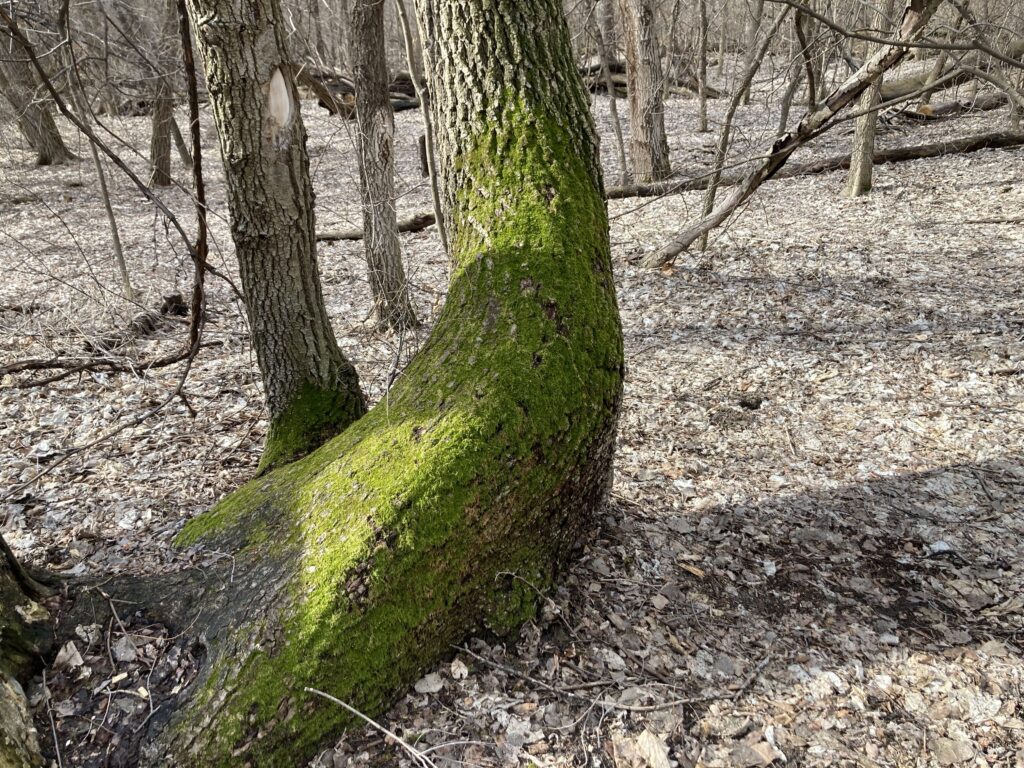
  10. in the floodplain forest, not too far from where the trees open to the river, a tree covered with bright green moss
tree with moss and shadow

orange

During the walk, I thought about orange, especially in terms of the history of the color that I had just read yesterday. The fruit came before the name of the color. It wasn’t that the color didn’t exist until it was given a name, it’s just that people didn’t recognize it as orange. It was yellow-red or brown. I also thought about what I had read about Van Gogh and his still life painting with oranges, how his focus was not the fruit, but the color. The color as its own thing. I pulled out my phone, and spoke this idea into it:

Orange existed before it was attached to a word, before it was attached to an object.

april 3/RUN

5.4 miles
franklin loop
40 degrees

It snowed a few wet inches Tuesday night but you wouldn’t know it today. It’s all gone. The paths were clear and dry. I thought about orange things as I ran. I heard lots of dripping water, a few voices, birds. So many birds as I approached the marshall bridge! Oh — and the gobble of a turkey near the Minneapolis Rowing Club! I stopped to try and see it, but I couldn’t. Heading north, just past the trestle, I took the recently redone steps down to the winchell trail and admired the river. Calm, quiet, grayish blueish brown.

10 Orange Things

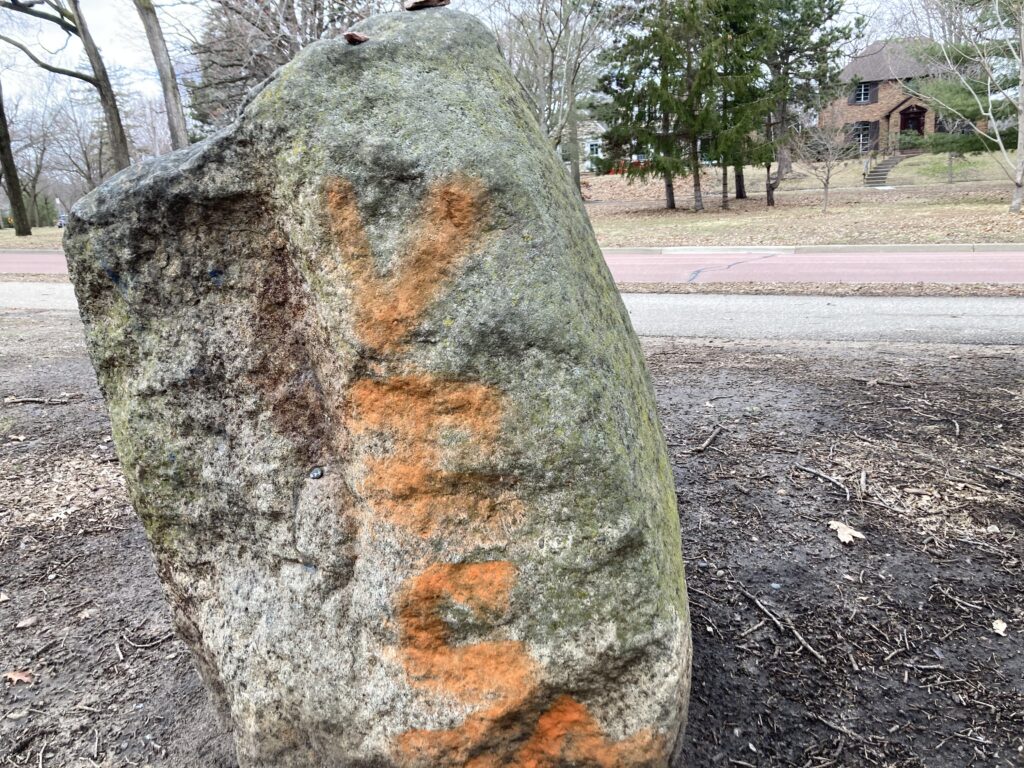
  1. orange lichen on the east side of the ancient boulder*
  2. an orange cone
  3. looking over the edge of the double bridge above longfellow flats, a white barricade with orange stripes had fallen halfway down the steep bluff
  4. orange netting on the fence
  5. an orange stocking cap on a walker
  6. orange bubble-letter graffiti
  7. my orange sweatshirt, worn under a dark blue hooded pull-over
  8. an orange road closed for race sign
  9. orange leaves on the ground
  10. orange rust on a metal plate

*I showed Scott the picture I had taken of the lichen and he said, that’s not lichen, that’s spray paint; it says VISA. I like seeing it as lichen better, but it is frustrating to have been so wrong with what I was seeing. I remember looking at the picture and thinking something else was there, that my idea of it as lichen wasn’t quite right, but this thought didn’t quite make it to the surface.

until Scott told me what I was actually on this rock, I thought it was lichen

I wanted to think about an orange effort as I ran, but I was distracted by my unfinished business. No port-a-potties anywhere. Thankfully I made it home without earning a poop story.

april’s monthly challenge

On April 1, I identified my monthly challenge as steps even as I wondered if it would stick. Yesterday I wasn’t so sure. I started working on a purple hour sonnet, then revising other color poems and converting them into sonnets. This morning I work up hell-bent on orange. I will study orange, steps be damned, I thought. But just now, while reading the chapter, “Orange is the New Brown,” in On Color, I encountered this sentence:

Through the late sixteenth century in England, “orange tawny” is commonly used to mark a particular shade of brown (even though chromatically brown is a low-­ intensity orange, though no one then would have known that). 

On Color, 45

Chromatically? Even though I’ve read/heard this word in relation to color for some time, today it made me pause and wonder about why the chromatic scale (a favorite scale to play) is called a chromatic scale.

The twelve notes of the octave—all the black and white keys in one octave on the piano—form the chromatic scale. The tones of the chromatic scale (unlike those of the major or minor scale) are all the same distance apart, one half step. The word chromatic comes from the Greek chromacolor; and the traditional function of the chromatic scale is to color or embellish the tones of the major and minor scales. It does not define a key, but it gives a sense of motion and tension. It has long been used to evoke grief, loss, or sorrow. In the twentieth century it has also become independent of major and minor scales and is used as the basis for entire compositions.

wikipedia

Searching for a definition, I also found a reference to James Sowerby’s Chromatic Scale:

Chromatic scale of colours arranged as a chart. Sowerby’s accompanying text provides a nomenclature for 63 colours divided into primaries of yellow, blue and red: with binary colours (blends of two primaries) and ternary colours (combinations of three primaries). Sowerby considered this might be useful to artists and considered that in primary colours “Gamboge is most perfect yellow, used in water colours…Carmine, most perfect when good…Prussian, or Berlin blue, most perfect.” Plate 5 from the monograph A new elucidation of colours, original prismatic, and material; showing their coincidence in three primitives, yellow, red and blue…, 

link

The chromatic scale as even steps up or down a musical scale. “The distance between 2 successive notes on a scale is called a scale step — half step or whole step.

Chromatic colors possess a hue (e.g. red, blue, green) while achromatic colors are variations of light and dark (shades of gray, black, white).

What is orange? Why, an orange, 
Just an orange!
(from Color/ Christina Rossetti)

Revisiting my month with Mary Ruefle, I wrote this about orange and Orange Theory:

. . . a red (all out effort) breath might involve being shocked, experiencing such intense awe or surprise that you lose your breath for a minute. Orange breaths involve intense feeling that can be sustained longer, but are still uncomfortable. Orange breaths are anxious breaths.

And now I’m thinking about how Mary Ruefle’s sad color poems — orange sadness, purple sadness, etc. — could be read as happiness poems too: “if you substitute the word sadness for the word happiness, nothing changes.” What is the more positive version of anxious? Excited? Maybe call my poems excitement poems? No, not excitement, attention. Of course, attention!

Earlier today I encountered an amazing poem that fits with the theme of attention:

from I’m Like If Mary Oliver Had Attention Deficit Hyperactivity Disorder/ Rose Azalea

attention is the beginning of devotion is something mary oliver said

. . .

my attention is both deficient & hyperactive i.e. i am touchingfeeling everything constant

devotion is the practice of belonging is something the earth cosplaying as me said

as a joytrans my special pokèmon moves are witness & surrender

.

march 15/RUN

4.1 miles
river road north/south
38 degrees / humidity: 84%

Colder today. Back to winter layers: long-sleeved green shirt, orange sweatshirt, black vest, black tights, gray buff, black gloves, purple/pink baseball cap, bright pink headband

A gray sky and a slight drizzle. Bright headlights through the trees where the road curves. Grit. Wet leaves on the trail. Pairs of fast runners approaching.

Listened to other runners’ voices, the sandy grit under my feet, car wheels as I ran north, put in my “Doin’ Time” playlist heading south, including Good Times by Chic. My favorite lines:

I want to live the sporty life

and

Clams on the half shell, and roller skates, roller skates — here’s the full verse:

A rumor has it that it’s getting late
Time marches on, just can’t wait
The clock keeps turning, why hesitate?
You silly fool; you can’t change your fate
Let’s cut the rug, a little jive and jitterbug
We want the best, we won’t settle for less
Don’t be a drag; participate
Clams on the half shell, and roller skates, roller skates

Good Times was released in June of 1979. The clam shells and roller skates line seems ridiculous (and it is, in a delightful way), but it also captures the vibe of 1979.

After seeing several orange things, I decided that would be my 10 things list. I could only remember 8.

8 Orange Things

  1. a giant orange water jug set up on a table for runners
  2. orange lichen (or moss?) on the north side of the ancient boulder
  3. orange bubble letter graffiti on the underside of the bridge
  4. my orange sweatshirt
  5. the flesh of a tree where a branch used to be, newly trimmed and exposed to the elements (water, air): rusty orange
  6. leaves on the ground: burnt orange
  7. an orange effort: a higher heart rate (see 25 may 2023)
  8. hot pink spray paint on the iron fence that I initially saw as orange

ceremony/ritual/circumambulation

A few things related to my planning of a loop run as ceremony:

first, something to chant, from James Schuyler’s Hymn to Life:

Press your face into the
Wet April chill: a life mask. Attune yourself to what is happening
Now, the little wet things

The whole thing, or maybe just the last bit, starting with “Attune yourself”? See also: 14 march 2024, 15 march 2024

Second, the bells! The bells of St. Thomas signaling the start of the ceremony, or the start of some part of the ceremony? Accompanied by:

Then Space – began to toll,

As all the Heavens are a Bell,
And Being, but an Ear,
And I, and silence, some strange Race,
Wrecked, solitary, here –

or

I was still ringing. I had been my whole life a bell, and never knew it until at that moment I was lifted and struck.

Pigrim at Tinker Creek/ Annie Dillard

converted into my 3/2 form:

My whole life
I’d been 
a bell but
never
knew until
I was
lifted and
struck. Now
I am still
ringing.

Third, form inspirations? A psalm, like Julia B. Levine’s Ordinary Psalms?

Megan Feifer: Both of your poems share the words “Ordinary Psalm.” Why did you choose to name these poems as such? Does a psalm lose its reverence when it becomes ordinary? Is that the point? 

Julia B. Levine: I am currently at work on a (hopefully) book-length collection of Ordinary Psalms. In these poems I am interested in the idea that the ordinary, if deeply lived and carefully attended to, are valid entryways into sacred or reverent experience. As a child I attended a Reform Jewish synagogue and always disliked the prayer books, though I loved the Torah. The difference, it seemed, had to do with the formal and vague language of prayer as contrasted with the heroic, vivid, and oftentimes earthy details of the weekly Torah readings. On reflection, this tonal difference in language may be the primary reason I don’t feel any sense of reverence toward an Old Testament God, but I do believe in the transcendent power of myth and stories. So, in contrast to psalms that rely on a formal address to an anthropomorphic God, I wanted to create a kind of personal prayer book that uses the living language of everyday details and experience to name and praise those aspects of this world that, for me, embody divinity.

Writer’s Insight: Julia B. Levine

JJJJJerome Ellis’ litany of names? Mary Oliver’s prayer as the attention before the words? lucille clifton’s praise of impossible things:

All Praises/ lucille clifton

Praise impossible things
Praise to hot ice
Praise flying fish
Whole numbers
Praise impossible things. 
Praise all creation
Praise the presence among us
of the unfenced is.

Oh, that unfenced is! That line gets me every time.

july 28/SWIM

4 loops
lake nokomis open swim
77 degrees
wind: 11 mph, 21 mph gusts

Choppy today. Lots of swells and breathing on my right side. Sun, haze, sparkling water. I might have seen a few sparkle friends underwater, but no seagulls or fish. At least one swan boat and one paddle boarder. No algae or prickly vines. The water was a pale green with a hint of blue. Mostly opaque, although I could see my hands and the beautiful bubbles they shed. The sky was a pale blue with a few clouds.

The swim was hard. My back was sore from having to stretch higher to sight buoys and other swimmers hidden behind waves. I grew tired from battling the swells. I loved it — what a great workout! For short stretches, I got into a steady rhythm and felt Mary Oliver’s deepening and quieting of the spirit. I didn’t stop thinking. I didn’t feel like I was outside of myself. I felt relaxed and emptied, suspended in water, moving up and down, side to side. Not worried, just shoulders and calves and triceps and lungs rotating and kicking and flexing and breathing.

wave/swell pattern: Side to side rocking heading east from the big beach to the first buoy, the current pushing me a little to the north. Choppy, but no water crashing into or over me. Somewhere between the last orange buoy and the first green one, rough. Mostly breathed to my right. The buoy and other swimmers were lost in the waves. Draining. This is where my back would start to ache. The most challenging spot was rounding the green buoy closest to the big beach. Big waves wanting to push me under the buoy. It took 4 tries, but on the last loop I angled my boat-body right to avoid this pushing. Heading north, parallel to the big beach, the water rippled behind and over me. Mostly giving me a boost, sometimes sucking the energy out from under me. As I swam this last stretch, I wondered if I could learn to ride the waves or angle in ways that avoided the roughest contact.

image: I love the almost/half/barely-view of the first orange buoy after rounding the green buoy. I think I’ve written this before, but it reminds me of the faintest trace of the moon in the afternoon sky. Sometimes a faint orange, sometimes only the silhouette of something that makes the Sara in the back of my head whisper, moon.

This might be the image of the summer. Maybe I could put it in a poem with the image of the moon on water that I used to see in the dark basement window, made by a lightbulb, as I ran on the treadmill? Yes!

I’m continuing to revisit AO’s Dart. we change ourselves into the fish dimension. The fish dimension? I love it! Sounds like a great title for a poem.

excerpt from Dart/ Alice Oswald

He dives, he shuts himself in a deep, soft-bottomed
silence,
which underwater is all nectarine, nacreous. He lifts
the lid and shuts and lifts the lid and shuts and the sky
jumps in and out of the world he loafs in.
Far off and orange in the glow of it he drifts

I feel the silence under the water, but I also feel it above. A few times during my swim today, I stopped stroking and tread water, my head out in the air. Quiet. Only a few soft slaps of the water by other swimmers’ hands and feet.

nacreous = iridescent/iridescence = “a lustrous rainbowlike play of color caused by differential refraction of light waves (as from an oil slick, soap bubble, or fish scales) that tends to change as the angle of view changes (Merriam-Webster Dictionary).

Last week, the water had streaks of red — or maybe tangerine? — in it. Today, blue-green. Not iridescent below, maybe above?

I love describing stroking through the water as lifting and shutting the lid! Also, the sky jumping in and out the world he loafs in. So good! I want to play with these images!

A different take on the far off orange glow: a buoy, or the idea of a buoy, or the certainty that a buoy, orange and glowing, is there.

april 3/WALKYARD WORK

walk: 40 minutes
neighborhood with Scott and Delia
40 degrees

Feeling springier every day. Scott and I discussed how this last snow on Friday moved the twin cities up to the 3rd snowiest winter in history. Too much snow. It’s melting fast. Will everything be green by the end of next week, when we’re supposed to have a stretch of 50s and 60s? As we walked through the neighborhood, we looked at the colors of all of the houses; we’re getting our house repainted next month and trying to decide on which dark gray and whether to have a raspberry red, parakeet green, or copper harbor orange door. Mostly, I can’t really see the color on the door, but I’m fine with any of these three. It would seem fitting, though, to paint the door orange since I’m so obsessed with the color. And, copper harbor orange — where I was born in the UP!

Speaking of orange, I’m still working on my orange poem. Such a struggle. Not quite able to find the way in yet. For inspiration, I decided to search for orange songs, settled on Frank Ocean’s channel ORANGE. Will it help or distract?

Also trying to take a different approach to this poem. In my notes and on this log a few days ago, I wrote I orbit the orange. In terms of open water swimming, this is literally true. I loop around the orange buoys all summer — or 5-6 times a week, more than 100 loops. It is also true as a metaphor: in trying to write about the color orange, I circle around it again and again, wanting to make sense of what orange means to me, searching for ways to be able to see it or to sense it or to find a way around or through it when seeing it is not possible. This orbiting also provides one definition for poetry, which I also wrote about last week:

One thing poetry is about is orbiting things that you can’t quite find the words to describe or pin down with meaning. Becoming obsessed with them. Writing around them again and again. 

log entry from march 31, 2023

Later, I wrote in my notes a possible title for an orange poem, Orange, an ars poetica. Orange as more than a color, but a method, the void that my words are trying to encircle. Not white space or blank space on a page, but orange space, orange breaths, an orange too full to rhyme or offer back an echo. A source, a center, the place where I practice learning to be without seeing or to see in new ways.

I want to channel the orange, conjure it into existence, inhabit its invisible space, learn to see it new ways.

Think citrus fruit leaves in late fall turmeric
Think cheese puffs Planters cheese balls extra sharp cheddar cheese
Think candied slices from the Sears candy counter sherbet Betty Crocker au gratin potatoes
Think surprise pumpkins growing in the back yard candy corn pumpkins before a swim meet
Think construction cones road closed signs for races spray paint around cracks in the asphalt
Think almost red 1974 VW bugs
Think buoys butterflies missing mountains
Think orange orange orange orange orange

yard work: 30 minutes
backyard
43 degrees

After all the discussion about yard work (Schuyler) and everyday chores (Ammons), I decided to document my yard work today. While Scott tried to figure out a way to straighten are tall trees (arborvitae) which are leaning too far to stage left (if you’re looking from inside the house and out the window), I was on poop patrol. In past winters, I’ve tried to stay on top of this relentless task, watching where Delia pooped and digging it out of the snow. Not this year. Did I ever pick it up? I don’t think so. As a result, the yard is filled with poop, and because everything is thawing now, it’s soggy, gooey poop. Gross, I guess. It doesn’t really bother me. I filled up entire Target plastic bag with poop, then decided I might wait until it all dries out a bit more. At one point, in awe of the amount of poop on the ground, I called out to Scott without thinking, Holy shit! Literally.

I looked through a few more A. R. Ammons poems this morning, but they were all so long. Garbage should be arriving in the mail today, so I’ll wait for that to study him more. Instead, here’s a great poem by Gary Snyder from is collection Riprap, which I’ve been thinking of buying for a few years now.

Thin Ice/ Gary Synder

Walking in February
A warm day after a long freeze
On an old logging road
Below Sumas Mountain
Cut a walking stick of alder,
Looked down through clouds
On wet fields of the Nooksack—
And stepped on the ice
Of a frozen pool across the road.
It creaked
The white air under
Sprang away, long cracks
Shot out in the black,
My cleated mountain boots
Slipped on the hard slick
—like thin ice—the sudden
Feel of an old phrase made real—
Instant of frozen leaf,
Icewater, and staff in hand.
“Like walking on thin ice—”
I yelled back to a friend,
It broke and I dropped
Eight inches in

march 31/WALKRUN

walk: 20 minutes
around the block with Delia
36 degrees
light rain with snow coming later

A chance for 6-10 inches of snow later tonight. Before that, rain and thunderstorms. Maybe the snow won’t come? Decided to take Delia out for a quick walk before the rain began falling more heavily. The boulevards are still buried in walls of gray, cratered snow, but the alley is finally clear and our backyard is as much mud as it is snow.

run: 3.15 miles
north/lake street bridge/south
37 degrees

A few hours after my walk. Wasn’t planning to run, but when it stopped raining, I decided this was my chance before the paths are covered in snow and ice again. As always, I’m glad I decided to go. Everything was wet and windy. Big puddles, little puddles, deep puddles. The river seemed to be preparing itself for more weather. Noticed a few runners and walkers, but not too many.

Saw orange everywhere. Orange signs, orange construction cones, dead orange leaves.

Heard the wind, my headphones case banging around in my zipped purple pocket, cars. Smelled smoke from a fireplace. Noticed another new house going up. Soon, the neighborhood will be overrun with the same stupid over-sized houses on every block. Boo.

Near the end of the run, I thought about orange and a phrase popped into my head: keep orbiting around the orange, which means: when you can’t, like me, see the orange, look for what’s happening around where it should be. Is there movement, people acting oddly, anything unusual near a spot where you think orange is? This orbiting works on a literal level, but it’s also more. One thing poetry is about is orbiting things that you can’t quite find the words to describe or pin down with meaning. Becoming obsessed with them. Writing around them again and again. This reminded me of the Frank O’Hara poem about orange, “Why I Am Not a Painter,” and the lines:

One day I am thinking of
a color: orange. I write a line
about orange. Pretty soon it is a
whole page of words, not lines.
Then another page. There should be
so much more, not of orange, of
words, of how terrible orange is
and life. Days go by. It is even in
prose, I am a real poet. My poem
is finished and I haven’t mentioned
orange yet. It’s twelve poems, I call
it ORANGES.

A possible title for my poem: Orange, an ars poetica Excellent!

A. R. Ammons

Yesterday, i found, read, and posted a wonderful poem by Elizabeth Bishop, “The End of March,” which reminded me of some lines from an A. R. Ammons poem, “Corsons Inlet,” that I’ve admired for some time. So today I’ve started spending some more time with Ammons. I just ordered his 1993 long poem, Garbage, and re-read a New Yorker article that I first read when it came out in 2017. The title of the article, “The Great American Poet of Daily Chores,” makes me think of James Schuyler and all his talk of laundry and yard work and washing dishes in “Hymn to Life.”

A book of Ammons that I haven’t ordered yet, but I might, is The Really Short Poems of A. R. Ammons. Here’s a few poems from it that I especially like:

Weathering/ A. R. Ammons

A day without rain is like
a day without sunshine.

Mirrorment/ A. R. Ammons

Birds are flowers flying
and flowers perched birds.

Equilibrium/ A. R. Ammons

If you walk back
and forth

through a puddle pretty
soon

you wet the whole
driveway but of

course dry
the puddle up.

And here are two Ammons’ poems I found in the New Yorker article:

Project/ A. R. Ammons

My subject’s
still the wind still
difficult to
present
being invisible:
nevertheless should I
presume it not
I’d be compelled
to say
how the honeysuckle bushlimbs
wave themselves:
difficult
beyond presumption.

Love how the line breaks — still the wind still. Also, the strange idea of proving the invisible wind’s existence, which made me think of a poem I’m writing about orange and my faith in it, even though I rarely see it. This faith — an orange faith — is different than a belief in the wind. The wind is invisible to everyone, but most people can see orange, don’t need to believe in it the way I do. And the evidence I have for orange’s existence is less straightforward than evidence of the wind. These lines perhaps only make sense to me right now, but they’re a start of something interesting.

Poetics/ A. R. Ammons

I look for the way
things will turn
out spiraling from a center,
the shape
things will take to come forth in

so that the birch tree white
touched black at branches
will stand out
wind-glittering
totally its apparent self:

I look for the forms
things want to come as

from what black wells of possibility,
how a thing will
unfold:

not the shape on paper — though
that, too — but the
uninterfering means on paper:

not so much looking for the shape
as being available
to any shape that may be
summoning itself
through me
from the self not mine but ours.

Wind-glittering, possibility, being available to any shape summoning itself. Love these ideas!

march 30/WALKRUN

walk: 45 minues
neighborhood, with Delia the dog
30 degrees

Took Delia out for a walk around the neighborhood. North, then east past Cooper School and the giant mounds of snow plowed somewhere else then deposited on this field. Past the house that had been half-finished then abandoned a few years ago and is now finished and on the market for almost $900,000. Past the new Minnehaha Academy, which replaced the old one that blew up a few summers ago because of a gas leak — I heard it happen when I was out in my backyard mowing the lawn. Such a strange, loud BOOM!

Then south near the spot where some of the best fall color trees used to reside until they were marked for death with orange spray paint then chopped down — the brightest, most wonderful yellow every year. Under the huge, towering trio of cottonwood trees — the Cottonwood 3. Past the house with the oddly terraced lawn and the big windows, rarely covered with curtains or blinds in the evening so we were able to see, when returning by car in the evening from a baseball game or a clarinet recital, all the way to the back wall where letters hung on a shelf spelling out a word that none of us — not me or Scott, RJP or FWA — could ever decipher.

West, past the house with the wonderful butterfly garden on the boulevard, and the house that used to string bright lights around their giant — higher than the house — fir tree every winter. Was 2022/23 the first year they didn’t? Past the house with the bushes that, the first Christmas we lived in this neighborhood suddenly stopped their exuberant chatter when we walked by and Scott started talking. I noticed that those same bushes, birdless today, were a strange orangey, yellowy green. My guess is that they are dying, but maybe it’s just new growth that is confused by the return of the cold winter weather. Past the house that has one of the best gardens in the neighborhood and where I saw/heard someone giving a backyard cello lesson during the first year of the pandemic.

When we started the walk, the sky was blue and it was bright enough for sunglasses. Within a few blocks the sky was a grayish white. Still, quiet, no one around. Thought some more about color and how I still (mostly) see it, but that it doesn’t mean much anymore. It doesn’t mean nothing, just not much (this line is inspired by a line from the Bishop poem below that I read before my walk and run). Color doesn’t brighten or enhance what I see. Everything is soft and subdued. About halfway through the walk, I stopped to record some of my thoughts, including:

  • orange, which has been the most important color for me practically, doesn’t matter as much anymore
  • orange sounds (inspired by hearing some dead orange leaves rustling in the wind): sizzle, crackle
  • The only color that matters to me now is the silver flash of the bottom of the lifeguard’s boat on the other side of the lake; I use the silver flash for navigating during open swim

run: 3.1 miles
turkey hollow
33 degrees

While walking, I noticed at least 3 people running, which inspired me to go out there myself after I dropped Delia off at home. I felt a little stiff as I ran. My hip again? Otherwise, the run was fine. Ran turkey hollow but didn’t see any turkeys. Ran most of it without headphones. Put in a Taylor Swift playlist for the last mile. Was able to run on the walking path a lot of the time. Noticed more people heading below to the Winchell Trail. Sped up to pass a walker and a dog moving fast. Heard some sharp dog barks, saw some car headlights, their reflections flashing on a window.

(before the run)

This poem popped up on my twitter feed this morning. I was drawn to it because of its description of a walk — it’s a walk poem! Also: her use of color and of the phrase, “nothing much,” and how marvelously sets up the scene in the first stanza.

The End Of March/ Elizabeth Bishop (June 1974)

For John Malcolm Brinnin and Bill Read: Duxbury

It was cold and windy, scarcely the day
to take a walk on that long beach
Everything was withdrawn as far as possible,
indrawn: the tide far out, the ocean shrunken,
seabirds in ones or twos.
The rackety, icy, offshore wind
numbed our faces on one side;
disrupted the formation
of a lone flight of Canada geese;
and blew back the low, inaudible rollers
in upright, steely mist.

The sky was darker than the water
–it was the color of mutton-fat jade.
Along the wet sand, in rubber boots, we followed
a track of big dog-prints (so big
they were more like lion-prints). Then we came on
lengths and lengths, endless, of wet white string,
looping up to the tide-line, down to the water,
over and over. Finally, they did end:
a thick white snarl, man-size, awash,
rising on every wave, a sodden ghost,
falling back, sodden, giving up the ghost…
A kite string?–But no kite.

I wanted to get as far as my proto-dream-house,
my crypto-dream-house, that crooked box
set up on pilings, shingled green,
a sort of artichoke of a house, but greener
(boiled with bicarbonate of soda?),
protected from spring tides by a palisade
of–are they railroad ties?
(Many things about this place are dubious.)
I’d like to retire there and do nothing,
or nothing much, forever, in two bare rooms:
look through binoculars, read boring books,
old, long, long books, and write down useless notes,
talk to myself, and, foggy days,
watch the droplets slipping, heavy with light.
At night, a grog a l’américaine.
I’d blaze it with a kitchen match
and lovely diaphanous blue flame
would waver, doubled in the window.
There must be a stove; there is a chimney,
askew, but braced with wires,
and electricity, possibly
–at least, at the back another wire
limply leashes the whole affair
to something off behind the dunes.
A light to read by–perfect! But–impossible.
And that day the wind was much too cold
even to get that far,
and of course the house was boarded up.

On the way back our faces froze on the other side.
The sun came out for just a minute.
For just a minute, set in their bezels of sand,
the drab, damp, scattered stones
were multi-colored,
and all those high enough threw out long shadows,
individual shadows, then pulled them in again.
They could have been teasing the lion sun,
except that now he was behind them
–a sun who’d walked the beach the last low tide,
making those big, majestic paw-prints,
who perhaps had batted a kite out of the sky to play with.

colors

  • The sky was darker than the water
    –it was the color of mutton-fat jade.
    Mutton-fat jade = white to pale yellow, so it must refer to the color of the water, not the sky.
  • wet, white string
  • my crypto-dream-house, that crooked box
    set up on pilings, shingled green,
    a sort of artichoke of a house, but greener
    (boiled with bicarbonate of soda?)
  • diaphanous blue flame
    would waver, doubled in the window
  • the drab, damp, scattered stones
    were multi-colored

a line I like

I’d like to retire there and do nothing,
or nothing much,

Thinking about the difference between nothing and nothing much. Nothing seems bigger and grander, more dramatic — too dramatic. Is it even possible to do nothing and still be alive? I like nothing much. There’s nothing grand or dramatic about it, yet it still undercuts the idea that we should be Doing Something! all the time. Nothing much is mundane, routine. You’ve done some things but nothing special or worth making a big deal out of.

I like this poem. Even so, the more I read it the darker and heavier it seems. The gross colors (mutton fat jade? boiled artichoke?), the icy wind, everything gone or almost beyond repair. And here’s something else I just realized: according to an essay I read about this poem, it was written after a visit in June. June! (And no random June, but June of 1974, the month and year I was born.)

In June of 1974 Elizabeth Bishop and her partner Alice Methfessel stayed at the Duxbury, Massachusetts beach house belonging to Bishop’s friends John Malcolm  Brinnin and Bill Read. Bishop reported that she initially wrote “The End of March” as a kind of thank-you note to her friends (Biele 55).

“The End of March”: Bishop and Stevens on the Sublime—Union or Relation?

If Duxbury, Massachusetts is anything like the UP (where I was born and visited a lot in the summer until the early 2000s), Bishop could be describing a summer’s day. Icy wind, too cold to walk for long, sunless? Yuck.

In the article I read skimmed, the author puts Bishops’ poem into conversation with Wallace Stevens, specifically his poem, “The Sun this March” but also other poems of his. I kept thinking about it in relation to A. R. Ammons’ “Corsons Inlet”, another walk poem by the sea. It’s long, so here’s just the opening:

I went for a walk over the dunes again this morning
to the sea,
then turned right along
the surf
rounded a naked headland
and returned

along the inlet shore:

it was muggy sunny, the wind from the sea steady and high,
crisp in the running sand,
some breakthroughs of sun
but after a bit

continuous overcast:

the walk liberating, I was released from forms,
from the perpendiculars,
straight lines, blocks, boxes, binds
of thought
into the hues, shadings, rises, flowing bends and blends
of sight:

Both poems have wind and only a little bit of sun. Ammons seems warmer, at least at the beginning with its muggy sun and crisp wind. And both involve not doing much. Here’s how Ammons concludes the poem:

I see narrow orders, limited tightness, but will
not run to that easy victory:
still around the looser, wider forces work:
I will try
to fasten into order enlarging grasps of disorder, widening
scope, but enjoying the freedom that
Scope eludes my grasp, that there is no finality of vision,
that I have perceived nothing completely,
that tomorrow a new walk is a new walk.

Their different perspectives on how a walk, and the world by the sea that they move through, inspire them and their writing is fascinating to me. Bishops is narrow and restraining and finished?, while Ammons is all over the place and almost too free, too formless. And, it’s alive, new, continuously renewed day after day.

I’ve wanted to study A.R. Ammons poetry for a few years now. I think finding the Bishop poem, then being reminded of Ammons, is the nudge I need to make this a mini-project! I’ll end March/begin April with Ammons!

march 29/RUN

5.3 miles
bottom of franklin hill and back
18 degrees

Yes, 18 degrees. Brr. Yesterday the weather app predicted 20 inches of snow for next week. Thankfully today it’s predicting 2 inches of rain instead. Who knows what will actually fall (please, please, no snow!).

A nice run. Mostly relaxed, although my left hip/knee was a little tight. No headphones for the first 3 miles, then a playlist for the last 2.

Noticed the river — open and brown just off to the side as I ran down Franklin hill, a bright blue far off in front of me. Also noticed an orange sign announcing a road closure for a race this weekend at the bottom of the hill and to the left. I kept moving my eyes — straight ahead, then off to the right, off to the left — to see how that would change what I saw. Not much, although the orange did seem to disappear in my peripheral a few times. Strange.

Heard the knocking of a woodpecker on some dead wood in the gorge. Ran on more of the walking path. Shuffled on some grit. Felt a cold wind on my face.

Look!

Just restarting my run near the top of the hill, a woman stopped me and asked if I wanted to see a baby screech owl. It was 10 or 12 feet up in a small hollow in a tree. I was worried that I wouldn’t be able to see it, but I did! It looked like a little bat to me. I thanked the woman for stopping to show it to me, wished her a great morning, then began running again with a big smile on my face. I have wanted to stop and answer someone’s kind look! for some time now, but I’ve never managed to do it; I’ve just kept running, too intent on keeping moving. Today I stopped and it felt good.

Happy Birthday to my 2 wonderful kids, FWA (20) and RJP (17), born on the same day 3 years apart. I rarely mention their birthdays on my blogs — I just spent the last 5 minutes looking through Trouble, Story, and RUN! and found only 2 instances of it. It’s hard to believe that I started this log, and found poetry again, when FWA was 14 and RJP 11.

before the run

I’m still trying to work on a series of color poems. Right now: orange, later in May: green. It’s a lot of showing up, sitting in front of the page, trying to find a way into ideas about orange as the color that takes up the most space in my practical life. Orange, everywhere. Rarely bright orange — no pops of vermillion or citrus — but orange as usually (not always) the only color that registers as color, something other than gray or dark. In the midst of trying to figure this out, I returned to an essay I remembered reading last year (see: april 16, 2022) about poetry and the void. I thought of it because so much of seeing orange, especially when swimming across the lake in the summer, is about feeling its absence.

sometimes when I’m swimming across the lake I feel a presence that I can’t see — the idea of orange, a hulking shape…I look but nothing is there…yet, I feel its absence…something is there — the trees don’t look quite right

june 26, 2022: hardly ever saw the orange of the orange buoy, mostly just a hulking shape or a void surrounded by a “normal” view — there was no buoy, just an empty space that disrupted the expanse of sky and trees. 

from my notes for Orange

Elisa Gabbert offers this interesting line about poetry:

I think poetry leaves something out. All texts leave something out, of course — otherwise they’d be infinite — but most of the time, more is left out of a poem.

The Shape of the Void: Toward a Definition of Poetry/Elisa Gabbert

At this point, I was planning to write more, but it was already 10:45 and I wanted to go out for a run before it got much later, so I stopped. If I had kept writing, I would have included more from Gabbert, like this:

Verse, by forcing more white space on the page, is constantly reminding you of what’s not there. This absence of something, this hyper-present absence, is why prose poems take up less space than other prose forms; the longer they get, the less they feel like poems. It’s why fragments are automatically poetic: Erasure turns prose into poems. It’s why any text that’s alluringly cryptic or elusive — a road sign, assembly instructions — is described as poetic. The poetic is not merely beauty in language, but beauty in incoherence, in resistance to common sense. The missingness of poetry slows readers down, making them search for what can’t be found. 

The hyper-present absence of something (orange orange everywhere) as poetry. Its inability to reveal itself in “normal” and straightforward ways to me (as in: look with my eyes and see orange). Its missingness makes me notice/attend to it even more.

In the next line, Gabbert suggests that the frustration of incoherence, mystery, not being able to make sense of something is alluring, erotic. It’s why many of us are drawn to poetry — to slow down, notice, get the chance to dwell in the unknown. Before I left for my run, I was thinking about how my perspective is slightly different. I don’t need to be encouraged to slow down or given the chance to embrace incoherence, resist common sense. Because of failing vision and my overworked brain, I am already slow. Much of what I see is incoherent — or never quite coherent. Common sense ideas of how we see or how to be in the world have already been upended for me. I see poetry, and its way of navigating or negotiating or communicating/finding meaning not as desirable, but as necessary, practical, useful, a way to be that speaks to where I already am.

during the run

I started out thinking about the hyper-presence of an absence as I ran in terms of the open space of the gorge, but these thoughts didn’t last long. I became distracted by my effort. Did I ever return to them? If I did, I can’t remember.

after the run

After highlighting two delightful letters by poets Emily Dickinson and Rainer Marie Rilke, Gabbert writes:

In these letter-poems, poetry reveals itself as more a mode of writing, a mode of thinking, even a mode of being, than a genre. The poem is not the only unit of poetry; poetic lines in isolation are still poetry. The poem is a vessel; poetry is liquid.

Poetry as a mode of writing, thinking, being. Made of more than just poems. Yes! I do feel that often my way of navigating losing my vision, finding a way to be when I cannot see, is through the approach of poetry and embracing uncertainty and the unknown.

The architect Christopher Alexander thought big plate glass windows were a mistake, because “they alienate us from the view”: “The smaller the windows are, and the smaller the panes are, the more intensely windows help connect us with what is on the other side. This is an important paradox.” To state the Forsterian obvious again, adding breaks to a paragraph is not always going to make an interesting poem — but most poets don’t write that way. They write in the line, in the company of the void. That changes how you write — and more profoundly, how you think, and even how you are, your mode of being. When you write in the line, there is always an awareness of the mystery, of what is left out. This is why, I suppose, poems can be so confounding. Empty space on the page, that absence of language, provides no clues. But it doesn’t communicate nothing — rather, it communicates nothing. It speaks void, it telegraphs mystery.

To write, to think, to be in the company of the void — the absence that leaves a residue or that can’t be seen but is always felt.

This idea of communicating nothing (with nothing not as no thing but as something in and of itself) reminds me of something else I read earlier this year about “making nothing happen” but couldn’t remember where I had read it. It took me almost an hour to track it down yesterday. The “make nothing happen” is in W. H. Auden poem for Yeats:

from In Memory of W. B. Yeats/ W. H. Auden

II

You were silly like us; your gift survived it all:
The parish of rich women, physical decay,
Yourself. Mad Ireland hurt you into poetry.
Now Ireland has her madness and her weather still,
For poetry makes nothing happen: it survives
In the valley of its making where executives
Would never want to tamper, flows on south
From ranches of isolation and the busy griefs,
Raw towns that we believe and die in; it survives,
A way of happening, a mouth.

And the reading about it comes from Ross Gay and one of his incitements in Inciting Joy, which I first read as an essay for the October 2022 issue of Poetry:

I can’t tell you how many times I’ve heard conversations about W. H. Auden’s famous line from his poem “In Memory of W.B. Yeats”: “poetry makes nothing happen.”…At some point, probably I heard someone else say it,7 it occurred to me that all these poets, and all these conversations, were misreading Auden’s line, and that he was really talking about (inasmuch as a poem is him talking about something) what poetry makes, the sometimes product or effect or wake or artifact of poetry, of a poem. Granted the line feels emphatic, grand, provocative even—seriously, I can’t tell you how many tweed-jacketed refutations to Auden’s line I have endured; no one has ever explained to me the elbow patch—but what the line makes made is not nothing, but nothing happening. Or rather, nothing happening. The happening it makes is nothing. In other words, a poem, or poetry, can stop time, or so-called time at least. First of all, what a good reminder it is that a poem is an action, and as Auden has it, a powerful one, too. Secondly, and not for nothing, this is one of the suite of poems Auden wrote in the late thirties and early forties, a period when one might have wanted so-called time—the clock, the airplanes, the trains, the perfectly diabolical synchronous goosestep rhythm of time itself—to stop.

Out of Time (Time: The Fourth Incitement)/ Ross Gay

He adds:

you, too, might’ve been praying for a way to stop the march of so-called time, and poems, sometimes, might do that. Poems are made of lines, which are actually breaths, and so the poem’s rhythms, its time, is at the scale and pace and tempo of the body, the tempo of our bodies lit with our dying. And poems are communicated, ultimately, body to body, voice to ear, heart to heart.9 Even if those hearts are not next to one another, in space or time. It makes them so. All of which is to say a poem might bring time back to its bodily, its earthly proportions. Poetry might make nothing happen. Inside of which anything can happen, maybe most dangerously, our actual fealties, our actual devotions and obligations, which is to the most rambunctious, mongrel, inconceivable assemblage of each other we could imagine.

Perhaps I’m wandering too far away from the orange void here? Poetry as speaking the void, making Nothing happen, existing outside of the normal/rational/obvious/taken-for-granted. Gay’s explicit connection to time and against capitalism resonates deeply for me. Stop those clocks, those planes, that machinery we’re using to destroy the planet, the future.

The poem’s lines as breaths, as bodily rhythms. In a poem about the color gray I mentioned gray breaths. What are orange breaths? Orange time, orange rhythm?Orange devotions and obligations?

One last thing, and a return to Gabbert’s essay. Gabbert claims that the mystery of poetry is not simply metaphor or making things strange, but how we use or don’t use language to shape our relationship to the Void. And, she suggests it is the missing mountain in Shane McCrae’s “The Butterflies the Mountain and the Lake”:

the / Butterflies monarch butterflies huge swarms they
Migrate and as they migrate south as they
Cross Lake Superior instead of flying

South straight across they fly
South over the water then fly east
still over the water then fly south again / And now
biologists believe they turn to avoid a mountain
That disappeared millennia ago.

The missing mountain is still there. The no longer visible orange buoy is still there too.

added a few hours later: Trying to find a source for this cool butterfly fact, I discovered that it was written about in Annie Dillard’s Pilgrim at Tinker Creek:

Monarchs are “tough and powerful, as butterflies go.” They fly over Lake Superior without resting; in fact, observers there have discovered a curious thing. Instead of flying directly south, the monarchs crossing high over the water take an inexplicable turn towards the east. Then when they reach an invisible point, they all veer south again. Each successive swarm repeats this mysterious dogleg movement, year after year. Entomologists actually think that the butterflies might be “remembering” the position of a long-gone, looming glacier. In another book I read that geologists think that Lake Superior marks the site of the highest mountain that ever existed on this continent. I don’t know. I’d like to see it. Or I’d like to be it, to feel when to turn.

Pilgrim at Tinker Creek, page 253-254 in the 1988 edition

Even as I’m disappointed that Dillard didn’t offer any sources for her facts here, I LOVE her last lines: I don’t know. I’d like to see it. Or I’d like to be it to feel when to turn. Not to see, but to be it, to feel it. Wow — this idea is going in my orange poem, for sure. Not to see orange, but to be it, or to feel when to turn around it. I do feel that, but can I ever put it into words?