nov 8/RUN

5.5 miles
falls / veterans home / ford bridge
34 degrees

Wonderful November weather — at least, I think so. Sure, the sky was gray and it was just above freezing but the color left on the trees was intense and the views were open, and the river — the river! — steel blue with scales, curving and stretching. Running over the ford bridge, admiring the red and yellow and orange tree line on the west bank, looking out at the open water, I smiled and reflected on how lucky I am to live here and how glad I am that I’ve dedicated myself to the place for almost a decade.

I experimented with the route today. I ran to the falls then past them to the tall bridge then over to the veterans home and across the ford bridge. Under the bridge and over to the other side then across and north to the winchell trail. A falls, a creek, a river, some seeps. 2 bridges. Above, over, beside, and through the locks and dam no. 1. 3 parks.

10 Things

  1. 2 roller skiers
  2. 2 fat tire bikes
  3. a tree the color of golden chrysanthemums
  4. deep grayish blue river with soft scales
  5. the road over the bridge to the veterans home was blocked off with cones and tape, but the walking wasn’t
  6. the strong smell of week as I passed by a walker on the ford bridge
  7. running above on the ford bridge, looking down at the painted lines of parking spaces at locks and dam no 1
  8. running near the edge of the bluff, the yellowed leaves were thick on the path
  9. a young kid near the edge, a mom calmly saying, it makes me nervous to have you that close to the edge. if you tripped you could fall straight down
  10. running over the tall bridge, admiring the sandy trail far below me

Looked up “cellular” on poetry foundation and found this wonderful poem:

A Body’s Universe of Big Bangs/ Leslie Contreras Schwartz

A body must remind itself
to keep living, continually,
throughout the day.

Even at night while sleeping,
proteins, either messenger, builder,
or destroyer, keeps busy

transforming itself or other substances.
Scientists call these reactions
—to change their innate structure,
dictated by DNA—cellular frustration,

a cotton-cloud nomenclature for crusade,
combat, warfare, aid, unification,
scaffold, or sustain.

Even while the body sleeps, a jaw slackened
into an open dream, inside is the drama
of the body’s own substances meeting

one another, stealing elements,
being changed elementally,
altered by a new story

called chemical reaction.
A building and demolishment,
creating or undoing,

the body can find movement,
functioning organs, resists illness—
or doesn’t. Look inside every living being

and find this narrative of resistance,
the live feed of being resisted.
The infant clasping her fist

or the 98-year-old releasing
hers. This is how it should be,
we think, a long story carried out

to a soft conclusion. In reality,
little deaths hover and nibble,
little births opening mouths
and bodies the site of stories

the tales given to us, and retold, retold,
never altered, and the ones forgotten,
changed, unremembered

until this place is made of only
ourselves. Our own small dictators,
peacemakers, architects, artists.

A derelict cottage,
a monumental church
struck in gold, an artist’s studio

layered with paints and cut paper,
knives and large canvas—

the site the only place
containing our best holy song:

I will live. I will live. I will keep living.

I love so much about this poem and the poetic way Schwartz describes what a cell does in (and to) the body. These lines were particularly striking:

and bodies the site of stories

the tales given to us, and retold, retold,
never altered, and the ones forgotten,
changed, unremembered

until this place is made of only
ourselves. Our own small dictators,
peacemakers, architects, artists.

Cells as dictators, architects, artists? Nice. As I think about more expansive understandings of what it means to be an artist, I especially like this idea of a cell as an artist.

Googled more about the history of the discovery of the cell and was reminded that central to the discovery, and the very idea of a cell, is the microscope and the ability to see a cell. This made me think of Robin Wall Kimmerer and something she said in an interview about western science. Can I find it?

Maybe this, from “Ways of Knowing”:

Both Western science and traditional ecological knowledge are methods of reading the land. That’s where they come together. But they’re reading the land in different ways. Scientists use the intellect and the senses, usually enhanced by technology. They set spirit and emotion off to the side and bar them from participating. Often science dismisses indigenous knowledge as folklore — not objective or empirical, and thus not valid. But indigenous knowledge, too, is based on observation, on experiment. The difference is that it includes spiritual relationships and spiritual explanations. Traditional knowledge brings together the seen and the unseen, whereas Western science says that if we can’t measure something, it doesn’t exist.

Two Ways Of Knowing: Robin Wall Kimmerer On Scientific And Native American Views Of The Natural World

Or maybe it was this, from “How to See” in Gathering Moss?

We poor myopic humans, with neither the raptor’s gift of long-distance acuity, nor the talents of a housefly for panoramic vision. However, with our big brains, we are at least aware of the limits of our vision. With a degree of humility rare in our species, we acknowledge there is much that we can’t see, and so contrive remarkable ways to observe the world…Electronic microscopes let us wander the remote universe of our own cells. But at the middle scale, that of the unaided eye, our senses seem to be strangely dulled. With sophisticated technology we strive to see what is beyond us, but are often blind to the myriad sparkling facets that lie so close at hand. We think we’re seeing when we’ve only scratched the surface….Has the power of our devices led us to distrust our unaided eyes? Or have we become dismissive of what takes no technology but only time and patience to perceive?

“How to See” in Gathering Moss/ Robin Wall Kimmerer

For further reading, see this article on the history of the cell.

And this video is fun: The Wacky History of Cell Theory
june 21/RUN

4 miles
the Monument and back
82 degrees
dew point: 74

Last night I decided I would get up early and do a 7 mile run. Then I checked the forecast. 80 at 6 am. What? No thanks. I went to bed thinking I might skip running today and tomorrow (the low is 80). Then I woke up at 6 and even though it felt oppressive outside, I decided to go for a run. Maybe a 5k. Somehow, without meaning to, I ran 4 miles. It was hard. I felt almost dizzy once as I walked up the lake street bridge steps. And I’m glad I did it. Even with a few extra walk breaks I consider this run a victory.

Yes, it was warm and uncomfortable, but it was worth it for the quiet and for the strange light: darker, a little ominous, the green so deep, not glowing but pulsing? not sure what word I would use.

10+ Things

  1. on the lake street bridge from east to west, to the right a pale blue sky, to the left darker blueish-purple
  2. on the lake street bridge, wind blowing hard from the south, a bird getting a boost and flying so fast
  3. from the monument, I could her Shadow Falls dripping
  4. small white caps on the river
  5. the gentle slope of a mowed stretch of grass between Shadow Falls and the Monument
  6. the shuffling of a runner’s feet across the road
  7. the clicking and clacking of ski poles through the trees and on the other side of the ravine
  8. at the Monument, the line of narrow paving stones near the water fountain — they looked old — when were they placed here and who did it?
  9. the swirling and waving of some wildflowers in the wind
  10. taking off my cap on the bridge because of the wind, feeling it hit my face and grab my hair
  11. encountered the runner who wears bright orange compression socks*

*I’ve encountered this runner enough that they’re officially a regular. I think I’ll call him Mr. Orange Socks

Listened to the wind and dripping water and the heavy air for 3 of the miles. Put in my “It’s Windy” playlist for the final mile. Windy has stormy eyes that flash at the sound of lies.

Encountered two Anne Carson poems this morning and it feels like a sign, or a nudge, to keep reading her The Anthropology of Water. One of this poems was from an 21 june entry in 2022 (Could I), and this one from today’s poem of the day:

Between Us And/ Anne Carson

BETWEEN US AND
animals is a namelessness.
We    flail    around
generically      —
camelopardalis   is   what
the Romans came up with
or  ”giraffe” ( it looked to
them like a camel crossed
with a leopard ) or get the
category wrong — a musk
Ox isn’t an ox at all but
more closely cognate with
the  goat —  and   when
choosing   to    name
individual  animals  we
pretend they are objects
(Spot) or virtues (Beauty)
or just other selves (Bob).

The idea of knowing the names of things has come up before on this blog. There’s the act of naming something, which is addressed in this poem and evidenced in my naming of “regulars,” and there is also the act of learning the name that a living thing calls itself. Robin Wall Kimmerer (Gathering Moss in 22 march 2024 entry), JJJJJerome Ellis (“A Litany of Names” from Aster of Ceremonies), and Alice Oswald (“Violent” in 16 feb 2025 entry) all describe this in their writing.

an hour later: Taking up the nudge to read more Anne Carson, I returned to The Anthropology of Water. I focused on the final section, “Margins: An Essay on Swimming By My Brother.” Wow! So many great descriptions of what it feels like to swim in a lake! I need to make a list.

I may have posted this bit before, but here’s Carson’s answer to the question, How does swimming figure into your writing?

It keeps me from being morose and crabby. Sometimes I think in the pool. Usually it’s a bad idea. The ideas you have in the pool are like the ideas you have in a dream, where you get this sentence that answers all questions you’ve ever had about reality and you get up groggily and write it down, and in the morning, it looks like “let’s buy bananas” or something completely irrelevant. Plus, I like water. Some people just need to be near water.

Interview in Paris Review

I am one of those people who needs be near water.

Back to the “An Essay on Swimming.” I like how it’s structured: journal entries titled with day of the week and time and either swimming or not swimming. Here’s the second entry:

Friday 4:00 p.m. Swimming.

In late afternoon the lake is shaded. There is the sudden luxury of the places where the cold springs come flooding up around the swimmer’s body from below like an opening dark green geranium of ice. Marble hands drift enormously in front of his face. He watches them move past him down into the lower water where red stalks float in dust. A sudden thin shaft of fish smell. No sleep here, the swimmer thinks as he shoots along through the utterly silent razor-glass dimness. One drop of water entirely awake.

I like how there’s no date. It’s placed in time, but vaguely.

that sudden luxury! I welcome those cold patches in lake nokomis when I swim but I don’t think they’re from cold springs. What are they from? Now when I feel them I will think: I’m being flooded with a dark green geranium of ice!

marble hands — yes! that’s how I should describe the pale legs and hands of swimmers that I’ve seen recently.

where red stalks float in dust — for me: curled green feathers that do more than float, they seem to reach up to/for me.

that’s me: one drop of water entirely awake

Recap, and to put on a list of Carson’s water descriptions to use/think about as I swim:

  • I’m being flooded with a dark green geranium of ice!
  • marble hands and legs
  • stalks that reach to/for me
  • me as one drop of water entirely awake

may 6/RUN

2 miles
2 trails
69 degrees

It was nice and I felt good, so I decided to go for a short run this morning. Hot! I wore my summer attire: tank top and shorts. Sunny. Sharp shadows, still air, not much shade. Ran right by the Minnehaha Academy playground and heard all of the kids shouting and shoving and having fun. I peeked at the river through the trees: a flat blue. No turkeys or roller skiers or gushing water. No headphones either. Instead, I listened to the kids and the cars and the loud rumbling of a truck. Also heard: someone’s workout program on their phone, you have complete 3 miles — or something similar to that.

before the run

This morning, I’m reading another chapter of RWK’s Gathering Moss: The Advantages of Being Small: Life in the Boundary Layer. I was excited/please/inspired to encounter this passage:

Mosses inhabit surfaces: the surfaces of rocks, the bark of trees, the surface of a log, that small space where earth and atmosphere first make contact. This meeting ground between air and land is known as the boundary layer. Lying cheek to cheek with rocks and logs, mosses are intimate with the contours and textures of their substrate.

Gathering Moss/ Robin Wall Kimmerer

surfaces / where earth and atmosphere meet / boundary layer / intimate / contours / textures

I’m interested in surfaces, both ground surfaces by the gorge and water surfaces at the lake. I’ve gathered poems and thought about them before. And there is a line from my Haunts project that I’m still trying to write around/beside/through: It begins here: from the ground up, feet first, following. Today, I want to think about surfaces and boundary layers and textures and the intimacy that is created when air and land, foot and ground, meet.

things we did on grass

When you lie on the ground on a sunny summer afternoon to look up and watch the clouds go by, you place yourself in the boundary of the earth’s surface. When you are flat on the ground, the wind speed is reduced, you can scarcely feel the breeze that would ruffle your hair if you were standing up.

Things we did on grass is a line from an XTC song. I’ve been wanting to experiment with it. RWK is inspiring me!

still

the air becomes progressively slower and slower until, immediately adjacent to the surface, the air is perfectly still, captured by the friction with the surface itself. It is this layer of still air that you experience while lying on the ground.

Such a rich word and idea, still. I’ve been orbiting around it for years. And yet, the opposite of restlessness, something I can’t do: sit still, a calmness and willingness to stop and just be.

during the run

Since I’m thinking of surfaces, especially grass, I decided to run on the grassy boulevard between edmund and the river road. After the run, as I was walking home, I recorded some thoughts:

[transcript] may 6th. I’m thinking about surfaces and moss and where air and ground meet and these little spaces that are sheltered, that are a little warmer and still and allow for friction without total erosion. Then I was thinking about how I like those spaces — those small spaces, those enough spaces. Then RWK’s bit at the end of the chapter, about how moss still need to germinate and seed and they can’t in these sheltered spaces so they have to expose themselves. Also thinking about the back deck as a sheltered space. It’s interesting to put this in a context of the pandemic because of how the surfaces and how this dirt trail is surely wider because people were running and walking and using it during the pandemic. All the different ways that (the pandemic) is written on this surface, this boundary layer.

surfaces: asphalt, concrete, grass, roots, packed dirt, soft dirt, mulching leaves, rubbled asphalt, limestone

Earlier in the run, I was also thinking about friction in relation to surfaces meeting. In particular, my feet and the ground, but also RWK’s example of free flowing air being disrupted and altered by rock. My thought: we need that friction to feel bodies, to feel our bodies. A flash of Wittgenstein and his rough ground (as opposed to smooth ice) flashed through my head.

I thought about the benefits of being small and a discussion I had with FWA the other day when he was suggesting that humans are resilient in the way that small trees that can bend and lean with the wind during a heavy storm are.

after the run

Ideas to give some attention:

  • Intimacy and Forrest Gander and Anne Pringles’ conversation about intimacy as an encounter that transforms you and Scott describing two trees growing out of the same spot and intertwining as intimate
  • the texture of wind when encountering objects, makes me think of light on surfaces and how the ancient greeks took that into account in their understandings of, and names for, color
  • surfaces and feet first, following — the encounter between foot and ground is the space where a poem can be written and offered
  • the boundary layer visible to our eye as the horizontal lines I mentioned last month: the line between blue and brown
  • where earth and atmosphere meet = violet
  • grass as threshold (a boundary space): the threshold between neighborhood and park, between life and death — grass as a space where the dead and living can meet
  • the dirt trail through the grass as a record of the pandemic
  • not too deep, at the surface: humus, loam

may 5/RUNWALK

4.25 miles
minnehaha falls and back
59 degrees

Warm! Nothing hurt, it was just hard. My heart rate was higher. Who cares? No back or calf or hip pain! I’m trying to ease back in. Today I ran 4 minutes/walked 1, 8 times. I was proud of myself for sticking with it, even as my heart rate climbed. Yes, I’m ready for some mental toughness!

10 Things

  1. an abundance of sparkles on the river
  2. more green leaves crawling up the trunks of trees
  3. fee bee fee bee
  4. shadow, 1: a straight-ish line on the path from the fence
  5. shadow, 2: soft, sprawling branches
  6. shadow, 3: me — sharp, upright, satisfied
  7. the faint, slightly off tune dinging of the train bell
  8. flowing falls
  9. park workers had the one set of stairs blocked off — I heard water, were they spraying down the steps?
  10. passing another runner from behind, they were dressed warmly in long pants and a a jacket and breathing heavily

enoughness / contentment / not scarcity

Moss lifeways offer a strong contrast to the ways we’ve organized our society, which prioritizes relentless growth as the metric of well-being: always getting bigger, producing more, having more. Infinite growth is ecologically impossible and exceedingly destructive, as it demands the transformation of the lives of other beings into raw materials to feed the fiction. Mosses show us another way—the abundance that emanates from self-restraint, from enoughness. Mosses have lived too long on this planet to be seduced by the nonsense of accumulation, the delusion of permanence, the endless striving for productivity. Maybe our heartbeats slow when we sit with mosses because they remind us that contentment could be ours.

Ancient Green/ Robin Wall Kimmerer

Summer Day/ Mary Oliver

Who made the world?
Who made the swan, and the black bear?
Who made the grasshopper?
This grasshopper, I mean—
the one who has flung herself out of the grass,
the one who is eating sugar out of my hand,
who is moving her jaws back and forth instead of up and down—
who is gazing around with her enormous and complicated eyes.
Now she lifts her pale forearms and thoroughly washes her face.
Now she snaps her wings open, and floats away.
I don’t know exactly what a prayer is.
I do know how to pay attention, how to fall down
into the grass, how to kneel down in the grass,
how to be idle and blessed, how to stroll through the fields,
which is what I have been doing all day.
Tell me, what else should I have done?
Doesn’t everything die at last, and too soon?
Tell me, what is it you plan to do
with your one wild and precious life?

When I think of green, I think of another concept Robin Wall Kimmerer promotes: abundance — as in, a gift economy and a challenge to the (mostly) myth of scarcity. In May, green is almost too abundant — a gift that is not scarce!

walk: 45 minutes
winchell trail (ravine) / tunnel of trees / edmund
76 degrees

Took Delia out for a walk in the afternoon. The green is taking over. The view from above in the tunnel of trees was only green — no dirt trail below, no sliver of river, no exposed sewer pipe. Just green. As we walked, I thought about another passage I read from RWK in “Ancient Green” this afternoon:

They [green moss] cover the inanimate with the animate. Without judgment, they cover our mistakes, with an unconditional acceptance of their responsibility for healing.

Ancient Green/ Robin Wall Kimmerer

Everywhere green — not moss, but leaves — were covering bare branches, sewer pipes, the gorge. A green skin growing over whatever winter did to us, a return of the strange idea of continuous living despite the mess of us, the hurt, the empty. Did I feel that way about the green I was encountering today? Somewhat, but I also felt it taking over, transforming the floodplain forest in ways I didn’t like: too hidden.

overheard: music from car radios! Someone blasting “Bohemian Rhapsody,” someone else “Rhapsody in Blue.” Until typing these 2, I didn’t make the rhapsody connection.

It must be this rhapsody or none,
The rhapsody of things as they are.
(The Man with the Blue Guitar/ Wallace Stevens)

rhapsody: a portion of an epic poem adapted for recitation

may 4/WALK

40 minutes
winchell trail
66 degrees

What a beautiful morning! This year winter was a blur. It’s hard to believe that we’re only a month away from open swim season. Walked with Scott and Delia down the worn wooden steps to the winchell trail. Took the trail that winds below the mesa. Scott wondered what the trees near the 36th street parking lot were. According to his app, plum trees. He was dubious. We talked about FWA and RJP and the big changes in their lives — one graduating from college, the other moving into their first apartment. After seeing the rowers I wondered, would FWA like rowing? or canoeing? or kayaking? I think he might. Just asked him and his response: Nah. Oh well.

10 Things

  1. the water in the ravine was gushing — heard it first, then saw it — not drip drip dripping, but rushing out of sewer pipe
  2. the hillside that leads up to the trail in the oak savanna was covered in green — more of our view of above, blocked. Last week I was still able to see whole people running and biking above. Today, only the flash of movement through the trees — at first, I thought it was a bird, then I realized it was a biker
  3. 2 bikers on the street — one on a tall bike, the other on a fat tire
  4. so many new leaves on the branches — as I noticed them I thought, a slick new leaf unfurling like a fist to an open palm — a line from Ada Limôn
  5. voices . . . a bullhorn . . . rowers! An 8 person shell + the white motorized boat with the instructor giving instructions to a new class
  6. the annual walk-a-thon was happening — as we ascended the 38th street steps, we saw that the road was blocked off and that there was a row of a dozen port-a-potties
  7. a sharp, whistled call in the savanna — what bird is that?
  8. a cloud of bugs right outside our front door — yuck!
  9. so many tulips in a front yard, causing Scott to quip, we’re living in Holland!
  10. in the stretch between the savanna and the 38th street steps, the chainlink fence was leaning over to the ground, buried in mulch and leaves

Moss, Robin Wall Kimmerer, and Succession

A few days ago, I encountered the concept of succession in ecology. A meadow becomes a thicket. A thicket becomes a forest. Today I noticed that one of RWK’s chapters in Gathering Moss was titled, “Binding Up the Wounds: Mosses in Ecological Succession,” so I decided to read it. RWK is discussing an area of the Adirondacks blighted by a now defunct mine and abandoned. One of her students is doing her thesis on some moss in the area and whether or not they might help seeds, then trees, establish a home in the otherwise inhospitable tailings (the waste material of a mine: sandy, dry soil, slashes of rock).

succession defined: Ecological succession is the process by which the mix of species and habitat in an area changes over time. Gradually, these communities replace one another until a “climax community”—like a mature forest—is reached, or until a disturbance, like a fire, occurs (source).

Out of the carpet of living moss came a crowd of seedlings, the next step in binding up the wounds of the land.

. . . a little grove of aspens that had somehow gotten started in this desolate place that everyone wanted to cover in garbage. We know now that these aspens originated from seeds caught on a patch of moss, and the whole island of shade began to grow from there. The trees brought birds and the birds brought berries which now blossom around us.

Gathering Moss/ Robin Wall Kimmerer

Out of the waste of an abandoned mine, moss. From moss, a seed, then a tree. With a tree, birds and berries and blossoms and shade.

april 25/WALK

52 minutes
winchell / ravine / steps / longfellow / river trail
55 degrees

A great afternoon walk with Delia the dog. Sometimes there was sun, but mostly it was cloudy and overcast. Some wind. Bright green everywhere, even on the felled trees in the floodplain forest. Heard lots of singing birds, people talking, a sharp clanging noise. When it was sunny, I admired the soft shadows of tree limbs and Delia’s stubby legs and long body.

10 Things

  1. creeeaakkk — the tall trees in the floodplain forest were swaying in the wind and some branches were rubbing together to make a soft (and sinister) creaking noise
  2. the top step of the stone steps had a big puddle of water — watch out!
  3. stopping to wait for a trail runner to pass before heading back up the steps. They looked too warm and had a sweatshirt wrapped around their waist
  4. the soft lapping of the water against a log on the edge of the shore
  5. someone in a bright orange jacket following behind, talking to someone on a phone
  6. the sky above the forest was more open than usual, the ground more cluttered with tree trunks
  7. the gentle curve of a tree trunk, almost like an arched back
  8. a loud splash in the water, then a flash of movement — a fish jumping out of the water?
  9. a retaining wall in the oak savanna, across the ravine, was painted bright colors — blue, yellow, red
  10. someone on a scooter, someone else on a bike, both masked and on the walking trail

before the walk

Woke up stiff and sore, which I’ve been doing for the past month. Most of me is okay, only my lower glutes and hips and hamstrings hurt, especially when I leaned down to throw something away in the organics. Ouch! After a few minutes, it should get better. Is it worse this morning because of yesterday’s biking? I don’t think so.

Other things I woke up to:

  • a thought: I have to wheel the recycling bin down before the truck comes!
  • a rejection: “After careful consideration, we decided this submission is not the right fit for us”
  • green green green grass from all the rain yesterday and early this morning

Rejections are not fun. Even though I know how difficult it is to get something published — less than 5% acceptance rate + your poem needs to fit with the others already selected — it still stings. But only for a few minutes. Now I’m thinking about grass and spring and noisy birds outside my window — the torpedoed call of a cardinal. I wish I would have counted their repeated chirps — 10 or 12 or more in a row!

A video came up on YouTube about piriformis syndrome, which I may or may not have, but probably don’t because it’s very rare — 6% chance: Piriformis Syndrome — STOP Stretching. I checked it out, and I’m willing to try the 2 exercises it suggests for contracting/strengthening my piriformis muscle instead of stretching/lengthening it. Will it work? I’m not sure, but I don’t think it will hurt to do them as I wait for my far off doctor appointment.

I’ve come a long way in my reactions to injury over the years. I’m not freaking out or in despair, even though I haven’t been able to run for 10 days. The pain isn’t making me anxious, like it did last year with my calf. I’m sure my more relaxed attitude is partly due to more experience with injury, less fear over tight glutes than knots in calves, and the lexapro. Whatever it is, I’m grateful to not be in constant panic mode.

So, is it piriformis syndrome? Who knows. What else could it be? Time to get out the scrabble tiles and make some anagrams!

P I R I F O R M I S S Y N D R O M E is tough one —

  • In moss drip form (not used: I R E Y)
  • Permission from Id (not used: Y R)
  • Osprey mind forms (not used: R I I)
  • Spry of mind, I rise (M O R)

after the walk

I’m continuing to read Robin Wall Kimmerer’s The Serviceberry. I think I might need to buy it. The part I’m currently reading is about ecological economics.

We’ve created a system such that we self-identify as consumers first before understanding ourselves as ecosystem citizens. In ecological economics, the focus is on creating an economy that provides for a just and sustaianable future in which both human life and nonhuman life can flourish.

The Serviceberry/ RWK

competition is not the primary force regulating evolutionary success

competition only makes sense when we consider the unit of evolution to be the individual. When the focus shifts to the level of a group. cooperation is a better modle not only for surviving but for thriving.

since competition reduces the carrying capacity for all concerned, natural selection favors those who can avoid competition. Oftentimes this avoidance is achieved by shifting one’s needs away from whatever is in short supply, as though evolution were suggestion “If there’s not enough of what you want, then want something else.”

april 24/BIKE

30 minutes
basement
outside: 52 degrees

A little cooler today, but not cold. Overcast, with rain coming. I could have brought my bike up and gone for a ride outside, but I wanted to watch more of The Residence, and my hip was hurting a little so I thought it would be hard to carry my bike up the stairs. I had a good ride. Hardly any pain — only the regular kind for less than a minute in my left knee. I finished episode 2 and started episode 3. Realized halfway through that the titles of the episodes (I had hardly noticed them before) mean something. Episode 3 Knives Out. Does it go deeper than the fact that this episode is about the pastry chef and the bloody knife? I need to watch the rest of the episode. And I need to convince Scott to watch this show. He will like it.

I pushed a little harder on the bike and got my heart rate up in the 130s for at least some time. I worked hard enough to sweat. Hooray! This is my first time sweating from exercise in over a week — last Tuesday. I’ve missed it. If my body feels okay tonight, I’ll have to do more biking tomorrow. Maybe it would help me recover to get a little more exercise? Future Sara, let me know.

Before I biked, I archived some things I read this morning:

1

Entanglements, connections, understandings of self in relation to others — it keeps coming up. Today, I found it in the poem of the day on Poetry Foundation, Speakers/ Dimitri Reyes

About this Poem

This poem finds me in my early twenties, being mentored by an owner of a thrift store in Newark, New Jersey, who became a father figure to my wife and me. Pete was the first Puerto Rican elder I knew who showed me that you can be connected to Ricanness while shuffling setlists between Metallica, Ozomatli, John Coltrane, and Joe Bataan; who showed me that it was cool to enjoy art and philosophize for the sake of dreaming. He is no longer here with us, but I am still philosophizing and dreaming. Currently, I am intrigued by how character sketches teach us how to live, to survive, to love. If life and time are indeed our teachers, the interactions we have among one another are the ever-changing curriculum.

Speakers/ Dimitri Reyes

The interactions we have among one another are the ever-changing curriculum. This idea of curriculum makes me think of a favorite poem, What You Missed That Day You Were Absent from Fourth Grade/ Brad Aaron Modlin.

I have been playing around with the idea of creating a curriculum for my experiences with poetry. I guess that is what my How to Be project is. It might be fun to work on it a little more, to fit in the form of a curriculum with syllabi, learning outcomes, etc.

2

I’m in the process of memorizing Emily Dickinson’s wonderful poem, “The Mushroom is the Elf of the Plants.” I’m looking at it on Poetry Foundation. At the bottom of the page, I read this:

Notes: 

The Poetry Foundation often receives questions about Emily Dickinson’s poems. Read a note from the digital archive editor about Dickinson’s “errors.”

I laughed out loud when I read this part:

Dickinson technically misuses the apostrophe in the poem “A Route of Evanescence, (1489)” and makes similar errors in other poems. Some of these can be explained as unintentional errors and some scholars have made this case. Other scholars, however, contend that Dickinson often intentionally played with typos and other errors as a sort of linguistic mischief-making in her poems and in her considerable correspondence.

The error ED makes is using it’s when she should have used its. This is a huge pet peeve of Scott’s. Just as I was reading this passage, he came downstairs, so I explained the note and paraphrased the key part for him: she’s fucking with you! Ha Ha. I love Emily Dickinson.

3

I was disappointed to check and find that I hadn’t written about mushrooms and entanglement on april 24, 2022. But then I was grateful to find that I had posted a beautiful Mary Oliver poem on april 24, 2021. Thanks past Sara and Mary Oliver! That ending!

Listen, everyone has a chance. 
Is it spring, is it morning?
Are there trees near you, 
and does your own soul need comforting?
Quick, then—open the door and fly on your heavy feet; the song
may already be drifting away.

And here’s a moment of connection and community:

first, I stood still
and thought of nothing. 
Then I began to listen. 
Then I was filled with gladness—
and that’s when it happened, 
when I seemed to float, 
to be myself, a wing or a tree—
and I began to understand
what the bird was saying, 
and the sands in the glass
stopped
for a pure white moment
while gravity sprinkled upward
like rain, rising, 
and in fact
became difficult to tell just what it was that was singing—
not a single thrush, but himself, and all his brothers, 
and also the trees around them, 
as well as the gliding, long-tailed clouds
in the perfectly blue sky—all, all of them
were singing. 
And, of course, so it seemed, 
so was I.

4

Yesterday I started reading Robin Wall Kimmerer’s The Serviceberry. Today I encountered her offering of a definition of economics outside of the scarcity model and within an understanding of gifts and abundance:

Economics is “the study of scarcity, the study of how people use resources and respond to incentives.” (the American Economic Association)

With scarcity as the main principle, the mindset that follows is based on commodification of goods and services.

Economics is “how we organize ourselves to sustain life and enhance its quality. It’s a way of considering how we provide for ourselves” (from the U.S. Society for ecological Economics).

The currency in a gift economy is relationship, which is expressed as gratitude, as interdependence and the ongoing cycles of reciprocity. A gift economy nurtures the community bonds that enhance mutual well-being; the economic unit is “we” rather than “I,” as all flourishing is mutual.

feb 18/BIKERUN

bike: 30 minutes
run: 3.05 miles
outside temp: -1 degree / feels like -18

Public schools were canceled today because of the cold. I don’t have a kid in public school anymore (hooray!) but I do rehearse at a high school on Tuesday nights for community band. When schools are closed band is canceled. Bummer.

I have run when it felt like 20 below, but 18 below was too cold for me today. Also, I figured out something I wanted to watch while I was biking: The Gorge. There is very little talking in it; it’s almost all visual. Luckily, I had the audio description on. I think I would have missed most of the movie without it. What a relief, for my eyes and brain, to hear the descriptions. About 20 or 30 minutes in, the movie was dragging and I wondered if I could keep watching it. Then bam, a suprise! I was done with my bike so I stopped, but I’m looking forward to watching more of it now. The lead actor is a poet and writes every day. Will he ever mention one of his favorite poets, or quote a line from them? In one of the last scenes I watched before I stopped, he told the other main character that he was writing a poem about her. He would only give her the tentative title: She collapsed the night (I think it was collapsed, but it could have been collapses?). added, 20 feb 2025: Finished the movie and Levi’s poem is mentioned, but Eliot’s line is not — an unsatisfying ending.

I started the run with a podcast, but moved to my energy playlist again. Listened to a few rock songs with electric guitar and thought: electric purple. Then, purple sparking on the surface or on the underside of the surface shimmering shaking distorting and dis or mis or strangely coloring my perception of the world. Purple as energetic electric chemical reactions with ganglion cells. Then I heard another song — why can’t I remember which song? — with a great beat that I was able to get inside of: feet, the beat of the song, the speed of the treadmill, a chorus in tight unison. Could this be the purple part of the beat?

During my morning poem-a-day practice, I read this:

The title is from [Immanuel] Kant’s description of reason, and I want to pry what’s moving and plaintive about it apart from what’s world-ending. Not because I care about Kant but because, from the standpoint of reason, genocide can be justified.

the author’s note about their poem, “What can I know what should I do what may I hope/ Benjamin Krusling

This explanation brings me back to my first year of grad school — fall 1996, Claremont, CA — in a class on Horkheimer and Adorno and critical theory. I remember learning about the limits of reason and the violence of modernity and the hypocrisy of claims for freedom and democracy by those in power.

the purple hour — feb 17th and 18th

2:10 am / dining room / 17 feb

  • raisins
  • plums
  • prunes
  • figs
  • dates
  • beets

Plums!

This Is Just To Say/ William Carlos Williams

I have eaten
the plums
that were in
the icebox

and which
you were probably
saving
for breakfast

Forgive me
they were delicious
so sweet
and so cold

8:42 am / dining room / 17 feb

plum plumb plump (source)

plum = part of the rose family, prunes when dried, something sweet — a plum job, a plum deal, plummy (adj)

plumb = pipes/plumbing, plumbum (Latin/lead), lead weight attached to line — used to indicate vertical direction, vertically (adj), absolutely — plumb wrong / exactly — plumb in the middle (adv), plumb the depths (v)

plump = having a full rounded form (adj), dropping placing or sinking suddenly and heavily — they plumped down (v), making or becoming plump — plumping a pillow (v)

a plum assignment
plumb out of luck
plump up an ego

Thinking more about William Carlos Williams:

Love Song/ William Carlos Williams

I lie here thinking of you:—

the stain of love
is upon the world!
Yellow, yellow, yellow
it eats into the leaves,
smears with saffron
the horned branches that lean
heavily
against a smooth purple sky!
There is no light
only a honey-thick stain
that drips from leaf to leaf
and limb to limb
spoiling the colors
of the whole world—

you far off there under
the wine-red selvage of the west!

Yellow and purple. Reminds me, again, of Robin Wall Kimmerer and asters and goldenrods!

If a fountain could jet bouquets of chrome yellow in dazzling arches of chrysanthemum fireworks, that would be Canada Goldenrod. Each three-foot stem is a geyser of tiny gold daisies, ladylike in miniature, exuberant en masse. Where the soil is damp enough, they stand side by side with their perfect counterpart, New England Asters. Not the pale domesticates of the perennial border, the weak sauce of lavender or sky blue, but full-on royal purple that would make a violet shrink. The daisylike fringe of purple petals surrounds a disc as bright as the sun at high noon, a golden-orange pool, just a tantalizing shade darker than the surrounding goldenrod. Alone, each is a botanical superlative. Together, the visual effect is stunning.

Why do they sand beside each other when they could grow alone? Why this particular pair?

Color perception in humans relies on banks of specialized receptor cells, the rods and cones in the retina. The job of the cone cells is to absorb light of different wave lengths and pass it on to the brain’s visual cortex, where it can be interpreted. The visible light spectrum, the rainbow of colors, is broad, so the most effective means of discerning color is not one generalized jack-of-all-trades cone cell, but rather an array of specialists, each perfectly tuned to absorb certain wavelengths. The human eye has three kinds. One type excels at detecting red and associated wavelengths. One is tuned to blue. The other optimally perceives light of two colors: purple and yellow.

The human eye is superbly equipped to detect these colors and send a signal pulsing to the brain. This doesn’t explain why I perceive them as beautiful, but it does explain why that combination gets my undivided attention. I asked my artist buddies about the power of purple and gold, and they sent me right to the color wheel: these two are complementary colors, as different in nature as could be. In composing a palette, putting them together makes each more vivid: In an 1890 treatise on color perception, Goethe, who was both a scientist and a poet, wrote that “the colors diametrically opposed to each other . . . are those which reciprocally evoke each other in the eye.” Purple and yellow are a reciprocal pair. Our eyes are so sensitive to these wavelengths that the cones can get oversaturated and the stimulus pours over onto the other cells.

Goldenrod and asters appear very similarly to bee eyes and human eyes. We both think they’re beautiful. Their striking contrast when they grow together makes them the most attractive target in the whol emeadow, a beacon for bee.s Growing together, both receive more pollinator visits than they would if they were growing alone.

Braiding Sweetgrass / Robin Wall Kimmerer

3:06 / dining room / 18 feb

  • the rattle of the vent as the warm air is forced through it 
  • my dark reflection on the stainless steel dishwasher door, caused by the dim string of lights in the front room cast on me as I stood on the rug in the dining room — silvery purple
  • a creaking house, settling after the heat stopped
  • a hiss in my head
  • what are the origins of magenta? why were the vikings purple and gold?
  • purplish blue = indigo
  • reddish purple = magenta, purplish red = fuchsia
  • the crab apple trees and their fuchsia funnels (Ada Limón)
  • Magenta is named after a town in Italy (Magenta) and a bloody battle for independence in 1859

10:00 am / front room

Searching for magenta on poetryfoundation.org, I found some very cool looking exercises from Rebecca Lindenberg about perception, including one using Ezra Pound’s ideogram. Lindenberg offers this example:

CHERRY FLAMINGO
ROSE IRON RUST

Say the students choose, for example, yellow. It is likely they will start by suggesting, again, the usual concrete items we associate with that color—lemons, bananas, the sun, corn on the cob, sunflowers. After they’ve exhausted those, it’s important to keep asking—what else is yellow? Taxis, rubber duckies, corn tortillas, rain slickers, caution tape, butter. Then, onion skins, sticky notes, school buses, yield signs, egg yolks, urine, grapefruit rinds, fog—and now we’re getting somewhere. Now we’re not talking so much about what we think of as yellow, we’re talking about what we actually see as yellow.

Once the board or screen is full of things we see as yellow, it’s worth pausing to remind students that we aren’t just making a picture of yellow. What the class chooses will suggest something about yellow—but it doesn’t have to be everything there is to say about yellow. It doesn’t have to be comprehensive, just visceral, evoking “yellow-ness” (or “teal-ness” or “tan-ness”). Then, another vote. Or rather, a few rounds, in which each student gets two votes, until you narrow it down to the final four. And ka-pow! You’ve made an ideogram.

A Poetry of Perception

Lindenberg suggests a homework assignment: pick a color, brainstorm at least 25 things related to the color, narrow it down to four, write a paragraph of explanation. I think I’ll try this with purple — just one, or a series of purple moods?!

note: I’m resisting the inclination to dig deep into articles/essays/posts about Pound and imagism. I might (will) get lost in theories and concepts and schools and jargon and devote all my time to understanding and knowing instead of making and feeling. That’s Dr. Sara’s style, not mine!

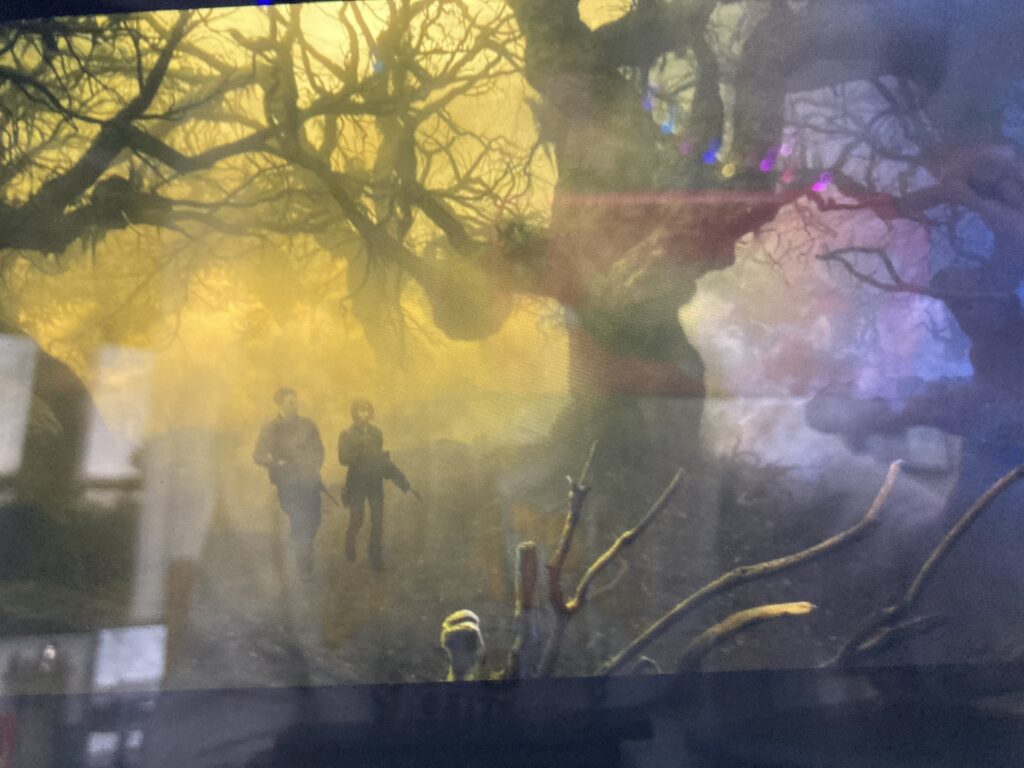
updated a few hours later: Watched about 20 more minutes of The Gorge. In one scene they’re walking through a yellow fog and into a purple wood. I used my phone to take a picture. Don’t think it quite captures the intense colors.

yellow into purple

In this scene, yellow and purple are used to evoke a hellscape. The half-dead skeletons with trees growing out of them are referred to as hollow men, which is a reference to T.S. Eliot’s poem. The poem keeps coming up; I think I should read it. Wow — just read it. Here’s a bit from the middle and the last lines, which Levi, one of the main characters, recites as they walk in purple (violet) air.

excerpts from The Hollow Men/ T.S. Eliot

Shape without form, shade without colour.  
Paralysed force, gesture without motion; 

Those who have crossed 
With direct eyes, to death’s other Kingdom 
Remember us—if at all—not as lost  
Violent souls, but only  
As the hollow men  

                              II 

Eyes I dare not meet in dreams  
In death’s dream kingdom  
These do not appear: 
There, the eyes are  
Sunlight on a broken column  
There, is a tree swinging 
And voices are  
In the wind’s singing  
More distant and more solemn  
Than a fading star.

This is the way the world ends 
Not with a bang but a whimper.

jan 10/RUN

4.5 miles
minnehaha falls and back
21 degrees
100% snow-covered

Today the winter I want: big flurries, everything covered in a thin layer of snow, not too much wind, warmer, not slick — especially with my with Yaktrax on. Nothing was quite easy, but everything wasn’t as hard as my last run on Wednesday.

10 Things

  1. a white sky
  2. the contrast between shoveled and un-shoveled sidewalks — both still white, but the shovelled ones had a tint of gray or brown peeking through
  3. the clacking jawbone of a bird’s beak — a blue jay?
  4. the river was all white — if you didn’t know better, you could believe it was a field or a meadow
  5. approaching from above, hearing the falls rushing over the limestone
  6. kids yelling and laughing at the playground, one loud, high-pitched sound — was it a kid screaming or a whistle?
  7. amongst the kid voices, a deeper, more knowing laugh — was that from a teacher?
  8. the contrast on the creek surface: white snow with blackish-gray water
  9. every so often, a flash of orange — not always sure what it was, just a voice whispering, orange — a snow fence? a construction cone? a sign?
  10. bright headlights cutting through the sky, which was both bright — everything white! — and heavy

Listened to my “Remember to Forget” playlist on the way back. The first song up, Do You Remember Walter? by The Kinks. Two different bits stuck with me:

one: Walter, you are just an echo of a world I knew so long ago.
two: Yes, people often change./ But memories of people can remain.

This second bit got me thinking about how I can’t always (can I ever?) see faces clearly. When the face is too dark and shadowed, I just ignore it altogether. But when there’s some light and I can sort of see them, I often re-construct the features I can’t see with memories of their face from before I lost most of my cone cells. I’m not remembering their face, but creating it. After thinking that the idea of remembering as re-memembering — putting a body back together — popped into my head. Yes! I take my image of face, only as fragments — the curve of a nose or a chin, a bit of eye — and turn it into something whole.

As I kept running, I thought more about remembering and memories and my vision and how I rely on past experience and habits to navigate. And now as I write this, I’m thinking about how everyone’s vision — not just mine — relies on a building up of past experiences (memories?) with things to be able to see them. Here I’m remembering something that I read in Robin Wall Kimmerer’s Gathering Moss:

the sensation of sudden visual awareness is produced in part by the formation of a “search image” in the brain. In a complex visual landscape, the brain initially registers all the incoming data, without critical evaluation. Five orange arms in a starlike pattern, smooth black rock, light and shadow. All this is input, but the brain does not immediately interpret the data and convey their meaning to the conscious mind. Not until the pattern is repeated, with feedback from the conscious mind, do we know what we are seeing.

Learning to See in Gathering Moss/ Robin Wall Kimmerer

I’m continuing to read JJJJJerome Ellis’ Aster of Ceremonies. Wow!

Prayer to My Stutter #2/ JJJJJerome Ellis

You restore
a living
shoreline
between word
and silence

This beautiful prayer moves right into the next offering, Octagon of Water, Movement 3, which was titled by its first line when it was published in Poetry:

excerpts from The name of that Silence is These Grasses in the Wind/ JJJJJerome Ellis

1

The name of that silence is these grasses in this wind, and the name of these grasses in this wind is that other place on the other side of this instant. This instant is divided by curtains of water and the sound of shuddering time. A sunflower reeling with sun, six hands stretched in offering. This unsearchable, uncancellable instant wraps the shoulders of the grasses like a shawl stilled by the stoppage. 

How is/isn’t the instant similar to Marie Howe’s moment? If you listen to the recording on Poetry, you can hear the stretched silence as Ellis’ voice stops before pronouncing certain words.

2

This morning come shyly or boldly into the fertile field, however you are, come, come and stay in the rearrangement, the pressure of thumb on fescue blade, a year wheeling within a day, two round moments of warm mouth, finally at peace. The psalm is a key if only we can find the door. Do not swallow your dysfluent voice. Let it erupt in its volcanic flowering. Stoppage thence passage, aporia, poppy bursting with fragrant seed. 

What a beautiful description and reclaiming of a stuttering voice on the other side of the stoppage! The erupting bursting flowering dysfluent voice.

I’m inspired by how Ellis takes his stutter and turns it into this beautiful instant between silence and word. For them, the stoppage is a/the key aspect of the stuttering. What are the most important elements of my strange vision?

march 22/SHOVELWALK

20 minutes
3? inches
28 degrees

3 or 4 inches for round 1 of winter. We might get more snow in last night’s snowfall, combined with expected snow on Sun/Mon/Tues, than in all of Jan and Feb. Of course, that’s not saying much because our total prior to today was 7.3 inches. I wonder if what we got today will be melted by Monday? Future Sara, let us know!

six hours later: The snow has already melted off of the deck, the sidewalks, the road. Will the snow on the grass be gone before Sunday? Still not sure.

the secret life of plants

sources:

Yesterday afternoon, driving back from picking FWA up for spring break, we were talking about trees and how they communicate and their underground networks and how much sentience they have, and I remembered, and tried (unsuccessfully) to explain, the 1970s talking-to-plants craze. I mentioned how Stevie Wonder did an album about it. Scott didn’t remember the album. This morning I looked it up and . . . jackpot! Stevie Wonder’s album: Journey Through The Secret Life of Plants. I’m listening to it right now — ah, 1979! It is the soundtrack for a documentary, The Secret Life of Plants, which may or may not be a reliable source of “accurate” information about plant science (botany?) discoveries in the 1970s — wikipedia doesn’t seem to think so. I dug a little deeper and found an article about the plant craze of the 1970s — The 1970s plant craze / Teresa Castro

In the early 1970s, a general plant craze caught on in visual and popular culture alike. Against the background of New Age spirituality and the flourishing of ecological thinking, the 1970s plant mania came as an eccentric blow to the belief that sentience and intelligence are a human prerogative. It also relied massively on the cybernetic paradigm: envisaged as self-regulating biological systems, plants were recognized as communication systems in themselves. In this essay, I sketch a brief portrait of this complex cultural moment, as visual culture, and in particular film, came to be permeated by references to plant communication, plant sentience and plant intelligence.

intro to 1970s plant craze

In the first line she mentions a 1972 video, Teaching a Plant the Alphabet. Love it!

In her discussion of “The Secret Life of Plants,” Castro describes the author as a “botanist and science vulgarizer” and places the work in the context of a large anti-science and anti-intellectual moment; a hippy desire to heal the crisis in human/nature relationships; and significantly for this article, the mediation of visual and other technologies, like the lie detector. The book takes up the “experiments” of Cleve Backster in 1966 in which he hooked a plant up to a lie detector and noticed a surge in electrical activity similar to a human’s emotional response when he watered the plant. Then, an even greater one when he imagined setting fire to the plant and watching it burn. His conclusion: This plant could think! It “could perceive and respond telepathically to human thoughts and emotions.”

Her conclusion about the book/documentary and its impact:

The Secret Life of Plants badly impacted serious scientific research on plants’ sensory and perceptual capacities. Widespread press coverage of Backster’s pseudo-experiments contributed to this backlash. Work on plant communication and plant signaling “was somewhat stigmatized, and the limited availability of funding and other resources constrained further progress.”

In our present dire ecological crisis, to acknowledge the richness and complexity of plant-life is an invitation to withdraw from a centric reason that separated humans from “nature,” situating human life outside and above it. In what constituted a striking ecological critique of Enlightenment science and its holy dualisms, “hippy times” attempted to tell a different kind of story about “Man” and “Nature” and grappled with a fundamental epistemological shift. Most of all, they experimented widely with alternative modes of engagement with what poet Gary Snyder described as “the most ruthlessly exploited classes”: “animals, trees, water, air, grasses.” As we emerge shell-shocked from a global pandemic, what are we to do now? Maybe we can learn from the past: instead of imagining that “plants are like people”, as suggested by “America’s Master Gardener” in 1971,57 we can focus instead on what it means to be human on a shared planet.

This discussion of plants and communication reminded me of a study I read during my mushroom month: April, 2022. Looked it up and found the entry: 10 april 2022

After a discussion of study about fungi language, I posted this quotation from Alice

Oswald:

I exert incredible amounts of energy trying to see things from their own points of view rather than the human point of view.

It’s a day long effort to get your mind into the right position to live and speak well.

citing Zizek: we can’t connect, be one with nature. It’s extraordinary, alien. It’s this terrifying otherness of nature that we need to grasp hold of and be more courageous in our ways of living with it and seeing it.

Landscape and Literature Podcast: Alice Oswald on the Dart River

Instead of “plants are just like us; they can think and feel!” of the 70s plant craze, Oswald is holding onto the strange otherness of plants. I wonder what Oswald, a former professional gardener, thinks about the sentience of plants?

I googled the question, but before I could find an answer, I found her amazing lecture on the tradition of rhapsody, the litae women in the Iliad, back doors, and Marianne Moore. Wow!

Sidelong Glances: Oblique Commentary on the Poetry of Marianne Moore / Alice Oswald

I listened to the lecture, going back again and again to try and transcribe some of her brilliant words. Her “obliquely, slightly, slowly” approach to Moore with a description of rhapsody and the “squinting, limping old women” of the Iliad (litae) and the need for coming through the back door and repeated image (and sound) of iron bell resounding like the voices of dead poets that came before us was amazing. I’ll have to listen to it again, I think.

a few passages to remember

The poet, especially the female poet, must labor not only to hear the voices of the literate dead, but my leaning and hushing and listening beyond listening to hear the illiterate, anonymous, marginal voices of rhapsody.

Literature has a front door and a back door, and the labor of moving through poems, opening the back doors to let in the fresh air of the unwritten, if you do it for long enough, finally compels you to leave the house altogether, since the tradition inherited by the oral tradition goes right back into birdsong, windsong, heartbeats, footsteps, rivers, and thickets. Not to mention all the oscillating sounds of tides and seasons and waves and why shouldn’t rhapsody include the stitch work of plants?

Go in through the back door?! Love this idea and what it mean for how I understand doors being opened through poetry! And connecting it to birdsong and wind song and all those amazing sounds heard while running above the gorge! And plants!

[not nature poetry but] natural pattern which includes and aligns the poem making habits of the mind with the metrical structures of physics. That is what I mean by rhapsody and that is what I want you to listen for when you put your ear to a written-down poem: backwards and beyond male literature, as far as the first repetition of a leaf on the first repetition of a morning.

Aligning the poem-making habits of the mind with the metrical structures of physics: the biomechanics of running, the drip drip dripping of water due to gravity, air being forced out of and welcomed into the lungs. And the repetitions — the first repetition of a leaf on the first repetition of a morning — very cool.

And, where to place Robin Wall Kimmerer within this conversation? I think I have an answer, but I decided to read another section of Gathering Moss about the Standing Stones. After writing about scientific names for mosses and reflecting on the power in self-naming, she writes:

I think the task given to me is to carry out the message that mosses have their own names. Their way of being in the world cannot be told by data alone. They remind me to remember that there are mysteries for which a measuring tape has no meeaning, questions and answers that have no place in the truth about rocks and mosses.

Gathering Moss

As I typed up the title of RWK’s book, I just realized something great about the title: gathering moss can refer to us (readers) gathering up stories and lessons from the moss, but it can also mean moss gathering — an image of a complex community of mosses and the agency of moss to gather themselves, independent of us. Nice.

random: Last night I discovered that a cartwheel is named after the wheel of a cart. When you are doing a cartwheel, you are acting like a wheel of a cart. Duh — I guess it seems obvious, but I associated the words so strongly with my memories of gymnastics as a kid that I never thought about it referred to outside of that.

march 8/WALKDATASILENCE

A late afternoon walk with Delia and Scott. Colder than expected. 38 degrees. Full winter layers. Winter coat, double gloves, hat. Lots of sun and long shadows leaving gnarled shapes across the sidewalk. A Bluejay screeching. A kid laughing, playing baseball with an adult (his dad?) at the Howe playground. Cars commuting home on the river road.

We talked about a new word I learned: nocebo (as opposed to placebo) and Scott’s work today. I mentioned that I’m feeling out of sorts with my writing practice. Too many directions, too many BIG concepts. I want to get back to writing my small poems.

earlier in the day

After 3 days of running in a row and a calf feeling much better but still on the mend, it’s time for a break. I decided to leave my watch off too. No stands or workout minutes or calories burned. No monitoring of my heart rate or my balance. I’m still moving — baking and cleaning and doing laundry and taking the dog for a walk — even if that movement isn’t making a sound.

Speaking of watches, 2 days ago I wrote about time and the clock. Here are some more references to time I’d like to remember:

1

That loneliness is just an ongoing 
Relationship with time. 
(Lake of the Isles/ Anni Liu)

2

Time is a kind friend, he will make us old.
(Let it be Forgotten/ Sara Teasdale)

3

When the big clock at the train station stopped,
the leaves kept falling,
the trains kept running,
my mother’s hair kept growing longer and blacker,
and my father’s body kept filling up with time.
(Big Clock/ Li-Young Lee)

4

Mosses, I think, are like time made visible. They create a kind of botanical forgetting. Shoot by tiny shoot, the past is obscured in green. That’s why we have stories, so we can remember.

The mosses remember that this is not the first time the glaciers have melted. If time is a line, as western thinking presumes, we might think this is a unique moment for which we have to devise a solution that enables that line to continue. If time is a circle, as the Indigenous worldview presumes, the knowledge we need is already within the circle; we just have to remember it to find it again and let it teach us. That’s where the storytellers come in.
(Ancient Green/ Robin Wall Kimmerer)

5

IN THE ANISHINAABE languages of Skywoman, our words for moss, aasaakamig and aasaakamek, carry the meaning “those ones who cover the earth.” Soft, moist, protective, they turn time into life, covering the transient and softening the transition to another state.
(Ancient Green/ Robin Wall Kimmerer)

6

Time is a circle reminded me of the tracking of the “wheeling life” that I did while running last year. I was inspired by Forrest Gander’s poem “Circumambulation of Mount Tamalpas”:

maculas of light fallen weightless from
pores in the canopy our senses
part of the wheeling life around us and through
an undergrowth stoked with the unseen
go the reverberations of our steps

the wheeling life: 10 things

  1. car wheels, near the road — relentless, too fast, noisy
  2. car wheels, below, on the winchell trail — a gentle hum, quiet, distant
  3. bike wheels, approaching from behind very slowly — a little kid biking to school with his mom who had a carrier with another kid behind her seat
  4. bike wheels, nearby, another kid and adult on the way to school
  5. the wheel of life as a loop: a favorite route, running south, looping back north, first on edmund, then on the winchell trail
  6. the wheel of life as transformation: red leaves decorate a tree halfway to the river
  7. the wheel of life as cycles: not the end of the year, but the beginning — school time: kids at the elementary school
  8. the wheel of life as constant motion: on the trail, below the road and above the river, everything is active: birds calling, squirrels rustling, wheels traveling, river flowing, feet moving, leaves and lungs breathing
  9. the wheels of life as cycle: always in late september, hot and humid and too sunny
  10. the wheels of life as transformation: thinning leaves, falling acorns, a small view of the river

feb 8/RUN

5.3 miles
ford loop
47 degrees

Hooray for feeling strong and happy and unbothered by the wind! A good run, even though it feels strange with no snow. Scott told me it’s 5 degrees warmer here in Minneapolis than it is where we used to live in Upland, California. Wow.

Starting last night and lingering through the morning: rain. Not snow, but rain. Everything was wet and muddy and slippery. At the end of my run I noticed that I had specks of mud on my shirt — how did that happen?

Around mile 3, as I ran straight into the wind, a biker approached from behind. I heard her call out Fast! I wasn’t sure what to say, so I said, there’s a lot of wind! She agreed. Later I encountered the biker on the ford bridge — she was walking her bike while I was still running — There’s goes that fast runner! I waved and smiled. I did a lot of smiling at every person I encountered.

a strange winter sight: roller skiers, one of them wearing shorts!

Talked with Dave, the Daily Walker about how I’m missing the snow. He agreed, but only when it’s windy and there’s lots of snow and no one else out on the trail. Then it’s fun, he said. His version of fun is one reason why I like Dave so much.

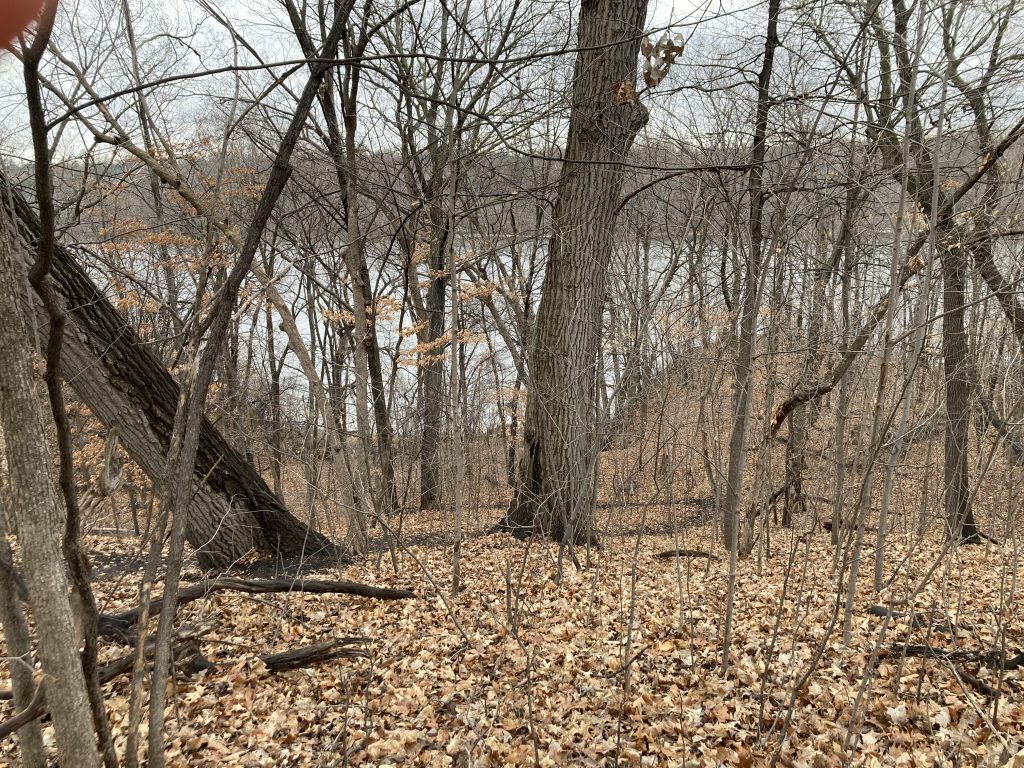
Took 2 pictures of my view. Both are just south of the double bridge and the Horace W.S. Cleveland Overlook. Here’s one of them:

My view from above the gorge: bare limbed trees, all trunk and thin branches. A few trunks are thick -- like the one near the center of the image or the one leaning on the left side -- but most are thin, creating a transparent screen between runner (me) and river. The ground, in the bottom third of the picture, is mostly dead, curled-up brown leaves.
My view from above the gorge: bare limbed trees, all trunk and thin branches. A few trunks are thick — like the one near the center of the image or the one leaning on the left side — but most are thin, creating a transparent screen between runner (me) and river. The ground, in the bottom third of the picture, is mostly dead, curled-up brown leaves. Sometimes, this is what I see even when there aren’t thin, bare branches everywhere — my view slightly obscured by something in the way — dead cone cells, I think — creating fuzz or static or a slight pulsing or wavering of lines. Also, if this picture were in black and white I wouldn’t be able to tell the difference. Often I have to ask Scott: is this in color or black and white?

peripheral: how I see

before the run

Before my run, while I was reviewing my Oct 2023 log entries and encountering several of my “how I see” photos, it came to me: this should be the new version of my vision poems. I want to study the ekphrasis form (An ekphrastic poem is a vivid description of a scene or, more commonly, a work of art. Through the imaginative act of narrating and reflecting on the “action” of a painting or sculpture, the poet may amplify and expand its meaning — def). Then I want to write a series of “how I see” poem/descriptions. These will be about experimenting with the form and exploring ways to describe how I see. I wrote in my notes: not about what I can’t see, but what I can. I’m also interested in experimenting with the idea of alt-text as form — I have a few sources for this. I’ll read some Georgina Kleege and her latest book, More Than Meets the Eye. These poems will be practical — describing the literal way I see — but also poetic — strange, unsettling, more than a report.

I’m thinking that these poems would involve describing what I see in the photo and what I saw when I was taking the photo. Also, they’re as much about HOW I see (the mechanics/process) as WHAT I see. I love this idea; I hope it sticks!

some sources:

during the run

While I ran lots of different thoughts flashed. First I thought about Marie Howe and the idea of observing and not looking away. Describing what you see with details not metaphors. Then I thought about how “looking” works for me, how it’s harder because of what I can and can’t see. How much can any of us (no matter where we are on the spectrum of seeing/blind) actually see? Then I started thinking about Huidobro’s poem, “Natural Forces” and all of the different glances he describes — One glance to shoot down the albatross. What do my different glances see?

right after the run

During my walk back home, I thought more about how I see (and spoke those thoughts into my phone). I was reminded of Robin Wall Kimmerer and her chapter, “Learning to See” in Becoming Moss. It’s about how we can learn to see the small things — like moss — that were invisible to us before.

I also thought about how I’m interested in the process we use to see and how that shapes what we see and how it enhances or detracts from our ability to behold/witness. Yes! This connects back to Ross Gay and beholding, which I discussed on here a few years ago.

I’m interested in how we sense without seeing, or how we see with our other senses (like sound). And I’m interested in thinking about how vision isn’t the primary mode in which we understand and make sense of things. It is only one of many ways, not THE way.

Ekphrasis

The verbal representation of visual representation.

Basically, an ekphrasis is a literary description of art. Like other kinds of imagery, ekphrasis paints a picture with words. What makes it different from something like pictorialism is that the picture it paints is itself a picture: ekphrasis stages an encounter between representations in two mediums, one visual and one verbal.

What is Ekphrasis?

key feature of an exphrasis poem: it engages with an artistic representation — does this fit for my project? I think so, especially if I make the taking of the photo as part of the description.

Another helpful definition of Ekphrasis from Poets.org:

Ekphrasis is the use of vivid language to describe or respond to a work of visual art.

Ekphrasis

The purpose of ekphrasis was to describe a thing with such detail that the reader could envision it as if it were present. 

I’m interested in using language to help others experience how/what I see.

oct 4/RUN

4.4 miles
longfellow gardens and back
64 degrees / 78% humidity

A little cooler, but still humid. More shorts and tank top. Decided to run past the falls to Longfellow Garden to check out the flowers. Oranges, reds, pinks, purples, yellows. Did the gray sky make the colors seem even more vibrant to me?

The falls were gushing, so was the creek. The sound of dripping water from the sewer mixed with the wind. Chainsaws echoed below me in the gorge as Minneapolis Parks workers removed dead branches and leaning trees.

Running on the part of the trail that dips below the road, between locks and dam no. 1 and the 44th street parking lot, I could smell the rotting leaves — the too sweet, stale smell of last night’s beer. Yuck! Did I smell anything else? Yes! The strong scent of burnt toast or burnt coffee beans or burnt something somewhere in the neighborhood. The soft, pleasing scent of the tall, fuzzy grass that Scott says smells like cilantro.

I listened to kids being dropped off for school as I ran south. At my favorite spot at the falls, I put in an old playlist. I took my headphones out again when I reached the Winchell Trail. Then I put them back in after I was done and walking home. I listened to a chapter about the benefits of being small in Robin Wall Kimmerer’s Gathering Moss.

Since I’m prepping for a week about fall color for my class, I tried to notice color on my run.

10 Things I Noticed: Color

  1. there is still so much green. Everywhere, green. Not dark winter green, but light summer green
  2. a few slashes of red on the edge of the trail, the bright red hair of a walker
  3. orange cones, orange vests, orange signs, a past-its-prime orange tree, orange school bus, orange flowers sticking out above the other flowers
  4. hot pink petals, still intact
  5. flowers glowing such a light, almost white, purple that I imagined them to be ghost flowers
  6. yellow safety vests on a long line of bikers crossing at the roundabout, backing up traffic
  7. dry and dead brown leaves on the edge of the trail, covering the path
  8. the dark blueish gray of crumbling asphalt
  9. dark brown mud
  10. white foam from the raging falls

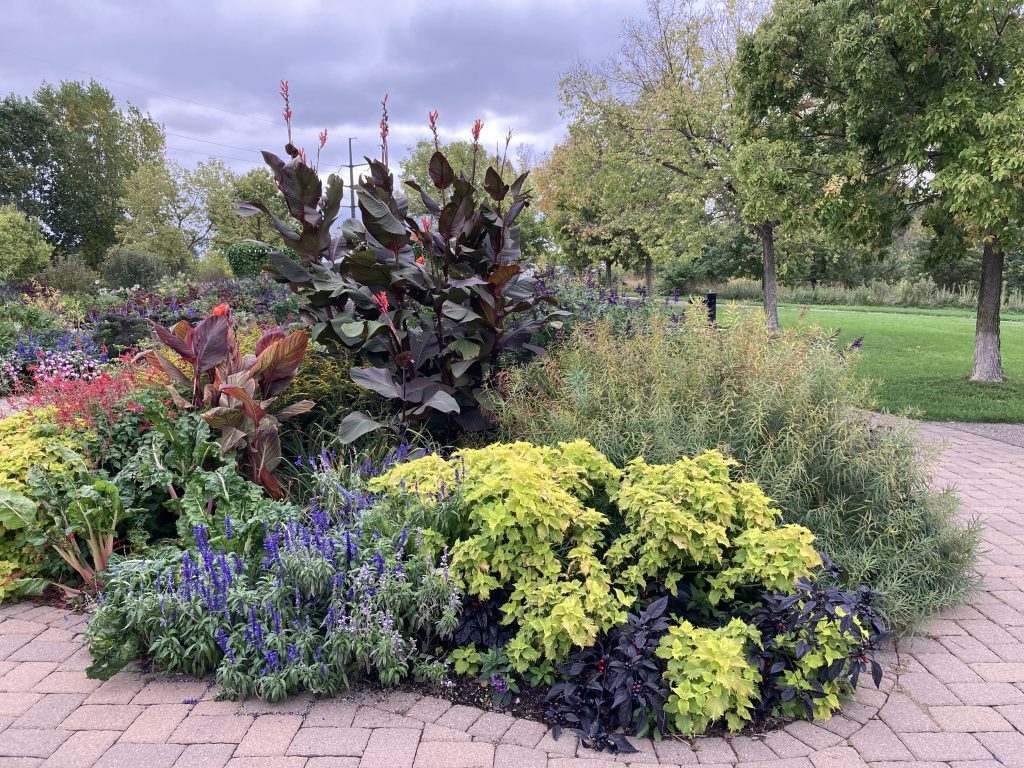
While walking around the garden, I took a few pictures:

Fall flowers at Longfellow Gardens. In person, these flowers seemed more vibrant and in reds, purples, pinks, oranges. Now looking at the photo, it is mostly various shades of green or gray or brown. If I put the screen right up to my nose or stare at the photo out of the corner of my eye, I can see some color, almost like the idea of color or a flash of color. Nothing steady or solid.
Longfellow Gardens, fall flowers in bright colors that I mostly cannot see

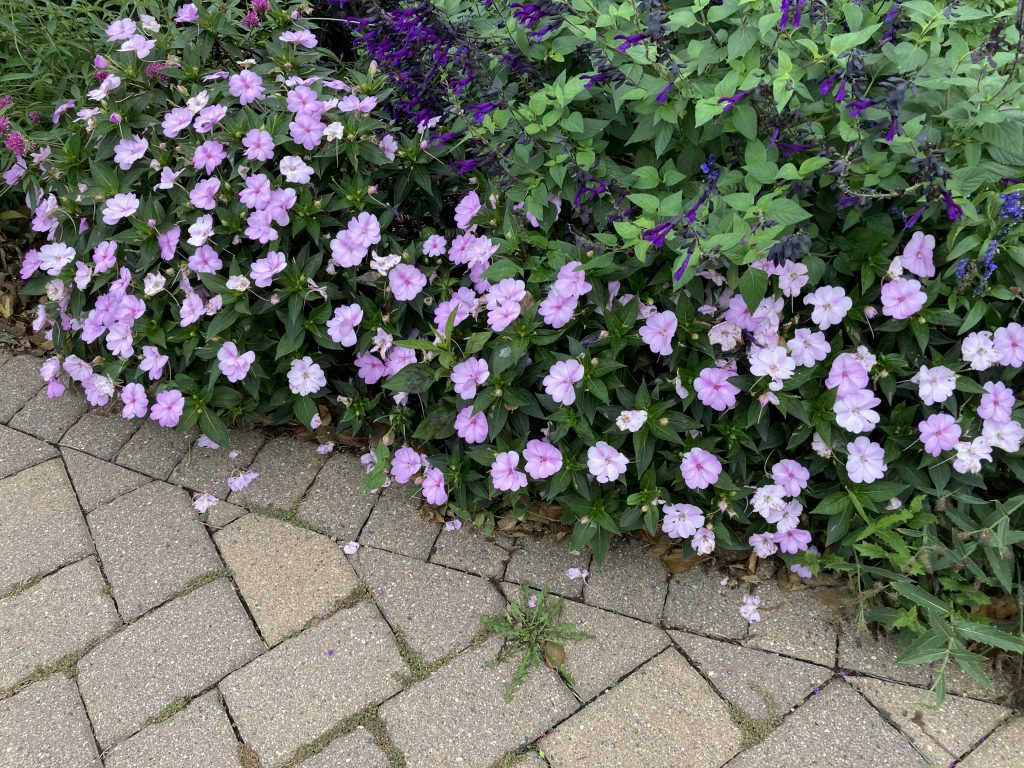
Pale purple flowers at Longfellow Gardens. In person, these flowers were so pale and so bright, almost white, that I imagined them to be ghost flowers.
ghost flowers at Longfellow Gardens

I love this description of what poetry is/could or should be:

Ars Poetica/ José Oliverez

Migration is derived from the word “migrate,” which is a verb defined by Merriam-Webster as “to move from one country, place, or locality to another.” Plot twist: migration never ends. My parents moved from Jalisco, México to Chicago in 1987. They were dislocated from México by capitalism, and they arrived in Chicago just in time to be dislocated by capitalism. Question: is migration possible if there is no “other” land to arrive in. My work: to imagine. My family started migrating in 1987 and they never stopped. I was born mid-migration. I’ve made my home in that motion. Let me try again: I tried to become American, but America is toxic. I tried to become Mexican, but México is toxic. My work: to do more than reproduce the toxic stories I inherited and learned. In other words: just because it is art doesn’t mean it is inherently nonviolent. My work: to write poems that make my people feel safe, seen, or otherwise loved. My work: to make my enemies feel afraid, angry, or otherwise ignored. My people: my people. My enemies: capitalism. Susan Sontag: “victims are interested in the representation of their own sufferings.” Remix: survivors are interested in the representation of their own survival. My work: survival. Question: Why poems? Answer:

the work of a poet: to imagine; to do more than reproduce toxic stories; to make your people feel safe, seen, loved; survival

sept 7/RUN

3.4 miles
2 trails
59 degrees

59 degrees! A great temperature for a run. Overcast, misting, low wind. Tried to relax and release the tension in my shoulders (cause: failing to get a girl to go to school) and keep a slow, steady pace for my left IT band. Mostly it worked. I had my headphones set up to put in but never did.

6 Things Heard, 1 Smelled, 3 Unseen

  1. SCREECH! SCREECH! — bluejays
  2. tat tat tat tat tat — a roofer’s nailgun
  3. drip drip drip — the sewer at 42nd
  4. there’ve been so many drownings there — a woman walking and talking on the phone
  5. thump kerplunk — falling acorns
  6. good boy! — a woman talking to her dog as she stopped to let me pass on the narrow trail
  7. sickly sweet, slightly off, a hint of rotten egg — sewer smells near the ravine
  8. the voices of kids playing above and across the road (unseen: only voices drifting down, heard but not seen)
  9. a black shirt left on a bench (unseen: the shirt being left behind/the person who left it)
  10. a bare rock (unseen: no stones stacked, yesterday’s wind that must have knocked the stacked stones off)

before the run

I just started a new thing in the morning with my wordle habit. I’m calling it birdle and the only rule is this: the first five letter guess must be a bird. So far I’ve used: finch, robin, goose, eagle, egret, and quail. Confession: I don’t know or couldn’t think of many bird names so I had to look it up after goose. I suppose that could be part of the point of this goofy game: to learn more bird names.

Some others 5 letter bird names I’ll try:

  • crane
  • heron
  • junco
  • owlet
  • raven
  • swift
  • stork
  • vireo
  • veery

Veery reminds me of a delightful little poem I posted on july 13, 2021 from Lorine Niedecker (I love her!):

We are what the seas
have made us
longing immense
the very veery 
on the fence

Two things via Heather Christle on twitter this morning while drinking my coffee out on the deck: a poem and a concept

MORE SWANS AND MORE WOMEN/ Heather Christle

A swan makes a bad pet It is a murderer
but very beautiful just like a woman
If you see a woman moving in the water
you must run away very fast to a mountain
It happened to me once and there
are no swans on a mountain
This made it lonely and natural so
I was very safe but I forgot
how to talk and when I came home
people could not see I was a woman
although I made a lot of statues to explain
and I live by myself in a cottage and
the water is no longer working It won’t
make me beautiful just wet and the same

As of 2 or 3 readings, I don’t yet understand what this poem means. I’m not sure I need to. I like it for the swans and the swimming woman and the idea of the water no longer working, although I hope I never get to a place where the water is no longer working for me. Also: water making you wet and the same (like everyone else — all bodies floating freely and free from ailments/injuries, all together, a congregation) is magical, isn’t it?

concept — via negativa

Taught child about concept of via negativa this morning and had SO much fun watching her looking all around the bus stop, making silent notes to herself of what was not there.

Heather Christle on twitter

I’m sure I encountered the idea of via negativa in one of my theology classes, but I’ve forgotten it. And now, after some very brief searches, I’m not sure I totally understand it, or that what I think it means is complex enough to capture what it really means. Regardless, for right now, I like thinking about via negativa in terms of the gorge and what’s present in its absence (does that make sense?).

Looking up “via negativity and poetry,” I found a great site, Via Negativa, which led me to many wonderful poems by Luisa A. Igloria, including this one:

Talisman/ Luisa A. Igloria

Even now, at what we believe is near the end, my mother is what kids today might describe as #fighting, A month in the hospital and she’s rallied and flailed, flailed and rallied. Through intravenous feeding, oxygen delivery, antibiotics, everything short of TPN. Who is Patty? my cousin and the nurses ask. My mother has been calling the names of the dead, names of the living, names of all the remembered ghosts in her life. Perhaps more than death or dying, the ghost of our own approaching absence is the most difficult piece of the puzzle. She still knows the difference between the clothed and naked body, how the taste and texture of water on the tongue disappears like a stolen jewel. Once, she fashioned for me an ugly name in a second baptism meant to confuse and repel the gods. She embroidered it on towels and the inside of my collars as she mouthed it like a spell. Sometimes, I still start at my shadow on the wall, blue and sick from being shorn from light.

I’ve thought a lot about fighting death this last month as Scott’s dad was dying. I remembered how my mom fought it for almost a year and how difficult that was for everyone. I hoped that Scott’s dad wouldn’t fight it too, wouldn’t linger in an almost dead state for months. He didn’t.

during the run

Inspired by my brief exploration of via negativa, ideas of the gorge as an absence that is present and embracing — or centering? — the unknown kept flaring in my mind. Then I wandered with these ideas, moving beyond (or beside?) via negativa, thinking about the unknown as what we can never access (never see) but also what we might be able to see if we slowed down and opened ourselves to the world. I thought about Robin Wall Kimmerer and her chapter in Becoming Moss, “Learning to See,” how being patient and present in the world can enable us to see things that were previously invisible to us. And I thought about the periphery and what dwells there (both the unknown and the known-made-strange).

may 31/RUN

3 miles
2 trails (long)
75 degrees

Warm this morning, but it didn’t feel miserably hot, probably because I was able to be in the shade for most of the run. So much wonderful shade, so many friendly shadows! Ran south above, north below, on the Winchell Trail. Didn’t look at the river much, even when I was closer to it. One glance: between the thickening trees near the southern entrance of the Winchell Trail, I saw a small patch of sparkling water.

today’s color: the blue of the blue jay (I think it was a blue joy) that flashed past me as I rounded the curve at 42nd. Normally I can’t see the color of birds, and I’m not sure if you’d call what I saw seeing, more like the idea of blue or a voice calling out, blue! What kind of blue was it? Not deep or dark but light and intense, almost glowing. But not pale blue — somewhere in-between dark and light.

10 Things I Noticed

  1. the shadow of tree sprawled across the path
  2. the steady flow of water coming out of the sewer pipe near 42
  3. the clicking and clacking of roller skier’s poles up above me near folwell
  4. passing 2 walkers and hearing one of them say walk or should be walking or something like that
  5. the steady stream of cars driving by
  6. a few kids’ voices at the playground
  7. the flash of a white t-shirt up ahead on the trail, then disappearing around the bend
  8. leaning trees creating archways to pass through in several spots on the winchell trail
  9. cottonwood fuzz on the edges of the trail
  10. the metal slats in the ravine were slick and slippery

Mary Ruefle on Eavesdropping, You, and Unhitching in “On Sentimentality”

before the run

Today’s the last day of May and my last day with Mary Ruefle. I just finished reading/skimming her lecture, “On Sentimentality.”

Eavesdropping: In response to a poet who criticizes and laments the too frequent use of a generic You in poetry as too passive, turning us into observers, mere eavesdroppers, Ruefle asks: What’s wrong with eavesdropping? I agree. Today during my run, eavesdrop. Listen in on conversations between birds, the river and the sky, walkers.

YOU: What kind of subject are you (or is You)? And, if you are You, then who is the I? The path, a shadow, that tree? Think about this as you run beside the river.

unhitching: to crudely paraphrase Lévi-Strauss, unhitching happens in brief moments when we can step outside of or beside or just beyond — below the threshold of thought, over and above society — to contemplate/experience/behold the this, the what it is, the essence of everything, Mary Oliver’s eternity. In your run above the gorge, near the river, below the trees, can you unhitch?

during the run

In spite of the warm conditions, I managed to wonder about/wander through or with all 3 of these! A little bit of eavesdropping, some unhitching or at least thinking about how/where unhitching is possible, and becoming a You.

All of these ideas were simmering in my mind the entire time I ran, but I had a breakthrough in the second mile as I passed a walker and a dog on the Winchell Trail. They noticed me before I reached them and moved to the side. I said thank you and the woman replied you’re welcome. As I continued running on the steep-ish trail with no railing I thought about how when I said thank you, I was the I, she was the you. But when she answered you’re welcome, I become the you and she the I. Each of us both. Then I started thinking about the space and time between when we each embodied the pronoun, before my I turned into a you or her you into and I. This is the space of possibility where unhitching can happen, when we can be both a you and an I or something else that doesn’t divide and separate or assign us a fixed role — as active I or passive you. A moment when we can experience or behold the is below the threshold of thought, over and above society and its constructs. Not long after thinking these things, I encountered the blue flash of the bird and it felt magical.

I wanted to hold onto these ideas so I eventually stopped in the ravine, just past the oak savanna, to record my thoughts.

we exchanged the You. First they were the you, then I was, but there was some time in-between before we switched from I to you or you to I that was undetermined or both or nothing and that it’s those moments where we have the opportunity to unhitch.

the immeasurable or barely measurable lag between what we do, what we feel, what we hear, what we see, and our brain and as it travels to the brain then travels back out in whatever form. That is where those moments occur. (I’m thinking about a Radiolab episode I listened to last year)

thoughts recording during my run

And, a few minutes later, after my run was done, I recorded a few more thoughts:

Instead of lamenting the loss of what we once were like in Marie Howe’s “Singularity,” what if we gave more attention to the possibilities that exist in those spaces between the You and the I? Those moments of unhitching …And I was thinking about Robin Wall Kimmerer and the moss again and this idea of enough-ness, being satisfied with the small moments. Not trying to get more, to be more, but to just be, or to not be, or to be passive.

Not an observer or eavesdropper as someone who is spying on, staring at, invading the space of others. Not a lurker, as in lurking troll. Is there another way to understand how to notice the world passively? An absorber? Not a lurker, but a dweller?

thoughts recorded after my run

After my run, I also recorded myself reciting a poem that memorized a few years ago and was trying to keep fresh as one of my 100 poems memorized: Natural Forces/Vincente Huidobro. I almost got every word correct.

after the run

Such a great run, with so many interesting ideas! Arriving home and then trying to put the feeling of the run and the feeling of my thoughts into words, dulled some of the shine. It’s hard to find the right best proper most profound complete words to translate the experience. I didn’t want to lose so many great ideas and the moments of clarity. Then, another thought: what if the goal was not to accurately or exhaustively remember and then record my thoughts and feelings, but to hold onto those feelings and allow them to shift my perspective. I’m not sure that makes sense, but it did to me when I first thought it.

I have enjoyed reading Ruefle all this month. I’ve gotten to know her a little bit better and been able to wander in many different directions. I’ve also experimented with a new way of engaging with ideas/authors/writings. As an academic, I used to spend hours trying to effectively (and comprehensively) summarize the argument of a piece of writing. This summary, what one of my profs called appreciation, was always the first step. With Ruefle, attempting to lay out her entire argument in a neat and logical way doesn’t work. Why try to pin down her wild and wandering thoughts in such a way? Why waste all of my energy trying to summarize something that shouldn’t be summarized? So instead, I’ve been trying to engage with the little bits and bobs (thanks British TV for reminding me of this wonderful phrase!) that resonate for me. For me the point is not to KNOW these poems and lectures and essays by Ruefle but to FEEL them in small and big ways.

Some other ideas in “On Sentimentality” that I want to store away for future Sara:

I You They are invented devices

The words I, and you, and they, are grammatical devices invented simply for arrangement and totally devoid of the intense and exclusive sense usually attributed to them.

“On Life”/ Percy Shelley, quoted in Ruefle’s MRH, page 32

on vague Yous and John Keats’ “This Living Hand”

The poem is nothing but a gigantic, disembodied hand pointing a finger at someone. That finger is a magnet and a conductor: it reaches out to the vague, ill-defined you like God reaching within an inch of Adam, and it charges the reader with all the responsibility in the world: go figure these things out for yourself, while you still have blood in your veins.

page 35

another definition of poetry

a good poem is seldom comfortable; either it vanquishes us with anguish or electrifies us with ecstasy or makes us pause and consider a new sense of the world or unravels us altogether, but never does it make us feel comfortable in the fashing of these ads [part of a discussion about an ad that used the phrase, the poetry of knits].

pages 46-47

unhitching

The possibility, vital for life, of unhitching, which consists … in grasping, during the brief intervals in which our species can bring itself to interrupt its hive-like activity, the essence of what it was and continues to be, below the threshold of thought and over and above society; in the conntemplating of a mineral more beautiful than all our creations; in the scent that can be smelt at the heart of a lily and is more imbued with learning than all our books; or in the brief glance, heavy with patience, serenity and mutual forgiveness, that, through some involuntary understanding, one can sometimes exchange with a cat.

Lévi-Strauss quoted MRH page 52

Returning again to the ideas of You and I and We and Us, I wonder if some of my thoughts were influenced by a poem I read while drinking my coffee:

Soul/ASSOTTO SAINT

I remember the beginning
a dream ancient as dawn
a dream of destiny drumming up the blood
the flesh
this earth
a dream we were once one
soul

may 8/RUN

4.5 miles
veterans’ home loop
61 degrees
humidity: 78%

Went out for my run too late (10:30 am) and paid for it. Very hot. I could feel it in my legs, thick and heavy. I was okay for the first half, but needed to walk a few times in the second half. Too much green air. I could feel it in my lungs, heavy and thick.

I could still see the river through the light green leaves, but I don’t remember what it looked like. Was it blue? Probably. Did I see my shadow? I don’t remember. I didn’t hear or see any rowers.

Lots of people at the falls. I ran up the steps by the bridge right above where the creek water falls, two at a time. Looking down from the high bridge that delivers you to the Veterans’ home, everything looked green. I thought I saw one of those stone bridges below but it looked strange — had it fallen into the rushing water? Not sure. On the grounds of the Veterans’ home, I smelled the freshly mowed grass, noticed the dark streaks of wet grass smeared on the sidewalk. Stopped to admire the water rushing over the concrete at the locks and dam #1. Put in my Sara 2020 playlist.

Listened to birds and shuffling feet as I ran south, Lizzo and Billie Eilish and Nur-D on the way back north.

Mary Ruefle and Green

before the run

As spring happens, the sudden shock of new life everywhere, I’m thinking about green, which makes it a good time to read Mary Ruefle’s prose poem about green sadness:

from My Private Property/ Mary Ruefle

Green sadness is sadness dressed for graduation, it is the
sadness of June, of shiny toasters as they come out of their
boxes, the table laid before a party, the smell of new straw-
berries and dripping roasts about to be devoured; it is the
sadness of the unperceived and therefore never felt and
seldom expressed, except on occasion by polka dancers
and little girls who, in imitation of their grandmothers,
decide who shall have their bunny when they die. Green
sadness weighs no more than an unused handkerchief, it
is the funereal silence of bones beneath the green carpet
of evenly cut grass upon which the bride and groom walk
in joy.

funereal: having the mournful, somber character appropriate to a funeral.

Reading about Ruefle’s “color spectrum of sadness,” somebody else pointed out her final words about her color poems in the last sentence on the last page of her book:

Author’s note: In each of the color pieces, if you substitute the word happiness for the word sadness, nothing changes.

Another thing to note about her note: she describes them as pieces not poems. I wonder if she talks explicitly about how/why/what she names them in an interview somewhere? Answer? I found a 2015 interview with her where (I think) she’s discussing My Private Property and she suggests that it contains fiction, essays, and prose poems, which I’m thinking refers to the color pieces. So I’ll stick with calling them prose poems.

I’m also thinking about green because of the Robin Wall Kimmerer story I encountered in the amazing journal, Emergence. I started listening to her reading of it — she has such a wonderful voice! — but it’s 35 minutes, so it will take some time.

Ancient Green / Robin Wall Kimmerer

One wonderful line I’ve already heard:

Mosses, I think, are like time made visible. They create a kind of botanical forgetting. Shoot by tiny shoot, the past is obscured in green. That’s why we have stories, so we can remember.

Yes, the idea of green obscuring/concealing things. I often think about that as I’m running beside the gorge, unable to see the river or the other side because of so much green.

On today’s run, I hope to think about green.

during the run

My green goal was off to a good start when I spotted a bunny in the alley just before starting to run and thought, the bunny from the line about green sadness, little girls who, in imitation of their grandmothers, decide who shall have their bunny when they die.

10 Green Moments and Feelings

  1. At the start of the run, just above the oak savanna, floating through light green air, both in color and weight
  2. Midway through the run, in Wabun, above Locks and Dam #1, plodding through bright green air, thick and hot
  3. green grass in the boulevard — growing fast
  4. green light shining through the trees — glowing soft
  5. green sinuses, closing up my nose
  6. green voices — kids at the playground
  7. green-stained sidewalks — the whispers of grassy sadness
  8. green sky instead of clean blue air
  9. green weeds pushing through pavers, joining the orange tulips beside Longfellow’s “The Song of Hiawatha” at the park
  10. green curiosity — how much of this green am I actually seeing and how much am I conjuring from when I had more cone cells?

As I ran, I also thought about a mood ring poem that I’m revising: incurable. I’m trying to contrast my disdain for searching for a cure for my vision loss which I’m linking to images of pickling, preserving, curing, with my relief in knowing, with some certainty, that there is no cure — this I’m envisioning as being outside in fresh, open spaces with wider views. As I write this description, I think I need to tighten up my fresh images. Anyway, as I ran, I thought that if these images correspond to colors, then curing would be green and fresh would be blue — or should it be another shade (or is it tint) of green?

after the run

a few passages from Ancient Green / Robin Wall Kimmerer:

If success is measured by widespread distribution, they occupy every continent, from the tropics to Antarctica, and live in nearly every habitat, from desert to rainforest. If success is measured by expanse, consider the vast peatlands of the north, blanketed by sphagnum moss. If success is colonization of new places, mosses are the first to occupy new places after an eruption or a forest fire or a nuclear meltdown. If creativity and adaptation are the metrics, mosses have diversified to fill every niche, generating more than eleven thousand uniquely adapted species, an outpouring of biodiversity. If success lies in beauty—well—just look.

Mosses make minimal demands on their surroundings. All they need is a little light, a sheer film of water, and a thin decoction of minerals, delivered by rainwater or dissolution of rock. If they are hydrated and illuminated, they will exuberantly photosynthesize and expand the green carpet. But when times are tough, most simply stop growing and wait until water returns. They don’t die, they just crinkle up and pause, following the rhythms of the natural world, growing in periods of abundance and waiting through periods of scarcity: a wise strategy for life that is in tune with uncertainty.

Moss lifeways offer a strong contrast to the ways we’ve organized our society, which prioritizes relentless growth as the metric of well-being: always getting bigger, producing more, having more. Infinite growth is ecologically impossible and exceedingly destructive, as it demands the transformation of the lives of other beings into raw materials to feed the fiction. Mosses show us another way—the abundance that emanates from self-restraint, from enoughness. Mosses have lived too long on this planet to be seduced by the nonsense of accumulation, the delusion of permanence, the endless striving for productivity. Maybe our heartbeats slow when we sit with mosses because they remind us that contentment could be ours.

Green teachers. Green patience resilience. Green enoughness.

feb 2/SWIM

1.2 miles
ywca pool

Met my almost 17 year-old daughter at the pool and then we swam together. She’s swimming for online gym. I love swimming with my kids. This summer I swam at the lake with my 19 year-old son, now I get to swim at the pool with my daughter. I try to stay chill and not scare them with my enthusiasm, but it’s difficult.

Tried using a pull buoy for the first time in a few years. So much easier to breath when my body is higher up on the water. I should probably find some more drills to help with keeping me higher.

A few laps in I noticed an oval of bright light on the pool floor, not near the windowed wall, but the windowless one. A strange, beautiful thing to see.

I pushed off the wall underwater for my first lap ritual and swam just above the pool bottom. Noticed a black thread or hair floating right below my nose. A strange, ugly thing to see. Lots of crud in the water this afternoon. Nothing big or too gross, but small bits of something that made the water cloudy.

Later in the swim, I noticed lines of light on the bottom close to the window. Remembered to look up above the water as I flipped at the wall. Today above the surface looked pink to me. Forgot to notice the moving shadows on the pool floor.

At the beginning of the swim, when there was only one other person in the water, I heard some splashing or sloshing underwater. Was it from me? I don’t think so.

Later, after the swim, in the hot tub with Scott, I noticed another woman sitting in the corner, miming freestyle strokes in the hot water.

Also in the hot tub: crouching down, my chin just above the surface, I watched the light catch the spray of water made by one of the jets, making the spray look like fizz from my favorite grapefruit seltzer. Below, the jet made the water look like swirling smoke.

not a cabinet of curiosities

Talked to Scott about my class and my week on wonder as curiosity, which is coming up in a few weeks. There’s a quote by Thoreau that I’m interested in challenging. Well, maybe not challenging, but imagining curiosity against?

[24] In winter, nature is a cabinet of curiosities, full of dried specimens, in their natural order and position.

A Winter Walk/ Thoreau

Thoreau is describing a particular type of western scientific attention: study the natural world as individual things (specimens) to be isolated, classified, and categorized. To learn about, not from. To see non-human beings only as objects, never subjects.

I want to contrast this cabinet of curiosities with Robin Wall Kimmerer and her expanded understanding of knowing:

I would describe my journey as a circle, moving out into academia but coming back to the way that I knew plants as a child. I grew up in a rural area much like where we’re sitting today, and I was interacting every day with plants in the garden, the woods, or the wetlands. I couldn’t go outside without being surprised and amazed by some small green life. I suppose it was their great diversity of form that first drew my interest: that on a small patch of ground there could be so many different ways to exist. Each plant seemed to have its own sense of self, yet they fit together as a community. And each had a home, a place where I knew I could find it. This inspired my curiosity.

From as far back as I can remember, I had this notion of plants as companions and teachers, neighbors and friends. Then, when I went to college, a shift occurred for me. As an aspiring botany major, I was pressured to adopt the scientific worldview; to conceive of these living beings as mere objects; to ask not, “Who are you?” but, “How does it work?” This was a real challenge for me. But I was madly in love with plants, so I worked hard to accommodate myself to this new approach.

Later in my career, after I’d gotten my PhD and started teaching, I was invited to sit among indigenous knowledge holders who understood plants as beings with their own songs and sensibilities. In their presence, and in the presence of the plants themselves, I woke from the sleep I’d fallen into. I was reminded of what I’d always known in my core: that my primary relationship with plants was one of apprenticeship. I’m learning from plants, as opposed to only learning about them.

I was especially moved by an elderly Diné woman who told the biographies of each plant in her valley: its gifts, its responsibilities, its history, and its relationships — both friendships and animosities. As a scientist I had learned only about plants’ physical attributes. Her stories reminded me of how I had encountered plants as a young person. That’s why I say I’m coming full circle after all these years — because I’m able to stop speaking of plants as objects.

2 Ways of Knowing/ Robin Wall Kimmerer

I’m struggling to turn all of my thoughts about curiosity and wonder into a pithy, coherent statement for a lecture. So much time spent circling around these ideas. Frustrating.

sept 7/RUN

5.9 miles
bottom of franklin hill and back
70 degrees / humidity: 95%
8:45 am

Back to warmer, more humid, mornings. Did my new regular routine with this route: run just beyond the bottom of the franklin hill, turn around, walk up the hill, put on a playlist, begin running again, much faster, at the top.

I don’t remember what I thought about as I ran. I started noticing my breathing pattern: 1 2 3 4 breathe. Then near the top of Franklin, I started chanting, 54321/54321/54321/123. And then, I changed the rhythm slightly and came up with words:

Here I go down the hill
Watch me fly.

To remember it, I decided to pull out my phone and recite it mid-flight down the hill:

chant, 7 sept

10 Things I Remember From My Run

  1. Reaching the bottom of the hill, the water was flat and still. No rowers or waves.
  2. I startled a squirrel as I ran by their hiding place in the brush.
  3. A group of women — I didn’t see them, only heard their voices — climbing the stone steps by the trestle.
  4. A unicycle biking up the steep Franklin hill! I noticed them after the turn-off to go above, so they might have only started there, but I like to imagined this biker biked all the way from the bottom on a unicycle. What a feat!
  5. That same unicycle encountering a skateboarder heading down the hill.
  6. A sewer smell, coming up from the ravine.
  7. Sweat dripping off of my face in big drops.
  8. The buzz of cicadas, the hum of the traffic on the I-94 bridge and the river road
  9. Saying Good morning! in my head to the Welcoming Oaks and out loud to an older jogger.
  10. Noticing the goldenrod lining the path as I walked up the hill.

Speaking of goldenrod, as I noticed the golden flowers on the edge of the trail and wondered if they were goldenrod or something else, I remembered Maggie Smith’s poem “Goldenrod” and decided I should memorize it. I also thought about Robin Wall Kimmerer and her chapter on Asters and Goldenrod.

Goldenrod/ Maggie Smith

I’m no botanist. If you’re the color of sulfur
and growing at the roadside, you’re goldenrod. 

You don’t care what I call you, whatever
you were born as. You don’t know your own name. 

But driving near Peoria, the sky pink-orange,
the sun bobbing at the horizon, I see everything

is what it is, exactly, in spite of the words I use:
black cows, barns falling in on themselves, you.

Dear flowers born with a highway view, 
forgive me if I’ve mistaken you. Goldenrod, 

whatever your name is, you are with your own kind. 
Look–the meadow is a mirror, full of you,

your reflection repeating. Whatever you are,
I see you, wild yellow, and I would let you name me.

may 16/RUN

4.1 miles
top of franklin hill turn around
65 degrees

Wow! What a morning! In less than a week everything has turned green and fragrant and summery — not spring because spring in Minnesota is cold and snowy/rainy/muddy. This run felt much better than yesterday’s. Was it the oatmeal I ate today but didn’t yesterday? Before runs, I used to eat cheerios with a banana and walnuts. I even wrote about it on here. But now I eat oatmeal with walnuts, 1 cup of wild blueberries, raisins, and vanilla yogurt. I eat it partly because it tastes good to me, but I also because my almost 48 year old body needs it. It’s so fiddly getting old. Such a need for deliberate, careful attention to the body so it continues to work.

Right after returning home I remembered: I forgot to look at the river. Or, I forgot to remember what the river looked like when I looked at it. This distinction between not looking versus looking but not remembering or putting into words (or images or feelings) what I looked at is something I’ve been thinking about this morning. These two things, 1. looking and 2. remembering/taking note of the looking are things we (can) consciously do. Add to that, something we aren’t aware of: the way the brain filters out visual data and decides what we register as seeing. I’ll stop there, but I have more to write about the brain and vision and attention. Of course, it is also possible that I didn’t even see the river because it was blocked by all of the green!

Speaking of green, I recited Philip Larkin’s wonderful poem The Trees. A great poem to recite while running. I thought briefly about green as grief. For some reason, I struggled to remember the first line for a few minute — “The trees are coming into leaf” — and when I did remember it, I remembered it wrong — “The trees are turning into leaf”. I thought about this transformation in spring, from a rough, gnarled, bare Tree to a soft, filled out, collection of leaves.

Before my run, Scott and I were talking about how some new cars seem to shut off when they’re stopped, and then start up when they begin moving again. I’ve been telling Scott about this phenomenon for at least a year now. I always hear it when I am approaching a stop sign at the beginning of my runs. He would never hear it. We joked that I was doing something to cars that made them stall. I have a reputation for making some things not work — like watches or phones. This morning, while driving RJP to school, they both heard it happen several times. He looked it up and discovered that some new cars are designed to do this now. It saves gas, I guess. I said to him that I heard it because I notice things; I’ve been training for years to give attention to the world, and to notice (and register and wonder about) the things I notice. During my run, I thought about our conversation, and a thought occurred to me: attention is magic. It enables us to witness impossible things — or things that seem impossible to us. I feel like I might be forgetting part of this thought; there was more to this idea of attention and magic that I’m forgetting right now.

10 Things I Noticed (and remembered I noticed)

  1. Mr. Morning! mornied me
  2. no stones stacked on the ancient boulder
  3. some green on the welcoming oaks
  4. an empty over-turned clear plastic cup in front of the porta-potty under the lake street bridge
  5. a strong floral scent
  6. received at least 2 or 3 waves from other runners
  7. several walkers with dogs
  8. at least 2 strollers
  9. the tunnel of trees is completely filled in with green leaves
  10. running straight into the wind, up a hill, 2 bikers were biking so slow behind me that it took forever for them to pass

During the run, I was thinking about spring and winter and stories we tell about how the seasons came to be. I thought about greek myths and Persephone and how many of these explanations involve violence towards women and I wondered about myths from other traditions, like Skywoman as told by Robin Wall Kimmerer in Braiding Sweetgrass.

The other day, I discovered Louise Glück’s Averno and this poem about Persephone:

Persephone the Wanderer/ Louise Glück

In the first version, Persephone
is taken from her mother
and the goddess of the earth
punishes the earth—this is
consistent with what we know of human behavior,

that human beings take profound satisfaction
in doing harm, particularly
unconscious harm:

we may call this
negative creation.

Persephone’s initial
sojourn in hell continues to be
pawed over by scholars who dispute
the sensations of the virgin:

did she cooperate in her rape,
or was she drugged, violated against her will,
as happens so often now to modern girls.

As is well known, the return of the beloved
does not correct
the loss of the beloved: Persephone

returns home
stained with red juice like
a character in Hawthorne—

I am not certain I will
keep this word: is earth
“home” to Persephone? Is she at home, conceivably,
in the bed of the god? Is she
at home nowhere? Is she
a born wanderer, in other words
an existential
replica of her own mother, less
hamstrung by ideas of causality?

You are allowed to like
no one, you know. The characters
are not people.
They are aspects of a dilemma or conflict.

Three parts: just as the soul is divided,
ego, superego, id. Likewise

the three levels of the known world,
a kind of diagram that separates
heaven from earth from hell.

You must ask yourself:
where is it snowing?

White of forgetfulness,
of desecration—

It is snowing on earth; the cold wind says

Persephone is having sex in hell.
Unlike the rest of us, she doesn’t know
what winter is, only that
she is what causes it.

She is lying in the bed of Hades.
What is in her mind?
Is she afraid? Has something
blotted out the idea
of mind?

She does know the earth
is run by mothers, this much
is certain. She also knows
she is not what is called
a girl any longer. Regarding
incarceration, she believes

she has been a prisoner since she has been a daughter.

The terrible reunions in store for her
will take up the rest of her life.
When the passion for expiation
is chronic, fierce, you do not choose
the way you live. You do not live;
you are not allowed to die.

You drift between earth and death
which seem, finally,
strangely alike. Scholars tell us

that there is no point in knowing what you want
when the forces contending over you
could kill you.

White of forgetfulness,
white of safety—

They say
there is a rift in the human soul
which was not constructed to belong
entirely to life. Earth

asks us to deny this rift, a threat
disguised as suggestion—
as we have seen
in the tale of Persephone
which should be read

as an argument between the mother and the lover—
the daughter is just meat.

When death confronts her, she has never seen
the meadow without the daisies.
Suddenly she is no longer
singing her maidenly songs
about her mother’s
beauty and fecundity. Where
the rift is, the break is.

Song of the earth,
song of the mythic vision of eternal life—

My soul
shattered with the strain
of trying to belong to earth—

What will you do,
when it is your turn in the field with the god?

may 15/RUN

5 miles
veterans’ home loop + extra
56 degrees

A beautiful morning, a difficult run. Not sure why, but I feel tired, fatigued. It might be allergies or warmer temperatures or low iron? Whatever it is, I found it hard to keep running in the second half. I stopped a few times to walk. Oh well, still great to be out there (somewhat) early, absorbing the gorge.

10 Things I Noticed

  1. the green is filling in, the view is disappearing
  2. heard some noises below me, in the ravine by the 44th street parking lot. Was it people camping down there now that it’s warm? I didn’t see any tents
  3. the hollow knock of a woodpecker’s beak, echoing out over the gorge
  4. the falls, gushing and roaring, spilling over the limestone ledge
  5. 2 people stopped at the stone slabs etched with Longfellow’s “Song of Hiawatha.” Were they reading the lines?
  6. crossing the small bridge just above the falls, 3 kids taking a selfie and a biker next to his bike
  7. running past the wrought-iron green benches sprinkled along the trail, I noticed the sun illuminating one half of each bench — perfect for a pair where one person wants sun, the other shade
  8. heard the fake dinging of the recorded bell on the train as it approached the station
  9. running over the high bridge that leads to the Veterans’ home, I could hear the fast moving water in the creek
  10. a runner was doing hill training at the locks and dam no. 1 — maybe I should try that?

I don’t remember noticing the river — was it sparkling in the sun? Also, didn’t see any regulars or roller skiers or big groups of bikes with their whirring wheels sounding like drones. No irritating bugs (yet) or path hoggers or big packs of runners — the most I saw was 4 who ran single-file as they encountered me. No radios blasting out of bike speakers or TED talks/MPR out of smart phones. No fragments of conversation to wonder about. No sewer smells or big fallen branches to hurdle. No surreys. Not even one good morning to anyone.

Yesterday I began listening to an old On Being interview with Braiding Sweetgrass author Robin Wall Kimmerer. Here are a few great passages so far:

1

Kimmerer: One of the difficulties of moving in the scientific world is that when we name something, often with a scientific name, this name becomes almost an end to inquiry. We sort of say, Well, we know it now. We’re able to systematize it and put a Latin binomial on it, so it’s ours. We know what we need to know.

But that is only in looking, of course, at the morphology of the organism, at the way that it looks. It ignores all of its relationships. It’s such a mechanical, wooden representation of what a plant really is. And we reduce them tremendously, if we just think about them as physical elements of the ecosystem.

2

…attention is that doorway to gratitude, the doorway to wonder, the doorway to reciprocity. 

3

What I mean when I say that science polishes the gift of seeing — brings us to an intense kind of attention that science allows us to bring to the natural world. And that kind of attention also includes ways of seeing quite literally through other lenses — rhat we might have the hand lens, the magnifying glass in our hands that allows us to look at that moss with an acuity that the human eye doesn’t have, so we see more, the microscope that lets us see the gorgeous architecture by which it’s put together, the scientific instrumentation in the laboratory that would allow us to look at the miraculous way that water interacts with cellulose, let’s say. That’s what I mean by science polishes our ability to see — it extends our eyes into other realms. But we’re, in many cases, looking at the surface, and by the surface, I mean the material being alone.

But in Indigenous ways of knowing, we say that we know a thing when we know it not only with our physical senses, with our intellect, but also when we engage our intuitive ways of knowing — of emotional knowledge and spiritual knowledge. And that’s really what I mean by listening, by saying that traditional knowledge engages us in listening. And what is the story that that being might share with us, if we knew how to listen as well as we know how to see?

4

…science asks us to learn about organisms, traditional knowledge asks us to learn from them. 

april 24/RUN

4.35 miles
the falls and back
36 degrees

I ran to the falls for the first time in a long time. I looked it up, and unless I missed something, the last time I ran to the falls was July 10th. Wow. I read somewhere that the falls were beautiful this winter; I avoided them because of all the people. Was I too cautious? Probably, but it’s hard to run to the falls in the winter in any year. Even though the Minneapolis Parks plows the trail it’s narrow and they can never clear the double bridge.

Today, it’s cold and windy. I didn’t care. It was a great run. The river was pale blue. I heard lots of birds–especially crows. Speaking of crows, here’s a great poem I read the other day by the ornithologist, J. Drew Lanham from his collection, Sparrow Envy: Field Guide to Birds and Lesser Beasts:

No Murder Of Crows/ J. Drew Lanham

I watched a flock of crows
fly by,
counted forty-two black souls, then up to sixty-five,
maybe more.
Not sure whether fish or ‘merican
They were silent as coal,
headed to roost I assumed,
a congregation I refused to a call a murder
because profiling aint’ what I do:
besides,
they was just flyin’ by.
No cause to criminalize the corvid kind.

What else do I remember from my run? The annual Get in Gear race, which STA and I have done a few times, was happening today. Mostly virtual, I think. Low key. I haven’t run in a race since October of 2019–is that right? The falls were gushing! As I approached them I thought I was hearing a noisy truck. Nope, just the rushing water. Encountered lots of packs of runners, a small group of fast moving bikes that completely ignored the stop sign. No roller skiers or eliptagogos. No rowers or roller bladers. Enjoyed listening to my feet shuffling on the sandy grit at the edge of the road.

Here’s a MO poem I found last night. It’s very much like all the others, which used to bother me–why say the same thing over and over again?–but I see it (and her work) differently now. The repetition of the words–the habit of repeating this process of noticing, then being astonished, then telling about it–are needed. Practice is necessary because we always need to remember to remember. Maybe it’s like what they say with running: it never gets easier, you just get better at handling the hurt/pain/difficulty of the effort. And, of course, occasionally, your diligence (what the runner Des Linden describes with her mantra, “keep showing up”) can result in a moment, which is what MO describes in this poem:

Such Singing in the Wild Branches/ Mary Oliver from Owls and Other Fantasies

It was spring
and finally I heard him
among the first leaves—
then I saw him clutching the limb
in an island of shade
with his red-brown feathers
all trim and neat for the new year.
first, I stood still
and thought of nothing.
Then I began to listen.
Then I was filled with gladness—
and that’s when it happened,
when I seemed to float,
to be myself, a wing or a tree—
and I began to understand
what the bird was saying,
and the sands in the glass
stopped
for a pure white moment
while gravity sprinkled upward
like rain, rising,
and in fact
became difficult to tell just what it was that was singing—
not a single thrush, but himself, and all his brothers,
and also the trees around them,
as well as the gliding, long-tailed clouds
in the perfectly blue sky—all, all of them
were singing.
And, of course, so it seemed,
so was I.
Such soft and solemn and perfect music doesn’t last
for more than a few moments.
It’s one of those magical places wise people
like to talk about.
One of the things they say about it, that is true,
is that, once you’ve been there,
you’re there forever.
Listen, everyone has a chance.
Is it spring, is it morning?
Are there trees near you,
and does your own soul need comforting?
Quick, then—open the door and fly on your heavy feet; the song
may already be drifting away.

april 23/WALK

Drizzling. Took a walk with Delia the dog down the worn wooden steps past the chain-link fence to the slick slats above the ravine. Listened to the water trickle out of the sewer pipe then drip down the ledge. Such calming colors: the rich browns of freshly watered tree trunks mixed with pale green leaves and light gray gravel. Today I marveled at the tree trunks. Three different trunks, coming up from the bottom of the ravine, leaning into the fence. I can’t remember much about them but how beautifully brown they were and that they were of varying degrees of thickness and that one of them curved gracefully away from the others. Thinking about these trees reminds me of an MO poem I read this morning from her collection, Evidence:

The Trees/ Mary Oliver

Do you think of them as decoration?
Think again,
Here are maples, flashing.
And here are the oaks, holding on all winter
to their dry leaves.
And here are the pines, that will never fail,
until death, the instruction to be green.
And here are the willows, the first
to pronounce a new year.
May I invite you to revise your thoughts about them?
Oh, Lord, how we are for invention and
advancement!
But I think
it would do us good if we would think about
these brothers and sisters, quietly and deeply.
The trees, the trees, just holding on
to the old, holy ways.

And here’s another poem that features trees. This one puzzles me; it seems to speak to MO’s conflicted feelings about words and the answers they offer: even as she loves words, she laments how they get in the way of just being. There’s something about her description of her grandmother’s “uneducated feet” and “faulty grammar” that bothers me and I’m not sure what to do with this poem.

Answers/ Mary Oliver

If I envy anyone it must be
My grandmother in a long ago
Green summer, who hurried
Between kitchen and orchard on small
Uneducated feet, and took easily
All shining fruits into her eager hands.
That summer I hurried too, wakened
To books and music and cicling philosophies.
I sat in the kitchen sorting through volumes of answers
That could not solve the mystery of the trees.
My grandmother stood among her kettles and ladles.
Smiling, in faulty grammar,
She praised my fortune and urged by lofty career.
So to please her I studied—but I will remember always
How she poured confusing out, how she cooled and labled
All the wild sauces of the brimming year.

Having just read through both of these poems again, I’m struck by the parallels between the “old, holy ways” of the trees and the easy, eager, uneducated habits of her grandmother. Still not quite sure how I feel about this connection, especially the description of her grandmother.

Here’s another poem that speaks to the holding on to the old, holy ways:

From The Book of Time in The Leaf and the Cloud

7.
Even now
I remember something

the way a flower
in a jar of water

remembers its life
in the perfect garden

the way a flower
in a jar of water

remembers its life
as a closed seed

the way a flower
in a jar of water

steadies itself
remembering itself

long ago
the plunging roots

the gravel the rain
the glossy stem

the wings of the leaves
the swords of the leaves

rising and clashing
for the rose of the sun

the salt of of the stars
the crown of the wind

the beds of the clouds
the blue dream

the unbreakable circle.

Reading this poem, I immediately thought of these lines from Marie Howe in “The Meadow”:

As we walk into words that have waited for us to enter them, so
the meadow, muddy with dreams, is gathering itself together

and trying, with difficulty, to remember how to make wildflowers.

I also thought of this:

I will not tell you anything today that you don’t already know, but we forget, we human people, and our elders have told us that our job is to remember to remember. And that’s where the stories come in.

Braiding Sweetgrass/ Robin Wall Kimmerer