Hot, so hot! And hard, especially when I was running in the sun, which was a lot of the time. As I neared the monument, I could hear shadow falls — it hasn’t rained in several days, where is that falling water coming from? I also heard construction workers working on a huge house (the U of M President’s house that Gov. Walz was living in while they repaired the governor’s mansion) on the river road and a carolina wren calling, cheeseburger cheeseburger or tea kettle tea kettle. I decided on cheeseburger because I like cheeseburgers, but not tea. I passed by a small break in the trees and saw a flash of white — was it a plastic bag or a white cat? On my return trip I wondered what I’d see: nothing. A few options: either someone picked up the bag or I saw something that wasn’t there or it was an animal and that animal moved. Another thought: maybe it was a possum? I didn’t hear any rowers or roller skiers or fragments of conversation. On the bridge, I stopped at the overlook to study the surface of the water. Tiny scales or corrugation. No sparkle spots, but small waves moving upstream. I also looked at the texture of the green leaves; it was giving me broccoli vibes.
Before I started running again, I turned on my color playlist and heard the line from “Bein’ green”:
It’s not that easy bein’ green Having to spend each day The color of the leaves
*
It’s not easy bein’ green It seems you blend in With so many other ordinary things And people tend to pass you over ‘Cause you’re not standing out Like flashy sparkles in the water
As I walked the final blocks back to my house, a phrase appeared in my head, not moving through but moving in. Not passing through a place, but dwelling in it. Before my run, I had been thinking about echolocation and navigation and what it means to be located in/by a place. I started thinking about Lorine Niedecker and an article I read about her ecopoetics as dwelling with place. With — I had misremembered it as in, but now I want to add moving with a place to my thinking about being located in space and time. Hearing this phrase, moving with a place, makes me think of Juliana Spahr and breathing and the space around everyone with lungs.
swim: 2 loops lake nokomis open swim 87 degrees
Choppy water! A storm is moving in, I think. It might rain all day tomorrow — I hope not. I want to do open swim tomorrow morning and/or run. The water was rough all the way through, from above to below. The feeling of an undertow, waves, getting rocked roughly. It was so choppy that one of the green buoys kept moving around. I’m not sure what was happening — was it the wind or lifeguard error — but as I swam towards buoy 2, I saw that buoy 4 was right next to it, and on the wrong side: close to the left instead of far to the right. I kept swimming towards the little beach and didn’t worry about it. A few minutes later, I neared the 4th buoy, now in place, or I thought it was in place, but as I kept swimming towards it, it wasn’t getting closer but farther away. Then I realized what was happening; the lifeguards were dragging it. I finally gave up on trying to swim around the far edge of it and just cut in towards the big beach. Chaos! It was fun to swim in the chaos and the choppy waves, but it was also tiring. And, my goggles were fogging up, which made it even more challenging to try and sight anything. I decided 2 loops was enough for me.
I did a lot of breathing every 5 and every 6 with some every 3 or every 4. I can’t remember what color the water was, but I do remember seeing bubbles around my hands. The milfoil seemed to be thickening again near the far white buoy. Bummer.
bike: 4.5 miles the falls and back 82 degrees AQI: 66
Two slow, short bike rides to the falls and back. Only 12 minutes, even with a delayed start after turning my workout on, from the falls to my garage. So close! I didn’t have any problems biking. I thought about the echolocation video I watched a few days ago and Molly’s (the blind YouTuber) words about wishing she could bike,
I had to stop riding bikes when I was eight, because I rode into a pole. And ever since then I’ve had to use a tandem bike.And that was frustrating for me, and that’s always one of the things, when people ask me what I miss about being sighted, I always say the things that I miss the most are the things give you freedom.
Freedom. Yes! I like walking places, but biking is so much faster, and you can go farther.
hike: 40 minutes from the falls to the river 85 degrees
Took the steps down to the dirt trail that winds beside the creek until it reaches the river. Stopped at a shaded bench for a few minutes to listen and be lulled by the water as it rushed over small rocks. A gentle, constant sound, occasionally interrupted by people passing by. I thought about sound and echoes and how the senses are entangled — particularly, how sound is textured and how it works (or seems to work, I don’t know that much about it yet) with touch when tapping a white cane.
When I met with my vision occupational therapist last month, she encouraged me to get white cane training sooner rather than later: it’s easier when you still have some sight left to learn it. Makes sense to me, so maybe at my next appointment, I’ll ask her how to sign up for it. I’m not scared of the white cane, but curious about how it works and how I’ll feel becoming so visibly disabled when I use it.
My cane tip tells me whether a dark line is thin shadow or a garden hose. I can test whether the ground’s dry, wet, or icy. Dry sounds like a scrape of plastic against pavement. Ice is a slippy hiss. Puddles gurgle.
*
My cane and I build a map of sounds and feelings. With each step, each tap or slide, I gain another data point. A sound, a vibration, a resistance or its absence. I think of Seurat building a picture of the world with repeated movement, the painter adding tiny dabs of paint to a canvas.
After 15 minutes, I got up and took the metal slat walkway until it turned into dirt again. Dirt that was packed, then wet, then loose. I stopped beside the limestone wall where decades of passersby have scratched into the soft stone, including RJP and FWA over 10 years ago.
10 Things
the bridge linking the 2 sides of the creek at the mouth of the river has several warper slats — I walked over it carefully
across the river, on the east bank, a lone figure, walking on the beach
the sound of a collar clanging — a dog and their human approaching on the trail
someone from behind — footsteps getting louder, a cough — morning! a guy passed me then turned and climbed up and under the bridge
constant noise of the creek going over the rocks
a disembodied voice: a kid, whining
such deep, dark, lush green, looking even more magical when the sun went the clouds covered the sun
2 women talking — one to the other, he didn’t even make it to the 3rd inning!
rustling in the leaves — a bird? a mouse? a squirrel?
taking the 100+ steps 2 at a time, hearing a guy say to his friend, will you drag me back up?
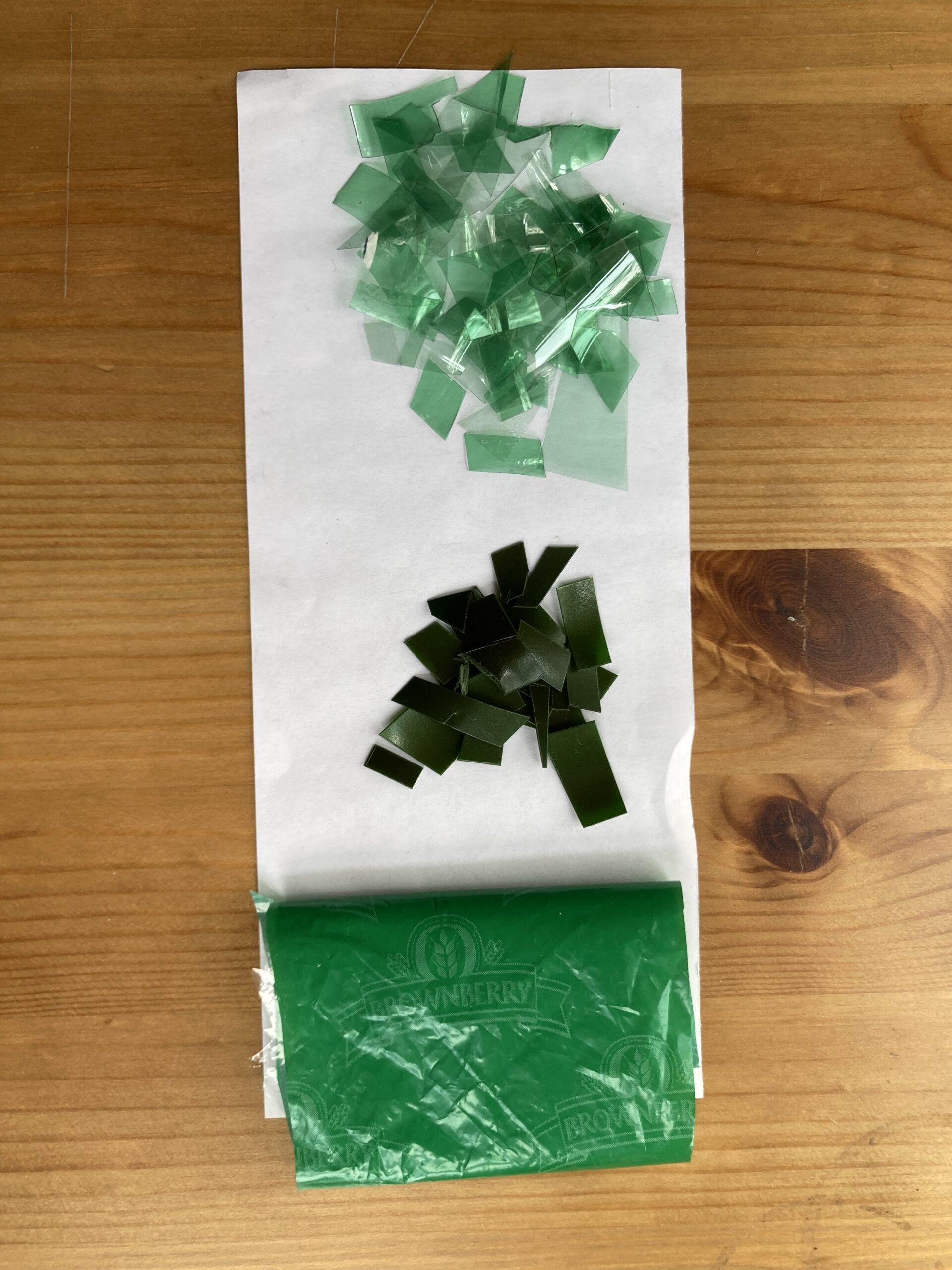
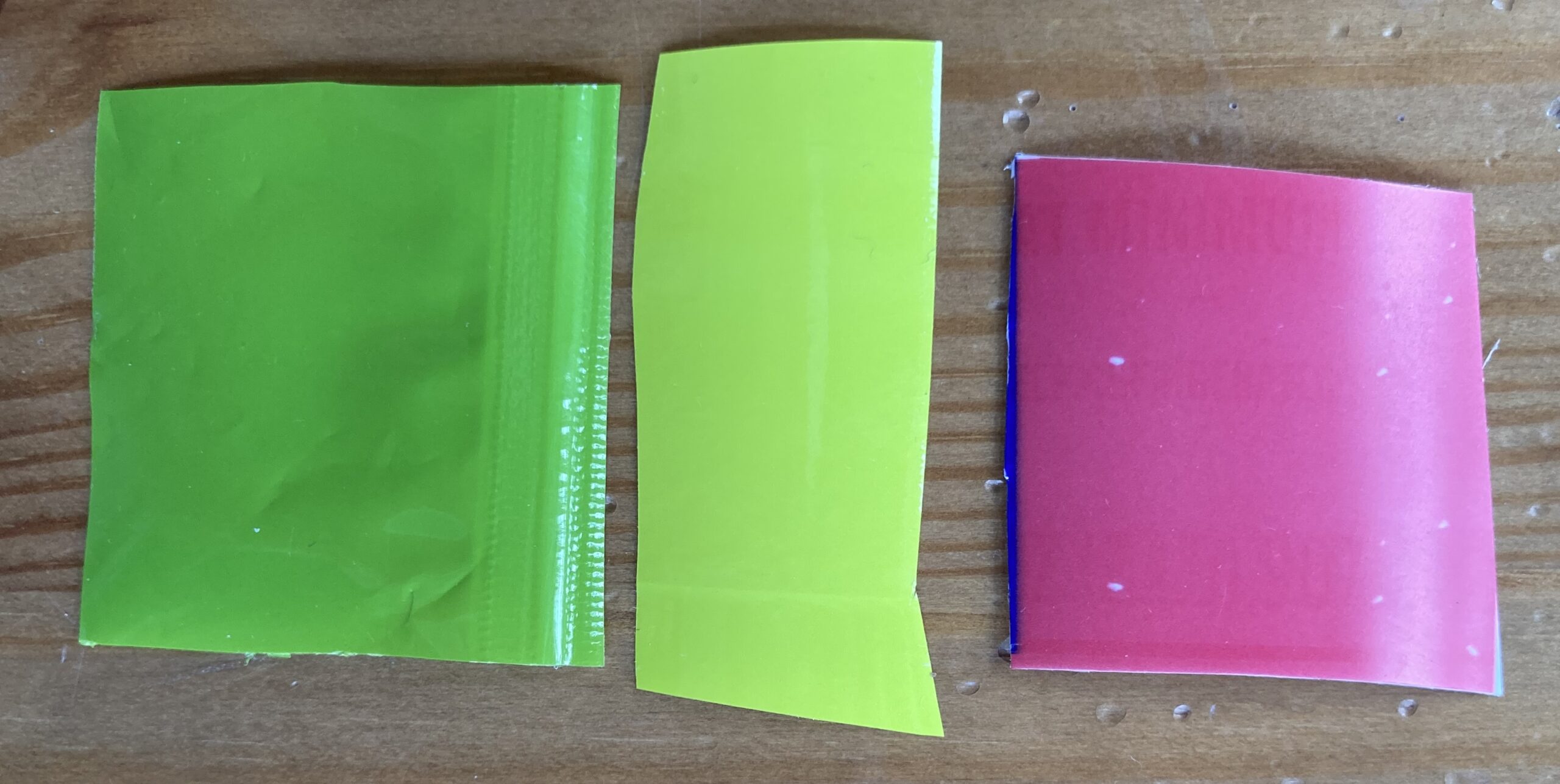
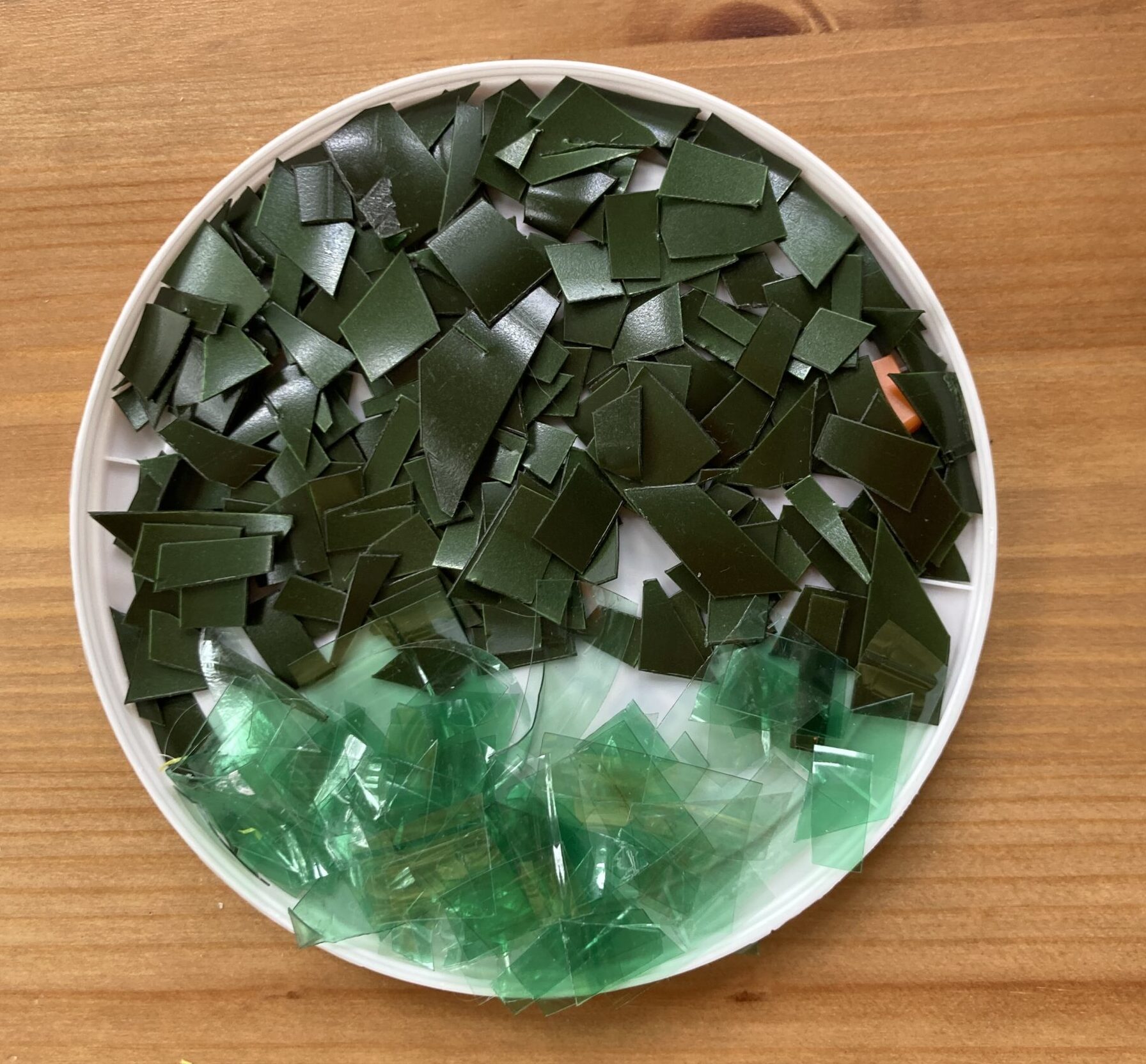
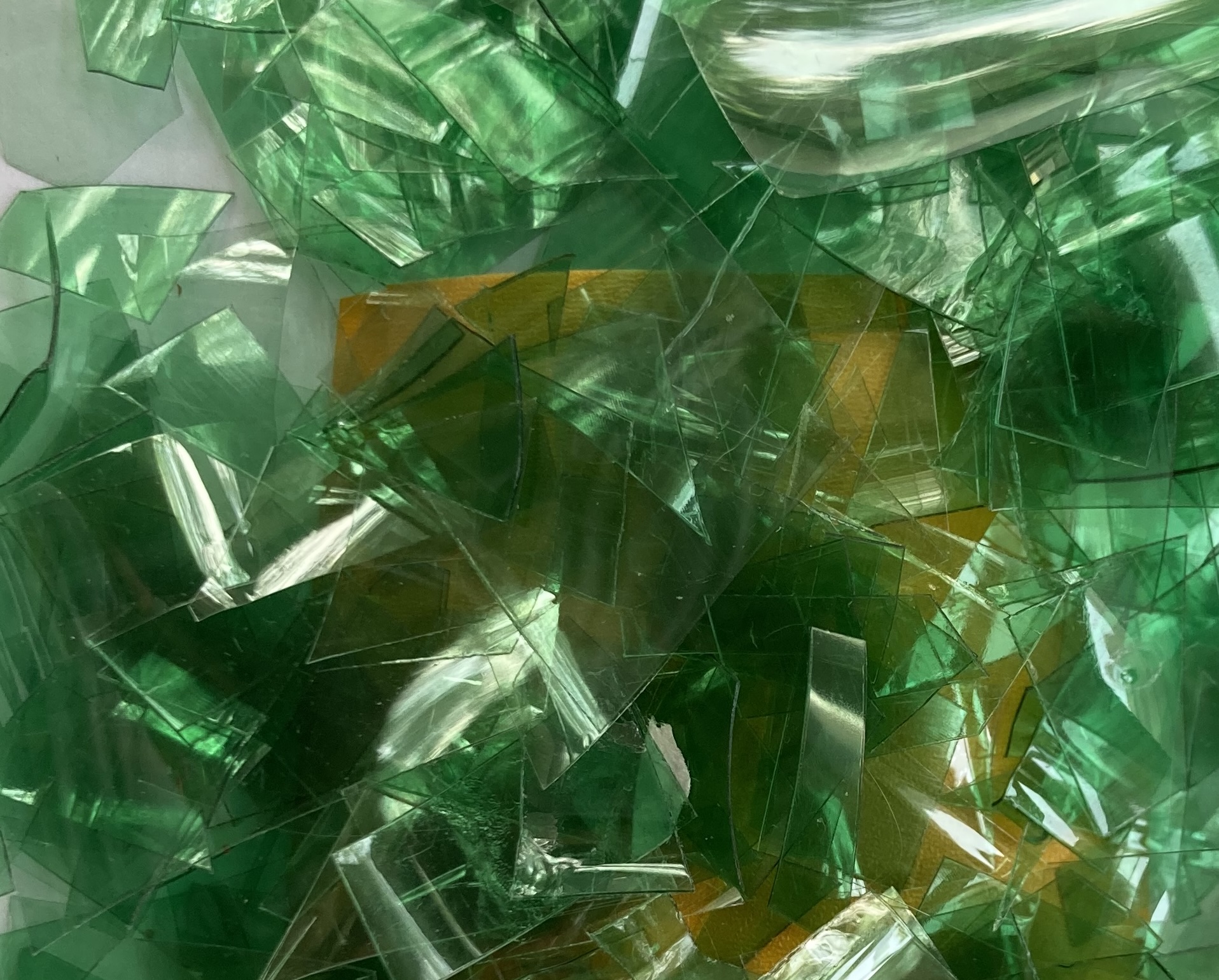
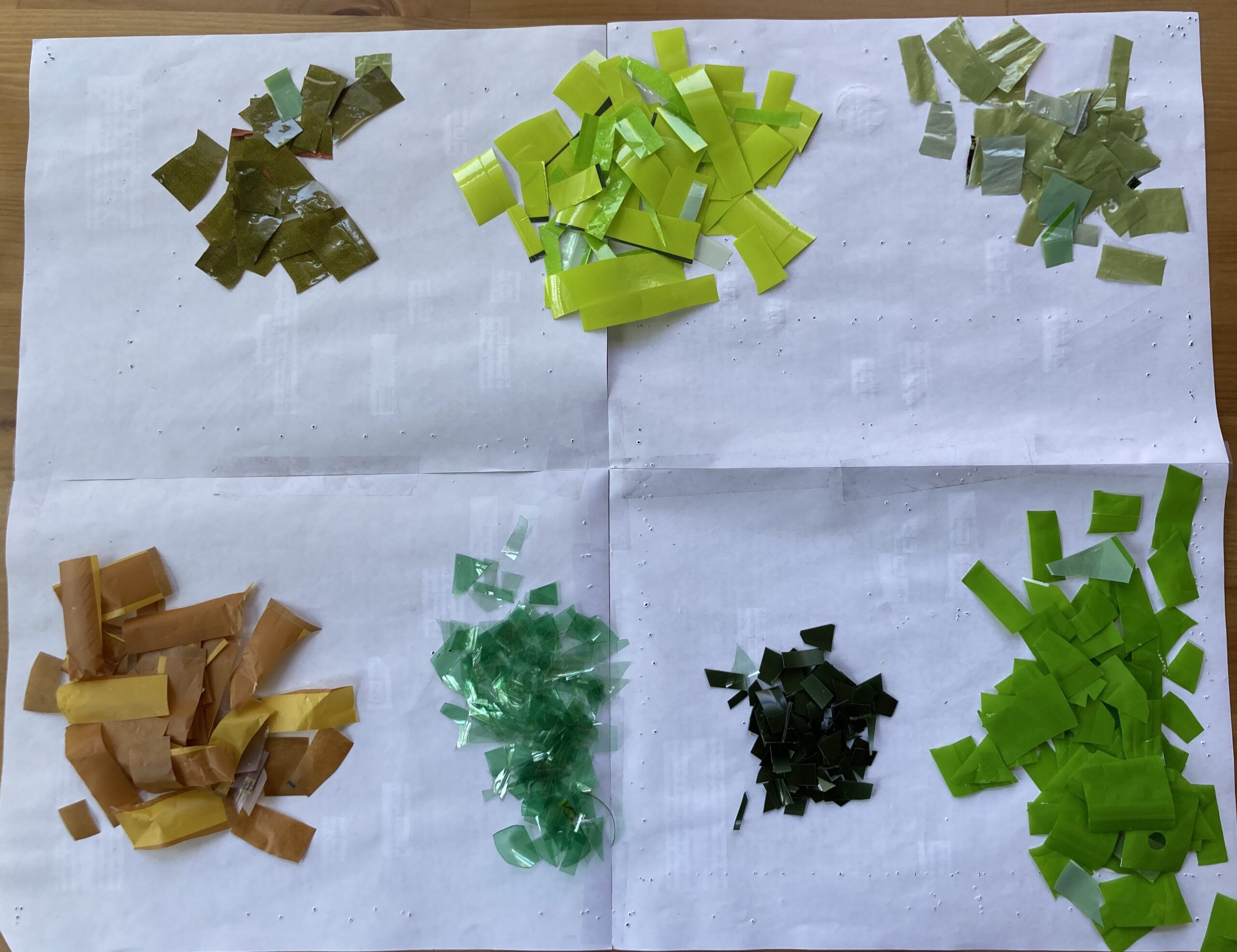
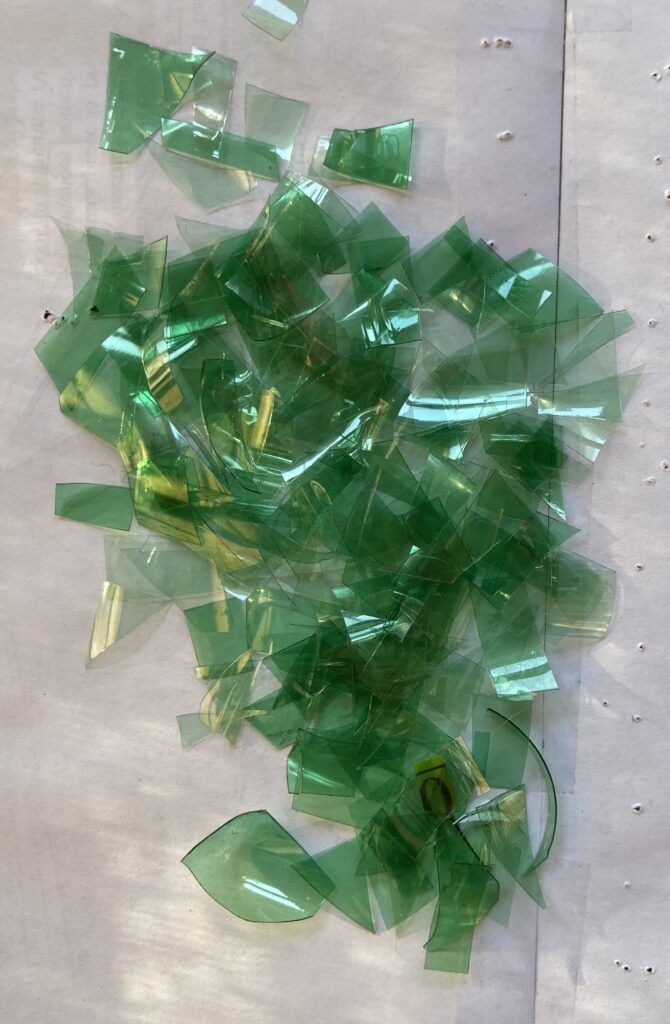
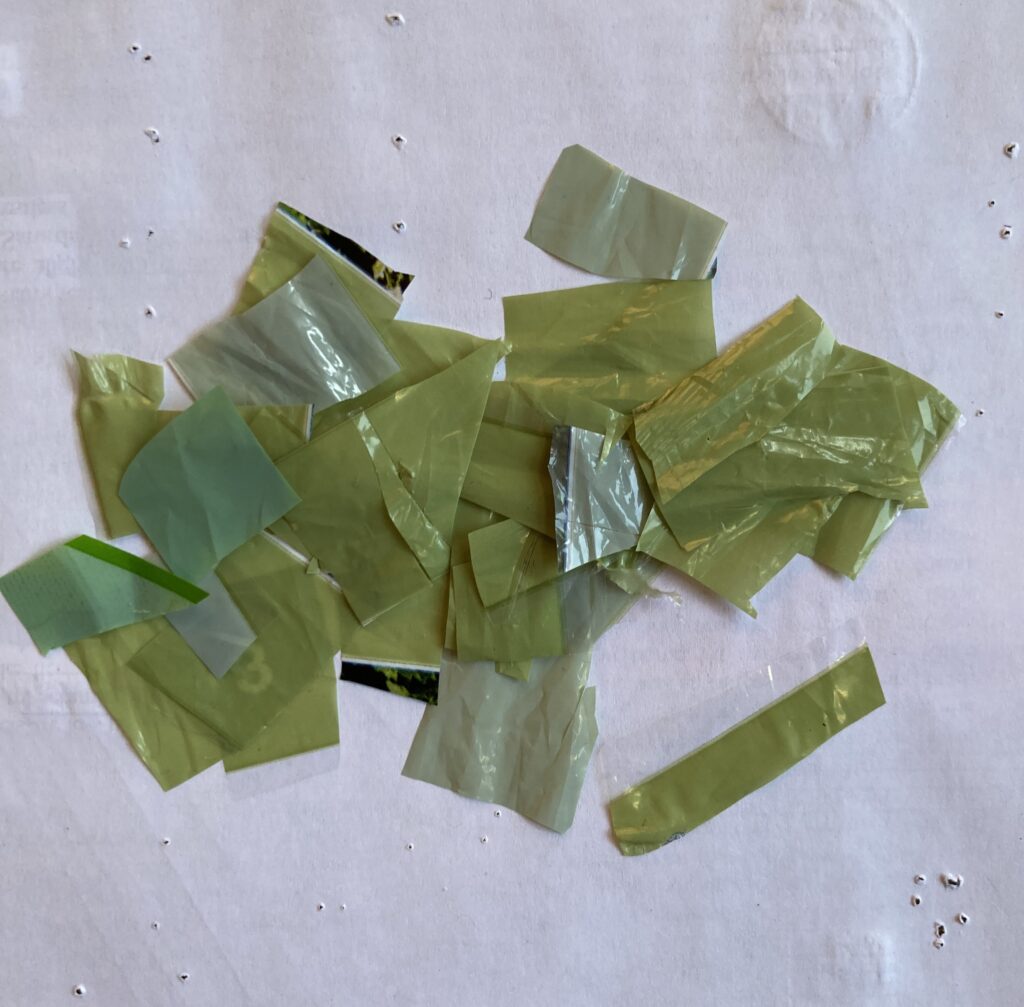
Oh that green! Usually this deep into summer, so much green is accompanied by lots of bugs. Yes, I heard the buzz of cicadas, but there weren’t any mosquitoes or gnats. Where are all the bugs? Returning to the green, these different plastics roughly represent the green, either as I saw it, or as I remember feeling it:
seltzer bottle / olive oil bottle / bread bag
swim: 2 loops (4 minis) cedar lake open swim air: 90 / water: 87 AQI: 75
The water was warm and opaque — low visibility. Yellowish green. A few bubbles, some scratchy vines, but no sparkle friends. The water was heavy and smooth on the way to hidden beach and choppy on the way back. Lots of swimmers were having difficulty navigating and ended up swimming on the wrong side. I almost ran into a pair of swimmers going the wrong way. I didn’t care.
On the back half of the final loop, I started racing another swimmer. We were going the same speed for much of the time, until I turbo-charged it by breathing every 6 strokes and pulled away. When I reached shore, they approached me — I think I was racing you; it was fun! thanks! It was fun.
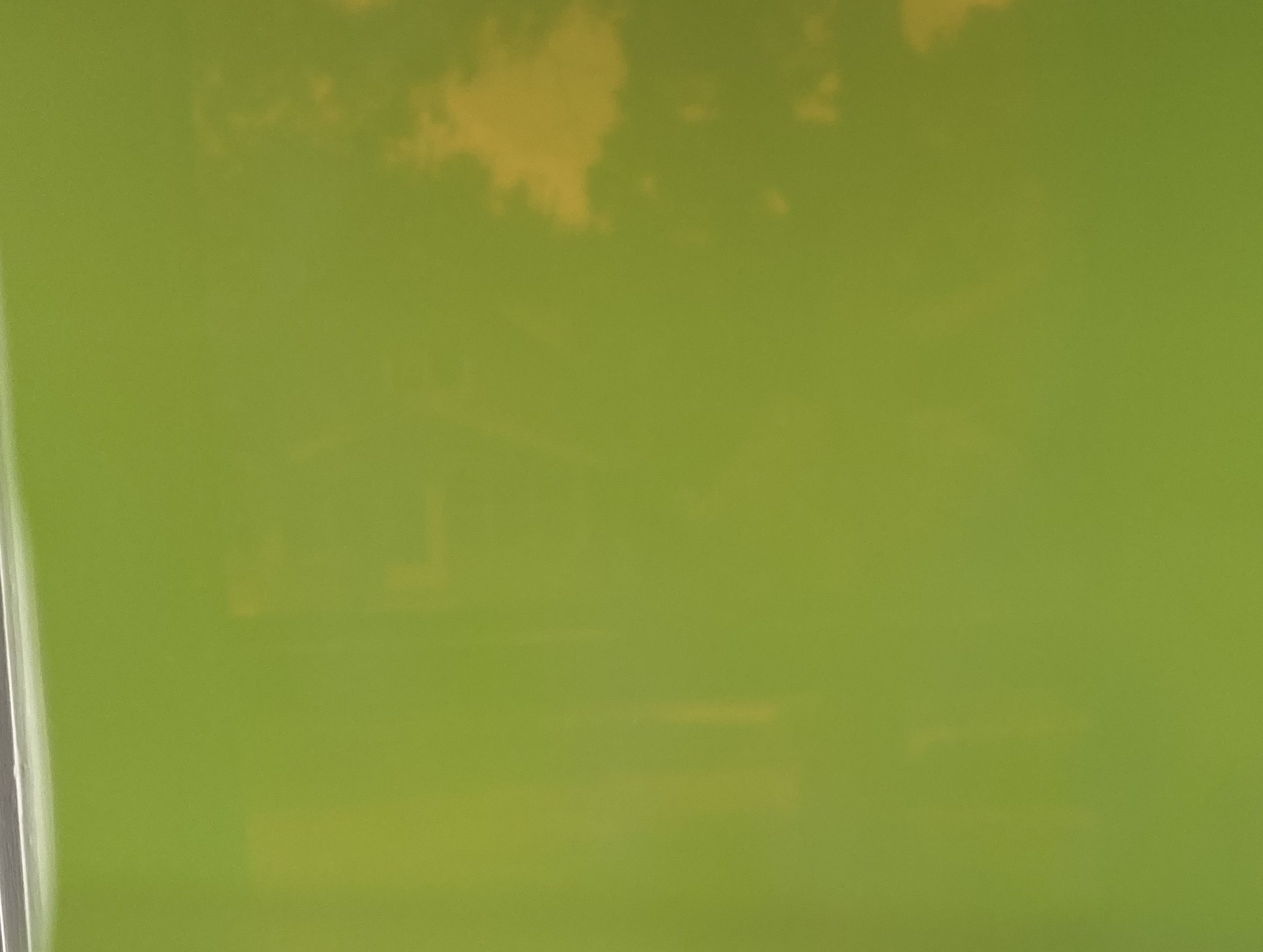
Today’s water color:
yellowish green cedar lake
Is this too yellow? Possibly, but at the beginning of the swim, before I settled in, I remember the lake looking this yellow to me.
A little cooler this morning. The AQI wasn’t that high, but there must have been some smoke in the air because the spots of light on the path looked pinkish-orange. A steady run. Felt strong, sweat a lot.
10 Things
rowers’ voices, down below
click clack click clack — a roller skier’s poles hitting the sidewalk
running parallel with another runner — I was on the paved path, they were on the dirt trail near folwell
2 women sitting on the curb at the top of the locks and dam hill — taking a break after doing a hill workout? waiting for someone? just sitting and talking?
running under the east river road at hidden falls, listening to the creek water rushing down then over hidden falls — what creek is this again? looked it up: Hidden Falls Creek — but, actually, it’s not a creek but a stream of storm water*
minneapolis park workers, mowing the grass beside the trail, stopping and waiting for me to pass
the smell of freshly cut grass
the river, below me on the ford bridge: flat and still and empty
spots of sunlight on the trail, stained orangish-pink
dust or smoke, stirred up by work they were doing at the old power plant near the locks and dam
*When I looked up the name of the creek at Hidden Falls, I found a Hidden Falls Resource Management Plan from 2004 and this description:
Today, Hidden Falls Regional Park encompasses 130 acres andn1.6 miles of shoreline and is an important natural area within the Mississippi River Corridor Critical Area and the Mississippi National River and Recreation Area. It is an oasis of floodplain forest along the Mississippi River visited by local residents and visitors using the park’s trails throughout the year. Visitors utilizethe park for hiking, fishing, running, bicycling, dog walking, birdwatching, wildflower watching, picnics, and boating. The park is a significant stopover place for migrating songbirds and waterfowl traversing the Mississippi Flyway. The park also serves as an outflow for storm water from adjacent neighborhoods north and west of the park via storm sewers that end in the bluffs along the park’s eastern edge.
And here’s a description of where I ran as I followed the creek to an overlook of the falls:
For decades, Hidden Falls has been a nearly inaccessible trickle dripping out of a culvert behind the Ford Plant in St. Paul’s Highland Park neighborhood. Bounded by a tight curve in the Mississippi River Boulevard (MRB), the falls offered visitors two options: a steep climb down crumbling limestone stairs or a rocky hike up from the Hidden Falls Park picnic pavilion.
This month, with the opening of a new tunnel and walkway under MRB, a new viewing platform and the partial daylighting of Hidden Falls Creek, the falls are ready to be discovered by many more visitors.
Originally, Hidden Falls Creek was fed by a natural spring located near Cleveland Avenue and Ford Parkway. The creek above the falls was buried into a culvert sometime in the past century during the development of Highland Park. Now, the falls are connected to a whole new source of water via the Highland Bridge development’s massive stormwater management system, creating a consistent flow of water over the falls.
A creek, daylighted! Reading a little further in the article, I found a video from Dr. Greg Brick (I’ve read and enjoyed his great book, Subterranean Twin Cities) at the site as they were working on it a few years ago:
the video ends with a useful note: the only parts of the site that originated with the WPA are the fire pits. The steps came later.
It was cool to watch this video and think about it the history of where I ran this morning. It’s easy to not notice or reflect on the spaces you’re moving through. Now, five years later, the evidence of the planning and the labor done to create the path under the road, the overlook on the edge, and the daylighted creek are hidden to those not giving attention.
echoes
Thinking about the daylighted creek and the work done to restore/open up the area around Hidden Falls, I’m wondering about echoes beyond the definition of sound bouncing off an object and returning to a listener. Echo as trace, vestige, evidence of what came before. My collection of poems is filled with traces/evidence of what was/is there before me: countless other living things, human and non-human. I am not alone.
Echolocation is a practical tool for navigation; using echoes/changes in sound to gain a sense of the terrain — hearing where a tree or a car or a drop-off is. I use sound in this way to supplement (enhance?) my weak central vision. But echolocation, as in, locating the echoes-as-traces-as-evidence-as-proof that others are there or have been there, is also important to me.
swim: 3 loops lake nokomis open swim 87 degrees AQI: 70
3 loops! No pain in my shoulder! No panicking in the middle of the lake! Only a near foot cramp at the end of loop 3 and misjudging where buoy 4 was on the first loop. A good swim. I felt strong and steady and mostly breathed every 5. There were a few patches of cold water but also patches of very warm, almost hot, water. It was 100 degrees yesterday, so that must have hotted up the lake. It was crowded — on the course, all around the beach, at Painted Turtle. I saw my sparkle friends, noticed that the water was a pale green, felt something touch my toe (a fish, I think). Heard sloshing water and other swimmers chatting near the final buoy; I was treading water to assess my cramped foot.
Overheard: one swimmer to another near the 5th buoy — I feel like I was all over that course!
Overhear: one swimmer to another, on the beach — what do you do if you can’t quite do another loop? I wish there was a half loop option!
The sky was a pale blue with a few clouds. There were kayaks and paddle boarders and a few menacing swans on the edge. No sail boat — probably because there was hardly any wind.
Swimming one day in August is coming and I think I’m ready for it!
bike: 8.7 miles lake nokomis and back 84/88 degrees
As the European grand tour cycling announcers say, it’s hotting up out there. Scott said that the dew point was 81 at the airport this morning. The record (for all recorded weather here) is 82. Yikes. Instead of running, I decided to bike to the lake and swim. I haven’t biked over to the lake when it wasn’t an open swim this summer for several reasons: 1. the milfoil around the buoys made it too annoying (and dangerous) to swim; 2. I was swimming a lot already at open swims; 3. and because I was already swimming too much, I injured my shoulder. But, the milfoil has been removed, or at least thinned out (hooray!): I can’t do open swim at cedar tonight; and my shoulder is feeling better. Another reason to come over here on my bike besides the facts that it’s too hot to run and I haven’t driven a car in 5 years: my Apple watch activity challenge for July is 5 bike rides of 5 minutes or more. Even though that’s not a challenging challenge, I haven’t achieved it yet this month because it’s been too hot, too smoky, and I’ve been too sick.
The bike ride was easy. I didn’t have to try and pass anyone and I could see well enough to navigate. The paths were not crowded. No big groups of kids or silver riders. No packs of runners. Part of the trail was closed, but I could see and follow the detour signs.
10 Bike Things
the parking lot at the falls was almost empty, one 1 or 2 cars
a bird near the lake — cheer up cheer up — a robin
thwack thwack — the pickleballers are at it again, playing on the court at the rec center, no shade anywhere
a handful of single runners sprinkled throughout my ride
the creek under the echo bridge was low and bright and still
an adult with a kid in a seat sped past on an e-bike
orange paint around the cracks on the trail near my favorite part of the path
just past that: trail closed for road (or sewer?) work on nokomis
biking over some bumps on the part of the path sandwiched between the light rail and the creek, my chain was jammed — I slowed down, preparing to stop and fix it, but it unjammed itself
minneapolis park workers out doing some work — mowing? cutting down limbs? I’m no sure
swim: 1.5 loops lake nokomis, main beach 86 degrees AQI: 57
A wonderful swim! The water was calm and not too warm. Only one other person was swimming loops, and they were doing it much closer in. No boats or paddle boards to watch out for. Hardly any milfoil, or the usual (from past years) and manageable amount of ghost vines reaching up from the bottom. A few more vines floating free near the surface. I swam at a relaxed pace, stopping to notice the quiet lake at the end of every loop. I listened to a dad talking his little kid — kid: am I going to grow taller? Dad: yes, you just need to keep eating your growing up food. I exchanged something (not words, but a feeling, mutual acknowledgment/recognition?) with a seagull that was perched on the far white buoy for the entire time I swam. Hello friend — are you waiting to catch a fish? A brief thought: how many fish are beneath me right now?
As I stroked beside the white buoys, I thought about how swimming in this deep-ish water off the big beach is a different experience than swimming across the lake. Here, with the shorter loop and the buoys beside me, I hardly have to sight. I can just swim until I reach a far buoy, then loop around it, and swim until I reach the other far buoy. Here, I barely need vision. For that reason, and because I’m not swimming far out into the middle of the lake, you might think that swimming here would be less scary. But, I’m always a little more on edge during these swims than the ones from shore to shore. Will I get too tangled in the vines? Are there fish lurking under the buoys?
At the end of my loops, I swam in between the faded red buoys and floated, my head resting on my yellow buoy. Then I sunk under the water and swam with my face just above the lake floor, studying the brown, sandy bottom. Ah! What a way to start the day!
Today’s color palette: white cylindrical buoys, faded pinkish-reddish spherical buoys, pale green water, bright blue sky, the clear bubbles and underside of water’s surface, a light brown sandy bottom.
(l to r) blue sky, brown sand, white buoys, faded pink buoys, clear bubbles, green water
a return to echolocation
Even as I’m trying to think about water and swimming, I’ve also returned to my manuscript from last year, which has gone through a number of names: Haunts, then Girl Ghost Gorge then Echolocate || Echolocated and now Echolocation. I was compelled to return to this project 2 months early (usually I work on it in the fall) because I noticed a call for manuscripts at one of my favorite presses. And I’m writing about it here because I realized, as I searched for past thoughts and words about this project, that even as I remember thinking about some poem or essay or fact that I’ve come across, I can’t find it on this log1. Did I write about it in a pages document or in Plague Notebook entry? If I don’t post it here, it’s more likely to get lost. So, more posting here.
As I fine-tune my manuscript, I want to weave in more direct references to echolocation and what I mean by making it the title of my collection. It’s literal and figurative. I’m writing about the location of echoes (the gorge and the trail above it), where echoes = the bouncing back of sound in wide open spaces and traces of the past/ghosts. I’m also writing about the act of echolocation, which is used by blind and low vision people to navigate the world. I’ve read about passive echolocation (hearing sounds/echoes that already exist to navigate) and active (creating sound with tongue or cane clicks or footsteps to bounce off of objects. I’m also interested in a third version of this, which is both (or neither?) active and passive: being the object or the solid thing in the world that can be located by others’ sounds. Does that make sense? Here’s a video that I just found that I’d like to archive and use to think more about echolocation:
passive and active echolocation
Not being able to find past essays/histories that I know I was reading and thought I was writing about has also come up with my “this isn’t the sea” project. I was almost positive I wrote about Dr. Christian Lambertsen and his SCUBA testing at Lake Nokomis but, after a long search, I couldn’t find anything. ↩︎
3 loops! lake nokomis open swim 81 degrees AQI: 69
3 loops! Finally, I’m feeling better — less anxiety and crud on my chest and no shoulder pain. I was planning to only do 2 loops today, but when I felt good at the end of loop 2, I decided to do one more. Who knows when the smoke might come back and make it impossible to swim?
The water was wonderful. A little cooler, more buoyant. Talking with a woman after swimming, we agreed that the water was much nicer than on Friday, when it was choppy.
I felt very relaxed and powerful. Strong shoulders and back. Sometimes I breathed every 5 strokes, more often every 3 or 4 or 3 then 4. I had no problem staying on course, a combination of seeing the buoys more frequently, and straight, even strokes.
note: I’m trying to write this as I watch the final stage of the tour, which is not easy because Pogachar is going for it. As one of the announcers remarked, “He’s racing like it’s the end of days out there!”
11 Things
as I started, near shore, the water was a dark green, almost the color of my olive oil bottle shards
clear bubbles bursting from my hands as I pierced the water
my sparkle friends! sediment being illuminated by the light, coming towards me
bright pink buoys bobbing in the water, tethered to torsos
200 strokes from buoy 4 to buoy 5
a few planes high in the air above me
a glitter path and sparkles on the water’s surface
some floating vine fragments getting tangled in my fingers as I stroked through the water
the view below me: a deep green nothingness
the view above me, from underwater: the surface, green then clear then bubbles
a church service was happening near Painted Turtle; as I paused in the middle of the lake to enjoy
Wow! What a finish to the Tour. The most exciting one I think I’ve ever seen — a showdown between Matthew van der Poel and Pogachar. Then van der Poel hung on to win, as the sprinters were closing in.
5 miles bottom of franklin hill and back 77 degrees / dew point: 72 AQI: 52
Went out for my run at 10 so I could watch the queen stage of the Tour de France. It was hot, but worth it to watch all the drama of the final climb. Sepp Kuss crashing twice and barely saving himself from falling over the edge of the mountain. Yikes. Carapaz won the stage. Pogachar acted as a domestique for del Toro.
It was warm, but there was a cool breeze and no sun, which helped. I was able to greet Dave the Daily Walker at the beginning – Good morning Sara! / Hi Dave! I heard the rowers down below, encountered lots of runners, most of them running by themselves, like me. Was passed by many bikers and roller skiers. I ran down the franklin hill then stopped at the river to study its surface — a thin film of something was on it in streaks. Down in the flats, by the low retaining wall, I noticed a single shell and the white coxswain’s boat taking a break in the middle of the river.
Even though my chest has some crud, I feel much better today. My resting heart rate is lower and I’m less anxious. The effects on inhaling wildfire smoky air = 4 days of feeling like I had a bad cold.
10 Things
white sky
thick, moist air
deep greens
no bugs — where are the bugs?
overheard: one guy walking down the franklin hill, meeting up with someone halfway down and turning around to walk with him, I‘m glad I don’t have to walk up the entire hill!
the big crack north of the trestle is growing deeper and is still barricade off — is too deep and dangerous to patch?
stopped at the sliding bench — a deep, dark green view below
a woman crossing over the road ot the trail, carrying a coffee, not wearing any shoes
no stones stacked on the ancient boulder
a horn blasting from somewhere — a train horn? deep and loud
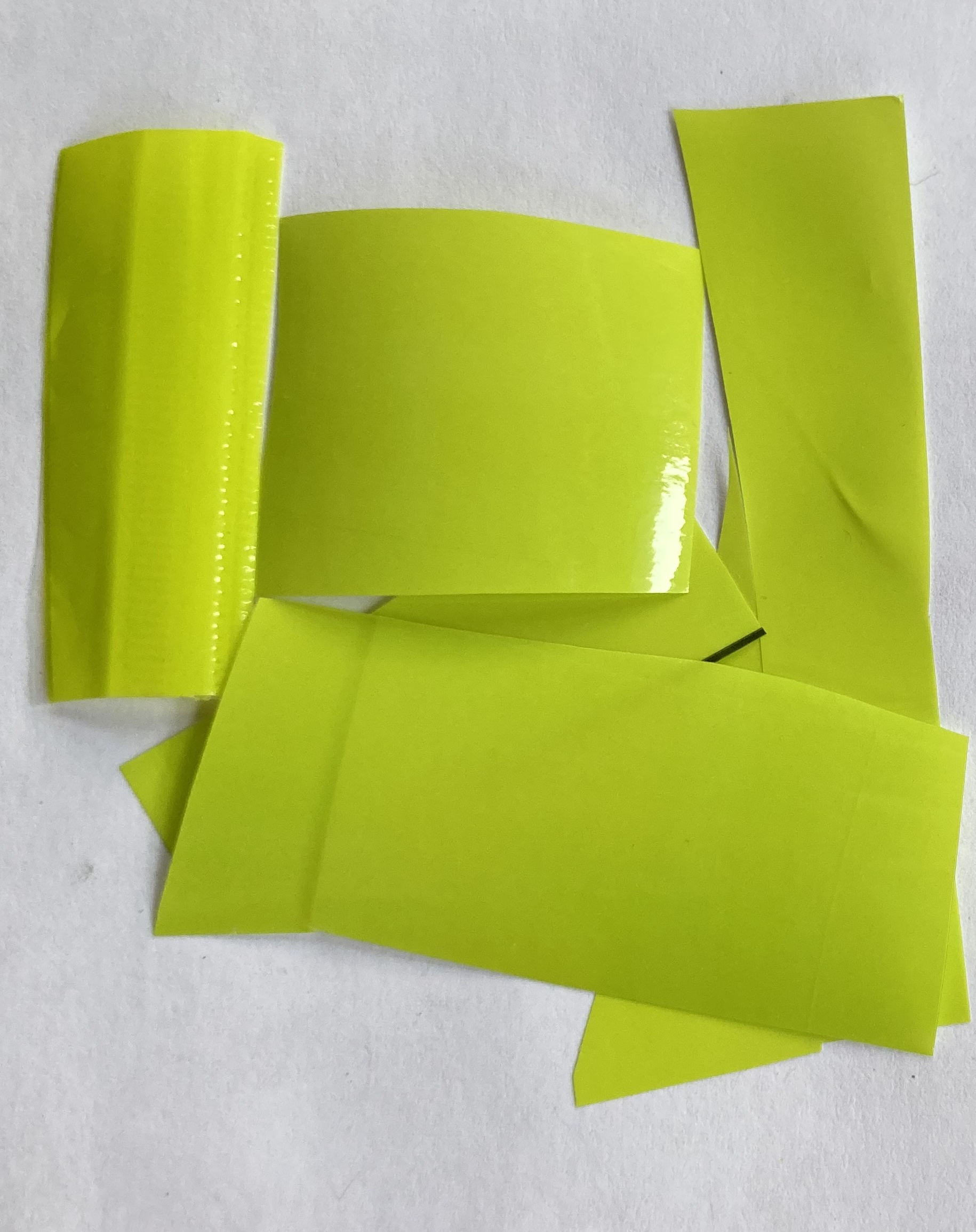
today’s colors in plastic
At different times, depending on the how bright the light behind the clouds was, the sky looked either 1, 2, or 3:
the “white” sky
Standing behind the sliding bench, looking down at the green gorge, I saw these 2 greens:
2 loops today. Hooray! I’m still feeling weird, where weird = some trouble breathing, sore joints, a little brain fog?, fatigue, a sense of disconnection to the world because of brain fog or declining vision or increased anxiety due to adjusting to HRT, but less weird than yesterday. I’ll take it.
I felt strong and buoyant and fast. My breathing was better too. No wheezing and several stretches of breathing every 5. My bad (left) shoulder ached for the second lap. I think it’s an impingement that won’t go away with just rest and ice. Time to get serious about the shoulder exercises / shoulder yoga.
Today I was relaxed enough to notice the color of the water again: a light green with some feelings of blue. Above, it was pale blue due to the clouds: streaks covering the sun. One bright spot: rounding the buoy near the little beach, the top of the water reflected lime green. Below the surface: some clear bubbles and nothing else. Opaque — low visibility. No sparkle friends or shafts of light or silver flashes.
I listened to the water as it sloshed over me. I heard a goose before entering the water. Scott quipped, they’re flying south. Then I heard a seagull. My bird friends! I’ve missed them. Saw a plane high above the lake. Admired the wildflowers blooming in the grassy area near the beach house — lots of purple.
My goggles fogged up several times, which made it even harder to see. I didn’t mind not seeing the buoys (because I hardly ever do), but I did mind how isolated and removed from the world it made me feel — not disconnected, but like I was wrapped in a thick layer of fog, my view obscured, my body heavy with the weight of it. When this started to feel too unsettling, I focused on how the water gently rocked me, and I snapped out of it.
Ended the swim by meeting up with Scott and watching the last 5k of stage 19 of the tour. Pogachar powered up the HC climb to win the stage. Nice!
Still not feeling the greatest from too much wildfire smoke last weekend, but I am feeling better than I was on Tuesday night, so I decided to swim a loop before going to Scott’s concert (the big band he’s in) at the falls. RJP drove me. It was great to spend time with her. I think we both made each other feel better.
The water was warm and choppy, which I didn’t mind. The buoys were set up in such way that made the course .25 miles shorter, which I also didn’t mind. My shoulder ached a little, but it was mostly okay. My back and legs and torso felt strong, my lungs a little weaker. It was difficult to breathe every 5 strokes; I switched between every 3 and every 4. For the last stretch of the loop, I think I heard myself wheezing. It was all the crud stuck in my throat. I’m glad I only swam one loop. Two loops would have been too much.
10 Things
one swimmer talking to another before starting, 1: the water’s a little cooler; I like that
one swimmer talking to another before starting, 2: the lifeguard is right in the way — I hate when they do that (me too)
bubbles — clear, underwater
the slimy, milfoil-y bottom of the lake near shore — felt by my foot as I adjusted my nose plug before starting
4 kids playing soccer in the sand, near the sidewalk
blue sky with streaks of clouds
the water was choppy but no waves were crashing into me as I breathed
swimming wide on the course until suddenly I saw a quick flash of a buoy –I’ve had to train myself to believe in these flashes and follow them — it’s taken years to believe because they are so fleeting
123 breathe right 123 breathe left
4 sailboats out on the water — one of the sails was red
a ramble for future Sara on the discomfort of not breathing well
The smoke is mostly gone from the air — but, for how long? — but not my lungs or sinuses. Mostly, I feel uncomfortable. I can breathe but it feels heavier, harder. Last night started terribly with lots of talking my self down: just one breath at a time, breathe, breathe, in 2 3 4 5 out 2 3 4 5. And lots of pacing. When I feel trapped (this time, in my body), it helps to move. At some point I fell asleep, then woke up, then fell asleep again. Woke up in the morning with crud on my chest and the inability to sit for more than a minute. Not being able to breathe is one of my big fears.
After we tested for Covid (and 2 strains of the flu + RSV) and it was negative, I accepted that my sore throat, closed-up nose, heavy chest, wooziness, was not anything other than inhaling too much bad air. It seems to have affected me much worse than Scott or FWA. Suddenly I realized why. I have a deviated septum. Lake and pool water has been bothering me for a decade; I don’t swim without a nose plug. And I often wear breathe right strips at night. I guess I will need to be more vigilant — more neti pots, masks, avoiding being outside when the AQI is high (how high?).
run: 2.5 miles 2 trails 74 degrees AQI: 41
I started feeling a little better in the afternoon and thought that running and the deep breathing it requires might help break up some congestion, or at least make me feel better as I moved. I think it might have helped a little with congestion; it definitely made me feel better.
Steady flow of commuting cars. The far off pounding of construction work. Birds — so many birds chirping and tweeting in the trees. Drip drip drip drip: water dropping from the sewer pipe down the ravine at 42nd. Voices. A small something on my chest and throat — cough cough. A woman in white shorts, or was it a skirt? on the Winchell trail. A man holding a dog off the trail so I could run by — thank you!/ you’re welcome.
3.35 miles wabun hill and back 68 degrees wind: 15 mph / gusts: 26mph AQI: 50
Woke up feeling bad. Sore throat, a little stuffed up, sore/achy, out of it. Both FWA and Scott have felt this way too. We could be sick — covid? — but most likely, it’s the smoke and bad air quality from the weekend. Mine could also be caused by HRT, at least the achiness. Hopefully I will fell better soon. Yes, I am whining a little because I dislike sore throats and feeling out of it, but mostly I’m writing about feeling sick for future Sara to read in a few months or years.
note: Future Sara here — one day later, that is — after a covid test, we’re pretty sure it’s just the wildfire smoke that is causing this. A rough night and a difficult morning. I write more about it in my 22 july 2026 entry.
It’s hard to feel too bad when it’s so nice outside. Cooler and fresher. A breeze, a lower AQI. I decided I couldn’t waste this weather, so I went out for a run. I also thought it might make me feel better, which it both did and didn’t. Ran south on the trail to the locks and dam, then up the wabun hill. Stopped at the top to look out at the river. All I can remember is thinking that it was higher than it had been. Ran down the hill, then back north on the trail. Listened to my “Plastic Fantastic” playlist but don’t remember much of what I heard, other than this line from Lady Gaga in “Plastic Doll,” I’m no toy for a real boy, and these from AQUA’s “Barbie Girl,” You’re my doll, rock’n’roll, feel the glamour in pink/ Kiss me here, touch me there, hanky panky. “Barbie Girl” is such a terrible song.
10 Things
the bright purplish lights of a bike approaching
a group of 5 or 6 bikers, chatting loudly, biking on the road and backing up cars
Regular, 1: waving to Santa Claus!
Regular, 2: passing Skirt with Sandals — she wasn’t wearing hiking sandals, but running shoes!
a group of women, walking together down the locks and dam hill
a man with a fancy camera on the walking side of the pedestrian bridge, taking pictures of the ravine
a woman, looking down at her phone, standing in the middle of the path
3 people standing on the sidewalk, talking, completely blocking the entrance
adjusting my cap so it wouldn’t blow off in the wind
peering through the green on the way up the Wabun hill: before you pass under ford bridge, some rock face, deep in the shadows, then dirt, then grass
swim: 1 loop lake nokomis open swim 78 degrees (air) / 82 (water) AQI: 77
Was feeling crappy all day, but Scott really wanted to go over to the lake and I didn’t want to miss an opportunity to swim (who knows what the AQI will be tomorrow), so we went. I’m glad we did. A good swim, much better than the run. I felt strong and confident and happy to be in the water. It was choppy with little swells rolling in behind me as I neared the third buoy. And more waves in the back stretch.
overheard, swimmer 1: it’s not too bad out here. the wind has calmed down. swimmer 1: don’t say that, you’ll jinx it! *the wind picks up* swimmer 2: see what you did — you ruined it for all the swimmers! (laughter from both of them)
I was committed to only swimming one loop. Between the choppy water, me being a little out of it, and my still sore shoulder, I didn’t want to overdo it. Hopefully I can swim more at the end of the week and next week.
The water was more blue green tonight. I think I saw bubbles, but no silver flashes. now menacing swans or clueless kayaks or drifting sailboats. I don’t remember seeing any birds or planes or dragonflies. No squeaks or leaks from my new nose plug.
4.6 miles locks and dam / wabun hill / veterans home / falls 76 degrees / dew point 72 AQI: 70
Hot! So much sweat! Sun. The air was thick but not smoky. I’ll take it. Yesterday, while I was swimming, Scott ran around the lake once, which is not quite 3 miles. The AQI was almost double at 137. Last night his throat started burning, like swallowing acid, he said, and his throat closed up a little. He thinks it’s because of the high AQIand that he breathes only through his mouth when he runs. I thought about what happened while I was running and noticed how I was breathing in through my nose and out through my mouth. It’s all of my rhythmic breathing, I think: In 2 3 / Out 2.
I listened to my Plastic Fantastic playlist. I was particularly struck by The Sugercube’s “Dear Plastic,” so I looked up the lyrics:
p-p-p-plastic n-n-n-nylon te-te-te-terylene
made of atoms by tender fingers and determined heads of inventors tickling perfection
p-p-p-plastic r-r-r-rayon
I was born aeons ago before anything human was known my friends the alchemists told me everything was natural and always will be that way and possible to make gold from dirt
p-p-p-plastic n-n-n-nylon
dear plastic be proud don’t imitate anything you’re pure, pure, pure
p-p-p-plastic n-n-n-nylon
I believed I was their dustbin for knowledge took everything and digested of course I became big, big and really really strong
today I’m old and withering away my friends the alchemists long disappeared into dust I no longer get anything fruity no longer gold made from dirt the only thing I get is spacefood on a tray
p-p-p-plastic p-p-p-plastic p-p-p-plastic…
As I was walking the last few blocks after I finished running, I thought about Elastigirl from Pixar’s The Incredibles and how her superpower is the ability to stretch and transform into (almost) any shape she wants or needs and then return to her original shape. Plastic can make new shapes without returning to the original shape. I looked up, “elasticity vs. plasticity” and found this:
Objects deform when pushed, pulled, and twisted. Elasticity is the measure of the amount that the object can return to its original shape after these external forces and pressures stop.
The opposite of elasticity is plasticity; when something is stretched, and it stays stretched, the material is said to be plastic (source).
AQI (1:00pm): 45 AQI (4:40pm):61
swim: 1 loop (2 cedar loops)
cedar lake open swim 88 degrees AQI (5:30pm): 61
I would have loved to swim more loops, but it was warm and windy and my shoulder started hurting near the end of the first loop. A bummer, but at least I was able to swim for almost 30 minutes in the lake. No terrible air quality. I am grateful for any chance to swim.
The vibe was very cedar lake, with the disgusting, almost totally filled porta potty with no toilet paper, randos swimming out the buoy and getting in the way of swimmers — watch out! — and open swim club members swimming as close to or as far from the buoy as they wanted, occasionally crossing the path of swimmers going the other way.
The water was green with notes of yellow and opaque. I was able to see a few of my bubble friends, but nothing else. No fish or milfoil or sparkle friends. I don’t think I ever see sparkle friend here — not the sediment sparkles under water or the glittery sparkles on the surface.
added the next day: I wanted to replicate the color of the water with my plastics, but didn’t have time last night. I’m not sure either of these quite capture the mix of (mostly) green with some yellow:
123
1: back of cukes plastic bag held close to the window 2: back of cukes plastic bag held far from the window 3: a square of a yogurt container covered with seltzer water shards
I think 2 is too yellow. I think there’s a section of 3, on the right side, that might best capture my memory of the water. I also like the overall color of 1.
Will we have open swim in an hour and a half? They haven’t cancelled it yet. I went outside to water the tomatoes and peppers and I could feel the smoke, but it wasn’t too bad. 113 is “unhealthy for sensitive groups.”
In other health news for future Sara when she talks to her doctor at the end of the month: another night with restless legs and (almost) a calf cramp. I felt the same sort of wave of something strange pass through my lower calf as I did a few years ago. Back then, it made me very anxious, last night, not as much. Is it the wrong level of estrogen or progesterone, or my body getting used to the HRT, or something else? Whatever it was, I slept poorly: only 5 hours even though I went to bed at 10:30.
AQI (8:15am): 123
swim: 2 loops lake nokomis open swim 76 degrees AQI: 137
Open swim happened! Hooray! I was disappointed that the air quality was bad, but it wasn’t that bad and it made for a cool effect on the water. So much smoke and haze, all of it white and dreamy. Harder to see for everyone, at least I imagine it was harder for normally sighted people too. It didn’t bother me because I already can’t see that well, and don’t really need sight to navigate.
Before the swim, my entire body was bubbling with anxiety — a combination of adjusting to the hormone flux, and strong physical reactions to any strange sensations in my calves. I think I was worried that I might have a calf cramp in the middle of the lake. As I started swimming everything felt strange, surreal. Smoke, warm water, a gentle rocking. I tried to distract myself by focusing on colors, but the anxiety kept bubbling up near the edge, like boiling pasta water on the stove. Just before it boiled over, I abruptly stopped swimming and listened to the silence in the middle of the lake. I saw a lifeguard silhouetted in the smoked-out sun and the bright pink buoy of another swimmer and I was able to calm down. I started stroking again — 1 2 3 4 5 breathe right 1 2 3 4 5 breathe left — as I passed the second, then third buoy.
I was able to swim about 40 minutes without stopping and with only a few more anxiety flare-ups. The water was a pale blue-ish green below me. Looking up and just beneath the surface, it started as pale green, then turned into a clear band at the edge. Above, it was the hint of a purply blue.
10 Things
a lot of the Eurasian milfoil is gone!
some non-open swimmers were blasting a speaker at the lifeguard stand where open swimmers leave their stuff, the LOUD throbbing of the beat increased my anxiety
overheard, 1 swimmer to another: I’m just going to swim to the second buoy and back
overheard, 1 swimmer to another: I have no illusions about my swimming ability!
overheard, 1 swimmer to another: Let’s put our ages on our (Women’s Tri race) caps! You don’t have to, but it’s fun to see everyone’s age when you’re running!
arriving at the lake, the smoke on the water looked so thick — everything was white
the occasional bent elbow of another swimmer, some foam, a bright pink or orange buoy tethered to a torso
a few shredded clouds hanging in the sky
a slight ache in my left shoulder by the start of loop 2
rounding the fifth buoy and sighting the first one in the distance: a small, bright orange dot
AQI (12:30pm): 156
The water offered a gentle rocking for the first half of the first loop, then turned choppier. I could see my bubble friends and hear the sloshing of water over my head.
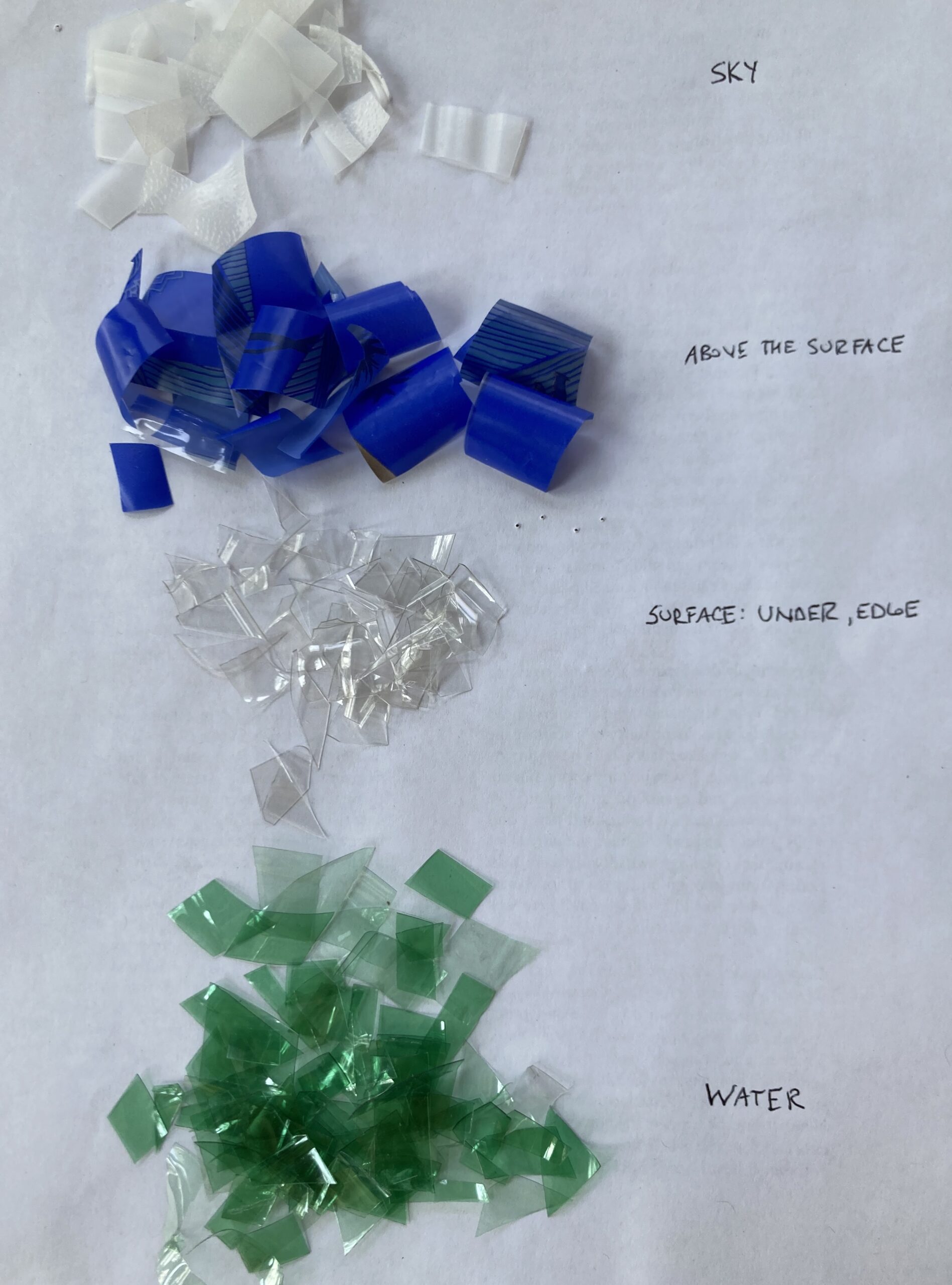
color in layers: underwater / underside of surface / surface from above / sky
water / under surface / above surface / sky | seltzer bottle / danish container / ziploc / milk jug
Playlist: Plastic Fantastic
Created this plastic playlist yesterday. I’m looking forward to listening to it on my next run.
Plastic Hearts/ Miley Cyrus
Midnight Sky/ Miley Cyrus
PLASTIC/ sakehands (feat. Marty Valentine & Lo)
Plastic/ Moses Sumney
Fake Plastic Trees/ Radiohead
Plastic/ New Order
Plastic/ Portishead
Plastic Doll/ Lady Gaga
Barbie Girl/ Aqua
Plastic Romance/ A Toys Orchestra
Dear Plastic/ The Sugarcubes
Plastic Jesus/ Jello Biagra & MoJo Nixon
Welcome to the World of the Plastic Beach/ Gorillaz (feat. Snoop Dogg and Hypnotic Brass Ensemble)
Plastic Beach/ Gorillaz (feat. Mick Jones and Paul Simonon
Synthetic World/ Swamp Dogg
Plastico/ Ruben Blades
Plastic Girl/ CAPSULE (feat. EeL)
The Bomb/ L7
Plastic Factory (Mono)/ Captain Beefheart & His Magic Band
4 miles minnehaha falls and back 82 degrees / dew point: 72 AQI: 62
Hooray, the smoke moved out! Boo: not in time to have open swim this morning. Oh well, went for a run instead. It was hot and humid, but the air wasn’t hazardous and I had (finally) tied my shoes properly so that my feet weren’t sliding around, so I was happy to get outside and move. Mostly running, with some walking. In my approximate fashion, I followed a plan of intentional run/walk segments — 4/1 | 4/1 | 2/1 | 90/30 | 2/1 | 2/2.
10 Things
2 porta potties at the park with a temporary hand sanitation kiosk beside them — what even is happening here today? update: an art fair
a food truck — orange, yellow, and red — Cafe Cairo
the white foam of the falls
a shopping cart with a few things in it — some sort of electronics — in the middle of the narrow trail below the road
big spots of light in the midst of the shadowed trail, near the cart
a city truck blocking the path that leads down to the locks and dam — a crane in the air
the water in the water fountain was hot — yuck!
a person briskly crossing the parking lot, stopping in time to let me run by
a biker weaving over to the walking trail to avoid the bright sun on the bike path
the tangy — sweet and sour and rotting — smell left behind by the garbage truck
While I moved, I listened to the podcast about microplastics that I mentioned yesterday: Science Vs. Microplastics. I enjoyed it, even as I was a bit skeptical (thanks to another podcast, Maintenance Phase) when they started discussing a rise in/crisis of obesity without interrogating the term at all, like: how have designations for who is considered obese changed? Why is the term so morally and politically charged? But, I decided to let go of my criticisms and just listen. Here are two things I’d like to remember:
1 — we’re not consuming a credit cards worth of microplastics every week, but our endocrine system is being disrupted by chemicals in/on the plastic
The idea that we are consuming a large amount of microplastics (some people have suggested a credit cards worth a week!) doesn’t hold up, but concerns about the chemicals in/on the plastic getting into our bodies are warranted:
WZ … this idea that these chemicals on, in plastics are messing with our hormones. Take me through the science! Firstly what would these – how would they mess with our hormones? RR They’re tricksters! So they like bust in and they take over this important role from our actual hormones. So – hormones are all about binding to receptors on cells in order to send messages throughout the body. And they’re involved in SO MUCH, they do a lot day to day but also they help these key developmental things happen over the course of our whole lives. So if these chemicals are messing with it – that could be pretty bad. Here’s what Pat Hunt told me – she’s our scientist from the top of the show … PH I think of it kind of as radio static. You know, your hormones control everything. Your growth, your metabolism, your sleep, your reproduction. And it’s all by these finely tuned signals. And here’s this static in the system. RR So these endocrine disruptors are the static. They interfere with the hormones by binding to the receptors that hormones are supposed to bind to, and that could mess up those signals. WZ And we know these chemicals are in our environment, like, we know for sure? They’re in my body right now? RR Yeahhhh probably, we know that just about everybody is exposed to them
2— cut back on plastic consumption, including hair and skin products, but consider the benefits vs risks of using products that have plastic (like canned beans, which have plastic in the lining)
I don’t know, the thing is, like, the thing is with this topic that’s so frustrating, I still, even though I’ve been working on this for a couple months, and I’ve had these conversations with scientists who are like, Oh, I don’t I don’t buy canned food if I can help it. Every time I go to the grocery store, I stock up on my canned beans. I can’t quit it. And it’s like I think the problem is like without more specific information about how bad is it. What is my risk? I’m not able to weigh the risks of the plastics getting into my canned beans against the benefits of canned beans. I know the benefits: They’re cheap, healthy, easy. I like em. So for right now I’m kind of assuming the b
This episode has 84 footnotes — a great resource for more words and understandings about plastic. Here’s a disturbing passage:
The growth of plastics production in the past 65 years has substantially outpaced any other manufactured material. The same properties that make plastics so versatile in innumerable applications—durability and resistance to degradation—make these materials difficult or impossible for nature to assimilate. Thus, without a well-designed and tailor-made management strategy for end-of-life plastics, humans are conducting a singular uncontrolled experiment on a global scale, in which billions of metric tons of material will accumulate across all major terrestrial and aquatic ecosystems on the planet.
plastics’ largest market is packaging, an application whose growth was accelerated by a global shift from reusable to single-use containers. As a result, the share of plastics in municipal solid waste (by mass) increased from less than 1% in 1960 to more than 10% by 2005 in middle- and high-income countries
A lot to take in and think about — or try not to think about. Not as a way to be absolved or to deny accountability and responsibility, but as a way to endure. Sometimes thinking about the amount of waste that accumulates every year month week day second is too much. I imagine a door to a room where that information exists and I shut it. Don’t want to dwell in there, I might say to someone — the wind, a tree, Scott. update: I usually shut the door when I’m in a big store with too much plastic stuff, like IKEA.
do you ever feel like a plastic bag?
1 — American Beauty
1999
I don’t think I really liked this movie — Kevin Spacey was a terrible creep, but I often think of this scene where I see a plastic bag dancing in the wind.
2 — Firework/ Katy Perry
Do you ever feel/like a plastic bag/drifting through the wind/wanting to start again?
I can’t remember why I did it, but I put this song on one of my first playlists when I started running in 2011. Anytime I hear it, I think of that wonderful time when my life opened up and I became a runner.
There isn’t a word for walking out of the grocery store with a gallon jug of milk in a plastic sack that should have been bagged in double layers
—so that before you are even out the door you feel the weight of the jug dragging the bag down, stretching the thin
plastic handles longer and longer and you know it’s only a matter of time until bottom suddenly splits.
There is no single, unimpeachable word for that vague sensation of something moving away from you
as it exceeds its elastic capacity —which is too bad, because that is the word I would like to use to describe standing on the street
chatting with an old friend as the awareness grows in me that he is no longer a friend, but only an acquaintance,
a person with whom I never made the effort— until this moment, when as we say goodbye I think we share a feeling of relief,
a recognition that we have reached the end of a pretense, though to tell the truth
what I already am thinking about is my gratitude for language— how it will stretch just so much and no farther;
how there are some holes it will not cover up; how it will move, if not inside, then around the circumference of almost anything—
how, over the years, it has given me back all the hours and days, all the plodding love and faith, all the
misunderstandings and secrets I have willingly poured into it.
Ah, I love Tony Hoagland’s poetry. He often writes about swimming — I’ve memorized 2 of his water poems and recite themwhile I’m swimming around the lake, How sad it was that he died of cancer a few years ago!
4 — a plastic bag exhibit in Germany
A German exhibition documents the history of plastic bags, showcasing their evolution from a culture of convenience and design, opposed to the environmental nuisance they have become today.
The German Museum for Everyday Culture has dedicated a special exhibition to the history and design of plastic bags. ‘Adieu Plastiktüte!’ (Goodbye, Plastic Bag!) featuring a collection of more than 50,000 plastic bags from the last 50 years, looks back at the history and evolution of this innovation of convenience. Showcasing various designs, the exhibition illustrates how they were considered attractive advertising spaces, communicating the individuality of both brands and consumers. Though out of style these days, plastic bags were once a rocking cultural trend.
No running this morning. Too dangerous for my lungs to breathe in this smoke. I haven’t heard yet, but I can’t imagine that open swim will happen this afternoon. Even if it isn’t cancelled, if the AQI stays this high, I won’t be going.
the plastic art of finding the words
Returning to my “On this Day” practice, I found an intriguing quote from A Oswald:
She and her husband, playwright Peter Oswald, divide their day in two – walking their sons to and from school through fields. But she doesn’t take a notebook with her. She believes in the subconscious, in what is brewing on a ‘non-verbal level’. She thinks ‘a flavour or feeling builds up, almost a sculptural shape that could be a living creature, or a dance or a painting’. Only later comes the ‘plastic art of finding the words’.
What does she mean by plastic here? Reading the quotation again, plastic seems to mean artificial, imitation, not the real or living thing but a replica. Also, plastic as moldable, easily shaped and reshaped, pliable. Molded, modeled, “capable of being deformed continuously and permanently in any direction without rupture.” Formative, creative; (source).
just announced: Open Swim is cancelled for today.
A rotted swan is hurrying away from the plane-crash mess of her wings one here one there
getting panicky up out of her clothes and mid-splash looking down again at what a horrible plastic mould of herself split-second climbing out of her own cockpit
and lifting away again and bending back for another look thinking strange strange
And, the way I (mostly) think about plastic in relation to my vision and connection to the world: a film, a veil, an obstruction, the barrier between me and what is real. A distorted or approximate, not quite, reality.
I looked up “plastic” on Poetry Daily and found this fabulous poem (with an ecopoetry essay, too!):
polypropylene, moss, human hair, pine needles, cardboard, sheepskin condoms, coffee grounds
This sculpture reveals the demand my transition has created for the plastics industry over time. By melting plastic syringes into a compressed form, I hope to create an anticlimax by showing all at once the slow accumulation of material. When you observe me and then the sculpture, is the volume of plastic more or less than what you would expect? Do you agree strongly, agree, neither agree nor disagree, disagree, or strongly disagree that certain plastics should remain single-use? By incorporating an assortment of organic elements, I wanted to create a sense of grief out of the cognitive dissonance. Plastikos, to form or mold, an art long before plastics were invented. Trans is a way of arranging the world through change, but plastic is durable, meaning it never goes away. Very light, gets blown along in gentle winds. It gets washed by rain into sewers, streams, rivers, and finally oceans. It burns forever in landfills, a sickening campfire around which we tell scary stories. It is pleasurable at times when a container fulfills the functions for which it has been designed. I hope to return to earth a little bit more every day, until I’m finally you again.
Bendorf begins their essay with one of my favorite quotations from Lorine Niedecker in one of my favorite poems, “Lake Superior”:
“In every living thing is stuff that once was rock
In blood the minerals of the rock.”
Reading these lines I wondered, how much have plastics transformed what is in every living thing? How much of us is plastic? Found a podcast to listen to: Science Vs. Microplastics — here’s the transcript.
Also in the essay, Bendorf mentions a term I don’t remembernencountering before: “we each have a “terroir”— a particular flavor made up of the unique places and vocabularies that we have absorbed. Those registers that, in a unique combination, make us distinct.” Terroir is a matter of style and substance.
When I think of the “plastics” industry, I recall the scene from It’s a Wonderful Life, which was one of my favorite Christmas movies as a kid, and this scene from The Graduate:
One word: plastics
Back to Bendorf, in conversation with Oswald’s idea of sculptural shapes and the plastic art, and my own thoughts about my vision creating a plastic film that separates and distorts:
When you observe me and then the sculpture, is the volume of plastic more or less than what you would expect?
How can I find a way to praise it? Do the early inventors & embracers churn with regret? I don’t think my parents —born in the swing toward ubiquity—chew & chew & chew on plastic. But of course they do. Bits in water, food-flesh, air. And their parents? I remember Dad mocking his mother’s drawer of saved rubber bands and his father-in-law’s red, corroded jerry can, patched and patched, never replaced for new, for never- rusting. Cash or plastic? Plastic. Even for gum. We hate the $5 minimum. Bills paperless, automatic, almost unreal. My toys were plastic, castle and circus train and yo-yo. Did my lunches ever get wrapped in waxed paper or was it all Saran, Saran, Saran? Sarah’s mom was given, in Girl Scouts, a blue sheet of plastic to cut, sew, and trim with white piping into pouches for camping. Sarah has it still, brittle but useful. Merit badge for waterproofing. For everlasting. You, too, must have heard stories, now quaint as carriages, of first plastic, pre-plastic. Eras of glass, waxed cloth, and tin. Of shared syringes.
All our grocery bags, growing up, were paper. Bottom hefted on forearm, top crunched into grab. We used them to line the kitchen garbage pail. Not that long ago, maybe a decade, I made purses for my sisters out of putty-colored, red-lettered plastic Safeway bags. I’d snag a stack each time I went, then fold and sew, quilt with bright thread, line with thrift store blouses. They were sturdy and beautiful. Rainproof and light. Clever. So clever. I regret them. And the plastic toothpicks, folders, shoes that seemed so cheap, so easy, so use-again and thus less wasteful, then. What did we do before to-go lids? Things must have just spilled and spilled. Do you know what I mean? I mean, what pearl forms around a grain of plastic in an oyster? Is it as beautiful? Would you wear it? Would you buy it for your daughter so she in turn could pass it down and pass it down and pass it down?
When I started this entry, I was planning to go to open swim this afternoon, but I checked the air and water temperatures: hot, and saw on the radar that there’s a chance of rain. When I combine that with my desire to be cautious with my healing shoulder I decided I should take a break from swimming today. I didn’t run, either. So hot and sticky this morning! Instead, I worked on my plastic project and my cork board map of lake ideas. Fun!
the next morning: Hours after writing this first paragraph, the smoke from wildfires in northern Minnesota and the Boundary Waters arrived. By the time I went to bed, the AQI (air quality index) was almost 500 (anything over 125 is dangerous; 500 is hazardous). This morning it’s in the 400s. Scary stuff, especially when you think ahead to how this will most likely be happening more frequently. The smoke isn’t supposed to lift until noon on Friday, so open swim will probably be cancelled tonight and tomorrow.
the plastic process
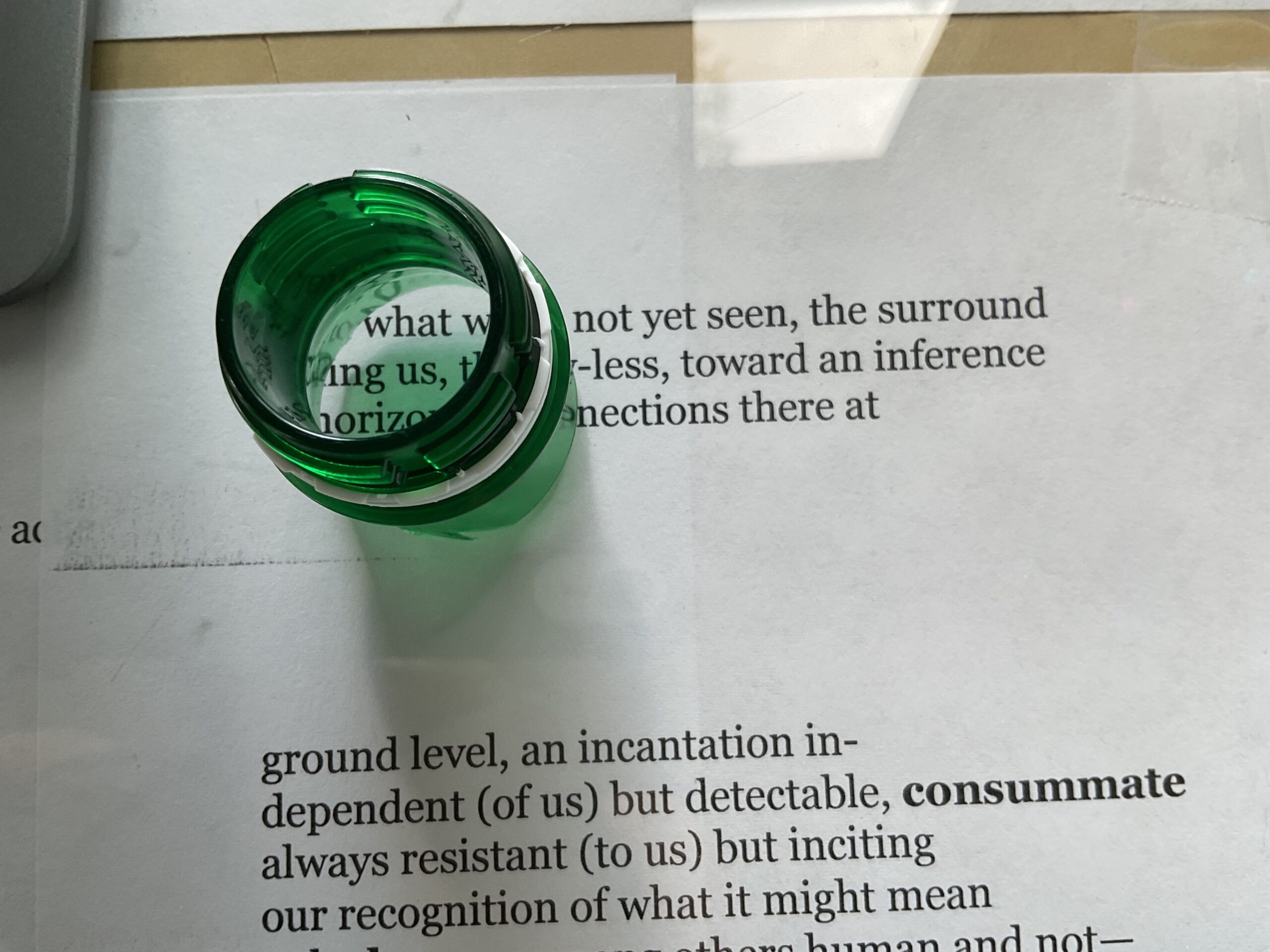
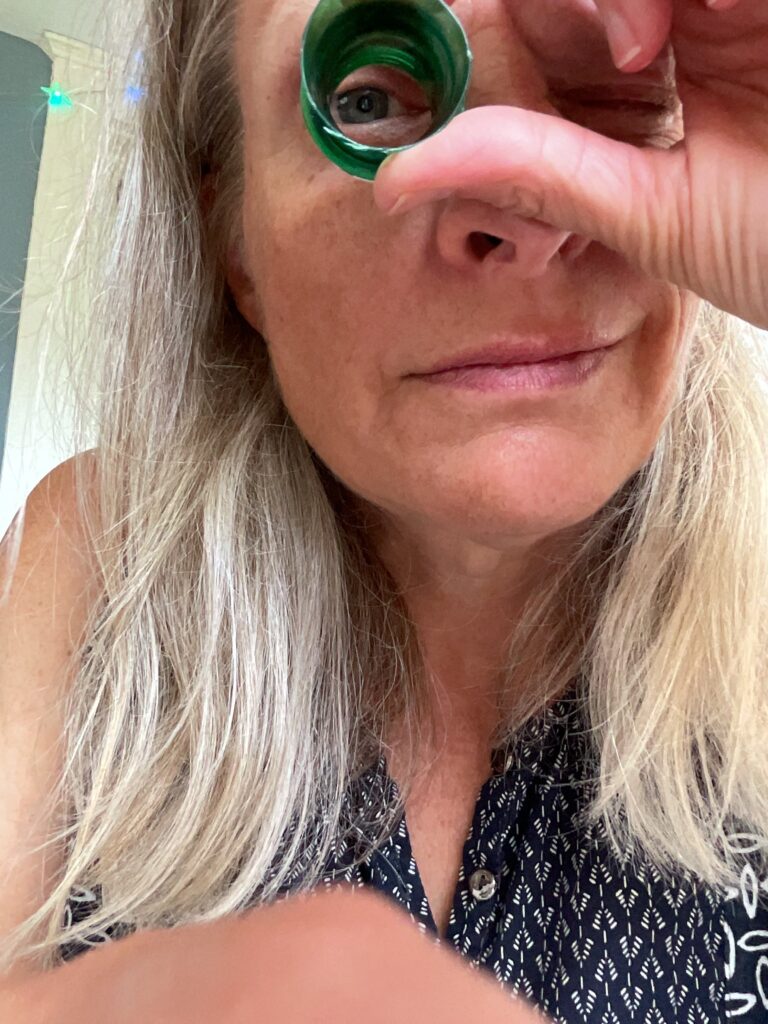
This morning, I reorganized the area of my studio where I gather and process my plastic. Then I cut up part of a milk jug, which creates a cool texture of brittle little shards, and another one of my seltzer bottles. Later in the day, I showed some of the stranger remnants of plastic to FWA and he suggested using the top of the seltzer bottle as some sort of view finder or monocle — something that, when you looked through it, created a visual effect. Distorts what you see? Adds layers of color? Allows you to isolate words? I’m going to have fun playing around with this!
I showed it to Scott and he said, it’s a loupe. A what? A loupe (loop) “is a simple, small magnification device used to see small details more closely.[1] They generally have higher magnification than a magnifying glass, and are designed to be held or worn close to the eye. A loupe does not have an attached handle, and its focusing lens(es) are contained in an opaque cylinder or cone” (wikipedia). A new word, learned!
Here are some things I’ve been doing with the plastic so far:
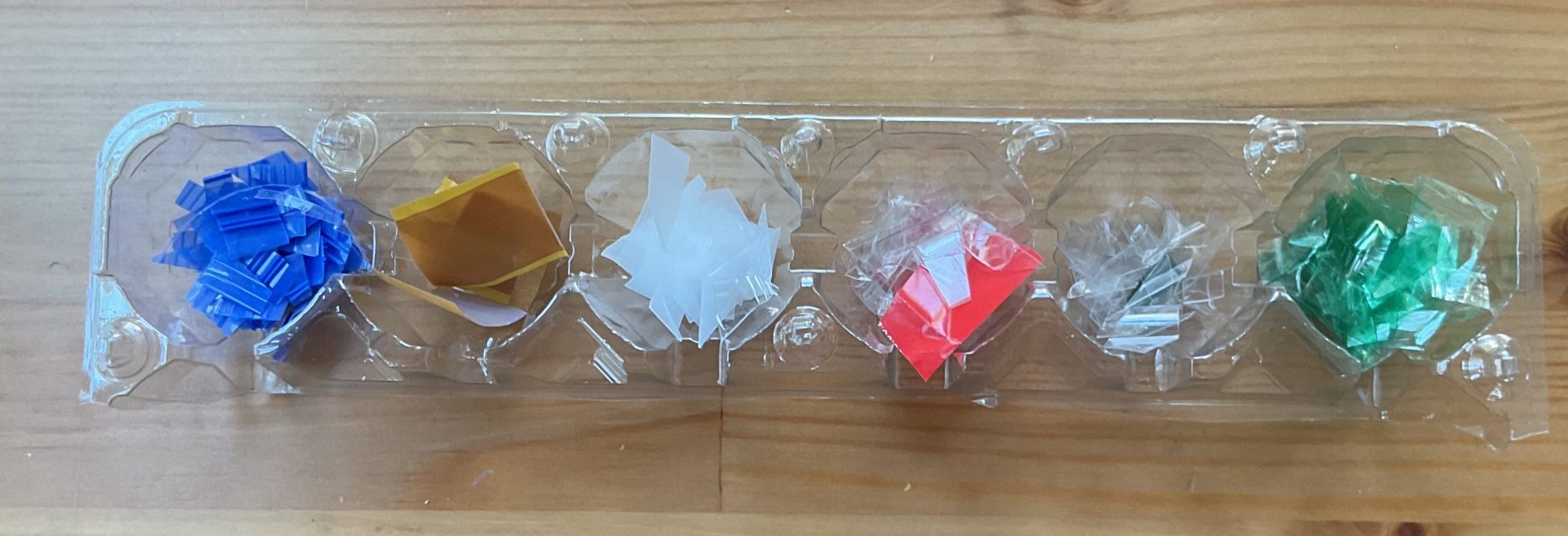
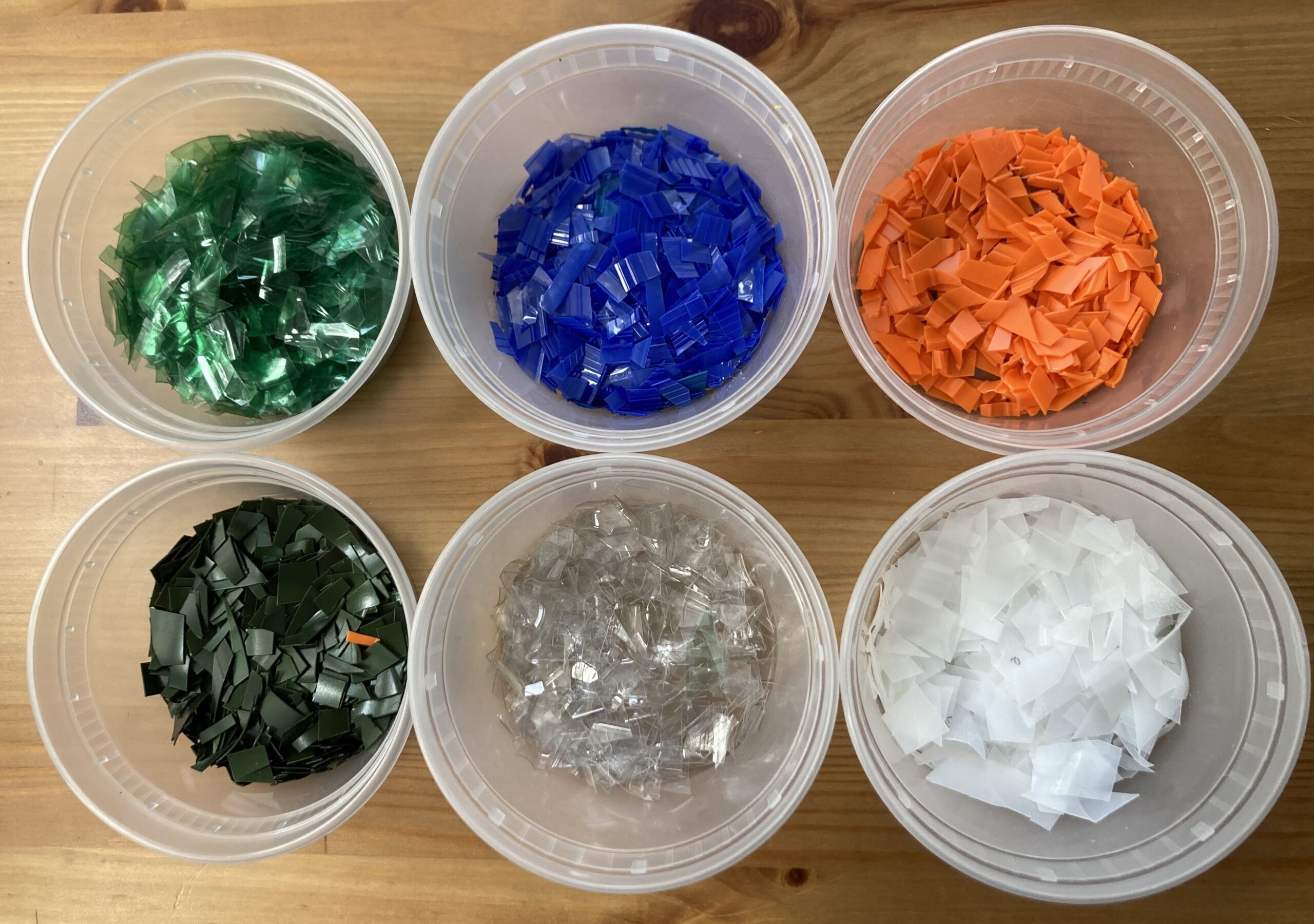
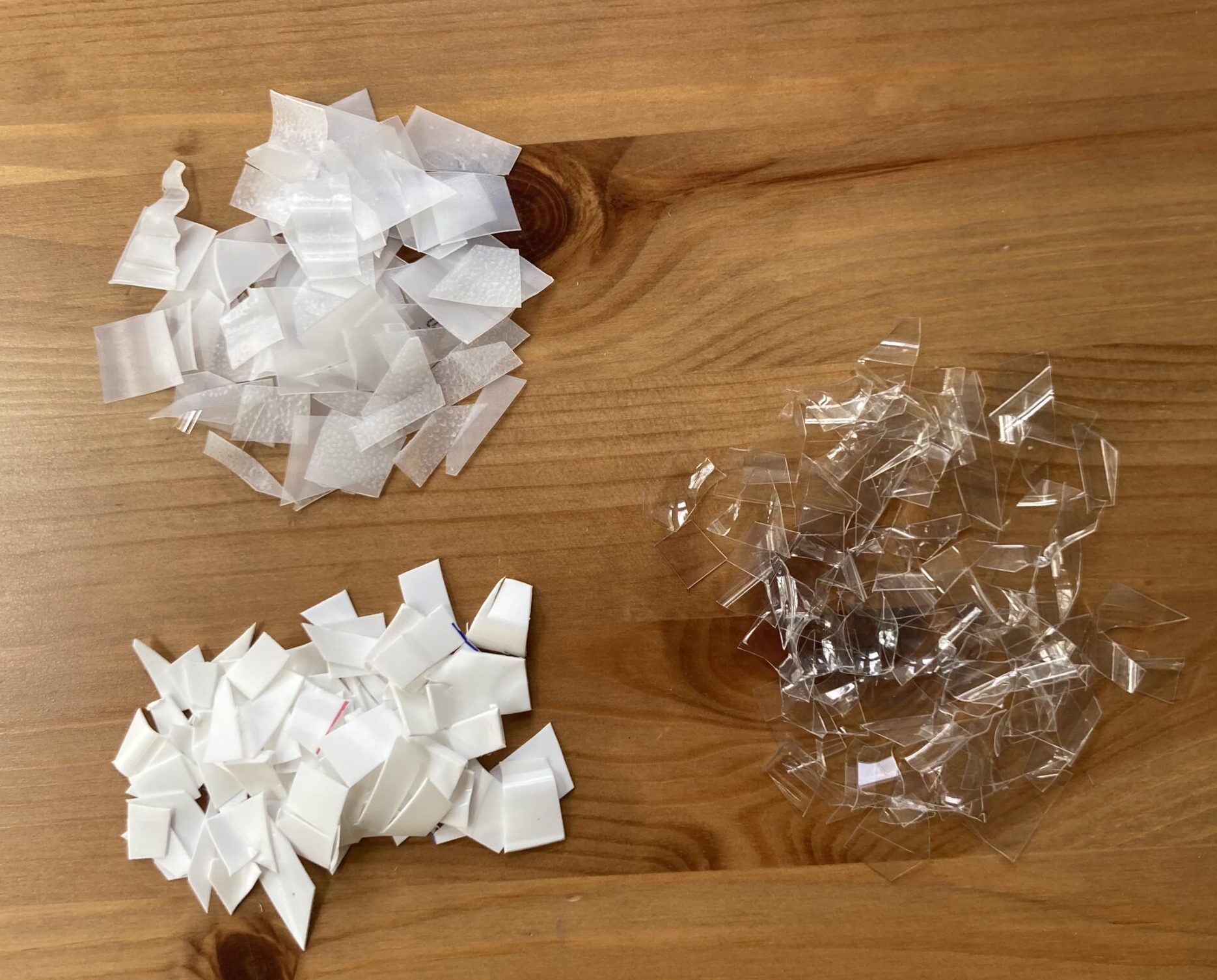
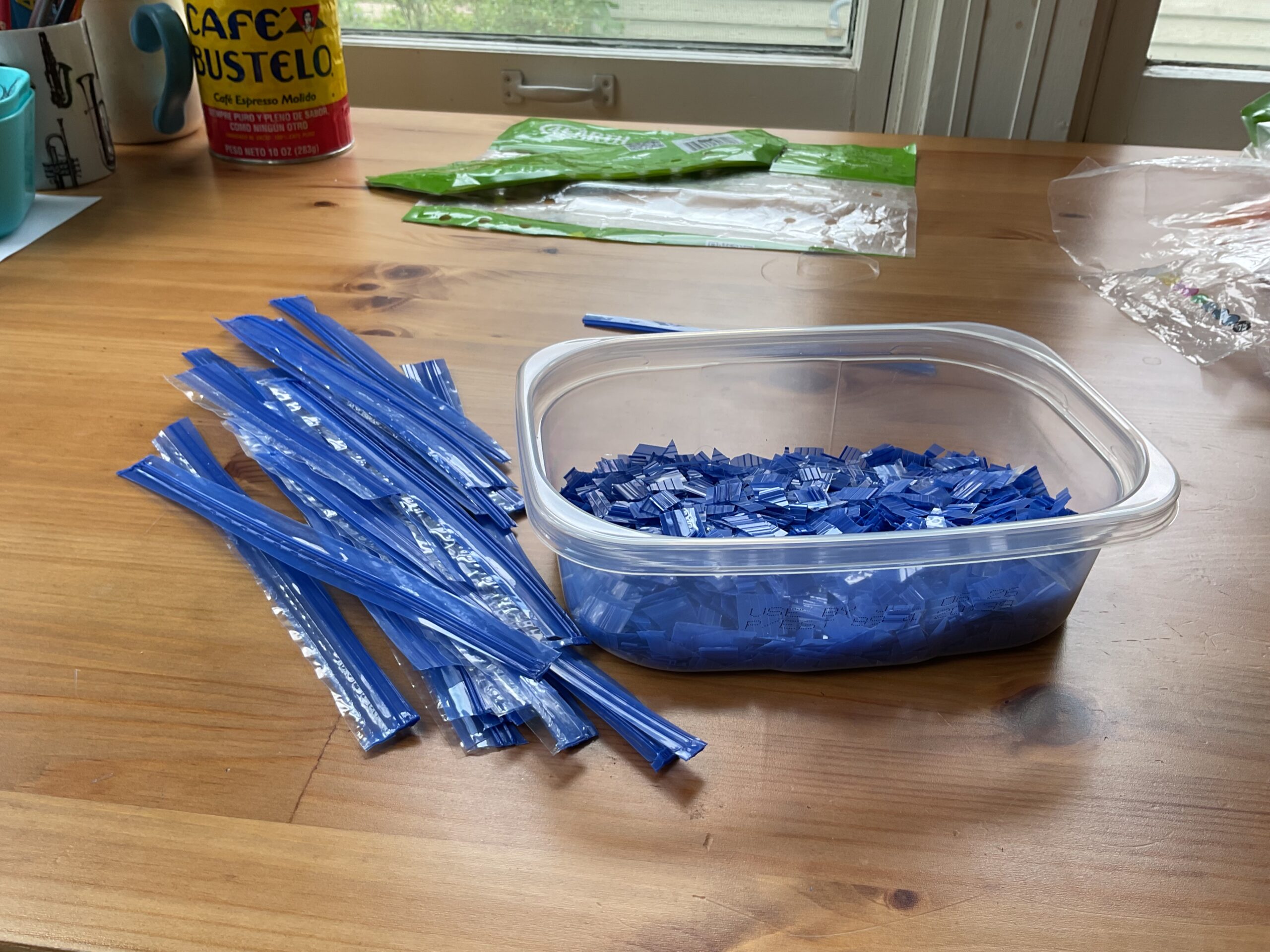
Cutting up plastic into strips and shards, separating them by color. So far, I’m using these shards/strips to show the color of the lake during open swim. Maybe I’ll turn them into some sort of mosaic, or create interesting sounds with them. As I handle them, I’ve been thinking about the importance of texture for how I see and how I understand/process/identify color.
Looking for and setting aside bigger strips of clear plastic to use for my holes/how I read series — to cover words and/or make them harder/impossible to read.
Cutting out and collecting words printed on plasticbags to turn into found poems about vision or swimming in the lake or something else I haven’t thought of yet.
I’m planning to make things with these plastics, and I’m also using the processing of them as an opportunity to critically reflect on how much plastic I use and to explore plastic as metaphor for my vision and distanced relationship to the world. Maybe I should study plastic for a month? I’m also using the act of processing as something I can do with my hands that is physical and tactile and repetitive enough to open me up to wandering and wondering.
Another hot morning. Another successful run. Not fast, but steady. Mostly running with some walking. 2 Regulars sightings: Santa Claus and the walker that always wears a skirt and sandals — I feel like I named her, but I can’t remember what. I checked the log and I have mentioned the woman wearing sandals and a skirt 3 times, but have never named her. I think I’ll call her Skirt with Sandals, which is a reference to a phrase we’ve (Scott, RJP, FWA, and me) used many times over the years: socks with sandals. It’s from the show within a Disney show: So Random in “Sonny with a Chance.” I used to unironically wear socks with sandals frequently.
I heard the far off echo of workers hammering something, trickling water, the click and clacking of roller skiers’ poles above me. As the skiers passed me, I heard 2 of them discussion “Love Island.” At least one of them didn’t like the show. I’ve never watched it, but RJP was very invested in this most recent season which ended earlier this week.
In Hawaiʻi, you often hear the term “island time,” referring to the slow pace that pervades the culture here. But for me, standing on land just a few hundred years old, island time is a reminder that this is a place in the process of being both made and unmade. Here in ʻĀhihi, there are barely any trees—the soil still thin atop the hardened rivers of basalt and scoria. Not enough time has passed to erode these sharp and porous remnants into dirt. Yet in that short stretch of centuries, between that time and this one, the island has changed irrevocably. When I began snorkeling, I was warned there was little left to see on Maui, most reefs dead and dying—a result of rampant tourism, overfishing, commercial runoff, and warming waters.
island time — land just a few hundred years old — I’m thinking about lake time and how lake nokomis only celebrated its 100th birthday in 2014 (see: 12 july 2025). Before that it was marshy land — wider and shallower. 100 years is the approximate time it takes for a human-made lake (nokomis was a marsh, dredged, made into a lake) to act like a natural like
“I settle into my liminal position, turning my back to the earth as I know it: the solid ground under my feet replaced by weightlessness. I trespass into this unknown world—below me, I feel how time itself has turned the stone to sand. At last, I cross the threshold with my entire body.“
“I am held in the veil between these worlds that are each, astonishingly, part of this place that we call Earth. Within minutes, my cells acclimate to the cool buoyancy. I am carried away from everything I know. As I kick out, the mechanisms of my movement grow more and more effortless. Anything heavy or painful drains from me. In the water, I am held—a child rocked in a mother’s arms. My body moves differently here, swaddled and swept in the cadence of waves, alongside all the creatures who share this space. . . .”
“I am flying now—a wingless bird gazing down, seeing the universe anew. Like Icarus, I feel the warmth of the sun against my back. Between realms, I face an ecosystem nothing like my own.”
seeing the universe anew — in the ocean, everything might be clear and vivid below, but in lake nokomis, and with my bad eyes, everything is murky, muddled, felt in the briefest of flashes.
“Beneath the inscrutable blue-black mirror of the water’s surface lies this universe in technicolor. “
What is the color of the lake water? As part of my plastics project, I’m gathering the colors of the water that I see when I swim. The plastics project = keeping as much of the plastic that my family uses for visual poetry projects — produce bags, seltzer water bottles, ziploc baggies, miscellaneous. packaging, T Joes’ pasta/rice bags. Here are the colors I’ve collected so far in greens and blues. (The lake is usually much moregreen than blue.)
plastic origins, from top left to bottom right: granola bag, little cukes bag, russet potato bag, Trader joe’s pasta bag, bottle of olive oil, bottle of seltzer water, squash bag
Are these all “green”? I see them that way. The bright green of the upper center is what the water looks like when a blue-green algae bloom is present. Last night’s warm and stirred up water at cedar lake resembles the brownish yellowy green in the lower left. Number 2 and 3 in the bottom row are shards from bottles, while the rest are bags, only colored on one side.
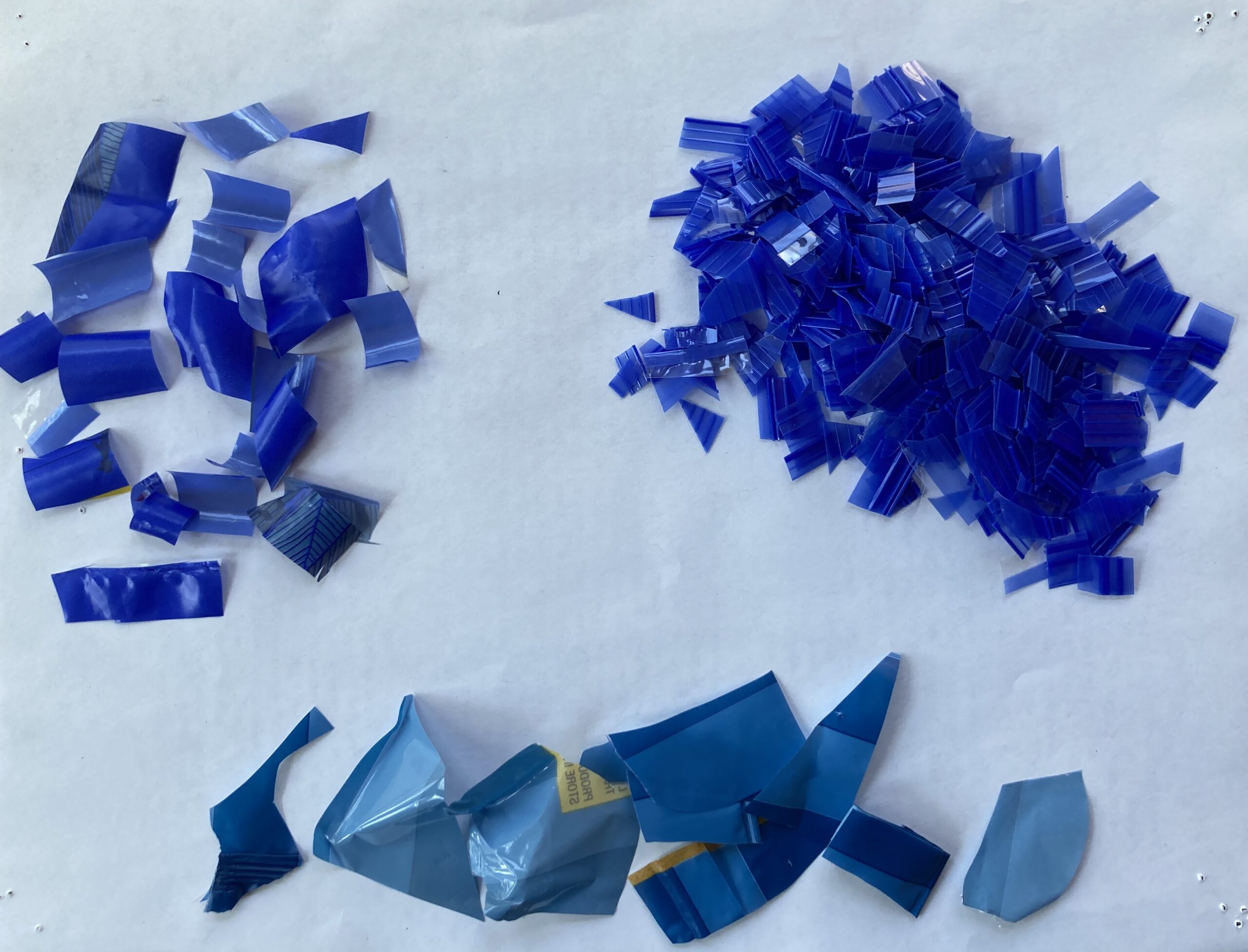
lake nokomis blue
plastic origins, from top left, top right, bottom: Trader Joes’ rice bag, shards of the locks from ziploc baggies, Trader Joes’ pasta bag. I don’t think I ever seen the lake water look like this below the surface, but above, when it’s sunny and I’m looking at it from the right angle: blue, often with purple vibes.
Scott asked me what I plan to do with these colors. I’m not sure yet, but I know it will be part of something that expresses how I see color and how color works in a city lake that resides in a lake city that prioritizes access for everyone and that is working hard to keep the lake and its people safe and healthy in the midst of a climate crisis (almost apocalypse?).
Once I gather more colors that fit, I could create some visual poem to place beside this poem, which is in by chapbook, Inklings:
Fish 3 between buoys 3 and 4
The fish in us escape. They flash and streak and leap, then return to bubble whisper the names of water’s colors.
swim: 2 loops lake nokomis open swim air: 96 degrees water: 84 degrees
Hooray! 2 (almost) pain-free loops at lake nokomis open swim! Before it started, I was able to talk with 2 other swimmers about how much we love open swim. They were a little older than me — 5 or 10? years — and just as enthusiastic about the water.
10 Things
2 girls — older high schoolers or in college? — flirting with 2 guys at Painted Turtle: loud, awkward giggles
a guy playing guitar, accompanied by a recording — I know I enjoyed 2 of his songs, even danced to one, but I can only remember the other — an instrumental “Careless Whispers”
very choppy water — not the type of waves that put up a fair fight, that you can punch, but the ones that unsettle, disorient, jostle
swallowing a wave of water, which made me more careful about when and where I breathed and stroked
1 2 3 4 5 breathe right 1 2 3 4 breathe right 1 2 3 breathe left
a very LOUD metallic buzz beneath the surface — somewhere someone was doing something that was causing this noise — was it a boat? a machine drilling somewhere?
slosh slap
bubble friends!
being routed by lifeguards when I swam too wide of an angle
the first orange buoy was almost in the middle of the lake — maybe the farthest I’ve ever seen it
The water was opaque and the color was somewhere between these 2 colors:
4 miles river road, north/south 85 degrees / dew point: 72
Last night, I planned to do my run early in the morning, but when I woke up it was already hot so Scott and I decided to walk and get coffee instead. As we walked back on the river road trail, we realized that it didn’t feel too terrible. There was shade and a breeze and the humidity was lower. When we got home, we both changed, then went out for runs — I went at 10:15, Scott at 10:40. I was surprised at how fine I felt. I was hot, but I didn’t feel like I would faint or get heat stroke; I just felt like I was working hard. No anxiety about it — a mental victory! Was it because of my HRT patch? Possibly.
Almost all of my route was in the shade, which was by design; I wouldn’t have been able to run in this heat with direct sun. I encountered many walkers, a few bikers, 1 or 2 other runners, 2 big groups of kids — one on bikes, one on foot.
I listened to my “I’m Shadowing You” playlist. I told Scott later that I was trying to manifest shade. It worked.
10 Things
dappled light, jagged patterns of light on the trail
kids on bikes in bright yellow vests
2 bikers stopped near the trail, recovering or fixing something on their bikes after climbing the franklin hill
no bugs — no swarms of gnats encircling my face or single gnats trying to swim in my eye juice
the crack north of the trestle is still blocked off — this stretch had the most sun
passing a walker on the path in flip flops, near the rowing club — did they just finish rowing? probably
a scooter on the edge of the trail, but not far enough on the edge — if I hadn’t been paying attention, I could have tripped over it
air quality is good — no smoke from colorado fires this year!
bright blue sky
a flushed face, sweat-soaked shirt
swim: 1.5 loops (3 cedar loops) cedar lake open swim 95 degrees
Wow, the water was warm! As another swimmer said to me, it’s like bath water. I tried to remember that and not swim too hard. Hot air temp + hot water temp = hot Sara, with no chance to cool down. No worries. I swam slow and steady. 1 2 3 4 5 breathe right 1 2 3 4 5 breathe left. By the 3rd loop, I had increased my strokes: 1 2 3 4 5 6 breathe right 1 2 3 4 5 6 7 breathe left
Great news: My shoulder didn’t hurt at all on the first loop, and it hardly hurt on loops 2 and 3, and now, an hour later, it doesn’t hurt at all. Hooray!
Not so great news: I sacrificed my other new nose plug to the lake. Treading water at the end of loop one, trying to adjust my nose plug and unfog my googles, the nose plug fell down into the murky depths. Oh well. These nose plugs were slightly too big: I had to adjust them almost every loop. Time to go back to the slightly more expensive ($7 instead of $2) nose plugs. I wish I could find the exact one that I’ve been wearing for more than 5 years, but they’re always changing things, making them “better,” and I don’t think they make the exact one I have now.
The water was calm on the way to Hidden beach, rough on the way back. It was also yellow and murky. I saw some of my bubble friends but no silver flashes. I got tangled up in a few floating vines, had to stop swimming as clueless paddle boarders crossed the swimming course.
images of the day: the wide arc of some swimmers on the other side of the loop, swimming back. What I saw: some splashes, a few caps, buoys, the idea of a curved line. Also, the occasional swimmer, swimming down the middle, or crossing over to swim in the wrong direction. All these swimmers — their elbows and white foam and buoys — looked so far away. Distance is distorted in and on the water.
1 loop lake nokomis open swim 85 degrees water temp: 81 degrees*
*measured on 6 july, so probably warmer today, almost a week later
Today the goal was to take it easy on my shoulder. It had been feeling better by the end of this week, but I’m thinking about my bigger goal for the summer: swimming one day (24 collective hours) in august, so I didn’t want to overdo it. Just past the first orange buoy, my shoulder began to ache a little and then ached, dully, for the rest of the loop. I think I can still swim; I just need to do less as I rehab it — strengthening exercises + RICEing it — well, mostly IIcing it: icing and Ibuprofen. It’s a bummer that my shoulder still hurts, especially since I was looking forward to July being a big month of swimming, but I’m not too upset. It could be a chance to approach my open swims differently, maybe spend more time going slow or stopping in the middle of the lake!
When Scott and I arrived at the lake, I noticed all the glittering on the surface. My first thought: wow, that looks so cool. My second thought: all that glitter means the surface is not smooth and that means the water is choppy. And it was. Also, warm — so warm! I liked the choppiness. It wasn’t rough — no big waves were crashing into me. Instead it was constant — wave after wave after wave, making me rock from side to side.
It was fitting that there were waves, because I’m working on revising/condensing a poem about waves (literal waves at open swim and waves of grief after my mom died). Hopefully today’s swim can serve as inspiration.
10 Wave Things
stirred-up water below the surface with lots of sediment floating in front of me, 1: difficult to see anything, like my hands or bubbles or fish
stirred-up water below the surface with lots of sediment floating in front of me, 2: water color was a mix between pea soup green and lentil dahl yellow
stirred-up water above the surface, making it difficult to see buoys
the surface: all glittered up
no white-caps, but lots of spray flying high in the air
an increased amount of breaststroke by other swimmers
more breathing on one side, 1: in the first half of the loop, I breathed mostly to my right
more breathing on one side, 1: in the first half of the loop, I breathed mostly to my left
the yellow safety buoy tethered to my torso was bobbing vigorously
I did not feel like I was fighting the water, but that it was holding me and reminding me it was there
Do I remember the sound of waves? No, I don’t recall the sloshing sound of the water as it rushed over my ears. I bet it was loud.
Found this poem when I searched, “waves” on poets.org. It’s a golden shovel poem, where the last word in each line comes from a different poem. The original golden shovel was Terrence Hayes creating a poem that ended each line with words from Gwendolyn Brooks’ “We Real Cool.”
If I don’t taste the complicated waves— if I only see the rolling, only hear the roiling up or smell those waves —then I will tumble head over stance. Then I spring up, drenched in partisan sand.
I’d like to try something like this with my waves poem to suggest another meaning. I could either use words from a poem about grief or moving water. For grief, maybe Emily Dickinson, for water, Niedecker or Oswald? Maybe one of my favorites?
several hours later: 6:04 / 90 degrees, feels like 94
a reminder when experimenting with my wave poem: don’t try to force it — find some poems I like about waves or grief and see what happens
Sitting under my crab apple tree, where it is much cooler than on the deck, I reread an interview with Alice Oswald in the winter 2026 Paris Review. I’ve posted bits from it already. Today, since I’ve been thinking about spiriti visivi and insects, I wanted to post these lines:
1
. . . the contracts you make with the natural world that allow you to be in a place, the feeling of living somewhere you don’t own.
(But don’t you own the house?)
Yes, but it’s very clear that it’s really the insects who own it, and the river that comes right up to the garden. The rain comes through the ceiling. It’s interesting, the way the dead and the natural world are sort of exchangeable. That might sound theoretical, but ancient Greek lament, and lament from everywhere, has always used birds and plants as intermediaries for communicating with the dead. And I feel, when I’m here, a deference toward my uncle and my father, who once looked after the house, that’s kind of interchangeable with the deference I might feel toward a bird or an insent.
2
[after discussing the sound that flies and grasshoppers make, the interviewer asks: Is it the choral sound that you love?]
And the fact that they don’t speak with their mouths. I love the way insects speak with their wings or legs. For a
Interview with Alice Oswald
After the interview were 4 new poems from AO, including this one about the fly. 3 fly poets I immediately think of: Emily Dickinson, Aracelis Girmay, and Alice Oswald.
Fly-play/ Alice Oswald
Enter a fly no sooner nowhere than here wiping her rear-view eye and tapping the world with one foreleg
What is it you wish for Fly?
She merely glitters to me of silence tapping . . . tapping the world walks backward . . . refers me to her myth and exits . . .
The scene is summer
Enter a yellow curtain:
One servant dressed simply as the sun going in and out with a beam of dust one fly . . .
WHAT IS YOU WISH FOR FLY?
She merely rotates for me her mask as if to bring something born in one world back in another
Then round and round with her weak voice pleading that her one belonging is her life which lasts but a day . . .
But you know full well, Fly, it takes 400 insect years for me to lift my ahnd and by the time it lands I too will be mute, I too will be you
glitter / silence / tapping refers me to her myth? what is the myth of the fly?
12 miles franklin + ford + hidden falls + veterans home + falls 67 degrees humidity: 86% / dew point: 65
Ugh! That was hard. It was too hot, too sunny, too humid. My feet hurt from warts and a big blister. I almost altered the route to cut off 2 miles. And I did it. And I felt okay for the last mile, like I could have kept going. Success! I’m proud of myself for persisting today.
3 things I did right
I didn’t have any unfinished business problems! I brought my water and made sure to keep drinking from it. I didn’t give up.
3 things to work on
Bring more snacks/fuel. A bandaid around my toe doesn’t work — it created a juicy blister — find other solutions. Be more intentional with music or mantras or experiments to try for distraction/focus.
10 Things
Mr. Morning! upped his game today with his greeting. Instead of just, morning! He added: Have a Great Day!
rowers!, 1: a coxswain’s voice, giving instructions through a megaphone
rowers!, 2: the gentle slap of the oars hitting the water
the crack just north of the trestle is bigger (again) — they’ve barricaded it off with metal gates
the part of the trail near the trestle on the east side was blocked off — some sort of work with a tall crane
the bells of st. thomas chiming
a skate boarder at the skate park: doing a wide arc at the edge of the course
filling up my water bottle: at the monument, near the skate park
a group of three bikers — 2 adults, one kid — biking slowly in front of me
stopping in the grass to adjust my laces (at least 5xs), stopping at a bench to take off my shoe to inspect my toe (1)
I have to do this again next week, but for the rest of today, I’ll celebrate the accomplishment of running (with some walking) 12 miles and moving for more than 2 hours.
For the first hour, I listened to birds, fragments of conversations, cars, trickling water, and bells. For the next 45 minutes, I listened to a Ruth Ware audiobook. And for the rest of the time: my Color playlist.
I’ve just barely started reading Kohn’s How Forests Think, which I was able to get through RJP’s college library. This is one of the opening lines in chapter 2, “The Living Thought”:
This chapter develops the claim that all living beings, and not just humans, think, and explores another closely related claim, that all thoughts are alive. It is about “the living thought.” What does it mean to think? What does it mean to be alive? Why are these two questions related, and how does our approach to them, especially when seen in terms of the challenges of relating to other kinds of beings, change our understanding of relationality and “the human”?
If thoughts are alive and if that which lives thinks, then perhaps the living world is enchanted. What I mean is that the world beyond the human is not a meaningless one made meaningful by humans. Rather, mean-ings—means-ends relations, strivings, purposes, telos, intentions, functions and significance—emerge in a world of living thoughts beyond the human in ways that are not fully exhausted by our all-too-human attempts to define and control these. More precisely, the forests around Ávila are animate. That is, these forests house other emergent loci of mean-ings, ones that do not necessarily revolve around, or originate from, humans. This is what I’m getting at when I say that forests think. It is to an examination of such thoughts that this anthropology beyond the human now turns.
How Forests Think / Eduardo Kohn
I’d like to put this chapter and the questions, What does it mean to think? and What does it mean to be alive?, beside Alice Oswald’s Homeric mind, with thoughts that don’t reside in the brain but travel outside of it, over the sea, Emily Dickinson’s bees, and the possibility that thoughts might be creatures themselves — and not just metaphorically. I’ve written about this before, and I’ll find where, either later today or tomorrow.
the next day:
1 — Alice Oswald on the Homeric mind:
Well, as you know, I’m quite fascinated, even obsessed, you might say with Homer. And one of the things that really tantalizes me in Homer is what is the Homeric mind? Because I think it’s very different from a literary mind. And it seems not to be inside the skull, but to be out in the world. So, there is a particular simile in the Iliad, which actually that first bit of the poem is based on, where it talks about two goddesses coming from heaven to the earth. And they’re very physically described. They kind of fall down from heaven to the earth. And then when they land, they take little pigeon steps, steps like doves or pigeons. So you can really picture them. But the way their flight moves from heaven to earth is as a man, you know, as the mind flutters in a man who has traveled widely, so you can turn it the other way around and say the way a man thinks is like this incredibly physical flight of two goddesses coming down to earth a bit like pigeons. And that’s always really interested me, that for Homer, the mind has the limitations of a pigeon, if you like. It is this kind of … this physical thing that moves. So, if you imagine a place over the sea, your mind actually has to get there. So, even though it may be as fast as the light, it is physical movement.
Here’s an article about the origins of the phrase. According to the article, the phrase is still being used in popular culture. I use it, usually when I notice Scott hell-bent on some task — and usually it seems like a task, or idea, that is fool-hardy but that he needs to work through and figure out for himself.
Sometimes instead of saying, bee in your bonnet, I say that someone (or me) is hellbent. Of course, writing that immediately makes me think of Jackie from the 1979 Death on the Nile:
Jacqueline De Bellefort : One must follow one’s star wherever it leads. Hercule Poirot : Even to disaster? Jacqueline De Bellefort : Even to Hell itself.
When I envision a bee in my bonnet, I see something that is relentless, impossible to ignore, urgently needing to be dealt with. That’s not quite how I imagine my preoccupation with haunts and ghosts and writing about the gorge. Still, I like the idea of bees in bonnets, and bees in general, so maybe I’ll spend more time with them this morning?
Reading through several ED “bee” poems, I suddenly had a thought: could the bee in your bonnet be your soul, trying to escape the confines of the body?
This thought was inspired by a poem I wrote about in an On This Day post: Body and Soul/ Sharon Bryan. I didn’t mention it in the post, but the description of the soul in the poem, as leaving the body at night to roam around, reminded me of an ED poem I read a few weeks ago, when I was thinking about the difference between the brain and the mind:
If ever the lid gets off my head And lets the brain away The fellow will go where he belonged — Without a hint from me,
And the world — if the world be looking on — Will see how far from home It is possible for sense to live The soul there — all the time.
3 — thoughts as a swarm of bees, uncontrollable and unwanted
As I started thinking more about my discussion of thoughts as bees, I also thought about how those bees, especially if they are swarming in your head without the lid being removed, could be overwhelming, incapacitating. Then I found this in my log entry from 30 june 2024:
“During the first loop somewhere between the first and second orange buoys an alarming thought appeared: what if I fainted in the middle of the lake? In the past this thought might have caused panic which I would feel in my body — a flushed face, harder to breathe, hot tingling on the top of my head. Not today. No physical effect. Within a few minutes the thought was gone. Is this because of the lexapro? FWA says that sometimes he feels the lexapro working — he’ll start having overwhelming thoughts but instead of spiraling, he feels himself become separated from those thoughts — they become abstract and distant. I wondered about this as I stroked then connected it to Alice Oswald’s Homeric mind and the idea of thoughts not just living in our head but traveling outside of our bodies from there to there.”
Don’t you wish they would stop, all the thoughts swirling around in your head, bees in a hive, dancers tapping their way across the stage?
Who with their whispered psalm can outvoice their huckster cackle, the trees blustered to howls while the tesla bees
whine loudly to the shocked air?
other links: I have a page about bees in my “How to Be” project on Un || Disciplined (I had forgotten that I did this — thanks, past Sara!)
one more thing: Finding my archive of bee-related things, is putting a bee in my bonnet. I need to archive all of my resources — or, as many as I can — before my central vision is completely gone. I imagine it will be much harder to do this once that happens!
3.9 miles wabun hill and back 67 degrees / humidity: 87%
An early-ish run. Started at 7:45. If I had run earlier, the temperature would have been a few degrees cooler, but the humidity and dew point would have been higher. Which is worse, higher temp or higher dew point? Dew point, I think. I’ll have to test it out — if I can get up earlier!
For the past month or so, I’ve been struggling with my feet and ankles. I’ve tried a few different pairs of shoes to see if any of them were better. This week — on Tuesday and today — I went back to my Brooks Ghosts. They seem to be working better. Today I realized (or remembered?) to put my laces through the extra holes at the top of the shoe. I think I had tried this early on with these shoes, but it felt too tight, then. It worked!
10 Things
gobble gobble gobble a turkey calling out from a tree in turkey hollow
a bike rushing past me on the wabun hill
an older man and woman stopped at the bottom of the locks and dam hill
thwack thwack the chain from the flag hitting the flag pole
a few bits of glitter on the surface of the river under the ford bridge
the older man and woman halfway up the hill, each of them dragging a tire
almost all benches were empty
stopping at the Rachel Dow Memorial bench for a quick view of the river and to retie my shoe
the wabun hill was covered in wet dirt — a little slippery when descending it
a woman standing on the edge of the trail, looking out somewhere, taking a picture of something
strong shoulders
Open swim tonight, but no Sara swimming. It’s a bummer, but I know that it’s a very bad idea to try and swim with my sore shoulder, My favorite, self-proclaimed “best PTs in the world,” Bob and Brad have some exercises for me to try in the next couple of days:
run: 4.1 miles monument and back 70 degrees humidity: 87% / dew point: 68
More uncomfortably warm conditions. Difficult, but doable. I did my run/walk plan: 5/1 (mile 1) — 1.5/.5 (miles 2-4). My feet didn’t hurt that much, and I had a lot of energy, especially in my legs, at the end of the run. I’ll take that as a victory. I listened to my striking feet and dripping water (shadow falls) and the st. thomas bells for the first half, Olivia Rodrigo for the second.
10 Things
St. Thomas bells — faint and short, 8:45, I think
rowers!, 1: on the way to st. paul, crossing the lake street bridge, 2 double rowing shells in the blueish gray water
rowers!, 2: on the way back to minneapolis, crossing the lake street bridge, 4 6-man rowing shells + the white boat with the coxswain
coxswain to rowers: okay and stop. good job!
overcast — a gray sky — is it going to rain? no: soon, sun
the dreamy reflection of clouds on the pale blue gray river
the path near shadow falls: cracked, cratered, ridged — dangerous!
at the top of the shadow falls hill, passing an adult and a kid wearing a backpack — summer school?
honk honk
near the beginning: a woman walking with a dog, holding the leash too loose, the dog licking my leg — sunday, I didn’t mind; today I did
swim: 1 loop lake nokomis open swim 81 degrees
Written the next morning. Almost perfect conditions. Smooth, warm water, not too crowded, overcast. For the first half of the loop, I felt strong and relaxed, but sometime not long after I rounded the third buoy, my right shoulder started to hurt. It was difficult to lift my arm. Ouch. When I reached the final green buoy, I stopped and rested for a few minutes in the beach area. I tried to swim again. Nope. I had to stop. A big bummer. I think I could have swum 5 loops tonight in this water.
Looked it up in the middle of the night (which might seem like a bad idea, but didn’t make me any less able to sleep) and it’s probably swimmer’s shoulder, caused by overuse. Swimmer’s shoulder is a common injury. I’m hoping that taking the rest of the week off will be enough to make it better. The silver lining: I still have more than half of the season left, so I should be able to swim again.
2 loops (4 cedar mini loops) cedar lake open swim 88 degrees
Very warm. Choppy. Crowded. As always, a great swim. Before the swim started, the orange buoy was way off to the far side, which caused a delay. The lifeguards wrangled it back and we started with it in its usual place. When I returned after the first loop, the buoy was drifting far out again. Most people were not even trying to round it. I tried, then gave it up too. After the second loop, the buoy had been moved back but very close to shore. After the third it was back in its usual place. The shifting buoy and the too bright sinking sun made it difficult to sight.
10 Things
small fish, about 1/2 foot long, bumping into my hand and my foot as I waited for open swim to begin
a lifeguard kayak escorting a swimmer back to shore
bright blue sky + fluffy clouds
racing another swimmer who kept pushing me out and away from the buoy
swimmers almost run into: 3
swimmers run into: 1
out in the middle of the deep lake, a few ghostly forms below: milfoil, I think
a paddleboarder looming beside me before passing me at a safe distance
on the back half of the loop, I mostly breathed every 4 strokes
on the front half of the loop: watching the curved line of swimmers returning to shore
the next morning: Yesterday was Scott and my 30th wedding anniversary. 30 years?! Wow. Wonderful. We went out for lunch in our old uptown neighborhood then walked around Bde Maka Ska and Lake of the Isles before heading over to Cedar for open swim.
run: 11 miles ford loop + veterans home + lake nokomis (x2) 66 degrees humidity: 92% dew point: 60+
I did it! It was humid and hot in the sun and my feet started hurting by mile 4, but I did it! I ran through the neighborhood, then over the lake street bridge, up shadow falls’ hill, past the monument and (mostly) up the east side of the river. I crossed the ford bridge, went through wabun park to the veterans’ home, crossed over another bridge, ran on the edge of the park, then beside minnehaha creek. When I reached Lake Nokomis, I had to run around it twice.
10 Things
teakettle teakettle — a carolina wren
a single rowing shell on the river
from the bridge, the water looked fuzzy, the air above it hazy
just past the monument, I heard the St. Thomas bells — I think it was 7:30
mostly dry dirt, or slightly damp earth on the desire path beside the paved trail — one spot was squishy mud and I almost twisted my ankle on it
cloudy then sunny then shade then sun and sun and sun then shade
someone on the other side of the mustache bridge, running and pushing a stroller, blasting some upbeat music that I didn’t recognize
the creek water is high! I especially noticed that as I ran over my favorite part of the trail
a woman with a dog — she wasn’t holding the leash tight enough and the dog leaned over and licked my knee as I ran by (surprisingly, I didn’t care)
running and walking over the cedar bridge, looking down at the water’s surface: a soft gray blue with reflections of clouds
For more than half of the run, I listened to the birds and my feet and the sloshing water in my handheld water bottle. Near the falls, I put in “Olivia Rodrigo Essentials.” Even though I’ve turned it off many times before, apple music was still set to fading songs, which means it took the last few measures of one song and made its beat match the beat of the next song. When this first happened, the last bit of the first song suddenly slowed, sounding so strange that I was worried I might be having heat stroke. Why does Apple do this? Boo.
3 things to celebrate / 3 things to work on
I kept the negative thoughts away (hooray)
I was able to eat a fig bar during the run and didn’t feel an urgent need to go to teh bathroom (yay)
My legs felt good in the last mile and I had some energy (woo hoo)
My feet hurt for almost half of the run (boo)
My ankles hurt some too — I need to tie my shoes tighter and/or get shoes in a smaller size (bummer)
As is often the case after a hard effort, I was cranky at the end when I met up with Scott (grr)
swim: 2 loops lake nokomis open swim 71 degrees
The plan: run to the lake for open swim. Scott would bring my bag with my stuff. I wanted to do at least one loop of swimming. I imagined it would be refreshing and restorative for my sore legs. And it was. Wow, that water! Almost perfect. Calm and warm enough. There was milfoil but no blue green algae. As I neared the beach, I could see clumps of the milfoil washed up on shore. Yuck!
The swimming felt easy and relaxing. Steadily, I stroked, breathing every 5 strokes. Occasionally I stopped stroking and listened to the quiet as I tread water. All I could hear was the soft slap of the water from another swimmer’s hand.
Today, I started counting strokes as I passed by the 4th buoy. 275 to get to 5th and final buoy.
A strange feeling: as I swam from buoy 3 to 4, I could see the green buoy up ahead. It seemed like I kept drifting out, almost too far to the left. Trying to correct my path felt strange and awkward. I briefly wondered if there was a current I wasn’t consciously feeling or if my run had made me less able to swim straight.
overheard: one swimmer to another: not many people here this morning! and you don’t have to rush off after we’re done, do you? and the water is wonderful! Except for the weeds!
Today I decided to start at the normal spot, instead of entering at the far end of the swimming area. The weeks were there, and I had to shorten my stroke when I reached them, but they weren’t too bad and didn’t last that long.
Speaking of weeds, I noticed a bad patch just below the cedar bridge when I was running. So thick, just below the surface. Looking brown and orange, then dark dark green.
Today would have been a perfect day to swim 5 loops. And if I hadn’t run for 2 hours before swimming, I would have done it. I wish I could have, but I’m glad I didn’t try. That would have been too much!
added at the end of the day: Even though I ran 11 miles and swam 1.5 miles today (and achieved 300% of my move goal), I don’t feel wiped out or that sore. Only my feet hurt, and that’s because of the warts (yuck!).
earlier today, I was looking through my 5 july entries from past years. I would like to remember some things from them, including:
1 — 2025
Yesterday, in a ramble about rumors and whispers, I stumbled upon a tentative theme for the month: the language of water. First step: read/skim How to Read Water.
Here’s an interesting bit I’d like to remember:
. . . ponds and lakes are far from permanent; rivers will tend to grow naturally with time as they do their own excavating, but the opposite is true for still water. Unless ponds and lakes are given some help, they will all eventually return to land, It starts with algae, then the rushes and other shallow water plants getting a foothold, and this allows sediments to gather, water turns to wet mud, and a reinforcing cycle begins that culminates in the water losing the battle against the encroaching land.
How to Read Water/ Tristan Gooley
Shallow water plants getting a foothold. No!
2 — 2024
Because the buoys are positioned by lifeguards every swim — they paddle out on kayaks where they are advised by someone on shore where to drop their anchor — and because there’s no exact spot for each of buoys, the loop distance varies. Today it was long, which I like — the more distance, the better! Here’s a comparison on 3 different 4 loop swims by number of strokes I took / distance (which I’m pretty sure my watch doesn’t measures accurately):
25 june 2024: 2094 strokes / 3100 yards 30 june 2024: 2124 strokes / 3600 yards 5 july 2024: 2374 strokes / 4000 yards
I like how approximate the course is. Some things about it are set, some aren’t.
3 — 2021
Why I do and don’t like Cedar Lake + differences between Nokomis and Cedar Lake (see 23 June 2021). The first time I ever swam at Cedar Lake was 14 August 2019.
Another great swim. The water was smooth and calm and not cold. It was overcast, which I thought would help me to see the buoys better — no sun in my eyes — but ended up making it harder. Not enough light for my cone-starved eyes. It didn’t matter; I kept swimming and trusted that my shoulders and hips and feet knew where they were going. They did!
Leaving the shore, and entering the lake, I made the mistake of swimming through a terrible patch of milfoil. So thick and tangled! I had to glide over it in order to not get entangled by the thin vines. Future Sara remember: do not swim close to the two white buoys nearest the swan boats!
I swam 2 loops, then got out for a bathroom break, then 2 more loops. After I was done, as I waited for Scott to finish his long run, I took some notes in my Plague Notebook, vol. 28 about the swim. Without intending to, I started jotting down words grouped by their first letter:
Broken Bells (blasting from a bike in the park), barely there buoys, bridge
marbled legs, monstrous milfoil, mistakes made
in navigation, nose plugs
leaking, lost, looping,
(metal) detector discoveries (a rare nickel)
As I returned to land and gravity, I lost my nose plug: it fell off my finger. I think that’s the second or third nose plug I’ve donated to the lake over the years.
On the last loop, I looked up after passing my the 4th buoy and sighted the final buoy. It looked so far away. I decided to count my strokes to it: 225.
Last night, I was telling Scott about how I always see lifeguards on kayaks that aren’t there. Today, I think I saw why: something about the Cedar bridge and the tree line and the land, far off and to my left, looks almost like the shape of a figure on a kayak. Well, at least to me.
Before leaving for open swim, I re-memorized Tony Hoagland’s awesome poem, “Summer Studies.” For some of the loops, I recited it in my head. I can’t ever recite it, or any other poem, straight through, from beginning to end. I always get distracted or repeat myself. I think I got to the end of the poem just once.
What a wonderful night for a swim! The first loop was smooth and fast. I felt like a boat, powering through the water, my feet little rudders. I’m not sure what happened during the second loop, but it was much tougher. Water trying to pull me down, 2+ foot waves crashing over me. Did the wind pick up? Whatever happened had stopped by the third loop. Calm again.
note: I’m writing this list the next morning because I didn’t have time last night.
10 Things
blueish green water
clear, and bigger than usual, bubbles being made by my hands — translucent
mostly the light was not too bright, until it was — at one spot, not far after rounding buoy 3, light suddenly illuminated the water in front of me and I saw a thin strand of something — hair? — floating in front of me
a flash of silvery white just below me — a fish?!
my reoccurring optical illusion: swimming back towards the big beach, I kept thinking I was seeing the silhouette of a lifeguard on a kayak — it was there, out of the corner of my eye, but when I passed it, it was gone — was a lifeguard there, or something else that I was imagining was a lifeguard — another swimmer? the tree line? a far off boat?
before open swim began, encountering a guy who called out, doesn’t this water feel great! Then he started singing a Backstreet Boys song — I don’t think it was “I want it that way” but I can’t remember
nearing a far buoy, experiencing that strange effect of the buoy always appearing far away, and me feeling like I’m swimming in place
passing a swimmer doing breaststroke, experiencing that irritating effect of the swimmer seeming to speed up and me feeling like it’s taking forever to pass them
maybe because of the choppy water or the light making it hard for them to sight the buoys, several swimmers were doing a mix of freestyle and breaststroke — a few strokes of freestyle, then stopping to look, then a burst of breaststroke, then freestyle again
as is often the case, the water was extra turbulent and more crowded around the final buoy — a cluster of swimmers nearing it at the same time*
*I like to refer to this section of the swim as Mr. Toad’s Wild Ride. Mostly, I find it fun.
Earlier in the afternoon I printed out and posted the draft of a poem I wrote about 5 years ago that doesn’t quite work . . .yet. The current title: Look pal, this isn’t the sea. It’s about the joy I find in fighting the “waves” and the choppy water as I swim across and around the lake. The poem is up on my big cork board and I’m planning to gather together and post all of its references: facts about the lake, lines of poetry, the significance of particular words, etc. I don’t want to overwork the poem, but I do want to give a lot of attention to making it work. As I swam through the rougher water in my second loop, I thought about the poem and the fun I have in punching the waves and battling the spray. I prefer the waves crashing into me over the waves sucking me down. The former requires strong shoulders; the latter demands frantic kicks.
The overall vibe of last night’s swim was strong and steady. Stroke after stroke after stroke with little kicks beginning with my hips. 1 2 3 4 5 breathe right and 1 2 3 breathe left and 1 2 3 4 5 6 breathe right and 1 2 3 4 breathe left. My feet, relaxed, shifting slightly to adjust my direction.
laked words / laked forms
written earlier in the day: Yesterday, while writing about an podcast interview with Moheb Soliman, I posed these questions, How do rivering words look different from laked ones? What else do lakes do, besides pooling? I was reminded of that question, when I encountered what I wrote on 18 august 2025:
Later in her process notes, Hartigan describes the three forms she uses in her book:
The forms I arrived at became a way of moving with different paces in time, moving in primarily three different forms/paces: hour entries which are prose-like and which move at a slower loosely-shadowed mental pace that allows for sentences; second entries which are like little insect legs notching forward with alliteration and gap-jumping nonlinear narratives; and a variety of lyrics that often use the slash as an entrance. They work together and of course the forms mix and disrupt their own boundaries too. The slash was important to my mental movement.
Very cool. I’m thinking about my own forms and how to express different modes of swimming in the lake. Inklings, which is the chapbook I’m working on, are short 5 syllable, 5 line, flash encounters with the lake. Brief glimpses, approximations, things witnessed in the midst of motion. Then I have some shortened sonnets — 5 syllable 14 line poems represent more sustained encounters. What other form to use, and what does it represent?
—
I imagine inklings as changing form slightly (line length, syllable count) depending on the type of water. On and in the lake, my inklings are 5 lines / 5 syllables because that is my stroke/breath pattern. It is different in a pool (I switch up my strokes more), and, if I swam in the sea, I imagine it would be different, too: shorter — 2 or 3 strokes, then a breath, as I navigated the choppier water.
The inklings in my chapbook aren’t just about a type of water, but are specific to one body of water, Lake Nokomis, and one organized activity in that water, open water swim club. I would like to gather details about open swim and the lake for my further reflections on my inklings.
Another thought that I don’t want to forget that I had while reading my entry from 18 aug: For this year’s “Swimming One Day in August” challenge (24 non-consecutive hours of swimming during the month of August, partly inspired by M Oliver’s poem of the same name), I want to return to time and clocks and being inspired by Endi Bogue Hartigan and on orchid o clock.
note: As I work on this, I am overwhelmed. I have so many ideas, so many experiments to try. It feels like I should write something BIG, but there’s too much to read to write to do. I’ve been trying Annie Dillard’s bird by bird method: slowly archiving one thing then another thing then another (see my How To Be project for my ongoing efforts). I think what I’d like to do now is something (fairly) straightforward: 1. Collect all of my summer/swimming log entries in one document 2. Do a rough edit (cut out non-swim and non-water bits) 3. Do another rough edit and another.
more HOMES / Moheb Soliman
walking a beach : moheb soliman
I’ve also typed in the text without the proper spacing, which is too fiddly to do on wordpress:
Walking a beach a drive away from Oswego
Algae break water webs of puce the shoreline lipstick left by the lake on lovesick miles of napkin good-bye Fudgies snap your towels of assy sand make the kids chase down the wrappers I’ll replant their gutted hawthorn and piss off the beach fire from the driftwood it’s time we got back to work consummate vacation fuck the lake no love to salvage memories of drinking each other completely empty of their taste better to forget the acrid pics of summers luxuriating with anything precious fenced the lifestyle we desired here the zoos of microenvironments the patios crawling out of the mudflats with the frogbit floating in impenetrable mats the glass pole dance of dusk slick stage left just hold your liquor and keep down the zebra mussel- sucking noise when the speckled black other shoe drops just look away vacate the promises
2
As I read this poem, and some others in the collection, I thought about something else Soliman said in their interview:
And as far as the writing and the editing, you know, I just am such a convoluted writer sometimes and like I feel like a really sometimes poetry from your writing is like a problem solving, you know, like, how do you just stack this house of cards up enough to sit and just back away before it falls down?
Just enough to not collapse. This idea reminds me of a game I play with myself: how much data/information do I need to “see” something? The version of this game that I play in the water is: how many times do I need to sight the orange or green buoys in order to stay on course? The answer: not many! I’d like to play this game on land, with words. How little can I write/say and still communicate how/what I’m seeing or feeling or experiencing? Beyond a game, as my vision continues to decline (the end point: no more central vision) and my ability to read decreases, I must rely on fewer words. I want my poetry to reflect that economy.
experiment: Take an existing poem that I’ve written and try to take as much out of as I can without it losing its meaning. I think I’ll start with a favorite poem that has never quite worked: Look pal, this isn’t the sea. A further thought: put the poem on my board, along with all of my thoughts, log entries, poems/lines from others about it. Gather as much information as possible, put it on the board, then condense it. Condense!
Poet’s work/ LORINE NIEDECKER
Grandfather advised me: Learn a trade
I learned to sit at desk and condense
No layoff from this condensery
What a master of condensery L Niedecker was!
2 — better to forget the acrid pics of summers luxuriating with anything precious fenced
acrid pics — looked up acrid to double-check meaning: “strong, sharp, unpleasantly biting smell” and “bitter in language/feeling” — tried to remember, did polaroids smell? Yes, a distinctive warm, chemical smell. Is his use of acrid here a deliberate conjuring of polaroids? I grew up with polaroids, and using the word acrid offers a much more visceral reader response than just pics or pictures. And acrid as bitter — some regret over what happened/didn’t happen on those summer trips, over not being on vacation anymore?
anything precious fenced — here I’m thinking of Alice Oswald’s description of the sea as unfenced in Nobody: “If you want to imagine the colour of Odysseus’ gown you will have to swim out into the unfenced place, the place not of definitions but of affirmations. ” And, I’m thinking about lucille clifton’s “unfenced is” in “All Praises.”
I’m also thinking about Soliman’s own critical (as in, seemingly negative) use of the word “precious” in his interview:
I was just doing a lot of, like, site, I don’t know if the word would be site-specific writing, you know, just writing on the go, you know, like showing up and wanting to capture a place and not feeling too precious about capturing it because really being there was so, like, sublime, you know, it was just so amazing and seeing such, like, really beautiful hidden pockets of the Midwest and, you know, these, like, oceanic spaces, you know, where you wouldn’t think, you know, Michigan would offer that or something.
and
A lot of these poems are these justified text blocks with like, internal line breaks. And a lot of them started as lineated poems. Uh, and I just liked the ones that weren’t like that more because I felt like line breaks were too precious sometimes.
Just in poetry, not just mine, but sometimes I just kind of bristle at line breaks, you know? Um, they make, yeah, sometimes they make poems feel too precious. And I wanted this to have a bit more of a, like, robustness, you know? That they’re, they kind of just sit there on the page, you know, like a paragraph, you know?
4.6 miles veterans home 74 degrees / drizzle? humidity: 89% dew point: 69
Woke up at 6 am to get in a run before it rained, then heard thunder. Bummer. Had to wait until 9. When I left, the sun was coming out but a mile in, the wind picked up. Did it start drizzling or was that just dripping trees? I think it was a little of both.
It was hot and difficult and I wasn’t sure how much I’d be able to do when I started — 2 miles? 3? — but then I just kept going and it kept feeling a little more doable. Just make it to southern entrance to the Winchell Trail. And, just make it to the locks and dam parking lot. And, just make it to the top of the Wabun hill. Once I got to the top and kept going through Wabun park, there was no turning back, just through the grounds of the Veterans home and over to the falls then north on the river road to home.
10 Wet Things
big puddles on the sidewalk
smaller puddles on the path
muddy ruts
dripping trees
dripping ponytail
soaked shirt
roaring falls
gushing sewer pipe
whooshing wheels
damp face
Early this morning, while making breakfast, I listened to a podcast interview with Moheb Soliman whose book, Homes, I’ve just started reading. Love it! I think I’ll buy this book as a birthday present to myself!
In the interview, the interviewer mentions another poet who I’d also like to check out: Cecily Nicholson. Cecily Nicholson: interview + book, Crowd Source
Also in the interview, Soliman reads several of his poems, including this one:
Great Lake Swamp come heavy-use wetlands: powers of Toledo origin song
Who let this wetland wet / Who cut this little inlet / Laid the hill for golden hours / Fit the logs with the salamanders / Foretold the lichen and the mosses / Who offered the wildlife crossing
Along this promenade I sing / about how the world’s made / my behorned serenade to nobody but
Who wet this aggregate / Who raised this bamboo deck / Who had these grasses mown / Who made the birches grow in groves / Who made this prairie seric1 / Carved out a space for heron
This is my behorned little dirge / I sing along this little bridge / about how this little world’s birthed by no body but
Who left this river wet / Sowed the embankment / Set the grade for the slope of the island / Spawned the minnows to feed the walleye / Who knows the ripples till flood / Who reads teh dried-out flats of mud
About how the world’s mocked up / I sing along this ply boardwalk / This is where the trombones stop
for nobody / By no body but / you local / No melody but vocals / As is / La la / La li / La las / La lis / As is
Who let this wetland wet? I love all of these question about the creating of a place. I frequently think (and ask) about how the paths I run on, the lakes I swim in, were made what they are by people, particularly the city of Minneapolis and Minneapolis Parks. For years, I’ve been studying the documents and the places to find evidence of this creating and shaping.
Before reading the poem, Soliman says this:
And this is a big part of our discourse right now that, you know, humans aren’t separate. I mean, I have a really hard time kind of following that to the end, because I do feel that there’s a profound difference in how much we are able to control and shape that world to the point where we’re not really a part of it in the same organic way that so many other parts of it are, you know, and a lot of the poems like sometimes absurdly, you know, and I mean, I could even read some of those like, but absurdly play with that idea that, you know, we created this place, you know, the hiking trail, like it is actually, it’s not just some natural path.
You know, there’s a lot that has gone into making you feel that you are here at one in a harmonious, quiet moment in the woods or on the lake. And, you know, so our hand is like so strong in those places, and it would be really, like, naive to just write a poem about being out in the woods without also being aware about, of how we came to that place, and how humans are really, uh, yeah, sort of different and yet a part of.
I was prompted to find this interview because I wanted to hear Soliman read his own poems; I hoped that might help me understand the strange spacing of the lines. He addresses this desire directly in the interview:
A lot of these poems are these justified text blocks with like, internal line breaks. And a lot of them started as lineated poems. Uh, and I just liked the ones that weren’t like that more because I felt like line breaks were too precious sometimes.
Just in poetry, not just mine, but sometimes I just kind of bristle at line breaks, you know? Um, they make, yeah, sometimes they make poems feel too precious. And I wanted this to have a bit more of a, like, robustness, you know? That they’re, they kind of just sit there on the page, you know, like a paragraph, you know?
Yet, I still love, like, the wordplay of, like, enjambment, and, uh, so, I came to a point where I thought, well, either all of these have to be these text blocks, or they just all need to go to lineated. And I spent a lot of time, like, reworking so many of them into these text blocks. And at one point I was really terrified that, like, I’ve made the reading experience really hard for people.
I don’t know, because to me, I’m just so familiar with them. They’re really, I see them in my head and I understand how they move, like, you know, orally, you know. So, it’s part of the reason I, like, really appreciate the chance to read them, because I feel like if I can just get my voice into someone’s head about the book, it’ll just make the rest of the experience, you know, easier.
Very helpful to read this, and to hear him read his own poems. The next thing he says is also helpful, and is sparking some new thoughts on (my) forms:
A friend of mine kind of made this interesting point where they sort of, like lakes, like on the page. They just kind of pool there with some like, gaps. And I think she was kind of first saying how the poems have a real flow. And then we were talking about how poems sometimes really feel like rivers, you know, and without really meaning to, I kind of forced these to have a bit more of like a lake, like, you know, here they are, in one place, and there, there’s the pooling, you know, that’s happening.
Oh — I want to think about this some more! How do rivering words look different from laked ones? What else do lakes do, besides pooling? They settle, shimmy in place . . . . This question is an excellent one to think about and to go back into my log to find some answers!
a few minutes later: they sink and sour and are stuck, still, stagnant, unstirred. Could it be that lakes, more than oceans or seas or rivers, are about what’s at the bottom, what sinks down, unmoved by currents? Stale and stymied. Layered and sedimented, cyclical – circular
plastic project
Since March, or was it April?, I’ve been collecting the plastic that we use for some unspecified future project. It started with old freezer bags, but expanded to include grapefruit, zucchini, and mini cucumber bags. Now I have sandwich and pita bread bags and the plastic bags that covered the new fan I recently bought. My favorite one: the plastic shell my new googles came in, which looks like another pair of clear goggles.
Definitely in April, I began deconstructing the freezer bags — cutting off the bright blue (zip) locking part, cutting open the clear plastic, then cutting out the white label. Last week, I decided I wanted to use the blue zip lock parts for some sort of visualizing of the lake. Maybe a big map of a lake nokomis loop? My first thought was to connect the strips together with thread or tape, but that didn’t really work. This week, another idea: shred the plastic! I tried to do it in the paper shredder, which would have shredded it almost instantly, but that wasn’t working. So, instead, I’m using my mother-in-law’s old silver scissors and snip snip snipping the strips. This snipping labor is reminding me of the satisfaction I got in the winter from drawing and shading in circle after circle on my New Yorker essays. There is something therapeutic about using my hands in this repetitive task, but also something that encouraged deep, creative thinking. These blue plastic strips are also satisfying to scoop up and sift through my fingers. Will these plastic blue shards become part of my map, or just the process that leads me to that map? Time will tell.
from the zip on a freezer bag to shards of blue lake
As I cut up these little shards, I thought about all the plastic that ends up in the lake and an ocean and my organs and tissues and bodily fluids. Yikes!
As I accumulate more and more plastic I wonder: how can I stop using so much plastic? First step: stop using ziploc bags for storing my half used produce! Make my own bread? What else?
Telling Scott about my shards last night, he suggested trying to (just barely) melt them. In one of my bouts of insomnia I looked it up and found some suggestions, but not for what I wanted. In the various sources, toxic fumes was brought up more than once. Also: homemade shrinky dinks.
They are not the same texture, but I have some great green plastic — from zucchini and cucumber bags, and from the plastic wrap on two olive oil bottles. I’d like to mix some bits of them with the blue and see how that affects the color. Could I melt these together?
swim: 3 loops (6 mini) cedar lake open swim 84 degrees
A calm and warm lake! Wonderful for swimming. I did 6 cedar loops without stopping. or only stopping mid-lake to adjust my nose plug. I noticed orange and pink buoys. Was mine the only yellow one? A few vines wrapped around my head and shoulders as I returned to the first buoy. The water was green-ish. The only fish I encountered were little minnows near shore. My bubble friends trailed below and in front of me.
overheard, one lifeguard to another — I told him he needed to head over to lake nokomis to pick up his swim cap.
A uncapped swimmer was out in the middle of the lake, some more uncapped swimmers were lurking at the far orange buoy.
Anything else? I felt strong and smooth, and often the swimming seemed effortless. Even so, I was glad to be done at the end of the 6th loop.