march 11/WALK

35 minutes
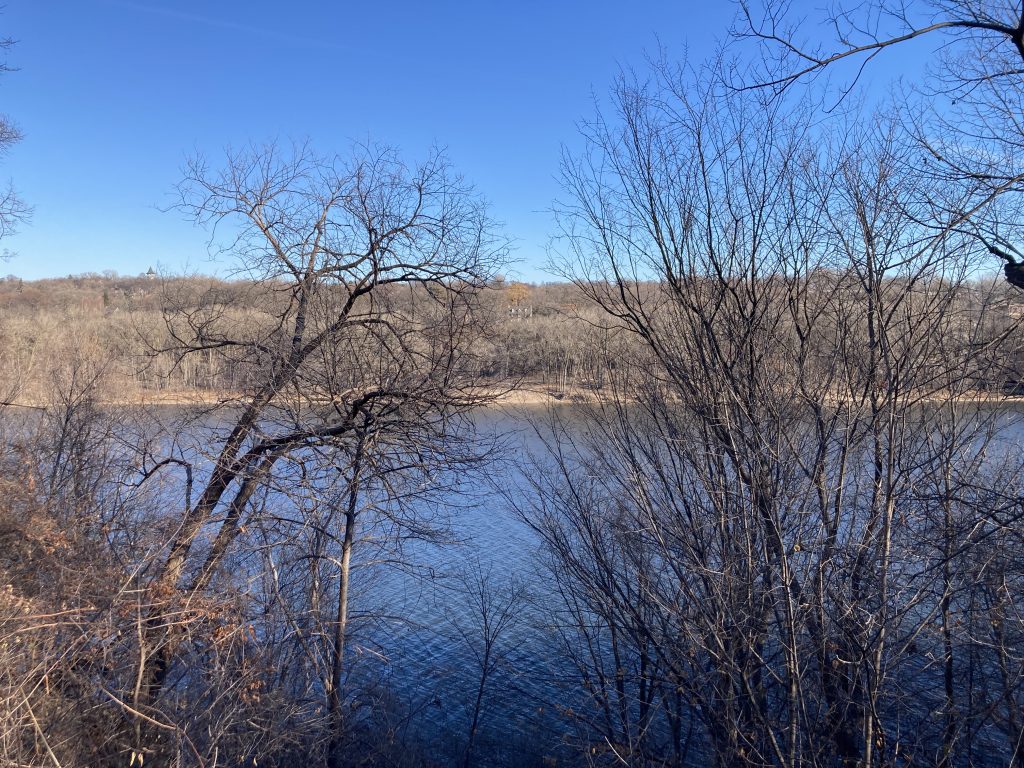
Drs. Dorothy and Irving Bernstein Scenic Rest Area*
52 degrees

*This is the first time, after almost 10 years of living here that I recall reading the sign at the 35th street parking lot overlook. After a quick search, I couldn’t determine who Dorothy and Irving are and what type of doctors they were.

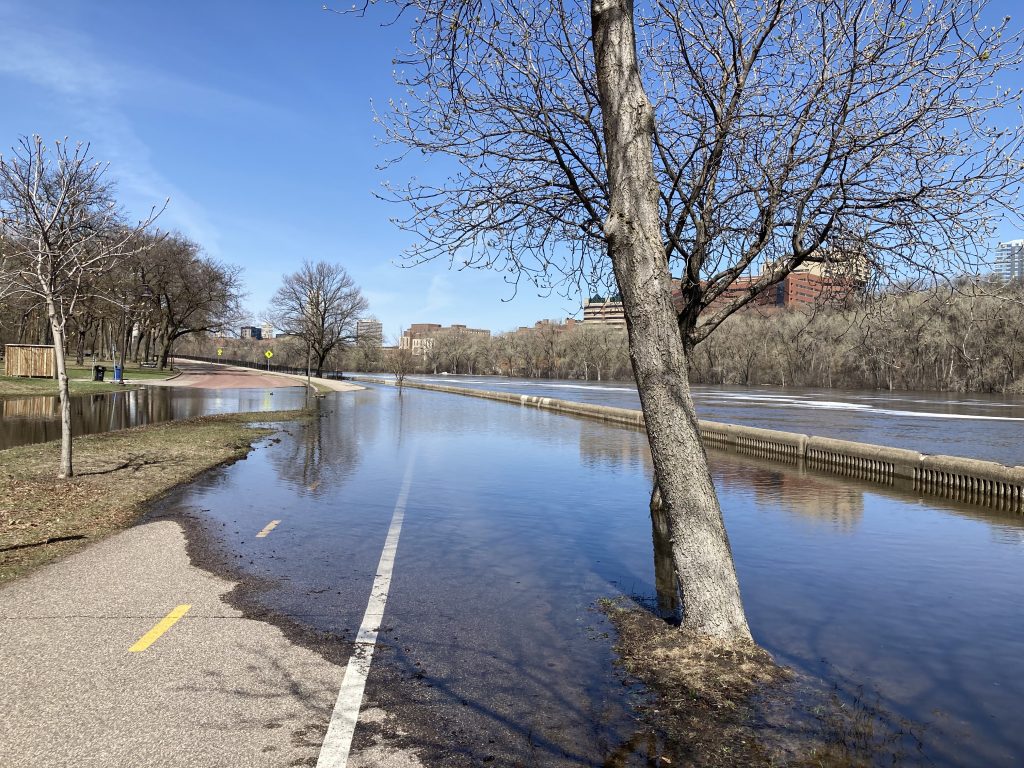
What a wonderful spring day. High of 64 and sun! Such a strange time. Winter hardly happened. The snow total this year: 7.3 inches. Last year: 89.7.

see: The Lost Winter

I miss the crunching snow and the cold air and the big flakes hitting my face and layers and running on ice without slipping and snow walls and desolate river views. And, I’m happy to see spring early — to hear more birds, wear less layers, sit on the deck, open the windows.

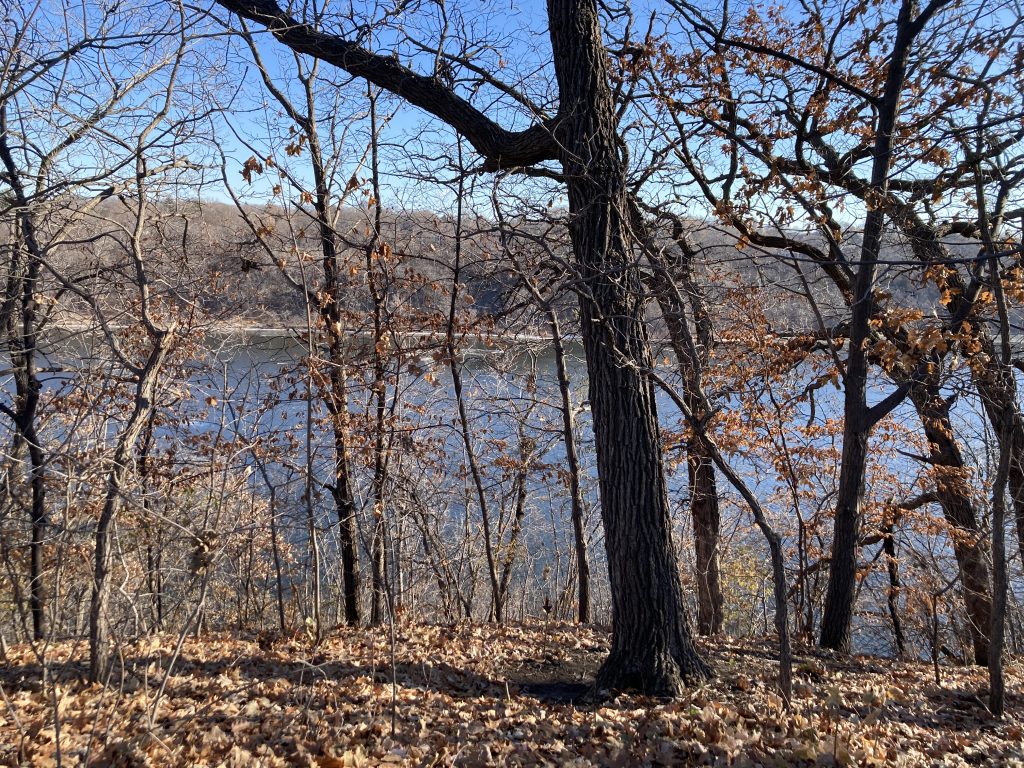
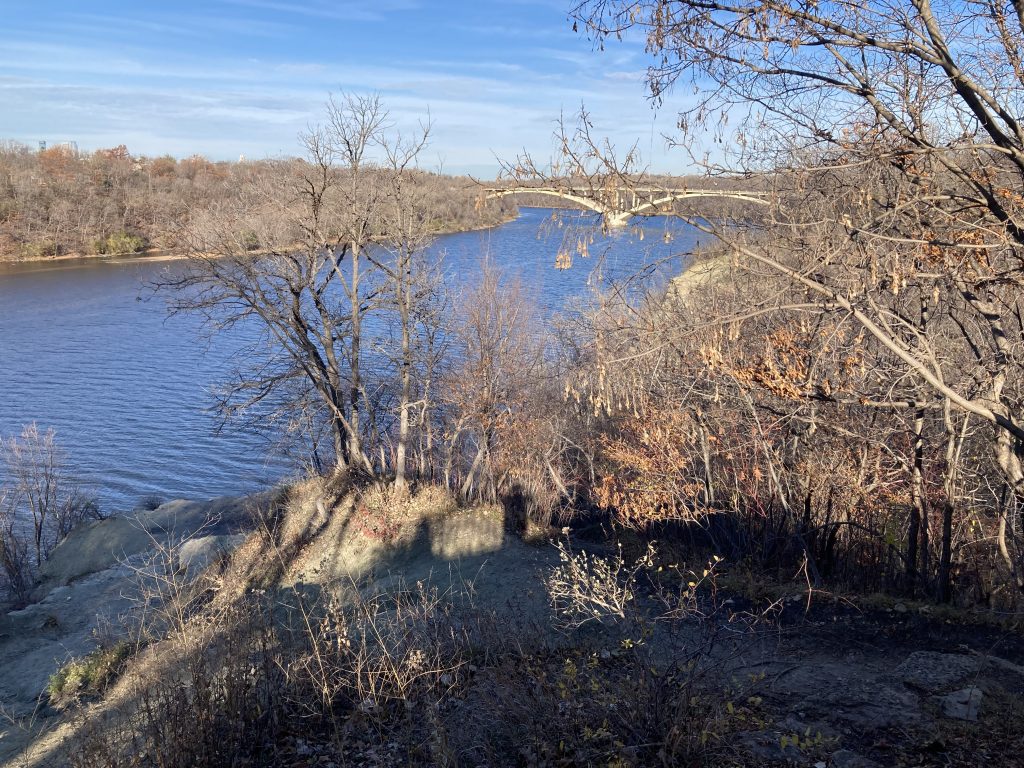
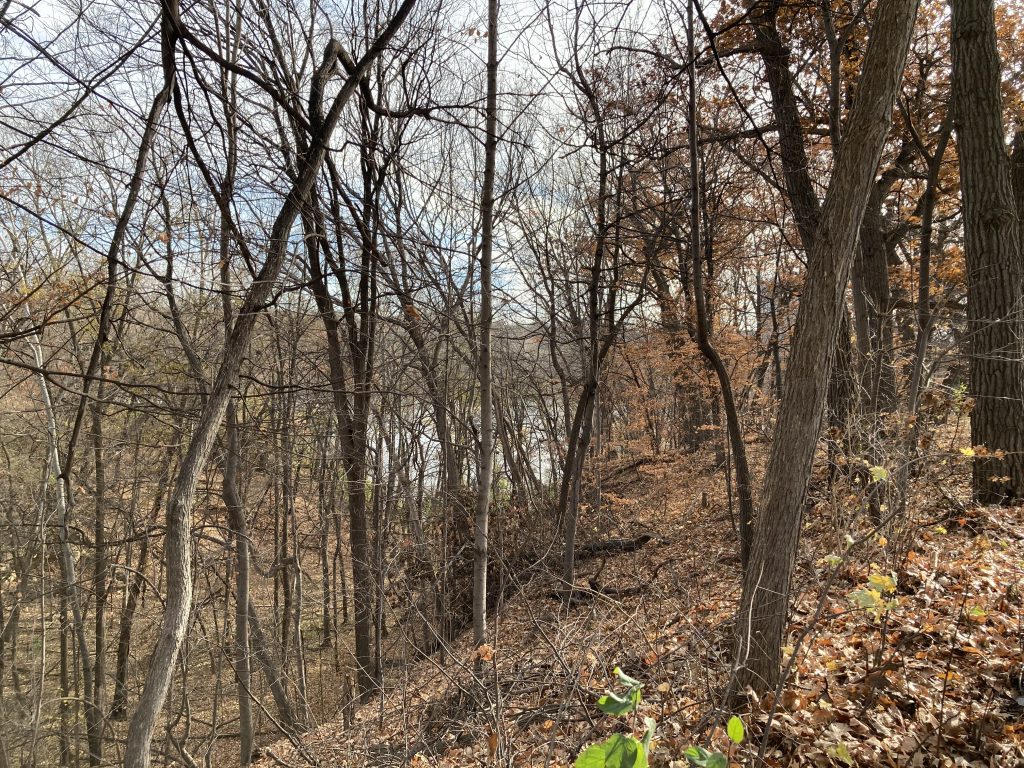
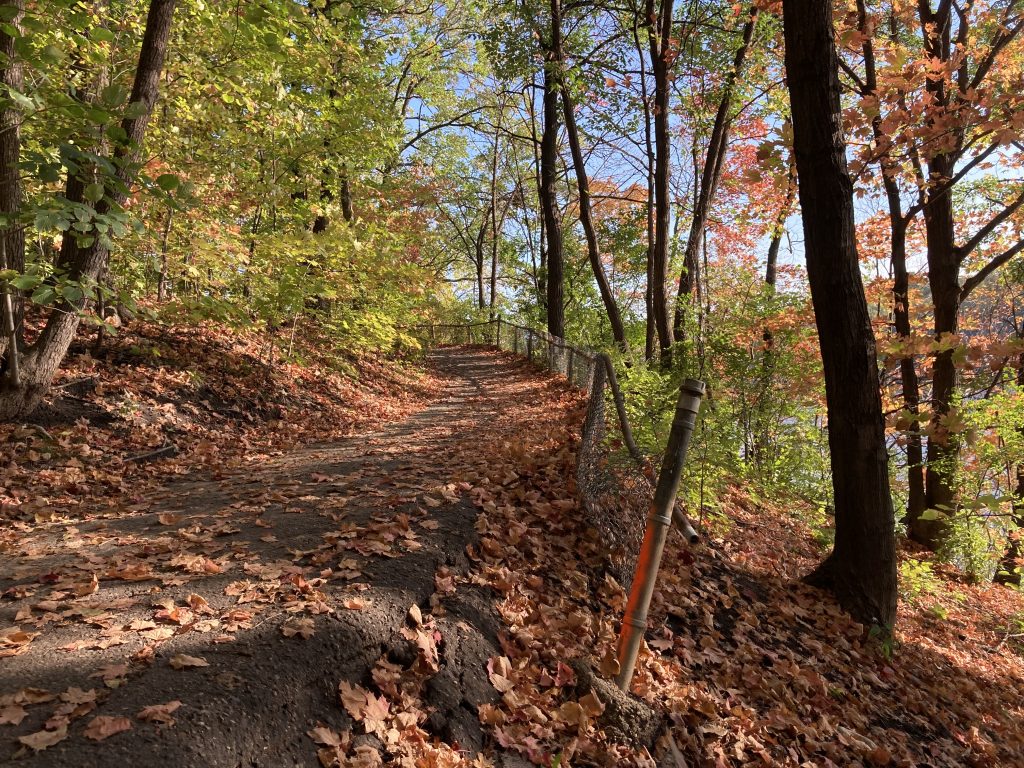
Once we reached Drs. Dorothy and Irving Bernstein Scenic Rest Area, we took the gravel path down and around the ravine: a shelf of snow and slick slats on the grate over the seeping water. Otherwise, mostly dry and without mud. Walking back through the neighborhood we noticed some birds — first, their tin-whistle song, then their fleeting forms fluttering across the thin branches. Could I turn this into a part of my bird triptych poem? At first we thought they might be blue jays, but then settled on robins. Did Scott see that they were robins? Not me. All I saw was a small, but not too small form, up in the trees. Mostly, quick, darting movement, then flight, once, hovering on a high-up branch.

Before the walk I wanted to archive two sources:

to archive

james schuyler and color: Reading a past entry from march 11, 2023, I was reminded of James Schuyler and his wonderful use of color. I had forgotten that he was an art critic. Searched, “james schuyler ekphrasis” and found this LARB review of a then recent book (circa 2011) of Schuyler’s poems: Scrappiness. The review gave a lot of attention to one of the poems, which is about a painting, but (maybe?) not an ekphrasis: A Blue Shadow Painting. Here are some color lines I’d like to remember:

It’s like this: the orange assertions, dark there-ness
of the tree, malleable steel-gray blueness of the ground; and sky; 
set against, no, with, living with, existing alongside and part of, 
the helter-skelter of rust brown, of swift indecipherables. The day
is passing, is past: mutable and immutable, came to live, 
on a small oblong of stretched canvas. Blue shadowed day, 
under a milk-of-flowers sky, you’re a talisman, my Calais. 

another line to remember: Not Make it new, but See it, hear it freshly.
listen to the full poem: A Blue Shadow Painting, audio

charles simic: I found a link to this article — Charles Simic and Me/ Dana Levin — on poems.com the other day. I like the brevity of Simic, at least what I’ve read in The New Yorker.

Williams used to say that he could revise a poem twenty different times just by changing the line breaks.

Charles Simic and Me / Dana Levin

Reading this, I immediately thought of an essay I read a few years back: Learning the Poetic Line/ Rebecca Hazelton. I’d like to reread it, and practice its 6 S’s. But — what are some ways other than line breaks to shape the story? Are these line breaks too visual, only achieving their effect when read with eyes and not ears? How can I represent line breaks in a way that resembles how I see? And/or what, other than line breaks, can I use to represent how I find/make/experience the world?

and is more interesting than but

Simic practiced this philosophy of and in all his poems, a metaphysics of radical inclusion: brutality and death were everywhere in life, and they were ordinary.

Charles Simic and Me/ Dana Levin

the real task, for him [WCW], was not to chronicle the development of knowing but to enact, via enjambment, the struggle of seeing—and so to find himself asking the reader to participate in that struggle too, to work with him in empathy?

Charles Simic and Me/ Dana Levin

the struggle of seeing — asking the reader to participate in that struggle too

poems as made things—products of decision, as much as magic

What a wonderful, thought-provoking essay! I think one of the problems with my Haunts poems are the line breaks and the music of the words? I’m using the breathing rhythm of 3/2, but do they all need to fit that strict form? How can the 3/2 feeling being played with in the lines? Adhered to, but in new ways? Yes! I will work on line breaks today and try to see my poems in not new, but fresh ways!

Found this Charles Simic poem in his collection, The Lunatic. My answer to his questions: yes, I have.

Late-Night Inquiry/ Charles Simic

Have you introduced yourself to yourself
The way a visitor at your door would?

Have you found a seat in your room
For every one of your wayward selves

To withdraw into their own thoughts
Or stare into space as if it were a mirror?

Do you have a match you can light
To make their shadows dance on the wall

Or float dream-like on the ceiling
the way leaves do on summer afternoons,

Before they take their bow and the curtain drops
As the match burns down to your fingertips?

march 10/RUN

5 miles
marshall loop (prior)
47 degrees

An afternoon run with Scott. We talked about a cool rpf (request for proposal) that Scott just completed and whether or not the wires sticking out of the street lamps on the bridge were live and how the clocktower at Disney Land was telling the wrong time for years without them realizing. For most of it, I felt fine. My calf was a little sore after we picked up the pace so we wouldn’t miss the light at Cleveland. A few minutes later, it felt okay again.

10+ Things

  1. the clear, straight, sturdy shadow of the bridge railing
  2. from the top of the summit hill near shadow falls: the river burning white through the trees — I got distracted looking at it and almost fell of the edge of the sidewalk
  3. from the lake street bridge heading west: a bright path of light on the surface of the river, spanning from the bridge to the west bank
  4. the pale brown of a sandbar just below the surface of the river
  5. the underside of the steps leading up to the lake street bridge: peeling paint
  6. a “Tacos” sign where the BBQ sign used to be at Marshall and Cretin
  7. a big, beautiful wrap around porch with white spindles near Summit
  8. overheard: Katie didn’t know
  9. wind chimes!
  10. a tabby cat running across the street, headed straight for us — it seemed to be saying, Keep moving! This is my block!
  11. added 11 march 2024: overheard — one woman to another: After the costume change, I’ll shine and fly

haunted by haunts

In the fall of 2021 I worked on a long poem based on my 3/2 breathing rhythms and centered on the gorge and my repeated runs around it. I revisited the poem this past fall in 2023 and wrote around it, leaving only a few traces of the original — a palimpsest? I stopped at the beginning of 2024 with a message to future Sara: good luck. Well, here I am and I can’t remember what prompted me to open my haunts documents again, but I did and I’m back. Reading through an older version titled, “Haunts late fall 2023.” It’s a mixture of the old poem and my new additions, and I’m wondering why I got rid of so many of the old lines. It might be because I submitted parts of the poem to about a dozen journals with no luck. All rejections. It made me doubt what I was writing. But maybe I should try to keep submitting it instead of losing all of it? Maybe submit different versions, too?

Reading through the poem, I wrote a list of themes in my Plague Notebook, Vol 19!:

  • girl
  • ghost
  • gorge
  • trails
  • loops
  • echoes
  • bells
  • traces
  • remains
  • stories
  • bodies
  • habits repetitions

Bells. In the newer version of my poem, from late 2023, I got rid of almost all of the mentions of bells. But, I keep coming back to them, like in ED’s “I felt a Funeral in my Brain”: As all the Heavens were a Bell, / And being, but an Ear

bells

  1. starting a ritual
  2. the keeping of time — YES! bells as time/clock*
  3. tolling = death, the dead
  4. signalling the final lap in a race
  5. “fake” simulated recorded bells
  6. light rail bells elementary and middle school bells college bells
  7. the gorge world echoing of past bells
  8. echo = repeating, but not exactly the same, reverberation, ripple, eroding of the original sound from the strike
  9. Annie Dillard and each of us walking around as as bells not yet struck
  10. vibrations movement sound

A curious, “fun” fact that I’d learn in my research about the St. Thomas bells and that supported in my own observations: the St. Thomas bells are not always accurate in their time-keeping; they can be off by a few seconds. Someone has to re-sync them periodically.

A bell poem in the latest issue of Poetry (March 2024):

A Bell Is a Bearer of Time/ ALISON C. ROLLINS

*To be performed with bells on. All “writing” is performance, some performance is “writing.”

I am
a product
of my time.
Time is a body
that resembles
a sound without a scale.
Forever foreclosed fortitude.
In heaven, the dinner bell rings
as elegy. The porch-light stars turn
on their mothering moths. Betrayal
takes at least two, and wherever two
or more are gathered, I am there in
their pulsating timbre. To hear is to hunger
for the gendered race of sound. In my midst,
loneliness listens. In confidence, I am secreted
away. I was today years old when I learned the truth,
a browbeat bell is an idiophone. The strike made
by an internal clapper or an external hammer, a uvula—
that small flesh, conical body projecting downward from
the soft palate’s middle. Vocal, vibrating vulva. I am less a writer
who reads than a reader who writes. Therein lies the trouble, the treble clef of
conviction. Come now to the feast of hearing, where Hortense J. Spillers
gives a sermon: We address here the requirements of  literacy as the ear takes
on the functions of “reading.” Call me bad news bear. Bestial. Becoming.
In “Venus in Two Acts,” Saidiya Hartman asks, Must the future of abolition be
first performed on the page? Must I write a run-on of runaways?
Must you make out my handwriting? Evidence that loss has limbs.
The clawed syntax. The muzzled grammar. Don’t be afraid.
Kill me with your language. Learn how to mark my
words.*

During today’s run, the only bells we heard were not bells but chimes, wind chimes. Strange how close we were to St. Thomas without hearing the bells.

march 9/RUN

4 miles
river road, north/south
25 degrees

Oh, I love running in weather like it was this morning! Sunny, calm, crisp air. So many shadows, some sharp some soft. Sparkling, shimmering, simmering river. Today my legs didn’t feel heavy and my calf was quiet, or maybe it was humming happily? My IT band didn’t hurt either! No compression sleeve while I ran, just after, for recovery.

I felt good. When I reached 2 miles I stopped, spoke a few notes into my phone, put on Beyoncé’s Renaissance and ran south.

10 Things

  1. shadows of the fence railing above the ravine, 1: 3 slightly crooked lines on the path, very solid and sturdy and thick
  2. fence railing, 2: the 3 lines became straight and crisp, seeming more real than the actual fence railing to my eyes
  3. shadow, 3: another solid sharp thick line from a tree’s branch
  4. shadow, 4: a soft, almost fluffy, form made from a cluster of small branches
  5. shadow, 5: a flash of dark overhead — a big bird in flight?
  6. shadow, 6: not a flash, but a flutter or flurry of movement — a few darting birds?
  7. a small white dot in the sky — was it a plane? the moon? I tried to find it in my peripheral vision but couldn’t
  8. something dark and plastic looking down below on the winchell trail — a sleeping person?
  9. young voices rising up from longfellow flats
  10. hopefully mis-overheard — one older woman to another: I farted and then the diaper filled with blood — what?

As I was admiring the fence railing shadows I thought about how clear and real they seemed to me. Much more there than the actual fence railing, which was staticky and vague.

At some point in the run, I had an idea for the triptych poem I was working on earlier this morning: intentionally do not mention the type of bird I’m writing about. It’s all about these different ways that I see birds through my peripheral — swishing wings, a call/cry/sound?, a sense of feathers and a shadow. Yes!

This weekend, I need to finish the wonderful book I’m listening to before it gets automatically returned to the library: The Ten Thousand Doors of January. I’m thinking about doors a lot lately. Wrote this before breakfast:

an open
door says

come in and
a shut

door says who
are you

but a door
opening

does not speak, 
it sings.

Does it work? Not sure. And here’s a wonderful poem by W.S. Merwin:

Door/ W.S. Merwin

This is a place where a door might be
here where I am standing
In the light outside all the walls

there would be a shadow here
all day long
and a door into it
where now there is me

and somebody would come and knock
on this air
long after I have gone
and there in front of me
a life would open

march 8/WALKDATASILENCE

A late afternoon walk with Delia and Scott. Colder than expected. 38 degrees. Full winter layers. Winter coat, double gloves, hat. Lots of sun and long shadows leaving gnarled shapes across the sidewalk. A Bluejay screeching. A kid laughing, playing baseball with an adult (his dad?) at the Howe playground. Cars commuting home on the river road.

We talked about a new word I learned: nocebo (as opposed to placebo) and Scott’s work today. I mentioned that I’m feeling out of sorts with my writing practice. Too many directions, too many BIG concepts. I want to get back to writing my small poems.

earlier in the day

After 3 days of running in a row and a calf feeling much better but still on the mend, it’s time for a break. I decided to leave my watch off too. No stands or workout minutes or calories burned. No monitoring of my heart rate or my balance. I’m still moving — baking and cleaning and doing laundry and taking the dog for a walk — even if that movement isn’t making a sound.

Speaking of watches, 2 days ago I wrote about time and the clock. Here are some more references to time I’d like to remember:

1

That loneliness is just an ongoing 
Relationship with time. 
(Lake of the Isles/ Anni Liu)

2

Time is a kind friend, he will make us old.
(Let it be Forgotten/ Sara Teasdale)

3

When the big clock at the train station stopped,
the leaves kept falling,
the trains kept running,
my mother’s hair kept growing longer and blacker,
and my father’s body kept filling up with time.
(Big Clock/ Li-Young Lee)

4

Mosses, I think, are like time made visible. They create a kind of botanical forgetting. Shoot by tiny shoot, the past is obscured in green. That’s why we have stories, so we can remember.

The mosses remember that this is not the first time the glaciers have melted. If time is a line, as western thinking presumes, we might think this is a unique moment for which we have to devise a solution that enables that line to continue. If time is a circle, as the Indigenous worldview presumes, the knowledge we need is already within the circle; we just have to remember it to find it again and let it teach us. That’s where the storytellers come in.
(Ancient Green/ Robin Wall Kimmerer)

5

IN THE ANISHINAABE languages of Skywoman, our words for moss, aasaakamig and aasaakamek, carry the meaning “those ones who cover the earth.” Soft, moist, protective, they turn time into life, covering the transient and softening the transition to another state.
(Ancient Green/ Robin Wall Kimmerer)

6

Time is a circle reminded me of the tracking of the “wheeling life” that I did while running last year. I was inspired by Forrest Gander’s poem “Circumambulation of Mount Tamalpas”:

maculas of light fallen weightless from
pores in the canopy our senses
part of the wheeling life around us and through
an undergrowth stoked with the unseen
go the reverberations of our steps

the wheeling life: 10 things

  1. car wheels, near the road — relentless, too fast, noisy
  2. car wheels, below, on the winchell trail — a gentle hum, quiet, distant
  3. bike wheels, approaching from behind very slowly — a little kid biking to school with his mom who had a carrier with another kid behind her seat
  4. bike wheels, nearby, another kid and adult on the way to school
  5. the wheel of life as a loop: a favorite route, running south, looping back north, first on edmund, then on the winchell trail
  6. the wheel of life as transformation: red leaves decorate a tree halfway to the river
  7. the wheel of life as cycles: not the end of the year, but the beginning — school time: kids at the elementary school
  8. the wheel of life as constant motion: on the trail, below the road and above the river, everything is active: birds calling, squirrels rustling, wheels traveling, river flowing, feet moving, leaves and lungs breathing
  9. the wheels of life as cycle: always in late september, hot and humid and too sunny
  10. the wheels of life as transformation: thinning leaves, falling acorns, a small view of the river

feb 27/RUN

4.5 miles
VA bridge and back
46 degrees
wind: 16 mph, 29 mph gusts

What a wonderful morning for a run! Okay, maybe the wind was a bit much, but the sun and the warm air and the clear paths made up for it. I felt good and strong and relaxed. A few times my right calf reminded me it was there — no pain, just a strange stretched feeling. I recited ED’s “I heard a Fly buzz — when I died –” several times, mostly in my head, but once, as I climbed out of minnehaha park, out loud! Should I be celebrating this? Do I want to be that person who doesn’t care if others hear her reciting poems as she runs? Yes, I do.

10 Things

  1. the hollow knocking of a woodpecker on dead wood, echoing across the gorge
  2. lots of black capped chickadees calling to each other
  3. oak tree shadows, sprawled everywhere
  4. the brown creek water lazily heading towards the limestone ledge
  5. rustling below me, on the winchell trail — someone walking over the leaves
  6. climbing up from the part of the path that dips below the road, seeing the shadow of trunk on the path that was so sharp and dark I thought it was a fallen tree
  7. sirens on Hiawatha, getting louder as they off the walls of the tunnel near 50th
  8. passing a runner — What a beautiful morning!Yes! Almost perfect!
  9. a biker in a bright yellow shirt, as bright as the one I was wearing
  10. the meandering curves of the sidewalks that wind through the part of minnehaha falls near John Stevens’ house

This morning, while drinking my coffee, I decided to write about the delightful noise of geese wings cutting through the air that I’d recalled hearing a few weeks ago on my back deck — I remembered it after reading a list of 10 things from a feb 27th from another year. I wrote a draft of a poem, then decided I’d like to start writing delight poems every morning. No pressure — just patch a few words together and don’t try to make them elaborate — this isn’t a competition but a doorway into thanks and a silence in which another voice may speak (Praying/ Mary Oliver) — just the opportunity to sit with one of the delights I’ve encountered while running beside the gorge. A few minutes later, I had a further idea about including Emily Dickinson:

The practice, elements:

  • write a poem each day
  • the poem should be about some delight noticed on the run — either from that day or a past entry
  • any form running/breathing form: couplets of 3 syllables/2 syllables
  • uses, in some way, a favorite line from an Emily Dickinson poem

Here’s the poem I wrote this morning:

Too Silver for a Seam / Sara Lynne Puotinen

Even more than the sight of them
it is the sounds they make
that move me.

Usually it is the mournful calls
from within a tight formation
then the lone honk of the last in line,

but today the geese were low enough
to hear the sharp swish of their wings
cutting the air.

In their wake only the echo
of scissors and sharpening knives
and movement too silver for a seam.

The ED line is too silver for a seam and it comes from “A Bird came down the Walk”:

And he unrolled his feathers
And rowed him softer Home—

Than Oars divide the Ocean,
Too silver for a seam—

I like it! It needs a little work, but it makes me happy and captures my delight in hearing this sound. Scott wondered about the scissors and sharpening knives — such violent imagery — so I explained — the scissors make me think of Scott’s mom and the old scissors I inherited from her that make a wonderfully sharp scissor-y sound when you use them — it also makes me think of my mom who was always using scissors for her fiber art. The sharpening knives make me think of Scott’s dad and the enthusiastic and dilligent way he would sharpen their knives with their knife sharpener. I think I might need to add a line or two that signals my affection for these sounds without making it too obvious.

During the last mile of the fun, I started reciting other ED poems, including:

To make a prairie it takes a clover and one bee,
One clover, and a bee.
And revery.
The revery alone will do,
If bees are few.

Note: This seems like an edited version from Mabel Todd, with all its punctuation and no capitalizing of clovers or bees.

As I recited this small poem, I suddenly thought about how I was a bee, wearing my bright yellow shirt with my black running shorts and tights. I kept running, feeling ready to stop, looking ahead and wondering how close I was to being done. Suddenly I saw it: the bright yellow crosswalk sign with black figures at 38th street! I’m almost done when I reach that sign! I watched it getting closer and thought, it takes one bee or, it takes a bee?

update, six hours later: I’m back. Decided that I might want to add one more rule to this ED delight daily practice: I want to use my running/breathing form of 3 syllable/2 syllable couplets. I tightened up the poem I wrote earlier using that form. Here’s the new version:

Today the
geese flew

low enough
to hear

the quick swish
of wings

slicing through
the air. (I could leave air for the unintentional rhyme or switch to sky)

In their wake —
echoes

of scissors
cutting

knives being
sharpened

their blades too
silver

for a seam.

feb 26/WALK

40 minutes
to the river and back
57 degrees

A warm, windy February afternoon. Took a walk with Delia the dog and Scott. Heard some kids on the playground that I mistook for a siren. Then later, heard some actual sirens. Also heard some ragtime music coming from a bike on the path. Marveled at the gnarled oaks and the jagged shadow one cast on another branchless tree. Noticed how high the bluff was above the forest floor. Encountered many happy, chatting walkers, one runner without a shirt.

It’s Windy

Is it the strange, too-early spring weather? The fact that I’m turning 50 in 4 months and that my kids are turning 21 and 18? Not sure, but my thoughts have been scattered lately, flitting from one idea to the next without landing anywhere for too long. Maybe it’s the wind. This morning I said to Scott, what a beautiful morning! Too bad it’s windy. Then Scott started singing “Windy” by the Association — I tried to join in, but I was in the wrong key (as usual). I should have a t-shirt that says, I’m always in the wrong key, I said (which, I think, isn’t always a bad thing to be in). Anyway, I decided to listen to the song and read the lyrics. It’s actually about wind! How delightful!

Who’s tripping down the streets of the city
Smilin’ at everybody she sees
Who’s reachin’ out to capture a moment
Everyone knows it’s Windy

And Windy has stormy eyes
That flash at the sound of lies
And Windy has wings to fly
Above the clouds (above the clouds)

I think I might create a page of wind poems/songs and add this, along with “They call the wind Mariah” from Paint Your Wagon and “I Take to the Wind” by King Crimson.

an idea (for the future? now?): Yesterday I posted a poem that uses an Emily Dickinson line in the title (I heard a fly buzz), then obliquely references her in the poem. A year or so ago, I had the idea that I’d like to write a series of poems that use some of my favorite Emily Dickinson lines as titles for my poems about vision loss, how I see, and how I’ve been carving out a new way of being with my moving practice. I’ve already written one that was published this past December in the print journal, Door is a Jar:

The Motions of the Dipping Birds/ Sara Lynne Puotinen

Because I can no longer see
her face, when my daughter talks I watch

her small hands rise and fall,
sweep the air, flutter.

I marvel at the soft feathers her fingers make
as they soar then circle then settle

on the perch of her hips waiting
to return to the sky for another story.

I think Victoria Chang’s collection, The Trees Witness Everything, in which she uses W.S. Merwin poem titles and then writes her own poem, might be a good inspiration. I’ve been wanting to do this project for several years, but I wasn’t quite ready. Am I now? I’ve already been moving towards it with my interest in memorizing 50 Emily Dickinson poems before my 50th birthday — did I mention that in here, or was it just in my “to do” list? Oh, I hope this idea sticks and helps me to write more poetry. Lately, I’ve had tons of ideas that I start, but that really don’t go anywhere.

As part of this Dickinson project, and inspired by yesterday’s poem, I decided to memorize ED’s “I heard a fly buzz — when I died”. After memorizing it, I listened to someone else’s reading of it and noticed a line change:

[original] The stillness in the Room
[alternate in video] The stillness round my form

Which is correct, I wondered. At first, I thought the alternate might be the correct one, but it didn’t seem quite right — form neatly rhymes with the last line of the verse: Between the Heaves of Storm. ED liked slant rhymes, not straight ones. I looked it up and discovered that ED’s first editor, Mabel Loomis Todd, had changed the line to form. She also took out ED’s dashes. I’ve read about the fraught relationship between ED and Todd (who was ED’s brother’s lover) and Todd’s heavy-handed editing, so I’m sticking with the original!

medical term fun!

I’m still working with g a s t r o c n e m i u s and s o l e u s scrabble tiles. Last night’s favorite:

Guess a minute’s colors

I told RJP and she said, 7:42 is yellowish-green. Do I see any particular minute’s colors? No. But I do like trying to describe what colors I see at any given minute.

What happens when I reverse 2 words: Guess a color’s minutes?
Or, Minutes colors a guess?
Or, As color, minutes guess
Or, minutes: a color’s guess (as in, meeting minutes)
Or, a guess colors minutes

Back to ED’s buzzing fly. Whenever I read this poem, I think about an article I discovered a few years ago that discusses how accurately and effectively ED describes the physiology of the dying eye — 15 march 2021

feb 19/RUN

5 miles
john stevens’ house
34 degrees

So bright out by the gorge today. Sharp shadows. Clear path. Black-capped chickadees, downy woodpeckers, construction workers, little kids all chattering. Before I saw the creek, I heard it gushing below me near the falls. Oh — and wild turkeys! A dozen of them pecking the snow just north of locks and dam no. 1.

My favorite part of the run was in minnehaha park near John Stevens’ house, where the serpentine sidewalk — completely cleared and dry — snaked through the grass covered in several inches of untouched snow. O, the sun and the shadows and the curves and the warmer air and the dry paths and the open lungs and humming legs!

an illusion

Glance one: running south on the stretch near 38th street, I noticed something dark and solid up ahead on the trail. A loose dog or wild animal? No.
Glance two: Still staring, the black thing turned into a dark, deep puddle on the road.
Glance three: How could I have mistook this puddle for an animal?
Glance four: Wait — it’s not a puddle, it’s someone’s disembodied legs in dark pants walking on the edge of the path.
Glance five: And their legs are attached to a torso in a light colored (gray? tan? pale blue?) jacket which blended into the sky.
Glance six: Getting closer, I can see a head, some shoes

This illusion is not unusual for me. Mostly, it doesn’t bother me because I am used to it and I have time to figure out what it is I’m seeing. Sometimes, when I don’t have time to look and think and guess, it’s scary and unsettling and dangerous.

Found an interview with Andrew Leland from Joeita Gupta and The Pulse this morning and wanted to remember this helpful definition of blindness:

The Pulse

What is blindness? Blindness isn’t merely an absence of sight. Blindness is a central identity for some, a neutral or marginal characteristic for others. Not all blind people are the same. There are blind vegetarians, athletes, academics, you name it. Some people have been blind from birth, others lose their vision as adults. Blindness can come on suddenly or gradually. Blindness is then more than a physical experience. It has its own culture, language, and politics. Blindness is not the same for any two blind people anymore than sight is experienced the same way by two sighted individuals.

note: This podcast has some other great episodes, including one about birding while blind, which I added to my May is for the Birds page.

How I See

I’m continuing to work on my alt-text/ekphrastic image project. Still trying to figure out the best way into the actual poems. Not quite writer’s block, but a grasping, grappling with, wrangling ideas. Anyway, maybe detouring will help a little. I’d like to gather lines from vision poems that describe how I see. I’ll begin with one of the most well-known blind poets, Jorge Luis Borges:

 In Praise of Darkness / Jorge Luis Borges

Old age (the name that others give it)
can be the time of our greatest bliss.
The animal has died or almost died.
The man and his spirit remain.
I live among vague, luminous shapes
that are not darkness yet.
Buenos Aires,
whose edges disintegrated
into the endless plain, has gone back to being the Recoleta, the Retiro,
the nondescript streets of the Once,
and the rickety old houses
we still call the South.
In my life there were always too many things.
Democritus of Abdera plucked out his eyes in order to think:
Time has been my Democritus.
This penumbra is slow and does not pain me;
it flows down a gentle slope,
resembling eternity.
My friends have no faces,
women are what they were so many years ago,
these corners could be other corners,
there are no letters on the pages of books.
All this should frighten me,
but it is a sweetness, a return.
Of the generations of texts on earth
I will have read only a few–
the ones that I keep reading in my memory,
reading and transforming.
From South, East, West, and North
the paths converge that have led me
to my secret center.
Those paths were echoes and footsteps,
women, men, death-throes, resurrections,
days and nights,
dreams and half-wakeful dreams,
every inmost moment of yesterday
and all the yesterdays of the world,
the Dane’s staunch sword and the Persian’s moon,
the acts of the dead,
shared love, and words,
Emerson and snow, so many things.
Now I can forget them. I reach my center,
my algebra and my key,
my mirror.
Soon I will know who I am.

penumbra: shroud, fringe, a shaded region surrounding the dark portion of a sunspot, in an eclipse the partially illuminated space between full shadow and light

Here are a few lines that I think describe how I see:

This penumbra is slow and does not pain me;
it flows down a gentle slope,
resembling eternity.
My friends have no faces,
women are what they were so many years ago,
these corners could be other corners

A slow, gentle deterioration. No dramatic or sudden shifts. / When I look at people directly, I usually can’t see their faces. / I either see a smudge or darkness or the face I remember from before, when I could see. / sharp edges or corners are difficult to see and streets once familiar are strange. Traveling to a new street corner, I struggle to read signs, to recognize where I am, everything there but not, everything the same forms: Building, Sign, Door

feb 18/RUN

5.8 miles
down the franklin and back
31 degrees

A little icy, a little windy, a little crowded. Difficult to run together in these conditions, so Scott and I split up. The sun was bright and I saw some wonderful shadows of trees — gnarled and sprawling across the sky. Heard some geese, smelled some bacon.

When we ran together, Scott and I talked about the half frozen river and how it looked like a gray slushy. What flavor is gray slushy, I wondered. Scott suggested, all the flavors then added, I bet that would taste good. I wondered if this “everything” slushy would include blueberry. No, Scott said, blue raspberry. I mentioned how there is no consensus on the origins of the rasp in raspberry, which I had come across while reading a past entry a few days ago.

How I See

As I continue to work on this project, I want to return to ekphrastic poems. In an article for Lithub — Back to School for Everyone: Ekphrastic Poetry with Victoria Chang — Chang offers some helpful thoughts about the form:

how poets engage with visual art:

  • write about the scene or subject being depicted in the artwork
  • write in the voice of the person or object represented
  • write about their personal experiences
  • fictionalizing a scene within the art
  • write about the work in the context of its socio-political history

In essence, ekphrastic poems are a way to interact with the world and a way to respond to the world. The process of writing ekphrastic poetry also brings into question aspects of viewing, the culture of viewing, and the gaze, always asking the questions of who is looking at what, when, and why?

3 thoughts about Ekphrasis

1: I’m as interested in how someone is looking as who, what, when, or why they are looking.

2: Maybe part of the ekphrasis angle is the idea that sometimes the world looks like a painting to me — pointillism or abstract expressionism or?

3: the contrast between how a photo captures/stills the image in a way that my eyes never can

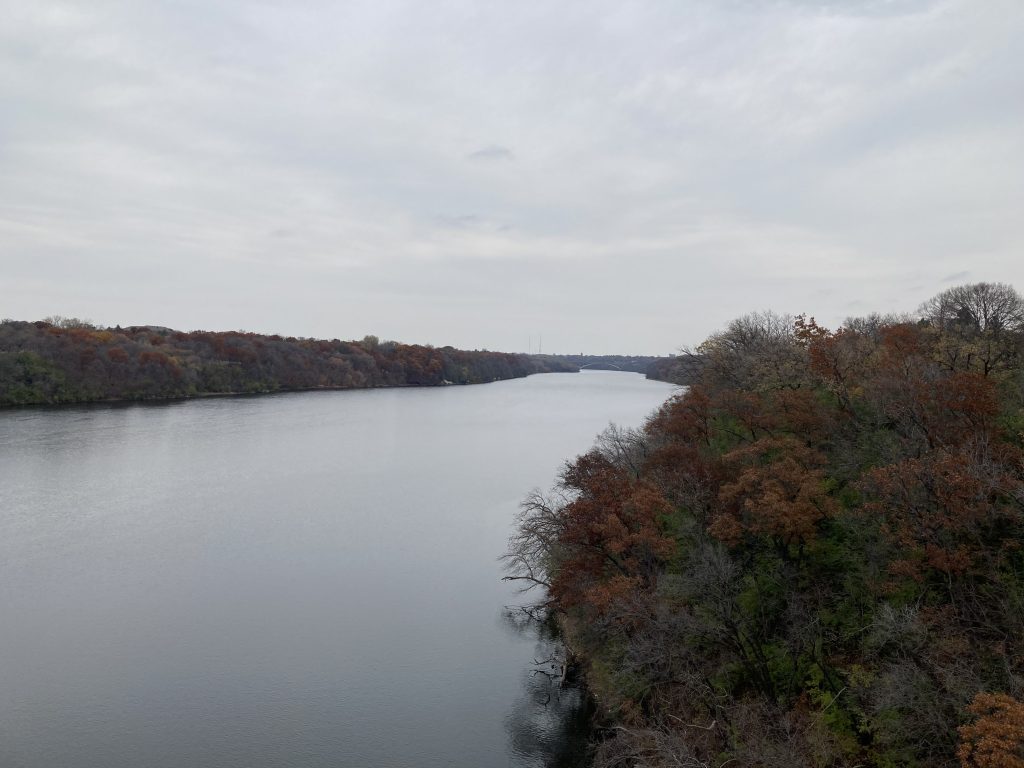
A view from the ford bridge, poorly framed. Not sure what color other people might see here, but to me it's all gray: light gray sky and river, broken up by chunks of dark gray trees. I like how the sky and the river look almost the same color to me.
8 nov 2023

original description: A view from the ford bridge, poorly framed. Not sure what color other people might see here, but to me it’s all gray: light gray sky and river, broken up by chunks of dark gray trees. I like how the sky and the river look almost the same color to me.

5 nouns/ 5 adjectives/ 5 verbs

nouns: river, water, shore, trees, sky, branches, a bend, surface
adjectives: winding, scraggly, soft, fuzzy, drab, dark, light, gray, wide, flat, contrast, wide
verb: stretching, reaching, standing, stilled, separated, cutting through,\

one sentence about the most important thing in image: The sky and the river are the same color; only the disruption of trees enables me to distinguish between them.

a second sentence about the second most important thing: Everything gray: light gray sky and river, broken up by chunks of dark gray trees.

a third sentence about the third most important thing: In this soft, wide open view, when everything is stilled, silent, nothing is happening.

The nothing that’s happening in this image is full of meaning. Here nothing = no things are doing anything/ nothing to see; nothing = a void, absence, unknowingness; nothing = a rest for my eyes, no movement, everything still, satisfied, stable.

The idea of no separation, no edges or divisions between forms, reminds me of a wonderful poem that I thought I’d posted already, but hadn’t. I think when I first encountered it a few years ago, it didn’t resonate for me. Now, I want to call out, yes!, with almost every line.

Monet Refuses the Operation/ Lisel Muller

Doctor, you say there are no haloes
around the streetlights in Paris
and what I see is an aberration
caused by old age, an affliction.
I tell you it has taken me all my life
to arrive at the vision of gas lamps as angels,
to soften and blur and finally banish
the edges you regret I don’t see,
to learn that the line I called the horizon
does not exist and sky and water,
so long apart, are the same state of being.
Fifty-four years before I could see
Rouen cathedral is built
of parallel shafts of sun,
and now you want to restore
my youthful errors: fixed
notions of top and bottom,
the illusion of three-dimensional space,
wisteria separate
from the bridge it covers.
What can I say to convince you
the Houses of Parliament dissolve
night after night to become
the fluid dream of the Thames?
I will not return to a universe
of objects that don’t know each other,
as if islands were not the lost children
of one great continent. The world
is flux, and light becomes what it touches,
becomes water, lilies on water,
above and below water,
becomes lilac and mauve and yellow
and white and cerulean lamps,
small fists passing sunlight
so quickly to one another
that it would take long, streaming hair
inside my brush to catch it.
To paint the speed of light!
Our weighted shapes, these verticals,
burn to mix with air
and change our bones, skin, clothes
to gases. Doctor,
if only you could see
how heaven pulls earth into its arms
and how infinitely the heart expands
to claim this world, blue vapor without end.

feb 11/RUN

5 miles
Veterans’ Home and back
32 degrees

Another weekend run with Scott. Usually we run on Saturdays, but yesterday we were in St. Peter, so we ran today instead. Colder, windier, sunny. Sharp shadows. My favorite shadow: running under the ford bridge, a big shadow crossed over my head. A bird? No, a bike up on the bridge.

We talked about ones and zeroes and the differences between null, zero, and false in coding. I mentioned how when it gets to the brain, seeing is about signals firing and not firing. Then we talked about a recent controversy with Margaret Livingstone’s research on animals, which led us to a discussion about scientific experiments as material practices, the ethical dilemma of using knowledge gained from unethical experiments, and then a mention of Newton’s experiments on himself — shoving something in his eye to learn about color. Some fun discussions!

I forgot to notice the falls or look down the river, I recall seeing someone in yellow running on the Winchell Trail. I smelled the smoke near the house that always smells like smoke. I heard a dog’s collar clanging behind us. Felt the cold wind almost taking my breath away.

before the run

Started rewatching Margaret Livingstone’s lecture about artists and vision. Also found her book, Vision and Art — the “read sample” is helpful here.

Near the beginning of the video, Livingstone emphasizes this idea: “Visual information processing is not image transmission.” She adds: you don’t transmit information up to your brain because there’s nobody up there to look. In her book, she elaborates on this idea, giving it a name: the homunculas fallacy — homunculas means “little man.” The fallacy: some little man is up in your brain “looking” at the image. I love this name and the idea of a little man; I’d like to put it in a poem!

jan 22/RUN

5.8 miles
the flats and back
26 degrees

(added a few hours later): I almost forgot to mention that this entry is my 2000th post. Not every single one of these entries is about a run, but most of them are. Wow. When I started this project to document marathon training in 2017, I had no idea where it might lead! So happy I’m still here writing and running and noticing!

Hooray for warm (but not too warm) mornings and clear paths and flying geese and frozen rivers and runners in electric blue running tights and frozen seeps and weeping springs and brief visits from shadows and squirrels that don’t dart and not slipping on the few spots where there was snow and chirping birds and laughing woodpeckers and clicking blue jay jaws and running down hills then walking back up them and winter playlists and legs and lungs and hearts that work!

A good run. Before the run, I had a brief wave of anxiety — not for any reason. It just came on all of a sudden — feeling strange, tingly, finding it a littler harder to breathe. Peri-menopause and messed-up hormones, I’ve decided. Running helped, partly because moving always helps and partly because I told myself that I wouldn’t be able to run at a 9:30 pace for so long if something was really wrong with me.

I wasn’t sure how far I’d run this morning, but when I got to the bottom of the franklin hill I had an idea: run until you reach a frozen seep. So I did, which made my run a little longer than usual. What a seep! And falling water from a spring. I thought about crossing the road to get closer to the seep, but there’s no curb and the road isn’t that wide and cars drive faster here then they should, so I didn’t. Instead I took some video from the edge of the trail and then I stood still and marveled at the falling and frozen water, and then the height of the bluff.


frozen seep / weeping spring / 22 jan 2024

After the seep, I ran again until I reached the bottom of the franklin hill, then walked up while I recited ideas for a new poem about the idea of not-seeing. One connection to windows: not seeing a window (or glass) and bumping into it. I’ve read several poems that feature birds who run right into the glass and are dazed. Are there any poems about people? I suppose people mostly (always?) run into glass doors not windows. I’ve done it at least once, while I was studying abroad in Japan. The worst thing about running into glass is the grease smudge your face leaves on the glass. It just stays there, staring at you, embarrassing you — not just because it’s evidence that you ran into the glass, but that your face is greasy.

I’m wondering now: what are the most embarrassing things to not see?

Here’s a poem I found from poem-of-the-day that I’d like to remember.

Arequipa/ Ben Okri

Leaves that fall.
Ought to breed
Fire from stone.
The world counts
On our fall.
Our solitude interests
The butterflies
And the lost gold
Of the afternoons.

Ochre and blue walls
And the fading peaks
Of volcanoes
And the sunlight
Plummeting beyond
The hills waken
Leaves to their
Lost trees.

To discover
You still have
A world
To make
At sunset
Sobers
The stones.

Love the brevity of this poem and the double-meaning of the first line: leaves from that fall and leaves that fall down. Arequipa is the second largest city in Peru (south of Lima, slightly inland — 100km from the coast).

jan 20/RUN

4.35 miles
minnehaha falls and back
5 degrees

Back outside! Cold, but much warmer than Tuesday. Low (ish) wind, plenty of sunshine, clear paths. I felt a little tired and sore, but still happy to be outside. Was planning to do my usual routine of running without music, then putting some in at my favorite spot by the falls, but I forgot my headphones. Oh well, if I had been listening to music I might not have heard a goose honking.

10 Things

  1. startled some birds in the brush on the path near the ramp that winds down to the falls bridge — some rustling noises, then a silver flash as the sun caught the feathers on one of the bird’s wings — it reminded me of Eamon Grennan’s line about a lark’s silver trail in Lark-luster or EDickinson’s silver seam in A Bird, came down the Walk
  2. the falls were hidden behind columns of ice
  3. a few people (3 or 4?) walking on the frozen creek, admiring the falls from up close
  4. falling water sound: tinkling, sprinkling, shimmering
  5. the creek was frozen over, with just a few open spots where the water flowed beneath it
  6. running past the stretch of woods near the ford bridge — all the leaves are gone, the small rise up to the bridge fully visible
  7. crunch crunch crunch as my feet struck the ground — not slippery or hard or too soft
  8. my shadow, sharp lines, solid, dark, lamp post shadow, softer, fuzzier
  9. the rhythm of a faster runner’s legs as they passed me — a steady lift lift lift — so graceful
  10. a lone geese honking — not seen, only heard

Somewhere near the Horace Cleveland overlook (near the double bridge), I thought about interiors and exteriors and how you can look in or out of windows and then outside as the abstract/thinking/theorizing/writing and inside as the body. I want to remove the barrier between these, to mix writing with being/doing/moving as a body. Then lines from Maggie Smith’s “Threshold” popped into my head: You want a door you can be on both sides of at once. You want to be on both sides of here and there now and then…Yes, I do.

added 21 jan 2024: Reading through a past entry this morning I suddenly remembered the black capped chickadee calling out their fee bee song so loudly as I ran up the hill between locks and dam no. 1 and the double bridge. Wow! I recall thinking they were in beast mode (a reference to Michael Brecker and how some people describe his playing).

Jane Hirshfield’s Ten Windows, Chapter 6 (Close Reading: Windows)

Many good poems have a kind of window-moment in them–they change their direction of gaze in a way that suddenly opens a broadened landscape of meaning and feeling. Encountering such a moment, the reader breathes in some new infusion, as steeply perceptible as any physical window’s increase of light, scent, sound, or air. The gesture is one of lifting, unlatching, releasing; mind and attention swing open to new-peeled vistas.

windows offer an opening, a broadened landscape, fresh air, a lifting, unlatching, releasing, expansion, an escape or a way into somewhere else

In this chapter, Hirshfield does a close reading of ED’s “We Grow Accustomed to the Dark” — yes!

I have called the third stanza (And so of larger — Darkness –/Those Evenings of the Brain –) the poem’s first window, but for me, the true window in Dickinson’s poem is contained in one word; its quick, penultimate, slipped-in “almost.” (And Life steps almost straight). The effect is so disguised it feels more truly trap-door than window: On this close-to-weightless “almost,” the poem’s assurance stumbles, catches. Its two syllables carry the knowledge that there are events in our lives from which no recovery is possible.

I love Emily Dickinson’s almost in this poem. The space it gives — the possibilities — for living your life otherwise. It seems that Hirshfield reads this almost as unfortunate — you almost made it back to your normal life after the darkness, but not quite. I don’t. There’s so much room (and a lot less pressure) in the almost! So much to write about this idea, so little time right now.

In the chapter, Hirshfield references a “popular” Dickinson poem that I’ve never encountered before:

The Brain — is wider than the Sky — (1863) J632/ Emily Dickinson

The Brain — is wider than the Sky —
For — put them side by side —
The one the other will contain
With ease — and You — beside —

The Brain is deeper than the sea —
For — hold them — Blue to Blue —
The one the other will absorb —
As Sponges — Buckets — do —

The Brain is just the weight of God —
For — Heft them — Pound for Pound —
And they will differ — if they do —
As Syllable from Sound —

I’d like to put this into conversation with my mid-run ideas about the body and the mind — maybe add Mary Oliver’s ideas about the difference between a poem and the world from The Leaf and the Cloud too.

jan 19/BIKERUN

bike: 10 minute warm-up
run: 4 miles
treadmill, basement
outside: 6 degrees, feels like -7

Because I was sick earlier this week, I’m being cautious and not running outside when the feels like temp is below 0. Running on the treadmill isn’t as interesting, but it is helping me to keep my heart rate down.

Watched a Hot Ones while I biked, listened to the audiobook for The Woman in the Window (in honor of windows month!) for almost 3 miles, then my winter playlist for the last mile.

The run felt easy and not too tedious. I looked over at my shadow — a giant head swaying. I think I saw the shadow of my ponytail swinging a few times. When I looked again, I lost my balance a little and stepped off the side briefly. Oops.

In The Woman in the Window, Anna is agoraphobic and has been stuck in her fancy house for 10, or was it 11?, months. She keeps her windows shut tight and spies/watches/looks at her neighbors through them (with the help of a high-powered camera lens). In the chapter I just heard (18), a woman she is watching, Jane Russell, looks back and waves, which freaks Anna out. She realizes that just as she watches others, they could be watching her.

side note: I know very little about this story other than that someone is murdered, Anna sees it, and no one believes her. Listening to this chapter and being introduced to Jane Russell, I’m guessing she’s the one getting murdered. I’m also getting the feeling that not only will people not believe that Anna saw the murder, they won’t believe that Jane Russell is real. She’s just Anna’s drunk/over-drugged hallucination. Am I right, or have I seen The Lady Vanishes too many times (thanks 1980s HBO!) Continuing with Lady Vanishes vibes, I’m wondering if the small portrait Jane sketched of Anna that she hastily shoved in her drawer will be proof (if to no one else, at least to herself) that she’s not making it up! Jane does/did exist! In The Lady Vanishes it’s the message written in the fog on the window, or the sugar packet that proves the little old lady who vanished actually exists — am I remembering that right? I think I’m conflating the 1938 original with the 80s remake here. Anyway, I’m probably wrong about Jane not being real. She has a son who can verify her existence. It was the random moment when Jane sketches Anna that made me think of this scenario. Future Sara, let me know after you’ve finished the book!

update from feb 1st Sara: A lot of what I thought was right, but not quite. Lots of slight twists. For example, everyone believes Anna exists, but she’s someone else. The portrait does come up and does reinvigorate Anna’s flagging belief in what she thinks she saw, but it doesn’t serve as an a-ha moment or matter much to others. And all the stuff with the son? I probably shouldn’t have been, but it surprised me.

In addition to the actual windows in her house, there’s also the window of the computer screen. After she waves back at Anna, Jane comes over and they talk. Jane asks Anna what she does in the house all day. Anna describes the chatroom she participates on and the french lessons she takes online. Then Jane calls the computer, “her window to the world.” The window as Windows (mircrosoft) has come up in my exploration of windows and their meanings alreadyearlier today even, when I was reading the Part 2 article I mention a few paragraphs below.

Magritte and windows

(written before the run) On the 15th, while rereading entries from that day in past years (thanks to Scott’s “On This Day” plug-in!), I encountered a great vision poem that I had read before, but not that closely, I guess, because I missed how much it spoke to me and my experience with vision loss. The poem: Ekphrasis as Eye Test/ Jane Zwart. And the verse that particularly spoke to me was this:

Other losses begin in the middle of the field:
redacting the kiss at a picture’s center–
wrapping lovers’ heads in pillow slips; hovering doves
at eye level anywhere hatted men stand.
They could be anyone, the strangers Magritte painted
almost as their mothers, maculas wasted, would see them.

  • the kiss, lovers’ heads in pillow slips: The Lovers
  • the dove and the hatted man: Man in a Bowler Hat
  • Magritte’s mother killed herself by jumping off a bridge when he was 13. When her body was found days later, her nightgown was wrapped around her head (I can’t remember where I read that — found it!)

When I read these lines, I didn’t immediately get the references I mentioned above, but I did recognize the featureless faces and wasted maculas in my own vision. I recall liking Magritte exhibit when I was kid — I had a poster of the business men floating in the sky — but I hadn’t thought about him much since.

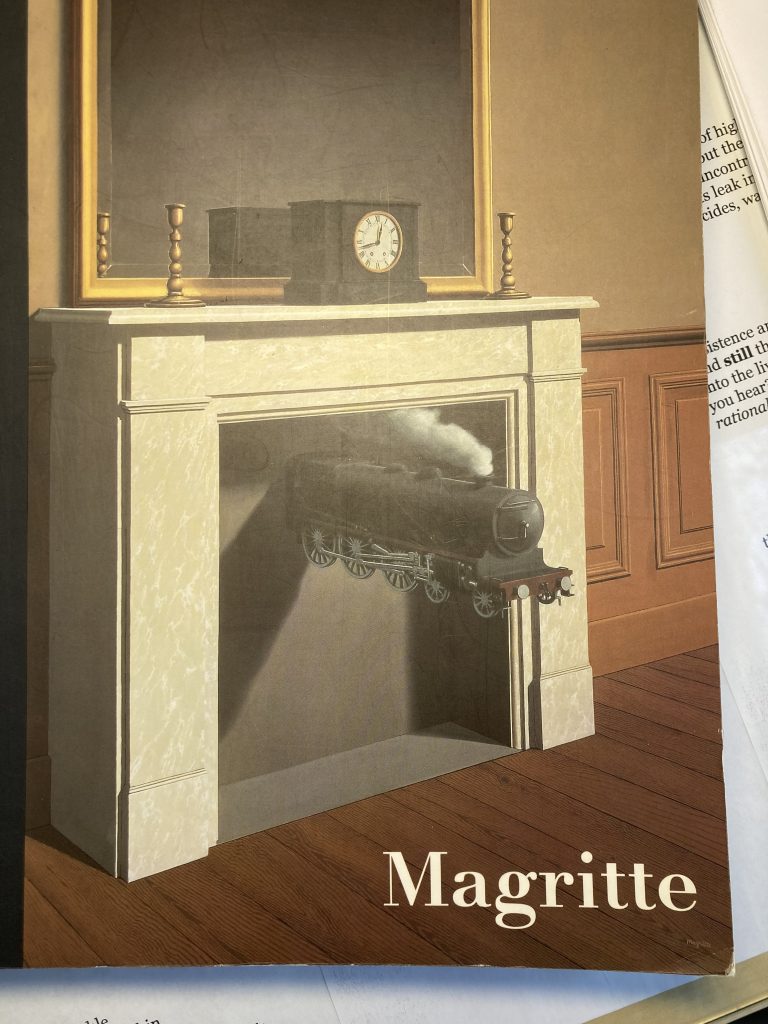
I inherited my mom’s copy of a 1992 exhibition she saw at the Art Institute of Chicago, but I hadn’t looked through it much, if at all. I picked it up and saw the cover — his painting with a train emerging from a fireplace — and thought: Charles Bonet Syndrome! CBS happens to some people as they lose their central vision; it often involves strange hallucinations. I read about people seeing waterfalls coming out of skyscrapers, old carriages coming down the street, and a dozen cooked eggs on a fireplace mantel. A train emerging from a fireplace seems to fit in these.

The cover of Magritte book. At the center, a fireplace with a black train, steam coming out of the top, emerging from its center. On the mantel, a clock. And behind that, a big mirror. In the bottom right corner, the book title: Magritte
Magritte on my desk, next to Forrest Gander’s “Circumambulation of Mt. Tamalpas” under the glass

Of course, there are other meanings intended with this train, but I immediately saw it as CBS hallucination. Looking through the book at all the featureless faces and faces obscured by apples and doves, I recognized my own inability to see faces. Very cool.

This morning I decided to dig into Magritte a little more. I discovered (or maybe remembered) that one of his reoccurring themes was windows — fitting for this month’s theme! Fearing copyright issues (I’ve been burned before), I’m not posting any of the images here. Instead, go here for examples: Magritte windows.

In my brief research (googlin’), I found this: Part 2: Magritte’s Window Paintings. At the end of the post there’s an article on the symbolism of windows, with some useful descriptions:

This intimate relation between the window, seeing, and perception (cf. eye/gaze) has become part of everyday language: the eyes as windows to the soul (or heart, or mind) [1] point out the possibility of looking inside a person through the opening of his eyes, where an inner state is reflected.

note: 1 The notion of  the ‘eyes as the window to the psyche’ goes back at least to a text by the Skeptic philosopher Sextus Empiricus (2nd century A.D), who might be citing an even earlier text. Cf. Carla Gottlieb. The Window in Art. From the Window of God to the Vanity of Man. A Survey of Window Symbolism in Western Painting (New York: Abaris, 1981), pp.49f.

I’m always searching for references to this phrase as I interrogate the idea that we see each other’s souls, and their humanity, by looking into their eyes.

The window as an opening in a wall refers to an absence which can be filled – by a material (glass, wood, paper, stone), by that which is seen through it, or by something rather immaterial like light or air. If defined as an absence, the window becomes a frame for its variable content, a marker of difference between what is inside and outside.

I’ve been thinking and writing a lot about Nothing lately, so I’ll have to add this idea of absence/frame to my list of ways of understanding the word/concept. Maybe I’ll add it to the series of Nothing poems I’ve been working on, which have emerged from my stripping down and reimagining my Haunts poem.

jan 18/BIKERUN

bike: 10 minute warm-up
run: 3.65 miles
basement
outside temp: 9 degrees / feels like -4

for future Sara: Tuesday night while sitting in the South High band room, listening to the community jazz band rehearse, I suddenly felt sick — a little like I might faint again, hot and tingling all over, very sensitive to loud sounds. Later on the way home in the ridiculously cold car, I had the chills and felt like I might throw up. Went home and straight to bed. Stayed in bed all the next morning. Not covid (I tested), but maybe the flu?

update, 29 dec 2024: I’m pretty sure that what I experienced was a panic attack. I had another one in May and then went on lexapro.

listening to my Window playlist: I Threw a Brick Through a Window/U2

I feel much better — almost normal — today. I’ve decided that I had the flu and the flu shot I got in November prevented it from being more severe (whew!). Of course this experience gave me some mild anxiety — was I sick, or was the faint-feeling signaling some bigger problem? How long would I be sick? At some point, would I have trouble breathing? Sigh — I dislike how much more I worry these days.

Tip Toe Thru’ the Tulips with Me/Annette Hanshaw

Since I felt pretty good today, I decided to try running on the treadmill. After my feet warmed-up in the cold basement, I felt great. Listened to my winter 2024 playlist and covered the panel displaying the time. I kept telling myself, one more song and I’ll check how much time I have left. When I finally checked, the time was at 31 minutes! Very cool; I thought maybe it would at 21 or 22 minutes. I like playing this game when I’m running on the treadmill; much better than staring down at the display.

Open a New Window/Mame Soundtrack

Noticed my shadow running alongside me. Stared at the water heater straight ahead of me: fuzzy and shifting very slightly. Also, the image had some static.

Look Through Any Window/The Hollies

As I write this, I’m making note of the window songs that are playing. It’s a bit difficult and I feel pressure to hurry up and write something before the next song comes on.

Nan You’re a Window Shopper/Lily Allen

In Nan, You’re a Window Shopper Allen complains — is she complaining or lamenting? — about her nan whose life is so constricted — taking a look, but you never buy/ and mad as fuck/only just alive

Window/Fiona Apple

Window/Daniel G. Hoffman

Is is no more than an eyehole
On the outside scene
Making everything
–The snow, the runaway dog,
The boys brawling and the car
Skidding against the tree–
Content to be contained
Within a reasonable frame?
Or could it be

A casement dividing
A real Observer from a view
Of untrammelled possibility,
Its pane connecting
A man in a room in
Steam heat and a battered chair
With his future
Which he could not see
Were it not there?

Window Shopping/Just Derrick

Perhaps it’s the lens that allows
Errant swifts and swallows
In a downward swoop
Of their tumbling flight
To glimpse the man waiting
For the future to happen–
While he’s caged in time
They’re free to look in,
And its gift is insight.

Junk/Paul McCartney

I noticed that Hoffman’s next poem is titled, Door. I’ll have to read that one when I study doors!

From Junk:

Buy, buy, says the sign in the shop window
Why, why? says the junk in the yard

Bust Your Windows/Jazmine Sullivan

I’ll bust the windows out your car
You know I did it ’cause I left my mark
Wrote my initials with a crowbar
And then I drove off into the dark

Maybe I’ll try experimenting with a themed playlist? I could listen and pick out a few lyrics from each song, then write about them, or turn them into a poem?

jan 16/RUN

4.25 miles
minnehaha falls and back
0 degrees / feels like -20

Brr. I really bundled up for this one, even busted out the big guns: toe and finger warmers. They worked!

layers: 2 pairs of black running tights, a green base layer shirt, pink jacket with hood, purple jacket zipped up to my chin, black fleece cap with ear flaps, pink and orange buff covering my mouth, 2 pairs of socks — gray, white — with toe warmers in between them, 1 pair of black gloves, 1 pair of pink/red/green mittens, hand warmers, sunglasses

My forehead felt a little cold at the beginning, but mostly I felt warm enough. My legs started to get sore near the end, which I think was because of the cold: not enough blood to my calf/thigh because it was going to my vital organs — I read that somewhere a few years ago.

10+ Things

  1. a regular! the runner, Santa Claus
  2. the river, frozen — light brown mixed with white, flat
  3. the feebee call of the black-capped chickadee
  4. a few squirrels, scampering
  5. running straight into the sun: my sharp shadow, so sharp I could see the shadow of my breath
  6. one biker — brrr
  7. brittle leaves, scratching on the pavement
  8. a sharp squeak, almost like a little bunny crying out: trees creaking in the wind
  9. the falls, near the ledge: half frozen, sounding like the spray hose on a kitchen sink
  10. the falls, by the overlook: gushing, rushing past the ice, flushing out the bottom
  11. beep beep beep of a truck backing up, sounding flat and smaller than usual
  12. the light rail across Hiawatha rushing by — I wondered how cold the commuters were
  13. almost forgot this one: the wind moving fast through dead leaves on some trees sounded like sizzling heat. I heard it just as the wind was blowing in my face and I felt particularly cold. I imagined it was so cold that it was hot

before my run

I’m in the slow process of reviewing my entries from 2023, a month at a time. Right now, April. On April 18th, I wrote about some ideas from writers/poets that were inspiring my thoughts about an eighth colorblind plate poem on the glitter effect. Paige Lewis and A.R. Ammons and flares and flames and rust. And now I’m thinking about writing one more colorblind plate poem that describes how my own color system works using texture and movement and contrast. It replaces ROYGBIV. Maybe I’ll try and think about it more as I run — when I’m not thinking about how cold I am!

a process note: Rereading all of my entries for the year and summarizing them takes a long time, but it’s worth it. Not only does it offer useful summaries, but going back and reencountering words/ideas/experiences offers new inspiration or old, half-finished projects (like the colorblind plates). And the laborious process of doing this structured task sometimes opens me up to wandering and remembering and imagining that can lead to new words and new ways in.

task: on my run, try to think about motion and texture

during my run

As predicted, I focused mostly on noticing the cold and the wind — such a cold wind in my face! I do remember thinking that the river was flat and stuck, with no sparkle or motion. I thought about contrast with the shadows. Leaves shaking in the wind. Oh — and I thought about how the small things I notice — the little flashes of movement, sound, texture — accumulate into something bigger. This is part of the conversation I started yesterday about flares versus slow burns and whether or not to dazzle. None of the things I notice Dazzle! in a quick burst, but together they add up to something special. After thinking of this idea, I remember Hannah Emerson’s poem, “Peripheral” and the lines:

Direct looking just is too
much killing of the moment.

Looking oblique littles
the moment into many

helpful moments.
Moment moment moment

moment keep in the moment.

after the run

And now, remembering all of these ideas, I’m suddenly thinking of Emily Dickinson’s poem, “Tell all the truth but tell it slant –”

The truth must dazzle gradually
Or every man be blind —

Yes, dazzle means to be temporarily blinded by light, or overpowered with light. What does this have to do with what I’m working on right now? Not sure.

And now, back to windows. Here’s a small poem I found the other day that I like. It’s part of a larger series of poems titled, Still Life:

Window/ Phillip Murray

Through the dark
Glassly
It is light
Falling

jan 12/BIKERUN

bike: 10 minute warm-up
basement
run: 3.5 miles
river road, south/north
9 degrees / feels like -5
wind: 13 mph/ 24 mph gusts

Sometimes running when it’s this cold isn’t that difficult, especially when there’s sun and no wind. Today there was no sun* and plenty of wind and it was hard. Not all of the time, but often.

But who cares when the river looks like it does today?! Half covered in ice, mostly gray and brown, open and vast.

And who wouldn’t want to be out here when the geese are flying overhead, their honks swirling around all of us below, sounding mournful and harsh and wild?

And who isn’t grateful to have an almost empty trail — no thoughts or distractions, only a few other people, and most of them below on the lower path?

*I guess there was some sun, but it was hidden behind the clouds. The only time I noticed it was when I was running north up a hill straight into the wind — I saw the faintest trace of my shadow. Hello friend! If I wasn’t paying attention or if I hadn’t trusted what I saw, I might not have noticed her.

Listened to the cold as I ran south — what does the cold sound like? jagged breaths, sharp sounds suspended, silence. Listened to my Window playlist running back north.

Windows can certainly change lives in all sorts of ways. “Faith goes out through the window when beauty comes in at the door,” quips the English philosopher George Edward Moore. “Well,” says Julie Andrews, not yet breaking into song, but you never know, as she gazes out onto those hills alive with something, “when one door closes, another window opens.” She’s opened us onto the window of film, so how best to set the scene? “An actor entering through the door, you’ve got nothing. But if he enters through the window, you’ve got a situation.” says Billy Wilder.

Pleasure and Pane: songs about windows

This article offered a lot of great suggestions for window songs to add to my playlist, which is now over an hour.

window playlist

  1. Window/Fiona Apple
  2. Window/Genesis
  3. Smokin’ Out the Window/Silk Sonic
  4. Keep Passing the Open Window/Queen
  5. Lookin’ Through the Windows/Jackson 5
  6. I Threw a Brick Through a Window/U2
  7. When I’m Cleaning Windows/George Formby
  8. Skyscraper/Demi Lovato
  9. At My Window Say and Lonely/Billy Bragg & Wilco
  10. My Own Worst Enemy/Lit
  11. Junk/Paul McCartney
  12. In a Glass House/Gentle Giant
  13. Belly Button Window/Jimmy Hendrix
  14. Look Through Any Window/The Hollies
  15. The Rain (Supa Dupa Fly)/Missy Elliott
  16. One Way Out/Sonny Boy Williams
  17. Silhouettes/The Rays
  18. The Glass/Foo Fighters
  19. Tip Toe Thru’ the Tulips/Annette Hanshaw
  20. Waving Through a Window/Dear Evan Hanson
  21. Open a New Window/Mame
  22. Open Your Window/Ella Fitzgerald
  23. Fly Through My Window/Pete Seeger

Today I put the playlist on shuffle and heard: 3, 5, 10, 16, 2, 9

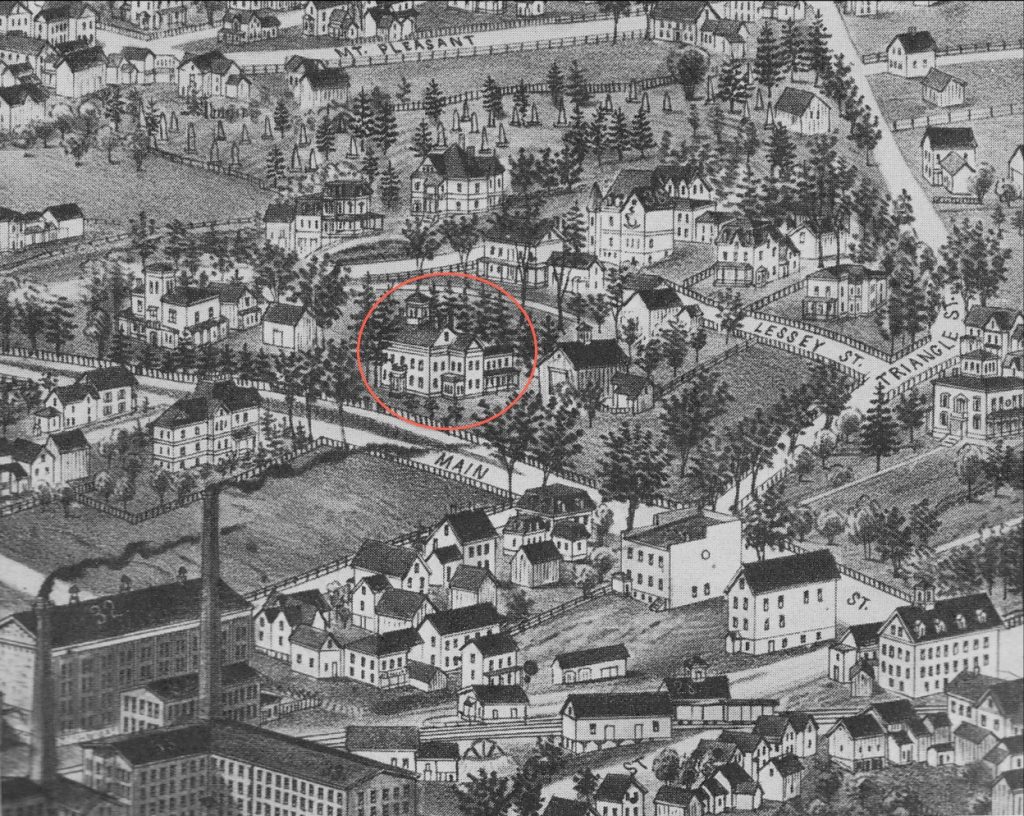
an hour later: Not for the first time, I’m starting to read an article about Emily Dickinson’s windows. It’s really good, but dense, so I’ve always put it off. Will I get through it today? Maybe. Anyway, I started reading it, and encountered a map of Amherst with a note: The Dickinson house is circled in red.

an old black and white image (lithograph?) of Amherst, with Emily Dickinson's house circled in red. The only way I'm able to see the circle is if I put the computer screen up to my face and look at it through my peripheral vision.
Amherst, 1886

Can you easily see the red circle? I can’t. The only way I am able to see it is if I put my face up right against the screen and look at it through the side of my eye. Only then do I see a trace of red — the idea of red. Once I see (or feel?) the red, I can see a faint circle and I can tell that it’s red, but it’s not RED! but red?

The other day, Scott, FWA, and I were discussing the scenes in Better Call Saul that are set in the present day and are in black and white. Scott and FWA both agreed that those were harder to watch — they had to pay more careful attention — because they lacked color, which is harder because visual stories often rely heavily on color to communicate ideas/details. I said I didn’t realize that they were in black and white; they didn’t look any different to me than the other scenes, which are in vivid color (at least that’s what they tell me). I realized something: it’s not that I don’t see color, it just doesn’t communicate anything to me, or if it communicates it’s so quiet that I don’t notice what it’s saying.

Back to the image with the red circle. The main point of the image is to enable you to quickly and easily see where the Dickinson home is located in the town. If I hadn’t read the text below it, I never would have known there was a circle, and the main point of the image would be lost on me. This happens a lot. Things that are obvious to most people, aren’t to me. More than that, they don’t exist. Of course it’s very frustrating and difficult, but it’s also fascinating to recognize this, and helpful to understand it.

dec 22/RUN

5.15 miles
bottom of franklin hill and back
38 degrees / 93% humidity

Misty with drizzle this morning before the run, misty and damp during it. Everything fuzzy and dreamy, muffled by the wet air. Wonderful weather for a run (rereading this bit an hour later, I realize that it might sound sarcastic. It’s not. I love running in the rain and the mist. There was no wind and it wasn’t too cold.) I felt strong and relaxed and glad to be outside moving.

2 Regulars to greet: Daddy Long Legs and Dave, the Daily Walker. Actually, it might have been 3. I’m not positive but I think I exchanged waves with the women I talked to one day who tried to fix me up with another runner — I called her Mrs. Fixer-Upper, or something like that. Anyway, I exchanged good mornings with DDL for the first time. And then Dave wished me a Merry Christmas — you too! Merry Christmas!

Listened to the dripping and the hum of far off traffic as I ran north. Put in an old playlist for the last mile.

a ridiculous performance

Haven’t made note of one of these for some time — just checked and the last time was last December (14th) and I wrote almost the exact same first sentence! Before getting to the performance, here’s something I wrote on 23 june 2020 explaining my use of the phrase:

This idea of a “rather ridiculous performance” is a line from Mary Oliver’s “Invitation”: “I beg of you/do not walk by/without pausing/to attend to/this rather ridiculous performance.” Maybe I’ll try to make a list of the rather ridiculous performances I encounter/witness?

Today’s ridiculous performance was a guy running up the franklin hill backwards. He was part shuffling part skipping part running up it with a hood on. As I ran down, I could see him ahead of me, but I assumed he was running down the hill. I almost ran into him before I realized he didn’t know I was there. Wow — that would feel strange, I think, shuffling backwards up a hill, unable to see anything you were approaching. I’ve heard of people running backwards for training or coming back from an injury. Was that what this person was doing?

10 Things

  1. a thin mist/fog hovering in the air
  2. new graffiti all over one of the franklin bridge support posts
  3. a walker and their dog crossing the river road then taking the steps down to the muddy Winchell Trail
  4. no chain at the top of the old stone steps, blocking the way down to the river — I bet it’s slippery today!
  5. ice on the edges of the river, below, near longfellow flats
  6. no stones stacked on the boulder
  7. all of the benches were empty
  8. halfway down the hill, I noticed some stairs on the other side of the road I’ve never noticed before. Were they leading to the franklin terrace dog park?
  9. June’s white ghost bike was hanging from the trestle
  10. bright car headlights cutting through the foggy mist

seeps

Before the run, I was reading about seeps and springs. Decided to think about them and why I might want to be one as I was running. In particular I was interested in how being a seep is different than becoming a boulder, which I’ve already written about. I recorded my thoughts after running up the franklin hill.

As I ran down the hill, I thought about how gravity pulls water down. A line: no need to navigate. Spilling over, onto, into. Always exceeding. Relentless. Opening up, making room, creating space. Never encased, contained, fully controlled. Slow, steady, drip drip drip. Saturates, permeates, soaks.

The author of article from 1997 I was reading — Along the Great Wall: Mapping the Springs of the Twin Cities — didn’t think too highly of seeps: little, inconsequential, too abundant for mapping. He focused on springs. I like the small, quiet, unassuming nature of seeps. More to think about and push at with that idea.

From a few poems I found after searching for seeps — things that seep: blood, sun, gas, chill, a seeping back in sleep to glorious childhood memories of baseball, water, light, an hour….and this, which made me stop my search so I could post this poem:

Louisiana Line/ Betty Adcock

The wooden scent of wagons,
the sweat of animals—these places
keep everything—breath of the cotton gin,
black damp floors of the icehouse.

Shadows the color of a mirror’s back
break across faces. The luck
is always bad. This light is brittle,
old pale hair kept in a letter.
The wheeze of porch swings and lopped gates
seeps from new mortar.

Wind from an axe that struck wood
a hundred years ago
lifts the thin flags of the town.

I like this idea of the past seeping from/into the present — like the wheezy echo of an old porch swing seeping from a new building.

dec 20/RUN

5.25 miles
ford loop
34 degrees

Yes! Loved my run today — the light! the shadows! It started when I saw some strange patches of white on the sidewalk — what were they? Suddenly I realized: light, coming through the cracks in a fence and landing on the dark, shadowed sidewalk. Very cool.

10 Things: 4 Lights and 6 Shadows

  1. the light coming through the fence
  2. the shadowed sidewalk it landed on
  3. my shadow down in the ravine, running beside the water leading to shadow falls
  4. on the lake street bridge: the sun on the river — sparkling, stretching down river towards the ford bridge
  5. on the ford bridge: the sun illuminating a buoy below me
  6. the shadows of trees on the river
  7. the pointed shadows of the lamps — fuzzy
  8. my shadow running in front of me –sharp
  9. standing on the grass between edmund and the river road, looking across to the east bank, noticing a very white house shining in the sun
  10. the pattern of the railing shadows on the lake street bridge — criss-crossed, sprawled

I felt strong and happy and steady. For the first few miles, I chanted strawberry/raspberry/blueberry over and over. Occasionally I mixed in mystery or history or intellect. At one point, I chanted: a question/is asked and mystery/is solved

I noticed the empty benches, the darting squirrels. Smelled some burnt toast and weed (wow! must have been from a passing car). Heard some voices in the ravine. Didn’t see any Regulars or hear the bells at St. Thomas. Don’t remember birds or bikes. No roller skiers. No overheard conversations.

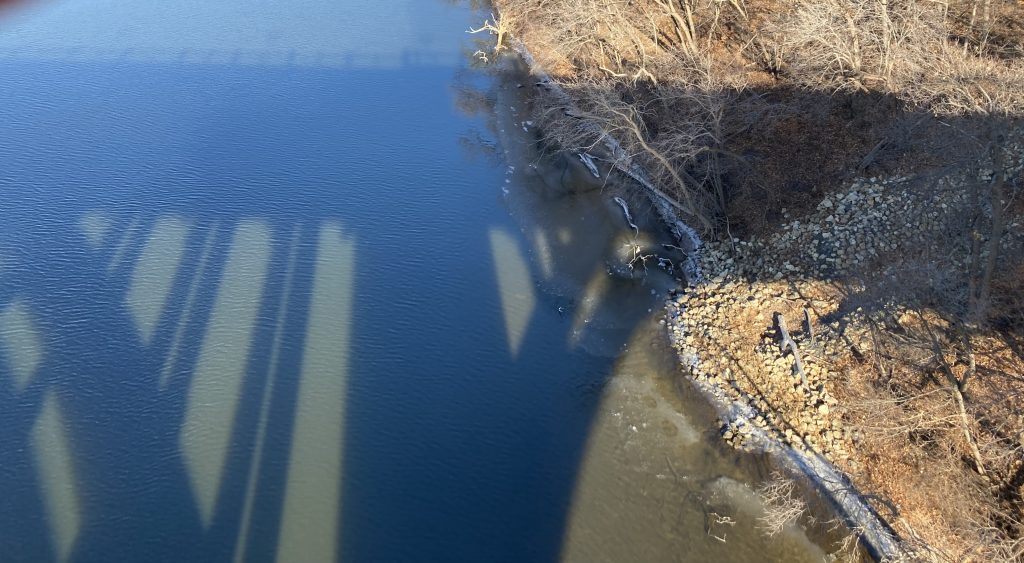
added over a day later: I forgot that I took some pictures when I stopped briefly on the ford bridge to put in my headphones:

My view from the ford bridge, looking north and down at the Mississippi river. On the right (almost) half of the image is the brownish-greenish shore. On the left, the blue river with dark shadows from the bridge covering it's surface. The shadows are of the columns and are both thick and thin. If I squint hard I can almost see my shadow at the top taking the picture. Is it there, is it just in my imagination?
ford bridge shadows / 20 dec 2023

For the first four miles I listened to kids playing at the church playground, cars driving by, my feet striking the ground. Then I put in Merrily We Roll Along for the last mile.

Letter to Walt Whitman,
Who Painted Butterflies/ Kelli Agodon Russell

In 1942, Whitman’s handmade cardboard butterfly disappeared from the Library of Congress.
It was found in a New York attic in 1995.

Perhaps, you made them as a child—
cardboard butterflies lining your shelves,
hiding in the pockets of the wool pants
you wore only to church.
Maybe you would wake early
to cut cardboard into small waves
forming wings, and antennae appearing
like exclamation points.
Words fluttered from your pen,
cardboard wings dipped in red paint,
holding patterns of words,
the quiet swirl of wind.
Maybe there are thousands
of your butterflies still lingering in attics,
your secret world of paper insects
still hanging by threads.

I wanted to post this poem because I like how it’s set up, with the brief description, then the wondering/imagining about it. A fun exercise to try: when I find an interesting fact (here I’m thinking about the monarch butterflies that avoid a mountain in lake superior that’s been gone for more than a century), write a poem that speculates/imagines/creates a story around it.

dec 19/RUN

4 miles
curved railing (north) and back*
30 degrees / feels like 22

Wow, what a beautiful morning for a run. Sunny and clear and cold, but not too cold. So many shadows to admire! My favorite was the first one I noticed — from a slender tree, so thin it looked more like a pencil line. I started noticing the trees by how thick their shadows were. Then, when I reached the river, I moved onto the shadows of fence posts. The split rail fence above the ravine made such crooked shadows — no straight lines where rails were leaning or bent. The street lamps shadows almost looked menacing — so sharp, stretched across the path. My shadow was sharp too — clear and confident. Saw squirrel shadows but no bird shadows.

10 Things (other than shadows)

  1. below in the ravine, the water was frozen
  2. a strange howling call from below at longfellow flats — an animal? or a person pretending to be an animal? I looked, but couldn’t see anyone
  3. in the sun the darting squirrels looked silver or white
  4. a stutter step when I squirrel jumped out at me, then turned back
  5. as I ran south, some white thing out of the corner of my eye kept calling out, notice me! So I did: it was an arch of the lake street bridge
  6. walking below on the winchell trail, I encountered (not for the first time) the trunk of a tree in the middle of the trail — wide and tall — 12 feet? jagged at the top
  7. the knock of a woodpecker somewhere below, closer to the river — not sharp, but soft faint, almost an echo
  8. good morning Dave! / morning Sara!
  9. looking down at the floodplain forest, I could see many fallen trees and branches
  10. nearing the bottom of the hill that rises up and out of the tunnel of trees, I saw the bright, burning light of the river far ahead — I knew it was the river, but imagined it might be sky

I listened to strange howls as I ran north, then put it in Merrily We Roll Along as I ran south to home.

Before turning around, I hiked down to the curved fence above the ravine on the Winchell trail and took a few pictures. Then I stood there, looked down at the river, and felt delighted and satisfied, so glad to have gone out for a run this morning and then stopped to take in this view.

A view of the mississippi river. The top third of the image is just BLUE!--a beautiful blue sky. Below the blue is mostly the light brown of the east bank, then the whiteish-tan of the sandy shore. On the edge between the blue sky and brown branches in the left corner is the tower at Prospect Park--the Witch's Hat, which is called that because it looks like a witch's hat. After the brown of the shoreline, more BLUE!--the river. And, in front of all this, closest to the camera, are a few bare branches. When I look at this picture, I mostly see and think, BLUE! then sandy white then witch's hat.
on the west bank, near franklin ave, mississippi river / 19 dec 2023

I discovered a prose poem this morning that reminds me of my February Feels Like Project. I think it could be inspiration for me as I clean up my draft and try to get it published:

Sunrise, All Day Long/ Kathleen McGookey

Today is wind that smells like mint blowing in from the lake. Today is a paper crane, just folded. Today is a bleached sheet pulled from the linen closet, trailing the delicate scent of green soap. Today is a small brown snail’s pearly trail across the ivy. An eggshell cracked open by raccoon or turtle or fox. Today is a sharpened pencil, a sealed love letter, the antique locket in my mother’s jewelry box. A rectangular pink eraser, straight out of the package. That one black and white bird perched on the sailboat’s mast, preening its glossy tuxedo and singing a boisterous, throaty song.

dec 16/RUN

3.1 miles
marshall loop (cretin)
39 degrees / 90% humidity

The saturday morning tradition: running with Scott. Damp and overcast. Everything quiet and strange. Scott’s bright red jacket looked even brighter and RED! In the distance, a soft mist hovered on the river’s surface. The sidewalk was wet and slick, with some puddles to leap over. We talked about snowboarding and half-pipes and how Ailing Gu is a full-time student (at Stanford), a full-time model, and full-time athlete. Wow.

Entering the bridge, I heard some geese flying by, then a bald eagle soaring low in the sky. At the end of our run we encountered a grumpy goose. Scott warned that they might be ready for a rumble. Not quite, but almost. The goose honked and flapped its wings, then flew up and over a fence to join the rest of the geese.

A gross thing I remember: running over some squishy, slippery mud. Didn’t see it, but felt it — told Scott it felt like stepping in poopy diarrhea. Yuck!

I loved the weather and the quiet, almost reverent, feeling of being out in the world on a gloomy, empty Saturday (late) morning.

Discovered a beautiful poem, and helpful discussion of it by Wendy Pratt:

Good-Night/ Seamus Heaney

A latch lifting, an edged den of light
Opens across the yard.
Out of the low door
They stoop in the honeyed corridor,
Then walk straight through the wall of the dark.

A puddle, cobble-stones, jambs and doorstep
Are set steady in a block of brightness.
Till she strides in again beyond her shadows
And cancels everything behind her.

dec 1/RUN

3.6 miles
trestle turn around
27 degrees

What a wonderful way to start December! Love this cold air and the bright sun. And the shadows — mine was able to run below in the floodplain forest. Later, it went down on the Winchell Trail. I greeted Dave, the Daily Walker — Good morning Dave! What a beautiful morning! For the first mile I chanted in threes: girl girl girl/ ghost ghost ghost/ gorge gorge gorge.

I listened to the birds — I think I heard the clicking beak of a jay — and scattered voices on the way to the trestle. Tried out a few different playlists on the way back.

10 Things

  1. running above the floodplain forest: brown and open and bottomless, brown leaves blending in with brown trunks
  2. most of the steps down to the Winchell Trail are closed off with a chain, but not the old stone steps — why not?
  3. the stretch of river just north of longfellow flats was half frozen
  4. 2 people walking below on the winchell trail with a dog — a LOUD conversation. One of them was wearing a bright orange — or was it red? — jacket
  5. steady streams of cars at different spots on the river road
  6. a fast runner passed me with their arms down at their sides, swinging them low. Were they running like this the whole time, or did they just do it when they passed me?
  7. more darting squirrels
  8. there are certain stretches I don’t remember running through — like the part of the walking trail that separates from the bike path right before the trestle. Why can’t I picture it?
  9. after I finished the run, walking back on the grass between Edmund and the river road, heard the knocking of a woodpecker high up in a tree. I craned my neck and arched my back to see it, but no luck
  10. In number 1 I said the floodplain forest was empty, but I just remembered that there was a thin line of orange leafed trees on the southern edge of it

Just ordered A. R. Ammons’ Tape for the Turn of the Year. Reading it might be my December project — will see, when it arrives on Monday. I think it might be a good inspiration for my Haunts poem as I continue to work on it.

One more note: At the halfway point, before heading back, I hiked down on the Winchell Trail to the curved railing. I took a picture. I decided to only take one, but I wondered if I should have taken more. Yes, I should have. When I looked at the picture after the run, there was the shadow of my thumb in the corner. Oops.

nov 30/RUN

5 miles
veterans’ home loop
32 degrees

Warmer today. Sunny, bright, clear. The river sparkled and burned. Shadows everywhere. Big columns of ice next to the falls, a thin sheen of ice on the steps and the bridge over the creek. Saw my shadow far below me while I was above on the bridge over to the veterans’ home. Encountered at least half a dozen darting squirrels, one was heading straight towards me but did a sharp turn away at the last minute. Near the end of my run, I saw and heard a vee of geese flying low in the sky — maybe 12 of them? Something about the blue sky and the brilliant light made their wingtips look silver. I didn’t stop running, but I craned my neck as I moved to keep watching them.

10 Sounds

  1. kids at recess, playing on the playground at minnehaha academy: scattered voices laughing, yelling
  2. some sort of chirping bird — not a cardinal, a robin? finch?
  3. the caw caw of a crow, down in the gorge
  4. the gushing falls — steadily falling creek water
  5. rustling in the leaves, 1: a squirrel
  6. rustling in the leaves, 2: a chipmunk or a bird
  7. rustling in the leaves, 3: a person walking below me on the Winchell Trail
  8. honking geese
  9. a chain link fence rattling — someone playing disc golf near Waban
  10. missing sounds: didn’t hear any roller skiers or music from a bike or a car, no bikes whizzing by or horns honking, and no fake train bell at the 50th street station as I ran near the John Stevens house

Stopped at the Folwell bench to admire the view and to check on my watch which had turned off. Bummer — out of charge, so no data from today’s run. Took a picture of the gorge:

A view from above of the Mississippi gorge and river. Just to the right of center in the image a thick brown tree trunk stands -- well, not that thick, but much thicker than the other trunks surrounding it. To me, this trunk looks like a tall person, with a long neck and a head that's just off the edge of the top of the frame. They have one arm (which is actually a bare branch) that extends up and across and then off the top of the frame. This arm is bent which creates the illusion of an elbow, an armpit, and a torso. Below the tree are dead leaves, light brown, and beyond the tree is a blue river and then a brown bank.
a tree with river gorge / 30 nov 2023

nov 23/RUN

4.5 miles
franklin loop
25 degrees

Ran with Scott. Cold, windy but sunny. Lots of wonderful shadows — ours, trees, lamp posts. Running across the lake street bridge at the end, the railing shadows made a cool pattern on the sidewalk. Combined with the breath-taking (at least for Scott) wind, it created a strange, untethered effect. Felt like I was floating or hovering or moving without touching ground. I asked Scott how he experienced it, and he said he was too focused on avoiding all of the groups of people approaching us on the bridge. Also seen on the bridge: a flyer posted on several of the posts that read “Killed by Israel.” I suggested to Scott that it should read, “Killed by the Israeli government.”

Found this poem the other day and it makes me think of how often I mistake one thing for something else as I run around the gorge:

Mistake/ Heather Christle

For years I have seen
dead animals on the highway

and grieved for them
only to realize they are

not dead animals
they are t shirts

or bits of blown tire
and I have found

myself with this
excess of grief

I have made with
no object to let

it spill over and
I have not known

where to put it or
keep it and then today

I thought I know
I can give it to you

I have to think about the ending some more — what does it mean to me? — but for now, what I like about this poem are the opening lines and the idea that other people also think they’re seeing dead animals when they’re actually seeing something else. I often think I’m seeing dead squirrels, when it’s actually a furry hat or a glove. These mistakes don’t make so sad or produce excess grief, just confusion and uncertainty and a little bit of morbid fascination.

I just realized what it means to me — the you is us, her readers. And she’s right, she is giving it to us, not as a burden to bear, but as an experienced shared. I love that about poetry, how you can write or read a poem and feel less alone, (a little) more understood.

nov 22/RUN

5.4 miles
ford loop
31 degrees

Brrr, at least for the first mile. Had to put up my hood and breathe deeply. Ran through the neighborhood on my way to the lake street bridge instead of by the Welcoming Oaks. Such beautiful light this morning, bright warm sun. Saw my shadow several times. She kept wandering down in the ravine or right by the edge. I took a picture of her when I stopped at the Monument, which is a Civil War monument and not a WWI one (which is what Scott thought):

update, 22 nov 2025: I’m not sure why I thought it was a civil war monument; Scott was right, it is a monument to WW1 soldiers. Doing a bit more googlin’, I think I thought it was a civil war monument because I was mistaking it for the “soldiers and sailors monument” in Summit Park.

My view from the overlook at the civil war monument. From back to front: sky, lake street bridge, west river bluff, river, bare tree branches, cliff, a shadow of me taking this picture, dirt
view of my shadow/river/bridge / 22 nov 2023

10 Things

  1. water dripping at shadow falls — not quite rushing or gushing, but close
  2. little white caps on the water from the wind
  3. a bird calling out repeatedly, sounding like a car alarm — must have been a cardinal, right?
  4. even less leaves on the trees than last week, although there are still stretches of bright green
  5. one runner passing me slowly, gradually
  6. another running zooming past me up the hill
  7. the satisfying feeling of sandy grit crunching under my feet as I ran on the dirt rail next to the paved path
  8. on the St. Paul side most of the benches have plaques embedded in the concrete, none of them do on the Minneapolis side
  9. spotting a parked car, glowing in the sun on the west side of the river as I ran on the east side
  10. noisy, darting squirrels everywhere

before the run

Today I’m revising and expanding my part of the Haunts poem about the Regulars, the people (both alive and dead) that are regularly at the gorge. I’d like to add something about the “in memory of” plaques along the trail, mostly embedded in the concrete near benches. So I’m giving myself a task: take pictures of more of these plaques to write about in my 3/2 form. Will I do it? Will I be willing to stop and take these pictures? How many of them can I get?

Speaking of plaques, I was curious about how to get one and how much they cost. Here’s the link for Minneapolis: Tributes and Memorials

To get a bench plaque, fill out the interest form on the site. It’s $5000 for a new bench for 10 years, $2500 for a refurbished bench for 10 years. Only 10 years.

Here’s St Paul’s information. Same 10 year deal, although you can add 10 year increments for an additional $1500 at any time. Also: It’s $5000 for a new bench/10 years at St. Paul Parks, except along the Mississippi River Parkway. Those are $10000. That seems like a lot — is it?

during the run

I did it! Starting by the monument, I stopped at every bench and took a picture of the plaque next to it. Lots of stopping, but it was fun! 12 images in total. I didn’t read any of the inscriptions, just stopped, took out my phone, clicked, put my phone back in my pocket, then started running again. I would imagine that some of the people I encountered were wondering what I was doing. I kind of wish one of them would have asked so I could say something like, “I’m working on a poem about the gorge and I’m gathering memorials to include in it.”

after the run

Now, back at my desk, I’m looking through the images. Almost all of them are legible! So far, there’s only one I can’t read and that’s because I made it a 4 second video instead of a photo. Oops. Oh–and it’s always because it’s in a cursive font that’s very hard to read.

It’s moving to read these memorials, many of them about people who died too young. I’m particularly struck by one that says, “Just a kid growing up!” — Tony Basta, 12/1/99

A plaque embedded in concrete. It reads: "Just a kid growing up!" Tony Basta, 12/1/99
Memorial plaque along the Mississippi River Bluff in St. Paul

I had no idea what this meant, so I looked it up. On April 26, 2000, while riding his bike along the Mississippi River (near Randolph) around 10 pm, 17 year old Tony Basta was shot and killed by 3 teenagers who wanted to shoot a random person “just to scare them.” Basta’s parents had the plaque made; the quote is from Tony in his yearbook. Wow. So heartbreaking and haunting — the details in this article (Tony Basta’s Murder 10 Years Ago) about the bystander who heard the shot and thought it was fireworks, his father who owns The Italian Pie Shoppe, the girl who overheard the killers telling the story at a party and reported them, earning a reward that paid for her college, the killer who expresses daily regret.

Will any of this make it into my poem? Possibly? Probably? Who knows? I’m not sure what will come of these accounts, but it feels meaningful to bear witness to the lives of the people on these plaques today.

As I was finishing up my run, my thoughts wandered. I thought about having one of these plaques for when I’m dead and how I’d want poetry on it. Then I thought, why wait until then and why put it on a plaque? What about leaving some poetry around the gorge now? Then I thought, wouldn’t it be cool to leave some lines from my haunts poem — some parts of my repeating refrain that includes, a girl runs and ghost and gorge? And now I’m thinking that I want to do some sort of unofficial public installation of this poem around the gorge. It could be lines left on the path or tied to a tree, or it could be QR codes with links to the text and a recording of me reading it. YES! I should research how others do public installations for inspiration.

nov 18/RUN

4 miles
hidden falls to crosby farms and back
37 degrees

Just like yesterday, another beautiful morning! Sunny, calm, not too cold. Sharp shadows, cloudless blue sky. Today’s route started and ended at the Hidden Falls parking lot, right next to the sunlit river. So wonderful! Ran with Scott and talked about Amy Winehouse, NCAA cross country races, lurking shadows, and why there was a car driving on the no vehicle path — lost golden retriever. As we neared Crosby Falls, we ran over a root that was embedded in the path and looked like a snake. Very cool! Scott took a picture of it:

a cracked sidewalk with a tree root winding through it, looking like a snake
Scott’s picture of a root in the paved path / near Crosby Farms

10 Things

  1. chirping birds, shrieking squirrels
  2. shadows, 1: ours, sharp, beside us then in front of us
  3. shadows, 2: the trees, casting long lines across the paved path
  4. shadows, 3: the trees on the water, making the bright blue water look dark brown
  5. question pondered: what’s the difference between a shadow and a reflection — Scott’s answer: the position of the light
  6. a walker in a bright pink jacket
  7. the sandstone/limestone bluff — high and looming — on one side of us
  8. graffiti spray painted on a barricade in the parking lot, uh oh stinky
  9. smoke from a campfire on other side of a little lake near Crosby Farms
  10. running up a short, step hill on the tips of my toes and remembering when I tried (and failed) to bike up it a few years ago without shifting gears

nov 17/RUN

3.2 miles
trestle turn around
36 degrees

Yes! A near perfect morning for a run. Sunny, still, cool but not cold. Deep blue sky, sharp shadows. Relaxed hips, knees, shoulders. A moment to remember and return to when needed. So calm, happy, not anxious. Walking back after I was done, I heard a knock so I stopped and looked up to the top of a tree — a woodpecker! And I could see it! I watched for a few seconds then listened deeper: another chirping bird, leaves rustling underfoot, a leaf blower.

10 Things

  1. good morning Dave!
  2. the floodplain forest is bare and a beautiful, soothing brown
  3. with everything so bare and exposed because of the lack of leaves, I thought about how it all looks bigger (wider, more open) and smaller (no mystery, all out in the open) at the same time
  4. glancing down at white Minneapolis rowing club building, it looked like it was a shimmering mirage in the sun
  5. almost to the trestle — I could see it through the bare trees, stretching across the water. It looked so far away, even though I was almost there
  6. took the recently redone steps just north of the trestle down for a better view of the water — the river was such a deep, dark blue — but a dark blue that was still clearly blue and not black (which is what navy looks like to me)
  7. on those same steps: my shadow ahead of me — hi friend!
  8. another shadow: a runner approaching me from behind. I could hear her slowly gaining on me, then suddenly her shadow appeared, almost lurking behind me for a moment
  9. running on the sandy, gritty dirt just off the edge of the trail
  10. smelling breakfast — can’t remember what type of breakfast, just breakfast — wafting down from longfellow grill

As I was running on the dirt trail just next to the paved path, I had a thought about my haunts poem and the recent ones I’ve added about the trails. So far I have three — the dirt trail on the grassy boulevard, the official paved trail, and Winchell. I think I should add this one, and maybe more. I could sprinkle them throughout the poem, or just add that one in with the others, near the beginning?

I was planning to run a little longer and listen to a playlist for the second half, but a mile into my run I realized that I had forgotten my phone. That has happened maybe once or twice ever, in all of the years I’ve been running. Today, I didn’t care, but still didn’t want to run too long without it, especially since I hadn’t told Scott which way I was running.

nov 16/RUN

5.4 miles
ford loop
63 degrees
wind: 19mph

Another windy day. I had to hold onto my cap several times so it wouldn’t fly off. Running east on the lake street bridge, I put my hood so my cap wouldn’t fall off. Running west over the ford bridge, I took the cap off and held it in my hands. The wind made it difficult, more draining. Is that why my legs feel so sore?

10 Things

  1. ridges and white caps in the blue water, from the wind
  2. kids at the church daycare, at the far end of the fenced-in playground. Running by I could hear their tiny, sweet voices plotting something
  3. more filled benches than usual along the route, including one with a person sitting and a stroller behind it
  4. in the neighborhood: knocks on the roof — not a woodpecker, but roofers … or was it a woodpecker?
  5. running straight into the wind, wondering if would push me up against the railing (not quite)
  6. my shadow down in the ravine near shadow falls — lucky shadow, sheltered from the wind
  7. everywhere hazy — it might have been my vision, but I think it was dust stirred up by the wind. Yuck!
  8. running north, at the end, feeling the wind pushing me, but not in a helpful way
  9. the wind didn’t rush or roar, it just pushed and pulled
  10. a walker, walking in the middle of the path, blasting talk radio

I stopped on the double bridge to take a picture of the ravine and to put in my headphones:

My view from the bridge of some bare-branched trees. Everything mostly brown, with a few streaks of white (or gray?) peeking through. The white is the water, or is it the sky? Difficult to tell. Below the frame of this imagine (just out of the picture), is a branch with green leaves, swaying in the wind. Also out of the frame is a walker with a dog, walking by. I didn't notice them until they passed by and crossed my periphery.
a warm, windy November day / 16 nov 2023

today’s view out my window

It’s snowing leaves. Mostly they are drifting down slowly, one after the other. Sometimes at a distance, occasionally almost on my window screen. My neighbor’s yard is covered with them, a dead leaf carpet. Yesterday, as Scott and I cleared out our leaves we could see that the neighbor’s tree was still full of leaves. I wondered what would happen when the wind came back. Today I found out.

Also, encountered this interesting (and unsettling) article about the effects of climate crisis on Japanese poets who write haikus: Japan’s haiku poets lost for words as climate crisis disrupts seasons

nov 13/RUN

5 miles
veterans’ home loop
42 degrees

What a day! Sunny and calm and beautiful. I overdressed — didn’t need the gloves or the headband, maybe should’ve worn a lighter sweatshirt? Ran south to the falls, over the creek, behind John Steven’s house, over the creek again, to the grounds of the Veterans’ home, down the hill to the locks and dam no. 1, north on the river road, past the welcoming oaks, down through the tunnel of trees, across to Edmund, then done. Ran 5 miles without stopping. I didn’t even stop while taking off my sweatshirt and wrapping it around my waist. It would have been smart to stop for that, but I wanted to keep moving, so I did, and probably looked ridiculous.

10 Things

  1. chirp chirp chirp
  2. my ponytail swishing and hitting my shoulder
  3. my shadow — sharp and straight and solid
  4. a group of people — was it kids and a teacher, or all adults? I’m not sure — standng silently on the grass between Minnehaha Academy and Becketwood
  5. shimmering scattering glowing river water
  6. rushing gushing falls
  7. the fake bells from the light rail sounding like the beginning of an ABBA song (at least to me) — I thought about listening to an ABBA playlist on my run back, but I forgot
  8. running over the bridge that leads to the Veterans’ home, hearing the creek rushing way below me
  9. encountering a few walkers — a short woman, later a tall man — as I ran down the steep hill to locks and dam no. 1
  10. 4 stones stacked on the ancient boulder

As I ran down a hill into Minnehaha Park, I tried to remember the sun and the warmth and the bare ground, and thought about how this same path will be cold and snow-covered within a month.

Before my run, I thought about how before works in my Haunts poem and revisited a wonderful poem, “Transubstantiation,” that plays with befores and afters. I wanted to explore the idea of after while I ran — what comes before, what after? But I realized as I moved that I am most interested in playing around with the before, creating layers of befores that don’t follow a linear progression, but circle around unresolved. I held onto as many of my thought as I can, then recorded them into my phone once my run was done.

notes / 13 nov 2023

transcript: November 13, 2023. Just finished a 5 mile run and while I was running I was thinking about girl ghost and gorge and befores and how I’m not interested in doing afters, I’m interested in circling around these befores. Not in a linear way, but a circular way. I’ll do another one that is before there was gorge, there was girl. That one will be about me before I started paying attention, before I started running by the gorge, before this practice. Then there will be one that’s before there was girl, there was ghost. This one will involve more of my mom as a ghost. I’m interested in playing around with the befores and making it disorienting; there’s no real origin point. It’s circular and repeats itself, phrases repeat themselves.

repetition: chiasmus and chanting

Thinking more about the circularity of my befores and the chant-like repetition of girl ghost gorge / ghost girl gorge / gorge ghost girl. Before my run, during my morning ritual of coffee and poetry, I encountered Jane Huffman’s poem, “The Rest” and her discussion/explanation of it in, “Backwashes and Eddies: Jane Huffman on “The Rest”“. She mentions the chiasmus, which I had to look up to remember what it meant:

Repetition of any group of verse elements (including rhyme and grammatical structure) in reverse order, such as the rhyme scheme ABBA. Examples can be found in Biblical scripture (“But many that are first / Shall be last, / And many that are last / Shall be first”; Matthew 19:30). See also John Keats’s “Ode on a Grecian Urn” (“Beauty is truth, truth beauty”).

glossary term, Poetry Foundation

Here’s how Huffman describes her use of it in “The Rest”:

Cut red / flowers hung in pink water.
                Cut pink flowers hung in red water.
                Cut red water hung in pink flowers.
                Cut pink water hung in red flowers.

The poem operates in reversals, in mirror images, in symmetries: “Cut [pink or red] [flowers or water] hung in [pink or red] [flowers or water].”

About the water and flowers, Huffman also says this:

Indeed, “The Rest” refuses to move on. It cannot. It is obsessive, recalibrating the relationship between “flowers” and “water” until its options are exhausted. Exhaustion is a teleology of sickness. One cough anticipates the next.

“The Rest” is about her frequent bouts with bronchitis and Huffman uses repetion, especially the chiasmus, for several reasons:

  1. the bilateral symmetry of her lungs — inhale/exhale left lung/right lung
  2. stagnation / the stasis of the bedridden body / back and forth / refusing to move on (the backwashes and eddies)
  3. seeks to capture the banality of the body — daily routine
  4. imperfect — not exactly the same, repetition with variation

poetic forms that use repetition in this way: villanelle, ghazal, duplex, pantoum

Huffman argues that her repetition of the flowers and the water give the poem its emotional thrust. I’m not sure what I want to do with these ideas, but I can feel them informing my choices about how to use repetition in this poem. One idea: maybe my 3/2 form could involve inverted repetition at some points?

Now moving on to chants, after a quick search, I found this essay: Learning the Chant Poem.

repetition: for meaning, memory, magic, music
to only repeat is boring
the best chant poems are expansive
repetition is important, but so is chaos/wildness

One key: it’s okay to use some nonsense words

an hour, or so, later: I’m returning to this entry because I want to make note of how Huffman’s poem has influenced/inspired me. In particular, I was thinking about her formula and the variations she created to play with the repetition, unsettling it and giving it movement and an emotional punch:

Cut [pink or red] [flowers or water] hung in [pink or red] [flowers or water].

After a few minutes of playing around with the ideas, my own formula emerged:

Before [girl, ghost, or gorge], [girl, ghost, or gorge]: or .
[2 beat word — concise and expansive].

Here’s one that I came up with the I’ll put right before the section of the poem about wanting to run with my mom:

Before girl, ghost.
Cancer.
Terminal.
Before ghost, girl:
intact.

Ooo, I like this! I hope it’s an idea that sticks.

nov 8/RUN

5.5 miles
ford loop
43 degrees

Ah, November! Ran through the neighborhood, past the kids playing outside at the church daycare, past the house that has a giant Packer’s flag hanging from their fence, past the window of the business where I watch myself run and wonder if the people inside are watching me watch myself, over the lake street bridge to the east side of the river. On the bridge, I passed a couple holding hands. A mile later, I passed another hand-holding couple. An unusual sighting, and twice. Ran up the long hill to the Monument, then beside the river until I reached the ford bridge. Stopped to take a picture on the bridge, then ran the rest of the way back with Taylor Swift and Olivia Rodrigo.

A view from the ford bridge, poorly framed. Not sure what color other people might see here, but to me it's all gray: light gray sky and river, broken up by chunks of dark gray trees. I like how the sky and the river look almost the same color to me.
taken from the ford bridge / 8 november 2023
My view of the river from the ford bridge. I stuck my phone above the railing, pointed and clicked quickly, afraid I might drop my phone into the river. For me, this image is fuzzy, almost furry, with soft greens and golds and grays. Most of the shot is of the past-their-prime trees on the shore of the Mississippi. All along the left edge curved around the trees is the light gray river which, at some point, turns into the sky. This image looks more like a painting than a photograph.
taken, with some trepidation, over the railing of the ford bridge / 8 november 2023

10 Things

  1. kids playing at the church daycare, several of them huddled at the fence, one of them (accidentally?) threw a ball over the side
  2. blue water, some waves, a few streaks or trails from something
  3. running above shadow falls, not sure if I was hearing it dripping or the wind through the trees
  4. running up the summit hill, a stretch of lit street lamps lining the path, the amber lights glowing softly
  5. noticing the gloom and the absence of my shadow as I ran around the ravine
  6. wondering if I would get to hear the St. Thomas bells as I ran close to campus (nope)
  7. chickadee dee dee
  8. turkeys! I’m not quite sure, but I think they were hanging out in the grass, just past the ford bridge, before you head down the hill to the locks and dam
  9. an unnaturally vibrant green on some of the leaves on the east side of the river — is this spring or late fall?
  10. an intense smell of cinnamon shortly before reaching the ford bridge — where was it coming from? someone’s gum? a bush?

before the run

Last night during Scott’s South High Community Jazz Band rehearsal, when I sit and listen and work on poetry, I returned to Susan Tichy’s North | Rock | Edge. Wow! This morning, before my run, I’m thinking about the lines I read and an interview Tichy did for Terrain.

There’s also a sensory excitement in a sea-rock-light-wind-bird-flower-seal-seep-peat-rain-salt—oh look, there’s a whale!—environment that subsumes attention to any one thing into the press of the whole.

I love how she describes the environment and her idea of attention to the whole, not just to any one thing.

Rock blurs the categories of time and space by making time visible and place temporal. A poem uses both rest and motion to create a form, which can be seen and must be heard—as the Susan Howe epigraph says, fleeting and fixed. These poems, like many in Avalanche Path, have a surface texture of fragmentation, abrupt change, and brokenness metamorphized into a new whole, voiced in present time, human time. Nothing is still; nothing is uniform.

And here’s a wonderful bit from the first part of Tichy’s poem, 60 North|Arriving, Stand Still:

& here wind

elevates to a theory

of time : to not miss a single

wave’s decay, a verse

of coast becoming dearth

of certainty, to undefine

the edge as noun, dissolving

in the not unyielding mouth

of cliff : verse/reverse

from the root of turn :

wind-wave & swell

compounded to a single

force, broken

by the thing it breaks—

In the next section she offers this line, what place is not. The gorge as what place is not, or where place one was?

during the run

I think Tichy’s poem influenced my thoughts indirectly as I ran. I was thinking about a part of my Haunts poem I’m working on, particularly about how I am sometimes a girl, sometimes a ghost, and sometimes a gorge. Am I the gorge, I wondered as I started running. And as I ran over the lake street bridge I came up with an answer: yes. Later, when I reached to ford bridge, I stopped running to record some thoughts:

I am the gorge because the gorge is the remains, what is left behind, what continues to exist even as ground erodes, self erodes, vision erodes. The gorge, constantly shifting, but always there. The gorge is the eroded. Is the ghost the verb, the eroding? … I am also the gorge because I’m constantly leaving part of myself here and becoming this place and not just moving through the place, becoming the place.

oct 30/RUN

5.4 miles
franklin loop
25 degrees / feels like 20

Yes! A great temperature for running. I love the cold air and not getting overheated. Wore black running tights, black running shorts, my 10 year-old base layer green shirt, an orange sweatshirt, black gloves, a hat and a buff. Such a great run. I feel satisfied and happy and energized. A great start to the winter running season!

10 Things

  1. chatty, chirping birds — sparrows? wrens? finches? chickadees?
  2. the Welcoming Oaks are almost bare. Where was I when the leaves fell? hello friends!
  3. a bright white circle of sunlit river burning through the growing gap between the trees
  4. everywhere more of a view to the other side
  5. empty blueish gray water — so calm and pleasing to my eyes
  6. passed Daddy Long Legs, dressed in black. His hi was so quiet it didn’t register until it was too late to call back a greeting
  7. Hi Dave! — greeting Dave, the Daily Walker in the final mile
  8. crossing the bridge, approaching 2 talkative runners from behind: excuse me. / Oh! [a runner jumps to the side looking freaked out] / Sorry I scared you!
  9. the smell of smoke down below on the east side of the river
  10. a roller skier! I couldn’t hear the clicking and clacking of his ski poles until I was right next to me

bats, bells, noisy road work, and late fall leaves

Found this poem from DH Lawrence the other day while looking for poems about bats. Wow, he didn’t like bats!

 Bat/ D.H. Lawrence

At evening, sitting on this terrace,
When the sun from the west, beyond Pisa, beyond the mountains of Carrara
Departs, and the world is taken by surprise …

When the tired flower of Florence is in gloom beneath the glowing
Brown hills surrounding …

When under the arches of the Ponte Vecchio
A green light enters against stream, flush from the west,
Against the current of obscure Arno …

Look up, and you see things flying
Between the day and the night;
Swallows with spools of dark thread sewing the shadows together.

A circle swoop, and a quick parabola under the bridge arches
Where light pushes through;
A sudden turning upon itself of a thing in the air.
A dip to the water.

And you think:
“The swallows are flying so late!”

Swallows?

Dark air-life looping
Yet missing the pure loop …
A twitch, a twitter, an elastic shudder in flight
And serrated wings against the sky,
Like a glove, a black glove thrown up at the light,
And falling back.

Never swallows!
Bats!
The swallows are gone.

At a wavering instant the swallows gave way to bats
By the Ponte Vecchio …
Changing guard.

Bats, and an uneasy creeping in one’s scalp
As the bats swoop overhead!
Flying madly.

Pipistrello!
Black piper on an infinitesimal pipe.
Little lumps that fly in air and have voices indefinite, wildly vindictive;

Wings like bits of umbrella.

Bats!

Creatures that hang themselves up like an old rag, to sleep;
And disgustingly upside down.

Hanging upside down like rows of disgusting old rags
And grinning in their sleep.
Bats!

In China the bat is symbol for happiness.

Not for me!

Today, writing this bit before my run, I’m thinking about bats and echos and echolocation. Vibrations, reverberations, sounds that haunt by continuing to ring out. Bells. But, back to the echoes. In addition to bats, I’m thinking about a stanza from a favorite Halloween poem that I posted on this day in 2020:

A ghost, though invisible, still is like a place
your sight can knock on, echoing; but here
within this thick black pelt, your strongest gaze
will be absorbed and utterly disappear:
from Black Cat/ Rainer Maria Rilke

Speaking of haunting, relentless sounds: I am sitting at my desk in the front room and city workers are paving the hole they made in the street in July or August. So loud! Beep beep beep. Rrrruuummmbbbllleee. Scrape scrape, tamp tamp. Even the visual noise echoes — a flash flash flash of the lights on the truck as it dumps the gravel or tar or whatever they’re putting in the hole. Everything is vibrating — the street, my jaw, my chair, the windows. Difficult to think or to write while this is happening!

At the end of my run, having crossed the river road to walk in the grassy, leaf covered boulevard, I was distracted by the delightful noise of fallen leaves. Then I noticed a bare tree, its still green leaves scattered around it.

An image of the ground covered in leaves, most of them green. A strange sight in late fall when most of the fallen leaves are usually brown or orange or gold. When I took this picture, the ground seemed to glow from the green, but now, looking at the image, everything is muted and dull and boring. Is it my lack of functioning cone cells, my inability to take a decent picture, or something else?
green leaves on the ground / 30 oct 2023

oct 9/RUN

3.1 miles
2 trails
44 degrees

44 degrees is a wonderful temperature for running. Today I wore my black shorts, a dark blue short-sleeved shirt, an orange sweatshirt, and it was great. Not too cold, not too hot.

I heard the clicks and clacks of a roller skier poles.
I smelled chemicals from a treated lawn.
I felt the hard, bumpy dirt and the sharp shallow asphalt cracks under my feet.
Did I taste anything?
I saw the shimmering surface of the river.

I greeted Dave, the Daily Walker and several other walkers. A few mornings but mostly with a smile or a wave of my hand. So many kind, friendly people out there today!

I thought about the the ancient Greeks and how they use glitter as another way to understand, describe, organize color.

Glitter effect and material — scattering and textural effects resulting from the type of surface being observed.

How to make sense of ancient Greek colours

Today (and yesterday in my backyard), I saw a lot of the glitter effect. Glittery leaves, fluttering in the wind — both on the trees and falling to the ground. Glittering water from sun and wind. Glittering shadows on the pavement: light through leaves moved by wind.

My favorite glitter moment was when I stopped to take my sweatshirt off at the bottom of the 38th street steps. Fairly high above the water, looking down through the leaves, I could see glittering, sparkling movement. Flash Flash Flash Flash — almost silver, but not quite. Bright. Maybe to someone with normal vision the river was blue, but to me it was glitter or shimmer or sparkle. I took a short video, and I think I can see the sparkling water, but it is much less bling-y than when I experienced it in person.

A view from the 38th street steps

oct 2/RUN

3.5 miles
2 trails and a hill
69 degrees / dew point: 60

Another hot, sticky morning. Yesterday it was so warm that they cancelled the Twin Cities Marathon. Wow. It wasn’t just the temp — it got up to 91 — but the dew point and the humidity.

I’m calling this route, “2 trails and a hill,” because I did my 2 trails route (running above heading south, running below on the Winchell Trail heading north), but also kept running south to the locks and dam no. 1, then down the hill and back up it before heading north and entering the Winchell Trail.

I’m on day 10 of being sick. I’m almost over it, but still have congestion — stuffy nose, crud on my chest. Our (me, Scott, RJP who is sick now) latest theory is that this sickness is the flu. Scott’s not getting it because he got his flu shot. Makes sense to me. This sickness shares some similarities with my usual cold, but is also different. It has knocked me out more, making it harder to run. My heart rate was unusually elevated for a day. I have a swollen lymph node in my armpit. I’m ready for it to be over.

bird tryptych

one: Sitting on the deck early this morning with my coffee, I heard one goose honking, then the sound of something sharply cutting through the air. Almost like scissors — swish swish swish swish. I looked up and saw a vee of geese! Maybe a dozen, speeding by in formation, not a single honk, only the swish of their wings.

two: Running south, just past the double bridge near the 44th st parking lot, I saw movement in the trees. 2 birds — were they geese or turkeys? I couldn’t tell — they were hiding in the bushes and I was moving too fast — but I decided they must be turkeys.

three: Running back north, close to the double bridge again, I saw the birds again. Definitely turkeys. They flapped their wings a little as they moved to the side for me. Thanks friends! A few seconds later, a bike passed me. I heard the biker ringing his bell over and over to alert the turkeys. ding ding ding ding ding ding

added the next morning, a bonus bird!: Last night Scott and I walked over to Sea Salt. On our way home, on the winchell trail, we saw a turkey on the fence — or, Scott saw a turkey and kept pointing it out to me until I finally saw it too. As we neared it, it flew away and into a tree. Crash! That might be the first time I’ve ever seen a turkey fly!

10 Things

  1. nearing the entrance to the Winchell trail: the water was almost white and very bright from the sun
  2. at the bottom of the hill, looking ahead at the ford bridge: the curve of the bridge was reflected in the water, almost, but not quite, looking like a smile
  3. more glimpses of the river, white and glittery, through the trees
  4. a biker on the hill, climbing it, then looping around to descend and climb again
  5. the sound of water steadily dropping from the sewer pipe at 42nd
  6. the buzz of crickets
  7. the croak of a few frogs
  8. car after car after car heading north on the river road — difficult to cross
  9. all around, rustling sounds — dry, brittle leaves being disturbed by critters moving through the brush
  10. beep beep beep beep beep — a truck backing up on edmund, trying not to hit the dumpster parked on the street

When I approached the “edge of the world,” I decided to stop and take a picture of it:

At the bottom of a paved section of the Winchell Trail, covered in red and yellow and brown leaves. On the edge of the path, an old chain link fence attempts to hold back leaves, the trunks of a few trees, and the open air of the gorge.
at the edge of the world / 2 oct 2023

When I finished my run, a mile and half later, I stopped at the 35th overlook to admire the view. When I saw my shadow, I decided to take her picture:

The shadow of a runner and the railing from an overlook above the Mississippi River. One hand of the shadow is holding a phone to her face, the other is perched on her hip.
Sara and her shadow / 2 oct 2023

sept 14/SWIM!

1.5 loops
lake nokomis main beach
79 degrees
windy choppy

So glad I wore my wetsuit! Also glad that I’m an excellent swimmer who doesn’t panic easily. That was a tough swim. And that was some rough water. Normally in an open swim, even one where I’ve picked up the pace or am swimming for more than an hour, my heart rate stays between 120 and 130. In today’s swim, my heart rate was 158. Wow.

10 Things

  1. seagulls, part 1: more than a dozen, floating in the water
  2. seagulls, part 2: flying furiously, stirred up by a little kid chasing them from shore
  3. before my swim: an almost empty beach, the sand had been tamped down by a park vehicle’s wheels
  4. after my swim: 3 sunbathers and one guy in jammers (men’s swim shorts that look like bike shorts) about to swim
  5. whitecaps
  6. swam over a few ghost vines reaching up from the bottom
  7. the giant swans are still in the water, tethered together by a dock
  8. only one sailboat with a white sail out in the water
  9. cloudy, murky water, impossible to even see my hand in front of me below the surface
  10. before the swim: a motorcycle pulling into the parking lot, blasting “Love Shack” — you’re what? tin roof … rusted

an unexpected ramble about libraries and unfamiliar places and my vision struggles

Picked up my first physical (non ebook) at the library yesterday. Last time I’ve been inside the library was sometime in early 2020, before the pandemic, and before the library suffered heavy fire damage during the George Floyd uprising, when white supremacists tried to burn it down.

There are lots of reasons I haven’t made it back to the library since then — I mostly read ebooks which you check out online because the light from the screen is always bright enough for me, while I often have to read physical books outside in direct sun to see the words. During and after the pandemic, I’ve been less willing to go into public spaces. I can’t drive anymore and the library is too close for a bus, but too far for an easy/quick walk.

Maybe the biggest reason: I’ve been scared. Walking into a building, I can’t read the signs that tell me where to go or notify me of something, like a new policy. What if I can’t find where to go? What if they’ve changed how to pick up holds, where to check them out? Of course, I could ask and I have been willing to do so, but it’s hard. Even if I ask, first I have to endure that moment of unknowing and confusion, when I enter a building and can’t see people’s faces, read signs, orient myself quickly.* This is Emily Dickinson’s moment in “We Grow Accustomed to the Dark” — A Moment — We uncertain step/For newness of the night –. Also, even though I’ve been working on it, it’s still hard to ask for help — to take the time, to bother someone, to not know how to do something. I’m hoping asking will get easier and I’ll care less and less about having to do it. For now, I have a different solution: Scott (or my kids or a friend) can come with me to a new place the first time, to help with any confusion I might have. Once I know how it works, I can come back on my own.

* To add to this: it’s not just that I’m uncertain, confused. Sometimes, my brain makes very bad guesses — often the exact opposite of what is actually there — and I overconfidently act on them. The more wrong I am, the more likely I am to boldly act. This is embarrassing — I look stupid or sound crazy/ridiculous, but it is also dangerous. Scott has witnessed this enough times to verify my assessment. I believe this is related to my failing vision, but I don’t know how. So strange and frustrating because I don’t seem to have any control over it, and I like to have control.

Gary Snyder’s Riprap

The book I had requested and picked up is one I’ve wanted to read for several years now: Gary Snyder’s Riprap and Cold Mountain Poems. I read/skimmed through it yesterday afternoon, and there are several poems that I’d like to read closely and study. I think they might help me with my series of Haunts poems. I like his sparse, matter-of-fact approach. I also like his love for walking/hiking. I think that I’ll devote the second half of September to his work! I just requested a few more books from the library.

Here’s a poem I’d like to start with:

Above Pate Valley/ Gary Snyder

We finished clearing the last
Section of trail by noon,
High on the ridge-side
Two thousand feet above the creek
Reached the pass, went on
Beyond the white pine groves,
Granite shoulders, to a small
Green meadow watered by the snow,
Edged with Aspen—sun
Straight high and blazing
But the air was cool.
Ate a cold fried trout in the
Trembling shadows. I spied
A glitter, and found a flake
black volcanic glass—obsidian—
By a flower. Hands and knees
Pushing the Bear grass, thousands
Of arrowhead leavings over a
Hundred yards. Not one good
Head, just razor flakes
On a hill snowed all but summer deer,
They came to camp. On their
Own trails. I followed my own
Trail here. Picked up the cold-drill,
Pick, singlejack, and sack
Of dynamite
Ten thousand years.

I want to spend more time with this. After the 3rd or 4th reading: love the line breaks and how they keep it moving. Also how some of the lines have new meaning when read alone:

Edged with Aspen–sun
Hundred yards. Not one good

sept 11/RUN

4.35 miles
to longfellow garden and back
61 degrees

Beautiful! Sunny, not too warm, calm. Ran past the falls to Longfellow Gardens. Stopped to check out the beautiful flowers — wow! — then started running back, past the barely trickling falls and to the Winchell Trail. I listened to cars driving by, acorns falling, kids yelling at the playground, an accordion player at the falls.

My left leg felt fine on the way to the gardens, a little stiff and sore on the way back. I’ve decided that part of the problem might be that my left glute isn’t firing. Listening to so many podcasts with professional runners and their injuries I’ve learned that this can happen and that it’s important to make sure your glute is actually working. Time to google some “glute firing exercises.” Found something! How to Get the Glues to Fire in Running

before the run

This weekend I was looking through Julia B. Levine’s collection, Ordinary Psalms. Here’s another poem about losing your vision that resonates for me and that I read before heading out for my run:

Psalm with No Cure/ Julia B. Levine

Beneath our grapevines at dusk, I will tell him
that the world is falling in on me,

a blurred unseaming of each from each
into a great sameness.

My husband reaches into the trellis,
cuts a cluster with his knife

and lays the red grapes on a plate before us.
I already know science is a religion too,

with its pantheon of evidence steadying terror.
Believe me, I’m grateful for any anchor.

Though here at the edge of autumn,
doesn’t it seem that the mythic breaks down

into that battered couch we once saw in Rome
floating down the Tiber

like a boat broken free of its mooring,
except this time, one of the five white gulls

shining at rest on its pillows
will not rise into the air again.

Please don’t try to make it better.
For now, there is a hunger in my lips, my hands,

as if I’d been called late to wander,
to feel by way of edges and texture

around lintels and doors, hallways
of shadow broken open by stairs.

There are too many choices
and ultimately none.

Don’t tell me a station of light will remain
like a lit house at midnight

in the fields rumbled through and groaning
under the evening train.

There’s a lot I could think/write about with this poem. This morning, the phrase “edge of autumn” stuck with me and I decided to try and think about what the edge of autumn looks/feels like outside, above the gorge.

during the run

This theme of the edge of autumn kept returning and leaving. I started thinking about the edge as on the brink of/nearing/almost here and then looking, listening, feeling for evidence of its impending arrival. Then my thoughts shifted and I thought about what it means to be on the edge and where the edges were on my route.

10 Edges

  1. (edge = almost, nearing) a soft golden light from the changing trees
  2. (edge = almost, nearing) over-rehearsed flowers — an excessive of past-their-prime blooms
  3. (edge = almost, nearing) school starting again, running past Dowling Elementary, watching cars line-up in the drop-off zone
  4. (edge = location) a garden worker kneeling at the edge of the flowerbeds, removing dead bulbs, weeds
  5. (edge = location) walking around the outside of the garden path, staying out of the way of a photographer taking pictures of the vibrant yellows, reds, oranges, purples
  6. (edge = location) running the stretch of the Winchell Trail that I’ve named “the edge of the world” because you’re running up a hill on the edge of the bluff that has a curve that if you miss taking would lead to falling off and into the river below. In late fall through early spring, when the leaves are all off and there’s nothing blocking your view of the empty air, it really looks the edge of the world
  7. (edge = location) encountering a walker, I moved to the very edge of the trail. No problem for me to navigate, but one wrong step and you could fall down the very steep hill — no railings here!
  8. off the edge: water trickling over minnehaha falls, through the sewer pipe at 42nd and down the limestone rocks to the river
  9. edges dissolving: listening to someone playing the accordion near the steps down to the bottom of the falls mixed with my footsteps mixed with the fast, steady rhythm of sprinklers. Difficult to tell which sound was the accordion, which my feet, which the sprinklers
  10. at the bottom of the steps, a choice: go up the stairs and run on the upper trail or go past the stairs and take the dirt trail through the oak savanna (I took the steps)

A few days I wrote about the kindness of 2 bikers on the bridge. Today it was a woman on the Winchell Trail:

As I approached a woman walking ahead of me on the narrow Winchell Trail, she moved over.
me: Thank you!
her: Have a great run!
me: Thanks! Have a great walk!

Another woman walking with a dog, stopped and moved over to the side, keeping her dog close and calm as I ran by. Thank you!

sept 7/RUN

3.4 miles
2 trails
59 degrees

59 degrees! A great temperature for a run. Overcast, misting, low wind. Tried to relax and release the tension in my shoulders (cause: failing to get a girl to go to school) and keep a slow, steady pace for my left IT band. Mostly it worked. I had my headphones set up to put in but never did.

6 Things Heard, 1 Smelled, 3 Unseen

  1. SCREECH! SCREECH! — bluejays
  2. tat tat tat tat tat — a roofer’s nailgun
  3. drip drip drip — the sewer at 42nd
  4. there’ve been so many drownings there — a woman walking and talking on the phone
  5. thump kerplunk — falling acorns
  6. good boy! — a woman talking to her dog as she stopped to let me pass on the narrow trail
  7. sickly sweet, slightly off, a hint of rotten egg — sewer smells near the ravine
  8. the voices of kids playing above and across the road (unseen: only voices drifting down, heard but not seen)
  9. a black shirt left on a bench (unseen: the shirt being left behind/the person who left it)
  10. a bare rock (unseen: no stones stacked, yesterday’s wind that must have knocked the stacked stones off)

before the run

I just started a new thing in the morning with my wordle habit. I’m calling it birdle and the only rule is this: the first five letter guess must be a bird. So far I’ve used: finch, robin, goose, eagle, egret, and quail. Confession: I don’t know or couldn’t think of many bird names so I had to look it up after goose. I suppose that could be part of the point of this goofy game: to learn more bird names.

Some others 5 letter bird names I’ll try:

  • crane
  • heron
  • junco
  • owlet
  • raven
  • swift
  • stork
  • vireo
  • veery

Veery reminds me of a delightful little poem I posted on july 13, 2021 from Lorine Niedecker (I love her!):

We are what the seas
have made us
longing immense
the very veery 
on the fence

Two things via Heather Christle on twitter this morning while drinking my coffee out on the deck: a poem and a concept

MORE SWANS AND MORE WOMEN/ Heather Christle

A swan makes a bad pet It is a murderer
but very beautiful just like a woman
If you see a woman moving in the water
you must run away very fast to a mountain
It happened to me once and there
are no swans on a mountain
This made it lonely and natural so
I was very safe but I forgot
how to talk and when I came home
people could not see I was a woman
although I made a lot of statues to explain
and I live by myself in a cottage and
the water is no longer working It won’t
make me beautiful just wet and the same

As of 2 or 3 readings, I don’t yet understand what this poem means. I’m not sure I need to. I like it for the swans and the swimming woman and the idea of the water no longer working, although I hope I never get to a place where the water is no longer working for me. Also: water making you wet and the same (like everyone else — all bodies floating freely and free from ailments/injuries, all together, a congregation) is magical, isn’t it?

concept — via negativa

Taught child about concept of via negativa this morning and had SO much fun watching her looking all around the bus stop, making silent notes to herself of what was not there.

Heather Christle on twitter

I’m sure I encountered the idea of via negativa in one of my theology classes, but I’ve forgotten it. And now, after some very brief searches, I’m not sure I totally understand it, or that what I think it means is complex enough to capture what it really means. Regardless, for right now, I like thinking about via negativa in terms of the gorge and what’s present in its absence (does that make sense?).

Looking up “via negativity and poetry,” I found a great site, Via Negativa, which led me to many wonderful poems by Luisa A. Igloria, including this one:

Talisman/ Luisa A. Igloria

Even now, at what we believe is near the end, my mother is what kids today might describe as #fighting, A month in the hospital and she’s rallied and flailed, flailed and rallied. Through intravenous feeding, oxygen delivery, antibiotics, everything short of TPN. Who is Patty? my cousin and the nurses ask. My mother has been calling the names of the dead, names of the living, names of all the remembered ghosts in her life. Perhaps more than death or dying, the ghost of our own approaching absence is the most difficult piece of the puzzle. She still knows the difference between the clothed and naked body, how the taste and texture of water on the tongue disappears like a stolen jewel. Once, she fashioned for me an ugly name in a second baptism meant to confuse and repel the gods. She embroidered it on towels and the inside of my collars as she mouthed it like a spell. Sometimes, I still start at my shadow on the wall, blue and sick from being shorn from light.

I’ve thought a lot about fighting death this last month as Scott’s dad was dying. I remembered how my mom fought it for almost a year and how difficult that was for everyone. I hoped that Scott’s dad wouldn’t fight it too, wouldn’t linger in an almost dead state for months. He didn’t.

during the run

Inspired by my brief exploration of via negativa, ideas of the gorge as an absence that is present and embracing — or centering? — the unknown kept flaring in my mind. Then I wandered with these ideas, moving beyond (or beside?) via negativa, thinking about the unknown as what we can never access (never see) but also what we might be able to see if we slowed down and opened ourselves to the world. I thought about Robin Wall Kimmerer and her chapter in Becoming Moss, “Learning to See,” how being patient and present in the world can enable us to see things that were previously invisible to us. And I thought about the periphery and what dwells there (both the unknown and the known-made-strange).

august 31/RUN

4.15 miles
franklin loop
60 degrees

Since we’re driving FWA back to school on Saturday, Scott and I decided to do our weekly run today instead. We ran (most of) the Franklin loop. A beautiful morning: cool, sunny but with plenty of shade, calm. At one point the wind picked up and I had to recite one of my favorite wind poems, “Who Has Seen the Wind?” by Christina Rossetti.

Fall is coming: discarded acorn shells, glowing leaves, the light seems longer and softer, maybe a bit sadder too?

10 Things

  1. empty river — no rowers or kayaks or big paddle boats playing dixieland jazz
  2. 3 or 4 stones stacked on the ancient boulder
  3. waved at the woman who stopped me the other day to tell me about some other runner who had my same gait. I think she wanted us to go on a date — she kept telling me how cute he was. A new regular? I’ll call her, the Fixer Upper — talking with Scott, we agreed that Fixer Upper sounded like she needed to be fixed up, which is not true at all, so I guess I’ll call her the Setter Upper
  4. the porta potty by the overlook has been removed. Why? I bet the people living in tents down in the gorge really needed it
  5. the cracks in the path just past the trestle are growing wider and deeper. Is the bluff becoming too unstable? Will they need to abandon this part of the path?
  6. a steady stream of cars on the road — no soft moments when all I can hear are my footfalls and my breath
  7. the east river road just south of franklin is in terrible condition — so many potholes!
  8. played a game with Scott — was that noise down in the east flats wind or water? I said water, he said wind. I think he was right; it hasn’t rained for a while
  9. another game — what is that loud, strangled cry? Knowing I was being ridiculous I guessed, a giant gobbling turkey. Scott thought it was a man yelling. We were both wrong; it was a dog barking
  10. crossing back over the lake street bridge: shadows of trees on the river near the shore, soft ripples from the wind

the day made

Walking back through the neighborhood, we encountered a pair of dogs that I had run by earlier in the summer (june 10, 2023) and always hoped to see again. 2 tiny dogs, barking with little yips and snorts, especially the larger one. Scott thought the smaller one — a minpin chihuahua mix? — was so small that it could have escaped through the bars of the fence if it wanted too. It didn’t. Of course, I cried out in delight when I saw them. I might have even clapped. Scott started laughing and then imitating the yip snort whenever I asked. Would I love these dogs as much if I had to live next to them? Maybe not, or maybe I’d love them even more.

Earlier this morning, prepping for my class, I was thinking about being open to the world, letting it interrupt you. These dogs were wonderful interrupters. That glorious bark, those cute, impossibly tiny bodies! Before we saw them, we were tense — Scott needed to hurry home to fix a server, but when they suddenly appeared, everything else was forgotten. It was just those dogs and that moment of sound and blurry little bodies.

I’ve written about frantic dogs barks before (and how much I like them). A few years back, I also posted a poem that included some yippy yappy dogs.

from I Heart Your Dog’s Head/ Erin Belieu

Which leads me to recall the three Chihuahuas
who’ve spent the fullness of their agitated lives penned
in the back of my neighbor’s yard.
Today they barked continuously for 12 minutes (I timed it) as
the UPS guy made his daily round.
They bark so piercingly, they tremble with such exquisite outrage,
that I’ve begun to root for them, though it’s fashionable
to hate them and increasingly dark threats
against their tiny persons move between the houses on our block.
But isn’t that what’s wrong with this version of America:
the jittering, small-skulled, inbred-by-no-choice-
of-their-own are despised? And Bill Parcells—
the truth is he’ll win
this game. I know it and you know it and, sadly,
did it ever seem there was another possible outcome?

It’s a small deposit,
but I’m putting my faith in reincarnation. I need to believe
in the sweetness of one righteous image,
in Bill Parcells trapped in the body of a teacup poodle,
as any despised thing,
forced to yap away his next life staked to
a clothesline pole or doing hard time on a rich old matron’s lap,
dyed lilac to match her outfit.
I want to live there someday, across that street,
and listen to him. Yap, yap, yap.

august 2/SWIM

a quick dip
lake superior
78 degrees

On the road between Lake of the Clouds and our hotel in Silver City, Michigan (UP), RJP and I stopped to take a quick dip in the lake. I wasn’t sure about doing it, but RJP really wanted to, and I knew that 8 or 9 year old Sara would have been outraged (at least very disappointed) if I hadn’t jumped into this beautiful water. Swimming at the lake in the summer on our trips to the UP was my favorite thing ever. Wow! Cold, but completely still and clear. After a bumpy, sharp band of rocks the lake floor turned into soft sand. So smooth! So clear! Slowly I walked out farther until only my head was out of the water. Looking down, I could see my shadow at my feet. Have I ever seen Lake Superior this calm and clear? Not that I can remember. RJP dunked her head first, then I followed. Brrr!! If I had had my goggles, I might have tried swimming a few strokes but I didn’t. I wonder if and when there’s an undertow here and how I might have handled it.

Later, at the hotel Scott, RJP, and I sat on the beach and watched the sun set. I’m not sure I ever remember seeing the sun fully set — first a fiery ball touching the water, then slowly dipping below until only a glowing yellowish orange line was left. In Minneapolis, because of trees and the gorge and other houses, I never see the sun set. It’s beautiful. I’m very glad RJP took a picture of it:

july 31/RUNSWIM

5 miles
bottom of franklin hill and back
65 degrees

What a wonderful morning to be outside! Cooler, sunny, calm.

My new morning routine is to get up, feed the dog, make my coffee, and then sit outside on my deck. Sitting there, I noticed a few birds swooping down from our new gutters. Uh oh — they’re trying to build a nest.

I felt pretty good on my run. Relaxed for the first few miles. Running down the hill, my left hip felt a little tight. Not too bad. Last night, Scott and I talked about signing up for the Oct 2024 marathon, for our 50 birthdays. Can my knees and hips handle it?

Listened to birds, acorns falling from the trees, kids calling out for Dairy Queen for the first half of the run. Put in headphones and listened to “Camelot” on the way back.

At the bottom of the franklin hill, I turned around. As I walked back up the hill, I recorded a few moments from the run:

moment one

Running through the tunnel of trees
a few minutes ago
a wonderful silence
no cars
I could hear myself breathing
everything still
no wind.
I was mostly in the moment
although
every so often a wonder
about when a car would come
and break the silence
cut into my calm.

moment two

approaching the trestle
I heard some kids
yelling, yeah! dairy queen!
another camp group
a dozen kids in bright yellow vests
as they biked past me
one of them chanted, dairy queen! dairy queen!

moment three

as spoke about moment two into my phone
a runner passed me
looking relaxed graceful
his legs rhythmically bobbing up and down
mesmerizing

10 Things

  1. a still river
  2. a black shirt dropped near the porta potty
  3. one acorn dropping to the ground from a tree, thud
  4. another acorn being crushed by a bike wheel, crunch!
  5. 2 roller skiers, or the same roller skier encountered twice
  6. the Welcoming Oaks wondering where I’ve been
  7. a person asleep under the bridge
  8. a regular — Santa Claus
  9. another regular — Mr. Morning!
  10. a woman ahead of me, a dark shirt strung through the strap of her tank top, flapping as she ran

On this last day of July, a month about water, I want to include this passage from Roger Deakin’s Waterlog:

The following afternoon, under a blue sky fringed white with distant clouds on the horizon, four of us swam in 360 feet of turquoise water in a sheer-sided quarry on Belnahua. The island encricled a huge natural swimming pool, raised above sea level, whose waters were so utterly transparent that when we swam, we saw our shadows far down, swimming ahead of us along the bottom. All around, only yards away, was the deeper blue of the open sea, and the Hebrides: Fladda, Scarba, Jura, Lunga, the Garvellachs (the ‘Islands of the sea’, St. Coumba’s favourite place), Luing, Mull and Colonsay. The light and the skies kept changing all afternoon: from bright blue with distant dazzling clouds to deepening red and gold. Diving from the rocks into the immensely deep, clear, brackish water, intensified the giddy feeling of aquatic flying.

Waterlog / Roger Deakin (237)

I would love to swim here (or near here)– some day in my 50s, I hope. Last week I mentioned possibly seeing my shadow in the water, but barely because the water in the lake is opaque. I remember seeing (and writing about) my shadow in the pool last winter, how it felt like I was flying above the deep end. I love the idea of aquatic flying and the rare times I feel like I’m actually doing it.

swim: 2 loops (4 cedar loops)
cedar lake open swim
83 degrees

Always grateful for another swim. Was able to swim on course, even without the buoys. My calves felt a little strange, my nose was a bit stuffed up, but otherwise, a great swim.

Instead of listing 10 things I noticed, here’s the coolest thing of the night: the vegetation stretching up from the bottom of the lake. How tall is it, I wonder? On the last loop, rounding the far orange buoy at Hidden Beach, I swam parallel to the beach, right above the vegetation — is it milfoile? Whatever it is, it’s wonderfully creepy — a pale green, ghostly, reaching up toward the light or my torso. So much of it! When I have more time, I do a little more research about these plants, and try to describe them more too.

a note from Future Sara, 24 june 2026: the milfoil is very bad this year. There is a big patch covering part of the swimming area and the start of the open swim path that is so thick, I could easily imagine a less confident swimmer becoming entangled and drowning. Even with my strong swimming ability, I can’t easily swim through it, which makes swimming beside the white buoys impossible. As one (among many) ways to deal with this milfoil and the anxiety it causes, I’m gathering entries (like this one) by tagging them “aquatic plants,” collecting research, and writing about and around nets, entanglement, vines, threads, webs, strings.

june 7/RUN

4.3 miles
minnehaha falls and back
68 degrees

A few degrees cooler this morning, but still warm.

I’m listening to a very (too?) long audio book right now and I’m trying to finish it before it’s due back at the library in 7 days — The Covenant of Water, 31 hours. I decided to listen to it for the first half of my run. Sometimes I like listening to audio books while I run, not so much today. My mind kept wandering and I had trouble paying attention to the story. Plus, because I had headphones on, I felt disconnected from the gorge and the trail.

Even in my distracted state I still managed to notice a few things:

10 Things I Noticed

  1. Mr. Walker Sitter was perched on his walker just above 42nd street ravine
  2. the falls roaring gushing rushing down the limestone
  3. more bikers than walkers or runners on the trail
  4. the surreys lined up, ready to take over the trails
  5. an older woman, biking, calling back to some other bikers, did I miss the turn-off? Oh, here it is!
  6. a sprinkler watering the flowers near the fountain which no longer works and the low limestone wall with “Song of Hiawatha” etched on its top
  7. the dirt trail leading into the small wood on the hill up to ford parkway, looking both inviting and buggy
  8. approaching a guy who had been running when I saw him far ahead of me, but now was walking. Right before I reached him, he started running again
  9. a big black something on the ground — an oversized glove? a hat? a knee brace? I couldn’t tell
  10. most of the dirt on the trail between edmund and the river road was tightly packed, but a few stretches where loose and sandy

Wordle Challenge

5 tries: tough/wheat/haste/hated/hater

Nap-Hater

Middle-aged, it’s tough to watch
wheat gently waving in the wind
without haste and not want to slow down yourself
but as a kid I hated anything slow —
snails, sermons, that quiet time right after lunch
when you were supposed to be still on your cot.
Wedged between other writhing bodies
all of us desperate to be done with this dark room
we felt the dripping of each second
and despised it.

Today’s Water: Water Sign :: Cancer

In comes and goes in waves, but today I’m not worried that I have cancer. This irrational and rational fear took hold of me a few years ago and it’s been hard to shake, especially as I witness family and friends struggle with and die from it. Yesterday I read about a friend’s ovarian cancer and the terrible life-extending drugs she has to keep taking post-chemo to prevent the cancer from coming back. They cost $24,000 a month. Her insurance covers it, but what if it didn’t? What would she do? Would my shitty insurance cover these costs, if I had cancer?

Ode to Money, or Patient Appealing Health Insurance for Denial of Coverage/ Katie Farris

I don’t know what money is. Moss? The mink’s crescent
teeth? Or maybe money is
the morning I woke
at dawn to wander
past the orange
blossoms, a smell with four
dimensions, touching me through
time. Is that

                    currency? 

My uncle, Christopher Marlowe,
mad, drank the visions until he died.
You bury
treasure.

To determine a family’s net
value, make a list of assets, then subtract
liabilities. Asset: Geraldine Fox’s 1948 degree in
chemistry. Liability: William Marlowe’s propensity
for hurting his daughter. Am I doing this right? Is this

       the gold standard? 

Asset: seeing light that isn’t there,
like a ship passing through the narrow harbors
of my eyes, scraping—
is burying treasure a cash
transaction?

I once buried a half-
decayed skunk I fished from my Uncle Christopher’s
garbage can, covered in bees. X marks the spot.

In sum: perhaps the moon’s an insurance adjuster.

America’s optimistic to dye its money
green. Leaves are green
because of chlorophyll, which is the machine
that turns sunlight, water, and carbon dioxide into leaf, stem, and root. All
the little blades of grass left behind by the lawn mower like Civil
War soldiers. Same as cash.

                      A heavy-bodied moth

caught between glass and screen casts its shadow down
into the palm of my hand: one dark coin.

I’ve been thinking about buying and reading Katie Farris’s collection about her breast cancer, Standing in the Forest of Being Alive, even before it came out in April. Maybe I should get it and read it this summer?

june 6/RUN

3.1 miles
trestle turn around
72 degrees
dew point: 61

Ran with Scott this morning. Another warm, thick, still morning. We followed Scott’s getting-back-into-running training plan: run 15 minutes, walk 2, run 15 minutes. Our walk started right by the trestle. My left hip felt a little stiff, my left knee harder to lift at the beginning, but I mostly felt fine. My big right toe isn’t hurting anymore.

10 Things I Noticed

  1. birds, 1: several little birds on the path, reluctant to fly away, forcing a biker to slow down
  2. birds, 2: more of these little birds — sparrows? finches? — stopped right in front of me a few minutes later
  3. the white bike — a memorial for some biker killed by a car years ago — hanging upsdie down under the trestle
  4. green green green
  5. cottonwood fuzz lining the sides of the path, a pale green, looking like corroded copper to me
  6. a few puddles of water near the sidewalk edges — did it rain last night, or had nearby grass been watered?
  7. hi dave! hi sara! hi scott! I was impressed that Dave the Daily Walker remembered Scott’s name, so was he
  8. only 1 or 2 small rocks stacked on the ancient boulder
  9. the cracks in the paved trail that they just redid 2 years ago are spreading and deepening, splitting the trail in two. I made note of a small hole that I’ll need to remember to avoid next time I run this way
  10. a woman in a BRIGHT pink shirt and BRIGHT green pants — wow! I wonder if this is the same woman in the BRIGHT pink pants the other day?

No bugs, no roller skiers, no view of the river. No music, no packs of runners, no irritating encounters. No rowers, no overheard conversations, no drumming woodpeckers.

today’s wordle challenge

3 tries / wrong place SCOUT

Here a few “poems” with these words:

They call her wrong place scout
because she always seems to find the place
no one was looking for (or wanted).

wrong place scout

I was in the wrong place
but it must have been the right time
I had found the wrong camp
but stumbled on the right line
I was near the wrong guy
but he must have said the right words
He led me through the wrong door
but out into the right world.

There is no wrong
place to be when
you are scouting mystery.

I forgot about the dark
bird I saw rooting
in the hydrangeas looking
like it landed in the wrong
place until today
when I learned
about the purple martin scout
and decided that that was what it was.

Even though the finished products of this wordle challenge aren’t the greatest, the experiment was fun to do. I thought about different meanings of scout and listened to/studied the lyrics of Dr. John’s “Right Place, Wrong Time.” I also learned about purple martins and remembered a strange bird I watched in my back yard the other day. Bonus: I became aware of the existence of “Minnesota’s Largest Purple Martin House” in Audubon, Minnesota. Wow.

Here’s a water poem that is by one of my favorite poets and will be etched on NASA’s Europa clipper as it travels to study one of Jupiter’s moons:

In Praise of Mystery/ Ada Limón

Arching under the night sky inky
with black expansiveness, we point
to the planets we know, we

pin quick wishes on stars. From earth,
we read the sky as if it is an unerring book
of the universe, expert and evident.

Still, there are mysteries below our sky:
the whale song, the songbird singing
its call in the bough of a wind-shaken tree.

We are creatures of constant awe,
curious at beauty, at leaf and blossom,
at grief and pleasure, sun and shadow.

And it is not darkness that unites us,
not the cold distance of space, but
the offering of water, each drop of rain,

each rivulet, each pulse, each vein.
O second moon, we, too, are made
of water, of vast and beckoning seas.

We, too, are made of wonders, of great
and ordinary loves, of small invisible worlds,
of a need to call out through the dark.

may 31/RUN

3 miles
2 trails (long)
75 degrees

Warm this morning, but it didn’t feel miserably hot, probably because I was able to be in the shade for most of the run. So much wonderful shade, so many friendly shadows! Ran south above, north below, on the Winchell Trail. Didn’t look at the river much, even when I was closer to it. One glance: between the thickening trees near the southern entrance of the Winchell Trail, I saw a small patch of sparkling water.

today’s color: the blue of the blue jay (I think it was a blue joy) that flashed past me as I rounded the curve at 42nd. Normally I can’t see the color of birds, and I’m not sure if you’d call what I saw seeing, more like the idea of blue or a voice calling out, blue! What kind of blue was it? Not deep or dark but light and intense, almost glowing. But not pale blue — somewhere in-between dark and light.

10 Things I Noticed

  1. the shadow of tree sprawled across the path
  2. the steady flow of water coming out of the sewer pipe near 42
  3. the clicking and clacking of roller skier’s poles up above me near folwell
  4. passing 2 walkers and hearing one of them say walk or should be walking or something like that
  5. the steady stream of cars driving by
  6. a few kids’ voices at the playground
  7. the flash of a white t-shirt up ahead on the trail, then disappearing around the bend
  8. leaning trees creating archways to pass through in several spots on the winchell trail
  9. cottonwood fuzz on the edges of the trail
  10. the metal slats in the ravine were slick and slippery

Mary Ruefle on Eavesdropping, You, and Unhitching in “On Sentimentality”

before the run

Today’s the last day of May and my last day with Mary Ruefle. I just finished reading/skimming her lecture, “On Sentimentality.”

Eavesdropping: In response to a poet who criticizes and laments the too frequent use of a generic You in poetry as too passive, turning us into observers, mere eavesdroppers, Ruefle asks: What’s wrong with eavesdropping? I agree. Today during my run, eavesdrop. Listen in on conversations between birds, the river and the sky, walkers.

YOU: What kind of subject are you (or is You)? And, if you are You, then who is the I? The path, a shadow, that tree? Think about this as you run beside the river.

unhitching: to crudely paraphrase Lévi-Strauss, unhitching happens in brief moments when we can step outside of or beside or just beyond — below the threshold of thought, over and above society — to contemplate/experience/behold the this, the what it is, the essence of everything, Mary Oliver’s eternity. In your run above the gorge, near the river, below the trees, can you unhitch?

during the run

In spite of the warm conditions, I managed to wonder about/wander through or with all 3 of these! A little bit of eavesdropping, some unhitching or at least thinking about how/where unhitching is possible, and becoming a You.

All of these ideas were simmering in my mind the entire time I ran, but I had a breakthrough in the second mile as I passed a walker and a dog on the Winchell Trail. They noticed me before I reached them and moved to the side. I said thank you and the woman replied you’re welcome. As I continued running on the steep-ish trail with no railing I thought about how when I said thank you, I was the I, she was the you. But when she answered you’re welcome, I become the you and she the I. Each of us both. Then I started thinking about the space and time between when we each embodied the pronoun, before my I turned into a you or her you into and I. This is the space of possibility where unhitching can happen, when we can be both a you and an I or something else that doesn’t divide and separate or assign us a fixed role — as active I or passive you. A moment when we can experience or behold the is below the threshold of thought, over and above society and its constructs. Not long after thinking these things, I encountered the blue flash of the bird and it felt magical.

I wanted to hold onto these ideas so I eventually stopped in the ravine, just past the oak savanna, to record my thoughts.

we exchanged the You. First they were the you, then I was, but there was some time in-between before we switched from I to you or you to I that was undetermined or both or nothing and that it’s those moments where we have the opportunity to unhitch.

the immeasurable or barely measurable lag between what we do, what we feel, what we hear, what we see, and our brain and as it travels to the brain then travels back out in whatever form. That is where those moments occur. (I’m thinking about a Radiolab episode I listened to last year)

thoughts recording during my run

And, a few minutes later, after my run was done, I recorded a few more thoughts:

Instead of lamenting the loss of what we once were like in Marie Howe’s “Singularity,” what if we gave more attention to the possibilities that exist in those spaces between the You and the I? Those moments of unhitching …And I was thinking about Robin Wall Kimmerer and the moss again and this idea of enough-ness, being satisfied with the small moments. Not trying to get more, to be more, but to just be, or to not be, or to be passive.

Not an observer or eavesdropper as someone who is spying on, staring at, invading the space of others. Not a lurker, as in lurking troll. Is there another way to understand how to notice the world passively? An absorber? Not a lurker, but a dweller?

thoughts recorded after my run

After my run, I also recorded myself reciting a poem that memorized a few years ago and was trying to keep fresh as one of my 100 poems memorized: Natural Forces/Vincente Huidobro. I almost got every word correct.

after the run

Such a great run, with so many interesting ideas! Arriving home and then trying to put the feeling of the run and the feeling of my thoughts into words, dulled some of the shine. It’s hard to find the right best proper most profound complete words to translate the experience. I didn’t want to lose so many great ideas and the moments of clarity. Then, another thought: what if the goal was not to accurately or exhaustively remember and then record my thoughts and feelings, but to hold onto those feelings and allow them to shift my perspective. I’m not sure that makes sense, but it did to me when I first thought it.

I have enjoyed reading Ruefle all this month. I’ve gotten to know her a little bit better and been able to wander in many different directions. I’ve also experimented with a new way of engaging with ideas/authors/writings. As an academic, I used to spend hours trying to effectively (and comprehensively) summarize the argument of a piece of writing. This summary, what one of my profs called appreciation, was always the first step. With Ruefle, attempting to lay out her entire argument in a neat and logical way doesn’t work. Why try to pin down her wild and wandering thoughts in such a way? Why waste all of my energy trying to summarize something that shouldn’t be summarized? So instead, I’ve been trying to engage with the little bits and bobs (thanks British TV for reminding me of this wonderful phrase!) that resonate for me. For me the point is not to KNOW these poems and lectures and essays by Ruefle but to FEEL them in small and big ways.

Some other ideas in “On Sentimentality” that I want to store away for future Sara:

I You They are invented devices

The words I, and you, and they, are grammatical devices invented simply for arrangement and totally devoid of the intense and exclusive sense usually attributed to them.

“On Life”/ Percy Shelley, quoted in Ruefle’s MRH, page 32

on vague Yous and John Keats’ “This Living Hand”

The poem is nothing but a gigantic, disembodied hand pointing a finger at someone. That finger is a magnet and a conductor: it reaches out to the vague, ill-defined you like God reaching within an inch of Adam, and it charges the reader with all the responsibility in the world: go figure these things out for yourself, while you still have blood in your veins.

page 35

another definition of poetry

a good poem is seldom comfortable; either it vanquishes us with anguish or electrifies us with ecstasy or makes us pause and consider a new sense of the world or unravels us altogether, but never does it make us feel comfortable in the fashing of these ads [part of a discussion about an ad that used the phrase, the poetry of knits].

pages 46-47

unhitching

The possibility, vital for life, of unhitching, which consists … in grasping, during the brief intervals in which our species can bring itself to interrupt its hive-like activity, the essence of what it was and continues to be, below the threshold of thought and over and above society; in the conntemplating of a mineral more beautiful than all our creations; in the scent that can be smelt at the heart of a lily and is more imbued with learning than all our books; or in the brief glance, heavy with patience, serenity and mutual forgiveness, that, through some involuntary understanding, one can sometimes exchange with a cat.

Lévi-Strauss quoted MRH page 52

Returning again to the ideas of You and I and We and Us, I wonder if some of my thoughts were influenced by a poem I read while drinking my coffee:

Soul/ASSOTTO SAINT

I remember the beginning
a dream ancient as dawn
a dream of destiny drumming up the blood
the flesh
this earth
a dream we were once one
soul

may 27/RUN

4.5 miles
marshall loop (cleveland)
69 degrees

Another wonderful morning! Maybe a little too warm and sunny for me. I started my run late — almost 10:00 am. Ran through the neighborhood to the lake street bridge. Rowers! 2 or 3 shells with 8 rowers each. I don’t remember what color the water was — probably blue? — but I noticed a few little waves. I hit the lights right and ran all the way up the Marshall hill to Cleveland without stopping. Didn’t stop until I reached the river road a mile later. Walked for a minute and recorded some thoughts about black and darkness into my phone.

Mostly felt strong, but my legs were sore and tired for the last mile. I think I should get my iron levels checked again. Anything else? Didn’t hear the bells at St. Thomas, but heard the roar of a bunch of motorcycles. Encountered 2 kids in a little motorized car on the sidewalk; they were good drivers, giving me lots of space to pass them. I don’t remember hearing birds — I must have? — or seeing roller skiers. Noticed my shadow, sharp and strong next to me at one point.

For the first 3 miles I listened to my breathing or my feet hitting the asphalt or motorcycles. For the last mile and a half, a playlist: “Back in Black,” “Upside Down,” and “I’ll Be There.”

Mary Ruefle and Black Sadness

from My Private Property/ Mary Ruefle

Black sadness is the ashling, its remains are scattered over
several provinces, it is the sadness of takes and hypen-
ated names, of clouds who think they are grapes, it is the
sadness of brooches, which may be worn on the breast or
at the neck but how sad none see the sadness of detail
there, the woman playing a guitar without strings, the
hare leaping from the fox in vain, it is sadness torn and
sadness rent, it is the hold in sadness from which no words
escape and no soul can spring, it is the calorific sadness
of bombs. Many of us used to own a black velvet skirt. It
is like Angie Moss on her way to the fair, it is there she
will have first adventure.

before the run

Today I will do the Marshall loop which goes by Black, the coffee and waffle place, and I will think about black and the dark and things that don’t echo but absorb, swallow, consume. I’d like to think about the comfort of black/the dark — the shade — in face of too much white/light.

during the run

I did it! I ran past Black and thought about black and darkness a lot. Some of the thoughts are gone, but some managed to stay.

10 Black/Dark Thoughts or Ideas or Images

  1. no Black smells — that is, I don’t recall smelling coffee or the wonderful smells-better-than-it-tastes waffle smell from the coffee and waffle bar
  2. today, with the bright, warm sun, I wanted the cooling darkness of shadows. My run was always felt better out of the bright light. Half the run was in shadows, half in bright light
  3. so many pleasing shadows! Mine, sprawling trees, lamp posts, buildings
  4. I didn’t hear the St. Thomas bells and, as I was nearing campus, I wondered if it was because something — the wind? — was absorbing their sound. Black bells ringing with a black, echo-less sound?
  5. the dark/black mystery of deep trails down into the gorge
  6. I saw a few waves on the river, but no sparkles. Thought about Homer’s wine dark and the idea of water as deep and dark and endless
  7. my running shorts are at least 10 years old and were, at one time, black. Now, faded by the sun, they’re still black but barely, almost a very dark gray
  8. running down the summit hill to the river road trail, thought about light as knowledge, liberated from Plato’s dark cave of shadows, then the dark womb and women’s ways of knowing and how light (and scrutiny and classifying — dissecting) are masculine, patriarchal and privileged over other ways of knowing, which are often read as feminine and less than, or to be overcome
  9. if light = certainty (but does it?) and knowing for sure, what happens when we are finally certain? What ends when the darkness is over?
  10. thought about the idea of black hearts and then what a literal black heart might look like or why someone might have it and then wondered if a literal white heart might not be just as disturbing*

*looking up black heart, I found this interesting discussion of its recent usage:

In the late 20th century, many black scholars, writers, artists, activists, and everyday people began variously using black heart to express pride in and love of their black identity and experience, reclaiming the long, historical racism against blackness. On social media, they may use the black heart emoji, released in 2016, for emphasis.

black heart Meaning & Origin

Much of my thinking about black and darkness during the run was from the perspective of understanding black and dark as good, or not the bad/evil to white’s/light’s good. When I stopped to walk 2.5 miles in, I recorded some of my thoughts:

Thinking about black and dark and how important that (dark) is to poets and to mystery. There’s a difference between pure black that absorbs everything and a dark gray so I’m kind of conflating those, but it’s the idea of dark as essential and how light can be too bright. The idea of certainty, where you can see everything in its sharp lines and finally know it, is a conclusion, an ending to the mystery. To life. So, that’s not to say that light and certainty aren’t important but they are not the good to dark’s bad.

I think these ideas made more sense in my head. I should say that much of my thinking about black and dark was particularly inspired by a quote I encountered yesterday about hope being a language that dark voices cannot understand — it was the title of a student’s musical composition at FWA’s concert. When I first heard the quote, I was bothered by the idea of dark voices, which could (and has — I’ve taken entire grad classes on it) be connected to actual dark voices, that is, the voices of Black people, so it literally means we don’t need the dark voices of Black people. I also thought about how light gets connected with seeing, which then becomes the dominant way to access truth. So, if you can’t see well — you’re blind, or going blind like me — it’s understood that there’s something wrong with you.

note: I feel like I have too much to say about all of this, which is causing me to struggle to say anything coherent. Maybe I’m not ready to express it yet?

Anyway, all of that was happening in my head as I ran. None if it stayed too long, only flaring then flying away. One of the last thoughts I remember having was, dark voices absolutely understand the language of hope and they are my primary resources for finding and holding onto it! This thought is true for me literally and figuratively. In both my master’s thesis and dissertation, I studied the deeply rich and messy and complicated tragic hope of critical race theorists (especially Cornell West) and black feminists and womanists (Audre Lorde, Patricia Hill Collins, Alice Walker). And now, ever since 2016, I’ve been looking to poetry and poets, for their safeguarding of bewilderment and mystery and their understandings of hope that come from a sharing of joy that is both grief and delight.

after the run

At the end of the run, and now almost 2 hours after it, I’ve arrived here, thinking that not only is the belief that darkness is bad or that there’s no room for dark voices in the light of hope is problematic, it is ridiculous. How can you have hope without grappling with the dark thoughts of mystery, uncertainty, unknowingness? And how can you have a hope that’s strong enough to help us build better futures for everyone if dark voices aren’t at the center of it?

Wow, this topic really got me going! In the past, I might have taken all of this out, but I’ll keep it for future Sara.

One more random note about black. Ruefle’s idea of black sadness as the hold from which no words can spring, no soul can escape,” reminded me of a favorite line from Rainer Maria Rilke’s “Black Cat“:

A ghost, though invisible, still is like a place
your sight can knock on, echoing; but here
within this thick black pelt, your strongest gaze
will be absorbed and utterly disappear:

may 21/RUN

3 miles
turkey hollow
66 degrees

Since it was a late Sunday morning on a beautiful day, I decided to avoid the river road path. I ran on Edmund and the grassy boulevard instead. My left hip and knee felt a little sore, and the run didn’t always feel easy, but it was still great to be outside moving. The thing I remember most was the birds at the beginning. So many chirps and tweets and trills. Much louder near my house than by the river.

Greeted Dave, the Daily Walker. Encountered a lot of bikers, runners, a big group of walkers in matching black shirts, 3 kids playing basketball out in the street.

Overheard a conversation and intended to remember what one of the woman said, but I forgot within a few minutes.

Tried to run in the shade, avoid the warm sun. Felt overdressed in shorts and short-sleeved shirt. Next time: tank top.

Looked for turkeys in turkey hollow. Didn’t see even one. Looked at the window of the poem house. Still the same poem from last December.

At the end of the run, as I was walking home, I pulled out my phone, planning to practice reciting the poem I re-memorized the morning — “Writing a Poem”– into it, but there were several people nearby and I felt self-conscious. I was inspired to re-memorize this poem because of the loud weed whacker that was buzzing in my brain late yesterday morning while I was trying to read Mary Ruefle. So loud! It’s dzzzzzzzzzz (not the dizz dizz dizz of the poem) taking over everything.

This morning, during my usual routine or reading poems.org, I discovered this wonderful interview with the poet, Sarah Audsley. There are many things in this interview I’d like to revisit, but especially this:

FWR: You’re also a self-described rural poet. How would you say place and/or the pastoral influence your writing?

Sarah Audsley: “The rural poet” seems like it is in contention with “the city poet.” For me, maybe it is! Because, for me, place and my connection to place is essential. I enjoy visiting cities and being an interloper in city life, but I will always choose to live in a rural place. Walking my dog three times a day, cross country  skiing in the winter, and hiking in the mountains in the summer, offsets all the daily computer grind. I like to think, too, that it feeds the work. To put it in another way, I’m a better poet if I’ve spent some time outside noticing and moving in the woods. The natural world offers me a sense of belonging. So, of course, this will appear in the poems. As for the pastoral poetry tradition, two poets and influences come to mind: Vievee Francis and the “anti-pastoral” poems in Forest Primeval, and Jennifer Chang’s Bread Loaf Lecture, “Other Pastorals: Writing Race and Place” (June 2019, available here.)

Mary Ruefle, “On Secrets”

Secret #7

Every word carries a secret inside itself; it’s called etymology.

It is the DNA of a word. To crack or press a word is to use its etymology to reveal its secrets, all still embedded in the direct action of ancient and original metaphor.

page 91

The psychic energy required and used in writing a poem is also a secret. Where did it come from? How did it get here and where is it going?

These are the questions we ask ourselves when we write, and these are the questions an astronomer asks of the stars.

Consider the word consider, which originally meant “to observe the stars.”

Consideration leads to comprehension, which originally meant “to grasp, to seize something with the hands and hold it tight in the arms”: what the mother does with the child. To hold, to put one’s arms around.

As Jung once wittily noted: “When the neurotic complains that the world does not understand him, he is telling us in a word that he want his mother.”

And who among us is not neurotic, and has never complained that they are not understood? Why did you come here, to this place, if not in the hope of being understood, of being in some small way comprehended by your peers, and embraced by them in a fellowship of shared secrets?

I don’t know about you, but I just want to be held.

To say that consideration leads to comprehension is to say that observation leads to action. The tasks of the outside world must be observed and then embraced privately, just as the astronomer looks through his telescope, considers the stars, and embraces the universe in the closed space of his mind.

Enter the cold dark matter.

Enter the anti-secret of every word. There is no comprehension. Our comprehension is limited. Language can only hold for a moment before the embrace disintegrates.

pages 92-94

The two sides of a secret are repression and expression, just as the two sides of poem are the told and the untold. We must be careful not to take the word as the meaning itself; words no not “capture” a moment as much as they “communicate” it—they are a bridge that, paradoxically, breaks isolation and loneliness without eradicating it. It is the first experience you ever had of reading a decent poem: “Ph, somebody else is lonely, too!”

Secret #9

In the end I would rather wonder than know.

*
Because I would rather wonder than know, my interests and talents lie in the arts rather than the sciences, although, like the monk who discovered champagne–an accidental event that unexpectedly happened to his wine–I have on occasion come running with open arms toward another with the news, “Look! I am drinking the stars!”

page 101

I would rather wonder than know. Yes!

a few hours later: Scrolling through instagram I found a poem by Laura Gilpin:

IV / Laura Gilpin

The things I know:
how the living go on living 
and how the dead go on living with them
So that in a forest
even a dead tree casts a shadow 
and the leaves fall one by one 
and the branches break in the wind 
and the bark peels off slowly 
and the trunk cracks
and the rain seeps in through the cracks 
and the trunk falls to the ground
and the moss covers it

and in the spring the rabbits find it 
and build their nest inside 
and their young will live safely
and have their young
inside the dead tree
So that nothing is wasted in nature
or in love.

I like this poem; I also like the title of the book it’s from — The Hocus-Pocus of the Universe — which made me remember a line from Ruefle’s lecture on secrets:

the sacred word is a secret and cannot be spoken without consequence, be it blessing or curse. There is simply too much power in certain words, and the unnerving force of naming casts a great spell over language and, in one very important sense, created poetry, since to invoke sacred powers, bypass words were employed, incantations without any meaning at all, such as abracadabra, words that of course became imbued with as much power as what they were trying to invoke. And then, as often happens, it worked in reverse, so that very sacred words or phrases bypassed themselves, through a living version of the parlor game Password, where a word is passed or repeated from ear to ear until it changes into gibberish. To my mind, the most paralyzing example of this process is one origin theory of the term hocus-pocus, that it was once hoc est corpus — This is my body ….”

page 81

may 4/RUN

3.5
locks and dam #1 hill loopmiles
60 degrees

Another warm day. Hooray! Another chance to run in shorts and a short-sleeved shirt. Saw Mr. Morning! Heard some voices down below in the gorge. Ran down the hill then back up it at locks and dam #1. Noticed a big pile of something on the path — clumps of dirt, rock, is that a furry tail? Probably not, but I can’t tell. Often, I see dead squirrels that aren’t there. The river was blue and not quite as high as it was last week.

Mary Ruefle and pink

before the run

from My Private Property/ Mary Ruefle

Pink sadness is the sadness of white anchovies. It is the sad-
ness of deprivation, of going without, of having to swallow
when your throat is no bigger than an acupuncture pin;
it’s the sadness of mushrooms born with heads too big for
their bodies, the sadness of having the soles come off your
only pair of soes, or your favorite pair, it makes no differ-
ence, pink sadness cannot be measured by a gameshow
host, it is the sadness of shame when you have done noth-
ing wrong, pink sadness is not your fault, and though even
the littlest twinge may cause it, it is the vast bushy top on
the family tree of sadness, whose faraway roots resemble a
colossal squid with eyes the size of soccer balls.

Today, or this morning at least, I shall think of pink. Here’s another pink poem I bookmarked a few months ago:

Against Pink / DARA YEN ELERATH

Pink is an unhappy hue, not soothing like cerulean, nor calming like lavender or gray. It is the color of fingernails shorn away, blood dripping from the waxen quick. It is the color of a sunburned arm. The color of harm that lingers on cut shins for days. Pink is not the shade of buttercups or daisies. It is the color of poisonous brugmansia blooms, of poppies that bring on sleep. Pink saturates the face in anger. It is the cast left on a cutting board by a hunk of uncooked meat. Pink, too, is the bittersweet shade of passion subdued, passion that has slipped from burgundy to rose. It is only a tincture of desire and so carries the least conviction. It is the tint that drifts away unnoticed in the night. Be frightened of pink. Do not think it the innocent color of dresses or barrettes, the blush of areolas, strawberry snow cones, or grenadine martinis. Try, for once, to see it rightly. It is frightening. It is the hue of a person’s insides, the color of a womb. That room where life arises. That room where babies are made. Where arms, legs, and heads are created. Eyes, blood, and tiny teeth.

And some of my thoughts about pink:

Pink Thing. The pink of gray matter. Pink Think. Pinkaliscious. Preppy Pink and Green. Is it pink or yellow? P!nk. Undercooked meat. Pepto Bismol always pronounced Pepto Bismo. The worst milkshake flavor: strawberry. Pink washing. Peonies in the backyard, drooping dropping petals too soon. The only choice when buying cheap running shorts. My favorite running jacket. Raw. Fleshy. Swim caps.

during the run

Some of my pink thoughts as I ran:

Fuschia funnels. Almost invisible, usually seen as white or yellow or orange. A walker in a pink jacket — the color of salmon flesh.

Pink as tender and vulnerable. Split open, flesh exposed. That vulnerability is both a weakness or a threat but also an opportunity to transform. Open yourself up. Turn yourself inside out. What was out becomes in, and what was in becomes out.

Running, as I listened to a P!nk song — What About Us, I lifted out of my hips, opened my shoulders, and led with my chest. Open.

If all gray flesh is dead flesh (from Listen/ Didi Jackson), then is all pink flesh living flesh?

Gray matter (brain) looks pinkish because of the blood circulating through it.

Both of these facts are true: We live. We die. We are pink. We are gray.

after the run

Reading Facebook earlier today, a post from Henri Mancini popped up — why? James Galway is in New York with Lizzo to record a new version of the Pink Panther theme song. Excellent. Found an article about it with video here.

Came across this poem too — I encountered this poem a few weeks ago, but can’t remember where.

Gift/ Hilda Conkling

This is mint and here are three pinks 
I have brought you, Mother.  
They are wet with rain  
And shining with it.  
The pinks smell like more of them  
In a blue vase:  
The mint smells like summer  
In many gardens.

And one more thing, before I forget. Yesterday I happened upon this delightful line from a Ross Gay poem I gathered a few years ago for this blog: Catalog of Unabashed Gratitude/ Ross Gay

the tiny bee’s shadow
perusing these words as I write them.

Later, sitting on the deck on a warm, sunny day — finally! — and under the service berry bush that’s big enough to be called a tree, I saw a shadow on my notebook as I jotted down a note: a bee! Then another shadow, crossing the page, over my words. Were they perusing them? Love it.

april 25/RUN

3.75 miles
2 trails + extra*
42 degrees

*extra = instead of ending the run at the 38th street steps, I kept going past the oak savanna and the overlook, down through the tunnel of trees, over the double bridge, before crossing over to edmund at 32nd and running back home

Felt warmer than 42 degrees with the sun and too many layers — black running tights, black shorts, long-sleeved bright yellow shirt, bright orange pull-over. The thing I noticed most today were the shadows. Heavy shadows everywhere. The shadows of trees, some stretching across the path, others leaning down, just above me. The shadow of a flying bird, a waiting lamppost.

10 Other Things I Remember from my Run

  1. the loud knocking of a woodpecker
  2. someone complaining to someone else on the phone. I first heard them up ahead of me near the old stone steps, then as I passed them on the trail, then about 10 minutes later from across the river road as I ran on the grass near edmund
  3. the river, blue with less foam, not quite as high. I was planning to admire its sparkle near the south entrance to the winchell trail but I was distracted by 2 walkers just ahead of me on the trail
  4. lower on the winchell trail the gorge below me was all river, no shore in sight
  5. a trickle of water at the 44th st sewer, gushing at 42nd
  6. kids playing at the school playground, yelling, laughing. one adult chanting something
  7. the leaning trees I noticed a few weeks ago are still leaning, almost blocking the trail. A few times, I had to duck to avoid small branches
  8. music playing (not loud enough to describe it as blasting) out of a car’s radio — some sort of rock music that I didn’t recognize
  9. one section of the split rail fence — where? I can’t remember — is broken and needs to be repaired
  10. most walkers I encountered were overdressed in winter coats, hats, gloves

Having finished my series of colorblind plates and feeling unmotivated to read the final sections of Ammons’ garbage, I’m project-less. Not a problem, except the lack of focus makes my mind wander everywhere. Here are just some of the things I thought about before my run this morning:

a new-ish bio

Once or twice a year, I take some time to submit poems to different literary journals. Not sure about the exact math, but I’d say I have about a 5% acceptance rate, which I don’t think is that unusual. I got used to rejection as an academic. Still stings though. Maybe that’s why I don’t submit that often. I think I also haven’t submitted a lot because I don’t care that much about being published, especially as a way to achieve fancy poetry status. But, I’d like to share my poems with a wider audience and if I only post them on my blog they don’t get read by a lot of people and I can no longer submit them to journals (most of the journals I’m encountering consider posting a poem on your personal blog as it being published already). I’d also like to apply for a grant and do an exhibit/installation of my vision test poems and I think having some of them published might help me to get that grant. So, with all that in mind, I’m currently sending poems out to different journals. As part of the submission, you write a cover letter and include a 50-150 word bio. A few days ago, I started playing around with my bio — I included a few in a post log entry on here. This morning I was still thinking about the bio. I was hoping my run would help me find another sentence for this unfinished bio:

Sara Lynne Puotinen lives in south Minneapolis near the Mississippi River Gorge where she enjoys conducting experiments in writing while moving, moving while writing, and doing both while losing her central vision. Sometimes she composes chants while running up hills, or uses her breathing patterns as she swims across a local lake to shape her lines. 

The run didn’t help. In fact, I forgot to even think about my bio. Oh well.

april 21, 2022

As part of my daily, “on this day” review, I was reading through past log entries early this morning. Last year’s was especially good (I almost wrote fire, but thought better of it — okay, I did actually write it, but then deleted it). So many things to put in my ongoing projects list!

First, this:

While I ran, I wanted to try and think about fungi as hidden, always in motion/doing (a verb, not a noun), and below. Had flashes of thought about what’s beneath us, and how I’m often looking down through my peripheral, even as I look ahead with my central vision. 

an experiment to try: While moving outside, give special attention to what’s beneath you, what you see, feel, hear at your feet. Make a list in your log entry.

variation: while trying don’t give attention to anything in particular. Just move. Then, in your log entry, try to remember 10 things you noticed below you.

Second:

I heard the creaking, squeaking branches and thought about old, rusty, long hidden/forgotten doors being opening — a trap door in the forest floor. I didn’t imagine past the open door or the idea that it led to the river basement (using basement here like ED in “I started Early — Took my Dog”). Still, I enjoyed thinking that I could access this door and something in my moving outside was opening a long shut door.

a question to consider: what doors await me in the gorge? where do they lead? how can I open them?

This morning, I was refreshing my memory of a Carl Sandburg poem I memorized a few years ago called “Doors.” If a door is open and you want it open, why shut it? If a door is shut and you want it shut, why open it?

Third: I love this poem — Mushrooms/ Sylvia Plath

Fourth:

An idea I have right now (25 april 2022, that is) for a poem involves playing off of these lines from Mary Oliver:

Listen, I don’t think we’re going to rise
in gauze and halos. 
Maybe as grass, and slowly. 
Maybe as the long leaved, beautiful grass

And this bit from Arthur Sze in an interview with David Naiman:

I began to think I love this idea that the mycelium is below the surface. It’s like the subconscious, then when the mushroom fruits pops up above ground, maybe that’s like this spontaneous outpouring of a poem or whatever.

Between the Covers Interview with Arthur Sze

Something like this?

Maybe like mushrooms, we rise
or not rise, flare
brief burst from below
then a return 
to swim in the dirt…

I (sara in 2023) would like to do something with this fragment, maybe tie it together with some of my thoughts about Ammons and garbage?

grass

Mary Oliver’s mention of grass reminded me of a poem I like by Victoria Chang, which led me to a log entry from Jan 11, 2022:

Left Open / Victoria Chang

We can’t see beyond
the crest of the wooden gate.
We are carriers
of grass yet to be grown. We
aren’t made of cells, but of fields. 

I like this idea of being a carrier of grass yet to be grown. My first thought was of grass on graves — Whitman’s “uncut hair of graves” or Dickinson’s “The color of the grave is green”. Then I thought of Gwendolyn Brooks’ “To the Young Who Want to Die”:

Graves grow no green that you can use.
Remember, green’s your color. You are Spring.

Of course, all this grass talk also reminded me of this part of the cento I just created as one of my colorblind plate poems:

The world mostly g
one, I make it what I want: I 
empty my mind. I stuff it with grass. 
I’m green, I repeat. I grow in green, burst u
p in bonfires of green, whirl and hurl my green
over the rocks of this imaginary life.

This cento is made out of lines from poems I’ve gathered for this log:
The world mostly gone, I make it what I want (Psalm with Near Blindness/ Julia B. Levine)
I empty my mind. I stuff it with grass. I’m green, I repeat. (Becoming Moss/Ella Frears)
I grow in green (Paean to Place/ Lorine Niedecker)
burst up in bonfires of green (The Enkindled Spring/ D. H. Lawrence
whirl and hurl my green over the rocks (Oread)
this imaginary life (The Green Eye/ James Merrill)

addendum, 26 april 2023: Reading back through my entries about A. R. Ammons as I prepare to post my monthly challenge for April, I encountered these lines from Ammons’ pome “Grassy Sound.” How could I have already forgotten them?!

The wind came as grassy sound 
and between its
grassy teeth
spoke words said with grass

Happy Birthday Ted Kooser!

Discovered via twitter that today would* have been Ted Kooser’s 84th birthday. What a wonderful poet! I’ve gathered 6 of his poems for this log:

  1. Grasshopper/ Ted Kooser
  2. The Early Bird/ Ted Kooser
  3. A Heron/ Ted Kooser
  4. In the Basement of the Goodwill Store/ Ted Kooser
  5. Carrie / Ted Kooser
  6. Turkey Vultures/ Ted Kooser

*I realized on 25 april 2024, that Ted Kooser was still alive. Thank goodness!

april 18/RUN

5.3 miles
franklin hill turn around
44 degrees

Great weather for a run! Sunny, low wind, crisp air. Felt strong, relaxed, steady. Kept track of the river as I ran north. Decided I’d run as far on the river road trail as I could before it was closed for flooding. I made it to the bottom of the hill. Wow! How long before the river crests? I looked it up; not until Sunday. Wow! The river is rising because of how fast the snow melted last week.

Before heading back up the hill, I checked out the water and took a picture:

a walking and biking trail half flooded with river water

A few other people — some walkers, 2 dogs, a runner with a jogging stroller — were down here checking it out too.

As I ran north, I listened to the birds, the traffic, the silence. Heading back up franklin hill and running south, I listened to Taylor Swift’s 1989.

Shadows!

First it was the shadow of a bird flying over my head. Then my sharp shadow just in front of me. Then sprawling tree shadows stretched across the trail. I started seeing shadows everywhere and thinking about how they help me to navigate the world — how, when I can’t see something, I might be able to see its shadow cast on the sidewalk. I feel like there was another distinctive shadow, but I can’t seem to remember what it was.

Rust

At the very end of the run, Taylor Swift’s “Bad Blood” came on and I heard these lines:

I was thinking that you could be trusted
Did you have to ruin
What was shiny? Now it’s all rusted

And I remembered, yes, I’m very interested in rust as a color too. I last mentioned in on March 13, 2023 with Schuyler and ED’s “elemental Rust.” I’m thinking of it less as a color-as-noun (like brownish reddish orange), more as color-as-verb and in relation to erosion, decomposing, crumbling — this is where it connects with texture. Does this make any sense, even to me? Not sure, but it seems helpful to think of rust in relation to shiny. Are they in contrast to each other? Only if you imagine shiny and sparkling as new, which isn’t always the case.

Currently, I’m in the weird, all-over-the-place space with my 8th Ishihara plate poem. Trying to consider different possibilities, not shut out ideas, letting my mind meander and take strange (wrong?) turns. This morning I had big ideas about creating a playlist of sparkling, shimmering, dazzling, glittering songs that could help me to find a way into the poem (this method worked with listening to frank ocean’s channel ORANGE as I wrote orange). Not sure it’s working, it’s harder to find “glitter” songs that aren’t by Mariah Carey. Plus, I do better when my inspirations are more slanted, less direct, less literal.

In the hopes of offering a little focus, here are some non-music inspirations and ideas I’m currently drawing from and that I’ve listed in my notes:

1

Eamon Grennan’s beautiful silver ribbon in “Lark-Luster”: when summer happens, you’d almost see the long silver ribbons of song the bird braids as if binding lit air to earth that is all shadows, to keep us (as we walk our grounded passages down here) alive to what is over our heads—song and silence—and the lot of us leaning up: mind-defeated again, just harking to it.

2

Tell me how do I steady my gaze when everything I want is motion? Saccadic Masking/ Paige Lewis

3

dazzle
razzle-dazzle
radiate
gleam (as in gleaming bronze)
glimmer
spangle
catch the light
twinkle
glint
reflect, echo, bounce

4

texture — unsteady rough, not smooth ridged, not flat, patterned — and its influence on light: bird feathers, wind on water/waves, crumbling pavement potholes asphalt pools (puddles), gray depressions — holes/pits in snow casting shadows that look gray

5

heat energy flame burn flicker flare: a. giving forth dazzling, unsteady light, b. sudden outburst, short-lived, intense, c. gradual widening, spreading out, display in expanded form

6

A. R. Ammons and another wordless language, not made up of reds and blues and yellows: mutual glistening in a breezy grove of spring aspen speech

There are more influences to come, but I’ve run out of time, so I’ll stop at 6.

april 17/RUN

4.25 miles
minnehaha falls and back
37 degrees / feels like 32
wind: 21 mph

It snowed most of the day yesterday, only a dusting. Today it’s windy and much colder than a week ago. That wind! My ears ache from it now, sitting at my desk, 20 minutes after finishing.

Difficult to pay attention to anything other than the wind. In the first mile, I started chanting, I am the wind and the wind is invisible. All the leaves tremble, but I am invisible. Then I thought about how I might not be able to see the wind, but I could sure feel it! At that point, I began to wander a little. I’ll try to remember: I can’t see wind, but I believe in it/not seeing is believing/what you see is not what you get/belief/last year’s monthly challenge — wysiwyg

Tried to notice things that moved or sparkled but got distracted. Instead I gave attention to the shadows and thought about contrast — distinct lines, sharp divisions, dark shadows / light pavement, ground, grass

Forgot to look at the river. I bet it was sparkling.

The falls were roaring. The park was crowded. Lots of kids at the playground. An adult playing “hot/cold” with someone. I could hear her calling out, hot! warm warm cold! cold!

Ran on some grit, listened to it sizzle.

Encountered some walkers and runners. I don’t remember seeing any bikers — was that because of all the wind, or did I just forget that I saw them?

For the last mile of the run, I was slowly creeping up on another runner. I tried to slow down so I could keep an even (and far) distance behind him, but I still kept creeping up. Finally, I crossed over to edmund so we were running parallel to each other, divided by the boulevard and the parkway. Within 30 seconds, I passed him.

Tracked the Boston Marathon this morning. Happy that Helen Obiri won and that Emma Bates ran so well. Bummed that Des Linden and Eluid Kipchoge didn’t have great days.

Listened to the rushing wind, yelling kids, sizzling sand, gushing water on the way to the falls. Listened to my swim meet motivation playlist on the way back north.

A. R. Ammonds’ garbage

Onto section 14 today.

the leavings…

anything
thrown out to the chickens will be ground fine

in gizzards or taken underground by beetles and
ants: this will be transmuted into the filigree

of any feelers’ energy vaporizations: chunk and
smear, grease and glob will boil refined in

time’s and guts alembics

alembics = a distilling apparatus used in alchemy

I love the pairing of time and guts here.

on meaningless:

meaningless = a place not meaning yet OR never to mean, which is the emptiness and endlessness of space, the distances of stars OR what to make of so many meanings

it is
fashionable now to mean nothing, not to exist,

because meaning doesn’t hold, and we do not exist
forever; this is forever, we are now in it;

Not sure what to do with this section, except this: I don’t want to try and summarize it. Even as I didn’t grasp everything, I enjoyed reading it, like his references back to earlier parts of the poem, including his love of the baked potato. starch (in Arch) in the potato/meets with my chemistry to enliven by chemistry and the comfort he finds in being free of the complexes of big meaning. And I love his vivid descriptions of breaking down/decomposing. garbage is influencing my writing of my colorblind plate poems, but in slight, slant, off to the side ways.

a final colorblind plate (the 8th)

I have decided that I have one more plate poem to write. It will be about silver and the glitter effect and seeing color as movement and contrast and poetry. Inspired by something I heard on my new favorite show (Escape to the Chateau), I searched “luster” on the Poetry Foundation and found a wonderful poem by another one of my favorite poets, Eamon Grennan. (The line I heard was: Dorothy does glitter, I do luster. It was spoken by mom Angel and refers to her 5 year-old daughter Dorothy. I might have to find room for the differences between glitter and luster in my poem!)

Lark-Luster/ Eamon Grennan

Gravity-defying, the lark in the clear air of a June morning stays aloft on a hoist of song only, and only when song goes as breath gives out does the bird let itself down the blue chute of air in such an aftermath silence so profound you’d think it was a double-life creature: one life aloft in blue, all clarity, the other hidden in the green swaddle of any rocky field out here where, when summer happens, you’d almost see the long silver ribbons of song the bird braids as if binding lit air to earth that is all shadows, to keep us (as we walk our grounded passages down here) alive to what is over our heads—song and silence—and the lot of us leaning up: mind-defeated again, just harking to it.

Oh, that long silver ribbon of song that you can almost see! Love it.

march 30/WALKRUN

walk: 45 minues
neighborhood, with Delia the dog
30 degrees

Took Delia out for a walk around the neighborhood. North, then east past Cooper School and the giant mounds of snow plowed somewhere else then deposited on this field. Past the house that had been half-finished then abandoned a few years ago and is now finished and on the market for almost $900,000. Past the new Minnehaha Academy, which replaced the old one that blew up a few summers ago because of a gas leak — I heard it happen when I was out in my backyard mowing the lawn. Such a strange, loud BOOM!

Then south near the spot where some of the best fall color trees used to reside until they were marked for death with orange spray paint then chopped down — the brightest, most wonderful yellow every year. Under the huge, towering trio of cottonwood trees — the Cottonwood 3. Past the house with the oddly terraced lawn and the big windows, rarely covered with curtains or blinds in the evening so we were able to see, when returning by car in the evening from a baseball game or a clarinet recital, all the way to the back wall where letters hung on a shelf spelling out a word that none of us — not me or Scott, RJP or FWA — could ever decipher.

West, past the house with the wonderful butterfly garden on the boulevard, and the house that used to string bright lights around their giant — higher than the house — fir tree every winter. Was 2022/23 the first year they didn’t? Past the house with the bushes that, the first Christmas we lived in this neighborhood suddenly stopped their exuberant chatter when we walked by and Scott started talking. I noticed that those same bushes, birdless today, were a strange orangey, yellowy green. My guess is that they are dying, but maybe it’s just new growth that is confused by the return of the cold winter weather. Past the house that has one of the best gardens in the neighborhood and where I saw/heard someone giving a backyard cello lesson during the first year of the pandemic.

When we started the walk, the sky was blue and it was bright enough for sunglasses. Within a few blocks the sky was a grayish white. Still, quiet, no one around. Thought some more about color and how I still (mostly) see it, but that it doesn’t mean much anymore. It doesn’t mean nothing, just not much (this line is inspired by a line from the Bishop poem below that I read before my walk and run). Color doesn’t brighten or enhance what I see. Everything is soft and subdued. About halfway through the walk, I stopped to record some of my thoughts, including:

  • orange, which has been the most important color for me practically, doesn’t matter as much anymore
  • orange sounds (inspired by hearing some dead orange leaves rustling in the wind): sizzle, crackle
  • The only color that matters to me now is the silver flash of the bottom of the lifeguard’s boat on the other side of the lake; I use the silver flash for navigating during open swim

run: 3.1 miles
turkey hollow
33 degrees

While walking, I noticed at least 3 people running, which inspired me to go out there myself after I dropped Delia off at home. I felt a little stiff as I ran. My hip again? Otherwise, the run was fine. Ran turkey hollow but didn’t see any turkeys. Ran most of it without headphones. Put in a Taylor Swift playlist for the last mile. Was able to run on the walking path a lot of the time. Noticed more people heading below to the Winchell Trail. Sped up to pass a walker and a dog moving fast. Heard some sharp dog barks, saw some car headlights, their reflections flashing on a window.

(before the run)

This poem popped up on my twitter feed this morning. I was drawn to it because of its description of a walk — it’s a walk poem! Also: her use of color and of the phrase, “nothing much,” and how marvelously sets up the scene in the first stanza.

The End Of March/ Elizabeth Bishop (June 1974)

For John Malcolm Brinnin and Bill Read: Duxbury

It was cold and windy, scarcely the day
to take a walk on that long beach
Everything was withdrawn as far as possible,
indrawn: the tide far out, the ocean shrunken,
seabirds in ones or twos.
The rackety, icy, offshore wind
numbed our faces on one side;
disrupted the formation
of a lone flight of Canada geese;
and blew back the low, inaudible rollers
in upright, steely mist.

The sky was darker than the water
–it was the color of mutton-fat jade.
Along the wet sand, in rubber boots, we followed
a track of big dog-prints (so big
they were more like lion-prints). Then we came on
lengths and lengths, endless, of wet white string,
looping up to the tide-line, down to the water,
over and over. Finally, they did end:
a thick white snarl, man-size, awash,
rising on every wave, a sodden ghost,
falling back, sodden, giving up the ghost…
A kite string?–But no kite.

I wanted to get as far as my proto-dream-house,
my crypto-dream-house, that crooked box
set up on pilings, shingled green,
a sort of artichoke of a house, but greener
(boiled with bicarbonate of soda?),
protected from spring tides by a palisade
of–are they railroad ties?
(Many things about this place are dubious.)
I’d like to retire there and do nothing,
or nothing much, forever, in two bare rooms:
look through binoculars, read boring books,
old, long, long books, and write down useless notes,
talk to myself, and, foggy days,
watch the droplets slipping, heavy with light.
At night, a grog a l’américaine.
I’d blaze it with a kitchen match
and lovely diaphanous blue flame
would waver, doubled in the window.
There must be a stove; there is a chimney,
askew, but braced with wires,
and electricity, possibly
–at least, at the back another wire
limply leashes the whole affair
to something off behind the dunes.
A light to read by–perfect! But–impossible.
And that day the wind was much too cold
even to get that far,
and of course the house was boarded up.

On the way back our faces froze on the other side.
The sun came out for just a minute.
For just a minute, set in their bezels of sand,
the drab, damp, scattered stones
were multi-colored,
and all those high enough threw out long shadows,
individual shadows, then pulled them in again.
They could have been teasing the lion sun,
except that now he was behind them
–a sun who’d walked the beach the last low tide,
making those big, majestic paw-prints,
who perhaps had batted a kite out of the sky to play with.

colors

  • The sky was darker than the water
    –it was the color of mutton-fat jade.
    Mutton-fat jade = white to pale yellow, so it must refer to the color of the water, not the sky.
  • wet, white string
  • my crypto-dream-house, that crooked box
    set up on pilings, shingled green,
    a sort of artichoke of a house, but greener
    (boiled with bicarbonate of soda?)
  • diaphanous blue flame
    would waver, doubled in the window
  • the drab, damp, scattered stones
    were multi-colored

a line I like

I’d like to retire there and do nothing,
or nothing much,

Thinking about the difference between nothing and nothing much. Nothing seems bigger and grander, more dramatic — too dramatic. Is it even possible to do nothing and still be alive? I like nothing much. There’s nothing grand or dramatic about it, yet it still undercuts the idea that we should be Doing Something! all the time. Nothing much is mundane, routine. You’ve done some things but nothing special or worth making a big deal out of.

I like this poem. Even so, the more I read it the darker and heavier it seems. The gross colors (mutton fat jade? boiled artichoke?), the icy wind, everything gone or almost beyond repair. And here’s something else I just realized: according to an essay I read about this poem, it was written after a visit in June. June! (And no random June, but June of 1974, the month and year I was born.)

In June of 1974 Elizabeth Bishop and her partner Alice Methfessel stayed at the Duxbury, Massachusetts beach house belonging to Bishop’s friends John Malcolm  Brinnin and Bill Read. Bishop reported that she initially wrote “The End of March” as a kind of thank-you note to her friends (Biele 55).

“The End of March”: Bishop and Stevens on the Sublime—Union or Relation?

If Duxbury, Massachusetts is anything like the UP (where I was born and visited a lot in the summer until the early 2000s), Bishop could be describing a summer’s day. Icy wind, too cold to walk for long, sunless? Yuck.

In the article I read skimmed, the author puts Bishops’ poem into conversation with Wallace Stevens, specifically his poem, “The Sun this March” but also other poems of his. I kept thinking about it in relation to A. R. Ammons’ “Corsons Inlet”, another walk poem by the sea. It’s long, so here’s just the opening:

I went for a walk over the dunes again this morning
to the sea,
then turned right along
the surf
rounded a naked headland
and returned

along the inlet shore:

it was muggy sunny, the wind from the sea steady and high,
crisp in the running sand,
some breakthroughs of sun
but after a bit

continuous overcast:

the walk liberating, I was released from forms,
from the perpendiculars,
straight lines, blocks, boxes, binds
of thought
into the hues, shadings, rises, flowing bends and blends
of sight:

Both poems have wind and only a little bit of sun. Ammons seems warmer, at least at the beginning with its muggy sun and crisp wind. And both involve not doing much. Here’s how Ammons concludes the poem:

I see narrow orders, limited tightness, but will
not run to that easy victory:
still around the looser, wider forces work:
I will try
to fasten into order enlarging grasps of disorder, widening
scope, but enjoying the freedom that
Scope eludes my grasp, that there is no finality of vision,
that I have perceived nothing completely,
that tomorrow a new walk is a new walk.

Their different perspectives on how a walk, and the world by the sea that they move through, inspire them and their writing is fascinating to me. Bishops is narrow and restraining and finished?, while Ammons is all over the place and almost too free, too formless. And, it’s alive, new, continuously renewed day after day.

I’ve wanted to study A.R. Ammons poetry for a few years now. I think finding the Bishop poem, then being reminded of Ammons, is the nudge I need to make this a mini-project! I’ll end March/begin April with Ammons!

march 27/RUN

5 miles
veterans’ home loop
32 degrees

Feeling tired after these 5 miles. Is it because this is the 5th day in a row that I’ve run, or because I waited until 11:00 to start, or because there was a cold wind? Probably it was because of all 3. Sitting here, 30 minutes after I finished, at my warm desk, my ears are still burning from the cold.

Still glad I ran. I don’t remember hearing the falls, but I do remember admiring the beautiful river and thinking it looked almost bronze in the sun and with all the brown that’s replacing the white snow.

Running south, I listened to my headphones case banging in my pocket, kids playing on the school playground, grit under my feet, and some woman tell another that she needed to fill out some paperwork for her 401k. At the halfway point, in Wabun park, I stopped and put in a playlist, Summer 2020.

Image of the day to remember

Running across the high bridge that leads to the Veterans’ Home peninsula, I looked down for my shadow. My first glance was of a big dark spot on the gorge floor that almost looked like my shape from the side– my shadow? Nope, too big and too far down. Even though it wasn’t actually my Shadow, I like imagining that she was that big and that close to the creek, listening to the rushing water.

The other day I checked out Diane Seuss’s frank: sonnets and I’ve been (definitely not slowly enough) reading through the sonnets. So painfully ugly and beautiful and raw, and necessary, I think, to be read at least once all together. Wow! I’ve already posted a few of them on this log over the past year. Here’s one for today:

[from this bench I like to call my bench]/ Diane Seuss

From this bench I like to call my bench I sit
and watch my tree which is not my tree, no one’s
tree, the quiet! Except for barn swallows which are
not loud birds, how many exclamation points can I
get away with in this life, who was it who said only two
or maybe seven, Bishop? Marianne Moore? Either way
the world is capable of quiet if everyone stays indoors
and no jet planes, my tree, it just stands there
in the middle of everything in a meadow on the bay
looking what Barthes called “adorable,” then I drove
the mile west to the sea which had decided to be loud
that day, the sunset, oh, ragged and bloody as a piece
of raw meat in the jaws of some big golden carnivore,
and I cried a little, for none of it! none of it will last!

After reading this sonnet, I tried unsuccessfully to pin down the exclamation point line — was it Bishop or Moore? Still not sure. In the process of searching, I found some interesting stuff about Emily Dickinson and exclamation points, including that she used 384 in her writing! Does there need to be a limit on the number of exclamation points we use — maybe in writing, but in life? I hope not. When I was an academic, and writing in my TROUBLE blog, I loved the question mark. It was, by far, my favorite form of punctuation. I still love it, but now it’s rivaled by the exclamation point. Sure, I like to wonder about things (?), but I also like to be in wonder of them (!). Right now I can’t imagine it, but there could be a time when I love the period too, although that seems impossible, which means it will definitely happen.

I couldn’t find the exclamation point source, but I think I found the Barthes quote for adorable. I found it on Goodreads:

Adorable
Yet, at the same time that adorable says everything, it also says what is lacking in everything. 

I encounter millions of bodies in my life; of these millions, I may desire some hundreds, but of these hundreds, I love only one. 

The choice, so vigorous that it retains only the Unique, constitutes, it is said, the difference between the analytical transference and the amorous transference; one is universal, the other specific. It has taken many accidents, many surprising coincidences (and perhaps many efforts), for me to find the Image which, out of thousand, suits my desire. 

Herein a great enigma, to which I shall never possess the key: why is it that I desire so-and-so? Why is it that I desire so-and-so lastingly, longingly? It is the whole so-and-so I desire. 

In that case, what is it in this loved body which has the vocation of a fetish for me? what perhaps incredibly tenuous portion — what accident? The way a nail is cut, a tooth broken slightly aslant, a lock of hair, a way of spreading fingers while talking, while smoking? About all these folds of the body, I want to say that they are adorable. Adorable means: this is my desire, insofar as it is unique.

The adorable is what is adorable. Or again, I adore you because you are adorable, I love you because I love you

Roland Barthes, A Lover’s Discourse: Fragments

I haven’t studied sonnets. Well, early on, I wrote one for a class, but I haven’t studied them closely. Not Shakespearean sonnets, or Terrence Hayes’ “American Sonnet for my past and future Assassin.” Maybe I should. I know that the basic form includes 14 lines and a volta. A volta is a turn of thought. I think Seuss’s ragged and bloody sunset is the volta in this poem.

a few sources to remember and explore

march 26/RUN

2.5 miles
dogwood run!
29 degrees

Finished up a 20+ mile week with a shorter run with Scott to Dogwood. According to my log, the last time we ran to Dogwood together was August 1st. Wow. A wonderful morning for a run. Bright sun, low wind, chirping birds, a clear path. So nice to be outside moving! Even though it was below freezing and I was wearing winter layers, it felt like spring. Noticed the open river, heard and felt the grit under my feet, admired the clear view to the other side. Running up the short hill to the greenway trail I heard a goose honking. When Scott didn’t hear it, I wondered (out loud), was it a honking goose or a bike’s bad brakes? Funny what other things honking geese sound like to me. A few months ago I recall comparing a goose honk to a dying car (what my sister would call h-for-c — hurting for certain) that grumbled to a stop near the trestle.

Anything else? Greeted both Mr. Morning and Dave, the Daily Walker, but in both cases I didn’t realize it was them until right as we were passing each other. Noticed Scott’s and my shadow running side by side. Saw a few runners in shorts, including one women in shorts and a short-sleeved t-shirt. Scott mentioned that she had bright pink legs. Passed orange signs for yesterday’s Hot Dash race. Wondered when the walking paths would be fully cleared of snow and mud.

Here’s a random poem found on my reading list that I’d like to gather before the poetry person who tweeted it leaves twitter, or before twitter is finally killed off:

Words/ Franz Wright

Words I don’t know where they come from.
I can summon them
(sometimes I can)
into my mind, into my fingers,
I don’t know why.
Or I’ll suddenly hear them
walking, sometimes
waking—
they don’t often come when I need them.
When I need them most terribly,
never.

march 17/BIKERUN

bike: 30 minutes
run: 1.75 miles
basement
outside: 13 degrees / feels like -5

Yes, you read that correctly. It feels like 5 below outside. And, there’s a thin coating of soft snow and ice on every sidewalk. Maybe if we didn’t have a 20 mph wind too, I might have gone outside, despite the cold and snow. But, I can hear the wind howling from my desk and see the shadows of the branches swaying. I’m staying inside.

Watched an episode of Emily in Paris while I biked. I’m not sure I like the show — Emily is mostly likable but a little obnoxious, and I’m not interested in her job of protecting her clients’ brands while making them compelling for American consumers — but I’m giving it a chance. I listened to a Ruth Ware book as I ran. No deep thoughts or insights, just the chance to move my body and get away from my desk.

I had been planning to do some sort of workout yesterday, but I ran out of time. Early in the day, I wrote the following:

tree outside my window: update

Yesterday, because of the mild 45 degree weather, Scott and I decided to deal with the big branch of the tree that had fallen from our neighbor’s yard on March 6th. The branch stretched from the sidewalk near their front door, across their front yard, to the edge of the south side of our house. It wasn’t too cold outside, and the task wasn’t too difficult. My part: stripping off the ugly berries and breaking up the small branches to fit into a lawn and leaf bag. Scott trimmed the tree until all that was left was the thickest part, which he estimates is 6-8 inches in diameter and 6-8 feet long. We left this part because it looked heavy and I didn’t want either of us injuring ourselves as we tried to lift it.

Yesterday I saw a bird on the branch, this morning Scott saw a squirrel frantically attempting to recover some hidden nuts. I’m hoping our neighbors leave it where it is so I can see what else comes to visit — maybe a woodpecker?! — as I work.

James Schuyler, Hymn to Life, Page 7

Begins with Simply looking, and ends with A friend waving from a small window.

Simply looking. A car goes over a rise and there are birches snow
Twisted into cabalistic shapes: The Devil’s Notch; or Smuggler’s
Gap. At the time you could not have imagined the time when you
Would forget the name, as apparent and there as your own.

Simply looking at a car and the twisted trees. Did Schuyler name these shapes, or did someone else?

Rivers
Reflecting silver skies, how many boys have swum in you? A rope
Tied to a tree caught between my thighs and I was yanked headfirst
And fell into the muddy creek. What a long time it seemed, rising
To the surface, how lucky it didn’t catch me in the groin. That
Won’t happen twice, I imagine.

The boys are back — he mentions boys throughout the poem. I don’t think he ever mentions women.

That
Won’t happen twice, I imagine.

A reference to Heraclitus and the river. You can find paraphrases of his statement all over the web. I wanted to find a more accurate version, so I went to the Stanford Encyclopedia of Philosophy and found this:

Plato’s own statement:

Heraclitus, I believe, says that all things pass and nothing stays, and comparing existing things to the flow of a river, he says you could not step twice into the same river. (Plato Cratylus 402a = A6)

The established scholarly method is to try to verify Plato’s interpretation by looking at Heraclitus’ own words, if possible. There are three alleged “river fragments”:

B12. potamoisi toisin autoisin embainousin hetera kai hetera hudata epirrei.

On those stepping into rivers staying the same other and other waters flow. (Cleanthes from Arius Didymus from Eusebius)

B49a. potamois tois autois … 

Into the same rivers we step and do not step, we are and are not. (Heraclitus Homericus)

B91[a]. potamôi … tôi autôi …

It is not possible to step twice into the same river according to Heraclitus, or to come into contact twice with a mortal being in the same state. (Plutarch)

Heraclitus, 3.1 Flux

I’m partial to the second, Yoda-y version (B49a). Interesting — it’s not that we are not the same, and the river is not the same, BUT we/the river are both the same and not the same. They’re both true. Very cool.

One more thing about this line: I love how poets drop references without direct citation. It’s much more fun (rewarding? interesting?) when it’s not spelled out — Like Heraclitus said… In an early poem for my chapbook You Must Change Your Life, I admit that I did this:

Heraclitus claimed you can’t step into the same river twice.

Did you know you also can’t
run beside the same river twice?

I like recognizing a reference. I also like when I don’t recognize it, and all that I learn when I look it up. The trick, I think, is to reference something in a way that isn’t alienating. To make it easy to be found, if you take the time to search for it.

That summer sun was the same
As this April one: is repetition boring? Or only inactivity?

Repetition can be boring, but it’s more comforting to me. Usually I’m too restless to be inactive — maybe that’s why it isn’t boring to me, but novel, wanted.

And, what’s wrong with boring? This reminds me of the psychoanalyst Adam Phillips and his book, On Kissing, Tickling, and Being Bored, which I know I read a decade ago, but don’t remember much about. The Marginalia has a helpful essay to remind me of what Phillips wrote. In terms of Schuyler and his poem, I’m thinking about boredom as emptiness, being in a state of doing nothing with (too much) time to think and reflect, to look at yourself. On page 6, Schuyler offers the line:

Why watch
Yourself? You know you’re here, and where tomorrow you will probably
Be.

Quite
A few things are boring, like the broad avenues of Washington
D.C. that seem to go from nowhere and back again. Civil servants
Wait at the crossing to cross to lunch at the Waffle House.

What’s the difference between boring and ordinary? And, is boring the opposite of interesting?

In
This twilight Degas a woman sits and holds a fan, it’s
The just rightness that counts. And how have you come to know just
Rightness when you see it and what is the deep stirring that it
Brings? Art is as mysterious as nature, as life, of which it is
A flower.

This just rightness makes me think of a quote I like from Oscar Wilde, which I wrote about on my trouble blog in 2012:

It is absurd to divide people into good and bad. People are either charming or tedious.

Good = just, right Not sure how/if this totally fits, but Schuyler’s discussion of boredom, then his mention of just rightness made me think of it.

Under the hedges now the weedy strips grow bright
With dandelions, just as good a flower as any other.

Again, I’m amazed at how Schuyler predicts, or does he set me up for, some of my questions. On March 14th, looking at page 5 I asked: What is a weed and what is a wildflower? The implication: which plants do we value as flowers, and which do we dismiss as weeds? And now here he is, two pages later, answering my question!

You see death shadowed out in another’s life. The threat
Is always there, even in balmy April sunshine. So what
If it is hard to believe in? Stopping in the city while the light
Is red, to think that all who stop with you too must stop, and
Yet it is not less individual a fate for all that. “When I
was born, death kissed me. I kissed it back.”

Death, a common fate, but felt uniquely by each of us. The same river twice, and not twice.

Meantime, there
Is bridge, and solitaire, and phone calls and a door slams, someone
Goes out into the April sun to take a spin as far as the
Grocer’s, to shop, and then come back. In the fullness of time,
Let me hand you an empty cup, coffee stained. Or a small glass
Of spirits: “Here’s your ounce of whisky for today.” Next door
The boys dribble a basketball and practice shots. Two boys
Run by: high spirits. The postman comes. No mail of interest.
Another day, there is. A postcard of the Washington Monument,
A friend waving from a small window at the needle top.

Life — the fullness and emptiness of time — is both ordinary (cards, calls, door slams) and extraordinary (spirits, spirited boys, postcards of the Washington Monument). The empty, coffee stained cup reminds me of a line from page 6 that I don’t think I mentioned:

the sun
Comes out from behind unbuttoned cloud underclothes—gray with use—

Gray. Stained with use. Used up. Old bones, old bodies.

Wow, this exercise of slowly reading Schuyler’s poem, a page a day, is so much fun! It does take time, which can be difficult to find.