oct 9/RUN

3.6 miles
bottom of locks and dam no. 1
48 degrees

Another cool morning! Today, I glowed: a bright orange sweatshirt, bright blue running shorts with lighter blue swirls, bright yellow running shoes, a purple-pink-blue running hat. Did it make me run faster? Maybe. I felt much better on the run this morning. Was it because I didn’t have any unfinished business, or because I was going only about half the distance? Or a little bit of both? I ran south and recited part of my new You Are Here poem about the grassy boulevard. I like it.

10 Things

  1. red leaves
  2. the occasional thump of an acorn hitting the ground
  3. the loud rumble of a school bus approaching Dowling
  4. scales on the river near the locks and dam — no clear reflection of the bridge today, instead more of an impressionist painting of it
  5. the bridge in the 44th street parking lot was empty, so was the one near folwell
  6. a dog’s bark, deep and loud, in the trees near Becketwood
  7. more golden light through the trees
  8. heading north, descending on the path that dips below the road, seeing a big but not the trail — hidden behind leaves
  9. the bench at the edge of the world: empty
  10. a buoy (not orange) bobbing in the river under the ford bridge

Listened to cars and dogs as I ran south. Put in “Taylor Swift” essentials retuning north.

Since I wrote about the grassy boulevard this morning, and being alone, and freedom, here’s a fitting poem:

Grass, 1967/ Victoria Chang

When I open the door, I smile and wave to people who only
have eyes and who are infinitely joyful. I see my children,
but only the backs of their heads. When they turn around, I
don’t recognize them. They once had mouths but now only
have eyes. I want to leave the room but when I do, I am
outside, and everyone else is inside. So next time, I open the
door and stay inside. But then everyone is outside. Agnes
said that solitude and freedom are the same. My solitude is
like the grass. I become so aware of its presence that it too
begins to feel like an audience. Sometimes my solitude grabs
my phone and takes a selfie, posts it somewhere for others
to see and like. Sometimes people comment on how
beautiful my solitude is and sometimes my solitude replies
with a heart. It begins to follow the accounts of solitudes
that are half its age. What if my solitude is depressed? What
if even my solitude doesn’t want to be alone?

Chang’s version of solitude involves being watched, stared at, judged and assessed, evaluated. And it involves a distance created with eyes and staring and being on display. My solitude, or maybe my loneliness, involves a lack of seeing — not of being seen, but of not seeing when I’m being seen.

jan 11/WALKYOGA

walk – 30 minutes
neighborhood
26 degrees

Winter white. White sky, white grass, white sidewalks — at least some of the sidewalks are still white. Warmer. Still, quiet, calm. Deep breaths — ahhh! cold air! A happy dog. Walked past 7 Oaks and thought about how it’s a sinkhole. then wondered how long it’s been this way. “Thousands of years” was as specific as I could get. While looking for its age, I also found a Sinkhole Study from a few years ago. I’ll have to look through it when I have more time.

yoga – 30 minutes

Two days ago, I promised to try out a low vision yoga video. Loved it!

The slow and careful way that the instructor described the movements was very helpful. Similar to audio descriptions on shows and movies, I didn’t realize how much I needed a description of the moves until I had one and could feel the difference — easier, less stressful.

grass

This morning, during my “On This Day” practice, I re-encountered these lines from Victoria Chang in her poem, “Left Behind”:

We are carriers
of grass yet to be grown. We
aren’t made of cells, but of fields.

Then, while reading JJJJJerome Ellis’ “Benediction” in Asters of Ceremony, I encountered these beautiful lines,

The more I live with my stutter, with the Stutter that I steward in my body, the more I feel and know, or unknow, that this stutter is no less a part of the earth than the rest of my body. This stutter has come from the land and the water. It knows the Plant Elders, and there is much I can learn, and have learned, about my stutter by spending time with these Elders. Names run through the Grasses, and when I stutter on my name, I am brought into the field.

Benediction from Asters of Ceremony/ JJJJJerome Ellis

Both Chang and Ellis, but especially Chang, reminded me of Mary Oliver’s mention of grass in The Leaf and the Cloud:

Listen, I don’t think we’re going to rise
in gauze and halos.
Maybe as grass, and slowly,
Maybe as the long-leaved, beautiful grass.

may 29/RUN

4 miles
minnehaha falls
57 degrees

A beautiful morning for a run! Sun! Shadows! A slight breeze! Ran with Scott to the falls — no stopping today. Mostly it was fine, but the last mile was hard. My left leg was tight. I kept going because Scott wasn’t stopping and I knew I could do it. And now, since I did do it, I know I can do it the next time. Because of my effort, I can’t remember what we talked about. But I do remember encountering some little kids on the path — I was too distracted by the old guy muttering, share the path, as they passed to hear them, but Scott did: the kid, pointing to some flower near the path: We used to have those, but now they don’t grow anymore. Scott was delighted by the way the kid said one of the words — now? — and tried to imitate them.

Oh! Just remembered something I talked about: Emily Dickinson’s “To Make a Prairie.” I was trying to recite it, but I could only remember 2 of the 3 things it took to make the prairie, a/one bee and reverie. Had to look it up: a clover! Of course.

seen: the fine spray of water coming off of the falls, making everything look hazy and dreamy
felt: that same spray, soft, cool, refreshing, barely perceptible
heard: the song, “Eye of the Tiger” from a painter’s radio at a house we passed by at the beginning of our run
smelled: our neighbor’s lilac bush, overpowering, sickly sweet, giving off intense floral energy
taste: anything? probably the salt from my sweat at some point

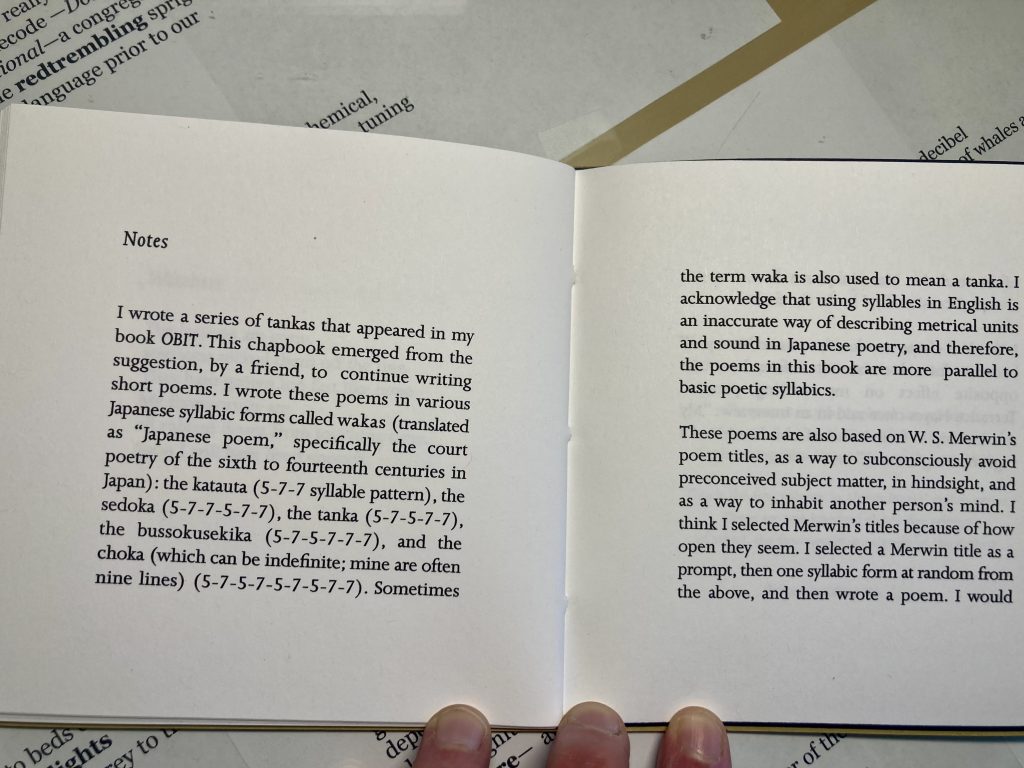
A few weeks ago, I requested Victoria Chang’s The Trees Witness Everything. Love the brevity of her form! Back in Jan 2022, I got an early, chapbook version of this collection. In the notes of that chapbook, she describes her project:

notes from Victoria Chang’s chapbook, Another Lost Year

Her project of using the different court poetry of Japan is inspiring me to do more with my breathing and striking rhythms: 3/2, 2/1, 3/3/3, and 3/3/3/4. Also, her use of Merwin titles makes me want to use titles/lines-as-titles from Emily Dickinson and other “vision” poets! Yes!

Here are a few:

Losing Language/ Victoria Chang

We were born with a
large door on our backs. When will
we know if it opens?

The Flight/ Victoria Chang

I no longer watch
the birds during the day. I
prefer to save them
for my dreams where an owl’s face
has more than one expression.

In the Open/ Victoria Chang

Weather is wet, it
doesn’t have joints. How snow just
becomes rain, what’s that
change called? Trees witness everything,
but they always look away.

Thinking more about my running rhythms, I’m realizing that I want to tighten up the form some more by limiting the number of lines and total syllables. I like 5, but that might be too few?

Late Wonders/ Victoria Chang

My face is now gone.
Instead, I have a hawk’s face.
None of the poets
notice, they only want fame.
Fame is a bucket of eyes.

and for this month’s focus on shadows:

The Time of Shadow/ Victoria Chang

The zookeepers feed
all the shadows light and meat.
The shadows wish so
badly to leave their bodies,
but they stay for the children.

Thinking about Chang’s use of Merwin titles and my interest in using ED titles, I am reminded of a discussion in Ted Kooser’s book, The Poetry Home Repair Manual:

You can open just about any book of poetry and find poets using titles to carry information. Just look at a table of contents and you’ll see how useful titles can be in suggesting waht poems will be about. . . .

In short, a title isn’t something you stick on just because you think a poem is supposed to have one. Titles are very important tools for delivering information and setting expectations.

The Poetry Home Repair Manual / Ted Kooser

feb 26/WALK

40 minutes
to the river and back
57 degrees

A warm, windy February afternoon. Took a walk with Delia the dog and Scott. Heard some kids on the playground that I mistook for a siren. Then later, heard some actual sirens. Also heard some ragtime music coming from a bike on the path. Marveled at the gnarled oaks and the jagged shadow one cast on another branchless tree. Noticed how high the bluff was above the forest floor. Encountered many happy, chatting walkers, one runner without a shirt.

It’s Windy

Is it the strange, too-early spring weather? The fact that I’m turning 50 in 4 months and that my kids are turning 21 and 18? Not sure, but my thoughts have been scattered lately, flitting from one idea to the next without landing anywhere for too long. Maybe it’s the wind. This morning I said to Scott, what a beautiful morning! Too bad it’s windy. Then Scott started singing “Windy” by the Association — I tried to join in, but I was in the wrong key (as usual). I should have a t-shirt that says, I’m always in the wrong key, I said (which, I think, isn’t always a bad thing to be in). Anyway, I decided to listen to the song and read the lyrics. It’s actually about wind! How delightful!

Who’s tripping down the streets of the city
Smilin’ at everybody she sees
Who’s reachin’ out to capture a moment
Everyone knows it’s Windy

And Windy has stormy eyes
That flash at the sound of lies
And Windy has wings to fly
Above the clouds (above the clouds)

I think I might create a page of wind poems/songs and add this, along with “They call the wind Mariah” from Paint Your Wagon and “I Take to the Wind” by King Crimson.

an idea (for the future? now?): Yesterday I posted a poem that uses an Emily Dickinson line in the title (I heard a fly buzz), then obliquely references her in the poem. A year or so ago, I had the idea that I’d like to write a series of poems that use some of my favorite Emily Dickinson lines as titles for my poems about vision loss, how I see, and how I’ve been carving out a new way of being with my moving practice. I’ve already written one that was published this past December in the print journal, Door is a Jar:

The Motions of the Dipping Birds/ Sara Lynne Puotinen

Because I can no longer see
her face, when my daughter talks I watch

her small hands rise and fall,
sweep the air, flutter.

I marvel at the soft feathers her fingers make
as they soar then circle then settle

on the perch of her hips waiting
to return to the sky for another story.

I think Victoria Chang’s collection, The Trees Witness Everything, in which she uses W.S. Merwin poem titles and then writes her own poem, might be a good inspiration. I’ve been wanting to do this project for several years, but I wasn’t quite ready. Am I now? I’ve already been moving towards it with my interest in memorizing 50 Emily Dickinson poems before my 50th birthday — did I mention that in here, or was it just in my “to do” list? Oh, I hope this idea sticks and helps me to write more poetry. Lately, I’ve had tons of ideas that I start, but that really don’t go anywhere.

As part of this Dickinson project, and inspired by yesterday’s poem, I decided to memorize ED’s “I heard a fly buzz — when I died”. After memorizing it, I listened to someone else’s reading of it and noticed a line change:

[original] The stillness in the Room
[alternate in video] The stillness round my form

Which is correct, I wondered. At first, I thought the alternate might be the correct one, but it didn’t seem quite right — form neatly rhymes with the last line of the verse: Between the Heaves of Storm. ED liked slant rhymes, not straight ones. I looked it up and discovered that ED’s first editor, Mabel Loomis Todd, had changed the line to form. She also took out ED’s dashes. I’ve read about the fraught relationship between ED and Todd (who was ED’s brother’s lover) and Todd’s heavy-handed editing, so I’m sticking with the original!

medical term fun!

I’m still working with g a s t r o c n e m i u s and s o l e u s scrabble tiles. Last night’s favorite:

Guess a minute’s colors

I told RJP and she said, 7:42 is yellowish-green. Do I see any particular minute’s colors? No. But I do like trying to describe what colors I see at any given minute.

What happens when I reverse 2 words: Guess a color’s minutes?
Or, Minutes colors a guess?
Or, As color, minutes guess
Or, minutes: a color’s guess (as in, meeting minutes)
Or, a guess colors minutes

Back to ED’s buzzing fly. Whenever I read this poem, I think about an article I discovered a few years ago that discusses how accurately and effectively ED describes the physiology of the dying eye — 15 march 2021

feb 18/RUN

5.8 miles
down the franklin and back
31 degrees

A little icy, a little windy, a little crowded. Difficult to run together in these conditions, so Scott and I split up. The sun was bright and I saw some wonderful shadows of trees — gnarled and sprawling across the sky. Heard some geese, smelled some bacon.

When we ran together, Scott and I talked about the half frozen river and how it looked like a gray slushy. What flavor is gray slushy, I wondered. Scott suggested, all the flavors then added, I bet that would taste good. I wondered if this “everything” slushy would include blueberry. No, Scott said, blue raspberry. I mentioned how there is no consensus on the origins of the rasp in raspberry, which I had come across while reading a past entry a few days ago.

How I See

As I continue to work on this project, I want to return to ekphrastic poems. In an article for Lithub — Back to School for Everyone: Ekphrastic Poetry with Victoria Chang — Chang offers some helpful thoughts about the form:

how poets engage with visual art:

  • write about the scene or subject being depicted in the artwork
  • write in the voice of the person or object represented
  • write about their personal experiences
  • fictionalizing a scene within the art
  • write about the work in the context of its socio-political history

In essence, ekphrastic poems are a way to interact with the world and a way to respond to the world. The process of writing ekphrastic poetry also brings into question aspects of viewing, the culture of viewing, and the gaze, always asking the questions of who is looking at what, when, and why?

3 thoughts about Ekphrasis

1: I’m as interested in how someone is looking as who, what, when, or why they are looking.

2: Maybe part of the ekphrasis angle is the idea that sometimes the world looks like a painting to me — pointillism or abstract expressionism or?

3: the contrast between how a photo captures/stills the image in a way that my eyes never can

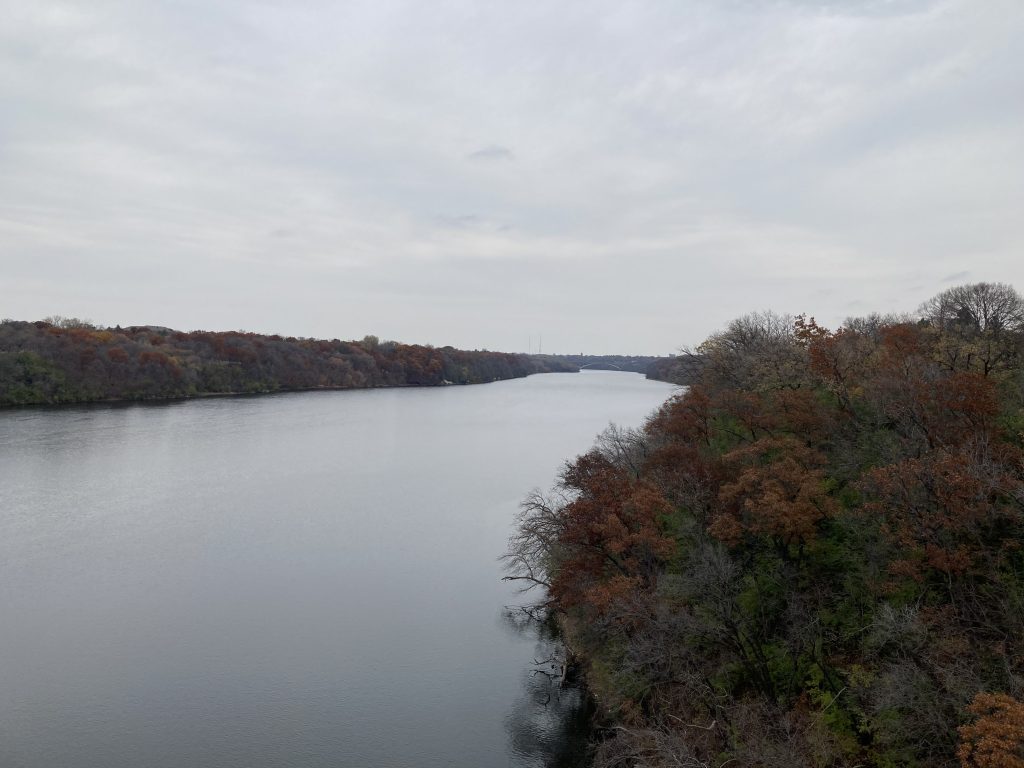
A view from the ford bridge, poorly framed. Not sure what color other people might see here, but to me it's all gray: light gray sky and river, broken up by chunks of dark gray trees. I like how the sky and the river look almost the same color to me.
8 nov 2023

original description: A view from the ford bridge, poorly framed. Not sure what color other people might see here, but to me it’s all gray: light gray sky and river, broken up by chunks of dark gray trees. I like how the sky and the river look almost the same color to me.

5 nouns/ 5 adjectives/ 5 verbs

nouns: river, water, shore, trees, sky, branches, a bend, surface
adjectives: winding, scraggly, soft, fuzzy, drab, dark, light, gray, wide, flat, contrast, wide
verb: stretching, reaching, standing, stilled, separated, cutting through,\

one sentence about the most important thing in image: The sky and the river are the same color; only the disruption of trees enables me to distinguish between them.

a second sentence about the second most important thing: Everything gray: light gray sky and river, broken up by chunks of dark gray trees.

a third sentence about the third most important thing: In this soft, wide open view, when everything is stilled, silent, nothing is happening.

The nothing that’s happening in this image is full of meaning. Here nothing = no things are doing anything/ nothing to see; nothing = a void, absence, unknowingness; nothing = a rest for my eyes, no movement, everything still, satisfied, stable.

The idea of no separation, no edges or divisions between forms, reminds me of a wonderful poem that I thought I’d posted already, but hadn’t. I think when I first encountered it a few years ago, it didn’t resonate for me. Now, I want to call out, yes!, with almost every line.

Monet Refuses the Operation/ Lisel Muller

Doctor, you say there are no haloes
around the streetlights in Paris
and what I see is an aberration
caused by old age, an affliction.
I tell you it has taken me all my life
to arrive at the vision of gas lamps as angels,
to soften and blur and finally banish
the edges you regret I don’t see,
to learn that the line I called the horizon
does not exist and sky and water,
so long apart, are the same state of being.
Fifty-four years before I could see
Rouen cathedral is built
of parallel shafts of sun,
and now you want to restore
my youthful errors: fixed
notions of top and bottom,
the illusion of three-dimensional space,
wisteria separate
from the bridge it covers.
What can I say to convince you
the Houses of Parliament dissolve
night after night to become
the fluid dream of the Thames?
I will not return to a universe
of objects that don’t know each other,
as if islands were not the lost children
of one great continent. The world
is flux, and light becomes what it touches,
becomes water, lilies on water,
above and below water,
becomes lilac and mauve and yellow
and white and cerulean lamps,
small fists passing sunlight
so quickly to one another
that it would take long, streaming hair
inside my brush to catch it.
To paint the speed of light!
Our weighted shapes, these verticals,
burn to mix with air
and change our bones, skin, clothes
to gases. Doctor,
if only you could see
how heaven pulls earth into its arms
and how infinitely the heart expands
to claim this world, blue vapor without end.

feb 8/RUN

5.3 miles
ford loop
47 degrees

Hooray for feeling strong and happy and unbothered by the wind! A good run, even though it feels strange with no snow. Scott told me it’s 5 degrees warmer here in Minneapolis than it is where we used to live in Upland, California. Wow.

Starting last night and lingering through the morning: rain. Not snow, but rain. Everything was wet and muddy and slippery. At the end of my run I noticed that I had specks of mud on my shirt — how did that happen?

Around mile 3, as I ran straight into the wind, a biker approached from behind. I heard her call out Fast! I wasn’t sure what to say, so I said, there’s a lot of wind! She agreed. Later I encountered the biker on the ford bridge — she was walking her bike while I was still running — There’s goes that fast runner! I waved and smiled. I did a lot of smiling at every person I encountered.

a strange winter sight: roller skiers, one of them wearing shorts!

Talked with Dave, the Daily Walker about how I’m missing the snow. He agreed, but only when it’s windy and there’s lots of snow and no one else out on the trail. Then it’s fun, he said. His version of fun is one reason why I like Dave so much.

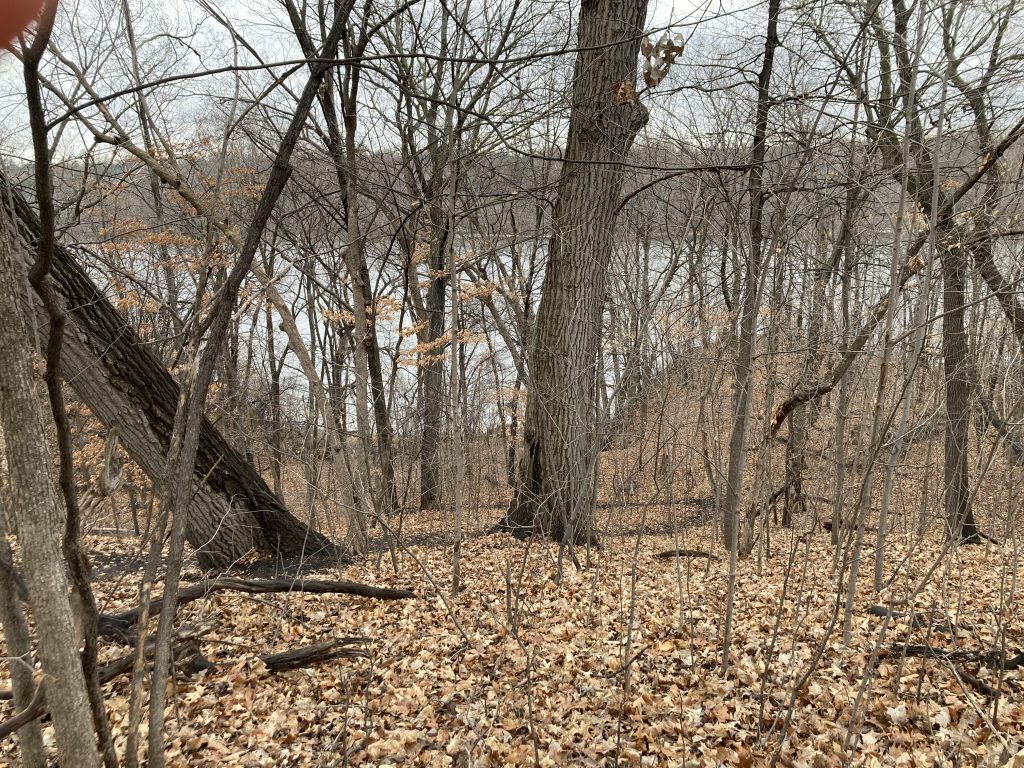
Took 2 pictures of my view. Both are just south of the double bridge and the Horace W.S. Cleveland Overlook. Here’s one of them:

My view from above the gorge: bare limbed trees, all trunk and thin branches. A few trunks are thick -- like the one near the center of the image or the one leaning on the left side -- but most are thin, creating a transparent screen between runner (me) and river. The ground, in the bottom third of the picture, is mostly dead, curled-up brown leaves.
My view from above the gorge: bare limbed trees, all trunk and thin branches. A few trunks are thick — like the one near the center of the image or the one leaning on the left side — but most are thin, creating a transparent screen between runner (me) and river. The ground, in the bottom third of the picture, is mostly dead, curled-up brown leaves. Sometimes, this is what I see even when there aren’t thin, bare branches everywhere — my view slightly obscured by something in the way — dead cone cells, I think — creating fuzz or static or a slight pulsing or wavering of lines. Also, if this picture were in black and white I wouldn’t be able to tell the difference. Often I have to ask Scott: is this in color or black and white?

peripheral: how I see

before the run

Before my run, while I was reviewing my Oct 2023 log entries and encountering several of my “how I see” photos, it came to me: this should be the new version of my vision poems. I want to study the ekphrasis form (An ekphrastic poem is a vivid description of a scene or, more commonly, a work of art. Through the imaginative act of narrating and reflecting on the “action” of a painting or sculpture, the poet may amplify and expand its meaning — def). Then I want to write a series of “how I see” poem/descriptions. These will be about experimenting with the form and exploring ways to describe how I see. I wrote in my notes: not about what I can’t see, but what I can. I’m also interested in experimenting with the idea of alt-text as form — I have a few sources for this. I’ll read some Georgina Kleege and her latest book, More Than Meets the Eye. These poems will be practical — describing the literal way I see — but also poetic — strange, unsettling, more than a report.

I’m thinking that these poems would involve describing what I see in the photo and what I saw when I was taking the photo. Also, they’re as much about HOW I see (the mechanics/process) as WHAT I see. I love this idea; I hope it sticks!

some sources:

during the run

While I ran lots of different thoughts flashed. First I thought about Marie Howe and the idea of observing and not looking away. Describing what you see with details not metaphors. Then I thought about how “looking” works for me, how it’s harder because of what I can and can’t see. How much can any of us (no matter where we are on the spectrum of seeing/blind) actually see? Then I started thinking about Huidobro’s poem, “Natural Forces” and all of the different glances he describes — One glance to shoot down the albatross. What do my different glances see?

right after the run

During my walk back home, I thought more about how I see (and spoke those thoughts into my phone). I was reminded of Robin Wall Kimmerer and her chapter, “Learning to See” in Becoming Moss. It’s about how we can learn to see the small things — like moss — that were invisible to us before.

I also thought about how I’m interested in the process we use to see and how that shapes what we see and how it enhances or detracts from our ability to behold/witness. Yes! This connects back to Ross Gay and beholding, which I discussed on here a few years ago.

I’m interested in how we sense without seeing, or how we see with our other senses (like sound). And I’m interested in thinking about how vision isn’t the primary mode in which we understand and make sense of things. It is only one of many ways, not THE way.

Ekphrasis

The verbal representation of visual representation.

Basically, an ekphrasis is a literary description of art. Like other kinds of imagery, ekphrasis paints a picture with words. What makes it different from something like pictorialism is that the picture it paints is itself a picture: ekphrasis stages an encounter between representations in two mediums, one visual and one verbal.

What is Ekphrasis?

key feature of an exphrasis poem: it engages with an artistic representation — does this fit for my project? I think so, especially if I make the taking of the photo as part of the description.

Another helpful definition of Ekphrasis from Poets.org:

Ekphrasis is the use of vivid language to describe or respond to a work of visual art.

Ekphrasis

The purpose of ekphrasis was to describe a thing with such detail that the reader could envision it as if it were present. 

I’m interested in using language to help others experience how/what I see.

jan 13/BIKERUN

bike: 30 minutes
basement
run: 1.15 miles
outside: 7 degrees / feels like -10

A short run today because I’ve run every day this week so far, and because it’s windy and snowy and cold outside. Watched the first 20 minutes of Jennifer Lawrence’s comedy, No Hard Feelings, while I biked. I like her and I’m finding this movie funny so far. I listened to Taylor Swift’s Reputation while I ran. Tried out my new bright yellow shoes for the first time. I like how they feel and how they look. Quite possibly they will be the shoes I wear when I run the marathon next October. I don’t remember thinking about much as I ran — I focused on my arm swing and staying relaxed and lifting my hips. We turned the treadmill the other way a few months ago so now I won’t see my inverted moon on the dark window anymore. What strange image will replace it? I don’t remember any today. But I’ll have to look for one the next time I run on the treadmill, which will probably be on Monday; it might be arctic hellscape cold then.

Emily Dickinson’s Windows

Here are some useful ideas from an article — Emily Dickinson’s Windows — I found yesterday, which seems to be an extended version of an article I read a few days ago:

  • creative freedom
  • architectural prop: By my Window, The Angle of a Landscape
  • her envelope poems resembled a window with curtains
  • a magic lens — the warped quality of 19th century windows: the world let loose, nature liquefied — her practice of looking/writing — up and out the window/down at the paper — descriptions as incremental fragments (A Slash of Blue! A Sweep of Gray!)
  • the window grid creates a pattern — 12 panes — reflected in the formal structure of her poems (degrees, steps, notches, plunges) — each word, line, or stanza is well-defined slot/pane that spotlights an image/emotional state/quality of experience — ’Tis this – invites – appalls – endows – Flits – glimmers – proves – dissolves – Returns – suggests – convicts – enchants Then – flings in Paradise – (Fr 285)
  • an act of undoing in each pane — nature loosening up (a neat frame in a formless center)
  • each pane a diagram of rapture
  • looking through/touching the glass, she connected with the artisans who made it, who left evidence of their labor –warps and striations that were once the artisan’s breath (windows made through glass blowing? wow)
  • glass blowing and imagery of fiery furnaces, metal flames, boiling, white heat
  • mid 19th century — glass consciousness
  • ED’s poems as her own form of glass blowing — creative process of transforming words into poems = making sand into glass into windows

the window grid creates a pattern — 12 panes — reflected in the formal structure of her poems (degrees, steps, notches, plunges) — ’Tis this – invites – appalls – endows – Flits – glimmers – proves – dissolves – Returns – suggests – convicts – enchants Then – flings in Paradise – (Fr 285)

I love this idea of how the windows influenced the form of her writing. Also, the combination of the orderliness/structure of the frame and the unruliness/undoing-ness of her words. It might be fun to use my windows — 2 sets with 2 panes each, a bar in-between the windows, one set in front, one to my right side — as the structure for a few experiments. As I write this, I’m thinking about Victoria Chang’s truck moving across each window frame and Wendell Berry’s black criss-crossed frame.

Here’s a wonderful ED poem that is mentioned in the article:

By my Window have I for Scenery (797) / Emily Dickinson

By my Window have I for Scenery
Just a Sea—with a Stem—
If the Bird and the Farmer—deem it a “Pine”—
The Opinion will serve—for them—

It has no Port, nor a “Line”—but the Jays—
That split their route to the Sky—
Or a Squirrel, whose giddy Peninsula
May be easier reached—this way—

For Inlands—the Earth is the under side—
And the upper side—is the Sun—
And its Commerce—if Commerce it have—
Of Spice—I infer from the Odors borne—

Of its Voice—to affirm—when the Wind is within—
Can the Dumb—define the Divine?
The Definition of Melody—is—
That Definition is none—

It—suggests to our Faith—
They—suggest to our Sight—
When the latter—is put away
I shall meet with Conviction I somewhere met
That Immortality—

Was the Pine at my Window a “Fellow
Of the Royal” Infinity?
Apprehensions—are God’s introductions—
To be hallowed—accordingly—

The pine tree as a sea with a stem? I love this idea!

jan 5/RUN

5.15 miles
bottom of franklin hill turn around
30 degrees

Yes! A great run. A brief runner’s high around mile 4. At the beginning it felt cold, but almost early spring-like: chirping birds, soft shadows, humid air, clear paths. In certain spots the path was dotted with ice.

Passed a group of 4 or 5 runners twice. Smelled cigarette smoke. Watched a car driving over the I-94 bridge. Listened to the group of women laughing, cars passing, ice sizzling heading north. Put it Billie Eilish essentials on the way back — maybe I’m, maybe I’m, maybe I’m the problem.

Something to try today, from Richard Siken: one image

The heart of lyric poetry is music and image. Music is hard to talk about but image is easy. It’s not too late to start an exercise. Write down one image every day that was striking. It’s good as a resource to pull from for writing or just for remembering. Date them. >

Today’s image: sizzling ice on the river chunks? sheets? just starting to form, floating on the surface. I took a video:

ice on the mississippi / 5 jan 2024

Standing there, holding my phone, the ice was moving slowly downstream and sizzling. In the video, I can’t see it moving and all I can hear is the traffic from the I-94 bridge just above. I wish I just kept the phone still; it’s moving around too much. The sizzle sounded like the sizzle I heard in my head after I fainted last week. A sizzle or crackle or static-y sound. The movement of the ice was slow and gentle and persistent (or insistent?).

windows and doors

Yesterday, it came to me: windows and doors. That’s what the theme for January should be. Will it stick? Not sure, but today I begin by thinking about windows and doors as I ran. I held onto a few thoughts and recorded them into my phone right after I finished my run:

Windows as in the frame and how often I see what’s just outside of the frame because I feel it off to the far edge (mainly because of my heightened peripheral vision).

A door as being open — focus on what’s through the other door, the room on the other side, as opposed to the door as framing what you see. Whereas the window is about the frame and about this thing in between you and the is/real. The frame is language, our access to the real. The framing of something as a useful limitation, helping to focus a form. The window is a form where the energy goes, where it’s held in, so the poem still has heat.

I’ve collected door and window poems before on this log, so this isn’t a new idea, I’m just adding to it. Here’s a door and window poem for today — actually, an excerpt from an amazing poem by Victoria Chang:

excerpt from Today/ Victoria Chang

Feb.10.2022
Today the river is in crisis, no
horizon dares to go near it. Today
my father is in a small jar. At dusk,
I went into a painter’s studio,
saw his stretched canvas on the table, white,
empty. What are we without those who made
us? May his memory be your blessing,
people emailed me all week. The artist
was painting a series of doors, which were
so real that I walked through the one that was
slightly open. Inside the room was my
breath that I had held since January
13, an eyelid, a loose eyeball, the
knob the eye fell on, the girl’s hands that tried
to catch him, which were charred and still waving.

Feb.11.2022
The white truck went from one frame to the next
and I thought of the time when someone lied
about me. How day and night I cared so
much about the lie that it split into
two, one part went out the left window frame,
the other out the right. Like the blue car
that disappears at the same time as the
white one, yet I can see both at once. When
they burned my father’s body, I wondered
if the eyeballs spread so far on each side
that they could see Wyoming, these two panes,
me on a small brown chair, looking out the
windows, waiting for oblivion to
travel through with its eighteen wheels and truth.

Feb.12.2022
At the beginning of our family tree
was hope. Or maybe it was just an owl.

Feb.13.2022
The same wind was blowing here eighty years
ago, always snapping families in half.

Feb.14.2022
If I keep the window closed, I am stuck
inside with language as it buzzes back
and forth, trying to get out and start wars.

First, so much of what she writes here (and in the rest of the poem) is echoed in other things I read earlier today and yesterday by Viola Cordova and Jake Skeets. Wow.

Second, at the beginning of the poem, Chang writes: On Kawara’s “Today” Series. Looked it up and found: Paintings: Today Series / Date Paintings

On January 4, 1966, On Kawara began his Today series, or Date Paintings. He worked on the series for nearly five decades. A Date Painting is a monochromatic canvas of red, blue, or gray with the date on which it was made inscribed in white. Date Paintings range in size from 8 x 10 inches to 61 x 89 inches. The date is composed in the language and convention of the place where Kawara made the painting. When he was in a country with a non-Roman alphabet, he used Esperanto. He did not create a painting every day, but some days he made two, even three. The paintings were produced meticulously over the course of many hours according to a series of steps that never varied. If a painting was not finished by midnight, he destroyed it. The quasi-mechanical element of his routine makes the production of each painting an exercise in meditation.1 Kawara fabricated a cardboard storage box for each Date Painting. Many boxes are lined with a cutting from a local newspaper. Works were often given subtitles, many of which he drew from the daily press.

Paintings: Today Series / Date Paintings

In the article, I also found this classroom activity suggestion:

Subtitle Your Days

Many of the Date Paintings have subtitles. Some of these titles record personal anecdotes, such as “I played ‘Monopoly’ with Joseph, Christine and Hiroko this afternoon. We ate a lot of spaghetti” (January 1, 1968). Others record current events, some of them momentous, such as the Apollo 11 moon landing in 1969. Still other subtitles refer to the Date Paintings themselves; one reads, “I am afraid of my ‘Today’ paintings” (May 29, 1966). For this activity, challenge students to record a subtitle for each day of the week for two weeks. These subtitles can be personal, historical, or even arbitrary. What is it like to capture a day with a subtitle?

I like the idea of combining Siken’s suggestion of an image a day with Kawara’s date poems and Chang’s reading of the date as a door into somewhere else. A date as door, an image as door.

april 25/RUN

3.75 miles
2 trails + extra*
42 degrees

*extra = instead of ending the run at the 38th street steps, I kept going past the oak savanna and the overlook, down through the tunnel of trees, over the double bridge, before crossing over to edmund at 32nd and running back home

Felt warmer than 42 degrees with the sun and too many layers — black running tights, black shorts, long-sleeved bright yellow shirt, bright orange pull-over. The thing I noticed most today were the shadows. Heavy shadows everywhere. The shadows of trees, some stretching across the path, others leaning down, just above me. The shadow of a flying bird, a waiting lamppost.

10 Other Things I Remember from my Run

  1. the loud knocking of a woodpecker
  2. someone complaining to someone else on the phone. I first heard them up ahead of me near the old stone steps, then as I passed them on the trail, then about 10 minutes later from across the river road as I ran on the grass near edmund
  3. the river, blue with less foam, not quite as high. I was planning to admire its sparkle near the south entrance to the winchell trail but I was distracted by 2 walkers just ahead of me on the trail
  4. lower on the winchell trail the gorge below me was all river, no shore in sight
  5. a trickle of water at the 44th st sewer, gushing at 42nd
  6. kids playing at the school playground, yelling, laughing. one adult chanting something
  7. the leaning trees I noticed a few weeks ago are still leaning, almost blocking the trail. A few times, I had to duck to avoid small branches
  8. music playing (not loud enough to describe it as blasting) out of a car’s radio — some sort of rock music that I didn’t recognize
  9. one section of the split rail fence — where? I can’t remember — is broken and needs to be repaired
  10. most walkers I encountered were overdressed in winter coats, hats, gloves

Having finished my series of colorblind plates and feeling unmotivated to read the final sections of Ammons’ garbage, I’m project-less. Not a problem, except the lack of focus makes my mind wander everywhere. Here are just some of the things I thought about before my run this morning:

a new-ish bio

Once or twice a year, I take some time to submit poems to different literary journals. Not sure about the exact math, but I’d say I have about a 5% acceptance rate, which I don’t think is that unusual. I got used to rejection as an academic. Still stings though. Maybe that’s why I don’t submit that often. I think I also haven’t submitted a lot because I don’t care that much about being published, especially as a way to achieve fancy poetry status. But, I’d like to share my poems with a wider audience and if I only post them on my blog they don’t get read by a lot of people and I can no longer submit them to journals (most of the journals I’m encountering consider posting a poem on your personal blog as it being published already). I’d also like to apply for a grant and do an exhibit/installation of my vision test poems and I think having some of them published might help me to get that grant. So, with all that in mind, I’m currently sending poems out to different journals. As part of the submission, you write a cover letter and include a 50-150 word bio. A few days ago, I started playing around with my bio — I included a few in a post log entry on here. This morning I was still thinking about the bio. I was hoping my run would help me find another sentence for this unfinished bio:

Sara Lynne Puotinen lives in south Minneapolis near the Mississippi River Gorge where she enjoys conducting experiments in writing while moving, moving while writing, and doing both while losing her central vision. Sometimes she composes chants while running up hills, or uses her breathing patterns as she swims across a local lake to shape her lines. 

The run didn’t help. In fact, I forgot to even think about my bio. Oh well.

april 21, 2022

As part of my daily, “on this day” review, I was reading through past log entries early this morning. Last year’s was especially good (I almost wrote fire, but thought better of it — okay, I did actually write it, but then deleted it). So many things to put in my ongoing projects list!

First, this:

While I ran, I wanted to try and think about fungi as hidden, always in motion/doing (a verb, not a noun), and below. Had flashes of thought about what’s beneath us, and how I’m often looking down through my peripheral, even as I look ahead with my central vision. 

an experiment to try: While moving outside, give special attention to what’s beneath you, what you see, feel, hear at your feet. Make a list in your log entry.

variation: while trying don’t give attention to anything in particular. Just move. Then, in your log entry, try to remember 10 things you noticed below you.

Second:

I heard the creaking, squeaking branches and thought about old, rusty, long hidden/forgotten doors being opening — a trap door in the forest floor. I didn’t imagine past the open door or the idea that it led to the river basement (using basement here like ED in “I started Early — Took my Dog”). Still, I enjoyed thinking that I could access this door and something in my moving outside was opening a long shut door.

a question to consider: what doors await me in the gorge? where do they lead? how can I open them?

This morning, I was refreshing my memory of a Carl Sandburg poem I memorized a few years ago called “Doors.” If a door is open and you want it open, why shut it? If a door is shut and you want it shut, why open it?

Third: I love this poem — Mushrooms/ Sylvia Plath

Fourth:

An idea I have right now (25 april 2022, that is) for a poem involves playing off of these lines from Mary Oliver:

Listen, I don’t think we’re going to rise
in gauze and halos. 
Maybe as grass, and slowly. 
Maybe as the long leaved, beautiful grass

And this bit from Arthur Sze in an interview with David Naiman:

I began to think I love this idea that the mycelium is below the surface. It’s like the subconscious, then when the mushroom fruits pops up above ground, maybe that’s like this spontaneous outpouring of a poem or whatever.

Between the Covers Interview with Arthur Sze

Something like this?

Maybe like mushrooms, we rise
or not rise, flare
brief burst from below
then a return 
to swim in the dirt…

I (sara in 2023) would like to do something with this fragment, maybe tie it together with some of my thoughts about Ammons and garbage?

grass

Mary Oliver’s mention of grass reminded me of a poem I like by Victoria Chang, which led me to a log entry from Jan 11, 2022:

Left Open / Victoria Chang

We can’t see beyond
the crest of the wooden gate.
We are carriers
of grass yet to be grown. We
aren’t made of cells, but of fields. 

I like this idea of being a carrier of grass yet to be grown. My first thought was of grass on graves — Whitman’s “uncut hair of graves” or Dickinson’s “The color of the grave is green”. Then I thought of Gwendolyn Brooks’ “To the Young Who Want to Die”:

Graves grow no green that you can use.
Remember, green’s your color. You are Spring.

Of course, all this grass talk also reminded me of this part of the cento I just created as one of my colorblind plate poems:

The world mostly g
one, I make it what I want: I 
empty my mind. I stuff it with grass. 
I’m green, I repeat. I grow in green, burst u
p in bonfires of green, whirl and hurl my green
over the rocks of this imaginary life.

This cento is made out of lines from poems I’ve gathered for this log:
The world mostly gone, I make it what I want (Psalm with Near Blindness/ Julia B. Levine)
I empty my mind. I stuff it with grass. I’m green, I repeat. (Becoming Moss/Ella Frears)
I grow in green (Paean to Place/ Lorine Niedecker)
burst up in bonfires of green (The Enkindled Spring/ D. H. Lawrence
whirl and hurl my green over the rocks (Oread)
this imaginary life (The Green Eye/ James Merrill)

addendum, 26 april 2023: Reading back through my entries about A. R. Ammons as I prepare to post my monthly challenge for April, I encountered these lines from Ammons’ pome “Grassy Sound.” How could I have already forgotten them?!

The wind came as grassy sound 
and between its
grassy teeth
spoke words said with grass

Happy Birthday Ted Kooser!

Discovered via twitter that today would* have been Ted Kooser’s 84th birthday. What a wonderful poet! I’ve gathered 6 of his poems for this log:

  1. Grasshopper/ Ted Kooser
  2. The Early Bird/ Ted Kooser
  3. A Heron/ Ted Kooser
  4. In the Basement of the Goodwill Store/ Ted Kooser
  5. Carrie / Ted Kooser
  6. Turkey Vultures/ Ted Kooser

*I realized on 25 april 2024, that Ted Kooser was still alive. Thank goodness!
august 27/RUN

3.15 miles
turkey hollow loop
69 degrees / humidity: 86%
10:00 am

Windy and warm this late morning. As I started the run, I recited Christina Rosetti’s “Who Has Seen the Wind?”:

Who has seen the wind?
Neither I nor you:
But when the leaves hang trembling,
The wind is passing through.

Who has the seen the wind?
Neither you nor I:
But when the trees bow down their heads,
The wind is passing by.

Then Richard Siken’s “I am the wind and the wind is invisible, all the leaves/tremble but I am invisible” from “Lovesong of the Square Root of Negative One.”

It might be fun to have a few favorite lines for each type of weather so I could recite them as I ran. What could I do for heat and humidity?

Ran south on the river road trail. Crowded with too many pairs of bikers not moving over enough. Unlike yesterday, my attitude/mood, wasn’t the problem; it was the narrow trail and bikers’ unwillingness to bike single file in these narrow spots. I decided to cross over to Edmund and do the turkey hollow loop instead of staying on the trail. Before I crossed, I think I heard the rowers down below.

No turkeys in turkey hollow. Later, near Becketwood, I thought I saw a turkey, but it was only some dark plastic wrapped around a tree, protecting its trunk. I’ve thought these wraps were turkeys before, many times.

I don’t remember the river at all. Did I forgot to look? Was it still too veiled?

Disputed Tread/ Hazel Hall

Where she steps a whir,
Like dust about her feet,
Follows after her
Down the dustless street.

Something struggles there:
The forces that contend
Violently as to where
Her pathway is to end.

Issues, like great hands, grip
And wrestle for her tread;
One would strive to trip,
And one would go ahead.

Conflicting strengths in her 
Grapple to guide her feet,
Raising an unclean whir,
Like dust, upon the street.

Here’s the About This Poem description:

“Disputed Tread” first appeared in Walkers (Dodd, Mead, and Company, 1922). The poem, composed of rhyming quatrains in a loose trimeter, likens the blur, or “whir,” of the movement of one’s feet to the cloud of dust it would otherwise rouse on a dusty road. Regarding the poem, poet Margery Swett Mansfield remarks, in her review of Hall’s Walkers published in Poetry vol. 22, no. 5 (August 1923), titled “Beyond Sight and Hearing,” that “[s]urely no one has ever wrung more meaning from a footfall! Feet tell her the truth even when her mind would prefer the more comforting conclusions of philosophy.”

Feet tell her the truth even when her mind would prefer the more comforting conclusions of philosophy. I like this idea of the truth of our striking feet.

Before I ran this morning, I found this interview with Victoria Chang: The Arc Moves a Little Upwards: A Conversation with Victoria Chang Curated by Lisa Olstein. Here are a few bits I’d like to remember:

I use many different types of syllabics such as tankas, katautas, chokas.

Later, I’ll look these up. I’m always looking for new forms!

LO: “Form sets the thought free,” says Anne Carson, and I believe her. How did form and thought co-evolve in the unfolding of this work?

VC: I love this quote. I have heard similar things said in different ways. I myself sometimes say form is like putting the guard rails up while bowling–what freedom that gives to the process of bowling (one feels more free while releasing the ball) and then there’s a better chance of getting a strike. But of course, Anne Carson is more elegant than I am with her quote. 

For The Trees Witness Everything book, form was the main constraint (and freedom) of the poems. I had to rewrite lines, phrases, in some cases, entire poems because the syllables didn’t work. The constraints truly freed up my mind to go wherever the poem needed/wanted to go.

jan 14/RUN

3.5 miles
trestle turnaround
16 degrees / feels like 4
snowing
100% snow-covered, at least an inch of loose snow

Snowing all day today. Usually, I wait until it stops and the trails have been plowed before I go out for a run, but not today. Decided to dig out my oldest yak trak and run through the snow. Loved it! A few parts weren’t fun: the wind blowing sharp shards of snow on my face, into my eyes, how slick and soft and difficult it was to run through. The rest of it was great. Quiet, calm, dreamy.

10 Things I Noticed

  1. the regular, Santa Claus, bundled up in a bright orange jacket, with black running tights
  2. a fat tire, their light cutting through the grayish white
  3. almost everything looked soft, blanketed in snow; many things felt hard, sharp pellets of icy snow stinging my face
  4. a car disappearing into the falling snow, near the trestle
  5. a runner in glowing yellow
  6. geese overhead, honking
  7. impatient chickadees, their fee bee calls overlapping
  8. the river: a lot of white, with streaks of dark, open water
  9. 4 people emerging from the forest below, crossing the river road
  10. running on the road, at the end, mesmerized by the endless, blank white beneath me, feeling like I was running in place, or running through nothing, or not moving, just suspended in white

Time for another Chang/Merwin combo. I love this chance to reflect on Victoria Chang’s short poems, and be introduced to more of W.S. Merwin’s work. Today’s pairing starts with Chang’s “Daylight.” I couldn’t find a poem by Merwin with that exact title, so I settled for “The Wings of Daylight.” Is it the poem Chang is referencing? Not sure.

Daylight/ Victoria Chang

One by one, days died,
even they weren’t protected.
They have no symptoms
but keep dying. They want to
fix melancholy,
to keep coming back to no
answers, to take the
depositions of orchards.

The Wings of Daylight/ W. S. Merwin

Brightness appears showing us everything
it reveals the splendors it calls everything
but shows it to each of us alone
and only once and only to look at
not to touch or hold in our shadows
what we see is never what we touch
what we take turns out to be something else
what we see that one time departs untouched
while other shadows gather around us
the world’s shadows mingle with our own
we had forgotten them but they know us
they remember us as we always were
they were at home here before the first came
everything will leave us except the shadows
but the shadows carry the whole story
at first daybreak they open their long wings

jan 12/RUN

4.45 miles
minneahaha falls and back
34 degrees
35% snow-covered

Even warmer today! Less layers, sun. Ran to the falls and back. Running south, no headphones; running, north, a playlist. My left hip/knee/back (the usual suspect) felt sore, but not too bad.

10 Things I Noticed

  1. The clicking and clacking of ski poles, the scratching and scuffing of skis on bare pavement: a cross-country skier crossing the road! I think this is the first one I’ve seen this season
  2. Kids laughing and yelling and having fun at the playground across the road
  3. A walker and an unleashed dog on the Winchell Trail below me. For a moment, I thought the dog might be trying to keep up with me
  4. The falls is fully frozen, at least it looks and sounds like it to me. All I saw was a hulking column of ice; all I heard was silence, no gushing or trickling water
  5. Heard the call (not the peck) of a pileated woodpecker, the fee bee of a black-capped chickadee
  6. The path had less snow on it. Some stretches were completely bare, others had wide strips that were clear. Under the ford bridge it was a soft, slushy mess
  7. As I entered the river road trail, I passed someone who had been running, but just stopped. At first I thought she was muttering something under her breath, but then I realized she was breathing heavily, then I heard a voice coming out of her phone, giving her instructions that I couldn’t quite hear. Was she doing a couch to 5k program?
  8. Noticed my shadow ahead of me as I ran south — clear and sharp in the bright sun
  9. Heard the raucous laugh of a walker on the other side of edmund, her voice echoing
  10. one thing I didn’t notice: the river. Again, I forgot to look at it

I think I’ll post more Chang/Merwin poems this month. Here’s another one from Chang that resonated for me:

Separation/ Victoria Chang

Each day, landscape splits
from the beauty it emits.
When nature is free
from sight, it is most
like itself. I erase each
word right after I write it.

Separation/ W. S. Merwin

Your absence has gone through me
Like thread through a needle.
Everything I do is stitched with its color.

jan 11/RUN

5.6 miles
franklin loop
17 degrees / feels like 0
50% snow-covered

Warm air, warm sun. Another good run. Headed north and decided, at the last minute, to do the Franklin loop. Heard some geese, their honks congregating under the lake street bridge. Maybe some crows too? I know I heard another bird, but I can’t remember now. A black-capped chickadee? Definitely no woodpeckers. Running over the franklin bridge, I studied the river: all white, mostly flat, the edges a silvery shimmer. Later, nearing the trestle, I saw a few bits of black: open water. Encountered some other runners, walkers, at least one fat tire. As I reached the lake street bridge, I came up with a line for a swimming poem that I’m revisiting. I stopped on the bridge to record it into my phone.

Anything else? Most of what happened, what I thought about, got left somewhere out on the trail.

This morning, just as I was leaving for my run, the mail came, bringing the chapbook by Victoria Chang I ordered last week. I think they only made 200+ of them. It’s a small square book, bound with thin red twine. Very cool. I’d like to try making something like this. Titled, Another Lost Year, it is made up of short poems, all with W.S. Merwin titles. So many great ones. Here’s one I especially like. It happens to fall in the very middle of the book, where the red twine is exposed and tied in a knot.

Left Open / Victoria Chang

We can’t see beyond
the crest of the wooden gate.
We are carriers
of grass yet to be grown. We
aren’t made of cells, but of fields.

I like this idea of being a carrier of grass yet to be grown. My first thought was of grass on graves — Whitman’s “uncut hair of graves” or Dickinson’s “The color of the grave is green”. Then I thought of Gwendolyn Brooks’ “To the Young Who Want to Die”:

Graves grow no green that you can use.
Remember, green’s your color. You are Spring.

I like the idea of being made of fields, not cells. Here’s the original Merwin poem:

Left Open / W.S. Merwin

The shutters are rusted open on the north
kitchen window ivy has grown over
the fastenings the casements are hooked open
in the stone frame high above the river
looking out across the tops of plum trees
tangled on their steep slope branches furred
with green moss gray lichens the plums falling
through them and beyond them the ancient
walnut trees standing each alone on its
own shadow in the plowed red field full
of amber September light after so
long unattended dead boughs still hold
places of old seasons high out of the leaves
under which in the still day the first walnuts
from this last summer are starting to fall
beyond the bare limbs the river looks
motionless like the far clouds that were not
there before and will not be there again

dec 7/RUN

5.1 miles
minnehaha falls and back
10 degrees / feels like 1
light snow / 100% snow-covered

Winter! Snow, (almost) empty trails, fresh cold air, not too much wind. What a wonderful run. I ran slow and steady. The trails were completely covered and, if I didn’t know the paths so well, I might have had trouble seeing where to go but, I’ve run here so many times, I was fine. Everything was white, even the river.

10 Things I Noticed

  1. 2 types of crunching as my foot touched the ground, then lifted up: a slow creeaakk then a quick snap. Longer when walking, shorter as I ran. Both happening at same time, with the touching foot creaking and the lifting off foot snapping
  2. Snow brushed on one side of the tree trunk, looking like confectioners sugar
  3. the curved retaining wall, above the ravine, was easy to see, no longer hidden behind leaves
  4. Graffitti all over the wall of the biking half of the double bridge
  5. the falls were gushing at the bottom, iced at the top
  6. most of the trail was not slippery, but a few spots of ice or crusty snow hidden under fresh snow, were slick
  7. a few trucks and some workers parked near the John Stevens House, calling out to each other in loud voices
  8. the fake/recorded bell from the light rail train dinging for at least 10 seconds
  9. someone running much faster than me wearing a bright yellow vest
  10. lots of cars on the river road, most had their full lights on, at least one only had their parking lights on, a few had no lights on

Found this series of poems by Victoria Chang this morning, from her upcoming collection, The Trees Witness Everything:

The Wild Geese/ Victoria Chang

They are not wisdom
or freedom or history.
They are not what’s lost.
They are nothing but wild geese.
I can hear them everywhere,
wings pushing down metaphor.

Here’s what she writes in her “about the poem” section:

“These are a group of small poems that are a part of my forthcoming book, The Trees Witness Everything (Copper Canyon Press, 2022). They are all written in various syllabic forms and the titles are all W.S. Merwin poem titles.”

This one is almost a tanka (5/7/5/7/7), with one extra 7 syllable line at the end. In Obit Chang wrote a tanka that I really like:

My children, children,
there’s applesauce everywhere
but it’s not for you.
It is strange to help someone
grow while helping someone die.

I love how effectively and efficiently she captures the difficulty of being a parent while your parent is dying. The applesauce does so much here, conjuring up little kids and their snacks, and old people at retirement homes eating softer foods. It makes me reflect on the similarities and differences between the very young and the very old, both needing help, but having different futures.

nov 28/RUN

5.6 miles
minnehaha regional park and back*
27 degrees / feels like 20

*south on river road trail to the falls/ up the steps and over the bridge past John Stevens House/ turn around at 3 miles and the entrance to the trail that leads to a steep set of many steps down to the mississippi / back by the falls/ north on the river road trail

A cold wind this morning making it harder to breathe. Sunny, uncrowded, clear trails. Another nice run. Still thinking about ghosts. Thought about possessing, dispossessing, repossessing and then this reminder popped into my head: you can’t ever truly own (or possess, as in own, control, take over) something. The river gorge, for example, can be maintained, managed, exploited but it always exceeds that control. It spills over, invades, resists, refuses to be tamed.

10 Things I Noticed

  1. At the start of my run, before the sky had fully cleared, heading south, the sun was illuminating the river. The water was all silvery white with a few dark spots, caused by the reflection of a tree or a building
  2. All the trees are bare, nothing blocking the view to the Winchell Trail and the river below
  3. My shadow was clearly visible in front of me, not the faint hint of a shadow, but a full, almost solid form
  4. The falls: water still rushing over the rocks, but also big columns of ice falling down too
  5. After running under the ford bridge, I noticed — not for the first time — a dirt trail that winds through the small woods between ford parkway above and west river parkway below. For much of the year, this trail is hidden behind leaves
  6. The dinging of the train bells at the 50th street station on the other side of Hiawatha — not real bells, but a recording. A hollow, fake sound
  7. Voices from runners approaching. It took a long time for me to tell if they were coming from in front of or behind me
  8. The sidewalk/walking path that winds above the gorge between the Veteran’s Home and the dog park often undulates — up up doooowwwwnnn
  9. Running parallel to someone below on the Winchell trail, hearing the leaves rustle as they ran through them
  10. At the end of my run: the clicking and clacking of a roller skier’s poles

Finally, after getting this book in July of 2020, I’m reading Victoria Chang’s amazing Obit. Here’s one that mentions a shadow:

Victoria Chang–died unknowingly on
June 24, 2009 on the I-405 freeway.
Born in the Motor City, it is fitting
she died on a freeway. When her
mother called about her father’s heart
attack, she was living an indented
life, a swallow that didn’t dip. This
was not her first death. All her deaths
had creases except this one. It didn’t
matter that her mother was wrong (it
was a stroke) but that Victoria Chang
had to ask whether she should drive to
see the frontal lobe. When her mother
said yes, Victoria Chang had the
feeling of not wanting to. Someone
heard that feeling. Because he did
not die but all of his words did. At the
hospital, Victoria Change cried when
her father no longer made sense. This
was before she understood the cruelty
of his disease. It would be the last time
she cried in front of it. She switched
places with her shadow because
suffering changes shape and happens
secretly.

march 6/RUN

3.2 miles
trestle turn around
37 degrees

Sunny. Spring-y. Birds chirping. Hardly any wind. A few highlights: I was able to run on the walking path that curves away from the road and the biking path and follows the rim of the gorge just above the Minneapolis Rowing club! Still a few tricky snow-covered spots, but mostly clear. Enjoyed running up the hill from under the lake street bridge, listening to my feet sh sh sh on the grit–I liked the feel of it too, easier than bare asphalt. Anything else? No Dave the Daily Walker. No geese. Looked briefly at the river. It was open–no ice. I noticed a few stones stacked on the smaller of the two boulders just above the trail winding down through the tunnel of trees.

Before starting my run, I listened to two versions of my January Joy poem, one with the parts about running, one without. I’d like to keep the running stuff in and I love the line about adequate knees and functioning feet but I’m leaning more towards the version without it. Maybe I can use those lines in another poem?

January Joy, Version 1

To see the river
the open river
brown, a thin skin of pale blue

To be alone with the river
the uncrowded river
nothing between us but bare branches

To be as empty as the river
the bare white river
a blank page waiting for words

To be as spacious as the river
the boundless river
stretching wide, able to hold multitudes

To be nothing next to the river
the ancient river
small and new and insignificant

O to be the space
above the river
between tree top and sky
illuminated by the sun!

The sun!
glowing up the gray gloom
warming my cold face
flashing through tall, slender tree trunks

How wonderful it is to be alive and outside!

O great runs!
O clear paths!
O strong legs
and adequate knees
and functioning feet!

How wonderful it is to be
moving, breathing, feeling free
on this winter-perfect day!

January Joy, Version 2 (preferred)

To see the river
the open river
brown, a thin skin of pale blue

To be alone with the river
the uncrowded river
nothing between us but bare branches

To be as empty as the river
the bare white river
a blank page waiting for words

To be as spacious as the river
the boundless river
stretching wide, able to hold multitudes

To be nothing next to the river
the ancient river
small and new and insignificant

O to be the space
above the river
between tree top and sky
illuminated by sun!

The sun!
Glowing up the gray gloom
warming my cold face
flashing through tall, slender tree trunks

How wonderful it is to be
alive and outside
on this winter-perfect day!


I am really looking forward to Victoria Chang’s Obit, which comes out next month. Here’s something interesting she said in an interview about writing the poems for the collection:

The old self dies all the time, and it’s quite miraculous. Yet, I asked the man who runs these residencies in Marfa on the way in, what it’s like to be 77. He said, “I feel exactly the same.” How can this be? The tension between what remains and what is discarded in the self was really interesting to me. I always find it odd thinking about how we spend our whole lives learning and all that experience and knowledge accumulates, and then we die. Who designed this thing?

I feel this sense of old selves dying very strongly. I see myself as a series of Saras, not one Sara lasting through time. Sometimes the selves are associated with an age: like Sara age 8. Sometimes with a location: Hickory, North Carolina Sara. Sometimes with a tragic event: Sara whose mom is alive, Sara whose mom is dead. Looking again at Chang’s words I wonder, what have I kept (knowledge, memories, perspectives, understandings) that links all of my Saras together? What have I discarded/forgotten?

feb 28/BIKERUN

bike: 25 minutes
bike stand, basement
run: 1.5 miles
treadmill, basement

Wanted to watch more of The Ring and to not run too much so I worked out in the basement today. The Ring was still creepy–and fun to watch. Only a few scenes were too dark to see and it didn’t matter that I couldn’t read the words that were probably important; I’ve already seen this movie. Listened to my playlist while I ran. Got into a rhythm and felt like I was barely touching the belt. I’m getting used to running on the treadmill.

I was okay running inside because I had already gone for a walk earlier with Delia the dog. Brr. It felt cold outside. Walked around the neighborhood and finished the podcast I started yesterday with Victoria Chang. I’m looking forward to reading her book Obit. As I listened to her and the host Rachel Zucker discuss their grief over the loss of their mothers, my mind started wandering and I started thinking about my current project. I decided to record my thoughts:

So I’m thinking as I was walking–I’m thinking about how I’d like this workbook to kind of be some of the exercises I’ve already done and practiced (or am practicing) but also the ideas that I’ve put in that I’d like to try. Just make a list of all of those things and not worry so much about whether or not it can be done but whether I’d like to try it. The other thing I was thinking about was with listening to Victoria Chang about Obit and grief and thinking about how my mom’s death has changed me and how this project really comes out of that. Or does it come out of that? Where does it come from? Does it have a clear origin? Wanting to discuss what it’s origins are.

Speaking of Obit, here’s one of Chang’s poems from it. The book is a series of obituaries for all the things that died after her mom died. Such a powerful idea!

OBIT [Memory]/ Victoria Chang

Memory—died August 3, 2015.  The
death was not sudden but slowly over a
decade.  I wonder if, when people die,
they  hear  a  bell.   Or  if  they  taste
something sweet, or if they feel a knife
cutting them in half, dragging through
the flesh like sheet cake.  The caretaker
who witnessed my mother’s death quit. 
She holds the memory and images and
now they are gone.  For the rest of her
life, the memories are hers.  She said
my mother couldn’t breathe, then took
her last breath 20 seconds later.  The
way I have imagined a kiss with many
men I have never kissed.  My memory
of  my  mother’s  death  can’t  be  a
memory but is an imagination, each
time the wind blows, leaves unfurl
a little differently.

I woke up this morning thinking of the line about the knife dragging through flesh like sheet cake. Intense.

feb 27/RUN

3.2 miles
trestle turn around
26 degrees
100% clear!

Windy today. Not too crowded. Sunny. My legs felt weird for a mile or so–like they weren’t quite working. Heavy, plodding. Listened to a New Yorker poetry podcast with a poet I just discovered (Craig Morgan Teicher) and felt like I was in a dream. Barely on the path, floating, cocooned in layers, unable to hear birds or trickling water or striking feet. The river was open. Stopped and admired it by the trestle. Then turned on my new playlist. No Daily Walker but a few others walkers, at least one biker. Felt fast in the second half as I flew down the hill by the lake street bridge. Sprinted up the final hill. Don’t remember much from the run. What a wonderful thing it is to lose myself for 30 minutes!

Before I ran, I had a great morning. Started by listening to part of an episode with Victoria Change on Commonplace. At one point, they discuss their shifts in writing in first and third person which got me thinking about my own choice, in my latest project, to write in second person. Why am I using you? Who is you? Found some very interesting essays on second person online: Stuck on You: an ode the second person and the intimacy of writing in the second person in a bar. Then I started thinking about how Mary Oliver uses you, like in Wild Geese (You do not have to be good/you do not have to walk on your knees…). Finally I thought about who the I and the You are in my project. One answer: I = Teacher self and You = Student Self.

After all of that excellent thinking, I checked out twitter and found these lines from the poem Tomorrow and Tomorrow Again/Craig Morgan Teicher:

One cannot lock eyes with a bird,
its eyes vacant as ball bearings, but
mustn’t there be some recognition
in everything?

eyes vacant as black ball bearings? What a great line that reminds me of my own about not being able to see people’s pupils: “soul less black balls”. I looked Teicher up and found his poem, “Eye Contact”. I wondered, does he have macular degeneration or some other vision problem? Couldn’t find anything, but he sure does like referencing blindness. His poetry collection from 2012 is titled, To Keep Love Blurry and check out the titles he gave his NPR end of the year poetry reviews: “Keeping the Dark at Bay” and “In the Dark, The Eye Begins to See.” Hmm…I need to study his writing more. At this point, early on, I can’t decide what he’s doing with these references to blindness–is it signaling his own experiences/preoccupations with blindness or is it serving as metaphor, where blind = dark = bad = shame = grief = loss = death?

Tomorrow and Tomorrow Again/ Craig Morgan Teicher

Of course I don’t know what
happens to us: if we survive in the
hands of love; if Cal, if Simone
and all the trembling answers
those questions entail; whether
by time or by disease or by
an atom bomb right in the eye. Is it
possible death could be thrilling
and fun? And after could there be
something somewhere and what
will we do if we see each other
there? Will the same songs stay stuck
in our heads? Will medicine
succeed in making life so long
we will beg for medicine to end it?
One cannot lock eyes with a bird,
its eyes vacant as ball bearings, but
mustn’t there be some recognition
in everything? Some fury, some
questioning? If one phrase could echo
throughout eternity, would the ear
on the other side return
a word? But what am I asking?
Will I ever see a whale, and will his size
compared to mine be a true
form of knowledge? Loneliness
has depths writing fails to fathom.
I could be clearer, say more, but
it wouldn’t mean as much. Mother
will I ever find you again? Is fear
of spiders fair? Is a power
above minding the scales, be it
science or gods or the weather,
and can they be tipped toward
balance from here? Is beauty more
than another form of pleasure?
What, which, when, how is better?

Eye Contact/ Craig Morgan Teicher

As if bees are known for their pride.
But what’s so great about horses? They’re stuck 
on the earth except when they jump,

but even then they’re not bees.
But is there anything we value so highly 
as streetlights, which, unlike bees,

watch over us with their swan-like
necks and open their eyes at the right time 
every night? The answer is lonely

and whoever among us is brave enough 
to find it will come home to a family 
that won’t even look us in the eyes.


2

But what’s so great about eye contact? 
As if a horse knows a newspaper 
when he sees it. Streetlights don’t live

in hives; they’re not more afraid
of us than we are, fortified by stingers and swarms. 
Bees don’t brighten the alleyways

in which we commit our most heinous crimes 
to keep things moving and fill 
the papers with news. Why don’t we have

a holiday to recognize the alleyways?
The answer is lonely and whoever
among us is brave will have nowhere to jump.


3

Why don’t we sing a song that makes 
the bees proud? What’s so great 
about desolate meadows? The answer

is lonely. Why don’t we come home 
and look at our family? Why don’t we 
designate an hour to brag about news?

What’s so great about the way the papers 
blow through alleyways in the evening 
like deflated rats? As if pride could

brighten the meadows at night. Whoever 
among us is brave enough to forgive
a family gets to make eyes with a lonely horse.


4

As if the answer is flowers. As if 
we could gather streetlights
in a bouquet from the alleyways

and brighten family after 
beekeeping family. But what’s so 
great about seeing the truth?

Beneath every meadow is the earth’s 
molten core, red and hot as an evil eye. 
Why don’t we blow through the streets

at night? The answer is lonely, even 
if a horse knows the way home. 
What’s so great about being brave?


freeze-thaw, a different perspective

added in a few hours after I first posted this entry: Scrolling through my twitter feed, I encountered this very helpful, perspective-shifting idea from Paul Huttner on MPR Weather:

Temperatures over the next week look perfect for gradually reducing snowpack across the Upper Midwest. Days above the thawing point will melt snow. Nights below freezing mean that snowmelt will gradually be released into area rivers.

This gradual release helps mitigate the early-spring threat of flooding. Wow! All this time, I’ve been cranking about how much I hate these freeze-thaw cycles. I’m glad to read that they’re helpful. I still might not like how dangerous they make the path, but now I can get over myself and think about how they help the river. What a nice opportunity to shift my perspective. And, as a bonus: it will be warmer during the day next week!

dec 19/BIKERUN

bike: 22 minutes
basement, bike stand
run: 1.2 miles
basement, treadmill

Mostly biked today. Giving my legs a rest from running hard last night on the us bank stadium concrete. Watched a Superleague Triathlon race on the bike, listened to a playlist on the treadmill. Wore a pair of ridiculously patterned leggings that I bought for my daughter a few years ago that she has never worn. Wow–blue and white tie-dyed with bright blue patches on the back of the knees.

We Are Monica (Acrostic)/ Victoria Chang

What if it were true? That in the
End, no matter what dress we look for,
All we have in our closets are blue ones?
Remember the surface area of the body?
Each one inch square can be bruised blue.
Maybe we know how to betray cloth, its
Old downy fibers are really our skin,
Nightmare after nightmare, it grows back,
It desires to be touched, and nerved, and
Caught. Maybe it is meant to be put on
And taken off, then put on and taken off.

*

What happened to the blue girl who
Entered into the meadow, the one we
Accused, then asked how it felt,
Rubbing our ears against her mouth for
Everything she would give, for what didn’t
Matter—did his hand touch you there
Or there, did he control or tendril?
Nothing, she was to us, but how
I would still look if she rose one night,
Covet the night, listen for their lies,
And take joy in hearing her cries.

*

Who are we to say who belongs on
Earth? We hate the cold mornings
And the warm mornings. What we
Require we never get. We have the hots for
Everything. We aspire to be aspirers.
Maybe we were meant to fancy everything,
Or at least think each vowel in a word
Needs to exist. How many ways can we
Inch forward? We can walk towards, even
Crawl towards with no legs. But even then, we
Are still dependent on dirt and its filth.

*

Why did we spend our lives looking
Everywhere for what we have now, if
All we want is travel? The red leaves,
Regioning off our yards, not the responsible
Envelopes that stay on the trees, but
Maple leaves, the ones that giddily
Opt to follow rain, those opportunists,
Never accepting stasis. Maybe we all
Itch for twice, life. Watch a new
Checker who opens a line at a store,
And how fast we leave each other to get there.

*

We are done for then, or are we just
Erratic, like a tack, constantly moved
Around from paper to paper. A tack never
Reflects, a tack doesn’t die for truth,
Expressing crisis at every new job.
Maybe we are all like tacks, one side sharp,
One side dark. And maybe we are all
Narrow, only truly visible in the night,
In the line of a troubled light.
Could our fingerprints exist because
We know we can’t be trusted?

*

What if, in the end, the want for
Everything, a drink of water, a mother,
A new face, is not a waste, or even
Rare, but what keeps us alive?
East me then, I say to the wind, song me,
Move me where you will, to edge, to roots.
O compass in my mouth, take me to
Noon, the summer, and send the warmth
Into my veins. I will follow it, let it
Carry me through the squares in the screen,
And let me not get stuck.

*

When we are done looking for the
Ex-wife, the ex-lover, the ex-girlfriend,
And finished looking through telescopes, we
Remember how we used to look into
Each round hole for something larger,
Meant to test our vision, not turn it
Onto our hearts and mine its every
Nook, see the heart’s shape as love,
Its arteries as desire. Call me half-hearted,
Cull me from the cold, turn me back to
August, those nights I studied the celestial.

*

Why is writing about her odd?
Evening comes constantly and poets
Ask too much of the moon, too much of
Reeds that always seem to sway.
Everything I know is in a house,
Measured by hands of men that nailed
Over the reeds and tried to roof me from
Night and its eye. This is what
I know but will never understand, this
Capsule, body, this thing that loves others
And lies to us, that doesn’t last.

I love acrostic poems with (not so) hidden messages. I’d like to spend some more time with this poem to read it closely.