march 14/RUN

5.35 miles
bottom of franklin hill and back
22 degrees
95% clear path

Sun! Blue skies! Clear path! Birds — chirps and trills and pecks and caws! Both of my knees are sore, and my hamstrings too, but it was a good run. Was able to greet Dave, the Daily Walker at the beginning, in-between dodging patches of rough ice on the one stretch that wasn’t dry. Thought about why the sky, then later the river, looked blue. The sky, always blue. The river, blue then brown then gray, depending on how much sun it was getting. Also thought about something I just on some ways ancient Greeks classified color:

Glitter effect and material — scattering and textural effects resulting from the type of surface being observed — things like the shimmering of pigeon neck-feathers. 

How to make sense of ancient Greek colors

Studied the snow and thought about texture and what impact it makes on what color it is to us. Then later, when I was running back up the Franklin hill, I thought about texture and a line from Schuyler (below): Gray depression. A depression = a hollow. I noticed how most of the snow, in the bright sun, was white, or maybe a blueish white, but certain bits, where there was a depression in the snow that caused a shadow to be cast, were gray. Gray depression!

Listened to the birds, my feet on the gritting ground, and random voices as I ran north. After turning around and running more than halfway up, I stopped and put in a playlist.

Schuyler, Hymn to Life, page 5

Begins with It behind its ears, and ends with Not to quarrel? note: There’s a thread throughout this section between the cat, Schuyler’s lover, and the Sun that I’ve left out because it didn’t quite fit with what I’m currently moved by in this poem.

Meantime, those branches go
Ungathered up. I hate fussing with nature and would like the world to be
All weeds. I see it from the train, citybound, how the yuccas and chicory
Thrive.

I like weeds, mostly pulling them, so I’m not sure if I’d like to leave them alone. These lines make me think of my reading/research on the management of the gorge — so much regular effort needed to maintain these spaces: pulling up invasive species such as garlic mustard, trimming away dead branches, removing trees that have fallen over the path, mowing the patches of lawn. Often in the summer, in-between the Minneapolis Parks’ scheduled mows, I witness how quickly the land can revert to uncontrolled green. What is a weed, what a wildflower? Here’s some information about native and invasive species at the Mississippi River Gorge.

So much messing about, why not leave the world alone? Then
There would be no books, which is not to be borne. Willa Cather alone is worth
The price of admission to the horrors of civilization. Let’s make a list.
The greatest paintings. Preferred orchestral conductors. Nostalgia singers.
The best, the very best, roses.

These remind me of my love or delight lists, except for Schuyler’s seem to be judging and assessing which things are best, the greatest. Mine are meant to be without judgment.

After learning all their names—Rose
de Rescht, Cornelia, Pax—it is important to forget them. All these
Lists are so much dirty laundry. Sort it out fast and send to laundry
Or hurl into washing machine, add soap and let’er spin.

Make a list, then forget it. Does this mean the act of making the list is more important than the list itself?

I wish I could take an engine apart and reassemble it.
I also wish I sincerely wanted to. I don’t.

I feel these lines.

There’s a song for you. Another is in the silence
Of a windless day. Hear it? Motors, yes, and the scrabbling of the surf
But, too, the silence in which out of the muck arise violet leaves
(Leaves of violets, that is).

The silence as a song. Silence not as absence, but as something too.

The days slide by and we feel we must
Stamp an impression on them. It is quite other. They stamp us, both
Time and season so that looking back there are wide unpeopled avenues
Blue-gray with cars on them, parked either side, and a small bridge that
Crosses Rock Creek has four bison at its corners, out of scale
Yet so mysterious to childhood, friendly, ominous, pattable because
Of bronze.

These bronze bison monuments make me think of some interesting things I learned about color and the ancient Greeks: the sky was not blue, but bronze, because the ancient Greeks classified it in terms of brightness, not color. It might be even more complicated than that — need to read more before I can write about it.

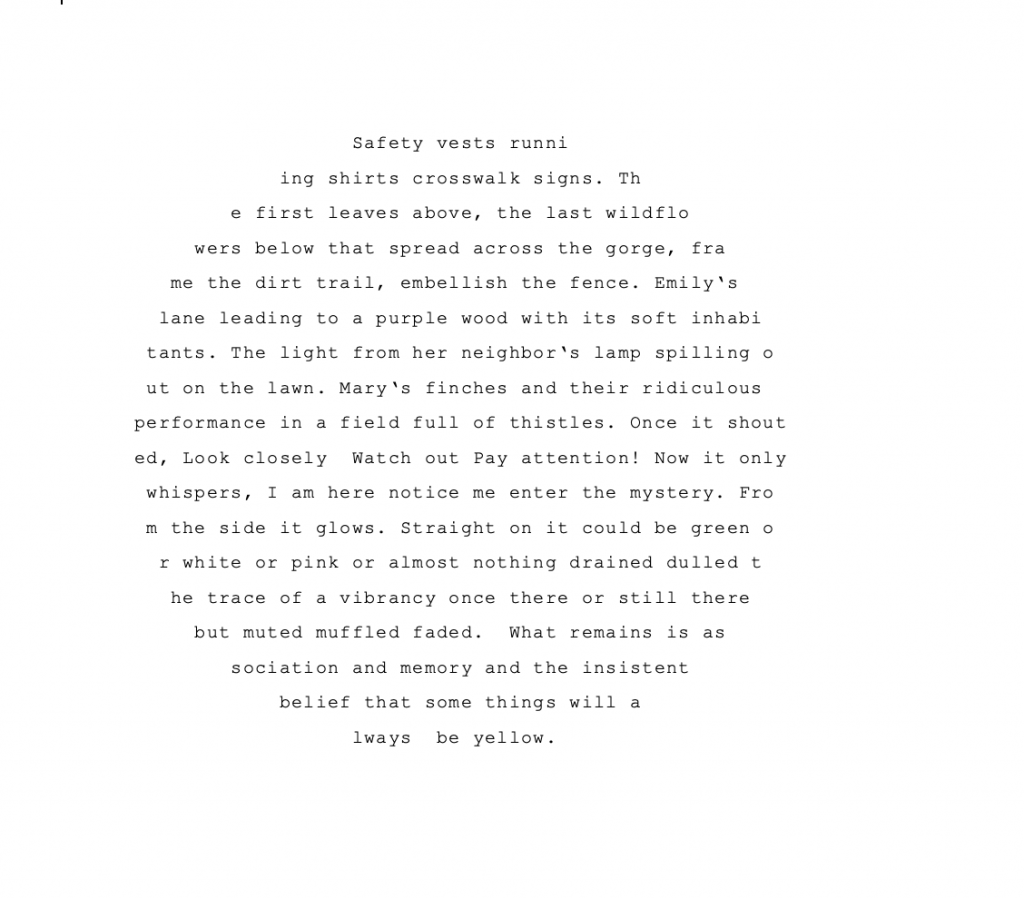
Gray depression and purple shadows, the daffodils feigning sunlight
That came yesterday.

Gray depression — a lowering of physical or mental vitality; a hollow or a place than the surrounding area. Purple shadows — at twilight, ED’s purple woods. Yellow as daffodils with yesterday’s sun.

One day rain, one day sun, the weather is stuck
Like a record.

I don’t have time to write about this, but I’d like to remember it for later.

march 13/SWIMRUN

swim: 1.25 miles
ywca pool

I love to swim. Today felt really good, relaxed. I didn’t even care that my latest vision problem happened again. Walking on the pool deck, staring intently at the lanes, trying to see if the lane I’m looking at is as empty as I think it is. I checked at least 3 times, staring at the water. It seemed empty. Then I put my stuff down and was about to get in when I noticed someone in the lane. Very frustrating and unsettling to look closely, for a long time, and still not see what is right there. But really, it’s not that big of a deal. I didn’t jump in on top of anyone or cause a swimmer to mess up their rhythm. I just need to get used to it and accept that it will continue to happen.

Lots of friends in the water with me today: weird white, almost translucent, bits near the bottom, a balled up bandaid in one lane over, and perhaps the most disturbing, a fuzzy brown ball floating halfway up to the surface, slowly making it’s way to below me. Would I accidentally suck it up? Yuck! Must have gotten distracted because I lost track of it.

Noticed the sloshing sound of water as my hands broke the surface.

Everything was blue underwater. Blue tiles, a blue lower-cased t on the wall, blue-tinted water. Dark blue shadows below, cast by the trees outside the window, making the pool floor look alive.

Lots of breaststroke around me, some backstroke, an occasional freestyle. One woman was using a kick board. I used a pull buoy for a set.

run: 3.1 miles
under ford bridge and back
29 degrees
95% clear path

Ran in the afternoon, which is always harder than running in the morning for me. I feel more tired, heavier. My legs don’t want to move as much. No headphones on the way south, Beyoncé’s Renaissance on the way back north. The sky was mostly blue, with a few clusters of clouds. I felt a shadow cross over me as I started my run. Hello bird! I think I looked at the river, and I think it was open. Heard the drumming of a woodpecker. Admired the wide open view near Folwell and the Rachel Dow memorial bench. Now I remember seeing the river! Right there by that bench — brownish-gray and open. Encountered walkers, dogs, a runner with a stroller.

Down below, in a discussion of a gray line in Schuyler’s poem, I wonder if I could write about silver. I noticed it today, out on the trail. The blazing bright reflection off a car’s hood, the sun shining on wet pavement.

Schuyler, Hymn to Life, Page 4

Begins with Bring no pleasure and ends with As one strokes a cat.

And if you thought March was bad
Consider April, early April, wet snow falling into blue squills
That underneath a beech make an illusory lake, a haze of blue
With depth to it.

I love his illusory lake and the haze of blue with depth to it. Squills = a sea onion, a plant in the lily family with slender, strap-like leaves and blue flowers. Until I looked up squills, I didn’t get that the illusory lake was really a cluster of spring flowers. Maybe that’s because April in Minneapolis creates a different kind of fake lake: the giant puddle!

That is like pain, ordinary household pain,
Like piles, or bumping against a hernia.

First reaction: recognition. I am struggling through an extended bout of unexplained constipation that has resulted in piles. Nothing big or overly painful, ordinary, a part of the daily routine. Unsettling. Annoying. A low-lying worry that the ordinary could become something more.

Second reaction: In his episode for VS, Jericho Brown says this:

in any poem, anytime you write something down, one of the things that I’m always doing is I’m trying to make sure it’s opposite soon gets there. Soon as I write something down, I’m like, well, the opposite needs to be there too. The sound opposite, the sense opposite, the image opposite. How do you get the opposites in the poem? Because you want the poem to be like your life.

Jericho Brown VS The Process of Elimination

I’m thinking about how just as the ordinary includes the comfort of the mundane and routine, it includes the discomfort — the steady aches and pains that are nothing special, just always present, a part of the day.

And in the sitting room people sit
And rest their feet and talk of where they’ve been, motels and Monticello,
Dinner in the Fiji Room.

I love this plain, ordinary image of people in a sitting room doing what you do in a sitting room: sitting. There’s something magical about the sitting and talking and not doing anything grander, resting.

Someone forgets a camera. Each day forgetting:
What is there so striking to remember?

Each day forgetting.

The rain stops. April shines,
A Little

Gray descends.
An illuminous penetration of unbright light that seeps and coats
The ragged lawn and spells out bare spots and winter fallen branches.

Yardwork.

What a wonderful description of gray light! It shines a little, an unbright light that seeps and coats and exposes (spells out) the worn spots and the ordinary work needed to be done every spring. Lately, when I think of gray, I think of the opposite — not how it makes everything look shabby, worn, tired, but that it softens everything, making it mysterious and more gentle, relaxed.

It seems like Schuyler could be writing against one classic image of luminous gray light or, it made me think of this at least: the silver lining. Wondering about the origins of the phrase, I looked it up. John Milton’s poem, Comus:

That he, the Supreme good t’ whom all all things ill
are but as slavish officers of vengeance,
Would send a glistring Guardian if need were
To keep my life and homour unassail’d.
Was I deceiv’d, or did a sable cloud
Turn forth her silver lining on the night?
I did not err, there does a sable cloud
Turn forth her silver lining on the night,
And casts a gleam over this tufted Grove.

Thinking about my color poems, and my interest in gray, I wonder how I could write about silver? For me, silver is the color that burns and shines when concentrated on the iced-over river, too bright for my eyes. Silver is also the color of the path when ice is present — it’s a warning sign, a whisper, Watch Out! Slippery.


And now the yardwork is over (it is never over), today’s
Stint anyway. Odd jobs, that stretch ahead, wide and mindless as
Pennsylvania Avenue or the bridge to Arlington, crossed and recrossed

I like wide and mindless, mundane tasks. Well, mostly I do. Tasks that can help me to shift into a different mental space where I wander and day dream. Mowing the lawn, pulling the weeds, doing the dishes.

And there the Lincoln Memorial crumbles. It looks so solid: it won’t
Last. The impermanence of permanence, is that all there is?

I’m reminded of an ED poem with Schuyler’s use of crumbling:

Crumbling is not an instant’s Act (1010)/ EMILY DICKINSON

Crumbling is not an instant’s Act
A fundamental pause
Dilapidation’s processes
Are organized Decays —

‘Tis first a Cobweb on the Soul
A Cuticle of Dust
A Borer in the Axis
An Elemental Rust —

Ruin is formal — Devil’s work
Consecutive and slow —
Fail in an instant, no man did
Slipping — is Crashe’s law —

Crumbling is routine, everyday life. Slow and steady, nothing special, ordinary. Not Ruin.

is that all there is? To look
And see the plane tree.

What an awesome enjambment! Sometimes all we need (or all we have) is that tree outside the window.

For this is spring, this mud and swelling fruit tree buds, furred
On the apple trees. And yet it still might snow: it’s been known

This poem is about D.C.. Here in Minneapolis, it almost always snows — a big storm — in April.

march 5/WALKBIKE

35 minutes
neighborhood
30 degrees

Took a morning walk with Delia the dog and Scott around the neighborhood. Blue sky, low wind, fresh air. The sidewalks were mostly clear with a few stretches of ice — the fun kind: crisp, thin, barely covering puddles. At the start, both of us were complaining about something, but by the time we had reached Cooper School and saw the piles of snow we forgot why it mattered.

Today would have been my mom’s 81st birthday. Yesterday I put together a page of videos and links to past reflections, essays, and poems about her. This morning, before heading out for the walk, I wrote something for new shadow series:

march 5, 2023/ sara lynne puotinen

Today my
shadow

is the grief
too big

to fit in
my small

body — the
love that

needs room to
breathe the

tenderness
searching

for a place
to be

possible
the dis

belief it
has been

thirteen years
since she

grew older
hoping

for better
views. My

shadow leads
as we

head east to
the gorge

to see what’s
on the

other side.

The ending still needs work, I think.

bike: 25 minutes
basement

I successfully resisted the desire to go out for a run — I need to rest my knees and my IT band for one more day, I think. Feeling restless and wanting to stretch out my legs, I decided to do a bike ride in the basement. Watch the last 5k of the Tokyo marathon.

Before biking, I decided to start memorizing Emily Dickinson’s “I measure every Grief I meet.” I made it through the first 6 (out of 10) stanzas. Each time I memorize an ED poem, I’m delighted, then amazed by her choice of words. So good!

I measure every Grief I meet
With narrow, probing, eyes —
I wonder if it weighs like Mine —
Or has an Easier size.

I wonder if they bore it long —
Or did it just begin —
I could not tell the Date of mine —
It feels so old a pain —

I wonder if it hurts to live —
And if they have to try —
And whether — could they choose between —
It would not be — to die —

I note that Some — long patient gone —
At length, renew their smile —
An imitation of a light
That has so little Oil —

I wonder if when Years have piled —
some thousands — on the harm —
That hurt them early — such a lapse
Could bring them any balm —

Or would they go on aching still
Through centuries of Nerve —
Enlightened to a larger Pain –
In Contrast with the Love —

march 4/SWIM

1.75 miles
ywca pool

Went swimming with my daughter this morning at the y. I wasn’t sure I wanted to go, but she needed to for her gym class. So glad I went! Swimming is magic. Felt strong and relaxed. Lost track of time. Forgot about everything but counting my strokes between breaths — 123 or 1234 or 12345 or 123456.

Swam 122 laps. Had an idea for a possible goal this month: 200 laps

Admired the beautiful bodies underwater. The swimmer next to me had something on his feet — not fins, but? — and was alternating between running in place and sliding his feet out in a half split. When he ran he lifted his knees high up in the water. When he slid his feet, I wonder how that felt on his legs.

Kept noticing a brown thing on the pool bottom one lane over. It stayed where it was until someone — the swimmer I mentioned in the last paragraph — started swimming in that lane. Slowly, it drifted over. First on the edge of my lane, then just below me, then over to the next lane. Had to ask my daughter what it was: a bandaid. Hello gross friend. As I swam above it, I had an idea for a poem/series of poems about my pool friends — the strange white thing stuck on the edge of the slanted floor, the brown speck, the fuzzy clump of hair, this bandaid. All of us together in the water.

I tried to pay attention to the shadows on the pool floor, but they were difficult to see. Was it because I was so far away from the windows?

Found this poem in Letters from the Emily Dickinson Room. Wanted to think about it as I swam, but got distracted by my effort or my counting or the brown bandaid.

I Try to Plagiarize Moonlight/ Kelli Agodon Russell

If you could sign your name to the moonlight,
that is the thing!
-Mark Tobey

Sometimes waves scribble their initials
over a path of moonlight. This is the closest
to a signature I’ve ever seen. Maybe,
or maybe it’s the clouds with their C-curves
crossing in front of the O—mouth open,
head thrown back and singing.
I cannot steal words if they’re kept
unspoken, but who wants to live that quietly?
Instead, I want to swim in the dark
sea across paper, climb the barges
and docks that float there. Moonlight invites itself
to my desk and I try to nail its beam
to my paper. I’ve been swimming here
for years, trying to steal what hasn’t been
written, diving to the bottom of an unread sea.

I’m thinking about my brown bandaid again as something at the bottom of the pool. What stories does it have to tell? Who, but me, would want to read them?

I want to swim in the dark sea/across paper. I like the idea of imaging the blank page as a pool. Maybe not an empty pool, but a pool with a wide, clear lane just for me. This image reminds me of Linda Pastan’s poem for William Stafford, “At My Desk,” and her lines,

I think of you
miles west
floating on the tide of language
so easily, giving only
a scissor kick now and then,
coming to shore
some unexpected
but hospitable place.

In a different direction, I like Russell’s line:

Moonlight invites itself
to my desk and I try to nail its beam
to my paper.

I like the bit, I try to nail its beam/to my paper — the image it conjures for me. I also like the idea of the moonlight inviting itself on her desk. When I sit at my desk, which has a piece of glass on top, recycled from an old IKEA coffee table, shadows and reflections often invite themselves to my desk. Reflections of tree branches from the neighbor’s tree, the form of a bird flying across the glass. I love watching the birds fly on my desk — usually a graceful soar, sometimes the quick, awkward flutter of wings in early flight. There’s a poem there…

march 1/WALKSWIM

walk: 35 minutes
neighborhood with Delia
36 degrees / wintry mix

Took Delia on a walk on a gray, wet day. Puddles everywhere. No ice, just water. Dripping, pooling, seeping. With my boots on, I didn’t mind it, but Delia did. I could tell by the end of the walk, she was over it. Instead of wagging vigorously when I called her name, her tail was stiff and bent at the end.

I’m working on a series of cento poems using Linda Pastan’s poetry. Before I went out, I was playing with a line from “The Ordinary:” “it is the ordinary that comes to save you.” I was thinking about the ordinary as I walked — the sharp, staccato drips of the water through one gutter, the gurgling of some other drops as they missed a different gutter. Someone’s shuffling footsteps. The feel of the cold, but not too cold, air in my nose. The reflection of trees, then the flutter of wings, in a puddle on the sidewalk. The singing birds.

Inspired by the beauty of the ordinary all around me, I stopped to record some sound and a thought:

ordinary birdsong / 1 march

it is the ordinary things that save us
the reprieve of birdsong
the flip side of sadness

A little later in the walk, I encountered yet another lone black glove. I walked by, then double-checked to make sure it was, in fact, black. Yes. It’s always black. This made me wonder which is more satisfying exciting desired:

seeing a lone black glove and having my view of the world — that it will always be a black glove — affirmed/confirmed, or

seeing a glove of another color and having my view of the world interrupted disrupted changed?

I want to say, a glove of another color, and I think it is, but not every time. Sometimes I want it to always be black.

swim: 1.8 miles
ywca pool

Finally, another swim! My last swim was on February 19th. It felt good to be back in the water, and a little strange. After watching a video last week on flip turns, I tried to focus on them more. Maybe it was a bad idea, or maybe it wouldn’t have mattered, but my knees started to feel sore about a mile into the swim.

The coolest thing about the swim was watching the shadows from the trees outside the window shift and shimmer on the pool floor. I was in the lane closest to the windows, which made the shadows more vivid. Swimming in the shallow end, I wondered if I’d still see them as vividly when I reached the deep end. I did! Very cool.

Not so cool: I noticed a little brown speck (very small) of something floating in the water near my face. What was it? No idea, and I didn’t see it again. I hope I didn’t accidentally swallow it. Gross.

I know February is over which means my month with Linda Pastan is over, but last night I read more of her poems while I listened the South High Community Jazz band rehearse, and I feel compelled to post this delightful one. Besides, it mentions Emily Dickinson who is my topic for March.

Q and A/Linda Pastan

I thought I couldn’t be surprised:
“Do you write on a computer?” someone
asks, and “Who are your favorite poets?”
and “How much do you revise?”

But when the very young woman
in the fourth row lifted her hand
and without irony inquired:
“Did you write

your Emily Dickinson poem
because you like her work,
or did you know her personally?”
I entered another territory.

“Do I really look that old?”
I wanted to reply, or “Don’t
they teach you anything?”
or “What did you just say?

The laughter that engulfed
the room was partly nervous,
partly simple hilarity.
I won’t forget

that little school, tucked
in a lovely pocket of the South,
or that girl whose face
was slowly reddening.

Surprise, like love, can catch
our better selves unawares.
“I’ve visited her house,” I said.
“I may have met her in my dreams.”

feb 26/RUN

3.5 miles
trestle turn around
23 degrees
60% snow-covered

Sun. Blue sky. Low wind. Most of the sidewalks are cleared, the path is not. Usually there was a strip of dry pavement. Not the best conditions, but definitely not the worst. I meant to notice the river, but forgot to look, or didn’t remember what I saw. Most of my attention was devoted to making sure I didn’t fall. Heard at least one woodpecker.

Looking down at some clumps of snow, I remembered noticing the clumps by the falls on my run two days ago. Big half-oval lumps of snow, much bigger than a snowball. What made these? For a flash I wondered if there could be a frozen body under that snow then I dismissed the idea. Speaking of lumps of snow: running on the road, heading home, I noticed a big dark gray something ahead of me. Was it a squirrel, stopped in the street? A dead animal? As I swerved to avoid it, I realized it was a chunk of snow that had probably fell out of the wheel well of car. Gross.

Waved to a lot of other runners in greeting. Didn’t see any regulars. No headphones running north. Put in a “Summer 2014” playlist on the way back south.

My Emily Dickinson, part three

Each word is deceptively simple, deceptively easy to define. But definition seeing rather than perceiving, hearing and not understanding, is only the shadow of meaning. Like all poems on the trace of the holy, this one remains outside the protection of specific solution.

Susan Howe referring to ED’s “My Life had stood — a Loaded Gun”

I’ve been meaning to post this wonderful poem by Franz Wright for some time now. It feels right to do it today after reading more of My Emily Dickinson and thinking about the Self, or losing, rejecting, being free of, moving outside of the Self. Often I think about being beside the Self (my self) as a desired thing, but is it? Today I wondered about what it could mean to claim (and celebrate) a self, to have a voice.

Poem with No Speaker/ Franz Wright

Are you looking
for me? Ask that crow

rowing
across the green wheat.

See those minute air bubbles
rising to the surface

at the still creek’s edge—
talk to the crawdad.

Inquire
of the skinny mosquito

on your wall
stinging its shadow,

this lock
of moon

lifting
the hair on your neck.

When the hearts in the cocoon
start to beat,

and the spider begins
its hidden task,

and the seed sends its initial
pale hairlike root to drink,

you’ll have to get down on all fours

to learn my new address:
you’ll have to place your skull

besides this silence
no one hears.

I must admit, I didn’t initially read this poem as about someone who has died, their new address their grave. And maybe it isn’t.

feb 21/RUN

3.5 miles
under ford bridge turn around
8 degrees / feels like 8
100% snow-covered (path)
0% snow-covered (sidewalks)

Wore the Yaktrax today. Not sure if it was a good idea. The trail was covered, but the sidewalks were dry. Bad for the coils, and probably my feet/legs. Not too bad, I think. Colder than yesterday. More layers.

I remember looking down at the river. Open, brown, a thin layer of ice in the center, shining a little. Beautiful.

I remember seeing a bird’s shadow pass fast and low just above my head, then thinking how I like sensing these shadows.

I remember seeing someone with ski poles descending the hill that leads to the ford bridge, then passing them later on the climb to the double bridge. They weren’t using the poles, but holding them off to the side while they did a strange shuffle run.

I remember seeing my shadow running in front of me.

I remember slipping a few times but never falling. Passing a few other walkers and runners, but no bikers. Breathing in the cold air. Seeing the dead clump of leaves that was on the trail months ago and that, when the wind pushed it a little, made me flinch.

I remember hearing a kid’s voice in the oak savanna, children on the playground. Staring far ahead at the snowy view in front of me. Feeling the warm sun on my face.

layers

  • my dead mother-in-law’s purple jacket
  • 2 pairs of black tights
  • a bright yellow TC 10 mile shirt
  • a pink jacket with hood
  • 1 pair of black gloves
  • 1 pair of orange/pink/red mittens
  • 1 pair of socks
  • pink and orange striped buff
  • black fleece-lined cap

I started all zipped up, buff over my ears and covering my mouth, pink hood up, mittens on and up past my wrists. Before the end of mile 1, the hood was down. Before mile 2, pulled the buff off of my ears. After mile 2, I put the mittens in my pocket. At mile 3, I unzipped my jacket slightly. My gloves always stayed on, so did the ear flaps of my cap.

This morning, I discovered a winter line in a Jack Gilbert poem (Meanwhile):

Winter lingers on in the woods,
but already it looks discarded as the birds return
and sing carelessly; as though there never was the power
or size of December. 

With an epic winter storm approaching this afternoon (2 feet of snow possible + strong winds), it’s hard to imagine a time when winter will be discarded. But that time will come and it will always be the birds who will be there first, singing their careless spring songs.

Today’s Pastan poem is about windows. Pastan writes a lot about standing and looking out her window.

At My Window/ Linda Pastan (December, 1979)

I have thought much
about snow,
the mute pilgrimage
of all those flakes,
and about the dark wanderings
of leaves.

I have stalked
all four seasons
and seen how they beat
the same path
through the same woods
again and again.

I used to take a multitude
of trains, trusting
the strategy of tracks,
of distance,
I sailed on ships
trusting the arbitrary north.

Now I stand still
at my window
watching the snow
which knows only one direction,
falling in silence
towards the silence.

feb 11/RUN

5 miles
bottom of franklin hill turn around
35 degrees
5% snow-covered / 40% puddles

Above freezing with a mostly clear path. Lots of puddles. Lots of sun. Several shadows. Right before I started my run the shadow of a big bird passed over me. Later, running on the trail, I saw my shadow running in front of me. The view of the river and the gorge was bright and open and brown. Smelled breakfast at the Longfellow Grill, some pot from one passing car, cigar smoke from another. Felt the grit under my feet. Noticed the curve of a pine tree, with branches only on one side. I thought: a curved spine, the branches vertebrae.

Here’s my Pastan poem for today:

Squint/ Linda Pastan

and that low line
of blue cloud
hovering
over the treetops

could be an ocean–the roar
of the highway
the clamorous waves
breaking.

And that dark shape menacing
your every footstep
could be no more
than your own obedient shadow.

See whatever you want
to see. Even
at the moment of death
forget the door

opening on darkness.
See instead the familiar faces
you thought were lost.

See whatever you want/to see. This makes me think of the video interview I watched with Kelli Russell Agodon yesterday, when she discusses being oriented towards beauty, only seeing the beauty, ignoring the ugliness. The title Squint makes me think of a lecture I saw online about how painters often squint to see how to paint the depth and texture of objects.

It’s interesting to juxtapose this poem and its turn away from the darkness of death with some of the passages below from Pastan’s interviews in which she talks about how she’s always looking for the danger beneath the surface.

some words from Linda Pastan

You open “The Poets” with the line “They are farmers, really.”

That was partly tongue in cheek, partly serious. For me, there are two distinct phases in the writing of a poem—first the inspiration phase, when language and metaphor come mysteriously into my head, then the planting, sowing, farming phase, otherwise known as revision. The first is a kind of gift, as in “gifted”—it can’t be taught. The second is a matter of learning and practicing one’s craft. But it’s also true that I couldn’t resist having poems planted in manure-filled rows and having poets eyeing each other over bushel baskets in the marketplace.

The last two lines of my poem “Vermilion” are “As if revision were / the purest form of love.” And I believe that for a poet it is. Many of my poems go through at least a hundred revisions—I can spend a whole morning putting in a comma and then taking it out and putting it back in. And I think that perhaps I am at my happiest sitting at my desk polishing a poem, trying to make every word the perfect word.

I am indeed interested, you might say obsessed, not with ordinary life per se but with the dangers lurking just beneath its seemingly placid surface, one of those dangers being loss itself. Death, of course, is the ultimate danger, the ultimate loss, and as I move closer to it, I write about it more frequently and perhaps more feelingly. Though I recently came upon some poems I wrote when I was twelve, and they, too, are about death.

The Looming Dark: An Interview with Linda Pastan

a popular story about her:

There’s a popular story about Linda Pastan: she won her first poetry prize as a senior at Radcliffe in the fifties, and the runner-up was one Sylvia Plath. It was an auspicious start for Pastan, even if she had never heard of Plath at the time

a blogger’s explanation of why she likes Pastan:

What do I like about Pastan’s work? Her clarity in brevity, the conciseness of her description that makes each word she uses necessary, her way of writing about what surrounds her with the understanding that surfaces mask tensions and the darker things below; her down-to-earth voice that makes her writing so accessible; the images that stick with you; the intimacy she has with her subjects: relationships, domestic tableau, aging, dying—the things we all struggle with, for, and against.

Poet: Linda Pastan

and Pastan’s description of the dangers always lurking below the surface:

JEFFREY BROWN:We’re sitting here on a beautiful day in a beautiful place, but you feel dangers lurking?

LINDA PASTAN:Always, yes, yes. I feel the cells starting to multiply someplace inside me. I feel when the phone rings, is somebody calling to say something terrible has happened. I’ve just always been very conscious of the fragility of life and relationships.

Linda Pastan: PBS Newshour

feb 8/RUN

3.25 miles
trestle turn around
40 degrees
75% bare, wet, puddled pavement

A late afternoon run on a sunny, warm (warm for February in Minnesota) day! The path was wet, with lots of puddles, some slick spots, and lots of sloppy snow. Twice I had big slips. My one leg flew off to the side and I waved my arms involuntarily, but I didn’t seem to lose momentum and my body never felt the fear of falling — that fear deep in the pit of my stomach that quickly spreads to the top of my head and makes my whole body tense up.

10 Things

  1. the warm sun on my face — it felt like spring
  2. the late afternoon shadows — I can’t remember a specific shadow, maybe shadows of trees over the gorge?
  3. a siren behind me as I ran up from under the lake street bridge. It sounded close and like it was stopping. I think I heard the siren double beep and then stop
  4. some little yippy dogs freaking out down below at the minneapolis rowing club. So frantic! What’s going on down there? I worried for a minute, wondering if I was actually hearing someone screaming, but decided it was definitely some exuberant dogs
  5. Also heard a strange moan or whine coming from the rowing club — not a human moan, but one coming from a machine
  6. so much whooshing of car wheels through deep puddles on the edges of the road
  7. lots of bikes deciding to bike on the mostly dry road instead of the be-puddled path
  8. my shoes and socks were soaked before I reached the first mile. After the run, the white socks were now speckled in brown grit
  9. smelled pot as I ran past a parking lot
  10. heard a few random geese honks closer to the river

I didn’t look at the river or notice the ancient boulders or greet the welcoming oaks. Didn’t hear any birds — wait, I think I heard a crow at the beginning —or music coming from a car radio or a bike or someone’s phone.

This was a great afternoon run. I like running at this time, when the sun is slowly sinking. My only problem: the paths are usually much more crowded. Still, I’d like to try and add in some more of these runs so I can study the sun and the shadows.

Here’s my Linda Pastan poem for today. I don’t think there were any clouds to admire, but I’m posting it anyway!

The Clouds/ Linda Pastan

From a high window
I watch the clouds—

armada
of white sails

blown by the wind
from west to east, as if

auditioning for me,
as if they needed

nothing more
than to be in a poem.

What a delightful little poem! I think this counts as one of Mary Oliver’s little alleluias on the page.

feb 6/SWIM

2 miles
ywca pool

Met RJP at the pool again after she was done with her classes. Added in about 1000 yards of swimming with the pull buoy. I tried reciting the poem I memorized yesterday — Linda Pastan’s “Vertical” — while I swam, but it was difficult. I couldn’t sync up the lines with my breathing rhythms. I don’t think I was ever able to recite the whole thing, only the first bit: “Perhaps the purpose of leaves is to conceal the verticality of trees which we notice in December as if for the first time: row after row of dark forms yearning upwards.”

10 Things

  1. cloudy water, at least as much, maybe more?, crud than the last time I swam: floating hairballs, some strange stain on the wall tiles in my lane
  2. when I got in the pool, there was only one other swimmer. More people came, then left. At one point, most of the lanes were filled, but it was never too crowded
  3. I could see that a storm was moving in by how the pool floor kept getting darker then lighter as the thickening clouds moved past the sun
  4. heard a click underwater several times. Decided it was caused by the swimmer next to me — her knee of elbow clicking as she did the breaststroke
  5. watching my daughter swimming freestyle underwater — looking strong and serious. Once as I passed her, I kept my head below looking over at her until she looked back
  6. doing my starting ritual of pushing off and them swimming underwater until I reached the blue line and the end of the shallow water, I held my arms out straight in front of me, almost squeezing my ears. I felt like I could have stayed underwater until I reached the wall
  7. the muscle I felt most while I was swimming today was my calf, and especially as I kicked harder during my first lap. It wasn’t sore, and it didn’t hurt, I just felt it more
  8. following behind my daughter, trying to stay slow and never pass her, I started my flip turn then stayed at the wall, suspended underwater
  9. worked on my flip turn, trying to flip with my core, and not my arms
  10. every so often, when the sun came out from behind the clouds, I saw a circle of light on the pool floor

Yesterday I posted a poem from Linda Pastan that describes a sparrow as “brief as a haiku.” That made me think of the first poem in her final collection, Almost an Elegy:

Memory of a Bird/ Linda Pastan

Paul Klee, watercolor and pencil on paper

What is left is a beak,
a wing,
a sense of feathers,

the rest lost
in a pointillist blur of tiny
rectangles.

The bird has flown,
leaving behind
an absence.

This is the very
essence
of flight—a bird

so swift
that only memory
can capture it.

All of this quick movement and the brevity of the bird in flight, also made me think of another poem by Pastan I discovered today:

The Birds/ Linda Pastan

are heading south, pulled
by a compass in the genes.
They are not fooled
by this odd November summer,
though we stand in our doorways
wearing cotton dresses.
We are watching them

as they swoop and gather—
the shadow of wings
falls over the heart.
When they rustle among
the empty branches, the trees
must think their lost leaves
have come back.

The birds are heading south,
instinct is the oldest story.
They fly over their doubles,
the mute weathervanes,
teaching all of us
with their tailfeathers
the true north.

Because of my interest in peripheral vision and what it means to see movement (as opposed to sharp, fixed details), I’m always trying to find poems that offer details and descriptions of movement. I love how much Pastan focuses on how the birds move — they swoop and gather, cast wing shadows, rustle like leaves. She doesn’t offer any descriptions of their color, size, or sound. She doesn’t even name them. I don’t miss those details. The description of their movement is enough.

I love all of this poem, but today, especially this:

They fly over their doubles,
the mute weathervanes,
teaching all of us
with their tailfeathers
the true north.

Their doubles, the mute weathervanes? Tailfeathers as teachers? So good!

feb 5/RUN

3.9 miles
river road, north/south
22 degrees / feels like 12
75% snow and ice-covered

Another good run. Not too cold, sunny. Near the beginning, I ran with my shadow. The road was slick in spots — that invisible ice that you can’t see, only feel. Greeted Mr. Morning! and a few runners. Noticed the river at the trestle. It was open in a few places just below. The open water wasn’t dark, but gray. Heard the drumming of a woodpecker, the screech of a blue jay, 2 quick caws on repeat from a crow, and countless chirp chirp chirps from some other birds. The path was slightly better, but still mostly uneven ice and snow. Maybe this week, as it climbs to the 30s, the rest of it will melt?

After I finished running, when I was walking home, I remembered that I had memorized the first sentence of Linda Pastan’s “Vertical.” I had intended to recite it in my head as I ran. I was too distracted by the path and forgot. Walking home, I whispered it into the cold air:

Perhaps the purpose
of leaves is to conceal
the verticality of trees
which we notice
in December
as if for the first time:
row after row
of dark forms
yearning upwards.

Last night I went to Moon Palace books and bought Linda Pastan’s last collection, Almost an Elegy. The rest of February will be dedicated to her and her words — reading them, memorizing them, being with them.

After the Snow/ Linda Pastan (from Insomnia)

I’m inside
a Japanese woodcut,

snow defining
every surface:

shadows
of tree limbs

like pages
of inked calligraphy,

one sparrow,
high on a branch,

brief as
a haiku.

Here
in the Maryland woods, far

from Kyoto
I enter Kyoto.

feb 4/RUN

4.3 miles
lake nokomis — one way
19 degrees / feels like 10
50% snow and ice-covered

Hooray for moving outside! Hooray for warmer air! Hooray for getting to run to Lake Nokomis! It felt good to be outside breathing in fresh air. My legs and lungs felt strong. At one point, I remember breathing in deeply through my nose, then out through my mouth and watching the frozen breath as it hovered in front of me.

layers:

  • 2 pairs black running tights
  • 1 bright yellow TC 10 mile racing shirt (2018)
  • 1 pink jacket with hood
  • 1 black winter vest
  • 1 pair of black gloves, 1 pair of pink and white striped gloves
  • 1 fleece lined cap with brim
  • a gray buff
  • 1 pair of socks

Only a few layers short of my most layered look. Maybe someday I’ll invest in an expensive running jacket and be able to wear less layers, but maybe not.

10 Things I Noticed

  1. the call, but not the drumming, of a pileated woodpecker
  2. the path on the biking side of the pedestrian bridge had packed down snow that was uneven, but not too slick. It had little flecks of light brown — sand? grit? dirt that Minneapolis Parks put down to make it less slippery?
  3. a fat tire! I could hear the crunching of their wheels as they approached from behind. After they slowly passed me, they stopped just past the locks and dam #1. Why? To rest? To figure out where they were? To take a picture?
  4. a few days ago I mentioned hearing construction noises near the falls. Heard them again today. Pounding hammers at another new apartment building going up on the other side of Dairy Queen
  5. heard a high-pitched whine near all of the apartments; it was coming from a gas vent by the roundabout
  6. minnehaha creek was mostly frozen, with a few stretches of open water
  7. heard, but didn’t see, kids’ voices — yelling, laughing — somewhere on the creek
  8. more voices down by the dock, near the shore, at lake hiawatha
  9. noticed the creek water leading into the lake was not completely iced over
  10. there were stretches where the path was an inch of solid brown ice, but most of it was a combination of bare pavement, stained with salt, patches of packed snow and smooth ice

I don’t remember noticing anything particular delightful. I devoted a lot of attention to my effort, staying relaxed, and avoiding slippery spots.

I follow the Mary Oliver Bot on twitter and they posted a line from this beautiful poem:

The Moths/ Mary Oliver

There’s a kind of white moth, I don’t know
what kind, that glimmers
by mid-May 
in the forest, just 
as the pink mocassin flowers
are rising.

If you notice anything, 
it leads you to notice
more
and more.

And anyway
I was so full of energy.
I was always running around, looking
at this and that.

If I stopped 
the pain
was unbearable.

If I stopped and thought, maybe
the world
can’t be saved, 
the pain 
was unbearable.

Finally, I noticed enough.
All around me in the forest
the white moths floated.

How long do they live, fluttering
in and out of the shadows? 

You aren’t much, I said
one day to my reflection
in a green pond, 
and grinned.

The wings of the moths catch the sunlight
and burn
so brightly.

At night, sometimes, 
they slip between the pink lobes
of the moccasin flowers and lie there until dawn, 
motionless
in those dark halls of honey.

feb 2/SWIM

1.2 miles
ywca pool

Met my almost 17 year-old daughter at the pool and then we swam together. She’s swimming for online gym. I love swimming with my kids. This summer I swam at the lake with my 19 year-old son, now I get to swim at the pool with my daughter. I try to stay chill and not scare them with my enthusiasm, but it’s difficult.

Tried using a pull buoy for the first time in a few years. So much easier to breath when my body is higher up on the water. I should probably find some more drills to help with keeping me higher.

A few laps in I noticed an oval of bright light on the pool floor, not near the windowed wall, but the windowless one. A strange, beautiful thing to see.

I pushed off the wall underwater for my first lap ritual and swam just above the pool bottom. Noticed a black thread or hair floating right below my nose. A strange, ugly thing to see. Lots of crud in the water this afternoon. Nothing big or too gross, but small bits of something that made the water cloudy.

Later in the swim, I noticed lines of light on the bottom close to the window. Remembered to look up above the water as I flipped at the wall. Today above the surface looked pink to me. Forgot to notice the moving shadows on the pool floor.

At the beginning of the swim, when there was only one other person in the water, I heard some splashing or sloshing underwater. Was it from me? I don’t think so.

Later, after the swim, in the hot tub with Scott, I noticed another woman sitting in the corner, miming freestyle strokes in the hot water.

Also in the hot tub: crouching down, my chin just above the surface, I watched the light catch the spray of water made by one of the jets, making the spray look like fizz from my favorite grapefruit seltzer. Below, the jet made the water look like swirling smoke.

not a cabinet of curiosities

Talked to Scott about my class and my week on wonder as curiosity, which is coming up in a few weeks. There’s a quote by Thoreau that I’m interested in challenging. Well, maybe not challenging, but imagining curiosity against?

[24] In winter, nature is a cabinet of curiosities, full of dried specimens, in their natural order and position.

A Winter Walk/ Thoreau

Thoreau is describing a particular type of western scientific attention: study the natural world as individual things (specimens) to be isolated, classified, and categorized. To learn about, not from. To see non-human beings only as objects, never subjects.

I want to contrast this cabinet of curiosities with Robin Wall Kimmerer and her expanded understanding of knowing:

I would describe my journey as a circle, moving out into academia but coming back to the way that I knew plants as a child. I grew up in a rural area much like where we’re sitting today, and I was interacting every day with plants in the garden, the woods, or the wetlands. I couldn’t go outside without being surprised and amazed by some small green life. I suppose it was their great diversity of form that first drew my interest: that on a small patch of ground there could be so many different ways to exist. Each plant seemed to have its own sense of self, yet they fit together as a community. And each had a home, a place where I knew I could find it. This inspired my curiosity.

From as far back as I can remember, I had this notion of plants as companions and teachers, neighbors and friends. Then, when I went to college, a shift occurred for me. As an aspiring botany major, I was pressured to adopt the scientific worldview; to conceive of these living beings as mere objects; to ask not, “Who are you?” but, “How does it work?” This was a real challenge for me. But I was madly in love with plants, so I worked hard to accommodate myself to this new approach.

Later in my career, after I’d gotten my PhD and started teaching, I was invited to sit among indigenous knowledge holders who understood plants as beings with their own songs and sensibilities. In their presence, and in the presence of the plants themselves, I woke from the sleep I’d fallen into. I was reminded of what I’d always known in my core: that my primary relationship with plants was one of apprenticeship. I’m learning from plants, as opposed to only learning about them.

I was especially moved by an elderly Diné woman who told the biographies of each plant in her valley: its gifts, its responsibilities, its history, and its relationships — both friendships and animosities. As a scientist I had learned only about plants’ physical attributes. Her stories reminded me of how I had encountered plants as a young person. That’s why I say I’m coming full circle after all these years — because I’m able to stop speaking of plants as objects.

2 Ways of Knowing/ Robin Wall Kimmerer

I’m struggling to turn all of my thoughts about curiosity and wonder into a pithy, coherent statement for a lecture. So much time spent circling around these ideas. Frustrating.

jan 29/SWIM

2 miles
ywca pool

Was planning to run on the track, but when we got to the y I realized I had forgotten my shoes and a running shirt. Oops. Luckily I remembered my swimming stuff and that the pool wasn’t too crowded. I’m fine sharing a lane with someone, but it’s difficult for me to circle swim. Sometimes, it’s hard to see other people when I have to pass them because of my vision.

Because I like making note of my vision challenges, both to share them with others and to document them for myself, I’ll offer three from today at the Y:

one: checking for an open lane. I looked as carefully as I could to see if there was an empty lane. When I saw what I thought was one, I checked it twice more to be sure. It looked empty to me. I got in, was adjusting my goggles, and suddenly a swimmer came from behind in my lane and pushed off the wall. This lane was not empty. It was no big deal, and the swimmer was happy to share a lane, but it’s frustrating to try carefully to see something and not be able to. Of course, this could happen to anyone when you’re not paying attention, but I was paying attention and this isn’t the first time this has happened. I’m getting better at not letting it bother me too much or remind me of what I’m losing.

two: finding my locker. I don’t always use the same locker in the locker room, and sometimes I don’t stop to memorize where it is. Luckily the Y switched from locks, where you bring your own combination lock, to keys with a shiny safety pin and the number of the locker attached. When I’m done swimming and I head to my locker, I stop for a minute to stand still and study the key, slowly making out the number on it. Then I carefully scan the lockers until I find mine. Like the empty lane that wasn’t, my need to study my locker key isn’t that big of a deal. But, it has been an adjustment, to slow down this much, and to look to others like I don’t know what I’m doing or that I need help. I don’t mind asking for help when I need it, but I find it stressful to be offered help when I don’t.

three: feeling older than I am. At the sink before swimming, I heard a grandmother talking with a young kid (her granddaughter, I assume): can you be my eyes for me and get that? My eyes aren’t working well today. I say these words to my daughter at least several times a week, which doesn’t bother me. I’m glad to have the help, but I’m 48, which is really young to have the eyes of someone in their late 70s or 80s.

All three of these challenges aren’t big, but they’ve required lots of adjustments and accommodations and extra effort. I don’t mind doing them as long as I can swim. And what a great swim it was! I felt strong and relaxed and almost in a dream floating above the pool floor shimmering with shadows. The mysterious white thing that I’d wondered about a few days ago was gone. Now, in another lane, something else — a string? strands of hair? — were hovering a foot above the bottom. The woman I was sharing a lane with alternated between freestyle, backstroke, and an extra froggy breaststroke. Near the end of the swim, a very fast swimmer arrived in the lane next to me. So much fun to watch him fly by and shoot like a rocket off the wall after a flip turn! Once as he approached, after lapping me at least twice, I kept my head underwater longer so I could watch his fast flip turn.

a moment of sound

Sometimes when it’s this cold outside (feels like -8), it’s harder to get outside for a walk. So instead, I go outside for a minute or two — a moment — and record a moment of sound. Today’s moment was at 1:30 pm in my sunny backyard. My favorite part: the wind chimes, the chirping bird, and that crunchy snow!

jan 29, 2023 / 1 pm / backyard

jan 20/RUN

4.35 miles
river road trail, north/south
27 degrees
99% ice and snow-covered path, slick

Very slick outside today. A lot of ice covered with an inch or two of snow. That part of it wasn’t fun, but the rest of it — the cold air, the open river, the gray sky — was wonderful. Greeted Dave the Daily Walker. Passed Daddy Long Legs. Noticed all of the rusty orange leaves still on the trees near the tunnel of trees. Heard goose honks under the lake street bridge. Later, also heard some runner coughing as he crossed the bridge then turned down to enter the river road. No! Every few seconds, a deep cough, full of gunk. I sped up to try and stay ahead of him and his germs. It worked. For a few minutes, I kept hearing the jagged coughs, then it stopped.

Anything else? The river was brownish-gray, the sky sunless.
No headphones for most of the run. During the last mile, I put in an old coming-back-from-injury playlist: I heard “Upside Down” and “Fantastic Voyage.”

FWA is on band tour in Spain and France right now. 29 years ago, Scott and I were on our European band tour. 29 years ago? Wow. Very excited for FWA.

Sitting at my desk, writing this, I’m also looking outside my window at the robins running around on the snow and rooting in the hydrangea bushes for twigs? seeds? Quietly, they scamper then fly low right in front of me. What are they looking for?

Encountered a beautiful poem on twitter this morning that I thought I had already posted on my log but hadn’t.

A Stranger/ Saeed Jones

I wonder if my dead mother still thinks of me.
I know I don’t know her new name. I don’t know  

her, not now. I don’t know if “her” is the word
burning in a stranger’s mind when he sees my dead  

mother walking down the street in her bright black dress.
I wonder if he inhales the cigarette smoke  

that will eventually kill him and thinks “I wish I knew
a woman who was both the light and every shadow  

the light pierces.” I wonder if a passing glance at my dead
mother is enough to make a poet out of anyone. I wonder  

if I’m the song she hums as she waits for the light to change
or if I’m just the traffic signal holding her up.

This poem was posted as part of a thread. I want to post the next one, which is by Todd Dillard (one of my favorite poetry people). I like his introduction of the poem in a tweet:

I have so many poems also grieving my dead mother by giving her a kind of life after life.

Mom Hires a Stunt Double/ Todd Dillard

Sick of all the impossible I ask of her
in these my griefiest poems,

Mom hires a stunt double: same white hair,
same laugh, same false teeth, same dead.

Now when I write “Mom curls like rinds in a bowl”
it’s her stunt double twisting herself into pithy canoes.

When I write “At night my mother sheds
the skin of my mother revealing more mother”

it’s her stunt double that unzips her body,
stands there all shiver and muscle and tendon,

waiting for the next line. “What’s in it for you?”
I ask, and Mom’s stunt double shrugs,

lighting one of those familiar Turkish Silvers
as behind her my mother mounts a Harley

and barrels into the margins. “You’re a good kid,”
the double says. But she doesn’t touch my hair.

This close to her, her eyes are all pupil,
all ink. Her smell: paper and snow.

When she exhales smoke spills from her lips
and unfolds into horses.

Oh, I love both of these poems!

jan 19/SWIM

1.6 miles
ywca pool
outside: snowing (2+ inches)
31 degrees

Hooray for another swim. Such a good feeling to be moving through the water. Maybe it was because it was still snowing, but the pool was almost empty. Excellent. Mostly, I swam continuous 200s, breathing 3/4/5/6 by 50s. Starting the second mile, I tried something new, partly as a way to stretch my legs/bend my knees without stopping: I added in an occasional 25 of breaststroke. It seemed to work well.

dancing shadows

About 1000 yards in, I noticed the pool floor was moving slightly. I think it was the faint shadows of the snowflakes falling* on the other side of the big windows that stretch across the one side of the building. It made everything feel magical and dreamy and strange.

*Actually, when I was swimming, I thought the shadows were from the trees. It wasn’t until I was writing this entry, right now, that I realized it was probably the falling snow making the dancing shadows. Very cool. I think if I had realized that it was the snow, the whole experience of swimming would have felt even stranger and dreamier.

In addition to the moving shadows, I saw one solid shadow line stretching the length of the pool — a shadow of the lane line. Where was that shadow coming from? The bright ceiling light or the light from the snowy sky?

Seeing these shadows and continuing to pay attention to them, shifted me into a different state of being, one that was dreamier and surreal, and where I rethought what was possible or impossible. I imagined the water as air that I was swimming through. When I reached the deep end and looked down at the pool floor below me, I imagined that I was flying high above the ground through empty space. How fun and distracting. I forgot how many flip turns I had done, how many laps I still wanted to do.

Some other things I noticed:

  1. the sloshing of the water (below)
  2. the loud voices of some women talking and joking (above)
  3. the water running guy, doing running drills in the shallow end, then pushing off and vigorously kicking in the deep end, then finishing with some freestyle
  4. everything seemed blue below
  5. everything orange above
  6. the water was not completely clear, but wasn’t that cloudy either
  7. no harsh chlorine feeling
  8. I swam in lane 2, no one ever swam in lane 3, running dude was in lane 5
  9. nothing floating in the water, only random bits of something on the pool floor
  10. little bubbles in front of me as I sliced through the water and a slight spray as I lifted my elbow up into the air

Remembered reading a description of swim practice and the pool early in the morning, thick with a chlorine haze, in Leanne Shapton’s Swimming Lessons. Thought it might be nice to collect a few pool descriptions. Also thought about composing some more swimming breathing poems, where syllables match my breaths: 3/4/5/6.

Happy Birthday, Edgar Allen Poe (b. Jan 19, 1809)

I randomly searched, “Edgar Allen Poe swimming” and discovered that he was a swimmer! I had no idea. I found a promising article, “Edgar Allen Poe — Exercise Enthusiast,” but it was beyond a paywall so I couldn’t read it. Then I found this bit of information on a listicle about him:

Poe was a big fan of the long walk. He took many solitary strolls over High Bridge in the Bronx in 1847, after his wife Virginia died. There, staring up at the stars, he would conceive his lengthy cosmic prose poem, Eureka. But he also liked rowing and swimming: as a young lad, he was renowned among his friends for swimming six miles upriver in the Charles River in Virginia, and when he moved to New York City (for the second time) in 1844, one of his first acts was to row a skiff up the East River, all the way up past Roosevelt Island.

sidenote: I want to write a poem titled, “Edgar Allen Poe — Exercise Enthusiast”!

jan 17/RUN

2.2 miles
ywca track

Went to the y in the early evening, before community band rehearsal. Too crowded to swim, so I ran. Not as nice as running outside, but better than the treadmill. Listened to a playlist and forgot to count laps or notice the time. The track was crowded but not too crowded and not filled with oblivious people spread across the three lanes.

People I Encountered

  1. a woman who walked in the closest lane to the railing but often drifted over
  2. a guy, dressed in black shorts, a black shirt, and black running shoes, sprinting around the track then stopping to do battle ropes
  3. a tall guy with a blue shirt with the words “event staff” printed on it, watching over 2 young boys, shirtless, shoeless, and in sweat pants. Sometimes he held one of their hands as they carefully ran around the track. Sometimes he lifted them up at the far end so they could do pull-ups. As I left the track, I heard him say to one of the kids: you just ran a mile!
  4. 2 runners — a woman and a 10? year-old boy. Moving effortlessly around the track, their feet rhythmically rising and falling
  5. a guy in brown — not tan, but not dark either — shorts, running in a way that resembled speed walking
  6. an older woman in a white sweatshirt and dark pants, walking
  7. basketball practice below, in the gym — loud, exuberant players running up and down the court
  8. a man off in the corner doing burpees — his long torso and tall arms stretched high as he jumped up at the end of each one
  9. 2 men walking — the younger one looking out for the older one, making sure he didn’t veer out in front of any runner passing by
  10. a guy in a white shirt stretching before his run, doing leg swings

Other things I remember:

There was a white bucket for collecting drips set up in the middle lane on one side of the track. Scott peered into it and noticed that the bucket was dry. Why, he wondered, was it there?

Running the short end at the top, near the double doors, I saw a double shadow — 2 of me. At first I thought someone was about to pass me, but I was alone. Must have passed in front of the light just right. Strange and cool.

It was very dry on the track. My throat burned after a few laps.

As I turned the corners, I unintentionally tilted my head to the side. Corners are irritating.

At the far end, near where the man was doing the burpees and the kids were doing pull-ups, a banner was spread above the railing, blocking my view of the corner as I neared it. I imagined running straight into a group of walkers who might be hiding there

Did I think about anything? Did I look outside at the lights? I don’t think so.

After the run, Scott and I changed and met at the hot tub. The Otters swim team was having a practice. RJP’s and FWA’s old coach was still there, joking with the kids and calling out sets.

later: That night, I had a dream that I was swimming in a pool — the Y pool? Not sure — and a swim team coach — was it Whitney, FWA/RJP’s old coach? — said, Congratulations! You’ve made the team in the 100 free!


jan 15/RUN

4.25 miles
minnehaha falls and back
35 degrees
clear roads / 50% snow-covered trails / puddles

Another warmer day. The sidewalks on my block and on the way to the river are still covered in ice and slick snow. Hopefully the warm temperature today will melt more of it?! A wonderful run. Ran on the road until edmund ended, then on the trail to the falls. I don’t remember hearing the falls at all. Maybe it was because I was distracted by trying to avoid people. Didn’t look at the river again today. Why do I keep forgetting? I felt good and strong and relaxed, although my right kneecap was shifting around again.

At some point, I decided that I — my brain and my feet — find it more interesting to run on a trail with a little bit of grit or snow or something more than just flat, hard asphalt.

10 Things I Noticed

  1. Near 42nd, right after I crossed over from edmund, I saw the blur of a runner moving fast down the Winchell Trail. I hope they had yaktrak on because I bet it was super slippery down there!
  2. crossing over at 42nd involved scaling a wall of slippery snow — the crosswalk on the side I choose was blocked with snow and ice
  3. Heard the scrape scrape scrape of a shovel on a driveway or a sidewalk — rough, loud. A stubborn stretch of ice?
  4. A cross-country skier skiing on the snowy boulevard between edmund and the river road
  5. Smelled smoke from a chimney, but not at the usual spot. The smoke I smelled today was farther south
  6. the falls were crowded! A big bunch (10-15) of people were spread across the sidewalk
  7. running above the giant sledding hill I heard a kid sledding down. I could tell the hill was bumpy because their yell, which they kept going the entire way, was jagged and cut in and out
  8. a runner in black tights and a white jacket stopped near the double bridge in the middle of the trail
  9. Passing a very tall runner in a blue jacket — me: good morning! them: morning
  10. my shadow beside me and ahead of me — dark, well-defined on this bright blue day

My favorite things about the run were spotting the cross-country skier and hearing the kid yell as they sped down the hill. That yell — so joyful and comical to hear it break up, bump after bump. I started thinking about how you can use your other senses to get to know a place. In this case, hearing helped me to notice that the path was bumpy and steep (the kid’s yell went on for a while). I think I’ll mention this in my class. It also reminded me of a walk I took with Scott one fall. We were walking on the Winchell Trail under a lot of trees. Without even looking we could tell when the trees still had their leaves because the air suddenly became cooler.

jan 12/SWIM

1.5 miles
ywca pool

Another swim this week! Noticed in the locker room that a few more people were wearing masks. Should I wear one? Before my swim, a strange sound: a woman walking into the shower area fully clothed, including sneakers that were clicking and clopping like she had yaktrax on. Did she? She went into a shower stall to find the stuff she’d left behind.

A nice swim. My googles leaked a few times, so did my nose plug. Did continuous 200s with my hypoxic breathing (3/4/5/6). Near the end, I turned it into 2 400s and changed my breathing every 100 instead of 50.

Three things I noticed:

1 — looking up at the flip turns

During one flip turn at the far wall, I looked up from underwater as I turned. In a flip turn, as you head into the wall you flip on your back underwater, then twist back on your stomach as you push off the wall (at least I do). I looked up while I was on my back, just before I pushed off. I noticed a yellowish-orangish glow. The lights from above water. It looked so cool that I made sure to look up several more times as I flipped. I couldn’t see anything but bright lights, which was a nice contrast to the pale blue of being underwater.

2 — gurgle, slosh, squeak

In a few of my recent log entries about pool swimming, I’ve mentioned that I didn’t hear anything but an occasional squeak from my nose plug. For a few laps today, I decided to listen. I heard some gurgling, a lot of sloshing as the water washed over my head, and a few squeaks from my nose plug. Nothing too exciting, but sound, always there. I guess I usually tune it out.

3 — crud on the pool floor

In addition to the usual specks of junk on the tiles, there was another chunk of white something on one tile, and some fuzzy brown things floating near the bottom of the lane next to me. Sometimes when I’m swimming, I think I see a thing floating off to the side. I check: it seems like nothing. Maybe it is nothing, or the trick of the light, and maybe it is something, some small bit of visual data sent to my brain that my eyes barely saw.

This week, I’ve been working on the class I’m teaching this winter about developing a practice of noticing and wonder and turning it into better words. Yesterday and today, I’ve focused on wonder as delight and curiosity. In the midst of this, my sister sent me a link to an article about the value of being in awe. Excellent. I enjoyed the article and I’m always excited when ideas about wonder, being open, and practicing awe are spread, and yet there’s something about the discussion that bothered me, something that seemed to be missing. Instead of dissecting the article and cutting down the things I didn’t like about it, which I used to do in my past life as an academic, I’d like to offer an expansion to one of the recommendations for how to learn to be in awe:

Practice mindfulness.

Distraction, Dr. Keltner said, is an enemy of awe. It impedes focus‌, which is essential for achieving awe‌.

“We cultivate awe through interest and curiosity,” Ms. Salzberg said. “And if we’re distracted too much, we’re not really paying attention.”

Mindfulness helps us focus‌ and lessens the power of distractions. “If you work on mindfulness, awe will come.” And ‌some studies show‌ that people who are meditating and praying also experience more awe.

“Awe has a lot of the same neurophysiology of deep contemplation,” Dr. Keltner said. “Meditating, reflecting, going on a pilgrimage.”

So spending time slowing down, breathing ‌deeply and reflecting — on top of their own benefits — have the added advantage of priming us for awe.

In this section, mindfulness seems to be loosely defined as focusing attention on something, being curious about it — the key here is IT. What you’re paying attention to is the object for you (the subject) and your focused gaze. What if this idea of paying attention (and being present to the world, which is another slogan for mindfulness) was reciprocal with the world? What if the world wasn’t the object, but subject or subjects? What if the value of being in awe was not only about confronting the vastness of the world beyond each of us as individuals, but about opening us up to experience how we are connected to/entangled with the world? I am pretty sure that what I’m trying to say doesn’t make sense to anyone else but me right now. That’s fine. Instead of spending the rest of the afternoon trying to make it intelligible (which is something else I would have done in my former academic life), I’ll offer up a poem that I found by searching, “mindfulness” on the Poetry Foundation site. I think this poem speaks to an expansion of what mindfulness could/can be as a creative, imaginative, reciprocal practice — a practice of not just focusing, but looking, seeing, beholding (see Ross Gay here). It’s that eye at the end — not only expanding what noticing is, but (I think, at least) speaking to the eye in Elizabeth Bishop’s poem about the fish. See my jul 7, 2021 entry for more of a discussion of fish eyes and beholding.

Pot of Gold/ Ingrid Wendt

For Elizabeth Bishop, 1911–1979, with gratitude

We talk, you and  I, of  mindfulness, here in the world above
          water, but what’s below is watchfulness,
                     pure and simple: creatures trying not to be eaten,
          creatures relentlessly prowling or simply waiting for meals to
 
cruise on by. Except maybe parrotfish.
          Ever industrious, ever in motion, it’s hard to find one not
                     chomping on Yucatán limestone reefs. What we see as
          dead, bleached coral or crusted limestone shelves, for them

is re-embodied Fish Delight. Which means I find them by
          eavesdropping. Ah, those castanet choruses clicking, clacking,
                     a coven of  promises leading me on until there:
          below my mask and snorkel, a dozen or more upside-down

Princesses sway as one, in their pink and blue checkerboard
          gowns, their long, long dorsal crowns
                     cobalt-striped, and turquoise, and fuchsia—useless—
          no Prince to be found, not even in fish identification books,

just me and my ardor. Bewitched, each day I hang, transfixed,
          above them in a slightly different
                     place in that once-pristine, once-undiscovered Yal-Ku lagoon,
          its cradling mix of salt and fresh water

letting me hold myself, and time, and the rest of the world
          stock still. Sometimes I’m even luckier: out of the deepest
                     shadows (as out of my book) ventures
          the shy Midnight Parrot, a constellation of neon blue

mosaic scrawled on its head, its body—two feet long—
          as dark as blue can get and still
                     not be black, its parrot beak (that family
          trait) munching rocks and shitting sand. Puffs of it,

great big clouds of  it, murking the water until
          finally settling down
                     (it’s how, some scientists
          say, sandy floors of  tropical reefs are born).

But had I dared the slightest move, my Midnight
          would have, just like that, become Dawn.
                     And so it could have been, as well, with that one
          tremendous fish, secretive, off at the edge, among

the maze of  boulders piled on boulders, broken sandstone
          columns, deep channels between them, there—
                     in a shaft of  sun, the end of all my seeking
          and what I hadn’t known I’d sought—three feet long, at least

and all alone, clown-sized lips and eyelids the brightest possible aqua
          blue in an orange-gold face,
                     the way a child might rub its mother’s most dramatic
          eye shadow onto the most unlikely places:

forehead, cheeks, even the outermost edges of  every single
          emerald-green fin, even the edge of  the deep red tail, its tips
                     turned up at the corners—that tremendous fish was eating
          nothing, that fish wasn’t moving at all, except it turned its head

and one tremendous eye caught mine. And held it. Taut.
          Oh, I almost stopped
                     breathing. And the fish stopped
          everything, too, except for slowly pulsing gills—opening,

closing, opening, closing—in sync with my own
          pounding heart. Was I
                     the watcher or the watched? How long did we stay
          like that, hooked to one another, held in water’s palm,

as through my every cell, over and over, rang Rainbow, unstoppable
          Rainbow, until I had no beginning, I had no end,
                     Rainbow I was and happily would
          be still, had not a wayward cloud blundered in.

jan 7/RUN

4.1 miles
river road path, north/river road path, south
10 degrees / feels like 10
100% snow and ice covered

I wasn’t planning to run outside today, but when I checked the weather and saw that the feels like temp was the same as the air temp and the wind was only 1 mph, I had to get outside. It was sunny and beautiful and not too cold once I got warmed up. But, it was hard, mostly on my legs, which are sore from yesterday’s run through snow. Still, I’m very glad to have been outside by the river. The dark shadows cast on the white path. The white river. The fresh air. Encountering dogs and fat tires and people walking and running. I heard the trestle beeping and wondered if a train was coming — nope. Also heard the faint song of a black-capped chickadee. Kids laughing as they played in the snow. A great morning.

layers

  • 2 pairs of socks
  • 2 pairs of black running tights
  • 1 bright yellow shirt
  • 1 pink thin jacket with hood
  • 1 gray thicker jacket
  • a buff
  • a black fleece-lined cap
  • 2 pairs of gloves
  • yaktrax

the sun, the moon, the snow yesterday

Driving south to St. Peter, the clouds covered the sun strangely, making it look like a giant white disc. I actually gasped, Oh!, and pointed at it.

Later, driving north back to Minneapolis, I marveled at the moon. It was darker and the moon looked almost the same as the sun had, just rounder and more real. It hung in the sky like a flashlight, illuminating the dark fields.

Even later, now at home, I looked out the back window at the deck. Little sparkles everywhere! The moon was shining on the snow. Magical. I called to my daughter and she came down to look. She always comes to look and shares in my joy over glittering snow and marvelous moons.

dec 31/RUN

4.5 miles
minnehaha falls and back
26 degrees / feels like 20
90% snow-covered

The last run of the year. A beautiful winter morning. Not much wind, not too cold, not too crowded. In the beginning, the sun was behind some clouds. The light was eerie and subdued. Everything soft gray. Almost reverent. I felt relaxed and happy and open to the world, moving with it and through it instead of against it. I tried to keep my back strong and straight, feeling the pressure release from my hips. Deep breath in through my nose, out through my mouth.

Lots of thinking about being open that I don’t quite remember now. Something about George Sheehan and a mixture of these quotes from his essay, “Running”:

…each day I take to the roads as a beginner, a child, a poet. Seeking the innocence of the beginner, the wonder of the child and the vision of the poet. Hoping for a new appreciation of the landscape, a new perspective of my inner world, some new insights on life, a new response to existence and myself.

I must listen and discover forgotten knowledge. Must respond to everything around me and inside me as well. 

Poets do this naturally. A really good poet, wrote James Dickey, is like an engine with the governor off….

The best most of us can do is to be a poet an hour a day. Take the hour when we run 0r tennis or golf or garden; take that hour away from being a serious adult and become serious beginners.

Running / George Sheehan, 1978

I like the idea of combining the wonder of the child with the vision of a poet, but not really the innocence of a beginner. Instead of innocence, I’d say the openness of a beginner, or maybe even the ignorance? — unknowingness might be better — the enthusiasm, lack of judgment or preconceived notions? Innocence seems too connected to purity and whiteness for me, in terms of how it gets imagined. Yes, I like openness.

I wasn’t thinking about innocence as I ran, just openness and being open to everything around me and inside of me. When I lifted from my hips, my shoulders relaxed and dropped, my chest opened. I smiled a lot, greeted almost all the other runners with a morning or a wave, didn’t worry about my upcoming colonoscopy. I didn’t try to hold onto everything I was seeing or hearing or smelling or feeling, but let it move through me.

Returning to Sheehan’s quotes, his emphasis on new — new appreciations, new perspectives, new insights, new response — made me think of an essay I read just before my run:

As we enter this December, we can hunker down to endure a dark winter, or we can head out and see familiar paths with new eyes. As we taste the crisp, fresh air and float through the white quiet we may feel a spark of long-forgotten magic, and maybe even hope; hope for a different spring, one we’ll be ready to embrace with the youthful strength of a winter well lived.

The Magic of Winter Running/ Jonathan Beverly

I ran without headphones or yaktrax and in lots of layers: 2 pairs of black running tights, a green shirt, a pink jacket with a hood, a black vest, 1 pair of black gloves, a black fleece-lined cap, a gray buff.

10 Things I Noticed

  1. a male runner in shorts with bare legs
  2. the sun came out by the time I reached the falls
  3. minnehaha creek just before the falls was completely covered in white
  4. a dry leaf skittering across the snow-covered path. no sound, only movement — sharp, brittle, frantic
  5. the smell of smoke in the usual spot
  6. kids’ voices, laughing and yelling as they sled down the hill between wabun and the falls
  7. my shadow running next to me
  8. a fat tire approaching the river road trail, then carefully crossing over the hard chunks of snow and ice as it entered the trail
  9. a black capped chickadee with a strange call — not the fee bee call and not chickadeedeedee. Do they have a different winter call?
  10. a pileated woodpecker calling out in response, and another bird that I can’t identify

Forgot to look at the river. Didn’t hear any geese. Decided not to stop at my favorite spot at the falls and put in a playlist.

Back to the black capped chickadee. I was running on edmund, thinking about something else, when suddenly I heard the chickadee. A welcomed interruption! I started thinking about a fun experiment to try with my students that’s about being more open to hearing sounds, like this call. It involves going outside and recording a moment of sound. Then later, listening back and giving attention to the sounds in the recording that you didn’t notice, or that you ignored (maybe always ignore). What sounds are around us that we tune out? Rumbling planes, crunching footsteps.

Speaking of sounds around us, I almost forgot to mention the constant presence of the hum of the city. Starting my run, I noticed how loud it was — not noisy traffic right around me, but buzzing off in the distance. So loud! But not unpleasant.

Tried out the minson form (14 letter sonnet). So fun! Not sure if I’m quite capturing the spirit of a sonnet — what is that exactly? does it require a volta? how do you do that in 14 letters? The following are based on my log entry above:

another gray day

more muted magic

bare leg bravery

nervous fat tire

all of it strange

emptied of geese

quiet leaf waltz

forgotten river

remembered bird

opened the doors

a kid a sled a hill

a being shadowed

the frozen falls

I like the double meaning of this last one, frozen falls. I didn’t slip on any ice, or see anyone else stumble as they moved over the occasional ice patch, but the frozen sidewalk probably did cause somebody to fall.

dec 27/RUN

3.3 miles
under ford bridge and back
18 degrees / feels like 8
95% snow-covered, a few slick spots

And, goal achieved! In the middle of my run, I reached 1000 miles. Probably as I ran over the double bridge on my way back, maybe as I encountered another person who was stopped on the bridge. We did that annoying thing where we both went the same way, then shifted and went the same way again, then finally went in opposite ways.

A good run. It felt hard at the beginning. Difficult to breathe through a stuffed-up nose. I’m not sick, it’s just living inside in the dry air for too much of the day. As I warmed up, it got a little easier. The sidewalks were covered in packed, uneven snow, slick in spots.

I think I saw my shadow. I can’t remember if I saw them today, but a few days ago, driving on the river road, I admired the long, dark, twisted shadows the trees were casting on the completely white, completely snow-covered river road.

I heard some chirping birds, sounding like spring. As I started the run on my block, I heard a howl or a bellow. A dog? A coyote? A dog. Whining at the back door of a neighbor’s house. And I heard my feet striking the packed snow on the path. No pleasing crunch, or delightfully annoying grind. Only muffled thuds. Thought I heard some wind chimes coming from a neighbor’s deck. No headphones heading south, my “swim meet motivation” playlist heading back north.

Smelled the fire at the house on edmund that always seems to have a fire in the winter.

Felt my feet slip a little as I ran over slick spots. Enjoyed feeling the dry pavement — solid, secure — on the very rare and brief spots where the path was dry. Felt my burning, flushed face — was I overdressed? Felt a strong, sharp wind blowing in my face.

At some point in the run, I was interrupted by the sound of the wind rushing through some dead, orange leaves on an oak tree. What was I interrupted from? Maybe thinking too much about my effort or whether or not I would encounter another person or concentrating on the words to the song I was listening to. This interruption reminded me that one key way I use moving outside to pay attention is through passive noticing, answering when the world calls to me. Making myself open and available to the world. Yes! Before I went out for a run, I was working on the schedule for the class I’m teaching in the winter. I was trying to figure out how to tighten it up, rein it in a little, so I didn’t have too much (too many ideas, activities, readings) that might overwhelm students. I think this idea of passive attention and letting the world in, being open, is key to that. Cool.

Speaking of my class, here are some passages from an essay (Thinking Like a Sidewalk) on sidewalks and running in the winter that I might want to use in my class:

gradations of gray

My hometown of Carbondale, Colorado is buried in enough snow each winter to force most of us to become connoisseurs of concrete. Having spent the spring inviting peaking greens, all summer squinting across a singed expanse, and the fall celebrating the leafy explosion, each winter I relearn how to appreciate the gradations between smoke, cool ash, slate, pewter and pearl.

treadmill window

I realized what made me feel part of the wild was not physical proximity, but emotional. The intimate connections I formed with my wintery tableau from the treadmill felt as real and important as any experience on the trail. I became more familiar with that patch of snowy creekbed than many people ever would, and even worried when my nuthatch friend failed to report for pine-branch duty (If you’re reading this, please reach out). 

The treadmill window allowed me to become what Ralph Waldo Emerson called the “transparent eyeball” in his essay, “Nature.”

I am nothing, I see all. 

a practice

Similar to a new strength routine, or a pre-race visualization, cultivating the habit of noticing the confident posture of a rook on its telephone pole perch takes focus, intent and repetition.

This demands turning attention toward the rustle of grass that says you aren’t running solo or the shallow pawprint that shows you aren’t the only critter perfecting their strides. Each run offers an opportunity to broaden our understanding of what wildness is, and connect with it in and around ourselves. 

Perhaps the sidewalk doldrums are due less to the monochrome concrete as the decline in our ability to appreciate the wilderness that exists between the cracks, and that exists in us.  It’s one thing to value a majestic vista worthy of posting on Instagram, something more subtle to celebrate the subtlety of snowy sidewalk. 

Thinking Like a Sidewalk

Wow! I’m definitely going to use bits of this essay for my class. Love it. note: the title, Thinking Like a Sidewalk, is a reference to Aldo Leopold and his essay, Thinking Like a Mountain.

Other things I want to read that are mentioned in the essay:

dec 23/BIKERUN

bike: 10 minute warm-up
run: 3.35 miles
basement
outside temp: -7 / feels like -25

Scott, RJP, and I braved the cold and drove over to the Y. Empty parking lot. Closed early for the holidays because of the extreme cold and wind. Oh well. Drove back home and did another treadmill workout. Covered the display panel, turned on a running podcast, and ran with hardly any idea of how long I was moving. I wanted to check my watch a few times, but I decided to wait until there was a pause in the podcast for the sponsor. Almost 33 minutes. Wow, I had no idea I had been running for that long. Mostly listened to the Olympic 1500 runner Heather MacLean discuss being an introvert, talking to the trees in a Flagstaff forest, and struggling with the pressure of running at the Olympics. I tried to think about color and the idea of orange and buoys.

This morning I had thought about orange in relation to navigation and reorienting myself in terms of open water swimming and life and wanting to become a bird (using quantum mechanics and blue light for navigation) or one of the monarch butterflies that fly across lake superior on a route designed to avoid a mountain that hasn’t existed for centuries. Orange, literally and figuratively, is about navigation and orientation for me. It’s the first color I couldn’t see that started my awareness that something was wrong with my vision. It’s the color of the buoys that I’ve used every summer since I was diagnosed for practicing “how to be when I cannot see” — learning how to negotiate/navigate without the certainty of sight. It’s the color that I’ve noticed the most when I tracking how my peripheral vision works and is helping me use the remaining bits of central vision.

2 past entries to review:

On bird navigation and quantum mechanics
On monarch butterflies and missing mountains

Found this poem the other day on Poets.org:

Owl/ Anne Haven McDonnell

In winter, we find her invisible 
against the furrows 
of cottonwood bark. Her swivel 
and lean follow us until 
we sit on the old polished log 
we call creature. She blinks, 
swells her feathers out, shakes and settles. 

It’s a good day when I see an owl. 
We watch until she drops—a fall 
opening to swoop and glide. What is it 
with lesbians and owls? Someone 
asked. I’ll leave the question 
there. There’s a world 

the old trees make of water 
and air. I like to feel the day 
undress its cool oblivion, currents 
moving the one mind of leaves, 
shadows deeper with the breath 
of owls. Just the chance she might 
be there watching makes me 
love—no—makes me loved.

So much I love about this poem: the short lines, economy of words, how the narrator has named the log creature, that it’s a good day when she sees an owl (not because it’s an owl, although that’s cool, but because she thinks that if she sees a certain something, she’ll have a good day. Mine is roller skiers or turkeys), the cool oblivion, the breath of owls, shadows as both (?) a noun and a verb, the ending line.

dec 2/RUN

5.75 miles
bottom of franklin hill and back
34 degrees
50% snow-covered

Found out last night that RJP has COVID. She’s had a cold all week. So far, I feel okay, so does Scott. Will we get it? I’m a little worried, but only a little. A few years ago, I would have been freaking out. Thank you vaccines and better treatments and less severe variants! Unless I feel like total crap, I’m going out for a run when I can. Today I don’t feel like total crap, so I went out for a run. It felt good. Breathing in fresh air! Moving my legs! Admiring the half frozen river!

A great run. Just above freezing, not too slippery. Some wind, but mostly at my back. Ran north with no headphones, south with a playlist.

12 Things I Noticed

  1. a honking goose, its mournful cry amplified by the bridge
  2. a big bird flying above. I think it was a crane
  3. a runner in an orange shirt, running with a dog
  4. another runner — tall, wearing a white sweatshirt and shorts, moving fast, with long, bouncing strides
  5. passing Dave, the Daily Walker: Good Morning, Dave!
  6. a group of young people, high school or college students?, hanging out by the franklin bridge, blocking the path
  7. no sun, but not gloomy, a grayish-white sky. everything bright but with very little color
  8. the river! down at the start of the flats, the river was gray and half-frozen. Not flat or dull but interesting. Not gloomy either, but vast and quiet. Not desolate, but detached, otherworldly
  9. a car, I think it was a Prius, whooshing through a stretch of the road that was part snow, part bare pavement, then suddenly turning silent as it reached a part of the road that was all soft snow. So strange to watch it move without sound
  10. Climbing the franklin hill, encountering a line of cars with their headlights on, crawling down the hill
  11. the faint trace, in light gray, of my shadow ahead of me
  12. the knock knock knock of a woodpecker

Still figuring out my theme for December as I continue working on some color poems — currently, a gray one. Today, I’m posting something from Ross Gay about joy. Wow!

Yes, that’s how it seems to me, that we need practices, or we need to notice the practices we have, that help us be present with our sorrow. I’m not saying that help us drown in our sorrow—I’m saying be present with it, acknowledge it, befriend it even, lest we do some wretched or devastating shit trying to pretend it’s not there, or trying to hide it. And to do it in a mutual way—which, again, might be in some of our practices: dancing, gardening, mourning—but it might also be how we live, how we attend to one another, with the awareness that, yup, like me, your heart is broken. Probably not in exactly the same way, but probably, no, definitely, it’s broken. And it will go on being broken in various ways. It does not make us special, it seems to me. It makes us like each other. It un-others us from each other in fact. What happens if we live like that? My sense is that we’re more inclined to care for one another, we’re more inclined to love one another, which, yes, might be a kind of resistance to institutions who have little care for us, but it might also end up being a kind of offense to them. When we care for each other, and consequently are less reliant on the institutions or systems that, a lot of them anyway, do not care for us, we make those systems less necessary. We might be replacing those systems with something like love.

Cultivating Delight and Meaning with Ross Gay

Be present with our sorrow. Befriend it. It seems difficult sometimes to express sorrow, a brokenness, vulnerability, without it seeming weak or eliciting pity or the frustrating, You’re so brave! Or in ways that put it beside, in conversation with, delight or happiness. To me, gray holds both delight and grief, often in equal measures.

I like this idea that sorrow and broken hearts are something that connects all of us. I was thinking about that as I reread this poem by Didi Jackson, especially the last lines. The first song that is in all songs is that of sorrow/grief/mutual suffering.

Listen/ Didi Jackson

Like a hundred gray ears
the river stones are layered

in a pile near the shed where mourning
doves slow their peck and bobble to listen

to a chorus of listening.
Small buds on the lilac perk up.

A cardinal’s torpedoed call comes
in slow waves of four,

round after round. It’s a love call;
a call to make him known to himself.

The stones listen harder,
decipher the song; attempt

to offer back its echo.
But fail.

This is not a poem of coming Spring.
This is a poem well aware

that gray flesh is dead flesh.
All of the ripe listening

comes at a cost. The first
sky is in all skies.

The first song
is in all songs.

And just now, thinking even more about Jackson’s poem, I realized that the delightful gray ears that the stones become has another meaning. Gray = neutral. The gray ears listen without judgment, are open to witnessing, beholding, hearing what is said without rebuke. Another meaning of gray! Love it. Those gray ears are going in one of my gray poems, for sure!

dec 1/SWIM

1.5 miles
ywca pool

Back to the pool. Hooray! Swam a lot of loops — 99 laps — while breathing every 3, then 4, 5, then 6. Worked on breathing on my weaker side (left) when breathing every 4. Decided not to count, just swam until Scott entered the pool area and stood at the top of my lane. Not very crowded today. A guy in swim trunks to my right, swimming a lot of side stroke. It was fun to watch the wide sweep of his hands as he moved through the water on his side. Empty to my left, then Miss Luna arrived. Almost positive it was Miss Luna — the regular swimmer who swims with fins and paddles and does butterfly, and wears a pale green suit, with pale blue too, that makes me think vaguely of a luna moth. She wasn’t in pale green with blue today, but a similar suit. Same strong stroke, same fins.

They must have added chlorine since my last swim. Much clearer, sharper too. The blue of the tiles on the bottom that make the lines dividing the sides of the lane were a vivid blue instead of almost looking navy or black. Speaking of color, kept seeing yellow and orange when I lifted my head.

Felt strong and happy and buoyant, riding the surface, smoothly powering through the water. At some point, I started thinking about my color poems. I’ve written one about yellow, another about color in general. Before swimming, I started one about gray. Almost everything is gray or seems gray or leads to gray. Other colors are only pops, flashes, suggestions. I thought about making the poem mostly variations on the phrase, a gray day, or singing a song of gray, or gray area, or grayed out. Then I thought about having the poem visually mimic how I often see color. It’s frequently a flat or hazy gray until suddenly, to the side, a slash or pop of color appears, like orange or red. So, most of the words are gray, gray day, gray dreams, sing a song of gray, then off to the side, “orange” appears. Could this work? I’ll give it a try!

december challenge

I’m not sure what my challenge for this month will be. I’m in the thick of working on these color poems and prepping for my finding wonder in the winter writing class in late January (so excited to teach this one!). Should it be about orange? Or the poet that just wrote a collection partly about her degenerative eye disease — Julia B. Levine — titled, Ordinary Psalms? Or joy, inspired by recently purchasing Ross Gay’s Inciting Joy and my desire to explore what gray joy could be? I’ll give it another day, but I’m leaning towards Gay and joy. In the meantime, here’s one of Levine’s psalms from Ordinary Psalms:

Psalm with Near Blindness/ Julia B. Levine

i. 
The world mostly gone, I make it what I want: 
from the balcony, the morning a silver robe of mist.

I make a reckless blessing of it—the flaming, 
flowering spurge of the world, the wind 

the birds stir up as they flock and sing. 
Edges yes, the green lift and fall of live oaks,

something metal wheeling past, 
and yet for every detail alive and embodied— 

the horses with their tails switching back and forth, 
daylilies parting their lobes to heat— 

I cannot stop asking, Sparrow or wren? Oak
or elm? Because it matters 

if the gray fox curled in sleep 
is a patch of dark along the fence line,

or if the bush hung with fish kites 
is actually a wisteria in flower. Though 

even before my retinas bled and scarred 
and bled again, I wanted everything 

different, better. And then this afternoon, 
out walking the meadow together,

my husband bent to pick a bleeding heart.
Held it close as I needed 

to see its delicate lanterns, 
the shaken light. 

ii. 
Deer, he says, our car stopped in traffic. 
And since I can’t see them, I ask, Where?

Between the oaks, he answers,
and since I can’t see the between,
                                                                I ask, In the dappling?                        
He takes my hand and points 
to the darkest stutter in the branches 
                                                                and I see a shadow 

in the sight line of his hand, his arm, 
his blue shirt with its clean scent of laundry, 

my hand shading my eyes from glare. 
There! he says, and I can see 
                                                              the dark flash of them 
                                                              leaping over a fence (or is it reeds?), 

                                                              one a buck with his bony crown, 
                                                         and one a doe, and one smaller, a fawn,

but by then it seems they’ve disappeared 
and so I ask, Gone?
and he nods. 

We’re moving again,

                                                               and so I let the inner become outer 

                                                               become pasture and Douglas firs 
                                                               with large herds of deer, elk, even bison, 

                                                               and just beyond view, a mountain lion 

auburn red, like the one we saw years before, 
hidden behind a grove of live oaks, 

                                                                                        listening.

Oh, I am so excited to find this poem and the brilliant work of this poet! I can relate to so many of her words! The silver mist of the morning, the edges mostly gone, the emphasis on movement, her husband helping her to see, the inner becoming outer. Some differences too (probably partly because I imagine my vision isn’t quite as bad as hers): I don’t think the world is gone, more shifted, italicized, transformed. And I don’t need to know exactly what type of tree I’m seeing. I’d like to be able to tell the difference between a deer or a bush — sometimes I can’t — but the fine details matter less.

My thoughts on this last bit, about seeing exactly what’s there, are partly inspired by Levine’s response in an interview about the psalm. She says:

As I worked on it, this poem felt to me like a meditation on one particular dilemma of near blindness: that is, in the absence of a clear visual image, how the mind fills in, and what relationship this kind of seeing” has to spiritual notions of “vision” as opposed to a medical/anatomical definition of “sight.”

To explain further, there are some absences of visual perception that I actually like: I don’t see how dirty my house is, or whether or not my clothes are covered in blonde dog hair, and my friends and family all look very beautiful to me since I cannot see their wrinkles or whatever else might be considered “flaws.”

But I have loved the natural world since I was a small child and it is my inability to see it accurately that pains me. So, in the poem, I am interested in both how tounderstand what I do “see” as a amalgam of my own mind and memory, plus the relational construction that primarily my husband lends to me, and finally, what I can actually perceive. The result of this perceptual construction can sometimes feel like an important “truth” as opposed to visual fact.

I have loved the natural world since I was a small child and it is my inability to see it accurately that pains me.

Interview with Julia B. Levine

I love the natural world, but I’ve never needed to see it accurately in the ways that Levine seems to be invoking. I’m not interested in critiquing her perspective, but in positioning mine in relation to it. Also, I’d like to understand more of what she means by accurate. The more I (attempt to) study how vision and sight work, the more I’m fascinated by how much guesswork it involves for everyone, even “normally” sighted people. The brain filters, guesses, fills in. What does it mean to see nature accurately? Also, what about other senses? Can they enable us to access parts of nature that our limited/biased vision can’t? Losing some sight and the ability to easily, and more quickly, with much more detail, sucks, and I struggle with it. But I’m also interested in ways of knowing/understanding/recognizing/becoming familiar with beyond central vision and fine detail. I have a different project than Levine, but I deeply appreciate her words.

nov 28/RUN

4.4 miles
minnehaha falls and back
33 degrees

Overcast, a bit blustery. Everything muted: burnt orange, not yellow but yellowed, brown, gray. A few clumps of snow scattered on the grass. Kids laughing and yelling on the school playground. Water trickling at the falls. I remember looking down at the river, but I don’t remember what I saw. I know it was clear and probably steel blue. Did I see any ripples from the wind?

At the start of my run, the sky glowed a pale yellow — the sun trying to break through the clouds. A strange light, reminding more of a sunrise or sunset than late morning.

Noticed the faintest trace of my shadow running ahead of me. Because the sun was still behind the clouds, it was dim, almost more the idea of my shadow than an actual one.

Listened to the gorge running south, Beyoncé running north.

My kneecap shifted a little, but I didn’t panic or feel any pain during, or swelling afterwards.

No fat tires or roller skiers or Mr. Walker or Mr. Morning! or Dave, the Daily Walker. I did pass a very tall runner in a red jacket near the end of my run.

Anything else? The creek was mostly frozen, but I could hear some drips and dribbles dropping down from the limestone ledge.

Today for my gray, I’m thinking about gray or grey dreams:

Little Grey Dreams/ Angelina Weld Grimké – 1880-1958

Little grey dreams,
I sit at the ocean’s edge,
At the grey ocean’s edge,
With you in my lap.

I launch you, one by one,
And one by one,
Little grey dreams,
Under the grey, grey, clouds,
Out on the grey, grey, sea,
You go sailing away,
From my empty lap,
Little grey dreams.

Sailing! Sailing!
Into the black,
At the horizon’s edge.

nov 27/RUN

3.4 miles
trestle turn around
32 degrees

Another beautiful morning. Sunny and calm and not too cold. Clear trails, no big groups of runners. No fat tires or roller skiers either. Exchanged greetings with Mr. Morning! Remembered to look at the river. It was open and blue. At one spot, it shimmered. I listened to Taylor Swift’s 1989, then Reputation instead of the gorge.

Before my run, I fit the draft I did of my yellow poem into the colorblind plate form. I think it works pretty well.

yellow, plate 2

I haven’t come up with the single word hidden in the colorblind plate yet.

I’m nearing the end of my month of singing a song of gray. Here’s a gray poem about tombstones and spirits by Edgar Allen Poe:

Spirits of the Dead/ Edgar Allen Poe

I

Thy soul shall find itself alone
’Mid dark thoughts of the gray tombstone—
Not one, of all the crowd, to pry
Into thine hour of secrecy.

   II 

Be silent in that solitude,
Which is not loneliness—for then
The spirits of the dead who stood
In life before thee are again
In death around thee—and their will
Shall overshadow thee: be still.

   III 

The night, tho’ clear, shall frown—
And the stars shall look not down
From their high thrones in the heaven,
With light like Hope to mortals given—
But their red orbs, without beam,
To thy weariness shall seem
As a burning and a fever
Which would cling to thee for ever.

   IV 

Now are thoughts thou shalt not banish,
Now are visions ne’er to vanish;
From thy spirit shall they pass
No more—like dew-drop from the grass.

   V 

The breeze—the breath of God—is still—
And the mist upon the hill,
Shadowy—shadowy—yet unbroken,
Is a symbol and a token—
How it hangs upon the trees,
A mystery of mysteries!

Speaking of gray and Poe, I encountered this line from his short story Eleonora:

They who dream by day are cognizant of many things which escape those who dream only by night. In their gray visions they obtain glimpses of eternity, and thrill, in awakening, to find that they have been upon the verge of the great secret. 

Eleonora/ Edgar Allen Poe

nov 23/RUN

4.4 miles
minnehaha falls and back
30 degrees

Another sunny, warmer (than last week) day. The paths were clear, the sky was blue, the sun was out. Earlier today, driving over to my annual mammogram, there was a haze in the gorge, but by a few hours later, during my run, it was gone. No headphones on the way to the falls, Lizzo’s Special on the way back. The falls was half frozen, half dripping. All the steps down below are blocked off now for the winter. The steps down to Winchell are too. Heard the general chatter of birds, sounding like spring. Greeted Mr. Walker (I named him in an entry on sept 12 of this year) — Hello not Good morning.

11 Things I Noticed

  1. the strong smell of pot as I passed a car in the 36th st parking lot
  2. a guy walking, listening to music without headphones — can’t remember what kind of music it was. Passed him twice
  3. a woman and a kid walking above the falls, admiring it at my favorite spot
  4. bright orange below the double bridge — somebody must have spray painted it
  5. a lone walker below me on the Winchell Trail
  6. Later, 2 laughing women on the Winchell Trail
  7. the river was burning white again — shimmering in the sun through the trees
  8. running past the southern entrance to the Winchell Trail, I could see through the bare trees all the way to the stone wall that wrapped around the grassy overlook
  9. also had a clear view of the oak savanna and the mesa through the leafless trees
  10. a loud scraping noise from some part of a car, dragging on the road
  11. my shadow, running beside me — strong in form and definition, a very dark gray in color

Today’s gray: fog and mist

Fog/Giovanni Pascoli

Translated from the Italian by Geoffrey Brock

Hide what is far from my eyes,
pale fog, impalpable gray
vapor climbing the light
of the coming day,
after the storm-streaked night,
the rockfall skies…
Hide what has gone, and what goes,
hide what lies beyond me…
Let me see only that hedge
at my boundary,
and this wall, by whose crumbling edge
valerian grows.
Hide from my eyes what is dead:
the world is drunk on tears…
Show my two peach trees in bloom,
my two pears,
that spread their sugared balm
on my black bread.
Hide from my eyes lost things
whose need for my love is a goad…
Let me see only the white
of the stone road –
I too will ride it some night
as a tired bell rings.
Hide the far things – hide
them beyond the sweep of my heart…
Show only that cypress tree,
standing apart,
and here, lying sleepily,
this dog at my side.

In the Fog/ Giovanni Pascoli

TRANSLATED BY GEOFFREY BROCK

I stared into the valley: it was gone—
wholly submerged! A vast flat sea remained,
gray, with no waves, no beaches; all was one.

And here and there I noticed, when I strained,
the alien clamoring of small, wild voices:
birds that had lost their way in that vain land.

And high above, the skeletons of beeches,
as if suspended, and the reveries
of ruins and of the hermit’s hidden reaches.

And a dog yelped and yelped, as if in fear,
I knew not where nor why. Perhaps he heard
strange footsteps, neither far away nor near—

echoing footsteps, neither slow nor quick,
alternating, eternal. Down I stared,
but I saw nothing, no one, looking back.

The reveries of ruins asked: “Will no
one come?” The skeletons of trees inquired:
“And who are you, forever on the go?”

I may have seen a shadow then, an errant
shadow, bearing a bundle on its head.
I saw—and no more saw, in the same instant.

All I could hear were the uneasy screeches
of the lost birds, the yelping of the stray,
and, on that sea that lacked both waves and beaches,

the footsteps, neither near nor far away.

Mist/ Alice Oswald

It amazes me when mist
chloroforms the fields
and wipes out whatever world exists

and walkers wade through coma
shouting
and close to but curtained from each other

sometimes there’s a second river
lying asleep along the river
where the sun rises
sunk in thought

and my soul gets caught in it
hung by the heels
in water

it amazes me when mist
weeps as it lifts

             and a crow 

calls down to me in its treetop voice
that there are webs and drips
and actualities up there

and in my fog-self shocked and grey
it startles me to see the sky

nov 20/RUN

5.6 miles
franklin loop
19 degrees / feels like 9
5% ice and snow covered

Because it was sunny and because there wasn’t much wind and because I had the right number of layers on, today’s run was great. Not too cold. Maybe it helped that I did a 5 minute warm up on the bike in the basement? Very happy to be out there, beside the gorge, breathing in the cold air, and greeting Mr. Morning! and Dave, the Daily Walker.

The arch of left foot hurts a bit. I think I overdid it with the old shoes, the yak trax and the ice clumps on Thursday. I should not run tomorrow. Bummer.

Layers: 2 pairs of black running tights; pale green long sleeved shirt; pink jacket with hood; gray buff; black fleece lined baseball cap; 2 pairs of gloves — pink with white stripes on top, black underneath

Took the pink and white gloves off about 1 1/2 miles in. Pulled down the buff 5 minutes in, pulled off the pink hood at 1 mile. Unzipped and re-zipped my jackets throughout. At the end of the run I wasn’t cold, just soaked with sweat, my pony-tail dripping.

10 Things I Noticed

  1. the river, 1: running on franklin bridge the river was a clear blueish gray, no ice yet
  2. snow was covering the north face of an ancient boulder on the east side of the river
  3. random goose honks throughout the run, usually a lone goose flying low
  4. the sky was a pale blue, the gorge was giving off a blue-gray hue
  5. the only other colors: brown, white, a runner’s orange jacket, another runner’s pink one
  6. the river, 2: standing above the lake street bridge at my favorite spot on the east side I admired the open river, stretching wide, looking calm
  7. the river, 3: off in the distance the water glowed, burning a silver fire — not white, or any color, just shimmering light
  8. the river, 4: from the lake street bridge the river was studded with ice
  9. a voice on a hill on Edmund: a kid going sledding
  10. ending the run and crossing over to the boulevard the snow crunched in an unusual way. It sounded almost like the crinkle in a dog toy, or like I had some brittle paper stuck on my shoe

I made a recording of the crinkling snow:

crinkling snow / 20 november 2022

Scrolling through twitter, this piece — a prose poem? an essay fragment? — by Mary Ruefle from My Private Property. I might have to buy this book; I’ve posted at least one other essay/poem from it on here already:

from My Private Property/ Mary Ruefle

Gray sadness is the sadness of paper clips and rubber bands, of rain and squirrels and chewing gum, ointments and unguents and movie theaters. Gray sadness is the most common of all sadnesses, it is the sadness of sand in the desert and sand on the beach, the sadness of keys in a pocket, cans on a shelf, hair in a comb, dry-cleaning, and raisins. Gray sadness is beautiful, but not to be confused with the beauty of blue sadness, which is irreplaceable. Sad to say, gray sadness is replaceable, it can be replaced daily, it is the sadness of a melting snowman in a snowstorm.

The everydayness of gray sadness, its mundane, real, nothing special-ness, reminds me of a bit from the lyric essay I posted last week, Ode to Gray. Especially this bit:

Look at enough black-and-white photography and color comes to feel like an intrusion. Eggleston’s photos seem too vital to be real, as though depicting an alternate reality. Each image is delirious with hue, spectacular, delicious, but a little bit too much. The eye craves rest—and mystery, the kind of truth that can be searched only in subtlety. Dorothy may tumble, tornadic, into Technicolor, but still she always wishes to go home.

In addition to exploring gray this month, I’m also thinking about color in general, and colors that have been significant for me in this running log, like green. Here is a great green poem I found a few days ago. I haven’t thought of the coming of green as fire and flame before, but it works.

The Enkindled Spring/ D.H. Lawrence

This spring as it comes bursts up in bonfires green,
Wild puffing of emerald trees, and flame-filled bushes,
Thorn-blossom lifting in wreaths of smoke between
Where the wood fumes up and the watery, flickering rushes.

I am amazed at this spring, this conflagration
Of green fires lit on the soil of the earth, this blaze
Of growing, and sparks that puff in wild gyration,
Faces of people streaming across my gaze.

And I, what fountain of fire am I among
This leaping combustion of spring? My spirit is tossed
About like a shadow buffeted in the throng
Of flames, a shadow that’s gone astray, and is lost.

october 28/SWIM!

1+ mile
ywca pool

The first swim back at the y pool in 4 years. I’m so happy to be swimming again this winter. I really wanted to make it happen, and I did. Hooray! It’s a very different experience swimming in the pool versus the lake. I still like the lake better, but it’s wonderful to be able to get back in the water. At the start of my swim, I was worried about my kneecap — would it slip out of the groove? It was fine. The rest of the time I counted strokes and noticed the people swimming in other lanes. On one side, an older woman with a strong stroke, alternating between breaststroke and freestyle. On the other side, a younger guy swimming backstroke, freestyle, and breaststroke. A few times he started just as I pushed off the wall and we might have raced. Not sure; I stayed my steady pace, but I was happy to be faster than him. In lanes 5 and 6 — I was in 3 — 2 guys were hanging out in the deep end, one at the surface, the other bobbing up from the bottom.

I swam a 200 yard warm-up, then 1600 yards without stopping, then a 50 yard warm down. 8 sets of continuous 200s, breathing every 3 strokes for 50 yards, 4 strokes for 50, 5 strokes, and 6 strokes (3/4/5/6 x 8). Breaking up 50s with different breathing helps the time to pass more quickly, and also helps me to keep track of my laps. If I breathed every 5 strokes the entire time, I would quickly forget how many 200s I had already done. I’m terrible at keeping track of them. Why is it so hard? Not sure.

I thought about how the kids used to swim here for swim lessons, then on the Otters swim team. I counted how many blue tiles were on the bottom: 6, I think. And I did my start of the swim ritual: pushing off the wall and staying underwater until I reached the end of the blue tiles, which is about 2/3 of the way across.

Scott and I soaked in the hot tub after I was done. Excellent! I’m looking forward to working out here this winter, for the exercise and all the rituals on the track, in the pool, in the locker room.

Found this poem — I think on twitter? — and it made me think of many things, including my question up above about why I always have trouble keeping track of what lap I am on while swimming in a pool — I have this problem with loops in the lake too:

Lost in Plain Sight/ Peter Schneider

Somewhere recently
I lost my short-term memory.
It was there and then it moved
like the flash of a red fox
along a line fence.

My short-term memory
has no address but here
no time but now.
It is a straight-man, waiting to speak
to fill in empty space
with name, date, trivia, punch line.
And then it fails to show.

It is lost, hiding somewhere out back
a dried ragweed stalk on the Kansas Prairie
holding the shadow of its life
against a January wind.

How am I to go on?
I wake up a hundred times a day.
Who am I waiting for
what am I looking for
why do I have this empty cup
on the porch or in the yard?
I greet my neighbor, who smiles.
I turn a slow, lazy Susan
in my mind, looking for
some clue, anything to break the spell
of being lost in plain sight.


oct 17/BIKE

bike: 30 minutes
basement, bike stand

I’d like to run this morning, but I won’t. I’m trying to give my right knee a break. So instead, I did a short bike ride in the basement. Hopefully, later this week, I’ll swim at the Y. No deep thoughts while biking, just the chance to move and get my heart rate above 120 bpms. Thought about starting the second season of Cheer! — I watched the first during the winter of 2020 — but ended up watching another track race. Maybe next time I’ll start re-watching Dickinson? I’ve started listening to the awesome poetry podcast about the show, The Slave is Gone, and I’ve been wanting to return to ED’s poems, and read the book I bought earlier this year, My Emily Dickinson by Susan Howe. Too many projects, not enough time or energy. Oh well.

Marie Howe and the Moment

Yesterday, I posted 2 poems from Marie Howe, Part of Eve’s Discussion and The Meadow, and I mentioned a third that I had posted earlier in this year on July 19, “The Moment.” Here it is:

The Moment/ Marie Howe

Oh, the coming-out-of-nowhere moment

when, nothing

happens

no what-have-I-to-do-today-list

maybe half a moment

the rush of traffic stops.

The whir of I should be, I should be, I should be

slows to silence,

the white cotton curtains hanging still.

This last line about the white curtains hanging still reminds me of an interview with Howe that I posted an excerpt from 3 days later. When asked about caring for her dying brother, she mentions a green, flapping shade:

 being with John when he was alive in those hours and days in his room with the green, flapping shade. Sitting by Johnny and just talking in those ways for those hours and all the particulars: the glass, the sandwich, the shade, the bedclothes, the cat, the summer heat outside pressing against the windows, the coolness in the air, the dim room. The peacefulness. The sounds of kids on bikes outside. For once there was nothing else going on but that. That’s the freedom of it, right? What’s more important? Nothing. So you’re actually living in time again.

and also this:

That was really a big deal. I was given this place to be without any expectations really. And everything changed so that the particulars of life—this white dish, the shadow of the bottle on it—everything mattered so much more to me. And I saw what happened in these spaces. You can never even say what happened, because what happened is rarely said, but it occurs among the glasses with water and lemon in them. And so you can’t say what happened but you can talk about the glasses or the lemon. And that something is in between all that.

Reading her words here, and thinking about the death of her brother, has helped me to enhance/shift my understanding of a few lines from “The Meadow”:

But in this world, where something is always listening, even
murmuring has meaning, as in the next room you moan

in your sleep, turning into late morning. My love, this might be
all we know of forgiveness, this small time when you can forget

what you are. 

I first wrote about these lines on july 13 and 14, 2020. In those entries, I talked a lot about the value of forgetting. To forget what you are and just be, without judgment, giving attention to the light and the breeze and a flapping, green shade.

a few more thoughts about moments:

In “Logic” Richard Siken writes the moment before something happening and sleeping and possibility. I don’t completely understand his words, but they reminded me of Howe’s words:

A hammer is a hammer when it hits the nail. 
A hammer is not a hammer when it is sleeping. I woke 
up tired of being the hammer. There’s a dream in the 
space between the hammer and the nail: the dream of
about-to-be-hit, which is a bad dream, but the nail will
take the hit if it gets to sleep inside the wood forever. 

Also, I keep thinking about a moment as not being a unit of time, but a location, that in-between space. And I’m also thinking of time outside the clock, which is a theme I’ve return to a lot, and that comes up in the bit of the poem I re-memorized yesterday:

Our clock is blind, our clock is dumb.
Its hands are broken, its fingers numb.
No time for the martyr of our fair town
Who wasn’t a witch because she could drown.

It’s also in the a few lines I wrote in my long poem, which I was calling “Haunts,” but am now thinking of it as “Girl Ghost Gorge”:

I slip through time’s tight
ticks to moments so
brief they’re like shudders,
but so generous
they might fit every-
thing left behind by
progress.

oct 3/RUN

5.4 miles
ford loop
61 degrees

Full fall color! More orange than anything else. Beautiful. Running over the lake street bridge — river emptied of everything but ripples. Windy. Noticed the evidence of the marathon everywhere — port-a-potties and barricades waiting to be picked up. No trash or torn-up grass or anything else that might indicate lots of people gathered here. I’m always impressed with how quickly everything is picked up. Encountered an older woman on the lake street steps. Tried to think about May Swenson’s wonderful poem, “October,” but all my thoughts scattered. Felt good. My right knee (the OG), didn’t bother me until the very end, and barely. No shifting or rubbing kneecap today!

No headphones for the first 4.5 miles. Put in Bruno Mars playlist — “talking to the moon” — while I finished my run.

10 Things I Noticed

  1. Orange everywhere! Not the kind that’s almost red, but the soft neon, almost like orange sherbet
  2. No rowers on the river, no roller skiers on the path, one fast-moving rollerblader
  3. A single goose honking, somewhere in the sky
  4. mostly cloudy with the sun sometimes peeking through the clouds
  5. long shadows cast by the trees on the east river side, near the overlook closest to the ford bridge
  6. a stretch on the east side of the river with no trees — no shade, nothing to frame the wide open sky, strangely bare
  7. the sound of jack hammers
  8. 2 bikers at the top of Summit, just past the monument. One said to the other, “This is the only tricky (or did he tough?) part of the route”
  9. a bike darted past me on the ford bridge then turned into a small overlook. No! I wanted to stop there to admire the leaves! Then, before I reached the overlook, hopped on their bike and pedaled away. Hooray!
  10. the short path that you cut down after exiting the ford bridge to get to the river road was the ideal form of Fall — all oranges, a few yellows, a winding path, mysterious woods

A few weeks ago, I decided that in October I would study 2 poems titled October, one my May Swenson, the other by Louise Glück. This week, May Swenson’s version:

October/ May Swenson

1

A smudge for the horizon
that, on a clear day, shows
the hard edge of hills and
buildings on the other coast.
Anchored boats all head one way:
north, where the wind comes from.
You can see the storm inflating
out of the west. A dark hole
in gray cloud twirls, widens,
while white rips multiply
on the water far out.
Wet tousled yellow leaves,
thick on the slate terrace.
The jay’s hoarse cry. He’s
stumbling in the air,
too soaked to fly.

2

Knuckles of the rain
on the roof,
chuckles into the drain-
pipe, spatters on
the leaves that litter
the grass. Melancholy
morning, the tide full
in the bay, an overflowing
bowl. At least, no wind,
no roughness in the sky,
its gray face bedraggled
by its tears.

3

Peeling a pear, I remember
my daddy’s hand. His thumb
(the one that got nipped by the saw,
lacked a nail) fit into
the cored hollow of the slippery
half his knife skinned so neatly.
Dad would pare the fruit from our
orchard in the fall, while Mother
boiled the jars, prepared for
“putting up.” Dad used to darn
our socks when we were small,
and cut our hair and toenails.
Sunday mornings, in pajamas, we’d
take turns in his lap. He’d help
bathe us sometimes. Dad could do
anything. He built our dining table,
chairs, the buffet, the bay window
seat, my little desk of cherry wood
where I wrote my first poems. That
day at the shop, splitting panel
boards on the electric saw (oh, I
can hear the screech of it now,
the whirling blade that sliced
my daddy’s thumb), he received the mar
that, long after, in his coffin,
distinguished his skilled hand.

4

I sit with braided fingers
and closed eyes
in a span of late sunlight.
The spokes are closing.
It is fall: warm milk of light,
though from an aging breast.
I do not mean to pray.
The posture for thanks or
supplication is the same
as for weariness or relief.
But I am glad for the luck
of light. Surely it is godly,
that it makes all things
begin, and appear, and become
actual to each other.
Light that’s sucked into
the eye, warming the brain
with wires of color.
Light that hatched life
out of the cold egg of earth.

5

Dark wild honey, the lion’s
eye color, you brought home
from a country store.
Tastes of the work of shaggy
bees on strong weeds,
their midsummer bloom.
My brain’s electric circuit
glows, like the lion’s iris
that, concentrated, vibrates
while seeming not to move.
Thick transparent amber
you brought home,
the sweet that burns.

6

“The very hairs of your head
are numbered,” said the words
in my head, as the haircutter
snipped and cut, my round head
a newel poked out of the tent
top’s slippery sheet, while my
hairs’ straight rays rained
down, making pattern on the neat
vacant cosmos of my lap. And
maybe it was those tiny flies,
phantoms of my aging eyes, seen
out of the sides floating (that,
when you turn to find them
full face, always dissolve) but
I saw, I think, minuscule,
marked in clearest ink, Hairs
#9001 and #9002 fall, the cut-off
ends streaking little comets,
till they tumbled to confuse
with all the others in their
fizzled heaps, in canyons of my
lap. And what keeps asking
in my head now that, brushed off
and finished, I’m walking
in the street, is how can those
numbers remain all the way through,
and all along the length of every
hair, and even before each one
is grown, apparently, through
my scalp? For, if the hairs of my
head are numbered, it means
no more and no less of them
have ever, or will ever be.
In my head, now cool and light,
thoughts, phantom white flies,
take a fling: This discovery
can apply to everything.

7

Now and then, a red leaf riding
the slow flow of gray water.
From the bridge, see far into
the woods, now that limbs are bare,
ground thick-littered. See,
along the scarcely gliding stream,
the blanched, diminished, ragged
swamp and woods the sun still
spills into. Stand still, stare
hard into bramble and tangle,
past leaning broken trunks,
sprawled roots exposed. Will
something move?—some vision
come to outline? Yes, there—
deep in—a dark bird hangs
in the thicket, stretches a wing.
Reversing his perch, he says one
“Chuck.” His shoulder-patch
that should be red looks gray.
This old redwing has decided to
stay, this year, not join the
strenuous migration. Better here,
in the familiar, to fade.

After posting this, I decided to order Swenson’s collection Nature (and Glück’s Averno). So excited!

Back to Swenson. Today, before I went out for my run, I was struck by 4, 5, and 6, especially in terms of light, the eye, and vision.

from 4
But I am glad for the luck
of light. Surely it is godly,
that it makes all things
begin, and appear, and become
actual to each other.
Light that’s sucked into
the eye, warming the brain
with wires of color.
Light that hatched life
out of the cold egg of earth.

I like her description of light, the eye, and the brain, which is warmed with wires of color.

In the next section, 6, I’m struck by how, after praising light, she (seems to) praise darkness too:

Dark wild honey, the lion’s
eye color, you brought home
from a country store.

And offers a parallel description of dark, the eye, and the brain:

My brain’s electric circuit
glows, like the lion’s iris
that, concentrated, vibrates
while seeming not to move.

The eyes and light and vision come up again in section 6:

maybe it was those tiny flies,
phantoms of my aging eyes, seen
out of the sides floating (that,
when you turn to find them
full face, always dissolve)

then

In my head, now cool and light,
thoughts, phantom white flies,
take a fling

What to make of these references?

august 26/RUN

5.15 miles
franklin loop
64 degrees / humidity: 85%
8:40 am

Wow, what a wonderful late summer morning! Sunny, but cool. Noisy (with cicadas), but calm. I was hoping to run nice and slow, and I did, until I started creeping up on a runner ahead of me. I was running just faster than them and slowly gaining. As I neared, I noticed the runner slowed their pace to let me pass (I do that too — unlike some other runners who speed up as you near — very annoying). So, I picked up the pace to pass and never slowed down again. Oops. So much for a slow run!

In the first miles of the run, lots of people seemed to be getting in my way. Running too close, or walking on the wrong side. When I noticed it was almost everyone, I realized it probably wasn’t them, but me. I must be in a bad mood. So I let go, stopped feeling hostility towards everyone else, and within a few minutes no one was getting in my way. Funny how that works.

10 Things I Heard

  1. the electric buzz of cicadas*
  2. a few fragments of conversation that I can’t remember
  3. an old van, bouncing around on the road, sounding like broken springs on an old mattress
  4. the radio in that same van, playing some music I couldn’t recognize
  5. a chipmunk** chucking or clucking (I like chuck better than cluck)
  6. water sprinkling out of the seeps in the limestone on the eastern side of the gorge, sounding almost like wind through the trees
  7. the rumble of a garbage truck in the alley at the beginning of my run as I made my way to the river
  8. the rowers down below
  9. the quick foot strikes of a runner behind, then beside, then way in front of me
  10. walking back, nearing my block, a mailman speaking to someone in his mail truck: Open the door and then look out to check for cars. Was he training another mailman? That’s my guess

*Speaking of cicadas, I recorded their loud buzz right after I finished my run:

august cicadas / 9:30 am on 26 august 2022

**Found this Ogden Nash poem about the chipmunk:

The Chipmunk/ Ogden Nash

My friends all know that I am shy,
But the chipmunk is twice as shy as I.
He moves with flickering indecision
Like stripes across the television.
He’s like the shadow of a cloud,
Or Emily Dickinson read aloud.

Emily Dickinson read aloud? Reactions to this line: Huh? No. Maybe. The maybe came when I remembered Susan Howe’s description of ED’s poetics of humility and hesitation in her book, My Emily Dickinson (I bought this book earlier this summer. Is this a sign that I should read it now?).

Emily Dickinson took the scraps from the separate “higher” female education many bright women of her time were increasingly resenting, combined them with voracious and “unladylike” outside reading, and used the combination. She built a new poetic form from her fractured sense of being eternally on inteIlectual borders, where confident masculine voices buzzed an alluring and inaccessible discourse, backward through history into aboriginal anagogy. Pulling pieces of geometry, geology, alchemy, philosophy, politics, biography, biology, mythology, and philology from alien territory, a “sheltered” woman audaciously invented a new grammar grounded in humility and hesitation. HESITATE from the Latin, meaning to stick. Stammer. To hold back in doubt, have difficulty speaking. “He may pause but he must not hesitate”-Ruskin. Hesitation circled back and surrounded everyone in that confident age of aggressive industrial expansion and brutal Empire building. Hesitation and Separation. The Civil War had split American in two. He might pause, She hesitated. Sexual, racial, and geographical separation are at the heart of Definition.

My Emily Dickinson/ Susan Howe

One more thing about the chipmunk. I find them irritating and loud and their hesitations (when crossing my path) or frantic scurrying after confounding my dog by hiding in the gutter, are annoying. Scott and I refer to them as chippies, like when we yell in exasperation at their incessant chucking or scurrying or darting, Chippies!

august 13/RUN

1.8 miles
river road path, north/south
64 degrees
9:00 am

Overcast and cooler. Feeling more like fall is coming. Breezy. Heard lots of shivering leaves, some roller skiers’ poles clicking and clacking. Got a “good morning!” and “have a great day!” from Mr. Morning! and a “Say hi to my wife!” from Dave, the Daily Walker. No rowers or views of the lake. Lots of voices — from runners and walkers — hovering in the air.

Scrolling through my Safari Reading List, I found two poems I had saved, both featuring ants:

The Sunset and the Purple-Flowered Tree/ Joshua Jennifer Espinoza

I talk to a screen who assures me everything is fine.

I am not broken. I am not depressed. I am simply

in touch with the material conditions of my life. It is

the end of the world, and it’s fine. People laugh

about this, self-soothing engines sputtering

through a nosedive. Not me. I’ve gone and lost my

sense of humor when I need it most. This is why I

speak smoke into a scene. I dance against language

and abandon verse halfway through, like a broken-

throated singer. I wander around the front yard,

pathless as a little ant at the tip of a curled-up

cactus. Birds flit in and out of shining branches.

A garden blooms large in my throat. Color and life

conspire against my idea of the world. I have to

laugh until I am crying, make an ocean to land

upon in this sea of flames. Here I am.  

Another late-winter afternoon,

            the sunset and the purple-flowered tree

trying their best to keep me alive.

With Ant and Celan/ Eamon Grennan

This tiniest mite of an ant, no bigger
than a full stop, is making its careful
way across a poem by Celan and
stopping to inspect with its ant
feelers (can it smell or see? is all in
the idiom of touch?) each curve of
each letter, knowing nothing of the
mill of thinking that ground into it,
into each resonant syllable of each
word. The ant stops on Sprache and
sniffs at its ins and outs, its blank
whites and curlicues of black, then
moves on to the next word, Sprache,
and busies itself with its own ant-
brand of understanding; but finding
nothing of what it seeks it moves to
the blank margin of nothing more,
stumbles over the edge of the page
and I have to imagine it is saying (if
that’s the word) to itself something
that translated means No food.
Nothing here . . . And so now, gone
back into its own weird world of
stones and weeds and grass and sun-
shadows, it is lost to me as I go back
into the dark wood of Celan’s poem—
a world of words I feel my diligent
way through, sniffing at its tangle of
branches, its brief sun-flower flashes: 
Language, language, it will sing in
translation: Partner-Star . . . Earth-
NeighborPoorer. Open . . . Then: 
Homelike. Homely. Homelandlike.
Heimatlich. And so I take its final
word to heart, the way that most
minuscule creature might take back
to its own earth-burrow a seed, a
scrap of anything either edible or
useful, anything it could translate to
nourishment, and live a little with it.

I have posted several poems by Eamon Grennan before. Such beautiful poetry! Here’s a link to more poems, read by the author.

august 11/RUNBIKESWIM

run: 3.1 miles
turkey hollow loop
70 degrees
9:00 am

Overcast this morning. Listened to an old playlist and ran a route I did a lot during the early days of the pandemic. No turkey sightings. Bummer. Don’t remember much about the run, except for that it felt pretty good. No need to stop and walk.

Read more of Alice Oswald’s Nobody yesterday and decided that I need to reread The Odyssey to get her references. So I picked up FWA’s copy from his first year of college. I recall reading it my freshman year too. It’s great, especially this recent-ish translation by Emily Wilson. Very cool. How long will it take my slow eyes to finish? Unsure.

Found a great poem by Linda Pastan on twitter yesterday:

Imaginary Conversation/ Linda Pastan

You tell me to live each day
as if it were my last. This is in the kitchen
where before coffee I complain
of the day ahead—that obstacle race
of minutes and hours,
grocery stores and doctors.

But why the last? I ask. Why not
live each day as if it were the first—
all raw astonishment, Eve rubbing
her eyes awake that first morning,
the sun coming up
like an ingénue in the east?

You grind the coffee
with the small roar of a mind
trying to clear itself. I set
the table, glance out the window
where dew has baptized every
living surface.

Speaking of the sun coming up, this morning I woke up too early, around 5:45. I was going to try to fall back asleep then suddenly I thought: if I get up now, I’ll get to see the sunrise. Wow! What a sunrise. One half of the sky the color of a neon pink crayola with edges of bright blue. It lasted less than 5 minute. I sat out on the deck, wrapped in a blanket with my coffee and marveled at it. I remember thinking how ridiculously simple it seems to make a day worth it, and how difficult it is to remember to do it.

bike: 8.6 miles
lake nokomis and back
82 degrees
4:45 pm / 6:45 pm

Biked with Scott over to the lake. Perfect weather for biking and being outside!

swim: 3 loops
lake nokomis open swim
82 degrees
5:15 pm

Another wonderful swim! Why does open swim have to end in 2 weeks? Oh well, then it’s time for fabulous fall and winter running, and listening to crunching snow and breathing in the crisp, cold air.

Tonight it was crowded — at Sandcastle, on the beach, in the water. Lots of menancing sail boats and swan boats and kayaks. I kept seeing them at the edge of my vision and feeling wary.

Scott asked how the water was. I said there were waves, but they were gentle like a cradle, not rough like a spin cycle.

I felt strong and fast and amazing, cutting through the water. What a great feeling!

Looked down: opaque, almost greenish-yellow.

The water was warm. No pockets of cold, just warm.

Rounding the far orange buoy, a sudden shadow and coldness. Strange.

august 8/RUNSWIM

run: 5.5 miles
ford loop
57! degrees
8:15 am

What a wonderful morning for a run! I love when it’s cooler. So much easier. Ran the ford loop without stopping. Slow and steady. Only a few thoughts that I can remember, an overheard conversation, and foot strikes, breaths, a few things noticed.

thought: my desire for a view to the other side is not about seeing it, but feeling it, being aware of it.

overheard conversation: 1 male roller skier to another, while climbing a hill ahead of me: She’s only waterskiied once! I told her, you can’t say you almost died waterskiing when you’ve only tried it once!

10 Things I Noticed

  1. gushing water out of the sewer pipe below 42nd st
  2. the voices of kids playing on the playgrouds at the church daycare and Dowling Elementary
  3. dripping water from the bluff on the east side of the river
  4. rowers! the coxswain’s voice, 2 shells with 4 rowers each on the river + the boat with the coxswain
  5. climbing the hill near Summit Avenue, almost catching up to the biker ahead of me who seemed to be struggling
  6. beautiful flowers near the monument — can’t remember what kinds or what colors
  7. more views of the blue river on the east side (as opposed to the west side, where I regularly run)
  8. screeching blue jays and squirrels
  9. the small hill just off the ford bridge and down to the river road was dark green and looked mysterious
  10. at the top of the Summit hill on the east side, everything was darker, greener. So dark that the street lamps lining the path were on

Love this poem by Alice Oswald. It would be a great one to memorize — maybe as part of a group on listening?

Birdsong for Two Voices/ Alice Oswald

A spiral ascending the morning,
climbing by means of a song into the sun,
to be sung reciprocally by two birds at intervals
in the same tree but not quite in time.

A song that assembles the earth
out of nine notes and silence.
out of the unformed gloom before dawn
where every tree is a problem to be solved by birdsong.

Crex Crex Corcorovado,
letting their pieces fall where they may,
every dawn divides into the distinct
misgiving between alternate voices

sung repeatedly by two birds at intervals
out of nine notes and silence.
while the sun, with its fingers to the earth,
as the sun proceeds so it gathers instruments:

it gathers the yard with its echoes and scaffolding sounds,
it gathers the swerving away sound of the road,
it gathers the river shivering in a wet field,
it gathers the three small bones in the dark of the eardrum;

it gathers the big bass silence of clouds
and the mind whispering in its shell
and all trees, with their ears to the air,
seeking a steady state and singing it over till it settles.

swim: 5 little loops = 3 big loops
cedar lake open swim
73 degrees
5:30 pm

Wow, what an evening! Sunny, no wind, cooler. The water was clear (visibility at cedar lake = 15.5 feet vs. Nokomis at 1.5 feet). I didn’t worry about getting off course. Not a single swimmer routed me. I swam 4 loops without stopping, then took a quick 30 seconds break before doing the last loop.

Anything I remember? I knew where I was going so it didn’t matter, but I couldn’t see the orange buoy closest to the start until I was almost on top of it. The cause? My vision + a strange placement of the buoy + bright sun in my eyes

One other thing I remembered: as I swam toward hidden beach, I kept thinking someone was next to me, on the left. Almost like a black shadow. Whenever I looked, nothing. Later, swimming back to east point beach, I kept thinking there was a kayak or paddleboard or something off to my left (again, to the left). Nothing and no one. Strange.

august 4/RUN

3.1 miles
marshall loop (short)
62 degrees
8:00 am

Ran the marshall loop with Scott. The plan was to end at Dogwood and get some coffee, but Dogwood was too busy, so we skipped it (and saved $20 which makes the frugal me happy).

The river was a beautiful blue. Calm. On the way back over it, I heard the distant voice of the coxswain. The rowers! Also noticed the shadows of the trees on the water — on the far side, turning the water a dark green, on the near side, reflecting fuzzy outlines of the tops of the trees.

No sound of water trickling as we ran above shadow falls. It’s very dry here.

july 22/SWIMRUN

swim: 1 loop
lake nokomis open swim
75 degrees
9:30 am

FWA did it! Today, he swam across the lake and back again. 1200 yards. It was fun to stop at the little beach and talk with other swimmers, while we took a break. We met an older woman, who loves to swim around the lake, even when it’s not open swim. She said her kids told her she better stop because the fine is big if you are caught. (I think it might be $2500!) One of her responses, Technically I’m not swimming across the lake, but around it. I like her.

The water was great for the swim: smooth, and not choppy at all. Much easier than when it’s windy. It has been fun training with FWA. I’m hoping he’ll swim some in August. What a gift to spend this time with my wonderful son!

run: 3 miles
marshall loop, shortened
80 degrees
11 am

A little while later, I ran with Scott. It was hot. We walked a lot, which was fine with me. A memorable sighting: an eagle circling around, high above us, riding a thermal. It took a while for me to be able to see it in my central vision, but finally I could. What a wing span!

The other day, searching for something else, I found this beautiful interview with Marie Howe from 2013 for Tricycle. She’s talking about losing her beloved brother Johnny and the space she had for grieving. These words fit with other words of her that I’ve read and loved and just used in my class. Putting them in the context of her grief makes them glow even brighter for me:

MH: That was really a big deal. I was given this place to be without any expectations really. And everything changed so that the particulars of life—this white dish, the shadow of the bottle on it—everything mattered so much more to me. And I saw what happened in these spaces. You can never even say what happened, because what happened is rarely said, but it occurs among the glasses with water and lemon in them. And so you can’t say what happened but you can talk about the glasses or the lemon. And that something is in between all that.

KPE: It’s like the Japanese esthetic word of ma. It’s so wonderful. The space between….

MH: This is the space I love more than anything. And this became very important, but there’s no way to describe that, except to describe “you and me.” And there’s the space. I make my students write 10 observations a week—really simple. Like, this morning I saw. . . , this morning I saw. . . , this morning I saw. . . —and they hate it. They always say, “This morning I saw ten lucky people.” And I say, “No. You didn’t see ten lucky people. What did you see?” And then they try to find something spectacular to see. And I say, “No.” It’s just, “What did you see?” “I saw the white towel crumpled on the blue tiles of the bathroom.” That’s all. No big deal. And then, finally, they begin to do it. It takes weeks. And then the white towels pour in and the blue tiles on the bathroom, and it’s so thrilling. It’s like, “Ding-a-ling, da-ding!” And some people never really take to it. But I insist on it. What you saw. What you heard. Just the facts, ma’am. The world begins to clank in the room, drop and fall, and clutter it up, and it’s so thrilling.

KPE: Because it clanks and falls?

MH: Yes! It does. It’s like, “Did you see it? Did you see it?” Everybody goes “Whoa!”

Marie Howe: The Space Between

It is thrilling to notice the world! To hear it clank and drop, watch it create clutter. This reminds me of 2 other things I have recently encountered, one for the first time, one again, after a few years.

First, this poem was posted on twitter the other day:

Do Not Ask Your Children To Strive for Extraordinary Things/ William Martin

Do not ask your children
to strive for extraordinary lives.
Such striving may seem admirable,
but it is the way of foolishness.
Help them instead to find the wonder
and the marvel of an ordinary life.
Show them the joy of tasting
tomatoes, apples and pears.
Show them how to cry
when pets and people die.
Show them the infinite pleasure
in the touch of a hand.
And make the ordinary come alive for them.
The extraordinary will take care of itself.

The space between us, reminds me of Juliana Spahr’s amazing post 9-11 poem: This Connection of Everyone With Lungs

as everyone with lungs breathes the space between the hands and the space around the hands and the space of the room and the space of the building that surrounds the room and the space of the neighborhoods nearby and the space of the cities and the space of the regions and the space of the nations and the space of the continents and islands and the space of the oceans and the space of the troposphere and the space of the stratosphere and the space of the mesosphere in and out.

july 14/RUNSWIM

run: 3.6 miles
marshall loop
67 degrees
8:40 am

Another beautiful day! After all the biking yesterday, feeling tired today. The run felt good, but now I lack motivation to write or remember my run. Still, I’ll try. This week in my class, we’re shifting gears to talk about rhythm, breathing, and translating wonder into words. I decided I’d try to think in triples as I ran: strawberry/blueberry/raspberry/blackberry. Now I’ll try to summarize my run in triples:

singing birds
serenade
neighborhood
daycare kids
playground yells
lake street bridge
up the hill
one lane closed
passing cars
feeling tired
sweating lots
stop to walk
cross the road
avoid bikes
yellow vest
trimming trees
shadow falls
up the steps
down a hill
music on
Taylor Swift
Paper Rings
lifting knees
quick fast feet
ending strong
check my stones
wipe my face
breathe in deep

That was fun! Writing out, “singing birds,” reminded me of the birds I first heard as I walked out my door and up the block. Their 2 note song (not the black-capped chickadee “feebee”) sounded like they kept telling me to Wake up! Wake up! No rowers on the river, which was a pretty shade of blue. Admired how the trees along the shore cast a gentle shadow on the water.

Last night, or was it very early this morning?, I woke up and went downstairs to get some water. Something bright was behind the curtain. The moon? The moon! So big, so bright, so perfect hanging half way up the sky over my backyard. I went out on the deck and marveled at it for a moment. The moon, never not astonishing! Here’s an acrostic poem (I love acrostic poems!) about the moon.


Moon/ AMY E. SKLANSKY

Marvelous
Opaque
Orb.
Night-light
for the world.

swim: 3 loops
lake nokomis open swim
85 degrees
5:30 pm

Writing this the morning after. Arrived at the beach: so windy! The water was choppy, but not too bad. Tried to think about rhythms and breathing as I swam. I remember thinking about how chanting words can help in many different ways: connect you with your breathing, keep you focused and on pace, open you up and make words strange which could lead to new (and better?) words, and is a way to hold onto/remember ideas that come to you while you’re moving (try to remember the idea through a few words or a phrase). I thought about that for just a few minutes. The rest of the time, I was preoccupied with breathing, staying on course, avoiding other swimmers, and worrying that my calf and feet might be tightening up. Can I remember 10 things?

10 Things I Noticed

  1. a silver flash below me — this has to be fish, right?
  2. one dark plane hovering in the air, hanging in the sky for a long time
  3. nearing an orange buoy, it shifted in the wind and the waves. Hard to get around it.
  4. the green buoy was closer than it often is to the big beach, so was the first orange buoy
  5. clouds, no sun
  6. far off to my right: steady, speedy swimmers, approaching the buoy at a sharp angle
  7. a lifeguard kayaking in just before the beginning of open swim, apologizing for the wait (even though it was just 5:30). My response, “no worries,” and I meant it. The lifeguards really have their shit together this year
  8. wiped out after the 3rd loop, I thought I tucked my cap under the strap of my suit. Nope, it must have fallen in the water. Bummer
  9. lots of muck and sand and a few little bits of vegetation under my suit when I got home and took a shower
  10. feeling both so much love for the lake, the lifeguards, and the other swimmers AND also feeling irritated by and competitive with any swimmers near me.

No ducks, or seagulls, or dragonflies, or swans (pedal boats)…not too many people at the beach — are they on vacation this week?

july 12/RUNSWIM

run: 3.1 miles
dogwood coffee run
66 degrees
6:45 am

An early run with Scott to beat the heat. We ran north on the river road trail, then over to Brackett Park, then to Dogwood Coffee. We stopped to admire my stacked stones at the ancient boulder. Heard some bluejays. Noticed the sun sparkling on the water, and cutting through the thick, humid air. Heard the loud whooshing? thrashing? of an eliptigo as it sped past us on the bike trail. Scott said he thought it sounded like two lumberjacks were sawing down a tree, with one of those big saws that you hold on either end and push back and forth. I remember thinking Scott’s acting out of this saw was entertaining.

swim: 3 loops
lake nokomis open swim
80 degrees
5:30 pm

Another great swim, even though it was very choppy on the way back from the little beach. Managed to stay on course with barely any sighting of the orange buoys. I write about this so much, but it’s always strange and amazing to be able to swim straight and keep going when I can’t really see where I am.

Half the sky was blue and clear, the other half looked like a storm was moving in. Later, after we left the lake, it poured. I wondered how much it would have to be raining for them to cancel open swim. Usually they only cancel it when there’s thunder or lightening.

Saw more silver flashes below me. Also, a dark shadow as I swam around one of the buoys. At some point, I heard a squeak. Someone else’s wetsuit? I got to punch the water a few times, when I swam straight into it. Fun! Breathed every 5, then when it got choppier, every 4, or 3 then 4 then 3 again. I don’t remember seeing any swan boats or sail boats or paddle boarders. No music or yelling, laughing kids.

Back in April, I collected poems about dirt — soil, humus, fungi, and dust. Here’s another poem to add to the dust pile. It’s by Ted Kooser. He is such a wonderful poet!

Carrie / Ted Kooser

“There’s never an end to dust
and dusting,” my aunt would say
as her rag, like a thunderhead,
scudded across the yellow oak
of her little house. There she lived
seventy years with a ball
of compulsion closed in her fist,
and an elbow that creaked and popped
like a branch in a storm. Now dust
is her hands and dust her heart.
There’s never an end to it.

I love his line breaks and his beautiful first sentences. I should check out his collected works and study him more.

july 11/RUN

3.25 miles
2 trails (long)*
78 degrees
dew point: 67
10:30 am

Another hot morning. Couldn’t go out for my run until after 10. Would it have mattered if I went earlier? Already at 7, it felt uncomfortably humid and warm. For much of the run, I was thinking about the lecture I’m working on for next week and trying to work through a problem. A little over a mile and a half in, part of a solution came to me. I stopped and recorded my thoughts.

10 Things I Noticed

  1. overheard: a neighbor saying to someone else as she watched me run by, “I’m sweating just watching her run.”
  2. a bike behind me, very slowly approaching. First, a bell, the sound of bike wheels, a little kid talking. Then, a woman with a young kid in a bike trailer, and another little kid on a bike behind her passed by
  3. at least 2 women chatting far behind me — were they on bikes? on foot? how soon would they reach me? Never saw or heard them again
  4. the steady buzzing/thumping of a jack hammer
  5. the coxswain speaking through a bullhorn to her rowers
  6. the rush of wind through the trees sounding like water falling or rushing or being forced out of a hose
  7. the trickle of water out of the sewer pipe near 42nd street
  8. even through all of the clouds, the sun cast shadows of the trees on the sidewalk…a strange, slightly muted, image
  9. looked for my usual view of light and water piercing through the leaves near the tunnel of trees. It’s not there this year — why not? more vegetation? the angle from which I looking?
  10. the little stones I stacked on the ancient boulder yesterday were gone. Did the wind blow them off? Did someone/something knock them over? Were they there and I just didn’t see them?

july 7/RUNSWIM

3.25 miles
2 trails, the mostly dirt version*
76 degrees
humidity: 81% / dew point: 70
9:15 am

*I ran south on the dirt trail between Edmund and the river road. Crossed over at 42nd to the river road trail, then down to the Winchell Trail. Through the oak savanna, up the gravel by the ravine, down through the tunnel of trees, over to the dirt trail at 33rd and Edmund.

A dew point of 70? That’s pretty miserable. It didn’t bother me today. I was thinking about attention and listening to all of the sounds: birds, trucks, lawn mowers, cicadas, cars, roller skiers, singing bikers.

one thing I remembered, one I forgot

remembered: As I ran by the ancient boulder, I remembered to check if there were any stacked stones. Yes! 4 tiny stacked stones, hidden in the curve of the boulder. I saw these stones yesterday too, but forgot to write about them. Seeing these small stones, I wonder how many times I’ve glanced at the boulder and thought there were no stacked stones on it, when there were these tiny ones, hidden.

forgot: I forgot to look at the river even once. I even ran closer to it, down on the Winchell Trail, then forgot to turn right and look. Was it blue? brown?

Near the end of my run, I stopped for a few minutes to record my thoughts:

thought after run / july 7

letting attention flow through you, not holding onto it, letting it go
things remembered: the steady soundtrack of my striking feet and my labored lungs because of the humidity
people talking loudly in the background
trading off of lines between birds and cicadas, no constant soundtrack, in and out
cars zooming by, a loud truck, bikers singing
what were the bikers singing? ridiculously delightful
overheard: a biker listening to talk radio
more cars whooshing by
all the things I’m curious about: surfaces and how they’re made — who made them and through what process
birds chirping, the steady striking of my feet on the dirt

As I listen back to the recording, I’m struck by all the background sounds, some of which I notice and remark on, others which I don’t. It’s funny how much of our surroundings we tune out — like the cars or the birds or the people.

Here’s a poem I found on twitter this morning. Love Carl Phillips!

My Meadow, My Twilight/ Carl Phillips

Sure, there’s a spell the leaves can make, shuddering,
and in their lying suddenly still again — flat, and still,
like time itself when it seems unexpectedly more
available, more to lose therefore, more to love, or
try to…

          But to look up from the leaves, remember,

is a choice also, as if up from the shame of it all,
the promiscuity, the seeing-how-nothing-now-will-
save-you, up to the wind-stripped branches shadow-
signing the ground before you the way, lately, all
the branches seem to, or you like to say they do,
which is at least half of the way, isn’t it, toward
belief — whatever, in the end, belief
is… You can
look up, or you can close the eyes entirely, making
some of the world, for a moment, go away, but only
some of it, not the part about hurting others as the one
good answer to being hurt, and not the part that can
at first seem, understandably, a life in ruins, even if —
refusing ruin, because you
can refuse — you look
again, down the steep corridor of what’s just another
late winter afternoon, dark as night already, dark
the leaves and, darker still, the door that, each night,
you keep meaning to find again, having lost it, you had
only to touch it, just once, and it bloomed wide open…

swim: 3 loops
lake nokomis open swim
80 degrees
5:30 pm

A great night for a swim! Calm water, overcast, not too crowded. I swam without stopping for 45 minutes, and I swam straight to each buoy, even though I hardly saw them. As usual, just the smallest flash that something was there. Sometimes I could tell it was orange or green, but usually it was just the idea of a hulking shape way ahead of me, or the smallest smudge of something. So strange.

10 Things I Noticed

  1. no fish below me
  2. the orange buoys were in a straight line, the one closest to the little beach wasn’t that close
  3. most of the buoys tethered to torsos were yellow
  4. a flash of green, then a swimmer directly ahead of me, way off course — I had to swing wide to avoid them
  5. another swimmer, pushing me off to the side. I had to stop and swim behind, then around them (this happened at least twice)
  6. the far green buoy was in line with at least two white sailboats, which made it hard to sight
  7. a plane overhead, no blue sky, only clouds
  8. breathed every 5 strokes: 1 2 3 4 5 breathe right 1 2 3 4 5 breathe left
  9. encountered a family of ducks out in the middle of the lake
  10. the water was slightly clearer than on Tuesday, but not as clear as at Cedar Lake. I could watch my hand stretch out in front of me, but only saw dark green below

june 6/RUN

5.75 miles
franklin hill + extra
67 degrees

Everything green. Not dark green, like yesterday, but glowing green. Greeted the Welcoming Oaks as I ran past them. Noticed again — and I’m remembering this time, finally, to mention it — the non-oak (what kind is it?) tree that looks like a tuning fork. A few months ago, looking at it, I thought, “time to tune my body to the gorge.” I think this came to my mind because I had just listened to John Denver’s version of “The Garden Song” and the lines, “Tune my body and my brain/ To the music from the land.”

Things that Flew in my Face, a list

  1. a small, but not too small, bird flying out of the leaves towards me, then veering quickly, making me stutter step and raise my hands to my eyes
  2. a gnat, into the liquid protein in my right eye — it might still be in there…yuck!
  3. cottonwood fuzz
  4. another bird, not as close this time
  5. the leafy branch of a tree on the side of the trail
  6. wind

Speaking of wind, there was a point early on in the run when I noticed the wind in several different versions, all at once: the sound of rushing air past my ears; a sound that was not roaring or howling but talking loudly in the trees; the dancing shadows of the leaves on the trail.

Heard the rowers; encountered some roller skiers; greeted Dave, the Daily Walker and Mr. Morning!; looked up at the fluffy white clouds; wondered if the big bird soaring high above me was an eagle or a hawk or a turkey vulture; noticed all the empty benches; tried to, but couldn’t, identify the song coming out of a biker’s speakers as they passed me; thought about how fast the river was going and whether or not that was faster than I was running up the hill; appreciated my shadow ahead of me; smelled too much lilac; successfully avoided lots of groups of walkers; ran way too fast down a hill.

Inspired by an interview I encountered this morning, here’s the first poem from Ada Limón’s latest collection, The Hurting Kind:

Give Me This/ Ada Limón

I thought it was the neighbor’s cat back
to clean the clock of the fledgling robins low
in their nest stuck in the dense hedge by the house
but what came was much stranger, a liquidity
moving all muscle and bristle. A groundhog
slippery and waddle thieving my tomatoes still
green in the morning’s shade. I watched her
munch and stand on her haunches taking such
pleasure in the watery bites. Why am I not allowed
delight? A stranger writes to request my thoughts
on suffering. Barbed wire pulled out of the mouth,
as if demanding that I kneel to the trap of coiled
spikes used in warfare and fencing. Instead,
I watch the groundhog closer and a sound escapes
me, a small spasm of joy I did not imagine
when I woke. She is a funny creature and earnest,
and she is doing what she can to survive.

Here’s the final question, and her answer, in the interview:

Question: What is the poet’s role in finding meaning in the world, and what is our duty in deciding to reject meaning? Talk to me about the work of meaning making. Talk to me about the work of surrender and release?

Answer: That’s the nature of life, isn’t it? To desire to make meaning and then surrender to the mystery and the repeat and repeat and repeat. Toni Morrison once said, during her Nobel Prize speech in 1993, “We die. That may be the meaning of life. But we do language. That may be the measure of our lives.” And to me that quote is all about surrendering to our mortality, accepting our end, and yet recognizing the ways in which we honor our time here. How we point out the beauty, the pain, the full spectrum of all of our experience, so that we can live wholly, completely, and not miss the living we’ve been granted. Sometimes the message is only, “Look, I am alive.” And it does not have to transcend that. Why would it? What could be bigger than that?

may 23/RUN

4.5 miles
veterans’ home loop
58 degrees

Sunny and calm. A beautiful spring day that feels like early April not late May. Tried to look at the river, but had trouble through so much green. Heard some cardinals the call of the pileated woodpecker, a crow. I think I looked at my shadow off the side at least once. Did I? Noticed the bench next to the big boulder: empty. Lots of people visiting the falls. Lots of “right behind yous” followed by “that’s okays.” I wasn’t bothered by the crowds. Ran up the short set of steps right before and after the falls.

The run felt good, but I was ready to be done. The last mile was difficult.

Someone posted an excerpt from Adrienne Rich’s essay Someone is Writing a Poem. Wow! Here are a few bits I’d like to remember:

The reading of a poem, a poetry reading, is not a spectacle, nor can it be passively received. It’s an exchange of electrical currents through language—that daily, mundane, abused, and ill-prized medium, that instrument of deception and revelation, that material thing, that knife, rag, boat, spoon/reed become pipe/tree trunk become drum/mud become clay flute/conch shell become summons to freedom/old trousers and petticoats become iconography in appliqué/rubber bands stretched around a box become lyre. 

Take that old, material utensil, language, found all about you, blank with familiarity, smeared with daily use, and make it into something that means more than it says. What poetry is made of is so old, so familiar, that it’s easy to forget that it’s not just the words, but polyrhythmic sounds, speech in its first endeavors (every poem breaks a silence that had to be overcome), prismatic meanings lit by each others’ light, stained by each others’ shadows. In the wash of poetry the old, beaten, worn stones of language take on colors that disappear when you sieve them up out of the streambed and try to sort them out.

And all this has to travel from the nervous system of the poet, preverbal, to the nervous system of the one who listens, who reads, the active participant without whom the poem is never finished.

We go to poetry because we believe it has something to do with us. We also go to poetry to receive the experience of the not me, enter a field of vision we could not otherwise apprehend.

But most often someone writing a poem believes in, depends on, a delicate, vibrating range of difference, that an “I” can become a “we” without extinguishing others, that a partly common language exists to which strangers can bring their own heartbeat, memories, images. A language that itself has learned from the heartbeat, memories, images of strangers.

Someone is writing a poem. Words are being set down in a force field. It’s as if the words themselves have magnetic charges; they veer together or in polarity, they swerve against each other. Part of the force field, the charge, is the working history of the words themselves, how someone has known them, used them, doubted and relied on them in a life. Part of the movement among the words belongs to sound—the guttural, the liquid, the choppy, the drawn-out, the breathy, the visceral, the downlight. The theater of any poem is a collection of decisions about space and time—how are these words to lie on the page, with what pauses, what headlong motion, what phrasing, how can they meet the breath of the someone who comes along to read them? And in part the field is charged by the way images swim into the brain through written language: swan, kettle, icicle, ashes, scab, tamarack, tractor, veil, slime, teeth, freckle.

may 22/RUN

4.25 miles
river road trail, north/south
50 degrees

In the 40s this morning. I had to turn the heat on. Boo. Still, it was nice weather for a run. Not too much wind, not too warm, sunny. I tried to remember to look at the river, and did at least once. I could barely see it through all of the green. Saw Mr. Morning! Today he waved at me. I think he could tell I was too busy navigating through all of the people to speak. Listend to the world running north, a playlist running south.

10 Things I Noticed

  1. No rowers
  2. a big group (10+) of roller skiers, with a coach on a bike in the back
  3. a biker calling out to his friend: “I love that show!” what show?
  4. a sliver of blue river through the leaves
  5. no stacked stones on the ancient rock
  6. the path felt like it was floating in the trees at the spot where it’s so thick with green above and below that you can tell where the ground or sky are
  7. passed Mr. Holiday and he said, “well, at least there’s sun”
  8. clouds in the sky, sometimes covering the sun
  9. a blue plastic tarp folded up on the ground under the lake street bridge, near the porta potty
  10. no squirrels or chipmunks or black-capped chickadees or woodpeckers or sewer smells or burnt toast smells or purple flowers but one irritating mosquito bite on the back of my leg

Naming the Heartbeats/ Aimee Nezhukumatathil

I’ve become the person who says Darling, who says Sugarpie,
Honeybunch, Snugglebear—and that’s just for my children.
What I call my husband is unprintable. You’re welcome. I am
his sweetheart, and finally, finally—I answer to his call and his
alone. Animals are named for people, places, or perhaps a little
Latin. Plants invite names for colors or plant-parts. When you
get a group of heartbeats together you get names that call out
into the evening’s first radiance of planets: a quiver of cobras,
a maelstrom of salamanders, an audience of squid, or an ostentation
of peacocks. But what is it called when creatures on this earth curl
and sleep, when shadows of moons we don’t yet know brush across
our faces? And what is the name for the movement we make when
we wake, swiping hand or claw or wing across our face, like trying
to remember a path or a river we’ve only visited in our dreams.

may 4/RUN

3.25 miles
trestle turn around
58 degrees

Ran in the early afternoon today. Warm enough for shorts and a short-sleeved shirt. Spring! Already feeling too warm. I remember where I was when I stopped to look at the river — just past the railroad trestle, down the recently replaced steps — but I don’t remember what it looked like, other than blue and calm. Heard lots of birds, my feet striking the ground in a dull thud, a funky baseline spilling out of a car window, a few fragments of conversation — one of them had something to do with the weather? — and a dog collar clanging.

After looking at the river, I kept walking on the dirt path below the paved one. I felt almost, but not quite, removed from everything, but still part of it too. Beside it. I thought again about how stepping only a few feet off of the main trail enables you to have some space, to feel left alone. This space beside below next to everything else is not outside, or even on the threshold. Is it on the front stoop, or the front yard? Not sure what it is exactly or even that it needs a fixed name. An image: a dirt trail beneath my feet, mostly dry with a few muddy spots, perched on a steep edge. To the right: a few tree branches, open air, the river down below. To my left: a small hill with wood railing at the top. An occasional voice traveling down, evidence of the paved path above.

This morning, I read a wonderful interview with Jorie Graham on Lithub. It’s from 2018 and about her book, Fast. This title made me think of its opposite. In her interview with David Naimon for Tinhouse, Graham said a few times, “Pay attention! Slow down!” I kept thinking about what slow might mean for me. Not just moving slower, but moving less efficiently or productively. Moving without purpose or a fixed goal. Moving with ease (and without haste) through open space, not crammed with appointments or tasks or destinations.

It is exciting to find great poets with amazing poems and wonderful advice and reflections on how to be. I really like Jorie Graham. Looking through another one of her collections, Erosion, I found this great poem:

Still Life with Window and Fish / Jorie Graham (recording)

Down here this morning in my white kitchen
along the slim body
of the light,
the narrow body that would otherwise
stay forever the same thing,
the beautiful interruptions, the things of this world, twigs
and power lines, eaves and ranking
branches burn
all over my walls.
Even the windowpanes are rich.
The whole world outside
wants to come into here,
to angle into
the simpler shapes of rooms, to be broken and rebroken
against the sure co-ordinates
of walls.
The whole world outside….
I know it’s better, whole, outside, the world—whole
trees, whole groves–but I
love it in here where it blurs, and nothing starts or
ends, but all is
waving, and colorless,
and voiceless….
Here is a fish-spine on the sea of my bone china
plate. Here is a fish-spine on the sea of my hand,
flickering, all its freight
fallen away,
here is the reason for motion washed
in kitchen light, fanning, gliding
upstream in the smoke of twigs, the rake
against the shed outside, the swaying birdcage
and its missing
tenant. If I should die
before you do,
you can find me anywhere
in this floral, featureless,
indelible
surf. We are too restless
to inherit
this earth.

I want to do something with that last line, I think. Something about my own restlessness.


april 27/RUN

3.85 miles
marshall loop
38 degrees

Still wearing running tights and winter vest, but it’s getting warmer and sunnier and spring feels almost here. I warmed up quickly and had a good run.

10 Things I Noticed

  1. a new neighbor has repositioned a drain pipe so that water from their basement dumps out on the sidewalk I take for almost every run, soaking it. A few weeks ago, when it was colder, this water quickly turned to ice, now it’s only an irritating puddle
  2. running west over the lake street bridge, the river was broad and blue and rippling
  3. running east, the river was brown and flat
  4. no smells from Black Coffee, at the top of the marshall hill
  5. the branches of the trees reaching up from below the trail on the east side looked silver and dead or dormant or nowhere close to sprouting leaves
  6. wind rustling through some dead leaves, but no sound of water above shadow falls
  7. don’t remember hearing any birds or seeing any squirrels
  8. they are doing some sewer work near 7 oaks — I heard the beep beep beep of a truck backing up, then saw a huge concrete cylinder waiting to be buried below the street — how long will all of this take?
  9. encountered at least 3 pairs of walkers — I think I heard some of their conversations, but I can’t remember any words now
  10. my zipper pull was banging against my shirt at the beginning of my run, making a dull thud that I couldn’t not hear. Did it stop, or was I able to tune it out?

Things I Didn’t Notice, either because I forgot or they weren’t there: geese, black-capped chickadees, crows, dogs, anything green, other runners, purple flowers, roller skiers, sewer smells, planes, the sky, clouds, my own breathing

Writing this list of things I didn’t notice, I suddenly remember something I almost forgot: bird shadows! At least twice, I noticed the shadows of incredibly fast moving birds, passing below me. Very cool and very fast! I wondered, were these birds being helped by the wind, or were they just that fast?

Yesterday I checked out Merlin Sheldrake’s Entangled Life from the library. I’ve read the introduction so far and I’m really enjoying it. A few things to remember:

Our bodies (we) are ecosystems, composed of — and decomposed by — an ecology of microbes.

Biology — the study of living organisms — has been transformed into ecology — the study of relationships between living organisms.

I came across many complicated relationships between field biologists and the organisms they studied. I joked with the bat scientists that in staying up all night and sleeping all day they were learning bat habits. They asked how the fungi were imprinting themselves on me. I’m still not sure. But I continue to wonder how, in our total dependence on fungi — as regenerators, recyclers, and networkers that stitch worlds together — we might dance to their tune more often than we realize. 

Scientists are — and have always been — emotional, creative, intuitive, whole human beings, asking questions about a world that was never made to be catalogued and systematized. 

april 25/RUN

6.1 miles
hidden falls scenic overlook loop*
32 degrees / feels like 25 degrees
wind: 12 mph

*a new route! river road, south/up to wabun/over ford bridge (south side)/mississippi boulevard, north/hidden falls scenic overlook/mississippi boulevard, south/ford bridge (north side)/river road, north

Ran a new route today. It’s nice to check out a different part of the mississippi river. I’ve walked on this trail at least once, and biked it several times, but never done this exact loop. Up above, it’s steep and without many fences or railings. Very cool. Noticed a few squirrels, a darting chipmunk. Heard: a robin, crows, some cardinals, the teacher’s whistle at the Minnehaha Academy playground, trickling water. Ran straight into the wind crossing back over the ford bridge.

Before my run, I began gathering notes and quotes and poems about entanglement to put under the glass on my desk. Hopefully it will help me write this poem by the end of the week. While I ran, I wanted to try and think about fungi as hidden, always in motion/doing (a verb, not a noun), and below. Had flashes of thought about what’s beneath us, and how I’m often looking down through my peripheral, even as I look ahead with my central vision. At some point, I decided I didn’t want to try and think about entanglement, but to stop thinking and see what happened. No brilliant thoughts, but now that I’m done, I feel more relaxed and happy and motivated to keep working.

I almost forgot, but then remembered when I was reviewing my notes: several times, I heard the creaking, squeaking branches and thought about old, rusty, long hidden/forgotten doors being opening — a trap door in the forest floor. I didn’t imagine past the open door or the idea that it led to the river basement (using basement here like ED in “I started Early — Took my Dog”). Still, I enjoyed thinking that I could access this door and something in my moving outside was opening a long shut door.

The idea I have right now for a poem involves playing off of these lines from Mary Oliver:

Listen, I don’t think we’re going to rise
in gauze and halos. 
Maybe as grass, and slowly. 
Maybe as the long leaved, beautiful grass

And this bit from Arthur Sze in an interview with David Naiman:

I began to think I love this idea that the mycelium is below the surface. It’s like the subconscious, then when the mushroom fruits pops up above ground, maybe that’s like this spontaneous outpouring of a poem or whatever.

Something like this?

Maybe like mushrooms, we rise
or not rise, flare
brief burst from below
then a return 
to swim in the dirt…

I want to think more about what fungi do and how mushrooms grow, and how to think about that in relation to human subjectivity/agency and a self that is connected/joined but not subsumed by this connection.

The other thing I’d like to think about more is this line from Tsing:

In this time of diminished expectations, I look for disturbance-based ecologies in which many species live together without either harmony or conquest (5).

These disturbance-based ecologies involves ecosystems that develop in the wake of a disturbance, like matsutake mushrooms that grow on pine in forests that have been clearcut. They aren’t part of what Tsing calls the cycle of promise and ruin, or deplete then move on, but something else, the something that comes in after a place has been abandoned by Progress.

Mushrooms/ Sylvia Plath

Overnight, very
Whitely, discreetly,
Very quietly

Our toes, our noses
Take hold on the loam,
Acquire the air.

Nobody sees us,
Stops us, betrays us;
The small grains make room.

Soft fists insist on
Heaving the needles,
The leafy bedding,

Even the paving.
Our hammers, our rams,
Earless and eyeless,

Perfectly voiceless,
Widen the crannies,
Shoulder through holes. We

Diet on water,
On crumbs of shadow,
Bland-mannered, asking

Little or nothing.
So many of us!
So many of us!

We are shelves, we are
Tables, we are meek,
We are edible,

Nudgers and shovers
In spite of ourselves.
Our kind multiplies:

We shall by morning
Inherit the earth.
Our foot’s in the door.

april 21/RUN

5.5 miles
franklin loop
45 degrees

Sun! Warmth! Spring! Felt much warmer than 45 degrees, at least once I warmed up. I remembering now, as I write this, that I was chilly for the first 10 minutes.

15 Things I Noticed:

  1. there were 3 stones stacked on top of each other on the big boulder heading down into the tunnel of trees
  2. water was dripping or streaming out of the limestone on the st. paul side — I didn’t see it, but heard it
  3. my feet were shshshshshshing as I ran over grit on the edge of the path on the franklin bridge
  4. one laminated notecard was still attached to the railing on the lake street bridge. It was the one I stopped to read last week: “your story doesn’t have to end.” What happened to the others? Why was this the only kept?
  5. at least one runner was wearing shorts
  6. the wind was in my face as I headed north on the west side, at my back heading south on the east side
  7. there were no rowers on the river and no roller skiers on the path
  8. the edge of the paved path was white. I decided it was stained from salt, not covered in lingering ice or snow — too warm
  9. the walking path under the lake street bridge on the east side is still closed off — I think Scott said the path had crumbled there. Can they (will they) fix it?
  10. there was a tree trunk down on the winchell trail that looked like a sitting person, at least to me
  11. the shadow of a bird crossed over me. I looked up but couldn’t see it in the sky
  12. lots of honking geese, sometimes the sound of their honks became indistinguishable from a yelling kid or a moving car
  13. a peloton of 6 or 7 bikes passed me. Their spinning wheels were so loud! Spinning, whirring, rumbling. My sudden thought: how loud the 200+ bikes I see at the bike races I watch must be!
  14. a deep voice off the side, carrying clearly across the road, cutting through everything, almost rattling my skull
  15. the top of a split rail fence at a steep part of the path is missing — how did that happen?

I was planning to do a list of 10, but I kept remembering more things that I noticed. I like this exercise as a way to remember things from my run.

before the run

For every other “before the run” I’ve done, I write it in a saved post before I go out for my run. Today, I was busy reading Anna Tsing’s The Mushroom at the End of the World, and didn’t have time. It takes some time to read and post all of the stuff I’m thinking about before the run. Maybe too much time? Now, after the run, I don’t have much time either, so I’ll keep this brief. Just listing a few things that I read/did before the run:

Finished re-memorizing Katie Farris’s “What Would Root”

Re-visited Farris’s beautiful poem:

In the Event of My Death/ Katie Farris

What used to be
a rope descending
my vertebrae to the basement
of my spine
grows thin.

In solidarity with my chemotherapy,
our cat leaves her whiskers on
the hardwood floor,
and I gather them, each pure white parenthesis
and plant them
in the throat of the earth.

In quarantine,
I learned to trim your barbarian
hair. Now it stands always on end:
a salute to my superior barbary skills. In the event
of my death, promise you will find my heavy braid
and bury it–

I will need a rope
to let me down into the earth.
I’ve hidden others
strategically around the globe, a net
to catch my body
in the wearing.

Thought about nets and this passage from The Mushroom at the End of the World:

Mushrooms are the fruiting bodies of fungi. Fungi are diverse and often flexible, and they live in many places, ranging from ocean currents to toenails. But many fungi live in the soil, where their thread-like filaments, called hyphae, spread into fans and tangle into cords through the dirt. If you could make the soil liquid and transparent and walk into the ground, you would find yourself surrounded by nets of fungal hyphae (137).

Thought about imagining the soil was liquid and transparent and then entering it, surrounded by nets of fungal hyphae. What if I could swim in the soil? Swim through these nets of fungal hyphae?

Wondered about networks and the comparisons Tsing describes between fungi networks and the internet (the wood wide web) and the infrastructure of highway systems. What are some key differences between how the internet and highways work?

during the run

Thought about nets and what they do, what they’re for, as I ran. Nets can trap and confine things, like fish, but they can also hold things — carry, hold together, be a container for, not sealed or airtight but open with many holes, ways to breathe. I thought about these nets as loosely holding organisms/selves together without sealing them into a self-contained, separate Subject.

after the run

There’s a lot to ruminate over with entanglement and fungi and mutuality as a starting point instead of competition. I need to sit with all some more, and maybe do some writing around/with a few lines from the book. I’m hoping to turn my thoughts into a poem for an call for work on entanglement.

In my notes in Plague Notebook, Vol 11 I made a list of words related to nets:

  • weave
  • cover
  • crossing, cross over
  • holds things, gathers things
  • tangled
  • knotted
  • a web, a weaving
  • safety net

april 10/RUN

3.25 miles
trestle turn around
51 degrees

Spring! Spring! Spring! Sunny and warm. Shorts with no running tights. Lots of birds singing and drumming and casting big shadows across the path. Near the end of my run, I saw the shadows and stopped briefly to catch a flash of a soaring bird. An eagle or a kestrel or a hawk? It couldn’t be an owl, could it? Do they fly that high? Didn’t hear any rowers and barely noticed the river — even when I stopped at the overlook at the end of my run and was looking straight at it. I think I noticed the dirt trails leading down to the gorge the most. Heard some dogs barking down in the gorge. Ran past a peloton on the road. Saw some graffiti on the door of the porta-potty under the lake street bridge. Overheard a conversation, or one brief bit of a conversation:

walker 1: “I’ll just have to get up tomorrow and go to work, and forget about it.”
walker 2: “uh huh”

This reminds of something I heard yesterday from one biker to an other: “They don’t have a leg to stand on to fire him.” A leg to stand on? I don’t hear that expression that often anymore. Also, why was “he” being fired, and from where?

before the run

This popped up on my twitter feed:

https://twitter.com/shaetlan_rose/status/1512848196682366979

Very cool. Read the article in The Guardian, then the study it linked to: Language of fungi derived from their electrical spiking activity. Here’s a summary:

Mathematical analysis of the electrical signals fungi seemingly send to one another has identified patterns that bear a striking structural similarity to human speech.

and

The research, published in Royal Society Open Science, found that these spikes often clustered into trains of activity, resembling vocabularies of up to 50 words, and that the distribution of these “fungal word lengths” closely matched those of human languages.

Mushrooms communicate with each other using up to 50 ‘words’, scientists claim

I find this interesting — how they did it, by placing iridium coated spikes in their nerve centers and measuring electrical impulses, then analyzing the impulse clusters and comparing their length to human languages — but I’m particularly struck by the researches explanation of why this matters:

a modified conception of language of plants is considered to be a pathway towards ‘the de-objectification of plants and the recognition of their subjectivity and inherent worth and dignity’ [28].

Language of fungi derived from their electrical spiking activity

So, to care for and grant dignity and worth to fungi we need to understand them to be as “smart as us” — that is, able to use language? Why? Even as I enjoyed reading this experiment and thinking about fungi communication as language, I wonder about its purpose and why we need fungi to speak in ways we can understand in order for them to have value. And, why do we assume that, 1. human language is the most valuable (or complex/sophisticated) and/or 2. to value something it needs to be like us? Perhaps I’m reading too much into their claim?

I found a comment at the end of the article that offers a useful critique from a slightly different perspective than mine:

This kind of anthropomorphic work would do well to define terms including words, language, information, and communication. These are technical terms in communicology and in linguistics but are indiscriminately used in this research. Plants do not produce meaning but merely exchange information. They do not, therefore, communicate in any human way. Language is not merely a syntactical system, as implied here. Language consists of the necessary components syntactics, semantics, and pragmatics. In short, the image of the human cast over the findings is inappropriate. It is also not needed to make the research interesting.

comment on article from I Catt

I also found this poem about a type of mushroom (Ophiocordyceps unilateralis) that invades carpenter ants:

The Ants/ Matthew Rorher

Nothing is more important to the ant
whose exoskeleton has been breached
by mushroom spores that are now
controlling his nervous system
and compelling him to climb to a high leaf
only to die and release the spores
over the whole forest
than this poem about his sad plight.

Otherwise his life is meaningless.
Forage. Chew. Recognize by scent.
Abdication of the will. A huge wind
that comes and sweeps his fellows
off the grass. When he dies up there
in the treetops the mushroom grows
right out of his head and breaks open
lightly dusting the afternoon.

Everything he thought he was here
on Earth to do has been left undone.
Through the trees
the spores move on their sinister ways.
I put down the science magazine written
for elementary school kids
in which I have briefly disappeared.

during the run

Stopped at the end of my run to record some of my scattered thoughts during the run:

  1. Remembering the poem about the parasitic mushrooms and the carpenter ants that a poet found in a kids’ science magazine. Why and how do we lose the wonder we had as kids?
  2. Then I was thinking about care, and why and how we care about things. What do we need to care? Do we care about things we can understand? That we know? That have use value for us? What about things that make us wonder and delight in their strangeness? Why can’t that be a reason to care?
  3. Finally, I was thinking about Alice Oswald and something she said in an interview about otherness and how our encounters with the land and nature are ones of encountering that which is alien and other to us. So, we don’t recognize nature in how it’s like us, or we’re like it, but in how it is strange to us.

after the run

Found Oswald’s words, or my rough transcription of them, from a podcast:

I exert incredible amounts of energy trying to see things from their own points of view rather than the human point of view.

It’s a day long effort to get your mind into the right position to live and speak well.

citing Zizek: we can’t connect, be one with nature. It’s extraordinary, alien. It’s this terrifying otherness of nature that we need to grasp hold of and be more courageous in our ways of living with it and seeing it.

Landscape and Literature Podcast: Alice Oswald on the Dart River

Does it always have to be terrifying? Can we access this strangeness through wonder and curiosity, and marvel that there is so much that is different, and more, than us?

Thinking about this idea of connecting to “things” and nature through making them like us, anthropomorphizing them, I just remembered a delightful poem I posted by Lisel Mueller this last fall:

Things/ LISEL MUELLER

What happened is, we grew lonely
living among the things,
so we gave the clock a face,
the chair a back,
the table four stout legs
which will never suffer fatigue.

We fitted our shoes with tongues
as smooth as our own
and hung tongues inside bells
so we could listen
to their emotional language,

and because we loved graceful profiles
the pitcher received a lip,
the bottle a long, slender neck.

Even what was beyond us
was recast in our image;
we gave the country a heart,
the storm an eye,
the cave a mouth
so we could pass into safety.