dec 20/BIKERUN

bike: 30 minutes
run: 1.5 miles
basement

Windy, icy, cold, so I decided to stay inside. Finally began watching The Thursday Murder Club while I biked. I like it; especially with audio descriptions. Listened to my new audiobook, Tommy Orange’s Wandering Stars, while I ran.

No great thoughts or images on the bike or the treadmill. Just a chance to be distracted from difficult feelings — frustration, worry, regret, sadness — felt as I try to help FWA figure out his future.

a fun experiment

For many years now, I’ve been thinking about how I might be able to use a text that’s been meaningful to me in my thinking and writing about the Mississippi River Gorge: a 2002 Gorge Management Plan prepared by Great River Greening. In writing about the gorge, I’ve often referred back to this 140 page document for information about the geography, geology, ecology, and cultural/social history of the area. And I’ve thought about using its text in some way. An erasure poem? A blackout? Those are the two types of found poetry that I’m most familiar with. Today, reading an interview with Lisa Olstein about her new collection, Distinguished Office of Echoes, I was reminded of a third type of found poetry: cut-outs. Here’s an excerpt and another from the book. My first reaction: yes, I should try this! But then, as I (tried to) read Olstein’s examples, I realized that these poems aren’t accessible and are almost impossible for me to read. I don’t want to write in a form that I can’t even read myself. But, maybe I can think about/think through another version of found poetry that is accessible to readers (like me) that have low vision or no vision.

A first thought: find phrases or one syllable words that can be made into chants/running rhythms.

Another thought: expand the words I’m using to include original sources from Horace WS (William Shaler) Cleveland. Maybe, find something in here?

And, I’m realizing that this idea of writing something with Cleveland’s words is leading me a project I’ve been thinking about for a few years: ekphrastic poems + how I see + writing about the gorge/gorge management as a work of art as ekphrastic + anti/anti-pastoral poems. Just the other day I was thinking — maybe I wrote about it, too — about 2 directions I could go for 2026: M(e)y(e) Emily Dickinson, on ED’s vision poems and their importance for me, and How I See — ekphrastic/pastoral/visual art.

jan 8/RUN

4.5 miles
minnehaha falls and back
12 degrees

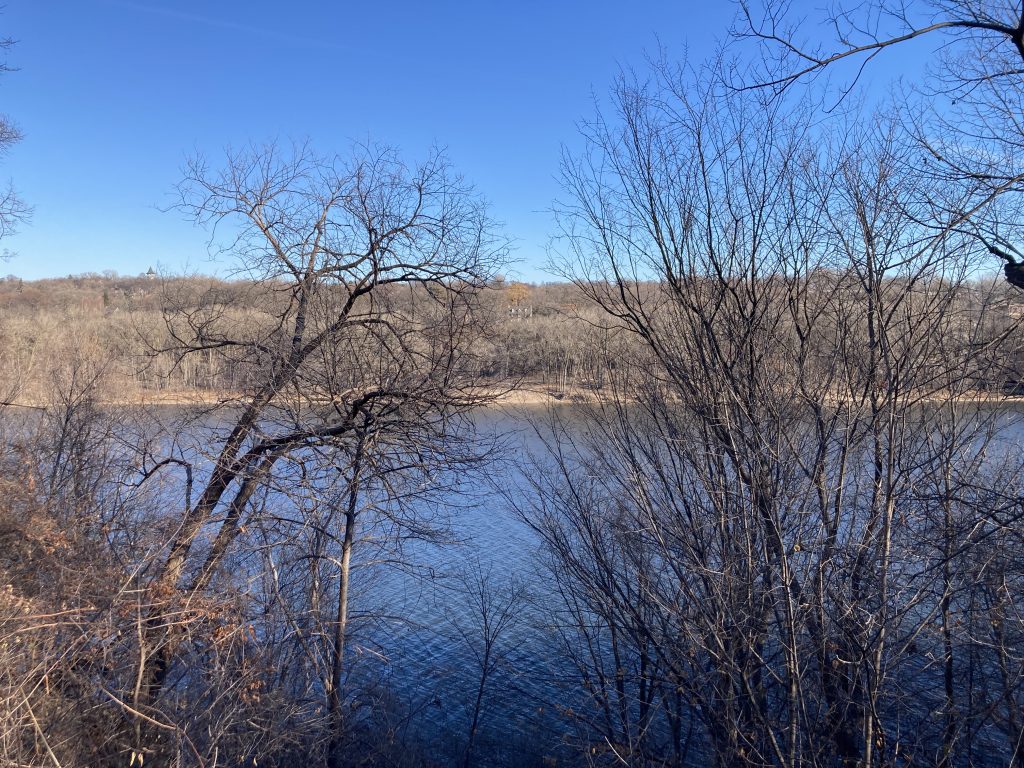
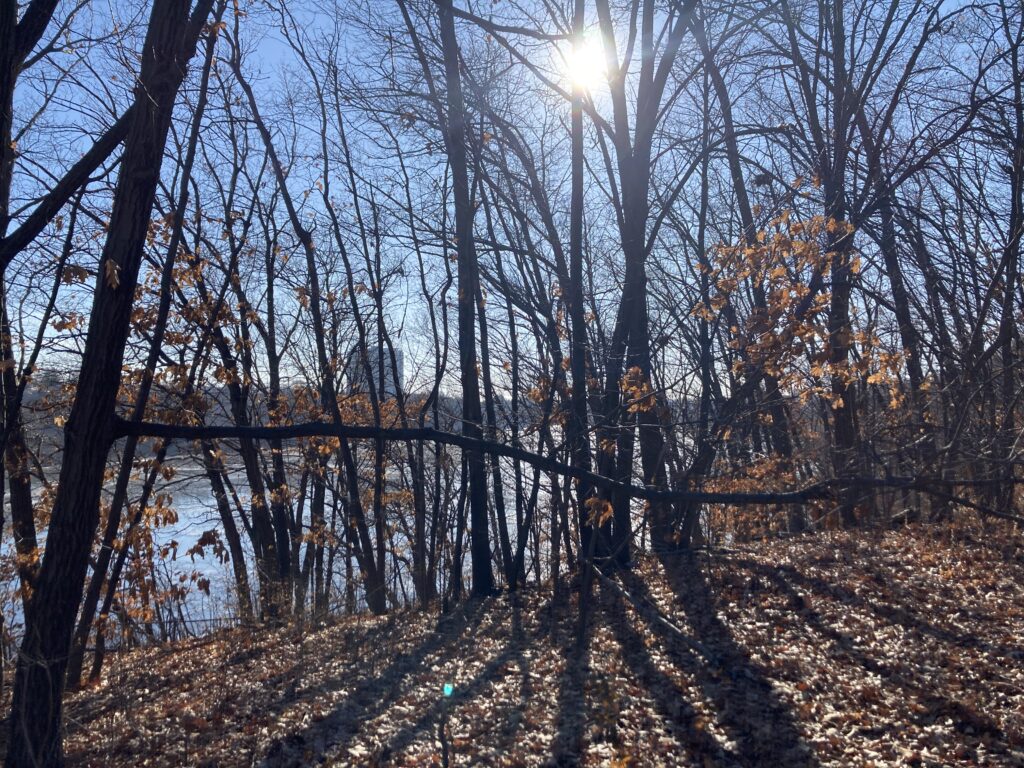
Another sunny, sharp shadow day. Ran south to the falls and listened to cars, birds, kids on the playground, and some guy coughing too loudly. Stopped at my favorite spot to admire the falls, then put in my “Remember to Forget” playlist. Sometimes I felt strong, and sometimes I felt tired. My legs wanted us to stop. I did a few times, including at the bench above “the edge of the world.” I took two pictures. One had a clearer view of the ice on the river, but I picked the other one, with its branches and shadows and white sun:

Most of the image is of dark, bare branches and their shadows on a snow-less ground. Through the trees is an iced river and the sun.
above the edge of the world / 8 jan 2024

10 Things

  1. chirping birds
  2. my shadow, clear and strong
  3. shadows of trees in the park, soft and fuzzy
  4. a shadow of the lamp post, sharp and menacing
  5. someone who looked like Dave the Daily Walker from behind — a tucked shirt and not jacket, tucked into dark track pants — but wasn’t
  6. the creek — bright white snowy surface mixed with fast, flowing water
  7. the falls were gushing through the ice columns
  8. a man with a bad cough near the overlook
  9. a cold wind on my ears when I put my hood down
  10. the shadow of a tree sprawled across the trail that dips below the road, looking like an actual branch that might hit me as I ran by

For a moment, I thought I had completely forgot running the stretch down to, then over, the bridge that crosses above the falls, but then I remembered it: what the creek looked like, seeing some people (one of them, the man with the cough) as I crossed, but then not seeing them, and then seeing them again near the closed gate.

before the run

Last night, I started reading JJJJJerome’s Aster of Ceremonies, which I bought in october of 2023 and hadn’t read yet. Wow! Here’s a bit I’d like to take with me on my run:

What is the wound
reopening during the stutter?
How does it relate
to Morrison’s flooding? When
the Mississippi returns
to its former contours,
does the suture
we created by straightening
it open?
(Octagon of Water, Movement 2/JJJJJerome Ellis)

Last week, I was just writing about how the natural shape of the Mississippi River in the gorge is long gone, reshaped by the city and the Army Corps. After my run, I’ll read Toni Morrison’s essay to which Ellis refers.

added a few hours later: I tracked down the quotation that Ellis puts in a footnote for this poem from Toni Morrison in The Site of Memory (1995, 99):

You know, they straightened out the Mississippi River in places, to make room for houses and livable acreage. Occasionally the river floods these places. “Floods” is the word they use, but in fact it is not flooding; it is remembering. Remembering where it used to be. All water has a perfect memory and is forever trying to get back to where it was. Writers are like that: remembering where we were, what valley we ran through, what the banks were like, the light that was there and the route back to our original place. It is emotional memory – what the nerves and the skin remember as well as how it appeared. And a rush of imagination is our “flooding.” Along with personal recollection, the matrix of the work I do is the wish to extend, fill in and complement slave autobiographical narratives. But only the matrix. What comes of all that is dictated by other concerns, not least among them the novel’s own integrity. Still, like water, I remember where I was before I was “straightened out.”

The Site of Memory/ Toni Morrison

So good! I’m excited to think about these ideas some more and figure out my relationship to flooding and being straightened out and rivers before and after Minneapolis and the Army Corps of Engineers “fixed” them.

Thinking about Ellis’ stutter in relation to my vision problems. In some ways, I have a visual stutter — there’s a long pause between looking at something and actually seeing it. I need time for things to make sense. Also, images stutter, shake, fizz, are always moving, never still or sharp or clear.

remember/forget

1 — will

the differences between what we notice and try to remember and what we ignore or try to forget (16 april 2024)

2 — memory

When I heard the line, Seems like we’re livin’ in a memory, I thought about how I mostly can’t see people’s faces clearly and that I’ve either learned to tune it out and speak/look into the void, or I just fill in the smudge with the memory of their face. I’m used to it, and often forget I’m doing it until suddenly I wonder as I stare at the blob, am I looking in the right place, into their eyes, or am I staring at their chin? I don’t care, but I imagine the other person might, so I try to find their eyes again (9 may 2024).

In jan of 2024, I’m thinking about the daily, mundane bodily functions that we forget we’re doing, or don’t notice — what’s the difference between not noticing and forgetting here? I’m also thinking about this idea of memory and its relationship to the real. When is remembering “only a memory” and when can the act of remembering keep something real? Can we understand remembering as more than thinking about things from the past? What about remembering what is present, here still, real, connected to us?

3 — pay attention, be astonished, tell about it

Thinking more about the difference between noticing and remembering, I’m thinking about the different acts involved here. Yes, it is inspired by Mary Oliver’s instructions for living a life! First, we notice, then we are open to feeling something about what we noticed, then we put that noticing and our feelings into words. For my practice, I don’t try to remember to notice or to be astonished, they just happen — at least, that’s the goal. Remembering comes in when I try to put my attention and astonishment into words. So, the connection between writing and remembering.

4 — writing to remember

I’m not writing it down to remember it later, I’m writing it down to remember it now.

Field Notes slogan

Many different directions I could go with this idea of remembering and writing, but I like this idea of the act of writing about something as the remembering. I rarely look back at my (Field Notes brand) Plague Notebooks when I’m finished with them; it’s the act of writing in them that helps me remember what I noticed or was thinking about. This method is approximate and doesn’t work all of the time. In my practice, I use the act of making a list on my log of 10 things I noticed as the moment of remembering what I didn’t even realize I noticed. But, unlike my plague notebooks, I do return to my log to read past entries and remember what I wrote before — in at least 3 ways: my monthly challenge pages in which I review and summarize what I did in relation to my theme each month; my “on this day” morning reviews, in which I reread past entries from that day in different years; and my annual summary, month-by-month of my log entries.

5 — forget the body

I like my body when I’m in the woods
and I forget my body. I forget that arms,
that legs, that nose. I forget that waist,

that nerve, that skin. And I aspen. I mountain.
I river. I stone. I leaf. I path. I flower.
(Yes, That’s When/Rosemerry Wahtola Trommer)

jan 6/RUN

5.5 miles
bottom of franklin hill
11 degrees / feels like 5

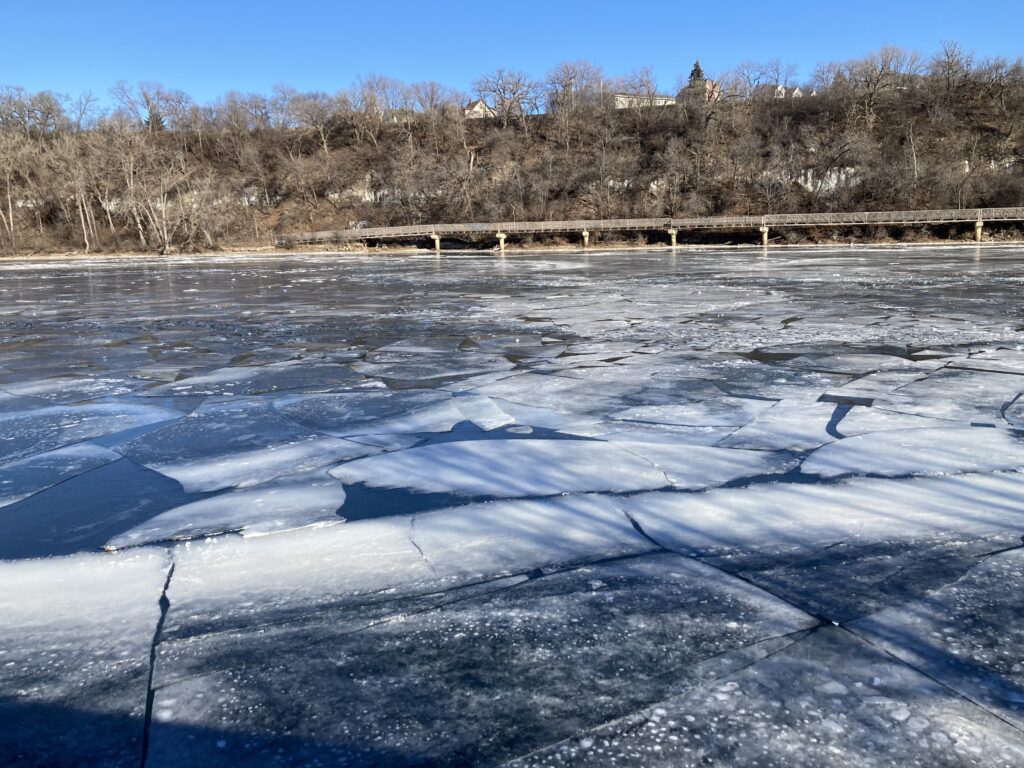
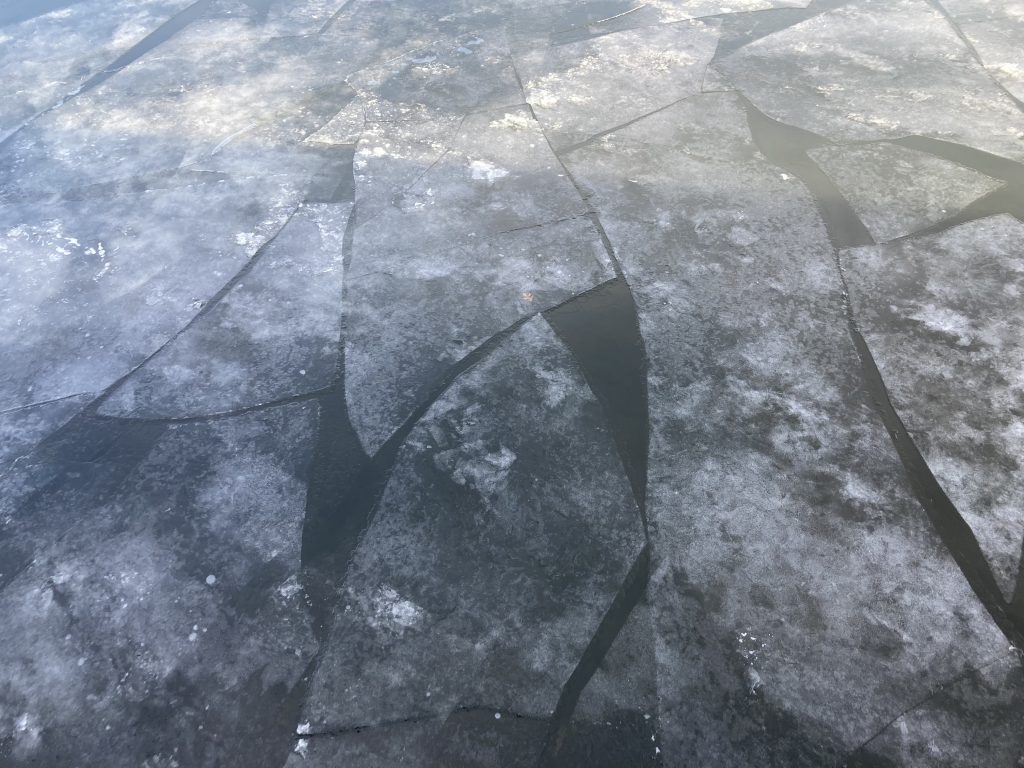
Another sunny, snowless day. A little wind, some cold air. Wasn’t planning to run 5 miles, but I wanted to get to the bottom of the hill so I could see the surface up close. Iced over — not smooth, but with seams and cracks.

The Mississippi river at the bottom of the franklin hill. White ice, cracks, and shadows on its surface. Beyond it, the east bank with barre branches and blue sky.
ice on mississippi river / 6 jan 2025

I’m glad I took a picture because I did not remember it looking like this! I was visually a surface that was more gray and uniform with cracks creating big and flat sheets of ice. I didn’t remember the shadows or the blue or how uneven it all looked.

As I ran, I listened to my “Remember to Forget” playlist. It started with “I Remember it Well,” from Gigi. I heard the opening lines:

We met at 9
We met at 8
I was on time
No, you were late
Ah yes
I remember it well

I thought — wait, if he thought they were meeting at 9, he wouldn’t have thought he was late if he got there after 8 — yes, these are they thoughts I have as I run. I thought about how subjective memory can be and wondered how certain we could be that she remembered correctly. Then I heard these lyrics:

Ah yes
I remember it well
You wore a gown of gold
I was all in blue

I remembered that meme 4 or 5 years ago with the dress — is it gold or blue? — and thought again about how we can remember things differently. When is it lack of memory, and when did we always just remember it wrong, or unusually, or with a focus on different details, or in a different light?

10 Things

  1. the hollow knocking of a woodpecker
  2. the thumping of wheels over something on the road on the bridge above
  3. 4 stones tightly stacked on the ancient boulder
  4. a section of the fence above a steep part of the bluff, missing, marked off with an orange barricade
  5. the icy river through the trees — blue and white and lonely
  6. daddy long legs at his favorite bench
  7. shadows, 1: mine, off to the side, in the brush next to the trail
  8. shadows, 2: a tree trunk, tall, stretched, looking like a dinosaur
  9. stopping at the edge to put in my headphones, seeing a flare of movement below: someone walking on the winchell trail
  10. the limestones still stacked under the bridge, still looking like a person sitting up and leaning against the bridge

A poem about forgetting:

Said a Blade of Grass/ Kahlil Gibran

Said a blade of grass to an autumn leaf, “You make such a noise falling!  You scatter all my winter dreams.”
 
Said the leaf indignant, “Low-born and low-dwelling!  Songless, peevish thing!  You live not in the upper air and you cannot tell the sound of singing.”
 
Then the autumn leaf lay down upon the earth and slept.  And when spring came she waked again—and she was a blade of grass.
 
And when it was autumn and her winter sleep was upon her, and above her through all the air the leaves were falling, she muttered to herself, “O these autumn leaves!  They make such noise!  They scatter all my winter dreams.”

more forget lines

1

like the moment just before you forgot what it was you were about to say, it was like that, and after that, it was still like that, only all the time.
(Part of Eve’s Discussion/Marie Howe)

2

It’s almost romantic as we adjust the waxy blue
recycling bin until you say, Man, we should really learn
some new constellations.

And it’s true. We keep forgetting about Antlia, Centaurus,
Draco, Lacerta, Hydra, Lyra, Lynx.

But mostly we’re forgetting we’re dead stars too
(Dead Stars/Ada Limón)

3

See whatever you want
to see. Even
at the moment of death
forget the door

opening on darkness.
See instead the familiar faces
you thought were lost.
(Squint/Linda Pastan)

4

According to Howe, most (all?) of the critical studies of ED as a poet (up to 1985, when this book was written), read ED’s decision to stay isolated in her bedroom for the rest of her life as tragedy and a failure to celebrate herself as a poet (Whitman) or declare herself confidently as the Poet, the Sayer, the Namer (Emerson). Howe argues that she made another choice and writes the following:

She said something subtler. ‘Nature is a Haunted House–but Art–a House that tries to be haunted.’ (L459a)

Yes, gender difference does affect our use of language, and we constantly confront issues of difference, distance, and absence when we write. That doesn’t mean I can relegate women to what we ‘should’ or ‘must’ be doing. Orders suggest hierarchy and category. Categories and hierarchies suggest property. My voice formed from my life belongs to no one else. What I put into words is no longer my possession. Possibility has opened. The future will forget, erase, or recollect and deconstruct every poem. There is a mystic separation between poetic vision and ordinary living. The conditions for poetry rest outside each life at a miraculous reach indifferent to worldly chronology.

My Emily Dickinson/ Susan Howe

sept 26/RUN

10k
flats and back
59 degrees

Warmer than I thought this morning. Lots of sweat. Sun. Shadows. Sparkling water. Ran past the road closed on Oct 6 (that’s for the marathon!) and smiled. Not long now. I felt fine. My big toe on my right foot stung a little. My right foot is a bit of a mess: an in-grown big toenail, a blackish-purplish second toe, another possible in-grown toenail on the fourth toe. I think it will all be fine — nothing’s infected and it doesn’t hurt that much.

10 Things

  1. a coxswain’s voice, calling out instructions
  2. a motorboat’s wake, leaving soft ripples on the surface of the river, moving upstream and contrasting with the motion of the water heading downstream
  3. ahead of me, under the 1-94 bridge, the river sparking silver
  4. water seeping out of the limestone below the U of M’s west bank, wanting to be a waterfall
  5. my shadow, running ahead of me: sharp and solid
  6. several of the benches were occupied — one person at each
  7. a few more red leaves — a bright, fiery red
  8. the rhythmic snap of a fast runner’s striking feet
  9. cracks in the asphalt just north of the trestle — they just patched these in late spring and the entire stretch was redone 2 or 3 years ago — in 10 years will you even able to run on this section, or will it have slid into the gorge?
  10. someone left the lid of the trashcan below the lake street bridge open — wow, it stinks!

Here’s a poem I read yesterday that I liked to add to my collection of shadow poems — I might also add it to my growing group of moment poems too:

On a Walk/ Heather Christle

My child is upset that they cannot jump over their shadow.
They want me to help them. They want me to teach them
how it’s done. The best I can do is an invitation

to jump over each other’s shadows instead. This satisfies them
for a moment and then the moment is gone. In sunlight
my shadow loves to give me a little dose of sorrow,

the beams having traveled so far only for the lump of me
to get between them and the ground. They came so close.
If I were the earth I would resent me too. My child

has gone into the next moment. I have to catch up. They say
they are riding a horse. They point and it drags them away.

I read this wonderful quote from Hanif Abdurraqib the other day in one of my favorite former grad student’s newsletter. It’s about the ekphrasis form and is helpful for thinking about my “How to See” project:

Many of us live in an ekphrasis mindset. We are often executing ekphrasis storytelling…creating a story based off of that witnessing. I don’t ever want to move beyond that desire to say, I saw something and I know that you were not there to see it. But I can build the world wherein you felt like you have witnessed it alongside me.

via rachael anne jolie

I want to build a world about how I see with my dead-coned eyes in my poems, partly to feel less alone and isolated and partly to invite people to think more what it means to see (and to not see).

Last night, Scott and I were watching “Escape to the Country” and one of the escapees (Carol from Hertfordshire) was registered blind. She sometimes used a white cane and had some help from her husband in navigating, but she could make eye contact and see some of what was going on. When the host (Jules) asked her to explain her vision, she said she could see about 20% of what he could, enough to get a sense of the space, but not clearly. I appreciated that Jules had asked her to explain her vision (and impressed with the positive, non-tragic way they depicted her throughout the episode), but I wanted more. I wished she (and/or the show) had had an ekphrasis mindset and offered additional details about what seeing/not seeing is for her. The host, Jules, suggests, “Fundamentally, understanding how she sees the world is going to be crucial to finding properties that will absolutely deliver.” Even a sentence or two more might have helped in that understanding.

I wondered what someone who had never thought about the process of seeing or the spectrum of no-sight to full-sight made of her description and how she (fairly) easily/”naturally” moved through the world. After my run, I decided to google the episode and see if I could find more information about the woman, like what her condition was, etc. I was disappointed to discover headlines describing her blindness as “heartbreaking” or that she told of it, “with tears in her eyes.” That’s not how I perceived it. Admittedly, I can’t see faces clearly enough to grasp slight facial expressions, but this woman did not seem heartbroken and if she had any tears in her eyes, it was because she was looking into the sun. This was not a tragic episode; she and her husband were excited to move. These headlines seem to be typical examples of writers projecting their own fears and negative understandings of blindness onto blind people (or people with low vision, or people who see differently). Blind = tragic = heartbreaking = pity.

Scott and I watched the brief, 10 second clip that this “heartbreaking” description is based on, and he agreed that she wasn’t upset or crying. Her description was neutral and matter-of-fact. Sigh.

At the beginning of my run, I thought more about the ekphrastic mindset and asked myself, what is art? I didn’t come up with an answer — a task for another run!

one more thing to add: Talking with RJP about my various projects, she introduced me to a new phrase for describing the dirt trails that walkers/runners make in the grass: desire paths. That should be a title for one of my gorge poems, for sure!

march 24/BIKERUN

bike: 15 minutes
run; 1 mile
basement
outside: snowing

A big storm, just starting, but not quite. Now, light snow. We’re expecting 5-9 inches. I wasn’t sure how icy the sidewalks were or how ready my calf was to run, so I decided to work out in the basement.

calf update, for future Sara (and maybe her physical therapist?): during the race yesterday, my calf felt a little strange a few times — a slight tightening? no pain — but was otherwise fine. After the race: some soreness and tightness. today during the bike: a few more flares, an occasional twinge with a little pain. during the run: started feeling sore about 8 minutes, then a little strange. It’s so hard to know what the right thing to do is — stop running? ignore it as nothing, or as a calf that cramped and is now recovering? schedule a pt appointment? If I can get an appointment, I’d like to see a pt. Even if the calf is nothing, it would great to be checked out before serious marathon training begins.

Watched the women’s road race (cycling) from Tokyo while I biked. When the silver medalist, Annemiek Van Vleuten, crossed the line, she thought she had won gold; she didn’t realize that someone in the breakaway had stayed away. background: A. Van Vleuten had been about to win the gold in Rio but had a horrific crash into a cement barricade. She put off retiring for another 5 years just to try and win the gold in Tokyo. Wow. How do you recover from that disappointment? I’m always amazed at the resilience of athletes.

While I ran, I listened to a winter playlist. Other than my calf, I felt good.

Earlier today, I found an article about James Schuyler and this wonderful poem, which I may have read before, but was delighted by today:

The Bluet/ James Schuyler

And is it stamina
that unseasonably freaks
forth a bluet, a
Quaker lady, by
the lake? So small,
a drop of sky that
splashed and held,
four-petaled, creamy
in its throat. The woods
around were brown,
the air crisp as a
Carr’s table water
biscuit and smelt of
cider. There were frost
apples on the trees in
the field below the house.
The pond was still, then
broke into a ripple.
The hills, the leaves that
have not yet fallen
are deep and oriental
rug colors. Brown leaves
in the woods set off
gray trunks of trees.
But that bluet was
the focus of it all: last
spring, next spring, what
does it matter? Unexpected
as a tear when someone
reads a poem you wrote
for him: “It’s this line
here.” That bluet breaks
me up, tiny spring flower
late, late in dour October.

The analysis in this essay is all helpful to me, but I was particularly struck by this bit:

. . . Schuyler’s description of the flower transforms it into art, and that this kind of transformation is his signature poetic activity; it happens again and again in his poems: he describes what he sees before him as if it were a painting so that observation of the natural world becomes ekphrasis. That’s why—to skip down a little—the leaves are likened to a rug, crossing outside and inside, nature and culture, and those leaves “set off” the gray the way a painter or sharp dresser uses one color to set off or complement another, why the air is like a made thing, too, if one you eat, and why the bluet is called “the focus,” the way art critics say something is “the focus of the composition.” Schuyler’s words are paintbrushes, what he describes becomes a painting (though he treats it as already painted)—paint, a medium that splashes and then holds. There are examples of this everywhere in his books. In “Evenings in Vermont,” for instance, a rug again mediates between inside and outside, art and nature: “I study / the pattern in a red rug, arabesques / and squares, and one red streak / lies in the west, over the ridge.” In “Scarlet Tanager,” the bird in the tree provides “the red touch green / cries out for.” In “A Gray Thought,” “a dark thick green” is “laid in layers on / the spruce …” And so on. Touches, layerings: color as paint, natural phenomena perceived as art.  

It’s This Line / Here” : Happy Belated to Birthday James Schuyler

This idea of natural phenomena as art and of Schuyler as describing flowers with painting terms and of him doing ekphrastic poems might be a way into my “How I See” ekphrasis project!

feb 19/RUN

5 miles
john stevens’ house
34 degrees

So bright out by the gorge today. Sharp shadows. Clear path. Black-capped chickadees, downy woodpeckers, construction workers, little kids all chattering. Before I saw the creek, I heard it gushing below me near the falls. Oh — and wild turkeys! A dozen of them pecking the snow just north of locks and dam no. 1.

My favorite part of the run was in minnehaha park near John Stevens’ house, where the serpentine sidewalk — completely cleared and dry — snaked through the grass covered in several inches of untouched snow. O, the sun and the shadows and the curves and the warmer air and the dry paths and the open lungs and humming legs!

an illusion

Glance one: running south on the stretch near 38th street, I noticed something dark and solid up ahead on the trail. A loose dog or wild animal? No.
Glance two: Still staring, the black thing turned into a dark, deep puddle on the road.
Glance three: How could I have mistook this puddle for an animal?
Glance four: Wait — it’s not a puddle, it’s someone’s disembodied legs in dark pants walking on the edge of the path.
Glance five: And their legs are attached to a torso in a light colored (gray? tan? pale blue?) jacket which blended into the sky.
Glance six: Getting closer, I can see a head, some shoes

This illusion is not unusual for me. Mostly, it doesn’t bother me because I am used to it and I have time to figure out what it is I’m seeing. Sometimes, when I don’t have time to look and think and guess, it’s scary and unsettling and dangerous.

Found an interview with Andrew Leland from Joeita Gupta and The Pulse this morning and wanted to remember this helpful definition of blindness:

The Pulse

What is blindness? Blindness isn’t merely an absence of sight. Blindness is a central identity for some, a neutral or marginal characteristic for others. Not all blind people are the same. There are blind vegetarians, athletes, academics, you name it. Some people have been blind from birth, others lose their vision as adults. Blindness can come on suddenly or gradually. Blindness is then more than a physical experience. It has its own culture, language, and politics. Blindness is not the same for any two blind people anymore than sight is experienced the same way by two sighted individuals.

note: This podcast has some other great episodes, including one about birding while blind, which I added to my May is for the Birds page.

How I See

I’m continuing to work on my alt-text/ekphrastic image project. Still trying to figure out the best way into the actual poems. Not quite writer’s block, but a grasping, grappling with, wrangling ideas. Anyway, maybe detouring will help a little. I’d like to gather lines from vision poems that describe how I see. I’ll begin with one of the most well-known blind poets, Jorge Luis Borges:

 In Praise of Darkness / Jorge Luis Borges

Old age (the name that others give it)
can be the time of our greatest bliss.
The animal has died or almost died.
The man and his spirit remain.
I live among vague, luminous shapes
that are not darkness yet.
Buenos Aires,
whose edges disintegrated
into the endless plain, has gone back to being the Recoleta, the Retiro,
the nondescript streets of the Once,
and the rickety old houses
we still call the South.
In my life there were always too many things.
Democritus of Abdera plucked out his eyes in order to think:
Time has been my Democritus.
This penumbra is slow and does not pain me;
it flows down a gentle slope,
resembling eternity.
My friends have no faces,
women are what they were so many years ago,
these corners could be other corners,
there are no letters on the pages of books.
All this should frighten me,
but it is a sweetness, a return.
Of the generations of texts on earth
I will have read only a few–
the ones that I keep reading in my memory,
reading and transforming.
From South, East, West, and North
the paths converge that have led me
to my secret center.
Those paths were echoes and footsteps,
women, men, death-throes, resurrections,
days and nights,
dreams and half-wakeful dreams,
every inmost moment of yesterday
and all the yesterdays of the world,
the Dane’s staunch sword and the Persian’s moon,
the acts of the dead,
shared love, and words,
Emerson and snow, so many things.
Now I can forget them. I reach my center,
my algebra and my key,
my mirror.
Soon I will know who I am.

penumbra: shroud, fringe, a shaded region surrounding the dark portion of a sunspot, in an eclipse the partially illuminated space between full shadow and light

Here are a few lines that I think describe how I see:

This penumbra is slow and does not pain me;
it flows down a gentle slope,
resembling eternity.
My friends have no faces,
women are what they were so many years ago,
these corners could be other corners

A slow, gentle deterioration. No dramatic or sudden shifts. / When I look at people directly, I usually can’t see their faces. / I either see a smudge or darkness or the face I remember from before, when I could see. / sharp edges or corners are difficult to see and streets once familiar are strange. Traveling to a new street corner, I struggle to read signs, to recognize where I am, everything there but not, everything the same forms: Building, Sign, Door

feb 18/RUN

5.8 miles
down the franklin and back
31 degrees

A little icy, a little windy, a little crowded. Difficult to run together in these conditions, so Scott and I split up. The sun was bright and I saw some wonderful shadows of trees — gnarled and sprawling across the sky. Heard some geese, smelled some bacon.

When we ran together, Scott and I talked about the half frozen river and how it looked like a gray slushy. What flavor is gray slushy, I wondered. Scott suggested, all the flavors then added, I bet that would taste good. I wondered if this “everything” slushy would include blueberry. No, Scott said, blue raspberry. I mentioned how there is no consensus on the origins of the rasp in raspberry, which I had come across while reading a past entry a few days ago.

How I See

As I continue to work on this project, I want to return to ekphrastic poems. In an article for Lithub — Back to School for Everyone: Ekphrastic Poetry with Victoria Chang — Chang offers some helpful thoughts about the form:

how poets engage with visual art:

  • write about the scene or subject being depicted in the artwork
  • write in the voice of the person or object represented
  • write about their personal experiences
  • fictionalizing a scene within the art
  • write about the work in the context of its socio-political history

In essence, ekphrastic poems are a way to interact with the world and a way to respond to the world. The process of writing ekphrastic poetry also brings into question aspects of viewing, the culture of viewing, and the gaze, always asking the questions of who is looking at what, when, and why?

3 thoughts about Ekphrasis

1: I’m as interested in how someone is looking as who, what, when, or why they are looking.

2: Maybe part of the ekphrasis angle is the idea that sometimes the world looks like a painting to me — pointillism or abstract expressionism or?

3: the contrast between how a photo captures/stills the image in a way that my eyes never can

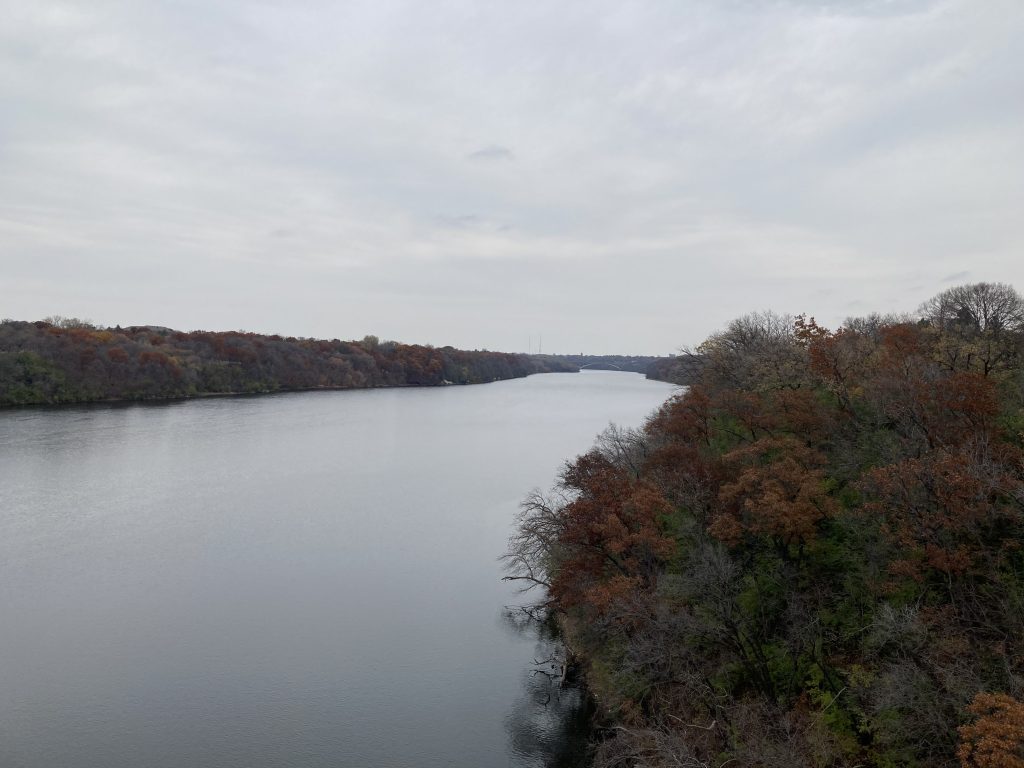
A view from the ford bridge, poorly framed. Not sure what color other people might see here, but to me it's all gray: light gray sky and river, broken up by chunks of dark gray trees. I like how the sky and the river look almost the same color to me.
8 nov 2023

original description: A view from the ford bridge, poorly framed. Not sure what color other people might see here, but to me it’s all gray: light gray sky and river, broken up by chunks of dark gray trees. I like how the sky and the river look almost the same color to me.

5 nouns/ 5 adjectives/ 5 verbs

nouns: river, water, shore, trees, sky, branches, a bend, surface
adjectives: winding, scraggly, soft, fuzzy, drab, dark, light, gray, wide, flat, contrast, wide
verb: stretching, reaching, standing, stilled, separated, cutting through,\

one sentence about the most important thing in image: The sky and the river are the same color; only the disruption of trees enables me to distinguish between them.

a second sentence about the second most important thing: Everything gray: light gray sky and river, broken up by chunks of dark gray trees.

a third sentence about the third most important thing: In this soft, wide open view, when everything is stilled, silent, nothing is happening.

The nothing that’s happening in this image is full of meaning. Here nothing = no things are doing anything/ nothing to see; nothing = a void, absence, unknowingness; nothing = a rest for my eyes, no movement, everything still, satisfied, stable.

The idea of no separation, no edges or divisions between forms, reminds me of a wonderful poem that I thought I’d posted already, but hadn’t. I think when I first encountered it a few years ago, it didn’t resonate for me. Now, I want to call out, yes!, with almost every line.

Monet Refuses the Operation/ Lisel Muller

Doctor, you say there are no haloes
around the streetlights in Paris
and what I see is an aberration
caused by old age, an affliction.
I tell you it has taken me all my life
to arrive at the vision of gas lamps as angels,
to soften and blur and finally banish
the edges you regret I don’t see,
to learn that the line I called the horizon
does not exist and sky and water,
so long apart, are the same state of being.
Fifty-four years before I could see
Rouen cathedral is built
of parallel shafts of sun,
and now you want to restore
my youthful errors: fixed
notions of top and bottom,
the illusion of three-dimensional space,
wisteria separate
from the bridge it covers.
What can I say to convince you
the Houses of Parliament dissolve
night after night to become
the fluid dream of the Thames?
I will not return to a universe
of objects that don’t know each other,
as if islands were not the lost children
of one great continent. The world
is flux, and light becomes what it touches,
becomes water, lilies on water,
above and below water,
becomes lilac and mauve and yellow
and white and cerulean lamps,
small fists passing sunlight
so quickly to one another
that it would take long, streaming hair
inside my brush to catch it.
To paint the speed of light!
Our weighted shapes, these verticals,
burn to mix with air
and change our bones, skin, clothes
to gases. Doctor,
if only you could see
how heaven pulls earth into its arms
and how infinitely the heart expands
to claim this world, blue vapor without end.

feb 17/CORE

Too cold for Scott (and me, too — the lack of cold this winter has un-conditioned me to the cold) today. Or maybe it’s more the wind? We will do our weekly run tomorrow. Today, more core. I did the Madfit 30 minute all body workout again. Tried the reverse lunges, and they weren’t as bad for my knees as I thought…until they were, at the end. Now, having finished, my lower back hurts a bit on the left side. Should I be worried?

something future Sara might like to know: Today for the first time in decades a world cup cross-country ski race is happening at Theodore Wirth Park. Until we got about 1/2 foot of snow last week, I wondered how it could happen. But it did snow, and today it happened. Very cool.

How I See

Yesterday in my description of my image I wrote the following:

one sentence about the most important thing in image: This cluttered view of bare trunks and thin branches creates a screen between runner (me) and river and resembles what I sometimes see even when there aren’t thin, bare branches everywhere — my view obscured by something in the way, that I can’t move, that keeps the real (focused, clear, open) view just out of reach.

a second sentence about the second most important thing: The image is only of swirling forms — tree, leaf, river — as my eye struggles (and fails) to land on solid lines, instead bouncing from branch to trunk to leafy floor to river to sky to branch again. (This cramped, thickly tangled space overwhelms my eyes and my brain.)

Rereading these sentences, I’m realizing that the first one is a bit misleading. My view is not obscured by a fog or haze, like some veil is covering/concealing the river. My view is obscured because of what I write in sentence 2: images don’t have solid shape, clear and defined lines. They’re constantly moving, buzzing, vibrating.

The idea of cloudy, foggy vision is more associated with cataracts:

from Cataracts/ Linda Pastan

Like frosted glass, 
you blur the hard edges
of the cruel world. 

Like summer fog, you obscure
the worse even an ocean can do.

Frosted glass, a blur, summer fog.

from Ekphrasis as Eye Test/Jane Zwart

But usually the picture dims proportionally, cataracts
stirring gray into haystacks and ground and dust-ruffle
sky. Maybe you will finally understand Monet, his play
in thirty acts, his slow lowering of the lights in Giverny.
At last there is nothing left to squint against.

Wow, the more I return to this poem, the more I love it, and relate to it.

After realizing that fog or smoke or haze or gray mist isn’t what happens to me and my vision, I wrote a few notes:

The something that is in the way is not some cloud or obstruction — no fog or haze — but something that refuses to come into focus — bouncing around from object to object, television static — not fuzz but fizz — everything shaking wobbling lines wavering such small movements it’s difficult to detect, shimmering simmering — what is that effect when you see the heat on the road? look that up* — like most things with my vision, it’s not obvious or direct. I don’t look and see wavy lines, I feel wavy lines, a restless unsettling not fixed an unhinging coming undone vibrations pulsing throbbing crowded cramped moving always, slightly shaken, a constant stirring

*best answers: heat haze or heat shimmer

I like a lot of these lines. Right now, I especially like: not fuzz but fizz. Constant movement is key to my dying vision — I think it’s exhausting me and making me even more restless. Is my brain constantly trying to make sense of these images? or are the moving images just making me feel unsettled most of the time? How does my sense of moving images feel different than people with nystagmus (“An involuntary eye movement which may cause the eye to rapidly move from side to side, up and down, or in a circle, and may slightly blur vision.” — wikipedia). One of my favorite poets, Lorine Niedecker suffered from nystagmus. Interesting — if I’m reading my source correctly, nystagmus is not a vision problem, but a balance one.

Speaking of nystagmus and Niedecker, here’s a source: Nystagmatic Poetics in Lorine Niedecker

feb 16/BIKERUN

bike: 15 min warm-up
run: 1.5 miles
basement

Finished the 2nd episode of season 1 of Dickinson, started the 3rd while biking. I’m really appreciating the audio descriptions. So much easier to watch shows! I’m also surprised at how normal/natural/not disruptive the audio descriptions are. Is it that way for people with good vision? I’ll have to ask Scott after we watch something with AD turned on.

Listened to a winter playlist while I ran. Just a short run to burn off some restlessness, to rest my eyes from reading/writing, and to add to my weekly total of miles.

Before the run, I worked on another image for my “how I see”project. Maybe I should take the 3 I’ve already done and do more with them?

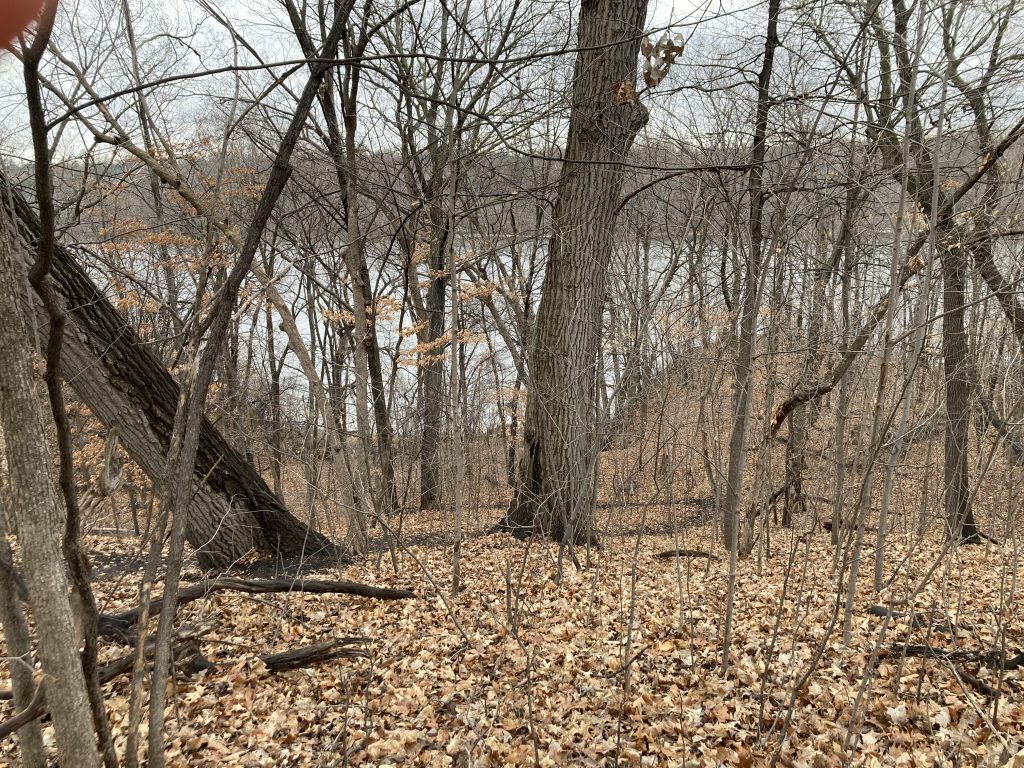
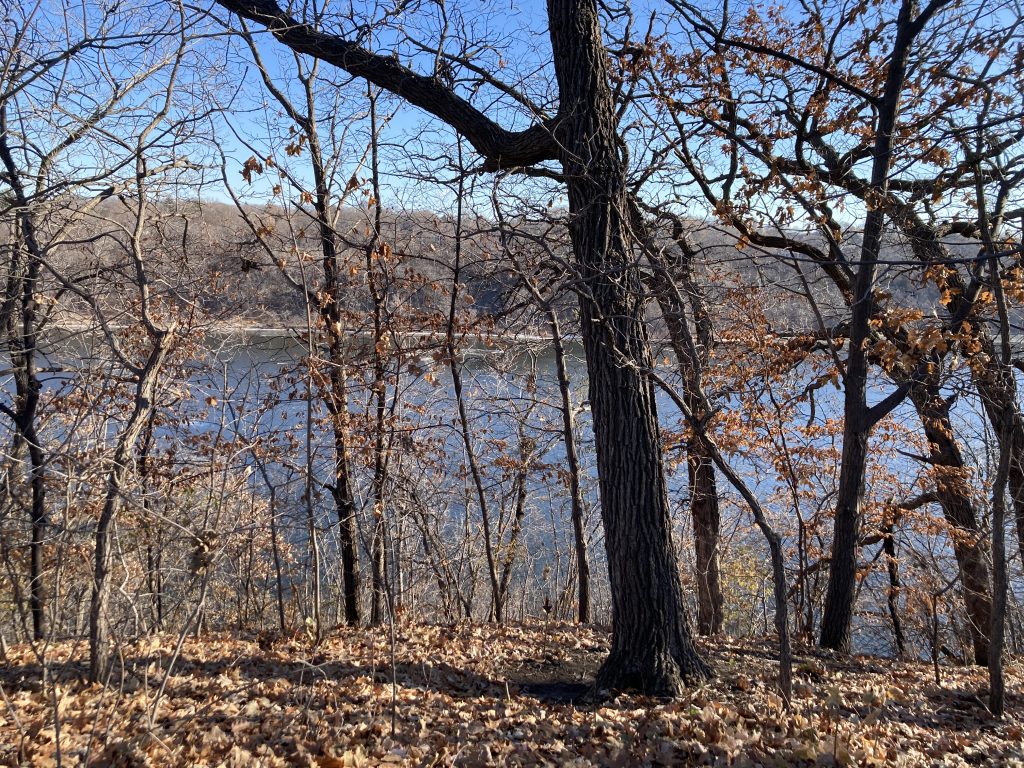
 My view from above the gorge: bare limbed trees, all trunk and thin branches. A few trunks are thick — like the one near the center of the image or the one leaning on the left side — but most are thin, creating a transparent screen between runner (me) and river.
8 feb 2024

original description: My view from above the gorge: bare limbed trees, all trunk and thin branches. A few trunks are thick — like the one near the center of the image or the one leaning on the left side — but most are thin, creating a transparent screen between runner (me) and river. The ground, in the bottom third of the picture, is mostly dead, curled-up brown leaves. Sometimes, this is what I see even when there aren’t thin, bare branches everywhere — my view slightly obscured by something in the way — dead cone cells, I think — creating fuzz or static or a slight pulsing or wavering of lines. Also, if this picture were in black and white I wouldn’t be able to tell the difference. Often I have to ask Scott: is this in color or black and white?

5 nouns/ 5 adjectives / 5 verbs

nouns: tree, trunks, leaves, river, twigs, bank, bramble, sky, veil, net, screen
adjectives: brown, thin, thick, pale, blue, gray, soft. cluttered, tangled, obscured, disoriented
verbs: blocking, concealing, decaying, settled, crowding (out), decomposing, swirling

one sentence about the most important thing in image: This cluttered view of bare trunks and thin branches creates a screen between runner (me) and river and resembles what I sometimes see even when there aren’t thin, bare branches everywhere — my view obscured by something in the way, that I can’t move, that keeps the real (focused, clear, open) view just out of reach.

a second sentence about the second most important thing: The image is only of swirling forms — tree, leaf, river — as my eye struggles (and fails) to land on solid lines, instead bouncing from branch to trunk to leafy floor to river to sky to branch again. (This cramped, thickly tangled space overwhelms my eyes and my brain.)

a third sentence about the third most important thing: With its bare ground and dead leaves, it looks like this picture should be of the gorge in November or April, but it was taken in one of the first Februarys without at least 1/2 foot of snow on the ground. 

The most important thing about this image is how the branches create a net which mimics how my vision often works — I can almost see what’s there, but not quite. Secondary, but connected, is the feeling of being disoriented, off, almost but not quite, untethered, which comes from swirling forms and the climate crisis — there’s almost always snow on the ground here in February. Where are my Minnesota winters?

feb 15/BIKERUN

bike: warm-up
run: 3 miles
basement
outside: 4 inches of snow

Snow! Finally. My first real shovel session of the winter. Thought briefly about running outside on the trail, but when Scott told me he had heard the city hadn’t plowed the bike path, I decided against it. I watched more of the first episode of Dickinson with the audio description on while I biked. Listened to my winter playlist while I ran. I blocked the display panel, so I wouldn’t know the time. When I finally checked, I thought it would be 15 minutes at the most. It was 25. Wow.

Watching/listening to the audio description, it was interesting to notice when/how they chose to describe something and when they didn’t. An example: In one scene, Sue is sitting in the parlor. We see her looking and pointing, then we see a basket with a letter in it hanging outside of the window. Sue says, Austin. Look. At this point, the audio description (AD) says, Sue points to a hanging basket. Austin opens the basket and removes a small envelope addressed to Sue. I was struck by the AD choice to wait to describe Sue’s pointing until after the action was over. Something — poetic whimsy? — was lost in not describing Sue’s strange pointing — it seemed, at least to me, almost comical. Should it have been described? I’m not sure; I mention it to highlight how ADs involve choices of what to include or not include, often for clarity or brevity.

I must have still been thinking about this choice to not immediately describe the pointing while I was running because I suddenly had an idea about the significance of what my image descriptions leave out. I wanted to remember my thought so I pulled out my phone to record it, but the audio is messed up and I can’t understand what I’m saying. Bummer. My descriptions will be explicitly subjective. I want to emphasize how we always make choices when describing what we’re seeing — what’s important and what’s not. Our brains do this too when we’re seeing — it’s called filtering.

before the run

While rereading an entry from this day (15 feb) in 2022, I discovered that past Sara had been thinking about alt-text as poetry. I mentioned wanting to create alt-text for my beloved mannequin photos and posted some links:

I’ve already started using the first link. Just now, I read through the twitter thread. Very helpful! Here are some highlights — BTW, putting together these notes has used up a lot of my visual “spoons” for the day.

Not describing everything, but getting to why the image is there:

I think people who find providing alt text overwhelming think too much about describing every last detail in the image, when it’s more like, ok, why did YOU post it? …focus on why you’re posting the image or what it’s supposed to do or how other people would recognize it

Alt-text predates “accessibility”:

“alt” here is short for “alternate” and originates from HTML—back in Ye Olde Days if an image took 10 minutes to load or otherwise broke, you’d provide alt text that the browser would display in place of the image so you still knew what was going on

different than an image description, alt-text is only for necessary images, not decorative ones:

and alt text is different from image descriptions; alt text describes the purpose of the image and isn’t typically included if something is purely decorative—but do note that even a gif for example carries semantic meaning and is thus NOT purely decorative

intended to be brief

alt text is meant to be short, as it would get cut off by the image bounding edges otherwise

example of alt-text vs. image description

alt text for a chart: “Graph showing increase in alt text use on Twitter”
image description for a chart: “A graph titled ‘Increase in alt text use on Twitter.’ The y-axis shows percentage of images including alt text. The x-axis shows time in years from 2008–2022…”

craft it

don’t be afraid to put your personality into alt text or be funny or use alt text to extend your shitpost, like imagine using a screenreader & your entire TL is dry descriptions until “a dog so cute I screeched” appears

look to audio descriptions for good examples of image description and using brevity

I think there’s a lot to learn from audio descriptions too for how to provide alt text & image descriptions! try turning on audio descriptions on a show or movie and observe how to pack in detail, especially given the time constraints—you only have a few seconds to describe smtg — boba fett’s audio descriptions are amazing, they’re wonderfully evocative while also including details I wouldn’t have known, not being a star wars fan (like they note that the palace is jabba’s and name which character’s helmet he picks up)

it’s subjective

accessibility is a fluid concept that depends a lot on audience; there’s no one “best” way to write alt text or an image description, because fundamentally it’s about what details other people care about, and that will change across topics and groups

an extended example of using alt-text to further/enhance the story

I am DYING, here is an incredible example of alt text augmenting the experience for someone using accessibility features—it calls out only the visual features that are important (’90s aesthetic, scalloped border) and provides the context that makes this reply hilarious

Katherine Crighton
@c_katherine

Screencapture of a Denny’s tumblr ad. Of key interest, aside from its very 1990s aesthetic, is the scalloped border around the ad–at the time, it was intended by Tumblr’s parent company to denote to casual readers that the contents within the border were a paid advertisement. Specifically, only those who had paid for space would be granted the scalloped border. Denny’s, the restaurant chain and purveyor of surreal humor on social media, demonstrated with this ad that while the intent was to monetize this border, in actuality all one had to do was take a screencap, drop in your own ad, and then post the resulting image via the normal, non-monetized process– it would then appear the same way to the end-user, whether or not Tumblr’s owner recieved a dime. This method of deriving ad income was dropped shortly after the Denny’s “ad” pointed out this flaw.

Some very helpful ideas in this thread —

the why/purpose is the focus. In my “how I see” images, I’m not interested in describing everything in the image — I probably can’t because of my limited vision, but the ways it serves as an example of “how I see.” I’m also interested in bringing some elements of ekphrasis into this — what are those? I need to spend more time thinking about that!

the idea of brevity. I’d like to make these descriptions short. I think it might be helpful for my creative process to pick a meaningful number of characters or words or syllables. I’ll think about that some more.

listening to audio descriptions for guidance — I think I’ll bike this morning and watch/listen to a Dickinson episode! I did!

a ramble of thoughts:

thought one: Recently, I’ve started proof-reading my poems by listening as the screen reader reads them. I noticed that the speaker (mine is Fred — according to system preferences on my mac) can do enjambments (a sentence split up over multiple lines) when the sentence is at the beginning of the line. But when the sentence begins in the middle of a line, Fred pauses at the end of that line and reads the next line as a new sentence. Enjambment is much more a visual device. My alt-text poems should not use visual devices, but rely on aural ones. What are these? I know rhyme, meter, alliteration, assonance. Time to study! I’ll start with my Mary Oliver poetry handbook!

thought two: I’m just remembering a great line from June Jordan in her guidelines for critiquing a poem:

Punctuation (Punctuation is not word choice. Poems fly or falter according to the words composing them. Therefore, omit punctuation and concentrate on every single word. E.g., if you think you need a question mark then you need to rewrite so that your syntax makes clear the interrogative nature of your thoughts. And as for commas and dashes and dots? Leave them out!)

So, try writing my descriptions without punctuation. BUT, I’m also thinking of Dickinson and how important punctuation (em dashes, for example) were for her. How could I use punctuation to shape how Fred speaks my words?

thought three (barely formed): One feature of many ekphrastic poems is a contentious/combative dialogue between word and image. What about twisting that to push at the conflicts between hearing a word versus seeing an image?

All these thoughts might be too much, and might not lead anywhere I want to go, but I’ll keep with them for a little bit longer. I was just telling Scott last night, or was it this morning?, that I appreciate how past Sara includes discussions of intended plans. Sometimes I don’t act on these plans — and maybe it seems like I have too many ideas or that I’m all over the place, or that I’m not following through — but it’s cool to be able to trace the origins of the projects that do happen. And the plans that I didn’t act upon? Maybe I just not ready for them yet.

a few hours later:

Here are some notes from Bojana Coklyat in Conversation with Shannon Finnegan:

we can get more out it alt-text than just compliance:

SF: Something that has always been a hope of mine with the project is that for people who aren’t as familiar with access, it introduces them to a way of thinking about access as creative and generative and collaborative and process-oriented, and that might also influence the way they think about access in other parts of their lives.

BC: Alt text is so often approached through the lens of compliance, like, Okay, let’s just get this done. But when you’re paying attention to the language you’re using and how you’re putting it together, that’s already changing things. That’s already shifting things.

space and symbolism

BC: I was talking to Chancey Fleet, who works at the Andrew Heiskell Braille and Talking Book Library in New York, and Chancey said something to me and I was just like, Whoa, I have to really think about that. She said, “Is it that we really live in such a visual culture? Is the most important thing visual, or is it space and symbolism?”

I was thinking about that all day yesterday. And going back to this exhibit I went to yesterday, there was a metal piece that kind of looked like scaffolding or architecture. And then we had the chance to walk through it, and it was like, Yeah, this is the experience. It’s walking through it and understanding the space of it. It’s not necessarily, OK, this part’s five feet tall, it’s metal, and it intersects with this piece that’s metal. It was so much more about walking through it, navigating it, and even navigating it with someone.

I think that might be something I’ll start to think about more with alt text: symbolism and space and how those fit in when you’re describing something.

SF: I love that idea of thinking about symbolism. I often find that in descriptions, when someone uses a metaphor or a comparison, it really helps me understand what the subject of the description is really like, and that feels really related to this idea of symbolism. It’s like: What are your associations with this thing, rather than just with how 
feb 14/RUN

6.7 miles
franklin loop+*
37 degrees

*The + is because when I reached the lake street bridge, instead of taking the steps up to it, I kept running up the summit hill until I reached the top, then turned around.

When I started my run, the sky was blue and the sun was shining. I wondered how a winter storm could move in by this afternoon. But, by the time I was done running, it was overcast. We could get up to 4 inches. Finally, I’ll get some snow. That’s what Dave, the Daily Walker said when I saw him on the trail. My response: I know!

10 Things

  1. woodpecker, 1: loud drumming
  2. woodpecker, 2: a downy woodpecker call, sounding like a loon to me
  3. the lake street bridge, its arch reflecting a smile in the river
  4. the light reflecting off of the stream in the ravine near shadow falls — a bright white
  5. shadows — mine, of lamps, trees, railings
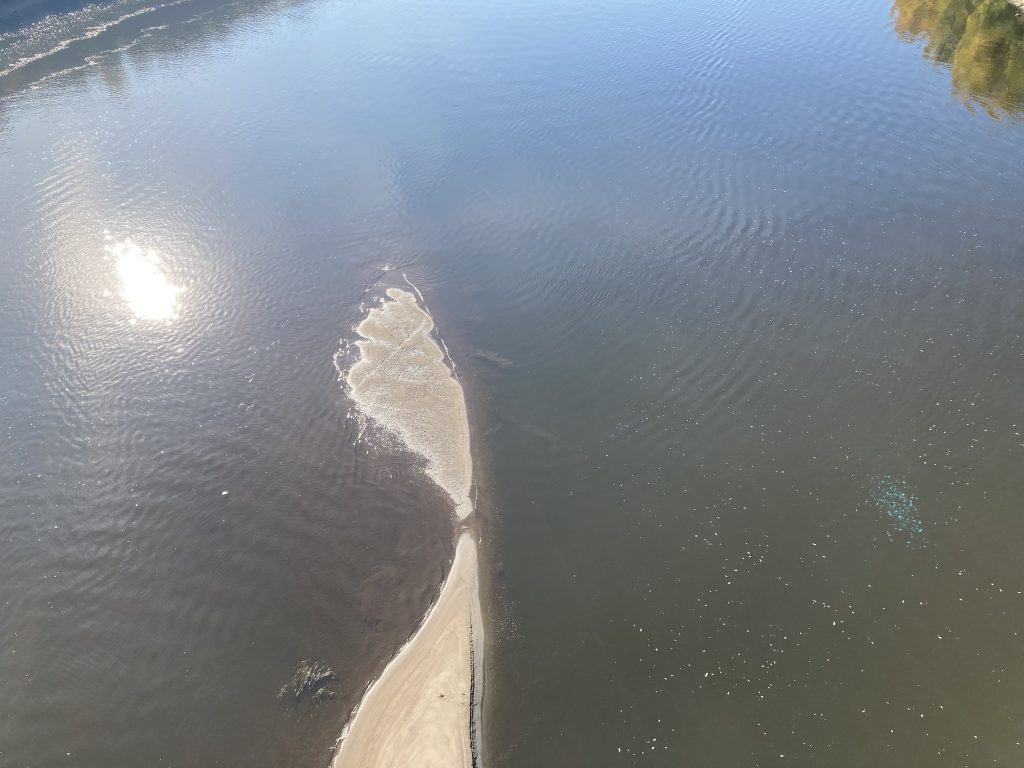
  6. a sandbar in the river the trestle
  7. the sun illuminating all of the patched-up cracks on the path just under the lake street bridge on the east side
  8. paw prints in mud
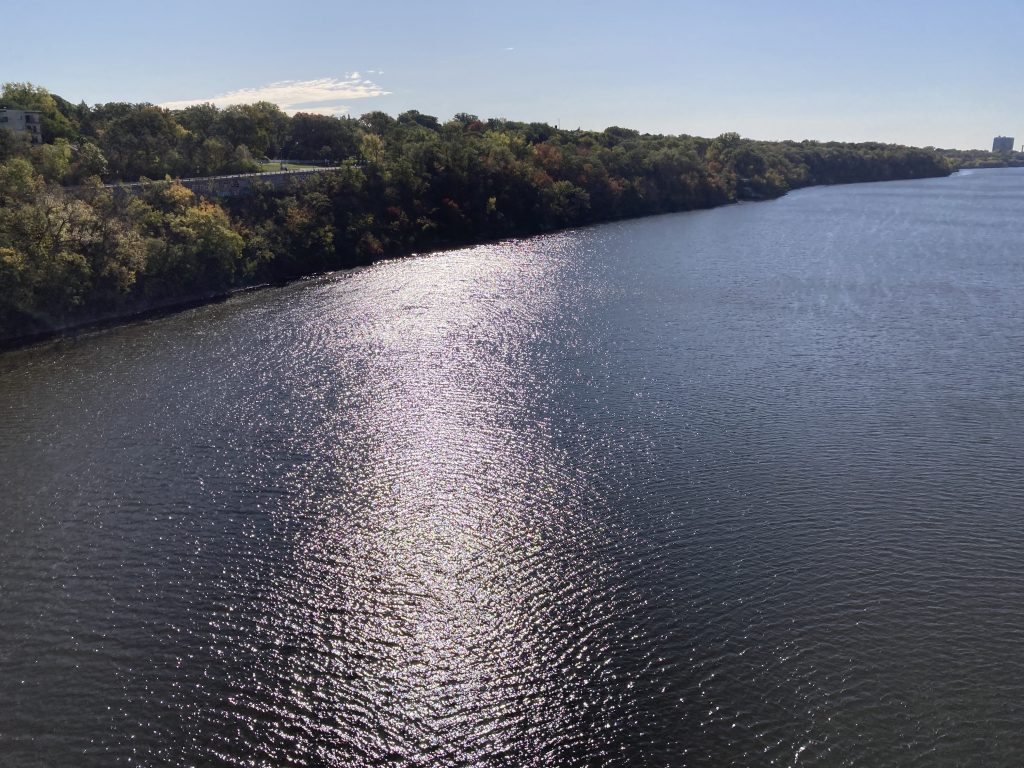
  9. the river, pale blue with one shiny circle in the middle
  10. smells: fried and savory (from longfellow grill?), weed

I took several pictures, but I’ll save them for posting after I experiment with them.

more experiments with alt-text

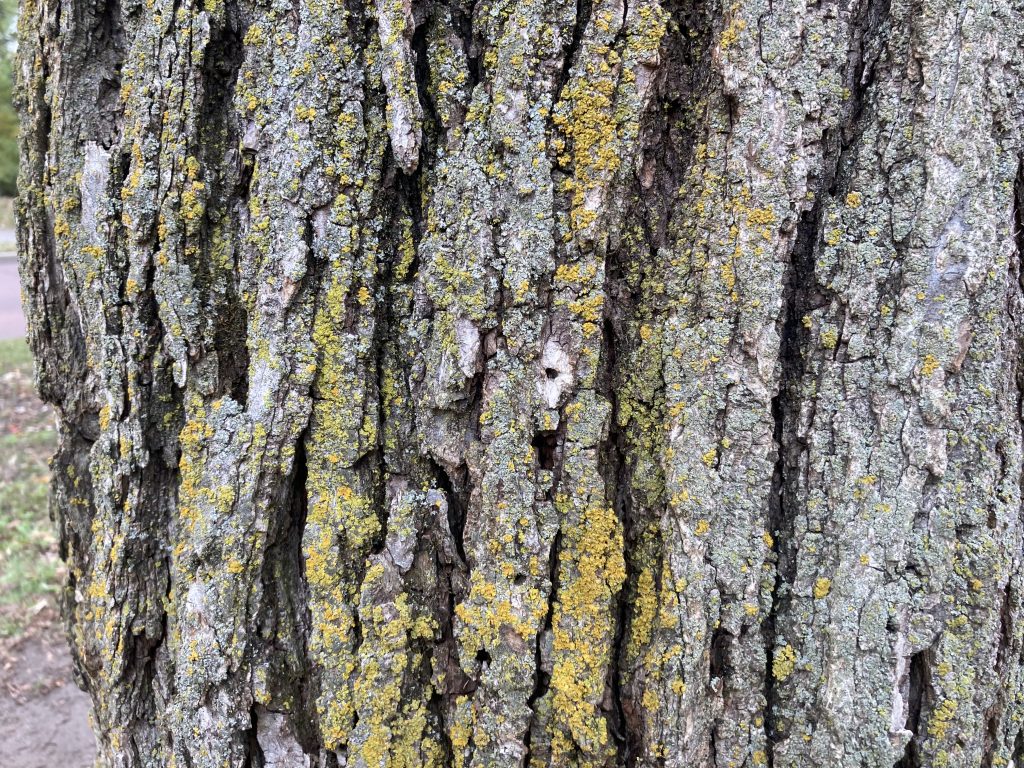
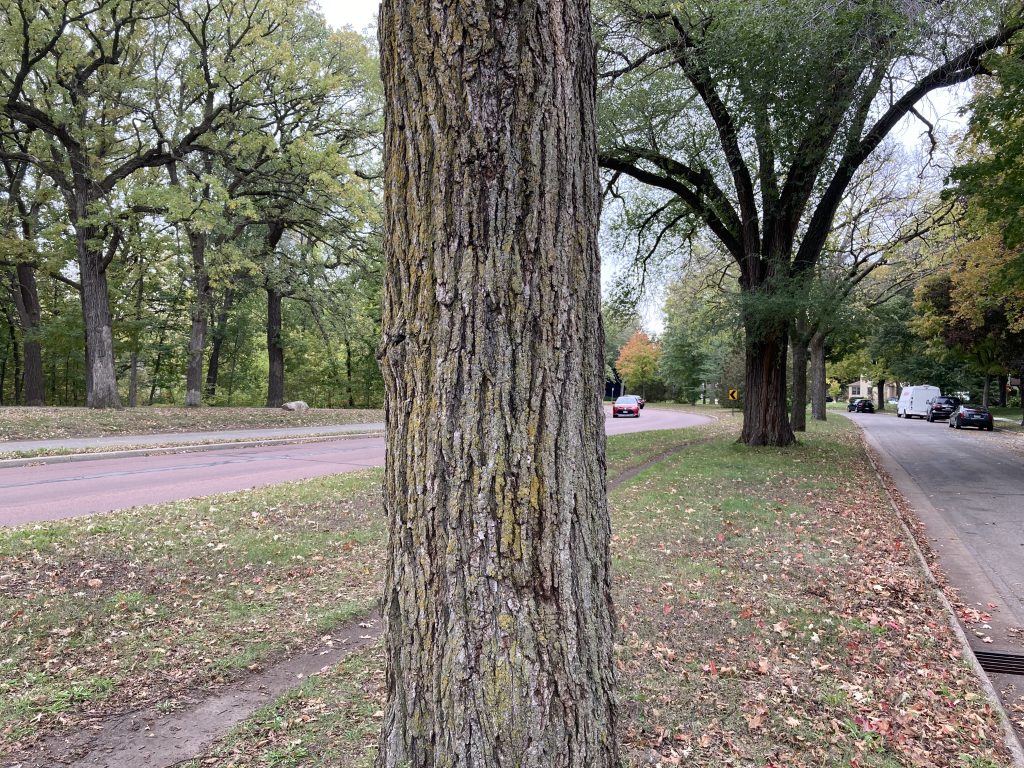
A close-up image of tree bark that is rough and brownish gray (or grayish brown). There are streaks of greenish-yellow lichen on the bark. While taking this picture, with my face close to trunk, I could see the lichen, and if I put my face close to the screen I can still see it. But at a normal (1 foot) distance, it almost blends in, not looking yellow or green but light brown.
12 october 2023

initial description of image from 12 oct: A close-up image of tree bark that is rough and brownish gray (or grayish brown). There are streaks of greenish-yellow lichen on the bark. While taking this picture, with my face close to trunk, I could see the lichen, and if I put my face close to the screen I can still see it. But at a normal (1 foot) distance, it almost blends in, not looking yellow or green but light brown.

The trunk of a tree with rough bark. A few more trees and a road behind it.

12 oct 2023

5+ nouns / 5 adjectives / verbs of first image of the trunk:

nouns: tree, bark, cracks, depressions, ridges, textures
adjectives: dark, rough, light, weathered, gray, bumpy, old
verbs: hiding, aging, enduring, exposed, weathered, entangled

one sentence about the most important thing in image: Close up, with my face almost on the bark (or the screen), I can see the green lichen near the bottom of the image, but from a foot back, the bark is only brownish-gray or light with dark depressions or rough.

a second sentence about the second most important thing: The rough texture on this bark, made visible by the constrasts between light and dark, offers an interesting pattern.

a third sentence about the third most important thing: Just off center (by less than an inch?) there’s a light spot with a dark hole in its middle that is where the bark has worn off but that looks almost like a belly button, making it impossible for me to see anything else but it, and hear only belly-button in my head instead of tree or bark.

Oh, I’m enjoying this experiment! Each of my sentences speaks to a different thing about my vision. Sentence one is about how I rarely see color beyond gray or brown. The yellowish-green, which I imagine is very obvious to people with all of their cone cells, is invisible until I look very close or to the side, through my peripheral vision.

Sentence two is about how I have replaced ROYGBIV colors (like green or yellow) with contrast; the 2 primary colors for me are light and dark. They are how meaning is made for me.

Sentence three is about how when I’m focused on one thing, like the light spot near the center, (most) others things are invisible. I only see the spot and not the rest of the tree, or even that it is a tree. I’m sure this is true to some extent for other people with working cone cells, but it is more extreme for me. An example: when I’m running on the trail and my attention is focused on a biker approaching from a distance, the runner much closer to me is completely invisible. I don’t see them at all until we’re fairly close. It’s happened several times over my years of running with low vision. I’ve never run into anyone because I always see them with enough time to adjust. But it’s unsettling and doesn’t feel normal, or at least like how I used to see before so many of my cone cells died.

feb 12/RUN

3.1 miles
trestle turn around
35 degrees

Feels like spring. When I got back, I told Scott: In a normal winter, this would have been one of those days that makes you believe spring is coming. But it’s not a normal winter — no snow, only a short stretch of below freezing temps in January.

So many wonderful birds! As I listened to them chirp and tweet, I imagined the sounds as dots on a scatter plot — but what are the variables on this chart? I’ll have to think about that one. I don’t remember using scatter plots very often. All I can think of is the scatter plot on my kids’ yearly wellness checks for charting growth (variables: height and weight). The idea of scatter plot does sound intriguing as a form. I wonder what fun I could have with it?

An okay run. The conditions were wonderful, my left IT was not. It was sore — time for more fun with the IT band:

  • incandescent tripe
  • imbibing Taylors (apparently Taylor Swift impressively chugged a beer after KC won the super bowl yesterday)
  • implacable termites
  • impending trauma
  • instant triumph (in the last seconds of the first quarter of overtime, Kansas City scored a touchdown and won the game — and just like that, it was over)

As I ran, I thought about how my vision seems to be getting worse. There are some signs that I can’t see things as well, but it’s more that my eyes are straining more to read and I’m getting tired/having headaches from it. Time to put more energy to finding new, less wordy, ways to be. Part of me wishes I didn’t have to, but more of me is up for the challenge and curious about what interesting doors it might open.

I also thought about my ekphrasis project and where it might lead. I stopped and took a few pictures to use for my “how to see” project. Here’s one:

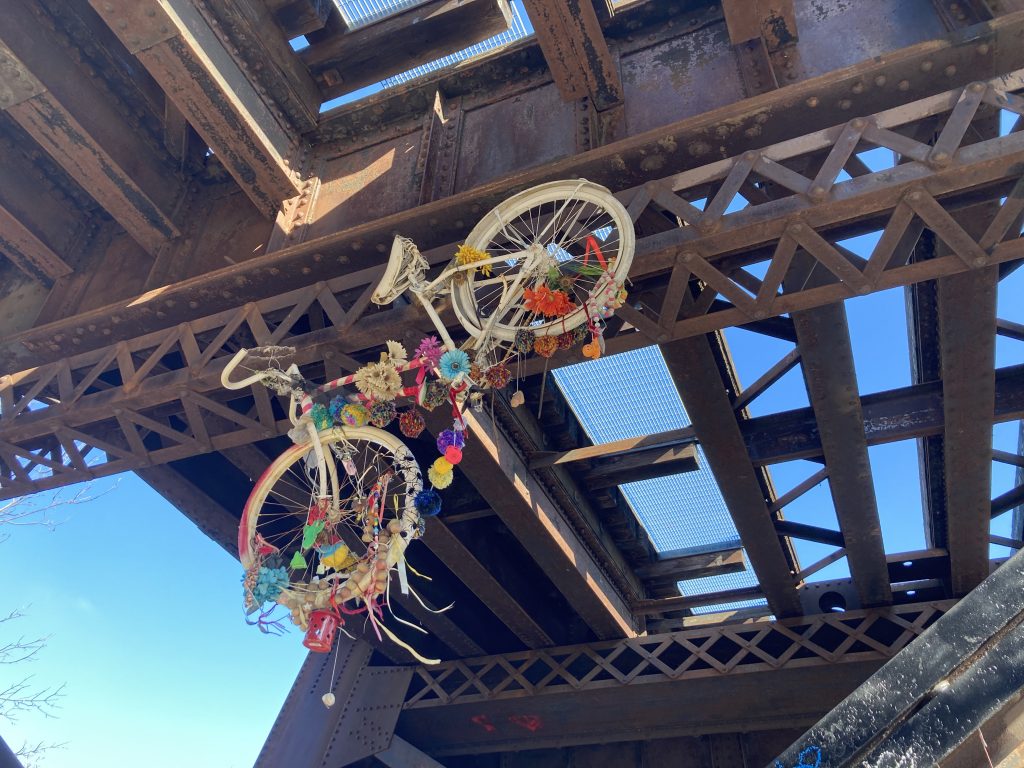
A white bike suspended from a brace on the underside of the railroad trestle.
A white bike suspended from a brace on the underside of the railroad trestle. I can barely see it in the photo, so my description comes more from my memory of when I was looking up at it to take the photo. I think it has flowers and vines wrapped around it. From a “normal” distance, I see some color — blue sky, red and yellow flowers — but they’re muted. When I put my nose right on the screen, the colors are much more vivid, but scattered. My eye is drawn to the lighter sky in the lower left hand corner, which makes everything else even more of a blur. I think I was able to “see” this bike because I know it’s there — I’ve studied it and looked up why it’s there. I even wrote a poem about it. I often rely on memory for seeing.

Looking, or trying to look, at this photo, I’m struck by how different of an experience it is than being below the bike on the trail. (How) is that true for everyone? How much do my vision issues shape these differences? I think it has something to do with the static nature of the image and the absence of other sensory data: no smells, no hearing the wind, no feeling of blue or bike or flower that I usually get when seeing beyond the narrow frame of a photo.

The poem I wrote about this ghost bike — that’s what these white bikes that are left on the trail to honor someone who died are called — as part of my larger Haunts project.

Ghost bike:
under the
trestle
for June
hit and killed
while fix
ing her bike
in a
parking lot.

Flowers:
next to
June’s ghost bike
plastic
placed in the
remains 
of a post
once part
of metal
railing
now only
open
cylinder 

Note: In the winter, someone hangs the bike up higher. Usually, for the rest of the year, it’s lower to the ground, with flowers placed nearby.

Found this poem the other day. I love the listing, then the pow at the end with the final line.

Medical History/ Nicole Sealey

I’ve been pregnant. I’ve had sex with a man
who’s had sex with men. I can’t sleep.
My mother has, my mother’s mother had,
asthma. My father had a stroke. My father’s
mother has high blood pressure.
Both grandfathers died from diabetes.
I drink. I don’t smoke. Xanax for flying.
Propranolol for anxiety. My eyes are bad.
I’m spooked by wind. Cousin Lilly died
from an aneurysm. Aunt Hilda, a heart attack.
Uncle Ken, wise as he was, was hit
by a car as if to disprove whatever theory
toward which I write. And, I understand,
the stars in the sky are already dead.

feb 9/RUN

3 miles
trestle turn around
32 degrees

Colder today, windier too. Back to winter layers. A lot of the run was a blur — or was it quick flashes?

10 Flashes

  1. looking down at the bare branches of the floodplain forest
  2. wet pavement by the welcoming oaks
  3. waving water under the lake street bridge
  4. uneven limestone also under the lake street bridge
  5. a woman with 2 dogs, one on each side, sprawled out on the trail
  6. the light blue-gray river below as I neared the trestle
  7. wind rushing past my ears
  8. a muddy trail on the grassy boulevard
  9. flashing lights from a parks truck
  10. the tree that looks like a person, with a burl right at eye level that looks like a head

before the run

Before the run, I gathered some more resources for my “how I see” project:

Reviewing more descriptions of ekphrasis, I’m wondering how it fits with what I’m trying to do. I wrote in my notes that my project exists somewhere between alt-text and ekphrasis.

Here’s a condensed version of a helpful article (Conventions of Ekphrasis) I found out conventions within the ekphrasis:

  • Speaking out: giving a voice to the mute art object , artwork speaks to the artist or the poem will speak to the mute visual artifact , poet may implore the painting/sculpture to speak or to justify the artist or poet’s work — technical term for giving a voice to the mute art object is prosopopeia
  • Praise: poet/persona frequently praises the mastery of the visual artist and his work
  • Paragone Competition:competitive relationship between words and images, an implicit critique of the material, its stasis, and its immutability, Poet may seek to establish superiority of words over the painter/sculptor and his material limitations by suggestion they have: more immediate access to the real; more immediate access to the divine; that one art has a more direct relationship with Truth; that one exists in either time or space and therefore is more accurately representative through the accuracy of its resemblance; more education, learning and talent or that it is less crude 
  • Emotional response: deeply moving visual experience that triggers a latent or unresolved emotional vulnerability, “transfixing” the poet, speechlessness, ability to “trick” the poet into believing that the work is “real”, the painting “breathes” life while the poet remains “breathless” before it
  • Stasis of the art object: painting is mute poetry and poetry a speaking picture
  • Enargia: to make the object lively appear before the reader’s eye through detailed description, use of sensory information, imagery, etc… In other words, so ekphrasis will also attempt to visually reproduce the art object for the reader so that the reader can experience the same arresting effect as the poet
  • Actions of the painter: linger on the actions of the visual artist concentrating on the act of creation and often paralleling the act of artistic creation with divine creation
  • Artist’s studio: reference or be wholly concentrated upon the artist’s studio
  • Museum ekphrasis: poet is wandering through the museum looking at various pieces and each begins to bleed into the poet’s poem/thoughts

during the run

Right before the run, I reviewed the ekphrastic conventions and decided to think about the competition between image and word — which has more access to the real? to truth? the divine? I had many thoughts — so many of them still floating, not quite remembered. I’ve decided to not try; if the thoughts are important, I’ll remember them at some point.

after the run

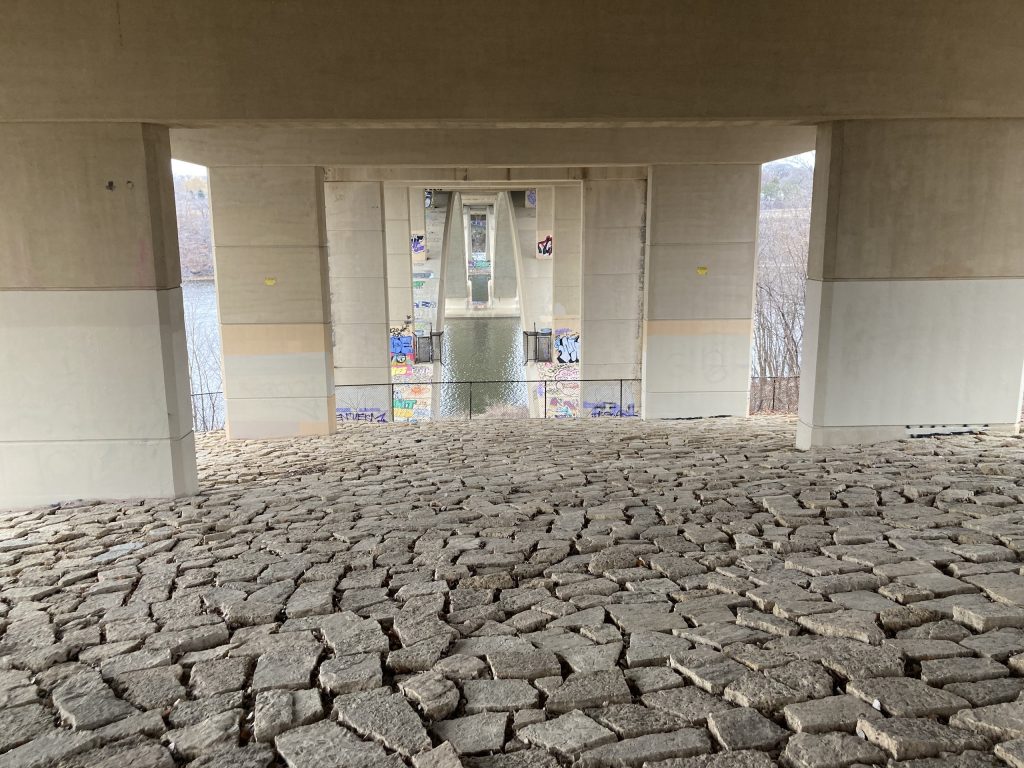
I kept trying to make more happen here — to find words for some of my thoughts, but we’re driving down to St. Peter for FWA’s band concert and I’m feeling the pressure to pack and get ready. So, that’s it. Oh — and this. I stopped at 2 miles to take this photo of the lake street bridge from below. I was inspired to take it because of a story RJP told me on our walk a few days ago. She and her friends hopped over a fence and walked up the arch over the water. Apparently there’s a room with a door and couch somewhere up in the arch where kids like to hang out. I thought about trying to get close to see it, but that would have required descending the uneven bricks and possibly twisting my ankle.

Under the Lake Street bridge. The bottom third of the image is of uneven limestone rocks sloping down to 2 pilings, a chain link fence, then river. Beyond the river more bridge -- cream colored or pale yellow -- with graffiti.
Under the Lake Street bridge. The bottom third of the image is of uneven limestone rocks sloping down to 2 pilings, a chain link fence, then river. Beyond the river more bridge — cream colored or pale yellow — with graffiti. The graffiti at the lower left looks black to me until I put the computer screen right up to my nose. Then I can see that it’s blue or purple or some bright color. Overall, I can see the edges of the limestone in the foreground, but the rest of the image is fuzzy and hazy and looks more like a dream or an abstract painting than a photo of a real bridge.

feb 8/RUN

5.3 miles
ford loop
47 degrees

Hooray for feeling strong and happy and unbothered by the wind! A good run, even though it feels strange with no snow. Scott told me it’s 5 degrees warmer here in Minneapolis than it is where we used to live in Upland, California. Wow.

Starting last night and lingering through the morning: rain. Not snow, but rain. Everything was wet and muddy and slippery. At the end of my run I noticed that I had specks of mud on my shirt — how did that happen?

Around mile 3, as I ran straight into the wind, a biker approached from behind. I heard her call out Fast! I wasn’t sure what to say, so I said, there’s a lot of wind! She agreed. Later I encountered the biker on the ford bridge — she was walking her bike while I was still running — There’s goes that fast runner! I waved and smiled. I did a lot of smiling at every person I encountered.

a strange winter sight: roller skiers, one of them wearing shorts!

Talked with Dave, the Daily Walker about how I’m missing the snow. He agreed, but only when it’s windy and there’s lots of snow and no one else out on the trail. Then it’s fun, he said. His version of fun is one reason why I like Dave so much.

Took 2 pictures of my view. Both are just south of the double bridge and the Horace W.S. Cleveland Overlook. Here’s one of them:

My view from above the gorge: bare limbed trees, all trunk and thin branches. A few trunks are thick -- like the one near the center of the image or the one leaning on the left side -- but most are thin, creating a transparent screen between runner (me) and river. The ground, in the bottom third of the picture, is mostly dead, curled-up brown leaves.
My view from above the gorge: bare limbed trees, all trunk and thin branches. A few trunks are thick — like the one near the center of the image or the one leaning on the left side — but most are thin, creating a transparent screen between runner (me) and river. The ground, in the bottom third of the picture, is mostly dead, curled-up brown leaves. Sometimes, this is what I see even when there aren’t thin, bare branches everywhere — my view slightly obscured by something in the way — dead cone cells, I think — creating fuzz or static or a slight pulsing or wavering of lines. Also, if this picture were in black and white I wouldn’t be able to tell the difference. Often I have to ask Scott: is this in color or black and white?

peripheral: how I see

before the run

Before my run, while I was reviewing my Oct 2023 log entries and encountering several of my “how I see” photos, it came to me: this should be the new version of my vision poems. I want to study the ekphrasis form (An ekphrastic poem is a vivid description of a scene or, more commonly, a work of art. Through the imaginative act of narrating and reflecting on the “action” of a painting or sculpture, the poet may amplify and expand its meaning — def). Then I want to write a series of “how I see” poem/descriptions. These will be about experimenting with the form and exploring ways to describe how I see. I wrote in my notes: not about what I can’t see, but what I can. I’m also interested in experimenting with the idea of alt-text as form — I have a few sources for this. I’ll read some Georgina Kleege and her latest book, More Than Meets the Eye. These poems will be practical — describing the literal way I see — but also poetic — strange, unsettling, more than a report.

I’m thinking that these poems would involve describing what I see in the photo and what I saw when I was taking the photo. Also, they’re as much about HOW I see (the mechanics/process) as WHAT I see. I love this idea; I hope it sticks!

some sources:

during the run

While I ran lots of different thoughts flashed. First I thought about Marie Howe and the idea of observing and not looking away. Describing what you see with details not metaphors. Then I thought about how “looking” works for me, how it’s harder because of what I can and can’t see. How much can any of us (no matter where we are on the spectrum of seeing/blind) actually see? Then I started thinking about Huidobro’s poem, “Natural Forces” and all of the different glances he describes — One glance to shoot down the albatross. What do my different glances see?

right after the run

During my walk back home, I thought more about how I see (and spoke those thoughts into my phone). I was reminded of Robin Wall Kimmerer and her chapter, “Learning to See” in Becoming Moss. It’s about how we can learn to see the small things — like moss — that were invisible to us before.

I also thought about how I’m interested in the process we use to see and how that shapes what we see and how it enhances or detracts from our ability to behold/witness. Yes! This connects back to Ross Gay and beholding, which I discussed on here a few years ago.

I’m interested in how we sense without seeing, or how we see with our other senses (like sound). And I’m interested in thinking about how vision isn’t the primary mode in which we understand and make sense of things. It is only one of many ways, not THE way.

Ekphrasis

The verbal representation of visual representation.

Basically, an ekphrasis is a literary description of art. Like other kinds of imagery, ekphrasis paints a picture with words. What makes it different from something like pictorialism is that the picture it paints is itself a picture: ekphrasis stages an encounter between representations in two mediums, one visual and one verbal.

What is Ekphrasis?

key feature of an exphrasis poem: it engages with an artistic representation — does this fit for my project? I think so, especially if I make the taking of the photo as part of the description.

Another helpful definition of Ekphrasis from Poets.org:

Ekphrasis is the use of vivid language to describe or respond to a work of visual art.

Ekphrasis

The purpose of ekphrasis was to describe a thing with such detail that the reader could envision it as if it were present. 

I’m interested in using language to help others experience how/what I see.

dec 20/RUN

5.25 miles
ford loop
34 degrees

Yes! Loved my run today — the light! the shadows! It started when I saw some strange patches of white on the sidewalk — what were they? Suddenly I realized: light, coming through the cracks in a fence and landing on the dark, shadowed sidewalk. Very cool.

10 Things: 4 Lights and 6 Shadows

  1. the light coming through the fence
  2. the shadowed sidewalk it landed on
  3. my shadow down in the ravine, running beside the water leading to shadow falls
  4. on the lake street bridge: the sun on the river — sparkling, stretching down river towards the ford bridge
  5. on the ford bridge: the sun illuminating a buoy below me
  6. the shadows of trees on the river
  7. the pointed shadows of the lamps — fuzzy
  8. my shadow running in front of me –sharp
  9. standing on the grass between edmund and the river road, looking across to the east bank, noticing a very white house shining in the sun
  10. the pattern of the railing shadows on the lake street bridge — criss-crossed, sprawled

I felt strong and happy and steady. For the first few miles, I chanted strawberry/raspberry/blueberry over and over. Occasionally I mixed in mystery or history or intellect. At one point, I chanted: a question/is asked and mystery/is solved

I noticed the empty benches, the darting squirrels. Smelled some burnt toast and weed (wow! must have been from a passing car). Heard some voices in the ravine. Didn’t see any Regulars or hear the bells at St. Thomas. Don’t remember birds or bikes. No roller skiers. No overheard conversations.

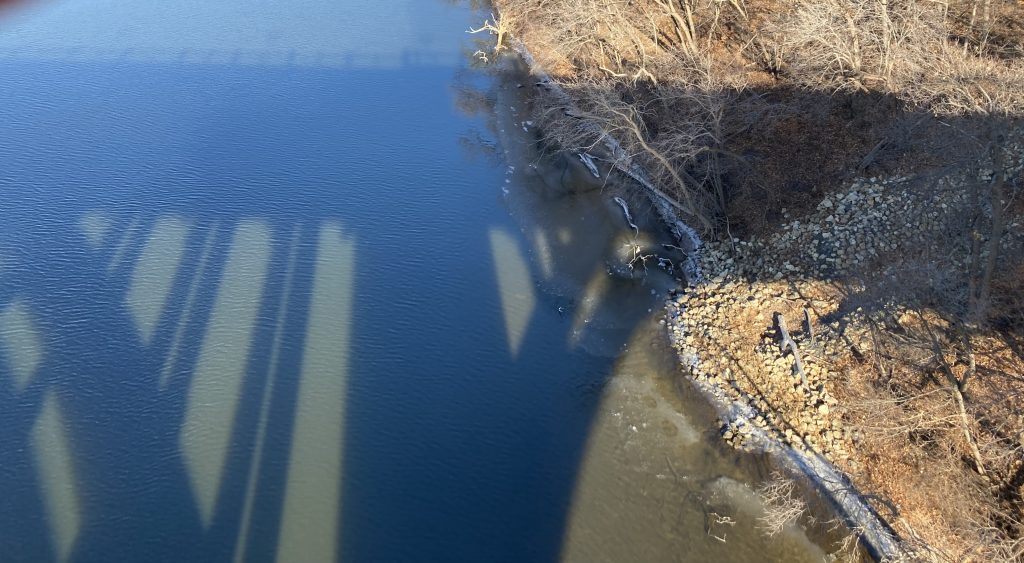
added over a day later: I forgot that I took some pictures when I stopped briefly on the ford bridge to put in my headphones:

My view from the ford bridge, looking north and down at the Mississippi river. On the right (almost) half of the image is the brownish-greenish shore. On the left, the blue river with dark shadows from the bridge covering it's surface. The shadows are of the columns and are both thick and thin. If I squint hard I can almost see my shadow at the top taking the picture. Is it there, is it just in my imagination?
ford bridge shadows / 20 dec 2023

For the first four miles I listened to kids playing at the church playground, cars driving by, my feet striking the ground. Then I put in Merrily We Roll Along for the last mile.

Letter to Walt Whitman,
Who Painted Butterflies/ Kelli Agodon Russell

In 1942, Whitman’s handmade cardboard butterfly disappeared from the Library of Congress.
It was found in a New York attic in 1995.

Perhaps, you made them as a child—
cardboard butterflies lining your shelves,
hiding in the pockets of the wool pants
you wore only to church.
Maybe you would wake early
to cut cardboard into small waves
forming wings, and antennae appearing
like exclamation points.
Words fluttered from your pen,
cardboard wings dipped in red paint,
holding patterns of words,
the quiet swirl of wind.
Maybe there are thousands
of your butterflies still lingering in attics,
your secret world of paper insects
still hanging by threads.

I wanted to post this poem because I like how it’s set up, with the brief description, then the wondering/imagining about it. A fun exercise to try: when I find an interesting fact (here I’m thinking about the monarch butterflies that avoid a mountain in lake superior that’s been gone for more than a century), write a poem that speculates/imagines/creates a story around it.

dec 19/RUN

4 miles
curved railing (north) and back*
30 degrees / feels like 22

Wow, what a beautiful morning for a run. Sunny and clear and cold, but not too cold. So many shadows to admire! My favorite was the first one I noticed — from a slender tree, so thin it looked more like a pencil line. I started noticing the trees by how thick their shadows were. Then, when I reached the river, I moved onto the shadows of fence posts. The split rail fence above the ravine made such crooked shadows — no straight lines where rails were leaning or bent. The street lamps shadows almost looked menacing — so sharp, stretched across the path. My shadow was sharp too — clear and confident. Saw squirrel shadows but no bird shadows.

10 Things (other than shadows)

  1. below in the ravine, the water was frozen
  2. a strange howling call from below at longfellow flats — an animal? or a person pretending to be an animal? I looked, but couldn’t see anyone
  3. in the sun the darting squirrels looked silver or white
  4. a stutter step when I squirrel jumped out at me, then turned back
  5. as I ran south, some white thing out of the corner of my eye kept calling out, notice me! So I did: it was an arch of the lake street bridge
  6. walking below on the winchell trail, I encountered (not for the first time) the trunk of a tree in the middle of the trail — wide and tall — 12 feet? jagged at the top
  7. the knock of a woodpecker somewhere below, closer to the river — not sharp, but soft faint, almost an echo
  8. good morning Dave! / morning Sara!
  9. looking down at the floodplain forest, I could see many fallen trees and branches
  10. nearing the bottom of the hill that rises up and out of the tunnel of trees, I saw the bright, burning light of the river far ahead — I knew it was the river, but imagined it might be sky

I listened to strange howls as I ran north, then put it in Merrily We Roll Along as I ran south to home.

Before turning around, I hiked down to the curved fence above the ravine on the Winchell trail and took a few pictures. Then I stood there, looked down at the river, and felt delighted and satisfied, so glad to have gone out for a run this morning and then stopped to take in this view.

A view of the mississippi river. The top third of the image is just BLUE!--a beautiful blue sky. Below the blue is mostly the light brown of the east bank, then the whiteish-tan of the sandy shore. On the edge between the blue sky and brown branches in the left corner is the tower at Prospect Park--the Witch's Hat, which is called that because it looks like a witch's hat. After the brown of the shoreline, more BLUE!--the river. And, in front of all this, closest to the camera, are a few bare branches. When I look at this picture, I mostly see and think, BLUE! then sandy white then witch's hat.
on the west bank, near franklin ave, mississippi river / 19 dec 2023

I discovered a prose poem this morning that reminds me of my February Feels Like Project. I think it could be inspiration for me as I clean up my draft and try to get it published:

Sunrise, All Day Long/ Kathleen McGookey

Today is wind that smells like mint blowing in from the lake. Today is a paper crane, just folded. Today is a bleached sheet pulled from the linen closet, trailing the delicate scent of green soap. Today is a small brown snail’s pearly trail across the ivy. An eggshell cracked open by raccoon or turtle or fox. Today is a sharpened pencil, a sealed love letter, the antique locket in my mother’s jewelry box. A rectangular pink eraser, straight out of the package. That one black and white bird perched on the sailboat’s mast, preening its glossy tuxedo and singing a boisterous, throaty song.

nov 30/RUN

5 miles
veterans’ home loop
32 degrees

Warmer today. Sunny, bright, clear. The river sparkled and burned. Shadows everywhere. Big columns of ice next to the falls, a thin sheen of ice on the steps and the bridge over the creek. Saw my shadow far below me while I was above on the bridge over to the veterans’ home. Encountered at least half a dozen darting squirrels, one was heading straight towards me but did a sharp turn away at the last minute. Near the end of my run, I saw and heard a vee of geese flying low in the sky — maybe 12 of them? Something about the blue sky and the brilliant light made their wingtips look silver. I didn’t stop running, but I craned my neck as I moved to keep watching them.

10 Sounds

  1. kids at recess, playing on the playground at minnehaha academy: scattered voices laughing, yelling
  2. some sort of chirping bird — not a cardinal, a robin? finch?
  3. the caw caw of a crow, down in the gorge
  4. the gushing falls — steadily falling creek water
  5. rustling in the leaves, 1: a squirrel
  6. rustling in the leaves, 2: a chipmunk or a bird
  7. rustling in the leaves, 3: a person walking below me on the Winchell Trail
  8. honking geese
  9. a chain link fence rattling — someone playing disc golf near Waban
  10. missing sounds: didn’t hear any roller skiers or music from a bike or a car, no bikes whizzing by or horns honking, and no fake train bell at the 50th street station as I ran near the John Stevens house

Stopped at the Folwell bench to admire the view and to check on my watch which had turned off. Bummer — out of charge, so no data from today’s run. Took a picture of the gorge:

A view from above of the Mississippi gorge and river. Just to the right of center in the image a thick brown tree trunk stands -- well, not that thick, but much thicker than the other trunks surrounding it. To me, this trunk looks like a tall person, with a long neck and a head that's just off the edge of the top of the frame. They have one arm (which is actually a bare branch) that extends up and across and then off the top of the frame. This arm is bent which creates the illusion of an elbow, an armpit, and a torso. Below the tree are dead leaves, light brown, and beyond the tree is a blue river and then a brown bank.
a tree with river gorge / 30 nov 2023

nov 28/RUN

5.5 miles
franklin hill turn around
15 degrees / feels like 2

The coldest day of the season. Brrr. Extra layers: 2 black tights, yellow shirt, pink jacket, purple jacket, 2 pairs of gloves — black and pink/white, buff, hat with ear flaps, hood. Difficult to breathe for the first mile. Sunny, lots of shadows. Greeted Dave, the Daily Walker. He was in his warmest attire, even had a stocking cap. There was ice near the shore of the river and sheets of ice on the surface of the water.

The surface of the mississippi river, up close. Thin slabs of ice, cracked with strips of cold water visible, cover the surface. Near the bottom of the frame, the ice looks dark gray and blue. At the top, it's white with a hint of brown.
Brr. River surface starting to ice over / 28 nov 2023

For the first 4 miles, I listened to my feet striking the ground, cars driving by, the wind. For the last 1.5 miles, I put in Olivia Rodrigo.

before the run

Still working on my haunts poems, adding more to the ones I wrote 2 years ago. Yesterday I spent a lot of time working on the first section, trails, and thinking about paths and feet and my interest in following, connecting, learning new stories. As part of that work, I started rereading Wendell Berry’s excellent essay, “A Native Hill.” This morning, before my run, I’m still reading and thinking about it. While I run, I’d like to think about this passage:

Looking out over the country, one gets a sense of the whole of it: the ridges and hollows, the clustered buildings of the farms, the open fields, the woods, the stock ponds set like coins into the slopes. But this is a surface sense, such as you get from looking down on the roof of a house. The height is a threshold from which to step down into the wooded folds of the land, the interior, under the trees and along the branching streams.

“A Native Hill” / Wendell Berry

As I run, I’d like to think about these ideas of threshold and surface, and what it means to be above, always, looping around the gorge, rarely entering it. Is this only surface level? What is at the surface, and is the surface always superficial? What does it mean when the gorge is not a thing to enter, but an absence, an emptiness/void that is still present and shaping the land but is inaccessible?

during the run

Did I think about these things at all? Maybe a little as I looked down at the floodplain forest or the water. At one point, I thought about how I’m not completely inside of this place, but I’m still much more in it than if I were riding in a car.

In a related but different direction of thought, I remembered the lines I had just written this morning:

It begins
here: from
the ground up
feet first,
following.
I want
to go where
others
already
have gone.

I thought about this following and how the others include past versions of me, the Saras that have already, day after day, year after year, travelled these same trails.

after the run

Sitting at my desk after my run, looking out at a mysterious pile of dirt left right in front of my sidewalk by workers for some unknown reason, feeling wiped out from the run, I’m not sure what to do with Berry’s passage. Maybe I’ll read some more of the essay?

Beyond the gate the land leans always more steeply towards the branch. I follow it down and then bear left along the crease at the bottom of the slope. I have entered the downflow of the land. The way I am going is the way the water goes. There is something comfortable and fit-feeling in this, something free in this yielding to gravity and taking the shortest way down.

“A Native Hill” / Wendell Berry

I love this line: The way I am going is the way the water goes.

Berry talks next about human-made erosion and how he laments the loss of land “before the white people drove their plows into it.”

It is not possible to know what was the shape of the land here in this hollow when it was first cleared. Too much of it is gone, loosened by the plows and washed away by the rain….The thought of what was here once and is gone forever will not leave me as long as I live. It is as though I walk knee-deep in its absence.

“A Native Hill” / Wendell Berry

The slopes along the hollow steepen still more, and I go in under the trees. I pass beneath the surface. I am enclosed, and my sense, my interior sense, of the country becomes intricate. There is no longer the possibility of seeing very far. The distances are closed off by the trees and the steepening walls of the hollow. One cannot grow familiar here by sitting and looking as one can up in the open on the ridge. Here the eyes become dependent on the feet. To see the woods from the inside one must look and move and look again. It is inexhaustible in its standpoint. A lifetime will not be enough to experience it all.

“A Native Hill” / Wendell Berry

Love it: Here the eyes become dependent on the feet. I’m finding a place for this line in my poem! Even when I am on the edge of the bluff looking down at the gorge, my vision isn’t very good. Everywhere I run, above or below, I’m dependent on my feet, and not just to get me to new places to see; sometimes I see with my feet.

Berry’s last lines about it being inexhaustible and how a lifetime will not be enough to experience it all brings me to another definition of going beyond the surface: to do more than briefly visit, to stay somewhere (to haunt it), to return to it again and again, each time learning something new, or encountering something slightly altered. This returning to the gorge day after day and giving attention is my way of connecting with it and attempting to experience as much of it as I can.

nov 16/RUN

5.4 miles
ford loop
63 degrees
wind: 19mph

Another windy day. I had to hold onto my cap several times so it wouldn’t fly off. Running east on the lake street bridge, I put my hood so my cap wouldn’t fall off. Running west over the ford bridge, I took the cap off and held it in my hands. The wind made it difficult, more draining. Is that why my legs feel so sore?

10 Things

  1. ridges and white caps in the blue water, from the wind
  2. kids at the church daycare, at the far end of the fenced-in playground. Running by I could hear their tiny, sweet voices plotting something
  3. more filled benches than usual along the route, including one with a person sitting and a stroller behind it
  4. in the neighborhood: knocks on the roof — not a woodpecker, but roofers … or was it a woodpecker?
  5. running straight into the wind, wondering if would push me up against the railing (not quite)
  6. my shadow down in the ravine near shadow falls — lucky shadow, sheltered from the wind
  7. everywhere hazy — it might have been my vision, but I think it was dust stirred up by the wind. Yuck!
  8. running north, at the end, feeling the wind pushing me, but not in a helpful way
  9. the wind didn’t rush or roar, it just pushed and pulled
  10. a walker, walking in the middle of the path, blasting talk radio

I stopped on the double bridge to take a picture of the ravine and to put in my headphones:

My view from the bridge of some bare-branched trees. Everything mostly brown, with a few streaks of white (or gray?) peeking through. The white is the water, or is it the sky? Difficult to tell. Below the frame of this imagine (just out of the picture), is a branch with green leaves, swaying in the wind. Also out of the frame is a walker with a dog, walking by. I didn't notice them until they passed by and crossed my periphery.
a warm, windy November day / 16 nov 2023

today’s view out my window

It’s snowing leaves. Mostly they are drifting down slowly, one after the other. Sometimes at a distance, occasionally almost on my window screen. My neighbor’s yard is covered with them, a dead leaf carpet. Yesterday, as Scott and I cleared out our leaves we could see that the neighbor’s tree was still full of leaves. I wondered what would happen when the wind came back. Today I found out.

Also, encountered this interesting (and unsettling) article about the effects of climate crisis on Japanese poets who write haikus: Japan’s haiku poets lost for words as climate crisis disrupts seasons

nov 10/RUN

5.1 miles
franklin loop
37 degrees

More excellent November weather! A solid, relaxed, non-stop (except for walking up the bridge steps) run. Greeted Dave, the Daily Walker and, later, another friendly runner — Hi! Admired the blue river and the occasional flash of red in the trees. Took deep breaths of fresh, cold air. Listened, without headphones, to the traffic and a chirping bird, rustling leaves and an alarm beeping somewhere.

10 Things

  1. a clear view of the forest floor from above
  2. so many green leaves still on the trees on the east side — light, glowing green
  3. somber (or reverent?) wind chimes
  4. smell 1: stinky, sour sewer gas, faint
  5. smell 2: either skunk or weed, probably weed
  6. smell 3: hot chocolate
  7. bright yellow headlights from cars, cutting through the trees
  8. some part of a machine scraping on a sidewalk somewhere in the distance
  9. a tree that I thought might be a person until I saw it in my periphery: a tree with one branch holding a hat at head-height
  10. a woman walker in bright orange pants

At the end of my run, I took a picture from the top of the hill, above the tunnel of trees, across from the ancient boulder:

Overlooking a forest that winds down to the river, which is a faint white -- or no color, just the absence of brown branches and yellowed leaves. Mostly bare branches and a brown ground covered in fallen leaves. In the lower right-hand corner a chain link fence stretches. This fence marks where the Winchell Trail used to go after coming up from the ravine. Now it's barely a trail, mostly hidden by leaves, no longer maintained. Just outside of the frame on the left, a green leaf flutters in the wind.
a view to the river near the 35th street parking lot / 10 november 2023

I love this poem by Donika Kelly, and I love what magic she can do with words!

I love you. I miss you. Please get out of my house. / Donika Kelly

Nothing today hasn’t happened before:
I woke alone, bundled the old dog
into his early winter coat, watered him,
fed him, left him to his cage for the day
closing just now. My eye drifts
to the buff belly of a hawk wheeling,
as they do, in a late fall light that melts
against the turning oak and smelts
its leaves bronze.
Before you left,
I bent to my task, fixed in my mind
the slopes and planes of your face;
fitted, in some essential geography,
your belly’s stretch and collapse
against my own, your scent familiar
as a thousand evenings.
Another time,
I might have dismissed as hunger
this cataloguing, this fitting, this fixing,
but today I crest the hill, secure in the company
of my longing. What binds us, stretches:
a tautness I’ve missed as a sapling,
supple, misses the wind.

I love all the work the title does to set up the poem, how she describes it as watering the dog (and not giving the dog water), and these verbs: cataloging/fitting/fixing. My favorite sentence, and the reason I wanted to post this poem today, is this:

My eye drifts
to the buff belly of a hawk wheeling,
as they do, in a late fall light that melts
against the turning oak and smelts
its leaves bronze.

A late fall light that melts against the tree and smelts it leaves bronze? Wow. I want tp remember that line. I’d also like to find an example of it out by the gorge on my run today (I’m writing this bit before my run), but there’s no autumn sunlight today, just gray gray gray. I wonder, what does gray to those leaves?

during the run: I hoped to think about this question of what gray does to the leaves, but I got distracted, or maybe, it didn’t do much, at least not today. Most of the leaves were gold or orangish-brown, no shimmering or sizzling, just soft and flat.

Instead of thinking about what gray does to the leaves, I was thinking about some lines I’d like to add to my Haunts poem:

A girl runs
four blocks
to the gorge.
She’s all
muscle bone
and breath,
foot strikes and
arm swings.
The river
and ghosts
wait.

transcript: During the run I was thinking about ghosts and girls and the gorge. And I was thinking that what I’m really trying to convey is that there’s a heaviness and a solidness and a there-ness that is both good and too heavy. So there’s a desire to lighten up. What I want to do is convey the heaviness, so maybe using the word, “heavy,” heavy foot strikes. Then I was thinking of Lizzy McAlpine and her song, “all my ghosts.” And then I was thinking about how all these ghosts aren’t primarily a bad thing, but there are a few ghosts I struggle with more than others. I think the ghost of cancer is haunting me the most right now.

the chorus from McAlpine’s “all my ghosts”:

And all my ghosts were with me
I know you felt them too
Watchin’ as I started to get dizzy
‘Cause I hate all of my habits
But I happen to love you
I hope that’s true

another version of my lines:

A girl runs.
She’s all
muscle bone
and breath,
heavy foot
falls and
swinging arms.
At the
river her
ghosts wait.

nov 8/RUN

5.5 miles
ford loop
43 degrees

Ah, November! Ran through the neighborhood, past the kids playing outside at the church daycare, past the house that has a giant Packer’s flag hanging from their fence, past the window of the business where I watch myself run and wonder if the people inside are watching me watch myself, over the lake street bridge to the east side of the river. On the bridge, I passed a couple holding hands. A mile later, I passed another hand-holding couple. An unusual sighting, and twice. Ran up the long hill to the Monument, then beside the river until I reached the ford bridge. Stopped to take a picture on the bridge, then ran the rest of the way back with Taylor Swift and Olivia Rodrigo.

A view from the ford bridge, poorly framed. Not sure what color other people might see here, but to me it's all gray: light gray sky and river, broken up by chunks of dark gray trees. I like how the sky and the river look almost the same color to me.
taken from the ford bridge / 8 november 2023
My view of the river from the ford bridge. I stuck my phone above the railing, pointed and clicked quickly, afraid I might drop my phone into the river. For me, this image is fuzzy, almost furry, with soft greens and golds and grays. Most of the shot is of the past-their-prime trees on the shore of the Mississippi. All along the left edge curved around the trees is the light gray river which, at some point, turns into the sky. This image looks more like a painting than a photograph.
taken, with some trepidation, over the railing of the ford bridge / 8 november 2023

10 Things

  1. kids playing at the church daycare, several of them huddled at the fence, one of them (accidentally?) threw a ball over the side
  2. blue water, some waves, a few streaks or trails from something
  3. running above shadow falls, not sure if I was hearing it dripping or the wind through the trees
  4. running up the summit hill, a stretch of lit street lamps lining the path, the amber lights glowing softly
  5. noticing the gloom and the absence of my shadow as I ran around the ravine
  6. wondering if I would get to hear the St. Thomas bells as I ran close to campus (nope)
  7. chickadee dee dee
  8. turkeys! I’m not quite sure, but I think they were hanging out in the grass, just past the ford bridge, before you head down the hill to the locks and dam
  9. an unnaturally vibrant green on some of the leaves on the east side of the river — is this spring or late fall?
  10. an intense smell of cinnamon shortly before reaching the ford bridge — where was it coming from? someone’s gum? a bush?

before the run

Last night during Scott’s South High Community Jazz Band rehearsal, when I sit and listen and work on poetry, I returned to Susan Tichy’s North | Rock | Edge. Wow! This morning, before my run, I’m thinking about the lines I read and an interview Tichy did for Terrain.

There’s also a sensory excitement in a sea-rock-light-wind-bird-flower-seal-seep-peat-rain-salt—oh look, there’s a whale!—environment that subsumes attention to any one thing into the press of the whole.

I love how she describes the environment and her idea of attention to the whole, not just to any one thing.

Rock blurs the categories of time and space by making time visible and place temporal. A poem uses both rest and motion to create a form, which can be seen and must be heard—as the Susan Howe epigraph says, fleeting and fixed. These poems, like many in Avalanche Path, have a surface texture of fragmentation, abrupt change, and brokenness metamorphized into a new whole, voiced in present time, human time. Nothing is still; nothing is uniform.

And here’s a wonderful bit from the first part of Tichy’s poem, 60 North|Arriving, Stand Still:

& here wind

elevates to a theory

of time : to not miss a single

wave’s decay, a verse

of coast becoming dearth

of certainty, to undefine

the edge as noun, dissolving

in the not unyielding mouth

of cliff : verse/reverse

from the root of turn :

wind-wave & swell

compounded to a single

force, broken

by the thing it breaks—

In the next section she offers this line, what place is not. The gorge as what place is not, or where place one was?

during the run

I think Tichy’s poem influenced my thoughts indirectly as I ran. I was thinking about a part of my Haunts poem I’m working on, particularly about how I am sometimes a girl, sometimes a ghost, and sometimes a gorge. Am I the gorge, I wondered as I started running. And as I ran over the lake street bridge I came up with an answer: yes. Later, when I reached to ford bridge, I stopped running to record some thoughts:

I am the gorge because the gorge is the remains, what is left behind, what continues to exist even as ground erodes, self erodes, vision erodes. The gorge, constantly shifting, but always there. The gorge is the eroded. Is the ghost the verb, the eroding? … I am also the gorge because I’m constantly leaving part of myself here and becoming this place and not just moving through the place, becoming the place.

oct 30/RUN

5.4 miles
franklin loop
25 degrees / feels like 20

Yes! A great temperature for running. I love the cold air and not getting overheated. Wore black running tights, black running shorts, my 10 year-old base layer green shirt, an orange sweatshirt, black gloves, a hat and a buff. Such a great run. I feel satisfied and happy and energized. A great start to the winter running season!

10 Things

  1. chatty, chirping birds — sparrows? wrens? finches? chickadees?
  2. the Welcoming Oaks are almost bare. Where was I when the leaves fell? hello friends!
  3. a bright white circle of sunlit river burning through the growing gap between the trees
  4. everywhere more of a view to the other side
  5. empty blueish gray water — so calm and pleasing to my eyes
  6. passed Daddy Long Legs, dressed in black. His hi was so quiet it didn’t register until it was too late to call back a greeting
  7. Hi Dave! — greeting Dave, the Daily Walker in the final mile
  8. crossing the bridge, approaching 2 talkative runners from behind: excuse me. / Oh! [a runner jumps to the side looking freaked out] / Sorry I scared you!
  9. the smell of smoke down below on the east side of the river
  10. a roller skier! I couldn’t hear the clicking and clacking of his ski poles until I was right next to me

bats, bells, noisy road work, and late fall leaves

Found this poem from DH Lawrence the other day while looking for poems about bats. Wow, he didn’t like bats!

 Bat/ D.H. Lawrence

At evening, sitting on this terrace,
When the sun from the west, beyond Pisa, beyond the mountains of Carrara
Departs, and the world is taken by surprise …

When the tired flower of Florence is in gloom beneath the glowing
Brown hills surrounding …

When under the arches of the Ponte Vecchio
A green light enters against stream, flush from the west,
Against the current of obscure Arno …

Look up, and you see things flying
Between the day and the night;
Swallows with spools of dark thread sewing the shadows together.

A circle swoop, and a quick parabola under the bridge arches
Where light pushes through;
A sudden turning upon itself of a thing in the air.
A dip to the water.

And you think:
“The swallows are flying so late!”

Swallows?

Dark air-life looping
Yet missing the pure loop …
A twitch, a twitter, an elastic shudder in flight
And serrated wings against the sky,
Like a glove, a black glove thrown up at the light,
And falling back.

Never swallows!
Bats!
The swallows are gone.

At a wavering instant the swallows gave way to bats
By the Ponte Vecchio …
Changing guard.

Bats, and an uneasy creeping in one’s scalp
As the bats swoop overhead!
Flying madly.

Pipistrello!
Black piper on an infinitesimal pipe.
Little lumps that fly in air and have voices indefinite, wildly vindictive;

Wings like bits of umbrella.

Bats!

Creatures that hang themselves up like an old rag, to sleep;
And disgustingly upside down.

Hanging upside down like rows of disgusting old rags
And grinning in their sleep.
Bats!

In China the bat is symbol for happiness.

Not for me!

Today, writing this bit before my run, I’m thinking about bats and echos and echolocation. Vibrations, reverberations, sounds that haunt by continuing to ring out. Bells. But, back to the echoes. In addition to bats, I’m thinking about a stanza from a favorite Halloween poem that I posted on this day in 2020:

A ghost, though invisible, still is like a place
your sight can knock on, echoing; but here
within this thick black pelt, your strongest gaze
will be absorbed and utterly disappear:
from Black Cat/ Rainer Maria Rilke

Speaking of haunting, relentless sounds: I am sitting at my desk in the front room and city workers are paving the hole they made in the street in July or August. So loud! Beep beep beep. Rrrruuummmbbbllleee. Scrape scrape, tamp tamp. Even the visual noise echoes — a flash flash flash of the lights on the truck as it dumps the gravel or tar or whatever they’re putting in the hole. Everything is vibrating — the street, my jaw, my chair, the windows. Difficult to think or to write while this is happening!

At the end of my run, having crossed the river road to walk in the grassy, leaf covered boulevard, I was distracted by the delightful noise of fallen leaves. Then I noticed a bare tree, its still green leaves scattered around it.

An image of the ground covered in leaves, most of them green. A strange sight in late fall when most of the fallen leaves are usually brown or orange or gold. When I took this picture, the ground seemed to glow from the green, but now, looking at the image, everything is muted and dull and boring. Is it my lack of functioning cone cells, my inability to take a decent picture, or something else?
green leaves on the ground / 30 oct 2023

oct 26/RUN

3.1 miles
trestle turn around
57 degrees / drizzle

Waited for the rain to stop, then went out for a late morning run. Listened to the squeaks of my feet on the wet leaves, the drips from the trees and the eaves, workers on a neighbor’s roof as I ran north. Listened to a playlist on the way back south. The sidewalks were slippery and covered with red and yellow leaves. The paved trail had some puddles. I remember looking at the river through the trees, but I can’t remember what it looked like. Probably gray.

The strangest moment of the run happened near the beginning as I ran through the neighborhood on my way to the river. The sidewalk was covered in intensely red and yellow leaves and so was the sky, from an orange tree. Everything glowed, even me in my bright orange sweatshirt. Wow! I decided that once I finished my run, I’d come back to this spot and take some video:

A sidewalk covered in red and yellow leaves. In person it glowed, but when I look at it on the screen, it is dull.

oct 19/RUN

4.1 miles
minnehaha falls and back
51 degrees / light rain

Ran to the falls. Everything yellow, red, orange. Wow! Encountered some walkers as I got closer to the falls, one or two runners. Chanted triple berries — strawberry/ raspberry/ blueberry. Also recited Mary Oliver’s “Can You Imagine.” I remember starting it, but I don’t think I finished it, and I can’t remember where I stopped. The Minneapolis park workers were out again, patching up cracks in the asphalt with stinky, steaming tar. The falls were gushing. As I ran by them, 3 teenage boys sprinted past me, on their way to the steps. The mother in me hoped they didn’t fall down the slippery stairs. I stopped at my favorite spot on the other side of the park, near where Longfellow’s “The Song of Hiawatha” is etched into the limestone wall, to admire the falls. Today, before starting to run again, I decided to take some video of my view:

The view from my favorite spot of Minnehaha Falls

notes about what I saw: As I was taking this video I saw a flash of movement below: it was one of the teenage boys running over the bridge that crosses the creek after it’s fallen. I tried to pan down to capture him on video, but I can’t see him. Can you? Also, to the left of this frame, there was a person with an easel set up, painting this view from a different angle. When I had approached the spot, I knew there was something/someone else there but I couldn’t tell what/who it was and I didn’t want to stare. It was only after I started walking away and saw the person through my peripheral vision that I figured out what was there.

The rain came in the last mile of my run, right after I finished filming myself running up the edge of the world. (Oops. I screwed up the camera by not starting it when I thought I did. I’ll have to try filming this view some other day). Good timing! I didn’t mind getting wet — I already was, from sweat.

I listened to water dripping, kids yelling from across the road, a dog yipping, the falls rushing, leaves squeaking on the way to the falls. I put in Beyoncé’s “Renaissance” on the way back, but took it out and listened to more water and wheels and my own breathing while running on the Winchell Trail.

We’re getting closer to the end of October and the cold is coming. Looking back through old entries, it had already snowed by this day in past years. Here’s a poem I found in the New Yorker that gets me in the mood for that cold — and it features the color blue!

Childhood/ David Baker

I miss the cold, but not the cold breaking,
not the small limbs sheared, nor the icepick cold
white wind working its whole way through you
no matter your coat and gloves, and no matter
the blue scarf someone tied and tucked tight.

The same cold blue all day in the sky. Frozen
blue through limbs of the two standing elms.
Brilliant each blue. Blue the color of new
snow like wafers on the fields. Come in cold then,
and the dark comes with you, kick off your boots

and someone is rubbing your feet so they
sting, then stop stinging. Now the bruised-apple-
red bottle at the foot of your bed, steaming,
and come morning woodsmoke in the kitchen.
I miss the cold then, so cold there is singing.

oct 18/RUN

3.1 miles
2 trails
54 degrees / drizzle

Wow, so much yellow. Full fall color, I think. I was sore this morning from my run yesterday, but glad I went out to be with all of this beautiful color!

I listened to a playlist, then took out my headphones while I was on the Winchell Trail, then put the playlist back in for the last mile. Ended the run with the theme to Rocky — not on purpose; it happened to come up on shuffle.

Smelled the sewer, heard the limestone dripping, called out right behind you several times. Thought (again) about stopping at the overlook to take a picture of the wonderful view of the river, but didn’t. Instead, I stopped at the entrance to the Winchell Trail and took this shot:

At the top of some limestone steps, about to enter the Winchell Trail from the south end. In the lower right, a limestone wall. In the center, a black railing. More than half of the image is yellow leaves, mostly on trees, some on the dirt trail which used to be asphalt. On the right side, a stand of straight brown trunks.
entering the Winchell Trail from the south

10 Things

  1. 4 or 5 stones still stacked on the ancient boulder
  2. the floodplain forest is almost all yellow
  3. the sewer gas from below smelled sour and unpleasant
  4. a Minneapolis Park truck was parked in the grass above the gravel trail that descends through the ravine — are they planning to clear out more dead limbs below?
  5. encounter 1: 2 people with 2 big black dogs on the Winchell trail — right behind you / sorry / no worries. It’s a beautiful morning!
  6. encounter 2: a man with his dog — right behind you / no words, but he moved over slightly / thanks!
  7. the “edge of the world” was mostly bare, with only a few streaks of yellow left
  8. avoiding roots on the dirt trail next to edmund, imagining that I was doing agility drills
  9. taking off my pink jacket at the bottom of the 38th street steps
  10. encounter 3: 2 different people with dogs, or a dog?, bypassing the steps and continuing on the dirt trail to the oak savanna

oct 17/RUN

6.2 miles
ford loop
49 degrees

Overdressed. Didn’t need the tights under the shorts or the long-sleeved shirt under the sweat shirt. Made the run a little more difficult. Still, a good run on a beautiful fall morning. Lots of yellow today. Very fall-y.

10 Things

  1. St. Thomas bells chiming
  2. I could see my breath at the beginning of the run
  3. the light making the yellow leaves glow
  4. at least 4, maybe 5, stones stacked on the ancient boulder
  5. a biker calling out to me as I ran on the St. Paul side, good job!Thanks!
  6. looking down at the river from up on the lake street bridge: a sandbar! I’ve read about the sandbars, and thought I saw one just below the surface, but today, there it was, fully exposed
  7. an inviting bench, perched above the gorge with an open view
  8. almost perfect moment: looking down at the water falling over the limestone ledge, sparkling in the sun, murmuring softly, framed by yellow leaves
  9. a west bound lane on the ford bridge closed off for construction, orange cones everywhere
  10. running up to the “edge of the world,” and stopping to admire the open view

I stopped on the bridge to take a picture of the sandbar:

A view from above the river, which is a blue-ish gray, with a white sandbar, strangely shaped, and a shiny circle of sun reflecting on the water. More on the strange shape of the sandbar: in its middle, where it is at its narrowest, the sandbar is covered over with water, making it look like 2 sandbars. Both above and below this spot the sandbar expands.
a sandbar in the Mississippi River below the lake street bridge

oct 12/RUN

3.6 miles
locks and dam no. 1 hill
51 degrees
wind: 13 mph

My knees were sore last night and this morning and I wondered if I should go out for a run, but it’s supposed to rain later today and all of tomorrow, and I read an article that said sometimes running on sore legs is better than not running, so I ran. And I’m glad I did. My legs/knees feel better after than they did before.

Felt windier than 13 mph. It almost knocked my cap off.

I listened to beeping trucks and chainsaws and rushing wind as I ran south. When I got to the top of the hill at the locks and dam no 1 I stopped and put in a Bruno Mars playlist.

10 Things

  1. the dirt on the boulevard was sometimes dark brown, sometimes light brown
  2. more trees without leaves — have we passed peak leaf season?
  3. a parks’ truck blocking the entrance to the overlook and the winchell trail — no winchell trail for me today
  4. running up the hill, the sun came out briefly from behind the clouds, just enough for me to see the faint outline of my shadow. Hello friend!
  5. more crunching leaves in the grass — brittle, brown, formed into little mounds by the wind
  6. a rough trunk with lichen growing on it — on the north side — a faint, yellowish green
  7. several different versions of green on the tree trunk and the grass
  8. walking past a giant rectangular hole in the street — the spot where they busted open the street to work on the water pipes. Minutes before, workers had filled it with warm, bitter smelling tar (or asphalt?) Heat was coming off the filled hole, warming my legs
  9. a falling red leaf hit me on the shoulder
  10. color of the day: bright yellowish green. Not only was I wearing a shirt in that color, but I saw at least 3 other yellowish green shirts on a runner, a walker, and a biker

After staring at the yellowish greenish lichen, I took a picture of it:

A close-up image of tree bark that is rough and brownish gray (or grayish brown). There are streaks of greenish-yellow lichen on the bark. While taking this picture, with my face close to the trunk, I could see the lichen. And, if I put my face close to the screen while studying the picture, I can still see it. I can also see the lichen in the picture if I turn my head slightly and look at it through my peripheral vision. But at a normal (1 foot) distance, I can't see the lichen. It blends in, not looking yellow or green but light brown.
a close-up of a tree with lichen on its north side

oct 11/RUN

3 miles
2 trails
58 degrees

Ran in the afternoon. Much warmer. Too warm. Overdressed in my long-sleeved bright yellowish green 10 mile racing shirt. Listened to Olivia Rodrigo for the first mile, then took out my headphones for the rest. I heard trickling water, laughing and screaming kids making the kind of noise that’s on the edge between angry and joyful, wind rustling the leaves.

After I finished, walking on the grassy boulevard, dotted with dry leaves, I pulled out my phone and recording the sound:

crunching leaves / 11 oct

I started by walking through the leaves, kicking into them with my feet. Then I stepped on them. To my ears, the sound went from a crash to a crunch.

I ran the version of 2 trails in which I don’t take the 38th street steps but stay on the dirt trail through the oak savana then around the ravine. I thought about stopping to take a picture here — and many other places too, including the overlook near the southern entrance of the winchell trail — but I wanted to keep running. So I took a picture of the ravine from above and across the river road:

A road with tree shadows on it. Behind it, a split rail fence and some golden trees. Beyond it, but not pictured, is a ravine with a black wrought-iron fence and a metal slat walkway that I carefully ran over a few minutes before taking the picture. In the upper right corner, there is a yellow sign indicating a sharp curve. There are also 2 cars in the distance. When I was taking this picture, I only saw general forms: shadows trunks leaves road sky.
The split rail fence above the ravine from across the river road

oct 10/RUN

5.1 miles
franklin loop
44 degrees

Ah, this fall weather! What a morning to be outside by the gorge. A little windier than I’d like, but wonderful. My legs felt a little stiff and sore, but I kept going and they got better. In the third mile, I started chanting triple berries. Just the same three again and again: strawberry blueberry raspberry strawberry blueberry raspberry. They helped me stay in a good rhythm.

10 Things

  1. rowers on the river! 6 or 8 in one shell
  2. the river was blue heading east, brown on the return trip west
  3. either wind or water through the trees, making a shimmering sound
  4. still so much green everywhere
  5. 2 different bikes blasting music that I couldn’t quite identify
  6. click clack click clack — a roller skier passing me as we neared the lake street bridge
  7. a minute later, a rollerblader approaching from the north, heading south
  8. flowers in the pipe sticking out of the trestle railing that’s been turned into a vase — a memorial for someone
  9. a man using a DIY walker/runner — bike wheels, yellow frame (I think I’m remembering that right?)
  10. the glitter effect: wind + sun + water = wow
My view facing south from the overlook on the Lake Street bridge. The Mississippi River with trees in the background and an apartment building in the upper right corner. This photo is in color -- blue water, green trees with hints of yellow and orange --but to me it looks black and white, or gray and brown.
My view facing south on the Lake Street bridge

No geese or fat tires or Daddy Long Legs. Also, no headphones. Listened to the wind, radios, conversations, my feet thudding on the ground.

I stopped at my favorite part of the tunnel of trees. Walking up the small hill, I noticed leaves gently falling from the trees, birds chirping, the light coming through the canopy. I decided to stop and take a short video:

at the end of my run, above the floodplain forest

Here’s how I see/hear this video: The view of a canopy of trees. Occasionally, a leaf stirs in the wind. All around this view, leaves were drifting down one at a time. If I put my face right up to the screen — nose touching — I can see that these trees are GREEN!, but with my face a foot away, the scene looks grayish brownish, with only the whisper of green. When recording this video, I mostly heard the birds and not the cars above me on the road. But watching the video I hear mostly the loud rushing of cars and some wind. The birds are very quiet.

The birds, both remembered from when I stood at the spot recording this video and heard in this clip, made me think of a wonderful bird poem I discovered yesterday:

For the Birds/ Zilka Joseph

Sudden dash of light in the corner
of my eye, a soundless flash in hazy swathe
of trees leaps stealthily from the small maple
to the crabapple that has taken this year’s
drought hard. My eyes bore into foliage. Is it
a mynah? Dad, you taught me well how to look
and listen. This is Michigan, and it’s probably
a grackle, but I think of the crow pheasant
(the coucal) I often watched in India, a wily
master of camouflage. I remember the first

time I ever saw one close up. I was seven
or maybe eight, sickly and bookish. While
sitting in the shade of a sprawling gulmohar
that dropped scarlet whorls of flowers
on me, it darted from under the hibiscus. So
graceful its arched tail, so fiery its beady eyes.
I was reading some Enid Blyton novel about
young girls in a boarding school in rainy
England who ate scones and crumpets, and had

fabulous adventures. It was a hot afternoon
as this avian beauty that normally threaded light
woodland and field slipped into my grandaunt
Lily’s garden. She was a famous doctor
at Tata Hospital when few women
stayed single and had careers. She drove
a grey Standard Herald, and her frantic beeping
of the horn sent her gardener’s sons rushing
to throw open the low iron gates when
she came home. Once, she gave me a nest
a weaver bird had abandoned. It adorned
my bedroom for years. She would tell me

about the trips she had taken when she was
young. All over Europe, and yes, to the Isle
of Capri—her favorite. All eyes, I would listen.
Then she would sing “‘Twas on the Isle of Capri …”
or play a Vera Lynn record. Did she have many
lovers? I wanted to wear expensive Dhaka
saris, high heels, smoke cigarettes (as I had seen
her do at dinner parties sometimes), travel—
be like her. Would I ever go anywhere? I who
failed in math and science, hated bullies, hated
school. My head sailed in the clouds. My brain,
they told me, was for the birds. My handwriting
a bird’s nest. My weak fingers would never grasp
a pen properly, my legs never walk normally again.
When would my flesh grow light, my bones
breathe only air so I could fly? When the bird

appeared from nothing, shapes shifted, my book
levitated. The bird floated, not walked. Did it
even have feet? I felt my weight lift. Floating
was as good as flying. It seemed not to see
me, as if it were a peaceful spirit passing
through. Strange girl, they said. A dreamer.
Did I imagine it then? Hearing a creak of leaf
and branch near my deck, the blur I saw earlier
turns to flesh and blood—a gawky crow
who arrows to the roof from the forsythia
and caws shrilly. Curious juvenile, her
glance is full of questions. Friend or
foe? Food or death? I throw my head
back, look up at her. She peers at me
over the edge. I slip indoors for bread, then
leave ripped bits on the railings. Where
is she? She’s hiding somewhere, watching me

watch her. They emerge and melt, these wily beings—
show a wingtip, glitter of eye, flick of tail. Leave me
a feather to dream on, a map to follow. My mother
and I fed them scraps everyday.They jostled each
other on the ledge, fought for crumbs, always
hung around our windows. Then disappeared
into neem, peepul, or the banyan tree as big
as a city. Did they wonder where we’d gone?
Had they heard us weep? Had they pecked at the
shuttered windows and silence? Wild fig seedlings
now grow from cracked brick. A sudden woosh

of wing beats. Listen! The air throbs. Three
trumpeters pass over me to land on the pond.
I wave. This is where I live. And there and
here and there. Crow, sparrow, finch, blue
jay, nuthatch, chickadee, cardinal, mallard,
cormorant, heron, geese, swan. They visit,
feed and fade. Return. They know their own.
I’m for the birds. I’m never alone.

I love how place — both India and Michigan — are so present in this poem. And I love the story she tells, about seeing a bird in India, being a misfit only for the birds, looking up to her grandaunt, and how she tells it. Also, I want to think some more about this line: All eyes, I would listen.

oct 4/RUN

4.4 miles
longfellow gardens and back
64 degrees / 78% humidity

A little cooler, but still humid. More shorts and tank top. Decided to run past the falls to Longfellow Garden to check out the flowers. Oranges, reds, pinks, purples, yellows. Did the gray sky make the colors seem even more vibrant to me?

The falls were gushing, so was the creek. The sound of dripping water from the sewer mixed with the wind. Chainsaws echoed below me in the gorge as Minneapolis Parks workers removed dead branches and leaning trees.

Running on the part of the trail that dips below the road, between locks and dam no. 1 and the 44th street parking lot, I could smell the rotting leaves — the too sweet, stale smell of last night’s beer. Yuck! Did I smell anything else? Yes! The strong scent of burnt toast or burnt coffee beans or burnt something somewhere in the neighborhood. The soft, pleasing scent of the tall, fuzzy grass that Scott says smells like cilantro.

I listened to kids being dropped off for school as I ran south. At my favorite spot at the falls, I put in an old playlist. I took my headphones out again when I reached the Winchell Trail. Then I put them back in after I was done and walking home. I listened to a chapter about the benefits of being small in Robin Wall Kimmerer’s Gathering Moss.

Since I’m prepping for a week about fall color for my class, I tried to notice color on my run.

10 Things I Noticed: Color

  1. there is still so much green. Everywhere, green. Not dark winter green, but light summer green
  2. a few slashes of red on the edge of the trail, the bright red hair of a walker
  3. orange cones, orange vests, orange signs, a past-its-prime orange tree, orange school bus, orange flowers sticking out above the other flowers
  4. hot pink petals, still intact
  5. flowers glowing such a light, almost white, purple that I imagined them to be ghost flowers
  6. yellow safety vests on a long line of bikers crossing at the roundabout, backing up traffic
  7. dry and dead brown leaves on the edge of the trail, covering the path
  8. the dark blueish gray of crumbling asphalt
  9. dark brown mud
  10. white foam from the raging falls

While walking around the garden, I took a few pictures:

Fall flowers at Longfellow Gardens. In person, these flowers seemed more vibrant and in reds, purples, pinks, oranges. Now looking at the photo, it is mostly various shades of green or gray or brown. If I put the screen right up to my nose or stare at the photo out of the corner of my eye, I can see some color, almost like the idea of color or a flash of color. Nothing steady or solid.
Longfellow Gardens, fall flowers in bright colors that I mostly cannot see

Pale purple flowers at Longfellow Gardens. In person, these flowers were so pale and so bright, almost white, that I imagined them to be ghost flowers.
ghost flowers at Longfellow Gardens

I love this description of what poetry is/could or should be:

Ars Poetica/ José Oliverez

Migration is derived from the word “migrate,” which is a verb defined by Merriam-Webster as “to move from one country, place, or locality to another.” Plot twist: migration never ends. My parents moved from Jalisco, México to Chicago in 1987. They were dislocated from México by capitalism, and they arrived in Chicago just in time to be dislocated by capitalism. Question: is migration possible if there is no “other” land to arrive in. My work: to imagine. My family started migrating in 1987 and they never stopped. I was born mid-migration. I’ve made my home in that motion. Let me try again: I tried to become American, but America is toxic. I tried to become Mexican, but México is toxic. My work: to do more than reproduce the toxic stories I inherited and learned. In other words: just because it is art doesn’t mean it is inherently nonviolent. My work: to write poems that make my people feel safe, seen, or otherwise loved. My work: to make my enemies feel afraid, angry, or otherwise ignored. My people: my people. My enemies: capitalism. Susan Sontag: “victims are interested in the representation of their own sufferings.” Remix: survivors are interested in the representation of their own survival. My work: survival. Question: Why poems? Answer:

the work of a poet: to imagine; to do more than reproduce toxic stories; to make your people feel safe, seen, loved; survival

oct 2/RUN

3.5 miles
2 trails and a hill
69 degrees / dew point: 60

Another hot, sticky morning. Yesterday it was so warm that they cancelled the Twin Cities Marathon. Wow. It wasn’t just the temp — it got up to 91 — but the dew point and the humidity.

I’m calling this route, “2 trails and a hill,” because I did my 2 trails route (running above heading south, running below on the Winchell Trail heading north), but also kept running south to the locks and dam no. 1, then down the hill and back up it before heading north and entering the Winchell Trail.

I’m on day 10 of being sick. I’m almost over it, but still have congestion — stuffy nose, crud on my chest. Our (me, Scott, RJP who is sick now) latest theory is that this sickness is the flu. Scott’s not getting it because he got his flu shot. Makes sense to me. This sickness shares some similarities with my usual cold, but is also different. It has knocked me out more, making it harder to run. My heart rate was unusually elevated for a day. I have a swollen lymph node in my armpit. I’m ready for it to be over.

bird tryptych

one: Sitting on the deck early this morning with my coffee, I heard one goose honking, then the sound of something sharply cutting through the air. Almost like scissors — swish swish swish swish. I looked up and saw a vee of geese! Maybe a dozen, speeding by in formation, not a single honk, only the swish of their wings.

two: Running south, just past the double bridge near the 44th st parking lot, I saw movement in the trees. 2 birds — were they geese or turkeys? I couldn’t tell — they were hiding in the bushes and I was moving too fast — but I decided they must be turkeys.

three: Running back north, close to the double bridge again, I saw the birds again. Definitely turkeys. They flapped their wings a little as they moved to the side for me. Thanks friends! A few seconds later, a bike passed me. I heard the biker ringing his bell over and over to alert the turkeys. ding ding ding ding ding ding

added the next morning, a bonus bird!: Last night Scott and I walked over to Sea Salt. On our way home, on the winchell trail, we saw a turkey on the fence — or, Scott saw a turkey and kept pointing it out to me until I finally saw it too. As we neared it, it flew away and into a tree. Crash! That might be the first time I’ve ever seen a turkey fly!

10 Things

  1. nearing the entrance to the Winchell trail: the water was almost white and very bright from the sun
  2. at the bottom of the hill, looking ahead at the ford bridge: the curve of the bridge was reflected in the water, almost, but not quite, looking like a smile
  3. more glimpses of the river, white and glittery, through the trees
  4. a biker on the hill, climbing it, then looping around to descend and climb again
  5. the sound of water steadily dropping from the sewer pipe at 42nd
  6. the buzz of crickets
  7. the croak of a few frogs
  8. car after car after car heading north on the river road — difficult to cross
  9. all around, rustling sounds — dry, brittle leaves being disturbed by critters moving through the brush
  10. beep beep beep beep beep — a truck backing up on edmund, trying not to hit the dumpster parked on the street

When I approached the “edge of the world,” I decided to stop and take a picture of it:

At the bottom of a paved section of the Winchell Trail, covered in red and yellow and brown leaves. On the edge of the path, an old chain link fence attempts to hold back leaves, the trunks of a few trees, and the open air of the gorge.
at the edge of the world / 2 oct 2023

When I finished my run, a mile and half later, I stopped at the 35th overlook to admire the view. When I saw my shadow, I decided to take her picture:

The shadow of a runner and the railing from an overlook above the Mississippi River. One hand of the shadow is holding a phone to her face, the other is perched on her hip.
Sara and her shadow / 2 oct 2023

sept 28/RUN

4 miles
east river road and back*
65 degrees
humidity: 80% / dew point: 60

*over the lake street bridge/up the east river road, past The Monument/stopped at an unofficial overlook with a dirt trail leading closer to the edge/took a quick picture/turned around and ran back the same way

Standing on the edge of the bluff on the east side of the Mississippi, looking through some yellow red leaves to the river and its west side
my view of the river on the east bank on 28 sept, 2023

Another stretch of hot, sticky mornings. (There’s a heat advisory for the Twin Cities Marathon, which is happening on Sunday!) It felt warm enough that I wore the same thing that I do on the hottest summer day: black shorts and an orange tank top. I’m ready for this warmer weather to be over.

For the first half of the run, I listened to construction trucks, zooming cars, crunching leaves, my feet striking the asphalt, trickling water. For the second half, I put in my headphones and listened to The Wiz.

Yesterday and today I’ve been thinking about smell and trying to practice noticing smells. It’s hard! I thought I noticed more, but when I tried to dictate them into my phone, I could only remember 4.

smells: 4 noticed, 1 not

  1. a small patch of wet, muddy dirt in a neighbor’s boulevard: moist and earthy, a trace
  2. fallen, brittle leaves on the edge of the river bluff on the east side: dry, musty, sweet not tangy or sour
  3. the sewer near the ravine: rotten, subtle
  4. tar being used on a road: bitter, faint
  5. tried to smell a tree — I leaned in and inhaled deeply: nothing

My attempt at smelling the tree was inspired by this suggestion, from The Aroma of Trees:

Rest your hands on bark, feel its texture, then draw your face close. Gently rub. What aromas linger in the crevices of the tree’s surface?

It’s quite possible that I didn’t smell anything because I didn’t fully commit to this exercise. I leaned in quickly, right before heading off to run some more.

cold update: almost normal. For years now, my resting heart rate is between 50-55. Two days ago, when I felt especially crappy, it was 73. Today it’s back to 52. I’ve entered the most irritating phase: blowing my nose and trying to clear my throat all the time.

Read this about smell the other day:

When you see, hear, touch, or taste something, that sensory information first heads to the thalamus, which acts as your brain’s relay station. The thalamus then sends that information to the relevant brain areas, including the hippocampus, which is responsible for memory, and the amygdala, which does the emotional processing.

But with smells, it’s different. Scents bypass the thalamus and go straight to the brain’s smell center, known as the olfactory bulb. The olfactory bulb is directly connected to the amygdala and hippocampus, which might explain why the smell of something can so immediately trigger a detailed memory or even intense emotion.

Why Smells Trigger Such Vivid Memories

Also read this about why leaves smell and the effects of changes in temperature and climate change:

“That’s what fall is all about. Leaves are falling off the trees and the bacteria and fungi that are in the soil are actively digesting [them,]” said Theresa Crimmins, director of the USA National Phenology Network. “And in the process, various [gases] are being released, and that’s a lot of what the smells are.”

The heat and humidity of summer air traps all kinds of smells, she said, creating a “mishmash” for our noses. 

But as the days get cooler and crisper, there are fewer volatile organic compounds in the air, and we’re better able to distinguish the ones that are released by dying and decomposing vegetation, leaving that sweet smell front and center.

The Science Behind the Aroma of Fall

Because of drought and warmer temperatures, fall is starting later, which is damaging to the long term health of trees — and might lead to less fiery leaf shows for us. I’ve been tracking the changing leaves by the Gorge since 2018, and so far, when I compare my descriptions of the leaves in the fall between 2018 and 2023, I’m not noticing huge changes. Acorns start falling in late July or early August. The first yellow or red leaves appear in late August. Full color is in early to mid October. But, how long will this last? And how quickly will it change?

sept 27/RUN

3.05 miles
2 trails
63 degrees
humidity: 84% / dew point: 60

Feeling a little better on day 5 of my cold. Still difficult to breathe, but maybe that was more because of the humidity and not my congestion. It rained again last night so everything was wet, the dirt trail muddy, squeaky, soaked leaves. Heard some kids shrieking (with glee) near Dowling.

Listened to cars, my feet, kids yelling, water dripping as I ran south and on the Winchell Trail. Climbed the 38th street steps and put in Olivia Rodrigo. Also, took this picture at the bottom of the 38th street steps:

on the west side of the mississippi river, looking through some yellowish reddish orangish leaves to the pale blue-gray river. On the far edge of the river, you can glimpse a red tree on the east side of the river. Fall is here, winter is coming.
slowly, my view of the river is returning / 27 sept 2023

leaf trypthych

one: One of the trees that I watch out for every fall has turned a glorious orange. Wow! Not neon orange, but a warmer, pinky orange. This tree is on the edge of the 44th street parking lot, next to the bike rack, after the trail that winds down to the Winchell Trail, before the trail that crosses the double bridge. It’s a maple (I think).

two: Running on “the edge of the world” — the spot on the Winchell Trail that climbs and before it curves looks like you will fall off into empty air — everything suddenly became lighter. This was partly because the trees have less leaves here and there are less trees, but mostly because the leaves at the bottom of the hill were green, while the leaves at the top were a soft yellow.

three: After I finished my run, walking back, I passed under a tree and suddenly noticed it was snowing yellow leaves. Leaf after soft yellow leaf slowly drifting down to the ground, looking like snow if snow were a gentle, glowing yellow. I love snowing leaves. 

I’m trying to practice noticing smells this week. Not sure I can ever find 10 smells, but here’s today’s list:

Smells I Noticed

  1. wet earth — musty
  2. the trace of sewer stench — sour, unpleasant, above the river on edmund
  3. sewer stench, full blast, above the ravine near the 35th street parking lot — sour, like rotten eggs, or used diapers
  4. smoke from a fire down in the gorge

I think that’s all I remember. I need more practice.

Found this poem the other day by Kelli Russell Agodon. It was posted on Verse Daily — a great resource for poems!

The Hum of the Living/ Kelli Russell Agodon
        

Tonight, what haunts me is remembering 
the Helpful Instructions for the Dying 
pamphlet the hospice worker gave me. 

It’s subtle but it’s not, like finding 
a pocketknife in your favorite birch, 
like the last bedroom she wandered in, 
she wondered in, her last inhale. 

When the hospice worker said, Listen
to a song that gives you hope
, I said 
it’s the hum of the living, the sound 

of dishes being set in the kitchen sink,
they remind me—life is here

All those years of wishing 
for quiet, for calmness, for less clutter—
protect the chaos with your life.

sept 22/RUN

3.8 miles
river road, north/south
70 degrees

Gloomy, everything looking dark and mysterious. I like these overcast mornings, especially when running beside the gorge. All the colors feel more intense — dark greens, yellows, reds, oranges. Today I saw at least 3 different versions of orange: orange leaves pale and almost pink; then orange leaves like a neon crayola; finally the classic orange — what I call orange orange — of construction cones and a sidewalk closed sign.

Greeted Dave, the Daily Walker. Smiled at a dozen walkers and runners. Forgot to try and see the river. Heard some birds (more about that below), the clicking and clacking of ski poles from a roller skier, the irritating squish of a walker’s slides. Smelled tar. Noticed that the path was covered in green leaves.

I felt relaxed and dreamy at the beginning, sweaty and a little sore at the end.

before the run

More with Forrest Gander and his circumambulation. Today, the next few stanzas of Circumambulation of Mt. Tamalpas:

 as we hike upward mist holds
the butterscotch taste of Jeffrey pine 
to the air until we reach a serpentine
barren, redbud lilac and open sky, a crust
of frost on low-lying clumps of manzanita

mist holds/the butterscotch taste of Jeffrey pine I rarely think about (or remember if it happened) tasting the air. What might the air taste like on my run today?

Serpentine — another word for winding or twisting? Are there any parts of my running route that are serpentine? I’ll try to pay attention.

at Redwood Creek, two
tandem runners cross
a wooden bridge over
the stream ahead of us the raspy
check check check of a scrub jay

Looked up scrub jays. Also called California scrub jays. Like the blue jays here, which are just called blue jays (at least, that’s what I found in my minimal research), they are LOUD. Here’s what the Cornell Lab writes about their sounds:

CALLS

California Scrub-Jays, like other jays, are extremely vocal. Behaviorists have described more than 20 separate types of calls for this and the closely related Woodhouse’s Scrub-Jay. Examples include a weep uttered during flight, while carrying nesting material, or while taking cover from a flying predator; a bell-like shlenk used antagonistically, a quiet kuk exchanged between mates, and loud, rasping scolds for mobbing predators.

OTHER SOUNDS

Scrub-jays often clack their bill mandibles together to make a sharp rapping. Their wings make a whooshing sound on takeoff, and they exaggerated this during altercations.

California Scrub-Jay: Sounds

Gander’s rasping check check check must be the Cornell Lab’s rasping scolds. You can also hear the delightfully irritating clicking of the bill mandibles and the exaggerated flapping of their wings.

hewing to the Dipsea path while
a plane’s slow groan diminishes bayward,
my sweat-wet shirt going cool
around my torso as another runner
goes by, his cocked arms held too high

hew = adhere, conform…a plane’s slow groan — I’ve never heard a plane as groaning. Usually I write roar or buzz — a boom? I’ll have to listen for groaning planes today.

Yesterday when I was running, and it has too hot and sticky, I checked to see if my shirt was sticking to me. Nope. Not or long enough to have that happen. Does it ever happen? I sweat a lot, but rarely to the point where my shirt is soaked and stuck. With this brief description, I know that Gander’s circumambulation has been going on for a long time and that it is really HOT.

I like Gander’s last line about the cocked arms held too high. I often give attention to walkers’ and runners’ gaits and how they hold their arms. Some small part of it might be out of judgment, but primarily it’s about: admiring moving bodies, especially graceful ones; studying them to see what doesn’t feel right — this is a way to work through my vision limitations and to determine what I am actually seeing; and as a way to identify different movers out by the gorge. I can’t see faces clearly enough to recognize people (not even my husband or my kids), so I rely on other methods, like wide arm swings (that’s how I identify the Daily Walker) or gangly legs (the long- legged walker I call Daddy Long Legs).

Okay, so during my run today if I can, I’d like to think about/notice the following:

  1. tasting the gorge
  2. looking for serpentines
  3. listening for blue jays and groaning planes
  4. noticing how and where (and if) my sweat collects
  5. making note of the different gaits of walkers and runners

during the run

I wasn’t sure how I would try to notice all of the things I wanted to — a taste, a twist, an irritating sound, where my sweat collects, and a distinctive gait — but as I ran, I just started collecting images. It became a game or a scavenger hunt. Here’s how I did it: First, I tried to be open to things on my list. Not searching too hard for them, but being ready if they appeared. Then I briefly stopped at the end of each mile (roughly), and recorded the images I collected — I described them on a voice memo app. I was able to collect all 5, with taste being the last to be found.

mile 1

serpentine twist: looking up, noticing the trees winding through the air, almost like a river reversed.

irritating bird: Heard the clicking of a bird and I’ve been wondering (for some time) what bird makes those clicking sounds and I think it might be the clicking of the bill mandibles of a blue jay!

mile 2

My sweat is collecting on the side of my nose. I can sometimes see it through my peripheral vision. Now it’s dripping down my cheeks.

a gait: Passed a runner with very fast cadence — short, little steps. This inspired me to pick up my cadence.

right after recording these two images, I took a picture of my view, down on the Winchell Trail at a small overlook, perched above a sewer pipe:

a black railing, a leaf-covered trail, some red leaves on a tree. On the left side, above the railing, a sliver of river
a view from the Winchell Trail between Lake Street and Franklin Avenue

mile 3

taste: Bitter burnt toast coming from the tar they were using to cover the cracks near the trestle.

Bonus: a blue umbrella

A bright blue umbrella on a bench, looking strange and out of place. I noticed someone sitting next to the umbrella. I found this umbrella wonderful for the pop of color it brought to the gloomy gorge, for how unexpected it was, and for how it made me wonder about its companion: a person who likes to be prepared? who loves walking by the gorge so much that they’ll go even if it’s about to rain? who loves the rain? And, why did they leave the umbrella open — to give us all a gift of bright blue? they despise closing umbrellas? the umbrella is broken? Maybe if I was standing still, some of these questions would have been answered, but I like the mystery that moving made!

after the run

This “game” was a lot of fun, and I’d like to try doing it again. Would it work as well the next time? I’ll have to see. It made the run go by faster and helped me notice and remember things I might not have otherwise.

Also: I don’t taste a lot of things while I’m running. I should try and work on that by practicing and maybe reading more of other peoples’ words about tasting the world.

sept 21/RUN

3.1 miles
2 trails
70 degrees / dew point: 59

Another warm morning. Sunny, too. Not much wind. Almost a mile into the run my back on the right side, just under the shoulder blade, started to hurt. Enough that I needed to stop and walk for a few steps. When I started again, and ran more upright, it felt better, and didn’t hurt for the rest of the run. I wondered what it was, then suddenly realized: yesterday Scott and I cleaned out a lot of crap in the garage, some of it heavy; I must have pulled something.

Running south, I listened to cars, construction, kids arriving for school at Dowling Elementary, screeching blue jays, trickling water out of the sewer pipe. For the last mile, I put in my headphones and listened to more Olivia Rodrigo.

before the run

Thinking about Gary Snyder and circumambulation and Forrest Gander’s poem, “Circumambulation of Mt. Tamalpas.” I listened to him reading the first stanza:

from Circumambulation of Mt. Tamalpais/ Forrest Gander

 
maculas of light fallen weightless from
pores in the canopy our senses
part of the wheeling life around us and through
an undergrowth stoked with the unseen
go the reverberations of our steps

my notes: I was immediately drawn in with his use of maculas. I think a lot about maculas because the macula (in the center of the retina in the back of our eyes) is where all the cones reside in your central vision and my cones are almost all dead. I looked up macula and it can also mean, more generally, spot or blotch. Here I like how his use of macula and pores reminds me that the canopy is a living thing, and living in ways that are similar to humans. “the undergrowth stoked with the unseen” — I’m thinking of how thick the trees are beside the path, how much goes unseen — but always felt — above the gorge.

During my run, I want to think about and notice the maculas of light falling weightless, the pores in the canopy, wheeling life (cars? bikes?), the undergrowth, the unseen, and the reverberations of our steps. That’s a lot!

during the run

I did it! I thought about most of these things and it made the run more interesting and meaningful. At the 38th street steps, before I ascend to the river road trail, I stopped to record what I thought about and noticed:

running notes, 21 sept 2023

transcript: September 21st, 2 miles into my run, at 38th street steps. Thinking about the Forest Gander poem and first, the idea of the maculas weightless. Then I was thinking of dappling light but the light today is not weightless, but thick. It must be humid, feels warm, and it’s pouring through, which makes me think of pores and difficult breathing. My nose, hard to breathe through my nose, and my back behind the rib cage, it hurt. And then I was thinking of the wheeling life and taking that literally: the wheeling of cars, whooshing off to work. And then I saw 2 different sets of bicycles: an adult on one bicycle, a young kid on the other, biking to school at Dowling. And then I was thinking of the wheeling life and the changing of seasons and transformations and the idea of life continuing to move, not necessarily forward (although it does that too), but also just a constant motion, even when you might want it to stand still for a while. Then I was thinking of the wheeling life as the hamster wheel [I thought about the hamster because I heard the rustling of a squirrel or chipmunk in the dry brush] and repetitions and routines and continuing to do the same thing over and over again — the loops, the way it’s warm every year at this time in September: too hot, too humid, too sunny.

Wow, when I’m talking into the phone about my ideas mid-run, I have a lot of run-on sentences!

after the run

 I love Forrest Gander’s poetry. And I love how packed with meaning his words are, like “wheeling life.”

the wheeling life: 10 things

  1. car wheels, near the road — relentless, too fast, noisy
  2. car wheels, below, on the winchell trail — a gentle hum, quiet, distant
  3. bike wheels, approaching from behind very slowly — a little kid biking to school with his mom who had a carrier with another kid behind her seat
  4. bike wheels, nearby, another kid and adult on the way to school
  5. the wheel of life as a loop: a favorite route, running south, looping back north, first on edmund, then on the winchell trail
  6. the wheel of life as transformation: red leaves decorate a tree halfway to the river
  7. the wheel of life as cycles: not the end of the year, but the beginning — school time: kids at the elementary school
  8. the wheel of life as constant motion: on the trail, below the road and above the river, everything is active: birds calling, squirrels rustling, wheels traveling, river flowing, feet moving, leaves and lungs breathing
  9. the wheels of life as cycle: always in late september, hot and humid and too sunny
  10. the wheels of life as transformation: thinning leaves, falling acorns, a small view of the river
Thinning leaves, some yellow, some green. Straight and slender brown trunks. A view of the river -- blue? gray? a few ripples
a picture of my view wile recording my notes, near the 38th street steps

sept 19/RUN

3.6 miles
trestle turn around (+ extra)
65 degrees / 72% humidity

Out near the gorge, everything is busy today — wheels whooshing, hammers pounding, bobcats speeding by. All the sounds felt electric. I’ve wondered this before (and looked it up, but forgot the answer): is the moisture in the air causing everything to sound different — louder, more intense?

Having just written something about triple berry chants for my class, I decided to do them today. Strawberry / raspberry / blueberry. I think I chanted them for at least a mile. They helped keep my cadence up. Did they do anything else?

10 Things I Noticed While Chanting Triple Berries

  1. Dave the Daily Walker had on bright blue running shoes — nice!
  2. a rollerblader passed me from behind — no clicking and clacking ski poles to alert me to their approach
  3. minneapolis parks has trimmed back the bushes and wildflowers that were blocking part of the already narrow path that splits from the biking path and dips below the road
  4. a runner, only a little faster than me, entered the path in front of me at 32nd. Very gradually, he inched away, then turned off the trail again
  5. more yellow leaves, a few slashes of red, no orange
  6. human voices and the clanging of a dog collar down below on the Winchell Trail
  7. several openings in the otherwise thick trees — dirt trails descending to the Winchell Trail
  8. a noisy runner with an awkward gait — did he swing his arms awkwardly too?
  9. another runner, speeding fast. Almost a blur with feet thumping the ground
  10. at least one loud thud as an acorn fell

Running north, I listened to feet striking the ground, an acorn falling, runners joking. I stopped at the turn around put it Olivia Rodrigo’s GUTS then ran south.

At the halfway point, I took this picture. The river and the gorge are behind those leaves. In a month, I’ll get to see them again!

fall leaves, mostly yellow, several straight brown trunks, no view of the river
no view of the river, near franklin