16 miles
lake harriet and back
68 degrees
humidity: 90%
16 miles! It was warm. That humidity! As I’ve heard several pro runners (on youtube or podcasts) say, humidity is the poor man’s altitude, which means I could expect to go slower — in fact, I should go slower — to account for the extra effort that hot and humid air demands. Before I started, I reminded myself that this run would be harder because of the humidity so I should take it easy. A mantra: if you’re not going slower, you’re going too fast. I also told myself that I only needed to worry about the first 8 miles to lake harriet because once I did that I was halfway and would have to run and/or walk another 8 miles back. Keeping my expectations low and being kind to myself helped.
I drank a lot of water, chewed on 6 or 7 Cliff blocks and sweat a lot. Somewhere between miles 10 and 12 I realized that my shirt was completely soaked and sticking to me. It was so wet that I was almost able to wring it out. Other than the humidity, the thing that made the run the hardest was my sore legs, especially my knees. I think that was partly due to all of the walking at the state fair we did 2 days ago. My knees felt stiff and sore even before I started!
3 things I did well: 1. even though I know I had unfinished business, it wasn’t a problem at all — no cramps, no need to stop at a port-a-potty!; 2. a steady pace for the first half + never totally going off the rails for the second half; and 3. believed I could do it the whole time and never gave into negative thoughts.
3 things to work on: 1. eat a bigger breakfast + drink more water before; 2. keep a steady pace with consistent run/walk sets when it gets tough — instead of taking a walk break, do easier run/walk sets, like 1 min run/ 1 min walk; and 3. try drinking electrolytes, and not just water, during the run.
16 Things
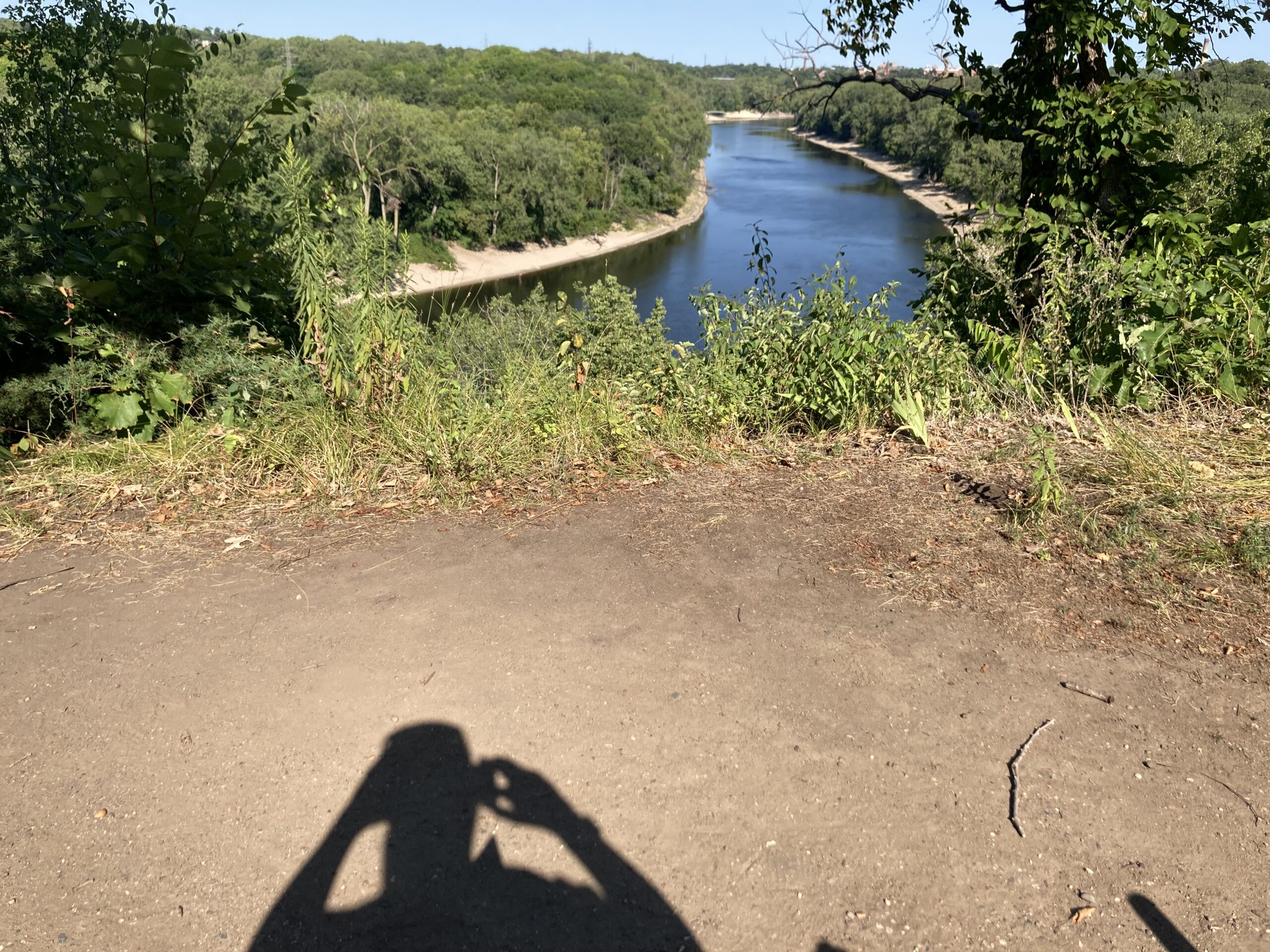
- rowers on the river! I could hear the coxswain barking out instructions at the start of my run
- minnehaha creek was so low, pt 1: near the duck bridge, there has hardly any water, but lots of green aquatic plants
- minnehaha creek was so low, pt 2: under the echo bridge, a huge sandbar (or, dirtbar?) in the middle of the creek
- a biker, biking slowly, and singing to herself, I am so tired
- minnehaha creek was so low, pt 3: mostly, the creek was quiet and still, with only the occasional whisper/babble
- running under the freeway, where the walking path is on the other side of the creek, I could hear something hissing and squeaking above me — bats?!
- thud thud –– the steady feet of a fast runner behind me, then beside me, then in front of me, then gone
- thwack thwack thwack pickle balls being hit hard on the pickle ball court near lake nokomis
- the strong gust of water coming out of the water bottle refill fountain — nice!
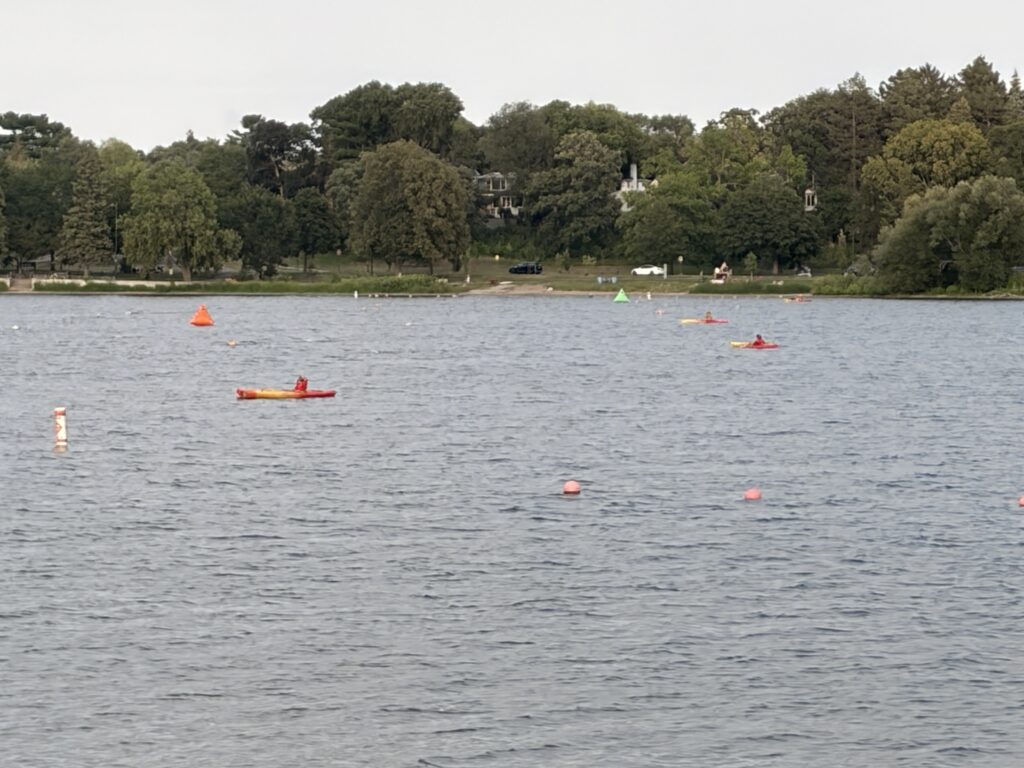
- reaching lake harriet to an empty beach with inviting water — I briefly thought about cooling off for a few minutes, but decided against it — too much sand in my shoes on the run back!
- lake harriet trails were crowded — lots of runners and bikers and walkers (and talkers!)
- a BIG peloton (30 or more riders) on the road
- mostly cloudy, every so often, sun
- orang spray paint, painted in zigzags over cracks and craters and bumps on the path that need to be fixed — there was a lot of it near the Rosie and Fletcher bridges
- people packing up after a church service at the falls
- one roller blader spotted near the beginning — I can’t remember if I heard their poles clicking, I just remember that they passed me on the trail
For the first 12 miles of the run, I listened to the world around me: hissing bats, rushing cars, a crying baby, laughter from kids somewhere beyond what I could see; moving water. For the last 4 miles, I put in my “Hello, Goodbye” playlist.
During the first few miles, I thought about part of a poem I’m working on. It begins with a quote from a PBS video about echolocation:
There’s sound and
there’s a lack
of sound, and
a lack of
sound still makes
noise. We call
it a sound
shadow.
As I ran, I thought about this pair sound/lack of sound and other pairs I encounter at the gorge, like space/lack of space, or ground/lack of ground (gap/gorge). Sound shadows are also called acoustic shadows. I looked them up and found an article about bats, accoustic shadows, and echolocation: Acoustic shadows help gleaning bats find prey
“We propose that bats perceive a change in depth profile and an ‘acoustic shadow’ cast by prey. The shadow is more salient than prey echoes and particularly strong on smooth surfaces.” Wow, I’m just thinking about how there are echoes, and there are acoustic shadows, but I’m still not sure I understand acoustic shadows.
Here’s the wikipedia definition:
“An acoustic shadow or sound shadow is an area through which sound waves fail to propagate, due to topographical obstructions or disruption of the waves via phenomena such as wind currents, buildings, or sound barriers” (source).
The deeper I dig into this, the more I think it is for a future project that explores echolocation more broadly.
Found this poem in the July/August issue of Poetry:
Not the Almost-Right Word / Jack Kirby
For Jack Gilbert
A friend tells me he was holding
his mother’s hand as she lay dying.
At the end, her final words were,
“I’ll find Dad and tell him you said hello.”
“Find,” she said. Not “I’ll see him”
or “we’ll be together again”
but “I’ll find Dad.” How astonishing
that language almost means
then frightens us when it doesn’t—
love, we say, God, we write,
and the words fall short. We dream
of lost vocabularies, and from nowhere,
a word is worth a thousand pictures.
What you say doesn’t have to be true.
It only has to be imaginable.
Where is my friend’s father?
In the kitchen of that big house making coffee, say,
or sorting nails in the workshop.
Or in the yard, unlearning
the constellations so he can see the stars.
Notes:
This poem includes lines from Jack Gilbert’s “The Forgotten Dialect of the Heart” and “Tear It Down.”
—
I like this idea of putting in two lines from these Gilbert poems for a few reasons: he doesn’t italicize which lines and it’s an invitation to find and read 2 more poems and put them into conversation with his poem. I want to try this out for my poems — the ones I’ve already written using others’ lines + the ones I’d like to write using those lines.
the bells: another meaning: the bell announcing the final lap of a track race
One of my favorite runners said the following in an interview after winning UTMB’s OCC (50k) race this past week:
The most played out race strategy of all time in the 1500. It’s like the bell rings and everybody goes with 400 to go.
I’m like this is such a predictable strategy. Everyone knows this is going to happen. But it’s kind of like what happened yesterday where it’s like something about crossing over that bridge and hitting the town and that’s like the bell ringing and something changes and your adrenaline spikes and you can actually like will the last bit of yourself.
Lauren Gregory
I wanted to archive this quotation as another meaning for bells. And here’s what she’s talking about in the race: