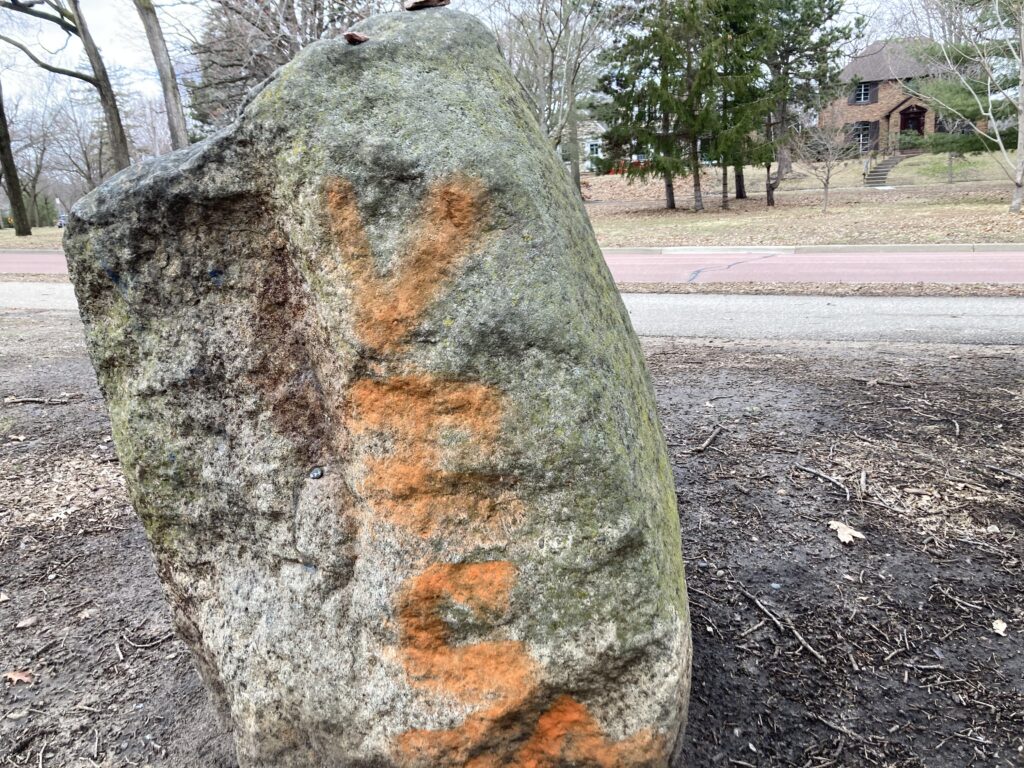
march 26/RUNWALK

5.25 miles
bottom of franklin and back
46 degrees

More excellent running weather. Sunny and calm and warm(er). Birds singing and swooping and perching on tree branches right in front of me. I felt relaxed and strong and my back only hurt once, when I stood up after re-tying my shoe. I ran without stopping to walk to the bottom of the hill and right next to the river. It was swirling foam on the edges. Ran back up to under the franklin bridge then stopped to walk the rest of the hill. I noticed a sign — Trail closed starting March 31st — uh oh. Just looked it up; it’s only for 2 weeks:

Bike and walk trails along West River Parkway will close between the I-94 Bridge and Franklin Avenue for up to two weeks beginning Monday, March 31, 2025.

The closure is necessary for contractors hired by the Minnesota Department of Transportation to install a safe span system that will protect trail users during repairs to the bridge this year.

Trail users will be detoured to the upper West River Parkway roadway between the I-94 Bridge and Franklin Avenue. This same closure will be repeated in August so that workers can remove the safe span system after repairs are complete.

Listened to a mood playlist: energy for the rest of the run. The best (or worst?) song on the playlist was “Hocus Pocus” by Focus. I love the song, but it was too fast to try and run to!I had to increase my cadence to 200 bpm to match it! The song also does not have a steady rhythm; it just keeps getting faster and faster, probably because they were on cocaine while they recorded it.

10 Things

  1. the water was a brownish greenish blue
  2. in the flats I leaned over the ledge and watched the swirling foam slowly travel down stream
  3. workers on the road above the tunnel of trees, doing something to sewer which released a sour smell
  4. the workers were wearing bright yellow vests
  5. passed a walker who refused to move over — they were walking right next to the line. I suddenly wondered, are they neuro-divergent? then, maybe I should chill out about people needing to follow the accepted rules about where and how to walk on the trail
  6. stopped at the sliding bench, 1: heard a cardinal — it was somewhere nearby — looked up and saw that it was on a branch close to me. Was it red? I couldn’t tell, but I did noticed how its tail quivered slightly all the time — I’m assuming it was keeping its balance. Do birds have to constantly adjust while perched?
  7. stopped by the sliding bench, 2: looking down at the white sands beach, hoping for movement. Yes, there, deep in — a walker moving through the trees
  8. the small shadow of a bird crossing my path, flying fast!
  9. my sharp shadow in front of me, crossing over the softer shadows of tree branches
  10. the shadow of a tree with dead leaves on it — looking almost like a messed-up pom pom

At the end of the run, as I was walking home, I had a thought about CA Conrad’s and their idea of the “extreme present,” which I wrote about on here earlier this month on march 5th:

“extreme present” where the many facets of what is around me wherever I am can come together through a sharper lens.

intro to ecodeviance / CA Conrad

Conrad creates their soma(tic) rituals to make being anything but present is nearly impossible. Running by the gorge can put/force me into the extreme present. This sense of the extreme present doesn’t happen for the entire run, but I can achieve it in moments. In their lengthy, day-long rituals — wear a red wig, eat only red food — is Conrad able to achieve this extreme present for longer?

birdsong!

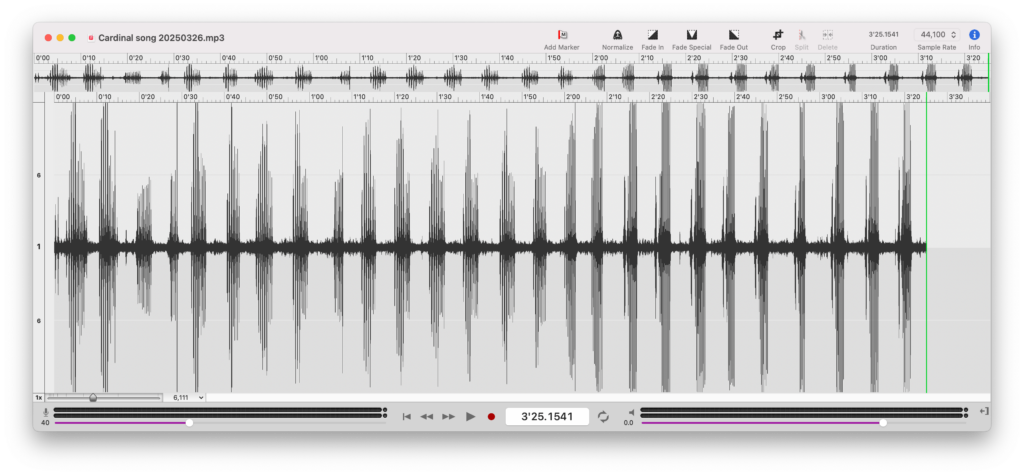
This morning Scott heard the cardinals outside his window and because he wanted to use some birdsong in his latest music project, he placed his phone on a chair on the deck and recorded some. I liked how he described it: I left the phone out on the deck then returned inside and went quietly about my business. When he told me about how similar each wave of sound looked, I asked if he could screen shot it and send me the sound file so I could post it here:

cardinal song, an image of sound waves
cardinal song / 26 march 2025

Wow! So uniform.

Happy 151st Birthday Robert Frost!

When the poem of the day on poetry foundation was a Robert Frost one, I figured it must be his birthday. Yep — 26 march 1874.

For Once, Then Something/ Robert Frost

Always wrong to the light, so never seeing
Deeper down in the well than where the water
Gives me back in a shining surface picture
Me myself in the summer heaven godlike
Looking out of a wreath of fern and cloud puffs.
Once, when trying with chin against a well-curb,
I discerned, as I thought, beyond the picture,
Through the picture, a something white, uncertain,
Something more of the depths—and then I lost it.
Water came to rebuke the too clear water.
One drop fell from a fern, and lo, a ripple
Shook whatever it was lay there at bottom,
Blurred it, blotted it out. What was that whiteness?
Truth? A pebble of quartz? For once, then, something.

A beautiful sonnet — 14 lines, 11 beats per line, almost iambic pentameter. Is that right? I always struggle to hear meter properly.

Love the description of a reflection: Me myself in the summer heaven godlike/Looking out of a wreath of fern and cloud puffs

And that something white, uncertain, seen briefly then lost to a ripple. Yesterday I posted some lyrics from “The Windmills of Your Mind” about the ripples from a pebble. Ripple is a great word.

Seeing this sonnet is making me think I should try that form for my color poems. I could study a few different ways of doing the sonnet — Diane Seuss, Terence Hayes, William Shakespeare. Any others?

oh orchid o’clock

A good morning on the poetry sites. Not only did I find Robert Frost’s poem, but I found a cool collection that fits in with my study of time: Oh Orchid O’Clock by Endi Bogue Hartigan. (note: I just emailed Moon Palace Books about ordering it! update: I ordered it!)

/it is the president’s turned up o’clock it is America’s deadliness and dailiness

o’clock / it is glued to the headline o’clock

it is lunchhour-beeline o’clock / it is it’s only Tuesday o’clock another

curbside memorial o’clock another caterpillar miracle o’clock another

people emptying from their lives o’clock or into

their lives o’clock the Nile floods the Nile floods every hotspell in this week

I discovered this book through poems.com, which had one of its poems posted today:

hour entry: I fall asleep with a rain sound/ Endi Bogue Hartigan

I fall asleep with the rain sound app of my cellphone, the app includes distant thunderclap sounds and there are people who recorded or simulated these sounds, and it is time to disagree and thank the dawn. I disagree with this rain, I feel absurd for thesimulation of it and yet my brain waves have come to depend on it, depend onsimulated porous points between the raindrops. Always the porous dream, always theneural authority, the reaction meme, always the authority of always, the puncture ofalways, time spent saying always, the spider legs of always, the sleep command, thewake spindles, the spider leg threatening to break from the spider.

So cool! Encountering Hartigan’s work, I was inspired to think about time in relation to my blind spot and the practice of running beside the gorge that has happened beside (and because of?) my vision loss. I wrote the following in my Plague Notebook:

my blind spot
breaks open seconds
pries apart the hard edges of
a beat invites me
to dwell inside

I am suspended between
beats as time slows
but never stops
with moves so slight it takes
a practiced eye to see
their soft shimmering
embrace what is not seen but felt —
wind
the rotation of the earth
a bench sliding into the gorge
rock crumbling
cone cells collapsing
a blind spot expanding

walk: 40 minutes
neighborhood / winchell trail / oak savanna
54 degrees

What a great afternoon walk with Delia the dog! No coat. No mud. Walked to the Winchell Trail then down beside the chain link fence. Drip Drip Drip — the sewer pipe in the ravine. Everything washed out — light brown, tan, yellowed. Up on the mesa in the savanna, a great view of the river. Was able to walk on the dirt path between the savanna and the 38th street stairs. They’ve put down some mulch, so it’s not as muddy. As I neared the entrance to the Winchell Trail, I passed the spot where I fell in the mud, straight on my tailbone. No mud now, only memories and a still-sore back.

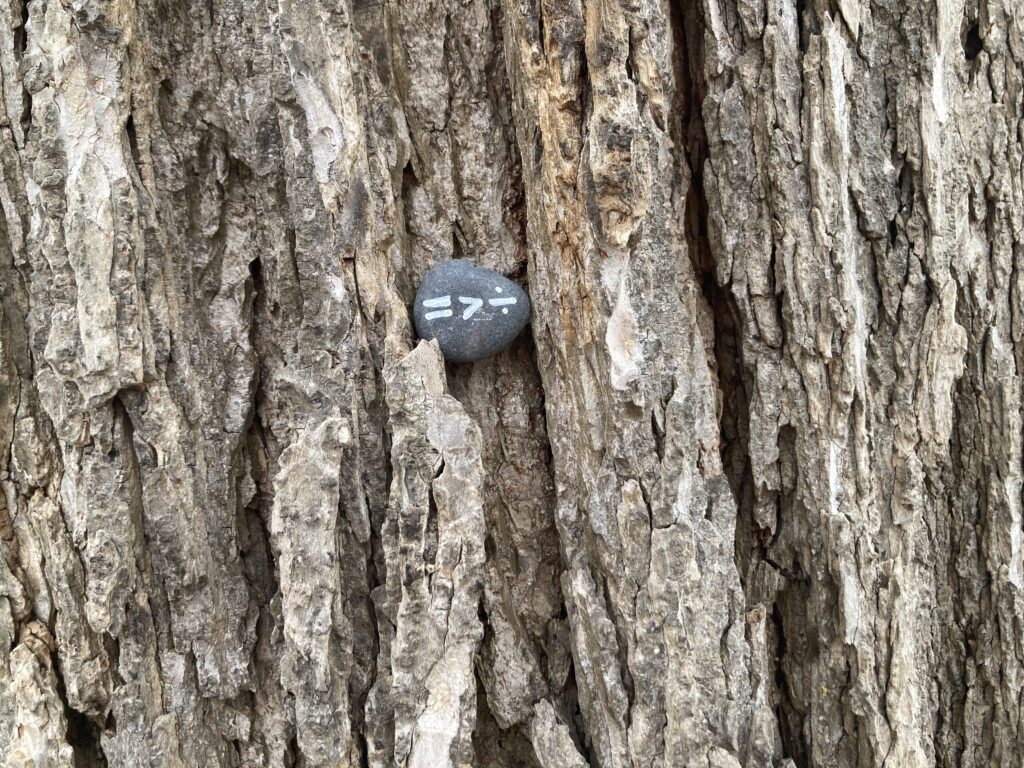
On the way to the river, I noticed something interesting hidden on the tree trunk while Delia sniffed around. I took a picture of it:

= > ÷

When I was looking at it in person, I thought someone had carved the message in the tree, but studying it now, it looks like it’s a rock wedged in a crack. I probably should have taken another picture that wasn’t quite as close-up for scale. That is one tiny rock.

I had to look up how to type the division sign on a mac. Hold down option and /

march 25/RUN

4.5 miles
minnehaha falls and back
39 degrees

It felt much warmer than 39. Another great late morning for a run. My back seems to be getting better. Still sore, but not when I’m running. Felt compelled to walk a few more times than usual, but otherwise a good run.

10 Things

  1. a small bird’s shadow crossing the path
  2. a glimpse of silver, then the outline of a metal cart, a fold-up canvas chai with someone sitting in it, facing the river, the radio
  3. below the edge of the world: a steep trail tight against the bluff, going somewhere under the trail and over to the jagged ledges of a ravine
  4. drip drip drip the sewer pipe near the curved retaining wall dripping water
  5. empty benches
  6. hollowed out trunks on the Winchell Trail — empty circles
  7. a person climbing up the steep slope below the winchell trail on the other side of wrought iron fence
  8. the falls: white foam
  9. the edges of the river, slabs of ice/snow then sparkle
  10. the crooked shadows on the paved path, near the edge, cast by sections of a leaning wooden fence

Created another time playlist, this one all about loops and seasons and time as a circle called “The Wheeling Life.” Favorite song to listen to today: “Windmills of Your Mind”/ Mel Torm´e, which is inspired by hearing it in the season finale of Severance.

Like a tunnel that you follow
To a tunnel of it’s own
Down a hollow to a cavern
Where the sun has never shone
Like a door that keeps revolving
In a half-forgotten dream
Or the ripples from a pebble
Someone tosses in a stream

march 24/RUN

4 miles
river road, north/south
32 degrees

A beautiful morning for a run! Wind in my face as I ran north, at my back heading south. Bright sun, sharp shadows, deep blue almost purple river. Raced a wind whirled leaf and won. Greeted Dave, the Daily Walker. Heard voices down in the gorge. Noticed ice on the edges of white sands beach. Thanked a man for stopping to let me run past and he kindly replied, you’re welcome miss. He was listening to music without headphones and carrying a bag of something — groceries? More than one of the benches was occupied. Encountered runners and walkers, a biker and a roller skier. In the last mile, I zoomed past someone running down the hill and under the lake street bridge.

I did my beats experiment again today.

mile 1: triples — open door / open door/ go inside / go inside / go outside / go outside / hello friend / hello friend / old oak tree / strawberry / opening / up the hill / on my toes / forest floor

mile 2: started with the metronome set to 180 bpm, but that was too fast. Locked in with 175. By the end of the mile I barely felt my feet strike the ground, only heard the beat — I had made it inside of the beat!

mile 3-4: doin’ time playlist. The first song was “Time Stand Still“/ Rush. The first line: “I turn my back to the wind” I heard this as I was running with the wind at my back.

Freeze this moment
A little bit longer
Make each sensation
A little bit stronger

I thought about freezing the moment and the difference between stopping time and suspending (or being suspend in) it.

a few hours later: I’m reading the book, American Spy, and I just came across this bit about looking people in the eyes:

At Quantico they’d taught us the so-called classic signals that some one was lying: if they glanced up to the right before they speak, or if they won’t look you in the eye.

American Spy/ Lauren Wilkinson

My immediate reaction: that’s how I look at a person’s face. I try to find the approximate location of their eyes by looking off to the side, near their shoulder — this is me looking at them through my good, peripheral vision. Then I stare into the spot, which is usually fuzzy nothingness to me. Does that mean I’m always lying? Of course not.

I was pleased that this discussion continued:

None of what I’d learned worked as well as listening to my instincts. I’ve always been good at ferreting out decption. I’m not entirely sure what my ability to detect a liar is based on–subtle cues maybe, suconscious awarenss, an intuitive talent for reading microexpressions. I don’t know and I’ve found that the more I try to understand it the less effective I am.

Right. As Georgina Kleege suggests in Sight Unseen, looking someone in the eye doesn’t have this magic power that many (most?) people seem to think it does.

march 21/RUN

3.35 miles
trestle turn around
43 degrees

Wow, what a morning! Birds! Sun! Calm air! Everything quiet, relaxed. I felt fast and free. less tightness in my neck and hip. Greeted the Welcoming Oaks and Dave, the Daily Walker.

10 Things

  1. a runner with BRIGHT orange shoes
  2. a shining white form in the distance, through the trees: the river
  3. the strong smell of weed somewhere below me
  4. stopping at the sliding bench — movement below, in the trees just before white sands beach: a runner on the winchell trail — should I try that?
  5. the soft knocking of a woodpecker in a nearby tree
  6. stepping off onto the dirt trail for a brief stretch: soft and springy
  7. someone sitting on a bench near the trestle
  8. the river: open and blue
  9. a big branch sticking out of the trashcan — a discarded walking stick?
  10. 3? stones stacked on the ancient boulder

I decided to try an experiment with beats.

First mile: chanting in triples
Second mile: metronome at 170 bpm
Third mile: “Doin’ Time” playlist

mile 1: strawberry/blueberry/raspberry — (to the welcoming oaks) Hello friend! Hello friend! Hello friend!/ old oak tree / stacking stones / stack the stones / intellect / mystery / (noticing a crack in the asphalt) breaking up / cracking up / bright yellow / woodpecker

I found that bright yellow was especially good for locking into a rhythm — BRIGHT yellow

mile 2: 170 was hard. I think it was too slow. I probably should have tried 175 or 180. I think I’ve done 175 before. I only locked into this beat a few times. Was my inability to lock in also because I started with triples?

mile 3: I put in my playlist. The first song was “About Damn Time” by Lizzo. It was great for getting into a groove. Next up, “9 to 5.” As I started to listen to it, I realized the metronome was still on and the beats of the song and it didn’t match up. I decided to leave it going and see what happens when I’m dealing with competing rhythms. I can’t quite remember, but I feel like I didn’t lock into either rhythm; I just created my own, and it didn’t bother/unsettle me.

Later I thought about how the “9 to 5” rhythm represents the relentless drudgery of working within capitalism. Resisting that rhythm, and what it does to you, is important. The final song I heard was “Too Much Time on My Hands” by Styx. I listened to the lyrics and was reminded that it was about a guy who wants a job, a way to feel useful, something to do, but he can’t get one. While he doesn’t mention in the lyrics why he can’t get a job, I thought of the larger context and the conditions (economic, political, social/cultural) that make it difficult for people/communities to find work.

Reading the lyrics — without hearing the music or singing — I was struck by this line:

And I don’t know what to do with myself

So dark. Heard with the music it just seems like a light lyric from a pop song.

This was a fun experiment that yielded some surprising results. I liked the accident of the competing rhythms and the juxtaposition of 9 to 5 with Too Much Time on My Hands. For future attempts, I’ll increase the metronome speed and mix up the order. Maybe I should try to write something, too, at the end of each segment? Speak a poem into my phone?

march 19/RUN

4.25 miles
minnehaha falls and back
38 degrees
wind: 18 mph / 37 mph gusts

Ran south and had the wind at my back for the first half, which was nice but it meant that I’d be running straight into it on the home. Not as difficult as I thought, but still draining. Wore the bright yellow shoes I bought last year and promised myself I’d never wear again because they make my feet hurt and calves cramp. They’ve been sitting in the rack all year, and looked so spring-y today that I couldn’t resist trying them again. Will I regret it? Probably. I should donate them instead of trying to make them happen.

10 Things

  1. little kid voices somewhere down in the savanna
  2. empty benches
  3. something glittering through the trees, up ahead — car headlights through the trees at the bend in the road
  4. a faster runner in a white shirt off to the side, heading down to the Winchell Trail — I followed above, watching as they slowly inched out of sight
  5. I don’t remember hearing the falls, just seeing them at a distance, from my favorite spot — white foam, moving rapidly at the corner of my central vision
  6. pale blue water, soft brown trees
  7. dead leaves on the ground — feeling orange to me
  8. the bluff on the other side was mostly brown with a few slashes of white — frozen seeps
  9. branches rubbing and creaking in the wind, sounding less like rusty door hinges and more like whimpering kids: soft, insistent, whiny
  10. running on the winchell trail, about to head up the 38th steps, I looked back and thought I saw someone approaching — nope, just the wrought iron fence

before the run: my blind spot

Yesterday, I read an interview with JJJJJerome Ellis and was inspired by their renaming of their Stutter as clearing:

Ellis’s glottal block stutter—which manifests as intervals of silence in his speech flow—is represented in this interview with the word clearing. Ellis offers this term as an alternative to words like stutter or stammer. Like a clearing in a forest, the stutter, for Ellis, can open a space of gathering between Ellis and the people he is communicating with.

Angel Bat Dawid and JJJJJerome Ellis

After a little digging, I found out more about the clearing and how it works for Ellis in their work:

Stuttering (especially in the form I present with, the glottal block) creates unpredictable, silent gaps in speech. I call these gaps ‘clearings’. Slaves sang in the fields, and whites heard them; but they also sang (and danced) in the woods at night, out of earshot. Undergirding the clearing created by my stutter is that other clearing, in the woods, where my enslaved ancestors stole away to keep healing, resisting and liberating through music – work that I continue today.

The Clearing/ JJJJJerome Ellis

Wow! What an amazing way to think about the stutter. In their follow-up book, the one that introduced me to Ellis, Aster of Ceremonies, they connect the Stutter explicitly with plants and place. I want to connect my blind spot — that growing lack of functioning cone cells in my macula — with water and stone and the gorge. As I try to explain this more, I have so many thoughts, too many words!

Just looked up blind spot and found these exciting definitions:

an area in which one fails to exercise judgment or discrimination

Merriam-Webster online

In this definition, a lack of judgment is a failure. And it is sometimes. But refusing to judge, keeping a space open for listening and beholding and bearing witness without judgment or the reduction of someone or something to a category (discrimination) is also essential.

Another helpful definition:

a portion of a field that cannot be seen or inspected with available equipment

Merriam-Webster online

during the run: my blind spot

I thought about my blind spot every so often as I ran, especially the idea of how it softens and fuzzes my vision. It’s difficult to see with precision, to scrutinize or make detailed observations that encourage me to identify and classify things. As a result, I devote less time to trying to name them, and more time to being with them. Here I’m thinking of Robin Wall Kimmerer and J. Drew Lanham.

I’m sure I had more thoughts, but I didn’t record them. If I had, would I even be able to hear them over the howling wind in any recording I would make today?

after the run: my blind spot

A space without judgment. Back when I was a scholar and teaching queer ethics, I was exploring what an ethics without judgement might look like, one that emphasized room to breathe and, as Judith Butler puts it, good air. I often invoked a quotation from Michel Foucault:

I can’t help but dream about a kind of criticism that would try not to judge but to bring an oeuvre, a book, a sentence, an idea to life; it would light fires, watch the grass grow, listen to the wind, and catch the sea foam in the breeze and scatter it. It would multiply not judgments but signs of existence; it would summon them, drag them from their sleep.

The Masked Philosopher/ Michel Foucault

A few days ago, I read something else about not judging from Cole Swensen:

. . . an instance of witness, with witness defined as the act of being present to something, whether it’s an event, a situation, a person, a view. To be present to is to present yourself, to offer yourself, to attend without judgment, opinion, intervention, appropriation or even evaluation, and yet to be present to is not to be passive; it is an act, the act of anchoring the witnessed in history, confirming it, acting as the “second” that fixes it . . . . It is the ear that turns the falling tree to sound.

Walk/ Cole Swensen

Witnessing, being with, beholding. The gorge — a widening gap, a broad space where fires are lit, the grass grows, the wind howls, and river foam scatters. A generous place for holding all of the messy, entangled, conflicting, complicated stories of a place: of preserving and maintaining it, of stealing it, of losing it, of dead mothers who disowned it, of daughters who are attempting to reclaim it, of erosion and transformation and haunting, of a girl losing her central vision and searching for somewhere to be — to feel less alienation and more connection. There’s a lot here!

For the first half of the run, I listened to kids’ voices, for the second half, my “Doin’ Time” playlist. Speaking of time, here’s something great I read by Hanif Abdurraqib about nostalgia:

Another question I was asked about There’s Always This Year was about the use of nostalgia in my work, and the function of it, and I had this long answer I was going to give, but I look back on recent moments, and I realize that a major function of my relationship with nostalgia is actually tied to a committed and principled relationship with my present life. I am in pursuit, often, of a moment I will live and miss before it’s even gone. And the awareness of the longing to come offers me an opportunity to slow down time, to pay closer attention, to say I know something will end, but I would like a vivid catalog of its existence. My favorite Robert Hayden poem is “Double Feature,” which opens its final stanza with “Oh how we cheered to see the good we were / destroy the bad we’d never be.” I love that line. There’s a lot of bad to dismantle, and only some of it is housed within. The world houses the rest, and it is abundant. I require whatever good I can steal and then hoard. It fuels me to the fight(s,) which isn’t the same as a kind of whimsical nostalgia, but it is me saying that I remember there are things I love enough to fight for, even when it doesn’t feel like it. There are things I miss that I haven’t even experienced yet, and I want to get to them, eventually. And then get to what’s next.

instagram post

added later: I want to add these thoughts from an Alice Oswald interview about erosion here, too:

DN: I wanted to switch to another topic that infuses your work, and that is the process of erosion—erosion by water, erosion by wind, erosion by light—the topic of your first Oxford lecture but also, something that feels very present to Nobody. You said in one interview that the anonymity you were striving after for this book was inspired by eroded Cycladic sculptures, sculptures where the features had been nearly washed away. I was hoping you could talk about erosion in relationship to this and to the text.

AO: I suppose that comes back to your question about thinking. The poem conveys a kind of eroded thinking. It’s as if the thoughts have had reality washing away at them; a sentence sets out then gets blown in another direction. Erosion is important to me in that I think poetry has a particular duty and relationship towards time. Poems are miniature human clots I think, they’re full of time keeping in the way that a piece of music is full of timekeeping. In some way, they set their own time but they need to be awake to actual time moving around them. A poem has to offer itself up to the erosion that’s going on in the world. Nobody, more than any of my poems, I think gives in completely to that force of erosion where I would normally try to maintain some human presence in the face of it. I think Nobody allows itself to get weathered to a Cycladic blankness.

This idea of a poem offering itself up to erosion and to being within time, reminds me of something I heard from Jenny Odell the other day in “Another Kind of Time.” She’s talking about how being part of time, having a past, present, and future — and not just being timeless — makes something/someone a subject/actor instead of thing to be commodified/exploited. To be timeless/without time is to lack a context and a life. I’m also thinking about how preventing erosion often requires a sealing up and away from oxygen, water, wind. Erosion and decay are a necessary part of life.

DN: This talk of erosion and time makes me think of that famous Marguerite Yourcenar essay, That Mighty Sculptor, Time. I’m just going to read a couple of lines from it, “On the day when a statue is finished, its life, in a certain sense, begins. The first phase, in which it has been brought, by means of the sculptor’s efforts, out of the block of stone into human shape, is over; a second phase, stretching across the course of centuries, through alternations of adoration, admiration, love, hatred, and indifference, and successive degrees of erosion and attrition, will bit by bit return it to the state of unformed mineral mass out of which its sculptor had taken it.” I was thinking of this when I encountered your interview with Claire Armitstead where you said you think of your poems less as poems than as sound carvings which made me think that the sound these poems were making is eating away at something which then by extension suggests that both the blank page and silence are not really absences in this framing at all but presences.

AO: Yeah, I like that. I’ve always felt that in some way, a poem is really a framing of its silences, that the musical art poetry is all about leading you to those silences in a way that you hear them where normally one doesn’t necessarily hear a silence or an absence, both the sound is eating away that silence but then also, the sounds are, in their own way, erosions made so I let my voice get blown around by the information it’s taken in if you like. The feeling of not quite holding your own. . . .

DN: Let me ask you something about Homer’s syntax that you’ve said in light of sound carvings being a description of your poems. You said about Homer’s syntax, “The tendency of his grammar is therefore cumulative, like a cairn. Each clause is a separable unit. It might be placed loosely on another and held there with a quick connective, but it never loses its essential singleness; which is why you often find that one end of his sentence turns away from the other.” On the one hand, this feels like a process of accretion rather than erosion, an accumulation, but the singleness and the separateness of each component, and that each is surrounded by silence of the white page made me wonder if perhaps, this accumulation is the product of erosion like I imagine the scree that builds at the at the bottom of a cliffside of all the piles of rocks that are single but also part of this erosive process.

I love erosion: I like the way that the death of one thing is the beginning of something else (source).

march 17/RUN

4.25 miles
locks and dam no.1 hill and back
50 degrees
wind: 13 mph/ 25 mph gusts

Warmer, windier. Ran straight into it heading south towards the falls. It didn’t howl or swirl the leaves but once it almost took off my hat. And it pushed against me, making it harder to run. I didn’t mind. At the start of the run, I felt a little stiff — especially my neck — but by the halfway point I had loosened up.

I noticed the river several times: Sometimes it was silver sparkle, other times tin or pewter, and it was ridged or scaled from the wind. I decided to run down the hill at the locks and dam no. 1 to get closer to the water. Inspired by AO’s Dart (see below), I wanted to hear the trails of scales and the bells just a level under listening. Did it sound like anything? If it did, the sounds were forgotten as I turned around and climbed the hill. A few steps in I stopped to take in the wide blue view of the river from this angle. It took up almost all of my sight: blue undulations

11 Things

  1. the long shadow of a slender tree cast across the part of the path that dips below the road
  2. an orange sweatshirt on a walker emerging from the winchell trail
  3. squaring my shoulders and running into a stiff wind
  4. 2 people under the ford bridge near the locks and dam no. 1, about to climb up somewhere
  5. the bright white base of the locks and dam no. 1 sign — they must use reflective paint
  6. the benches above the edge of the world and near folwell were empty
  7. the low hum of playing kids on the school playground
  8. the flat top of a recently made stump: orange
  9. a white patch in the river near the shore — was it a chunk of ice? a sandbar?
  10. a tailwind as I returned north — not feeling the wind but its absence and that everything was easier
  11. added a few hours later: a creaking above from one tree branch rubbing another in the wind

Listened to leaves shimmering in the trees as I ran south, my “Doin’ Time” playlist as I ran back north. Most memorable song, “Once in a Lifetime”:

Same as it ever was, same as it ever was

Water dissolving and water removing
There is water at the bottom of the ocean
Under the water, carry the water
Remove the water from the bottom of the ocean
Water dissolving and water removing

Letting the days go by, let the water hold me down
Letting the days go by, water flowing underground
Into the blue again, into the silent water
Under the rocks and stones, there is water underground

I never realized before how much water is used in this song. Very cool! The same as it ever was is an interesting contrast to what I was reading earlier this morning: Heraclitus and his idea of never stepping into the same river twice — see 17 march 2023

possible lines to recite/chant

Rereading my 17 march 2022 entry, I encountered these wonderful lines from Dart about how the river sounds:

will you swim down and attend to this foundry for
sounds

this jabber of pidgin-river
drilling these rhythmic cells and trails of scales,
will you translate for me blunt blink glint.

the way I talk in my many-headed turbulence
among these modulations, this nimbus of words kept in
motion
sing-calling something definitely human,

will somebody sing this riffle perfectly as the invisible
river
sings it

can you hear them at all,
muted and plucked,
muttering something that can only be expressed as
hitting a series of small bells just under the level of your
listening?

The bells!

High Above on the Ford Bridge Looking Down at the River

O, can you hear them
at all, these riffle-
perfect rhythmic cells
and trails of scales, plucked,
muted, muttering
below — a string of
small bells just under
the level of your
listening?

on moving — Alice Oswald and Cole Swensen

More words rediscovered while reading past entries in my “On This Day” practice:

I found this great quote from Oswald in her introduction to the poetry anthology, The Thunder Mutters: 101 Poems for the Planet:

Raking, like any outdoor work, is a more mobile, more many-sided way of knowing a place than looking. When you rake leaves for a couple of hours, you can hear right into the non-human world, it’s as if you and the trees had found a meeting point in the sound of the rake. (ix)

Mobile and many-sided, more than looking from a distance.

From Cole Swensen:

Then sitting still, we occupy a place; when moving through it, we displace place, putting it into motion and creating a symbiotic kinetic event in which place moves through us as well. 

Walk/ Cole Swensen

march 15/RUN

4.1 miles
river road north/south
38 degrees / humidity: 84%

Colder today. Back to winter layers: long-sleeved green shirt, orange sweatshirt, black vest, black tights, gray buff, black gloves, purple/pink baseball cap, bright pink headband

A gray sky and a slight drizzle. Bright headlights through the trees where the road curves. Grit. Wet leaves on the trail. Pairs of fast runners approaching.

Listened to other runners’ voices, the sandy grit under my feet, car wheels as I ran north, put in my “Doin’ Time” playlist heading south, including Good Times by Chic. My favorite lines:

I want to live the sporty life

and

Clams on the half shell, and roller skates, roller skates — here’s the full verse:

A rumor has it that it’s getting late
Time marches on, just can’t wait
The clock keeps turning, why hesitate?
You silly fool; you can’t change your fate
Let’s cut the rug, a little jive and jitterbug
We want the best, we won’t settle for less
Don’t be a drag; participate
Clams on the half shell, and roller skates, roller skates

Good Times was released in June of 1979. The clam shells and roller skates line seems ridiculous (and it is, in a delightful way), but it also captures the vibe of 1979.

After seeing several orange things, I decided that would be my 10 things list. I could only remember 8.

8 Orange Things

  1. a giant orange water jug set up on a table for runners
  2. orange lichen (or moss?) on the north side of the ancient boulder
  3. orange bubble letter graffiti on the underside of the bridge
  4. my orange sweatshirt
  5. the flesh of a tree where a branch used to be, newly trimmed and exposed to the elements (water, air): rusty orange
  6. leaves on the ground: burnt orange
  7. an orange effort: a higher heart rate (see 25 may 2023)
  8. hot pink spray paint on the iron fence that I initially saw as orange

ceremony/ritual/circumambulation

A few things related to my planning of a loop run as ceremony:

first, something to chant, from James Schuyler’s Hymn to Life:

Press your face into the
Wet April chill: a life mask. Attune yourself to what is happening
Now, the little wet things

The whole thing, or maybe just the last bit, starting with “Attune yourself”? See also: 14 march 2024, 15 march 2024

Second, the bells! The bells of St. Thomas signaling the start of the ceremony, or the start of some part of the ceremony? Accompanied by:

Then Space – began to toll,

As all the Heavens are a Bell,
And Being, but an Ear,
And I, and silence, some strange Race,
Wrecked, solitary, here –

or

I was still ringing. I had been my whole life a bell, and never knew it until at that moment I was lifted and struck.

Pigrim at Tinker Creek/ Annie Dillard

converted into my 3/2 form:

My whole life
I’d been 
a bell but
never
knew until
I was
lifted and
struck. Now
I am still
ringing.

Third, form inspirations? A psalm, like Julia B. Levine’s Ordinary Psalms?

Megan Feifer: Both of your poems share the words “Ordinary Psalm.” Why did you choose to name these poems as such? Does a psalm lose its reverence when it becomes ordinary? Is that the point? 

Julia B. Levine: I am currently at work on a (hopefully) book-length collection of Ordinary Psalms. In these poems I am interested in the idea that the ordinary, if deeply lived and carefully attended to, are valid entryways into sacred or reverent experience. As a child I attended a Reform Jewish synagogue and always disliked the prayer books, though I loved the Torah. The difference, it seemed, had to do with the formal and vague language of prayer as contrasted with the heroic, vivid, and oftentimes earthy details of the weekly Torah readings. On reflection, this tonal difference in language may be the primary reason I don’t feel any sense of reverence toward an Old Testament God, but I do believe in the transcendent power of myth and stories. So, in contrast to psalms that rely on a formal address to an anthropomorphic God, I wanted to create a kind of personal prayer book that uses the living language of everyday details and experience to name and praise those aspects of this world that, for me, embody divinity.

Writer’s Insight: Julia B. Levine

JJJJJerome Ellis’ litany of names? Mary Oliver’s prayer as the attention before the words? lucille clifton’s praise of impossible things:

All Praises/ lucille clifton

Praise impossible things
Praise to hot ice
Praise flying fish
Whole numbers
Praise impossible things. 
Praise all creation
Praise the presence among us
of the unfenced is.

Oh, that unfenced is! That line gets me every time.

march 14/RUN

4.2 miles
minnehaha falls and back
63! degrees

Last night, I read this on Instagram from a local weather blog: Thursday feels like spring, Friday like summer, and snow on Saturday. What? Reading more, the snow should be north of us. Instead, we’ll get thunderstorms. That’s March (and April, and sometimes May) in Minnesota. This morning does feel like summer: warm. I wore shorts and a short-sleeved shirt and a light-weight sweatshirt. Halfway, the sweatshirt came off. The falls were gushing. I think I overheard some woman exclaim, How can there still be ice?! I didn’t look closely, but I imagine the one ice column beside the falling water is lingering.

Mostly I felt fine while I ran. My back didn’t hurt. Both of my hips are a little sore, but not like they’re injured sore. Almost like I’ve been doing too many core/hip exercises sore.

Listened to the birds and bikers and kids on the playground as I ran south. Put in my “Doin’ Time” playlist at the falls and as I ran north.

Playing for Time/ Peter Gabriel
What Time is It?/ Spin Doctors
Time of the Season/ Zombies

10 Things

  1. shadow 1: mine, beside me
  2. shadow 2: fence slats on the trail
  3. shadow 3: a flying bird
  4. a kid at the falls wearing a bright blue jacket with a logo on it that reminded me of a jacket I got from a race a few years ago. Did he run the race too?
  5. my favorite bench above the edge of the world was occupied by a person and a bike
  6. matching bright yellow shirts on 2 bikers biking up the hill between the double bridge and locks and dam no. 1
  7. running under the ford bridge, appreciating the cool, shaded air
  8. the river sparkling silver through the trees as I ran south, below the road
  9. the dirt trail on the boulevard, mostly mud
  10. stopped at the folwell bench to admire the river — all I remember is that it was open and blue

After I finished, I recited the Emily Dickinson poem I memorized yesterday: Crumbing is not an Instant’s Act. I remembered almost all of it, only struggling with this verse:

Ruin if formal — Devil’s work
????? and slow —
Failing in an instant, no man did
Falling Slipping — is Crashe’s law —

I couldn’t think if the right word for the second line. Sequenced? Ordered? Organized? No. It’s “Consecutive.” Of course!

I’ve liked this poem for a few years now, especially the second verse and “An Elemental Rust.” I decided to memorize it as I study time and think about its relationship to erosion (and to my vision).

lunar eclipse

Woke up around 1:30 and realized that there was a lunar eclipse. Got RJP (who was still up, natch) and we sat outside and watched it slowly happen. Well. at least 15 minutes of it. We didn’t have the patience to wait until it was completely covered. RJP and I always check out sunsets and the moon together. It’s one of our things. I am reminds me of a story I read years ago. Can I find it? Yes, but it took a long time. I had a title — October — but not the author or the journal. Lots of searching online and in my files and through my books. Nothing. More than an hour later sitting on the deck, the name Jill popped into my head. How? Why? I searched for “Jill essay October” and found it, except that wasn’t the right essay. This one was about her ex-husband and Texas and leaves; the one I remember was about her daughter and Texas and rain — but it had leaves (or leavings) in the title! Searched, “Jill essay daughter” and bingo! It’s funny how memory works.

Late last night, a surprise rain. My seventeen-year-old daughter and I rushed out to the deluge in bare feet, our T-shirts darkening with each drop. We raised our arms, spinning on the walkway and laughing until lightning seared the sky. I pointed to the tree’s thick arms, thinking about the way they stretch as if waving. We huddled under the light on the porch while rivers swelled against the curbs of the parking lot. When I told her we’ve been running into the rain since she was little, she grinned and nodded, her long blonde hair matted on her shoulders and against her neck.

*

It was there in Utah, when Indie was two and three and four, that I started the tradition: as soon as we hear rain, we throw open the door. During those first rains, I carried her. She was too young to know my sorrow, the way I waited for word from her father, the way I worried about my bank account every month. But when the rain came, all want and worry washed away. And then in the later rains, she beat me to the middle of the yard or the sidewalk or the walkway.

All Our Leavings/ Jill Talbot

march 2/RUN

5 miles
bottom of franklin hill
26 degrees

Hooray for being outside and on the walking trail! Hooray for not much wind! Hooray for running up the Franklin hill! My back was a little tight, but not too bad. My legs felt fine.

The river was open; the only ice was on the edges. The sky was a mix of clouds and bright sun. Before the run I heard some geese — did I hear any during? I don’t think so. Also heard before the run: some kids having fun inside a house — laughing and yelling through the closed windows.

At some point, I had an idea for my monthly challenge: the run as ceremony. Inspired by Ellis’s Aster of Ceremonies, I want to return to Gary Snyder, Mount Tamalpais, and circumambulation. What sort of ceremonies can I make out of my run that brings together my blind spot and the gorge?

10 Things

  1. bright pink graffiti on a foot of the 1-94 bridge
  2. the top of one section of the wooden fence on the edge above Longfellow Flats is missing
  3. the chain across the old stone steps has been removed
  4. the path was almost completely clear — the only bit of snow I recall seeing was under the lake street bridge: a low and narrow ridge — just remembered one other bit of snow: just past the franklin bridge
  5. a full-length mirror left by the trashcan
  6. disembodied voices — coming from inside houses, below in the gorge, far behind me on the trail
  7. sh sh sh — my feet striking the grit on the asphalt
  8. my shadow briefly appeared – not sharp but soft, faint
  9. at least 2 trios of runners, some pairs, several runners on their own
  10. my friend, the limestone slabs propped up and looking like a person sitting against the underside of Franklin, is still there. I’d like to name them and add them to my list of regulars: Lenny the limestone?

lower back pain

My lower back has been sore lately. Sore enough that I took 5 days off of running. Not sure why I’ve waiting this long, but i decided today to look up lower back stretches for runners. I found this video and its 4 helpful stretches — the video claims to have 5 stretches, but they are only 4. I wonder what the missing one was?

correction, 2026: All five stretches are there, there just isn’t a marker for the third one, a 90-90 stretch. That one starts at about 4 minutes in.

The stretches: pretzel, thread the needle, plank to lunge, hip sweep

I’ll see how it feels in a few hours, but right now, having just stretched, it feels good!

a purple spill from march 1

I wrote this yesterday, but didn’t have a chance to post it.

It’s March and the purple hour is over, but in true purple fashion, the color can’t be contained to one month. Always it oversteps its boundaries. Reading the poem of the day, “Fog” by Emma Lazarus, purple appeared:

Swift, snowy-breasted sandbirds twittering glance 
Through crystal air. On the horizon’s marge, 
                Like a huge purple wraith, 
                The dusky fog retreats.

wraith

1
a: the exact likeness of a living person seen usually just before death as an apparition

b: GHOST, SPECTER

2

an insubstantial form or semblance SHADOW

3

a barely visible gaseous or vaporous column

f you see your own double, you’re in trouble, at least if you believe old superstitions. The belief that a ghostly twin’s appearance portends death is one common to many cultures. In German folklore, such an apparition is called a Doppelgänger (literally, “double goer”); in Scottish lore, they are wraiths. The exact origin of the word wraith is misty, however, and etymologists can only trace it back to the early 16th century—in particular to a 1513 translation of Virgil’s Aeneid by Gavin Douglas (the Scotsman used wraith to name apparitions of both the dead and the living). In current English, wraith has taken on additional, less spooky, meanings; it now often suggests a shadowy—but not necessarily scary—lack of substance.

Merriam-Webster entry

marge = margin = edge

Wraith — I like that word and what it conjures. And to make it purple? Good job, Emma! I’m not sure about the middle section where she imagines the “orient town,” but I like “Fog,” especially this:

for on the rim of the globed world 
I seem to stand and stare at nothingness. 
                But songs of unseen birds 
                And tranquil roll of waves

Bring sweet assurance of continuous life 
Beyond this silvery cloud. Fantastic dreams, 
                Of tissue subtler still 
                Than the wreathed fog, arise,

And cheat my brain with airy vanishings 
And mystic glories of the world beyond. 

Returning to the purple — I like how she imagines the lifting fog as purple. Back in November of 2022 (how has it been that long?!) when I studied gray, I devoted a day to fog and mist: 23 nov 2022. Last month, purple — especially lavender and lilac or eggplant and dark purple — replaced gray. Where I used to see gray everywhere, now I see purple, or imagine purple.

feb 22/RUN

3.1 miles
ford bridge and back
23 degrees

Feels like spring today! Birds! Warm sun! Melting and dripping snow! It is supposed to warm up all next week. The path wasn’t that crowded, which is surprising because it’s so nice and it’s Saturday. I don’t remember much from my run, other than wondering if my back was hurting (occasionally, a little) or if I should stop to tie my shoelace (I did). Can I remember 10 things?

10 Things

  1. 3 or 4 fat bikes on the dirt trail that is on the other side of the river road and runs alongside Minnehaha Academy, lower campus and Becketwood
  2. a biker and a bike stopped at the bench across from Folwell
  3. the rounded shadow of the light part of a lamp post
  4. a thick layer of snow on the walking path between folwell and 42nd
  5. three runners ahead of me evenly spaced across the whole path
  6. my dark shadow ahead of me as I ran north
  7. the clanging of an unseen dog collar
  8. a walker talking loudly on her phone as she walked, her voice echoing through the neighborhood and then above the oak savanna
  9. a runner in a bright blue jacket turning onto the trail from 42nd
  10. the river, all white, all covered in snow

I listened to voices as I ran south, the mood: energy playlist on the way back north.

the purple hour

1:35 am / dining room

Listened to Monica Ong’s “Lavender Insomnia.

7:55 am / dining room

The poem of the day on Poetry Foundation is First Fig. Figs can be many different colors but are often associated with purple. Since I’ve posted this well-known poem about a candle burning at both ends before, I decided to find out if Millay had written any other fig poems.

Second Fig/ Edna St. Vincent Millay

SAFE upon the solid rock the ugly houses stand:
  Come and see my shining palace built upon the sand!

First Fig and Second Fig are from Millay’s 1922 collection, A Few Figs from Thistles. Is her use of figs and thistles a reference to Matthew in the Bible?

Ye shall know them by their fruits. Do men gather grapes of thorns, or figs of thistles? Even so every good tree bringeth forth good fruit; but a corrupt tree bringeth forth evil fruit.

Matthew 7:16-20 King James Version (KJV)

Speaking of thistles, my mom often had globe thistles in her garden. After she died, I recall wanting to grow them in her memory, but I can’t remember why. Is it because butterflies like their round purple flowers, or because I do?

feb 20/RUN

5.5 miles
bottom of franklin hill and back
9 degrees

Outside! Very bright today. A mix of moments of feeling great and feeling not so great — more feeling great. Foot prints in the snow, lamp post shadows, patches of brown ice. Black capped chickadees! A white river, a barren beach, a fat tire e-bike buzzing past me. A BLUE! sky — wow! Fogged up sunglasses. A delayed greeting: Hi Dave!

During mile 2, I chanted purples:

lavender / lavender / lavender
amethyst / amethyst / amethyst
indigo / indigo / indigo
grape
orchid / orchid / orchid
iris / iris / iris
wisteria

Thought about a blueberry looking more purple than blue, then the shade of purple: sucker. I like the word sucker — a candy, a fool, someone who sucks on something, a person on a straw, or something that sucks on something, a plunger on a toilet, an octopus on an arm.

Listened to the birds, the cars, and the gurgling sewer on the way north. Listened to an energy playlist — Don’t Stop Me Now, Work it, Sabotage — on the way back south.

the purple hour

12:45 am / dining room

restless, difficult to be still enough to type/think

(remembering, 7:05 am) looking out the kitchen window, seeing 2 dark forms in the white snow — bare patches or something more? Staring for a few mnutes — am I imagining that slight shift? No, 2 animals, standing still for minutes. What are they doing? Quick movement, then bounding figures. Rabbit-like. But these animals look so dark — is it a trick of the dim light — bunny fir darkened in the lilac light? [there is no indigo in a backyard illuminated by neighbor’s security lights.] Or, could these creatures be raccoons?

update, 20 feb 2026: A definite answer: bunnies! All late fall and winter, 2 or more bunnies have been hanging out under our crab apple tree — at night, in the afternoon, at sunrise and sunset. They’re very bold, these bunnies, not running off when I walk by. When this happens, I’ve started saying, these bunnies are as bold as brass! Why? Not sure. And, I don’t want you to get the wrong idea: I like bunnies or rabbits about as much as I like squirrels, which is not at all.

2:44 am

a word appears in my head: amethyst — February stone, quartz, ancient Greeks believed it would prevent intoxication

7:49 am / dining room

A journal: Amethyst Review

In a Robert Frost poem, October:

Release one leaf at break of day;
At noon release another leaf;
One from our trees, one far away.
Retard the sun with gentle mist;
Enchant the land with amethyst.
Slow, slow!
For the grapes’ sake, if they were all,
Whose leaves already are burnt with frost,
Whose clustered fruit must else be lost—
For the grapes’ sake along the wall.

A myth created in the 1500s about a nymph and Bacchus:

In his poem “L’Amethyste, ou les Amours de Bacchus et d’Amethyste” (Amethyst or the loves of Bacchus and Amethyste), the French poet Rémy Belleau (1528–1577) invented a myth in which Bacchus, the god of intoxication, of wine, and grapes was pursuing a maiden named Amethyste, who refused his affections. Amethyste prayed to the gods to remain chaste, a prayer which the chaste goddess Dianaanswered, transforming her into a white stone. Humbled by Amethyste’s desire to remain chaste, Bacchus poured wine over the stone as an offering, dyeing the crystals purple.

wikipedia

A cluster of grape gems to buy.

In a Dan Beachy-Quick poem:

Anniversary/ DAN BEACHY-QUICK

You are for me as you cannot be
For yourself, chaos without demand
To speak, the amethyst nothing
Hidden inside the trinket shop’s stone,
Dark eyes dark asterisks where light
Footnotes a margin left blank. You
Don’t look up to look up at the sky.
Your ears parenthesize nothing
That occurs, that I keep from occurring,
In the poem, on the page, as you are
For me, not a shadow, but a shade
Whose darkness drops from no object
But is itself yourself, a form of time
Spanning nothing, never is your name.

9:46 am / kitchen

Telling Scott about how the word amethyst popped into my head and that it was the birthstone for February, he said that he knew that because his grandmother was born in February and she often wore amethyst jewelry.

12:31 pm / front room — chair

Thinking more about Dan Beachy-Quick’s lines:

not a shadow, but a shade
Whose darkness drops from no object

Thinking about shade as a hue with black added to make it darker (as opposed to tint, where white is added to make something lighter). Also thinking about shade as relief on a hot day, a welcomed darkness.

added hours later: Rereading the poem, “Anniversary,” I looked it up: amethyst is given for the 6th wedding anniversay.

feb 16/RUN

note: I’m starting this post at 9:50 am. The temp is 4 degrees / fees like -11. The wind is 11 mph with gusts up to 20 mph. At this point, I’m thinking I will run inside on the treadmill. Will I, or will some part of me convince the rest to run outside?

3.5 miles
ford bridge and back
7 degrees / feels like -10
50% snow-covered

We did it. Good job legs and lungs and heart, you convinced brain that we really needed to be outside this late morning! Almost all of the layers were on: 2 pairs of black running tights; dark gray tank top; green long-sleeved shirt; orange pullover; dark purplish/blueish/grayish pullover with hood; purple jacket; orange striped buff; black fleece cap with ear flaps; black gloves; pink striped gloves; 2 pairs of socks — gray (long) / black (short). At times, I was too warm.

It was wonderful and sometimes hard, especially when I was running into the wind on the way back. It was also bright — glad I had my sunglasses. Encountered someone in orange with their hand up to shield their eyes as they walked south. Saw the round shadow of a street lamp and the jagged shadow of a small tree. Passed a group of four walkers, laughing and yelling and having fun on the double bridge.

Did I think about purple at all? I can’t remember now. The only color I recall noticing was orange.

the purple hour (15th and 16th of feb)

3:38 am / dining room / 15 feb

the heat turnning on, the house shifting settling, my legs restless
purple mountains — in Japan, looking out at the mountains, different shades of purple — fall, 1994
Emily Dickinson purple — sunsets and sunrises
someone shoveling at 4 am

[discussion below added at 10:30 am on 16 feb]

Where Ships of Purple—gently toss — / Emily Dickinson

Where Ships of Purple—gently toss —
On Seas of Daffodil—
Fantastic Sailors—mingle—
And then—the Wharf is still!
F296 (1862) 265

No one does sunsets better than Dickinson. I wonder if Amherst sunsets are still so colorful. Where I’ve lived sunsets are primarily red, pink, and gold, but the ones she describes often have purple. This one does, too. Here she sees great ships, large purple clouds, gently tossing in their moorings. The sea beneath them is tinted golden, “Daffodil,” from the setting sun. The mingling and fantastic sailors are no doubt smaller clouds that move among the larger ship-like ones, their shapes constantly changing. When the sun sets the sky turns dark and “the Wharf is still!”

the prowling bee

The prowling bee has been such a wonderful resource for me. Reading the comments for this poem, there was speculation about why the Amherst sunsets were so brilliant and purple:

Romantic era sunsets WERE particularly vivid, due to volcanic ash from several cataclysmic eruptions worldwide. The Hudson River School artists and their sunsets might not have been hyperbole, after all, nor were ED purple sunsets.

Another commenter doubted this suggestion, so I did a quick search and found a pop science article about a study on sunset paintings and volcanic ash: How Paintings of Sunset Immortalize Past Volcanic Eruptions

Volcanoes can cause some of the world’s most spectacular sunsets. An eruption spews small particles of gas, dust and ash, called aerosols, high into the atmosphere where they can spread around the world. The particles can’t be seen during the day, but about 15 minutes after sunset, when conditions are right, these aerosols can light up the sky in brilliant “afterglows” of pink, purple, red or orange.

The impact of climate/climate disruptions on how we see color? Fascinating. Earlier this morning, while doing my “on this day” practice, I reread my entry from 16 feb 2024. In it, I described a photo I took above the gorge.

The most important thing about this image is how the branches create a net which mimics how my vision often works — I can almost see what’s there, but not quite. Secondary, but connected, is the feeling of being disoriented, off, almost but not quite, untethered, which comes from swirling forms and the climate crisis — there’s almost always snow on tthe ground here in February. Where are my Minnesota winters?

This last bit about climate crisis and lack of snow returns me to the ash in the sky and its effect on how 19th century artists saw and depicted the world. Many places to go with this, for now I’m thinking about how my vision loss (or the making strange of my vision) has enabled me to be more open (than many people with “normal” vision) to understanding vision as complex and not as simple or straightforward as “what you see is what you get.” Does that make sense?

1:50 am / dining room / 16 feb

doorways/thresholds are definitely purple — a deep, dark purple
the air above the gorge: different versions (tints/shades) of purple
purple hums, a soft lavender static in my ears
lachrymose purple 
originally wrote violet static, but looked up the color again and thought it was too dark for the static I was hearing in my head

9:46 am / front room / 16 feb

Thought more about violet. Decided to search, “Alice Oswald violet.” Found this beautiful poem:

Violet/ Alice Oswald

Recently fallen, still with wings out,

she spoke her name to summon us to her darkness.

Not wanting to be seen, but not uncurious,

she spoke her name and let her purple deep eye-pupil

be peered into.

‘Violet,’ she said

and showed her heart under its leaf.

Then she leant a little frightened forwards

and picked a hand to pick her.

And her horrified mouseface, sniffed and lifted close,

let its gloom be taken and all the sugar licked off its strangeness

while we all stood there saying, ‘Violet! Violet!’

fingering her blue bruised skin.

Finally she mentioned

the name of her name

which was something so pin-sharp,

in such a last gasp of a previously unknown language,

it could only be spoken as a scent,

it could only be heard as our amazement.

“purple deep eye pupil”: so good!

“the name of her name” — I wrote in my notes: the flower is never one solid, consistent color — the color is an abstraction, a taking one part for the whole, a disconnection — to name a color is to reduce the experience and perception of that color to one thing — colors cannot be fully named

What is lost — in our perception, experience of the world — when we reduce what we see to a fixed color/fixed name?

This question reminds me of something I read in Turning to Stone on the importance of naming yesterday:

The names themselves are, of course, human constructs, but the act of naming requires making distinctions that sharpen the powers of observation.

*

Taxonomy is comforting because it creates a sense of control and finitude in a chaotic and open-ended world.

Turning to Stone / Marcia Bjornerud

Lists! I love lists. My lists aren’t taxonomies, but something else . . .

The proper name of God is a list.

Valentina Izmirlieva in Aster of Ceremonies

Once I get the audiobook of Aster of Ceremonies, I want to put name as taxonomy and control in conversation with JJJJJerome Ellis’ “Liturgy of the Name” and “Benediction.”

feb 14/RUN

4.5 miles
minnehaha falls and back
18 degrees / feels like 6

The bike path was clear and not crowded. The air was cold. I heard a few birds, kids on the playground, dry leaves still on the trees imitating the waterfall. My legs felt heavy, my lower back a little sore. Waved a greeting to almost everyone I encountered. Thought maybe I heard some kids on the sledding hill at minnehaha park but couldn’t see anyone.

About a mile in, I started thinking about how purple represents both very hot temperatures and very cold ones. Purple = extreme. Then I thought about Basho’s line about poetry as “a fireplace in summer, a fan in winter.”

small victories: thought about stopping to walk under the ford bridge but kept going until I reached my favorite observation spot, stopped to put in a playlist, then kept running until I reached the double bridge. also: have mostly reached my winter goal of lowering my average heart run to under 160 — today it was 157.

10 Things

  1. cloud-covered sun
  2. yellowed leaves on an otherwise bare tree — a compliment to the violet air
  3. the river was covered in white and looked wider and colder than usual
  4. at least 10 people were standing near my favorite observation spot by the falls
  5. through the slats of the double bridge on the walking side I noticed bright blue graffiti
  6. one car was parked in the far parking lot at the top of the sledding hill
  7. the bright pink plastic bag I mentioned last week was further in the woods today — was it filled with snow?
  8. the falls were frozen and not falling
  9. stopped at the bench above the edge of the world: open, empty, a few tracks in the snow
  10. a small part of the fence near 38th is missing a panel

the purple hour — 2 days

3:18 am (bedroom floor) / 13 jan 2025

Still life painting
Heavy shadows and light

Sitting in the dark, wanting to keep the quiet and how I’ve adjusted to the dark, I’m reluctant to take out my iPad and write or to speak into my phone. Now, later (10:00 am) in the morning, I remember the moon (a full moon!) coming through the slats — not as dramatically as the past few nights — and the window-sized square of light with its soft slat shadows and the deep, solid shadow of the couch and the dark almost emptiness of the closet — almost empty because I could see the hint (inkling?) of the exercise ball with the slightest outline of light. The image of the ball just barely emerging from the shadow reminded me of a still life painting — the one that Diane Seuss writes about in Quince, Cabbage, Melon, and Cucumber/ Diane Seuss (see 3 may 2024).

At night, when others are asleep and it’s more dark than light, the world stills for my restless eyes. The static stops. Finally objects freeze. Mostly I do too. A chance to look for longer, to stare and study.

I like “seeing” the darkness in the closet — its accordion doors wide open — as a deep purple. It’s not pure black; there’s color there but it’s dark and deep.

Writing this last sentence prompted me to search for Monet and purple. Why? I can’t remember now, a few minutes later. Jackpot. First, a quotation wrongly attributed to Claude Monet on the search, but actually spoken by Manet — poor Manet. How often is he overshadowed by Monet? Anyway, here’s the quotation:

I have finally discovered the true colour of the atmosphere. It’s violet. Fresh air is violet. I found it! Three years from now everyone will do violet!

found in The Secret Lives of Color, which sites Bright Earth: The Invention of Color, 208.

Bright Earth? This books looks great. Just requested it from my local library!

The impressionists were enamored with violet. Critics claimed they were afflicted with violettomania. Some theories on why:

  • a belief that shadows were never merely black or gray but colored — this sounds familiar!
  • complementary colors: bright yellow and soft purple. Robin Wall Kimmerer and Goldenrods and Asters!
  • vision problems — Monet and cataracts

*

Talking with my sister on the phone in the afternoon about my purple hour, she mentioned a paint color made from human remains. I think she meant this one:

Caput mortuum, Latin for “dead head,” is a dark brown paint that looks violet in some lights, maroon in others. It is earthy and intense, and like many browns, it can run in opposite chromatic directions when diluted. Some versions of caput mortuum paint tend toward the yellow end of the spectrum, while others wash into a light, yet slightly murky lavender. Despite its foreboding name and strange history, it is a rather simple, homey color. The substance reached the height of its popularity in the 18th and 19th centuries. It gets its hue from pulverized, mummified bodies (both human and feline) and its name from alchemy.

source

2:06 am / dining room / 14 feb

That moon! noticed a thin line of light on the kitchen floor then went over to the side (south facing) window and noticed the moon through the thick wooden slats. wow!
sitting at the dining room table, the heat kicked in — creaking everywhere through the vents. I have a short, repeated passage from one of our community band pieces running through my head. looking off to the side I caught a glimpse of myself in a mirror, my face-blob glowing from the computer screen — wistful wisteria — all parts of wisteria are toxic to humans — small purple flowers

I’m not sure why the phrase “wistful wisteria” popped into my head. Where do I know wisteria from? Searched for poetry wisteria and found a poem by Lucie Brock-Broido, Extreme Wisteria

Wisteria is, first: a hardy, deciduous, capable-of-earnest-grasping shrub which bears small flowers. After that, it can be pressed (violently if you will) into an attar of its former self. In this poem, wisteria is also a state (of mind), the place one heads toward when feeling wistful.”

QA with Lucie Brock-Broido

7:53 am / dining room / 14 feb

  • aubergine, agitated, almost/approximate
  • bathos, bruised
  • cancer: pancreatic, cough medication
  • Dino or Daphne, deep
  • eggplant, emperor, Easter dress
  • fibs faint falsehoods, fake fruit flavor, FWA’s favorite color
  • Grape Ape, grief, (ornamental) grass
  • heliotrope, haze, heaviness, hair color?!
  • iris, ink, iffy, iodine
  • jealousy, jazz, jackets
  • kingly, Kristen’s post-college car
  • lilac, lavender, Lumpy Space Princess
  • mauve, magenta, mold, mystery, magic
  • non (binary/entity/sense)
  • orchid, outrage(ous)
  • pansy, petunia, plum (fruit and Professor)
  • queer, question
  • restless, rusty/rusted
  • shadows, slant, snail-snot, scar
  • Tyranian, tantrums, teletubby, toe
  • unfenced, undulating, underwater, unique, uncertain, undecided
  • violet, violence, vapor
  • wisteria, wispy, whelk, wood with soft inhabitants, wet, wild
  • eXcessive, exasperated, extremities — oxygen-starved, excess
  • yellow’s compliment, yelling
  • zeal

10:30 / front room, my desk / 14 feb

Wandering with purple: Part of this purple hour project, part of any of my projects really, is to find reasons to wander and wonder about new, unexpected things that I might not otherwise encounter or care about. Mission accomplished! It started last night with a random phrase that whispered to me, wistful wisteria. This led to reading about the purple-flowered vine, wisteria, then Lucie Brock-Broido’s poem, then her Q&A about the poem in which they discuss Emily Dickinson, especially her poem, “Essential Oils — are wrung –“. Then the idea of ED as a hard nut to crack. Then this line from some commentary on ED:

When I read Walt Whitman, we jauntily walk side by side down the road within his multitudinous world of wonder. When I read Dickinson, I don’t know if I am inside her mind or if she is inside mine. But I am always in a mysterious, perplexing, deeply thought-provoking, sometimes scary but always beautiful place.

source

Which led me back to the Q&A:

I think we’re all in conversation on the page with that which came before us, or even during us. We inherit whatever canon we’re in the midst of, a great collective influenza.

*

What I mean to say is that, in my own work, often, I may have been with Dickinson, but she was not with me.

feb 12/RUN

5.5 miles
bottom of franklin hill
6 degrees
100% snow-covered

A fine mist of snow. A few patches of ice, some slight slips. Cold. Fresh air. Sun behind clouds. For the first mile I didn’t see anyone else on the trails. Then, a few runners and walkers. No bikers or skiers. Sometimes I felt strong, sometimes I felt sore, all the time I was happy to be out there by the gorge.

today’s small victories: wasn’t sure how far I’d run but made it to the bottom of the hill. Almost stopped to walk near the top for a minute, but didn’t, kept going until the bottom. Ran from the bottom to under franklin — 3/4 of the hill — instead of walking like I planned

10 Wintery Things

  1. patches of ice on sidewalk that wasn’t shoveled
  2. cold air on my face — not quite cold enough to give me a brain freeze or to freeze the snot in my nose
  3. small, soft flakes or freezing rain freezing on my eyelashes
  4. the sharp thrust, grinding noise combo of feet walking on snow
  5. the river: a mix of white ice and dark (purple?) open water
  6. white, heavy sky
  7. bird song: cheese burger cheese burger
  8. the bluff on the other side of the river: a mix of white with bare brown branches
  9. all of the walking trails were covered in a few inches of snow, some of it untouched, some marked by tracks — feet and skis
  10. leaned over the wall in the flats and listened — a soft, sharp tinkling of snow hitting the ice on the surface of the river

Discovered Lee Ann Roripaugh’s awesome collection #string of pearls yesterday through her poem, #meteorology on poems.com. I’m thinking of buying the collection. Here are a few bits of it — it’s all tankas — that I thought of during my winter run:

from #meteorology/ Lee Ann Roripaugh

yesterday’s snow sleeps :: late this morning in quiet :: white sheets / while rickety
trees comb out fog’s heavy shanks :: of tangled, unruly hair

*

as gusted leaves buzz :: and whorl over snow-sugared :: roofs / but oh! this blown
fluttering’s not a swirling :: of leaves, but winter sparrows

~

ugh! snotted hoody :: pinkened tinge faint litmus stain :: (yes or no / minus
or plus) watercoloring :: blown-through tissues / torn storm blooms

*

wet-dark tree beaded :: in pearled bits of wintry mix :: excited finch swoops
in manic parabolas :: to sip from the leaky eaves’

icicle /

the purple hour

2:40 am — dining room

too restless to notice or think about anything . . . purple mauve lavender orchid magenta is this restlessness a light or dark purple? whatever it is, it’s thick

3:15 am — bedroom floor

shadows slats moon carpet
the slats are soft, barely visible
the shadow of the lamp, its long neck, and something else. the cup? tin of nuts? nope the arm of the sofa
the moon — so bright! how many more days of this moon? this clear sky?

*

  • grape jelly
  • eggplant, japanese
  • eggplant, italian
  • plum
  • pansy
  • Daphne’s dress (Scooby Doo)
  • Violet’s turning violet!
  • purple banana
  • hubba bubba (grape)
  • grape juice
  • raisins
  • easter dress
  • FWA’s favorite color
  • purple toe
  • vikings
  • Barney
  • Dino (Flintstones)
  • Professor Plum

feb 10/RUN

4.5 miles
minnehaha falls and back
7 degrees
75% snow-covered

Sun, not much wind, cold. Wore by yaktrax today. Even though there were big stretches of bare pavement I still think it was a good idea; lots of icy patches. At least once, I felt the yaktrax help me stay upright. Encountered walkers, runners, one bike, dogs. One dog was with a runner and tried to lunge at me. Luckily the runner had a tight hold on their leash.

10 Things

  1. sharp street lamp shadows
  2. strong smell of tobacco from a passing car
  3. tinted snow — usually I’d say it was a bit blue, but I thought purple today
  4. kids laughing and yelling on the playground
  5. tracks through the snow at the park, skipping the sidewalk and taking a shortcut
  6. tracks on the walking path — skis and human feet
  7. minnehaha creek at the falls was slow, thick, frozen, only one dark and open spot
  8. couldn’t see the falls falling, but heard their quiet dripping muffled behind the thick columns of ice
  9. empty benches
  10. empty falls — I don’t think I saw a single person by the falls today

About halfway to the falls, while thinking about purple I suddenly remembered mimeograph machines and the purple ink on the handouts we get copies of in elementary school. Later, on a walk break, I tried to think of as many purple things as I could. I had a list of at least a dozen, but all I can remember is purple Kool-aid. At the end of my run I thought about the Vikings and how purple is strongly associated with Minneapolis because of them and Prince. Prince made me think of a local radio station, the Current, and how they pull the “purple lever” for the first snow of winter: purple lever = a marathon of Prince music.

the purple hour

12:46 am — dining room
to leave a mark, to be marked, bruised, purpled

silence, then a hollow knock, but not silence, buzzing or ringing in my ear, like static
cold air (hear turned down at night)

periwinkle, heather, thistle, lilac, lavender, mauve, grape

purple purple purple purple violet violent violence silence silvery lilac plum plumb — the depths — plump — soft plums of cloud — plume of purpleish smoke

three white lights illuminating the outlet — not night lights plugged into the outlet, but lights embedded in the outlet — they are white and bright at the top, then fading out at the bottom, giving off gray light that reads as pale purple to me — got up to look closely at the lights and realized I was never looking directly at the light, the white and purplish gray shadow were all reflections on the wall, the lightbulbs were at the bottom of the outlet — what is the real light? where it originates, or where it casts?

3:00 am (remembered later) — bedroom
closed blinds, bright moon beaming through in the form of a strange double circle on my hand in light and dark purple

a thin line of light near the closet door

*

My description of the moon light made me think, purple moon, so I looked it up. A video game developer, a type of cheese, a modern furniture company, the name of a dispensary in Oklahoma, a variety of gourmet kale, the cycle when you start your period during a waning moon, the second full moon in April, a Chardonnay, a preschool, an arrangement of flowers with “lavender roses, purple carnations, and cheerful daisies”, a band, a branding company, a color evoking mystery.

Left my desk briefly to tell Scott about the purple moon and he asked, Have you mentioned “The Purple Rose of Cairo” yet? Wow, no! I haven’t seen that movie in almost 30 years. I think it was my favorite in my early 20s — this was before I knew what a creep Woody Allen was. Anyway, I want to watch it today.

This note, “to leave a mark, to be marked, bruised, purpled,” makes me think of two things:

1

This is the light of autumn, not the light of spring.
The light of autumn: you will not be spared.

You will not be spared, now will what you love be spared.
(from October/ Louise Glück)

2

According to the second, Prometheus, goaded by the pain of the tearing beaks, pressed himself deeper and deeper into the rock until he became one with it.

Kafka on Prometheus

Not becoming one with the gorge, but striving to press deeper and deeper into it, to leave a trace/mark on it, and be marked by it (from log entry on 29 dec 2024).

Another purple thing I just remembered: on a weather map, purple represents very cold temperatures.

a screenshot from local weather forecast for this week

feb 9/RUN

3.
under ford bridge and back
9 degrees / feels like 0
100% snow-covered trail

Winter running! Sun, low wind, shadows, snow. I wouldn’t say it was an easy run, but it felt great to be outside and above the river. I don’t remember breathing in the cold air, but I do remember hearing the strange crunch of my foot as it struck the ground. Maybe not a crunch. Some noise that sounded like my foot was slipping or sliding on the snow. A thrust then a momentary stuck-ness before lifting off.

10 Things

  1. the sharp shadow of the street lamp with its pointy top
  2. my shadow crossing over and through another street light shadow
  3. the smell of weed down below in the oak savanna
  4. the thin, crooked shadow of a small tree cast on the snow
  5. an equal mix of solitary and paired runners
  6. the river was mostly covered in still white snow with a few patches of darker ice
  7. a few walkers below on the winchell trail
  8. a bird, singing
  9. a bird, laughing
  10. the sky, a very bright blue

I chanted triple berries — strawberry/raspberry/blueberry — then: purple grape/grieving loss.

today’s small victory: Instead of stopping at the turn around — which is what I usually do — I ran through it and back north, past locks and dam no. 1, past the part of the trail that dips below the road, and up the hill.

With the bright blue sky and the fresh white snow, I would have described the light as blue, but today I saw it as a faint purple. Another purple thought: purple grief is grief tinged with and/or beside joy. Dark, difficult, but more than that, too.

the purple hour

Up twice last night/this morning for the purple hour. Here are my notes:

12:04 am dining room

  • too many naps today? rich dinner? restless legs
  • uncomfortable purple
  • purple gas, purple ache, purple discomfort
  • the purple buzz of the refrigerator
  • the purple clicking of the coputer keys
  • everything chilled, a heavy stillness — not still, as in resting, calm, quiet, but still as in trapped — a purple pause
  • a memory from a run by the gorge: l.e.d. car headlights — not white but bright and purple, or the suggestion of purple

2:01 bedroom

  • Womanist is to feminist as purple is to lavender (Alice Walker)
  • The color purple — should I read it again?
  • The lavender menace — Betty Friedan’s homophobia
  • 2 sets of snores: dog, Scott
  • purple light — the air in the room almost gray, but not, soft, dull, patches of very deep purple, and in-between shadows that are lighter than deep purple, but darker than the purple air

morning reflections: Sitting at my desk, bright from the cold sun, I look around and see blue and green and red and yellow and cream. Purple demands a different sort of light, or lack of light. I thought, suddenly, purple is peripheral. Then I remembered standing in front of a mirror this morning, looking directly into it, not seeing my face, but a purplish gray glob. So, purple is my central vision. Maybe it’s both, but in different ways?

Looked up “purple peripheral” and the first page of search results were all about cyanosis and a lack of oxygen to the extremities (hands, feet).

Somewhere in this search I remember something else about purple: it’s the color associated with pancreatic cancer. You wear a purple ribbon to support pancreatic cancer research. My mom died from pancreatic cancer. Looked it up and it’s a purple ribbon in honor of the founder’s mother whose favorite color was purple and who was diagnosed with and died from pancreatic cancer in 1996.

feb 7/RUN

5.3 miles
bottom franklin hill
16 degrees
10% snow and ice covered trail

Less wind today. Cold, but not as cold as yesterday and still. Ran north on the bike trail. My lower back was still a bit tight and sore, my neck too, at least for the first mile. Then things loosened up. Mostly I felt relaxed and strong and glad to be outside on a clear path. I tried running on the snow-covered walking trail for a minute, but it was too uneven. Greeted Dave the Daily Walker, although it took me a little too long to say Hi Dave because I didn’t quite recognize him. Has his arm swing become less pronounced, or has my vision become worse? Chanted triples, first berries, then the world around me: big old tree/big pine tree/red stop sign/motorbike/rumblin’ truck/passing car

10 Things

  1. a strong smell of weed when I stopped at a bench above franklin
  2. orange — or was it pink or red? — bubble lettered graffiti under the 1-94 bridge
  3. the river was mostly covered, but the surface ice was uneven — some thick, some thin, some white, some gray — I thought I saw a few footprints on it — is that what they were?
  4. chickadeedeedee
  5. empty benches
  6. the faint jangle of a dog collar somewhere below me
  7. for a few stretches, the trail had strips of snow or ice or both — none of it slick or wet or a problem
  8. thought about how long the hill was from the bottom of lake street to the top — is it as long as franklin? how much less steep is it?
  9. mostly solitary male runners, one trio of women
  10. the air was cold and crisp and felt clean as I inhaled it through my nose, exhaled it through my mouth

purple hour

Before writing about last night’s purple hour, a thought: At some point early in the run I realized I was wearing a purple jacket. Of course I know it’s purple and I’ve noted that on this log lots of times, but today it clicked that it was purple. I started imagining my time by the gorge in the winter as another purple hour. Then a George Sheehan passage echoed in my head:

I must listen and discover forgotten knowledge. Must respond to everything around me and inside me as well….The best most of us can do is to be a poet an hour a day. Take the hour when we run or tennis or golf or garden; take that hour away from being a serious adult and become serious beginners. 

Running / George Sheehan, 1978

There’s something cool about how I (unintentionally) wear purple during these purple hours — a purple jacket during winter running, a purple robe during winter nights. It’s also interesting to me that I didn’t choose this color, both of them were chosen by my mother-in-law. When she died, I inherited her purple jacket; the purple robe was a christmas present from her years ago.

I like this idea of multiple meanings of the purple hour and how I can call these purple hours just because they involve me wearing purple — my purple habit (get what I did there? habit = a regular practice and clothing worn, like a nun’s habit).

Later in my run, I thought about dark purple and how closely it resembles, at least to me, dark brown tree trunks or dark water. Purple as another name for dark.

And now onto last night’s purple hours: two of the times I woke up in the middle of the night (how many times did I wake up and get out of bed?), I wrote about purple. Once on the ball in my bedroom (1:49 am), one at the dining room table (3:06).

1:49 am

  • Dark purple door (open closet)
  • Rustling dog
  • Droning fan layers of noise

3:08 am

  • midnights (tswift) lavender haze
  • violet purple lilac lavender
  • tints/shades of purple = mauve, orchid, eggplant, heather, iris
  • purple noise inside my ear — when the heat turns off
  • the house settling, unsettling
  • the other room, not illuminated by the light of my computer screen: deep ,dark purple
  • rhw (note: what is rhw? what word was trying to write?) hum, buzz from inside me stirring up the air
  • purple robe/comfy

Reviewing this list this morning, a thought: does anything rhyme with purple? Looked it up: hirple, to walk with a limp. I can envision purple as the color of limping. Now I’m thinking of having a hitch in your step which reminds me of un-hitching and Mary Ruefle and Claude Lévi-Strauss.

unhitching: to crudely paraphrase Lévi-Strauss, unhitching happens in brief moments when we can step outside of or beside or just beyond — below the threshold of thought, over and above society — to contemplate/experience/behold the this, the what it is, the essence of everything, Mary Oliver’s eternity. In your run above the gorge, near the river, below the trees, can you unhitch? (from log entry on 31 may 2023)

unhitching

The possibility, vital for life, of unhitching, which consists … in grasping, during the brief intervals in which our species can bring itself to interrupt its hive-like activity, the essence of what it was and continues to be, below the threshold of thought and over and above society; in the contemplating of a mineral more beautiful than all our creations; in the scent that can be smelt at the heart of a lily and is more imbued with learning than all our books; or in the brief glance, heavy with patience, serenity and mutual forgiveness, that, through some involuntary understanding, one can sometimes exchange with a cat.

Lévi-Strauss quoted MRH page 52

Purple/ Margaret Steele Anderson

A pigeon walking dainty in the street;
The morning mist where backyard fences meet;
An old Victoria—and in it, proud,
An old, old woman, ready for her shroud:
These are the purple sights for me,
Not palaces nor pageantry.

purple prose

I just learned about purple prose: excessive, overly verbose, wordy, too many metaphors, similes, adverbs, adjectives, language that calls attention to itself and lacks substance, a drama bomb. Just realized that Lumpy Space Princess, who coined “drama bomb” is lavender. Also, remembering Lumpy Space Princess inspired me to find and order a Drama Bomb t-shirt.

According to wikipedia, purple prose originates with the Roman poet Horace in his “Ars Poetica”:

Weighty openings and grand declarations often
Have one or two purple patches tacked on, that gleam
Far and wide, when Diana’s grove and her altar,
The winding stream hastening through lovely fields,
Or the river Rhine, or the rainbow’s being described.
There’s no place for them here. Perhaps you know how
To draw a cypress tree: so what, if you’ve been given
Money to paint a sailor plunging from a shipwreck
In despair?

feb 4/RUN

4.1 miles
minnehaha falls and back
7 degrees / feels like 2

Lots of layers today. Too many. Under the jacket and pull-over and sweatshirt and shirt I was sweating. Like yesterday, the first mile was hard. I had several small victories as I pushed through moments of wanting to cut the run short.

10 Things

  1. happy, wild kids on the playground — I thought I heard one kid call out, thank you thank you thank you then Sara Sara Sara
  2. a bird singing — couldn’t quite hear the tune, just understood it was a bird
  3. the few times I ran on snow it crunched — crisp, compact
  4. the falls were dribbling over the ledge
  5. 2 vehicles in the parking lot, one of them was a pick-up truck
  6. a car honking far behind me in the parking lot — were they honking at me?
  7. a pink plastic bag in the small wood near the ford bridge — full of something
  8. a few walkers, one woman bundled up, wearing a white mask over her mouth and nose
  9. several fast runners, speeding by me
  10. the river was almost all white

Chanted some triple berries, then triple birds, partly inspired by hearing Kacey Musgraves’ song, Cardinal, last night:

cardinal
chickadee
woodpecker
woodpecker
cardinal
attention
ATTENtion
aTTENtion
attenTION

the purple hour

I have eliminated Facebook from my morning routine and I’m not missing it at all. No gnus is good gnus with Gary Gnu*. Maybe I’ll check the news once a week? So, instead of Facebook, I went straight into poets.org then Poetry Foundation then poems.com. On Poetry Foundation, I found a wonderfully titled essay, The Joy of Attention by Jasmine Dreame Wagner. The whole essay is great and I’d like to return to it. When she mentioned Carolyn Forché’s Blue Hour (which I’ve requested from my local library), an idea slowly, or not so slowly, crept into my consciousness: doing a variation of Wagner’s experiment — going to the same place at the same time every day, giving attention, then listing what you notice (without metaphor) — that involves my restlessness/insomnia at night and calling it Purple Hour. At 1 A.M. last night, sitting at the dining room table, up because of restless legs, I wrote, What color is restlessness? Then I wrote: purple / grayish purple. My answer, I’m sure, was inspired by Alice Oswald, her lecture Interview with Water and her mention of purple in Nobody. In the exercise, Wagner suggests writing in a notebook. Should I do that, or type it up in a document?

To go back to that bucket of water — to wave a blue gown above it and ask, What is that color which Homer calls porphyrion? It is not blue exactly; it gets translated as purple but purple is a settled color whereas Homer’s word is agitated. It derives from the sea verb porphyrion which means to roll without breaking, so it is already a fluid word, a heaped up word, a word with underswell, not a pigment but an emanation from the nature of water. To get a true sense of porphyrion you need to see the sea in it and for Homer the sea is unhuman full of strange creatures missed colored unplowable and this is my favorite word it is a peritone meaning unfenced. If you want to imagine the colour of Odysseus’ gown you will have to swim out into the unfenced place, the place not of definitions but of affirmations. Yes I’m afraid you will have to find your way to the p volume of Johnson’s unwritten dictionary. There you will discover a dark light word an adjective for edgelessness — a sea word used also of death smoke cloth mist blood between bluish purple and cobalt mauve. It appears mid-ocean when the wind perhaps makes a network of backblowing glitters that the underswell moves sideways as when a big sea swells with noiseless waves. It is used of the heart meaning his heart was a heaving not quite broken wave. It indicates a surface but suggests a depth a mutation of flatness or noiseless sheen, a sea creature, a quality of caves, any inlet or iodine or shaded stone, a type of algae or rockfish, anything excessive or out of focus or subliminal — for example: a swimmer seen from underneath, a rotting smell, a list of low sounds, an evening shadow or sea god, a whole catalogue of simmering grudges storms waves and solitudes or deep water including everyone who has drowned in it. To be purpled is to lose one’s way or name, to be nothing, to grieve without surfacing, to suffer the effects of sea light. to be either sleepless or weightless and cut off by dreams — find yourself in the silence underneath an overhanging way that or thereabouts is the color of a bluish violet ultramarine gown so the great poet sang.

Interview with Water

from Paean to Place/Lorine Niedecker

How much less am I
in the dark than they?

Effort lay in us
before religons
at pond bottom
all things move toward
the light

Except those
that freely work down
to ocean’s black depths
in us an impulse tests
the unknown

from Nobody/ Alice Oswald

The sea she said and who could ever drain it dry
has so much purple in its caves the wind at dusk
incriminates the waves
and certain fish conceal it in their shells
at ear-pressure depth
where the shimmer of headache dwells
and the brain goes

dark

purple

purples to think about: heels echoing, doors creaking closed, deep pits. The gentle, queer curve of a branch towering over the trail — as I ran under it I thought, that’s very purple. Then the face of a child in the midst of bellowing frustration — I didn’t see their face, but I imagined it could be a deep purple. Purple whispers in the trees.

Mary Ruefle’s Purple Sadness

some guidelines on the experiment

[from Wagner, things to observe]

  • Record what you see, hear, smell, feel, and taste during each visit.
  • Aim to record at least six new observations each time.
  • On days when you’re pressed for time, allow yourself to simply record: “ailanthus, roof moss, fireplace wood smoke, fence squirrel, birdbath.” Phrases can be just as powerful as full sentences.
  • Note the small observations as much as the significant ones: “eclipse.”
  • When you notice that something in the visual field has changed, be sure to reflect on this change.
  • Observe movement in addition to stasis.
  • Pay attention to the appearance of new items and the absences of others.
  • Familiarize yourself with the specifics of your environment.
  • Resist the urge to create metaphor or simile; instead, log what you see. Recognize the world for what it is.

After recording your observations for a few days or weeks or years, Wagner suggests reflecting on the process of this experience by writing in reverse — starting at the back of the notebook and writing until you reach the first entry. Write in the margins and any empty spaces; “write until your reflections on your process become entangled with your observations; let the notebook become a gnarled and ecstatic poem.”

While Wagner writes everything by hand in a notebook, I might try typing up and/or dictating my observations, printing them out and then writing all over the printed paper. I’m thinking my approach will be be better for my weak eyes.

Will I stick to pure observation? I’m not sure; I might experiment with different ways of understanding my restlessness, and the purple of it all.

*After double-checking how to spell Gary Gnu, I decided to look up the theme song for The Great Space Coaster. Yes! You’re welcome future Sara!

Sara, 8 jan 2026: Thank you! I really needed this today — a quick escape from the terrifying awfulness of ICE and their efforts to escalate (instead of de-escalate) one day after murdering a woman in South Minneapolis.

It’s the great space coaster, get on board

feb 1/RUN

5.1 miles
bottom franklin hill and back
28 degrees / feels like 11
wind: 31 mph gusts

Windy and colder today. For mental strength required when I was running up the hill and into the wind. Did my reciting a poem per mile experiment: We grow accustomed; A Murmur; A lane of yellow led the eye; Tell all the truth; and It’s all I have to bring today. I struggled with the last one and the line, Be sure you count –should I forget/Some one the sum could tell. Not as easy today. I think it was the wind that made it hard.

10 Things

  1. Hi Dave!
  2. birds flying out of the trees, almost like leaves being scattered by the wind
  3. a leaf swirling near the ground, looking like a darting bird
  4. loud rustling on the edge of the trail — a squirrel? a bird? the wind?
  5. beep beep beep the alarm on the trestle going off — not a train but some other moving thing — people walking or biking?
  6. the stacked limestones under the franklin bridge are looking even more like a person — I bet someone has stacked them to look this way
  7. 2 e-bikes zooming past me, I watched the red lights on their saddles flashing as they disappeared
  8. a panel of the fence is missing on the double bridge near 33rd. I’ve seen it before but only today did I wonder what happened. Did a car hit it? On the other side of the fence there’s only air and river far below
  9. the river is just barely iced over and looking cold
  10. overheard: I don’t know Gene’s kid

Like a lot of people, I’m trying to avoid much of the news about executive orders and project 2025. It’s a delicate balance: stay informed enough but not too much. Today the balanced was tipped to too much when I read an article about stripping women of their rights in the name of “personhood” someone shared on Facebook. It might be time to eliminate Facebook from my morning practice.

It’s a new month and time for a new challenge. After revisiting an article this morning — In Search of Distraction — I’m thinking that might be it, distraction. Or wandering or dreaming or reverie.

Here’s a line from the essay, to get me started:

Distraction is a time between times, a time in which we become momentarily subject to the non-thought inside thought. And this is the time — or one of the times — of poetry. Attention can be helpful later on as part of the process of revision, but for vision itself poets stand in need of distraction.

jan 31/RUN

3.2 miles
locks and dam no. 1 loop
34 degrees

Breezy. Wind coming from the north. Sunny, too. Lots of shadows. Today’s run wasn’t effortless but it wasn’t hard either. Somewhere in-between. Listened to my “Remember to Forget” playlist for the last day of the month. Even with my headphones in, I could hear kids on the playground across the road, some hikers talking on the trail below.

Listening to the songs, I thought about the tenderness of remembering and the satisfaction of forgetting. Also thought about how we all remember things differently, and most of us inaccurately.

10 Things

  1. the river was a patchwork of white and gray
  2. only a few lumps of snow scattered on the grass and the trail
  3. slick puddles
  4. a sagging fence, casting a crooked and forlorn shadow
  5. BLUE! sky
  6. a few of the benches were occupied — at least 2
  7. my favorite bench, above the “edge of the world” was empty, so was the one near folwell
  8. ran on all of the walking paths — clear!
  9. the sparkle of broken glass in a pile of leaves on the street in front of a neighbor’s house
  10. a chain link fence below on the winchell trail, illuminated by the sun, on the edge, at the part of the trail that is slowly sliding into the gorge (the rubbled asphalt stretch just past 38th street)

before the run

These evenings of long light
Must be high festival to them. It’s the time
When the light seems tender in the needles
Of the pine, the shimmer of the aspen leaves
Seems kindly on the cliff face, gleams
On the patches and gullies of snow summer
Hasn’t touched yet. 
(from The Creek at Shirley Canyon/ Robert Haas)

Reading this description of light in this beautiful poem, I’m reminded of Wednesday’s afternoon light. Stepping out on the deck around 4, I gasped as I noticed the light on the bare trees, glowing a soft green. An olive green, Scott thought. It seemed to be offering a glimpse of the future when winter was over. How should I describe that light? Not tender — dazzling? a show-stopper? But maybe tender, too. The light was soft on the trees — bathing them in light? — coaxing out them of their dreamed of leaves in the forms of the green glow.

And the creek is flush
With life, streams of snow melt cascading down
The glacial spills of granite in a turbulence
The ouzel, picking off insects in the spray,
Seems thrilled by, water on water funneling,
Foam on foam, existence pouring out
Its one meaning, which is flow. 
(from The Creek at Shirley Canyon/ Robert Haas)

The glacial spills of granite? Water on water funneling? Existence’s one meaning: flow? Wow! I love this description of water.

Read, We Could Just Gaga Our Grammar, this morning and it got me thinking that I need to do some more strange, fun, playful experiments on here. Return to the erasures? Sentence scrambling? Pick something off of Meyer’s Please Add to this List list?

Encountered, Lullaby of Jazz Land: A Found Poem Composed of Titles from the American Songbook, and am thinking of doing something with the titles or lyrics from my Remember to Forget playlist.

Turned randomly to a page in The Braille Encyclopedia and read “Body”.

The rest of the body works to compensate for what the eye can no longer do.

The Braille Encyclopedia/ Naomi Cohn

Cohn discusses a sore neck and back, muscle spasms, headaches. Do I feel any of these things? The occasional headache. Starting these sentences, I had forgotten about the dizziness, then I remembered when I felt it — the world suddenly swimming for a moment as I tried to read and write in this entry.

Then she mentions feeling very tired —

A kind of tired that feels like most of my trillions of mitochondria have decided they’ve cooked their last energy-meal, turned off the stove, hung up their aprons, kicked off their pinching shoes, and gone to lie down somewhere. For a very long time.

The Braille Encyclopedia/ Naomi Cohn

I feel tired often — maybe not as tired as Cohn. I take naps, or fall asleep mid-sentence. I have the luxury of measuring my efforts, (and lowering my expectations), not doing things that are too draining too often. Shopping is draining, especially grocery shopping. A few weeks ago, I had to stop at the end of the aisle, hang onto the cart, and close my eyes for a minute. Too many things I couldn’t quite see, lights that were too bright. Deep breaths. This used to make me anxious, but now, with the help of lexapro and the understanding that this dizziness is caused by an uncertain and overworked brain, I don’t worry as much.

after the run

After discovering James Longenbach’s poem, “In the Village,” earlier this month, I requested his collection Seafarer from the library. Here’s part 4:

from In the Village/ James Longenbach

Of ghosts pursued, forgotten, sought new—
Everywhere I go
The trees are full of them.

From trees come books, that, when they open,
Lead you to expect a person
On the other side:

One hand having pulled

The doorknob
Toward him, the other

Held out, open,
Beckoning
You forward

jan 30/RUN

5.25 miles
ford loop
38 degrees

38 degrees! Sun and hardly any wind and less layers. The snow is almost all melted and all the paths were clear. I repeated yesterday’s experiment: run a mile; stop to walk, pull out my phone, and recite an ED poem into it; start running again (repeat, 5 times total). Today I recited: We Grow Accustomed to the Dark; A Murmur in the Trees — to note; I Felt a Funeral in my Brain; I heard a Fly buzz when I died; and A lane of yellow led the Eye. Like yesterday, it helped me to stay steady with my pace. The lines that stuck with me the most are at the end of A Murmur in the Trees — to note:

But then I promised n’ere to tell
How could I break my word
So go your way and I’ll go mine
No fear you’ll miss the road

I thought about this road in relation to the road in We Grow Accustomed:

A Moment — We uncertain step
For newness of the Night
Then fit our vision to the Dark
And meet the road erect

You adjust and get back on the road, where life steps almost straight (the ending line of “We Grow”), and I’ll stay here in the Dark with the little men in their little houses and the robins in their trundle bed and this whimsical, strange world (images from A Murmur).

10 Things

  1. my shadow, far below in the ravine near Shadow Falls
  2. the view from the top of the hill after climbing from under the lake/marshall bridge — wide, open, iced surface
  3. the bells of St. Thomas ringing
  4. running on the east side, across the river from one of the schools, I could hear the kids on the playground all the way over here
  5. my shadow, on the railing of the ford bridge — I kept looking down to the iced river, searching for more of my shadow on the shadow of the bridge’s railing
  6. the river, near the ford bridge was all white, but further north, it was gray with white splotches
  7. the port a potty at the Monument was covered in black graffiti and the door didn’t look like it could fully shut
  8. close to where I heard the kids across the gorge, I noticed how steep the slope was — don’t get too close to this edge!
  9. a man below on the Winchell trail talking to little kid (or a dog?) — momma’s coming — as a woman approached them
  10. a kid on the playground: it’s soooo warm!

memory

Memory can edit reality in some such way and then the edited version is too good to let go. Memory makes what it needs to make.

A Lecture on Corners/ Anne Carson

I picked up Naomi Cohn’s The Braille Encyclopedia at Moon Palace last night!

Now, in my sixties, the Velcro of memory has lost its grip, glutted with lint. This makes learning braille–all its letters, punctuation, symbols, contractions, and their rules for use–puzzling. The mind’s memory fail. What takes over? Muscle memory, body memory, skin memory. My fingertip remembers more braille than my hippocampus.

The Braille Encyclopedia/ Naomi Cohn

So many different types of memory to think about!

An alternative to vision.

The Braille Encyclopedia/ Naomi Cohn

I rely on memory a lot to help me see.

jan 29/RUN

5.3 miles
bottom franklin hill and back
33 degrees

Sun! Above freezing! Clear walking paths! Shadows! A nice, relaxed run.

a new experiment

I tried something new today. I picked 5 Emily Dickinson poems that I have memorized, then stopped after each mile to recite one of them into my phone. Mile 1, “Before I got my eye put out”; Mile 2, “We Grow Accustomed to the Dark”; Mile 3, “A Murmur in the Trees”; Mile 4, “A Felt a Funeral in my Brain”; and Mile 5, “A Heard a Fly Buzz when I died.” I didn’t have to stop right at the end of the mile, but just sometime before the next mile. It was fun and made the run go by faster. Sometimes I thought about what I had just recited as I ran, sometimes I didn’t. After “Murmur” I thought about ways to mash its lines up with “We Grow Accustomed” — maybe I’ll work on that more today?

assessment: This experiment was fun and helpfully distracting. I’ll definitely try it again!

10 Things

  1. Hi Dave!
  2. not much snow left on the walking path or the grass — in some places, a lumpy line of snow in the middle of the walking path from where the plow pushed the snow off of the biking trail
  3. a few slippery spots where water was barely ice
  4. the river was mostly frozen with a few spots of dark water
  5. a bird singing, cheeseburger or tea kettle — I guess that’s a chickadee?
  6. the thump of my zipper pull against by neck or chest
  7. a fat bike laboring by — slow and steady
  8. at least one bench was occupied — a person and two dogs
  9. my shadow beside me — sharp and erect
  10. another lone black glove — small

For part of the run, I focused on my rhythmic breathing: 1 2 3 in / 1 2 out. I began chanting: mystery is solved, then history is fact?, then history is wrong, then whose history is that? (which doesn’t quite fit the 3/2), whose story is told, and at whose expense?

jan 26/RUN

5.25 miles
bottom of franklin hill
22 degrees / feels like 12
wind gusts: 29 mph

Sunny but windy. Shadows and shaking leaves. Like most of my runs lately, it felt hard. I briefly thought about stopping at the trestle, but then I kept going instead. As I ran down the franklin hill I remembered that I’d get to check out the frozen river. It did not disappoint! The coolest thing about the surface ice was the noises it made as cars drove by on the river road — that strange, echoey boom, almost like whales communicating, that happens when ice is disturbed — I have a link to this sound somewhere on the blog, but I couldn’t find it quickly. I’ll keep searching for it.

Listened to the wind, voices, and geese as I ran north. Put in mood: energy on the way back — “Baba O’Reily”; “My Sharona”; “Renegade”; “It’s Tricky”; “Cult of Personality”; “New Attitude”. Favorite line was from “Cult of Personality” — When a mirror speaks/the reflection lies. Also thought about “New Attitude” and the line, I’m feeling good from my head to my shoes — why not, good from my hat to my shoes?

10 Things

  1. bright blue, cloudless sky
  2. my shadow, sharp, running in front of me
  3. 2 geese honking high in the sky — I stopped running and craned my neck to watch them fly by
  4. empty benches
  5. ice on the path — a dirty brown, then almost amber when the light hit it just right
  6. voices from somewhere below, cheering somebody
  7. the river, covered in thick ice
  8. a person with a fancy camera stopped by the railing, taking pictures
  9. someone walking by in the flats, having an animated conversation with someone else over the phone
  10. a strong smell of weed — did it come from the car that just drove by or the walker with 2 dogs?

G.C. Waldrep

During my “on this day” practice, I came across a line from the poet G.C. Waldrep:

I write about “the eye” because you will not accept “faith” or “the soul.” 

The Earliest Witnesses

I had posted it on 26 jan 2021 because I had just encountered it on twitter and in the context of a discussion of the soul. Today I read it and wanted to know more about what Waldrep meant. I searched “G.C. Waldrep, The Earliest Witnesses” and found a post on the poet (and father of Jenny Slate) Ron Slate’s site, On the Seawall: On The Earliest Witnesses.

In the eighth chapter of the Gospel of Mark, Jesus performs one of his most perplexing miracles. The narrator tells us that, after a blind man is “brought” to him, Jesus “put saliva on his eyes and laid his hands on him.” But the miracle doesn’t seem to take. For after Jesus asks the man whether he can see, the man replies, “I can see people, but they look like trees, walking.” In response, Jesus lays his hands on the blind man’s eyes once more—a kind of second go at it—after which, we are told, “his sight was restored, and he saw everything clearly.”

This story comes to mind, unbidden, in the reading of G.C. Waldrep’s The Earliest Witnesses — the poet’s seventh collection — not only because the book speaks candidly about the deterioration of sight (among other bodily maladies) but also because Waldrep’s poetry mirrors the slow and partial revelation of sight that we find in this miracle. These poems both obscure and disclose: in some lines they show us “everything clearly” — in others, “trees, walking.”

“I strode into the woods in a brute faith,” reads the first line of the first poem, “certain the forest / would give me what I needed.” Then, in a characteristic move of obfuscation, the speaker withdraws into occluded seclusion, as if from fear of speaking too plainly. “If there was a mathematics / I was all for it, math being hunger’s distaff cousin.” Here we find that tension between clear vision and partial sight that marks both our opening miracle story and so much of The Earliest Witnesses; however, in this instance, we begin with sight, only to have it dimmed immediately.

On The Earliest Witnesses

I want to read this collection!

I was immediately struck by the line in the post, I see people but they look like trees walking. That’s not quite how it works for me, but, with my vision, I can imagine seeing people that way, like trees walking. I want to read the bible verse the author is referencing and think about that some more.

Searching some more for Waldrep, I found an interview with him and this great discussion:

A second key might be “eavesdropping.” As it happens I have deficient eyesight and hearing, not enough to impair my regular function but enough that I can, as my colleague Karla Kelsey puts it, “squint,” either with the eye or the ear, without difficulty. Some of my best lines—especially the generative lines, the bits of poetic grist from which poems develop—come from phrases I’ve misheard in conversation or (at least initially) misread as text. I guess you could say I “own” such material—I make a lyric and creative claim to it—by mishearing or misreading it.

An Inheritance Reassembled

Squinting! Mishearing or misreading or mis-seeing! The squinting makes me think of a poem by Linda Pastan or a line (I think, I’ll have to check later) from Arthur Sze. The mishearing reminds me of something I encountered during my annual review (22 july 2024) a few days ago:

the Ten Muses of Poetry — from the writer, Andrei Codescru, in his book, The Poetry Lesson. I’ve never heard of Codescru — he’s great. I found the chapter his Ten Muses are inand read it. Funny and strange and great. I wonder, would I enjoy taking a class from him? Probably.

The Ten Muses of Poetry

  1. Mishearing
  2. Misunderstanding
  3. Mistranslating
  4. Mismanaging
  5. Mislaying
  6. Misreading
  7. Misappropriating cliches
  8. Misplacing objects belonging to roommates or lovers
  9. Misguided thoughts at inappropriate times, funerals, etc.
  10. Mississippi (the river) 

jan 25/RUN

4.4 miles
minnehaha falls and back
26 degrees / feels like 6
wind: 32 mph gusts

Windy today. As I sit at my desk writing this, I can hear the wind howling through the gaps in our screen/glass door. Ran south again to the falls. Felt tired and sluggish. Stopped a few times to walk. Listened to the wind, rustling leaves, scattered voices, cars as I headed south, my “It’s Windy” playlist on the way back north.

10 Things

  1. a brittle brown leaf swirling and rushing ahead of me on the sidewalk
  2. the trail was stained a grayish white with salt
  3. a fat bike, its rider wearing a BRIGHT yellow jacket
  4. a non-fat bike, its rider bent low against the wind
  5. a section of the wooden fence is missing a slat and is leaning back toward the oak savanna
  6. the lone black glove that was on the path yesterday has been moved off to the side, on top of the piled snow
  7. 3 or 4 people by the green gate blocking the steps down to the falls, one of them already on the other side (the inside) of it, the others poised to do the same
  8. the sharp bark of a dog down near the falls
  9. a person standing in front of the railing by the creek, posing, another person behind a camera on a tripod
  10. a few thin splotches of ice on the concrete railing above the creek, mostly looking dull until the sun hit it, then shiny

I don’t remember thinking about much as I ran or noticing the river or hearing any birds. Not the easiest run, but I’m glad I got out there.

Yesterday afternoon, I discovered that Anne Carson gave a lecture titled, “On Hesitation.”

jan 22/RUN

6.1 miles
flats and back
24 degrees / flurries

Warmer today! Still wore lots of layers, but it wasn’t close-school cold like yesterday. After reading my post from a year ago when I wrote about running to the frozen springs in the flats, I decided to do it again this year. On my way north, I started chanting triple berries:

strawberry/blueberry/raspberry

then: mystery/history/magical . . .illusion/confusion/contusion

Then I was inspired by what I noticed:

bright orange coat
speeding cars
little dog
blue trash can
yellow shirt
gray-white sky
falling flakes
empty bench

When I reached the spring, I could hear it falling from the rock, but couldn’t see it, hidden behind the thick ice. Also heard but didn’t see the water it left on the road as cars whooshed over it.

Stopped at the river to check out the surface. Very cool. I took some pictures but I’m not sure they can capture the opaque greenish ice. It was a grayish-green, drab and looked slushy and cold and thick.

Mississippi River / 22 jan 2024

And I stopped at my favorite sliding bench and looked down at the white sands beach. Quiet, empty, white with snow, not sand.

Early on in the run, I greeted Dave, the Daily Walker. Hi Dave! Hi Sara! How are you doing? I’m good. How are you doing? I’m out here.

added a few hours later: I almost forgot something I was thinking about. As I listened to the song, Remember (lullaby) from Coco, I thought about people I miss and remembering them and then I thought about how sometimes it’s more than memory that helps me stay connected, like the time I opened my mom’s old book and saw her signature in the front. It was a physical trace of her reaching out to me. As I thought about this trace and the reaching out I remembered Diane Seuss commencement address and her discussion of Keats and his invisible hand reaching up from the grave. I’m glad I remembered the Keats bit because I remember having that thought then forgetting it almost immediately as I kept running.

an emptied mind — emptied of memories, emptied of everything

During my “on this day” practice, I encountered this phrase in Occasional Poem/ Jacqueline Woodson: zapped all the ideas from my head. I started thinking about this feeling of going blank or losing words or a sudden rush of nothing but space between your ears. What are some different ways that words describe being emptied of thought — the moment it happens and/or the feeling of emptiness?

the fish in us escaping, dandelion seed scattering, bees leaving the hive,

more than memory

I started a post yesterday (21 jan) and added this, intending, but failing, to finish it.

The wall is, for me and maybe me alone, a holy place. A place of pilgrimage, both full of meaning and void of meaning. I take photos, and the photos hold the memories still. The photos make the wall mean more than memory can, but with meaning, like a fact. No longer in motion, no longer something to which one can return and brush your fingers against (and feel the peeling paint).

*

Maybe a place like this pursues its meaning. Like when you say love and what you say means less than the actual word means. We love a place or a person, or we say a word, trying to stop time, hold something still. Maybe a place makes meaning how a dream might, in opposition to logic, inventing its own sense with presence.

*

Maybe we borrow meaning with a word, like how a photograph borrows a place, hoping meaning might remain recognizable if we say the word with the right angle of light, seeking something definite in a breath. How the impossible blue of a blue wall couldn’t be the blue of memory, a blue no photograph can contain.

Maybe to make a place holy, you must remember it more than real life allows, with all the truth of a squint, all the grace of peeling paint.

*

I’d like to look into one of those photographs, past the image, past what the image contains, past memory and regret and all the salt that sticks to the skin, into experience, into a love known true in one moment, undeniable, un-understandable, the kind of thing that splits everything in half. If I could find that photo of Cassie at the blue wall and step inside it and ask her to stay alive in a world where she was loved, maybe then I could finally know what a word means.

I could almost believe holiness is a process of remembering, but then I see the wall again, in all that sunlight, paint peeling, the blue not only the remembered blue, but more blue in the now of being seen, so I can barely stand to stand beside it, holy as it is with the fact of its own meaning.

This is the Place: A Blue wall in Leadville / Mathias Svalina

Words I’ve been studying: dream, memories, photograph, motion, still, light, breath, remember, squint, blue, real, love, now

jan 17/RUN

5.4 miles
bottom franklin hill and back
37 degrees
20% snow-covered

37 degrees and a mostly clear path! A great run. I felt relaxed and strong and able to shift gears and keep going. I greeted almost every walker, runner, or biker I encountered by raising my right hand. At the bottom of the hill I stopped to check out the water — open, moving thickly, a few flat and wide sheets of ice floating by. Smelled weed. Heard birds — laughing and chirping. Slipped (only a little) on a few bits of ice. Stopped at the sliding bench to admire the view — so bare and quiet and alone. Put in my headphones at the top of the hill and listened to my “Remember to Forget” playlist. Some of today’s lyrics made me think about regret and longing for the past, some of them about the joy of forgetting, and some of them commanded, remember! or don’t you forget it!

added a few hours later: I almost forgot to post the picture I took. It’s of the pile of rocks under the franklin bridge that I keep thinking is a person sitting up against the wall. I know these are rocks, but I always first think: person

limestone mistaken for a man

Inspired by my triple berry chant exercise (see below), I chanted in triples. Can I remember 10 of them?

10 Triple Berry Chants

  1. empty bench
  2. grayish sky
  3. ritual
  4. down the hill
  5. ice and snow
  6. soaring bird
  7. sloppy trail
  8. lake street bridge
  9. noisy wheel
  10. 3 stacked stones

confession: I did chant a few of these, but the rest I created as I wrote this list. I just can’t remember what I chanted.

early morning coffee

1 — strange sleeping habits

A morning ritual: coffee, Facebook, poets.org, poetryfoundation.org, poems.com, “on this day.” While scrolling through Facebook I found an interesting article about sleep: The forgotten medieval habit of two sleeps. The concept isn’t new to me; I read the book that it’s based on, At Day’s Close, more than a decade ago. One new thing, or thing that I had read in the book but forgot, was about the author’s initial research and how he looked to court transcripts for information about daily life:

he had found court depositions particularly illuminating. “They’re a wonderful source for social historians,” says Ekirch, a professor at Virginia Tech, US. “They comment upon activity that’s oftentimes unrelated to the crime itself.”

I started thinking more about sleep. Last night was not very good: restless legs, sore hip, getting up 3 or 4 times, walking up earlier than I’d like because of my restlessness. At one point, the author, Roger Ekirch, mentioned how recognizing the long history of getting up in the middle of the night as normal and natural could relieve some anxiety for those of us who can’t sleep straight through the night. I suddenly thought, and not for the first time: I need to accept my crazy sleep instead of fighting or worrying about it, and I should turn it into something creative. Track it, or write into it, or . . . . I wonder if there are “insomnia writing experiments?

a list-writing experiment

The first thing that came up in my google search was a scientific study about writing and falling asleep faster. Perhaps if I had searched, “insomnia writing exercises” or “insomnia poetry prompts” I would have gotten different results.

Bedtime worry, including worrying about incomplete future tasks, is a significant contributor to difficulty falling asleep. Previous research showed that writing about one’s worries can help individuals fall asleep. We investigated whether the temporal focus of bedtime writing—writing a to-do list versus journaling about completed activities—affected sleep onset latency. Fifty-seven healthy young adults (18–30) completed a writing assignment for five minutes prior to overnight polysomnography recording in a controlled sleep laboratory. They were randomly assigned to write about tasks that they needed to remember to complete the next few days (to-do list) or about tasks they had completed the previous few days (completed list). Participants in the to-do list condition fell asleep significantly faster than those in the completed-list condition. The more specifically participants wrote their to-do list, the faster they subsequently fell asleep, whereas the opposite trend was observed when participants wrote about completed activities. Therefore, to facilitate falling asleep, individuals may derive benefit from writing a very specific to-do list for five minutes at bedtime rather than journaling about completed activities.

The Effects of Bedtime Writing on Difficulty Falling Asleep

Lists? I love lists! I think I’ll try this, or my own version of it. Maybe I’ll start with a to-do list, another night a completed list, then a things I love list, or a things that bother me list, my favorite poets list, things I notice in the dark, reasons I can’t sleep list, and on and on. Eventually, maybe I can turn this into a series of list poems?

2 — idea/poem starters, an inspiration

The visual poem on poems.com for today, Good Riddance, reminded me of something I started thinking about in march 2024. The poem is a grid with a fragment of thought in each box. There are arrows directing you across or down, or across then down then across again. However your eyes choose to read the boxes creates a slightly different poem. Anyway, I started thinking about the different boxes and mixing and matching the phrases and I remembered this idea from my “to do list for 2022, 23, and 24”:

a 3/2 idea: create fragments of 2-4 lines with a “complete” thought that can be the start of a new poem, or be put together in new ways to create new poems — almost like prompts:

a shadow

crosses

And now I’m remembering an even earlier experiment from 3 may 2019 with triple (3 beat) chants:

Speaking of chanting, I have a new exercise I want to try. First, I want to think up a bunch of 3 syllable phrases (down the hill, walk to work, eat down town, out the door, sunday best, monday worst, turnip greens, climate change, just say please, in and out…). Then I’ll write these on small slips of paper and put them in a hat or a bowl or a bag. I’ll randomly pick out 8-10 and turn them into a poem (either in the order I select them or in an order of my choosing). Maybe the phrases should be a mixture of things from the run and popular or whimsical expressions? So much fun!

added an hour later: While reviewing old entries from June of 2024, I came across a delightful typo. Instead of writing “the tunnel of trees” I wrote, “the tunnel of threes.” I love it! Maybe the title of a poem that uses triple berry chants?

jan 15/RUN

4.1 miles
trestle+ turn around
15 degrees / feels like 1
75% snow-covered

Hooray for getting back outside! I never felt cold. Hands and feet were fine, torso too. About halfway in, I overheated. Off with the mittens, down with the hood. The run didn’t feel easy; my legs were sore. But I bargained with myself — make it to the trestle, keep going until the sliding bench, don’t stop until after the hill! And I was able to shift gears, settling into something different with my legs (hard to explain). I lifted out of my hips, relaxed my shoulders and kept going for longer than I thought I would. Greeted Dave, the Daily Walker. Stopped running to witness a wedge of geese flying overhead. Heard the rattling jawbone of some bird. Noticed that the river was open and dark under the trestle. Everywhere else it was white.

10 Things

  1. a honk cutting through the quiet then less than a dozen geese flying in a loose formation — I think I heard the swish of their wings as they passed directly above me
  2. the smell of tobacco beside me — did it come from the open window of a passing car?
  3. the smell of weed below me
  4. 3 stones stacked on the ancient boulder, half covered with snow
  5. a runner approaching from behind with a dog on a leash tethered to their waist, running faster than me through the snow
  6. the constant view beside me: slender bare brown slanted branches white river a white brown bluff on the other side of the river
  7. a flash of BRIGHT orange to my left — someone in an orange jacket walking below near the old stone steps
  8. a big dog — golden retriever? — squatting and pooping on the side of the path, their owner waiting with a bag
  9. a light brown cobblestone carriage walk in front of a fancy house on edmund
  10. the sharp crunch of one foot striking the crusty snow in my alley, the soft grind of the other foot leaving the snow

shades, shadows, memories

Before the run, I was reviewing May 2024 entries. This bit about the children’s book, The Shades, inspired some thoughts:

 . . .they live in the garden. All of their food comes from the shadow’s cast by real food, their house cast from the shadow of the old summer house that “broke Emily’s heart” when it was torn down. Most of the time they do what they want, but when a human enters the garden, whichever of them best fits that human’s form must shadow them around the garden. Sometimes this shadowing is fun, other times it’s tedious, and occasionally it’s dangerous: if a human climbs over the garden wall, the shadow must follow and be lost to the outside world forever.

log entry 20 may 2024

Thinking about the shadow’s independence from the object that cast them and their attaching forms that approximately fit, I started thinking about memories and the gorge. I imagined countless memories (as shadows?) living there, made and left behind by everyone that has spent time at the gorge. Then I imagined running through/with/beside them and some of them attaching to me (in some way). The memories weren’t mine exactly; they were independent of me with their own experiences and histories and feelings. But, beside the gorge, we become entangled. Maybe I can add this to the poem I started about shadows. I’d also like to add this idea: the silhouette as “a radical condensation of faith in shadows” from 17 may 2024.

jan 12/RUN

2.45 miles
2 trails
20 degrees
100% snow-covered

A short run because it snowed last night and they haven’t plowed the trail yet. I wore my yaktrax but the soft, uneven snow seemed too much for already sore muscles.

Interruption: as I sit at my desk writing this, after my run, a dog zipped by my window. Ace — the dog two doors down who likes to break out his backyard and roam the neighborhood. I used to worry about him, but I know he’ll return….just after finishing that last sentence, I saw a blur of movement — Ace again, across the street.)

It was a nice, relaxed run through a wonderfully wintery world! Snow covering everything — path, trees, river. Occasionally I heard a crunch when my foot hit some icy snow, but mostly the snow was soft and silent. I descended to the Winchell trail at 42nd and ran closer to the river. The path was a mix of snow and dead leaves. I continued past the 38th street steps and down into the oak savanna. Then beside the ravine and over the icy slats — that part was slippery! No running, barely even walking, at this part.

10 Things

  1. river hidden under snow
  2. a pack of runners approaching — the movement of their thin, muscular legs made them look like galloping horses
  3. a fat tire up ahead — at first, all I could see was a dark figure and I thought it might be a dog or a bear or the territorial turkey
  4. hi! — hello! greeting an approaching walker
  5. the heavy breathing of a fast runner passing by me
  6. a flash of orange — was it a snow fence?
  7. the wind heading north on the upper trail was cold and harsh
  8. the slow trickling of water below the ravine
  9. a tree bent over the trail so low I almost had to duck to get under it
  10. all the benches were empty

Happy 8th Anniversary to this log! On January 12th, 2017 I posted my first entry for this RUN! project. I had no idea where it would lead. What a life it has given me! It seems fitting for my love of the approximate that I started on the 12th instead of the 1st. It also seems fitting that the post began with no fanfare or introduction to some big project and that it was about restlessness. 9 years and 7660.2 miles of running (and around 500 miles of swimming) later, I’m just as or more restless. Wanting to move, to be outside, to connect with the world. To read, to write, to experiment with new ways to be. My restlessness drives my creativity and curiosity and also my unease and discomfort (and anxiety and suffering).

remember — inheritance

This Be the Verse/ Philip Larkin

They fuck you up, your mum and dad.
They may not mean to, but they do.
They fill you with the faults they had
And add some extra, just for you.

But they were fucked up in their turn
By fools in old-style hats and coats,
Who half the time were soppy-stern
And half at one another’s throats.

Man hands on misery to man.
It deepens like a coastal shelf.
Get out as early as you can,
And don’t have any kids yourself.

I first encountered this poem after . . .

Interruption. Sitting here at my desk in front of the window before my run, someone just walked by pushing a shovel. I think they decided to walk and shovel everyone’s sidewalk at the same time. That’s feeding two birds with one scone. Nice!)

. . . reading then memorizing Philip Larkin’s The Trees. I didn’t like it. That last verse — so harsh and unforgiving. But this morning my study of remembering and forgetting led me to the idea of passing down/inheriting trauma from past generations, and I came across this poem again. I continue to struggle with the conclusion, but I’m reading the rest of it differently — as a daughter who is beginning to understand the trauma she inherited from her mother and how she responded to abusive parents, and as a mother confronting the impact of her parenting choices on her kids. I had planned to write more about this now, but I don’t have time; FWA is returning to college today!

When I have time, I want to read/summarize this article: How Parents’ Trauma Leaves Biological Traces in Children. And I want to think about epigenetics and slavery and how inheritance works on a broader, more systemic level, within communities. Whew — that’s a lot!

jan 10/RUN

4.5 miles
minnehaha falls and back
21 degrees
100% snow-covered

Today the winter I want: big flurries, everything covered in a thin layer of snow, not too much wind, warmer, not slick — especially with my with Yaktrax on. Nothing was quite easy, but everything wasn’t as hard as my last run on Wednesday.

10 Things

  1. a white sky
  2. the contrast between shoveled and un-shoveled sidewalks — both still white, but the shovelled ones had a tint of gray or brown peeking through
  3. the clacking jawbone of a bird’s beak — a blue jay?
  4. the river was all white — if you didn’t know better, you could believe it was a field or a meadow
  5. approaching from above, hearing the falls rushing over the limestone
  6. kids yelling and laughing at the playground, one loud, high-pitched sound — was it a kid screaming or a whistle?
  7. amongst the kid voices, a deeper, more knowing laugh — was that from a teacher?
  8. the contrast on the creek surface: white snow with blackish-gray water
  9. every so often, a flash of orange — not always sure what it was, just a voice whispering, orange — a snow fence? a construction cone? a sign?
  10. bright headlights cutting through the sky, which was both bright — everything white! — and heavy

Listened to my “Remember to Forget” playlist on the way back. The first song up, Do You Remember Walter? by The Kinks. Two different bits stuck with me:

one: Walter, you are just an echo of a world I knew so long ago.
two: Yes, people often change./ But memories of people can remain.

This second bit got me thinking about how I can’t always (can I ever?) see faces clearly. When the face is too dark and shadowed, I just ignore it altogether. But when there’s some light and I can sort of see them, I often re-construct the features I can’t see with memories of their face from before I lost most of my cone cells. I’m not remembering their face, but creating it. After thinking that the idea of remembering as re-memembering — putting a body back together — popped into my head. Yes! I take my image of face, only as fragments — the curve of a nose or a chin, a bit of eye — and turn it into something whole.

As I kept running, I thought more about remembering and memories and my vision and how I rely on past experience and habits to navigate. And now as I write this, I’m thinking about how everyone’s vision — not just mine — relies on a building up of past experiences (memories?) with things to be able to see them. Here I’m remembering something that I read in Robin Wall Kimmerer’s Gathering Moss:

the sensation of sudden visual awareness is produced in part by the formation of a “search image” in the brain. In a complex visual landscape, the brain initially registers all the incoming data, without critical evaluation. Five orange arms in a starlike pattern, smooth black rock, light and shadow. All this is input, but the brain does not immediately interpret the data and convey their meaning to the conscious mind. Not until the pattern is repeated, with feedback from the conscious mind, do we know what we are seeing.

Learning to See in Gathering Moss/ Robin Wall Kimmerer

I’m continuing to read JJJJJerome Ellis’ Aster of Ceremonies. Wow!

Prayer to My Stutter #2/ JJJJJerome Ellis

You restore
a living
shoreline
between word
and silence

This beautiful prayer moves right into the next offering, Octagon of Water, Movement 3, which was titled by its first line when it was published in Poetry:

excerpts from The name of that Silence is These Grasses in the Wind/ JJJJJerome Ellis

1

The name of that silence is these grasses in this wind, and the name of these grasses in this wind is that other place on the other side of this instant. This instant is divided by curtains of water and the sound of shuddering time. A sunflower reeling with sun, six hands stretched in offering. This unsearchable, uncancellable instant wraps the shoulders of the grasses like a shawl stilled by the stoppage. 

How is/isn’t the instant similar to Marie Howe’s moment? If you listen to the recording on Poetry, you can hear the stretched silence as Ellis’ voice stops before pronouncing certain words.

2

This morning come shyly or boldly into the fertile field, however you are, come, come and stay in the rearrangement, the pressure of thumb on fescue blade, a year wheeling within a day, two round moments of warm mouth, finally at peace. The psalm is a key if only we can find the door. Do not swallow your dysfluent voice. Let it erupt in its volcanic flowering. Stoppage thence passage, aporia, poppy bursting with fragrant seed. 

What a beautiful description and reclaiming of a stuttering voice on the other side of the stoppage! The erupting bursting flowering dysfluent voice.

I’m inspired by how Ellis takes his stutter and turns it into this beautiful instant between silence and word. For them, the stoppage is a/the key aspect of the stuttering. What are the most important elements of my strange vision?

jan 8/RUN

4.5 miles
minnehaha falls and back
12 degrees

Another sunny, sharp shadow day. Ran south to the falls and listened to cars, birds, kids on the playground, and some guy coughing too loudly. Stopped at my favorite spot to admire the falls, then put in my “Remember to Forget” playlist. Sometimes I felt strong, and sometimes I felt tired. My legs wanted us to stop. I did a few times, including at the bench above “the edge of the world.” I took two pictures. One had a clearer view of the ice on the river, but I picked the other one, with its branches and shadows and white sun:

Most of the image is of dark, bare branches and their shadows on a snow-less ground. Through the trees is an iced river and the sun.
above the edge of the world / 8 jan 2024

10 Things

  1. chirping birds
  2. my shadow, clear and strong
  3. shadows of trees in the park, soft and fuzzy
  4. a shadow of the lamp post, sharp and menacing
  5. someone who looked like Dave the Daily Walker from behind — a tucked shirt and not jacket, tucked into dark track pants — but wasn’t
  6. the creek — bright white snowy surface mixed with fast, flowing water
  7. the falls were gushing through the ice columns
  8. a man with a bad cough near the overlook
  9. a cold wind on my ears when I put my hood down
  10. the shadow of a tree sprawled across the trail that dips below the road, looking like an actual branch that might hit me as I ran by

For a moment, I thought I had completely forgot running the stretch down to, then over, the bridge that crosses above the falls, but then I remembered it: what the creek looked like, seeing some people (one of them, the man with the cough) as I crossed, but then not seeing them, and then seeing them again near the closed gate.

before the run

Last night, I started reading JJJJJerome’s Aster of Ceremonies, which I bought in october of 2023 and hadn’t read yet. Wow! Here’s a bit I’d like to take with me on my run:

What is the wound
reopening during the stutter?
How does it relate
to Morrison’s flooding? When
the Mississippi returns
to its former contours,
does the suture
we created by straightening
it open?
(Octagon of Water, Movement 2/JJJJJerome Ellis)

Last week, I was just writing about how the natural shape of the Mississippi River in the gorge is long gone, reshaped by the city and the Army Corps. After my run, I’ll read Toni Morrison’s essay to which Ellis refers.

added a few hours later: I tracked down the quotation that Ellis puts in a footnote for this poem from Toni Morrison in The Site of Memory (1995, 99):

You know, they straightened out the Mississippi River in places, to make room for houses and livable acreage. Occasionally the river floods these places. “Floods” is the word they use, but in fact it is not flooding; it is remembering. Remembering where it used to be. All water has a perfect memory and is forever trying to get back to where it was. Writers are like that: remembering where we were, what valley we ran through, what the banks were like, the light that was there and the route back to our original place. It is emotional memory – what the nerves and the skin remember as well as how it appeared. And a rush of imagination is our “flooding.” Along with personal recollection, the matrix of the work I do is the wish to extend, fill in and complement slave autobiographical narratives. But only the matrix. What comes of all that is dictated by other concerns, not least among them the novel’s own integrity. Still, like water, I remember where I was before I was “straightened out.”

The Site of Memory/ Toni Morrison

So good! I’m excited to think about these ideas some more and figure out my relationship to flooding and being straightened out and rivers before and after Minneapolis and the Army Corps of Engineers “fixed” them.

Thinking about Ellis’ stutter in relation to my vision problems. In some ways, I have a visual stutter — there’s a long pause between looking at something and actually seeing it. I need time for things to make sense. Also, images stutter, shake, fizz, are always moving, never still or sharp or clear.

remember/forget

1 — will

the differences between what we notice and try to remember and what we ignore or try to forget (16 april 2024)

2 — memory

When I heard the line, Seems like we’re livin’ in a memory, I thought about how I mostly can’t see people’s faces clearly and that I’ve either learned to tune it out and speak/look into the void, or I just fill in the smudge with the memory of their face. I’m used to it, and often forget I’m doing it until suddenly I wonder as I stare at the blob, am I looking in the right place, into their eyes, or am I staring at their chin? I don’t care, but I imagine the other person might, so I try to find their eyes again (9 may 2024).

In jan of 2024, I’m thinking about the daily, mundane bodily functions that we forget we’re doing, or don’t notice — what’s the difference between not noticing and forgetting here? I’m also thinking about this idea of memory and its relationship to the real. When is remembering “only a memory” and when can the act of remembering keep something real? Can we understand remembering as more than thinking about things from the past? What about remembering what is present, here still, real, connected to us?

3 — pay attention, be astonished, tell about it

Thinking more about the difference between noticing and remembering, I’m thinking about the different acts involved here. Yes, it is inspired by Mary Oliver’s instructions for living a life! First, we notice, then we are open to feeling something about what we noticed, then we put that noticing and our feelings into words. For my practice, I don’t try to remember to notice or to be astonished, they just happen — at least, that’s the goal. Remembering comes in when I try to put my attention and astonishment into words. So, the connection between writing and remembering.

4 — writing to remember

I’m not writing it down to remember it later, I’m writing it down to remember it now.

Field Notes slogan

Many different directions I could go with this idea of remembering and writing, but I like this idea of the act of writing about something as the remembering. I rarely look back at my (Field Notes brand) Plague Notebooks when I’m finished with them; it’s the act of writing in them that helps me remember what I noticed or was thinking about. This method is approximate and doesn’t work all of the time. In my practice, I use the act of making a list on my log of 10 things I noticed as the moment of remembering what I didn’t even realize I noticed. But, unlike my plague notebooks, I do return to my log to read past entries and remember what I wrote before — in at least 3 ways: my monthly challenge pages in which I review and summarize what I did in relation to my theme each month; my “on this day” morning reviews, in which I reread past entries from that day in different years; and my annual summary, month-by-month of my log entries.

5 — forget the body

I like my body when I’m in the woods
and I forget my body. I forget that arms,
that legs, that nose. I forget that waist,

that nerve, that skin. And I aspen. I mountain.
I river. I stone. I leaf. I path. I flower.
(Yes, That’s When/Rosemerry Wahtola Trommer)

jan 6/RUN

5.5 miles
bottom of franklin hill
11 degrees / feels like 5

Another sunny, snowless day. A little wind, some cold air. Wasn’t planning to run 5 miles, but I wanted to get to the bottom of the hill so I could see the surface up close. Iced over — not smooth, but with seams and cracks.

The Mississippi river at the bottom of the franklin hill. White ice, cracks, and shadows on its surface. Beyond it, the east bank with barre branches and blue sky.
ice on mississippi river / 6 jan 2025

I’m glad I took a picture because I did not remember it looking like this! I was visually a surface that was more gray and uniform with cracks creating big and flat sheets of ice. I didn’t remember the shadows or the blue or how uneven it all looked.

As I ran, I listened to my “Remember to Forget” playlist. It started with “I Remember it Well,” from Gigi. I heard the opening lines:

We met at 9
We met at 8
I was on time
No, you were late
Ah yes
I remember it well

I thought — wait, if he thought they were meeting at 9, he wouldn’t have thought he was late if he got there after 8 — yes, these are they thoughts I have as I run. I thought about how subjective memory can be and wondered how certain we could be that she remembered correctly. Then I heard these lyrics:

Ah yes
I remember it well
You wore a gown of gold
I was all in blue

I remembered that meme 4 or 5 years ago with the dress — is it gold or blue? — and thought again about how we can remember things differently. When is it lack of memory, and when did we always just remember it wrong, or unusually, or with a focus on different details, or in a different light?

10 Things

  1. the hollow knocking of a woodpecker
  2. the thumping of wheels over something on the road on the bridge above
  3. 4 stones tightly stacked on the ancient boulder
  4. a section of the fence above a steep part of the bluff, missing, marked off with an orange barricade
  5. the icy river through the trees — blue and white and lonely
  6. daddy long legs at his favorite bench
  7. shadows, 1: mine, off to the side, in the brush next to the trail
  8. shadows, 2: a tree trunk, tall, stretched, looking like a dinosaur
  9. stopping at the edge to put in my headphones, seeing a flare of movement below: someone walking on the winchell trail
  10. the limestones still stacked under the bridge, still looking like a person sitting up and leaning against the bridge

A poem about forgetting:

Said a Blade of Grass/ Kahlil Gibran

Said a blade of grass to an autumn leaf, “You make such a noise falling!  You scatter all my winter dreams.”
 
Said the leaf indignant, “Low-born and low-dwelling!  Songless, peevish thing!  You live not in the upper air and you cannot tell the sound of singing.”
 
Then the autumn leaf lay down upon the earth and slept.  And when spring came she waked again—and she was a blade of grass.
 
And when it was autumn and her winter sleep was upon her, and above her through all the air the leaves were falling, she muttered to herself, “O these autumn leaves!  They make such noise!  They scatter all my winter dreams.”

more forget lines

1

like the moment just before you forgot what it was you were about to say, it was like that, and after that, it was still like that, only all the time.
(Part of Eve’s Discussion/Marie Howe)

2

It’s almost romantic as we adjust the waxy blue
recycling bin until you say, Man, we should really learn
some new constellations.

And it’s true. We keep forgetting about Antlia, Centaurus,
Draco, Lacerta, Hydra, Lyra, Lynx.

But mostly we’re forgetting we’re dead stars too
(Dead Stars/Ada Limón)

3

See whatever you want
to see. Even
at the moment of death
forget the door

opening on darkness.
See instead the familiar faces
you thought were lost.
(Squint/Linda Pastan)

4

According to Howe, most (all?) of the critical studies of ED as a poet (up to 1985, when this book was written), read ED’s decision to stay isolated in her bedroom for the rest of her life as tragedy and a failure to celebrate herself as a poet (Whitman) or declare herself confidently as the Poet, the Sayer, the Namer (Emerson). Howe argues that she made another choice and writes the following:

She said something subtler. ‘Nature is a Haunted House–but Art–a House that tries to be haunted.’ (L459a)

Yes, gender difference does affect our use of language, and we constantly confront issues of difference, distance, and absence when we write. That doesn’t mean I can relegate women to what we ‘should’ or ‘must’ be doing. Orders suggest hierarchy and category. Categories and hierarchies suggest property. My voice formed from my life belongs to no one else. What I put into words is no longer my possession. Possibility has opened. The future will forget, erase, or recollect and deconstruct every poem. There is a mystic separation between poetic vision and ordinary living. The conditions for poetry rest outside each life at a miraculous reach indifferent to worldly chronology.

My Emily Dickinson/ Susan Howe

jan 5/RUN

5.3 miles
va bridge and back
9 degrees / feels like -3

A little colder today, so more layers: 2 pairs of running tights; one long-sleeved shirt, two sweatshirts, one with a hood; a jacket; gloves; mittens; buff; 2 pairs of socks; sunglasses; cap.

My IT band was sore again. Time to play around with i and t! — in too deep; into gorge; intonation; in today’s economy?; intoxicating; intolerable; in top form; into the woods

10 Things

  1. bright blue sky
  2. sharp, solid shadows, 1: mine, running right in front of me
  3. shadows, 2: slender, twisted branches on the asphalt
  4. birds!, 1: rooting around in the dry brush, making a loud noise
  5. birds!, 2: fluttering, flickering, flashing in and out of the bare branches on the edge of the trail
  6. the falls!, 1: nearing them from above I could hear that they were more frozen as water fell over ice columns and made a sharp, tinkling sound
  7. the falls!, 2: from my favorite spot, thick ice columns with water gushing through
  8. the river! — everywhere I looked, swaths of white placed over the surface — not everything was white, but what was looked extra white, almost like frosting
  9. the faint and fleeting scent of smoke
  10. the view from the bench above the edge of the world was enormous and open and bright desolation

After turning around at the entrance of the VA bridge, I thought about the veterans across the bridge and I wondered who lived there and for long and whether or not they get the resources they needed. With all of the other layers of life — past and present — here, I don’t often think of them, and I don’t know much about the history of this place. Not too far down the river is Fort Snelling and the big cemetery. My Uncle Tim who died in Vietnam before I was born is buried there, and my grandfather’s ashes, too. My mother was devastated by her brother’s death, and she rarely ever talked about him to me. Too painful for her to remember? Strange to think about how close I am in proximity to my family on my mom’s side and how little I know about them.

1

As I continue to tag past entries with “remember/forget,” I came across these lovely lines from Carl Phillips:

just the rings that form then disappear
around where some latest desire — lost, or abandoned —
dropped once, and disturbed the water. To forget —
then remember . . . What if, between this one and the one
we hoped for, there’s a third life, taking its own
slow, dreamlike hold, even now — blooming in spite of us?
(Sky Coming Forward/Carl Phillips)

2

And if my father says haunt

he doesn’t mean the way rooms forget him
once he’s gone; he’s saying his leather chair
now in his coworker’s office, his locker
in the back room newly purged
of its clutter, or his usual table
in the break room where he sits
at 10:30 each night eating
the same steak club and chips
(Haunt/Maya Phillips)

3

Crossing between gain and loss:
learning new words for the world and the things in it.
Forgetting old words for the heart and the things in it.
And collecting words in a different language
for those three primary colors:
staying, leaving, and returning.
(Big Clock/Li-Young Lee)

4

And here’s a quotation from Alice Oswald in an interview for Falling Awake:

It’s good to remember how to forget. I’m interested in the oral tradition: what keeps the poems alive is a little forgetting. In Homer you get the sense that anything could happen because the poet might not remember.

Re-reading this idea, I’m reminded of AO’s discussion of her method for her book-length poem, Dart:

I decided to take along a tape-recorder. At the moment, my method is to tape a conversation with someone who works on the Dart, then go home and write it down from memory. I then work with these two kinds of record – one precise, one distorted by the mind – to generate the poem’s language. It’s experimental and very against my grain, this mixture of journalism and imagination, but the results are exciting. Above all, it preserves the idea of the poem’s voice being everyone’s, not just the poet’s.source

I’d like to try doing this with the documenting of my runs: experimenting with combining recordings with my memory/imagination of what happened (from log entry 14 march 2022).

I’m not interested, at least at this point, in interviewing people by the river, but I wonder if I could play around with recordings and memory — how what I remember strays from what actually happened? Maybe not with words but images? Or, I could play around with recordings of sounds, using this Steve Healey poem which I reread this morning during my “on this day” practice:

2 Mississippi/ Steve Healey

a map?

The other day, as I mentioned the “edge of the world” in a post, I thought about how I’d like to add a map to this log. This map would include all of my landmarks, with the names I use for them in my entries: the old stone steps, the double bridge, the edge of the world, the tunnel of trees, the ancient boulder with the stacked stones, the sliding bench. Ideally, this map would be hand-drawn, but I don’t think that’s possible with my bad vision. Maybe Scott could help me and we could get it printed and framed for the wall?

jan 2/RUN

5 miles
bottom franklin hill and back
18 degrees / feels like 10

A beautiful, sunny morning. Cold enough to make my eyes water but not my feet numb. Birds, sharp shadows, a clear path. Only a few small chunks of hard snow on the walking path. From the distance, the river looked completely open and ice-free. When I stopped at the bottom of the hill to check, I noticed a few lumps scattered around the surface. If I hadn’t stopped, I never would have seen them — there were so few of them, and they were so small!

I remembered to look at the river. I forgot the sudden and unexpected surge of anxiety I experienced before the run, while I was sitting at my desk — not panic, but a rush of something then shaking hands, chattering teeth — then remembered it, and then forgot it again. This happened throughout the run. I remembered to breathe and to stay relaxed. I forgot to check my watch. I remembered to zip up my jacket pocket so one of my black gloves wouldn’t fall out. I forgot to check and see if June’s ghost bike was still hanging on the trestle. I remembered the time I ran up the franklin hill and recorded myself describing it. I forgot to look for fat tires.

Halfway up the franklin hill, I stopped to walk and put in my “Slappin’ Shadows” playlist, since the shadows were wonderful today. The fourth song to come on was Cream’s “White Room.” I thought about the second verse and these lyrics:

You said no strings could secure you at the station
Platform ticket, restless diesels, goodbye windows

First, I was struck by the strings. I thought about invisible threads or tugs, then Taylor Swift’s invisible strings. Then, I was struck by nouns in the second line, especially the restless diesels and goodbye windows. I’m not sure if I thought about it while I was running, but now I’m thinking about one of RJP’s favorite books as a kid, The Hello Goodbye Window.

Before the run, and before my surge of anxiety, I edited and added to some lines about descending into the gorge that I had started last week. I was partly inspired by a discussion with FWA yesterday about his walk down the old stone steps to the beach. The lines aren’t quite finished, but here’s what I have. I’m hoping to have FWA read them to see if they capture any of his experience:

From the bottom, she
looks up to behold
a steep set of stone
steps wedged in loam by
grandfathers. At the top,
the edge, and beyond,
the trail, then the road,
wind-bent trees, worn grass,
a neighborhood. Down
here feels different — wild,
untouched, real, above
only distant dream.
The girl follows a
break in the trees to
a white sand beach and
the river. She shuts
her eyes and listens
for the bells that chime
four times an hour.
Once or twice, instead,
she’s heard a bagpipe’s
mournful skirl float
down from the cenotaph
on the other bluff.
A moment, a breath —
she opens her eyes
returns through the trees
ascends the steps and
breaks the spell.

And, speaking of remembering and forgetting, here’s another fragment I’m working on:

One day the girl sees
the river and re-
members what she saw.
One day she sees the
river and does not.
And one day she for-
gets to look. How strange
it is to not notice
what is right there,
looming so large it
has shaped this whole world.

jan 1/RUN

4.5 miles
minnehaha falls and back
15 degrees / feels like 3 / flurries

2025, I’m not sure how I feel about you. Not dread, but not exuberant hope either. I guess I’m trying not to think about you and what you might bring that much. Running beside the gorge helps. Very few, what ifs, many more now and now and nows. Today’s run was great. I was surprised to see that the feels like temp was 3. It didn’t feel that cold. I guess I picked the right layers: 2 pairs of black running tights, a black fleece-lined cap with ear flaps, a gray buff, a faded green long-sleeved shirt, a bright orange sweatshirt, a purple jacket, gray long socks, black short socks, black gloves, pink and white striped gloves. At the halfway point, one pair of gloves came off.

While I ran, I thought about remembering and forgetting and decided when I returned home, my 10 things list would be of things remembered and things forgotten.

10 Things Remembered or Forgotten

  1. I remembered to look down at the river
  2. I remembered what it looked like: steel blue, a few thin sheets of ice
  3. I remembered to stop at the bench above the edge of the world to take in the openness — soft, almost still except for a single leaf fluttering and several leaves sizzling, and was the water moving very slowly or was that just the staticky buzz of my glitching cone cells?
  4. I forgot about my headache
  5. I forgot about my IT band
  6. In mile 3, I remembered my IT band and thought about how it’s impossible to fully forget your body, which is good, because why would I want to do that?
  7. I forgot the election
  8. I remembered to look carefully, and more than once, before crossing from the trail to the grassy boulevard
  9. I remembered to stop at my favorite view of the falls — the water was gushing over the side
  10. I remembered what I overheard above the falls: a dad — no hiking today, a mom: we can take a walk instead!

I suppose it’s easier to remember what you remembered, than to remember what you forgot!

Reading through a past entry from 1 jan 2019, I was reminded of how I used to gather favorite lines at the end of the year and turn them into a new poem. I’d like to do that again this year!

The poems that I’ve been writing this fall about the gorge, are mostly about water and stone, but the open space of the gorge is important too. I’d like to devote some time to it as air, as openness, as possibility, as room to breathe, as Nothingness, as mystery, as inexplicable, as . . . . Here are two different fragments that may or may not turn into something:

When water cut through
rock, sandstone wore away,
limestone broke up, and
an abundance of
air arrived.

*

When water cut through
sandstone and limestone,
it made of the rock
still standing a frame
to loosely hold the
newly formed space. And
what a space! Such an
abundance of air!
Such room to breathe and
to be! Big enough
to hold more than is
seen or imagined
or witnessed with words.

dec 29/RUN

5 miles
minnehaha park and back
34 degrees / fog / humidity: 94%

Almost all of the snow, which wasn’t much to begin with, is gone. The ice, too. Hardly any wind, but plenty of moisture — the trail, the air, my face. Ran past the falls and John Stevens’ house to the VA bridge, then turned around and ran beside the falls. Stopped at my favorite spot to admire the falls, which were gushing. Put in “Billie Eilish” playlist and ran home.

10 Things

  1. mostly bare grass — the only snow were little mounds where the walking path split off from the biking path
  2. the creek water was fast and steel gray
  3. heard the train bells from across the road, then the horn tapping twice — beep beep
  4. car lights cutting through the mist/fog
  5. an older man pushing an empty wheelchair on the path
  6. glancing down at the Winchell trail north of 38th street, seeing two people walking on a part near the edge, high above the water
  7. I just wrote gray sky, no sun or shadows, but then I remembered there were a few patches of blue sky
  8. overheard: one woman walker to another — ptsd, trump, spend time with family
  9. smiling and waving to people I encountered — one good morning to another runner
  10. a man and a woman stopped at the edge of the walkway down to the bridge over the falls looking at something on a phone — I finally got it! Its back at my apartment

For the past 3 days, Scott, FWA, RJP, and I were up in Duluth. Very mild — no snow, no wind, no waves, some drizzle. Lake Superior was beautiful, especially the first night. While we were gone, I didn’t run. Today was my first day back since Thursday. My left hip is sore after the run. I should take more of a break.

I’m returning to my “Ars Poetica” poem and wanting to use this bit from Kafka for inspiration:

According to the second, Prometheus, goaded by the pain of the tearing beaks, pressed himself deeper and deeper into the rock until he became one with it.

Not becoming one with the gorge, but striving to press deeper and deeper into it, to leave a trace/mark on it, and be marked by it.

dec 26/RUN

4 miles
trestle+ turn around
34 degrees

Yesterday I said I wasn’t planning to run again this week, but the paths were clear, the weather was above freezing, and I couldn’t resist. I nice morning for a run! Not sure how much of it was my vision and how much was moist, gray air , but everything looked extra blurry today. I didn’t even recognize Dave the Daily Walker until he greeted me by name.

10 Things

  1. happy, shouting kids somewhere on the hill between edmund and the parkway — were they sledding? I couldn’t see them, but that’s what it sounded like
  2. open water — dark gray
  3. fee bee fee bee
  4. a runner passing me from behind wearing a bright yellowish-green shirt that looked like the same one I had on under my vest and sweatshirt — was it for the 10 mile race from 5 years ago, like mine?
  5. stopped at my new favorite bench and looked down the slope at the white sands beach far below
  6. some voices down in the gorge — sounding far enough away to be on the other side
  7. the bells of St. Thomas chiming!
  8. one loud, deep bark up ahead — heard, not seen — I wonder how bit the dog was that made that sound?
  9. the walking trail is completely covered with snow — no bare walking trail until spring?
  10. more than once, the distant knocking of a woodpecker up in a tree

dec 25/RUN

2 miles
river road trail, south/42nd west/edmund, north
33 degrees

Okay, I didn’t make it a week without running, but I did take off 3 days, and I only ran 2 miles and only because I wanted to run on Christmas with Scott. I’ll go back to taking a break again for the rest of the week. It was mild out there, with only a little bit of ice on the edges of the road and the trail. Heading south, the wind was cold, but north you didn’t even notice it. We encountered some people running or walking and waved at them. The sky was gray and heavy and made it feel like there was a thin veil of moist air over everything. How much of that was my vision, how much the illusion created by the heavy grayness of everything?

This year, we’re having a “no expectations” Christmas. A few nice meals/desserts, some small presents, a 3 day trip to Duluth. I don’t mind it. I used to love Christmas and all of its rituals, but with so many people gone or far away, it’s not much fun these days. I’m sure I’ll enjoy it again in a few years. Right now, I’m grateful that RJP and FWA took some time this semester to figure some things out, and that they’re both doing better.

dec 21/RUN

3.3 miles
trestle turn around
11 degrees
75% snow-covered

Okay winter! Enough layers to keep me warm, a path that wasn’t crowded or icy, Yak trax to help me stay upright. The run wasn’t the easiest, but it might be the slowest. I’m stopped to walk more than I used to. Partly to admire the view, but also because I’m tired after a 1000+ miles of running this year. Time for a break, I think.

10 Things

  1. fee bee fee bee — a black-capped chickadee!
  2. the tight crunch of my feet striking and lifting off of the ground
  3. in several places, big mounds of snow off to the side, pushed their by a parks’ plow
  4. open water
  5. where the path is plowed, only on the bike trail, the snow is packed down or gone. Narrow strips of almost bare pavement have appeared on the edges
  6. where the path is not plowed, on the walking trail. the snow is loose and high enough to be difficult to run through
  7. 2 city plows on the street, rumbling down edmund
  8. I stopped slightly short of the trestle because someone was there fiddling with a bike, standing just where I wanted to stop to admire the view
  9. the sky was a bright white, not from sun, but from snow
  10. stopped at my new favorite bench — the view below was all white with thin brown lines and looked cold and alone

I made some progress on my latest section of Haunts this morning! Slowly, it’s turning into something. As I ran, I wanted to think about feral forms and forms that resist complete domestication and nets as forms. Did I? I’m not sure. Now that I’m back home, I plan to read a chapter in Lydia Davis’ collection, Essays One, about the unusual forms she uses in her writing. I happened upon this chapter by accident. Taking a brief break to think through what I was writing, I looked over at my bookshelf and noticed its awesomely green cover. So I picked it up and found “Forms and Influences.” Nice!

The poem of the day at Poetry Foundation was from Jenny Xie’s Eye Level. I’m pretty sure I checked this collection out several years ago, but I don’t remember this poem. One short section from it helped open a door for me into my poem:

If there is a partition between
the outer and inner worlds,
how is it that some water in me churns
between the mountain ranges?

How is it we are absorbed so easily
by the ground—
(from Long Nights/Jenny Xie)

dec 20/RUN

3.35 miles
locks and dam no. 1
12 degrees
99.9% snow-covered

It snowed yesterday. 5.5 inches of soft, powdery stuff. Today it’s colder and the snow has compacted. With my yak-trax it wasn’t too difficult to run on. No slipping. Tiring, though. And beautiful! For the first mile, the river was open and then it was covered — one half had ice and snow, the other sparkles.

10 Things

  1. sharp, dark shadows — mine, behind me for the first half, in front for the second
  2. the only bare stretch of pavement was on the biking side of the bridge, up against the wall, where it is sheltered and covered in dead leaves
  3. encountered at least 3 runners
  4. the loud voices of some construction workers, joking with each other
  5. a deep cough by one of the workers
  6. everywhere, small ledges and wedges of snow
  7. some dirt sprinkled on the path to make it less slippery
  8. the bones of fallen trees, covered with snow in the ravine
  9. a bench on the hill above the edge of the world, at just the right angle to face the sun
  10. a screeching bluejay high in a tree

I’m working on a section of my poem about form. At some point during the run, I thought about searching for forms that can hold my words — but not too tightly — and my messy, layered thoughts and feelings. Earlier this morning, I was thinking about partial forms and illusory forms and unreliable forms — the fuzzy forms my brain creates, the unnatural form of the river. I haven’t quite figured out how to tie them all together.

As part of my focus on forms that seem natural but aren’t, I’ve been thinking about and trying to find an article about the Apostle Islands and re-wilding. This morning I finally found it again! The Riddle of the Apostle Islands

dec 16/RUN

6 miles
bohemian flats and back
37 degrees

Warmer today! And clear, ice-free paths! Not looking like December at all. I decided to run to the flats so I could see if the water seeping out of the rock wall was still frozen now that it had warmed up. It looked like it was, at least to me, but I could hear some trickling water too. What will it look like this afternoon? I heard a few geese, admired the form of a few other runners after they passed me, noticed my shadow and a few streaks of blue sky when the sun came out from behind the clouds briefly. It wasn’t the easiest run, but it wasn’t the hardest either.

Heading north, I listened to a train — or was it a light rail? — horn honking repeatedly. Not sure what was happening; too many honks, and too insistent, for business as usual. Was there an accident? Returning south, I put in my “It’s Windy” playlist, but then switched to “Slappin’ Shadows.”

Here’s a wonderful poem I discovered this morning. That last line!

Sign/ Sahar Romani

After Rumi, After Terrance Hayes

What aren’t you willing to believe. A heart  
graffitied fuchsia on the street, a missive from another life.  
Remember the stem of lavender you found 
in a used copy of Bishop’s poemsa verse underlined:  
The world is a mist. And then the world is
minute and vast and clear. Suddenly, across the aisle  
a woman with your mother’s bracelets, her left wrist  
all shimmer and gold, you almost winced.  
Coincidence is the great mystery of the human mind 
but so is the trans-oceanic reach of Shah Rukh Khan’s  
slow blink. Each of us wants a hint, a song 
that dares us to look inside. True, it takes whimsy  
and ego to believe the universe will tap your shoulder  
in the middle of a random afternoon. That t-shirt  
on a stranger’s chest, a bumper sticker on the highway upstate.  
Truth isn’t going anywhere. It’s your eyes passing by.

Today I’m working on a section of Haunts about forms and shadows and seeing things slant, off to the side, in order to grasp (some of) their truth. I’m thinking I will mention how the mississippi is one of the more trained/shaped/managed rivers — with locks, dams, dredging.

a lone black glove

Almost always, when I see a discarded glove on the ground on my run it is black. Okay, today, I saw a gray one draped on a branch. As I walked home after my run, I encountered a lone black glove on the ground and decided to take a picture of it.

a black glove in the center of dirt and brown grass
a lone black glove

added, 17 dec 2024: As I was working on a section of Haunts about form, I remembered something else I witnessed yesterday during my run. Somewhere between the trestle and lake street bridge, I noticed a form on the ground, just through the trees. I think it was a sleeping bag with someone (possibly) in it. I’ve seen it here before, but only as a quick flash while I run by. Am I seeing it correctly, or is it like the stacked limestone under the franklin bridge that I always think is a person sitting up against one of the pilings?

dec 15/RUN

4.3 miles
minnehaha falls and back
36 degrees
70% ice-covered

A great temperature — mild — but not great surface conditions. Neighborhood sidewalks and the trail had a thin layer of ice with only a few clear patches. The worst stretch was at the falls. I stopped and walked in the snowy grass for a few minutes. But, I didn’t fall. If the conditions had been better, I would have gone for a few more miles. Oh well, at least I got out there. It felt good to be outside, above the gorge. Fresh, cool air, a moving body, the river.

10 Things

  1. a laughing kid somewhere across the road — not seen, only heard
  2. the river, some of it open water, some ice, all of it gray
  3. a runner in BRIGHT yellow shoes
  4. a lot of the snow that fell last week is gone, now there’s grass and brown leaves all over the ground
  5. a slick path near the falls parking lot — I didn’t feel nervous that I’d fall, but my feet weren’t getting any traction
  6. near the overlook by the falls, dirt or grit of something had been used to make it less slippery
  7. the falls were gushing
  8. the dirt trail in the small wood near the ford bridge was visible and inviting and cleared of snow
  9. stopped at a bench above “the edge of the world” — admired the clear, colorless view of the river
  10. can’t remember where, but I encountered a faint smell — tangy, sour — of the sewer

Finished another section of my poem yesterday. It’s very exciting to have found a way to put all these words together. How many more section do I have in me before january? Yesterday’s section is titled, Geologic time, and it’s about experiencing time at the gorge on a longer, deeper, slower scale.

Here’s discussion of ekphrasis that I’d like to remember and return to when I finally get to my ekphrasis, how I see, project:

Some of the “paintings” and “photographs” are purely ekphrastic, in the sense that the images, associations, and overall tone were conceived in the moment of looking at a certain artwork hung in a museum or in my memory. Others are more of a collapsing between that moment of looking and earlier or later situationally unrelated impressions; some poems contain a dueling ekphrasis in which impressions of multiple artworks blend. So, yes, most refer to a specific artwork(s), but then the question becomes: What is ekphrasis in the pure sense? And what does pure even mean—another something that Heti can weigh in on. Doesn’t all ekphrasis—the act of looking, and reading, and possibly “interpreting” a text—include a necessary degree of subjectivity and, therefore, can’t it help but become saturated with personal associations and allusions? 

Lindsay Turner and Stella Corso

random note for future Sara: Scott and I are rewatching all of The Brady Bunch. It’s been 10 years and I still think Mike and Carol are the worst parents in the world. Also, my least favorite character is Bobby, and my favorite is Alice. I was going to write that Jan was my favorite but then I remember the season 2 episode when she plays practical jokes on everyone. She’s obnoxious.

how I don’t see yellow

Yesterday on Instagram, I looked at a block of text and couldn’t see that part of it was circled in bright yellow until I shifted my eyes to the left or right. Straight on, no circle. Look slightly to the left, yellow circle. I took a screen shot of it so I could post it here as an example of how I don’t see yellow.

dec 13/RUN

4 miles
trestle turn around
7 degrees

The run was hard, my hands were almost numb by the end of the first mile, and my left hip was sore by the end, and still it was a wonderful morning out there above the gorge. Greeted Dave, the Daily Walker who didn’t recognize me at first because my buff was covering half of my face. The river was completely covered in ice and snow, all white, except for below the trestle where there were a few patches of exposed ice and open water. Near the part of the path above the rowing club, I saw a flash of movement — a big bird! That wing span! Was it an eagle? A hawk? Not sure, but it landed in a nearby tree. I briefly wondered if it might be a turkey. Later, I heard a woodpecker knocking on a branch somewhere above me. I stopped to try and locate it, and the knocking stopped too. Near the end of my run, down in the tunnel of trees, I heard another knocking and saw the bird flying away. I stopped at my new usual spot: the bench on the edge, getting ready to slide into the slope — how long will it take? Will the parks leave the bench alone long enough for it to happen, or will they replace it before that?

dec 11/RUN

4.5 miles
minnehaha falls and back
11 degrees / feels like -7
100% snow-covered

The coldest run of the year so far. It didn’t feel like 7 below to me with all of my layers: 2 pairs of running tights, long-sleeved shirt, sweatshirt, my warmest winter jacket, a buff, a hat, a pair of gloves, my thickest pair of mittens. The thing I’d like to remember most about the run was the river, burning white in one spot. Wow! As I ran south, I could see it sparkling through the trees.

10 Other Things to Remember

  1. the banks on the east side of the river were glowing white with snow
  2. crunch! creak! my foot stepping down in the snow — the crunch for the foot striking, the creak for it lifting off
  3. other peoples’ foot prints in the snow, all over the trail
  4. running on stretches of the falls path where no one else had been, looking down at the untouched white, like a blank page ready to be written on
  5. my shadow when the sun was out: sharp, in front of me
  6. my shadow when the sun was behind clouds: soft, faint, only the hint of contrast
  7. the falls were rushing over the limestone edge — all water, no ice today
  8. the sound of a plow on the path somewhere across the park. later, its aftermath: a cleared path
  9. an empty parking lot at the falls
  10. a big tree, felled in the ravine below the double bridge — was it my favorite fall tree — the one that turns a bright orange? no — whew!

Yesterday I finished a draft of another haunts section and I was wondering if I was done (for now) with writing about girls and ghosts and the gorge. Then this morning, re-reading my post from dec 11, 2023, I came across this line:

At one point on my run back, I suddenly felt a beautiful ache of emotion and thought: tender. Yes, I need to include a few lines in my haunts poem about feeling tender as I run — maybe in contrast with tough and the callouses I mentioned last week (6 dec 2023)?

The poem I finished yesterday was about being tender and, although callouses are not in the poem, they inspired it. I started thinking about how time works on this blog, how it took a whole year to take up that suggestion, and how that is often the case here. Things move slower, and not always forward but looping back and returning again and again to ideas. Then I thought about gorge time and Lorine Niedecker’s geologic time. A new section of my poem to write — on my practice and time and looping back to ideas and experiences!

dec 8/RUN

6.1 miles
hidden falls loop
36 degrees

Wow, what a great morning for a run! All the snow has melted so the paths were clear and I don’t remember much wind. I felt strong and relaxed and grateful to be outside when everything is bare and brown and open. And that river! Half frozen with a thin layer of ice, half open with shiny, dark water. I stopped at the overlook on the ford bridge and stared down at it, admiring the variations of gray and the feeling of air and nothingness — barren, vast, other-worldly.

10 Things

  1. the sound of a kid either laughing when his voice bounced as he went over something bumpy or crying so hard that his voice was breaking — heard, not seen
  2. several runners in bright yellow shirts
  3. two runners in white jackets
  4. some kids laughing and yelling near the skate park just past the ford bridge, again heard, not seen
  5. the view of the valley between ford and hidden falls — bare tree branches, then endless air, then the other side
  6. a blue port-a-potty with the door ajar
  7. the sound of water rushing over concrete at the locks and dam no. 1
  8. a lone goose honking somewhere near the oak savanna
  9. the contrast of wispy, dark branches against the light gray sky
  10. the river — no color, some shiny, some dulled by ice

an attempt to track my train of thought

I’m working on another section of my Haunts poem (which might need a different name as I stray away from ghosts). Before my run, I was thinking about being tender and erosion and H.W.S Cleveland (Horace William Shaler) as envisioning the grand rounds and the gorge as art. Before I headed out, I gave myself a task for during the run: to think about and look for examples of erosion and how it fits in with my idea that art is about making us feel things deeply (feeling tender). This task was inspired by this section in my poem:

his pitch for parkways
was about making space
for beauty and for
feeling things deeply —
he wanted to turn
this place into art.
Grass and benches and
trees to frame open
sky and the stone that
holds a river and
all who seek it. But
up here exposed on
the bluff, it is not
only the view that
makes the girl tender.
Wind, sun, frigid air,
the effort it takes
to keep moving, a
slow wearing down of
cone cells, smooth out her
edges, peel away
her layers, create
cracks that start small then
spread.

During my run, I stopped to record three ideas into my phone:

One: I thought about the cracks and the idea of being split open and how this splitting open was not a wound that needed to be patched but something else.

Two: I can’t quite remember how I continued to think about this idea of the wound and breaking open but I do remember suddenly thinking about eroding shorelines and bluffs and how cracks and a wearing away can be harmful. At first I wanted to make a clear distinction between the erosion I was writing about, and the tenderness it allowed for, but then I realized, just before reaching the ford bridge on my way back from hidden falls, that tenderness and feeling things deeply and art as inspiring this is both wound and that something else I can’t quite name. I spoke into my phone:

Beauty as not always pretty, sometimes ugly. Art as wonder and amazement, terror and pain.

I think I was remembering some lines from a podcast episode for Off the Shelf with Dorothy Lasky, as I mentioned terror.

I don’t think beautiful things are innocent, I guess, sadly. I mean, I don’t know what “innocent” means also, but yeah, I think beautiful things are holy, and I think that those things can be awful. I guess it’s like the sublime, and those things which we have awe about is what beauty is. And I don’t think it’s always kind, sadly. You know, I wish it were. It can be, but I don’t think that’s what is really there. It overwhelms. So, it is terrifying by its nature. Like, real beauty should make you terrified.

Good for the World

Three: By the time I had crossed the ford bridge, I had another thought about erosion and my diseased eyes:

My cone cells eroding is this slow softening, but at some point, most likely, there’s going to be a break — an abrupt break [when the few remaining cone cells in my central vision die, when I won’t be able to read or rely on my central vision at all]. And that is how the gorge works. It’s the slow softening of sandstone until limestone breaks off.

Yes! This is a helpful way for me to connect the gorge with my vision. I’m not sure that this third thing fits into this section of the poem, but I will use it somewhere!

posted an hour later: I can’t believe it, but after searching through the archive of this log, I realized that I have never posted this beautiful, tender poem by Mary Oliver:

Lead/ Mary Oliver

Here is a story
to break your heart.
Are you willing?
This winter
the loons came to our harbor
and died, one by one,
of nothing we could see.
A friend told me
of one on the shore
that lifted its head and opened
the elegant beak and cried out
in the long, sweet savoring of its life
which, if you have heard it,
you know is a sacred thing.,
and for which, if you have not heard it,
you had better hurry to where
they still sing.
And, believe me, tell no one
just where that is.
The next morning
this loon, speckled
and iridescent and with a plan
to fly home
to some hidden lake,
was dead on the shore.
I tell you this
to break your heart,
by which I mean only
that it break open and never close again
to the rest of the world.

dec 5/RUN

5.1 miles
minnehaha falls and back
16 degrees

More great winter running! Sometimes sun and sharp shadows, sometimes clouds. When the sun was behind a cloud everything looked sepia-toned. And when some blue sky peeked through it looked like it had been added in, like a photograph touched-up with color. I felt good and relaxed, except for when my left knee suddenly started to hurt — a quick, sharp pain that went away after a minute.

10 Things

  1. the dull thud of a tool hitting something at a construction site — I can’t decide if is was dull like dead wood or something rusted and metallic
  2. another thud, this one more rhythmic, from across the river
  3. the water pooling below the falls was a faint green, like aged copper — patina?
  4. the walking path was speckled or mottled with thin splotches of snow — where bare pavement peeked through it was brown and reminded me — and probably no one else — of a cow’s hide
  5. there was ice on the river, but not thick — it looked like a slushy without the flavor
  6. birds! I don’t remember hearing them, but I saw them flitting around from tree to tree
  7. ran on the bike side of the double bridge — dead leaves were piled on the edge, and next to that was a strip of bare pavement that seemed to be narrowing near the top
  8. at least one fat tire
  9. a patch of open water, shining like glass, on the river — I stopped to admire it through a net of slender branches
  10. the sharp and menacing shadow of the street lamp on the paved path

Rereading an article on the development of the Grand Rounds, I came across this line:

“I would have the City itself a work of art,” Cleveland explained.

A work of art. Yes! I’ve been thinking about the park space of the gorge as a work of art, created by Minneapolis Parks and the city, for some time. I’m envisioning it as part of a series of ekphrastic poems about how I see the gorge through/with my diseased eyes. Could these poems be part of the Haunts project, or is that too much?

dec 3/RUN

5.2 miles
bottom of franklin hill
21 degrees / feels like 12
75% snow-covered

What a wonderful winter morning for a run! With the sun and my effort, it felt much warmer than it was. The snow wasn’t slippery or deep and made a delightful crunching noise as I stepped down. The river was open again and dark brown. And the birds were so loud — not seen only heard. Mostly I ran on the bike path. Encountered some runners, walkers, dogs, at least 2 bikers, and at least one person smoking on a bench.

a new ritual

Like most of my rituals, this one began with little intention. I decided last week to stop at an inviting bench to check out the view for a moment and now I’m doing it every time I’m returning south from the trestle or beyond. The bench is facing the river and above the white sands beach. At one time I’m sure it was farther from the slope, but not it’s right on the edge. How long before it falls in? Today, while I was looking down at the river, I felt a blur of movement. What was it? Did I imagine it? I waited for a moment and then I saw a dog and their human through the bare trees, walking at the beach. They looked so far away and alone.

10 Things

  1. elementary school kids yelling and laughing out on the school field — such energy unleashed — wow
  2. small prints in the snow
  3. a truck speeding by, revving its engine on a bend in the road
  4. 2 or 3 stones stacked on the boulder, covered in snow
  5. a thin ribbon of bare pavement on the edge of the trail
  6. the feel of my feet sliding slightly as I ran down the snow-covered hill
  7. my faint shadow, just ahead of me, only visible occasionally
  8. the slabs of stone still stacked up under the franklin bridge, looking like a person
  9. all the steps down into the gorge are blocked off with chains
  10. a clump of dead leaves at the top of a tree looking like a monster nest

dec 1/RUN

5 miles
minnehaha falls and back
15 degrees / feels like 6
light snow

Brrr. I’m pretty sure that this is the coldest run of the season. I wore almost all of the layers: double tights, double gloves, double socks, a buff, a fleece cap, long-sleeved shirt, sweatshirt, jacket. No frozen toes or fingers, only a few frozen eyelashes.

It was snowing lightly. I barely felt the flakes but I could see them collecting in the cracks of the path and on the road. Not slippery. When I reached the park I noticed faint paw prints on the path.

Passing the parking lot, 2 adults were trying unsuccessfully to calm down a kid losing it — did the kid not want to be at the falls, or did they not want to leave it?

By the gorge, the ground is a rich brown carpet of dead leaves and dirt. A few bushes — buckthorn? — seem to have new, bright green leaves. A runner passed me in a bright yellow vest, almost as bright as the crosswalk sign at 38th.

I noticed dark forms moving below me, on the winchell trail. A coyote or turkey or . . . ? Looking longer I finally saw 2 runners.

The river! Mostly white with wide slashes of exposed, dark water. The falls! Still gushing but covered in thick columns of ice. Winter is here.

All the steps at the falls and on the trails are still open. Will they close them this week?

Running south, between 42nd and 44th, I noticed a bench with an open view of the river and the other side. Decided I would stop on my way back north. I did. Beautiful. And right above the edge of the world.

10 Things

  1. a distracted squirrel in the middle of the trail — gathering a nut?
  2. a smoke smell on edmund, probably from a chimney
  3. a gently sloping hill leading down to the river just past the double bridge, filled with tree trunks and dead leaves
  4. mostly the river was white — ice covered with a thin layer of snow, but there were random patches of dark water. Some of them were thick slashes, others looked like geometric shapes — trapezoids, rectangles, triangles, but not a circle in sight
  5. voices below me — who is there? some hikers, deep in and beyond the winchell trail
  6. the small wood between the 44th street parking lot and the winchell trail, usually hidden, was exposed to reveal a short dirt path
  7. birds! not seen, but heard — sweet tweets and chirps, sounding like spring
  8. a fat tire with a faint, flickering headlight
  9. the fake bells from the light rail train, followed by some quick horn taps
  10. a woman reaching the falls overlook and exclaiming in delight and wonder — wow!

the start of another haunts section?

Before I went out for my run, I did a little research on the bike/walking trails along the river. Deeper digging is required. Maybe a trip to the central library, or an email? Anyway, I learned that they created paved trails above the gorge and beside the river parkway in the fall of 1973. The main trail I use is only 6 months older than me! That seems like it would make a good line for a section that features the trails, either just the paved ones above, or the ones below too.

Mostly the girl stays
above on a trail
as old as she is.
Paved in seventy
three, when gas prices
and an interest in
conservation were
high.

Here’s a wonderful poem from Carl Phillips:

Speak Low/ Carl Phillips (from Speak Low)

The wind stirred–the water beneath it stirred accordingly …
The wind’s pattern was its own, and the water’s also. The
water in that sense was the wind’s reflection. The wind was,
to the water, what the water was to the light that fell there,
or appeared to fall, spilling as if the light were a liquid, or as
if the light and the water it spilled across

were now the same

It is true that the light, like the water, assumed the pattern of
what acted upon it. But the water assumed also the shape
of what contained it, while the light did not. The light seemed
fugitive, a restiveness, the less-than-clear distance between
everything we know we should do, and all the rest–all
the rest that we do stirring, as the wind stirred it, the water
was water–was a form of clarity itself, a window we’ve
no sooner looked through than we’ve abandoned it for what
lies past that: a view, and then what comes

into view, or might,

if we watch patiently enough, steadily–so we believe, wishing
for what, by now, even we can’t put a name to, but feel certain
we’ll recognize, having done so before. It olled, didn’t it,
just like harmlessness. A small wind. Some light on water.


nov 28/RUN

3.1 miles
locks and dam no. 1
23 degrees / snow flurries

A 5k run with Scott in the snow! Flurries collecting on the edge of path and in the cracks of the asphalt. Flurries in the air making my already pixelated view — due to dead cone cells — even more pixelated. Strange, dreamy, disconnected. It was cold, but not too cold. I was overdressed: double gloves, double tights, a buff, a hood, a cap. Before the end of the first mile I was losing layers: 1 pair of gloves, then a hood.

We talked about last year’s marathon, and doing it again next year, and how it wasn’t as cold as we thought it would be. I mentioned that one of my favorite views is blocked because of too many branches. Scott liked how I described it, thick with thin branches.

10 Things

  1. brown leaves on the edge of the path, mixing with the snow
  2. a white-gray sky
  3. the flurries with big and clumpy, one flew in Scott’s throat and he freaked out a little
  4. the ravine below the double bridge was open and brown and bare
  5. a steady stream of cars, distanced from each other, flowing south on the river road
  6. all the benches were empty
  7. as we ran on edmund, a car behind us gently revved to alert us to their presence
  8. bright green leaves on a tree near the savanna
  9. a biker biking by in bright yellow shoes
  10. after the run, FWA driving us, we counted 6 wild turkeys crossing the road

That was hard to come up with 10 things today!

1

In January of 2024, I devoted a month to windows. This morning, on poets.org, I found this beautiful window poem, Wooden Window Frames / Luci Tapahonso. Here are the opening lines:

The morning sun streams through the little kitchen’s  
wooden panes; its luminescence tempts me to forego coffee.  
But I don’t. The dark coffee scent melds with the birds’ 
chirping along the hidden acacia. Then, a small bird 
alights on the cross of the wooden clothesline.  
Its tiny head turns from side to side, then as if sensing me,  
it gazes at me through a window square.  
We ponder each other, then remember our manners,  
and it flies off into the clean, cold air. 

2

My Faith Unfolds Itself/ Alafia Nicole Sessions

after Faith Ringgold’s exhibit, “Black is beautiful,” at the Picasso Museum, Paris, 2023

like a ribbonless plait:            
the rain outside descends in strands:
percussive opera for the sheltered:            

petrichor of hominy and green:
grief everywhere, all at once : and then
            the sun : reminds me I’m not new:

they are my dowry : the gone ones
            and their light : refracted through
the body’s fluids : o rivers : how to

            marry threads of water with faith:
predates language : but the word was
            the beginning : have we come this far by fate:

roots fracture, forget, then return : curse
            the pattern of rupture then mend : not unlike
the making of a quilt, or muscle : broth born

            of fire and water : fists full of ephemerals:
blood-honey : water always finds her way:
            I plump and soften : like soaked grain.

nov 26/RUN

5.5 miles
franklin hill turn around
22 degrees

Colder. A double tights day. Sunny, not much wind, clear. I love running in this weather, even if it was harder during the first mile because of lingering congestion. I wasn’t sure how much I could manage, but once I warmed up, I was fine.

Greeted Dave, the Daily Walker — hi dave! — and looked down at the floodplain forest — almost all bare branches. Heard some geese. Noticed the pink graffiti under the I-94 bridge. Passed another lone black glove on the ground, and a black jacket draped over a tree, making the tree look like a person. Was tricked again by the stone slabs under franklin that look like someone sitting. Avoided the uneven asphalt halfway up and out of the tunnel of trees. Saw that there were stones stacked on the boulder, but forgot to count them. I know I looked down at the river many times, but the only thing I can remember about it was the thin line of icy foam at the edge of longfellow flats.

Thought about breathing and whether or not running in this cold was good for the crud in my throat. Tried to keep my shoulders relaxed and my left arm swinging forward more, my right swinging backward.

Found this quotation yesterday. So much of my writing centers on counting syllables and using syllables to guide my lines. And not just any syllables, but syllables that mimic my breathing pattern while swimming (5) or running (3/2).

The most important thing I find is to live by the syllable. When I’m writing, I don’t think about sentences, lines or words, I’m totally living by the syllable.

Rowan Rocard Phillips

The poem of the day on poems.com had a line that made me smile because it’s almost one of my favorites from Anne Sexton’s “The Nude Swim” — the real fish did not mind.

Returning to the Village/ Stephanie Niu

That gray hut is where I first learned to swim. They pushed us
through a gap in the floorboards. Dropped down a rope
to hold. It took us several panicked kicks to find

that we knew how to do it. Once under, our eyes adjusted
to the salt’s burn and gleam. The fish did not care. 
They turned their long bodies and became something’s dinner. 

At home, toweled off, we ate from plates of tasteless crackers
bought from the only supermarket with sides salt-faded
to white. The woman who owns it still lives inside. 

She has no sons; the fish she sells comes frozen
in boxes from the mainland. I once saw her crouch
on the jetty at dawn and place a basket into the water,

raise it again full of leathery fish flopping against her arms.
She gutted them. They were so small. I watched
her toss what was left of them back to the ocean.

nov 24/RUN

2 miles
river road, north/south
38 degrees

Another run with Scott. We were planning to go for coffee after a short run, but both places we tried were too crowded. Another gray morning with difficult light. Everything felt hazy, dreamy. Also, it was harder to breathe. For the past week, I have had a sore throat off and on and some congestion. I’ll take another covid test today, but it could be a reaction to flonase or allergies. Whatever it is, I wish it could go away. Because of my difficulty breathing, Scott did most of the talking. He talked about his upcoming gig and what would be on the set list. I remember looking down at the floodplain forest and pointing it out to Scott. The tree branches were bare enough that you could see the forest floor. Beautiful. Scott pointed out a roller skier to me.

I don’t remember looking at the river or hearing any geese or black-capped chickadees or rowers in the river. No regulars to greet. I didn’t count the stacked stones.

At the end of the run, I commented on how the sun looked like it wanted to pierce through the thick clouds. Behind the grayish-white was light. Now, writing this at my desk, the sun is trying even harder and everything — sky, grass, ground — is brighter.