Cooler! It makes such a difference for my running when it’s cooler outside. Easier, more relaxed. I’m looking forward to more fall and winter running! Running north I listened to the wind, the birds, a strange sound — a kid crying out? a dog barking? — coming out of a neighbor’s house. Running south I put in my “It’s Windy” playlist. Windy has stormy eyes/that flash at the sound of lies.
2 strange ensembles:
a biker stopped on the edge of the path, his back turned to me. I almost didn’t see him because he blended into the trees. I think he was wearing a camo jacket and shorts. Why would you do that?
a runner approaching me in a half-zipped shirt — or was it a bike kit? — and no socks or shoes. They were running barefoot. I’ve seen that before, but rarely. I thought that trend went away 7 or 8 years ago?
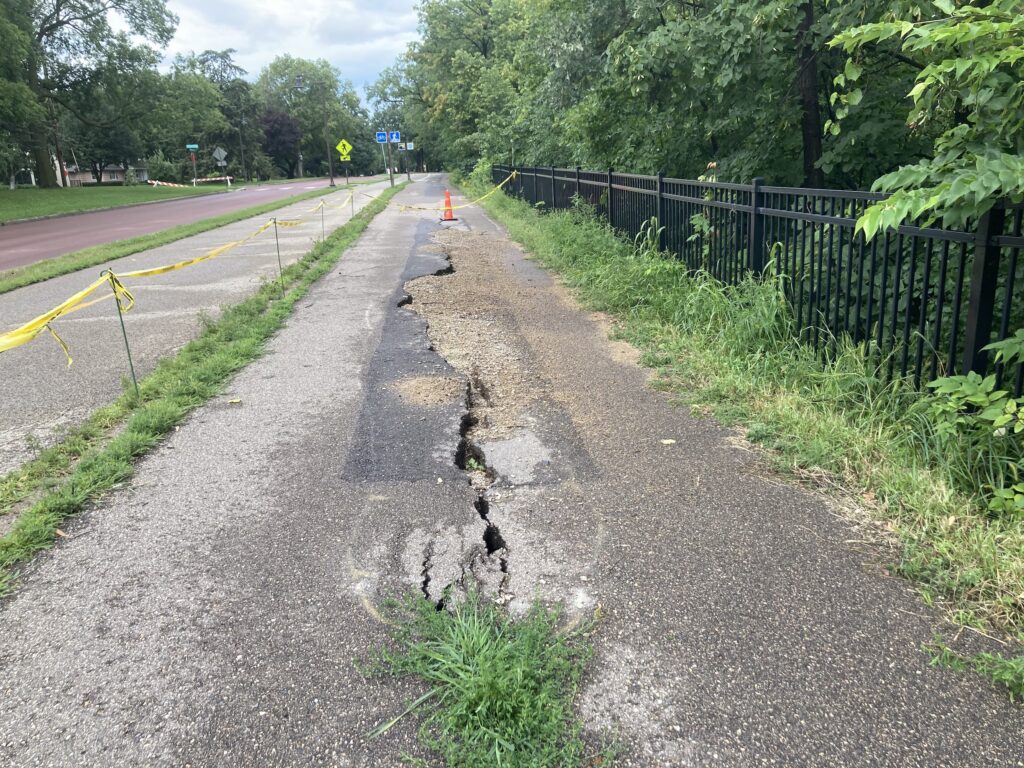
Early on, I chanted in triple berries: strawberry/raspberry/blueberry. Then, other triples: intellect/mystery/passing through/persistent/enduring. Persistent and enduring came as I passed by the big crack that they’ve tried to repair several times but just keeps coming back. I started thinking about my persistence and then stillness and deepening as steadiness, which led to thoughts of my core. I imagined my belly button was leading me. I thought in a triple: who needs eyes? Then I imagined seeing with my stomach or my shoulders or my feet. I focused on my center as balanced and stabilized and still as it moved through the windy bluff above the gorge. Finally, I thought about my belly button as the place that once tethered me directly to my mom. How long did these thoughts last? I’m not sure.
10 Things
roller skiers
someone wearing all black sitting at a bench
river surface, 1: rough, empty
river surface, 2: looking north it was flat, south a glitter path
a shorter runner passing me, holding a sweatshirt awkwardly
the big crack in the path, still blocked off
no more limestone slabs stacked and looking like a lounging person under the franklin bridge
a damaged fence: the top slat missing
returning south, the wind was at my back, enabling me to go faster
no stones stacked on the ancient boulder — too windy?
I thought about the wind and how I noticed it only as it encountered objects — trees, fences, rocks, me. Then I thought about what happens when it doesn’t encounter anything, which led me to wind tunnels and aerodynamic testing and then a line from Rita Dove’s poem, “Voice-over”:
because now you’re all throat, a tunnel skewered by air.
3.6 miles locks and dam #1 74 degrees humidity: 88% / dew point: 65
I’m trying to write this entry but I’m distracted by the little kids next door in the front yard — such cute voices. One of them was singing a song — take this grass. . .broken world. . . broken glass.
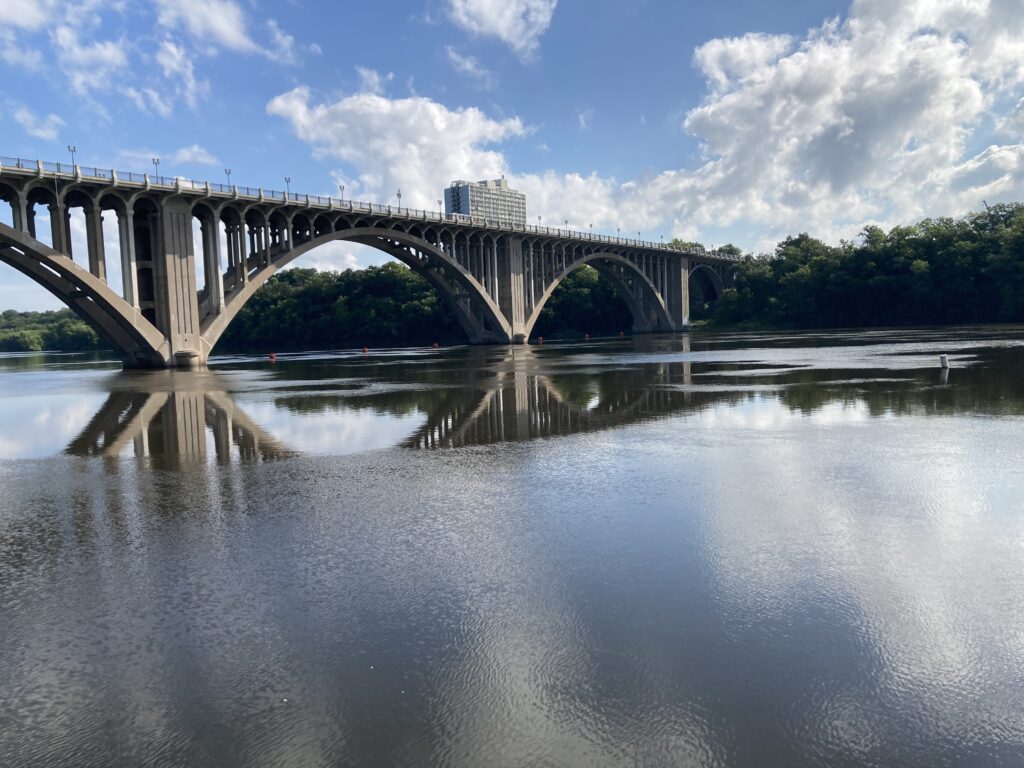
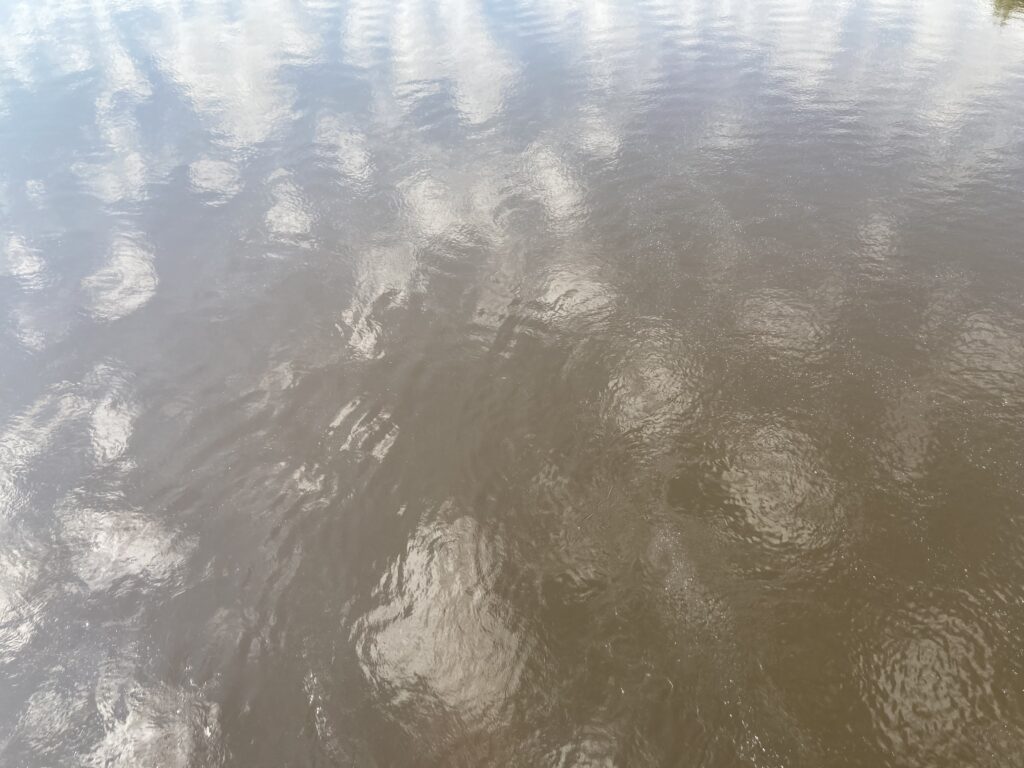
Refrain: hot, humid. Even so, a better run today than the last one I did. When was that? Tuesday (checked my log). Ran all the way to the bottom of the locks and dam #1 hill without stopping. Noticed the river. Such reflections! Clouds, trees, the bridge. Took a picture:
bridge / clouds / surface / sky
The water was smooth beneath the bridge and rippled (corrugated, as Anne Carson wrote) farther out.
Everything is still this morning, calm, quiet. Partly inspired by my 21 aug 2024 entry, I thought about being still. Not as not moving, but as a calm, steadiness. Stillness as the space between beats, when both of my feet are off the ground. Or, stillness as my strong core that floats through that space — suspended as held up in the air, not as stopped.
10 Bridge Things
at the top of the hill, in-between the top and bottom of the bridge, a family was sitting on a bench
the gate near the columns of the bridge was unlatched and slight ajar
beyond it, hollowed out bricks with a strange pattern
empty benches all the way down
the reflection of the bridge on the water’s surface, upside down
a car nearing the bottom, voices — couldn’t hear what they were saying but imagined it was about whether or not the locks and dam was open
the echo of my footsteps under the bridge
the clicking of a bike’s gear across the service road
thought about what RJP told me yesterday: someone went over this locks and dam in a canoe (or was it a kayak?) yesterday
at the top of the hill again, a man read the sign to a little kid who started jumping and asked him to join — by the time I reached them, they were both jumping and laughing and making goofy noises
the deepening and quieting of the spirit among the flux of happenings
still
I thought about being quiet and calm and the opposite of restless and anxious. Then I thought about my core — literally and figuratively. Core = my core muscles, strong back, a straight spine. Core = enduring values, character. I felt the stillness within my self and my body even as the world blurred and floated and drifted around me. Then, Mary Oliver’s “deepening and quieting of the spirit” popped into my head — amongst the flux of happenings. Yes! A stillness of the spirit, where stillness is being satisfied and balanced and present in the moment, not needing to do more or feel guilt or regret for what was or wasn’t done.
/I still the clock by holding the pendulum coin still so that the mechanism stops and I can sleep without the consciousness of it.
to still the clock is a ritual of the demagnification of clocks.
/it is a kind of violence of fiction for the clock to not function as a clock while others click and breathe and blink.
the eyes blink more before they stop functioning as eyes.
/the rapid eye movement of dream frightening being pure pulse, pure frenetic zag force
/to watch a gold-painted platinum extravagant clock you’re an excess you’re a fire you’re in competition with the tiredness of time. /to hold in your satiny eyelids the still unstill pendulum of the gaudy machination you are in unison
with the aspirant expirations of the day.
still / holding / pending / stop sleep / not function / click / breathe / blink / dream / pulse / excess / rapid fire extravagance / tiredness / still unstill / aspire to expire
underwater the end (expiration) is the breath (expire) the end / forced above / evicted from below / no longer water but air
In this poem, to still is to stop, to end, the deep sleep
swim: 6 loops 110 minutes cedar lake open swim 82 degrees
The final open swim of the season. It goes so fast! Another great night for a swim. Warm, sunny. I liked that the wind made the water less smooth — not too rough, a gentle rocking. The course was set up strangely and even though I complained about it afterwards, I think I liked the challenge of it. One buoy was in the middle of the lake, the other was at the far left edge of hidden beach. At first I worried that this set-up would cause chaos with swimmers crossing over the path and running into to each other, but it was fine.
a risky moment: Because the course was so far to the left, I swam in water I haven’t before. Almost halfway across, I swam straight into a nest of vines — the biggest cluster of vines I’ve ever experienced. I didn’t panic and was able to swim out of it, but I could imagine a weaker swimmer struggling to free themselves and getting wrapped more tightly. As I swam away from it, I thought about the high school football player that drowned off of the little beach at lake nokomis about 10 years ago. That’s probably how it happened.
Some things irritated me: the swimmer that I tried to pass but sped up to prevent it, another swimmer stopped at the buoy, blocking the way, the unmoving lifeguard on his kayak too close in on the course, the bright sun making it almost impossible to see anything on the way back, the scratchy vines. But more things relaxed and delighted me: the gentle water, feeling strong and able to swim for so long, swimming past other swimmers like they were standing still, the faint clouds in the sky, the solitary orange buoy sitting on the surface of the water glowing, glimpsing other swimmers off in the distance — only inklings: the flash of a yellow or orange buoy, a bright pink cap, white foamy water.
overheard:
a mom with 2 kids, one who was around 4 or 5, the other a baby in her arms, to a lifeguard: Can he swim out to the orange pyramid? lifeguard: (thinking she meant the baby and not the kid) alone? mom: oh no, not the baby!
Later I heard her recounting the story to a friend. They were laughing about it.
At the end of the second to last loop, I stopped at the beach, stood in the shallow water and the sand, checked my watch, and decided to do one more loop. For the final loop, I felt Mary Oliver’s one day in August, everything calm and quiet. I thought about what a great season it has been, how grateful I am to have this time swimming, and how satisfied I am to have taken advantage of it. No open swims until next June. I thought about how no next season is guaranteed; a lot could happen between now and then. Then I remember the story of my great-grandmother Johanna standing out in the field at the farm near the end of the fall to behold the familiar view, wondering if she’d still be around the next fall.
Ugh — so thick! Oh well, there’s one good thing about this consistently hot and humid weather in the morning: it’s making me want to be done with summer and ready for fall and winter running. My calf almost cramped after 4 minutes of running again. I had to walk it off. I wonder what’s causing this?
Heard a lot of rowers on the river. And not just the coxswain this time; I also heard rowers cheering for each other. Was it a class? The U of M team? I stopped on the winchell trail to try and see them but I couldn’t. Too many leaves in the way.
Evidence of rain everywhere. Lots of mud, gushing and spurting sewers. The pipe that dumps neighborhood water down the ravine and into the river at 44th was loud. I decided to stop and record a video of it. In the background, you can hear the coxswain.
water falls / coxswain calls
When I wasn’t on the winchell trail, I listened to my “Doin’ Time” playlist, including Beck’s “Time Bomb.” The first time I heard that song was in the Funny or Die video with Will Ferrell and ? (can’t remember the other actor) going around Los Angeles and high-fiving everyone. Tried to find a clip of it but couldn’t.
When I looked up “time bomb beck video” a promo video for charity: water came up from 16 years ago. The organization was seeking donations to help in drilling for water in Central Africa. I don’t know enough about whether or not this is a good (effective, responding to the needs of the people by asking them what they need) organization, and I couldn’t tell from the video, partly because I couldn’t see it very well, but its reminder, at the beginning, that water is life and its emphasis on access to water offers an important link between time and water and a powerful contrast between my experience, living among so many lakes, and the experience of others without easy access to water.
I am reminded of a passage in Anne Carson’s “1=1.” After describing a scene of a train car in Europe over-stuffed with people fleeing war zones, she writes:
a scene so much the antithesis of her own morning she cannot enter it. What sense it makes for these two mornings to exist side by side in the world where we live, should this be framed as a question, would not be answerable by philosophy or poetry or finance or by the shallows or the deeps of her own mind, she fears.
1=1/ Anne Carson
Impossible to answer, important to dwell within the discomfort of it.
hour entry:When John Adams wrote / Endi Bogue Hartigan
Another toll, another count of automatic weapon casualties, another occasion of America losing track of its math. I read today that when John Adams wrote “Thirteen Clocks were made to Strike together,” clocks were a tolling of public event, rung, an occasion or station in sun. I slept, and woke, I slept too long and woke. I tried to count the measured world by reading. Read “Thirteen Clocks,” read the late morning sun slant, read the current count outpaces past casualty counts, read “just three percent of adults own half of America’s guns.” Something automatic in measure, too automatic. I woke out of 9.25 hours of sleep I calculated automatically upon waking. I saw a crow out the window that was the occasion of a crow pecking frozen specks. I read the headlines leaking into headlines, saw the orchid sky calculating nothing. I have an inclination to stream and I don’t know what it means today. I have an inclination to lie in my husband’s shoulders crook and let the day snowdrift let the dimness become wide, so a shoulder is a kind of stream too. The argument is made that the streaming of time is a perception trick. The argument is made that we have moved past occasion to incremental measure that we are obsessed with measure and stricken. I have an inclination to obsessively stream, to arise and move not through incremental measures of occasion but through water. The early clocks were water clocks but it was shown that water was imprecise, was subject to pressure and pore—even streams of consciousness can encounter ducts and brim. I am conscious of my husband’s warmth because of more than his warmth. Do not mistake headlines for measure. We were held in God’s soft pocket. Do not mistake automatic grieving for water.
toll / automatic / occasion / track / count measures / measure counts / outpace / streaming time / from occasion to increment / obsess / to stream is to move through water not seconds or minutes or hours / water exceeds measure is imprecise is more than our grief
the imprecision of water clocks / “The history of timekeeping is the story of the search for ever more consistent actions or processes to regulate the rate of a clock.” / “Since the rate of flow of water is very difficult to control accurately, a clock based on that flow could never achieve excellent accuracy. People were naturally led to other approaches.”
precision / division / headline as occasion as increment as measured line between
a line to keep/to use: I have an inclination to obsessively stream, to arise and move not through incremental measures of occasion but through water.
Maybe this could be the title of a poem? Something about softness and imprecision and the inability to be contained in easily measurable ways. And how my vision loss has made for liquid looking (Alice Oswald), and a way to see the same or better than others in the water. Moving through water offers a different logic and makes the existing logic strange — distorted, weathered, unreliable, imprecise.
And now, instead of moving through water, I’m thinking of Bruce Lee’s short poem about being water:
Empty your mind. Be formless shapeless like water now you put water into a cup it becomes the cup you put water into a bottle it becomes the bottle you put it into a tea pot it becomes the tea pot now water can flow or it can craaaaasshh be water my friend
Be water versus be like water. Metaphor versus simile. Metaphor removes the encounter with the other; you become the other (see Anne Carson and the anthropology of water).
people always believe that metaphor is more poetic. But I’ve always loved simile. One of the reasons is that simile keeps both worlds alive at the same time whereas metaphor changes one for another. So you get this beautiful kind of doubled feeling with the simile.
Searching for something else, I just came across this excellent answer to the question, Do you carry a notebook?
AO: No, I don’t much. If I travel like now I do take a notebook. I find by the time I get back home I haven’t got the sort of liveliness. Mostly I try to take things into my head. I really believe in the sort of inarticulate ways of thinking. So the fact that you can read the whole day, all day long, and then when you’re composed it can come out again. I like that process of it not yet being in language, changing your mind round. And I’m more and more wary of the kind of willed and conscious act of writing. More and more I leave my mind to do it by itself. So I will, you know, go out and be kind of shocked by all the colours and pictures and smells and then purposefully not think of them linguistically. I think that the underneath mind will then do the work and that’s the mind I’m interested in. So the skill for me is then learning how to raid that underneath mind and then, when you do pick up a pen, you’re listening just hard enough so that you don’t use your surface mind. You get down to the mind that has taken everything in.
Instead of the underneath mind, the underwater mind, or the just beneath the surface mind? The water-logged mind?
swim: 3 loops (? cedar loops*) 75 minutes cedar lake open swim 85 degrees
*a strange course set-up: the first buoy was halfway out in the lake, the second was close to shore and to the right of hidden beach, so I’m not sure of the distance. Judging my time and effort, I’m guessing that I did 3 nokomis loops.
note: I didn’t have time to write this entry right after my swim, so I’m writing it the next morning.
Another wonderful night with hardly any wind. Beautiful light. Warm water, except for when I stopped swimming to tread water and extend my feet as far below as I could. Then it was cold. Crowded tonight: the last free night of the season. The water was fast, flat, opaque. My goggles were fogged for a lap or two until I licked the inside, then they were clear. I wasn’t sure if that would work, but it did.
My favorite image: on the second half of the loop, heading back to the beginning, breathing to my right and seeing a line of swimmers in the distance heading towards hidden beach. What did I actually see? the rare flash of an arm, a pink cap, churned up water.
After 3.5 loops, I stopped to take a quick break and check my time. Oops, the workout never started. I remember pressing start on my watch, but sometimes this happens. Oh well. Even without the data, I swam for 30 minutes before turning on my workout.
After finishing the swim, drying off in the grass, I encountered another swimmer who had a strange request. A fish bit my mole, could you check to make sure it’s not bleeding? The other day, a fish bit me and when I got home I had a scab.
The fish bite? What? I can’t remember if I’ve written about it this summer, but I haven’t noticed any fish. Not one sighting of a silver flash, definitely no encounters. The other swimmer continued, I’m just so slow out there and they’re attracted to my moles. Yikes!
She joked that she was going to ask her roommate to make fish for dinner so she could get some revenge. With each bite she’d say, I’m not food, YOU’RE food!
3.1 miles trestle turn around 75 degrees humidity: 89% / dew point: 71
Ran in-between raindrops. It started raining yesterday afternoon and kept going, off and on, all morning. Then, right before my run, the sun came out. Now that I’m done, it’s dark again. More rain coming.
Everything wet. Slick, too. Mud, puddles, crushed acorns: dangerous. I slipped once but barely. So thick out there! No rowers or roller skiers or regulars. Some bikers, walkers, other runners. Stopped at the sliding bench — the only view was dark green. Then stopped north of the trestle to check out how the crack was doing. The trail is still blocked off with tape and orange cones, the crack has grass where there used to be dirt and is opening up again.
the persistent crack / 16 aug 2025
Listened to my “Doin’ Time” playlist on shuffle and was inspired when “Once in a Lifetime” came on, especially this refrain about water
Letting the days go by, let the water hold me down Letting the days go by, water flowing underground Into the blue again, after the money’s gone Once in a lifetime, water flowing underground.
Except, as I was running, I heard the line not as after the money’s gone but after the BODY’S gone, which really fit in with my thinking about time, water, and selfhood and started a train of thought about the I above ground returning to the not-I underground/underwater — or the not-water self above returning to the water self below.
The body’s gone also fit with a reoccurring theme in the playlist: the limits of time and death. “Out of Time” and “Closing Time.” Instead of reading death/body gone as running out of time or no longer having any time, I thought about it as something other than a possession — time flows through us and we flow through time. We don’t spend it or own it, we live in it and with it and through it.
It is time now, I said
In my “On This Day” practice this morning, I encountered a series of lines and ideas about time from 16 aug 2021. I stopped at this entry, not reading any more of the aug 16 entries, and decided that today would be about time. Later I realized how fitting it was to study time in the midst of my attempt at living within Mary Oliver’s poem, “Swimming, One Day in August.” It is time now, I said/ for the deepening and quieting of the spirit/ among the flux of happenings. It is time.
During a swim, I lose track of time, have no idea what time it is, as I swim continuously around the buoys. If time is measured at all, it is in loops. And often, I lose track of those too. Was that 3 loops or 4? I can’t recall.
Maybe time is measured in location? Near one shore or the other, one buoy or the next? Here then there then here again
If there’s something gimmicky about trying to swim the equivalent of one day in August, it’s also a great goal for me: not impossible, but requiring some commitment and swimming more than I would otherwise swim. And it’s concrete and straightforward: be in the water, moving, for a total of 24 hours. And it’s satisfying, watching the minutes increase.
And it does something strange to time and it’s passing. Technically I understand a day to be 24 hours, but I don’t usually think about (or count) some of those hours — like the ones in which I’m sleeping, or the ones in which I’m lost in writing or in reading a book. I don’t think I can quite articulate it right now, but accumulating these minutes is a different type of living in time.
It’s a delightful waste of time. No great accomplishment, just a fun experiment. Of course, it’s only a waste in terms of productive time. I am not achieving anything big here that you might put on a resume. It’s not making money, and it’s not creating a product. It is, I think, making me faster and stronger, but not in the most efficient ways.
An idea: what about a chapbook titled, Swimming One Day in August, that plays around with different understandings of a day and its relation to time? I could write about this goal, where 1 day = 24 hours. But I could also write about a day = a random day of swimming in august or a collage of days swimming in august from just 2025, or from all of the days I’ve written about since 2017?
For Mary Oliver, a day is the day before in which the narrator went in the afternoon/to the sea/which held me until I grew easy. It is also today, now — It is time now, I said. And it is tomorrow (and the tomorrow after that?) — About tomorrow, who knows anything./ Except it will be time again/for the deepening and quieting of the spirit. Here day is a daily habit. (Another approach to this challenge could be: swimming every day in august. This might be difficult, since I don’t have reliable access to water to swim in.)
I like how Oliver sets up time in this poem. She’s talking about yesterday, today, and tomorrow but without beginning or end. When did this habit start? Was it yesterday, when she was pestered, or was it some other yesterday before that? And when will it end? It is also not linear, involving progress. With its repeated habit, it’s circular, a loop, going to the same place day after day: the sea to be held. Is it the same time every afternoon, or just, vaguely, “afternoon.” And, what counts as afternoon, how late does it go? To me, afternoon is before 5, but to Scott it’s before 6.
Another hard run. Hot! Lots of sweating and stopping to take walk breaks. Ran to the bottom of locks and dam #1 for a great view of the river. I can’t remember its color — blue, I think — but I remember the small waves on it and the faint wake from a long gone boat. Oh, and the single white buoy and the roar of rushing water one way and the ford bridge the other.
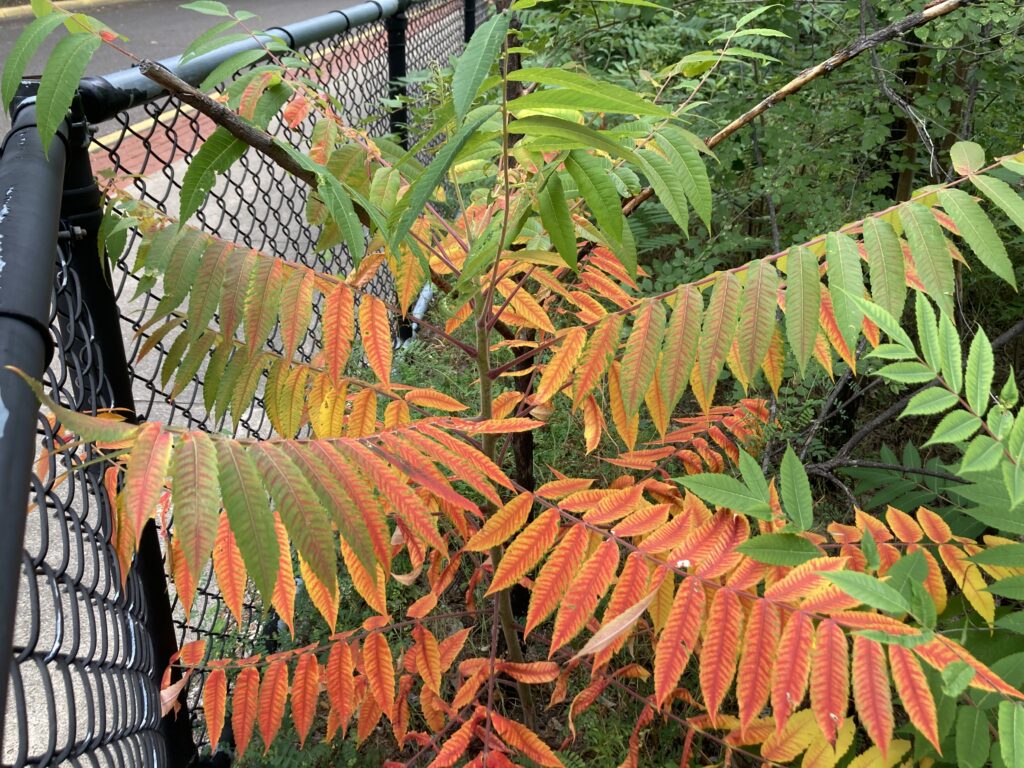
At the bottom of the locks and dam, I noticed some bright orange leaves:
fall is coming / 14 aug 2025
Not the greatest picture, but I’ll post it anyway. So orange! Too soon!
Saw someone emerge from the trail that dips below the road to cross the path and wondered if they had just come up from the new trail that descends deeper into the gorge. Encountered 2, maybe 3, roller skiers, walkers, runners, a few bikers. Below the road I stopped to walk and listen to the acorns falling from the tree and thumping on the ground. Then started running again over acorn shells.
I thought about my Swimming, One Day in August project and had an idea: what if I tried swimming in bde maka ska and lake harriet? Or, some other lakes nearby? Or, one of the clearest lakes in the state, Square Lake, in Stillwater?
a few hours later: Hooray! Just received an email that all future open swims will be at Cedar! So as long as Scott can drive me over there, I don’t have to miss a single one.
a ramble on lake water testing
A revelation just last week. Minneapolis Parks tests the lake water weekly, and testing the water is better than not testing the water. But the slow and rigid system of testing only on Mondays and getting results on Tuesdays (e-coli) and Wednesdays (algae blooms) combined with the fickle changes in quality based on weather and other environmental factors, means the testing is not very accurate for what the conditions are at any given time. On an abstract level, it seems obvious to me that you can’t rely on tests to guarantee safe water, but on an experiential level — that is, being in the water swimming for over an hour at a time roughly 6 times a week for 11 summers — I needed an unquestioned faith in those tests and the park’s ability to let me know when it was/wasn’t safe to swim in order to get in the water.
And, mostly it is safe in the water. And it is clean. I get very irritated when someone who doesn’t know what they’re talking about says to me, eww, how can you swim in that dirty water!? Minneapolis Park workers and volunteers do an amazing job of keeping the water quality high. And this is partly due to their regular testing. But, these tests can’t guarantee anything.
What am I trying to do here? I’m not blaming the parks department; these tests are expensive and it would be difficult to test regularly enough to keep up with the quick shifts in wind and rain and the groundwater problems (like unstable sewer systems) that have existed from the beginning of the lake’s modern shape in the 1920s when workers excavated peat and used it to build up the surrounding neighborhood. Not to mention climate change and erratic weather and an excess of nutrients getting into the water from lawn fertilizers. And people feeding ducks who poop in the water which increases the amount of e-coli. No, I think Minneapolis Parks, especially Minneapolis Aquatics, are amazing.
All of this is complicated and messy with no easy answers. And it’s scary. I’ve been wondering for a few years when it’s going to happen — because it seems inevitable that it will happen — that lakes will no longer be safe to swim in, unfiltered outside air will no longer be safe to breathe. And this is how it happens, I think. Not all of sudden, but slowly. More days with bad test results and beach closures. Or inaccurate test results and water that is pea-soup green and slimy and that might get you sick.
I suppose this last paragraph sounds depressing, and it is, and also it isn’t. I love swimming in lake nokomis, and I would do a tremendous amount to keep swimming in it. Maybe it’s time to figure out what I can do to help keep it safe.
Hot! As usual, I should have gone out before 9:30, but I slept in. When I was in the shade, it wasn’t too bad. Wore my bright yellow shoes. They were fun for the first 3 minutes — very bouncy — but I started to feel both of my calves cramping up. I stopped to avoid anything worse and walked for a few minutes before starting up again. Is it the shoes? Possibly. My calves have been fine and then I started wearing these shoes again and now my calves are cramping occasionally. Last week, I woke up early in the morning to a charley horse just starting to happen. Was able to stop it before it turned into a knot. Whew.
Even though it was hot, I’m glad I got out by the gorge. Beautiful. Fall is coming. Leaves drifting down in the soft wind. Half-crushed acorns all over the sidewalk. A deep green everywhere. The winchell trail was cooler in the shade. Tricking water near the ravines (3 — 44th, 42nd, and 36th). Decided for the first time in a long time to take the dirt path past the 38th street steps and visit the oak savanna. It was dark and overgrown. Branches reaching across the trail, the dirt path that leads to the ravine narrowing to almost nothing.
10 Things
at least 2 or 3 benches occupied, including the one near folwell
a runner accompanied by a biker discussing how much mileage someone else was doing — marathon training?
the river: sparkling, blue, empty
a bird — cheeseburger cheeseburger
another bird: me me me
the fallen tree on winchell: still there, still blocking 2/3 of the path, still holding browned leaves
squeak squeak a swing across the road at minnehaha academy
movement — a bird? a squirrel? the wind moving a single leaf
loud noises in the bushes — a bird? a squirrel?
the worn wooden steps leading to the ravine — still cracked on a few boards — noticed that the steps are rectangular boards placed on the slope with a handrail, and some sort of wedge at the top
swim: 6 loops 90 minutes lake nokomis open swim 78 degrees
Wonderful! The water was a little rough, but nothing too bad. No waves crashing into me. The course the lifeguards set up with how they positioned the buoys was off today. It didn’t fit with any of my strategies for sighting. The lifeguards were too close to the buoys heading out to the little beach, and the fourth buoy was much farther south than it usually is. The final buoy was too close to the orange buoy and too far from the beach. No triangle today. Not sure what shape it was. I’m almost positive I swam 6 loops, but the distance was so much shorter that it seemed more like 5. I’ll still count it as 6.
Lots of vines. Setting sun. Bubbles. Menacing swans and sailboats. Strange flashes underwater. Seeing orange. A roaring plane. Thin shafts of light. Not as many sparkle friends.
2.1 miles to falls coffee 75 degrees / humidity: 91% dew point: 70
Maybe because it was overcast, it didn’t feel as bad as the numbers would suggest. Still sweat a lot, but didn’t feel miserable. Ran with Scott to Falls Coffee. Ran on edmund, parallel to the YWCA tri racers biking on the river road. I remember doing this race — three times, in 2013, 2014, and 2015. I can’t remember why I didn’t sign up for it in 2016 — maybe because my favorite part, the swim, was too short and the bike was too long. In 2017, I was signed up, with RJP, to do a mother-daughter super sprint, but then I got injured. After that, I didn’t do it because my vision was too bad to go that fast and be that close to other bikers (and, because I never really liked the biking part). I love watching professional triathlons — Ironmans, T100s, WTCS Olympic distance races, and Super-tris, but I don’t like racing them.
Scott and I didn’t talk much as we ran; I think we were both too warm. Heard cicadas and birds and people calling out, good job! you got this!, way to go ladies!, to the racers. A steady stream of bikers on the road, some heading out, others returning.
We got coffee at Falls Coffee then walked back through the neighborhood, including through the playground at FWA and RJP’s elementary school. My favorite thing: little birds — sparrows? — lifting off from the pavement, like little bubbles bursting up in the air. Another thing: hearing cicadas buzzing and birds chirping at the same time — not a duet, I said to Scott, but two songs being sung at the same time that almost, but not quite, fit together.
3.25 miles trestle turn around 75 degrees thunder – drizzle – rain
Dark out there this morning. My weather app and the radar said 0% chance of rain. Ha! I didn’t hear any thunder until I had already turned around and was heading back. I didn’t feel the rain until I was running a treeless stretch of the trail. Greeted Mr. Morning! Heard water rushing in the ravine. Smelled onions as a group of male runners — a big pack of cross country runners? — ran by. Forgot to look down at the river but did remember to glance at the sliding bench. Noticed that the crack in the path north of the trestle is still blocked off and still cracked — are they waiting until fall to fix it? Will they fix it? Saw dogs and runners and walkers and 4 bikes going by much faster than the 10 mph speed limit and 2 guys talking at the edge of the path that I think were rowers who just finished a session on the river.
What did I think about? I can’t remember. I wasn’t working through any ideas for a poem or the chapbook I’m putting together. I wasn’t thinking about anything I read this morning or worried about the news. Can I remember even one thought I had? Oh, here’s one: when it thundered, a flash of concern — do I need to find shelter? can I make it home before the storm begins? (I did.)
This morning before my run, I found out that 4 of my poems, including my purple hour poem, that were accepted at the beginning of the summer went live today on Trampoline Poetry! Very exciting! I also learned a few days ago that another one of my mood rings — Incurable — will be published later this month. Nice.
Humid. It rained last night — everything is wet — but there must been wind, too, because small branches and leaves were scattered over parts of the path. No big trees.
10 Sounds
Bird
the coxswains speaking through their bullhorns
a faint radio with someone singing, some vibrato
the steady trickle out of the sewer pipe near 42nd
good morning, excuse me / morning! no, excuse me (passing a walker)
morning! a greeting from Mr. Morning!
good morning / good morning (greeted by an older runner)
the whirr of a motor on an e-bike zooming by
another runner’s music coming from her phone as she ran by — some poppy upbeat song that I can’t remember
who run the world? girls! Beyoncé from my headphones and my mood: Energy playlist
Listened to the poem I wrote yesterday before I headed out for my run. This is my tentative ending:
tethers us to each other — swimmer and vision, buoy and body, to sight and to rarely see
swim: 3 loops (6 cedar loops) 60 minutes cedar lake open swim 81 degrees
Choppy today. Sometimes hard to stay high on the water. Lots of vines. Saw some planes and birds above, no fish below. The surface looked silvery. Sometimes the sun was out, sometimes it was behind a cloud. Once a big, hulking cloud, looking like something other than a cloud from my perspective half-submerged in the water — a monster, like godzilla?
Forgot to recite Mary Oliver or think about the deepening and quieting of the spirit, but I felt it. Relaxed, happy, strong. Swimming for an hour wasn’t difficult.
Found this description of how we are both part of and separate from water saved on my reading list:
Nature—the non-built environment, creatures—is a realm of supreme “otherness” with which we are already always in strange relation. We plead for communion with this nature; it cannot answer us; so we project that onto it, that feeling of harmony and oneness at a shore or a vista. We are both a part of that natural sphere and stand distinctly apart within it, in our creaturely and industrial/technological dominance over it. You are both part of that sphere, and stand painfully apart, with your consciousness, language, cumbersome car and computer.
Now I’m thinking about Anne Carson and her definition of anthropology (as in, “Anthropology of Water”). I wrote about it on 13 july:
encounter with that which you cannot contain, control, that is not You — the not-I.
added on 8 aug 2025: I forgot to mention a delightful thing that happened on the way over to cedar lake: a vee of geese — 20? — flying low over Bde Maka Ska then just above us — and, lucky me, I had the moon roof open to watch! — then heading towards Lake Harriet.
Better air! Well, less smoky air. Also, humid air. Heavy air. I checked the weather for rain. Nope. Leaving the house, I was greeted (or threatened or warned) by my next door neighbor, the bluejay. Screech! Screech! I admired the beautiful flowers — dark and light purple, orange, yellow — of the neighbor who lives with Matt the Cat. On the paved path, I glanced down at the oak savanna — dark green — and over at the leaning, almost twisted, fence. Heard the coxswain giving rowers their workout, something about 75ers, and wishing she had a micro-stop on her watch (at least, I think that’s what she said). Also heard rustling in the leaves, sounding bigger than a squirrel. A dog? A turkey? Heading down the hill at the Cleveland overlook, the river looked green and still through the trees. Someone was sitting on the bench in the grass near the stone wall. It was dark enough that the cars and bikes had their headlights on.
Because it’s cooler than the air is better, I have the windows open. Several squirrels are rooting around in the bushes. The sound is irritating me as I write this entry.
Listened to the cars and the rowers and the birds running south and on the Winchell Trail, then a few songs by Lawrence for the last stretch from the 38th street steps to home.
Swimming One Day in August
Because the big beach at Lake Nokomis has been closed due to high levels of e-coli, I haven’t had a chance to swim yet in August. Finally today, at Cedar Lake, I will start working towards my goal of swimming a total of 24 hours (= 1 day) in August. As part of that project, I’m devoting time out of the water to swimming in Minneapolis lakes, too by reading, researching, reflecting, and writing on water. Today, I’m reviewing the history of Cedar Lake, thanks to a masters thesis I found a few years ago.
Already today, I’ve been reading about the dredging of the lakes. 2.5 million cubic yards of peat and sand and wetland were dredged out of nokomis; it took 4 non-stop years. The sand went to the beach, the peat and wetland to making the park bigger and building a neighborhood. Why dredge? Not just because it would make a lake I could swim in a century and a half later. Original Park Board Superintendent Theodore Wirth was thinking about economic growth and the future of a city:
Wirth is outspoken in his belief in the utility of taming nature to increase land value and develop the city’s natural resources. By dredging and creating more shoreline, the park board could improve the parkland, thereby making the property surrounding the parkland a more desirable place to live. The increased value of the private property could provide a greater tax base for the city and for the Park Board, which could use the revenue to continue to acquire and improve park space.
Cedar Lake History/ Neil Trembley
swim: 4 loops 75 minutes cedar lake open swim 77 degrees
Wonderful night for a swim! Calm water, not too warm or too cold. Not too crowded. And even with fogged up goggles (I haven’t treated them in a few weeks), I didn’t get too far off course.
The water felt a little sluggish — not buoyant. There were tons of sharp and scratchy vines, some individual strands, others in clumps. The water was opaque — no fish sightings tonight.
The sky was white; no clouds to notice. I think I remember seeing one bird. Oh — every so often the sky would break open and there was sun. It didn’t last that long.
I wanted to think about Mary Oliver’s “deepening and quieting” but there was none of that tonight. I was swimming hard — not all out, but not stopping either.
Another short run today. The air quality is still bad, but it didn’t bother me — or, I’m so used to it bothering me that I didn’t notice. Wore my bright yellow shoes again and felt bouncy. Listened to my “Slappin’ Shadows” playlist running south, the gorge running north: trickling water, laughing kids, someone talking about walking on a boardwalk, a beeping/ringing noise on repeat somewhere below. Noticed a haze above the river, everything washed out, pale. The tree that fell a few weeks ago is still there, unmoved. The benches were empty, the trails were thick with bikes. No more mud. Acorn shells on the sidewalk.
Walking back after the run, I thought about my inkling poems and how I like to/have to try and guess what something is based on very little data. Some lines came to me —
It’s a game, really — Name that Tune but for forms. I can name that form in 2 curves . . .
Searching for “inkling” on poets.org, I found these great lines:
For what is prophecy but the first inkling of what we ourselves must call into being? The call need not be large. No voice in thunder.
It’s not so much what’s spoken as what’s heard— and recognized, of course. The gift is listening and hearing what is only meant for you. (from Prophecy/ Dana Gioia)
And now I’m thinking about inklings as creatures, and not just hunches or ideas or guesses or a call/prophecy to listen to. An inkling is the tiny creature that speaks to us — not a little man, but a spirit or an insect or Dante’s spiriti visivi.
The wild fire smoke is still here. Mostly it didn’t bother me, but it did make running a little harder. The worst smoke moment was when I came off the lake street bridge and turned onto the river road — not hard to breathe so much as hazy. There weren’t too many runners out there, some walkers, a few bikers, a family of hikers and shadow falls.
10 Things
graffiti on the lake street bridge steps: STOP HATE
a fancy water fountain, bubbling, in the grand yard of the U of M President’s house that Gov. Walz rented while his mansion was being renovated
someone asleep on a hard stone bench by the Monument — in the hot sun, wearing long pants, a long-sleeved shirt, and a stocking cap
the bells of St. Thomas — ding dong ding dong / ding dong ding dong / ding dong ding dong / — the time, 10:45
an orange flash on the sidewalk — the smoky light or spray paint?
a boat speeding up the river, leaving streaks on the water’s surface
no kids outside at the church preschool — were they staying inside because of the smoke, or was it not recess?
the graceful curve of the bridge’s arch — I checked if anyone was climbing on it (nope) — my daughter told me about how kids do that (her included, but only once and only halfway across)
the soft trickle of water near Shadow Falls
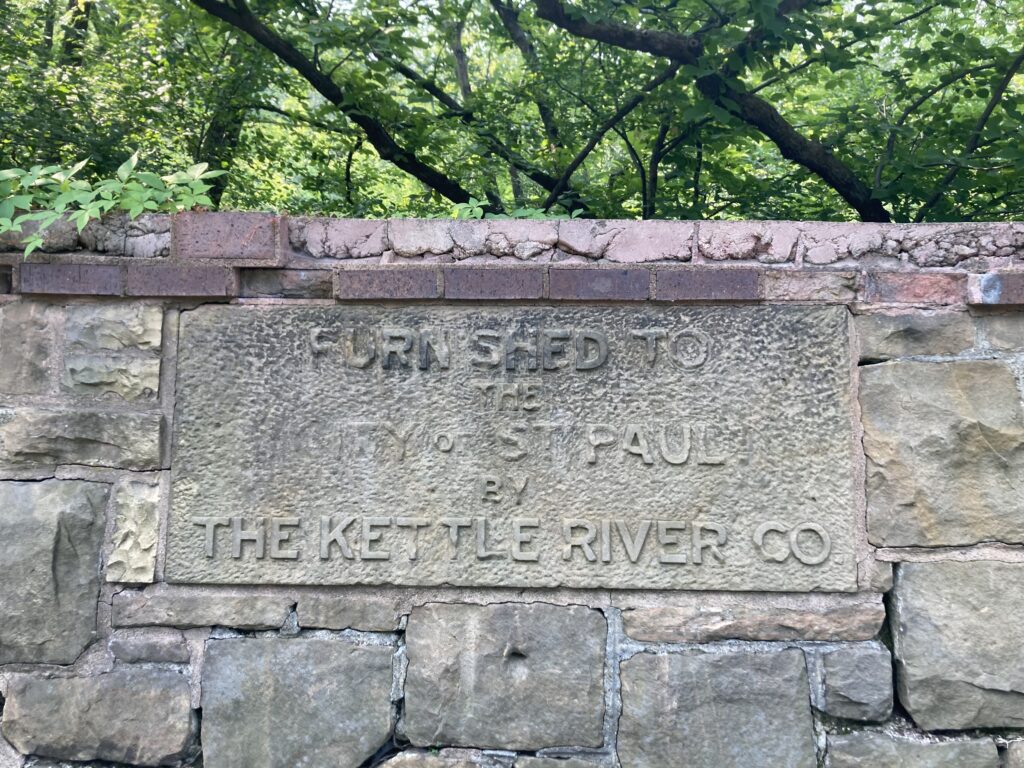
a stone wall above the ravine, leaning — it had a sign on it that I couldn’t read, so I took a picture of it to study later
Furnished to the city of St. Paul by the Kettle River Co.
I could mostly read it when I looked at the photograph, but I had to doublecheck with Scott.
I wish the lake was open so I could have gone to open swim for the first day of my “Swimming One Day in August” project, but at least I was able to run. I am almost didn’t go out because of the smoke. Glad I decided to!
The smoke doesn’t seem that bad so, for the first time in weeks, we have the windows open! I like the relief that air conditioning brings, but I hate how it makes me feel trapped in the house. As I sit at my desk writing this, I just heard the feebee call of the black-capped chickadee through the open window!
Today I’m working on more swimming sonnets and Inklings. Some subjects: water quality, blue-green algae, milfoil, water as the medium, loops at lake nokomis are actually triangles, the color of the water, Alice Oswald seeing self in water, again and more darkly, Mary Oliver and the deepening and quieting of the spirit
a little later: I almost forgot about the mushrooms! Walking north before my run, I saw some HUGE mushrooms in a neighbor’s yard. The first one I noticed had lost its cap and I thought it was a newly cut tree trunk. I think there were a cluster of 4 or 5 mushrooms. I started reciting Sylvia Plath’s Mushrooms in my head. I thought about mushrooms as the fruit of fungi and little explosions and expressions of the self (like through poetry) as emerging like mushrooms. For the rest of the run I checked the grass for more mushrooms, but don’t recall seeing any more.
a lot later: RJP checked out a book for me, Mary Oliver’s Blue Pastures, so I could read some of Oliver’s sand dabs and the chapter, “Pen and Paper and Breath of Air.” I’m on the second page and I already needed to stop and archive some of her ideas:
First, in describing her practice of keeping a notebook, she writes that she doesn’t write in it from front to back, but just opens a page and writes anywhere and everywhere. She uses “private shorthand” to record phrases and feelings.
The words do not take me to the reason I made the entry, but back to the felt experience, whatever it was. this is important. I can, then, think forward again to the idea—that is, the significance of the event—rather than back upon it. It is the instant I try to catch in the notebooks, not the comment, not the thought. And, of course, this is so often what I am aiming to do in the finished poems themselves.
“Pen and Paper and Breath of Air” in Blue Pastures/ Mary Oliver
And here’s one of the phrases she put in a notebook:
A fact: one picks it up and reads it, and puts it down, and there is an end to it. But an idea! That one may pick up, and reflect upon, and oppose, and expand, and so pass a delightful afternoon altogether.
“Pen and Paper and Breath of Air” in Blue Pastures/ Mary Oliver
4.5 miles minnehaha falls and back 59 degrees AQI*: 157
*Air Quality Index
Cooler! Smoky, again. Ran on the dirt trail on the other side of the river road heading south. Noticed how the trail didn’t seem quite as wide as it did a few years ago during the pandemic when more people were using it. Wondered how many feet have to tread over the same spot to make a trail, and how long it takes for a forgotten trail to revert to grass. Crossed over to the paved path by Becketwood and stayed on it to the falls, then past the falls, then over the Veterans bridge then down the steep hill to the very bottom of the ford bridge then north thenhome.
Listened to cars and birds and voices as I ran south. Put in my “Remember to Forget” playlist returning north. Tried to forget that I was hot and wanted to stop as I listened to Peter Gabriel and Michael McDonald singing about forgetting.
10 Things
orange light dotting the path
turkeys! 4 female turkeys (hens) bobbing their necks and moving slowly, 1 male (a tom) following behind — the hens ignored me as I stopped to look, but the tom turned and stare
the rush of minnehaha creek below me as I ran over the veterans bridge
standing on the bridge above the falls, watching it tumble down to the creek below
a man and a little kid sitting at the bench near the boulder
the path blocked off near Godfrey by 2 trucks and some cones — not sure what they were working on
the path blocked off near folwell by cones: park workers repainting the biking and walk signs
a new person painted on the paved path — glowing white, I checked to see if anyone had drawn in a face yet (nope)
my shadow — I could see my pony tail bobbing as I moved
fake bells x 2: the ding-ding-ding of the light rail pulling out of the station and the chiming of the st. thomas bells at 7:45
Such as the lobster cracking loose from its exoskeleton after moons of moulting, or the viper that squeezes out of the skin of its remembrance, this oracle invites you to rewild yourself, to unbox, detox, and de- clutter your blood.
Hazy and smoky this morning. Canadian wild fires again. A present from the wind. It looked bad, but didn’t bother my breathing too much. Inspired by the wind, I listened to my “Beaufort Scale” playlist until I reached the old stone steps near the south entrance of the Winchell Trail. Then I listened to the water falling out of the sewer pipe and splashing on the rocks down to the river.
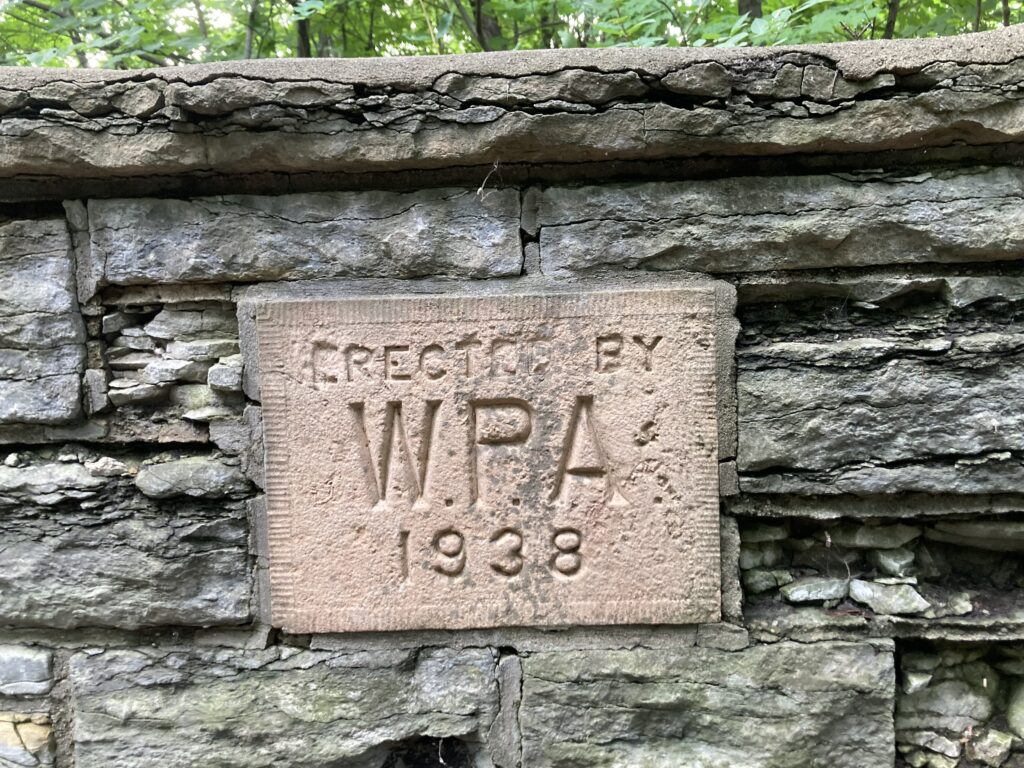
WPA 1938
I took this picture of a stone wall built by the WPA, and possibly by grandfather, on the stone steps at the edge of the 44th street parking lot. 1938 was four years before my mom was born. Was my grandfather working for the WPA then?
At the bottom of the steps is the Winchell Trail and the 44th street sewer pipe/ravine. Also, the curved wall that I like to admire from above as I run by and the spot in the trail that transitions from crumbled asphalt to cracked. Yesterday I wrote about the sound of the water falling. I decided to stop and record it today:
water falling at the 44th street ravine
10 Things
a section of the fence on the edge, missing a slat
something on the asphalt ahead — a big puddle? no spots of light shining through a gap in the trees — a pool of light!
smoke on the water (waTER — Deep Purple/Pat Boone reference) — my view from the Winchell trail through the trees, light blue looking fuzzy and faded through the smoke
the faint voices of kids on playground
the blending of car wheels above with wind in the trees and water falling down the ravine
an older couple walking fast and with purpose, especially the woman who was leading the charge, seen twice
a small bird flittering by, a flash of yellow — was it yellow, or was it a trick of the light, or was it my unreliable vision?
the 38th street steps are still rainbow colored — well, at least, a few steps are — the yellow and orange and purple ones
glancing across the road and doing a double-take: is that a turkey or a young tree with its trunk covered in black plastic?
empty benches
swim: 2.5 loops (5 cedar loops) cedar lake open swim 77 degrees
Very glad Cedar Lake is okay so that open swim could happen. It was windy and choppy and smoky. At first I thought my goggles were fogged up, but then I realized it was the smoke in the air. Air quality was bad: 168, which is unhealthy. With the choppy water, it took a few loops to get into a rhythm. Lots of breathing on one side, or breathing every 2 or 3 strokes.
I’ve been working on a new poem form today. I’m calling it inkling. It’s inspired by an Alice Oswald line from Dart: the inkling of a fish. Inkling as vague, the idea of, a whisper, unproven, a rumor. My little poems — 3-5 lines, I think — are about describing or evoking the feeling or idea of something that you can’t quite see, or that you feel more than anything else. My first one will be about fish.
Another hot and hazy morning. I remembered to notice the river and it looked . . . thirsty? Trying to think of the best word that conveys the opposite of refreshing and cool. Uninviting? Thick? Stuck? Inert? By the Cleveland Overlook it was green and dull and thick. Below the Winchell Trail near the south entrance it was a pale blue with a soft haze hovering above it. Farther north on the trail it was bright blue with a few spots of sparkle through the trees.
Because of the intense thunder storm last night, there was water everywhere — puddles, gushing sewers, squishy mud. The puddles were small but filled with the reflections of trees and flat, still. The mud was slick and slippery. Two distinctive sewer sounds/movements: 1. below 44th street, the water was pulsing, coming in waves — a moment of steady flow, then nothing, then water flowing again. I stopped to lean over the railing and watch it. 2. below 42nd street, the water was rushing out of the pipe, making a small waterfall on the rocks below — a continuous dropping of water.
With all the wind and rain last night, I expected there to be more trees or branches down than there were. Was there any new debris? I don’t think so.
The weather is strange this week: very hot and humid and sunny during the day — we’ve had several heat advisories, then violent storms move in quickly at night. Last night, it started with the wind. I opened the front door and watched the trees bending, twisting, waving. Very unsettling to watch. Then the sky unzipped and rain came down in sheets. Will it happen again tonight? I hope not.
For future Sara: Scott and I discovered a new sport to watch during the Aquatic World Championships — men’s 27 meter (that’s 9 stories!) and women’s 20 meter diving. Why can’t the men and women dive from the same height? Anyway, I’d never heard of this before. An extremely HIGH platform is created outside with a small circular pool at the bottom — don’t worry, the water is deep. Divers jump — they enter feet first — from high up, doing flips and twists and somersaults as they plummet. It’s so dangerous that they have 4 first-responders in the pool waiting to rescue them if they need it. And the first thing they do after surfacing is alert the responders with a thumbs up. What? Wow. Like other diving competitions, a lot of the score is determined by how much splash they make entering the water. I can’t see the splash, because of my bad vision, but I still enjoy watching it. After the dive, they show several slow-motion replays, including one from below. You watch as the diver nears the water; Scott says it reminds him of seeing someone falling to their death.
I am alone but for this vein splitting the earth open and we are silent, the stream and I
far away from our mouths. The stream folds over itself, my hand speculating under the surface.
The stippled faces of orioles sail by slowly, their dark wings working hard as tired men pulling oars
in a landscape painting, their lantern chests dotting a modest pattern across the sky, over this brook
a mile from your house—from you who are alone but for your sons and your sons’ refusal to recognize
you cloaked under a sadness, the color of whose cloth is muted as these late-afternoon birds.
The stream sluices crawdads and stones, carefully takes its bend like a tongue spackled with canker sores. I still expect it to speak. I’ve come to listen to this slow unfurling, hoping I’ll fall
asleep as it turns like a lullaby a child promises he will strain to hear, to memorize. I make sense
of smudged pastoral visions. Gone, the birds long gone. Palms, I cup water with bent palms.
run: 3 miles trestle turn around 86 degrees
I was supposed to go to open swim, but the beach has been closed for a week because of e-coli. Not sure why, but I’m guessing it’s because of the storm. What a bummer! I’m supposed to start my “swimming one day in august” project on 1 august. It will be more difficult to do it now that I’m missing august 1 and 3. Thankfully Cedar Lake is open so at least I can swim there tomorrow.
Since I couldn’t swim, I decided to do another run. It was hot, but the humidity was lower so it seemed less terrible than this morning’s run.
10 Things
I think I heard the rowers; I know I saw a few of them heading down the hill to the dock
traffic was backed up — so many cars trying to turn onto lake street
a mini peloton — a dozen bikers — whirred by me on the river road
someone in a strange t-shirt with lots of words or logos or symbols that I couldn’t make sense of was sitting on the ledge under the trestle listening to heavy metal on their phone
a walker, dressed in brown shorts and a brown shirt, passing me twice, their head titled to the side
the sliding bench was a cool, dark green
the spray paint on the ancient boulder looked extra orange today — did someone touch it up recently?
a lime scooter parked in the middle of the walking path under the bridge
the big crack north of the trestle looks about the same as it did last week — not bigger — but the path is blocked off with caution tape, orange cones, and a warning spray-painted on the asphalt
as I neared them, someone was emerging from the old stone steps
Cooler than last week, but still too warm for me. Felt drained and my feet were sore from my shoes — the Saucony Rides strike again. Even so, happy to be out beside the gorge with my friends — the boulders, benches, trees, shadows, walkers, runners, river. But not the bikers — too many of them, and too many close calls.
Last night, we had some intense wind and thunderstorms. Eveidence of it is everywhere: leaves, twigs, branches, whole trees scattered near the trail, gushing sewer pipes, muddy paths. The water from the 44th street pipe gushed out in spurts, almost like a bucket filling up then dumping over. The water from the 42nd street sewer pipe rushed with a steady flow of water, like a waterfall.
I ran closer to the river and I remember looking at it, but I don’t remember what it looked like. Was it smooth? scaled? blue? gray? brown? I don’t recall. I do remember not hearing any rowers.
I didn’t have any deep thoughts about water or swimming or life or, if I did, they didn’t stick around. Instead, I thought about how my feet were sore and my legs felt sluggish, how I wanted to stop, and how I had some unfinished business and needed to get to a bathroom soon.
swim: 3 loops (6 cedar loops) cedar lake open swim 88 degrees
The water was warm but calm and more greenish than usual. Lots of scratchy vines and swimmers swimming in the middle. Also, a giant rubber ducky inner tube floating beside the course. The safety buoy of the day was a clunky, lumpy orange one. Lots of other yellow and pink buoys too. The sky had a few clouds but was mostly blue. Made sure to notice the bubbles around my hands. At the end of the swim, near shore, I went a little deeper in the water — it was cool, which felt nice.
As Scott and I left the beach I noticed an older woman waving at someone, than a little kid yelling excitedly, Grandma!
No bathroom stop in the one port-a-potty today. Someone puked on the floor right next to the toilet. Yuck!
run: 4 miles the monument and back 73 degrees dew point: 69
Thought about going out for a run around 6:30 am but watched Pogacar defend his yellow jersey in the alps instead. Excellent. Finally made it out for a run at 10:30. Not as bad as yesterday, but too warm, especially in the direct sun.
Chanted in triple berries. Admired the reflections of clouds on the river. Heard the kids on the playground at the church preschool. Put in the soundtrack to “Operation Mincemeat” for the second half.
I thought briefly about fields — visual and of tall grass and open vistas — and buoys and dots and simple forms.
Walking home after the run, I noticed someone stopped on the corner with a dog. I wondered why they were stopped — was there a car coming? should I not cross? Got to the other side and realized that it was my son, FWA, and our dog, Delia. It’s happened before — just last week — but it’s always upsetting when I don’t recognize my kids or my husband or my dog. For a moment, they’re only strangers.
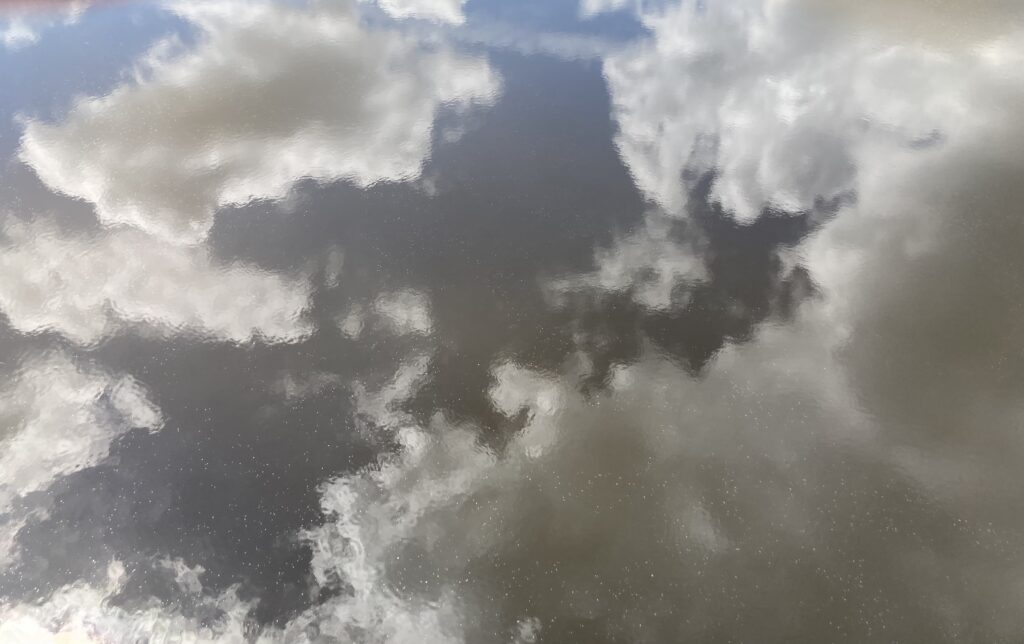
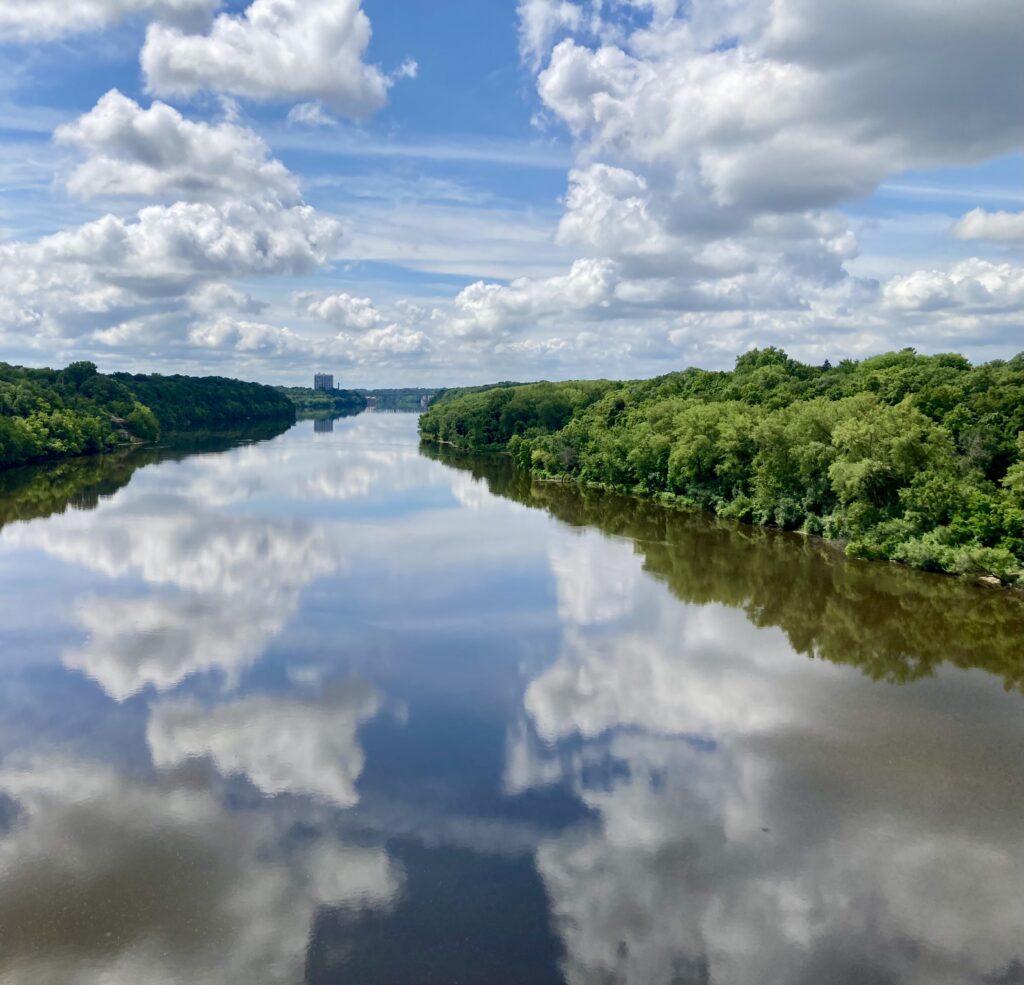
Crossing back over the lake street bridge, I took a few pictures of the clouds reflected on the river:
clouds reflected on riverriver clouds
note: I had to crop out my finger from the left hand corner. Even with the cropping, I think these are cool pictures.
visual fields, landscapes, meadows
1
At the end of yesterday’s entry I wondered what sighting buoys and swimming in the lake had to do with the visual field test. I’m still thinking about it. On a literal level, the way I’ve trained myself to sight a buoy, lining up its path, then trusting myself to swim straight to it even when I can’t see it, is how I took the visual field test last month: I fixed on the center dot and looked straight at it, or where I knew it to be when I couldn’t see it. My eyes didn’t wander. Another connection: at a distance, the buoy doesn’t look like the shape that it is — a triangle — it looks like a small dot in the center of my vision.
2
Yesterday, reviewing early july entries, I encountered this definition of visual field: “that portion of space in which objects are visible at the same moment during steady fixation of the gaze in one direction.”
It reminded me of definitions of landscape I came across yesterday in the OED: “A view or prospect of natural inland scenery, such as can be taken in at a glance from one point of view.”
the space in which objects are visible at the same time, what all can be taken in (simultaneously) with one glance
3
as though there swung at the end of a tunnel, a passage dotted with endless points of arrival, as though our gaze started just outside our faces and corkscrewed its way toward the horizon, processual, as if looking took time to happen and weren’t instantaneous, offered whole in one gesture before we ask, before our will, as if the far Sonoma mountains weren’t equally ready to be beheld as the dead fly on the sill) (Pastoral/ Forrest Gander)
What I remember of better eyesight is how the world assembled all at once, an effortless gestalt—the light, the distance, the dappled detail of shade, exact crinkles of a facial expression through a car windshield, the lift of a single finger from a steering wheel, sunlight bouncing off a waxed hood. (Naomi Cohn)
4
A quick glance — my eyes emerge from the water like an alligator to look ahead for the buoy. Often all I see is a green mass of trees and empty water. Occasionally, a bright dot, far off. I don’t see it every time I look, but enough times to keep steadily swimming towards it. No time to think, not enough data to be certain, but I believe it’s the buoy, and usually I’m right. A few times I’ve mistaken a bright swim cap or a car’s headlight or a sailboat for the buoy.
5
“A field is used more often to describe an area managed by people. The field before you was once an orchard and pasture belonging to a farmer. A meadow is used to describe a wild area.”
“Fields and meadows start when trees have been removed from an area. This can occur naturally with a forest fire or flood, or humans may cut down a forest. Seeds from grasses and weeds take root shortly after and a meadow is born.
As the trees within my macula disappear, my forest meadows. here I’m thinking about my classic memory from science class with the inverted tree in the back of the eye.
bike: 8 miles lake nokomis and back 82 degrees / 79 degrees
Biked to the lake! No worries, felt relaxed and able to see well enough, or if I couldn’t see, able to navigate well enough. No moments of panic. Biking back was the best. Long shadows, cooler, people biking/walking/running and enjoying the calm evening. I admired the shadow of me on a bike, looking larger than life.
swim: 3 loops lake nokomis open swim 82 degrees
Yesterday, open swim sent out a warning about blue-green algae. They weren’t closing the lake, just encouraging people to be cautious. I didn’t see any algae blooms, although I noticed that the water was a more vivid, electric green. The water was warm and calm and wonderful. With the sun, it was difficult to see — I could see dots, which I trusted were buoys as I swam towards the little beach, but swimming back towards the big beach, barely anything other than bright sun, sparkling water. I managed to see the buoys at least once and trusted my shoulders to guide me across. I don’t think I’ll ever not be amazed that this works, that I swim straight to the buoys when I can’t (or barely can) see them.
I tried something new as a I swam. Each time I tilted my head to breathe, I thought a word, usually 1 syllable but occasionally 2: squish flash flit fly flush flare zip zap bird tree cloud blue girl ghost gorge life death bliss breath bubbles bike run float lift shut jump black red orange feet toe hand face field grass give take spirit sprite light dark
There were many other words, but I don’t remember them all. I might try this again. Maybe some great words/images will burst out?!
images collected in consciousness like a tree alone on the horizon (Crows/ Marilyn Nelson)
So warm already at 8 am! Decided to do a quick run anyway. Felt better than I thought especially on no coffee or food, but it was still hard. Listened to the new Lorde (recommended by RJP) while I ran south to the entrance of the Winchell Trail. Listened to turkeys and trucks and coxswains while I ran north.
10 Things
a coxswain below giving instructions through a bullhorn — take a drink before class begins . . . today we’ll start with some stroke work: 22/22/22/24
the distant gobble of turkeys
the rumble of a truck
a roller skier
a biker in a bright yellow shirt working on their aero position, back bent low and straight over the bike
the tree that fell and blocked 3/4 of the trail is still there, its leaves now brittle and brown
empty benches
voices above me, approaching steadily — bikers or runners?
another coxswain — difficult to hear over my music
cracked pavement below — some small and shallow, others deeper and slanted, all waiting to twist ankles
a few hours later: a steady rain
Returning to this log entry to wander with a question I posted yesterday:
What kind of landscape even exists in the absence of vision?
Darby Nelson is referring to lakes and how little can be seen below the surface. Landscape is a strange word choice here. Landscape refers to a view/tract of land that’s inland. What’s the word for a water view? Waterscape? Beyond that, the OED definition of landscape is about a view, a portrait, a picture. What is the experience/perception of a space — land or water — called that doesn’t prioritize or exclusively rely on vision?
I’m also thinking about how a landscape is scenery, an object to gaze at, the background. What if we made the lake the subject? How would we understand and name our relationship to it? Ecosystems popped into my head — maybe not the right word, but another way to think about what the water we’re observing, especially when we’re in it, is. And, what if we (you, me) are not individuals separate from the lake as observers but ecosystems too?
It is becoming increasingly clear that there is no such thing as a biological individual. All organisms are intricately nested collectives: networks of relationships between cells and microbes that make it impossible to say where one “individual” starts and stops. Humans are no exception: We carry around more microbial cells than we do our own.
In the same entry I posted the above quotation (8 april 2022), I also posted and discussed Arthur Sze’s poem “Entanglements.” I especially like these lines:
your field of vision tears, and an underlying landscape reveals a radiating moment in time.
“(during my run) I reflected on the underlying landscape as layers that can’t be seen with your eyes, only smelled or felt or imagined. And I delighted in the idea of so much happening, so much present beneath me that I couldn’t see, that I didn’t need to see, for it to exist or to affect me or to be connected to me.”
Field of vision? Suddenly I thought about my interest in writing a poem/s about taking the visual field test (see 1 july 2025). And I’m thinking about landscapes and fields and meadows (see 2 may 2025). A line popped into my head: a meadow of moments — no, a moment meadows.
What does the visual field test have to do with the lake or my experiences swimming in it? A lot, I think. Somehow I want to bring together the visual field test with my swimming and sighting buoys. How? Not sure yet.
run: 1.75 miles from minnehaha falls to home 73 degrees / dew point: 64
A quick run with Scott from the falls back home before the rain started. We made it! Checked the weather on my watch after we finished — 95% chance of rain in 8 minutes. Ran at 1 pm, which might be my least favorite time to run. It felt hard. Still, I’m glad we did it. (It never rained.)
We stopped to walk where the trail dips below the road so I could point out the new trail they’ve created that winds down to the river. I can’t wait until they’re finished. It looks cool. Speaking of cool, I was trying to convey to Scott how I felt about the air and what the impending storm was doing to the sky and the air and green of the gorge. First I said “cool,” but it’s not cool (temperature), so I started to clarify, I mean the atmosphere, but realized that atmosphere could be related to temp so I said, I mean the vibe is cool. Cool is such a strange word — both full of meaning and history and empty too. For 35 years, I’ve been trying to expand my vocabulary beyond it, but it never works. How many times a day do I use this word?
I know that there is a rich history of the term within African American culture and jazz and that it’s been appropriated by white culture, but I don’t know the history that well. In poetry, my immediate thought about cool is Gwendlyn Brooks amazing, “We Real Cool.” I also think about Beatnik poetry and the Pia Zadora/Ric Ocasek scene in Hairspray:
“your hair is really uncool”
swim: 3 loops (6 cedar loops) cedar lake open swim 79 degrees rain
Overcast, gray. Calm water, warm-enough air. A great night for a swim. As I swam, I monitored the sky, noticing it getting darker and thicker. Wondered if it would start raining. During loop 4, it did. It’s always difficult to tell if it’s raining when I’m swimming. Today I felt a drop on my check and then paused to lift my head out of the water — a steady rain. I think I heard it underwater, but I couldn’t see it, and barely felt it. No thunder, so open swim kept going. Hooray!
10 Things
a graying sky
a big canoe moving fast across the swim course
even as I tried to stay on the edge of the course, the current pushed me toward the center
pale green, opaque water
bubbles encasing my hands
attacks from floating vines
a party with a campfire and barking dogs at hidden beach
buoyant, feeling held by the water
after: itchy skin
standing up in the sand after the last loop — a final look at the buoys and the water
Remembered the first line from the A Oswald poem fragment that I forgot several times last week: this disintegrating certainty
Thought about the bubbles and imagined that they were holding me up, like some sort of raft or inner tube.
My legs felt like rudders, my torso rocked rhythmically, my shoulders rose and fell.
4 miles river road, north/south 72 degrees humidity: 85%
Because I waited until after today’s tour stage — the last one in the Pyrenees — it was humid and hot out by the gorge! Other than the heat, the run was not too bad. I chanted in triples for about a mile and tried to keep my chest up, shoulders relaxed, arms in a controlled swing. I don’t remember hearing the rowers or seeing the river.
10 Things
the entrance to a steep dirt path above the rowing club on the other side of the path that goes under the lake street bridge
a runner behind me, coming fast, slapping his feet on the paved path
a biker sternly telling the runner, you’re on the bike path!
the runner not reacting because he was wearing headphones
the fence panel that they were redoing yesterday was in place and its new, unpainted wood stood out against the other brown panels
a wooden slat of the fence jutting out by the ravine because of a leaning tree — watch out!
2 older women sitting on a bench — one to the other: not bad, 2 miles in 2 hours
a flash of orange in the peripheral — a hidden tree trunk marked for removal
slightly more of a view at the sliding bench — I think park workers trimmed the trees
the crack north of the trestle looks like it might have grown some more
4 miles river road, north/south 57 degrees humidity: 80%
In the 50s! What a beautiful morning. Sunny, calm, cool. My gait felt strange, awkward, for the first 1/2 mile. Was it the shoes? I wore Brooks instead of Sauconys. The humidity was high — lots of sweat, not dripping but pooling near my nose. Chanted in triples for the first mile.
10 Things
rowers! heard 2 different coxswains
after 5 or 6 months, they’re finally replacing the fallen fence panel above the northern end of longfellow flats
the dirt they put in the crack north of the trestle has settled and the crack is back and as big as before — at one point will this be unfixable?
good morning! / good morning! — exchanged greetings with a runner with a dog
good morning! — Mr. Holiday wished me a good morning
click click thought it was a roller skier, but it was a biker changing gears
a circle of light below the sliding bench — have they cleared some branches for more of a view here?
smell of cigarette smoke
the dark dirt of a steep trail leading down to the river
the loud slap of a runner’s shoes as he passed me, running fast, or at least much faster than me
I was watching the tour as I compiled the 10 Things list, but had to put my computer away when they reached the last climb — a tough HC. Pogacar went for it near the bottom and Vingegaard couldn’t follow. Wow!
this disintegrating certainty this water whatever it is whatever anything is under these veils and veils of vision which the light cuts but it remains
unbroken (Nobody/ Alice Oswald)
while I’m swimming today: recite this bit and the others from Dart and Nobody:
swim: 4 loops lake nokomis open swim 71 degrees
Open swim is back and I did 4 loops! A wonderful night, in and out of the water. The water was smooth and fast and not too warm or too cold or too crowded. Entering the lake, I watched as a motorized paddle board zoomed by, then another. What? As I swam toward and then past the orange buoy I heard a metallic buzz in the water. Was it because of these paddle boards? I am very grateful that motorized boats aren’t allowed on nokomis. If they were, would I be hearing this buzzing sound all of the time?
I was off course in the first loop; the sun made it very difficult to see the green buoys. But it wasn’t a big deal. On the second loop, I figured it out.
I marveled at the contrast between above and below the surface. Above was a smooth blue, below a glittering green. Checked out my bubbles. Felt the water darken when the sun went behind a cloud. Was attacked by a few stray vines.
Thought about how much I love the water and how confident I am in it, and then about how dangerous and scary and deadly it can be.
Recited Alice Oswald lines — not the new ones I just memorized, but the ones I’d already been reciting in my head.
Rain this early (7 am) morning. Hopefully stopping in a few hours. Watching the tour and rereading old entries from july 16ths. Discovered this excellent description of a buzzing bug:
Its hot voice sizzles from some cool tree Near-by: It seems to burn its way through the air Like a small, pointed flame of sound Sharpened on the ecstatic edge of sunbeams.
note: I first posted this poem on 16 july 2022. I posted it again last year in 2024. Maybe I should memorize it?
a few hours later: what a stage of the tour (stage 11)! Pogacar crashing; Visma waiting for him. What will happen tomorrow in the Pyrenees?
It is 10:30 and a light rain. Won’t stop until 12:30. Do I wait, or go now? It’s probably refreshing and it might be fun to run in the rain . . .
4.25 miles minnehaha falls and back 66 degrees light rain
I did it, and it was a great run! Back to the 9/1 (9 minutes running / 1 minute walking) and feeling strong and relaxed. The light rain helped to cool me down, and I liked how my feet glided on the wet trail. Glided sounds strange. How about glode or glid or glod? Started the run by chanting in triple berries then turning everything I noticed into triples — river road, dripping trees, running feet, rushing cars. Listened to everything dripping for the first 30 minutes, then put in the “Energy” playlist for the last stretch.
10 Things
gloom with the occasional bright flash from headlights
one flash looked lower — I think it was a reflection in a big puddle!
the ravine by 42nd was gushing like the falls
the falls were giving off a fine, gauzy spray
a stranded surrey near the longfellow house — were they getting wet in the rain?
someone walking up the hill at the edge of the park, carrying an umbrella
above the creek, the grass next to the sidewalk was soaked with a line of big puddles
the sprawling reflection of a tree in a wide puddle on a sidewalk
the silhouette of a bird on a wire, looking very Bird
the bells of St. Thomas — faint, distant
an hour later: I was planning to do open swim at cedar lake tonight but I just got an email: “canceled due to inclement weather.” Bummer.
a few random Alice Oswald bits
1
On her process of translating what she notices into a poem, and on poetry as framing the silence:
She and her husband, playwright Peter Oswald, divide their day in two – walking their sons to and from school through fields. But she doesn’t take a notebook with her. She believes in the subconscious, in what is brewing on a ‘non-verbal level’. She thinks ‘a flavour or feeling builds up, almost a sculptural shape that could be a living creature, or a dance or a painting’. Only later comes the ‘plastic art of finding the words’.
There is also, in her poems, a sense of the silence behind every word. ‘One of the differences between poetry and prose is that poetry is beyond words. Poetry is only there to frame the silence. There is silence between each verse and silence at the end.’
closed and containing everything, the land leaning all round to block it from the wind, a squirrel sprinting in startles and sees sections of distance tilted through the trees and where you jump the fence a flap of sacking does for a stile, you walk through webs, the cracking bushtwigs break their secrecies, the sun vanishes up, instantly come and gone. once in, you hardly notice as you move, the wood keeps lifting up its hope, I love to stand among the last trees listening down to the releasing branches where I’ve been – the rain, thinking I’ve gone, crackles the air and calls by name the leaves that aren’t yet there
Oh, that ending! Now I’m imagining what the rain does when it thinks I’m not around! Today the rain didn’t crackle the air but . . . dotted it? feathered it? poked or punctured it?
3
The other day I came across Alice Oswald’s description of a project she’ll be working on next year as a fellow at Columbia University. She’s calling it Interviews with Anon:
At the Institute, Oswald will write a procession of passersby, not all of whom are human and many of whom are imperfectly seen: “My inspiration is the wandering, bartering, folktale style of Herodotus, who included 940 characters in his Histories. I shan’t be writing history. Perhaps it will be more like a headcount or even a carnival.”
Wanted to do a longer run today, but it was too hot! At first I wasn’t going to run at all, but I decided to do a short one to, as I sang to Scott, kick start my heart. Of course I sang the melody of this song completely wrong and of course we had to listen to the original. Ugh! And of course I had to remind Scott that one of the many soccer teams I was on as a kid was named Motley Crüe. Another team: Jabberwockies.
When I was in the shade it wasn’t too bad, but in the direct sun — HOT! I had wanted to run to the overlook on the bridge but I noticed, at the last minute — a few feet from the sign — that the sidewalk was closed. So, I turned down and ran south on the river road trail. Ah, shade!
10 Things
my bright yellow running shoes
the neighbor who is always sitting on his front steps smoking was there but wasn’t smoking
the excited chirping of little kids on the playground at the daycare
from a biker: that was so sweet — the tone of sweet made me think kind, thoughtful, not awesome
a long line of cars on lake street
my shadow, straight and strong
2 runners crossing the street, standing in the bike path, a biker approaching, heads up! / oh, sorry!
the rush of wind through the trees
a steady stream of cars on the river road making it difficult to cross
the dark brown dirt, the gentle curve of the green grass, the sharp edge between of a front yard on 46th
This Be the Place: a Pond
Today is the first rest day of the tour so no cycling to watch all morning. Instead I returned to my morning reading practice of visiting poetry sites and rereading past log entries. A lot of great stuff, including: This Be the Place: A Several-Acre Space of Tenderness/ Han Vanderhart
The “several-acre” space is a pond, which struck me as strange. I think of ponds as small bodies of water and several-acres sound big. But is it (big, that is)? Maybe several acres is small. What distinguishes a pond from a lake? I recall looking up brooks and streams and creeks and rivers when I was reading Emily Dickinson’s poem, Have you got a Brook in your little heart (see 13 march 2021), but not ponds. So I looked it up. Fascinating!
pond or lake: the distinction is arbitrary
The term “lake” or “pond” as part of a waterbody name is arbitrary and not based on any specific naming convention. In general, lakes tend to be larger and/or deeper than ponds, but numerous examples exist of “ponds” that are larger and deeper than “lakes.” . . .Names for lakes and ponds generally originated from the early settlers living near them, and the use of the terms “lake” and “pond” was completely arbitrary. Many have changed names through the years, often changing from a pond to a lake with no change in size or depth. Often these changes in name were to make the area sound more attractive to perspective home buyers.
Learned that the study of inland waters is limnology. And the terms, lotic and lentic, too:
surface waters are divided into lotic (waters that flow in a continuous and definite direction) and lentic (waters that do not flow in a continuous and definite direction) environments. Waters within the lentic category gradually fill in over geologic time and the evolution is from lake to pond to wetland. This evolution is slow and gradual, and there is no precise definition of the transition from one to the next.
From lake to pond to wetland reminds of my discussion of ecological succession and Robin Wall Kimmerer at the begining of May. A meadow becomes a thicket, a thicket becomes a forest.
Was Lake Nokomis ever a (bigger) lake that became a pond, then a wetland, then a lake again? Yes!
The landscape around Lake Nokomis was formed by natural forces, to be a place that absorbed and stored water. Over 11,000 years ago, glaciers carved through the land, and then retreated and melted. As the ice blocks that were left behind melted, they formed an expansive system of interconnected wetlands and lakes. Under these saturated conditions organic material from dead plants was unable to completely decompose, forming extensive peat deposits — a wetland soil. Because peat readily absorbs moisture and can hold up to 10 times its weight in water, it can act as a barrier and prevent rainfall from draining into deeper layers of the soil. This can cause water to accumulate, or perch, above the peat. Once abundant wetlands in South Minneapolis were filled or development.
In 1853, the U.S. Surveyor General’s Office conducted the first government land survey of the landscape around Lake Nokomis, then called Lake Amelia. The area contained over 1,500 acres olakes and wetlands. At that time, the natural lakes were larger and shallower than today. Since then, nearly 60% of the area’s wetlands have been filled. In their place is today’s built landscape.
Linda Gregg might call my pond a “resonant source,” a term she uses for places that are “present as essences. They operate invisibly as energy, equivalents, touchstones, amulets, buried seed, repositories, and catalysts.” These are the Ur-images of our creative psyches, that live with us and inform our writing. “If we opened people up,” remarked the filmmaker Agnès Varda, “we’d find landscapes.” Along with a Virginia creek and cornfields and the wood with its mayapples, this pond is inside me: as summer, as stillness, as childhood—as peace.
You can not realize you are in despair, looking at a pond’s surface.
I love the surface of Lake Nokomis. How when I lift my head out of the green water to sight, I see blue. How its ripples sparkle and its small waves sometimes look like other swimmers. How dragonflies hover above, bubbles hang just below it. How it often hides its moods from those at a distance; what looks calm and still from afar, feels rough and active from within.
ponds and writers: Maxine Kumin and Henry David Thoreau
Two writers that popped into my head as I think and read about ponds; Maxine Kumin and her homemade pond, Pobiz Pond, on her farm and Thoreau and Walden Pond. I just requested Kumin’s memoir in which she writes about how she and her husband, along with help from friends, dug out a pond on their farm property.
Other poetry people who love ponds? Mary Oliver, of course!
note: I was planning to swim, but open swim was canceled because of thunderstorms forecasted for 6:30.
3.1 miles locks and dam #1 and back 72 degrees / humidity: 84% air quality: 117
Hot! Humid! Hazy! The shade helped. Avoided the crowded river road trail. Heading south I ran on the narrow, root-filled dirt trail on the grassy boulevard until I reached the parking lot, then the trail to Locks and Dam #1. Heading back north, I ran on the Winchell Trail.
There was a moment when I heard the soft rush of cars, the trickle of water out of the sewer pipe, and . . .? I know there were 3 distinct sounds that I noticed all at once and that I imagined putting in a contrapuntal poem. Was the third sound the rowers? the birds? the tapping which might have been a woodpecker on a tree, or a squirrel with a nut? It wasn’t the wind, because there is no wind today. I felt its lack, but also saw it on the surface of the water. Still, thick. It wasn’t the buzzing of workers sawing or mowing or building something. What was it? Just remembered! The soft then sharp buzz of cicadas, which came in waves. I knew I’d remember it! (It only took 2 hours.)
The common thread for these 3 noises is their steady, insistent beat, not moving time forward, but around and around, on repeat.
swimming words
Catch water, thumb first then the semi-circle pull, arms straight, centre, down. Palm push back, twist shoulder to breath. And recover. Kick. Kick. Kick.
Stretch bone to breakwall and the tidal roar of thirty thousand swamps, refuses to crest, to break. Thirst for the bubbled silence of midnight, midlake, midstroke when the limelight was all to reach for, a trap door opening to a world below.
Pulse counts in an orchestra — it’s only a paper moon waterlogged and beaming up, a lighthouse lamp spinning in time. A course to decipher all the way to safe harbour. There’s a table laid in checkered cloth. The catch of the day muscles away.
At the edge, pulled bodily from a lake that holds fast and drags thighs, shins against stacked stone and laps the bloody threads. It won’t return you whole to the land.
Love the title of this poem and the last line. Does the lake return me whole to the land? What does it mean to be returned whole? And, is that to be desired?
I was planning to do open swim at Cedar Lake tonight, but there is a heat advisory and it’s 90 degrees, so Scott and I will go on Wednesday instead, when it’s much cooler.
process influences constraint
Last week, I read about Sarah Riggs’ approach to writing her latest collection, Lines:
In my poem “November 14” from Lines we start with “Only hour only thought: speech speech.” At the age of 47 I set out to write the book in 47-minute time periods. Roughly an hour, an only hour so to speak, in a field of time dedicated only to thinking/ speaking. Increasingly hard to do this century, with text messages et cetera punctuating thought. So on October 15, 2018, I started on a dictation of the mind so to speak, in which second thoughts are also written, and set my phone timer for each writing session, at the same café for many of the poems. Not written so much as transposed. I determined each poem would be 47 lines, and the lines do not need to be connected to ones before or after, though they could be. There would be 47 poems. The name of each poem is the date it was written. To be in time, in the calendar, to have a project that is a book that is a series. To feel in the momentum of it. To slant into dream, to invite that we survive through the tilt and whir of connecting synapses.
Process, Influence, and Constraints. I love all 3 of these, and think about them quite a bit. I like how Riggs opens the essay: “The bird song and street noise and lilt of the subway and recent phone conversations go into our poetry. We are made up of influences, there is no blank page or screen, as has been said many times.”
In terms of influence, Riggs offers these suggestions:
Channel an influence or more than one. You can choose to riff on or translate someone else’s work. You can choose epigraphs. Dedicate or address your work to someone.
I like the idea of translation. I’ve been playing around with something I call form fitters, where I take words from other poets I love and fit them into my running rhythms (3/2 or 2/1 or 3/3/3/4) and swimming breath patterns (5 syllable lines or 3/4/3/4 or 5/4/5/4). I also like the idea of taking a line and making it the title or, what about the last line?, of a poem. Playing around with influences could be a fun month-long project?!
Sticky, but feels cooler because of the cloud cover. Felt relaxed and able to keep running without stopping. Wore my bright yellow shoes, which seem to not be hurting my feet/calves as much. The river was a light gray-blue, the trees dark green. Heard voices near the ravine — was it the workers finishing the new trail? Also heard the clicking and clacking of ski poles up above near the road.
Several trucks and workers in and around the house that used to have the poetry window (it hasn’t had a poem for more than a year). I wonder where the poetry people went?
The tree is still across the winchell trail. Every time I encounter it I’m cautious, looking out for people coming the other way, hidden behind its branches. Today, there were 2 people, but they were paying attention and waited for me to pass. Thanks!
bike: 8.6 miles lake nokomis and back 80 degrees / 78 degrees
Biked with Scott to the lake. Nice! No scary moments. I felt confident and didn’t once question where I was going or where the trail was or if that thing ahead of me was a crack or not. Loud birds. A car not knowing how to drive in a round-a-bout. High creek water under the echo bridge. An ultimate frisbee game in the field between the duck and echo bridges. Slanting light. Kids wading in the creek.
swim: 3 loops lake nokomis open swim 79 degrees
Another orange buoy gone, replaced with a green one. Only one left. For 11 years, seeing the orange buoy has been my thing. I’ve dreamed about them, written poems about them, and now they’re being replaced with green buoys. That’s okay, but I will miss them and all of my orange thoughts.
The water was a little rougher. Not too rough, more like gentle rocking. Some stray vines, lots of breathing only to my right side. Difficult to see the buoys. Recited my Alice Oswald poems as I swam and thought about lifting the lid and shutting it again and the sky jumping in and out. During the second half of the third loop, I stopped in the middle of the lake just to see what it was like. So quiet and wonderful. I couldn’t hear anything from the sky or the beach or other swimmers. Very cool.
Sparkle friends, bubbles. an orange glow off to the side, marble legs, ghostly milfoil, blue sky with a few clouds. Above: blue water, below: a light greenish-blue. An interesting effect: looking up blue, down below green.
A great swim. I feel strong and free and grateful to be moving and pushing my body. Big shoulders, no calf cramps, no numb/tingling fingers.
3.75 miles river road, north/south 70 degrees humidity: 74%
Summer! Not the easiest running with the heat, but it’s beautiful by the gorge. Greeted Dave, the Daily Walker and he wished me a happy birthday again!
10 Things
a coxswain’s voice below me
a very loud bird across the road, trilling not screaming
a sea and sky of green in the tunnel of trees
a woman walking down the center of the path, gesturing to herself
the two big cracks on the stretch of path just north of the trestle have been filled in with dirt
orange cones and orange spray paint surround the cracks to warn pedestrians
looking through a gap in the trees, seeing the air above the gorge, feeling so open and peaceful
an orange day lily on the edge of the trail
empty benches
the sliding bench looks like it has slid more
I stopped to take a few pictures of the bench:
sliding bench / 9 july 2025
During the run and after, I recited AO’s lines from Nobody about the microscopic insects in the eye who speak Greek. Such a great poem! And such a great poem to memorize!
Got out for my run a little earlier today. Still warm and humid. The bunion on my left foot has a blister on it, which hurt at the beginning of the run. Looking up the anatomy of the foot, I discovered that the bone below the big toe is actually two pea-shaped bones called sesamoids. I’ve been thinking that I might want to devote a month, or a few weeks, to the foot. Maybe September?
Noticed the river for the first time as I turned down to enter the Winchell Trail from the south. Through the trees it looked green and warm and stagnant. A little later, on the Winchell Trail, a pale blue with a spot of sparkle. Greeted by Mr. Morning! as I exited the 38th street steps.
10 Things
empty benches
a parked scooter with its red lights still blinking
heard water dripping down the ravine and thought of a grotto with a waterfall
the tree that fell on the trail last week is still there, blocking 2/3rds of the trail
a faint voice below — a rower?
2 people across the road near Becketwood, crouched near the trees — looking at something? picking up trash? weeding?
a steady stream of cars
a cool green under the tree cover on the Winchell Trail
a week later, the 38th street steps are still rainbow colored
someone walking around the overlook, headed to the part of the stone wall where a dirt trail descends — was he planning to take it?
more How to Read Water
glitter path: a long line of shimmering reflections stretching into the distance. The shape of the glitter path is a measure of how high the sun is and the roughness of the waves.
if you see the glitter path bulge at some spot, that indicates rougher waves
wider glitter path = rougher water narrower path = calmer water
“the faces of the waves act as mirrors”
seeing faces in waves / pareidolia: the habit of our brains to find patterns and ascribe meaning where there may be none
orange!
If you are gazing down into cloudy water looking at your own shadow, there are a couple of extra effects worth keeping an eye out for. The first is that your shadow may have an orange-hued fringe around it. This happens because the tiny particles in the water don’t reflect all wavelengths (and therefore all colors) back equally to you. Orange makes it back more easily than the others. The second effect, which, if you see the orange “halo” effect, is definitely worth looking for, is that you may spot shafts of sunlight emerging from your shadow and radiating out away from it underwater. This effect is sometimes nicknamed the “aureole effect.” These radiating rays are caused by an optical effect of looking in the opposite direction to the sun
How to Read Water
swim: 3 loops lake nokomis open swim 83 degrees
Warm, buoyant, calm water. I felt fast and strong and confident. Lots of swimmers, a few floating vines. No ducks or fish or dragonflies. At least 2 military planes — black — screaming across the sky. The far green buoy looked robin’s egg blue to me again today. My nose plug squeaked. The water looked mostly light greenish blue with a think layer near the surface that almost looked white. I saw some orange off to the side and shafts of light rising up from the bottom. Translucent bubble encased my hands.
I recited bits from AO’s Dart and Nobody as I looped.
Noticed a swimmer looking so far away from the orange buoy and wondered how much of it was my off perspective and how much of it was them being off course. Probably more me; I struggle with depth perception.
almost forgot: during the second half of a loop, the water suddenly got a lot darker for many seconds — a minute? However long it actually was, it felt like a long time. I couldn’t see what caused it, but I’m imagining the darkness was caused by a cloud. On other days, I felt a shorter darkness pass when a plane passes over the sun.
4.25 miles monument and back 71 degrees dew point: 64
Hot! I’ve never liked running in the heat but now that I’m taking lexipro my heat intolerance has increased. For some moments of the run I felt great, other moments I didn’t. So I walked some, ran some, and walked again at different stretches.
10 Things
I kept seeing orange flashes — a sign, a cone, a tree marked for removal
kids yelling and laughing outside at a daycare attached to a church
the river from above, on the bridge, heading east: brown, and looking shallow — were those sandbars I was seeing near the surface?
trickling water out of the limestone below the bridge
the sound of shadow falls, falling
a kid’s voice rising from the ravine
construction on the other side of the lake street bridge — orange cones, trucks, yellow-vested workers, the buzz of equipment
the river from above, on the bridge, heading west: blue and covered in the reflections of clouds*
click clack — a roller skier
seen, not heard: a dog, by the clanging of their collar
*stopped at the bridge overlook to take a picture of the clouds reflected on the surface of the water. Is it just me, or does this look like an impressionist painting?
river with clouds, 7 july 2025
the color of water
How to Read Water is fascinating. Here are some things I’d like to remember from the chapter on color:
The colors we see in water depend on the brightness and angle of the light and the water’s depth, as well as what’s on, in, and under that water.
How to Read Water
something to consider: are you looking at water, or something in or under the water, or a reflection on water’s surface. Is it the color of water, or the color of the ground beneath the water (a puddle), or the color of cloud on its surface? What angle are you looking from?
. . . in many circumstances when we think we are looking at the water, we are actually looking at something different and in the distance. Looking out to the sea in the distance is a great example: What we see in that situation is dominated by the reflection of the sky even further in the distance. This is why the distant sea appears blue in fine weather and gray on overcast days.
How to Read Water
This water looks blue because it’s reflection the sky is one I’ve heard a lot, but I think I’ve always heard it as the reason, not one reason under certain circumstances.
What about when we see different colors — which I often do as I run across the bridge and look down at the water? The different colors are based on how much of the water we are actually seeing. Sometimes I see brown, sometimes blue.
You will notice this if you look for it, but not if you don’t because our brain has gotten used ot this effect and so oesn’t register it as at all peculiar.
something to try: Can you find the area/the moment where the shift takes place from looking only at reflections to being able to see water?
the exact color that can travel furtherest through the water without being absorbed: blue-green color, wavelength = 480 nanometers
Is it a big cloud or Jaws? People often think it has gotten deeper or there are fish around when the water darkens, but it might just be a big cloud.
eutrophication = excessive nutrients — algal blooms reduce light, use up a lot of oxygen, change the color of the water
oligotrophic = low in nutrients, clear
my sparkle friends! “A lot of the particles that see in water will be inorganic, a mixture of mud, sand, clay, silt, chalk, and other substances, each one affecting the colors we see.” Do I see them as anything other than the color sparkle?
Today I’m swimming at Cedar Lake, which is much deeper than Lake Nokomis. It is also more of a “natural” lake than nokomis. What impact do these factors have on its colors and my experiences of them?
swim: 2.5 loops (5 cedar lake loops) cedar lake open swim 82 degrees
The water by the orange buoy closest to Point Beach was almost hot — so warm! It was a little cooler in the middle of the lake and near Hidden Beach, but not that cool. It was also calm. Not much wind, no waves. A few vines floating over and under and around me. Some milfoil by the beach. I forgot to look at the color of the water from above, but I did look below. Blue-green, a few hints of yellow. Opaque.
10 Things
driving past another part of the lake: the surface covered with green vegetation
clear blue sky, then a few clouds, the more clouds, then dark
the first orange buoy seemed much farther out in the water
breathing to my right, seeing some other swimmers halfway across the lake
yellow safety buoys
something in the sky — a plane? a bird? I’m uncertain
the warm water was buoyant; I felt higher on the water
bubbles around my hands
a line of white buoys at hidden beach
a breaststroker, stroking with intensity — are they trying to race me?
Is that what bothers me about breaststrokers I encounter: that they always look so intense and like they are trying to race me or keep up with me? I think of breaststroke as a chill stroke, where you glide and kick as you travel on the surface of the water, able equally to see above and below. But, there’s nothing chill or relaxed about the breaststrokers i encounter!
Before swimming, I worked on memorizing some more lines from Alice Oswald, this time from Nobody, but I got stuck on the beginning and wasn’t able to recite them in my head as I swam:
There are said to be microscopic insects in the eye who speak Greek and these invisible ambassadors of vision never see themselves but fly at flat surfaces and back again with pigment caught in their shivering hair-like receptors and this is how the weather gets taken to and fro and the waves pass each other from one color to the next (Nobody/ Alice Oswald)
The Tour de France starts today! Hooray! Scott and I are watching it live this year and enduring the terrible U.S. coverage. I miss Orla and Robbie and Adam and Rob and Ant and Nico. Oh well. At least we can watch it. Decided to do a quick run before the thunderstorms started up again. So hot and thick! But quiet, calm, almost empty.
10 Things
the leaning tree 2 doors down our block is marked orange — will they take it down this week?
the tree that fell over the winchell tree last week is still there, blocking the trail — today, no birds surrounding it
dark green trees
pale blue river
white-gray sky
a bullhorn beep then a coxswain’s voice — rowers!
dripping leaves
gushing ravine
thick air
the sound of rain in the trees but not the feel of it on my skin
le tour, day one: some crashes, a few riders already abandoning including Ganna, crosswinds, tight corners, Remco and Roglich already losing time. Bob Roll’s phrase du jour: put the hammer down. A sprint finish: Jasper wins (boo), Girmay gets second
Yesterday, in a ramble about rumors and whispers, I stumbled upon a tentative theme for the month: the language of water. First step: read/skim How to Read Water.
Here’s an interesting bit I’d like to remember:
. . . ponds and lakes are far from permanent; rivers will tend to grow naturally with time as they do their own excavating, but the opposite is true for still water. Unless ponds and lakes are given some help, they will all eventually return to land, It starts with algae, then the rushes and other shallow water plants getting a foothold, and this allows sediments to gather, water turns to wet mud, and a reinforcing cycle begins that culminates in the water losing the battle against the encroaching land.
How to Read Water/ Tristan Gooley
Reading through this chapter on lakes, I’m realizing that you can determine the depth of a lake by surface-level clues — ducks and swans = shallower water / cormorants (have I ever seen a cormorant?) = deeper. Clouds over land are different than clouds over water, so in bigger lakes you can tell if there are islands by looking at the clouds.
random: Watching a commercial during le tour, I heard the pairing of grit and determination in describing a brand. I said to Scott that I should write a poem with pairs of words like Grit & Determination, that are frequently together, in which they break up and then look for new partners. What are some common pairings/partners: Salt & Pepper, Shiny & New, New & Improved, Footloose & Fancyfree, In & Out?
note from 24 june 2026: Reading this last bit, I’m reminded of a bit Scott and I watched on Parks & Rec last week. While talking about the beauty pageant she and Tom were judging Leslie mentioned the talent and poise portions. Tom said something like, oh, are the dancers from Talent & Poise going to be there?
8 a.m. and already 72. It’s going to be hot today. Heard some birds and the coxswain and water trickling, then dropping steadily. The river was pale blue through the trees. When I heard the rowers I wondered how hot they were on the water without any shade.
overheard: an adult runner to a kid biking behind them — you’re doing such a good job!
Wore my bright yellow shoes — the ones I bought over a year ago and have tried to wear several times but always give up because they hurt my feet and my calves. They seem to be working now.
10 Things
purple flowers just beyond the fence
blue sky
empty bench
a roller skier holding their poles up instead of using them
noisy birds near the tree that fell a few days ago onto the winchell trail
a small circle of shimmer: sparkling water seen through a gap in the trees
several stones stacked on the ancient boulder
a small group of bikers — 4, I think — speeding past, one of them wearing a bright pink shirt
a women with a dog stepping off the path near the bench above “the edge of the world”
faint lines of yellow and orange and pink and purple chalk on the 38th street steps
orbit
This morning, another orbit around an idea that I’ve been orbiting for a few years now:
1
He aligns himself and moves forward with his face in the water staring down at the bottom of the lake. Old, beautiful shadows are wavering steadily across it. He angles his body and looks up at the sky. Old, beautiful clouds are wavering steadily across it. The swimmer thinks about symmetries, then rotates himself to swim on his back staring at the sky. Could we be exactly wrong about such things as—he rotates again—which way is up? High above him he can feel the clouds watching his back, waiting for him to fall toward them.
The Anthropology of Water/ Anne Carson
Which way is up? Which way down? Which real? Imagined? Symmetries or similarities?
2
I began more seriously than ever to learn the names of things—the wild plants and animals, natural processes, local places—and to articulate my observations and memories. My language increased and strengthened, and sent my mind into the place like a live root-system. And so what has become the usual order of things reversed itself with me: my mind became the root of my life rather than its sublimation. I came to see myself as growing out of the earth like the other native animals and plants. I saw my body and my daily motions as brief coherences and articulations of the energy of the place, which would fall back into the earth like leaves in the autumn.
Native Hill/ Wendell Berry
Brief coherences and articulations of the energy of the place.
3
Reading Berry, I’m reminded of Arthur Sze’s discussion of mushrooms as poems:
I began to think I love this idea that the mycelium is below the surface. It’s like the subconscious, then when the mushroom fruits pops up above ground, maybe that’s like this spontaneous outpouring of a poem or whatever.
4
Then, I returned, as I often do, to the beginnings of a poem:
Maybe like mushrooms, we rise or not rise, flare — brief bursts from below then returns to swim in the dirt…
our word “domestic” comes from the Latin domus, meaning “house” or “home.” To domesticate a place is to make a home of it. To be domesticated is to be at home.
X.
But if we were really to pay attention to what we’ve been calling “wilderness” or “the wild,” whether in a national park or on a rewooded Kentucky hillside, we would learn something of the most vital and urgent importance: they are not, properly speaking, wild.
XI.
Our overdone appreciation of wildness and wilderness has involved a little-noticed depreciation of true domesticity, which is to say homemaking, homelife, and home economy.
XII.
With only a little self-knowledge and a little sitting still and looking, the conventional perspective of wild and domestic will be reversed: we, the industrial consumers of the world, are the wild ones, unrestrained and out of control, self-excluded from the world’s natural homemaking and living at home.
swim: 3 loops lake nokomis open swim 90 degrees
Another great swim! Felt strong — no strange calf pain, or feet that feel like they might start cramping, or fear over not seeing buoys. The water was warm and green. The sky was blue with a few clouds. No dragonflies or planes or menacing swans, although there was a lurking sailboat. The far green buoy still looked blue to me, when I could see it as having color. Often it looks like a white dot, or just a colorless dot that I understand as buoy.
I saw pale legs and green globs and a vague orangish red light and sparkle friends and bubbles and ghostly milfoil underwater. No ducks or fish or seagulls. For the last stretch of each loop, I recited the lines from Alice Oswald’s Dart that I just memorized:
1
Then I jumped in a rush of gold to the head, through black and cold, red and cold, brown and warm, giving the water the weight and size of myself in order to imagine it, water with my bones, water with my mouth and my understanding
2
He dives, he shuts himself in a deep soft-bottomed silence which underwater is all nectarine, nacreous. He lifts the lid and shuts and lifts the lid and shuts and the sky jumps in and out of the world he loafs in. Far off and orange in the glow of it he drifts
Such great lines that feel familiar when I’m swimming in the middle of the lake.
Started at 7:30 a.m. and it was already hot and humid. That sun! Ran with Scott. We talked about AI and whether or not art was a purely human expression and how, within running circles, humidity is considered a “poor man’s altitude training.” We ran over the lake street bridge and the franklin bridge and above the mississippi rowing club and wondered what the loud buzzing noise below was. Trucks. My guess: doing something with the sewer vents by the rowing club. Scott’s guess: pulling a car out of the river.
10 Things
a single rower on the river
graffiti under the lake street bridge: Stop Hate
cloudless blue sky
everywhere, a thick green veil
all the benches we ran by were facing a wall of green — on the other side of that: an unseen river
2 runners ahead of us disappearing into the trees — passing the spot a minute later, we noticed a steep dirt trail
the cracked pavement that I’ve been monitoring for years has grown into a sinkhole
the color of the river: brown in the foreground, blue in the background
I don’t remember seeing shadows, just experiencing the cooling effects of shade
beep beep beep — a truck backing up somewhere nearby
We started out doing 9/1, but had to take an extra minute of walking after the second interval. Still, we got outside and moved over 4 miles in the heat. Small victories: we ran more again in the last 2 miles and we ran up the entire section of the franklin hill even though I had initially wanted to walk it.
Found this definition of poetry by Wang Ping. Several years ago, she wrote a wonderful poem about the Mississippi River Gorge.
That’s what poetry is: a wind, a leaf of grass that ties time and space together (Wang Ping).
field
Continuing to think about the visual field test and the idea of my visual field. Today: what is a field? and can I play around with the idea of a field?
The visual field is “that portion of space in which objects are visible at the same moment during steady fixation of the gaze in one direction”; in ophthalmology and neurology the emphasis is mostly on the structure inside the visual field and it is then considered “the field of functional capacity obtained and recorded by means of perimetry”.
A single, fixed view from one direction — the space, and what’s contained within that space that can be seen.
I think I’ll leave thoughts about visual fields alone for now. Instead, I want to turn to a wonderful chapbook I just bought — as part of an entry fee for a chapbook contest — from Driftwood Press: Questions about Circulation
The kitchen ceiling falls to the floor— soaked plaster, moldy wood. Hundred-year-old floors warp something more sinister than time in the farmhouse. Plants grow to cover the windows, the smell chokes a massive colony of honeybees takes up in the siding, raccoons come and go from the basement window.
This is the process by which a home becomes not, a process other than a real estate transaction— spills, arguments, accidents, cruelties. You see other farmhouses stripped of paint ducking behind wilding shrubs and flowering weeds. The boundary between in and out blurs, a sign with shameful orange letters on the door. What action and inaction, what ruins a house for the body and the lungs and recollection? Rain, the creep of ivy, the sedimentary accumulation of dirt this is the opposite of the joy of work.
1
Scott and I recently discovered more seasons of the Great House Revival where people take abandoned houses in Scotland Ireland (oops) and restore them. There are lots of discussions of water damage and rotten floorboards and overgrown yards and critters wandering in and out of basements and kitchens and first-floor (which is the second floor in a U.S. house) bedrooms.
2
Ever since I discovered the concept of re-wilding, I’ve been thinking about my eyes becoming wild again. At some point, my cone cells began scrambling then leaking then scarring then dying. Sometimes, I think of my central vision less like a wilderness, and more like a wasteland. But, there is something wild/feral about the refusal to fix/tame an image. Everything moves slightly — shakes, shimmers, fuzzes, fizzes. Nothing is still.
4 miles minnehaha falls and back 73 degrees humidity: 75%
I planned to get up early and go out sooner, when it was still in the 60s, but I decided I needed sleep more, so I didn’t go out for my run until 9. Hot! I managed to stick with my plan for longer than I thought I could, and also to know when I needed to walk a little more.
10 Things
a line of bikes — 20? — emerging from under the ford bridge to turn up the trail right in front of me — nobody called out, runner, to alert the others
a faint spray coming off of the falls
a group of workers — do they belong to the semis parked in front of the park building? — cooling off in the shade
a turkey on the hidden part of the trail that dips below the road — when they saw me, they turned and almost slithered into the vegetation
a sandbag near a drain in the grass, initially looking like a dead animal
a faint voice below — a coxswain, I think!
trickling water at the 44th street ravine
the water fountain on the edge of the park does not work yet — or ever this summer? I’ll have to check again
a tree down on the winchell trail, almost, but not quite, covering the entire trail
a biker’s headlights cutting through the trees where the road curves
As I ran and walked, I thought about my vision tests. First, the colorblind plates. The feeling when I took the test was relief and recognition — positive feelings. Later, more mixed feelings. The loss of a language is difficult. But, failing the test is an opportunity to form a new relationship with color. How to represent that? I’m still struggling.
Second, I thought about the visual field test. I have taken it 3 times, I think — once when I was first diagnosed, once 3 years later, and just last month. You put your chin on a chin rest, press your forehead up against a bar, and look through a visor. You’re supposed to stare directly at a center dot and click a button when you see flashes in other areas of the visual field. How could I represent that in a poem?
I’d like to ask the ophthalmologist who administered my test if I could get a copy of the scan, to see exactly what my field looks like. Then, I might try to map my field onto a poem somehow — or map a poem onto my field. It could be like an erasure poem — an erasure of my own writing? Another idea: instruct the reader to keep staring into the center at the dot and try to see the words in different parts of the visual field. This one could be a series of “images” of the field with words.
As I keep thinking about these tests, here’s some more information about the visual field test.
on this day inspiration
On 1 July 2020, I posted Aram Saroyan’s famous “electric” poem:
I’ve discovered that the best work I can do now is to collect single words that happen to strike me and to type each one out in the center of a page. The one word isn’t “mine” but the one word in the center of the page is. Electric poems I call them (in case anyone starts throwing Concrete at me)—meaning that isolated of the reading process—or that process rendered by the isolation instant—each single word is structure as “instant, simultaneous, and multiple” as electricity and/or the Present. In effect the single word is a new reading process; like electricity—instant and continuous.
And now I’m thinking about my visual field test poetry, wondering how I might find an “electric” word to put in the center. And, could I put some related words in other parts of the field? What about a phrase?
here
I need to think more about what word/s to use. I like here, but it also seems like a place-holder for a more dynamic word. Thought about “don’t look away” or “look here” or “stare” or no word, but a dot or an x or ?
Now I’m remembering Rob Macaisa Colgate’s Hardly Creatures and his series of 3 poems: the first, the original artwork, the second was a replica, the third a souvenir. I could write a “regular/intact” poem, then condense it to fit with my visual field.
swim: 3 loops lake nokomis open swim 83 degrees
A great swim! One of the orange buoys was missing, but they replaced it with a green one. The buoys seemed to be farther out and it took 3 tries for me to finally swim straight to the final green one. But I did; I cracked the code.
10 Things
loose vines, wrapping themselves around me
menacing swans
military planes buzzing overhead — heard and seen
a nice chat with another regular — an older women I’ve seen for a couple of years. I asked her about the course; she asked me why the water was so cold
pale, marble legs underwater
frog legs almost kicking me
ghostly milfoil
the far green buoy, nearest the little beach, always looked pale blue to me
A late start, almost 10 am. Hot! A beautiful summer morning. Sun, soft shadows, sprinkling water, green, blue. I didn’t hear it, but it rained last night. Puddles and mud on the winchell trail. The river was brown and still.
overheard: a counselor to a group of camp kids taking a nature walk — be careful not to brush up and against anything! if you see poison ivy, don’t touch it!
Walkers, runners, bikers. No rowers or roller skiers. A strange sight near the crosswalk to the river trail: a stuck semi at a strange angle — the cab going one way, the trailer the other. What happened?
Above the trail was hot and dry, below slick, slippery, shaded. Voices drifting down. Shadows shifting. Dripping, rustling.
I chanted in triple berries, trying to keep my left and right foot strikes even. Soon, I’d like to pull out my phone and record my running — is it steady, or could I have some strange hitch I’m not aware of?
Was thinking about my colorblind plates again and what feelings taking and failing that test evoked. The snellen chart feeling is anxiety, uncertainty. The amsler grid, more curiosity and wonder and validation/recognition. The Ishihara Colorblind plates? A door opening — not only sudden awareness but a shifting and passing through something that, before, had only lived inside my head. A new understanding.
I was thinking about the dots in the plate. Dots. Circles. Loops. Os.
opened occupy orbit organic outcast official obvious oracle occipital oak overt O! oof ointment oddity omen or outfield outrage/ous ostrich ossify outage outstanding
open online orifice onset organs outer limits ophthalmology olfactory organization orange orchard Oh! oaf ornamental odor obscure/d orphaned occult opt/ion octopus out of control outlet outdoors
For more O inspiration, I’m looking to O/ Claire Wahmanholm. I posted it on here back on 12 june 2020. Here are some of her Os:
once oil overgrown ore only oblivion outdated
operation opus olive obelisk origin overrun oxygen
Oh, obstreperous one. Ornery, outside of ordinary. . .
Does this help me to get any closer to figuring out what to do with my colorblind test? Maybe. Regardless, it was fun!
before the run
Today’s morning reading-while-drinking-coffee was wonderful. Here are some things I encountered:
one
hey, I get it. But look! how much pleasure is on the other side of that which only momentarily torments you! Think about the miracle of the other side, if you can get there, and you can! I get it! There is much we have to do to keep ourselves alive! Much of it mundane and some of it displeasing, but sunsets are cool and if you do enough of the mundane you get to see one of those from time to time! . . . Imagine the other side, the next moment, the thing that awaits beyond what exhausts you!
@nifmuhammad / Hanif Abduraqib
What luck to be alive at the same time as Hanif Abduraqib. So wise and loving. For years, I have been monitoring, imagining, writing about the other side in this log. It’s a real place: the opposite side of the gorge, usually the east side because I run on the west side more. My mother was born and raised on that other side. And, it’s an imagined place — a view, a vista, open space for breathing and being otherwise; the moments when, I don’t want to stop running.
“In concussion recovery therapy, there is an exercise where you must go through the alphabet, and list words that correspond with the letters as you go. Each round, you are given a theme. These themes can include names of people, cities, countries, foods, colors, and more. Doing this week after week, as I rewired my brain, I couldn’t help but think of the learned alphabets unique to every individual—the ones we inherit, the ones we claim, [and] the ones we try and run away from. From there, I wrote into one of my loudest alphabets: manic depression.”
The alphabets we inherit, we claim, we try and run away from. Wow!
swim: 2.5 loops (5 cedar lake loops) cedar lake open swim 74 degrees
A little windier and choppier today. A current in the lake was pushing everyone swimming west to the wrong side of the buoy. By the fourth and fifth laps, I had finally figured out how to stay on course. I kept noticing the sky. First it was blue with only a few clouds. Then half of it was blue, the other half darker. By the last lap: gray. When I reached the shore I realized that it was raining. I had no idea!
No scratchy vines or clear bubbles. No flashes of fish or crazy kayaks. No planes or birds or dragonflies. All I remember is opaque water and occasionally sighting the orange dots and yellow and pink safety buoys tethered to torsos. Oh — and someone/something touching my calf. Most likely another swimmer.
I didn’t think about much as I swam except 1 2 3 4 5 breathe 1 2 3 4 5 breathe. I felt how my right arm has been getting stronger as I swim more and that I could use my tricep to move higher and faster through the water. I was irritated by some swimmers. Raced a few others, most likely without them knowing I was.
I would have liked to do open swim today, but FWA and I heading to Austin, MN to see the musical, Hairspray, so I didn’t have time. Oh well, a run instead. I walked some, and flew a lot. Feeling fast and full of energy on the path. I hoped I would see Dave, the Daily Walker so that we could greet and when he asked me how I was doing I’d say, It’s my birthday. And it happened, and he did wish me a happy birthday!
As I ran, I listened to my bday 2018 (2018?!) playlist — a lot of Lizzo and Justin Bieber. Wow.
5 miles bottom franklin hill and back 68 degrees humidity: 87%
It felt warm and humid today. Difficult. I managed to stick to 9/1 for the first 30 minutes, then I was less consistent as my heart rate stayed elevated. Still, I had some small victories: 1. I ran up most of the franklin hill — more than I thought I would/could; 2. I made it through 3 9/1 circuits when I thought I could only do 2; 3. I ran up a hill and kept running until the end of edmund instead of giving up early.
10 Things
a runner’s bright orange shorts
another runner’s sturdy and strong form running up the hill
the water in the flats: rough, textured, corrugated
3 roller skiers climbing a hill — the first faster, ahead of the 2 others who were good-naturedly complaining about how fast he was
5 or 6 runners — part of a team — shirtless and fast
strange construction noises coming from above me on the I-94 bridge
Mr. Morning!
no sign of the tree that fell in the tunnel of trees on Thursday evening
evidence of last night’s rain: a few puddles, wet branches
a very short stretch of deep, muddy tire tracks through the grass between the road and the path
5
humid today stick first heart small
would could until early ahead still
night muddy track grass above noise
Humid today; I was sticky. My heart at first felt small, tight. If I could, I would not have waited until it was light. I would have left when it was still early, ahead of the sun. Last night, rain. Now a track of muddy grass. Climbing up, above the gorge, my heart grows, opens, makes a joyful noise.
a thought: not sure how this 5 experiment is working so far. Not that inspiring yet. I’ll give it a few more days.
later, in the evening: I’ve been watching Western States 100 off and on all day. I wanted to make note of an expression they’ve been using. Referring to course records and past splits for runners, the commentators described current competitors as chasing the ghost of the record holder. The lead male runner is trying to beat Jim Walmsley’s course record from 2019, so they keep saying, he’s chasing Jim’s ghost. I find this fascinating.
2.5 miles neighborhood / lake street bridge / tunnel of trees 69 degrees on and off drizzle
It’s supposed to rain all day today but when I woke up it hadn’t started yet, so I went for a quick run. A drizzle was already happening when I left the house, but I went anyway. I thought the rain might make it cooler. It did not. So hot! There was a lot of traffic on lake street and cars backed up on the bridge. The run was good: I felt strong and relaxed, then overheated and tired, then strong again. I stopped at the top of the hill that starts under the bridge to admire one of my favorite views of the river: always open and wide, even in the thick of summer — no leaves blocking; all the trees are below.
1
Admiring the view, a sudden sense of silver sparkling. A bird leaving a tree? I looked to the side and saw a dark wing out of the corner of my eye.
2
Running over the lake street bridge, I looked down at the water. A rower, and another rower, and another! All in single shells, parting the water and leaving lines on the surface. I had to stop and admire them for a few seconds.
3
Near the end, I descended to the tunnel of trees. Suddenly enveloped in a pleasing dark green.
Other things: a biker’s bright yellow jacket;the buzz of kids arriving at a daycare; the faint clicking of ski poles; greeting Mr. Holiday (I think); a walker’s peachy-orange shirt; the honk from a impatient car; a speck of something in the water far below — a stone?; a mixture of moistures — sweat and rain; making note of the tree cover by which parts of the path were getting wet and which were not
5
today quick house might there again under river thick sense water sweat which
rower shell green other biker faint think peach shirt speck below cover stone
under peach cover OR under cover peach quick! under there below: water, stone, a river thickwith think today, a shell sense: under cover might there be an other sense, below stone, under water? today I sweat in thick green under green, a faint sense of a stone house that holds water under think, below sense: river which biker might sweat water? which, peach stone?
What other fruit might want to go under cover as a peach?* An apple? a plum? My favorite today: a river thick with think
*I mentioned the under cover peach to Scott and he said, like a private investigator, which got me going: Peach is a PI. Because she lived in Georgia for a spell, her former partner when she was a cop affectionately named her Peach. This partner died on duty and under suspicious circumstances (was it another cop? the chief of police? the mayor?). Devastated, Peach quit the force and opened up shop as a private investigator. Each week, she goes under cover to solve a new case. Somehow these cases keep revealing more clues — they thicken the plot — about what happened to her beloved partner, which puts Peach in danger. Someone doesn’t want her to find out what happened. Will Peach figure it out in time, or will she be silenced like her old partner? This hour long drama would be part of our imaginary Saturday night line-up, along with Cruise Ship Detective (you can never have too many detective shows, right?) and Stunt Bus. Read this to Scott and he suggested that Under Cover Peach be on Sunday nights. He also read me the list we created of other shows:
Hollywood Knights (like Hollywood Squares, but chess) Doggy Hauser, DVM Sing or Swim (a singing competition with a dunk tank) Phantasm Island Breakfast Club (a new detention crew with Bender each week)
ice dippers
Last night after open swim, Scott and I went over to Painted Turtle for a beer and state-fair quality cheese curds (yum!). Another couple invited us to share a table since it was so crowded. They lived by lake harriet and after learning that I was a swimmer, asked if I’ve ever swum in the winter in one of the ice holes at lake harriet? What? I was not aware that such things existed! I looked it up, and I might have to try it this year! Minneapolis Ice Holes: New Dippers
Did some more sleuthing and found out that there’s a club at lake nokomis too: Nokomis Bifrost. The hole is located north of the little beach. This upcoming winter, I’m doing it! I’m hoping FWA will try it with me — he loves the cold.
update: I asked FWA and he wasn’t too enthusiastic — I like the cold, but not cold water, he said. When I mentioned it to RJP, she was intrigued. I think she might try it with me!
The heat broke. Yes! Still overheated by the end, but much easier to run in the 60s than the 80s. Did my 9/1 again. About 2 minutes into the third segment of running, nearing a steep hill, I briefly contemplated taking another walk break. Then I remembered that I took an extra walk break around the same time yesterday. This might become a habit, I thought, so I decided to keep going. Make it to the top of the hill. Make it to the parking lot. Make it to the bench above the edge of the world. Then I was at 9 minutes. Victory!
Before I went out for my run, I revisited CAConrad’s TL;DR and their advice for listening:
listen to the most immediate sounds in the building. Let the layers reveal themselves, shifting to what you hear further away, then further.
When you feel you have heard everything, wait. Sit there a little longer, listening for the faintest of traffic in the sky or a faraway rumble.
As I ran, I listened for the the layers. Running above the falls, on the other side of the creek, I tried to listen to what was beyond the soft rushing of the water over limestone. Cars, a train horn, birds, my foot steps. I tried to listen for voices at the overlook. Did I hear any? I don’t think so.
10 Sounds
a car, whooshing by me on the street
a few pebbles crunching under the wheel
the soft knocking of a woodpecker
kids laughing on the playground
the creek, tumbling over rocks
the soft rush of the falls
scraping — someone working on the new trail below me
the clicking of a roller skier’s poles across the road
the sharp clanging of a dog collar
the shifting of a bike gear
what is a tree?
Yesterday, walking on the gravel road that leads to the cedar lake beach, I noticed the husk of a tree — a sad-looking trunk with no top and no branches. When I pointed it out to Scott he said, that’s not a tree. Trees have branches. Even little trees have branches. Running today, I suddenly wondered about a tree’s root system and what was underground. Can that define a tree? Looked it up, and according to several sources, there is no universal or official scientific definition of a tree. The generally accepted idea is that it has a single, thick trunk, branches, a root system.
run 5
broke still again about third steep world cedar
below heard water think wheel creek trail beach
skier break might extra habit bench sharp thick
I have a third wheel habit. again, water, my break below. a beach bench thick with habit trail-think, creek-think, beach-think: one is still, one sharp, one thick world —break what brokeagain steep bench habit beyond the linear layer, a wheel world could be heard
floating again
I returned to Anne Carson’s Float today and found many delightful things in her pair of lectures, “Uncle Falling,” including this:
Uncle Falling / Anne Carson
I like to write lectures. My favorite part is connect- ing the ideas. The best connections are the ones that draw attention to their own frailty so that at first you think: what a poor lecture this is–the ideas go all over the place and then later you think but still, what a terrifically perilous activity it is, this activity of linking together all the threads of human sin that go into making what we call sense, what we call reasoning, an argument, a conversa- tion. how light, how loose, how unprepared and unpreparable is the web of connections between any thought and any thought.
CHORUS 1: Here’s a thought
CHORUS 2, 3: Here’s another
CHORUS 1, 2, 3, 4: How about getting from here to there
CHORUS 4:How about spending some time in mid-air
CHORUS 3: Much depends upon the fact
CHORUS 2: that one falls
CHORUS 1: or one does not fall
swim: 3 loops open swim lake nokomis 80 degrees
A wonderful night for a swim! Warm water, hardly any chop, no glaring sun. So many sparkle friends and bubbles and muscles being worked. And, a ferret on the loose? The lifeguards caught a ferret and kept asking if anyone was missing a ferret. I felt strong and fast and free — no worries about getting off course. Who cares? A great swim.
run: 4.05 miles minnehaha falls and back 71 degrees dew point: 66
It felt warmer than 71, the air thicker than a 66 dew point. Had to remind myself a few times that I could stick to my 9/1 plan. And I did — at least through the first 3 cycles. Had to do an extra minute of walking at 32 or 33 minutes in, but then I got right back on track. A victory!
overheard: Just starting my run, I overheard one woman say to the other: that was the first time I ever saw a spider biting me! As opposed to waking up with spider bites, not knowing when you got them, I suppose.
10 Things
one of the recently re-mulched trails that leads down into the oak savanna looked dark and deep and mysterious — partly due to a late June abundance of green leaves blocking out the light, partly the sun behind the clouds
a smattering of young runners in small groups — a high school cross-country team already in training?
empty benches
the steady hum of some construction equipment
a sour smell coming from a trash can
a packed shopping cart parked on the lowest part of the trail that dips below the road
the flash of a very small bird — a hummingbird? — flying past me
an over-the-shoulder sideways glance at the falls: all white foam
2 people waiting to pay for parking at the falls
mostly overcast with a few stretches of pale sun
A good run. A low average heart rate. A steady pace. A chance to be above the gorge and the river. And, interesting thoughts. Earlier this morning, I was reminded of some ideas about movement and death and the Homeric mind, and they fluttered like loose threads behind and beside me as I ran.
thread 1: entangled, murky, thick-layered
As I ran on the Winchell Trail through the thick green, I thought that when I’m running by the gorge, I think of it in broad, basic ways: tree, rock, bluff, bird, water. Then my mind wandered, and I wondered: (Why) do we need more specific, “technical” names in order to connect with the land? I thought about the importance of names and the violence of occupying and renaming, the value of knowing the history of a place, understanding how it works scientifically, and placing it in a larger context (space, time). Then, as I ran up the short, steep hill by Folwell, I thought about how important it is to learn to think on all of these levels at once, or at least be able to switch back and forth between them. I can experience the gorge as water, rock, tree, bird, wind, or as stolen land occupied and used, abused, restored, protected, ignored, exploited. As a geological wonder, slowly–but not really slowly in geological time, 4 feet per year–carved out by the river eroding the soft St. Peter sandstone. As both wild/natural and cultivated/managed–the site of erosion due to water, and erosion due to the introduction of invasive species, industry, too many hikers, bikers, houses nearby. There isn’t an easy way to reconcile these different understandings and their impacts.
from To chlorophyll, refineries, coal, furnaces beneath early skyscrapers, fossils/ Caroline Kenworthy
Life’s long inhale of nutrients, and longer, hotter exhalation in decay. Packed, still, silent.
Hard to remember that matter hums constantly. These cars and highways— how much of moving is death rearranged.
I kept thinking about this idea of death rearranged. At point, I thought, of course — recycling, decomposing, rebirth = rearranging. I like this word choice — rearranging.
thread 3: Homeric mind
this physical thing that moves. So, if you imagine a place over the sea, your mind actually has to get there. So, even though it may be as fast as the light, it is physical movement.
The mind as moving — not just through associations, but literally moving, traveling.
As I thought about movement and connection, and death rearranged on my walk back after the run, I passed by a painted rock at the edge of neighbor’s side garden that read, We are our ancestors with an arrow pointing to plants. Yes. No one is gone, just rearranged, reconfigured. And, we are connected deeply to the green.
walk: 3 miles east lake library and back 78 degrees
Walked to the library to pick up Anne Carson’s Float. I’ve checked it out once or twice before but I’m thinking this time I might be more interested in it. (2 hours and several naps later: nope. Still don’t understand it or why it’s called float, but I found a review of it and Mary Ruefle’s My Private Property that might help.) It was fun walking through the neighborhood, looking at how different neighbors deal with their slanting lawn. FWA is interested in re-doing ours for us. Wood, rock, stone, mulch, hostas, ornamental grass. My favorite flowers: the vines with the bright purple flowers — clematis, I think, and the dozens of cacti with beautiful yellow blooms. Saw a lime green door, like mine, on a bright blue garage. A perfect blue for the green, but maybe too much for a whole house. And, it clashed with the purple fence. Heard some loud christian rock blasting from a backyard and a 2 story tall skeleton wearing a green t-shirt in a front yard. Kids on scooters, yelling from inside houses, lounging by the pool at longfellow park.
Speaking of kids, we live next to a daycare. It’s never been a problem because the kids usually stay inside so I never hear them. A few months ago, Sheila (our neighbor and owner of the daycare) began letting 2 little girls play outside in their front yard and our side yard. They are very loud and like to scream a lot. And they are right outside of my windows so I hear them and see them flitting and darting out of the corner of my eye. Thankfully they haven’t opened our gate . . . yet. It doesn’t seem like they are being supervised. Today Scott noticed that one of them had picked up a giant branch — taller than them — and was waving it around — through the air, at the other little girl. No adults stopped them until about 15 minutes later when they were scolded. Yikes.
5
point could stick least first extra right track other green light cloud empty group cross smell front never being story
trash trail below heart above loose thick gorge think basic bluff water order value place short steep giant adult until
forth abuse carve house death early decay still there about after arrow plant check twice might later stone mulch hosta
empty group smell basic bluff order thick heart track cloud water light green house plant extra loose trash never think twice
swim: 5 cedar loops (2.5 lake nokomis) cedar lake open swim 80 degrees
First open swim of the season at Cedar Lake. Wonderful conditions. Warm-enough water and no chop. I felt strong and fast and smooth. I didn’t stray too far to the center. They have a new lifeguard who was actually telling people dogs weren’t allowed in the water and requiring people to have swim caps. Is Cedar Lake going to lose some of its chill vibes?
The water was olive green, but more yellow than the blue of lake nokomis. I didn’t see any fish or get wrapped in vines. No canoes crossed my path, either. Not too many clouds in the sky. No planes or birds.
Before biking over for a swim, I decided to run a few miles in the heat. 7 am and already 81. Ugh. Even with the heat, it was nice to get out by the gorge. Was able to greet Mr. Morning. I know I looked at the river, but I don’t remember what I saw. Was it blue? Probably. Was it shimmering? Possibly. Didn’t hear any rowers or roller skiers. A few bikes on the trail, 4 bikes on the road, out for a serious ride, hugging the curb to let cars go by. I heard sprinklers and dripping water and scattered voices.
image: walking up the 38th street steps from the winchell trail to the river road trail, the undersides of the steps had a faint colorful glow — one step was purple, another pink, orange, green, red, yellow. Was it the light? No someone had used chalk to color the steps. For Pride month, I’m assuming. Very cool.
I burned my life, that I might find A passion wholly of the mind, Thought divorced from eye and bone, Ecstasy come to breath alone. I broke my life, to seek relief From the flawed light of love and grief.
With mounting beat the utter fire Charred existence and desire. It died low, ceased its sudden thresh. I found unmysterious flesh— Not the mind’s avid substance—still Passionate beyond the will.
mind/body split described as thought divorced from the eye and bone, and breath alone
unmysterious flesh — not pure mind but something passionate beyond mind and will
I like the rhyme here; it doesn’t feel forced
bike: 8.6 miles lake nokomis and back 84 degrees (there) / 88 (back)
So windy and hot! Difficult, especially on the way there. I seemed to be always biking straight into the wind and out of the shade. Other than the heat and the wind and the bright sun, it was great. I’m feeling comfortable on my bike this year.
5 Bike Things / 5 Swim Things
bike: a big bird — eagle? turkey vulture? — soaring above the falls parking lot
bike: another biker far ahead, looking small and just in the center of my vision, reminding me of the far off barn in the vision test
bike: so many e-bikes on the trail, which I think is good and not good — it’s complicated
bike: more kids splashing and swimming and yelling in the creek — didn’t see them, but heard them and saw an inner tube on the side of the trail
bike: the stand of trees to the right of the bike trail in the stretch between lake hiawatha and lake nokomis looked deep green and cool and inviting
swim: minnows and small 6 inch fish near the shore
swim: the underwater plants looked orange or greenish brown and they didn’t look like plumes or feathers, but like christmas tree branches. did they have an attitude of a plume? what would that be — ornamental? showy? preening? Nope, these plants had an attitude of a fungus or rash or disease — spreading, taking over, menacing
the light underwater: I can see them as bars, a series of them, slanted and spread out from one central point
sparkling water above, sparkle friends below
so choppy from the wind, rocking me — not gentle but not rough either
swim: 3 loops lake nokomis open swim 86 degrees
It was so windy and choppy that they couldn’t put the green buoys in. Just 3 orange buoys today and out and back. I thought maybe I would only do 2 loops, but I felt good enough to do a third. Nice work! The choppy water was difficult — especially breathing — but I liked it. I thought about a poem I wrote that has yet to find a home about stroking straight into waves. Not fighting the lake but taking up its challenge.
The water is still fairly clear and I enjoyed looking at the vegetation and the lake floor as I approached the shore. Much easier to tell when it’s shallow enough to stand up!
During one loop, noticing the sparkle on the water, I suddenly felt happy and grateful and content. What a life! I love swimming in this water.
Just remembered something else: stroking roughly through the water, being buffeted by waves, I felt like a boat moving across choppy water, half-submerged. Yesterday, I was talking to FWA about how I imagine myself less of a fish, more of a boat.
more from Anne Carson and “An Essay on Swimming”:
Saturday 6:30 a.m. Swimming.
the motion of the strange white hands. Gold rungs slide past beneath. Red water plants waver up from the bottom in an attitude of plumes. How slow is the slow trance of wisdom, which the swimmer swims into.
Are my hands white when I swim, or is it just the legs and feet of other swimmers? Not shafts of light but gold rungs? The water plants are orange or green, but never red, right? (I’ll check tomorrow). Plumes is a better description than feathers. The slow trance of wisdom. Swimming for over an hour in lake nokomis puts me in a trance, for sure.
Friday 8 a.m. Swimming.
On the surface the water is navy blue and corrugated by wind. Spots of white foam crowd hectically up and down the waves. there is an urgency to it as if a telephone were ringing in the house. But there is no telephone in the house.
I don’t know if I’ve ever seen the lake surface navy blue, but I have seen it corrugated. I like that word as a description for a rough surface.
urgency like a telephone ringing in a house, but there is no house. Is there a name for experiencing the same feeling but in a different context. I don’t think this is just metaphor, or is it?
Wednesday 8:30 a.m. Swimming.
the swimmer inserts himself into the dark green glass.
Wednesday 5:45 p.m. Swimming.
The lake is cool and rippled by an inattentive wind. The swimmer moves heavily through an oblique greenish gloom of underwater sunset
from an earlier essay in The Anthropology of Water: “The Wishing Jewel: Introduction to Water Margins:
My brother once showed me a piece of quartz that contained, he said, some trapped water older than all the seas in our world. This line reminds me of a poem I re-encountered yesterday during my “on this day” reading practice:
I kiss the pebble, Watch the moisture from my lips sink in.
That’s what I’m hiding, It says. Water. The tiniest Rivers, lakes, seas.
Ideas of what water Can be. Yes, pebble says, I am hiding all the world’s memory.
5
I’ve probably missed some, but here are the five letter words (minus plurals) that I found in this entry:
gorge greet river trail heard water voice street trail faint green light chalk color pride month split alone rhyme windy shade great eagle above ahead small think creek inner stand right brownplume point below rough today maybe third still clear floor shore happy being about white slide waver trance other never check
rough windy rhyme stand still today below color trance waver above water faint floor shore above gorge being think inner creek never point alone happy water slide great white check
4 miles the Monument and back 82 degrees dew point: 74
Last night I decided I would get up early and do a 7 mile run. Then I checked the forecast. 80 at 6 am. What? No thanks. I went to bed thinking I might skip running today and tomorrow (the low is 80). Then I woke up at 6 and even though it felt oppressive outside, I decided to go for a run. Maybe a 5k. Somehow, without meaning to, I ran 4 miles. It was hard. I felt almost dizzy once as I walked up the lake street bridge steps. And I’m glad I did it. Even with a few extra walk breaks I consider this run a victory.
Yes, it was warm and uncomfortable, but it was worth it for the quiet and for the strange light: darker, a little ominous, the green so deep, not glowing but pulsing? not sure what word I would use.
10+ Things
on the lake street bridge from east to west, to the right a pale blue sky, to the left darker blueish-purple
on the lake street bridge, wind blowing hard from the south, a bird getting a boost and flying so fast
from the monument, I could her Shadow Falls dripping
small white caps on the river
the gentle slope of a mowed stretch of grass between Shadow Falls and the Monument
the shuffling of a runner’s feet across the road
the clicking and clacking of ski poles through the trees and on the other side of the ravine
at the Monument, the line of narrow paving stones near the water fountain — they looked old — when were they placed here and who did it?
the swirling and waving of some wildflowers in the wind
taking off my cap on the bridge because of the wind, feeling it hit my face and grab my hair
encountered the runner who wears bright orange compression socks*
*I’ve encountered this runner enough that they’re officially a regular. I think I’ll call him Mr. Orange Socks
Listened to the wind and dripping water and the heavy air for 3 of the miles. Put in my “It’s Windy” playlist for the final mile. Windy has stormy eyes that flash at the sound of lies.
Encountered two Anne Carson poems this morning and it feels like a sign, or a nudge, to keep reading her The Anthropology of Water. One of this poems was from an 21 june entry in 2022 (Could I), and this one from today’s poem of the day:
BETWEEN US AND animals is a namelessness. We flail around generically — camelopardalis is what the Romans came up with or ”giraffe” ( it looked to them like a camel crossed with a leopard ) or get the category wrong — a musk Ox isn’t an ox at all but more closely cognate with the goat — and when choosing to name individual animals we pretend they are objects (Spot) or virtues (Beauty) or just other selves (Bob).
The idea of knowing the names of things has come up before on this blog. There’s the act of naming something, which is addressed in this poem and evidenced in my naming of “regulars,” and there is also the act of learning the name that a living thing calls itself. Robin Wall Kimmerer (Gathering Moss in 22 march 2024 entry), JJJJJerome Ellis (“A Litany of Names” from Aster of Ceremonies), and Alice Oswald (“Violent” in 16 feb 2025 entry) all describe this in their writing.
an hour later: Taking up the nudge to read more Anne Carson, I returned to The Anthropology of Water. I focused on the final section, “Margins: An Essay on Swimming By My Brother.” Wow! So many great descriptions of what it feels like to swim in a lake! I need to make a list.
I may have posted this bit before, but here’s Carson’s answer to the question, How does swimming figure into your writing?
It keeps me from being morose and crabby. Sometimes I think in the pool. Usually it’s a bad idea. The ideas you have in the pool are like the ideas you have in a dream, where you get this sentence that answers all questions you’ve ever had about reality and you get up groggily and write it down, and in the morning, it looks like “let’s buy bananas” or something completely irrelevant. Plus, I like water. Some people just need to be near water.
Back to the “An Essay on Swimming.” I like how it’s structured: journal entries titled with day of the week and time and either swimming or not swimming. Here’s the second entry:
Friday 4:00 p.m. Swimming.
In late afternoon the lake is shaded. There is the sudden luxury of the places where the cold springs come flooding up around the swimmer’s body from below like an opening dark green geranium of ice. Marble hands drift enormously in front of his face. He watches them move past him down into the lower water where red stalks float in dust. A sudden thin shaft of fish smell. No sleep here, the swimmer thinks as he shoots along through the utterly silent razor-glass dimness. One drop of water entirely awake.
I like how there’s no date. It’s placed in time, but vaguely.
that sudden luxury! I welcome those cold patches in lake nokomis when I swimbut I don’t think they’re from cold springs. What are they from? Now when I feel them I will think: I’m being flooded with a dark green geranium of ice!
marble hands — yes! that’s how I should describe the pale legs and hands of swimmers that I’ve seen recently.
where red stalks float in dust — for me: curled green feathers that do more than float, they seem to reach up to/for me.
that’s me: one drop of water entirely awake
Recap, and to put on a list of Carson’s water descriptions to use/think about as I swim:
I’m being flooded with a dark green geranium of ice!
2.75 miles trestle turn around 73 degrees dew point: 63
Ugh! Too warm for me today. I wanted to get up earlier, so I went to bed at 9:45, but I still slept poorly and didn’t wake up until 8. A small victory: I wanted to turn around at a mile, but I kept going until I got to the trestle. Took a walk break, then ran a faster mile. I heard rowers and kids yelling. Greeted Dave, the Daily Walker and Daddy Long Legs. Dodged a pack of people emerging from the rowing club entrance. Admired the cottonwood fuzz looking light green on the edge of the trail. Counted the stones stacked on the ancient boulder: 3, with another stone waiting for a friend. Stopped and stared at the ironwork of the trestle stretching to the east bank of the river.
Icarus, he advised, heed the warning: don’t fly too near the sun or sea; stay the path.
But I mistook the sky for an iris, and entered at the northern horizon, where map edges blister, and the compass wasps.
I was dutiful but unwooed by chisel and bench, contracts scribbled in fig sap, or watching Ariadne ungold time.
What awe is there in earthen labyrinths?
Wax molds itself sublime, shapes wings each night. Light refracts my name in dialect only moths comprehend.
I belong elemental, where trees chance to become constellations, where the bar-headed goose flies past with the heart of a clock and
Zeus is a silver kite tethered to Olympus by harp strings trembling an offering.
Of bliss? To remember the why of it all.
Bliss is a body absconding warp speed toward a dwarf star whispering, Unsee the beheld.
My fall, well, yes, those depths matter less. What I learned by height— that’s the story.
Iris? A flower? Part of the eye?
map edges blister compass wasps I love these nouns as verbs
ungold time — love how that sounds, but what does it mean to ungold something? to tarnish it? Looked up Ariadne — from Greek mythology, gave Theseus a thread to help him survive the labyrinth, kill the Minotaur, known to some as goddess of weaving, also her diadem ends up in the sky as a constellation
light refracts in dialect only moths comprehend — I might want to use that — so good
a goose with the heart of a clock, to belong elemental
bliss the why of it all bliss is a body
Unsee the beheld — I want to devote some time to thinking through what this idea might mean to me
And here’s the poet’s expanation:
About this Poem
“‘Altitude’ reimagines the myth of Icarus not as a cautionary tale of hubris, but as a meditation on ecstatic pursuit, disobedience, and the search for transcendent knowledge. The speakerrejects Daedalus’s pragmatic warnings, drawn instead to a metaphysical journey—flying not for safety or ambition, but to answer an elemental, inner urge to transform, no matter the consequence.”
during the run
As I suffered through my run, when I wasn’t thinking about wanting to stop or how hot it was, I thought about the command, Unsee the Beheld. I held onto the thoughts and spoke them into my phone at the end of the run:
Unsee as different than not-seeing (which I ‘ve thought/written about before). Not seeing is a static thing; you just don’t see it. To unsee is more active and also suggests a process of unravelling which is where my vision is at.
A few minutes later in the walk, I thought about flipping the phrase to, behold the unseen.
after the run
I like thinking about to unsee as a verb, an act, a process, a type of prayer? Just as seeing is not a static thing, where you simply see, but a process of light and signals and filtering and guessing by the brain, unseeing is a process of slow (or sporadic) unravelling then adapting — a brain doing mysterious and magical things with the scrambled and limited data it receives, a mind developing new ways to witness/behold without stable and dependable eyes.
And now I’m thinking of unseeing as eroding/erosion and the creation of the gorge. Rock erosion occurs in 2 main ways at the Mississippi River Gorge: 1. soft sandstone slowly and gradually wears away as it encounters water and air and 2. this wearing away weakens the foundation for limestone until it breaks. My unseeing process could be similar: the slow and gradual dying/not working of cell cones until a final break and no central vision. Is this how it will happen? Maybe, but maybe not.
a volta
A few months ago, I briefly wrote about the volta. When? Just remembered: it was during my study of time and thinking about the cyclical time and turning while I was listening to the Byrds — to everything turn, turn, turn. This morning, reviewing a poem I posted on this day in 2022, I think I found a good example of it in Ada Limón’s poem, Calling Things What They Are. For much of the poem, she is writing about what a difference it makes to know the names of birds or trees and how she likes to call things in the natural world what they are. Then she ends the poem with this:
I like to call things as they are. Before, the only thing I was interested in was love, how it grips you, how it terrifies you, how it annihilates you, and resuscitates you. I didn’t know then that it wasn’t even love that I was interested in, but my own suffering. I thought suffering kept things interesting. How funny that I called it love and the whole time it was pain.
a thought on time from the novel. The Bear
I’m reading a beautiful novel, The Bear by Andrew Krivak. A bear and a young girl are discussing how all creatures can speak. Skeptical, the girl asks, What about the trees? After instructing her on how and where to listen to the trees the bear said,
the voices of the trees were the voice of the forest, and that when they spoke, they spoke with such indifference to time that it would take the girl several moons to hear one of their conversations, the better part of one just to hear a single word.
bike: 8.6 miles lake nokomis and back 84 degrees
Another anxiety-free bike ride, and no knee pain. Hooray! Hotter and harder on the way there. It felt like I was biking into some wind. The bike back was wonderful. A little cooler, the glow of a lower sun and my satisfied muscles. I thought about how I don’t ever want to take biking for granted. I never know when my last cone cells will go and I’m not sure what that will mean for biking. Will it be too scary and unsettling? I want to bike more this summer.
5 bike things, 5 swimming things
bike: nearing lake nokomis I heard a siren, then saw an ambulance by the lake. Was it coming from the beach?
bike: 3 or 4 kids yelling and running across the path toward the creek with inner tubes. A dad called out to one — not to caution or scold but to collect their glasses
bike: a recumbent bike, slow and low to the ground
bike: going slower so I could keep a good distance between me and a group of bikers up ahead. The last one in line was wearing a dark pink shirt
bike: turning onto the part of the path that’s between hiawatha and the creek and looking down at a part of the creek that I don’t know very well
swim: olive green water
swim: waiting in the shallow water before it started, the kids were so LOUD — I flinched as they screamed near my ear
swim: the visibility underwater was good — I saw a lot of pale legs kicking
swim: clear enough that I could see how deep the water was as milfoil stretched up from the bottom — delightfully creepy!
swim: my sparkle friends were joined by shafts of light
swim: 3 loops lake nokomis open swim 84 degrees
Got to the lake early — a half hour before it started — to make sure I got a spot for my bike and my bag. I was hoping they’d start as early as they did on Tuesday. Nope, but still 5 minutes early. My left shoulder hurt a little at the beginning, but by the end it was okay. It wasn’t the easiest swim — I’m out of shape — but it was still amazing. I kept thinking about how I’ll feel after a couple of weeks of steady swimming: amazing.
At one point when I was ready to be done, I had a flash of a thought: what would happen if my body just shut down right here in the middle of the lake. No panic, just curiosity. At another point, I thought about unsee the beheld, both the unsee and beheld part. what was beheld? swimming, a practice in unseeing.
This just popped in my head: See no cola, Hear no cola, Drink uncola. That’s on my favorite sleeping bag from the 70s.
4.2 miles minnehaha falls and back 72 degrees dew point: 63
Went to bed early (before 10!) with the hopes of getting up early and running before it was too warm. Woke up at 7:30 and didn’t start running until almost 9. It was hot! Still, I did my 9/1, with only one extra break. A small victory: I didn’t fall apart after the extra break, even though I thought I might. I got right back on track and ran the rest until I reached 9 minutes. Wore my compression socks again today — they make a big difference.
10 Things
a broken fence rail — I have been calling the wooden fence a split rail, but is it? It’s not a picket fence. It is 2 horizontal wooden slats, painted brown. Looked it up — ranch?*
yellow caution tape blocking off the new trail-in-progress just past the double bridge
someone at the playground, pushing their bike through the mulch or pebbles or whatever’s in the playground pit, making a scraping noise
2 people on the bridge overlooking the falls, holding a giant selfie stick
the dirt trail leading into the woods near ford bridge, looking dark and mysterious and inviting
the rush of the creek and the falls
someone sitting at the bench above the edge of the world
a voice below, on the winchell trail, commanding (or scolding) a dog
a dozen roller skiers on the trail
the coxswain’s voice below — rowers!
*Looked up what type of fencing Minneapolis Parks uses and found this in their latest planning proposal:
Fencing and Guardrails
Locate fencing and guardrails to protect park users from injury near steep bluffs, drop-offs along trails, overlooks, boardwalks, and bridges. They can also be used to protect pedestrians and bicyclists from conflicts with motor vehicles in certain situations.
Fencing and guardrail design and materials should be consistent throughout the park to convey a strong sense of park identity and character.
Fencing materials and design in high use areas such as along the parkways, urban parks, and other highly visible areas should be more formal. The existing black metal picket fencing along many portions of the park is a good example of this type of character.
Fencing in less formal and natural areas, such as along the Winchell
Trail, should use less formal fencing and guardrail materials and design character. Here, timber and chain link fencing may be more appropriate.
All proposed fencing and guardrails shall meet MPRB standards.
converting notes into poetry
Yesterday, during my On This Day practice, I came across a line from Dan Beachy-Quick that led me from his poem, This Nest, Swift Passerine, to Dorothy Wordsworth’s journal, which her brother, William Wadsworth, used in his poetry. I recall encountering D Wordsworth’s journal then, in 2023, and thinking I’d like to read more of it, but I was busy with some other project. Maybe I put it on my epic “To Do” list that I rarely return to.
I wanted to read more of DW’s journal because I’m fascinated by how writers might use their journals and observing-while-moving notes in their poetry.
I’m also thinking about how poets incorporate research into their poetry. Read this morning, in an interview with Kristin Dykstra, about her new poetry collection, Dissonance:
I’ve been interested in contemporary works that explore the use of research, which takes us outside our own individual points of view on the world. In creative works encompassing research, there’s a fundamental tension between one’s own perspectives and what we learn to see through other people.
In the amazing poem, “Lake Superior,” Lorine Niedecker condenses her 100+ pages of typed notes into a few dozen stanzas.
A few days ago, I read Kaveh Akbar’s “Love Poem with Tumor and Petrified Dog” and was delighted by how he incorporated “facts” about Pompeii into his poem.
I’d like to experiment with different ways to take my notes and research on the cultural and geological history of the gorge and put them into poems/creative writing. The wilder, stranger experiment, the better!
a few hours later: Rereading this last paragraph, I suddenly thought of Mathias Svalina’s Surreal Zillow tours, which I read about last November.
Here’s how the tours work (from my log entry, 18 nov 2024):
You show up at the appropriate time and place and look for a man with a bullhorn. “Because I’m a man who owns a bullhorn now,” Svalina says. “[Then] I’ll point to buildings and lie about them for 90 minutes.”
and part of its purpose:
“I’m particularly interested in civic history because of the ways that cities use, rewrite, and often weaponize their histories as promotional agents, or as ways of ignoring populations,” he explains. “So, I like the idea of inventing histories that could not have ever existed.”
I’m not interested in making up or twisting my research, but this popped into my head, and I wanted to remember it here.
soft vision
Just started listening to the novel, Havoc, which I’m really enjoying. The main character is an octogenarian living in a grand hotel during the pandemic in Cairo and causing chaos with her desire to “help” others. Early on, she describes the faded beauty of a grand hotel:
A bit of advice: if you fear mice, don’t peer too closely into the corners. I suggest walking around the hotel in a happy, glaucomal squint.
4 miles river road, north/river road, south 67 degrees / dew point: 63
Started my run at 8:30, which was too late for how warm and humid it is. Even so, I felt strong and relaxed and confident that I could stick to my 9/1 plan and I did. As the runs get longer, I’m going to need to get up earlier. Chanted in triple berries — strawberry/blueberry/raspberry — then in other favorite triples — mystery history — then in triples that describe the world around me — worn dirt trail / old oak tree / cloaked green view / rushing cars
10 Things
at least 2 roller skiers standing at the top of the franklin hill
voices below — rowers!
2 minneapolis park trucks on the path, both hauling riding lawn mowers
Mr. Morning!
a big branch loaded with green leaves on the ground near the welcoming oaks, blocking a small section of the path
2 or 3 stones stacked on the ancient boulder
the sliding bench was empty
encountering Max, a big and gentle German Shepherd
a mini-peloton on the road — a dozen or so bikes
an older runner in bright orange compression socks standing in the middle of the walking path, gathering himself
I don’t remember thinking about much as I ran, other than that it was hot and that I knew I could keep going.
Yesterday, during my vision assessment, I mentioned reading about a way of training the eyes so that they could see outside of your blind spots. It was in a book by a famous author, but I couldn’t recall who. I knew they were from the 1900s and that they were male and I thought they were a philosopher, but I was drawing a blank on the name. At some point during the appointment, I was convinced it was Henry James. I was wrong. I looked it up today: Aldous Huxley and his book, The Art of Seeing. I wrote about it in this long on 13 sept 2020, including this quote from Huxley in the introduction:
Ever since ophthalmology became a science, its practitioners have been obsessively preoccupied with only one aspect of the total, complex process of seeing—the physiological. They have paid attention exclusively to eyes, not at all to the mind which makes use of the eyes to see with.
How true is this assessment in 2025? Well, the study I am hopefully participating in is a collaboration between Ophthalmology and psychology at the U of M.
In the process of searching for the Huxley reference, I came across an article about low vision and reading. The specific ways that reading is difficult for me are different than this author, but the strange, and sometimes frustrating, sometimes delightful ways it (doesn’t) work resonate:
I try to figure out how apples connect to the topic, and how a noun just there might fit into the sentence, then give up and go back, to see the “i” that I missed when I first read “applies.” All those mistakes don’t happen at once. When my splotchy vision is not making me fail to grasp the point of an essay or fail to see the word “salt” in a recipe, it keeps me amused, keeps me aware of language itself. Who knew that “apples” is only one letter different from “applies”? Who could regret noticing that?
Reading more of the article, I find that her perspective on audiobooks resonates less:
Listening to an audiobook, I wouldn’t hear punctuation. True, an actor could produce the pauses, hesitations, and buildup that punctuation merely signals. But I like punctuation. I wouldn’t know whether the author had chosen a period or a semi-colon for the end of that main clause, wouldn’t know about em dashes, colons, parentheses, ellipses. Audiobooks are mediated. Another person would be present as I read. Worse, that person would have interpretive power, power over speed. Audiobooks happen in time, not space, like music or dance. Performance is indispensable but it isn’t the same as reading.
My first reaction was to disagree with this assessment, but it has me thinking more about the idea of an audiobook as performance. I like listening to a good audiobook actor. And I love listening to an author who can read their own book well, like Zadie Smith. So what? Does that mean I’m not reading, and do we need to gatekeep what reading is? Now I’m wondering: what is reading?
Some thoughts about punctuation:
As I memorize poetry, I often struggle to write it down again later; I often mess up the punctuation. I memorize words, but rarely semi-colons or em dashes.
In Lucille Clifton’s rules for writing poetry, she suggests that a poet should write their lines in such a way that punctuation is never necessary — not sure where I stand on this
Isn’t the writer’s choice of punctuation a sort of mediation between reader and word?
bike: 8.7 miles lake nokomis and back 78 degrees
Hooray for no problems on the bike! I could see well enough and I didn’t have to do any awkward passing. My left knee was a little stiff at the end, like it was 2 summers ago, but otherwise it was good. I liked biking to the lake before my swim, and biking back home after. Some things I remember: a line-up of traffic near the falls; kids playing in the creek; the pleasing curve of the new bike trail at lake hiawatha; the rush of water gushing out of the sewer pipe and into the ravine at 42nd; a surrey slightly off course; the bouncy stride of a runner.
swim: 2 loops lake nokomis open swim 79 degrees
Open swim! A wonderful night for a swim. Not much wind, hardly any waves. I would have liked to do more than 2 loops but I didn’t want to push it and have a sore shoulder again. No problems going off course even though I could barely see the buoys. So little data, so much trust and belief in my ability to swim straight!
10 Things
put my bag down under the lifeguard stand, next to some kid’s swim trunks that were swarming with gnats (gross!)
milfoil reaching up from the bottom, thick and pale orange until it faded into the dark blue-green water
cold water with pockets of warmer water
baby bros (15 or 16? year-olds) playing football in the shallow water, cheering every time someone caught a pass or missed a pass
the legs of another swimmer doing breaststroke, looking pale underwater
bubbles! the translucent, almost white ones, that remind me of the bubbles in scooby doo
my sparkle friends! the small glittering particles floating in the water
open swim was set up a full 15 minutes early! the lifeguards have their shit together again this year
the familiar form of the beach house dome, viewed mid-lake
calling out to another swimmer — have fun! / you too!
A great swim. No deep thoughts or reciting water poems or noticing sounds or clouds or planes. As I get more fit, and spend more time in the water, these things will happen.
boom! crash! construction noises above me as I ran under the I-94 bridge
voices cheering below, near the rowing club
a soft mist
beep beep beep — far ahead of me
a chair set up behind a column at the base of the lake street bridge
2 people fishing in the flats
the limestone slabs that were stacked in a way that looked like a person have been removed
a pink and white kid’s bike propped up against the bottom of the franklin bridge
an orange cone tucked into the bushes, mostly hidden from view
water gushing out of the limestone in the flats
A great run! A steady 9/1, even up the franklin hill. A big mental victory! An average heart rate of 157. A big physical victory, too!
Returned from the run to get shocking news from Scott. Somebody impersonated a police officer then shot and killed the head of the Minnesota DFL and her husband in the early morning in their home. He shot another senator too and has not yet been caught. There’s a manhunt and a shelter in place for Brooklyn Park. Police are asking that people don’t attend the No Kings protest today or open their doors to any police officers.
Thought the rain wasn’t coming until later today so I got ready for my run — changed into my running clothes, stretched, put on my running shoes — then opened the door to drizzle. Decided to go anyway. At first, it was intermittent drizzle, but halfway through it became a steady, soft rain. Not enough to soak my shorts but enough to cool me off and to inspire a chant:
drip drip drop drop drip drip drip drop
drop drip drop drip drop drip drip drop
drip drip drip drop drop drop
drop drop drip drop drop drip drop drop drip drip
I continued my 9 minutes of running, 1 minute of walking plan and was successful. In the last mile, my left started to hurt a little, then my left calf, and my foot. It’s fine, but to be safe, I stopped at 5.3 miles. The run was never easy, but it also wasn’t hard to keep going, knowing that I had a walk break coming.
10 Things
a soft green everywhere
an empty river
new trees wrapped in plastic looking like wild turkeys
a dark tunnel of green with a bright circle of white at the end
on your left / thank you!
front yard tree with a giant boulder just in front of it
empty benches except for the one near folwell: 2 people not sitting, but standing behind it
the rumble of planes sounding like thunder
the sharp clang of a mailbox lid falling shut
chains from a trailer rattling and scraping on the rough road
green haze: Running on the east river road, quick glances over to the gorge — a soft green and silver view of trees and sky
I was delighted to discover halfway in that the poem-of-the-day on the Poetry Foundation is about rust! The entire poem is wonderful, but it’s long, so I’ll only post most of the rust part:
Like when a song gets so far out on a solo you almost don’t recognize it, but then you get back to the hook, you suddenly
recognize the tune and before you know it, you’re putting your hands together; you’re on your feet— because you recognize a sound, like a light, leading you back home to a color:
rust. You must remember rust—not too red, not too orange—not fire or overnight change, but a simmering-summer change in which children play till they tire
and grown folks sit till they grow edgy or neighborhood dogs bite those not from your neigborhood and someone with some sense says Down, Boy, or you hope someone has some sense
who’s outside or who owns the dog and then the sky turns rust and the streetlights buzz on and someone’s mother, must be yours, says You see those streetlights on don’t you,
and then everybody else’s mother comes out and says the same thing and the sky is rust so you know you got about ten minutes before she comes back out and embarrasses you in front of your friends;
ten minutes to get home before you eat and watch the Flip Wilson Show or Sanford and Son and it’s time for bed. And it’s rust you need to remember when the cop asks, What kind of work you do?
It’s rust you need to remember: the smell of summer rain on the sidewalk and the patina on wrought-iron railings on your front porch with rust patches on them, and the smell
of fresh mowed grass and gasoline and sweat of your childhood as he takes a step back when you tell him you’re a poet teaching English down the road at the college,
when he takes a step back— to assure you, know, that this has nothing to do with race, but the rust of a community he believes he keeps safe, and he says Have a Good One,
meaning day as he swaggers back to his car, and the color of the day and the face behind sunglasses and the hands on his hips you’ll always remember come back gunmetal gray
for the rest of this rusty afternoon.
Rust — I’ve been wanting to write a poem about rust for some time. Is this a sign that I should try today?
4.5 miles veterans home 59 degrees poor air quality
The smoke from Canadian wild fires didn’t bother me much, although the inside of my nose was coated with something which made breathing a little more difficult. Other than that, it was a nice morning for a run. More shade than sun, low wind. Another 9/1 success. I’m continuing to build up the mental strength — a belief that I can keep going. Chanting in triple berries helped: strawberry raspberry blueberry.
Yesterday I mentioned possibly focusing on benches as a monthly theme — or a 1 or 2 week theme? As I ran south, I made note of a few of the benches.
9 Benches
near the worn wooden steps leading to the winchell trail — wooden slats — empty
at the top of a mulched trail descending into the oak savanna — a worn boulder that looks and acts as a bench — someone was standing there today, writing something on a piece of paper
above the 38th street steps — wooden slats — empty
beside a boulder in a part of the walking path that splits from the bike path — wooden slats — empty
in a patch of grass above the “edge of the world” — wooden slats — empty
on the edge of the 44th street parking lot — wooden slats — occupied by a bike/biker
near John Stevens house and a cluster of picnic tables — wooden slats — empty
at the bus stop across from the veterans home — green metal back/wooden slat seat — empty
above the locks and dam no. 1 — green metal back/wooden slat seat — empty
Other things noticed: 4 or 5 turkeys in the grassy boulevard, a group of 8-10 roller skiers, the roar of the falls through the trees, a human with 2 dogs trotting to the creek bank, the light rail horn blasting a warning, the sweet/sour smell of earth on the hill descending below the ford bridge, headlights from a bobcat below me in the woods — I think they’re building a new walking path that goes deeper into the gorge!
For the first 3 miles, I listened to voices and wheels and the echo of a dog’s bark. For the last 1.5 miles, my color playlist.
still life
In the middle of the night, during one of several bouts of restlessness, I started reading a book I got from the library: Still Life/ Jay Hopler. Why did I request this book? It must have been because of the title and my interest in the word, still, and still life paintings. Reading more about it, I discovered this:
When Jay Hopler was diagnosed with metastatic prostate cancer and told he only had two years left to live, he chose to spend his time writing this book: a rare gift to our world in all its ways. The book seems to be both a representation of all the moving parts of the dying, as well as an antithesis to how we usually converse about death, namely a dying person.
lightnings bang their jaggeds on the cloud-glower the cloud-glower is a broken necklace spilling its wet gems its wet gems w/ facets cut uncountable uncountable the reflections of the world in those gems uncountable the version of the world into its dry self crashing the shards of those worlds like shrapnel blasting skyward slicing skyward or sidewise through the dune grass the dune grass flattened by that splatter even as i write the words
To My Wife on Our Anniversary/ Jay Hopler
In Castiglione del Lago, the pines are iron-spined. When the wind blows, they stand still & the earth sways. If only God had forged me thus! Forced into a stooped form & told to straighten up, that’s as far as His blessings ever extended in my direction. You know what keeps me from falling apart? Luck & duct tape. Even so, those trees have nothing on me. Blessed as they are, all they get to hold today is a sick man’s attention &, maybe, a few birds.
After reading still life w/ wet gems last night, I thought about my “how I see” project and the idea of writing around landscape and still life paintings — maybe portraits, too?
swim: 2 loops lake nokomis open swim 81 degrees water temp: 68 degrees
Open swim! Open swim! Open swim! There aren’t enough exclamation points to convey my joy over another summer of swimming across the lake. I swam 2 loops without stopping at the beach in-between. It felt good and then it didn’t and then it did again. Sore arms, the strange feeling of muscles not worked for a year waking up again. Now, a warm buzz. With no access to a pool, I haven’t swum since last august, so I’m impressed that I did as much as I did. I didn’t worry about not seeing the buoys, even when I couldn’t. Just kept swimming and reached them. Hooray for swimming without seeing (much)! Hooray for Minneapolis Parks for keeping open swim the same! Hooray for my muscles and tendons and lungs enabling me to do this thing I love!
The water was a deep green-blue. I could see the milfoil reaching up from the bottom, looking ghostly. Also saw pale legs kicking in front of me. No fish, no dragonflies, no menacing swans.
No walk breaks today. Slowly I’m building back confidence in my legs and lungs and brain. Ran through the neighborhood then over to the lake street bridge, up the marshall hill, down the summit hill past shadow falls, and back over the bridge again. On the northeast side of the bridge, 2 fire trucks and — was it an ambulance? I can’t remember. No sirens or anxious yelling. I wonder what was happening? No rowers or sparkles on the river. No pelotons or packs of runners.
Midway through the run I chanted triple berries: strawberry/blueberry/raspberry/blackberry/red berry/orange berry/green berry
Walking back, I observed a family of four on the opposite sidewalk. The voices of the two young kids were on the edge between losing their shit with joy and losing their shit with frustration over a puppy. Frustration prevailed. I could hear the little girl’s shrieks, I want to pet the puppy!, for more than a block. Passed by a house with several signs in the front yard, nestled between hostas and hydrangeas: Democracy dies when we are silent and Love is love and another one about hope. At the next house, a garage sale. A few blocks later, one kid swinging, another kid on a bike at the corner, sitting motionless and looking creepy, two dads talking about their wives and their upcoming girls’ weekend.
Hardly Creatures
I like the form Rob Macaisa Colgate creates and uses in Where Does Joy Live in the Body. It’s a series of three poem: 1. the original poem, 2. an erasure of that poem, 3. a condensed version of the erasure. Original, replica, souvenir
Where Does Joy Live in the Body/ Rob Macaisa Colgate
Original artwork: Feel free to look.
1. At the department dinner, I drink too much and spill to Heather about my body dysmorphia. She nods, then shrugs and laughs, carefree: It’s great to be blind.
2. I get indecisive trying to choose the most perfect avocado while making lunch with Lorriane. When I ask for her help she stares, gives me a wry smile. They all feel the same to my hands.
3. Alex witnesses my descentinto psychobabble as we walk each other home from Lee’s Palace after the Joy Division tribute concert. The next day, they text: Lol, you make me doubt that I could read lips.
4. When I offer Leah one of my Oreos, she perks up, holds the cookie to her nose, closes her eyes as she inhales. I can’t handle the taste, but eventually I fell in love with the smell.
Multisensory replica: Feel free to touch, listen, taste, smell.
the art the body are perfect witnesses to each other’s Joy yes even you
Souvenir replica: Feel free to take home with you.
artbody perfect witness each other joy yes you
Reading the third part, I thought of my interest in condensing images and ideas to their barest form, partly because that’s how I see them and also because it makes them easier for my weak eyes to read and because it’s more possible to take them with me on a run. Cool — I want to play around with this form!
Wow, summer! Sunny, not too warm. Strong legs, mental toughness. A good morning to be outside and moving. Heard the rowers and a roller skier, someone blasting an old rock song — what was it? I remember identifying it and thinking that I needed to try and remember the title, but now I can’t. Encountered lots of bikers and walkers and runners, but no turkeys or squirrels or lunging dogs.
10 Things
siren
coxswain
hearing the glittering of trees
click (ity clack)
bugs
headphone fail
pack(ed)
radio
fragment (overheard)
concealed
A police siren that I thought was a loon, the coxswain’s voice calling out instructions, a breeze passing through the leaves and hearing the glittering of trees. The click of roller skier’s poles striking the ground, an itchy bite from a bug. Turning on my “Doin’ Time” playlist, expecting to hear the music in my ears, instead hearing it all around — a headphone fail. Someone blasting music from a radio. A fragment of a conversation overheard, the words now forgotten. The river, the rowers, the ground below, concealed by a wall of green.
Walking back, after I was done, I heard a Dad reading to his son about a baby bird in a tree. Very sweet. It almost sounded like, are you my mother? Was it?
Finished reading through Hardly Creatures for the first — but not the last — time. Their playing around with what access means is fascinating. I’m thinking about my ekphrastic/alt-text project and how access might work in it. In my next read through of the book, I’ll think about access and what it means to me and take notes on the different ways Colgate practices/invokes/addresses it.
4 miles minnehaha falls 65 degrees / dew point: 55
At first it felt cool, pleasant, but after a few minutes, heavy, warm. Slept in until 8 and then waited too long to go out — around 10:30. Oh well, a good run anyway. Another 9/1 with a pause at the halfway point for a bathroom break at the falls.
10 Things
flushed
bright yellow vest
green
turkey!
busker
accordian
workers
a kid losing their shit
I’m a Barbie Girl
thick
Flushed face, flushed toilet at the falls. Voices below me, then 2 people in bright yellow vests discussing where to start doing whatever they were doing — trimming trees? pulling buckthorn? Green green green everywhere — no blue sky, just a green one. A turkey beside the path! Then more turkeys all around. A busker at the falls, playing an acordian. Workers at the falls, workers, at the Horace Cleveland Overlook. Daddy! Daddy! It’s THIS way! Daddy! — a kid losing his shit near the parking lot. Seen not heard — a little, high voice singing, I’m a Barbie girl. By the end of the run, the air felt and looked thick.
Listened to chainsaws and scattered voices as I ran south. Put in my “Doin’ Time” playlist heading back north.
While drinking my coffee and scrolling through Instagram, I read about how a favorite running podcaster’s cancer has returned: stage 4 metastatic bone cancer. Other than her podcast and instagram posts, I don’t know her, but I know she has a beautiful 5 year old daughter and I am sad.
Hardly Creatures
What a book! Rob Macaisa Colgate has such a compelling, beautiful voice. Here’s the title poem:
—Margaret Mead, anthropologist, on the first evidence of human civilization
The digital tour guide tells us how we are animals as if we don’t already know, as if sleep is a game we play, as if hunger is incidental every day at lunch. We enter a virtual room with an improbable flock
of birds suspended at eye level, a hundred species flying together. The guide tells us about a bonded pair of male crows, how when one lost his lower mandible to a crashed window
the other began to forage for them both, chewing up seeds and worms and pushing the bolus down his partner’s throat. In another room we pivot the camera angle and see a hill country creek
running beneath our feet under thick clear plastic. We learn how the blind salamander compensates for its lack of eyesight with advanced sensitivity to changes in water pressure, sweeping its lonely head
back and forth to detect small aquatic invertebrates— We creatures have always found a way, the recording chuckles. We have, I think, though this should not mean that we must.
We pause the tour for Rosie to rest with her camera off. I wish the guide would stop calling humans creatures, she says. We’re hardly creatures, the way we love each other. I nod, but can’t stop thinking about the crows
that love each other, the salamander that loves itself, the crows that only know caregiving, the salamander that only knows survival, every creature forever feeding whatever mouth is in front of them
either born knowing how to love or picking it up down the line.
Question: Is Ross suggesting that we love more/better than “creatures” or less? Are they challenging the narrator’s assessment or reinforcing it? I can’t decide.
every creature forever feeding/whatever mouth is in front of them — what a beautiful line and idea
Another 9/1 successfully done! Left the house by 8, so it was cool. I wasn’t sure which way I would run until my feet turned to the left and I was heading for the franklin bridge. Went by the welcoming oaks, through the tunnel of trees, above the floodplain forest, below the road. Deep in the trees, I felt a truck rumbling by. Near the rowing club, I thought I heard some rowers below me. The bridge was backed up and thick with cars, so was the east river road. A line up of 25 or 30 or more cars. Like I usually do, I wondered if these cars were watching me and if they wished they could be outside on a run instead of cooped up in a car. Running across the lake street bridge, I looked for boats in the water, but it was empty.
A thought mid-run: Instead of trying to notice anything particular, why not stop noticing or thinking and just be. Of course right after that, I started listening to the birds and then the cars and then the voices of other walkers.
10 Things
rustling
sprinkling
hovering
green
rowers
flat
traffic back-up
back pack
construction cone
whirring
Yesterday I picked up Hardly Creatures at Moon Palace Books. I’m very excited to start it today!
An hour later: I’m reading Hardly Creatures. Wow! I feel like I need to read through the whole collection, then read through several more times and think about all that Rob Macalisa Colgate is doing in this book with accessibility. It’s in the content and the form. He’s writing about his experiences with (in) accessibility, but also offering different ways to access the stories, the words, the ideas in this collection.
So far, I’m struck by the opening to each section:
Access Check-In
There is no right way to end the sickness, to stomach it. A reasonable failure to care for yourself like a child. No body is useless.
page 19 page 21 page 23 page 24 page 27
page 29 page 31
And what made me stop and decide to write about the book, were these lines in the poem, “Ward”:
Window:
Form:
what allows you to see out what separates you from what you see your only chance
a body a set of rules a set of empty spaces to fill out at the front desk