july 18/BIKESWIM

bike: 8.6 miles
lake nokomis and back
61 degrees (there) / 68 (back)

It’s great to bike! Independence! Not having to rely on someone else to get me to the lake. And, being on a bike is much more fun than being in a car.

Overcast and cool. Some wind as I biked south and west. I might have glimpsed the river through the trees, looking almost white, but I don’t remember. Heard the rush of the light rail going past on the other side of the barricade. Also heard the rush of the creek, moving past the spot where all the kids like to swim. Heard the rhythmic thwack of the pickle ball hitting the racket. The pickle ball courts by the lake nokomis rec center are always full. And, as I neared the big beach, I heard a shrill sound on repeat. Scott and I had heard it last night and thought it was a person whistling. Nope. Was it a bird? What else could it have been?

swim: 3 loops
lake nokomis open swim
64 degrees

A little tired today after last night’s swim. Otherwise, I felt good, buoyant, high up on the surface of the water. My sparkle friends were coming right at me as I swam across to the little beach. The sky was covered in clouds. The positioning of the buoys was closer today than last nigh, so a much shorter course. Two things: the green buoy closest to the little beach was farther away this morning than last night and the middle green buoys were closer together — a tighter angle. According to my watch, I swam a mile and 1000 less strokes today.

I had trouble keeping my nose plug on; it was leaking air which made a funny nose underwater. I wondered if other swimmers could hear it. Have I heard the noises of other swimmer’s underwater before? Not in lake, but I’ve heard clicking elbows in the pool.

Mostly my stroke pattern was: 1 2 3 4 5 breathe right 1 2 3 4 5 breathe left
Occasionally: 1 2 3 4 5 6
or 1 2 3 breathe right 1 2 3 4 breathe right 1 2 3 left 1 2 3 4 left

I recited Alice Oswald, mostly the one about microscopic insects that catch pigment on their shivering hair-like receptors. I wanted to recite the new lines I tried to memorize last night, but I got stuck on the first line. I couldn’t remember disintegrating certainty.

Yesterday I watched a little of the 5k open water swim world championships from Singapore. The competitors were swimming in a shipping lane with an over-sized lane line on one side. This lane line was enormous, much bigger proportionately than a pool lane line. It looked strange and unreal.

10 Colors

  1. orange buoy
  2. red lifeguard kayak
  3. white swan
  4. an occasional dot of robin’s egg blue — the green buoy getting closer
  5. lime green buoy
  6. yellow safety buoy
  7. pink cap
  8. green vine, floating
  9. pale greenish-brown vine from milfoil reaching up from the bottom
  10. a smear of green so dark it almost looked black near the ford bridge: a dark dirt trail that winds through the woods

EXAQUA

Last week, I returned to a poem I posted on this log a few years back: EXAQUA / Jan-Henry Gray. So many good lines about water. I decided to request it from the library — it’s in Gray’s collection, Documents. Yesterday RJP and I went and picked it up. Exaqua is several pages long, with multiple sections. Today I’ll start reading it more closely.

I wondered about the title. What does it mean? In a note, Gray writes that the title comes from the “Notanda” section of M.NourbeSe Philip’s Zong. I’ve heard of Zong! before. JJJJJermoe Ellis writes about it in Aster of Ceremonies. I had to do a little more digging to find out what it means in Zong! Found a masters thesis with an explanation:

When Morrison writes, “By and by all trace is gone, and what is forgotten is not only the footsteps but the water too and what is down there,” she gestures toward the material remains of the enslaved who we know to have been drowned by those waters—the “Sixty Million and more” to whom Beloved (324). It is in an attempt to remember “the water and what is down there” that NourbeSe attempts to do the work of recovering, reclaiming, or exhuming those bodies from their liquid graves. The term NourbeSe uses to describe this process is exaqua: that is, to exhume the bodies of the Zong’s victims from the water. In lieu of the enslaved’s literal, material remains—their scoured bones— Zong! orients itself toward creating a textual space where their voices may sound out. When we have observed that a voice is singular, this observation has rested on the embodiedness of our voices. As sound, our voices are constituted by the materialities of our bodies that produces them, thereby carrying something of our bodies outside of ourselves and spacing it out into the material world. For NourbeSe, then, Zong! as a material object is like the surface from which the sound of the captives’ voices reemerge.

Listening/Reading for Dismembered Voices

This definition is fascinating. I want to keep thinking about it as I do a close reading of the different sections of the poem. An immediate thought: the idea of surface here is interesting — surface as where what is inside us travels outside.

immersion

The only way to know a song is to sing it.
The only way to know an ocean is to swim it.
(from Across the Pacific Ocean/ Jan-Henry Gray)

These lines are from an earlier poem in the collection, but I’ve been thinking about them and I think they can be put into conversation with EXQUA. I’d also like to put them into conversation with my own thoughts on being in the water as opposed to being near it or beside it or above it (like I am with the river).

I think about all that I know or understand or am familiar with because of the time I’ve been in lake nokomis over the last 12 years. The quality of the water, its currents, its colors, its buoyancy, its temperatures. The sediments, the ducks, seagulls, loons, dragonflies, the vegetation.

In the water, you feel the ripples, the swells, the rocking of the waves, the wind. Out of the water, you might see a textured surface or a whitecap, but you might only see flat, calm water.
june 22/RUNBIKESWIM

run: 2 miles
2 trails
81 degrees
dew point: 73

Before biking over for a swim, I decided to run a few miles in the heat. 7 am and already 81. Ugh. Even with the heat, it was nice to get out by the gorge. Was able to greet Mr. Morning. I know I looked at the river, but I don’t remember what I saw. Was it blue? Probably. Was it shimmering? Possibly. Didn’t hear any rowers or roller skiers. A few bikes on the trail, 4 bikes on the road, out for a serious ride, hugging the curb to let cars go by. I heard sprinklers and dripping water and scattered voices.

image: walking up the 38th street steps from the winchell trail to the river road trail, the undersides of the steps had a faint colorful glow — one step was purple, another pink, orange, green, red, yellow. Was it the light? No someone had used chalk to color the steps. For Pride month, I’m assuming. Very cool.

The Alchemist/ Louise Bogan

I burned my life, that I might find 
A passion wholly of the mind, 
Thought divorced from eye and bone, 
Ecstasy come to breath alone. 
I broke my life, to seek relief 
From the flawed light of love and grief.

With mounting beat the utter fire 
Charred existence and desire. 
It died low, ceased its sudden thresh.
I found unmysterious flesh—
Not the mind’s avid substance—still
Passionate beyond the will.

mind/body split described as thought divorced from the eye and bone, and breath alone

unmysterious flesh — not pure mind but something passionate beyond mind and will

I like the rhyme here; it doesn’t feel forced

bike: 8.6 miles
lake nokomis and back
84 degrees (there) / 88 (back)

So windy and hot! Difficult, especially on the way there. I seemed to be always biking straight into the wind and out of the shade. Other than the heat and the wind and the bright sun, it was great. I’m feeling comfortable on my bike this year.

5 Bike Things / 5 Swim Things

  1. bike: a big bird — eagle? turkey vulture? — soaring above the falls parking lot
  2. bike: another biker far ahead, looking small and just in the center of my vision, reminding me of the far off barn in the vision test
  3. bike: so many e-bikes on the trail, which I think is good and not good — it’s complicated
  4. bike: more kids splashing and swimming and yelling in the creek — didn’t see them, but heard them and saw an inner tube on the side of the trail
  5. bike: the stand of trees to the right of the bike trail in the stretch between lake hiawatha and lake nokomis looked deep green and cool and inviting
  6. swim: minnows and small 6 inch fish near the shore
  7. swim: the underwater plants looked orange or greenish brown and they didn’t look like plumes or feathers, but like christmas tree branches. did they have an attitude of a plume? what would that be — ornamental? showy? preening? Nope, these plants had an attitude of a fungus or rash or disease — spreading, taking over, menacing
  8. the light underwater: I can see them as bars, a series of them, slanted and spread out from one central point
  9. sparkling water above, sparkle friends below
  10. so choppy from the wind, rocking me — not gentle but not rough either

swim: 3 loops
lake nokomis open swim
86 degrees

It was so windy and choppy that they couldn’t put the green buoys in. Just 3 orange buoys today and out and back. I thought maybe I would only do 2 loops, but I felt good enough to do a third. Nice work! The choppy water was difficult — especially breathing — but I liked it. I thought about a poem I wrote that has yet to find a home about stroking straight into waves. Not fighting the lake but taking up its challenge.

The water is still fairly clear and I enjoyed looking at the vegetation and the lake floor as I approached the shore. Much easier to tell when it’s shallow enough to stand up!

During one loop, noticing the sparkle on the water, I suddenly felt happy and grateful and content. What a life! I love swimming in this water.

Just remembered something else: stroking roughly through the water, being buffeted by waves, I felt like a boat moving across choppy water, half-submerged. Yesterday, I was talking to FWA about how I imagine myself less of a fish, more of a boat.

more from Anne Carson and “An Essay on Swimming”:

Saturday 6:30 a.m. Swimming.

the motion of the strange white hands. Gold rungs slide past beneath. Red water plants waver up from the bottom in an attitude of plumes. How slow is the slow trance of wisdom, which the swimmer swims into.

Are my hands white when I swim, or is it just the legs and feet of other swimmers?
Not shafts of light but gold rungs?
The water plants are orange or green, but never red, right? (I’ll check tomorrow).
Plumes is a better description than feathers.
The slow trance of wisdom. Swimming for over an hour in lake nokomis puts me in a trance, for sure.

Friday 8 a.m. Swimming.

On the surface the water is navy blue and
corrugated by wind. Spots of white foam crowd hectically up
and down the waves. there is an urgency to it as if a telephone
were ringing in the house. But there is no telephone in the house.

I don’t know if I’ve ever seen the lake surface navy blue, but I have seen it corrugated. I like that word as a description for a rough surface.

urgency like a telephone ringing in a house, but there is no house. Is there a name for experiencing the same feeling but in a different context. I don’t think this is just metaphor, or is it?

Wednesday 8:30 a.m. Swimming.

the swimmer inserts himself into the dark green glass.

Wednesday 5:45 p.m. Swimming.

The lake is cool and rippled by an inattentive wind. The swimmer moves heavily through an oblique greenish gloom of underwater sunset

from an earlier essay in The Anthropology of Water: “The Wishing Jewel: Introduction to Water Margins:

My brother once showed me a piece of quartz that contained, he said, some trapped water older than all the seas in our world. This line reminds me of a poem I re-encountered yesterday during my “on this day” reading practice:

from Conversation with a Pebble/Alyson Hallett

I kiss the pebble,
Watch the moisture from my lips sink in.

That’s what I’m hiding,
It says. Water. The tiniest Rivers, lakes, seas.

Ideas of what water
Can be. Yes, pebble says,
I am hiding all the world’s memory.

5

I’ve probably missed some, but here are the five letter words (minus plurals) that I found in this entry:

gorge
greet
river
trail
heard
water
voice
street
trail
faint
green
light
chalk
color
pride
month
split
alone
rhyme
windy
shade
great
eagle
above
ahead
small
think
creek
inner
stand
right
brownplume
point
below
rough
today
maybe
third
still
clear
floor
shore
happy
being
about
white
slide
waver
trance
other
never
check

rough windy rhyme
stand still today
below color trance
waver above water
faint floor shore
above gorge being
think inner creek
never point alone
happy water slide
great white check

This is fun!

june 20/BIKESWIM

bike: 8.6 miles
lake nokomis
83 degrees (there) / 75 degrees (back)

Windy. As I biked along the river road, the wind whistling past my ears, I wondered what it would be like at the lake. More people on the trail — biking and walking and running — than yesterday. Only once did I have a moment of, wow, I didn’t see that guy!, but I had plenty of time to correct my course, so no worries. Lots of ebikes zooming past me, also lots of on your lefts, which I really appreciate. One biker ahead of me liked to pedal hard then coast, his derailer? drive train? humming loudly. I’m not great with identifying bike parts. As I neared the beach, the wind seemed even stronger. Uh oh — how hard will this swim be?

swim: 3 loops
lake nokomis
79 degrees

Dropping my bag down at the lifeguard stand, another swimmer said, it’s windy today! then, good thing I can breathe on both sides. I agreed, yes, that’s a good skill to have. She was right, it did help. Heading towards the little beach, I breathed mostly on my left side, heading back to the main beach, my right.

I struggled with my nose plug for a minute or two; it didn’t want to stay put and kept sliding. It continued to do that as I swam, making a squeaking noise underwater.

In the first two loops, the current kept pushing me out and far from the buoys. Since I couldn’t see the buoys, this made it more challenging. I was not panicked or unsettled, only sorry that I severely routed another swimmer and motivated. In lap 3, I would crack this code and stay close to the buoys. And I did! Boom — I swam right by that second orange buoy, the one that had been so far away in loops 1 and 2. Swam right by the third orange buoy too. I really couldn’t see that one until I was right on top of it.

10 Things

  1. minnows! not a huge group, but at least a dozen in the shallow water
  2. today the milfoil looked green, not orange. as I swam over it, I stared down, looking for fish hanging out in its feathery branches — none seen
  3. an orange glow on the surface of the water from the orange buoy
  4. 1 2 3 4 5 breathe right 1 2 3 4 5 breathe left 1 2 3 4 breathe right 1 2 3 4 breathe right
  5. the sky started blue but my loop 2 it was white and covered with clouds — I bet that’s the cause of the temperature drop from bike 1 (83) to bike 2 (75)
  6. a plane above me, heading to the airport
  7. more shafts of light
  8. a sparkle on the surface of the water guiding me — another swimmer far ahead piercing the water with their hand
  9. more pale, kicking legs underwater
  10. a rough ride around the second green buoy

Another 3 loops. I wasn’t sure if I would do the third loop because of the chop, but I was motivated to figure out the course, so I did it, and I was fine. In fact, I had more energy in the last loop.

Returning to my bag and towel, a woman called out, did you see any fish? / no / good, that’s all I care about. This is my first time doing open swim / oh, good luck!

an experiment to try

In june 2023, I turned my wordle guesses into poems. I called it my wordle challenge. I haven’t played wordle since then, but this morning, encountering my entry from 20 june 2023, I was inspired by a poem I wrote using my wordle guesses: water / inert / frost:

Water is never inert
always falling searching
for somewhere else to be
even in rest 
as frost on winter’s window
it watches waits wants 
to find the floor

Make a list of as many five letters words I can think of in 5 minutes, then pick 3 (how, not sure about that yet), and turn them into a poem about stone, then water, or just stone, or just water. A variation: Use my log entry for today’s swim. Find all of the five letter words in it. Pick out some of them and turn them into a poem about stone or water or both.

update, 22 june 2025: Over the past two days, I made a list of all of the five letter words in the entry, then I started playing around with putting them into 3 word phrases.

night
would
early
thanks
might
today
dizzy
street
extra
worth
quiet
light
green
right
south
north
boost
small
white
river
slope
grass
water
bright
think
heavy
final
flash
sound
nudge
flail
camel
wrong
which

quiet green light
extra white river
slope grass sound
dizzy think boost
final camel flail
small water nudge
south street wrong
would today flash?
early night right

I think I’ll tag these with “five,” or should it be 5? 5.

june 19/RUNBIKESWIM

2.75 miles
trestle turn around
73 degrees
dew point: 63

Ugh! Too warm for me today. I wanted to get up earlier, so I went to bed at 9:45, but I still slept poorly and didn’t wake up until 8. A small victory: I wanted to turn around at a mile, but I kept going until I got to the trestle. Took a walk break, then ran a faster mile. I heard rowers and kids yelling. Greeted Dave, the Daily Walker and Daddy Long Legs. Dodged a pack of people emerging from the rowing club entrance. Admired the cottonwood fuzz looking light green on the edge of the trail. Counted the stones stacked on the ancient boulder: 3, with another stone waiting for a friend. Stopped and stared at the ironwork of the trestle stretching to the east bank of the river.

before the run

Yesterday, this was the poem of the day:

Altitude/ Airea D. Matthews

Icarus, he advised,
heed the warning: don’t fly 
too near the sun or sea; 
stay the path.

But I mistook the sky for an iris,
and entered at the northern horizon,
where map edges blister,
and the compass wasps. 

I was dutiful but unwooed
by chisel and bench, contracts
scribbled in fig sap, or watching
Ariadne ungold time.

          What awe is there
in earthen labyrinths?

Wax molds itself sublime,
shapes wings each night.
Light refracts my name in
dialect only moths comprehend.

I belong elemental, where trees 
chance to become constellations,
where the bar-headed goose flies
past with the heart of a clock and

Zeus is a silver kite tethered
to Olympus by harp strings
trembling an offering. 

          Of bliss? To remember
the why of it all. 

Bliss is a body absconding
warp speed toward 
a dwarf star whispering,
Unsee the beheld.

My fall, well, yes,
those depths matter less.
What I learned by height—
that’s the story.

Iris? A flower? Part of the eye?

map edges blister
compass wasps
I love these nouns as verbs

ungold time — love how that sounds, but what does it mean to ungold something? to tarnish it? Looked up Ariadne — from Greek mythology, gave Theseus a thread to help him survive the labyrinth, kill the Minotaur, known to some as goddess of weaving, also her diadem ends up in the sky as a constellation

light refracts in dialect only moths comprehend I might want to use that — so good

a goose with the heart of a clock, to belong elemental

bliss
the why of it all
bliss is a body

Unsee the beheld — I want to devote some time to thinking through what this idea might mean to me

And here’s the poet’s expanation:

About this Poem

“‘Altitude’ reimagines the myth of Icarus not as a cautionary tale of hubris, but as a meditation on ecstatic pursuit, disobedience, and the search for transcendent knowledge. The speaker rejects Daedalus’s pragmatic warnings, drawn instead to a metaphysical journey—flying not for safety or ambition, but to answer an elemental, inner urge to transform, no matter the consequence.”

during the run

As I suffered through my run, when I wasn’t thinking about wanting to stop or how hot it was, I thought about the command, Unsee the Beheld. I held onto the thoughts and spoke them into my phone at the end of the run:

Unsee as different than not-seeing (which I ‘ve thought/written about before). Not seeing is a static thing; you just don’t see it. To unsee is more active and also suggests a process of unravelling which is where my vision is at.

A few minutes later in the walk, I thought about flipping the phrase to, behold the unseen.

after the run

I like thinking about to unsee as a verb, an act, a process, a type of prayer? Just as seeing is not a static thing, where you simply see, but a process of light and signals and filtering and guessing by the brain, unseeing is a process of slow (or sporadic) unravelling then adapting — a brain doing mysterious and magical things with the scrambled and limited data it receives, a mind developing new ways to witness/behold without stable and dependable eyes.

And now I’m thinking of unseeing as eroding/erosion and the creation of the gorge. Rock erosion occurs in 2 main ways at the Mississippi River Gorge: 1. soft sandstone slowly and gradually wears away as it encounters water and air and 2. this wearing away weakens the foundation for limestone until it breaks. My unseeing process could be similar: the slow and gradual dying/not working of cell cones until a final break and no central vision. Is this how it will happen? Maybe, but maybe not.

a volta

A few months ago, I briefly wrote about the volta. When? Just remembered: it was during my study of time and thinking about the cyclical time and turning while I was listening to the Byrds — to everything turn, turn, turn. This morning, reviewing a poem I posted on this day in 2022, I think I found a good example of it in Ada Limón’s poem, Calling Things What They Are. For much of the poem, she is writing about what a difference it makes to know the names of birds or trees and how she likes to call things in the natural world what they are. Then she ends the poem with this:

I like to call things as they are. Before, the only thing I was interested in was love, how it grips you, how it terrifies you, how it annihilates you, and resuscitates you. I didn’t know then that it wasn’t even love that I was interested in, but my own suffering. I thought suffering kept things interesting. How funny that I called it love and the whole time it was pain.

a thought on time from the novel. The Bear

I’m reading a beautiful novel, The Bear by Andrew Krivak. A bear and a young girl are discussing how all creatures can speak. Skeptical, the girl asks, What about the trees? After instructing her on how and where to listen to the trees the bear said,

the voices of the trees were the voice of the forest, and that when they spoke, they spoke with such indifference to time that it would take the girl several moons to hear one of their conversations, the better part of one just to hear a single word.

bike: 8.6 miles
lake nokomis and back
84 degrees

Another anxiety-free bike ride, and no knee pain. Hooray! Hotter and harder on the way there. It felt like I was biking into some wind. The bike back was wonderful. A little cooler, the glow of a lower sun and my satisfied muscles. I thought about how I don’t ever want to take biking for granted. I never know when my last cone cells will go and I’m not sure what that will mean for biking. Will it be too scary and unsettling? I want to bike more this summer.

5 bike things, 5 swimming things

  1. bike: nearing lake nokomis I heard a siren, then saw an ambulance by the lake. Was it coming from the beach?
  2. bike: 3 or 4 kids yelling and running across the path toward the creek with inner tubes. A dad called out to one — not to caution or scold but to collect their glasses
  3. bike: a recumbent bike, slow and low to the ground
  4. bike: going slower so I could keep a good distance between me and a group of bikers up ahead. The last one in line was wearing a dark pink shirt
  5. bike: turning onto the part of the path that’s between hiawatha and the creek and looking down at a part of the creek that I don’t know very well
  6. swim: olive green water
  7. swim: waiting in the shallow water before it started, the kids were so LOUD — I flinched as they screamed near my ear
  8. swim: the visibility underwater was good — I saw a lot of pale legs kicking
  9. swim: clear enough that I could see how deep the water was as milfoil stretched up from the bottom — delightfully creepy!
  10. swim: my sparkle friends were joined by shafts of light

swim: 3 loops
lake nokomis open swim
84 degrees

Got to the lake early — a half hour before it started — to make sure I got a spot for my bike and my bag. I was hoping they’d start as early as they did on Tuesday. Nope, but still 5 minutes early. My left shoulder hurt a little at the beginning, but by the end it was okay. It wasn’t the easiest swim — I’m out of shape — but it was still amazing. I kept thinking about how I’ll feel after a couple of weeks of steady swimming: amazing.

At one point when I was ready to be done, I had a flash of a thought: what would happen if my body just shut down right here in the middle of the lake. No panic, just curiosity. At another point, I thought about unsee the beheld, both the unsee and beheld part. what was beheld? swimming, a practice in unseeing.

This just popped in my head: See no cola, Hear no cola, Drink uncola. That’s on my favorite sleeping bag from the 70s.

june 17/RUNBIKESWIMBIKE

4 miles
river road, north/river road, south
67 degrees / dew point: 63

Started my run at 8:30, which was too late for how warm and humid it is. Even so, I felt strong and relaxed and confident that I could stick to my 9/1 plan and I did. As the runs get longer, I’m going to need to get up earlier. Chanted in triple berries — strawberry/blueberry/raspberry — then in other favorite triples — mystery history — then in triples that describe the world around me — worn dirt trail / old oak tree / cloaked green view / rushing cars

10 Things

  1. at least 2 roller skiers standing at the top of the franklin hill
  2. voices below — rowers!
  3. 2 minneapolis park trucks on the path, both hauling riding lawn mowers
  4. Mr. Morning!
  5. a big branch loaded with green leaves on the ground near the welcoming oaks, blocking a small section of the path
  6. 2 or 3 stones stacked on the ancient boulder
  7. the sliding bench was empty
  8. encountering Max, a big and gentle German Shepherd
  9. a mini-peloton on the road — a dozen or so bikes
  10. an older runner in bright orange compression socks standing in the middle of the walking path, gathering himself

I don’t remember thinking about much as I ran, other than that it was hot and that I knew I could keep going.

Yesterday, during my vision assessment, I mentioned reading about a way of training the eyes so that they could see outside of your blind spots. It was in a book by a famous author, but I couldn’t recall who. I knew they were from the 1900s and that they were male and I thought they were a philosopher, but I was drawing a blank on the name. At some point during the appointment, I was convinced it was Henry James. I was wrong. I looked it up today: Aldous Huxley and his book, The Art of Seeing. I wrote about it in this long on 13 sept 2020, including this quote from Huxley in the introduction:

Ever since ophthalmology became a science, its practitioners have been obsessively preoccupied with only one aspect of the total, complex process of seeing—the physiological. They have paid attention exclusively to eyes, not at all to the mind which makes use of the eyes to see with.

The Art of Seeing/ Aldous Huxley

How true is this assessment in 2025? Well, the study I am hopefully participating in is a collaboration between Ophthalmology and psychology at the U of M.

In the process of searching for the Huxley reference, I came across an article about low vision and reading. The specific ways that reading is difficult for me are different than this author, but the strange, and sometimes frustrating, sometimes delightful ways it (doesn’t) work resonate:

I try to figure out how apples connect to the topic, and how a noun just there might fit into the sentence, then give up and go back, to see the “i” that I missed when I first read “applies.” All those mistakes don’t happen at once. When my splotchy vision is not making me fail to grasp the point of an essay or fail to see the word “salt” in a recipe, it keeps me amused, keeps me aware of language itself. Who knew that “apples” is only one letter different from “applies”? Who could regret noticing that? 

As My Vision Deteriorates, Every Word Counts/ Alice Mattison

Reading more of the article, I find that her perspective on audiobooks resonates less:

Listening to an audiobook, I wouldn’t hear punctuation. True, an actor could produce the pauses, hesitations, and buildup that punctuation merely signals. But I like punctuation. I wouldn’t know whether the author had chosen a period or a semi-colon for the end of that main clause, wouldn’t know about em dashes, colons, parentheses, ellipses. Audiobooks are mediated. Another person would be present as I read. Worse, that person would have interpretive power, power over speed. Audiobooks happen in time, not space, like music or dance. Performance is indispensable but it isn’t the same as reading. 

My first reaction was to disagree with this assessment, but it has me thinking more about the idea of an audiobook as performance. I like listening to a good audiobook actor. And I love listening to an author who can read their own book well, like Zadie Smith. So what? Does that mean I’m not reading, and do we need to gatekeep what reading is? Now I’m wondering: what is reading?

Some thoughts about punctuation:

  • As I memorize poetry, I often struggle to write it down again later; I often mess up the punctuation. I memorize words, but rarely semi-colons or em dashes.
  • In Lucille Clifton’s rules for writing poetry, she suggests that a poet should write their lines in such a way that punctuation is never necessary — not sure where I stand on this
  • Isn’t the writer’s choice of punctuation a sort of mediation between reader and word?

bike: 8.7 miles
lake nokomis and back
78 degrees

Hooray for no problems on the bike! I could see well enough and I didn’t have to do any awkward passing. My left knee was a little stiff at the end, like it was 2 summers ago, but otherwise it was good. I liked biking to the lake before my swim, and biking back home after. Some things I remember: a line-up of traffic near the falls; kids playing in the creek; the pleasing curve of the new bike trail at lake hiawatha; the rush of water gushing out of the sewer pipe and into the ravine at 42nd; a surrey slightly off course; the bouncy stride of a runner.

swim: 2 loops
lake nokomis open swim
79 degrees

Open swim! A wonderful night for a swim. Not much wind, hardly any waves. I would have liked to do more than 2 loops but I didn’t want to push it and have a sore shoulder again. No problems going off course even though I could barely see the buoys. So little data, so much trust and belief in my ability to swim straight!

10 Things

  1. put my bag down under the lifeguard stand, next to some kid’s swim trunks that were swarming with gnats (gross!)
  2. milfoil reaching up from the bottom, thick and pale orange until it faded into the dark blue-green water
  3. cold water with pockets of warmer water
  4. baby bros (15 or 16? year-olds) playing football in the shallow water, cheering every time someone caught a pass or missed a pass
  5. the legs of another swimmer doing breaststroke, looking pale underwater
  6. bubbles! the translucent, almost white ones, that remind me of the bubbles in scooby doo
  7. my sparkle friends! the small glittering particles floating in the water
  8. open swim was set up a full 15 minutes early! the lifeguards have their shit together again this year
  9. the familiar form of the beach house dome, viewed mid-lake
  10. calling out to another swimmer — have fun! / you too!

A great swim. No deep thoughts or reciting water poems or noticing sounds or clouds or planes. As I get more fit, and spend more time in the water, these things will happen.

april 26/BIKE

30 minutes
basement
outside: 57 degrees

It’s beautiful out there today, but I think it’s too crowded on the trails for me to bike outside with my failing vision. Plus, I didn’t want to miss the live coverage of Ironman Texas, so I biked in the basement while I watched it. It felt good to move my legs, which were restless from less activity. No pain while I biked, only a slightly stiff left knee 20 minutes in.

Before I biked, some pain in my lower glutes/upper hamstrings — a dull ache? Not sharp, but constant, a little uncomfortable.

injury spells

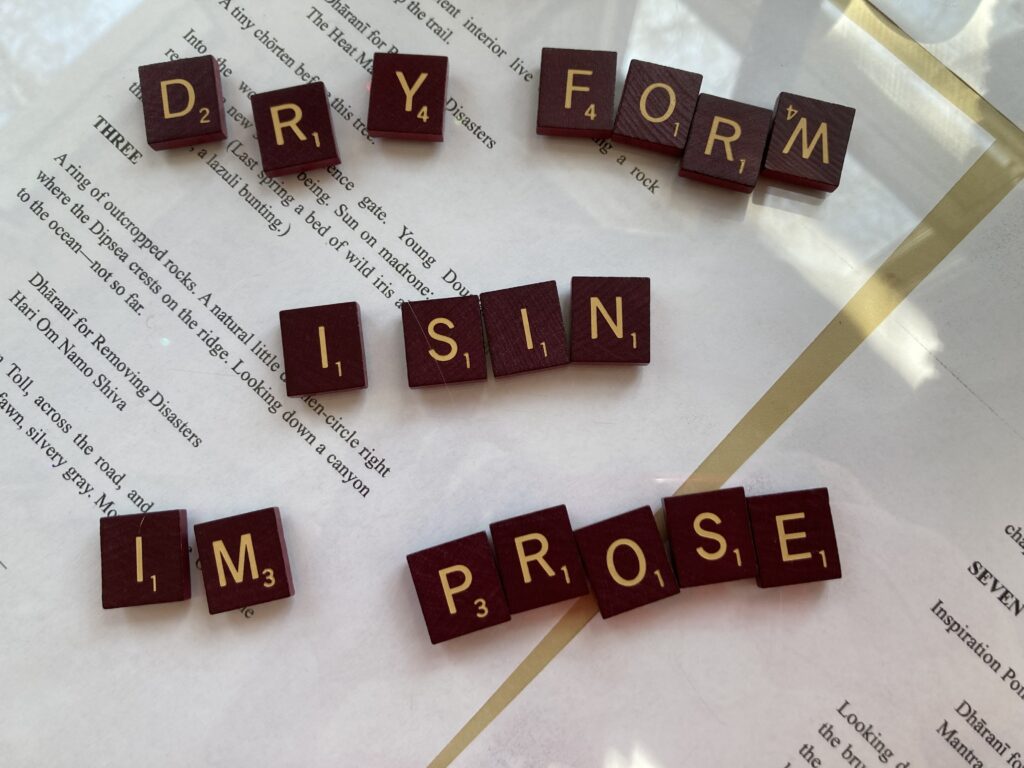
Yesterday I found the scrabble tiles for P I R I F O R M I S S Y N D R O M E and put them on my table. This morning I worked on them some more, trying to find a way to use all the tiles to make a phrase. The idea is that once I do, I will have a spell to break open or through my latest injury. Here are some of attempts:

  • Do I personify? [MMIRRS]
  • Miss Fiery Moon Drip [R]
  • Or is my form inspired? — all tiles used!
  • O sir, my form inspired! — all tiles used!
  • I inform my spired rods — all tiles used!
  • Miss Merry Porfirio [DN] — porfirio = purple-clad person, surname in Spanish/Portuguese
  • Is my sniper mood fir? [R]
  • Sir, spin my fired room — all tiles used!
  • Rim mood: spiny fires [R]
  • I spy: red moon, fir rims — all tiles used!
  • I spy: fir moon, red rims OR I spy: fir’s moon, red rim
  • (dry form) I sin, I’m prose! — all tiles used!

I might like this last one the best.

yes, that is an upside down W. We’re missing an M.

On Thursday I FINALLY picked up CA Conrad’s Ecodeviance, which I requested on march 4 and was planning to use that month. In the book, Conrad is interested in making it impossible to not be present in place by performing rituals that access the “extreme present.” A quick, perhaps half-baked, thought about Conrad’s soma(tic) rituals: from the ones I’ve read so far, a key element seems to be making other people uncomfortable.

Example: (Conrad riding an elevator repeatedly) “At the top and bottom of each ride I would show photographs of myself to strangers and ask, “EXCUSE ME, have you seen this person?”

I laughed out loud when I read this, but I also wondered about other ways of accessing the extreme present were possible that didn’t involve confronting strangers.

Conrad performs these rituals for days/weeks and take notes. From the notes, they write poems. A line from one reminded me of a delightful image from Mary Oliver that I read yesterday:

Six/ CA Conrad

a golden needle
stitches my head to
my knee leaving me
aching along the river

from The Book of Time/ Mary Oliver

those silver sheets, with the occasional golden staple,

I love MO’s description of a storm!

april 24/BIKE

30 minutes
basement
outside: 52 degrees

A little cooler today, but not cold. Overcast, with rain coming. I could have brought my bike up and gone for a ride outside, but I wanted to watch more of The Residence, and my hip was hurting a little so I thought it would be hard to carry my bike up the stairs. I had a good ride. Hardly any pain — only the regular kind for less than a minute in my left knee. I finished episode 2 and started episode 3. Realized halfway through that the titles of the episodes (I had hardly noticed them before) mean something. Episode 3 Knives Out. Does it go deeper than the fact that this episode is about the pastry chef and the bloody knife? I need to watch the rest of the episode. And I need to convince Scott to watch this show. He will like it.

I pushed a little harder on the bike and got my heart rate up in the 130s for at least some time. I worked hard enough to sweat. Hooray! This is my first time sweating from exercise in over a week — last Tuesday. I’ve missed it. If my body feels okay tonight, I’ll have to do more biking tomorrow. Maybe it would help me recover to get a little more exercise? Future Sara, let me know.

Before I biked, I archived some things I read this morning:

1

Entanglements, connections, understandings of self in relation to others — it keeps coming up. Today, I found it in the poem of the day on Poetry Foundation, Speakers/ Dimitri Reyes

About this Poem

This poem finds me in my early twenties, being mentored by an owner of a thrift store in Newark, New Jersey, who became a father figure to my wife and me. Pete was the first Puerto Rican elder I knew who showed me that you can be connected to Ricanness while shuffling setlists between Metallica, Ozomatli, John Coltrane, and Joe Bataan; who showed me that it was cool to enjoy art and philosophize for the sake of dreaming. He is no longer here with us, but I am still philosophizing and dreaming. Currently, I am intrigued by how character sketches teach us how to live, to survive, to love. If life and time are indeed our teachers, the interactions we have among one another are the ever-changing curriculum.

Speakers/ Dimitri Reyes

The interactions we have among one another are the ever-changing curriculum. This idea of curriculum makes me think of a favorite poem, What You Missed That Day You Were Absent from Fourth Grade/ Brad Aaron Modlin.

I have been playing around with the idea of creating a curriculum for my experiences with poetry. I guess that is what my How to Be project is. It might be fun to work on it a little more, to fit in the form of a curriculum with syllabi, learning outcomes, etc.

2

I’m in the process of memorizing Emily Dickinson’s wonderful poem, “The Mushroom is the Elf of the Plants.” I’m looking at it on Poetry Foundation. At the bottom of the page, I read this:

Notes: 

The Poetry Foundation often receives questions about Emily Dickinson’s poems. Read a note from the digital archive editor about Dickinson’s “errors.”

I laughed out loud when I read this part:

Dickinson technically misuses the apostrophe in the poem “A Route of Evanescence, (1489)” and makes similar errors in other poems. Some of these can be explained as unintentional errors and some scholars have made this case. Other scholars, however, contend that Dickinson often intentionally played with typos and other errors as a sort of linguistic mischief-making in her poems and in her considerable correspondence.

The error ED makes is using it’s when she should have used its. This is a huge pet peeve of Scott’s. Just as I was reading this passage, he came downstairs, so I explained the note and paraphrased the key part for him: she’s fucking with you! Ha Ha. I love Emily Dickinson.

3

I was disappointed to check and find that I hadn’t written about mushrooms and entanglement on april 24, 2022. But then I was grateful to find that I had posted a beautiful Mary Oliver poem on april 24, 2021. Thanks past Sara and Mary Oliver! That ending!

Listen, everyone has a chance. 
Is it spring, is it morning?
Are there trees near you, 
and does your own soul need comforting?
Quick, then—open the door and fly on your heavy feet; the song
may already be drifting away.

And here’s a moment of connection and community:

first, I stood still
and thought of nothing. 
Then I began to listen. 
Then I was filled with gladness—
and that’s when it happened, 
when I seemed to float, 
to be myself, a wing or a tree—
and I began to understand
what the bird was saying, 
and the sands in the glass
stopped
for a pure white moment
while gravity sprinkled upward
like rain, rising, 
and in fact
became difficult to tell just what it was that was singing—
not a single thrush, but himself, and all his brothers, 
and also the trees around them, 
as well as the gliding, long-tailed clouds
in the perfectly blue sky—all, all of them
were singing. 
And, of course, so it seemed, 
so was I.

4

Yesterday I started reading Robin Wall Kimmerer’s The Serviceberry. Today I encountered her offering of a definition of economics outside of the scarcity model and within an understanding of gifts and abundance:

Economics is “the study of scarcity, the study of how people use resources and respond to incentives.” (the American Economic Association)

With scarcity as the main principle, the mindset that follows is based on commodification of goods and services.

Economics is “how we organize ourselves to sustain life and enhance its quality. It’s a way of considering how we provide for ourselves” (from the U.S. Society for ecological Economics).

The currency in a gift economy is relationship, which is expressed as gratitude, as interdependence and the ongoing cycles of reciprocity. A gift economy nurtures the community bonds that enhance mutual well-being; the economic unit is “we” rather than “I,” as all flourishing is mutual.

april 23/WALKBIKE

60 minutes
winchell trail / dowling community garden / neighborhood
61 degrees

Even better than yesterday! What a wonderful late morning. Delia and I walked to the Winchell trail, then up to the mesa in the oak savanna. More winchell until the folwell bench, then across the road through the 1960s neighborhood and into the community garden. So many birds! Lots of green and white flowers too, blooming all over the hillside in the oak savanna. I found out what these white blossoms were called a few years ago, but I can’t remember — maybe it’s one of these?

10 Things

  1. a steady dripping down in the ravine
  2. 2 dark holes — caves in the rock
  3. more of the chainlink fence is ripped away from the posts
  4. yesterday I noticed ugly red graffiti on the 38th street steps. Was it still there today? I forgot to check, but surely I would have noticed, right?
  5. less mud, more dirt
  6. sometimes sunny, sometimes overcast / sometimes blue, sometimes light brown
  7. in a wood near the community garden: 2 (or more?) birds making a racket up in a tree, sounding like the drum at the beginning of Van Halen’s “Hot for Teacher” — nice!
  8. the river: patches of smooth water, patches of rougher water — not from wind, but from sandbars?
  9. calm, still, the water was barely moving — only after staring at it for a moment could I see a slight shimmer out of the corner of my eye
  10. a woman in bright pink, sitting near the 38th street steps, silent except for the repeated clearing of her throat

before the run

Reading through my entries from april of 2022, I’m returning to thoughts of entanglement and mushrooms and precarity and ruins. Here is today’s inspiration from 23 april 2022:

  • a different sort of We, not a me or an I, but a we, an us
  • a different way of looking/sensing/becoming aware: not seeing straight on, but feeling, looking across and to the side, down, beneath and below
  • stop looking up to the heavens, start feeling/sensing what’s below
  • a hope that is not predicated on evidence, when evidence = seeing and Knowing and fully understanding (seeing things as parts or discrete categories or individual things)
  • entangled is not separate or pure but messy and enmeshed

this is why we are all here — from my haibun and what I heard coming out of the little old lady’s phone

this 
why 
we 
all
here

why = curiosity, wonder

The why is not an explanation — this is why/this is THE reason — but an invitation to imagine differently, expansively, wildly.

we all = ecosystems, organisms, networks, asemblages

Organisms are ecosystems. 
I find myself surrounded by patchiness, that is, a mosaic of open-ended assemblages of entangled ways of life, with each further opening into a mosaic of temporal rhythms and spatial arcs (Tsing, 4) .

here = a place, located in history, a specific place, not transferable or easily translatable, can’t be scaled up or turned into assets

I picked up Mushrooms at the End of the World, and found this in the preface:

The time has come for new ways of telling stories beyond . . . Man and Nature . . , such stories might be simultaneously true and fabulous. How else can we account for the fact that anything is alive in the mess we have made?

The Mushrooms at the End of the World/ Anna Lowenhaupt Tsing (viii)

fabulous = resembling or suggesting a fable of an incredible, astonishing, or exaggerated nature

invented and true

[about this book] what follows a riot of short chapters. I wanted them to be like the flashes of mushrooms that come up after a rain: an over-the-top bounty; a temptation to explore; an always too many.

explosion / too much, too many / after the rain eruptions of excess

This explosion bit reminded me of Arthur Sze in an interview with David Naiman:

I began to think I love this idea that the mycelium is below the surface. It’s like the subconscious, then when the mushroom fruits pops up above ground, maybe that’s like this spontaneous outpouring of a poem or whatever.

during the run

I thought about something else I read in the entry with this Sze passage. It’s a fragment of a poem I wrote in response to Sze and a few Mary Oliver lines:

Maybe like mushrooms, we rise
or not rise, flare
brief burst from below
then return 
to swim in the dirt…

I was thinking about not wanting to swim in the dirt, but be out in the air, exposed, vulnerable to erosion and rust/ing.

after the run

In The Mushrooms at the End of the World, Tsing discusses how matsutake mushrooms develop their fungi networks in locations of ruin — edges of volcanos, forest destroyed by logging and lumber companies. So, there’s a relationship between the flare/the fruit (the mushroom) and decay/ruin/erosion. Now I’m thinking about my version of what the moment of ruin can produce, where the moment of ruin = ruined eyes. What poetry might burst forth as I reckon with my dying/dead cone cells?

Mushrooms came up in the fiction book I’m reading, too: The Bog Wife.

But when he returned to the bog, he found a row of trespassers sprouting where the swale met the hinged door to the Cranberry River. These trespassers retained their heads, and Percy knew as soon as he saw them that his suspicions were correct; they were mushrooms. His heart sank. He sometimes saw mushrooms in the sparse forest on the west end of the property, modest white-headed clumps strewn across the soil or fringed gray dishes sticking out like frills from the trunks of trees. But he had never seen any of their ilk here, where the soil was not mushroom soil because it was bog soil, a dense wet batter that supported only the shallow-rooted and perpetually thirsty.

They would never tolerate any of the mushrooms, Percy thought. The mushrooms had all been trespassers. He tore out the orange mushrooms and gathered up the torn stems for burning, but he knew it wouldn’t make a difference. Mushrooms could not be dug up. They could not be evicted.

The Bog Wife/ Kay Chronister

I’m reading Emily Dickinson’s “The Mushroom is the Elf of Plants” and refreshing my memorizing of Sylvia Plath’s “Mushrooms.” Nobody sees us, stops us — SP envisions mushrooms as trespassers.

And here are a few more passages from Mushrooms at the End of the World, that I want to archive:

a network of (mostly) invisible influences

Below the forest floor, fungal bodies extend themselves in nets and skein, binding roots and mineral soils, long before producing mushrooms. All books emerge from similarly hidden collaborations.

The Mushrooms at the End of the World/ ALT

a gift and a guide

The uncontrolled lives of mushrooms are a gift — and a guide — when the uncontrolled world we thought we had fails.

promise and ruin, promise and ruin

This is a story we need to know. Industrial transformation turned out to be a bubble of promise followed by lost livelihoods and damaged landscapes. And yet: such documents are not enough. If we end the story with decay, we abandon all hope—or turn our attention to other sites of promise and ruin, promise and ruin.

bike: 20 minutes
basement

It was definitely nice enough to bike outside today, but I wanted to test out how riding a bike would feel on my back/hips/glutes for taking my bike off the stand and carrying upstairs. Plus I wanted to watch more of The Residence. Great show!

Almost 2 hours later, my back feels okay. We’ll see how it is when I want to go to sleep. If it’s okay, I might try biking outside tomorrow!

april 12/WALKBIKE

35 minutes
7 oaks
58 degrees

Last night and this morning my glutes ached, so no running today. I did some more research and I think the exercises in this video might help. Future Sara will let us know!

a pain in the butt

Walked with Delia and Scott. Warmer today, windy too. My favorite sound: the wind rushing through a big pine tree. I noticed some dry leaves skittering in front of us as we walked east. Heard the St. Thomas bells and their extra long chimes at noon. Saw lots of runners and walkers and bikers. Scott talked about how farmers are getting screwed by the new tariffs, and I talked about Indigo. A few times my back ached — was it a spasm? Not sure.

indigo

For the past few days, I’ve been working on a crown of color sonnets, using the words of other writers (cento). The plan is to write 7 sonnets, with each one setting up the next with its color mentioned in the last line. I started with green, then went to orange, then yellow-red, then purple. I wasn’t sure what would come next — I thought it would probably be blue — but in the last line of the purple sonnet indigo appeared. I haven’t studied indigo that much, so before writing a sonnet about it, I’d like to spend some time with it.

Indigo began working its way into my sonnets a few days ago, when I attempted to list colors I’d seen on my run in using the ROYGBIV system. I couldn’t recall seeing anything indigo. Then yesterday, while looking for a passage by Oliver Sacks on yellow I encountered this description (which I read a few years ago, but had forgotten):

I had long wanted to see “true” indigo, and thought that drugs might be the way to do this. So one sunny Saturday in 1964, I developed a pharmacologic launchpad consisting of a base of amphetamine (for general arousal), LSD (for hallucinogenic intensity), and a touch of cannabis (for a little added delirium). About twenty minutes after taking this, I faced a white wall and exclaimed, “I want to see indigo now—now!” And then, as if thrown by a giant paintbrush, there appeared a huge, trembling, pear-shaped blob of the purest indigo. Luminous, numinous, it filled me with rapture: It was the color of heaven, the color, I thought, which Giotto had spent a lifetime trying to get but never achieved—never achieved, perhaps, because the color of heaven is not to be seen on earth. But it had existed once, I thought—it was the color of the Paleozoic sea, the color the ocean used to be. I leaned toward it in a sort of ecstasy. And then it suddenly disappeared, leaving me with an overwhelming sense of loss and sadness that it had been snatched away. But I consoled myself: Yes, indigo exists, and it can be conjured up in the brain. For months afterward, I searched for indigo. I turned over little stones and rocks near my house, looking for it. I examined specimens of azurite in the natural history museum—but even they were infinitely far from the color I had seen. And then, in 1965, when I had moved to New York, I went to a concert in the Egyptology gallery of the Metropolitan Museum of Art. In the first half, a Monteverdi piece was performed, and I was utterly transported. I had taken no drugs, but I felt a glorious river of music, four hundred years long, flowing from Monteverdi’s mind into my own. In this ecstatic mood, I wandered out during the intermission and looked at the ancient Egyptian objects on display—lapis lazuli amulets, jewelry, and so forth—and I was enchanted to see glints of indigo. I thought: Thank God, it really exists! During the second half of the concert, I got a bit bored and restless, but I consoled myself, knowing that I could go out and take a “sip” of indigo afterward. It would be there, waiting for me. But when I went out to look at the gallery after the concert was finished, I could see only blue and purple and mauve and puce—no indigo. That was nearly fifty years ago, and I have never seen indigo again.

Hallucinations/ Oliver Sacks (found here)

His description of standing in front of blank wall reminded me of my mood rings experiment: facing a blank wall, staring at it, waiting for my blind spot to occur. I wonder, could I see indigo doing this (and without the drugs)?

I recall reading something about indigo and debates over whether or not it existed. I’ll have to look for that source.

At the time, because I was working on a yellow poem, I didn’t dwell on the indigo. But later that day, it returned in a Mary Oliver poem — I was looking for another orange poem:

Poppies/ Mary Oliver

The poppies send up their
orange flares; swaying
in the wind, their congregations
are a levitation

of bright dust, of thin
and lacy leaves.
There isn’t a place
in this world that doesn’t

sooner or later drown
in the indigos of darkness,
but now, for a while,
the roughage

shines like a miracle
as it floats above everything
with its yellow hair.
Of course nothing stops the cold,

black, curved blade
from hooking forward—
of course
loss is the great lesson.

But also I say this: that light
is an invitation
to happiness,
and that happiness

when it’s done right,
is a kind of holiness,
palpable and redemptive,
Inside the bright fields,

touched by their rough and spongy gold,
I am washed and washed
in the river
of earthly delight—

and what are you going to do—
what can you do
about it—
deep, blue night?

A thought occurs to me in reading this — actually, a reminder: here in the city, on a street with street lights and security lights and light pollution of other kinds, a deep, blue night is impossible to see. And, ever since the family farm in the UP was sold in 2005, I rarely am in a place remote enough to lack light.

bike: 30 minutes
basement

Finally had a chance to finish up the first episode of The Residence and start the second one. Wow, it’s good. One moment that I couldn’t quite figure out, even with the audio description: Cordelia Cup encounters the male chef sitting on the floor, against the wall and under a row of knives. He looks motionless and dead to me, but no one reacts and the audio description says his eyes followed Cordelia as she left the room. I watched again and still couldn’t tell. His eyes looked dead to me, but that happens a lot — that is, when I actually see someone’s eyes.

april 8/BIKEWALK

bike: 35 minutes
basement
outside temp: 38 degrees

After two days of running in a row, a break. Decided to bike in the basement and check out a show FWA recommended, The Residence. The detective is a birder, which is cool on its own, but she’s also black, which is even cooler because it raises the visibility of black birding (see J. Drew Lanham and “Birding While Black”). Thank goodness for the audio description — I like how it’s voiced by a black actor — because I would have missed so much of the show without it! I like the detective, Cordelia Cup. Her m.o. is attention and focus, filtering out distractions, but not shutting down possible evidence or suspects. Much of that attention is visible, but she also relies on hearing and touch and smell. I’m about 1/2 done with the episode. I like it, so I’ll keep watching.

walk: 45 minutes
longfellow flats
44 degrees

A beautiful afternoon! Warm sun, low wind. Delia and I took the 15 worn wooden steps down to the winchell trail and walked along the chainlink fence. I noticed a few small slabs of asphalt and wondered how long ago this was paved. 10 years? Less, more? A flash of color in my peripheral: electric blue spray paint. Admired the soft oak tree shadows stretched across the paved trail. Heard, but couldn’t see, a woodpecker high in a tree. Passed 2 guys in bright orange shirts. Took the old stone steps down to the river. Looking across to the other side, I noticed a door carved into the bluff, only accessible by boat. On this side, I noticed the gentle lapping of the water over some big rocks.

The color of the day: brown. Everything, brown: dirt, tree trunks, branches, dead leaves, bluff, steps. I suppose I might consider some of it, especially the things lit my sunlight, as orange — deep orange.

march 30/BIKERUN

bike: 35 minutes
run: 1 mile
outside: 32 degrees / snow

I finally decided to start watching the Apple+ show, See. A plague has wiped out all but 2 million people. The survivors are blind. At the time of the series, centuries later, vision exists only as a myth. The first episode begins in a remote village. I wanted to watch it because I’m curious how blindness is represented in the show. I should add that I am watching the show with audio descriptions on; I don’t think I’d be able to watch without them. My first question: what do they mean by blind? They never specify. Is it pure darkness, or can they detect some light?

The blind villagers function normally; they navigate with long sticks and dogs and ropes that are strung up all around the village. Also: wind chimes and bells. Many of them have extremely good hearing.

If you’re lying, I will hear. Nothing escapes my ears. I hear doors closing in your voice.

Just as I was stopping my bike, the evil queen appeared. I’m not sure what her deal is yet — I just know that she’s evil and she wants to kill the two babies that have just been born in the village because she hates their father and has a bounty on his head.

Do I like this show? Not sure. I’ll keep watching. One thing that was difficult — the fight scene between the queen’s henchmen, the witch finders, and the village, led by Jason Momoa. It was long and very visual — so much audio description.

While I ran I listened to the mood playlist: energy. Not sure why this is the case, but running actually helps loosen up my back when it feels a little tight. I only ran a mile, but it was enough. Now I’m tired and hungry!

before the run

In his introduction of the poem-of-the-day for the slowdown poetry podcast, Major Jackson says,

Today’s marvelous poem reminds me we exist in liminal zones where the extraordinary renders the ordinary visible and uncanny, an assertion of the imagination that makes our world shimmer.

episode 1321

The ordinary as uncanny, shimmering. I love this description and Heather Christle’s work for this reason. My lack of functioning cone cells makes more of the world uncanny and shimmering. Often, things are not quite and almost. Everything seems to be vibrating and pulsing, soft and slow. And my reliance on peripheral vision means I am much more aware of movement. Before, when my central vision worked, I had an easier time blocking that movement out, but now I see all of it. While this is a problem, it is also offers the possibility of seeing the world differently, of accessing the magic and wonder of it.

The Running of Several Simulations at Once May Lead to Murky Data/ Heather Christle

How do you say ‘inopportune’
in a small forest of cell phone towers
disguised as bizarrely regular trees?
I am asking in case it happens,
because anything can and even does.
Sometimes I want to shrink
and move into a miniature model village
mostly because the particular green
of the imaginary grass corresponds
with how my body believes joy would feel
if joy were to happen here on Earth,
where my eyes receive light in this
certain way: limited, but not
without pleasure. As a child
I visited one model village
so extensively constructed I fell
into a state of complete wonder—
‘They thought of everything!’
even the person running late
for the train, and the window
left slightly open to the storm—
and I should like to request
the arrival of this sensation in response
to the world at its actual scale—
just imagine! Someone
has even gone to the trouble
of filling the egg cartons
individually with smooth brown
eggs and one—such detail!—
has broken, but not enough
to be noticed before the carton
has been paid for and brought home.
Sometimes artificially I will
induce this feeling in myself
by going silent at a large
restaurant gathering, pretending
—until it is real—that each person
is speaking from a highly naturalistic script,
having carefully rehearsed each
tiny gesture, the mid-sentence reach
for the salt, and I fall immediately
in love with my companions,
in awe of their remarkable talent
for portraying with such detailed conviction
the humans I know as my friends.

I can’t quite put it into words, but this poem speaks to a conversation Scott and I were having last night. He was pointing out all of these minute details about our environment, like how the pinball machine was set up and leveled, and how that process affects game play and your enjoyment of it. There was something about the attention to the details and learning more about all the (almost) invisible things required to make a thing work properly and then describing that work as “care” work that is echoed in this poem.

Future Sara, will this make sense to you? It connects to being oriented toward care and wonder and finding delight in the small details.

feb 28/WALKBIKERUN

am walk: 20 minutes
neighborhood
wind: 20 mph / 42 mph gusts

Sitting at my desk in the front room before heading out for a walk, I could hear the wind howling. I wrote in my Plague Notebook, Vol. 24, the wind purpled the sky. Later, walking with Scott and Delia, feeling and hearing and seeing the wind, I said it again and explained it to Scott: the blustery wind, like someone mad and full of bluster, their face turning purple with outrage. I had been planning to try running outside today, but after being pushed around by the wind, I decided I’d prefer to be in the basement.

My favorite things about the wind: the way it swirled the leaves on the sidewalk; turning the corner and feeling the wind on my back, seeing the leaves flying ahead of me.

bike: 30 minutes
run: 1.5 miles
basement

Watched part of S2: episode 1 of Sprint on Netflix while I biked. I’m so glad I put on the audio descriptions! I could never read the big block text they used for identifying people and locations. It’s pretty good, even though they’re using a worn storyline: rival sprinters, one is flashy and talks a lot, the other is quiet and avoids the spotlight.

Listened to a running podcast for the first 10 minutes, then an energy playlist for the rest. I didn’t want to do much in case my back or hips flared up. They both seem fine — not completely pain free, but not painful either. It felt good to get my heart rate up for the first time since Saturday.

Writing this part of the entry at 11:45 am, it’s even windier with 47 mph gusts! Very glad I didn’t go outside to run!

the purple hour

The final purple hour. I’ve enjoyed devoting time to this color. Today’s goal: to write some lines inspired by my exploration.*

2:06 am / dining room

  • thick, heavy stillness
  • the clicking keys echoing in the silence
  • a soft, high ringing in my ears
  • bouncing my legs vigorously
  • “lavender gray: a widow’s shroud” from The Nomenclature of Color/ Richard Jones
  • lavender is the new gray

rituals/ceremonies for each of my main colors? see CA Conrad on red

2 shadows, cast on the closed curtain, light source: a neighbor’s security light
shadow 1 = a thick smear of bird poop on the glass turned into a small form on the curtain
shadow 2 = the thin branches of the serviceberry bush, shimmering in the wind, thin shadows vibrate on the curtain

The wild/ing in this girl is purple, I think, A deep and dark purple.

Wilding/ Shara McCallum

Machetazo!, Bony Ramírez & Blonde Dreams, Alison Saar

you can take the girl out of the wilderness
you can strand her bewilder her for a time
you can even hang her upside down
in your rickety attempt to shake loose
the source of her power but you won’t ever
disentangle the wilding from her
the force of a thousand suns unfurling
and hurling her toward the ground
you won’t be able to erase the traces
of salt lacing her ravenous dreams
oh you can try unwebbing her feet
but the lizard in her will keep sunning
itself as the day is long and at nightfall
will crawl up your walls lurking
at the corners of your vision
goading you on while she thwarts
your every endeavor abandoning
her tail anything required of her
to keep eluding your capture

*Here’s a first draft of something about purple:

Purple Things

a wind-stirred sky / the space between your eye and the object you’re looking at / agitation / the light from a full moon filtered through the blinds / the square shadow it casts on the carpet / deep inside the beat a thought a dream / darkened doorways / a bruise / mold / mist / a sunset after a volcano / a fashion craze / a widow’s shroud / fibs / a house, settling / the beginning / the end / interiors / oxygen-starved extremities / ornamental grass / asters / tantrums / restlessness / the buzz beneath / impending thunderstorms / ink / iodine / inheritance: a mother’s jacket, a daughter’s despair / fake fruit flavor / static / the only color I see when I wake up in the middle of the night

jan 28/BIKE

25 minutes
basement
outside: wind gusts, 32 mph

I woke up with a sore right glute/lower back. Not terribly painful, but sore and a bit worrisome. Wanted to run in the warmer weather but wondered if it was a bad idea. Then I heard the howling wind and decided to believe that it was a sign: don’t run! So I went to the basement and biked instead. It helped! I should work on biking longer in the basement. It’s boring. My bike is on a basic stand — no shifting, no zwifting, just pedaling and watching something on my iPad. Today I watched some races; next time, a show or a movie.

Before my bike: I’m in the process of re-reading all of the poems I gathered this year and choosing lines to turn into my own poem. This process inspired three directions of thought:

1 — open

The airy sky has taken its place leaning against the wall.
It is like a prayer to what is empty.
And what is empty turns its face to us
and whispers:
“I am not empty, I am open.”
(Vermeer/ Tranströmer)

When the door of my vocal cords closes, another opens. And through that open door I escape into a region I do not know what to call but which is vaster than the space of my body. You could say: my name is the door to my being, and in that interval when I’m stuttering, the door is left wide open and my being rushes out. What rushes in?
(from Liturgy of the Name/ JJJJJerome Ellis)

Open doors say, “Come in.”
(Doors/ Carl Sandburg)

This discussion of open doors reminded me of something I remembered thinking/writing about in a log entry, but not when I wrote it. It took a few minutes, but I found it!

Running north, somewhere above the white sands beach, I started thinking about something I was working on earlier today about how my changing vision is closing some doors, opening others. I’m particularly interested in thinking about how it opens doors without ignoring/denying the shut ones too. Anyway, I suddenly had a thought: it’s not just that it opens doors, but it makes it so those doors can’t shut. I waited until I reached the bottom of the hill and then spoke my idea into my phone. Here’s a transcript:

It’s not just that doors open, they won’t shut. I can’t close them to the understandings that I’m both forced to confront but also have the opportunity to explore. But the key thing is that the doors can’t be shut. my notes recorded during a run on 3 may 2023

I came to this idea after thinking about how vision is strange and tenuous and a lot of guesswork for everyone. A big difference between me and a lot of other people is that I can’t ignore or deny that fact. It’s much easier for people with “normal” vision to imagine, with their sharp vision and their ability to focus fast, that they are seeing exactly what is there. They’re not. Even if I wanted to, I can’t pretend that that is true. I’m reminded all of the time of how tenuous converting electrical impulses into images is and what the brain does for us to make those images intelligible.

log entry from 3 may 2023

2 — walls

The ears experience a buzz, perhaps it’s depth or perhaps height.
It’s the pressure from the other side of the wall,
the pressure that makes each fact float
(Vermeer/ Tramströmer)

I wandered all along the street that hugs the walls,
a needle floating
on its cloth. Once
I shut my eyes and felt my way
along the stone. Outside
is the cash crop, sunflowers, as far as one can see. Listen,
the wind rattles in them,
a loose worship
seeking an object
an interruption. Sara,
the walls are beautiful. They block the view.
And it feels rich to be
inside their grasp.
(To a Friend Going Blind/ Jorie Graham)

Here I’m thinking about inner and outer and the interior walls of a house and the limestone and sandstone and concrete walls of the falls and lock and dams and the gorge.

3 — blind

What Would You Give Up?/ Dorianne Laux    

Not the nose on my face, but the spite, the grindstone.
Not an arm or a leg, but the money.
Not the length of the arm, but the lie, the shot, the list, the twist.
Not the ear, but the lending, the boxing, the out on.
Not the eye, but the naked, the catching, in the blink of, 
the keeping it peeled, the turning a blind.
Not the elbow but the grease, the room.
Not the leg, but the pulling.
Not the back, but the shirt on, the breaking of, the scratch, the
     stab, 
the turning, the water off a duck’s.
Not the neck, but the sticking it out, the in-shit-up-to. 
Not the throat, but the jump down, the frog in.
Not the feet, but the ground, the dragging, the cold.
Not the heel, but the down at, the under.
Not the fingers, but the light, the butter.
Not the thumb, but the green, the sore, the twiddle. 
Not the tongue, but the slip.
Not the tooth, but the nail, the long in, the sweet.
Not the brain, but the drain, the picking of, the all brawn and no.
Not the breast, but the beating. 
Not the body, but the temple.
The bird in the hand, the foot in the grave.

This poem is one of five published in the Cortland Review in the spring of 2009. As an aside, the spring of 2009 was when I started my first blog, TROUBLE, which transformed my life, and also when my mom was in the final stage of pancreatic cancer; she died in the fall of 2009.

Not the eye, but the naked, the catching, in the blink of, 
the keeping it peeled, the turning a blind.

Yes, let’s give up these expressions. I am reminded of Naomi Cohn and her listing of expressions using blind:

Entries from the Braille Encyclopedia (excerpt) / Naomi Cohn

Blind

Blind alley a dead end.
Blind pig an illegal saloon.
Blind drunk what you get there.
Blind staggers a disease of horses.
Blind story floor of a building without windows.
Blind spot where the car lurks in the next lane.

Looking for this writing, I discovered that Cohn’s book, Braille, is finally out! How did I miss that it was published this past October? Oh, I know — I was worried about the election and dealing with the mental health crises of my two kids! I immediately ordered Cohn’s book at my local awesome book store, Moon Palace! Pick up later today. Hooray!

Didn’t Georgina Kleege do a riff on “blind” in her book, Sight Unseen? Just checked, yes!

The word blind has always meant more than merely the inability to see. The Anglo-Saxon translators of the Gospels make the metaphoric leap from literal sightlessness to spiritual or cognitive incapacity. Of course they were only following an ancient lead. Throughout the history of the language and in common usage today, the word connotes a lack of understanding or discernment, a willful disregard or obliviousness, a thing meant to conceal or deceive. In fact, when you stop to listen, the word is far more commonly used in its figurative than its literal sense. And it comes up so often: blind faith, blind devotion, blind luck, blind lust, blind trust, blind chance, blind rage, blind alley, blind curve, blind-nail flooring, blind date (more dangerous than you think), duck blind, window blind, micro-mini blind (when open, they’re hard to see), blind taste test, double-blind study, flying blind, following blind, blind leading the blind, blind landing, color blind, blind submission, blind side, blind spot, blindfold, blindman’s bluff, three blind mice (have you ever seen such a sight in your life?).

Sight Unseen/ Georgian Kleege

memories

Writing about walls and the inner and outer, I started thinking about Severance and innies and outies and the relationship between them. Scott and I are listening to the Scott/Stiller podcast recapping the first season and watching all of the episodes, before screening season 2. Anyway, I remembered Helly R’s consent speech:

My name is Helly R. I’m making this video roughly two hours before it will be shown to me. I have, of my own free accord, elected to undergo the procedure colloquially known as severance. I give consent for my perceptual chronologies to be surgically split, separating my memories between my work life and my personal life. I acknowledge that, henceforth, my access to my memories will be spatially dictated. I will be unable to access outside recollections whilst on Lumon’s severed basement floor, nor retain work memories upon my ascent. I am aware that this alteration is comprehensive and irreversible. I make these statements freely.

What does the severing process do to the brain? Is it all about dividing inner and outer memories? What is the role of memory and remembering in the forming/understanding/experience of selfhood? Irving gives a little speech about how our sense of self is shaped by our memories/stories/history to Helly in episode 3:

It’s an unnatural state for a person to have. No history. History makes us someone. It gives us a context, a shape.

jan 20/BIKERUN

bike: 15 minutes
run: 1 mile
basement
outside: -11 / feels like -18

Brrr. A quick bike and run in the basement in the late afternoon. Watched “Nobody Asked Us” on YouTube while I biked, listened to an apple music “energy” playlist. Didn’t think about much, just enjoyed moving and sweating a little.

Spent most of my writing day reviewing past entries from June and July. Instead of reading them with my eyes, I listened to them through my computer. It was nice to give my eyes a break. Lots of great stuff about lakes and swimming and the color of water in those entries. Nice to spend some time there when it’s so cold outside. Also a nice way to forget that Trump was inaugurated today.

from Mantled/ Kevin Young

The dead do
     what they want
which is nothing—

sit there, mantled,
     or made real
by photographs 

in silver frames,
     or less real
by our many ministrations.

Dusting. Bleach. The world
     swept, ordered,
seemingly unending.

Love Young’s entire poem, but especially this first half.

jan 19/BIKERUN

bike: 25 minutes
run: 1.4 miles
basement
outside: -5 degrees / feels like -10

I have run in colder weather than -5, but I was not interested in going out there today. Do I regret it? I don’t think so, but . . . . While I biked I watched some track races from the Paris Olympics, and while I ran I listened to the Apple Music “Feel Good” playlist. Listening to a different version of this playlist earlier in the week helped the run to go by faster, but the songs weren’t quite as motivating today. Had to skip through several of them until Rio by Duran Duran came on. Next: Rosanna/Toto, then Brandy/Looking Glass, then as I walked Afternoon Delight/Starland Vocal Band. That last one, wow. I don’t remember thinking about much as I ran. I remember imagining myself falling off of the treadmill. I wondered what song would come on next. I tried to lift out of my hips. I debated if Rosanna was a “feel good” song. And now that I think about it, Brandy as feel good? It’s sad. When Afternoon Delight came on I thought about Anchorman and Glee and wondered how anyone would not get what this song was about.

I memorized Wallace Stevens’ “Tattoo” and was planning to recite it while I biked and ran but then I forgot.

One-line poems, and/or poem starters:

Edgar Allen Poe,
exercise enthusiast.

Sara doing Sara things.

A shadow
crosses.

The tree outside
my window.

jan 14/BIKERUN

bike: 30 minutes
run: 2.7 miles
basement
outside: 7 degrees / feels like -9

Tomorrow it’s supposed to be slightly warmer, so I decided to wait until then to run outside. While I biked, I watched the 2017 5000m men’s world championships with Mo Farrah. While I ran, I turned on an Apple Music made “Energy” playlist. It was great. I don’t really remember the environment — oh, except for that I was cold at first, in our unfinished basement, but then warmed up fast — but I remember my body during the bike. I was working on keeping my back straight and long over the handlebars. During the run, I remember the music and the stretches when I only noticed my legs when they were off the ground. Listening to the music and getting lost in my thoughts about vision and faces and names, I forgot chunks of time.

before the run — remember/forget: names and faces

Last night, I drifted off to sleep thinking about names and nobodies and how I wanted to gather past accounts about them today in this entry. During my “on this day” practice, while revisiting 14 jan 2020, I came across the documentary, Notes on Blindness, and John Hull’s description of losing all of his sight and the ability to remember faces. Hull asks, 

To what extent is the loss of the image of the face tied up with the loss of the image of the self and with the consequent feeling of being a ghost or a mere spirit?

So now I’m expanding my thinking to names and faces.

First, a question, prompted by a bit of the Hull that I listened to/watched just now: What senses produce the strongest memories? answer: smell

a short from the longer documentary

I watched the part after Hull’s quote about the face and the self, and it helped clarify the quote more. First, his wife says:

I can’t look into his eyes and be seen. There’s no beholding in that sense of being held in somebody’s look.

To be seen is to exist. This is what lies behind the thought my older daughter has expressed, Oh Daddy, I wish you could see me!

It is not the person who cannot see the face that is the ghost, but the person who cannot be seen. Even as I often feel like a ghost moving through the world, I also feel like everyone else is a ghost or a specter, that I’m the only real and living thing. It’s complicated because I feel both: haunting and haunted.

Of course, sometimes I can see faces, or at least parts of faces, and I can still see gestures and bodies, so my feeling of loss and disconnection is much different from Hull.

And there’s more messiness about my understanding of all of this. To be sure, there has been a tremendous feeling of loss over not being able to see faces clearly, or to hold someone with a look; to behold and witness others seems to be part of what makes us feel human. But (or and?), some of this is illusion and cultural construct. Sight and seeing someone is not the only way we connect with them, or see them as a self. In fact, it’s not the most reliable. For me, there is something exciting (is that the right word?) about gaining a new perspective on vision and its limits, and about being motivated to care about the process of seeing, which I used to ignore.

Wow — how far am I wandering from remembering and forgetting here?

Now I’m thinking about names and faces and phrases like, put a name to the face. For a little less than a year, Scott and I have been regularly going to a pub near our house, The Blue Door. Much of the time, we’ve had the same waitress. I always recognize her — less by her face than her gestures — but I haven’t known her name. A few days ago, Scott finally realized he could check the bill for her name so now we know it. I wonder, what difference does it make? (How) do I feel more connected to her now that I know her name?

after the run: music

All of the songs I heard were good for energy and distraction, but a few of them felt especially connected to what I had been thinking about prior to my workout.

Reputation/ Joan Jett and the Blackhearts
An’ I don’t give a damn ’bout my reputation
Never said I wanted to improve my station
An’ I’m only doin’ good when I’m havin’ fun
An’ I don’t have to please no one
I don’t give a damn ’bout my reputation
I’ve never been afraid of any deviation
An’ I don’t really care if you think I’m strange
I ain’t gonna change

I think it was around the time she sang about not wanting to improve her station, I started thinking about names and “being somebody” and notoreity/notoriousness and when wanting to be known is desirable and when it’s not. Usually it’s not for me. I like to be left alone to do what I want to do. I also thought Alice Oswa

Poker Face/ Lady Gaga
Can’t read my, can’t read my
No, he can’t read my poker face
(She’s got me like nobody)
Can’t read my, can’t read my
No, he can’t read my poker face
(She’s got me like nobody)

Wow, these lyrics! Yikes. Anyway, I’m interested in the idea of an unreadable, stone face. That’s how most faces are to me all of the time. I can’t see small gestures or tells that help you to make sense of what’s being said. Now I’m wondering about non-facial poker tells. Here are two that I found: how they handle the chips/cards and table talk.

Rhythm Nation/ Janet Jackson
With music by our side to break the color lines
Let’s work together to improve our way of life
Join voices in protest to social injustice
A generation full of courage, come forth with me

As I heard these words, I thought about my discussion below about seeing, looking, beholding each other as the primary way to recognize each other’s humanity/selfhood. What about hearing and listening and playing music?

Bonus: It’s Raining Men/ The Weather Girls

Not directly related to faces and names, but hearing this song reminded me of one of my favorite sections in the blindness documentary. It is nine and a half minutes in and it’s about rain and how its different sounds on a tree or a roof or a garbage can help us to “see” a place with our ears.

jan 13/BIKERUN

bike: 30 minutes
run: 1 mile
basement
outside: 3 degrees / feels like -3

Cold and icy and windy outside, so inside in the basement for me. Watched an old track race while I biked, listened to my remember to forget playlist as I ran. Happy to move my legs and work up a sweat. What did I notice? I don’t remember.

remember — inheritance

gestures, ways of speaking, expressions, eye diseases, anxiety disorders, curiosity, persistence, restlessness, strong legs, a love of water, a need for being outside, the impulse to run away, an edge dweller, conflict avoider, a storyteller

for more on inheritance, see 4 nov 2021

Mary Ruefle and I Remember

I remember a lecture I read by Mary Ruefle in Madness, Rack, and Honey.

Thinking about “I Remember” and remembering, origins and when things began. I thought about how there is a sort of origin point to all of this (my writing poetry) and it’s my eye doctor diagnosing me with a rare eye disease then saying, you should write about it which prompted me to want to work on my writing so I could better explain what I was experiencing. But, I had already been writing and already had those desires, so it was really more of a slight shift, a stutter step or a quick stumble off the path, just briefly, which changed the trajectory, slightly, incrementally. Difficult to pinpoint what all changes your path.

9 may 2023

remember my name

The first song that came up on my playlist was Fame. As I listened to the lyrics — Fame! I’m gonna live forever / Baby remember my name — I started thinking about being remembered forever and fame and names and immortality and Emily Dickinson and JJJJJerome Ellis and their “Liturgy of the Name” in Asters of Ceremonies.

from Liturgy of the Name/ JJJJJerome Ellis

My name, in the time when I cannot utter it, maps the space within me. In an instant the Stutter shuttles me from the present–the barber just asked me my name, my voice fluttering in my throat, struggling not to tremble as the razor presses on my temples–to an ancient place of breath, name, silence, time, creation.

. . .

When the door of my vocal cords closes, another opens. And through that open door I escape into a region I do not know what to call but which is vaster than the space of my body. You could say: my name is the door to my being, and in that interval when I’m stuttering, the door is left wide open and my being rushes out. What rushes in?

aug 1/BIKESWIM

bike: 8.5 miles
lake nokomis and back
77 degrees

What an evening for a bike ride! Since it had just rained, there weren’t that many people on the paths. I didn’t have to pass anyone and I didn’t experience any scary, I-can’t-see moments. The bike ride on the way back was the best — evening light, cooler air, getting closer to dusk. So much better to be on a bike, outside, than in a car. Heard the rushing creek and some kids playing in the water. Felt satisfied after 80 minutes in the water.

5 loops
lake nokomis open swim
77 degrees

The first loop was surprisingly difficult. Sometimes it felt like I was swimming through syrup — heavy, slow — and sometimes like I was against a current — never going anywhere, or being pushed off course. How strong can the current be in lake nokomis? I thought about the Seine and the Olympic triathletes and how hard it must have been to swim in that current. I’m not sure I’m tough enough for that. How will the open water swimmers do it, swimming a 10k in that current?

Gradually the loops got easier. Sighting the green buoys was almost impossible. I couldn’t really see the buoys until I was about 20 strokes from them; I relied on my knowledge of the lake and the general outline of the course to guide me and believed that I was going the right way. I think my brain was receiving some data from my eyes that I wasn’t consciously aware of — isn’t that strange? Whatever was happening, I was always swimming straight for the buoys, even when I didn’t know that I was.

The stretch from the last green buoy to the first orange one took forever. I was experiencing that Poltergeist hallway effect where the buoy was never getting closer. Since it had worked before to break than never-ending hallway spell, I decided to count my strokes, not 1 2 3 4 5 over and over, but 1 2 3 4 5 6 7 . . . 50. At first, it wasn’t working, but slowly — too slowly — the buoy got closer. With each loop this effect lessened. By the fifth loop, I was in the groove. I almost swam a 6th loop, but I thought it might be hard to bike after that and get up tomorrow morning and swim again. 5 was plenty.

I saw planes and dragonflies and sailboats. Felt a few vines. Heard some sloshing. Admired my bubbles. Experienced this weird visual effect — not an optical illusion or a hallucination, or was it?: I kept seeing the tree line, far off in the distance, as a lifeguard on a kayak. Again and again. It was irritating, because I kept adjusting my direction so I wouldn’t run into the phantom lifeguard.

Paused a few times in the middle of the lake — alone in a blue quiet.

Felt happy and strong and pleased with all the work — 10 years of showing up at this lake and gradually increasing my distance — I’ve put in to be able to swim for 120 minutes without stopping or cramping or feeling exhausted. Thanks past Saras, and good job Sara, age 50!

in the morning, while it softly rained

Oh, for Christ’s sake, one doesn’t study poets! You read them, and think, That’s marvelous, how is it done, could I do it? and that’s how you learn.

Interview with Paris Review / Philip Larkin

I love this about poetry.

On Ghosts V. Zombies/ Suzanne Buffam

Soul without a body or body without a soul?
Like choosing between an empty lake
And the same empty lake.

For the past few years, I’ve devoted a lot of attention to ghosts and haunts, but I’ve rarely thought about zombies. Is it partly because Scott hates zombies so much? I’m not sure why. This poem is making me want to think about them now. So many directions to go with it — the relationship between the body and the soul or the body and the spirit or the body and the mind; how, because I can’t see people’s faces or make eye contact, they look soulless to me — I’m a ghost among zombies; Alice Oswald and the Homeric mind — our thoughts traveling outside of our bodies; Emily Dickinson and the soul that wanders; the fish in us escaping (Anne Sexton) or the bees released, returned to the hive/heaven (Eliot Weinberger). Zombies can be my fall project! Maybe I can even convince Scott to give zombies a chance?! Now I’m excited for fall!

I want to wait for fall to begin studying zombies partly because fall is spooky season and partly because right now I’m still immersed in water. For August, I want to write a poem every day about water. It doesn’t have to be good, I just need to put some words on the page.

in the afternoon, after the rain, before a swim

I’m reviewing my entries from July for a monthly assignment summary. It’s giving me ideas for what to notice/think about during my swim tonight:

  1. water and light, above and below the surface; types of light; sparkles and shimmers and glimmers and glints
  2. what are lake nokomis’ rules and offerings?
  3. different perspectives of the water: from the sidewalk, above the beach; on the beach; in the shallow water; mid-lake; before/during/after a swim

I didn’t think much about the rules or the different perspectives, but I do recall noticing the light. Swimming into the light, from the little beach to the big beach, the light was too bright, blinding. Impossible to see the green buoys clearly — as green, as buoys. After a few loops, I realized that at certain angles the sun sparkled off the green buoy — just a quick flash, once. Enough to keep me believing I was swimming towards it; I was. No shafts of light underwater, but enough light to see my sparkle friends — the sediment in the water. No reflections off of the buoys, or under the water. Nothing glinting, no swimmer’s shimmering splash.

july 26/BIKESWIM

bike: 8.5 miles
lake nokomis and back
75 degrees

Another bike ride. Windy! The only problem I had biking over to the lake was almost running into the cement wall at the start of the double bridge. I was moving over for an approaching biker and went too far. Was it a vision error, or just a freak occurrence? Luckily, I adjusted quickly and was fine, although I played back a version of crashing into the hip-high cement in my head for a few minutes. Yikes. The rest of the bike ride was fine until I got to the bike racks and was trying to dismount. My sandal got caught in my pedal and I scraped the back of my calf with the sharp edges of the pedal as I narrowly avoided falling — that would have hurt. This one was not a vision error. Realized that I had scraped some skin off and was bleeding a little. Ugh! Waited an extra 15 minutes to go into the water to make sure it was okay and had completely stopped bleeding– it was and it had.

The bike ride back did not involve any near misses. Just gravel, sun, and 3 bike surreys nearing the locks and dam no. 1. Would they get stuck on the double bridge?

image: looking off to the left as I biked, noticing the blue river through the trees — water! Thought about all the water I encounter on this bike ride: river, falls, creek, 2 lakes.

swim: 4 loops
lake nokomis open swim
73 degrees

Not too many people here for the swim. 10? 20? Rough water, rougher than last night. The swells/waves kept trying to push me to the left. I managed to stay on the course; the first green buoy struggled to do the same. It seemed to be drifting towards the second orange buoy. During the first loop, I contemplated doing only one loop. Then I decided I could do 2. By the end of 2, I decided on 3. After 3, resting in the shallow water I thought I could do a 4th. Nice work, brain and shoulders and legs!

10 Things

  1. hearing the life guard call out, attention open swimmers, the course is now open. have a great swim!
  2. seagulls circling in the sky — were they looking for fish? Did they find any?
  3. I could see my hand in front of me under the water — not clear enough to read my watch, just clear enough to see a hand
  4. the green buoy closest to the beach was also very close to the far white buoy — only a narrow space between buoys for swimming through. If it had been more crowded, that would have been a cf
  5. a few vines sliding past my arms
  6. swimming wide around another swimmer as we neared the green buoy — she stopped. As I breathed on that side I could see her face, but not that clearly. Was she scowling at me?
  7. someone — a kid? — banging a stick on a metal pole on the beach. It sounded like a flag hitting the flagpole — pretty sure there aren’t any flags near the beach
  8. Liz (she introduced herself to me) asking about open swim: excuse me, can you tell me about open swim? I’m training for an upcoming triathlon
  9. a leaking, squeaking nose plug. I wonder if the swimmer I was passing could hear it underwater?
  10. the final green buoy kept seeming farther away, like I would never reach it — like the hallway in Poltergeist that the mom is running down to the reach the room where Carol Ann is. Decided to count how many strokes it would take to get there, which broke the spell
I often think about this scene while I’m trying to reach the final green buoy.

july 22/RUNSWIMBIKE

run: 4 miles
to lake nokomis
73 degrees

Did a one-way run to the lake to meet RJP for a swim. Now that she’s 18, she’s old enough to swim across the lake, but she needs to get used to the scary, unsettling feeling of lake swimming, when you can’t see anything and scratchy vines reach up to grab your leg and there’s no bottom to touch. Her first attempt overwhelmed her — staring into a void of yellow, nothing to see in front, nothing solid to feel below. I told her about the first time I swam out to the buoys and across the lake. It was hard and I was scared. I kept thinking about Jaws. I could only swim 1 loop. It’s taken me 10 years to build up physically and mentally to swim as much as I do, I said. Later, when we were home, she said she wants to try again; she liked how it felt after she swam and maybe it wouldn’t be so scary once she got used to it. I hope it works out. I love swimming with her and feel so much joy watching her strong arms cut through the water.

One more thing about the swim: After RJP got out of the water, I swam a loop. If you ignored the algae scum, it was perfect water: still, not cold, empty. As I neared each white buoy, I displaced a seagull from their perch. Seagulls! I haven’t seen them much this summer, maybe that’s because I haven’t been swimming alone, in the morning?

Before meeting RJP, I ran. Hot! Some shade, lots of sun. I felt pretty relaxed for the first 2 miles, then I started negotiating with my legs: Can you make it to the turn-off past the mustache bridge before we walk? How about until we get over the duck bridge? Okay, we’ll take a quick walk break under the echo bridge. And we did, 2.6 miles into the run, but only for 10 or 15 seconds. When I started running again, I thought about how hard it is to notice anything when you’re distracted by the heat and the effort and your legs pestering you to walk. Can I name 10 things I noticed?

10 Things Noticed While Distracted by Heat and Fatigue

  1. park workers out near the trail, moving and weed-whacking
  2. since the last time I ran on the dirt trail between edmund and the river road someone has trimmed the tree branch that leaned over the trail — thank you, park worker!
  3. a little mud, some soft, sandy dirt, scattered tree limbs
  4. water rushing out of the sewer pipe — steady, soft
  5. someone biking on the walking path
  6. the creek was high and tumbling over rocks, impersonating a babbling brook
  7. through the trees, a kayak gliding down the creek — would they stay in until just below the mustache bridge? Does anyone turn around and paddle against the current?
  8. thwack thwack people playing on the pickleball court, hitting the balls hard
  9. a haunting call — was it a mourning dove or a kid? difficult to tell
  10. heading to the water fountain, wondering if that was where the person approaching was heading too, realizing finally that it was RJP — always unsettling when I don’t recognize the kids or Scott

Found this poem that I had archived in a document named, “Reading Links List” a few years ago: My First Black Nature Poem/ LaTasha N. Nevada Diggs. So many great lines. Here’s what I wanted to remember today:

the green clearness. so mud olive I cannot see the bottom.

Mud olive — that’s the color I’ve been trying to name. That’s the mix of yellow and green with a hint of blue that I’ve been seeing as I swim across the lake!

But not this morning. This morning the lake was pale yellow; near the surface it almost looked white. Not nearly as pleasing as olive colored!

Before the run and swim, I drank coffee and looked for inspiration from the few people still on twitter. Jackpot! Found some wonderful poems from Moist (which I’ll save for another entry) and the Ten Muses of Poetry — from the writer, Andrei Codescru, in his book, The Poetry Lesson. I’ve never heard of Codescru — he’s great. I found the chapter his Ten Muses are in and read it. Funny and strange and great. I wonder, would I enjoy taking a class from him? Probably.

The Ten Muses of Poetry

  1. Mishearing
  2. Misunderstanding
  3. Mistranslating
  4. Mismanaging
  5. Mislaying
  6. Misreading
  7. Misappropriating cliches
  8. Misplacing objects belonging to roommates or lovers
  9. Misguided thoughts at inappropriate times, funerals, etc.
  10. Mississippi (the river)

Ending with the Mississippi? Yes!

read / heard / watched

read: Just finished reading this book excerpt on lithub: Kinds of Blue: On the Human Need to Swim. It’s an excerpt from Abundance/ Karen Lloyd. After reading the wonderful essay, I requested to book from the library!

heard: Listening to a 6 part series called Tested, written and recorded by Rose Eveleth for NPR and CBC.

Who gets to compete? Since the beginning of women’s sports, there has been a struggle over who qualifies for the women’s category. Tested follows the unfolding story of elite female runners who have been told they can no longer race as women, because of their biology. As the Olympics approach, they face hard choices: take drugs to lower their natural testosterone levels, give up their sport entirely, or fight. To understand how we got here, we trace the surprising, 100-year history of sex testing.

watched: This short video about Katie Ledecky came up on YouTube for me the other day. As a long distance swimmer, I think Katie Ledecky is amazing. I wanted to archive it for 2 reasons. First, starting at 2 minutes when she discusses how she knew that she loved swimming when she broke her arm and still wanted to get into the water. She even put a plastic bag over her arm so she could. I was thinking about this idea, but not remembering where it came from, when I was talking to RJP about trying to swim again in the lake. When you love something, you’re willing to try almost anything to keep doing it.

The second reason I wanted to archive this video was because of the story about her kid-self and how she never loses sight of the fact that swimming is something she “started just for fun, on a summer league swim team” (video start: 4:08). That idea, combined with the old footage of her as a very young kid, makes me think of Sara, age 8, and how much of what I’m trying to do now, is to reclaim her spirit and try to translate it for Sara, age 50, without losing the fun and the passion and the exuberance I had back then.

bike: 3 miles
arbeiter and moon palace books
84 degrees

I was planning to do open swim at cedar lake at 5:30, but I checked the weather and learned that an intense storm would be moving through at 6 — high winds, thunder, hail. Not good for the car, or for someone swimming in the lake. What a bummer! I had a book to pick up at the book store, Gave / Cole Swensen, so we decided to bike to Moon Palace and then wait out the storm at Arbeiter Tap Room. What a storm! Wind, rain, thunder, but no hail. We thought we were leaving after the storm, but as we unlocked our bikes, more rain.

Another year when I can see well enough to bike!

june 19/RUNBIKESWIM

run: 4 miles
64 degrees/84% humidity
minnehaha falls loop

More water. Puddles on the path. A steady summer rain falling on my head. Listened to music while running the first two miles faster. Fun! But hot–shouldn’t have worn my pink jacket. Felt free and joyful to be out in the glowing green world.

Summer Rain/John Waters

Rain-woman,
Gray-haired,
Impatient,
You didn’t stay long
With your cloud-herd
And your silver shawl.
You went towards the East,
Flashing your whip
And thundering orders.
Perhaps a thirsty corn-field
Was calling you.

bike: 5 miles
nice and slow with Ro

Rosie and I biked over to our old neighborhood so she could get her haircut. An easy ride but I’m including it here because we got outside and moved. It was supposed to be done raining, but there was a fine mist as we biked by the river.

swim: .6 miles/1200 yards/1 loop
lake nokomis

Was planning to do 3 loops tonight but when it started raining heavily after the first loop I decided to stop. It would have been fun to swim more in the water but the visibility was really bad and I didn’t want to risk getting lost out in the middle of the lake.

Here are the notes I jotted down shortly after the swim: surface, smooth. cutting through the cold water. gliding. powerful. strong. clear vision. wetsuit. rain drops entering the water, shafts of water instead of light. after I finished, standing in the water watching the drops on the surface, like little dancing beads. so cool! did I see silver streaks below me as I swam–fish? now my muscles burn warmly. cool brown water, planes above. pouring rain when I exited the water. I didn’t care.

june 5/RUNBIKESWIM

run: 4 miles, top of franklin hill turn around
bike: 8.8 miles, lake nokomis and back
swim: 1/2 mile, lake nokomis

run

65 degrees. Sunny. Only a little wind. Not too much humidity. A great morning for a run. I’m writing this several hours after the run so I don’t remember too much of it. Ran in the shade. Saw some runners and walkers, no Daily Walker or roller skiers. For some reason, I thought about house keys and where you might hide a spare one. Why (and why do I remember this detail and not much else)?

bike

I’m getting used to biking again and that feeling of not quite being able to see the path. The bike path was crowded, especially on the way back, after my swim. Passed a biker near the falls, alerting them with my usual “on your left” and they said “thank you.” I like when other bikers do that. I try to do it too. It seems rare to hear people actually alert you. Lately I’ve been working hard to not let it bother me. Noticed that sky was bright blue and cloudless. Saw lots of birds’ shadows flying overhead. Mostly small birds. Locking up my bike at the beach, I heard an older woman compliment a younger woman on “her bright yellow bike.” She had a bright yellow bike too, but it was stolen out her garage. She misses that bike.

swim

The water was clear, but not nearly as clear as it had been last week. Still, I was a bit unsettled by it, not wanting to run into any big fish or see them swimming below me. Almost ran into a small dead fish, floating a few feet in front of me. Yuck! Noticed the sloshing of the water a few times. Looked around and saw shafts of light, more like slivers of light, cutting through the brown water. Swam just outside the beach area and saw how the lake floor dropped off. Mostly avoided the plants growing up from the bottom–I think it’s the invasive Eurasian watermilfoil–but one strand? leaf? branch? tapped at my ankle and freaked me out. Didn’t think about much except for how nervous I was about what might be swimming with me. For some reason, swimmer just on the edge of the big beach is scarier to me than swimming across the lake. Strange.