april 13/HIKE

60 minutes
Minnehaha Falls Off Leash Dog Park
62 degrees

Another great hike beside the river and through the sand flats of the dog park. Much warmer than last time. Humid too. Not quite still, but quiet, calm, overcast. At the end of the walk, as we ascended a hill I described what I saw to FWA: the sky was bluer at the bottom of the sky near the fence; it faded to white as your eyes traveled higher. Was it just my strange vision? No, FWA saw it that way too.

We talked about one of FWA’s favorite teachers from High School. We agreed that she was one of the few teachers who really saw FWA and his neurodivergence. This led to discussing roommates and how hard it is to be understood by them when your brain is not neurotypical. We talked about our senior years of college and our desire to be done. And, like always, we talked about One Piece and other dogs and strange looking trees.

10 Things

  1. brackish water at the beach on the edge of the park
  2. soft sand that seemed deeper — had Minneapolis Parks dumped some dredged sand down since we were here last?
  3. a motor boat traveling slowly up river, making waves
  4. Delia doing my favorite thing: jumping over a log while running, her front and back paws stretched straing out like Superdog
  5. the water looked soft and brown and flat
  6. the faintest flashes of green all around — new buds on the trees!
  7. a woodpecker knocking on dead wood
  8. dots of green on the ground — moss, new grass — everywhere
  9. rolling over several rocks on the ground — not falling or twisting anything
  10. a woman walking a dog on a leash, calling out to them: no, you can’t! you lost your privileges when you ran away from me!

Grids

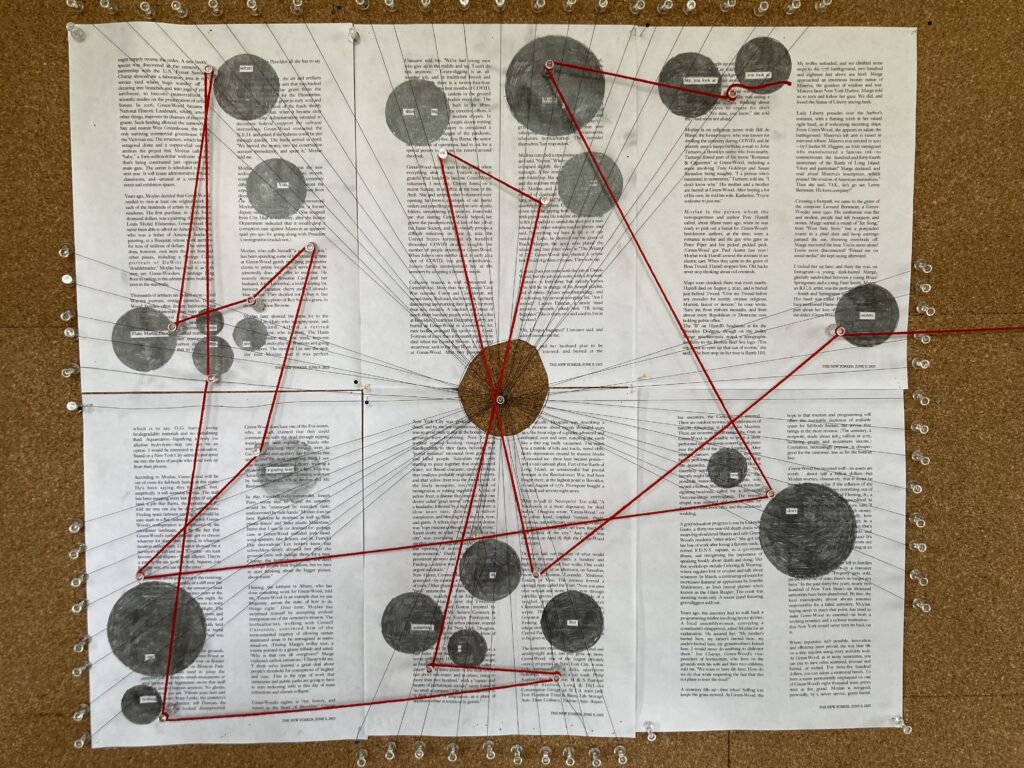
a summary: I’ve been playing around with Holes 4. I put it on my new corkboard wall and tried different thread/yarn/string. Then I played around with how to have the thread (which represents the lines of an Amsler Grid and being mapped in space/time) emerge from my blind spot in the center of the panels. Then I added red yarn and connected the words of the poem to each other.

more experiments with Holes 4 / 13 april 2026

I discussed it with RJP, which was fun, and we both decided that this black thread/red line effect was didn’t fit with the words of Holes 4. They were better suited to Holes 5 — maybe 5b? I want to print out the poems for each of these holes and post them on my board; this might help me keep track of all of them. The text from Holes 4 describes not seeing the hole or any lines, but everything as seltzer fizz and nothing that is something not sharing its secrets. That poem should have lots of little circles (seltzer bubbles/fizz) and create an optical illusion — you stare at the dark dots and then you see them everywhere else, almost like an after image. This poem might also have the words as enlarged?

note: I love my new board and being able to discuss my ideas with my kids; they have some very interesting ideas. Also, I think returning to a study of grids and learning how other people — artists and scientists — have used them could help guide my next steps.

what’s next:

  1. I want to continue studying grids; I’ll start by reading (or trying to read) the book for the Charles Gaines exhibit.
  2. I also want to keep pushing at my poems, so I’ll continue working on Holes 6, which is Lines 1.
  3. And, I want to think more about lines, which means it is time for a lines/strings/thread playlist!

Charles Gaines and Gridwork

In the intoduction to the book, summary descriptions are offered for his works:

1 — Regression

28 drawing / 4 sets of 7

An arbitrary shape was chosen, and numbers were assigned to different squares of the graph according to their position. The numbers were then employed in simple arithmetic calculaitons to generate the form used in the next drawing in the sires. As the numbers threatened to overflow the parameters of the drawing, Gaines used what he calls a “radical divider” to contain teh propagation of his system. The final drawing in each set determined the starting point for the next, and so from any arbitrary starting point an infinitely expanding number of drawings could result.

Gridwork: An Introduction

Gaines was “interested in where systems fail or regress, revealing the innate contradiction of the objective or scientific enterprise. In other words, his work reveals the limations of systems.

2 — Walnut Tree Orchard

Each, a triptych — a photograph of a tree, a drawing in which the photograph is transcribed into numbers plotted onto a grid, and a second drawing that overlays all the previous grid drawings in the set onto the image from the second drawing.

This line, this series “makes visible the limits of photography, highlighting its single-point perspective, its flattening of space, gave me an idea: should I read/think about how reading happens and/or how we believe it happens, and play with that in my series?

3 — Incomplete Texts

used literary texts, picked ones that appear to supply information in a straightforward, truthful manner and submit them to processes of abstraction that complicate meaning

based on a page from Roy Nickerson’s Brother Whale
he systematically removed letters from copies of they typeset page and transferred them to a grid
this transformed the text into a series of fragments recalling whistles/clicks of whale song

note: It is difficult for me to actually see his grid images, so I’m struggling to understand what Gaines is doing in his different series. I want to dig deeper into his interview and other discussions of his grid system so I can understand how/why he’s using it1. This understanding might help me clarify how/why I’m using it — or, will it take me too deep into academic Sara territory?

Decided to google, “artists who use grids” and found this awesome exhibit that was at the High: Off the Grid. Very cool! I lived in Atlanta for almost 4 years and I never once went to this museum. Why not?

a flash of an idea: what if I turned Holes 3 into a “straight” grid, where the x-axis is blur, and the y-axis is almost. I could number the grid boxes with x and y coordinates and then have those coordinates next to the corresponding words in a poem key? I could either print out graph paper OR create a grid on the paper with string and a loom?

the poem for Holes 3:

Fall through the hole
your reading eyes find
and land in a logic
of blur and almost.

Yes! The new experiment to try: the two pages from the New Yorker essay on a cardboard loom/grid, under a grid made out of black embroidery thread. I might add the shadow (a faint trace) of my blind spot drawn on the essay. The grid is also a graph with x-axis and y-axis named, blur (x) and almost (y). Each of the grid boxes has numbered x and y coordinates. Next to the graph/grid is a key/map with the xy coordinates. You look up the xy coordinates to find the words of the poem. Will this work? Consulting with Scott, he had some additional ideas: put the words in alphabetical order + put a pin and a number (signaling the order of words) next to the word — Scott compared it to dots on a map).

I like this idea and how it forces the reader to slow down and read the poem one word at a time. This isn’t quite how I read, but it gives a sense of how much slower I read, how many less words I can read. I also like the idea of a map, because part of why I am drawn to the grid is because of the way it enables me to locate and visualize my blind spot and vision loss.

  1. Reading the interview will have to wait for tomorrow. My eyes are tired from what I’ve already read, which was only about a dozen pages. ↩︎

oct 10/HIKE

60 minutes
Minnehaha Off-leash dog park
63 degrees

Wow, wow, wow! A beautiful fall hike with FWA and Delia-the-dog at the dog park. Sun, shade, a cool breeze, yellow and red leaves, sparkling water, soft sand, cute dogs, great conversations — less abstract and theoretical and more personal this time. About anxieties and social norms and traumas and friends that don’t get you.

10 Things

  1. soft sand
  2. a motor boat, floating slowly
  3. small stones just under the surface of the water, near the shore
  4. a small stretch of beach, populated by soft sand, frolicking dogs, the bones of an old tree
  5. a loud cry — was that human? FWA thought a kid, I wondered about a fox
  6. someone far off whistling badly
  7. the surface of the water sizzling white
  8. sitting on the smoothest section of a log — how many other people, and for how many years, have sat in this very spot?
  9. top of the limestone steps — jagged, steep
  10. comparing Delia’s short, quick, little steps to a much bigger dog’s loping, floating strides

GGG (girl ghost gorge), today’s update

before my hike: Reading through the last section of this collection — Air — I had some ideas about time and Endi Bogue Hartigan’s o’clock poems, specifically these lines from oh orchid o’clock:

it is morning 
birds plus 
socket sound of
car closing / 
21st 
century 
pastoral
o’clock

A 21st century pastoral! Yes, I’d like to write some triple chants and offer a twist on the pastoral. The twist = critical of the romanticizing of land, of understanding land as object and background, etc. Fun!

Also, I want to write another poem — possibly a chant? — in this o’clock form that mixes my timeline with that of the gorge.

Other things yet to write: more on air in terms of lungs and breath; a looping poem using the last section of my poem, “Conservation”

anti-pastoral

I decided to start by searching for “pastoral” in my old log entries.

1 — 13 april 2021

I posted and wrote about Forrest Gander’s poem, “Pastoral.” He’s critical of the idea that we observe landscapes/land from a distance, as if seeing were a process, and not an instant act. I appreciate his challenge to the idea of distance, but don’t agree with his suggestion that seeing is instantaneous. Looking does take time to happen, for everyone.

dispossessed (not owned or occupied)
a process
encounter — a process / between two / actors / the beheld / beholder
no study, absorption
immediate, gradual

2 — 28 dec 2021

In the poem, “The Grand Scheme of Things,” Maggie Smith links the eye to the pastoral, too.

We say the naked eye
as if the eye could be clothed, as if it isn’t the world

that refuses to undress unless we turn our backs. 
It shows us what it chooses, nothing more,

and it’s not waxing pastoral.

Yes! The pastoral is all about a certain understanding of sight and vision and how/what we see, how we look.

how we see / a soft sight
filtering
what is “real”?
no access / to the Truth / through our eyes
surely you/can’t imagine/the trees look/like they look/when we are/not looking (MO)

(side note: I’m realizing that the pastoral — paintings/poems — are all about how we look and see. I need to turn to this in my ekphrastic/how I see project. )

after the hike

3 — 6 feb 2022

Pastoral turns up in A Nearly Perfect Morning/ Jessica Greenbaum:

It was a nearly perfect morning—bucolic, pastoral—

bucolic: related countryside, farm fields, pastures, rural, rustic, countrified

bucolic
countrified
a plowed field
managed land
rusticate

4 — 21 march 2022

From an interview with Alice Oswald:

there’s a whole range of words that people like to use about landscape, like pastoral, idyll. I quite like taking the names away from things and seeing what they are behind their names. I exert incredible amounts of energy trying to see things from their own points of view rather than the human point of view.

…more interested in the democratic stories…the hardship of laboring, looking for food…the struggle of a tree trying to grow out of stone…always looking for that struggle. I’m allergic to peace. I like this restless landscape. I like that it won’t let you sit back and say, “what a beautiful place I’ve arrived to.” You’ve never arrived. It’s moving past you all the time.

Landscape and Literature Podcast: Alice Oswald on the Dart River

idyll = “an extremely happy, peaceful, or picturesque episode or scene, typically an idealized or unsustainable one.”

non-human / perspective

AO rejects the beautiful, as in, what a beautiful place, let me just sit and admire it! I’m thinking of 8 dec 2024, and my discussion of beauty as awe inspiring and awful, beauty as not perfect and relaxed, but pain and grief and struggle

struggling
suffering
laboring
a tree’s struggle / to make a home/ out of a stone
a river’s/fight to be free
restlessness / not relaxed
never here / always there
difficult / not easy (see 14 april 2021 and MO)
lacking peace

5 — 2 may 2022

she discusses William Blake’s poem, “The Ecchoing Green” and how the green in it is not the pastoral but the communal/village green, “where people mix with one another, young and old, playing and slowly fading, ecchoing. Green, as it echoes on the green, is the color of human community” (6)

Green Green Green

communal
village green / public space / gathering
not alone / solitude / together
echoing
mixing/ together
mingling
young and old/ animal, / mineral, / plant

6 — 21 may 2023

anti-pastoral poets

As for the pastoral poetry tradition, two poets and influences come to mind: Vievee Francis and the “anti-pastoral” poems in Forest Primeval, and Jennifer Chang’s Bread Loaf Lecture, “Other Pastorals: Writing Race and Place” (June 2019, available here.)

interview with the poet, Sarah Audsley

this is not / nostalgia. / this place has / a context, / histories / visible / and erased.

Many contemporary pastorals investigate power dynamics, status differences, and the hierarchies of classification.

Pastoral in the Back Yard (essay)

7 — 2 feb 2024

Pastorale, mentioned by Robert Fripp in a blog post about his “Quiet Moments” playlists. Ambient music, Brian Eno, music creating a space to dwell in, not a narrative. Not tightly structured, directing the eye one way, but an open field allowing the ear/the eye/the whole self to wander.

open field
opening
wandering
dwelling in / dwelling with / dwell among
solitude

8 — 24 july 2025

OED: landscape — “A view or prospect of natural inland scenery, such as can be taken in at a glance from one point of view.”

“A field is used more often to describe an area managed by people. The field before you was once an orchard and pasture belonging to a farmer. A meadow is used to describe a wild area.”

“Fields and meadows start when trees have been removed from an area. This can occur naturally with a forest fire or flood, or humans may cut down a forest. Seeds from grasses and weeds take root shortly after and a meadow is born.

As the trees within my macula disappear, my forest meadows. here I’m thinking about my classic memory from science class with the inverted tree in the back of the eye.

as the trees
within my
macula
disappear
my forest
fields and
meadows

cultivate
management
removal
forest fire
open field / empty field / unused field
no longer / occupied

So many great ideas from this wander through my archive!


oct 3/HIKE

60 minutes
with Delia and FWA
Minnehaha Off-leash Dog Park
80 degrees

A new ritual: hiking at the dog park with Delia-the-dog and my son, FWA. Every Thursday or Friday, more often Friday. What a park. On the edge of Minnehaha Falls Regional Park, next to Coldwater Springs, heading towards Fort Snelling, down in the floodplain, across from Hidden Falls in St. Paul. Such a great space for Delia to run and play with other dogs, and for FWA and I to hike and talk about roots and fungal nets and Mars and abundance and scarcity and Robin Wall Kimmerer, and the sand mafia and Fall Out 76 and poetry and anxiety and . . . . In past years, parts of this park have been flooded. Hiking through, the evidence is everywhere: soft sand, the bones of giant trees, ridges and cracks and wide open spaces with tall canopies, dirt studded with rocks and pebbles and stones.

Earlier this morning, Scott sent me this link: Minneapolis witch coven takes to their paddleboards for spooky lake gathering. I wish I could have seen that!

After reading the witch article, I returned to Girl Ghost Gorge and my air section. A thought: Instead of Girl Ghost Gorge, should I call this collection, River Rock Air? I don’t think so, but I’ll keep it open as a possibility. Today’s focus started out as time and the re-reading of Chloe Garcia Robert’s “Temporal Saturation,” and I’m still thinking about that, but it shifted slightly when I reached this line:

Temporal saturation . . . is used to explain both the canyons that can appear inside moments of great rending, joyous or horrific, entombing an incarnation of the self which will never again exist; as well as the median intervals of floating passivity that resist recollection and whose ending is marked by a feeling of awakening: a drowsy startle or a gradual reconsciousness.

Temporal Saturation/ Chloe Garcia Roberts

canyons. The gorge! The gash, gap, open space where more is possible, between beats, where Nothing happens and where there is (good) Air to breathe. Does it entomb an incarnation of the self which will never again exist? Ooo–I have thought about the idea of different Saras intermingling above/beside/in the gorge. It’s not that they don’t ever exist again, but that they only exist (together) here in this space. It’s the gorge as holding everything — not trapping or entombing, but holding — beholding, witnessing.

inside moments of great rending: rending = tearing — splitting and cracking open, ripping, breaking, eroding

floating passivity — resist recollection, or thinking, those spaces on the trail that are lost, when you let go, stop thinking, soft attention?

amplifies the moment, in joy or terror, both feeling like falling, joy, a falling into, terror a falling through

When I first encountered this book last spring, it wasn’t too long after I had read JJJJJerome Ellis’s amazing book, Aster of Ceremonies, which inspired me to think about my blind spot as (almost) a gorge, similar to how Ellis imagines their stutter as clearing. So now I’m reviewing my old Plague Notebook from that time, vol. 24. Here are some notes:

We all have a blind spot, mine is just bigger than yours (sight unseen/ G. Kleege). Not a lack, not nothing, Nothing. A gap, a gorge, an opening, both solid and unstable / limestone and sandstone / a break, a rupture

And then a Plank in Reason, broke/ and I dropped down and down/and hit a World at every plunge/and finished knowing then (ED — from memory so punctuation is a bit off)

a going under — not a drowning/disorientation/underwater/submersion/immersion/more porous, less divisions

cracks/erosion/waring away

from Octagon of Water, 3/ JJJJJerome Ellis

The name of that silence is these Grasses in the wind, and the name of these Grasses in this wind is that other place on the other side of this instant. This instant is divided by curtains of water and the sound of shuddering time.

time stopping, pause

erosion = pressure + time

ED’s elemental rust: ‘Tis first a cobweb in the soul/ A cuticle of dust/ A borer in the Axis / An elemental rust

big enough to hold all — expansion/room/possibility/generosity/holds multitudes — WWhitman — contradictions, ambiguities

entangled connected not needing to be resolved

a silence — And me and Silence some strange race wrecked solitary here (ED)
unseen unstable

weather — a different language of time (See Jenny Odell, Another Kind of Time)

extraction, dehumanizing, people outside of time, with no history

“Like a clearing in a forest, the stutter, for Ellis, can open a space of gathering for Ellis and the People he is communicating with” (Angel Bat Dawid and JJJJJerome Ellis).

erosion can lead to reclaiming, re-wilding as less abundance, a clearing away

a blind spot — no critical judgment, usually read as uncritical, but what if we read it as free of judgment, a generosity? See 19 march 2025 for more on this!

AOswald on erosion: worn down to abstract form, anonymity of weathered sculptures — “I love erosion: I like the way that the death of one thing is the beginning of something else.”

erosion, a softening, a vulnerability, a tenderness

Find the ceremony in every instant. — Ellis

At this point in the notebook, I moved on to color and my chapbook, I Empty My Mind.

Reading through Plague Notebook, Vol 25, I stopped on a mention of familiar with intimate. Yes! I’ve been thinking about worn in as a form of familiarity. Habit, accustomed to, familiar, family, and now, intimate/intimacy.

Okay, it’s Friday almost evening, and I need to stop!

recap for next time: exposure to air = rust = erosion — write more about the process / I’ve written about the open space of the gorge in time (Between Beats), now I need to write about in space, with an engagement with the blind spot! / the familiar/family/intimacy among us edge-dwellers at the gorge / keep revisiting Roberts’ temporal saturation / and, more on Air