march 10/GETOUTICE

Today I had a blood test to re-check my iron and my thyroid in the morning. No coffee or food until it was done at 11, so also no running. Just sitting and writing and witnessing the world outside my windows: walkers, one runner, some dogs, the little girl at the daycare next door named Mabel stopping a walker and forcing a conversation, elementary boys — so LOUD — running down the street.

New Yorker Experiment / Holes

A slight shift in my first hole poem. Instead of, another name for barely not blind is a hole in your vision that makes for an uneasy fellowship with the world, it is, another name for barely not blind is a hole in your vision that makes for an uneasy fellowship with the word. So, word not world. Since this poem is about how I read, word makes more sense to me. Part of me would like to keep both world and word, but most of me thinks I should keep it simple with word.

In my draft version, I’ve hastily shaded in the circles/my blind spot with pencil, so they are all gray blobs and dots. The only times I recall seeing gray blobs are: looking at a backlit face and staring at the wall for several seconds. When I look at text, like on this screen, I see a few words in the center and then . . . what? Difficult to put into words. Everything is buzzing, shifting, textured. I want to experiment with the blind spot blob in my poem by adding texture — I mentioned adding gauze or glitter on 8 march. RJP and I are planning to visit the Stashery at the Textile Center this week to see if I can find some cool materials.

While I let that simmer, I’ll return to the last page of experiment #5 (continued from 9 march):

words that stand out from Whisker Wars, page 3

  • face / faced
  • self-mastery
  • the Lord knows who
  • hold outs persist ed
  • who was as devoted as
  • you might think
  • emerged
  • embraced
  • writing
  • float /ed
  • only
  • unprofitable
  • propaganda
  • a sideshow staple / enfreakment
  • mishaps
  • cannot fully explains
  • died
  • few of us see
  • express rapture at seeing
  • poem reads
  • endures

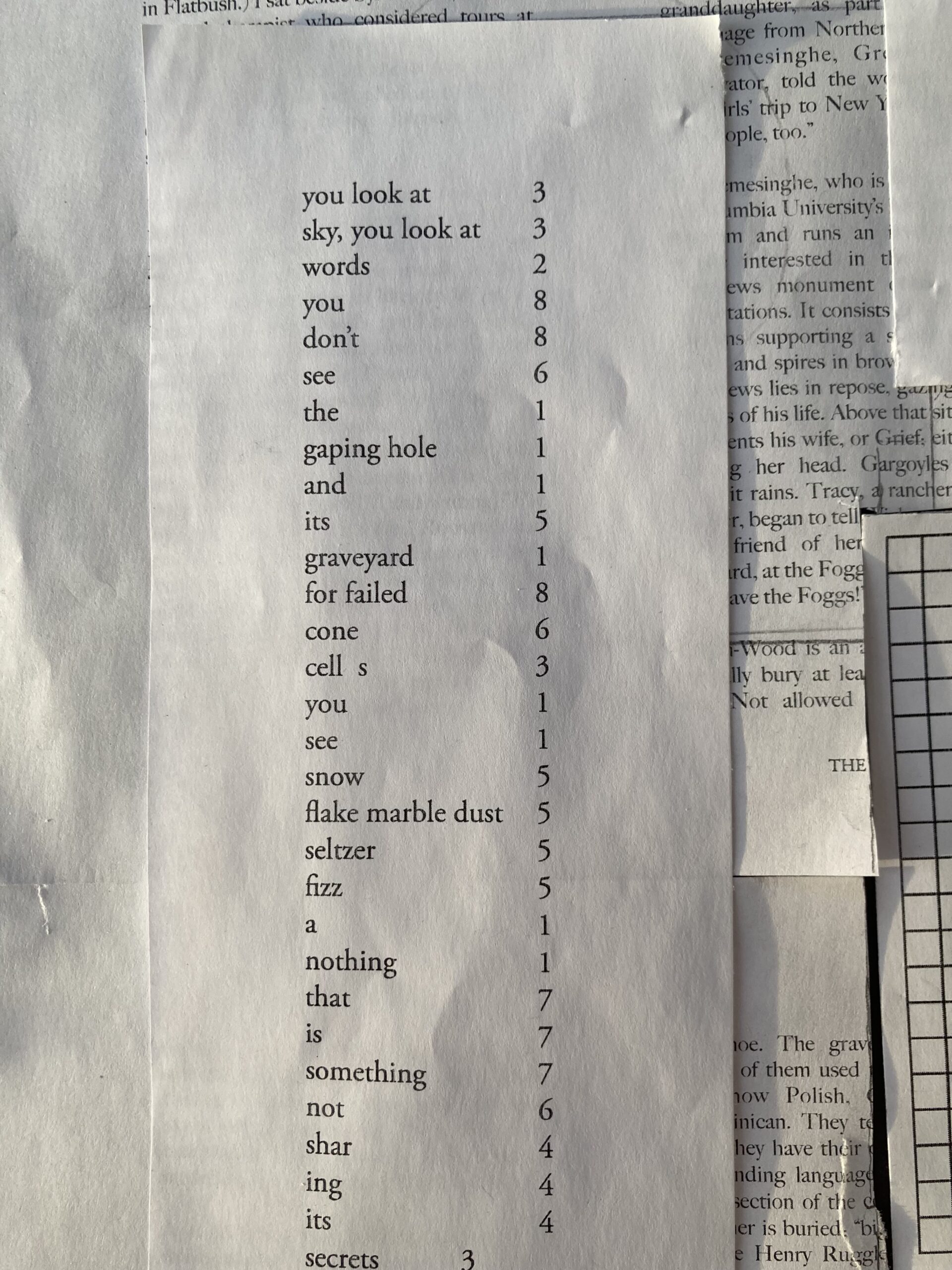
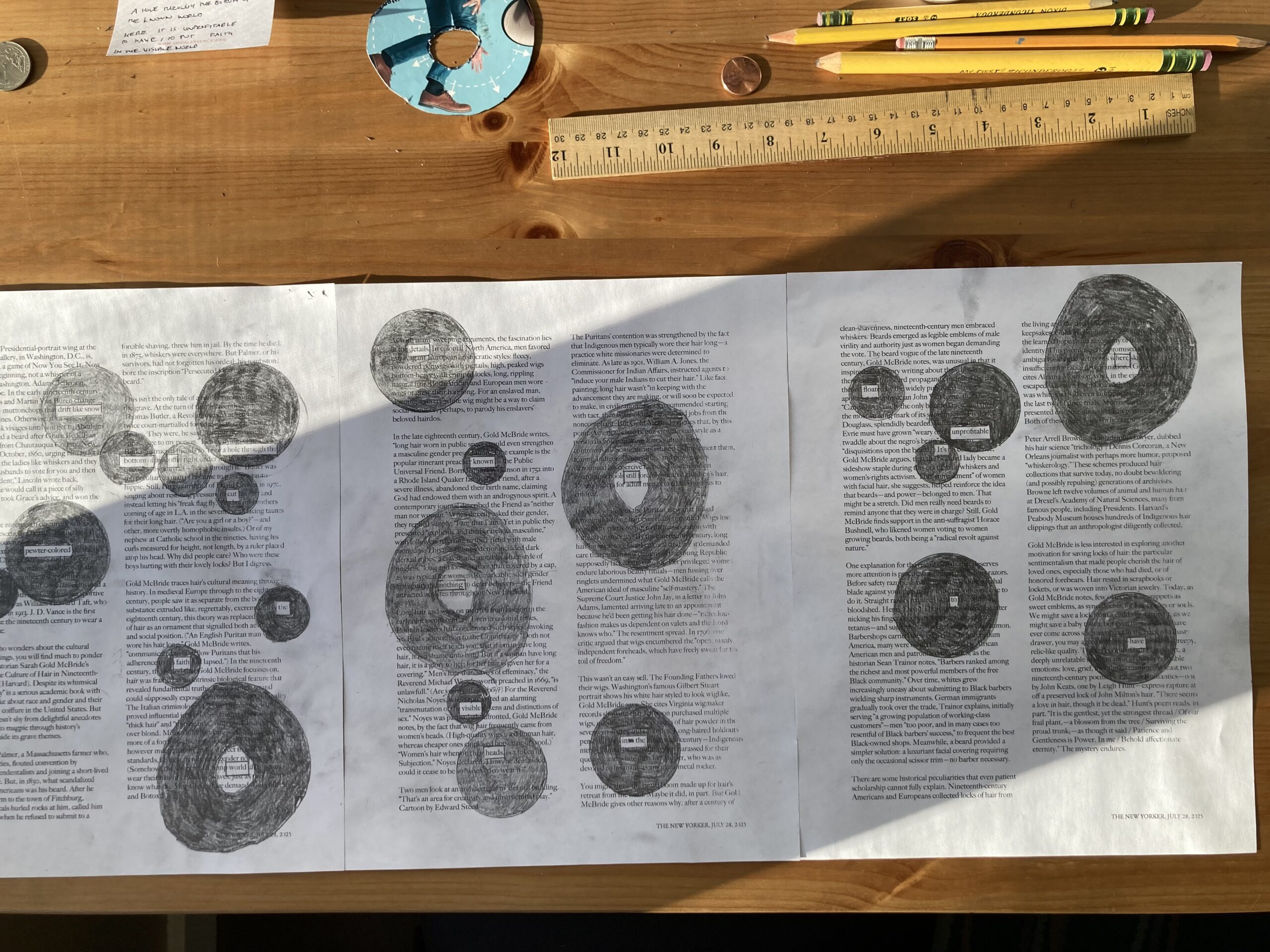
Here’s what I have so far:

nothing still
details
drift like snow
cut off heads
with pewter-colored faces float

a hole through the bottom
of the known world.

here it is unprofitable
to have faith / to put faith / to believe
in the visible / what is visible

an uneasy fellowship with the world

As of now, I’ve decided to use the line uneasy fellowship with the word, but I also do have an uneasy fellowship with the world because I am barely not blind. Here’s an example of that uneasy fellowship from today’s visit to the clinic for a blood test:

I walk into the clinic with Scott and he points out the line for me to stand in as I wait to be checked in. It’s happened so fast that I have not had a chance to read the sign that tells me what this line is, I just know I’m supposed to stand in it. So I stand and wait with the person behind the counter directly in front of me, several feet away. There is another line with people in it, waiting, with a person behind the counter directly in front of them. I wait, looking vaguely in front of me at the person behind the counter and the person they are helping, trying not to stare or look as if I’m impatient (even though I am). To the side, I notice the person being helped at the other counter is done and hear the woman behind that counter tell the person in her line, wait. Then I hear her call out sharply, Scheduled! And then, Scheduled! I wonder what she means; it sounds strange. And then, Scheduled! I feel several quick, sharp pokes in my back. The person behind me is trying to get my attention. I realize that the woman behind the opposite counter is calling out to me. I am “Scheduled” because I have a scheduled appointment.1 Oh, I’m sorry! I approach the counter and she barks at me, name and date of birth! She softens a little after I answer promptly.

For a flash, I wanted to cry, but didn’t. It is such a small thing that doesn’t really matter. For a brief moment, I was that person, the irritating one in the line that wasn’t paying attention, holding everything up. Yet, it is a reminder of what I can’t do, or what I can barely do, or what I can only do with a lot of effort — and patience from those around me. It is a reminder that I am nearly (legally) blind.

I suppose these moments might matter less the more I experience them — both because I’ll get better at accounting for them and better at not being bothered by them. And I suppose I should experience them more. I just told FWA and RJP and they disagreed. FWA said “Choosing to be in those situations is like selling your soul!” Yes! Repeated this conversation to Scott and he said, but you do need to learn how to deal with these situations. I suppose. Maybe I can find some middle ground?

It helped to talk with FWA and RJP and have them not only validate but bolster my assessment of the situation as not my fault. A thought: did the woman say more than Scheduled!, but all i heard was that part? I don’t think so.

Get Out Ice

The ice at Lake Nokomis is fraying at the edges. Will the lake ice be completely gone by the end of the month?!

  1. Not to long after this happened I wondered: why didn’t she call out, person in the scheduled line or something with a bit more of an explanation. ↩︎

march 9/RUNGETOUTICE

4.5 miles
veterans home and back
50 degrees

With the sun and the bare ground it felt warmer than 50 degrees, so I wore shorts! I started with long-sleeves, but by 2 miles, I shed that skin and ran the rest of the way with bare arms too. Ah, spring! Not the easiest run. It might have been because I didn’t wait long enough after my second breakfast/early lunch.

1

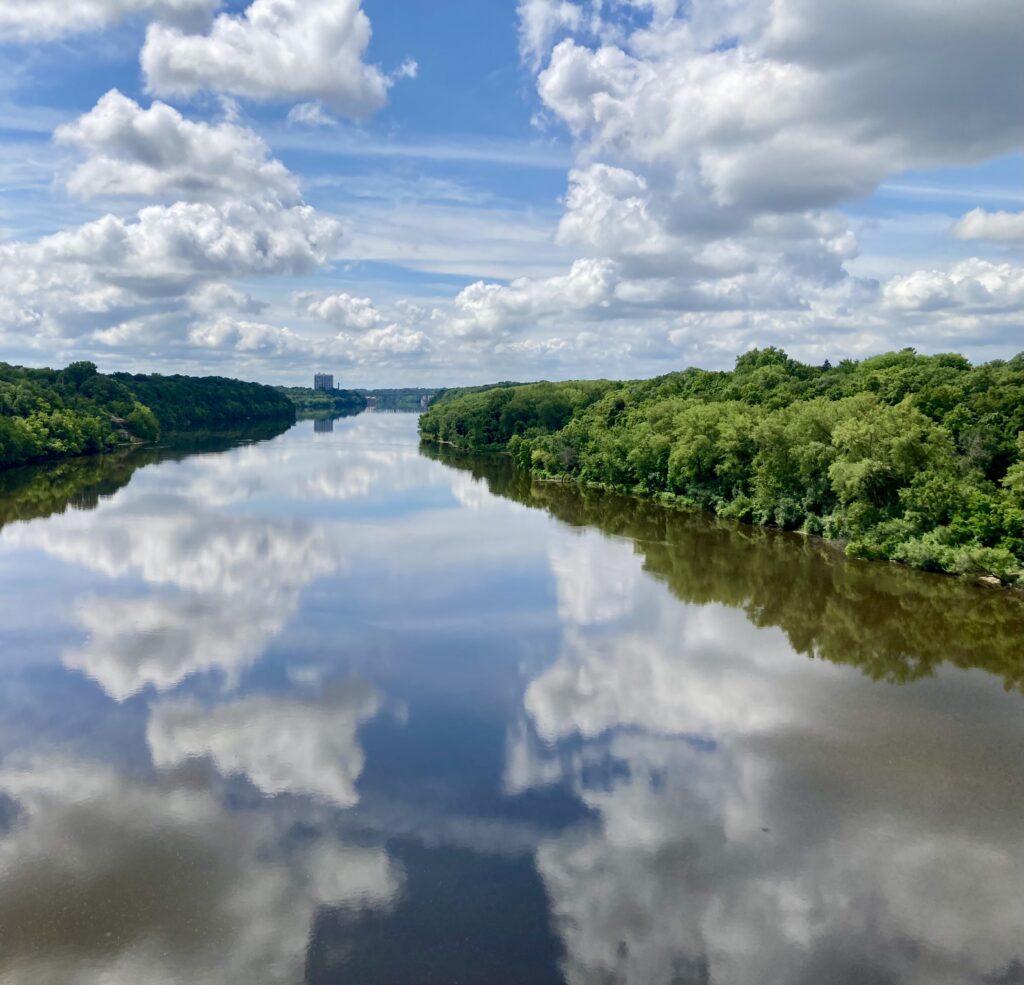
One of the best things about the run was heading south and admiring the river. Waves on the surface reflecting the light. A shimmer scene. Dazzling. I haven’t seen sun on open water like this for many months.

2

Since I’m thinking about holes and spots, which also means circles and loops, I thought about a playlist I made a year ago (25 march 2025), and decided to listen to it. Much of it is about seasons and cycles, but as I ran I thought about the hole inside the wheel and falling through it — into another dimension? another way of being? a space not consumed by the expected (normal) life? Then I thought about my growing blind spot and how it has cracked open “normal” life — this cracking can be painful and difficult, but it has offered new possibilities and an entrance to another way of being.

3

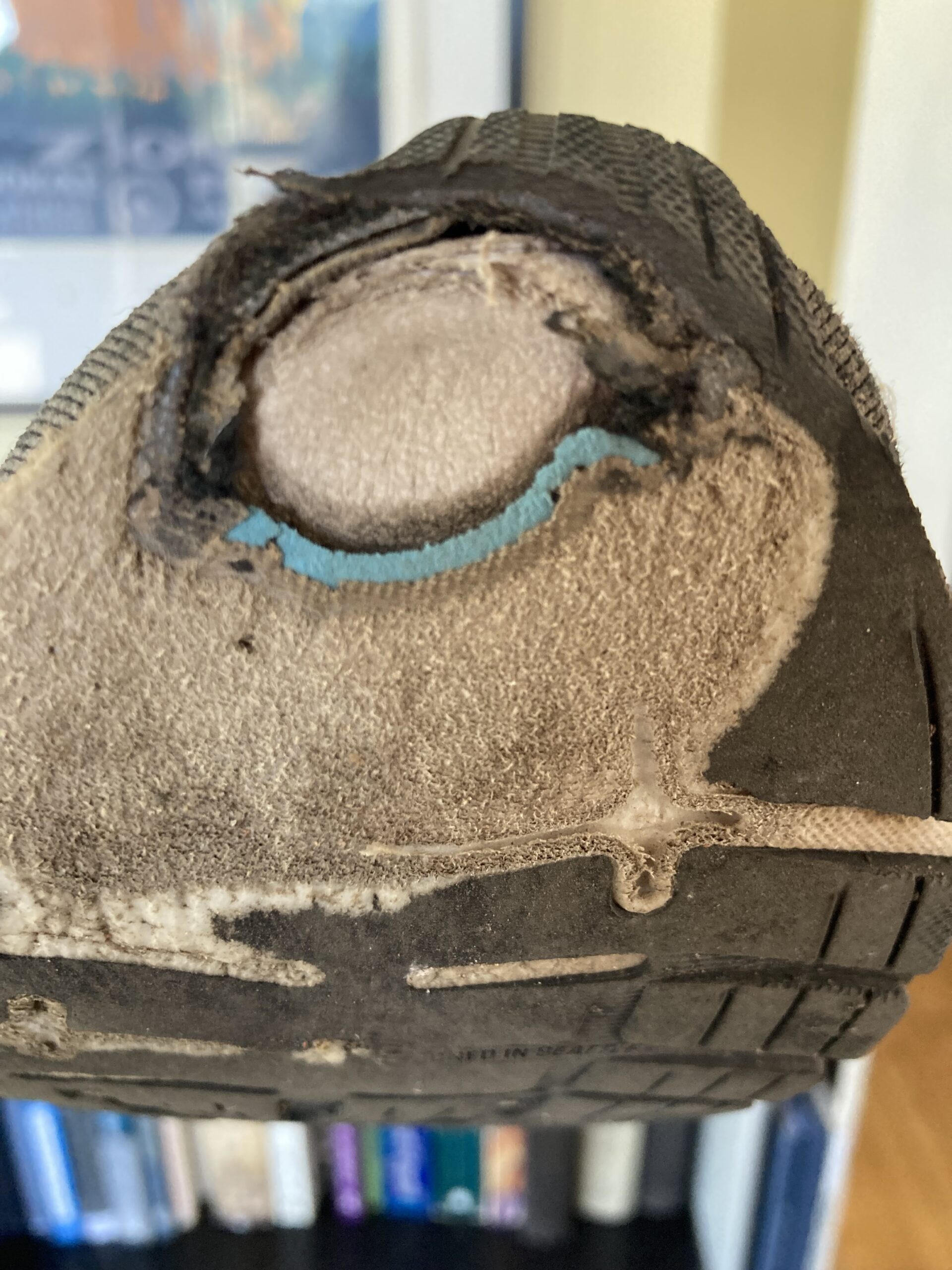
After stopping to put in my playlist, as I ran down the hill and away from the park, by right foot felt strange. Was there a rock in my tread? I finally stopped and looked. Not a rock, a hole in my shoe where my middle toes strikes down. I guess that proves it: I’m not a heel or mid-foot but a toe striker! Unlike the hole in my vision, I don’t really see an upside to this hole in my shoe — well, I guess it means I have get to buy new shoes, and, if any are still available, in a bright color!

minutes later: Done! My new Brooks Ghost 17s are dark blue, turquoise, and green!

a close-up of the bottom of my running shoe with a white circle which is a hole that goes all the way through
a hole in my running shoe

I have never had a hole in the bottom of my running shoe. I’ve had holes on the side where my bunion/wide foot has pushed through, but never a hole on the bottom. I think it’s funny that this hole happened just as I’m thinking and writing about holes. I feel like I need to incorporate this hole into my project!

A Return to my Rabbit Recap

11 continued — 20 march 2026

sources of bunny inspiration: 1. rabbits who eat buckthorn bark may pee smurf blue; 2. identifying the dark forms in the backyard as rabbits; 3. origins of “bold as brass”; 4. optical illusion — duck or bunny; 5. a cup full of 3 rabbit breaths (poem); 6. jackrabbit trapped in a wildfire (poem); 7. the rock that is not a rabbit (poem); 8. little girls deciding who will have their bunny when they die (poem); 9. a rabbit offering themselves to quell a woman warrior’s hunger (book)

12 — 24 march 2026

Bunny as muse? nudge? pest? ghost?

What am I doing as I keep putting the two bunnies in my backyard into my poems? And why do I insistent on calling these wild and mature eastern cottonwood rabbits bunnies? I’m not sure these rabbits are indifferent to me, but I think they notice me in terms of whether or not I am a threat to their main activity: grazing in the grass.

A title for a poem? Crepuscular. Why don’t rabbits flee when I approach? Do they see me as non-threatening? Has human encroachment screwed up their sense of friend and foe? My mom, a pesky bunny, and a drive out the country. Peter Rabbit: the horror movie.

the rabbit hole: 

“Down the rabbit hole” is an English-language idiom or trope which refers to getting deep into something, or ending up somewhere strange. Lewis Carroll introduced the phrase as the title for chapter one of his 1865 novel Alice’s Adventures in Wonderland, after which the term slowly entered the English vernacular. The term is usually used as a metaphor for distraction.[1] In the 21st century, the term has come to describe a person who gets lost in research or loses track of time while using the internet.wikipedia

Out-of-control curiosity. Distraction. Losing track of time. Getting lost in strange worlds. These are presented as bad things. Are they? Many of them are embraced within poetry. And they are great tools of refusal and resistance against late-capitalism and wannabe fascist governments — you’re not working for/perpetuating the system while you’re following the rabbit hole.

The rabbit hole online.

13 — 27 feb 2026

The rabbit hole. “Back to hole-less cottontails. A new metaphor is needed — not falling down and through to other worlds, but something about edges and shadows and the fringes — the periphery! Dwelling on the edges, in the corners, not traveling to new worlds, but noticing the other worlds that are already there, have always existed in the midst of my world.”

I want to think more about this shifting metaphor in my understanding and use of hole in my erasure poem (or poems?)

New Yorker Experiment #5

First, an update on Holes. There’s an empty space without text in the lower left corner. I’m thinking of putting a definition or a quote or a line there. Or, I could put my poem written out in a straightforward way in the space. Would that undercut of enhance the experience of reading the poem? The text could also be an explanation of my version of reading; peripheral — big picture / central — one word or small phrase at a time, often experienced in isolation.

I’ve started (just barely) working on experiment #5. I’m using an article from July 28, 2025 titled “The Whisker Wars.” All I’ve done so far is write down words that stood out to me on two out of the three pages. I want to try experimenting directly on the New Yorker pages so I have a decision to make: two of the pages are back to back, so I need to pick either the first or second page. I’ll read through both of them and see which one I like better.

Hmmm….there’s a cartoon on the second page with the caption, “That’s an area for creativity and unstructured play.” I might want to use a few of those words.

words/phrases the stand out, page 1:

  • portrait
  • a game of Now You See It, Now You Don’t
  • in the beginning, not a whisper
  • otherwise
  • drift like snow
  • wonder
  • notice
  • russet-and-gray
  • pewter-colored
  • abrupt shift
  • who left
  • entanglements
  • weirdness
  • yellow
  • bore a hole through the bottom (of my coffin)
  • still

page 2

  • traces
  • people saw it as separate (from the body)
  • replaced by a view
  • faith
  • framed
  • revealed
  • meanwhile
  • from
  • however
  • trends
  • norms
  • world all know / known
  • waves
  • an area for creativity and unstructured play
  • lies details
  • natural
  • rather
  • nothing
  • believe (rs)
  • teach you
  • visible
  • cut
  • choice

Get Out ICE

On 5 march 2026, NPR posted a story about how doctors and nurses in Minnesota have created an underground network of medical care for people who are too scared to leave their homes. “There are now about 150 doctors — a volunteer “rapid response” team that has made more than 135 home visits” (When ICE came, Minneapolis created underground health networks).

These members of the care network have helped women in labor, babies with the flu, “At the Faribault clinic where Carroll works, staff members deliver medicine, food and other necessities to patients. A staffer drives 12 middle and high school kids to and from school every day in a clinic van.”

For more on ICE’s impact on healthcare in Minnesota, listen to this podcast: How ICE’s presence is affecting health care in Minnesota

march 8/WALKGETOUTICE

walk 1: 60 minutes
minnehaha off leash dog park
45 degrees

The hiking with Delia and FWA at the dog park is back! I’ve missed our walks and chats and encounters with other dogs. This morning it was beautiful: sunny, not too cold, calm. There was some mud at the top of the hill, but not much in the flats. We heard woodpeckers knocking and calling. Felt squishy mud and sand that nearly sunk me — so soft and difficult to climb out of! Saw the tall bluff on the other side of the river and remembered moving along its rim during my longer runs to the confluence when I was training for the marathon. A spring goal: be trained up enough to run this loop again by May.

FWA and I talked about rules and norms and our difficulty in following them. Not because we like to break rules for the sake of breaking rules, but because they didn’t work for us and that we recognized otherways to be outside of them.

Often on these walks through the dog park, I hear people calling out the names of their dogs. Today I recall it happening only once: Rosie! Come here Rosie! I mentioned to FWA how I’ve encountered several dogs named Rosie around here. I wondered if they spell the name Rosie, or Rosy, or Rosey?

Two favorite dogs: One was a shiba inu1 that was running around its human in wide circles, with the human holding a long leash and remarking to someone else, I feel like I’m playing with the airplane on a string toy I had as a kid. The other dog was tall and lean and a beautiful gray. He (I heard his human say he) was graceful and gentle and leaped over Delia to avoid bumping into her. I was so impressed, that I mentioned to his human what a wonderful dog he was. The human was wearing BRIGHT blue running shoes. Nice!

walk 2: 60 minutes
neighborhood / winchell trail
58 degrees

A wonderful afternoon walk with Scott. We walked through the neighborhood and down to the Winchell Trail at the river. Open water, blue, with glowing white snow on the banks of the other side. A pileated woodpecker: drumming then laughing then calling out. Other walkers in tank tops and shorts. A steady stream of cars.

Scott and I stopped at a deluxe, Scott called it a “high-rise”, free library. It had a shelf of adult books and a shelf with kids books and dog treats. I gave Delia a treat, which was for dogs twice her size. As we left I said to Scott, I would like to find a way to make the kind of delight I feel encountering things like this possible for others. What sort of delightful thing could I put up in our yard?

There was a note on the door of the library explaining that the owner re-stocked it frequently and had an instagram account where she gave book reviews! It’s @beccasnotsolittlefreelibrary. I followed her, and thanked her in the comments for bringing joy to our neighborhood.

Holes (aka New Yorker experiment)

Should I try some new erasures, or continue to work on turning my “hole in your vision” into something? Maybe I’ll try both. I’d like to push at this idea of a hole in the vision, with the hole not being (just) empty or a void, but something — like a rabbit hole: an in-between space, a passageway, a liminal space, a threshold, but also a clearing (JJJJJerome Ellis), the Nothing around which something functions, the gorge.

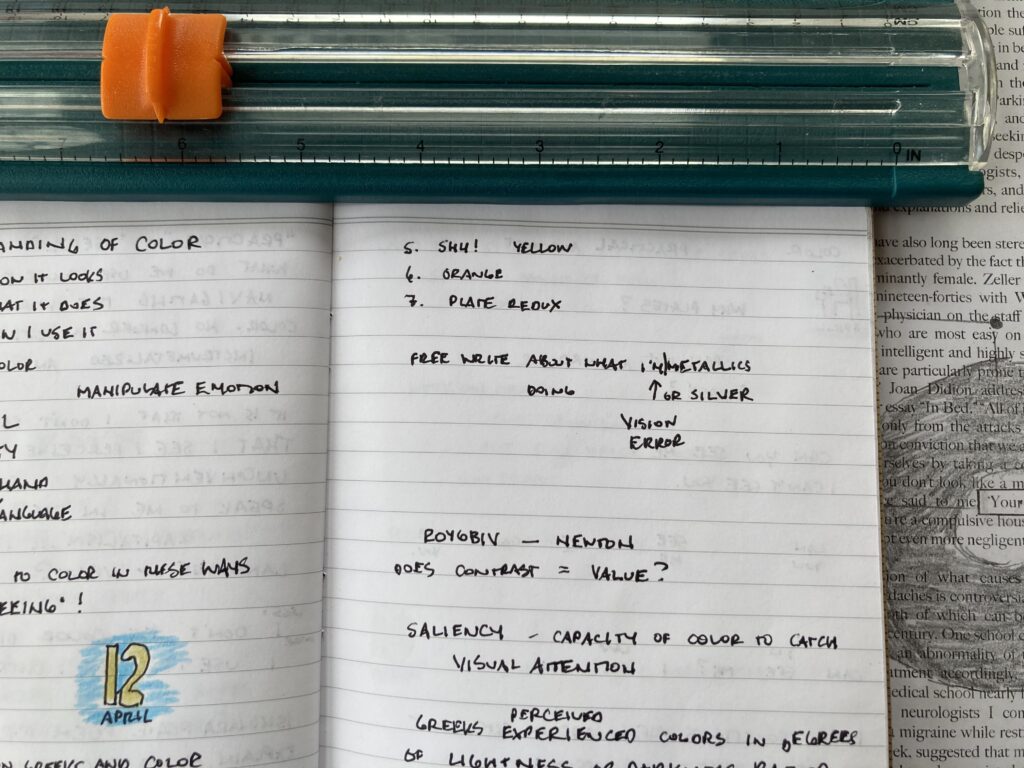
a note about reading and writing: I like using an erasure to show how I read words.2 Taken as a whole, words are too fuzzy or unintelligible to read. I can only read them as individual words. And when looking at one word, I often don’t see of the others around it, just one word then then next word then then next. I used to be able to grasp full phrases and sentences at once — at least I think I did. This not seeing the surrounding words is a problem when I write. My Plague Notebooks are full of examples of words running into each other, or one word being written over another. Whenever this has happened, I try to make note of it by writing Vision Error and drawing an arrow to it.

messy black text in a journal, two words mashed together: I'm/metallics, then an arrow pointing to them and more words: Vision error
vision error from the Plague Notebook, vol. 15 spy balloons, winter class, snow / 13 april 2023

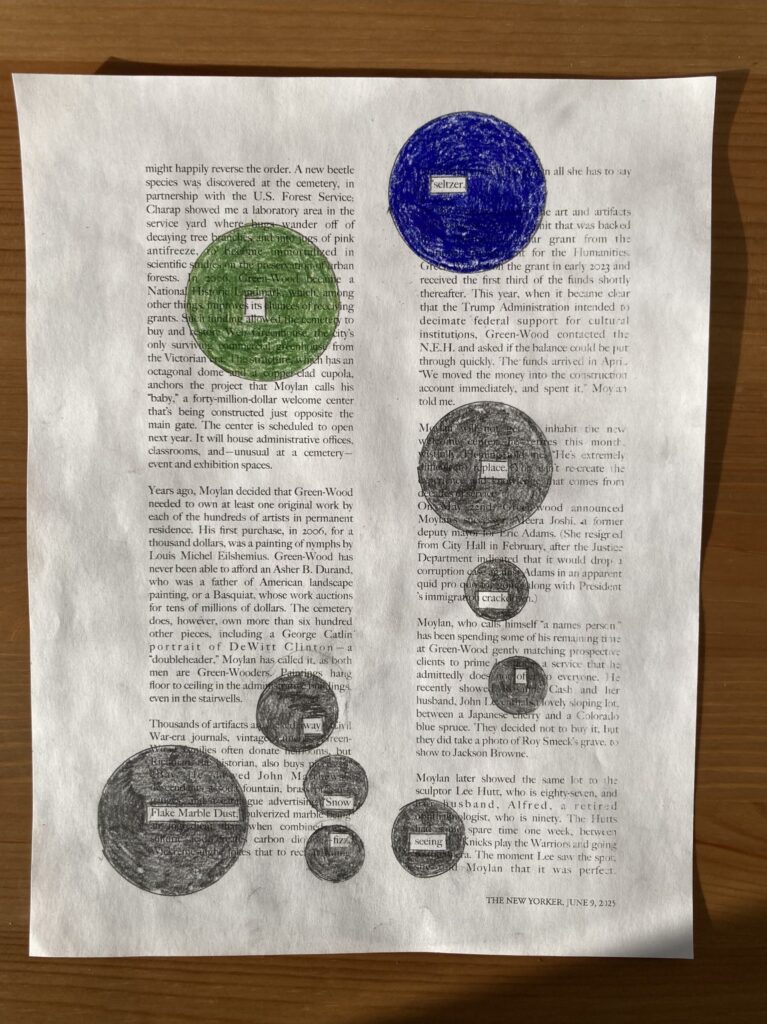
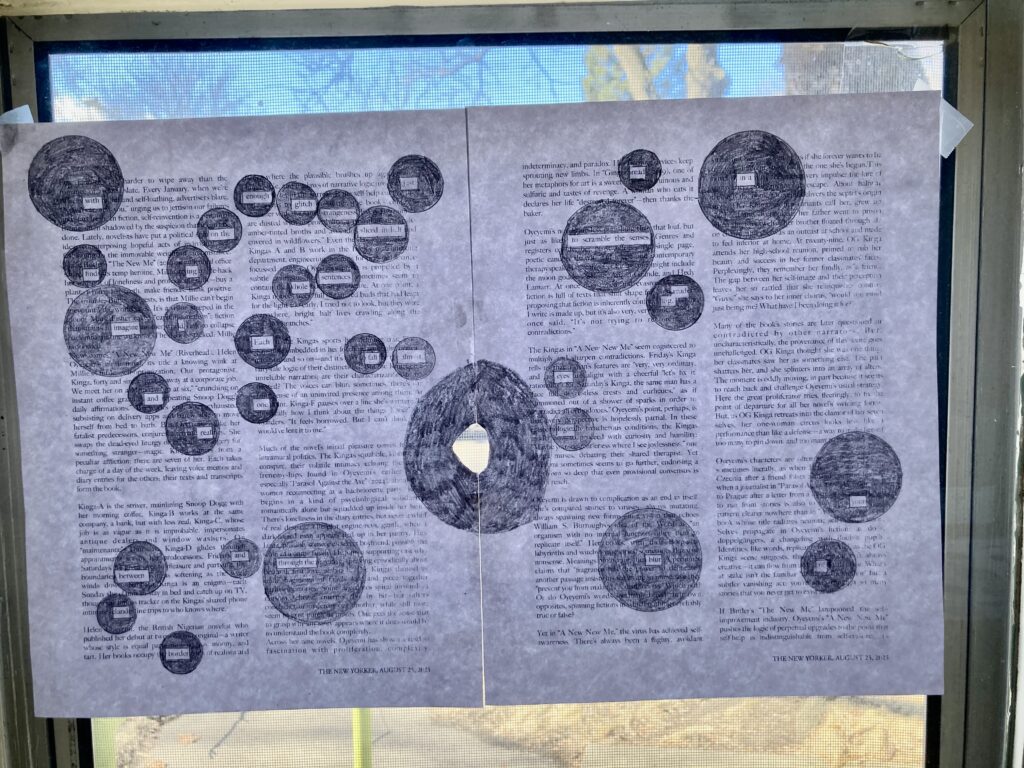
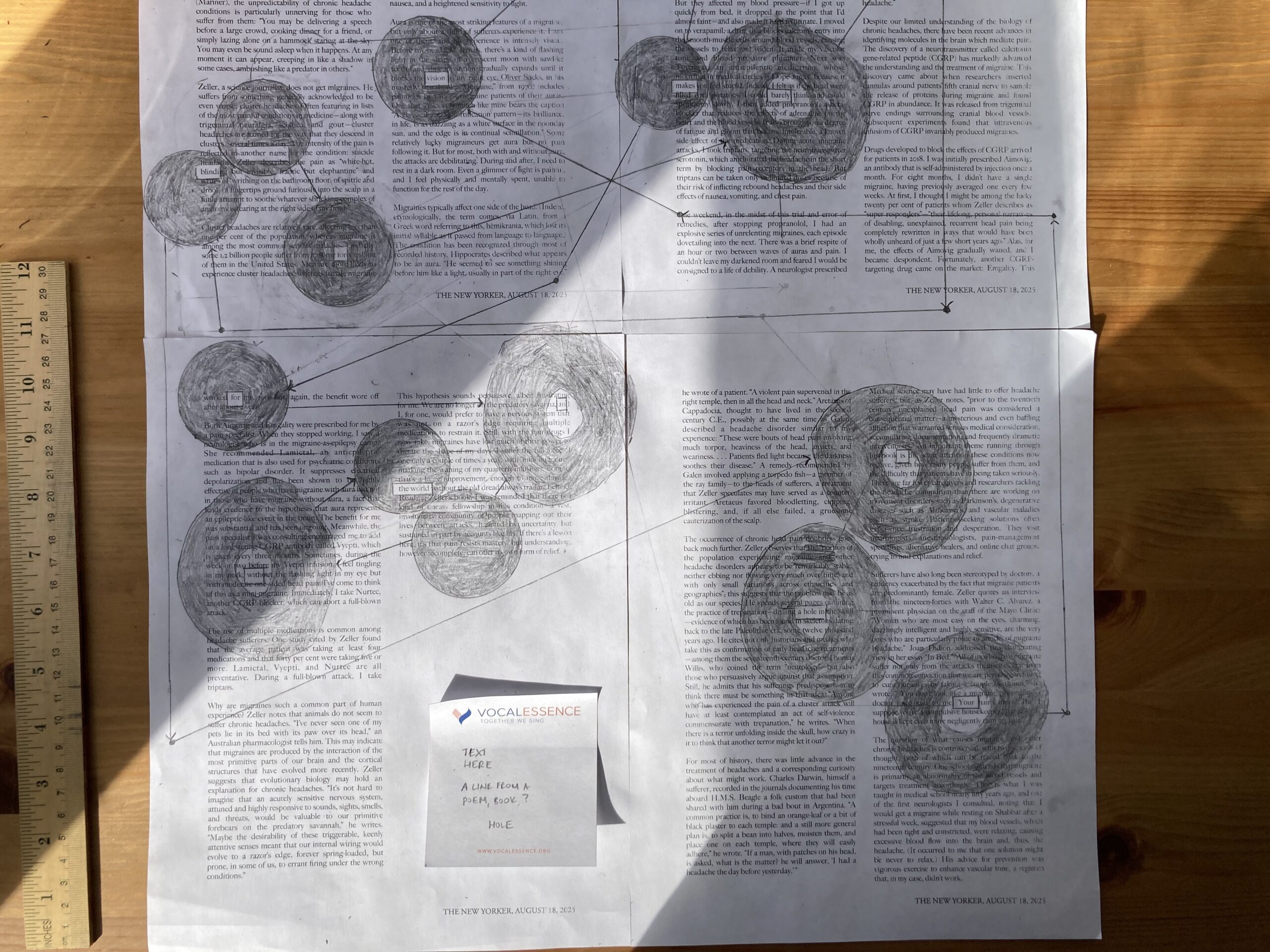
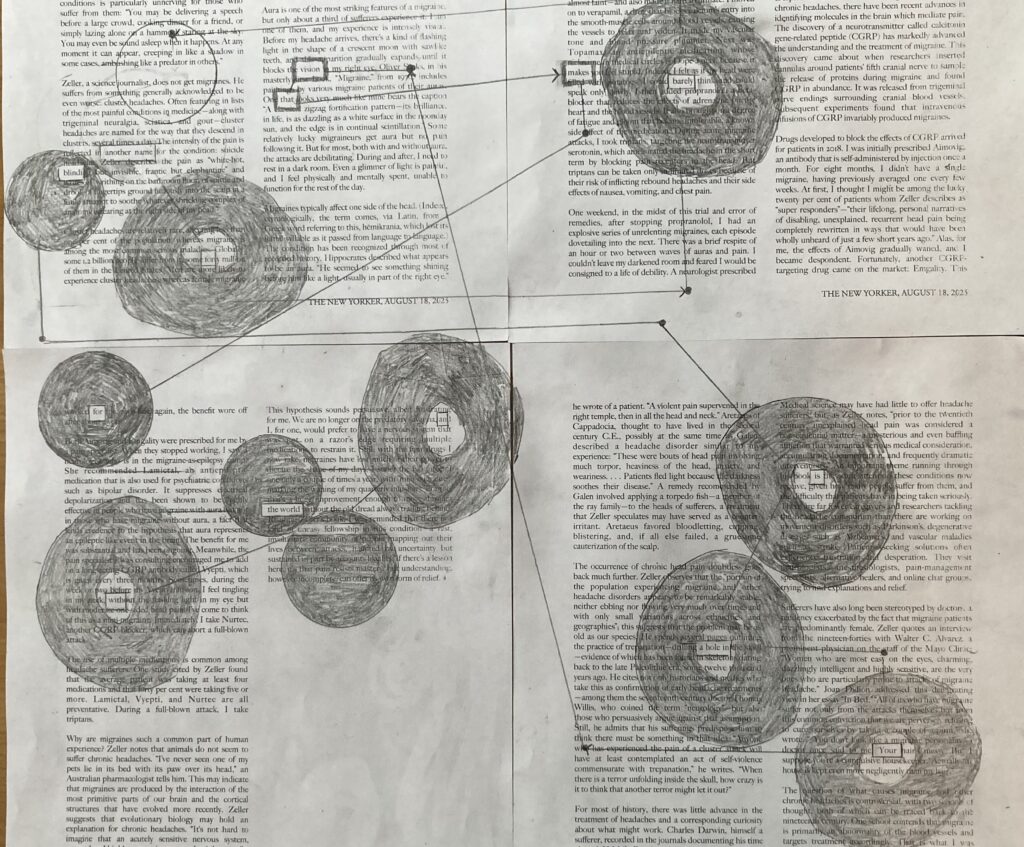
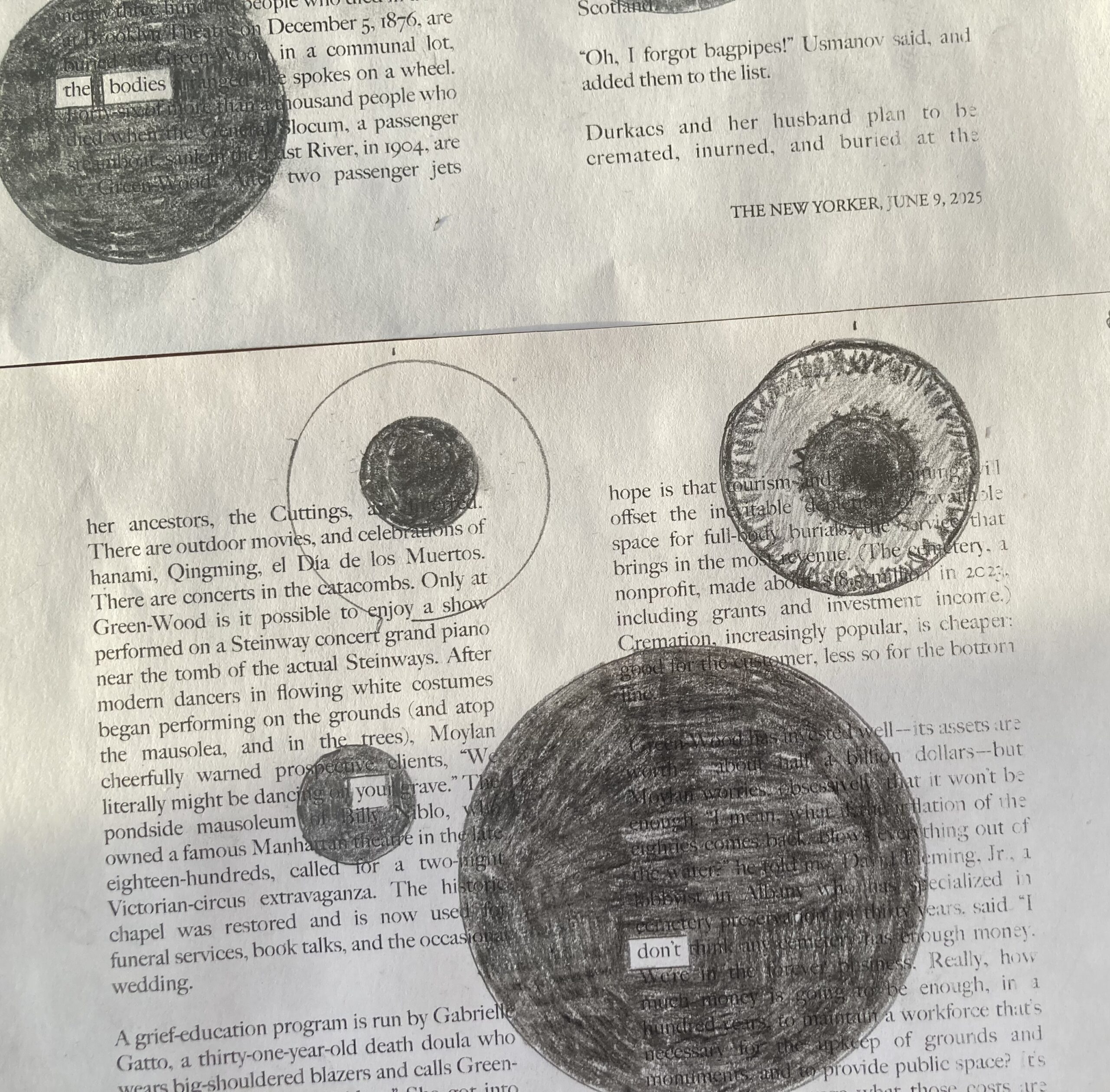
Throughout the day, I was adding blind spots and then, when those were too big for the space, I added smaller circles (made by tracing the bottle caps for my iron pills and my old lexipro pills). Here’s how it looks now:

Four sheets of text taped together. Several circles are sketched over the text. Each ciricle has a hole in the center, revealing a word or pharse of my hole poem. Some of the circles are the shape of my blind spot, some are just circles
holes / work in progress

I’m pleased with how it is looking. As of now, I’m imagining this version as a template for another, more polished version. I might replace some of the pencil shading with material — like gauze or netting. Maybe other holes will be filled in with glitter or sparkling something, feathers, twigs?

  1. FWA identified it as a shiba inu; I couldn’t see it well enough to do that — it was all blur and bark to me ↩︎
  2. It might be interesting to do some audio, too. I’d like to record myself reading something for the first time, to show how I struggle to read words. ↩︎

march 6/RUNGETOUTICE

3.5 miles
locks and dam no. 1
48 degrees / drizzle

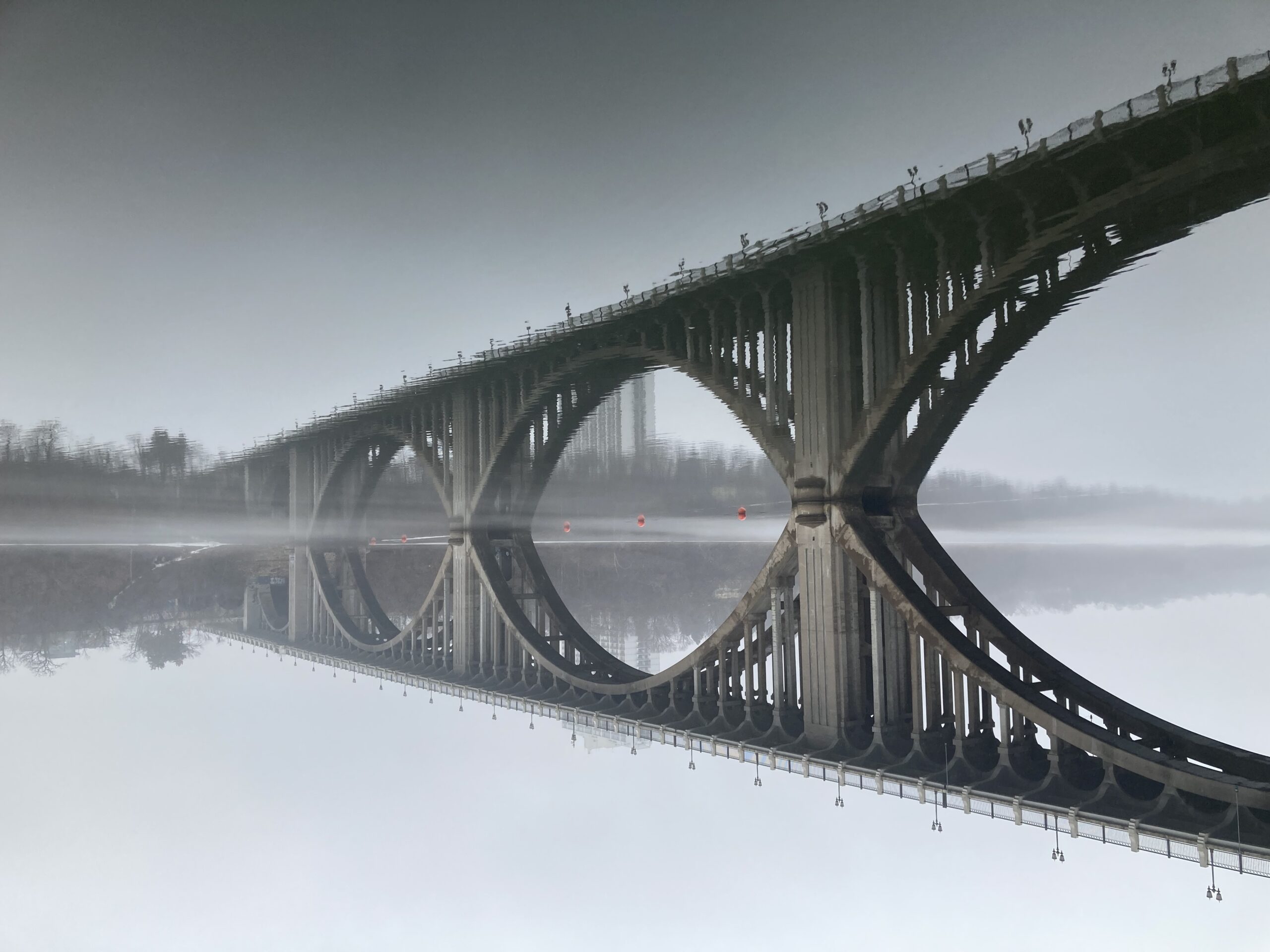
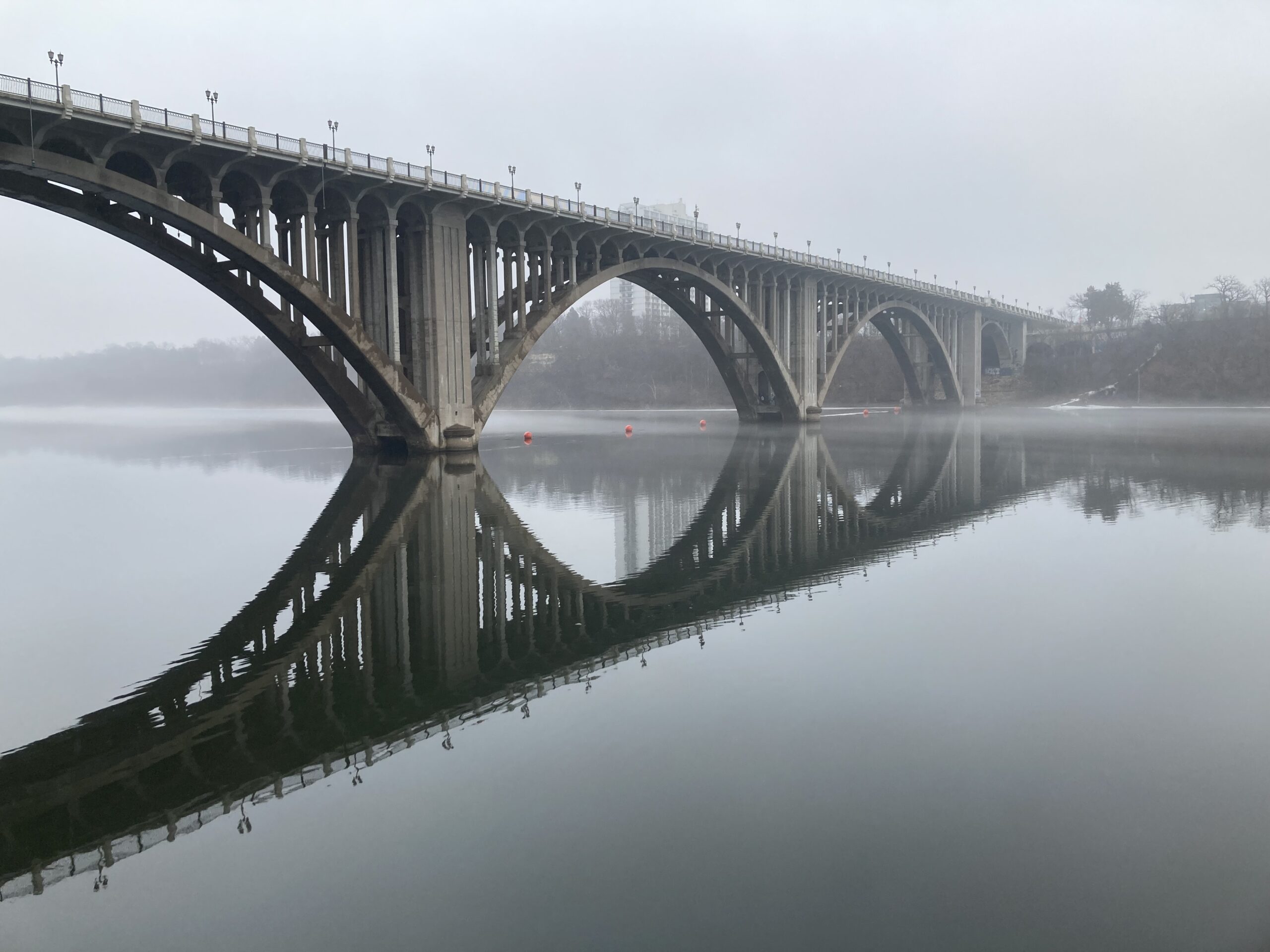
A few more warm days, then cold again. I didn’t mind the drizzle, everything was gray and soft and misty and wet. Dripping and whooshing and seeping. Of course, now that I’m home, the rain has stopped and the sun is almost out. I ran to the bottom of the locks and dam no. 1 hill and admired the ford bridge. It looked more like a painting than an actual bridge — although it sounded like a bridge, with trucks rumbling overhead!

I love the reflections in this picture I took, especially the upside down street lamps and railings.

If the sky were a little darker, the river a little lighter, you might not be able to tell which bridge is up, which is down — at least, I wouldn’t be able to tell!1

Smiled at several runners and walkers and bikers. Made note of all the empty benches and parking lots. There were not too many people out there. For the last bit of the run I was able to get deeper into the mist by running on the Winchell trail. Very haunted and other-worldly!

I listened to water for the first half of the run, and “Bunnies and Rabbits” playlist for the second. A new song popped up: Rabbit // Hole by Siddhartha Khosla. It’s part of teh music for a one-season series called Rabbit // Hole with Kiefer Sutherland. It’s a great song to run to. Near the beginning, the music breaks up for a few seconds then plays again then breaks up. I imagined a fast moving rabbit passing by an object when the music broke up, then being in the clear (when the music resumed), then passing my another object when the music broke up again.

Rabbit Recap, part 3

Can I finish this rabbit recap today? Nope. I got distracted with other stuff.

11 — 20 feb 2026

All late fall and winter, 2 or more bunnies have been hanging out under our crab apple tree — at night, in the afternoon, at sunrise and sunset. They’re very bold, these bunnies, not running off when I walk by. When this happens, I’ve started saying, these bunnies are as bold as brass! Why? Not sure. And, I don’t want you to get the wrong idea: I like bunnies or rabbits about as much as I like squirrels, which is not at all.

Get Out ICE

Yesterday afternoon, Scott came to my desk n the front room and said, Do you want to hear some good news? I mean, some actual good news? Kristi Noem was fired!

from Needle & Skein (the red hat people)

As of March 5th, we have raised an incredible $705,000 to help our immigrant communities here in MN. This is just us. Other yarn shops in Minnesota and around the country have also raised money and generously donated both here and locally. ICE is still here. Our fight is not over. Join us. ❤️

If you are a business who has raised money, please send us a message. We would love to try and get a full picture of what the amazing fiber community worldwide has accomplished.

Facebook post

Read the comments for more on how the fiber arts community is showing up!

New Yorker experiment #5

These experiments are slow-going. I run out of time to work on them. I struggle to see what I’m doing. I’m messy and haven’t figured out how to work with glossy magazine paper. So why am I continuing these experiments? I asked that to Scott and FWA in the kitchen the other day and then answered it myself: For some reason, I2 want to do these erasures, so I’ll keep doing them until I don’t want to or can’t (because it is too hard with my bad vision).

a flash of an idea: As I was writing that last paragraph, I was thinking about how visual poetry is increasingly inaccessible to me as my few remaining cone cells die (are the dying or just malfunctioning?) Then this popped into my head: yesterday’s erasure involved using marker to cover almost the entire text. When I had FWA and RJP read it, they both got marker on their hands — not in big streaks, but in tiny marks that almost looked like cuts or scratches. What if I made these erasures about touch too? My first thought was about doing the erasure in such a way that created a residue. Second thought: what if these erasures involved texture and touch — here, I’m reminded of the kids’ book Pat the Bunny and its different textures to touch: the soft bunny fur, the rough bunny . . . nose? I can’t remember what was the rough thing in the book. If you can touch these erasures and their textures, which would somehow speak to the words/ideas on the page, maybe you can hear them too? I’m thinking of scales, and thick layers of paper, maybe some holes where the paper has been ripped open, some extra rough sections, some smooth, like a thin film, crinkly, soft, sharp-ish. And — maybe in terms of the visual aspect, find ways to cover it that reflect or glow or shimmer or sparkle. I can see these textures in a way that I can’t see the typical flat, black expanse of an erasure. So things like glitter, little mirrors, metallic surfaces, ridges. What about covering it with things that offer colors only visible in the light — thinking of bird feathers here. So many ideas! Again, difficult to execute without it looking like a mess, but fun to try.

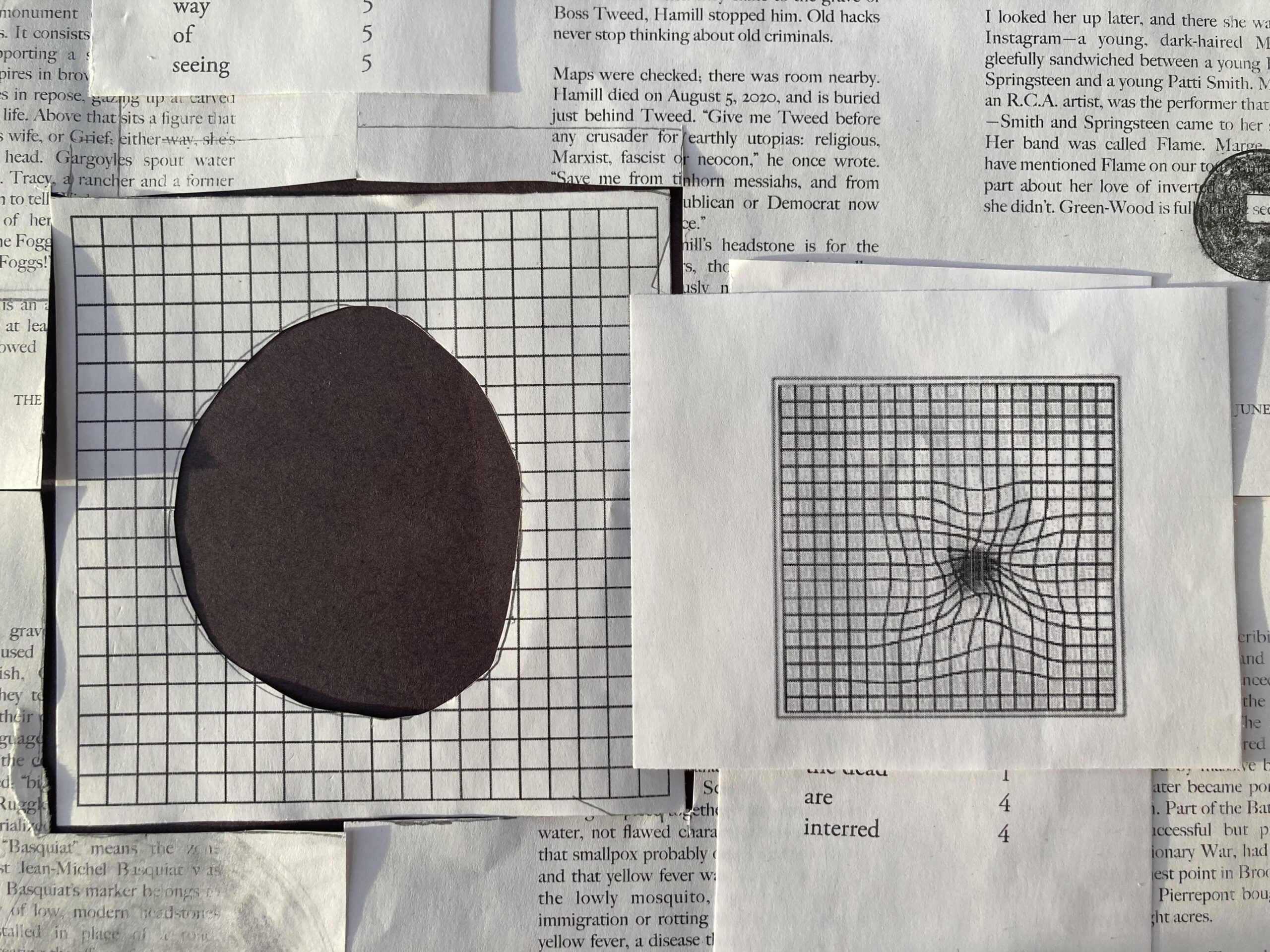
Before I had that last flash of inspiration, I was thinking about how I’ve decided (as of yesterday) that the overarching theme of these found poems is my vision and how I see. Then I thought, I should apply my blind spot to these pages. Create an amsler grid out of the text, and then place a cut-out of my blind spot (found while starting at a blank wall and then drawing what I see) on top of the words to find the poem.

Maybe some of these erasures could be all/only about texture, some all/only about my blind spots, and some both. And just now, another thought: What if these erasures were all about my blind spot and the idea of blind spots? Would this work: one of the erasures could be covered in spots or dots or holes in the paper?

So many fun ideas to try. I imagine that some of them will only ever be ideas that are good in theory but don’t work on the page.

Oh — I almost forgot, until I looked over at an open tab that reads, “tools to use for magazine erasure poems,” I started writing about this experiment because I wanted to mention my need for better materials. I love how writing in this log opens me up and helps me to see new things to try! Before writing about textures, the supplies I thought I needed were: sharpies, an exacto knife (can I see well enough to use this?) and possibly paint. Texture through thicker and thinner layers of paint is an interesting idea. Now I’m thinking I need scraps of fabric — next week, RJP and I should go to the fabric scrap store at the Textile Museum! — that are soft and rough and bumpy and gauzy. I need glitter and sparkles and little things that reflect and crinkle. Fun!

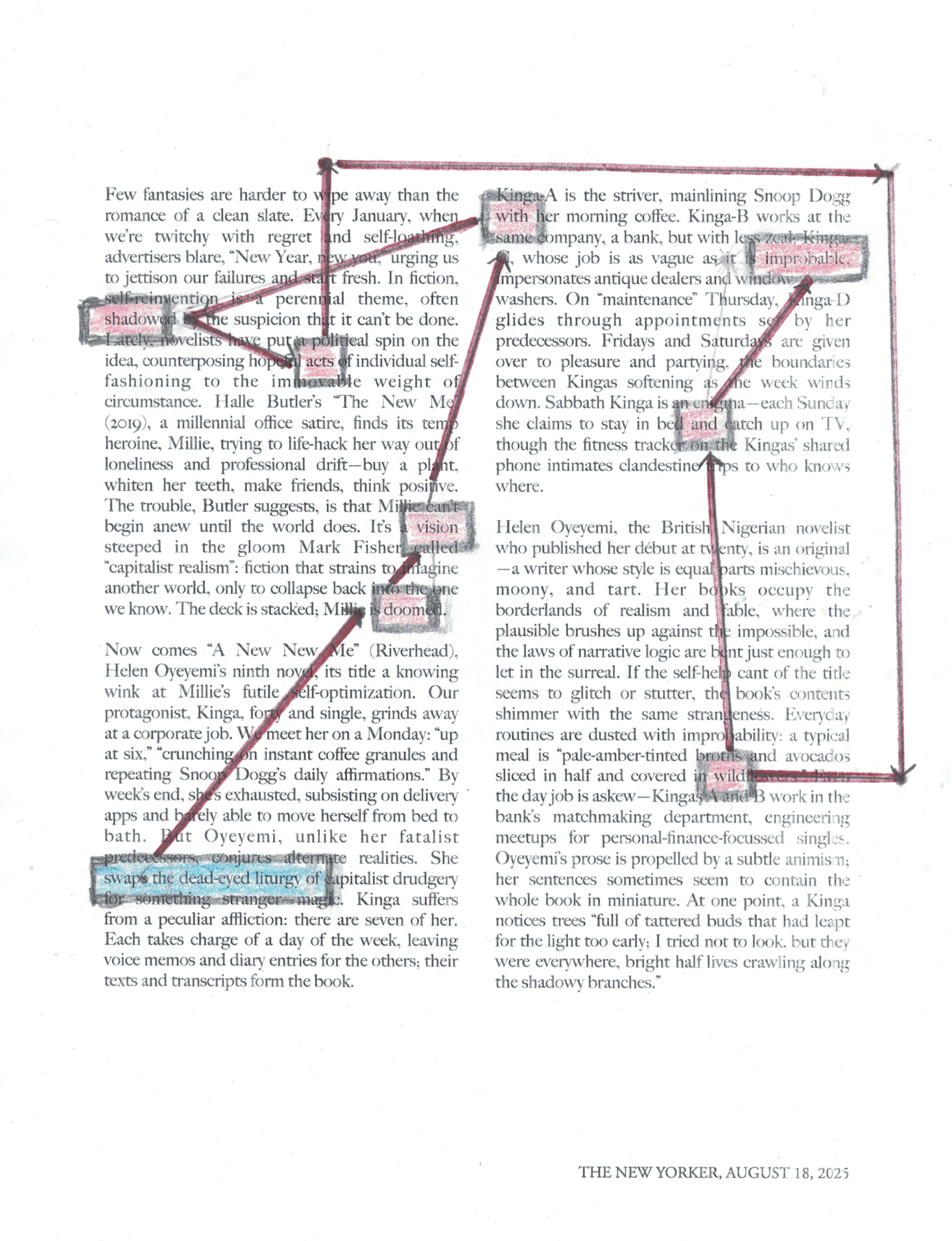
Here’s a new version of experiment #3. I decided to paste the text into a document so I could have an easier time drawing on the text. Is this a good solution? I’m not sure, but I do like how this version looks:

an erasure poem, spelling out: swap the dead-eyed liturgy of / doomed / vision / with / shadow / acts / wild / and / improbable
swap the dead-eyed liturgy

Bummer. I just realized that I erased the ed on doomed. It is supposed to read: of doomed vision (I guess doom vision could work?).

text:

swap the dead-eyed liturgy of
doom OR doomed3
vision
with
shadow
acts
wild
and
improbable

And now I’m redoing yesterday’s experiment:

text:

Another name for
barely

not
blind
is a hole in
your vision
that
makes
for
an
uneasy fellowship
with
the world.

feb 28/RUNGETOUTICE

3.95 miles
wabun hill loop*
20 degrees

*wabun loop = river road, south/ go down locks and dam road / go up the steep hill that leads to wabun / through the park and back down to the river road / river road, north

future Sara might want to remember this, present Sara hopes it’s more like Venezuela, less like starting WW3: Trump, without approval from Congress, and Israel bombed the hell out of Iran last night or early this morning.

Colder today, but hardly any wind or sun. Last night the temperature dropped so quickly that there was a very wide ring around the moon. Showed it to Scott and he said it was a moon dog. I don’t recall ever seeing one of these before. Yesterday meteorologists were predicting snow today/tonight, but the forecast has shifted again. No snow, just cold.

My legs felt awkward for the first 5 minutes of the run, but then I warmed up and they felt better. By the third mile, they felt strong and efficient. It feels like I have more energy and power in my legs. Are the iron pills I’m taking to raise my ferritin working, or is it just a placebo effect?

When I got to the lock and dam no. 1, I decided — just seconds before I did it — to turn and run up the steep hill that leads to Wabun Park. It was mostly covered in ice, but also dead leaves, so it didn’t seem too slippery. As I neared the top, I walked for a stretch. At the top, I stopped to admire the view through the chainlink fence of the river and the island and the St. Paul side, then I walked until the ice had stopped. In the park, there were several small ice rinks where melted water had refroze.

10 Things

  1. someone was on the frisbee golf course at Wabun park — I couldn’t quite see, but I’m assuming they were playing
  2. at the top of the bluff, a big stretch of the paved path was covered in a thick sheet of ice
  3. also at the top of the bluff, on the other side neared to the park, there was a small clearing with a decomposing trunk and thick logs — do people come here to sit at night and watch the lights on the bridge?
  4. the hill leading up to wabun was mostly thin layers of ice mixed with thick, jagged layers of ice, butat least part of the trail was coated with dry leaves
  5. although there were walls of snow or thick chunks of ice at some of the entrances and exits, the walking paths were mostly clear
  6. empty benches, empty parking lots
  7. running, looking down at the winchell trail and seeing a person walking — they looked so far down, I felt so high up
  8. stopping to walk on the double bridge, hearing the loud shuffling of a runner’s feet approaching from behind
  9. do I remember any color, or was it all just pale gray and white today?
  10. the low rumble of a LOUD truck driving too fast on the river road

Like yesterday, I don’t remember what I listened to when I wasn’t listening to headphones and my “Bunnies and Rabbits” playlist. Traffic? The shuffling of my own feet? No birds or bells or fragments of conversation from other runners or walkers. A memorable song on my playlist: The Young Rabbits / the Jazz Crusaders

Rabbit Eyes: how they se, what they see

Rabbits have 3 eyelids, 3 tear glands, one tear duct. They rarely blink — only 12 times an hour — and can sleep with their eyes open which helps keep them safer. How? It

allows their light receptors to remain active. If a predator nears, their brain receives signals faster, enabling a quicker response than if their eyes were closed.

Rabbit Eye: a Complete Guide

To see without actively seeing. Two immediate thoughts: 1. I’m fascinated by passive seeing and how it works in the human brain (especially mine) and 2. how exhausting to sleep with your eyes open! I’d like to learn more about how this works.

How to tell when a rabbit is sleeping? Their nose stops twitching.

Here’s something I have in common with rabbits: they can’t see red and have a lot less cone cells than a normally sighted human. I can see red, but not that often. Also, they rely more on rod cells (and they have more of them than humans) and see better (best?) in low light. Peripheral vision!

rabbit eyes were built to excel in low light situations. Rabbits are usually the most active in the hours around dawn and dusk, when it’s not too bright out but also not pure darkness. This is a time of day when rabbits have the advantage over both predators that are nocturnal and see best in the dark, and predators that are diurnal and see best when there is bright light. 

7 fun facts about rabbit eyes / the bunny lady

Crepuscular!

360 degree view: “the rabbit visual system is designed–not for foraging and locomotion–but to quickly and effectively detect approaching predators from almost any direction. The eyes are placed high and to the sides of the skull, allowing the rabbit to see nearly 360 degrees, as well as far above her head” (What Do Rabbits See?)

Rabbits have a blind spot in front of their face.1 Like me! I wonder how the sizes of our blind spots compare? “The central blind spot in the rabbit’s field of view precludes a three-dimensional view of nearby objects. When your bunny cocks her head and seems to be looking at you “sideways,” she is actually looking as straight at you as is possible for a bunny” (What Do Rabbits See?). Sideways! Periphery! Me too. To really see something straight on, like where eyes are on a face, I need to look off to the side, at a shoulder. Sometimes when I watch tv, I look off to the edge of the screen to see what’s happening in the center.

And this!: “The image formed by the area centralis is relatively “grainy” compared to the one formed by your (normally sighted human with all cone cells intact) fovea, but it serves the rabbit well. Using this image, your voice, body movements and scent as cues, your rabbit can recognize you (his favorite human)–as long as you’re not carrying a scary box that completely changes your familiar shape!” (What Do Rabbits See?). Yes! Sometimes, like when I’m in a store and have separated from whoever I’m with, I use a combination of voice, body movement, overall silhouette, known distinctive features — like glasses or haircut or unusual dress — to identify them. My sense of smell is not good enough to identify by scent, though.

lack of depth perception and parallax motion: “rabbits have evolved in creative ways to overcome this limitation, enhancing their ability to spot predators and make a quick escape. Rabbits employ a method known as “parallaxing”, moving their heads back and forth to gauge the distance and size of distant objects” (Rabbit Eye: A Complete Guide). Sometimes I have trouble with depth perception. Could I use parallaxing to help me navigate better? I googled, “Can visually impaired humans use parallax motion to detect depth.” Yes! I should practice this parallaxing when I’m out running above the gorge! I found this answer on a Reddit thread that was started with this question, if we need both eyes in order to see depth (depth perception), why is it also possible to see said depth when you close one eye? What a useful thread about how our brains fill in gaps and determine depth based on patterns and a library of known depths. And even better than this thread, here’s an article about a scientific study that was designed to explore and answer the question, “Can people with different forms of low vision use motion parallax to improve depth judgments?” The answer? Yes! And many people with low vision use it without realizing. And it should be introduced to people with low vision as a tool early on in their vision loss. And not enough research has been done on it. This study is from 1997. Has more research been done since then? Has it been adapted by low vision educators?

Here’s something I found from Duke Health in 2013. It’s specifically about low vision as having vision only in one eye, but it’s still helpful:

Adults who lose vision in one eye also have more collisions when walking, especially on the side where they lost the vision. That’s where sessions with an orientation and mobility specialist can help.

“The emphasis is on helping people to judge distances by using monocular clues, such as something called motion parallax. If you’ve ever seen a cat moving its head or eyes side to side before it jumps, that’s motion parallax,” Dr. Whitaker said.

Duke Health

Returning to the parallaxing quote: “This behavior is less common in familiar environments (such as their home), as rabbits memorize their surroundings. However, introducing a rabbit to a new home or a new furniture layout often prompts this scanning technique during initial explorations.” Yes! I’ve memorized my surroundings, which has made it easier to navigate both my physical environment and my new reality of living with a lot less vision — inside my familiar world, I am far less aware of a loss. New environments can be scary, unsettling, upsetting. I need to be brave2 and build up skills and explore new environments.

This last sentence, and footnote 2 below, highlights something that I am doing with my poetry/attention/moving practice. Not only am I working on my craft (writing poetry) and increasing my capacity for care and attention and my commitment to where I live and the many creatures I live with, I’m also acquiring tools and learning how to see in new ways. For example, today I’m studying rabbits in a wide range of ways because it’s fascinating and delightful and because how they see shares some similarities with how I see. Like the bat (and echolocation), rabbits offer strategies for seeing with less (or without) central vision.3

hinged skulls/big feet: “When they do smell, see or hear a predator, rabbits have to be able to make quick escapes. To help with this bunnies have very large back feet, and hinged skulls to absorb shock. Their cranial hingeallows rabbits to run at speeds above which the impact of their feet would rattle their brain around” (Rabbits have hinged skulls).

family:  Leporidae / order: lagomorpha / backyard rabbits: eastern cottontail, sylvilagus floridanus

Looking through the wikipedia entry for eastern cottontails, I found this about habitat:

The eastern cottontail is a territorial species that relies on speed and agility to evade predators. When chased, it typically escapes in a zigzag pattern and can reach speeds of up to 18 mph (29 km/h). Cottontails favor habitats where they can feed in the open but quickly retreat to cover when threatened. Preferred environments include forest edges, swamps, brushy thickets, hedgerows, and open fields with nearby shelter. Instead of digging burrows, eastern cottontails rest in a form—a shallow, scratched-out depression in grass or beneath dense vegetation. . . .

The rabbit eye in A Young Hare

There was a moment in the year 1502, so the story goes, that the eye of a dead rabbit reflected the real window of Albrecht Dürer, who, with his watercolors and genius and passion for detail, painted that eye with the window in it. It then became art, and, then, art again: the painted eye with the painted window in Diane Seuss’s “Young Hare” that connects the artist to the poem’s speaker. “Why does the window feel so intimate in the hare’s unreadable eye?” the speaker asks, and the answer is that the window in the eye represents a straddling between worlds, between then and now, between artist and viewer, between life and art.

Diane Seuss

I’ve tried looking at the painting online and my eyes cannot offer enough detail to see the hare’s eye and the window in it. I have read Diane Seuss’ poem about it, The Young Hare, and believe I don’t need to see the eye myself to understand its significance or its beauty.

The Young Hare / Diane Seuss

Oh my love, Albrecht Dürer, your hare

is not a spectacle, it is not an exploding hare,

it is not a projection of the young hare

within you, the gentleness in you, or a disassembled hare,

nor a subliminal or concealed hare,

nor is it the imagination as hare

nor the soul as a long-eared, soft-eared hare,

Dürer, you painted this hare,

some say you killed a field hare

and brought it into your studio, or bagged a live hare

and caged it so you could look hard at a wild hare

without it running off into thorn bushes as hares

will do, and you sketched the hare

and laid down a watercolor wash over the hare

and then meticulously painted-in all the browns of hare,

toast brown, tawny, dim, pipe-tobacco brown of hare,

olive, fawn, topaz, bone brown until the hare

became dimensional under your hand, the thick hare

fur, the mottled shag, the nobility of the nose, the hare

toenails, black and sharp and curved, and the dense hare

ears, pod-shaped, articulated, substantial, erect, hare

whiskers and eyebrows, their wiry grace, the ruff of hare

neck fur, the multi-directional fur over the thick hare

haunches, and did I say the dark inside the hare

ears, how I want to follow the darkness of the hare

and stroke the dark within its ears, to feel the hare

ears with my fingers, and the white tuft, the hare

anomaly you painted on its side, and the fleshy hare

cheeks, how I want to squeeze them, and the hare

reticence, how I want to explore it, and the downturned hare

eye, it will not acknowledge or appease, the black-brown hare

eye in which you painted the reflection of a window in the hare

pupil, maybe your studio window, in the hare’s

eye, why does that window feel so intimate in the hare’s

unreadable eye, why do I press my face to the window to see the hare

as you see it, raising your chin to look and then back to the hare

on the page, the thin hair of your brush and your own hair

waving gold down your back, hair I see as you see the hare.

In the hare’s eye you see me there, my swaying black hair.

Oh, I love this poem and how it allows me to reflect on what it means to study/explore/be inspired by something and someone.4 And what wonderful work she does with her linking of hare with the hair of the paint brush, the hair of the artist, the hair of the person viewing the painting/writing and reading? the poem!5

  1. They also have a blind spot in the center of the back of their head, preventing full 360 degree vision. ↩︎
  2. I don’t usually like the use of the word brave to describe how I’m navigating new ways of seeing — as in, someone responding to hearing that I’ve lost vision with, you’re so brave! As if just continuing to exist with such a diagnosis, which they really imagine as a death sentence, is being brave. But seeking out unfamiliar situations that frighten/unsettle me in order to get better at navigating because I want a fuller life is me being brave. ↩︎
  3. Additionally, the language used to describe how low light animals see/navigate can be helpful in understanding and communicating to others the strange ways I see. Maybe I can borrow that language as I try to describe how I see? ↩︎
  4. Taking this discussion back to its origins a week ago, I’m returning to the muse. I don’t see the rabbit as my muse, but as both a gate — an opening — and a teacher. ↩︎
  5. Reading this poem is making me want to read Seuss’ “Two Dead Peacocks” collection again, and more closely, as part of my ekphrastic project. I just ordered it from Moon Palace Books! ↩︎

Get Out Ice

As a reminder of some of the ways Minnesotans have resisted ICE this winter, Racket offered this list:

Fifty-thousand people thronging the streets of downtown Minneapolis in subzero temperatures to protest ICE’s presence in the Twin Cities. Thousands more pedaling their bikes through south Minneapolis, many in “peaceful observer, don’t shoot” vests, to honor a cyclist killed by state violence. Massive papier-mâché puppets presiding over rallies and memorials as brass bands play songs of liberation, and luminaries on frozen lakes spelling out messages like “ABOLISH ICE” and “ICE OUT 4 GOOD.” 

Anti-ICE Ice Fishing, Subzero Marches, and Art Sled Activism: A Winter of Protest in the Twin Cities

The rest of the article describe the bike ride, sponsored by Angry Catfish, in honor/memory of Alex Pretti.
feb 22/RUNGETOUTICE

3 miles
river road, north/lena smith hill x 3
15 degrees / feels like -2
wind: 24 mph gusts
100% clear path

A late afternoon run. It was cold but I had on (almost) all of the layers — 2 pairs of running tights, 2 base layer shirts, 1 hooded pull-over, a jacket, a buff, a cap with ear flaps, 2 pairs of gloves — so I was very warm. Only now, back inside at my desk, can I feel how the cold burned my face. I saw a few walkers, but I think I was the only runner. The river was open, the paths were clear, the sky was a grayish white.

overheard: 2 men walking a dog, heading north — when can we get out of this wind?!

Yes, the wind was rough. I don’t recall it stirring up anything, just howling, and feeling cold. 3 miles was enough for me today.

thank you past Sara!

Performing my morning ritual — my “On This Day” practice in which I read past entries from this day — I reread 22 feb 2024 and my lengthy discussion of pain. Such a gift today when I seem to be having an almost 2 month long argument with my body. I hesitate to call it pain, although I am in some discomfort. It started with a mild but persistent “cold” (never tested it, so I’m not sure what it was) that lasted more than 2 weeks. Then the discovery of high blood pressure at an annual check-up, which I’m monitoring for the next month (doctor’s orders), and that is sometimes normal, sometimes not, and is leaving me unsettled by its refusal to be one or the other. Combine that with the return of anxiety, a stretch of particularly bad restless legs and insomnia, and the acceleration of fascism in the US. Fascism aside, none of these are that big of a deal, and maybe that’s part of the problem. If they were actually a big deal, I would learn how to accept and accommodate them. Instead they linger as uncertainties, specters of worry, causing a rift between me (who is the me here?) and my body. (This litany of minor complaints is offered as gift to future Sara who most likely won’t read them as complaints, but as the documenting and archiving of what it felt like to be living in this strange and terrible and hopeful time.)

I’m not sure when I created the hashtag, body in pain, but I should do more with it — maybe create a page? And maybe I can do a little more with the 2024 entry and this — 18 august 2017.

Get Out Ice

Fight
Unlawful
Conduct
Keep
Individuals and
Communities
Empowered Act

Democratic lawmakers in New Jersey have sent a blunt message to Immigration and Customs Enforcement with the introduction of a new bill.

The “Fight Unlawful Conduct and Keep Individuals and Communities Empowered Act” – or F*** ICE Act – was introduced Thursday in the State Assembly. It aims to extend residents’ rights under state law to sue federal immigration officials for unconstitutional conduct. 

“There have to be real consequences if ICE breaks the law,” said Katie Brennan, an Assembly Democrat who is co-sponsoring the bill alongside former Hoboken mayor Ravi Bhalla, also a Democrat, according to The New York Times.

The Independent

Many of the articles about this FUCKICE Act described it as vulgar in the headline, which reminds me of a great quote from an article in MPR recently about mocking ICE and the Dildo Distribution Delegation:

“When people come out and say, ‘Well that was really vile or vulgar or distasteful,’ it sets up the question: isn’t it more distasteful and violent and vulgar to shoot people in the back of the head when they’re at a protest or to kill the citizens of Minneapolis?” Winchester said.

misheard

Read a poem last night, or was it early this morning?, by Kelli Russell Agodon that connects with my interest yesterday in sense misperceptions, and reminds me of something I wrote about on a log entry from 26 jan 2025: the 10 muses of poetry, including: Mishearing, Misunderstanding, Mistranslating, Mismanaging, Mislaying, and Misreading. The poem: “Coming Up Next: How Killer Blue Irises Spread —Misheard health report on NPR” And here’s something else from that 26 jan 2025 entry to put with all of this:

A second key might be “eavesdropping.” As it happens I have deficient eyesight and hearing, not enough to impair my regular function but enough that I can, as my colleague Karla Kelsey puts it, “squint,” either with the eye or the ear, without difficulty. Some of my best lines—especially the generative lines, the bits of poetic grist from which poems develop—come from phrases I’ve misheard in conversation or (at least initially) misread as text. I guess you could say I “own” such material—I make a lyric and creative claim to it—by mishearing or misreading it.

An Inheritance Reassembled

I bought a collection by Waldrep after discovering this intervew, and a few of his poems. Maybe it’s time to read it!

feb 18/RUNGETOUTICE

It is 1:30 pm. It is sometimes raining, sometimes snowing, and is all-the-time windy. It is also 32 degrees. But the pavement is bare and it might not be this clear for a few days because we are supposed to get some more snow. Should I go out for a short run when I have the chance? Or, are the conditions too crappy, my left knee too sore? Future Sara will let us know! Sara from 2:47: I did it! I went out for a run in this blustery weather!

3.3 miles
river road, south/north/neighborhood, south
31 degrees / feels like 17 / snow
wind: 25 mph gusts

Not the best conditions, but I’m glad I went outside. I started by running south on the river road trail, but it was tough. I was running straight into the wind and stabbing snowflakes. I turned around at the Rachel Dow Memorial Bench, then turned off the river road and onto Lena Smith Boulevard at 32nd. I was plannng to do some hills but the road was blocked off. Instead, I meandered through the neighborhood.

I encountered one other runner, at least one fat tire. Any walkers? I can’t remember. It was difficult to see what was ahead of me. Snow was thick in the air and I pulled the visor of my cap down low to block it. If I saw the river, I don’t remember what it looked like. When I turned around to head north again, it was much easier and more fun. The snow was swirling in front of my face, looking like white confetti or bits of styrofoam. It wasn’t as cool, but it reminded me of the scene at the men’s Free Ski Big Air final that Scott and I watched last night. The sky was black, the heavy snow was illuminated by the bright lights of the venue. I remember admiring it and wishing it would snow here again so I could run through it. Well, the snow today wasn’t nearly as heavy as what I saw on the tv, but it was still delightful. It will probably be a slippery nightmare tomorrow, but today it was fun!

Lisel Mueller!

I’ve posted several poems by Lisel Mueller over the years: When I Am Asked/ Lisel Mueller, The Blind Leading The Blind/ Lisel Mueller, Sometimes, When the Light/ Lisel Mueller, Things/ Lisel Mueller, and Monet Refuses the Operation/ Lisel Mueller. But, I’ve never checked out any of her collections until now. Yesterday I picked up Alive Together: New and Selected Poems / Lisel Mueller. I started at the beginning, and stopped when I found this poem:

Losing My Sight / Lisel Mueller

I never knew that by August
the birds are practically silent,
only a twitter here and there.
Now I notice. Last spring
their noisiness taught me the difference
between screamers and whistlers and cooers
and O, the coloraturas.
I have already mastered the subtlest pitches in our cat’s
elegant Chinese. As the river
turns muddier before my eyes,
its sighs and little smacks
grow louder. Like a spy,
I pick up things indiscriminately:
the long approach of a truck,
car doors slammed in the dark,
the night life of animals—shrieks and hisses,
sex and plunder in the garage.
Tonight the crickets spread static
across the air, a continuous rope
of sound extended to me,
the perfect listener.

coloratura = elaborate ornamentation of a vocal melody, especially in operatic singing by a soprano.

I imagined that Mueller knew something about vision loss when I read her, “Monet Refuses the Operation” a few years ago, but I didn’t know that for the last 20 years of her life (she died in 2020), she was losing her vision and couldn’t read. I found out about that while reading this interview, “Slightly Larger Than Life Size“:

Mueller speaks always in a steady, gentle tone—even when describing the death of her beloved husband, Paul Mueller, in 2001 or the partial loss of vision she has suffered over the last 20 years. “I’m blind for reading, really,” she explains plainly, almost as if she were describing someone else. “I use an enlarging machine. And I have two friends who come read to me.” 

Mueller also no longer writes, in part because of her diminishing vision. She treats this circumstance with the same tough realism—compellingly at odds with the ethereal nature of her poetry—as the other hardships in her life. “I do miss writing,” she replies when asked the obvious question. “But I simply don’t have the images coming to me anymore that would start a poem. The language no longer flows. I would have to force it and come up with some artificial things, and that’s not my way. I’m someone who has learned to put up with things as they are. Because of the blindness, because of what happened to my husband, because of leaving the country that I was born in and coming here—I accommodate myself.”

Slightly Larger Than Life Size

I accommodate myself. Love that line! A title for a poem, I think. I wouldn’t say I put up with things; rather, I adapt and find new ways to be, to see. I like the line about not forcing it and coming up with artificial things. I agree.

In my imagined poem titled, “I accommodate myself,” I might start it with a line from Mueller’s “Losing My Sight”: I never knew . . . . / Now I notice. Maybe I should make a list of all of things I’ve noticed since my vision began declining?

The perfect listener. Reading this line, I immediately thought of Ed Bok Lee’s line in “Halos“:

That visual impairment improves hearing,
taste, smell, touch is mostly myth.

I do notice things much more than I did before my vision loss; I’ve made it a big part of writing/attention practice. I’ve devoted many runs to listening or smelling or feeling the various textures. So, being a good listener didn’t just happen because my vision declined; I worked for it. Yet, even as I’m noticing more with my ears, I do also seem to struggle to hear what people are saying to me. So much so that I asked for my hearing to be checked at my last appointment. It was fine. So, what’s happening? Why do I need more time to process what people are saying, or need to ask them to repeat it? FWA thinks I might have an audio processing disorder — something one of his favorite Youtubers has. Possibly. I think it has more to do with how people use visual cues — gestures, their surroundings — to convey the meaning of their speech. People with normal sight don’t realize how much they are relying on vision when they speak and they don’t recognize how that impacts people who cannot see the things that they are referencing. I find this frustrating and also fascinating to think about how we our senses work together.

One more thing about Mueller’s poem. I’d like to memorize it. There are too many wonderful lines that I don’t want to forget.

Sharing the Love

I have not given much any attention to building an audience here or on social media and, as a result, no one is seeing/responding/sharing my love poems. It is probably also because of the algorithm. Scott suggested that I put the link in the first comment and post a picture of a dog. It’s time for me to think again about if I want a bigger audience. Actually, the better question is: how can I reach people with my work? For me, it’s less about a big audience, more about finding ways to share what I’m doing and connect with others. Experiment time! The goal for me is not a bigger audience, but finding ways to contribute and connect. Hmm . . . I’ll have to think about it some more.

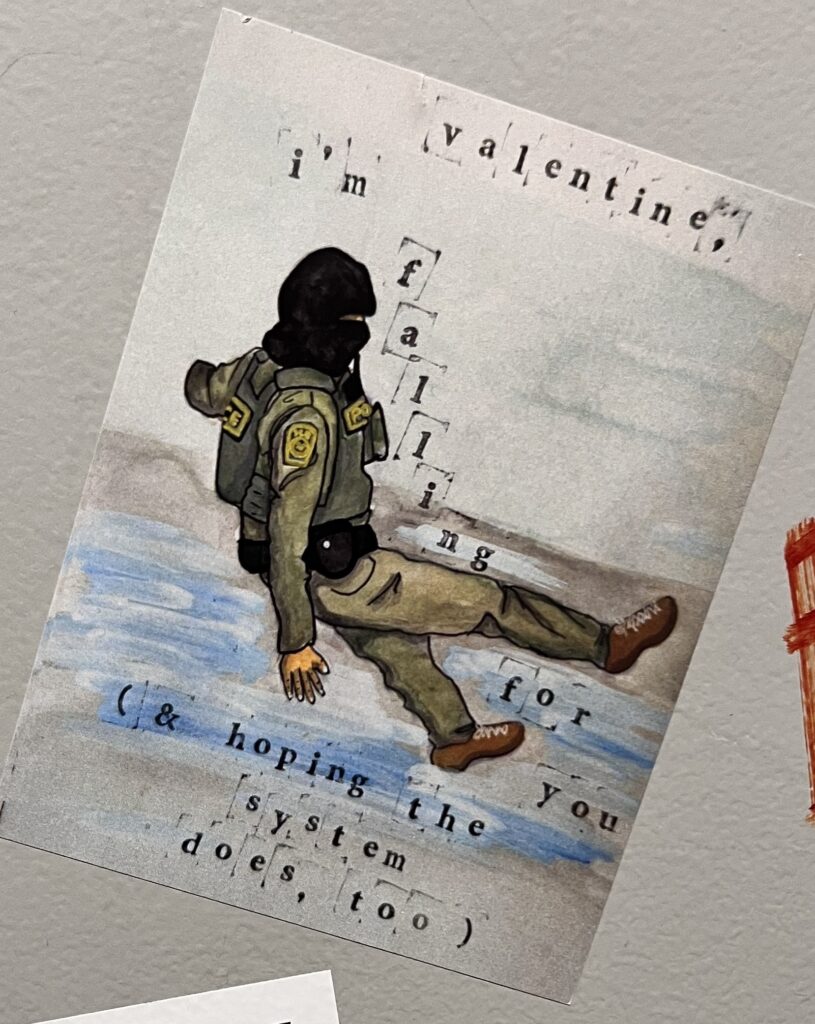
a few minutes later: As a first step, I’ve decided to try sharing my love poems again on Facebook. I put the link in the first comment and posted a photo, not of a dog, but of this Valentine that Scott noticed in the bathroom at Arbeiter Brewing:

Valentine, I’m falling for you & hoping the system does, too.

Also, I posted the STOP ICE photo that I posted here yesterday on my Instagram.

Maybe one of the biggest reasons I’m not sharing on social media is because it’s hard for me to do it with my bad vision. Everything takes so much longer and I can’t always see when I’ve made a mistake. And, I’ve been self-conscious about posting photos that I imagine are poorly cropped or framed strangely. Time to get over that.

Get Out Ice

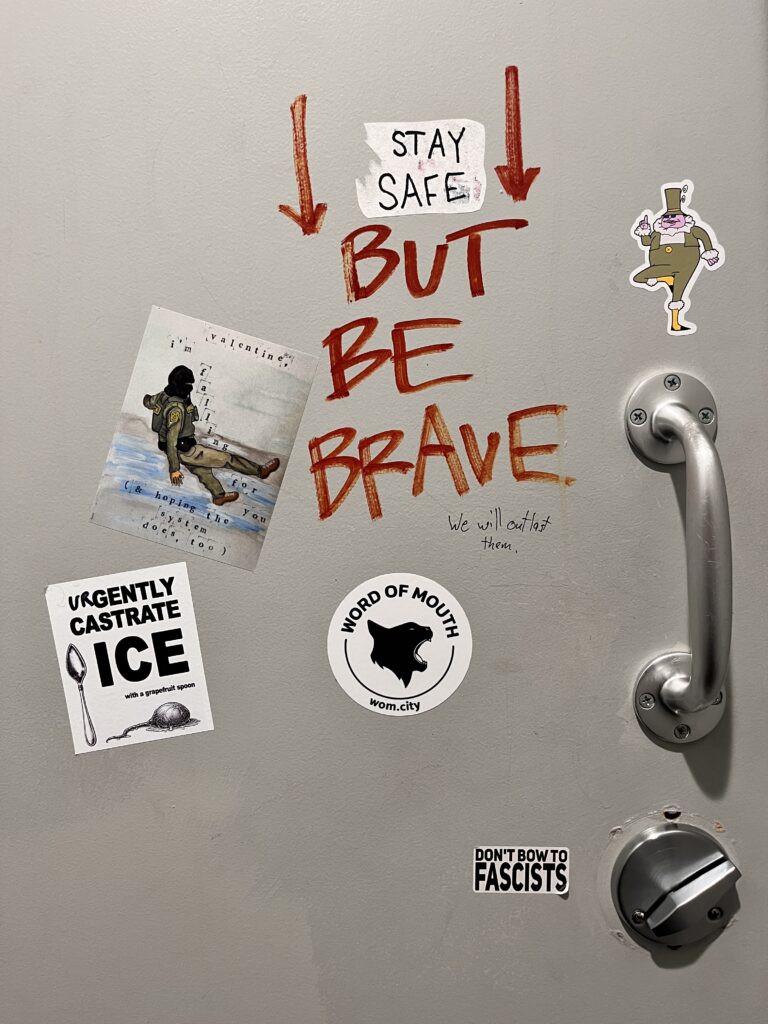
Seen on a bathroom door at Arbeiter Brewing:

sickers on a bathroom door at Arbeiter

jan 26/BIKERUNGETOUTICE

bike: 35 minutes
run: 1.35 miles
outside: 13 degrees

Read a few pages of the Alice Oswald interview in the Paris Review then watched the Las Culturistas podcast with Amy Poehler while I biked. I love Alice Oswald and I love Amy Poehler. So good! I don’t have time right now, but when I do, I want to post some quotes from the podcast episode.

Listened to the first 3 songs on TS’s “Reputation” while I ran. It felt good, and I felt more relaxed than I have in many days. I think it’s the combination of almost being done with my 2-week cold, and news that some Republicans are taking back some of their more extreme statements in support of ICE. But, I know that we’re not close to being done with this nightmare.

1

I think there are places you build in the imagination that become stable. I love the metrical forms, the sonnet and the ballad, but to me the real thing is what I call patience, the idea of creating your own stability within a length of time. I responded to that when I discovered Homer. There was something in that poetry, because it was orally composed—I could feel Homer making forms of patience within the poem, lines coming back and coming back and then coming back. It makes habits. There’s something steady and reliable about its way of moving, while at the same time, it loops wherever it wants to go, and remakes itself.

 an interview with Alice Oswald

2

I could feel straightaway that Homer was quite different from the other types of poetry I’d read. I can remember, when I was told that he was blind, having this dizzy feeling of what a poem would be if you were hearing it and speaking it rather than reading it.

 an interview with Alice Oswald

This year, I want to keep pushing at this question of what a poem would/could be if you’re hearing it and speaking it instead of reading it? I want to do more poetry that does just that.

Get Out Ice

A slightly more helpful, less terrifying day than Saturday. Some Republicans are speaking out against the shooting of Alex Pretti, Walz talked to Trump and he agreed to send Greg Bovino somewhere else; Rand Paul is asking for ICE to testify at the hearing next month. Only very small successes that are possibly only offered to get Democrats to pass the budget and give ICE even more funding by the end of this week. Don’t do it Democrats!

I surrounded myself with the loving words of other Minnesotans again this morning, and created 2 more love poems. Here’s one, both are posted here.

Love #6: How to Be a Better Person

Hold space for pain, anger, confusion.
Make hope happen for others.
Open the door for love, close it in hate’s face.
Wear boots, a lot of wool, scarves, and mittens. Bring extras to share.
Believe in small acts: they matter.
Demand the exit of ICE from our beautiful cities.

jan 20/BIKERUNGETOUTICE

bike: 33 minutes
run: 1.5 miles
basement
outside: 11 degrees

Cold outside, ice on the paths, ICE on the streets. Even if the conditions were better, is it safe for me to go out for a run on my own? Since I am white, probably, but my vision is bad. It’s good enough to navigate the trail — cracks, bumps, curves — but not to get a sense of when I’m in danger. I can’t read signs — words, gestures, signals — and I can’t see faces or identify people well. Out by the river, if someone stopped me, would I be able to tell if they were ICE? If they were threatening me. I don’t know.

Am I being too cautious? Unsure. For now, I’ll go to the Y or the basement. I miss winter running.

Watched Jennifer Lawrence on Good Hang with Amy Poehler while I biked. It’s sponsored by Spotify, which I wish wasn’t the case. I thought it was funny when Amy asked Jennifer what her favorite song was and Jennifer said, ever since the radio went away, I can’t find new music. Where do you find it? I was expected Amy to answer with the obvious: I listen to Spotify. But she didn’t; she said she finds stuff on tik tok then buys it.

I listened to Mood: Energy again while I ran. Pressure / Billy Joel | No Sleep ‘Til Brooklyn / Beastie Boys | Final Countdown / Europe | Iron Man / Black Sabbath. When I wasn’t thinking about ICE instead of iron, I heard a line about boots of lead and thought of Emily Dickinson and “I Felt a Funeral in my Brain” — And then I heard them lift a Box/ And creaked across my Soul/ With those same boots of Lead again / Then Space begin to Toll. Love that poem!

Get Out Ice

Earlier today, writing about my bike and run yesterday, I was feeling a bit extremely overwhelmed by the headlines I encountered on Facebook. I sat with those feelings for several hours. Then, I saw this video from the Minneapolis Art Sled Rally this past weekend, and I snapped out of the deepest fear:

Minneapolis Art Sled Rally / 17 January 2026

Such love, as joy, as whimsy, as defiance! I had an idea: I should post an expression and example of Minneapolis / Twin Cities / Minnesota love every day. These examples are not suggesting that things aren’t bad (they are), but are claiming space for a powerful counter-narrative to fear and defeat and Minneapolis-as-lawless-hellscape: Love! solidarity, care, joy. I’m going to try and post something on facebook every day, something I haven’t ever done. I used to be much more comfortable with social media, and tweeted all the time. Then my vision declined a lot and I lost interest. Then I became too intimidated by it, afraid that I’d do something wrong — this is not an unfounded fear; there are many buttons/directions posted that are very clear to others, but are invisible to me and my cone-starved eyes. But, I have decided to try again, to be brave and share these examples with others.

I have also decided to archive all these examples on a page in my “How to Be” project on UN || DISCIPLINED: Love, Minnesota-style

dec 26/RUN

4.45 miles
minnehaha falls and back
36 degrees
humidity: 90%

Moist, thick, big puddles everywhere. I tried to avoid them, but I couldn’t avoid all of them and by my last mile I could hear my one shoe squish squish squishing. Since it was warm, it didn’t bother me. Oh — just remembered — my shoe/sock got wet at the falls — the cobblestones near the falls were full of puddles. There were a few slick spots, but mostly it was just wet.

For 3 miles, I listened to the wet wheels, whooshing, crows cawing, and people calling out to each other as I ran. For the last mile: TSwift’s Life of a Showgirl

10 Things

  1. the small patches of snow on the trail or the road, seeping murky gray-green-dirty white liquid
  2. the rusty orange leaves, dead, still clinging to the trees
  3. calmly letting a walker know I was approaching from behind — right behind you/thank you! I meant to say, you’re welcome, but didn’t, then lamented my failure to exchange the you until I realized I had with my right behind YOU –if I had said, the you would have been traveled 3 times: from the-walker-as-you when I said, right behind you, to me-as-you when she said, thank you, to the walker-as-you again with, you’re welcome
  4. overheard: a man leaving a group of people at the falls, calling out, I’m going back to pay the meter!
  5. clusters of people — 6-8 at the overlook just above the falls, and at the overlook close to “The Song of Hiawatha”
  6. a clump of something not moving ahead of me on the trail — dead leaves? A darting squirrel. I studied it closely to make sure it didn’t run in front of me
  7. a distant thumping, heard when stopped to put it my headphones — nearing, another running plodding along
  8. seen with peripheral vision: some frozen crystals on my cheek
  9. the trail on the bike side of the double bridge was mostly wet ice with 2 narrow strips of bare pavement that narrowed even more until not even my toe could fit in their groove
  10. crows! just before starting my run, they were gather in the trees above me. when I stopped to start my workout on my watch, they cawed furiously, as if to say, keep moving!

Just before the run, I got an email about one of the chapbook contests I entered — back in July. I didn’t win, but I got, along with 4 other poets, an honorable mention. I’ll happily take that! The chapbook I submitted included earlier versions of several of the poems that I revised for my manuscript. I think the poems are even better now.

In the last mile of my run, a sudden thought: I should submit something for tiny wren lit’s tiny zine series. It says they’ll open again in early 2026: submit a tiny zine

safari reading list, review:

1 — contentment

Found a poem about contentment while reviewing my Safari Reading List. I’m partial to the words satisfied or enough or still, but contentment works too.

from A Beautiful House with a Hot Tub and Pool/ Jason Schneiderman

Yes, I can be content anywhere,
but alas sadly: No. It’s not true. I can’t be content here
in my uncomfortable present, in my uncomfortable chair,
on the uncomfortable subway, at this uncomfortable desk,
in this uncomfortable classroom. But oddly, I am content 
to visit the past, to say Hello everything I’ve lost, 
to say I wish you could come here to the present, 
my lost companion trees. I wish you could meet 
everything I’ve found.

about this poem: “Making peace with the past has been a common theme in my work, so I decided to try to write about making peace with the present.”

2 — a no-one rose

from Psalm/ Paul Celan (trans. John Felstiner )

Blessèd art thou, No One.
In thy sight would
we bloom.
In thy
spite.

A Nothing
we were, are now, and ever
shall be, blooming:
the Nothing-, the
No-One’s-Rose.

I love this bit of Celan’s poem and the No-one’s-Rose! No One — a someone who is No One: what type of sight do they have? We were, are, shall be nothing, blooming. I want to use this — maybe as a breathing with poem — in a collection* about the gorge/gap/bling spot.

*maybe not a collection, but a series of attempts, orbiting around the idea or feeling or experience of the Nothing in the gorge and in my vision.

Speaking of orbiting: Last night, I was trying to name/remember something, but I couldn’t, quite. I kept almost getting the right name, but I was off, approximate. As I talked, I moved my hands around in a circle, as if to indicate I was circling around the name. I called out, I’m orbiting it! I do this a lot. I wish I could remember the exact example, to make this story more understandable, but I can’t.

3 — CAConrad’s Queer Bubbles

There are some great bits in this article about Conrad and their rituals in The Paris Review:

“I love being inside the ritual,” he says. “It’s like speaking in tongues. It’s not just automatic writing … Every nuance, every adjustment to the ritual, alters the language that comes out of me.”

Exercises like these are nothing new in poetry—Conrad cites Bernadette Mayer and Charles Olson as two practitioners of similar methods—but he insists that his rituals are chiefly inspired by his childhood, specifically the Pennsylvania Dutch Country where his grandmother taught him to meditate and where he took an interest in the occult, from local water diviners to the hex signs painted on barns. But as much as his work owes a debt to Boyertown, it is a deliberate rebuke to the bigotry, violence, and oppression he found there.

Queer Bubbles

I’m familiar with B Mayer’s work — a class on her list is what led me to poetry! — but I don’t know that much about Charles Olson. I should look into him more, like his archeology of morning (on a site that offers footprints not blueprints, which reminds me of my old academic slogan for my ethical/pedagogical approach: an invitation to engage, not a how-to manual) and the polis / Polis is This:

Polis is This

In his two books of (Soma)tic rituals and poems, A Beautiful Marsupial Afternoon and ECODEVIANCE—a third collection, While Standing in Line for Deathwill be published this September—the rituals and resulting poems appear opposite one another. Because the rituals are written in the second person, at times the books read like the world’s most bizarre and inventive self-help guides, manuals for what you might call acute mindfulness. One ritual starts like this: “Eat a little dark chocolate before getting on the subway. Sit in the middle of the car … Then close your eyes, and as the car rolls on its tracks make a low hum from deep inside you … As soon as the car stops write 9 words as fast as you can before the train moves again … Repeat this humming and writing for 9 stops.” He credits his rituals with lifting him out of depression and grief.

Queer Bubbles

The use of You — a bizarre self-help manual or how-to on mindfulness!

the blind ring project returns to haunt this log

Doing some reading about lit journals that accept visual poetry, I was introduced to the amazing erasures of Colette LH. So beautiful and wonderful. Here’s the first one I experienced:

(un)certainty

Then I saw this one, Brain, and I started thinking about what I could do with my blind spot black-out ideas, and now I’m wondering about doing something with my peripheral. These white trails above, in (un)certainty are making me think about movement and direction and motion as it relates to my peripheral vision. Hmmm….

I want to buy their 2018 chapbook: a wonderful catastrophe and this, Celestial Timpani from Yavanika Press

dec 22/RUN

4.25 miles
minnehaha falls and back
38 degrees
10% ice and 30% puddle-covered

Waited until the late afternoon to go out for a run; too icy this morning. This afternoon (at 3), there were lots of puddles and sun and not much ice. A good run. Even though I think I caught FWA’s cold, I had plenty of energy while I was running and felt great.

10 Things

  1. bright sun reflecting off the windows of a house
  2. the very strong smell of week near the 44th street parking lot
  3. the creek was moving, but the falls was not
  4. lots of walkers, a few runners, at least one fat tire
  5. a walker moving over to let me pass on the cleared bike path in the park — thank you! / you betcha!
  6. near the oak savanna, a little kid’s voice floating up from below
  7. at least one bright yellow jacket
  8. the river: covered with ice and snow
  9. a line of cars waiting at the stop sign on the road coming out of wabun park and the veterans home — did a shift just end?
  10. the clip clip clip of another runner’s ice cleats

blind spot

Yesterday I wrote about re-finding my blind spot and doing a series of erasure poems with it. Last night, I woke up with a vague idea about writing a hybrid piece (possibly to submit to a journal’s call for submission — Waxwing) that involves using and applying and reflecting on my blind spot. This morning, I’ve been spending more time thinking about it, wandering and wondering how and what to do with these ideas. Just now, a thought: even as I use a cut-out or an image of my blind spot and apply it to text, as if to demonstrate how I see, the resulting poem/prose piece/fragment can’t properly convey how it is that I do or don’t see. The difficulty with my failing/failed vision is that I can’t really see it. Well, sometimes I can see it, like when I’m talking to someone and their head is only a fuzzy, empty blur, but often I can’t. It’s more of a feeling, or sometimes it’s not anything; I don’t realize I’m seeing wrong or that I’m not seeing until it is pointed out to me. How do you convey that?

But, even if the dark outline of a blind spot doesn’t effectively represent my vision, it does do something. So I’d like to use it.

As I write this, I’m looking out my window, into the bright white and blue of the sun and snow and sky. The image is shaking or shuddering or unsettling constantly. I see pixels shifting. The entire image is not unstable — I see solid forms that aren’t moving — like a red car parked across the street, or the straight hulk of a tree trunk — but the feeling of all of it is movement and being unfinished, unsettled, or buzzing? Visual buzz?

Earlier today I was working on a movie musicals puzzle. I’m constantly amazed that I can still work on it, that I can see enough to fit pieces together, but I can. In fact, with the small bit of central vision I have left, right in the middle of the middle of my eye, I often see small details — a tiny face or eyes, a finger pointing — and can recognize where they go. Sometimes I can’t fit it in exactly, so I give it to Scott and he finds the exact spot. Vision is so strange.

several hours later: Right now, I’m starting to look through the entries I tagged, vision. I have 20 pages of them. Already with the first one, I have an idea. On jan 30, 2020 I posted the poem, Natural Forces/ Vicente Huidobro. Since then, I’ve spent a lot of time with this poem — analyzed it, memorized it, recited it while I was running. To me, it’s a great example of the myth of the power of sight. Could I fit it in an amsler grid-sized box, and apply my blind spot to it?

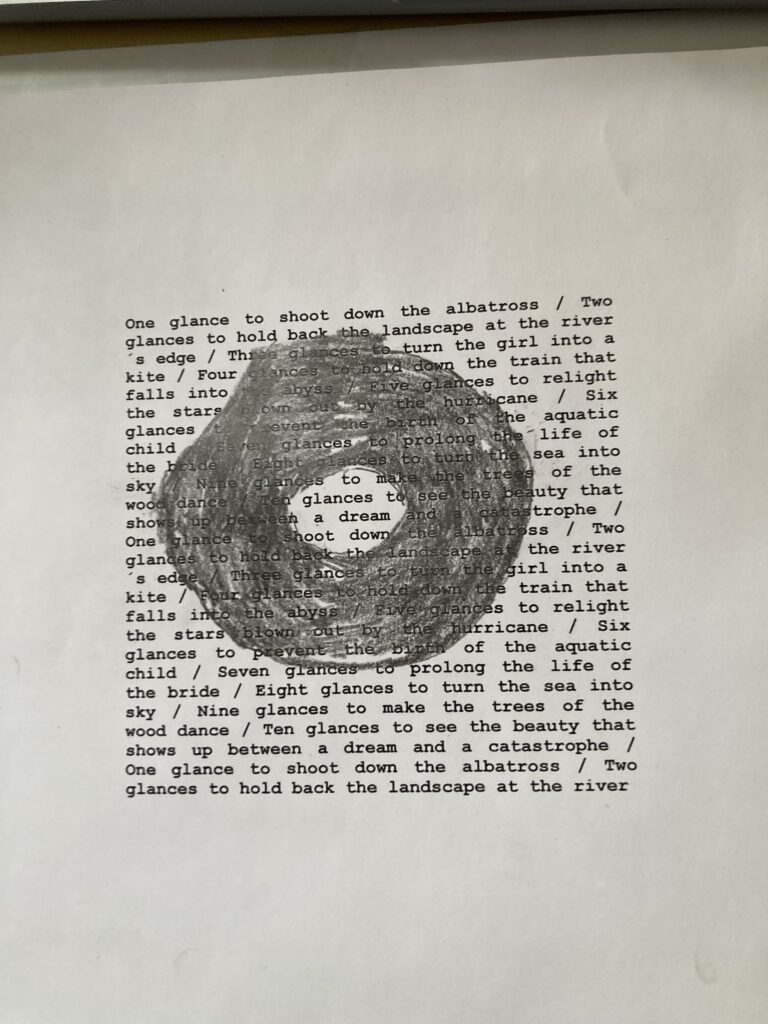
I tried. Made a text box the size of grid. Fit the poem in the box as many times as would fit. Printed it out. Traced my blind spot on an Amsler grid, then cut it out and placed it over the poem. Not sure I like it, but it’s a start.

blind spot experiment #1

I wonder what it would look like if I only wrote the poem once, and made it a horizontal band across the box? Maybe make the font size smaller too? What if offered a few different versions, some with larger fonts, some with smaller so a reader could see what I can/and can’t read. I’ll have to try that next time.

dec 16/RUN

5.25 miles
bottom of franklin hill
37 degrees
60% snow-covered

Above freezing today! Good, and bad. Good, because the snow on the path is melting. Bad, because it will freeze again tonight. I’ll take it, and the sun! and the warmth on my face! and the sound of wet, whooshing wheels. I ran to the bottom of franklin today to check out the surface of the river: completely covered with ice, a light grayish white. Almost all of the time, I felt strong. It was only after taking a break to check out the river, then starting again and running up the hill, that my legs felt strange. It took a minute to get back into a rhythm.

10 Things

  1. Looking up: powder blue sky, with streaks of clouds and sun
  2. something half-buried in a snow bank, 1: a lime scooter
  3. something half-buried in a snow bank, 2: a bike — not a rental — where is the owner of this bike, and why was it wedged in the snow and not put somewhere else?
  4. another runner, much faster than me, in a bright yellow jacket
  5. deep foot prints in the snow leading up to the sliding bench — someone must have sat here recently
  6. the view from the sliding bench: open, clear through to the snow-covered river and the white sands beach, which is just snow now
  7. someone at the bottom of the franklin hill, staring at the water
  8. a few honking geese down below
  9. cheeseburger cheeseburger — a calling bird — a chickadee, I think
  10. flowers for June in the makeshift vase of an uncapped railing under the trestle

Earlier today, while drinking coffee, I heard (not for the first time) Lawrence’s song, “Don’t Lose Sight” and I started to think about vision/sight/eye songs. Time for a playlist! I borrowed a title from someone’s spotify playlist that came up in a google search: Eye Tunes (groan). Came up with a long list of songs, then put a fraction of them in the list. I’ll keep fine-tuning it. I listed to the list during the second half of my run.

Eye Tunes

  1. I Saw the Light / Todd Rundgren
  2. Blinded by the Light / Mannford Mann’s Earth Band
  3. Eye in the Sky / The Alan Parson’s Project
  4. Eyes Without a Face / Billy Idol
  5. I Can See Clearly Now / Jimmy Cliff
  6. Can’t Take My Eyes Off of You / Ms. Lauryn Hill
  7. These Eyes / The Guess Who
  8. Eye of the Tiger / Survivor
  9. The Look of Love, Pt. 1 / ABC
  10. The Look of Love / Dusty Springfield
  11. For Your Eyes Only / Sheena Easton
  12. Eyesight to the Blind (The Hawker) / The Who
  13. Breakfast in America / Supertramp
  14. Don’t Lose Sight (Accoustic-ish) / Lawrence
  15. Total Eclipse of the Heart / Bonnie Tyler
  16. Double Vision / Foreighner
  17. In Your Eyes / Peter Gabriel
  18. Behind Blue Eyes / The Who
  19. Evil Eyes / Dio
  20. Stranger Eyes / The Cars
  21. Tell Me What You See / The Beatles
  22. My Eyes Have Seen You / The Doors

I listened up until Dusty Springfield’s “The Look of Love.” A few thoughts: I always think, anus curly whirly? when listening to “Blinded By the Light.” There is a LOT of vibraslap in “Eyes Without a Face” and, what does Billy Idol mean here? ABC’s “The Look of Love” is wonderful, and has some hilarious moments, especially the call and response section: Whose got the look? / If I knew the answer to that question I would tell you.

Back to Billy. Looked up the lyrics to “Eyes Without a Face,” and I think they mean that the person lacks humanity, is inhuman. Their look lacks compassion, grace.

Eyes without a face
Got no human grace
You’re eyes without a face
Such a human waste
You’re eyes without a face

And, I’ll end with ABC’s opening lines:

When your world is full of strange arrangements
And gravity won’t pull you through

That sounds like someone with vision problems (me)!

dec 3/RUNSWIM

3.65 miles
trestle turn around
17 degrees / feels like 2
100% snow and ice covered

It snowed again last night. A dusting. I think we might get a lot of snow this winter. Hooray! I’m ready for winter running! Today, I didn’t like running straight into the wind at the beginning, but it wasn’t too bad and it was at my back on the way home. I liked running with the yaktrax. At first, my feet were sore, but that didn’t last long. There were a few runners, some walkers. No skiers or bikers.

Geese! A small vee in the sky, a cacophony of honks under the trestle. When I looked up to watch the geese, I admired the BLUE! sky, with only a few clouds.

Running back, I heard the tornado siren. No worries — it’s the first Wednesday of the month and that’s when they test it. One problem: it’s supposed to be tested at 1, and it was noon. Mentioned it to Scott and his suggestion: someone forgot to adjust the timer for daylight savings time.

Anything else? Near the end of my run, I enjoyed listening to the quick, sharp sound of my spiked feet piercing the snow. The sliding bench was empty. Oh — the streets looked bright silver — caused by the sun hitting the ice and snow on the road. The river was streaked with white, and not completely covered. I noticed traces of dirt on the trail where the park workers had come through to make the path less slippery — they don’t use salt because it would do damage to the river. A small thing, but evidence: of someone else here before me, the daily labor of maintaining safe (and fun) winter trails, and care for others.

Richard Siken!

I think I posted a Richard Siken! heading a few months ago, but his new book is so amazing, it’s worthy of another heading with an exclamation point. Last night, during Scott’s jazz rehearsal, I read more of I Know Some Things, including Sidewalk:

excerpt from Sidewalk/ Richard Siken

It was clear that something had happened that wasn’t going to unhappen. In the emergency room, the woman at the desk kept asking me questions. All my answers were stroke, dizzy, numb. I kept saying the words in different ways so she would understand. She didn’t. She didn’t believe me. They put me in the waiting room, which I knew was wrong, and I realized that I had messed it up because I didn’t call for an ambulance. I kept falling asleep in the waiting room. I looked much worse, slack and crooked, the two sides of my face moving at different speeds. I went back to the desk and said help. They put me in a room. No one believes that I know what I know because sometimes I miss a part or tell it sideways.

Tell it sideways. I love this idea of telling something sideways — and, as someone who does/tells things sideways a lot, I get how it can alienate you from others.

What does it mean to tell something sideways? Of course I’m thinking immediately of Emily Dickinson and tell all the truth but tell it slant, but I’m also thinking about a book I used to teach when I taught queer theory — The Queer Child, or Growing Up Sideways by Kathryn Bond Stockton. And I’m thinking about my peripheral vision and how see/think/imagine in its edges and not in the center.

swim: 1.25 miles
88 laps
ywca pool

It is always a wonderful day when I can swim! I felt strong and relaxed. The pool was not crowded. Everyone got their own lane — all 4 of us. There was a lifeguard on duty, which is rare. I overheard her saying to someone in the hot tub: I love going in the hot tub after a long day of giving swimming lessons! My pool friends today were the shadows. The shadow of the lane line. I liked watching what happened as the pool got deeper: at first it was straight and parallel, but soon it angled. Lots of angled shadows on the pool wall. The floor was shimmying from shadows. The blue-tiled t on the wall at the end of the lane letting you know there’s a wall, looked distorted to me. Almost like the lines at the center of an Amsler grid when I look at it.

locker room encounter

Two older women talking near my locker. Or, one woman talking at the other, speculating on the state of things, talking about bifurcated society and the haves hoarding it over the have-nots and then believing that if it compresses enough, people will fight back. The other woman, not buying it. As she left, the first woman called out, I’ll see you up there. We can sweat it out! After she left, the second woman mumbled, YOU can sweat. When I laughed she explained that she didn’t sweat easily and it was hard for her and she feels uncomfortable when she can’t and she wishes she could just sweat.

My reaction: At first — come on ladies, this is the locker room. We come here to escape and have fun and to not think about the state of things. Then, when I heard that they hadn’t worked out yet, I got it. Oh, you just haven’t worked out yet! Also: I wondered if the second woman (the woman who couldn’t sweat) enjoyed working out with the first woman (who used bifurcated and talked at her and told her they would sweat),

nov 5/RUN

4.25 miles
marshall loop (to Summit)
47 degrees

What a run! Late fall/November is the best — half leaved, half unleaved. Cooler, more energy in the air. Two things I want to remember more than anything else:

1

Running down the summit hill, nearing the lake street/marshall bridge, a woman ahead of me, walking with another person, wearing the most amazing BRIGHT pinkish orangish jacket. She glowed. As I ran by I called out, I love your bright jacket. She slapped her thigh in delight and called back, It’s my don’t hit me jacket. Then we both laughed.

2

Just cresting the final hill and almost to the ancient boulder, I passed by two women walking and talking and marveling at how beautiful this place is. They both agreed, they hoped they never had to leave it. Then the younger woman, presumably the daughter, said to the older woman (mother): I only want to live here or where you are. That broke me open in the best way possible. I want to make that the title of a poem.

Reflecting on these moments, I imagined turning them into 2 (very brief) acts of a play. Act 1: the bright colored jacket, Act 2: mother and daughter share a moment.

I had a great run. I did the Marshall hill loop. I ran up the whole thing and didn’t stop to walk until I reached the Monument. Then I climbed down a few steps to listen to the shadows fall. After a few minutes, I ran back home — down the summit hill, past the woman in the bright jacket, over the bridge, up the ancient boulder and past the mother and daughter.

added 5 hours later: I just remembered the river and standing on the lake street bridge, peering over the edge and staring into the glitter path. Such bright, sparkling water! I’m not sure I could have stared at it as long and as directly as I did if I didn’t have so many dead cone cells. Bright lights don’t bother me much anymore.

bells

I’m working on the final (I think) poem in my collection. It’s a reworking of my ending poem for the OG haunts. And it’s inspired by some words from Annie Dillard (in “Seeing” from Pilgrim at Tinker Creek) that I’ve fit into my running/breathing form:

My whole life
I’d been 
a bell but
never
knew until
I was
lifted and
struck. Now
I am still
ringing.
—Annie Dillard

Here’s what I wrote in a pages document I’m using to gather some thoughts:

something about becoming a bell, or remembering that I was a bell — vibrating, carrying and passing on the songs — ancient rhythms of grief joy love anger restlessness buried deep within her, knocked loose by this place, by her ghosts, by her never ending movement — everything buzzing, ringing, chiming, pulsing, thrumming, strumming — even the oldest rocks shimmy and shake and shift and settle — her body, an echo, her feet adding to the ruts and the grooves, leaving a trace in foot strikes and words and shadows and, a scattering of Saras all around

For some of my run I thought about bells and Annie Dillard’s quotation about being a bell and Ammons and energy and movement and cells bouncing and shaking and disintegrating and being replaced and movement and — I wish I could remember the rest of what I was thinking, but I can’t.

I do remember one other bell-related thing I thought about. The book closes with Annie Dillard’s bell struck quotation. It begins with some lines from Emily Dickinson and “I felt a Funeral, in my Brain” that I fit into my breathing/running form:

As all the
Heavens
were a Bell,
Being
but an Ear

I am both bell and ear. Some substance of the Heavens/the Bell/the Eternal resides within me. And, to be = to notice, to listen

before the run

Yes, to this poem-of-the-day on poets.org and the discovery of a new word (or the remembering of a word long forgotten): vermiculation!

Some Melodious Plot/ Anthony Borruso

The United States government murdered over 12 billion birds over the course of 1959 
threw [sic] 2001. As they killed off the real birds they replaced thim [sic] with surveillance 
drone replicas. Indistinguishable from a biological bird. There are now no real 
birds left. 

—Official Birds Aren’t Real Informational Van Bumper Sticker

i. The Philosophical Ornithologist

It is, as all things are, a problem 
of perspective. What you think

you are watching, watches 
you. Your binoculars convince

themselves they’re quotation marks. 
The spy in the song, the feathered

thoughts, the cold hard data 
you spun into silky fact

that the comment section couldn’t 
wait to run its fingers over.

Of course, the pigeons adapted 
to an urban space—they’re party birds

with smokey plumage, and they grow 
peckish unless they’re bobbing

beaks to Milli Vanilli or waving 
glow sticks around the Sabrett stand.

Ancient Egyptians and Williamsburg 
hipsters have nothing in common

except how their feelings take sharp 
angles in broad daylight when the sun

nests in their beards. What I mean 
is that the bygone is hellbent

on a comeback, i.e., the early bird 
pecks a blog post about the importance

of visually manifesting the worm— 
actually encompassing its wriggle

in your quaint skull before 
taking it to beak. You know though

that we are post-extinction and fully 
flapped out—just look at us,

ogling Mother Nature’s augmentation 
with craned necks, covering every

millimeter of the visible world 
with the vermiculations of a stock

ticker. Something’s wrong. Like, 
real wrong: I knock on mountains

and hear a vast metallic thud. I sleep 
on eiderdown, but can’t seem to

squawk loud enough to stir the other 
Denny’s denizens from their Grand

Slam breakfasts. In Altoona, Pennsylvania 
and Waco, Texas, I can feel my face

being scanned every time I munch 
a Big Mac. On this highway, a pit stop

is a pit stop is a pit stop and overhead 
migration is a chance to grease gears

and re-feather the avian bait-and-switch.

vermiculation: Merriam-Webster entry

1TORTUOUS, INVOLUTE

2full of worms WORM-EATEN

3

a: VERMIFORM (resembling a worm in shape)

b: marked with irregular fine lines or with wavy impressed lines
(line in the feathers of a bird)

cells and spindles

Yesterday I mentioned that a line from Hix’s cell phone reminded me of A.R. Ammons’ garbage. Today, I’m revisiting garbage to find and think about the lines.

Reading through it again, I found this:

we, give rise to to us: we are not, though, though
natural, divorced from higher, finer configurations:

tissues and holograms of energy circulate in
us and seek and find representations of themselves

outside us, so that we can participate in
celebrations high and know reaches of feeling

and sight and thought that penetrate (really
penetrate) far, far beyond these our wet cells,

right on up past our stories, the planets, moons,
and other bodies locally to the other end of

the pole where matter’s forms diffuse and
energy loses all means to express itself except

as spirit, there, oh, yes, in the abiding where
mind but nothing else abides, the eternal,

until it turns itself into another pear or sunfish

These lines stayed with me as I ran today.


nov 3/RUN

4.5 miles
minnehaha falls, new variation
45 degrees

Late fall fabulousness! More of a view, sparkling water, crisper air, brightly colored leaves. Had fun trying out a variation on the minnehaha falls loop: the regular version until I reached the steps near the falls. I took them down, then ran beside the creek until I reached the last bridge before the path is closed. Crossed over the creek, turned back up towards the river road. Climbed up a hill that led me to the bottom of wabun park. Ran up some easy steps — a stretch of slanted sidewalk, a set of 5 or 6 steps, sidewalk, steps, sidewalk, steps. Ran past the splash pad that I used to take the kids to 12 or so years ago, then down the steep hill to the locks and dam.

I’m feeling stronger, physically and mentally. Scott and I are thinking about doing the marathon again in fall of 2026.

10 Things

  1. the tree that is usually red 2 doors down is yellow-orange this year
  2. the view to the other side is opening up — less leaves on the trees
  3. river surface — bright white and burning
  4. a thinner falls
  5. a subdued creek down below — not rushing or gushing but also not still
  6. honking geese near the splash pad in Wabun
  7. the gate down to the falls is still open
  8. empty benches above the edge of the world and at Rachel Dow Memorial bench — I decided to stop at the edge bench, which is not right on the edge but several dozen feet in — walked over to the edge and admired the water and sun and openness of it all
  9. bright pink graffiti under the ford bridge
  10. good morning/morning! greeting a woman in a puffer jacket that I think I saw in the same spot yesterday

after the run

I am officially ready for winter running. Scott and I went to Costco and they had some great winter stuff set up in the front. New gloves, 2 new pairs of running tights and base layer shirts, and all the hand and foot warmers that I could possibly need! Guess that means I’ll have to run outside in the arctic cold so I can use them!

cells cells cells cells cells

Today I’m returning to EAP and “The Bells,” which I my using as a template for my own “The Cells” poem. Three versions of cells that I’ve been working with so far: dying/dead photoreceptor cone cells; the uncontrolled growth of cancer cells and late capitalism; and the narrowing of a world out of anxiety and necessity —

writing this, now I’m wondering about cells as individual building blocks of living things and the phrase, on the cellular level. What exactly does that mean? basic functional and structural unit of an organism.

And now, I’m looking up cellular level and “cell small room” and reading about “understanding health at the cellular level” and having a wonderful thought: why not devote a month to the cell and some of its different meanings? Fun! In the past 2 months, I haven’t posted monthly challenges; I’ve been too busy working on a draft of Girl Ghost Gorge. As I finish that (because I want to be finished for a while and submit it for a first book contest), I’d like to return to the delightfully wandering work of picking a topic and finding as many different ways to imagine and understand it as I can.

a lingering thought: I am enjoying using EA Poe’s “The Bells” as a starting point for a poem, but I’m not sure I’m a good enough poet (yet? ever?) to wrangle rhyme and meter the way he does in his poem. So tricky and easy to overdo it.

and now a random thought bursting in my brain: what is poetry, at the cellular level? the basic unit, the building block of poetry? Rhyme, meter, sound, pulse, something else?

from definitions of cell on Merriam Webster: a single room, usually for one person

cellular, celluloid, cell phones cell towers, the creepy movie The Cell

Looked up cell on poets.org. Found this Sara poem!

Sara in Her Father’s Arms/ George Oppen

Cell by cell the baby made herself, the cells

Made cells. That is to say

The baby is made largely of milk. Lying in her father’s arms, the little seed eyes

Moving, trying to see, smiling for us

To see, she will make a household

To her need of these rooms—Sara, little seed,

Little violent, diligent seed. Come let us look at the world

Glittering: this seed will speak,

Max, words! There will be no other words in the world

But those our children speak. What will she make of a world

Do you suppose, Max, of which she is made.

Sara, little seed! Love it. And, Come let us look at the world/glittering and What will she make/of a world of which she is made

WHAT? Whoa!

So, reading this poem and the opening lines, Cell by cell, the baby made herself, the cells/made cells, prompted me to ask and then investigate: How often are our cells replaced? And do all of them get replaced every 7 years? I found information about the time span of different types of cells, an explanation of why the 7 years thing is a myth, and then this from NPR: Does Your Body Really Refresh Itself Every 7 Years?

I watcher their video and got to the part, which is almost at the end, when they say this:

And there’s one more part of you that lasts your whole life

2:14Months before you were born,

2:16a little cluster of cells stretched and filled themselves with transparent protein

2:21As you grew, even after birth, more and more fibers were added, but that center endured

2:28This is your lens the window through which you are watching this video right now2:34and its core has remained the same since the moment you first opened your eyes

generated transcript on YouTube

Sara’s little seed eyes?! I had no idea that the lens lasts!

Video (can’t embed it)
A tumblr post with more info

And found out this about the lens:

What is the eye lens made of?

The lens of your eye is made up of structural proteins called crystallins. This is why it’s sometimes called the “crystalline lens.” It has the highest concentration of proteins of almost any tissue in your body. These specialized proteins give the lens its transparency and focusing power. Mature crystallins have no nucleus or organelles — they lose them as they mature. This adds to their clarity and transparency.

But having no nucleus or organelles also prevents the cells from reproducing. This means they don’t “turn over,” as most of your body’s cells do. The cells arrange themselves in concentric layers, like tree rings. Throughout your life, new cells continue to grow at the outer edges of the circle, while the older cells compress toward the center. Eventually, the older cells at the center begin to show wear and tear.

source

Like little tree rings?! You better believe that that is making it into a poem at some point!

future explorations and ideas to play with: If (most) of our cells are being replaced, what makes us us? And, are they really “our” cells? Or, do we all just live together (Oppen’s household)? Is a body one thing?

Listen to Lulu Miller on an Invisibilia episode, especially the last story:

Finally Lulu talks to a scientist to come up with a complete catalogue of all the things about us that actually do stay stable over the course of our lives. They look at everything from cells to memories until ultimately they come up with a list — but it’s a really short list.

a final note: Questions about cells and bodies and what makes us us are ones I’ve been asking for a long time, but I was especially preoccupied with them after my mention of M. Hemingway and her retreat for reclaiming the “sovereign self” in yesterday’s post.

oct 29/RUN

4.5 miles
veterans home in reverse
49 degrees

Another beautiful late fall day. Sun, sparkling river, gushing falls, red and orange and yellow leaves. Parts of the run were easy, parts of it weren’t. Felt tired this late morning/early afternoon. Ran up the hill through Wabun to the veterans home, then over the bridge, past John Stevens’ house and to the falls. The bench above the edge of the world was empty but the Rachel Dow Memorial bench had two people sitting on it. ALL of the kids were outside on the Minnehaha Academy playground as I ran past it on the other side of the road. Two memorable things: 1. a teacher calling out to a student — no, no, we do not climb the fence. get down! and 2. I heard a trumpet playing Reveille. It sounded like a live trumpet and not a recording. Is that what they play to call kids in from recess?

Scott sent me this poem. I’m posting it partly for its cleverness, partly for our shared dislike of licorice, and partly because I love the word It.

It/ Gertrude Sturdle

It is never
what it seems to be
unless it is licorice.
And then
sadly
it is.

the cells, cells, cells, cells, cells, cells, cells

Yesterday I mentioned using Poe’s “The Bells” as a template for my own poem about the cells: dying cone cells, strange rod cells, the uncontrolled growth of cancer cells, a narrowing of space (cell as room, place). I started working yesterday afternoon and am back at it this morning before my run. Fun!

version 1

EA Poe’s original first verse:

Hear the sledges with the bells—
Silver bells!
What a world of merriment their melody foretells!
How they tinkle, tinkle, tinkle,
In the icy air of night!
While the stars that oversprinkle
All the heavens, seem to twinkle
With a crystalline delight;
Keeping time, time, time,
In a sort of Runic rhyme,
To the tintinabulation that so musically wells
From the bells, bells, bells, bells,
Bells, bells, bells—
From the jingling and the tinkling of the bells.

My version

Feel the leaving of the cells —
the failed cells.

What a world of loneliness their abandonment foretells.

How they tumble, tumble, tumble,
In the fading of the light.

While the cones start to crumble
,
All the rods seem to rumble
in the loosening of her sight;
Then it’s grays, grays, grays,
and a veil of fuzzy haze.
With an undead half possession and the cast of haunting spells
On the cells, cells, cells, cells,

Cells, cells, cells—
On the slumbering and the stumbling cells.

type of bell: sleigh bells
bells / foretells / wells
merriment / melody

tinkle / oversprinkle / twinkle

a line about the night air
night / delight
time time time
time/rhyme
tintinabulation / musically
bells repeated 7 times
jingling / tinkling — slant rhyme

cells: dead cone cells

cells / foretells / spells

world — loneliness / abandonment
tumble / crumble / rumble
grays grays grays
grays / haze
undead half possession

oct 27/RUN

3.25 miles
trestle turn around
59 degrees

A late afternoon run. Nice! I might try doing more of these later workouts this winter — but not outside, in the dark! I like the light at this time (around 5) — softer, longer, winding down, golden. I only stopped once — to take off my sweatshirt. I considered taking it off while I was running, but thought better of it. I felt strong and confident that I could keep running.

10 Things

  1. bright yellow leaves
  2. a roller skier
  3. laughing voices below me in the ravine
  4. bright yellow t-shirts and vest on some of the walkers
  5. still green below the sliding bench
  6. a long line of cars stopped on the river road whenever there was a stop sign
  7. someone speeding by on a scooter
  8. in the tunnel of trees the path was covered in bright red leaves
  9. a loud honk ahead of me, on the lake street bridge
  10. no geese or turkeys or rowers

vision study

I went in for my second vision test appointment at the U. Colin, a post-doc in the psychology of vision department tested me on a fancy machine that takes 300 pictures of my eyes a second to track what and where I’m looking.

First, a calibration. I put my chin on the chin rest, didn’t move my head, and moved my eyes to track a dot as it traveled from the upper left corner and around the lower right. When I saw it, the dot would explode in confetti. Nice!

Second, a reading test. I was given a sentence to read that kept getting smaller. I struggled to read it when the text was big, but it got easier, and I got faster as it got smaller. I could read sentences that were even too small for my tester to read. When that was finished a screen popped up: 390 trials. Colin said, oh boy. What? The screen said I needed to take 390 of the “trials” to determine if my vision/eyes would work for this study. I asked, what’s the average number of tests? Colin: 100. Of course, my weird eyes would require more testing and of course, this delighted me.

Third, the real test. I had to stare between two dots and try to identify the 3 letters that flashed. At first, the text was too big for me, and I couldn’t see any of the letters. Then Colin decided to try and make the letters a lot smaller — way smaller than anyone had ever done, or even that the program could handle. He thought it was very cool and I could tell he was excited. When I asked him why, he said that he had never seen anyone’s vision work this way. Yes! Even among people with strange sight, my sight is strange! I knew it.

It was fun to do the study and talk with someone about my vision. Will I qualify for continuing? Not sure yet. My vision might be too strange, and too much for this program. They’ll let me know sometime in the future. Whatever happens, it was fun and I got more verification that I’m unusual!

This afternoon, I submitted 5 of my Girl Ghost Gorge poems to a journal, and my chapbook, “I Empty My Mind, I Stuff it with Color” to a contest.

update, 25 jan 2026: I am assuming I didn’t qualify for the next round of the vision study because no one has ever gotten back to me. I got ghosted. Also, at some point in the months since I submitted poems to a journal, a chapbook to a contest, all of it was rejected. Oh well, writing poetry then trying to get it published involves a lot of rejection.

oct 10/HIKE

60 minutes
Minnehaha Off-leash dog park
63 degrees

Wow, wow, wow! A beautiful fall hike with FWA and Delia-the-dog at the dog park. Sun, shade, a cool breeze, yellow and red leaves, sparkling water, soft sand, cute dogs, great conversations — less abstract and theoretical and more personal this time. About anxieties and social norms and traumas and friends that don’t get you.

10 Things

  1. soft sand
  2. a motor boat, floating slowly
  3. small stones just under the surface of the water, near the shore
  4. a small stretch of beach, populated by soft sand, frolicking dogs, the bones of an old tree
  5. a loud cry — was that human? FWA thought a kid, I wondered about a fox
  6. someone far off whistling badly
  7. the surface of the water sizzling white
  8. sitting on the smoothest section of a log — how many other people, and for how many years, have sat in this very spot?
  9. top of the limestone steps — jagged, steep
  10. comparing Delia’s short, quick, little steps to a much bigger dog’s loping, floating strides

GGG (girl ghost gorge), today’s update

before my hike: Reading through the last section of this collection — Air — I had some ideas about time and Endi Bogue Hartigan’s o’clock poems, specifically these lines from oh orchid o’clock:

it is morning 
birds plus 
socket sound of
car closing / 
21st 
century 
pastoral
o’clock

A 21st century pastoral! Yes, I’d like to write some triple chants and offer a twist on the pastoral. The twist = critical of the romanticizing of land, of understanding land as object and background, etc. Fun!

Also, I want to write another poem — possibly a chant? — in this o’clock form that mixes my timeline with that of the gorge.

Other things yet to write: more on air in terms of lungs and breath; a looping poem using the last section of my poem, “Conservation”

anti-pastoral

I decided to start by searching for “pastoral” in my old log entries.

1 — 13 april 2021

I posted and wrote about Forrest Gander’s poem, “Pastoral.” He’s critical of the idea that we observe landscapes/land from a distance, as if seeing were a process, and not an instant act. I appreciate his challenge to the idea of distance, but don’t agree with his suggestion that seeing is instantaneous. Looking does take time to happen, for everyone.

dispossessed (not owned or occupied)
a process
encounter — a process / between two / actors / the beheld / beholder
no study, absorption
immediate, gradual

2 — 28 dec 2021

In the poem, “The Grand Scheme of Things,” Maggie Smith links the eye to the pastoral, too.

We say the naked eye
as if the eye could be clothed, as if it isn’t the world

that refuses to undress unless we turn our backs. 
It shows us what it chooses, nothing more,

and it’s not waxing pastoral.

Yes! The pastoral is all about a certain understanding of sight and vision and how/what we see, how we look.

how we see / a soft sight
filtering
what is “real”?
no access / to the Truth / through our eyes
surely you/can’t imagine/the trees look/like they look/when we are/not looking (MO)

(side note: I’m realizing that the pastoral — paintings/poems — are all about how we look and see. I need to turn to this in my ekphrastic/how I see project. )

after the hike

3 — 6 feb 2022

Pastoral turns up in A Nearly Perfect Morning/ Jessica Greenbaum:

It was a nearly perfect morning—bucolic, pastoral—

bucolic: related countryside, farm fields, pastures, rural, rustic, countrified

bucolic
countrified
a plowed field
managed land
rusticate

4 — 21 march 2022

From an interview with Alice Oswald:

there’s a whole range of words that people like to use about landscape, like pastoral, idyll. I quite like taking the names away from things and seeing what they are behind their names. I exert incredible amounts of energy trying to see things from their own points of view rather than the human point of view.

…more interested in the democratic stories…the hardship of laboring, looking for food…the struggle of a tree trying to grow out of stone…always looking for that struggle. I’m allergic to peace. I like this restless landscape. I like that it won’t let you sit back and say, “what a beautiful place I’ve arrived to.” You’ve never arrived. It’s moving past you all the time.

Landscape and Literature Podcast: Alice Oswald on the Dart River

idyll = “an extremely happy, peaceful, or picturesque episode or scene, typically an idealized or unsustainable one.”

non-human / perspective

AO rejects the beautiful, as in, what a beautiful place, let me just sit and admire it! I’m thinking of 8 dec 2024, and my discussion of beauty as awe inspiring and awful, beauty as not perfect and relaxed, but pain and grief and struggle

struggling
suffering
laboring
a tree’s struggle / to make a home/ out of a stone
a river’s/fight to be free
restlessness / not relaxed
never here / always there
difficult / not easy (see 14 april 2021 and MO)
lacking peace

5 — 2 may 2022

she discusses William Blake’s poem, “The Ecchoing Green” and how the green in it is not the pastoral but the communal/village green, “where people mix with one another, young and old, playing and slowly fading, ecchoing. Green, as it echoes on the green, is the color of human community” (6)

Green Green Green

communal
village green / public space / gathering
not alone / solitude / together
echoing
mixing/ together
mingling
young and old/ animal, / mineral, / plant

6 — 21 may 2023

anti-pastoral poets

As for the pastoral poetry tradition, two poets and influences come to mind: Vievee Francis and the “anti-pastoral” poems in Forest Primeval, and Jennifer Chang’s Bread Loaf Lecture, “Other Pastorals: Writing Race and Place” (June 2019, available here.)

interview with the poet, Sarah Audsley

this is not / nostalgia. / this place has / a context, / histories / visible / and erased.

Many contemporary pastorals investigate power dynamics, status differences, and the hierarchies of classification.

Pastoral in the Back Yard (essay)

7 — 2 feb 2024

Pastorale, mentioned by Robert Fripp in a blog post about his “Quiet Moments” playlists. Ambient music, Brian Eno, music creating a space to dwell in, not a narrative. Not tightly structured, directing the eye one way, but an open field allowing the ear/the eye/the whole self to wander.

open field
opening
wandering
dwelling in / dwelling with / dwell among
solitude

8 — 24 july 2025

OED: landscape — “A view or prospect of natural inland scenery, such as can be taken in at a glance from one point of view.”

“A field is used more often to describe an area managed by people. The field before you was once an orchard and pasture belonging to a farmer. A meadow is used to describe a wild area.”

“Fields and meadows start when trees have been removed from an area. This can occur naturally with a forest fire or flood, or humans may cut down a forest. Seeds from grasses and weeds take root shortly after and a meadow is born.

As the trees within my macula disappear, my forest meadows. here I’m thinking about my classic memory from science class with the inverted tree in the back of the eye.

as the trees
within my
macula
disappear
my forest
fields and
meadows

cultivate
management
removal
forest fire
open field / empty field / unused field
no longer / occupied

So many great ideas from this wander through my archive!


oct 9/RUN

3.6 miles
bottom of locks and dam no. 1
48 degrees

Another cool morning! Today, I glowed: a bright orange sweatshirt, bright blue running shorts with lighter blue swirls, bright yellow running shoes, a purple-pink-blue running hat. Did it make me run faster? Maybe. I felt much better on the run this morning. Was it because I didn’t have any unfinished business, or because I was going only about half the distance? Or a little bit of both? I ran south and recited part of my new You Are Here poem about the grassy boulevard. I like it.

10 Things

  1. red leaves
  2. the occasional thump of an acorn hitting the ground
  3. the loud rumble of a school bus approaching Dowling
  4. scales on the river near the locks and dam — no clear reflection of the bridge today, instead more of an impressionist painting of it
  5. the bridge in the 44th street parking lot was empty, so was the one near folwell
  6. a dog’s bark, deep and loud, in the trees near Becketwood
  7. more golden light through the trees
  8. heading north, descending on the path that dips below the road, seeing a big but not the trail — hidden behind leaves
  9. the bench at the edge of the world: empty
  10. a buoy (not orange) bobbing in the river under the ford bridge

Listened to cars and dogs as I ran south. Put in “Taylor Swift” essentials retuning north.

Since I wrote about the grassy boulevard this morning, and being alone, and freedom, here’s a fitting poem:

Grass, 1967/ Victoria Chang

When I open the door, I smile and wave to people who only
have eyes and who are infinitely joyful. I see my children,
but only the backs of their heads. When they turn around, I
don’t recognize them. They once had mouths but now only
have eyes. I want to leave the room but when I do, I am
outside, and everyone else is inside. So next time, I open the
door and stay inside. But then everyone is outside. Agnes
said that solitude and freedom are the same. My solitude is
like the grass. I become so aware of its presence that it too
begins to feel like an audience. Sometimes my solitude grabs
my phone and takes a selfie, posts it somewhere for others
to see and like. Sometimes people comment on how
beautiful my solitude is and sometimes my solitude replies
with a heart. It begins to follow the accounts of solitudes
that are half its age. What if my solitude is depressed? What
if even my solitude doesn’t want to be alone?

Chang’s version of solitude involves being watched, stared at, judged and assessed, evaluated. And it involves a distance created with eyes and staring and being on display. My solitude, or maybe my loneliness, involves a lack of seeing — not of being seen, but of not seeing when I’m being seen.

sept 11/RUN

4.5 miles
monument and back
60 degrees
humidity: 93%

A mist hanging above the river. A heavy white sky. It looked very cool, but felt too humid. Heavy legs. Not a great run, but still wonderful to be moving through the mist. Noticed more leaves changing, mostly yellow. Heard water falling in the Summit ravine: Shadow Falls. I imagined that it was not water falling, but shadows. Then I thought about myself shedding shadows as I ran. A cool image.

On the lake street bridge heading west, 2 more memoriable images.

First, a single shell on the river, rowing towards the mist. The rower in a bright yellow shirt. I couldn’t hear the paddles, but saw them gliding through the water.

Second, looking down at the shadow of the bridge: dark with a quivering edge. I thought about how all edges I see are often moving like this. The moving edge of the bridge is because of wind on water. The moving edges for me are because of dying cone cells.

bridge shadow, moving edge

Recited some of the chants I’ve been working on:

girl ghost gorge
soft slow sight

saint peter saint peter saint peter sandstone
glenwood glenwood glenwood forMAtion
plateville platteville plateville limeston
glac ial till
glac ial till

In the late afternoon, Scott and I went to the lake. He was planning to take a walk, I was going to swim. I even brought my wetsuit. But, when I went down to the water, I immediately knew it wasn’t going to happen. The water lapping the shore was bright green and the water beyond it looked like green paint. Blue-green algae blooms. Maybe the blue-green algae was only in this spot, but probably it wasn’t. I decided it wasn’t worth the risk. So I took off my wetsuit and went for a walk with Scott instead.

24 july/RUNBIKESWIM

run: 4 miles
the monument and back
73 degrees
dew point: 69

Thought about going out for a run around 6:30 am but watched Pogacar defend his yellow jersey in the alps instead. Excellent. Finally made it out for a run at 10:30. Not as bad as yesterday, but too warm, especially in the direct sun.

Chanted in triple berries. Admired the reflections of clouds on the river. Heard the kids on the playground at the church preschool. Put in the soundtrack to “Operation Mincemeat” for the second half.

I thought briefly about fields — visual and of tall grass and open vistas — and buoys and dots and simple forms.

Walking home after the run, I noticed someone stopped on the corner with a dog. I wondered why they were stopped — was there a car coming? should I not cross? Got to the other side and realized that it was my son, FWA, and our dog, Delia. It’s happened before — just last week — but it’s always upsetting when I don’t recognize my kids or my husband or my dog. For a moment, they’re only strangers.

Crossing back over the lake street bridge, I took a few pictures of the clouds reflected on the river:

note: I had to crop out my finger from the left hand corner. Even with the cropping, I think these are cool pictures.

visual fields, landscapes, meadows

1

At the end of yesterday’s entry I wondered what sighting buoys and swimming in the lake had to do with the visual field test. I’m still thinking about it. On a literal level, the way I’ve trained myself to sight a buoy, lining up its path, then trusting myself to swim straight to it even when I can’t see it, is how I took the visual field test last month: I fixed on the center dot and looked straight at it, or where I knew it to be when I couldn’t see it. My eyes didn’t wander. Another connection: at a distance, the buoy doesn’t look like the shape that it is — a triangle — it looks like a small dot in the center of my vision.

2

Yesterday, reviewing early july entries, I encountered this definition of visual field: “that portion of space in which objects are visible at the same moment during steady fixation of the gaze in one direction.”

It reminded me of definitions of landscape I came across yesterday in the OED: “A view or prospect of natural inland scenery, such as can be taken in at a glance from one point of view.”

the space in which objects are visible at the same time, what all can be taken in (simultaneously) with one glance

3

as
though there
swung at the end
of a tunnel,
a passage dotted
with endless
points of
arrival, as
though our gaze
started just outside
our faces and
corkscrewed its way
toward the horizon,
processual,
as if looking
took time to happen
and weren’t
instantaneous,
offered whole in
one gesture
before we
ask, before our
will, as if the far
Sonoma mountains
weren’t equally ready
to be beheld as
the dead
fly on the sill)
(Pastoral/ Forrest Gander)

What I remember of better eyesight is how the world assembled all at once, an effortless gestalt—the light, the distance, the dappled detail of shade, exact crinkles of a facial expression through a car windshield, the lift of a single finger from a steering wheel, sunlight bouncing off a waxed hood.
(Naomi Cohn)

4

A quick glance — my eyes emerge from the water like an alligator to look ahead for the buoy. Often all I see is a green mass of trees and empty water. Occasionally, a bright dot, far off. I don’t see it every time I look, but enough times to keep steadily swimming towards it. No time to think, not enough data to be certain, but I believe it’s the buoy, and usually I’m right. A few times I’ve mistaken a bright swim cap or a car’s headlight or a sailboat for the buoy.

5

“A field is used more often to describe an area managed by people. The field before you was once an orchard and pasture belonging to a farmer. A meadow is used to describe a wild area.”

“Fields and meadows start when trees have been removed from an area. This can occur naturally with a forest fire or flood, or humans may cut down a forest. Seeds from grasses and weeds take root shortly after and a meadow is born.

As the trees within my macula disappear, my forest meadows. here I’m thinking about my classic memory from science class with the inverted tree in the back of the eye.

bike: 8 miles
lake nokomis and back
82 degrees / 79 degrees

Biked to the lake! No worries, felt relaxed and able to see well enough, or if I couldn’t see, able to navigate well enough. No moments of panic. Biking back was the best. Long shadows, cooler, people biking/walking/running and enjoying the calm evening. I admired the shadow of me on a bike, looking larger than life.

swim: 3 loops
lake nokomis open swim
82 degrees

Yesterday, open swim sent out a warning about blue-green algae. They weren’t closing the lake, just encouraging people to be cautious. I didn’t see any algae blooms, although I noticed that the water was a more vivid, electric green. The water was warm and calm and wonderful. With the sun, it was difficult to see — I could see dots, which I trusted were buoys as I swam towards the little beach, but swimming back towards the big beach, barely anything other than bright sun, sparkling water. I managed to see the buoys at least once and trusted my shoulders to guide me across. I don’t think I’ll ever not be amazed that this works, that I swim straight to the buoys when I can’t (or barely can) see them.

I tried something new as a I swam. Each time I tilted my head to breathe, I thought a word, usually 1 syllable but occasionally 2: squish flash flit fly flush flare zip zap bird tree cloud blue girl ghost gorge life death bliss breath bubbles bike run float lift shut jump black red orange feet toe hand face field grass give take spirit sprite light dark

There were many other words, but I don’t remember them all. I might try this again. Maybe some great words/images will burst out?!

images collected in consciousness
like a tree alone on the horizon
(Crows/ Marilyn Nelson)

july 23/RUN

2.55 miles
2 trails
77 degrees
dew point: 73

So warm already at 8 am! Decided to do a quick run anyway. Felt better than I thought especially on no coffee or food, but it was still hard. Listened to the new Lorde (recommended by RJP) while I ran south to the entrance of the Winchell Trail. Listened to turkeys and trucks and coxswains while I ran north.

10 Things

  1. a coxswain below giving instructions through a bullhorn — take a drink before class begins . . . today we’ll start with some stroke work: 22/22/22/24
  2. the distant gobble of turkeys
  3. the rumble of a truck
  4. a roller skier
  5. a biker in a bright yellow shirt working on their aero position, back bent low and straight over the bike
  6. the tree that fell and blocked 3/4 of the trail is still there, its leaves now brittle and brown
  7. empty benches
  8. voices above me, approaching steadily — bikers or runners?
  9. another coxswain — difficult to hear over my music
  10. cracked pavement below — some small and shallow, others deeper and slanted, all waiting to twist ankles

a few hours later: a steady rain

Returning to this log entry to wander with a question I posted yesterday:

What kind of landscape even exists in the absence of vision? 

Darby Nelson is referring to lakes and how little can be seen below the surface. Landscape is a strange word choice here. Landscape refers to a view/tract of land that’s inland. What’s the word for a water view? Waterscape? Beyond that, the OED definition of landscape is about a view, a portrait, a picture. What is the experience/perception of a space — land or water — called that doesn’t prioritize or exclusively rely on vision?

I’m also thinking about how a landscape is scenery, an object to gaze at, the background. What if we made the lake the subject? How would we understand and name our relationship to it? Ecosystems popped into my head — maybe not the right word, but another way to think about what the water we’re observing, especially when we’re in it, is. And, what if we (you, me) are not individuals separate from the lake as observers but ecosystems too?

It is becoming increasingly clear that there is no such thing as a biological individual. All organisms are intricately nested collectives: networks of relationships between cells and microbes that make it impossible to say where one “individual” starts and stops. Humans are no exception: We carry around more microbial cells than we do our own.

Entangled Flourishing

In the same entry I posted the above quotation (8 april 2022), I also posted and discussed Arthur Sze’s poem “Entanglements.” I especially like these lines:

your field
of vision tears, and an underlying landscape
reveals a radiating moment in time.

“(during my run) I reflected on the underlying landscape as layers that can’t be seen with your eyes, only smelled or felt or imagined. And I delighted in the idea of so much happening, so much present beneath me that I couldn’t see, that I didn’t need to see, for it to exist or to affect me or to be connected to me.”

Field of vision? Suddenly I thought about my interest in writing a poem/s about taking the visual field test (see 1 july 2025). And I’m thinking about landscapes and fields and meadows (see 2 may 2025). A line popped into my head: a meadow of moments — no, a moment meadows.

What does the visual field test have to do with the lake or my experiences swimming in it? A lot, I think. Somehow I want to bring together the visual field test with my swimming and sighting buoys. How? Not sure yet.

july 7/RUNSWIM

4.25 miles
monument and back
71 degrees
dew point: 64

Hot! I’ve never liked running in the heat but now that I’m taking lexipro my heat intolerance has increased. For some moments of the run I felt great, other moments I didn’t. So I walked some, ran some, and walked again at different stretches.

10 Things

  1. I kept seeing orange flashes — a sign, a cone, a tree marked for removal
  2. kids yelling and laughing outside at a daycare attached to a church
  3. the river from above, on the bridge, heading east: brown, and looking shallow — were those sandbars I was seeing near the surface?
  4. trickling water out of the limestone below the bridge
  5. the sound of shadow falls, falling
  6. a kid’s voice rising from the ravine
  7. construction on the other side of the lake street bridge — orange cones, trucks, yellow-vested workers, the buzz of equipment
  8. the river from above, on the bridge, heading west: blue and covered in the reflections of clouds*
  9. click clack — a roller skier
  10. seen, not heard: a dog, by the clanging of their collar

*stopped at the bridge overlook to take a picture of the clouds reflected on the surface of the water. Is it just me, or does this look like an impressionist painting?

a view from above the river: gray, corrugated water with reflections of clouds and trees
river with clouds, 7 july 2025

the color of water

How to Read Water is fascinating. Here are some things I’d like to remember from the chapter on color:

The colors we see in water depend on the brightness and angle of the light and the water’s depth, as well as what’s on, in, and under that water.

How to Read Water

something to consider: are you looking at water, or something in or under the water, or a reflection on water’s surface. Is it the color of water, or the color of the ground beneath the water (a puddle), or the color of cloud on its surface? What angle are you looking from?

. . . in many circumstances when we think we are looking at the water, we are actually looking at something different and in the distance. Looking out to the sea in the distance is a great example: What we see in that situation is dominated by the reflection of the sky even further in the distance. This is why the distant sea appears blue in fine weather and gray on overcast days.

How to Read Water

This water looks blue because it’s reflection the sky is one I’ve heard a lot, but I think I’ve always heard it as the reason, not one reason under certain circumstances.

What about when we see different colors — which I often do as I run across the bridge and look down at the water? The different colors are based on how much of the water we are actually seeing. Sometimes I see brown, sometimes blue.

You will notice this if you look for it, but not if you don’t because our brain has gotten used ot this effect and so oesn’t register it as at all peculiar.

something to try: Can you find the area/the moment where the shift takes place from looking only at reflections to being able to see water?

the exact color that can travel furtherest through the water without being absorbed: blue-green color, wavelength = 480 nanometers

Is it a big cloud or Jaws? People often think it has gotten deeper or there are fish around when the water darkens, but it might just be a big cloud.

eutrophication = excessive nutrients — algal blooms reduce light, use up a lot of oxygen, change the color of the water

oligotrophic = low in nutrients, clear

my sparkle friends! “A lot of the particles that see in water will be inorganic, a mixture of mud, sand, clay, silt, chalk, and other substances, each one affecting the colors we see.” Do I see them as anything other than the color sparkle?

Today I’m swimming at Cedar Lake, which is much deeper than Lake Nokomis. It is also more of a “natural” lake than nokomis. What impact do these factors have on its colors and my experiences of them?

swim: 2.5 loops (5 cedar lake loops)
cedar lake open swim
82 degrees

The water by the orange buoy closest to Point Beach was almost hot — so warm! It was a little cooler in the middle of the lake and near Hidden Beach, but not that cool. It was also calm. Not much wind, no waves. A few vines floating over and under and around me. Some milfoil by the beach. I forgot to look at the color of the water from above, but I did look below. Blue-green, a few hints of yellow. Opaque.

10 Things

  1. driving past another part of the lake: the surface covered with green vegetation
  2. clear blue sky, then a few clouds, the more clouds, then dark
  3. the first orange buoy seemed much farther out in the water
  4. breathing to my right, seeing some other swimmers halfway across the lake
  5. yellow safety buoys
  6. something in the sky — a plane? a bird? I’m uncertain
  7. the warm water was buoyant; I felt higher on the water
  8. bubbles around my hands
  9. a line of white buoys at hidden beach
  10. a breaststroker, stroking with intensity — are they trying to race me?

Is that what bothers me about breaststrokers I encounter: that they always look so intense and like they are trying to race me or keep up with me? I think of breaststroke as a chill stroke, where you glide and kick as you travel on the surface of the water, able equally to see above and below. But, there’s nothing chill or relaxed about the breaststrokers i encounter!

Before swimming, I worked on memorizing some more lines from Alice Oswald, this time from Nobody, but I got stuck on the beginning and wasn’t able to recite them in my head as I swam:

There are said to be microscopic insects in the eye
who speak Greek and these invisible
ambassadors of vision never see themselves
but fly at flat surfaces and back again
with pigment caught in their shivering hair-like receptors
and this is how the weather gets taken to and fro
and the waves pass each other from one color to the next
(Nobody/ Alice Oswald)

july 4/REST

Fourth of July, so no open swim. Bummer. Too hot to run, besides I haven’t taken a day off from running since last Thursday. Today a break from disciplined moving outside. But not from thinking and writing and reading and dreaming.

Sometimes when something is missing, what you have left is making and believing (Keith S. Wilson).

Copying this quotation from Keith S. Wilson into this entry, I wasn’t thinking about the missing in relation to the green buoy I couldn’t see last night, yet swam straight towards. But somehow, it was the next thought I had as I stared at the words.

a few hours later: I’m sitting under the crab apple tree in my backyard in the shade — thank you, tree, for this shade on a hot day — and I’m re-reading Alice Oswald’s nobody and pondering a word, rumor/rumour:

what kind of a rumour is beginning even now
under the waterlid she wonders there must be
hundreds of these broken and dropped-open mouths
sulking and full of silt on the seabed
I know a snorkeller found a bronze warrior once
with the oddest verdigris* expression and maybe
even now a stranger is setting out
onto this disintegrating certainty this water
whatever it is whatever anything is
under these veils and veils of vision
which the light cuts but it remains

unbroken

*verdigris: a green or bluish deposit especially of copper carbonates formed on copper, brass, or bronze surfaces

A fun rumor to make imagine believe in spread: maybe your brain, or some part of your brain, or your breath, or some other part of you that is not (only) you, has secret conversations with the water in which the water reveals the location of the buoy and the part of you that is you but not (only) you guides you towards it. Of course, this only works if you listen, which I have learned to do. Can you?

rumour (OED):

General talk or hearsay, not based on definite knowledge

General talk or hearsay personified
1600: “Open your eares; for which of you wi’l stop The vent of hearing, when lowd Rumor speaks?”/ W. Shakespeare, Henry IV, Part 2 Induct. 2

Clamour, outcry; noise, din. Also: an instance of this

To make a murmuring noise

This last one — to make a murmuring noise — reminds me of the idea of bubbles speaking to me in a soft, faint, bubble-whisper. And now, I’m thinking of a book that I checked out of the library years ago: How to Read Water. Since the ebook is available, I just checked it out again! What are water’s languages?

Back to Alice Oswald’s words and her bronze warrior. Have I written about these particular lines (I’ll check later)? I’m thinking of the ghosts — people who drowned, objects forgotten or carelessly discarded — on the bottom of the lake. What do/can they say to me? Do their messages travel through the pale milfoil that stretches up to the light?

july 2/RUN

4 miles
franklin loop
68 degrees
humidity: 81%

Started at 7:30 a.m. and it was already hot and humid. That sun! Ran with Scott. We talked about AI and whether or not art was a purely human expression and how, within running circles, humidity is considered a “poor man’s altitude training.” We ran over the lake street bridge and the franklin bridge and above the mississippi rowing club and wondered what the loud buzzing noise below was. Trucks. My guess: doing something with the sewer vents by the rowing club. Scott’s guess: pulling a car out of the river.

10 Things

  1. a single rower on the river
  2. graffiti under the lake street bridge: Stop Hate
  3. cloudless blue sky
  4. everywhere, a thick green veil
  5. all the benches we ran by were facing a wall of green — on the other side of that: an unseen river
  6. 2 runners ahead of us disappearing into the trees — passing the spot a minute later, we noticed a steep dirt trail
  7. the cracked pavement that I’ve been monitoring for years has grown into a sinkhole
  8. the color of the river: brown in the foreground, blue in the background
  9. I don’t remember seeing shadows, just experiencing the cooling effects of shade
  10. beep beep beep — a truck backing up somewhere nearby

We started out doing 9/1, but had to take an extra minute of walking after the second interval. Still, we got outside and moved over 4 miles in the heat. Small victories: we ran more again in the last 2 miles and we ran up the entire section of the franklin hill even though I had initially wanted to walk it.

Found this definition of poetry by Wang Ping. Several years ago, she wrote a wonderful poem about the Mississippi River Gorge.

That’s what poetry is: a wind, a leaf of grass that ties time and space together (Wang Ping).

field

Continuing to think about the visual field test and the idea of my visual field. Today: what is a field? and can I play around with the idea of a field?

The visual field is “that portion of space in which objects are visible at the same moment during steady fixation of the gaze in one direction”; in ophthalmology and neurology the emphasis is mostly on the structure inside the visual field and it is then considered “the field of functional capacity obtained and recorded by means of perimetry”.

wikipedia

A single, fixed view from one direction — the space, and what’s contained within that space that can be seen.

I think I’ll leave thoughts about visual fields alone for now. Instead, I want to turn to a wonderful chapbook I just bought — as part of an entry fee for a chapbook contest — from Driftwood Press: Questions about Circulation

ruins/ Charles Malone

III.

The kitchen ceiling falls to the floor—
soaked plaster, moldy wood.
Hundred-year-old floors warp
something more sinister than time
in the farmhouse.
Plants grow to cover the windows,
the smell chokes
a massive colony of honeybees takes up in the siding,
raccoons come and go from the basement window.

This is the process by which a home becomes not,
a process other than a real estate transaction—
spills, arguments, accidents, cruelties.
You see other farmhouses stripped of paint
ducking behind wilding shrubs and flowering weeds.
The boundary between in and out blurs,
a sign with shameful orange letters on the door.
What action and inaction, what ruins a house
for the body and the lungs and recollection?
Rain, the creep of ivy, the sedimentary accumulation of dirt
this is the opposite of the joy of work.

1

Scott and I recently discovered more seasons of the Great House Revival where people take abandoned houses in Scotland Ireland (oops) and restore them. There are lots of discussions of water damage and rotten floorboards and overgrown yards and critters wandering in and out of basements and kitchens and first-floor (which is the second floor in a U.S. house) bedrooms.

2

Ever since I discovered the concept of re-wilding, I’ve been thinking about my eyes becoming wild again. At some point, my cone cells began scrambling then leaking then scarring then dying. Sometimes, I think of my central vision less like a wilderness, and more like a wasteland. But, there is something wild/feral about the refusal to fix/tame an image. Everything moves slightly — shakes, shimmers, fuzzes, fizzes. Nothing is still.

july 1/RUNSWIM

4 miles
minnehaha falls and back
73 degrees
humidity: 75%

I planned to get up early and go out sooner, when it was still in the 60s, but I decided I needed sleep more, so I didn’t go out for my run until 9. Hot! I managed to stick with my plan for longer than I thought I could, and also to know when I needed to walk a little more.

10 Things

  1. a line of bikes — 20? — emerging from under the ford bridge to turn up the trail right in front of me — nobody called out, runner, to alert the others
  2. a faint spray coming off of the falls
  3. a group of workers — do they belong to the semis parked in front of the park building? — cooling off in the shade
  4. a turkey on the hidden part of the trail that dips below the road — when they saw me, they turned and almost slithered into the vegetation
  5. a sandbag near a drain in the grass, initially looking like a dead animal
  6. a faint voice below — a coxswain, I think!
  7. trickling water at the 44th street ravine
  8. the water fountain on the edge of the park does not work yet — or ever this summer? I’ll have to check again
  9. a tree down on the winchell trail, almost, but not quite, covering the entire trail
  10. a biker’s headlights cutting through the trees where the road curves

As I ran and walked, I thought about my vision tests. First, the colorblind plates. The feeling when I took the test was relief and recognition — positive feelings. Later, more mixed feelings. The loss of a language is difficult. But, failing the test is an opportunity to form a new relationship with color. How to represent that? I’m still struggling.

Second, I thought about the visual field test. I have taken it 3 times, I think — once when I was first diagnosed, once 3 years later, and just last month. You put your chin on a chin rest, press your forehead up against a bar, and look through a visor. You’re supposed to stare directly at a center dot and click a button when you see flashes in other areas of the visual field. How could I represent that in a poem?

I’d like to ask the ophthalmologist who administered my test if I could get a copy of the scan, to see exactly what my field looks like. Then, I might try to map my field onto a poem somehow — or map a poem onto my field. It could be like an erasure poem — an erasure of my own writing? Another idea: instruct the reader to keep staring into the center at the dot and try to see the words in different parts of the visual field. This one could be a series of “images” of the field with words.

As I keep thinking about these tests, here’s some more information about the visual field test.

on this day inspiration

On 1 July 2020, I posted Aram Saroyan’s famous “electric” poem:

I’ve discovered that the best work I can do now is to collect single words that happen to strike me and to type each one out in the center of a page. The one word isn’t “mine” but the one word in the center of the page is. Electric poems I call them (in case anyone starts throwing Concrete at me)—meaning that isolated of the reading process—or that process rendered by the isolation instant—each single word is structure as “instant, simultaneous, and multiple” as electricity and/or the Present. In effect the single word is a new reading process; like electricity—instant and continuous.

Aram Saroyan and the Art of the One Word Poem/ Paul Stephens

And now I’m thinking about my visual field test poetry, wondering how I might find an “electric” word to put in the center. And, could I put some related words in other parts of the field? What about a phrase?

here

I need to think more about what word/s to use. I like here, but it also seems like a place-holder for a more dynamic word. Thought about “don’t look away” or “look here” or “stare” or no word, but a dot or an x or ?

Now I’m remembering Rob Macaisa Colgate’s Hardly Creatures and his series of 3 poems: the first, the original artwork, the second was a replica, the third a souvenir. I could write a “regular/intact” poem, then condense it to fit with my visual field.

swim: 3 loops
lake nokomis open swim
83 degrees

A great swim! One of the orange buoys was missing, but they replaced it with a green one. The buoys seemed to be farther out and it took 3 tries for me to finally swim straight to the final green one. But I did; I cracked the code.

10 Things

  1. loose vines, wrapping themselves around me
  2. menacing swans
  3. military planes buzzing overhead — heard and seen
  4. a nice chat with another regular — an older women I’ve seen for a couple of years. I asked her about the course; she asked me why the water was so cold
  5. pale, marble legs underwater
  6. frog legs almost kicking me
  7. ghostly milfoil
  8. the far green buoy, nearest the little beach, always looked pale blue to me
  9. a squeaky nose plug, leaky goggles
  10. sparkle friends!

june 30/RUNSWIM

2.5 miles
2 trails
73 degrees
dew point: 64

A late start, almost 10 am. Hot! A beautiful summer morning. Sun, soft shadows, sprinkling water, green, blue. I didn’t hear it, but it rained last night. Puddles and mud on the winchell trail. The river was brown and still.

overheard: a counselor to a group of camp kids taking a nature walk — be careful not to brush up and against anything! if you see poison ivy, don’t touch it!

Walkers, runners, bikers. No rowers or roller skiers. A strange sight near the crosswalk to the river trail: a stuck semi at a strange angle — the cab going one way, the trailer the other. What happened?

Above the trail was hot and dry, below slick, slippery, shaded. Voices drifting down. Shadows shifting. Dripping, rustling.

I chanted in triple berries, trying to keep my left and right foot strikes even. Soon, I’d like to pull out my phone and record my running — is it steady, or could I have some strange hitch I’m not aware of?

Was thinking about my colorblind plates again and what feelings taking and failing that test evoked. The snellen chart feeling is anxiety, uncertainty. The amsler grid, more curiosity and wonder and validation/recognition. The Ishihara Colorblind plates? A door opening — not only sudden awareness but a shifting and passing through something that, before, had only lived inside my head. A new understanding.

I was thinking about the dots in the plate. Dots. Circles. Loops. Os.

opening
outsider
outline
Ordovician onlooker
outset
oncology
offering
other
opinion
oath
ornithology
Ooo
ooze
odd
old
obstinate
outsized
ovulation
owl
osprey
oblivion
octogon

opened
occupy
orbit
organic
outcast
official
obvious
oracle
occipital
oak
overt
O!
oof
ointment
oddity
omen
or
outfield
outrage/ous
ostrich
ossify
outage
outstanding

open
online
orifice
onset
organs
outer limits
ophthalmology
olfactory
organization
orange
orchard
Oh!
oaf
ornamental
odor
obscure/d
orphaned
occult
opt/ion
octopus
out of control
outlet
outdoors

For more O inspiration, I’m looking to O/ Claire Wahmanholm. I posted it on here back on 12 june 2020. Here are some of her Os:

once
oil
overgrown
ore
only
oblivion
outdated

operation
opus
olive
obelisk
origin
overrun
oxygen

oared
octave
oval
observation
oculus
oven
ochre

The O lines from The Manic Depressive’s Alphabet / Anahita Monfared:

O is overprescribed! Four years on 250 mg of lithium and four on 250 mg of seroquel, all before you can legally drink

And Rita Dove’s Os that open Ode to My Right Knee:

Oh, obstreperous one. Ornery, outside of ordinary. . .

Does this help me to get any closer to figuring out what to do with my colorblind test? Maybe. Regardless, it was fun!

before the run

Today’s morning reading-while-drinking-coffee was wonderful. Here are some things I encountered:

one

hey, I get it. But look! how much pleasure is on the other side of that which only momentarily torments you! Think about the miracle of the other side, if you can get there, and you can! I get it! There is much we have to do to keep ourselves alive! Much of it mundane and some of it displeasing, but sunsets are cool and if you do enough of the mundane you get to see one of those from time to time! . . . Imagine the other side, the next moment, the thing that awaits beyond what exhausts you!

@nifmuhammad / Hanif Abduraqib

What luck to be alive at the same time as Hanif Abduraqib. So wise and loving. For years, I have been monitoring, imagining, writing about the other side in this log. It’s a real place: the opposite side of the gorge, usually the east side because I run on the west side more. My mother was born and raised on that other side. And, it’s an imagined place — a view, a vista, open space for breathing and being otherwise; the moments when, I don’t want to stop running.

two

Erin Dorney’s project, Question the Body. Very cool!

three

The Manic Depressive’s Alphabet / Anahita Monfared

About this Poem

“In concussion recovery therapy, there is an exercise where you must go through the alphabet, and list words that correspond with the letters as you go. Each round, you are given a theme. These themes can include names of people, cities, countries, foods, colors, and more. Doing this week after week, as I rewired my brain, I couldn’t help but think of the learned alphabets unique to every individual—the ones we inherit, the ones we claim, [and] the ones we try and run away from. From there, I wrote into one of my loudest alphabets: manic depression.” 

The alphabets we inherit, we claim, we try and run away from. Wow!

swim: 2.5 loops (5 cedar lake loops)
cedar lake open swim
74 degrees

A little windier and choppier today. A current in the lake was pushing everyone swimming west to the wrong side of the buoy. By the fourth and fifth laps, I had finally figured out how to stay on course. I kept noticing the sky. First it was blue with only a few clouds. Then half of it was blue, the other half darker. By the last lap: gray. When I reached the shore I realized that it was raining. I had no idea!

No scratchy vines or clear bubbles. No flashes of fish or crazy kayaks. No planes or birds or dragonflies. All I remember is opaque water and occasionally sighting the orange dots and yellow and pink safety buoys tethered to torsos. Oh — and someone/something touching my calf. Most likely another swimmer.

I didn’t think about much as I swam except 1 2 3 4 5 breathe 1 2 3 4 5 breathe. I felt how my right arm has been getting stronger as I swim more and that I could use my tricep to move higher and faster through the water. I was irritated by some swimmers. Raced a few others, most likely without them knowing I was.

june 19/RUNBIKESWIM

2.75 miles
trestle turn around
73 degrees
dew point: 63

Ugh! Too warm for me today. I wanted to get up earlier, so I went to bed at 9:45, but I still slept poorly and didn’t wake up until 8. A small victory: I wanted to turn around at a mile, but I kept going until I got to the trestle. Took a walk break, then ran a faster mile. I heard rowers and kids yelling. Greeted Dave, the Daily Walker and Daddy Long Legs. Dodged a pack of people emerging from the rowing club entrance. Admired the cottonwood fuzz looking light green on the edge of the trail. Counted the stones stacked on the ancient boulder: 3, with another stone waiting for a friend. Stopped and stared at the ironwork of the trestle stretching to the east bank of the river.

before the run

Yesterday, this was the poem of the day:

Altitude/ Airea D. Matthews

Icarus, he advised,
heed the warning: don’t fly 
too near the sun or sea; 
stay the path.

But I mistook the sky for an iris,
and entered at the northern horizon,
where map edges blister,
and the compass wasps. 

I was dutiful but unwooed
by chisel and bench, contracts
scribbled in fig sap, or watching
Ariadne ungold time.

          What awe is there
in earthen labyrinths?

Wax molds itself sublime,
shapes wings each night.
Light refracts my name in
dialect only moths comprehend.

I belong elemental, where trees 
chance to become constellations,
where the bar-headed goose flies
past with the heart of a clock and

Zeus is a silver kite tethered
to Olympus by harp strings
trembling an offering. 

          Of bliss? To remember
the why of it all. 

Bliss is a body absconding
warp speed toward 
a dwarf star whispering,
Unsee the beheld.

My fall, well, yes,
those depths matter less.
What I learned by height—
that’s the story.

Iris? A flower? Part of the eye?

map edges blister
compass wasps
I love these nouns as verbs

ungold time — love how that sounds, but what does it mean to ungold something? to tarnish it? Looked up Ariadne — from Greek mythology, gave Theseus a thread to help him survive the labyrinth, kill the Minotaur, known to some as goddess of weaving, also her diadem ends up in the sky as a constellation

light refracts in dialect only moths comprehend I might want to use that — so good

a goose with the heart of a clock, to belong elemental

bliss
the why of it all
bliss is a body

Unsee the beheld — I want to devote some time to thinking through what this idea might mean to me

And here’s the poet’s expanation:

About this Poem

“‘Altitude’ reimagines the myth of Icarus not as a cautionary tale of hubris, but as a meditation on ecstatic pursuit, disobedience, and the search for transcendent knowledge. The speaker rejects Daedalus’s pragmatic warnings, drawn instead to a metaphysical journey—flying not for safety or ambition, but to answer an elemental, inner urge to transform, no matter the consequence.”

during the run

As I suffered through my run, when I wasn’t thinking about wanting to stop or how hot it was, I thought about the command, Unsee the Beheld. I held onto the thoughts and spoke them into my phone at the end of the run:

Unsee as different than not-seeing (which I ‘ve thought/written about before). Not seeing is a static thing; you just don’t see it. To unsee is more active and also suggests a process of unravelling which is where my vision is at.

A few minutes later in the walk, I thought about flipping the phrase to, behold the unseen.

after the run

I like thinking about to unsee as a verb, an act, a process, a type of prayer? Just as seeing is not a static thing, where you simply see, but a process of light and signals and filtering and guessing by the brain, unseeing is a process of slow (or sporadic) unravelling then adapting — a brain doing mysterious and magical things with the scrambled and limited data it receives, a mind developing new ways to witness/behold without stable and dependable eyes.

And now I’m thinking of unseeing as eroding/erosion and the creation of the gorge. Rock erosion occurs in 2 main ways at the Mississippi River Gorge: 1. soft sandstone slowly and gradually wears away as it encounters water and air and 2. this wearing away weakens the foundation for limestone until it breaks. My unseeing process could be similar: the slow and gradual dying/not working of cell cones until a final break and no central vision. Is this how it will happen? Maybe, but maybe not.

a volta

A few months ago, I briefly wrote about the volta. When? Just remembered: it was during my study of time and thinking about the cyclical time and turning while I was listening to the Byrds — to everything turn, turn, turn. This morning, reviewing a poem I posted on this day in 2022, I think I found a good example of it in Ada Limón’s poem, Calling Things What They Are. For much of the poem, she is writing about what a difference it makes to know the names of birds or trees and how she likes to call things in the natural world what they are. Then she ends the poem with this:

I like to call things as they are. Before, the only thing I was interested in was love, how it grips you, how it terrifies you, how it annihilates you, and resuscitates you. I didn’t know then that it wasn’t even love that I was interested in, but my own suffering. I thought suffering kept things interesting. How funny that I called it love and the whole time it was pain.

a thought on time from the novel. The Bear

I’m reading a beautiful novel, The Bear by Andrew Krivak. A bear and a young girl are discussing how all creatures can speak. Skeptical, the girl asks, What about the trees? After instructing her on how and where to listen to the trees the bear said,

the voices of the trees were the voice of the forest, and that when they spoke, they spoke with such indifference to time that it would take the girl several moons to hear one of their conversations, the better part of one just to hear a single word.

bike: 8.6 miles
lake nokomis and back
84 degrees

Another anxiety-free bike ride, and no knee pain. Hooray! Hotter and harder on the way there. It felt like I was biking into some wind. The bike back was wonderful. A little cooler, the glow of a lower sun and my satisfied muscles. I thought about how I don’t ever want to take biking for granted. I never know when my last cone cells will go and I’m not sure what that will mean for biking. Will it be too scary and unsettling? I want to bike more this summer.

5 bike things, 5 swimming things

  1. bike: nearing lake nokomis I heard a siren, then saw an ambulance by the lake. Was it coming from the beach?
  2. bike: 3 or 4 kids yelling and running across the path toward the creek with inner tubes. A dad called out to one — not to caution or scold but to collect their glasses
  3. bike: a recumbent bike, slow and low to the ground
  4. bike: going slower so I could keep a good distance between me and a group of bikers up ahead. The last one in line was wearing a dark pink shirt
  5. bike: turning onto the part of the path that’s between hiawatha and the creek and looking down at a part of the creek that I don’t know very well
  6. swim: olive green water
  7. swim: waiting in the shallow water before it started, the kids were so LOUD — I flinched as they screamed near my ear
  8. swim: the visibility underwater was good — I saw a lot of pale legs kicking
  9. swim: clear enough that I could see how deep the water was as milfoil stretched up from the bottom — delightfully creepy!
  10. swim: my sparkle friends were joined by shafts of light

swim: 3 loops
lake nokomis open swim
84 degrees

Got to the lake early — a half hour before it started — to make sure I got a spot for my bike and my bag. I was hoping they’d start as early as they did on Tuesday. Nope, but still 5 minutes early. My left shoulder hurt a little at the beginning, but by the end it was okay. It wasn’t the easiest swim — I’m out of shape — but it was still amazing. I kept thinking about how I’ll feel after a couple of weeks of steady swimming: amazing.

At one point when I was ready to be done, I had a flash of a thought: what would happen if my body just shut down right here in the middle of the lake. No panic, just curiosity. At another point, I thought about unsee the beheld, both the unsee and beheld part. what was beheld? swimming, a practice in unseeing.

This just popped in my head: See no cola, Hear no cola, Drink uncola. That’s on my favorite sleeping bag from the 70s.

june 17/RUNBIKESWIMBIKE

4 miles
river road, north/river road, south
67 degrees / dew point: 63

Started my run at 8:30, which was too late for how warm and humid it is. Even so, I felt strong and relaxed and confident that I could stick to my 9/1 plan and I did. As the runs get longer, I’m going to need to get up earlier. Chanted in triple berries — strawberry/blueberry/raspberry — then in other favorite triples — mystery history — then in triples that describe the world around me — worn dirt trail / old oak tree / cloaked green view / rushing cars

10 Things

  1. at least 2 roller skiers standing at the top of the franklin hill
  2. voices below — rowers!
  3. 2 minneapolis park trucks on the path, both hauling riding lawn mowers
  4. Mr. Morning!
  5. a big branch loaded with green leaves on the ground near the welcoming oaks, blocking a small section of the path
  6. 2 or 3 stones stacked on the ancient boulder
  7. the sliding bench was empty
  8. encountering Max, a big and gentle German Shepherd
  9. a mini-peloton on the road — a dozen or so bikes
  10. an older runner in bright orange compression socks standing in the middle of the walking path, gathering himself

I don’t remember thinking about much as I ran, other than that it was hot and that I knew I could keep going.

Yesterday, during my vision assessment, I mentioned reading about a way of training the eyes so that they could see outside of your blind spots. It was in a book by a famous author, but I couldn’t recall who. I knew they were from the 1900s and that they were male and I thought they were a philosopher, but I was drawing a blank on the name. At some point during the appointment, I was convinced it was Henry James. I was wrong. I looked it up today: Aldous Huxley and his book, The Art of Seeing. I wrote about it in this long on 13 sept 2020, including this quote from Huxley in the introduction:

Ever since ophthalmology became a science, its practitioners have been obsessively preoccupied with only one aspect of the total, complex process of seeing—the physiological. They have paid attention exclusively to eyes, not at all to the mind which makes use of the eyes to see with.

The Art of Seeing/ Aldous Huxley

How true is this assessment in 2025? Well, the study I am hopefully participating in is a collaboration between Ophthalmology and psychology at the U of M.

In the process of searching for the Huxley reference, I came across an article about low vision and reading. The specific ways that reading is difficult for me are different than this author, but the strange, and sometimes frustrating, sometimes delightful ways it (doesn’t) work resonate:

I try to figure out how apples connect to the topic, and how a noun just there might fit into the sentence, then give up and go back, to see the “i” that I missed when I first read “applies.” All those mistakes don’t happen at once. When my splotchy vision is not making me fail to grasp the point of an essay or fail to see the word “salt” in a recipe, it keeps me amused, keeps me aware of language itself. Who knew that “apples” is only one letter different from “applies”? Who could regret noticing that? 

As My Vision Deteriorates, Every Word Counts/ Alice Mattison

Reading more of the article, I find that her perspective on audiobooks resonates less:

Listening to an audiobook, I wouldn’t hear punctuation. True, an actor could produce the pauses, hesitations, and buildup that punctuation merely signals. But I like punctuation. I wouldn’t know whether the author had chosen a period or a semi-colon for the end of that main clause, wouldn’t know about em dashes, colons, parentheses, ellipses. Audiobooks are mediated. Another person would be present as I read. Worse, that person would have interpretive power, power over speed. Audiobooks happen in time, not space, like music or dance. Performance is indispensable but it isn’t the same as reading. 

My first reaction was to disagree with this assessment, but it has me thinking more about the idea of an audiobook as performance. I like listening to a good audiobook actor. And I love listening to an author who can read their own book well, like Zadie Smith. So what? Does that mean I’m not reading, and do we need to gatekeep what reading is? Now I’m wondering: what is reading?

Some thoughts about punctuation:

  • As I memorize poetry, I often struggle to write it down again later; I often mess up the punctuation. I memorize words, but rarely semi-colons or em dashes.
  • In Lucille Clifton’s rules for writing poetry, she suggests that a poet should write their lines in such a way that punctuation is never necessary — not sure where I stand on this
  • Isn’t the writer’s choice of punctuation a sort of mediation between reader and word?

bike: 8.7 miles
lake nokomis and back
78 degrees

Hooray for no problems on the bike! I could see well enough and I didn’t have to do any awkward passing. My left knee was a little stiff at the end, like it was 2 summers ago, but otherwise it was good. I liked biking to the lake before my swim, and biking back home after. Some things I remember: a line-up of traffic near the falls; kids playing in the creek; the pleasing curve of the new bike trail at lake hiawatha; the rush of water gushing out of the sewer pipe and into the ravine at 42nd; a surrey slightly off course; the bouncy stride of a runner.

swim: 2 loops
lake nokomis open swim
79 degrees

Open swim! A wonderful night for a swim. Not much wind, hardly any waves. I would have liked to do more than 2 loops but I didn’t want to push it and have a sore shoulder again. No problems going off course even though I could barely see the buoys. So little data, so much trust and belief in my ability to swim straight!

10 Things

  1. put my bag down under the lifeguard stand, next to some kid’s swim trunks that were swarming with gnats (gross!)
  2. milfoil reaching up from the bottom, thick and pale orange until it faded into the dark blue-green water
  3. cold water with pockets of warmer water
  4. baby bros (15 or 16? year-olds) playing football in the shallow water, cheering every time someone caught a pass or missed a pass
  5. the legs of another swimmer doing breaststroke, looking pale underwater
  6. bubbles! the translucent, almost white ones, that remind me of the bubbles in scooby doo
  7. my sparkle friends! the small glittering particles floating in the water
  8. open swim was set up a full 15 minutes early! the lifeguards have their shit together again this year
  9. the familiar form of the beach house dome, viewed mid-lake
  10. calling out to another swimmer — have fun! / you too!

A great swim. No deep thoughts or reciting water poems or noticing sounds or clouds or planes. As I get more fit, and spend more time in the water, these things will happen.

june 16/VISION TEST

This evening, I’ll do my first open swim at Cedar Lake. Now (10:45 am), I’m doing a close reading of a poem before I go for a vision test to see if I qualify for a study on new goggles that help people with central vision loss read (if I’m remembering this correctly; I was originally scheduled to do this test in mid-March, but they’ve had to reschedule it twice now). The goggles sound cool, and I appreciate their approach to vision loss — create tools to help instead of trying to “cure” someone, but I especially interested in having my eyes checked out. Will I find out anything new?

Back to reading my poem. It’s by Kaveh Akbar and is the poem of the day on poets.org.

Love Poem with Tumor and Petrified Dog/ Kaveh Akbar

There is a tumor in my sacroiliac joint  
and snowflakes in my coffee.  

I’m in Iowa with the cats 
and you’re in Pompeii. 

You send a video: lizards rushing into limestone 
which remind you of being a kid in Florida.  

In Florida we memorized sonnets 
while leaping around green anoles.  

I’ve forgotten the poems.  
Your black tights, even in that heat.  

Mostly that’s what I remember. 
It’s okay to say it straight.  

Like: I’m scared, still, 
that I might be dying.  

Pomegranates growing from Pompeiian ash,  
scandalizing propriety— 

you send a picture and I do not say, 
It just looks like a tree

or Another of God’s secrets 
wasted on me.  

Which part of the mind  
gets you to the soul? 

I am reading St. John of the Cross, 
a character you might’ve put in a poem: 

In the evening of life,
we will be judged on love alone. 

Some petrified dog. Table bread, 
a painted doorway.  

You’ve been with me forever. 
You know all my angels. 

How could I say no to you, 
taking off your earrings to kiss me? 

This first couplet! Starting with the tumor, and then the snowflakes in coffee. So many questions — snowflakes? is it winter? is he outside? are the actual snowflakes?

each couplet its own thing yet together they make a story

I love the brevity and the space — room to breathe and to think

anole: a type of green lizard

still: as in, motionless? frozen? and as in, I continue to be? I love playing with the different meanings of still. I could try doing a Jane Hirshfield assay about “still” or a poem like, Pine or To Cast

pomegranates in ash scandalizing propriety? Looked it up, and my best guess, thanks to AI, is that the scandal is over dating the eruption. People thought it was August, but the presence of pomegranates suggests later in the fall. Is that the reference?

“Which part of the mind gets you to the soul?” I love the inclusion of this question amidst the descriptions of their fear and what they’re reading and their recollections of their beloved

petrified dog? Had to look that one up too: Victim 8 — a dog chained to a pillar, trapped, suffocated, preserved

Searching for clues to some of these lines, I encountered a reference to a early version of pizza preserved in the ash, referred to as a Still Life, and it clicked: Akbar’s “still” — scared stiff? — is made metaphor in the preserving ash of Pompei. Wow! I love how what poets do with myths/facts/(his)story!

Just got back from my vision test to see if I’m a good fit for the study. I passed the first round and am a “very interesting candidate.” Nice. Apparently my vision is unusual in its fixation on the center. At one point I said, I’ve trained myself to not look away from the Void. Ha ha — what a poet-y thing to say. At the end, I asked if he thought I might be close to legally blind. He thought so and encouraged me to meet with my ophthalmologist to be tested and to fill out paperwork for disability benefits. This news doesn’t make me sad: strangely, I see it as validation or verification, and the tax breaks are significant.

A few other things: To determine if I was a good candidate, I had to take a cognitive test, which I’ve never done. What is the year? The season? Repeat these words after me: book pencil wristwatch. Take this piece of paper from me with your right hand and fold it in half, then put it on the floor. Spell world backwards. The last one: write a sentence on this piece of paper. My sentence: Tests make me nervous.

The main test I took was a Vision Field Test. The last time I took this test was in 2019. You put your chin on a chin rest, your forehead up against a bar, and look into a camera at a red circle in the center. With a clicker in your hand, click every time you see a light. Not too many clicks. At one point, my purple spinn-y friend — the floater in my eye that is neon violet and looks like a small ball with a feather attached that spins around — appeared. Hi friend! This test isn’t hard, just long: about 8 minutes per eye, and tiring — having to sit still, and stare at the same spot. Sitting there, I thought, I should write a poem about this: the sound of the clicking, the dark room, the red circle that was there, then wasn’t, then was again, my spinn-y friend, after the test seeing the image with so much black. Last time I took this test, I felt some anxiety about vision loss. This time: none. More curiosity and fascination.

Open swim cancelled.

Threat of severe weather. Bummer. Already, open swim has been cancelled 3 times. Oh well, the weather looks great for tomorrow night and not swimming tonight gives my shoulder one more day to rest up.

june 13/RUN

3.1 miles
ford bridge turn around
58 degrees / damp, post-rain

Pre-run Sara

Friday the 13th! Tonight, Scott and I will watch the original movie. Today, I run between rain drops. No open swim last night or this morning because of rain. Ordinarily I’d be upset, but I overdid it on Tuesday’s first open swim and my left shoulder hurts. If there was open swim, I’d be tempted to do it, which might further injure my shoulder. Now I don’t have a choice. That’s good. Speaking of injuries, my left knee is a bit stiff and it feels like there’s some sort of swelling on the back. It doesn’t hurt too much, just feels tight and stiff. I don’t think it’s a big deal, so I’ll do a short run this afternoon. Post-run Sara, let me know how it goes!

Mid-run Sara

a spasm of sirens ringing across the river
the usual puddles to leap over
a chorus of hammers
dark green
rich brown
rusted red leaves
a new trail descending deeper into the gorge
empty benches
no walk breaks
a triple chant: history / mystery / first story / my story / her story

Post-run Sara

I’m happy to report that the run felt great and because I wore compression socks, my left knee and calf don’t hurt. Hooray! I also wore a different pair of shoes — did that help, too? The run seemed to also loosen up my left shoulder.

On my walk home, after the run, I recited Wallace Steven’s excellent vision poem, “Tattoo.” The light is like a spider. . . This led to more thoughts about light as an insect, or a spider, or a fish, or a tiny robot. Then I remembered the song in my new favorite musical, Maybe Happy Ending about dragonflies as little robots. Never fly away/little robot. I started imaging little robots of light helping me to see, and what that technology might look like.

june 7/RUN

3 miles
trestle turn around
70 degrees

Wow, summer! Sunny, not too warm. Strong legs, mental toughness. A good morning to be outside and moving. Heard the rowers and a roller skier, someone blasting an old rock song — what was it? I remember identifying it and thinking that I needed to try and remember the title, but now I can’t. Encountered lots of bikers and walkers and runners, but no turkeys or squirrels or lunging dogs.

10 Things

  1. siren
  2. coxswain
  3. hearing the glittering of trees
  4. click (ity clack)
  5. bugs
  6. headphone fail
  7. pack(ed)
  8. radio
  9. fragment (overheard)
  10. concealed

A police siren that I thought was a loon, the coxswain’s voice calling out instructions, a breeze passing through the leaves and hearing the glittering of trees. The click of roller skier’s poles striking the ground, an itchy bite from a bug. Turning on my “Doin’ Time” playlist, expecting to hear the music in my ears, instead hearing it all around — a headphone fail. Someone blasting music from a radio. A fragment of a conversation overheard, the words now forgotten. The river, the rowers, the ground below, concealed by a wall of green.

Walking back, after I was done, I heard a Dad reading to his son about a baby bird in a tree. Very sweet. It almost sounded like, are you my mother? Was it?

Finished reading through Hardly Creatures for the first — but not the last — time. Their playing around with what access means is fascinating. I’m thinking about my ekphrastic/alt-text project and how access might work in it. In my next read through of the book, I’ll think about access and what it means to me and take notes on the different ways Colgate practices/invokes/addresses it.

june 2/RUN

2.25 miles
2 trails
70 degrees

14 years ago today, I started running. I wanted to mark the occasion with a longer run, but it’s warm and I don’t have time. This morning we move RJP into her first apartment. It’s difficult to put into words how I’m feeling. I will miss her being here, but I’m not sad. I’m excited for her and for me. She’s ready, and I am too.

10 Things

  1. bugs
  2. breeze
  3. drip drip drip
  4. mulching leaves
  5. bird chorus
  6. hazed surface
  7. distanced
  8. shrill
  9. dark green
  10. wood chipped

Something new to try: if I look at this list in a few days, are these words enough to remind me of what I noticed and experienced on this run? Future Sara, let us know!

Discovered this book today, Hardly Creatures. It looks amazing! I found out about through Poetry Daily, which is where I’m finding out about most of my new favorite poets. I think this should be an early birthday present to me! (update: bought it!)

I found out about this book from this interview, which was linked to on Poetry Daily.

I want to remember this part:

The question I asked at the very beginning, before writing many poems from this, was: what would accessible poetry mean, maybe not in the ways that mean “easy to read” or “intelligible,” but as in “meeting the needs of the reader”? How could a poem do everything a poem wants to do, while also meeting the needs of the reader? That questioning drove the whole book, the individual poems themselves, and especially the access symbols. 

JGJ: “Meeting the needs of the reader” is exactly it. I felt like needs I didn’t even know I had were accounted for while reading this collection. Sometimes there’d be a poem that was just the title, and the rest of the page would be blank. Those moments helped me realize that I actually needed to just sit and take the previous poem in, because maybe it had a lot of heavy material, or had a lot happening in it. Those moments give the reader their own authority over the reading experience. One could choose to just sit there in the blank space, or choose to reread the poem, or move on. 

There’s one poem, “History of Display,” that really stuck out to me. While reading, the poem was at once being really guiding and gentle, but didn’t let that tenderness stop it from criticizing the absurdity of our ableist world. How did you learn to strike such a balance in your writing, of making sure to meet the needs of your reader, while also remaining critical?

RMC: I paid a lot of attention to my own experiences reading. I’m not always the best reader… I’m a very tired and sleepy person, and I would sort of pay attention to things like, Okay, how many poems can I get through before I feel like I need to stop? Or, What order of poems is helpful to keep me reading? If while reading I encounter a super dense, lyrical poem on one page, enough to make me think, I hope the next one’s shorter, and then the next one would be just as dense, it would pull me out of the work. I would feel bad about that because it’d be wonderful work, but because my needs weren’t being met, I wasn’t able to give my fullest attention to the work. 

My inclination towards form was very helpful, because it helped to break apart the book into smaller units, poem by poem, and then wing by wing. It was a lot of reading, paying attention to how reading felt, and thinking about what made me feel better when I was reading.

I can’t read a lot of words; it hurts my eyes/brain and I often fall asleep. I’m drawn to shorter forms that I can easily hold in my head. One approach to accessible could be making all the words available in a recording, but I’d rather reduce the number of words altogether!

may 15/WALK

50 minutes
winchell trail / ravine / grassy boulevard
75 degrees
wind: 18 mph / gusts: 34 mph

Windy and warm and green. Nearing the crosswalk that leads to the 36th street parking lot and the winchell trail, an intense smell: cannabis. After crossing, 2 guys near the bench, with scooters, talking: dogs are the coolest. I love dogs! and wanna keep going? I’ve got plenty of charge! So chill and enthusiastic and generous to the world.

Delia and I descended the split and worn wooden steps into a strange, green world. Something seemed different down here today. What was it? Some trees leaning over the trail, three trees right up against a chainlink fence that I’ve admired before seeming taller. A tree trunk mixed in with the riprap.

Delia managed to poop right near a trashcan. Nice work! And then again, close to home. A new trend for her: double poops on walks. Better on a walk than hidden in grass in our yard! While leaning over to pick up her poop, something flew into my eye. I thought of Katie Farris’ “What Would Root.” I was hit simultaneously in both eyes with some sort of flying detritus (pollen or seed). Love that poem. Ever since I connected her poem with the image of a tree as a person upside and nuzzled into the earth, I can’t unsee it. All around the neighborhood, people planted in the ground, their legs sticking out. I thought about what it would be like to have your head/mind in the dirt, among the roots and nets of trees and fungi, and your body in the air. The opposite of Alice Oswald’s idea of the mind/body split in swimming with your body immersed in the water and your head in the air.

I was planning to take the old stone steps down to the river, but Delia wasn’t interested in that today. We kept walking on the trail above and I admired the blue of the water below. No sparkles or rowers or speed boats or paddle boats or canoes.

suspension / pause / hesitation / a moment

Before my walk, I read Siddhartha Menon’s thoughts on his poem, “Captivity,” which I posted a few days ago. It is sparking many different thoughts and is returning me to one of my obsessions: the moment.

Though “Captivity” ends in something like paralysis (as does “Liberation”) I now slightly regret its final line: “You are paralyzed.” It suggests the fatal indecision of a rabbit caught in a hunter’s flashlight, and snaps the poem shut. This is a plausible way for the poem to conclude but I was actually more interested in the kind of creative suspension in which an either/or gives way to a neither. You are with the bird in the moment, seeking to neither see it more clearly nor shutter it into your camera, seeking indeed nothing at all that would interfere with the moment. This is less paralysis than a kind of shimmering equilibrium.

Siddhartha Menon on Epigraphs

either/or gives way to neither, no choice is necessary
seeking nothing, or Nothing — the space/time beyond judgment or decision or the need to act

Thinking about this idea, I recalled a line from Georgina Kleege in Sight Unseen and wrote about it in my Plague Notebook, vol. 25:

Everyone has a blind spot, mine is just bigger than yours.

I added, the moment between seeing and sight, between receiving light and comprehension, between signal and image. Everyone has a moment between seeing and sight, mine is just longer than yours.

Now I’m thinking about Radiolab and their episode about how long it takes for sight to happen. I found where I last mentioned it, on 16 july 2024

may 9/RUN

5.2 miles
franklin loop
67 degrees

Felt like summer today. Hot! A common refrain: I need to get up earlier and get out there before it gets too warm! Difficult. I can tell that the 2+ week break got me out of cardio shape. My heart rate got higher faster. I’m sure the heat had something to do with it too. After a mile, I decided to switch from 9/1 to walking every time my heart rate went above 170, then running again when it went down to 135. A did a lot of walking.

At first, I listened to the traffic and the kids at the church daycare and my feet, but after a few miles, I put in my shadows playlist — if I could find the shadows on the path, I’d find them in the music!

From the Franklin bridge the river was beautiful — so many sparkles. I noticed a few sandbars just below the surface. No rowers. They were probably here earlier in the morning — another reason to get up and run early!

I smelled the flowers — a hint of Big Red cinnamon gum. Heard the birds and construction trucks backing up. Gave attention to the grass, filled with clover and dandelions. At the end, nearing the corner of my block, I watched the shadows of leaves dancing on the grass and dirt — a big patch that was more dirt than grass. Ants? We have several of those in our backyard.

As I looked at the grass and thought about the blade and the sheath, I remembered/realized something: I can’t really see individual grass. Not enough cone cells for that. I write really because I can sometimes see an individual leaf, but just barely, and more the idea that there’s a blade, but definitely not the sheath.

I forgot to post this earlier: I stopped at the sliding bench, noticed how much green there was, and decided to take a picture in order to compare it to a pre-green picture:

grass roots and astroturfing

Looking through my Plague Notebook, Vol 25 notes from yesterday, I saw this: grass roots — origins of the phrase. So, I looked it up and found this on wikipedia:

A grassroots movement is one that uses the people in a given district, region or community as the basis for a political or continent movement. Grassroots movements and organizations use collective action from volunteers at the local level to implement change at the local, regional, national, or international levels. Grassroots movements are associated with bottom-up, rather than top-down decision-making, and are sometimes considered more natural or spontaneous than more traditional power structures.
*
The earliest origins of “grass roots” as a political metaphor are obscure. In the United States, an early use of the phrase “grassroots and boots” was thought to have been coined by Senator Albert Jeremiah Beveridge of Indiana, who said of the Progressive Party in 1912, “This party has come from the grass roots. It has grown from the soil of people’s hard necessities”.

In the entry, it also mentioned astroturfing, which is an organization that presents itself as grassroots, but is really lead by an outside organization/corporation.

Astroturf — I wanted to find the origins of this term:

The synthetic grass product that eventually became known as AstroTurf® was originally designed as an urban playing surface meant to replace the concrete and brick that covered the recreation areas in city schoolyards. During the Korean War, the U.S. Army had found urban recruits to be less physically fit than rural recruits. Attributing this to lack of green space in cities, the Ford Foundation funded research for Monsanto to create a synthetic grass replica in 1962. It had to be wear-resistant, cost efficient, comfortably cushioned, and traction tested. Two years later employees of the Chemstrand Company, a subsidiary of Monsanto Industries, developed a synthetic surface called ChemGrass and installed it at the Moses Brown School, a private educational facility in Providence, Rhode Island.

Astroturf: The Story Behind the Product

What is the Grass?/ Mark Doty

On the margin
in the used text
I’ve purchased without opening

—pale green dutiful vessel—

some unconvinced student has written,
in a clear, looping hand,
Isn’t it grass?

How could I answer the child?
I do not exaggerate,
I think of her question for years.

And while first I imagine her the very type
of the incurious, revealing the difference
between a mind at rest and one that cannot,

later I come to imagine that she
had faith in language,
that was the difference: she believed

that the word settled things,
the matter need not be looked into again.

And he who’d written his book over and over, nearly ruining it,
so enchanted by what had first compelled him
—for him the word settled nothing at all.

I’m with Whitman. How boring it would be if the word settled everything!

may 8/BIKE

8.5 miles
lake nokomis and back
60 degrees

The first outdoor bike ride of the year. I’m always nervous, not knowing how it will go. Can I still see enough to bike? Will it be too scary? Yes, I can see! No, I wasn’t scared! I was a bit disoriented with all of the dappled light and I had to take some deep breaths a few times, but it went well. It’s a combination of: a memorized path — all of the cracks and bumps and tricky spots from years of biking; a familiarity and acceptance of not knowing or seeing everything; a few still-working cone cells and the ability to compensate with peripheral vision and other senses; and a belief that I can bike. Oh — and biking a little slower.

The lake was beautiful. I can’t wait to swim across it in a month. I signed up for open swim yesterday — signed FWA and RJP up too. Summer is almost here.

7 Grassy Things

  1. there’s a certain stretch of grass on the bike trail that separates it from the road and helps me to see where to go — I need because the gray of the trail can blend in with the gray of the road
  2. had to bike through the grass when I turned off the trail too early — I remembered biking through this grass with FWA 2 summers ago
  3. an open field between the duck and echo bridges — a beautiful green studded with bright yellow dandelions
  4. someone spread out a blanket and is sitting in that grass — how buggy is it?
  5. what a bright blue sky! a great contrast with the green trees and grass
  6. shadows of new leaves waving in the wind on the grass near lake nokomis
  7. a bright yellow trailer and half a dozen cars parked on the grassy hill between lake hiawatha and lake nokomis — they’re redoing the path and (I had to look it up) adding a pedestrian bridge: “A new pedestrian bridge over Minnehaha Creek next to Lake Hiawatha is scheduled to be installed May. The bridge will be delivered in pieces, assembled onsite and then set in place with a crane.”

Other things: someone listening to a song on their phone as they walked — a new one from Lorde?; the bog near my favorite part of the path was completely dry; a sign, loose gravel — thankfully there wasn’t any; bird shadows on the path; lots of people walking around the lake

a grounding, a frame, a context

I mentioned in my entry for 7 may that I would post a quotation from Jenny Odell about context here:

I think a really interesting mental exercise to do with anything or anyone is to think about whether they have been afforded experience, the ability to experience, which means like having a past and a future. So one of the most fascinating things that I came across in researching the book, that I talk about somewhere in the middle of the book, is a study about the lesser minds bias. It’s not something you would immediately think has to do with time, but it’s a bias that other people, especially people in out-groups—so people you don’t identify with—don’t have as rich of an emotional inner life as you do. And so in this study that I referenced, the people running the study ask the participants to think about houseless people and show that the part of their mind that has to do with theory of mind, and imagining that someone has an inner life, is not lighting up when they’re thinking about these people. And then they ask them the question, what kind of vegetable do you think they would like, this person? Just imagine that and then suddenly it is lighting up, right? And my interpretation of that in the book was, well, someone who wants something and has desire must have a past and must have hopes for the future. For something to have desire, it has to exist in time. And so it’s almost like—that participant who’s thinking about them—it’s almost like this person has entered a time with them. Like this person is now also an actor. This person has wants and needs and regrets. And I think that kind of flipping is a really helpful and interesting way to think about why we do or don’t afford that to, you know, the nonhuman world, and also many groups within the human world—like out-groups, as they were talking about in the study. And it is that relegating of part of life to the realm of the timeless—like it might be cyclical, but it’s considered timeless—that is so much at the root of the logic of extracting it. It’s lifeless. But it’s the same mechanism that’s behind dehumanizing someone, because you’re seeing a person as almost like an instance. To go back to people without housing, it’s interesting that people don’t think about how someone might go in and out of housing within their life. You know, what led to that? What might be in their future? They’re just sort of seen as they’re just there. And so I think that’s an example of what happens when you take something out of time, or it doesn’t seem to inhabit time in the same way you do.

Another Kind of Time/ Jenny Odell

As I write this, I’m listening (by pure accident) to the Rolling Stones, “Time is on my side” and now I’m thinking about returning to time. Reviewing past entries for 2025, it seems like I’m all over the place. Maybe, but I’m also orbiting around a cluster of ideas related to the gorge and my larger poem, or series of poems, about haunting the gorge. At some point, something will stick and I’ll stop to write, but for now I’ll keep moving and circling ideas.

is a really helpful and interesting way to think about why we do or don’t afford that to, you know, the nonhuman world

What is desire to the grass? And, what is the grass as a subject? One blade/leaf? A lawn? A clump in a sea of dirt? I suddenly thought about the smell of freshly cut grass, a frequent scent in May. As a kid, it was one of my favorite smells, then I read or heard somewhere that it was the grass crying or bleeding, and I stopped liking it. I decided to look it up and found a PBS segment, That Fresh Cut Grass Scent is Really a Signal of Distress. But, according to PBS, the grass isn’t crying, it’s communicating, sending out a message to other plants, or other parts of themselves, to be prepared for trouble.

The idea that the grass is crying, or screaming, still abounds. Here’s the opening line from an article for Lawnstarter, a lawn care company:

Inhale deeply. That heavenly fresh-cut grass smell you savor while mowing your back 40 is actually your lawn screaming in pain from the hell of a hurtful haircut.

Fresh cut grass is your lawn’s shriek of despair, science says

Science (not scientists, or a scientific study), says? Wow. Anyway, I’m struck by how the idea that grass is communicating (the PBS clip) offers more agency to the grass than depicting them as shrieking or screaming in despair (the article). The article offers some of the science, then moves onto a discussion of why we might like the smell of freshly mown grass and then gives examples of how that love is depicted in song.

I wrote in my Plague Notebook, vol. 25, what is the root system for grass. Looked it up and found this helpful resource: How does Grass Grow?

Grass typically has a fibrous root system, characterized by a dense network of fine, thread-like roots that spread outward and downward.

Fibrous? I posted something a poet said about being fibrous a year or so ago. Can I find it again? No. It had something to do with someone thinking of themselves as made up of fibers, of their idea of the self as fibrous? I wish I could remember!

One last thing: Over the past weeks, I’ve encountered references to Dads and their obsessions with the lawn, how lawn maintenance is gendered male. I found this interesting site when I searched “gender lawn” from Lady Science: Liberate Your Lawn from the Legacy of Masculine Science.

In Crabgrass Frontier: The Suburbanization of the United States, Kenneth T. Jackson shows that the American Neighbor’s attachment to his lawn, since its takeover of the suburban consciousness after the Second World War, is the result of the affluence and financial security that the lawn represents. The lawn is a simple status symbol that signals to the little-n neighbors that The Neighbor has achieved a level of economic comfort that affords him both the money to pay his exorbitant water bill and the free time to mow thrice weekly in the summer. I think, however, if we want to break the American Neighbor of the lawn — and we should, because it’s not good for the environment that 2 percent of the land in the U.S is taken up by monocultural swathes of ornamental grass — we might consider that the lure of the lawn is deeper.

Hmm. . . this crabgrass book looks interesting.

april 28/WALKBIKE

50 minutes
neighborhood / edmund / river road trail
64 degrees

Took a walk in the late morning with Scott and Delia. A few hours ago it rained, so everything is wet and green and gray. Puddles, mud, dripping leaves. Scott talked about irritating AI generated images on facebook and how he hardly ever notices the trees. I talked about orange and my back and pointed out interesting looking oaks. When I pointed out a gnarled, leafless one, Scott said, now that tree is a hot mess! I also mentioned D.H. Lawrence’s poem, “The Enkindled Spring,” and the idea of green spreading like a fire all over the forest. We saw tulips and explosions of green and several trees growing closely beside each other — expressions of intimacy (Scott described them as intimate). Intimacy is a key topic in the conversation between Forrest Gander and Anne Pringle that I mention below.

We heard a woodpecker laughing in the gorge and some robins encouraging us to cheer up! cheer up! in the neighborhood. On the river road trail, Scott suggested that it smelled very porky. A fire perhaps? I sang, or tried to sing, the Woody Woodpecker Show and Friendship from Anything Goes, which irritated Scott. Don’t get those dumb songs in my head!

My back didn’t hurt, but it felt tight. I need to relax.

before the walk/bike

Orange! The poem of the day at poets.org is a fabulous poem about orange!

Orange/ Noel Quiñones

If I have a gender, let it be a history learned from orange
Freak            Sun Sucker           Queer            Orange Boy

Rumor of 6th grade sunrise, dressed in you I was a child
of unspeakable obsession. Archaic language, Giolureade

Until Margaret Tudor, Queen of Scots. Her lips unlocked
your sarcenet line, my fingers knew taste before the orange
The earliest known use of orange as a colour name in English was in 1502, in a description of an item of Margaret Tudor’s clothing.  By the 17th Century, the fruit and its colour were familiar enough for ‘orange-coloured’ become ‘orange’ as an adjective.
Sarcenet line: thin, soft lining often in bright colors and used in elaborate dresses

Dared on Norwood apartments, Dutch colonies
hunted man straight into your family crests of orange
the color, Dutch Orange

Scraped from dust to crown our bruises, warriors we
stared directly into the sun, Tainos dyed in orange

As if we always knew we were history. Amber hardened into gold
tricking mortals, mortals tricking gods asking Was it the fruit or the color?

First, Tibbets’ grove, millions of fruits grafted
instead of born, from two parent orange trees

The key to a philosopher’s stone: Colormen flirting
with volcanos to retrieve your arsenic orpiment

Forever in danger of sliding into another color, I ran
after you, tracing rivers and creeks and streams of citrus

The Washington Navel Orange, a second fruit protruding:
not a twin, nor translation, but a new name every season.

Wow, this poem! I love how the poet weaves in interesting facts about orange. I started looking some of them up, but I don’t have time to finish right now.

The risk of severe weather in the late afternoon and early evening — tornadoes, strong thunderstorms, high winds. Hopefully nothing will happen.

Yesterday afternoon while leaning down to take off my compression sock, something suddenly hurt — OUCH! Was it a pop or a slide or a snap? I’m not sure. All I know is that after it happened, my leg/back hurt and it was difficult to find a position that wasn’t uncomfortable. I think the pain started in/near my piriformis. Within an hour, it was slightly better. I was worried that I would have trouble sleeping, but it was fine. Now today, everything is back to how it has been for the past 2 months — manageable and occasional pain and stiffness. I checked this log and the first time I mentioned back pain was on 25 feb. About 2 months. If it is my piriformis, which I think it is, it looks like (according to several sources online) that I can run as long as it isn’t painful. Thought about running today, but I think I should stick with my original plan to not run again until May.

motion/movement

Reading my 28 april post from 2021, I came across this:

Mary Oliver’s ethical poetics of noticing, being astonished, and telling others about it involves a lot of standing back and still, staring, stopping, taking notes, sitting at a desk and writing. Yes, becoming connected or immersed in what you are noticing does happen, but the emphasis is on observing/seeing/staring at the world at some sort of distance and when you have stopped moving or doing anything. You stop to notice, or notice then stop, observe or behold (this makes me want to revisit Ross Gay and the idea of beholding), then sit and write. What if you didn’t stop? What if you observed while moving (while running?) Took notes while moving? Wrote while moving? I wonder how far I can push at the limits of writing about the gorge while running at the gorge–not running and noticing then writing, but running while noticing while writing.

A sudden thought: for May as I read more of CA Conrad, I want to create rituals that involve writing while moving/moving while writing. I’d also like to play around with the word/idea/feeling of still — yet, motionless, still life paintings. And I want to explore different ways motion/movement matter: movement in poetry — associations, rhythms, movement in diagnosing injuries, motion = energy, restlessness, the color of motion — not green (like Carl Phillips suggests in a poem) but silver.

Speaking of silver, 2 lines came up in the 28 april 2021 entry: ED’s too silver for a seam and MO’s gathering up the loose silver.

Getting back to MO’s practice/ethics of noticing:

But nothing you ever understand will be sweeter, or more binding,
than this deep affinity between your eyes and the world.

So I’m thinking about this in relation to my quote about the difference between looking and listening at the beginning of this post, and in terms of my own desire to feel with senses other than sight, or with sight not as Sight (as an objective, unfiltered way of being in and with the world). This idea of sight not as Sight, comes out of my thinking about how I see through my damaged eyes. I can see, but not with sharp focus or precision or mastery–I don’t look and See, as in, capture/own what I see with my eyes. My seeing is softer and involves more fluid waves and forms being felt. Returning to MO’s poem, I could definitely be delighted by the terns as I watched them moving—sweeping and plunging and thickening–because you detect motion in your peripheral vision and my peripheral vision is great. But I probably couldn’t see how many terns there are or how their thin beaks snapped. And I wouldn’t be able to see their hard eyes happy as little nails. But, seriously, can anyone see bird eyes in this way, other than MO?

28 april 2021

This discussion of sensing beyond vision, reminds me of something I heard yesterday while listening to an interview with the poet Forrest Gander and the mycologist Anne Pringle:

At 18:30, Pringle says:

I think a lot about humans being visual creatures. We study with our eyes almost as much as — almost more in a way — than with any other sense. But fungi, for example mushrooms, don’t see each other. I know that will be a shock and a revelation to your audience. So I’m constantly thinking about interpreting Visual Evidence and what it means to use your eyes to study something that doesn’t see.

What does it mean to use your eyes to study something that doesn’t see?

In my 28 april 2023 entry, I read about A.R. Ammons and his book garbage. And now I want to read it again and think about it in relation to motion. Here’s a recap I wrote using Ammons’ own words:

Energy and motion. The spindle of energy, motion as spirit, all forms translated into energy: value systems, physical systems, artistic systems, from the heavy (stone) to the light (wind) and back again. Loops, returns, the constant recycling of stone to wind to stone, waste into something new then returning to waste, using words to find a moment of the eternal, losing it again, the words becoming waste to break down and rebuild. Always motion, flow, decomposing, returning. Always behind it all, the relief of indifferent stars: twinkle, twinkle: just a wonder. And old people dying, bodies falling apart, individual existence ending. All of it happening, whether we believe in or not. All of us motion: a whirlwind becoming gross body, all navel and nipple and knee, then vaporized, refined, distilled into a place not meaning yet or never to mean.

28 april 2023

bike: 32 minutes
basement
outside: 68 degrees / 40 mph gusts / dew point: 63

Began watching a documentary about an upcoming 250 mile ultra running race. The doc = The Chase, the race = Cocodona in Arizona. Wow, that’s a lot of miles, and a lot of hallucinations!

The biking didn’t bother my legs or back.

I’m not watching The Residence while I bike anymore because Scott and I are watching it together. It’s helpful to watch it with Scott because he picks up on things I can’t see and/or the person doing the audio description doesn’t mention, like that Jane Curtain is playing the alcoholic mother-in-law (I couldn’t recognize her) and Bronson Pinchot is the pastry chef.

april 20/WALK

40 minutes
longfellow flats (river)
48 degrees

Spring! Hello black capped chickadees! Hello drumming woodpeckers! Hello bikers and runners and walkers with dogs! Hello green shoots and damp earth and soft air! Water gently lapping the shore, echoing voices, ringing bells! Hips (hopefully) healing and backs growing stronger! A wonderful morning for a walk through the neighborhood and to the river.

I wasn’t willing to stop and stare, so I could be mistaken, but it looked like a woman was taking her dog on an easter egg hunt — with the dog searching for the eggs while the woman encouraged them. If that wasn’t what I saw, I will still believe it was. Is that a thing, people arranging egg hunts for their dogs? I hope so!

I’m continuing to work on crown of color sonnets. I’m on the final one, no. 7, blue. I want to link this sonnet back up with the first one, so I’m ending with green. I’m thinking of returning to the green poem I drew from a lot, Oread by H.D.. Something about the sky not being pure blue but a mix of blue and green, or sometimes just green — especially in the spring and summer when green takes over the gorge. I’m leaving these last few sentences in, but as I worked on it more, I decided to go in a different direction. I’m taking lines from a beautiful essay about a blue wall in Leadville and writing about my efforts to make blue meaningful even though I can’t always see it.

april 17/WALK

30 minutes
neighbohood
55 degrees

note: I’m writing this on the 19th.

Walked with Delia through the neighborhood. Since I’m writing this a few days later, I don’t remember much, only the broad swatch of Siberian Squill in a front yard at the northwest corner of 46th avenue and 34th street. Bunches of little flowers peeking out from a big boulder, covering a small swell of grass, hiding behind a fir tree. When I glanced at one flower, it looked light purple, but when I took them all in at once, they were blue. A strange sight to see the color switch from purple to blue, purple to blue, as I shifted my gaze.

april 12/WALKBIKE

35 minutes
7 oaks
58 degrees

Last night and this morning my glutes ached, so no running today. I did some more research and I think the exercises in this video might help. Future Sara will let us know!

a pain in the butt

Walked with Delia and Scott. Warmer today, windy too. My favorite sound: the wind rushing through a big pine tree. I noticed some dry leaves skittering in front of us as we walked east. Heard the St. Thomas bells and their extra long chimes at noon. Saw lots of runners and walkers and bikers. Scott talked about how farmers are getting screwed by the new tariffs, and I talked about Indigo. A few times my back ached — was it a spasm? Not sure.

indigo

For the past few days, I’ve been working on a crown of color sonnets, using the words of other writers (cento). The plan is to write 7 sonnets, with each one setting up the next with its color mentioned in the last line. I started with green, then went to orange, then yellow-red, then purple. I wasn’t sure what would come next — I thought it would probably be blue — but in the last line of the purple sonnet indigo appeared. I haven’t studied indigo that much, so before writing a sonnet about it, I’d like to spend some time with it.

Indigo began working its way into my sonnets a few days ago, when I attempted to list colors I’d seen on my run in using the ROYGBIV system. I couldn’t recall seeing anything indigo. Then yesterday, while looking for a passage by Oliver Sacks on yellow I encountered this description (which I read a few years ago, but had forgotten):

I had long wanted to see “true” indigo, and thought that drugs might be the way to do this. So one sunny Saturday in 1964, I developed a pharmacologic launchpad consisting of a base of amphetamine (for general arousal), LSD (for hallucinogenic intensity), and a touch of cannabis (for a little added delirium). About twenty minutes after taking this, I faced a white wall and exclaimed, “I want to see indigo now—now!” And then, as if thrown by a giant paintbrush, there appeared a huge, trembling, pear-shaped blob of the purest indigo. Luminous, numinous, it filled me with rapture: It was the color of heaven, the color, I thought, which Giotto had spent a lifetime trying to get but never achieved—never achieved, perhaps, because the color of heaven is not to be seen on earth. But it had existed once, I thought—it was the color of the Paleozoic sea, the color the ocean used to be. I leaned toward it in a sort of ecstasy. And then it suddenly disappeared, leaving me with an overwhelming sense of loss and sadness that it had been snatched away. But I consoled myself: Yes, indigo exists, and it can be conjured up in the brain. For months afterward, I searched for indigo. I turned over little stones and rocks near my house, looking for it. I examined specimens of azurite in the natural history museum—but even they were infinitely far from the color I had seen. And then, in 1965, when I had moved to New York, I went to a concert in the Egyptology gallery of the Metropolitan Museum of Art. In the first half, a Monteverdi piece was performed, and I was utterly transported. I had taken no drugs, but I felt a glorious river of music, four hundred years long, flowing from Monteverdi’s mind into my own. In this ecstatic mood, I wandered out during the intermission and looked at the ancient Egyptian objects on display—lapis lazuli amulets, jewelry, and so forth—and I was enchanted to see glints of indigo. I thought: Thank God, it really exists! During the second half of the concert, I got a bit bored and restless, but I consoled myself, knowing that I could go out and take a “sip” of indigo afterward. It would be there, waiting for me. But when I went out to look at the gallery after the concert was finished, I could see only blue and purple and mauve and puce—no indigo. That was nearly fifty years ago, and I have never seen indigo again.

Hallucinations/ Oliver Sacks (found here)

His description of standing in front of blank wall reminded me of my mood rings experiment: facing a blank wall, staring at it, waiting for my blind spot to occur. I wonder, could I see indigo doing this (and without the drugs)?

I recall reading something about indigo and debates over whether or not it existed. I’ll have to look for that source.

At the time, because I was working on a yellow poem, I didn’t dwell on the indigo. But later that day, it returned in a Mary Oliver poem — I was looking for another orange poem:

Poppies/ Mary Oliver

The poppies send up their
orange flares; swaying
in the wind, their congregations
are a levitation

of bright dust, of thin
and lacy leaves.
There isn’t a place
in this world that doesn’t

sooner or later drown
in the indigos of darkness,
but now, for a while,
the roughage

shines like a miracle
as it floats above everything
with its yellow hair.
Of course nothing stops the cold,

black, curved blade
from hooking forward—
of course
loss is the great lesson.

But also I say this: that light
is an invitation
to happiness,
and that happiness

when it’s done right,
is a kind of holiness,
palpable and redemptive,
Inside the bright fields,

touched by their rough and spongy gold,
I am washed and washed
in the river
of earthly delight—

and what are you going to do—
what can you do
about it—
deep, blue night?

A thought occurs to me in reading this — actually, a reminder: here in the city, on a street with street lights and security lights and light pollution of other kinds, a deep, blue night is impossible to see. And, ever since the family farm in the UP was sold in 2005, I rarely am in a place remote enough to lack light.

bike: 30 minutes
basement

Finally had a chance to finish up the first episode of The Residence and start the second one. Wow, it’s good. One moment that I couldn’t quite figure out, even with the audio description: Cordelia Cup encounters the male chef sitting on the floor, against the wall and under a row of knives. He looks motionless and dead to me, but no one reacts and the audio description says his eyes followed Cordelia as she left the room. I watched again and still couldn’t tell. His eyes looked dead to me, but that happens a lot — that is, when I actually see someone’s eyes.

april 11/WALK

50 minutes
32nd to edmund to 7 oaks
45 degrees

Took a late morning walk with Delia and Scott on an overcast day. The theme: critters! Birds and dogs and little kids. As Scott said, the stars of the show were the 2 very big eagles perched at the top of a tall tree on edmund. Some walkers across the road pointed them out to us. At first I couldn’t see them. Scott was describing where they were and I tried to spot them, but I couldn’t see anything, only the feeling that there was something there. Somewhere in my head an idea occurred to me as I scanned the branches — there’s a blob there — but it never turned into an actual thing I was seeing. And then, suddenly, it did. A dark form with a white head, perched on a branch. A few minutes later, I saw the other one too. Still, stoic, only shifting its wings once. Wow!

Other critters: the energetic voices of little kids on a preschool playground, a tiny giggle from a girl getting out of a car, the feebee of a black-capped chickadee, a dog I’ve encountered before that likes to plop down in the middle of the road and not move.

It was chilly — I wore my gloves — but it felt like spring. Spring! Scott talked about some problem he was having with his plug-in involving time codes and microsoft not recognizing standard ones and Helsinki and sisu. I talked about my latest experiment: a crown of sonnets compromised of other people’s words about color. They’re connected by the last line of the one poem mentioning the color of the next one. So far I’ve done green and orange and yellow-red. I’m set up to start purple. I’m thinking of doing blue and metallics or silver, and green-brown-gray. Not sure about that last one — maybe just brown, but ending with a green line to bring it full circle?

march 30/BIKERUN

bike: 35 minutes
run: 1 mile
outside: 32 degrees / snow

I finally decided to start watching the Apple+ show, See. A plague has wiped out all but 2 million people. The survivors are blind. At the time of the series, centuries later, vision exists only as a myth. The first episode begins in a remote village. I wanted to watch it because I’m curious how blindness is represented in the show. I should add that I am watching the show with audio descriptions on; I don’t think I’d be able to watch without them. My first question: what do they mean by blind? They never specify. Is it pure darkness, or can they detect some light?

The blind villagers function normally; they navigate with long sticks and dogs and ropes that are strung up all around the village. Also: wind chimes and bells. Many of them have extremely good hearing.

If you’re lying, I will hear. Nothing escapes my ears. I hear doors closing in your voice.

Just as I was stopping my bike, the evil queen appeared. I’m not sure what her deal is yet — I just know that she’s evil and she wants to kill the two babies that have just been born in the village because she hates their father and has a bounty on his head.

Do I like this show? Not sure. I’ll keep watching. One thing that was difficult — the fight scene between the queen’s henchmen, the witch finders, and the village, led by Jason Momoa. It was long and very visual — so much audio description.

While I ran I listened to the mood playlist: energy. Not sure why this is the case, but running actually helps loosen up my back when it feels a little tight. I only ran a mile, but it was enough. Now I’m tired and hungry!

before the run

In his introduction of the poem-of-the-day for the slowdown poetry podcast, Major Jackson says,

Today’s marvelous poem reminds me we exist in liminal zones where the extraordinary renders the ordinary visible and uncanny, an assertion of the imagination that makes our world shimmer.

episode 1321

The ordinary as uncanny, shimmering. I love this description and Heather Christle’s work for this reason. My lack of functioning cone cells makes more of the world uncanny and shimmering. Often, things are not quite and almost. Everything seems to be vibrating and pulsing, soft and slow. And my reliance on peripheral vision means I am much more aware of movement. Before, when my central vision worked, I had an easier time blocking that movement out, but now I see all of it. While this is a problem, it is also offers the possibility of seeing the world differently, of accessing the magic and wonder of it.

The Running of Several Simulations at Once May Lead to Murky Data/ Heather Christle

How do you say ‘inopportune’
in a small forest of cell phone towers
disguised as bizarrely regular trees?
I am asking in case it happens,
because anything can and even does.
Sometimes I want to shrink
and move into a miniature model village
mostly because the particular green
of the imaginary grass corresponds
with how my body believes joy would feel
if joy were to happen here on Earth,
where my eyes receive light in this
certain way: limited, but not
without pleasure. As a child
I visited one model village
so extensively constructed I fell
into a state of complete wonder—
‘They thought of everything!’
even the person running late
for the train, and the window
left slightly open to the storm—
and I should like to request
the arrival of this sensation in response
to the world at its actual scale—
just imagine! Someone
has even gone to the trouble
of filling the egg cartons
individually with smooth brown
eggs and one—such detail!—
has broken, but not enough
to be noticed before the carton
has been paid for and brought home.
Sometimes artificially I will
induce this feeling in myself
by going silent at a large
restaurant gathering, pretending
—until it is real—that each person
is speaking from a highly naturalistic script,
having carefully rehearsed each
tiny gesture, the mid-sentence reach
for the salt, and I fall immediately
in love with my companions,
in awe of their remarkable talent
for portraying with such detailed conviction
the humans I know as my friends.

I can’t quite put it into words, but this poem speaks to a conversation Scott and I were having last night. He was pointing out all of these minute details about our environment, like how the pinball machine was set up and leveled, and how that process affects game play and your enjoyment of it. There was something about the attention to the details and learning more about all the (almost) invisible things required to make a thing work properly and then describing that work as “care” work that is echoed in this poem.

Future Sara, will this make sense to you? It connects to being oriented toward care and wonder and finding delight in the small details.

march 24/RUN

4 miles
river road, north/south
32 degrees

A beautiful morning for a run! Wind in my face as I ran north, at my back heading south. Bright sun, sharp shadows, deep blue almost purple river. Raced a wind whirled leaf and won. Greeted Dave, the Daily Walker. Heard voices down in the gorge. Noticed ice on the edges of white sands beach. Thanked a man for stopping to let me run past and he kindly replied, you’re welcome miss. He was listening to music without headphones and carrying a bag of something — groceries? More than one of the benches was occupied. Encountered runners and walkers, a biker and a roller skier. In the last mile, I zoomed past someone running down the hill and under the lake street bridge.

I did my beats experiment again today.

mile 1: triples — open door / open door/ go inside / go inside / go outside / go outside / hello friend / hello friend / old oak tree / strawberry / opening / up the hill / on my toes / forest floor

mile 2: started with the metronome set to 180 bpm, but that was too fast. Locked in with 175. By the end of the mile I barely felt my feet strike the ground, only heard the beat — I had made it inside of the beat!

mile 3-4: doin’ time playlist. The first song was “Time Stand Still“/ Rush. The first line: “I turn my back to the wind” I heard this as I was running with the wind at my back.

Freeze this moment
A little bit longer
Make each sensation
A little bit stronger

I thought about freezing the moment and the difference between stopping time and suspending (or being suspend in) it.

a few hours later: I’m reading the book, American Spy, and I just came across this bit about looking people in the eyes:

At Quantico they’d taught us the so-called classic signals that some one was lying: if they glanced up to the right before they speak, or if they won’t look you in the eye.

American Spy/ Lauren Wilkinson

My immediate reaction: that’s how I look at a person’s face. I try to find the approximate location of their eyes by looking off to the side, near their shoulder — this is me looking at them through my good, peripheral vision. Then I stare into the spot, which is usually fuzzy nothingness to me. Does that mean I’m always lying? Of course not.

I was pleased that this discussion continued:

None of what I’d learned worked as well as listening to my instincts. I’ve always been good at ferreting out decption. I’m not entirely sure what my ability to detect a liar is based on–subtle cues maybe, suconscious awarenss, an intuitive talent for reading microexpressions. I don’t know and I’ve found that the more I try to understand it the less effective I am.

Right. As Georgina Kleege suggests in Sight Unseen, looking someone in the eye doesn’t have this magic power that many (most?) people seem to think it does.

march 8/BIKEWALK

40 minutes
basement

Good job Sara! You wanted to run outside even though you should give it at least another day for your back to recover, and you didn’t. You biked instead. And you biked for 5 more minutes today, which was the plan. I felt stronger than yesterday. Could this be the spring/summer I bike more?

Watched more of Fame. Somehow I missed the screen that read, Junior Year. Did they have one? They didn’t have a great speech by the acting teacher, describing the focus of the year. Bummer.

I watched the rest of sophomore and all of junior year. Doris and Ralph get together, Irene Cara sings “Out Here On My Own,” Leroy hooks up with the waspy ballerina. The Rocky Horror Picture Show — a cool documenting of the history of it. As I listened to “Time Warp” I thought about creating a Time playlist — “Too Much Time On Hands,” “Time Warp,” “Summertime,” Hazy Shade of Winter,” “Seasons of Love,” “Time After Time.” I think this interest in time is always there, simmering beneath the surface, but today it’s here for two other reasons: 1. talking to my older sister recently and hearing about her latest work on time travel and 2. the lines/ideas I gathered about time in past entries and just reread — 6 march 2024, 8 march 2024.

Time. Moments. Minutes. Pace. Linear, circular, looping. Dragging. Flying. Seasons. Beats — foot strikes, heart rate. Inside Outside On the Edge of. Too much. Too little.

If nothing else, it’s time to gather together my discussions of time and post them on unDISCIPLINED.

more OR

Yesterday afternoon Scott and I went to Arbeiter Tap Room to write and drink beer. I picked out some favorites from my “or” list:

At Any Given Moment You Might Feel This or This or This, but Rarely at the Same Time

Ardor arbor or
forest fortitude
or sorrow’s origins or
porphyrion interiors
or befores or
no mores or
mortal organs
or distorted mirrors’
evaporating forms
or spores adored or
dictators abhorred
or terror ignored
or

walk: 40 minutes
neighborhood
45 degrees

A blue sky, empty, at the start. A blue sky, mixed with fluffy and streaky clouds, halfway through. Bright, warmer, breezy. The snow on the streets is almost all melted. Only a few streaks. The field at Cooper has a flat layer of snow but no mini-mountains this year. This is the field where the plows dump the snow. Usually by March it has transformed into the badlands, with lumps and hills and jagged craters of dirty snow. Not much snow to plow or dump in the winter of 2024-25.

added, 9 march 2025: This morning, as I read past 9 march entries, I remembered a few more things from the walk:

  • the wind passing through the brittle leaves on a tree, sounding like water falling — not like rain, but like a cataract
  • the wind passing through a giant cottonwood causes it to sing like a door creaking open — creeeaaak
  • a white plastic bag stuck high in the tree — the quick flash of white reminded me of the moon

peripheral vision

I’m reading Peter Swanson’s book The Kind Worth Killing and this reference to peripheral vision came up:

A few years earlier I’d gone out fishing with a colleague, a fellow dot-com speculator who was the best open water fisherman I’d ever known. He could stare out at the surface of the ocean and know exactly where the fish were. He told me that his trick was to unfocus his eyes, to take in everything in his visual range all at once, and by doing that he could catch flickers of movement, disturbances in the water. . . . I decided to use this same trick on my own house. I let everything sort of blur in front of my eyes, waiting for any motion to draw attention to itself, and after I’d been staring at the house for less than a minute I caught some movement through the high window. . . .

My eyes are always mostly out of focus and I often see flashes of movement. In fact, it can be very distracting and irritating how my eyes, without wanting to, are drawn to the movement. One particularly form of movement I can’t not see: someone’s twitching legs, especially out of the corner of my eye at a band concert.

march 6/WALKBIKE

walk: 25 minutes
neighborhood
27 degrees / patches of slippery ice

Where people shoveled yesterday, the path is mostly bare with a few streaks of slippery ice, but where they didn’t it is not. Slabs of thick, untouched snow. The slick spots were the most unwelcome, especially with my tight lower back. Aside from the ice, it was wonderful to be outside. Bright blue sky, chirping birds, warm sun. So warm that I took off my hat.

At one point Scott mentioned how the strip of grass between the sidewalk and road is not called a boulevard everywhere. It’s a regional thing. He couldn’t remember what else it was called and where he heard about it, but I did — at least where he heard about it; I couldn’t remember what else it was called. He heard about it from me, during one of our runs together. I couldn’t remember much else, so I had to look it up. Yep — here it is:

I described a New Yorker article I was reading before we left about forensic linguistics. My description included misplaced apostrophes, devil strips, and Sha Na Na. 

log entry on 8 april 2024

A linguist solved a crime in which someone left ransom notes that read, “Put it [the money] in the green trash kan on the devil strip at the corner 18th and Carlson.” Here’s the important part in the article:

And he knew from his research that the patch of grass between the sidewalk and the street—sometimes known as the “tree belt,” “tree lawn,” or “sidewalk buffer”—is called the “devil’s strip” only in Akron, Ohio.

Wow, I’ve amassed a lot of information on this blog. Some of it I always remember, and some of it comes back when my memory is triggered, like today.

bike: 30 minutes
basement

I wanted to move my legs and get my heart rate up today so I biked. Watched part of Fame — the end of freshman year and the beginning of sophmore year. Two scenes I especially recall: 1. when Mrs. Sherwood shames Leroy for not being able to read in class — terrible and 2. when the acting teacher instructs the students to pay attention to the details — chewing, talking — of their life:

I want you to observe yourself doing ordinary everyday things. You’ll be asked to duplicate those here in class. An actor must develop an acute sense memory so concentrate on how you deal with things in your world. How you wash your face or hold your fork or lift your cup or comb your hair. Observe and study your own mechanicalness. See if you can catch yourself in the very act of doing something or saying something. See if your actions and reactions fall into patterns and what those patterns are. And in particular, pay close attention to the physical world. Isolate and concentrate on the details.

from Fame –first year (1980)

I’ve been doing this with my vision for several years now, partly because I’m curious and partly because I think it’s necessary for me to function. To isolate and understand and work around the strange and unexpected ways my eyes work (or don’t work).

I could also imagine using this exercise while running or walking as a way to achieve “extreme presence” (from CAConrad). Focusing on breathing or the lifting of the foot or the swinging of the arms, etc.

It felt good to bike. My back didn’t hurt at all. Only my left knee, a little, which is normal. Maybe I’ll do a week of biking. Could I work my way up to an hour on the bike?

conjunction junction, what’s your function?

In late fall or early winter, I wrote a haunts poem about all that the gorge could hold. I named it And. This morning, I found another poem with that title:

And/ Nicole Sealey (click link for audio)

Withstand pandemonium

and scandalous

nightstands

commanding candlelight

         and

         quicksand

and zinfandel

clandestine landmines

candy handfuls

and contraband

         and

         handmade

commandments

and merchandise

secondhand husbands

philandering

         and

         landless

and vandal

bandwagons slandered

and branded

handwritten reprimands

         and

         meander

on an island

landscaped with chandeliers

abandon handcuffs

standstills

         and

         backhands

notwithstanding

thousands of oleanders

and dandelions

handpicked

         and

         sandalwood

and mandrake

and random demands

the bystander

wanders

         in

         wonderland.

Along with the poem, there was a link to a writing exercise inspired it: Conjunctions/Connections, After Nicole Sealey by Maggie Queeney

  1. Read the poem “And” and listen to it several times. Jot down some notes.
  2. Pick a conjunction other than and — or, but, for, nor, yet, so. Make a list of words that contain your chosen conjunction.
  3. Turn your list of words into a poem. “Keep the sound of the word in the air as long as possible through rhyme and repetition.”

I think I’ll choose “or.” When I was writing my and poem in November, I told Scott about it on one of our runs. He mentioned how “and” and “or” work in his coding of web databases:

A mile later, Scott described how you code and in css (where and means both this and that must exist to make a statement true) and how you code or(where or means either this or that can exist to make a statement true). I was fascinated by how and was restrictive and narrowing in the code while orwas expansive. In my poem, I’m understanding and as generous and open and allowing for more possibilities not less. I told Scott that I might need to write an or poem now. And is accumulation, more layers while or is a stripping down. 

And = all these things can be true, and moreOr = at any give time, any one of these things could be true

log entry on 24 nov 2024

There’s also a great “or” poem in this entry.

march 3/RUN

3.3 miles
2 trails+
51 degrees

51 degrees! Sun! Less layers — instead of 2 pairs of tights only 1 with shorts, no jacket or gloves or hat covering my ears. Before I started, as I walked towards the river, the birds were noisy. I imagined them calling out, spring spring spring. Since it was so nice, I decided to run on the winchell trail on the way back. The first part of the trail was all mud. Remembering how I fell last week, I carefully walked today. The rest of the path was dry.

I chanted in triple berries — strawberry/blueberry/raspberry

10 Things

  1. the soft knocking of at least 1 woodpecker
  2. 2 people on the edge of the trail, looking out at the river
  3. 2 big black forms coming out of the Winchell Trail — turkeys? No, 2 humans
  4. a brief glimpse of my shadow off to the side, looking strong, straight
  5. a view of the river — pale blue with silver, snowy edges
  6. thick, wet mud — brown, uneven
  7. a small black something on the side of the path — a hat? a bag? a bag.
  8. voices above me — one high, one low
  9. 2 people standing by the fence near the 38th street steps looking out at the river
  10. 2 walkers bundled up — winter coats zipped, stocking caps, gloves

This morning, I made an appointment to be evaluated for a vision study at the U of M. They’re developing virtual reading glasses that can move words out of a person’s blind spot. Will I qualify? Is my central vision too bad, my blind spot too big? Or, is it not big enough? Whatever happens, part of the evaluation is a vision assessment, which I’m hoping will give me more information about the status of my central vision. Talking with the scheduler, I recall her saying, there are no cures for many of the central vision diseases so we’re focusing on developing helpful tools instead. I like that approach.

My motivations for signing up for this study are (in order of importance):

free eye exam — free, as opposed to $500-$`1000 exam
connecting with people working on vision loss
curiosity about new technologies

It’s great that these selfish motivations could also lead to the development of a tool for enabling people to read with their eyes (as opposed to with their ears).

I’d like for reading to be easier, but I’m adjusting to and enjoying audio books, so I’m not devastated by this aspect of my vision loss.

I just came across this old Twilight Zone episode — I had saved it in my reading list. It seems fitting to add it to this conversation about reading and vision, as an example of how fully sighted people imagine vision loss as a nightmare.

feb 27/WALK

am: 25 minutes
neighborhood
40 degrees

One more day to rest my back. It only feels a little sore, so I think it’s okay, but I’m trying to be cautious. This is the longest break (5 days) I’ve taken in a year? I’m not sure. Another morning walk with Scott and Delia. Sunny and spring-like. All the snow has melted, almost all of the puddles have evaporated.

Picked up a new pair of Brooks’ Ghosts in the early afternoon. I’ll save them for after late April/early May, once sloppy season is done . Black with white and gray. On my walk I wore my bright yellow Saucony’s — the ones that hurt my feet last year. I’m going to give them another chance. Maybe they’ll work this time?! Forgive me, future Sara.

the purple hour

No purple hour last night. I slept straight through, only waking up briefly at 5:30 when Delia jumped on the bed. This sleeping straight through only happens a couple times a month.

In non-purple hour purple thoughts, yesterday afternoon I finished listening to/reading along with JJJJJerome Ellis’ Aster of Ceremonies. So good! The connection to purple is: purple asters, a big chunk of the book is printed in purple ink, I envision the Stutter/pause as purple. Here are some passages I want to remember:

Dr. Bejoian, a speech therapist I worked with from 2012-2013, taught me a technique called soft contact. “If you’re struggling to say a word that starts with p, b, or m, try starting the word as softly as possible.,” she said. Sometimes this made the syllable hard to hear. “Pause” could sound like “awes”; “brain” like “rain”; “master” like “Aster.” I want to follow this softness offered by the Stutter. Thank you, Dr. Bejoian.

For most of my life, my relationship to my stutter was rooted in shame, anger, and despair. I responded to these emotions by trying, and failing, to master my stutter through various means: undergoing hypnosis; making a fist while I stuttered, opening the first to release the work; talking in singsong; expanding my diaphragm while speaking; saying my name is “John”(my middle name) or “Shawn.” Failure has led me to a grove of unknowing. If I can’t master the Stutter, what can I do? What might it mean to try to Aster my stutter?

Aster of Ceremonies (123) / JJJJJerome Ellis

Follow the softness. I love this idea and generosity (to Self and Stutter) it offers. My vision gives softness too, not in sound, but in image. Things that are never in sharp focus are never harsh or exact, but fuzzy and gentle.

Teach me to Aster You. Teach me to treat You as an Elder that has so much to teach me. I will surrender and attend to Your ensemble of blossoms. Your Dandelion Clock* will be my timekeeper. I will seek not to overcome You but to come with You; not to pray to be rid of You, but to pray for your continued presence in my life. To stay with the mystery You steward.

What might it mean to Aster You? To pray that You Aster me? Instead of “I speak with a stutter,” what if I “advertised” to someone by saying: “I speak with an Aster. My speech is home to a hundred blooms. These silences you may hear hold more than I could ever know. Thank you for your patience as I pause to admire their beauty.”

Aster of Ceremonies (124) / JJJJJerome Ellis

I was incredibly lucky to find, a few years into my diagnosis, Georgina Kleege’s book, Sight Unseen. Her generous approach to her own central vision loss — including not understanding it to be a death sentence and giving attention to how her seeing works and to challenging assumptions about the infallibility of vision — helped me to be curious about how seeing works and to develop my own relationship with both being without seeing and seeing in new ways. Even as I struggle with not being able to see that well, I also welcome the new knowledge my strange seeing/ not-seeing is giving me. I imagine Ellis’s “astering the Stutter” to share some similarities.

Ellis connects their Stutter to the Aster and to the many plants (he names them Elders) that their ancestors relied on. They feel a strong connection to these Elders. Such a powerful idea to bring all of this things — ancestors, plants, a glottal Stutter — together. Wow! Inspired by this approach, I’m thinking about how I experience my central vision loss in relation/beside the gorge and the eroding rocks and relentless, remembering river. What ceremonies could I create to honor the different layers of rock? The seeps and springs and floodplains? How does the wearing away of stone, the persistence of water, and my eroding cone cells open a door to a new space in which to dwell to explore to learn from? ooo — I like this idea. I want to give a little more time to thinking through how Ellis makes their connections, and how I can make mine.

jan 31/RUN

3.2 miles
locks and dam no. 1 loop
34 degrees

Breezy. Wind coming from the north. Sunny, too. Lots of shadows. Today’s run wasn’t effortless but it wasn’t hard either. Somewhere in-between. Listened to my “Remember to Forget” playlist for the last day of the month. Even with my headphones in, I could hear kids on the playground across the road, some hikers talking on the trail below.

Listening to the songs, I thought about the tenderness of remembering and the satisfaction of forgetting. Also thought about how we all remember things differently, and most of us inaccurately.

10 Things

  1. the river was a patchwork of white and gray
  2. only a few lumps of snow scattered on the grass and the trail
  3. slick puddles
  4. a sagging fence, casting a crooked and forlorn shadow
  5. BLUE! sky
  6. a few of the benches were occupied — at least 2
  7. my favorite bench, above the “edge of the world” was empty, so was the one near folwell
  8. ran on all of the walking paths — clear!
  9. the sparkle of broken glass in a pile of leaves on the street in front of a neighbor’s house
  10. a chain link fence below on the winchell trail, illuminated by the sun, on the edge, at the part of the trail that is slowly sliding into the gorge (the rubbled asphalt stretch just past 38th street)

before the run

These evenings of long light
Must be high festival to them. It’s the time
When the light seems tender in the needles
Of the pine, the shimmer of the aspen leaves
Seems kindly on the cliff face, gleams
On the patches and gullies of snow summer
Hasn’t touched yet. 
(from The Creek at Shirley Canyon/ Robert Haas)

Reading this description of light in this beautiful poem, I’m reminded of Wednesday’s afternoon light. Stepping out on the deck around 4, I gasped as I noticed the light on the bare trees, glowing a soft green. An olive green, Scott thought. It seemed to be offering a glimpse of the future when winter was over. How should I describe that light? Not tender — dazzling? a show-stopper? But maybe tender, too. The light was soft on the trees — bathing them in light? — coaxing out them of their dreamed of leaves in the forms of the green glow.

And the creek is flush
With life, streams of snow melt cascading down
The glacial spills of granite in a turbulence
The ouzel, picking off insects in the spray,
Seems thrilled by, water on water funneling,
Foam on foam, existence pouring out
Its one meaning, which is flow. 
(from The Creek at Shirley Canyon/ Robert Haas)

The glacial spills of granite? Water on water funneling? Existence’s one meaning: flow? Wow! I love this description of water.

Read, We Could Just Gaga Our Grammar, this morning and it got me thinking that I need to do some more strange, fun, playful experiments on here. Return to the erasures? Sentence scrambling? Pick something off of Meyer’s Please Add to this List list?

Encountered, Lullaby of Jazz Land: A Found Poem Composed of Titles from the American Songbook, and am thinking of doing something with the titles or lyrics from my Remember to Forget playlist.

Turned randomly to a page in The Braille Encyclopedia and read “Body”.

The rest of the body works to compensate for what the eye can no longer do.

The Braille Encyclopedia/ Naomi Cohn

Cohn discusses a sore neck and back, muscle spasms, headaches. Do I feel any of these things? The occasional headache. Starting these sentences, I had forgotten about the dizziness, then I remembered when I felt it — the world suddenly swimming for a moment as I tried to read and write in this entry.

Then she mentions feeling very tired —

A kind of tired that feels like most of my trillions of mitochondria have decided they’ve cooked their last energy-meal, turned off the stove, hung up their aprons, kicked off their pinching shoes, and gone to lie down somewhere. For a very long time.

The Braille Encyclopedia/ Naomi Cohn

I feel tired often — maybe not as tired as Cohn. I take naps, or fall asleep mid-sentence. I have the luxury of measuring my efforts, (and lowering my expectations), not doing things that are too draining too often. Shopping is draining, especially grocery shopping. A few weeks ago, I had to stop at the end of the aisle, hang onto the cart, and close my eyes for a minute. Too many things I couldn’t quite see, lights that were too bright. Deep breaths. This used to make me anxious, but now, with the help of lexapro and the understanding that this dizziness is caused by an uncertain and overworked brain, I don’t worry as much.

after the run

After discovering James Longenbach’s poem, “In the Village,” earlier this month, I requested his collection Seafarer from the library. Here’s part 4:

from In the Village/ James Longenbach

Of ghosts pursued, forgotten, sought new—
Everywhere I go
The trees are full of them.

From trees come books, that, when they open,
Lead you to expect a person
On the other side:

One hand having pulled

The doorknob
Toward him, the other

Held out, open,
Beckoning
You forward

jan 30/RUN

5.25 miles
ford loop
38 degrees

38 degrees! Sun and hardly any wind and less layers. The snow is almost all melted and all the paths were clear. I repeated yesterday’s experiment: run a mile; stop to walk, pull out my phone, and recite an ED poem into it; start running again (repeat, 5 times total). Today I recited: We Grow Accustomed to the Dark; A Murmur in the Trees — to note; I Felt a Funeral in my Brain; I heard a Fly buzz when I died; and A lane of yellow led the Eye. Like yesterday, it helped me to stay steady with my pace. The lines that stuck with me the most are at the end of A Murmur in the Trees — to note:

But then I promised n’ere to tell
How could I break my word
So go your way and I’ll go mine
No fear you’ll miss the road

I thought about this road in relation to the road in We Grow Accustomed:

A Moment — We uncertain step
For newness of the Night
Then fit our vision to the Dark
And meet the road erect

You adjust and get back on the road, where life steps almost straight (the ending line of “We Grow”), and I’ll stay here in the Dark with the little men in their little houses and the robins in their trundle bed and this whimsical, strange world (images from A Murmur).

10 Things

  1. my shadow, far below in the ravine near Shadow Falls
  2. the view from the top of the hill after climbing from under the lake/marshall bridge — wide, open, iced surface
  3. the bells of St. Thomas ringing
  4. running on the east side, across the river from one of the schools, I could hear the kids on the playground all the way over here
  5. my shadow, on the railing of the ford bridge — I kept looking down to the iced river, searching for more of my shadow on the shadow of the bridge’s railing
  6. the river, near the ford bridge was all white, but further north, it was gray with white splotches
  7. the port a potty at the Monument was covered in black graffiti and the door didn’t look like it could fully shut
  8. close to where I heard the kids across the gorge, I noticed how steep the slope was — don’t get too close to this edge!
  9. a man below on the Winchell trail talking to little kid (or a dog?) — momma’s coming — as a woman approached them
  10. a kid on the playground: it’s soooo warm!

memory

Memory can edit reality in some such way and then the edited version is too good to let go. Memory makes what it needs to make.

A Lecture on Corners/ Anne Carson

I picked up Naomi Cohn’s The Braille Encyclopedia at Moon Palace last night!

Now, in my sixties, the Velcro of memory has lost its grip, glutted with lint. This makes learning braille–all its letters, punctuation, symbols, contractions, and their rules for use–puzzling. The mind’s memory fail. What takes over? Muscle memory, body memory, skin memory. My fingertip remembers more braille than my hippocampus.

The Braille Encyclopedia/ Naomi Cohn

So many different types of memory to think about!

An alternative to vision.

The Braille Encyclopedia/ Naomi Cohn

I rely on memory a lot to help me see.

jan 28/BIKE

25 minutes
basement
outside: wind gusts, 32 mph

I woke up with a sore right glute/lower back. Not terribly painful, but sore and a bit worrisome. Wanted to run in the warmer weather but wondered if it was a bad idea. Then I heard the howling wind and decided to believe that it was a sign: don’t run! So I went to the basement and biked instead. It helped! I should work on biking longer in the basement. It’s boring. My bike is on a basic stand — no shifting, no zwifting, just pedaling and watching something on my iPad. Today I watched some races; next time, a show or a movie.

Before my bike: I’m in the process of re-reading all of the poems I gathered this year and choosing lines to turn into my own poem. This process inspired three directions of thought:

1 — open

The airy sky has taken its place leaning against the wall.
It is like a prayer to what is empty.
And what is empty turns its face to us
and whispers:
“I am not empty, I am open.”
(Vermeer/ Tranströmer)

When the door of my vocal cords closes, another opens. And through that open door I escape into a region I do not know what to call but which is vaster than the space of my body. You could say: my name is the door to my being, and in that interval when I’m stuttering, the door is left wide open and my being rushes out. What rushes in?
(from Liturgy of the Name/ JJJJJerome Ellis)

Open doors say, “Come in.”
(Doors/ Carl Sandburg)

This discussion of open doors reminded me of something I remembered thinking/writing about in a log entry, but not when I wrote it. It took a few minutes, but I found it!

Running north, somewhere above the white sands beach, I started thinking about something I was working on earlier today about how my changing vision is closing some doors, opening others. I’m particularly interested in thinking about how it opens doors without ignoring/denying the shut ones too. Anyway, I suddenly had a thought: it’s not just that it opens doors, but it makes it so those doors can’t shut. I waited until I reached the bottom of the hill and then spoke my idea into my phone. Here’s a transcript:

It’s not just that doors open, they won’t shut. I can’t close them to the understandings that I’m both forced to confront but also have the opportunity to explore. But the key thing is that the doors can’t be shut. my notes recorded during a run on 3 may 2023

I came to this idea after thinking about how vision is strange and tenuous and a lot of guesswork for everyone. A big difference between me and a lot of other people is that I can’t ignore or deny that fact. It’s much easier for people with “normal” vision to imagine, with their sharp vision and their ability to focus fast, that they are seeing exactly what is there. They’re not. Even if I wanted to, I can’t pretend that that is true. I’m reminded all of the time of how tenuous converting electrical impulses into images is and what the brain does for us to make those images intelligible.

log entry from 3 may 2023

2 — walls

The ears experience a buzz, perhaps it’s depth or perhaps height.
It’s the pressure from the other side of the wall,
the pressure that makes each fact float
(Vermeer/ Tramströmer)

I wandered all along the street that hugs the walls,
a needle floating
on its cloth. Once
I shut my eyes and felt my way
along the stone. Outside
is the cash crop, sunflowers, as far as one can see. Listen,
the wind rattles in them,
a loose worship
seeking an object
an interruption. Sara,
the walls are beautiful. They block the view.
And it feels rich to be
inside their grasp.
(To a Friend Going Blind/ Jorie Graham)

Here I’m thinking about inner and outer and the interior walls of a house and the limestone and sandstone and concrete walls of the falls and lock and dams and the gorge.

3 — blind

What Would You Give Up?/ Dorianne Laux    

Not the nose on my face, but the spite, the grindstone.
Not an arm or a leg, but the money.
Not the length of the arm, but the lie, the shot, the list, the twist.
Not the ear, but the lending, the boxing, the out on.
Not the eye, but the naked, the catching, in the blink of, 
the keeping it peeled, the turning a blind.
Not the elbow but the grease, the room.
Not the leg, but the pulling.
Not the back, but the shirt on, the breaking of, the scratch, the
     stab, 
the turning, the water off a duck’s.
Not the neck, but the sticking it out, the in-shit-up-to. 
Not the throat, but the jump down, the frog in.
Not the feet, but the ground, the dragging, the cold.
Not the heel, but the down at, the under.
Not the fingers, but the light, the butter.
Not the thumb, but the green, the sore, the twiddle. 
Not the tongue, but the slip.
Not the tooth, but the nail, the long in, the sweet.
Not the brain, but the drain, the picking of, the all brawn and no.
Not the breast, but the beating. 
Not the body, but the temple.
The bird in the hand, the foot in the grave.

This poem is one of five published in the Cortland Review in the spring of 2009. As an aside, the spring of 2009 was when I started my first blog, TROUBLE, which transformed my life, and also when my mom was in the final stage of pancreatic cancer; she died in the fall of 2009.

Not the eye, but the naked, the catching, in the blink of, 
the keeping it peeled, the turning a blind.

Yes, let’s give up these expressions. I am reminded of Naomi Cohn and her listing of expressions using blind:

Entries from the Braille Encyclopedia (excerpt) / Naomi Cohn

Blind

Blind alley a dead end.
Blind pig an illegal saloon.
Blind drunk what you get there.
Blind staggers a disease of horses.
Blind story floor of a building without windows.
Blind spot where the car lurks in the next lane.

Looking for this writing, I discovered that Cohn’s book, Braille, is finally out! How did I miss that it was published this past October? Oh, I know — I was worried about the election and dealing with the mental health crises of my two kids! I immediately ordered Cohn’s book at my local awesome book store, Moon Palace! Pick up later today. Hooray!

Didn’t Georgina Kleege do a riff on “blind” in her book, Sight Unseen? Just checked, yes!

The word blind has always meant more than merely the inability to see. The Anglo-Saxon translators of the Gospels make the metaphoric leap from literal sightlessness to spiritual or cognitive incapacity. Of course they were only following an ancient lead. Throughout the history of the language and in common usage today, the word connotes a lack of understanding or discernment, a willful disregard or obliviousness, a thing meant to conceal or deceive. In fact, when you stop to listen, the word is far more commonly used in its figurative than its literal sense. And it comes up so often: blind faith, blind devotion, blind luck, blind lust, blind trust, blind chance, blind rage, blind alley, blind curve, blind-nail flooring, blind date (more dangerous than you think), duck blind, window blind, micro-mini blind (when open, they’re hard to see), blind taste test, double-blind study, flying blind, following blind, blind leading the blind, blind landing, color blind, blind submission, blind side, blind spot, blindfold, blindman’s bluff, three blind mice (have you ever seen such a sight in your life?).

Sight Unseen/ Georgian Kleege

memories

Writing about walls and the inner and outer, I started thinking about Severance and innies and outies and the relationship between them. Scott and I are listening to the Scott/Stiller podcast recapping the first season and watching all of the episodes, before screening season 2. Anyway, I remembered Helly R’s consent speech:

My name is Helly R. I’m making this video roughly two hours before it will be shown to me. I have, of my own free accord, elected to undergo the procedure colloquially known as severance. I give consent for my perceptual chronologies to be surgically split, separating my memories between my work life and my personal life. I acknowledge that, henceforth, my access to my memories will be spatially dictated. I will be unable to access outside recollections whilst on Lumon’s severed basement floor, nor retain work memories upon my ascent. I am aware that this alteration is comprehensive and irreversible. I make these statements freely.

What does the severing process do to the brain? Is it all about dividing inner and outer memories? What is the role of memory and remembering in the forming/understanding/experience of selfhood? Irving gives a little speech about how our sense of self is shaped by our memories/stories/history to Helly in episode 3:

It’s an unnatural state for a person to have. No history. History makes us someone. It gives us a context, a shape.