june 5/HIKEBIKE

50 minutes
minnehaha off leash dog park
71 degrees
humidity: 72%

Steamy this morning at the dog park. Crowded at the entrance too. I started out skittish, reacting every time a big dog passed by. Something in my body worried that they would slam into me. Thankfully my body chilled out by the end. It rained last night so everything looked greener and the ground was softer.

FWA talked about Adventure Time and how Princess Bubblegum was high functioning autistic and her brother Neddy (Neddie?) was low functioning. Something inspired that discussion but I can’t remember what it was.1 I talked about how great it was to have representations of neurodivergent people that didn’t call attention to them as neurodivergent, that just presented them as part of the range of characters you could have in a show. I said something in a voice that reminded me of my sister Marji and then told FWA about how she gave a talk about cyclones wearing a cyclone costume. So Marji, so awesome. I suggested that she could blow up on TikTok with something like that. Then FWA described a TikTok he recently watched in which a teacher talked about how there is a shift away from kids worrying about being too cringe or not cool enough. This led to a discussion of bullies and how they only have power when people are afraid of them and of not being cool. FWA talked about how the show, The Boys, criticizes bullies and people who use power to try to control others. As we ascended through the stifling woods near the fence, FWA described how the character Homelander, a big bully, is defeated by the other characters. Another great, meandering conversation. I love these!

dog name: Fox / Foxy — a biggish-dog whose exuberance was a little too much for Delia.

people to put on my “shit together” (aka Aristotelean excellence) list: Foxy’s humans immediately called to Foxy and asked if our dog was okay. Then they made sure that Foxy left Delia alone and rerouted them to the river. FWA and I discussed our appreciation of how they handled the situation by asking if Delia was okay instead of assuming she wasn’t because she was too small and delicate (which usually happens when people notice Delia playing with bigger dogs).

other dogs:

Two beautiful, St. Benard-esque (were they St. Bernards? — I’m not sure) running down the hill at a gentle pace. Their owner, who was wearing a BRIGHT orange shirt, called out, okay babies, let’s go. (he said babies with affection, not to tease or demean them).

A loping, awkward, enthusiastic golden retriever running ahead of us, then behind us, then ahead of us again. This dog was sweet and delightful, but also made me nervous as I waited for them to run into me

10 Things

  1. as FWA was driving us to the dog park, he pointed out a coyote running through the grass between river road and Lena Smith — I couldn’t see it
  2. plop! crash! heard, not seen — I’m assuming it was a dog in the water
  3. Delia running by us, fast, her feet thundering enough to prompt me to call her thundercat — later I amended it to Thunderdog: a new nickname!
  4. a strange, almost metallic sounding, thump thump thump — FWA guessed, a bird or a squirrel
  5. a pileated woodpecker, laughing
  6. even more beach at the tip of the trail — the river is so low!
  7. everything even more green than on Monday — branches reaching far over the fence
  8. deep, soft, damp sand — so difficult to climb that FWA calls it his least favorite part of the trail
  9. very few bugs — were they not there, or was it the bug spray we put on?
  10. the pungent smell of poop right after we crossed the road — did I step in some? no, I was passing the trashcan where someone must have thrown away a poop bag. Yuck!
  1. About 30 minutes later: I remembered what we had been discussing. FWA had remarked on how green everything was and how the plants seemed to be talking over. I mentioned Richard Powers’ Overstory and the interview I heard with them where he said, the trees have been around for much longer than us, they will survive our current climate crisis. Will we? All of this led FWA to talk about Adventure Time and how Neddie was scared of everything and was almost always suckled to a tree.He actually created Candy Kingdom ↩︎

webs, nets, threads, grids

Today, I’m accepting the invitation from the spider who crawled near my desk yesterday. I decided to google, “how to make a spider web.” Have I mentioned that I am not crafty or skilled with my hands? Because of this, I need the dumb dumb baby version of tutorials (here, dumb dumb baby = basic and without assuming any level of skill) The phrase might sound rude, but I use it with affection. I first used it with my band friend as we joked about how the second clarinet part — the part we play — is the least interesting and challenging of parts. We rarely get solos or stand out at all).

Here’s a video I found that seems useful. Am I crafy enough to create it? I’m not convinced:

Something obvious that I didn’t consider before: I could use tape for the ends of the web instead of pins. I might try that, but I also might just try creating a web on another piece of cork board not mounted on the wall. This tutorial is targeted at people making their own Halloween decorations. I could imagine putting one of these on the inside glass of our front door.

Reading up on spider webs, a (duh) realization: the silk spiders use to make their webs can come in different colors, including gold, but often they are white not black. I suppose black is the common color in crafty versions and images because of the contrast. I’d like to use white in some of my creations. It might not be as visually interesting immediately, but I think it could distort the text/words in a way that more accurately depicted how words look to me. Cool. I also think I’d like to use thread instead of yarn.

I like using this thread to make visible/trace the mechanics of sight. Here I’m returning to thinking about the light that travels over objects and into our eyes as spiders or insects or Dante’s spiriti visivi or fish. Another poem from my recently published chapbook, Inklings:

Fish 1 / Sara Lynne Puotinen

big beach

On the edge near shore
silver spirits scatter
at my feet to whisper
of what waits beyond
in deeper water.

I looked up Dante, vision, spiriti visivi and found this article: Visionary Science in Purgatorio XVII and Paradiso XXX. I’ll have to read/skim it later!

what spiders webs are for:

  • catching and trapping prey (source)
  • hearing — as extended auditory sensors (source)
  • traveling — to catch and sail on the wind to another location (source)
  • to save cute pigs (source)

random spider web reference I just heard a few days ago while moving the backyard:

itsy bitsy stripper

bike: 5 miles
minnehaha falls and back
80 degrees

A new summer tradition: late Friday afternoon (around 4:30), Scott and I bike to the falls and have a few beers while sitting outside at Sea Salt. This is our 3rd or 4th Friday in a row. 2 of the times, RJP has joined us. I love that I can still bike. I love that RJP joins us — today, I hiked with her: down the steps and at the base of the falls. So many dogs, so many interesting people!
june 4/MAKE

holes and webs and strings and grids

Finishing up this morning on my 4th hole poem, I was committed to setting this series aside for a few months. But as I made my final-ish bloom by pinning shreds of the essay, something kept crawling by me. Back and forth and back and forth, on the edge of the desk. I pushed my stool away from the table, giving this something room to move without needing to crawl on me. An ant? A tick? I watched as it suddenly dangled before me on a thread. A spider! My first thought was, go away!, but later as I told FWA about the encounter, I thought about it differently: what if this spider was communicating with me — Sara! Don’t forget about me. Where are the spider webs you were planning to weave over the words of your poems? Of course I could interpret what was happening as an indifferent spider just doing spider things (what are spider things?), but I could also interpret it like I did those rabbits back in February: an invitation to keep exploring this project in new ways.

a flash — the webs return me to thinking about spiriti visivi and Dante and Wallace Stevens’ light as spiders spreading its webs over our eyeballs and invisible strings in the water that hold us like nets, then light as an insect, then back to my visual poem with specimen boards.

The trick: to tie it in with water, which isn’t a difficult trick, I think. Something about invisible forces/grids/strings/nets that hold us, where holding = tethering, connecting, trapping, restraining and containing.

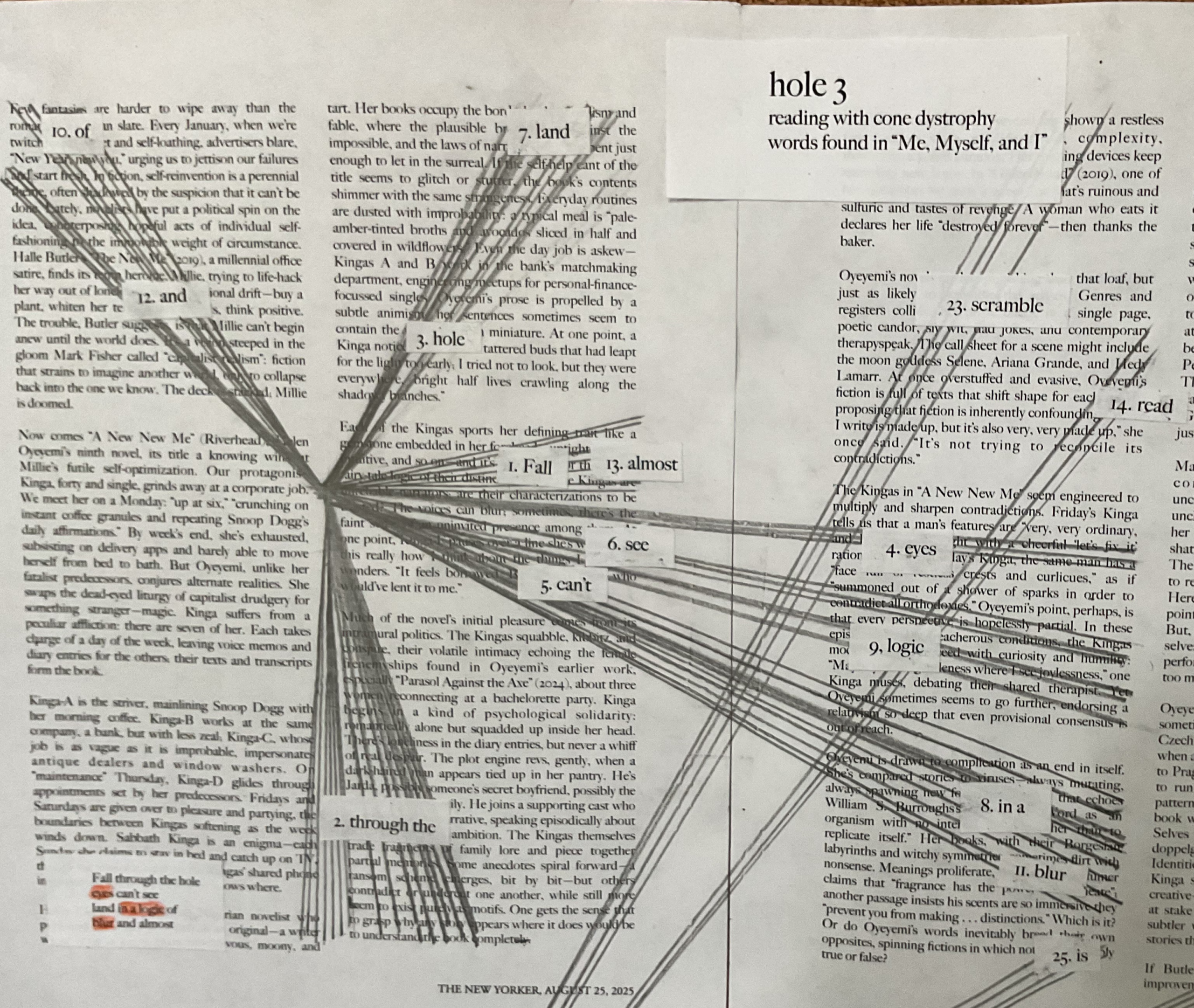
another flash: Looking at my hole 3, I’m thinking about how the lines shooting out from the center of each verse, are offering a visible trace of the movement of an eye. Cool. I want to play with this idea some more — of tracking and embodying that movement of an eye receiving (capturing?) light and reading words.

Fall through the hole eyes can’t see, land in a logic of blur and almost

other random thoughts with some connection to accepting invitations

*at least to me

1 — On Floundering / Poetry Off the Shelf episode, Don’t Make Any Noise

I think that I was very fortunate in an early career where I did well.
But I wish I believed in myself enough to have allowed myself to financially flounder for a couple of years, instead of doing well. Because I now see, oh, life is a marathon, not a sprint. I would have gotten there.

Yeah. And what would you have done in the floundering? What is something that you’re like, oh, I might have gotten this or that out of it?
Because I think a lot of people who are young and who are currently floundering feel like it will never work out. Right? But I encourage the flounder. First of all, it’s more likely one is going to flounder right now because there are not so many defined career paths, unemployment is impossible. A college degree buys you nothing.
A grad degree buys you maybe something, maybe not. And debt is so high. I think floundering, while the young people I know are incredibly anxious and justifiably so, with my retrospect, I think it’s the best thing you can do.

Yes. I know because I think it also flies in the face of this sort of productivity “narrative, you know, like everything has to yield, like every extracurricular has to yield, you know, your degree has to yield, like, oh my god. And so I do like that you’re like in defense of floundering.
I am, I hope one day you will write a book.
In defense of floundering.”

Don’t Make Any Noise

2 — On keeping that window open / Matt Damon on Conan Needs a Friend

 Ben said this great thing, which was, “Judge me for how good my good ideas are, not how bad my bad ideas are.” And and it was it’s a very profound thing for a 20-year-old to say. um because he recognized that we needed the freedom to kind of barf out all those ideas you know and so often as you know when you’re writing it’s not you write down the bad idea because it’s iterating, you know it that can build into a good idea right and so he was basically giving both of us the permission to just keep the window as wide open as we could.

Conan needs a friend, Matt Damon

I think there was something else I wanted to add here, perhaps from Richard Powers’ archival interview for Between the Covers, but I can’t remember now.

aug 3/RUN

2.25 miles
2 trails
70 degrees
AQI: 151

Another short run today. The air quality is still bad, but it didn’t bother me — or, I’m so used to it bothering me that I didn’t notice. Wore my bright yellow shoes again and felt bouncy. Listened to my “Slappin’ Shadows” playlist running south, the gorge running north: trickling water, laughing kids, someone talking about walking on a boardwalk, a beeping/ringing noise on repeat somewhere below. Noticed a haze above the river, everything washed out, pale. The tree that fell a few weeks ago is still there, unmoved. The benches were empty, the trails were thick with bikes. No more mud. Acorn shells on the sidewalk.

Walking back after the run, I thought about my inkling poems and how I like to/have to try and guess what something is based on very little data. Some lines came to me —

It’s a game, really —
Name that Tune but for
forms. I can name that
form in 2 curves . . .

Searching for “inkling” on poets.org, I found these great lines:

For what is prophecy but the first inkling
of what we ourselves must call into being?
The call need not be large. No voice in thunder.

It’s not so much what’s spoken as what’s heard—
and recognized, of course. The gift is listening
and hearing what is only meant for you.
(from Prophecy/ Dana Gioia)

And now I’m thinking about inklings as creatures, and not just hunches or ideas or guesses or a call/prophecy to listen to. An inkling is the tiny creature that speaks to us — not a little man, but a spirit or an insect or Dante’s spiriti visivi.

feb 24/WALK

25 minutes with Delia
to the Winchell Trail
53! degrees

No running today; I’m being careful with my sore/stiff lower back. Thought I’d be taking a longer walk in the warm weather with Delia, but I made the bad decision to go to the Winchell Trail. Even though I tried to be very careful on the thawing hill, I slipped and SPLAT! fell flat on my butt into gooey mud. The butt of my jeans, the back of my coat, and my hands were caked in mud. I’m lucky I didn’t hurt myself. Whew! The worst part of it was the 10 minute walk of shame through the neighborhood back to my house with my muddy butt.

the purple hour

3 am / bedroom

A quick look at my iPad. When I turned it off and put it down, an afterimage: a bright rectangle, then all darkness. It took more than a minute for the lavender light to return. As I waited, I recited “We Grow Accustomed to the Dark.” The light gray blanket on the couch glowed a pale violet which I mistook for a square of light until I touched it and felt the blanket. If dark cast on the light is a shadow, what is the word for light cast on the dark?

Reminded of a poem I gathered and its description of light cast on the dark:

Good-Night/ Seamus Heaney

A latch lifting, an edged den of light
Opens across the yard. Out of the low door
They stoop in the honeyed corridor,
Then walk straight through the wall of the dark.

A puddle, cobble-stones, jambs and doorstep
Are set steady in a block of brightness.
Till she strides in again beyond her shadows
And cancels everything behind her.

Now I’m thinking of ED’s a long, long yellow on the lawn
The light in my bedroom had a pale and cold ghostly glow, not a warm one — no color. 


a pool of light? a stream of light? what are some other words to describe light in a dark room?

4:34 pm / front room

violet — On Color/David Scott Kastan

Yesterday, reading an essay about periwinkle, I discovered On Color by David Scott Kastan. My local library doesn’t have it, but RJP’s college does. Hooray! I was able to download the entire book! Currently I’m reading the chapter on violet. Here are a few passages I’d like to remember:

An exasperated French novelist, Joris-­ Karl Huysmans, complained that “earth, sky, water, flesh” were inevitably now the color of “lilacs and eggplants” (141).

Lilacs and eggplants. That’s what light and dark look like to me in the bedroom in the middle of the night. That also seems like a great name for a poem.

Landscape became the characteristic genre of the impressionists, but their interest was not, as with earlier landscape painters, in recreating the particularities of its geological, agricultural, or architectural features. They wanted, it was said, to recreate the immediate visual impression of that landscape, produced by the light in the very instant before the brain fully organized the scene (144-145).

Can my brain every fully organize the scene? Sometimes it/I get stuck and a landscape doesn’t make sense.

It isn’t that they painted objects as we see them. They painted the luminous air and light that exists in between the eye and those objects (145).

I’m fascinated by this in-between space and all that happens in it. Here I’m thinking about Alice Oswald and her invoking of Dante and the spiriti visivi — light as insects traveling to object to collect the color like pollen and then deliver them to us.

I’m roughly halfway done with the chapter, but I’ll stop here for now.

back pain

Looking up lower back pain I’m happy to report that it’s most likely only a weak core/overuse issue. Time to do some “gentle moving” — walking, stretching — for a few days. I’m cool with that. This article recommends dead bugs, planks, side planks, glute bridges, and child poses. Also: a heating pad.

sept 20/RUN

10 miles
confluence loop
65 degrees

Such a beautiful morning! I marveled at it with a woman we passed on the stairs down to the east river road. Sunny and still with sharp, satisfying shadows. The first 5 miles were, as I said to Scott, not hard but not easy either. Just one foot in front of the other, moving forward. I had some unfinished business (which is my euphemism for needing to poop) that I had tried to finish before the run started, but couldn’t. Around 5 miles, we stopped at a porta potty — the last one for several miles — but it was locked and it didn’t seem like anyone was coming out anytime soon. I’m not even sure anyone was in there. So I kept going and it got a lot harder. Some stomach cramps and muscle clenching made the run more of a struggle, mentally and physically. But I did it and I don’t feel terrible now that I’m done.

10 Things

  1. flat, still, blue water with dozens of single leaves sitting on the surface
  2. clear, sharp shadows on the bridge — the railing slat shadows were a series of thin parallel lines
  3. the sun reflecting off of the water and through the railing slats was very bright and trippy — so many flashes of light as the shine shot through the slats in a steady rhythm
  4. at first we couldn’t hear shadow falls, but as we neared the monument, I heard the tiniest trickle
  5. pleasing contrast — the bright blue of the sky against the green leaves of a maple tree
  6. slashes of red and orange in the bushes at knee-level
  7. running across the highway 5 bridge, the cars were loud but a speeding motorcycle was louder
  8. more leaping grasshoppers, landing on our legs and feet
  9. a group of people standing in a circle near coldwater springs
  10. a screaming bluejay

Scott and I didn’t talk as much on this run. With my unfinished business, I was trying to focus on moving and didn’t have much to say. Mostly I talked about that or the condition of the path — I rolled my ankle twice (mildly, I hope). Scott talked about where we were (distance/time) in terms of the marathon and how he needs to practice for his gig on Saturday night. I also talked about how the Minneapolis Parks have very specific guidelines for the paved paths along the river — how level they must be, how much distance is required from the road. Scott said that that doesn’t seem to be the case in St. Paul and that he prefers to run on Minneapolis trails.

liquid looking

I’ve started writing around the idea, from Alice Oswald, of liquid looking. I need to gather the different definitions in one space (a job for later today?), but for now I want to mention what I was writing yesterday. It’s about the fish in me escaping (from Anne Sexton), a school of minnows at my feet as I entered the water, and imagining those fish as the insects, the spirits of sight, that Dante describes and that Alice Oswald understands as the light that travels and returns, making it possible for us to see. Here are a few lines from AO (Nobody):

There are said to be microscopic insects in the eye
who speak greek and these invisible
ambassadors of vision never see themselves
but fly at flat surfaces and back again

In my version, the ambassadors of vision are little fish, and they speak in bubbles, not Greek, and they bubble-whisper the colors of things, like the water. I need to work on bringing in just a little bit more of the origin — Dante’s/Oswald’s idea of light spirits/insects — so that it makes sense for the reader. Here’s another passage from an interview with AO that might help:

I was just thinking an awful lot about light and vision and the way … well, light as an insect, really, which is not just Homer, it’s also Dante. I always loved this part of Dante where he talks about the spiriti visivi, I think they’re called. And this idea that when you look at things, what’s happening is these kind of, you know, these creatures are sort of moving out from your eye to the world and moving from the world back into your eye. I was trying to sort of slow down my senses while I wrote this poem and imagine even a sort of passage between myself and the world was a creature, living creature of some kind . . . .

A Conversation with Kit Fan and Alice Oswald

Here’s what I wrote yesterday:

I enter water

and the fish in me

escape — a school of
minnows who dart past
lunging kids before
disappearing in-
to the murk beyond
the buoys. I won’t
see them again but
they are there flashing
below returning
to speak in bubble-
whisper all the names
of water’s colors
silver pewter bronze
copper’s weathered green
reddish-purple rust

Reading this again, I’m thinking about the next line from Anne Sexton’s poem, “The Nude Swim”: The real fish did not mind. I’m really interested in this distinction between the real fish and my fish escaping and what it means and I think I’d like to bring that in here. It fits with something Scott was saying about the poem last night when I read it to him — something about beyond metaphor. I can’t remember, but I think it speaks to what real might mean here.

I enter water
and the fish in me
escape — perhaps they
will join that school of
minnows who dart past
lunging kids before
disappearing in-

OR

I enter water
and the fish in me
escape. The minnows
do not mind as they
dart past lunging kids
on their way to what’s
beyond the buoys.
I won’t see my fish
again but they’re there.

I could also end the poem with an altered version of AO’s, There are said to be microscopic. . . There are said to be tiny fish in the eye/who speak Bubbles . . .

july 1/RUN

4 miles
river road, north/south
64 degrees

Feeling a little off since yesterday afternoon — the slightest sore throat, a little stuffy, tired. Can’t decide if it’s allergies from swimming in the lake or something else (tested, not COVID). Future Sara, let me know.

This first July run was the same as most of my June runs: difficult, but worth it. The first half was fine, the second half hard. Sore legs, hard to keep going. I think a lot of it is mental, but I’m not sure how to fix it. For now, more swimming, shorter runs.

One thing that helped in the first half was reciting two poems: Still Life with Window and Fish / Jorie Graham and The Social Life of Water / Tony Hoagland. It was a good distraction. I think it might help if I figured out a task or project or activity before each run. That has helped me in the past.

10 Things

  1. greeted the Welcoming Oaks — good morning! good morning!
  2. admired the green view down to the floodplain forest — deep green, scraggly excess
  3. noticed the purple flowers lining the trail
  4. heard the rowers below — not yet on the river, but down below near the boathouse, laughing
  5. encountered a long line of unevenly spaced kids in yellow vests on bikes — lots of stragglers near the back
  6. not a single view of the river that I remember
  7. heading north: wind pushing from behind, heading south: in my face, cooling me off
  8. one bug almost landing in my eye
  9. several stones stacked on the ancient boulder — was it 4 again?
  10. the outline of an orange cat spray-painted on the sidewalk — even though it probably doesn’t look like Garfield, every time I see it I think, Garfield

Why was the cat named Garfield? The other day, when Scott and I were walking, I thought I heard a woman call out to their dog, Neil! Come here Neil! And I thought that that would be an awesome name for a dog, but not as awesome as Bob Barker. Update: In mid-July, running by this orange spray-painted figure, I realized that it looks more like a turkey with feathers than a cat. Of course, I still haven’t stopped to study it more carefully; I only see what my diseased eyes can see as I run by. I should probably stop to check, but I doubt I will.

Alice Oswald and color vision

I’m fascinated by something that I read in Alice Oswald’s interview with Kit Fan:

and this may again be an effect of thinking about the project with an artist, I was just thinking an awful lot about light and vision and the way … well, light as an insect, really, which is not just Homer, it’s also Dante. I always loved this part of Dante where he talks about the spiriti visivi, I think they’re called. And this idea that when you look at things, what’s happening is these kind of, you know, these creatures are sort of moving out from your eye to the world and moving from the world back into your eye. I was trying to sort of slow down my senses while I wrote this poem and imagine even a sort of passage between myself and the world was a creature, living creature of some kind

A Conversation with Kit Fan and Alice Oswald

And here are 2 places where that idea shows up in Nobody:

from Nobody/ Alice Oswald

page 19

There are said to be microscopic insects in the eye
who speak Greek and these invisible
ambassadors of vision never see themselves
but fly at flat surfaces and back again
with pigment caught in their shivering hair-like receptors
and this is how the weather gets taken to and fro
and the waves pass each other from one color to the next
and sometimes mist a kind of stupefied rain
slumps over the water like a teenager
and sometimes the sun returns whose gold death mask
with its metallic stare seems to be

blinking

page 30

When trees take over an island and say so all at once
some in pigeon some in pollen with a coniferous hiss
and run to the shore shouting for more light
and the sun drops its soft coverlet over their heads
and owls and hawks and long-beaked sea-crows
flash to and fro
like spirits of sight whose work is on the water
where the massless mind undulates the intervening air
shading it blue and thinking

I wish I was there

or there

I was planning to think about these lines as I swam at the cedar lake open swim, but when we got there it was too windy. No buoys, no lifeguards. People were still swimming, and I might have too, if I didn’t feel so tired and — not stuffed up, but congested in some way, like I’d swallowed too much lake water at the last swim. So many waves, almost 30 mph wind gusts.

march 19/RUN

4.2 miles
minnehaha falls and back
43 degrees
wind: 31 mph gusts

So windy today! My legs felt heavy. I wonder if part of the problem is that I’m running so late in the morning? I didn’t start until almost 11:30. Still glad I went for a run, but I wish it would have felt a little easier and I would have worn less layers — maybe skipped the buff?

Listened to kids on the playground, birds, random voices, falling water for the first half of the run. Put in headphones and listened to Taylor Swift for the second half.

before the run

Reading through an entry from March 19, 2017 about the new poetry class I was taking, I found this:

In the editor’s note it’s mentioned that Mayer writes hypnogogic poems. I looked up the word and found the definition (a state between waking and sleeping, when drowsy) and an interview with Mayer about how, after suffering a stroke, she experimented with using a tape recorder to record her thoughts in this drowsy/dreamy state. So cool. Currently, I’m writing about running and I’d like to experiment with ways to express the dreamlike state I sometimes enter during long runs.

Reading this bit, I got an idea, which I typed up in my “Notes for Haunts, fall 2023” pages document:

the dream like state of running, when the mind is shut down
haunting = possessing or being possessed — what if haunting was not just being taken over by someone/thing else (possessed) or taking over someone/thing else (possessing) but becoming untethered or loosely tetered from your body — floating on the path in-between in that strange empty space between banks between sky and ground between worlds between You and I? this could be another form of haunting — what if I started writing small-ish poems that offered different definitions of haunt? 

A few definitions of haunt I’m thinking about right now: feeling disembodied, having an out-of-body experience and being obsessed/preoccupied/consumed by a thought or idea — having a bee in your bonnet.

bee in your bonnet

Here’s an article about the origins of the phrase. According to the article, the phrase is still being used in popular culture. I use it, usually when I notice Scott hell-bent on some task — and usually it seems like a task, or idea, that is fool-hardy but that he needs to work through and figure out for himself.

Sometimes instead of saying, bee in your bonnet, I say that someone (or me) is hellbent. Of course, writing that immediately makes me think of Jackie from the 1979 Death on the Nile:

Jacqueline De Bellefort : One must follow one’s star wherever it leads. 
Hercule Poirot : Even to disaster?
Jacqueline De Bellefort : Even to Hell itself.

When I envision a bee in my bonnet, I see something that is relentless, impossible to ignore, urgently needing to be dealt with. That’s not quite how I imagine my preoccupation with haunts and ghosts and writing about the gorge. Still, I like the idea of bees in bonnets, and bees in general, so maybe I’ll spend more time with them this morning?

Reading through several ED “bee” poems, I suddenly had a thought: could the bee in your bonnet be your soul, trying to escape the confines of the body?

This thought was inspired by a poem I wrote about in an On This Day post: Body and Soul/ Sharon Bryan. I didn’t mention it in the post, but the description of the soul in the poem, as leaving the body at night to roam around, reminded me of an ED poem I read a few weeks ago, when I was thinking about the difference between the brain and the mind:

If ever the lid gets off my head/ Emily Dickinson

If ever the lid gets off my head
And lets the brain away
The fellow will go where he belonged —
Without a hint from me,

And the world — if the world be looking on —
Will see how far from home
It is possible for sense to live
The soul there — all the time.

So much to think about on my run (I’m writing this before I headed out). Will I see any bees about by the gorge? Very unlikely, I think.

during the run

Thought about a bee in my bonnet as an obsession that I wanted to release, so I imagined opening the top of my head like the door of a cage and letting the bee fly free. What would/could happen if I did this? Would I find some new ways to think about my experiences?

Also, randomly remembered something about bees in a horror movie, then remembered the movie, Candyman. Looked up, “gothic horror bees” and found this 1978 movie, The Bees.

Not too far into the run I think I forgot about the bee. I was too distracted by my heavy legs and wondering if my calf would do something strange, and the wind. No escape from my body today.

after my run

Now, ED’s poem about the lid of her head coming off makes me think of a favorite Homer Simpson bit:

Homer reluctantly listens to Ned Flanders drone on about the differences between juice and cider. A voice says, You can stay, but I’m leaving, and Homer’s brain exits his head and floats away as we hear a slide whistle. A few seconds later his body collapses on the floor and we hear a thud.

I love the image of the brain floating away. And, instead of a daydream where Homer’s brain gets to wander while his zoned-out body stays and pretends to listen, his body collapses, unable to continue without the brain. This idea brings me back to the Sharon Bryan poem I mentioned earlier:

then they [body and soul] quarrel over which one of them 
does the dreaming, but the truth is, 

they can’t live without each other and 
they both know it, anima, animosity, 

the diaphragm pumps like a bellows 
and the soul pulls out all the stops— 

sings at the top of its lungs, laughs 
at its little jokes . . .

. . . the soul 
says, with a smirk, I was at the end 

of my tether, and it was, like a diver 
on the ocean floor or an astronaut 

admiring the view from outside 
the mother ship, and like them 

it would be lost without its air 
supply and protective clothing,

Okay — I’ve been thinking about a few things here: being weighed down/preoccupied with ideas/thoughts/subjects (obsessed); a desire to be released from the body and obsessions; images of bees in bonnets and bees in general. Maybe I’d like to explore some different images of bees, especially in Dickinson? Also, here are 2 other ways to think about obsessions as repetition and habit:

Camille: Some of the obsessions are never going to leave you, and to me, that was part of what I loved. With each page I thought, Oh, I’ve seen this before, but how is she going to manage it differently? It reminded me of the Miles Davis quote about John Coltrane that was a guiding force for me as I was writing my first book, when I was really worried that I was doing the same thing over and over and over again. And I read the liner notes where Davis wrote about Coltrane’s first solo album. He said, “I don’t understand why people don’t get John Coltrane’s music. All he is trying to do is play the same note as many ways as he possibly can.”

Writing a Grove: A Conversation with Poet Laureate Ada Limón

FADY JOUDAH: There is no life without repetition, beginning at the molecular, even particle level. There is no art without life. To remain viable, art, inseparable from the circularity of the human condition, also repeats. What is a life without memory? And what is memory if not repetition. But not all repetition guarantees what we call progress, a euphemism for wisdom. Repetition with reproducible results, for example, is a foundational concept of the scientific method. Yet science can be an instrument for the destruction of life as for its preservation. This suggests to me that repetition in art is our unconscious memory at work: art mimics the repetition of the life force within us. All art is a translation of life. Take Jackson Pollock’s so-called action painting. What is it if not a rhythm of a life force in all of us? In those paintings, the pattern is recognizable yet unnamable. It’s like watching electrons bounce off each other. The canvas contains entropy. We understand this at a cellular or quantum level.

When It Takes Root in the Heart: Conversations with Fady Joudah