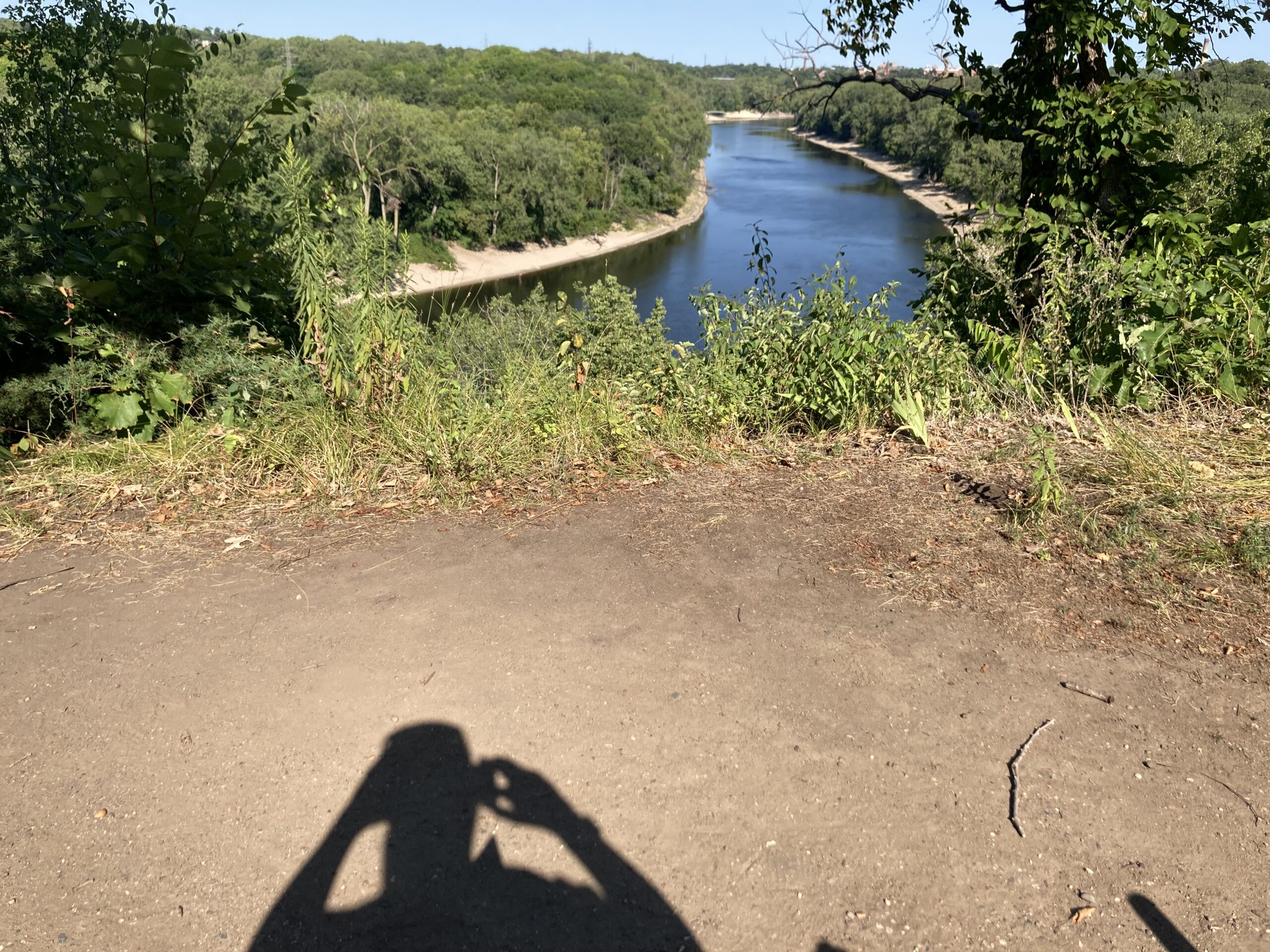
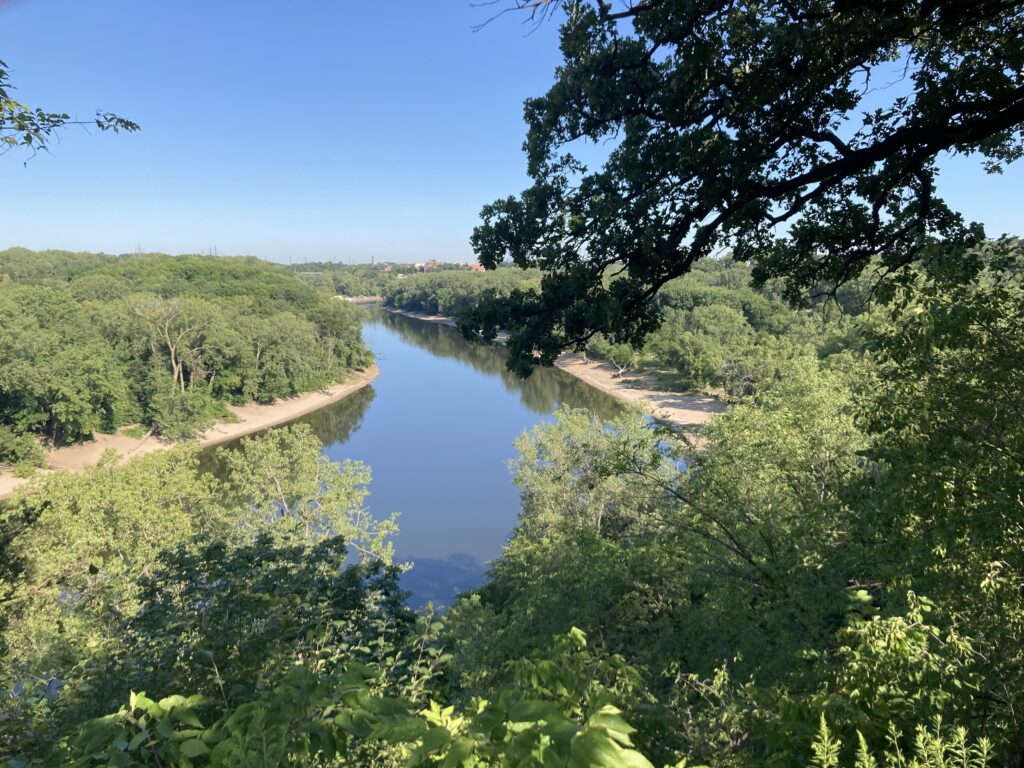
*I’m writing part of a poem about this part of the trail that I’m describing as an abandoned spur. I think it used to be part of the Winchell Trail, when the trail was marked with a chainlink fence.
I think this might be it: peak fall. Beautiful colors, bright sun, cooler air, leaves drifting down like snow. Finally, Delia can take walks; it’s been four months since she tore a tendon. I’m not running today because my IT band continues to be sore. I’m not worried it’s serious, but it needs more rest, at least, that’s what it whisper-screamed at me around 2 am.
I was planning to take Delia down to the oak savanna, but I heard too many kids’ voices — a school group? — and decided to go the other way. Past the leaning tree with its muffin top bark hanging over the broken fence slat, past the Welcoming Oaks and the gravel trail down in the ravine, past the guy in shorts sitting on a bench at the overlook who greeted me with a soft, hello, and to the stone steps that lead to the spur of the winchell trail that is no longer maintained (or barely maintained?). Counted the steps for my poem: 12. We took the trail then climbed back out near the ancient boulder, then crossed the road to the grassy boulevard between the river road and Lena Smith Boulevard. I kicked my feet through the leaves, listening to the delightful crunch they made. Fall!
As we returned to the neighborhood, I recited the poem I re-memorized this morning: “Halos” by Ed Bok Lee. That visual impairment improves hearing/taste smell touch is mostly myth./ With it, however, I can detect fuzzy spirits exiting the building/halos around bike helmets/each streetlamp a pink-orange dawn . . . Such a great poem!
earlier this morning: Some little kids (I think they’re in elementary school) have decided it would be a fun challenge to try and climb the 6 foot stump of our tree that we’re planning to turn into a gnome home next year. I wasn’t able to catch them yesterday, but I did today — hey, please get away from the tree NOW! I suppose the please was unnecessary, but I’m proud of myself for not yelling, hey, little shits, get off the tree!, which is what I wanted to yell. AITA?
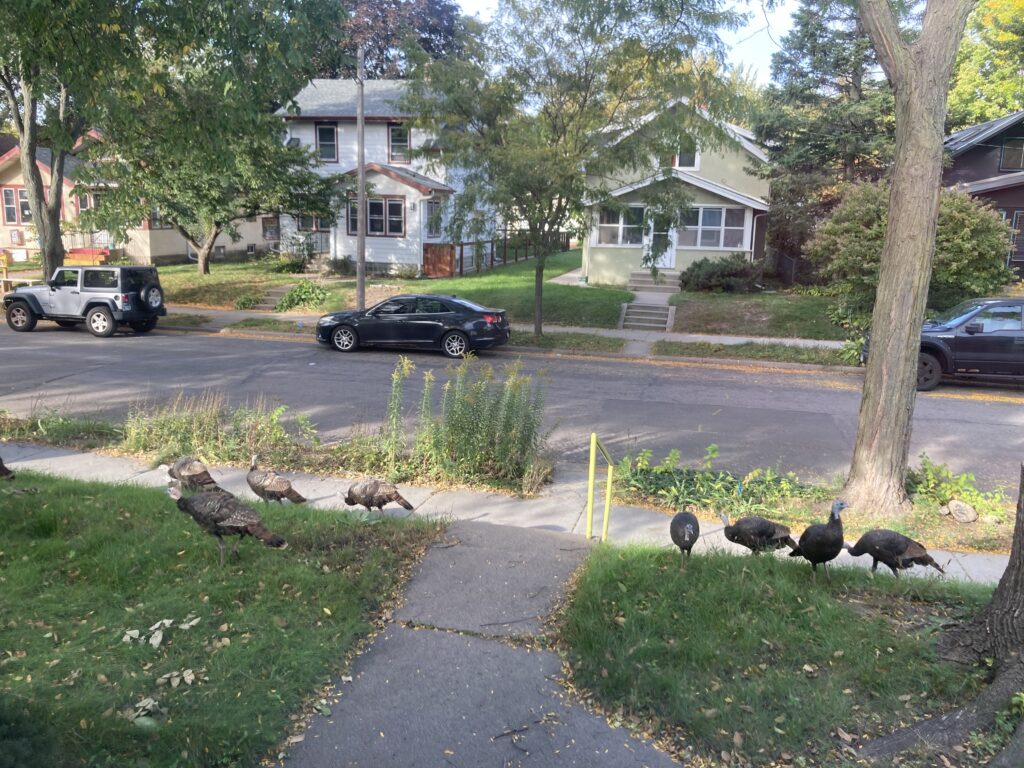
About an hour later, some welcome visitors: wild turkeys! 11 of them, chilling in my front yard, visible from my window. Thanks for the show, ladies and gentleman!
Sometime between the turkeys and my walk, I worked on my steps poem. Here’s some lines from Wendell Berry that I referenced in yesterday’s post and that I think fit:
I have entered the downflow of the land. The way I am going is the way the water goes. There is something comfortable and fit-feeling in this, something free in this uielding to gravitiy and taking the shorter way down.
A Native Hill (615)/ Wendell Berry
I’m thinking of calling the poem “Gravity” instead of steps. And, I’m thinking of these lines from L Niedecker in “Paean to Place”:
How much less am I in the dark than they?
Effort lay in us before religons at pond bottom all things move toward the light
Except those that freely work down to ocean’s black depths in us an impulse tests the unknown
It’s possible I’m straying too far from the poem, but I’m interested in ideas of darkness or darkening and going deeper in, beneath the surface, below the road, down in the depths. All of this, of course, connects to my darkening vision and my turn toward both reimagining sight (with less light, darker) and moving beyond sight to other ways of feeling and noticing and witnessing the world. And, all of this, connects to ghosts and the dead and those that have gone underground.
5 miles minnehaha falls and back 62 degrees / humidity: 80%
Overcast with thick air, humid. Wore shorts and a tank top. I’m ready for cooler, crisper weather. It’s coming. More leaves are changing — deep reds, some yellow, orange. Still more green than not. 5 or so wild turkeys hanging out at the edge of the falls parking lot. Running closer to the light rail station, I could hear the bells — they were out of sync, maybe one train coming into the station with their bells at a different rate than another train leaving?
Before heading out for my run, I refreshed my memory on another poem I’ve memorized before: “I heard a Fly buzz when I died” by Emily Dickinson. Love the last lines: And then a Window shut/ And then I could not see to see.
Listened to the steady line of cars, the rush of falling water, the wind through the trees, the out of sync train bells, a leaf blower on the way there. Listened to my “Hello Goodbye” playlist on the way back.
from Wintergreen Ridge/ Lorine niedecker
Nobody, nothing ever gave me greater thing than time unless light and silence which if intense makes sound
3 miles trestle turn around 60 degrees / humidity: 89%
Back to sticky running this morning. Overcast, but humid and wet from an early morning rain. I wore my BRIGHT orange YWCA Tri shirt from 2013 and my BRIGHT yellow running shoes. I wonder, did I brighten the otherwise gloomy gorge for anyone? I’m continuing to do my 3/1 method. The first 3 felt good, the second 3 did not, then after that, they all felt about the same: not hard, but not effortless either. Lots of sweating. After climbing up from under the lake street bridge I saw my first “road closed for an event on oct 4” sign. That’s for the marathon! For the next mile, I had a big grin on my face. It’s coming!
Two days ago, I came across WS Merwin’s “The Light of September” in an log post and I decided I wanted to re-memorize it (I memorized it a few years ago). Then yesterday, I decided to re-memorize Diane Seuss’ “I Look Up From My Book at the World Through Reading Glasses.” Today, it was Jorie Graham’s “Still Life with Window and Fish.” As I ran, I recited the lines in my head: Down here this morning in my white kitchen along the slim body of the light . . . Such a wonderful poem that has so much to say about vision and light. As I was memorizing DS’s poem yesterday, I thought about how brilliant it is in describing my experience of seeing the world sometimes — the world, italicized/Douglas fir blurs into archetype. . .Then I thought about a new project: picking some of the favorite vision poems I’ve gathered by others and writing about how and why they resonate for me. Seuss and Graham would definitely be on that list, along with several Emily Dickinson poems.
10 Things
a small pack of shirtless runners — I heard the loud slapping of their feet first, then saw them as they flew past me
scuff scuff scuff — a runner in a BRIGHT yellow shirt, scuffing his feet on the path with every step — he was slow but had a fast cadence, so there were a lot of scuff noises
a few more slashes of yellow, red — I think a few orange too
the squeaky whirr of wheels on an orange motorized something — not a bike, not a scooter — it was orange and had 3 wheels and the old guy in an orange jacket riding it was moving fast
the sliding bench was empty
any view of the river, forgotten — was I able to see it, or was it blocked by leaves?
a white sky
no geese, no blue jays, no chickadees, one cheeseburger from a carolina wren
cars driving on the river road in bursts — a line-up, then no cars, then a line-up again
waving to Daddy Long Legs who was over on the bike path while I was on the walking path
haunt / overlook
Today, since I’m writing about the overlook — the ones by the gorge, the act of ignoring or passing by without noticing or forgetting — I decided to search for “overlook” on Poetry Daily (poems.com). Jackpot! A great poem by the wonderful Maggie Smith:
Our honeymoon was a strand of scenic overlooks. I first wrote strange—a strange of scenic
overlooks—my mistake, and strange enough was the desert penned in red ink. The scene
was either Sedona or Mars. They say the iron in the rocks calls to the iron in our blood,
so it tugs on us. It tugged. We stayed on Airport Mesa, where we called the crowds drawn to sanguine
sunsets “tourists,” as if we weren’t, and where, each night, the Milky Way made a mess of the sky.
Was I the only one who wanted
to wipe its white smudge away, to polish the night
black again? Our honeymoon was a stranded scene I overlooked. We posed for photographs \
we never took. I remember the moon framed above the landscape, looking silvery as a tintype
taken in a modern-day ghost town. The last day, we reached the canyon and saw where the river
had over millions of years chewed it down to bone, clear to the canyon’s strange marrow, riven
into red, copper, and purple—bands like sunsets compressed and recorded in rock. That view
remains. Our honeymoon was a strand, a strangeness, a look ahead. I wrote only what I could see.
1 — look / scene (seen) / tourists (gawkers) / a blocked view (Milky Way) / photographs (staged looks) / a view (of the moon) framed / landscape (visible feature of an area of land) / looking like / saw / view remains / look ahead / could see
What a variety of uses of view/see/look here, related to vision! I’d like to try this out in my overlook poem — or, maybe the same approach (gathering and using a wide range of descriptions related to a concept) on my dirt path poem, which has two sections: desire and abandon
2 — overlook as view / overlook as not seeing
3 — geologic time / iron in rock connected to iron in body — references to Lorine Niedecker and “Lake Superior”?
4 — a beautiful description of the carving out of a canyon, both literal and figurative as what happened to a marriage years after the honeymoon
4.1 miles wabun / edge of falls / river road, north 67 degrees / humidity: 90%
Something different today: a little more speed. 2 miles steady at a moderate pace / 5 min walk / 1-2 minutes fast run, 1 min walk (5xs). It felt good to move faster — more like flying and with better form.
For the first 2 miles, I (almost) finished my Hello, Goodbye playlist. The most memorable songs: the beginning of “Never Can Say Goodbye” when it sounds like Michael Jackson says, Never can STAY goodbye — at least to me; and the slow and long wind-up of Barbara Streisand’s “Hello Dolly.” After the 5 minute walk, I switched to my “Wheelin’ Life” playlist. My favorite fast song on that playlist was: “Proud Mary”/ Ike and Tina Turner. It’s really fun to sprint to.
10 Things
buzzzzzzz of cicadas
a faint voie down below — the coxswain instructing the rowers
waving to Santa Claus and to Mr. Morning!
2 different birds — one was a bluejay, I think — squawking at each other: what? / WHAT!
puddles on the trail from last night’s rain
empty benches
park workers mowing a stretch of grass near the road
some faint moaning sounds coming from a house near 7 oaks — was it a dog, or a person?
my shirt, soaked with sweat — not sticking to me1, but saturated, making the color of it a deeper blue
the pulp of all the acorns that have fallen in the alley and been crushed by car wheels — turned into paste from last night’s rain — in a thick layer on the asphalt
lake water congestion update: My sinus are no longer inflamed, my throat doesn’t hurt, and I can breathe easily through my nose. Hooray! But, I am full of snot, I have crud in my chest, and my cough sounds scary. Boo. Open Swim ends on Thursday. Will I feel good enough to go for a swim before it ends? I hope so, but I’m not sure.
echo locations
Fall has started early, I guess. At least for me and Scott. Last night he said, let’s make today the official start of Halloween season? Yes! To mark the occasion, we watched, “Thriller” and I attempted (badly, I’m sure) the zombie dance near the end. Another marker of fall: working on my river running manuscript. Its first name — Haunts, then, Girl Ghost Gorge, then, Echolocate || Echolocated, now, Echo Locations. I decided to look up “echo” on Poetry Daily. I found this wonderful poem from A.E. Stallings:
Echo/ A.E. Stallings
What tales we tell what tales About the girls gone quiet The story-telling ones Who entertained the heart Till suddenly they ceased. What makes the tongue inert? What turns the voice to swords Cutting the throat? What takes, The name from the alibi Of the body? We were stern: Stories, we said, are lies, We told her, don’t repeat them.
What ails? Yet once art eased hurt. Words, aches, I turn ice eat them.
I love the different echoes in this poem! Some rhyme, some almost rhyme, some almost sound the same, and some are almost, but not quite, the same. Fun!
Looking through my tags, I noticed several for “echolocation” and one for “echoes.” When I clicked on the echo entry (from 1 sept 2025), I discovered these wonderful ideas about echoing a favorite poet:
The Poetry Daily’s poem-of-the-day is I, Lorine Niedecker. Very cool and difficult for my cone-compromised eyes to read, I’m glad they included an essay by the author about the process of writing the poem.
Surely, the finest way to appreciate Niedecker would be to read her well. And then repeated reading, reading aloud, transcribing the vibrant phrases on to paper, oh and even framing then. But how to linger in the presence of this voice, and let it echo within oneself, make her a part of oneself? Perhaps by applying Niedecker to Niedecker, I would arrive at a new condensary. De- and re- constructing her poems, deleting words, conflating words, writing through her writing.
After their explanation, Rao offers a writing prompt:
Pick a poet who moves you, isolate their characteristics, and apply this to their work. Using words from within their own work, write the narrative of their poetics or/and biography. Example: Get romantic and didactic with Wordsworth, apply surrealism on André Breton …
Imitation is the best form of flattery, but also of ridicule—so this kind of repetition can function as a spotlight or a spoof. I suggest choosing a poet you absolutely adore, as it’s better to have such a voice under your skin.
I’m not sure if I want to follow this prompt, but her suggestions about echoing a favorite poet have me thinking, and wanting to experiment more with how I can create echoes out of my favorite poems, poets, words. Last fall, I tried “quarrying” 2 favorite Emily Dickinson poems, “Before I Got My Eye Put Out” (13 dec) and “We Grow Accustomed to the Dark” (14 dec) —
An experiment with quarrying words. Find all of the one, two, and three syllable words in a favorite poem. Turn them into a new poem that offers echoes of the original (13 dec 2025).
Maybe I should try one with “I Felt a Funeral in my Brain”?
swim: 1 loop lake nokomis open swim 23 minutes 80 degrees
Open swim! After all of my congestion and having trouble breathing and coughing, I wasn’t sure if I would feel okay enough to swim across the lake another time. But, I’m feeling better today and when I saw the forecast for the last open swim on Thursday — 40% chance of thunderstorms — I decided I better go tonight and say goodbye to the lake. Maybe I’ll be able to swim again on Thursday, but if not, I did it tonight, and that’s enough. I was a little scared, worried that I might trigger my congestion, but I decided it was important to risk it. As I swam across the lake, I tried hard not to swallow any water and wore my nose plug (which I’ve been doing for at least 10 years). The course was short because many of the college aged lifeguards were already back at school, so there were only 3 buoys. No triangle, just a straight line with the buoys always on your left. There was wind, so the water was choppy. I tried to think about MO and “Swimming, One Day in August,” but I was distracted by my effort to not swallow water. When I returned to the big beach, I floated on my back, using my yellow buoy as a pillow, and recited the poem in my head.
After exiting the water, I met up with Scott and had a beer. We talked about marathon training and how much we love running. Then we walked over to a bench and looked out at the sailboats on the lake — very Sailboat (as in, the Platonic form of a sailboat). I told Scott about how happy I am to live in the midst of water — a mighty river, a creek, this wonderful lake.
It was a wonderful night — a reminder of how great it is to live where we do.
Yesterday, while reviewing “circumambulation entries”, I reread my discussion of a Forrest Gander poem in which the narrator is running with a sweaty shirt that clings to his torso. I mentioned that, even as I sweat a lot, my shirt rarely clings to me. ↩︎
7.5 miles the bench above the dog park and back 72 degrees
A bike ride! I haven’t been on my bike that much this summer. Too busy swimming and running. Since it was a beautiful morning, I decided to bike to my new favorite bench to sit and write and read for a few minutes. One small motivation: I wanted to find out how far it is to the bench and back because I’d like to make it a regular running route. It’s 7.5 miles, which is a great mid to longish distance for the fall, especially post marathon.
While I’ve run on this trail several times, I rarely ever bike it, so it was more uncertain than my usual bike route to the lake. A few notes:
the entrance to the trail turning on Godfrey up to Wabun park and the Ford Bridge were very difficult to see — I hit the curb twice. I recall that happening before, so there must be something about these curbs that makes it harder — are they narrower?
the new stretch, next to the highland bridge park, is smooth and wide and fast — no obstacles or big cracks or parts where the path cuts in sharply
the trail slopes down to the right, with tons of cracks, between hidden falls and the bench — when I run there, I should try to memorize the trickiest parts
there are bike lanes on both sides of the road — should I try them, or are they really cracked? again, when I’m running, I should check it out
There was no real danger, at least I didn’t feel that there was; just feeling unsettled and uncertain for long stretches of the ride.
When I reached the bench, it was in the sun, and the sun was warm. Not yet hot, but getting there. I sat down anyway. I heard a few barks from the dog park, which was below me and on the other shore. A few ruffs and a constant and loud noise by one dog — was it baying or bellowing or what? Looked it up and found something about beagles and how they bark, bay, and howl:
Beagles’ iconic baying sound is a prolonged howl-bark hybrid historically used to guide hunters through forests and is deeply rooted in their breeding as pack hounds.
Beagle howling and baying are natural breed behaviors driven by scent instincts, pack mentality, and responses to triggers like sirens or loneliness rather than behavioral problems.
Was it a beagle I was hearing? side note: I’m glad Delia is not a beagle. I don’t know if I could handle that noise often, although, I do wish she would make some noise. The only times she barks is at the mailman.
I saw some long birds flying over the gorge. One was flapping its wings so frantically that I could hear the wings — no elegant swish, more like the awkward thwack of those plastic hands that you can clap by shaking them (thanks to the Kalahari waterpark and skeeball tickets, we own a giant pair that have been relegated to the garage). Speaking of birds, as I got my bike out of the garage, I heard a cacophony overhead — honk honk honk — a V of geese high above me, using their honks to stay in formation!
While I sat on the bench, I wrote about echo locations and locating/being located at the gorge. And I read “Paean to Place” by Lorine Niedecker. Such a wonderful poem!
10.1 miles confluence and back 62 degrees AQI: 36!
10 miles. That was not easy. Much cooler today, better air quality, but still warm. I sweat a lot. By mile 5, my pony tail was dripping. I could feel it on my shoulder, hear the wet strands of my hair swishing as I moved. I decided not to bring my handheld water bottle, which was a big mistake. Two thirds of the way through, I ran out of gas.
3 things that worked well:
managed my unfinished business — even before I finished mile 1, I felt like I needed a port-a-potty, but taking walk breaks and not thinking about it, helped the need to poop go away
just kept moving (mostly running, some walking) — I wasn’t sure how much I could run today and when I realized that the route to the confluence and back was almost 2 miles short, I could have stopped sooner, but I decided I need to keep going, so I did
nice route — even though this route was too short, I liked it — the stretch of the east river road between hidden falls and the confluence is beautiful — such amazing views!
3 things to work on:
don’t forget the water bottle
don’t forget snacks
work on being more consistent with the run/walk method — on the next run, try 90/30 again
As I ran under the road at Hidden Falls, I thought about the small stretch of hidden falls that was daylighted when they redid this area a few years ago. I listened as it rushed to the edge then fell over it and smelled its fishy smell.
10 Things
running over the ford bridge, admiring the river, 1: the brownish water was calm, still, flat, not even a ripple
running over the ford bridge, admiring the river, 2: because the surface was still, I could see below it — the faint outline of several sandbars
a short (under 5 ft) older woman i, stretching next to the hidden falls park sign, at the top of the hill, later I encountered her again; she was walking, I was running
a strange pair of sounds on either side of the road, call and response. Bird song I had never heard before, sounding almost like machines or alarms — was it 2 birds, or 2 people with some kind of device making the noise?
what a view! — 1/2 mile from the confluence overlook, the trail and a bench are high above a bend in the river where you can see the mississippi and the minnesota rivers — I would have stopped but someone had brought a chair and was sitting in front of the bench
near the far entrance to hidden falls — a roller skier perched at the top — were they about to bomb down the steep hill?
at the confluence — a lime green bike, wedged in the corner of the overlook — too many leaves below to see anything — a warm water water fountain
a bird crying out, sounding like they were in distress — a woman came to the edge where I was standing and said the sound came from an eagle on the other shore
2 men running on the ford bridge, one of them was turned around and running backwards
2 older men, carrying signs to place along the bike path that said something like, bikers, use caution! alert walkers with an “on your left” or a bell — Yes!
Just before I heard the eagle (mentioned in #8), I took a picture of a view of the river:
east river road, heading to downtown St. Paul
Running near where this picture was taken, I suddenly remembered a conversation I had with FWA at the dog park earlier this year. We were deep in the gorge, looking up at this bluff I was running on this morning. I said, this summer, when I’m training for the marathon, I want to run up there. And I am!
1 Day in August
Bummer! As I write this, I received an email from Open Swim. It’s cancelled tonight because there are blue-green algae blooms at one of the Cedar Lake beaches. Must be serious if they’re cancelling the swim; usually they just post an advisory and caution club memebers to “swim at your own risk.”
Reading the first verse of Mary Oliver’s poem again, my eyes stopped on among the flux of happenings” and I thought about the floating particles I encounter while swimming in Lake Nokomis. Often I call them my sparkle friends. They are the little bits of sediment or muck or aquatic plant that float in the water in front of me. They sparkle because of shafts of light in the water, and they seem to be in a constant motion of floating at me. I imagine some people might think my friends are gross, but I don’t, and I love the strange, trippy effect they create as I swim through them. I wrote one of my inklings about them:
Particles before buoy 1
Lit by thin shafts of light, they put on a show. Their frenzied disco of shimmer sparkle shake stirs us up.
I like MO’s use of among here — among the flux of happenings. The deepening and quieting of my spirit comes among this flux, these little happenings.
I know I’ve written about “among” before; found it! On 16 may 2025, past Sara wrote a lot of things that are very helpful to present Sara as I think about MO’s use of among!
side note: the more I follow my muse here — and, maybe, my muse is a fish or floating milfoil or a sparkle friend? — the more clear it becomes: this year’s Swimming One Day in August is about engaging in a deeper reading of MO’s words — expanding on meanings, connecting them to her other work, reading thembeside my experiences in the lake.
But, back to among. Here’s what I wrote in my 16 may 2025 entry:
among / between
When I read and posted Lorine Niedecker’s poem about standing among the birch last week —
For best work you ought to put forth some effort to stand in north woods among birch.
I was struck by the word among and wondered how it was different from between. I looked it up this afternoon and, after wading through discussions about how between is used with 2 items, among with more than 2, I came across a helpful distinction in Merriam Webster:
We use between when we want to express a relation to things and have them considered as individual and usually equal entities.
Among, on the other hand is the best word to use when referring to things collectively and imprecisely.
5 aug 2026 Sara, interjecting here: using among to refer to things collectively reminds me of a favorite (and very popular line) from MO in “Wild Geese”:
Whoever you are, no matter how lonely, the world offers itself to your imagination, calls to you like the wild geese, harsh and exciting – over and over announcing your place in the family of things.
among: your place in the family of things — so, the deepening and quieting of the spirit could be finding one’s place in the world? Where you belong? when you’re in your element? Of course this reading is different from the predominant one in which quieting your spirit among the flux of happenings means being present and calm, not worrying about all the noise around you.
I like among in LN’s poem, although I wonder about the effect of using between (or beside or with) instead. to stand/in north woods/between birch. Among indicates a kinship — among all of us trees, but between suggests an actual place — stand between this birch and that birch and an exchange — between us. I like both meanings. I like imaging my best work as trying to become a tree. But I also like the idea of my best work happening when I stand between birch — giving and receiving air.
I was reminded of among and between while reading this passage from Marie Howe:
That was really a big deal. I was given this place to be without any expectations really. And everything changed so that the particulars of life—this white dish, the shadow of the bottle on it—everything mattered so much more to me. And I saw what happened in these spaces. You can never even say what happened, because what happened is rarely said, but it occurs AMONG the glasses with water and lemon in them. And so you can’t say what happened but you can talk about the glasses or the lemon. And that something is in BETWEEN all that.
You can name/describe the collection of things (among), but you can’t find words to describe how their meaning has changed in that moment. Often when I think about the slight shifts in meaning between small words, like among or between, I’m reminded of an essay I read about Mary Oliver and her mousier words. I love mousy words! Meanwhiles and in-betweens and yous and wes and usses (is that the plural of us?).
…it’s tempting to be blinded by the more immediately visible parts of speech: the monolithic nouns, the dynamic verbs, the charismatic adjectives. Mousier ones—pronouns, prepositions, particles—go ignored.
Reading through this past entry, and thinking about MO’s next verse —
Something had pestered me so much I thought my heart would break. I mean, the mechanical part —
I remembered MO’s words in another of her poems:
I Go Down To The Shore/ Mary Oliver
I go down to the shore in the morning and depending on the hour the waves are rolling in or moving out, and I say, oh, I am miserable, what shall– what should I do? And the seas says in its lovely voice: Excuse me, I have work to do.
Here the sea doesn’t hold her until she grows easy or tell her what she should do, but they (the sea is they, because the sea is not an it) offer a suggestion, find your place in the family of things, do the work you were meant to do.
And there is the thing that one does, the needle one plies, the work, and within that work a chance to take thoughts that are hot and formless and to place them slowly and with meticulous effort into some shapely heat-retaining form, even as the gods, or nature, or the soundless wheels of time have made forms all across the soft, curved universe–that is to say, having chosen to claim my life, I have made for myself, out of work and love, a handsome life.
Upstream/ Mary Oliver
I use this passage in the introduction to my “How to Be” project on my Undisciplined site.
an idea: Perhaps I should revisit Upstream and Long Life. I own both of them. Also, how about another read through of The Leaf and the Cloud?
Hot, so hot! And hard, especially when I was running in the sun, which was a lot of the time. As I neared the monument, I could hear shadow falls — it hasn’t rained in several days, where is that falling water coming from? I also heard construction workers working on a huge house (the U of M President’s house that Gov. Walz was living in while they repaired the governor’s mansion) on the river road and a carolina wren calling, cheeseburger cheeseburger or tea kettle tea kettle. I decided on cheeseburger because I like cheeseburgers, but not tea. I passed by a small break in the trees and saw a flash of white — was it a plastic bag or a white cat? On my return trip I wondered what I’d see: nothing. A few options: either someone picked up the bag or I saw something that wasn’t there or it was an animal and that animal moved. Another thought: maybe it was a possum? I didn’t hear any rowers or roller skiers or fragments of conversation. On the bridge, I stopped at the overlook to study the surface of the water. Tiny scales or corrugation. No sparkle spots, but small waves moving upstream. I also looked at the texture of the green leaves; it was giving me broccoli vibes.
Before I started running again, I turned on my color playlist and heard the line from “Bein’ green”:
It’s not that easy bein’ green Having to spend each day The color of the leaves
*
It’s not easy bein’ green It seems you blend in With so many other ordinary things And people tend to pass you over ‘Cause you’re not standing out Like flashy sparkles in the water
As I walked the final blocks back to my house, a phrase appeared in my head, not moving through but moving in. Not passing through a place, but dwelling in it. Before my run, I had been thinking about echolocation and navigation and what it means to be located in/by a place. I started thinking about Lorine Niedecker and an article I read about her ecopoetics as dwelling with place. With — I had misremembered it as in, but now I want to add moving with a place to my thinking about being located in space and time. Hearing this phrase, moving with a place, makes me think of Juliana Spahr and breathing and the space around everyone with lungs.
swim: 2 loops lake nokomis open swim 87 degrees
Choppy water! A storm is moving in, I think. It might rain all day tomorrow — I hope not. I want to do open swim tomorrow morning and/or run. The water was rough all the way through, from above to below. The feeling of an undertow, waves, getting rocked roughly. It was so choppy that one of the green buoys kept moving around. I’m not sure what was happening — was it the wind or lifeguard error — but as I swam towards buoy 2, I saw that buoy 4 was right next to it, and on the wrong side: close to the left instead of far to the right. I kept swimming towards the little beach and didn’t worry about it. A few minutes later, I neared the 4th buoy, now in place, or I thought it was in place, but as I kept swimming towards it, it wasn’t getting closer but farther away. Then I realized what was happening; the lifeguards were dragging it. I finally gave up on trying to swim around the far edge of it and just cut in towards the big beach. Chaos! It was fun to swim in the chaos and the choppy waves, but it was also tiring. And, my goggles were fogging up, which made it even more challenging to try and sight anything. I decided 2 loops was enough for me.
I did a lot of breathing every 5 and every 6 with some every 3 or every 4. I can’t remember what color the water was, but I do remember seeing bubbles around my hands. The milfoil seemed to be thickening again near the far white buoy. Bummer.
What a wonderful night for a swim! The first loop was smooth and fast. I felt like a boat, powering through the water, my feet little rudders. I’m not sure what happened during the second loop, but it was much tougher. Water trying to pull me down, 2+ foot waves crashing over me. Did the wind pick up? Whatever happened had stopped by the third loop. Calm again.
note: I’m writing this list the next morning because I didn’t have time last night.
10 Things
blueish green water
clear, and bigger than usual, bubbles being made by my hands — translucent
mostly the light was not too bright, until it was — at one spot, not far after rounding buoy 3, light suddenly illuminated the water in front of me and I saw a thin strand of something — hair? — floating in front of me
a flash of silvery white just below me — a fish?!
my reoccurring optical illusion: swimming back towards the big beach, I kept thinking I was seeing the silhouette of a lifeguard on a kayak — it was there, out of the corner of my eye, but when I passed it, it was gone — was a lifeguard there, or something else that I was imagining was a lifeguard — another swimmer? the tree line? a far off boat?
before open swim began, encountering a guy who called out, doesn’t this water feel great! Then he started singing a Backstreet Boys song — I don’t think it was “I want it that way” but I can’t remember
nearing a far buoy, experiencing that strange effect of the buoy always appearing far away, and me feeling like I’m swimming in place
passing a swimmer doing breaststroke, experiencing that irritating effect of the swimmer seeming to speed up and me feeling like it’s taking forever to pass them
maybe because of the choppy water or the light making it hard for them to sight the buoys, several swimmers were doing a mix of freestyle and breaststroke — a few strokes of freestyle, then stopping to look, then a burst of breaststroke, then freestyle again
as is often the case, the water was extra turbulent and more crowded around the final buoy — a cluster of swimmers nearing it at the same time*
*I like to refer to this section of the swim as Mr. Toad’s Wild Ride. Mostly, I find it fun.
Earlier in the afternoon I printed out and posted the draft of a poem I wrote about 5 years ago that doesn’t quite work . . .yet. The current title: Look pal, this isn’t the sea. It’s about the joy I find in fighting the “waves” and the choppy water as I swim across and around the lake. The poem is up on my big cork board and I’m planning to gather together and post all of its references: facts about the lake, lines of poetry, the significance of particular words, etc. I don’t want to overwork the poem, but I do want to give a lot of attention to making it work. As I swam through the rougher water in my second loop, I thought about the poem and the fun I have in punching the waves and battling the spray. I prefer the waves crashing into me over the waves sucking me down. The former requires strong shoulders; the latter demands frantic kicks.
The overall vibe of last night’s swim was strong and steady. Stroke after stroke after stroke with little kicks beginning with my hips. 1 2 3 4 5 breathe right and 1 2 3 breathe left and 1 2 3 4 5 6 breathe right and 1 2 3 4 breathe left. My feet, relaxed, shifting slightly to adjust my direction.
laked words / laked forms
written earlier in the day: Yesterday, while writing about an podcast interview with Moheb Soliman, I posed these questions, How do rivering words look different from laked ones? What else do lakes do, besides pooling? I was reminded of that question, when I encountered what I wrote on 18 august 2025:
Later in her process notes, Hartigan describes the three forms she uses in her book:
The forms I arrived at became a way of moving with different paces in time, moving in primarily three different forms/paces: hour entries which are prose-like and which move at a slower loosely-shadowed mental pace that allows for sentences; second entries which are like little insect legs notching forward with alliteration and gap-jumping nonlinear narratives; and a variety of lyrics that often use the slash as an entrance. They work together and of course the forms mix and disrupt their own boundaries too. The slash was important to my mental movement.
Very cool. I’m thinking about my own forms and how to express different modes of swimming in the lake. Inklings, which is the chapbook I’m working on, are short 5 syllable, 5 line, flash encounters with the lake. Brief glimpses, approximations, things witnessed in the midst of motion. Then I have some shortened sonnets — 5 syllable 14 line poems represent more sustained encounters. What other form to use, and what does it represent?
—
I imagine inklings as changing form slightly (line length, syllable count) depending on the type of water. On and in the lake, my inklings are 5 lines / 5 syllables because that is my stroke/breath pattern. It is different in a pool (I switch up my strokes more), and, if I swam in the sea, I imagine it would be different, too: shorter — 2 or 3 strokes, then a breath, as I navigated the choppier water.
The inklings in my chapbook aren’t just about a type of water, but are specific to one body of water, Lake Nokomis, and one organized activity in that water, open water swim club. I would like to gather details about open swim and the lake for my further reflections on my inklings.
Another thought that I don’t want to forget that I had while reading my entry from 18 aug: For this year’s “Swimming One Day in August” challenge (24 non-consecutive hours of swimming during the month of August, partly inspired by M Oliver’s poem of the same name), I want to return to time and clocks and being inspired by Endi Bogue Hartigan and on orchid o clock.
note: As I work on this, I am overwhelmed. I have so many ideas, so many experiments to try. It feels like I should write something BIG, but there’s too much to read to write to do. I’ve been trying Annie Dillard’s bird by bird method: slowly archiving one thing then another thing then another (see my How To Be project for my ongoing efforts). I think what I’d like to do now is something (fairly) straightforward: 1. Collect all of my summer/swimming log entries in one document 2. Do a rough edit (cut out non-swim and non-water bits) 3. Do another rough edit and another.
more HOMES / Moheb Soliman
walking a beach : moheb soliman
I’ve also typed in the text without the proper spacing, which is too fiddly to do on wordpress:
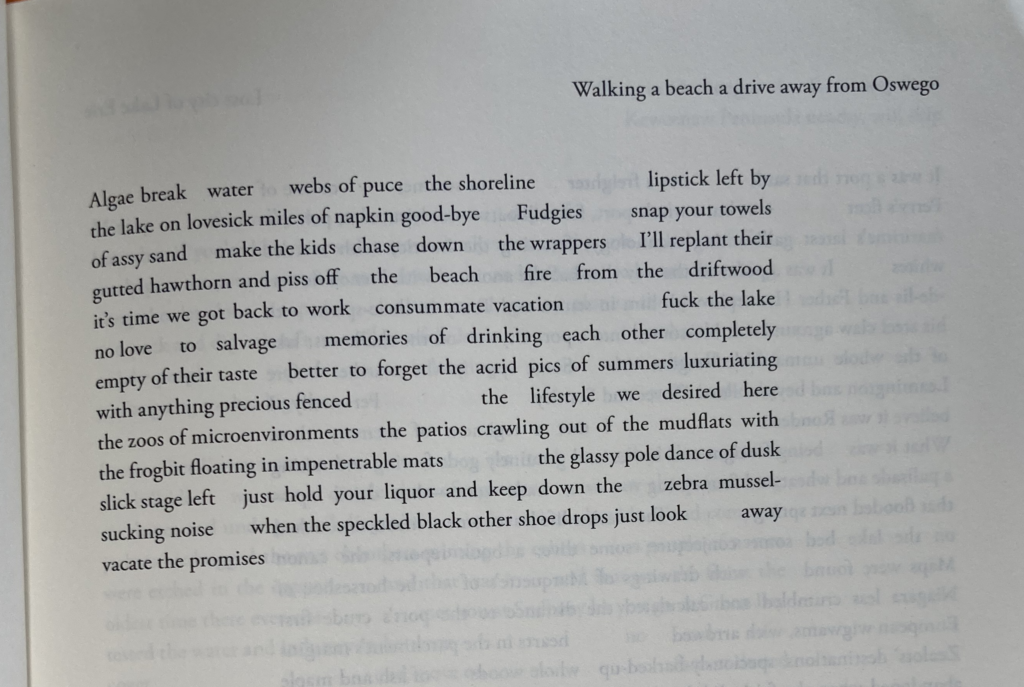
Walking a beach a drive away from Oswego
Algae break water webs of puce the shoreline lipstick left by the lake on lovesick miles of napkin good-bye Fudgies snap your towels of assy sand make the kids chase down the wrappers I’ll replant their gutted hawthorn and piss off the beach fire from the driftwood it’s time we got back to work consummate vacation fuck the lake no love to salvage memories of drinking each other completely empty of their taste better to forget the acrid pics of summers luxuriating with anything precious fenced the lifestyle we desired here the zoos of microenvironments the patios crawling out of the mudflats with the frogbit floating in impenetrable mats the glass pole dance of dusk slick stage left just hold your liquor and keep down the zebra mussel- sucking noise when the speckled black other shoe drops just look away vacate the promises
2
As I read this poem, and some others in the collection, I thought about something else Soliman said in their interview:
And as far as the writing and the editing, you know, I just am such a convoluted writer sometimes and like I feel like a really sometimes poetry from your writing is like a problem solving, you know, like, how do you just stack this house of cards up enough to sit and just back away before it falls down?
Just enough to not collapse. This idea reminds me of a game I play with myself: how much data/information do I need to “see” something? The version of this game that I play in the water is: how many times do I need to sight the orange or green buoys in order to stay on course? The answer: not many! I’d like to play this game on land, with words. How little can I write/say and still communicate how/what I’m seeing or feeling or experiencing? Beyond a game, as my vision continues to decline (the end point: no more central vision) and my ability to read decreases, I must rely on fewer words. I want my poetry to reflect that economy.
experiment: Take an existing poem that I’ve written and try to take as much out of as I can without it losing its meaning. I think I’ll start with a favorite poem that has never quite worked: Look pal, this isn’t the sea. A further thought: put the poem on my board, along with all of my thoughts, log entries, poems/lines from others about it. Gather as much information as possible, put it on the board, then condense it. Condense!
Poet’s work/ LORINE NIEDECKER
Grandfather advised me: Learn a trade
I learned to sit at desk and condense
No layoff from this condensery
What a master of condensery L Niedecker was!
2 — better to forget the acrid pics of summers luxuriating with anything precious fenced
acrid pics — looked up acrid to double-check meaning: “strong, sharp, unpleasantly biting smell” and “bitter in language/feeling” — tried to remember, did polaroids smell? Yes, a distinctive warm, chemical smell. Is his use of acrid here a deliberate conjuring of polaroids? I grew up with polaroids, and using the word acrid offers a much more visceral reader response than just pics or pictures. And acrid as bitter — some regret over what happened/didn’t happen on those summer trips, over not being on vacation anymore?
anything precious fenced — here I’m thinking of Alice Oswald’s description of the sea as unfenced in Nobody: “If you want to imagine the colour of Odysseus’ gown you will have to swim out into the unfenced place, the place not of definitions but of affirmations. ” And, I’m thinking about lucille clifton’s “unfenced is” in “All Praises.”
I’m also thinking about Soliman’s own critical (as in, seemingly negative) use of the word “precious” in his interview:
I was just doing a lot of, like, site, I don’t know if the word would be site-specific writing, you know, just writing on the go, you know, like showing up and wanting to capture a place and not feeling too precious about capturing it because really being there was so, like, sublime, you know, it was just so amazing and seeing such, like, really beautiful hidden pockets of the Midwest and, you know, these, like, oceanic spaces, you know, where you wouldn’t think, you know, Michigan would offer that or something.
and
A lot of these poems are these justified text blocks with like, internal line breaks. And a lot of them started as lineated poems. Uh, and I just liked the ones that weren’t like that more because I felt like line breaks were too precious sometimes.
Just in poetry, not just mine, but sometimes I just kind of bristle at line breaks, you know? Um, they make, yeah, sometimes they make poems feel too precious. And I wanted this to have a bit more of a, like, robustness, you know? That they’re, they kind of just sit there on the page, you know, like a paragraph, you know?
4.2 miles minnehaha falls and back 20 degrees 75% snow-covered
Much warmer today. Sunny, bright, low wind. My right glute/back/leg didn’t bother me. I felt strong and relaxed and very happy to be back out, beside the gorge. I took a week off from outside running; partly because of the extreme cold, partly the uneven paths, mostly because I was giving my body a break.
10 Things
a runner in an orange-y, pinky jacket
a walker — or a worker? — in a bright yellow jacket, standing above the overlook at the falls
the falls: silent
the creek, looking: almost completely frozen, only a few streaks of dark, open water
the creek, listening: a soft trickling sound
beep beep beep a park vehicle with a plow on the path, clearing out more snow
scrape scrape the sound of the plow blade as it hit bare pavement
the river surface, all white, burning bright through the trees
a car blasting music that was so distorted I could just barely identify it — I think it was “Kids” by MGMT
the big boulder that looks like an armchair, with a lapful of snow
I, Emily Dickinson
I’m finally getting around to doing my write-ups for my monthly challenges in Sept, Oct, and Nov —I was distracted by my manuscript. I found something helpful from 1 sept that I had forgotten about:
Surely, the finest way to appreciate Niedecker would be to read her well. And then repeated reading, reading aloud, transcribing the vibrant phrases on to paper, oh and even framing them. But how to linger in the presence of this voice, and let it echo within oneself, make her a part of oneself? Perhaps by applying Niedecker to Niedecker, I would arrive at a new condensary. De- and re- constructing her poems, deleting words, conflating words, writing through her writing.
How to let it echo within oneself? (it = a poet’s words, ideas, worlds). I’m thinking about doing this, writing around and with and through Emily Dickinson, especially in relation to her references to failed vision. To let it echo, listen for the echoes, create echoes. Two immediate thoughts: 1. memorizing and running with her words and 2. taking her poems to my quarry — which I’ve done with 2 already (see the 13th and 14th of December entries).
4 miles river road, north/south 50 degrees wind: 14 mph / gusts: 29 mph
Ooo. Felt that wind, running north. A few times, I had to square my shoulders and sink down to face it, like I was a linebacker getting ready to tackle the air. Bright sun, lots of shadows — of tree branches, and fence posts, and flying birds, and swirling leaves. I don’t remember looking at the river as much as I remember admiring the air above it. Such openness! I felt strong until I didn’t. Stopped to walk a few times. Took some wooden steps down on a very steep part of the winchell trail. No wall or fence to stop you from falling far enough down to break something. Stopped at the sliding bench to see how much green was left and to admire the birds flitting from branch to branch.
Also stopped after mile 1, to record myself fitting some of Lorine Niedecker’s words into my running/breathing rhythm:
In every part of every thing stuff that once was rock.
Except, I forgot the stuff part, so I ended up with this:
In every part of every thing there once was living rock.
Does this second one make sense? Not sure.
before the run
Riprap. Thinking about riprap and rock and creating some sort of ceremony related to the gorge and running on and above the absence of rock. Reading Mary Oliver’s section in The Leaf and the Cloud, titled Riprap, fitting it into my breathing/running pattern —
tell me dear Rock — will secrets fly out when I break open?
Raking leaves and hearing the man next door scream at his grown daughter again through walls that aren’t thin, listening as she screams back, wondering what the daycare kids will remember from this moment.
before we are all wiped off of this planet that desperately wants us to live of natural causes, like kindness, like caring
Remembering something else I read earlier about a troubled woman who encountered a stranger that offered her kindness instead of judgment:
“The only question she asked me was, ‘Where do you want to go?'” Stacia said. “No judgment, no expectations. Just acceptance.”
Stacia immediately felt relieved.
She didn’t want to talk about her troubles; she just wanted to go home. She got in the car and they talked about things that gave her a sense of calm: nature, music and art.
After about 40 minutes, the woman dropped Stacia off at her house. Stacia didn’t learn the stranger’s name and she never saw her again. But she has never forgotten the woman’s question or how it made her feel.
“What I experienced that day — a single generous act of compassion — has stayed with me ever since and it shaped the life I went on to live.”
a few minutes later: Watching the daycare kids playing in the leaves in the front yard, screaming in delight. Remembering how one of them greeted my daughter last week as she parked in front of our house, distraught and overwhelmed, with: you’re beautiful, and how that kindness offered made such a difference.
Reading Gary Snyder’s poem, “Riprap,” fitting his words into my breathing pattern:
Lay down these words be- fore your mind like rocks placed solid by hands in choice of place, set before the body of the mind in time and in space.
Riprap: being broken up, made tender, feelings/fears exposed and scattered, gathering them into words and building a new foundation.
3.35 miles 2 trails+ 49 degrees / feels like 37 wind: 15 mph / gusts: 32 mph
Windy today. Had to make sure my hat was secure. Ran south to the start of the Winchell Trail. Stopped to admire the river — a clearer view, with far fewer leaves. Stopped again, a few minutes later, to study a felled tree. Yesterday, we (me, Scott, FWA) had seen park workers with chainsaws and a truck with a ladder around here as we drove by. This must be one of the trees they cut down. I felt a little safer running through this section in the strong winds, knowing that the tree workers had just been here yesterday removing sprawling branches and leaning trees.
The trail was covered in leaves, so I couldn’t see if there were any potholes or big cracks. Of course, I often can’t see them even if the path is clear. So I run lightly and carefully. The worst part of the trail was the graveled bit in the ravine. Ouch! A few times my feet landed on the sharp end of a stone.
10 Things
above the floodplain forest, looking out, no leaves, small branches all around created a veil of mesh, making everything look fuzzy
the wind rushing through the leaves on the bluff, or was it water seeping out of the limestone?
the voices of laughing kids at the playground
swirling leaves
leaves, floating gently
voices above me
a biker with their headlight, their wheel crossing over and onto the walking path
a short, all-white animal on the trail — a dog? no a little kid in a white snowsuit
the limestone ledge in the ravine looking dark and cavernous
something clanging down below near the old stone steps — a dog collar?
cells
1 — juliana spahr
the opening lines of poemwrittenafterseptember11/2001 / juliana spahr
There are these things:
cells, the movement of cells and the division of cells
and then the general beating of circulation
and hands, and body, and feet
and skin that surrounds hands, body, feet.
This is a shape,
a shape of blood beating and cells dividing.
But outside of this shape is space.
—
cells the movement of cells the division of cells
2 — how much of us is not us?
57%. 43% of a human body is made up of human cells, the rest is: “bacteria, viruses, fungi and archaea (organisms originally misclassified as bacteria)” (More than half of your body is not human).
the importance of microbiomes
3 — L Niedecker and dwelling with place
our bodies as place or space (see J Spahr up above)
Instead of fretting over how such a finite parentage might threaten our “humaniqueness,” Niedecker welcomes our bond with nonhuman life and seeks instead to endow us, as she writes in “Paean to Place,” with a deeper appreciation for the “sea water running / in [our] veins.”
She also insists upon the necessity of our learning to dwell with other biotic elements who share our land-community, including what she calls in one poem “our relative the air” and “our rich friend / silt.”
—
Niedecker’s portrayal of living with beings and things in our environment is not merely a poetic metaphor; it also finds support in the field of biology. We now understand that even our bodies, the things we think of as most us, are in fact shared organisms, with trillions of microbacteria colonizing our guts in such numbers that they may potentially outnumber our own cells.
some rambling: And now I’m thinking about all of this and wondering if it fits with Girl Ghost Gorge or is part of a new (series of) poems? It does, I think, in terms of the relationship between the girl and the ghost and the gorge and how the speaker/writer/Sara imagines herself as all three yet also wants to assert a Sara-self (Girl). I like the idea of composing this poem, and assertion of self, with lines from others — a cento! Poets and scientists and geologists and historians.
Questions of what makes us us? and what part of us remains throughout our lifetime? and what is the essence of Sara or, who is Sara, on the cellular level? I do think that these are questions that haunt these poems, as the other side of a deep desire for connection. In light of so many connections and how much of me is made up of stuff outside of or before me, what is sturdy and solid and singular about Girl/Sara/me?
I came up with a draft of a poem responding to these questions that I quite like. I’m calling out “43% Girl”
Happy 4th Anniversary
During today’s On This Day practice, I discovered this, from 2021:
Yesterday, I started working on a poem (or a series of poems?) based on my October focus on ghosts and haunting. I’ve decided to use my rhythmic breathing pattern as the form: couplets with 1 three syllable line and 1 two syllable line (3/2)
4 years. That seems like a long time to be working on one collection of poems, and also not that long at all. It started as Haunts, then became Girl Ghost Gorge. Poems all about haunting a place and being haunted by it. Up until recently, the haunting involved a lot of feeling disconnected and isolated. Perhaps because of all of the attention I’ve given the gorge and those feelings, I feel more connected and more girl, less ghost. I should finish this collection and be done with it before I start editing it too much and lose some of its original story.
A beautiful morning! Sunny, only a slight breeze, algae-free water. There were 2 exuberant kids and a scraping shovel somewhere, so it wasn’t quiet above the water. But below: a deep soft-bottomed silence. My only complaint: too much milfoil! The vines were thick and just under the surface, wrapping around my wrist, touching my toe. Once, when I stopped to tread water, a vine encircled my foot. I wasn’t worried about them pulling me under, but I didn’t like brushing against them or having a pale clump suddenly appear in my face. I swam far out from the white buoys to avoid them, but then I had to worry about paddle boarders and kayaks. The vines were irritating enough to make me think maybe open swim season is ending. I want to keep coming this week until they take down the buoys, but navigating these vines is taking some of the fun out of swimming in the lake.
10 Things
2 women on a blanket speaking in Spanish
4 kids playing soccer in the sand, one the kids looked about 2 years old
a big bird high up in the sky, soaring
at least one plane taking off from the nearby airport
aggressive bird shadows — sharp, too close
sparkles on the water
racing a kayak, both of us parallel to the beach — I was winning, then I looped around
a metal detector man waving his machine over the sand
a few shreads of clouds in a pale blue sky
paddle boarders exiting the water — I’m so glad we were able to paddle board! And it wasn’t too warm!
Minutes after my swim, I felt the gentle, burning glow of muscles having been used. I will miss that feeling this winter!
The Poetry Daily’s poem-of-the-day is I, Lorine Niedecker. Very cool and difficult for my cone-compromised eyes to read, I’m glad they included an essay by the author about the process of writing the poem.
Surely, the finest way to appreciate Niedecker would be to read her well. And then repeated reading, reading aloud, transcribing the vibrant phrases on to paper, oh and even framing then. But how to linger in the presence of this voice, and let it echo within oneself, make her a part of oneself? Perhaps by applying Niedecker to Niedecker, I would arrive at a new condensary. De- and re- constructing her poems, deleting words, conflating words, writing through her writing.
After their explanation, Rao offers a writing prompt:
Pick a poet who moves you, isolate their characteristics, and apply this to their work. Using words from within their own work, write the narrative of their poetics or/and biography. Example: Get romantic and didactic with Wordsworth, apply surrealism on André Breton …
Imitation is the best form of flattery, but also of ridicule—so this kind of repetition can function as a spotlight or a spoof. I suggest choosing a poet you absolutely adore, as it’s better to have such a voice under your skin.
Someday I’d like to try this with Niedecker, but right now, I’m more interested in Alice Oswald and her collection, Nobody. And, maybe Mary Oliver, too — especially since I’m using her poem, Swimming, One Day in August.
Rain, all day. Soft, soothing, but maybe only from inside somewhere, looking out and listening. I’m devoting the morning to Chloe Garcia Roberts. I discovered her yesterday on Poetry Daily, when her poem-essay, Temporal Saturation, was the poem of the day. Yesterday I wondered if I should buy the book that this piece comes from, but today I know for sure. Yes!
It started when I noticed that Roberts had written an essay for Poetry Daily about the poem, Towards (A) Lyric Science. Here are some bits I’d like to remember today:
on teaching poetry like it was a high school shop class
Each week I bring a selection of poems to class which manifest some particular structural element we are learning. We read these poems aloud and observe their movements, and as we dissect them, we analyze their poetic systems, their energy sources, their gestures. We then reconstruct and rebuild approximations of their functions so as to better learn how to create our own poems from our own language and experiences.
She envisions poetry as (a) technology. Describes the pleasure of reading “Goethe’s “Theory of Colours” as an example of writing that blurs and even perhaps erases the line between what they [her engineering students at MIT] are learning in my classroom and what they are learning outside of it.” And aims to combine the lyric and the analytic:
Temporal Saturation” was an attempt to build a poetic form that reflected that reality, between poetry and prose, in English but articulating an existence between languages and cultures, and a first foray into a place that lies between the poles of the lyric (the melodic, subjective, sentimental) and the scientific (systematic, objective, and exacting). In other words, in this piece I am writing towards the beckoning betweenness of a lyric science.
Listened to the podcast, Voices in the River, and an episode with CG Roberts, Translating the Trees. She gives some background on Fire Eater:
So I had been working for many years on a translation project of a classical Chinese poet, Li Xiangyin, and in order to do that and give myself permission to even approach this canonical poet’s work in a language that I had learned, not grown up with, was I kept lists and notebooks of word choices and where those words came from and mapping them onto the English. And then I finished the product and I had all these notebooks and I went back to them and they were maps.
And I thought, could I use these maps to translate my own life, to articulate episodes or questions that I have about my own memories and my own experience?
And yes, they did. They did. A word would come to me, and then I would look it up, and I would look deeper and deeper and deeper into its root, and I would find, oh, it connects this meaning with this meaning, which then connects to a certain episode of my life.
So it’s 10 essays, poem essays. Writing the book felt like remembering it. It did not feel like creating it.
She describes it as a “divination with the dictionary.”
Wow. How wonderful to have found this writer and to dwell in the place she has created with her words and ideas! I can’t wait to get her book — I definitely can’t wait until my birthday next month!
Early on in the podcast, Roberts offers these words about being like a tree:
Each memory felt like a little root that I was extending and connection to that present moment [sitting inside her childhood home, creating memories, before it was torn down], not separate, not the past, not the future, not the present, but all together. This is like living like a tree. The tree is all of the moments of its growth at the same time.
Like a tree!? This reminds me of something I wrote last week in here, on 16 may about Lorine Niedecker and her line, stand among the birch, where among, at least to me, means to be a birch, to become one of them. I also wrote about noticing the split in a tree between two main branches and seeing a crotch and two legs and imagining a person, upside down, planted in the ground. And realizing that Katie Farris’s poem, “What Would Root” ends with the beginning of this image as the top of the narrator’s head comes off and is placed in the ground to drink/absorb water.
And now I’m thinking of the wonderful challenge (and, to Roberts, spiritual practice) of translating the feeling of being/becoming a tree into language.
4 miles minnehaha falls and back 54 degrees wind: 15 mph
Even though I’ve run the past 3 days, I decided to run again today for 2 reasons: 1. it’s supposed to rain all day tomorrow and Wednesday and I don’t want to run in the rain and 2. we have leftover butternut squash mac and cheese, and I always like to run before eating it for lunch. A good run. Managed to keep my heart rate lower until I reached the falls. Had to stop at the bathroom in the park building for some unfinished business. Will that be a problem again this summer? After, I put in my “Moment” playlist and ran again until I reached the bench above the edge of the world. I was planning to stop, but I noticed someone was sitting there. Bummer
Because I wanted to eat right when I got back, I gave myself about 3 minutes to jot down 10 things I remembered from the run (the jotted list was brief; below was written after I ate):
10 Things
didn’t see the falls, but heard it — not a roar, but a rush of water
looking ahead, seeing someone on the dirt trail next to the path — is that a kid? It looked like they were moving towards me. As I got closer — 15 or 20 feet, I realized it was not a person, but a bike — and a bike that had been parked there yesterday too
a strong wind — for one stretch I was worried it would rip my cap off of my head
2 plastic white chairs stacked on the side of the park building — later in the summer they will be unstacked and people will usually be sitting in them
a long row of port-a-potties (20 or more?) still standing after Saturday’s race. I wondered if they were planning to pick them up or if there was another race this weekend
a walker, passed twice, bundled up in a winter coat, a winter cap (with a ball on top), and a mask
the faint laughter and yelling of kids on a playground
the dim roar and rush and rustle of the wind moving through the trees
a fully parking lot at the falls
noticed beneath the dirt next the trail just north of the 44th street parking lot: netting left behind from a failed attempt at re-grassing this stretch
more on the moment
Looking at my Plague Notebook, vol. 26, I saw that I had written CONTEXT for yesterday’s entry — as in, moments have a context, a history, a location in space. I remember being reminded of context as I walked back home after my run while listening to Rut by Wimps:
Each day is the same as the last There is no future There is no past
I like routine It’s my favorite thing No new memories Don’t change my scenery
Note: I listened to some other songs on the City Lights, the album “Rut” comes from. Wow — it’s all about losing your Self when you become a Mom.
Responding to the word context in yesterday’s entry, for today I wrote: Yes, context is important! A moment is not out of time, but deeper in it — geologic time.
For future Sara, who will want to bring context into any writing we do with the moment, past Sara discussed it in these entries: 6 may, 7 may, 8 may 2025
Poetry Daily’s poem-of-the-day is a great one for thinking about moments: Temporal Saturation by Chloe Garcia Roberts in their book, Fire Eater. I might want to buy this book for my birthday?
temporal saturation—the explanation for why certain moments of your life seem to spill or shrink, to transcend or subvert their physical duration, and color differently their surrounding time.
This is a wonderful description of a Moment!
Temporal saturation is an elusive measurement disproving any correlation between quantity and influence that is used to explain both the canyons that can appear inside moments of great rending, joyous or horrific, entombing an incarnation of the self which will never again exist; as well as the median intervals of floating passivity that resist recollection and whose ending is marked by a feeling of awakening: a drowsy startle or a gradual reconsciousness.
Difficult to measure / length of time does not determine significance / the canyons inside moments — canyons = the Mississippi River Gorge?! / not entombing a past or gone self but holding it / floating passivity = the space between beats?
saturation = the state or process that occurs when no more of something can be absorbed || Can I make a connection with the dew point and its impact on a moving body? dew point = “the temperature at which the air becomes saturated with water vapor”
High levels of temporal saturation are evidenced by a languorous stretching of the experienced present, which then refracts and amplifies the emotion of the moment. The joy making this spreading pleasurable, the fear terrible, though both poles can be described in terms of the sensation of falling. The difference being that the first is a falling into and the latter a falling through
refracts = deflects / distorts / bends / disrupts
falling through = And then a plank in reason broke / And I dropped down and down / And hit a World at every plunge / And finished knowing then (I wrote these lines from “I Felt a Funeral in my Brain,” from memory so the punctuation and capitalization aren’t quite right).
Low levels of temporal saturation are evidenced by malaise, an involuntary refusal on the part of the individual to knit themselves to the place they occupy. Home-sickness—the corporeal and spiritual longing for a physical and temporal point of greatest belonging—is the best diagnosis to describe these ebbs of existence.
No moments = a lack of connection, an untethering, no home
The measurement of temporal saturation then can be used to quantify both the abscesses and the vividities, these gestures floating in great swathes of meaningless automation. Just as the atoms composing a human body can condense smaller than the head of a pin, the self can, like a black hole collapse, like a poem reduce. And the proof of the emptiness that oceans those bright livings is how they sparkle and call to each other despite the expanse of the interims, be they seconds, decades, lifetimes. Inlaid in space, they form the constellation of the soul.
water images: floating, condensation, oceans, sparkle — like waves hit by light the sparkle reminds me of swimming across the lake and seeing the sparkling water, realizing that each cluster of sparkles was another swimmers’ hand piercing the water
seconds, decades, lifetimes: Aren’t we all just masses of energy and light in a jumbled future or past, stopping to embrace one another for a moment or decades before passing too far for sight? (Halos/ Ed Bok Lee)
The dew point is the temperature when air condenses on the skin and turns into sweat.
Lorine Niedecker and the poet’s work: condensing. “A condensary is where condensed milk is made. In order to make condensed milk, you evaporate a significant amount of water from milk and what you’re left with is something delicious and much more concentrated and powerful” (Close Reading).
4.15 miles minnehaha falls and back 68 degrees dew point: 59
Even though it was warm and the dew point was high, my run was good. Managed to bring my heart rate back down and keep it under 170 until I reached my favorite spot at the falls — 2.25 miles in. Excellent. I’m feeling stronger, mentally and physically.
10 Things
a turkey in the middle of the road, honking? squawking? yelling? at the cars unwilling to stop and let him cross
a hazy green above the gorge
the sun hitting the light green leaves so intensely in the distance that I thought it was a bright yellow crossing sign instead of a tree
the falls were rushing, all white foam framed by green trees
a steady procession of cars on the road
roots and rocks hidden in the shadows on the trail — I lightly twisted both ankles, one from a root, the other a rock
the tree that feel in the creek sometime last year was gray — will they remove it?
a line of a dozen or more cars backed up on the parkway, stuck at the stop sign
a crowded trail heading north — bikers and walkers, a few runners, strollers
the water fountains have been turned on again! I stopped for a drink and to wet down my hat
Listened to the hum of traffic as I ran south, my “Doin’ Time” playlist heading back north.
before the run
Thinking about LN’s poem — that I posted yesterday — about standing in the north woods with birch, which led me to think about becoming a tree, like in Katie Farris’ “What Would Root” and Linda Pastan’s “In The Orchard” — I shall come back as a tree.
I’m also thinking about Mary Oliver and “Can You Imagine” — surely you can’t imagine trees don’t dance from the roots up, wishing to travel a little, not cramped as much as wanting a better view, or sun, or just as avidly, more shade.
during the run
I don’t remember thinking about becoming a tree or rooting or stillness while I ran, but I remembered right after I finished and as I walked back home I recited “What Would Root” in my head. I need to practice the second half of the poem. Then I thought about the illusion of stillness and how nothing, not even rocks or trees, stand still. They’re sinking and shifting and swaying and responding to (being changed) by the world around them.
after the run
Still as not not moving but being stuck in a rut, doing the same thing again and again, as in, you’re still doing that?
Still as not needing more, content, at peace, satisfied, stilled desire or anxiety.
If Socrates drank his portion of hemlock willingly, if the Appalachians have endured unending ages of erosion, if the wind can learn to read our minds and moonlight moonlight as a master pickpocket, surely we can contend with contentment as our commission.
Deer in a stubble field, small birds dreaming unimaginable dreams in hollow trees, even the icicles, darling, even the icicles shame us with their stoicism, their radiant resolve.
Listen to me now: think of something you love but not too dearly, so the night will steal from us only what we can afford to lose.
walk: 1 hour winchell trail / edmund 77 degrees
Remembered to take Delia the dog for a walk before it got too hot. We walked to the Winchell trail than sauntered, me studying the leaves with my fuzzy vision and fingers, and Delia sniffing them with her snout. Warm in the sun, cool in the shadows.
10+ Things
clumps of tallish grass growing through the mulch — a vibrant green
even taller grasses growing among the flowers on the hill, creating a visual effect that was dizzying as my eyes tried to land on anything solid
little bits of some sort of plant scattered along the top of the fence. It looked like it was growing there — a form of lichen? — but I couldn’t tell. It might have just fallen from a tree
the pleasing, easily identifiable shape of the maple tree on the trees close to the trail
sparkling, blue water
blue water, blue sky, green trees
the laugh of a woodpecker
a yard with several bleeding heart bushes, all in bloom
sprawled tree shadows on the grass
the crotch of a tree — standing beside a tree that branched off into two equally sized limbs which looked like thighs to me. I imagined a person planted head first in the ground, which is what happens in “What Would Root”
walking near Hiawatha Elementary, watching as a gym class “ran” around the block, studying the different approaches to “running” — a steady jog, sprint then stop then sprint, skipping, arms flailing and screaming while moving
As I walked with Delia, stopping at almost every tree or tuft of grass or clump of dirt, I thought about the differences between walking and running, this time in relation to a sense of self. Does one enable you to lose yourself or step outside of yourself more easily? I haven’t decided, but I think while walking you can be more aware of what you are doing, how you are attending to the world and noticing what is going on. While running, the attention is less deliberate; you’re too busy managing your effort to carefully study things. There was more to that thought but I lost in the time that it took me to get home.
Went out earlier today. Already warm. High in the mid 80s today. At the beginning of the run, my body felt awkward. Stiff neck, plodding feet — no, not plodding, but feet that were landing wrong, not pushing off of the ground easily. Gradually my body warmed up and I felt smooth by the third mile. Started my run a little after 7 and enjoyed a different vibe than at 9 or 10. Softer, fuzzier, cool green glow instead of harsh blue light.
My favorite view today was when I turned down from the 44th street parking lot to enter the winchell trail. A path winding down a small hill to a stone wall then hazy, glowing air framed by trees and water. The river was below that sky but I don’t remember noticing it, just knowing it was there.
surfaces: dirt, dead leaves, grass, rubbled asphalt, rutted and slanting asphalt, concrete, smooth asphalt
number of stones stacked on the ancient boulder: 6
bird, heard not seen: woodpecker — a deep, hollow knocking bird, seen not heard: a little sparrow darting into a bush as I ran by
No rowers, no roller skiers, no turkeys. No thoughts or lines of poetry popping into my head. No shadow, no memories of my mom. Nothing interrupting me.
Chanted triple berries in my head to keep a steady beat: strawberry / blueberry / raspberry.
Listened to the gentle buzz of cars, dripping water, voices as I ran south. Put in my “Doin’ Time” playlist on the way back north. Two versions of “What Time is It?” came on, one from The Spin Doctors, the other from High School Musical 2.
restraint and the work of being still
Yesterday, I found a wonderful podcast episode on Lorine Niedecker and a close reading of her poem, “A Poet’s Work.” So much of the episode was great. Today I’m thinking about the discussion of stillness and restraint in LN’s work, which includes another LN poem:
For best work you ought to put forth some effort to stand in north woods among birch
I thought about movement and moving through a place instead of standing still in it, which reminded me of a passage from Cole Swensen:
Then sitting still, we occupy a place; when moving through it, we displace place, putting it into motion and creating a symbiotic kinetic event in which place moves through us as well.
Walk/ Cole Swensen
And now I’m thinking of something I posted, and then condensed, from Wendell Berry:
The slopes along the hollow steepen still more and I go in under the trees. I pass beneath the surface. I am enclosed, and my sense, my interior sense, of the country becomes intricate. There is no longer the possibility of seeing very far. The distances are closed off by the trees and the steepening walls of the hollow. One cannot grow familiar here by sitting and looking as one can up in the open on the ridge. Here the eyes become dependent on the feet. To see the woods from the inside one must look and move and look again.
A Native Hill/ Wendell Berry
finding a stillness in movement?
Thinking more about moving and how it does/doesn’t fit with stillness — as in, an inner stillness — I turned to Brian Teare and his discussion of writing while moving in En Plein Air Poetics:
I’m heading up the AT to the North Trail, the kind of hike during which my mind goes from translucent to luminous, its usual wash of thought polished to a transparency that lets in the world with a force I adore. After a mile on foot, details come into focus with an oxygenated crispness. Thought can be a block to feeling the intertwining of self and world, the mesh of phenomena and the qualia of self, and hiking unblocks that feeling by muting my mind and allowing it to flood with a kind of proprioceptive ecstasy. My sense of self disappears into smell, color, sound, touch.
Have I ever heard of qualia? Not sure. Here’s a helpful explanation:
Feelings and experiences vary widely. For example, I run my fingers over sandpaper, smell a skunk, feel a sharp pain in my finger, seem to see bright purple, become extremely angry. In each of these cases, I am the subject of a mental state with a very distinctive subjective character. There is something it is like for me to undergo each state, some phenomenology that it has. Philosophers often use the term ‘qualia’ (singular ‘quale’) to refer to the introspectively accessible, phenomenal aspects of our mental lives.
proprioceptive: “of, relating to, or being stimuli arising within the organism”
Here’s something else helpful from Teare about shifting away from vision as the primary sense:
Paying attention to a fully intercorporeal relation to a specific site in the field dethrones eyesight as the most valued sense through which we acquire knowledge of nonhuman bodies—the eye is no longer the portal of empiricism through which the rational mind accesses the world.
For instance, hearing and touch are senses rarely accused of the kind of imperialism associated with vision; they are powers that alert other parts of the brain to our embodied relationships with the world.
A listening, touching human mammal is an embodiment that is not all eye and mind, a sensate creature whose language—its rhythms and structures—is derived in part from encountering the sonic landscape, felt textures, and the human and nonhuman bodies that populate and constitute the field.
After all, each ecosystem produces a unique biophony that envelopes us, and writing itself is haptic, a specialized kind of touch.
Ran earlier today, which helped. The first half was windy. Windy enough that I needed to take my cap off on the ford bridge. Sunny. A mental victory: thought about stopping on the bridge but then just kept going. Made it through the hard moment. The second half of the run, I felt stronger, everything was easier.
I don’t remember noticing the river sparkling, but I did see scales on its surface as I ran west on the bridge. No rowers, no roller skiers, only a few bikers. One small pack of shirtless runners.
Ran up the steep hill that starts under the ford bridge and ends in Wabun park. At the top, I stopped at the fence and looked down at the dam. I studied the tall grass pushing up against the fence. I thought about fences for a moment, how many I encounter while I run by the gorge, some maintained, some abandoned, many damaged by leaning trees or critters or hikers. Wooden, chainlink, iron, stone. Noticed another fence at the ford overlook: chainlink.
Listened to the wind and birds until I reached the ford overlook, then I put in my “Wheeling Life” playlist. Started with “Windmills of Your Mind,” ended with “Watching the Wheels.” Thought about FWA and how he might appreciate John Lennon’s song.
Speaking of playlists, I forgot to mention this in my entry 2 days ago. Listening to my “Slappin’ Shadows” playlist and Cream’s “White Room” came on. I wanted to remember this description of eyes:
Silver horses, ran down moonbeams In your dark eyes
Is this a gleam? Or is she crying?
suburban lawns
I’m still thinking about grass. If I were to make a list of grassy things, which I should and will, the suburban lawn would be on it. I’ve thought about it before, imagining my version of Lorine Niedecker’s growing in green (from her poem, “Paean to Place,”) as the lawn and the patches of green that grow on the edge between suburbs and the few remaining farms they haven’t yet consumed. That was my childhood. Here’s a poem I found this morning to add to the image of the lawn:
In the wilds of our suburban lawn, the natural world inclines to fable: Gray squirrels, unperturbed by rain, jockey for position at what our landlord speaks of, nominally, as the bird feeder. Below, dark-eyed juncos peck at fallen millet, masked like hangmen from another time. The great, unwritten order of it all scrambles when Max, our landlord’s aging chow, starts loping toward the scene. This is his work, so in a sense, he’s adding order, too.
One squirrel has shifted to a fencepost where it twitches its tail and rearranges in quarter turns like a guard. In total, there’s more movement than the eye can account for, all of it framed in the window’s tic-tac-toe. The glass weeps condensation. It’s early, but already the dog has slumped down for a nap. There’s plenty of time to lumber after thoughts that rise and disperse, dark-feathered things returning when I manage to be still.
Wonderful weather for running! Not too cold, but cold enough to not overheat. The color of the day: yellow. I’m sure there were orange and red leaves, but all I remember were the bright yellow ones. Another color I remember: glitter — on the water, among the fluttering leaves. Seeing the low water in the creek on Monday, I wondered if the falls would even be falling. They were, but no gushing or roaring.
10 Things
laughing kids at Dowling Elementary
the oak savanna is still mostly green
a sidewalk covered in dry, yellowed pine needles
a person taking a selfie with their dog by my favorite overlook at the falls
the man who empties the parking kiosks — I’ve seen him several times before and wondered why he comes in a regular (unmarked) car and how many coins he collects
the creek was higher than in past falls when bare rock was exposed
instead of a rope blocking the steps down to the falls, which is easy to climb over, Minneapolis Parks has added a green metal gate
the shadow of some leaves falling to the ground, looking like the shadows of birds
those same falling leaves looking like brown snow
the swinging shadow of my ponytail
pines and Basho
I ran over yellow pine needles covering the sidewalk at the start of my run and thought about Basho. So I looked up “basho pine” and found this line:
Learn about the pines from the pine, and about bamboo from the bamboo. Don’t follow in the footsteps of the old poets, seek what they sought.
A poem I was working on yesterday (and submitted to a journal for consideration), starts this way:
It begins here: from the ground up, feet first, following.
The following I am referring to is not simple repetition, even as it literally is about following trails already made by past feet, but seeking what past feet sought: connection, contact, familiarity with the ground/land and how it has been shaped.
ghosts and zombies
My plan for this month was to focus on Zombies, but between a kid crisis, the marathon, and a poem that insisted on being reworked, I haven’t given much attention to them. Maybe two other reasons: I don’t really like zombies, and I’m still thinking about ghosts.
from Circle / Dana Knott
human obits in the process of being written ghostly obits in the process of being read
Here’s what I wrote on August 1, 2024 that got me thinking about zombies:
On Ghosts V. Zombies/ Suzanne Buffam
Soul without a body or body without a soul? Like choosing between an empty lake And the same empty lake.
For the past few years, I’ve devoted a lot of attention to ghosts and haunts, but I’ve rarely thought about zombies. This poem is making me want to think about them now. So many directions to go with it — the relationship between the body and the soul or the body and the spirit or the body and the mind; how, because I can’t see people’s faces or make eye contact, they look soulless to me — I’m a ghost among zombies; Alice Oswald and the Homeric mind — our thoughts traveling outside of our bodies; Emily Dickinson and the soul that wanders; the fish in us escaping (Anne Sexton) or the bees released, returned to the hive/heaven (Eliot Weinberger).
I clicked on the ED link and read my entry from march 19, 2024. There’s a lot of good stuff in it, including a reference to Homer, but not the poet, the cartoon character, Homer Simpson. It’s the clip where his brain escapes his body to avoid listening to Ned Flanders talking about the differences between apple juice and cider (if it’s clear and yella, you got juice there fella, if it’s tangy and brown, you’re in cider town). Wow.
taking it slow
Reading the “about this poem” for poets.org’s poem of the day, Dead Reckoning, I encountered this line:
This poem began as a long sequence but arrived at this stripped-down form after fifteen years of off-and-on revision.
15 years of off-and-on revision! I’m only on year 3 of my Haunts revisions. I’m glad to know that other poets sit with some of their poems for a long time.
After finding this, I read an old entry from October 16, 2021, and found this:
“I am slow and need to think about things a long time, need to hold onto the trace on paper. Thinking is adventure. Does adventure need to be speedy? Perhaps revising is a way of refusing closure?…”
Rosemarie Waldrop
This slow time reminds me of Lorine Niedecker and what she writes in a letter to her poet-mentor, Cid Corman, while working on her poem, “Lake Superior”:
Cid, no, I won’t be writing for awhile, and I need time, like an eon of limestone or gneiss, time like I used to have, with no thought of publishing. I’m very slow anyhow . . . . I’m going into a kind of retreat so far as time (going to be geologic time from now on!) is concerned . . . .
8 miles ford-franklin loop 70 degrees / dew point: 64
Oh that sun! Too bright and warm! Advice for future Sara: get up earlier and pick a route in the shade. The sun sapped my energy and made me sweat even more than usual. Dripping ponytail, wet shirt, damp face. Had a few brief thoughts about cutting the run short and crossing at lake street, but didn’t. I remember reaching that bridge and hearing a voice in my head whisper, there’s no turning back after this. I’m proud of myself for continuing with the run. Did it get easier? I’m not sure, but I didn’t think about stopping again or doubt that I could keep going, and the last mile felt good, like I could have run longer.
On the warm-up walk before starting my run, I walked over dozens of acorns on a neighbor’s sidewalk, under their huge tree. As I walked, I could hear more acorns falling. I wondered if one would land on my head (it didn’t). I’ve been noticing the acorns for the last couple of weeks, hearing them hit garage roofs and the alley asphalt while sitting on my back deck. Usually the acorns begin falling at the end of July, so mid-August is a little later for me to start noticing them.
All I remember about crossing the ford bridge was that I had just started and I was already overheated. So hot in the sun! Running (and walking) across the franklin bridge, I looked for rowers (none) and noticed the sandbars just beneath the surface and the current, moving fast. It reminded me of some lines I read from Gave by Cole Swensen:
from Gave/ Cole Swensen
You walk alongside the river. No; you walk always with. Not down, or along, or beside. And you can’t help but measure–is it moving faster? And does that mean each molecule of water? Or does a body of water form internal bodies, pockets that move in counterpoint, in back-beat, in eddies? And does the surface ever move? Or is it something underneath that does? Of course, yes, the molecules of water that form the surface must certainly go forward, but does that mean that the surface itself moves too? Then what is a standing wave? What stays? I watch a large branch being carried down by the river, and then a kayaker, moving faster, then turn to walk back upstream like I’m walking into the arms of some thing.
I haven’t thought much about the distinction between being with and beside. I like beside as next to, and imagine it as a possible form of being with the thing you are in proximity to — a new way of being in community with others?
Reading through a great article about Lorine Niedecker, Dwelling with Place: Lorine Niedecker’s Ecopoetics, I’m wondering if a focus on with, and not just beside, is partly about seeing the river as another community member, not a thing/landscape/scenery you walk beside, but someone you walk with. And now, reading the CS’s lines again, I’m thinking of the idea that the walking with the river is describing how the water is moving too, so you’re not just walking past something that’s next to you.
I’m also thinking about the Sheldrake quotes I posted at the end of yesterday’s entry, on stability and flux and how we (bodies) are processes, not just things. Some of CS’s questions seem to be getting at this, wondering what part of the river fluctuates, and what part of it is stable.
Wow wow wow! What a wonderful swim for my birthday weekend. The air was cooler, but the water was fine and the sun was warm. Not much wind, so few waves, but the sun reflecting off the water sparked light everywhere. Felt strong and sore, then not sore, then sore again: mostly my neck from sighting and breathing. I didn’t wear my safety buoy and it felt strange, like I was missing something.
1
The water was clearer, lighter. Less greenish-blue and empty, more greenish-yellow and full of living things — particles, vines, sediment — and light. Shafts of light everywhere underwater — not straight down, but at angles and coming up from the bottom not down from the sky. An illusion, but fun to imagine the light source as down below. The opposite of Lorine Niedecker’s “ocean’s black depths” (Paean to Place) and Alice Oswald’s “violet dark” (Nobody). I noticed the shafts of light the most in the stretch of water between the last green buoy and the first orange one.
2
After I finished my 4th loop, swimming just inside the pink buoys, I looked underwater — clear enough to see the sandy, rocky bottom, but not clear enough to see any hairbands. Writing this reminded me of what I witnessed before the swim: minnows! As I waded in the shallow water, dozens of little fish scattered as I approached. None of them nibbled at my toes, or if they did, I didn’t feel it.
3
During the first loop somewhere between the first and second orange buoys an alarming thought appeared: what if I fainted in the middle of the lake? In the past this thought might have caused panic which I would feel in my body — a flushed face, harder to breathe, hot tingling on the top of my head. Not today. No physical effect. Within a few minutes the thought was gone. Is this because of the lexapro? FWA says that sometimes he feels the lexapro working — he’ll start having overwhelming thoughts but instead of spiraling, he feels himself become separated from those thoughts — they become abstract and distant. I wondered about this as I stroked then connected it to Alice Oswald’s Homeric mind and the idea of thoughts not just living in our head but traveling outside of our bodies from there to there.
3
I only saw the orange buoys when I was right next to them. I was almost always swimming straight at them, so some part of me knew they were there, just not my eyes. No panic or fear or negative thoughts as I looked at the nothingness of water and sky and a vague, generic tree line.
Another hot and humid morning. Another difficult run. Is it strange that I don’t mind that it’s hard? Some shade, lots of sun.
10 Things
squish! stepping down in thick, gooey mud on the winchell trail
thwack thwack thwack a runner approaching from behind
pardon me that same runner letting me know he was passing
running down to the south entrance of the winchell trail, looking at the river through the trees — not sparkling in the sun, but flat and brown — somehow this made it look even hotter and less refreshing
rowers down below, heard not seen
the sewer at 42nd, a steady stream of water falling
the sewer at 44th, more of a dribble
honking geese
4 stones stacked on the ancient boulder
a squirrel ahead of me on the winchell trail — running then stopping then running, finally jumping through the fence and off the trail — was it waiting to dart out right in front of me? no
Alice Oswald and Lorine Niedecker and water’s depths
from Paean to Place/Lorine Niedecker
How much less am I in the dark than they?
Effort lay in us before religons at pond bottom all things move toward the light
Except those that freely work down to ocean’s black depths in us an impulse tests the unknown
from Nobody/ Alice Oswald
The sea she said and who could ever drain it dry has so much purple in its caves the wind at dusk incriminates the waves and certain fish conceal it in their shells at ear-pressure depth where the shimmer of headache dwells and the brain goes
dark
purple
from “Interview with Water”/ Alice Oswald
To be purpled is to lose one’s way or name, to be nothing, to grieve without surfacing, to suffer the effects of sea light, to be either sleepless or weightless and cut off by dreams.
swim: 4 loops lake nokomis open swim 82 degrees
4 loops! A beautiful summer night! The water was a bit choppy but it didn’t bother me. Saw some silver flashes below — fish? Also, beautiful shafts of light illuminating the particles swimming with me and a few ghostly vines reaching up from the bottom. In certain stretches it felt like the water wanted to pull me down to the lake floor — difficult to kick and keep high near the surface.
New breathing/sighting pattern I noticed last night at cedar: 1 2 3 breathe right 1 2 look up to sight (no breath) 3 4 5 breathe left
above the surface: A few times I paused in the middle of the lake to give attention to the surface. Once I saw a dragonfly. Another time, a plane. The water was blue but not as intense as on Sunday.
below the surface: bubbles, my hands, could feel the movement before I saw any swimmers, then bubbles and pale legs kicking. The water was green but with less blue and more yellow.
4 miles minnehaha falls and back 65 degrees / dew point: 61
Today’s word: saturated. What Lorine Niedecker aimed for in her water poetry. Not floating or dry but sinking and soaked.
Rain off and on all day. Maybe thunderstorms starting in the afternoon.
No rain as I ran, but everything was wet or dripping. Moist. My face, more moist than a sponge. The falls, gushing over the limestone then rushing down the gorge to the Mississippi.
Evidence of the rain and thunderstorms last night all along the trail. Above the oak savanna it looked like some creature had tore through the green, ripping small limbs and leaves off the trees and throwing them to the ground.
The parking lot at the falls was packed with cars. Not the best day to be at the falls — but maybe it was? A chance to witness the falls in full cry, I guess. Also a chance to get wet or slip in the mud. I thought I might, but didn’t.
Anything else? A black squirrel sighting, which reminded me of the line from “What Would Root”: scolded by squirrels in their priestly black
Discovered the poet, Maureen N. McLane this morning and was delighted by her serial poem about Mz. N. Requested the book from the library. Possibly an inspiration for some writing about Sara, age 8?
The child Mz N sat on her bed and wondered: that tree outside her window shifted when her eye shifted. What to make of that?
§
Mz N and her siblings had a dog for some time. They went on vacation & when they came back no dog. They asked the parents: the dog? who replied: what dog? And some people wonder why others distrust the obvious.
Speaking of the serial poem — LN’s “Paean to Place” is considered one — here’s a helpful definition:
The serial form in contemporary poetry, however, represents a radical alternative to the epic model. The series describes the complicated and often desultory manner in which one thing follows another. Its modular form–in which individual elements are both discontinuous and capable of recombination–distinguishes it from the thematic development or narrative progression that characterize other types of the long poem. The series resists a systematic or determinate ordering of its materials, preferring constant change and even accident, a protean shape and an aleatory method. The epic is capable of creating a world through the gravitational attraction that melds diverse materials into a unified whole. But the series describes an expanding and heterodox universe whose centrifugal force encourages dispersal. The epic goal has always been encompassment, summation; but the series is an ongoing process of accumulation. In contrast to the epic demand for completion, the series remains essentially and deliberately incomplete.
I had to look up a few words from this excerpt that I wasn’t quite sure of:
desultory: marked by lack of definite plan/purpose, not connected to main subject protean:displaying great diversity or variety, versitle aleatory: relating to luck, depending on an uncertain event or contingency
This idea of a serial poem as “an ongoing process of accumulation” is very cool and fits with my approach to Haunts and a story in long form.
5 miles bottom franklin hill and back 72 degrees / dew point: 60
Whew! I was sure the dew point would be even higher. It felt very uncomfortable out there. And difficult. But I kept moving and didn’t push myself too hard. I ran to the bottom of the hill then walked up it. Then ran, walked, ran until I was back to the ancient boulder — no stones stacked on it today.
Last night RJP graduated from high school. I’m very proud of her for surviving it. I’m proud of myself too. It was very hard and I am tired. No more k-12 public school! Hooray! I loved many of the teachers and the music programs, but I won’t miss being subject to this schooling process.
RJP’s graduation was delayed by almost an hour because a fight broke out at the previous school’s graduation and someone was hauled away in an ambulance. FWA said he saw the guy, and he looked like he was probably fine and not in much pain. Other than the delay, the graduation was great. The awesome poet Bao Phi gave the address — so good! He, along with the student speakers, centered the experiences of BIPOC students.
10 Things
white sky
dark green mystery
at least 2 specks in the sky — a plane? a bird?
click clack — roller skiers powering up the franklin hill
foamy water
glowing orange shoes on a runner
voices below near white sands beach
one runner to another: well, that killed about an hour and a half — huh?
a greeting from Mr. Holiday!
a few days ago I mentioned something in orange spray painted on the sidewalk — it’s the outline of a cat (but not Garfield, I think?)
a section from Wintergreen Ridge/ Lorine Niedecker
Reading (again, for the 3rd or 4th time?) LN’s “Wintergreen Ridge,” I was delighted by her connections and associations:
Women saved a pretty thing: Truth:
“a good to the heart” It all comes down to the family
5 miles bottom of franklin hill and back 70 degrees / dew point: 60
Overcast, which helped it feel a little less warm. Sticky, thick air. A lot of sweat, especially on my face. Dripping ponytail. So green even the air was green. Greeted the Welcoming Oaks — hello friends! Descended into the tunnel of trees and was enveloped in green. Chanted triple trees: sycamore/sycamore/sycamore/red oak leaf/silver birch. Heard the rowers through the trees. Admired the barely moving, calm water under the bridge — the surface was dotted with foam and reflected clouds. Saw a speck in the sky out of the corner of my eye. Tried to look at it, gone. Tried again, a plane almost covered in fog. Saw a dark ring around it — my ring scotoma? Appreciated how the outline of the treetops on either side of the river road echoed the shape of the river banks. Walked up the hill — it took me 7 minutes — then ran, walked, ran back. Ended with a dozen roller skiers above me while I climbed out of the tunnel of trees.
For the first mile, in the dark green quiet, everything was dreamy. Thought again about how running puts me in a strange, surreal state. Nothing quite real. Then thought about Lorine Niedecker and the physical act of seeing with messed up eyes and using the poetic form to represent that. I’m not aware of how my eyes move as I see except for when I look to the peripheral as a way for my central vision to see something. I imagine having nystagmus makes you more easily register the movement of your eyes. How conscious was LN of her eye movement and how it was mimicked in her lines? When I think about how I see — the mechanics of it and its physicality — I think more about what happens when the corrupt or limited data travels as electrical impulses through the optic nerve and to the brain. Are the effects of nystagmus primarily physical — strain on eyes, the rapid movement creating dizziness and headaches? I should read more about it. . . . The physical impact of my vision sometimes reads as dizziness and light-headedness, but mostly it’s just a vague sense of unease and fatigue — more naps. I rarely feel the eye strain or get headaches from my effort.
In the article I was reading about LN’s nystagmatic poetics, this poem was discussed:
Tattoo/ Wallace Stevens
The light is like a spider.
It crawls over the water.
It crawls over the edges of the snow.
It crawls under your eyelids
And spreads its webs there—
Its two webs.
The webs of your eyes
Are fastened
To the flesh and bones of you
As to rafters or grass.
There are filaments of your eyes
On the surface of the water
And in the edges of the snow.
note at 11 am: Today is my first day of open swim! After the swim, I’ll return to this entry.
I’m spending the afternoon on the deck, reading Niedecker and thinking about Alice Oswald and Niedecker and my Haunts poems. Here are some jumbled thoughts:
You have been in my mind/between my toes/agate — Lake Superior/LN
You’ve been in my mind
beneath my feet Mom
Look for me under your boot-soles — Walt Whitman
Ars Poetica/ Arcelis Girmay
May the poems be the little snail’s trail.
Everywhere I go, every inch: quiet record
of the foot’s silver prayer. I lived once. Thank you. I was here.
“We a lovely/finite parentage/mineral/vegetable/animal” — Wintergreen/ LN
I’m interested in how many layers you can excavate in personality. At the top it’s all quite named. But you go down through the animal and the vegetable and then you get to the mineral. At that level of concentration you can respond to the non-human by half turning into it.
We can’t float or fly for long, above. We are part of the muck, not stuck but entangled, beholden
to work down/ to ocean’s black depths/us us an impulse tests/the unknown — Paean to Place/ LN
2 loops / 1.5 miles lake nokomis open swim 80 degrees
Open swim! Open swim! I was nervous before the swim, wondering if I would see the buoys. I did! The water felt wonderful — a little cold, but not too cold, and wavy but not choppy. I watched the sun filtering through the water, avoided the vegetation growing up from the bottom and the swan boat stuck right by the orange buoy. That menacing swan was a little too close as I neared the buoy. The last green buoy was so far from the orange buoy — it seemed to take forever to reach the beginning of the loop. Oh, I love open swim and what joy to have had a good first swim!
Was planning to bike to the lake and swim today, but it rained. On and off all day. So I read about Lorine Niedecker and took notes. Then, a quick walk with Scott.
Here are some observations from my deck, the yard, the window at my desk, and the walk:
10+ Things
deck: the sky heavy, gray, expectant — but it’s not supposed to rain today! — it did and then did again
deck: under the lime green umbrella, hearing the first drops, soft and slight
deck: the service-berry bush at the edge of the deck did a better job of keeping the deck dry than the umbrella!
front yard: after rain today, and the wind the past few days, the yard was almost as much twig as grass. Our neighbor’s tall tree with the wandering limbs offers unwanted gifts all year
desk/window: in the left window, a blob stretches above the other hydrangea leaves — dark, diseased — what is it?
side yard: not sure what this blob is even up close — could it be army worms? or is it just a failed unfurling?
side yard: near the gate, a rogue tree is growing outside of our neighbor’s window. Will they cut it down before it gets too big and becomes a problem for us?
desk/window: rain, pouring down, missing the gutter and sliding straight off the roof in sheets — too much debris/dirt in the gutter?
no lightening but far off thunder rumbles
green green green green green green green green
cabbage or lettuce or something else green growing in a neighbor’s planter
the sweet snell of pine after the rain
convinced I was seeing a giant fish sculpture until Scott told me it was wrapping over a tree
workers re-roofing a sharply angled roof with no harnesses
Here ares some thoughts to remember from Niedecker:
1
LN’s life by/with/on water involves saturation not transcendence.
2
Thru birdstart wingdrip weed-drift of the soft and serious water (from “My Life on Water”/ LN)
3
Reading is a bodily act — within the body, not transcending the body. The physical act of reading words with diseased eyes.
4
Time to challenge the myth that not being able to see “naturally” makes your hearing improve — That visual impairment improves hearing, taste, touch, smell, is mostly myth — Halos. Ed Bok Lee — LN used sound in remarkable ways, and also explored seeing differently.
5
One of the traditions LN draws from, Objectivism, believed in the clear, straight-seeing eye. In later work, like “Wintergreen Ridge,” she challenged the possibility of this straight-seeing.
Tell all the truth but tell it Slant — ED Alice Oswald and the slow, oblique, slight squinting of the Old Women in the Illiad
6
Imagists (Ezra Pound, HD): to see the world as it is, the IS, the this, scrubbing away to the essence
Objectivists (Zukofsky, Williams Carlos Williams): to look with clear eyes, pay attention, as is in context
Oh my scouring eye/that scrubs clean the sky — “perhaps you tire of birds”/ Donika Kelly
7
I used to think I was goofing off unless I held only to the hard, clean image, the think you could put your hand on. But now I dare do this reflection.
Still struggling with endurance, still showing up. How much of this is mental, how much physical? The sixty-four thousand dollar question, as my dad used to say. I think it’s both, but probably more mental. Maybe the lexapro is already kicking in, but my struggles aren’t bothering me. After the run I thought, these struggles will make showing up at the marathon start line, then finishing 4-5 hours later, much more meaningful.
It rained this morning, so everything was wet, even the air. Everything was also green. Green green green. Any other colors? Nope, not much to break up the green. Green green green green green.
10 Things
lush green, dark, on the part of the path that goes below the road
puddles
a woman ahead of me, running, wearing only one compression sleeve on her right calf
a group of kids walking to the playground at minnehaha
a much bigger group of kids walking near 42nd — a long line, 3 across, took me 10 or 15 or more? seconds to pass them
gushing water near the ravine by the oak savanna
the bright yellow crosswalk sign — my bee — was muted in the gray sky
crossing the bridge high above the creek, all green, no view of the water below
lush green, dark, on the steep hill descending to the locks and dam no 1
a pile of e-bikes parked near a bench — black with blue accents
paean to place/ lorine niedecker
Before my run, I started writing out, by hand, Niedecker’s poem. It’s so long! My hand started cramping up. I had to write slowly to account for my visual errors, like not seeing the words I’ve already written and writing words almost over them or above them instead of below them. The slow work is good, giving me time with each word and line.
Ah, summer mornings! Beautiful. Cooler. If I would have slept better, I would have tried to go out even earlier. The first half of the run felt good, then I got hot and it got harder. Today I didn’t worry about what that meant for my training. Instead, I enjoyed the brief minutes of walking, taking in the trees at the falls — so green! so full!
10 Things
the falls, flowing, white, undulating — the water not falling straight, but almost falling over itself — was it hitting some limestone on the way down?
a bundle of something on the ground next to the dirt trail — a hammock?
2 women with tall hiking packs on their backs walking on the paved path
some animal — a turkey? — upset, calling out, a human voice saying something — hey?
a flash below the double bridge — a sliver of creek almost covered by green
2 roller skiers near locks and dam no 1
the dirt trail cutting through the small wood near ford bridge looking cool and inviting
happy kids on the minnehaha park playground — happy: green voices, where green = young, outside, tender
(walking back, about to cross 46th ave at 37th street) 2 older women chatting, then greeting me, oh! hello!
(walking back almost to my alley) heard on a radio or from a phone or a computer in neighbor’s backyard, the next one is Scandia — was this talk radio or a zoom meeting or what?
Lorine Niedecker and “Paean to Place”
to dwell with a place:
What is required, however, is sensual, embodied experience—close encounters of awe, wonder, fright, disgust, or even tedium—which remind us both of the real earth with which we dwell, and that we share our home with innumerable cohabitants.
in the leaves and on water My mother and I born in swale and swamp and sworn to water
My father thru marsh fog sculled down from high ground saw her face
at the organ bore the weight of lake water and the cold— he seined for carp to be sold that their daughter
might go high on land to learn
Wow! Reading this opening, I’m thinking about the Objectivists and the Imagists and Ezra Pound’s 3 rules for writing poetry:
Direct treatment of the “thing,” whether subjective or objective
To use absolutely no word that does not contribute to the presentation
As regarding rhythm: to compose in the sequence of the musical phrase, not in sequence of the metronome
What condensery and music in these lines! And what wonderfully effective descriptions of two people dwelling in and with a particular place, especially her mother, born in swale and swamp and bearing the weight of lake water and the cold.
definition of ecopoetics:
The word itself is an amalgam of two Greek words: oikos [household or family] and poïesis [making, creating, or producing], so that ecopoeticsquite literally means the creation of a dwelling place, or home-making. The term came into special prominence after the influential British literary critic Jonathan Bate published The Song of the Earth in 2000. There, Bate defined ecopoetics as a critical practice in which the central tasks are to ask “in what respects a poem may be a making … of the dwelling-place” and to “think about what it might mean to dwell upon the earth.”
LN’s opening lines and her descriptions of her parents, reminds me of Mary Oliver’s The Leaf and the Cloud and her brief mentions of her parents in the first section, “Flare.” LN and MO have different experiences but they rhyme, somehow, or echo?
My mother was the blue wisteria, my mother was the mossy stream out behind the house, my mother, alas, alas, did not always love her life, heavier than iron it was as she carried it in her arms, from room to room, oh, unforgettable!
Like LN, MO was also an amazing poet of place, but she doesn’t extend her ideas of place to her parents — a deliberate severing:
I mention them now, I will not mention them again.
It is not lack of love nor lack of sorrow. But the iron thing they carried, I will not carry.
So much to say about that iron, but I have run out of time right now. Perhaps more later. . .
I’m back. First, the not carrying the iron makes me think of my mom and her desire for displacement from her abusive parents. More than once she said to me that she wanted to break that cycle of abuse — and she did. And I am grateful. But there’s something to explore here for me and my relationship to place, this place 4 miles from where my mom was born and raised, that I can’t quite get at yet.
The iron also reminds me of the wonderful lines from the opening of LN’s “Lake Superior”:
In every part of every living thing is stuff that once was rock
In blood the minerals of the rock
*
Iron the common element of earth
Both MO and LN write about their fathers. First, MO:
My father was a demon of frustrated dreams, was a breaker of trusts, was a poor, thin boy with bad luck. He followed God, there being no one else he could talk to; he swaggered before God, there being no one else who would listen.
and LN:
He could not —like water bugs— stride surface tension He netted loneliness. . .
. . . Anchored here in the rise and sink of life— middle years’ nights he sat
beside his shoes rocking his chair Roped not “looped in the loop of her hair”
The “looped” quote comes from William Butler Yeats and his poem, Brown Penny and it’s about love. I like how she throws in this line from poets or about poets, like this:
Grew riding the river Books at home-pier Shelly would steer as he read
I noticed another line of the poem in quotes, “We live by the urgent wave/of the verse.” Looked it up and found an article about “Paean to Place” and thanks to my college-attending son, I have access to it! Time to read it: Lorine Niedecker’s “Paean to Place” and its Fusion Poetics
Warm and windy. Lots of sweat. Another day of telling myself to keep showing up. A hard run with lots of walking. But, one faster, freer mile, and some scattered thoughts that might lead to something! I’ll take it.
11 Things
under the lake street bridge, the side of the road was packed with parked cars — rowers?!
yes, rowers: heard the coxswain calling out instructions
briefly watched the rowers through a gap in the trestle: a head, an oar, a boat gliding by
ran into a branch while avoiding another runner, just a few inches from my eye, imagined a scenario in my head where the branch had cut my eye
in the tunnel of threes: a sea of swaying green
a woman stretching in the 35th street parking lot, blasting music out of her phone
wind pushing me from behind, making my ponytail swing to one side
a cartoonish figure spray-painted on the sidewalk: bright orange outline
loud rustling in the nearby brush then a hiker emerging from below
whoooosssshhh — the wind rushing through the trees
dragonflies? running near the trestle, an insect with a long, narrow body and wings almost flew into my mouth — no iridescent color, no color. Later, pausing at the top of the steps, I saw half a dozen of them. They opened and closed their wings in the sun
Yesterday, I decided that the theme of color or green wasn’t working for me this month. Instead, I’d like to return (again) to Lorine Niedecker. I’m particularly interested in her form of condensing and how I might apply it to my Haunts poems. Yes, the haunts poems are haunting me again. Before heading out for my run, I found a few lines from LN’s “Paean to Place,” that I especially like:
grew in green slide and slant of shore and shade
Child-time—wade thru weeds
Maples to swing from Pewee-glissando
sublime slime- song
A few times, I recited the first big: I grew in green/slide and slant/of shore and shade. As I thought about those lines I wondered what I grew up in. Green, for sure, but not by water. Then it came to me: I grew up on the edge of green in subdivisions that butted up against farms and woods, creeping, consuming those green spaces. I also grew up in carefully managed and cultivated green — bike paths through small stretches of trees offering the illusion of nature, privately owned by the subdivision. A very different green than the rural green of my dad’s farm in the UP or the urban green of my mom here by the Mississippi River. I thought about the managed green I run by and the difference between it, a public, national park, and the managed green of my suburban childhood, with its private green parks and private (No Trespassing!) acres of farm land, soon to be sold and converted into more “little boxes.”
Yes! The green I grew in was in-between col-de-sacs, and within small ravines and the slight stretches of trees or creeks developers left for aesthetic reasons. This green has deeply influenced my understanding of the wild and “green” spaces and is one reason why I’m fascinated by the management of nature.
2.2 miles neighborhood 39 degrees / feels like 30 wind: 16 mph / 30 mph gusts
Windy! Colder. Winter layers: black running tights, black shorts, black shirt, purple jacket, pink ear band, black gloves, hat. Thought about running more but remembered that Scott and I are doing a 10k tomorrow. So I ran 2 miles through the neighborhood. My restraint was partly due to the wind, which I ran almost straight into heading north.
10 Things
some dull wind chimes — it wasn’t the clunk clank of wood chimes, but also not the tinkle-tingle-shimmer of metal ones — an unpleasant cacophony
right before starting: a crying kid on the next block — by the time I reached then and their entourage (mom, dog, stroller) — they were laughing — oh to be a kid and to shake anger or disappointment or whatever bad feelings they were having off that quickly — my 8 year old self used to be that way
the trail on edmund between 32nd and 33rd started muddy then turned into hard, packed dirt
heavy gray sky — the type of light that makes it hard for me to see anything completely
the sky was dark enough that a house had on their garage light — I felt a flash of light! as I ran by
harder to see the dirt trail and the roots
voices across the road and below, on the trail — next to me, then ahead of me, then gone
smoke from a chimney on edmund — reminder that winter is still here
a loud rush of noise — an approaching car? No, the wind moving through a pine tree
the swishswishswish of my ponytail hitting the collar of my jacket
Thinking about the wind, I reread ED’s poem, “The Wind.” Here are some ways she describes the wind:
High up a plane droned, drone of the cold, and behind us the flag In front of the Bank of Hope’s branch trailer snapped and popped in the wind. It sounded like a boy whipping a wet towel against a thigh
Or like the stiff beating of a swan’s wings as it takes off From the lake, a flat drumming sound, the sound of something Being pounded until it softens, and then—as the wind lowered
And the flag ran out wide—there was a second sound, the sound of running fire. And there was the scraping, too, the sad knife-against-skin scraping Of the acres of field corn strung out in straggling rows
Around the branch trailer that had been, the winter before, our town’s claim to fame When, in the space of two weeks, it was successfully robbed twice. The same man did it both times, in the same manner.
This whole poem is amazing, but too long to post here. What a storyteller BPK is! I should read her collection, Song.
more Lorine Niedecker and “Lake Superior”
On Thursday and Friday I read more of “Lake Superior.” I came to these lines and stopped:
Ruby of corundum lapis lazuli from changing limestone glow-apricot red-brown carnelian sard
Greek named Exodus-antique kicked up in America’s Northwest you have been in my mind between my toes agate
Huh? I am not an agate expert, so I had to look up everything but the last three lines. Without explaining it all (if I even could), I noticed how fascinated she is with language and culture and the history of the agate as it traveled across cultures.
Of course I might have understood more of the references if I had read her journal first, LN opens her travel journal with this:
The agate was first found on the shores of a river in Sicily and named by the Greeks. In the Bible (Exodus) this semi-precious stone was seen on the priest’s breastplate.
A rock is made of minerals constantly on the move and changing from heat, cold, and pressure.
On the next page, she writes: So—here we go. Maybe as rocks and I pass each other I could say how-do-you-do to an agate.
Then, a few pages later:
The North is one vast, massive, glorious corruption of rock and language—granite is underlaid with limestone or sandstone, gneiss is made-over granite, shales, or sandstone and so forth and so on and Thompsonite (or Thomasonite_ is often mistaken for agate and agate is shipped in from Mexico and Uruguay and can even be artifically dyed in the bargain. And look what’s been done to language!–People of all nationalities and color have changed the language like weather and pressure have changed the rocks.
And then:
I didn’t miss the Agate Shop sign. Woman there knew rocks. whole store of all kinds of samples, labelled. Sold them cheaply too, i.e. agates mounted on adjustable rings cost $1.75. I bought one of these, not the most beautiful but a Lake Superior one, I was told. Also bought . . . a brilliant carnelian from Uruguay. There were corundum samples—also from Canada, the stone that is next to diamonds in hardness. (Deep red rubies, which are corundum minerals, are valued more than diamonds.)
and:
The pebble has traveled. Long ago it might have been a drop of magma, molten rock that oured out from deep inside the earth. Perhaps when the magma coooled it formed part of a mountain that was later worn down and carried away by a rushing stream. Of the pebble may have been carried thousands of miles by a slowly moving glacier that finally melted and left it to be washed up for someone to pick up.
I love how LN took all of her notes and ideas about rock and language and culture and commerce and turned them into this small chunk of the poem. So much said, with so little words! And then to end it with: you have been in my mind/between my toes/agate Wow!
The trails above and beside the gorge have not been between my toes but under my feet and in my mind — maybe I could add a variation of this line to the first section of my poem?
Another 50 degree day! The right number of layers: black shorts, blue t-shirt, orange sweatshirt. Some wind, but not too much. Noticed (probably not for the first time) that they removed the porta potty by the 35th street parking lot. Why? There aren’t any porta potties — for runners or bikers or anyone who needs one — on the Minneapolis side between ford and franklin. Did they remove the one near Annie Young Meadow too? I’ll have to check next time I run down into the flats.
A good run. More soft shadows, other runners, one walker in a bright orange sweatshirt — just like me.
Near the beginning thought about the ringing of a bell as the signal of a ceremony starting. Then ED’s lines popped into my head: As all the Heavens were a Bell/And being, but an Ear — In the earlier versions of my Haunts poem, I begin with a bell. I could return to that, or maybe that is the start of another poem?
I ran north without headphones. I can’t remember what I heard. Running south I put in my Windows playlist.
After I finished my run, I listened to a podcast about perimenopause as I walked home. On this log over the past seven years, I’ve mentioned moments of increased anxiety and ongoing constipation. Present Sara (me) really appreciates that past Sara documented these. It’s helping me to understand my body better as I move into perimenopause. Last week, I discovered a great podcast about perimenopause, menopause, and beyond for active women (runners, ultra runners, cyclists, etc) called: Hit Play Not Pause. So far, I’m on my second episode — the first one was about anxiety, this one is about symptoms of perimenopause other than loss of a regular period. So helpful, especially since it seems there’s so little known about perimenopause!
Lorine Niedecker and Lake Superior
I’ve decided I’d like to do a line-by-line read through of Lorine Niedecker’s “Lake Superior.” Such a good poem, one that I appreciate more as I give more attention to poetry and the gorge.
Iron the common element of earth in rocks and freighters
Sault Sainte Marie—big boats coal-black and iron-ore-red topped with what white castlework
The waters working together internationally Gulls playing both sides
This is the second verse? section? fragment? of the poem, with some blank space and an asterisk dividing each short section. I’ll get back to the first section a little later.
coal-black and iron-ore-red — I’d like to put some more color, my versions of color, into my lines — topped with what white castlework — I think I’m being dense, but what does she mean here? Like, (oh) what white castlework!
the waters working together — between Lake Superior, Lake Michigan, and Lake Huron — internationally — Canada and the US
Gulls playing both sides — I love how she phrases this with such brevity, the idea of gulls not being subject to the lines/border humans have created. Reading through her notes for this poem, she writes about having to wait in Sault Ste. Marie, Canada until the banks opened in order to exchange money. Was she envious of the gulls who could freely travel between Canada and the US?
opening lines: Yesterday I posted the opening line of “Lake Superior.” Here’s the whole first section:
In every part of every living thing is stuff that once was rock
In blood the minerals of the rock
Two other sources of inspiration for my place-based poem are Alice Oswald’s Dart and Susan Tichy’s North | Rock| Edge. Here are their opening lines:
Dart/ Alice Oswald
Who’s this moving alive over the moor?
An old man seeking and finding a difficulty.
North | Rock | Edge/ Susan Tichy
If you can, haul-to within
the terms of anguish :
this rough coast a gate
not map, no compass rose
sketched in a notebook
with certain positions
of uncertain objects
marked—
Reviewing the three sets of lines, I’m noticing how they move differently. LN offers brief, ordered chunks — little rocks? — that you travel between, while AO’s words wander and run into each other. Sometimes she has sentences, sometimes fragments — it flows like a river? ST shares similarities with AO, in terms of wandering and not stopping, but each word almost seems to have equal weight — is that the right way to put it?
In terms of distance, LN is far away, abstract; MO is closer, as we observe a man near the Dart; and with ST, we are right there, on the edge of the rock, moving beside the sea.
Is this helpful to me? To read these three poems closely and together? I’m not sure. Perhaps I should return to LN first. For today, just one more “chunk”:
Radisson: “a laborinth of pleasure” this world of the Lake
Long hair, long gun
Fingernails pulled out by Mohawks
I like how LN weaves in some of the “facts” that she discovered in her research — almost like notes, but carefully selected for effect. I think the contrast between Radisson’s pleasure comment and his fingernails being pulled out says a lot. How can I weave in facts? Do I want to?
The poem “Lake Superior” is in two books that I own: Lorine Niedecker Collected Works and Lake Superior. Lake Superior includes a journal with LN’s notes and some critical essays by others. It’s fascinating to read how she transformed her journal notes into these brief lines.
A repeat of yesterday, except I wore another layer — black running tights. I thought it was supposed to be colder. I was wrong. Too warm! Other than overheated, I felt good. It wasn’t easy and I had to push myself to keep going near the end. My legs felt heavy. But I did it, and my calf feels okay.
Listened to birds and kids and water rushing as I ran south. Put in my Winter 2024 playlist as I ran back north.
10 Things
the gentle yells of kids on the playground
overheard, one kid: I had NO idea!
uneven, halting rhythm of one or two people pounding nails on the roof of a house
a loud knocking — bird or machine? I couldn’t tell. Then I guessed: a big bird. No — some construction on the other side of the river. I heard it later as I was running back
lots of birdsong everywhere
soft shadows
smell: spring flowers somewhere — real or perfume?
a dozen people together at the falls. I thought I heard one say the word, birding
minnehaha creek, just before falling over the ledge: brown, low, studded with rocks
dirt trail near edmund: lots of roots, some mud
notes from my plague notebook, vol 19
Read the first lines from Lorine Niedecker’s “Lake Superior”:
In every part of every living thing is stuff that once was rock
Thought about how LN begins her poem by describing the essence of Lake Superior: rock. I started wondering about what I imagine the essence of the Mississippi River Gorge to be — or, at least, the essence (key element) for my Haunts poem.
restless water satisfied stone erosion movement
not 1 or 2 but 3 things: water and stone and their interactions erosion, making something new — gorge
Then: Water as a poet / stubborn Stone yields, refuses, resists water = poet / stone = words/language erosion = absence, silence, making Nothing me = eroding eyes / stone being shaped / a form of water shaping stone
I wear down the stone with my regular loops
Add a variation of this line, originally in my mood ring, Relentless, somewhere:
I am both limestone and water. As I dissolve my slow steady flow carves out a new geography.
Too cold for Scott (and me, too — the lack of cold this winter has un-conditioned me to the cold) today. Or maybe it’s more the wind? We will do our weekly run tomorrow. Today, more core. I did the Madfit 30 minute all body workout again. Tried the reverse lunges, and they weren’t as bad for my knees as I thought…until they were, at the end. Now, having finished, my lower back hurts a bit on the left side. Should I be worried?
something future Sara might like to know: Today for the first time in decades a world cup cross-country ski race is happening at Theodore Wirth Park. Until we got about 1/2 foot of snow last week, I wondered how it could happen. But it did snow, and today it happened. Very cool.
How I See
Yesterday in my description of my image I wrote the following:
one sentence about the most important thing in image: This cluttered view of bare trunks and thin branches creates a screen between runner (me) and river and resembles what I sometimes see even when there aren’t thin, bare branches everywhere — my view obscured by something in the way, that I can’t move, that keeps the real (focused, clear, open) view just out of reach.
a second sentence about the second most important thing: The image is only of swirling forms — tree, leaf, river — as my eye struggles (and fails) to land on solid lines, instead bouncing from branch to trunk to leafy floor to river to sky to branch again. (This cramped, thickly tangled space overwhelms my eyes and my brain.)
Rereading these sentences, I’m realizing that the first one is a bit misleading. My view is not obscured by a fog or haze, like some veil is covering/concealing the river. My view is obscured because of what I write in sentence 2: images don’t have solid shape, clear and defined lines. They’re constantly moving, buzzing, vibrating.
The idea of cloudy, foggy vision is more associated with cataracts:
Like frosted glass, you blur the hard edges of the cruel world.
Like summer fog, you obscure the worse even an ocean can do.
Frosted glass, a blur, summer fog.
from Ekphrasis as Eye Test/Jane Zwart
But usually the picture dims proportionally, cataracts stirring gray into haystacks and ground and dust-ruffle sky. Maybe you will finally understand Monet, his play in thirty acts, his slow lowering of the lights in Giverny. At last there is nothing left to squint against.
Wow, the more I return to this poem, the more I love it, and relate to it.
After realizing that fog or smoke or haze or gray mist isn’t what happens to me and my vision, I wrote a few notes:
The something that is in the way is not some cloud or obstruction — no fog or haze — but something that refuses to come into focus — bouncing around from object to object, television static — not fuzz but fizz — everything shaking wobbling lines wavering such small movements it’s difficult to detect, shimmering simmering — what is that effect when you see the heat on the road? look that up* — like most things with my vision, it’s not obvious or direct. I don’t look and see wavy lines, I feel wavy lines, a restless unsettling not fixed an unhinging coming undone vibrations pulsing throbbing crowded cramped moving always, slightly shaken, a constant stirring
*best answers: heat haze or heat shimmer
I like a lot of these lines. Right now, I especially like: not fuzz but fizz. Constant movement is key to my dying vision — I think it’s exhausting me and making me even more restless. Is my brain constantly trying to make sense of these images? or are the moving images just making me feel unsettled most of the time? How does my sense of moving images feel different than people with nystagmus (“An involuntary eye movement which may cause the eye to rapidly move from side to side, up and down, or in a circle, and may slightly blur vision.” — wikipedia). One of my favorite poets, Lorine Niedecker suffered from nystagmus. Interesting — if I’m reading my source correctly, nystagmus is not a vision problem, but a balance one.
Sunny and warmer! Shadows! Clear, dry paths! A great afternoon run, even if my left IT band started hurting…again. I was able to run on all of the walking paths, even when they split off from the bike path.
Listened to kids, cars, chainsaws, and some guy with a DEEP voice as I ran to the Steven’s house and The Wiz on the way back.
10 Things
the light was lower — it felt later than 2:30*
a walker with a big white dog
the falls seemed to be rushing more than on Monday
a sour sewer smell near the John Steven’s house
kids yelling and laughing on the playground
a bird flying low in the sky, off to my side, almost looking like a fluttering leaf
the soft whoosh of the light rail nearing the station
the bells ringing as it left the station
my feet feeling strange, awkward until I warmed up
the buzz of a chainsaw echoing across the gorge
*the light reminded me of the line from ED:
There’s a certain Slant of light, Winter Afternoons –
But this light wasn’t oppressive. It was warm and welcoming.
I’m continuing to plug away at my haunts poem, even though I was feeling burned out yesterday. I decided to read Lorine Niedecker’s “Lake Superior” and the translator’s afterword for Perec’s How to Exhaust a Place. It helped and I think I had a break through this morning. Now I’m looking to Sarah Manguso’s Ongoingness and 300 Arguments for inspiration. My focus: restlessness and stone and water. And, 2 mantras: 1. let it go and 2. condense! condense! condense!
59 degrees! A great temperature for a run. Overcast, misting, low wind. Tried to relax and release the tension in my shoulders (cause: failing to get a girl to go to school) and keep a slow, steady pace for my left IT band. Mostly it worked. I had my headphones set up to put in but never did.
6 Things Heard, 1 Smelled, 3 Unseen
SCREECH! SCREECH! — bluejays
tat tat tat tat tat — a roofer’s nailgun
drip drip drip — the sewer at 42nd
there’ve been so many drownings there — a woman walking and talking on the phone
thump kerplunk — falling acorns
good boy! — a woman talking to her dog as she stopped to let me pass on the narrow trail
sickly sweet, slightly off, a hint of rotten egg — sewer smells near the ravine
the voices of kids playing above and across the road (unseen: only voices drifting down, heard but not seen)
a black shirt left on a bench (unseen: the shirt being left behind/the person who left it)
a bare rock (unseen: no stones stacked, yesterday’s wind that must have knocked the stacked stones off)
before the run
I just started a new thing in the morning with my wordle habit. I’m calling it birdle and the only rule is this: the first five letter guess must be a bird. So far I’ve used: finch, robin, goose, eagle, egret, and quail. Confession: I don’t know or couldn’t think of many bird names so I had to look it up after goose. I suppose that could be part of the point of this goofy game: to learn more bird names.
Some others 5 letter bird names I’ll try:
crane
heron
junco
owlet
raven
swift
stork
vireo
veery
Veery reminds me of a delightful little poem I posted on july 13, 2021 from Lorine Niedecker (I love her!):
We are what the seas have made us longing immense the very veery on the fence
Two things via Heather Christle on twitter this morning while drinking my coffee out on the deck: a poem and a concept
MORE SWANS AND MORE WOMEN/ Heather Christle
A swan makes a bad pet It is a murderer but very beautiful just like a woman If you see a woman moving in the water you must run away very fast to a mountain It happened to me once and there are no swans on a mountain This made it lonely and natural so I was very safe but I forgot how to talk and when I came home people could not see I was a woman although I made a lot of statues to explain and I live by myself in a cottage and the water is no longer working It won’t make me beautiful just wet and the same
As of 2 or 3 readings, I don’t yet understand what this poem means. I’m not sure I need to. I like it for the swans and the swimming woman and the idea of the water no longer working, although I hope I never get to a place where the water is no longer working for me. Also: water making you wet and the same (like everyone else — all bodies floating freely and free from ailments/injuries, all together, a congregation) is magical, isn’t it?
concept — via negativa
Taught child about concept of via negativa this morning and had SO much fun watching her looking all around the bus stop, making silent notes to herself of what was not there.
Heather Christle on twitter
I’m sure I encountered the idea of via negativa in one of my theology classes, but I’ve forgotten it. And now, after some very brief searches, I’m not sure I totally understand it, or that what I think it means is complex enough to capture what it really means. Regardless, for right now, I like thinking about via negativa in terms of the gorge and what’s present in its absence (does that make sense?).
Looking up “via negativity and poetry,” I found a great site, Via Negativa, which led me to many wonderful poems by Luisa A. Igloria, including this one:
Even now, at what we believe is near the end, my mother is what kids today might describe as #fighting, A month in the hospital and she’s rallied and flailed, flailed and rallied. Through intravenous feeding, oxygen delivery, antibiotics, everything short of TPN. Who is Patty? my cousin and the nurses ask. My mother has been calling the names of the dead, names of the living, names of all the remembered ghosts in her life. Perhaps more than death or dying, the ghost of our own approaching absence is the most difficult piece of the puzzle. She still knows the difference between the clothed and naked body, how the taste and texture of water on the tongue disappears like a stolen jewel. Once, she fashioned for me an ugly name in a second baptism meant to confuse and repel the gods. She embroidered it on towels and the inside of my collars as she mouthed it like a spell. Sometimes, I still start at my shadow on the wall, blue and sick from being shorn from light.
I’ve thought a lot about fighting death this last month as Scott’s dad was dying. I remembered how my mom fought it for almost a year and how difficult that was for everyone. I hoped that Scott’s dad wouldn’t fight it too, wouldn’t linger in an almost dead state for months. He didn’t.
during the run
Inspired by my brief exploration of via negativa, ideas of the gorge as an absence that is present and embracing — or centering? — the unknown kept flaring in my mind. Then I wandered with these ideas, moving beyond (or beside?) via negativa, thinking about the unknown as what we can never access (never see) but also what we might be able to see if we slowed down and opened ourselves to the world. I thought about Robin Wall Kimmerer and her chapter in Becoming Moss, “Learning to See,” how being patient and present in the world can enable us to see things that were previously invisible to us. And I thought about the periphery and what dwells there (both the unknown and the known-made-strange).
4.5 miles minnehaha falls and back 5 degrees 95% snow-covered
First run after the big snowstorm. 16 or 17 inches total. All plowed then pressed down to about an inch of solid, crunchy, fun-to-run-on snow. Cold. No wind. Blue sky. Blue snow. Frozen river. Heard at least one or two birds. Quiet at the falls. Encountered a few runners, a few walkers, no cross-country skiers or dogs or shadows. About a mile and a half in, there was a flash of sharp pain in my left knee.
I wasn’t trying to notice anything. Just swinging my arms, striking my feet, and thinking about this blog and how I use it. Did I notice at least 10 things without noticing?
10 Things I Noticed
the single chirp of a bird near the ford bridge. Not sure what kind of bird, but it was very “bird” (as in, what you might imagine when you think about hearing a bird call)
the path was almost completely covered. Only at Minnehaha Regional Park near the falls on the path closest to the parkway were there a few strips of bare pavement
I think I remember hearing some people talking as I neared the falls, or did I imagine that?
a person in the park with a dog appearing from a path that I thought wasn’t plowed. Were they trudging through the snow on an unplowed path, or was I wrong about it not being plowed?
kids yelling and laughing on the playground at minnehaha academy
2 people dressed in dark clothing, walking fast through the park parking lot — in this sort of light my color sense with my lack of cone cells is reduced to 2 colors: light and dark
sharp, quick crunches on the snow as my feet struck the ground
a car pulling over on the river road to let a faster car go by
the pedestrian side of the double-bridge was almost a perfect sheet of white — just a few footsteps on the edge
the big sledding hill on the edge of the falls was white and empty
unlayering
Felt very cold at the beginning. Started with a buff covering my mouth and over my ears, top of my head, a hood, and a cap, a pair of gloves and a pair of mittens, my jacket zipped up all the way. Pulled the hood down 3/4 of a mile in. Then unzipped the jacket slightly near the double bridge. Pulled my buff down next. At the falls, removed the mittens and stuffed them in my pockets. Near the end, flipped up the ear flaps on my cap.
Before I went out for my run, I was thinking about the final week of my class and possibly applying to teach something in the summer about how I use this blog. Often, one of the primary ways people use a blog is for sharing their work with others and for developing an audience. As I was running, I remembered how my blog is about practicing care — care of the self (a little Foucault), care as curiosity, attention, beholding. On the run, the word “care” popped into my head and it all made sense. Now, sitting at my desk and typing it here, it makes less sense. O, to live forever in that magical moment of clarity before you have to force an idea into meaning and words!
My Emily Dickinson, day one
In the spring of 2019, I discovered that Susan Howe had written a book about Emily Dickinson called, My Emily Dickinson. My first encounter with Howe had been when she wrote about Jonathan Edwards and how he would remember ideas while horseback riding by pinning notes to his clothes in Souls of the Labadie Tract. When I discovered My Emily Dickinson, I talked about buying it, which I did 2 years later. Now finally, 2 years after that, I am reading it. I decided that I better do it before I can’t — I’m not sure when my final cone cells will die, but it could be any day now. When that happens, I won’t be able to read, or I might be able to read a little, but it will be even harder than it is now. And it will take so much time — only a page (or less) a day?
I’m taking notes in a pages document titled “My Emily Dickinson,” so I won’t post it all here. I’m contemplating creating a page on my UN DISCIPLINED site for all my ED stuff. A few things to note:
Lorine Niedecker (another of my favorites — she loved condensing, wrote beautifully about water and place and Lake Superior, and she had serious vision problems that she incorporated into her writing) considered ED one of ten writers in her “immortal cupboard.”
William Carlos Williams, who thought ED wasn’t a poet but got closer than any other woman had, had a maternal grandmother named Emily Dickenson.
According to Howe, most (all?) of the critical studies of ED as a poet (up to 1985, when this book was written), read ED’s decision to stay isolated in her bedroom for the rest of her life as tragedy and a failure to celebrate herself as a poet (Whitman) or declare herself confidently as the Poet, the Sayer, the Namer (Emerson). Howe argues that she made another choice and writes the following:
She said something subtler. ‘Nature is a Haunted House–but Art–a House that tries to be haunted.’ (L459a)
Yes, gender difference does affect our use of language, and we constantly confront issues of difference, distance, and absence when we write. That doesn’t mean I can relegate women to what we ‘should’ or ‘must’ be doing. Orders suggest hierarchy and category. Categories and hierarchies suggest property. My voice formed from my life belongs to no one else. What I put into words is no longer my possession. Possibility has opened. The future will forget, erase, or recollect and deconstruct every poem. There is a mystic separation between poetic vision and ordinary living. The conditions for poetry rest outside each life at a miraculous reach indifferent to worldly chronology.
My Emily Dickinson
I feel like I’m just on the edge of understanding what Howe says here. I need some more time, and I’ll take it because I like this idea of haunting a house. One thing I can tell already from Howe’s first 10 or so pages, is that her Emily Dickinson is not exactly my Emily Dickinson. Howe seems to be arguing strongly that ED should be taken seriously as a real poet who was smart and learned but had different aims (that most critics have ignored or not “got”). And, to take her seriously is to acknowledge that she should be included in the canon — and that, contrary to what all the other critics think, women can be poets, have been poets. I’m all for taking ED seriously and recognizing that she did some amazing things with her dashes, but I don’t care about the canon. In fact, I’m trying to stay away from those sorts of academic discussions. Of course, part of the reason I/we already take ED seriously in 2023 is Howe’s 1985 book. Am I making sense? I’m not sure.
I was just about to write another paragraph, citing a few passages from Howe to clarify what I mean, but I won’t. I could spend the rest of the afternoon doing that, but why, and for what aim? I used to spend all of my time summarizing and offering a critical analysis as an academic, never reaching the point where I got to do what I wanted with the ideas, constructing something new out of them. Most of my papers or presentations would conclude: “Having almost run out of time, I’ll offer some brief suggestions…”
The challenge: to read and enjoy Howe’s book without getting sucked into engaging with it as an academic. I find this to be the challenge with poetry too as I continue to study it more. Referencing Wallace Stevens and his idea that poetry is “the scholar’s art,” Howe is arguing that (maybe?) above all else, ED is a scholar and that’s why you should respect her and take her seriously. I’m not interested in that, and don’t believe that being a scholar makes you more serious. As I write these lines, I’m realizing that I should call this My Susan Howe. I’m reading her arguments from my particular perspective, and I’m bringing lots of baggage!
Does it sound like I dislike Howe’s book? I hope not.
3.3 miles edmund, south/river road trail, north/edmund, south 35 degrees
It felt warmer than 35 degrees to me. Was it because I warmed up on my bike in the basement before I left? Maybe. Listened to Beyoncé and Renaissance as I ran. Favorite song today: “Plastic Off the Sofa.” My right kneecap, the one that’s been slipping out of the groove seems okay today. To be safe, I ran all the way home instead of walking the last bit. I’ve found that it’s mostly okay when I run, but starts to shift more when I’m walking after my run. Why? Bodies are strange and so hard to figure out.
My view to the other side is getting wider! More leaves leaving everyday. I don’t remember noticing the color of the river, just that it was bright and shiny and beckoning through the trees. Saw two roller skiers skiing side by side, the swinging of their poles in sync. I didn’t hear the poles clicking because I was listening to music. Also watched the graceful gait of a runner as they passed by me. Beautiful to watch their feet lift off — so high, so bouncy, so rhythmic!
Near the start of my run: one wild turkey in a neighbor’s front yard, looking a little frantic or wary of me running by. Did they hiss? If they did, I didn’t hear it.
As I neared the old oak tree that stands next to the ancient boulder at the top of the tunnel of trees, I noticed that it was golden — not a bright, vibrant yellow, which is sometimes what I call golden, but like gold leaf that’s slightly tarnished, past its prime, a glow that’s fading.
Who decides where a river starts? When are there enough sources, strong currents and water wide enough for its name?
In Colorado, the Chama begins in smaller creeks and streams, flows into New Mexico to form the Rio Grande, splitting Texas
and Mexico (who decided?) and moves deeper south. I think a few of these thoughts by a creek on a beaming hot day,
as water rips by in rapids propelled, formed in mountains far above. The water icy even in this summer heat. People grin
some false bravery. They sit in tubes and dip into the tide and be carried away. I think of drowning. Of who sees water
as fun. Who gets to play in a heatwave. Who trusts the flow. Migrants floating in the Rio Grande haunt me, so
I think of families tired of waiting, of mercy that never comes, of taking back Destiny. The rivers must have claimed more
this year. Knows no metering but the rush of its mountain source’s melt. A toddling child follows her father into water’s
pull. Think of gang’s demands, of where those come from. Trickles of needs meeting form a flow of migrants. Think of where
it begins. Think of the current of history—long, windy, but traceable and forceful in its early shapes.
This question of the first line, who decides when a river starts, makes me think about the origins of the mississippi and Lorine Niedecker’s discussion of Henry Schoolcraft’s naming of lake itasca in her poem “Lake Superior.” It also makes me think of Diane Setterfield’s discussion of rivers and springs and their origins in Once Upon a River.
I also like the lines:
Of who sees water
as fun. Who gets to play in a heatwave. Who trusts the flow.
Not always, but often, when I’m swimming across lake nokomis in the summer, I think about the people who have drowned in this small, shallow lake. Water has always been something I love and trust and can move through easily. I try to remember how that’s not true for others.
Another beautiful fall morning. Listened to Bruno Mars and didn’t think about anything, or didn’t hold onto anything that I thought about. Didn’t see any turkeys or greet anyone. No view of the river — well, I think I might have seen it shimmering through the trees at one point, but it was far off, on the other side of the river road, so I can’t be sure. Forgot to notice the color of the trees or look for acorns or walnuts or squirrels.
Found this Niedecker poem on twitter the other day. I love her poetry.
Along the River/ Lorine Niedecker
Along the river wild sunflowers over my head the dead who gave me life give me this our relative the air floods our rich friend silt
Trying to find out more about this poem, I discovered that it was turned to a song (at least I think this is the same poem; it’s difficult to understand the lyrics):
3.5 miles river road, south/winchell trail/river road, north/edmund 39 degrees / feels like 30 wind: 20 mph
Overcast, windy, cold. Not too many people out on the trails. Ran south on the paved path, then a little on the Winchell trail — dirt, then rubbled asphalt, then paved, back up on the river road trail, through the tunnel of trees, then over to Edmund. Everything bare and brown and looking like November. Very pleasing to my eyes. Soft and dull, not sharp or crisp. Down on the Winchell Trail, I was closer to the river, but forgot to look. Maybe it was because I was too focused on the wind and reciting the poem by Christine Rossetti that I memorized this morning. I was reminded of it when I found it on my entry for March 29, 2020.
Who has seen the wind? Neither I nor you: But when the leaves hang trembling, The wind is passing through.
Who has seen the wind? Neither you nor I: But when the trees bow down their heads, The wind is passing by.
It was really fun to recite (just in my head) as I ran. It’s iambic, mostly trimeter (I think?). I also recited the opening to Richard Siken’s “Lovesong of the Square Root of Negative One:
“I am the wind and the wind is invisible, all the leaves tremble but I am invisible.”
Before I went for my run, I spent more time with Alice Oswald. Here are a few bits from an interview she did in 2016 for Falling Awake:
I frequently get told I’m a nature poet living in a rural idyll, but just like the city, the country is full of anxious, savage people. The hedges seem so much stronger than the humans that you feel slightly imperilled and exposed, as if, if you stopped moving for a minute the nettles would just move in.
I think about this idea of the vegetation taking over when humans (by the gorge, Minneapolis Parks’ workers) stop managing and maintaining it. Creeping vines, tall grass, wandering branches, crumbling asphalt. I see these things all the time and often imagine how the green things might consume us when we stop paying attention.
I’m mostly interested in life and vitality, but you can only see that by seeing its opposite. I love erosion: I like the way that the death of one thing is the beginning of something else.
Erosion, things decomposing, returning, recycling. I’m drawn to noticing these things as I loop around the gorge.
It’s good to remember how to forget. I’m interested in the oral tradition: what keeps the poems alive is a little forgetting. In Homer you get the sense that anything could happen because the poet might not remember.
I like the idea of finding a balance, where I remember some things and forget others, or I forget some things so I can remember other things.
Poetry is not about language but about what happens when language gets impossible.
I like the idea of things being impossible to ever fully achieve, where no words can ever fully capture/describe what something it. When language is impossible, it’s possible to keep imagining/dreaming up new meanings.
I’m interested in how many layers you can excavate in personality. At the top it’s all quite named. But you go down through the animal and the vegetable and then you get to the mineral. At that level of concentration you can respond to the non-human by half turning into it.
This line about getting down to the mineral, reminded me of some of Oswald’s words in Dart and Lorine Niedecker’s words in “Lake Superior”:
from Dart / Alice Oswald
where’s Ernie? Under the ground
where’s Redver’s Webb? Likewise.
Tom, John and Solomon Warne, Dick Jorey, Lewis Evely?
Some are photos, others dust. Heading East to West along the tin lodes, 80 foot under Hepworthy, each with a tallow candle in his hat.
Till rain gets into the stone, which washes them down to the valley bottoms and iron, lead, zinc, copper calcite and gold, a few flakes of it getting pounded between the pebbles in the river.
from “Lake Superior” / Lorine Niedecker
In every part of every living thing is stuff that once was rock
And the idea of moving through layers, reminds me of Julian Spahr and their poem that moves through layers, first out, then in:
poemwrittenafterseptember 11, 2001 / Julian Spahr
as everyone with lungs breathes the space between the hands and the space around the hands and the space of the room and the space of the building that surrounds the room and the space of the neighborhoods nearby and the space of the cities and the space of the regions and the space of the nations and the space of the continents and islands and the space of the oceans and the space of the troposphere and the space of the stratosphere and the space of the mesosphere in and out.
In this everything turning and small being breathed in and out by everyone with lungs during all the moments.
Then all of it entering in and out.
The entering in and out of the space of the mesosphere in the entering in and out of the space of the stratosphere in the entering in and out of the space of the troposphere in the entering in and out of the space of the oceans in the entering in and out of the space of the continents and islands in the entering in and out of the space of the nations in the entering in and out of the space of the regions in the entering in and out of the space of the cities in the entering in and out of the space of the neighborhoods nearby in the entering in and out of the space of the building in the entering in and out of the space of the room in the entering in and out of the space around the hands in the entering in and out of the space between the hands.
How connected we are with everyone.
The space of everyone that has just been inside of everyone mixing inside of everyone with nitrogen and oxygen and water vapor and argon and carbon dioxide and suspended dust spores and bacteria mixing inside of everyone with sulfur and sulfuric acid and titanium and nickel and minute silicon particles from pulverized glass and concrete.
How lovely and how doomed this connection of everyone with lungs.
—
I’ve been wanting to do something with layers and the gorge. What form might it take?
Still lots of yellow in the gorge, but leaves are falling fast. Wind, rain, and the possibility of snow flurries this weekend. Overcast, windy, less humid. I ran north to franklin, over the bridge, south on the east side of the river until reaching another bridge, back over to the west side, then home.
10 Things I Noticed
The view down to the floodplain forest was clear; I could see the forest floor, or at least all the yellow leaves on the floor
The view up to the road from the tunnel of trees was clear too; no hiding below the road until spring
The river from the franklin bridge: cold, dark blue, the railroad trestle in the distance
Running under the railroad trestle, I heard some voices, laughing. Looked down: at least 2 people walking up the limestone slab steps on the Winchell Trail
Running under the railroad trestle, 2: a memorial for someone who died–a biker hit by a car? In addition to the hanging white bike, which is always there, a vase of flowers placed on the ledge
Nearing the old stone steps, hearing the yippy bark of a dog slightly below, the sound moving up slowly — was the dog climbing the steps? Yes. When I reached them, there they were: black, tiny, skittering around
The spray of water that hit me as I started my run–not sure what it was from. It happened as I ran by a neighbor’s house, where a loud machine that looked like a pump, attached to a hose, was set up. Was it an exploding sprinkler? Would I have been able to avoid this if I could see better?
A shorter, older woman with white hair, slightly hunched, walking fast
A taller, younger woman with a pony tail and jutting elbows, also walking fast
After my run was finished, walking the last few blocks: wind chimes!
A great run. I’m working on a long, sequence poem about haunts, haunting, and haunted, and I had a few good thoughts, like the idea of haunting (frequenting, traveling on, slightly floating above) the path/trail as being (happily) out of touch. Disconnected. I thought about the image of a phone being off the hook and eavesdropping, to listen in, overhear, catch bits of someone else’s conversation. Everything an opportunity to be curious and imagine/guess what’s being said without needing to connect that imagination to reality. To fly, float, have freedom, be freed from concerns, worries, the need to be productive.
Yesterday, working on this poem, which is in the form of 3 syllable/2 syllable lines, I thought about Lorine Niedecker and the short, stubby form of her poems. I think she’s an inspiration. Here’s a bit from one of her longer poems, Wintergreen Ridge. (note: in addition to having short lines, this poem travels across the page, broken up into 3 lines, the first with no indentation, the second with one indent, the third with two, on repeat throughout the poem. Mary Oliver does something like this too. Did she take inspiration from Niedecker? Anyway, I’m being lazy or rushed, so I’m not doing the fiddly, extra formatting required (lots of s) for spacing it.
Wintergreen Ridge/Lorine Niedecker
Life is natural in the evolution of matter
Nothing supra-rock about it simply
butterflies
***
(autumn?)
Sometimes it’s a pleasure to grieve or dump
the leaves most brilliant as do trees when they’ve no need
Warm this morning, sunny too. Decided to try and run as slowly and steadily as I could using my heart rate. I soon realized that I couldn’t see the heart rate on my watch because it’s in red. My cone dystrophy and my struggle with colors and low contrast, makes red on a dark background especially hard to see. All this time, I’ve been looking at my cadence, which is in white. Why can’t the heart rate be in white too? I need more contrast. Looking through the accessibility options, there’s no way to change the color of the heart rate in a running workout.* Later, walking Delia, I noticed that the heart rate is white in the walk workout. Should I try running with the walk workout on? Yes. Another hack for how to make my eyes work in new ways.
*update: Was telling my 15 year old daughter RJP how I was planning to hack the watch. She told me that I can just twist the crown on the side of the watch to make the bpms white instead of red–when something is red that means it’s highlighted. I don’t think I ever would have figured this one out without her help. Such a apple genius. She should get a job at an apple store.
It was a good run. Everything felt fuzzy and dreamy, like I was swimming in air, not quite there. A great feeling. I don’t remember much. I was sweating a lot and I think I swallowed a bug. I remember hearing some birds, but not how their songs sounded. I saw the river–very blue. I put some effort into loving the world and everyone I encountered–not getting irritated by approaching runners, or trail hogging bikers. Mostly, it worked. I heard some trickling through the sewer pipes. I don’t remember smelling anything. No spazzy squirrels, but one darting chipmunk. Not too many bugs–just the one I might have swallowed. Oh–I saw a peleton on the road, not tightly packed but strung out in a long-ish line. Also heard the rowers just as I was leaving the river trail.
a few delightful verses by Lorine Niedecker
We are what the seas have made us longing immense the very veery on the fence
*
The eye of the leaf into leaf and all parts spine into spine neverending head
to see
*
For best work you ought to put forth some effort to stand in north woods among birch
*
We must pull the curtains— we haven’t any leaves
bike: 8.6 miles lake nokomis and back 88 degrees
Very happy that biking is not too bad this year. Not really scary at all. No feeling of panic, no moments where I can’t quite see what’s in front of me.
swim: 3 miles/3 loops lake nokomis open swim 88 degrees/ windy choppy, wavy water
Yes! Big swells today. At least, big for this lake. I don’t mind the choppy water. I like the challenge and the feeling of being pushed around by the water. The buoys (even more) often disappeared in the waves; swimmers did too. I had no problem staying on course. When I could hardly see anything, which was most of the time–due to the waves and the haze from fires in Ontario–I could always see the hovering, shimmering roof at the big beach.
Biked with STA over to open swim. Biking doesn’t seem overwhelming this year. I think it helps that I’m biking on very familiar trails and, that when STA and I are biking together, I go first. You would think it would be best to have the person with better sight first, but I’ve realized that when someone’s ahead of me, I can’t use my peripheral to spot upcoming obstacles/hazards–approaching bikers, potholes, etc. Biking first makes it much easier for me to use my remaining central vision.
swim: 3 miles/ 4 loops* lake nokomis open swim 75 degrees/sunny
*the course was a little shorter today, so 1 loop did not equal a mile
I just realized that this is my first Sunday swim of the season. Wow. They didn’t have enough life guards so they left out the green buoys and shortened the course. Not a problem. It was a shorter course, but almost as wide. I loved being able to swim far from the orange buoys, and far from most other people.
things I noticed in the lake
the little bubbles my hands made as they entered the water in front of me
at least one dragonfly hovering above the water’s surface
the air felt heavy and harder to inhale during this first loop, the water felt thick
I listened to water lapping over my head and the word, “sloshing” came to mind, then the question: what’s another word for sloshing? splishing or splashing or flowing over or overflowing?
at least one plane above me, taking off or coming in for a landing
as is often the case, there is no standard route between a swimmer’s start at a beach and the first buoy. Often this leads to confusion and near misses. I almost ran into a few rogue swimmers. My rule: if the course is on the left, stay as far to the left as you can when heading to the first buoy. I am bothered that this doesn’t seem to make sense or matter to some other swimmers, and I am bothered that this bothers me
Crowded–is Sunday the biggest day for open swim?
As I neared the far right white buoy at the little beach–the one I like to swim around before I head back to the big beach, I could see the muck on it just below the surface. This muck didn’t look that different than what ends up on my skin, under my suit, after a long swim. Gross
I stopped to go to the bathroom between loops 3 and 4. Many swimmers just pee in the lake as they’re swimming, especially if they have a wetsuit on (at least I think they do), but even if I wanted to–and there have been a few desperate times when I’ve really wanted to–I can’t. My body won’t do it. Is it just because I find peeing in the lake gross? Not sure. Anyway, it’s a big hassle to go to the bathroom. You have to get out of the water, walk several hundred yards to the bathrooms, possibly wait in line at the bathroom, pee, wash your hands, then walk all the way back. When I got back in the water and started to swim, everything felt strange. I was sore, but also more buoyant. Floating
The water was smooth and there were no pockets of extra cold or extra warmth
I think my safety buoy is leaking air which would explain why it feels more like I’m being weighed down then lifted up by it
As is more often the case, my apple watch died mid swim. It’s old. I’m thinking of not getting a new one and trying to exercise without a watch. Not sure if this is a good or bad idea
Fog-thick morning/ Lorine Niedecker
Fog-thick morning— I see only where I now walk. I carry my clarity with me.
This poems doesn’t quite fit with the theme of water, but it’s how I feel when I’m swimming–in a fog or dream or daze, nothing clear or easy to see. I sight using my past knowledge of the course or my shoulders and the strong, straight, sure strokes they produce. My shoulders, I think, are my clarity.
swim: 2 miles/ 2 loops lake nokomis open swim 70 degrees
Maybe because of the breeze and the cloud cover, 70 degrees felt cold this morning. Not too bad in the water, although my right thumb started feeling numb by the end. A great swim. The buoys were way off course. The first orange buoy is usually in a diagonal line from the white buoy at the main beach to the overturned rowboat at the little beach. Today it was in line with the four white buoys at the big beach and far off to the left. The second and third buoys were even farther out–so much closer to the far shore than usual. I have decided that this doesn’t bother me. It adds distance to the loop and it’s a good challenge for my vision. Since it was morning and somewhat sunny, the orange buoys were backlit and invisible. Reaching the little beach for the first time, I thought about a game I created for myself during my senior year of high school. It involved seeing how long I could procrastinate on writing a paper (usually 4-5 pages in high school AP Lit class) and still finish it/get a decent grade on it. I can’t remember, but I think I started a paper as late as the night before–or the early morning the day of? Anyway, it seems now I like playing, How little visual data do I need to still keep swimming, to not panic or swim way off course? The answer, so far: the very rare sighting of a buoy, the feeling of a hulking shape in the distance, the quick flash of something white that looks like it might be a buoy or the bottom of a rowboat, the quick flash of a splash from another swimmer’s arm. Playing this game, which is not really a game because I don’t really have a choice about how much I can or can’t see, takes up most of my attention. It’s hard to get lost in the water when I’m swimming non-stop and trying to stay on course. It’s hard for me to slow down, but I’d really like to try doing an easy loop–where I stop in the middle of the lake occasionally to look around, and where I devote more attention to how the water feels and sounds.
run: 3.5 miles trestle turn around 72 degrees
After returning home from the lake, feeling cold,I decided to warm up by running. I was inspired by STA’s approach to keeping a lower heart rate by walking and running. Run until your bpms get too high, walk until they get too low. For STA too high = 150, too low = 130. My heart rate is much higher than that; if I used his numbers, I’d never run. I decided to try: high = 170, low = 150. For some reason, my pulse went above 170 after only 2 minutes of running. I stopped and walked and when it reached 150, started running again. I managed to keep my bpms at 164/165 for the rest of the run. Excellent. I felt very relaxed and even though my pace was slower, it wasn’t that slow. I felt great when I finished.
things, other than my heart rate, I noticed
no small stones stacked on the ancient boulder
the tunnel of trees felt extra green and airy
lots of biking groups
the rowers were on the river–heard both a male and a female coxswain
an abandoned shopping cart was hiding behind a rock below the lake street bridge
a quick glimpse of the blue river
lots of sweat, dripping down my forehead
almost stepped on a chipmunk–their fault, not mine. Stupid chippies!
I used a birthday gift card to buy the collected works of Lorine Niedecker. So good! I love her words:
Smile/ Lorine Niedecker
Smile to see the lake lay the still sky And out for an easy make the dragonfly
How many days have we been above 90 now? Just checked my log, since at least June 4th. Tomorrow the high is only 86. Summer running is not my favorite, although I am learning to endure it more. 55-65 degrees is what I’d like to have for these early morning runs.
I ran south on the river road trail and passed lots of bikes, but not too many runners. All the green made it difficult to see the river. At 42nd, I encountered a roller skier in the grass taking a break. Can it still be my good omen if I don’t hear the clickity-clacks? Entering the Winchell Trail at the southern start, it was dark and quiet and thick with heat. No noise, not even a single dribble from the sewer pipe. A few days ago, STA and I were discussing the grossness of the word “dribble”–it’s a failure to flow or function properly. You dribble drool or pee. It’s like a weaker form of leaking.
Parts of the Winchell trail were a blur. I don’t remember running down the hill to the little bridge with the raised lip of the trail that I have to look out for so I don’t trip on it, or running up the mini hill just before the steeper climb at Folwell. After ascending at Folwell, then descending on the other side, back down a little closer to the river, I realized I was more than half way done with this hot run, and it felt easier because of this realization.
For the last 1/2 mile, I started reciting “The Rime of the Ancient Mariner” in my head. I got as far as the verse, “The Sun came up upon the left/out of the sea came he/And he shone bright/and to the right went down into the sea.”
Longfellow’s Song of Hiawatha
Lorine Niedecker’s work is inspiring me to think in deeper ways about the place I run–the Mississippi River Gorge, Minnehaha Falls, Lake Nokomis. Part of this involves thinking more about the rock and stone–the physical geography, and part of it involves reflecting on the haunting trace of dishonest treaties, stolen land, buried stories and traditions, and who controls the stories we encounter/remember/pass on about the river, the gorge, and the falls (St. Anthony and Minnehaha).
Yesterday, I decided to read Henry Wadsworth Longfellow’s “The Song of Hiawatha” It’s in the public domain so I was able to download the entire thing for free on iBooks–all 400+ pages of it! 22 chapters?! Wow. I had no idea it was so long. I wonder what part of it is etched on the stone at Minnehaha Falls? I’ll have to check next time I bike or run over there. Not sure I’ll be reading the entire thing, but it’s interesting to skim it and think about how much of where I live takes names from this poem: Now I live in Longfellow neighborhood, I used to live in Nokomis east. My kids went to Hiawatha Elementary School and spent their summers in camp a few miles away at Lake Hiawatha.. I regularly run to Minnehaha Falls and beside Minnehaha Creek. I do open swim at Lake Nokomis.
The only part of “The Song of Hiawatha” that I remember, is the brief bit that my grandma Ines would recite when we visited her at the family farm in the upper peninsula of Michigan:
By the shore of Gitche Gumee, By the shining Big-Sea-Water
Gitche Gumee is another name of Lake Superior. So many connections. In “Lake Superior” Lorine Niedecker never mentions Longfellow or his poem, but she does reference Schoolcraft–the explorer whose notes and book Longfellow relied on for his epic poem. Another thing I just learned about Schoolcraft: he “discovered” and named Lake Itasca. It’s not a variation on an indigenous name, but the mashing up of the latin phrase for true/head source: verITAS CAput
Last night, I checked out a little bit of the final chapter (ch 22): “Hiawatha’s Departure” and I cringed when I got to the description of the white missionary being welcomed by Hiawatha with delight:
From the distant land of Wabun*, From the farthest realms of morning Came the Black-Robe chief, the Prophet, He the Priest of Prayer, the Pale-face, With his guides and his companions.
And the noble Hiawatha, With his hands aloft extended, Held aloft in sign of welcome, Waited, full of exultation, Till the birch canoe with paddles Grated on the shining pebbles, Stranded on the sandy margin, Till the Black-Robe chief, the Pale-face, With the cross upon his bosom, Landed on the sandy margin.
Then the joyous Hiawatha Cried aloud and spake in this wise: “Beautiful is the sun, O strangers, When you come so far to see us! All our town in peace awaits you, All our doors stand open for you; You shall enter all our wigwams, For the heart’s right hand we give you.”
“Never bloomed the earth so gayly, Never shone the sun so brightly, As to-day they shine and blossom When you come so far to see us!
*Wabun is also the name of a park near Minnehaha Falls that I sometimes run through and that has a wonderful wading pool that I used to take my kids to when they were younger. I never knew what Wabun meant; it’s sunrise (from the Anishinaabe language).
But, back to Schoolcraft and Niedecker’s poem “Lake Superior.” Here’s an excerpt from the poem that uses details from Schoolcraft’s accounts of reaching Lake Itasca and the source of the Mississippi River. Interesting to note something I just found out: Longfellow’s “Song of Hiawatha” takes place in UP Michigan by the pictured rocks on Lake Superior, near Munsing. Niedecker references Pictured Rocks in this excerpt (“Wave-cut Cambrian rock/painted by soluble mineral oxides”:
Schoolcraft left the Soo–canoes US pennants, masts, sails chanting canoemen, barge soldiers–for Minnesota
Their South Shore journey as if Life’s— The Chocolate River The Laughing Fish and The River of the Dead
Passed peaks of volcanic thrust Hornblende in massed granite Wave-cut Cambrian rock painted by soluble mineral oxides wave-washed and the rains did their work and a green running as from copper
Sea-roaring caverns— Chippewas threw deermeat to the savage maws “Voyaheurs crossed themselves tossed a twist of tobacco in”
Inland then beside the great grainite gneiss and the schists
to the redolent pondy lakes’ lilies, flag and Indian reed “through which we successfully passed”
The smooth black stone I picked up in true source park the leaf beside it once was stone
true source park = true source = lake itasca
I love how a poem like this requires some work from the reader. So many references, some might be obvious to those who know, but not to those of who don’t. So, we have to look things up, and it’s not too hard now with so much information online. How did people read these poems in the past? Did you spend your entire day at the library, hunting down sources? That might be fun. I like giving the reader work and some of the responsibility. For too many years I was told, as the writer, it is my sole responsibility to make my writing clear to others. If they can’t understand it, it is my failure. Poetry refuses this obligation and invites the reader to put in some effort to understand.
Chocolate River: I was thinking this was about the color of the river, but after more searching I found a reference to it in an account by Schoolcraft about the discovery of the sources of the Mississippi River: “on the coasts of the lake between Gitchi Sebing (Great River), called by the French, Chocolate River.” In some more searching, I haven’t found any more about a chocolate river. In the process of looking this up, I found a very cool page, What Color is the Mississippi River?–I recall asking this question not too long ago on this log.
Another mile swimming just off the big beach around the white buoys! Another almost perfect weather day–no wind, sun, warm, but not too warm, water! I checked online, the water temp is 75, which is plenty warm for me. Today I used my new safety buoy, not for safety, but to hold my phone and keys so I don’t have to leave them in my yellow backpack on the beach while I swim. It’s an inflatable buoy–bright yellow–with a dry pouch inside that you can store stuff in. You hook it to a belt that you wear around your waist. Pretty slick. For 7 years, when I swim, I leave my yellow backpack on the beach and it always makes me a little nervous, especially because it has my phone and my bike lock key. Now, I won’t worry. And, it’s good to have a buoy so that other people in boats can see me.
Right before my swim on Tuesday, as I put my swim cap on in the shallow water, I watched little minnows quickly swimming away from my approaching feet. Such a sweet and delightful thing to witness! What is the collective noun for minnows? A flash of minnows? A flurry of minnows? Looked it up and found some other answers: a swarm, a stream, a school of minnows. The minnows were still there this morning. I can’t remember if they stay all summer; I’ll have to check from them in July and August.
Since I had my phone with me, my distance was more accurate: today the activity app said I swam 1.08 miles, as compared to Tuesday when it said I swam .67 miles. I have decided that, for my purposes, 6 loops = 1 mile. 2 miles swam, 98 to go!
I didn’t see any flashes below me, or shafts of light, but I did encounter a few ducks right before I started, and a few bits of milfoil floating in the water. I noticed how the white buoys disappeared in my central vision, then reappeared in my periphery. I saw a paddle boarder and another swimmer–mostly I sensed another swimmer, hearing their hands occasionally slap the water, glimpsing a quick flash of foaming water in their wake.
I breathed every 5 strokes or five/six/five or three/four/five/three or every six. As I swam every six I thought about a poem I wrote a few years ago, “Submerged,” and how I like stroking more, breathing less in order to spend more time submerged, pretending I’m a fish. Sometimes I thought about my wonderful son FWA and how he graduated from high school last night. Those thoughts made my swim more relaxed. Other times I thought about something else–I can’t remember what, just that it involved worries–and my swim was harder, less free.
Found these two excerpts from Niedecker’s poem, “For Paul” (1950). The first one is about her failing vision: in 1949, she was diagnosed with nystagma (roving eyes). The second one is about June:
You are far away sweet reason
Since I saw you last, Paul my sight is weaker . . .
I still see– it’s the facts are thick– thru glass:
*
Hi, Hot-and-Humid
That June she’s a lush
She marsh wallows, frog bickering moon pooling, green gripping
Fool Keep cool
In my June 8th log entry, I posted Niedecker’s poem, “Paean to Place.” Love this poem. In an article about Niedecker’s ecopoetics, I found a link to a facsimile of a hand-written version of this poem that she made into a book for a friend. Nice!
Last night at FWA’s graduation, the principal gave an introduction/welcome in which he did a land acknowledgment, recognizing the land/city where the school was built is Dakota land. I wasn’t able to hear exactly what he said because a group of people two rows back wouldn’t shut up–am I the only person who actually wants to listen to (and enjoys) the speeches? Probably. Anyway, I’m not sure of his wording, or if he used the words “stolen” or is versus was Dakota land, but I was glad to hear him say something. Just hours before graduation, I was reading an article about land acknowledgment, its problems and possibilities: WHERE WE STAND: THE UNIVERSITY OF MINNESOTA AND DAKHÓTA TREATY LANDS
I’m thinking about how to incorporate a deeper recognition and acknowledgment of the history of that land I write about in my bio and through my poems.
Delia the dog woke me up and forced me out of bed at 5:45, yesterday it was 5:55. I suppose I should be grateful; I like early mornings in the summer. If she wakes me up at 5:30 tomorrow, we’re taking a walk. Mornings are magical. Getting up so early, I was able to sit, drink my coffee, and still get out for my run before 7. Very nice.
I ran the marshall hill route for the first time since november 24, 2019, just near the end of the before times. Running north on the river road trail, I greeted the Welcoming Oaks. So wonderful to run by them on this sunny morning! And, to run by the sprawling oak that shades the ancient boulder with the stacked stones–2 today. Heading down into the thickening tunnel of trees, I heard the clickity-clack of a lone roller skier and then the coxswain’s bullhorn. Rowers! Later, running over the lake street bridge, I managed to spot the rowers on the smooth, glassy river. Running up marshall hill was tough, but I convinced myself not to stop for a break until I was at the top. Reaching the east river road and running down the hill right above Shadow Falls was fun. Near the end of the run, I could hear the buzz of the cicadas. I liked the noise even though it sounded like heat.
My focus on water and stone this month has led me to Lorine Niedecker and I am excited. Her work is opening many doors for me. I bought Niedecker’s Lake Superior a few years ago, but never really looked at it. Now, I am, and I’m amazed. The book begins with her poem “Lake Superior” and then an excerpt of her notes for the poem. She took 300 single-spaced, type-written notes for a poem that is less than 400 words. Wow! At the end of the notes, the editor of this book mentions that all 300 pages of Niedecker’s notes are available online through the University of Wisconsin Digital Collection. Nice!
side note: Reading an article about Niedecker, I discovered that her name is pronounced nee-decker, and that it had originally been spelled Neidecker but she changed it to make the pronunciation less confusing. Really? When I see Nie I think nye, and when I see Nei, I think neigh or nye, not nee. But maybe that’s just me?
Here’s a poem of hers that I imagine is one of her more well-known:
Poet’s work/ LORINE NIEDECKER
Grandfather advised me: Learn a trade
I learned to sit at desk and condense
No layoff from this condensery
I love this poem–the idea of condensing as a trade, the valuing of condensing, the exemplification of it in the poem, “Lake Superior”–300 pages of notes condensed down to 300+ words!
Here are a few reasons I’m excited about Niedecker now, at the beginning of my encounters with her:
She writes about the lake I was born on, Lake Superior, and geology and geography that resonates with me
Her process: all the notes condensed down to a pithy, beautiful poem + the type of notes: history mixed with her travel stories, critical commentary on land and language and globalization
The forms of her poems and how the later ones might be influenced by her vision diagnosis when she was 46–she had nystagmic (your eyes constantly move, struggle to focus)
Her attention to and writing about rocks and water
The impact of her work through the WPA Writers program on the guide for Wisconsin + her work with Aldo Leopold
This brief essay, Switchboard Girl, in which she writes about her struggle to find work with her eye condition. I’m planning to read this closely; it might give me some useful language for understanding and communicating my own struggles with work after my diagnosis
It’s exciting to me how, slowly–4+ years of writing, reading, studying, listening to, memorizing poetry–I’m finding more ways into beautiful, useful, powerful, better words.
water and stone, another perspective
After posting this entry, I read some more of Tom Weber’s Minneapolis: An Urban Biography–specifically about the Dakota people, the settler colonizing of the area, and how Ramsey (gov. of Minnesota when it became a state + responsible for the Dakota Exclusion Act, making all Dakota people illegal in Mn + namesake of the county in which St. Paul resides) and Pike (responsible for the shady illegal treaties that led to Dakota people ceding all of their land to the US) were awful. Then I googled some more about St. Anthony Falls and found this interesting bit of information:
Owamni-yomni is ‘whirlpool’ in the Dakota language. Gakaabika is ‘severed rock’ in the Ojibwe language.
Water and rock. I want to read more about this naming and why the Dakota chose to emphasize water and the Ojibwe rock. Both viewed the place as sacred–I know a little more about the Dakota and how importance this water was for them, but not as much about Ojibwe and sandstone/limestone.
My first real swim (30 minutes straight) since September of 2019! Very exciting. My apple watch consistently underestimates the distance, so I’m not quite sure, but based on my pace and past loop swimming, I’ve decided I swam a mile. My first mile of many this summer, I hope. It’s ambitious, but I’d love to swim 100 miles this summer. Only 99 left.
The water was about as good as it gets. Not too cold, no chop, no debris. I could see the white buoys out of my periphery. I think I saw a few big fish swimming below me and some beams or streaks of light. Swimming so close to the white buoys, I got a good look at the brown muck on the underside of the buoys at each end. Yuck. I “raced” a paddle boarder paddling in from the middle of the lake, and avoided a few other boats. I mostly breathed every 5 strokes. Sometimes 5, then 6. A few times, 3. A lot of the time I thought about how my right shoulder–the one I injured last spring scraping paint off of the deck–ached a little more than my left, and whether or not the every-so-often sharp pain in my right ear was the start of something, but occasionally I thought about how much I love swimming, and how, even more than running, it gives you a way into another world, where your senses don’t work, or work strangely. Very cool. I like this water world.
For a few hours after I had finished, my body, especially my shoulders, felt slightly and pleasantly sore–not that miserable sore where you can barely move, but the sore you feel when you have worked your muscles and they are grateful to be used in this way finally, after a long 16 months away from the water.
My theme this month is water and stone. As I read through various essays, poems, articles, I’m coming to realize that I’m understanding the theme through the work of one of my new (not new, she’s died 4 years before I was born in 1970, but new to me) favorite poets: Lorine Niedecker. Here’s the opening to a beautiful poem that might serve as an inspiration for me (note: her cool spacing didn’t work when I pasted it into wordpress. Click on the poem to read it with the cool spacing):
And the place was water Fish fowl flood Water lily mud My life
in the leaves and on water My mother and I born in swale and swamp and sworn to water
I was born on water, Lake Superior in Hancock, Michigan, and my mom was too, Mississippi River in West St. Paul, Minnesota. While my mom never learned to swim, or love being in the water, I did. As a digital story I created more than 5 years ago begins: “I have loved water all my life.”
Ran earlier this morning–at 6:30–to beat the heat. High of 99 today. We already turned the air on. 90s for the next 5 days. All this heat should warm up the lake. Less than 2 weeks until open swim begins!
I ran south on the upper trail. I tried to look at the river but it was hard. Too much green. Even at the overlook by the entrance to Winchell Trail was green. Only slashes of silver–or white heat–burning through the trees. Running north again on the Winchell Trail at the steepest spot above the river, I could feel the river through my peripheral vision. Sometimes it was a constant brightness, other times a rhythmic flash, keeping time with my striking feet as I passed one tree after another.
Yesterday I mentioned noticing the large crack in the trail that’s been marked with white spray paint and looks like Florida or a tube sock. Glancing at it today, I think it looks more like a knee-high sock or a compression sock, and not really Florida–although it still reminds me of Florida which, despite all the shit happening there these days, is not a bad thing. I have fond memories of visiting my grandparents in Deltona–the heat, the tropical humidity, the beach, Epcot, even the swampy salty tap water. I miss the ocean; I haven’t been there since FWA was a few months old, he’s 18 now.
Other things I noticed: a tall tree on the Winchell Trail leaning over a little too much–was it about to fall?; the trickle of water from the sewer pipe at 44th and the faster flow at the 42nd street pipe, the noise of water mixing in with the noise of rustling leaves; the river more light than water; my good omen: a lone roller skier; the shuffling, stomping feet of a runner behind me, becoming more distant with each step; a furry, big dog sitting calmly, perched at the top of the 38th street steps next to a bench and a human; some singing birds–robins, I think; a greeting from a runner; my new running shorts irritatingly riding up on the one side–probably due to the heat.
Reading Lorine Niedecker’s “Lake Superior.” I’m thinking about rocks and layers and these two opening lines, one from her poem, “Lake Superior,” and one from her essay, “Lake Superior Country, Vacation Trip ’66”:
from Lake Superior
In every part of every living thing is stuff that once was rock
In blood the minerals of the rock
from Lake Superior Country, Vacation Trip ’66
The journey of the rock is never ended. In every tiny part of any living thing are materials that once were rock that turned to soil. These minerals are drawn out of the soil by plant roots and the plant used them to build leaves, stems, flowers and fruits. Plants are eaten by animals. In our blood is iron from plants that draw out of the soil. Your teeth and bones were once coral. The water you drink has been in clouds over the mountains of Asia and in waterfall of Africa. The air you breathe has swirled thru places of the earth that no one has ever seen. Every bit of you is a bit of earth and has been on many strange and wonderful journeys over countless millions of years.
3 miles 47th ave, north/32nd st, east/river road, north/river road, south 71 degrees humidity: 95%/ dew point: 72
Rained last night and early this morning so everything was dripping when I went out for my run. I didn’t feel the water so much as hear it coming off the trees, trickling off the gutters, gushing through the sewer pipe above the ravine. Several puddles on the sidewalk in the usual spots. Because the rain had only recently stopped, there weren’t too many people out near the river. When I finally reached it, just past the aspen eyes, I was able to run right above it. I even saw it a few times through the thick green. Running up the hill from below the lake street bridge I kept running on the trail that veers away from the road and right above the rowing club. I haven’t run on this part of the path for months! Ended my run climbing the hill near the tunnel of trees. In other summers, when I can safely run on the trail, a mist gets trapped here after it rains in the mid-story canopy. On the road this morning, there was mist too, but not as thick. It felt strange and dreamy to run through it.
Yesterday I began reading a thesis about Lorine Niedecker and how her vision problems shaped some of her poetry. The author focuses on this poem in particular: Wintergreen Ridge /Lorine Niedecker
Such weird weather. Windy. Sunny then cloudy then misting then sunny again. Cool then warm then cool. Listened to my audio book (Once Upon a River) and avoided slow squirrels sauntering on the path. Felt strong and relaxed. Greeted the Daily Walker. Faintly heard some rowers in the gorge. Stepped on and over acorns and piles of fallen leaves littering the path. Occasionally glanced down at the river. Hard to see through all the green. Even when it was overcast and the sun was hidden, I glowed in my neon yellow 2018 10 mile race t-shirt.
Returning to my haibun route project. Started reading Lorine Niedecker’s Lake Superior for inspiration. Here’s an excerpt:
The journey of the rock is never ended. In every tiny part of any living thing are materials that once were rock that turned to soil. These minerals are drawn out of the soil by plant roots and the plant used them to build leaves, stems, flowers and fruits. Plants are eaten by animals. In our blood is iron from plants that draw it out of the soil. Your teeth and bones were once coral. The water you drink has been in clouds over the mountains of Asia and in waterfalls of Africa. The air you breathe has swirled thru places of the earth that no one has ever seen. Every bit of you is a bit of the earth and has been on many strange and wonderful journeys over countless millions of years.