3 loops
lake nokomis open swim
83 degrees
What a wonderful night for a swim! The first loop was smooth and fast. I felt like a boat, powering through the water, my feet little rudders. I’m not sure what happened during the second loop, but it was much tougher. Water trying to pull me down, 2+ foot waves crashing over me. Did the wind pick up? Whatever happened had stopped by the third loop. Calm again.
note: I’m writing this list the next morning because I didn’t have time last night.
10 Things
- blueish green water
- clear, and bigger than usual, bubbles being made by my hands — translucent
- mostly the light was not too bright, until it was — at one spot, not far after rounding buoy 3, light suddenly illuminated the water in front of me and I saw a thin strand of something — hair? — floating in front of me
- a flash of silvery white just below me — a fish?!
- my reoccurring optical illusion: swimming back towards the big beach, I kept thinking I was seeing the silhouette of a lifeguard on a kayak — it was there, out of the corner of my eye, but when I passed it, it was gone — was a lifeguard there, or something else that I was imagining was a lifeguard — another swimmer? the tree line? a far off boat?
- before open swim began, encountering a guy who called out, doesn’t this water feel great! Then he started singing a Backstreet Boys song — I don’t think it was “I want it that way” but I can’t remember
- nearing a far buoy, experiencing that strange effect of the buoy always appearing far away, and me feeling like I’m swimming in place
- passing a swimmer doing breaststroke, experiencing that irritating effect of the swimmer seeming to speed up and me feeling like it’s taking forever to pass them
- maybe because of the choppy water or the light making it hard for them to sight the buoys, several swimmers were doing a mix of freestyle and breaststroke — a few strokes of freestyle, then stopping to look, then a burst of breaststroke, then freestyle again
- as is often the case, the water was extra turbulent and more crowded around the final buoy — a cluster of swimmers nearing it at the same time*
*I like to refer to this section of the swim as Mr. Toad’s Wild Ride. Mostly, I find it fun.
Earlier in the afternoon I printed out and posted the draft of a poem I wrote about 5 years ago that doesn’t quite work . . .yet. The current title: Look pal, this isn’t the sea. It’s about the joy I find in fighting the “waves” and the choppy water as I swim across and around the lake. The poem is up on my big cork board and I’m planning to gather together and post all of its references: facts about the lake, lines of poetry, the significance of particular words, etc. I don’t want to overwork the poem, but I do want to give a lot of attention to making it work. As I swam through the rougher water in my second loop, I thought about the poem and the fun I have in punching the waves and battling the spray. I prefer the waves crashing into me over the waves sucking me down. The former requires strong shoulders; the latter demands frantic kicks.
The overall vibe of last night’s swim was strong and steady. Stroke after stroke after stroke with little kicks beginning with my hips. 1 2 3 4 5 breathe right and 1 2 3 breathe left and 1 2 3 4 5 6 breathe right and 1 2 3 4 breathe left. My feet, relaxed, shifting slightly to adjust my direction.
laked words / laked forms
written earlier in the day: Yesterday, while writing about an podcast interview with Moheb Soliman, I posed these questions, How do rivering words look different from laked ones? What else do lakes do, besides pooling? I was reminded of that question, when I encountered what I wrote on 18 august 2025:
Later in her process notes, Hartigan describes the three forms she uses in her book:
The forms I arrived at became a way of moving with different paces in time, moving in primarily three different forms/paces: hour entries which are prose-like and which move at a slower loosely-shadowed mental pace that allows for sentences; second entries which are like little insect legs notching forward with alliteration and gap-jumping nonlinear narratives; and a variety of lyrics that often use the slash as an entrance. They work together and of course the forms mix and disrupt their own boundaries too. The slash was important to my mental movement.
Very cool. I’m thinking about my own forms and how to express different modes of swimming in the lake. Inklings, which is the chapbook I’m working on, are short 5 syllable, 5 line, flash encounters with the lake. Brief glimpses, approximations, things witnessed in the midst of motion. Then I have some shortened sonnets — 5 syllable 14 line poems represent more sustained encounters. What other form to use, and what does it represent?
—
I imagine inklings as changing form slightly (line length, syllable count) depending on the type of water. On and in the lake, my inklings are 5 lines / 5 syllables because that is my stroke/breath pattern. It is different in a pool (I switch up my strokes more), and, if I swam in the sea, I imagine it would be different, too: shorter — 2 or 3 strokes, then a breath, as I navigated the choppier water.
The inklings in my chapbook aren’t just about a type of water, but are specific to one body of water, Lake Nokomis, and one organized activity in that water, open water swim club. I would like to gather details about open swim and the lake for my further reflections on my inklings.
Another thought that I don’t want to forget that I had while reading my entry from 18 aug: For this year’s “Swimming One Day in August” challenge (24 non-consecutive hours of swimming during the month of August, partly inspired by M Oliver’s poem of the same name), I want to return to time and clocks and being inspired by Endi Bogue Hartigan and on orchid o clock.
note: As I work on this, I am overwhelmed. I have so many ideas, so many experiments to try. It feels like I should write something BIG, but there’s too much to read to write to do. I’ve been trying Annie Dillard’s bird by bird method: slowly archiving one thing then another thing then another (see my How To Be project for my ongoing efforts). I think what I’d like to do now is something (fairly) straightforward: 1. Collect all of my summer/swimming log entries in one document 2. Do a rough edit (cut out non-swim and non-water bits) 3. Do another rough edit and another.
more HOMES / Moheb Soliman
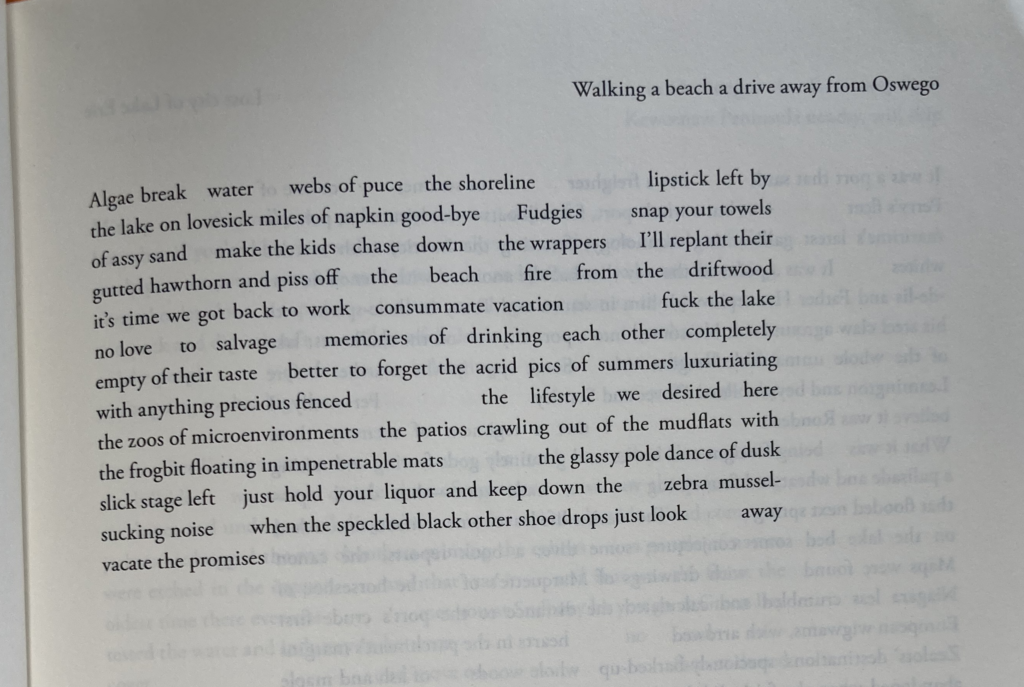
I’ve also typed in the text without the proper spacing, which is too fiddly to do on wordpress:
Walking a beach a drive away from Oswego
Algae break water webs of puce the shoreline lipstick left by
the lake on lovesick miles of napkin good-bye Fudgies snap your towels
of assy sand make the kids chase down the wrappers I’ll replant their
gutted hawthorn and piss off the beach fire from the driftwood
it’s time we got back to work consummate vacation fuck the lake
no love to salvage memories of drinking each other completely
empty of their taste better to forget the acrid pics of summers luxuriating
with anything precious fenced the lifestyle we desired here
the zoos of microenvironments the patios crawling out of the mudflats with
the frogbit floating in impenetrable mats the glass pole dance of dusk
slick stage left just hold your liquor and keep down the zebra mussel-
sucking noise when the speckled black other shoe drops just look away
vacate the promises
2
As I read this poem, and some others in the collection, I thought about something else Soliman said in their interview:
And as far as the writing and the editing, you know, I just am such a convoluted writer sometimes and like I feel like a really sometimes poetry from your writing is like a problem solving, you know, like, how do you just stack this house of cards up enough to sit and just back away before it falls down?
Just enough to not collapse. This idea reminds me of a game I play with myself: how much data/information do I need to “see” something? The version of this game that I play in the water is: how many times do I need to sight the orange or green buoys in order to stay on course? The answer: not many! I’d like to play this game on land, with words. How little can I write/say and still communicate how/what I’m seeing or feeling or experiencing? Beyond a game, as my vision continues to decline (the end point: no more central vision) and my ability to read decreases, I must rely on fewer words. I want my poetry to reflect that economy.
experiment: Take an existing poem that I’ve written and try to take as much out of as I can without it losing its meaning. I think I’ll start with a favorite poem that has never quite worked: Look pal, this isn’t the sea. A further thought: put the poem on my board, along with all of my thoughts, log entries, poems/lines from others about it. Gather as much information as possible, put it on the board, then condense it. Condense!
Poet’s work/ LORINE NIEDECKER
Grandfather
advised me:
Learn a trade
I learned
to sit at desk
and condense
No layoff
from this
condensery
What a master of condensery L Niedecker was!
2 — better to forget the acrid pics of summers luxuriating
with anything precious fenced
acrid pics — looked up acrid to double-check meaning: “strong, sharp, unpleasantly biting smell” and “bitter in language/feeling” — tried to remember, did polaroids smell? Yes, a distinctive warm, chemical smell. Is his use of acrid here a deliberate conjuring of polaroids? I grew up with polaroids, and using the word acrid offers a much more visceral reader response than just pics or pictures. And acrid as bitter — some regret over what happened/didn’t happen on those summer trips, over not being on vacation anymore?
anything precious fenced — here I’m thinking of Alice Oswald’s description of the sea as unfenced in Nobody: “If you want to imagine the colour of Odysseus’ gown you will have to swim out into the unfenced place, the place not of definitions but of affirmations. ” And, I’m thinking about lucille clifton’s “unfenced is” in “All Praises.”
I’m also thinking about Soliman’s own critical (as in, seemingly negative) use of the word “precious” in his interview:
I was just doing a lot of, like, site, I don’t know if the word would be site-specific writing, you know, just writing on the go, you know, like showing up and wanting to capture a place and not feeling too precious about capturing it because really being there was so, like, sublime, you know, it was just so amazing and seeing such, like, really beautiful hidden pockets of the Midwest and, you know, these, like, oceanic spaces, you know, where you wouldn’t think, you know, Michigan would offer that or something.
and
A lot of these poems are these justified text blocks with like, internal line breaks. And a lot of them started as lineated poems. Uh, and I just liked the ones that weren’t like that more because I felt like line breaks were too precious sometimes.
Just in poetry, not just mine, but sometimes I just kind of bristle at line breaks, you know? Um, they make, yeah, sometimes they make poems feel too precious. And I wanted this to have a bit more of a, like, robustness, you know? That they’re, they kind of just sit there on the page, you know, like a paragraph, you know?