feb 26/WALK

40 minutes
to the river and back
57 degrees

A warm, windy February afternoon. Took a walk with Delia the dog and Scott. Heard some kids on the playground that I mistook for a siren. Then later, heard some actual sirens. Also heard some ragtime music coming from a bike on the path. Marveled at the gnarled oaks and the jagged shadow one cast on another branchless tree. Noticed how high the bluff was above the forest floor. Encountered many happy, chatting walkers, one runner without a shirt.

It’s Windy

Is it the strange, too-early spring weather? The fact that I’m turning 50 in 4 months and that my kids are turning 21 and 18? Not sure, but my thoughts have been scattered lately, flitting from one idea to the next without landing anywhere for too long. Maybe it’s the wind. This morning I said to Scott, what a beautiful morning! Too bad it’s windy. Then Scott started singing “Windy” by the Association — I tried to join in, but I was in the wrong key (as usual). I should have a t-shirt that says, I’m always in the wrong key, I said (which, I think, isn’t always a bad thing to be in). Anyway, I decided to listen to the song and read the lyrics. It’s actually about wind! How delightful!

Who’s tripping down the streets of the city
Smilin’ at everybody she sees
Who’s reachin’ out to capture a moment
Everyone knows it’s Windy

And Windy has stormy eyes
That flash at the sound of lies
And Windy has wings to fly
Above the clouds (above the clouds)

I think I might create a page of wind poems/songs and add this, along with “They call the wind Mariah” from Paint Your Wagon and “I Take to the Wind” by King Crimson.

an idea (for the future? now?): Yesterday I posted a poem that uses an Emily Dickinson line in the title (I heard a fly buzz), then obliquely references her in the poem. A year or so ago, I had the idea that I’d like to write a series of poems that use some of my favorite Emily Dickinson lines as titles for my poems about vision loss, how I see, and how I’ve been carving out a new way of being with my moving practice. I’ve already written one that was published this past December in the print journal, Door is a Jar:

The Motions of the Dipping Birds/ Sara Lynne Puotinen

Because I can no longer see
her face, when my daughter talks I watch

her small hands rise and fall,
sweep the air, flutter.

I marvel at the soft feathers her fingers make
as they soar then circle then settle

on the perch of her hips waiting
to return to the sky for another story.

I think Victoria Chang’s collection, The Trees Witness Everything, in which she uses W.S. Merwin poem titles and then writes her own poem, might be a good inspiration. I’ve been wanting to do this project for several years, but I wasn’t quite ready. Am I now? I’ve already been moving towards it with my interest in memorizing 50 Emily Dickinson poems before my 50th birthday — did I mention that in here, or was it just in my “to do” list? Oh, I hope this idea sticks and helps me to write more poetry. Lately, I’ve had tons of ideas that I start, but that really don’t go anywhere.

As part of this Dickinson project, and inspired by yesterday’s poem, I decided to memorize ED’s “I heard a fly buzz — when I died”. After memorizing it, I listened to someone else’s reading of it and noticed a line change:

[original] The stillness in the Room
[alternate in video] The stillness round my form

Which is correct, I wondered. At first, I thought the alternate might be the correct one, but it didn’t seem quite right — form neatly rhymes with the last line of the verse: Between the Heaves of Storm. ED liked slant rhymes, not straight ones. I looked it up and discovered that ED’s first editor, Mabel Loomis Todd, had changed the line to form. She also took out ED’s dashes. I’ve read about the fraught relationship between ED and Todd (who was ED’s brother’s lover) and Todd’s heavy-handed editing, so I’m sticking with the original!

medical term fun!

I’m still working with g a s t r o c n e m i u s and s o l e u s scrabble tiles. Last night’s favorite:

Guess a minute’s colors

I told RJP and she said, 7:42 is yellowish-green. Do I see any particular minute’s colors? No. But I do like trying to describe what colors I see at any given minute.

What happens when I reverse 2 words: Guess a color’s minutes?
Or, Minutes colors a guess?
Or, As color, minutes guess
Or, minutes: a color’s guess (as in, meeting minutes)
Or, a guess colors minutes

Back to ED’s buzzing fly. Whenever I read this poem, I think about an article I discovered a few years ago that discusses how accurately and effectively ED describes the physiology of the dying eye — 15 march 2021

feb 25/RUN

5 miles
franklin loop
45 degrees

A regular run! It felt mostly fine, a few times strange. I told Scott that often when something is sore or stiff or hurts, it just feels strange to me. I need better words.

A few time my calf felt strange…but what does that mean? It felt like it was trying to talk to me, like it wasn’t used to moving, like it was complaining. During the run, once or twice, the smallest flare of something that wasn’t quite pain yet. After the run, tight, a little sore along the outside of my calf starting near the knee and moving down. Here’s some information that I might want to look at: Calf Muscle Tightness

While we ran, we talked about Scott’s latest work project involving wrangling a lot of data about water quality and temperature and more and turning it into a user-friendly widget. I talked about Courtney Dauwalter and listening to your body and pushing your limits and the memory palace. Near the end of the run, we encountered people protesting Israel’s invasion/war against Palestine on the bridge. I almost called out from the river to the sea! but didn’t — do I wish I had? yes, I think so. Saw some Palestinian flags and people with signs. A few minutes later, we heard a bullhorn from up on the bridge — were they marching to the capital?

earlier today

While reviewing the feb 25 entry from 2022, I came across a reference to the memory palace. I’d like to do something with this idea — an experiment, a poem, something else? Found a helpful discussion of it in a Paris Review article about Wordsworth:

The idea of the mind as a palace or church, whose individual rooms can be explored with training, is familiar from the memory treatises of antiquity and the Middle Ages. The “memory palace” as a mnemonic device was widely used before the advent of printing to organize and remember vast amounts of information. By memorizing the spatial layout of a building and assigning images or ideas to its various rooms, one could “walk” through the imaginary building and retrieve the ideas relegated to the separate parts.

The Celestial Memory Palace/ Aysegul Savas

I mentioned the memory palace in a feb 25, 2022 entry. In a feb 25, 2020 entry, I also wrote about place, the house:

I’d like to put this poem (A Skull) and the idea of the skull as a house beside the two other poems with houses that I posted on feb 22.

Two different, yet connected, versions of imagined place. Can I do something with these?

Here’s a delightful poem from a chapbook, Cheap Motels of my Youth, that I just got in the mail:

I Heard a Fly Buzz/ George Bilgere

I stumbled out in to the kitchen,
got the coffee maker started,
did the dishes from last night,
and then you came out in your robe,
wondering why I was up so early,
and I realized I’d misread the clock,
I’d actually gotten up at 7, not 8,
and suddenly I had a whole hour
bestowed upon me by the gods
who dole out our span to time.

And this was long ago, years ago, but
I still have that hour, I’ve guarded it
zealously, and when the time comes
and the darkness is closing in, and perhaps
I even hear a fly buzz—I’ll take out
that hour from the secret place
where I keep it, I’ll show it to all of you
gathered around my bedside
and I’ll cry out, Look! Another hour!

And that fly will pause in its
goddam buzzing, and all of you—
and that means you, Michael and Alex—
all of you will be forced to smile
and say, Really? That’s just awesome!

And I shall continue with my reminiscences.

I love this poem — the way it gently references Emily Dickinson, the delightful story it tells, his use of goddam in the second to last stanza, the calling out of his kids in the poem, how the first stanza is all one sentence, and that last bit about reminiscing as what he’d want to do with his bonus hour.

I like his use of goddam, and I wonder: how often do women poets use goddam? It seems like a swear word male poets would use. What are some good examples of women poets using goddam in their poems? I looked up “women poets goddam” and came across Nina Simone’s “Mississippi Goddam.” Listened to it — wow — and found this article for later: The long story behind Nina Simone’s protest song, “Mississippi Goddam” Kept scrolling in my search and found a link to a Book Notes series in which authors create a playlist for their books. Cool! What does this have to do with goddam? Nothing, but I love that I found this site, especially after creating a playlist for my windows month.

Okay, time to stop wandering. I think I’ll go study and memorize Emily Dickinson’s “I heard a Fly buzz — when I died”

Almost forgot: still playing around with the tiles for the two main muscles in the calf: gastrocnemius and soleus

Glass moon curse suite

feb 23/WALK

20 minute walk with Delia
neighborhood
33 degrees

A short walk through the neighborhood with Delia the dog. My calf is feeling better. I think I’ll try running 1 or 2 miles tomorrow morning. Today, just a walk. Brrr. The thing I’d like to remember from the walk — other than the happy feeling of walking without fear of cramping — was the exclamation point on the sold sign in front of house 1 block south. Sold! Maybe I’ve missed it, but I don’t think sold signs usually have exclamation points. I love exclamation points! So did Emily Dickinson and Walt Whitman!

Searched through my archives and found a reference to exclamation points in a Diane Seuss sonnet:

how many exclamation points can I 
get away with in this life, who was it who said only two
or maybe seven, Bishop? Marianne Moore?

In that 27 march 2023 entry, I tried finding the reference — Bishop or Moore — but couldn’t. Still can’t.

Returning to Emily Dickinson, I think my favorite exclamation point poem by her is ‘Tis so much joy! ‘Tis so much joy! — especially these lines, which I like to chant on some runs:

Life is but Life! And Death, but Death!
Bliss is, but Bliss, and Breath but Breath!

While rereading the entry for feb 23, 2022, I re-discovered these poems by Rebecca Hazelton — 2 examples of ekphrastic poetry: The Husband’s Answers

feb 5/RUN

3.2 miles
locks and dam no. 1 and back
45 degrees

Ran in the afternoon. 45 degrees and no snow. Spotted one lone chunk of ice floating in the river. Very mild. I was overheated in my layers: black tights, black shorts, long-sleeved green shirt, orange sweatshirt. For a few minutes of the run I felt good, but for most of it I felt off. Some gastro thing, I think.

In my state of discomfort and distraction, did I happen to notice 10 things?

10 Things

  1. overheard, one woman walker to another: It’s been five years and a lot has changed
  2. kids yelling on the playground
  3. a flash of white car up ahead — were they driving the wrong way in the parking lot? No, the car I was seeing was on the road, on the other side of the ravine
  4. someone roller blading — not roller skiing
  5. the short dirt trail where folwell climbs up to the top of the bluff then back down again was all mud
  6. lots of bikers on the bike path
  7. lots of walkers down below on winchell
  8. (as mentioned above) the river was open except for one big chunk of ice
  9. playing chicken with a walker who was walking on my side until the last minute — were they playing chicken too or just oblivious?
  10. no grit on the path or shadows or honking geese or regulars

today’s peripheral: just a distraction

daydreams reveries distractions

When ideas float in our mind, without any reflection or regard of the understanding, it is that which the French call reverie; our langauge has scarce a name for it.

John Locke, cited in The Plentitude of Distraction

To make a prairie/ Emily Dickinson

To make a prairie it takes a clover and one bee,
One clover, and a bee.
And revery.
The revery alone will do,
If bees are few.

This short book takes a second look at distraction, extracting untold pleasures and insights from its alleged dangers, defending and celebrating the unfocused life for the small and great miracles it can deliver.

The Plentitude of Distraction/ Marina can Zuylen

Reverie in Open Air/ Rita Dove

I acknowledge my status as a stranger:
Inappropriate clothes, odd habits
Out of sync with wasp and wren.
I admit I don’t know how
To sit still or move without purpose.
I prefer books to moonlight, statuary to trees.

But this lawn has been leveled for looking,
So I kick off my sandals and walk its cool green.
Who claims we’re mere muscle and fluids?
My feet are the primitives here.
As for the rest—ah, the air now
Is a tonic of absence, bearing nothing
But news of a breeze.

jan 20/RUN

4.35 miles
minnehaha falls and back
5 degrees

Back outside! Cold, but much warmer than Tuesday. Low (ish) wind, plenty of sunshine, clear paths. I felt a little tired and sore, but still happy to be outside. Was planning to do my usual routine of running without music, then putting some in at my favorite spot by the falls, but I forgot my headphones. Oh well, if I had been listening to music I might not have heard a goose honking.

10 Things

  1. startled some birds in the brush on the path near the ramp that winds down to the falls bridge — some rustling noises, then a silver flash as the sun caught the feathers on one of the bird’s wings — it reminded me of Eamon Grennan’s line about a lark’s silver trail in Lark-luster or EDickinson’s silver seam in A Bird, came down the Walk
  2. the falls were hidden behind columns of ice
  3. a few people (3 or 4?) walking on the frozen creek, admiring the falls from up close
  4. falling water sound: tinkling, sprinkling, shimmering
  5. the creek was frozen over, with just a few open spots where the water flowed beneath it
  6. running past the stretch of woods near the ford bridge — all the leaves are gone, the small rise up to the bridge fully visible
  7. crunch crunch crunch as my feet struck the ground — not slippery or hard or too soft
  8. my shadow, sharp lines, solid, dark, lamp post shadow, softer, fuzzier
  9. the rhythm of a faster runner’s legs as they passed me — a steady lift lift lift — so graceful
  10. a lone geese honking — not seen, only heard

Somewhere near the Horace Cleveland overlook (near the double bridge), I thought about interiors and exteriors and how you can look in or out of windows and then outside as the abstract/thinking/theorizing/writing and inside as the body. I want to remove the barrier between these, to mix writing with being/doing/moving as a body. Then lines from Maggie Smith’s “Threshold” popped into my head: You want a door you can be on both sides of at once. You want to be on both sides of here and there now and then…Yes, I do.

added 21 jan 2024: Reading through a past entry this morning I suddenly remembered the black capped chickadee calling out their fee bee song so loudly as I ran up the hill between locks and dam no. 1 and the double bridge. Wow! I recall thinking they were in beast mode (a reference to Michael Brecker and how some people describe his playing).

Jane Hirshfield’s Ten Windows, Chapter 6 (Close Reading: Windows)

Many good poems have a kind of window-moment in them–they change their direction of gaze in a way that suddenly opens a broadened landscape of meaning and feeling. Encountering such a moment, the reader breathes in some new infusion, as steeply perceptible as any physical window’s increase of light, scent, sound, or air. The gesture is one of lifting, unlatching, releasing; mind and attention swing open to new-peeled vistas.

windows offer an opening, a broadened landscape, fresh air, a lifting, unlatching, releasing, expansion, an escape or a way into somewhere else

In this chapter, Hirshfield does a close reading of ED’s “We Grow Accustomed to the Dark” — yes!

I have called the third stanza (And so of larger — Darkness –/Those Evenings of the Brain –) the poem’s first window, but for me, the true window in Dickinson’s poem is contained in one word; its quick, penultimate, slipped-in “almost.” (And Life steps almost straight). The effect is so disguised it feels more truly trap-door than window: On this close-to-weightless “almost,” the poem’s assurance stumbles, catches. Its two syllables carry the knowledge that there are events in our lives from which no recovery is possible.

I love Emily Dickinson’s almost in this poem. The space it gives — the possibilities — for living your life otherwise. It seems that Hirshfield reads this almost as unfortunate — you almost made it back to your normal life after the darkness, but not quite. I don’t. There’s so much room (and a lot less pressure) in the almost! So much to write about this idea, so little time right now.

In the chapter, Hirshfield references a “popular” Dickinson poem that I’ve never encountered before:

The Brain — is wider than the Sky — (1863) J632/ Emily Dickinson

The Brain — is wider than the Sky —
For — put them side by side —
The one the other will contain
With ease — and You — beside —

The Brain is deeper than the sea —
For — hold them — Blue to Blue —
The one the other will absorb —
As Sponges — Buckets — do —

The Brain is just the weight of God —
For — Heft them — Pound for Pound —
And they will differ — if they do —
As Syllable from Sound —

I’d like to put this into conversation with my mid-run ideas about the body and the mind — maybe add Mary Oliver’s ideas about the difference between a poem and the world from The Leaf and the Cloud too.

jan 16/RUN

4.25 miles
minnehaha falls and back
0 degrees / feels like -20

Brr. I really bundled up for this one, even busted out the big guns: toe and finger warmers. They worked!

layers: 2 pairs of black running tights, a green base layer shirt, pink jacket with hood, purple jacket zipped up to my chin, black fleece cap with ear flaps, pink and orange buff covering my mouth, 2 pairs of socks — gray, white — with toe warmers in between them, 1 pair of black gloves, 1 pair of pink/red/green mittens, hand warmers, sunglasses

My forehead felt a little cold at the beginning, but mostly I felt warm enough. My legs started to get sore near the end, which I think was because of the cold: not enough blood to my calf/thigh because it was going to my vital organs — I read that somewhere a few years ago.

10+ Things

  1. a regular! the runner, Santa Claus
  2. the river, frozen — light brown mixed with white, flat
  3. the feebee call of the black-capped chickadee
  4. a few squirrels, scampering
  5. running straight into the sun: my sharp shadow, so sharp I could see the shadow of my breath
  6. one biker — brrr
  7. brittle leaves, scratching on the pavement
  8. a sharp squeak, almost like a little bunny crying out: trees creaking in the wind
  9. the falls, near the ledge: half frozen, sounding like the spray hose on a kitchen sink
  10. the falls, by the overlook: gushing, rushing past the ice, flushing out the bottom
  11. beep beep beep of a truck backing up, sounding flat and smaller than usual
  12. the light rail across Hiawatha rushing by — I wondered how cold the commuters were
  13. almost forgot this one: the wind moving fast through dead leaves on some trees sounded like sizzling heat. I heard it just as the wind was blowing in my face and I felt particularly cold. I imagined it was so cold that it was hot

before my run

I’m in the slow process of reviewing my entries from 2023, a month at a time. Right now, April. On April 18th, I wrote about some ideas from writers/poets that were inspiring my thoughts about an eighth colorblind plate poem on the glitter effect. Paige Lewis and A.R. Ammons and flares and flames and rust. And now I’m thinking about writing one more colorblind plate poem that describes how my own color system works using texture and movement and contrast. It replaces ROYGBIV. Maybe I’ll try and think about it more as I run — when I’m not thinking about how cold I am!

a process note: Rereading all of my entries for the year and summarizing them takes a long time, but it’s worth it. Not only does it offer useful summaries, but going back and reencountering words/ideas/experiences offers new inspiration or old, half-finished projects (like the colorblind plates). And the laborious process of doing this structured task sometimes opens me up to wandering and remembering and imagining that can lead to new words and new ways in.

task: on my run, try to think about motion and texture

during my run

As predicted, I focused mostly on noticing the cold and the wind — such a cold wind in my face! I do remember thinking that the river was flat and stuck, with no sparkle or motion. I thought about contrast with the shadows. Leaves shaking in the wind. Oh — and I thought about how the small things I notice — the little flashes of movement, sound, texture — accumulate into something bigger. This is part of the conversation I started yesterday about flares versus slow burns and whether or not to dazzle. None of the things I notice Dazzle! in a quick burst, but together they add up to something special. After thinking of this idea, I remember Hannah Emerson’s poem, “Peripheral” and the lines:

Direct looking just is too
much killing of the moment.

Looking oblique littles
the moment into many

helpful moments.
Moment moment moment

moment keep in the moment.

after the run

And now, remembering all of these ideas, I’m suddenly thinking of Emily Dickinson’s poem, “Tell all the truth but tell it slant –”

The truth must dazzle gradually
Or every man be blind —

Yes, dazzle means to be temporarily blinded by light, or overpowered with light. What does this have to do with what I’m working on right now? Not sure.

And now, back to windows. Here’s a small poem I found the other day that I like. It’s part of a larger series of poems titled, Still Life:

Window/ Phillip Murray

Through the dark
Glassly
It is light
Falling

jan 13/BIKERUN

bike: 30 minutes
basement
run: 1.15 miles
outside: 7 degrees / feels like -10

A short run today because I’ve run every day this week so far, and because it’s windy and snowy and cold outside. Watched the first 20 minutes of Jennifer Lawrence’s comedy, No Hard Feelings, while I biked. I like her and I’m finding this movie funny so far. I listened to Taylor Swift’s Reputation while I ran. Tried out my new bright yellow shoes for the first time. I like how they feel and how they look. Quite possibly they will be the shoes I wear when I run the marathon next October. I don’t remember thinking about much as I ran — I focused on my arm swing and staying relaxed and lifting my hips. We turned the treadmill the other way a few months ago so now I won’t see my inverted moon on the dark window anymore. What strange image will replace it? I don’t remember any today. But I’ll have to look for one the next time I run on the treadmill, which will probably be on Monday; it might be arctic hellscape cold then.

Emily Dickinson’s Windows

Here are some useful ideas from an article — Emily Dickinson’s Windows — I found yesterday, which seems to be an extended version of an article I read a few days ago:

  • creative freedom
  • architectural prop: By my Window, The Angle of a Landscape
  • her envelope poems resembled a window with curtains
  • a magic lens — the warped quality of 19th century windows: the world let loose, nature liquefied — her practice of looking/writing — up and out the window/down at the paper — descriptions as incremental fragments (A Slash of Blue! A Sweep of Gray!)
  • the window grid creates a pattern — 12 panes — reflected in the formal structure of her poems (degrees, steps, notches, plunges) — each word, line, or stanza is well-defined slot/pane that spotlights an image/emotional state/quality of experience — ’Tis this – invites – appalls – endows – Flits – glimmers – proves – dissolves – Returns – suggests – convicts – enchants Then – flings in Paradise – (Fr 285)
  • an act of undoing in each pane — nature loosening up (a neat frame in a formless center)
  • each pane a diagram of rapture
  • looking through/touching the glass, she connected with the artisans who made it, who left evidence of their labor –warps and striations that were once the artisan’s breath (windows made through glass blowing? wow)
  • glass blowing and imagery of fiery furnaces, metal flames, boiling, white heat
  • mid 19th century — glass consciousness
  • ED’s poems as her own form of glass blowing — creative process of transforming words into poems = making sand into glass into windows

the window grid creates a pattern — 12 panes — reflected in the formal structure of her poems (degrees, steps, notches, plunges) — ’Tis this – invites – appalls – endows – Flits – glimmers – proves – dissolves – Returns – suggests – convicts – enchants Then – flings in Paradise – (Fr 285)

I love this idea of how the windows influenced the form of her writing. Also, the combination of the orderliness/structure of the frame and the unruliness/undoing-ness of her words. It might be fun to use my windows — 2 sets with 2 panes each, a bar in-between the windows, one set in front, one to my right side — as the structure for a few experiments. As I write this, I’m thinking about Victoria Chang’s truck moving across each window frame and Wendell Berry’s black criss-crossed frame.

Here’s a wonderful ED poem that is mentioned in the article:

By my Window have I for Scenery (797) / Emily Dickinson

By my Window have I for Scenery
Just a Sea—with a Stem—
If the Bird and the Farmer—deem it a “Pine”—
The Opinion will serve—for them—

It has no Port, nor a “Line”—but the Jays—
That split their route to the Sky—
Or a Squirrel, whose giddy Peninsula
May be easier reached—this way—

For Inlands—the Earth is the under side—
And the upper side—is the Sun—
And its Commerce—if Commerce it have—
Of Spice—I infer from the Odors borne—

Of its Voice—to affirm—when the Wind is within—
Can the Dumb—define the Divine?
The Definition of Melody—is—
That Definition is none—

It—suggests to our Faith—
They—suggest to our Sight—
When the latter—is put away
I shall meet with Conviction I somewhere met
That Immortality—

Was the Pine at my Window a “Fellow
Of the Royal” Infinity?
Apprehensions—are God’s introductions—
To be hallowed—accordingly—

The pine tree as a sea with a stem? I love this idea!

jan 12/BIKERUN

bike: 10 minute warm-up
basement
run: 3.5 miles
river road, south/north
9 degrees / feels like -5
wind: 13 mph/ 24 mph gusts

Sometimes running when it’s this cold isn’t that difficult, especially when there’s sun and no wind. Today there was no sun* and plenty of wind and it was hard. Not all of the time, but often.

But who cares when the river looks like it does today?! Half covered in ice, mostly gray and brown, open and vast.

And who wouldn’t want to be out here when the geese are flying overhead, their honks swirling around all of us below, sounding mournful and harsh and wild?

And who isn’t grateful to have an almost empty trail — no thoughts or distractions, only a few other people, and most of them below on the lower path?

*I guess there was some sun, but it was hidden behind the clouds. The only time I noticed it was when I was running north up a hill straight into the wind — I saw the faintest trace of my shadow. Hello friend! If I wasn’t paying attention or if I hadn’t trusted what I saw, I might not have noticed her.

Listened to the cold as I ran south — what does the cold sound like? jagged breaths, sharp sounds suspended, silence. Listened to my Window playlist running back north.

Windows can certainly change lives in all sorts of ways. “Faith goes out through the window when beauty comes in at the door,” quips the English philosopher George Edward Moore. “Well,” says Julie Andrews, not yet breaking into song, but you never know, as she gazes out onto those hills alive with something, “when one door closes, another window opens.” She’s opened us onto the window of film, so how best to set the scene? “An actor entering through the door, you’ve got nothing. But if he enters through the window, you’ve got a situation.” says Billy Wilder.

Pleasure and Pane: songs about windows

This article offered a lot of great suggestions for window songs to add to my playlist, which is now over an hour.

window playlist

  1. Window/Fiona Apple
  2. Window/Genesis
  3. Smokin’ Out the Window/Silk Sonic
  4. Keep Passing the Open Window/Queen
  5. Lookin’ Through the Windows/Jackson 5
  6. I Threw a Brick Through a Window/U2
  7. When I’m Cleaning Windows/George Formby
  8. Skyscraper/Demi Lovato
  9. At My Window Say and Lonely/Billy Bragg & Wilco
  10. My Own Worst Enemy/Lit
  11. Junk/Paul McCartney
  12. In a Glass House/Gentle Giant
  13. Belly Button Window/Jimmy Hendrix
  14. Look Through Any Window/The Hollies
  15. The Rain (Supa Dupa Fly)/Missy Elliott
  16. One Way Out/Sonny Boy Williams
  17. Silhouettes/The Rays
  18. The Glass/Foo Fighters
  19. Tip Toe Thru’ the Tulips/Annette Hanshaw
  20. Waving Through a Window/Dear Evan Hanson
  21. Open a New Window/Mame
  22. Open Your Window/Ella Fitzgerald
  23. Fly Through My Window/Pete Seeger

Today I put the playlist on shuffle and heard: 3, 5, 10, 16, 2, 9

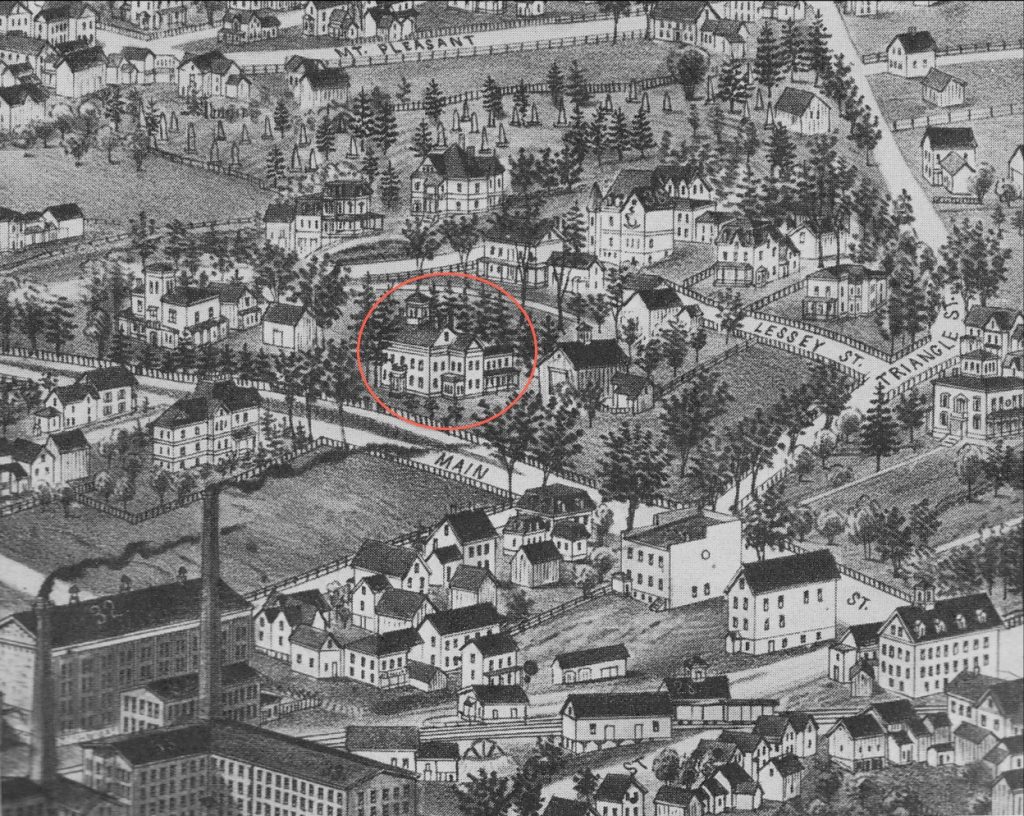
an hour later: Not for the first time, I’m starting to read an article about Emily Dickinson’s windows. It’s really good, but dense, so I’ve always put it off. Will I get through it today? Maybe. Anyway, I started reading it, and encountered a map of Amherst with a note: The Dickinson house is circled in red.

an old black and white image (lithograph?) of Amherst, with Emily Dickinson's house circled in red. The only way I'm able to see the circle is if I put the computer screen up to my face and look at it through my peripheral vision.
Amherst, 1886

Can you easily see the red circle? I can’t. The only way I am able to see it is if I put my face up right against the screen and look at it through the side of my eye. Only then do I see a trace of red — the idea of red. Once I see (or feel?) the red, I can see a faint circle and I can tell that it’s red, but it’s not RED! but red?

The other day, Scott, FWA, and I were discussing the scenes in Better Call Saul that are set in the present day and are in black and white. Scott and FWA both agreed that those were harder to watch — they had to pay more careful attention — because they lacked color, which is harder because visual stories often rely heavily on color to communicate ideas/details. I said I didn’t realize that they were in black and white; they didn’t look any different to me than the other scenes, which are in vivid color (at least that’s what they tell me). I realized something: it’s not that I don’t see color, it just doesn’t communicate anything to me, or if it communicates it’s so quiet that I don’t notice what it’s saying.

Back to the image with the red circle. The main point of the image is to enable you to quickly and easily see where the Dickinson home is located in the town. If I hadn’t read the text below it, I never would have known there was a circle, and the main point of the image would be lost on me. This happens a lot. Things that are obvious to most people, aren’t to me. More than that, they don’t exist. Of course it’s very frustrating and difficult, but it’s also fascinating to recognize this, and helpful to understand it.

jan 10/RUN

4.85 miles
minnehaha falls and back
23 degrees / feels like 16

Yes! A much better run than yesterday. My legs were sore at the beginning, but the path was clear and I had enough layers to keep warm. As I ran south, I noticed the river was gray — pewter, I think — or was it steel?

Heading towards the falls, I listened to the kids laughing on the playground, the rushing water at the falls, and the ding ding dinging of the light rail bells leaving the station. Heading home, I listened to a playlist (10K 2018). First song: Vampire Weekend’s “Step.” Memorable line: they don’t know how to dress for the weather

10 Things

  1. smoke coming from the house on edmund that always smells like smoke in the winter
  2. a woodpecker’s laugh
  3. pewter river
  4. city workers across the road near becketwood — what were they doing?
  5. the big dip on the edge of the biking path, almost to Godfrey, has finally been patched
  6. a man — not driving an official truck or wearing an official uniform — emptying the cash out of parking meter kiosk near the old Minnehaha depot
  7. traffic rushing by on hiawatha
  8. the creek was dark and open, no ice, just a little foam
  9. 2 humans and a small dog, walking across the grass near the falls
  10. a fast running speeding by me as I stood at my favorite falls spot and put in my headphones

the windows I encounter while running outside:

  • familiar houses, on the route I take almost every day — does a neighbor notice me (like I notice the runners and walkers that pass by my window) and think, there goes that woman running again, or maybe they mark their day with my run: she ran past, time for another cup of coffee
  • car windows — I can’t ever see in these windows — I never visualize people, just imagine what they might be thinking: I wish I was out there running or Why would anyone run in this weather?
  • John Steven’s house windows — are they boarded up from the fires last year?
  • Minnehaha Depot windows
  • Light rail windows — could anyone on the train see me from that far away

question: Do windows have to have glass to be windows? Is an empty frame enough?
answer: Yes? one def: an opening especially in the wall of a building for admission of light and air that is usually closed by casements or sashes containing transparent material (such as glass) and capable of being opened and shut

The other day I wrote in my Plague Notebook, Vol 18: post-pandemic window poems? And here’s something great that’s not a poem. I found it on my reading list in the 21st spot.

The window as isolation, shelter, protection, connection to the outside world, hope, longing. So many wonderful things happening in this story (essay?)! Instead of just posting it, I want to comment on each window.

APRIL 2020, FROM MY WINDOWS/ Kleopatra Olympiou

Second floor window, across:
A man who plays the piano at all times of the day, his keyboard by the window. I see the staccato movement of his fingers but hear no sound. His expression is thoughtful and I can’t say if the notes are right, if he’s pleased, or what he’s feeling. Sometimes he plays in his underwear and I avert my gaze. He could see me if he looks up, but never does – it’s dusk and I have the lights on. When he turns his own light off and leaves the room, I catch a reflection of myself doing the dishes in the mirror at the back of his bedroom.

details that strike me: no sound — why not? too cold (or hot) to have the window open? he has headphones on? my choice: her apartment is sealed up tight — isolation; the piano player’s expression is unreadable or empty; the narrator averts her eyes; the narrator has her lights on, is on display, but he never looks; that reflection of herself in his mirror — wow

Window next door, a wall away from the pianist:
Sometimes, a woman looking bored on her laptop. Most of the time the curtain is drawn, and in the darkness all I can see is the yellow that leaks out. This window doesn’t want to be looked at, so I leave it alone.

the yellow that leaks out; the way the narrator respects the bored looking woman’s privacy; again, no sound

Next door, downstairs:
A living room I often catch in the cool half-light of the TV screen, watching the rippled colour move like the walls of an aquarium. Submerged and elsewhere. On the half-obscured sofa to the right I glimpse a hand slowly stroking a bare calf.

submerged and elsewhere; the stroking hand/stroked calf; limited vision: the cool half-light, half-obscured sofa, disembodied hand and calf

To the left, first floor:
A guy in his twenties, probably, laughing into a video call, or he’s taking a selfie, or updating his Instagram story, I can’t be sure since he quickly lowers his arm and loses the grin. For a long time he types on his phone.

no sound, no clear understanding of what’s happening

In the street in front:
The pavement is partly overgrown with weeds, and in the morning I watch a father and young son diligently clear them away. Through the glass I can’t hear what they’re saying. The boy gesticulates energetically from somewhere within the depths of a coat, hat, gloves, wellies. His dad laughs, and with thick gardening gloves brushes the rough shavings of soil out of the way. The boy is serious when he nods his approval – this is no game, but real community service.

an acknowledgment of the lack of sound: through the glass I can’t hear, people outside — only one window (narrator’s) between them

Further left, in a garden:
A middle-aged man waters some flowers while a woman refills a birdfeeder with seeds. Soon they go back indoors and I can see nothing but the glaze of the white sky on their window.

women outside (one window), visible, women go back inside (two windows — the women’s the narrator’s), hidden by the reflection of sky in a window

From my living room window:
Three veterinary nurses in green uniforms walking dogs on the grass by the graveyard. They play fetch and the dogs fire off into the trees – soon they all go, and will return tomorrow, and the day after.

even if the window tightly shut, can’t you hear the dogs barking? dogs are LOUD.

From the same window, later in the afternoon:
A woman and a little girl stand in front of a fresh grave, neat and lined with wood. Some days ago I watched a man from the church shovel grass and dirt away, and another day five figures gathered while a priest read mutely from an open book. The priest and his book went away to the church (chimney smoking) and, among the guests, I stood silent at my window, part of the ceremony. Today only the woman and the girl visit the grave, holding hands.

the narrator was part of the ceremony

It is dusk again at the living room window:
A magpie stops on one of the bony branches across, later a crow, a pigeon, a robin. In the distance I see the white bobbing of rabbits running among the tombstones.

Birds! a tree branch, a bobbing rabbit (nice work, resisting the impulse to write, bobbing bunnies

Then there is me, quarantined and at my nightly window, weaving my hair into a braid:
I listen to the creaks in the kitchen and Google my building, searching for estate agent photos of the other apartments, trying to piece together a virtual whole. I imagine a flat identical to mine next door, inverted – maybe the silent neighbours I’ve never spoken to are also at their windows, looking out. Maybe the pianist can see us, our kitchens a wall apart, divided. In my living room the curtains are never drawn. At night I sit illuminated and hope, for something.

sound — a creaking kitchen, silent neighbors

And, one more window thing. I’m slowly reading through Wendell Berry’s Window poems. Here’s 15. So good!

15. / Wendell Berry

The sycamore gathers
out of the sky, white
in the glance that looks up to it
through the black crisscross
of the window. But it is not a glance
that it offers itself to.
It is no lightning stroke
caught in the eye. It stays,
an old holding in place.
And its white is not so pure
as a glance would have it,
but emerges partially,
the tree’s renewal of itself,
among the mottled browns
and olives of the old bark.
Its dazzling comes into the sun
a little at a time
as though a god in it
is slowly revealing himself.
How often the man of the window
has studied its motley trunk,
the out-starting of its branches,
its smooth crotches,
its revelations of whiteness,
hoping to see beyond his glances,
the distorting geometry
of preconception and habit,
to know it beyond words.
All he has learned of it
does not add up to it.
There is a bird who nests in it
in the summer and seems to sing of it–
the quick light among its leaves
–better than he can.
It is not by his imagining
its whiteness comes.
The world is greater than its words.
To speak of it the mind must bend.

some thoughts:

WB’s glance can’t capture what the sycamore is

love this:
lightning stroke caught in the eye as description of seeing

the tree emerges at a different pace — not fast/immediate/NOW! that we expect with our glances
emerges partially — dazzle coming into the sun a little at a time

the man of the window

beyond his glances
the distorting geometry of preconception and habit?
beyond words
more than what he has learned/seen/understands
the bird here reminds me of A.R. Ammons and his discussion of language in garbage — see april 10, 2023

mind must bend? be at a slant (Emily Dickinson)?

dec 31/BIKE

bike: 30 minutes
basement

Sometime last night, my left leg/knee started to hurt, then it snowed and left slippery sidewalks, so today I decided to be cautious and bike. Watched a replay of the Kona Ironman from 2017 while I biked. At one point, they interviewed 6 (or 5?) time Ironman winner Natasha Badmann. I remember her! She had an amazing perspective on one of the toughest parts of the course: the energy lab. She saw it as giving her energy, not taking it away — the energy of inspiration from the powerful waves off in the distance. Wow, to be that present when you’re 6 or 7 hours into a tough race is impressive. As I biked, I thought about athletes and the different ways they try to overcome the strong desire to stop, give up. I find Badmann’s approach to be a helpful lesson in letting go — not trying to control your thoughts or getting rid of your pain, but releasing them and shifting to another way of being — a way in which you’re not centered, but witnessing something beside yourself. Does that make sense?

Before biking, I had a good morning filled with ideas: 1. creating a series of short poems in which I use my favorite lines from other poets by fitting them into my running/rhythmic breathing form: 3/2 and 2. using my 3/2 form and writing poems that are one sentence long.

I also watched an amazing talk by Ed Hirsch on poetry, the poem, and the reader:

I wish there was a transcript. If there is, I can’t find it, so here are some of my highlights:

Poetry exists to inspire the reader not to inspire the writer, that the purpose of poetry is in the relationship between a poet, a poem, and a reader. And it’s in that connection between them.

Talking about his teacher at Grinnell told him:

You have the gifts to be a poet, but what you’re writing is not poetry. It’s not even close to poetry. What you’re writing down are your thoughts and your feelings but you’re not trying to craft anything, you’re not trying to make anything. You’re not writing in relationship to any other poetry. You’re not reading poetry and so you’re not really a poet right now. You are a person who writes poetry. You have to read poetry and connect your poems to what you’re reading.

He discusses reading Gerard Manley Hopkins and feeling a profound connection. It spoke deeply to him and he wanted to know/study how Hopkins could achieve this.

Holy shit, this thing’s a sonnet? You mean, he’s not just writing out his poems the way I write out mine? He’s actually making it rhyme and everything? That seems generous to me. I want to do that. I’m going to try and make something for someone in the future so that they can feel about my poem the way I feel about Gerard Manley Hopkins’ poem.

Then he talks about how Hopkins’ poem was so distanced from him by time, location, experience, yet it spoke to him more than anything else he had heard. He realized that poetry can communicate more deeply than social conversation.

Celan: a poem is a message in a bottle, not guaranteed to reach anyone; a poem is sent out to some future person

Poets are people who, not so much want to express themselves, but feel so encountered by other poems that they want to respond in kind. That’s why Emily Dickinson calls the poets she reads, “her kinsmen of the shelf.”

The reader plays an important role in the understanding of poetry. The message in the bottle only finds its life when it’s activated in you. When you become the secret addresse.

There are a few poems you read and you go, I feel almost like I’ve written the poem to which I’m actually only responding to.

poetry: the gift of privacy and participation: It gives you interiority and it also gives you connection.

Poetry as stored magic that can’t be paraphrased

Poetry exists in the relationship between the poet who wrote it, the poem which encapsulates the experience, and the reader who reads it.

His discussion here reminds me of an interview I read and posted at some point in the last few years:

We are not diminished but enlarged by grief, by our refusal to vanish, or to let others vanish, without leaving a verbal record. We need poetry to help us transform the oceanic depths of feeling into art. Poetry rises out of one solitude to meet another in recognition and connection. It companions us.

And, yes, poetry is connected to contemporary life, but it’s also always connected to other poetry. We need an archive of eloquence and response.

Interview with Edward Hirsch

oct 23/RUN

3.65 miles
turkey hollow
52 degrees

It felt good and necessary to run this morning. Yesterday I spent a lot of time on the couch reading and watching (or, more like listening to) my son play Earthbound, an old video game that Scott used to play when he was kid. Also watched a few episodes of FWA’s new (to him, but around for years) favorite anime, One Piece. I wish I could see it better with my bad eyes, because I was enjoying it. Anyway, I spent so much time sitting that my resting heart rate was at 45. I needed some exercise this morning.

added a minute later: Reading back through this entry and thinking about my need to run, I feel compelled to add that haunting this run (and also making it necessary) are what I read over coffee early this morning: horrifying headlines about the atrocities being committed against Palestinians in Gaza and the failure of the US government in not only refusing to condemn them but condoning them in their uncritical support of the Israel government. Heartbreaking.

For most of the run, I was rerouted by obstacles: city workers trimming trees — turn right, here! — trucks sweeping the streets — now left — a parks’ vehicle clearing off leaves on the path — better stay in the grass! — a few more parks’ trucks patching the path — time to cross back over to the road! — a young kid with an adult — no narrow Winchell Trail for me today. A meandering run.

I could make a list of things I noticed — shrieking squirrels, squeaking leaves, wet and sloppy mud, yellow and red and orange leaves, beeping trucks — but the thing I’d like to remember most is the circle of bright, burning light through the gap in the trees as I ran down the small hill just past the double bridge: the sun reflecting off the rough surface of the river. Wow! No color, just pure shine, burning bright through the trees.

Rust

Before I went out for a run, I began to gather words about rust and planned to think about rust as I moved. Maybe it was the distraction of all of the detours or my sore legs or the joy of being outside, but I forgot. Here are the words I gathered:

1 – from Leaves/ Lloyd Schwartz

You’ll be driving along depressed when suddenly
a cloud will move and the sun will muscle through
and ignite the hills. It may not last. Probably
won’t last. But for a moment the whole world
comes to. Wakes up. Proves it lives. It lives—
red, yellow, orange, brown, russet, ocher, vermilion,
gold. Flame and rust. Flame and rust, the permutations
of burning.

2 — from 8 august 2023

Listening to the line in Taylor Swift’s “Bad Blood”: 

Did you have to do this?
I was thinking that you could be trusted
Did you have to ruin what was shiny?
Now it’s all rusted

and thinking about shiny vs. rusted, and rust in the fall, then I noticed some rust on one of the big metal tubes all around the neighborhood that the city is using for their sewer work — Scott says these tubes get placed vertically in the ground and the workers stand in them as they do their work.

3 — from 18 april 2023

I’m very interested in rust as a color too. I last mentioned in on March 13, 2023 with Schuyler and ED’s “elemental Rust.” I’m thinking of it less as a color-as-noun (like brownish reddish orange), more as color-as-verb and in relation to erosion, decomposing, crumbling — this is where it connects with texture. Does this make any sense, even to me? Not sure, but it seems helpful to think of rust in relation to shiny. Are they in contrast to each other? Only if you imagine shiny and sparkling as new, which isn’t always the case.

4 — Crumbling is not an instant’s Act (1010)/ EMILY DICKINSON

Crumbling is not an instant’s Act
A fundamental pause
Dilapidation’s processes
Are organized Decays —

‘Tis first a Cobweb on the Soul
A Cuticle of Dust
A Borer in the Axis
An Elemental Rust —

Ruin is formal — Devil’s work
Consecutive and slow —
Fail in an instant, no man did
Slipping — is Crashe’s law —

5 — from 11 march 2023

The sky
Colors itself rosily behind gray-black and the rain falls through
The basketball hoop on a garage, streaking its backboard with further
Trails of rust, a lovely color to set with periwinkle violet-blue.

A rosy sky behind gray-black clouds? Not pure reddish-pink or pinkish-red but the hint of it behind something darker. The rust — did I see rust anywhere on my run? I don’t think so.

6 — from 8 march 2023

Before heading out for my run, I had started revising my “How to Sink” poem. Thought I might get some inspiration by the gorge. Later, as I ran, I realized that I should wait to finish this poem when it’s spring, or at least warmer, when everything is dripping and oozing and flowing down to the river. I thought of this as the sharp flurried stabbed my face. Was thinking that I should do a “How to” poem related to water through the seasons. 

Summer = How to Float

Spring = How to Sink

Winter = How to Settle? — something about snow that’s packed, layer, staying (not melting), compacting — How to be compact? or, How to Shrink?

Fall = I need to think about this one some more. What does water do in the fall? Maybe something related to decomposing — leaves falling, drying up, becoming brittle? water leaving — freezing — frost? fog? or, How to Rust?

7 — from 20 january 2023

Noticed all of the rusty orange leaves still on the trees near the tunnel of trees. 

8 — from 13 november 2022

rusty brownish red stain on the lake st bridge

9 — from Perennials/ Maggie Smith

You can hear 
the sound of wind, which isn’t
wind at all, but leaves touching. 
Wind itself can’t speak. It needs another
to chime against, knock around.
Again & again the wind finds its tongue,
but its tongue lives outside
of its rusted mouth.

9 — from 22 october 2021

As I was running through minnehaha regional park, I thought about the things that have stayed the same, the things that have changed, and what seems to still be present as living and vital, and what only remains in decay, or in the faintest traces of what it had been. I was thinking about this as I ran by the playground, which was redone five or so years ago, but still has some old equipment, like the creaky, rusty swings. Something about that reminded me of a few lines from Poe’s “The Bells,” especially the bit about the rust.

Hear the tolling of the bells—
                 Iron bells!
What a world of solemn thought their monody compels!
        In the silence of the night,
        How we shiver with affright
  At the melancholy menace of their tone!
        For every sound that floats
        From the rust within their throats
                 Is a groan.

10 — from 28 october 2021

Reading through Poe’s “The Bells” again, I’m thinking about how the bells in this verse are not clock bells, tracking the precise, steady passing of time (which reminds me of the lines about the blind, dumb clocks and no time for the martyr). These bells toll, groan, moan, roll, throb, sob, knell. The sound of the bells floats from rusty throats, is muffled, melancholy. When it is mentioned that they keep time, it is not the time of life, but of death.

sept 24/RUN

5.5 miles
marshall loop to Fry
62 degrees
humidity: 90% / dew point: 61


Cool, sticky, thick air. Lots of sweating. For our weekly Marshall loop. Scott and I ran several more blocks (past Cretin, Cleveland, Prior, and Fairview) to Fry, then over to Summit and back down to the river. We heard the bells at St. Thomas chiming 2 or 3 different times — or more? Scott talked about the Peter Gabriel tour video he watched last night. What did I talk about? I can’t remember. Oh — at one point, I pointed out the light passing through a tree above Shadow Falls, making it glow. The beauty of September light! I also talked about Glück’s line about the light being over-rehearsed and how the bushes and flowers and trees looked worn, past their prime, over-rehearsed.

10 Things

  1. a line of dead leaves floating on the surface of the river, almost under the lake street bridge
  2. slippery, squeaky leaves covering the sidewalks
  3. between fairview and fry the sidewalk narrowed — Scott guessed that it might be as narrow as 4 ft (it’s supposed to be 6, but is often 5)
  4. drops of water falling off some leaves, illuminated by the sun
  5. ORANGE! several bright orange and burnt orange trees
  6. lions, pineapples, bare-chested women with wings — lawn ornament on Summit
  7. waffles, falafel, “mixed” popcorn, Thai, ice cream — restaurants/stores passed on the run
  8. overheard: it’s hard to tell how well the Vikings will do — a biker to 2 other bikers
  9. looking across from the east side to the west bank of the river, thinking I was seeing some sort of color — not BRIGHT color, but the idea of it: red instead of RED! Asked Scott and he said, Wow, that’s some RED! [how color works for me]
  10. 3 roller skiers on the bridge — no clicking and clacking because there wasn’t room for them to swing their poles

One of my favorite local poetry people (and one of my former teachers) posted this mushroom poem by Emily Dickinson. A nice contrast to another one of my favorite mushroom poems by Sylvia Plath:

The Mushroom is the Elf of Plants — (1350)/ Emily Dickinson

The Mushroom is the Elf of Plants –
At Evening, it is not
At Morning, in a Truffled Hut
It stop opon a Spot

As if it tarried always
And yet it’s whole Career
Is shorter than a Snake’s Delay –
And fleeter than a Tare –

’Tis Vegetation’s Juggler –
The Germ of Alibi –
Doth like a Bubble antedate
And like a Bubble, hie –

I feel as if the Grass was pleased
To have it intermit –
This surreptitious Scion
Of Summer’s circumspect.

Had Nature any supple Face
Or could she one contemn –
Had Nature an Apostate –
That Mushroom – it is Him!

Tarry is to delay or be tardy.
The tare is the weight of a container when it’s empty.
A scion is a young shoot or twig of a plant, especially one cut for grafting or rooting OR a descendent of a notable family.

Favorite lines today:

The Mushroom is the Elf of Plants –
At Evening, it is not
At Morning, in a Truffled Hut
It stop opon a Spot

As if it tarried always
And yet it’s whole Career
Is shorter than a Snake’s Delay –
And fleeter than a Tare –

So good!

sept 14/SWIM!

1.5 loops
lake nokomis main beach
79 degrees
windy choppy

So glad I wore my wetsuit! Also glad that I’m an excellent swimmer who doesn’t panic easily. That was a tough swim. And that was some rough water. Normally in an open swim, even one where I’ve picked up the pace or am swimming for more than an hour, my heart rate stays between 120 and 130. In today’s swim, my heart rate was 158. Wow.

10 Things

  1. seagulls, part 1: more than a dozen, floating in the water
  2. seagulls, part 2: flying furiously, stirred up by a little kid chasing them from shore
  3. before my swim: an almost empty beach, the sand had been tamped down by a park vehicle’s wheels
  4. after my swim: 3 sunbathers and one guy in jammers (men’s swim shorts that look like bike shorts) about to swim
  5. whitecaps
  6. swam over a few ghost vines reaching up from the bottom
  7. the giant swans are still in the water, tethered together by a dock
  8. only one sailboat with a white sail out in the water
  9. cloudy, murky water, impossible to even see my hand in front of me below the surface
  10. before the swim: a motorcycle pulling into the parking lot, blasting “Love Shack” — you’re what? tin roof … rusted

an unexpected ramble about libraries and unfamiliar places and my vision struggles

Picked up my first physical (non ebook) at the library yesterday. Last time I’ve been inside the library was sometime in early 2020, before the pandemic, and before the library suffered heavy fire damage during the George Floyd uprising, when white supremacists tried to burn it down.

There are lots of reasons I haven’t made it back to the library since then — I mostly read ebooks which you check out online because the light from the screen is always bright enough for me, while I often have to read physical books outside in direct sun to see the words. During and after the pandemic, I’ve been less willing to go into public spaces. I can’t drive anymore and the library is too close for a bus, but too far for an easy/quick walk.

Maybe the biggest reason: I’ve been scared. Walking into a building, I can’t read the signs that tell me where to go or notify me of something, like a new policy. What if I can’t find where to go? What if they’ve changed how to pick up holds, where to check them out? Of course, I could ask and I have been willing to do so, but it’s hard. Even if I ask, first I have to endure that moment of unknowing and confusion, when I enter a building and can’t see people’s faces, read signs, orient myself quickly.* This is Emily Dickinson’s moment in “We Grow Accustomed to the Dark” — A Moment — We uncertain step/For newness of the night –. Also, even though I’ve been working on it, it’s still hard to ask for help — to take the time, to bother someone, to not know how to do something. I’m hoping asking will get easier and I’ll care less and less about having to do it. For now, I have a different solution: Scott (or my kids or a friend) can come with me to a new place the first time, to help with any confusion I might have. Once I know how it works, I can come back on my own.

* To add to this: it’s not just that I’m uncertain, confused. Sometimes, my brain makes very bad guesses — often the exact opposite of what is actually there — and I overconfidently act on them. The more wrong I am, the more likely I am to boldly act. This is embarrassing — I look stupid or sound crazy/ridiculous, but it is also dangerous. Scott has witnessed this enough times to verify my assessment. I believe this is related to my failing vision, but I don’t know how. So strange and frustrating because I don’t seem to have any control over it, and I like to have control.

Gary Snyder’s Riprap

The book I had requested and picked up is one I’ve wanted to read for several years now: Gary Snyder’s Riprap and Cold Mountain Poems. I read/skimmed through it yesterday afternoon, and there are several poems that I’d like to read closely and study. I think they might help me with my series of Haunts poems. I like his sparse, matter-of-fact approach. I also like his love for walking/hiking. I think that I’ll devote the second half of September to his work! I just requested a few more books from the library.

Here’s a poem I’d like to start with:

Above Pate Valley/ Gary Snyder

We finished clearing the last
Section of trail by noon,
High on the ridge-side
Two thousand feet above the creek
Reached the pass, went on
Beyond the white pine groves,
Granite shoulders, to a small
Green meadow watered by the snow,
Edged with Aspen—sun
Straight high and blazing
But the air was cool.
Ate a cold fried trout in the
Trembling shadows. I spied
A glitter, and found a flake
black volcanic glass—obsidian—
By a flower. Hands and knees
Pushing the Bear grass, thousands
Of arrowhead leavings over a
Hundred yards. Not one good
Head, just razor flakes
On a hill snowed all but summer deer,
They came to camp. On their
Own trails. I followed my own
Trail here. Picked up the cold-drill,
Pick, singlejack, and sack
Of dynamite
Ten thousand years.

I want to spend more time with this. After the 3rd or 4th reading: love the line breaks and how they keep it moving. Also how some of the lines have new meaning when read alone:

Edged with Aspen–sun
Hundred yards. Not one good

august 24/RUNSWIM

run: 5K
2 trails
72 degrees
dew point: 68

Cooler this morning than yesterday, but that dew point. Ugh! It felt good to run again after taking a short break. My last run was this past Saturday. I started at 7:30. I Listened to the gorge for 2 miles of the run, the put in headphones and started with Swift’s 1989, ended with The Wiz.

Another white-sky morning. I suppose the lack of sun made it feel a little coole, but it also made it feel gloomier.

Quiet. The river road was crowded with cars, their wheels whispering.

I ran on the dirt path between edmund and the river road. Heard some runners chatting across the road. After a few minutes, their voices drifted away behind me.

I don’t remember hearing any birds or acorns dropping, but I do remember the trickling of water through the sewer pipe near 42nd and the buzzy roar of a parks’ riding lawn mower above me as I ran below on the Winchell Trail.

I briefly glanced down at the river and thought: steamy, stagnant.

Haze in the air, hovering. Thoughts about my dying father-in-law hovering too. We went to visit him yesterday afternoon and he was asleep in a hospital bed in his bedroom. Quiet, dark, the only sounds the steady pulse of his oxygen and CPAP machines and Scott gently trying to wake him — Dad Dad Dad Dad. He had slept all day. This is it; we’ve entered the final stage. Another tender September is nearing.

Earlier this morning as I finished my coffee, I refreshed my memory on a poem I memorized a few years ago: Push the button, hear the sound by Helen Mort:

Listen to the lorikeet’s whistling song.
Can you hear the call of the mynah bird?
Can you hear the flamingos in the water?
Can you hear your small heart next to mine
and the house breathing as it holds us?
Can you hear the chainsaw start, the bones
our neighbor’s eucalyptus breaking?
It’s summer, high, emptied. Listen to the ground,
giddy with thirst. Listen to the dog shit
on the lawns, the murderous waterboatmen
skimming the green pond. Can you hear
the roses rioting on the trellis? Can you
make a noise like a cheeky monkey? There are
sounds your book lacks names for.

I recited it in my head a few times as I ran, recited it to my phone after I was done. I love how Mort moves back and forth from the command, Listen, to the question, Can you hear? In 2020, I made a list of her “listens” and “can you hears?” and then came up with some of my own: August 9, 2020

And finally, the Turkeys. I almost forget them — how I could forget the turkeys? Running the narrow dirt path between Minnehaha Academy and Becketwood (the gauntlet), I had to veer wide to avoid 3 turkeys chilling out in the grass. As I approached, the closest one trotted away, its wings flapping.

seen and read

Day two of the view of my window — not the view from, but the view of. Decided to go outside and inspect the spider web from the yard, looking through the window from the outside in. The web is still there and this spider looks even bigger up close. Wow, this spider! So big, especially the abdomen. Could she be pregnant? If I keep watching every day, will I be able to see her egg sac explode? How does that work? (Here’s a picture Scott took of the spider and posted on Instagram.)

Late morning, sitting on the HOT (feels like 99 degrees) deck, reading A Good House for Children, an excellent gothic novel featuring two of my favorites: a creepy house and the Dorset coast! One of the moms, Orla, has just taken a few polaroid pictures of her young, mute son:

Orla stood along by the window and watched the Polaroids develop in their enigmatic way, the images appearing as if through a clearing mist. Digital may have been sharper, but she generally preferred the texture of Polaroid, how it make everything look both blurred and hyper-real.

About this description, I wrote in my plague notebook (almost done with vol. 16!): digital photos, sharp images — illusion, saccadic masking, no movement, frozen.
Polaroids, the feel of things, a vague sense of movement everywhere, the illusion of vision made visible.

for my fall class

I’m teaching another addition of my “Finding Wonder in the World and the Words While Outside and in Motion” this fall and I might use this poem and Shira Erlichman’s introduction of it for thinking about the value of, and the problems with, naming:

I’ve recently fallen in love. She is fifty-five feet tall and her body is a hive of leaves where little birds zip and hide. She’s a tree. Whenever I round the particular corner toward her emerald and chirping body, I can’t help but give Esperanza a little wave. I didn’t realize I’d named her until, one day while walking our dog, I mentioned to Angel, “Oh look, Esperanza!” Her head up in the sky, she is way too cool to notice me. I admit, when passing her staggering height and chattering trunk, her ivy coat permeating that endless confidence, I get giddy. Like I’ve spotted a celebrity.

Then there’s Bernadette, another celebrity of my block. The little Dachshund-Terrier mix belongs to an older gentleman who dons coke-bottle glasses. When I see her golden-brown body wiggling down the block I actually shout, like paparazzi, “Bernadette! Bernadette––over here!” Her kind owner is used to this by now. Bernadette throws me the look of a seasoned starlet on the red carpet, then flops onto the ground and offers up her belly.

There are more neighborhood stars that catch me swooning. On one Wednesday night per month, my closed windows can’t keep out the raucous karaoke flowing from a nearby bar. At the first hint of a wild note, my heart’s flashbulb pings. “Zo-om-bie, Zo-om-bie,” spills into my living room, poorly, enthusiastically. An auditorium of cheers and laughs trails behind. “You guys,” I mutter to the disembodied voices of strangers entering my living room, “You’re crushing it.” Someone with an extra heap of chutzpah careens screechingly through Lady Gaga’s ‘Bad Romance’ and my heart flutters.

What makes someone famous? The dictionary says it’s the “state of being known or talked about by many people.” But Esperanza, Bernadette, and a boisterous Wednesday night karaoke choir all feel like celebrity sightings. Did I mention the daffodils? When they all of a sudden poked their heads out this spring I could hear my neighbors gossiping, “Did you see them? Did you see?” It’s not fame that made them famous. Today’s poet resituates our cultural obsession with stardom and flips on its head who gets to be fanatically revered.

Episode 947 of The Slowdown Show

Famous / Naomi Shihab Nye

The river is famous to the fish.

The loud voice is famous to silence,
which knew it would inherit the earth
before anybody said so.

The cat sleeping on the fence is famous to the birds
watching him from the birdhouse.

The tear is famous, briefly, to the cheek.

The idea you carry close to your bosom
is famous to your bosom.

The boot is famous to the earth,
more famous than the dress shoe,
which is famous only to floors.

The bent photograph is famous to the one who carries it
and not at all famous to the one who is pictured.

I want to be famous to shuffling men
who smile while crossing streets,
sticky children in grocery lines,
famous as the one who smiled back.

I want to be famous in the way a pulley is famous,
or a buttonhole, not because it did anything spectacular,
but because it never forgot what it could do.

Maybe think about this poem in relation to my poem, “The Regulars,” and Emily Dickinson’s “Nobody”?

swim: 4 loops
lake nokomis open swim
86 degrees

The last open swim of the season. Not enough lifeguards for a full course, so it was another there and back with 2 orange buoys and one green. Swimming the course, I realized 3 things: I can see the green buoys much better than the orange ones; I am much less likely to encounter off-course swimmers almost swimming into me when the course is a wide loop, than when it’s a there and back (several near misses last night); and because of the shortened course, I’ve missed out experiencing my favorite stretch one more time. It’s the stretch between the final green buoy at one end of the big beach and the first orange buoy past the other end. There’s something strange and dreamy about this wide stretch: it seems longer than other stretches; it’s the one stretch where I am usually able to see the orange buoy looming ahead of me; often, when the water’s choppy, the waves are behind me here, pushing me along, almost as if I were on a people mover; and it’s comes at the end of the loop, so I’m in a state of relief (another loop done!) and recovery (preparing for the next loop or slowing down for the shore).

I would love to craft a poem that might capture a little of the strange dreaminess of these moments — probably around 10 minutes?: vast, wide, open — not endless because I can see the orange buoy end, serene. This moment comes right after the intensity of rounding the final green buoy: the traffic jam of swimmers, the way the current pushes me forward, the changing of views from shore to water, water, everywhere. Yes! Maybe I’ll try.

august 21/BIKESWIMBIKE

bike: 8.5 miles
lake nokomis and back
degrees: 71/75

Gloomy this morning, not gray but white. White skies are the worst. Gray, blue, even green skies are interesting, but white skies are flat and empty and no fun. They’re strange, but in a way that feels oppressive instead of mysterious. One good thing about this overly white light: unlike gray skies, the white doesn’t make it a lot harder to see and make sense of things.

A good bike ride. Didn’t need to pass anyone. No asshole bikers yelled at me. I’ve memorized all the cracks and curves on the path, so I knew where I was going.

The bike ride to Nokomis is only 20 minutes, but it feels longer because you bike through so many different areas — the tight, winding river road, the edge of the crowded and hectic minnehaha park, beside minnehaha parkway then near minnehaha creek, past lake hiawatha and up a big hill, over minnehaha parkway, around a stretch of lake nokomis. As I biked, I tried to remember how grateful I am to still be able to bike — to have this independence — and tried to forget all the places I had to bike through before I reached the beach.

swim: 2 loops (9 little loops)
lake nokomis main beach
71 degrees

Because it’s the last week of open swim and because of sore IT bands, I’m doing more swimming and less running this week. Today’s swim was wonderful. Even though it was windy, the water wasn’t too choppy. No other swimmers or ducks or geese, one seagull, 2 or 3 kids, a boat. Every so often the arm that was that pulling through the water would touch a vine reaching up from the bottom of the lake. I had a brief flash of imagining the vine was evil and wanted to wrap itself around my wrist to drag me under. I didn’t feel freaked out by this thought, just curious.

10 Things

  1. watching my air bubbles underwater — We calmly trailed over them/and under them, shedding/air bubbles, little white/ balloons
  2. pinkish orangish buoys, faded from years of use, bobbing in the water — lining up my path to swim-while-barely-seeing through the small gap between them
  3. looking at the white buoy under water — its lower end covered in greenish brownish muck, the rope tethering it to the bottom of the lake barely there in the cloudy water
  4. one seagull standing in the sand at the edge of the water
  5. hearing only a steady slosh as I swam, then stopping to hear the almost of the world above the water
  6. that quiet being occasionally disrupted by a kid’s voice
  7. buzzzz — someone’s constructing/reparing? something at painted turtle, I think. Are they building the structure they need to be able to serve beer?!
  8. the water is shallow almost all the way to the edge of the swimming area
  9. my yellow backpack, sitting alone, propped against the lifeguard stand
  10. opaque water out by the white buoys, clear water near the shore

Came across this poem by Robert Frost this morning. I’d like to put it beside May Swenson’s bird deep in the woods in “October” and Emily Dickinson’s purple woods in “A lane of yellow led the eye” and darkness in “A murmur in the trees to note”:

Come In/ Robert Frost

As I came to the edge of the woods, 
Thrush music — hark! 
Now if it was dusk outside, 
Inside it was dark. 

Too dark in the woods for a bird 
By sleight of wing 
To better its perch for the night, 
Though it still could sing. 

The last of the light of the sun 
That had died in the west 
Still lived for one song more 
In a thrush’s breast. 

Far in the pillared dark 
Thrush music went — 
Almost like a call to come in 
To the dark and lament. 

But no, I was out for stars; 
I would not come in. 
I meant not even if asked; 
And I hadn’t been. 

a few more things I forgot (added hours later)

First, I forgot to mention how I recited 2 poems in my head as I swam loops 5-7. During lap 5, I recited “I measure every grief I meet.” It was a little awkward trying to match the rhythms of Dickinson’s words with my breathing every 5 strokes. In loops 6 and 7, I recited, “The Social Life of Water.” I get hung up a little on the line, Thunder throws itself on estuary. At first I forgot it altogether, jumping straight to Waterspout laughs at joke of frog pond. Then I couldn’t remember what thunder did to the estuary. Finally I got it sorted out and made it to the end — not able even to guess from what you are excluded — by the end of loop 7.

Second, on Sunday I decided I was too tired and sore to swim. Instead, Scott and I took Delia on a walk. We let her off her leash in the field at Howe School and as she ran I noticed wings all around. Monarchs? No, Scott said, dragonflies. A dozen dragonflies! I’ve never seen so many at once. Whenever I see a dragonfly, I think of my mom, who loved them. What a gift to be reminded of her so much! And how cool to see so many wings zooming about!


july 26/RUNSWIM

3.3 miles
trestle turn around
71 degrees
humidity: 94% / dew point: 67

Hot and steamy today. Went out for my run right after the rain ended. Everything wet, dripping, swampy. Headed north through the tunnel of trees. Noticed a tall, precarious stack of small stones on the ancient boulder. Was passed by a shirtless runner with a bright yellow baseball cap on backwards. For the next five minutes of my run, I watched as his bright yellow head slowly bobbed out of sight. Encountered another biking camp group — 20 or 30 kids in yellow vest on the bike path. Not sure how they were doing it, but they managed to get several cars to honk for them. Turned around at the stairs just past the railroad trestle.

For most of the run it was overcast, but at the very end, as I ran back through the neighborhood, some sun emerged and my shadow joined me. Hello friend!

Listened to 1 biker talking to another — most of it was just out of range, but I heard, I always slow way down there and look carefully, otherwise I keep going, the biking kids, and cars. After turning around, put in headphones. Started with Billie Eilish’s latest song for the Barbie movie, “What Was I Made For,” then was inspired to put on The Wiz and the Tinman’s song, “What Would I Do If I Could Feel?”

I started thinking about my desire to use my runs to help open me up to the world — to feel things deeply and generously. And now, as I write this, I’m thinking about Emily Dickinson’s poem about grief and the formal feeling that comes after it, “After great pain, a formal feeling comes,” which I first posted about on this blog in march of 2021.

10 Wet Things

  1. sidewalk puddles
  2. half my street for a short stretch
  3. the leaves on the sprawling oak tree near the ancient boulder
  4. the edges of the trail
  5. one branch leaning over the trail, brushing my face
  6. my face — from sweaty effort, running through rain-soaked branches, under dripping bridges
  7. the air — hazy, steamy, fog hovering just above the trail
  8. the tip of my pony tail
  9. wheels — bike, car, stroller
  10. mud on the dirt trail, mostly where the ruts are the deepest

This was the daily poem on poems.com. A great winter poem to revisit in January. I love Major Jackson’s poetry.

lxxxi. / Major Jackson

Pine shadows on snow like a Jasper canvas,
if only my pen equaled the downy’s stabbing beak
this January morning, her frantic
chipping, more resolve than frenzy, to make a feast
of beetle larvae, if only my wood-boring eyes
could interrogate the known like pillars of sunlight
through fast-moving clouds scanning the side
of Corporation Mountain where on a distant ridge
white plumes dissolve like theories. I cannot hear
through winter’s quiet what’s worth saying.
Saplings stand nude as Spartans awaiting orders.
The entire forest is iced-up and glistening.
Sealed in its form, the austere world I’ve come
to love beckons, earth runnels soon resurrected
into a delirium of streams and wild fields. Till then,
branches like black lines crisscrossing the sub-Arctic.

swim: 3 loops (6 cedar loops)
cedar lake open swim
92 degrees

A warm night with very little breeze. Not good for cooling Scott off on the shore, but good for me and swimming in calm water. For the first few loops it felt a little harder to breathe — was it the heat? Felt a little sore during this swim — just under my right shoulder.

The coolest thing about my swim: just heading out from shore, swimming over some vegetation, dozens of small fish (much bigger than minnows) swam right below me, almost as if I was acting out Anne Sexton’s poem, The Nude Swim, real — All of the fish in us had escaped for a minute. Were these all of my fish, escaping into the water? Or, were these Sexton’s real fish that don’t mind my fish having escaped? Either way, a super cool image! As I think about it some more, I like imaging these fish as escaping from me — swim free little Sara fish!

added the next morning: Just remembered something else about the swim. Mostly the water was warm, which felt nice when I first entered the water, but as I rounded the far buoy, the one at Hidden Beach, I swam through a few pockets of very cold water, which felt nice after swimming in such hot air.

june 25/RUN

3.7 miles
marshall loop
70 degrees / dew point: 61

It started raining off and on around 8:30. I don’t mind swimming in the rain, but I wasn’t sure the lifeguards would go out on the lake in this weather. So no open swim. Instead I ran in the early afternoon. Sticky, but not too hot. No sun. Not too many people. Saw some rowers on the river. The surface of the water was a strange texture, roughened by the wind.

memorable moment

Nearing the 3 way intersection at the river road and 36th: a swarm of vespas — 15? One after the other. Not all of them were bright yellow, but at least one was. Wow.

wordle challenge

5 tries: bench / prose / lower / gored / rodeo

In her dream there’s always a bench.
Often the benches I run by have small plaques on them, dedicated to some lost loved one. I hope my family does this for me.

They shut me up in Prose/ Emily Dickinson

They shut me up in Prose –
As when a little Girl
They put me in the Closet –
Because they liked me “still” –

Still! Could themself have peeped –
And seen my Brain – go round –
They might as wise have lodged a Bird
For Treason – in the Pound –

Himself has but to will
And easy as a Star
Look down opon Captivity –
And laugh – No more have I –

lowercase

maggie and millie and molly and may / e.e. cummings

maggie and milly and molly and may
went down to the beach(to play one day)

and maggie discovered a shell that sang
so sweetly she couldn’t remember her troubles,and

milly befriended a stranded star
whose rays five languid fingers were;

and molly was chased by a horrible thing
which raced sideways while blowing bubbles:and

may came home with a smooth round stone
as small as a world and as large as alone.

For whatever we lose(like a you or a me)
it’s always ourselves we find in the sea

A few days ago, I read the book in The Odyssey titled, “Bloodshed.” Very gory. So many spears and arrows and swords and bloody, gored bodies.

I had probably heard the phrase before, but my first memory of this isn’t your first rodeo is from my physical therapist describing how my kneecap has probably slid out of its groove many times before without me fully realizing it.

june 22/RUNSWIM

3.15 miles
2 trails
77 degrees
dew point: 61

So warm! Still glad I went out for a run, but it was hard. My knees are sore, my legs sluggish. Heard lots of birds, a roller skier’s clicking poles, talk radio blasting from someone’s car, faint voices from below, water trickling out of a sewer pipe. Encountered bugs — mosquitos? gnats? — near the ravine. Passed by a person on the folwell bench, reading. Was greeted by one walker: good morning! As I ran on the Winchell trail I thought about the importance of giving some gesture — a greeting, eye contact, a stepping over to make room — when nearing another person. Without it, you’re saying to them, to me you don’t exist.

When I finished my run, I pulled out my phone and recited Alice Oswald’s “A Short Story of Falling.” Only two mistakes: I gave it the wrong title and I said “in a seed head” instead of “on a seed head.”

“A Short Story of Falling” / 22 june 2023

wordle challenge

Bad luck with the wordle today. I almost had it in 3, but I had too many choices that could be correct. I had 4 tries but at least 5 options.

6 failed tries: slant / dates / waste/ haste / paste / baste
TASTE

Even though I failed the challenge, I decided to do something with words: find connections to Emily Dickinson!

slant: Tell all the truth but tell it Slant

dates: I do not know the date of mine/ It feels so old a pain

waste: Just Infinites of Nought/As far as it could see/So looked the face I looked upon/ So looked itself on Me (Like Eyes That Looked on Wastes)

haste: We slowly drove—He knew no haste (Because I could not stop for Death)

paste: We play at Paste/ Till qualified, for pearl (We play at paste)

baste and taste:
Now You Too Can Bake Like Emily Dickinson
Emily Dickinson: A Poet in the Kitchen

swim: 4 loops
lake nokomis open swim
89 degrees

At the end of the swim another swimmer called out, these conditions are the best! (or something like that; I can’t quite remember). I agreed. Calm, pleasingly warm water, well-placed buoys. I could barely see the buoys, but I still swam to them without a problem. Lots of swans in the water, a few menacing sailboat — one with a bright orange and red sail.

I swam for a loop and a half then briefly stopped at the little beach for a quick rest. Swam another loop and a half and stopped at the big beach. Got out to go the bathroom, then one more loop. Taking a 5 or so minute break between loops 3 and 4 really helped. I should remember to do that more often.

I’m writing this swim summary the next morning. Can I remember 10 things?

10 Things

  1. at least one plane
  2. half a dozen swan boats lurking at the edges
  3. one swan stuck in the dead zone between buoys
  4. streaks below me — fish?
  5. irritating swimmers: 2 fast women that kept swimming past me, then stopping to get their bearings, then swimming again. With my slower, steadier stroke, I kept getting passed by them, then passing them when they stopped, then getting passed by them again when they restarted their swim
  6. both the orange and green buoys closest to the beaches (orange to the little beach, green to the big) were not that close to the shore
  7. no waves
  8. no ducks
  9. breathed every 5 strokes, sometimes every three, once or twice every six
  10. hardly ever saw one of my landmarks from the past few years: the overturned boat at the little beach

june 17/RUN

4.6 miles
marshall loop to cleveland
67 degrees

Nice to be home and able to run this loop after a few days away, moving a parent out of an apartment in one city and into another in another city. Wasn’t sure how it would feel to run up the marshall hill, but it wasn’t too bad. I remember noticing things as I ran, but now I can’t remember what I noticed, except —

screeching bluejays, leaves on trees shivering in the wind, voices floating up from the gorge, sparkling river water, a sandbar emerging from just below the lake street bridge. Bikers, walkers, runners

almost getting hit by a bike (my fault) — not sure how close it was; my body didn’t tense up in panic, so I’m guessing it wasn’t that close. It happened because my eyes/brain can only see one thing at a time and I was distracted by some stopped bikers who looked like they were going to cross, but weren’t. Why weren’t they crossing, I wondered, thinking maybe there was a car that I couldn’t see (it’s happened before).

a shell with 2 rowers on the river, the bells at St. Thomas chiming nine times, sprinklers, tree roots, hard-packed dirt, almost losing my balance on the edge of the east river trail but managing to stay on the path, looking strange to anyone who might have seen me, I’m sure

Listened to birds, voices, my breath for most of the ran. Put in a Bruno Mars playlist for the last mile.

wordle challenge

4 tries: tough / beach / march / ranch

tough: and the grass was as tough as hemp and no color no more than sand was a color(I Remember/ Anne Sexton)

beach: from Dan Beachy-Quick (This Nest, Swift Pasterine) in april 24, 2023 entry

the eye sees
also through the ear a double infinity

march: Dear March — Come In — (Emily Dickinson)

branch: from Winter Branches/ Margaret Widdemer

Clear-cut and certain they rise, with summer past,
For all that trees can ever learn they know now, at last;

june 8/RUN

5.85 miles
ford loop
70 degrees

A good run, but a hard run. Stopped at the overlook near ford bridge, almost 4 miles in to admire the river — blue and still. No rowers or waves or river boats. After my stop, I ran for a few minutes, walked for a few the rest of the way. By the end, my legs were sore — not like I had an injury, but like I should have drank more water or eaten more food before I left.

overheard

was this really what I heard/saw?

a walker talking to another walker: it was because she was so flat!
as she said the word flat she gestured with her hands like she was demonstrating a flat chest.

wordle challenge

june 7: 4 tries —

bread
orbit
grubs
crumb

The bread will be on the table
The moon will orbit the earth
The grubs will become beetles
The crumb will be carried away by the ant.

If bread is to butter
as orbit is to center
and grubs are to beetles
to whom does the crumb belong?

Each face in the street is a slice of bread (W.S. Merwin)
a previously undiscovered moon orbiting a planet (dear, beloved/ sumita chakraborty)
grubs without a voice (millennium, six songs/ marilyn chin)
the crumbs of shadow (Sylvia Plath), the crumbling of elemental rust (Emily Dickinson

june 8: 5 tries

reach
waist
pansy
salsa
balsa

To reach
my waist
the pansy
will need to grow
taller than this salsa bowl
made from balsa wood

as I reach the edge of the garden
my waist brushes against the tall grass
as a yellow pansy stares with its sad purple eyes.
Through the kitchen window, I see my sister cutting jalapenos for a salsa
my mom improvising popsicle sticks from leftover balsa wood

june 4/RUN

3 miles
turkey hollow
71 degrees

Ran with Scott. Another hot, sunny morning. After a few minutes of warming up, I recited the latest poem I memorized for my list of 100 poems: Tony Hoagland’s “Summer Studies.” Later, near the end of the run, I recited 2 Emily Dickinson poems, “I felt a cleaving in my Mind” and “Hope is a thing with feathers.” Reciting the poems, then talking about them a little, helped distract us from our sweaty effort.

The big event of the run that Scott wanted to make sure I mentioned was the set-to between a small pileated woodpecker and a squirrel. We heard the squeak of a bird, then some rustling of leaves, then I saw a furry darting streak in the tree. Who won, I wonder? And why were they fighting?

Other bird events: A female cardinal flew out in front of Scott just as he was running around a tree ahead of me. I saw him flinch, but not the whirr of the brown bird in flight. A band or scold or screech of blue jays shrieked out across the grass between edmund and the river road, which prompted us to have a conversation about how much better crows are then blue jays. No turkeys in turkey hollow.

We ran past the house on edmund that posts a poem in the front window. A new one about sunflowers! I can’t remember what it’s called, or who wrote it. I’ll just have to run by the house again to figure it out. I don’t have strong opinions about sunflowers. Maybe that’s because I hardly ever see them.

Looking for water poems, I found something else, beside a water poem:

Here/ Robert Creeley

What
has happened
makes

the world.
Live
on the edge,

looking.

After our run, walking Delia the dog, Scott and I talked about Wordle, which I just recently started playing. I told him about my morning routine: a quick look at Facebook, then re-memorize a few poems, read the poem of the day at 3 poetry sites, then wordle. He suggested I try a new experiment: write a poem every day for a month inspired by the wordle that day:

The number of lines = the number of tries I have to make
Each line must include the word that I guessed
possible bonus = the theme of the poem is the correct word

Today: 4 tries: farce blame beads beast

What a farce
to blame the sun
for the beads on your brow
you, beast, were born to sweat.

I don’t really like this, but it’s a start. Maybe I’ll add one more rule: a 5 minute time limit?

may 24/RUN

4.5 miles
longfellow gardens and back
67 degrees

For today’s run, I decided to go past the falls to Longfellow Gardens. Since I was reading Mary Ruefle’s prose poem about purple sadness, my plan was to visit my favorite purple flowers. When I reached the gardens I discovered that they haven’t been planted yet. Thanks strange spring with your late snow storms and unending cold weather in April!

Another one of those wonderful spring days with sunshine and birdsong. A week ago I would have added “no bugs,” but they’ve arrived. All this week, mosquitoes have been feasting on my elbows, under my knees, my wrist. Today a gnat died on the side of my nose. I could see it through my peripheral vision. Another flew into my eye. Yuck!

My right big toe hurt again for a few minutes, then it was fine.

Heard the wind, water gushing out of the sewer pipes, the falls roaring, kids laughing at the playground, one little kid in a stroller that was over everything, a giant mower or weed whacker or some other noisy machine near the Longfellow House.

Smelled cigarette smoke as I passed a guy on the trail. Was he smoking or was it just his clothes?

surfaces: tightly packed dirt, half buried tree roots, grass, hay, asphalt, concrete, road, street, sidewalk, brick, dead leaves, crumbling asphalt — some mostly asphalt, some with big chunks of asphalt mixed with leaves and dirt, some rubble, limestone steps

Mary Ruefle, Immortal Cupboards, Windows, Offerings, and a Purple Wood

Today I’m reading Ruefle’s lecture, “My Emily Dickinson” and her purple sadness poem.

immortal cupboards

J. D. Salinger once remarked, “A writer, when he’s asked to discuss his craft, ought to get up and call out in a loud voice just the names of the writers he loves…”

My Emily Dickinson” / Mary Ruefle, page 150

That lovely little book. I’ve had nothing affect me quite so much since I discovered haiku. But then you come from Japan! You now inhabit a corner of my immortal cupboard with LZ (especially the short poems), Emily Dickinson, Thoreau, Lucretius, Marcus Aurelius, John Muir, bits from Santayana, D.H. Lawrence, Dahlberg, William Carlos Williams, and haiku. These knew “when / to listen / what falls / glistens now / in the ear.”

Lorine Niedecker in a letter to Cid Corman

Emily Dickinson is also in my immortal cupboard, along with Mary Oliver, Lorine Niedecker, Marie Howe, possibly Alice Oswald, definitely Rita Dove.

windows

Emily Dickinson often looked out of her bedroom window, and many of her poems, if not her worldview, seem framed by this fact; so much has been made of this there is little I can add; to argue whether a window is the emblem of complete objectivity (removal and distance) or complete subjectivity (framing and viewpoint) is an argument without end, for every window has two sides, and they are subsumed in the window, the way yearning, a subsidiary of the window, is subsumed in both the object yearned for, and the subject of its own activity.

“My Emily Dickinson”/ Mary Ruefle, page 151

offerings

But she has a common grave, and I like to go there and leave things, and when I did, I see that many other people have done the same.

“My Emily Dickinson” / Mary Ruefle, page 182

list of offerings left (real or imagined) throughout Ruefle’s lecture:

  • a stone, a penny, a small bronze alien
  • two plastic champagne glasses, pink and purple larkspur, an ear
  • a lemon, a dime, a diamond ring, a parachute
  • a white rose, a fortune-telling passionate fish, ice cream for astronauts
  • a sheaf of flowers from the florist with a thank-you note attached, a plastic fly, a nickel, an egg
  • A stick of gum wrapped in foil. A shard of glass.
  • a plastic watch, a feather, some Kleenex
  • Nothing.
  • lilacs, a spool of thread, a book of matches, a mood ring
  • an envelope, addressed but otherwise empty, a piece of gum in silver paper, a packet of nasturtium seeds, and a button
  • a thimble, an acorn, a quarter, and many, many daffodils
  • yellow snapdragons. A robin made of tin. A child’s block with the letter E. A pen. A pinecone. A tiny hat. An Austrailian coin.
  • a paratrooper, a cork
  • s piece of coal, a candle stub, a chrysanthemum
  • a small gargoyle, a rubber heart, an old key, a guitar pick a sequin, a sprig of heather, and a piece of hair
  • A doorknob.

a purple wood

A lane of yellow led the eye
Unto a Purple Wood
Whose soft inhabitants to be
Surpasses solitude
(Emily Dickinson)

from My Private Property/ Mary Ruefle

Purple sadness is the sadness of classical music and eggplant, the stroke
of midnight, human organs, ports cut off for a part of every year, words
with too many meanings, incense, insomnia, and the crescent moon. It is
the sadness of play money, and icebergs seen from a canoe. It is possible
to dance to purple sadness, though slowly, as slowly as it takes to dig a pit
to hold a sleeping giant. Purple sadness is pervasive, and goes deeper into
the interior than the world’s greatest nickel deposits, or any other sadness
on earth. It is the sadness of depositories, and heels echoing down a long
corridor, it it the sound of your mother closing the door at night, leaving
you alone.

Just discovered how the ends of her lines create another poem:

Stroke
words
it is possible
to dig a pit
deeper into
sadness
a long
leaving

The last words, leaving you alone, reminds me of Ruefle’s discussion of Emily Bronté, and Emily Dickinson in My Emily Dickinson:

Emily Dickinson never lived alone for a single day in her life.
Emily Bronté never lived alone for a single day in her life.

before the run

Today on my run, I want to think about purple, and I plan to run the 2+ miles it takes to get to longfellow gardens where some of my favorite purple flowers dwell (or have dwelled in past springs). What are these flowers called? I have no idea.

other purples to think about: heels echoing, doors creaking closed, deep pits.

during the run

No flowers. well, I did find some flowers that were white, but looked like they could be or would be or should be turning purple. Also, a reddish-purple plant. I took some pictures:

2 trees in the background, a flowering bush with faint purple flowers in the foreground
tiny purple flowers (if you really believe)
a reddish purplish plant
a reddish, purplish plant

I can’t really see any purple in these, or much of anything, but maybe you can?

Other purple things I remember encountering: the gentle, queer curve of a branch towering over the trail — as I ran under it I thought, that’s very purple. Then the face of a child in the midst of bellowing frustration — I didn’t see their face, but I imagined it could be a deep purple. Purple whispers in the trees.

No purple cars or shirts or shoes or bikes or signs or birds or left behind objects in the grass. Mostly just green and blue.

after the run

Apparently the leaving of strange offerings at Emily Dickinson’s grave is a thing. In her play on Susan Howe’s My Emily Dickinson and Ruefle’s My Emily Dickinson, Meg Shevenock writes, in My My Emily Dickinson:

Then, there’s this: after visiting Emily’s house, my friends and I made a small parade to visit her grave, and the objects I knew would be there, were there. Best of all, a white plastic pen with white cap from a hotel. Or best of all, a blue pencil cracked and dried, that had weathered so much snow. We all want her to say more, write more, about who she was; or, we want to say, I get it, I’m a writer too, and we also know it’s impossible, so we leave an object from the world, from a day long beyond her breathing, to get as close to touching as stone.

My My Emily Dickinson/ Meg Shevenock

may 15/RUN

3.45 miles
locks and dam #1 hill
57 degrees

Wow! A beautiful spring morning. Sunny, low wind, birds. Favorite part of the run was hearing, then seeing, the geese under the ford bridge. Honking as they flew low then landing in the river, their feet skimming the water — what a beautiful sound that is — not sure how to describe the sound of a bird coming in for a landing.

Listened to the birds, no specific bird, just BIRDS!, as I ran south, then put in “Dear Evan Hansen” at the top of the hill and listened to that as I ran north.

Mostly my body felt strong and sore, especially the big toe on my right foot.

Mary Ruefle, “On Fear”

before the run

The second form of dread is the anticipatory dread of pain, either physical, emotional, spiritual, or psychological, and that, folks, covers nine-tenths of the world’s surface.

Ruefle lists Julian of Norwich’s 4 forms of dread:
dread form 1 = emotion fear — your very first response to smell of smoke
dread form 3 = doubt or despair
dread form 4 = hold dread with which we face that we which we love the most

Dread. I like it better than the word fear because fear, like the unconscious emotion which is one of its forms, has only the word ear inside of it, telling an animal to listen, while dread has the word read inside of it, telling us to read carefully and find the dead, who are are also there.

For some reason, this word play reminded me of a delightful poem I read by Kelli Agodon Russell a few months ago:

Believing Anagrams/ Kelli Agodon Russell

—after being asked why I write so many poems about death and poetry

there’s real fun in funeral,
and in the pearly gates—the pages relate.

You know, i fall prey to poetry,

have hated death.

all my life,
literature has been my ritual tree—

Shakespeare with his hearse speak, Pablo Neruda, my adorable pun.

So when i write about death and poetry, it’s donated therapy

where i converse with
Emily Dickinson, my inky, misled icon.

and when my dream songs are demon’s rags,
i dust my manuscript in a manic spurt

hoping the reader will reread because i want the world

to pray for poets as we are only a story of paper. 

This poem is from her collection, Letters from the Emily Dickinson Room. It seems fitting to read and post this poem on Emily Dickinsons death date — May 15, 1886. I love her anagram for Emily Dickinson: inky, misled icon

during the run

I thought about reciting Dickinson poems as I started running, but forgot about it before I even reached the river. Near the end of the run, while I listened to “Dear Evan Hansen,” I thought about fear and dread and wondered where worry fit in.

after the run

I’m slowly reading more of Ruefle’s “On Fear”:

She talks about the difference between emotions (instinct) and feelings (cognitive), and emergencies of feeling. She lists what other poets have said about fear, then lists her fears. And she returns to Julian of Norwich:

“Fear and dread are brothers,” says Julian of Norwich. As desire is wanting and fear is not-wanting.

After this mention of Norwich, Ruefle devotes several pages to Keats and his idea of negative capabilities. I’ll leave a discussion of that for another day, when I have time.

She ends with a reference to Emily Dickinson, which, like Russell’s poem seems fitting to include:

What has life taught me? I am much less afraid than I ever was in my youth–of everything. That is a fact. At the same time, I feel more afraid than ever. And the two, I can assure you, are not opposed but inextricably linked. I am more or less the same age Emily Dickinson was when she died. Here is what she thought: “Had we the first intimation of the Definition of Life, the calmest of us would be Lunatics!” The calm lunatic–now that is something to aspire to.

The passage from ED comes from a letter and also includes these wonderful lines:

There is a Dove in the Street and I own beautiful Mud – so I know Summer is coming. I was always attached to Mud, because of what it typifies – also, perhaps, a Child’s tie to primeval Pies.

Letter from Emily Dickinson to Mrs. JG Holland (about March 1877)

Two more things I found from an early (1862) letter from Dickinson to Higginson. The first fits with Ruefle’s discussion of fear and poets:

I had a terror-since September-I could tell to none-and so I sing, as the Boy does by the Burying Ground-because I am afraid-

The second I’m including because I find it delightful:

You ask of my Companions Hills- Sir-and the Sundown-and a Dog-large as myself, that my Father bought me-They are better than Beings-because they know-but do not tell-and the noise in the Pool, at Noon – excels my Piano. 

may 6/RUN

3.75 miles
marshall loop
58 degrees
humidity: 86%

It rained yesterday and early this morning but by the time I headed out the door it had stopped. Everything wet, even the air. So humid! With summer coming, it’s time to stop tracking the feels like temperature and start tracking the humidity. Ugh. Maybe humidity and I can be friends this year?

10 Things I Noticed

  1. from the lake street bridge, the river was a brownish gray and full of foam — and empty of rowers
  2. heard a runner coming up from behind me on the marshall hill. As they passed, they called out great job! this hill is a killer! I think I grunted, yeah!
  3. heard the bells at St. Thomas twice — at 9:15 and 9:30 (I think?)
  4. a block ahead I saw something orange which I thought was a person but was a construction sign
  5. shadow falls was falling today, a soft gushing
  6. encountered a woman in yellow running shoes — or were they lime green? I can’t remember now
  7. running on cretin I noticed a fast runner on the other side, sprinting past St. Thomas — was it the runner that passed me on the marshall hill? maybe
  8. lots of mud, wet dirt, puddles everywhere
  9. the floodplain forest is all light green now, my view to the forest floor gone
  10. running over the lake street bridge, I heard something rattling — was it wind, or the cars driving over the bridge?

Mary Ruefle, “On Beginnings”

I’m working on a course proposal for a 4 week fall version of my finding wonder in the world and the words and I’m thinking of making one of the weeks about fall as time/space for beginnings and endings. So when I saw Ruefle’s lecture, “On Beginnings,” I decided that should be the next Ruefle thing to read.

before the run

I read through the lecture — more quickly than closely — knowing that I would read it again after the run. It’s about beginnings and how there are more beginnings in poetry than endings. The first note I jotted down in my Plague Notebook, Vol 16 was about the semicolon, which is a punctuation mark that I particularly like. Ruefle has just introduced an idea from Ezra Pound that each of us speaks only one sentence that begins when we’re born and ends when we die. When Ruefle tells this idea to another poet he responds, “That’s a lot of semicolons!” Ruefle agrees and then writes this:

the next time you use a semicolon (which, by the way, is the least-used mark of punctuation in all of poetry) you should stop and be thankful that there exists this little thing, invented by a human being–an Italian as a matter of fact–that allows us to go on and keep on connecting speech that for all apparent purposes unrelated.

then adds: a poem is a semicolon, a living semicolon, and this:

Between the first and last lines there exists–a poem–and if it were not for the poem that intervenes, the first and last lines of a poem would not speak to each other.

This line reminded me of a gameshow I was watching — well, listening to because I was sitting under the tv so I couldn’t see it — in the waiting room of a clinic last week. It’s called “Chain Reaction” and contestants have to link two seemingly disconnected words by creating 3 other words between them. An example: Private and Tension. The chain of words connecting them: Private eye level surface Tension

At some point as I read, I suddenly thought of middles. The in-betweens, after the beginning, before the end. How much attention do these get, especially if we jump right in and start with them. It reminds me of a writing prompt/experiment I came up with for my running log: Write a poem about something that happened during the middle of your run–not at the beginning or the end, but the middle (see nov 27, 019).

As I headed out for my run, I hoped to think about middles.

during the run

Did I think about middles at all during the run? I recall thinking about beginnings, particularly the idea that the beginning of something can feel overwhelming — like a long run: How am I going to be able to run for an entire hour? I have learned to remember that you just have to start and usually something will happen that makes it easier. Did I think about endings? Not that I can remember.

after the run

Here are some bits from the lecture I’d like to remember:

(from Paul Valéry) the opening line of a poem, he said, is like finding a fruit in the ground, a piece of fallen fruit you have never seen before, and the poet’s task is to create the tree from which such a fruit would fall.

Roland Barthes suggests there are three ways to finish any piece of writing: the ending will have the last word or the ending will be silent or the ending will execute a pirouette, so something unexpectedly incongruent.

“But it is growing damp and I must go in. Memory’s fog is rising.” Among Emily Dickinson’s last words (in a letter). A woman whom everyone thought of as shut-in, homebound, cloistered, spoke as if she had been out, exploring the earth, her whole life, and it was finally time to go in. And it was.

Here are more things I wrote in my Plague notebook inspired by this lecture:

the MIDDLE

mid-motion
mid-walk, mid-run
Activity: notice and record what you notice in the midst of motion. Pull out your smart phone and speak your thoughts into it.

Not how you got there or were you’re headed, but here now in-between

Threshold Doors Ways in or out
Inner becomes Outer
Turn inside out

And now, even more about beginnings and endings:

Thinking about poems titled, “Poem Beginning with a Line from [insert poet]” or M Smith’s “Poem Beginning with a Retweet”

Or golden shovel poems that make the last word in each line spell out someone else’s poem — it began with Gwendolyn Brooks and “We Cool.”

Where does a poem begin? When does a project, a plan start? How do you write an origin story? What gets left out/lost/forgotten when we draw the arbitrary lines of begin here and end here?

Ruefle mentions crossing a finish line and also old movies that used to conclude with THE END in big letters across the screen. The satisfaction of a clean, clear ending. How often does that happen?

Is death the end? And of what? Is birth the beginning?

Are beginnings and endings only a product of linear time? Or is it that they take on certain meanings, support certain values (like progress) within a linear model?

a few minutes after posting this entry: Found this on twitter:

from Note 167: “Breathing is the beginning. It is, for us, a first and final movement. In it, we find the prototype of all method, without which: nothing. Breathing, thus, is the foregrounding of all concept—its precursor and first condition, its resolution.”

Between the Covers interview with Christina Sharpe

I haven’t listened to the interview yet, but I would imagine that the breathing here is speaking to and about a lot of things, not the least of which is how black bodies are not allowed to breathe or are forced to stop breathing in ways that white bodies are not.

march 29/RUN

5.3 miles
bottom of franklin hill and back
18 degrees

Yes, 18 degrees. Brr. Yesterday the weather app predicted 20 inches of snow for next week. Thankfully today it’s predicting 2 inches of rain instead. Who knows what will actually fall (please, please, no snow!).

A nice run. Mostly relaxed, although my left hip/knee was a little tight. No headphones for the first 3 miles, then a playlist for the last 2.

Noticed the river — open and brown just off to the side as I ran down Franklin hill, a bright blue far off in front of me. Also noticed an orange sign announcing a road closure for a race this weekend at the bottom of the hill and to the left. I kept moving my eyes — straight ahead, then off to the right, off to the left — to see how that would change what I saw. Not much, although the orange did seem to disappear in my peripheral a few times. Strange.

Heard the knocking of a woodpecker on some dead wood in the gorge. Ran on more of the walking path. Shuffled on some grit. Felt a cold wind on my face.

Look!

Just restarting my run near the top of the hill, a woman stopped me and asked if I wanted to see a baby screech owl. It was 10 or 12 feet up in a small hollow in a tree. I was worried that I wouldn’t be able to see it, but I did! It looked like a little bat to me. I thanked the woman for stopping to show it to me, wished her a great morning, then began running again with a big smile on my face. I have wanted to stop and answer someone’s kind look! for some time now, but I’ve never managed to do it; I’ve just kept running, too intent on keeping moving. Today I stopped and it felt good.

Happy Birthday to my 2 wonderful kids, FWA (20) and RJP (17), born on the same day 3 years apart. I rarely mention their birthdays on my blogs — I just spent the last 5 minutes looking through Trouble, Story, and RUN! and found only 2 instances of it. It’s hard to believe that I started this log, and found poetry again, when FWA was 14 and RJP 11.

before the run

I’m still trying to work on a series of color poems. Right now: orange, later in May: green. It’s a lot of showing up, sitting in front of the page, trying to find a way into ideas about orange as the color that takes up the most space in my practical life. Orange, everywhere. Rarely bright orange — no pops of vermillion or citrus — but orange as usually (not always) the only color that registers as color, something other than gray or dark. In the midst of trying to figure this out, I returned to an essay I remembered reading last year (see: april 16, 2022) about poetry and the void. I thought of it because so much of seeing orange, especially when swimming across the lake in the summer, is about feeling its absence.

sometimes when I’m swimming across the lake I feel a presence that I can’t see — the idea of orange, a hulking shape…I look but nothing is there…yet, I feel its absence…something is there — the trees don’t look quite right

june 26, 2022: hardly ever saw the orange of the orange buoy, mostly just a hulking shape or a void surrounded by a “normal” view — there was no buoy, just an empty space that disrupted the expanse of sky and trees. 

from my notes for Orange

Elisa Gabbert offers this interesting line about poetry:

I think poetry leaves something out. All texts leave something out, of course — otherwise they’d be infinite — but most of the time, more is left out of a poem.

The Shape of the Void: Toward a Definition of Poetry/Elisa Gabbert

At this point, I was planning to write more, but it was already 10:45 and I wanted to go out for a run before it got much later, so I stopped. If I had kept writing, I would have included more from Gabbert, like this:

Verse, by forcing more white space on the page, is constantly reminding you of what’s not there. This absence of something, this hyper-present absence, is why prose poems take up less space than other prose forms; the longer they get, the less they feel like poems. It’s why fragments are automatically poetic: Erasure turns prose into poems. It’s why any text that’s alluringly cryptic or elusive — a road sign, assembly instructions — is described as poetic. The poetic is not merely beauty in language, but beauty in incoherence, in resistance to common sense. The missingness of poetry slows readers down, making them search for what can’t be found. 

The hyper-present absence of something (orange orange everywhere) as poetry. Its inability to reveal itself in “normal” and straightforward ways to me (as in: look with my eyes and see orange). Its missingness makes me notice/attend to it even more.

In the next line, Gabbert suggests that the frustration of incoherence, mystery, not being able to make sense of something is alluring, erotic. It’s why many of us are drawn to poetry — to slow down, notice, get the chance to dwell in the unknown. Before I left for my run, I was thinking about how my perspective is slightly different. I don’t need to be encouraged to slow down or given the chance to embrace incoherence, resist common sense. Because of failing vision and my overworked brain, I am already slow. Much of what I see is incoherent — or never quite coherent. Common sense ideas of how we see or how to be in the world have already been upended for me. I see poetry, and its way of navigating or negotiating or communicating/finding meaning not as desirable, but as necessary, practical, useful, a way to be that speaks to where I already am.

during the run

I started out thinking about the hyper-presence of an absence as I ran in terms of the open space of the gorge, but these thoughts didn’t last long. I became distracted by my effort. Did I ever return to them? If I did, I can’t remember.

after the run

After highlighting two delightful letters by poets Emily Dickinson and Rainer Marie Rilke, Gabbert writes:

In these letter-poems, poetry reveals itself as more a mode of writing, a mode of thinking, even a mode of being, than a genre. The poem is not the only unit of poetry; poetic lines in isolation are still poetry. The poem is a vessel; poetry is liquid.

Poetry as a mode of writing, thinking, being. Made of more than just poems. Yes! I do feel that often my way of navigating losing my vision, finding a way to be when I cannot see, is through the approach of poetry and embracing uncertainty and the unknown.

The architect Christopher Alexander thought big plate glass windows were a mistake, because “they alienate us from the view”: “The smaller the windows are, and the smaller the panes are, the more intensely windows help connect us with what is on the other side. This is an important paradox.” To state the Forsterian obvious again, adding breaks to a paragraph is not always going to make an interesting poem — but most poets don’t write that way. They write in the line, in the company of the void. That changes how you write — and more profoundly, how you think, and even how you are, your mode of being. When you write in the line, there is always an awareness of the mystery, of what is left out. This is why, I suppose, poems can be so confounding. Empty space on the page, that absence of language, provides no clues. But it doesn’t communicate nothing — rather, it communicates nothing. It speaks void, it telegraphs mystery.

To write, to think, to be in the company of the void — the absence that leaves a residue or that can’t be seen but is always felt.

This idea of communicating nothing (with nothing not as no thing but as something in and of itself) reminds me of something else I read earlier this year about “making nothing happen” but couldn’t remember where I had read it. It took me almost an hour to track it down yesterday. The “make nothing happen” is in W. H. Auden poem for Yeats:

from In Memory of W. B. Yeats/ W. H. Auden

II

You were silly like us; your gift survived it all:
The parish of rich women, physical decay,
Yourself. Mad Ireland hurt you into poetry.
Now Ireland has her madness and her weather still,
For poetry makes nothing happen: it survives
In the valley of its making where executives
Would never want to tamper, flows on south
From ranches of isolation and the busy griefs,
Raw towns that we believe and die in; it survives,
A way of happening, a mouth.

And the reading about it comes from Ross Gay and one of his incitements in Inciting Joy, which I first read as an essay for the October 2022 issue of Poetry:

I can’t tell you how many times I’ve heard conversations about W. H. Auden’s famous line from his poem “In Memory of W.B. Yeats”: “poetry makes nothing happen.”…At some point, probably I heard someone else say it,7 it occurred to me that all these poets, and all these conversations, were misreading Auden’s line, and that he was really talking about (inasmuch as a poem is him talking about something) what poetry makes, the sometimes product or effect or wake or artifact of poetry, of a poem. Granted the line feels emphatic, grand, provocative even—seriously, I can’t tell you how many tweed-jacketed refutations to Auden’s line I have endured; no one has ever explained to me the elbow patch—but what the line makes made is not nothing, but nothing happening. Or rather, nothing happening. The happening it makes is nothing. In other words, a poem, or poetry, can stop time, or so-called time at least. First of all, what a good reminder it is that a poem is an action, and as Auden has it, a powerful one, too. Secondly, and not for nothing, this is one of the suite of poems Auden wrote in the late thirties and early forties, a period when one might have wanted so-called time—the clock, the airplanes, the trains, the perfectly diabolical synchronous goosestep rhythm of time itself—to stop.

Out of Time (Time: The Fourth Incitement)/ Ross Gay

He adds:

you, too, might’ve been praying for a way to stop the march of so-called time, and poems, sometimes, might do that. Poems are made of lines, which are actually breaths, and so the poem’s rhythms, its time, is at the scale and pace and tempo of the body, the tempo of our bodies lit with our dying. And poems are communicated, ultimately, body to body, voice to ear, heart to heart.9 Even if those hearts are not next to one another, in space or time. It makes them so. All of which is to say a poem might bring time back to its bodily, its earthly proportions. Poetry might make nothing happen. Inside of which anything can happen, maybe most dangerously, our actual fealties, our actual devotions and obligations, which is to the most rambunctious, mongrel, inconceivable assemblage of each other we could imagine.

Perhaps I’m wandering too far away from the orange void here? Poetry as speaking the void, making Nothing happen, existing outside of the normal/rational/obvious/taken-for-granted. Gay’s explicit connection to time and against capitalism resonates deeply for me. Stop those clocks, those planes, that machinery we’re using to destroy the planet, the future.

The poem’s lines as breaths, as bodily rhythms. In a poem about the color gray I mentioned gray breaths. What are orange breaths? Orange time, orange rhythm?Orange devotions and obligations?

One last thing, and a return to Gabbert’s essay. Gabbert claims that the mystery of poetry is not simply metaphor or making things strange, but how we use or don’t use language to shape our relationship to the Void. And, she suggests it is the missing mountain in Shane McCrae’s “The Butterflies the Mountain and the Lake”:

the / Butterflies monarch butterflies huge swarms they
Migrate and as they migrate south as they
Cross Lake Superior instead of flying

South straight across they fly
South over the water then fly east
still over the water then fly south again / And now
biologists believe they turn to avoid a mountain
That disappeared millennia ago.

The missing mountain is still there. The no longer visible orange buoy is still there too.

added a few hours later: Trying to find a source for this cool butterfly fact, I discovered that it was written about in Annie Dillard’s Pilgrim at Tinker Creek:

Monarchs are “tough and powerful, as butterflies go.” They fly over Lake Superior without resting; in fact, observers there have discovered a curious thing. Instead of flying directly south, the monarchs crossing high over the water take an inexplicable turn towards the east. Then when they reach an invisible point, they all veer south again. Each successive swarm repeats this mysterious dogleg movement, year after year. Entomologists actually think that the butterflies might be “remembering” the position of a long-gone, looming glacier. In another book I read that geologists think that Lake Superior marks the site of the highest mountain that ever existed on this continent. I don’t know. I’d like to see it. Or I’d like to be it, to feel when to turn.

Pilgrim at Tinker Creek, page 253-254 in the 1988 edition

Even as I’m disappointed that Dillard didn’t offer any sources for her facts here, I LOVE her last lines: I don’t know. I’d like to see it. Or I’d like to be it to feel when to turn. Not to see, but to be it, to feel it. Wow — this idea is going in my orange poem, for sure. Not to see orange, but to be it, or to feel when to turn around it. I do feel that, but can I ever put it into words?

march 27/RUN

5 miles
veterans’ home loop
32 degrees

Feeling tired after these 5 miles. Is it because this is the 5th day in a row that I’ve run, or because I waited until 11:00 to start, or because there was a cold wind? Probably it was because of all 3. Sitting here, 30 minutes after I finished, at my warm desk, my ears are still burning from the cold.

Still glad I ran. I don’t remember hearing the falls, but I do remember admiring the beautiful river and thinking it looked almost bronze in the sun and with all the brown that’s replacing the white snow.

Running south, I listened to my headphones case banging in my pocket, kids playing on the school playground, grit under my feet, and some woman tell another that she needed to fill out some paperwork for her 401k. At the halfway point, in Wabun park, I stopped and put in a playlist, Summer 2020.

Image of the day to remember

Running across the high bridge that leads to the Veterans’ Home peninsula, I looked down for my shadow. My first glance was of a big dark spot on the gorge floor that almost looked like my shape from the side– my shadow? Nope, too big and too far down. Even though it wasn’t actually my Shadow, I like imagining that she was that big and that close to the creek, listening to the rushing water.

The other day I checked out Diane Seuss’s frank: sonnets and I’ve been (definitely not slowly enough) reading through the sonnets. So painfully ugly and beautiful and raw, and necessary, I think, to be read at least once all together. Wow! I’ve already posted a few of them on this log over the past year. Here’s one for today:

[from this bench I like to call my bench]/ Diane Seuss

From this bench I like to call my bench I sit
and watch my tree which is not my tree, no one’s
tree, the quiet! Except for barn swallows which are
not loud birds, how many exclamation points can I
get away with in this life, who was it who said only two
or maybe seven, Bishop? Marianne Moore? Either way
the world is capable of quiet if everyone stays indoors
and no jet planes, my tree, it just stands there
in the middle of everything in a meadow on the bay
looking what Barthes called “adorable,” then I drove
the mile west to the sea which had decided to be loud
that day, the sunset, oh, ragged and bloody as a piece
of raw meat in the jaws of some big golden carnivore,
and I cried a little, for none of it! none of it will last!

After reading this sonnet, I tried unsuccessfully to pin down the exclamation point line — was it Bishop or Moore? Still not sure. In the process of searching, I found some interesting stuff about Emily Dickinson and exclamation points, including that she used 384 in her writing! Does there need to be a limit on the number of exclamation points we use — maybe in writing, but in life? I hope not. When I was an academic, and writing in my TROUBLE blog, I loved the question mark. It was, by far, my favorite form of punctuation. I still love it, but now it’s rivaled by the exclamation point. Sure, I like to wonder about things (?), but I also like to be in wonder of them (!). Right now I can’t imagine it, but there could be a time when I love the period too, although that seems impossible, which means it will definitely happen.

I couldn’t find the exclamation point source, but I think I found the Barthes quote for adorable. I found it on Goodreads:

Adorable
Yet, at the same time that adorable says everything, it also says what is lacking in everything. 

I encounter millions of bodies in my life; of these millions, I may desire some hundreds, but of these hundreds, I love only one. 

The choice, so vigorous that it retains only the Unique, constitutes, it is said, the difference between the analytical transference and the amorous transference; one is universal, the other specific. It has taken many accidents, many surprising coincidences (and perhaps many efforts), for me to find the Image which, out of thousand, suits my desire. 

Herein a great enigma, to which I shall never possess the key: why is it that I desire so-and-so? Why is it that I desire so-and-so lastingly, longingly? It is the whole so-and-so I desire. 

In that case, what is it in this loved body which has the vocation of a fetish for me? what perhaps incredibly tenuous portion — what accident? The way a nail is cut, a tooth broken slightly aslant, a lock of hair, a way of spreading fingers while talking, while smoking? About all these folds of the body, I want to say that they are adorable. Adorable means: this is my desire, insofar as it is unique.

The adorable is what is adorable. Or again, I adore you because you are adorable, I love you because I love you

Roland Barthes, A Lover’s Discourse: Fragments

I haven’t studied sonnets. Well, early on, I wrote one for a class, but I haven’t studied them closely. Not Shakespearean sonnets, or Terrence Hayes’ “American Sonnet for my past and future Assassin.” Maybe I should. I know that the basic form includes 14 lines and a volta. A volta is a turn of thought. I think Seuss’s ragged and bloody sunset is the volta in this poem.

a few sources to remember and explore

march 25/RUN

3.4 miles
river road, south/north
33 degrees
100% clear path

Felt good this morning. Maybe, a week since my 24 hour bug, I’m feeling mostly normal? Today it was colder. No thaw, everything frozen, or not quite frozen. Puddles with a thin sheet of ice on top. Mud hardened. Another layer — gloves, a buff. Ran south and recited the poem I memorized this morning to myself: A Murmur in the Trees — to note. Heard the loud knock of woodpecker nearby — was it in that tree, right there? Also heard a strange version of chickadee’s feebee call and the rhythmic swish of my coat as I moved.

Ran to the locks and dam #1 and decided to head down the hill and back up it instead of running under the ford bridge (I imagined it would be icy and uneven under the bridge). Halfway down, when I encountered a solid sheet of ice, I turned around and ran back up. Nice — I’ll have to add this hill into my routes for the spring and summer. The trails were crowded, some bikers, some walkers with dogs, some runners. Ran most of the route with no headphones; put in a playlist for the last mile.

A Murmur in the Trees – to note – / Emily Dickinson (F433 — 1862)

A Murmur in the Trees – to note –
Not loud enough – for Wind –
A Star – not far enough to seek –
Nor near enough – to find –

A long – long Yellow – on the Lawn –
A Hubbub – as of feet –
Not audible – as Ours – to Us –
But dapperer – More Sweet –

A Hurrying Home of little Men
To Houses unperceived –
All this – and more – if I should tell –
Would never be believed –

Of Robins in the Trundle bed
How many I espy
Whose Nightgowns could not hide the Wings –
Although I heard them try –

But then I promised ne’er to tell –
How could I break My Word?
So go your Way – and I’ll go Mine –
No fear you’ll miss the Road.

I can’t remember if I’ve written about this poem on this log before. When I first read it, I was immediately struck by its connection to “We grow accustomed to the Dark –“. The neighbor’s lamp in that poem, with the long — long Yellow — on the lawn in this one. To meet the Road erect, with no fear you’ll miss the Road. In one poem, ED wants to adjust, for Life to step almost Straight. In the other, she wants to hang out with the little men and the robins in the trundle bed in the Dark. I want to do both of these things too. To find new ways to see so that life steps almost straight. To explore the different ways I see, or the ways I can be without light/sight, to find new, more magical, worlds.

march 13/SWIMRUN

swim: 1.25 miles
ywca pool

I love to swim. Today felt really good, relaxed. I didn’t even care that my latest vision problem happened again. Walking on the pool deck, staring intently at the lanes, trying to see if the lane I’m looking at is as empty as I think it is. I checked at least 3 times, staring at the water. It seemed empty. Then I put my stuff down and was about to get in when I noticed someone in the lane. Very frustrating and unsettling to look closely, for a long time, and still not see what is right there. But really, it’s not that big of a deal. I didn’t jump in on top of anyone or cause a swimmer to mess up their rhythm. I just need to get used to it and accept that it will continue to happen.

Lots of friends in the water with me today: weird white, almost translucent, bits near the bottom, a balled up bandaid in one lane over, and perhaps the most disturbing, a fuzzy brown ball floating halfway up to the surface, slowly making it’s way to below me. Would I accidentally suck it up? Yuck! Must have gotten distracted because I lost track of it.

Noticed the sloshing sound of water as my hands broke the surface.

Everything was blue underwater. Blue tiles, a blue lower-cased t on the wall, blue-tinted water. Dark blue shadows below, cast by the trees outside the window, making the pool floor look alive.

Lots of breaststroke around me, some backstroke, an occasional freestyle. One woman was using a kick board. I used a pull buoy for a set.

run: 3.1 miles
under ford bridge and back
29 degrees
95% clear path

Ran in the afternoon, which is always harder than running in the morning for me. I feel more tired, heavier. My legs don’t want to move as much. No headphones on the way south, Beyoncé’s Renaissance on the way back north. The sky was mostly blue, with a few clusters of clouds. I felt a shadow cross over me as I started my run. Hello bird! I think I looked at the river, and I think it was open. Heard the drumming of a woodpecker. Admired the wide open view near Folwell and the Rachel Dow memorial bench. Now I remember seeing the river! Right there by that bench — brownish-gray and open. Encountered walkers, dogs, a runner with a stroller.

Down below, in a discussion of a gray line in Schuyler’s poem, I wonder if I could write about silver. I noticed it today, out on the trail. The blazing bright reflection off a car’s hood, the sun shining on wet pavement.

Schuyler, Hymn to Life, Page 4

Begins with Bring no pleasure and ends with As one strokes a cat.

And if you thought March was bad
Consider April, early April, wet snow falling into blue squills
That underneath a beech make an illusory lake, a haze of blue
With depth to it.

I love his illusory lake and the haze of blue with depth to it. Squills = a sea onion, a plant in the lily family with slender, strap-like leaves and blue flowers. Until I looked up squills, I didn’t get that the illusory lake was really a cluster of spring flowers. Maybe that’s because April in Minneapolis creates a different kind of fake lake: the giant puddle!

That is like pain, ordinary household pain,
Like piles, or bumping against a hernia.

First reaction: recognition. I am struggling through an extended bout of unexplained constipation that has resulted in piles. Nothing big or overly painful, ordinary, a part of the daily routine. Unsettling. Annoying. A low-lying worry that the ordinary could become something more.

Second reaction: In his episode for VS, Jericho Brown says this:

in any poem, anytime you write something down, one of the things that I’m always doing is I’m trying to make sure it’s opposite soon gets there. Soon as I write something down, I’m like, well, the opposite needs to be there too. The sound opposite, the sense opposite, the image opposite. How do you get the opposites in the poem? Because you want the poem to be like your life.

Jericho Brown VS The Process of Elimination

I’m thinking about how just as the ordinary includes the comfort of the mundane and routine, it includes the discomfort — the steady aches and pains that are nothing special, just always present, a part of the day.

And in the sitting room people sit
And rest their feet and talk of where they’ve been, motels and Monticello,
Dinner in the Fiji Room.

I love this plain, ordinary image of people in a sitting room doing what you do in a sitting room: sitting. There’s something magical about the sitting and talking and not doing anything grander, resting.

Someone forgets a camera. Each day forgetting:
What is there so striking to remember?

Each day forgetting.

The rain stops. April shines,
A Little

Gray descends.
An illuminous penetration of unbright light that seeps and coats
The ragged lawn and spells out bare spots and winter fallen branches.

Yardwork.

What a wonderful description of gray light! It shines a little, an unbright light that seeps and coats and exposes (spells out) the worn spots and the ordinary work needed to be done every spring. Lately, when I think of gray, I think of the opposite — not how it makes everything look shabby, worn, tired, but that it softens everything, making it mysterious and more gentle, relaxed.

It seems like Schuyler could be writing against one classic image of luminous gray light or, it made me think of this at least: the silver lining. Wondering about the origins of the phrase, I looked it up. John Milton’s poem, Comus:

That he, the Supreme good t’ whom all all things ill
are but as slavish officers of vengeance,
Would send a glistring Guardian if need were
To keep my life and homour unassail’d.
Was I deceiv’d, or did a sable cloud
Turn forth her silver lining on the night?
I did not err, there does a sable cloud
Turn forth her silver lining on the night,
And casts a gleam over this tufted Grove.

Thinking about my color poems, and my interest in gray, I wonder how I could write about silver? For me, silver is the color that burns and shines when concentrated on the iced-over river, too bright for my eyes. Silver is also the color of the path when ice is present — it’s a warning sign, a whisper, Watch Out! Slippery.


And now the yardwork is over (it is never over), today’s
Stint anyway. Odd jobs, that stretch ahead, wide and mindless as
Pennsylvania Avenue or the bridge to Arlington, crossed and recrossed

I like wide and mindless, mundane tasks. Well, mostly I do. Tasks that can help me to shift into a different mental space where I wander and day dream. Mowing the lawn, pulling the weeds, doing the dishes.

And there the Lincoln Memorial crumbles. It looks so solid: it won’t
Last. The impermanence of permanence, is that all there is?

I’m reminded of an ED poem with Schuyler’s use of crumbling:

Crumbling is not an instant’s Act (1010)/ EMILY DICKINSON

Crumbling is not an instant’s Act
A fundamental pause
Dilapidation’s processes
Are organized Decays —

‘Tis first a Cobweb on the Soul
A Cuticle of Dust
A Borer in the Axis
An Elemental Rust —

Ruin is formal — Devil’s work
Consecutive and slow —
Fail in an instant, no man did
Slipping — is Crashe’s law —

Crumbling is routine, everyday life. Slow and steady, nothing special, ordinary. Not Ruin.

is that all there is? To look
And see the plane tree.

What an awesome enjambment! Sometimes all we need (or all we have) is that tree outside the window.

For this is spring, this mud and swelling fruit tree buds, furred
On the apple trees. And yet it still might snow: it’s been known

This poem is about D.C.. Here in Minneapolis, it almost always snows — a big storm — in April.

march 8/RUN

5.5 miles
franklin loop
35 degrees
snow flurries

Not completely sure if my body — my knees, left hip, lower back — were quite ready to run today, but the rest of me was, and I’m glad I did. The trail was almost completely clear with hardly any ice. And, there was only one short stretch of puddle-y slush so bad that I stopped to walk in the street to avoid it.

10 Things I Remember

  1. the Minneapolis park crew had spread some dirt/sand on the trail to help make it less slippery. It was especially helpful under the lake street bridge on the marshall side
  2. heard the drumming of a woodpecker somewhere in the gorge — it cut through the thick air. Also heard at least two geese, flying low and honking
  3. the flurries were at an angle and I pulled the bill of my cap way down, almost covering my eyes, so that the snow wouldn’t fly directly into my eyes
  4. the river, part 1: the river was gray and open as I crossed the franklin bridge
  5. smelled the sewer a few times — a result of the recent (slight) thaw. Yuck!
  6. the river road on the east side south of franklin was in terrible condition. So many potholes — dozens. I couldn’t tell if they were deep, just that there were a lot of them!
  7. river, part 2: crossing back over the lake street bridge, the river was almost completely open, only one small chunk of ice
  8. the river, part 3: near the small chunk of ice, I noticed that the river looked blueish green. A strange, delightful color. But what was causing it?
  9. don’t remember hearing all the grit under my feet, but I remember feeling it. I like sliding on it. Why? Maybe because it’s more interesting than flat, hard pavement?
  10. Favorite spot: near Meeker Island Dam, there’s a spot with an open view of the river and the other side. Only a few slender tree trunks in the way

Before heading out for my run, I had started revising my “How to Sink” poem. Thought I might get some inspiration by the gorge. Later, as I ran, I realized that I should wait to finish this poem when it’s spring, or at least warmer, when everything is dripping and oozing and flowing down to the river. I thought of this as the sharp flurried stabbed my face. Was thinking that I should do a “How to” poem related to water through the seasons.

Summer = How to Float

Spring = How to Sink

Winter = How to Settle? — something about snow that’s packed, layer, staying (not melting), compacting — How to be compact? or, How to Shrink?

Fall = I need to think about this one some more. What does water do in the fall? Maybe something related to decomposing — leaves falling, drying up, becoming brittle? water leaving — freezing — frost? fog? or, How to Rust?

Recited from memory my ED poem, “I measure every Grief I meet” before the run, then during it as I walked up the hill between the meeker dam and lake street. Recorded it into my phone. Only missed a few prepositions. Nice! My memorizing and reciting has improved over the years. This skill will come in handy when my ability to read gets worse. I’ll be able to memorize my poems for reciting to others.

I recited some of ED’s poem in my head as I ran. It follows a steady beat, so it’s easy to keep in rhythm, harder to recite without getting sucked into a sing song-y cadence.

This poem popped up on my twitter feed this morning:

Lake of the Isles/ Anni Liu

After my grandfather died 
I waited for him to arrive 
In Minneapolis. Daily 
I walked across the water 
Wearing my black armband 
Sewn from scraps, ears trained for his voice. 
Migration teaches death, deprives us 
Of the language of the body, 
Prepares us for other kinds of crossings, 
The endless innovations of grief. 
Forty-nine days, forty-nine nights— 
I carried his name and a stick 
Of incense to the island in the lake 
And with fellow mourners watched 
As it burned a hole in the ice. 
He did not give a sign, but I imagined him 
Traveling against the grain 
Of the earth, declining time. 
Spirit like wind, roughening 
Whatever of ourselves we leave bare. 
When he was alive, he and I 
Rarely spoke. But his was a great 
And courageous tenderness. 
Now we are beyond the barriers 
Of embodied speech, of nationhood. 
Someday, I will join him there in the country 
Of our collective future, knowing 
That loneliness is just an ongoing 
Relationship with time. 
It is such a strange thing, to be 
Continuous. In the weeks without snow, 
What do the small creatures drink?

About This Poem

My grandfather died during the first winter of the pandemic. His was the first death of someone I loved. That winter, people everywhere experienced the impossibility of being with dying loved ones. No one knew how to mourn in absentia. Having been separated from him and the rest of my family for twenty-two years due to my immigration status, I had had practice. I turned to poetry. Poems can enact impossible journeys. So, even though I wasn’t able to see him or be with my family, I could mourn. Here, in this room I made for us to be together.

A few weeks ago, my daughter walked on the ice at Lake of the Isles with her friend. They didn’t visit the island, but she talked about going back, and she wondered what happened there. I told her about this poem this morning as she made her coffee. Together we wondered if this actually happened, that during the pandemic people visited the island to mourn. Now I wonder, what does it mean to “actually” happen? If it was only conjured for this poem, does that mean it didn’t happen? [No.]

Love these lines:

That loneliness is just an ongoing 
Relationship with time. 

It is such a strange thing, to be 
Continuous.

In the weeks without snow, 
What do the small creatures drink?

Now I’m wondering, how would Emily Dickinson measure Liu’s grief?

march 5/WALKBIKE

35 minutes
neighborhood
30 degrees

Took a morning walk with Delia the dog and Scott around the neighborhood. Blue sky, low wind, fresh air. The sidewalks were mostly clear with a few stretches of ice — the fun kind: crisp, thin, barely covering puddles. At the start, both of us were complaining about something, but by the time we had reached Cooper School and saw the piles of snow we forgot why it mattered.

Today would have been my mom’s 81st birthday. Yesterday I put together a page of videos and links to past reflections, essays, and poems about her. This morning, before heading out for the walk, I wrote something for new shadow series:

march 5, 2023/ sara lynne puotinen

Today my
shadow

is the grief
too big

to fit in
my small

body — the
love that

needs room to
breathe the

tenderness
searching

for a place
to be

possible
the dis

belief it
has been

thirteen years
since she

grew older
hoping

for better
views. My

shadow leads
as we

head east to
the gorge

to see what’s
on the

other side.

The ending still needs work, I think.

bike: 25 minutes
basement

I successfully resisted the desire to go out for a run — I need to rest my knees and my IT band for one more day, I think. Feeling restless and wanting to stretch out my legs, I decided to do a bike ride in the basement. Watch the last 5k of the Tokyo marathon.

Before biking, I decided to start memorizing Emily Dickinson’s “I measure every Grief I meet.” I made it through the first 6 (out of 10) stanzas. Each time I memorize an ED poem, I’m delighted, then amazed by her choice of words. So good!

I measure every Grief I meet
With narrow, probing, eyes —
I wonder if it weighs like Mine —
Or has an Easier size.

I wonder if they bore it long —
Or did it just begin —
I could not tell the Date of mine —
It feels so old a pain —

I wonder if it hurts to live —
And if they have to try —
And whether — could they choose between —
It would not be — to die —

I note that Some — long patient gone —
At length, renew their smile —
An imitation of a light
That has so little Oil —

I wonder if when Years have piled —
some thousands — on the harm —
That hurt them early — such a lapse
Could bring them any balm —

Or would they go on aching still
Through centuries of Nerve —
Enlightened to a larger Pain –
In Contrast with the Love —

march 4/SWIM

1.75 miles
ywca pool

Went swimming with my daughter this morning at the y. I wasn’t sure I wanted to go, but she needed to for her gym class. So glad I went! Swimming is magic. Felt strong and relaxed. Lost track of time. Forgot about everything but counting my strokes between breaths — 123 or 1234 or 12345 or 123456.

Swam 122 laps. Had an idea for a possible goal this month: 200 laps

Admired the beautiful bodies underwater. The swimmer next to me had something on his feet — not fins, but? — and was alternating between running in place and sliding his feet out in a half split. When he ran he lifted his knees high up in the water. When he slid his feet, I wonder how that felt on his legs.

Kept noticing a brown thing on the pool bottom one lane over. It stayed where it was until someone — the swimmer I mentioned in the last paragraph — started swimming in that lane. Slowly, it drifted over. First on the edge of my lane, then just below me, then over to the next lane. Had to ask my daughter what it was: a bandaid. Hello gross friend. As I swam above it, I had an idea for a poem/series of poems about my pool friends — the strange white thing stuck on the edge of the slanted floor, the brown speck, the fuzzy clump of hair, this bandaid. All of us together in the water.

I tried to pay attention to the shadows on the pool floor, but they were difficult to see. Was it because I was so far away from the windows?

Found this poem in Letters from the Emily Dickinson Room. Wanted to think about it as I swam, but got distracted by my effort or my counting or the brown bandaid.

I Try to Plagiarize Moonlight/ Kelli Agodon Russell

If you could sign your name to the moonlight,
that is the thing!
-Mark Tobey

Sometimes waves scribble their initials
over a path of moonlight. This is the closest
to a signature I’ve ever seen. Maybe,
or maybe it’s the clouds with their C-curves
crossing in front of the O—mouth open,
head thrown back and singing.
I cannot steal words if they’re kept
unspoken, but who wants to live that quietly?
Instead, I want to swim in the dark
sea across paper, climb the barges
and docks that float there. Moonlight invites itself
to my desk and I try to nail its beam
to my paper. I’ve been swimming here
for years, trying to steal what hasn’t been
written, diving to the bottom of an unread sea.

I’m thinking about my brown bandaid again as something at the bottom of the pool. What stories does it have to tell? Who, but me, would want to read them?

I want to swim in the dark sea/across paper. I like the idea of imaging the blank page as a pool. Maybe not an empty pool, but a pool with a wide, clear lane just for me. This image reminds me of Linda Pastan’s poem for William Stafford, “At My Desk,” and her lines,

I think of you
miles west
floating on the tide of language
so easily, giving only
a scissor kick now and then,
coming to shore
some unexpected
but hospitable place.

In a different direction, I like Russell’s line:

Moonlight invites itself
to my desk and I try to nail its beam
to my paper.

I like the bit, I try to nail its beam/to my paper — the image it conjures for me. I also like the idea of the moonlight inviting itself on her desk. When I sit at my desk, which has a piece of glass on top, recycled from an old IKEA coffee table, shadows and reflections often invite themselves to my desk. Reflections of tree branches from the neighbor’s tree, the form of a bird flying across the glass. I love watching the birds fly on my desk — usually a graceful soar, sometimes the quick, awkward flutter of wings in early flight. There’s a poem there…

march 3/RUN

6 miles
ford loop
32 degrees
20% deep puddles with ice

Wasn’t planning to run 6 miles today, but when I got closer to under the ford bridge and saw a maintenance truck blocking the way, I decided to take the path up to and then over the ford bridge. I briefly worried that it might be too much for my IT band, but decided to do it anyway. My IT band is sore, and it did grumble a little during the run, but I think it’s okay. Another reason I was willing to do this route: the part of the path between 42nd and the double bridge had 2 big stretches of jagged ice + deep, cold puddles + slush. I had already gotten my feet wet once (brrr), and I wasn’t excited to do it again.

Crossing the ford bridge, I admired the river. Farther north, it was open but right below, it was still iced over. Later, crossing the lake street bridge, I admired the river more. Open, undulating, and blue. The sun was shining on the waves, making a sparkling path towards the east side of the river. Beautiful! I wondered if it sparkled there because of a sandbar just below the surface. Probably not, but maybe?

Had to stop and walk a few times to navigate the slick, slushy trail.

Heard at least one drumming woodpecker, and a bunch of other chirping birds. Saw a bird soaring in the sky. Also heard what sounded like rushing water near Shadow Falls. Was it water, or dead leaves. Water, I decided.

Saw my shadow ahead of me. She was enjoying the sun as much as I was.

On the east side, I saw two walkers stopped for a minute, looking up into the tree. What were they seeing, I wondered.

My plan was to read all of My Emily Dickinson this month, but I made it about halfway and stalled. Too academic for me. Maybe I’ll return to it later? Still thinking about Emily Dickinson, though, and windows (which was another possible topic for this month). In the spirit of that, here’s a poem from Kelli Agodon Russell and one of her books that I just discovered and bought, Letters from the Emily Dickinson Room:

Another Empty Window Dipped in Milk/ Kelli Agodon Russell

“I’ve had nothing yet,” Alice replied in an offended tone: “so I can’t take more.”
You mean you can’t take less,” said the Hatter: “It’s very easy to take more than nothing.”

I am the opposite of duende.
I am the humdrum, monotonous, the blah blah blah
when you want dazzling, a passion
flower with hipbones.
I’m not the voodoo that you do,
but the bone from the salmon on the side
of your plate. My lips say hiatus, say corpse pose.
All morning I make Ku Ding tea, serve crumb cake.
Trust me, it’s not bitterness I carry
in my blood, but the pulse and flow
of ordinary, the white picket fence
I like to call my ribcage. Listen—
the faulty valve of my heart quotes Einstein,
believes everything’s a miracle instead of nothing is.
All around, birdsong and background
music. All around, diamond birds and beetles.
To the mirror, I’m less than a gem. Some days
I see green glass while others see emeralds.
I needle through this, trying to sew synchronicity
into my stories. Sometimes I drop a stitch
and have to back-tack spiritus mundi to my hem,
slide the universe beneath my slip.
I would live differently if I knew passion
flowers would bloom in my bourbon,
if I believed randomness
wasn’t only a bone I choked on.
At night God speaks to me while I’m balanced
in dead bug pose. He says I’m beautiful
balanced in dead bug pose, but
I want to be the voice and not the insect,
the hipsway of tail feathers and not the egg
broken beneath a wingspan of worry.
I tell myself I’m safe from extinction
living in a marsh of marginal, a swamp
of so-so, but I’m afraid I’m becoming the common
seagull. Deep down, hope perches in my ribcage
and its song is enough to make me soar.
And this hum I thought was a murmur,
was another’s words—dwell, dwell—in a voice,
a ventricle, in the vital song of a hermit
thrush singing, here I am right near you,
to the robin outside my window
repeating as I serve the crumb cake,
the bitter tea: cheer-up, cheer-up, cheer-up.

I like this poem, even as I don’t completely understand it. Because I’ve been thinking about the ordinary — Linda Pastan’s line, It is the ordinary that comes to save you — I was struck by Russell’s lines,

it’s not bitterness I carry
in my blood, but the pulse and flow
of ordinary

I also like living in the marsh, a swamp of so so. And, the birdsong and the bird — ED’s hope is a feather perching in her ribcage — as being enough to make the narrator soar. I looked it up and found a source for Russell’s robin singing cheer up and her hermit thrush singing here I am right near you: Bird Songs: Putting Words to What You Hear

march 1/WALKSWIM

walk: 35 minutes
neighborhood with Delia
36 degrees / wintry mix

Took Delia on a walk on a gray, wet day. Puddles everywhere. No ice, just water. Dripping, pooling, seeping. With my boots on, I didn’t mind it, but Delia did. I could tell by the end of the walk, she was over it. Instead of wagging vigorously when I called her name, her tail was stiff and bent at the end.

I’m working on a series of cento poems using Linda Pastan’s poetry. Before I went out, I was playing with a line from “The Ordinary:” “it is the ordinary that comes to save you.” I was thinking about the ordinary as I walked — the sharp, staccato drips of the water through one gutter, the gurgling of some other drops as they missed a different gutter. Someone’s shuffling footsteps. The feel of the cold, but not too cold, air in my nose. The reflection of trees, then the flutter of wings, in a puddle on the sidewalk. The singing birds.

Inspired by the beauty of the ordinary all around me, I stopped to record some sound and a thought:

ordinary birdsong / 1 march

it is the ordinary things that save us
the reprieve of birdsong
the flip side of sadness

A little later in the walk, I encountered yet another lone black glove. I walked by, then double-checked to make sure it was, in fact, black. Yes. It’s always black. This made me wonder which is more satisfying exciting desired:

seeing a lone black glove and having my view of the world — that it will always be a black glove — affirmed/confirmed, or

seeing a glove of another color and having my view of the world interrupted disrupted changed?

I want to say, a glove of another color, and I think it is, but not every time. Sometimes I want it to always be black.

swim: 1.8 miles
ywca pool

Finally, another swim! My last swim was on February 19th. It felt good to be back in the water, and a little strange. After watching a video last week on flip turns, I tried to focus on them more. Maybe it was a bad idea, or maybe it wouldn’t have mattered, but my knees started to feel sore about a mile into the swim.

The coolest thing about the swim was watching the shadows from the trees outside the window shift and shimmer on the pool floor. I was in the lane closest to the windows, which made the shadows more vivid. Swimming in the shallow end, I wondered if I’d still see them as vividly when I reached the deep end. I did! Very cool.

Not so cool: I noticed a little brown speck (very small) of something floating in the water near my face. What was it? No idea, and I didn’t see it again. I hope I didn’t accidentally swallow it. Gross.

I know February is over which means my month with Linda Pastan is over, but last night I read more of her poems while I listened the South High Community Jazz band rehearse, and I feel compelled to post this delightful one. Besides, it mentions Emily Dickinson who is my topic for March.

Q and A/Linda Pastan

I thought I couldn’t be surprised:
“Do you write on a computer?” someone
asks, and “Who are your favorite poets?”
and “How much do you revise?”

But when the very young woman
in the fourth row lifted her hand
and without irony inquired:
“Did you write

your Emily Dickinson poem
because you like her work,
or did you know her personally?”
I entered another territory.

“Do I really look that old?”
I wanted to reply, or “Don’t
they teach you anything?”
or “What did you just say?

The laughter that engulfed
the room was partly nervous,
partly simple hilarity.
I won’t forget

that little school, tucked
in a lovely pocket of the South,
or that girl whose face
was slowly reddening.

Surprise, like love, can catch
our better selves unawares.
“I’ve visited her house,” I said.
“I may have met her in my dreams.”

feb 26/RUN

3.5 miles
trestle turn around
23 degrees
60% snow-covered

Sun. Blue sky. Low wind. Most of the sidewalks are cleared, the path is not. Usually there was a strip of dry pavement. Not the best conditions, but definitely not the worst. I meant to notice the river, but forgot to look, or didn’t remember what I saw. Most of my attention was devoted to making sure I didn’t fall. Heard at least one woodpecker.

Looking down at some clumps of snow, I remembered noticing the clumps by the falls on my run two days ago. Big half-oval lumps of snow, much bigger than a snowball. What made these? For a flash I wondered if there could be a frozen body under that snow then I dismissed the idea. Speaking of lumps of snow: running on the road, heading home, I noticed a big dark gray something ahead of me. Was it a squirrel, stopped in the street? A dead animal? As I swerved to avoid it, I realized it was a chunk of snow that had probably fell out of the wheel well of car. Gross.

Waved to a lot of other runners in greeting. Didn’t see any regulars. No headphones running north. Put in a “Summer 2014” playlist on the way back south.

My Emily Dickinson, part three

Each word is deceptively simple, deceptively easy to define. But definition seeing rather than perceiving, hearing and not understanding, is only the shadow of meaning. Like all poems on the trace of the holy, this one remains outside the protection of specific solution.

Susan Howe referring to ED’s “My Life had stood — a Loaded Gun”

I’ve been meaning to post this wonderful poem by Franz Wright for some time now. It feels right to do it today after reading more of My Emily Dickinson and thinking about the Self, or losing, rejecting, being free of, moving outside of the Self. Often I think about being beside the Self (my self) as a desired thing, but is it? Today I wondered about what it could mean to claim (and celebrate) a self, to have a voice.

Poem with No Speaker/ Franz Wright

Are you looking
for me? Ask that crow

rowing
across the green wheat.

See those minute air bubbles
rising to the surface

at the still creek’s edge—
talk to the crawdad.

Inquire
of the skinny mosquito

on your wall
stinging its shadow,

this lock
of moon

lifting
the hair on your neck.

When the hearts in the cocoon
start to beat,

and the spider begins
its hidden task,

and the seed sends its initial
pale hairlike root to drink,

you’ll have to get down on all fours

to learn my new address:
you’ll have to place your skull

besides this silence
no one hears.

I must admit, I didn’t initially read this poem as about someone who has died, their new address their grave. And maybe it isn’t.

feb 25/RUN

5k
ywca track

Ran on the track with Scott this morning, not together but at the same time. I thought about swimming, but knew it would be crowded, so I ran. Listened to a playlist titled, Sara 2020. Started with Tower of Power’s “What is Hip” and ended with Prince’s “Let’s Go Crazy.” Focused on my cadence, arm swing, and not running into people as I passed them, including 2 runners who were running in the far lane. There were soccer games going on below me in the big gym, but I didn’t notice them at all. Too lost in my run.

The thing I noticed the most were the people:

  1. a man with white hair, wearing shorts and a tank top, running
  2. a woman in turquoise shorts and a tank top, running in the far lane, making it difficult to pass
  3. another runner in dark sweatpants and a light shirt running in the far lane
  4. 2 people walking, one of them carrying dumbells
  5. another pair of women, the one in the middle lane wearing a bright blue shirt
  6. a woman in mid-calf light blue patterned running tights and a white tank top running in the middle lane
  7. someone in tan shorts walking faster than the other walkers
  8. a woman stretching her calf muscles on the steps in the far corner
  9. a guy in gray, walking
  10. someone in red (I think?) sitting on the bench near the punching bag and the exit

I was listening to music, so I couldn’t hear what anyone was saying, but Scott told me that he overheard 3 interesting things from the pair of women walkers (#5 above). He called them chatty Cathys, he guessed they were in college, and he heard them say this: First, just as he passed them, he overheard one of them call out in disgust, Yuck! Next time, They’ll see it on your transcripts. Finally, You should really stop binging. Binging a show, food, alcohol? What will they see on your transcripts, and is this a good thing, or a bad thing? I love overheard conversations and imagining what they’re about.

Here are two poems I discovered today that move in opposite directions:

Rain/Jack Gilbert

Suddenly this defeat.
This rain.
The blues gone gray
And the browns gone gray
And yellow
A terrible amber.
In the cold streets
Your warm body.
In whatever room
Your warm body.
Among all the people
Your absence
The people who are always
Not you.

I have been easy with trees
Too long.
Too familiar with mountains.
Joy has been a habit.
Now
Suddenly
This rain.

Love: I have been easy with trees/too long.

Opera Singer/Ross Gay

Today my heart is so goddamned fat with grief
that I’ve begun hauling it in a wheelbarrow. No. It’s an anvil
dragging from my neck as I swim
through choppy waters swollen with the putrid corpses of hippos,
which means lurking, somewhere below, is the hungry
snout of a croc waiting to spin me into an oblivion
worse than this run-on simile, which means only to say:
I’m sad. And everyone knows what that means.

And in my sadness I’ll walk to a café,
and not see light in the trees, nor finger the bills in my pocket
as I pass the boarded houses on the block. No,
I will be slogging through the obscure country of my sadness
in all its monotone flourish, and so imagine my surprise
when my self-absorption gets usurped
by the sound of opera streaming from an open window,
and the sun peeks ever-so-slightly from behind his shawl,
and this singing is getting closer, so that I can hear the
delicately rolled r’s like a hummingbird fluttering the tongue
which means a language more beautiful than my own,
and I don’t recognize the song
though I’m jogging toward it and can hear the woman’s
breathing through the record’s imperfections and above me
two bluebirds dive and dart and a rogue mulberry branch
leaning over an abandoned lot drags itself across my face,
staining it purple and looking, now, like a mad warrior of glee
and relief I run down the street, and I forgot to mention
the fifty or so kids running behind me, some in diapers,
some barefoot, all of them winged and waving their pacifiers
and training wheels and nearly trampling me
when in a doorway I see a woman in slippers and a floral housedress
blowing in the warm breeze who is maybe seventy painting the doorway
and friends, it is not too much to say
it was heaven sailing from her mouth and all the fish in the sea
and giraffe saunter and sugar in my tea and the forgotten angles
of love and every name of the unborn and dead
from this abuelita only glancing at me
before turning back to her earnest work of brushstroke and lullaby
and because we all know the tongue’s clumsy thudding
makes of miracles anecdotes let me stop here
and tell you I said thank you.

This poem! The beauty that interrupts us and forces us out of ourselves and into the world! Ross Gay is wonderful.

My Emily Dickinson, part two

a new grammar grounded in humility and hesitation

Emily Dickinson took the scraps from the separate “higher” female education many bright women of her time were increasingly resenting, combined them with voracious and “unladylike” outside reading, and used the combination. She built a new poetic form from her fractured sense of being eternally on inteIlectual borders, where confident masculine voices buzzed an alluring and inaccessible discourse, backward through history into aboriginal anagogy. Pulling pieces of geometry, geology, alchemy, philosophy, politics, biography, biology, mythology, and philology from alien territory, a “sheltered” woman audaciously invented a new grammar grounded in humility and hesitation. HESITATE from the Latin, meaning to stick. Stammer. To hold back in doubt, have difficulty speaking. “He may pause but he must not hesitate”-Ruskin. Hesitation circled back and surrounded everyone in that confident age of aggressive industrial expansion and brutal Empire building. Hesitation and Separation. The Civil War had split American in two. He might pause, She hesitated. Sexual, racial, and geographical separation are at the heart of Definition.

Here’s something I wrote about this passage on March 17, 2021:

I really like this idea of hesitation and humility and aboriginal anagogy as a sharp contrast to progress, aggression, confidence/hubris, and time as always moving forwards (teleology). I tried to find a source that could explain exactly what Howe means by aboriginal anagogy but I couldn’t. I discovered that anagogy means mystical or a deeper religious sense and so, when I connect it to aboriginal, I’m thinking that she means that ED imbues pre-Industrial times (pre Progress!, where progress means trains and machines and cities and Empires and factories and plantations and the enslavement of groups of people and the increased mechanization of time and bodies and meaning and, importantly, grammar) with the sacred. Is that right? Is it clear what I’m saying?

A few paragraphs later, Howe writes this about ED’s grammar of “hesitation and humility”:

Naked sensibilities at the extremest periphery. Narrative expanding contracting dissolving. Nearer to know less before afterward schism in sum. No hierarchy, no notion of polarity. Perception of an object means loosing and losing it. …Trust absence, allegory, mystery–the setting not the rising sun is Beauty. No outside editor/”robber.” Conventional punctuation was abolished not to add “soigne stitchery” but to subtract arbitrary authority. Dashes drew liberty of interruption inside the structure of each poem. Hush of hesitation for breath and for breathing….only Mutability certain.

Some of this is starting to make sense. The periphery, the dashes as hesitation, mystery. I was curious about her take on sunsets over sunrises so I googled it and found this ED poem and helpful account from the Prowling Bee (love her!). She includes a list of ED’s sunset poems.

Howe ends Part One with one more description of ED’s hesitation and humility:

Forcing, abbreviating, pushing, padding, subtraction, riddling, interrogating, re-writing, she pulled text from text (29).

feb 24/RUN

4.5 miles
minnehaha falls and back
5 degrees
95% snow-covered

First run after the big snowstorm. 16 or 17 inches total. All plowed then pressed down to about an inch of solid, crunchy, fun-to-run-on snow. Cold. No wind. Blue sky. Blue snow. Frozen river. Heard at least one or two birds. Quiet at the falls. Encountered a few runners, a few walkers, no cross-country skiers or dogs or shadows. About a mile and a half in, there was a flash of sharp pain in my left knee.

I wasn’t trying to notice anything. Just swinging my arms, striking my feet, and thinking about this blog and how I use it. Did I notice at least 10 things without noticing?

10 Things I Noticed

  1. the single chirp of a bird near the ford bridge. Not sure what kind of bird, but it was very “bird” (as in, what you might imagine when you think about hearing a bird call)
  2. the path was almost completely covered. Only at Minnehaha Regional Park near the falls on the path closest to the parkway were there a few strips of bare pavement
  3. I think I remember hearing some people talking as I neared the falls, or did I imagine that?
  4. a person in the park with a dog appearing from a path that I thought wasn’t plowed. Were they trudging through the snow on an unplowed path, or was I wrong about it not being plowed?
  5. kids yelling and laughing on the playground at minnehaha academy
  6. 2 people dressed in dark clothing, walking fast through the park parking lot — in this sort of light my color sense with my lack of cone cells is reduced to 2 colors: light and dark
  7. sharp, quick crunches on the snow as my feet struck the ground
  8. a car pulling over on the river road to let a faster car go by
  9. the pedestrian side of the double-bridge was almost a perfect sheet of white — just a few footsteps on the edge
  10. the big sledding hill on the edge of the falls was white and empty

unlayering

Felt very cold at the beginning. Started with a buff covering my mouth and over my ears, top of my head, a hood, and a cap, a pair of gloves and a pair of mittens, my jacket zipped up all the way. Pulled the hood down 3/4 of a mile in. Then unzipped the jacket slightly near the double bridge. Pulled my buff down next. At the falls, removed the mittens and stuffed them in my pockets. Near the end, flipped up the ear flaps on my cap.

Before I went out for my run, I was thinking about the final week of my class and possibly applying to teach something in the summer about how I use this blog. Often, one of the primary ways people use a blog is for sharing their work with others and for developing an audience. As I was running, I remembered how my blog is about practicing care — care of the self (a little Foucault), care as curiosity, attention, beholding. On the run, the word “care” popped into my head and it all made sense. Now, sitting at my desk and typing it here, it makes less sense. O, to live forever in that magical moment of clarity before you have to force an idea into meaning and words!

My Emily Dickinson, day one

In the spring of 2019, I discovered that Susan Howe had written a book about Emily Dickinson called, My Emily Dickinson. My first encounter with Howe had been when she wrote about Jonathan Edwards and how he would remember ideas while horseback riding by pinning notes to his clothes in Souls of the Labadie Tract. When I discovered My Emily Dickinson, I talked about buying it, which I did 2 years later. Now finally, 2 years after that, I am reading it. I decided that I better do it before I can’t — I’m not sure when my final cone cells will die, but it could be any day now. When that happens, I won’t be able to read, or I might be able to read a little, but it will be even harder than it is now. And it will take so much time — only a page (or less) a day?

I’m taking notes in a pages document titled “My Emily Dickinson,” so I won’t post it all here. I’m contemplating creating a page on my UN DISCIPLINED site for all my ED stuff. A few things to note:

Lorine Niedecker (another of my favorites — she loved condensing, wrote beautifully about water and place and Lake Superior, and she had serious vision problems that she incorporated into her writing) considered ED one of ten writers in her “immortal cupboard.”

William Carlos Williams, who thought ED wasn’t a poet but got closer than any other woman had, had a maternal grandmother named Emily Dickenson.

According to Howe, most (all?) of the critical studies of ED as a poet (up to 1985, when this book was written), read ED’s decision to stay isolated in her bedroom for the rest of her life as tragedy and a failure to celebrate herself as a poet (Whitman) or declare herself confidently as the Poet, the Sayer, the Namer (Emerson). Howe argues that she made another choice and writes the following:

She said something subtler. ‘Nature is a Haunted House–but Art–a House that tries to be haunted.’ (L459a)

Yes, gender difference does affect our use of language, and we constantly confront issues of difference, distance, and absence when we write. That doesn’t mean I can relegate women to what we ‘should’ or ‘must’ be doing. Orders suggest hierarchy and category. Categories and hierarchies suggest property. My voice formed from my life belongs to no one else. What I put into words is no longer my possession. Possibility has opened. The future will forget, erase, or recollect and deconstruct every poem. There is a mystic separation between poetic vision and ordinary living. The conditions for poetry rest outside each life at a miraculous reach indifferent to worldly chronology.

My Emily Dickinson

I feel like I’m just on the edge of understanding what Howe says here. I need some more time, and I’ll take it because I like this idea of haunting a house. One thing I can tell already from Howe’s first 10 or so pages, is that her Emily Dickinson is not exactly my Emily Dickinson. Howe seems to be arguing strongly that ED should be taken seriously as a real poet who was smart and learned but had different aims (that most critics have ignored or not “got”). And, to take her seriously is to acknowledge that she should be included in the canon — and that, contrary to what all the other critics think, women can be poets, have been poets. I’m all for taking ED seriously and recognizing that she did some amazing things with her dashes, but I don’t care about the canon. In fact, I’m trying to stay away from those sorts of academic discussions. Of course, part of the reason I/we already take ED seriously in 2023 is Howe’s 1985 book. Am I making sense? I’m not sure.

I was just about to write another paragraph, citing a few passages from Howe to clarify what I mean, but I won’t. I could spend the rest of the afternoon doing that, but why, and for what aim? I used to spend all of my time summarizing and offering a critical analysis as an academic, never reaching the point where I got to do what I wanted with the ideas, constructing something new out of them. Most of my papers or presentations would conclude: “Having almost run out of time, I’ll offer some brief suggestions…”

The challenge: to read and enjoy Howe’s book without getting sucked into engaging with it as an academic. I find this to be the challenge with poetry too as I continue to study it more. Referencing Wallace Stevens and his idea that poetry is “the scholar’s art,” Howe is arguing that (maybe?) above all else, ED is a scholar and that’s why you should respect her and take her seriously. I’m not interested in that, and don’t believe that being a scholar makes you more serious. As I write these lines, I’m realizing that I should call this My Susan Howe. I’m reading her arguments from my particular perspective, and I’m bringing lots of baggage!

Does it sound like I dislike Howe’s book? I hope not.

feb 23/SHOVEL

shovel: 111 minutes
18 degrees

Before I get into a description of my adventures in shoveling, I want to mention the delight I saw last night. Scott and I were sitting in the front room, listening to music, and looking out at the snow, when suddenly Scott cried out, A skier! Someone is cross-country skiing in the street! Yes! It’s not a real snowstorm until someone is skiing down the middle of your street in the middle of Minneapolis in the early evening while the snow is falling. Oh, to be that skier! A life goal, I think. Also: it’s pretty cool that Scott was the one who pointed it out to me, and with enthusiasm. My delight habits are spreading!

The epic storm wasn’t quite as epic as they’d imagined, but it was still a lot of snow, especially to shovel. It took me a little less than 2 hours to do it all. 46 minutes before lunch, 65 after. Ugh! No snow blower, all shitty plastic shovel from Target — lime green — and back, arm, and leg muscles made stronger from swimming and running.

Mostly I didn’t mind it, and I was happy to be outside, but my back is sore now, and so are my right fingers. Arthritis, I think. I listened to a good chunk of my audiobook, Moonflower Murders. That helped. It was satisfying to see my small driveway pad and the tall wall of snow at the end (thanks to the plow) gradually become clear. No — not become clear, but be cleared by me and my shovel. So much snow! Thank goodness it was powdery. I don’t think I could have shoveled all that if it had been heavy and wet.

At the start, it seemed overwhelming. Too much snow and nowhere to put it. But I just started and kept going, and slowly it felt less overwhelming to imagine clearing it. Then, possible. Then, inevitable. Then, cleared. The runner Des Linden always talks about showing up and simply putting one foot in front of the other when you’re feeling overwhelmed by a big task, like a long run. Sometimes this idea seems too simple and impossible at the same time, but it usually works. It worked today. I didn’t believe I could clear it, but I started anyway. And then I did it.

Yesterday I finished up my (almost) month with Linda Pastan. Next up: windows and/or Emily Dickinson. But, before that, a quick break with Jack Gilbert. A few days ago, I encountered a beautiful poem of his on twitter. The poetry person sharing it introduced the poem by tweeting: “I love poems because they can do this.” Yes, I agree. I’ll write how I understand the “this” after the poem.

Alone/ Jack Gilbert

I never thought Michiko would come back
after she died. But if she did, I knew
it would be as a lady in a long white dress.
It is strange that she has returned
as somebody’s dalmatian. I meet
the man walking her on a leash
almost every week. He says good morning
and I stoop down to calm her. He said
once that she was never like that with
other people. Sometimes she is tethered
on their lawn when I go by. If nobody
is around, I sit on the grass. When she
finally quiets, she puts her head in my lap
and we watch each other’s eyes as I whisper
in her soft ears. She cares nothing about
the mystery. She likes it best when
I touch her head and tell her small
things about my days and our friends.
That makes her happy the way it always did.

Okay, I said I’d explain what I mean by the “this” in I love poems because they can do this, and I’ll try. I’ll start here: Last night I was telling Scott about this poem and the tweet. I didn’t have the poem in front of me, or any of its lines memorized, so I explained it as best I could, which was not very well. I think I didn’t succeed with my summary because the meaning and magic of this poem doesn’t come in a summarized telling of it, but in the specific words used, the line breaks, the order of the words, their rhythms. This poem isn’t so much telling the story of a man and his dead beloved who has come back as a dog, but inviting you into the story to witness it, to behold his grief and tenderness. And, it’s inviting you to believe in other worlds where such gentle, tender moments are possible. Or, even if you don’t/can’t believe in them as true/real/ scientifically possible, you can give room for them to live or to breathe or to be possible for someone. Also, it’s strange. I love strange!

feb 18/RUN

4.5 miles
minnehaha falls and back
31 degrees
5% ice-covered

Felt off this morning — sore, unsettled. Wasn’t sure I should go for a run, but did it anyway. I’m glad. It felt like spring again: less layers, birds, sun, bare grass in a few spots, gushing water at the falls. My mood has improved. My back felt a little sore, my knees too, but most of the run felt good. The other day, I saw an instagram post on running form and arm swing. From the video I saw (with no audio) it looked like you should swing your arms further forward and higher than you’d expect. I tried it by focusing on swinging forward — not quite, but almost, like punching the air in front of you — instead of what I’ve usually done, focusing on extending my arms back more. It seemed to help, making my run feel more smooth, effortless, locked in.

moment of the run

Running north, approaching the double bridge, I heard a strange howling noise. It repeated several times. What was it? A coyote? Dog? Human? I couldn’t tell. I also couldn’t tell if it was right below on the west side, or over on the east side. I also started hearing sirens, and a bunch of dogs yipping. Crossing over from the river road to Edmund to run past my favorite poetry window, I suddenly remembered a bit of a poem I encountered this morning on twitter:

from March, 1979/ Tomas Tranströmer

Weary of all who come with words, words but no language
I make my way to the snow-covered island.
The untamed has no words.
The unwritten pages spread out on every side!
I come upon the tracks of deer in the snow.
Language but no words.

Was this the cry of language but no words? Or, just some kids trying to imitate a howl?

Here are 2 earlier (as in, before Almost an Elegy) Pastan poems that I found today:

Emily Dickinson/ Linda Pastan (1971)

We think of hidden in a white dress
among the folded linens and sachets
of well-kept cupboards, or just out of sight
sending jellies and notes with no address
to all the wondering Amherst neighbors.
Eccentric as New England weather
the stiff wind of her mind, stinging or gentle,
blew two half imagined lovers off.
Yet legend won’t explain the sheer sanity
of vision, the serious mischief
of language, the economy of pain.

The economy of pain, I like that.

Wind Chill/ Linda Pastan (1999)

The door of winter
is frozen shut,

and like the bodies
of long extinct animals, cars

lie abandoned wherever
the cold road has taken them.

How ceremonious snow is,
with what quiet severity

it turns even death to a formal
arrangement.

Alone at my window, I listen
to the wind,

to the small leaves clicking
in their coffins of ice.

I like the last stanza with its small leaves clicking in their coffins of ice.

feb 17/RUN

5.5 miles
bottom of franklin hill turn around
15 degrees / feels like 5
5% ice-covered

Colder today, but almost a completely clear path! Sunny, bright. Greeted Dave the Daily Walker early on. He was bundled up today. Wrapped in so many layers, I felt disconnected. I barely remember running on the stretch between the Welcoming Oaks and the lake street bridge. Only one flash of memory: looking down from the bike path, I noticed the walking path was hidden by a hard pack of snow, hardly looking like a path.

Listend to the gorge running north, a playlist returning south.

layers

  • my (recently) dead mother-in-law’s purple Columbia jacket
  • pink jacket with hood
  • green shirt
  • 2 pairs of black running tights
  • 2 pairs of gloves (black, pin and white striped)
  • gray buff
  • black fleece-lined cap
  • 1 pair of socks

10 Things I Noticed

  1. my shadow, running ahead of me
  2. the shadow of the lamp post beside the trail — the tip of the top of the lamp post looked extra sharp
  3. the river was open and brown, with a few streaks of white
  4. the path was clear but on the edges there were thick slabs of opaque ice where the puddles had refroze
  5. birds!, 1: the tin-whistle song of a blue jay
  6. birds!, 2: the laugh of the pileated woodpecker
  7. birds!, 3: the drumming of some woodpecker. Was it a pileated woodpecker, or a downy woodpecker, or a yellow-bellied woodpecker?
  8. birds!, 3: so many chirps and trills and twitters on the way up the franklin hill — a rehearsal for spring
  9. an impatient car illegally passing another car on the river road
  10. very little ice on the trail — where there was ice, Minneapolis Parks had put some drit down to make it less slippery (finally!)

Today, I have 2 Pastan poems. I am including both of them because they work together to speak to one set of struggles I have with losing my vision: I can no longer drive because of my deteriorating central vision AND this inability to no longer drive makes me feel much older than I am. Pastan is writing about surrendering her key when she’s in her late 80s. I stopped being able to drive at 45.

Ode to My Car Key/ Linda Pastan

Silver bullet
shape of a treble clef
I slip you
in the ignition—
an arrow
seeking its target—
where you fit
like a thread
in the eye
of a needle
like a man and
a woman.
A click and
the engine roars,

the road unscrolls
on its way
to anywhere.
At night you sleep
in the darkness
of a drawer,
On a pillow
of tarnsied coins.
Oh faithful key:
last week I gave
you up
for good—
Excalibar back
in its stone—
as I climbed into
the waiting vehicle
of old age.

Reading “Ode to My Car Key”

Cataracts/ Linda Pastan

Like frosted glass,
you blur the hard edges
of the cruel world.

Like summer fog, you obscure
the worse even an ocean can do.
But watch out.

They are coming for you
with their sterile instruments,
their sharpened knives,

saying I will be made new—
as if I were a rich man
wanting a younger wife.

Soon the world will be all glare.
Grass will turn a lethal green,
flower petals a chaos

of blood reds, shocking pink.
What will I see? I am afraid
of so much clarity, so much light.

This second poem offers an interesting contrast to the first one, which is a lament over the loss of the ability to drive, presumably (mostly?) because of her vision. In “Cataracts,” Pastan is worried about regaining her vision and how it will change the gentle ways she sees. “I am afraid/of so much clarity, so much light” immediately reminds me of Emily Dickinson’s “Tell it Slant”: “too bright for our infirm Delight” and “Before I got my eye put out”: “So safer — guess — with just my soul/ Opon the window pane/ Where other creatures put their eyes/ Incautious — of the Sun– “

I like how putting these poems together offers space for both lamenting the loss of vision, and for appreciating the new ways it allows you to see. Is this what Pastan is doing? I’m not sure, but it speaks to how I feel about my vision loss.

feb 10/WALKBIKERUN

walk: 30 minutes with Delia
neighborhood
26 degrees

Sun! A bright blue sky! Birds! Fresh, cold air! Clearer sidewalks! Wind chimes! What a wonderful walk. I moved slowly, stopping every few steps for Delia to get another sniff. I inhaled deeply, feeling the cold air open up my sinuses. I mostly listened to the birds, but a few times I saw the blur of a tiny body traveling from one branch to another. I noticed the sprawling oaks, their gnarled limbs towering over the sidewalk. I stepped on the thin sheets of ice covering puddles and heard them crack and crunch and then the water squish. I remember thinking that I wasn’t interested in naming what I was noticing, just experiencing it. I felt relaxed and open to the world and happy for these moments.

Most of the sidewalks were clear. On a few corners it was still solid ice. The corner with the mailbox was especially bad. Yikes!

I almost forgot — how could I forget? A birch tree in the middle of the block, its branches blindingly white, illuminated by the sun. Sparkling. I could almost hear a chorus singing its alleluias!

bike: 22 minutes
run: 2.35 miles
basement
outside: an ice rink

After yesterday’s slippery run, I decided I should stay inside today. Biked in the basement with some Dickinson, ran with a running podcast. As I often mention with my basement workouts, it’s difficult to find much to wonder about in such a dark, cold, unfinished space.

Before I worked out downstairs, I started planning the fifth lecture for the class I’m teaching. It’s going to be about the connections between wonder and play. I was reminded of it as I ran and listened to a professional runner turned triathlete talk about how being a beginner and having no expectations or pressure can help you to have fun in your training and in life. I started thinking about having fun and being a kid and the idea that fun and play are usually dismissed as not taking something seriously. It’s all fun and games to you. Or it’s too easy — that’s child’s play. But trying to remember your kid-self, being a beginner, opening up to fun, is something many of us have to work at — to practice — as adults. (Also, being a kid isn’t always easy.) Kelli Russell Agodon has some great things to say about play and wonder in this interview, which I plan to use in my class: Beauty and Play with Kelli Russell Agodon.

In the video interview, Agodon reads her poem, “Grace”:

Grace/ Kelli Russell Agodon

Even those who are living well
are tired, even the rockstar
who swallowed the spotlight,
even the caterpillar asleep
in a unbalanced cocoon.
Who knows how
to be happy when a lamb
is birthed just to be slaughtered
at a later date?
It’s so tiring
how every day is also a miracle—
the drunk bees in the plum
blossoms, the sliver of sun
through the branches
and on an early morning
walk we find the farmer’s
granddaughter has fallen
in love with the lamb,
so it will be saved
and named Grace.
And we are spared
for a moment, from a new
loss and life frolics
across a field of wildflowers
never knowing all it has escaped.

Thinking about the idea of no pressure or expectations, Agodon says this in another interview:

I am quantity over quality, but a lot of the really bad poems will never come out of my laptop. I love writing a poem a day. And I have no problems writing bad poems, just writing something thinking, oh that was just practice. That was just a writing exercise. That poem is never going to go anywhere. I don’t want to revise it. Again, it’s just to enjoy the creation. But when I do choose a poem to revise, then I highly craft it.

Poetry Snaps! Kelli Russell Agodon: Grace

And here’s something else she writes about taking walks and finding images:

Rumpus: I think of your poems as being “dense,” and by dense I mean tight and even crowded at times as you fly from one image to another. The imagery is always surprising, line after line. I wonder how you do that?

Agodon: I wonder how I do that, too. Could this mean I’m a word/image hoarder? Maybe my poems are the rooms you go into where everything is stacked to the ceiling? Like those antique shops that have a fascinator balancing on a Mickey Mouse phone on a blue Fiestaware plate toppling above a purple suitcase with a sticker that reads: London. Maybe it’s that I’ve always been a very visual person who notices the small strange details, and they stick with me. Like yesterday when I went for a walk, I saw a toothpaste cap under a tulip and I kept thinking—why is that there? There was a robin there and I started thinking, “What if that toothpaste cap was actually the robin’s bandleader hat.” Kooky stuff, but maybe because while I have six sisters, they were all much older than me, so much of my life felt like being an only child so I was always looking for ways to entertain myself, and I still am.

Wired for Wordplay: Kelli Russell Agodon

Reading this interview, I found out about another book Agodon write: Letters from the Emily Dickinson Room. Very cool! I ordered the ebook.

dec 17/RUN

4.5 miles
minnehaha falls and back
18 degrees / feels like 8
100% slick snow

Another dusting of snow last night. Just a slow, steady accumulation. Everything a bright, blinding white — the sky, the path, the trees, even the river, at least in one spot where the sun hit it just right and made it burn or glare or whatever word you might use to describe a blinding white light. Wow.

Layers: 2 pairs of black running tights, green shirt, pink jacket, gray jacket, buff, black fleece-lined cap with brim, 2 pairs of glovers (black, pink and white striped)

No headphones on the way to the falls; an old playlist titled “swim meet motivation” on the way back — David Bowie, Beck, Todd Rundgren, Ozzy Osbourne, Pat Benetar

10 Things I Noticed

  1. the creek was flowing and the falls were falling, making a delightful rushing sound
  2. when I stopped just before my favorite spot (because a couple and a kid were already at my spot), I could hear the falls as they fell. When I looked, all I could see was one white tree after the next
  3. the trail was not too slippery, but slippery enough to make my legs work harder
  4. I think it was between locks and dam #1 and the double bridge — as a car passed me , I smelled hot chocolate. did it come from the car, or was that just a coincidence?
  5. on the way back, stopped to walk on side of the double bridge that doesn’t get plowed in the winter. I looked down into the white ravine as I trudged through the snow
  6. glancing at the river through the trees, something about all the white in the trees, the light, and my vision made the river look like it was sepia-toned
  7. nearing the ford bridge, looking ahead, I noticed something that looked like an animal. I couldn’t see an owner and wondered if it was a coyote and not a dog. As I got a little closer I realized it was a person wearing a shirt so light — pale blue? gray? white? — that it blended into the sky. The dark I had seen was their pants. This is not the first time this has happened to me
  8. running by some steps saw the briefest flash of orange — must be a sign warning people not to enter, I guessed
  9. one car crawling along the river road, the line of cars growing behind it
  10. a runner in a bright orange stocking cap and bright yellow jacket

Discovered Wendell Berry’s window poems. I like collecting window poems. This morning, I was thinking about them in relation to winter and windows as frame for the world, and layer between you and the world, and a place to be delighted when it’s too cold to be outside. I think I want to add something about windows to the section in my winter wonder class about layers.

As I was writing this last sentence, I started thinking about Emily Dickinson and how she wrote so many of her poems sitting in front of her windows, so I googled, “Emily Dickinson window” and this post was one of the top results: Emily Dickinson and the Poetics of Glass. Very cool!

Aside from working in the garden and walking the grounds of the property, looking through windows was her primary mode of relating to the landscape around her.  Fortunately for Dickinson, she lived in a house abundantly punctuated by windows.

There were approximately seventy-five windows at the Dickinson Homestead.

Emily Dickinson and the Poetics of Glass/ Xiao Situ

Thinking about the literal windows in ED’s house, made me think of Berry’s Window Poem 3#:

from Windows/ Wendell Berry

The window has forty
panes, forty clarities
variously wrinkled, streaked
with dried rain, smudged,
dusted. The frame
is a black grid
beyond which the world
flings up the wild
graph of its growth,
tree branches, river,
slope of land,
the river passing
downward, the clouds blowing,
usually, from the west,
the opposite way.
The window is a form
of consciousness, pattern
of formed sense
through which to look
into the wild
that is a pattern too,
but dark and flowing,
bearing along the little
shapes of the mind
as the river bears
a sash of some blinded house.
This windy day
on one of the panes
a blown seed, caught
in cobweb, beats and beats.

To add to this wandering, I remembered listening to Fiona Apple’s Extraordinary Machine (the album that I had listened to over and over while writing my dissertation back in 2004/5) earlier this week and noticing her song about breaking the window. Had I ever thought about these lyrics in all those dissertation writing listenings?

Window/ Fiona Apple

I was staring out the window
The whole time he was talking to me
It was a filthy pane of glass
I couldn’t get a clear view
And as he went on and on
It wasn’t the outside world I could see
Just the filthy pane that I was looking through

So I had to break the window
It just had to be
Better that I break the window
Than him or her or me

I was never focused on just one thing
My eyes got fixed when my mind got soft
It may look like I’m concentrated on 
A very clear view
But I’m as good as asleep
I bet you didn’t know
It takes a lot of it away
If you do

I had to break the window
It just had to be
Better that I break the window
Than him or her or me

I had to break the window 
It just had to be
It was in my way
Better that I break the window
Than forget what I had to say
Or miss what I should see

Because the fact being that
Whatever’s in front of me
Is covering my view
So I can’t see what I’m seeing in fact
I only see what I’m looking through

So again I done the right thing
I was never worried about that
The answer’s always been in clear view
But even when the window was cleaned
I still can’t see for the fact
That it’s so clear I can’t tell what I’m looking through

So I had to break the window
It just had to be
It was in my way
Better that I break the window
Than him or her or me

I had to break the window
It just had to be
Better that I break the window
Than miss what I should see

I had to break the window
It just had to be
It was in my way
Better that I break the window
Than forget what I had to say
Or miss what I should see
Or break him her or me
Especially me

nov 15/RUN

4.5 miles
minnehaha falls and back
30 degrees / steady light snow
walking path: 60% snow-covered / bike path: 10% snow-covered

The first winter run in the snow of the season! Wonderful. Slushy, a few slick spots, little snow flakes occasionally pelting my face. Loved it! Not too many people on the trails. Exchanged greetings with Mr. Morning! Morning! Good morning!

I forgot to look at the river or, if I looked, I don’t remember what I saw. It was probably blue gray. There’s no way it was white yet.

We already have a few inches on the ground, so it looks like a winter wonderland. Some of the snow has painted the trees white.

The falls were falling, but not gushing.

The sky is a very light gray. Almost everything some shade of gray. Somewhere on the trail — maybe near the falls — I saw some light green leaves decorating a tree. How is that possible?

Thought about Emily Dickinson and the idea I had earlier this morning, based on my current reflections on gray and my devotion to her poem, “We grow accustomed to the Dark –“: I grow accustomed to the Gray. For me, not everything is dark, really. It’s gray. Literally — as colors drain away in light that isn’t just right, many things often look gray. I don’t usually notice it until I think about how that dark car over there isn’t dark blue or dark red, it’s just dark gray. Or that fir tree outside of my writing studio window isn’t dark green but a very dark gray. It’s also metaphorical — I’m in this in-between state, where I can sometimes see, sometimes can’t. Or I can see well enough to get by, but not very well. I’m in transition, in the process of losing, not in the state of having lost.

today’s gray: gray area

definition from google: an ill-defined situation or field not readily conforming to a category or to an existing set of rules.

Not sure if this really fits, but the in-betweeness and ambiguity of a gray area, makes me think of optical illusions like the duck and the rabbit, or the old lady and the young woman, or the white and gold or blue and black dress, which makes me think of this passage from Georgina Kleege:

I surmise that my general visual experience is something like your experience of optical illusions. Open any college psychology textbook to the chapter on perception and look at the optical illusions there. You stare at the image and see it change before your eyes. In one image, you many see first a vase and then two faces in profile. In another, you see first a rabbit then a duck. These images deceive you because they give your brain inadequate or contradictory information. In the first case, your brain tries to determine which part of the image represents the background. In the second case, your brain tries to to group the lines of hte sketch together into a meaningful picture. In both cases there are two equally possible solutions to the visual riddle, so your brain switches from one to the other, and you have the uncanny sensation of “seeing” the image change. When there’s not much to go — no design on the vase, no features on the faces, no feathers, no fur — the brain makes an educated guess.

When I stare at an object I can almost feel my brain making such guesses.

Sight Unseen / Georgina Kleege

Sometimes, but not always, I can feel my brain making guesses. I usually notice this when it guesses wrong and then I realize what the thing I’m looking at actually is. Or, maybe it is more like this: I see something that seems strange to me, like a dead or sleeping squirrel on a big rock. That’s what it looks like, what the visual data is telling me (Sara’s brain) it is, but I can’t quite believe it. It seems off. I look closer. Finally, after staring for too long, I realize it is a stocking cap with a furry brim.

Ambiguous. It could mean this or that or this and that.

nov 11/BIKERUN

bike: 22 minutes
bike stand, basement
run: 2 miles
river road, north/32nd, west/edmund, south
28 degrees

Didn’t want to run as much today, just to be careful with my knees, so I tried something new: bike in the basement, then do a shorter run outside. I liked it. The bike was a nice warm up for going outsider in the cold, or colder than it has been. I don’t remember much from the run. There were several stones stacked on the ancient boulder, the sky was gray, no roller skiers or bikers, a few walkers, the roots on the dirt trails seemed extra treacherous and ready to trip me. I don’t remember if there were any runners out there or what color the river was. No smoke or sewer smells. No sweet scent from decomposing leaves.

Today’s gray theme: silver (yes, I know silver is not the same as gray, but in my close enough/approximate world, it works).

I haven’t worn jewelry for years, but when I did, I always preferred silver to gold.

One of my favorite video memories from my kids when they were young is a digital story I created called, “Silver and Gold…and Poop.” Every so often I still sing, Yeah, let’s doooo it.

Years ago, RJP sang this beautiful, sweet version of “Land of the Silver Birch” for her grandmother, who cherished it.

Land of the silver birch home of the beaver
Where the mighty moose, wanders at will
Blue lake and rocky shore, I will return once more
Boom de de boom boom, boom de de boom boom
Boom de de boom boom, boom.

Reading up about one of my favorite poets, Rita Dove, I found this quote from her:

Poetry became my passion after I fell in love with Walter de la Mare’s “Silver” in Mrs. Edna Pickett’s sophomore English class circa 1962.

Silver/ Walter de la Mare

Slowly, silently, now the moon
Walks the night in her silver shoon;
This way, and that, she peers, and sees
Silver fruit upon silver trees;
One by one the casements catch
Her beams beneath the silvery thatch;
Couched in his kennel, like a log,
With paws of silver sleeps the dog;
From their shadowy cote the white breasts peep
Of doves in a silver-feathered sleep;
A harvest mouse goes scampering by,
With silver claws and a silver eye;
And moveless fish in the water gleam,
By silver reeds in a silver stream.

And, one more favorite mention of silver in a poem by a favorite poet:

A Bird, came down the Walk (359)/ Emily Dickinson

A Bird, came down the Walk –
He did not know I saw –
He bit an Angle Worm in halves
And ate the fellow, raw,

And then, he drank a Dew
From a convenient Grass –
And then hopped sidewise to the Wall
To let a Beetle pass –

He glanced with rapid eyes,
That hurried all abroad –
They looked like frightened Beads, I thought,
He stirred his Velvet Head. – 

Like one in danger, Cautious,
I offered him a Crumb,
And he unrolled his feathers, 
And rowed him softer Home –

Than Oars divide the Ocean,
Too silver for a seam,
Or Butterflies, off Banks of Noon, 
Leap, plashless as they swim. 

Emily Dickinson’s Lexicon: silver

silver, n. [OE, obscure origin.]

  1. Eloquence; beautiful words; elegant language; [fig.] poetry; literary verse; creative writing.
  2. Argent color.
  3. Melody; musical transcription; [fig.] scripture; sacred written text; [metaphor] lyric poetry; metrical verse.
  4. Seawater; shining expanse of ocean; [fig.] sky; heaven; [metaphor] eternity; infinity.

nov 9/RUN

4.3 miles
minnehaha falls turn around
53 degrees / humidity: 96%

A great run this morning. I felt strong and relaxed and never like I wanted or needed to stop. A gray morning. At the start, the sky was almost white with a little gray and the idea of light blue. By the end, the sky was still white, but a little more gray and thick, heavy. Returning above the gorge, there was some haze over the water.

10 Things I Noticed

  1. gushing water from the sewer pipe at 42nd st
  2. trickling water at the falls
  3. most of the leaves are off the trees, the ones that remain are burnt orange
  4. other colors: blue-gray asphalt at minnehaha park, green grass, my bright orange sweatshirt
  5. a runner in a light colored shirt passed me going fast under the ford bridge. I enjoyed watching his bobbing shoulders bounce off into the distance for the next 5 minutes
  6. almost empty parking lots at the falls, a few groups of walkers
  7. the beep beep beep of a car alarm from a car being towed through the roundabout near the falls
  8. even though it was a little dark and gloomy, few cars had on their lights
  9. the river was half light, half dark
  10. a elementary school class visiting the ravine, a line of them stretching across the sidewalk. I found a big gap and tried to quickly pass through. Some kids sprinted, trying to catch me or run into me (they didn’t)

Little Gray Cells

Today’s gray theme is: the brain, the little gray cells, gray matter. When I think of gray matter, I first think of the “little gray cells” and Peter Ustinov as Hercule Poirot, especially in one my favorite movies, Death on the Nile:

“And to rest the little gray cells.”

Gray matter is tissue found in the brain. It contains a lot of neuronal cells. Reading about it, I could feel myself shutting down. Too much science-y jargon! Here’s a description of their function to remember for later:

Grey matter serves to process information in the brain. The structures within the grey matter process signals from the sensory organs or from other areas of the grey matter. This tissue directs sensory stimuli to the neurons in the central nervous system where synapses induce a response to the stimuli.

These signals reach the grey matter through the myelinated axons that make up the bulk of the white matter. The grey matter that surrounds the cerebrum, also given the name cerebral cortex is involved in several functions such as being involved in personality, intelligence, motor function, planning, organization, language processing, and processing sensory information.

Grey Matter in the Brain

Reading this description I’m wondering how they work with vision for both motor function and processing sensory information. As I walked through my alley at the end of my run I also wondered, How does exercise affect gray matter? Looked it up and found a pop description of a recent small study from an Australian site that suggests aerobic activity increases the gray matter, especially in terms of cognition. I found the word choice in this line interesting:

Recent research from Germany shows that aerobic exercise increases local and overall gray matter volume in the brain by an average 5.3 cubic centimetres.

This is a significant increase and more than the total brain volume of some American Presidents.

Well played, Australia.

I looked up “gray matter vision poem” and this one came up. I’d like to spend more time with it and Forrest Gander’s notes about his translation.

Echo/ Pura López-Colomé

translated by Forrest Gander

It would not sound so deep
Were it a Firmamental Product—
Airs no Oceans keep—

—Emily Dickinson

Afloat between your lens
and your gaze,
the last consideration to go
across my gray matter
and its salubrious
deliquescence
is
whether or not I’ll swim,
whether I’ll be able to breathe,
whether I’ll live like before.

I’m caught in the bubble
of your breath.
It locks me in.
Drives me mad.

Confined to speak alone,
I talk and listen,
ask questions and answer myself.
I hum, I think I sing,
I breathe in, breathe in and don’t explode.
I’m no one.

Behind the wall
of hydrogen and oxygen,
very clear, almost illuminated,
you allow me to think
that the Root of the Wind is Water
and the atmosphere
smells of salt and microbes and intimacy.

And in that instant comes
the low echo
of a beyond beyond,
a language archaic and soaked
in syllables and accents suited
for re-de-trans-forming,
giving light,
giving birth to
melanin
hidden within another skin:
the hollow echo of the voice
which speaks alone.

It would have taken me a lot longer to understand (some of) what’s happening with Emily Dickinson in this poem if I hadn’t listened to Forrest Gander’s introduction, or read his translator notes. First, he says in his introduction before reading the poem:

Her poem seems to take place at a time when she’s undergoing physical trauma, which is cancer, and in this poem she is sort of slipping under a narcotic before some kind of treatment or operation, and in the last moments of consciousness what’s going through her mind is a poem of Emily Dickinson’s

And then he writes, in his translator notes:

Written at a difficult time in the poet’s life, at a time when her life was emphatically at stake, this poem includes an echo of Emily Dickinson’s #1295:

I think that the Root of the Wind is Water—
It would not sound so deep
Were it a Firmamental Product—
Airs no Oceans keep—
Mediterranean intonations—
To a Current’s Ear—
There is a maritime conviction
In the Atmosphere—

In Pura López-Colomé’s “Echo,” it seems as though the poet, going under in both the sedative and the psychological sense—”the last consideration to go”—finds her mind looping a Dickinson poem concerned with going under, for if air is water, we drown in it. (There are allusions to other Dickinson poems as well.) But Dickinson’s re-de-transformational language brings her into the living poet’s present, even as that present may be slipping away. (I’m reminded of Shakespeare’s hope that “in black ink my love may still shine bright.”) Dickinson’s addictive syllables and rhythms bring her to life—her flesh takes on color (so the melanin). And López-Colomé, who has been speaking to herself alone, finds in herself a place where another poet is speaking to herself.

Translator’s notes/ Forrest Gander

Wow, it’s funny that I randomly came across this poem because lately I’ve been thinking a lot about how Emily Dickinson is shaping my experiences of understanding and coping with vision loss. I’ve wondered about how to gesture at this influence in some new poems about my current seeing status. Also, I’ve been quoting some Dickinson, especially, “Before I got my eye put out” and “We grow accustomed to the Dark” in my head as I drift off to sleep.

one thing thing, added on November 13: Last night, while out for dinner with my son after his fabulous fall band concert, I happened to mention that I did a day on gray matter. FWA, a Breaking Bad fan, said, Gray matter is the name of the company that Walter White co-founded and then was cheated (or did he say screwed?) out of. It’s why he had to become a chemistry teacher and why he started making meth. I’ve never watched the show, although FWA really wants us to check it out. Maybe I will…

update, 9 nov 2023: Not too long after writing this, Scott and I started watching Breaking Bad and loved it. It took most of the spring, but we watched (and enjoyed? appreciated?) it all. After an extended break from the Walt world, we started watching Better Call Saul last week.

october 27/RUN

3.5 miles
trestle turn around
55 degrees

Black shorts, glowing yellow long-sleeved shirt, bright orange sweat shirt. An afternoon run with wind, some sun, lots of golden and orange leaves. First half of run = no headphones / second half = an old playlist (9 to 5, Misery Business, I’m Still Standing, Can’t Touch This).

Some slipping and sliding of my right kneecap. No lingering problems, but still worrisome. Ugh! Late fall and winter are my favorite times to run. Please behave, knee!

Currently, I’m thinking about my vision and trying to find a way into some poems about adjusting/becoming accustomed to my strange vision. I have some ideas, but nothing has quite stuck yet. I’ll keep working at it, at least for a while longer. Maybe I’m not ready to write about this stage yet? No. I think I just haven’t found the right form yet. Should I try more snellen charts or mood rings (with a different size of the ring?) The latest shift in my vision, involves a lot of difficulty in seeing colors properly. What to do with that? I’m also interested in the moment before a scene makes sense. Earlier in October, when I first started with Glück, I brought up the “moment” a few times. I’m also very interested in the idea of almost, not quite, approximate — Emily Dickinson’s ending line to “We grow accustomed to the Dark –“: Life steps almost straight. Almost.

almost

As I was walking with Delia the dog earlier today, I was trying to pay attention to how I was seeing everything. I kept thinking, almost. Almost real. I can see trees, cars, people, houses, the sidewalk, squirrels darting. But the license plates on the cars are blurry and I can’t see house numbers or people’s faces. The sidewalk moves — only slightly, but it seems not quite stable. The sky has some static. There is just enough strangeness in the scene to make me feel like I’m not quite there within this world. At some point I wondered, is this lack of realness the result of my attachment to sharp vision? Can I learn to feel connected through softer vision, or sounds and textures?

Here’s a poem I found on twitter the other day. I’m struck by the moments that the befores and afters in this poem create:

Transubstantiation/ Susan Firer

Before rain hits the ground,
it’s water. It has no smell.
After it hits the ground, it’s
memories: my mother,
on crutches, moving toward me,
in rain, that last dry summer with her,
or a man, who later became my
husband, in a tent with me, in the
petrichor air, our bodies becoming
changelings, becoming a new house-
hold, becoming new gods, with
their own new myths. I was taught
that before the priest raises the host
and wine and says, “This is my body;
this is my blood,” and before the altar
girl rings the bells, the host is bread,
the wine is wine. After the words,
the host is God’s body the wine is
God’s blood. Transubstantiation: me
after him, a baby sucking my nipple,
rain ribboning windows. Now
my six-year-old grandson, in the early
August rainy morning, piano-practices
“The Merry Widow Waltz.” Before
I was a widow, that song was
only a practice piece, a funny
opera. The rocks along my lake
are always most beautiful in rain.
In rain, their colors deepen and shine.
The smell after rain hits the ground
has a name: petrichor,
from the Greek words petra,
meaning stone, and ichor, which is
the fluid like blood in the veins of gods.

I looked Susan Firer up and she seems very cool. I’ll have to dig deeper into her work. Here’s part of documentary about her I found on her site:

oct 19/RUN

3.75 miles
trestle turn around + extra
35 degrees

Hooray! I ran again today. I think my kneecap is doing better. It didn’t slide around, and my knee isn’t swollen after my run. It felt strange a few times, and I was apprehensive walking back, but I think it’s okay. I need to remember to take it easy for the next week, and not run too much.

It was a beautiful day for a run. Brisk, sunny, not too much wind. A clear trail, a clear view to the other side. Less leaves, more river. I ran north until I reached 2 miles, then I briefly stopped to put in my headphones and listen to Lizzo’s latest album, Special.

I didn’t notice that much; I was too busy thinking about my knee and wondering if it would start sliding again.

image of the day

A tall bike! Running near the trestle, I noticed that the bike approaching me from the north was extra tall. Because of my vision and because I was looking into the sun, I couldn’t see much detail. All I remember is: an extra tall bike, a male biker. Cool. I looked it up and wikipedia says that these bikes used to be called lamplighters because workers would ride them to reach the gas lamps on city streets. It also says that some people still refer to them as lamplighters. Is that true? I hope so.

I did a little more research — I googled “tall bikes Minneapolis” — and found this cool book (and cool writer/artist): Butterflies and Tall Bikes by Jamie Schumacher:

oin artist and author Jamie Schumacher on a tour of one of Minneapolis’s most unique neighborhoods: The West Bank.

In her second book, Butterflies and Tall Bikes, Schumacher combines personal narrative, compelling interviews, and neighborhood history in vignette-style chapters that paint a picture of the West Bank Business Association and West Bank/Cedar-Riverside neighborhood. Detailed, mandala-like illustrations by artist Corina Sagun are interwoven throughout the text, and the book features a cover and map by Minneapolis artist Kevin Cannon. Interviews highlight the stories of West Bank characters and Cedar-Riverside residents, past and present, as they reflect on the community’s changing landscape. 

Lamplighter makes me think of Emily Dickinson’s poem, “We Grow Accustomed to the Dark,” which I decided earlier today would be the focus of new series of vision poems. Lamplighter reminded me of this poem because of the 3rd and 4th lines: As when the Neighbor holds the Lamp/ to witness her Good Bye –. My poems will orbit around the idea of a moment after we enter a new phase/location/situation, and before we adjust to it.

ED’s moment:

We grow accustomed to the Dark —
When Light is put away —
As when the Neighbor holds the Lamp
To witness her Good bye —

A Moment — We Uncertain step
For newness of the night —
Then — fit our Vision to the Dark —
And meet the Road — erect —

My moment focuses on the uncertainty caused by my vision — how that uncertainty lasts much longer because of my lack of cone cells, how my brain compensates and adjusts to a lack of visual data, how it feels to (unlike full-sighted people) not have everything immediately make sense or be clear, various tips and tricks I used to grow accustomed, etc. There’s a lot I could do with this: visual illusions, accounts of my mishaps and failures, descriptions of what I see/don’t see, and more.

The last stanza of the poem serves as a big inspiration too:

Either the Darkness alters —
Or something in the sight
Adjusts itself to Midnight —
And Life steps almost straight.

Last year, I spent time thinking about the almost, the approximate. I want to return to that and push more at what it means to dwell longer than I’d like in that almost, not quite, nearly there, only just, space. I’d also like to think more about how vision works, or doesn’t work, or works strangely, for everyone to different degrees. How what we see is not purely objective or accurate, where our eye is a camera faithfully rendering the real. Here’s an article I found yesterday that might help with that: The painter who revealed how our eyes really see the world

Oh, this is exciting! I hope this idea sticks and leads somewhere. I hope I find a form that fits and can hold all of these ideas!

oct 17/BIKE

bike: 30 minutes
basement, bike stand

I’d like to run this morning, but I won’t. I’m trying to give my right knee a break. So instead, I did a short bike ride in the basement. Hopefully, later this week, I’ll swim at the Y. No deep thoughts while biking, just the chance to move and get my heart rate above 120 bpms. Thought about starting the second season of Cheer! — I watched the first during the winter of 2020 — but ended up watching another track race. Maybe next time I’ll start re-watching Dickinson? I’ve started listening to the awesome poetry podcast about the show, The Slave is Gone, and I’ve been wanting to return to ED’s poems, and read the book I bought earlier this year, My Emily Dickinson by Susan Howe. Too many projects, not enough time or energy. Oh well.

Marie Howe and the Moment

Yesterday, I posted 2 poems from Marie Howe, Part of Eve’s Discussion and The Meadow, and I mentioned a third that I had posted earlier in this year on July 19, “The Moment.” Here it is:

The Moment/ Marie Howe

Oh, the coming-out-of-nowhere moment

when, nothing

happens

no what-have-I-to-do-today-list

maybe half a moment

the rush of traffic stops.

The whir of I should be, I should be, I should be

slows to silence,

the white cotton curtains hanging still.

This last line about the white curtains hanging still reminds me of an interview with Howe that I posted an excerpt from 3 days later. When asked about caring for her dying brother, she mentions a green, flapping shade:

 being with John when he was alive in those hours and days in his room with the green, flapping shade. Sitting by Johnny and just talking in those ways for those hours and all the particulars: the glass, the sandwich, the shade, the bedclothes, the cat, the summer heat outside pressing against the windows, the coolness in the air, the dim room. The peacefulness. The sounds of kids on bikes outside. For once there was nothing else going on but that. That’s the freedom of it, right? What’s more important? Nothing. So you’re actually living in time again.

and also this:

That was really a big deal. I was given this place to be without any expectations really. And everything changed so that the particulars of life—this white dish, the shadow of the bottle on it—everything mattered so much more to me. And I saw what happened in these spaces. You can never even say what happened, because what happened is rarely said, but it occurs among the glasses with water and lemon in them. And so you can’t say what happened but you can talk about the glasses or the lemon. And that something is in between all that.

Reading her words here, and thinking about the death of her brother, has helped me to enhance/shift my understanding of a few lines from “The Meadow”:

But in this world, where something is always listening, even
murmuring has meaning, as in the next room you moan

in your sleep, turning into late morning. My love, this might be
all we know of forgiveness, this small time when you can forget

what you are. 

I first wrote about these lines on july 13 and 14, 2020. In those entries, I talked a lot about the value of forgetting. To forget what you are and just be, without judgment, giving attention to the light and the breeze and a flapping, green shade.

a few more thoughts about moments:

In “Logic” Richard Siken writes the moment before something happening and sleeping and possibility. I don’t completely understand his words, but they reminded me of Howe’s words:

A hammer is a hammer when it hits the nail. 
A hammer is not a hammer when it is sleeping. I woke 
up tired of being the hammer. There’s a dream in the 
space between the hammer and the nail: the dream of
about-to-be-hit, which is a bad dream, but the nail will
take the hit if it gets to sleep inside the wood forever. 

Also, I keep thinking about a moment as not being a unit of time, but a location, that in-between space. And I’m also thinking of time outside the clock, which is a theme I’ve return to a lot, and that comes up in the bit of the poem I re-memorized yesterday:

Our clock is blind, our clock is dumb.
Its hands are broken, its fingers numb.
No time for the martyr of our fair town
Who wasn’t a witch because she could drown.

It’s also in the a few lines I wrote in my long poem, which I was calling “Haunts,” but am now thinking of it as “Girl Ghost Gorge”:

I slip through time’s tight
ticks to moments so
brief they’re like shudders,
but so generous
they might fit every-
thing left behind by
progress.

oct 7/RUN

3.1 miles
trestle turn around
43 degrees / mist

Even though I had been sitting at my desk in front of 2 big windows this morning, I hadn’t noticed that it was raining. Oh well, by the time I was ready to run the rain was mostly done. Just a fine mist and dripping trees. I guess I wasn’t the only one who hadn’t realized it was raining/had rained: my neighbor had their sprinkler on and was watering their lawn!

Yesterday I mentioned that I should try doing a warm-up inside before going out for my run. I did, and it worked! I could feel my muscles activating and no kneecap slips. Excellent!

A beautiful, muted morning. Quiet, cooler, soft. Even the glowing oranges and reds seemed softer, more subtle in their show. I felt really good — strong, relaxed, making an effort but not working too hard. Flying or floating or bouncing off the trail in a steady rhythm.

To test how hard I was working, I tried (and mostly succeeded in) reciting Robert Frost’s “Nothing Gold Can Stay” and Gerard Manley Hopkins’ “Spring and Fall” out loud. In an easy run, you should be able to carry on a conversation without any problems, or in this case, be able to recite a poem without needing to take a breath every word. I stumbled over a few words, but that was my memory’s fault not my lungs’.

I think I saw Santa Claus at the beginning of my run. Good mornied! Mr. Morning! Heard the rowers down below and the geese up above. Glimpsed the river though the thinning leaves. Dodged some walkers. Squeaked on the wet leaves.

Thought about stopping at the halfway point and putting in my music; decided to keep listening to the gorge or my breathing or my thoughts.

Started reading Louise Glück’s Averno before my run. “October” is the second poem in the collection. I’m thinking about reading the entire collection. Should I?

Averno = a small crater lake in Italy, regarded by the ancient Romans as the entrance to the underworld.

Here’s the first poem of the collection:

The Night Migrations/ Louise Glück

This is the moment when you see again
the red berries of the mountain ash
and in the dark sky
the birds’ night migrations.

It grieves me to think
the dead won’t see them—
these things we depend on,
they disappear.

What will the soul do for solace then?
I tell myself maybe it won’t need
these pleasures anymore;
maybe just not being is simply enough,
hard as that is to imagine.

This poem makes me think of one of my favorite Emily Dickinson poems, “We Grow Accustomed to the Dark”:

We grow accustomed to the Dark –/ Emily Dickinson

We grow accustomed to the Dark –
When light is put away –
As when the Neighbor holds the Lamp
To witness her Goodbye –

A Moment – We uncertain step
For newness of the night –
Then – fit our Vision to the Dark –
And meet the Road – erect –

And so of larger – Darkness –
Those Evenings of the Brain –
When not a Moon disclose a sign –
Or Star – come out – within –

The Bravest – grope a little –
And sometimes hit a Tree
Directly in the Forehead –
But as they learn to see –

Either the Darkness alters –
Or something in the sight
Adjusts itself to Midnight –
And Life steps almost straight.

There are many different ways I think of these poems together, but right now, I’m thinking about Glück’s first line, This the moment when you see again, as the moment in ED’s poem when we fit our vision to the Dark and Life steps almost straight. This moment, for Glück, is the moment after a great loss and after you have been changed by it. This idea of being changed/altered comes up several times in “October,” especially in 4:

The light has changed.

The songs have changed.

So much has changed.

And yet the notes recur. They hover oddly
in anticipation of silence.
The ear gets used to them.
The eye gets used to disappearances.

You will not be spared, nor will what you love be spared.

sept 18/RUN

4.6 miles
franklin bridge and back
64 degrees / humidity: 87%

note: as I write this entry, at my desk in the front, a fly keeps dive-bombing me. I think it might be the same fly that harassed me early this morning while I was drinking my coffee. Argh!

Dark this morning. Looked like it might rain; it didn’t. This sort of light makes everything look even darker and dreamier to me. Ran north on the river road trail to just under the Franklin Bridge. Stopped to walk back up the half of franklin hill that was left. Put in Renaissance and ran south. The trail was crowded, but not too irritating. Saw evidence of rowers — walking up from the rowing club — but no voices down below or shells in the water. Encountered a few roller skiers. I don’t think I heard their poles clacking at all. Heard some shrieking blue jays. No geese. No big running groups. No Dave, the Daily Walker or Mr. Morning. I did cross paths with Daddy Long Legs,

leaf watch, fall 2022

Some golden trees between franklin and seabury — I think Scott’s favorite tree might have turned yellow. More slashes of red and orange. Things are speeding up now. Full color by the beginning of October?

image of the day

I think I’ve mentioned this image sometime in the past — heading up the second half of the franklin hill, the stretch after the bridge but before the top, the trees on either side frame the sky in such a way that it looks like the shape of the Mississippi River. Very cool to see and to imagine everything upside down, with the sky as river, the ground as sky.

The fly continues to bother me. Bzzzzzz….bzz..bzz..bzzzzzzzzzz

Speaking of a fly, it’s hard to believe that I haven’t posted this ED poem before — update, 9 jan 2023: I did post it already. On march 15, 2021.

I heard a Fly buzz — when I died / Emily Dickinson

I heard a Fly buzz – when I died –
The Stillness in the Room
Was like the Stillness in the Air –
Between the Heaves of Storm –

The Eyes around – had wrung them dry –
And Breaths were gathering firm
For that last Onset – when the King
Be witnessed – in the Room –

I willed my Keepsakes – Signed away
What portion of me be
Assignable – and then it was
There interposed a Fly –

With Blue – uncertain – stumbling Buzz –
Between the light – and me –
And then the Windows failed – and then
I could not see to see –

With a loved one nearing death and the 13th anniversary of my beloved mom’s death at the end of the month and falling leaves and winter coming, I’m thinking about transformation and decay and things passing away. Speaking of decay, I saw a tweet a few days ago about IDK and how it both stands for I Don’t Know and I Decay.

august 26/RUN

5.15 miles
franklin loop
64 degrees / humidity: 85%
8:40 am

Wow, what a wonderful late summer morning! Sunny, but cool. Noisy (with cicadas), but calm. I was hoping to run nice and slow, and I did, until I started creeping up on a runner ahead of me. I was running just faster than them and slowly gaining. As I neared, I noticed the runner slowed their pace to let me pass (I do that too — unlike some other runners who speed up as you near — very annoying). So, I picked up the pace to pass and never slowed down again. Oops. So much for a slow run!

In the first miles of the run, lots of people seemed to be getting in my way. Running too close, or walking on the wrong side. When I noticed it was almost everyone, I realized it probably wasn’t them, but me. I must be in a bad mood. So I let go, stopped feeling hostility towards everyone else, and within a few minutes no one was getting in my way. Funny how that works.

10 Things I Heard

  1. the electric buzz of cicadas*
  2. a few fragments of conversation that I can’t remember
  3. an old van, bouncing around on the road, sounding like broken springs on an old mattress
  4. the radio in that same van, playing some music I couldn’t recognize
  5. a chipmunk** chucking or clucking (I like chuck better than cluck)
  6. water sprinkling out of the seeps in the limestone on the eastern side of the gorge, sounding almost like wind through the trees
  7. the rumble of a garbage truck in the alley at the beginning of my run as I made my way to the river
  8. the rowers down below
  9. the quick foot strikes of a runner behind, then beside, then way in front of me
  10. walking back, nearing my block, a mailman speaking to someone in his mail truck: Open the door and then look out to check for cars. Was he training another mailman? That’s my guess

*Speaking of cicadas, I recorded their loud buzz right after I finished my run:

august cicadas / 9:30 am on 26 august 2022

**Found this Ogden Nash poem about the chipmunk:

The Chipmunk/ Ogden Nash

My friends all know that I am shy,
But the chipmunk is twice as shy as I.
He moves with flickering indecision
Like stripes across the television.
He’s like the shadow of a cloud,
Or Emily Dickinson read aloud.

Emily Dickinson read aloud? Reactions to this line: Huh? No. Maybe. The maybe came when I remembered Susan Howe’s description of ED’s poetics of humility and hesitation in her book, My Emily Dickinson (I bought this book earlier this summer. Is this a sign that I should read it now?).

Emily Dickinson took the scraps from the separate “higher” female education many bright women of her time were increasingly resenting, combined them with voracious and “unladylike” outside reading, and used the combination. She built a new poetic form from her fractured sense of being eternally on inteIlectual borders, where confident masculine voices buzzed an alluring and inaccessible discourse, backward through history into aboriginal anagogy. Pulling pieces of geometry, geology, alchemy, philosophy, politics, biography, biology, mythology, and philology from alien territory, a “sheltered” woman audaciously invented a new grammar grounded in humility and hesitation. HESITATE from the Latin, meaning to stick. Stammer. To hold back in doubt, have difficulty speaking. “He may pause but he must not hesitate”-Ruskin. Hesitation circled back and surrounded everyone in that confident age of aggressive industrial expansion and brutal Empire building. Hesitation and Separation. The Civil War had split American in two. He might pause, She hesitated. Sexual, racial, and geographical separation are at the heart of Definition.

My Emily Dickinson/ Susan Howe

One more thing about the chipmunk. I find them irritating and loud and their hesitations (when crossing my path) or frantic scurrying after confounding my dog by hiding in the gutter, are annoying. Scott and I refer to them as chippies, like when we yell in exasperation at their incessant chucking or scurrying or darting, Chippies!