april 25/WALK

walk: 4.75 miles
extended 47th ave loop
65 degrees
Deaths from COVID-19: 244 (MN)/ 53,070 (US)

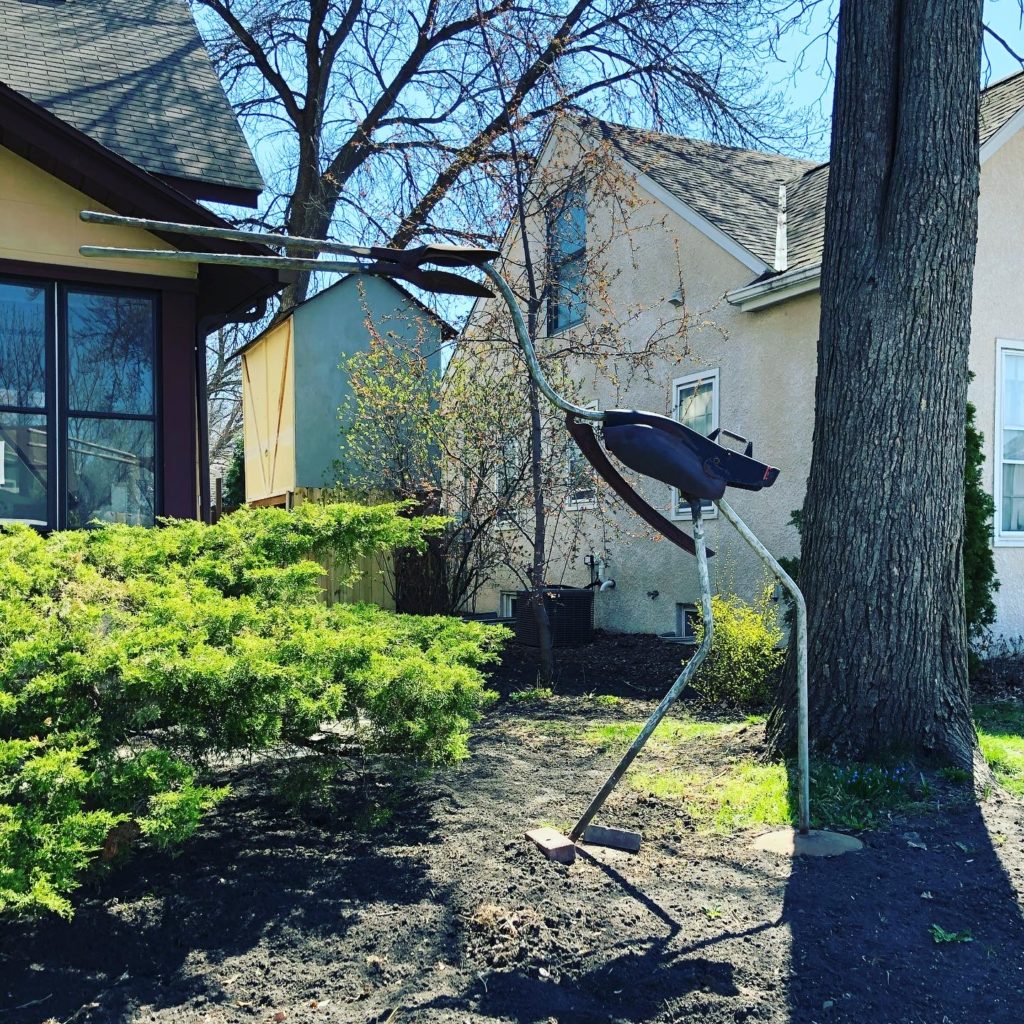
Woke up feeling sore all over. I think it’s from the hours I’ve spent trying to scrape the paint off the deck railing. Decided to take a long walk with Scott and Delia the dog instead of running. Amazing spring weather. Bright, warm sun. Hardly any wind. Calm, gentle air. Lots of people walking, biking, and running out by the gorge this morning. Didn’t see any wild turkeys but did see a tiny baby rabbit. I said to Scott, “that’s the only time I think rabbits are cute.” I really don’t like rabbits. Also saw this super cool sculpture in someone’s front yard:

photo by room34

I want a front yard like this! No grass and an awesome sculpture. It’s fun walking by the gorge and then winding through longfellow neighborhood. People are delightfully quirky around here. Anything else? We talked about if the virus will ebb some in the summer and how terrible it must be for some kids now that they are closing down all the playgrounds and skate parks and removing the nets from basketball hoops and tennis courts. How will some kids entertain themselves? So tough.

When we got home, I sat on our warm deck in full sun and felt nostalgic for past springs and summers as a kid, when I would soak in the sun, still able to enjoy feeling hot because it was novel. Then I composed another version of Emily Dickinson’s “It’s all I have to bring today”:

It’s all I have to bring today—
This, and my knee, beside—
This, my knee, and all the gorge
And all the river wide—
Be sure to count—should I forget
Some one the Sum could tell—
This, and my knee, and every Tree
Bare-branched without its Veil—

I think I like this version better than my last.

After composing this poem and reciting it to my wonderful daughter who was willing to listen, I sat in my chair and heard the birds. I didn’t actually have a choice, they were insistent that I eavesdrop on their conversation. Repeating it over and over and over again. Of course, when I finally decided to record them, they weren’t as chatty. Still, I did manage to record a few lines. 2 syllables each. One bird started low, then went higher. The other responded higher, then went lower*. I imagined them to be singing: “Up high/ Down low” What else could they be saying?

2 birds chatting

Subway/Eat fresh
Be nice/Fuck you
Hey there!/What’s up?
Mustard/Ketchup
Doughnut/Ice cream
Mad Men/Ozark
Mustache/Goatee
Pizza/Nachos
Dumb luck/Hard work
Winter/Summer

*correction, 2024: for years, I’ve been hearing the feebee song wrong. I’ve always heard it as the fee going up, the bee going down, but a few weeks ago, I finally heard it correctly — with some help from Scott. The first bird starts with a higher fee than the second bird, but both birds start high, then drop lower.

april 24/RUN

3.75 miles
47th ave loop
47 degrees
Deaths from COVID-19: 221 (MN)/ 50,031 (US)

Wow, what a glorious morning! Soft light, hardly any wind, singing birds, uncrowded paths. Everything felt calm, relaxed. I don’t remember looking at the river that often, but I do remember the sky over the gorge and the view on the bluff near Folwell. Beautiful.

Anything else I remember from my run? I’ve noticed–today and yesterday, at least–that the morning sun makes it hard for me to see people sometimes. It also makes it almost impossible for me to determine if people are coming towards me or are moving away from me–is that the cone dystrophy or my near-sightedness? Not sure.

I recited Emily Dickinson’s “It’s all I have to bring today” again and I’m liking it more. The second line with the anapest–“This, and my heart beside”–is still awkward, but I like running to “this, my heart, and all the fields/and all the meadows wide” and “this, and my heart, and all the bees, which in the clover dwell.”

When I got back from my run, I started thinking about changing the words of Dickinson’s poem to fit with my run:

It’s all I have to bring today—
This, and my knee beside—
This, my knee and all the trees—
And all the river wide
Be sure to count — should I forget
Some one the sum could tell —
This, and my knee, and all the Birds
whose songs can cast a Spell.

Not totally happy with my words, but I’ll work on it some more. I struggle to understand “some one the sum could tell.” It mostly makes sense, but it still trips me up.

more wild turkey sightings!

Yesterday on our walk, near the tree graveyard, we saw 2 more wild turkeys! Scott took some video and posted it on instagram:

https://www.instagram.com/p/B_WHkvilZON/?utm_source=ig_web_copy_link

Finally, looking back through my log posts from 2018, I found this beautiful poem. It will be the next one that I memorize. So many lines I am looking forward to learning and keeping.

Dear One Absent This Long While/ Lisa Olstein 

It has been so wet stones glaze in moss;
everything blooms coldly.

I expect you. I thought one night it was you
at the base of the drive, you at the foot of the stairs,

you in a shiver of light, but each time
leaves in wind revealed themselves,

the retreating shadow of a fox, daybreak.
We expect you, cat and I, bluebirds and I, the stove.

In May we dreamed of wreaths burning on bonfires
over which young men and women leapt.

June efforts quietly.
I’ve planted vegetables along each garden wall

so even if spring continues to disappoint
we can say at least the lettuce loved the rain.

I have new gloves and a new hoe.
I practice eulogies. He was a hawk

with white feathered legs. She had the quiet ribs
of a salamander crossing the old pony post road.

Yours is the name the leaves chatter
at the edge of the unrabbited woods.

april 23/RUN

4.2 miles
river road path, north/seabury, south/edmund, south
40 degrees
Deaths from COVID-19: 200 (MN)/ 46,859 (US)

Such a strange, scary time. For now, managing to keep the terror at a low simmer. Relieved that the governor announced today that schools are closed for the rest of the year. It’s awful, but necessary. Not sure if it’s all my training in being present on the path and paying attention to everyday delights in the midst of mess, but I’m doing okay. I know, without any doubt, that the gorge–being able to run and walk near it every day–is making all of this bearable. What a gift this river and trails and trees and ancient boulders are!

A beautiful morning! Started at 8:25 and there was hardly anyone out yet. For the first time in several weeks, I was able to run through the tunnel of trees, above the floodplain forest! The bare brown trees had a low soft glow and the dirt path winding through to the river looked quiet and lonely. Thought about how nice it would be to take Delia the dog on that trail but then I remembered how narrow the old stone steps are–difficult to keep 6ft of distance on them. Kept running north, glancing down at the river every few minutes. Mostly pale blue with a few spots of shining, sparkly brightness, almost white, or would you call it silver? Heard lots of birds, the low rumble of fast moving cars on a far away freeway, some music coming out of a bike radio. Enjoyed feeling and hearing the scratch scratch scratch of my feet striking the grit on the road.

Recited the Emily Dickinson poem, “It’s all I have to bring today,” a few times. It’s a beautiful poem, but not satisfying to recite. Why? Not sure. I’m thinking I should try memorizing and reciting “Before I got my eye put out” next. How will that poem move, I wonder?

Listened to Danez Smith’s Homie yesterday. Beautiful and uncomfortable, which is good and necessary. Heard this poem and felt it, having lived in California and longed for Minnesota:

I’m Going Back to Minnesota Where Sadness Makes Sense/ Danez Smith

O California, don’t you know the sun is only a god
if you learn to starve for him? I’m bored with the ocean

I stood at the lip of it, dressed in down, praying for snow
I know, I’m strange, too much light makes me nervous

at least in this land where the trees always bear green.
I know something that doesn’t die can’t be beautiful.

Have you ever stood on a frozen lake, California?
The sun above you, the snow & stalled sea—a field of mirror

all demanding to be the sun too, everything around you
is light & it’s gorgeous & if you stay too long it will kill you

& it’s so sad, you know? You’re the only warm thing for miles
& the only thing that can’t shine.

Love the line, “I know something that doesn’t die can’t be beautiful.” And the description of standing on a frozen lake, the stalled sea, the field of mirror all demanding to be the sun. What a beautiful poem!

april 21/RUN

3.7 miles
47th ave loop, short
34 degrees
Deaths from COVID-19: 160 (MN)/ 42,458 (US)

Sunny and bright. Looked down at the river and noticed it sparkling. Encountered a few runners and walkers and bikers. Heard some birds–a few geese, a woodpecker, some cardinals. Noticed a wild turkey hanging out in someone’s front yard–on Edmund, across from the tree graveyard. Nice! Always a good day when I see a wild turkey in the neighborhood. Here’s some turkeys that Scott and I saw on our walk on Saturday:

Recited the poem I memorized this week, Emily Dickinson’s “It’s all I have to bring today.” Kept noticing how awkward the second line was as I tried to keep my running rhythm while I said it in my head. Reading the prowling bee’s analysis, I realized it’s because every other line follows an iambic meter–da dum/da dum da/dum da dum or unstressed stressed/unstressed stressed–but the second line is strange: THIS and my HEART BEside–at least that’s how I hear it. “and my HEART” is an anapest (unstressed unstressed stressed). Found this basic description:

This poem consists of two four-line stanzas of ballad meter. In most of her poem, Dickinson typically uses ballad meter, which consists of four-line stanzas (or quatrains) of iambic tetrameter alternating with iambic trimeter: the syllable count of the four lines is therefore 8, 6, 8, 6. Ballad meter is similar to common meter, which is the meter of many Protestant hymns, such as “Amazing Grace.” In common meter the first and third lines of each stanza rhyme as do the second and fourth, making the rhyme scheme ABAB. Common meter also tends to be strictly metrical because it forms the basis of hymns sung in church. However, because Dickinson tends to rhyme only the second and fourth lines of each stanza (resulting in a rhyme scheme of ABCB) and is less strictly metrical, it is more accurate to say she uses ballad meter.

For some reason, I often struggle to recognize meter and to identify when syllables are unstressed or stressed. Not sure why. Slowly, I’m learning the terms–like tetrameter (4 feet) and trimeter (3 feet). I like thinking about this in relation to my running rhythms. Which rhythms work best for me? Which ones get me in a good groove, make running easier or faster or more fun? I’m not sure if the ballad works. I should experiment with it more. I’m also thinking about how breath fits into all of this. On easy runs, I might breathe every 4 or 3, on harder runs, every 2. How does breathing shape these lines? How does breath work in Dickinson? Here’s a source: The Breath of Emily Dickinson’s Dashes

After reciting Dickinson’s poem dozen of times, I decided to return to Richard Siken’s “LOVESONG FOR THE SQUARE ROOT OF NEGATIVE ONE.” For some reason, I enjoyed reciting it more than the Dickinson. Was it because there were more words, more ideas, more rhythms to untangle? Possibly.

Yesterday, I encountered the opening lines from this poem and was delighted. I’d like to memorize at least the first few stanzas, but maybe all of it.

from Maud (Part I)/ ALFRED, LORD TENNYSON

A Monodrama

Come into the garden, Maud, 
      For the black bat, night, has flown, 
Come into the garden, Maud, 
      I am here at the gate alone; 
And the woodbine spices are wafted abroad, 
      And the musk of the rose is blown. 

   For a breeze of morning moves, 
      And the planet of Love is on high, 
Beginning to faint in the light that she loves 
      In a bed of daffodil sky, 
To faint in the light of the sun she loves, 
      To faint in his light, and to die. 

   All night have the roses heard 
      The flute, violin, bassoon; 
All night has the casement jessamine stirr’d 
      To the dancers dancing in tune; 
Till a silence fell with the waking bird, 
      And a hush with the setting moon. 

   I said to the lily, “There is but one 
      With whom she has heart to be gay. 
When will the dancers leave her alone? 
      She is weary of dance and play.” 
Now half to the setting moon are gone, 
      And half to the rising day; 
Low on the sand and loud on the stone 
      The last wheel echoes away. 

   I said to the rose, “The brief night goes 
      In babble and revel and wine. 
O young lord-lover, what sighs are those, 
      For one that will never be thine? 
But mine, but mine,” so I sware to the rose, 
      “For ever and ever, mine.” 

   And the soul of the rose went into my blood, 
      As the music clash’d in the hall; 
And long by the garden lake I stood, 
      For I heard your rivulet fall 
From the lake to the meadow and on to the wood, 
      Our wood, that is dearer than all; 

   From the meadow your walks have left so sweet 
      That whenever a March-wind sighs 
He sets the jewel-print of your feet 
      In violets blue as your eyes, 
To the woody hollows in which we meet 
      And the valleys of Paradise. 

   The slender acacia would not shake 
      One long milk-bloom on the tree; 
The white lake-blossom fell into the lake 
      As the pimpernel dozed on the lea; 
But the rose was awake all night for your sake, 
      Knowing your promise to me; 
The lilies and roses were all awake, 
      They sigh’d for the dawn and thee. 

   Queen rose of the rosebud garden of girls, 
      Come hither, the dances are done, 
In gloss of satin and glimmer of pearls, 
      Queen lily and rose in one; 
Shine out, little head, sunning over with curls, 
      To the flowers, and be their sun. 

   There has fallen a splendid tear 
      From the passion-flower at the gate. 
She is coming, my dove, my dear; 
      She is coming, my life, my fate; 
The red rose cries, “She is near, she is near;” 
      And the white rose weeps, “She is late;” 
The larkspur listens, “I hear, I hear;” 
      And the lily whispers, “I wait.” 

   She is coming, my own, my sweet; 
      Were it ever so airy a tread, 
My heart would hear her and beat, 
      Were it earth in an earthy bed; 
My dust would hear her and beat, 
      Had I lain for a century dead, 
Would start and tremble under her feet, 
      And blossom in purple and red.
april 20/RUN

4.1 miles
river road path, north/seabury, south/river road path, south/edmund, south
46 degrees
Deaths from COVID-19: 143 (MN)/ 40,724 (US)

Started my run at 8:41. Not very crowded at all. Only a few runners and bikers. I think I remember glancing down at the river, but I don’t remember what I saw. Heard lots of birds at the beginning, don’t remember any during the run. Noticed lots of activity down by the rowing club–many cars. Will there be any rowers on the river today? Running on the walking path between the trestle and Franklin, a biker called out thanking me for staying on the proper path. I called back “you’re welcome!” and felt good for the rest of the run. What a difference such a small gesture makes! Focusing on these moments, instead of other annoying ones helps me.

A Freaked Out Runner

Yesterday, Scott, Delia the dog, our daughter, and I took a 4 mile walk around the neighborhood. Walking in the grass between the boulevard and the parkway, we witnessed a runner running in the road (on the part designated for pedestrians), getting increasingly upset as bikers (who are not supposed to bike on this part of the road) whizzed by her. When the first one passed her, she yelled “this is not the bike lane!” and then muttered to herself in anger. When the next one passed, she shrieked frantically “read the FUCKING signs!” (the city has signs posted all over the road/path identifying who should be in what lane). I could understand her anger–in other situations, I’ve been her, maybe not screaming “fuck!” but feeling that upset–but I could also see how difficult it was for the bikers, trying to find room to move when it was so crowded and when walkers were also ignoring the signs and taking over the bike paths. I’m not sure how to make this situation with crowded paths any easier, so I try to avoid it by running early, before it gets crowded.

Periodically during my run, I sang out in my head the delightful lines from Emily Dickinson I learned a few days ago: “In the name of the bee—and the butterfly—and the breeze—Amen!”

Speaking of Dickinson, I have decided the poem I will memorize for this week is:

It’s all I have to bring today—/Emily Dickinson

It’s all I have to bring today—
This, and my heart beside—
This, my heart, and all the fields—
And all the meadows wide—
Be sure to count—should I forget
some one the sum could tell—
This, and my heart, and all the Bees
which in the Clover dwell.

Such a beautiful poem. I think it will be fun to recite as I run on these early spring mornings. A poet and gardener decided in 2011 to systematically read through and analyze each of Dickinson’s poems. She’s still working on it now, in 2020. Here’s her post on this poem. In her discussion, she mentions Marianne Moore’s poem about imaginary gardens. I think I’d like to memorize this one too–if not this week, then for next week:

Poetry/ Marianne Moore – 1887-1972

I too, dislike it: there are things that are important beyond
      all this fiddle.
   Reading it, however, with a perfect contempt for it, one
      discovers that there is in
   it after all, a place for the genuine.
      Hands that can grasp, eyes
      that can dilate, hair that can rise
         if it must, these things are important not because a

high-sounding interpretation can be put upon them but because
      they are
   useful; when they become so derivative as to become
      unintelligible, the
   same thing may be said for all of us—that we
      do not admire what
      we cannot understand. The bat,
         holding on upside down or in quest of something to

eat, elephants pushing, a wild horse taking a roll, a tireless
      wolf under
   a tree, the immovable critic twinkling his skin like a horse
      that feels a flea, the base-
   ball fan, the statistician—case after case
      could be cited did
      one wish it; nor is it valid
         to discriminate against “business documents and

school-books”; all these phenomena are important. One must
      make a distinction
   however: when dragged into prominence by half poets,
      the result is not poetry,
   nor till the autocrats among us can be
     “literalists of
      the imagination”—above
         insolence and triviality and can present

for inspection, imaginary gardens with real toads in them,
      shall we have
   it. In the meantime, if you demand on the one hand, in defiance of their opinion—
   the raw material of poetry in
      all its rawness, and
      that which is on the other hand,
         genuine, then you are interested in poetry.

april 17/RUN

4.4 miles
47th ave loop
37 degrees
Deaths from COVID-19: 111 (MN)/ 33,325 (US)

What a beautiful morning! Hardly any wind, lots of sun, uncrowded paths! Ran south right above the river. Pale blue. At one point, heard a woodpecker and thought about stopping to record it but didn’t. Looked longingly at the lone bench near Folwell with the clear, unobstructed view to the other side. Recited my poem of the week, LOVESONG OF THE SQUARE ROOT OF NEGATIVE ONE. I am the wind and the wind is invisible! Thought about the rhythm in the later lines:

As the hammer / 1 2 / ♫♫
is a hammer / 1 2 / ♫♫
when it hits the nail / 1 2 3 4 / ♫♩♩♩

and the nail / 1 2 / ♫ ♩
is a nail / 1 2 / ♫ ♩
when it meets the wood / ♫ ♩♩♩

Running on the road, after turning off of Edmund, I saw my shadow ahead of me. Hi friend! She led me until I turned again. Listened to my feet shuffle on the grit and my ponytail brush against the collar of my vest. Don’t remember hearing any crows or squirrels or geese–did I? Ran too early to see Dave, the Daily Walker. Didn’t see any roller skiers, but did see 1 or 2 bikers. 2 runners, one with a bright red shirt on.

Thought about the poem I’m working on and that I posted yesterday about sinking. I’m thinking of changing goo to jelly. Also, I’m not sure I like starting with think–I did it partly as a rhyme with sink but I’m not sure now. Here’s different version, in a different form. Instead of cinquains, I’m using couplets:

How to Sink/ Sara Lynne Puotinen (draft 2)

with Paul Tran

Try to recall when your son was young and so upset
all he could do was turn to jelly and ooze

down the couch in surrender — not giving in
but giving up control, a puddle of body parts

pooled at your feet. Learn to retreat like this.
Go to the gorge. Let your bones dissolve,

your legs liquefy. Submit to gravity. Slide
down. Reach the ground first, then seep deeper

through layers of loam, sandstone, shale. Drop lower
and lower, burrow through cracks and fissures, carve

out a way in and follow it farther. Go
so far inside that outside is another idea.

I think I like this version better, especially how some lines can stand alone and make interesting poems by themselves. Like, “out a way in and follow it farther” or “but giving up control, a puddle of body parts.”

It’s warmer today. Maybe spring is finally, actually coming?! Soon there will be flowers and green grass and bees. In honor of the bees, here are 2 wonderful poems by Emily Dickinson (found on this twitter thread about bee poems):

To make a prairie (1755)/ Emily Dickinson – 1830-1886

To make a prairie it takes a clover and one bee,
One clover, and a bee.
And revery.
The revery alone will do,
If bees are few.

In the name of the Bee –/ Emily Dickinson

In the name of the Bee –
And of the Butterfly –
And of the Breeze – Amen!

march 18/RUN

4.25 miles
top of franklin hill and back
38 degrees
77 confirmed cases of COVID-19 in MN

Another day, another great run by the gorge. Overcast. Earlier on my walk, it was drizzling but I think it stopped by the time I ran. Encountered lots of walkers, a few runners, some bikers. Many people are trying to keep their 6 feet of distance, others are not. If they can’t be bothered to move over when it’s recommended to help lessen the spread of a pandemic, I guess there’s no hope that they ever will. Felt pretty good running, even if I was a little warm and my nose was a bit runny–tried to avoid touching my face but it’s hard when you’re dripping sweat and snot (is that too gross?). I looked down at my favorite spot above the floodplain forest–so open and soft and light brown. Only a few patches of snow. Also looked at the river. Blue and beautiful. Running north towards downtown, I listened to the gorge and recited “Auto Lullaby” and “Tell all the truth but tell it slant” a few times. Heard at least one goose honking, some people talking, a few feet shuffling. Stopped just above the Franklin hill and put in my headphones, then headed south. Running under the trestle I heard a beeping, buzzing noise. Was it the alert for an approaching train? I looked around, but couldn’t see any train. Decided not to stop and wait. Anything else I remember? Greeted Dave, the Daily Walker. Felt dreamy and dazed. Glad to forget everything else for 40 minutes.

the woodpecker

Earlier today, walking with Delia the dog, I heard a woodpecker. It might be the same one I heard a few days ago, around the same time and same place. So loud! Almost like a little jackhammer. Usually, any woodpecker pecking is loud, but not this loud. How irritating it must be for the people with houses nearby. When I was 8 or 9 and living in North Carolina in a house with cedar shakes, we had a woodpecker who liked to peck on the cedar. I don’t remember hearing it, I just remember how irritated it made my dad. Did he do anything about it? I don’t remember that either.


After memorizing one Emily Dickinson poem, I want to memorize some more. I’ll start with some shorter ones, like this, which seems appropriate right now:

“Faith” is fine invention (202)/ Emily Dickinson

Faith” is a fine invention
For Gentlemen who see!
But Microscopes are prudent
In an Emergency!


corona virus update

Yesterday all the schools were closed. So were the restaurants and bars. Thankfully, we can still leave our house. I went to bed yesterday accepting that this would probably end by June, woke up to Pence’s announcement that it would last until July. When I mentioned this to Scott, he said he’d read, early fall. It’s definitely going to get a lot worse for the next month at least. Trying to keep Scott’s penchant for worst case scenarios in check, the theme for our house is: “Let’s dial back the Apocalypse.”

added, 18 march 2026: Oh, sweet Sara from 2020, thank goodness you had no idea how long this would last (an entire year of not going into any public buildings, kids doing online school for a year and a half) and that something (I accidentally typed someone first before correcting it, which was not really an accident, although it should have been someones) even worse would be coming in 2026! — But is it worse in 2026? The wanna be fascists in power are scarier, but the push back is stronger. During COVID, I lost my faith in people; during the ICE occupation here in Minnesota, that faith was restored.

march 16/RUN

4.25 miles
top of the franklin hill and back
35 degrees
snow, big fluffy flakes

Feeling a bit better today. Wonderful and strange to be outside, trying to avoid encounters with others while breathing in the beautiful fresh air. Dark and gloomy. It started snowing just after I got outside. At first, very light. Then, big fluffy flakes flying right into my face–I should have worn my baseball cap or visor to block them out. Oh well. The snow didn’t bother me too much although I wondered if it was the best idea to be outside with a cold or sinus infection in this weather. I think it’s fine. It feels important to get out by the gorge as much as I can.

Was able to do all the walking trails, including the one through the tunnel of trees which is not a tunnel right now but a bunch of bare branches and trunks. The floodplain forest was a beautiful, fuzzy brown. I know I glanced at the river but I don’t remember what color it was or how it looked. I think that’s because of all the snow flying in my face. The gorge was a misty, blurry white. Encountered a few walkers, one or two runners, and Dave the Daily Walker, back in uniform! I’m glad he’s feeling better.

I remember admiring the railroad trestle as I ran by it, noticing the river below. Also, glancing at the Winchell Trail, close to Franklin. The trail looked like a muddy mess.

Memorized a new poem for today’s run:

Tell all the truth but tell it slant/ Emily Dickinson

Tell all the truth but tell it slant—
Success in Circuit lie
Too bright for our infirm Delight
The Truth’s superb surprise
As Lightening to the Children eased
With explanation kind
The Truth must dazzle gradually
Or every man be blind—

It was fun to recite this over and over again as I ran. I really love Emily Dickinson’s poetry–her phrasing, the rhymes, the rhythm, the ideas. I think (I don’t know that much about Emily Dickinson right now–maybe I should learn?) this is one of her more famous poems, especially the idea of telling the truth slant. I like it because of how it fits with my vision. I read that Dickinson became blind temporarily for a few years and that she wrote about it in her poetry. With my cone dystrophy, I rely much more on my peripheral (sideways, slantways?) vision to see. And, while I need bright light to see and read things, if the light is too bright it makes it almost impossible to see. Also, my unfocused, fuzzy vision is softer and less harsh, which sometimes results in kinder, more gentle visions–things that might look ugly in sharp edges and lines, appear beautiful in the soft, fuzzy, absence of detail (one example: gnarled, bare branches in the winter).

march 3/RUN

3.25 miles
trestle turn around
39 degrees
clear path

Windy. Sunny. Not too cold. Ran in the early afternoon, since I voted in the morning. I loved running on the edge of the path, my feet landing on the grit, making a satisfying scratching sound. I think I looked at the river–did I? Now I can’t remember. I do remember noticing how the snow on the walking path that winds down through the tunnel of trees was melting. With all the warm weather this week–and 61! predicted for Sunday–maybe it will be cleared of snow soon. I also remember lifting my knees as I ran up from under the lake street bridge and noticing how the walking path at the top, which follows the rim of the gorge while the biking path follows the road, was clearing up too. Hooray! Anything else? I heard then saw a small wedge of geese flying north. Encountered a few runners, many walkers, at least one dog. It was a good run. I didn’t think about the coronavirus and the fear and worry and hassle it’s causing for so many people even once!

Before starting the run while I was still walking, I listened to a recording of myself reading 2 poems: 1. a draft of my latest poem, which I’m calling January Joy, and 2. a fabulous poem by Marie Howe, Singularity–I posted it on this log on Jan 19. I liked listening to both of them. I also liked recording myself reciting them. Maybe this will be a new thing I do with poems in 2020? Yesterday I recorded myself reading Love by Alex Dimtrov (posted on this log on jan 21)–over 11 minutes of lines starting with “I love…”! One of the I loves reminded me of Howe’s poem:

I love how the Universe is 95% dark matter and energy and somewhere in the rest of it there is us.

I read this line as loving the idea that we are such a small fraction of what makes up the Universe. I love this idea too–it’s comforting and liberating to me to matter so little. Most of Howe’s poem and the idea of singularity is a little different. It’s lamenting the loss of a time when we were not separate from the Universe, when there was no universe or we or I or us or anything to fuck up (which we have, as we trash the ocean and each other). She has one line that reminds me of Dimitrov’s and that resonates:

before we came to believe humans were so important

I find it’s easier to remember this–that I am not so important, or the most important–when I’m running outside by the gorge, above the Mississippi River, under the oak trees. I like remembering this. Here’s another line this discussion of not being important reminds me of:

You are nobody to the hills or the thick boughs heavy with greenery. You are no longer a role, or a status, not even an individual, but a body, a body that feels sharp stones on the paths, the caress of long grass and the freshness of the wind (Frédéric Gros/Philosophy of Walking, 84). 

And, of course, the minute I write nobody, I think of my introduction to Emily Dickinson:

I’m Nobody! Who are you? (260)/ Emily Dickinson – 1830-1886

I’m Nobody! Who are you?
Are you – Nobody – too? 
Then there’s a pair of us! 
Don’t tell! they’d advertise – you know!

How dreary – to be – Somebody!
How public – like a Frog – 
To tell one’s name – the livelong June – 
To an admiring Bog!

Wow, that was fun to wander around all of those words! As I was scrolling back through my January entries, I saw a lot of wonderful poems and ideas. More wandering around them is necessary.

Speaking of January, here’s a first draft of my January Joy poem. It’s a collection of things I enjoyed during the month of January for the past 4 years. I’m not quite satisfied with it. I want to find a better way to describe/express how thick slushy viscous water moves–how?

January Joy/ Sara Lynne Puotinen

Oh to see the river! 
The river, open 
The river, brown
The river, thinly veiled
The river, pale blue
The river, empty 
The river, white 
The river, a big black hole of deep, cold nothingness 
The river, a thick slow slush traveling to the falls
The falls, flowing between frozen columns of ice
The ice, cleared from the path
The path, no big crowd
The crowd, 2 cross country skiers  
3 men in red jackets gliding
1 woman floating–confident bodies moving through space
The space between sky and tree top, illuminated by sun
The sun glowing up the gray gloom
The sun warming my face 
The sun flashing through tall, thin tree trunks 
My trunk, straight strong steady more machine than gangly human

How wonderful it is to move!

Oh great runs! 
Oh clearer paths! 
Oh strong legs and adequate knees and functioning feet!
How wonderful it is to move and breathe and feel free 
on this winter-perfect day, white and woodsy and blueish gray!

dec 10/RUN

3.25 miles
trestle turn around
4 degrees/feels like -12
100% snow-covered

Yes, -12 feels cold but today felt even colder than that. Tried out some hand warmers in my gloves. I guess they worked. It snowed so little yesterday that they didn’t bother to plow–at least an inch of snow covering the path, one narrow-ish strip of it packed down. The wind was in my face heading north, which wasn’t fun, but then at my back heading south, which was. Only the crazy-for-winter fools were out here today. I encountered one fat tire and one other runner besides me. We had the path to ourselves–one of the big advantages of winter running. Noticed that the river is icing over. The path was snow-covered but not icy or slippery. I could hear it crunchy delightfully over the noise of my audio book.

Layers: I was almost too warm at one point. Felt bulky in my 2 pairs of gloves + 2 shirts + vest + jacket + 2 pairs of tights + 2 pairs of socks + buff + hat + sunglasses.

Happy Birthday Emily Dickinson!

It’s all I have to bring today (26)
Emily Dickinson – 1830-1886

It’s all I have to bring today—
This, and my heart beside—
This, and my heart, and all the fields—
And all the meadows wide—
Be sure you count—should I forget
Some one the sum could tell—
This, and my heart, and all the Bees
Which in the Clover dwell.

Today I brought my heart, and my legs, and my lungs, and the crunching snow, and the river, and the bright white solitude of an almost empty path.

dec 9/RUN

2 miles
treadmill, basement

Was planning to run at the US Bank Stadium with Scott but ended staying home and running on the treadmill. Tomorrow it gets cold. 0 degrees. Not sure what the feels like temp will be. Guess I’ll see when I got out in it for a run.

“Hope” is the thing with feathers – (314)
BY EMILY DICKINSON

“Hope” is the thing with feathers –
That perches in the soul –
And sings the tune without the words –
And never stops – at all –

And sweetest – in the Gale – is heard –
And sore must be the storm –
That could abash the little Bird
That kept so many warm –

I’ve heard it in the chillest land –
And on the strangest Sea –
Yet – never – in Extremity,
It asked a crumb – of me.

april 14/RUN

4.75 miles
to top of franklin bridge and back
32 degrees
5% snow-covered

The snow is melting. The birds are chirping. The path is almost all clear. So quiet and calm today. Mostly cloudy, making the river look gray. The floodplain forest was all white. Occasionally the sun sat on the surface of the river leaving a bright circle of shimmering light. Saw a few squirrels. Heard some geese. Any crows? I don’t think so. A few voices below–a family hiking through the snow on the gorge. I wonder when the rowers will return?

Yesterday morning I started reading through The Collected Poems of James Laughlin. What a big book! 1214 pages. I’m reading through them quickly, marking the ones I especially like. In general, I like his simple, clear style. Brief lines. A quirky voice. Here are a few that I marked:

THE POET TO THE READER/james laughlin

These poems are not I
hope what anyone ex-

pets and yet reader
I hope that when you

read them you will say
I’ve felt that too but

it was such a natural
thing it was too plain

to see until you saw
it for me in your poem.

IN THE SNOW/james laughlin

The track of the ermine
the track of the mouse

tracks of a deer in the
snow and my track that

wanders and hesitates
doubling and crossing

itself stops to burrow
and circles trees this

track I made twists like
the veins in a leaf or a

crack in a mirror and it
cries seems to cry cries

to the sun cries sun sun
touch and burn cries sun

touch and save cries to
the snow–and then snow

falls covering everything
new snow covers my track

covers the track of the
ermine mouse and deer.

LITTLE BITS OF PAPER: AN ARS POETIC/james laughlin

Most of them began with a few words
read in some book or a phrase over-

heard scratched on a bit of paper
these chits go into the side pocket

of my jacket usually they stay there
until the coat is so spotted it must

be sent to the cleaners when I empty
the pocket most of the slips go into

the wastebasket but a few are pasted
with Scotch tape on the bathroom mir-

ro where I see them when I’m shaving
some stay there a long time but with

some there is an urgency they come
into my head when I wake to pee in

the middle of the night more words
come with them almost faster than I

can scribble on the yellow pad on the
bedtable the words beget other words

(it’s like spilled milk spreading on
the kitchen floor) words making other

words I don’t make them they make
themselves into the poem but some-

times in the morning I can’t read
what I’ve written (because I wrote

in the dark) so that’s the end of
that one it’s had its say and it

won’t come back I write in darkness.

I picked this last one because it made me think of Susan Howe and her story about Jonathan Edwards and how he would pin ideas he had on scraps of paper to his clothes as he was riding around on his horse. A couple of years ago, I was thinking a lot about how runners hold onto the ideas that they have as their running–scribble it on pieces of paper, carry a small notebook, scratch it in their arm with a stick, talk into their smart phone. Maybe I should experiment with this some more? As I was trying to recall who Howe had been talking about (I had forgotten), I discovered that she wrote a book about Emily Dickinson, My Emily Dickinson. I might have to check it out of the library. Apparently, Dickinson wrote many of her poems on scraps of paper.

march 20/RUN

4 miles
mississippi river road path, north/south
38 degrees
99% clear path

The first day of spring! The snow continues to melt, the path continues to get clearer. Listened to my playlist so I didn’t hear any birds or melting snow or gabbing geese. Ran faster. Smiled more. Felt overheated–too many layers. Sometimes the sun was out, sometimes it wasn’t. Never enough for me to see my shadow. Everything is still brown. No green yet. Definitely no flowers. Hopefully no more snow.

Before going out for my run, worked on a poem I’m doing about vision and my inability to see when/if people are trying to make contact with me. Mostly I can see people’s eyes–at least that they have them and the whites and the pupils. But I can’t see when the pupils move, when they shift, expand, contract. So I can’t always tell when people are looking at me. It makes reading people difficult.

As I’ve been think/write/research more on vision, I’ve encountered some interesting stuff, including a few articles about Emily Dickinson and how her temporary vision problems influenced some of her poetry, like this poem:

Before I got my eye put out – (336)
BY EMILY DICKINSON

Before I got my eye put out –
I liked as well to see
As other creatures, that have eyes –
And know no other way –

But were it told to me, Today,
That I might have the Sky
For mine, I tell you that my Heart
Would split, for size of me –

The Meadows – mine –
The Mountains – mine –
All Forests – Stintless stars –
As much of noon, as I could take –
Between my finite eyes –

The Motions of the Dipping Birds –
The Morning’s Amber Road –
For mine – to look at when I liked,
The news would strike me dead –

So safer – guess – with just my soul
Opon the window pane
Where other creatures put their eyes –
Incautious – of the Sun –

march 1/RUN

3.35 miles
mississippi river road path, north/south
12 degrees/feels like 12 degrees
99% snow-covered

It’s March. Finally. The month of many birthdays.

Dear March – Come in – (1320)
Emily Dickinson, 1830 – 1886

Dear March – Come in –
How glad I am –
I hoped for you before –
Put down your Hat –
You must have walked –
How out of Breath you are –
Dear March, how are you, and the Rest –
Did you leave Nature well –
Oh March, Come right upstairs with me –
I have so much to tell –

I got your Letter, and the Birds –
The Maples never knew that you were coming –
I declare – how Red their Faces grew –
But March, forgive me –
And all those Hills you left for me to Hue –
There was no Purple suitable –
You took it all with you –

Who knocks? That April –
Lock the Door –
I will not be pursued –
He stayed away a Year to call
When I am occupied –
But trifles look so trivial
As soon as you have come

That blame is just as dear as Praise
And Praise as mere as Blame –

A wonderful run that helped my mood tremendously. Very gray–one of those pewter mornings that Margaret Atwood mentions in “February.” You could tell snow was coming. It started when I reached the turn around. Big flakes. No sharp daggers. Wore my yaktrax today and it helped. I hardly slipped at all. Still difficult to run in certain stretches where the snow was sloppy. Felt strong and free and grateful to be outside moving. Greeted the Daily Walker and a few other runners. No fat tires. Heard some geese honking near the lake street bridge. They like to congregate there.

from The Black Maria
Aracelis Girmay

Body of sight. Body of
breaths. Body of trying.

Beloved, to
day you eat,
today you bathe, today
you laugh

Today you walk,
today you read,
today you paint, my love,

Today you study stars,
today you write,
today you climb the stairs,

Today you run,
today you see,
today you talk,

You cut the basil
You sweep the floor

& as you chore, touch
the ankles & hairs of your befores
who look up from their work
in the field or at the chisel
to tell you in their ways: You Live!

What a poem! Here’s a blurb about Girmay’s book:

Taking its name from the moon’s dark plains, misidentified as seas by early astronomers, the black maria investigates African diasporic histories, the consequences of racism within American culture, and the question of human identity. Central to this project is a desire to recognize the lives of Eritrean refugees who have been made invisible by years of immigration crisis, refugee status, exile, and resulting statelessness. The recipient of a 2015 Whiting Award for Poetry, Girmay’s newest collection elegizes and celebrates life, while wrestling with the notion of seeing beyond: seeing violence, seeing grace, and seeing each other better.

august 13/DNF

Knee injury.

Day Nine

Today is the triathlon, the one that Rosie and I were supposed to do together. The one that would have started a tradition of racing and training together. We’re not racing, mainly because of my injury but also because we hadn’t trained enough. I am less disappointed and more resigned to the inevitability of our failure. If we attempt to do this again next year, we will need to train earlier.

Memorized two poems this morning: Emily Dickinson’s “Nobody” and Mary Oliver’s “Wild Geese.” Now I want to experiment with putting them together into a found poem:

You only have to Love.
I’m Nobody! Who are you?
Are you— Nobody—too?
Whoever you are, no matter how lonely,
tell me about the mountains and the rivers,
the clean blue air, the livelong June, an admiring Bog.

Whoever you are, no matter how good,
the world goes on, harsh and exciting.
Announcing despair, over and over, it calls to you.
How dreary! Don’t tell!

You do not have to advertise.
You only have to love the world
as it offers itself to your imagination:
the sun and the clear pebbles of the rain,
the landscapes and the deep trees.

You only have to love the family of things:
a Frog, the wild geese,
the soft animal of your body,
Somebody!
Nobody!

Walked around the block with Scott and Delia, the dog. So slow, but less limp-y. Discovered that uneven ground is difficult. Why is that? Tried to walk more than a block but my knee felt like it might give out, so we turned around.

As of noon, still can’t raise my straight leg. I’m invested in this test as a marker of progress, but is it? I wonder what the doctor will tell me on Thursday?

Tried biking, but it seemed like a bad idea, so I stopped.

Knee status: most likely not a quad tendon rupture, still sore and stiff, occasionally gives out, can walk very slowly, still can’t do the straight leg raise.

Treatment: RICE (rest, ice, compression, elevation), don’t try to do too much walking even when the dog looks at me with her big eyes, hoping that I’ll chase her around the house. Keep reading, crafting and memorizing poetry.

june 2/11 MILES

76 degrees
the lake nokomis loop, long

Hot! Sunny! Difficult! Today’s run was not pretty. Well, the path was pretty. The lake was pretty. The many bridges that I ran over were pretty. But my run was not. It was hard and hot and tiring. But I did it, with the help of several walk breaks.

I decided to do my long run today instead of tomorrow because it is my 6th anniversary of running. I started on June 2, 2011. I used the couch-to-5k program and ran/walked less than 2 miles. Today, 6 years later, 11 miles! My route today included the Minnehaha creek path, which is what I ran on in 2011.

I had grand visions of doing some cool poetry experiment with the run: maybe stopping every mile to compose a line. But, I was too distracted and uninspired by the heat. So, instead, I’ll mark the occasion by sharing something that I’ve been working on about the body electric. It’s inspired by Prince (“electric word life”), a pbs show about Ibex and the harrowing lengths they go to replenish their electrolytes (scaling seriously steep cliffs), Walt Whitman and “I sing the body electric,” the movie Fame and their version of “I sing the body electric.” Marilyn Nelson’s “is” and Marie Howe’s “the this,” Frédéric Gros’s philosophy of walking and my own wanderings on electricity and the beauty of machines, developed while running. I suppose there’s a dash of Emily Dickinson in here too (her nobody).

the body electric

The body electric is not a metaphor. The body is electric. It contains electrolytes, that, when consumed, break up into positively and negatively charged ions that travel by water through the body, triggering electrical impulses in the nerves and muscles. Every body needs electrolytes to function properly. They’re found in sodium, chloride, calcium, magnesium, potassium and phosphate.

The body is a machine.
Not the body as machine
or the body is like a machine
or the body is only a machine.
But, the body is a machine.
An efficient machine,
capturing energy, consuming minerals, converting air into breath.
The body is an intricate machine,
made up of muscles and tendons
and ligaments and joints and bones
and organs and arteries and veins
and fluids and systems
that work together in the complex process of locomotion.
The body is a marvelous machine,
containing strange creatures
with multiple heads and fantastical names.
The body is a beautiful machine,
composed of grace and exuberance and joy.
The body is a powerful machine,
able to endure intense pain and absorb tremendous force.
The body is a delicate and temperamental machine;
it can shut down from overuse, lack of use or repeated abuse.

This body, my body, is not any body and it is not the body. It is just a body, a somebody who is happily a nobody, running and flying and floating free, feeling the sizzle of the sand under my feet on the path and the howl of the wind rushing by my ears, passing under the shadows of the towering tree in the midst of other bodies, who are somebodies and nobodies as well but who feel the earth and the sky, just the same but differently too. Each of us an I. A self. A soul. A body. But also a we. Selves. Souls communing. Charged bodies with electrons flowing freely. The Body Electric.

jan 26/4 MILES

28 degrees/feels like 17 degrees
minnehaha creek path/mississippi river road bike path
14 mph wind

I added in the wind this time because I really felt it. When I first started, I was running directly into it and the sun. The harsh wind and the bright light made me tear up so much that I had trouble seeing.

After the snow yesterday and the slight drop in temperature, the paths were icy. When I first started to run outside in the winter, a few years ago, I was surprised to discover that running on ice is much easier than walking on it. Even so, it was slippery today.

In Philosophical Investigations, Ludwig Wittgenstein discusses smooth ice:

We have got on to slippery ice where there is no friction and so in a certain sense the conditions are ideal, but also, just because of that, we are unable to walk. We want to walk: so we need friction. Back to the rough ground!

I don’t like running on rough ground–I have yet to try trail running–but I like the idea that we need to feel that ground beneath us.

In a different way, I see Gardner getting at this idea in one of his entries in Poverty Creek Journal (which I just happened to be writing about earlier today in my weekly assignment):

1/ JANUARY 6, 2012

Finishing up the run this morning, cresting the ridge above the pond into a sudden blinding sun reflecting off the ice. As if the light were alive, preparing to speak. And then turning ordinary again as I came down the ridge and the angle changed and the light pulled back into itself. My right calf is still a little stiff from where I strained it last week doing mile repeats in the cold. Just enough to not let me out of my body. When Emily Dickinson writes about Jacob, she never mentions his limp, even though that awareness of limits is everywhere in her work. Instead, she writes about his bewilderment–cunning Jacob, refusing to let go until he had received a blessing and then suddenly realizing, as “light swung…silver fleeces” across the “Hills beyond,” that he had been wrestling all night with God. He had seen God’s face and lived. The limp is what we take away. It means there must be a way back. It almost goes without saying (3).

Even as we try to transcend our bodies while running, we are constantly reminded of our limits. We are bodies. We need that reminder to ground us and to keep us from getting too lost in the dreamlike state that running creates. Gardner discusses the dreamlike state in several other entries. 

listened to podcast: how to be amazing, ep 49