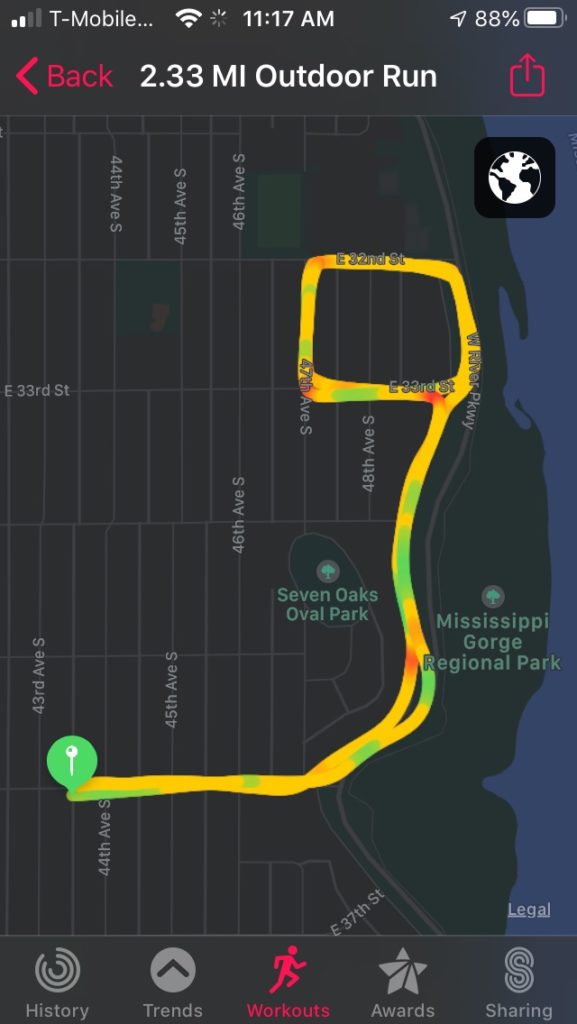
may 4/RUN

3.25 miles
trestle turn around
58 degrees

Ran in the early afternoon today. Warm enough for shorts and a short-sleeved shirt. Spring! Already feeling too warm. I remember where I was when I stopped to look at the river — just past the railroad trestle, down the recently replaced steps — but I don’t remember what it looked like, other than blue and calm. Heard lots of birds, my feet striking the ground in a dull thud, a funky baseline spilling out of a car window, a few fragments of conversation — one of them had something to do with the weather? — and a dog collar clanging.

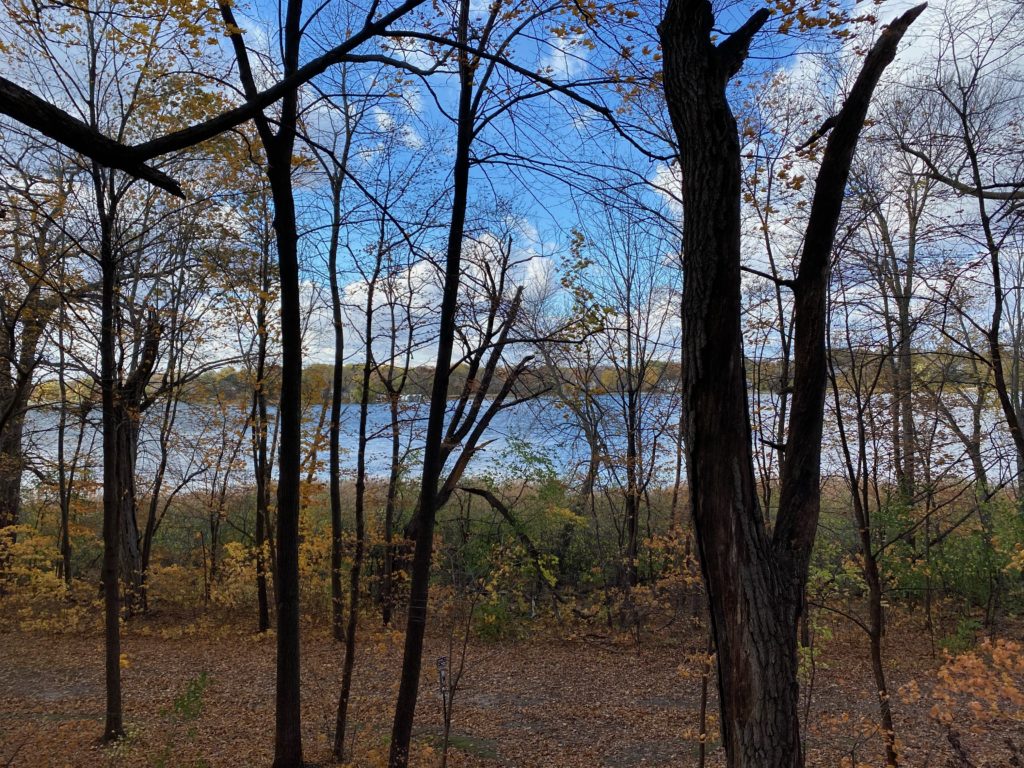
After looking at the river, I kept walking on the dirt path below the paved one. I felt almost, but not quite, removed from everything, but still part of it too. Beside it. I thought again about how stepping only a few feet off of the main trail enables you to have some space, to feel left alone. This space beside below next to everything else is not outside, or even on the threshold. Is it on the front stoop, or the front yard? Not sure what it is exactly or even that it needs a fixed name. An image: a dirt trail beneath my feet, mostly dry with a few muddy spots, perched on a steep edge. To the right: a few tree branches, open air, the river down below. To my left: a small hill with wood railing at the top. An occasional voice traveling down, evidence of the paved path above.

This morning, I read a wonderful interview with Jorie Graham on Lithub. It’s from 2018 and about her book, Fast. This title made me think of its opposite. In her interview with David Naimon for Tinhouse, Graham said a few times, “Pay attention! Slow down!” I kept thinking about what slow might mean for me. Not just moving slower, but moving less efficiently or productively. Moving without purpose or a fixed goal. Moving with ease (and without haste) through open space, not crammed with appointments or tasks or destinations.

It is exciting to find great poets with amazing poems and wonderful advice and reflections on how to be. I really like Jorie Graham. Looking through another one of her collections, Erosion, I found this great poem:

Still Life with Window and Fish / Jorie Graham (recording)

Down here this morning in my white kitchen
along the slim body
of the light,
the narrow body that would otherwise
stay forever the same thing,
the beautiful interruptions, the things of this world, twigs
and power lines, eaves and ranking
branches burn
all over my walls.
Even the windowpanes are rich.
The whole world outside
wants to come into here,
to angle into
the simpler shapes of rooms, to be broken and rebroken
against the sure co-ordinates
of walls.
The whole world outside….
I know it’s better, whole, outside, the world—whole
trees, whole groves–but I
love it in here where it blurs, and nothing starts or
ends, but all is
waving, and colorless,
and voiceless….
Here is a fish-spine on the sea of my bone china
plate. Here is a fish-spine on the sea of my hand,
flickering, all its freight
fallen away,
here is the reason for motion washed
in kitchen light, fanning, gliding
upstream in the smoke of twigs, the rake
against the shed outside, the swaying birdcage
and its missing
tenant. If I should die
before you do,
you can find me anywhere
in this floral, featureless,
indelible
surf. We are too restless
to inherit
this earth.

I want to do something with that last line, I think. Something about my own restlessness.


april 18/RUN

4 miles
marshall loop
35 degrees / feels like 25
wind: 16 mph / snow flurries

Before heading out for a run, watched the Boston Marathon. The thing I remember most about it was during the men’s push-rim race, when the announcer (who I think was a push-rim racer himself) talking about the racer’s gloves: they’re plastic and 3D-printed for precision, and when they bang on the metal wheel rim, they create a steady rhythm that the racer’s use for pacing themselves. Very cool. Later, I remembered this fact as I neared the end of my run.

Today, it is cold and windy and snowing again, but the birds are singing and calling — lots of fee bees — so I know spring will be here soon. Maybe by next weekend? I picked the right route for the direction of the wind. It was at my back as I ran over the lake street bridge and up the Marshall Hill. The only part where I was running directly into it was on the way back over the bridge.

Heard: the bells chiming near Shadow Falls; a dog barking and kid yelling below in the gorge; and the branches creaking from the wind again. This time the branches creaking sounded almost like a rusty hinge, with a door slowly creaking open. I like that image and the idea that some sort of door to somewhere was opening for me at that moment — and that there was something mysterious and scary about this door leading down into the woods or the earth. I like mysterious and scary.

Near the end of my run, I think after I remembered the rhythm of the gloves hitting the push-rim, I started chanting some of an ED poem:

Life is but life/And death but death/Bliss is but bliss/And breath but breath

Stopped to study the river for a minute — and to get a break from the wind — on the lake street bridge: it was a steely gray with ripples and a few eddies.

One more thing: Running above the floodplain forest and the Hiawatha Sand Flats, I heard a ferocious dog bark, then a whimper, almost but not quite, like a squeaky toy. Was the dog chasing or killing a bunny down there? Possibly. A minute later, I heard the deep voice of a human calling out repeatedly, then a steady rhythm of dog barks and sharp commands of some sort.

before the run

Scrolling through poems I’ve archived on my Safari Reading List, I found one that builds off of being dug up and excavated, but is also about returning, caring for, and re-planting:

Pear Snow/ Todd Dillard

A flood unzips a graveyard.
Cadavers sluice down Main St.
It’s my job to find the dead,
chauffeur them back to their plots.
The problem being the dead speak.
They want to swing by their old places,
check on spouses, kids grandkids
glimpsed in sepia windows
beneath the blue of evening news.
They whisper: “That tree was a sapling when I planted it,”
or: “I forgot what her laugh was like,”
or they call a dog that refuses to come.
Then, embarrassed by their weeping,
by how dry it is,
the dead ask me to take them home,
and on the drive I recite this line I’m working on
about the graininess of two-day-old snow.
“Pear snow,” I call it.
The dead say nothing
in response. The air velvets
as if it’s going to rain,
though the sky is clear,
the moon wet as the light in a child’s pupil.
Gentle, I lower the dead
back into their cradles. The earth,
for all its stripped rancor,
heavy in my shovel.
The work hard, but familiar.
The pay, at least, good.

What do we do with the ghosts that resurface, whether we want them to or not? How do we care for the stories of those who came before us?

Here’s another poem I posted last year about what the earth can yield and how we might notice it:

After the Rain/ jared Carter

After the rain, it’s time to walk the field
again, near where the river bends. Each year
I come to look for what this place will yield –
lost things still rising here.

The farmer’s plow turns over, without fail,
a crop of arrowheads, but where or why
they fall is hard to say. They seem, like hail,
dropped from an empty sky,

Yet for an hour or two, after the rain
has washed away the dusty afterbirth
of their return, a few will show up plain
on the reopened earth.

Still, even these are hard to see –
at first they look like any other stone.
The trick to finding them is not to be
too sure about what’s known;

Conviction’s liable to say straight off
this one’s a leaf, or that one’s merely clay,
and miss the point: after the rain, soft
furrows show one way

Across the field, but what is hidden here
requires a different view – the glance of one
not looking straight ahead, who in the clear
light of the morning sun

Simply keeps wandering across the rows,
letting his own perspective change.
After the rain, perhaps, something will show,
glittering and strange.

during the run

I tried to think about these two poems and excavating truths and caring for ghosts and noticing the things that are buried in the ground, but I couldn’t hang onto my thoughts. It could have been wind or the effort I was making to run in it that distracted me. Near the end of my run I thought about this before/during/after the run experiment and how it works sometimes and not others. I think I need to fine-tune it — maybe narrow my focus, or be more deliberate with what I want to think about before I head out on my run?

One other thing I remember was thinking about surfaces and depths, and the value of both. And now, writing this entry hours later, I’m thinking about how both of the poems in my “before the run” section involve water (rain) and how it brings the things buried to the surface. This reminds me of writing about water last July and Maxine Kumin’s idea of the thinker as the sinker (july 22, 2021). I’m also thinking about floating and bobbing to the surface and how humus (which I wrote about earlier this month) is the top layer of soil — 12 inches at the surface.

after the run

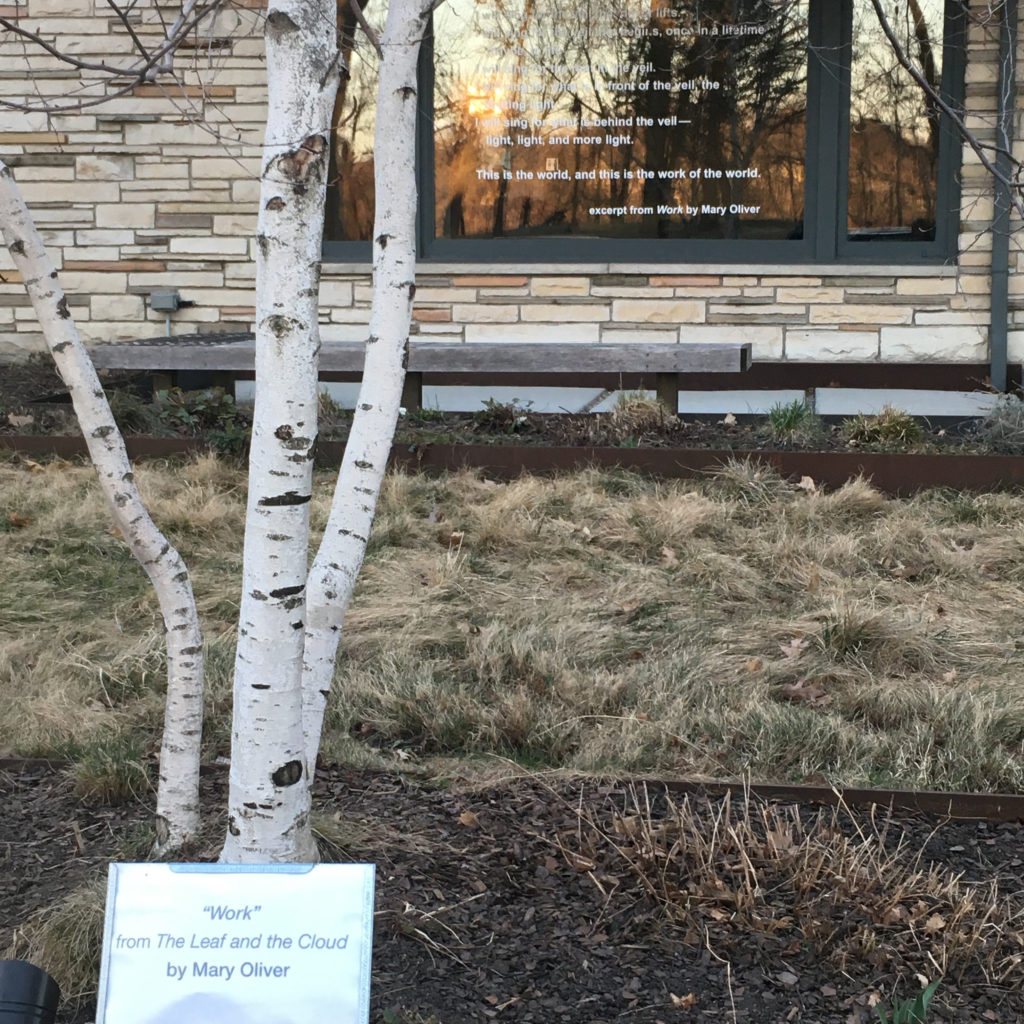
I want to return to the creaky branches sounding like the rusty hinge of a door. Last April, I read a poem by Mary Oliver with a hinge in it:

from Dogfish/ Mary Oliver

I wanted
my life to close, and open
like a hinge, like a wing, like the part of the song
where it falls
down over the rocks: an explosion, a discovery

I’m thinking of door hinges and poems as opening a thousand doors and the wings of the seven white butterflies and “how they bang the pages/or their wings as they fly/to the fields of mustard and yellow/and orange and plain/gold all eternity” (Seven White Butterflies/ from West Wind)

april 17/RUN

1.5 miles
winchell trail, south/42nd st east/edmund, north
41 degrees

Headed to the gorge with Scott this morning — a quick run above the river. I know I looked at the river, but I can’t remember much about it. Most likely, with this gloomy sky, it was a brownish-gray or grayish-brown with no sparkle. We talked a lot about Lizzo and what a great job she did on SNL last night, both as the host and the musical guest. The only other thing I remember right now is running the opposite way on the Winchell Trail (usually I run north on it) and noticing how much longer the Folwell hill was this way. The other way it’s steep but short, this way it’s slightly less steep, but winding (or wind-y?) and long.

before the run

Yesterday I suggested that my next dirt topic should be gardens/gardening. Here are a few ideas:

1 — tune my body and my brain

My exploration of dirt began when I started thinking about the phrase from a kids’ song, or a song often sung to or by kids: “the worms crawl in, the worms crawl out.” Here’s another kids’ song that doesn’t have the word dirt in it, but is about dirt and death and life and gardens. Both my kids sang it in elementary school concerts:

Here are a few verses:

Inch by inch, row by row
Gonna make this garden grow
All it takes is a rake and a hoe
And a piece of fertile ground

Inch by inch, row by row
Someone bless these seeds I sow
Someone warm them from below
Till the rain comes tumblin’ down

Pullin’ weeds and pickin’ stones
Man is made of dreams and bones
Feel the need to grow my own
‘Cause the time is close at hand

Rainful rain, sun and rain
Find my way in nature’s chain
Tune my body and my brain
To the music from the land

2 — Alice Oswald and “echo-poetics”

It is perhaps this blending of the ecological sensibilities learned through gardening with those of the poet that makes reading Oswald’s editorial and poetic work so compelling, and not only for the many pleasures it brings. It also offers an acoustically informed aesthetic, a way of re-tuning how we think about and make beauty and meaning in verbal forms, especially those inspired by the earth’s processes, things, places. Principled with the desire to bring living things unmediated into text, Oswald’s writings illustrate a heightened and recursive sensitivity to the acoustics of environment, with the ear, of course, in its critical role as converter of signals. They recognize sound as summons, access, and mode. They value gardening (and other physical work) for the ways it creates possibilities for encounter by situating the body in motion and out-of-doors. They invite and invent expressive forms that are organic to these encounters, or that modify existing forms so they are apt and up to the task. They reveal a rootedness in rhythm, syncopation, harmony, or some other musicality within the external world. They practice acute hearing and engage in humble, patient, and empathie listening. They gesture toward the sonic rounding out of envi-ronments and their many natural, social and cultural complexities. And they practice accretion as a writer’s technique inspired by a natural process. Thus Oswald begins to define what I might term an “echo-poetics.”

Voice(s) of the Poet-Gardener: Alice Oswald and the Poetry of Acoustic Encounter/ Mary Pinard

3 — digging work

It’s certainly true that when you’re digging you become bodily implicated in the ground’s world, thought and earth continually passing through each other. You smell it, you feel its strength under your boot, you move alongside it for maybe eight hours and your spade’s language (it speaks in short lines of trochees and dactyls: sscrunch turn slot slot, sscrunch turn slot slot) creeps and changes at the same pace as the soil. You can’t help being critical of any account of mud that is based on mere glimpsing.

“The Universe in time of rain makes the world alive with noise” / Alice Oswald

Digging/ Seamus Heaney

Between my finger and my thumb   
The squat pen rests; snug as a gun.

Under my window, a clean rasping sound   
When the spade sinks into gravelly ground:   
My father, digging. I look down

Till his straining rump among the flowerbeds   
Bends low, comes up twenty years away   
Stooping in rhythm through potato drills   
Where he was digging.

The coarse boot nestled on the lug, the shaft   
Against the inside knee was levered firmly.
He rooted out tall tops, buried the bright edge deep
To scatter new potatoes that we picked,
Loving their cool hardness in our hands.

By God, the old man could handle a spade.   
Just like his old man.

My grandfather cut more turf in a day
Than any other man on Toner’s bog.
Once I carried him milk in a bottle
Corked sloppily with paper. He straightened up
To drink it, then fell to right away
Nicking and slicing neatly, heaving sods
Over his shoulder, going down and down
For the good turf. Digging.

The cold smell of potato mould, the squelch and slap
Of soggy peat, the curt cuts of an edge
Through living roots awaken in my head.
But I’ve no spade to follow men like them.

Between my finger and my thumb
The squat pen rests.
I’ll dig with it.

4 — listening work

People often ask me what I like best about gardening. . . . The truth is it’s the sound. I don’t know anything lovelier than those free shocks of sound happening against the backsound of your heartbeat. Machinery, spade-scrapes, birdsong, gravel, rain on polythene, macks moving, aeroplanes, seeds kept in paper, potatoes coming out of boxes, high small leaves or large head-height leaves being shaken, frost on grass, strimmers, hoses . . .

“The Universe in time of rain makes the world alive with noise”/ Alice Oswald

Poems are written in the sound house of a whole body, not just with the hands. So before writing, I always spend a certain amount of time pre- paring my listening. I might take a day or sometimes as much as a month picking up the rhythms I find, either in other poems or in the world around me. I map them into myself by tapping my feet or punch- ing the air and when my whole being feels like a musical score, I see what glimpses, noises, smells, I see if any creature or feeling comes to live there. Then, before putting pen to paper, I ask myself, “Am I lis- tening? Am I listening with a soft, slow listening that will not obliter- ate the speaker?” And if, for example, I want to write a poem about water, I try to listen so hard that my voice disappears and I speak water.

“Poetry for Beginners” for the BBC’s Get Writing/ Alice Oswald

5 — In Search of our Mother’s Gardens*

*a reference to the powerful essay by Alice Walker, “In Search of Our Mother’s Gardens,” that I often taught in my Fem Theory classes.

things to think about while running:

  • How can I “tune my body and brain to the music of the land”?
  • What is digging work? Where can/do we do digging work?
  • What are the sounds of my backyard garden?
  • What can I plant in my garden this year?
  • Why do I love doing physical, outdoor work? How is digging/gardening/weeding work different from listening/noticing/caring/writing work? How is it similar?

during the run

Ran with Scott, and we didn’t talk about gardens or digging until the end, when I mentioned gardening, digging, and the digital story about my mom. He suggested that I look up the lyrics for Peter Gabriel’s “Digging in the Dirt.”

after the run

Here are a few lyrics from Gabriel’s “Digging in the Dirt”:

Digging in the dirt
Stay with me, I need support
I’m digging in the dirt
To find the places I got hurt
Open up the places I got hurt

The more I look, the more I find
As I close on in, I get so blind
I feel it in my head, I feel it in my toes
I feel it in my sex, that’s the place it goes

This time you’ve gone too far
I told you, I told you, I told you, I told you
This time you’ve gone too far
I told you, I told you, I told you, I told you

And the refrain at the end, repeated several times:

Digging in the dirt
To find the places we got hurt

And here’s the video, which I can’t embed). Wow, the imagery in this fits with so many things I’ve been discussing! Worms, digging as excavating deeper truths (I think I’ve mentioned this before), death, dust, grass, pebbles, sand, rocks, mushrooms speaking! (in the video they spell out “help”).

video: Digging in the Dirt/ Peter Gabriel

addendum, 18 april 2022: almost forgot to add this image from my notes for my memoir (still in progress) about my student and teaching life”

planting a seed, lower right

Instead of cropping out the key part — the picture of a plant growing inside a head in the lower right with the text, “planting a seed” — I decided to post the entire image. When I taught feminist and queer classes a decade ago, my aim was to plant seeds. Not to force ideas on students or to expect instant results — where they could immediately “get” something or be transformed, but to introduce ideas and offer up invitations that might, in the future, lead to transformation and deeper understandings.

april 15/RUN

3.5 miles
trestle turn around + extra
29 degrees / feels like 20
wind: 15 mph

Cold and windy. Again. Ran north, thinking I would have the wind at my back. Nope, in my face. Difficult. As I got closer (but not too close) to the porta-potty under the lake street bridge, it suddenly opened and a runner ran out. He was ready to go, I guess. Also saw a woman ahead of me walking down the service road to the Minneapolis Rowing Club. Rowers on the river today? If there were, I didn’t see or hear them. Ran past the trestle and stopped at the recently replaced steps. Then took them — about 30 steps, I think — down for a closer look. The river, with the sun reflecting the blue sky, the brown trees, the gray stone, looked almost mauve to me. Mostly brown, with hints of blue and gray and dark pink — where/how was I seeing pink? Saw a few fluttering birds, some ice on the edge of the entrance to the trail.

Almost forgot, but was reminded by hearing a dog bark here at my desk: Running south from the trestle, across the road from the fancy houses on Edmund, I heard a dog barking a deep, low bark in one of the houses. Then another a few doors down dog joined in. The second bark sounded almost like the impersonation of a frantic bark, like an unhinged kid trying to sound like a dog. I wondered which it was — a real bark or the copy of a bark? I never did find out, even as I listened for several minutes.

before the run

Today’s dirt topic: dust. Dust as the great equalizer (we all come from dust and return to it); how we are dust and more than dust; dusting as a sacred chore; dust as a fine powder we inhale/absorb without noticing; toxic dust; environmental racism and who does/doesn’t have access to cleaner air

1 — Dust Poem/ Philip Jenks

The idea was.
At least in theory,
Dust was a bad thing.

There was a bowl
Of it. At another
Point in time
The conclusion
Was reached
That everything
Was of it.

No season, no
Nothing to measure
To measure against
So no love or hate.
Left us without no
Moorings or so my
Father told me

Vanity tables of it?
Isn’t that what a vanity
Table is for?
What happens to
As its failings accrue?

No mission but to be clean.
Of itself.
But existing (time)
And problems there –
The problem of now
We are back here.

See the whole dust problem’s
No measure.
All’s dust, check.
All’s virtuous, check.
So why not live it up then?
And thus, YOLO etc. etc.

{These fok whirr pretty smart.
Thing is, even in
The dust bowl, the
Idea, a very American
One was that something
Wasn’t dust.
I wasn’t.
The Bowl wasn’t.
The dust wasn’t.

Since Ecclesiastes,
Been trying this one on.
(how’s that working out for you?)
One needn’t be geologically
Or for that matter
Psychologically trained to
Begin unpacking the diffident
And sometimes strained
Relation the nation holds with
All that is vanity.

The poet’s explanation of the poem was helpful for me in trying to dig in:

And I don’t say of myself much, or “I” much. I sometimes even just do search replace and take out “I” and put in “it” to try to take myself out as some small measure of humility.

“What happens to
As its failings accrue?

No mission but to be clean.
Of itself.

Dust Poem in PoetryNow

The idea of an “I” — writing as an “I,” being an “I.” How to navigate between a recognition that we are both more than dust and only dust (“All go to the same place; all come from dust, and to dust all return.”–Eccleasiastes 3:20)? What is the “more” and how do we express/live it in ways that don’t deny the dust and in which our humility doesn’t erase our own existence? Is this too vague sounding? This question of being an “I” — having a unique voice, claiming a space — without doing violence to others (being too arrogant, taking too much) is one of the primary questions I struggle with in my life/writing. I tend to be too humble, too quick to erase or replace my “I”.

2 — Dusting/ Marilyn Nelson

Thank you for these tiny
particles of ocean salt,
pearl-necklace viruses,
winged protozoans:
for the infinite,
intricate shapes
of submicroscopic
living things.

For algae spores
and fungus spores,
bonded by vital
mutual genetic cooperation,
spreading their
inseparable lives
from equator to pole.

My hand, my arm,
make sweeping circles.
Dust climbs the ladder of light.
For this infernal, endless chore,
for these eternal seeds of rain:
Thank you. For dust.

I like how Nelson connects the chore of dusting — an everyday act of labor — with the deeper substance/s of life: tiny particles of ocean salt, algae and fungus spores, winged protozoas. For Nelson (and Jenks mentions it in his poem too), dust is more than dust, it is life, everything — and dusting is more than chore, but our access to that life.

Nelson’s reimagining dusting as sacred, reminds me of a poem I posted earlier this year, or late last year, Drift, which is about, among other things, rethinking the possible joy in shoveling snow.

3 — Dust/ Dorianne Laux

Someone spoke to me last night,
told me the truth. Just a few words,
but I recognized it.
I knew I should make myself get up,
write it down, but it was late,
and I was exhausted from working
all day in the garden, moving rocks.
Now, I remember only the flavor —
not like food, sweet or sharp.
More like a fine powder, like dust.
And I wasn’t elated or frightened,
but simply rapt, aware.
That’s how it is sometimes —
God comes to your window,
all bright light and black wings,
and you’re just too tired to open it.

Dust = fine powder we inhale, surrounding us but often unnoticed. For Laux, truth as dust

dust: fine, dry powder consisting of tiny particles of earth or waste matter lying on the ground or on surfaces or carried in the air.

4 — Household Dust and Our Health

My 100+ year old house in the middle of the city gathers a lot of dust. I don’t often think about what all that means, and what all I’m inhaling/absorbing inside. Yikes.

As sure as the sun rises, houses collect dust. It gathers on our knickknacks and dirties the carpets. More than just dirt, house dust is a mix of sloughed-off skin cells, hair, clothing fibers, bacteria, dust mites, bits of dead bugs, soil particles, pollen, and microscopic specks of plastic. It’s our detritus and, it turns out, has a lot to reveal about our lifestyle.

For one thing, dust is far from inert. Those shed hairs and old skin cells can soak up a constellation of contaminants originating from consumer products that we bring into our homes. Other environmental contaminants can be tracked indoors on the soles of our shoes. So in addition to fluffy hair and garden dirt, dust can hold a witch’s brew of persistent organic pollutants, metals, endocrine disruptors, and more.

Not only does dust hold a long memory of the contaminants introduced to a house, but it’s also a continual source of exposure for the residents. Dust gets resuspended when it’s disturbed and will recirculate throughout the house, picking up substances before returning once more to the floor. “Year over year, dust accumulates in the home,” says Miriam L. Diamond, an environmental chemist at the University of Toronto. Even after regular cleaning, it still accretes because homes are tightly sealed environments, and the dust gets entrenched in carpets and crevices. Dust from an old house may retain legacy pollutants such as DDT that were banned almost half a century ago, she says.

Tracing the chemistry of household dust

5 — Dust, Toxins and Environmental Racism

So, we’re breathing in a lot of bad shit inside our individual houses — toxic chemicals that may not have even be used for decades. What about in our neighborhoods? And which neighborhoods are subject to more toxic and why?

At MCEA we believe in seeking justice for communities that have been harmed by historic and ongoing toxic pollution and contamination. By design and neglect, this harm has affected Black, Indigenous and other communities of color to a much greater extent than white neighborhoods.  Whenever municipal development is proposed in these communities, a necessary first step is to make sure the voices of neighboring community members are engaged and respected. Key decisionmakers must invite community members to the table to work towards a goal of eliminating new, harmful sources of pollution in neighborhoods experiencing systemic pollution and poor air quality.

The East Phillips neighborhood of Minneapolis is one of these communities. This neighborhood continuously ranks as having some of the worst air quality in Minneapolis, and it is still being harmed by one of the most brazen and widespread urban polluters in Minnesota history.  An insecticide manufacturer at East 28th St. and Hiawatha Ave. polluted the neighborhood with arsenic from the 1930’s to the 1960’s, resulting in a massive cleanup of contaminated residential yards. 

The area surrounding this Superfund site is recognized in state law as being overburdened by pollution. State law requires that no permit shall be issued by the Minnesota Pollution Control Agency in the area “without analyzing and considering the cumulative levels and effects of past and current environmental pollution from all sources on the environment.” 

The City of Minneapolis has proposed building a new “Hiawatha Campus” adjacent to the former manufacturing site to house city offices and vehicles. 

Ensuring community voices are heard in East Phillips

Environmental racism: Although the proposed project is expected to reduce overall greenhouse gas emissions in city operations, this would come at the direct expense of local environmental quality by increasing pollutants from traffic near this site. As a neighborhood that is 83% Black, Indigenous, and people of color, the East Phillips community would be expected to bear the brunt of the impact for the “greater good,” which is an unacceptable trade-off. Racism has recently been declared a public health emergency in Minneapolis. Knowingly increasing the amount of pollution in a neighborhood primarily populated by Native American, Latinx, East African and Black communities will only exacerbate this problem and demonstrate the hypocrisy of the city’s words.

Poor governance to bring new toxicity to the ‘Arsenic Triangle’

during the run

Did I think about dust while I was running? I tried. At one point, I remember thinking about the invisibility of dust and how it’s in the air, as opposed to dirt on the ground or sandy muck in the water. I also thought about breathing and breath and how dust travels between lungs.

after the run

Here’s something to add to the list of invisible things around us all the time, and another possible reason why I have “sinus episodes” so often: dust mites

Dust mites are microscopic, insect-like pests that feed on dead human skin cells and thrive in warm, humid environments. They are not parasites that bite, sting or burrow into our bodies. Instead, people who are allergic to dust or dust mites are reacting to inhaling proteins in dust that comes from dust mite feces, urine or decaying bodies. Any inflammation of the nasal passages caused by dust mites is considered a dust allergy.

Dust and Dust Mites

april 14/RUN

3.5 miles
2 trails + extra
32 degrees / feels like 22
wind: 20 mph with 33 mph gusts
light snow

Cold and windy. Snow flurries covering my eyelashes. Winter is back. Glad I went out for a run, but some of it wasn’t fun. The best part: running closer to the river on the Winchell Trail, glancing out at the gorge, seeing everything smudged from the snow falling — almost like looking through a fogged-up window. I also liked how the dirt and grass were white in the corners where the snow was sticking, like a dusting of powdered sugar. Near the end of the run, right after I made it through the tunnel of trees and past the old stone steps, 2 walkers clapped for me. As I ran by, I wasn’t quite, but I think that’s what they were doing, because I was out there, running even in these bad conditions. I’ll take it. How many times in my life will I have people randomly clap for me?

before the run

1 — a tool used to loosen and bury things in the ground

The planet seen from extremely close up is called the ground. The ground can be made loose by the human hand, or by using a small tool held in the human hand, such as a spade, or an even larger tool, such as a shovel

We bury our dead in the ground. Roughly half the dead are buried in boxes and half the dead are buried without boxes. A burying box is an emblem of respect for the dead. 

Besides burying the dead in the ground, we bury our garbage, also called trash. Man-made mountains of garbage are pushed together using heavy equipment and then pushed down into the ground. The site of this burial is called a landfill. The site of the dead buried in boxes is called a cemetery. In both cases the ground is being filled. A dead body in a box can be lowered into the ground using heavy equipment, but we do not consider it trash. When the dead are not in boxes and there is a man-made mountain of them we do use heavy equipment to bury them together, like trash. It is estimated that everywhere we walk we are walking on a piece of trash and the hard, insoluble remains of the dead. 

Also buried in the ground are seeds, which we want to see when they emerge from the ground in their later form–that is, as plants. Plants rising from the ground are essential to life. To bury a seed it to plant it. 

When flowers arise from the ground, colorful and shapely in an astonishing variety of ways, the living are made especially happy.

After a while, the flower that has been separated from the ground dies, and we throw it in the trash. Flowers are often planted where the dead are buried in boxes, but these flowers are never cut. That would be horrible. Whoever did such a thing would be considered a thief. Thoseflowers belong to the dead.

Observations on the Ground“/ Mary Ruefle

To bury is not always to get rid of, but to honor, attend to, plant. A shovel is one tool we use to do this.

2 — digging in and developing foundations

List: Things I have shoveled: sidewalks, snowdrift, holes (for outhouses and bridge abutments and potatoes), driveways, fill pits Also, footings for rock walls, tie-ins for for cribbing, horse shit, dog shit, mule shit, a grave for a songbird caught in an early frost. Coal, gravels, dirt, straw, mud, cedar chips, muck, bark, left-over acorn hulls from a squirrel’s midden, water from a gooey ditch. Once, I lifted a dumb spruce grouse from the middle of the road in a shovel, carried it twenty yards to safer ground.

Look around—an urban subway system, the pilings of a shipyard dock, the basement of your house. Shovels, more than bootstraps, are the secret to success.

from Dirt Work

shovel = digging in = finding home, a place to stay. settle, attend to = remember, praise, honor

“Dirt work is foundation work.”

3 — the Golden Shovel

The Golden Shovel = a poem + poetic form + a way to honor others/ancestors + a place (where the seven pool players play) + a helpful constraint

The Golden Shovel is a poetic form readers might not — yet — be familiar with. It was devised recently by Terrance Hayes in homage to Gwendolyn Brooks, whose centenary year this is. The last words of each line in a Golden Shovel poem are, in order, words from a line or lines taken often, but not invariably, from a Brooks poem. The results of this technique can be quite different in subject, tone, and texture from the source poem, depending upon the ingenuity and imagination of the poet who undertakes to compose one.

Introduction: The Golden Shovel

The Golden Shovel/ TERRANCE HAYES

after Gwendolyn Brooks

I. 1981

When I am so small Da’s sock covers my arm, we
cruise at twilight until we find the place the real

men lean, bloodshot and translucent with cool.
His smile is a gold-plated incantation as we

drift by women on bar stools, with nothing left
in them but approachlessness. This is a school

I do not know yet. But the cue sticks mean we
are rubbed by light, smooth as wood, the lurk

of smoke thinned to song. We won’t be out late.
Standing in the middle of the street last night we

watched the moonlit lawns and a neighbor strike
his son in the face. A shadow knocked straight

Da promised to leave me everything: the shovel we
used to bury the dog, the words he loved to sing

his rusted pistol, his squeaky Bible, his sin.
The boy’s sneakers were light on the road. We

watched him run to us looking wounded and thin.
He’d been caught lying or drinking his father’s gin.

He’d been defending his ma, trying to be a man. We
stood in the road, and my father talked about jazz,

how sometimes a tune is born of outrage. By June
the boy would be locked upstate. That night we

got down on our knees in my room. If I should die
before I wake. Da said to me, it will be too soon.


II. 1991

Into the tented city we go, we-
akened by the fire’s ethereal

afterglow. Born lost and cool-
er than heartache. What we

know is what we know. The left
hand severed and school-

ed by cleverness. A plate of we-
ekdays cooking. The hour lurk-

ing in the afterglow. A late-
night chant. Into the city we

go. Close your eyes and strike
a blow. Light can be straight-

ened by its shadow. What we
break is what we hold. A sing-

ular blue note. An outcry sin-
ged exiting the throat. We

push until we thin, thin-
king we won’t creep back again.

While God licks his kin, we
sing until our blood is jazz,

we swing from June to June.
We sweat to keep from we-

eping. Groomed on a die-
t of hunger, we end too soon.

And here’s the original poem from Gwendolyn Brooks:

We Real Cool/ Gwendolyn Brooks

The Pool Players.
        Seven at the Golden Shovel.

We real cool. We   
            Left school. We

            Lurk late. We
            Strike straight. We

            Sing sin. We   
            Thin gin. We

            Jazz June. We   
            Die soon.

during the run

I tried to think about shovels and digging in and things planted instead of buried, but I think I was too distracted by the wind and the snow to remember anything.

after the run

Thinking more about Mary Ruefle and whether or not to read the collection, My Private Property, from which her prose poem about ground comes. Found and read/skimmed an LARB review about it, with a great definition of poetry:

In her introduction to Madness, Rack, and Honey, Ruefle suggests that poetry maintains its mystery by always being a few steps beyond us. She likens attempting to describe poetry to following a shy thrush into the woods as it recedes ever further, saying: “Fret not after knowledge, I have none.” Ruefle proposes that a reader might “preserve a bit of space where his lack of knowledge can survive.”

Human Lessons: On Mary Ruefle’s My Private Property

Also, scrolling through twitter, found a great passage Ada Limón in her interview for Michigan Quarterly Review:

‘I want to know how we live. How do we live?’. And I mean that in a curious way, but I also mean it in a wondrous way. Because sometimes I think — wow, we do this! And other times I think, how do we do this. It is out of sheer amazement that the question comes out of me — because it is really remarkable to be alive. But the ebbs and flows are just so intense. And I think acknowledging how hard it is, is actually part of the wonderment. You know that’s part of the awe. And I don’t think I knew that until I had experienced my own realization about mortality.

She also offers a great definition of poetry:

that’s what poetry is. It doesn’t just point out the world. It makes it strange to us again. So that we can remember wonder. 

And, one more great thing about not knowing and uncertainty:

When I began as a poet, I thought it was all about knowing. I thought it was about truth, and beauty. And every poem I read, felt wise to me. I could read Anne Sexton, Philip Levine, Lucille Clifton and I would find this deep wisdom. So I thought that’s what I should work towards, a knowingness. And then, the old cliché – and it is a cliché because it’s true – that the more you learn, the more you witness, the more you realize you don’t know. And I think I’m very scared now of certainty. Even when someone says, what’s your opinion about this? Often, I’m like, I don’t know. I don’t 100% know. And that’s because the world is changing so fast. And I can have a sense of morality, of course, and right and wrong, and goodness, but beyond that, I hope I can remain porous and open enough to not think that I know all the answers. And I think a lot of harm comes from that false certainty, that is so attached to our egos, when not only are we completely convinced that we’re right, but to be proven wrong would be almost deadly. And I don’t ever want to be in that position.

What is Enough for a Poem? An Interview with Ada Limón

april 12/RUN

4 miles
marshall loop
40 degrees

When I started my run, I wasn’t sure where I was headed, except north. At some point, I decided to cross the bridge and run the marshall loop. Not much sun, lots of gray and brown. The river was a dull blue with small waves from the wind. Don’t remember many birds, except for a few crows. I felt cold when I started, in tights, shorts, a long-sleeved shirt, a sweatshirt, and warm when I was done.

before the run

Thought about expressions and songs with the word dirt in them. Here’s an incomplete list:

  • dirt bag + Teenage Dirt Bag
  • dirt nap
  • dirt bath
  • dirt ball
  • as old as dirt
  • dish out the dirt
  • dig up some dirt
  • hit pay dirt
  • as poor as dirt
  • eat dirt
  • Dirty Deeds Done Dirt Cheap
  • Dirty Laundry
  • opp.: clean up my act
  • dust: Another One Bites the Dust
  • dirty and low down

dirt = dirty = bad = undesirable, unwanted = death = uncivilized = impure = contaminated So much to say about how being clean (and not dirty) is partly about establishing/protecting status and power over others and the earth, and about establishing boundaries and hierarchies. Also clean = pure = discrete = uncluttered, not messy = neat = separate

during the run

Thought about the hierarchies that the vilifying of dirt creates, then thought about the binaries too, when things are divided into pairs, with one member of the pair being better/having more power and status: clean/dirty, white/black, rich/poor, men/women, culture/nature, mind/body. Then I thought (again) about how much these unjust distributions of power are connected and decided entangled was a better word. Connected almost seems too neat, like they’re linked in some row or continuous chain. The webs of power overlap and aren’t neat or linear. This lead me to remember Ross Gay’s criticism of buoyancy and the idea that we are free, able to float above, untethered. We are entangled — down in the dirt with everything and everyone else.

Later running on the bridge, I stopped briefly to read one of the many yellow tags attached to the railings. It said, “this is not the end of your story” and had a hashtag. I didn’t stop long enough to read the # carefully, but it was something like #youarenotalone Was this about suicide prevention? Nearing the bridge from the St. Paul side, I saw a sign: Citywide Clean-up Campaign. The phrase, “clean up your mess” came into my head and it bothered me to think about a clean-up campaign beside the message about your story not ending — one wants you get rid of something, the other to not. I thought about the violence of cleaning as eliminating, erasing, removing, expunging, rendering non-existent or having never existed.

after the run

Here, in the second half of a poem by Aracelis Girmay, is another way of saying, “taking a dirt nap”:

from Kingdom Animalia/ Aracelis Girmay

one day, not today, not now, we will be gone
from this earth where we know the gladiolas.
My brother, this noise,
some love [you] I loved
with all my brain, & breath,
will be gone; I’ve been told, today, to consider this
as I ride the long tracks out & dream so good

I see a plant in the window of the house
my brother shares with his love, their shoes. & there
he is, asleep in bed
with this same woman whose long skin
covers all of her bones, in a city called Oakland,
& their dreams hang above them
a little like a chandelier, & their teeth
flash in the night, oh, body.

Oh, body, be held now by whom you love.
Whole years will be spent, underneath these impossible stars,
when dirt’s the only animal who will sleep with you
& touch you with
its mouth.

“when dirt’s the only animal who will sleep with you”

Girmay’s mentioning of bones and dreams and plants, reminds me of something else I looked up before my run but decided to save for later: the kids’ song Garden Song, or what I refer to as “the inch by inch song”– “inch by inch, row by row/gonna make this garden grow.” Here’s the verse I’m reminded of:

Pullin’ weeds and pickin’ stones
Man is made of dreams and bones
Feel the need to grow my own
‘Cause the time is close at hand

So much about dirt is the mixing of life and death, growth and decay. Dirt is where we come from, where we’re going.

april 8/RUN

4.75 miles
Veterans’ Home loop
39 degrees
wind: 12 mph, 21 mph gusts

Sunny and windy and cold. I’m ready to put away my running vest and tights. Headed south to the falls. Noticed how the river was sparkling in the distance as I ran above the gorge. Heard kids yelling at the Minnehaha Academy playground. I thought I heard someone yell, “Girl! Girl!” in an accusing way. Kept listening. The underlying hum of all the noise seemed menacing, not like kids having fun on the playground, but kids being mean to each other. Was I hearing that right? Watched the creek as it rumbled over the falls. Later, going down the hill above Locks and Dam No. 1, I noticed a small eddy in the water. I almost stopped to stare, but didn’t. Thought about how many benches were occupied with a person sitting, admiring the view. Descended to the Winchell Trail and appreciated the bare branches and the empty space they offered. Heard the sewer pipe at 42nd gushing water.

before the run

Today’s dirt topic is: fungi, decomposition, entanglement, mycelium. Here are some words/ideas I want to gather:

1 — decomposition of the self

RG: One of my favorite metaphors when I talk about joy is a mycelial metaphor. It’s like the story or the fact that in healthy forests, there’s constant communication happening in the soil. It’s a shuttling of nutrients that is trying to make this system work or this system live. Anna Tsing, The Mushroom at the End of the World does a lot of this in thinking about ruins, capitalism, and stuff. But I consider it a childish notion of joy, I’m just saying it’s not joy, I’m saying it’s something else and something that I’m not aspiring too actually, it does probably like the feeling of being a really free discreet individual, not beholden. That is a kind of joy or happiness. I like the word buoyant, you can lift above everything as opposed to what we know biologically, etc. is the case, that doesn’t happen, [laughs] it just doesn’t happen nor is that my aspiration. If it is my aspiration, despite my best intentions, I don’t want it to be. My practice is toward entanglement, toward recognizing.

DN: Is it toward a decomposition of the self? Like when I think of the way these mushrooms are the result of death but they’re also the processors of death 

RG: Yeah. One of the things that’s so great about a garden is that you’re studying a kind of mutuality. A healthy garden has a lot of the life that comes from decomposition and it seems like hanging around that alerts us to decomposition but it also alerts us to what emerges, what happens in a garden, what happens from decomposition which is food and flowers, then which is related to all these critters, like gazillion critters that are making this happen.

Between the Covers Interview with Ross Gay

2 — mutuality and symbiosis, underneath and on the edges

A mycelium is a network of fungal threads or hyphae. Mycelia often grow underground but can also thrive in other places such as rotting tree trunks. A single spore can develop into a mycelium. The fruiting bodies of fungi, such as mushrooms, can sprout from a mycelium.

Mycelia are of vital importance to the soil. They break down organic material, making its raw materials available again for use in the ecosystem. On top of this, 92% of plant families interact with fungi. This kind of symbiosis is termed mycorrhiza. Hyphae are also an important source of food for insects and other invertebrates.

Mycelium

The term “mycorrhiza” is assembled from Greek words for “fungus” and “root”; fungi and plant roots become intimately entangled in mycorrhizal relations. Neither the fungus nor the plant can flourish without the activity of the other (see pages 137-139 for a more detailed discussion).

The Mushroom at the End of the World: On the Possibility of Life in Capitalist Ruins/ Anna Tsing

Ross Gay: And it’s basically sort of talking about how mycelium … the more and more we know, is that like, you know, healthy forests are really connected. And there’s all this shuttling of nutrients and all of this other information. Like this knowledge beyond anything that we can ever comprehend. But finally, we’re starting to like, tap it a little bit, or become aware of it a little bit. But she’s sort of talking about how mushrooms themselves and that whole sort of world, they resist things of like scale, the way the plantation, the logics of the plantation have a certain kind of relationship to scale, you know. Like, if we could make like, 10 of these, how do we figure out how to make a hundred of these. How do we figure—

Ross Gay: You know, mushrooms resist capitalist logics. They just resist it.

Ross Gay: They’re kind of funny that way, you know.

Franny Choi: Wait, how do mushroom’s resist that, like, plantation scale?

Ross Gay: Because you can’t plant mushrooms like that.

Ross Gay: You know, you can’t—you know, to some extent, you can. But certain mushrooms, like she’s studying this mushroom called matsutake mushroom. And it comes when it comes, you know.

Ross Gay: And people who know—and a lot of the people who know who are foragers are sort of marginal people. So, in the margins, there’s this different relationship. And folks are selling them and all this stuff. So they’re in a kind of market. But the market is this other kind of market.

Ross Gay vs. Entanglement

3 — precarity and alienation

To live with precarity requires more than railing at those who put us here (although that seems useful too, and I’m not against it). We might look around to notice this strange new world, and we stretch our imagination to grasp its contours. This is where mushrooms help. Matsutake’s willingness to emerge in blasted landscapes allows us to explore the ruins that has become our collective home.

Matsutake are wild mushrooms that live in human-disturbed forests. Like rats, raccoons, and cockroaches, they are willing to put up with some of the environmental messes humans have made….

…the history of the human concentration of wealth through making both humans and nonhumans into resources for investment. This history has inspired investors to imbue both people and things with alienation, that is, the ability to stand alone, as if the entanglements of living did not matter. Through alienation, people and things become mobile assets; they can be removed from their life worlds in distance-defying transport to be exchanged with other assets from other life worlds, elsewhere….Alienation obviates living-space entanglements. The dream of alienation inspires landscape modification in which only one stand-alone asset matters; everything else becomes weeds or waste.

The Mushroom at the End of the World

4 — the fungus among us

The Puotinen family farm, sold in 2005, is located 12 miles from Crystal Falls, Michigan in the Upper Peninsula. It’s where my dad, in the late 50s, went to high school, and where my Grandma Ines, in the 70s (I think?) worked as a secretary at a gas company. As a kid, living in North Carolina or Virginia or Iowa, I would visit it in the summer. I never went to the Humoungus Fungus Festival, but I remember hearing about it.

It was three decades ago when the Armillaria gallica was discovered near Crystal Falls. 

The city since has celebrated the world’s largest continuous mushroom by playing host to the Humongous Fungus Festival. The living organism spreads over more than 37 subterranean acres, weighs an estimated 100 tons and is about 1,500 years old.

The fun fungus among us

And here’s the trailer for a new documentary about the fungus. Nice!

5 — mushroom valley

Wondering about what kinds of mushrooms exist here at the Mississippi River Gorge, I searched and found out about the caves of Mushroom Valley in St. Paul.

According to the boast, it was the mushroom capital of the Midwest. “Mushroom Valley” was the informal name for several miles of the Mississippi River gorge in St. Paul, including what are now Plato, Water, and Joy Streets. The mushrooms were grown in the more than 50 caves dug out of the soft St. Peter Sandstone bluffs. Although called caves, they were man-made, often beginning as silica (sand) mines and later used for various purposes. One cave operated by the Becker Sand & Mushroom Company was the largest of all with 35-foot ceilings and nearly a mile of passages. Its wonderful hybrid name epitomized the valley and the multiple uses of the caves found there. Other uses included the aging of blue cheese, lagering, storage, and even nightclubs.

According to the article, these caves began in the 1880s. The last was cleared out in the 1980s with the creation of Harriet Island-Lilydale Regional Park. Wow. Reading a little further, the more known name for these caves is the Wabasha Street Caves. You can take a tour and hear stories about their speakeasy past. The caves housed an underground nightclub, Castle Royal, in the 20s. They were used again for growing mushrooms (and cheese and beer) in the 30s and up until the 80s.

6 — call for poems on entanglement

Do I want to try and submit something for this call for poems?

EcoTheo Review invites poems that explore the relationship between ecology and theology, our senses of nature and place as well as our senses of spirituality and divinity. For our Summer print issue we will be particularly interested in work that addresses themes of entanglement. How do the root systems of plants and the architecture of mycelia, lichens, etc. reflect and contrast human forms of entanglement? In what ways do images of wrestling with spiritual beings inspire and trouble us? Where do you find hope and where do you long for healing in our entangled bodies? 

EcoTheo Review

7 — Arthur Sze

Entanglement/ Arthur Sze

Before sunrise, you listen for deer beyond
the gate: no signs of turkeys roosting on branches,
no black bear overturning garbage bins
along the street. The day glimmers
like waves undulating with the tide:
you toss another yellow cedar log
into the wood stove on the float house;
a great blue heron flaps its wings,
settles on the railing outside the window;
a thin low cloud of smoke hangs over the bay.
When you least expect it, your field
of vision* tears, and an underlying landscape
reveals a radiating moment in time.
Today you put aside the newspaper,
soak strawberry plants in a garden bed;
yet, standing on land, you feel the rise
and fall of a float house, how the earth
under your feet is not fixed but moves with the tide.

*I put a post-it note on the cover of Sze’s collection of poems: “so many references to failing vision in later poems.” For example, in another section of this poem, Sze refers to floaters — “floaters in my eyes wherever I go.” Floaters can indicate a retinal tear.

AS: I do. I want to personalize it and say that again, this came very slowly over time. Years ago, my son picked up a mushroom on a lawn and I was like, “Don’t eat that.” I didn’t know anything about mushrooms, I was just like the alarm father saying, “Wait a minute, you don’t know what you have there, you could die from it.” Then a few months later, my son and I saw that at Santa Fe Community College, a local mycologist, Bill Isaacs, was teaching a mushroom identification class and I thought, “This would be great bonding for father and son. We’ll go out and hunt mushrooms. This will be fun and we could learn something.” My son loved the idea. He was really into it, so we signed up and every Saturday for eight weeks in the summer, we joined this group and we would go out into the mountains of Northern New Mexico, and hunt for an hour. We’d bring back everything we found and we’d lay them out on park benches, and tables and Bill would say, “Oh, you’re going to die from this one.” He was the head of the New Mexico Poison Control, so it wasn’t just learning the choice edibles, it was  learning this whole arena of new knowledge. Then it fascinated me to see the early, middle, and late stages of the mushroom. It also fascinated me that I couldn’t identify any of them by looking in a field guide. I didn’t know what to look for. In the rocky mountains, there are different varieties, there are all these special nuances and Bill would say, “Well, why didn’t you dig out the bottom below the surface because we need that information?” I was like, “Well, I didn’t know how to do that. I just cut it off at the ground.” He’s like, “You missed crucial stuff.” It was like this whole learning of a new ecology, a new field that I loved going out into nature every Saturday and Sunday. We did it for like six summers. Again, it wasn’t like, “Oh, I’m going to learn mushrooms and that’s going to be like this metaphor for language.” It was just a wonderful thing to do with my son. I got really excited by it. Of course, the edible ones are delicious. It was a lot of fun and it was also a challenge. I began to really like going into an environment and knowing, for instance, if I go to the Santa Fe Ski Basin, and I’m at ten thousand feet where ponderosa pine is too low, I’m not even going to find any of the boletes and chanterelles, the really choice edibles. I’ve got to get higher up into the spruce and fir. I loved learning breeding a landscape, like even before looking at a mushroom, I had to look at the vegetation and what wildflowers were blooming. It was a way for me to really experience nature in a kind of detail I had never done before, then to be hunting the mushrooms, collecting them, and also scattering them in these baskets. It just became a whole new field of learning. Then ultimately, I began to think I love this idea that the mycelium is below the surface. It’s like the subconscious, then when the mushroom fruits pops up above ground, maybe that’s like this spontaneous outpouring of a poem or whatever. You can be too logical or whatever. 

Between the Covers with Arthur Sze

during the run

I didn’t really think about mushrooms while I ran, but I did think about decomposition as deconstructing and undoing as I ran over the asphalt that is reverting to dirt in the first stretch of the Winchell Trail. I thought, when things break down through decomposition, they aren’t being destroyed, with nothing to replace them. Instead, something new is created. I thought, in vague, broad terms, about the different ways humans and industry and birds and water and soil and rock are entangled. I wonder what was the difference between the terms “symbiosis” and “entanglement.” Finally, and for more time than anything else, I thought about Arthur Sze’s poem and his lines:

your field
of vision tears, and an underlying landscape
reveals a radiating moment in time.

I reflected on the underlying landscape as layers that can’t be seen with your eyes, only smelled or felt or imagined. And I delighted in the idea of so much happening, so much present beneath me that I couldn’t see, that I didn’t need to see, for it to exist or to affect me or to be connected to me.

after the run

I want to know, What is the distinction between symbiosis and entanglement? Found the article, Entangled Flourishings: Ideas in Conversation with Resisting Reductions, with the following description: “Dominant paradigms of ecology reduce life into ‘parts,’ failing to articulate the symbiosis of such communities, or of organisms as intricately nested collectives. To understand organisms, we must use the language of symbiotic ecology.” Here’s an awesome phrase that should be the title of a poem, or a line in a poem:

organisms are ecosystems

Skimming through the article, I found a part which reminded me of what I had already read in Tsing before leaving for my run. Symbiotic relationships are mutually advantageous. But to be entangled doesn’t necessarily guarantee that the interactions will be beneficial. In the article, the authors argue that this means the relationship is one of ongoing negotiations, where “the relationship is dynamic. It is constantly negotiated. At any one time, plants or fungi may be giving more than they receive, or vice versa.” If I’m reading Tsing correctly, the affiliations/connections aren’t a one-to-one relationship or set of negotiations, but part of a much broader network of entanglements with a wide range of organisms having an impact on each other in a broad range of unanticipated ways:

But many ectomycorrhizas are not limited to one collaboration: the fungus forms a network across plants. In a forest, fungi connect not just trees of the same species, but often many species. If you cover a tree in the forest, depriving its leaves of light and thus food, its mycorrhizal associates may feed it from teh carbohydrates of other trees in the network. Some commentators compare mycorrhizal networks to the Internet, writing of the “woodwide web.” Mycorrhizas form an infrastructure of interspecies interconnection, carrying information across the forest.

The Mushroom at the End of the World

I’m ending this packed post with a couple paragraphs from an essay for Guernica, “Mycelium“:

Everyone is excited about mushrooms this year. A friend says it’s because they thrive amidst decay and death, making new life under the rot. I’d never noticed before this summer that the forest is half rot, half life. All the fallen trees, twisting slowly into the ground, all the mushrooms growing on the downed trees, and speckling the trunks with their Turkey Tails and Chicken of the Woods and Shelf Mushrooms. I used to think of the woods as a slowly changing place, turned by seasons, but it’s constantly in motion. If I could get closer, closer, maybe I could hear the leaves sprouting and disintegrating, the fungus spreading underground, and bark cells multiplying.

Out at Echo Lake, I notice all the birches that take root in the rotting stumps, making their homes from decay. How strong those curved roots are, how cunning to find purchase here, in what might look useless. I notice trees perched on cliffs, clinging with curled roots to the dirt, and impossibly arched trunks that reach out over rivers or other trees. My favorite is the pine tree that tilts further and further toward the lake each year but is somehow still alive.

Mycelium / Rachel May

Something to try on a future run: notice and remember the decay. Make a list of what’s rotting, and what’s growing out of that rot.

april 4/RUN

4.3 miles
minnehaha falls and back
39 degrees

Ran in the early afternoon. This morning it snowed. By the time I went out to the gorge, it had all melted. Ran south to the falls, listening to the birds. When I got there, I ran by the creek and the statue of Minnehaha and Hiawatha. The creek was high. Not rumbling over rocks, making its way to the falls, but flowing and oozing and spreading across the grass. Noticed an adult taking video of some kid near a bench. A thought flashed: watch out (the kid was fine). Then I heard the falls, roaring. Wow. I glanced at them but I don’t remember how they looked, just how they sounded. Too small of a falls to be deafening, but much more than rushing or gushing.

before the run

Day 2 on dirt. Uh oh. I can feel myself becoming overwhelmed with ideas and directions. This morning I learned about humus (and remembered reading about it in a poem recently that I can’t seem to find right now…where was it? something about a few feet or 2 feet of humus?). Thought about soil and gardening and things decomposing and recycling. Started with a re-reading of a poem I found the other day:

Ode to Dirt/ Sharon Olds

Dear dirt, I am sorry I slighted you,
I thought that you were only the background
for the leading characters—the plants
and animals and human animals.
It’s as if I had loved only the stars
and not the sky which gave them space
in which to shine. Subtle, various,
sensitive, you are the skin of our terrain,
you’re our democracy. When I understood
I had never honored you as a living
equal, I was ashamed of myself,
as if I had not recognized
a character who looked so different from me,
but now I can see us all, made of the
same basic materials—
cousins of that first exploding from nothing—
in our intricate equation together. O dirt,
help us find ways to serve your life,
you who have brought us forth, and fed us,
and who at the end will take us in
and rotate with us, and wobble, and orbit.

Love this line:

It’s as if I had loved only the stars
and not the sky which gave them space
in which to shine.

And the idea of dirt as the skin of our terrain, made of the same basic materials — our democracy, taking us in at the end and rotating wobbling orbiting with us.

After reading this poem, I decided to look up “dirt” in the Emily Dickinson lexicon.

dirt, n. [ME.]

Earth; mud; soil; humus; ground; [fig.] grave.

Emily Dickinson lexicon

Remembered reading humus in some poem (will I ever remember where) and decided to dig (ugh) into it some more:

ˈhyü-məs
geology a brown or black complex variable material resulting from partial decomposition of plant or animal matter and forming the organic (see ORGANICentry 1 sense 1a(2)) portion of soil

Merriam-Webster dictionary

Then I found an article by Lulu Miller for Guernica:

Traditionally, humus was believed to be the dark matter left behind in soil after all organic material — leaf litter, dead bugs, acorns, etc. — had finished decomposing. It was thought of as a shadow of life. A liminal layer, whose betweenness gave it great power. Its molecules were of no interest to microbes or rock eaters, and thus could remain stable for centuries. Gardeners spoke of humus with reverence. Soil rich in humus was healthy soil; it held water and air and prevented the leaching of nutrients. It was a site of transfiguration, where inhabitant became architecture, where the ground beneath your feet remained, in some defiance of Chaos, the ground beneath your feet.

How exactly does humus evade the unforgiving forces of decay? That’s when jargon tends to roll in. Scientists speak of “humification,” “humic acid,” “humin.” They reference the pH levels of humus, its negative electrical charge. Hold tight, though, through the glazing of your eyes, and you might hear a tremble in an expert’s breath. Play the jargon backward, at double speed, and you might hear the word “ALCHEMY.”The catch, as scientists Johannes Lehmann and Markus Kleber argued in a study published in Nature, is that humus doesn’t exist. The molecules that comprise it are more like, as Lehmann puts it, “a smoothie.” A blend of various microorganisms, their bodies and residues becoming so small — so like molecular dust — that even hungry microbes can’t easily find them. There is nothing so numinous about humus. Its strength comes from the diminutive, in molecules that go unnoticed.

Humus / Lulu Miller

…which led me to a podcast I’m hoping to listen to soon with one of the scientists Miller mentions in this essay: Dr. Johannes Lehman – Soil Humus | In Search of Soil #12

Another search yielded this great essay on The Fat of the Land blog about humus. When I read this passage, I instantly thought of an interview I had just read with Alice Oswald.

First, from The Fat of the Land:

Soil is slow but never still. Its myriad processes never start or finish, they renew. Like the ocean, its movement is fluid. Indeed, the same forces that influence the ocean’s tides pull at the water table, mimicking that briny ebb and flow the way a sloth mimics a monkey.

humus / The Fat of the Land

Then what Oswald says:

What is the I of a landscape? It’s always water. Everything being tidal — fields and woods. Ebb and flow/ up and down. Everything as a tide, even the seasons, watching the leaves coming onto the trees, day by day, like a tide.
The thinking part of a landscape is the way the water levels are changing

Also in The Fat of the Land post, she describes the differences between dirt and soil:

Dirt is what gets on your hands in the garden, what splashes onto the sides of the car or tracks into the house on your shoes. Soil is a dance: lifeless minerals animated by electrostatic reactions, architectural aggregates constructed by chemical and biological bonds, microorganisms and invertebrates endlessly consuming and converting plant residue into nutrient-rich organic matter, a million miles of tiny root hairs tunneling and conversing by exchange with the forum of particles that surrounds them. One fingernail-full of soil is more complex than Shakespeare’s entire canon, and its poetry is just as striking.

This distinction between dirt and soil made here reminds me of something else I stumbled across as I tunneled through rabbit hole after rabbit hole: dirty nature writing:

a genre of fiction called “dirty nature writing,” a term coined by Huebert and fellow writer Tom Cull in the New Quartely, a Canadian literary journal. Nature writing, popularized by authors such as David Thoreau, refers to works that focus on the natural environment. This genre includes essays of solitude, natural history essays and travel/adventure writing. 

“Nature writing traditionally imagines nature as this pristine thing … that exists outside of us and outside of human impact,” says Huebert. 

Alternatively, dirty nature writing acknowledges the messiness of nature today, explains Huebert. “To think of nature as something separate from human nature isactually problematic in a lot of ways”, he says. “I try to confront nature in its contaminated state honestly and openly, [and] not believe in a false binary between nature and human existence.” 

‘Dirty Nature Writing’: Your New Favorite Genre?

Often (as much as possible) present in my thinking and writing about dirt or soil or the gorge or water or “nature,” is the awareness of the messy, complicated, entangled relationships that exist between the natural world and humans.

At some point during a search, I found a link describing the difference between compost and humus:

Humus is the end result of the decompositions process, whereas compost is a word that identifies a phase of the decomposition process where decomposing plant material provides the most benefit to the soil. 

Humus vs. Compost: What’s the difference?

The article continues by describing the differences between organic material (dead animal/plant materials that are in an active stage of decomposition) and organic matter (final, fibrous, stable material left after organic material has completely decomposed — humus). Then it offers this image of bones/skeleton:

Organic matter has been broken down so completely that it cannot release any more nutrients into the soil, so its only function is to help maintain a spongey, porous soil structure.

Organic matter is essentially the bones of organic material. Once the meat has been completely broken down and absorbed into the soil, all that remains is a skeleton.

Humus vs. Compost: What’s the difference?

And suddenly, I remembered a poem that I posted a few years ago that I’d like put beside these discussions of decomposition as organic material breaking down. This poem fits with my discussion yesterday, adding flies and maggots to the list of beautiful creatures:

Life is Beautiful/DORIANNE LAUX                           

and remote, and useful,
if only to itself. Take the fly, angel
of the ordinary house, laying its bright
eggs on the trash, pressing each jewel out
delicately along a crust of buttered toast.
Bagged, the whole mess travels to the nearest
dump where other flies have gathered, singing
over stained newsprint and reeking
fruit. Rapt on air they execute an intricate
ballet above the clashing pirouettes
of heavy machinery. They hum with life.
While inside rumpled sacks pure white
maggots writhe and spiral from a rip,
a tear-shaped hole that drools and drips
a living froth onto the buried earth.
The warm days pass, gulls scree and pitch,
rats manage the crevices, feral cats abandon
their litters for a morsel of torn fur, stranded
dogs roam open fields, sniff the fragrant edges,
a tossed lacework of bones and shredded flesh.
And the maggots tumble at the center, ripening,
husks membrane-thin, embryos darkening
and shifting within, wings curled and wet,
the open air pungent and ready to receive them
in their fecund iridescence. And so, of our homely hosts,
a bag of jewels is born again into the world. Come, lost
children of the sun-drenched kitchen, your parents
soundly sleep along the windowsill, content,
wings at rest, nestled in against the warm glass.
Everywhere the good life oozes from the useless
waste we make when we create—our streets teem
with human young, rafts of pigeons streaming
over the squirrel-burdened trees. If there is
a purpose, maybe there are too many of us
to see it, though we can, from a distance,
hear the dull thrum of generation’s industry,
feel its fleshly wheel churn the fire inside us, pushing
the world forward toward its ragged edge, rushing
like a swollen river into multitude and rank disorder.
Such abundance. We are gorged, engorging, and gorgeous.

during the run

I have a vague feeling that I thought about soil and humus and decomposing leaves the trail, but I don’t remember any specific thoughts. When I reached the falls, I put in my headphones and listened to the podcast about humus that I mentioned earlier. I enjoyed listening to it as I ran, but I kept getting distracted, which is not unusual for me with science stuff. I’ll have to try listening to it again.

after the run

Finishing up this entry, about 6 hours after my run, I’m returning to the worms and the maggots and the flies and wanting to understood more about the “dance” (that The Fat of the Land blog mentions, cited above) and how it happens.

“Soil is a dance”:

  • lifeless minerals animated by electrostatic reactions
  • architectural aggregates constructed by chemical and biological bonds
  • microorganisms and invertebrates endlessly consuming and converting plant residue into nutrient-rich organic matter
  • a million miles of tiny root hairs tunneling and conversing by exchange with the forum of particles that surrounds them

I’m finding poetry about the invertebrates. Can I find some about the other parts?

feb 25/RUN

3.5 miles
trestle turn around
17 degrees / feels like 9
100% snow-covered

I was planning to do a short run on the treadmill today, but when I went out to shovel the 2 or 3 inches we got yesterday afternoon and felt the warm sun on my face, I knew I needed to run outside by the gorge. What a beautiful day! Clear sky, bright sun, chatty birds. No wind or frozen fingers. I ran north towards the trestle today, first listening to the gorge, then to an old playlist (songs I remember hearing: “Eye of the Tiger”, “I Knew You Were Trouble”).

10 Things I Noticed

  1. running above the tunnel of trees, on the plowed biking trail instead of unplowed walking path, there were big chunks, almost balls, of snow on the edge of the path. Some were bright white, others with a tinge of gray. I made sure to avoid them but wondered, are these chunks of snow soft or hard? If I hit one with my foot, would it crumble or would my toe?
  2. lots of birds singing, sounding like spring, mostly cardinals, I think. At least one black-capped chickadee doing their fee bee song
  3. ran by the porta-potty below the lake street bridge. The door was closed so I steered clear of it, imagining someone might quickly open it on me, if I was too close. Last week, I ran by it and it was wide open. Why?
  4. the path was completely covered in snow. Some of it was soft, like sand, and difficult to run on. Some of it, was packed down or scraped away by a plow. Will most of this melt in the sun?
  5. the smell of the sewer, near 28th street as I passed a crosswalk. Stinky and fishy and foul
  6. a car doing a 3 point road turn at the top of hill, just past lake street, near longfellow grill
  7. a man and his dog, hanging out near the trestle, just above the steps down to the winchell trail, which are closed for the winter
  8. 2 runners, one of them wearing a red coat, shuffling her feet
  9. looking back to check if a biker was coming, see my shadow following me
  10. running down the hill to under the bridge, feeling like I was flying, my arms and feet in sync, my breathing easy

No geese or woodpeckers or kids laughing or crying. No overheard conversations about war or winter. No smells of burnt toast or breakfast sausages. No good mornings to anyone. No run-ins with squirrels or lunging dogs. A great run in which I forgot about a lot of things, and synced up with time in such a way that we both seemed to get lost or disappear or dissolve into the clean, blue air.

While doing some research for a course proposal I’m working on, I found a great article, “Running, Thinking, and Writing.” Here’s a question that was asked to some writers who run, and their answers:

Do you have trouble remembering your creative ideas after you have finished your workout? If so, any strategies?

Aschwanden: “I don’t use a special trick to remember. If the ideas are any good, I’ll remember them. At times I’ll repeat the thing to myself a few times as I run to make sure I’ve instilled it.”

Epstein: “I have a ton of trouble remembering the ideas I come up with while running. Sometimes I’ll tell myself, ‘I must remember this,’ and then five minutes later it’s totally gone. So I’ve taken to doing my own modified version of a memory palace where I make a little story that contains the cues that will remind me. Occasionally I’ve made notes in my phone’s memo app.”

Magness: “Yes, I forget them. This is the biggest problem I have with running as a path to insight. I don’t carry a phone or pen with me, and I don’t have a perfect solution. I often forget my big ‘breakthrough’ and spend hours trying to remember the insight. I try to retain thoughts by repeating them over and over in my head, and tying them to a landmark on the run. For example, if I get an idea while crossing a bridge at mile 4, I’ll incorporate that fact into what I’m trying to remember.”

McDougall: “I don’t want to screw things up by stopping to write notes. I just let it flow and try to visualize the big ideas as movie scenes in my mind. It’s not the words or phrases that matter. You just need to retain the Big Picture, and that’s easier to retain as an image rather than some syntactical word sequence.”

Miller: “Sometimes, I’ll forget. I try to remember by repeating the thought over and over in my head. Or I’ll type a note into my phone.”

Pappas: “I will stop and type in my phone if I have an idea that needs to be actually remembered.” 

Switzer: “They are absolutely very difficult to remember. I choose three of the most important ideas, and repeat them like a mantra. I’ll forget others, but can generally hold onto three. I do have to write them down as soon as I get home. If I shower or even stretch first, they’re gone.”

Thompson: “Yes! I do forget. But if I remember something genuinely useful, I will jot it down in Evernote at my desk after the run.”

Here’s a poem I bookmarked last spring. It seems fitting as I think about how running (or just being) by the gorge and noticing more things, then making note of those things, and turning some of them into poems, helped me to endure the 2 years of the pandemic.

Every day as a wide field, every page/ NAOMI SHIHAB NYE

1

Standing outside
staring at a tree
gentles our eyes

We cheer
to see fireflies
winking again

Where have our friends been
all the long hours?
Minds stretching

beyond the field
become
their own skies

Windows   doors
grow more
important

Look through a word
swing that sentence
wide open

Kneeling outside
to find
sturdy green

glistening blossoms
under the breeze
that carries us silently

2

And there were so many more poems to read!
Countless friends to listen to.
We didn’t have to be in the same room—
the great modern magic.
Everywhere together now.
Even scared together now
from all points of the globe
which lessened it somehow.
Hopeful together too, exchanging
winks in the dark, the little lights blinking.
When your hope shrinks
you might feel the hope of
someone far away lifting you up.
Hope is the thing …
Hope was always the thing!
What else did we give each other
from such distances?
Breath of syllables,
sing to me from your balcony
please! Befriend me
in the deep space.
When you paused for a poem
it could reshape the day
you had just been living.

feb 13/BIKERUN

bike: 25 minutes
run: 1.3 miles
basement
4 degrees / feels like -5

Finished one episode, started another of Dickinson while I biked. Some celebrity appearances: Sojourner Truth and Walt Whitman (played by Billie Eichner!), plus the introduction of one of Dickinson’s key mentors: Thomas Wentworth Higginson, when he reads the letter Emily sends to him about her poetry. After I finished biking, I listened to a playlist while I did a short run to reach my weekly goal of 20 miles. Excellent.

Last night, Scott, RJP, and I went to Gustavus for FWA’s home concert. Amazing. I never would have guessed how much it would mean to me to have FWA attend Gustavus — to see him thriving, and to reconnect with the place where my life began.

I continue to work on my mannequin poem. It’s getting closer, now just down to picking a few new words to make it better. This part is a lot of fun, much less stressful than the part with the blank page. I listened to a recording of myself reading my latest draft as I cooled down on the treadmill. Thought about changing some words to fit better with my new name for the mannequins, not Queens but Crones. When they were queens, I described them as surveying the kingdom, as Crones, should they survey the forest? Also, queens are adorned in hats, what is the best word for how Crones are dressed?

Thinking about Crones and old women and wondering what poems have been written about them. Here’s one I especially liked:

Old Woman in a Housecoat/ GEORGIANA COHEN

An old woman in
a floor-length housecoat
had become sunset
to me, west-facing.
Turquoise, sage, or rose,
she leans out of her
second floor window,
chin slumped in her palm,
and gazes at the
fenced property line
between us, the cars
beached in the driveway,
the creeping slide of
light across shingles.
When the window shuts,
dusk becomes blush and
bruises, projected
on vinyl siding.
Housecoats breathe across
the sky like frail clouds.

feb 4/BIKERUN

bike: 25 minutes
bike stand
run: 2.2 miles
treadmill
7 degrees / feels like -8

Finished the final episode of season 2 of Dickinson and started the first episode of season 3 while I biked. This first episode of season 3 is titled, “Hope is the thing with feathers.” I memorized that poem last March. Didn’t think about it that much while I was finishing up my bike, but it, particularly the idea of hope, returned to me on my run.

I started my run feeling out of sorts, thinking about the possibility of a job I could apply for that sounds like a good/fun opportunity, but might require more vision than I have. As often is the case, I wondered: am I not pushing myself enough, using my vision loss as an excuse, or is this job just something too far beyond my abilities — too demanding, too much, too impractical for someone who can’t see fast enough? It took listening to several songs before I forgot these worries.

As I ran, I stared ahead at the blank tv screen, noticing how that empty black screen filled most of my central vision, while all around it, on the edge and outside of the frame were images — the light above, the wall to the side, parts of the treadmill and the floor below. All the things I can see in my periphery. Even when my central vision is all gone, if/when that happens, I don’t think I will see the world like this, with a black space surrounded by slightly fuzzy, but identifiable shapes. Everything in the center will be more like a smudge, or a fogged up window.

Thinking about my periphery and what I can see with it, I’m reminded of watching ice skating on the olympics last night. I can tell my vision is worse; it is very difficult to follow, or to see the skater — well, I could see the skater, but mostly just flashes of their movement, not as a whole, complete object. To actually see the skater, I tried looking off to my right so I could see them through my periphery. Much better. Not completely clear, but they became a discrete, stable object on the ice.

So, I was thinking all morning about my theme for the month, what you see is what you get. I discovered that it was the catch phrase of Flip Wilson, used by his character, Geraldine. One source I found suggested it meant: this is me, accept me for who (and what and how) I am. I also was reminded that this phrase turns into a computer acronym: WYSIWIG. I mostly use the WYSIWIG editor on wordpress. I forgot it was called that because now they refer to it as the visual editor (as opposed to the code editor). I kept thinking about how this idea that what you see on the screen is what appears on the printed page is an illusion, concealing all the code that is required to make it appear as you want it. About a decade ago, I started learning some of that code (html, css). I don’t know much, just enough to understand that everything about how words or images look online involves a ton of behind-the-scenes brackets and semi-colons and classes and ids (and more). I find a lot of value in understanding, or at least being familiar with, how this works. And, I find a lot of danger in believing that all of what appears on a screen just is the way it is, almost by magic. I’m not suggesting that everyone should learn to code — wasn’t that a trendy slogan a few years ago? — but that they should be aware of how it works, and that it exists.

This ignoring of the process, and the naive belief that “things just happen,” reminds me of how many (most?) people believe vision works: you see what’s there with your eyes. They don’t think about the complex processes of vision, from cornea to retina to visual cortex, and how the brain, to make things easier and/or efficient, or because it has limited data, distorts or alters or guesses. When we see, we are not seeing the world as it is, but how our brains have figured it out.

Human perception is patently imperfect, so even a normal brain must fabricate a fair amount of data to provide a complete sense of our surroundings. We humans are lucky that we have these fancy brains to chew up the fibrous chunks of reality and regurgitate it into a nice, mushy paste which our conscious minds can digest. But whenever one of us notices something that doesn’t exist, or fails to notice something that does exist, our personal version of the world is nudged a little bit further from reality. It makes one wonder how much of reality we all have in common, and how much is all in our minds.

Chuck Bonnet and the Hallucinations/ Alan Bellows

As I was running, I thought again about E Dickinson and her feathered hope, and then the idea of hope and faith, and why we need it, how we envision it. Then, I pulled out my phone and recorded myself, mid-run:

What you see is what you get is an illusion, a type of empty hope, false faith, that some need to survive.

Is this fair? I’m not sure, but it’s something to think about some more, the idea that people invest an uncritical faith (I’m resisting the impulse to write “blind faith” here) and superficial hope in the belief that what we see is what is there, and that what we see is what is real. This belief provides comfort, makes it easier, enables them to not have to question or challenge, just accept.

Also on my run, as I listened to the excellent-for-running song, TNT by AC/DC, I thought about alt-text, and alt-text poetry, and how I might use it for a poem that pushes against the idea that what you see is what you get. Maybe vivid text descriptions of some things I see in my strange, slightly off ways, paired with straight, clear/basic description of those same things? I really like this idea; I’ll keep going with it to see if it could work.

To remember:

“Hope” is the thing with feathers/ Emily Dickinson

“Hope” is the thing with feathers —
That perches in the soul —
And sings the tune without the words —
And never stops — at all –

And sweetest — in the gale — is heard —
And sore must be the storm —
That could abash the little Bird —
That kept so many warm —

I’ve heard it in the chillest land —
And on the strangest sea —
Yet, never in Extremity,
It asked a crumb — of Me.

“Faith” is a fine invention / Emily Dickinson

“Faith” is a fine invention
For Gentlemen who see!
But Microscopes are prudent
In an Emergency!

jan 30/RUN

2 miles
43rd north/32nd east/edmund south/37th west/43rd north
22 degrees

A quick run to get the last miles I need for my weekly goal (20 miles), to enjoy the “mild” weather and mostly clear pavement, and to recite the poem I’m re-memorizing today, “Lovesong of the Square Root of Negative One.” I ran through the neighborhood, which I don’t do as much this year now that I’m vaccinated and not as nervous about encountering people. Ran by Cooper School, then the abandoned house that has stood almost, but not quite, finished for at least 3 years now. It’s sealed, with a door and windows, so it’s safe from the elements. I can’t remember if it has siding. If this house were finished, it would probably be worth at least 1/2 million (update, 7 dec 2022: finally someone fixed this house up! I found it on zillow last night during one of my many bout of restless legs. Listing price: $795,000). Strange to see it still here, still not done. Did the builder go bankrupt? When I almost reached the river, staying on edmund instead of crossing the river road, I saw lots of cars — Sunday drivers, I guess.

I recited my poem a few times. Probably because of the cold, I didn’t stop and record myself reciting it at the end. I should start doing that again, to make sure I’m getting all of the words. I noticed how certain bits of the poem worked very well with the steady rhythm of my running: “the trace of the thicket, the key in the lock, as root breaks/ rock, from seed to flower to fruit to rot”. Others did not, like “dark boat in the dark night”.

Scrolling through some of my running instagram (I use twitter for poetry; instagram for running; facebook for family/IRL friends), I discovered the Quadratus Lumborum muscle, which causes lots of problems for runners, and might be why my lower back often hurts. Nice. Never heard of this muscle before. It’s located in the lower back and involves the iliac crest, the lumbar vertebrae, and the 12th rib. Here are some stretches I’m planning to try: Top 5 QL Stretches

jan 23/RUN

3.4 miles
river road trail, south/north
2 degrees / feels like 2
100% snow-covered

Cold, but only 2 mph wind and sun, so the feels like temperature was the same as the actual temperature. Nice! A great morning for a run, even if it was too bright, with the sun reflecting off the new snow. For the last two runs, I was inside, and I could have decided it was too cold and too snow-covered again today and ran on the treadmill, but I remembered how much I love running outside in the winter and went for it. Very glad I did. Saw Santa Claus, several fat tires, half a dozen walkers, and a cross-country skier, skiing in the wide boulevard between edmund and the river road. It’s always a great run when I encounter a cross-country skier! The river was pure white and quiet. Two people were shoveling the WPA stone steps at the 44th street parking lot –were they “official” volunteers, or had they just decided to shovel the step because they needed to be cleared? Heard a black-capped chickadee, but not any geese, or cardinals, or crows.

My Glasses/ Jane Hirshfield

Glasses can be taken off.
The world instantly soften, blurs.
The pattern of carpet
or leaves out a window,
words on a page,
the face in a mirror.
Blurs,
even the war that is coming,
pushing its iron boat-shape
onto the sand of a beach not far
but not seen;
even the silences coming,
following the boat
as a swimming dog follows its master.
Lu Chi, poet and scholar,
born into a family of generals,
was executed
in the thirty-fifty year of the Xi Jin dynasty,
after his soldiers’ bodies
blocked the Great Yangtze.
The Yangtze went elsewhere,
blurring the nearby fields.
Merciful blurring, merciful forgetting.
Meeting Lu Chi’s name.
I think of his image of culture
as one axe handle shaping another,
I think of his thoughts about unpainted silk.
Each of the Yangtze dead
had a mother, a father, wife, children,
a well, some chickens.
No, the largesses of glasses is not seeing.

For more on Lu Chi, see Wen fu/Essay on Literature.

jan 17/RUN

5.5 miles
bottom of franklin hill and back
22 degrees / feels like 15
75% snow-covered

Looking forward to the day when the pavement is bare again. It’s supposed to be above freezing tomorrow, so maybe it will melt? Even with the soft, slippery snow, it was a good run. Felt really strong and relaxed all the way through the turn around. Running up the franklin hill was hard, but I forced myself to keep going until I reached the bridge. Then I walked for a few minutes and put in my headphones. Then I ran the rest of the way. Wore the right number of layers for the weather (2 tights, 1 pair of socks, tank top, green long sleeve shirt, pink cotton jacket, black vest, buff, 2 pairs of gloves, black hat), although the hat got a little warm. Taking the hat off, at the end of my run, my ponytail was soaked. Later, when I took the ponytail holder out, I sprayed water all over the floor. Gross, I guess. Scott asked: “Was that sweat?” Yep.

10 Things I Noticed

  1. right before starting my run, looking north on my street, the sidewalk was stretched out in a straight line for blocks, almost completely clear
  2. the tight crunch of salt or ice-melt on the sidewalk in front of the church as I ran over it
  3. the short stretch of sidewalk on the north side of lake street that leads over to trail was in rough shape: soft, sloppy, uneven
  4. chirping birds, sounding like spring
  5. everything looking like static, not quite staying still, except for the tree trunk which looked solid and very brown
  6. everything also looking sepia-toned. Is it because of all the brown trunks?
  7. a single crow cawing nearby
  8. the river, 1: mostly white, with small holes of open water
  9. the river, 2: under the bridge, open with gray water
  10. the river, 3: down in the flats, just past the franklin bridge, I was closer to the water and the many spots where the ice/snow had cracked, everything still, not calm but desolate or abandoned

Hearing the single crow cawing, reminded me of an Arthur Sze poem I read this morning:

Fauve/ Arthur Sze in Dazzled

Caw Caw, Caw Caw Caw.
To comprehend a crow
you must have a crow’s mind.
To be the night rain,
silver, on black leaves,
you must live in the
shine and wet. Some people
drift in their lives:
green-gold plankton,
phosphorescent, in the sea.
Others slash: a knife
at a yellow window shade
tears open the light.
But to live digging deep
is to feel the blood
in your rage as rivers,
is to feel love and hatred
as fibers of a rope,
is to catch the scent
of a wolf, and turn wild.

The word, fauve, sounded familiar, but I had to look it up. It means vivid colors, and refers to the movement of painters, including Matisse, and “their unconventional use of intensely vivid color, and free treatment of form” (Merriam-Webster).

fauves = wild beasts
vivid colors express intense emotions

I’m thinking about Fauvism (the little bit I understand of it), and its intense, vivid, sharp, striking colors. One blog post I read, contrasted Monet’s dreamy, subdued Houses of Parliament with Derain’s Charring Cross Bridge and his “lurid greens” and yellows. It is difficult for me to see intense colors. I was noticing earlier today that sometimes it helps to look off to the side. In general, I see the world, more like Monet’s dream. What does this have to do with Sze’s poem? Not sure, but it connects. I’ll need to think about it some more.

jan 15/RUN

4.4 miles
minnehaha falls and back
10 degrees / feels like 1
100% snow-covered

Cold, but not cold enough to freeze snot, sunny. Lots of birds singing: some chickadees, cardinals (I think?). The shadows were sharp, strong. I noticed them heading south: the shadows of a sign, then a fence post. Heading north, my shadow, beside me. The path was covered in snow, some parts of it tamped down, others loose and soft. Hard work. Happy to be outside, remembering how much I love the snow, how it connects me to my north woods roots.

10 Things I Noticed

  1. at least a dozen people walking around the falls, some of them up above, a few below, 2 walking across the frozen creek
  2. the river, heading south: such a bright white, glowing, shining, blinding
  3. lots of people on the Winchell Trail — the trees were so bare that I could see them clearly: someone with a dog, later someone in a bright orange or red jacket
  4. the Winchell Trail between 42nd and 44th was hidden by snow
  5. a sharp, loud bark from a dog somewhere below me, way down by the river?
  6. 1 or 2 fat tires
  7. a man talking on a bluetooth headset, just exiting the walking part of the double bridge
  8. A guy walking a dog, carrying a kid in a backpack
  9. the sky, bright blue, cloudless
  10. the river, heading north: flat, dull, looking more like a white field

Found these on Couplet Poetry:

Ekphrasis as Eye Test/ Jane Zwart

If you wake to a Rothko where the windows
should be, to the dark wearing an indistinct belt
between uneven sashes of glass, one oxblood
shoe-polish, one midnight blue, the problem
is refraction. The light–what little outruns
the dark–has turned its ankle on the retina,
bouncing false on a trampoline inside your eye.

Of course some afflictions also disappear in the dark,
which swallows the man whole. At night a Reinhardt,
in day the fellow’s fifty-year-old face is a Rembrandt,
an oval of flesh glaucoma vignettes; blindness
likes to lick the outskirts of likeness first.

Other losses begin in the middle of the field:
redacting the kiss at a picture’s center–
wrapping lovers’ heads in pillow slips; hovering doves
at eye level anywhere hatted men stand.
They could be anyone, the strangers Magritte painted
almost as their mothers, maculas wasted, would see them.

But usually the picture dims proportionally, cataracts
stirring gray into haystacks and ground and dust-ruffle
sky. Maybe you will finally understand Monet, his play
in thirty acts, his slow lowering of the lights in Giverny.
At last there is nothing left to squint against.

Ekphrasis as Eye-Test/ Amit Majmudar

Ecstasy is not to see a stranger’s vision but to say it,
Echolocating, in your own voice’s
Existential mirror,
Ecstasy.

Ecstasy means to stand outside the
Ecstatic moment itself. You have to
Ache toward the vision whose
Ekphrasis

Awakens phrases in you that dead
Reckon the unseen by way of the seen.
Echo-shaped, you take on the vision’s
Edges, take an

Axe to the lake that froze around your legs
Decades ago. The eye that
Examines is your self. The stranger’s vision you
Recreate through

Ekphrasis
Expresses through
Ecstasy
Ecstasy.

jan 11/RUN

5.6 miles
franklin loop
17 degrees / feels like 0
50% snow-covered

Warm air, warm sun. Another good run. Headed north and decided, at the last minute, to do the Franklin loop. Heard some geese, their honks congregating under the lake street bridge. Maybe some crows too? I know I heard another bird, but I can’t remember now. A black-capped chickadee? Definitely no woodpeckers. Running over the franklin bridge, I studied the river: all white, mostly flat, the edges a silvery shimmer. Later, nearing the trestle, I saw a few bits of black: open water. Encountered some other runners, walkers, at least one fat tire. As I reached the lake street bridge, I came up with a line for a swimming poem that I’m revisiting. I stopped on the bridge to record it into my phone.

Anything else? Most of what happened, what I thought about, got left somewhere out on the trail.

This morning, just as I was leaving for my run, the mail came, bringing the chapbook by Victoria Chang I ordered last week. I think they only made 200+ of them. It’s a small square book, bound with thin red twine. Very cool. I’d like to try making something like this. Titled, Another Lost Year, it is made up of short poems, all with W.S. Merwin titles. So many great ones. Here’s one I especially like. It happens to fall in the very middle of the book, where the red twine is exposed and tied in a knot.

Left Open / Victoria Chang

We can’t see beyond
the crest of the wooden gate.
We are carriers
of grass yet to be grown. We
aren’t made of cells, but of fields.

I like this idea of being a carrier of grass yet to be grown. My first thought was of grass on graves — Whitman’s “uncut hair of graves” or Dickinson’s “The color of the grave is green”. Then I thought of Gwendolyn Brooks’ “To the Young Who Want to Die”:

Graves grow no green that you can use.
Remember, green’s your color. You are Spring.

I like the idea of being made of fields, not cells. Here’s the original Merwin poem:

Left Open / W.S. Merwin

The shutters are rusted open on the north
kitchen window ivy has grown over
the fastenings the casements are hooked open
in the stone frame high above the river
looking out across the tops of plum trees
tangled on their steep slope branches furred
with green moss gray lichens the plums falling
through them and beyond them the ancient
walnut trees standing each alone on its
own shadow in the plowed red field full
of amber September light after so
long unattended dead boughs still hold
places of old seasons high out of the leaves
under which in the still day the first walnuts
from this last summer are starting to fall
beyond the bare limbs the river looks
motionless like the far clouds that were not
there before and will not be there again

dec 28/RUN

5 miles
franklin bridge turn around
14 degrees / feels like 3
85% snow-covered / snowing

Even though a lot of the sidewalks were bare on our block, I decided to wear my yak trax. Very good call. The trail was almost completely covered with snow from yesterday, and the quickly accumulating snow that was falling now. Having spikes helped a lot.

Lots of layers. I felt like a stuffed sausage: gray tank top for extra coverage on my stomach which is often red at the end of a cold run; green shirt, black 3/4 zip-up; pink jacket; black vest; 2 pairs of tights; 2 pairs of socks; 2 pairs of gloves; buff; hood; black cap. Once I got moving the layers didn’t bother me — not too cumbersome, not too hot.

10 Things I Noticed

  1. The river was mostly white, with a few black streaks
  2. At least 2 tall people were sledding down the steep slope between edmund and the river road
  3. The walking path was mostly okay but had a few slick spots, hidden under the snow
  4. At least one fat tire
  5. Greeted Dave the Daily Walker, saw Daddy Long Legs
  6. Heard some hammering or nail-gunning or some sort of scraping at a fancy house on the other side of the river road
  7. Below the Franklin Bridge, the flats had disappeared in the falling snow
  8. After stopping to put in my headphones for the second half of the run, I felt like I was floating or flying, barely touching ground, finding that soft space between foot strikes
  9. Lots of walkers with dogs
  10. Snow flakes were flying into my eyes, some of them freezing on my eyelashes. At one point in the run, looking off to my left side, I saw something that looked almost like my faint shadow. Was it, or was I seeing some of my crusty eyelash, or my nose? I couldn’t decide.

Omicron update: read some twitter feeds this morning about it, which was probably a mistake? — not sure. Also following a facebook friend who is fully vaxed (2 doses + booster) but got it anyway. It’s a “mild” case, but sounds completely miserable — exhausting, painful. I don’t feel nearly as anxious about this as a did in 2020, but I’m still ready for this to be over (like everyone else). I wonder what will happen next week when RJP is back in high school.

Here’s a wonderful poem from Maggie Smith’s Goldenrod. I love her writing.

In the Grand Scheme of Things/ Maggie Smith

It sounds like someone wound up the wrens
and let them go, let them chatter across your lawn

like cheap toys, and from here an airplane
seems to fly only from one tree to another, barely

chalking a line between then. We say the naked eye
as if the eye could be clothed, as if it isn’t the world

that refuses to undress unless we turn our backs.
It shows us what it chooses, nothing more,

and it’s not waxing pastoral. There is too much
now at stake. The skeletal rattle you hear

at the window could be only the hellion roses
in the wind, their thorns etching the glass,

but it could be bones. The country we call ours
isn’t, and it’s full of them. Every year you dig

that goddamn rose bush from the bed, spoon it
from soil like a tumor, and every year it grows back

thick and wild. We say in the grand scheme of things
as if there were one. We say that’s not how

the world works as if the world works.

I had a rose bush at my old house that I tried to dig out every year. Like in this poem, it never worked. It always came back. It’s easy to read its reoccurrence as an annoying problem, but it could also be read as resilience, persistence, refusal to give into a world that doesn’t (seem to?) work. It feels like Smith allows for both of these readings.

oct 9/RUN

4 miles
wabun park + turkey hollow
65 degrees
humidity: 86% / dewpoint: 61

A little too sticky, but what a beautiful morning for a run! Sunny, calm, quiet. Before running felt uneasy about something I couldn’t name; running helped. I’m thinking about ghosts and haunting the path (frequenting it, floating above it, flashing through it) and trying to find a way into my next big project — my annual fall project. Something about the periphery and the approximate as not quite (human, able to see or connect, in this world, real). I need a door, or at least a window — anything that might let me enter this project.

10 Things I Noticed

  1. The trail, covered in leaves, a lot of them red — not bright red, but faded, almost pink
  2. A processional of walkers, bikers, big groups of runners on the trail between 36th and 42nd
  3. A clanging collar on the other side of the boulevard, following me as I ran south
  4. Someone playing frisbee golf at Wabun, throwing a frisbee from the path. Were they playing or working, picking up frisbees others had left behind? Why were they throwing from the path? Why did it look — in my quick, unreliable, glance — that they had a golf bag?
  5. For over a year and a half, every time I run up 47th, as part of the turkey hollow loop, there is a dumpster parked on the street, in front of a house. It was still there today. Have they been remodeling their house for that long?
  6. The ford bridge, from the top of the hill at wabun, then from below, at the bottom of the path
  7. My shadow in the grass as I walked across turkey hollow
  8. The too white, newly redone road between 42nd and folwell, one side of it covered in leaves
  9. Feeling someone running at my same pace–me on edmund, them on the river road. Not wanting to look over to check too closely, trying not to race them
  10. The dirt trail between Becketwood and Minneahaha Academy Lower Campus, dry, covered with leaves, much more worn and well-traveled (haunted) than the barely there mostly tamped down grass, partly dirt path in front of Minnehaha Academy Upper Campus

Haunt/ Maya Phillips

Because there are so few hobbies left
to the dead, my father gives himself this:
his usual route, the Queens-bound F
to Continental, where he walks with the living
to work. Every day he finds a new occupation—
picks trash off the tracks, changes a dirty lightbulb,
makes rounds on the platforms,
tries to make some small use of his hands,
though no one notices
or acknowledges. Yet still he returns
every day, in his tan shirt and brown slacks
ironed with the impatience
of the perpetually late,
his keys jingling carelessly
in his left front pocket.

Twenty-plus years with the MTA
but some other guy’s got the job now,
someone younger, maybe someone
my father knows, standing in the operating booth
at the end of the platform, watching
the miniature trains on the board
carry lights through a digital New York.
And maybe the young man knows nothing
of the dead man, has no words
for a ghost who builds a home
of his absence. And if my father says haunt

he doesn’t mean the way rooms forget him
once he’s gone; he’s saying his leather chair
now in his coworker’s office, his locker
in the back room newly purged
of its clutter, or his usual table
in the break room where he sits
at 10:30 each night eating
the same steak club and chips, counting
the 10, 20, 30 more years till retirement,
cuz he’s close, he’s in the final stretch—any day
now and he’ll finally go on that vacation.

oct 4/RUN

2.1 miles
2 trails
60 degrees

Feeling a little cooler and a lot brighter out by the gorge this late morning. Yellows, reds, and oranges. Heard some kids at the school playground, some women talking. Earlier, when I was walking Delia, I heard a white-haired man on a bike loudly tell his friend, “At the end of next summer, I’m going to Maine, and I’m staying until the leaves have finished falling.” Am I remembering that right? Not totally sure. Saw and heard some people from the parks department chain-sawing some trees in the grassy boulevard. Encountered a few squirrels, heard a honk from a goose. Counted to 4, chanted in triples (strawberry blueberry raspberry). Ended my run at the bottom of the 38th st steps and walked on the Winchell Trail to the Oak Savanna. So many crickets and crunching leaves. One other walker who dramatically moved off to the side to give me room to pass.

Found this poem just now. It doesn’t fit with October or any theme I might have for this month, but it’s a wonderful love poem, to add to my month of love poems from August:

The Patience of Ordinary Things/ Pat Schneider

It is a kind of love, is it not?
How the cup holds the tea,
How the chair stands sturdy and foursquare,
How the floor receives the bottoms of shoes
Or toes. How soles of feet know
Where they’re supposed to be.
I’ve been thinking about the patience
Of ordinary things, how clothes
wait respectfully on closets
And soap dries quietly in the dish,
And towels drink the wet
From the skin of the back.
And the lovely repetition of stairs.
And what is more generous than a window?

The lovely repetition of stairs! The generosity of a window! I love it.

oct 3/RUN

4 miles
minnehaha falls and back
58 degrees
dew point: 55

Ran with Scott to the falls before the marathoners raced on the river road. Not too warm, but humid. A mile in, I already felt like a damp sponge. A nice run with lots of fall color. Saw at least 2 turkeys chilling in the parking lot, the same spot they were at last week. Heard a bird calling out as we entered minnehaha park. Might have been a red-breasted nuthatch. The falls were rushing but not quite roaring, the creek was higher but not high. Listened to the leaves crunch as I ran over them. Saw at least one roller skier and lots of volunteers getting ready for the race — the twin cities marathon. Anything else? I’m sure I heard at least one goose, avoided more than one squirrel. I recall looking down at the river through the thinning leaves and hearing some rowers.

random thing for future Sara to remember: “Out of an abundance of caution” (as they like to say at RJP’s high school), we got covid tests last week. The spit test. I have a lot of trouble spitting and filling up the cup. That, combined with my inability to see signs or anything else well at the testing site, makes getting these tests incredibly difficult for me. Spitting into a cup seems like a basic thing that everyone can do without thinking. Not me. I’m actually going to have to practice before we take another test — whenever that will be. I’m trying to see this as funny, because it is, but it’s hard to laugh when it’s so upsetting. Not just because I can’t spit, but because I can’t see — it’s a reminder of how bad my vision is getting.

I love this October poem:

Neighbors in October/ DAVID BAKER

All afternoon his tractor pulls a flat wagon
with bales to the barn, then back to the waiting
chopped field. It trails a feather of smoke.
Down the block we bend with the season:
shoes to polish for a big game,
storm windows to batten or patch.
And how like a field is the whole sky now
that the maples have shed their leaves, too.
It makes us believers—stationed in groups,
leaning on rakes, looking into space. We rub blisters
over billows of leaf smoke. Or stand alone,
bagging gold for the cold days to come.

august 9/RUNSWIM

run: 4.35 miles
minnehaha falls and back
70 degrees
humidity: 93% / dew point: 68

Ran south to the falls. More rain last night. The dirt, muddy. The tree branches, dripping. Stopped to check out the falls. More water falling. Also noticed how much I was sweating. Hard for my sweat to evaporate when the dew point is so high. Heading north, I turned down on the Winchell Trail. The mud was slippery and the path was crowded–more people on it than I’ve seen in weeks. No noise from the sewer pipe at 44th, but the one at 42nd was gushing. Los of cars and bikes rushing by on the path. A good run.

moment of curiosity

Just south of the double bridge at 44th, the walking trail splits from the bike trail and briefly descends down before climbing back up to meet with the bike trail beside the road again. This path is bumpy and narrow and steep–a perfect place to trip. And it adds an additional mini hill to climb. If you stay up above, the trail is all downhill. I never used to take it because it was easier (and safer) to stay up above, but lately I’ve been enjoying it. Today, as I was climbing out of it, I noticed a suitcase and a lampshade tucked away, under the low branches of a tree, hidden from the road. Who put it there, I wondered, and why? Had they left, and were they coming back for it later? Did they live down below, by the river? Had they hidden it a few days ago, or much longer? What did this suitcase contain? Clothes? Money?

swim: 2.25 miles / 6 loops
cedar lake open swim
84 degrees

A great Cedar Lake swim! Smooth and not too crowded. Near the shore, the water was very cold, but as I swam out deeper, it warmed up. I did a better job of sighting the orange buoy at the far beach and staying away from other swimmers. The thing I remember most: so much milfoil! Scratchy, persistent. It felt like some of it got in my suit–rough and irritating. It wrapped around my shoulder, my arm. Moved slowly down my back. No fish, some paddle boarders, a few planes.

At point beach, there’s a sandbar near the shore, but very soon, it drops away. How deep is the water here? I’m not sure. In other spots, where you can touch bottom, there’s lots of vegetation. The floor feels slimy and soft and gross. At east/hidden beach, the bottom is mostly small rocks.

Rounding the buoy, starting a new loop, a swimmer coming from shore cut me off and I had to stop for a second. I wasn’t upset because I’m never sure who has the right of way here. The swimmer seemed like they were going pretty fast. I followed behind, steadily. I think they almost ran into a few other swimmers. Just before we reached the far buoy, I passed them. Is it bad that this made me feel good? I’m not really competitive in the water, but I do enjoy passing people, not because I’m beating them (well, not too much because of this), but because swimming past someone slower than you makes you feel like you’re swimming fast. It’s fun to feel fast–powerfully gliding on top of the water.

I wanted to be surprised./ Jane Hirshfield

To such a request, the world is obliging.

In just the past week, a rotund porcupine,
who seemed equally startled by me.

The man who swallowed a tiny microphone
to record the sounds of his body,
not considering beforehand how he might remove it.

A cabbage and mustard sandwich on marbled bread.

How easily the large spiders were caught with a clear plastic cup
surprised even them.

I don’t know why I was surprised every time love started or ended.
Or why each time a new fossil, Earth-like planet, or war.
Or that no one kept being there when the doorknob had clearly.

What should not have been so surprising:
my error after error, recognized when appearing on the faces of others.

What did not surprise enough:
my daily expectation that anything would continue,
and then that so much did continue, when so much did not.

Small rivulets still flowing downhill when it wasn’t raining.
A sister’s birthday.

Also, the stubborn, courteous persistence.
That even today please means please,
good morning is still understood as good morning,

and that when I wake up,
the window’s distant mountain remains a mountain,
the borrowed city around me is still a city, and standing.

Its alleys and markets, offices of dentists,
drug store, liquor store, Chevron.
Its library that charges—a happy surprise—no fine for overdue books:
Borges, Baldwin, Szymborska, Morrison, Cavafy.

—2018

I like this poem and thinking about wanting to be surprised, and then about the differences between experiencing pleasure and joy and love and surprise. Is one of these more important than the others?

june 27/RUN

4.3 miles
minneahaha falls and back
66 degrees/ dew point: 62
light rain

Ran south on the river road trail past the falls and stopped at the big statue just past the pergola garden. When I would walk or bike the kids over here, about 10 years ago, we (or was it mostly me?) called this statue “big feet” because all the kids could see was his big feet. There was also a little feet (John Stevens)–a much smaller statue not too far way. Today I wanted to find out who Big Feet actually was. I assumed he might be someone connected to Fort Snelling–Zebulon Pike or Snelling or Franklin. Nope. Gunner Wennenberg, a Swedish composer, poet, and politician. This statue was erected on June 24th, 1914. Looking him up online, I am amused by this last paragraph in the wikipedia entry (originally found in an old Encyclopedia Britannica):

Wennerberg was a most remarkable type of the lyrical, ardent Swedish aristocrat, full of the joy of life and the beauty of it. In the long roll of his eighty-four years there was scarcely a crumpled rose-leaf. His poems, to which their musical accompaniment is almost essential, have not ceased, in half a century, to be universally pleasing to Swedish ears; outside Sweden it would be difficult to make their peculiarly local charm intelligible.

Difficult to make their peculiarly local charm intelligible? Ouch. I’m not sure if any part of my ears are Swedish–Finnish and Czech and Norwegian–but I listened to one of his hymns, and I thought it was nice (I don’t like the word nice here but I’m not sure I could go so far as to say it was beautiful).

During this run, I felt strong and relaxed and sweaty. So much sweat. The temp was 66, the dew point 62. Difficult for sweat to evaporate and cool me off. I listened to a playlist so I didn’t hear any trickling or gushing water. No rowers or birds or small bits of conversation. I did feel the light rain cooling me off sometimes.

For today’s water and stone poem, I decided to search for a Swedish poet. I found Tomas Tranströmer, the 2011 Nobel Prize Winner for Poetry.

excerpt from The Half Finished Heaven/ Tomas Tranströmer

Each man is a half-open door
leading to a room for everyone.

The endless ground under us.

The water is shining among the trees.

The lake is a window into the earth.

Under Pressure/ Tomas Tranströmer

The blue sky’s engine-drone is deafening.
We’re living here on a shuddering work-site
where the ocean depths can suddenly open up –
shells and telephones hiss.

You can see beauty only from the side, hastily,
The dense grain on the field, many colours in a yellow stream.
The restless shadows in my head are drawn there.
They want to creep into the grain and turn to gold.

Darkness falls. At midnight I go to bed.
The smaller boat puts out from the larger boat.
You are alone on the water.
Society’s dark hull drifts further and further away.

june 26/RUN

4 miles
marshall loop
71 degrees/ dew point: 64

It felt hot and humid this morning. Overcast. Ran up the marshall hill without stopping until I reached the bridge steps. It was hard, but I didn’t stop. A good mental victory. Heard some rowers on the river and the coxswain directing them. Crossing back over the bridge, I stopped to read a few small pink signs affixed to the bridge. One was about hope making anything possible, another about how one road block shouldn’t stop you. The other day, as STA and I crossed the bridge in the car, we noticed that the entire bridge was covered in these signs, now only these 2 are left. STA thinks the wind might have blown them off.

Near the start of my run, descending the hill and entering the tunnel of trees, it was a dark, impenetrable green, made darker by my vision. It looked like I was running into a lightless smudge. Very cool–not scary at all. Once I was in the dark green, there was light and trees and thick air. Noticed the 4 fences I’ve written about and the stone wall framed by trees, remembering the time I saw someone perched in one of these trees–hiding? spying?

Now, after the run, I feel sore. I often feel sore in the summer. Not injury-sore but doing-more-exercise-especially-swimming-sore.

Erosion/ Linda Pastan

We are slowly
undermined. Grain
by grain . . .
inch by inch . . .
slippage.
It happens as we watch.
The waves move their long row
of scythes over the beach.

It happens as we sleep,
the way the clock’s hands
move continuously
just out of sight,
but more like an hourglass
than a clock,
for here sand
is running out.

We wake to water.
Implacably lovely
is this view
though it will swallow
us whole, soon
there will be nothing left but view.

We have tried a seawall.
We have tried prayer.
We have planted grasses
on the bank, small tentacles,
hooks of green that catch
on nothing. For the wind
does its work, the water
does its use work.

One day the sea will simply
take us. The children
press their faces to the glass
as if the windows were portholes,
and the house fills
with animals: two dogs,
a bird, cats–we are becoming
an ark already.

The guess will follow
our wake.
We are made of water anyway,
I can field it in the yielding
of your flesh, though sometimes
I think that you are sand,
moving slowly, slowly
from under me.

june 6/RUNswim

2.5 miles
lake nokomis
75 degrees

STA and I drove over to the lake early to avoid the heat and then ran around it. Hot and sunny, but not too bad for me; STA was having some difficulty with his knee and hip, so not so good for him. Lots of people to dodge, mostly in packs of 2 or 3 or more. We weren’t trying to avoid them as much as just not run into them. The highlight of the run: passing 3 people standing near a pooping dog, hearing one of the people say: Such a big poop and right by a trashcan! Good dog! He said this in a voice that you usually hear when someone is praising a toddler. Okay, maybe I also liked feeling the breeze coming off of the lake and watching it glimmer and feeling almost normal and locking into a steady rhythm with my arms swinging the same amount and in perfect chorus with my legs. Oh–and I also remember stretching at a table near Sandcastle and noticing the light from the overhang reflecting on the pavement, making it glow a pale, pretty blue.

swim: just a quick dip in the drink (100 yards?)

I wanted to test out the water before open swim, which starts on the 15th!, so I decided to try a quick swim. It wasn’t that cold, just lots of waves from all the wind. My first time swimming since August of 2019. It felt like I never stopped, and strange and unknown at the same time. In other Junes the lake water has been clear, but not today. Couldn’t see a thing below me. Also hard to see above water. Time to prepare for vague shapes, and not knowing where I’m going, and trusting straight strokes. Always good practice and it makes every swim more exciting–will I get way off course? will the lifeguard have to come get me? I really hope that I can swim a lot this summer. Could I manage 100 miles? I’ll see. Open swim has expanded; I can swim 6 days a week. Minneapolis Parks is amazing.

Here’s a poem for this month’s theme of water and stone. Wow.

The Museum of Stones/ Carolyn Forché – 1950-

These are your stones, assembled in matchbox and tin,
collected from roadside, culvert, and viaduct,
battlefield, threshing floor, basilica, abattoir–
stones, loosened by tanks in the streets
from a city whose earliest map was drawn in ink on linen,
schoolyard stones in the hand of a corpse,
pebble from Apollinaire’s oui,
stone of the mind within us
carried from one silence to another,
stone of cromlech and cairn, schist and shale, horneblende,
agate, marble, millstones, ruins of choirs and shipyards,
chalk, marl, mudstone from temples and tombs,
stone from the tunnel lined with bones,
lava of a city’s entombment, stones
chipped from lighthouse, cell wall, scriptorium,
paving stones from the hands of those who rose against the army,
stones where the bells had fallen, where the bridges were blown,
those that had flown through windows, weighted petitions,
feldspar, rose quartz, blueschist, gneiss and chert,
fragments of an abbey at dusk, sandstone toe
of a Buddha mortared at Bamiyan,
stone from the hill of three crosses and a crypt,
from a chimney where storks cried like human children,
stones newly fallen from stars, a stillness of stones, a heart,
altar and boundary of stone, marker and vessel, first cast, lode and hail,
bridge stones and others to pave and shut up with,
stone apple, stone basil, beech, berry, stone brake,
stone bramble, stone fern, lichen, liverwort, pippin and root,
concretion of the body, as blind as cold as deaf,
all earth a quarry, all life a labor, stone-faced, stone-drunk
with hope that this assemblage of rubble, taken together, would become
a shrine or holy place, an ossuary, immoveable and sacred
like the stone that marked the path of the sun as it entered the human dawn.

This poem. Beautiful and powerful and haunting. I need to spend some time with it. So much to think about and reflect on. Here are two other things to put beside it:

From the Emily Dickinson Lexicon, entry for stone

stone (-s), n. [OE stán, wall; Gk. ‘pebble’.] (webplay: body, buildings, cold, dead, earth, express, eye, fall, fences, forgot, glance, gold, great, hard, heart, lie, lifeless, means, mirror, myself, perfectly, Philosopher’s, sense, set, small, stand, still, supposed, turning, universally, use, walls, water, weight).

  1. Hard mineral substance.
  2. Piece of rock; [fig.] thing which has a characteristic of a rock: unbreakable, inanimate, unfeeling, immovable, lack of consciousness, used to throw at things, used to break things, used in building structures.
  3. Jewel; precious gem.
  4. Grave; sepulcher; crypt; mausoleum; burial vault; [fig.] large stone covering the entrance of Jesus Christ’s sepulcher which was removed at the time of his resurrection.
  5. Coffin; casket; solid enclosure holding a dead body.
  6. Headstone; monument marking a grave.
  7. Imaginary substance thought to be able to turn other substances into gold. 
  8. Phrase. “[Written / set / stamped] in stone”: unalterable; prescribed by fate; will of God.

gneiss (which has come up in a few different places for me in the last few days):

Gneiss is a foliated metamorphic rock identified by its bands and lenses of varying mineral composition. Some of these bands (or lenses) contain granular minerals that are bound together in an interlocking texture.

Gneiss: Metamorphic Rock

STA’s favorite joke from high school science class:

She was gneiss, but he took her for granite.

may 24/RUN!

3 miles
river road trail, south/winchell trail, north/river road trail, north
71 degrees/ 90% humidity
dew point: 69

For the past few weeks, my left knee + left quad has been sore. After my run on the 17th, when my knee hurt enough to make it difficult to walk, I decided to take more of a break. Today is my first day back since then. Sunny, still (at least it seemed still), humid. Wow–90% humidity. Summer running. Ran at 8:30, which is not my favorite time to run. Too warm already + too many cars on the road, making crosswalks difficult and drowning out bird sounds with their whooshing wheels.

I felt a little stiff and over-heated, but it was a good run. Very happy to be back out by the gorge, admiring the river and assessing the progress of the leaves and the wildflowers. No mosquitos…yet…or sex-crazed gnats. I remember hearing a loud cardinal in some tree on the edge of trail, rapidly trilling and calling out, “what cheer what cheer.”

Things I Remember

  • almost slipping on the muddy, wet leaves at the edge of the concrete steps leading down to the Winchell Trail
  • not hearing the sewer pipe near 44th and my favorite retaining wall curve, but hearing it gushing at 42nd
  • feeling the glow of the water below out of the corner of eye as I ran on the part of the winchell trail without railing that seems too close to the edge of the steep bluff–I turned briefly to glance down at the bright water
  • noticing more bikers than runners and walkers on the trail
  • wondering when the bugs and the cottonwood fuzz will be arriving
  • breathing in through my nose for 3 beats, out through my mouth for 2
  • feeling a little anxious about my knee and my left IT band, hoping that I took enough time off

Here’s my bird poem for the day:

Of Being is a Bird/ Emily Dickinson

Of Being is a Bird
The likest to the Down
An Easy Breeze do put afloat
The General Heavens — upon —

It soars — and shifts — and whirls —
And measures with the Clouds
In easy — even — dazzling pace —
No different the Birds —

Except a Wake of Music
Accompany their feet —
As did the Down emit a Tune —
For Ecstasy — of it

It’s helpful for me to read through The Prowling Bees’s analysis of this poem (linked in poem title), although I still don’t totally understand ED’s words. I’m struck by her use of easy twice. Ever since I encountered Mary Oliver’s use of easy in her poems (first mentioned on April 14, 2021), I’ve been thinking about the differences between easy and difficult and about how easy is dismissed as immoral or not noble and not nearly as good as difficult. If it’s too easy, you’re not working hard enough, or you’re taking the easy way out, or you’re lazy. I’ve been thinking about it even more after reading Richard Siken’s “The Language of Birds”–see below–and his line about it being easy to ask how, much harder to ask why:

Why paint a bird? Why do anything at all? Not how, because hows are easy—series or sequence, one foot after the other—but existentially why bother, what does it solve?

Why does everything have to hard to be good? Can easy ever be better? Can we fetishize the difficult–making things more difficult for ourselves than we should?

may 18/STIFF RIGHT KNEE, HARD TO WALK

Yesterday, after taking 2 days off from running, I ran again. Not too long after I finished, my left knee felt stiff and sore. Not a good sign, but, surprisingly, I’m chill about it. Just need to take more of a break I guess. Maybe the whole week? If my knee feels a little better tomorrow, and I can walk without limping or tensing up, I’ll try out my bike. After 2 years in the basement, it’s time bring it outside to test it out. Will I be able to see? Eventually, I’m sure, my brain will adjust enough.

Spending a lot of time sitting today. Started early-ish (7:30) this morning by sitting cross-legged on a cushion on the deck, trying to not move much. I was inspired by the wonderful essay I read about “just sitting” yesterday: Private Practice: Toward a Philosophy of Just Sitting/ Antonia Pont

Then I sat at a chair and listened to the daycare kids next door playing outside. I’m not sure how long they were outside, but I took notes about their interactions with the unprepared, harried daycare worker. A lot of fun (not for the daycare worker) and a great exercise in paying attention and taking notes about it. At one point, they played “Ring Around the Rosie.” I wrote in my notes: plague rhyme. I wondered, what other cautionary, plague-related rhymes do children still chant? Googled it and became increasingly skeptical about any nursery rhymes that claim to be about plagues. Then I found this very helpful source–Ring Around the Rosie: Metafolklore, Rhyme and Reason from the Library of Congress. Lots of interesting information about why it’s doubtful that the ring around the rosie is about the plague.

Refreshed my memory of a poem I memorized last summer–Love Song of the Square Root of Negative One by Richard Siken. Love this poem and love Siken. Found another great poem in the same collection (War of the Foxes): The Language of the Birds

The Language of the Birds/ Richard Siken

1

A man saw a bird and found him beautiful. The bird had a song inside him, and feathers. Sometimes the man felt like the bird and sometimes the man felt like a stone—solid, inevitable—but mostly he felt like a bird, or that there was a bird inside him, or that something inside him was like a bird fluttering. This went on for a long time.


2

A man saw a bird and wanted to paint it. The problem, if there was one, was simply a problem with the question. Why paint a bird? Why do anything at all? Not how, because hows are easy—series or sequence, one foot after the other—but existentially why bother, what does it solve?

And just because you want to paint a bird, do actually paint a bird, it doesn’t mean you’ve accomplished anything. Who gets to measure the distance between experience and its representation? Who controls the lines of inquiry? We do. Anyone can.

Blackbird, he says. So be it, indexed and normative. But it isn’t a bird, it’s a man in a bird suit, blue shoulders instead of feathers, because he isn’t looking at a bird, real bird, as he paints, he is looking at his heart, which is impossible.

Unless his heart is a metaphor for his heart, as everything is a metaphor for itself, so that looking at the paint is like looking at a bird that isn’t there, with a song in its throat that you don’t want to hear but you paint anyway.

The hand is a voice that can sing what the voice will not, and the hand wants to do something useful. Sometimes, at night, in bed, before I fall asleep, I think about a poem I might write, someday, about my heart, says the heart.


3

They looked at the animals. They looked at the walls of the cave. This is earlier, these are different men. They painted in torchlight: red mostly, sometimes black—mammoth, lion, horse, bear—things on a wall, in profile or superimposed, dynamic and alert.

They weren’t animals but they looked like animals, enough like animals to make it confusing, meant something but the meaning was slippery: it wasn’t there but it remained, looked like the thing but wasn’t the thing—was a second thing, following a second set of rules—and it was too late: their power over it was no longer absolute.

What is alive and what isn’t and what should we do about it? Theories: about the nature of the thing. And of the soul. Because people die. The fear: that nothing survives. The greater fear: that something does.

The night sky is vast and wide.

They huddled closer, shoulder to shoulder, painted themselves in herds, all together and apart from the rest. They looked at the sky, and at the mud, and at their hands in the mud, and their dead friends in the mud. This went on for a long time.


4

To be a bird, or a flock of birds doing something together, one or many, starling or murmuration. To be a man on a hill, or all the men on all the hills, or half a man shivering in the flock of himself. These are some choices.

The night sky is vast and wide.

A man had two birds in his head—not in his throat, not in his chest—and the birds would sing all day never stopping. The man thought to himself, One of these birds is not my bird. The birds agreed.

may 20/ABLE TO WALK, CLICKING KNEECAP

Feeling much better today. I can walk almost normally, even if I have to remind myself how to do it when I start: bend the knee! I was planning to get out my bike and try it on the trail, but it’s raining, so maybe I’ll bike inside and watch another Dickinson? I want to take a break from running until next Monday, I think, just to be safe. Hopefully that is enough time to recover from whatever happened to my knee. Sitting in the front room, with the windows wide open, I’m enjoying listening to the rain hitting the pavement. It’s a soft, steady, gentle rain. I also hear a siren a few streets over.

Returning to this post, a few hours after I wrote the previous paragraph: Took Delia for a walk around the block and did 30 minutes on the bike in the basement while watching the ITU Yokohama Men’s Triathlon. Most memorable moment: It was a tough, hot race–30 degrees celsius (86 F)–and racers were exhausted at the finishing line. As the commentary continued, I could hear several racers puking in the background. No mention of it by the commentators. Gross, yet a good reminder of how ridiculously hard these races are and how much these racers have learned to push their bodies. I’m troubled by and in awe of that ability.

Thinking about Richard Siken’s “The Language of the Birds”:

1.
A man saw a bird and found him beautiful. The bird had a song inside him, and feathers. Sometimes the man felt like the bird and sometimes the man felt like a stone—solid, inevitable—but mostly he felt like a bird, or that there was a bird inside him, or that something inside him was like a bird fluttering. This went on for a long time.

I love this first stanza. Thinking about ED and “Hope” is thing with feathers. Also thinking about MO and some great lines from The Leaf and the Cloud, which, when I found them again, I realized were even more fitting with this poem or at least my reading of it right now:

from “Gravel” in The Leaf and the Cloud/ Mary Oliver

6.
It is the nature of stone
to be satisfied.
It is the nature of water
to want to be somewhere else.

Everywhere we look: the sweet guttural swill of the water
tumbling.
Everywhere we look:
the stone, basking in the sun,

or offering itself
to the golden lichen.

It is our nature not only to see
that the world is beautiful

but to stand in the dark, under the stars,
or at noon, in the rainfall of light,

frenzied,
writing our hands,

half-mad, saying over and over:

what does it mean, that the world is beautiful–
what does it mean?

What is alive and what isn’t and what should we do about it? Theories: about the nature of the thing. And of the soul. Because people die. The fear: that nothing survives. The greater fear: that something does.

Siken’s poem isn’t really about a bird; it’s about metaphor and representation and the work of doing something useful (meaningful?) with the noticing of a beautiful bird. And it’s about the doubt an artist/writer feels when they try to create something in response to that bird, and about what language does to the artist’s connection to the bird, the distance it creates between “experience and representation.” And, it’s about asking the question: why do anything at all? “existentially why bother, what does it solve?”

And maybe it’s also about not answering this question, not trying to find ultimate meaning, not trying to solve “it”–where it = the problem of death/that everyone dies, or it = the overwhelming “vast and wide” night sky,” or it = our inability to capture/own a bird in our representation (painting, poem) of them.

Yesterday, when I looked up “The Language of the Birds” I discovered this: The Mantiq al-tair(Language of the Birds) of 1487. I had discovered this Sufi poem earlier in the month when I looked up conference of birds, which is it’s more known title. Very cool. Here’s some more information:

Attar (ca. 1142–1220), the author of the Mantiq al-tair, is one of the most celebrated poets of Sufi literature and inspired the work of many later mystical poets. The story is as follows: The birds assemble to select a king so that they can live more harmoniously. Among them, the hoopoe, who was the ambassador sent by Sulaiman to the Queen of Sheba, considers the Simurgh, or a Persian mythical bird, which lives behind Mount Qaf, to be the most worthy of this title. When the other birds make excuses to avoid making a decision, the hoopoe answers each bird satisfactorily by telling anecdotes, and when they complain about the severity and harshness of the journey to Mount Qaf, the hoopoe tries to persuade them. Finally, the hoopoe succeeds in convincing the birds to undertake the journey to meet the Simurgh. The birds strive to traverse seven valleys: quest, love, gnosis, contentment, unity, wonder, and poverty. Finally, only thirty birds reach the abode of the Simurgh, and there each one sees his/her reflection in the celestial bird. Thus, thirty birds see the Simurgh as none other than themselves. In this way, they finally achieve self-annihilation. This story is an allegorical work illustrating the quest of Sufism; the birds are a metaphor for men who pursue the Sufi path of God, the hoopoe for the pir (Sufi master), the Simurgh for the Divine, and the birds’ journey the Sufi path.

One of the valleys the birds have to travel through is the valley of wonder/astonishment/bewilderment. This makes me think of the Sufi poet Rumi and their focus on bewilderment, which I discovered through Fanny Howe. Here’s “Bewilderment” by Rumi:

Bewilderment/ Rumi

There are many guises for intelligence.
One part of you is gliding in a high windstream,
while your more ordinary notionstake little steps and peck at the ground.

Conventional knowledge is death to our souls,
and it is not really ours. It is laid on.
Yet we keep saying we find “rest” in these “beliefs.”

We must become ignorant of what we have been taught
and be instead bewildered.

Run from what is profitable and comfortable.
Distrust anyone who praises you.
Give your investment money, and the interest
on the capital, to those who are actually destitute.

Forget safety. Live where you fear to live.
Destroy your reputation. Be notorious.
I have tried prudent planning long enough.
From now on, I’ll be mad.

Since I keep wanting to put these bird poems in conversation with Mary Oliver and Emily Dickinson, I’ll add that Mary Oliver loved the poetry of Rumi. In her interview with Krista Tippett, she describes how she reads a different Rumi poem each day. And, the last line of “Bewildernment” reminds me of this ED poem:

Much Madness is divinest Sense – (620)/ EMILY DICKINSON

Much Madness is divinest Sense –
To a discerning Eye –
Much Sense – the starkest Madness –
’Tis the Majority
In this, as all, prevail –
Assent – and you are sane –
Demur – you’re straightway dangerous –
And handled with a Chain –

may 21/WALKED 2 BLOCK ON A SLIGHTLY STIFF KNEE

My left knee continues to improve. The kneecap still shifts and clicks, but I can bend and move my knee without pain. I continue to remind my knee how to walk. Rain on and off all day. Showers then sun then showers with sun. Will it ever end? Pumped up the tires in my bike. It’s still in the basement, but soon I’ll bring it upstairs. Heard so many birds this morning: cardinals and woodpeckers and black-capped chickadees and robins. Heard a metallic 2 note song in a neighbor’s tree as I walked around the block with Delia the dog. Was that robin too? Also heard a rapid trilling that sounded like a car alarm. I’m pretty sure it’s a cardinal.

Finishing up a great book, Late Migrations by Margaret Renkl. Here’s one of her essays? prose poems? that uses one of my favorite words: still, which can be used as an adjective (not moving, calm), a verb (to calm down, to quiet), a noun (a period of calm or silence), and an adverb (up to a time, to an even greater degree, nevertheless).

Still/ Margaret Renkl

I pause to check the milkweed, and a caterpillar halts midbite, its face still lowered to the leaf.

I walk down my driveway at dusk, and the cottontail under the pine tree freezes, not a single twitch of ear or nose.

On the roadside, the doe stands immobile, as still as the trees that rise above her. My car passes; her soft nose doesn’t quiver. Her soft flanks don’t rise or fall. A current of air stirs only the hairs at the very tip of her tail.

I peek between the branches of the holly bush, and the redbird nestling looks straight at me, motionless, unblinking.

Every day the world is teaching me what I need to know to be in the world.

In the stir of too much motion:
Hold still.
Be quiet.
Listen.
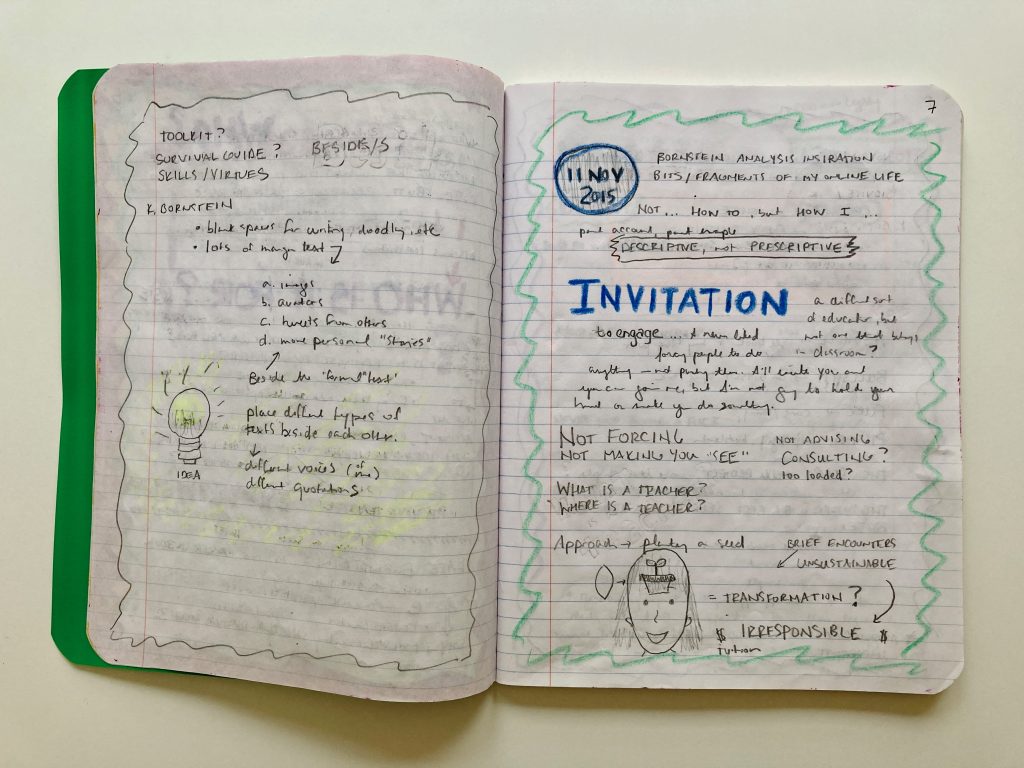
may 17/RUN

4 miles
river road trail, south/north/Winchell Trail, north/edmund, north
66 degrees

Took 2 days off to rest my left knee/IT Band. No big deal. Warm and sunny this morning. Calm, beautiful. As I started, I heard a bird with three long tweets then a trill of 4 or 5 shorter notes, then repeated. Looked it up–checking the chart I posted on May 3rd + allaboutbirds.org + birds of the mississippi river gorge pdf–and I think it might be a yellow-rumped warbler which migrates through the gorge in the spring. Looks like a yellow-rumped warbler is one of the May, “wave of warblers” that I wrote about last week. Nice.

Running down on the part of the trail just past the double bridge, where the walking path dips down below the road and then up again, I encountered my nemesis: the frantic squirrel that darts across the path in front of me, forcing me to stop or stutter step to avoid it. For the first time ever, this particular dipshit ran right into my foot. No damage done, at least not to me. Why do squirrels do this? Googled it and couldn’t find a “field-tested” answer. One hypothesis: over the years they have evolved to evade predatory birds by zig-zagging; they have not yet evolved to account for the behavior of cars or running Saras. In one of the articles I consulted, they wrote: “squirrels devote much of their life to not-dying.” How much time do humans devote to it?

Very early this morning, before sunrise, I heard a bird right outside my window. It woke me up then kept me up until I got up and closed the window. I was curious about what bird it might have been–not that I can remember what it sounded like now, hours later and after coffee–so I googled early bird and found the delightful phrase “dawn chorus” and this poem:

Dawn Chorus/ SASHA DUGDALE

March 29, 2010

Every morning since the time changed
I have woken to the dawn chorus
And even before it sounded, I dreamed of it
Loud, unbelievably loud, shameless, raucous

And once I rose and twitched the curtains apart
Expecting the birds to be pressing in fright
Against the pane like passengers
But the garden was empty and it was night

Not a slither of light at the horizon
Still the birds were bawling through the mists
Terrible, invisible
A million small evangelists

How they sing: as if each had pecked up a smoldering coal
Their throats singed and swollen with song
In dissonance as befits the dark world
Where only travelers and the sleepless belong

The insistent chirping of an early bird also brought to mind a poem by ED that I encountered sometime in the last year:

The Birds begun at Four o’clock —/ Emily Dickinson

The Birds begun at Four o’clock —
Their period for Dawn —
A Music numerous as space —
But neighboring as Noon —

I could not count their Force —
Their Voices did expend
As Brook by Brook bestows itself
To multiply the Pond.

The Listener – was not —
Except occasional man —
In homely industry arrayed —
To overtake the Morn —

Nor was it for applause —
That I could ascertain —
But independent Ecstasy
Of Universe, and Men –  

By Six, the Flood had done —
No Tumult there had been
Of Dressing, or Departure —
And yet the Band – was gone —

The Sun engrossed the East —
The Day Resumed the World —  controlled
The Miracle that introduced
Forgotten, as fulfilled.

Of course, I’m pretty sure I only heard one bird and not an entire chorus of them.

may 16/WALK

My second day off from running. My IT band is tight and I don’t want to risk making it worse, so I’m taking a 2 day break. It is hard not to run when you want to, especially when I could be doing the franklin loop with STA, but I did it and I’m glad. Walked with Delia the dog over the Dogwood Coffee for the first time in a year and a half? 2 years? for an iced coffee. As we waited outside while STA got the coffees, I noticed some crows on the roof of a house across the street. They were fighting, I think. Cawing, and swooping down, and crashing into each other as they circled around the roof. I’m pretty sure they were crows and not ravens or rooks–when in doubt, I always think a cawing, big, all-black bird is a crow. Were they fighting or playing or something else? Watching one crow circling then flying away, I noticed how huge their wing span is and how much bigger they look while flying than when perched on the point of a roof. I thought about how ungraceful their flapping wings looked, more bat than bird.

After writing this sentence about their lack of grace I decided to google it and found this interesting discussion of the difference between ravens and crows:

In flight, crows flap their way across the landscape while ravens skim along in a far more graceful manner.

The dead giveaway, however, is the fact that crows “caw” and ravens “cronk.” Once you learn to detect their ringing “cronk, cronk, cronks,” you’ll never be in doubt about which species you’re observing.

Ravens should not be confused with Crows

So, ravens are more graceful than crows, and they “cronk” instead of “caw.” Do I ever see or hear ravens?

may 12/RUN

5 miles
Franklin Hill Turn-around
58 degrees

What a wonderful morning for a run! Hardly any wind, warm, sunny, green. I wasn’t planning to run to the Franklin Hill, only the trestle, but when I reached the trestle, I just kept going. They’ve repaved the trail at this spot and replaced the crumbling steps leading down to the Winchell Trail. Nice! I’ll have to try out those steps sometime soon. As I approached the Franklin Hill, I heard some voices below on the river. Rowers! As I reached the bottom of the hill, I caught a glimpse of the shell with eight rowers illuminated by the sun. Running up the hill wasn’t too hard. I can’t remember the last time I ran up this hill–was it just before the pandemic hit last March? No, I looked it up: last October 4th. Reading the log entry, I remember the geese, but I don’t remember seeing them just this past fall. Thanks again, past Sara, for keeping a record of these runs so I can remember them!

Running south, after cresting the hill, I overheard a few people talking, one asking the other something that I’m assuming was about what they had seen. Seen what? The answer was something like, “the red stars” or the “red starts”? Was it about rowers with red shirts or migrating birds called red stars? Close–I looked it up and I’m pretty sure they were talking about the American Redstart, which is a bird that, according to Dave Zumeta’s handy list, breeds near the gorge. Very cool!

A lively warbler that hops among tree branches in search of insects, the male American Redstart is coal-black with vivid orange patches on the sides, wings, and tail. True to its Halloween-themed color scheme, the redstart seems to startle its prey out of the foliage by flashing its strikingly patterned tail and wing feathers. Females and immature males have more subdued yellow “flash patterns” on a gray background. These sweet-singing warblers nest in open woodlands across much of North America.

Reading further about them, I saw this helpful backyard tip:

In late summer, redstarts visit plants with small berries and fruits, such as serviceberry and magnolia.

Excellent! We have two big serviceberry trees right at the edge of our deck and birds often visit them in the summer.

Birdcall/ Alicia Ostriker – 1937-

    —for Elizabeth Bishop

Tuwee, calls a bird near the house,
Tuwee, cries another, downhill in the woods.
No wind, early September, beeches and pines,

Sumac aflame, tuwee, tuwee, a question and a faint
But definite response, tuwee, tuwee, as if engaged
In a conversation expected to continue all afternoon,

Where is?—I’m here?—an upward inflection in
Query and in response, a genetic libretto rehearsed
Tens of thousands of years beginning to leave its indelible trace,

Clawprint of language, ritual, dense winged seed,
Or as someone were slowly buttoning a shirt.
I am happy to lie in the grass and listen, as if at the dawn of reason,

To the clear communal command
That is flinging creaturely will into existence,
Designing itself to desire survival,

Liberty, companionship,
Then the bird near me, my bird, stops inquiring, while the other
Off in the woods continues calling faintly, but with that upward

Inflection, I’m here, I’m here,
I’m here, here, the call opens a path through boughs still clothed
By foliage, until it sounds like entreaty, like anxiety, like life

Imitating the pivotal move of Whitman’s “Out of the Cradle,”
Where the lovebird’s futile song to its absent mate teaches the child
Death—which the ocean also whispers—

Death, death, death it softly whispers,
Like an old crone bending aside over a cradle, Whitman says,
Or the like the teapot in Elizabeth Bishop’s grandmother’s kitchen,

Here at one end of the chain of being,
That whistles a song of presence and departure,
Creating comfort but also calling for tears.

Reference to Elizabeth Bishop: Sestina
Reference to Walt Whitman: Out of the Cradle Endlessly Rocking

may 11/WALK

Took Delia the dog for a walk: through the neighborhood, down the worn wooden steps, up to a spot with a warped chainlink fence and a view of the ravine and the oak savanna, but not the river—too many leaves already. Down around the ravine, up the other side to another overlook with a sliver of sparkling river, past the ancient boulder with no stacked stones, down through the tunnel of trees and beside the crumbling rocks. We crossed the river road just before the old stone steps and made our way to Seven Oaks to be with the birds. Stopped. Listened. Watched for motion. Heard lots of chirping and tweeting and trilling and rustling. Saw some branches moving. Didn’t really try to identify bird sounds, just let all the music envelop me.

Earlier heading down to the ravine, I noticed another downy woodpecker on a tree, trying to find a good spot to drum. It’s amazing how such a tiny bird can produce such a loud sound! Today, they flew away before drumming, but yesterday I was able to see a little head rapidly striking the trunk. Sometimes it’s hard to believe how much I can still see, and how much I can’t. Noticed a few bikers. It’s time to get out my bike and try it. I’m nervous, because I haven’t biked in 2 years. How difficult will it be with my vision–will it be harder? scarier?

This morning I’m revisiting an essay I read at least 2 years ago and appreciating it so much more: Thirteen Ways of Looking at a Black Bird by Naomi Cohn. I discovered Cohn when I read her work Cell in the Feb 2019 issue of Poetry. She is legally blind and writes about her vision loss, which began in her 30s and happened over several decades. She’s local—I think she lives less than 2 miles from me–and I’ve been wanting to email her for some time now. I haven’t yet, but I should. Why not?

It’s so great to reread this piece while in the midst of my month of birds. Here are a few passages that especially resonated:

Back then I was drawn to see the rare, the out-of-place, the new to my eyes, the precious sight of feathers that could be added to my life list, a check mark in my field guide, its pages ruffled with a history of rainy wetlands. Wilderness tamed by naming.

I had no need to “collect” another red-winged blackbird, but stopped to look.

I like the statement: wilderness tamed by naming. I don’t really miss this taming—scrutinizing, staring, owning, collecting. And mostly, I’m okay with not being able to see details, sometimes mixing up or missing color. Of course, reading Cohn’s essay, I kept thinking about how much better my vision is than hers–at least, for now. I was able to see that small downy woodpecker on the tree today, after all.

The eye listens. The song of the red-winged blackbird translated to a sonogram, a shape on a page, a whistle heard in the head that has shape and volume. It triggers a mental image of yellow feet clutching a cattail, of a red quarter circle, so red against glossy black.

An ear sees. As the decay progressed, I began to learn bird song. I invested in “birding by ear” CDs, the little platters spinning endlessly in my cheap boom box. At my most tuned up, I probably knew 150 songs.

I would have kept the old way of looking at a blackbird if I could–it takes a good sized hole in your life to fill all those hours listening to bird tapes.

But there is this to looking at a bird through its song: Your eye, even a good eye, only looks at one thing at a time, only focusses on one bird at a time, but the ear listens in all directions. Paddling across a Canadian lake, red and white pines tall around the shore, the bird song comes from every direction, every compass point, every point on the whole half dome of the world above the water and shore.

Yes. I love this idea of sound coming from every direction, while sight can only come from one. As I was standing at the edge of the sink hole, I was listening in all directions. Sight encourages singularity: single ideas, single perspectives, either this or that but not both at the same time. Hearing encourages plurality: both/and, this and that, multiple perspectives at once.

To see a bird demands both perception and attention. For years I supplied the relatively subtle gaps of perception with attention. Over time, this was not enough. Motion was less my friend. I needed time to make things out, to dart my eye back and forth and up and down to try to get a glimpse of something, to see around the edges of my blind spots,  sending a set of broken, incomplete messages to my visual cortex, which on a good day, would assemble a convincing hypothesis of what I was perceiving.

This is all any of us ever do.

Yes! I think this line “This is all any of us ever do” is important. You can read it as metaphor, with blind spots representing those limitations in everyone’s understandings and perspectives. But you can also read it as literal. The more I read about how we see, the more I learn how complicated it is for everyone–good vision or bad—to make sense of images. The brain guesses a lot. Of course, those guesses are better when the brain is given more data, but even then, the brain guesses.

The title of this essay is referring to the famous poem of the same name by Wallace Stevens. I’ve read it several times; I even did an homage poem of it for a class 3 years ago. Anyway, here’s the original:

Thirteen Ways of Looking at a Blackbird/ WALLACE STEVENS

I
Among twenty snowy mountains,   
The only moving thing   
Was the eye of the blackbird.   

II
I was of three minds,   
Like a tree   
In which there are three blackbirds.   

III
The blackbird whirled in the autumn winds.   
It was a small part of the pantomime.   

IV
A man and a woman   
Are one.   
A man and a woman and a blackbird   
Are one.   

V
I do not know which to prefer,   
The beauty of inflections   
Or the beauty of innuendoes,   
The blackbird whistling   
Or just after.   

VI
Icicles filled the long window   
With barbaric glass.   
The shadow of the blackbird   
Crossed it, to and fro.   
The mood   
Traced in the shadow   
An indecipherable cause.   

VII
O thin men of Haddam,   
Why do you imagine golden birds?   
Do you not see how the blackbird   
Walks around the feet   
Of the women about you?   

VIII
I know noble accents   
And lucid, inescapable rhythms;   
But I know, too,   
That the blackbird is involved   
In what I know.   

IX
When the blackbird flew out of sight,   
It marked the edge   
Of one of many circles.   

X
At the sight of blackbirds   
Flying in a green light,   
Even the bawds of euphony   
Would cry out sharply.   

XI
He rode over Connecticut   
In a glass coach.   
Once, a fear pierced him,   
In that he mistook   
The shadow of his equipage   
For blackbirds.   

XII
The river is moving.   
The blackbird must be flying.   

XIII
It was evening all afternoon.   
It was snowing   
And it was going to snow.   
The blackbird sat   
In the cedar-limbs.

april 25/RUN

5k
2 school loop
42 degrees

Another colder day. I’m tired of wearing running tights, a winter vest, gloves. Time for spring and shorts and short-sleeves. Ran on the trail heading south. I don’t remember looking at the river once. I was too busy avoiding people. Listened to a playlist as I ran so I didn’t hear anything but Taylor Swift, Miley Cyrus, and Harry Styles. Anything else? No roller skiers. No bright, glowing shirts. No peletons. No turkeys or eagles or geese. No rowers on the river. No daily walker. Just an ordinary run.

From The Book of Time

2.
For how many years have you gone through the house shutting the windows,
while the rain was still five miles away

and veering, o plum-colored clouds, to the north,
away from you

and you did not even know enough
to be sorry,

you were glad
those silver sheets, with the occasional golden staple,

were sweeping on, elsewhere,
violent and electric and uncontrollable—

and will you find yourself finally wanting to forget
all enclosures, including

the enclosure of yourself, o lonely leaf, and will you
dash fnally, frantically,

to the windows and haul them open and lean out
to the dark, silvered sky, to everything

that is beyond capture, shouting
I’m here, I’m here! Now, now, now, now, now.

This part of the poem reminds me of part of Mary Oliver’s “Sometimes” from Red Bird—this is the poem that includes her famous instructions for living a life: Pay attention. Be astonished. Tell about it.

In the west, clouds gathered.
Thunderheads.
In an hour the sky was filled with them.

In an hour the sky was filled
with the sweetness of rain and the blast of lightning.
Followed by the deep bells of thunder.

Water from the heavens! Electricity from the source!
Both of them mad to create something!

The lightning brighter than any flower.
The thunder without a drowsy bone in its body.

And here’s one more poem that I’d like to put beside these two and beside the idea of a thunder storm:

Beat! Beat! Drums!/ Walt Whitman – 1819-1892

Beat! beat! drums!—blow! bugles! blow!
Through the windows—through doors—burst like a ruthless force,
Into the solemn church, and scatter the congregation,
Into the school where the scholar is studying;
Leave not the bridegroom quiet—no happiness must he have now with his bride,
Nor the peaceful farmer any peace, ploughing his field or gathering his grain,
So fierce you whirr and pound you drums—so shrill you bugles blow.

Beat! beat! drums!—blow! bugles! blow!
Over the traffic of cities—over the rumble of wheels in the streets;
Are beds prepared for sleepers at night in the houses? no sleepers must sleep in those beds,
No bargainers’ bargains by day—no brokers or speculators—would hey continue?
Would the talkers be talking? would the singer attempt to sing?
Would the lawyer rise in the court to state his case before the judge?
Then rattle quicker, heavier drums—you bugles wilder blow.

Beat! beat! drums!—blow! bugles! blow!
Make no parley—stop for no expostulation,
Mind not the timid—mind not the weeper or prayer,
Mind not the old man beseeching the young man,
Let not the child’s voice be heard, nor the mother’s entreaties,
Make even the trestles to shake the dead where they lie awaiting the hearses,
So strong you thump O terrible drums—so loud you bugles blow.

april 19/RUN

3.6 miles
2 trails + tunnel of trees
35 degrees
snow flurries

Cold and windy this morning, with snow flurries. Running south at the beginning of my run, the wind was my friend, pushing me along. Running, north on the trail below, hugging the side of bluff, I hardly felt it at all. Everyday, everything is getting greener. Too soon! I heard one girl on the playground at Minnehaha Academy, laughing, some water dripping out of the sewer below 42nd, a disembodied voice down in the oak savanna. And, I heard at least 2 black-capped chickadees calling out to each other

I’ve noticed that the bird who calls out “fee Bee” first usually is more insistent, interrupting whoever is “Fee bee-ing” back to him. Today’s first caller was particularly inpatient. Is this because it’s a call of aggression, warning the other bird to stay away? Or is it because it’s an amorous male who can hardly wait to hear an answer back from a potential mate?

Anything else I remember from my run? I remember admiring the river, looking such a calm blue. I remember getting stuck behind a walker who didn’t know I was coming and having to call out “excuse me” three times–and I remember not being mad about it. I remember the extra bright yellow shirt of a runner up ahead as I started on my run, the warnings posted on poles and on signs staked near the street about the road being closed for cleaning soon, the street-cleaning truck lumbering along on the river road, blasting water near the curb, the bright orange jacket of someone climbing the old stone steps.

Today the jury begins deliberations on the Chauvin trial. I am scared, but hopeful, choosing to believe he will be found guilty. It’s a war zone here in Minneapolis, with armed National Guard members all around, and huge convoys–did I see a tank yesterday?–menacing the streets. A disgusting display of force, and a reminder of who does and does not matter.

Bobolinks!

Checking the “poem of the day” on poets.org, I found a beautiful poem about the Bobolink. When I read the line, “a black and white bird,” I remembered on April 5th (which I posted at the end of my April 6th entry), I mentioned a bird that sounded a little like a robin but was black and white. I couldn’t figure out what it was. Could it have been a bobolink? I’ve decided to believe that it was.

On March 23rd, I wrote about bobolinks when they were mentioned in the Emily Dickinson poem I was reading, Some keep the Sabbath going to Church – (236):

Some keep the Sabbath going to Church –
I keep it, staying at Home –
With a Bobolink for a Chorister –
And an Orchard, for a Dome –

I was reminded of the bobolink (BOB a link) when I read “Flare” in MO’s The Leaf and the Cloud:

2.
You still recall, sometimes, the old barn on your great-grandfather’s
farm, a place you visited once, and went into, all alone, while the grownups
sat and talked in the house.

…..

You could have stayed there forever, a small child in a corner, on the
last raft of hay, dazzled by so much space that seemed empty, but wasn’t.

Then—you still remember—you felt the rap of hunger—it was noon—
and you turned from that twilight dream and hurried back to the house,
where the table was set, where an uncle patted you on the shoulder for
welcome, and there was your place at the table.

11.
Anyway,
there was no barn.
No child in the barn.

No uncle no table no kitchen.

Only a long lovely field full of bobolinks.

Both ED and MO see the sacred in birds like the bobolink, and in nature. ED continues her poem with 2 more stanzas:

Some keep the Sabbath in Surplice –
I, just wear my Wings –
And instead of tolling the Bell, for Church,
Our little Sexton – sings.

God preaches, a noted Clergyman –
And the sermon is never long,
So instead of getting to Heaven, at last –
I’m going, all along.

And, here is a bit from The Leaf and the Cloud that echoes that idea:

from “Work”

2.
The dreamy heads of the grass in early summer.
In midsummer: thick and heavy.
Sparrows swing on them, they bend down.
When the sparrow sings, its whole body trembles.

Later, the pollen shakes free.
Races this way and that way,
like a mist full of life, which it is.
We stand at the edge of the field, sneezing.
We praise God, or Nature, according to our determinations.

Here’s the poem that inspired these continued reflections on the bobolink:

Bobolink/ Didi Jackson

In a meadow
as wide as a wound
I thought to stop
and study the lesser stitchwort’s
white flowers lacing up
boot-level grasses
when I was scolded in song
by a black and white bird
whose wings sipped air,
swallow-like, until he landed
on the highest tip
of yellow dock,
still singing his beautiful warning,
the brown female
with him in fear.
The warning was real:
the anniversary of my husband’s suicide.
What was the matter with life? Sometimes
when wind blows,
the meadow moves like an ocean,
and on that day,
I was in its wake—
I mean the day in the meadow.
I mean the day he died.
This is not another suicide poem.
This is a poem about a bird
I wanted to know and so
I spent that evening looking
up his feathers and flight,
spent most of the night
searching for mating habits
and how to describe the yellow
nape of his neck like a bit
of gothic stained glass,
or the warm brown
females with a dark eyeline.
How could I have known
like so many species
they too are endangered?
God must be exhausted:
those who chose life;
those who chose death.
That day I braided a few
strips of timothy hay
as I waited for the pair
to move again, to lift
from the field and what,
live? The dead can take
a brother, a sister; not really.
The dead have no one.
Here in this field
I worried the mowers
like giant gorging mouths
would soon begin again
and everything would be
as it will.

My favorite part of this poem today are the lines:

This is not another suicide poem.
This is a poem about a bird
I wanted to know and so
I spent that evening looking
up his feathers and flight,
spent most of the night
searching for mating habits
and how to describe the yellow
nape of his neck like a bit
of gothic stained glass,

I like the way those first two lines ease me back from the shock of the previous lines about her late husband’s suicide with the comforting claim that this poem is about the bird, not suicide, and the pleasing, gentle rhymes of know/so and flight/night, and the beautiful image of the “nape of his neck like a bit/of gothic stained glass.”

Some bobolink sources:

God must be exhausted

At the risk of making this entry too long and too packed with poems, I’m adding three more, prompted by death, and God’s exhaustion, and the choosing of life or death (or, maybe, like MO, both life and death?), and the recent discovery that cancer has most likely returned for a loved one.

one: Radiation Prayer/ Katie Farris

I love the poetry of Katie Farris–a favorite, “What Would Root”–and I have, with sadness, followed her year+ battle with breast cancer on twitter. Every few months, she posts a new, beautiful poem about her treatment. Today’s involved a gut-wrenching decision:

I find in the mirror a woman–breastless, burned–who
in an advisory capacity,
asks, “How much do you
want to live?”

Enough.

Oh–that enough, which I initially read as enough to choose the damage to prevent the chance of more cancer, but now realize it could also be a command: Enough. Too much. Stop. I can’t take anymore.

two: The Fourth Sign of the Zodiac/ Mary Oliver

Mary Oliver was diagnosed with lung cancer in 2012. She wrote about it in Blue Horses:

1.
Why should I have been surprised?
Hunters walk the forest
without a sound.
The hunter, strapped to his rifle,
the fox on his feet of silk,
the serpent on his empire of muscles—
all move in a stillness,
hungry, careful, intent.
Just as the cancer
entered the forest of my body,
without a sound.

2.
The question is,
what will it be like
after the last day?
Will I float
into the sky
or will I fray
within the earth or a river—
remembering nothing?
How desperate I would be
if I couldn’t remember
the sun rising, if I couldn’t
remember trees, rivers; if I couldn’t
even remember, beloved,
your beloved name.

3.
I know, you never intended to be in this world.
But you’re in it all the same.

so why not get started immediately.

I mean, belonging to it.
There is so much to admire, to weep over.

And to write music or poems about.

Bless the feet that take you to and fro.
Bless the eyes and the listening ears.
Bless the tongue, the marvel of taste.
Bless touching.

You could live a hundred years, it’s happened.
Or not.
I am speaking from the fortunate platform
of many years,
none of which, I think, I ever wasted.
Do you need a prod?
Do you need a little darkness to get you going?
Let me be urgent as a knife, then,
and remind you of Keats,
so single of purpose and thinking, for a while,
he had a lifetime.

4.
Late yesterday afternoon, in the heat,
all the fragile blue flowers in bloom
in the shrubs in the yard next door had
tumbled from the shrubs and lay
wrinkled and fading in the grass. But
this morning the shrubs were full of
the blue flowers again. There wasn’t
a single one on the grass. How, I
wondered, did they roll back up to
the branches, that fiercely wanting,
as we all do, just a little more of
life?

The fierce wanting, the life not wasted, the darkness that gets you going, cancer’s hungry, careful intent.

three: I Never Wanted to Die/ Dorianne Laux

It’s the best part of the day, morning light sliding
down rooftops, treetops, the birds pulling themselves
up out of whatever stupor darkened their wings,
night still in their throats.

I never wanted to die. Even when those I loved
died around me, away from me, beyond me.
My life was never in question, if for no other reason
than I wanted to wake up and see what happened next.

And I continue to want to open like that, like the flowers
who lift their heavy heads as the hills outside the window
flare gold for a moment before they turn
on their sides and bare their creased backs.

Even the cut flowers in a jar of water lift
their soon to be dead heads and open
their eyes, even they want a few more sips,
to dwell here, in paradise, a few days longer.

I love a lot about this poem, especially her praising of openness, and her idea of paradise as on earth (paradise as Nature, like ED and MO?).

april 13/RUN

3.4 miles
edmund, heading north loop
35 degrees/ 15 mph wind
snow flurries

O, cruel April with your warm sun, blooming flowers, then snow flurries and mornings where it feels like 25 degrees. Even so, it was a good run. Bundled up, with the pink hood of my jacket up and my gloves on, I didn’t feel the wind. A benefit of colder, windier weather: no one on the trail! I ran through the tunnel of trees and was able to attend to its slow and gradual greening. The trees are coming into leaf/like something almost being said/the recent buds relax and spread/their greenness is a kind of grief (Phillip Larkin). I memorized that poem last year in May and it has stuck.

Ran past the ancient boulder with a few stones stacked on top, past the welcoming oaks, above the ravine and the oak savanna and the muddy trail that climbs up near the tree stump with chain link limbs. Looked down at the Winchell Trail and thought about taking it, but I didn’t. At 42nd, I heard a bird that almost sounded like a black-capped chickadee, but not quite. 3 notes instead of 2, and no rising up or down the scale. What was it? Also heard the drumming and calling of some woodpeckers.

Even though this is not a Mary Oliver poem, I had to post it–because I’d like it and because it gave me an opportunity to reflect more on my vision loss:

Pastoral/ Forrest Gander

Together,
you
standing
before me before
the picture
window, my arms
around you, our
eyes pitched
beyond our
reflections into—

(“into,” I’d
written, as
though there
swung at the end
of a tunnel,
a passage dotted
with endless
points of
arrival, as
though our gaze
started just outside
our faces and
corkscrewed its way
toward the horizon,
processual,
as if looking
took time to happen
and weren’t
instantaneous,
offered whole in
one gesture
before we
ask, before our
will, as if the far
Sonoma mountains
weren’t equally ready
to be beheld as
the dead
fly on the sill)—

the distance, a
broad hill of
bright mustard flowers
the morning light
coaxes open.

I really like this poem and Gander’s reading of it. I was struck by his explanation of it, especially the idea that we see all instantly, that seeing, as a process, happens without effort, is immediate, and whole/complete. Occasionally seeing is not like this for many people–they experience visual errors, their brains receive conflicting data from their photoreceptor cells and generates confusing, ambiguous images. More frequently, seeing is like this for me. It is work, and sometimes, I can almost feel my brain trying to make sense of an image or a landscape. I witness them changing shape until they settle into what my brain decides they are. But, unlike Gander suggests in his recorded explanation of the poem, I can’t just “look once and find the near and far equally accessible” and the world doesn’t just present itself to me.

I like how Naomi Cohn describes it in her essay, “In Light of a White Cane.”

What I remember of better eyesight is how the world assembled all at once, an effortless gestalt—the light, the distance, the dappled detail of shade, exact crinkles of a facial expression through a car windshield, the lift of a single finger from a steering wheel, sunlight bouncing off a waxed hood.

Naomi Cohn

more mary oliver

So far, I’ve read through Devotions and Swan. Now I’m reading Evidence and Dream Work and then New and Selected Poems, Volumes I and II. I’ve read her collection of essays, Upstream too. And, I’m planning an extended study of her book length poem, The Leaf and the Cloud. I’m reading through it several times, along with the article, “‘An Attitude of Noticing’: Mary Oliver’s Ecological Ethic” by Kirstin Hotelling Zona. It sounds like a lot, but I’m not doing a close reading of every poem in every book. Just reading through, letting the words wash over me, and picking out a few things I want to remember.

more Evidence

Deep Summer

The mockingbird
opens his throat
among the thorns
for his own reasons
but doesn’t mind
if we pause
to listen
and learn something
for ourselves;
he doesn’t stop,
he nods
his gray head
with the frightfully bright eyes,
he flirts
his supple tail,
he says:
listen, if you would listen.
There’s no end
to good talk,
to passion songs,
to the melodies
that say
this branch,
this tree is mine,
to the wholesome
happiness
of being alive
on a patch
of this green earth
in the deep
pleasures of summer.
What a bird!
Your clocks, he says plainly,
which are always ticking,
do not have to be listened to.
The spirit of his every word.

I Want to Write Something So Simple

“And this is good for us.”
I want to write something
so simply
about love
or about pain
that even
as you are reading
you feel it
and as you read
you keep feeling it
and though it be my story
it will be common,
though it be singular
it will be known to you
so that by the end
you will think—
no, you will realize—
that it was all the while
yourself arranging the words,
that it was all the time
words that you yourself,
out of your own heart
had been saying.

april 12/BIKERUN

Another young black man killed by the police today in a twin cities suburb. Apparently, the cop meant to reach for their taser, but pulled their gun instead and then shot Daunte Wright. Fucked up. This is not simply an unfortunate, “heart breaking” accident. This is not a matter of bad apples or a few incompetent or overly anxious cops. This is a fucked up system that doesn’t value human life, that almost always prioritizes certain (white) lives over others, and that is murdering black people. Abolish the police.

bike: 35 minutes
run: 1.5 miles
basement
outside: rain, wind

Biked in the basement because of the wind and rain. Watched another episode of Emily Dickinson. This one focused on ED’s conflicted feelings about having her poem published and whether or not she wants fame and to be known and seen by others. It features the poem, Split the Lark:

Split the Lark/ Emily Dickinson

Split the Lark – and You’ll find the Music –
Bulb after Bulb, in Silver rolled –
Scantily dealt to the Summer Morning
Saved for your Ear, when Lutes be old –

Loose the Flood – you shall find it patent –
Gush after Gush, reserved for you –
Scarlet Experiment! Skeptic Thomas!
Now, do you doubt that your Bird was true?

It was helpful to read the words after watching the show; I didn’t get the meaning of them when I heard them sung by Sue:

Wow. That is some intense, violent imagery. “Gush after gush” and “Scarlet experiment.” It makes me think of the article I read about ED and “I’m Nobody! Who are You?” earlier this month, when the author writes about doing Emily Dickinson Madlibs and asking students to fill in the blank for “Grief is a ___”.

Students go ahead and put in the blanks what is expected: Grief is a pain, Grief is a bitch. The ones who want to take imaginative leaps deliver up: Grief is a thunderstorm, Grief is a tidal wave. But I can pretty much guarantee that no matter how many budding poets you have in a class, nobody who hasn’t already read Dickinson’s poem would ever write the phrase the way she wrote it.

The answer: “Grief is a mouse”
This poem about splitting the lark also seems very original and imaginative and very ED.

A turkey interruption!

Just as I was writing the above paragraph, I looked out the window and saw…a big turkey walking in my front yard. Nice. I think that’s the first time I’ve ever seen that. That’s definitely the delight of the day. When I first saw it, I yelled out to STA, “Come here, quick. There’s a turkey in the front yard” and he posted about it on instagram.

After I biked, I ran on the treadmill for about 14 minutes. Our treadmill works, but strangely, these days. The speed is off, always too fast. Listened to my playlist.

Right after I got up this morning, I wrote about Mary Oliver and her collection, Evidence:

Yellow from Evidence/ Mary Oliver

There is the heaven we enter
through institutional grace
and there are the yellow finches bathing and singing
in the lowly puddle.

I’d like to put this one beside Emily Dickinson’s Some Keep the Sabbath going to Church (236):

Some keep the Sabbath going to Church —
I keep it, staying at Home —
With a Bobolink for a Chorister —
And an Orchard for a Dome —

Some keep the Sabbath in Surplice –
I, just wear my Wings –
And instead of tolling the Bell, for Church,
Our little Sexton – sings.

God preaches, a noted Clergyman –
And the sermon is never long,
So instead of getting to Heaven, at last –
I’m going, all along.

In my March 26th log entry, I wrote a bit about yellow and how I’ve grown to like the color. It’s funny that I like yellow now because I can’t see it very well, especially on the page and especially when it’s used to highlight text. Sometimes I use my yellow colored pencil in my Plague Notebook, like today, for the title to MO’s poem.

from the Plague Notebooks, Volume 7

When viewed straight on, through my central vision, the yellow disappears. When seen from the side or with my eyes lowered, looking down, the yellow is bright–of course, viewed this way, through my peripheral vision, the words are a blur. Isn’t it strange how that works? Other colors aren’t as bad, like green or blue (although in other situations, those colors disappear too). But, how does this work? I know the retina has 3 types of cone cells: blue/short (B/S), green/medium (G/M), red/long (R/L) and that we have a lot more red (64%) than green (32%) or blue (2%). And that “the color yellow is perceived when the L cones are stimulated slightly more than the M cones (cone cells/wikipedia). But what does that mean about my vision and cone cell loss? How many red versus green versus blue do I have left? Is there a way to test that? And, is it worth testing? I might ask my eye doctor when I’m fully vaccinated and finally have a check-up in the next few months.

I’m looking through MO’s collection, Evidence today, which I was able to immediately check-out from my libby app (very awesome). Something I’ve noticed: the structure/form (I’ve forgotten the difference between these two) is often, first a very detailed and lush description of something or someone (an animal, stone, tree, flower, etc), then a question or a moment of wonder about it/them, then a revelation.

Like, in Swans from Evidence: A long and beautiful description of swans flying overhead and hurrying on to “wherever it is/that swans go.” A moments of curiosity/praise/wonder and a question: “How could I help but wish/that one of them might drop/a white feather/that I should have/soemthing in my hand/to tell me/that they were real?” Finally, a revelation (or a reminder of something always already known but forgotten): “What we love, shapely and pure,/is not to be held,/but to be believed in.” Love that last line. It’s a nice little prayer and seems to work without the details and the moment of praise, but I wonder what happens to its power when it loses those details? Does it become just a easily spreadable soundbite? I’m not sure, and I guess my doubt about this practice of picking out favorite lines, won’t stop me from doing it now:

from Thinking of Swirler

In a week he would be dead,
arrowed down by a young man I like,
though with some difficulty.

I was planning to pick one part of this poem, but I love the whole thing and I think I might need to memorize some or all of it:

Then Bluebird Sang

Bluebird
slipped a little tremble
out of the triangle
of his mouth
and it hung in the air
until it reached my ear
like a froth or a frill
that Schumann
might have written in a dream.
Dear morning
you come
with so many angels of mercy
so wondrously disguised
in feathers, in leaves,
in the tongues of stones,
in the restless waters,
in the creep and the click
and the rustle
that greet me wherever I go
with their joyful cry: I’m still here, alive!

I could also see part of this poem serving as a writing prompt, or an opportunity to create your own moment of wonder/prayer: “Dear morning/you come/with so many angels of mercy/that greet me wherever I go/with their joyful cry: I’m still here, alive!” Prompt: what greets you in the morning? Make a list, then pick one and describe it as much detail as you can. Moment of Wonder: When you’re outside, running beside the gorge, create a chant or greeting to offer back to the welcoming oaks or the floodplain forest or the old stone steps or whatever else you want, letting them know you’re still here too, alive.

Okay, just one more for today:

The Poet Always Carries a Notebook

What is he scribbling on the page?
Is there snow in it, or fire?
Is it the beginning of a poem?
Is it a love note?

This poem makes me think about MO’s discussions of carrying a notebook around with her while she’s walking in the woods, which also makes me think about the different methods writers/thinkers use to remember words when they’re outside, away from their desk: Jonathan Edwards would pin notes to his clothes we traveled on horseback, the writer Jaime Quatro would scratch them into her arm with a stick when, out on a run, she had nothing else to use, I speak a note in my voice memo app or, turn the thought/idea into a chant and repeat it until I return from my run.

april 10/RUN

2.65 miles
2 schools loop (cooper and howe)
46 degrees

Windy this afternoon! Everything green, budding. Spring-like. Ran around Cooper School then down to Edmund. Up to 47th and over to Howe. A soccer team was practicing on the field. Didn’t stare to see if they were wearing masks. I wonder how youth sports is doing these days in Minnesota; the uptick in cases with the UK variant started in some suburban youth sports games. Anything else I remember from the run? Encountered some walkers. Did I see any other runners? I can’t remember. Ran by a neighbor’s fruit trees or vines on 32nd–I can’t remember what they are, I just remember that last year they had a sign encouraging you to take all the fruit you’d like. Apples? Anyway, the trees/vines right by their fence were blooming pale pink flowers. Beautiful.

I didn’t run yesterday because we drove up to Duluth and got our first doses of the Pfizer vaccine–well, me, FWA, and STA got our first doses, RJP is a year too young. Such a bummer for her. Anyway, I still haven’t processed it all, how remarkable and amazing and relieving it is to be getting this vaccine and to be fully vaccinated before Mother’s Day! Wow.

Even though I didn’t run, I still read some Mary Oliver. I’m finding it difficult to stick with just one poem. I like reading several and letting the repetition of her words about attention wash over me and soak in slowly. Yesterday and today, I read through her collection, Swan, and noticed, among other things, that she did a lot of: 1. inviting the reader (you) to be curious, to enter the field, to notice things, 2. admonishing the reader for not noticing and calling it a life, and 3. commanding the reader to notice things, to leave the desk and enter the world. I have started making a list and adding lines from her poems to each of these categories. So far, my list includes the poems in Swan and a few others that I found in her compilation, Devotions.

Invitation

  • Inside the river there is an unfinishable story/and you are somewhere in it/and it will never end until all ends (What Can I Say/Swan)
  • How many kinds of love/might there be in the world,/and how many formations might they make/and who am I ever/to imagine I could know/such a marvelous business? (On the Beaach/Swan)
  • Did you see it, drifting, all night in the black river?/Did you see it in the morning, rising into the silvery air?/And did you feel it, in your heart, how it pertained to everything?/And have you too finally figured out what beauty is for?/And have you changed your life? (Swan/Swan)
  • With what words can I convince you of the/casualness with which the white swans fly? Do you give a thought now and again to the/essential sparrow, the necessary toad? Have you ever seen a squirrel swim? Is it not incredible, than in the acorn something/has hidden an entire tree? (More Evidence/Swan)
  • Have you ever tried to enter the long black branches/of other lives? (Have you ever tried to enter/ West Wind)

Admonishment

  • It is a negligence of the mind/not to notice how at dusk/heron comes to the pond (How Heron Comes/Swan)
  • We are all good people/except for when we are not (Four Sonnets/Swan)
  • Who can open the door who does not reach for the latch?
  • Listen, are you breathing just a little, and calling it a life?
  • For how long will you continue to listen to those dark shouters,/caution and prudence?/Fall in! Fall in! (Have you ever tried to enter the long black branches/West Wind)

Command

  • If you suddenly and unexpectedly feel joy,/don’t hesitate. Give in to it. (Don’t Hesitate/Swan)
  • Sing, if you can sing, and if not still be/musical inside yourself (More Evidence/Swan)
  • Said the river: imagine everything you can imagine, then/keep going (At the River Clarion/Evidence)
  • Quickly, then, get up, put on your coat, leave your desk! (Have you ever tried to enter the long black branches/ West Wind)

In addition to categorizing her lines, here are a few other things I noticed/liked/want to remember:

1

She likes the word “meanwhile,” which I first encountered and enjoyed in her wonderful poem, “Wild Geese”: “Meanwhile, the world goes on./ Meanwhile the sun and the clear pebbles of the rain…/Meanwhile, the wild geese…” I like this idea of meanwhile as another word for beside/s, and to mean: there are other things beside you happening in the world AND you are not alone in your suffering/sorrow/joy AND life/the world contains more than we can imagine or reconcile, all happening at the same time. I like thinking about meanwhile as a way to connect different stories/lives/creatures without collapsing them into each other as one story or way of living/being–if that makes sense?

2

Okay, I confess to wanting to make a literature of praise.

4 Sonnets/ Swan

I like this idea of a literature of praise. In Long Life she talks about her words as little alleluias on the page. Can we think of this as spiritual, as about admiring and finding joy in things, without linking it to God or organized religion? Yes, I think.

3

I want to step out into some/fresh morning and look around and hear myself/crying out: “The house of money is falling! The house of money is falling! The weeds are rising! The weeds are rising!”

Evidence/ Evidence

That sounds like fun and something I can’t imagine myself ever having the nerve to do. But I think it quite a lot when I’m out near the gorge and witness the sumac vines wrapping themselves around the fenceposts.

One more thing: Here’s a Mary Oliver poem that I’ve been rereading a lot over the past few days:

HAVE YOU EVER TRIED TO ENTER THE LONG BLACK BRANCHES/ Mary Oliver

Have you ever tried to enter the long black branches of other lives —
tried to imagine what the crisp fringes, full of honey, hanging
from the branches of the young locust trees, in early morning, feel like?

Do you think this world was only an entertainment for you?

Never to enter the sea and notice how the water divides
with perfect courtesy, to let you in!
Never to lie down on the grass, as though you were the grass!
Never to leap to the air as you open your wings over the dark acorn of your heart!

No wonder we hear, in your mournful voice, the complaint
that something is missing from your life!

Who can open the door who does not reach for the latch?
Who can travel the miles who does not put one foot
in front of the other, all attentive to what presents itself
continually?
Who will behold the inner chamber who has not observed
with admiration, even with rapture, the outer stone?

Well, there is time left —
fields everywhere invite you into them.

And who will care, who will chide you if you wander away
from wherever you are, to look for your soul?

Quickly, then, get up, put on your coat, leave your desk!

To put one’s foot into the door of the grass, which is
the mystery, which is death as well as life, and
not be afraid!

To set one’s foot in the door of death, and be overcome
with amazement!

To sit down in front of the weeds, and imagine
god the ten-fingered, sailing out of his house of straw,
nodding this way and that way, to the flowers of the
present hour,

to the song falling out of the mockingbird’s pink mouth,

to the tippets of the honeysuckle, that have opened

in the night

To sit down, like a weed among weeds, and rustle in the wind!

Listen, are you breathing just a little, and calling it a life?

While the soul, after all, is only a window,
and the opening of the window no more difficult
than the wakening from a little sleep.

Only last week I went out among the thorns and said
to the wild roses:
deny me not,
but suffer my devotion.
Then, all afternoon, I sat among them. Maybe

I even heard a curl or two of music, damp and rouge red,
hurrying from their stubby buds, from their delicate watery bodies.

For how long will you continue to listen to those dark shouters,
caution and prudence?

Fall in! Fall in!

A woman standing in the weeds.
A small boat flounders in the deep waves, and what’s coming next
is coming with its own heave and grace.

Meanwhile, once in a while, I have chanced, among the quick things,
upon the immutable.
What more could one ask?

And I would touch the faces of the daisies,
and I would bow down
to think about it.

That was then, which hasn’t ended yet.

Now the sun begins to swing down. Under the peach-light,
I cross the fields and the dunes, I follow the ocean’s edge.

I climb, I backtrack.
I float.
I ramble my way home.

april 6/RUN

3.3 miles
turkey hollow
51 degrees

Wow! Another magnificent morning in Minneapolis. Thunderstorms last night, sunshine today, thunderstorms tonight. Ran on the trail, above the river. At one of my favorite spots, just past the oak savanna, I marveled at the burning white light of the sun reflecting on the water, through the bare branches. A mile later, I thought some more about this light and remembered ED’s phrase, “white heat”–it’s part of a poem—-“Dare you see a Soul at the “White Heat”?/Then crouch within the door”—, and the name of the Darmouth blog tracking ED’s most intensely creative year: 1862.

I was able to greet Dave, the Daily Walker! I’m so happy to see that this terrible year hasn’t stopped him from doing his regular walks. When I said “Good morning Dave!” he said” “Good morning Sara! So great to see you out here again!”

Heard woodpeckers and black-capped chickadees and—I almost forgot, geese, or was it a goose? Honking as they flew over the gorge. The geese have returned for spring! This reminded me of an MO poem I read yesterday titled “Two Kinds of Deliverance.” The geese are the first kind:

1.

Last night the geese came back,
slanting fast
from the blossom of the rising moon down
to the black pond. A muskrat
swimming in the twilight saw them and hurried

to the secret lodges to tell everyone
spring had come.

And so it had.
By morning when I went out
the last of the ice had disappeared, blackbirds
sang on the shores. Every year
the geese, returning,
do this, I don’t
know how.

2.

The curtains opened and there was 
an old man in a headdress of feathers,
leather leggings and a vest made
from the skin of some animal. He danced

in a kind of surly rapture, and the trees
in the fields far away
began to mutter and suck up their long roots.
Slowly they advanced until they stood
pressed to the schoolhouse windows.

3.

I don’t know
lots of things but I know this: next year
when spring
flows over the starting point I’ll think I’m going to
drown in the shimmering miles of it and then
one or two birds will fly me over
the threshold.
                           As for the pain
of others, of course it tries to be
abstract, but then

there flares up out of a vanished wilderness, like fire, 
still blistering: the wrinkled face
of an old Chippewa
smiling, hating us, 
dancing for his life.

Reading through this a first time, I wasn’t quite sure what to make of her description of the “old Chippewa,” but then I googled it, and found a helpful article: The Native American Presence in Mary Oliver’s Poetry. Here’s what the author has to say about this poem:

This discussion of the third type of deliverance–the joy of future springs combined with memory of the pain of others–makes me think of another bit of a MO poem I just read. It’s from “One of Two Things” in Dream Work:

5.

One or two things are all you need
to travel over the blue pond, over the deep
roughage of the trees and the through the stiff
flowers of lightening—some deep
memory of pleasure, some cutting
knowledge of pain.

I often think about how the land I run on, when I’m running by the gorge, was once the sacred home of Dakota and Ojibwe people. But I don’t think about it enough, and I have barely started doing the important (ongoing) work of putting that pain (which is not in the past, but still present) beside my deep love for the gorge. Maybe MO’s poems can offer a way into this work?

april 5/WALK

After 5 days of running in a row, today a break. Amazing weather! STA and I took Delia on a long (3+ mile) walk. So calm and quiet and warm! We heard a bird that sounded like a robin to me–a tin-whistle type of call–but Scott said it had black feathers with white tips, which is not how a robin dresses. Spent some time trying to find what kind of bird it was, but couldn’t. Also saw some turkeys hiding in the tall grass between Becketwood and the lower campus of Minnehaha Academy. Ah, spring!

Continuing to read Mary Oliver’s Upstream. I read some of it several years ago, and it had a big impact on me, especially her line at the end of the first chapter, “Upstream”:

Attention is the beginning of devotion.

So much so, that I wrote a sonnet about it for a poetry and form class:

Attention/ Sara Lynne Puotinen

is the beginning of devotion
devotion the beginning of prayer
prayer undertaken while in motion
gliding in and through the outside air
air offered from trees entering lungs  
lungs releasing air and praying with feet
feet absorbing ground self coming undone
slowly shaking loose to a steady beat
beat river gorge rhythms almost in sync
sync stride breath oak wind sky path water time 
time slowing not stopping just on the brink
of not being noticed, closely aligned
with the sweat on the surface of my skin
see hear taste smell touch acts of attention

I didn’t make it much farther past that point in the book. Why not? I don’t think I was ready. Now, reading it again, I’m finding all sorts of wonderful inspiring exciting passages that I want to use, maybe in the same way that MO hears/reads some helpful words and “quickly slips the phrase from the air and puts it into [her] pocket.” This one is going straight into my pocket:

And there is the thing that one does, the needle one plies, the work, and within that work a chance to take thoughts that are hot and formless and to place them slowly and with meticulous effort into some shapely heat-retaining form, even as the gods, or nature, or the soundless wheels of time have made forms all across the soft, curved universe–that is to say, having chosen to claim my life, I have made for myself, out of work and love, a handsome life.

Upstream/ Mary Oliver

This quote seems like a great Walt Whitman-esque declaration: Having chosen to claim my life, I have made for myself, out of work and love, a handsome life. Yes! This claiming of a life and making out of it something wonderful–generous, beautiful, sturdy, useful–is a great way to describe what I’m trying to do over on my undisciplined site with my how to be project. Because I’m so young (only almost 47), I’d say I’m making not made this life.

Here’s my MO poem for April 5th:

Softest of Mornings from Long Life/ Mary Oliver

Softest of mornings, hello.
And what will you do today, I wonder,
to my heart?
And how much honey can the heart stand, I wonder,
before it must break?

This is trivial, or nothing: a snail
climbing a trellis of leaves
and the blue trumpets of flowers.

No doubt clocks are ticking loudly
all over the world.
I don’t hear them. The snail’s pale horns
extend and wave this way and that
as her fingers-body shuffles forward, leaving behind
the silvery path of her slime.

Oh, softest of mornings, how shall I break this?
How shall I move away from the snail, and the flowers?
How shall I go on, with my introspective and ambitious life?

I love the opening question; I think I might try asking it to the morning after I greet it on some spring and summer days: “Softest of mornings, hello./And what will you do today, I wonder,/to my heart?”

Reading about the snail in the second stanza immediately reminded me of the wonderful Ars Poetica by Aracelis Girmay:

May the poems be
the little snail’s trail.

Everywhere I go,
every inch: quiet record

of the foot’s silver prayer.
             I lived once.
             Thank you. 
             I was here.

I decided to look up “snail 19th century poetry” and found 2 more snail poems to ponder:

To a Snail/ Marianne Moore

If “compression is the first grace of style,”
you have it. Contractility is a virtue
as modesty is a virtue.
It is not the acquisition of any one thing
that is able to adorn,
or the incidental quality that occurs
as a concomitant of something well said,
that we value in style,
but the principle that is hid:
in the absence of feet, “a method of conclusions”;
“a knowledge of principles,”
in the curious phenomenon of your occipital horn.

Found this poem on the UK Guardian along with a helpful analysis (and I needed it!), including this fun bit about the ending:

The line ends with a colon, and the list begins with “the absence of feet”. Critics have read this as a witty allusion to free-verse structure. Such a reading may be complicated by the fact that the snail does, indeed, possess a single foot. This is a fundamental demonstration of compression!

I think Moore is saying that “in the absence of feet” there is “a method of conclusions” (walking a line?) and that “a knowledge of principles” is exhibited “in the curious phenomenon” of the snail’s “occipital horn”. Eye-tips on the ends of tentacles are as essential for stylish poets as for cannily evolved snails. The principles invoked are acuity of vision, keenness of all kinds of judgment.

This post also links to an interesting article about snails and the eyes on their tentacles. I’m trying to read it, but it makes my brain hurt–not the ideas but the size and compression of the font. Not very accessible.

This is a very different poem from Oliver’s. Was MO thinking about this poem at all when she mentions her small snail? I don’t know. I imagine she might have been thinking a little about this final poem, by the famous Japanese poet Issa:

O snail
Climb Mount Fuji,
but slowly, slowly

In addition to the snail, I’m thinking about the clocks and a passage I just read earlier today in Upstream about the ordinary world, the attentive, social self (as opposed to the child-self and the artist-self), and the clock!

The clock! That twelve-figured moon skull, that white spider belly! How serenely the hands move with their filigree pointers, and how steadily! Twelve hours, and twelve hours, and begin again! Eat, speak, sleep, cross a street, wash a dish! The clock is still ticking. All its vistas are just so broad–are regular. (Notice that word.) Every day, twelve little bins in which to order disorderly life, and even more disorderly thought. The town’s clock cries out, and the face on every wrist hums or shines; the world keeps pace with itself. Another day is passing, a regular and ordinary day. (Notice that word also.)

april 2/RUN

3.2 miles
neighborhood + Howe loop
42 degrees
wind: 15 mph with gusts 33 mph

The wind has returned, trying to slow me down for half of the run, speed me up for the other half. It didn’t bother me too much and, because of it, I got to hear lots of cool wind chimes. Ran on the sidewalk, the street, the trail, the grass. Past 2 elementary schools, one high school, a daycare at a church. Above the river, beside the boulevard, through the tunnel of trees. Saw the Daily Walker just leaving the trail, heading home. Thought about calling out, but decided that might be a little strange since I was behind him and not that close. I remember starting to think about my Emily Dickinson exercise for March. Did I come up with any ideas? I don’t think so. If I did, only the wind knows, I guess. Noticed the shadow of a bird moving very fast. Heard the “feebee” call of the black-capped chickadee. Don’t remember hearing any geese or pileated woodpeckers or cardinals or warblers or mourning doves. When I reached Howe school, I turned on a playlist for the last few minutes.

Gross runner moment: Watched as a drop of sweat below my nose suddenly flew off my face and far off into the air when the wind picked up. Even though I don’t have covid, I’m very glad no one was around. Gross and scary, witnessing how far sweat can fly.

It’s April 2nd, and I’m thinking about how to build off of my March with Emily Dickinson. Maybe focus on circumference? Not sure. After encountering this discussion of ED’s use of bees, and then randomly finding a bee poem by Mary Oliver, I’m thinking about bees. Yes, I like the idea of focusing on bees, flies, and beetles. I can think of many poems from ED, this one from Mary Oliver, at least one from Maggie Smith, and one about flies, When I come home they rush to me, the flies by Aracelis Girmay (and here).

Dickinson used the bee, a favorite symbol of Isaac Watts’s, as a defiant counter-emblem to his hymns. Her bees are irresponsible (138, 1343), enjoy la dolce vita (1627), and are pictured as seducers, traitors, buccaneers (81, 128, 134, 206, etc.).

Here’s the Mary Oliver bee poem I found:

hum/ mary oliver

What is this dark hum among the roses?
The bees have gone simple, sipping,
that’s all. What did you expect? Sophistication?
They’re small creatures and they are
filling their bodies with sweetness, how could they not
moan in happiness? The little
worker bee lives, I have read, about three weeks.
Is that long? Long enough, I suppose, to understand
that life is a blessing. I have found them-haven’t you?—
stopped in the very cups of the flowers, their wings
a little tattered-so much flying about, to the hive,
then out into the world, then back, and perhaps dancing,
should the task be to be a scout-sweet, dancing bee.
I think there isn’t anything in this world I don’t
admire. If there is, I don’t know what it is. I
haven’t met it yet. Nor expect to. The bee is small,
and since I wear glasses, so I can see the traffic and
read books, I have to
take them off and bend close to study and
understand what is happening. It’s not hard, it’s in fact
as instructive as anything I have ever studied. Plus, too,
it’s love almost too fierce to endure, the bee
nuzzling like that into the blouse
of the rose. And the fragrance, and the honey, and of course
the sun, the purely pure sun, shining, all the while, over
all of us.

I love the line: “the bees have gone simple, sipping.”

Mary Oliver has been criticized for being too simple or R/romantic, not poetic enough, too accessible. And, in the years before her death, she was often not taken seriously. I love Mary Oliver and when I read this poem I don’t think of it as an “easy” romantic poem just about how great bees are. This poem is the declaration of someone who has done and is still doing the very difficult work of learning how to notice and love the world–every bit of it, no matter how small or how broken (here I’m thinking of her line in “Invitation”–“believe us, they say,/ it is a serious thing/just to be alive/on this fresh morning/in this broken world”). She writes:

I think there isn’t anything in this world I don’t
admire. If there is, I don’t know what it is. I
haven’t met it yet. Nor expect to.

That’s impressive and something I aspire to. For several years now, I’ve been working to find delight in these small moments, to recognize them as enough, more than enough, to make life fulfilling, to ensure flourishing. I’m getting closer, but I’m not there yet. There are things I don’t admire and, too often lately, I’ve thought about them more than the things I do admire. Maybe I should spend a month with Mary Oliver instead of with insects? Or maybe I should save the insects for a month that’s filled with them–May or June? Yes, I have decided. April is for Mary (Oliver)! I think yesterday’s poetry sighting was the nudge I needed:

Seen in the neighborhood on a house that likes to put poetry on their front windows.

march 26/WALK

1.5 miles
mississippi river gorge
31 degrees

I wanted to run this morning, but my body and I decided that we should take another day off from it. For the last year, I’ve been running more frequently, almost every day. Mostly my body feels okay, but my back is a little sore and so are my knees. Instead of the run, I took Delia on a walk. For the first time this year, we left the paved path and descended the set of worn wooden steps that I wrote about in one of my haibuns:

6. Above the Ravine

Even now with the green glut gone, the bare bones of forest exposed, the ravine is hidden. Leave the paved path near the road and descend a set of worn wooden steps. Follow the remnants of a chainlink fence deeper to a grated walkway not quite above a seep of water slicking the metal slats. Stand still, listen up. Hear the water dribble out of the sewer pipe, over the limestone ledge, down to the river. Imagine that the painted keys, fastened with wire rings to the wrought iron fence in the summer of 2017, are still there, offering a way in.

Sometimes when you want
to enter, all that’s needed
is a key that fits.

Very cool. The steps were even more worn but the dirt was dry and so were the metal slats. I could hear the water trickling down to the forest floor. It was overcast, so no blue, only brown everywhere. As we ascended on the other side, I could hear the clickity-clacking of a roller skier! My first sighting this year. These skiers don’t waste any time switching from wood to wheels. I wonder, which they miss most: sliding on the snow when it’s summer, or rolling on the asphalt when it’s winter? I would imagine the snow, but who knows?

Emily Dickinson: Yellow

For as long as I can remember, green has been my favorite color and yellow my least. But lately–as in the last 3 or 4 years–I’ve grown to appreciate yellow. I keep intending to buy some yellow shoes or a yellow shirt or a yellow something. Maybe this spring I finally will? What does that have to do with Emily Dickinson and yellow? My poem for yesterday was “A lane of Yellow and the eye” and, after reading it and thinking about my new fondness for yellow, I decided to search for yellow poems over at the Prowling Bee. Here are 3 (“A lane…” and 2 more I found) that interested me:

One: Yellow as highlighter, calling attention

A lane of Yellow led the eye (1650)/ Emily Dickinson –

A lane of Yellow led the eye
Unto a Purple Wood
Whose soft inhabitants to be
Surpasses solitude
If Bird the silence contradict
Or flower presume to show
In that low summer of the West
Impossible to know –

I love this first line and how she describes the early evening (would you call this the gloaming or twilight?)–the purple woods, the quiet, the soft inhabitants, the sun setting as “the low summer of the West.” The “soft inhabitants” makes me think of how in dimmer light everything looks softer, fuzzier. I enjoy this in the winter, walking outside right before the sun sets, noticing how soft the tree branches look. Of course, because of my cone dystrophy, I have this dim view much more frequently than a normally sighted person. Often, all I see are soft inhabitants. Mostly, I don’t mind. I like this phrase–soft inhabitants. I think I’ll try to use it in my writing sometime instead of fuzzy forms.

I also like this image of someone at the edge of a wood (either standing at the edge, or peering into the wood from a window which is what I imagine ED might be doing) and wondering what’s in it, but not being able to tell. Here, the “impossible to know” is not a lament of someone on the outside, unable to enter, but an invitation to imagine what might be in there, a sense of delight in the mystery and possibility of it. I like running on the edge of the gorge, looking down into the thick trees, seeing a winding path, and wondering what/who could be in there that I can’t see. So many delightful, scary, interesting things!

ED writes frequently about circumference in her letters and poems. Is this an example of it?

Two: Yellow as excess (too bright, too cheerful, too much)

I dreaded that first Robin, so,/ Emily Dickinson (1862)

I dreaded that first Robin, so,
But He is mastered, now,
I’m accustomed to Him grown,
He hurts a little, though—

I thought If I could only live
Till that first Shout got by—
Not all Pianos in the Woods
Had power to mangle me—

I dared not meet the Daffodils—
For fear their Yellow Gown
Would pierce me with a fashion
So foreign to my own—

I wished the Grass would hurry—
So when ’twas time to see—
He’d be too tall, the tallest one
Could stretch to look at me—

I could not bear the Bees should come,
I wished they’d stay away
In those dim countries where they go,
What word had they, for me?

They’re here, though; not a creature failed—
No Blossom stayed away
In gentle deference to me—
The Queen of Calvary—

Each one salutes me, as he goes,
And I, my childish Plumes,
Lift, in bereaved acknowledgment
Of their unthinking Drums –

In her discussion of it, the Prowling Bee understands the coming of spring as a metaphor for the passing of time and that ED is depressed by the inevitability of death, creeping closer with each new singing robin or bright daffodil or buzzing bee. This makes sense, especially with the last verse–the childish Plumes, bereaved acknowledgment, their unthinking Drums. What if we also thought of it literally? Maybe ED can’t bear the robin because their Shout hurts her head or the Yellow of the Daffodil is too bright for her eyes or the droning of the Bees is too relentless for her ears? Maybe she’s having a migraine or is overwhelmed by the too-muchness of spring? In the comments, someone wrote: “I think of this poem whenever my springtime allergies kick in. :)” Yes, I love how ED captures the feeling of being physically overwhelmed by the senses. As I work to find better words to describe my physical feelings, I appreciate ED’s ability to do it so well.

Three: Yellow as light, all-powerful Sun

To interrupt His Yellow Plan/ Emily Dickinson (1863)

To interrupt His Yellow Plan
The Sun does not allow
Caprices of the Atmosphere —
And even when the Snow

Heaves Balls of Specks, like Vicious Boy
Directly in His Eye —
Does not so much as turn His Head
Busy with Majesty —

‘Tis His to stimulate the Earth —
And magnetize the Sea —
And bind Astronomy, in place,
Yet Any passing by

Would deem Ourselves — the busier
As the minutest Bee
That rides — emits a Thunder —
A Bomb — to justify —

I really appreciate PB’s (prowling bee) analysis here (and the comments by others too. Click on the poem to read all of it). Very helpful. I especially like her last bit about the Bee and her suggestion that ED is poking fun at Isaac Watt’s “Little Busy Bee”:

Now, as to Watts’ poem about the “Little Busy Bee”. The first two stanzas praise the bee who is industrious, skilful, and neat. Such attributes “Improve each shining hour”. The last two stanzas find the poet wanting to emulate the bee for two reasons: to lead a good life and to stay busy so that the Devil can’t make use of his ‘idle hands’.
        I imagine Dickinson reading this poem and finding it deeply ironic. Most of her countrymen were exposed to this poem. Many of them spent their childhoods “In books, or work, or healthful play” and later strove to be busy in ‘works of labor or of skill’. And yet rather than a society like the humming hive, they found no way out of their deep divisions except by busily building and employing the engines of war.

How doth the little busy bee
Improve each shining hour,
And gather honey all the day
From every opening flower! 

How skilfully she builds her cell!
How neat she spreads the wax!
And labors hard to store it well
With the sweet food she makes. 

In works of labor or of skill,
I would be busy too;
For Satan finds some mischief still
For idle hands to do. 

In books, or work, or healthful play,
Let my first years be passed,
That I may give for every day
Some good account at last.
                                     Isaac Watts, 1715

Yes! Lately I’ve been thinking a lot about the bullshit of busy work, which seems to be a lot of what work is these days. While Watts champions the busy work of bees, constantly contributing to the health of the hive, I wonder about the value of work now (which has made busy-ness and distraction an end in itself and that often doesn’t contribute to the greater health of the community)? What, in the 21st century in the midst of a global climate crisis and a pandemic that necessitates we do less, is work for? What is our work doing–to the world? to us? And, what work are we valuing most? Least?

Thinking about work in relation to religion and as a counter to Watt’s “idle hands do the devil’s work,” I’m reminded of David Naimon’s “Between the Covers” interview with Ross Gay:

DN: “What parts of my day, in relationship to the Earth, aren’t extractive on a species level versus relational and giving back?” It feels 99 to 1….I wonder about spiritual technologies that we used to use, like in its best form, the Sabbath where you’re not supposed to do anything that moves you forward in the world, you don’t exchange money, you don’t get in a car, you spend time with people you love, you attend to the moment with no sense of the future. It’s supposed to be this recreation of the Garden of Eden once a week but also, along with that, in the Bible, you were supposed to let the land rest every seven years….

David Naimon

Do we offer any meaningful space for rest now? (I don’t think so.) Why not?

Not sure if that totally makes sense, but I’m thinking about the limits and dangers of our understandings of work–who benefits from it, who is exploited by it, what does it produce/cause/contribute/harm? And, as we (in the US) live through this terrible time–ecological devastation, over half a million deaths from COVID-19, a divided nation, an unchecked/barely checked white supremacist capitalist patriarchy (see bell hooks for definition), suffering, extreme poverty, no safety net or support for the most vulnerable citizens–what has all our work achieved? I think this might come across as a little preachier and darker than I am intending. I am not trying to preach. Instead, I am struggling to make sense of my relationship to work and to contend with my extreme disappointment over how much we have been taught/encouraged/required to believe work = success and achievement, and how little that has prepared us to respond to our current crises in ways that are meaningful, caring, and reparative.

march 15/RUN

3.3 miles
turkey hollow
30 degrees
drizzling rain/sleet/ice mix

As I left the house, I could tell it was starting to rain or sleet or something but because I was bundled up–a shirt + hooded jacket + vest–I couldn’t feel it, so I decided to go for a run anyway. A benefit of running in this weather: no one else is out there. I was able to run above the river on the trail all the way to the ford bridge. My first time in 3 or 4 months running on the narrow pedestrian bridge and the steep walking trail that dips below the road then quickly climbs up. It almost felt like normal. When I reached the ford bridge, I crossed the road and ran through the grass at turkey hollow. The ground was soft and a little squishy. No turkeys today.

I know I glanced down at the river but I don’t remember what it looked like. I remember seeing the oak savanna and the white information sign at the bottom. I remember seeing the bench perched on the gorge, providing a wide open view of the other side. I remember the part of the Winchell trail between 42nd and 44th, steeply winding down below me. But I do not remember what the river looked like. It was probably gray–or was it brown? We’re supposed to get up to 5 inches of snow today. Will the river be white tomorrow?

It was windy today. I recall hearing a chickadee chick-a-dee-dee-deeing but not much else other than the howling wind. Most of the cars had their headlights on. No bikers. Only one or two solitary walkers. Heard the kids at recess, laughing and yelling at the school playground. Also heard the shshsh as my feet struck some sandy grit. And the gentle tapping of icy pellets (graupels) on my black vest. I only rarely felt the sting of one on my face. For a small stretch, I pulled the brim of my hat as far down as I could to shield my face. The last time I ran in these conditions was in October or November. I didn’t have a brim to protect my face and the graupels felt like little knives stabbing my cheeks.

a moment of sound

march 15, 2021

Super windy today but I managed to shield the phone microphone with my hand for most of it. I recorded this at the end of my run as I walked home. I can hear my feet shuffling on the grit on the sidewalk and then some wind chimes. I decided to cross the street to get closer. I love wind chimes. These chimes are hanging close to a giant fir tree. I can hear them chiming as the wind rushes through the tree.

I heard a Fly buzz – when I died – (591)/ EMILY DICKINSON

I heard a Fly buzz – when I died –
The Stillness in the Room
Was like the Stillness in the Air –
Between the Heaves of Storm –

The Eyes around – had wrung them dry –
And Breaths were gathering firm
For that last Onset – when the King
Be witnessed – in the Room –

I willed my Keepsakes – Signed away
What portion of me be
Assignable – and then it was
There interposed a Fly –

With Blue – uncertain – stumbling Buzz –
Between the light – and me –
And then the Windows failed – and then
I could not see to see –

A few years ago, I found some articles discussing ED’s temporary vision loss in her 30s. I’m fascinated by how she references her temporary blindness in her poetry. In Emily Dickinson’s mystifying in-sight, the authors reflect on “I heard a fly buzz” and suggest that her words here, and in several other of her poems referencing the Eye and the dying Eye, provide remarkable insight into the physiological process of vision loss as one is dying.

Throughout her poetry chronicling the ophthalmic deterioration that occurs in death, Dickinson notes the changes that occur in the dying cornea and lens: glaze, dimness, fog, mists, film, cloudier. Her observations reflect what medical science currently understands as the alterations that occur within the eye during the process of death. We know that shortly after death the cornea and lens become edematous (swollen with fluid) and begin to lose their transparency.

As death approaches, gradually less oxygen-carrying blood is pumped by the failing heart, causing functional loss of the bodily organs.  Seeing while dying should be possible until the retina and/or the occipital cortex of the brain, the final mediator of vision, becomes deprived of oxygen and loses its capability.  The most metabolically active of all our tissues, the retina, for its operation, surpasses every other organ in relative blood flow and oxygen requirement. The loss of vision while dying should be sequential, greying occurring first as cones (the retinal mediators of color and probably more metabolically active than rods, the agents of black, white, and grey) lose function. Greys, therefore, persist through the retinal rods after loss of color perception occurs. Finally the rods, too, fail, and we are blind.

and

In the last cycle, eyesight fades to a blue, the retinal cones still working, but predominated by the buzz, uncertain, stumbling, as hearing also begins to fade.  But, still, the hum is loud enough to go beyond and between her light as vision fades away faster than hearing. And then, as the retinal rods fail, sight exhausts itself and so “light” must fail to appear; we are left instead with “the Windows failed – ” as the bright sunlight at the window is eclipsed, and finally, all of seeing ends, concluding with an absolute and total black, rendered powerfully in the last line by the three “eyes”:  “I…see…see.”

Vision disappears, as if one “I…see…see” is lost, then the other, and finally the last “I…see…see,” the very idea of sight is gone: “I could not see to see;” now the very understanding, the intellect of seeing on a cerebral level is gone; the cessation of blood flow to the brain has deprived it of oxygen. The brain can no longer function; it is dead, and the dying is over.

The Prowling Bee has nothing to say about ED’s vision loss or how her descriptions of dying accurately convey what happens to your vision as you die. I don’t what to reduce this poem to a discussion of vision and vision loss, but I find this idea that she is offering a medically accurate description of it to be very cool. I haven’t had much luck in finding many other articles about this, but I thought about it a lot. Last summer I memorized her “Before I got my eye put out” and spent some time reflecting on her vision as I ran.

Almost forgot to add this in: This morning I saw one of the more remarkable sunrises I’ve ever seen. The entire sky was lit up bright orange. It only lasted a minute or two. It made me wonder how many sunrises I’ve missed by getting up too late.

march 13/RUN

3 miles
Hiawatha and Howe loops
44 degrees

A wonderful morning. Sunny and mostly calm. Not too crowded. Started on the river road trail but as I encountered more people, I moved over to Edmund. I heard the black-capped chickadees singing their feebee song. Don’t remember much else. When I reached Hiawatha, I put in my headphones and listened to a spotify playlist. Experienced a slight runner’s high as I picked up the pace, the kind that makes me feel my smile all the way down to my toes. Sprinted the last block. I bet I looked strange.

Yesterday, I listened to a great podcast with the poet Paige Lewis. So much good stuff. I especially liked this:

And that’s what I kind of care about putting into poems. I want to learn things and I want to learn little snippets of facts and then I want to be able to share those facts with people. Or, if I see something, I want someone around so I can be like look at that thing that’s happening right now. It’s still happening, you have to look. Look what that fish is doing. Look what that flower is doing. I just want to be pointing. Like I just want to be, look at this thing. Look at this thing. Look at this thing. Which is why I’m really bad at writing essays because I’m just like look at what this guy is doing. And then look at this. And they’re like, why does it matter? I’m like, I don’t know, but look at it.

Just like look at these beautiful tiny things and what we can take from them is maybe sometimes just enjoyment and I don’t know that I have anything more intelligent to say about that thing and what it’s doing and what it reflects about anything about us as humans. But like just look at it.

Paige Lewis in Paige Lewis Vs. Tiny Things

I agree with Lewis that the enjoyment of noticing and sharing these beautiful tiny things is enough, but I also think that this practice, when repeated and turned into a habit, has an additional importance: it encourages us to care about and care for the world, to be invested in its continued flourishing and also our own. I was thinking about this earlier today as I worked on my “How to Be” project and gathered ideas for the knowledge section. What is knowing facts for? More than demonstrating how smart we are, knowing facts can connect us and astonish us and encourage us to care about more than ourselves and our individual survival.

random thought I remember: At some point during the run, I noticed the shadow of a bird on the sidewalk in front of me. I love seeing these shadows and knowing a bird is flying overhead without looking up to see it. This shadow is too vague and fuzzy to indicate what kind of bird it is; it’s just a bird. It reminded me of how sometimes when I’m sitting at my desk, which has a glass top (a top I recycled from an old IKEA coffee table), I see the reflection of a bird flying outside the window. It’s a quick flash of motion that I could miss if I wasn’t paying attention and if my peripheral vision had become heightened because of my central vision loss. Such a cool thing to see.

Have you got a Brook in your little heart/Emily Dickinson

Have you got a Brook in your little heart,
Where bashful flowers blow,
And blushing birds go down to drink,
And shadows tremble so—

And nobody knows, so still it flows,
That any brook is there,
And yet your little draught of life
Is daily drunken there—

Why – look out for the little brook in March,
When the rivers overflow,
And the snows come hurrying from the hills,
And the bridges often go—

And later, in August it may be,
When the meadows parching lie,
Beware, lest this little brook of life,
Some burning noon go dry!

The Prowling Bee doesn’t like this poem with it’s “lazy” rhymes (flipping the sentence order to create the rhyme, ex: “so still it flows”) and the idea of such a “little” brook, as opposed to some more robust form of water like a river. I’m not sure how I feel about it. I think I like the quiet brook that doesn’t announce itself to the world, it’s just there doing its thing–helping the flowers and the birds and the shadows. What if it were a stream instead? Decided to google it. Favorite answer was by a naturalist, responding to the question, what’s the difference between a stream, a creek, and a river?:

So, we enter into the somewhat nebulus topic of stream classification.

Consulting a few sources, the common term for all downhill flowing ribbons of water is stream.  They’re all streams. Streams are classified, not by width, depth or length, but by a system known as stream ordering.  The common terms are quite subjective depending on region and local history.

First order streams: the smallest streams that have no tributaries. We could call these brooks or rivulets.  Little streams that you can hop across and not get wet. (GPD example: Pebble Brook in The West Woods)

Second order streams: result from the merging of two first order streams. Often designated as creeks, these small streams require a bridge, stepping stones or wading to cross. (GPD examples: Big Creek, Swine Creek, Silver Creek)

Third order streams: larger streams formed from the merger of two second order streams or creeks if you will. Streams that would have to be bridged, waded or even swam across. Referred to as branches in the headwater regions of watersheds. (Geauga examples:  East Branch and Aurora Branches of the Chagrin River, East and West Branches of the Cuyahoga River)

Fourth order: streams formed by the merging of two third order streams. These streams would qualify as rivers, requiring big bridges, boats or swimming to cross.

Geauga Park District in Ohio, also see River, Streams, and Creeks

I find brooks interesting as a first order stream because they have no connection to other sources of water, no tributaries. They also don’t cause much of a fuss–you don’t need a bridge for them and you should be able to hop across them without getting wet. How do these first order streams come to be? Where does the water come from?

Another interesting thing about brooks: as a verb, the word means to use, tolerate, find agreeable. I don’t like the word tolerate or this understanding of a body of water disconnected from everything else, so I guess I don’t want to have a little brook in my heart. It doesn’t sound as pretty, but I think I’d prefer a creek–but not a crick!

a moment of sound

After my run, I sat on the deck and enjoyed the sun and the quiet. Here’s how that sounded:

march 13, 2021

feb 25/RUN

5K
edmund loop, starting north
31 degrees
5% super-slick ice-patches

A great morning for a run! Sunny and not too windy. So many birds–I couldn’t see them; just heard them clicking and chirping and calling. The sidewalks and roads were almost completely clear except for a few patches of super slick ice. The ice is always slickest when the temperature is right on the edge of freezing and the ice has almost melted. I ran over at least one puddle that was water underneath with a thin layer of crispy ice on top. A few years ago, I recall describing this type of ice as creme brûlée. Very fun to step on, as long as you’re going fast enough to not get your foot wet in the water below, which I was.

A little over a mile into the run, I stopped at the river to record a moment of sound. It’s mostly cars driving by and some wind, but I can hear some birds and a person’s footsteps as they walk north on the trail. Oh–and the loud hum of the city, which almost sounds like static.

feb 25, 2021

Running on Edmund, I looked over at the river near 42nd and noticed a bright reflection on the other side, over in St. Paul. Was it a rooftop? A car? Someone holding up a mirror? Not sure, but it was mesmerizing. Heard some kids playing at Dowling Elementary. Elementary schools are in-person full time now. They’re planning to open up the high schools full time after spring break, in April. One kid, the freshman, wants to stay online; the other, a senior, wants to go back. I don’t see how it’s going to work. The high school is old and has very few windows. It’s crowded, with narrow halls. How can this be safe? They won’t be doing hybrid learning, but full, 5 days a week. Ugh.

When I reached 42nd, I stopped to put in my headphones and listen to a playlist as I ran north on edmund. Smelled the fire at the same spot on Edmund that I always do, the one which always makes me wonder whether it’s coming from the gorge below, or someone’s fireplace. A few weeks ago I decided that the smoke was coming from the gorge, but today I changed my mind. I think it’s coming from a house. Encountered a few runners and walkers, no bikers or cross-country skiers or sledders.

feb 23/BIKERUN

bike: 20 minutes
run: 3.25 miles
basement
outside: 38 degrees

Warm enough outside, but wet, and I ran outside Sunday and Monday. And I needed to take a break and bike some today. Watched the next episode of Dickinson, which featured one of my favorite poems:

Before I got my eye put out–
I liked as well to see
As other creatures, that have eyes–
And know no other way–

And it deals with her temporary vision loss when she was in her mid 30s in 1863 and 1864. I wonder how they’ll end this episode? I’ll find out next time. In this season, she’s becoming much more of a recluse, barely leaving her room.

After the bike, I ran and listened to my playlist. I don’t remember what I thought about, except: 1. how many songs do I need to listen to before I check the time?, 2. raising my head, working on my posture, 3. lifting my right hip, 4. is all this running good for me, or will it give me arthritis and weaken me so much when I’m almost 80 that I sometimes struggle to move (which is what is happening to my dad right now)?, 4. who is that walking upstairs, making such loud thumping noises? That’s all I remember–oh, and looking at the lightbulb, reflected in the far window, which is dark because it’s under the deck, and no longer thinking it looked like a moon with clouds above Lake Superior (which is what I thought it looked like last February).

Between biking and running, I managed to not go upstairs to pee. One step closer to breaking that habit (or at least making sure it doesn’t fully form). It’s pretty mundane, but since my work is on ethics and ways of breaking and re-making habits (undisciplining), I’m always interested in our daily practices and how they become solidified into necessary and automatic actions. Often, we don’t notice them forming until it becomes very difficult to change them.

Yesterday, I listened to some amazing podcasts. First, I finished up the Ross Gay interview on Between the Covers. After I finish writing this entry, I’m planning to transcribe parts of it because they haven’t posted the transcript yet. Then, I listened to another interview with Ross Gay on Franny Choi’s and Danez Smith’s amazing podcast, VS. And, finally, I listened to their interview with Ada Limón.

I really appreciate what Limón says about what poetry does for us–and who it does it for:

I do feel like there’s a lot of “the arts will save us.” You know, there’s a part of me that really believes that, right? I mean, I believe that poetry can heal us and help us. But, I mean, if I’m very honest, I think they can only do that for the poet. (LAUGHS) And then they may, if we’re lucky, help someone else or move someone else or inspire someone else or get them out of a rut. But I think it begins with like, I write my own poems to save myself. You know, then if, in, you know, some series, lucky series of events, a poem becomes larger than me and reaches someone else, that’s, that’s beautiful. But I don’t always know that that’s gonna happen, right? I have to start by how is this poem recommitting me to the world?

VS Podcast Interview

Yes! How is this poem recommitting me to the world? And, I write to save myself.

a moment of sound

Today’s sound is water. Dripping water, whooshing water. Water slowly, almost, but not quite, silently absorbing into the ground.

feb 23, 2021

feb 18/RUN

3 miles
43rd ave, north/32nd st, east/edmund, north/2 loops around Howe
12 degrees/ feels like 12
100% snow-covered

Now this weather is more like it! I don’t mind 12 degrees at all. No part of me felt cold. No frozen fingers; by the 1/2 mile mark, they were warm and I had to take off my second pair of gloves (the hot pink ones with white stripes). Heard lots of birds. Chickadees, robins, cardinals, crows. I think I heard at least one woodpecker.

The road and the sidewalks were covered with about an inch of snow. Where people had shoveled, the path was firm and easy. Where they had not, it was loose and uneven and slippery–not making me slip, but making my legs work harder to lift my feet off of the ground. I probably should have worn my yaktrax but if I had, I wouldn’t have been able to hear the delightful 2 part creak of my feet striking the snow then lifting off of it. I love those sounds. Still, those sounds could only do so much to counter the difficulty of trudging through uneven snow that slips and shifts, providing no purchase. Was planning to run all the way to 42nd but Edmund had too many slippery, slushy ruts. So I turned early and headed for Howe Elementary. Around the school, the sidewalk was shoveled and nice to run on. So nice, I ran around the school twice.

Heard some adults–teachers? staff?–talking outside of the main entrance to Howe. 3rd-5th graders head back on Monday. Governor Walz announced yesterday that middle and high schools will be opening soon too–probably (hopefully not until) after spring break in mid-April. So sudden. Is it safe? I doubt it; I think people are just too tired of it all and can’t isolate anymore. I worry about the next few months–with so many variants, are we opening too soon? Yes, I think.

a moment of sound

When I came downstairs this morning with Delia the dog for our daily routine–she wakes me up, I feed her, then she goes outside to poop, I heard a black-capped chickadee calling out. Then a faint answer. I decided to make this my moment of sound. At the end, you can hear Delia rush in, then make her favorite sound (the one that almost always unsettles me): a vigorous shaking of her head.

feb 18, 2021

Yesterday, when I told Scott that the Dickinson episode I watched was about the total eclipse, he asked, “Was there an eclipse they could see in Amherst in the 1800s?” After explaining to him that some of what happens in the show is imagined, but most of it is based on some evidence, even if they play fast and loose with when things happened, I looked it up. No eclipse at the time in which the show is set–the 1850s, but Brain Pickings, with the help of data from NASA(!), determined one total eclipse did happen while Emily was alive, on September 29, 1875. Emily would have been a few months shy of 45. This viewing may have prompted this eclipse poem, which she included in a letter to her mentor, Thomas Wentworth Higginson:

It sounded as if the streets were running —
And then — the streets stood still —
Eclipse was all we could see at the Window
And Awe — was all we could feel.

By and by — the boldest stole out of his Covert
To see if Time was there —
Nature was in her Opal Apron —
Mixing fresher Air.

Source

Another interesting thing this quick research unearthed: Emily Dickinson’s first posthumous editor, the one that removed all of Emily’s dashes–wrote a book about eclipses, The Total Eclipse of the Sun. And this book was published the same year as she published the first volume of Emily Dickinson’s poetry. And, she was the long-time lover of Emily’s older brother Austin. added, 18 feb 2025: And from what I read a few years ago in Lives Like Loaded Guns, Mabel Loomis Todd was terrible. Team Sue, all the way!

jan 26/RUN

3 miles
43rd ave, north/32nd st, east/edmund, south/dowling, west/47th ave, nw/loop around Howe Elementary
11 degrees/feels like 0
sidewalks and main roads: clear
side streets: 100% snow-covered, 1/2 plowed

I love running outside in the winter! There was wind running north, but it didn’t bother me. And I wasn’t too cold. No frozen fingers or toes. I wore my yak trax, which was a bad idea. Most of the sidewalks were clear and dry. I ran in the street as much as I could so I wouldn’t damage the coils of my trax, but it would have been much safer on the sidewalk. Oh well.

a moment of sound

Running south on Edmund, when I reached 38th street, I crossed over the river road, walked down the steps to the Winchell Trail and admired the gorgeous river for a moment. Decided to record my moment of sound from that spot. It was so peaceful and icy and wonderful to watch, I had to turn the moment of sound into a video:

jan 26, 2021

Things I Remember

  1. The uneven tracks of snow on the road jarring my foot and ankle but not twisting them
  2. The sound of a kid laughing or talking or something to an adult on the river road
  3. Running in the middle of the road, listening carefully and looking back every so often to make sure no cars were coming
  4. Hearing a chain jangling near Minnehaha Academy, thinking it sounded like a dog collar then wondering why there would be a dog so close to the school entrance (I didn’t look to see what it actually was; I probably wouldn’t have been able to tell even if I had).
  5. Walking up the steps from the Winchell Trail and hearing the shuffling steps of a runner approaching. Watching them (from a safe distance) run by, then noticing a fat tire off to my left
  6. I don’t remember noticing if Minnehaha Academy’s parking lot was full or hearing any woodpeckers or black capped chickadees or seeing any cross country skiers or needing to avoid any irritating squirrels

One of the poetry people I follow on twitter really likes James Schuyler, which is fine with me, I really like him too. Here’s a poem they posted yesterday:

The Snow/ James Schuyler

that fell and iced
the walks and streets
is melted off: it’s
gone. I slipped a
little as I strode.
It’s early winter
yet though, more and
much is yet to come.
This gray day though
is much too warm
for snow. The window’s
up a crack and I shiver
only slightly. I
think of you and then
my thought slides
on, like slipping
on a lightly iced
walk. I have no more
poems for you, chum,
only for the ice and snow.

I love the ending of this poem: the idea of thoughts slipping on a lightly iced walk, which makes me think of Wittgenstein and his line about the need for rough, tractional ground, and referring to the reader as chum. Chum is such a strange, old-fashioned, wonderful word. For me, it conjures, simultaneously, a feeling of nostalgic affection for a friend and the image of bloody guts and Jaws–oh, and also Bart Simpson’s response to Milhouse in an early season of The Simpsons:

“Anytime chummmmmmmmmp”

This clip is from the 4th episode of the 7th season (1995) and is called, “Bart sells his soul.” Speaking of the soul, it came up on poetry people twitter this morning:

I write about “the eye” because you will not accept “faith” or “the soul.” 

G.C. Waldrep, The Earliest Witnesses  

Dana Levin (@danalevinpoet)

Interestingly, just as chum seems to be an old-fashioned word, so does soul. I don’t like the idea of the eternal, needs-to-be-saved-or-you’re-going-to-hell soul, but I do like Walt Whitman’s use of it in “The Body Electric”:

if the body were not the soul, what is the soul? 

O I say these are not the parts and poems of the body only, but of the soul, 
O I say now these are the soul!

Returning to the ice, patches of barely formed ice on slightly warmer days is often the most dangerous type of ice. It’s harder to see and is so slippery! The only time I like ice when it’s warmer is when it forms into a thin, fragile sheet on the surface of a puddle. Such fun to walk over it, hearing it crack.

What a delightfully rambling log entry!

jan 6/RUN

5K
43rd ave, north/32nd st, east/edmund, south/edmund, north
29 degrees
50% snow-covered

Still lots of snow on the road and the sidewalk even though it’s been above freezing most afternoons this week. The uneven, sometimes sloppy, trail makes my legs more sore, but I don’t mind it too much. I slipped today on a patch of ice as I ran up from the road to the sidewalk. I didn’t fall–or even feel like I might–just felt that brief loss of control. I couldn’t get that close to the river but I was able to catch a very brief glimpse of it through the trees as I ran on the highest part of Edmund. It looked white and covered–is it, or are there still open spots? No sun to make it sparkle or dance. It looked flat and still. Listened to a black-capped chickadee–it was difficult to hear over the roar of the city. It has been so loud these last few days–is it the air quality? What does humidity (80%) do to sound? I looked it up, and yes, humid air makes sound travel farther. I think I heard some helicopters–does it have to do with any protests? Anything else? Noticed someone over on the river road trail wearing a bright orange shirt–or was it shorts? I can’t remember now. Heard someone (thankfully 20 or 30 feet away) vigorously coughing. Saw a few dogs–identified them more from the clanging of their collars than actually seeing them. Felt strong and fast and happy as I headed back north on Edmund.

a moment of sound

I like the idea of doing a moment of sound everyday, but I don’t always want to run everyday and I only want to post on days when I run (mostly for the calendar so I can quickly glance at it and see which days I ran in a month, and which days I didn’t). So I’m trying to figure out how to post the moments. For now, I’ll post the non-run day moments of sound on the next running day (how boring was that explanation, future Sara?):

For yesterday’s moment of sound, I was sitting on the deck, with only a sweatshirt on, feeling the warm sun on my face, listening to the snow melting off the eaves. Such a nice moment!

jan 5, 2021

For today’s moment of sound, I stopped right after I finished running (listen for my heavy breathing). For the first half, I stood on the sidewalk, holding my phone out, listening to the birds and the roar of a plane. For the second half, I started walking and sniffing and making the delightful sound of crunching snow. If you listen carefully, you can hear the crunch sound change a little as I move from mostly snow to a stretch of ice.

jan 6, 2021

Yesterday, while cleaning out my safari reading list, I found this great poem from last year–or the year before?

notes on winter holidays/ daniel biegelson

Even you are responsible
to more than you. My daughter likes visiting
the pet store. It’s like a zoo she says. She wants
a calico she can walk with a string. On the way
home she says do we sing poems before we light candles.
‘Not to see by but to look at.’ On one level,
the mind doesn’t impose order. The mind
doesn’t impose order. Order presumes
priority. Good credit score. A forwarding address.
My bills accumulate in empty spaces.
My subject position won’t stand still.
On one level, we are not casual acquaintances.
Imagine we are pressed upon one another.
For a while we lived on the second story
above The Leader Store just down the street
from The Woolworth, which still had a griddle
and a soda fountain and smelled of melted butter.
I am not nostalgic. No need. I can still remember
the photographs. I am a frame. Sometimes
a window enclosing and disclosing. We take
the subway to the museum exchanging yous
through the tunnel and into the terminal. Imagine
we are pressed against each other. ‘Mingled breath
and smell so close’ The silver doors. A cell membrane.
You are a witness only to what you admit. Some words
emit so many possibilities they threaten to burst.
What is light. What is rain. Now a metaphor.
Take two and answer in the morning. We look
and do more than look. My daughter says
you talk with your eyes off. Why should everything
we see interact with light. I am counting
clouds destined for Florida. I moved the store here.
This is inescapably common. Where is here. Will you pray
with me. Pray with your feet on the pavement.
When she was born we didn’t know if she would ever
walk. Now my daughter says my whole body is a winter
storm as she leaps across the couch cushions. No digging
out. The self is a reintegration of exponential
apologies—a crowd of people in multi-colored coats
holding handmade signs and choosing to sit or stand
in the same world. After you. No, I insist. After you.

Some favorite lines for today:

I am not nostalgic. No need. I can still remember
the photographs. I am a frame. Sometimes
a window enclosing and disclosing.

My daughter says
you talk with your eyes off. Why should everything
we see interact with light. I am counting
clouds destined for Florida.

Favorite parts of words: the ts in tunnel and terminal, the pleasing rhyme in admit and emit,

dec 14/BIKERUN

bike: 18 minutes
bike stand, basement
run: 5k
treadmill, basement

Because I’m feeling extra sore at the end of the year and because it’s icy and cold (feels like 5) outside, I biked and ran in the basement this morning. While I biked, I watched more of Netflix’s Prom. Still not sure if I like it, but it’s good to watch while biking. A nice distraction. Near the end of my biking, I stopped the movie, pulled out my phone, and recorded myself reciting an excerpt of “Halos.” Several mistakes, but not too bad. I love this poem with its myopic me and soul ubiquitous like water and the idea that “to the dead, we’re the ghosts.”

Reciting Halos/ Biking, heart rate 120 bpm

While running I listened to a spotify playlist that included some Harry Styles, Janelle Monae, Demi Lovato, and ended with Miley Cyrus’s “Party in the U.S.A.” Wow, that last song. Not too bad to run to, with its slow steady beat, but those lyrics. Yikes. That was a particularly bad phase for Cyrus–so much troubling cultural appropriation. Wore my new berry red shoes and felt fast and free–even though my app claimed I was running slow. Pretty sure that my speed on the treadmill is always faster than it says. I ran for a little over 30 minutes–that’s a lot for me on the treadmill.

Today the electoral college votes. Foolishly I had assumed that that would be it, all of the doubt and unsubstantiated claims about the election will end. But then I reviewed how all of this works and realized that we still have the potential shit show of January 6th, when Congress can chose to debate the results. Of course, it couldn’t be resolved in 2020–2020 must continue to (mostly) suck.

Here’s a poem I’ve been meaning to post for some time now; I wanted to wait until it was winter, or at least felt like winter: cold, with snow on the ground. It’s from December 1972.

In Wiry Winter/ James Schuyler

The shadow of a bird
upon the yard upun
a house: it’s gone.
Through a pane a
beam like a warm hand
laid upon an arm.
A thin shell, trans-
parent, blue: the
atmosphere in which
to swim. Burr. A
cold plunge. The bird
is back. All the same,
to swim, plunging
upward, arms as wings,
into calm cold. Warm
within the act,
threading air, a
shadow on the yard.
Or floating, gliding,
a shadow on the roofs
and drives, in action
warm, the shadow cold
but brief. To swim
in air. No, Not in
this wiry winter air.
A beam comes in the
glass, a hand to
warm an arm. A hand
upon the glass
finds it a kind
of ice. The Shadow
of a bird less cold.
Window, miraculous
contrivance, sun
hot wires in
meshed cold.
The bird goes
quick as a wish
to swim up
and cast, like
it, a shadow
on the years.

dec 11/BIKERUN

bike: 25 minutes
bike stand, basement
run: 1.9 miles
treadmill, basement

Not too cold or too covered in snow outside today, but I decided to stay inside to cross train and try out my new shoes on the treadmill. Can’t remember what I watched while I biked–some running race, I think. After about 20 minutes on the bike, when my heart rate was at 120 bpm, I recorded myself reciting the two poems I reviewed this morning: Emily Dickinson’s “Before I Got My Eye Put Out” and Vincente Huidobro’s “Natural Forces.”

Dickinson and Huidobro/ 11 December

I love fun challenges like this–trying to remember and recite a poem while working out. I did a good job. I like the juxtaposition of these two poems, with Dickinson cautioning against the hubris of “owning” objects–Mountains, Meadows, Dipping Birds, Amber Roads– by seeing them, and Huidobro celebrating the power of his glances to hold back a landscape or relight the stars or hold down a plummeting train. I memorized both of these poems as part of my Loving Eye/Arrogant Eye theme this summer. I like thinking about it in relation to Kelly’s scouring eye “that scrubs clean the sky and blossomed tree” in “Perhaps You Tire of Birds.” What if vision’s power was not in its penetrating gaze, but something else? I used this question as the start of my “Awed” mood ring poem:

Behold the power of sight! Not found in one destructive glance but in the accumulation of looks. Against the odds and in spite of damaged cones misfiring signals and incomplete data these looks produce something resembling vision — an image feeling fuzzy form.

It’s cool to think about how the poems I memorized and recited this summer helped to inspire my work this fall.

After I finished reciting the poems, I hopped off the bike and ran almost 2 miles on the treadmill. Listened to my Bday 2018 playlist while I tried out my new shoes. Very nice! I wonder if I will run faster outside in these? Felt good to move and sweat and not think about much.

This morning I made it outside for a walk with Delia the dog. Cooler and windy, but clear, uncrowded, and seeming like October and not December. No snow or ice, just lots of brown leaves, bare branches, and yellowing grass. Passing a house on the corner of a street a few blocks away, I noticed the curtain slightly open and the face of an eager dog–a small poodle or Bichon?–watching us walk by. I had noticed the open curtain the day before and thought there might be a dog or cat in the window, but couldn’t look long enough to see. It takes a lot more time (than it used to, and than “normally” sighted people) to be able to determine what I’m looking at. Often I don’t bother; I dislike stopping and staring. It seems rude. One day I will get over this and take as much time as I want stopping to look at things until they make sense. I’m working on it!

From a twitter thread about poems that changed your life, I found this great one by Rumi. I’ve hardly read any Rumi, although I know Mary Oliver (one of my favorites), read them every day.

The Guest House/ Rumi

This being human is a guest house.
Every morning a new arrival.

A joy, a depression, a meanness,
some momentary awareness comes
as an unexpected visitor.

Welcome and entertain them all!
Even if they are a crowd of sorrows,
who violently sweep your house
empty of its furniture,
still, treat each guest honorably.
He may be clearing you out
for some new delight.

The dark thought, the shame, the malice,
meet them at the door laughing and
invite them in.

Be grateful for whatever comes,
because each has been sent
as a guide from beyond.

nov 30/RUN

3.15 miles
turkey hollow
20 degrees/feels like 13

Much colder today, which is fine with me. I’m ready for some proper winter running.

layers I started with: hood, black cap, ear bands (a headband to cover my ears), pink jacket, black vest, green shirt, 2 pairs of running tights, 2 pairs of socks, 2 pairs of gloves, a buff

layers I shed: hood, 1 pair of gloves

I encountered a few runners and walkers but we were all able to keep our distance. No fat tires or roller skiers. Heard the kids on the playground at Minnehaha Academy. Minnesota kids learn early how to handle the cold. Didn’t see any turkeys in turkey hollow. Don’t remember hearing any leaf blowers or chainsaws.

Listened to a playlist, mainly because I was trying to get a Christmas song out of my head that I heard when I turned on the radio this morning–the really dark new year’s eve one about when a famous singer returns to his home town encounters his first love at a grocery store and pity drinks a 6 pack with her in the car. Of course, now I have the song in my head again.

Delight of the Day

The river! Running south on the river road, suddenly I noticed it through the tall, slender tree trunks: bright, sparkling white. Or was it glowing or shimmering or flickering like the flame from a fire? Not just one spot, but the whole river. Wow. The brightness of it all didn’t bother me, even though light sensitivity is one of the symptoms of cone dystrophy. I’m not sure it completely fits, but the light on the river this morning reminded me of Danez Smith’s description of a frozen Minnesota lake in “I’m Going back to Minnesota Where Sadness Makes Sense”:

Have you ever stood on a frozen lake, California?
The sun above you, the snow & stalled sea—a field of mirror

all demanding to be the sun too, everything around you
is light & it’s gorgeous & if you stay too long it will kill you

& it’s so sad, you know? You’re the only warm thing for miles
& the only thing that can’t shine.

Would I call the sun this morning a mirror? I’m not sure but I love their description of the lake and everything but us being light and able to shine.

Other words for sparkle: gleam, glow, glint, glitter, glisten

Scrolling through my Safari reading list, looking for something else, I found this poem and cold mornings:

Cold Morning/ Eamon Grennan

Through an accidental crack in the curtain
I can see the eight o’clock light change from
charcoal to a faint gassy blue, inventing things

in the morning that has a thick skin of ice on it
as the water tank has, so nothing flows, all is bone,
telling its tale of how hard the night had to be

for any heart caught out in it, just flesh and blood
no match for the mindless chill that’s settled in,
a great stone bird, its wings stretched stiff

from the tip of Letter Hill to the cobbled bay, its gaze
glacial, its hook-and-scrabble claws fast clamped
on every window, its petrifying breath a cage

in which all the warmth we were is shivering.

Love the description of the morning light as gassy blue and the metaphor of the mindless chill as a great stone bird with the glacial gaze and breath that cages our warmth and leaves us shivering.

oct 27/RUN

3.2 miles
turkey hollow
17 degrees/ feels like 10

Coldest day of the season. Double tights + green shirt + orange sweatshirt + vest + buff + stocking cap. Sunny. I must have glanced at the river but I don’t remember what it looked like. Too busy trying to avoid other runners and walkers. A wonderful morning. I like (love?) this cold. Clears out the sinuses and keeps me from getting overheated. Running on Edmund, heading back home, I saw my shadow. It was nice to run with her. Thought about another mood ring poem: doubt. Had some ideas as I moved–something about how the doubt is related to the awe and the brain’s remarkable ability to enable me to keep seeing. It’s a relief but when I can still see I question whether my vision is really that bad. I doubt myself. I want to think more about doubt and what it means today. Here’s a poem to get me started.

My Doubt/ Jane Hirshfield – 1953-

I wake, doubt, beside you,
like a curtain half-open.

I dress doubting,
like a cup
undecided if it has been dropped.

I eat doubting,
work doubting,
go out to a dubious cafe with skeptical friends.

I go to sleep doubting myself,
as a herd of goats
sleep in a suddenly gone-quiet truck.

I dream you, doubt,
nightly—
for what is the meaning of dreaming
if not that all we are while inside it
is transient, amorphous, in question?

Left hand and right hand,
doubt, you are in me,
throwing a basketball, guiding my knife and my fork.
Left knee and right knee,
we run for a bus,
for a meeting that surely will end before we arrive.

I would like
to grow content in you, doubt,
as a double-hung window
settles obedient into its hidden pulleys and ropes.

I doubt I can do so:
your own counterweight governs my nights and my days.

As the knob of hung lead holds steady
the open mouth of a window,
you hold me,
my kneeling before you resistant, stubborn,
offering these furious praises
I can’t help but doubt you will ever be able to hear.

oct 16/RUN

3 miles
turkey hollow
36 degrees

Sitting in my office in the front room this morning, working on my mood ring poems, I looked out the window and thought I saw a flurry. Not possible. Must have been a small leaf. About 10 minutes later I looked out the window again. Snowing. Big fluffy flurried flakes. I don’t mind. Went out for a run about 20 minutes later. Wonderfully uncrowded. If it clears the paths and keeps more people inside, bring on the bad weather! I can handle the wind and snow and ice and cold much better than having to constantly weave around to avoid people. And I want to run above the river, to admire the gorge and the other side–the St. Paul side.

Today the gorge was beautiful. I need a better word than beautiful. Too generic and frequently used. What do I mean by beautiful? Alluring? Calming? Handsome, dazzling, delightful, fine, resplendent? The word beautiful is not the problem. The problem is my lack of specificity. Why was it beautiful? I think it was beautiful today because there was a clear, open view with pleasing, recognizable, calming forms: tall, almost leafless brown trunks with a few slashes of red or yellow; blue-gray water winding like a serpent towards the falls; a mass of fuzzy treetops, greenish-orangish-reddish-yellow, across the way on the other bank. Looking up definitions of beautiful in the online OED, there was frequent mentioning of perfection. I didn’t find the gorge or the forms I saw to be perfect. Maybe they were splendid or gorgeous instead?

While looking up synonyms for beautiful I found pulchritudinous (beautiful, attractive) which seems to me to be a rather ugly word for describing something beautiful. Is there a term for a word that sounds the opposite of what it’s intending to convey? The opposite of onomatopoeia? Somebody asked this exact question on reddit 3 years ago and received one somewhat helpful, somewhat overly jargon-y response which you can read for yourself if you’d like.

I want to continue to push myself to express why the open view of the gorge moves (pleases, satisfies, amazes, delights) me so much. Maybe this expression won’t come in specific words but in images and feelings? A project for late fall and early winter?

Speaking of words, I’ve been meaning to post this from the New Yorker’s Shouts and Murmurs’ “Lexicon for a Pandemic”:

Someday, Noneday, Whoseday?, Whensday?, Blursday, Whyday?, Doesn’tmatterday: Days of the week

Today’s October Surprise

Like most of the October Surprise’s, this one happened yesterday afternoon. Scott, RJP and I took Delia the dog to Lake Minnewashta Regional Park. Wow! So much open space and views of waving water and wide wooded trails and grassy knolls with picnic shelters and steep wooden stairs winding down to leaf-covered trails closer to the water. What a delightful surprise to find this space perfect for solitude and breathing and being! There’s one image that I will try to return to when I need to calm down and feel more hopeful: Walking down the steep wooden stairs, each step offering a leafless view of the blue lake stretching wide. Behind: a hidden field with only a few trees and benches and a small picnic shelter and some still green grass for company. Above: blue sky. Below: a leaf-covered trail, lined with trees, some still bearing yellowing leaves.

Scott took many pictures, but not any of my favorite spot.

https://www.instagram.com/p/CGYR6ovH0th/

But RJP did! This is the view from halfway down the stairs.

sept 3/RUN

2.3 miles
experimenting with loops*
62 degrees
wind: 14 mph/24 mph gusts

*36th st, east/edmund, north/2 loops (33rd st, east/river road, north/32nd ave, west/47th ave, south/33rd st, east)/ edmund, south/36th st, west

Running Route, 3 Sept

This summer I had planned to run loops but couldn’t motive myself to do them. Now, without any planning or expectations, I have started running loops. It’s funny how that works. Will I continue? Who knows. I enjoyed adding more distance to the loops I started yesterday–doubling them, from .25 to .5 miles. I liked running this route because it wasn’t crowded and the loop had variety: a flat stretch closer to the river, a short hill beside the aspen eyes, another flat stretch through the neighborhood, and then down the hill.

Wasn’t bothered by the wind this morning even though it was gusting. I used to struggle with it so much. Lots of entries from my first year of writing on this log in which I complain about all of the wind. Encountered a group of roller skiers, a few other runners, some cars. Noticed acorns flying off the trees as the wind picked up. Glad one didn’t hit me. Fall is almost here. School starts next Tuesday. Low temperatures in the 40s next week. Where are the geese? Haven’t heard/seen any more vees in the sky.

a conspiracy of ravens

Wind in the Grass/ Mark Van Doren

Are you so weary? Come to the window;
Lean, and look at this—
Something swift runs under the grass
With a little hiss…

Now you see it ripping off,
Reckless, under the fence.
Are you so tired? Unfasten your mind,
And follow it hence

I love sweet little rhyming poems about the wind. Here is another poem that I posted in March of this year:

Who Has Seen the Wind?/ CHRISTINA ROSSETTI

Who has seen the wind? 
Neither I nor you: 
But when the leaves hang trembling, 
The wind is passing through. 

Who has seen the wind? 
Neither you nor I: 
But when the trees bow down their heads, 
The wind is passing by.

And, of course, some of my favorite lines from Richard Siken:

I am the wind and the wind is invisible, all the leaves tremble but I am invisible…

august 13/RUN

3 miles
43rd ave, north/32nd st, east/river road trail, south/edmund, north
72 degrees
humidity: 87%
dew point: 69

Warmer today. Started slow and got faster each mile. Ran north on 43rd again, noticing more of the familiar houses. I run on the right side so I miss running by one of my other favorite 43rd avenue houses on the left side: the one with the 2 lion statues guarding their stoop, at the edge of the sidewalk. For every season, they wear different visors. Since the pandemic began, they’ve been wearing masks–or at least they have the last time I checked, which was a month ago. In the spring, they wear bunny ears, in July, spangled stars, at Christmas-time, reindeer antlers. I know they do something for Halloween too, but I can’t remember what.

Ran past the field at Cooper school, the Aspen eyes, the parking lot at Minnehaha Academy, filling up with cars. Decided to try running on the trail through the tunnel of trees again. No problem! Forget to check out the amphitheater of green air, but did notice the construction trailer–where they’re doing the sewer work–and how, on this side, it was heavily tagged with graffiti. I was moving too fast to read what it said, but it looked cool with the big, brightly colored block letters. Heard the voices of 2 women behind me somewhere. So loud! Was it the two runners I passed–and managed to get 6 feet of distance from because I ran up the side of a small hill–right before entering the tunnel of trees? Ran through the welcoming oaks and above the ravine. Wondered why I wasn’t hearing any water gushing through the pipe, over the limestone ledge, down to the river after all of the rain yesterday. Stayed on the trail until 42nd st when I turned around but was too busy looking out for other people to notice the river. It is often difficult for me to see when a person is ahead–most of the time I can, but I have to be extra careful for those times when I can’t. Haven’t run into anyone yet!

Tried reciting the poem I started memorizing this morning: “Babel” by Kimberly Johnson. I thought I had it memorized, but I got hopelessly stuck halfway through. I thought about briefly stopping and looking up the words on my phone but didn’t.

My God, it’s loud down there, so loud the air
is rattled. Who with the hissing of trees,
the insect chatter, can fix devotion

on holy things, the electrical bugs
so loud the air is stunned, windy the leaves’
applause redoubled by the clapping wings

of magpies? Who with their whispered psalm
can outvoice their huckster cackle, their huckster cackle, their huckster cackle!?

Stuck. I knew the next line had something to do with trees but no matter how hard I concentrated, patiently waiting for the words to appear, they didn’t. When I got home, I checked and, of course!, the line is:

can outvoice their huckster cackle, the trees
blustered to howls while the tesla bees

whined loudly to the shocked air?

Yes! How could I have forgotten those howls or the tesla bees? Are tesla bees a thing? I looked it up and aside from a mention of Nikola Tesla’s idea that women would soon rule the world as “Queen Bees” and references to the “tesla of honey” on a beekeeping forum, I couldn’t find anything. I asked Scott and he wondered if it could be a reference to the buzzing sound a Tesla coil makes. When I looked up, “Tesla coil sound” I found an article about a band that gets the Tesla coil to “sing”. Wow.

Here’s the full poem:

Babel/ Kimberly Johnson

My God, it’s loud down here, so loud the air
is rattled. Who with the hissing of trees,
the insect chatter, can fix devotion

on holy things, the electrical bugs
so loud the air is stunned, windy the leaves’
applause redoubled by the clapping wings

of magpies? Who with their whispered psalm
can outvoice their huckster cackle, the trees
blustered to howls while the tesla bees

whine loudly to the shocked air? O who
can think of heaven in such squall, shrill wind
of trees, magpie wings, and throats in fracas,

the bluebottle static, the air stupid
with the shrieks of devils,— of angels,—
who in such squall can think of anything

but heaven?

I love this poem and all its chatter. I was thinking about it this morning as I drank my coffee, sitting in the chair I always sit in while drinking my coffee with all the windows open, listening to all the birds and the low insistent hum of the crickets. So much noise!

added 13 aug 2025: I’m sitting at the dining room table (my 2025 place to sit while drinking coffee) and drinking my coffee. All the windows are open. Reading this last paragraph, I realize that it’s loud out there this morning — probably louder than in 2020. Birds, cars, waves of thumps as acorns drop from the trees, a woman dropping her kid off at the daycare next door — good-bye! I have to go.

august 10/RUN

3.1 miles
43rd ave, north/32nd st, east/edmund, south/33rd st, east/river road trail, south/42nd st, west/edmund, north
67 degrees
humidity: 80%

Non-stop thunder and lightening for most of the night. Wild. Unsettling to the dog, but no damage or power outages. This morning everything was wet and a darker (but not an ominous dark) green.

Ran north on 43rd until 32nd then turned right. I think this is my new usual route. Ran on 32nd to edmund, right before the river, and ran a block until crossing at 33rd to enter the trail. I decided today I would try to run the tunnel of trees and hope there weren’t too many people when I reached the narrowest parts. Success! Didn’t encounter anyone.

Ran past the old stone steps, past the concrete wall/ overlook/ bench that Delia likes to jump on, past the four barriers (2 walls, 2 fences), past the amphitheater of green air (the spot where the trees open up slightly to create wide space surrounded by trees, blocking out the sky but still feeling uncrowded), past the spot on the trail where you can just see the top of the hill. Beautiful! I had forgotten how much I love this stretch of the trail. Above the forest, on the edge of a ridge, looking out at endless layers of green with no floor and no sky. Tucked below the road, hidden behind a wall and a fence. Dark and mysterious. Quiet. Enough time alone to gain some peace, not enough to feel afraid (of critters* or lurking humans).

*Speaking of critters, I have seen, earlier this year in March, a coyote run down into the tunnel of trees. I was not running, but walking and was across the road. And yesterday, a jogger reported seeing a black bear near the Summit Monument overlooking the river on the east side close to the trail that’s part of one of my frequent (in non-COVID times) routes: the Ford loop! One more, less scary one: at least twice, while walking around the neighborhood, Scott and I saw an albino squirrel.

After the tunnel of trees, I ran through the welcoming oaks and above the ravine. I was surprised to not hear any water rushing out of the sewer pipe. Ran past the oak savanna–too many leaves to see anything, past the steps at 38th street, past the bench on the dirt path that links two steep hills each winding back down to the Winchell trail. Encountered some bikers who didn’t even try to move over for me and when I moved off the edge of the path to give them room, they biked even closer. Did this happen, or did it seem like it did because of my bad vision and lack of depth perception? People always seem too close to me with my messed up macular.

As I ran, I tried to recite “Push the button, hear the sound” again. I made it through several lines, but became distracted as I tried to avoid other people. It’s hard to recite poems and get lost in the words when you’re having to look out for other runners. Thinking about the poem and it’s refrain, Listen and can you hear?, I thought about what I’d like others to listen to by the river and what I wonder if they can hear:

Listen to the gravel crunching on the trail.
Can you hear the electric buzz of the cicadas, relentless and rumbling under everything?
Can you hear the rowers on the river?
Listen to the roller skier’s ski poles striking the ground.
Can you hear the poles clickity-clack or do they just clack, or only click?
Listen to the doppler effect on the bike’s speakers.
Can you hear the talk radio host yelling through someone’s phone?
Listen to the pileated woodpecker laughing at us.
Can you hear that circle of light on the surface of river inviting you in?
Can you hear your shadow running beside you?
Listen to the oaks exhaling.
Can you hear your lost innocence?
Can you still hear your mom’s voice? Her laugh? The way she said your name?
Can you hear the asphalt buckling?
Listen to “Black Wizard Wave” by Nur-d.

Earlier this morning, before heading out for my run, I came across–and not for the first time–Walt Whitman’s wonderful “Song of the Open Road”:

from Song of the Open Road/ Walt Whitman

3
You air that serves me with breath to speak! 
You objects that call from diffusion my meanings and give them shape! 
You light that wraps me and all things in delicate equable showers! 
You paths worn in the irregular hollows by the roadsides! 
I believe you are latent with unseen existences, you are so dear to me. 

You flagg’d walks of the cities! you strong curbs at the edges! 
You ferries! you planks and posts of wharves! you timber-lined sides! you distant ships! 

You rows of houses! you window-pierc’d façades! you roofs! 
You porches and entrances! you copings and iron guards! 
You windows whose transparent shells might expose so much! 
You doors and ascending steps! you arches! 
You gray stones of interminable pavements! you trodden crossings! 
From all that has touch’d you I believe you have imparted to yourselves, and now would impart the same secretly to me, 
From the living and the dead you have peopled your impassive surfaces, and the spirits thereof would be evident and amicable with me. 

5
From this hour I ordain myself loos’d of limits and imaginary lines, 
Going where I list, my own master total and absolute, 
Listening to others, considering well what they say, 
Pausing, searching, receiving, contemplating, 
Gently,but with undeniable will, divesting myself of the holds that would hold me. 
I inhale great draughts of space, 
The east and the west are mine, and the north and the south are mine. 

I am larger, better than I thought, 
I did not know I held so much goodness.