march 29/RUN

5.3 miles
bottom of franklin hill and back
18 degrees

Yes, 18 degrees. Brr. Yesterday the weather app predicted 20 inches of snow for next week. Thankfully today it’s predicting 2 inches of rain instead. Who knows what will actually fall (please, please, no snow!).

A nice run. Mostly relaxed, although my left hip/knee was a little tight. No headphones for the first 3 miles, then a playlist for the last 2.

Noticed the river — open and brown just off to the side as I ran down Franklin hill, a bright blue far off in front of me. Also noticed an orange sign announcing a road closure for a race this weekend at the bottom of the hill and to the left. I kept moving my eyes — straight ahead, then off to the right, off to the left — to see how that would change what I saw. Not much, although the orange did seem to disappear in my peripheral a few times. Strange.

Heard the knocking of a woodpecker on some dead wood in the gorge. Ran on more of the walking path. Shuffled on some grit. Felt a cold wind on my face.

Look!

Just restarting my run near the top of the hill, a woman stopped me and asked if I wanted to see a baby screech owl. It was 10 or 12 feet up in a small hollow in a tree. I was worried that I wouldn’t be able to see it, but I did! It looked like a little bat to me. I thanked the woman for stopping to show it to me, wished her a great morning, then began running again with a big smile on my face. I have wanted to stop and answer someone’s kind look! for some time now, but I’ve never managed to do it; I’ve just kept running, too intent on keeping moving. Today I stopped and it felt good.

Happy Birthday to my 2 wonderful kids, FWA (20) and RJP (17), born on the same day 3 years apart. I rarely mention their birthdays on my blogs — I just spent the last 5 minutes looking through Trouble, Story, and RUN! and found only 2 instances of it. It’s hard to believe that I started this log, and found poetry again, when FWA was 14 and RJP 11.

before the run

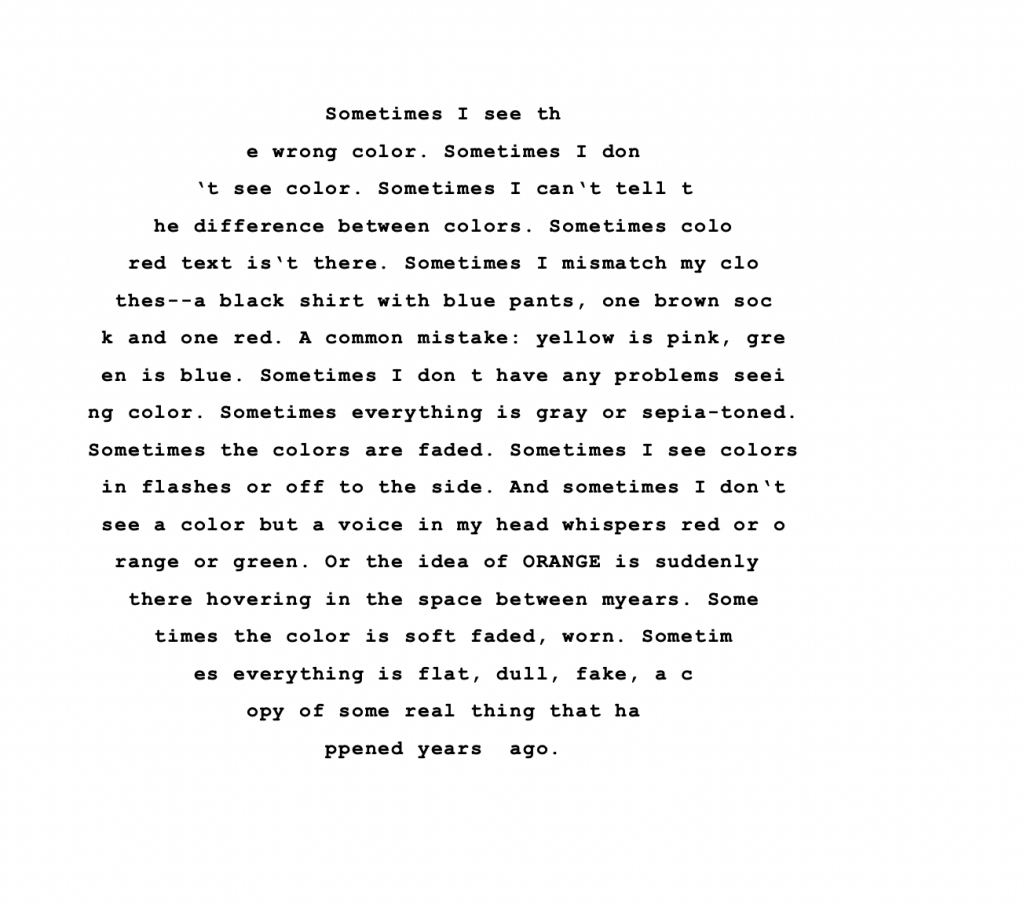
I’m still trying to work on a series of color poems. Right now: orange, later in May: green. It’s a lot of showing up, sitting in front of the page, trying to find a way into ideas about orange as the color that takes up the most space in my practical life. Orange, everywhere. Rarely bright orange — no pops of vermillion or citrus — but orange as usually (not always) the only color that registers as color, something other than gray or dark. In the midst of trying to figure this out, I returned to an essay I remembered reading last year (see: april 16, 2022) about poetry and the void. I thought of it because so much of seeing orange, especially when swimming across the lake in the summer, is about feeling its absence.

sometimes when I’m swimming across the lake I feel a presence that I can’t see — the idea of orange, a hulking shape…I look but nothing is there…yet, I feel its absence…something is there — the trees don’t look quite right

june 26, 2022: hardly ever saw the orange of the orange buoy, mostly just a hulking shape or a void surrounded by a “normal” view — there was no buoy, just an empty space that disrupted the expanse of sky and trees. 

from my notes for Orange

Elisa Gabbert offers this interesting line about poetry:

I think poetry leaves something out. All texts leave something out, of course — otherwise they’d be infinite — but most of the time, more is left out of a poem.

The Shape of the Void: Toward a Definition of Poetry/Elisa Gabbert

At this point, I was planning to write more, but it was already 10:45 and I wanted to go out for a run before it got much later, so I stopped. If I had kept writing, I would have included more from Gabbert, like this:

Verse, by forcing more white space on the page, is constantly reminding you of what’s not there. This absence of something, this hyper-present absence, is why prose poems take up less space than other prose forms; the longer they get, the less they feel like poems. It’s why fragments are automatically poetic: Erasure turns prose into poems. It’s why any text that’s alluringly cryptic or elusive — a road sign, assembly instructions — is described as poetic. The poetic is not merely beauty in language, but beauty in incoherence, in resistance to common sense. The missingness of poetry slows readers down, making them search for what can’t be found. 

The hyper-present absence of something (orange orange everywhere) as poetry. Its inability to reveal itself in “normal” and straightforward ways to me (as in: look with my eyes and see orange). Its missingness makes me notice/attend to it even more.

In the next line, Gabbert suggests that the frustration of incoherence, mystery, not being able to make sense of something is alluring, erotic. It’s why many of us are drawn to poetry — to slow down, notice, get the chance to dwell in the unknown. Before I left for my run, I was thinking about how my perspective is slightly different. I don’t need to be encouraged to slow down or given the chance to embrace incoherence, resist common sense. Because of failing vision and my overworked brain, I am already slow. Much of what I see is incoherent — or never quite coherent. Common sense ideas of how we see or how to be in the world have already been upended for me. I see poetry, and its way of navigating or negotiating or communicating/finding meaning not as desirable, but as necessary, practical, useful, a way to be that speaks to where I already am.

during the run

I started out thinking about the hyper-presence of an absence as I ran in terms of the open space of the gorge, but these thoughts didn’t last long. I became distracted by my effort. Did I ever return to them? If I did, I can’t remember.

after the run

After highlighting two delightful letters by poets Emily Dickinson and Rainer Marie Rilke, Gabbert writes:

In these letter-poems, poetry reveals itself as more a mode of writing, a mode of thinking, even a mode of being, than a genre. The poem is not the only unit of poetry; poetic lines in isolation are still poetry. The poem is a vessel; poetry is liquid.

Poetry as a mode of writing, thinking, being. Made of more than just poems. Yes! I do feel that often my way of navigating losing my vision, finding a way to be when I cannot see, is through the approach of poetry and embracing uncertainty and the unknown.

The architect Christopher Alexander thought big plate glass windows were a mistake, because “they alienate us from the view”: “The smaller the windows are, and the smaller the panes are, the more intensely windows help connect us with what is on the other side. This is an important paradox.” To state the Forsterian obvious again, adding breaks to a paragraph is not always going to make an interesting poem — but most poets don’t write that way. They write in the line, in the company of the void. That changes how you write — and more profoundly, how you think, and even how you are, your mode of being. When you write in the line, there is always an awareness of the mystery, of what is left out. This is why, I suppose, poems can be so confounding. Empty space on the page, that absence of language, provides no clues. But it doesn’t communicate nothing — rather, it communicates nothing. It speaks void, it telegraphs mystery.

To write, to think, to be in the company of the void — the absence that leaves a residue or that can’t be seen but is always felt.

This idea of communicating nothing (with nothing not as no thing but as something in and of itself) reminds me of something else I read earlier this year about “making nothing happen” but couldn’t remember where I had read it. It took me almost an hour to track it down yesterday. The “make nothing happen” is in W. H. Auden poem for Yeats:

from In Memory of W. B. Yeats/ W. H. Auden

II

You were silly like us; your gift survived it all:
The parish of rich women, physical decay,
Yourself. Mad Ireland hurt you into poetry.
Now Ireland has her madness and her weather still,
For poetry makes nothing happen: it survives
In the valley of its making where executives
Would never want to tamper, flows on south
From ranches of isolation and the busy griefs,
Raw towns that we believe and die in; it survives,
A way of happening, a mouth.

And the reading about it comes from Ross Gay and one of his incitements in Inciting Joy, which I first read as an essay for the October 2022 issue of Poetry:

I can’t tell you how many times I’ve heard conversations about W. H. Auden’s famous line from his poem “In Memory of W.B. Yeats”: “poetry makes nothing happen.”…At some point, probably I heard someone else say it,7 it occurred to me that all these poets, and all these conversations, were misreading Auden’s line, and that he was really talking about (inasmuch as a poem is him talking about something) what poetry makes, the sometimes product or effect or wake or artifact of poetry, of a poem. Granted the line feels emphatic, grand, provocative even—seriously, I can’t tell you how many tweed-jacketed refutations to Auden’s line I have endured; no one has ever explained to me the elbow patch—but what the line makes made is not nothing, but nothing happening. Or rather, nothing happening. The happening it makes is nothing. In other words, a poem, or poetry, can stop time, or so-called time at least. First of all, what a good reminder it is that a poem is an action, and as Auden has it, a powerful one, too. Secondly, and not for nothing, this is one of the suite of poems Auden wrote in the late thirties and early forties, a period when one might have wanted so-called time—the clock, the airplanes, the trains, the perfectly diabolical synchronous goosestep rhythm of time itself—to stop.

Out of Time (Time: The Fourth Incitement)/ Ross Gay

He adds:

you, too, might’ve been praying for a way to stop the march of so-called time, and poems, sometimes, might do that. Poems are made of lines, which are actually breaths, and so the poem’s rhythms, its time, is at the scale and pace and tempo of the body, the tempo of our bodies lit with our dying. And poems are communicated, ultimately, body to body, voice to ear, heart to heart.9 Even if those hearts are not next to one another, in space or time. It makes them so. All of which is to say a poem might bring time back to its bodily, its earthly proportions. Poetry might make nothing happen. Inside of which anything can happen, maybe most dangerously, our actual fealties, our actual devotions and obligations, which is to the most rambunctious, mongrel, inconceivable assemblage of each other we could imagine.

Perhaps I’m wandering too far away from the orange void here? Poetry as speaking the void, making Nothing happen, existing outside of the normal/rational/obvious/taken-for-granted. Gay’s explicit connection to time and against capitalism resonates deeply for me. Stop those clocks, those planes, that machinery we’re using to destroy the planet, the future.

The poem’s lines as breaths, as bodily rhythms. In a poem about the color gray I mentioned gray breaths. What are orange breaths? Orange time, orange rhythm?Orange devotions and obligations?

One last thing, and a return to Gabbert’s essay. Gabbert claims that the mystery of poetry is not simply metaphor or making things strange, but how we use or don’t use language to shape our relationship to the Void. And, she suggests it is the missing mountain in Shane McCrae’s “The Butterflies the Mountain and the Lake”:

the / Butterflies monarch butterflies huge swarms they
Migrate and as they migrate south as they
Cross Lake Superior instead of flying

South straight across they fly
South over the water then fly east
still over the water then fly south again / And now
biologists believe they turn to avoid a mountain
That disappeared millennia ago.

The missing mountain is still there. The no longer visible orange buoy is still there too.

added a few hours later: Trying to find a source for this cool butterfly fact, I discovered that it was written about in Annie Dillard’s Pilgrim at Tinker Creek:

Monarchs are “tough and powerful, as butterflies go.” They fly over Lake Superior without resting; in fact, observers there have discovered a curious thing. Instead of flying directly south, the monarchs crossing high over the water take an inexplicable turn towards the east. Then when they reach an invisible point, they all veer south again. Each successive swarm repeats this mysterious dogleg movement, year after year. Entomologists actually think that the butterflies might be “remembering” the position of a long-gone, looming glacier. In another book I read that geologists think that Lake Superior marks the site of the highest mountain that ever existed on this continent. I don’t know. I’d like to see it. Or I’d like to be it, to feel when to turn.

Pilgrim at Tinker Creek, page 253-254 in the 1988 edition

Even as I’m disappointed that Dillard didn’t offer any sources for her facts here, I LOVE her last lines: I don’t know. I’d like to see it. Or I’d like to be it to feel when to turn. Not to see, but to be it, to feel it. Wow — this idea is going in my orange poem, for sure. Not to see orange, but to be it, or to feel when to turn around it. I do feel that, but can I ever put it into words?
march 22/WALK

30 minutes, with Delia
neighborhood, near the river
29 degrees

It rained last night, which helped melt some more snow. Everything wet and dripping today. Mud and muck on the edges, puddles in the middle. Walking by a neighbor’s house I heard a rhythmic drip drip drip. Also heard a pair of woodpeckers pecking, then laughing. Whispered Brooks’ “The Crazy Woman” and Oliver’s “Wild Geese” to myself as I walked.

James Schuyler, Hymn to Life, Page 10

Begin with As windows are set, end with What are the questions you ask?

As windows are set in walls in whited Washington. City, begone
From my thoughts: childhood was not all that gay. Nor all that gray,
For the matter of that.

Yesterday I looked it up and discovered that Schuyler grew up in Washington, which I would have figured out anyway after reading this line.

Gay and gray. My favorite use of this pair is in Gwendolyn Brooks’ wonderful poem:

The Crazy Woman by Gwendolyn Brooks

I shall not sing a May song.
A May song should be gay.
I’ll wait until November
And sing a song of gray.

I’ll wait until November
That is the time for me.
I’ll go out in the frosty dark
And sing most terribly.

And all the little people
Will stare at me and say,
“That is the Crazy Woman
Who would not sing in May.”

May leans in my window, offering hornets.

What a line! Speaking of hornets — or wasps? or yellow jackets? or something that stings like that? — we have a few nests in our eaves. Every winter I talk about removing them before it gets too late in the spring, and every year we forget. Will we remember this year?

The fresh mown lawn is a rug underneath
Which is swept the dirt, the living dirt out of which our nurture
Comes, to which we go, not knowing if we hasten or we tarry.

The daily tasks, like mowing the lawn, a way for us to try to keep the inevitable at bay, or to think we have some control over death, or to avoid confronting it.

May
Opens wide her bluest eyes and speaks in bird tongues and a
Chain saw.

I love this line and how he brings together these two sounds! I’m always thinking about, and writing about, hearing the birds mixed in with the buzz of chainsaws or leaf blowers or lawn mowers. I like imagining that all of these sounds are May speaking.

The blighted elms come down. Already maple saplings,
Where other elms once grew and whelmed, count as young trees.

whelmed = archaic; engulfed, buried, submerged.

Was wondering if there are elms in the Mississippi River Gorge. Found some info about the invasive species, Siberian Elm.

Also, just remembered a poem I posted back in 2019:

Elms/ LOUISE GLÜCK

All day I tried to distinguish
need from desire. Now, in the dark,
I feel only bitter sadness for us,
the builders, the planers of wood,
because I have been looking
steadily at these elms
and seen the process that creates
the writhing, stationary tree
is torment, and have understood
it will make no forms but twisted forms.

In
A dishpan the soap powder dissolves under a turned on faucet and
Makes foam, just like the waves that crash ashore at the foot
Of the street. A restless surface. Chewing, and spitting sand and
Small white pebbles, clam shells with a sheen or chalky white.
A horseshoe crab: primeval. And all this without thought, this
Churning energy. Energy!

Sometimes I can be dense, so here’s a potentially dumb question: is he talking literally about waves — I know the narrator of this poem lives near the ocean — or is this a metaphor for the waves of debris on post-winter streets, reemerging in spring? I imagine it could be both. I’ll take it as a metaphor and wonder about what crushed up crustaceans might be unearthed in asphalt eroded by winter salts. Here in Minneapolis, near the Mississippi River Gorge, we were once part of the Ordovician Sea, so I can imagine some of that might still be present in the crushed up rock used to pave our paths and roads.

The sun sucks up the dew; the day is
Clear; a bird shits on my window ledge. Rain will wash it off
Or a storm will chip it loose.

Ha ha. I love the word shit and what it does to this image — it doesn’t cheapen or tarnish it, but makes it more real, mundane, less precious. Oh — and it makes it a little gross, which I like.

Life, I do not understand. The
Days tick by, each so unique, each so alike: what is that chatter
In the grass?

Sometimes I’d like to understand, to have my questions answered, but more often I like not knowing, or not yet knowing what that chatter in the grass is. I like having the space to imagine all the different things it could be. Perhaps what it is is more magical than I could have imagined. Understanding is necessary, and so is imagination and possibility.

May is not a flowering month so much as shades
Of green, yellow-green, blue-green, or emerald or dusted like
The lilac leaves.

A few days ago, while doing some research on colorblindness for the series of color poems I’m currently writing I came across a video about “what it’s like to be colorblind.” In the video they included some side-by-side images of “normal” and “colorblind.” Both images looked almost the same to me, especially what was green. I could tell it was green, but it also could have been gray or brown (and maybe it was in the image that someone who is colorblind would see). The variations of green, the subtle differences between yellow-green or blue-green or emerald green are mostly lost on me. Instead, I see green or light green or dark green or gray green or brown. This May, I’ll have to pay close attention to green and what I see, then write about it.

The lilac trusses stand in bud. A cardinal
Passes like a flying tulip, alights and nails the green day
Down. One flame in a fire of sea-soaked, copper-fed wood:
A red that leaps from green and holds it there.

I have lost the ability to be shocked or startled by red, especially from a cardinal. There is a cardinal that summers in our yard — my daughter has named him Chauncy — but I never see his red coat. I only know him by the shape of his head, looking like an angry bird, and his birdsong. This month he has decided to help usher in spring by perching himself on the tree outside my kitchen window.

A lot is lost and missed when you can’t see the red flash — the flying cardinal, a small blinking light, a flare somewhere — that everyone else sees and instantly understands and assumes that you see too.

Reluctantly
The plane tree, always late, as though from age, opens up and
Hangs its seed balls out.

It’s not just me, right? You are picturing an old guy with his balls hanging out too?

Winter is suddenly so far away, behind, ahead.

Yes, like it never happened, or it happened to someone else. I call her Winter Sara.

From the train
A stand of coarse grass in fuzzy flower.

I love tall, ornamental grasses with fuzzy ends that look like feathers or flowers! Someday I will plant some in my yard.

I like it when the morning sun lights up my room
Like a yellow jelly bean, an inner glow.

I’m not a huge fan of jelly beans, but I appreciate that Schuyler’s line gave me the chance to think about them and to imagine that intense yellow in the center of a jelly bean, one that has a translucent shell, not an opaque one. As an adult, I’ve grown to love the color yellow. I wonder, would a yellow marble work for this too?

May mutters, “Why
Ask questions?” or, “What are the questions you wish to ask?”

I love this as the last line of the poem!

march 17/BIKERUN

bike: 30 minutes
run: 1.75 miles
basement
outside: 13 degrees / feels like -5

Yes, you read that correctly. It feels like 5 below outside. And, there’s a thin coating of soft snow and ice on every sidewalk. Maybe if we didn’t have a 20 mph wind too, I might have gone outside, despite the cold and snow. But, I can hear the wind howling from my desk and see the shadows of the branches swaying. I’m staying inside.

Watched an episode of Emily in Paris while I biked. I’m not sure I like the show — Emily is mostly likable but a little obnoxious, and I’m not interested in her job of protecting her clients’ brands while making them compelling for American consumers — but I’m giving it a chance. I listened to a Ruth Ware book as I ran. No deep thoughts or insights, just the chance to move my body and get away from my desk.

I had been planning to do some sort of workout yesterday, but I ran out of time. Early in the day, I wrote the following:

tree outside my window: update

Yesterday, because of the mild 45 degree weather, Scott and I decided to deal with the big branch of the tree that had fallen from our neighbor’s yard on March 6th. The branch stretched from the sidewalk near their front door, across their front yard, to the edge of the south side of our house. It wasn’t too cold outside, and the task wasn’t too difficult. My part: stripping off the ugly berries and breaking up the small branches to fit into a lawn and leaf bag. Scott trimmed the tree until all that was left was the thickest part, which he estimates is 6-8 inches in diameter and 6-8 feet long. We left this part because it looked heavy and I didn’t want either of us injuring ourselves as we tried to lift it.

Yesterday I saw a bird on the branch, this morning Scott saw a squirrel frantically attempting to recover some hidden nuts. I’m hoping our neighbors leave it where it is so I can see what else comes to visit — maybe a woodpecker?! — as I work.

James Schuyler, Hymn to Life, Page 7

Begins with Simply looking, and ends with A friend waving from a small window.

Simply looking. A car goes over a rise and there are birches snow
Twisted into cabalistic shapes: The Devil’s Notch; or Smuggler’s
Gap. At the time you could not have imagined the time when you
Would forget the name, as apparent and there as your own.

Simply looking at a car and the twisted trees. Did Schuyler name these shapes, or did someone else?

Rivers
Reflecting silver skies, how many boys have swum in you? A rope
Tied to a tree caught between my thighs and I was yanked headfirst
And fell into the muddy creek. What a long time it seemed, rising
To the surface, how lucky it didn’t catch me in the groin. That
Won’t happen twice, I imagine.

The boys are back — he mentions boys throughout the poem. I don’t think he ever mentions women.

That
Won’t happen twice, I imagine.

A reference to Heraclitus and the river. You can find paraphrases of his statement all over the web. I wanted to find a more accurate version, so I went to the Stanford Encyclopedia of Philosophy and found this:

Plato’s own statement:

Heraclitus, I believe, says that all things pass and nothing stays, and comparing existing things to the flow of a river, he says you could not step twice into the same river. (Plato Cratylus 402a = A6)

The established scholarly method is to try to verify Plato’s interpretation by looking at Heraclitus’ own words, if possible. There are three alleged “river fragments”:

B12. potamoisi toisin autoisin embainousin hetera kai hetera hudata epirrei.

On those stepping into rivers staying the same other and other waters flow. (Cleanthes from Arius Didymus from Eusebius)

B49a. potamois tois autois … 

Into the same rivers we step and do not step, we are and are not. (Heraclitus Homericus)

B91[a]. potamôi … tôi autôi …

It is not possible to step twice into the same river according to Heraclitus, or to come into contact twice with a mortal being in the same state. (Plutarch)

Heraclitus, 3.1 Flux

I’m partial to the second, Yoda-y version (B49a). Interesting — it’s not that we are not the same, and the river is not the same, BUT we/the river are both the same and not the same. They’re both true. Very cool.

One more thing about this line: I love how poets drop references without direct citation. It’s much more fun (rewarding? interesting?) when it’s not spelled out — Like Heraclitus said… In an early poem for my chapbook You Must Change Your Life, I admit that I did this:

Heraclitus claimed you can’t step into the same river twice.

Did you know you also can’t
run beside the same river twice?

I like recognizing a reference. I also like when I don’t recognize it, and all that I learn when I look it up. The trick, I think, is to reference something in a way that isn’t alienating. To make it easy to be found, if you take the time to search for it.

That summer sun was the same
As this April one: is repetition boring? Or only inactivity?

Repetition can be boring, but it’s more comforting to me. Usually I’m too restless to be inactive — maybe that’s why it isn’t boring to me, but novel, wanted.

And, what’s wrong with boring? This reminds me of the psychoanalyst Adam Phillips and his book, On Kissing, Tickling, and Being Bored, which I know I read a decade ago, but don’t remember much about. The Marginalia has a helpful essay to remind me of what Phillips wrote. In terms of Schuyler and his poem, I’m thinking about boredom as emptiness, being in a state of doing nothing with (too much) time to think and reflect, to look at yourself. On page 6, Schuyler offers the line:

Why watch
Yourself? You know you’re here, and where tomorrow you will probably
Be.

Quite
A few things are boring, like the broad avenues of Washington
D.C. that seem to go from nowhere and back again. Civil servants
Wait at the crossing to cross to lunch at the Waffle House.

What’s the difference between boring and ordinary? And, is boring the opposite of interesting?

In
This twilight Degas a woman sits and holds a fan, it’s
The just rightness that counts. And how have you come to know just
Rightness when you see it and what is the deep stirring that it
Brings? Art is as mysterious as nature, as life, of which it is
A flower.

This just rightness makes me think of a quote I like from Oscar Wilde, which I wrote about on my trouble blog in 2012:

It is absurd to divide people into good and bad. People are either charming or tedious.

Good = just, right Not sure how/if this totally fits, but Schuyler’s discussion of boredom, then his mention of just rightness made me think of it.

Under the hedges now the weedy strips grow bright
With dandelions, just as good a flower as any other.

Again, I’m amazed at how Schuyler predicts, or does he set me up for, some of my questions. On March 14th, looking at page 5 I asked: What is a weed and what is a wildflower? The implication: which plants do we value as flowers, and which do we dismiss as weeds? And now here he is, two pages later, answering my question!

You see death shadowed out in another’s life. The threat
Is always there, even in balmy April sunshine. So what
If it is hard to believe in? Stopping in the city while the light
Is red, to think that all who stop with you too must stop, and
Yet it is not less individual a fate for all that. “When I
was born, death kissed me. I kissed it back.”

Death, a common fate, but felt uniquely by each of us. The same river twice, and not twice.

Meantime, there
Is bridge, and solitaire, and phone calls and a door slams, someone
Goes out into the April sun to take a spin as far as the
Grocer’s, to shop, and then come back. In the fullness of time,
Let me hand you an empty cup, coffee stained. Or a small glass
Of spirits: “Here’s your ounce of whisky for today.” Next door
The boys dribble a basketball and practice shots. Two boys
Run by: high spirits. The postman comes. No mail of interest.
Another day, there is. A postcard of the Washington Monument,
A friend waving from a small window at the needle top.

Life — the fullness and emptiness of time — is both ordinary (cards, calls, door slams) and extraordinary (spirits, spirited boys, postcards of the Washington Monument). The empty, coffee stained cup reminds me of a line from page 6 that I don’t think I mentioned:

the sun
Comes out from behind unbuttoned cloud underclothes—gray with use—

Gray. Stained with use. Used up. Old bones, old bodies.

Wow, this exercise of slowly reading Schuyler’s poem, a page a day, is so much fun! It does take time, which can be difficult to find.

march 13/SWIMRUN

swim: 1.25 miles
ywca pool

I love to swim. Today felt really good, relaxed. I didn’t even care that my latest vision problem happened again. Walking on the pool deck, staring intently at the lanes, trying to see if the lane I’m looking at is as empty as I think it is. I checked at least 3 times, staring at the water. It seemed empty. Then I put my stuff down and was about to get in when I noticed someone in the lane. Very frustrating and unsettling to look closely, for a long time, and still not see what is right there. But really, it’s not that big of a deal. I didn’t jump in on top of anyone or cause a swimmer to mess up their rhythm. I just need to get used to it and accept that it will continue to happen.

Lots of friends in the water with me today: weird white, almost translucent, bits near the bottom, a balled up bandaid in one lane over, and perhaps the most disturbing, a fuzzy brown ball floating halfway up to the surface, slowly making it’s way to below me. Would I accidentally suck it up? Yuck! Must have gotten distracted because I lost track of it.

Noticed the sloshing sound of water as my hands broke the surface.

Everything was blue underwater. Blue tiles, a blue lower-cased t on the wall, blue-tinted water. Dark blue shadows below, cast by the trees outside the window, making the pool floor look alive.

Lots of breaststroke around me, some backstroke, an occasional freestyle. One woman was using a kick board. I used a pull buoy for a set.

run: 3.1 miles
under ford bridge and back
29 degrees
95% clear path

Ran in the afternoon, which is always harder than running in the morning for me. I feel more tired, heavier. My legs don’t want to move as much. No headphones on the way south, Beyoncé’s Renaissance on the way back north. The sky was mostly blue, with a few clusters of clouds. I felt a shadow cross over me as I started my run. Hello bird! I think I looked at the river, and I think it was open. Heard the drumming of a woodpecker. Admired the wide open view near Folwell and the Rachel Dow memorial bench. Now I remember seeing the river! Right there by that bench — brownish-gray and open. Encountered walkers, dogs, a runner with a stroller.

Down below, in a discussion of a gray line in Schuyler’s poem, I wonder if I could write about silver. I noticed it today, out on the trail. The blazing bright reflection off a car’s hood, the sun shining on wet pavement.

Schuyler, Hymn to Life, Page 4

Begins with Bring no pleasure and ends with As one strokes a cat.

And if you thought March was bad
Consider April, early April, wet snow falling into blue squills
That underneath a beech make an illusory lake, a haze of blue
With depth to it.

I love his illusory lake and the haze of blue with depth to it. Squills = a sea onion, a plant in the lily family with slender, strap-like leaves and blue flowers. Until I looked up squills, I didn’t get that the illusory lake was really a cluster of spring flowers. Maybe that’s because April in Minneapolis creates a different kind of fake lake: the giant puddle!

That is like pain, ordinary household pain,
Like piles, or bumping against a hernia.

First reaction: recognition. I am struggling through an extended bout of unexplained constipation that has resulted in piles. Nothing big or overly painful, ordinary, a part of the daily routine. Unsettling. Annoying. A low-lying worry that the ordinary could become something more.

Second reaction: In his episode for VS, Jericho Brown says this:

in any poem, anytime you write something down, one of the things that I’m always doing is I’m trying to make sure it’s opposite soon gets there. Soon as I write something down, I’m like, well, the opposite needs to be there too. The sound opposite, the sense opposite, the image opposite. How do you get the opposites in the poem? Because you want the poem to be like your life.

Jericho Brown VS The Process of Elimination

I’m thinking about how just as the ordinary includes the comfort of the mundane and routine, it includes the discomfort — the steady aches and pains that are nothing special, just always present, a part of the day.

And in the sitting room people sit
And rest their feet and talk of where they’ve been, motels and Monticello,
Dinner in the Fiji Room.

I love this plain, ordinary image of people in a sitting room doing what you do in a sitting room: sitting. There’s something magical about the sitting and talking and not doing anything grander, resting.

Someone forgets a camera. Each day forgetting:
What is there so striking to remember?

Each day forgetting.

The rain stops. April shines,
A Little

Gray descends.
An illuminous penetration of unbright light that seeps and coats
The ragged lawn and spells out bare spots and winter fallen branches.

Yardwork.

What a wonderful description of gray light! It shines a little, an unbright light that seeps and coats and exposes (spells out) the worn spots and the ordinary work needed to be done every spring. Lately, when I think of gray, I think of the opposite — not how it makes everything look shabby, worn, tired, but that it softens everything, making it mysterious and more gentle, relaxed.

It seems like Schuyler could be writing against one classic image of luminous gray light or, it made me think of this at least: the silver lining. Wondering about the origins of the phrase, I looked it up. John Milton’s poem, Comus:

That he, the Supreme good t’ whom all all things ill
are but as slavish officers of vengeance,
Would send a glistring Guardian if need were
To keep my life and homour unassail’d.
Was I deceiv’d, or did a sable cloud
Turn forth her silver lining on the night?
I did not err, there does a sable cloud
Turn forth her silver lining on the night,
And casts a gleam over this tufted Grove.

Thinking about my color poems, and my interest in gray, I wonder how I could write about silver? For me, silver is the color that burns and shines when concentrated on the iced-over river, too bright for my eyes. Silver is also the color of the path when ice is present — it’s a warning sign, a whisper, Watch Out! Slippery.


And now the yardwork is over (it is never over), today’s
Stint anyway. Odd jobs, that stretch ahead, wide and mindless as
Pennsylvania Avenue or the bridge to Arlington, crossed and recrossed

I like wide and mindless, mundane tasks. Well, mostly I do. Tasks that can help me to shift into a different mental space where I wander and day dream. Mowing the lawn, pulling the weeds, doing the dishes.

And there the Lincoln Memorial crumbles. It looks so solid: it won’t
Last. The impermanence of permanence, is that all there is?

I’m reminded of an ED poem with Schuyler’s use of crumbling:

Crumbling is not an instant’s Act (1010)/ EMILY DICKINSON

Crumbling is not an instant’s Act
A fundamental pause
Dilapidation’s processes
Are organized Decays —

‘Tis first a Cobweb on the Soul
A Cuticle of Dust
A Borer in the Axis
An Elemental Rust —

Ruin is formal — Devil’s work
Consecutive and slow —
Fail in an instant, no man did
Slipping — is Crashe’s law —

Crumbling is routine, everyday life. Slow and steady, nothing special, ordinary. Not Ruin.

is that all there is? To look
And see the plane tree.

What an awesome enjambment! Sometimes all we need (or all we have) is that tree outside the window.

For this is spring, this mud and swelling fruit tree buds, furred
On the apple trees. And yet it still might snow: it’s been known

This poem is about D.C.. Here in Minneapolis, it almost always snows — a big storm — in April.

march 10/SHOVELWALK

shovel: 25 minutes
about 2 inces

At some point during the speculation over this storm, they predicted 3-5 inches. We might have gotten 3 total, over 2 days of on and off snow. The snow was soft and not too difficult to shovel, except for the bits caked on that my shitty Target shovel couldn’t seem to scrape.

walk: 1 mile
neighborhood with Scott and Delia

A beautiful walk through a winter wonderland. We headed north on Edmund and I was able to admire the white Welcoming Oaks from across the road. Later, on 34th, I made sure to check and see if the house that recently acquired new owners still had the little anemometer (measures wind speed) perched on the fence near the garage. Yes! Noticed how all the snow on the streets had melted. Excellent.

the tree outside my window

During my month with Linda Pastan, I read a lot about the tree outside her window. The tree outside my window belongs to my neighbor. Earlier this week, the heavy, wet snow caused a a big section of it (which is a big tree) to fall. Here’s what I wrote about it on Monday:

Woke up this morning, walked downstairs, opened the blinds. Hello huge tree branch sprawled across the side yard! Sometime during the night as it snowed a branch from my neighbor’s tree fell. It starts in their yard and ends by the edge of my house. Luckily, no damage. I wonder how long it will be before it’s removed?

RUN! log entry from 6 march 2023

How long will it be? It’s still there. Yesterday Scott and I talked about whether or not we should do anything about it. We decided we’ll wait until it’s warmer. It’s not blocking anything, or causing any damage, and it is their responsibility. I wouldn’t mind clearing off some of the branches, but the biggest part of the fallen tree looks heavy and will be difficult to remove. Of course, this fallen tree isn’t a big deal, but it’s difficult to ignore when it’s right outside my window, always there, reminding me that something will need to done about it at some point, and that I’m incapable of talking with my neighbors about it.

a mini-project on Schuyler

Yesterday I decided to print out James Schuyler’s lllooonnnnggg poem, Hymn to Life. 10 pages 1.1 spaced in 13 pt Helvetica-Neue. It just fits on my desk, under the glass. My plan is to spend some time with a different page each day (or each time I read it and write about it) and pick out bits that stand out for me.

James Schuyler, Hymn to Life, Page 2

Today I worked on page 2, which begins with As the seasons turning, and ends with bigger gravestones than the lesser fry. Why did I begin with page 2 and not page 1? Maybe it was because I’ve read the first page many times, but rarely beyond it — I was too daunted by the number of lines left to read. And because I discussed the first page a little yesterday.

tree, that dominates this yard, thick-waisted, tall/ And crook branched. Its bark scales off like that which we forget:/ Pain, an introduction at a party, what precisely/ happened umpteen Years or days or hours ago. This line reminds me of a bit of Schuyler’s diary that I read yesterday:

March 5 — in this case from 1971:

“As beautiful a morning as ever was, as though the two days wind had blown something away and left — not spring, by any means: a kind of russet flash in this swept clean clarity.  The plane tree looks as though it’s shedding its flakes and scabs of bark in the interest of a new nakedness, its upper trunk like a sinewy throat. 


Putting these two fragments together complicates and deepens my understanding of that which we forget. When I initially read the poem, I was thinking more about the regret of forgetting someone’s name, or what happened in the past. Also — just last week, RJP had a check-up at the dentist. After she was safely done, I told her about how painful one of my cleanings had been and how I wished I could have recorded that pain I felt because I hadn’t flossed enough and play it back for myself every time I didn’t want to floss! Now reading the lines in Schuyler’s diary about shedding bark and becoming something new, I’m thinking about why I sometimes want to forget, to let go of old memories and experiences, to become something new. So, some things we want to forget — like me and the problem of the tree — and some things we want to remember — like the voices and gestures of someone we love, the pain of a bad cleaning. Both are true, and the tree bark can be about forgetting as welcomed or feared.

And that same blue jay returns, or perhaps/ It is another. All jays are one to me. This makes me think of bird as form, which is how I often understand birds because of my inability to see their fine details. Although, as I learn more of their songs, I can distinguish between some types. Just this past fall I finally realized that what I thought was an irritating crow call is actually the screech of a blue jay, and that the tin-whistle song that I always here is a blue jay too. I’m also thinking about the rare occasion when I wonder about the life span of the creatures I encounter — squirrels, birds, butterflies, bees. I looked up blue jay: 7 years, on average, but as old as 27. I’ve lived in my current house for 8 years, so I might be encountering the same bird each year.

But not the sun which seems at/ Each rising new, as though in the night it enacted death and rebirth I don’t imagine the sun in this way. Is this because I hardly ever sit and watch it set? I should. What would it feel like to imagine that the sun is performing death every night, being reborn every morning? How could that shift my perspective on everything?

a future which is just more Daily life. I love daily life — the mundane, sometimes made magical, but often small and quiet and repeated. I find comfort in the patterns, find meaning in the accumulation of day after day.

It/Is spring. It is also still really winter. Not a day when you say,/“What a beautiful spring day.” A day like twilight or evening when/You think, “I meant to watch the sun set.”

I meant to watch the sun set. This line comes after the flowers blooming, daily life, and a bit about his cat is always getting into fights. A fun surprise to realize, just now as I read this again, that Schuyler was setting me up for regret about not seeing a sun set! And now, noticing how I wrote sunset and he wrote sun set, I’m thinking about the difference between the two, one as a noun, the other a verb, and how believing in the sun setting as opposed to the sunset is much more fun, and open, and makes imagining that the sun could be doing something like performing death every night much more possible. Verbs are the best!

march 3/RUN

6 miles
ford loop
32 degrees
20% deep puddles with ice

Wasn’t planning to run 6 miles today, but when I got closer to under the ford bridge and saw a maintenance truck blocking the way, I decided to take the path up to and then over the ford bridge. I briefly worried that it might be too much for my IT band, but decided to do it anyway. My IT band is sore, and it did grumble a little during the run, but I think it’s okay. Another reason I was willing to do this route: the part of the path between 42nd and the double bridge had 2 big stretches of jagged ice + deep, cold puddles + slush. I had already gotten my feet wet once (brrr), and I wasn’t excited to do it again.

Crossing the ford bridge, I admired the river. Farther north, it was open but right below, it was still iced over. Later, crossing the lake street bridge, I admired the river more. Open, undulating, and blue. The sun was shining on the waves, making a sparkling path towards the east side of the river. Beautiful! I wondered if it sparkled there because of a sandbar just below the surface. Probably not, but maybe?

Had to stop and walk a few times to navigate the slick, slushy trail.

Heard at least one drumming woodpecker, and a bunch of other chirping birds. Saw a bird soaring in the sky. Also heard what sounded like rushing water near Shadow Falls. Was it water, or dead leaves. Water, I decided.

Saw my shadow ahead of me. She was enjoying the sun as much as I was.

On the east side, I saw two walkers stopped for a minute, looking up into the tree. What were they seeing, I wondered.

My plan was to read all of My Emily Dickinson this month, but I made it about halfway and stalled. Too academic for me. Maybe I’ll return to it later? Still thinking about Emily Dickinson, though, and windows (which was another possible topic for this month). In the spirit of that, here’s a poem from Kelli Agodon Russell and one of her books that I just discovered and bought, Letters from the Emily Dickinson Room:

Another Empty Window Dipped in Milk/ Kelli Agodon Russell

“I’ve had nothing yet,” Alice replied in an offended tone: “so I can’t take more.”
You mean you can’t take less,” said the Hatter: “It’s very easy to take more than nothing.”

I am the opposite of duende.
I am the humdrum, monotonous, the blah blah blah
when you want dazzling, a passion
flower with hipbones.
I’m not the voodoo that you do,
but the bone from the salmon on the side
of your plate. My lips say hiatus, say corpse pose.
All morning I make Ku Ding tea, serve crumb cake.
Trust me, it’s not bitterness I carry
in my blood, but the pulse and flow
of ordinary, the white picket fence
I like to call my ribcage. Listen—
the faulty valve of my heart quotes Einstein,
believes everything’s a miracle instead of nothing is.
All around, birdsong and background
music. All around, diamond birds and beetles.
To the mirror, I’m less than a gem. Some days
I see green glass while others see emeralds.
I needle through this, trying to sew synchronicity
into my stories. Sometimes I drop a stitch
and have to back-tack spiritus mundi to my hem,
slide the universe beneath my slip.
I would live differently if I knew passion
flowers would bloom in my bourbon,
if I believed randomness
wasn’t only a bone I choked on.
At night God speaks to me while I’m balanced
in dead bug pose. He says I’m beautiful
balanced in dead bug pose, but
I want to be the voice and not the insect,
the hipsway of tail feathers and not the egg
broken beneath a wingspan of worry.
I tell myself I’m safe from extinction
living in a marsh of marginal, a swamp
of so-so, but I’m afraid I’m becoming the common
seagull. Deep down, hope perches in my ribcage
and its song is enough to make me soar.
And this hum I thought was a murmur,
was another’s words—dwell, dwell—in a voice,
a ventricle, in the vital song of a hermit
thrush singing, here I am right near you,
to the robin outside my window
repeating as I serve the crumb cake,
the bitter tea: cheer-up, cheer-up, cheer-up.

I like this poem, even as I don’t completely understand it. Because I’ve been thinking about the ordinary — Linda Pastan’s line, It is the ordinary that comes to save you — I was struck by Russell’s lines,

it’s not bitterness I carry
in my blood, but the pulse and flow
of ordinary

I also like living in the marsh, a swamp of so so. And, the birdsong and the bird — ED’s hope is a feather perching in her ribcage — as being enough to make the narrator soar. I looked it up and found a source for Russell’s robin singing cheer up and her hermit thrush singing here I am right near you: Bird Songs: Putting Words to What You Hear

march 1/WALKSWIM

walk: 35 minutes
neighborhood with Delia
36 degrees / wintry mix

Took Delia on a walk on a gray, wet day. Puddles everywhere. No ice, just water. Dripping, pooling, seeping. With my boots on, I didn’t mind it, but Delia did. I could tell by the end of the walk, she was over it. Instead of wagging vigorously when I called her name, her tail was stiff and bent at the end.

I’m working on a series of cento poems using Linda Pastan’s poetry. Before I went out, I was playing with a line from “The Ordinary:” “it is the ordinary that comes to save you.” I was thinking about the ordinary as I walked — the sharp, staccato drips of the water through one gutter, the gurgling of some other drops as they missed a different gutter. Someone’s shuffling footsteps. The feel of the cold, but not too cold, air in my nose. The reflection of trees, then the flutter of wings, in a puddle on the sidewalk. The singing birds.

Inspired by the beauty of the ordinary all around me, I stopped to record some sound and a thought:

ordinary birdsong / 1 march

it is the ordinary things that save us
the reprieve of birdsong
the flip side of sadness

A little later in the walk, I encountered yet another lone black glove. I walked by, then double-checked to make sure it was, in fact, black. Yes. It’s always black. This made me wonder which is more satisfying exciting desired:

seeing a lone black glove and having my view of the world — that it will always be a black glove — affirmed/confirmed, or

seeing a glove of another color and having my view of the world interrupted disrupted changed?

I want to say, a glove of another color, and I think it is, but not every time. Sometimes I want it to always be black.

swim: 1.8 miles
ywca pool

Finally, another swim! My last swim was on February 19th. It felt good to be back in the water, and a little strange. After watching a video last week on flip turns, I tried to focus on them more. Maybe it was a bad idea, or maybe it wouldn’t have mattered, but my knees started to feel sore about a mile into the swim.

The coolest thing about the swim was watching the shadows from the trees outside the window shift and shimmer on the pool floor. I was in the lane closest to the windows, which made the shadows more vivid. Swimming in the shallow end, I wondered if I’d still see them as vividly when I reached the deep end. I did! Very cool.

Not so cool: I noticed a little brown speck (very small) of something floating in the water near my face. What was it? No idea, and I didn’t see it again. I hope I didn’t accidentally swallow it. Gross.

I know February is over which means my month with Linda Pastan is over, but last night I read more of her poems while I listened the South High Community Jazz band rehearse, and I feel compelled to post this delightful one. Besides, it mentions Emily Dickinson who is my topic for March.

Q and A/Linda Pastan

I thought I couldn’t be surprised:
“Do you write on a computer?” someone
asks, and “Who are your favorite poets?”
and “How much do you revise?”

But when the very young woman
in the fourth row lifted her hand
and without irony inquired:
“Did you write

your Emily Dickinson poem
because you like her work,
or did you know her personally?”
I entered another territory.

“Do I really look that old?”
I wanted to reply, or “Don’t
they teach you anything?”
or “What did you just say?

The laughter that engulfed
the room was partly nervous,
partly simple hilarity.
I won’t forget

that little school, tucked
in a lovely pocket of the South,
or that girl whose face
was slowly reddening.

Surprise, like love, can catch
our better selves unawares.
“I’ve visited her house,” I said.
“I may have met her in my dreams.”

feb 25/RUN

5k
ywca track

Ran on the track with Scott this morning, not together but at the same time. I thought about swimming, but knew it would be crowded, so I ran. Listened to a playlist titled, Sara 2020. Started with Tower of Power’s “What is Hip” and ended with Prince’s “Let’s Go Crazy.” Focused on my cadence, arm swing, and not running into people as I passed them, including 2 runners who were running in the far lane. There were soccer games going on below me in the big gym, but I didn’t notice them at all. Too lost in my run.

The thing I noticed the most were the people:

  1. a man with white hair, wearing shorts and a tank top, running
  2. a woman in turquoise shorts and a tank top, running in the far lane, making it difficult to pass
  3. another runner in dark sweatpants and a light shirt running in the far lane
  4. 2 people walking, one of them carrying dumbells
  5. another pair of women, the one in the middle lane wearing a bright blue shirt
  6. a woman in mid-calf light blue patterned running tights and a white tank top running in the middle lane
  7. someone in tan shorts walking faster than the other walkers
  8. a woman stretching her calf muscles on the steps in the far corner
  9. a guy in gray, walking
  10. someone in red (I think?) sitting on the bench near the punching bag and the exit

I was listening to music, so I couldn’t hear what anyone was saying, but Scott told me that he overheard 3 interesting things from the pair of women walkers (#5 above). He called them chatty Cathys, he guessed they were in college, and he heard them say this: First, just as he passed them, he overheard one of them call out in disgust, Yuck! Next time, They’ll see it on your transcripts. Finally, You should really stop binging. Binging a show, food, alcohol? What will they see on your transcripts, and is this a good thing, or a bad thing? I love overheard conversations and imagining what they’re about.

Here are two poems I discovered today that move in opposite directions:

Rain/Jack Gilbert

Suddenly this defeat.
This rain.
The blues gone gray
And the browns gone gray
And yellow
A terrible amber.
In the cold streets
Your warm body.
In whatever room
Your warm body.
Among all the people
Your absence
The people who are always
Not you.

I have been easy with trees
Too long.
Too familiar with mountains.
Joy has been a habit.
Now
Suddenly
This rain.

Love: I have been easy with trees/too long.

Opera Singer/Ross Gay

Today my heart is so goddamned fat with grief
that I’ve begun hauling it in a wheelbarrow. No. It’s an anvil
dragging from my neck as I swim
through choppy waters swollen with the putrid corpses of hippos,
which means lurking, somewhere below, is the hungry
snout of a croc waiting to spin me into an oblivion
worse than this run-on simile, which means only to say:
I’m sad. And everyone knows what that means.

And in my sadness I’ll walk to a café,
and not see light in the trees, nor finger the bills in my pocket
as I pass the boarded houses on the block. No,
I will be slogging through the obscure country of my sadness
in all its monotone flourish, and so imagine my surprise
when my self-absorption gets usurped
by the sound of opera streaming from an open window,
and the sun peeks ever-so-slightly from behind his shawl,
and this singing is getting closer, so that I can hear the
delicately rolled r’s like a hummingbird fluttering the tongue
which means a language more beautiful than my own,
and I don’t recognize the song
though I’m jogging toward it and can hear the woman’s
breathing through the record’s imperfections and above me
two bluebirds dive and dart and a rogue mulberry branch
leaning over an abandoned lot drags itself across my face,
staining it purple and looking, now, like a mad warrior of glee
and relief I run down the street, and I forgot to mention
the fifty or so kids running behind me, some in diapers,
some barefoot, all of them winged and waving their pacifiers
and training wheels and nearly trampling me
when in a doorway I see a woman in slippers and a floral housedress
blowing in the warm breeze who is maybe seventy painting the doorway
and friends, it is not too much to say
it was heaven sailing from her mouth and all the fish in the sea
and giraffe saunter and sugar in my tea and the forgotten angles
of love and every name of the unborn and dead
from this abuelita only glancing at me
before turning back to her earnest work of brushstroke and lullaby
and because we all know the tongue’s clumsy thudding
makes of miracles anecdotes let me stop here
and tell you I said thank you.

This poem! The beauty that interrupts us and forces us out of ourselves and into the world! Ross Gay is wonderful.

My Emily Dickinson, part two

a new grammar grounded in humility and hesitation

Emily Dickinson took the scraps from the separate “higher” female education many bright women of her time were increasingly resenting, combined them with voracious and “unladylike” outside reading, and used the combination. She built a new poetic form from her fractured sense of being eternally on inteIlectual borders, where confident masculine voices buzzed an alluring and inaccessible discourse, backward through history into aboriginal anagogy. Pulling pieces of geometry, geology, alchemy, philosophy, politics, biography, biology, mythology, and philology from alien territory, a “sheltered” woman audaciously invented a new grammar grounded in humility and hesitation. HESITATE from the Latin, meaning to stick. Stammer. To hold back in doubt, have difficulty speaking. “He may pause but he must not hesitate”-Ruskin. Hesitation circled back and surrounded everyone in that confident age of aggressive industrial expansion and brutal Empire building. Hesitation and Separation. The Civil War had split American in two. He might pause, She hesitated. Sexual, racial, and geographical separation are at the heart of Definition.

Here’s something I wrote about this passage on March 17, 2021:

I really like this idea of hesitation and humility and aboriginal anagogy as a sharp contrast to progress, aggression, confidence/hubris, and time as always moving forwards (teleology). I tried to find a source that could explain exactly what Howe means by aboriginal anagogy but I couldn’t. I discovered that anagogy means mystical or a deeper religious sense and so, when I connect it to aboriginal, I’m thinking that she means that ED imbues pre-Industrial times (pre Progress!, where progress means trains and machines and cities and Empires and factories and plantations and the enslavement of groups of people and the increased mechanization of time and bodies and meaning and, importantly, grammar) with the sacred. Is that right? Is it clear what I’m saying?

A few paragraphs later, Howe writes this about ED’s grammar of “hesitation and humility”:

Naked sensibilities at the extremest periphery. Narrative expanding contracting dissolving. Nearer to know less before afterward schism in sum. No hierarchy, no notion of polarity. Perception of an object means loosing and losing it. …Trust absence, allegory, mystery–the setting not the rising sun is Beauty. No outside editor/”robber.” Conventional punctuation was abolished not to add “soigne stitchery” but to subtract arbitrary authority. Dashes drew liberty of interruption inside the structure of each poem. Hush of hesitation for breath and for breathing….only Mutability certain.

Some of this is starting to make sense. The periphery, the dashes as hesitation, mystery. I was curious about her take on sunsets over sunrises so I googled it and found this ED poem and helpful account from the Prowling Bee (love her!). She includes a list of ED’s sunset poems.

Howe ends Part One with one more description of ED’s hesitation and humility:

Forcing, abbreviating, pushing, padding, subtraction, riddling, interrogating, re-writing, she pulled text from text (29).

feb 21/RUN

3.5 miles
under ford bridge turn around
8 degrees / feels like 8
100% snow-covered (path)
0% snow-covered (sidewalks)

Wore the Yaktrax today. Not sure if it was a good idea. The trail was covered, but the sidewalks were dry. Bad for the coils, and probably my feet/legs. Not too bad, I think. Colder than yesterday. More layers.

I remember looking down at the river. Open, brown, a thin layer of ice in the center, shining a little. Beautiful.

I remember seeing a bird’s shadow pass fast and low just above my head, then thinking how I like sensing these shadows.

I remember seeing someone with ski poles descending the hill that leads to the ford bridge, then passing them later on the climb to the double bridge. They weren’t using the poles, but holding them off to the side while they did a strange shuffle run.

I remember seeing my shadow running in front of me.

I remember slipping a few times but never falling. Passing a few other walkers and runners, but no bikers. Breathing in the cold air. Seeing the dead clump of leaves that was on the trail months ago and that, when the wind pushed it a little, made me flinch.

I remember hearing a kid’s voice in the oak savanna, children on the playground. Staring far ahead at the snowy view in front of me. Feeling the warm sun on my face.

layers

  • my dead mother-in-law’s purple jacket
  • 2 pairs of black tights
  • a bright yellow TC 10 mile shirt
  • a pink jacket with hood
  • 1 pair of black gloves
  • 1 pair of orange/pink/red mittens
  • 1 pair of socks
  • pink and orange striped buff
  • black fleece-lined cap

I started all zipped up, buff over my ears and covering my mouth, pink hood up, mittens on and up past my wrists. Before the end of mile 1, the hood was down. Before mile 2, pulled the buff off of my ears. After mile 2, I put the mittens in my pocket. At mile 3, I unzipped my jacket slightly. My gloves always stayed on, so did the ear flaps of my cap.

This morning, I discovered a winter line in a Jack Gilbert poem (Meanwhile):

Winter lingers on in the woods,
but already it looks discarded as the birds return
and sing carelessly; as though there never was the power
or size of December. 

With an epic winter storm approaching this afternoon (2 feet of snow possible + strong winds), it’s hard to imagine a time when winter will be discarded. But that time will come and it will always be the birds who will be there first, singing their careless spring songs.

Today’s Pastan poem is about windows. Pastan writes a lot about standing and looking out her window.

At My Window/ Linda Pastan (December, 1979)

I have thought much
about snow,
the mute pilgrimage
of all those flakes,
and about the dark wanderings
of leaves.

I have stalked
all four seasons
and seen how they beat
the same path
through the same woods
again and again.

I used to take a multitude
of trains, trusting
the strategy of tracks,
of distance,
I sailed on ships
trusting the arbitrary north.

Now I stand still
at my window
watching the snow
which knows only one direction,
falling in silence
towards the silence.

feb 18/RUN

4.5 miles
minnehaha falls and back
31 degrees
5% ice-covered

Felt off this morning — sore, unsettled. Wasn’t sure I should go for a run, but did it anyway. I’m glad. It felt like spring again: less layers, birds, sun, bare grass in a few spots, gushing water at the falls. My mood has improved. My back felt a little sore, my knees too, but most of the run felt good. The other day, I saw an instagram post on running form and arm swing. From the video I saw (with no audio) it looked like you should swing your arms further forward and higher than you’d expect. I tried it by focusing on swinging forward — not quite, but almost, like punching the air in front of you — instead of what I’ve usually done, focusing on extending my arms back more. It seemed to help, making my run feel more smooth, effortless, locked in.

moment of the run

Running north, approaching the double bridge, I heard a strange howling noise. It repeated several times. What was it? A coyote? Dog? Human? I couldn’t tell. I also couldn’t tell if it was right below on the west side, or over on the east side. I also started hearing sirens, and a bunch of dogs yipping. Crossing over from the river road to Edmund to run past my favorite poetry window, I suddenly remembered a bit of a poem I encountered this morning on twitter:

from March, 1979/ Tomas Tranströmer

Weary of all who come with words, words but no language
I make my way to the snow-covered island.
The untamed has no words.
The unwritten pages spread out on every side!
I come upon the tracks of deer in the snow.
Language but no words.

Was this the cry of language but no words? Or, just some kids trying to imitate a howl?

Here are 2 earlier (as in, before Almost an Elegy) Pastan poems that I found today:

Emily Dickinson/ Linda Pastan (1971)

We think of hidden in a white dress
among the folded linens and sachets
of well-kept cupboards, or just out of sight
sending jellies and notes with no address
to all the wondering Amherst neighbors.
Eccentric as New England weather
the stiff wind of her mind, stinging or gentle,
blew two half imagined lovers off.
Yet legend won’t explain the sheer sanity
of vision, the serious mischief
of language, the economy of pain.

The economy of pain, I like that.

Wind Chill/ Linda Pastan (1999)

The door of winter
is frozen shut,

and like the bodies
of long extinct animals, cars

lie abandoned wherever
the cold road has taken them.

How ceremonious snow is,
with what quiet severity

it turns even death to a formal
arrangement.

Alone at my window, I listen
to the wind,

to the small leaves clicking
in their coffins of ice.

I like the last stanza with its small leaves clicking in their coffins of ice.

feb 16/SWIM

1.5 miles
ywca pool

A swim! The last time I swam was 10 days ago. How has it been that long? The water was the cloudiest I ever remember it being. Was it that cloudy, or was it my vision or my loose googles? Swam alone for 30 minutes, then my daughter joined me.

10 Things I Noticed

  1. the water was so cloudy I couldn’t see to the other end
  2. starting out, swimming just above the bottom, I heard some kicking noises and worried that I had picked a lane that someone was already swimming in (I hadn’t)
  3. something brown, looking suspiciously like a band-aide, was stuck to the floor as it sloped down to the deep bottom. It stared back at me every time I swam above it
  4. in the next lane, someone was swimming an exaggerated breast stroke, kicking their legs way out, taking up most of the lane, possibly stretching over into my lane. I was a little irritated, but more enchanted by the wide swing of their legs and their froggy look
  5. I could see a small circle of light in the far corner
  6. trying to look more closely at the band-aide, I noticed some other white things stuck to the sloped floor too. What were they?
  7. as I flipped at the wall and looked up at the ceiling from below the water, I noticed that at the wall closer to the windows the light was yellow, and at the wall that was farther, the light was a pinkish-orange
  8. my nose plug squeaked once — a high-pitched squeak
  9. in the next lane a swimmer waited at the wall. Right as I flipped then pushed off, he started swimming. Was he trying to race me? Probably not
  10. I don’t think I saw anything floating in the pool today

Another good swim. For reasons I can’t quite pinpoint, I was agitated before my swim. It took some time, but the swimming helped calm me down.

Today’s Linda Pastan poem reminds me of something I was just writing about for my week five lecture for my class: gnarled branches.

In the Orchard/ Linda Pastan

Why are these old, gnarled trees
so beautiful, while I am merely
old and gnarled?

If I had leaves, perhaps, or apples . . .
if I had bark instead
of this lined skin,

maybe the wind would wind itself
around my limbs
in its old sinuous dance.

I shall bite into an apple
and swallow the seeds.
I shall come back as a tree.

This idea of coming back as a tree also reminds me of a poem I found the other day on twitter by Czesław Miłosz:

Longing/ Czesław Miłosz

Not that I want to be a god or a hero.
Just to change into a tree, grow for ages, not hurt anyone.

feb 13/RUN

5.8 miles
franklin loop
39 degrees
25% puddles

More spring-like weather. Above freezing. Sun. The sound of snow melting everywhere, especially under the lake street bridge. I checked and the last time I ran the franklin loop was on December 13th. It’s nice to get this view of the river again.

Felt relaxed. My knees ached a little — not an injury, just grumbling over the month of uneven, icy paths. Speaking of paths, the trail on the east side of the river was rough — ice, deep puddles — between Franklin and the trestle. I had to stop and walk a few times.

10+ Things I Noticed

  1. a V of geese above me. When I first noticed them through my peripheral vision, I thought they were a plane
  2. a white form up in the air. A cloud? No, a plane. It took me a minute to finally see it in my central vision
  3. crossing the Franklin bridge, the river was covered in a steel blue ice
  4. the bridge trail was mostly clear. The part shaded by the railing was not
  5. everywhere the moisture on the path shone so bright that I couldn’t tell if it was only water or slippery ice. (it was mostly water)
  6. crossing under the railroad trestle on the west side, I heard the beep beep beep of the alarm. I wondered if a train was coming. (I never saw or heard one)
  7. heard some bike wheels behind me, then voices calling out Ice! I moved over and stopped to let them pass, then watched as they slowly navigated the ice on their thin wheels
  8. lots of whooshing wheels and noises that sounded like sploosh! as cars drove through the puddles collecting on the edge of the road
  9. a favorite late fall spot: right before the meeker dam, there’s an opening in the trees and a clear, broad view of the river and the other side
  10. the river down below the trestle on the east side looked like an otherwordly wasteland. Brown, riddled with broken up ice
  11. crossing back over the lake street bridge from east to west, the river looked like an ice rink that had been skated on for too long and needed a Zamboni
  12. running down the hill from the bridge to the path, a woman crossing the river road called out, Oh! As I neared her, I stopped and she said, It’s slippery!

When I stopped running to walk up the lake street bridge steps, I could hear and see the water gushing down through the pipe under the bridge. I had to stop and record it.

feb 13, 2023 / gushing water

Here’s my Pastan poem for the day. I found it before I went out for my run. My goal was to try and listen for voices out there by the gorge, and I did, somewhat. The woman who cried out when she almost slipped. 2 women walking on the bridge above, when I was below. The biker calling out Ice! A tree, its dead leaves rustling in the breeze. The soft not quite gushing of the limestone seeping melting snow. The drip drip drip of water off the bridge.

For Miriam, Who Hears Voices/ Linda Pastan

If the voices are there
you can’t ignore them,
whether they come up through the floorboard
on a conduit of music
or in a rattle of words that make sounds
but no sense.

They can be messages from the sky
in the form of rain at the window, or in the cold
silent statements of snow.
Sometimes it’s the dead talking,
and there is comfort in that

like listening to your parents in the next room,
and perhaps it’s the same parents still talking
years after they’ve gone.

If you’re lucky, the vowels
you hear are shaped like sleep–
simple cries from the thicket
of your dreams. You lie in bed.
If the voices are there, you listen.

I am always looking for poems about love (not necessarily “love” poems). This one popped up on my twitter feed this morning. As a bonus, it’s about winter and fits with my theme of layers for next week AND it has wild turkeys in it!

How to Love/ January Gil O’Neil

After stepping into the world again,
there is that question of how to love, 
how to bundle yourself against the frosted morning—
the crunch of icy grass underfoot, the scrape 
of cold wipers along the windshield—
and convert time into distance. 

What song to sing down an empty road
as you begin your morning commute?
And is there enough in you to see, really see, 
the three wild turkeys crossing the street 
with their featherless heads and stilt-like legs
in search of a morning meal? Nothing to do 
but hunker down, wait for them to safely cross. 

As they amble away, you wonder if they want 
to be startled back into this world. Maybe you do, too, 
waiting for all this to give way to love itself, 
to look into the eyes of another and feel something— 
the pleasure of a new lover in the unbroken night, 
your wings folded around him, on the other side 
of this ragged January, as if a long sleep has ended.

As a bonus, this poem also has another thing I’m always trying to find: a reference to the idea of looking into someone’s eyes and really seeing them as (one of) the key metaphors for being fully human. I’m collecting these examples because they bother me. With my failing central vision, I can’t really look into a person’s eyes and see them. Does this mean I can’t be fully human?

feb 9/RUN

4.45 miles
minnehaha falls and back
34 degrees
50% jagged ice / 25% slick ice / 25% clear path

I probably should have waited a few more hours to run. Now that the sun has finally come out and it’s another degree warmer, all the ice everywhere might melt. Oh well. This was a tough run. I still enjoyed most of it, but I had to stop and walk several times in order to avoid falling on ice. Now my upper back and knees are sore from the effort of staying upright.

Kids, 3 versions

  1. Running on Edmund, nearing Dowling Elementary, I wondered why it was so quiet. Where were all the kids on the playground? Then, suddenly, I heard them. Laughing and yelling. I decided the moisture in the air must be absorbing the sound, not allowing it to travel too far
  2. At the falls, I heard a few more kids. Standing above, at my favorite spot, I could hear voices below. Were they climbing on the trail that leads to below the falls? I imagined that path was as icy as mine, and I hoped not.
  3. Returning on Edmund, running past Dowling, more kids. This time in the big field by the community garden — at least I think that’s where they were; I only heard them, didn’t see them. So loud and raucous! Frantic, worked-up (or wound up?) screams. Excitement? Too much sugar? Something else? I encountered another runner — a man pushing a jogging stroller — and imagined after I passed him that I had asked, What’s going on over there?!

Here’s the Linda Pastan poem of the day. I’m pairing it with a wonderful Tony Hoaglund poem I found tat involves swimming laps and screaming underwater.

Almost An Elegy: For Tony Hoagland

Your poems make me want
to write my poems,

which is a kind of plagiarism
of the spirit.

But when your death reminds me
that mine is on its way,

I close the book. clinging
to this tenuous world the way the leaves

outside cling to their tree
just before they turn color and fall.

I need time to read all the poems
you left behind, which pierce

the darkness here at my window
but did nothing to save you.

Don’t Tell Anyone/ Tony Hoaglund

We had been married for six or seven years
when my wife, standing in the kitchen one afternoon, told me
that she screams underwater when she swims—

that, in fact, she has been screaming for years
into the blue chlorinated water of the community pool
where she does laps every other day.

Buttering her toast, not as if she had been
concealing anything,
not as if I should consider myself

personally the cause of her screaming,
nor as if we should perform an act of therapy
right that minute on the kitchen table,

—casually, she told me,
and I could see her turn her square face up
to take a gulp of oxygen,

then down again into the cold wet mask of the unconscious.
For all I know, maybe everyone is screaming
as they go through life, silently,

politely keeping the big secret
that it is not all fun
to be ripped by the crooked beak

of something called psychology,
to be dipped down
again and again into time;

that the truest, most intimate
pleasure you can sometimes find
is the wet kiss

of your own pain.
There goes Kath, at one pm, to swim her twenty-two laps
back and forth in the community pool;

—what discipline she has!
Twenty-two laps like twenty-two pages,
that will never be read by anyone.

Reading these poems again, I’m struck by their last lines, both about Hoaglund’s poems: 1. the ones Pastan read that could pierce the darkness but not save Hoaglund and 2. the unread ones that aren’t for anyone else, but offer some sort of private pleasure in the face of suffering.

Poetry is not meant to save us from dying, but that doesn’t mean it can’t save our lives.

feb 8/RUN

3.25 miles
trestle turn around
40 degrees
75% bare, wet, puddled pavement

A late afternoon run on a sunny, warm (warm for February in Minnesota) day! The path was wet, with lots of puddles, some slick spots, and lots of sloppy snow. Twice I had big slips. My one leg flew off to the side and I waved my arms involuntarily, but I didn’t seem to lose momentum and my body never felt the fear of falling — that fear deep in the pit of my stomach that quickly spreads to the top of my head and makes my whole body tense up.

10 Things

  1. the warm sun on my face — it felt like spring
  2. the late afternoon shadows — I can’t remember a specific shadow, maybe shadows of trees over the gorge?
  3. a siren behind me as I ran up from under the lake street bridge. It sounded close and like it was stopping. I think I heard the siren double beep and then stop
  4. some little yippy dogs freaking out down below at the minneapolis rowing club. So frantic! What’s going on down there? I worried for a minute, wondering if I was actually hearing someone screaming, but decided it was definitely some exuberant dogs
  5. Also heard a strange moan or whine coming from the rowing club — not a human moan, but one coming from a machine
  6. so much whooshing of car wheels through deep puddles on the edges of the road
  7. lots of bikes deciding to bike on the mostly dry road instead of the be-puddled path
  8. my shoes and socks were soaked before I reached the first mile. After the run, the white socks were now speckled in brown grit
  9. smelled pot as I ran past a parking lot
  10. heard a few random geese honks closer to the river

I didn’t look at the river or notice the ancient boulders or greet the welcoming oaks. Didn’t hear any birds — wait, I think I heard a crow at the beginning —or music coming from a car radio or a bike or someone’s phone.

This was a great afternoon run. I like running at this time, when the sun is slowly sinking. My only problem: the paths are usually much more crowded. Still, I’d like to try and add in some more of these runs so I can study the sun and the shadows.

Here’s my Linda Pastan poem for today. I don’t think there were any clouds to admire, but I’m posting it anyway!

The Clouds/ Linda Pastan

From a high window
I watch the clouds—

armada
of white sails

blown by the wind
from west to east, as if

auditioning for me,
as if they needed

nothing more
than to be in a poem.

What a delightful little poem! I think this counts as one of Mary Oliver’s little alleluias on the page.

feb 3/BIKERUN

bike: 20 minutes
run: 3.1 miles
basement
outdoor temp: 0 degrees / feels like -13

Inside today. Some Dickinson while I biked, a podcast (You are Good) while I ran — well, for most of my run. The last few minutes I listened to a playlist. Audio books and playlists make the time pass much faster when I’m on the treadmill.

I’m ready for the bitter cold to be done. Much less inspiration inside. Did I notice anything other than the single lightbulb reflecting in the dark window?

A poet that I like, Linda Pastan, died a few days ago. The first poem of hers that I read was “Vertical.” I found it just as I was starting to fall in love with poetry and the way it helped me to notice and be in wonder of a place. I spent a lot of time with that poem, even writing a response in which I used its first sentence to wander and wonder about trees. Since 2017, I’ve gathered and posted several of her poems, including:

And here’s one more I just found:

At My Desk/ Linda Pastan

To William Stafford

How many times
I have sat this way
with the poem’s intractable silence
between me and the world,
with the tree outside the window
refusing translation:
my leaves are more than syllables
it seems to say.

I think of you
miles west
floating on the tide of language
so easily, giving only
a scissor kick now and then,
coming to shore
some unexpected
but hospitable place.

Still we share between us
a certain stubbornness,
rising each morning
to the blank page,
climbing the ladder of light
at the window all day,
listening, both of us,
as hard as we can.

added Feb 14, 2023: Rereading this poem, I remembered something Pastan had said about Stafford in her Paris Review interview:

Often when I sit at my desk unable to write, “blocked” as they put it, I open a Stafford book and start to read. He makes it sound so easy, almost conversational, that I find I have to answer him, and so I start to write. My first four or five lines may have a Stafford ring to them, but then my own voice kicks in and I am on my way. I loved and admired William Stafford both as a man and as a poet. I hate to use adjectives like wise or humble but they seem to fit him as comfortably, as unpretentiously, as an old sweater.

feb 2/SWIM

1.2 miles
ywca pool

Met my almost 17 year-old daughter at the pool and then we swam together. She’s swimming for online gym. I love swimming with my kids. This summer I swam at the lake with my 19 year-old son, now I get to swim at the pool with my daughter. I try to stay chill and not scare them with my enthusiasm, but it’s difficult.

Tried using a pull buoy for the first time in a few years. So much easier to breath when my body is higher up on the water. I should probably find some more drills to help with keeping me higher.

A few laps in I noticed an oval of bright light on the pool floor, not near the windowed wall, but the windowless one. A strange, beautiful thing to see.

I pushed off the wall underwater for my first lap ritual and swam just above the pool bottom. Noticed a black thread or hair floating right below my nose. A strange, ugly thing to see. Lots of crud in the water this afternoon. Nothing big or too gross, but small bits of something that made the water cloudy.

Later in the swim, I noticed lines of light on the bottom close to the window. Remembered to look up above the water as I flipped at the wall. Today above the surface looked pink to me. Forgot to notice the moving shadows on the pool floor.

At the beginning of the swim, when there was only one other person in the water, I heard some splashing or sloshing underwater. Was it from me? I don’t think so.

Later, after the swim, in the hot tub with Scott, I noticed another woman sitting in the corner, miming freestyle strokes in the hot water.

Also in the hot tub: crouching down, my chin just above the surface, I watched the light catch the spray of water made by one of the jets, making the spray look like fizz from my favorite grapefruit seltzer. Below, the jet made the water look like swirling smoke.

not a cabinet of curiosities

Talked to Scott about my class and my week on wonder as curiosity, which is coming up in a few weeks. There’s a quote by Thoreau that I’m interested in challenging. Well, maybe not challenging, but imagining curiosity against?

[24] In winter, nature is a cabinet of curiosities, full of dried specimens, in their natural order and position.

A Winter Walk/ Thoreau

Thoreau is describing a particular type of western scientific attention: study the natural world as individual things (specimens) to be isolated, classified, and categorized. To learn about, not from. To see non-human beings only as objects, never subjects.

I want to contrast this cabinet of curiosities with Robin Wall Kimmerer and her expanded understanding of knowing:

I would describe my journey as a circle, moving out into academia but coming back to the way that I knew plants as a child. I grew up in a rural area much like where we’re sitting today, and I was interacting every day with plants in the garden, the woods, or the wetlands. I couldn’t go outside without being surprised and amazed by some small green life. I suppose it was their great diversity of form that first drew my interest: that on a small patch of ground there could be so many different ways to exist. Each plant seemed to have its own sense of self, yet they fit together as a community. And each had a home, a place where I knew I could find it. This inspired my curiosity.

From as far back as I can remember, I had this notion of plants as companions and teachers, neighbors and friends. Then, when I went to college, a shift occurred for me. As an aspiring botany major, I was pressured to adopt the scientific worldview; to conceive of these living beings as mere objects; to ask not, “Who are you?” but, “How does it work?” This was a real challenge for me. But I was madly in love with plants, so I worked hard to accommodate myself to this new approach.

Later in my career, after I’d gotten my PhD and started teaching, I was invited to sit among indigenous knowledge holders who understood plants as beings with their own songs and sensibilities. In their presence, and in the presence of the plants themselves, I woke from the sleep I’d fallen into. I was reminded of what I’d always known in my core: that my primary relationship with plants was one of apprenticeship. I’m learning from plants, as opposed to only learning about them.

I was especially moved by an elderly Diné woman who told the biographies of each plant in her valley: its gifts, its responsibilities, its history, and its relationships — both friendships and animosities. As a scientist I had learned only about plants’ physical attributes. Her stories reminded me of how I had encountered plants as a young person. That’s why I say I’m coming full circle after all these years — because I’m able to stop speaking of plants as objects.

2 Ways of Knowing/ Robin Wall Kimmerer

I’m struggling to turn all of my thoughts about curiosity and wonder into a pithy, coherent statement for a lecture. So much time spent circling around these ideas. Frustrating.

jan 30/BIKERUN

bike: 15 min warm-up
run: 3.2 miles
outside temp: 2 degrees / feels like -15

Because of the cold air, the icy paths, and the 10 mph wind, I decided to move in the basement today. Finished the episode of Dickinson I had started a few days ago while I biked, listened to the latest episode of If Books Could Kill (Men are from Mars, Women are from Venus) while I ran. Running on the treadmill in the basement is very different from running outside. A dark, unfinished basement with windows mostly blocked by a shelf with old lamps on it. Staring straight ahead, I can see a blank tv screen and then behind that, a dark window and the old coal chute. To the side, shelves with old paint cans (left) and a long work bench (right). Not much to notice, except spiders and dust. Difficult to run for that long and to remember any of my thoughts. I don’t mind running down here on occasion, but I couldn’t do it all the time. I’m so glad that I have the gorge.

a moment of sound

On days when it’s too cold for me to move outside, I record a moment of sound. Today’s moment was on my short walk back from the alley, where I had brought out some trash. It features my favorite, crunching snow, and another irritating delight: the cold, shrill creak of our iron gate. I walked through the snow in my small backyard and stopped briefly by the crab apple tree:

jan 30 / 3:00 pm

Here’s a poem I found on twitter today by Dana Levin about walking and thinking and wandering/wondering and being in and out of a body:

A Walk in the Park/ Dana Levin

To be born again, you need
an incarnation specialist—a team
from the Bureau of Needles
to thread you through—
Your next life
turns
on an axle of light—which Plato likens
to a turning
spindle—what was that?
I mean I knew

what a spindle was
from fairytales—how it could
draw blood
from a testing finger, put a kingdom
to sleep—
but what
did it actually do, how
did a spindle look
in real life?
I didn’t know. As with
so many things:
there was fact and there was

a believed-in dream . . .  

Everyone had one back
in the ancient day,
spindles.
When we had to weave
our living-shrouds
by hand.
“A slender rounded rod
with tapered ends,” Google said. Plato’s,
so heavy with thread,
when viewed from the side,
looked like a top—
though most diagrams assumed

the hawk-lord view . . . 

Moon thread, threads of the planets, earth thread.
Your thread.
Everyone else’s.
Nested one
inside the other, a roulette
machine—
If a thread could be spun from liquid light was what
I kept thinking—
imagining a sluice
of electric souls
between the earth wheel’s rims—
there “I”

was a piece of water, Necessity
wheeled it around―Necessity,
who was married to Time,
according to the Greeks—
Mother of the Fates.
Who would measure and cut your

paradise/shithole extra life . . . 

Well we all have ways of thinking about
why,
metaphysically-speaking,
anyone’s born—
though the answer’s always Life’s
I AM THAT I AM
—how it hurls and breaks!
on Death’s No there
there . . .

—which sounded kind of Buddhist. 

According to the teachings we were all
each other’s dream . . .

And soon able to vanish—

out of the real
without having to die, whoever’s
got the cash—to pay
the brainier ones
to perfect
a Heaven upload—to cut
the flesh-tether
and merge

with the Cloud . . . 

Well we all have ways of constructing
Paradise.
To walk alone deep in thought
in a city park
was mine
for several minutes,
thinking about spindles.
Before the vigilance
of my genderdoom

kicked in—

And there it was, the fact
of my body—
all the nerves in my scalp
and the back of my neck,
alive—
How it moved through space, how close
it had strayed
toward concealing trees, my
female body—
Jewish body—inside my
White body—dreaming
it was bodiless

and free . . . 

to decide:

how and when and if to fill the body’s hungers—
how and when and if to walk in thought
through the wilderness . . .

before Death comes with its Fascist hat.

Its Park Murder Misogyny hat.

Its Year Ten in a Nursing Home stink
    hat—    

However spun
    my thread . . . 

Anyway,
it’s peaceful here
in the park, at midday,
if a little deserted. I’ve moved to the path that winds
closer to the street.
Thinking again, as I always do,
about body and soul. How they
infuse each other. How they
hate each other.
How most people pledge allegiance
to one or the other.
How painful it was! To be
such a split

creature—

jan 26/SWIM

1.5 miles
ywca pool
outdoor temp: 14 degrees

Swim! I wouldn’t have minded running in the cold today. It’s sunny and bright. But I’m trying to swim at least once a week. Partly because I love swimming, partly because it feels good after a few hard runs on the rough paths. Today’s swim was wonderful. Only one other person in the pool. The sun was streaming in the big windows and making the whole pool floor dance with shadows.

10 Things I Noticed

  1. the woman next to me was wearing a swim cap that looked like it was from open swim. I wanted to ask her, but we were never stopped at the same time
  2. she was in a black suit — I think it was a tri suit. She swam breaststroke and freestyle and also ran in the deep end, her legs pedaling under the water
  3. there was something big and white on the pool floor, right on the part that slants down — what was it? I couldn’t tell*
  4. after the woman next to me left, I was alone in the pool for most of the time
  5. shadows on the pool floor, 1: faint, from the trees outside, flickering gently
  6. shadows on the pool floor, 2: a sharp, long cylinder of darkness — the lane line
  7. shadows on the pool floor, 3: the sun brightened and more dancing shadows with a long strip of light
  8. shadows on the pool floor, 4: in the lane next to me, a small ball of light — the opposite of a shadow, glowing. In the shallow end of the pool. I could see it from the far end after finishing my flip turn
  9. colors noticed: orange (of course), blue, a little green, yellow (maybe?) near the door to the locker room
  10. not always, but sometimes, I noticed the small bubbles my hands made as they pierced the water

*the white thing on the bottom was very distracting. What is it? I kept looking down, trying to study it, but with my bad eyes, I didn’t have a chance. It was almost the size of my fist. I thought about swimming down and picking it up. Gross! I decided one of the kids on the Otter’s swim team would probably pick it up during practice this afternoon.

The only one in the pool, nearly submerged for 45 minutes, I felt alone and not alone:

Alone and Not Alone/ Carl Sandburg

There must be a place
a room and a sanctuary
set apart for silence
for shadows and roses
holding aware in walls
the sea and its secrets
gong clamor gone still
in a long deep sea-wash
aware always of gongs
vanishing before shadows
of roses repeating themes
of ferns standing still
till wind blows over them:
great hunger may bring these
into one little room
set apart for silence

I found this poem last week and have been wondering when to post it. Today was the day. I like Carl Sandburg and his space for shadows, his sea and its secrets, his one little room set apart for silence!

jan 20/RUN

4.35 miles
river road trail, north/south
27 degrees
99% ice and snow-covered path, slick

Very slick outside today. A lot of ice covered with an inch or two of snow. That part of it wasn’t fun, but the rest of it — the cold air, the open river, the gray sky — was wonderful. Greeted Dave the Daily Walker. Passed Daddy Long Legs. Noticed all of the rusty orange leaves still on the trees near the tunnel of trees. Heard goose honks under the lake street bridge. Later, also heard some runner coughing as he crossed the bridge then turned down to enter the river road. No! Every few seconds, a deep cough, full of gunk. I sped up to try and stay ahead of him and his germs. It worked. For a few minutes, I kept hearing the jagged coughs, then it stopped.

Anything else? The river was brownish-gray, the sky sunless.
No headphones for most of the run. During the last mile, I put in an old coming-back-from-injury playlist: I heard “Upside Down” and “Fantastic Voyage.”

FWA is on band tour in Spain and France right now. 29 years ago, Scott and I were on our European band tour. 29 years ago? Wow. Very excited for FWA.

Sitting at my desk, writing this, I’m also looking outside my window at the robins running around on the snow and rooting in the hydrangea bushes for twigs? seeds? Quietly, they scamper then fly low right in front of me. What are they looking for?

Encountered a beautiful poem on twitter this morning that I thought I had already posted on my log but hadn’t.

A Stranger/ Saeed Jones

I wonder if my dead mother still thinks of me.
I know I don’t know her new name. I don’t know  

her, not now. I don’t know if “her” is the word
burning in a stranger’s mind when he sees my dead  

mother walking down the street in her bright black dress.
I wonder if he inhales the cigarette smoke  

that will eventually kill him and thinks “I wish I knew
a woman who was both the light and every shadow  

the light pierces.” I wonder if a passing glance at my dead
mother is enough to make a poet out of anyone. I wonder  

if I’m the song she hums as she waits for the light to change
or if I’m just the traffic signal holding her up.

This poem was posted as part of a thread. I want to post the next one, which is by Todd Dillard (one of my favorite poetry people). I like his introduction of the poem in a tweet:

I have so many poems also grieving my dead mother by giving her a kind of life after life.

Mom Hires a Stunt Double/ Todd Dillard

Sick of all the impossible I ask of her
in these my griefiest poems,

Mom hires a stunt double: same white hair,
same laugh, same false teeth, same dead.

Now when I write “Mom curls like rinds in a bowl”
it’s her stunt double twisting herself into pithy canoes.

When I write “At night my mother sheds
the skin of my mother revealing more mother”

it’s her stunt double that unzips her body,
stands there all shiver and muscle and tendon,

waiting for the next line. “What’s in it for you?”
I ask, and Mom’s stunt double shrugs,

lighting one of those familiar Turkish Silvers
as behind her my mother mounts a Harley

and barrels into the margins. “You’re a good kid,”
the double says. But she doesn’t touch my hair.

This close to her, her eyes are all pupil,
all ink. Her smell: paper and snow.

When she exhales smoke spills from her lips
and unfolds into horses.

Oh, I love both of these poems!

jan 19/SWIM

1.6 miles
ywca pool
outside: snowing (2+ inches)
31 degrees

Hooray for another swim. Such a good feeling to be moving through the water. Maybe it was because it was still snowing, but the pool was almost empty. Excellent. Mostly, I swam continuous 200s, breathing 3/4/5/6 by 50s. Starting the second mile, I tried something new, partly as a way to stretch my legs/bend my knees without stopping: I added in an occasional 25 of breaststroke. It seemed to work well.

dancing shadows

About 1000 yards in, I noticed the pool floor was moving slightly. I think it was the faint shadows of the snowflakes falling* on the other side of the big windows that stretch across the one side of the building. It made everything feel magical and dreamy and strange.

*Actually, when I was swimming, I thought the shadows were from the trees. It wasn’t until I was writing this entry, right now, that I realized it was probably the falling snow making the dancing shadows. Very cool. I think if I had realized that it was the snow, the whole experience of swimming would have felt even stranger and dreamier.

In addition to the moving shadows, I saw one solid shadow line stretching the length of the pool — a shadow of the lane line. Where was that shadow coming from? The bright ceiling light or the light from the snowy sky?

Seeing these shadows and continuing to pay attention to them, shifted me into a different state of being, one that was dreamier and surreal, and where I rethought what was possible or impossible. I imagined the water as air that I was swimming through. When I reached the deep end and looked down at the pool floor below me, I imagined that I was flying high above the ground through empty space. How fun and distracting. I forgot how many flip turns I had done, how many laps I still wanted to do.

Some other things I noticed:

  1. the sloshing of the water (below)
  2. the loud voices of some women talking and joking (above)
  3. the water running guy, doing running drills in the shallow end, then pushing off and vigorously kicking in the deep end, then finishing with some freestyle
  4. everything seemed blue below
  5. everything orange above
  6. the water was not completely clear, but wasn’t that cloudy either
  7. no harsh chlorine feeling
  8. I swam in lane 2, no one ever swam in lane 3, running dude was in lane 5
  9. nothing floating in the water, only random bits of something on the pool floor
  10. little bubbles in front of me as I sliced through the water and a slight spray as I lifted my elbow up into the air

Remembered reading a description of swim practice and the pool early in the morning, thick with a chlorine haze, in Leanne Shapton’s Swimming Lessons. Thought it might be nice to collect a few pool descriptions. Also thought about composing some more swimming breathing poems, where syllables match my breaths: 3/4/5/6.

Happy Birthday, Edgar Allen Poe (b. Jan 19, 1809)

I randomly searched, “Edgar Allen Poe swimming” and discovered that he was a swimmer! I had no idea. I found a promising article, “Edgar Allen Poe — Exercise Enthusiast,” but it was beyond a paywall so I couldn’t read it. Then I found this bit of information on a listicle about him:

Poe was a big fan of the long walk. He took many solitary strolls over High Bridge in the Bronx in 1847, after his wife Virginia died. There, staring up at the stars, he would conceive his lengthy cosmic prose poem, Eureka. But he also liked rowing and swimming: as a young lad, he was renowned among his friends for swimming six miles upriver in the Charles River in Virginia, and when he moved to New York City (for the second time) in 1844, one of his first acts was to row a skiff up the East River, all the way up past Roosevelt Island.

sidenote: I want to write a poem titled, “Edgar Allen Poe — Exercise Enthusiast”!

jan 13/BIKERUN

bike: 25 minutes
run: 2.4 miles
basement
outside: an ice rink

Ugh. Hopefully it will warm up enough in the next few days so that the ice on the sidewalks will finally melt. I can run in snow and in the cold, but when the sidewalks and most of the road are one sheet of bumpy, uneven, super slick ice, I have to stay inside. Before I went down to the basement, I took Delia the dog for a walk for some recon. Almost fell at least twice on the short 2 block walk. Something interesting: even though it was very slippery and I almost fell, I never had that anxious, I’m-going-to-fall-feeling. No tensing up of my legs or shoulders.

Watched a comedian my sister told me about, Rhys Niccholson, on Netflix while I biked. I laughed a lot. Listened to the book, An Elderly Lady Must Not Be Crossed, while I ran. I loved An Elderly Lady is Up to No Good, so I was excited for another book, more time to spend with Maud. Thought I might run a 5k, but I felt ready to stop a bit sooner. All I remember from my run, other than listening to Maud pretend to be senile and feeble in order to not be found out as a murderer, was thinking that treadmill runs feel longer and are much less fun than outdoor runs. Oh — I also remember noticing my stride and trying to focus on the rise and fall of my feet and relaxing my shoulders as I swung my arms.

A few days ago, I bookmarked a wonderful essay by the Diné poet Jake Skeets: My Name is Beauty. I just started reading it and found so many wonderful passages, including this one:

Viola Cordova defines the concept of cultural relativity in her essay “Language as Window” as the way Western constructs constrict worldview to one single thing and dismiss differing worldviews. However, Cordova, through an analysis of the work of linguist Benjamin Whorf, states that language is the key to interpreting the world in different ways. Using an egg paradigm, Cordova asks us to imagine the Earth not as a physical rock in space but as the yolk of an egg. She asks us to imagine ourselves swimming through air rather than walking, and to consider ourselves within something, not on something.6 Seen this way, the Earth becomes a womb, a nest, an embrace.

The swimming through air reminded me of studying fungi this past April. Here’s something I wrote on April 21, 2022:

Thought about nets and this passage from The Mushroom at the End of the World:

Mushrooms are the fruiting bodies of fungi. Fungi are diverse and often flexible, and they live in many places, ranging from ocean currents to toenails. But many fungi live in the soil, where their thread-like filaments, called hyphae, spread into fans and tangle into cords through the dirt. If you could make the soil liquid and transparent and walk into the ground, you would find yourself surrounded by nets of fungal hyphae (137).

Thought about imagining the soil was liquid and transparent and then entering it, surrounded by nets of fungal hyphae. What if I could swim in the soil? Swim through these nets of fungal hyphae?

I must return to this essay later and work through it slowly. So many amazing ideas! In the meantime, here is one of Skeets’ poems:

Soft Thunder/ Jake Skeets

narrowmouth toads dapple pink sandstone
knee-deep in a brown bowl of brown water

before the croon of limb and wind on weeds
puddles from the pour gather for a morning song

the sun rises from a flatbed load of open palms
                : each crease a ripple a leg a half smile

the sun knows best when it rises
                : each tide and oak and uplift sung the same

each killdeer and mare and desert bighorn
each I I gorge each I I ravine each I I—

and each part of me is hung out to dry marooned

and wrung of rain, wrung of every I until no I is left
                        :      soft thunder
                                        ponds in a clearing

jan 6/RUN

4.5 miles
minnehaha falls and back
14 degrees / feels like 6
100% snow-covered

On Tuesday and Wednesday, we had a big snowstorm. 14.9 inches of snow in total. Schools went online — which is what they do now instead of snow days; students still have to show up, but just to their computers. Because it kept snowing, the city of Minneapolis didn’t declare a snow emergency and begin plowing side streets until it was over on Wednesday. The result: a mess. Today, they’re on day 3 of the snow emergency (plowing the odd side of the street) and walls of snow have appeared at the ends of sidewalks and where streets cross each other. These walls made for a slow start to my run as I climbed over them on my way to the river. The river road trail was plowed, but still covered with a hard pack of snow. I wore my yaktrax, which helped. I didn’t mind running on the snow and was able to sight and avoid all of the big, hard chunks of snow on the path. I didn’t slip, but once I almost rolled my ankle on some snow as I turned a corner at the falls.

10 Things I Noticed

  1. lots of soft ruts in the street — snow almost the color and texture of sand
  2. the river was completely white and still
  3. the dark, sharp shadows of bare tree branches sprawled across the white path
  4. kids having fun at the school playground — I couldn’t see them, but heard their exuberant voices
  5. a strange clanging, clunking, banging noise coming from the school –was it kids? — or Becketwood — a furnace?
  6. the falls weren’t falling, but frozen
  7. as they neared a tight curve by locks and dam #1, several cars slowed way down
  8. a smaller parks plow cleared off the walls of snow at the entrance to the trail near the falls
  9. the snow was so white, the sun so bright, that it all looked blue — the palest shade of blue
  10. a congress of crows calling out to each other. I remember thinking that they sounded much more pleasant than bluejays

overheard: Unfortunately, even though I tried to hang onto all of the words I heard as I ran by two walkers, I’ve forgotten some of them.

A woman to her walking companion: “Not all bosses are like that, Sheldon. My boss doesn’t do that…”

I wondered what her boss doesn’t do. Then, I thought about her frustrated tone and wondered if it was frustration over a boss who didn’t do things they way she wished, or Sheldon for assuming all bosses did things in the same way or for appreciating how his boss did things. The question became: for her, who is the asshole, the boss or Sheldon? All I had to go on were her words and her tone, which didn’t seem like enough. I imagined (but knew I’d never do) stopping to ask her: Excuse me, I’m not trying to be nosy, but what doesn’t your boss do? I thought about how not knowing was an opportunity to reflect on how we communicate and what clues we give with our inflections.

relying on my practice

A great run one day after my colonoscopy. A few days ago, I had mentioned that I was stressed out about the procedure. It went fine. In fact, there were parts of it I actually enjoyed — maybe “enjoyed” is too strong of a word? I’m glad it’s over, but it wasn’t that bad. Mostly because I’m healthy and they didn’t find anything wrong, but partly because I used the noticing skills I’ve developed from my practice of running and writing about it on this log to distract me. Is distract the right word? Maybe keep me focused on remaining present? Or occupied with something other than worry? As I waited in the crowded (but not too tightly packed) waiting room, I took notes of what I noticed. I kept paying attention (but without the notebook) when I headed back for preop and as they wheeled me into the operating room. Maybe I could turn it into a poem?

More than 10 Things I Noticed Before My Colonoscopy

  1. lime green chairs
  2. an older man, restless, tapping on the table like he was playing a keyboard or typing on a computer
  3. a nurse calling out, Sue
  4. the steady hum of the machine that circulates the air
  5. the sound of someone watching a video on a phone — the volume was low, so all I heard was a constant buzz of voices
  6. a woman with a mask below her nose walking by
  7. nurse: Sherry with Barb
  8. the hum of a copy machine or a printer
  9. Julia
  10. Tanika
  11. Isaiah (a little kid in pajamas walked by holding a woman’s hand)
  12. Mark
  13. Brandon
  14. the soft sound of someone folding a crease into a piece of stiff paper
  15. the rustling of a winter coat or nylon pants
  16. Scott’s keyboard keys clicking
  17. a deep rumbling voice
  18. a person walking by wearing bright red sneakers. I wasn’t sure if they were red or orange, so I asked Scott
  19. a cart with a blue cover being pushed by a nurse through the waiting room
  20. someone playing music — I could tell it was music, but not what kind or any of the words that were being sung
  21. a woman wearing a bright yellow stocking cap walked by
  22. Bridget
  23. Nancy
  24. the woman with her mask down coughing and sneezing and blowing her nose then making a call and saying something about 4%
  25. someone saying the phrase, Dad Bodies
  26. Wendy
  27. Travis
  28. feet shuffling, the low hum of murmuring voices

A few other things: 2 of my nurses were also named Sara/h — one was Sara, the other Sarah. My doctor’s sister is Zara. He told me the name means “flower.” When I was wheeled into the operating room, they were talking about how amazing air fryers are. As I drifted off to sleep I heard one of them saying, It’s the best appliance I have. Better than a microwave. I use it 6 or 7 times a week!

orange!

I’m continuing to work on my colorblind plate poem about orange. One key theme: I see orange everywhere. Here’s something to add to that: as the nurse (Sarah) was putting in my iv, she told me to look at the orange leaf (which was her way of saying look away so you don’t see me poking you and freak out). I turned and noticed a photograph of gray rocks with a bright orange leaf resting on them. Orange! Later, after I left the room I wondered if I had remembered correctly. Was it orange or red. But then I thought that it didn’t matter because I still thought of it as orange. This fits with my sighting of the red (which I though might be orange) sneakers (#18).

Found this poem on twitter this morning:

Blink/ Donna Vorreyer

A blur of movement where it does not belong,
a white floater in the window’s darkening eye.

A plastic bag, I think, caught in an updraft
or a bit of the dying yucca’s autumn fluff,

but I discover it is a hawk, all muscled breast
and feathered intent, settling to perch in the tree

outside my window, to survey the yard then
fly again, gone as quickly as it came, the same way

joy arrives. Without warning. Sometimes
unrecognizable. Never promising to stay.

Here’s what Vorreyer said about the poem: “If @MFiteJohnson hadn’t sent me the picture, I might have not believed it actually happened, but I have a poem keeping company with hers in the new issue of @pshares, something I thought I would never say. It’s a small poem about being in the moment, something I want to do more.

jan 3/BIKERUN

bike: 25 minutes
run: 2.25 miles
basement
outside: winter storm/snow

Winter storm today. Heavy snow mixed with some freezing rain. No running outside or driving to the y. Glad to have the bike and treadmill in the basement. While I biked, I watched a few minutes of a documentary by Tracksmith called “The Church of the Long Run.” (interesting side note: a search for “the church of the long run tracksmith” will also take you to tracksmith’s catalog for long run gear — the marketing of a sacred ritual…I have mixed feelings about this, and no time to explore them). Also watched some of the 2012 Women’s Triathlon from the London Olympics. As I ran, I listened to a book: Disappearing Earth. Such interesting storytelling about the disappearance/presumed kidnapping of 2 young girls and its impact on a wide range of women living in remote Russia.

After I finished my workout, I quickly had my last meal before a (nearly) 2 day fast for a colonoscopy on Thursday morning. My first colonoscopy. I wonder how I’ll handle not being able to eat tonight and all day tomorrow? I’ll be very glad when it’s over.

note: I don’t want to write that much about it now, but for the sake of future Sara and because this log is, among other things, about aging and learning to love/live in and with an aging body, I’ll say that this colonoscopy is stressing me out. Difficult to put into words (maybe a poem after?), but it’s about a lot of different things: frustration and feelings of helplessness over bad insurance and medical care that prioritizes profit over patients, too many people I love dying or diagnosed with different forms of cancer lately, anxiety over what I will or won’t be able to see because of my bad vision as I check-in and deal with people at the clinic, wondering if they’ll find anything that explains my gastro problems for the past 6 months. To relieve anxiety, maybe I should turn colonoscopy into anagrams?

a few minutes later: I thought colonoscopy would be difficult, so I tried endoscopic (for endoscopic exam) and it was hard too. Here’s how I did it. I put each of the letters on a different post-it note and then moved them around on my desk. I could only think of 3. I like this post-it note approach. I’ll have to try it again! Maybe I should use some old scrabble letters?

It’s not an endoscopic exam, it’s a

No Cod Spice Exam
Ponce (as in the Atlanta road, Ponce de Leon) Disco Exam
In Cop Codes Exam

Not the greatest, but still fun to try!

Working on my winter wonder class that starts at the end of this month. Seems fitting as I look outside at the snow falling, then stopping, then falling again. The snow has been heavy, but not blizzard-heavy. Not quite as bad as in this poem by Linda Pastan that I’m planning to use in my class:

Blizzard/ Linda Pastan

the snow
has forgotten
how to stop
it falls
stuttering
at the glass
a silk windsock
of snow
blowing
under the porch light
tangling trees
which bend
like old women
snarled
in their own
knitting
snow drifts
up to the step
over the doorsill
a pointillist’s blur
the wedding
of form and motion
shaping itself
to the wish of
any object it touches
chairs become
laps of snow
the moon could be
breaking apart
and falling
over the eaves
over the roof
a white bear
shaking its paw
at the window
splitting the hive
of winter
snow stinging
the air
I pull a comforter
of snow
up to my chin
and tumble to sleep
as the whole
alphabet
of silence
falls out of the
sky

dec 27/RUN

3.3 miles
under ford bridge and back
18 degrees / feels like 8
95% snow-covered, a few slick spots

And, goal achieved! In the middle of my run, I reached 1000 miles. Probably as I ran over the double bridge on my way back, maybe as I encountered another person who was stopped on the bridge. We did that annoying thing where we both went the same way, then shifted and went the same way again, then finally went in opposite ways.

A good run. It felt hard at the beginning. Difficult to breathe through a stuffed-up nose. I’m not sick, it’s just living inside in the dry air for too much of the day. As I warmed up, it got a little easier. The sidewalks were covered in packed, uneven snow, slick in spots.

I think I saw my shadow. I can’t remember if I saw them today, but a few days ago, driving on the river road, I admired the long, dark, twisted shadows the trees were casting on the completely white, completely snow-covered river road.

I heard some chirping birds, sounding like spring. As I started the run on my block, I heard a howl or a bellow. A dog? A coyote? A dog. Whining at the back door of a neighbor’s house. And I heard my feet striking the packed snow on the path. No pleasing crunch, or delightfully annoying grind. Only muffled thuds. Thought I heard some wind chimes coming from a neighbor’s deck. No headphones heading south, my “swim meet motivation” playlist heading back north.

Smelled the fire at the house on edmund that always seems to have a fire in the winter.

Felt my feet slip a little as I ran over slick spots. Enjoyed feeling the dry pavement — solid, secure — on the very rare and brief spots where the path was dry. Felt my burning, flushed face — was I overdressed? Felt a strong, sharp wind blowing in my face.

At some point in the run, I was interrupted by the sound of the wind rushing through some dead, orange leaves on an oak tree. What was I interrupted from? Maybe thinking too much about my effort or whether or not I would encounter another person or concentrating on the words to the song I was listening to. This interruption reminded me that one key way I use moving outside to pay attention is through passive noticing, answering when the world calls to me. Making myself open and available to the world. Yes! Before I went out for a run, I was working on the schedule for the class I’m teaching in the winter. I was trying to figure out how to tighten it up, rein it in a little, so I didn’t have too much (too many ideas, activities, readings) that might overwhelm students. I think this idea of passive attention and letting the world in, being open, is key to that. Cool.

Speaking of my class, here are some passages from an essay (Thinking Like a Sidewalk) on sidewalks and running in the winter that I might want to use in my class:

gradations of gray

My hometown of Carbondale, Colorado is buried in enough snow each winter to force most of us to become connoisseurs of concrete. Having spent the spring inviting peaking greens, all summer squinting across a singed expanse, and the fall celebrating the leafy explosion, each winter I relearn how to appreciate the gradations between smoke, cool ash, slate, pewter and pearl.

treadmill window

I realized what made me feel part of the wild was not physical proximity, but emotional. The intimate connections I formed with my wintery tableau from the treadmill felt as real and important as any experience on the trail. I became more familiar with that patch of snowy creekbed than many people ever would, and even worried when my nuthatch friend failed to report for pine-branch duty (If you’re reading this, please reach out). 

The treadmill window allowed me to become what Ralph Waldo Emerson called the “transparent eyeball” in his essay, “Nature.”

I am nothing, I see all. 

a practice

Similar to a new strength routine, or a pre-race visualization, cultivating the habit of noticing the confident posture of a rook on its telephone pole perch takes focus, intent and repetition.

This demands turning attention toward the rustle of grass that says you aren’t running solo or the shallow pawprint that shows you aren’t the only critter perfecting their strides. Each run offers an opportunity to broaden our understanding of what wildness is, and connect with it in and around ourselves. 

Perhaps the sidewalk doldrums are due less to the monochrome concrete as the decline in our ability to appreciate the wilderness that exists between the cracks, and that exists in us.  It’s one thing to value a majestic vista worthy of posting on Instagram, something more subtle to celebrate the subtlety of snowy sidewalk. 

Thinking Like a Sidewalk

Wow! I’m definitely going to use bits of this essay for my class. Love it. note: the title, Thinking Like a Sidewalk, is a reference to Aldo Leopold and his essay, Thinking Like a Mountain.

Other things I want to read that are mentioned in the essay:

dec 18/BIKERUN

bike: 15 minutes
stand, basement
run: 1.2 miles
treadmill
outside: 5 / feels like -3

Stayed inside all day because of the cold and feeling sore from my outdoor run yesterday. Didn’t decide to run until the late afternoon. Watched some world championships swimming while I biked, listened to the “swim meet motivation” playlist while I ran. I’m getting closer to my 1000 miles — about 15 miles left!

This morning I read chapter one of Adam Gopnik’s Winter: Five Windows on the Season: Romantic Winter. It was good, but I was thinking it would help if I was listening to it instead of straining my eyes by looking at it. Just now, I found this: The CBC Massy Lectures: Winter, Five Windows on the Season, all 5 parts! Excellent.

Speaking of winter, I’m thinking about a poem I might use parts of it for my class:

Winter Journal: Disseminate Birds Over Water/ Emily Wilson

The reservoir churned and cloud-deformed
The far line of hills, fused, bunched color
bitter wind against this hunch
my folded bones
I can see the rust earth beneath trees, the rough mats
gathering weight in semi-darkness, dim
nesting bases of trees
Graft of dark cloud upon lighter one behind, building up
of something, a thickening, deposit of cold air, dark web
of insistence, built up in me
How long can it be here?
A simmering of trees, a dark moiling
a winter weight
a mid-shimmering of heat-distorted things
The positioning of bolts of deep orange, gold-green and amber
molded, wicked in together
Drops in pressure, now, a field of cold, a shift
between rain and snow
The movement into this remembering
of separate things, train sounding its horn, removing
itself from the scene
Snow thickening the far bars of trees, graying them in
Blotting, dulling, gauzing over this dream
It is snowfalling, it is beauty-filling and cleansing
this burn of words
it is delivering something seeming to uplift and to begin
pressing downward, this ink into frozen droplet
this thing

Snow plinking in the leaves, the left hands of trees
the neat levers and pulls
the odd weeds
The rich fringe of emptying trees
the shifted pins
the breaks into dense pines into period reeds into gutterings
What happens to the opposite shore
is untenable
is unmanageable to me
That stratagem of damage, that unmattering
Believe me it is some abomination of things being killed and
that mattering to me
That exquisite built thing that is obliterated
its tiny white amplitude, its singing crushed into
particles, its must on the undersides of leaves
Now I am sure
the world has not unfolded before me
anymore but has closed into rows
of its foldings
Something in the collections of those trees
bare branches upthrust, the brush of them
bare branches up-brushed
their lip along mesh of shore weeds, the flanged grasses
the scrim of their midst
I am in them again
meddling in darks that are in them
and the white gold that is their outermost
screen that is their leafleting their grief that is in me
thin dredge of pebbles and
strange glandular patternings of trees
against trees against cut-bank against breath

The rubied lung of sumac
tragedian


dec 17/RUN

4.5 miles
minnehaha falls and back
18 degrees / feels like 8
100% slick snow

Another dusting of snow last night. Just a slow, steady accumulation. Everything a bright, blinding white — the sky, the path, the trees, even the river, at least in one spot where the sun hit it just right and made it burn or glare or whatever word you might use to describe a blinding white light. Wow.

Layers: 2 pairs of black running tights, green shirt, pink jacket, gray jacket, buff, black fleece-lined cap with brim, 2 pairs of glovers (black, pink and white striped)

No headphones on the way to the falls; an old playlist titled “swim meet motivation” on the way back — David Bowie, Beck, Todd Rundgren, Ozzy Osbourne, Pat Benetar

10 Things I Noticed

  1. the creek was flowing and the falls were falling, making a delightful rushing sound
  2. when I stopped just before my favorite spot (because a couple and a kid were already at my spot), I could hear the falls as they fell. When I looked, all I could see was one white tree after the next
  3. the trail was not too slippery, but slippery enough to make my legs work harder
  4. I think it was between locks and dam #1 and the double bridge — as a car passed me , I smelled hot chocolate. did it come from the car, or was that just a coincidence?
  5. on the way back, stopped to walk on side of the double bridge that doesn’t get plowed in the winter. I looked down into the white ravine as I trudged through the snow
  6. glancing at the river through the trees, something about all the white in the trees, the light, and my vision made the river look like it was sepia-toned
  7. nearing the ford bridge, looking ahead, I noticed something that looked like an animal. I couldn’t see an owner and wondered if it was a coyote and not a dog. As I got a little closer I realized it was a person wearing a shirt so light — pale blue? gray? white? — that it blended into the sky. The dark I had seen was their pants. This is not the first time this has happened to me
  8. running by some steps saw the briefest flash of orange — must be a sign warning people not to enter, I guessed
  9. one car crawling along the river road, the line of cars growing behind it
  10. a runner in a bright orange stocking cap and bright yellow jacket

Discovered Wendell Berry’s window poems. I like collecting window poems. This morning, I was thinking about them in relation to winter and windows as frame for the world, and layer between you and the world, and a place to be delighted when it’s too cold to be outside. I think I want to add something about windows to the section in my winter wonder class about layers.

As I was writing this last sentence, I started thinking about Emily Dickinson and how she wrote so many of her poems sitting in front of her windows, so I googled, “Emily Dickinson window” and this post was one of the top results: Emily Dickinson and the Poetics of Glass. Very cool!

Aside from working in the garden and walking the grounds of the property, looking through windows was her primary mode of relating to the landscape around her.  Fortunately for Dickinson, she lived in a house abundantly punctuated by windows.

There were approximately seventy-five windows at the Dickinson Homestead.

Emily Dickinson and the Poetics of Glass/ Xiao Situ

Thinking about the literal windows in ED’s house, made me think of Berry’s Window Poem 3#:

from Windows/ Wendell Berry

The window has forty
panes, forty clarities
variously wrinkled, streaked
with dried rain, smudged,
dusted. The frame
is a black grid
beyond which the world
flings up the wild
graph of its growth,
tree branches, river,
slope of land,
the river passing
downward, the clouds blowing,
usually, from the west,
the opposite way.
The window is a form
of consciousness, pattern
of formed sense
through which to look
into the wild
that is a pattern too,
but dark and flowing,
bearing along the little
shapes of the mind
as the river bears
a sash of some blinded house.
This windy day
on one of the panes
a blown seed, caught
in cobweb, beats and beats.

To add to this wandering, I remembered listening to Fiona Apple’s Extraordinary Machine (the album that I had listened to over and over while writing my dissertation back in 2004/5) earlier this week and noticing her song about breaking the window. Had I ever thought about these lyrics in all those dissertation writing listenings?

Window/ Fiona Apple

I was staring out the window
The whole time he was talking to me
It was a filthy pane of glass
I couldn’t get a clear view
And as he went on and on
It wasn’t the outside world I could see
Just the filthy pane that I was looking through

So I had to break the window
It just had to be
Better that I break the window
Than him or her or me

I was never focused on just one thing
My eyes got fixed when my mind got soft
It may look like I’m concentrated on 
A very clear view
But I’m as good as asleep
I bet you didn’t know
It takes a lot of it away
If you do

I had to break the window
It just had to be
Better that I break the window
Than him or her or me

I had to break the window 
It just had to be
It was in my way
Better that I break the window
Than forget what I had to say
Or miss what I should see

Because the fact being that
Whatever’s in front of me
Is covering my view
So I can’t see what I’m seeing in fact
I only see what I’m looking through

So again I done the right thing
I was never worried about that
The answer’s always been in clear view
But even when the window was cleaned
I still can’t see for the fact
That it’s so clear I can’t tell what I’m looking through

So I had to break the window
It just had to be
It was in my way
Better that I break the window
Than him or her or me

I had to break the window
It just had to be
Better that I break the window
Than miss what I should see

I had to break the window
It just had to be
It was in my way
Better that I break the window
Than forget what I had to say
Or miss what I should see
Or break him her or me
Especially me

dec 4/WALKBIKERUN

walk: 20 minutes
neighborhood
32 degrees

note: Reviewing this entry the next morning I’ve found several typos, which I corrected just now. There are probably more that I still can’t see. As my ability to see clearly diminishes, I imagine these typos will increase.

COVID update: RJP’s doing fine, felt like her usual cold. She’s been in her room since Wednesday night, only leaving to go to the bathroom or eat. So far, Scott and I are okay. He tested today: negative. Neither of us are too anxious.

update from the next morning: Even though she feels fine, RJP is still testing positive. It was the same for FWA when he had it in September. He thought he had a cold. Finally tested near the end of it. Felt fine, tested positive for 10 days.

Scott and I took Delia the dog for a quick walk around the neighborhood. Warmer, sunny, slushy sidewalks. Fresh air! He talked about video games, I talked about this log and the latest episode of ‘You’re Wrong About.” The only memorable thing about the walk: the field at Howe School was covered in snow — not smooth or flat but filled with mini mounds from hundreds of boots kicking and stomping, and hundreds of bodies rolling around in it during recess last week.

bike: 14 minutes
bike stand, basement
run: 2.2 miles
treadmill

Too dark to run outside in the later afternoon, so I went to the basement. Watched Miss Space Cadet on YouTube while biking, listened to Apple’s 80s “Fitness” playlist on the treadmill — “Holding Out for a Hero,” “Material Girl,” “Super Freak,” and “Wake Me Up Before You Go Go.” I need to put together a running playlist again. Didn’t think about much while I ran. As always, it felt good to move.

Inciting Joy: Day One, The First Incitement

This afternoon I started Ross Gay’s wonderful book, Inciting Joy. I’m going to try and read an incitement (there are nine) this month. Here are some notes and thoughts for the first incitement:

To define joy, he begins by saying what it’s not: it’s not sparking joy or capitalist-joy-as-acquiring-better-stuff-or-doing-big-things. It’s not the happy place where you go to be safe or comfortable — a sanctuary protected with a heavy lock, keeping out all the bad stuff: heartbreak, sadness, worry. It’s not unserious or frivolous to talk about (or experience), even as we are made to think it is, and it’s not separate from pain and suffering:

But what happens if joy is not separate from pain? What if joy and pain are fundamentally tangled up with one another? Or even more to the point, what if joy is not only entangled with pain, or suffering, or sorrow, but is also what emerges from how we care for each other through those things? What if joy, instead of refuge or relief from heartbreak, is what effloresces from us as we help each other carry our heartbreaks?

effloresces = blossoms

He suggests that instead of avoiding/ignoring/quarantining sorrow that we invite it in, and invite others in too so they can meet our sorrow, and we can meet theirs. Then he offers a vivid description of what that party might look like, all of us bringing a dish for a potluck, along with our sorrow, breaking bread together (and some furniture, I guess):

…and the thud skips the record back to the beginning of Sly Stone’s “Family Affair” and the dancing, which has been intermittent, just blasts off, all of us and our sorrows, sweaty, stomping and shaking, tearing it up, the pictures falling off the walls, the books from the shelves, some logs ablaze even spilling from the stove, riotous this care, this carrying, this incitement, this joy.

At the end of the chapter, he describes the goal of his book: to investigate what stuff we think/do/believe that incites joy and to wonder what joy might incite. He has a hunch — it might incite solidarity, which incites more joy, and then more solidarity — not over the same sorrows but over the shared experience of sorrow. This sharing of sorrow might lead us to discover what we do or might love together, which might help us survive.

I deeply appreciate this idea of joy as connected to suffering and that, when shared and cared for, might lead to love. Did that last sentence make sense? I’m excited to read the rest of these incitements. I think I might add my own incitement: gray days. Or, I might develop my own idea of gray joy?

Gay’s vision of a raucous party, overflowing with people meeting each others’ sorrows, seems a bit overwhelming to me. I’m not sure I would find joy in caring and developing solidarity in such a big, messy crowd. But, there are others ways, I think, in which we can invite sorrow in too. Gay’s discussion reminded me of another psalm poem I read by Julia B. Levine, especially her last lines:

Psalm with Wren in Daylight Saving Time/ Julia B. Levine

Late afternoon, I chop onions by feel,
listening to crows cry to each other across the ridge.

Gone now, white recipe card on the white floor,
green sea glass found on a Humboldt beach.

But this hour I have been given back, carried out
of gorse, red flash of maples, finches in our cedar.

Meaning, today I returned for the first time
to the moment I understood I was going blind.

Months I hid from myself that the V of geese
flying over the valley extinguished too soon into fog,

a darkness fine as sugar sifted over the chard, the roses.
Now I hear the soft tick of a bird landing on the counter.

Feel her gaze turn away from mine. When she hops
table to chair to floor, I open all the windows and doors.

Sometimes we must drag our grief out of the river
and put our mouth on it. And then a loosening comes.

One morning I rose and sat outside on my lawn
under budded glory vines. There is no hurry, I say

to the stirrings of one so small it has to be a wren.
Once I let the missing in, there was possibility.

There was a heavy rain in sun—every blade of grass
blurred, and for a moment after, only shine.

Let that missing in! Open those doors and windows! Drag the grief out of the river! I imagine this opening up to grief as more than a solitary practice. It’s an opening up to and connecting with the world.

nov 18/BIKERUN

bike: 25 minutes
bike stand, basement
run: 2 miles
treadmill, basement
outside: 19 degrees / feels like 6

Stayed inside this morning because of the cold, the wind, the too bright white, and the icy paths. It’s very early in the winter season, and I doubt they’ve treated the trails. Watched a few races while I biked, listened to Taylor Swift’s Reputation while I ran. The thing I remember most about the run: trying to stop myself from looking at the time to see how long I’ve been running, how much I’ve got left. Also: stared at the reflection of the light in the back window, noticed again how it looks like an upside moon casting light on water above it.

Before deciding on watching some track races, I started “Servant” on Appletv. The opening credits had way too little contrast; I could barely tell there was text on the screen. Then the title appeared in red. I couldn’t read it all. Looking at it paused, when it wasn’t moving and I had more time to stare, I could mostly see it. Red letters on a black background are hard for me to see. I might try watching this show some other time, but it might be too dark. So many of the thriller or mystery or dramatic shows available now are dark or darker or dim, which makes it almost impossible for me to see what’s happening.

color project

I’m continuing to work on my color/colorblind project. I was telling Scott about my writing process the other day and how some poems insist on being written. I’ve tried to drop this color thing, especially with the colorblind plates several times, but it keeps coming back up again and again. I’ll be working on something else, and whatever that something is will end up at color and how I do or don’t see it. It’s wild.

I heard some birdsong just now from behind my shaded window. Sounding like spring. I looked — a bird is doing something near the foundation, just below me. Gathering twigs?

Back to my color project. Yesterday Scott helped me to figure out the template for the second plate that serves as the form for a longer poem that’s related to the color word hidden in Ishihara loops from the first plate. I put some text in it, using part of a free-write I did the other day. The text is rough, with some typos, but it still helps me to get a sense of how this will work. Very cool!

Each of these poems has 772 characters, including spacing and punctuation. Today I want to start gathering bits — descriptions, lines from other poets’ poems, stories, associations with colors, mishaps, etc. — to include in these poems. One early idea: separate poems about colors that are significant to me: orange, yellow, green, brown, and gray.

note: I returned to this entry to fix some typos I missed and I was struck by how off and excessive my commas are. What is that all about? I seem to hear commas and pauses all the time. Am I trying to slow down the words? Force some hesitation?

nov 15/RUN

4.5 miles
minnehaha falls and back
30 degrees / steady light snow
walking path: 60% snow-covered / bike path: 10% snow-covered

The first winter run in the snow of the season! Wonderful. Slushy, a few slick spots, little snow flakes occasionally pelting my face. Loved it! Not too many people on the trails. Exchanged greetings with Mr. Morning! Morning! Good morning!

I forgot to look at the river or, if I looked, I don’t remember what I saw. It was probably blue gray. There’s no way it was white yet.

We already have a few inches on the ground, so it looks like a winter wonderland. Some of the snow has painted the trees white.

The falls were falling, but not gushing.

The sky is a very light gray. Almost everything some shade of gray. Somewhere on the trail — maybe near the falls — I saw some light green leaves decorating a tree. How is that possible?

Thought about Emily Dickinson and the idea I had earlier this morning, based on my current reflections on gray and my devotion to her poem, “We grow accustomed to the Dark –“: I grow accustomed to the Gray. For me, not everything is dark, really. It’s gray. Literally — as colors drain away in light that isn’t just right, many things often look gray. I don’t usually notice it until I think about how that dark car over there isn’t dark blue or dark red, it’s just dark gray. Or that fir tree outside of my writing studio window isn’t dark green but a very dark gray. It’s also metaphorical — I’m in this in-between state, where I can sometimes see, sometimes can’t. Or I can see well enough to get by, but not very well. I’m in transition, in the process of losing, not in the state of having lost.

today’s gray: gray area

definition from google: an ill-defined situation or field not readily conforming to a category or to an existing set of rules.

Not sure if this really fits, but the in-betweeness and ambiguity of a gray area, makes me think of optical illusions like the duck and the rabbit, or the old lady and the young woman, or the white and gold or blue and black dress, which makes me think of this passage from Georgina Kleege:

I surmise that my general visual experience is something like your experience of optical illusions. Open any college psychology textbook to the chapter on perception and look at the optical illusions there. You stare at the image and see it change before your eyes. In one image, you many see first a vase and then two faces in profile. In another, you see first a rabbit then a duck. These images deceive you because they give your brain inadequate or contradictory information. In the first case, your brain tries to determine which part of the image represents the background. In the second case, your brain tries to to group the lines of hte sketch together into a meaningful picture. In both cases there are two equally possible solutions to the visual riddle, so your brain switches from one to the other, and you have the uncanny sensation of “seeing” the image change. When there’s not much to go — no design on the vase, no features on the faces, no feathers, no fur — the brain makes an educated guess.

When I stare at an object I can almost feel my brain making such guesses.

Sight Unseen / Georgina Kleege

Sometimes, but not always, I can feel my brain making guesses. I usually notice this when it guesses wrong and then I realize what the thing I’m looking at actually is. Or, maybe it is more like this: I see something that seems strange to me, like a dead or sleeping squirrel on a big rock. That’s what it looks like, what the visual data is telling me (Sara’s brain) it is, but I can’t quite believe it. It seems off. I look closer. Finally, after staring for too long, I realize it is a stocking cap with a furry brim.

Ambiguous. It could mean this or that or this and that.

nov 13/RUN

5.6 miles
fairview loop
26 degrees

Yes! Love this weather: cold, but not too cold, hardly any wind, no snow or ice on the paths yet. Cold enough to keep the crowds away and for me to keep my gloves on for the whole run. Calm enough for the river to be a mirror reflecting an upside world — the arches of lake st bridge smiling instead of frowning.

Layers: black running tights (the thicker ones), green base shirt, pink jacket with hood, pink head/ear band, black and white polka dot twins cap (used to my daughter’s because, yes, my head is small enough to fit into a girl’s cap), black gloves

Heard a strange bird call in the gorge, which made me think “whip-poor-will,” but it’s most likely not that bird because they’re nocturnal and they’re listed as rare in my birds of the mississippi river guide.

Just as I neared the river road on the east side I heard a honking goose and the bells of St. Thomas.

Saw a few, and by a few I mean less than 10 total, snow flurries in the air.

This route is only 5.6 miles and takes only a little over 50 minutes, but it felt like I ran through a lot of places: cooper neighborhood, on lake street, over the lake street bridge, up marshall in st. paul, beside St. Thomas, on Summit, above the river on the east and west sides, past grand old houses, big brick apartment buildings, corner stores, salons, ice cream parlors, gas stations, cafes, a university, a WWI monument, falls hidden in ravines.

Today’s gray theme is: gray as (the absence of?) color

Thinking about color: Yesterday afternoon, in the chapel at Gustavus, which was not dim but not bright either, I started to notice that looking one direction, toward the far window on the other side, the only color I could see was an occasional red square embedded in the walls (I double-checked with Scott; there were also a bunch of blue squares too). The hymnals 15-20 feet away, which I know are red, looked dark but colorless. Staring out at the crowd of people, everyone looked like they were dressed in dark or light — not quite black or white, just dark clothes or light clothes. No variation, no purples or blues or oranges or anything but dark and light. It was strange, partly because it didn’t feel strange. It wasn’t like I thought, where is all the color? It felt more like when I wake up in the dark and, after my eyes adjust, I see the room and it looks like the room, but just darker, dimmer and without color. And, usually I don’t think there’s no color — sometimes I might even think I see color because I know my robe is purple or the pillow is yellow, or I don’t see yellow, but I recognize the pillow on the couch as that yellow pillow because I already know it’s yellow. Hope this description makes sense to anyone reading this, including future Sara.

Anyway, because my theme for today is gray as color (or colorless) and because I was still thinking about my experience in the chapel last night, I gave particular attention to noticing colors today. I wondered if I would struggle to see colors because it was a gray, darker day. I don’t think so. Would I be able to tell? Here’s the colors I noticed:

10 Colors I Noticed

  1. green grass, green stoplight
  2. red stop sign, red stop lights
  3. yellow stop light, yellow leaves
  4. rusty brownish red stain on the lake st bridge
  5. blueish water
  6. pinkish, purplish jacket on a walker
  7. orange traffic cone
  8. brown dirt
  9. white patches of snow in the corners of the sidewalk
  10. my black running tights

A few grays that come up a lot in poetry: gun metal gray, pewter

added a few hours later: Thinking about color more and how I see it or don’t see it. This afternoon I was wondering about how others describe their inability to see color in the dark/low light, like when you wake up in the middle of the night, look around, and nothing has color. It’s all dark or light or gray. Using the search, “seeing color in the dark,” I came across this article: Why We See Swirling Color When Our Eyes Are Closed. Among other interesting things, it mentions intrinsic gray or eigengrau:

The color black is often referred to as the absence of light, but when it comes to the human visual system, eigengrau is the color perceived in the absence of light. Eigengrau is a German term that roughly translates to ‘intrinsic gray’ or ‘own gray.’ When deprived of light — as in when our eyes are closed, or when we are in darkness with our eyes open — we are unable to perceive true blackness, and rather, perceive eigengrau. This is because light provides the contrast necessary to perceive darker-ness. For instance, the black ink of text might appear darker than eigengrau because the whiteness of the page provides the contrast the eyes need to understand black.

Here’s a little more info from another article:

Scientists believe that Eigengrau is the dark grey colour that human eyes see in perfect darkness and this is said to be the result of visual signals from optic nerves.

German philosopher and physicist Gustav Theodor Fechner is believed to have investigated and popularized the term Eigengrau. He is also known for his key role in the genesis of the measurement of human perception.

Eigengrau is the Dark Gray Colour That Most People See in the Absence of Light

The term eigengrau is not used that often now. Instead, it’s referred to as visual noise or the static in your retina. In the article, eigengrau was also called “brain gray.”

nov 8/SWIM

1+ mile (1950 yards)
ywca pool

Another swim! So happy to be able to swim this late fall and winter. I did my usual: continuous 200s freestyle, broken up by 50s, breathe every 3/4/5/6 strokes. On a few flip turns, my right knee cap felt strange, but otherwise it was okay. I felt strong and buoyant, stretched flat at the surface.

10 Things I Noticed

  1. A woman in a blue and green suit with booties, then flippers, on, swimming breaststroke, backstroke, and freestyle. Older, I think, and a good, strong swimmer
  2. An older man in a speedo on the other side of me, swimming freestyle and breaststroke
  3. A man in black board shorts swimming along the bottom, then running — was he injured?
  4. the colored tiles on the bottom of the pool looked extra blue
  5. a few white tiles had some stuff on them — chipped? mildew?
  6. at the end of the lane, the wall is marked with a giant plus sign — I think of it as black, but it is probably blue to match the tiles. I had no problem seeing it
  7. I struggled to see if there were any swimmers in the water when I was picking my lane — is that an elbow, or just a trick of the light?
  8. everything I lifted my head (still practicing sighting every so often), I saw orange. Where was the orange coming from?
  9. as my arms entered the water and my body rotated slightly, I felt like a boat with my feet as rudders
  10. glanced down at the big drains on the bottom of the pool and thought about Jaws and the great opening chapter I just read a few months ago (The Swimmers)

Continuing November’s theme of gray. Today: smudge. Thinking about one of my favorite vision poems, I Look Up from My Book and Out at the World through Reading Glasses by Diane Seuss. It begins, “The world, italicized.” and ends,

It’s a paradise of vagaries.
No heartache.
Just and eraser smudge,
smoke-gray.

All forms, the man wrote, tend toward blur.

Today looking at the lines, posted on poets.org, I puzzled over one: Just and eraser smudge. I’ve thought about this line before and wondered what it means. Just and? What is the just here? Suddenly I wondered if it was a typo. I checked out the ebook from the library and looked. Yes! Here’s the actual line:

Just an eraser smudge,

That makes so much more sense! I thought I just wasn’t getting it, which can happen with poetry.

I like the smoke-gray and smudge gray. It makes me think of a vision poem I started, but has stalled, about not being able to see my daughter’s face when she tells me a story:

the motions of the dipping birds/ sara lynne puotinen

My daughter sits on a couch near the window and tells me a story.
I listen to her words, watch her small hands rise and fall,
dart and flick, sweep the air. Each shift in movement
the difference between excitement anger exasperation disdain.

When I look up, the space where a face should be is not
a face but a smudge, as if someone took a dried out eraser
from the end of an old pencil and tried to remove the lines
but failed. Each attempt has darkened the page until

what remains is a mess of almosts — a space almost filled,
lines almost legible, a face almost there. My eyes move
to her shoulder to find her features in my periphery.
I look again at her center and almost see an eye, a nose, her mouth.

My gaze returns to her hands. I listen to her words
and marvel at the soft feathers of her fingers.

nov 1/RUN

3.1 miles
turkey hollow
67 degrees

A memory: wild turkeys near Beckettwood. One, flapping its wings as it moved away from me.

The art of losing isn’t hard to master

On Sunday, November 6th, Scott accidentally deleted everything I had written for the past six days. I lost this entry. I don’t want to try to remember everything/anything that happened on that day, but I do want to document the basic details of the run and to have it marked on my calendar so that later, when I glance at it, I can see when I worked out that month.

I didn’t just lose this entry, I lost all the entries for this week. I lost 2 new pages I created for my big (as in, spanning decades) project, How to Be. One called, “How to be…a Bell.” The other, “How to be…Enough.” I lost the various edits I did to my writing portfolio site, announcing the publishing of 2 of my mood ring poems at The Account. I lost the poem links I added to my “poems gathered” section. I lost an “On this Day” page I created for all the entries, from 2017-2021, that I posted on November 4th. And I lost little bits — quotations, interviews, video clips — that I posted on various pages on Undisciplined. At least, that’s what I remember losing.

It happened on Sunday morning around 9. I was sitting upstairs reading something. I heard Scott sigh loudly. Uh oh. What’s wrong, I asked. I think he might have started with, I have some bad news or I’m sorry, but…. Scott is like his dad when he tells a story. He likes to give a lengthy, dramatic explanation before getting to the point. As he rambled on with details, I tried to guess what the conclusion would be. I am like my mom when I hear a story; I worry and jump to conclusions and don’t care about the details. I want the ending first, then I can listen to the excrutiating minutia of what happened. As he talked, I thought he was going to tell me that he had deleted all of the customizations I had made to my wordpress themes for my 3 main sites. When he said that he had lost anything I had written/posted in the last six days, I was relieved. At least I don’t have to redo the themes, and try to remember all the css that Ive forgotten because I only use it every couple of years when I redesign my sites! But slowly it hit me. How much I had written this week. A lot. More than most weeks.

I’m a little sad about the words I’ve lost, but not angry. I’ll remember them, or I won’t. Maybe I’ll even remember better versions of them.

One Art/ Elizabeth Bishop (audio version)

The art of losing isn’t hard to master;
so many things seem filled with the intent
to be lost that their loss is no disaster.

Lose something every day. Accept the fluster
of lost door keys, the hour badly spent.
The art of losing isn’t hard to master.

Then practice losing farther, losing faster:
places, and names, and where it was you meant
to travel. None of these will bring disaster.

I lost my mother’s watch. And look! my last, or
next-to-last, of three loved houses went.
The art of losing isn’t hard to master.

I lost two cities, lovely ones. And, vaster,
some realms I owned, two rivers, a continent.
I miss them, but it wasn’t a disaster.

—Even losing you (the joking voice, a gesture
I love) I shan’t have lied. It’s evident
the art of losing’s not too hard to master
though it may look like (Write it!) like disaster.

I knew I knew, somewhere in the dim caverns of my mind, what form Bishop’s poem is in, but I forgot and had to look it up: a villanelle. Of course! I tried writing a few of these way back in year 2. I searched in my archive and found the entry, jan 18, 2018. Here’s what I wrote:

Yesterday, I experimented with the villanelle form and wrote a poem about running around the track. Here’s the form of a villanelle:

19 lines; 5 tercets + 1 quatrain; 1st and 3rd line of beginning tercet are alternately repeated in third line of remaining tercets, then last two lines of quatrain; rhyme scheme = aba/aba/aba/aba/aba/abaa

A RUN AROUND THE TRACK ISN’T HARD TO DO

A run around the track isn’t hard to do
with its road that never runs out
An endless loop, run until you’re through

Warm and dry with a clear avenue
no cars to avoid, no need to shout
A run around the track isn’t hard to do

A little tedious, a lack of view
but a chance to fly fast, to go all out
on this endless loop, run until you’re through

Your brain can go blank, your thoughts can be few
mechanically moving without doubt
A run around the track isn’t hard to do

It can be monotonous, that’s true
encountering the same people on this repetitive route
of endless loops, run until you’re through

So little to look at, so little to do
but keep track of the laps, not losing count
A run around the track isn’t hard to do
but it’s a boring, endless loop, run until you’re through

Wow. This is definitely a poems that’s about trying out a form. Should I try again? Maybe this month…

A poem I posted in one of the lost entries:

Wild Turkey/ Heid E. Erdrich

Not the bottle
Not the burn on the lips
lit throat glow
Not even wild     really
but a small-town bird
whose burgundy throat
shimmers like nothing ever
A huge bird    impressive
who lurches and stalks me
window to window in this
desert retreat
What does he want?
Clearly he is lonely
pecks his reflection
and speaks to it in a low gubble
(not gobble) gubbles so tenderly
Soon as I think of him     his eye hits on me
We have watched each other for days
His shifting colors fascinate me  his territorial strut
But it is his bald and blue-red head
his old man habits and gait that move me
If I even think of him        I taste whiskey
Drunk on solitude    I’d talk to anybody
I try his language on my lips
His keen response burns     like shame

october 29/RUN

5.25 miles
fairview loop*
44 degrees

*another Marshall loop variation/expansion. This is my fall 2022 weekend routine. Today I added some more distance by staying on Marshall until I reached the next main street after Prior Avenue at Fairview. A few more blocks, a little more distance, some more of St. Paul to see.

A good run, even if my kneecap was not quite in place for the first mile. Mostly it’s okay, though I worry about it rubbing and creating another bone spur. The weather was close to perfect: mid 40s, sun, not much wind. I felt strong and relaxed and not wanting to stop for any lights. I like this loop, even if it feels longer than it actually is. The hill up Marshall is not bad, especially after Cretin, and the hill down Summit makes it feel easier. I wonder how much I can keep adding onto this loop?

10 Things I Noticed

  1. running across lake street bridge, looking over the railing, I saw an 8-person shell heading south. I stopped briefly to admire it
  2. the river was smooth and dark blue and beautiful
  3. graffiti below the bridge on the st paul side
  4. running by the former Izzy’s ice cream, where FWA and RJP shared a birthday party, I noticed a wooden shelf jutting out of a window — was this the takeout window?
  5. a big apartment building with huge windows near the door stretching multiple floors—I think I remember seeing a big gold chandelier
  6. a big fancy house on Summit with stone pineapples at the end of the driveway
  7. the hill on marshall: steepest at the beginning, then much more gradual until it kicks up a little between prior and fairview
  8. the bells at st. thomas were ringing
  9. reaching the river, running up the hill near Summit, hearing voices behind me — runners, I think. One of them encouraging another to go! go! go! Were they going faster than me? No. Either they turned off or were slower
  10. more shells on the river. I could hear a male coxswain instructing the rowers. Also heard people cheering for the 1/2 marathon races on the west side

This poem makes me think of the various poems I studied last October about bells. Maybe it’s time to revisit the bell for the end of October?

Let this darkness be a bell tower/ Rainer Maria Rilke

Quiet friend who has come so far,
feel how your breathing makes more space around you.
Let this darkness be a bell tower
and you the bell. As you ring,

what batters you becomes your strength.
Move back and forth into the change.
What is it like, such intensity of pain?
If the drink is bitter, turn yourself to wine.

In this uncontainable night,
be the mystery at the crossroads of your senses,
the meaning discovered there.

And if the world has ceased to hear you,
say to the silent earth: I flow.
To the rushing water, speak: I am

october 27/RUN

3.5 miles
trestle turn around
55 degrees

Black shorts, glowing yellow long-sleeved shirt, bright orange sweat shirt. An afternoon run with wind, some sun, lots of golden and orange leaves. First half of run = no headphones / second half = an old playlist (9 to 5, Misery Business, I’m Still Standing, Can’t Touch This).

Some slipping and sliding of my right kneecap. No lingering problems, but still worrisome. Ugh! Late fall and winter are my favorite times to run. Please behave, knee!

Currently, I’m thinking about my vision and trying to find a way into some poems about adjusting/becoming accustomed to my strange vision. I have some ideas, but nothing has quite stuck yet. I’ll keep working at it, at least for a while longer. Maybe I’m not ready to write about this stage yet? No. I think I just haven’t found the right form yet. Should I try more snellen charts or mood rings (with a different size of the ring?) The latest shift in my vision, involves a lot of difficulty in seeing colors properly. What to do with that? I’m also interested in the moment before a scene makes sense. Earlier in October, when I first started with Glück, I brought up the “moment” a few times. I’m also very interested in the idea of almost, not quite, approximate — Emily Dickinson’s ending line to “We grow accustomed to the Dark –“: Life steps almost straight. Almost.

almost

As I was walking with Delia the dog earlier today, I was trying to pay attention to how I was seeing everything. I kept thinking, almost. Almost real. I can see trees, cars, people, houses, the sidewalk, squirrels darting. But the license plates on the cars are blurry and I can’t see house numbers or people’s faces. The sidewalk moves — only slightly, but it seems not quite stable. The sky has some static. There is just enough strangeness in the scene to make me feel like I’m not quite there within this world. At some point I wondered, is this lack of realness the result of my attachment to sharp vision? Can I learn to feel connected through softer vision, or sounds and textures?

Here’s a poem I found on twitter the other day. I’m struck by the moments that the befores and afters in this poem create:

Transubstantiation/ Susan Firer

Before rain hits the ground,
it’s water. It has no smell.
After it hits the ground, it’s
memories: my mother,
on crutches, moving toward me,
in rain, that last dry summer with her,
or a man, who later became my
husband, in a tent with me, in the
petrichor air, our bodies becoming
changelings, becoming a new house-
hold, becoming new gods, with
their own new myths. I was taught
that before the priest raises the host
and wine and says, “This is my body;
this is my blood,” and before the altar
girl rings the bells, the host is bread,
the wine is wine. After the words,
the host is God’s body the wine is
God’s blood. Transubstantiation: me
after him, a baby sucking my nipple,
rain ribboning windows. Now
my six-year-old grandson, in the early
August rainy morning, piano-practices
“The Merry Widow Waltz.” Before
I was a widow, that song was
only a practice piece, a funny
opera. The rocks along my lake
are always most beautiful in rain.
In rain, their colors deepen and shine.
The smell after rain hits the ground
has a name: petrichor,
from the Greek words petra,
meaning stone, and ichor, which is
the fluid like blood in the veins of gods.

I looked Susan Firer up and she seems very cool. I’ll have to dig deeper into her work. Here’s part of documentary about her I found on her site:

oct 17/BIKE

bike: 30 minutes
basement, bike stand

I’d like to run this morning, but I won’t. I’m trying to give my right knee a break. So instead, I did a short bike ride in the basement. Hopefully, later this week, I’ll swim at the Y. No deep thoughts while biking, just the chance to move and get my heart rate above 120 bpms. Thought about starting the second season of Cheer! — I watched the first during the winter of 2020 — but ended up watching another track race. Maybe next time I’ll start re-watching Dickinson? I’ve started listening to the awesome poetry podcast about the show, The Slave is Gone, and I’ve been wanting to return to ED’s poems, and read the book I bought earlier this year, My Emily Dickinson by Susan Howe. Too many projects, not enough time or energy. Oh well.

Marie Howe and the Moment

Yesterday, I posted 2 poems from Marie Howe, Part of Eve’s Discussion and The Meadow, and I mentioned a third that I had posted earlier in this year on July 19, “The Moment.” Here it is:

The Moment/ Marie Howe

Oh, the coming-out-of-nowhere moment

when, nothing

happens

no what-have-I-to-do-today-list

maybe half a moment

the rush of traffic stops.

The whir of I should be, I should be, I should be

slows to silence,

the white cotton curtains hanging still.

This last line about the white curtains hanging still reminds me of an interview with Howe that I posted an excerpt from 3 days later. When asked about caring for her dying brother, she mentions a green, flapping shade:

 being with John when he was alive in those hours and days in his room with the green, flapping shade. Sitting by Johnny and just talking in those ways for those hours and all the particulars: the glass, the sandwich, the shade, the bedclothes, the cat, the summer heat outside pressing against the windows, the coolness in the air, the dim room. The peacefulness. The sounds of kids on bikes outside. For once there was nothing else going on but that. That’s the freedom of it, right? What’s more important? Nothing. So you’re actually living in time again.

and also this:

That was really a big deal. I was given this place to be without any expectations really. And everything changed so that the particulars of life—this white dish, the shadow of the bottle on it—everything mattered so much more to me. And I saw what happened in these spaces. You can never even say what happened, because what happened is rarely said, but it occurs among the glasses with water and lemon in them. And so you can’t say what happened but you can talk about the glasses or the lemon. And that something is in between all that.

Reading her words here, and thinking about the death of her brother, has helped me to enhance/shift my understanding of a few lines from “The Meadow”:

But in this world, where something is always listening, even
murmuring has meaning, as in the next room you moan

in your sleep, turning into late morning. My love, this might be
all we know of forgiveness, this small time when you can forget

what you are. 

I first wrote about these lines on july 13 and 14, 2020. In those entries, I talked a lot about the value of forgetting. To forget what you are and just be, without judgment, giving attention to the light and the breeze and a flapping, green shade.

a few more thoughts about moments:

In “Logic” Richard Siken writes the moment before something happening and sleeping and possibility. I don’t completely understand his words, but they reminded me of Howe’s words:

A hammer is a hammer when it hits the nail. 
A hammer is not a hammer when it is sleeping. I woke 
up tired of being the hammer. There’s a dream in the 
space between the hammer and the nail: the dream of
about-to-be-hit, which is a bad dream, but the nail will
take the hit if it gets to sleep inside the wood forever. 

Also, I keep thinking about a moment as not being a unit of time, but a location, that in-between space. And I’m also thinking of time outside the clock, which is a theme I’ve return to a lot, and that comes up in the bit of the poem I re-memorized yesterday:

Our clock is blind, our clock is dumb.
Its hands are broken, its fingers numb.
No time for the martyr of our fair town
Who wasn’t a witch because she could drown.

It’s also in the a few lines I wrote in my long poem, which I was calling “Haunts,” but am now thinking of it as “Girl Ghost Gorge”:

I slip through time’s tight
ticks to moments so
brief they’re like shudders,
but so generous
they might fit every-
thing left behind by
progress.

oct 7/RUN

3.1 miles
trestle turn around
43 degrees / mist

Even though I had been sitting at my desk in front of 2 big windows this morning, I hadn’t noticed that it was raining. Oh well, by the time I was ready to run the rain was mostly done. Just a fine mist and dripping trees. I guess I wasn’t the only one who hadn’t realized it was raining/had rained: my neighbor had their sprinkler on and was watering their lawn!

Yesterday I mentioned that I should try doing a warm-up inside before going out for my run. I did, and it worked! I could feel my muscles activating and no kneecap slips. Excellent!

A beautiful, muted morning. Quiet, cooler, soft. Even the glowing oranges and reds seemed softer, more subtle in their show. I felt really good — strong, relaxed, making an effort but not working too hard. Flying or floating or bouncing off the trail in a steady rhythm.

To test how hard I was working, I tried (and mostly succeeded in) reciting Robert Frost’s “Nothing Gold Can Stay” and Gerard Manley Hopkins’ “Spring and Fall” out loud. In an easy run, you should be able to carry on a conversation without any problems, or in this case, be able to recite a poem without needing to take a breath every word. I stumbled over a few words, but that was my memory’s fault not my lungs’.

I think I saw Santa Claus at the beginning of my run. Good mornied! Mr. Morning! Heard the rowers down below and the geese up above. Glimpsed the river though the thinning leaves. Dodged some walkers. Squeaked on the wet leaves.

Thought about stopping at the halfway point and putting in my music; decided to keep listening to the gorge or my breathing or my thoughts.

Started reading Louise Glück’s Averno before my run. “October” is the second poem in the collection. I’m thinking about reading the entire collection. Should I?

Averno = a small crater lake in Italy, regarded by the ancient Romans as the entrance to the underworld.

Here’s the first poem of the collection:

The Night Migrations/ Louise Glück

This is the moment when you see again
the red berries of the mountain ash
and in the dark sky
the birds’ night migrations.

It grieves me to think
the dead won’t see them—
these things we depend on,
they disappear.

What will the soul do for solace then?
I tell myself maybe it won’t need
these pleasures anymore;
maybe just not being is simply enough,
hard as that is to imagine.

This poem makes me think of one of my favorite Emily Dickinson poems, “We Grow Accustomed to the Dark”:

We grow accustomed to the Dark –/ Emily Dickinson

We grow accustomed to the Dark –
When light is put away –
As when the Neighbor holds the Lamp
To witness her Goodbye –

A Moment – We uncertain step
For newness of the night –
Then – fit our Vision to the Dark –
And meet the Road – erect –

And so of larger – Darkness –
Those Evenings of the Brain –
When not a Moon disclose a sign –
Or Star – come out – within –

The Bravest – grope a little –
And sometimes hit a Tree
Directly in the Forehead –
But as they learn to see –

Either the Darkness alters –
Or something in the sight
Adjusts itself to Midnight –
And Life steps almost straight.

There are many different ways I think of these poems together, but right now, I’m thinking about Glück’s first line, This the moment when you see again, as the moment in ED’s poem when we fit our vision to the Dark and Life steps almost straight. This moment, for Glück, is the moment after a great loss and after you have been changed by it. This idea of being changed/altered comes up several times in “October,” especially in 4:

The light has changed.

The songs have changed.

So much has changed.

And yet the notes recur. They hover oddly
in anticipation of silence.
The ear gets used to them.
The eye gets used to disappearances.

You will not be spared, nor will what you love be spared.

oct 3/RUN

5.4 miles
ford loop
61 degrees

Full fall color! More orange than anything else. Beautiful. Running over the lake street bridge — river emptied of everything but ripples. Windy. Noticed the evidence of the marathon everywhere — port-a-potties and barricades waiting to be picked up. No trash or torn-up grass or anything else that might indicate lots of people gathered here. I’m always impressed with how quickly everything is picked up. Encountered an older woman on the lake street steps. Tried to think about May Swenson’s wonderful poem, “October,” but all my thoughts scattered. Felt good. My right knee (the OG), didn’t bother me until the very end, and barely. No shifting or rubbing kneecap today!

No headphones for the first 4.5 miles. Put in Bruno Mars playlist — “talking to the moon” — while I finished my run.

10 Things I Noticed

  1. Orange everywhere! Not the kind that’s almost red, but the soft neon, almost like orange sherbet
  2. No rowers on the river, no roller skiers on the path, one fast-moving rollerblader
  3. A single goose honking, somewhere in the sky
  4. mostly cloudy with the sun sometimes peeking through the clouds
  5. long shadows cast by the trees on the east river side, near the overlook closest to the ford bridge
  6. a stretch on the east side of the river with no trees — no shade, nothing to frame the wide open sky, strangely bare
  7. the sound of jack hammers
  8. 2 bikers at the top of Summit, just past the monument. One said to the other, “This is the only tricky (or did he tough?) part of the route”
  9. a bike darted past me on the ford bridge then turned into a small overlook. No! I wanted to stop there to admire the leaves! Then, before I reached the overlook, hopped on their bike and pedaled away. Hooray!
  10. the short path that you cut down after exiting the ford bridge to get to the river road was the ideal form of Fall — all oranges, a few yellows, a winding path, mysterious woods

A few weeks ago, I decided that in October I would study 2 poems titled October, one my May Swenson, the other by Louise Glück. This week, May Swenson’s version:

October/ May Swenson

1

A smudge for the horizon
that, on a clear day, shows
the hard edge of hills and
buildings on the other coast.
Anchored boats all head one way:
north, where the wind comes from.
You can see the storm inflating
out of the west. A dark hole
in gray cloud twirls, widens,
while white rips multiply
on the water far out.
Wet tousled yellow leaves,
thick on the slate terrace.
The jay’s hoarse cry. He’s
stumbling in the air,
too soaked to fly.

2

Knuckles of the rain
on the roof,
chuckles into the drain-
pipe, spatters on
the leaves that litter
the grass. Melancholy
morning, the tide full
in the bay, an overflowing
bowl. At least, no wind,
no roughness in the sky,
its gray face bedraggled
by its tears.

3

Peeling a pear, I remember
my daddy’s hand. His thumb
(the one that got nipped by the saw,
lacked a nail) fit into
the cored hollow of the slippery
half his knife skinned so neatly.
Dad would pare the fruit from our
orchard in the fall, while Mother
boiled the jars, prepared for
“putting up.” Dad used to darn
our socks when we were small,
and cut our hair and toenails.
Sunday mornings, in pajamas, we’d
take turns in his lap. He’d help
bathe us sometimes. Dad could do
anything. He built our dining table,
chairs, the buffet, the bay window
seat, my little desk of cherry wood
where I wrote my first poems. That
day at the shop, splitting panel
boards on the electric saw (oh, I
can hear the screech of it now,
the whirling blade that sliced
my daddy’s thumb), he received the mar
that, long after, in his coffin,
distinguished his skilled hand.

4

I sit with braided fingers
and closed eyes
in a span of late sunlight.
The spokes are closing.
It is fall: warm milk of light,
though from an aging breast.
I do not mean to pray.
The posture for thanks or
supplication is the same
as for weariness or relief.
But I am glad for the luck
of light. Surely it is godly,
that it makes all things
begin, and appear, and become
actual to each other.
Light that’s sucked into
the eye, warming the brain
with wires of color.
Light that hatched life
out of the cold egg of earth.

5

Dark wild honey, the lion’s
eye color, you brought home
from a country store.
Tastes of the work of shaggy
bees on strong weeds,
their midsummer bloom.
My brain’s electric circuit
glows, like the lion’s iris
that, concentrated, vibrates
while seeming not to move.
Thick transparent amber
you brought home,
the sweet that burns.

6

“The very hairs of your head
are numbered,” said the words
in my head, as the haircutter
snipped and cut, my round head
a newel poked out of the tent
top’s slippery sheet, while my
hairs’ straight rays rained
down, making pattern on the neat
vacant cosmos of my lap. And
maybe it was those tiny flies,
phantoms of my aging eyes, seen
out of the sides floating (that,
when you turn to find them
full face, always dissolve) but
I saw, I think, minuscule,
marked in clearest ink, Hairs
#9001 and #9002 fall, the cut-off
ends streaking little comets,
till they tumbled to confuse
with all the others in their
fizzled heaps, in canyons of my
lap. And what keeps asking
in my head now that, brushed off
and finished, I’m walking
in the street, is how can those
numbers remain all the way through,
and all along the length of every
hair, and even before each one
is grown, apparently, through
my scalp? For, if the hairs of my
head are numbered, it means
no more and no less of them
have ever, or will ever be.
In my head, now cool and light,
thoughts, phantom white flies,
take a fling: This discovery
can apply to everything.

7

Now and then, a red leaf riding
the slow flow of gray water.
From the bridge, see far into
the woods, now that limbs are bare,
ground thick-littered. See,
along the scarcely gliding stream,
the blanched, diminished, ragged
swamp and woods the sun still
spills into. Stand still, stare
hard into bramble and tangle,
past leaning broken trunks,
sprawled roots exposed. Will
something move?—some vision
come to outline? Yes, there—
deep in—a dark bird hangs
in the thicket, stretches a wing.
Reversing his perch, he says one
“Chuck.” His shoulder-patch
that should be red looks gray.
This old redwing has decided to
stay, this year, not join the
strenuous migration. Better here,
in the familiar, to fade.

After posting this, I decided to order Swenson’s collection Nature (and Glück’s Averno). So excited!

Back to Swenson. Today, before I went out for my run, I was struck by 4, 5, and 6, especially in terms of light, the eye, and vision.

from 4
But I am glad for the luck
of light. Surely it is godly,
that it makes all things
begin, and appear, and become
actual to each other.
Light that’s sucked into
the eye, warming the brain
with wires of color.
Light that hatched life
out of the cold egg of earth.

I like her description of light, the eye, and the brain, which is warmed with wires of color.

In the next section, 6, I’m struck by how, after praising light, she (seems to) praise darkness too:

Dark wild honey, the lion’s
eye color, you brought home
from a country store.

And offers a parallel description of dark, the eye, and the brain:

My brain’s electric circuit
glows, like the lion’s iris
that, concentrated, vibrates
while seeming not to move.

The eyes and light and vision come up again in section 6:

maybe it was those tiny flies,
phantoms of my aging eyes, seen
out of the sides floating (that,
when you turn to find them
full face, always dissolve)

then

In my head, now cool and light,
thoughts, phantom white flies,
take a fling

What to make of these references?

sept 24/RUN

4.4 miles
st. thomas loop*
57 degrees / humidity: 88%

*a new loop! 43rd ave, north/31st st, east/46th ave, north/lake street, east/lake street bridge/up marshall hill/cleveland, south/summit ave, west/east river road, south/lake street bridge/west river road, south/stop at ancient boulder

A grayish-white, or white-ish gray?, morning. Cool, not crisp but damp. Lots of leaves on the ground. Lots of gold in the trees — more gold than red or orange. No rowers on the river, but at least one or two roller skiers on the path. I felt good.

Recited Gerard Manley Hopkins’ “Spring and Fall” and Robert Frost’s “Nothing Gold Can Stay” as I ran. I struggle with the rhythm in Hopkins’ third and fourth lines:

Leaves, the things of man, you
With your fresh thoughts care for, can you?

I don’t remember anything else I thought about. What did I think about? I’m happy to lose some thoughts and some time.

A quote from the wonderful Pádraig Ó Tuama about poetry:

A little block of letters in the middle of a blank page can open up windows into your world, and offer help, insight, company, spaciousness, reflection, and solidarity. In solitude we can appreciate a deeper solitude. In need we can approach company.” —Pádraig Ó Tuama

@duanalla

And, some more regular questions to ask ourselves that I want to add to my undisciplined site:

What are we pretending not to know today?” —Toni Cade Bambara What are we pretending not to see? What have we pretended not to see for a long, long time?

Deborah E. McDowell

sept 18/RUN

4.6 miles
franklin bridge and back
64 degrees / humidity: 87%

note: as I write this entry, at my desk in the front, a fly keeps dive-bombing me. I think it might be the same fly that harassed me early this morning while I was drinking my coffee. Argh!

Dark this morning. Looked like it might rain; it didn’t. This sort of light makes everything look even darker and dreamier to me. Ran north on the river road trail to just under the Franklin Bridge. Stopped to walk back up the half of franklin hill that was left. Put in Renaissance and ran south. The trail was crowded, but not too irritating. Saw evidence of rowers — walking up from the rowing club — but no voices down below or shells in the water. Encountered a few roller skiers. I don’t think I heard their poles clacking at all. Heard some shrieking blue jays. No geese. No big running groups. No Dave, the Daily Walker or Mr. Morning. I did cross paths with Daddy Long Legs,

leaf watch, fall 2022

Some golden trees between franklin and seabury — I think Scott’s favorite tree might have turned yellow. More slashes of red and orange. Things are speeding up now. Full color by the beginning of October?

image of the day

I think I’ve mentioned this image sometime in the past — heading up the second half of the franklin hill, the stretch after the bridge but before the top, the trees on either side frame the sky in such a way that it looks like the shape of the Mississippi River. Very cool to see and to imagine everything upside down, with the sky as river, the ground as sky.

The fly continues to bother me. Bzzzzzz….bzz..bzz..bzzzzzzzzzz

Speaking of a fly, it’s hard to believe that I haven’t posted this ED poem before — update, 9 jan 2023: I did post it already. On march 15, 2021.

I heard a Fly buzz — when I died / Emily Dickinson

I heard a Fly buzz – when I died –
The Stillness in the Room
Was like the Stillness in the Air –
Between the Heaves of Storm –

The Eyes around – had wrung them dry –
And Breaths were gathering firm
For that last Onset – when the King
Be witnessed – in the Room –

I willed my Keepsakes – Signed away
What portion of me be
Assignable – and then it was
There interposed a Fly –

With Blue – uncertain – stumbling Buzz –
Between the light – and me –
And then the Windows failed – and then
I could not see to see –

With a loved one nearing death and the 13th anniversary of my beloved mom’s death at the end of the month and falling leaves and winter coming, I’m thinking about transformation and decay and things passing away. Speaking of decay, I saw a tweet a few days ago about IDK and how it both stands for I Don’t Know and I Decay.

august 20/RUN

5.1 miles
ford loop
65 degrees / humidity: 85%
9:15 am

A good run. I stopped after 3.5 miles. Partly to check out the view at the overlook, and partly because I sped up too much between miles 2 and 3 (I went a minute faster than mile 2 on mile 3) and needed a break. A beautiful morning. No rowers or roller skiers or radios blasting. A few big packs of runners. Mostly cloudless sky, bright, blue river.

favorite view

Take the steps down from the lake st/marshall ave bridge and head up the hill on the east river road trail. Near the top, enjoy the view on your right side of the wide open river, stretching out below you. The best part of this view: the openness! nothing between you and the river, except for air.

overheard conversation fragment

Two women walkers. One said this to the other: “It’s time for them to go back to school!” Agreed. But, who is them? Their kids? Somebody else’s kids? Their grandkids? And, why do they need to be back in school? Are they bored? Annoying? Causing problems? Wanting to learn?

an interview I’m reading

Writing a Grove: A Conversation with Poet Laureate Ada Limón

Ada: Absolutely. I worked on it over several months while meeting with this wonderful writing group. We have to bring in something each time we meet, and I just kept writing about trees. Week after week, it kept happening and happening. I couldn’t stop. But they were so supportive and wonderful. They became a sort of an anchor for the project. And it just kept growing. I didn’t expect it to be so long, but I also felt like it could go on forever.

Camille: Some of the obsessions are never going to leave you, and to me, that was part of what I loved. With each page I thought, Oh, I’ve seen this before, but how is she going to manage it differently? It reminded me of the Miles Davis quote about John Coltrane that was a guiding force for me as I was writing my first book, when I was really worried that I was doing the same thing over and over and over again. And I read the liner notes where Davis wrote about Coltrane’s first solo album. He said, “I don’t understand why people don’t get John Coltrane’s music. All he is trying to do is play the same note as many ways as he possibly can.”

I love this quote from Miles Davis and this idea of doing something over and over again but in different ways and the idea of obsessions. Some of my obsessions: open views (running) and staying on course (open swimming). It’s interesting to notice how I return again and again to these two things in this online log. I’d like to play around with variations on this theme: Even though I can barely or hardly ever see the buoys, I manage to stay on course. This never stops astonishing me.

Scrolling through my reading list, I found another interview with Ada Limón (she’s very busy these days!) over at The Rumpus: Resurrection On A Daily Basis: Exploring The Hurting Kind with Ada Limón. Here’s a bit about deep looking:

The Rumpus: You write, “I am getting so good at watching.” What is the role of close observation in poetry, and how as poets can we better cultivate the skill?

Ada Limón: I think that’s a great place to start. Really watching, noticing, and deep looking—not the distracted looking, but really curious looking—that’s a way of loving and a way of valuing, and I don’t think I knew that before. I think that I thought watching was part of life, and I thought it was part of the creative work of being a poet. And I always thought observation was important, but I didn’t know it was also the thing that connected you to the world on a larger scale, not just in the way of making poems and making art, but in the way of making your life feel connected and whole and complete.

When I’m feeling blue, which I often do, just watching even for five minutes, the birds, or even just looking at my plant in the window, just the smallest thing, or looking at my dog, I’m reminded of what it is to be a living thing amidst this living world. In some ways it takes me out of myself. If I were to offer that to other people, what it is to look without the foregone conclusion, without the narrative, without the—What am I going to turn this into?—but instead to look with a real curiosity and to de-center themselves a little bit in that looking.

Resurrection On A Daily Basis: Exploring The Hurting Kind with Ada Limón.

Deep looking is without judgment or expectation or a pre-formed narrative. It involves de-centering ourselves. She describes it as watching or looking or staring? Does this looking always mean close scrutiny? Limón suggests that this watching connects us to the world.

Now I’m thinking about another passage on looking/observing/noticing that I recently encountered (via BrainPickings/the Marginalia) from the writer Nathaniel Hawthorne:

The best way to get a vivid impression and feeling of a landscape, is to sit down before it and read, or become otherwise absorbed in thought; for then, when your eyes happen to be attracted to the landscape, you seem to catch Nature unawares, and see her before she has time to change her aspect. The effect lasts but for a single instant, and passes away almost as soon as you are conscious of it; but it is real, for that moment. It is as if you could overhear and understand what the trees are whispering to one another; as if you caught a glimpse of a face unveiled, which veils itself from every willful glance. The mystery is revealed, and after a breath or two, becomes just as great a mystery as before.

Nathaniel Hawthorne

I like the idea of not focusing on (or closely watching) something, but letting it find you. As I read this again though, I don’t like the language he uses — “overhear, catch Nature unawares, catching a glimpse of a face unveiled.” I don’t like the idea of spying on nature (or being a peeping Tom!).

One more thing I found in my Safari Reading List that fits (loosely) with my discussion so far. In the first interview with Limón mentioned in this entry, Camille Dunghy names Ada Limón’s collection of small essays a grove. Here’s a wonderful poem I found on twitter a few days ago, with the same name:

The Grove/ Jay Hopler

Like unborn suns in bunches hung from branches bent by
years spent holding up such pulp-plump fruit,
Gorgeous and corpulent, their green rinds tight
And shining, sheened with rain, the season’s first blood
Oranges are on the trees.

How beautiful they would look against a blue
Sky! How weary they look against this black
One–––.

To be born tired and to live tired and to die tired.
To die of tiredness. Not as hard to imagine as it used to be.
Was ever there a sky this low?
No, and still there’s not.
It’s just a flock of black-

Birds shrouding out above the trees. The moon
Is up there…somewhere.
And the stars.

august 11/RUNBIKESWIM

run: 3.1 miles
turkey hollow loop
70 degrees
9:00 am

Overcast this morning. Listened to an old playlist and ran a route I did a lot during the early days of the pandemic. No turkey sightings. Bummer. Don’t remember much about the run, except for that it felt pretty good. No need to stop and walk.

Read more of Alice Oswald’s Nobody yesterday and decided that I need to reread The Odyssey to get her references. So I picked up FWA’s copy from his first year of college. I recall reading it my freshman year too. It’s great, especially this recent-ish translation by Emily Wilson. Very cool. How long will it take my slow eyes to finish? Unsure.

Found a great poem by Linda Pastan on twitter yesterday:

Imaginary Conversation/ Linda Pastan

You tell me to live each day
as if it were my last. This is in the kitchen
where before coffee I complain
of the day ahead—that obstacle race
of minutes and hours,
grocery stores and doctors.

But why the last? I ask. Why not
live each day as if it were the first—
all raw astonishment, Eve rubbing
her eyes awake that first morning,
the sun coming up
like an ingénue in the east?

You grind the coffee
with the small roar of a mind
trying to clear itself. I set
the table, glance out the window
where dew has baptized every
living surface.

Speaking of the sun coming up, this morning I woke up too early, around 5:45. I was going to try to fall back asleep then suddenly I thought: if I get up now, I’ll get to see the sunrise. Wow! What a sunrise. One half of the sky the color of a neon pink crayola with edges of bright blue. It lasted less than 5 minute. I sat out on the deck, wrapped in a blanket with my coffee and marveled at it. I remember thinking how ridiculously simple it seems to make a day worth it, and how difficult it is to remember to do it.

bike: 8.6 miles
lake nokomis and back
82 degrees
4:45 pm / 6:45 pm

Biked with Scott over to the lake. Perfect weather for biking and being outside!

swim: 3 loops
lake nokomis open swim
82 degrees
5:15 pm

Another wonderful swim! Why does open swim have to end in 2 weeks? Oh well, then it’s time for fabulous fall and winter running, and listening to crunching snow and breathing in the crisp, cold air.

Tonight it was crowded — at Sandcastle, on the beach, in the water. Lots of menancing sail boats and swan boats and kayaks. I kept seeing them at the edge of my vision and feeling wary.

Scott asked how the water was. I said there were waves, but they were gentle like a cradle, not rough like a spin cycle.

I felt strong and fast and amazing, cutting through the water. What a great feeling!

Looked down: opaque, almost greenish-yellow.

The water was warm. No pockets of cold, just warm.

Rounding the far orange buoy, a sudden shadow and coldness. Strange.

july 17/SWIM

3 loops
lake nokomis open swim
80 degrees / calm water
9:30 am

What a wonderful morning for a swim! Sunny. Warm and calm water. Strong shoulders. It felt so good to be moving through the water! Fast and strong, straight to the buoys. As I neared them, and could finally see them, I wished that I could draw or sketch or do something to recreate the image I see when I’m in the water. How different is it from someone who can see “normally”? At first, there’s nothing. Then, occasionally, the absence of something, a hulking nothing where there should be something. Then, the idea — I can’t see the buoy but I feel like it’s right there. Then, a flash. A brief flicker of orange or triangle or buoy. Finally, when I’m close (20 feet?): a buoy.

As I twisted my head out of the water to breathe, I looked up and thought: cloud. 12345 breathe left: cloud. 12345 breathe right: glaring sun and cloud. I started thinking about how I like that as I exert myself, either in the water or on land, I have more difficulty over-thinking things, which is something I do too much of. No time and no energy to think too much. I’ve written before about overthinking. I decided to look it up, and found this helpful article/thing I wrote on march 20, 2018:

“A few days ago, I stumbled upon a brief essay about running and how it differs from walking:

But the act of running gives me something I cannot get from a walk, and that is total mental freedom. I agree with Kierkegaard that walking is objectively better than sitting, in terms of feeling good. But it is not always sufficient. And although the day-to-day business of writing is closely connected to walking, the business of being a functioning person – for me – requires something else. Running demands that you concentrate on something which requires almost no conscious thought at all. It is a particular kind of thinking which is all about the next few seconds and entirely pragmatic: mind that low-hanging branch, is that dog on an extendable lead, am I about to get mugged by a flock of Canada geese (the nightclub bouncers of the bird world). It also proves that you are more, or at least other, than you think.

Stepping Up to the Page / Natalie Haynes

I like her idea of running as offering a particular kind of thinking and I agree that much of running time is taken up with mundane, immediate thoughts about branches or cracks in the pavement or how deep a puddle is, whether or not the runner I’m approaching will move over, etc.. But, what I also like about running is that flashes of insight happen too–I have really great thoughts. Because of the effort I’m making and my need to pay attention to my surroundings, I can’t ruminate slowly and obsessively about those thoughts. The best I can do is try to record them in a voice memo or write them in a log entry after I’m done. Why is this a good thing? I’m not sure that I can express it right now–maybe something about a need to correct my tendency to overthink things or my love of imposing limits on my creative process?”

Thinking/ DANUSHA LAMÉRIS

Don’t you wish they would stop, all the thoughts
swirling around in your head, bees in a hive, dancers
tapping their way across the stage? I should rake the leaves
in the carport, buy Christmas lights. Was there really life on Mars?
What will I cook for dinner? I walk up the driveway,
put out the garbage bins. I should stop using plastic bags,
visit my friend whose husband just left her for the Swedish nanny.
I wish I hadn’t said Patrick’s painting looked “ominous.”
Maybe that’s why he hasn’t called. Does the car need oil again?
There’s a hole in the ozone the size of Texas and everything
seems to be speeding up. Come, let’s stand by the window
and look out at the light on the field. Let’s watch how the clouds
cover the sun and almost nothing stirs in the grass.

june 24/RUN

4 miles
river road trail, north/south
82 degrees / dew point: 63
9:30 am

82 degrees is not fun, and 9:30 is too late to go out in the summer. Even so, I’m glad I went out for a run. A lot of my energy was devoted to enduring the heat, so I’m not sure how much I remember about the run. I will try to make a list of 10 things:

`10 Things I Remember Even Though I Was Hot and Tired and Uncomfortable

  1. Greeting Dave, the Daily Walker
  2. Also greeting Mr. Morning!
  3. the dirt on the trail was loose and sandy and a light tan — so dry!
  4. a man was standing under the lake street bridge looking at his phone
  5. was that his bike on the other side of the porta potty?
  6. chirping chipmunks down in the gorge
  7. several of the benches along the trail were occupied
  8. 2 bikers converging from different directions at the entrance to the greenway bike trail, one much faster than the other — I briefly wondered if they would run into each other
  9. at least twice, I felt sweat dripping off of my elbow. Where was it coming from? My pony tail?
  10. heard near a 3-way stop: funk music from a car stereo

No view of the river, roller skiers, roller bladers, fat tires, big packs of runners training for a race. No eliptigos (I saw one the other day) or rowers.

overheard on the trail

one: one walker, an older man, saying to another: “He doesn’t know about…”. What doesn’t he know about, and (why) is it a problem? This might make a good title for a poem.

two: again, 2 walkers. An older woman to a younger man: “Well, Bob and Anne had heart attacks, but they both seem to be doing okay.” Wow.

Stumbled upon this great poem by the strangley wonderful, CA Conrad.

excerpts from TL;DR/ CA Conrad

*

Find something colorful outside the grocery store. I found bright blue chewing gum smeared on the parking lot.

Get close to it; study the color with a magnifying glass if you have one. Take notes for a poem.

Go in the store, look for the color on a product label. You will find it. Take your time. A perfect match for the blue chewing gum was the blue half-moon marshmallow on a box of cereal.

Take more notes for a poem. What intersections did these two objects with the same color make for you? The gum and half-moon marshmallow were the intersections of temperature and texture for me. Take more notes for a poem.

*

Each evening for a week, go for a walk. Stop 3 times to narrate what you see 360 degrees around you into a recorder on your phone or another device.

Try to list what you see, “A cat crossing a roof, a car playing Lady Gaga parked below, a blue postal box, a LOTTERY sign flashing in gas station window.”

When you see one object on your walk that holds your attention, closely examine it while narrating what it looks like. Where could it have come from?

Go home and sit on the floor inside a dark closet. Listen to your recording. When you reach the part about the object you had carefully scrutinized, do not focus on what you narrated but on why you aimed your attention at the object in the first place. Take notes for a poem.

*

Get a clear drinking glass, a pitcher of water, and a black Magic Marker.

Make a black line on the middle of the drinking glass.

Place your face near the glass on the table. Pour water while carefully listening and watching it hit the mark; do this 3 times.

Pour the water a fourth time with eyes closed, letting your ears remember the mark. You have successfully braided your eyes and ears.

Now sit back, close your eyes, and listen to the most immediate sounds in the building. Let the layers reveal themselves, shifting to what you hear further away, then further.

When you feel you have heard everything, wait. Sit there a little longer, listening for the faintest of traffic in the sky or a faraway rumble. Take notes for a poem.

This poem comes from an entire issue devoted to Attention!

june 22/RUN

5.35 miles
franklin hill
71 degrees
8:30 am

A little cooler today. I opened the windows and let in some fresh air before I went out for my run. Ran north on the river road trail. Was thinking about taking the Franklin loop, but then I saw a roller skier at the top of the hill and decided to go to the bottom of the hill and back up it again. I was imagining that I’d meet the roller skier again on the hill somewhere. Halfway down I realized they weren’t coming. I was a little disappointed because I never got to hear the clicking and the clacking of their poles. Oh well, they got me to run down this hill, closer to the river, so it worked out. When I reached the bottom of the hill, I decided to turn around and walk back up it. Then I pulled out my phone and made note of something I just heard: the voice of a male coxswain! Rowers! A few miles earlier, I had heard the female coxswain instructing some rowers. 2 groups of rowers and a roller skier. So many of my favorite things to encounter!

a new experiment

Speaking into my phone at the bottom of the hill gave me an idea for an experiment that I might want to try again. Run to the bottom of the hill. Turn around and as you walk back up it, pay attention. What do you notice? How many different sounds can you hear? What do you see? Speak some of your observations into your phone. Here’s my recording for today:

june 22nd

transcript, a series of recordings:

one: June 22nd again. Walking up from the bottom of the franklin hill. First interruption was the coxswain’s voice, a female voice, giving instructions, first calmly, and then more enthusiastically, trying to pump them up for a hard effort. And then, later, running down the franklin hill, getting to the I-94 bridge, underneath it, hearing another coxswain, this time a male voice, talking to rowers. I could hear the smooth, soft entering of the oars. Nothing awkward or clunky about this one, but it might have been that I was too far away, and there were too many noises. [this is a reference to a description from a few weeks ago of the awkward sound oars breaking the surface of the water.]

two: 2 sounds mixing together. First, the soft rustling of the wind through the trees, almost a shimmering. And then a bike passing and the whirr of the wheel, sounding just like the wind.

three: Listening to the wind some more, it sounds somewhat like a waterfall or water trickling down gently, or a soft shower.

four: I can hear the grit under my shoes as I walk, especially under the Franklin Bridge where it’s amplified. Also, rustling off to the side in the bushes — a squirrel or a bird or a chipmunk or something else? [the rhythmic footsteps of a runner passing] A runner passing me. I like watching their feet rhythmically moving. It’s mesmerizing to watch, especially when it’s a good steady runner like this one. Just the bottom of their feet, their shoes are black, and to me, as they get farther away it just looks like a black ball, a circle, that’s bouncing from side to side. Maybe with my fuzzy vision I can’t even tell that there’s a shoe or a leg connected to it. It just looks like a black ball bouncing back and forth, steady, which is quite impressive because they’re running up a decent hill.

five: [the sound of chirping birds]

After I almost reached the top of the hill, I put in my headphones and listened to a shuffle of Taylor Swift’s Lover. First up: “ME!”. This song helped me lock into a fast, steady cadence. I ran faster for most of the way back — stopping for a few quick breaks. I remember waving to Mr. Morning! and passing a few runners. Oh — and I heard the female coxswain’s voice again. I pulled out a headphone and listened for a few seconds.

fill in the blank

About a mile and a half into my run, I overheard one woman walker say to another: “I mean, I wasn’t arrogant or anything, I just said ______.” I was past them before I could hear what she said. What did she say? I’ll never know, but I can imagine. This reminds me of a poem I wrote last fall:

vii.

Eavesdrop
on the words
scattered
by wind and
careless
voices. Not
concerned
with manners,
no need
to be nice.
Feel the
disconnect
between
you, the path,
other
people. Free,
off the
hook, unseen,
able
to listen
in, to
overhear
and not
be judged, to
invent
dialogue,
give it
another
ending,
turn it all
into
a better
story.

june 11/RUN

9:45 am*
2 miles
river road trail, south/42nd st/edmund, north
66 degrees / humidity: 85%

*I’m trying out adding the time to my basic details for these entries. I always tag them with “morning” or “afternoon” or “evening,” but I thought it would be interesting to see if it helps to get more specific. The tag is great for getting a general sense of when I run, but is that enough?

Here’s how it breaks down by tags:

morning: 1.092 entries (including today’s entry)
afternoon: 168 entries
evening: 16 entries

That’s a lot of mornings! I’m actually surprised that I’ve run as many as 16 times in the evening. I don’t like running in the evening. Should I try to change that?

A quick run on a humid Saturday morning, after some light rain that fell just before I woke up. Decided at the last minute to listen to some faster songs so I could work on increasing the speed of my cadence. Not because I want to go faster, but because I’m wondering if it might help my runs feel easier and improve my form. My go-to song for this: Misery Business/ Parmore. Elton John’s I’m Still Standing came on next, and that was a good speed too. It felt easy for the first mile, harder for the second. I think I should try doing this once a week. Maybe run with a quicker cadence (175) for a song, then a little more relaxed for a song, then repeat?

I’m sitting on my deck as I write this and the chickadees are going crazy: “chick-a-dee dee dee dee” — or, is it a chickadee? Now, I’m not sure. All I know is that it’s loud and steady and a bit frantic.

Encountered a running group. Not rightly packed, but strung out on the trail, a pair of runners here, a pair of runners there, for 1/4 of a mile. What are the training for? I didn’t look at the river or the oak savanna. Didn’t smell anything strange or hear any alarming sounds. No deep thoughts that I can remember. No felled trees to wonder about, or roller skiers to delight in (seeing a roller skier on the trail, is a good omen for me).

an image I remember: On my block, just before starting my run, I heard a woman softly speaking a few words (I couldn’t tell what the words were), then a collar jangling. I looked across the street and saw a woman running with a dog. The dog was medium-sized and on a leash, tethered to the runner’s waist. They looked like a puppy that might soon become a much bigger dog. They were running ahead of the runner. Something about their (the runner and the dog) movements seemed awkward, or not-quite-right. Was it that they were going too fast? Was it just not what I expected? I don’t know. I also don’t know why this image seems more vivid to me than anything else that happened on my run.

a new podcast to check out

I stumbled upon a poetry podcast that I’d like to try out: Words by Winter

Words by Winter: Conversations, reflections, and poems about the passages of life. Because it’s rough out there, and we have to help each other through. Each brief episode includes a story or conversation, along with a poem.

The creator/author of this podcast is based in Minneapolis, which is pretty cool.

my upcoming class

I think I mentioned that I’m teaching a class at the Loft Literary Center this summer. I’m very excited! It’s based on my work over the past 5+ years here on this blog. Here’s the description for “Finding Wonder in the World and the Words While Outside and in Motion“:

In this class, we’ll explore how cultivating the habit of being outside and moving regularly can make us more attentive and open to finding wonder in the world. And we’ll experiment with different methods for transforming that wonder into words, including creating and maintaining a movement log. We’ll read how writers use moving outdoors to help their creative process; investigate different forms of attention and how being in motion influences them; practice wonder, both as delight and curiosity, on our walks or runs; spend time with poems while moving to see what happens to them and to us; study how moving through land transforms how we know and describe it; notice our breathing as we move at different speeds, then compose poems that match its rhythms; and develop ways to remember ideas that occur as we move outdoors. 

Each week will consist of discussion, writing prompts, sharing strategies for your own outdoor-in-motion habits, and a few experiments to try during the week. Optional meet-ups by the Mississippi River Gorge are possible for those interested. Readings will be from Ross Gay, Aimee Nezhukumatathil, J. Drew Lanham, Aracelis Girmay, Mary Oliver, Georgina Kleege, Ada Limón, Emily Dickinson, Thomas Gardner, and others.

The class starts in 11 days and it’s all online, so I’m working on creating the content for it right now. It’s about the value of developing the habit of being outside and in motion for your writing/creative process/life. I’m especially interested in experimenting with how paying attention while moving (instead of while stopped, standing still) might open us up, and open up certain forms of attention that many of us don’t often use: soft attention or passive attention or attention that’s not about focusing closely on one thing, but on getting a bigger picture (the forest, no the trees). Not staring at or scrutinizing something in order to KNOW it, but becoming aware of something, feeling it, beholding it. How does that type of attention work, and how can we translate it into words? That’s what we’ll be playing around with in the class.

I mentioned chickadees earlier in this entry — the ones chattering noisily near my backyard — so I looked up “chickadee” on the poetry foundation site. Here’s the last section of a poem by Juan Delgado:

The Evidence is Everywhere/ Juan Delgado

V.

Outside my window,
the sky is suddenly
draped by a hum,
a hummingbird’s hunger.
Her wings wrinkle the sky.
Unlike
a chickadee too busy
and full of seed chatter,
the hummingbird
puffs up the air,
feeding like a storm,
a redness, a sideway rocket
past the world’s ear.

That spark reminds me of you.

Thin-rooted, lingering too
long, absorbed in window
reveries, I’ll be released. Here,
the soil is moist, sponge-like,
storing. Worms surface,
digesting their way up.
I, too, am ready
for the driving winds
of another season.

june 10/RUN

3.6 miles
marshall loop
71 degrees

71 degrees at 9:30 in the morning. I need to start my runs earlier. Today is my daughter’s last day of school so I can. Hooray for not having to wake her up, help her find something to eat, get stressed out when school has already started and she hasn’t even come downstairs! Another good run. Hardly any wind, not too much sun. Dry. Too dry. I could feel it in my tight skin and the inside lining of my nose.

10 Things I Noticed

  1. the river, nearing the lake street bridge on the west side: such a pale blue it was almost white, a nice contrast with the vibrant green
  2. the river, heading east over the lake street bridge: still, quiet, no waves, no sparkling. Something about its flatness, combined with the unruly green made it look hot — not like the water was hot, but that being near it was
  3. the river, heading west back over the lake street bridge: the water was split with one half blue, the other half brownish-green — a reflection of the trees along the shore
  4. the river, standing at the overlook at the middle of the bridge: more cloudy currents below. What causes this? Is it sand bars, or something else?
  5. on the bridge, I noticed a big crane over on the St. Paul side. I wondered if I encounter it while running through the neighborhood (I didn’t).
  6. below the bridge, I noticed the walking trail was open again — they must have fixed the bit that caved in
  7. a runner ahead of me on the bridge and then running up the marshall hill. They kept going on marshall; I turned on cretin
  8. at the top of the hill, Blacks coffee looked mostly empty, at least the low of empty stools I saw in the front window
  9. today, I remembered running through the tunnel of trees. This time I was heading south instead of north. What I remembered: a blur of green off to the side, a paved path stretching far in front of me, no one else around
  10. no stones stacked on the boulder

Did I hear any birds out by the gorge? I can’t remember.

Bird/ DORIANNE LAUX

For days now a red-breasted bird
has been trying to break in.
She tests a low branch, violet blossoms
swaying beside her, leaps into the air and flies
straight at my window, beak and breast
held back, claws raking the pane.
Maybe she longs for the tree she sees
reflected in the glass, but I’m only guessing.
I watch until she gives up and swoops off.
I wait for her return, the familiar
click, swoosh, thump of her. I sip cold coffee
and scan the room, trying to see it new,
through the eyes of a bird. Nothing has changed.
Books piled in a corner, coats hooked
over chair backs, paper plates, a cup
half-filled with sour milk.
The children are in school. The man is at work.
I’m alone with dead roses in a jam jar.
What do I have that she could want enough
to risk such failure, again and again?

june 3/RUN

5.25 miles
franklin hill and back
60 degrees

Ah, such lovely weather this morning! Ran north on the river road, through the tunnel of trees, under the lake street bridge, above the rowing club and the white sands beach, under the trestle, down the franklin hill, then everything again, in reverse. A nice run. I sped up too much in the second mile, and paid for it at the bottom of the hill. Decided to walk a bit of it. Then put in a playlist and ran back.

10 Things I Noticed

  1. cigarette smoke from somewhere — a car driving by? a person below, in the gorge?
  2. a screeching blue jay (or is it bluejay?)
  3. no stones stacked on the ancient boulder
  4. rowers on the river! I didn’t see them, but heard the coxswain calling out instructions through her bullhorn
  5. a roller skier slowly approaching from behind, not moving much faster than me. At first, the striking of the their poles was a loud sharp “clack!” in a steady rhythm. Clack! Clack! Clack! Clack! Then, heading up a hill, it shortend and softened: “clack clack clack” It took them almost half a mile to pass me
  6. saw at least 3 people with fishing poles — 2 walking on the trail, one by the edge of the river, ready to cast their line — what fish can you get in the river near franklin avenue?
  7. wind and a few creaks from the trees
  8. a large group of bikers spread out on the franklin hill, traveling up it at various speeds. Some were charging up it, others steadily plodding, one biker was weaving back and forth, another barely crawling. The bikers at the very back were walking their bikes
  9. all the benches were empty — were they lonely or relieved to have some solitude?
  10. ended in the tunnel of trees and marveled at the dappled/dappling light

Standing in the tunnel of trees was wonderful. Quiet, sheltered, calm. And, no bugs! Pretty soon that won’t be possible. I did a recording of the wind in the trees but listening back to it, I mostly hear static and car wheels whooshing from up above. I have decided that I’d like to give some more attention to the creaking trees and the sound of the wind moving through the branches. I have such happy memories of listening to the wind in the aspens up at my grandparent’s farm. It used to be my favorite sound.

The Sound of Trees/ ROBERT FROST

I wonder about the trees.
Why do we wish to bear
Forever the noise of these
More than another noise
So close to our dwelling place?
We suffer them by the day
Till we lose all measure of pace,
And fixity in our joys,
And acquire a listening air.
They are that that talks of going
But never gets away;
And that talks no less for knowing,
As it grows wiser and older,
That now it means to stay.
My feet tug at the floor
And my head sways to my shoulder
Sometimes when I watch trees sway,
From the window or the door.
I shall set forth for somewhere,
I shall make the reckless choice
Some day when they are in voice
And tossing so as to scare
The white clouds over them on.
I shall have less to say,
But I shall be gone.

may 26/RUN

4 miles
marshall loop
50 degrees

The heat is on in the house again this morning. Tomorrow it warms up, then next Monday, 90. I wonder how cold the lake water is right now? I might try to swim in it next week. Today’s run was good. With yesterday’s rain and today’s gloom everything was a rich, dark green. Very cool.

10 Things I Noticed

  1. the stones stacked on the ancient boulder were small and leaning
  2. workers #1: the walking part of the double bridge near 33rd seemed clearer today — did they come through and trim some bushes and trees?
  3. the steady click click click clack of ski poles hitting the ground as a roller skier powered up the small hill just south of lake street
  4. workers #2: the dirt trails leading down into the gorge between 33rd and lake street were a dark, deep brown. I wondered if workers had brought in some mulch, but then decided the trails were just wet
  5. the dirt trail right next to the paved one near a park sign, was mushy and soft and difficult to run over
  6. heading east on the lake street bridge, the water was blue and empty — no logs or rowers
  7. peering through the windows at Black coffee at the top of the Marshall hill, I noticed several tables were empty (also: no smells of delicious waffles today)
  8. workers #3: the distinctive smell of fresh tar, then bright orange cones, a few trucks, and some workers filling in potholes and cracks in the road
  9. the water from shadow falls, which only comes after it rains, sounded like it was spraying out of a shower on a soft setting
  10. nearing the lake street bridge, I thought I heard leaves rustling in the wind, but I think it was another hidden waterfall — is it possible to hike hear this one, or see it from the other side?

I had never listened to Japanese Breakfast until Scott and I heard them?her? perform on SNL this past Saturday. I wasn’t sure if I liked it or not, but since then I’ve listened to the album Jubilee a few times and earlier today I looked up the lyrics to the first song — and the one I saw them perform on SNL: Paprika. Wow, some deep, interesting lyrics!

Paprika/ Michelle Zauner

Lucidity came slowly
I awoke from dreams of untying a great knot
It unraveled like a braid 
Into what seemed were 
Thousands of separate strands of fishing line
Attached to coarse behavior it flowed
A calm it urged, what else is here?

How’s it feel to be at the center of magic
To linger in tones and words?
I opened the floodgates 
And found no water, no current, no river, no rush
How’s it feel to stand at the height of your powers
To captivate every heart?
Projecting your visions to strangers who feel it
Who listen, who linger on every word
Oh, it’s a rush
Oh, it’s a rush

But alone it feels like dying
All alone I feel so much

I want my offering to woo, to calm, to clear, to solve
But the only offering that comes
It calls, it screams, there’s nothing here

How’s it feel to be at the center of magic
To linger in tones and words?
I opened the floodgates 
And found no water, no current, no river, no rush
How’s it feel to stand at the height of your powers
To captivate every heart?
Projecting your visions to strangers who feel it
Who listen, who linger on every word
Oh, it’s a rush
Oh, it’s a rush

may 20/RUN

4.25 miles
minnehaha falls and back
56 degrees

Hailed this morning for a few minutes. Small pellets today. Yesterday afternoon, golf ball sized ones flinging themselves against the windows. A thunderous noise. Strange weather.

Ran to the falls. Didn’t realize it until much later, but my watch died 30 seconds in. I need to get a new watch, or stop wearing a watch. I’m thinking about the latter. Earlier on, wearing a watch and tracking my miles, pace, minutes exercised, calories burned seemed important as motivation. Now I don’t really need it…or want it. Maybe I’ll try not having it this summer and see how that works (or doesn’t work).

Ran to the falls without headphones, listening to the kids playing at the Dowling Elementary School playground. A few weeks ago, I wrote about the kids at the Minnehaha Academy playground and how their yells seemed menancing and mean. Today’s kids were not mean but out of control with exuberance. Not completely joyful, but not unjoyful either. As I listened to the “woo woo woos” and the “aaaaaaaahhhhhhs” I thought about being unhinged or out of control and how it can be connected to a sense of freedom or letting go.

I also thought about soft attention and noticing through the peripheral, not focusing on the edges, but making note of what’s happening there — what’s off to the side or below you. Looking ahead at the trail, I noticed a walker across the road and off to the side of me. I think they were waving their arms. Was it at me as a greeting. Not sure.

There was lots of debris on the sidewalks and the trail from the violent rain/hail last night. Not any big branches, just lots of leaves and twigs and muck. Yuck! Did I see any worms? I don’t think so. Did I look at the river? I think so, but I can’t remember what color it was or if it had any foam on it.

I ran by Minnehaha Creek right before it spilled over the falls. It was high and rushing. I didn’t look at the falls, but I could hear them gushing — or, I felt they were gushing? A school group was there somewhere, but I didn’t run into any of the kids. 2 long rows of porta potties lined the path, ready for the “Women Run the Cities” race tomorrow. I ran it a few pre-pandemic years ago.

When I entered Minnehaha Regional Park, I looped around the falls, then stopped to take off my sweatshirt and put in my headphones. The first song I listened to was Paramore’s “Misery Business.” It’s 173 bpm and helps me lock into a quick, steady rhythm. After that, Foo Fighter’s “The Pretender” helped me keep that rhythm. No more thinking about anything, just steadily moving.

10 Things I Noticed

  1. a frantic squirrel almost jumped out in front of me, but quickly turned and ran up the tree next to me
  2. I just remembered that the school group I mentioned above was below me, at the spot where the creek collects and kids wade in the summer
  3. a few big puddles on the path — I avoided all of them
  4. the sewer pipes were all dripping or gushing
  5. I waved to at least 2 other runners
  6. a biker whizzed by me from behind — it felt close!
  7. I encountered a tall runner in shorts and a t-shirt — I think they were both gray — twice, once heading south and once heading north
  8. no kids at the Minnehaha Falls playground
  9. someone was stopped at the water fountain in the 36th street parking lot, filling up a water bottle
  10. At the start and end of my run, as I neared the river, a street crew was blowing smoke through the manhole, checking for sewer cracks and leaks. Smoke billowed up and spreading out across the street

That list of 10 things was hard to create, probably because I had already described so many things I noticed. I can’t believe I almost forgot about the sewer smoke. It was a very memorable sight.

In the Clearing/ Patricia Hopper

After last night’s rain the woods
smell sensual—a mixture of leaves and musk.
The morels have disappeared, and soon I’ll come across
those yellow chanterelles, the kind they sell
in town at the farmers’ market. Once I saw
the Swedish woman who raises her own food
foraging for them, two blond boys
quarreling near the pickup, and the next morning
they were selling them from their stand beside the road.

Out here, among last year’s dead
leaves with the new shoots of spruces
poking through them, I’ve come to the place where light
brightens a glade of ferns and the log someone else
placed here—carved “B.W.”—where I sometimes sit
to listen to the birds. Today the sun is breaking through
the wet branches, revealing a clean sky,
brilliant, cerulean. Then, suddenly, a raft of scudding clouds

promising more rain. If it comes, I’ll read all afternoon—
Henry James, or maybe Eudora Welty’s
Delta Wedding, where so many characters
vie for attention I can never keep them straight.
Here, there’s no one else, no one to worry over
or argue with or love. Maybe the earth was meant
only for this: small comings and goings
on the forest floor, the understory astir
with its own secret life. If I sit still enough
among the damp trees, sometimes I see the world
without myself in it, and—it always surprises me—
nothing at all is lost.

I love how this poem describes the clearing so clearly, and the last few lines about seeing the world without myself in it.

may 12/RUN

4.5 miles
Veterans’ Home loop
65 degrees
humidity: 90%

It felt much warmer than 65 degrees. The humidity, my nemesis! I felt drained and decided to walk a few times after reaching the falls. Speaking of the falls, they were gushing. We had a intense storm last night, with tornado warnings and severe weather sirens going off at least twice. Everywhere I looked this morning, I witnessed the aftermath. Nothing too bad, just small branches on the ground, water gurgling out of the sewer pipes, dirt and mud washed up on the sidewalk, leaves piled up on the path.

Someone posted an excerpt from a Louise Glück poem on twitter the other day that made me stop scrolling. I liked it, but wanted to find where it came from: her poem, “October,” in Averno. I particularly wanted to know what happened to Beauty. Here’s the excerpt from twitter:

What others found in art,
I found in nature. What others found
in human love, I found in nature.
Very simple. But there was no voice there.
Winter was over. In the thawed dirt,
bits of green were showing.
Come to me, said the world. I was standing
in my wool coat at a kind of bright portal—
I can finally say
long ago; it gives me considerable pleasure. Beauty

And here’s the larger (more complete) excerpt from “October“:

3.
Snow had fallen. I remember
music from an open window.
Come to me, said the world.
This is not to say
it spoke in exact sentences
but that I perceived beauty in this manner.
Sunrise. A film of moisture
on each living thing. Pools of cold light
formed in the gutters.
I stood
at the doorway,
ridiculous as it now seems.
What others found in art,
I found in nature. What others found
in human love, I found in nature.
Very simple. But there was no voice there.
Winter was over. In the thawed dirt,
bits of green were showing.
Come to me, said the world. I was standing
in my wool coat at a kind of bright portal—
I can finally say
long ago; it gives me considerable pleasure. Beauty
the healer, the teacher—
death cannot harm me
more than you have harmed me,
my beloved life.

I posted a different section from this poem 2 or 3 years ago. It’s a beautiful poem, so I decided to request the collection from the library.