june 29/RUN

3 miles
trestle turn around
66 degrees

A beautiful morning for a birthday run! Green shade, breeze. The run wasn’t easy, but it was wonderful to be outside with everyone else — bikers, runners. walkers, roller skiers, rowers, birds, river, rocks, trees, wind, glittering leaves, stacked stones.

For a little while, I chanted Emily Dickinson:

life is but life
death is but death
bliss is but bliss
breath is but breath

Today I am 50. I’ve decided that I will recite the 50 poems I’ve memorized gradually — possibly spread out over a week or a month — to Scott. Maybe a few to the kids too. No formal thing. How long would it take, I wonder, to recite all 50 poems at one time? Too long!

So far, I’ve recited Sylvia Plath’s “Mushrooms” and Mary Oliver’s “Swimming, One Day in August”

Other fun birthday things: celebrated at the amazing Millie’s Wine Bar last night with Scott, FWA, and RJP. Walked to the library and picked up Mz N. Had a pint of Bee Sting at Arbeiter. Watching the first stage of Le Tour tonight! Tomorrow, open swim. A wonderful birthday!

june 27/RUNSWIM

5 miles
bottom of franklin hill and back
69 degrees

Another run that started easy then got hard. My left hip and knee were stiff and sore. Walked several times on the way back.

Listened to feet shuffling on the grit, some keys jangling in a bucket. Smelled something floral and sweet near the franklin bridge. Felt a cool breeze on my warm face, sweat dripping off of my pony tail. Saw blue, red, and orange graffiti under the lake street bridge and a man helping a dog get through a hole in the chain link fence halfway down the franklin hill.

Ran by a break in the trees with an inviting dirt trail and thought again about how I love seeing these trails and wondering where they lead. Then I thought about how I prefer trails that have already been made by others — an invitation from past feet to explore and to step off the paved path.

Saw this poem online this morning and was surprised that I hadn’t already posted it:

blessing the boats/ lucille clifton

may the tide
that is entering even now
the lip of our understanding
carry you out
beyond the face of fear
may you kiss
the wind then turn from it
certain that it will
love your back may you
open your eyes to water
water waving forever
and may you in your innocence
sail through this to that

swim: 3 loops
72 degrees
light rain

I like swimming in the rain — when it’s a light rain. Have I ever swam in a hard rain? I’m not sure. When you are already wet, it’s difficult to tell what’s rain and what’s lake. Another great swim. I’m struggling in my runs, but loving the water.

10 things

  1. a steady rain that I couldn’t feel or see as I swam
  2. water, a darker green with some blue
  3. tangled in several thin, loose vines — one on my head, another my shoulders, and another on my legs — most were just slimy, but one was sharp and scratchy
  4. pale vines stretching up from the deepest parts of the lake — how tall are these vines this year? they glowed like the moon behind the clouds
  5. particles in the water, almost looking like glitter — or, was that raindrops breaking the surface?*
  6. mostly breathing every five — a few sixes, some threes, at least one two
  7. pink orange yellow safety buoys tethered to swimmers
  8. rounding the second green buoy, sighting the first orange buoy — so far off and lonely — just it and water — and only appearing in my vision when it wanted to
  9. some sort of disturbance below me — was it a big fish? — nothing seen, only felt, the water moving beneath me
  10. standing up near the beach after I finished, noticing the rain, then hearing some kids in the water excitedly yelling, It’s raining!

*It wasn’t until I wrote this out that I realized I was noticing the rain. It was very cool. The rain drop glitter made the water feel more alive, active — stirred up and swirling

I was surprised by how many people were at the beach. It had been raining all afternoon. People were still having picnics, kids were still in the water, several dozen swimmers were out on the course

june 25/RUNSWIM

3.1 miles
2 trails
73 degrees / dew point: 66

Another hot and humid morning. Another difficult run. Is it strange that I don’t mind that it’s hard? Some shade, lots of sun.

10 Things

  1. squish! stepping down in thick, gooey mud on the winchell trail
  2. thwack thwack thwack a runner approaching from behind
  3. pardon me that same runner letting me know he was passing
  4. running down to the south entrance of the winchell trail, looking at the river through the trees — not sparkling in the sun, but flat and brown — somehow this made it look even hotter and less refreshing
  5. rowers down below, heard not seen
  6. the sewer at 42nd, a steady stream of water falling
  7. the sewer at 44th, more of a dribble
  8. honking geese
  9. 4 stones stacked on the ancient boulder
  10. a squirrel ahead of me on the winchell trail — running then stopping then running, finally jumping through the fence and off the trail — was it waiting to dart out right in front of me? no

Alice Oswald and Lorine Niedecker and water’s depths

from Paean to Place/Lorine Niedecker

How much less am I
in the dark than they?

Effort lay in us
before religons
at pond bottom
all things move toward
the light

Except those
that freely work down
to ocean’s black depths
in us an impulse tests
the unknown

from Nobody/ Alice Oswald

The sea she said and who could ever drain it dry
has so much purple in its caves the wind at dusk
incriminates the waves
and certain fish conceal it in their shells
at ear-pressure depth
where the shimmer of headache dwells
and the brain goes

dark

purple

from “Interview with Water”/ Alice Oswald

To be purpled is to lose one’s way or name, to be nothing, to grieve without surfacing, to suffer the effects of sea light, to be either sleepless or weightless and cut off by dreams.

swim: 4 loops
lake nokomis open swim
82 degrees

4 loops! A beautiful summer night! The water was a bit choppy but it didn’t bother me. Saw some silver flashes below — fish? Also, beautiful shafts of light illuminating the particles swimming with me and a few ghostly vines reaching up from the bottom. In certain stretches it felt like the water wanted to pull me down to the lake floor — difficult to kick and keep high near the surface.

New breathing/sighting pattern I noticed last night at cedar: 1 2 3 breathe right 1 2 look up to sight (no breath) 3 4 5 breathe left

above the surface: A few times I paused in the middle of the lake to give attention to the surface. Once I saw a dragonfly. Another time, a plane. The water was blue but not as intense as on Sunday.

below the surface: bubbles, my hands, could feel the movement before I saw any swimmers, then bubbles and pale legs kicking. The water was green but with less blue and more yellow.

june 24/SWIM

2.5 big loops (5 cedar loops)
cedar lake open swim
84 degrees
20+ wind gusts

Big wind gusts as Scott and I walked on the gravel trail to the lake. I wondered how choppy it would be — not bad. No waves forcing me to breathe on just one side. Felt stronger than last Wednesday.

I’m writing this entry the next morning. What do I remember?

10 Things

  1. swimming through a loose vine — wrapped around my shoulders for a moment — not sharp or scratchy
  2. a swimmer in a pink cap (this year’s cap color is an ugly bronze)
  3. a tangled patch of vegetation growing up from the bottom right by the buoy
  4. black, wet-suited arms beside me for a few strokes
  5. the water above, a dull blue
  6. the water below, a vague empty green
  7. no waves but sometimes it was hard to stay up on the surface
  8. the lifeguard’s kayak gliding by me, fast and smooth and red
  9. more vegetation from below in the middle of lake — how tall are these vines?
  10. last year, the far buoy was placed very close to the swimming area at hidden beach, this year it is farther out

Alice Oswald and Nobody

I’m having fun returning to Nobody, feeling like I’ve found some ways into AO’s watery dream-world. I love reading it and Lorine Niedecker and then swimming across a lake.

1

Reviewing my notes in my Plague Notebook, Vol 21 (!), I found this, from AO in “Interview with Water”: continuous present, dream time. This reminds me of Mary Oliver’s now and now and now, which comes up in The Leaf and the Cloud and “Can You Imagine”:

but now and now and now

Swimming across the lake is both a continuous present and not a continuous present. I’m not aware of time, but I do keep track of loops. Maybe each loop is its own continuous present? It would be interesting to try and get lost in the loops, to not count them. I can set up an alarm or a distance workout on my watch that will alert me when I reached a certain amount of time or distance. (How) would the dream-state be different in this loopy state?

2

I’d like to remember (memorize?) this part of Nobody which I imagine is about making poems:

About an hour ago she surfaced and shook her arms
and peered around and dived again and surfaced
and saw someone and dived again and surfaced
and smelt all those longings of grass-flower smells
and bird-flower sounds and the vaporous poems
that hang in the chills above rivers

Those vaporous poems! The diving and surfacing and diving and surface! I love this as a description of a poet — me? — finding words hanging just above the surface. Could they be there for me today during my swim?

3

This definition of day turning to night — wow!

I’ve always loved the way when night happens
the blood is drawn off is sucked and soaked upwards
out of the cliff-flowers the way they worn out
surrender their colors and close and then the sky
suffers their insights all the shades of mauve green blue
move edgelessly from west to east the cold
comes ghostly out of holes and the earth it’s strange
as soon as she shuts her sky-lids her hindsights open
and you can see right out through her blindness
as far as the ancient stars still making their precise points
still exactly visible and then not exactly

june 23/SWIM

3 loops
lake nokomis open swim
67 degrees

Yes! A wonderful morning swim. As usual, always a mix of excited and nervous before the swim, but once I entered the water, all of it went away. Not always easy — sometimes my back hurts or a shoulder or a foot — but almost always wonderful. I love the dream I enter below the surface and the confidence I feel slicing through the water and the warmth of muscles worked after. Nothing feels as natural as swimming across this lake.

10 Things

  1. the crooked line of orange buoys — the one closest to the big beach much further north
  2. the faint outline of vegetation reaching up from the bottom of the lake, just below me
  3. swimming through a net of green milfoil near the white buoy
  4. only the occasional flash of other swimmers — a bent, bare elbow, a black wetsuit, a yellow safety buoy
  5. the brief flash of “buoy” or “orange” or “triangle” in my head, then nothing — I listened and believed and swam towards it
  6. one menacing sailboat — an orange and red sail
  7. open, empty water with vague trees in the distance
  8. above the surface, vivid blue, below the surface, green with hints of blue and the faintest idea of yellow
  9. my hands stretched out in front of me in the water — pale, glowing, a sharp contrast with the dark water
  10. shafts of light illuminating the particles in the water, everything constantly moving

the best moment: Rounding the final orange buoy for the third and final time, heading back to the big beach, the sun came out from behind the clouds. Suddenly the water was a vivid blue when I looked up to sight or turned my head to breathe. When I went back under, everything a beautiful, rich green: blue, green green green green green, blue, green green green green. At some point a cloud came and the blue grew darker, not quite purple. I thought about Alice Oswald and Odysseus and purple robes and being purpled.

Alice Oswald and Nobody

Was thinking about this before my swim:

Well, as you know, I’m quite fascinated, even obsessed, you might say with Homer. And one of the things that really tantalizes me in Homer is what is the Homeric mind? Because I think it’s very different from a literary mind. And it seems not to be inside the skull, but to be out in the world. So, there is a particular simile in the Iliad, which actually that first bit of the poem is based on, where it talks about two goddesses coming from heaven to the earth. And they’re very physically described. They kind of fall down from heaven to the earth. And then when they land, they take little pigeon steps, steps like doves or pigeons. So you can really picture them. But the way their flight moves from heaven to earth is as a man, you know, as the mind flutters in a man who has traveled widely, so you can turn it the other way around and say the way a man thinks is like this incredibly physical flight of two goddesses coming down to earth a bit like pigeons. And that’s always really interested me, that for Homer, the mind has the limitations of a pigeon, if you like. It is this kind of … this physical thing that moves. So, if you imagine a place over the sea, your mind actually has to get there. So, even though it may be as fast as the light, it is physical movement.

A Conversation with Kit Fan and Alice Oswald

I’m still looking for where in the Iliad these goddesses/pigeons are. And I’m still figuring out what AO might mean here. But it is helpful to read it beside these two parts of Nobody:

1/ page 1

As the mind flutters in a man who has travelled widely
and his quick-winged eyes land everywhere
I wish I was there or there he thinks and his mind

immediately

as if passing its beam through cables

flashes through all that water and lands
less than a second later on the horizon
and someone with a telescope can see his tiny thought-form
floating on the sea-surface wondering what next

2 / page 30

When trees take over an island and say so all at once
some in pigeon some in pollen with a coniferous hiss
and run to the shore shouting for more light
and the sun drops its soft coverlet over their heads
and owls and hawks and long-beaked sea-crows
flash to and fro
like spirits of sight whose work is on the water
shading it blue and thinking

I wish I was there

or there

Is the Homeric mind restless? I wish AO would say more about what she means by the literary mind and its lack of movement. I agree, but I’d like it spelled out. Does my mind work this way when I’m out moving by the gorge, or swimming across the lake? Does it move through or above the water? Maybe it became a fish.

Here’s one more line from the interview that I want to respond to:

. . . feeling of characters who have been eroded by the weather and by the sea is really what I’m feeling in this poem. It’s a poem that just opens itself to the elements and gets kind of washed, it gets its features washed off. . . . I think that’s all part of the erosion, really, it’s like even the forms of visible things have been almost worn down to their abstract shapes.

A Conversation with Kit Fan and Alice Oswald

Visible forms almost worn down to their abstract shapes — that’s how much of the gorge looks to me. Soft forms: trees, trash cans, big boulders.

june 22/RUN

3.15 miles
river road south/north
67 degrees
93% humidity / dew point: 65

Very tough on the legs! That dew point — ugh! Another difficult run. Still glad I did it. I heard some chattering birds and water gushing out of the sewer pipe near 42nd. Ran over puddles, slippery leaves, mud, recently re-tarred asphalt, dirt, roots. I remember looking at the river through the trees but I don’t remember what it looked like — probably a very pale blue or white, like the sky.

Inspired by all of my time with Alice Oswald lately, I’m thinking of starting Nobody again this afternoon. Listening to an interview she did with Kit Fan, back in 2020, I’m intrigued by what she said about her approach to writing it:

[The poem] sets out really to drown the reader. I wanted it not to feel like a sort of intellectual exercise where you would emerge kind of clarified and simplified, but literally to be as if you were inhaling water. … I find the people who I think get most out of it are those who don’t expect it to be conveying a thought, but expect it to be more like the experience of being outdoors, where you simply are assaulted by all kinds of different tunes and beings.

A Conversation with Kit Fan and Alice Oswald

And here, AO talks about color:

Well, I always feel that the Odyssey is a very bright emerald green because it has this incredible sort of vegetative life in it. It’s like a plant that just cannot stop growing. You know, the sentences grow all over the place. So, even though it’s a poem about the sea, I actually feel that kind of bright green of spring leaves in it. But I mean, I did kind of quite terrifying things to my mind when I was writing this poem, because I got quite interested in theories of color and sort of trying to watch what my mind was doing, particularly looking at colors in water and how your mind will tell you that’s green because you know it’s a leaf, but actually when you look at it, it’s not because it’s in a black river. And so, just trying to notice what the mind does and try, as I’m always trying, to get away from my own mind and out into the world. I was trying to see what colors are beyond my mind. And I think they probably don’t exist beyond the mind. So, it was actually an experience of almost unsettling all my perceptions really.

And being stuck, and going nowhere — is this similar to my looping!?

So these stories don’t get anywhere. They’re all stuck. And I like sort of, you know, Celtic patterns that just go on and on doing the same thing. So I didn’t want to make a poem that got anywhere, really. I wanted a poem that was stuck, whose stories couldn’t quite move forward, that had simply been tossed about by the weather, really.

later (5 pm): At the risk of making this entry too long, I’d like to add a few thoughts/notes after reading part of AO’s Nobody again, having read it before in 2022. It was very helpful to listen to AO’s lecture, “Interview with Water” and listen to/read the transcript of her interview with Kit Fan.

Before the poem begins, AO describes the similar (using similar like she does in “Interview with Water” — not the same, but resembling but varied, like water by currents) stories of Agamemnon, whose wife was not faithful and Odysseus, whose wife was.

This poem lives in the murkiness between those stories. Its voice is wind-blown, water-damaged, as if someone set out to sing the Odyssey, but was rowed to a stony island and never discovered the poem’s ending.

Nobody/ Alice Oswald

It helped me to read that beside AO’s words in her interview with Kit Fan:

. . .the poem is very much a kind of strange reading of the Odyssey. The Odyssey I see is a beautifully patterned wedding hymn about Odysseus’s marriage to Penelope and how they are driven apart by the Trojan War, and then they come back together. But embedded in that story, you’ve got the opposite story, which is the wedding of Agamemnon who goes off to the same war and comes back and is murdered by his wife whose taken another. And it’s that reverse Odyssey that I was writing in this poem, partly because the poet who is abandoned on the island is part of Agamemnon’s household. So, from his point of view, the Odyssey is being seen differently, from that other, much darker story. 

A Conversation with Kit Fan and Alice Oswald

Her use of darker here, reminds me of something she said in “Interview with Water”: “when you look at water, it allows you to exist twice but more darkly.”

june 21/RUN

4.15 miles
the monument and back
67 degrees
humidity: 91% / dew point: 65

Yuck! The air is so thick, everything heavy with moisture. We were supposed to have thunderstorms this morning — 90% chance — so I ruled out open swim, but they haven’t happened yet. Bummer. I bet it would have been a good swim.

I ran through the neighborhood, over the lake street bridge, up the summit hill and to the monument. Then I turned around and ran back, this time running south on the river road path instead of through the neighborhood.

10 Things

  1. 3 stones stacked on the ancient boulder
  2. a strange whimpering, soft howling or moaning sound coming from under the bridge on the east side — a non-human animal? a bird?
  3. no rowers on the river
  4. a foul, rotting smell as I ran over the bridge — I thought of the rot* that Alice Oswald mentioned in “Interview with Water” and the scarlet rot that FWA told me about yesterday when he recounted some “Elden Ring lore”
  5. a dark, deep green everywhere
  6. flowers alongside the trail on the east side: green leaves, fanned like ferns, pale white or purple flowers, small, dotting the green
  7. new (or newly noticed) graffiti under the bridge on the east side — brick red, I think
  8. the dark reflections of tree in the water near the shore — so dark that they look like shadows to me
  9. the faintest trace of a sandbar under the bridge
  10. the usual puddles near shadow falls are back, almost covering the entire path

*AO and rot: “anything excessive or out of focus or subliminal — for example: a swimmer seen from underneath, a rotting smell. . .”

Here’s another Alice Oswald water poem that I uncovered in a dissertation about Oswald, Jorie Graham, and water!

Sea Sonnet/ Alice Oswald

Green, grey and yellow, the sea and the weather
instantiate each other and the spectrum
turns in it like a perishable creature.
The sea is old but the blue sea is sudden.

The wind japans the surface. Like a flower,
each point of contact biggens and is gone.
And when it rains the senses fold in four.
No sky, no sea – the whiteness is all one.

So I have made a little moon-like hole
with a thumbnail and through a blade of grass
I watch the weather make the sea my soul,
which is a space performed on by a space;

and when it rains, the very integer
and shape of water disappears in water.

Almost forgot: japan is a new word for me. Here are some definitions, both noun and verb:

noun:

  1. any of several varnishes yielding a hard brilliant finish
  2. a hard dark coating containing asphalt and a drier that is used especially on metal and fixed by heating — called also japan black

verb:

  1. to cover with or as if with a coat of japan
  2. to give a high gloss to

june 20/RUNSWIM

4.1 miles
minnehaha falls
65 degrees

Overcast this morning. Cool, but humid, sticky. Another run that wasn’t easy or effortless. Keep showing up. It will get easier or you’ll get better or it will (eventually) get cooler. I’m not too worried. Is it the lexapro, or am I just satisfied being able to get outside and move by the gorge?

10 Things

  1. the crater with the tube sock/Florida outline is gone, filled in yesterday
  2. a gnat flew in my eye — a fullness, than a small sharpness, then a watery eye, finally gone!
  3. a motorized scooter on the bike path — hey, you’re supposed to be on the road! (thought, not said)
  4. today’s color palette; green and gray
  5. dark mud, not gooey but slick
  6. laughing kids on a playground
  7. the surreys, all lined up at the falls, one being readied for a family as I ran by
  8. rushing falls, roaring creek, gushing sewer pipe near 42nd
  9. some loud rustling in the bushes
  10. passing a walker, a whiff of subdued perfume — fresh, floral / passing a biker, a sniff of cologne — fresh, earthy

At some point, looking up at the green trees, remembering green water, I thought about Alice Oswald and the connection between water and grief. Then I recalled Tony Hoagland’s poem about swimming and cancer and thought about water and relief.

a few hours later: It’s raining — a soft, light rain — right now (2:30 pm). I’m hoping that open swim will still happen at 5:30. Tomorrow it probably won’t: thunderstorms all day. Anyway, I’m continuing to listen to and think about Alice Oswald’s “Interview with Water.” Very cool! Here’s the next little bit:

Find yourself in the silence underneath an overhanging wave that or thereabouts is the color of a bluish violet ultramarine gown so the great poet sang, “But Odysseus taking his bluish gown in his big hands drew it over his head and hid his face ashamed to let the Phaeacians see his tears.” The gown goes over the head like a wave, the human sits under its sea color with salt water pouring from his eyes. It is one of those places where the form of the poem hurries us forward, the form of the language pulls us back. Porfurion is a word with water inside it like a bucket down in the middle of a line. Already if you look hard at the word you can see the widow’s simile underneath it but Homer is not yet ready to make that gift. With magnificent theatricality, he draws a blue gown across the mind and we, like the Phaeacians, are left looking at it, waiting.

Homer is the foremost poet of the visible. Homer delights in surfaces, but the surface of water is complicated by transparency, and its transparency is complicated by refraction. Water is never the same as itself. Rivers can only exist as similarities, lakes reflect more than their own volume, and what’s more, when you look at water, it allows you to exist twice but more darkly. When you look at it again it evaporates as if moving in and out of existence — it simply requires a bit of sunlight then it reappears as frost. Perfectly symmetrical as if discovering pre-drawn diagrams in thin air. Then it reappears as tears so that any attempt to describe the surface of water tells you to hide your face and inspect your innermost thoughts. All these waverings are part of the word porfurion. The physics or nature of water is metaphysical meaning that its surface expresses more than itself.

Interview with Water

All of AO’s mention of surfaces makes me want to think about surfaces during my swim. I swim on the surface, wanting to stay with my head just below as long as possible. What does the surface look like or feel like when I’m breathing every five (or more) strokes? What if I tried every 2 or 3? What is the color of the surface — from above or below?

swim: 2 loops
lake nokomis open swim
68 degrees

Wow, what a perfect swimming night! The water was warmer than the air temperature. The sky was white and heavy. Everything calm, quiet. I felt fast and strong cutting through the water, breathing every 5 strokes with the occasional 3, at least once, after 2. I tried to give attention to the surface. Just under the water, I watched my hands stretch out in front of me, covered in bubbles. The water was a beautiful deep (but not dark) green, with the feeling of deep blue and gray. I could see the sediment swirling. Above the water, the surface was silver, still.


june 19/RUNSWIM

2.5 miles
2 trails
64 degrees

A quick run before meeting my college friends for lunch. Cooler today. Heard the rowers. Spotted: at least 2 bright yellow shirts, one bright pink. City (or county or park?) workers were out re-tarring a few more spots on the trail. Hooray for less craters! Last week, they finally filled in the big crack that had white spray-paint around it, making it look like a tube sock or Florida (I’ve written about it before). I wonder if they’ll finally fill in the hole that’s been getting deeper every year? The one that would definitely twist your ankle if you stepped in it. I hope so.

I don’t remember hearing any birds or roller skiers or laughing kids, but I do remember the squishy mud on the winchell trail and the bug bite I got as I walked home.

color in/on/under water

Listening to Alice Oswald’s lecture, Interview with Water, I came across this great passage about color. First she’s mentions that poets performing The Odyssey always wore blue robes, then she mentions a line from book 8:

Odysseus
with his strong hands picked up his heavy cloak
of purple, and he covered up his face.
He was ashamed to let them see him cry.
Each time the singer paused, Odysseus
wiped tears, drew down the cloak (8:84-89)

Then she references something she said a few minutes earlier —

I keep a bucket of rainwater under my window and it delights me that green leaves reflected in a black bucket are not quite green. I don’t know what color they are. At certain moments, early in the day, they might be called pre-green, but then the clouds change or the wind moves the surface mark and all at once they seem bright dark and blind silvery then foggy emerald.

— and says this:

To go back to that bucket of water — to wave a blue gown above it and ask, What is that color which Homer calls porfurium? It is not blue exactly; it gets translated as purple but purple is a settled color whereas Homer’s word is agitated. It derives from the sea verb porfurion which means to roll without breaking, so it is already a fluid word, a heaped up word, a word with underswell, not a pigment but an emanation from the nature of water. To get a true sense of porphyrion you need to see the sea in it and for Homer the sea is unhuman full of strange creatures missed colored unplowable and this is my favorite word it is a peritone meaning unfenced. If you want to imagine the colour of Odysseus’ gown you will have to swim out into the unfenced place, the place not of definitions but of affirmations. Yes I’m afraid you will have to find your way to the p volume of Johnson’s unwritten dictionary. There you will discover a dark light word an adjective for edgelessness — a sea word used also of death smoke cloth mist blood between bluish purple and cobalt mauve. It appears mid-ocean when the wind perhaps makes a network of backblowing glitters that the underswell moves sideways as when a big sea swells with noiseless waves. It is used of the heart meaning his heart was a heaving not quite broken wave. It indicates a surface but suggests a depth a mutation of flatness or noiseless sheen, a sea creature, a quality of caves, any inlet or iodine or shaded stone, a type of algae or rockfish, anything excessive or out of focus or subliminal — for example: a swimmer seen from underneath, a rotting smell, a list of low sounds, an evening shadow or sea god, a whole catalogue of simmering grudges storms waves and solitudes or deep water including everyone who has drowned in it. To be purpled is to lose one’s way or name, to be nothing, to grieve without surfacing, to suffer the effects of sea light. to be either sleepless or weightless and cut off by dreams — find yourself in the silence underneath an overhanging way that or thereabouts is the color of a bluish violet ultramarine gown so the great poet sang.

Interview with Water

Wow! So many wonderful things to do with this passage! For now, I want to think about how color works underwater. In an hour, I’m heading over to deep (at least, deeper than Lake Nokomis) Cedar Lake to swim across it. How will color work as I swim? Below water? Above? Is this agitated, moving purple similar to how I see all the time? (Yes, I think.)

swim: 4 cedar loops (= 2 nokomis loops)
cedar lake
72 degrees

The first swim at Cedar Lake! As I’ve mentioned here before, Cedar has a very different vibe than Nokomis. Hidden away, at the end of a gravel road. A small beach. No buildings, the only bathroom a port-a-potty. Chill lifeguards. Today the water was cold but (mostly) calm. Not too many swimmers. 2 lifeguards on kayaks, 2 orange buoys, too much vegetation growing up from the bottom of the lake. I overheard another swimmer mentioning the vines too.

color: Inspired by Alice Oswald, I tried to think about the color of the water. Cloudy, not clear. I could see the vines and the bubbles from my breathing and my hands entering the water but not much else. Not purple or blue but green — not dark green but pale green. Maybe some pale blue — yes — and light gray. Occasionally a shaft of light from above, a dark vine below. Textured bubbles. Not much to see, but not nothing there. Instead, everything small, packed, too dense to decipher. No color and too many colors. Impossible to pin down with “green” or “gray” or “blue.” Not grief, but uncertainty.

june 18/RUN

3.1 miles
trestle turn around
76 degrees / feels like 82
dew point: 71

Ugh! I knew it was going to be tough when I felt too hot even before I started running. More rain last night — enough to cancel our final community band concert — and more thick, sticky air this morning.

Greeted Mr. Morning! and Mr. Holiday. Saw Dave the Daily Walker but he was too far away to greet. Counted the stacked stones on the ancient boulder: 4. Heard some strange creaks below the trestle — what were people doing down there? Also heard the rowers on the river. Felt the sweat pooling on my face, my shorts sticking to my legs.

When the dew point temperature and air temperature are equal, the air is said to be saturated.

Observed Dew Point Temperature

Almost saturated — temp = 76, dew point = 71.

Looking through the trees somewhere near the trestle, I could see the river burning bright white — even the water looked hot!

Oh, this beautiful poem by Tony Hoagland! He died in 2018 (at the age of 64) from pancreatic cancer. My mom died from pancreatic cancer. It’s terrible. This poem was published in 2007.

Barton Springs/ Tony Hoagland

Oh life, how I loved your cold spring mornings
of putting my stuff in the green gym-bag
and crossing wet grass to the southeast gate
to push my crumpled dollar through the slot.

When I get my allotted case of cancer,
let me swim ten more times at Barton Springs,
in the outdoor pool at 6AM, in the cold water
with the geezers and the jocks.

With my head bald from radiation
and my chemotherapeutic weight loss
I will be sleek as a cheetah
—and I will not complain about life’s

pedestrian hypocrisies,
I will not consider death a contractual violation.
Let my cancer be the slow-growing kind
so I will have all the time I need

to backstroke over the rocks and little fishes,
looking upwards through my bronze-tinted goggles
into the vaults and rafters of the oaks,
as the crows exchange their morning gossip

in the pale mutations of early light.
It was worth death to see you through these optic nerves,
to feel breeze through the fur on my arms
to be chilled and stirred in your mortal martini.

In documents elsewhere I have already recorded
my complaints in some painstaking detail.
Now, because all things are joyful near water,
there just might be time to catch up on praise.

june 17/RUN

4 miles
minnehaha falls and back
65 degrees / dew point: 61

Today’s word: saturated. What Lorine Niedecker aimed for in her water poetry. Not floating or dry but sinking and soaked.

Rain off and on all day. Maybe thunderstorms starting in the afternoon.

No rain as I ran, but everything was wet or dripping. Moist. My face, more moist than a sponge. The falls, gushing over the limestone then rushing down the gorge to the Mississippi.

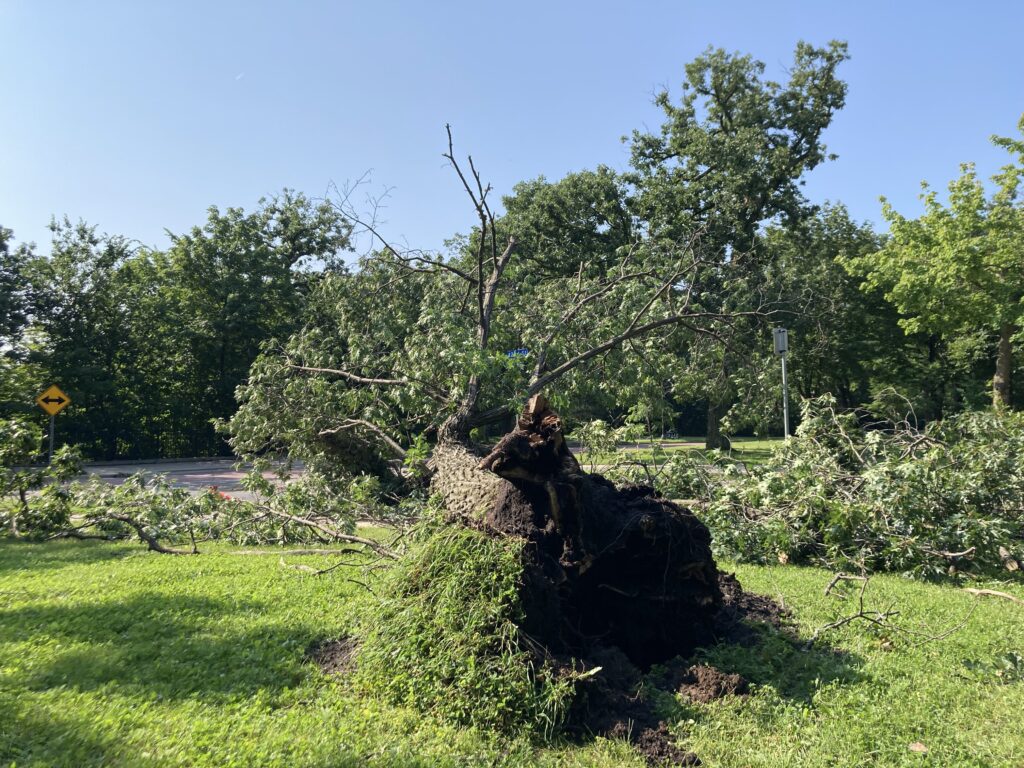
Evidence of the rain and thunderstorms last night all along the trail. Above the oak savanna it looked like some creature had tore through the green, ripping small limbs and leaves off the trees and throwing them to the ground.

The parking lot at the falls was packed with cars. Not the best day to be at the falls — but maybe it was? A chance to witness the falls in full cry, I guess. Also a chance to get wet or slip in the mud. I thought I might, but didn’t.

Anything else? A black squirrel sighting, which reminded me of the line from “What Would Root”: scolded by squirrels in their priestly black

Discovered the poet, Maureen N. McLane this morning and was delighted by her serial poem about Mz. N. Requested the book from the library. Possibly an inspiration for some writing about Sara, age 8?

an excerpt from Mz N: the serial/ Maureen N. McLace

The child Mz N sat on her bed
and wondered: that tree
outside her window
shifted
when her eye
shifted. What to make
of that?

                                          §

Mz N and her siblings
had a dog for some time.
They went on vacation &
when they came back
no dog.
They asked the parents:
the dog?
who replied:
what dog?
And some people wonder
why others distrust the obvious.

Speaking of the serial poem — LN’s “Paean to Place” is considered one — here’s a helpful definition:

The serial form in contemporary poetry, however, represents a radical alternative to the epic model. The series describes the complicated and often desultory manner in which one thing follows another. Its modular form–in which individual elements are both discontinuous and capable of recombination–distinguishes it from the thematic development or narrative progression that characterize other types of the long poem. The series resists a systematic or determinate ordering of its materials, preferring constant change and even accident, a protean shape and an aleatory method. The epic is capable of creating a world through the gravitational attraction that melds diverse materials into a unified whole. But the series describes an expanding and heterodox universe whose centrifugal force encourages dispersal. The epic goal has always been encompassment, summation; but the series is an ongoing process of accumulation. In contrast to the epic demand for completion, the series remains essentially and deliberately incomplete.

Seriality and the Contemporary Long Poem/ Joseph Conte

I had to look up a few words from this excerpt that I wasn’t quite sure of:

desultory: marked by lack of definite plan/purpose, not connected to main subject
protean: displaying great diversity or variety, versitle
aleatory: relating to luck, depending on an uncertain event or contingency

This idea of a serial poem as “an ongoing process of accumulation” is very cool and fits with my approach to Haunts and a story in long form.

june 16/SWIM

swim: 2 loops
lake nokomis open swim
75 degrees / choppy

A choppy swim. Fun, but not easy with my out-of-swimming-shape body. I didn’t swim at all this winter: sore back, neck, shoulders. Wow, do I love open swim! I was nervous before the swim, wondering again if I’d be too disoriented. Nope. I just kept swimming and made it to all of the buoys. I love how approximate open swim is; you don’t have to take the straightest, most direct line, you just need to stay on the right side of the 5 buoys and on the left side of the 4 or so lifeguards on kayaks.

10 Things

  1. the water felt COLD when I first entered, but wonderful as I swam
  2. a strange pale vine just below the surface
  3. small waves to my right, making it harder to breathe
  4. swells from behind making it hard to stroke on the stretch parallel to the big beach
  5. my eyes couldn’t see the far orange buoy, but my brain did: sighting, a voice in my head said, it’s straight ahead — this happens a lot, these days. The trick, to trust
  6. on the other loop: that same orange buoy in sight but so far away, seeming to get farther away with every stroke
  7. breathed: a mix of every 5 or 4 or 3, a few 2s when it was extra choppy
  8. more vegetation, pale, ghostly, reaching up from the bottom
  9. exiting the water, a woman speaking to some friends: I was nervous, so I didn’t wait. I already swam./ another woman: Did you like it?/I loved it!
  10. no birds or planes or strange noises underwater

An essay to return to: Friday essay: ‘an engineering and biological miracle’ – how I fell for the science, and the poetry, of the eye

Okay, I’m returning to it now (added a few hours later). I wasn’t planning to, but I read something in a recent New Yorker story that decided for me that I should. Two moments, one from the article and one from the story:

1

Iris presents to me with failing vision. Examining her eyes, I see “geographic atrophy”, little islands of missing retinal tissue worn away over time. This is a form of incurable, age-related, macular degeneration. It results in permanent loss of central vision, with peripheral vision remaining intact.

It’s not good news; my stomach tightens as I prepare to deliver it.

Iris replies, tearily, that she just lost her husband of 60 years. She’s now alone and becoming blind. I’m taken aback – what can one honestly say to this?

Sure, there are visual magnifiers, home modifications, other practical aids that may guardrail her physical safety. But her anguish goes beyond this; she’s on the edge of a personal precipice, and teetering. There’s electricity in the consult room, a lightning-rod moment for sure.

How might a poet view this scene?

Then, a few sentences later:

Good poetry must go further, seeking the patterns beneath the surface. What precisely is it about Iris that moves me so? She is losing things, important things. Witnessing this touches my deepest fears, knowing that, like an unwelcome house guest, loss visits us all, sometimes staying for good. 

As my Persian countryman Rumi wrote, “this human being is a guest house”. Losing our own physical abilities or our loved ones, what would become of us?

Distilling this further, what exactly is loss, its weight and texture?

Inversions,
your cherished glass of shiraz shatters
on the tiles, your laden table
upended. Warmth whistles
out through the cracks, cold rises up.
Midnight:
your reasons for living dwindle,
walking out the door
one by one.

Friday essay

2

Farah put up her hand. She said, “I don’t find it difficult to think about . . . ,” then paused in surprise at not being able to say “dying,” “about choosing not to live if I’m going blind.”

Beyond Imagining (fiction) / Lore Segal

Wow. I am not as old as Iris, and I didn’t just lose my husband, but the description of her vision loss (albeit a different condition) is the same as mine: all central vision gone, peripheral sight stays. I don’t doubt that many “Irises” feel this despair when confronted with this diagnosis, but it’s not the only way that people respond. It is not how I responded. It is, however, the way that most haunts our imaginations — the blind specter. I’d rather be dead than blind!

I’ve read the whole article, but I stopped reading the short story. I should return to it and see what happens. Maybe I’ll be surprised, maybe it will go deeper than the tired trope of the blind specter.

june 15/RUN

5 miles
bottom franklin hill and back
72 degrees / dew point: 60

Whew! I was sure the dew point would be even higher. It felt very uncomfortable out there. And difficult. But I kept moving and didn’t push myself too hard. I ran to the bottom of the hill then walked up it. Then ran, walked, ran until I was back to the ancient boulder — no stones stacked on it today.

Last night RJP graduated from high school. I’m very proud of her for surviving it. I’m proud of myself too. It was very hard and I am tired. No more k-12 public school! Hooray! I loved many of the teachers and the music programs, but I won’t miss being subject to this schooling process.

RJP’s graduation was delayed by almost an hour because a fight broke out at the previous school’s graduation and someone was hauled away in an ambulance. FWA said he saw the guy, and he looked like he was probably fine and not in much pain. Other than the delay, the graduation was great. The awesome poet Bao Phi gave the address — so good! He, along with the student speakers, centered the experiences of BIPOC students.

10 Things

  1. white sky
  2. dark green mystery
  3. at least 2 specks in the sky — a plane? a bird?
  4. click clack — roller skiers powering up the franklin hill
  5. foamy water
  6. glowing orange shoes on a runner
  7. voices below near white sands beach
  8. one runner to another: well, that killed about an hour and a half — huh?
  9. a greeting from Mr. Holiday!
  10. a few days ago I mentioned something in orange spray painted on the sidewalk — it’s the outline of a cat (but not Garfield, I think?)

a section from Wintergreen Ridge/ Lorine Niedecker

Reading (again, for the 3rd or 4th time?) LN’s “Wintergreen Ridge,” I was delighted by her connections and associations:

Women saved
a pretty thing: Truth:

“a good to the heart”
It all comes down
to the family

“We have a lovely
finite parentage
mineral

vegetable
animal”
Nearby dark wood—

I suddenly heard
the cry
my mother’s

where the light
pissed past
pistillate cone

how she loved
closed gentians
she herself

so closed
and in this to us peace
the stabbing

pen
friend did it
close to the heart

pierced the woods
red
(autumn?)

Sometimes it’s a pleasure
to grieve

june 13/RUNSWIM

5 miles
bottom of franklin hill and back
70 degrees / dew point: 60

Overcast, which helped it feel a little less warm. Sticky, thick air. A lot of sweat, especially on my face. Dripping ponytail. So green even the air was green. Greeted the Welcoming Oaks — hello friends! Descended into the tunnel of trees and was enveloped in green. Chanted triple trees: sycamore/sycamore/sycamore/red oak leaf/silver birch. Heard the rowers through the trees. Admired the barely moving, calm water under the bridge — the surface was dotted with foam and reflected clouds. Saw a speck in the sky out of the corner of my eye. Tried to look at it, gone. Tried again, a plane almost covered in fog. Saw a dark ring around it — my ring scotoma? Appreciated how the outline of the treetops on either side of the river road echoed the shape of the river banks. Walked up the hill — it took me 7 minutes — then ran, walked, ran back. Ended with a dozen roller skiers above me while I climbed out of the tunnel of trees.

For the first mile, in the dark green quiet, everything was dreamy. Thought again about how running puts me in a strange, surreal state. Nothing quite real. Then thought about Lorine Niedecker and the physical act of seeing with messed up eyes and using the poetic form to represent that. I’m not aware of how my eyes move as I see except for when I look to the peripheral as a way for my central vision to see something. I imagine having nystagmus makes you more easily register the movement of your eyes. How conscious was LN of her eye movement and how it was mimicked in her lines? When I think about how I see — the mechanics of it and its physicality — I think more about what happens when the corrupt or limited data travels as electrical impulses through the optic nerve and to the brain. Are the effects of nystagmus primarily physical — strain on eyes, the rapid movement creating dizziness and headaches? I should read more about it. . . . The physical impact of my vision sometimes reads as dizziness and light-headedness, but mostly it’s just a vague sense of unease and fatigue — more naps. I rarely feel the eye strain or get headaches from my effort.

In the article I was reading about LN’s nystagmatic poetics, this poem was discussed:

Tattoo/ Wallace Stevens

The light is like a spider.

It crawls over the water.

It crawls over the edges of the snow.

It crawls under your eyelids

And spreads its webs there—

Its two webs.

The webs of your eyes

Are fastened

To the flesh and bones of you

As to rafters or grass.

There are filaments of your eyes

On the surface of the water

And in the edges of the snow.

note at 11 am: Today is my first day of open swim! After the swim, I’ll return to this entry.

I’m spending the afternoon on the deck, reading Niedecker and thinking about Alice Oswald and Niedecker and my Haunts poems. Here are some jumbled thoughts:

You have been in my mind/between my toes/agate — Lake Superior/LN

You’ve been in
my mind

beneath my
feet Mom

Look for me under your boot-soles — Walt Whitman

Ars Poetica/ Arcelis Girmay

May the poems be
the little snail’s trail.

Everywhere I go,
every inch: quiet record

of the foot’s silver prayer.
             I lived once.
             Thank you. 
             I was here.

“We a lovely/finite parentage/mineral/vegetable/animal” — Wintergreen/ LN

I’m interested in how many layers you can excavate in personality. At the top it’s all quite named. But you go down through the animal and the vegetable and then you get to the mineral. At that level of concentration you can respond to the non-human by half turning into it.

Alice Oswald interview for Falling Awake

To write a poem is to be a maker. And to be a maker is to be down in the muck of making and not always to fly so high above the muck.

Poetry is Not a Project/ Dorothy Lasky

We can’t float or fly for long, above. We are part of the muck, not stuck but entangled, beholden

to work down/ to ocean’s black depths/us us an impulse tests/the unknown — Paean to Place/ LN

2 loops / 1.5 miles
lake nokomis open swim
80 degrees

Open swim! Open swim! I was nervous before the swim, wondering if I would see the buoys. I did! The water felt wonderful — a little cold, but not too cold, and wavy but not choppy. I watched the sun filtering through the water, avoided the vegetation growing up from the bottom and the swan boat stuck right by the orange buoy. That menacing swan was a little too close as I neared the buoy. The last green buoy was so far from the orange buoy — it seemed to take forever to reach the beginning of the loop. Oh, I love open swim and what joy to have had a good first swim!

june 12/WALK

1 mile with Scott
neighborhood
82 degrees

Was planning to bike to the lake and swim today, but it rained. On and off all day. So I read about Lorine Niedecker and took notes. Then, a quick walk with Scott.

Here are some observations from my deck, the yard, the window at my desk, and the walk:

10+ Things

  1. deck: the sky heavy, gray, expectant — but it’s not supposed to rain today! — it did and then did again
  2. deck: under the lime green umbrella, hearing the first drops, soft and slight
  3. deck: the service-berry bush at the edge of the deck did a better job of keeping the deck dry than the umbrella!
  4. front yard: after rain today, and the wind the past few days, the yard was almost as much twig as grass. Our neighbor’s tall tree with the wandering limbs offers unwanted gifts all year
  5. desk/window: in the left window, a blob stretches above the other hydrangea leaves — dark, diseased — what is it?
  6. side yard: not sure what this blob is even up close — could it be army worms? or is it just a failed unfurling?
  7. side yard: near the gate, a rogue tree is growing outside of our neighbor’s window. Will they cut it down before it gets too big and becomes a problem for us?
  8. desk/window: rain, pouring down, missing the gutter and sliding straight off the roof in sheets — too much debris/dirt in the gutter?
  9. no lightening but far off thunder rumbles
  10. green green green green green green green green
  11. cabbage or lettuce or something else green growing in a neighbor’s planter
  12. the sweet snell of pine after the rain
  13. convinced I was seeing a giant fish sculpture until Scott told me it was wrapping over a tree
  14. workers re-roofing a sharply angled roof with no harnesses

Here ares some thoughts to remember from Niedecker:

1

LN’s life by/with/on water involves saturation not transcendence.

2

Thru birdstart
wingdrip
weed-drift
of the soft and serious
water
(from “My Life on Water”/ LN)

3

Reading is a bodily act — within the body, not transcending the body. The physical act of reading words with diseased eyes.

4

Time to challenge the myth that not being able to see “naturally” makes your hearing improve — That visual impairment improves hearing, taste, touch, smell, is mostly myth — Halos. Ed Bok Lee — LN used sound in remarkable ways, and also explored seeing differently.

5

One of the traditions LN draws from, Objectivism, believed in the clear, straight-seeing eye. In later work, like “Wintergreen Ridge,” she challenged the possibility of this straight-seeing.

Tell all the truth but tell it Slant — ED
Alice Oswald and the slow, oblique, slight squinting of the Old Women in the Illiad

6

Imagists (Ezra Pound, HD): to see the world as it is, the IS, the this, scrubbing away to the essence

Objectivists (Zukofsky, Williams Carlos Williams): to look with clear eyes, pay attention, as is in context

Oh my scouring eye/that scrubs clean the sky — “perhaps you tire of birds”/ Donika Kelly

7

I used to think I was goofing off unless I held only to the hard, clean image, the think you could put your hand on. But now I dare do this reflection.

LN

8

Video, My Life By Water

june 11/RUN

4.5 miles
veterans home and back
56 degrees

Still struggling with endurance, still showing up. How much of this is mental, how much physical? The sixty-four thousand dollar question, as my dad used to say. I think it’s both, but probably more mental. Maybe the lexapro is already kicking in, but my struggles aren’t bothering me. After the run I thought, these struggles will make showing up at the marathon start line, then finishing 4-5 hours later, much more meaningful.

It rained this morning, so everything was wet, even the air. Everything was also green. Green green green. Any other colors? Nope, not much to break up the green. Green green green green green.

10 Things

  1. lush green, dark, on the part of the path that goes below the road
  2. puddles
  3. a woman ahead of me, running, wearing only one compression sleeve on her right calf
  4. a group of kids walking to the playground at minnehaha
  5. a much bigger group of kids walking near 42nd — a long line, 3 across, took me 10 or 15 or more? seconds to pass them
  6. gushing water near the ravine by the oak savanna
  7. the bright yellow crosswalk sign — my bee — was muted in the gray sky
  8. crossing the bridge high above the creek, all green, no view of the water below
  9. lush green, dark, on the steep hill descending to the locks and dam no 1
  10. a pile of e-bikes parked near a bench — black with blue accents

paean to place/ lorine niedecker

Before my run, I started writing out, by hand, Niedecker’s poem. It’s so long! My hand started cramping up. I had to write slowly to account for my visual errors, like not seeing the words I’ve already written and writing words almost over them or above them instead of below them. The slow work is good, giving me time with each word and line.

Here’s one line I’d like to make note of:

Not hearing sora
rails’s sweet

spoon-tapped waterglass-
descending scale-
tear-drop-tittle

I wondered, what does a sora sound like, so I looked it up and listened. Yes, it sounds like LN described! Listen here to calls 1 and 2.

june 10/RUN

4 miles
minnehaha falls
60 degrees

Ah, summer mornings! Beautiful. Cooler. If I would have slept better, I would have tried to go out even earlier. The first half of the run felt good, then I got hot and it got harder. Today I didn’t worry about what that meant for my training. Instead, I enjoyed the brief minutes of walking, taking in the trees at the falls — so green! so full!

10 Things

  1. the falls, flowing, white, undulating — the water not falling straight, but almost falling over itself — was it hitting some limestone on the way down?
  2. a bundle of something on the ground next to the dirt trail — a hammock?
  3. 2 women with tall hiking packs on their backs walking on the paved path
  4. some animal — a turkey? — upset, calling out, a human voice saying something — hey?
  5. a flash below the double bridge — a sliver of creek almost covered by green
  6. 2 roller skiers near locks and dam no 1
  7. the dirt trail cutting through the small wood near ford bridge looking cool and inviting
  8. happy kids on the minnehaha park playground — happy: green voices, where green = young, outside, tender
  9. (walking back, about to cross 46th ave at 37th street) 2 older women chatting, then greeting me, oh! hello!
  10. (walking back almost to my alley) heard on a radio or from a phone or a computer in neighbor’s backyard, the next one is Scandia — was this talk radio or a zoom meeting or what?

Lorine Niedecker and “Paean to Place”

to dwell with a place:

What is required, however, is sensual, embodied experience—close encounters of awe, wonder, fright, disgust, or even tedium—which remind us both of the real earth with which we dwell, and that we share our home with innumerable cohabitants.

Dwelling with Place: Lorine Niedecker’s Ecopoetics

opening to “Paean to Place”:

Fish
fowl
flood
Water lily mud
My life

in the leaves and on water
My mother and I
born
in swale and swamp and sworn
to water

My father
thru marsh fog
sculled down
from high ground
saw her face

at the organ
bore the weight of lake water
and the cold—
he seined for carp to be sold
that their daughter

might go high
on land
to learn

Wow! Reading this opening, I’m thinking about the Objectivists and the Imagists and Ezra Pound’s 3 rules for writing poetry:

  1. Direct treatment of the “thing,” whether subjective or objective
  2. To use absolutely no word that does not contribute to the presentation
  3. As regarding rhythm: to compose in the sequence of the musical phrase, not in sequence of the metronome

What condensery and music in these lines! And what wonderfully effective descriptions of two people dwelling in and with a particular place, especially her mother, born in swale and swamp and bearing the weight of lake water and the cold.

definition of ecopoetics:

The word itself is an amalgam of two Greek words: oikos [household or family] and poïesis [making, creating, or producing], so that ecopoeticsquite literally means the creation of a dwelling place, or home-making. The term came into special prominence after the influential British literary critic Jonathan Bate published The Song of the Earth in 2000. There, Bate defined ecopoetics as a critical practice in which the central tasks are to ask “in what respects a poem may be a making … of the dwelling-place” and to “think about what it might mean to dwell upon the earth.”

Dwelling with Place: Lorine Niedecker’s Ecopoetics

LN’s opening lines and her descriptions of her parents, reminds me of Mary Oliver’s The Leaf and the Cloud and her brief mentions of her parents in the first section, “Flare.” LN and MO have different experiences but they rhyme, somehow, or echo?

My mother
was the blue wisteria,
my mother
was the mossy stream out behind the house,
my mother, alas, alas,
did not always love her life,
heavier than iron it was
as she carried it in her arms, from room to room,
oh, unforgettable!

Like LN, MO was also an amazing poet of place, but she doesn’t extend her ideas of place to her parents — a deliberate severing:

I mention them now,
I will not mention them again.

It is not lack of love
nor lack of sorrow.
But the iron thing they carried, I will not carry.

So much to say about that iron, but I have run out of time right now. Perhaps more later. . .

I’m back. First, the not carrying the iron makes me think of my mom and her desire for displacement from her abusive parents. More than once she said to me that she wanted to break that cycle of abuse — and she did. And I am grateful. But there’s something to explore here for me and my relationship to place, this place 4 miles from where my mom was born and raised, that I can’t quite get at yet.

The iron also reminds me of the wonderful lines from the opening of LN’s “Lake Superior”:

In every part of every living thing
is stuff that once was rock

In blood the minerals
of the rock

*

Iron the common element of earth

Both MO and LN write about their fathers. First, MO:

My father
was a demon of frustrated dreams,
was a breaker of trusts,
was a poor, thin boy with bad luck.
He followed God, there being no one else
he could talk to;
he swaggered before God, there being no one else
who would listen.

and LN:

He could not
—like water bugs—
stride surface tension
He netted
loneliness. . .

. . . Anchored here
in the rise and sink
of life—
middle years’ nights
he sat

beside his shoes
rocking his chair
Roped not “looped
in the loop
of her hair”

The “looped” quote comes from William Butler Yeats and his poem, Brown Penny and it’s about love. I like how she throws in this line from poets or about poets, like this:

Grew riding the river
Books
at home-pier
Shelly would steer
as he read

I noticed another line of the poem in quotes, “We live by the urgent wave/of the verse.” Looked it up and found an article about “Paean to Place” and thanks to my college-attending son, I have access to it! Time to read it: Lorine Niedecker’s “Paean to Place” and its Fusion Poetics


june 9/RUN

3.7 miles
trestle turn around
65 degrees

Warm and windy. Lots of sweat. Another day of telling myself to keep showing up. A hard run with lots of walking. But, one faster, freer mile, and some scattered thoughts that might lead to something! I’ll take it.

11 Things

  1. under the lake street bridge, the side of the road was packed with parked cars — rowers?!
  2. yes, rowers: heard the coxswain calling out instructions
  3. briefly watched the rowers through a gap in the trestle: a head, an oar, a boat gliding by
  4. ran into a branch while avoiding another runner, just a few inches from my eye, imagined a scenario in my head where the branch had cut my eye
  5. in the tunnel of threes: a sea of swaying green
  6. a woman stretching in the 35th street parking lot, blasting music out of her phone
  7. wind pushing me from behind, making my ponytail swing to one side
  8. a cartoonish figure spray-painted on the sidewalk: bright orange outline
  9. loud rustling in the nearby brush then a hiker emerging from below
  10. whoooosssshhh — the wind rushing through the trees
  11. dragonflies? running near the trestle, an insect with a long, narrow body and wings almost flew into my mouth — no iridescent color, no color. Later, pausing at the top of the steps, I saw half a dozen of them. They opened and closed their wings in the sun

Yesterday, I decided that the theme of color or green wasn’t working for me this month. Instead, I’d like to return (again) to Lorine Niedecker. I’m particularly interested in her form of condensing and how I might apply it to my Haunts poems. Yes, the haunts poems are haunting me again. Before heading out for my run, I found a few lines from LN’s “Paean to Place,” that I especially like:

 grew in green
slide and slant
of shore and shade

            Child-time—wade
thru weeds

Maples to swing from
Pewee-glissando

      sublime
 slime-
song

A few times, I recited the first big: I grew in green/slide and slant/of shore and shade. As I thought about those lines I wondered what I grew up in. Green, for sure, but not by water. Then it came to me: I grew up on the edge of green in subdivisions that butted up against farms and woods, creeping, consuming those green spaces. I also grew up in carefully managed and cultivated green — bike paths through small stretches of trees offering the illusion of nature, privately owned by the subdivision. A very different green than the rural green of my dad’s farm in the UP or the urban green of my mom here by the Mississippi River. I thought about the managed green I run by and the difference between it, a public, national park, and the managed green of my suburban childhood, with its private green parks and private (No Trespassing!) acres of farm land, soon to be sold and converted into more “little boxes.”

Yes! The green I grew in was in-between col-de-sacs, and within small ravines and the slight stretches of trees or creeks developers left for aesthetic reasons. This green has deeply influenced my understanding of the wild and “green” spaces and is one reason why I’m fascinated by the management of nature.

june 7/RUN

4 miles
minnehaha falls and back
62 degrees

Another beautiful morning. Felt drained by the sun, but still managed to push through a few moments when I wanted to stop. Walked a little. My mantra: keep showing up. It might not get easier but I’ll get better at handling it (it = heat and humidity and doubt and the desire to stop). Listened to my Color playlist for the second half, the birds for the first half. Sparrows and woodpeckers and cardinals. The falls and the creek were gushing. I read the other day that, after 2 years, Minnesota is no longer in a drought. Hooray for the farmers! And the flowers! And the trees!

Today, the green was cool, then scraggly. Sprawling, stretching, overstepping. Almost consuming the narrow dirt trail on the grassy boulevard between edmund and the river road.

something for future Sara to remember: On Tuesday, I went to open the lime green umbrella on our deck and noticed something dark in the corner. With my bad vision, I thought it was a leaf at first. Then I saw something that looked like wings — a bat. I dropped the umbrella cord and ran inside. A few minutes later, Scott cautiously opened the umbrella then freaked out when the bat flew out. He staggered back and rammed into the handle of the door — hard. Knocked the wind out of him. Since then, he’s been having intermittent back spasms, which he describes as “charley horses” in his back. I would be freaking out, but he’s handling it fairly well. The worst part: trying to sleep — too painful in the bed, and we don’t have a recliner. Maybe he cracked a rib, maybe it’s a strained muscled. Hopefully it heals soon.

What I remember is seeing the bat wings as it flew away, looking like a Scooby Doo cartoon. Since then, I’ve cautiously opened the umbrella — no bat! Every time I bird flies overhead, their shadow crossing my legs, I wonder — a bird or a bat? A thought: bats as fully fleshed shadows. What if the dark forms we think are shadows are actually bats? That’s both a creepy and delightful thought!

june 5/RUN

5k
trestle turn around
66 degrees

A quick run before taking FWA to buy his biggest purchase ever: an A clarinet. Not an easy run, but a sunny day with fresh air and clear trails. More cool, refreshing green coming from the floodplain forest. Everywhere, mundane, flat green. A green greeting: saying good morning to a runner with headphones on who didn’t me coming. A green sound: a bird’s clicking jaw somewhere below.

A green chant to keep me going:

Sycamore
Cottonwood
Slippery elm

Spoken in my head over and over. It helped me in the tougher moments when I wanted to stop and walk.

green

Even as green is my favorite color, I do not like when green takes over everything. Green = busy doing things, producing, connecting, crowds/crowded/crowding out.

log entry on 28 oct 2019

june 3/RUN

4.2 miles
longfellow garden and back
73 degrees / dew point: 75

Sticky again today, but not as bright. Still hard to run through the thick air. Struggled on the way back — walk run walk run. Trying to remember to keep showing up and believing that it will get easier, or I will get better at handling the difficult moments, or I will finally start getting up early. I tried to think about green.

my favorite green

Running south, just past the ford bridge, nearing the locks and dam no. 1, cool air was coming from the green to my right — a small wood. Refreshing! Often I associate late spring green with thick and stifling, but today it was fresh and generous, making it easier to breathe and to run.

Before my run, I read this green poem:

Making Life on a Palette/ Raina J. León

After Charles Willson Peale (1741–1827), “George Washington at Princeton,” 1779

the color of life
takes sun yellow and bluest blue sky and water
for green ferns
chartreuse buds beading above moss
dappled shamrocks
fragrant healing of sage, laurel,
mint, basil, thyme, rosemary, myrtle
amid the tall wonders of juniper
pine, olive, pear
even the meeting of sea and river—
the sky, an intermingling of viridian and chetwode horizons,
and cerulean clarity—
offers its green seafoam,
its seaweed pats,
the crocodile at the edge of a freshwater marsh
its teeth open gritted in green
against the backdrop of hunter rainforest
dripping in green

heaven is a field of persian green
lit by translucent jade and celadon lamps
a many-roomed chateau scented by aromatic tea leaves
the aperitivo: gin, apple, and bitter lime
the time: midnight green
the guardian: a mantis in prayer

joy: harlequin, verdun, spring
magic: kaitoke forest in its energetic whisper and pulse

green must exist
inside brother james
would he call it camouflage
or nyanza or sap
for washington it’s in the colors of flags
the fields far off
feldgrau or military or empire green
or dollar bill or rifle green
revolution with chains the result
mix the green
like a spell in making
safe life
hush arbor life
nurturing abundant life
free life
bring the background to the fore
ease
ease
ease
life

So many greens! How many different greens can I see? Today, mostly, it was just green (or brown or gray).

Offering some advice on being judicious with your use of adjectives, Ted Kooser writes the following lines:

Morning Glories/ Ted Kooser

We share so much. When I write lattice,

I count on you seeing the flimsy slats

tacked into squares and painted white,

like a French door propped in a garden

with a blue condensed from many skies

pressed up against the panes. I count on

you knowing that remarkable blue,

shaped into the fluted amplifying horns

of Edison cylinder record players.

What? Come on, you know exactly
what I’m talking about. I didn’t need

to describe them like that, but I like to

however a little over my words, dabbling

the end of my finger in the white throats

of those __. You fill it in.

I could go on, but all I really needed to do

was to give you the name in the title.

I knew you’d put in the rest, maybe

the smell of a straw hat hot from the sun;

that’s just a suggestion. You know exactly

what else goes into a picture like this

to make it seem as if you saw it first, 

how a person can lean on the warm

hoe handle of a poem, dreaming,

making a little more out of the world

than was there just a moment before. 

I’m just the guy who gets it started.

Do I know that remarkable blue he’s writing about? Does he see the same blue that I do? Do we need to imagine the same blue to make his poem meaningful?

Reading “Making Life on a Palette” and “Morning Glories,” I’m thinking about the different work they ask of the reader, or, of this reader, me. “Palette” is filled with green words with histories that I don’t know; I had to do a lot of googling to dig into the poem. “Morning Glories” asks me to build an image from the name he offers, to draw upon the shared understanding/image of the flower that I already have.

Lately, I keep coming back to the question, how little data can we have and still “see” what something is? Not much, I think. Yet, to assume that we all see the same thing — the thing as it is — excludes a wide range of experiences and detail and ways of seeing. It leaves out a lot of different shades of green.

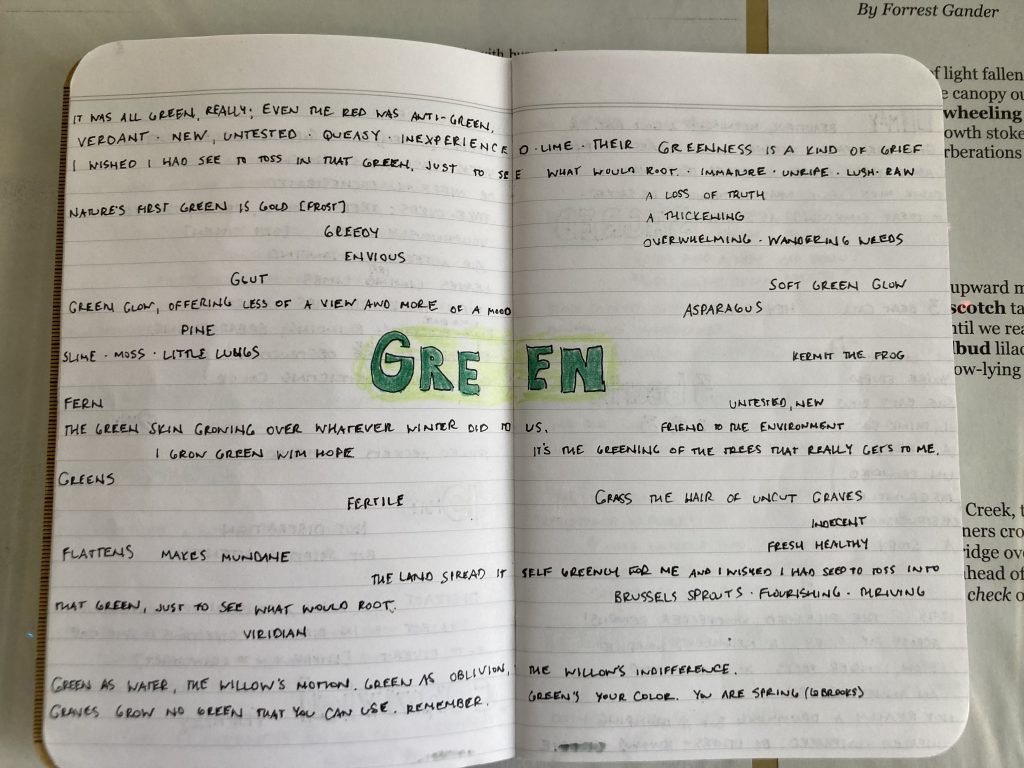
Speaking of green, I remembered that I had collected ideas about green in my plague notebook vol 3, June 2020:

june 2/RUN

3.5 miles
2 trail
66 degrees

13 years of running today. I had been planning to celebrate it with a long run, but even before I went outside I knew it wouldn’t happen. Mostly because it already felt too warm and too crowded (at 8:30 am). A rule I should remember to follow: no long runs on the weekends. Too many bikers and runners out on the trails. I also felt tired. During the first mile I chanted triple berries and tried to convince myself I could run 8 miles. By the time I reached Beckettwood, a mile in, I knew it wouldn’t happen. I ran down to the overlook and admired the river for a few minutes. Wow! A circle of white light in one spot, sparkles in another. I watched the light dance on the water through the trees and breathed.

The green and the sparkling water reminded me of a line in “Bein Green” by Kermit the Frog. Yesterday I started working on a color playlist and that was the first song I added:

It’s not easy bein’ green
It seems you blend in
With so many other ordinary things
And people tend to pass you over
‘Cause you’re not standing out
Like flashy sparkles in the water

This blending in and not being flashy makes me think of the line from Wallace Stevens that I posted yesterday:

It must be this rhapsody or none,
The rhapsody of things as they are.

rhapsody: a portion of an epic poem adapted for recitation

When green is all there is to be
It could make you wonder why
But, why wonder? Why wonder?
I’m green and it’ll do fine
It’s beautiful, and I think it’s what I want to be

An epic poem about green as green as mundane, ordinary, everywhere? These days, green is especially ordinary for me. Often I can’t tell the difference between brown and green or gray and green or blue and green.

green

yesterday while waiting to pick up my lexapro at the pharmacy, I noticed an unusual green in the vitamin aisle. A whole section with white and green bottles. Branding. I asked Scott what color green he thought it was, but he didn’t have any answer. Somewhere between jungle green and olive green? I forgot to check what brand of vitamins was using this color. update 28 june 2024: a few days later, I was back at the pharmacy and I did check — Walgreen store brand

overheard on the winchell trail: (a woman describing her breakfast to her friends) and a shit ton of arugula

(from The Secret Lives of Colors) Scheele’s green: named after Swedish scientist, Carl Wilhelm Scheele in 1773 when he discovered the compound, copper arsenite. Scheele’s green was used to print fabrics and wallpapers; to color artificial flowers, paper; and as an artist’s pigment. By 1863, it was all over England. Then people started dying and it was determined that copper arsensite was very poisonous — one 6 inch square sample of paper containing the compound could kill 2 men.

june 1/RUN

4.15 miles
marshall loop (cleveland)
65 degrees
humidity: 85% / dew point: 60

Mostly overcast, a few moments of sun, no shadows. Sticky, everything damp, difficult. I felt better during the run — distracted by the dew point and the marshall hill — but when I finished, I felt a heaviness: hormones. The NP agrees: perimenopause. The good news: I’m healthy, the new NP I went to is awesome, I don’t feel anxious, I have an order in for an SSRI (lexapro). The bad news: I feel bummed out (depression doesn’t quite fit, I think), there’s some problem with insurance so they can’t fill the prescription so I have no idea when I can actually start taking the medication. But it’s June, I have several cool books to dig into, and I just got a hug from my daughter so I’ll be okay.

10 Things

  1. the red of a cardinal seen as a flash
  2. one small white boat on the river
  3. shadow falls falling, sounding like silver
  4. the smell of breakfast at Black — faint, sweet
  5. pink peonies about to pop
  6. click clack click clack — a roller skier’s poles: orange happiness
  7. the strong smell of fresh green paint on the base of a streetlamp
  8. the next streetlamp base: disemboweled, gray wire guts hanging out
  9. a purple greeting: morning! — good morning!
  10. a group of people in bright yellow vests laughing and walking on the road near the Danish American center — why?

added a few hours later: When writing this entry, I forgot about all the chanting I did. Started with triple berries:

raspberry strawberry blueberry
strawberry blueberry raspberry

Then added in some other 3 beat words:

intellect mystery history
remember remember remember

Then played with remember:

remember
try to re

member try
to remem

ber try to
remember

Then I decided to chant some of my favorite lines from Emily Dickinson:

Life is but Life
and Death but Death
Bliss is but bliss
and Breath but Breath

Life is but life is but life is but life
Death is but death is but death is but death
Bliss is but bliss is but bliss is but bliss
Breath is but breath is but breath is but breath

Life life life life
Death death death death
Bliss bliss bliss bliss
Breath breath breath breath

something important to remember: Donald Trump was convicted on all 34 counts of falsifying business records. He is now a felon and will be sentenced on July 11th. He can still run for office, but most likely won’t be able to vote (for) himself.

I’d like to focus on color this summer: June, July, and August. I’m not sure how I’ll do it, yet. Will I break it down my color? Possibly. Yesterday I picked up 2 color books that I had checked out 4 or 5 years ago. I’m anticipating that I’ll find them more useful now: The Secret Lives of Color and Chroma.

I also checked out Diane Seuss’ latest, Modern Poetry. Here’s one of her poems with some color in it:

Legacy/ Diane Seuss

I think of the old pipes,
how everything white
in my house is rust-stained,
and the gray-snouted
raccoon who insists on using
my attic as his pee pad,
and certain
sadnesses losing their edges,
their sheen, their fur
chalk-colored, look
at that mound of laundry,
that pile of pelts peeled away
from the animal, and poems,
skinned free of poets,
like the favorite shoes of that dead
girl now wandering the streets
with someone else’s feet in them.

At the beginning of the book, Diane Seuss offers a quote from Wallace Steven’s poem, Man with Blue Guitar, which I first learned of while reading Maggie Nelson’s Bluets. It is a long poem, so I won’t include all of it, just the part that Seuss quotes, with a few lines before that too:

from The Man with the Blue Guitar/ Wallace Stevens

Here, for the lark fixed in the mind,
in the museum of the sky. The cock

will claw sleep. Morning is not sun,
it is the posture of the nerves,

It is as if a blunted player clutched
The nuances of the blue guitar.

It must be this rhapsody or none,
The rhapsody of things as they are.

may 30/RUN

4.5 miles
bottom franklin hill and back
65 degrees

Windy but sunny. Ran faster than I should have and it wiped me out. Made it to the bottom of the hill — I had to bargain with my shadow to keep going — then paused to notice the river. It was moving a little, some white foam, the water a mix of brown and purple and blue. No rowers or birds or paddle boats.

Listened to the wind shaking the leaves and some cheering somewhere running north. Put in “Billie Eilish Essentials” on the way back south. Picked up the pace for the third mile, especially when “Bad Guy” came on.

Greeted Dave the Daily Walker —

Good morning Dave!
Hi Sara, how are you?
I’m great! How are you?
I’m good, thanks for asking!

I don’t know how many times we have had this almost exact exchange over the years, but it’s a lot. As I’ve written before, these words aren’t empty but part of the ritual of being outside, moving, noticing, and connecting.

I was distracted today — worrying about why I feel so strange — not dizzy but light-headed?, with a tight left leg. I talk to the doctor tomorrow. I think it’s the latest intense version of anxiety triggered by hormones and unusual (for me) aches and pains. Thanks, perimenopause! In this distracted, uncomfortable state, can I remember 10 things I noticed?

10 Things

  1. a tall stack of stones on the ancient boulder
  2. greenish white fuzz on the edge of the trail
  3. clicking and clacking of a roller skier’s poles
  4. an e-bike zooming up the franklin hill
  5. a group of school kids speaking spanish in the tunnel of trees
  6. a minneapolis road crew tarring more craters on the path — the tar smelled sharp
  7. the solid, wide forms of the bridge columns at the bottom of the franklin hill
  8. graffiti: the outline of a shape I can’t recall in black
  9. a runner in orange shorts doing hill repeats on the franklin hill
  10. another runner powering up the hill. I watched their steady rhythm and beautiful broad shoulders run out of sight

I did it!

silhouette and concrete poetry

Nearing the end of my shadow month, I’m still thinking about silhouettes. Today, the silhouette of a poem and how poets make their words into a recognizable shape. The most obvious version of this shaping words into form is the concrete poem.

one

I suppose you could call my mood rings concrete poetry. Some of the words are the shape of my blind spot, some the shape of my total central vision, and some the shape of what’s missing:

two

Reading more of Ted Kooser’s The Poetry Home Repair Manual, I came across a mention of concrete poetry. He doesn’t like it:

Each of us must make a thousand choices in every poem. Nobody is going to take away your poetic license for playing with typography or punctuation or spelling. It can be lots of fun to write a poem about a flying seagull in the shape of a flying seagull, but you need to understand that that bird shape will interfere to some degree with the ability of the reader to pass through the surface of the poem behind that clever silhouette.

A shaped poem with a serious message will never be taken as seriously as the same poem without the trick of shape. A lovely elegy to your dead mother is not likely to be quite as moving as it might have been if you’d not shape the typography to look like a coffin.

The Poetry Repair Manual/ Ted Kooser

A page earlier, referring to other distracting techniques, like of haphazard line breaks and ampersands, Kooser writes:

In business, executives make cost-benefit analyses. I used this term earlier. They never want the cost to exceed the benefit. Every choice you make in a poem, thinking to make it better, can also have a corresponding cost. If you want to make a line look shorter by using an ampersand or an abbreviation of a word, you face the cost of drawing the reader’s attention back to the surface while he or she wonders why you decided to use Sgn for surgeon.

The Poetry Repair Manual/ Ted Kooser

I’d prefer to steer clear of the economic metaphors, but I agree with the idea of giving care and attention to the choices you make and their consequences.

three

On this day in 2017, I wrote about Linda Pastan’s poem Vertical, which I love and have since memorized. Near the end of the entry, I mention how the shape of the poem fits with the title and topic:

Pastan’s poem is vertical in form. [the words are] Long and lean, stretching upwards.

log entry from 30 may 2017

four

This month, partly inspired by an ongoing discussion of silhouettes, I’ve been revisiting Diana Khoi Nguyen’s brilliant book Ghost of. The visual poetry in it is strange and stunning and not a gimmick. Her poem, “Triptych,” was an inspiration for my mood rings. Here’s a video of her reading it — WOW!

Triptych

Ghost of is not all visual poems, there are other forms too, but the ones in which she writes within and around the space of her brother’s silhouette are amazing. In the following poem, instead of a triptych, she uses gyotaku:

Gyotaku / Diana Khoi Nguyen

And here’s what Nguyen says about these gyotaku poems:

Several poems in Ghost Of are titled “Gyotaku.” You’re referencing this traditional method of printing from fish because you’re “printing” from the absent body of your brother?

Essentially, there’s the absent body which I fill in with text, so the absence is rendered into a visual text. Gyotaku is a practice using dead fish to create an impression of what had been captured, an old practice before photography existed. It still goes on today. I liked the idea that gyotaku creates just the impression. You can’t capture the whole of the fish, just wherever the ink or the paint was able to touch the body, the scales, and you get an idea of the thing. Thinking about the act of writing and printing—bookmaking is also inked fabric—it makes sense to also begin to claim, to manipulate, to capture this image-text in a visual way.  
source: Diana Kyoi Nguyen, To Cut Out

Open water swimming is having a moment

Okay, open water swimming. First the awesome, Nyad, and now this:

open water swimming rules

may 29/RUN

4 miles
minnehaha falls
57 degrees

A beautiful morning for a run! Sun! Shadows! A slight breeze! Ran with Scott to the falls — no stopping today. Mostly it was fine, but the last mile was hard. My left leg was tight. I kept going because Scott wasn’t stopping and I knew I could do it. And now, since I did do it, I know I can do it the next time. Because of my effort, I can’t remember what we talked about. But I do remember encountering some little kids on the path — I was too distracted by the old guy muttering, share the path, as they passed to hear them, but Scott did: the kid, pointing to some flower near the path: We used to have those, but now they don’t grow anymore. Scott was delighted by the way the kid said one of the words — now? — and tried to imitate them.

Oh! Just remembered something I talked about: Emily Dickinson’s “To Make a Prairie.” I was trying to recite it, but I could only remember 2 of the 3 things it took to make the prairie, a/one bee and reverie. Had to look it up: a clover! Of course.

seen: the fine spray of water coming off of the falls, making everything look hazy and dreamy
felt: that same spray, soft, cool, refreshing, barely perceptible
heard: the song, “Eye of the Tiger” from a painter’s radio at a house we passed by at the beginning of our run
smelled: our neighbor’s lilac bush, overpowering, sickly sweet, giving off intense floral energy
taste: anything? probably the salt from my sweat at some point

A few weeks ago, I requested Victoria Chang’s The Trees Witness Everything. Love the brevity of her form! Back in Jan 2022, I got an early, chapbook version of this collection. In the notes of that chapbook, she describes her project:

notes from Victoria Chang’s chapbook, Another Lost Year

Her project of using the different court poetry of Japan is inspiring me to do more with my breathing and striking rhythms: 3/2, 2/1, 3/3/3, and 3/3/3/4. Also, her use of Merwin titles makes me want to use titles/lines-as-titles from Emily Dickinson and other “vision” poets! Yes!

Here are a few:

Losing Language/ Victoria Chang

We were born with a
large door on our backs. When will
we know if it opens?

The Flight/ Victoria Chang

I no longer watch
the birds during the day. I
prefer to save them
for my dreams where an owl’s face
has more than one expression.

In the Open/ Victoria Chang

Weather is wet, it
doesn’t have joints. How snow just
becomes rain, what’s that
change called? Trees witness everything,
but they always look away.

Thinking more about my running rhythms, I’m realizing that I want to tighten up the form some more by limiting the number of lines and total syllables. I like 5, but that might be too few?

Late Wonders/ Victoria Chang

My face is now gone.
Instead, I have a hawk’s face.
None of the poets
notice, they only want fame.
Fame is a bucket of eyes.

and for this month’s focus on shadows:

The Time of Shadow/ Victoria Chang

The zookeepers feed
all the shadows light and meat.
The shadows wish so
badly to leave their bodies,
but they stay for the children.

Thinking about Chang’s use of Merwin titles and my interest in using ED titles, I am reminded of a discussion in Ted Kooser’s book, The Poetry Home Repair Manual:

You can open just about any book of poetry and find poets using titles to carry information. Just look at a table of contents and you’ll see how useful titles can be in suggesting waht poems will be about. . . .

In short, a title isn’t something you stick on just because you think a poem is supposed to have one. Titles are very important tools for delivering information and setting expectations.

The Poetry Home Repair Manual / Ted Kooser

may 28/RUN

4.2 miles
minnehaha falls and back
59 degrees
drizzle, off and on

Didn’t realize it was raining the first time I left for my run. Returned home and waited a few minutes until the sun was shining. A mix of sunny and overcast for the whole run. On my walk back: drizzle again. At least I think it was drizzling; it could have just been dripping trees or ponytails. It’s been raining then not raining then raining again for the past few days.

The run was not great, but better than I thought it would be. Yesterday afternoon, without much warning, I started feeling light-headed, like I might faint. Then strange. I put my head down and breathed deeply for 10? 20? 30? minutes. My pulse wasn’t too low or too high, I could talk normally, and my breathing was fine. But I felt wrong. At one point I wondered, do I need to go to the hospital? I drank a glass of juice in case it was low blood sugar. I asked Scott to look up “symptoms low blood sugar” online. Nope, my symptoms didn’t match that. So then I had him look up panic attack. Yep. As he read the symptoms and I recognized them, I instantly felt something lift, at least a little. Ok, just a panic attack — don’t get me wrong, it was awful and I’m not pleased to be experiencing a panic attack, but it seemed better than the alternatives I had been imagining just a few minutes before. Sigh. The next phase of perimenopause for me, increased anxiety and panic attacks? Time to go to the doctor and figure out better solutions, I think.

For the rest of the day, I was tired and a little shaky. I wanted to run today, because I felt better and if it was a panic attack, it seemed important to get out there and keep doing this thing that I love despite any fear I might have over suffering from another panic attack. I read that one of the biggest dangers with panic attacks is that you will stop doing things because you’re afraid of another panic attack. Mostly the run was fine. My legs felt a little heavy — which was already happening last week — and I was a little anxious a few times — do I feel dizzy? am I pushing myself too much?, but I ran about 2 miles before stopping to walk for a minute, then ran another mile before a 10 second break, then ran the rest. And my heart rate was the same as it always is — 161 average. Panic attacks are no joke. Before it happened, I wasn’t upset or experiencing any anxiety. And when it happened, it was purely physical. I think it was a mild one, because I wasn’t terrified, but it did derail the rest of the day: 30 minutes of my head between my knees breathing, then the rest of the day on the couch.

10 Things

  1. everything wet and slick, the sidewalk slippery
  2. dripping trees
  3. gushing sewers
  4. spraying falls
  5. rushing creek
  6. robins hopping on the wet grass
  7. a walker in a BRIGHT red shirt
  8. puddle and mud on the dirt trail that winds through the small wood by the ford bridge — I saw them out of the corner of my eye as I ran by
  9. kids on the playground, laughing, yelling
  10. maybe there were some shadows, but what I remember was dark/wet pavement with the occasional patch of light

Running south to the falls, I listened to the water dripping. Running back north, I put in my “I’m Shadowing You” playlist.

Before I went out for my run, I was thinking about the silhouettes in the opening credits to the James Bond movie Scott and I watched last night: For Your Eyes Only. One of my favorites, partly because it was on HBO all the time when I was a kid. Click here to watch the opening on YouTube.

My echo, my shadow, and me

Wow, doing a little more research, I found this great article: James Bond: 50 Years of Main Title Design

may 26/RUN

7 miles
to the washington bridge and back
60 degrees
overcast – drizzle – soft steady rain

Overcast at the start, cool. Calm, quiet. The green felt deeper and darker in the gray. A block before I reached the river road, an ambulance sped by, siren blaring. A few minutes later, a police car, silent, but with frantic, flashing lights. I felt relaxed for the first mile. In the second mile my left ankle hurt a little. Started chanting triple berries to lock into a rhythm and to block out creeping doubt. Nothing fancy, just strawberry blueberry raspberry over and over. Once or twice: strawberry blueberry raspberry ice cream caramel strawberry chocolate ice cream

Just before I reached the bridge and the turn around point: drops drizzle rain — soft, steady, soaking. A few reprieves under the leaves, but mostly insistent water. I didn’t care; it cooled me down. The only thing I didn’t like was how my water-logged shorts stuck to my legs. Yuck!

assessment: I had some moments of struggle during the run — my legs were sore, feeling the need for a bathroom — but I also had some moments where I powered through. So much of it is mental. I’d like to come up with some fun distractions. I should return to my St. Paul sidewalk poetry project, find some more poems to run to. I could also do another poem-inspired scavenger hunt. I need a purpose for these runs that isn’t marathon training related.

10+ Things

  1. approaching from behind, rhythmic slapping –the slap slap slap of heavy, striking feet — then a fast runner in a blue shirt ran past me and up the hill near lake street
  2. passed him again when he stopped to study the map at the kiosk — was he lost?
  3. a rower on the river! single shell, their oars skimming the water — not sounding soft like a goose skimming the water, but choppy and hard like ___?
  4. the coxswain, instructing rowers through her bullhorn
  5. slap slap slap the blue-shirted runner passed me again between the trestle and franklin
  6. limestone leaks: even before it started raining, the limestone bluff in the flats was gushing water and leaving puddles on the pavement
  7. whoosh! a car’s wheels driving through the puddles
  8. a strange, intense floral smell — sweet, I think, and not entirely pleasant or unpleasant, just smell and flower and sweet
  9. a honking goose perched on the wall that holds back the river in the flats — were they honking at me? at a biker approaching from the other way?
  10. slap slap slap Mr. Blue Shirt is back! Nearing the end of my run, heading south, he zoomed past
  11. sometimes the rain sounded like footsteps from behind, but when I glanced back, there was no one there
  12. flash flash flash flash lights on the back of two bikes flashed red to let everyone know they were there, which was helpful in this gloom
  13. Good morning! a vigorous greeting from Mr. Morning!
  14. the return of Mr. Blue Umbrella, who walks in the middle of the path and never moves over. I’ve complained about him before — maybe last year? As I ran by him, the smell of stale cigarettes
  15. soft green fuzz on the edge of the trail, above the floodplain forest — was it from one of the cottonwood 3 — 3 giant trees in a yard. Last week, Scott and I walked past them; I have never seen that much cottonwood fuzz: the lawn was almost all not-quite-white!

Because of the rain and the cloud-covered sun, I didn’t see any shadows. I remember wondering if I might be able to see one if I was closer to the streetlamp or a car’s headlight.

may 24/RUN

3.3 miles
minnehaha falls and back
64 degrees

Another hot and hard run with heavy legs. Not enough water or iron or rest? My body adjusting to warmer, heavier air?

Ran with Scott to the falls. Windy, green. We talked about the runner’s high and I mentioned my log post from may 24, 2017 that included an early poem about the runner’s high. I’d like to edit it, or at least revisit the ideas in it. This revisiting will include trying to experience more runner’s highs. I also mentioned Jaime Quatro’s article, Running as Prayer, and the deepest level of the runner’s high. Scott said he preferred the word meditation to prayer: less Christian baggage. That conversation lasted about 15 minutes, I think. I can’t remember what else we talked about — oh, the wind, the value of having designated spots for returning your ride share bikes, side stitches.

10 Things

  1. slick path or slippery shoes or both — mud, worn-down tread
  2. wind in our face, running south. Scott suggested that the wind was like a trainer holding a belt around your waist as you ran, which is something we noticed happening before the twins game last week with a player and his trainer and a belt
  3. flashes of pale blue, almost white, river through the thick trees
  4. plenty of puddles
  5. kids yelling on the playground
  6. spray coming off the rushing falls — water falling down and from the sides of the limestone
  7. a long queue for paying for parking in the minnehaha lot
  8. the surreys are back — bunched together near the falls overlook
  9. a cooling breeze heading north again
  10. minneapolis parks mowed a wide strip of grass near the trail by the ford bridge but left the meadow — good news for the bull frogs! Today I couldn’t hear them because of the wind and the traffic but I bet they’re there

Yesterday I posted part of a poem from Lucie Brock-Broido. Here’s part of another beautiful one:

from Periodic Table for Ethereal Elements/ Lucie Brock-Broido

A girl ago, a girlhood gone like a phial of ether
Thrown on fire-just

A little jump of flame, like grief, or,

Like a penicillin that has lost its will for killing
Off, it then is gone.

And, here’s a recording of her reading the whole poem.

may 23/RUN

5.35 miles
flats and back
61 degrees

10 Things

  1. globs of white foam on the river surface, moving slowly south, flat, brown, opaque water near the shore
  2. a hissing goose
  3. dazed, dreamy, almost disembodied, running fast up the franklin hill
  4. dandelion stalks on the grass, right before the ancient boulder, illuminated by sun, casting ragged shadows
  5. looking down at the green of the grass, seeing it as just a clump of green, wondering if people with better vision than me can see the individual blades
  6. walking along the cracked concrete wall that holds back the river, comparing the actual wall to its shadow, noticing what I see better in each. The shadow, the line/edge of the wall, especially when it is cracked — noticing how the shadow breaks there. The “actual” wall: texture, not in fine detail but roughly — all over, not smooth / specifically, gray depressions where shadows inhabit the spots the wall has broken off
  7. approaching a person standing in the middle of the path under the trestle, realizing at the last minute they were not alone, but hugging another person — were they comforting them (or vice versa)? or were they just expressing affection? They held the hug for a long time, much longer than one would in a greeting
  8. Hi Dave!
  9. (how could I almost forget!?) catkin fuzz! white fuzz from cottonwood trees, looking like a dusting of snow, lining the edges of the path. White fuzz, not looking like snow, floating through the air. I had fun trying to bat it around
  10. Taking a walk break, feeling a strange drop of water on the back of my knee, wondering what happened, realizing it was a drip of sweat from my ponytail

Not an easy run. Somewhat of a grind. The first 3 miles were fine. Then I stopped to walk for a few minutes until I returned to the bottom of the hill. Put in a playlist and picked up speed as I run up the hill. Walked for a minute near the crosswalk, then ran faster up the rest of the hill. Ran then walked then ran again for the rest of the run.

No rowers or shadows from birds or big groups of runners or frantic squirrels or unleashed dogs or menacing turkeys. At least one roller skier. Today my shadow only appeared at the end of the run, looking strong with broad shoulders.

the shadow of death

Yesterday as I was reading more of C.D. Wright’s Casting Deep Shade, I was thinking about how she unexpectedly died before it was published, wondering what “unexpectedly” meant. So I looked it up. Maybe a little out of morbid curiosity, but mostly because concrete details about death help me (us, I think) to engage with death in deeper ways that go beyond fear or discomfort or dismissal. Anyway, I looked it up and discovered that she died at 67 in her sleep from a blood clot she got on an overly long plane ride from Chile. Woah — that is unexpected. Thinking about this unexpected fact while I was running this morning, I thought that, for the person dying at least, this might not be a bad way to go — in your sleep. Then I wondered what experience of dying you might miss out on in your sleep. Would you dream about going into a light? Would your life still flash before your eyes as you slept? Or would all just be suddenly nothing?

A few days ago, someone somewhere (a poetry person on instagram?), posted a poem by Lucie Brock-Broido: After the Grand Perhaps. She died a few years ago. I remember that it was shocking and upsetting to many poetry people. She had been 61 and it was a brain tumor. Reading another poet’s account of her, I know she knew she was dying for at least a few months. I thought about her as I ran today, too.

2 shadow moments from After the Grand Perhaps/ Lucie Brock-Broido

After the pain has become an old known
friend, repeating itself, you can hold on to it.
The power of fright, I think, is as much
as magnetic heat or gravity.
After what is boundless: wind chimes,
fertile patches of the land,
the ochre symmetry of fields in fall,
the end of breath, the beginning
of shadow

*

After what is arbitrary: the hand grazing
something too sharp or fine, the word spoken
out of sleep, the buckling of the knees to cold,
the melting of the parts to want,
the design of the moon to cast
unfriendly light, the dazed shadow
of the self as it follows the self

may 22/RUN

4.2 miles
minnehaha falls and back
57 degrees
wind: 14 mph / gusts: 31 mph

New shoes! The Brooks Ghost, black. I’ve been wearing Saucony shoes for 13 years, but after 3 disappointing pairs, it’s time to move on. I like the Ghost — the name and the feel of them. Even so, this run was hard. I feel drained, like I hit a wall. By the end, it felt harder lifting my left leg.

Listened to the wind and the cars and rushing falls for the first half. Put in “Billie Eilish” Essentials for the second half. At the very end of the run, listening to “Chihiro” off of her album that dropped last Friday, I noticed her rhyming:

[verse] I was waitin’ in the garden
Contemplatin’, beg your pardon
But there’s a part of me that recognizes you
Do you feel it too?

[chorus] Open up the door, can you open up the door?
I know you said before you can’t cope with any more
You told me it was war, said you’d show me what’s in store
I hope it’s not for sure, can you open up the door?

Often, I don’t like a lot of rhyming. It can feel forced. But not here, especially with the interesting music underneath and Eilish’s voice. Still, I noticed the rhymes in a way that took me out of the song a little. But not as much as the overdone, forced rhymes in Taylor Swift’s “Peter,” also from her latest album:

Forgive me Peter
My lost fearless leader
In closets like cedar
Preserved from when we were just kids
Is it something I did
The goddess of timing
Once found us beguiling
She said she was trying
Peter was she lying
My ribs get the feeling she did
And I didn’t want to come down
I thought it was just goodbye for now

In closets like cedar? Ugh. I like Taylor Swift, and I like her new album, but I don’t like this song (which means I probably will after giving it more of a chance) and I think Billie Eilish’s music is more exciting and interesting and rich in complexity and complicated emotions.

10 Things

  1. burning silver sliver of river noticed through a gap in the green
  2. no puddles, but stretches of deep brown mud on the path
  3. repaired split rail fence — such a contrast between the weathered wood and the pale new boards — how long will it take for these boards to blend in?
  4. a glance to my left into the savanna: thick green
  5. lime green scooters everywhere — none on the path but parked on the side, down in the ditches
  6. little robins hopping on the grass
  7. 2 kids biking on the walking side of the double bridge
  8. at my favorite view of the falls: I used to be able to see the little bridge below and part of the trail, now it’s all green with only the white foam of the falls cuting through
  9. I was wrong in #2, there was one big puddle near the locks and dam no 1 parking lot
  10. no bugs . . . yet

currently reading in support of shadows: Casting Deep Shade/ C.D. Wright

shade: shelter from direct light; the cooling effect and darkness that that shelter causes; darkening (with a pencil); when black had been added to a hue to make it darker (as opposed to tint, when white was added to make the hue lighter), and:

Reading came first. Reading is the real art form of insult. You get in a smart crack and everyone laughs and kikis because you found a flaw and exaggerated it then you got a good read going. When you are all of the same thing then you have to go to the fine point. In other words if I’m a black queer and you’re a black queer we can’t call each other black queers because we’re both black queers. That’s not a read, that’s just a fact. So then we talk about your ridiculous shape your saggy face your tacky clothes. Then reading became a developed form where it became shade. Shade is, I don’t tell you you’re ugly. I don’t have to tell you because you know you’re ugly. And that’s shade.

Dorien Corey/ Paris is Burning

I remember teaching Paris is Burning in my Intro to Women’s Studies and Feminist Theory courses, when we talked about gender performativity and Judith Butler. That’s when I first learned about shade, I think: 2001. Anyway, this last version of shade seems to loosely (?) fit with C.D. Wright’s title, at least as one reviewer for the New York Times Book Review reads it:

C.D. Wright, renowned poet and essayist, completed ”Casting Deep Shade” just before her sudden death in January of 2016. This posthumous book might have been read strictly as elegy, yet Wright, as if presciently marking a trail through the woods for future readers, came up with a sly signpost of a title as ”pre-amble” to her work, briskly excluding melancholy even while taking stock of crimes against nature. The title is a trick or a kind of riddle. The gerund points to a ”Macbeth”-like conspiracy of tree and human, each ”throwing shade.” Here, for example, is Wright on privacy in an all-witnessing age: ”For the moment, I can locate you, whosoever you are, or re-imagine you in a keystroke. I can see the tree that cast your lawn in deep shade when you were wearing a linen dress, a string of seed pearls, and no underpants.” You get her drift?

Roots / Carole Muske-Dukes (referenced here)

Here’s another definition of “throwing shade” from Merriam-Webster:

to express contempt or disrespect for someone publicly especially by subtle or indirect insults or criticisms

“throwing shade” / Merriam- Webster

I can’t quite express it yet, but there’s something about throwing shade that involves connection and accountability and being implicated in something. It’s more than “expressing contempt or disrespect for someone publicly”. It’s rooted (rooted!) in communities, and the shade is being thrown by people who are deeply connected to each other.

Speaking of implication, can I fit this paragraph for another reviewer in here?

One of the gifts of her imagination is the insight of implication. In a passage where she acknowledges she had not been able yet to read Elizabeth Kolbert’s The Sixth Extinction, Wright notes “I sit here eating ‘carefully watched over’ cashews grown in India, from one of the 102 billion plastic bags used annually in the US, wearing a linen shirt (albeit secondhand) made in China, jeans fabrique en Haiti, Delta Blues Museum T-shirt made in Honduras . . . a walking, talking profligate.” If she was, as we all are, profligate, she was also prophet. She spoke to and for trees, and the creatures that owe their well being to arboreal health. She refers to “my standing brothers and sisters, the hardwoods.” Her work documents “the buds of tree consciousness.” Like so much of her language, that phrase operates in multiple planes, conjuring both human awareness of trees, and the fact that trees themselves are conscious, as well as the concrete responsibility of a poet: to cast an image, as a tree casts shade through its limbs and buds. Though any book written about trees in our modern era will necessarily be rife with dire predictions and realities, Casting Deep Shade is hardly dour. Subtitled “An Amble Inscribed to Beech Trees & Co.,” it has the charm and healing properties of a walk in the woods.

Some Trees

Fun with Acrostics: Bring Ya Ass

The Timberwolves have made it to the third round of the playoffs for the first time in 20 years. People here are excited. During an interview with Timberwolves star, Anthony Edwards, Charles Barkley said, “I have not been to Minneapois in 20 years.” To which Ant replied: Bring Ya Ass. Bring Ya Ass is now a meme and state officials and organizations are into it. Today, Governor Walz issued a proclamation that has fun with acrostics — the first letter of each Whereas paragraph spells out, Bring Ya Ass:

may 20/RUN

3.1 miles
trestle turn around
66 degrees
dew point: 61

Ugh! Sticky out there this morning. Lots of sweating. A hard run that didn’t feel great. Mostly sore legs. My shoes have worn out and the pair I bought to replace them hurt my feet. What did I notice in this distracted, uncomfortable state?

10 Things

  1. small purple flowers lining the trail
  2. the path near the ravine that winds through the welcoming oaks was wet from last night’s rain
  3. the path leading down through the tunnel of trees was almost all shade with only a few splotches of light
  4. the flash of squirrel on my right side so faint that I thought it be a shadow or a ghost — not really but I like the idea of Ghost Squirrel
  5. a gritty, slippery path
  6. Dave, the Daily Walker — Hi Sara! Hi Dave!
  7. a hiker wearing a loaded back pack — saw them last week too. Are they camping in the gorge?
  8. at least 2 sweaty, shirtless runners
  9. my shadow beside me
  10. a motorized scooter zooming by on the bike path

That was hard!

before the run

When returning to a favorite childhood book (this works with movies too) for the first time in decades, a question arises: Does it hold up? Is it a good book, or did I love it because I didn’t know any better? In my 20s and 30s, I applied a feminist lens to these books and usually they didn’t hold up. Now, a month from 50, I’m more generous; I like to think about the influence something has had with less judgment. I don’t remember the first time (or how many times) I read The Shades. But I remember liking it and finding the idea of shadow people fascinating.

brief synopsis: Young Hollis stays with a random college friend of his mother’s (beautiful, cool, kind painter Emily) in a creepy old house near a beach while his parents travel through Europe. One day, exploring the overrun, a-century-past-its-prime-garden, he discovers a dolphin fountain. After bathing in it, an older boy in strange clothing (those pants that buckle just under the knee — britches? breeches?) appears — Carl Shade. Turns out he’s a shadow that was cast by Emily’s grandfather. And Carl is not the only one. He’s part of a family — the Shades — and they live in the garden. All of their food comes from the shadow’s cast by real food, their house cast from the shadow of the old summer house that “broke Emily’s heart” when it was torn down. Most of the time they do what they want, but when a human enters the garden, whichever of them best fits that human’s form must shadow them around the garden. Sometimes this shadowing is fun, other times it’s tedious, and occasionally it’s dangerous: if a human climbs over the garden wall, the shadow must follow and be lost to the outside world forever. There’s a benevolent dictator/God (the dolphin fountain whose magic makes the shadow world possible) and an evil, jealous enemy (the beautiful greek statue of a woman/siren who sings seductive songs designed to lure the shadows out of the garden). There’s the magic of the fountain — only those who bathe their eyes (the eyes, of course!) under the bubbling fountain can see the Shades. There are the poor, unfortunate souls of the shadows that listened to the Siren and left, and then tried to return only to be enslaved by the siren in the house (which, we learn near the end, is why the house always looks so gloomy). And there’s the biggest threat of all: the loss of the Self — and connection, memory, family, home — on the other side of the garden wall.

I could probably spend all day writing into and around this story. But that would take too much time. First — does this story hold up? Not if you think too hard about the structure — either of the world of shades and shadows within or the plot. But it was still fun to read again and to inhabit the haunting strangeness of the Shades in their weird garb and with their not-quite-tragic position between real and not real — dependent on humans, yet independent of them too, feasting on shadows yet able to “taste” and enjoy/detest the food.

It’s not the plot, but the images that hold up for me. The scene when Hollis gets a tour of the larder and all of the shadow food stored there, including Emily’s birthday cake from when she was a kid and had a party in the garden. Or the red, fluffy, wonderful rug in Hollis’ room that comforts him when he’s afraid. Or the creepy shadows of the children that encircle the evil Siren. Those little kid shadows remind me of a book that I started reading last year, but had to return before I finished. There are creepy shadowy unseen malevolent kids in it — A Good House for Children by Kate Collins.

Regardless of some plot holes and an underdeveloped Shade world (and the faint classism with its nostalgia for old money and grand houses and its disdain for encroaching “hooligans”), I still like this book and think it taps into some larger feelings I have about shades and shadows as things that are both traces of us and their own things too, and how that combination is haunting and strange and magical and delightful. Does that make any sense?

Just had another thought about the Shades and their shadow food. I’m reminded of the line from Sylvia Plath’s “Mushrooms”: We diet of water/on crumbs of Shadow.

during the run

I tried to think about shade and shadows and Hollis and Carl while I ran, but I was mostly too distracted by humidity and aching left calves and a constant voice whispering stop and walk and we’re tired in my head. Maybe that was my Shade?

after the run

Now that I have typed the word “shades” so many times, I’d like to study shades, as a variation of shadows, today. Different definitions, expressions, etc. Looking it up, I found a review for C.D. Wright’s Casting Deep Shade. I bought this book several years ago — I can’t remember why, maybe because I was really into thinking about the trees in the gorge? Anyway, I’ve been wanting to read it, but haven’t had a chance. Today’s the day, I think. Well, I’ll start it, at least.

added an hour later: I’m reading Casting Deep Shadow on my back deck under the shade of a bright green umbrella. Listening to the torpedoed call of a cardinal coming in slow waves of four (like Didi Jackson’s “Listen”), with additional notes at the end. I love this book and C.D. Wright’s wandering (and a little whimsical) approach to writing about beech trees. She describes different varieties, defines beech terms, recounts childhood stories sometimes only peripherally related to the beech, and places the trees geographically. On page 25, she even describes an anxiety dream she had about not practicing the piccolo which she believes must be “tangential to signing on to write about beeches.”

So far, she’s written about Beech Bark Disease (BBD), lingering beech leaves, trees from her childhood yard, roots. Here are a few examples of her writing:

Crowley’s Ridge is coated with a windblown sediment known as loess or rock flour. That’s where your kitty litter comes from. Grasses keep it from flying all over. Beeches don’t mind loess. Nor do peach trees, judging from the seet Elbertas that grew there–where Hemingway penned A Farewell to Arms when he was married to Pauline. It is the only rise in the Alluvial Plain of Old Man River. In the event the river floods, rather, when, head for the Ridge.

Casting Deep Shade/ C.D. Wright, page 14

The other distinctive aspect [of the beech] is that in the winter, most younger, lower branches always hold on to a few of their dead leaves all winter. They have a distinctive parchment color, and when backlit transmit light. I love that about them. However, these leaves are dropped promptly as the spring buds expand . . . .So noted by San Francisco-born Robert Frost:

We stood a moment so, in a strange world.
Myself as one his own pretense deceives;
And then I said the truth (and we moved on).
A young beech clinging to its last years’ leaves.

Casting Deep Shade/ C.D. Wright, page 19-20

As a by-product of the Ozark Mountains, I have long been at least semi-aware of my standing brothers and sisters, the hardwoods. Rocks, rivers, and trees we had in surplus. In our yard were four species of oak–white, post, blackjack, and Arkansas oak There are 29 species in the state); 7 or 9 pink and white dogwoods, a handsome blue spruce, an A1 southern magnolia, and two cedar sentinels beside the front steps. The red maple was lost early on.

Casting Deep Shade/ C.D. Wright, page 25

I love her writing style and the stories and accounts that accumulate, creating the feeling of wandering and wondering about beeches. I also like how she weaves in the I and her personal stories — including them, but not making them the center of this story. There is no center, only stories and information culled from a range of sources. I see this book as an inspiration as I continue to work towards polishing my log writing and turning some of my words here into something more condensed, crafted.

may 19/RUN

3 miles
river road, south/north
60 degrees

Ran a little earlier, so it was cooler, quieter, calmer. Everything green. Everywhere orange cones from yesterday’s race. Encountered a strange squirrel that panicked as I approached — it spun around a few times, then hesitated before darting past me. Saw 4 roller skiers. Kept thinking the bag protecing the base of a new tree was a turkey. Noticed the faint shadows cast by the welcoming oaks. Faint because of the thick air, I think.

Listened to the birds as I ran south, my “I’m Shadowing You” playlist on the way back north.

Just after I finished my run, as I walked back, I could hear a man across the street talking on this phone, his voice loud and a little agitated. Was he mad, or was this just how he talked to people on the phone? At one point he paused then said, Hello? Are you still there? Silence. But someone must have still been there because he started talking again.

Almost home, I was thinking about shadows some more as I recited Jorie Graham’s “Still Life with Window and Fish.” In particular, I was thinking about the last line, We are too restless to inherit this earth. Then I thought about the beautiful interruptions — the shadows and the motion washed in kitchen light — and imagined myself as a restless shadow flickering fanning gliding upstream. Then this thought took me to a line from one of Victoria Chang’s Obit poems:

She switched
places with her shadow because
suffering changes shape and happens
secretly.

Not the suffering in secret part, just the switching places with my shadow.

Typing all of this now, I’m thinking about another J Graham line, The whole world outside wants to come into here, and twilight walks around the neighborhood before people close their curtains, when you can see inside their living rooms, watch the shows on their ridiculously big TVs with them.

added many hours later: In the late morning/early afternoon, I read a favorite childhood book, The Shades/ Betty Brock. I read the whole thing — all 128 pages of it — in about 5 hours. For normally sighted people that might not be a big deal, but for me it is. I read it with my eyes, not my ears! Yes, there was a rough stretch where I kept falling asleep every minute or so and stayed on the same page for about 10 minutes (or, maybe a lot more? It felt like a long time), but I still did it. Tomorrow, I hope to write about a few things in the book, and to also think about those things on my run. One thing that came up a lot in the book was the idea that the shadows in the garden ruled by a dolphin fountain and his magic were both beholden to the humans who entered the garden and independent of them once those humans left. A question I had a few weeks ago: what is the relationship between an object and its shadow?

may 18/RUN

3.5 miles
trestle turn around
67 degrees

Warm this morning. Humid, too. Lots of sweat and a flushed face. Ran alongside the 10 milers for the “Women Run the City” race — just briefly; they passed me quite quickly. Everything was wet from the all-night rain. Was there sun? I can’t remember. Rowers? Not sure. Lots of people on the edge of trail, cheering on the runners.

Running north, I listened to the spectators. Running south, Beyoncé’s “Carter Cowboy.”

Right after I got back, Scott and I took Delia out for a walk. No more runners, but the road was still closed. So quiet! Scott remarked, and I agreed, that you don’t realize how much car noise there is on the river road until the cars are gone. I wish they could close the road to cars more — like they did during the pandemic.

shadows: cave paintings

The other day, I came across a poem by Muriel Rukeyser that reminded me of a great topic for shadows, especially in terms of painting:

The Painters/ Muriel Rukeyser

In the cave with a long-ago flare
a woman stands, her arms up. Red twig, black twig, brown twig.
A wall of leaping darkness over her.
The men are out hunting in the early light
But here in this flicker, one or two men, painting
and a woman among them.
Great living animals grow on the stone walls,
their pelts, their eyes, their sex, their hearts,
and the cave-painters touch them with life, red, brown, black,
a woman among them, painting.

I know very little about cave paintings. Here’s an article to read: Were the First Artists Mostly Women? Also, I could watch the documentary: Cave of Forgotten Dreams

may 17/RUN

5 miles
bottom of franklin hill
65 degrees

Feels like summer is here. Everything green, my view of the river gone. I did see the river for a few minutes, as I ran down to the flats, but I don’t remember what I saw. Wait — yes, I recall seeing the reflections of trees.

Felt good for the first half, not so good the second. Tired legs, some gastro stuff.

added a few hours later, when I remembered: Along the river road, the workers were out patching asphalt and replacing wires in the street lights that were recently disemboweled again. How many times has this happened? Running north, I saw a guy in an orange vest with a big spool of coated wire, rolling out a lot of it on the bike path. Later, returning south, I saw another worker sitting at the base of a street lamp, fiddling with the wire. It looked like a time-consuming job. I read somewhere that all this stolen wire has cost St. Paul millions of dollars this year. I also read — maybe in the same article? — that the coated wire was stamped with “City of St. Paul” on it and that that stamped wire had been recovered at at least one scrap metal company that frequently bought stolen wire. Is Minneapolis wire stamped too?

I think I partly remembered witnessing the street lamps and the wire because of reading today’s episode of the Slowdown. Major Jackson picked a poem by Liesel Mueller that I gathered a few years ago for my list of vision poems: Monet Refuses the Operation. When I first encountered it, I didn’t really get it. Then, a few months ago (18 feb 2024), I read it again and it suddenly made so much sense. Yes, I thought, she gets it. She starts the poem with an image of streetlights:

Doctor, you say there are no haloes
around the streetlights in Paris
and what I see is an aberration
caused by old age, an affliction.
I tell you it has taken me all my life
to arrive at the vision of gas lamps as angels,
to soften and blur and finally banish
the edges you regret I don’t see,
to learn that the line I called the horizon
does not exist and sky and water,
so long apart, are the same state of being.

I don’t think I see halos around street lamps, but the idea of things blurring together, and edges not being visible (or not existing), is very true to my experience. This poem, along with several others I’ve collected, including Ed Bok Lee’s “Halos” offer ways to think about how I see as beautiful and magical, not tragic. Here’s how Major Jackson (love his poetry!) describes this “bad” vision as beautiful:

Poets and visual artists work to give representation to the world which shimmers and blurs. Sometimes only impressions are available. Rather than a fidelity to things as they are, we desire to represent those very distortions. Today’s dramatic monologue is a gem of a poem, one that reminds how everything around us is divined with light, even our imperfections.

Episode 1120

I can’t remember what I listened to for the first half of my run, but after running up most of the hill, I stopped to walk and put in my “Slappin’ Shadows” playlist. My favorite came from, “Dancing in the Moonlight”: you can’t dance and stay uptight

Favorite song: “Evening” — the haunting flute! the melancholy bass clarinet! love it

Evening makes me think of a wonderful poem that I encountered while rereading old entries from on this day.

Evening/ Jeremy Radin

Another word I love is evening
for the balance it implies, balance
being something I struggle with.
I suppose I would like to be more
a planet, turning in & out of light
It comes down again to polarities,
equilibrium. Evening. The moths
take the place of the butterflies,
owls the place of hawks, coyotes
for dogs, stillness for business,
& the great sorrow of brightness
makes way for its own sorrow.
Everything dances with its strict
negation, & I like that. I have no
choice but to like that. Systems
are evening out all around us—
even now, as we kneel before
a new & ruthless circumstance.
Where would I like to be in five
years, someone asks—& what
can I tell them? Surrendering
with grace to the evening, with
as much grace as I can muster
to the circumstance of darkness,
which is only something else
that does not stay.

I think I’d like to memorize this poem, just so I can spend some more time with it, especially out on the trail.

random line encountered again: “squirrels devote much of their life to not-dying.” Today, I’d like to write around and into this stark line.

silhouettes

On Wednesday, I picked up three books related to my shadow month: the kids’ book, The Shades, Diana Khoi Nguyen’s Ghost of, and Kara Walker: My Complement, My Enemy, My Oppressor, My Love. Today, I’m skimming through Nguyen’s and Walker’s books and thinking about silhouettes again.

When I look at Kara Walker’s work, I see adamantly two-dimensional images — images pinned and flattened in a rejection of Renaissance space.

Forward/ Kathy Halbreich

Okay, I would love to be able to read all of this book, but, wow, there is very little contrast and even with my brightest lamp, I’m struggling to read the words. Bummer.

I observe in Walker’s visual liexicon a world I’ve never seen quite so explicitly: a pictorial vision in which everyone is a mere silhouette of self, a profile drained of facture (def: the manner in which — a painting — is made) or flesh, pushed flat and up against the wall.

Forward/ Kathy Halbreich

Halbreich references an interview with Kara Walker in Index, which I can read much more easily than the book:

The silhouette says a lot with very little information, but that’s also what the stereotype does.  So I saw the silhouette and the stereotype as linked.  Of course, while the stereotype, or the emblem, can communicate with a lot of people, and a lot of people can understand it, the other side of this is that it also reduces difference, reduces diversity to that stereotype.  I was kind of working through this in the tableaus and things that I’ve been doing, where the intention was to render everybody black and go from there.  Go from this backhanded philosophy that blackness is akin to everything.   

Kara Walker

In a quiet voice, she [Walker] might say that her narratives are a radical condensation of a faith in shadows, or “becoming.”

Forward/ Kathy Halbreich

Two silhouettes I recall encountering during my run:

one: Running down into the tunnel of trees, dark and thick with green, I saw a figure ahead moving strangely, something dark trailing around them, almost like flapping wings. Getting closer, I could see it was a dark jacket of sweatshirt tied around their waist. As they swung their arms widely, the sleeves of the jacket were ruffled.

two: Hi Dave! Thinking again about how I (almost) always can identify Dave the Daily Walker because of his distinctive form: one arm that swings out from his side — wide and awkward.

may 16/RUN

4.2 miles
ford loop (short)
56 degrees / humidity: 84%

Sticky with a cool wind. Glad to have my orange sweatshirt on when we started, but happy to take it off after 2 miles. Very moist. I told Scott I felt like one of those sponges you use for moistening stamps — damp all over. This led us to a discussion of how most stamps are stickers now and how hard it is to find non-sticker stamps. I suggested that my comparison — between sweaty me (would that be the tenor of a metaphor?) and the sponge (the vehicle?) — might be a dead metaphor. Then I took it a step further and suggested that stamps and letters were becoming metaphors that no longer worked because people don’t use stamps and send letters as much as they used to. Now it’s all online. This lead us to a discussion of library archives and old papers and what’s being lost when all of our evidence is online (and easily manipulable). I think that conversation was wrapping up as we headed east on the franklin bridge.

I remember admiring the dark, flat river and hearing a far off woodpecker. No sun or shadows today.

note: this paragraph was added later in the today. Earlier I couldn’t remember what we talked about on the east side of the river, finally it came to me. Between Franklin and the trestle on the east side, we talked about Still Life paintings and I mentioned how many dead animals are in the ones I’ve seen — the only way to study them closely — and with pools of blood or strung up, their bodies contorted in grotesque ways — or were those just the still life paintings Diane Seuss picked for her poetry collection? Anyway, I mentioned wanting to play around with different meanings of still: not just keeping still, but enduring. Scott mentioned a whiskey still and I thought that, since we both like bourbon, I should write a poem titled Still Life that was about drinking bourbon.

Sometimes it felt gloomy and sometimes, like walking back over the lake street bridge after we finished, it felt intense, vibrant as a certain slant of light made the green leaves glow. Woah! What a bright green!

After delighting in the green, we talked about the difference between shadows and reflections and I mentioned how I always see the edge of the water, darkened by trees, as shadows and not reflections. Scott couldn’t understand how I would get reflections and shadows mixed up. I couldn’t either until I realized much later that my confusion stems from my vision loss, at least partly. The dark forms at the edge of the shore don’t look like reflections, they look like dark shadows — no details, no evidence that it’s anything but a mass of darkness. When it’s brighter, I can easily see and understand that the smiling bridge in the water is a reflection and not a shadow. Another example: I can picture and imagine easily the difference between the shadow of a cloud crossing over me and the reflection of a cloud on the water.

At the beginning of the run, I recited the Jorie Graham poem I memorized this morning. Then I talked about the other Graham poem I encountered (see below). After I finished reciting the poem — which I did successfully while running! — Scott and I discussed the difficulty of listening to modern poetry and trying to grasp the meaning of strange language, or language used strangely with ears instead of eyes. As part of this, we discussed the oral tradition and its different methods for telling stories that people could make sense of as they listened. Again (because I have mentioned it on this blog before), it makes me want to study more oral forms of poetry, especially as I learn to rely more on hearing rather than seeing words.

a poet speaks to me from across the page

This morning, before running with Scott, after I finished memorizing Jorie Graham’s “Still Life with Window and Fish,” something strange and wonderful happened. Looking through the collection that “Still Life” is from, Erosion, I found another poem I wanted to read: To a Friend Going Blind. I began to read it and, seven lines from the end, there it was, me. Not Sarah but Sara. Out of nowhere, like the narrator or Graham was speaking just to me. Wow. Maybe I’m missing something and her Sara is referencing something earlier in the poem, but reading it for the first time, I gasped. I am Sara, and I am (most likely) going blind, and I know the beauty of the walls.

To a Friend Going Blind/ Jorie Graham

Today, because I couldn’t find the shortcut through,
I had to walk this town’s entire inner
perimeter to find
where the medieval walls break open
in an eighteenth century
arch. The yellow valley flickered on and off
through cracks and the gaps
for guns. Bruna is teaching me
to cut a pattern.
Saturdays we buy the cloth.
She takes it in her hands
like a good idea, feeling
for texture, grain, the built-in
limits. It’s only as an afterthought she asks
and do you think it’s beautiful?
Her measuring tapes hang down, corn-blond and endless,
from her neck.
When I look at her
I think Rapunzel,
how one could climb that measuring,
that love. But I was saying,
I wandered all along the street that hugs the walls,
a needle floating
on its cloth. Once
I shut my eyes and felt my way
along the stone. Outside
is the cash crop, sunflowers, as far as one can see. Listen,
the wind rattles in them,
a loose worship
seeking an object
an interruption. Sara,
the walls are beautiful. They block the view.
And it feels rich to be
inside their grasp.
When Bruna finishes her dress
it is the shape of what has come
to rescue her. She puts it on.

Her use of inside and rich and interruption here surely must be connection to the poem I just memorized: the beautiful interruptions, the things of this world and even the windowpanes are rich and I love it here where it blurs and nothing starts or ends but all is waving and colorless and voiceless.

may 14/RUN

7.5 miles
lake nokomis and back
59 degrees

Whew, that was hard. Running to the lake wasn’t too bad but on the way back, my legs were tired and I was hot and thirsty. I managed to bargain with myself — just keep going until you get to the water fountains or the light or the top of the hill — and do more running than walking in the second half. I think I needed to start earlier and bring some water.

I’m wiped out now, writing this, but I don’t care. It was worth it to get to run to Lake Nokomis and watch the glittering water, hear the seagulls, feel the lake air. Summer and open water swimming is coming! I signed myself, and FWA and RJP up for open swim this year! Will either of them swim? Hopefully at least once or twice. One more thing to note: looking out at the water, then to the little beach, I noticed the lifeguard boat — the main marker I use to navigate when I can’t see the buoys — has been moved. Hopefully it will be moved back again or I’ll have some difficulty sighting this summer.

Listened to the birds and the traffic and a song drifting out of a car window as I ran to the lake. Put in my “Slappin’ Shadows” playlist on the way back:

Moonshadow
Golden Years
The Shadow of Your Smile
I’m Beginning to See the Light
I’m Shadowing You
Shadow Dancing
If You Go Away
Hot Lunch Jam
Watching the Wheels / John Lennon

The last one about the wheels was just added last night. In addition to watching the wheels going ’round, he’s also doing time, watching the shadows on the wall. After he’s done singing, the song ends with random street noise: clopping horses, a person’s foot steps, someone talking. The clopping horses made me think of one of the rooms in an exhibit at Minneapolis Institute of Arts (MIA). You sit on a bench in the room as a day cycles through, complete with the light changing throughout the day to simulate dawn, midday, dusk, evening, and with a recording of sounds outside of the room, including . . . horses clopping. I recall having some deep thought about shadows and my relationship to them as I listened to this song, but I can’t remember what it was. I recall having a general feeling of agreement: letting it go and just watching the wheels go ’round or the shadows on the wall sounds good to me!

One other random shadow thing I remember: In the middle of the night, during one of 3 or 4 sessions of being restless and getting out of bed, I looked around the room and noticed the shadows. The moon must have been bright last night because there were lots of shadows even though we have the blinds closed. At one point, a car drove by and their headlights looked cool and strange traveling across the wall.

As I ran along the creek and switched from sun to shade to sun again, I thought about how welcome shade is on a too sunny day. When I’m running in the spring and summer, I almost always cheer for the shadows and the coolness they offer.

Yesterday I picked up a book I requested from the library, Margaret Livingstone’s Vision and Art. Very cool. I got it so I could read more about how artists have used luminance and shadows and light to create images that look real.

Another thought I recall as I drifted in and out of sleep last night: I’d like to think about how the way artists manipulate light and shadow to create their illusions of realness, might be similar to how the brain does it for us. The brain as an artist — filling in, filtering, transforming signals into images that we can use and admire.

Yesterday I revisited Jorie Graham’s poem, “Still Life with Shadow and Fish” and understood it in a way I hadn’t before. Wow! I decided to listen to/read something else by her. Listening to this recording helped me to understand it a little better.

Two Paintings by Gustav Klimt/ Jorie Graham

Although what glitters
on the trees,
row after perfect row,
is merely
the injustice
of the world,

the chips on the bark of each
beech tree
catching the light, the sum
of these delays
is the beautiful, the human
beautiful,

body of flaws.
The dead
would give anything
I’m sure,
to step again onto
the leafrot,

into the avenue of mottled shadows,
the speckled
broken skins. The dead
in their sheer
open parenthesis, what they
wouldn’t give

for something to lean on
that won’t
give way. I think I
would weep
for the moral nature
of this world,

for right and wrong like pools
of shadow
and light you can step in
and out of
crossing this yellow beech forest,
this buchen-wald,

one autumn afternoon, late
in the twentieth
century, in hollow light,
in gaseous light. . . .
To receive the light
and return it

and stand in rows, anonymous,
is a sweet secret
even the air wishes
it could unlock.
See how it pokes at them
in little hooks,

the blue air, the yellow trees.
Why be afraid?
They say when Klimt
died suddenly
a painting, still
incomplete,

was found in his studio,
a woman’s body
open at its point of
entry,
rendered in graphic,
pornographic,

detail—something like
a scream
between her legs. Slowly,
feathery,
he had begun to paint
a delicate

garment (his trademark)
over this mouth
of her body. The mouth
of her face
is genteel, bored, feigning a need
for sleep. The fabric

defines the surface,
the story,
so we are drawn to it,
its blues
and yellows glittering
like a stand

of beech trees late
one afternoon
in Germany, in fall.
It is called
Buchenwald, it is
1890. In

the finished painting
the argument
has something to do
with pleasure.

may 12/RUN

3.1 miles
turkey hollow
67 degrees

Too hot this morning! My usual refrain: get up and go out earlier! Lots of shadows, birds — several turkeys in the neighborhood just past turkey hollow! None of them menacing today. I decided to put together another shadow playlist with all my favorites. Called it “Slappin’ Shadows.” I listened to it for the whole run instead of the birds.

I remember these lyrics from “Moonshadow” especially:

Did it take long to find me?
I asked the faithful light
Oh, did it take long to find me?
And are you gonna stay the night?

I’m bein’ followed by a moonshadow
Moonshadow, moonshadow

10 Surfaces I Ran Over

  1. sidewalk
  2. street — smooth
  3. street — cracked, rutted
  4. grass
  5. roots
  6. soft, sandy, slippery dirt
  7. soft dirt that was mud 2 day s ago
  8. curb
  9. paved trail
  10. edge of road, slanted, over a grate

Last week, I checked out Dorianne Laux’s new collection, Life on Earth. I especially love this poem:

Mugged By Poetry/ Dorianne Laux    

—for Tony Hoagland who sent me a handmade chapbook made from old postcards called OMIGOD POETRY with a whale breaching off the coast of New Jersey and seven of his favorite poems by various authors typed up, taped on, and tied together with a broken shoelace.

Reading a good one makes me love the one who wrote it, 
as well as the animal or element or planet or person 
the poet wrote the poem for. I end up like I always do, 
flat on my back like a drunk in the grass, loving the world.  
Like right now, I’m reading a poem called “Summer” 
by John Ashbery whose poems I never much cared for, 
and suddenly, in the dead of winter, “There is that sound 
like the wind/Forgetting in the branches that means 
something/Nobody can translate…” I fall in love 
with that line, can actually hear it (not the line 
but the wind) and it’s summer again and I forget 
I don’t like John Ashbery poems. So I light a cigarette 
and read another by Zbigniew Herbert, a poet 
I’ve always admired but haven’t read enough of, called 
“To Marcus Aurelius” that begins “Good night Marcus
put out the light/and shut the book For overhead/is raised 
a gold alarm of stars…” First of all I suddenly love 
anyone with the name Zbigniew. Second of all I love 
anyone who speaks in all sincerity to the dead
and by doing so brings that personage back to life, 
plunging a hand through the past to flip off the light.  
The astral physics of it just floors me. Third of all 
is that “gold alarm of stars…” By now I’m a goner, 
and even though I have to get up tomorrow at 6 am 
I forge ahead and read “God’s Justice” by Anne Carson, 
another whose poems I’m not overly fond of 
but don’t actively disdain. I keep reading one line 
over and over, hovering above it like a bird on a wire 
spying on the dragonfly with “turquoise dots all down its back 
like Lauren Bacall”. Like Lauren Bacall!! Well hell, 
I could do this all night. I could be in love like this 
for the rest of my life, with everything in the expanding
universe and whatever else might be beyond it 
that we can’t grind a lens big enough to see. I light up 
another smoke, maybe the one that will kill me, 
and go outside to listen to the moon scalding the iced trees.  
What, I ask you, will become of me?

may 11/RUN

5.25 miles
ford loop
60 degrees

Shorts, tank top, sun! Only one rower on the river. Under the bridge the water was sparkling — was it because of the sandbar? There was some sort of informal running event — no signs, but a stream of people, adults and kids, running and people on the edge of the trail cheering.

I ran on the soft dirt trail beside the pave path a lot. Gritty and fun to slide on — not slide as in slip but as in glide.

Encountered other runners, walkers, one rollerblader who kindly said, on your left, as he passed me. I could hear the metallic clunking of his wheels before and after he passed.

Birds, of course. The run began with the haunting coo of a mourning dove. I don’t hear mourning doves that often. I didn’t know, or if I did I forgot, that they are also called turtle doves. Also heard some black-capped chickadees. At the end of the run as I walked back home through the neighborhood, I heard a little kid call out, bird!, and the adult with him say, sparrow.

Lots of shadows: tree trunks, leaves, fence railings, birds, me, beside rocks, under benches. My favorite shadow was mine — running close to the railing, overlooking the gorge and the river on the east bank, my shadow was way down in the trees, near the water. I kept moving closer to the railing, trying to get my shadow in the water. I never got close enough for her to swim.

Another memorable shadow: the sidewalk was almost all gray shade, with just a little light, where the leaves hadn’t filled in it. I imagined doing an erasure poem that mimicked this form. Most of the text shaded out with just a few words sprinkled around — dappled? I want to try it! Speaking of dappled, the other day I was describing all of the shadows in my plague notebook (vol 20!). I noticed the speckled light under the crabapple tree and wrote: crabapple dapple. Told Scott about it and he responded, ugh!

Almost 4 miles in, on the ford bridge, I stopped to put in my “I’m Shadowing You” playlist. Put it on shuffle: “The Shadow Knows,” “I’m Beginning to See the Light,” “We Will Become Silhouettes,” and then a song I haven’t heard yet while running: “Shadows and Light”/ Joni Mitchell. I’ll have to think about her lyrics some more.

Here’s a poem that mentions shadow, and is about questions! Last year, I listened to a wonderful podcast with Alabi: Kemi Alabi vs. Divinity. It’s not available right now; is it because the hosts are protesting Poetry Foundation’s refusal to make a statement against the genocide in Palestine? (added, 15 jan 2025: the episode is back online).

44 Questions to Ask While Bingeing/ Kemi Alabi

After Benji Hart

  1. How many hands have touched this food?
  2. What were their intentions?
  3. How vast is the range?
  4. What makes them hands at all?
  5. How many seeds survived their birth for this?
  6. Did you count yourself?
  7. From sprout to pluck, how many breaths old was the oldest?
  8. What’s become of its homeland?
  9. How many breaths will it add to yours?
  10. Or is this a thing that takes?
  11. Which things were born dead for this?
  12. Did you count yourself?
  13. Which born free?
  14. Which born food?
  15. Is there a state in-between?
  16. How old was the well of that answer?
  17. If governments and their signed scrolls are Plato’s cave wall shadows, where is the real sun?
  18. What’s become of its homeland?
  19. How many generations removed from the land are you?
  20. What floor takes its place?
  21. What is it built on top of?
  22. Are the people who tended that place still alive?
  23. Are there any living descendants?
  24. Is their language still spoken on earth?
  25. If you heard it, would your feet twitch?
  26. Or does dead mean gone?
  27. How many gone things in your place?
  28. Did you count yourself?
  29. What does your body and the day it makes cost?
  30. What is its price, in gone things?
  31. Is this sustainable? Better—regenerative?
  32. Or will this make you the most gone thing alive?
  33. Is god or the human the cave wall shadow?
  34. Who says the shadow is nothing at all?
  35. Are you still eating?
  36. Who?
  37. What for?
  38. What have you grown in its place?
  39. How much is enough?
  40. Is enough a place or a count?
  41. Is there a state in-between?
  42. Or does enough mean gone?
  43. Did you enough yourself?
  44. In the language of the oldest gone thing, how do you say devour?

Who says the shadow is nothing at all?
Did you enough yourself?

So good!

may 9/RUN

4.25 miles
minnehaha falls and back
53 degrees

Overcast, then sun, then overcast again. This cycle happened throughout the run. Enough sun to admire the soft shadows — leaves stirring in the wind, tree trunks, fence slats, me. Went out earlier today and noticed more cars on the river road. No kids on the playground yet. No big turkeys. Greeted Mr. Morning! and smiled at a roller skier. Said good morning to a few other runners. Saw lots of light, glowing green, the small dark form of a flying bird.

Listened to car wheels whooshing and birds chirping as I ran to the falls. Put in my “I’m Shadowing You” playlist on the way back and kept working my way through the songs.

White Shadow/ Peter Gabriel
Glamour Professional/ Steely Dan
Hot Lunch Jam/ Irene Cara
We Three (My Echo, My Shadow, and Me)

It’s hard to tell black from white
When you wake up in the middle of the night

I thought I heard the line as, in the middle of the light, which makes more sense to me. Maybe I can’t see “white” at night, but I can see contrasts, light from dark, very easily. It’s color I can’t see. Waking up in the middle of light would be far more blinding, I think.

Reading the lyrics for “White Shadow” I was turned off by the rhymeiness of it all; he even did that annoying thing of altering the words a little to make them fit the rhyme. Ugh. But, dammit, when I listened to him singing them again, he made them sound cool. How can you make No one knew if the spirit died/All wrapped up in Kentucky Fried sound cool?

“Glamour Profession” was Scott’s addition. I kept waiting to hear where shadow fit in, but didn’t. I missed it; maybe because I was distracted by the name, Hoop McCann:

6:05 p.m., outside the stadium 
Special delivery for Hoops McCann 
Brut and charisma poured from the shadow where he stood 
Looking good, he’s a crowd-pleasing man

Shady Sadie/Serving Lady skimming off the top, making the same cheap and barely edible lunch for those Fame kids and pocketing the rest of the money. I always thought Irene Cara sang, southern lady. If it’s yellow, then it’s yellow/if it’s blue it could be stew

I want to include all of the lyrics for “We Three”:

We three, we’re all alone
Living in a memory
My echo, my shadow, and me

We three, we’re not a crowd
We’re not even company
My echo, my shadow, and me

What good is the moonlight
The silvery moonlight that shines above?
I walk with my shadow
I talk with my echo
But where is the one I love?

We three, we’ll wait for you
Even till eternity
My echo, my shadow, and me

“We three we’re all alone. Seems like we’re livin’ in a memory. 
That’s my echo my shadow and me. 
We three we ain’t no crowd. 
Fact is we ain’t even company. 
That’s my echo my shadow and me.
You know I been wonderin’ what good is the
moonlight that silvery moonlight that shines way, way up above? 
Yeah, I walk with my shadow, I talk with my echo, but where is that gal that I love?”

We three, we’ll wait for you
Even till eternity
My echo, my shadow, and me

I really like this song and thinking about the relationship between a self, its echo, and its shadow, although I think more positively of these three than the Ink Spots do.

At some point during the run, I remember thinking about how some shadows are still, frozen, sharply formed, while others stutter or flutter or vibrate like echoes.

When I heard the line, Seems like we’re livin’ in a memory, I thought about how I mostly can’t see people’s faces clearly and that I’ve either learned to tune it out and speak/look into the void, or I just fill in the smudge with the memory of their face. I’m used to it, and often forget I’m doing it until suddenly I wonder as I stare at the blob, am I looking in the right place, into their eyes, or am I staring at their chin? I don’t care, but I imagine the other person might, so I try to find their eyes again.

Almost home, the playlist returned to the beginning and I hear, “I’m shadowing You” again. This time I thought about shadowing as obsessing over something. To shadow someone or something is to be obsessed with it.

silhouette theory

Read about the silhouette theory this morning —

The Silhouette Theory of character design. What you do is take your lead character (or characters) and reduce them down to a silhouette — plain old black and white — and see how distinctive they look.
    It’s a common technique in animation. One of the initial decisions in creating a character is to choose a shape (before contour or even color) that is eye-catching and conveys attitude, so the character ‘lands’ in the animated world, has impact, and is easy to track.
    It works because our minds tend to register size, posture, shape and body language before processing other cues, like facial expressions or actions.

There is poem in here. Time to write it!

may 8/RUN

4 miles
trestle+ turn around
60 degrees

Okay spring. What a glorious morning! Birds, sun, shadows, green. Ran north, past the trestle. Didn’t see the river (too much green), but said Hi! to Dave and waved to Daddy Long Legs. Encountered, twice, a trio of very fast runners, someone on an eliptigo, and a roller skier.

Thought about shadows as the world of almost — echoes and reflections too. Welcome to the world of almosts not quites nearly theres. Glad you could join me. Some day, I’ll write a poem, or a series of poems, about the almost world I inhabit, where the shadow of a fence feels more real than the fence. As my mind wandered, I also thought about one of my favorite books as a kid: The Shades. I should read it again — just requested it from the library. I would buy it, but it must be out of print: a used copy is $300!

On the way back, I put in my “I’m Shadowing You” and listened to more of my shadow songs:

  • I’m Beginning to See the Light
  • Twlight
  • The Shadow Knows (just the beginning)
  • Yesterday
  • Moon Shadow
  • Golden Years
  • Candle Mambo
  • If You Go Away
  • We Will Become Silhouttes

So many interesting thoughts about shadows, some of them already gone: used to ramble through the park/shadowboxing in the dark — twilight as a time when shades are drawn and silhouettes appear on them — there’s a shadow hanging over me

And if I ever lose my eyes
If my colors all run dry
Yes, if I ever lose my eyes
Oh if, I won’t have to cry no more

Yes, I am bein’ followed by a moonshadow
Moonshadow, moonshadow
Leapin’ and hoppin’ on a moonshadow
Moonshadow, moonshadow

When this part of “Moonshadow” played I got excited. Yes! Losing my eyes? Color running dry? That’s me. It didn’t make me sad, but almost, strangely (I suppose), joyful in my recognition of my experience. And, yes, I will always have the moonshadow. In fact, as my vision diminishes, shadows are even more meaningful.

Run for the shadows/Run for the shadows

I wondered if the singer in “Candle Mambo” was dancing with his own shadow in the candlelight.

Listening to Neil Diamond’s version of “If You Go Away,” I was struck by the absence of shadows — when the person he loves goes away, all dark; when they’re there, all light. No in-between — either nothing matters, or it matters too much. Neil needs some shadows to temper all his drama.

Just as I reached home, “We Will Become Silhouettes” came on. Very fitting for what I was thinking about before my run:

silhouettes

    Thinking about shadows and light, I was reminded of a video I watch 10? years ago on Steven Spielberg and his use of shadow and light. I couldn’t find it, but found something else. Near the end, on a segment featuring shadows, I heard this line:

    A rule in comic books is that a character should be recognizable just by looking at their silhouette.

    Immediately I thought about forms and my interest in experimenting with how little visual information we need to recognize something — the silhouette as form. I also thought briefly about Platonic Forms. Then I thought about silhouettes, especially the ones I remember making in elementary art class. I looked up “silhouette” and found an article from the Smithsonian: Q and Art: Silhouettes. It mentions the influence of silhouettes on current artists like Kara Walker — Yes! I remember seeing an exhibit of her work at the Walker — in 2007 (I looked it up). Very cool.

    I found this video about Walker’s work that I’d like to watch after my run.

    The silhouette lends itself to an avoidance of the subject, you know, not being able to look at it directly.

    [about Stone Mountain, GA, where Walker grew up, after moving there from Stockton, CA] So that place has a little more resonance. It’s so in-your-face. There’s just no hiding the fact of what black stands for in white america and what white stands for in black america — they’re all loaded with our deepest psychological perversions and fears and longings.

    I was tracing outlines of profiles and thinking about physiognomy and racist sciences and minstrelsy and shadow and the dark side of the soul. And I thought, you know, I have black paper here, and I was making silhouette paintings, but they weren’t the same thing. It seemed like the most obvious answer, it took me forever to come to, was just to make a cut in the surface of this black thing. You know I had this black surface and if I just made a cut in it I was creating a hole. It was like the whole world was in there for me.

    Discussing her work Insurrection, she describes how overhead projects were used so that the shadows of visitor’s moving through the exhibit would be projected on the work, “so maybe they would feel implicated” in the scene, the history.

    I began to love the kind of self promotion surrounding the work of the silhouette artist. They would show up in different towns and advertise their skills, sometimes very overblown language describing their incredible skills: able to cut in less than a minute, 10 seconds, for your likeness, your accurate likenesses. I also began to question this whole idea of accurate likenesses.

    vision moment: While watching the video on my iPad, I paused it to transcribe what she was saying. When I put my finer on the iPad to scroll back a little and start again, my finger had disappeared. Georgina Kleege talks about this happening to her in Sight Unseen, but I didn’t remember experiencing it until today. It’s very localized, in one spot, and only if the contrast is bad. Am I mis-seeing this? Is it just the lack of contrast?

    a thought about the monthly challenges

    I’ve done monthly challenges about individual poets — Mary Oliver, Emily Dickinson, Linda Pastan — or single books — Dart, garbage — or a single poem — Hymn to Life. I’ve studied birds, water, wind, windows, ghosts, shadows. Sometimes, these studies lead to poem, and sometimes they’re the chance to care about something new, something I’ve never noticed or bothered to think about. I love these challenges. Today I loved thinking about silhouettes and remembering art projects I did as a kid and having a chance to think again about art work that I saw years ago but didn’t quite understand.

    may 7/WALK

    30 minute walk
    neighborhood, with Delia
    65 degrees

    Walked around the neighborhood on a beautiful, windy morning. A few hours before, it had been raining. Puddles everywhere. Mud, too. Birds, laughing kids, yellow and orange and red tulips all around. Also: overgrown weeds, dandelions, unruly grass. Oh — and pollen! I know that it could be much worse, but I still felt it: scratchy throat, itchy eyes, fatigue.

    This morning I renewed my driver’s license. For me, it was a big deal. I was diagnosed with cone dystrophy in 2016, two months after I had barely renewed my license because I couldn’t initially read the Snellen chart. The woman behind the counter was generous — I remember her looking at me strangely after I said the wrong letters and then asking, Do you want to try that again? Slowly? For years I had been nervous about the vision test without knowing why.

    When the ophthalmologist first told me I would probably lose all of my central vision, I felt relief — I just renewed my license so I don’t have to worry about doing the vision test until 2020! — and worry — What’s will happen in four years? As 2020 approached, my anxiety increased. But, because of the pandemic, I was able to renew my license online. No vision test! Another reprieve for four years!

    Next month I turn 50 and it’s time to renew my license again. I decided to do it early, partly to get it over with and partly because Scott and FWA had both renewed their license’s two months ago and the person behind the counter didn’t make them take a vision test. Could I be so lucky? I hoped so.

    This morning I was anxious. I tried to convince myself that it would be fine if I had to take the test — I told Scott, it’s great material for a poem. But the same guy was there and I didn’t have to take the test and now I have another four year reprieve.

    10 Small Things I Remember

    1. the woman at the front desk was wearing blue gloves
    2. before we entered, a group of teenagers were called in — Anyone planning to take the test should follow me!
    3. I heard those same teenagers giggling a few minutes later
    4. my number, ended with a 54
    5. when it was called, I was told to go to A14
    6. the guy who issued my license asked me to meet him around the corner at A17 for my picture
    7. he had two thick textbooks on the counter — did he ever have time to study? I couldn’t read the titles
    8. for the first time, I wore glasses for my picture — before he took it he said, look at the blue dot. I couldn’t see any blue dot, but the picture turned out fine
    9. earlier, nearing the entrance to the building, a man held a door for a woman as she walked out. She apologized when she almost ran into him and said, I’m sorry, I’m in my own head right now
    10. also nearing the building: birds! so much birdsong!

    I am not planning to drive. I haven’t for five or six years. It’s too scary and dangerous. Still, it’s nice to have my license, just in case.

    My anxiety over the vision test has some layers, I think. It’s not just about failing it, or even primarily about failing it. I think it’s time to do some digging.

    the allegory of the cave, part 2

    Yesterday Scott and talked about Plato’s Cave and what we remembered from when he first heard/read about it. Then I watched a few more videos about it, all of which connected the cave and the shadows to a hero’s quest and being enlightened by a Philosopher King. Thought about writing against that and decided I didn’t want to. Instead, I attempted to read Jack Collum’s hard-to-understand-poem, Arguing with Something Plato Said. Some of it, I think I understand and some of it, I don’t. Learned a new word: chiaroscuro

    This is an Italian term which literally means ‘light-dark’. In paintings the description refers to clear tonal contrasts which are often used to suggest the volume and modelling of the subjects depicted.

    Artists who are famed for the use of chiaroscuro include Leonardo da Vinci and Caravaggio. Leonardo employed it to give a vivid impression of the three-dimensionality of his figures, while Caravaggio used such contrasts for the sake of drama. Both artists were also aware of the emotional impact of these effects.

    Nice! With my interest in ekphrastic poems, I plan to think about this concept some more.

    may 6/RUN

    7 miles
    st. kates and back
    60 degrees

    Ran with Scott on a beautiful spring morning. Sun, shadows, a welcome breeze. We ran over to St. Catherine’s University, across the river. RJP has almost decided to go there (hopefully she makes up her mind tonight) and we wanted to check it out. I’m impressed and excited to visit her next year. We talked a lot more in the first half of our run; we were both tired the last 2 miles. Scott talked about some Threads exchange involving Drake, Kanye West, and a diss track. We heard a creaking tree and I said it sounded like the squeaking gate we heard yesterday afternoon while we were walking. The mention of the gate reminded me of Marie Howe’s poem, “The Gate,” which I recited for Scott (of course I did). We talked about many other things but I just remember discussing what a wonderful campus St. Cates is and how great it will be for RJP.

    On the sidewalk just outside of campus, we encountered several sidewalk poems that are part of the Public Art Sidewalk Poetry project. Scott took a picture of one:

    November/ Marianne McNamara and Scott’s feet

    November/ Marianne McNamara (2009)

    Autumn winds drag leaves from the trees,
    clog the streets in dreary finale.
    Bare branches crisscross the heavy sky.
    Icy rain spatters, ink-blots the pavement.
    I settle at the window, stare into the black flannel, search the woolly lining of the night for winter.

    I was unable to read this on the sidewalk, so I’m glad I could find it online. How hard is it for someone with good vision to read? I like the idea of this project, but in practice, it doesn’t quite work. Scott suggested they should use black paint on the letters, to make them stand out.

    10 Things

    1. smell: lilac, intense
    2. tree shadows, more filled in than last week
    3. a loud leaf blower
    4. a safety patrol on the corner near Dowling saying I hate you, I hate you — who was he talking to?
    5. the soft trickle of water falling from the sewer pipe near the 44th street parking lot
    6. mud and ruts filled with water at a construction site on the edge of campus
    7. feeling a fine film of dust on my face near the end of the run
    8. more than a dozen signs in the grass outside a liquor store, each one said the same thing: wine sale. Scott: I guess they’re having a wine sale
    9. running down Randolph encountering 3 or 4 sidewalk poems, none of them marked on the map
    10. noticing a faint white thing flying through the air, high above us: a bird? a plane? a trick of the light or corrupted data from my eye to my brain?

    the allegory of the cave, part 1

    I want to read the cave parable and think about its shadows, but I want to read it in the context of The Republic so I’ve been searching my shelves for my copy. Which class in college did we read this for? Probably The Individual and Morality. Maybe a philosophy class? Anyway, it is very hard for me to find one book among almost a thousand. When we moved in I organized them, but over time, books have moved. Also, it’s dim in our living room and I have a lot of trouble reading book titles with my bad eyes. Yesterday I asked RJP to help, and she found it! Maybe I’ll try reading some of it out on the deck this afternoon. Reading physical books, as opposed to e-books, can be hard; there’s never enough light unless I’m reading it under my special lamp (designed for sewers and cross-stitchers and 80 year-olds with bad eyes and me). Reading outside in natural light helps.

    an hour spent outside reading and dozing off and reading again . . .

    First, two links that connect Plato and his cave with poetry:

    Reading through the allegory, I came accross these lines:

    . . . the eyes may be confused in two ways and from two causes, namely when they’ve come from the light into the darkness and when they’ve come from the darkness into the light. . . whether it has come from a brighter life and is dimmed through not having yet become accustomed to the dark or whether it has come from greater ignorance into greater light and is dazzled by the increased brilliance.

    518a, The Republic / Plato, trans. G.M.A. Grube

    Of course, I immediately thought of two of my favorite vision poems (what I’m calling them) by Emily Dickinson. And of course I have both of them memorized — but not her punctuation.

    We grow accustomed to the Dark
    When light is put away
    As when a neighbor holds the lamp
    To witness her goodbye.

    A Moment — We uncertain step —
    For newness of the Night
    (We Grow Accustomed to the Dark/ ED)

    Too bright for our infirm Delight
    The truth’s superb surprise

    . . .

    The truth must dazzle gradually
    Or every man be blind.
    (Tell all the truth but tell it Slant/ ED)

    I remember Plato’s cave and the shadows and the inability to access Truth, but I didn’t remember him discussing how both too little light and too much light blind us. The emphasis, as I recall, was always on darkness = bad, ignorance, the problem. Was I just not paying attention in philosophy class?

    Searching for “plato cave,” I came across a video about it and decided to watch it:

    The School of Life

    I’d like to write more about what I find to be missing (also what’s helpful) in this account, but I’ve run out of time. Here’s one more video for comparison that I just started watching. When I have time, I’ll reflect on both:

    After Skool

    may 5/RUN

    3.1 miles
    turkey hollow loop
    60 degrees

    Late morning felt hot today. Bright sun, not much shade. The river road was closed off for the annual Walk MS charity event so I ran on the dirt/mud trail between it and edmund. Listened to my “I’m Shadowing You” playlist for the whole run:

    (skipped Shadow Song/Screaming Trees, Shadows and Light/ Joni Mitchell)
    Silver Shadow/ Atlantic Starr
    Total Eclipse of the Heart/ Bonnie Tyler
    Help Me Make It Through the Night/ Kris Kristofferson
    Sunshine in the Shade/ The Fixx
    The Shadow of Your Smile/ Astrud Gilberto
    Evening/ The Moody Blues
    White Room/ Cream

    I wondered what a silver shadow might look like, then I wanted to see one. The silver outline of the sun behind the clouds? My shadow on the blue-white snow? I know — it’s Eamon Grennan’s birdsong in his poem, Lark-Luster:

    . . . when summer happens, you’d almost see the long silver ribbons of song the bird braids as if binding lit air to earth that is all shadows, to keep us (as we walk our grounded passages down here) alive to what is over our heads—song and silence—and the lot of us leaning up: mind-defeated again, just harking to it.

    Then I got distracted by mud and people and the sun and didn’t give close attention to the lyrics for the next three songs, only briefly registering that Bonnie Tyler was singing to someone whose love is like a shadow on her, keeping her in the dark; Kris Kristofferson was comparing someone’s hair “laying soft upon his skin” to the shadows on the wall; and The Fixx were declaring that they were the sunshine in the shade of life.

    Off the grass, back on the road, I thought about Astrud Gilberto’s affection for the shadow of a smile — was the shadow cast by a very bright smile? Looking at the lyrics now, I understand the shadow to be the wonderful (but haunted?) memory of a love that didn’t last.

    I am really digging The Moody Blues, “Evening.” That flute! Shadows on the ground/never make a sound/fading away in the sunset/Night has now become/Day for everyone

    I thought about the white curtains in Marie Howe’s dark room instead of Cream’s black curtains in a white room. where the shadows run from themselves.

    This is fun! I like thinking about silver shadows as birdsong, and shadows softly caressing the wall, and what it would be like to see shadows running from themselves.

    Near the end of “Shadow of Your Smile,” I saw something ahead of me, in the middle of the road. A big black dog? No — it’s that menacing turkey again! The one I wrote about on april 30th and april 11th. Just standing there in the middle of the road, his feather fanned out. This time I didn’t turn around, but walked by him, at a safe distance. I also took a picture:

    RJP has named this big turkey Jon.

    Zooming in, I see a brave person on the sidewalk, nearing Jon.

    Recounting the story to Scott when I returned home, I decided that I wanted to imagine this turkey as a friend, not an enemy — or a frenemy? I also began to believe that he’s trying to tell me something: write about ME! And I will. Well, I already wrote one poem:

    Unsettled

    by noise

    I stop to
    witness

    a dark shape
    draw near

    too big for

    a squirrel

    too small for
    a bear.

    The moment
    suspends

    unresolved
    until

    the shape turns —
    pale beak

    red wattle
    framed by

    tail feathers.
    This Tom

    wants trouble.

    What if this turkey is my shadow-self? Will he be around for my next run? I guess it’s the spring of the turkey — maybe the summer, too? I will add Jon — I might name him myself if he appear again — to my list of Regulars!

    Inspired by another turkey sighting, and deciding that I will embrace these visits, here’s another amazing poem from Diane Seuss’s Sill Life with Two Dead Peacocks and a Girl:

    Still Life with Turkey/ Diane Seuss

    The turkey’s strung up by one pronged foot,
    
the cord binding it just below the stiff trinity
    
of toes, each with its cold bent claw. My eyes

    are in love with it as they are in love with all
    
dead things that cannot escape being looked at.
    
It is there to be seen if I want to see it, as my

    father was there in his black casket and could not

    elude your gaze. I was a child so they asked
    if I wanted to see him. “Do you want to see him?”

    someone asked. Was it my mother?
    Grandmother? 
Some poor woman was stuck with the job. 

    “He doesn’t look like himself,” whoever-it-was

    added. “They did something strange with his mouth.”

    As I write this, a large moth flutters against

    the window. It presses its fat thorax to the glass.

    “No,” I said, “I don’t want to see him.” I don’t recall
    
if I secretly wanted them to open the box for me
    
but thought that “no” was the correct response,

    or if I believed I should want to see him but was
    
too afraid of what they’d done with his mouth.
    I think I assumed that my seeing him would

    make things worse for my mother, and she was all
    
I had. Now I can’t get enough of seeing, as if I’m paying
    
a sort of penance for not seeing then, and so

    this turkey, hanged, its small, raw-looking head, 

    which reminds me of the first fully naked man
    
I ever saw, when I was a candy striper

    at a sort of nursing home, he was a war veteran,
    
young, burbling crazily, his face and body red
    as something scalded. I didn’t want to see,

    and yet I saw. But the turkey, I am in love with it, 

    its saggy neck folds, the rippling, variegated
    
feathers, the crook of its unbound foot,

    and the glorious wings, archangelic, spread
    
as if it could take flight, but down, 
down
    ward, into the earth.

    may 3/RUN

    4.25 miles
    minnehaha falls and back
    58 degrees

    Warm, too warm. I need to remember to start these runs much earlier and to wear a tank top. A beautiful morning. All sun. Perfect for giving attention to shadows. Noticed many, cast from: new leaves on trees, tree trunks, lamp posts, a swooping bird, a parks truck, me.

    Listened to water — dripping then trickling then gushing, vigorous rustling in the brush, some frogs in the marshy meadow near the ford bridge as I ran south to the falls. Put in my “I’m Shadowing You” playlist on the way back north.

    I’m Shadowing You/ Blossom Dearie
    Me and My Shadow/ Frank Sinatra
    Shadowboxer/ Fiona Apple
    My Shadow/ Keane
    Shadow Dancing/ Andy Gibb

    I didn’t think too much about the first two songs, but when I got to “Shadowboxer” it hit me: shadow box. I wrote the following before the run:

    May is for shadows and I was thinking that I’d like to reread/study Plato’s Cave until I read this line in Readers recommend: songs about shadows without them everything would be a floating morass of light and colour — drop shadows bring a third dimension to the 2D world. It made me think about one of my ongoing obsessions: ekphrastic poems and visual art. Just yesterday afternoon, I was reading Diane Seuss’ Still Life with Two Dead Peacocks and a Girl. (The title is a reference to Rembrandt’s “Still Life with Two Dead Peacocks and a Girl“) In several of the poems I read, Seuss describes the dark and light in some famous paintings — does she ever mention shadows? Here’s one of my favorites, both her poem and the painting:

    Quince, Cabbage, Melon, and Cucumber/ Diane Seuss

    Anything can be a marionette. A quince, a cabbage, a melon, a cucumber,
    suspended against a black background, illuminated by a curious
    white light. In this little show, the quince plays a full gold moon. The cabbage
    is the antagonist, curled outer leaves fingering the charcoal void.
    Cucumber’s the peasant, nubby belly to the ground like a frog.
    That leaves melon, center stage, rough wedge hacked out of her butter side.
    Each object holds its space, drawing the eye from quince to cabbage, melon
    to cucumber, in a left to right, downward-sloping curve. Four bodies
    hang in the box of darkness like planets, each in its private orbit.
    It’s a quiet drama about nothing at all. No touch, no brushing
    up against each other, no oxygen, no rot, so that each shape, each
    character, is pure, clean in its loyalty to its own fierce standard.
    Even the wounded melon exudes serenity. Somewhere, juice runs
    down a hairy chin, but that is well beyond the border of the box.

    This poem is about a painting by Sánchez Cotán: Quince, Cabbage, Melon, and Cucumber

    What would these four objects look like without the shadows around the curves, in the cracks, below the belly? Would they look more real? Less real? This painting is strange and haunting, and both difficult and easy for me to see. Can I remember it on the first part of my run? I’ll try. I’ll also try to notice how shadows offer depth, make things seem real, substantial, not just dots or flat objects.

    side note: These fruits and vegetables as subjects reminds me of a movie that Scott and I rewatched the other week: The Four Seasons, with Alan Alda, Rita Moreno, and Carol Burnett. One of the other characters, Anne, has taken up photography and has spent the last 2? years photographing vegetables, one at a time. Her husband thinks this is ridiculous and offers it up as evidence for how little she does, and as one of the reasons he’s divorcing her. Reading Seuss’ poem and staring at Sánchez Cotán’s painting, I am far less judgmental of her choice than my 7 or 8 year old self was when she watched this movie, over and over, on HBO.

    I searched for a clip from the movie and found it! Unfortunately it starts right after the photographs of the vegetables are shown.

    Still Life with Vegetables and an Asshole Husband

    During the run, I kept thinking about the painting and the objects painted in a box. How each of them were separated from each other, isolated, with some amount of light shining on them to display them. I thought about how sometimes I feel like I’m on display, a bright light shining on me, blinded, unable to see other people clearly even as I know they can see me. Disconnected from the world by the box. The shadow box, which brings me back to the Fiona Apple song, “Shadowboxer.” I started wondering about shadowboxing as a verb that didn’t mean boxing at shadows, but the act of putting someone on display, isolating them, turning them into a keepsake in a box on a wall, like the set of small boxes my mom had hanging in our many houses when I was growing up. I also thought about how there’s no reference point for size in the painting. What if the box was a small shadow box, and what if the fruit were miniatures, made out of wood or silk or plastic? (my mom loved wooden fruit) These thoughts made me want to study the history of shadow boxes.

    Okay, just looked up shadow box origins and found some interesting stuff, which I’ll get to in a minute.

    But first, any connection between Apple’s song and my version of shadowboxing? These lyrics seem promising:

    Oh, your gaze is dangerous
    And you fill your space so sweet
    If I let you get too close
    You’ll set your spell on me

    Now, the history of shadow boxes. I had no idea —

    Sailors were the first to create shadow boxes. They made them out of wood salvaged from their ships. They made them out of fear. Sailors believed that if their shadow reached shore before they did, their life on land would be cursed. The box, containing the sum total of a sailor’s personal effects, protected their true self.

    Shadow Box — The Art of Assemblage

    In this post, Karen Kao also mentions Cornell Boxes, named after Joseph Cornell who collected objects then arranged them in whimsical and weird ways in little wooden boxes. Adam Gopnik wrote about for the New Yorker in 2003: Sparkings.

    Kao opens her post with an intriguing way to think about shadow boxes:

    Think of a literal box, perhaps protected by a glass front, inside of which resides a world of whimsy. Think of it as found poetry in three-dimensional form.

    Interesting, but what does this have to do with shadows? Not much, or at least not much in the way I expected. Shadow boxes don’t involve literal shadows, but figurative ones — the shadow-self as embodied through cherished objects. Am I getting that right? This shadow-self, serving as proxy for the real self, needs to be protected, plucked out of the world and made safe, preserved, in its own little box.

    The idea of the shadow-self and the shadow as the property of the self bothers me a little. Even as I imagine my shadow to be connected to me, I don’t see it as me, mine. This leads me to a question for another day: what is the relationship between an object and the shadow it casts?

    I want to return to the painting and Seuss’ poem and the shadows and dark and light within them, but I also want to finish this entry so I can go outside and sit in the sun.

    Okay, I sat (and napped) in the sun for about an hour. I’m looking at the painting of the quince, cabbage, melon, and cucumber and thinking about light and darkness and shadows. Then, color. I think that this painting would look the same to me if it were in black and white — I searched for a black and white version, but couldn’t find one. Okay, back to shadows. They offer texture, especially on the cabbage. They also suggest that the light source is coming from the left side — a window? Anything else? I’ll keep thinking about it.

    may 1/RUN

    4 miles
    veterans home and back
    57 degrees
    wind: 14 mph / 28 mph gusts

    Ran with Scott. What did we talk about? I remember Scott talking a lot at the beginning — it was something he was excited about — but I can’t remember what it was. I do remember him complaining about Spotify and how some of their new policies hurt independent musicians like him. I talked about shadows and wind and marveled at a tree branch creaking in the wind. Oh — and I complained (again) about my new yellow shoes. I tried them one more time and they still hurt my feet and make my calves ache. I need to remember: no more yellow shoes!

    The water was gushing at the falls. We could smell something being fried at Sea Salt — it’s open for the season! I heard and saw a cardinal. I was dazzled by the bright white paint on the locks and dam no 1 sign — we both wondered if it was a reflective paint that made it so bright. A mile later, I could barely make out the bright yellow sign at 38th — the one I referred to as a bee last month. It was dull and blended in with the greenish-yellow trees behind it.

    My favorite thing today: the wonderful shadows the new leaves made on the sidewalk. Tiny little jagged dots or points, making the tree shadow look like something other than a tree. What? Not sure. A strange, magical sculpture? Glitter shadow? The leaves made the shadows strange, the shadows made the path strange. First encountering them on the double bridge, I didn’t think they were shadows but some sort of blob on the asphalt.

    During the run I had mentioned that I didn’t know what my May challenge would be but that it would be fun to have a theme that I could make a playlist for. By the end of the run, after witnessing the wonderful shadows, I had my topic: Shadows! As we walked back, I was already creating my playlist.

    I’m Shadowing You

    1. I’m Shadowing You / Blossom Dearie
    2. Me and My Shadow / Frank Sinatra and Sammy Davis Jr.
    3. Shadowboxer / Fiona Apple
    4. My Shadow / Keane
    5. Shadow Dancing / Andy Gibb
    6. Shadow Song / Screaming Trees
    7. Shadows and Light / Joni Mitchell
    8. Silve Shadow / Atlantic Starr
    9. Total Eclipse of the Heart / Bonnie Tyler
    10. Help Me Make It Through the Night / Kris Kristofferson
    11. Sunshine in the Shade / The Fixx
    12. the Shadow of Your Smile / Astrud Gilberto
    13. Evening / The Moody Blues
    14. White Room / Cream
    15. Shadow Stabbing / CAKE
    16. I’m Beginning to See the Light / Ella Fitzgerald
    17. Twilight Time / The Platters
    18. The Shadow Knows / Link Wray
    19. yesterday / The Beatles
    20. Moonshadow / Cat Stevens
    21. Golden Years / David Bowie
    22. Candle Mambo / Captain Beefheart
    23. If You go Away / Neil Diamond
    24. We Will Become Silhouettes / The Postal Service
    25. Crepuscule With Nellie / Thelonious Monk

    Discovered this poem on the Slowdown before my run. Oh, Dorianne Laux, what a gift your poem is today!

    Life On Earth/ Dorianne Laux

    The odds are we should never have been born. Not one of us. Not one in 400 trillion to be exact. Only one among the 250 million released in a flood of semen that glides like a glassine limousine filled with tadpoles of possible people, one of whom may or may not be you, a being made of water and blood, a creature with eyeballs and limbs that end in fists, a you with all your particular perfumes, the chords of your sinewy legs singing as they form, your organs humming and buzzing with new life, moonbeams lighting up your brain’s gray coils, the exquisite hills of your face, the human toy your mother longs for, your father yearns to hold, the unmistakable you who will take your first breath, your first step, bang a copper pot with a wooden spoon, trace the lichen growing on a boulder you climb to see the wild expanse of a field, the one whose heart will yield to the yellow forsythia named after William Forsyth—not the American actor with piercing blue eyes, but the Scottish botanist who discovered the buttery bells on a highland hillside blooming to beat the band, zigzagging down an unknown Scottish slope. And those are only a few of the things you will one day know, slowly chipping away at your ignorance and doubt, you who were born from ashes and will return to ash. When you think you might be through with this body and soul, look down at an anthill or up at the stars, remember your gambler chances, the bounty of good luck you were born for.

    april 30/RUN

    5.15 miles
    bottom of franklin hill
    54 degrees
    wind: 3 mph

    The sun is back! And so are shorts without tights. And rowers and roller skiers and laughing woodpeckers! A beautiful morning for a run. I remember looking down at the river: smooth and still. Heard a creaking noise under the trestle, almost like an old swing. Did someone hang up a swing down there? Smelled urine just above the flats — yuck! Encountered other runners and walkers and dogs and e-bikes — one was powering up the Franklin hill playing a classic rock song . . . I think it was AC/DC.

    Running back through the tunnel of trees, almost done, I saw a dark shape up ahead. I assumed it was a dog. Nope, it was that big turkey again and this time he gobbled at me. The trail was narrow with no choice but to run right past him unless I turned around. Since I’m a wimp and he was staring menacingly at me, I turned around and ran until I reached the end of the fence. Then I climbed up to the bike trail. I’m fine with being a wimp.

    Listened to the rowers as I ran north. After turning around and running up most of the hill, I put in Beyoncé’s new album, Cowboy Carter. Earlier today I was posting things about bees on a new resource page, Bees, so I have bees on the brain. Listening to Beyoncé, I heard a line with the word honey in it and thought, Queen Bee! Yes, more bees. I’ll have to add Beyonc´e to my bee page!

    Before the run, I read this poem by James Schuyler that I’ve wanted to post ever since I discovered it a few weeks ago. I wanted to wait until it was green. Today it is, so I’m posting it:

    A Gray Thought/ James Schuyler (1972)

    In the sky a gray thought
    ponders on three kinds of green:
    Brassy tarnished leaves of lilacs
    holding on half-heartedly and long
    after most turned and fell to make
    a scatter rug, warmly, brightly brown.
    Odd, that the tattered heart-shapes 
    on a Persian shrub should stay
    as long as the northern needles 
    of the larch.  Near, behind the lilac,
    on a trunk, pale Paris green, green
    as moonlight, growing on another time scale
    a slowness becoming vast as though
    all the universe were an atom
    of a filterable virus in a head
    that turns an eye to smile
    or frown or stare into other
    eyes: and not of gods, but creatures
    whose size begins beyond the sense of size:
    lichens, softly-coloured, hard in durance,
    a permanence like rock on a transient tree.
    And another green, a dark thick green
    to face the winter, laid in layers on
    the spruce and balsam or in foxtail
    bursts on pine in springy shapes
    that weave and pierce
    the leafless and unpatterned woods.

    I know this is a poem about 3 different greens in the fall, nearing winter. I’m posting it because I love his descriptions of green and wanted to use it to think more about different greens today. That was my plan, at least, as I ran. All I managed to do was chant a few 3-beat greens:

    emerald green
    army green
    jungle green
    pear green —
    lime green —

    Mid-chant I noticed the dandelions on the edge of the trail and condensed the 4-syllable word, dan de li on into 3-syllables: dan dy lines

    Dandy lines? Love it. Maybe the title of a poem — a cento with flower lines, or is that too much?

    The green I remember most was possibly not even green, depending on who you ask. A biker biked by, wearing the brightest yellow-green (or maybe just yellow?) shirt I’ve been able to see in a long time. Usually yellow or yellow-green is muted for me. Not this shirt. Wow! So bright it almost made my eyes hurt. My vision is so strange. How was I able to see the bright color this time, when I usually can’t see it?

    added a few hours later: I almost forgot to mention the little wren that I saw as I was walking back to my house. First, a flash — or flutter or flurry or small explosion* — of movement on the street. Something, I could not tell what, ascending. Then a scan, all around until the source was found: a tiny brown bird on the top of the fence. They stayed long enough for even me to see their little face. Such a tiny bird! What miracle today allowed me to see them?

    After lunch, while doing the dishes, I listened to the New Yorker Poetry podcast and heard David Baker read his wonderful poem, Six Notes (notes refers to taking notes for a poem, six sections, and the notes of different birds). The beginning of his poem reminds me of my bird sighting, even though my little wren didn’t make a sound and was rising, not falling:

    from Six Notes / David Baker

    Come down to us. Come down with your song,
    little wren. The world is in pieces.

    We must not say so. In the dark hours,
    in the nearest branches, I hear you thrum—

    Come up to us. Come up with your song,
    little wren. The world is in pieces.

    We must not say so. In the dark hours,
    on the nearest fence post, I see you thrum–

    *Having suddenly added explosion of movement as one of my word options, I feel compelled to add the source of that inspiration. It’s from a Chen Chen interview I read yesterday and had been planning to post sometime soon. Here’s what he said:

    Poems are the opposite of habits. They are explosions. Sometimes they are small explosions. But loud. Or huge, quiet explosions.

    Chen Chen Interview

    So, was this little wren’s small explosion up and off the street a poem? Yes!

    april 29/RUN

    4.2 miles
    minnehaha falls and back
    49 degrees / drizzle
    wind: 7 mph / gusts: 14 mph

    When I left for my run, I thought the rain had stopped. I was wrong, which was fine, because I don’t mind running in a drizzle, especially when it’s not too cold. Was it a drizzle? Maybe I’d call it a mist — a steady, soft spray that soaked my orange sweatshirt and mixed with the sweat on my face. Mostly I couldn’t see it; I just felt wet or damp or . . . I’ve got it: Moist! That’s how I felt as I ran today, moist. Scott hates this word, but I don’t mind it. What words do I detest? The only one I can think of immediately is nummy. Is that even a word?

    So, everything, including me, was moist. Moist sidewalks, moist trails, moist air, moist shorts, running tights, socks. Other words for moist: soaked, damp, dank, saturated, humid

    10 Moist Things

    1. the paved path — big puddles everywhere — the biggest puddle was right after the locks and dam no. 1 parking lot heading south
    2. the strip of dirt next to the paved path — muddy ruts
    3. the oak savanna — covered in leaves, light green and dripping
    4. the thick, gray air
    5. the laughing, water-logged voices of kids on the playground
    6. the slick road
    7. my running shoes
    8. my pony tail
    9. my orange sweatshirt
    10. the grass — a sponge . . . squish squish squish

    A good run. I felt strong and springy — both because of the weather and my bouncy feet. I listened to the water gushing out of the sewer pipes and over the ledge as I ran to the falls. I put in my “It’s Windy” playlist on the way back. Most memorable song: The Wreck of the Edmund Fitzgerald (11 on the Beaufort Scale for violent storm).

    before the run

    It’s almost the end of April (wow) and this morning, before my run, I finished my Beaufort Scale in Verse:

    Beaufort Scale in Verse

    0 — The Moment/Marie Howe

    The whir of I should be, I should be, I should be

    slows to silence,

    the white cotton curtains hanging still.


    1 — Long Life/Mary Oliver

    We may be touched by the most powerful of suppositions—even to a certainty—as we stand in the rose petals of the sun and hear a murmur from the wind no louder than the sound it makes as it dozes under the bee’s winds. This, too, I suggest, is weather, and worthy of report.

    2 — Nature Aria/Yi Lei

    Autumn wind chases in
    From all directions
    And a thousand chaste leaves
    Give way.

    3 — And All Visible Signs Swept Away/Carl Phillips

    I am stirred, I’m stir-able, I’m a wind-stirred thing

    3 — When the Fact of Your Gaze Means Nothing, They You Are truly Alongside/Donika Kelly

    the dry
    sound of applause: leaves chapped/falling, an ending

    4 — Enough/Jeffrey Harrison

    The rising wind pulls you out of it,/and you look up to see a cloud of leaves
    wheeling in sunlight, flickering against the blue
    and lifting above the treetops, as if the whole day
    were sighing, Let it go, let it go,
    for this moment at least, let it all go

    5 — Love Song for the Square Root of Negative One/Richard Siken

    I am the wind and the wind is invisible, all the leaves tremble and I am invisible

    6 — Wind/Emily Dickinson

    When winds go round and round in bands,
    And thrum upon the door,
    And birds take places overhead,
    To bear them orchestra

    7 — Who Has the Wind?/Christina Rossetti

    Who has seen the wind?
    Neither You nor I:
    But when the trees bow down their heads,
    the wind is passing by

    8 — Fall/Edward Hirsch

    Suddenly feel something invisible and weightless
    Touching our shoulders, sweeping down from the air:
    It is the autumn wind pressing against our bodies

    9 — Plea to the Wind/Alice Oswald

    Unglue the fog from the woods from the waist up
    And speak disparagingly of leaves

    10 — Plea to the Wind/Alice Oswald

    Whip the green cloth off the hills

    11 — Postscript/Seamus Heaney

    So that the ocean on one side is wild
    With foam and glitter. . .
    As big soft buffetings come at the car sideways
    And catch the heart off guard and blow it open.

    12 — Wave After Wave/M. Bartley Seigel

    In a heartbeat, rollers mass two stories
    trough to insatiate tempest, unquelled
    by prayer nor cigarette, careless, mean,

    a cold-blooded indifference so pure,
    a strong swimmer won’t last ten wet minutes.
    At the Keweenaw, surf pummels the stamp
    sands with ochre fists, ore boats stack up lee

    of the stone, and entire beaches stand up
    to walk away.

    april 27/RACE

    10k
    Get in Gear
    55 degrees
    92% humidity

    This morning, Scott and I ran the Get in Gear 10k. We haven’t run this race since before the pandemic. It’s right by our house and follows the ford loop route. We didn’t run fast, but it felt good and I felt strong. Strong enough to pick it up at the end. For years I’ve wanted to be able to enjoy the race as I ran it, instead of pushing hard and feeling miserable. This year, I’m doing it! Much more rewarding than a PR.

    10 People

    1. Bethany had a loud voice with a strong Minnesota accent that cut through the wind. I know her name is Bethany because she introduced herself to someone about 25 yards ahead of us. I bet she was nice, but that voice! As we tried to figure out where to line up Scott said, not near Bethany! After finishing the race, Scott noticed her and her bright yellow shirt — oh look, there’s Bethany. As we ran, I mentioned how frustrating it might be to have a loud voice like that. Scott said: Bethany’s don’t care how loud they are
    2. a tall man in a bright yellow shirt who kept sprinting then stopping, sprinting then stopping. For almost 4 miles, he would run past us, then stop and walk until we caught up, then start running fast again. We dropped him on some hill — finally
    3. a shorter man taking deep, noisy breaths every few steps — I think he made a noise with the exhale — whoooooooooo whoooooooooo whoooooooooo
    4. a man before the race doing a lot of stretching and warming up — I don’t know the names of the stretches, but I’m sure they have names — he was almost skipping forwards, then sprinting, then skipping backwards. I wonder how fast he ran?
    5. a woman standing at a distance from the porta potties. Another woman asked, are you in line? and even though we thought there was no way she would say yes because she was so far from the line, she said yes, I think so
    6. the enthusiastic, slightly unhinged, volunteer handing out water — you’re so fast! great job! woo hoo!
    7. an older couple standing beside the course, cheering us on. When I said, thank you, one of them said, no, thank you!
    8. a woman just behind us, scuffing her foot on the road with every strike, scrape scrape scrape
    9. a guy cheering, good job! you’re almost there, when we still had 2 miles left
    10. 2 little girls before the race, meeting up, the one squealing in delight at seeing her friend arrive, Irene!
    11. remembered 2 days later: a woman, stopped, either coughing or dry heaving vigorously

    april 26/YOGACORE

    yoga: 20 minutes
    core: 10 minutes

    Downward facing dogs and crescent moons and cat backs and cow mountain rag doll child poses. Dead bugs and side planks and bird dogs and push-ups and reverse crunches. And other things I can’t remember the names of right now.

    some things I heard watched read today

    HEARD most of an amazing Tinhouse podcast interview with the poet and multi-media artist, Diana Khoi Nguyen. After I finish, I’d like to read the transcript and pick out some passages that were particularly moving.

    WATCHED some advice from Billy Collins on how to write poetry: Read poetry, lots of it, thousands of hours of it. Read Wordsworth.

    read poetry

    READ parts of Mary Oliver’s Long Life:

    And that is just the point: how the world, moist and bountiful, calls to each of us to make a new and serious response. That’s the big question, of us to make a new and serious response. That’s the big question, the one the world throws at you every morning. “Here you are, alive. Would you like to make a comment?” This book is my comment.

    Long Life/ Mary Oliver

    and a review of collection that I want to check out, Wonder About The that references a useful essay by Forrest Gander, What is Eco-Poetry?:

    Aside from issues of theme and reference, how might syntax, line break, or the shape of the poem on the page express an ecological ethics? If our perceptual experience is mostly palimpsestic or endlessly juxtaposed and fragmented; if events rarely have discreet beginnings or endings but only layers, duration, and transitions; if natural processes are already altered by and responsive to human observation, how does poetry register the complex interdependency that draws us into a dialogue with the world?

    What is Eco-Poetry? / Forrest Gander

    and also references Angus Fletcher:

    In his magisterial 2004 study A New Theory for American Poetry, Angus Fletcher posited that “environmental sensitivity demands its own new genre of poetry” and argued that environment poems “are not about the environment, whether natural or social, they are environments.” 

    and discusses how Wonder About The mentions eyes frequently:

    The peculiar art of perceiving the environment is often a subject of Wonder About The, whether it’s acknowledging that a farmer’s “bright Deere” is “a part of / the field’s design” or the urgent command, presented in progressively larger type, to “look up / look up / look up.” Eyes, in fact, are mentioned often, from “the sense record” being visited “upon our eyes / our ears” to a hard-earned vision of a waterfowl:

    my winter eye
    unlayers all frost
    anneals what distance
         takes

    rank glorious muck
    rot palimpsesting rye
    the duck
    the living eye

    april 25/RUN

    4 miles
    dogwood run
    52 degrees

    Did a run with Scott to Dogwood Coffee on a beautiful spring morning. Wore my new running shorts. They’re blue and very comfortable, which is a big deal because it’s difficult to find good running shorts. We ran north to the bottom of the franklin hill, then back up it until we stopped to walk for the last stretch. I know we looked at the river, but I don’t remember what it looked like. Was it smooth? Blue? Any foam? I have no recollection. I do remember that there weren’t any rowers on it. No geese either.

    I talked about a video I watched earlier today on how to write poetry for beginners by a poetry influencer. (I didn’t like it). Scott talked about some drama happening in the big band he’s in.

    After the run, waiting in line at Dogwood, I overheard the woman ahead of us tell the barista her name was Sara. She asked his name: Scott. I just had to chime in that we were a Sara and Scott too! She mentioned that she just met someone the other day who had the same birthday as her. The only 2 people I know that have the same birthday as me are two of RJP’s former frenemies.

    Anything else? Not that many people running . . . just remembered that we saw two people running up the franklin hill. One of them was accompanied by a roller skier.

    Also: as we ran under the trestle something was crossing the tracks above us. A train? Nope a truck with special wheels for riding on the track. I turned around and ran backwards to watch it for a minute and discovered that running backwards is kind of nice. I liked how it worked by leg muscles differently.

    random etymology: Happened upon the origins of gnarled:

    We owe the adjective gnarled and other forms of the word to our friend Shakespeare, who created it in 1603. In Measure for Measure, he writes, “Thy sharpe and sulpherous bolt splits the un-wedgable and gnarled oak.” But gnarled didn’t come into use again until the 19th century. In any case, word experts believe it’s related to the Middle English word knar which means “knot in wood.”

    gnarled

    Today is Ted Kooser’s birthday. I’m happy to report that although I thought he was dead — having posted about it on 22 april 2022, he is not! I’m not sure why I thought he was, but all the results on my google search indicate that he is still alive. He’s a wonderful poet, and person according to what I’ve read from poetry people on 2022 twitter. Here’s a poem I read this morning on poetry foundation:

    So This is Nebraska / Ted Kooser

    The gravel road rides with a slow gallop
    over the fields, the telephone lines
    streaming behind, its billow of dust
    full of the sparks of redwing blackbirds.

    On either side, those dear old ladies,
    the loosening barns, their little windows
    dulled by cataracts of hay and cobwebs
    hide broken tractors under their skirts.

    So this is Nebraska. A Sunday
    afternoon; July. Driving along
    with your hand out squeezing the air,
    a meadowlark waiting on every post.

    Behind a shelterbelt of cedars,
    top-deep in hollyhocks, pollen and bees,
    a pickup kicks its fenders off
    and settles back to read the clouds.

    You feel like that; you feel like letting
    your tires go flat, like letting the mice
    build a nest in your muffler, like being
    no more than a truck in the weeds,

    clucking with chickens or sticky with honey
    or holding a skinny old man in your lap
    while he watches the road, waiting
    for someone to wave to. You feel like

    waving. You feel like stopping the car
    and dancing around on the road. You wave
    instead and leave your hand out gliding
    larklike over the wheat, over the houses.

    Oh, I love so much about this poem — everything?! You can listen to him read it at poetry foundation (poem title is link). I want to spend more time with his writing.