Another great swim. The water was smooth and calm and not cold. It was overcast, which I thought would help me to see the buoys better — no sun in my eyes — but ended up making it harder. Not enough light for my cone-starved eyes. It didn’t matter; I kept swimming and trusted that my shoulders and hips and feet knew where they were going. They did!
Leaving the shore, and entering the lake, I made the mistake of swimming through a terrible patch of milfoil. So thick and tangled! I had to glide over it in order to not get entangled by the thin vines. Future Sara remember: do not swim close to the two white buoys nearest the swan boats!
I swam 2 loops, then got out for a bathroom break, then 2 more loops. After I was done, as I waited for Scott to finish his long run, I took some notes in my Plague Notebook, vol. 28 about the swim. Without intending to, I started jotting down words grouped by their first letter:
Broken Bells (blasting from a bike in the park), barely there buoys, bridge
marbled legs, monstrous milfoil, mistakes made
in navigation, nose plugs
leaking, lost, looping,
(metal) detector discoveries (a rare nickel)
As I returned to land and gravity, I lost my nose plug: it fell off my finger. I think that’s the second or third nose plug I’ve donated to the lake over the years.
On the last loop, I looked up after passing my the 4th buoy and sighted the final buoy. It looked so far away. I decided to count my strokes to it: 225.
Last night, I was telling Scott about how I always see lifeguards on kayaks that aren’t there. Today, I think I saw why: something about the Cedar bridge and the tree line and the land, far off and to my left, looks almost like the shape of a figure on a kayak. Well, at least to me.
Before leaving for open swim, I re-memorized Tony Hoagland’s awesome poem, “Summer Studies.” For some of the loops, I recited it in my head. I can’t ever recite it, or any other poem, straight through, from beginning to end. I always get distracted or repeat myself. I think I got to the end of the poem just once.
Hot! Bright sun. Some shade. I watched my shadow beside and below me as I ran the stretch of the east river trail between the lake street bridge and shadow falls. Heard a coxswain, then 20 minutes later saw the white boat on the river. I think I saw some rowers, too, but it might have just been waves.
I did 90/30, which should have felt easy, but didn’t. But it kept my pace and heart rate a little lower. Wore my Brooks Ghosts and some new socks — size: youth. I like this size — not too tight or too loose. My feet felt okay until the last mile when the widest part, below the big toe, started to rub, then slightly ache. No Brooks for my long run, either tomorrow or Thursday. 10 miles this week.
Listened to the cars and the kids and the sound of my feet striking the ground for the first half, then Olivia Rodrigo’s new album, you seem pretty sad for a girl so in love, for the second part. I like it; it’s fun to run to. As I walked back, I listened to her song, “Purple” — I better add that to my color playlist!
10 Things
the sandbar, under the lake street bridge, was just beneath the surface of the river
little kids being dropped off at the church daycare — as I ran by, I heard the bell for them to go inside and start the day
cars backed up on the bridge due to a red light far up the hill
voices in the ravine, near shadow falls
the bottom of the water fountain at the monument was flowing continuously — had someone left something on? was the button stuck? no, I think it’s designed to do that for draining and dogs
only one open spot at the monument parking lot
workers were doing something under the lake street/marshall bridge — it didn’t impact pedestrians or the walking trail, but the road up the hill was closed
a line of bikers on the trail — about 8 silver riders in bright yellow vests
running by a house — a flash of red, then a small bird landed on a railing — mostly it had no color for my bad eyes, but a few times I could see that it was red
the slide-y (but not slippery) feel of my feet striking the soft sandy grit on the desire path next to the paved trail
note: It is 2:44 pm and thunderstorms are predicted, starting at 4. Open swim is set to begin at 5:30. Will it happen? Future Sara, let us know! . . . Future Sara here: cancelled at 4 pm, amidst a steady rain with occasional thunder.
weeds / entanglement
Remembering this hours after my run: near the end of the walk home, I thought about nets and being entangled. Why? Just remembered! It was the lines in Olivia Rodrigo’s “Purple” in which she sings about unraveling. Wait — not “Purple” but “The Cure”:
[Chorus] And my head is full of poison, and my heart is full of doubt I got toxins in my bloodstream, you tried hard to suck ’em out And it feels like medication, and it’s good for me, I’m sure But it don’t matter how your love feels anymore It will never be the cure
I thought about unraveling is the unwanted thing here; she’s falling apart. But, unraveling can be desired; I’d like for the thick knots and tangles of milfoil to unravel in the swimming area at lake nokomis. This lead me to think about nets and how they can trap us or keep us safe. And knots — in hair, of stomach anxiety, with thread, they’re bad, but on anchors, on the ends of drawstrings, for keeping shoes tied tightly as you run, they’re good.
Knot is a tangle, a problem that needs unraveling. Not is the thing that isn’t / doesn’t /wouldn’t. Knot a securing, a way of holding on.
When I looked up the lyrics of “The Cure,” I discovered that Rodrigo is calling her tour the Unraveled Tour and has a very cool video for the song, which involves some visually freaky and cool unraveling:
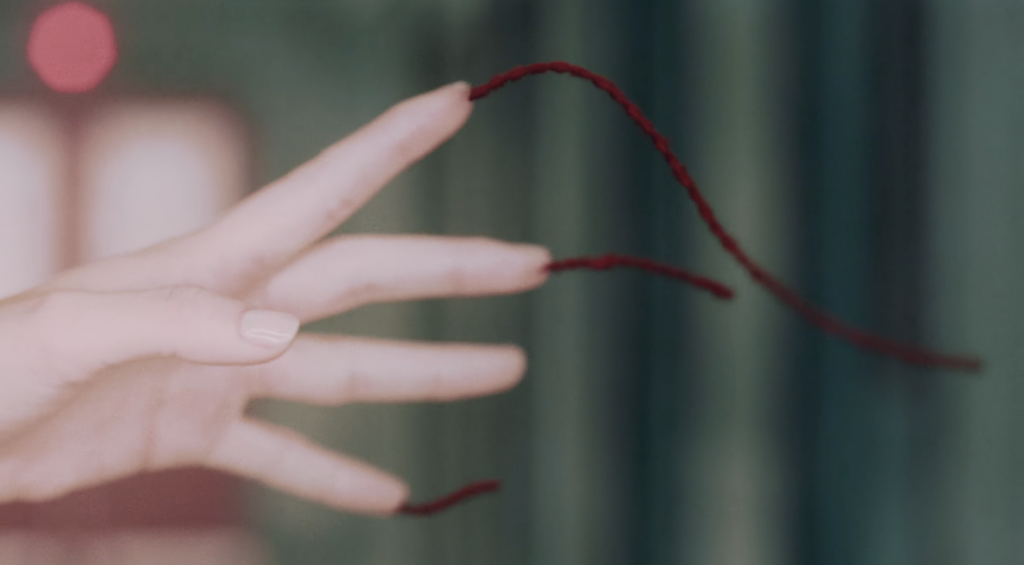
Midway through the video Rodrigo begins unraveling as red threads emerge from her outstretched fingers. More and more red appears.
screenshot from “The Cure” by Olivia Rodrigo / red thread emerges from an outstretched hand
And here’s another knot poem that I posted on this log years ago. It’s a favorite of mine:
Mostly I’d like to feel a little less, know a little more. Knots are on the top of my list of what I want to know. Who was it who taught me to burn the end of the cord to keep it from fraying? Not the man who called my life a debacle, a word whose sound I love. In a debacle things are unleashed. Roots of words are like knots I think when I read the dictionary. I read other books, sure. Recently I learned how trees communicate, the way they send sugar through their roots to the trees that are ailing. They don’t use words, but they can be said to love. They might lean in one direction to leave a little extra light for another tree. And I admire the way they grow right through fences, nothing stops them, it’s called inosculation: to unite by openings, to connect or join so as to become or make continuous, from osculare, to provide with a mouth, from osculum, little mouth. Sometimes when I’m alone I go outside with my big little mouth and speak to the trees as if I were a birch among birches.
Her discussion of trees talking to each other and growing through fences returns me to the Knot Work / Not Work poem. Here’s what Jishin No-ben (Lee Ann Roripaugh, trans.) writes about tree knots and burls:
from Knot Work / Not Work / Knot Hole / Not Whole: a Mapping
2. Formed in trunks where branches used to be, or where the trunk’s growth has choked off the smaller, lower branches in a tree. Each knot the mark of a tightening tourniquet surrounding a phantom limb. Each knot a scar, a toughening over to cauterize loss, seal the body shut so it doesn’t bleed out in the snow. In a concentration camp in Minidoka, Idaho, wood artist George Nakashima learned to burnish the souls of trees through their scars: their knots, their holes, their cracks, their broken histories.
. . .
4. Burl’s the wood formed when a tree is sick or stressed, causing the grain to arabesque into strange spirals, distorted forms, eye-spotted with visible knots. Burl erupts when infestations of insects or mold spread unchecked beneath bark’s façade, the burl becoming larger, more ornate, as the tree continues to grow. They sound like tumors, or eyesores, but burl’s actually expensive and rare. A tree can’t survive without its burl. When burl is cut from a tree while it’s still alive, the tree dies.
I’d like to use these descriptions of tree biology as an inspiration for my discussion of milfoil biology — about how milfoil spreads and chokes out the light and starves fish and ensnares swimmers’ arms.