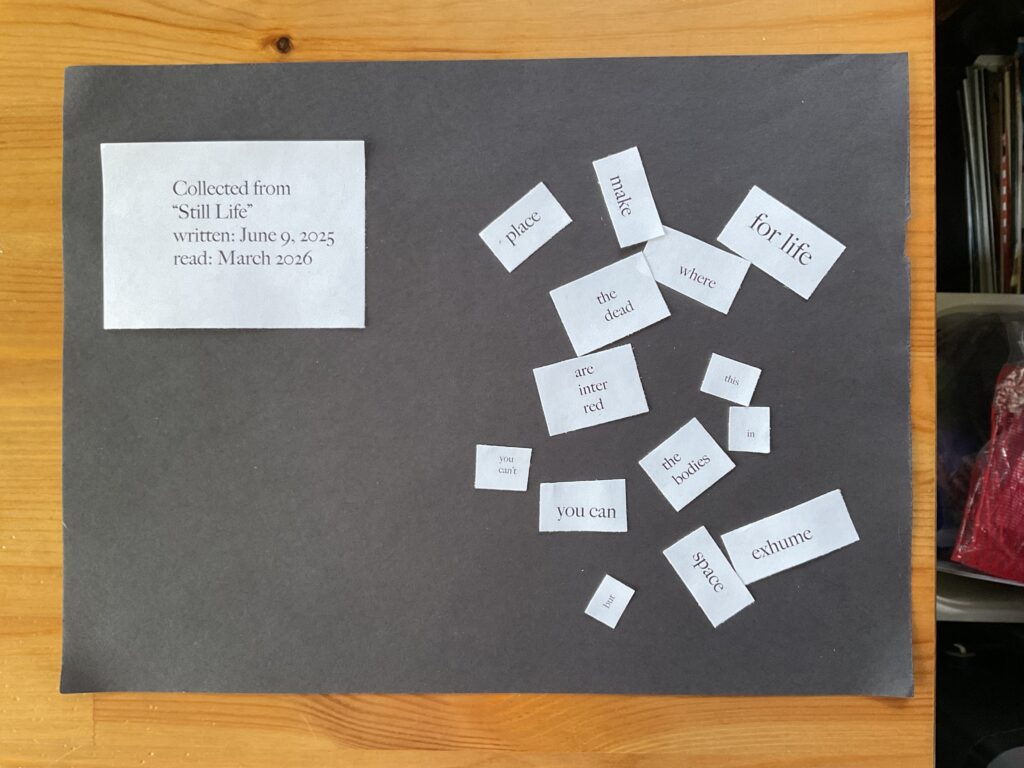
A sunny afternoon. Warmer than I thought it would be. Not an easy run, but I did it, and I got to travel on the winchell trail, which was shaded. Mostly the trail was in complete shade, but occasionally some sun came through. In a few spots it glowed so much that I wondered if it was white paint. Nope — I double-checked, just sun. I heard some kids above, then a person sitting on the 38th street steps having a disturbing conversation about someone being shot in the head. I hope they were talking about a movie or a tv show.
5 Run and 5 Swim Things
the path was thick with bikers
the road was crowded with cars
the two benches that I recall noticing were occupied
puddles on the trail from last night’s rain
2 kids on the dirt part of the winchell trail — the younger kid to the older one: do it! the older kid’s response: that’s mean!s
several military jets flying above the lake
water color: a pale blue-green
little spirits at my feet! (minnows near the shore)
a few friends: sediment and bubbles
the water was so low — near the shore, it was far from the lifeguard stands and there was a little drop-off near the water
swim: 3 loops lake nokomis open swim 70 degrees
A great swim! Again, I swam straight to the buoys without seeing them. And when I couldn’t see anything but water and trees and sky, I didn’t panic at all.
A few silver flashes below. 1 2 3 4 5 breathe right 1 2 3 4 5 breathe left. Sometimes, 1 2 3 4 breathe right 1 2 3 4 breathe right. Steady strokes. Sometimes I was sore, sometimes I was worried about my heart rate1, and all of time I was deeply grateful to be swimming in this lake with my strong shoulders and back.
Some dog updates
First, on Saturday, Delia the dog started limping and not putting any weight on her back left leg. On Monday the vet delivered the bad news: a torn ACL. Major bummer! Delia is in good spirits. In fact, she’s managed to figure out how to hop on that leg pretty effectively. It’s hard having to stop her. Currently we’re trying to decide between surgery or not. If she were a bigger dog, there would be no question: surgery. But, with smaller dogs, taking it easy and rehabbing might be enough. Surgery is expensive and traumatic, but so is not being able to run and jump and do much of anything for many months.
Second, it is seeming more likely that the off leash dog park will be closing by the end of 2026. It is on sacred Dakota land, I support the returning of this land (see this article for more info). At first, I was sad about losing it, but then Delia tore her ACL and we think it might have been at least partly due to an aggressive and unsupervised dog at the park. Many dog owners are great with their dogs at the park, but some use it as daycare, ignoring the rules of keeping your dog within sight. Even if the dog park stayed open, I don’t think we would taking Delia back there.
last night at cedar lake, my average heart rate for the swim was 160, which was alarming. Usually it’s under 130. Combine that with my anxiety over any anomaly in my watch data, and I was a little worried. Checked my heart rate after I was done: 126. Phew. Back to normal. ↩︎
8.1 miles ford loop + hidden falls 64 degrees dew point: 59
Technically, if I follow Scott’s plan, I’m supposed to run 9 miles today. But I’m going hiking at the dog park later this morning and swimming at the lake this evening, so I kept it to 8. I wasn’t fast, but I’m pleased with this run. I didn’t feel great at the beginning; it was very sticky and breathing wasn’t that easy. My heart rate shot up pretty fast, too. I wondered how I could keep running when it was already so hot and I felt so bad. Then I decided to not worry about how much I walked and to just keep going. For the ford loop (the first 4 miles), I ran until my heart rate reached 169, then I walked until it got down to 125. At Hidden Falls, I tried something new: run 90 seconds, walk 30 seconds. I wasn’t sure if I could handle having to look at my watch so much and stopping every 1.5 minutes, but I didn’t mind it, and breaking the time up into small increments made it go by faster — or made me think less about it as some big, overwhelming amount. This is the Galloway method of training. I think I’ll try it on my next long run for the entire run.
For most of the run, I listened to my book, Ariadne. For the last mile, I listened to my bunnies playlist.
5 Running and 5 Hiking Things
the overcast sky made the green in the tunnel of trees seem deeper and darker
a slash of orange on the ancient boulder
a big log floating in the river near the east side of the ford bridge — was it a log? a boat? a person?
a coxswain calling out instructions over his bullhorn to some rowers — heard, not seen
roots buckling the sidewalk, looking like slithering snakes
the entrance to the dog park was dark and green and inviting in an almost sinister way
evidence all around of the big storm 2 nights ago: giant felled trees, trunks tipped over and reaching for the river, a thick branch that must have been blocking the trail before someone cut it
drops of rain hitting the surface of the river, creating slight ripples that distorted the water near the shore
bark bark bark bark bark bark — an enthusiastic dog
kerplunk! splash! a dog swimming more than halfway across the river, moving fast
hike: 40 minutes minnehaha off leash dog park 63 degrees drizzle off and on
dog name:the swimming dog’s name was Millie — okay Millie, come here — a human calling to the dog
According to FWA, it’s supposed to rain off and on all day. We managed to mostly miss it, only a few drips on the river surface. We talked about terrible chemistry professors and doing hip thrusts with weights on your lap. FWA performed an imaginary conversation between Delia and another dog. In this conversation, they talked about how great the dog park is. Delia bragged about getting to come twice a week and the other dog said they only went once but that the yard surrounding their mansion was bigger than the dog park.
Now I invite you to find the water. In Diné thought, change happens in fours, manifestation happens in fours. There are four sacred mountains, four worlds that we emerge from into our current world. I invite you to create a poem in four steps.
First: find a body of water to sit with and listen. A river, a lake, an ocean—let it connect with the water inside of you. And let the sound that it makes work on your body and your mind and your heart.
Second: build your relationship with the water. Listen for what the water has awakened inside of you. What do you feel? Where do you feel it in your body? What stories are brought to the surface?
Third: follow the reverberations. Write down some of your thoughts, your feelings, your memories. Don’t worry about spelling or grammar, or about making things sound writerly or whether they make sense or not.
Fourth: make an offering to the water. Share what the water gave life to in the form of your poem. Touch the water and give thanks.
waterlogged: heavy with water, dense, difficult to manage, not dry, less buoyant, damaged/distorted/warped by excess water, soggy, characterized by the presence of a lot of water
swim: 2 loops lake nokomis open swim 64 degrees (air) 71 degrees (water)
After finishing my run and the hike, it started raining. Off and on, all day. By the time I went to open swim the temperature had dropped enough that the water was much warmer than the air. There was wind, too, which made the water choppy. I didn’t care. It was fun to swim into and through the waves. I swam straight to many of the buoys even when I barely realized I was seeing them. I think I did less sighting and more swimming without looking. It’s strange how much more comfortable I feel now when I see so much less.
a regular:As I exited the water an older man heading in asked me how it was. I said, it’s choppy, but I like it that way. He agreed and then we talked about the crazy amount of milfoil in the water. I have decided that I have said enough about it — it’s out of control and dangerous. I wouldn’t be surprised to hear of someone drowning in it. And, like blue green algae blooms, I just need to get used to it and find ways to avoid and/or endure it. Just before he left, the man introduced himself and shook my hand. I’m Joe. / I’m Sara./ Nice to meet you.
Other things I remember: a few patches of blue sky; opaque water with a few silver flashes; a woman swimming, her arms entering the water without her elbows bending; the roar of rushing wind; swimming just barely over the top of the milfoil; the ridgeline of the wave as it rippled over the water; a swimmer exerting a lot of extra energy kicking, white foam everywhere; the hard bump of my safety buoy hitting me in the waves; the silcence and solitude when I stopped in the middle of the lake; looking to my right and seeing a dark line of clouds, hovering
8:43 am — The first open swim of the year isn’t until the late afternoon, but I’m already excited. Currently I am sitting at my desk. Outside of my window, workers are cutting down the maple tree in our front yard. Someone is up in a bucket with a chainsaw sawing the thick branches then securing them with rope, someone else is on the ground to catch them. It’s a slow, noisy process — and strangely quiet, too. No loud THUMPS! from a branch hitting the ground. Noises: chainsaw, rumble of their big trucks, whine of a leaf blower, thud of the truck bed bottom as the cut limbs are discarded / Noises not heard: no heavy thumps, no shouting from workers to each other1, no beeps or alarms. It is now 9:02. I wonder how long it will take for them to cut it all down.
It’s sad to lose such an old tree — the only (or one of the only?) maples on the block. Everything else is linden/basswood or locust.
It’s also not sad. Mostly this tree has been a nuisance — leaf debris and whirly gigs clogging our gutters, thick tangles of roots taking over our sewer pipe. Every year Ron the Sewer Rat has had to chop those roots up so that our sewer wouldn’t back up.
In front of my window: the bucket is being raised again; it’s herky jerky yet smooth motion almost like a strange dance.
And it’s a relief. Ever since a huge branch fell from this tree last fall, I’ve been worried that another would fall and hurt someone or something. I’m glad we’re finally doing something about it.
currently: branches are gently falling in front of me, a few of them reflecting on the glass of a desktop boom! boom! — as they are tossed in the back of a truck / now it’s raining little twigs and bigger twigs and branches
10 Things About this Maple Tree
Unsuccessfully attempting to weed-whack around it, giving up and hand-pulling the tall, flowering grass
it is a wonderful example of a tree looking like a person, buried upside down, their head and shoulders in the dirt, while their torso and legs stick up in the air
this winter/early spring, I could hear a woodpecker drumming on its dead wood — brrrrrrrrrrrrrrrrrr
one summer a few years ago, FWA helped me to try to get rid of some ants “naturally” by pouring boiling water in their ant hill — not sure if it killed the ants, but it destroyed the grass around the base of the tree
last summer, or the summer before, I noticed a new branch growing near the bedroom window and thought, we should really cut that while we can still can, then watching it grow bigger and bigger until it was too late
recently noticed: a big eye in the middle of the trunk where a sizable branch used to be
the leaves on this trees, which turn a golden yellow, are the last to fall in November
all i can see of this tree from the two windows in front of my desk is the edge of its trunk
a sudden thought: I hope we’re not disrupting too many critters’ homes — I don’t recall hearing or seeing any nests in the winter
I won’t miss having to sweep up whirly gigs on the front sidewalk or pull them out of the table on the deck or the planter in the backyard
I’m sure the loss of this tree will have effects (negative and positive) that I can’t even imagine.
hike: 40 minutes minnehaha off leash dog park 78 degrees
FWA and I cut our walk short today because he had to go to the bathroom. We only hiked to the BIG felled tree. The parking lot was more than half full, but it didn’t feel crowded. Everyone was evenly spaced out and doing their own thing, not clustered at the entrance or on the trail. For the first half of the hike, it was cool and calm, with a gentle breeze. No encounters with aggressive dogs or jerky humans. No dog names overheard. Several very FAST! dogs. So fast that they couldn’t be bothered to stop and play with Delia. One German Shepherd zoomed by so fast that I gasped — wow, that dog is fast!
FWA schooled me on a video game term2: de/buffing. Used in sentence: Walking through that second patch of sun, I was debuffed and never recovered.
de/buffed: (from Reddit because I can’t remember FWA’s exact definition) “Debuff is a game term that means something was hit with an attack that causes negative affects. In this case it “de-buffs” your agility. In games, buff means you strengthen; to improve.”
We talked about how Delia loves to plop down in the soft sand then imagined a t-shirt with the many versions of Delia chilling:
ploppin’
DOD (dead on deck) when Delia lays down on the deck , with her head landing last, looking like she’s passed out or dead on the deck
DOR — a DOD variation: dead on rug
wedged between two of Scott’s pillows on our bed
wedged between the edge of her bed and the removable cushion
sprawled out quietly on the rug, under the dining room table
resting misery face: in her bed, her head hanging over the edge, looking miserable
11:01 am Louder thumps as leafless chunks of branches fall / the front yard is strewn with little branch trees / the bucket, suspended halfway up the tree / a big claw reaching up to grab branches, lift them, then toss them in the back of a truck
11:04 am one worker in an orange vest threw up the rope to the guy in the bucket, now the rope is being tied to a branch — when and how will it fall? gently or roughly? with a loud Boom! or a soft thud? / a spray of saw dust is coming down / the branch gently floated down, attached to the rope — I saw it dangling in front of the window! — then boom boom — two quick, deep booms / So much debris in our front yard — very grateful I don’t have to pick it up!
11:10am
view from my window / 11:10 am
11:14 am
The sound of a big branch falling, then its cylindrical reflection in the glass top on my desk. A very dead, tall and thin branch falling, reflected in the glass / a worker with a chainsaw, cutting a big branch off a bigger branch — grrrrrrrrrrr
1:07 pm
Sawing the trunk: sawdust sparks / dangling from a rope / the ground nears
swimming with Lauren Groff
Sure, I have many ideas and projects and plans for what I’d like to write/make/create this summer, but I also have a strong desire (need? ache?) to just be with the water and the swimming and the words (or lack of words). I want to return to Anne Carson and Alice Oswald and Lauren Groff and Tony Hoaglund and Anne Sexton and Maxine Kumin and re-memorize their poetry. I also want to revisit past Sara’s thoughts about water and swimming and first days of open swim.
Speaking of Lauren Groff (which I did, above), I’m currently reading her short story collection, Brawler. Here’s a short video in which she talks about it and how swimming made her a writer:
In addition to finding this video, I also found this short blog entry about Groff’s love of swimming:
I was expecting to enjoy Lauren Groff’s collection of short stories Delicate Edible Birds, but I had no idea that here was another work of swim-lit. Like Groff’s first novel, the marvelous The Monsters of Templeton, these stories take place around bodies of water, and they’re also much concerned with swimming and swimmers. (I’ve not finished the book yet, but I’ve just started reading one story about a deep-sea diver). I realized that I’d read the story L. Debard and Aliette before, in the 2006 Atlantic Fiction Issue, and remember it quite vividly these years later– turned out I liked Lauren Groff before I even knew Lauren Groff. It’s an amazing story of poolside sensuality. The stories linked by these swimming references in a way that intrigues me, and certainly satisfies by latest literary fixation. How positively timely.
2:30 pm — workers are done, tree is gone, only a 4 ft stump that we have to figure out what to do with remains — hopefully a gnome home!
blue-green algae advisory
Open Swim is not cancelled, but there is a blue-green algae bloom in the water and a water advisory. The “official” Open Swim Club Facebook page has an announcement with the required warning, but the tone definitely seems to be: we have to warn you, but we think if you use caution, you’ll be fine. We’d like to say it’s fine and you should swim, but we can’t. I’m still going, but maybe I’ll only do one loop. And maybe I’ll try to swim a little slower and to look out for it. Can I see it? Not easily.
bike: 8 miles lake nokomis and back 85 degrees
Biking to the lake for open swim was great. Warm, but not too crowded and I was able to pass someone without any stress. We didn’t bike fast, but it didn’t feel slow and it’s always safer to bike slow when you can’t focus fast. The bike ride back was harder, with too much wind and clueless walkers walking in the middle of the bike path. Scott rang his “passive agressive bell” (his name for it) half a dozen times and one woman didn’t even notice.
swim: 2 loops lake nokomis 87 degrees
A great first swim. I couldn’t see much, and I didn’t care, my shoulders and brain still swam me straight to the buoys. There were some clueless swan boats and too many vines — it’s crazy how thick they are near the start of the swim! — but they didn’t bother me. I was happy to be swimming and felt strong.
It’s too late and I need to eat, so no more writing about the lake tonight. Tomorrow if I can remember anything, I’ll add some more.
10 Water Things (the morning after)
murky water, but enough clarity for me to be able to see my hand and watch and . . .
bubbles! my bubble friends are back — clear little orbs stirred up as my hands entered the water
a scratchy-squeaky noise as I neared another swimmer — was it their wetsuit? a cracking of a joint or a bone or?
vines 1: started out by swimming straight into a knot of milfoil — when I tried to do a full stroke green strings wrapped around my wrist — join us down below, they seemed to be whispering
vines 2: at the end of the second loop, near the white buoys, ghostly vines emerging from below, not yet close enough to touch
vines 3: rounding the far white buoy, getting stuck in another tangle of milfoil — as I said to another swimmer a few minutes later, I’m a very strong swimmer and those vines made me nervous!
finding one distinctive break in the green in an otherwise generic tree line to use to sight the far green buoy
this year, there are 2 orange buoys and 3 green ones
noticing the pale rope that tethers the buoy to the lake floor as I swam over it
suddenly noticing something in front of me, stopping and hearing a person in a kayak call out, kayak — I think it was a lifeguard, but it could have just been a clueless kayaker crossing the swim course
Mentioned how quiet the workers are to Scott. He found out why when he talked to them: they have headsets. Nice! ↩︎
On our bike ride to the lake I quizzed Scott on this term. He had heard it but couldn’t remember what it was. He said it’s primarily used in first-person shooter games, which he doesn’t play. ↩︎
35 minutes minnehaha off leash dog park 75 degrees
A shorter walk because of the heat and the aggressive energy from other dogs. Lots of very fast running and circling and barking. Two dogs ran by me so close, I could feel their wind on my legs. As we walked, we could hear a chorus of LOUD barks up ahead — one so loud that it was echoing.
dog name: Chief / a big German Shepherd / on a leash, tightly controlled by his owner. Of course Delia teased the dog before we had a chance to stop her. The owner held on tight and managed to keep the dog under control — no chief, no! I wondered to FWA if they had recently adopted an abused dog who needed a lot of help getting socialized to other dogs.
The sand in the floodplain was deep and soft. I could feel it seeping into my sandals. It was cool, which was nice until it got stuck and collected under my covered toes. These are not the shoes to wear here! I declared to FWA. Why did I buy hiking sandals with a closed toe? I remember: they were half off.
Before Chief shifted the energy, FWA was giving a wonderful description of the Diary of a Wimpy Kid 4 animated movie. He’s so skilled at telling stories and conveying the energy of the characters. My favorite part: when he acted out the voice of one of the characters who broke their compass. That’s it. We’re lost.
Even though she was tired and hot, having plopped down in the sand at least once, when Delia saw some bigger dogs up ahead running in circles around a tree and through some grass, she tried to join in. She wasn’t fast enough. When she tried harder, they ignored her. Oh Delia, you’re out of your league. Finally, she gave up.
moment of joy: a tall Dad holding the hand of a very little girl (2 or 3?) as she looked up at him smiling or giggling and hiked down the hill gracefully.
11 Unhinged Energy Things
the moment Chief’s owners noticed us up ahead and prepared themselves for the encounter — the woman took a deep breath and said, it will be okay or get ready or we can do this
that sand! — so soft and deep and slippery — the coolness of it as it poured into my sandal
kerplunk! crash! a very large something thrashing through the water — a big dog, I thought — no, 2 or 3 big dogs
an owner calling to a dog (I can’t remember the dogs name) and the dog running as fast as I’ve ever seen a dog run. Wow!
two big dogs running beside then past me — any closer and they would have taken me out
BARK! BARK! yip yip bark bark ruff ruff — the cacophony of dogs up ahead, playing or fighting or who knows what at the beach at the end of the trail
a strange and loud knocking or clanking sound up above us, in the tree
dog after dog after big dog, flashing past, some barking, some silent — somehow the silent ones felt even more unnerving
dumping sand out of my sandals near the car, feeling something strange and sticky on the bottom of my foot that wouldn’t come off — a bug?! — a slight panic and a frantic waving of my foot– realizing minutes later that I had put a bandaid on last night
FWA driving us back on the river road — a car that was going 12 mph in a 20 mph zone that hardly anyone ever obeys — average speed for most cars here = 30 mph — a growing back-up of cars behind it — FWA turning off of the road at the first available chance with a flourish and declaring, someone needs their license taken away!
encountering a truck on a narrow city street, noticing a low-to-the-ground recumbent bike drafting off it then trying to pass it while the truck was still moving — FWA was so distracted that he pulled out in front of another truck
3.1 miles trestle turn around 69 degrees humidity: 74%
The earliest run I’ve done in some time — 7:30, which is not that early. I liked running earlier. Next time, I’d like to run by 7. Greeted Mr. Morning! for the first time in months. All year, I’ve been running later in the morning or early in the afternoon, so I’ve missed seeing all of the regulars.
The other day I remembered that I had a pair of Saucony Cohesions that I’ve only wore a handful of times because they made one of my toes hurt. I wondered if they would work better (that is, hurt less) than my Brooks’ Ghosts. Yes! Ever since I wore an old pair of Saucony’s to mow the lawn, I’ve been thinking about returning to Saucony’s for my marathon training. Maybe I’ll buy a new pair; they’re less than half the price of the Brooks shoes, and they’re navy with light pink soles.
10 Things
the Welcoming Oaks — tall, green
boom boom — construction noise from across the river
clank clank clank — something banging/being banged below the trestle
the crack just north of the trestle is shifting and growing — what once was a crack became a trench, and now a ledge — orange cones all around it as warning
someone was sitting at the sliding bench
a walker in a bright yellow jacket — were they a rower heading down to the rowing club?
the parkway was buzzing with cars commuting to work
bright headlights from an approaching bike
a lone honk from a goose somewhere below
a man and a dog crossing the path then entering a steep trail down to the river through small hole in the wall of green
later in the day: Watching a video about her life as a pro runner, Lauren Gregory said this: “Consistency isn’t just about showing up when things are going well; it’s about building a life that allows you to keep showing up.” For Gregory, this means routine.
I really like combining Gregory’s idea of life-building practices routines with Des Linden’s famous call to keep showing up:
hike: 50 minutes minnehaha off leash dog park 77 degrees
A warm, but not as warm as I thought it would be, hike. It started with irritation: a guy standing with his dog right in front of the entrance, blocking the way in, barely moving enough to let us by. Why? We both wondered what he was doing and why, out of all of the places he could be waiting, he was standing right in front of the gate.
Most of the rest of the hike was good. FWA reported on all of the theories about Subnautica 2, and discussed how thoughtful the creators of the game are in their early release — hardly any bugs and a well-developed story. When he mentioned that the area where a huge tree lived was called Xanadu, I asked him if the creators of the game named it that as a more general reference to the pop culture idea of Xanadu, or the poem by Samuel Taylor Coleridge, Kubla Kahn. He thought it was possible they were referencing the poem. All I could remember from it was most of the first 2 lines: In Xanadu, did Kubla Kahn —- decree.
In Xanadu did Kubla Khan A stately pleasure-dome decree: Where Alph, the sacred river, ran Through caverns measureless to man Down to a sunless sea. So twice five miles of fertile ground With walls and towers were girdled round; And there were gardens bright with sinuous rills, Where blossomed many an incense-bearing tree; And here were forests ancient as the hills, Enfolding sunny spots of greenery.
But oh! that deep romantic chasm which slanted Down the green hill athwart a cedarn cover! A savage place! as holy and enchanted As e’er beneath a waning moon was haunted By woman wailing for her demon-lover! And from this chasm, with ceaseless turmoil seething, As if this earth in fast thick pants were breathing, A mighty fountain momently was forced: Amid whose swift half-intermitted burst Huge fragments vaulted like rebounding hail, Or chaffy grain beneath the thresher’s flail: And mid these dancing rocks at once and ever It flung up momently the sacred river. Five miles meandering with a mazy motion Through wood and dale the sacred river ran, Then reached the caverns measureless to man, And sank in tumult to a lifeless ocean; And ’mid this tumult Kubla heard from far Ancestral voices prophesying war! The shadow of the dome of pleasure Floated midway on the waves; Where was heard the mingled measure From the fountain and the caves. It was a miracle of rare device, A sunny pleasure-dome with caves of ice!
A damsel with a dulcimer In a vision once I saw: It was an Abyssinian maid And on her dulcimer she played, Singing of Mount Abora. Could I revive within me Her symphony and song, To such a deep delight ’twould win me, That with music loud and long, I would build that dome in air, That sunny dome! those caves of ice! And all who heard should see them there, And all should cry, Beware! Beware! His flashing eyes, his floating hair! Weave a circle round him thrice, And close your eyes with holy dread For he on honey-dew hath fed, And drunk the milk of Paradise.
dog name: I didn’t hear any dog names directly, but I think I heard a woman, who sounded exasperated, calling to her dog down by the water, Scarlet! Scarlet! Come here!
my 2 favorite sounds: First, the bullfrogs. As we neared the end of the trail, at the beach, I could hear the loud buzz of the frogs. The noise was coming from the other side of the water, where the river turns into a creek that winds through a section of the floodplain forest. Second, Delia’s thundering feet. As Delia ran past me, I could hear her little paws pounding the ground — on sand, then grass, then firmer dirt. I love that sound!
holes / strings
I’m continuing to work on my found poems project, but I’d like to wrap it up so I can spend the summer with water. What I need to do now is document my process so that I can remember what I was doing when I pick it back up in the fall. Will I be able to stop, or will I keep working on it regardless of my intentions? We’ll see.
Before I stop, I’d like to get some orange thread — regular + embroidery — and experiment with incorporating it into my otherwise black and white (and gray) visual poems.
I’d also like to figure out the words for my poem using a NYer essay reviewing memoirs by daughters about their fraught relationships with their mothers. In my version, mother = word, and it’s about my fraught relationship with seeing/reading/making sense of the written word.
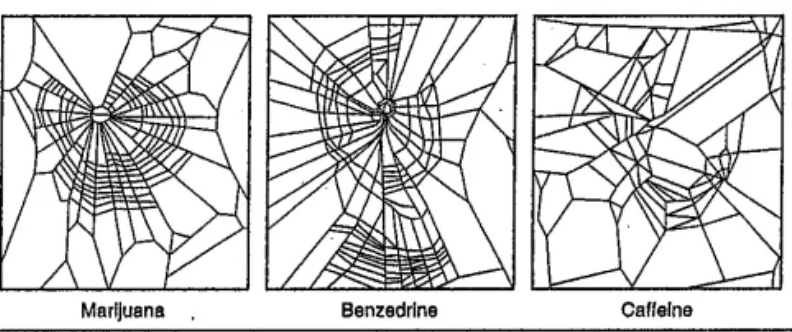
a few hours later: As I worked on finding words in the essay, phrases and fragments kept popping up, then an idea came to me: Pick out a few of these phrases, which offer a way to describe my experiences reading, particularly in terms of how words connect me to the world. Pair a phrase with one of the spiders-on-drugs webs that has been inspiring me. Map the words on a panel, create the spider web over it. I love the idea; can I actually make it?
Some of the webs are easier than others; all of them seem too much to try without some sort of help. One of Chuck Close’s grids?! I definitely want to do the caffeine web, but I think I should start with something easier, like marijuana:
drug-induced webs
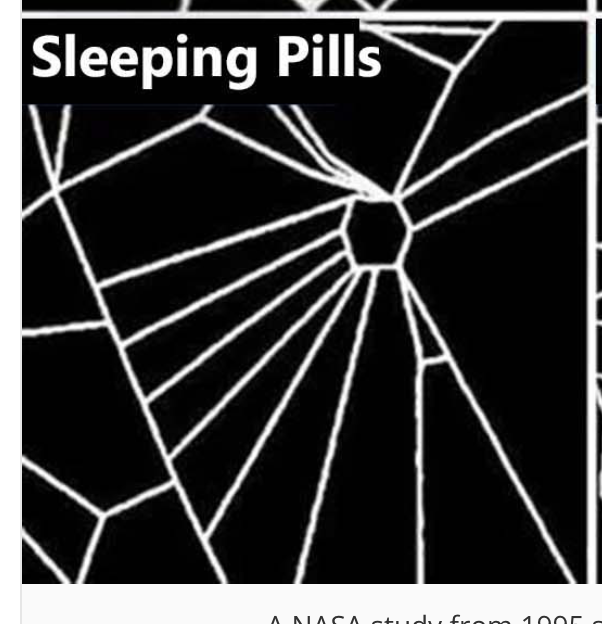
I also want to do “sleeping pills” — especially since I often fall asleep while I’m reading!
spider on sleeping pills makes web
I think I’ll do 3 or 4. Here are the phrases I want to refine/condense:
1
When the forms are too fuzzy I escape into coordinates
note: I like the idea of this and the linking of coordinates to the grid and mapping and my desire to find concrete ways to locate my vision loss, but I’m not sure it makes enough sense as is. I’ll keep thinking about it.
2
the ordinariness of language lost
3
gaze — an act of creation and of demolition — made hole again
4
nothing, subdued, entangled
5
shadows and absences born certainty died (or ruptured?)
6
kinship between eye, world, word confounded threads twisted, knotted, cut
run: 8 miles around lake nokomis and back 62 degrees humidity: 86%
A long run with Scott. 8 miles this week. It felt easier than the 7 miles last week. The only problem: my feet. About 4 miles in, I noticed my socks were bunching up and under the ball of my feet, which was painful and made me alter my gait. Next time: different socks.
I started the conversation with Alice in Wonderland and the scene with the Cheshire Cat; it’s an inspiration for my found poem about landing in the logic of blur and almost. Scott talked about his YouTube channel — the main one and one of his secondary channels that he jokingly created for one of the gnomes in our backyard. I also talked about shifting my perspective on my unfinished business problem: not trying to avoid it, but learning how to accept and manage it while I’m running. What else did Scott talk about? A lot, I just can’t remember what.
10 Things
the green looked and felt greener, the brown richer and darker after last night’s rain
birds! so much birdsong everywhere and all the time
a mini-ambulance parked on minnehaha parkway, a Ghostbusters logo painted on the side
an older man with a cane calling out to us as we ran around the lake — the birds are attacking me! Just then, a bird swooped down on him
a little dog with a big, fluffy tail, shaking their butt as they walked
the view of the lake from the cedar avenue bridge: completely still, the reflection of ascending plane travelling across it
puddles — most of them on the lake trail
stopping at the port-a-potty near the little beach: no toilet paper in either one
more benches than last year set up around the stage at the falls — Scott guessed that they start out with a lot, but the number dwindles over the course of the summer as the benches get broken, I wondered if people stole them
the view near the bench above the edge of the world is gone until next fall, now it’s a wall of green green green
hike: an hour minnehaha off-leash dog park 61 degrees
The air was cool, but thick down in the floodplain. The ground was soft and firm, in some spots muddy. So many birds! I wish I would have had my phone and recorded them. Hardly anyone was at the park — because of last night’s rain? and today’s humidity? The few cars were all parked on the one side of the parking lot. No one, including FWA, wanted to be the first to park on the other side. The surface of the water was covered in some sort of scum. When we got closer we realized what it was: seeds.
dog names: Dolly (or Ollie), Squirrel, and ? — I can’t remember the name of the Corgi we encountered.
We talked about the social life of birds and Subnautica 2 and delighted in Delia’s joy. I noticed she seemed to be leaping more as she ran; we agreed that it was probably because of the firmer ground.
added the next morning: I forgot to mention the moss, or was it lichen?, that I studied on the side of some big trees down in the floodplain. Very cool — an intense green covering the soft and wet bark on one side, while dry and rough bark was on the other side.
The greens and browns were enchanting. So were the birds. And the quiet — so peaceful and still.
And today, after months of focusing almost exclusively on my “how I read”/ holes poems, here’s a bit of a beautiful poem from Tracy K. Smith:
My son listens into daylight, head tilted, eyes tuned past the range of the seen.
What he seeks to see is vibratory. A butterfly’s itch. The pitch at which a mind
is freed to dart, spark, break into flight. His gaze rakes space. What does his ear see? Beads
of breath rising from the body of a bee. A whiff of rain batting a new green leaf. I watch him—
What does his ear see? I like the images of hearing in this poem.
hole 4b
Yesterday, I spent some more time with my found poem inspired by a specimen board. It’s slowly coming together, but I have more work (thinking, executing) to do with it.
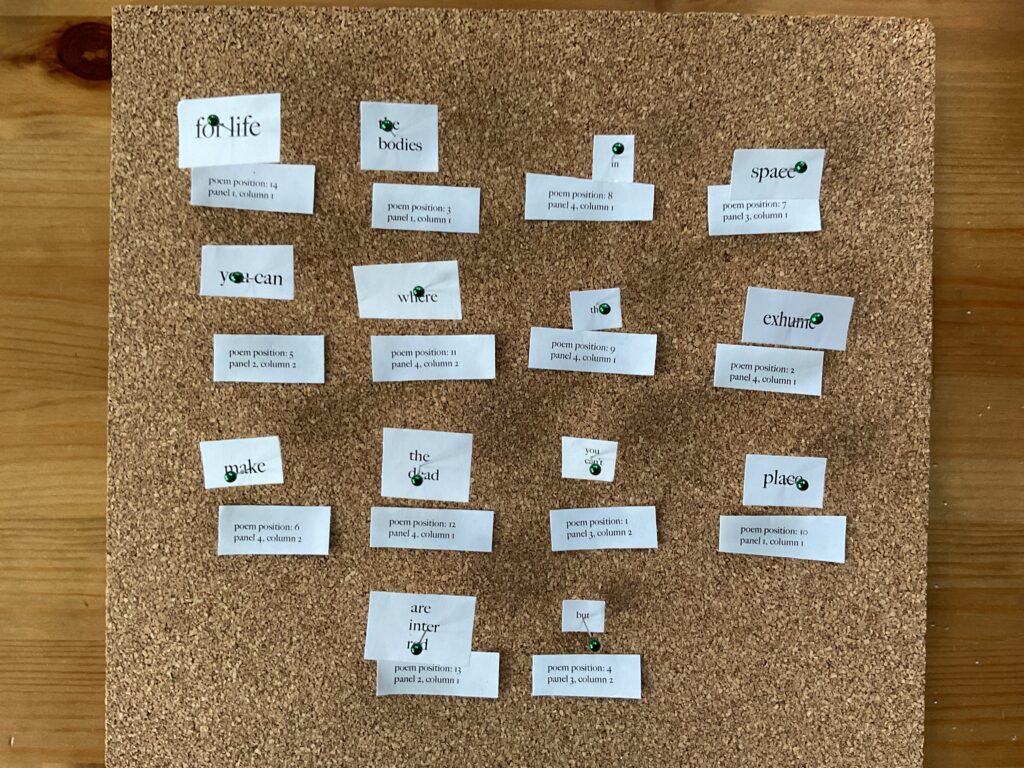
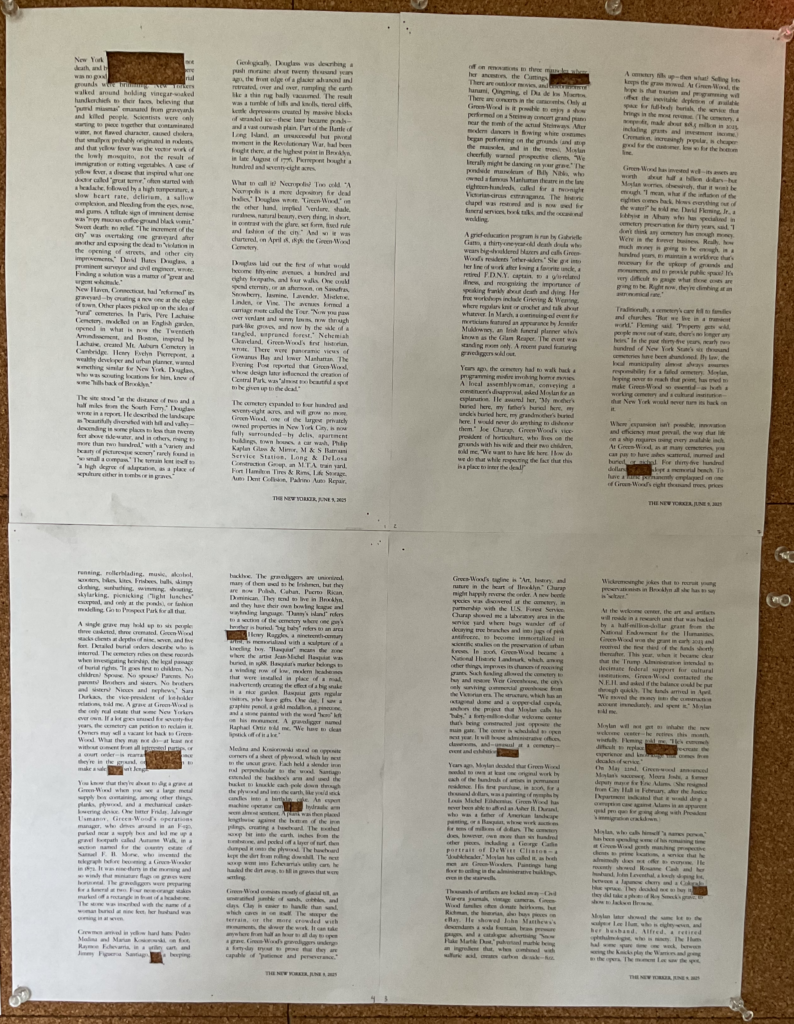
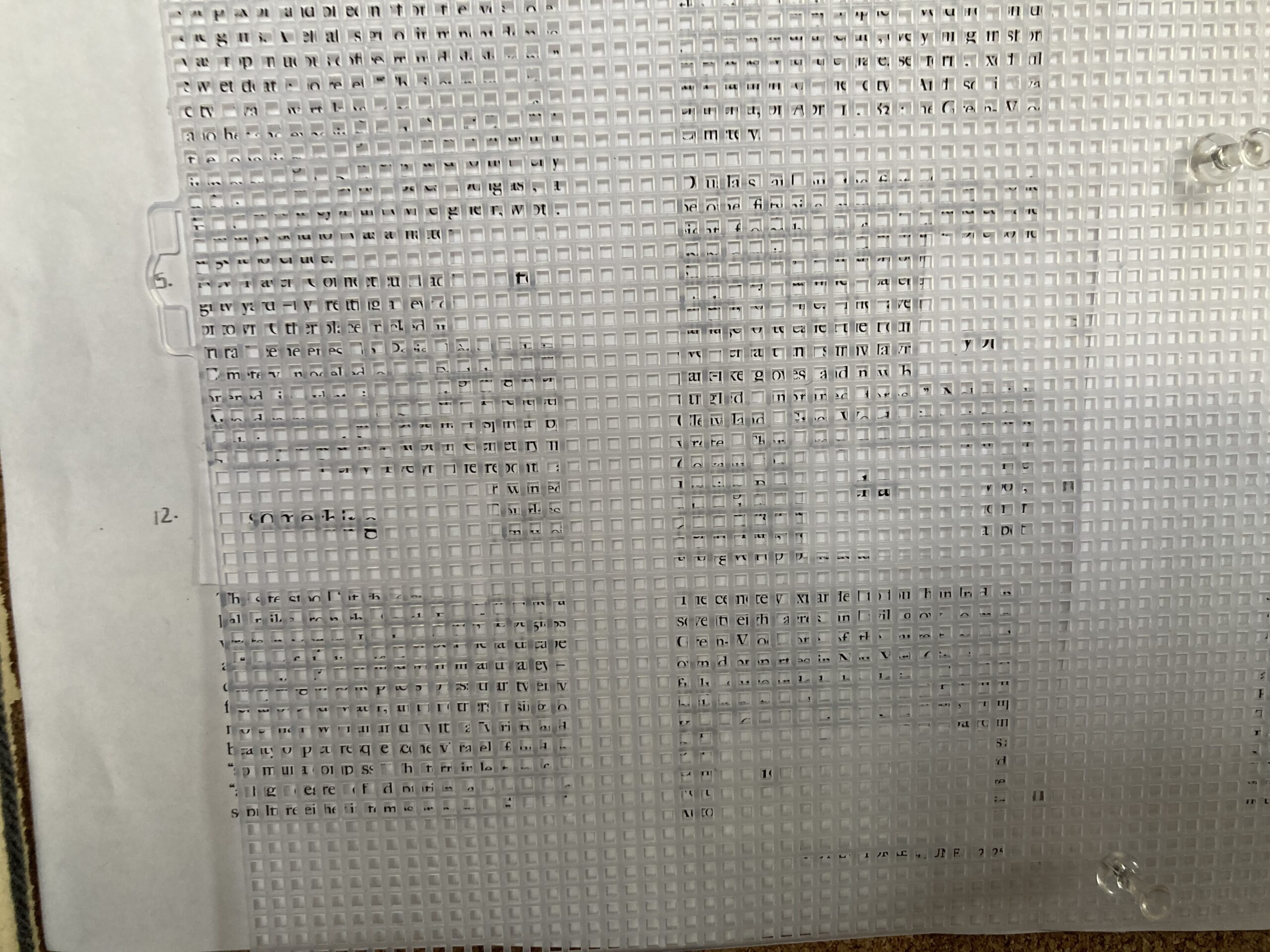
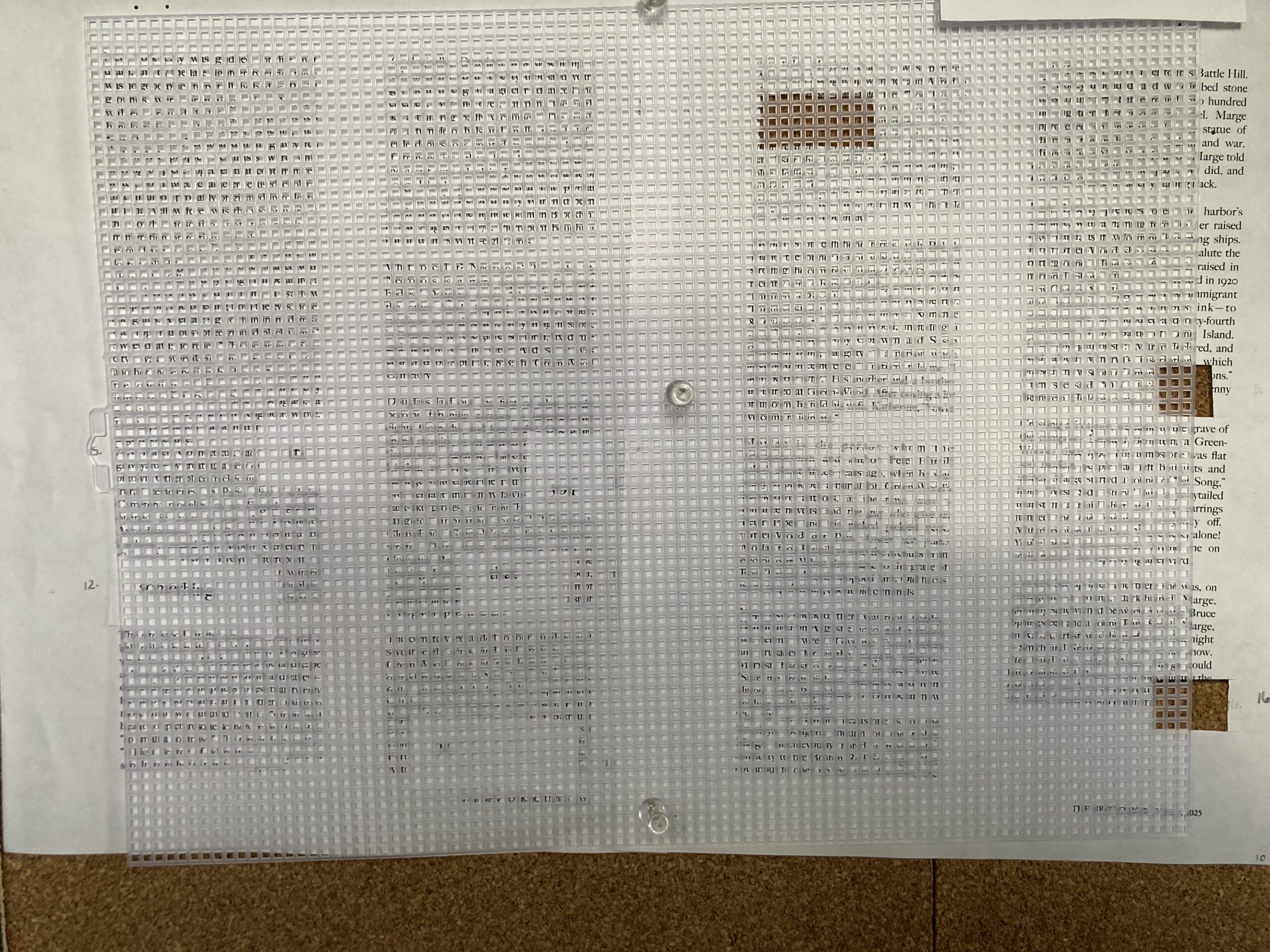
So far, I’ve cut the words out of the essay, leaving holes where they were. I printed out the words — in sizes according to their importance. I also cut out labels for each word, with the poem position and location. I need to figure out how I’d like to put the “board” on the panels — glue the labels directly on the page along with the pinned words OR make this board on a different page to be placed over the existing text. It would be easier (and less risky) to do it on a separate page, but I like the idea of doing it directly on the panels.
I took some pictures to document my progress:
here’s the board with the words arranged by size with their labelsHere are the 4 panels of the essay. The big space where there are no holes is where the “board” will be placedI was inspired by the Manitoba Museum picture I posted the other day to take this one
Today, I began working on it some more, but it is dark outside today and I mostly rely on natural light to see in my studio space, so no more cutting or drawing or pasting for me today. Maybe it isn’t just the light; after my 8 mile run and hour long hike, I’m tired!
hole 3
Before running this morning, I thought a little more about another hole that is in the preliminary stage. The text involves the phrases, land in the logic of blur and almost and glitching just enough to scramble what’s real and imagined. I think the Cheshire Cat could be inspiration for these lines. How? Visually, I’m not quite sure yet, but I’m struck by the cat’s song at the beginning. The words sound like words, and they’re almost English, but they’re not quite. And the cat appears in varying degrees of visibility: just a mouth, a full body, indented footprints in the dirt.
“Most everyone’s mad here. You may have noticed that I’m not all there myself”
The caterpillar scene was about words and language and As, Es, Is, Os, and Us; the Cheshire Cat scene seems to be about finding your way when you’re lost in a world of nonsense and madness (where madness = beyond/outside of logic, upside down). Yes, locating and being located. Reading and language helps locate us and us locate/orient ourselves. I’ll think some more about how the Cheshire scene might inspire me.
53 minutes minnehaha off-leash dog park 67 degrees
What joy to walk with my son and Delia-the-dog through this beautiful stretch of land beside the river. FWA set the tone by singing an awesome Sonic (video game) song about following your rainbow. Then, as we hiked down the hill beside a chainlink fence — the secret back way to the river that avoids the steps and a lot of the people/dog congestion — I was inspired by the dancing shadows to talk about how everything is always moving slightly in my vision. Almost like pixels, but not quite. FWA said that his vision is like that sometimes. Then he added that many people see that way, enough that it’s referenced (visually) in the video game, Tarkov. We talked about the fallibility of vision and the illusion that many people have about vision as seeing what is actually and exactly there, like looking through a camera lens. This led to a discussion of how most/many people struggle to understand or believe that a table can be there and not there, solid and more space than anything else. Which philosopher talked about the table as not existing? I can’t remember. Next: FWA brought up something he had read or watched about humans as quantum computers.
Just before that, as we lamented the fact that people often don’t have the capacity for holding both the there and the not-there of a desk simultaneously, FWA said, everyone thinks in such rigid ways, or something like that. I pointed out that his very statement was rigid by using the absolute word, everyone.
And then, we encountered Thor. Delia must have known, with her insistence on going down closer to the river, that someone special was there today. Or maybe it was FWA, with his willingness to agree and follow her today when he would normally refuse. Whoever knew, or didn’t, today we hiked down to the river sooner that we usually do and were greeted by the cutest, most wonderful, little ball of milk chocolate fur — a feisty little dog that chased Delia around, dragging his little leash through the sand, while his human giggled with delight. She said that this was his first time at the dog park. Somehow I knew to ask, what is your dog’s name?Thor, she said. Thor?! A perfect name, I think. Later I said to FWA, that was all I needed, my day has been made. Thanks Thor.
For the rest of the walk, I enjoyed hearing the birds and admiring the deep contrast between the rich brown of the trunks with the deepening greens of the leaves, all while listening to FWA describe the video game that came out this morning: Subnautica 2. It sounds very cool and FWA does such a great job of describing it. A flash of a thought/feeling: FWA is meant to make (at least one) amazing video game. The task: how to help him get to a place (mentally, physically) where he can do this.
As we left the dog park, I felt gratitude for getting to be at this park this morning with FWA and Delia and Thor, and hardly any bugs!
holes and flowers
I’ve decided I’m not finished with my shredded paper blooms, so I started working on more. I made some with no orange, then one with an orange dot the shape of my working central vision, then one that was all orange with the circle with the word of the poem at its center. Oh — I like this! Could I make an entire meadow of these flowers, mixing in the word blooms with other blooms?
I like these flowers and am excited that I was able to come up with this idea. I like how they look and the idea of the shredded word bloom as metaphor for reading and the relationship between word and meaning — taking the essay and literally shredding it, then constructing something new out of it.
a flash: As I making the blooms, jabbing the pin into the paper shreds, I thought about the collecting of butterflies and other bugs and then pinning them in a box to display. Not sure what to do with that, other than remember it for some possible future Sara.
hole 5a with more flowers
When I showed it to Scott, he liked how the green pin in the center of the white circle looks like an eye. That wasn’t totally intentional, which is very cool. I like how it’s an eye, too!
a playlist?
When RJP came over today, we talked about my blooms and she encouraged me to put together a playlist for the project. Fun! This playlist will be more complicated than past playlists, which have been focused on one, relatively clear, subject. This playlist will involve many subjects. Broadly, Holes is about how I read with a hole in my central vision. Three things echo throughout: 1. playing with words, 2. the hole in my vision visually represented by my blind spot (which I traced by staring at a blank wall), 3. the Amsler grid/lines/threads that map/connect words to meaning to worlds. Tomorrow, I’ll start putting it together.
50 minutes minnehaha off-leash dog park 53 degrees
Spring! Another beautiful dog park morning. Today it was calm and quiet, with a soft breeze. So many birds that I couldn’t identify. Soft sand, still water, no bugs. I talked about how great it would be to spend the entire day hiking then camping somewhere. No time or energy for worrying thoughts. FWA said that that was how band tour had always been for hime.
10 Things
the soft knocking of a woodpecker
a map of the dog park near a chain-link fence
a dog named Rosie whose grandmother was named Rosie
a HUGE tree trunk, stripped bare
green crawling up trunks — new leaves
big dogs suddenly appearing, running silenting through the trees at full speed
a litte dog, also quiet, chasing Delia then running off, then chasing her again
a field full of dandelions
the very strong smell of poop suddenly — FWA and I both checked our shoes to make sure we hadn’t stepped in something
feet sinking into soft sand, almost tripping on little rocks
hole 5a
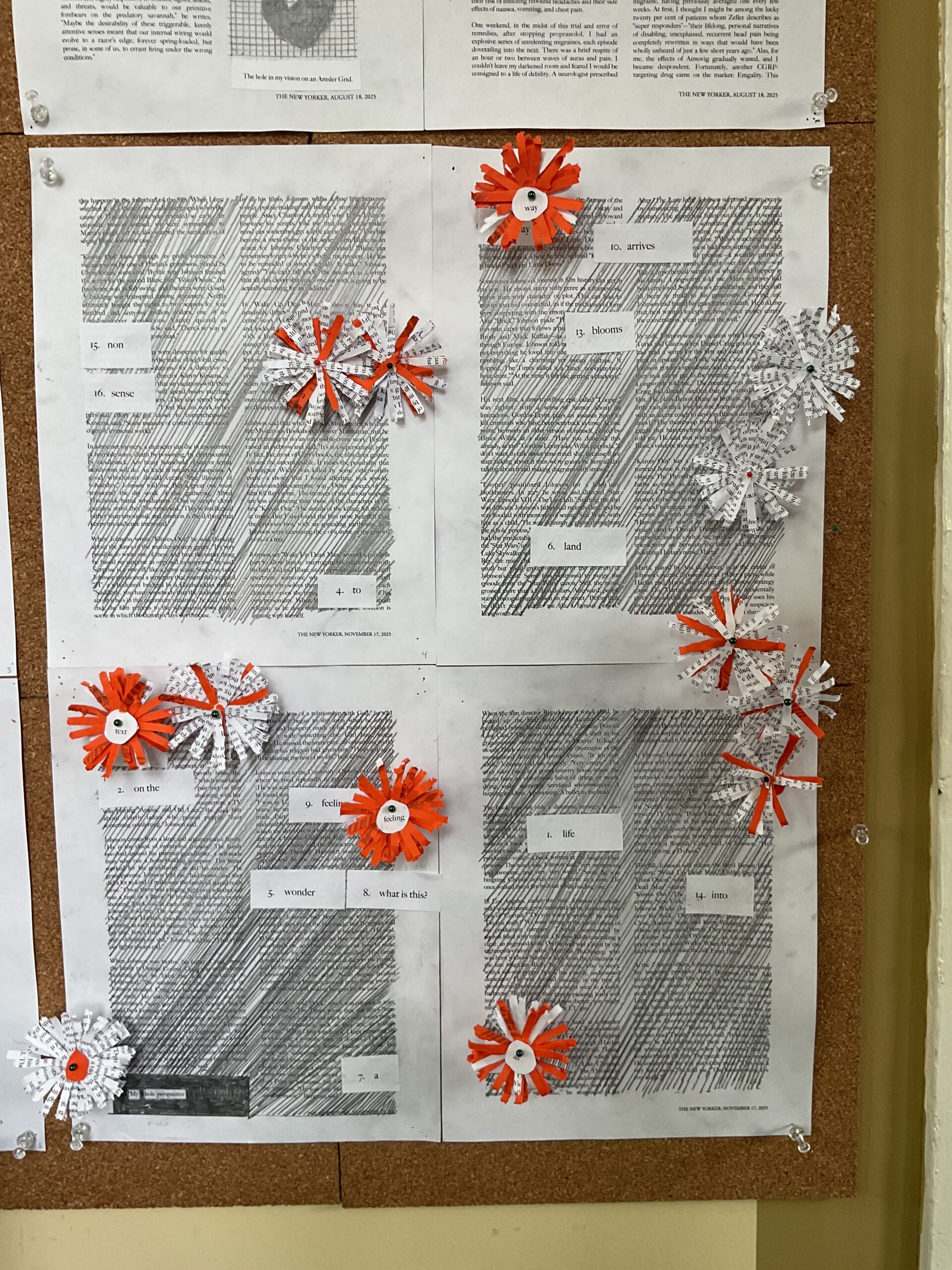
My found text in the NYer essay, “Mystery Man” — a what is this? feeling grows as text blooms into nonsense — is the inspiration for my visual approach to Hole 5a. Each found word is the white center to a flower bloom made from petals cut out of the essay in the shape of my small, still functioning central vision. Yesterday, I cut out the petals (more practice with scissors! I’m getting better!) and the words. Today I need to figure out how to make the blooms. Here, making = creating an easy process for forming the bloom, gluing it together, arranging it on the pages, and affixing it to those pages. A key consideration: develop a process that is forgiving so that if I screw one bloom up I’m not screwing up the entire, 4 panel, poem.
With my vision, these blooms are much harder to create than I had anticipated. I can only see approximately how the should/could line up. Scott had a great idea: color them. Yes! I’ve decided to color the petals orange, using a colored pencil. Coloring them helps me to see them a little better, but I still need more practice on making them look good enough to use.
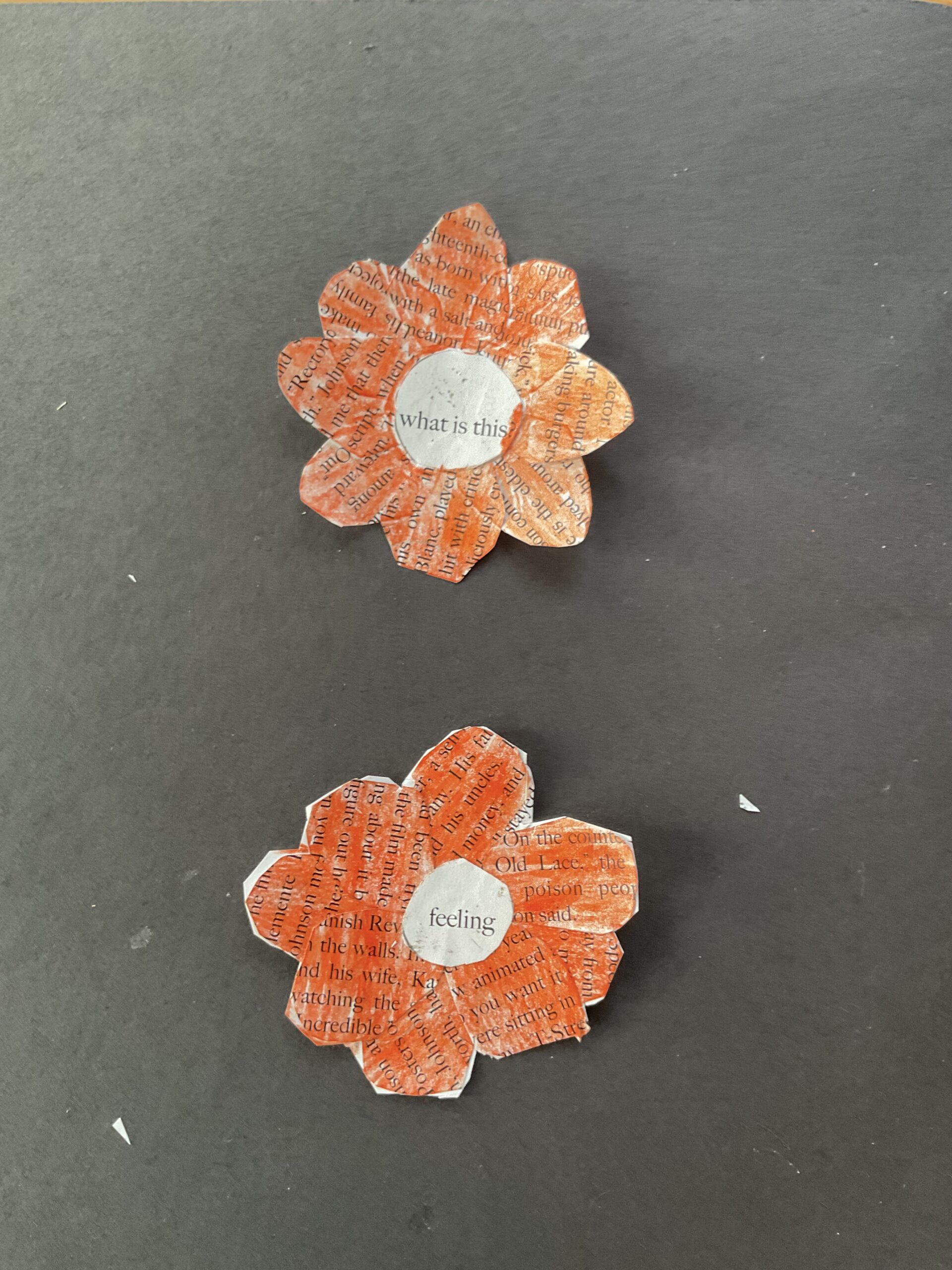
2 attempts at orange blooms
top: I had already glued the flower together when Scott suggested coloring them, so I had to color them as one.
bottom: I colored the petals separately, then glued them on a white sheet of paper, then glued on the word and cut the whole thing out.
More practice tomorrow. At first, I was discouraged at how hard it was to do this, and how bad my flowers looked, gut then I remembered I could practice and keep trying and they probably will look better.
I tried looking up “making paper flowers” online, but only YouTube videos came up, and those are almost impossible for me to follow with my bad vision. I’ll have to be more precise with my search. I decided to look up images of paper flowers — it was mostly screen shots from YouTube videos — and then I looked up images of flowers. A thought: My flower should be an easy, approximate shape — what about a circular shape with lots of small petals — this would be less about lining up petals abd more about texture.
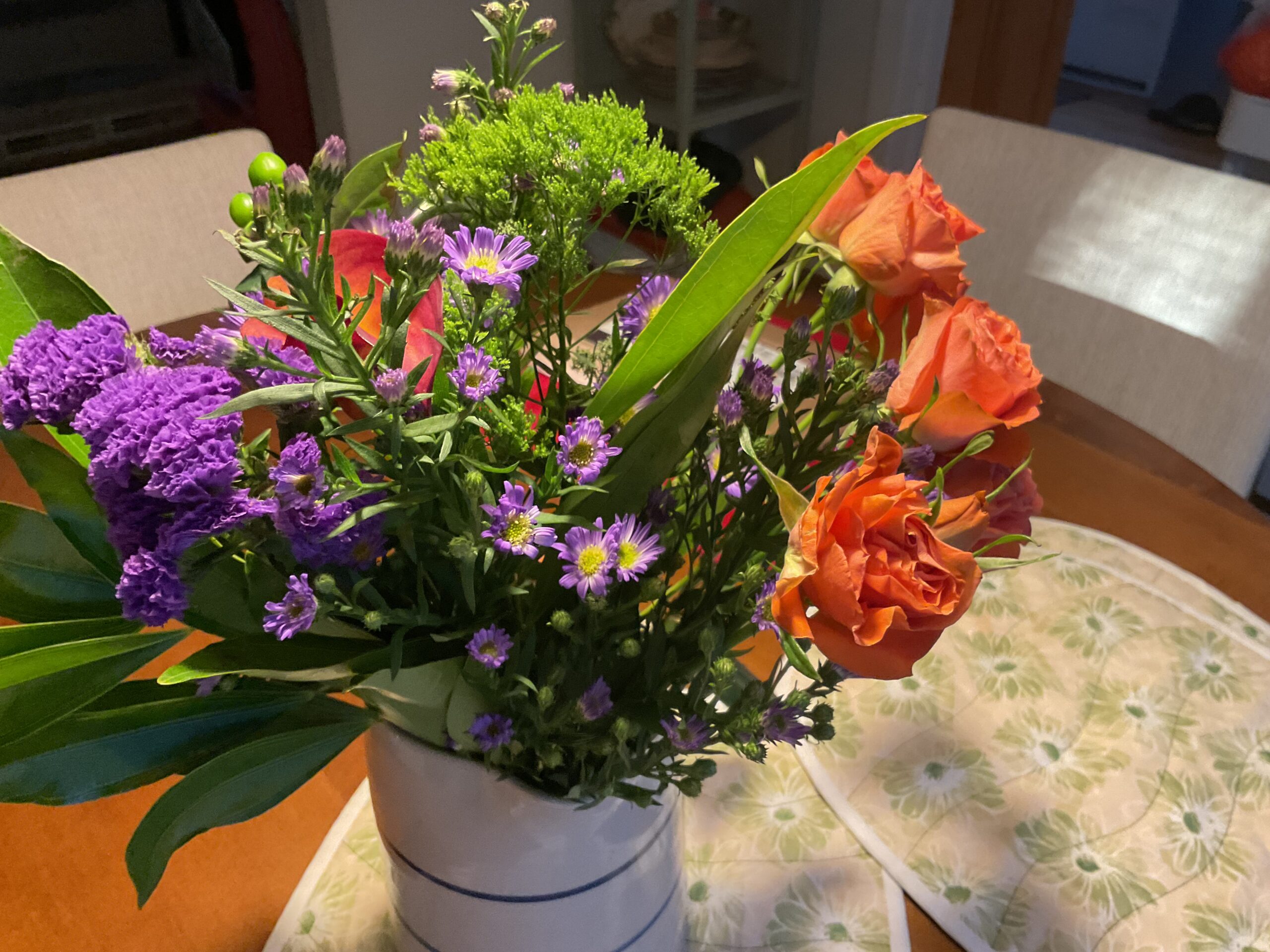
Another thought: get inspired by looking up flowers. Find a shape that is visually interesting and that I can do! Yesterday, RJP got me flowers for mother’s day. Do any of these work?
mother’s day flowers
I don’t really think so. I’m excited to be curious about flowers tomorrow morning and find one that works for this project — and my vision!
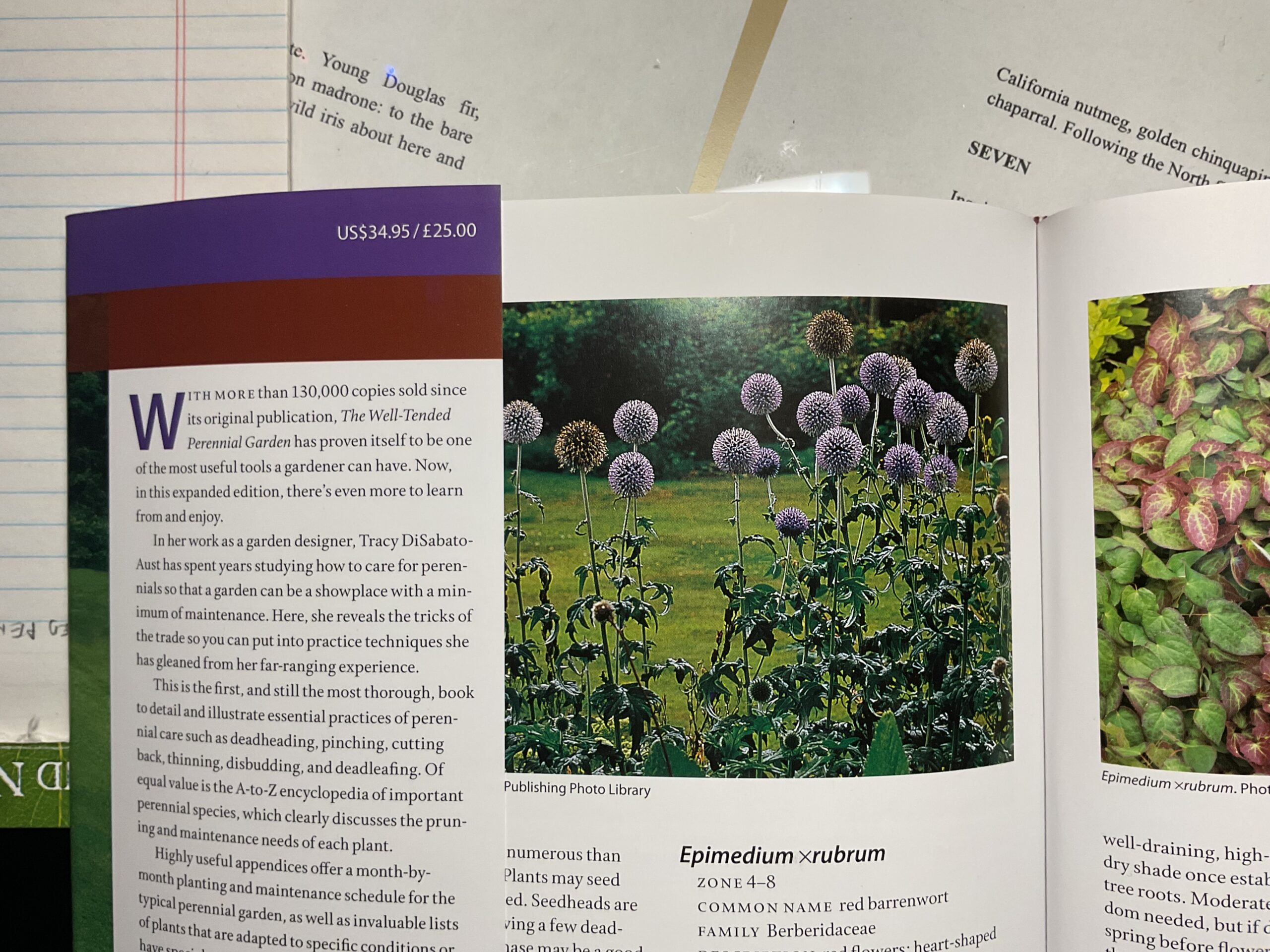
a quick note: I just remembered how much I love globe thistles because they’re cool looking and because my mom liked them. I liked to try doing something with it! I just remembered that my mother-in-law bought me a wonderful book about garden flowers for mother’s day years ago. The globe thistle is in it, with a great picture!
55 minutes minnehaha off-leash dog park 58 degrees
Dog names: Ollie — a great dog who has been trained on how to interact with smaller dogs + Higsly — yes, Higsly, an owner who gave off douchy vibes + Nora — an enthusiastic, joyful dog
other dog behavior: a Dellia-sized (25-30 lbs) facing off with Delia. They would stand face to face, then dart, then return. After a few rounds, a bigger dog swept in and started humping the other dog.
Everything green, green, green. Only a few bugs, but I bet they’re coming. A gentle breeze, the deep buzz of traffic on the highway less than a mile away. The surface of the water was rough — not choppy, but full of small ripples. Woody-the-Woodpecker was there, as always. Someone was playing music out of a radio, or a phone?, on the beach at the end of the trail. As we neared it, I heard a loud Splash! as a human threw something in the water, or a big dog chased after it.
overheard about Higsley: from his owner, talking to a guy he knew about how Higsley acts when he takes a treat from someone’s hand — the bar at our house is very low. just yesterday I said to Higsley, wow, you didn’t bite any of my fingers! Side note: FWA and I discussed how the two men seemed to be competing with each other. I said they seemed like frenemies and wondered if that term was used with male friendships. FWA said, no, because that’s how most men interact with each other.
In addition to talking about dogs and frenemies, we talked about live-streams — me, the ultra marathon, Cocadona 250, and FWA, the H3 podcast at the celebrity poker tournament. On the way to the dog park, we talked about green as oppressive. On the way back, slang.
Here’s how we got to slang: I said something about how trying to give a dog a clever name is tricky. Usually it involves trying too hard, done by a try-hard. FWA mentioned that that slang was very old. When I asked what has replaced it, he had to think for a minute, then answered, Sweat lords. Love it! I love how his generation is so smart and creative with language! The kids are alright.
55 minutes minnehaha off-leash dog park 59 degrees
More green, less dogs, a lot of wind, loose sand. Delia the dog was in her element — such joy in her body as she ran and leaped and sparred with other dogs. FWA and I talked about a distracted dog owner who failed to recognize that her big dog was overwhelming Delia. We both noticed how the beach was much smaller and the river much larger. Most of the mucky shoreline gone.
As we headed back, there was shouting ahead, then an older woman approached us and asked if she could walk with us. She explained that when she asked a man to get his big dog away from her small dog he called her a cunt and then yelled at her, then he kept harassing her. She didn’t feel safe. When the red-faced man (that is, according to FWA; I couldn’t see his face) paused and denied what happened, FWA successfully de-escalated the situation, saying to the man, just walk away. He did and we walked part of the way with the woman and her dog, Scotchie, short for Butterscotch. Love that name! After we parted ways, FWA and I analyzed our re/actions. I’m proud of FWA and I’m glad the situation was quickly defused.
We heard the pileated woodpecker, black-capped chickadees, and some corvid that didn’t sound like a crow and wasn’t screechy enough to be a blue jay.
grids
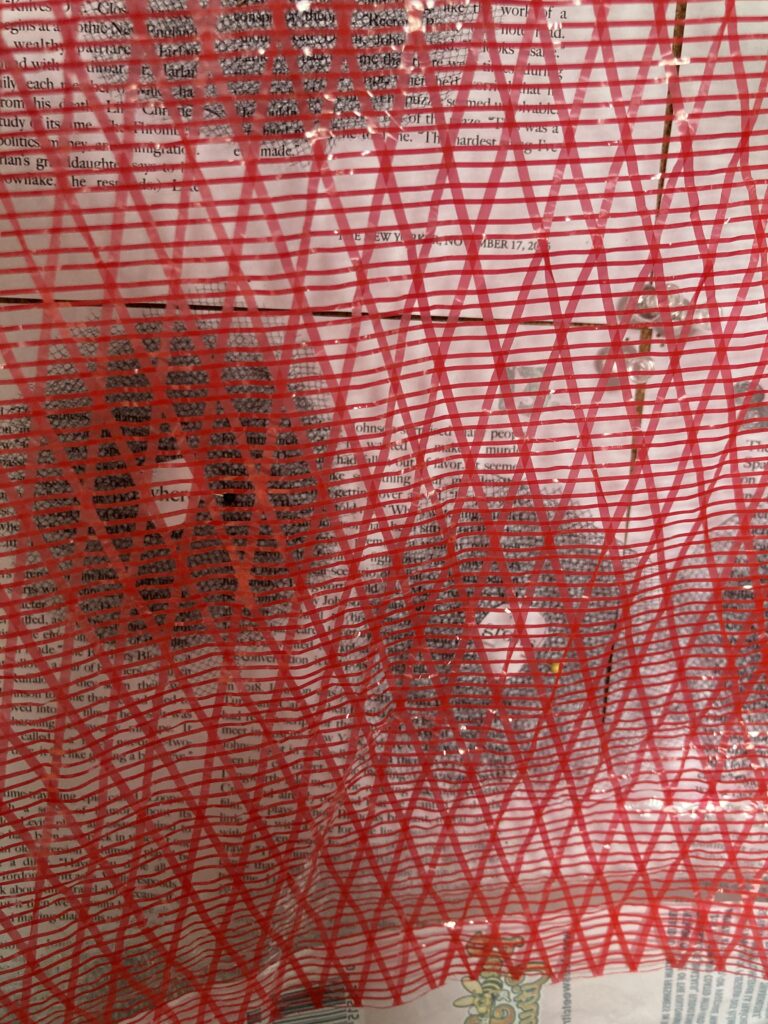
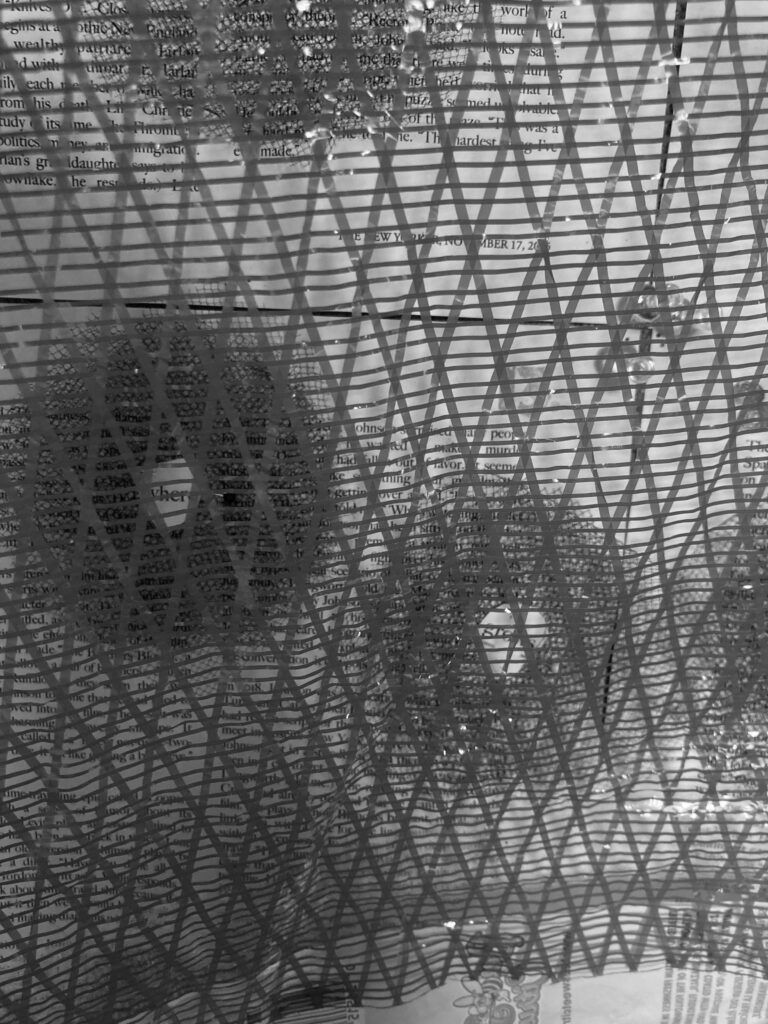
Scott and I went to Costco and loaded up on Grapefruit. I noticed a lattice/grid on the bag. Can I use it? It’s red (or orange? or pink?) so I’m not sure, but maybe?
grapefruit bag grid
I placed the grid directly over another holes poem just to see what it would look like. A thought: if this visual poem was in black and white, how would it look?
grapefruit bag grid — black and white
One inspiration for this switch to black and white: a story from Scott about the set on the Adams Family tv show1. While the show was in black and white to make it look more gothic, the actual set was in crazy colors. Nice!
While gathering a few different plastic bags from our Costco shopping to play around with, I thought about how my interest in plastic bags — because they seem to be an effective way to describe the distance between me and words and the world — is giving me a chance to give attention to the (over) use of plastic in packaging. So much plastic. More broadly, my interest in using everyday objects in my visual poetry is helping to give attention to objects that I would otherwise not notice. A door to a new way of being in the world is opening!
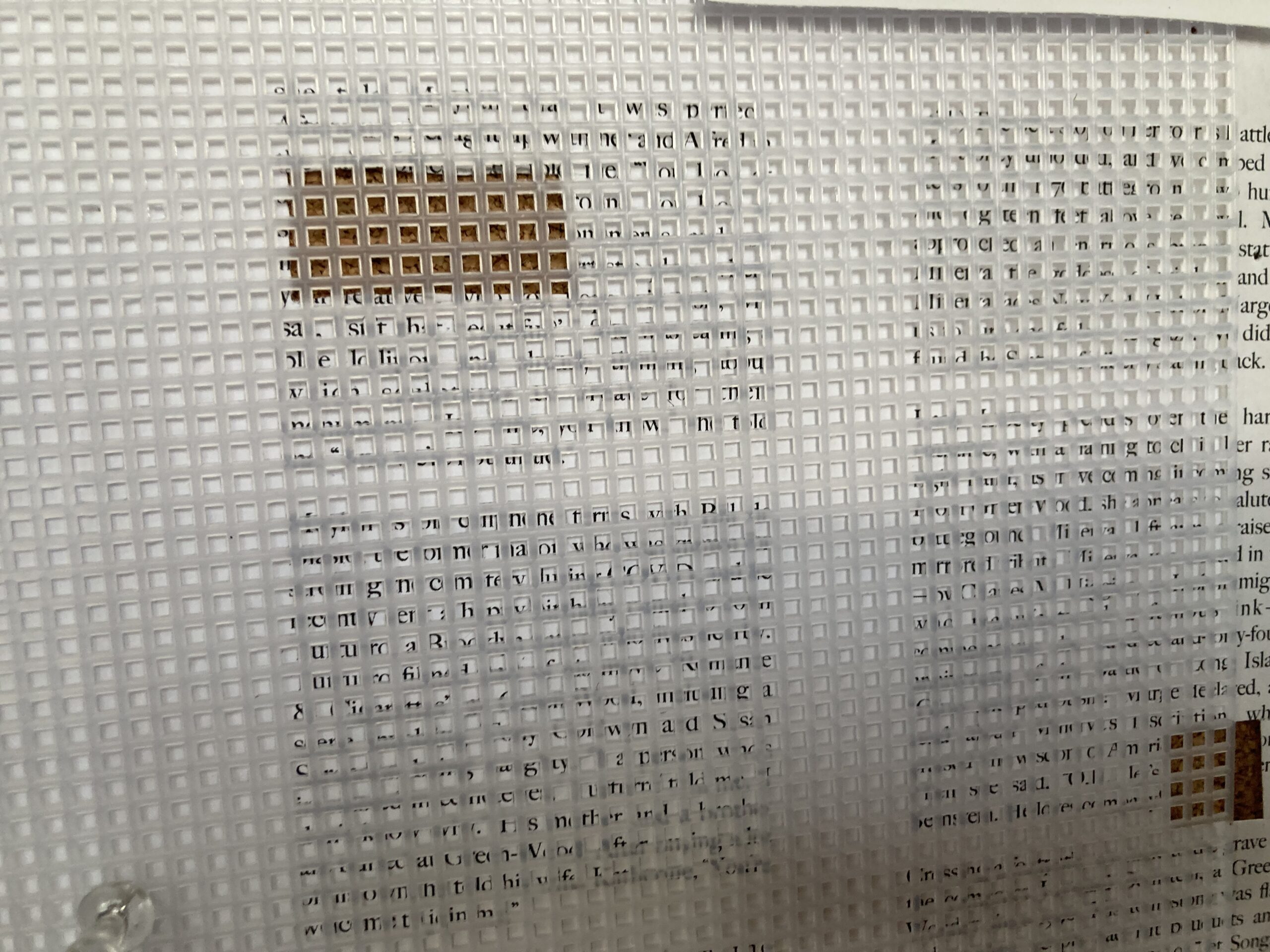
I almost forgot about another grid I discovered. Yesterday, RJP and I were at Michaels picking up a few supplies — yarn for her, needles and pins (no, not The Searchers song) for me. Sudden inspiration hit: what about the grids used in latch hook?!2 We asked a very helpful employee and found them. Yes! There is potential, I think, for using this in my Holes 4 poem. I wish I would have bought more than one!
123
1: panel with words of poem cut out 2: panel with bigger words of poem pasted on 3: both panels
I’m wondering what it would look like to play around with thread or yarn woven through the holes?
tomorrow’s plan: weave thread through plastic grid; sew with thread through/on plastic bag; sew with thread through/on printer paper.
Fun fact: I loved watching this show when it was on reruns; I had a crush on Gomez/John Astin. ↩︎
I know about latch hooking from my older sister MLP who loved to do it so much that once she latch hooked a map of China for a school report! ↩︎
hike: 53 minutes minnehaha off leash dog park 40 degrees
At the beginning it was chilly this morning, even with gloves, but by the time we were heading back to the parking lot, it had warned up. More green. Another very LOUD woodpecker. Fun encounters with other dogs. One of them was just a little smaller than Delia and covered in chocolate fur. Something about how they darted around made me think they weren’t dog but some other creature — Thing 1 or Thing 2 popped into my head. More good and difficult conversations with FWA. I’m trying to respect his need to figure things out on his own timeline, but it’s very hard to watch and not say anything.
When we got back to the house, Scott told me that he read an article in the Star Tribune this morning about how they might have to shut the dog park down. It’s sacred Dakota land and some (many? all? — I haven’t read the article; it’s behind a paywall) tribal leaders want it returned to the Dakota people. I would be very sad if this wonderful park closed, but I support the Dakota people and their claims to the sacred land. I hope some sort of compromise can be reached.
run: 4 miles river road, north/south 49 degrees
An afternoon run. A little warmer and much sunnier. So crowded on the river road! Car after car after car. Near the trestle, the cars were backed up — at least 10 cars stopped in a line, extending both ways. The floodplain forest below the tunnel of trees was thick with green — no more river view here.
After climbing out of the tunnel of trees, I heard voices below me in the gorge. Rowers! The rowers are back! A few minutes later, I saw a roller skier. Two wonderful signs of spring. Now it just needs to stay warmer!
strings
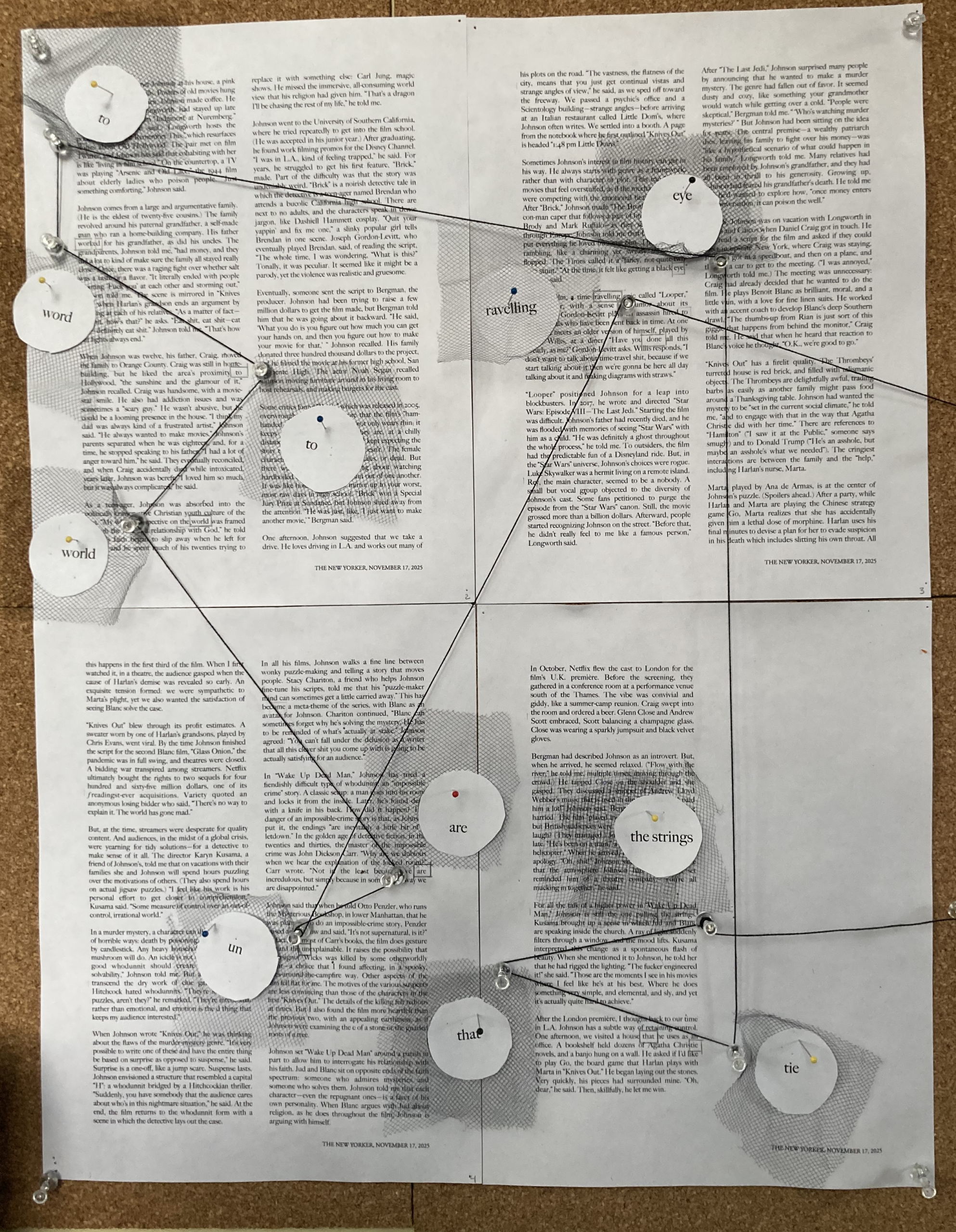
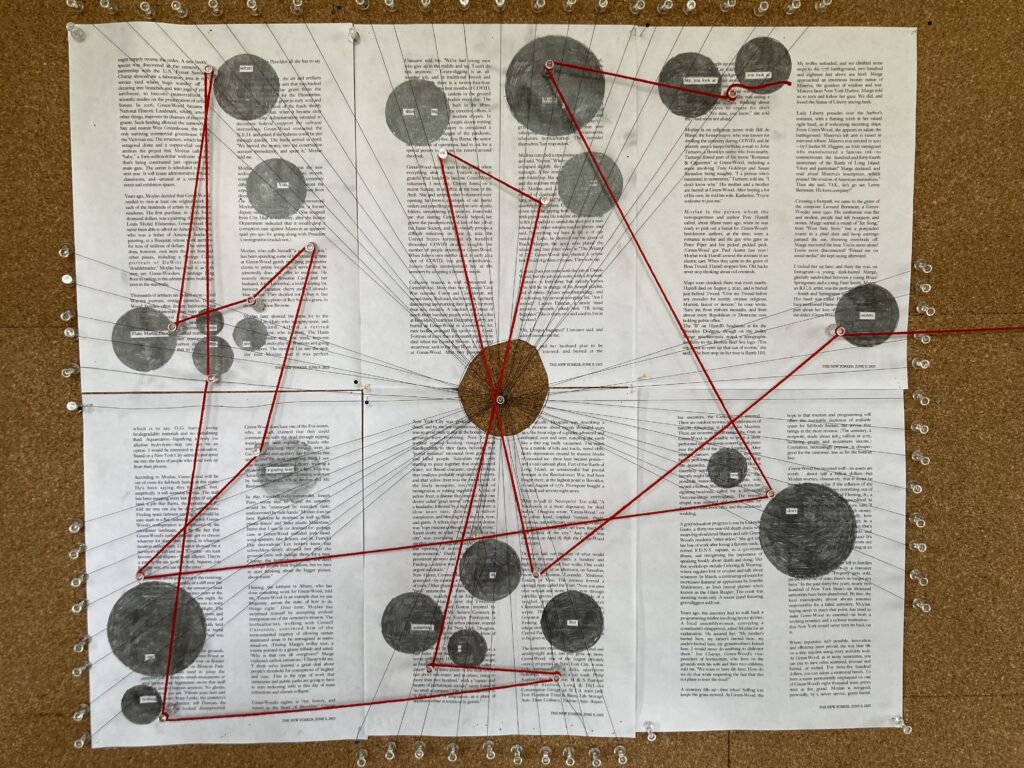
This morning, I decided to work on a new poem. Instead of holes, and my blind spot, it’s about strings and threads and the lines that connect/tether me to words and meaning. I created this poem out of words from a favorite NYer essay: “Mystery Man.” I mapped it out, then printed out the words in bigger text, then pinned it up on my cork board, then connected the words with black embroidery thread, making it look like a murder board. Here’s the poem. Each stanza is from a different page.
the strings that tie
eye
to word to world
are un
ravelling.
the strings that tie / eye / to word to world / are un/ ravelling
Is the string/thread dark and thick enough to see clearly, or should I go for thin black yarn?
I like the idea of this resembling a murder board, particularly in relation to my use of the word “unravelling.” Unravelling has two, almost opposing, meanings: 1. to fall part, to undo and 2. to solve a mystery, to make clear, to unknot or disentangle. So, the ties between eye, word, and world, are both coming undone AND are becoming more clear.
55 minutes minnehaha off leash dog park 49 degrees
Cooler today, but sunny with a soft breeze. Wonderful for moving. FWA and I agreed that there was energy in the air, a lifting — of impending storms, oppressive heat, humidity. The dog park vibe today: chill. Dogs moving quickly and quietly.
today’s dog name: Sunny (or Sonny?)
10 Things
glittering water
a small boat, fishing near the end of the trail
the LOUD knocking from a pileated woodpecker
a very big uprooted trunk, almost upright, leaning in the hollow of a living tree
deep, soft sand
the slapping sound of Delia’s water running through the water at the edge of the shore
the soft, thundering thump of Delia’s running feet on the soft dirt
2 HUGE fluffy white dogs
a small (smaller than delia) dog emerging from the woods — first, a flash, then right in front of of us — first they jumped up on me, then FWA, as if to say, hi! hi!
even more green on the trees, on the ground
While we hiked, FWA and I discussed Ariadne (see below). It started with me asking FWA if he was familiar with Ariadne’s thread from his reading of The Odyssey in college, or Percy Jackson in elementary school. He said, sure, but I mostly know it from Tarkov (a Steam video game). Of course. I’m always fascinated by all the stories/history FWA knows from playing video games. A few minutes later,FWA said, I think I also know it from Kaos (a Netflix show about greek mythology starring Jeff Goldblum as Zeus.
holes and strings and words
This morning, I feeling a bit overwhelmed and disoriented by all of my ideas about holes and strings and threads. Instead of trying to think and theorize my way out of it, which is my inclination — I’ve decided to stop trying to figure it out and follow some more trails. These trails may offer some answers, or they may cause me to get even more entangled (ensnared, knotted).
1 — Ariadne’s Thread
In yesterday’s post, Ariadne came up in a quote from the intro to Her Read. I knew the name, but couldn’t remember why. Just as I began typing In yesterday’s post, I remembered! It was mentioned in a poem about Icarus that I posted here on 19 june 2025: Altitude/ Airea D. Matthews. This poem has a favorite line, which I think fits here:
Bliss is a body absconding warp speed toward a dwarf star whispering, Unsee the beheld.
In that 19 june post, I kept thinking about unseeing:
Unsee as different than not-seeing (which I ‘ve thought/written about before). Not seeing is a static thing; you just don’t see it. To unsee is more active and also suggests a process of unravelling which is where my vision is at.
A few minutes later in the walk, I thought about flipping the phrase to, behold the unseen.
I like thinking about to unsee as a verb, an act, a process, a type of prayer? Just as seeing is not a static thing, where you simply see, but a process of light and signals and filtering and guessing by the brain, unseeing is a process of slow (or sporadic) unravelling then adapting — a brain doing mysterious and magical things with the scrambled and limited data it receives, a mind developing new ways to witness/behold without stable and dependable eyes.
Wow. All of this thinking about unseeing the beheld and unraveling vision, returns me to another thread in the book review about Helen Oyeyemi’s new book: swap the dead-eye liturgy of doomed vision for shadow acts wild and improbable. Is there something there to return to?
In my brief searching for Ariadne’s thread, I found a description of it as a method in logic for “solving a problem which has multiple apparent ways to proceed—such as a physical maze, a logic puzzle, or an ethical dilemma—through an exhaustive application of logic to all available routes” (wikipedia).
I found this bit about how Ariadne’s thread differs from “trial and error” interesting:
The terms “Ariadne’s thread” and “trial and error” are often used interchangeably, which is not necessarily correct. They have two distinctive differences:
“Trial and error” implies that each “trial” yields some particular value to be studied and improved upon, removing “errors” from each iteration to enhance the quality of future trials. Ariadne’s thread has no such mechanism, and hence all decisions made are arbitrary. For example, the scientific method is trial and error; puzzle-solving is Ariadne’s thread.
Trial-and-error approaches are rarely concerned with how many solutions may exist to a problem, and indeed often assume only one correct solution exists. Ariadne’s thread makes no such assumption, and is capable of locating all possible solutions to a purely logical problem.
In short, trial and error approaches a desired solution; Ariadne’s thread blindly exhausts the search space completely, finding any and all solutions.
The goal is not the solution/answer, but an exploration of possibilities. I also like the idea of using the thread approach in my erasing of text in a New Yorker article. The key: it’s arbitrary!
With a little more research, I also found this brief description:
The phrase “Ariadne’s Thread” refers to to the problem-solving technique of keeping a meticulous record of each step taken, so that you can always backtrack and try alternatives if your first efforts fail to yield results.
side note: this might be helpful in tracking my creative experiments so I don’t lose some of my initial ideas.
Before I left for the dog park with FWA, I had an exciting idea about how Ariadne’s thread seems to contrast with Alice’s rabbit hole. Here are some notes I jotted down so I wouldn’t forget:
tension = going down a rabbit hole (free fall, untethering, getting lost) versus ariadne’s thread (logic, finding, tethered to the world/meaning/language) — part of the feeling/process/practice of reading — what is the relationship to the word, how do I read? I answer with a mix of phenomenology (describing/showing my mechanics or reading words on a page) and an invitation to a new relationship with words, a new way for meaning and connecting and communicating not based on progression or logic or efficient understanding.
2 — a plastic bag
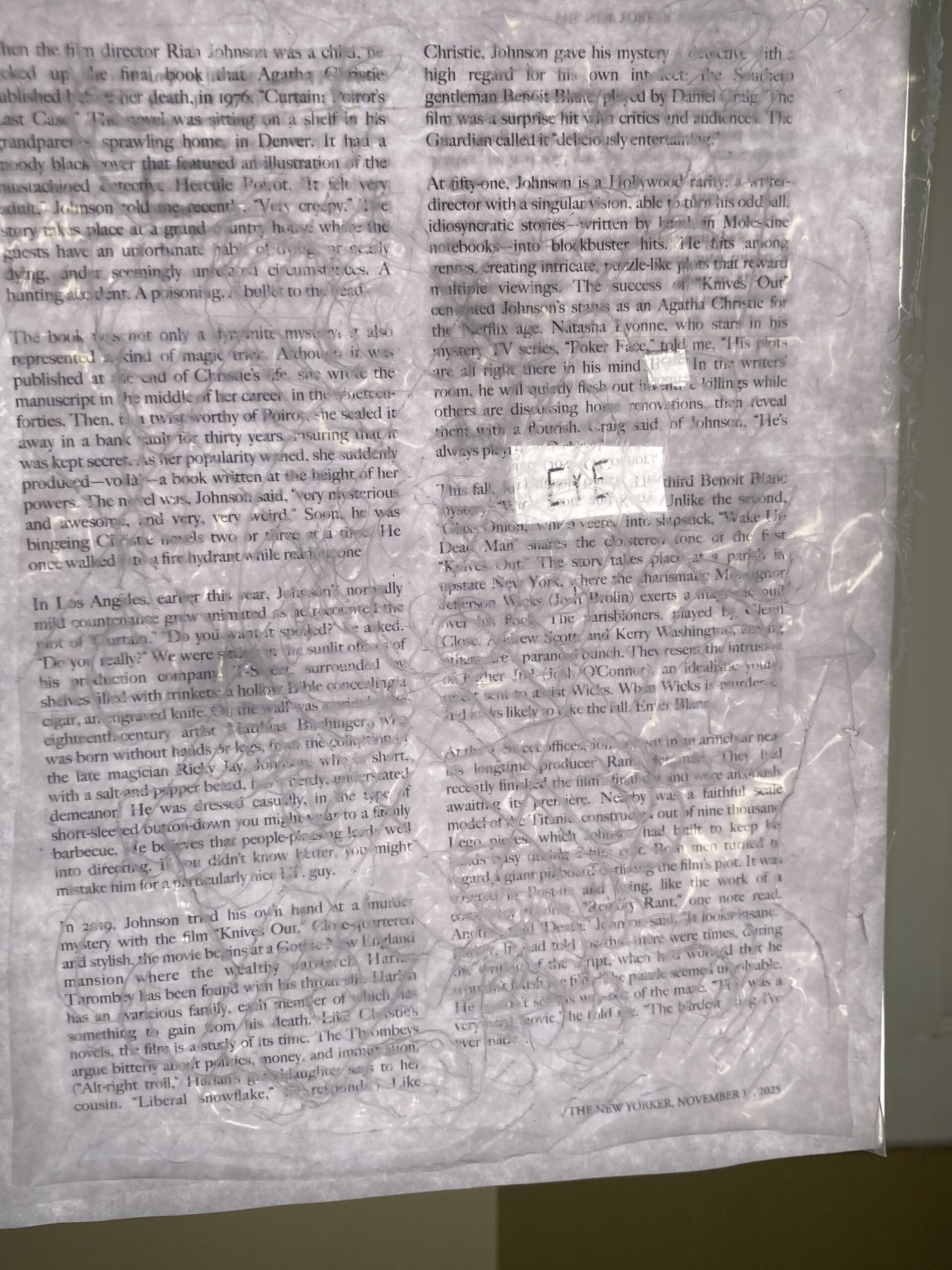
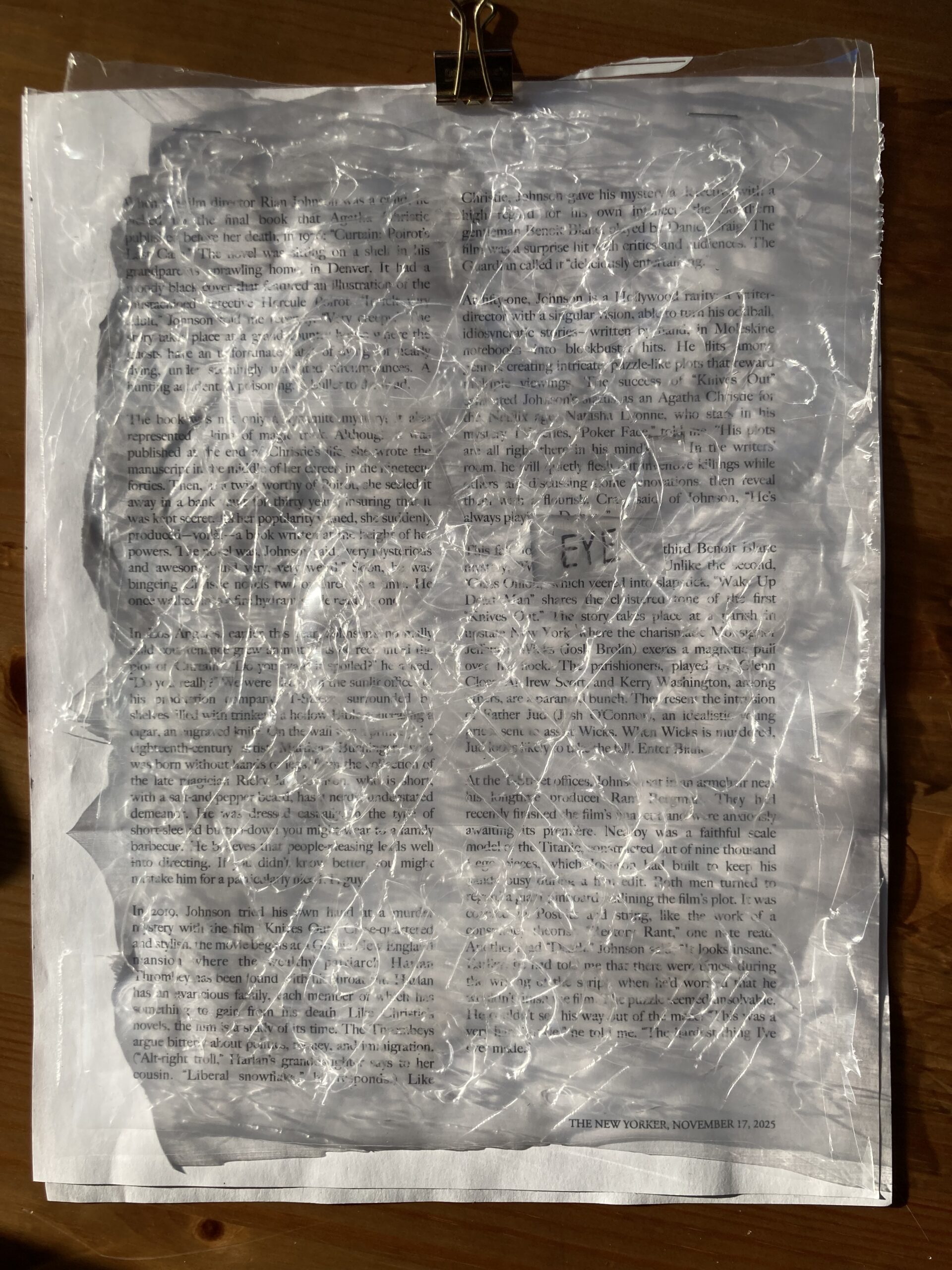
Some good ideas with the thread, but also too much thinking and theorizing and trying to fit ideas into a concept. I want to be led by the making and experimenting, not some concept. So, I returned to playing around, this time with my ziploc bag again. I like this material as the material for the hole or the effect the hole makes on words. I decided to deconstruct (that is, cut and spread open) the bag, the distress it with a pencil (drawing spirals and lines and zigzags on it). Then I realized it was almost the size of a single page: I can use it as a veil over the entire page!. I decided to create two bag sheets to make the text more difficult to read. Then I put them on 2 stacked pages of an essay — the same page. I found a word, eye, and cut it out of the one page so that you could still see it on the second (same) page. A hole in the page — I like this idea. Unfortunately, this version of it didn’t quite work; I’ll have to play with it more. Running out of time, I decided to write the word in bigger letters just to test out the effect. It needs some work, but it has potential.
a test: 2 sheets of distressed ziploc bag over text with a hole cut out to reveal a poem
For this picture, I held the papers up in front of the window with sun streaming in. I need to distress the plastic more.
same pages/poem, light source on, not through
A thought: as I work on these poems about reading, consider the light source; it strongly impacts how and what I can see. How can I replicate different levels of light, from BRIGHT to dim.
Another thought: more frequently, I’ve been placing holes on the page to erase the text, like my blind spot made out of black netting. I like the idea of experimenting with ways to cover the text, like with this distressed ziploc. I could also use layers of netting and thread grids — ones that are straight and ordered, others that are tangled and slanted.
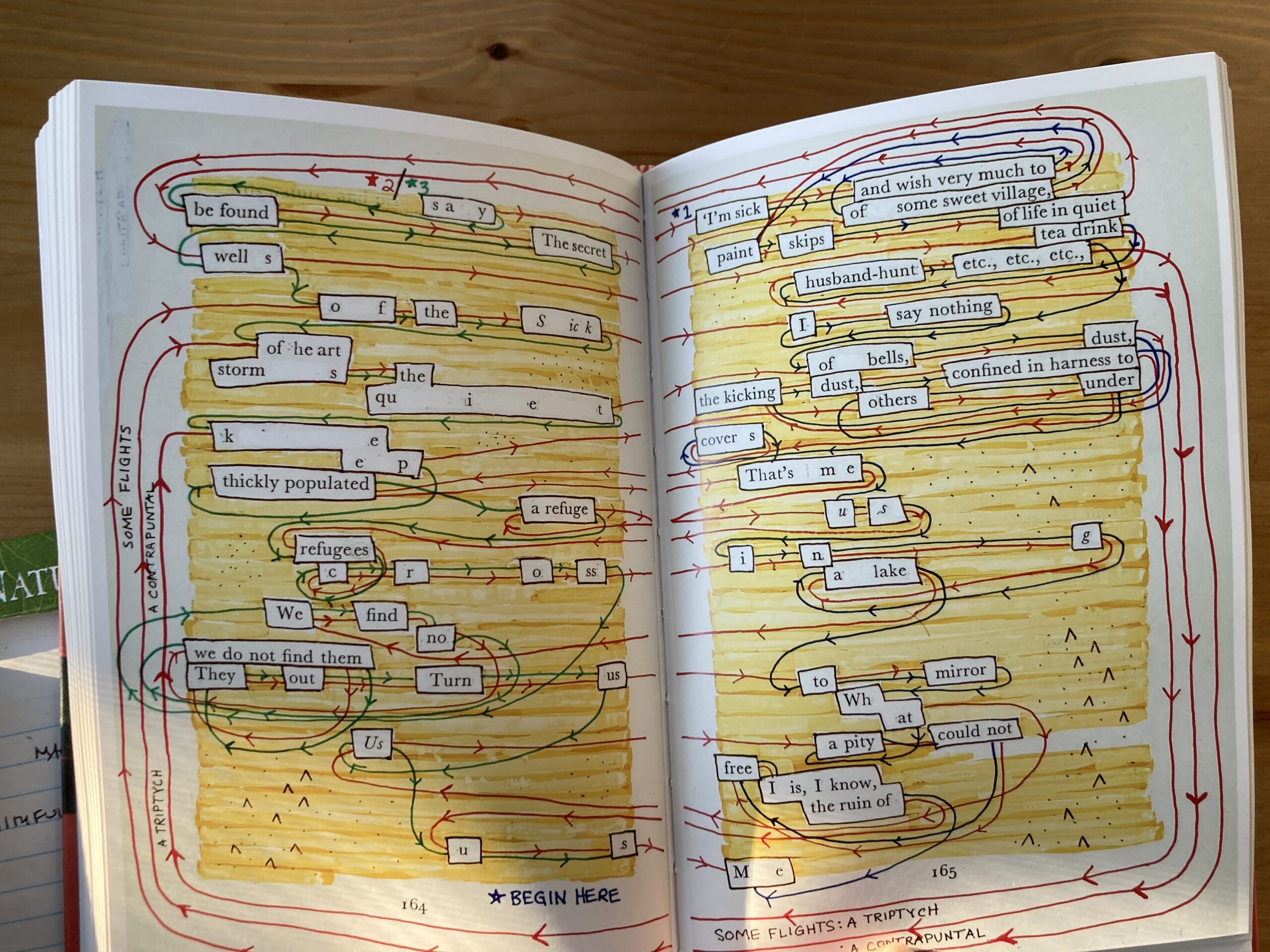
Her Read
a page from Her Read/ Jennifer Sperry
Wow, this is very cool! I’d like to use this as inspiration. I’ll have to spend some time with this to see if I can read it. I like the color and how the words for the poem are all over the place and the arrows/directions.
60 minutes Minnehaha Off-Leash Dog Park 68 degrees
Another hike with FWA and Delia. So beautiful! Today, FWA shared a realization about something that happened to him in 5th grade that was traumatic and has had a lasting impact. This realization explains so much about him and how he retreated into himself in middle school. My heart aches for that sweet, young boy! Oh, how I wish I would have recognized it when it was happening for what it was! But, I’m not sure I could have; I don’t think he even realized how much it impacted him until now.
dog names overheard: Daphne (a french bulldog); Carly (a standard poodle); and Danny, short for Lt. Dan (from Forest Gump (a corgie — Lt. Dan because he has no/short legs) and Ari (no idea what kind of dog Ari was, I never saw them, just heard their owner irritatingly calling for them ALL the time — Ari! Ari! Aaaaarrrriiii!)
10 Things
a stopped, silent motor boat
thin white foam on lapping the shore
a log floating by, looking like a beaver (at least to me)
more flashes of green
a gaggle of honking geese, first flying then landing somewhere under a bridge
a black puppy with white paws the same size as 10 yr old Delia
a dirty golden retriever jumping on me (I didn’t care)
a sweet mid-sized white dog acting like a cat, approaching then leaning into me (also didn’t care)
a new entrance to the dog park, set farther in and farther from the road
woodpeckers knocking on wood! Once, a deep and very hollow sound — FWA and I guessed it was a big bird and a very hollow piece of wood. Another time, a quicker, softer knocking, sounding like a rattling jawbone to me
Near the end I mentioned hearing a rock bouncing off a hollow spot in the packed dirt, which prompted FWA to start talking about sink holes. There are lots of sink holes all around the river. At one point during this discussion, I thought about my holes project and how our discussion fit. Here’s one way to think about it: as we talked about sink holes I mentioned (or thought, I can’t remember) how freaky the idea of a hole opening up in the ground and swallowing someone or something unsettled me. Why is this so unsettling to me? The idea of being swallowed, of disappearing without a trace, of being trapped without an escape from somewhere deep? Could it also be the falling part too? The dizziness, your stomach dropping, the total loss of control? Possibly. Three thoughts related to my Holes series:
1
Dizziness. Feeling dizzy, like I might pass out, then a soft panic after trying to read for too long, or while trying to read labels at a grocery store. More than once, I’ve stopped and closed my eyes and held onto the grocery cart to ground myself.
2
Disorientation and feeling lost. I can’t read the names of stores or restaurants on the signs outside of buildings, so it can be very hard to get my bearings in a new place.
3
Delight. This morning, I watched the scene from the animated Alice in Wonderland again and marveled (again) at Alice’s reaction to falling down the hole. As she plunges into the darkness, she looks back at her cat standing at the top of the hole, and calls out to them in a delighted and excited voice, Good bye Dinah! Goodbyeeeeeeeee! Alice is not terrified or confused. As she continues to fall, she says something like, Now I will think nothing of falling down stairs!
grids and lines and threads
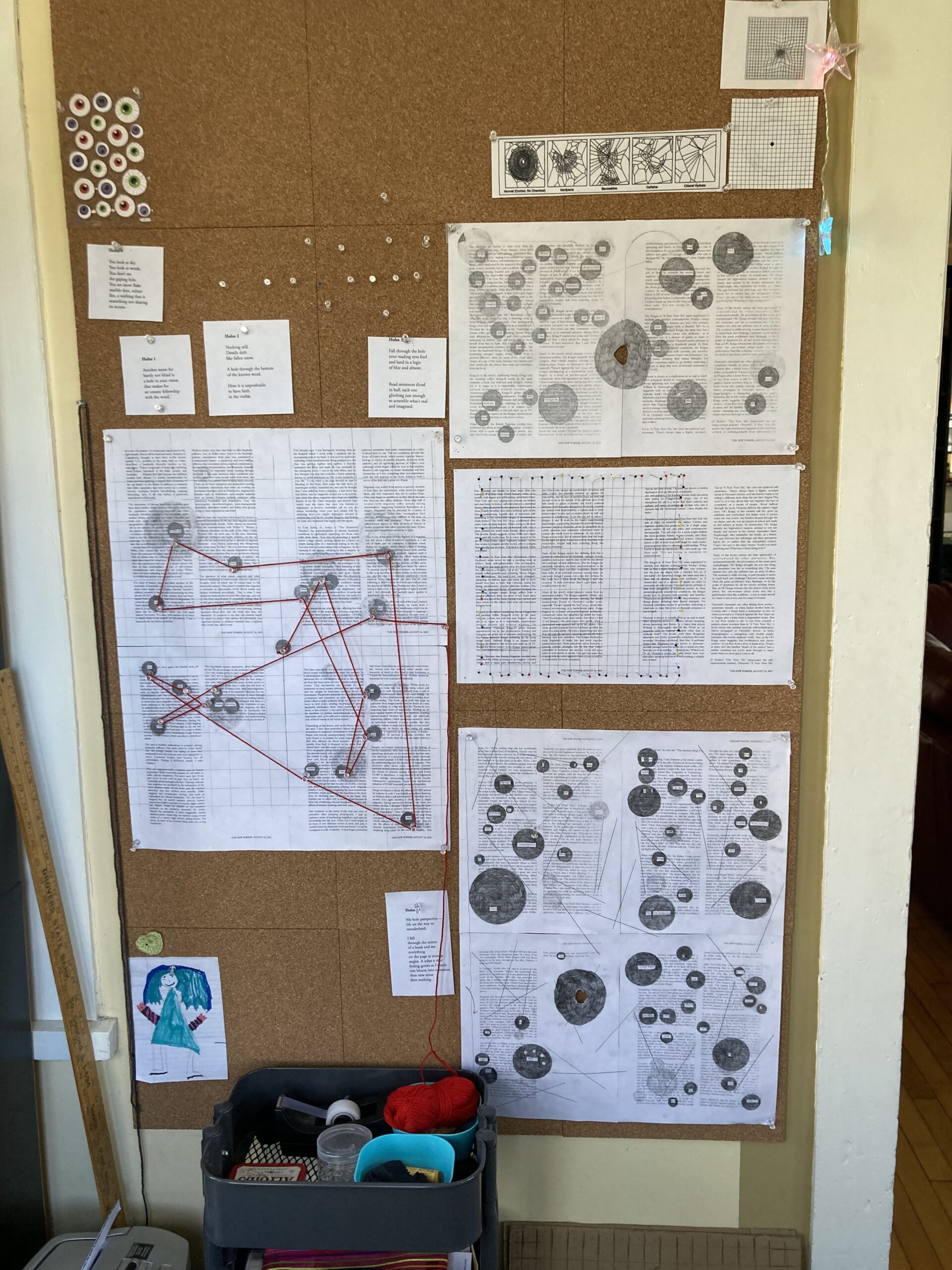
This morning, a return to thinking through the bigger picture of this series. A reminder from my thoughts from 7 april: the jacked-up spider web experiment in which NASA scientists gave spiders several different substances than studied the webs they created on those substances. A visual inspiration for this series! I’m printing out some images to put at the top of my cork board.
my cork board with the spider webs in the top right corner
Before the hike, I gave myself 3 tasks for today: 1. collect/work on Holes 5a, b, and c, also known as Hole Perspective, Hole Time, and Hole Process. Try to include “strings” or “pull the strings” in one of these poems; 2. draw/shade the dots encasing the words for Holes 3; and 3. work on the poem for Holes 6/Strings 1 — the book review about daughter’s memoirs
Holes 5a, 5b, 5c and Strings 1
Holes 5a
My hole perspective — life on the way to wonderland.
I fall through a what is this? feeling as text bloom into nonsense.
Holes 5b
hole time — measured in word (or words) one word then one then one word
Holes 5c
the hole process — a small island where reading is still possible waits as the large nothing that surrounds it grows
Strings 1
the strings that tie words to the world of meaning have come un done
I like these!
2 — Draw the holes in Hole 3
I did it. And it took much longer than I anticipated, so no third thing today. I drew larger holes and then created an elevated grid over it, first on my wall board and then on a piece of cork board on my desk. I think the holes are too big; they should be dots to match the center dot of the amsler grid and of points mapped on the x and y axis.
grid with big dots
I’d like to plot the small dots on the map of the text and then place the grid over it. I think I need to print the text directly on a graph to plot it properly — or is there another (easier?) way to do this?
60 minutes Minnehaha Falls Off Leash Dog Park 62 degrees
Another great hike beside the river and through the sand flats of the dog park. Much warmer than last time. Humid too. Not quite still, but quiet, calm, overcast. At the end of the walk, as we ascended a hill I described what I saw to FWA: the sky was bluer at the bottom of the sky near the fence; it faded to white as your eyes traveled higher. Was it just my strange vision? No, FWA saw it that way too.
We talked about one of FWA’s favorite teachers from High School. We agreed that she was one of the few teachers who really saw FWA and his neurodivergence. This led to discussing roommates and how hard it is to be understood by them when your brain is not neurotypical. We talked about our senior years of college and our desire to be done. And, like always, we talked about One Piece and other dogs and strange looking trees.
10 Things
brackish water at the beach on the edge of the park
soft sand that seemed deeper — had Minneapolis Parks dumped some dredged sand down since we were here last?
a motor boat traveling slowly up river, making waves
Delia doing my favorite thing: jumping over a log while running, her front and back paws stretched straing out like Superdog
the water looked soft and brown and flat
the faintest flashes of green all around — new buds on the trees!
a woodpecker knocking on dead wood
dots of green on the ground — moss, new grass — everywhere
rolling over several rocks on the ground — not falling or twisting anything
a woman walking a dog on a leash, calling out to them: no, you can’t! you lost your privileges when you ran away from me!
Grids
a summary: I’ve been playing around with Holes 4. I put it on my new corkboard wall and tried different thread/yarn/string. Then I played around with how to have the thread (which represents the lines of an Amsler Grid and being mapped in space/time) emerge from my blind spot in the center of the panels. Then I added red yarn and connected the words of the poem to each other.
more experiments with Holes 4 / 13 april 2026
I discussed it with RJP, which was fun, and we both decided that this black thread/red line effect was didn’t fit with the words of Holes 4. They were better suited to Holes 5 — maybe 5b? I want to print out the poems for each of these holes and post them on my board; this might help me keep track of all of them. The text from Holes 4 describes not seeing the hole or any lines, but everything as seltzer fizz and nothing that is something not sharing its secrets. That poem should have lots of little circles (seltzer bubbles/fizz) and create an optical illusion — you stare at the dark dots and then you see them everywhere else, almost like an after image. This poem might also have the words as enlarged?
note: I love my new board and being able to discuss my ideas with my kids; they have some very interesting ideas. Also, I think returning to a study of grids and learning how other people — artists and scientists — have used them could help guide my next steps.
what’s next:
I want to continue studying grids; I’ll start by reading (or trying to read) the book for the Charles Gaines exhibit.
I also want to keep pushing at my poems, so I’ll continue working on Holes 6, which is Lines 1.
And, I want to think more about lines, which means it is time for a lines/strings/thread playlist!
Charles Gaines and Gridwork
In the intoduction to the book, summary descriptions are offered for his works:
1 — Regression
28 drawing / 4 sets of 7
An arbitrary shape was chosen, and numbers were assigned to different squares of the graph according to their position. The numbers were then employed in simple arithmetic calculaitons to generate the form used in the next drawing in the sires. As the numbers threatened to overflow the parameters of the drawing, Gaines used what he calls a “radical divider” to contain teh propagation of his system. The final drawing in each set determined the starting point for the next, and so from any arbitrary starting point an infinitely expanding number of drawings could result.
Gridwork: An Introduction
Gaines was “interested in where systems fail or regress, revealing the innate contradiction of the objective or scientific enterprise. In other words, his work reveals the limations of systems.
2 — Walnut Tree Orchard
Each, a triptych — a photograph of a tree, a drawing in which the photograph is transcribed into numbers plotted onto a grid, and a second drawing that overlays all the previous grid drawings in the set onto the image from the second drawing.
This line, this series “makes visible the limits of photography, highlighting its single-point perspective, its flattening of space, gave me an idea: should I read/think about how reading happens and/or how we believe it happens, and play with that in my series?
3 — Incomplete Texts
used literary texts, picked ones that appear to supply information in a straightforward, truthful manner and submit them to processes of abstraction that complicate meaning
based on a page from Roy Nickerson’s Brother Whale he systematically removed letters from copies of they typeset page and transferred them to a grid this transformed the text into a series of fragments recalling whistles/clicks of whale song
note: It is difficult for me to actually see his grid images, so I’m struggling to understand what Gaines is doing in his different series. I want to dig deeper into his interview and other discussions of his grid system so I can understand how/why he’s using it1. This understanding might help me clarify how/why I’m using it — or, will it take me too deep into academic Sara territory?
Decided to google, “artists who use grids” and found this awesome exhibit that was at the High: Off the Grid. Very cool! I lived in Atlanta for almost 4 years and I never once went to this museum. Why not?
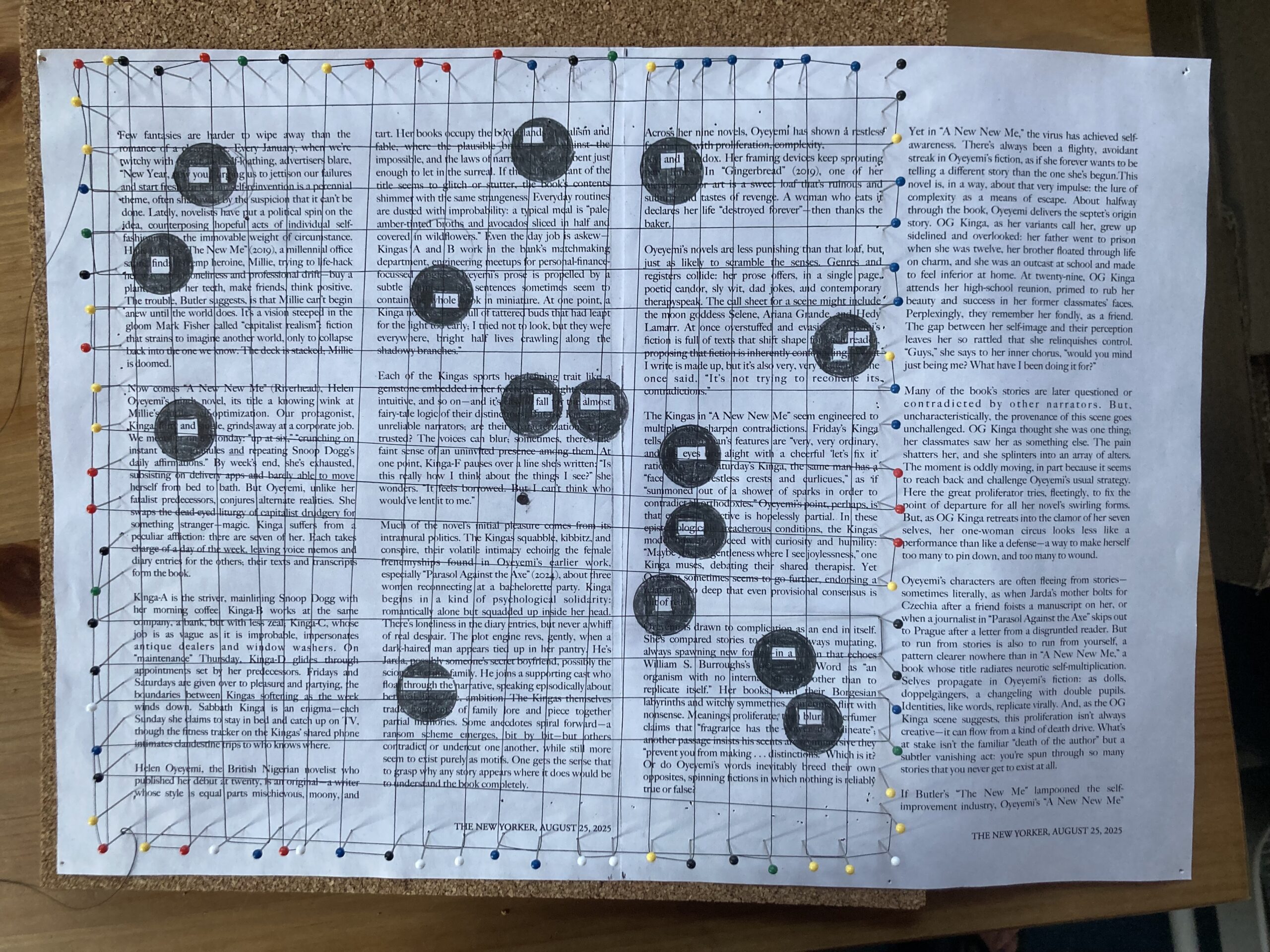
a flash of an idea: what if I turned Holes 3 into a “straight” grid, where the x-axis is blur, and the y-axis is almost. I could number the grid boxes with x and y coordinates and then have those coordinates next to the corresponding words in a poem key? I could either print out graph paper OR create a grid on the paper with string and a loom?
the poem for Holes 3:
Fall through the hole your reading eyes find and land in a logic of blur and almost.
Yes! The new experiment to try: the two pages from the New Yorker essay on a cardboard loom/grid, under a grid made out of black embroidery thread. I might add the shadow (a faint trace) of my blind spot drawn on the essay. The grid is also a graph with x-axis and y-axis named, blur (x) and almost (y). Each of the grid boxes has numbered x and y coordinates. Next to the graph/grid is a key/map with the xy coordinates. You look up the xy coordinates to find the words of the poem. Will this work? Consulting with Scott, he had some additional ideas: put the words in alphabetical order + put a pin and a number (signaling the order of words) next to the word — Scott compared it to dots on a map).
I like this idea and how it forces the reader to slow down and read the poem one word at a time. This isn’t quite how I read, but it gives a sense of how much slower I read, how many less words I can read. I also like the idea of a map, because part of why I am drawn to the grid is because of the way it enables me to locate and visualize my blind spot and vision loss.
Reading the interview will have to wait for tomorrow. My eyes are tired from what I’ve already read, which was only about a dozen pages. ↩︎
60 minutes Minnehaha Falls Off Leash Dog Park 40 degrees
With the sun, it felt warmer down in the floodplain forest, although my hands are still cold many minutes later even though I wore gloves. I don’t like the cold hands, but I didn’t mind the cold air. So many wonderful deep breaths — in and out, in and out.
The trees are still bare, so FWA and I could see far in any direction. For the entire time, FWA was telling me the story of the latest video game he’s been playing, Clair Obscura. So good — both the game (at least as I understand it from FWA’s description) and FWA’s describing of it. His excellent way of describing the games to me reminds me of how I enjoy New Yorker book reviews as something about and entirely separate from the acutal book they are reviewing. Often the review is better than the book. I’m not saying that’s true of the video game, although I guess it is for me because I don’t play video games (partly because I miss a lot details that I can’t see).1
I love hearing FWA’s accounts; he’s so good at them. They require my full attention and engagement — which is a good thing, and a hard thing (hard because it is hard to stay focused and not get distracted for that long with so many interesting ideas, and because FWA gets frustrated and can tell when I’m not fully listening). Even as I listened to and engaged with FWA’s story, was I able to give attention to the river and the trees and the bluffs? Yes! Here are 10 things I noticed:
10 Dog Park Things
at the top of a small rise: a HUGE tree with a girth wider than 2 of me could hug. Wow!
tree tableau: one tree bent over in an arch across the path, another tree leaning in and onto its trunk, the next tree in the middle of the sandy path just on the other side of the arcj
talking with some dog walkers, feeling one of the dog’s behind me, putting its snout under my coat and sniffing my butt
bright blue sky with a few fluffy clouds
a thin white foam near the shore
the sharp, foul smell of Delia’s poop as I tied up a poop bag
greeting another walker — good morning, what a beautiful day!
a pileated woodpecker, laughing
a thick wall of bare trees on the other side of the chainlink fence
a guy with 2 dogs, talking — I think into a bluetooth, but maybe just to himself?
Returning to #2 and the tree tableau: I wanted to stop and take a picture of this beautiful image but I knew that would upset and derail FWA and I’ve learned the hard way to respect that and to recognize that it is part of his ADHD/(possibly) autistic brain. I was planning to write all of this in a footnote, but then a song came on, “People Take Pictures of Each Other” from The Kinks, and I had to put it on stage, here in the text. It opens with these lines:
People take pictures of the Summer Just in case someone thought they had missed it And to prove that it really existed
Was Ray Davies reaching through time to sing this to me? Improbable as that is, wouldn’t it be cool? I guess, from one perspective, he is!
grids — lines — strings — threads — yarn
note: I began writing this after coffee and a substantial breakfast of blueberries and yogurt and granola. Lots of thoughts from here to here to here that I think was influenced by that coffee and food!
There are many ways to think about grids, and many ways that I like them. Today I am thinking about the lines and how they connect and locate and tether us to worlds, to people, to logics, to meaning and language and words. I’m thinking about this metaphorically and literally. The Amsler Grid is made up of ink lines. Can I represent it in my visual poem as string and thread and yarn?
A few minutes ago, yarn as telling a story popped into my head and I wondered what the origins of that expression were. It’s nautical:
“story, tale,” often implying “marvelous, incredible, untrue,” colloquial, by 1812 in the figurative verbal phrase spinning a yarn (also yarning).
It is said (by 1823) to be originally nautical, a sailors’ expression, from the custom of telling stories while engaged in sedentary work such as yarn-twisting
So many directions I could go with these ideas. I love this idea of thinking about the grid and the material/meaning of its lines. In a New Yorker article that I’ve already used for at least 2 (maybe 3) sections of Holes 5, the phrase, pull the strings, appears. I noticed last week and put it aside. Now I’m thinking of shifting my poems from Holes to Threads (or strings or lines). Whereas the rule with Holes poems is that “hole” had to be in the text, I’m thinking of being more flexible with this new direction: maybe, for each new essay/article that I use, I find a different name/word for connecting lines. I already have strings (from “Mystery Man”) to work with. And, I found another article, about Arundhati Roy’s new memoir that has “hole” AND “thread.”
Another related thought: Lines, especially on a rigid grid, don’t always connect us in welcomed ways. They can tie and bind and trap us too. There’s a tension with lines and strings and threads: we want to be connected, and we want to break free from the connections that do harm to us. Entangle2 and unravel. Entangle and unravel.
Okay, I started this thought in footnote 1, but I’m bringing it back up here. I’m thinking about evidence boards (or murder boards or red string boards) and how they map out a crime. I don’t see my vision loss as a crime, but I do see it as a mystery — not to be solved, but to be mapped and located and witnessed — yes, witnessed!
And now, after hiking at the dog park and eating lunch and doing the dishes, I’m attempting to return to these ideas and dig deeper into them. But, it’s hard to get back i that flow.
Maybe creating a list of tasks?
think/read/experiment more with murder boards: redo the second holes and put it on a (card)board back with yarn and pins
begin a new playlist: grids, lines, strings, threads
make a poem with strings in it out of the “Mystery Man” article
give some time to Holes 6 and its hole and thread found in the New Yorker book review, “What to Make of the Mother Who Made You?”
create the proportionately bigger scotoma template for Holes 5b, experiment with placing it or tracing it over the words of the article
revisit the erasure collection, a splendid catastrophe for inspiration
Okay, lots of ideas. Let’s return to the one we started yesterday — 5b and the two holes and figuring out how to represent those 2 holes on the page (1 hole — the very small amount of central vision I still have left, 1 hole — the fuzzy, filmy, fading/faded central vision graveyard that surrounds/encircles what’s left — hole 1 = the word / hole 2 = the void or wall or circle that encases/entombs the word and is always waiting to consume it.
A visual inspiration for the dark/light contrast in this poem and in my experience of the holes as I read words on a page:
bright eyes in the dark
In my memory, Alice’s eyes were much brighter than I can see in this image. Something to think about: my version/vision of the dark due to my blind spot is never like this; I mean, it’s not all black. When looking at faces in can be a dark, smoky/smudged gray. When looking at words, I might see a faint dark ring. Sometimes it’s fuzzy or static — it’s not Nothing; it is something that is always moving. And here’s where I can get into Alice nonsense speak: It is not that I see Nothing; I don’t know that the something that is there is missing for me. I see no thing, without knowing that I’m seeing nothing. I think I need to work on that explanation.
But, back to the inspirational image. I like the contrast and the white eyes against the background. Do I want to make my word holes look more like eyes in this one? If I can do it without looking cheesy, yes!
I hope all of this makes sense to future Sara. Now, time to create my supersized scotoma!
update, a few minutes later: I started to think about how I might create the bigger version. There are probably many ways that are obvious to people who make things, but I have not been a maker and it’s all new to me. I like the idea of re-creating the grid, just bigger. Suddenly a thought: doesn’t the artist Chuck Close do (or, didn’t he do) something like this to create his portraits? Yes! He’s one of the most famous artist-users of a grid. Minneapolis Institute of Arts (MIA) has several of his works, but none can be viewed right now. The Walker has some too — I can’t readily see if they’re available for viewing. Some deeper digging is needed.
Almost every decision I’ve made as an artist is an outcome of my particular learning disorders. I’m overwhelmed by the whole. How do you make a big head? How do you make a nose? I’m not sure! But by breaking the image down into small units, I make each decision into a bite-size decision. I don’t have to reinvent the wheel every day. It’s an on- going process. The system liberates and allows for intuition.
file this with my Holes/Grid discussion: in thinking about all the ways I’m expressing something about myself through this series, I’ll add the significance of using the New Yorker and some book reviews. I love these book reviews and the access they give me to words/worlds that would otherwise be inaccessible (also thinking of the fun section on NY events and the restaurant reviews). Using New Yorker articles in these found poems is a way to reference that; it’s also a way to be able to still read them: slow, repeatedly, in strange order, and one word at a time. ↩︎
I looked up, opposite of unravel, and found twist, knot, tangle, entangle. I love the idea of entanglement! Reading more of the Merriam-Webster entry, I read about unraveling a mystery/solving something, lessening the confusion. Yes! These ideas return to something else showing up in my visual poem: the image of a crime board — what is it called — where you put pictures of the suspects on a board and then use string or yarn to link them. I should read up on that concept some more, maybe watch some movies or shows that use it?! Is this linking used in other things that don’t involve solving a crime? How do I google that? ↩︎