may 3/RUN

5.4 miles
bottom of franklin hill and back
55 degrees

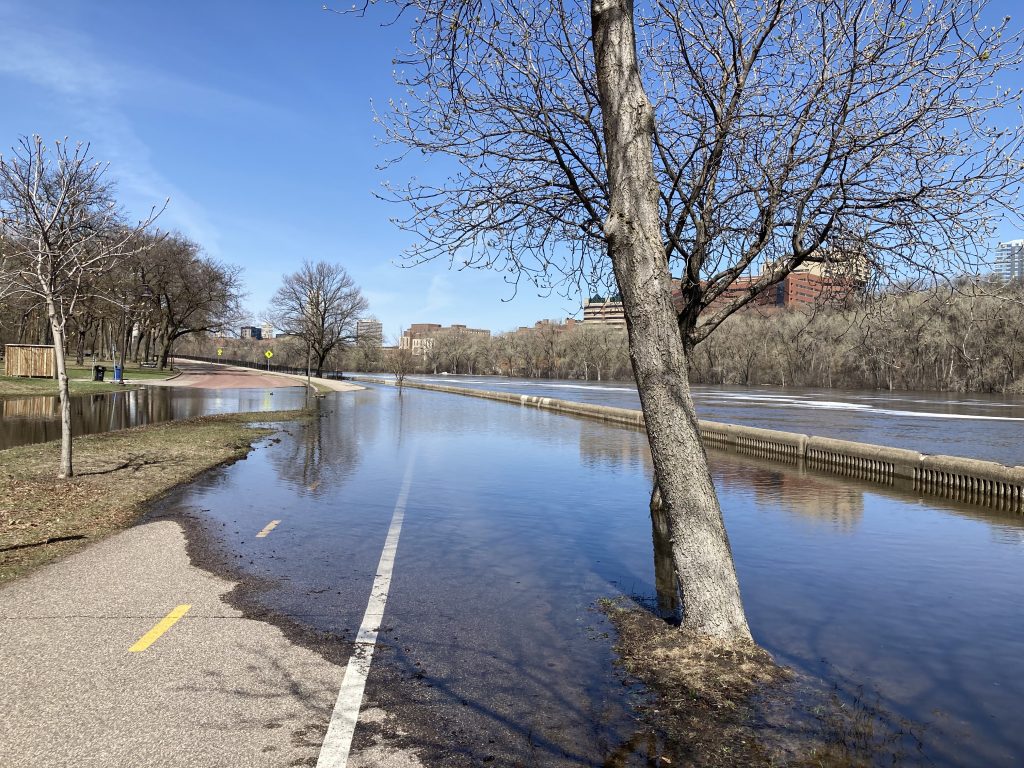
What a beautiful morning for a run! Back to shorts and a short-sleeved shirt. Could it finally be spring? The floodplain forest seems to think so, green everywhere. Saw Dave the Daily Walker, lots of runners, walkers, bikers. Heard some black-capped chickadees and woodpeckers. Smelled some cigarette smoke. The trail is open again in the flats. The river is still high and moving fast but it’s not passing over the railing and onto the road. Ran to the bottom of the hill, stopped to check out the water, put in the soundtrack to “Dear Evan Hansen” (we’re playing it in the community band I’m in), ran up the hill, then, on the way back, ran down on the Winchell Trail. I had to step carefully because the path was slanted with a steep drop off.

During the run, I had several feel good/runner’s high moments. So nice!

Running north, somewhere above the white sands beach, I started thinking about something I was working on earlier today about how my changing vision is closing some doors, opening others. I’m particularly interested in thinking about how it opens doors without ignoring/denying the shut ones too. Anyway, I suddenly had a thought: it’s not just that it opens doors, but it makes it so those doors can’t shut. I waited until I reached the bottom of the hill and then spoke my idea into my phone. Here’s a transcript:

It’s not just that doors open, they won’t shut. I can’t close them to the understandings that I’m both forced to confront but also have the opportunity to explore. But the key thing is that the doors can’t be shut.

my notes recorded during a run on 3 may 2023

I came to this idea after thinking about how vision is strange and tenuous and a lot of guesswork for everyone. A big difference between me and a lot of other people is that I can’t ignore or deny that fact. It’s much easier for people with “normal” vision to imagine, with their sharp vision and their ability to focus fast, that they are seeing exactly what is there. They’re not. Even if I wanted to, I can’t pretend that that is true. I’m reminded all of the time of how tenuous converting electrical impulses into images is and what the brain does for us to make those images intelligible.

Mary Ruefle

Before the Run

I’m trying something different, or maybe it’s not different, just something I often do without recognizing it as an approach: I’m following a wandering path through Ruefle’s work that is not systematic, but seems to suddenly appear as I encounter ideas, words, lines from other poems. This morning, during my daily routine of reading the poem of the day on poets.org, then poetryfoundation.org, then poems.com, I found a wonderful poem that features the color red. Red I said, then thought, why not read Ruefle’s sadness poem about red for today? So I will. First, the poem that set my course:

A Tiny Little Equation/ Shuri Kido

Translated from the Japanese by Tomoyuki Endo & Forrest Gander

For whom is (the evening glow)
“red”?
To human eyes,
the red wavelength shimmering in the air
is reflected,
but to the eyes of birds
which recognize even ultraviolet rays,
the evening glow looks much paler.
And when all the lives on Earth are finally snuffed out,
and the human solstice has passed,
every color will cease to “exist.”
As clouds pile up densely above the sea,
kids get restless
feeling some sort of invitation.
On such occasions, when you’re unable to read a “book”
while splashing around in the sea or river
as though dancing with water gods,
you’ll notice beads of water on your skin
reflecting the world.
In such an optical play,
the summer vanishes;
some people have gone off
with the water gods
and have never come back.
Textbooks, left on a desk unopened,
hold on to their tiny equations.
When each and every living thing has lost its life
and there remains not a single being,
for whom is (the evening glow)
“red”?

This poem! For whom (is the evening glow) “red”? Okay, this will be the next poem I memorize. I want to own every word of it. Should I try to fit one of its lines in my colorblind plate cento? I’ll think about it.

Now, Ruefle’s red sadness:

from My Private Property/ Mary Ruefle

Red sadness is the secret one. Red sadness never appears
sad, it appears as Nijinsky bolting across the stage in mid-
air, it appears in flashes of passion, anger, fear, inspiration,
and courage, in dark unsellable visions; it is an upside-
down penny concealed beneath a tea cozy, the even-tem-
pered and steady-minded are not exempt from it, and a
curator once attached this tag to it: Because of the fragile
nature of the pouch no attempt has been made to extract
the note.

as an aside: In my initial typing up of this poem, I left out the is in the first sentence: Red sadness the secret one. I do that a lot, leave out words. I think it’s partly that my failing vision makes me sloppier, but I wonder if it’s not also because my way of reading/thinking has changed, become more abbreviated. I cut out the unnecessary words, worry less about full sentences, want more condensed, compact ideas. I’m tired of extra words — literally, it hurts my brain when I have to read so many words, but also figuratively, having spent so many years wasting all of my energy on finding the right words (right = smart enough, fancy enough, researched enough) to make an argument that finally maybe almost gets to the point. I also like using less words like a fun experiment — how many words do we actually need in order to understand something or to communicate an idea?

I need to think more about this poem and what it means or does. In the meantime, while searching for an online version of this poem (so I wouldn’t have to type it up myself), I found another red poem by Ruefle. I’ve read it before.

Red/ Mary Ruefle

I fucking depended on you and
you left the fucking wheelbarrow
out and it’s fucking raining
and now the white chickens
are fucking filthy

note: Future Sara, and anyone else reading this, I recommend listening to Ruefle read this poem on the poetry foundation site (link in title). The way she spits out fucking is the best.

another note, 9 oct 2023, from future (but now present) Sara: thanks past Sara! Reviewing this post for a class I’m teaching, I came across the note and listened to Ruefle read “Red.” So fucking great!

Ruefle’s poem is a response to William Carlos Williams iconic red wheel barrow poem. I know that tons of poetry people have studied/obsessed over this poem and have tons of great (and not so great) ideas about what it means. I have not, and am not entirely sure what Ruefle intends/means with her poem. I like it anyway. Maybe she’s sick of all of the attention it’s received?

Read WCW’s poem and Ruefle’s side by side on this twitter thread.

On that same thread, I also found these lines from Fiona Apple and her song, “Red Red Red”:

I don’t understand about complementary colors
And what they say
Side by side they both get bright
Together they both get gray

But he’s been pretty much yellow
And I’ve been kinda blue
But all I can see is
Red, red, red, red, red now
What am I to do

Now it’s time to go out for a run. I’ll try to find red.

During the Run

10 Red Thoughts, Ideas, Things Noticed

  1. the deep and sharp bark of a neighbor’s dog — a red bark, I thought
  2. a red stop sign
  3. a walker up ahead of me, rounding a corner and heading out of sight, a red sweatshirt around their waist
  4. a roller skier in bright red shorts — tomato red
  5. my raspberry red shoes striking the ground
  6. graffiti on a sewer pipe drip drip dripping water, letters in rusted red
  7. a biker in a red shirt zooming by
  8. my face under the bright shadeless sun, a ruddy red
  9. a moment of tenderness inspired by swelling music, a runner’s high, and last night’s haunting and strange dream about cradling my mom’s head not too long before she died: the soft glow of a warm red heart
  10. car, car, car, truck — all red (at least in my head)

A funny thing about looking for red: I found it everywhere. Today anything that registered as a color other than blue, green, brown, or gray was red. Red cars, red shirts, red leaves on the trees from last fall. No orange, hardly any yellow, all red. Red red red.

may 1/RUN

4.35 miles
minnehaha falls and back
47 degrees
wind: 27 mph

Ugh, the wind! A few times it felt like I was running straight into it. Almost took my breath away. The falls were falling — were they roaring? I can’t remember what they sounded like. The creek was flowing. The park was crowded with walkers and hikers and bikers. I stopped at my favorite spot, took off my sweatshirt, and put in my coming back from injury playlist, which starts with “Back in Black.”

Running south, listened to the black-capped chickadees, the howling wind, a loud wave of kids voices yelling and laughing at the school playground. Running back north, listened to a playlist — “Back in Black,” “Upside Down,” “Fantastic Voyage,” “I’ll Be There,” and “Let’s Go Crazy.”

favorite image of the wind: the leaves whirling and swirling and scattering just in front of me as I ran northwest

least favorite image of the wind: running straight into the wind, my cap bending with the force, my nose closing up from the dust, one of my feet being pushed into the other, finding it difficult to breathe

May with Mary (Ruefle)

Today is the first day of a new month and the start of a new monthly challenge! For May of 2023, I’ll be spending time with another Mary, not Mary Oliver, but Mary Ruefle. Inspired by a tweet last week about Ruefle’s series of poems on the sadness of color, I ordered 2 books of hers that I’ve been thinking about getting for a few years: My Private Property and Madness, Rack, and Honey. I’m very excited!

I thought it might be interesting for me to record my reading/thinking/wandering process with Mary this morning. Perhaps the only person who will appreciate it is future Sara, but that’s okay. I find my wandering process to be fascinating, messy, very energetic, and an accurate reflection of how I encounter and engage with ideas. It’s easy to forget the path it follows, hopefully tracing it here will help.

Since I don’t have a full plan yet for how to read Ruefle, I decided to start by skimming through My Private Property. The third prose poem is, “Please Read,” which might be my first encounter with Ruefle, years ago when it was the poem of the day on poets.org. I had bookmarked it, intending to post it on here someday. Today is not yet that day.

Two pieces later (what do you call her writing in this book? Fragments? Mini essays?) is one of two writings from her that I’ve already posted on here: Observations on the Ground. It would be interesting to read this bit, from the middle of the essay (I’ve decided to call her writing in this book essays, at least for now), beside A. R. Ammons and garbage:

Besides burying the dead in the ground, we bury our garbage, also called trash. Man-made mountains of garbage are pushed together using heavy equipment and then pushed down into the ground. The site of this burial is called a landfill. The site of the dead buried in boxes is called a cemetery. In both cases the ground is being filled. A dead body in a box can be lowered into the ground using heavy equipment, but we do not consider it trash. When the dead are not in boxes and there is a man-made mountain of them we do use heavy equipment to bury them together, like trash. It is estimated that everywhere we walk we are walking on a piece of trash and the hard, insoluble remains of the dead. Whatever the case, the dead and the garbage are together in the ground where we cannot see them, for we do not relish the sight or smell of them. If we did not go about our burying, we would be in danger of being overcome.

“Observations on the Ground”/ Mary Ruefle

Next I read one with an intriguing title, “A Woman Who Didn’t Describe a Thing If She Could,” which had a similar approach to describing things as does “Observations” — from the outside, making no assumptions or judgments or reliance on cultural shorthand (shared things that we all are supposed to know and agree upon as true — is that another way of saying assumptions?).

Then I came across a photocopy of an image from her notebook titled “April’s Cryalog,” which I immediately recognized as part of an essay of Ruefle’s I had read sometime this year, Pause. It’s about menopause, which seems to be starting for me. No thanks. I have the vaguest sense of how I encountered this piece, but it’s too fuzzy to put into words. Did I encounter it in a tweet? Was I searching for poetry about menopause? Anyway, when I first saw this image I immediately stopped reading/skimming the book to look for the essay in my reading list document, which is where all of the poems, essays, articles, tweets go after languishing on my “safari reading list” for weeks or months or years. Of course, if I had just turned the page, I would have seen the essay right there, printed in My Private Property.

Searching through the reading list, I also found a quote from Ruefle that I had saved about the eyes of a poem being more important than its mouth. I looked it up and discovered it’s from “On Theme” in the other book of Ruefle’s that I bought: Madness, Rack, and Honey.

I could reread the menopause essay or keep skimming, but I think I’ll read her lecture from Madness, Rack, and Honey: “On Theme.”

“On Theme”

I’ll attempt to offer some sort of summary: Mary Ruefle doesn’t like themes, especially what happens to them as they grow older and get applied to things beyond their original scope, which is that they lose not only their original meaning but any connection to that meaning. The original idea gets distorted, shrinks. Without getting into the many examples (her parent’s Indian inspired suburb, family fun day with the simple Shakers, Victorian home decorating in the 20th century), I’ll add this: she especially doesn’t like themes in poetry and the trend she observes in poetry journals requesting poems about endless topics: “AIDS” “quilts” “dogs” “sailing” …

But, as I try to continue this summary, I’m realizing that summarizing — the trimming down of her words until they fit in the neat little box of 1-2 sentences — is not the right approach. The meaning and purpose — the magic — of her words is found in all of her random examples, her orbits around her topic, “themes.” To leave those out is to reduce the meaning of her ideas/words.

All of this close reading and summarizing is causing me to spend more time on this essay than I’d like and giving me flashbacks of being an academic. Let me try another approach: I read this essay because it had a quotation in it that I’d was struck by and that a lot of other poetry people liked. I wanted to find the original source of the quotation in order to understand it better, or at least not extrapolate with it (this is a word Mary Ruefle uses in the lecture) to some meaning that completely loses its origins. Here’s the passage:

Auden said a poem should be more interesting than anything that might be said about it. If you take the theme out of a poem and talk about that theme, there should still be some residual being left in the poem that goes on ticking, something like, why not say it, color, something that has an effect on your central nervous system. It is not what a poem says with its mouth, it’s what it does with its eyes.

The passage comes just after a discussion of how impossible it would be to organize books around themes — must I buy 3 copies of each book to ensure that it is placed in all of the themes to which it belongs, she wonders. She concludes that organizing by theme is as arbitrary (and ridiculous) as organizing them by color to match the decor of the room. Then, she offers the Auden passage. After it, she abruptly turns to a rant about the endless calls for poems in “any poetry trade rag.” Then she moves to an interesting discussion of how theme has shifted from meaning topic/subject to attitude, which assumes a someone behind the idea/attitude. And, I’ve decided to stop here because I do want to understand what she’s saying, and it will take longer.

Here’s where I am with the essay and her passage right now: why is this passage so popular with poets? Perhaps I’m not quite getting it yet, but it feels like when people pluck this passage out of the rest of this essay without any context or explanation beyond, it’s good craft advice, they’re performing what Ruefle is railing against: taking an idea and extrapolating with it in a way that shrinks/loses the original meaning. Is Ruefle playing a joke here?

A few more things:

  1. I can’t quite remember, but I think I bookmarked Ruefle’s passage initially because I didn’t like it and the idea of the senses being reduced to the eyes — what the poem does with it eyes.
  2. This lecture seems to be responding to the current state of poetry as a field of study (as of 2012). I’m less interested in conversations about the direction of poetry and literary magazines or young poets vs. old poets. Really, I think I’m only interested in this passage with the mouth and the eyes — why it gets shared so much, what it means, and whether it means what people who share it think it does.

Not today, Satan!

Yes, twitter has too many problems. But it still has poetry people who tweet wonderful poems that they plan to include in their, “Not today, Satan” anthology, so I’m not quitting it just yet.

What I Am Telling You, Jessica, Is That Those Chickens Are Fine/ K.T. Landon

for Jessica Jacobs

You say that a poem that contains a fox
and a henhouse must, at some point, include
a slaughtered chicken, that the rifle on the mantel
must go off in Act Three. But what I am telling you
is that my neighbor has built his coop to last
and surrounded it with a sturdy double fence
of chicken wire, and that that fox is out of luck
this time. And I know that good news for the chickens
is bad news for some vole or field mouse or hapless
housecat. So maybe all I’ve done is point that gun
in another direction or into another poem, but this
is a poem in which no chickens will die. A rabbit
will bound across the road and the car will slow
in time. The fox will discover the trampoline behind
the house next door and with it the wonder of flight.
Everyone I love will live and call me after supper
to say goodnight. My neighbor is a good man,
a minor god who has brought forth a paradise
for chickens. And I know those chickens, clucking
contentedly in their self-important obliviousness,
are too foolish to be a metaphor for hope
(though isn’t hope always foolish?) but in this poem
the chickens stand for joy—for feed scattered
with a free hand and fresh water in the trough,
for a swept house and a warm nest, for the sun
and the breeze and friends to admire your glorious,
feathered self and this single, glorious day.
And we’re in pretty deep now, aren’t we,
speculating about the Inner Life of Chickens,
but can you doubt, watching them watching us,
that they have one? That they, too, understand
the urgency of this still and incandescent moment
that is here and leaving already? I know
it’s not always this way. The gun goes off
eventually. One night the latch will fail to catch
or a hinge will rust through, and the fox will bring
terror and death, as foxes do. Every story ends
with a corpse. But, Jessica, it’s not Act Three yet.
My neighbor, the chickens, the fox, you, me—
we love what we love for as long as we can.
Right now, in this blue and breathing hour
that shines inside us all, those chickens are fine.

Do I love this poem enough to add it to My 100 list of memorized poems? Maybe. Although, as I type this, I’m thinking it could be fun to compose a cento with lines from my favorite darkly hopeful poems. I think I’ll call the poem, “Not today, Satan.”

One other thing to add: when I read this poem to Scott this morning, he was convinced that the Jessica in it was JB Fletcher. Nice!

april 28/RUN

2.5 miles
river road, south/north
49 degrees / light rain

Thought I’d be able to get a run in before the rain returned but I was wrong. I didn’t mind the rain; I was wearing a cap with a long enough brim to keep my face dry and I had tights and long sleeves covering my arms and legs. There were very few people out on the trail. No runners, only a few walkers.

Listened to my “running: summer 2014” (which is different from my “summer 2014” playlist — why? not sure) as I ran, so I missed out hearing the splashes and whooshes and soft raindrops hitting the grass.

I know I looked at the river at least once, but I can’t remember what it looked like, other than that it was still high. Saw lots of cars, many of them with their headlights on in the wet gloom. The asphalt felt slippery, slick with rain and mud and grit. The path was full of puddles and menacing cracks. At least once I stutter-stepped when I miscalculated my stride and almost stepped in a whole. Twisted or rolled-over ankle narrowly avoided!

A. R. Ammon’s garbage

Just tried to finish the last section of garbage. I’ll have to try again on some other day — or never? So difficult to keep my eyes on the page, my mind on his meandering words. Maybe instead of finishing the book, I’ll return to some things in it that I find particularly interesting, like (the following are all phrases or paraphrases from sections of garbage)

Energy and motion. The spindle of energy, motion as spirit, all forms translated into energy: value systems, physical systems, artistic systems, from the heavy (stone) to the light (wind) and back again. Loops, returns, the constant recycling of stone to wind to stone, waste into something new then returning to waste, using words to find a moment of the eternal, losing it again, the words becoming waste to break down and rebuild. Always motion, flow, decomposing, returning. Always behind it all, the relief of indifferent stars: twinkle, twinkle: just a wonder. And old people dying, bodies falling apart, individual existence ending. All of it happening, whether we believe in or not. All of us motion: a whirlwind becoming gross body, all navel and nipple and knee, then vaporized, refined, distilled into a place not meaning yet or never to mean.

A few days ago, while searching around for interesting journals for submitting my work, I came across a wonderful essay (is it an essay?) in a very cool journal: Notes on Energy in A Velvet Giant. I love all the different definitions of energy that the author plays with in the piece. I want to remember it, and think more about it in relation to garbage and Ammons and energy in its many understandings.

april 27/RUN

5.3 miles
franklin hill turn around
58! degrees

Overcast, but much warmer today. I wore shorts and a short-sleeved t-shirt. Excellent. Greeted Dave, the Daily Walker, passed Daddy Long Legs. Noticed the river was all white foam and milk chocolate — or, did it look more like a latte? I’m breaking in a new pair of running shoes. My old ones (worn for 9 months, about 750 miles) died, that is, on both shoes, at the widest part of my foot where my bunions are, the shoe has ripped away from the rubber bottom. I remember feeling like something was flopping in my shoe when I was running 6 miles at the beginning of the week. At home, after the run, I checked. Yep. RIP black Saucony Rides. My new ones, which are also Rides, are white with bright blue laces, red tongues, and orange stripes. They look a bit dorky, but they were 1/2 the price of the other options, so I don’t care. With my vision, I can’t see color that well anyway.

peripheral vision

Straight on, the gorge looked gray, brown, green so dark it didn’t look green but dark gray or black. But out of the corner of my eye, I could see pops of bright green. Green at my feet: little sprouts shooting up. Green by my ear: new slick leaves unfurling. Green everywhere whispering hello.

Speaking of color, here’s a few I noticed: a runner in a bright blue pullover, another runner in a glowing bright yellow shirt.

River update: the river road in the flats is still closed, but the water seems a little lower, with more open road. How long will it be closed, I wonder?

Listened to woodpeckers and sizzling sand under my feet running north. Put on my “summer 2014” playlist running up franklin hill and heading south.

Yesterday, I memorized Sylvia Plath’s wonderful poem, Mushrooms. Why was it so difficult to memorize? I found a youtube clip of her reading it, which helped, especially with the lines, so many of us/so many of us. In her reading, she stresses the of. What a difference! Without her guidance, I would have stressed the so.

Ammons’ garbage

Returned to Ammons yesterday afternoon and this morning. Here are some passages from sections 17 and 18 that I’d like to remember:

from 17

poetry is itself like an installation at Marine

Shale: It reaches down into the dead pit
and cool oil of stale recognition and words and

brings up hauls of stringy gook which it arrays
with light and strings with shiny syllables and

gets the mind back into vital relationship with
communication channels: but, of course there

is some untransformed material, namely the poem
itself; the minute its transmutations end, it

becomes a relic sometimes only generations or
acts of countrywide generations can degrade:

a real stick in the fluencies: a leftover light
that hinders the light stream: poems themselves

processing, revitalizing so much dead material
become a dead-material concentrate time’s

longest actions sometimes can’t dissolve: not
to worry: the universe is expected to return

and the heat concentrate then will ashen wispy poetry
wispier: actually, the planet is going to
be fine, as soon as the people get off:

from 18

you can’t classify except by
breaking down: some people say some things are

sacred and others secular and some say everything
is sacred or everything is secular: but if

everything is sacred (or secular), then what is
that: words, which attach to edges, cannot

represent wholeness, so if all is all, the it
just is:

accepted!

Returned from my run to discover that 2 mood ring poems I submitted earlier this week for a journal have been accepted! Also this week, a fun poem I wrote about the swan boats at the lake is coming out. What a wonderful dream to be a published poet, especially with poems that are so important to me. I’ve had 5 snellen chart poems published and now 4 mood rings. Hopefully, I can get some colorblind plates ones published soon too.

april 21/RUN

5.5 miles
franklin hill turn around
38 degrees
snow flurries

Strange weather. Overcast, then sun, then snow pellets — graupels. A few times, I saw the faintest trace of my shadow. Almost impossible to believe that a week ago it was 67 and I was running in shorts and a tank top.

Ran through the tunnel of trees and noticed several of the trees had bent branches. Still attached but split. I only noticed them because of how the split part was much lighter than the rest of the tree. As I ran by, I kept seeing flashes of light where a branch was bent. A strange sight. Must have been all the wind last week.

Looking down from high up on the gorge, I could see how full the river was. Water stretching far into the floodplains, moving fast downstream. Lots of white foam. I tried to think of what metal to compare the river to, but decided it was too dull to be metallic. It looked like chocolate milk (and not in a good way, if there is a good way to look like chocolate milk). At the bottom of the hill, the water wasn’t any higher than it had been on Monday.

There were 2 runners on the hill doing hill sprint repeats. Both running fast. Most vivid image: one runner (who might have been Olympian Carrie Tollefson?) sprinting up the hill, her greenish-gray gloves rhythmically moving back and forth as she pumped her arms.

Greeted Dave the Daily Walker at the beginning of the run — Good morning Dave! Passed Daddy Long Legs — in black with a bright orange jacket — at the top of the hill.

I can’t remember listening to anything on the way to Franklin, listened to “swim meet motivation” playlist on the way home.

Had some fleeting thoughts about my vision poems — now in 3 different forms: Snellen Charts, Amsler Grids with scotomas, and Ishihara colorblind plates — and how to put them altogether. Then I started to think more about forms and how it’s difficult for me to see/read some of my own poems, how certain forms are dissolving as words become more difficult to read. I wondered what it would like, sound like, feel like, to write even sparser poems, with even fewer words?

A. R. Ammons’ garbage

I’ve lost a little momentum with the final sections of garbage — too meandering? I’ll try to finish it, but not today. I have about 20 pages left. First, Ammons’ full name = Archie Randolph Ammons. Second, I decided to return to the poem that inspired me to read garbage in the first place: “Corsons Inlet.” I’m hoping that reading so much of garbage might give me more insight into “Corsons.” Reading it again, just now, I’m reminded of a line and a poem that I was reviewing this morning as I attempted to re-memorize it: Rita Dove’s “Voiceover” and the opening lines:

Impossible to hold a landscape in your head.
Try it: all you’ll get is pieces.

And here are some parts of Ammons poem that fit with Dove’s lines:

Overall is beyond me: is the sum of these events
I cannot draw, the ledger I cannot keep, the accounting
beyond the account:

and

but in the large view, no
lines or changeless shapes: the working in and out, together   
and against, of millions of events: this,
so that I make 
no form of
formlessness:

and                       

I will try
to fasten into order enlarging grasps of disorder, widening
scope, but enjoying the freedom that
Scope eludes my grasp, that there is no finality of vision,
that I have perceived nothing completely,
that tomorrow a new walk is a new walk.

april 20/RUN

3.65 miles
locks and dam #1 hill loop
38 degrees

It’s supposed to rain all day, starting around 9 am, so I went out for a shorter run at 8. Made it back before it started. Dark and damp. Long line-ups of cars, commuters heading to work, I suppose. I liked watching their bright headlights cut through the gray air. At 42nd street a runner whose cadence sounded much faster than mine passed me. I enjoyed watching the steady, relaxed rhythm of her feet rising and falling, up down, up down. Such grace!

I remember looking at the river and wondering how high it was, but I don’t remember much else about it, except: at the bottom of the locks and dam hill, right by the closed gate, the water was foaming and contained some trash. Yuck.

Heard traffic rushing by, water gushing out of the sewer pipe at 42nd, and my feet shuffling on the grit as I ran south. After running up the hill I stopped to put in music — Kool and the Gang Essentials — and discovered that the soft rubber for my right ear bud was missing. Bummer. Decided just to put the left one in and listen to the gorge and Kool and the Gang as I ran back north.

Yesterday I finished a solid draft of my 8th Ishihara plate poem. Hooray! Very happy with it, especially how I was able to finally (after 2 years of trying) to find a place for a lovely image of the sparkle a swimmer makes as their hands enter the water and light bounces off the ripple they create. Here’s my description in the poem, which I’m tentatively titling, “The Glitter Effect”:

all around swimmers’ hands pierce the 
water, stroke after stroke. Each point of contact be
tween lake finger and light sparks in amber and bu
ilds a glittery bridge from body to body to body 
until we reach the other side.

Should it be sparks in amber or sparks amber? Maybe it should our hands instead of swimmers’ hands? And, what about until the other side is reached? (too passive?)

I also like the ending, although I think the poem might need to do a little more work to get to it:

This is not a 
poem mourning the loss of cone cells. 
This is not even a poem. Th 
is a compass.

Maybe it should be, This is not even a poem, but a compass or This is not even a poem. It is a compass?

Found this poem the other day. Birds!

How Far Away We Are/ Anushka Shah

After “How Far Away We Are,” by Ada Limòn

So we might understand each other better,
I’ve given up on trying to listen for birds
in the morning. But, I am never without them.
The internet is a pocket forest: a green parrot
named Tico who harmonizes in soaring vibrato
to classic rock songs, woolen baby emperor penguins
with prehistoric feet, potoo birds whose fluty songs
haunt even after their diamond mouths close,
a raven named Fable who inflates her blue-black head
feathers before she declares practiced “Mwahs!”
in the same tone as her keeper, and a cockatiel
who sings an Apple ringtone (you know the one)
when it’s upset. How incredible it is that they all
perch together. How to tell you: It’s been years since
I’ve wanted to die, but I still don’t understand why
sometimes it feels so difficult to brush my teeth,
start my day, end my day. Why I always miss you,
but sometimes I can’t even think of you. Why, when
we are separated, when my mind is difficult,
birds are easy. Today, after watching ten videos
of hummingbirds before noon, I feel light enough to push
off my comforter’s irresistible smother and flit around
the house. I want the whir of a sequined green body,
red-adoring eyes, and narrow tongue coiling into skull,
as much as I want the steady sleep-twitch of your
warm body pressed against me. I’m passing this idea
to you: One day, maybe we could plant zinnias
and cardinal flowers in a ruby cluster and wait
for hummingbirds to unfurl and flick their tongues
into an easy sweetness. We could fill two glasses
with cold water and put them on the nightstand.
We could watch together, even on a palm-sized screen—
floating swans, a white, crested pet pigeon waddling
herself to bed, sprinting ostriches, a parakeet father
insistently squawking, “iloveyoubabies gonnafeedthebabies.”

Lines I love and want to remember:
The internet is a pocket forest:
when my mind is difficult,/birds are easy.
I want the whir of a sequined green body,/red-adoring eyes, and narrow tongue coiling into skull,

follow-up, a few hours later: Scrolling through Instagram, I came across a wonderful poem by Naomi Shihab Nye. Around 5 or 6 years ago, when I lost enough cone cells that I could no longer ignore that something wasn’t right with my eyes, I would always pretend to see the bird that someone else was pointing out. Now, I’m more likely to admit I can’t see it. Perhaps when the novelty of knowing what’s wrong with me and not having to pretend to see what I can’t wears off, I’ll go back to saying Yes!

Lying While Birding/ Naomi Shihab Nye

Yes       Yes

        I see it

so they won’t keep telling you

           where it is

note: Nye’s reading of the poem on the site is wonderful.


april 18/RUN

5.3 miles
franklin hill turn around
44 degrees

Great weather for a run! Sunny, low wind, crisp air. Felt strong, relaxed, steady. Kept track of the river as I ran north. Decided I’d run as far on the river road trail as I could before it was closed for flooding. I made it to the bottom of the hill. Wow! How long before the river crests? I looked it up; not until Sunday. Wow! The river is rising because of how fast the snow melted last week.

Before heading back up the hill, I checked out the water and took a picture:

a walking and biking trail half flooded with river water

A few other people — some walkers, 2 dogs, a runner with a jogging stroller — were down here checking it out too.

As I ran north, I listened to the birds, the traffic, the silence. Heading back up franklin hill and running south, I listened to Taylor Swift’s 1989.

Shadows!

First it was the shadow of a bird flying over my head. Then my sharp shadow just in front of me. Then sprawling tree shadows stretched across the trail. I started seeing shadows everywhere and thinking about how they help me to navigate the world — how, when I can’t see something, I might be able to see its shadow cast on the sidewalk. I feel like there was another distinctive shadow, but I can’t seem to remember what it was.

Rust

At the very end of the run, Taylor Swift’s “Bad Blood” came on and I heard these lines:

I was thinking that you could be trusted
Did you have to ruin
What was shiny? Now it’s all rusted

And I remembered, yes, I’m very interested in rust as a color too. I last mentioned in on March 13, 2023 with Schuyler and ED’s “elemental Rust.” I’m thinking of it less as a color-as-noun (like brownish reddish orange), more as color-as-verb and in relation to erosion, decomposing, crumbling — this is where it connects with texture. Does this make any sense, even to me? Not sure, but it seems helpful to think of rust in relation to shiny. Are they in contrast to each other? Only if you imagine shiny and sparkling as new, which isn’t always the case.

Currently, I’m in the weird, all-over-the-place space with my 8th Ishihara plate poem. Trying to consider different possibilities, not shut out ideas, letting my mind meander and take strange (wrong?) turns. This morning I had big ideas about creating a playlist of sparkling, shimmering, dazzling, glittering songs that could help me to find a way into the poem (this method worked with listening to frank ocean’s channel ORANGE as I wrote orange). Not sure it’s working, it’s harder to find “glitter” songs that aren’t by Mariah Carey. Plus, I do better when my inspirations are more slanted, less direct, less literal.

In the hopes of offering a little focus, here are some non-music inspirations and ideas I’m currently drawing from and that I’ve listed in my notes:

1

Eamon Grennan’s beautiful silver ribbon in “Lark-Luster”: when summer happens, you’d almost see the long silver ribbons of song the bird braids as if binding lit air to earth that is all shadows, to keep us (as we walk our grounded passages down here) alive to what is over our heads—song and silence—and the lot of us leaning up: mind-defeated again, just harking to it.

2

Tell me how do I steady my gaze when everything I want is motion? Saccadic Masking/ Paige Lewis

3

dazzle
razzle-dazzle
radiate
gleam (as in gleaming bronze)
glimmer
spangle
catch the light
twinkle
glint
reflect, echo, bounce

4

texture — unsteady rough, not smooth ridged, not flat, patterned — and its influence on light: bird feathers, wind on water/waves, crumbling pavement potholes asphalt pools (puddles), gray depressions — holes/pits in snow casting shadows that look gray

5

heat energy flame burn flicker flare: a. giving forth dazzling, unsteady light, b. sudden outburst, short-lived, intense, c. gradual widening, spreading out, display in expanded form

6

A. R. Ammons and another wordless language, not made up of reds and blues and yellows: mutual glistening in a breezy grove of spring aspen speech

There are more influences to come, but I’ve run out of time, so I’ll stop at 6.

april 17/RUN

4.25 miles
minnehaha falls and back
37 degrees / feels like 32
wind: 21 mph

It snowed most of the day yesterday, only a dusting. Today it’s windy and much colder than a week ago. That wind! My ears ache from it now, sitting at my desk, 20 minutes after finishing.

Difficult to pay attention to anything other than the wind. In the first mile, I started chanting, I am the wind and the wind is invisible. All the leaves tremble, but I am invisible. Then I thought about how I might not be able to see the wind, but I could sure feel it! At that point, I began to wander a little. I’ll try to remember: I can’t see wind, but I believe in it/not seeing is believing/what you see is not what you get/belief/last year’s monthly challenge — wysiwyg

Tried to notice things that moved or sparkled but got distracted. Instead I gave attention to the shadows and thought about contrast — distinct lines, sharp divisions, dark shadows / light pavement, ground, grass

Forgot to look at the river. I bet it was sparkling.

The falls were roaring. The park was crowded. Lots of kids at the playground. An adult playing “hot/cold” with someone. I could hear her calling out, hot! warm warm cold! cold!

Ran on some grit, listened to it sizzle.

Encountered some walkers and runners. I don’t remember seeing any bikers — was that because of all the wind, or did I just forget that I saw them?

For the last mile of the run, I was slowly creeping up on another runner. I tried to slow down so I could keep an even (and far) distance behind him, but I still kept creeping up. Finally, I crossed over to edmund so we were running parallel to each other, divided by the boulevard and the parkway. Within 30 seconds, I passed him.

Tracked the Boston Marathon this morning. Happy that Helen Obiri won and that Emma Bates ran so well. Bummed that Des Linden and Eluid Kipchoge didn’t have great days.

Listened to the rushing wind, yelling kids, sizzling sand, gushing water on the way to the falls. Listened to my swim meet motivation playlist on the way back north.

A. R. Ammonds’ garbage

Onto section 14 today.

the leavings…

anything
thrown out to the chickens will be ground fine

in gizzards or taken underground by beetles and
ants: this will be transmuted into the filigree

of any feelers’ energy vaporizations: chunk and
smear, grease and glob will boil refined in

time’s and guts alembics

alembics = a distilling apparatus used in alchemy

I love the pairing of time and guts here.

on meaningless:

meaningless = a place not meaning yet OR never to mean, which is the emptiness and endlessness of space, the distances of stars OR what to make of so many meanings

it is
fashionable now to mean nothing, not to exist,

because meaning doesn’t hold, and we do not exist
forever; this is forever, we are now in it;

Not sure what to do with this section, except this: I don’t want to try and summarize it. Even as I didn’t grasp everything, I enjoyed reading it, like his references back to earlier parts of the poem, including his love of the baked potato. starch (in Arch) in the potato/meets with my chemistry to enliven by chemistry and the comfort he finds in being free of the complexes of big meaning. And I love his vivid descriptions of breaking down/decomposing. garbage is influencing my writing of my colorblind plate poems, but in slight, slant, off to the side ways.

a final colorblind plate (the 8th)

I have decided that I have one more plate poem to write. It will be about silver and the glitter effect and seeing color as movement and contrast and poetry. Inspired by something I heard on my new favorite show (Escape to the Chateau), I searched “luster” on the Poetry Foundation and found a wonderful poem by another one of my favorite poets, Eamon Grennan. (The line I heard was: Dorothy does glitter, I do luster. It was spoken by mom Angel and refers to her 5 year-old daughter Dorothy. I might have to find room for the differences between glitter and luster in my poem!)

Lark-Luster/ Eamon Grennan

Gravity-defying, the lark in the clear air of a June morning stays aloft on a hoist of song only, and only when song goes as breath gives out does the bird let itself down the blue chute of air in such an aftermath silence so profound you’d think it was a double-life creature: one life aloft in blue, all clarity, the other hidden in the green swaddle of any rocky field out here where, when summer happens, you’d almost see the long silver ribbons of song the bird braids as if binding lit air to earth that is all shadows, to keep us (as we walk our grounded passages down here) alive to what is over our heads—song and silence—and the lot of us leaning up: mind-defeated again, just harking to it.

Oh, that long silver ribbon of song that you can almost see! Love it.

april 15/RUN

3.8 miles
marshall loop
45 degrees
drizzle?

As expected, much cooler today. It is supposed to rain until late afternoon, so I’m happy I managed to run between raindrops. I think it started drizzling towards the end of the run, but it was hard to tell because I was overheated and sweating. Yesterday I wore a tank top and shorts, today the same shorts but with tights, a long sleeved shirt and my winter vest. Tomorrow it might snow. April in Minnesota.

Listened to “swim meet motivation” playlist so I didn’t give much attention to the world. I took my headphones out for a few seconds and heard lots of birds. What else?

10 Things I Noticed

  1. near St. Thomas, 2 runners in red jackets on the other side of Cretin, sprinting down the sidewalk
  2. the river: brown, dull, flat
  3. later, exiting the lake street bridge, I noticed an unusual number of cars turning off from the river road. An event somewhere?
  4. I think a house I always pass by on this loop has a new fence, or has it always been there and I just noticed it today?
  5. the sky was dark and gloomy
  6. most of the cars had their headlights on. I could see them through the bare trees on the other side of the ravine by shadow falls
  7. one car didn’t have their headlights on and I could barely see them
  8. 2 different lime scooters parked in awkward spots, one blocking part of the sidewalk on marshall, the other up against the railing on the lake street bridge
  9. no eagle perched on the dead tree on the east side of the lake street bridge
  10. mud + leafy muck + water collecting at the sidewalk curb entrances. a few times I stepped right in it

A. R. Ammons’ garbage

Section 13 took me a few read throughs to find a way in. In section 12, Ammons had railed against words, too many words! In section 13, he describes two types of men who use too many words: the blabbermouth and the loudmouth. Then he ends with this:

whirlwind, not human, I’m the whirlwind: the
creaking hills, not human, my silence cracks and

creaks: the flow of clouds not mine, my
motions trained clear by clouds: and the

streams’ yielding bending fathers my winding:
and the semicircles’ gusts before storms make

grassclumps draw in the sand—these are the
going closures that organize mind, allowing

and limiting, my mind’s ways: the rabbit’s
leaps and halts, listenings, are prosody of

a poem floating around the mind’s brush: I
mix my motions in with the mix of motions, all

motions cousins, conveyors, purveyors, surveyors,
rising from the land, eddying coils of wash,

bristling with fine-backed black clarity as with
brookripples over stone, spreading out, evaporating

or seeping in under, soaking, salt flats, the
turkey buzzard whirling, the wind whirling,

the giant “stills” of the sea and I, and sand,
whirling, stalling, breaking out, getting on,

coming round—cousins, not silent, either,
communicative, but not with human sound,

communicative motions making sounds, much mutual
glistening in a breezy grove of spring aspen speech

prosody: I know I know this word, having encountered dozens of times, but somehow I still forget what it means. I looked it up: the patterns of rhythm and sound used on poetry

This bit reminds me of Ammons’ earlier discussion in section 7 about non-human languages — whales, horses, birds. Here it’s the language of motions. I love this last line:

much mutual
glistening in a breezy grove of spring aspen speech

Spring aspen speech? So good. Reading this part about all the motion, I’m thinking of one of my introductions to Ammons and the initial inspiration for studying him this month: “Corsons Inlet.” Once I finish garbage I’ll have to read that poem again.

april 12/RUN

5.85 miles
ford loop
68 degrees

Hot. Bright sun. No shade. All the snow melted, all the walking paths clear and open. I ran with my shadow today. Above shadow falls she stuck tight to my side, but farther south she dropped down into the gorge. My favorite part of the run was the river, burning silver in the sun and the wind. Second favorite thing: the intense blue of the sky — wow! — against the deep green of an evergreen tree, then the shuffle of my feet over the grit and the dry dirt, and the stopping at the overlook on the east side. Least favorite things: sweating so much and how the heat made my knees stiffen and swell after I was done.

Listened to other people’s conversations, traffic, the wind, geese for the first half of the run. Listened to an old playlist (Jan/Feb long run) for the second half.

A. R. Ammons’ garbage

some lines to remember:

1

let’s study the motions (55)

motions today: wind, waves, shimmery river, a soaring honking goose, the clicking and clacking or a roller skis poles, falling water seeping out of the limestone, light bouncing off the roof of a building on the other side, flashing lights from a truck, the long-reaching gait of a tall runner, the compact swing of a short runner.

2

when I learned
about poetry, I must have recognized a means

to command silence in them, the means so to
combine thinking and feeling, imagination and

movement as to spell them out of speech:
people would buy the enchantment and get the

point reason couldn’t, the point delivered below
the level of argument, straight into the fat

of feeling (55-56)

For me, silence = a silencing of judgment and the impulse to always dismiss or tear apart or not take seriously, to listen and let the words move you and make you wonder

delivered below/the level of argument, straight into the fat/of feeling. Love it!

Here’s a poem I encountered on twitter that I’d like to remember (and maybe memorize):

Equinox/ Diannely Antigua

The next spring iI said No.
I said no to the melting snow, the pile
making streams in the grocery store parking lot.
I said no to the sparrow at the birdfeeder, no
to its beak, the small seed it held, no
to the hem of my yellow skirt,
the one my grandmother could’ve sewed,
thread dangling down my thigh.
Then I said no to the sight of green—
the grass covered in winter’s salt, the still wet
lettuce on a plate, the static
glow in the corners of the TV.
But I didn’t know what to say
as I watched the praying mantis
feeding the eggs inside her
their father’s head.

april 10/RUN

5.1 miles
bottom of franklin and up again
56 degrees

Shorts! I wore shorts this morning with no tights! My first bare legs since (most likely) October 27th of last year when I wrote about wearing shorts. All the walking paths were open. Ran past the Welcoming Oaks. Hello friends! Down by the sprawling oak to the tunnel of trees. No green yet, only yellow and brown. Passed right above the Rowing Club. Overheard 2 different bike conversations:

3 older women at the top of the franklin hill, getting ready to descend:
biker 1: yes, let’s bike along the flats, I’m done with hills.
biker 2: oh, they’re not so bad.
biker 3: that’s easy for you to say!

a man and a woman, younger than the older women bikers, at the top of the hill near the tunnel of trees, just beginning their descent:
woman biker: now this is the part I like!

In my plague notebook, I wrote something about my run that started with each letter of the alphabet. Wasn’t sure why, it just seemed like it might be helpful. It was. When I got to x, I remembered something that I might otherwise have forgotten. Out of all the images/moments from today’s run (the blue river, the sibilant shuffling over grit, the warm air, the finally open trails, the absence of snow), it’s what I’d most like to remember:

The knocking of a woodpecker on dead wood somewhere in the gorge, sounding like a bone Xylophone.

I remember hearing the loud hollow drumming and imagining that the woodpecker was playing a xylophone with the keys made out of old bones.

Running north, I listened to the cars, the birds, the buzz of spring finally arriving. Running back south, I listened to an old playlist.

A. R. Ammons’ garbage

before the run

As I read the sections in garbage, I’m trying to figure out the best way to make note of this on this log. So much meandering and wandering and finding a thread then losing it again! Today I’ll try a summary, or summaries.

section 7 summary (first attempt)

the future of life is pain and suffering — strokes, hip replacements, insulin shots. we’re designed to fall apart (we’re garbage). but, there’s wonder too, and death and the end of existence, which brings relief. these facts (which exist whether we believe in them or not) are too brutal to be felt bare, so we create languages to soften them — “to warn, inform, reassure, compare, present.” humans construct language out of words, but words aren’t the only way. Other beings — birds, whales, horses, elephants — have created languages too, whale songs and horse whinnies and elephant sounds too low for our ears. we (humans) think words are the world, and they do have the power to change/manipulate the worlds of other beings, but they are not the truth of everything:

our language is something to write home about:

but is not the world: grooming does for
baboons most of what words do for us.

It seems useful to have a summary, to keep track of all Ammons’ meandering, but a summary leaves a lot of the best stuff out:

After opening with some words about life as boring until it’s disrupted by tragedy, he writes:

meanwhile, baked potatoes are still fine,

split down the middles, buttered up, the two white
cakes steaming, the butter (or sour cream) oozing

down and sex is, if any, good, and there’s that time
between dawn and day when idle birds assert song

whereas a little while later they’re quiet at
hunt or nest: and when during the drying out after

rains the trickle in the ditch bottom
quivers by a twig-built strait, the

wonder of it all returns

I love how he starts with meanwhile, which reminds me of Mary Oliver and her wonderful use of meanwhile in “Wild Geese”:

Meanwhile the world goes on.
Meanwhile the sun and the clear pebbles of the rain
are moving across the landscapes,

Meanwhile the geese, high in the clean blue air,
are heading home again.

Meanwhile as both/and, as delight and grief at the same time.

I also love how Ammon describes the baked potato: 2 white steaming cakes oozing butter (or sour cream) — why not both?

Here’s another way Ammons describes wonder: it is a tiny/wriggle of light in the mind what says, “go on”:/that’s what it says: that’s all it says:

section 7 summary (second attempt)

humility and humiliation: you can write your poetry, thinking it enables you to transcend the bare facts of your existence ending. you can’t.

one thinks, slapping down the lines, making time
with eternity, one will thrive beyond the brink but

beyond the brink is no recollection but a wide
giving way into silver that filters farther away

into nothing

section 7 summary (third attempt):

So much of what Ammons is discussing in this book and in this section reminds me of Mary Oliver and her discussion of the work of the poet and the difference between words and the world in The Leaf and the Cloud. I decided to search, “Ammons and Mary Oliver.” The first result didn’t seem to include Oliver, but it caught my attention anyway, with its Ammons’ poem, “Play.” This poem seems to provide another ways for Ammons to say what he’s trying to say about existence, especially in terms of this line in section 7:

then existence recalls with relief that existence
ends, that our windy houses crack their frames

and spill, that nothing, not even cold killing bothers
the stars: twinkle twinkle: just a wonder

Play/ A. R. Ammons

Nothing’s going to become of anyone
except death:
therefore: it’s okay
to yearn
too high:
the grave accommodates
swell rambunctiousness &

ruin’s not
compromised by magnificence:

the cut-off point
liberates us to the
common disaster: so
       pick a perch —
apple bough for example in bloom —
tune up
and if you like

drill imagination right through necessity:
it’s all right:
it’s been taken care of:

is allowed, considering

after the run, hours later, sitting on the my deck and listening to the cardinals

Sitting in the warm sun, reading through section 7 of Ammons’ garbage some more, my mind began to wander and I had some ideas for my Ishihara colorblind plates poems. I’m not sure which of Ammons’ lines or ideas triggered my new thoughts, but I wrote 2 pages in my plague notebook about Ishihara’s test and colorblind plates, starting with some thoughts about looking behind and beyond the circles to some other meaning within my plate poem. The Ammons’ line that distracted me might have been this: what is most beyond must be seen into.

This wandering offered me a new way into a plate poem that I’ve been struggling to find. I like doing close readings of a poem with the hopes of getting distracted by some of its words and then wandering off somewhere else. I’ll call it reading sideways or slantways or besides.

april 7/RUN

3.5 miles
locks and dam #1
39 degrees

Tomorrow starts the warmer weather. A high of 59, then 78 by Wednesday. I’m sure this spring weather won’t last, but at least we are getting some warm days.

A good run. I was overdressed. Ran south to the locks and dam #1 parking lot, then down the hill to the entrance to the dam and back up it. A quick walk break to put in my headphones, Bruno Mars Essentials on apple music, and to admire the river. Then back north to home.

Running south, I heard some birds singing. It sounded like the melody to Weather Report’s Birdland. Is that possible? The song is about the nightclub and Charlie Parker, but is also about birds? Probably not. Oh well, today that’s what I heard: some birds singing the melody to Birdland.

Anything else? More melted snow, sharp shadows, sandy grit. More time on the walking trail. Heard kids on the playground, felt my hands bumping against the zipper pull on my pockets, saw a kid sitting on the top of a big boulder.

A. R. Ammons’ garbage

written before the run:

Yesterday I wrote about wanting to revise my mannequin poem and submit it to a journal. Yesterday I was enthusiastic. Today, I am not. I’m stuck. Instead of staying stuck, I’m returning to my other project: reading Ammons’ garbage. It’s an intimidating poem — long (17 sections, 121 pages), strange. I’m not sure if I will (or can) read the entire thing, but I decided to start it, at least. I read section 1 the other day, so today I’m starting with section 2. I did this same, starting with section 2, thing when I read Schuyler’s Hymn to Life. Is a new approach?

Starting a poem like this, or maybe any poem, involves a moment of mild panic — what the hell is he talking about? I don’t understand! — then a deep breath and a belief that something will make some sort of sense if I just keep going. One foot in front of the other, step by step, bird by bird, word by word. In the case of section 2, it took a lot of words to find a way in, two whole pages of them.

I read about garbage as the poem of our time, then trash in Florida, then a question about how to write the poem. Finally, at the top of page 20, I found a phrase that I wanted to look up: “the poem/is about the pre-socratic idea of the/dispositional axis from stone to wind, wind/to stone” I think I was compelled to look it up because I took a class on the pre-Socratics almost 30 years ago in college and I wanted to remember what I had forgotten. As I understand it, Ammons is referring to the pre-socratic foundational belief (sloppy shorthand for dispositional axis) in material monism, or that everything can be reduced to one element. Water (Thales), limitlessness (Anaximander), Air (Anaximenes). For Ammons, it’s garbage. Is this right? Some of my research for this comes from Wikipedia, almost none of it from my memory of that Intro to Philosophy class with a wonderful adjunct professor (Corinne Bedecarre) who referred to animals as critters.

Anyway, looking up this line and thinking about garbage as the single element, encouraged me to slow down and wonder about more of Ammons’ words. I started writing in the margins, wandering in more directions with my thoughts. Thinking about Mary Oliver’s eternity, Elizabeth Bishop’s fish eye, and humility as not the same as humiliation (unlike Ammons, it seems).

His discussion of eternity and the other “heaven we mostly/want, though, is this jet-hoveled hell back,/heaven’s daunting asshole,” reminds me of Mary Oliver and her distinction between ordinary and eternal time. Much of his connection between ordinary/garbage time and writing poetry reminds me of Mary Oliver’s The Leaf and the Cloud. I’d like to read them together.

After his line about garbage as the element, and his questions about how he should write this poem — short, a small popping of/duplexes, or long, hunting wide, coming home/late, losing the trail and recovering it, he writes this:

I needn’t
myself hurry into brevity, though a weary reader

might briefly be done: the axis will be clear
enough daubed here and there with a little ink

or fined out into every shade and form of its
revelation

As I read this long poem, I want to remember these lines and look for what’s daubed here and there or fined out into every shade in order to describe his basic principle: garbage has to be the poem of our time or, everything is/comes from garbage.

after the run:

As an aside to hopefully return to: I appreciate the turn to garbage. When I was a professor, teaching queer ethics to grad students, I was intrigued by some theories that focused on shit, both literally and metaphorically as excess, waste, what we consume and expel. I don’t have time to look for sources right now, but maybe I can later?

a few more things to remember:

  • a new word: macadam, aggregate road surface, compacted stone held together with a binder, like asphalt or concrete…not mixed in. Or, tar, as in tarmac. Nice!
  • the line that inspired my search: “young earthworms/drowned up in macadam pools” instead of potholes filled with water, macadam pools. I might have to use that with asphalt.

april 4/RUN

5.6 miles
hidden falls loop (short)
35 degrees

The first time running the Hidden Falls loop since nov 7th. Windy, overcast, brisk. Off and on, it started to snow sharp pellets. Very glad I brought my buff to cover my ears. The river looked bronze again today, metallic brown with a soft shine. Had a rare sighting of Santa Claus — the tall runner with the longish white beard. Encountered several other runners, including one coming from behind, running much faster than me. I could feel, in my own steps, how much faster his cadence was. Passed the pine tree that fell in last weekend’s snowstorm and had been blocking the trail. Not anymore; someone had moved it off to the side. Heading east over the ford bridge, I heard some gushing water. I stopped to check it out — a cascade seeping out of the limestone! Running above the gorge on east river parkway, I glanced down at the gorge and saw trees with a white floor. Will it melt by next week? Near hidden falls, the wind picked up. I could hear it rushing through the pine trees.

Listened to the wind, my breathing, cars, and fragments of conversation as I ran to hidden falls. Put in “Summer 2014” playlist on the way back.

A breakthrough in my orange poem! This morning I recorded myself reciting a draft of it, then listened to it right before I headed out the door for my run. Not quite finished, but getting closer. Working on word choice and what to title it. In terms of the title, I trying to use it to help with my indirect reference to the story of the butterfly. One option:

When I Can’t See the Orange Buoy on the Lake, I Imagine it’s the Missing Mountain and I’m the Monarch

Yesterday, one of my favorite poetry people, Heather Christle, posted a question about a poem: “If you had to pick 1-6 lines from David Berman’s “Self-Portrait at 28” to share with someone who knew nothing of his work in order to tantalize them into reading the poem in its entirety, what would they be?” Of course I read the whole thing and it was amazing! Can I pick only 1-6 lines out of so many wonderful ones? Nope, but I can pick 3 sets of 1-6 lines:

1

You see, there is a window by my desk 
I stare out when I’m stuck, 
though the outdoors has rarely inspired me to write 
and I don’t know why I keep staring at it. 

2

I’m just letting the day be what it is: 
a place for a large number of things 
to gather and interact — 
not even a place but an occasion, 
a reality for real things. 

3

The hill out my window is still looking beautiful, 
suffused in a kind of gold national park light, 
and it seems to say, 
I’m sorry the world could not possibly 
use another poem about Orpheus 
but I’m available if you’re not working 
on a self-portrait or anything. 

Self-Portrait at 28/ David Berman

I know it’s a bad title 
but I’m giving it to myself as a gift 
on a day nearly canceled by sunlight 
when the entire hill is approaching 
the ideal of Virginia 
brochured with goldenrod and loblolly 
and I think “at least I have not woken up 
with a bloody knife in my hand” 
by then having absently wandered 
one hundred yards from the house 
while still seated in this chair 
with my eyes closed. 

It is a certain hill. 
The one I imagine when I hear the word “hill,” 
and if the apocalypse turns out 
to be a world-wide nervous breakdown, 
if our five billion minds collapse at once, 
well I’d call that a surprise ending 
and this hill would still be beautiful, 
a place I wouldn’t mind dying 
alone or with you. 

I am trying to get at something 
and I want to talk very plainly to you 
so that we are both comforted by the honesty. 

You see, there is a window by my desk 
I stare out when I’m stuck, 
though the outdoors has rarely inspired me to write 
and I don’t know why I keep staring at it. 

My childhood hasn’t made good material either, 
mostly being a mulch of white minutes 
with a few stand out moments: 
popping tar bubbles on the driveway in the summer, 
a certain amount of pride at school 
everytime they called it “our sun,” 
and playing football when the only play 

was “go out long” are what stand out now. 
If squeezed for more information 
I can remember old clock radios 
with flipping metal numbers 
and an entree called Surf and Turf. 

As a way of getting in touch with my origins, 
every night I set the alarm clock 
for the time I was born, so that waking up 
becomes a historical reenactment 

and the first thing I do 
is take a reading of the day 
and try to flow with it, 
like when you’re riding a mechanical bull 
and you strain to learn the pattern quickly 
so you don’t inadvertently resist it. 

II.

I can’t remember being born 
and no one else can remember it either 
even the doctor who I met years later 
at a cocktail party. 

It’s one of the little disappointments 
that makes you think about getting away, 
going to Holly Springs or Coral Gables 
and taking a room on the square 
with a landlady whose hands are scored 
by disinfectant, telling the people you meet 
that you are from Alaska, and listen 
to what they have to say about Alaska 
until you have learned much more about Alaska 
than you ever will about Holly Springs or Coral Gables. 

Sometimes I’m buying a newspaper 
in a strange city and think 
“I am about to learn what it’s like to live here.” 
Oftentimes there’s a news item 
about the complaints of homeowners 
who live beside the airport 
and I realize that I read an article 
on this subject nearly once a year 
and always receive the same image: 

I am in bed late at night 
in my house near the airport 
listening to the jets fly overhead, 
a strange wife sleeping beside me. 
In my mind the bedroom is an amalgamation 
of various cold medicine commercial sets 
(there is always a box of tissue on the nightstand). 

I know these recurring news articles are clues, 
flaws in the design, though I haven’t figured out 
how to string them together yet. 
But I’m noticing that the same people 
are dying over and over again,
for instance, Minnie Pearl 
who died this year 
for the fourth time in four years. 

III.

Today is the first day of Lent 
and once again I’m not really sure what it is. 
How many more years will I let pass 
before I take the trouble to ask someone? 

It reminds me of this morning 
when you were getting ready for work. 
I was sitting by the space heater, 
numbly watching you dress, 
and when you asked why I never wear a robe 
I had so many good reasons 
I didn’t know where to begin. 

If you were cool in high school 
you didn’t ask too many questions. 
You could tell who’d been to last night’s 
big metal concert by the new t-shirts in the hallways. 
You didn’t have to ask 
and that’s what cool was: 
the ability to deduce, 
to know without asking. 
And the pressure to simulate coolness 
means not asking when you don’t know, 
which is why kids grow ever more stupid. 

A yearbook’s endpages, filled with promises 
to stay in touch, stand as proof of the uselessness 
of a teenager’s promise. Not like I’m dying 
for a letter from the class stoner 
ten years on but… 

Do you remember the way the girls 
would call out “love you!” 
conveniently leaving out the “I” 
as if they didn’t want to commit 
to their own declaration. 

I agree that the “I” is a pretty heavy concept 
and hope you won’t get uncomfortable 
if I should go into some deeper stuff here. 

IV.

There are things I’ve given up on 
like recording funny answering-machine messages. 
It’s part of growing older 
and the human race as a group 
has matured along the same lines. 
It seems our comedy dates the quickest. 
If you laugh out loud at Shakespeare’s jokes 
I hope you won’t be insulted 
if I say you’re trying too hard. 
Even sketches from the original Saturday Night Live 
seem slow-witted and obvious now. 

It’s just that our advances are irrepressible. 
Nowadays little kids can’t even set up lemonade stands. 
It makes people too self-conscious about the past, 
though try explaining that to a kid. 

I’m not saying it should be this way. 

All this new technology 
will eventually give us new feelings 
that will never completely displace the old ones, 
leaving everyone feeling quite nervous 
and split in two. 

We will travel to Mars 
even as folks on Earth 
are still ripping open potato chip 
bags with their teeth. 
Why? I don’t have the time or intelligence 
to make all the connections, 
like my friend Gordon 
(this is a true story) 
who, having grown up in Braintree, Massachusetts, 
had never pictured a brain snagged in a tree 
until I brought it up. 
He’d never broken the name down to its parts. 
By then it was too late. 
He had moved to Coral Gables. 

V.

The hill out my window is still looking beautiful, 
suffused in a kind of gold national park light, 
and it seems to say, 
I’m sorry the world could not possibly 
use another poem about Orpheus 
but I’m available if you’re not working 
on a self-portrait or anything. 

I’m watching my dog have nightmares, 
twitching and whining on the office floor, 
and I try to imagine what beast 
has cornered him in the meadow 
where his dreams are set. 

I’m just letting the day be what it is: 
a place for a large number of things 
to gather and interact — 
not even a place but an occasion, 
a reality for real things. 

Friends warned me not to get too psychedelic 
or religious with this piece: 
“they won’t accept it if it’s too psychedelic 
or religious,” but these are valid topics 
and I’m the one with the dog twitching on the floor, 
possibly dreaming of me, 
that part of me that would beat a dog 
for no good reason, 
no reason that a dog could see. 

I am trying to get at something so simple 
that I have to talk plainly 
so the words don’t disfigure it, 
and if it turns out that what I say is untrue, 
then at least let it be harmless 
like a leaky boat in the reeds 
that is bothering no one. 

VI.

I can’t trust the accuracy of my own memories, 
many of them having blended with sentimental 
telephone and margarine commercials, 
plainly ruined by Madison Avenue, 
though no one seems to call the advertising world 
“Madison Avenue” anymore. Have they moved? 
I need an update on this. 

But first I have some business to take care of. 

I walked out to the hill behind our house 
which looks positively Alaskan today, 
and it would be easier to explain this 
if I had a picture to show you, 
but I was with our young dog 
and he was running through the tall grass 
like running through the tall grass 
is all of life together, 
until a bird calls or he finds a beer can 
and that thing fills all the space in his head. 

You see, 
his mind can only hold one thought at a time 
and when he finally hears me call his name 
he looks up and cocks his head. 
For a single moment 
my voice is everything: 

Self-portrait at 28.

Weather update: As I sit at my desk watching a frantic squirrel run by and the reflection of branches swaying in the wind on the glass top of my desk, I’m struck by the strange weather. Hail, then sun, then thunder, then quiet. This cycle has happened a few times already.
april 2/RUN

4 miles
minnehaha falls and back
38 degrees
99% clear path

Yesterday we woke up to more than 1/2 foot (7 inches?) of wet, heavy snow. I opened the curtain and our service berry bush, which looks more like a tree to me, was so weighed down with snow that it drooped over the deck and blocked the steps down to the yard. Back by the garage, the four tall, narrow trees were bent over, looking like an ice spider. Scott took a video:

the aftermath of April snow

Of course, because this is April snow, it was all melted by the time I went out for a run this morning around 10:30. Hooray! By the end of next week, it might be close to 60. I am ready for spring.

Before I went out for my run, I read this poem by A. R. Ammons:

Grassy Sound/ A. R. Ammons

It occurred to me there are no sharp corners
in the wind
and I was very glad to think
I had so close a neighbor
to my thoughts but decided to sleep before
inquiring

The next morning I got up early
and after yesterday had come
clear again went
down to the salt marshes
to talk with
the straight wind there
I have observed I said
your formlessness
and am

enchanted to know how
you manage loose to be
so influential

The wind came as grassy sound
and between its
grassy teeth
spoke words said with grass
and read itself
on tidal creeks as on
the screens of oscilloscopes
A heron opposing
it rose wing to wind

turned and glided to another creek
so I named a body of water
Grassy Sound
and came home dissatisfied there
had been no direct reply
but rubbed with my soul an
apple to eat
till it shone

some favorite lines:
there are no sharp corners in the wind
after yesterday had come clear again
wind as grassy sound with grassy teeth speaking grassy words
it rose wing to wind

I gave myself a task for my run on a windy (12 mph) day: observe how the wind speaks. I tried, but all I could hear was the wind rushing past my ears as I ran east toward the river. It didn’t speak as grass or swaying trees or wind chimes, just hissing whispers in my ears. By the time I reached the river I had already forgotten the task.

Running south to the falls, I listened to the birds, shuffling feet, and the fragment of a conversation that I hoped to remember, but have forgotten. On the way back, I put in a Taylor Swift playlist.

10 Things I Noticed

  1. the cardinal’s torpedoed call (a line from Didi Jackson’s “Listen”), not coming in slow waves, not coming in waves at all, but one rapid trill — too many notes coming too fast to count
  2. the river, a beautiful shiny bronze
  3. right after I reached the river, encountering 2 walkers pushing strollers, taking up almost the entire path
  4. at least 2 fat tires
  5. almost everywhere, the path was clear and dry, except for at the double-bridge where it was almost completely covered with lumpy snow
  6. a big pine tree down at locks and dam #1, blocking the running path. As I ducked under it, I noticed where it the trunk had split — was that the only tree that was down? Had there been more, or had they already cleared them?
  7. at the falls, someone was driving a giant snowblower and shooting snow off to the side of the trail. I could see a blur of white, hear the whirr of the snow flying through the air
  8. I know I stopped to look at the falls, but I can’t remember what it looked like, or how it sounded
  9. at least one runner (male) in shorts
  10. no mud or dirt or bare grass, everything covered (again) in snow

Back to Ammons’ poem:

oscilloscopes a device for viewing oscillations, as of electrical voltage or current, by a display on the screen of a cathode ray tube.

I’m thinking about how the narrator in Ammons’ poem is dissatisfied that the wind didn’t answer his question directly. My thought, did you really expect the wind to reveal its secrets? Such arrogance! Then I thought about a poem I read the other day by Denise Levertov:

The Secret/ Denise Levertov

Two girls discover
the secret of life
in a sudden line of
poetry.

I who don’t know the
secret wrote
the line. They
told me

(through a third person)
they had found it
but not what it was
not even

what line it was. No doubt
by now, more than a week
later, they have forgotten
the secret,

the line, the name of
the poem. I love them
for finding what
I can’t find,

and for loving me
for the line I wrote,
and for forgetting it
so that

a thousand times, till death
finds them, they may
discover it again, in other
lines

in other
happenings. And for
wanting to know it,
for

assuming there is
such a secret, yes,
for that
most of all.

I love the contrast between the Ammons and Levertov poems, their different perspectives on indirect communication — Ammons’ disappointed arrogance, Levertov’s grateful delight. Here, I’m on team Levertov. How boring to receive a direct, final answer. Much better to perceive incomplete answers that are soon forgotten and must be discovered again and again.

I’ll forgive Ammons for his arrogance though because of his wonderful image of the wind speaking as/with/through grass. I’d like to learn to speak as grass too or learn to listen for it. And, sometime when I’m running beside a field of tall grass, I’d like to recite his beautiful lines back to it:

The wind came as grassy sound
and between its
grassy teeth
spoke words said with grass

march 30/WALKRUN

walk: 45 minues
neighborhood, with Delia the dog
30 degrees

Took Delia out for a walk around the neighborhood. North, then east past Cooper School and the giant mounds of snow plowed somewhere else then deposited on this field. Past the house that had been half-finished then abandoned a few years ago and is now finished and on the market for almost $900,000. Past the new Minnehaha Academy, which replaced the old one that blew up a few summers ago because of a gas leak — I heard it happen when I was out in my backyard mowing the lawn. Such a strange, loud BOOM!

Then south near the spot where some of the best fall color trees used to reside until they were marked for death with orange spray paint then chopped down — the brightest, most wonderful yellow every year. Under the huge, towering trio of cottonwood trees — the Cottonwood 3. Past the house with the oddly terraced lawn and the big windows, rarely covered with curtains or blinds in the evening so we were able to see, when returning by car in the evening from a baseball game or a clarinet recital, all the way to the back wall where letters hung on a shelf spelling out a word that none of us — not me or Scott, RJP or FWA — could ever decipher.

West, past the house with the wonderful butterfly garden on the boulevard, and the house that used to string bright lights around their giant — higher than the house — fir tree every winter. Was 2022/23 the first year they didn’t? Past the house with the bushes that, the first Christmas we lived in this neighborhood suddenly stopped their exuberant chatter when we walked by and Scott started talking. I noticed that those same bushes, birdless today, were a strange orangey, yellowy green. My guess is that they are dying, but maybe it’s just new growth that is confused by the return of the cold winter weather. Past the house that has one of the best gardens in the neighborhood and where I saw/heard someone giving a backyard cello lesson during the first year of the pandemic.

When we started the walk, the sky was blue and it was bright enough for sunglasses. Within a few blocks the sky was a grayish white. Still, quiet, no one around. Thought some more about color and how I still (mostly) see it, but that it doesn’t mean much anymore. It doesn’t mean nothing, just not much (this line is inspired by a line from the Bishop poem below that I read before my walk and run). Color doesn’t brighten or enhance what I see. Everything is soft and subdued. About halfway through the walk, I stopped to record some of my thoughts, including:

  • orange, which has been the most important color for me practically, doesn’t matter as much anymore
  • orange sounds (inspired by hearing some dead orange leaves rustling in the wind): sizzle, crackle
  • The only color that matters to me now is the silver flash of the bottom of the lifeguard’s boat on the other side of the lake; I use the silver flash for navigating during open swim

run: 3.1 miles
turkey hollow
33 degrees

While walking, I noticed at least 3 people running, which inspired me to go out there myself after I dropped Delia off at home. I felt a little stiff as I ran. My hip again? Otherwise, the run was fine. Ran turkey hollow but didn’t see any turkeys. Ran most of it without headphones. Put in a Taylor Swift playlist for the last mile. Was able to run on the walking path a lot of the time. Noticed more people heading below to the Winchell Trail. Sped up to pass a walker and a dog moving fast. Heard some sharp dog barks, saw some car headlights, their reflections flashing on a window.

(before the run)

This poem popped up on my twitter feed this morning. I was drawn to it because of its description of a walk — it’s a walk poem! Also: her use of color and of the phrase, “nothing much,” and how marvelously sets up the scene in the first stanza.

The End Of March/ Elizabeth Bishop (June 1974)

For John Malcolm Brinnin and Bill Read: Duxbury

It was cold and windy, scarcely the day
to take a walk on that long beach
Everything was withdrawn as far as possible,
indrawn: the tide far out, the ocean shrunken,
seabirds in ones or twos.
The rackety, icy, offshore wind
numbed our faces on one side;
disrupted the formation
of a lone flight of Canada geese;
and blew back the low, inaudible rollers
in upright, steely mist.

The sky was darker than the water
–it was the color of mutton-fat jade.
Along the wet sand, in rubber boots, we followed
a track of big dog-prints (so big
they were more like lion-prints). Then we came on
lengths and lengths, endless, of wet white string,
looping up to the tide-line, down to the water,
over and over. Finally, they did end:
a thick white snarl, man-size, awash,
rising on every wave, a sodden ghost,
falling back, sodden, giving up the ghost…
A kite string?–But no kite.

I wanted to get as far as my proto-dream-house,
my crypto-dream-house, that crooked box
set up on pilings, shingled green,
a sort of artichoke of a house, but greener
(boiled with bicarbonate of soda?),
protected from spring tides by a palisade
of–are they railroad ties?
(Many things about this place are dubious.)
I’d like to retire there and do nothing,
or nothing much, forever, in two bare rooms:
look through binoculars, read boring books,
old, long, long books, and write down useless notes,
talk to myself, and, foggy days,
watch the droplets slipping, heavy with light.
At night, a grog a l’américaine.
I’d blaze it with a kitchen match
and lovely diaphanous blue flame
would waver, doubled in the window.
There must be a stove; there is a chimney,
askew, but braced with wires,
and electricity, possibly
–at least, at the back another wire
limply leashes the whole affair
to something off behind the dunes.
A light to read by–perfect! But–impossible.
And that day the wind was much too cold
even to get that far,
and of course the house was boarded up.

On the way back our faces froze on the other side.
The sun came out for just a minute.
For just a minute, set in their bezels of sand,
the drab, damp, scattered stones
were multi-colored,
and all those high enough threw out long shadows,
individual shadows, then pulled them in again.
They could have been teasing the lion sun,
except that now he was behind them
–a sun who’d walked the beach the last low tide,
making those big, majestic paw-prints,
who perhaps had batted a kite out of the sky to play with.

colors

  • The sky was darker than the water
    –it was the color of mutton-fat jade.
    Mutton-fat jade = white to pale yellow, so it must refer to the color of the water, not the sky.
  • wet, white string
  • my crypto-dream-house, that crooked box
    set up on pilings, shingled green,
    a sort of artichoke of a house, but greener
    (boiled with bicarbonate of soda?)
  • diaphanous blue flame
    would waver, doubled in the window
  • the drab, damp, scattered stones
    were multi-colored

a line I like

I’d like to retire there and do nothing,
or nothing much,

Thinking about the difference between nothing and nothing much. Nothing seems bigger and grander, more dramatic — too dramatic. Is it even possible to do nothing and still be alive? I like nothing much. There’s nothing grand or dramatic about it, yet it still undercuts the idea that we should be Doing Something! all the time. Nothing much is mundane, routine. You’ve done some things but nothing special or worth making a big deal out of.

I like this poem. Even so, the more I read it the darker and heavier it seems. The gross colors (mutton fat jade? boiled artichoke?), the icy wind, everything gone or almost beyond repair. And here’s something else I just realized: according to an essay I read about this poem, it was written after a visit in June. June! (And no random June, but June of 1974, the month and year I was born.)

In June of 1974 Elizabeth Bishop and her partner Alice Methfessel stayed at the Duxbury, Massachusetts beach house belonging to Bishop’s friends John Malcolm  Brinnin and Bill Read. Bishop reported that she initially wrote “The End of March” as a kind of thank-you note to her friends (Biele 55).

“The End of March”: Bishop and Stevens on the Sublime—Union or Relation?

If Duxbury, Massachusetts is anything like the UP (where I was born and visited a lot in the summer until the early 2000s), Bishop could be describing a summer’s day. Icy wind, too cold to walk for long, sunless? Yuck.

In the article I read skimmed, the author puts Bishops’ poem into conversation with Wallace Stevens, specifically his poem, “The Sun this March” but also other poems of his. I kept thinking about it in relation to A. R. Ammons’ “Corsons Inlet”, another walk poem by the sea. It’s long, so here’s just the opening:

I went for a walk over the dunes again this morning
to the sea,
then turned right along
the surf
rounded a naked headland
and returned

along the inlet shore:

it was muggy sunny, the wind from the sea steady and high,
crisp in the running sand,
some breakthroughs of sun
but after a bit

continuous overcast:

the walk liberating, I was released from forms,
from the perpendiculars,
straight lines, blocks, boxes, binds
of thought
into the hues, shadings, rises, flowing bends and blends
of sight:

Both poems have wind and only a little bit of sun. Ammons seems warmer, at least at the beginning with its muggy sun and crisp wind. And both involve not doing much. Here’s how Ammons concludes the poem:

I see narrow orders, limited tightness, but will
not run to that easy victory:
still around the looser, wider forces work:
I will try
to fasten into order enlarging grasps of disorder, widening
scope, but enjoying the freedom that
Scope eludes my grasp, that there is no finality of vision,
that I have perceived nothing completely,
that tomorrow a new walk is a new walk.

Their different perspectives on how a walk, and the world by the sea that they move through, inspire them and their writing is fascinating to me. Bishops is narrow and restraining and finished?, while Ammons is all over the place and almost too free, too formless. And, it’s alive, new, continuously renewed day after day.

I’ve wanted to study A.R. Ammons poetry for a few years now. I think finding the Bishop poem, then being reminded of Ammons, is the nudge I need to make this a mini-project! I’ll end March/begin April with Ammons!

march 29/RUN

5.3 miles
bottom of franklin hill and back
18 degrees

Yes, 18 degrees. Brr. Yesterday the weather app predicted 20 inches of snow for next week. Thankfully today it’s predicting 2 inches of rain instead. Who knows what will actually fall (please, please, no snow!).

A nice run. Mostly relaxed, although my left hip/knee was a little tight. No headphones for the first 3 miles, then a playlist for the last 2.

Noticed the river — open and brown just off to the side as I ran down Franklin hill, a bright blue far off in front of me. Also noticed an orange sign announcing a road closure for a race this weekend at the bottom of the hill and to the left. I kept moving my eyes — straight ahead, then off to the right, off to the left — to see how that would change what I saw. Not much, although the orange did seem to disappear in my peripheral a few times. Strange.

Heard the knocking of a woodpecker on some dead wood in the gorge. Ran on more of the walking path. Shuffled on some grit. Felt a cold wind on my face.

Look!

Just restarting my run near the top of the hill, a woman stopped me and asked if I wanted to see a baby screech owl. It was 10 or 12 feet up in a small hollow in a tree. I was worried that I wouldn’t be able to see it, but I did! It looked like a little bat to me. I thanked the woman for stopping to show it to me, wished her a great morning, then began running again with a big smile on my face. I have wanted to stop and answer someone’s kind look! for some time now, but I’ve never managed to do it; I’ve just kept running, too intent on keeping moving. Today I stopped and it felt good.

Happy Birthday to my 2 wonderful kids, FWA (20) and RJP (17), born on the same day 3 years apart. I rarely mention their birthdays on my blogs — I just spent the last 5 minutes looking through Trouble, Story, and RUN! and found only 2 instances of it. It’s hard to believe that I started this log, and found poetry again, when FWA was 14 and RJP 11.

before the run

I’m still trying to work on a series of color poems. Right now: orange, later in May: green. It’s a lot of showing up, sitting in front of the page, trying to find a way into ideas about orange as the color that takes up the most space in my practical life. Orange, everywhere. Rarely bright orange — no pops of vermillion or citrus — but orange as usually (not always) the only color that registers as color, something other than gray or dark. In the midst of trying to figure this out, I returned to an essay I remembered reading last year (see: april 16, 2022) about poetry and the void. I thought of it because so much of seeing orange, especially when swimming across the lake in the summer, is about feeling its absence.

sometimes when I’m swimming across the lake I feel a presence that I can’t see — the idea of orange, a hulking shape…I look but nothing is there…yet, I feel its absence…something is there — the trees don’t look quite right

june 26, 2022: hardly ever saw the orange of the orange buoy, mostly just a hulking shape or a void surrounded by a “normal” view — there was no buoy, just an empty space that disrupted the expanse of sky and trees. 

from my notes for Orange

Elisa Gabbert offers this interesting line about poetry:

I think poetry leaves something out. All texts leave something out, of course — otherwise they’d be infinite — but most of the time, more is left out of a poem.

The Shape of the Void: Toward a Definition of Poetry/Elisa Gabbert

At this point, I was planning to write more, but it was already 10:45 and I wanted to go out for a run before it got much later, so I stopped. If I had kept writing, I would have included more from Gabbert, like this:

Verse, by forcing more white space on the page, is constantly reminding you of what’s not there. This absence of something, this hyper-present absence, is why prose poems take up less space than other prose forms; the longer they get, the less they feel like poems. It’s why fragments are automatically poetic: Erasure turns prose into poems. It’s why any text that’s alluringly cryptic or elusive — a road sign, assembly instructions — is described as poetic. The poetic is not merely beauty in language, but beauty in incoherence, in resistance to common sense. The missingness of poetry slows readers down, making them search for what can’t be found. 

The hyper-present absence of something (orange orange everywhere) as poetry. Its inability to reveal itself in “normal” and straightforward ways to me (as in: look with my eyes and see orange). Its missingness makes me notice/attend to it even more.

In the next line, Gabbert suggests that the frustration of incoherence, mystery, not being able to make sense of something is alluring, erotic. It’s why many of us are drawn to poetry — to slow down, notice, get the chance to dwell in the unknown. Before I left for my run, I was thinking about how my perspective is slightly different. I don’t need to be encouraged to slow down or given the chance to embrace incoherence, resist common sense. Because of failing vision and my overworked brain, I am already slow. Much of what I see is incoherent — or never quite coherent. Common sense ideas of how we see or how to be in the world have already been upended for me. I see poetry, and its way of navigating or negotiating or communicating/finding meaning not as desirable, but as necessary, practical, useful, a way to be that speaks to where I already am.

during the run

I started out thinking about the hyper-presence of an absence as I ran in terms of the open space of the gorge, but these thoughts didn’t last long. I became distracted by my effort. Did I ever return to them? If I did, I can’t remember.

after the run

After highlighting two delightful letters by poets Emily Dickinson and Rainer Marie Rilke, Gabbert writes:

In these letter-poems, poetry reveals itself as more a mode of writing, a mode of thinking, even a mode of being, than a genre. The poem is not the only unit of poetry; poetic lines in isolation are still poetry. The poem is a vessel; poetry is liquid.

Poetry as a mode of writing, thinking, being. Made of more than just poems. Yes! I do feel that often my way of navigating losing my vision, finding a way to be when I cannot see, is through the approach of poetry and embracing uncertainty and the unknown.

The architect Christopher Alexander thought big plate glass windows were a mistake, because “they alienate us from the view”: “The smaller the windows are, and the smaller the panes are, the more intensely windows help connect us with what is on the other side. This is an important paradox.” To state the Forsterian obvious again, adding breaks to a paragraph is not always going to make an interesting poem — but most poets don’t write that way. They write in the line, in the company of the void. That changes how you write — and more profoundly, how you think, and even how you are, your mode of being. When you write in the line, there is always an awareness of the mystery, of what is left out. This is why, I suppose, poems can be so confounding. Empty space on the page, that absence of language, provides no clues. But it doesn’t communicate nothing — rather, it communicates nothing. It speaks void, it telegraphs mystery.

To write, to think, to be in the company of the void — the absence that leaves a residue or that can’t be seen but is always felt.

This idea of communicating nothing (with nothing not as no thing but as something in and of itself) reminds me of something else I read earlier this year about “making nothing happen” but couldn’t remember where I had read it. It took me almost an hour to track it down yesterday. The “make nothing happen” is in W. H. Auden poem for Yeats:

from In Memory of W. B. Yeats/ W. H. Auden

II

You were silly like us; your gift survived it all:
The parish of rich women, physical decay,
Yourself. Mad Ireland hurt you into poetry.
Now Ireland has her madness and her weather still,
For poetry makes nothing happen: it survives
In the valley of its making where executives
Would never want to tamper, flows on south
From ranches of isolation and the busy griefs,
Raw towns that we believe and die in; it survives,
A way of happening, a mouth.

And the reading about it comes from Ross Gay and one of his incitements in Inciting Joy, which I first read as an essay for the October 2022 issue of Poetry:

I can’t tell you how many times I’ve heard conversations about W. H. Auden’s famous line from his poem “In Memory of W.B. Yeats”: “poetry makes nothing happen.”…At some point, probably I heard someone else say it,7 it occurred to me that all these poets, and all these conversations, were misreading Auden’s line, and that he was really talking about (inasmuch as a poem is him talking about something) what poetry makes, the sometimes product or effect or wake or artifact of poetry, of a poem. Granted the line feels emphatic, grand, provocative even—seriously, I can’t tell you how many tweed-jacketed refutations to Auden’s line I have endured; no one has ever explained to me the elbow patch—but what the line makes made is not nothing, but nothing happening. Or rather, nothing happening. The happening it makes is nothing. In other words, a poem, or poetry, can stop time, or so-called time at least. First of all, what a good reminder it is that a poem is an action, and as Auden has it, a powerful one, too. Secondly, and not for nothing, this is one of the suite of poems Auden wrote in the late thirties and early forties, a period when one might have wanted so-called time—the clock, the airplanes, the trains, the perfectly diabolical synchronous goosestep rhythm of time itself—to stop.

Out of Time (Time: The Fourth Incitement)/ Ross Gay

He adds:

you, too, might’ve been praying for a way to stop the march of so-called time, and poems, sometimes, might do that. Poems are made of lines, which are actually breaths, and so the poem’s rhythms, its time, is at the scale and pace and tempo of the body, the tempo of our bodies lit with our dying. And poems are communicated, ultimately, body to body, voice to ear, heart to heart.9 Even if those hearts are not next to one another, in space or time. It makes them so. All of which is to say a poem might bring time back to its bodily, its earthly proportions. Poetry might make nothing happen. Inside of which anything can happen, maybe most dangerously, our actual fealties, our actual devotions and obligations, which is to the most rambunctious, mongrel, inconceivable assemblage of each other we could imagine.

Perhaps I’m wandering too far away from the orange void here? Poetry as speaking the void, making Nothing happen, existing outside of the normal/rational/obvious/taken-for-granted. Gay’s explicit connection to time and against capitalism resonates deeply for me. Stop those clocks, those planes, that machinery we’re using to destroy the planet, the future.

The poem’s lines as breaths, as bodily rhythms. In a poem about the color gray I mentioned gray breaths. What are orange breaths? Orange time, orange rhythm?Orange devotions and obligations?

One last thing, and a return to Gabbert’s essay. Gabbert claims that the mystery of poetry is not simply metaphor or making things strange, but how we use or don’t use language to shape our relationship to the Void. And, she suggests it is the missing mountain in Shane McCrae’s “The Butterflies the Mountain and the Lake”:

the / Butterflies monarch butterflies huge swarms they
Migrate and as they migrate south as they
Cross Lake Superior instead of flying

South straight across they fly
South over the water then fly east
still over the water then fly south again / And now
biologists believe they turn to avoid a mountain
That disappeared millennia ago.

The missing mountain is still there. The no longer visible orange buoy is still there too.

added a few hours later: Trying to find a source for this cool butterfly fact, I discovered that it was written about in Annie Dillard’s Pilgrim at Tinker Creek:

Monarchs are “tough and powerful, as butterflies go.” They fly over Lake Superior without resting; in fact, observers there have discovered a curious thing. Instead of flying directly south, the monarchs crossing high over the water take an inexplicable turn towards the east. Then when they reach an invisible point, they all veer south again. Each successive swarm repeats this mysterious dogleg movement, year after year. Entomologists actually think that the butterflies might be “remembering” the position of a long-gone, looming glacier. In another book I read that geologists think that Lake Superior marks the site of the highest mountain that ever existed on this continent. I don’t know. I’d like to see it. Or I’d like to be it, to feel when to turn.

Pilgrim at Tinker Creek, page 253-254 in the 1988 edition

Even as I’m disappointed that Dillard didn’t offer any sources for her facts here, I LOVE her last lines: I don’t know. I’d like to see it. Or I’d like to be it to feel when to turn. Not to see, but to be it, to feel it. Wow — this idea is going in my orange poem, for sure. Not to see orange, but to be it, or to feel when to turn around it. I do feel that, but can I ever put it into words?

march 27/RUN

5 miles
veterans’ home loop
32 degrees

Feeling tired after these 5 miles. Is it because this is the 5th day in a row that I’ve run, or because I waited until 11:00 to start, or because there was a cold wind? Probably it was because of all 3. Sitting here, 30 minutes after I finished, at my warm desk, my ears are still burning from the cold.

Still glad I ran. I don’t remember hearing the falls, but I do remember admiring the beautiful river and thinking it looked almost bronze in the sun and with all the brown that’s replacing the white snow.

Running south, I listened to my headphones case banging in my pocket, kids playing on the school playground, grit under my feet, and some woman tell another that she needed to fill out some paperwork for her 401k. At the halfway point, in Wabun park, I stopped and put in a playlist, Summer 2020.

Image of the day to remember

Running across the high bridge that leads to the Veterans’ Home peninsula, I looked down for my shadow. My first glance was of a big dark spot on the gorge floor that almost looked like my shape from the side– my shadow? Nope, too big and too far down. Even though it wasn’t actually my Shadow, I like imagining that she was that big and that close to the creek, listening to the rushing water.

The other day I checked out Diane Seuss’s frank: sonnets and I’ve been (definitely not slowly enough) reading through the sonnets. So painfully ugly and beautiful and raw, and necessary, I think, to be read at least once all together. Wow! I’ve already posted a few of them on this log over the past year. Here’s one for today:

[from this bench I like to call my bench]/ Diane Seuss

From this bench I like to call my bench I sit
and watch my tree which is not my tree, no one’s
tree, the quiet! Except for barn swallows which are
not loud birds, how many exclamation points can I
get away with in this life, who was it who said only two
or maybe seven, Bishop? Marianne Moore? Either way
the world is capable of quiet if everyone stays indoors
and no jet planes, my tree, it just stands there
in the middle of everything in a meadow on the bay
looking what Barthes called “adorable,” then I drove
the mile west to the sea which had decided to be loud
that day, the sunset, oh, ragged and bloody as a piece
of raw meat in the jaws of some big golden carnivore,
and I cried a little, for none of it! none of it will last!

After reading this sonnet, I tried unsuccessfully to pin down the exclamation point line — was it Bishop or Moore? Still not sure. In the process of searching, I found some interesting stuff about Emily Dickinson and exclamation points, including that she used 384 in her writing! Does there need to be a limit on the number of exclamation points we use — maybe in writing, but in life? I hope not. When I was an academic, and writing in my TROUBLE blog, I loved the question mark. It was, by far, my favorite form of punctuation. I still love it, but now it’s rivaled by the exclamation point. Sure, I like to wonder about things (?), but I also like to be in wonder of them (!). Right now I can’t imagine it, but there could be a time when I love the period too, although that seems impossible, which means it will definitely happen.

I couldn’t find the exclamation point source, but I think I found the Barthes quote for adorable. I found it on Goodreads:

Adorable
Yet, at the same time that adorable says everything, it also says what is lacking in everything. 

I encounter millions of bodies in my life; of these millions, I may desire some hundreds, but of these hundreds, I love only one. 

The choice, so vigorous that it retains only the Unique, constitutes, it is said, the difference between the analytical transference and the amorous transference; one is universal, the other specific. It has taken many accidents, many surprising coincidences (and perhaps many efforts), for me to find the Image which, out of thousand, suits my desire. 

Herein a great enigma, to which I shall never possess the key: why is it that I desire so-and-so? Why is it that I desire so-and-so lastingly, longingly? It is the whole so-and-so I desire. 

In that case, what is it in this loved body which has the vocation of a fetish for me? what perhaps incredibly tenuous portion — what accident? The way a nail is cut, a tooth broken slightly aslant, a lock of hair, a way of spreading fingers while talking, while smoking? About all these folds of the body, I want to say that they are adorable. Adorable means: this is my desire, insofar as it is unique.

The adorable is what is adorable. Or again, I adore you because you are adorable, I love you because I love you

Roland Barthes, A Lover’s Discourse: Fragments

I haven’t studied sonnets. Well, early on, I wrote one for a class, but I haven’t studied them closely. Not Shakespearean sonnets, or Terrence Hayes’ “American Sonnet for my past and future Assassin.” Maybe I should. I know that the basic form includes 14 lines and a volta. A volta is a turn of thought. I think Seuss’s ragged and bloody sunset is the volta in this poem.

a few sources to remember and explore

march 25/RUN

3.4 miles
river road, south/north
33 degrees
100% clear path

Felt good this morning. Maybe, a week since my 24 hour bug, I’m feeling mostly normal? Today it was colder. No thaw, everything frozen, or not quite frozen. Puddles with a thin sheet of ice on top. Mud hardened. Another layer — gloves, a buff. Ran south and recited the poem I memorized this morning to myself: A Murmur in the Trees — to note. Heard the loud knock of woodpecker nearby — was it in that tree, right there? Also heard a strange version of chickadee’s feebee call and the rhythmic swish of my coat as I moved.

Ran to the locks and dam #1 and decided to head down the hill and back up it instead of running under the ford bridge (I imagined it would be icy and uneven under the bridge). Halfway down, when I encountered a solid sheet of ice, I turned around and ran back up. Nice — I’ll have to add this hill into my routes for the spring and summer. The trails were crowded, some bikers, some walkers with dogs, some runners. Ran most of the route with no headphones; put in a playlist for the last mile.

A Murmur in the Trees – to note – / Emily Dickinson (F433 — 1862)

A Murmur in the Trees – to note –
Not loud enough – for Wind –
A Star – not far enough to seek –
Nor near enough – to find –

A long – long Yellow – on the Lawn –
A Hubbub – as of feet –
Not audible – as Ours – to Us –
But dapperer – More Sweet –

A Hurrying Home of little Men
To Houses unperceived –
All this – and more – if I should tell –
Would never be believed –

Of Robins in the Trundle bed
How many I espy
Whose Nightgowns could not hide the Wings –
Although I heard them try –

But then I promised ne’er to tell –
How could I break My Word?
So go your Way – and I’ll go Mine –
No fear you’ll miss the Road.

I can’t remember if I’ve written about this poem on this log before. When I first read it, I was immediately struck by its connection to “We grow accustomed to the Dark –“. The neighbor’s lamp in that poem, with the long — long Yellow — on the lawn in this one. To meet the Road erect, with no fear you’ll miss the Road. In one poem, ED wants to adjust, for Life to step almost Straight. In the other, she wants to hang out with the little men and the robins in the trundle bed in the Dark. I want to do both of these things too. To find new ways to see so that life steps almost straight. To explore the different ways I see, or the ways I can be without light/sight, to find new, more magical, worlds.

march 21/RUN

3.25 miles
trestle turn around
32 degrees

Right before I started I saw some snow flurries but by the time I was running, they had stopped. Windy, humid. A cold 32 degrees. Began the run needing to lose my anxiousness. I did. Some parts of the run were hard; I’m not sure I’m completely over my sickness. But some parts of it were great. For a few minutes I felt like I was flying and free. I did a lot of triple berry chants on the way north. Stopped at the trestle to look down at the brown flat river. Then I put in the Fame (1980 version) soundtrack and ran back south. Timed it so “I Sing the Body Electric” was on as I ran up the last hill. As I sped up, I could hear some geese honking over the gorge, almost like they were racing me. Yes!

10 Things I Noticed

  1. mud — thick, gooey, dark brown — on the edge of the path and alongside the lingering snow
  2. sporadic geese honks throughout the run
  3. the path was almost completely clear, only a few puddles and strips of ice
  4. the wind was strong and in my face as I climbed out from under the lake street bridge
  5. under the bridge, a parked suburu was facing the wrong way
  6. some of the walking path was clear
  7. the river was open and brown. It looked less like water and more like a flat wall
  8. near the end of the run, I stopped for a minute to admire the view between the trees of the lake street bridge and the cars traveling over it
  9. faintly recall hearing some birds chirping in a distinctive way — was it cheer up cheer up?
  10. can’t remember if I heard the sound of my feet striking and sliding on the grit, but I felt it

James Schuyler, Hymn to Life, Page 9

Begins with Have much to thank you for, ends with the evening star seems set.

This page — wow.

And someone
You know well is suffering, sees it all but not the way before
Him, hating his job and not knowing what to change it for. Have
You any advice to give? Have you learned nothing in all these
Years? “Take it as it comes.” Sit still and listen: each so alone.

How often do people, when they’re suffering and tell others about it, want advice? How often do I? Sometimes. Mostly I want acknowledgment. Someone to witness what I’m feeling and to honor that it is real, true. Rarely do I want someone to tell me it will be okay or that I’m making a bigger deal out of it (whatever it is) than I should. I try not to give advice, often falling back on the classic, that sucks. More often than I should — should I ever do this? — I try to relate to the other’s pain, share a story of what I think is a similar experience. My daughter hates when I do this, it makes her feel worse. Often I can’t help myself. Slowly, I’ve been getting better at just listening, sitting still.

“Time heals
All wounds”: now what’s that supposed to mean? Wounds can
Kill, like that horse chestnut tree with the rotting place will surely
Die unless the tree doctor comes. Cut out the rot, fill with tree
Cement, score and leave to heal.

I think about this one in terms of grief, especially my grief over my mom’s death. It’s true that it isn’t as hard, and I’m not as undone as I was right after she died. But, what does it mean to heal? And, how often do things heal on their own, without any effort or attention? Maybe time doesn’t heal but…gives you more practice living with it? I’m sure this doesn’t totally apply, but I always think about what I’ve heard long-time and/or pro runners say about running long distances: it never gets easier, you just get better at enduring it.

And there
Is the fog off the cold Atlantic. No one is at his best with
A sinus headache. It will pass. Stopped passages unblock

I appreciate that he put this detail in. Just before reading this page, I was having what I call, a sinus episode. Not quite a headache, but a strange ache and heaviness that descends. No sharp pain, but discomfort, a queasy uneasiness. Pressure. Sometimes feeling like a thick iron plate is pressing down on my face. I’ve been getting these ever since the pandemic started — are they anxiety? Maybe partly? They used to last all day, but now that I’ve learned to put on a breathe right strip, they usually go away pretty quickly.

why
Let the lovely spring, its muck and scarlet emperors, get you
Down. Unhibernate. Let the rain soak your hair, run down your
Face, hang in drops from facial protuberances. Face into
It, then towel dry. Then another day brings back the sun and
Violets in the grass.

Unhibernate. Face into it, then towel dry. I like this idea better than time heals all wounds.

Far away
In Washington, at the Reflecting Pool, the Japanese cherries
Bust out into their dog mouth pink. Visitors gasp. The sun
Drips, coats and smears, all that spring yellow under unending
Blue.

Why does this poem keep returning to DC? I’ll have to look that up. I did (hours later). Not sure if this is the only answer, but he grew up in D.C.

I love his description of the intense, over-the-top ripeness and showiness of spring. I’m reminded of Ada Limón and her line, “the neighbor’s almost obscene display of cherry limbs shoving their cotton-candied color blossoms to the slate sky of Spring rains” (almost remembered it word for word!). The difference is Schuyler’s sun and how it drips, coats and smears, all that spring yellow. This reminds me of living in Atlanta and the yellow pollen, coating every surface. Yuck! For me it just looked gross and stained everything, for others it made it very hard to breathe.

Only the oaks hold back their leaf buds, reticent.
Reticence is not a bad quality, though it may lead to misunderstandings.
I misunderstood silence for disapproval, see now it was
Sympathy.

Are the oaks the last to bud here in Minnesota. I’ll have to watch in the next month. Is it reticence or patience, or maybe a desire to hang back and stay out of the fray of frantic growing and greening? I might be asking this of myself and not the oaks.

Reticent = reserved, holding back, restrained
Patience = not hasty or impetuous, measured

I’m not sure whether or not oaks are the last to bud here in Minnesota, but when they do, they aren’t reticent, and their leaves don’t hold back. Within weeks they have consumed the trees, then my view of the gorge. Never in pleasing, controlled shapes like maples, but a hungry, sprawling green everywhere.

Thank you, May, for these warm stirrings. Life
Goes on, it seems, though in all sorts of places—nursing
Homes—it is drawing to a close. Abstractions and generalities:
Grass and blue depths into which the evening star seems set.

Not sure what to say about this bit, but I wanted to leave it in.
note, 29 march 2023: Looking back at these lines I started thinking about vision — my vision as an old person’s vision — and how details are lost, things appear mostly in the abstract and as forms — outside, blue sky and grass.

march 14/RUN

5.35 miles
bottom of franklin hill and back
22 degrees
95% clear path

Sun! Blue skies! Clear path! Birds — chirps and trills and pecks and caws! Both of my knees are sore, and my hamstrings too, but it was a good run. Was able to greet Dave, the Daily Walker at the beginning, in-between dodging patches of rough ice on the one stretch that wasn’t dry. Thought about why the sky, then later the river, looked blue. The sky, always blue. The river, blue then brown then gray, depending on how much sun it was getting. Also thought about something I just on some ways ancient Greeks classified color:

Glitter effect and material — scattering and textural effects resulting from the type of surface being observed — things like the shimmering of pigeon neck-feathers. 

How to make sense of ancient Greek colors

Studied the snow and thought about texture and what impact it makes on what color it is to us. Then later, when I was running back up the Franklin hill, I thought about texture and a line from Schuyler (below): Gray depression. A depression = a hollow. I noticed how most of the snow, in the bright sun, was white, or maybe a blueish white, but certain bits, where there was a depression in the snow that caused a shadow to be cast, were gray. Gray depression!

Listened to the birds, my feet on the gritting ground, and random voices as I ran north. After turning around and running more than halfway up, I stopped and put in a playlist.

Schuyler, Hymn to Life, page 5

Begins with It behind its ears, and ends with Not to quarrel? note: There’s a thread throughout this section between the cat, Schuyler’s lover, and the Sun that I’ve left out because it didn’t quite fit with what I’m currently moved by in this poem.

Meantime, those branches go
Ungathered up. I hate fussing with nature and would like the world to be
All weeds. I see it from the train, citybound, how the yuccas and chicory
Thrive.

I like weeds, mostly pulling them, so I’m not sure if I’d like to leave them alone. These lines make me think of my reading/research on the management of the gorge — so much regular effort needed to maintain these spaces: pulling up invasive species such as garlic mustard, trimming away dead branches, removing trees that have fallen over the path, mowing the patches of lawn. Often in the summer, in-between the Minneapolis Parks’ scheduled mows, I witness how quickly the land can revert to uncontrolled green. What is a weed, what a wildflower? Here’s some information about native and invasive species at the Mississippi River Gorge.

So much messing about, why not leave the world alone? Then
There would be no books, which is not to be borne. Willa Cather alone is worth
The price of admission to the horrors of civilization. Let’s make a list.
The greatest paintings. Preferred orchestral conductors. Nostalgia singers.
The best, the very best, roses.

These remind me of my love or delight lists, except for Schuyler’s seem to be judging and assessing which things are best, the greatest. Mine are meant to be without judgment.

After learning all their names—Rose
de Rescht, Cornelia, Pax—it is important to forget them. All these
Lists are so much dirty laundry. Sort it out fast and send to laundry
Or hurl into washing machine, add soap and let’er spin.

Make a list, then forget it. Does this mean the act of making the list is more important than the list itself?

I wish I could take an engine apart and reassemble it.
I also wish I sincerely wanted to. I don’t.

I feel these lines.

There’s a song for you. Another is in the silence
Of a windless day. Hear it? Motors, yes, and the scrabbling of the surf
But, too, the silence in which out of the muck arise violet leaves
(Leaves of violets, that is).

The silence as a song. Silence not as absence, but as something too.

The days slide by and we feel we must
Stamp an impression on them. It is quite other. They stamp us, both
Time and season so that looking back there are wide unpeopled avenues
Blue-gray with cars on them, parked either side, and a small bridge that
Crosses Rock Creek has four bison at its corners, out of scale
Yet so mysterious to childhood, friendly, ominous, pattable because
Of bronze.

These bronze bison monuments make me think of some interesting things I learned about color and the ancient Greeks: the sky was not blue, but bronze, because the ancient Greeks classified it in terms of brightness, not color. It might be even more complicated than that — need to read more before I can write about it.

Gray depression and purple shadows, the daffodils feigning sunlight
That came yesterday.

Gray depression — a lowering of physical or mental vitality; a hollow or a place than the surrounding area. Purple shadows — at twilight, ED’s purple woods. Yellow as daffodils with yesterday’s sun.

One day rain, one day sun, the weather is stuck
Like a record.

I don’t have time to write about this, but I’d like to remember it for later.

march 13/SWIMRUN

swim: 1.25 miles
ywca pool

I love to swim. Today felt really good, relaxed. I didn’t even care that my latest vision problem happened again. Walking on the pool deck, staring intently at the lanes, trying to see if the lane I’m looking at is as empty as I think it is. I checked at least 3 times, staring at the water. It seemed empty. Then I put my stuff down and was about to get in when I noticed someone in the lane. Very frustrating and unsettling to look closely, for a long time, and still not see what is right there. But really, it’s not that big of a deal. I didn’t jump in on top of anyone or cause a swimmer to mess up their rhythm. I just need to get used to it and accept that it will continue to happen.

Lots of friends in the water with me today: weird white, almost translucent, bits near the bottom, a balled up bandaid in one lane over, and perhaps the most disturbing, a fuzzy brown ball floating halfway up to the surface, slowly making it’s way to below me. Would I accidentally suck it up? Yuck! Must have gotten distracted because I lost track of it.

Noticed the sloshing sound of water as my hands broke the surface.

Everything was blue underwater. Blue tiles, a blue lower-cased t on the wall, blue-tinted water. Dark blue shadows below, cast by the trees outside the window, making the pool floor look alive.

Lots of breaststroke around me, some backstroke, an occasional freestyle. One woman was using a kick board. I used a pull buoy for a set.

run: 3.1 miles
under ford bridge and back
29 degrees
95% clear path

Ran in the afternoon, which is always harder than running in the morning for me. I feel more tired, heavier. My legs don’t want to move as much. No headphones on the way south, Beyoncé’s Renaissance on the way back north. The sky was mostly blue, with a few clusters of clouds. I felt a shadow cross over me as I started my run. Hello bird! I think I looked at the river, and I think it was open. Heard the drumming of a woodpecker. Admired the wide open view near Folwell and the Rachel Dow memorial bench. Now I remember seeing the river! Right there by that bench — brownish-gray and open. Encountered walkers, dogs, a runner with a stroller.

Down below, in a discussion of a gray line in Schuyler’s poem, I wonder if I could write about silver. I noticed it today, out on the trail. The blazing bright reflection off a car’s hood, the sun shining on wet pavement.

Schuyler, Hymn to Life, Page 4

Begins with Bring no pleasure and ends with As one strokes a cat.

And if you thought March was bad
Consider April, early April, wet snow falling into blue squills
That underneath a beech make an illusory lake, a haze of blue
With depth to it.

I love his illusory lake and the haze of blue with depth to it. Squills = a sea onion, a plant in the lily family with slender, strap-like leaves and blue flowers. Until I looked up squills, I didn’t get that the illusory lake was really a cluster of spring flowers. Maybe that’s because April in Minneapolis creates a different kind of fake lake: the giant puddle!

That is like pain, ordinary household pain,
Like piles, or bumping against a hernia.

First reaction: recognition. I am struggling through an extended bout of unexplained constipation that has resulted in piles. Nothing big or overly painful, ordinary, a part of the daily routine. Unsettling. Annoying. A low-lying worry that the ordinary could become something more.

Second reaction: In his episode for VS, Jericho Brown says this:

in any poem, anytime you write something down, one of the things that I’m always doing is I’m trying to make sure it’s opposite soon gets there. Soon as I write something down, I’m like, well, the opposite needs to be there too. The sound opposite, the sense opposite, the image opposite. How do you get the opposites in the poem? Because you want the poem to be like your life.

Jericho Brown VS The Process of Elimination

I’m thinking about how just as the ordinary includes the comfort of the mundane and routine, it includes the discomfort — the steady aches and pains that are nothing special, just always present, a part of the day.

And in the sitting room people sit
And rest their feet and talk of where they’ve been, motels and Monticello,
Dinner in the Fiji Room.

I love this plain, ordinary image of people in a sitting room doing what you do in a sitting room: sitting. There’s something magical about the sitting and talking and not doing anything grander, resting.

Someone forgets a camera. Each day forgetting:
What is there so striking to remember?

Each day forgetting.

The rain stops. April shines,
A Little

Gray descends.
An illuminous penetration of unbright light that seeps and coats
The ragged lawn and spells out bare spots and winter fallen branches.

Yardwork.

What a wonderful description of gray light! It shines a little, an unbright light that seeps and coats and exposes (spells out) the worn spots and the ordinary work needed to be done every spring. Lately, when I think of gray, I think of the opposite — not how it makes everything look shabby, worn, tired, but that it softens everything, making it mysterious and more gentle, relaxed.

It seems like Schuyler could be writing against one classic image of luminous gray light or, it made me think of this at least: the silver lining. Wondering about the origins of the phrase, I looked it up. John Milton’s poem, Comus:

That he, the Supreme good t’ whom all all things ill
are but as slavish officers of vengeance,
Would send a glistring Guardian if need were
To keep my life and homour unassail’d.
Was I deceiv’d, or did a sable cloud
Turn forth her silver lining on the night?
I did not err, there does a sable cloud
Turn forth her silver lining on the night,
And casts a gleam over this tufted Grove.

Thinking about my color poems, and my interest in gray, I wonder how I could write about silver? For me, silver is the color that burns and shines when concentrated on the iced-over river, too bright for my eyes. Silver is also the color of the path when ice is present — it’s a warning sign, a whisper, Watch Out! Slippery.


And now the yardwork is over (it is never over), today’s
Stint anyway. Odd jobs, that stretch ahead, wide and mindless as
Pennsylvania Avenue or the bridge to Arlington, crossed and recrossed

I like wide and mindless, mundane tasks. Well, mostly I do. Tasks that can help me to shift into a different mental space where I wander and day dream. Mowing the lawn, pulling the weeds, doing the dishes.

And there the Lincoln Memorial crumbles. It looks so solid: it won’t
Last. The impermanence of permanence, is that all there is?

I’m reminded of an ED poem with Schuyler’s use of crumbling:

Crumbling is not an instant’s Act (1010)/ EMILY DICKINSON

Crumbling is not an instant’s Act
A fundamental pause
Dilapidation’s processes
Are organized Decays —

‘Tis first a Cobweb on the Soul
A Cuticle of Dust
A Borer in the Axis
An Elemental Rust —

Ruin is formal — Devil’s work
Consecutive and slow —
Fail in an instant, no man did
Slipping — is Crashe’s law —

Crumbling is routine, everyday life. Slow and steady, nothing special, ordinary. Not Ruin.

is that all there is? To look
And see the plane tree.

What an awesome enjambment! Sometimes all we need (or all we have) is that tree outside the window.

For this is spring, this mud and swelling fruit tree buds, furred
On the apple trees. And yet it still might snow: it’s been known

This poem is about D.C.. Here in Minneapolis, it almost always snows — a big storm — in April.

feb 26/RUN

3.5 miles
trestle turn around
23 degrees
60% snow-covered

Sun. Blue sky. Low wind. Most of the sidewalks are cleared, the path is not. Usually there was a strip of dry pavement. Not the best conditions, but definitely not the worst. I meant to notice the river, but forgot to look, or didn’t remember what I saw. Most of my attention was devoted to making sure I didn’t fall. Heard at least one woodpecker.

Looking down at some clumps of snow, I remembered noticing the clumps by the falls on my run two days ago. Big half-oval lumps of snow, much bigger than a snowball. What made these? For a flash I wondered if there could be a frozen body under that snow then I dismissed the idea. Speaking of lumps of snow: running on the road, heading home, I noticed a big dark gray something ahead of me. Was it a squirrel, stopped in the street? A dead animal? As I swerved to avoid it, I realized it was a chunk of snow that had probably fell out of the wheel well of car. Gross.

Waved to a lot of other runners in greeting. Didn’t see any regulars. No headphones running north. Put in a “Summer 2014” playlist on the way back south.

My Emily Dickinson, part three

Each word is deceptively simple, deceptively easy to define. But definition seeing rather than perceiving, hearing and not understanding, is only the shadow of meaning. Like all poems on the trace of the holy, this one remains outside the protection of specific solution.

Susan Howe referring to ED’s “My Life had stood — a Loaded Gun”

I’ve been meaning to post this wonderful poem by Franz Wright for some time now. It feels right to do it today after reading more of My Emily Dickinson and thinking about the Self, or losing, rejecting, being free of, moving outside of the Self. Often I think about being beside the Self (my self) as a desired thing, but is it? Today I wondered about what it could mean to claim (and celebrate) a self, to have a voice.

Poem with No Speaker/ Franz Wright

Are you looking
for me? Ask that crow

rowing
across the green wheat.

See those minute air bubbles
rising to the surface

at the still creek’s edge—
talk to the crawdad.

Inquire
of the skinny mosquito

on your wall
stinging its shadow,

this lock
of moon

lifting
the hair on your neck.

When the hearts in the cocoon
start to beat,

and the spider begins
its hidden task,

and the seed sends its initial
pale hairlike root to drink,

you’ll have to get down on all fours

to learn my new address:
you’ll have to place your skull

besides this silence
no one hears.

I must admit, I didn’t initially read this poem as about someone who has died, their new address their grave. And maybe it isn’t.

feb 25/RUN

5k
ywca track

Ran on the track with Scott this morning, not together but at the same time. I thought about swimming, but knew it would be crowded, so I ran. Listened to a playlist titled, Sara 2020. Started with Tower of Power’s “What is Hip” and ended with Prince’s “Let’s Go Crazy.” Focused on my cadence, arm swing, and not running into people as I passed them, including 2 runners who were running in the far lane. There were soccer games going on below me in the big gym, but I didn’t notice them at all. Too lost in my run.

The thing I noticed the most were the people:

  1. a man with white hair, wearing shorts and a tank top, running
  2. a woman in turquoise shorts and a tank top, running in the far lane, making it difficult to pass
  3. another runner in dark sweatpants and a light shirt running in the far lane
  4. 2 people walking, one of them carrying dumbells
  5. another pair of women, the one in the middle lane wearing a bright blue shirt
  6. a woman in mid-calf light blue patterned running tights and a white tank top running in the middle lane
  7. someone in tan shorts walking faster than the other walkers
  8. a woman stretching her calf muscles on the steps in the far corner
  9. a guy in gray, walking
  10. someone in red (I think?) sitting on the bench near the punching bag and the exit

I was listening to music, so I couldn’t hear what anyone was saying, but Scott told me that he overheard 3 interesting things from the pair of women walkers (#5 above). He called them chatty Cathys, he guessed they were in college, and he heard them say this: First, just as he passed them, he overheard one of them call out in disgust, Yuck! Next time, They’ll see it on your transcripts. Finally, You should really stop binging. Binging a show, food, alcohol? What will they see on your transcripts, and is this a good thing, or a bad thing? I love overheard conversations and imagining what they’re about.

Here are two poems I discovered today that move in opposite directions:

Rain/Jack Gilbert

Suddenly this defeat.
This rain.
The blues gone gray
And the browns gone gray
And yellow
A terrible amber.
In the cold streets
Your warm body.
In whatever room
Your warm body.
Among all the people
Your absence
The people who are always
Not you.

I have been easy with trees
Too long.
Too familiar with mountains.
Joy has been a habit.
Now
Suddenly
This rain.

Love: I have been easy with trees/too long.

Opera Singer/Ross Gay

Today my heart is so goddamned fat with grief
that I’ve begun hauling it in a wheelbarrow. No. It’s an anvil
dragging from my neck as I swim
through choppy waters swollen with the putrid corpses of hippos,
which means lurking, somewhere below, is the hungry
snout of a croc waiting to spin me into an oblivion
worse than this run-on simile, which means only to say:
I’m sad. And everyone knows what that means.

And in my sadness I’ll walk to a café,
and not see light in the trees, nor finger the bills in my pocket
as I pass the boarded houses on the block. No,
I will be slogging through the obscure country of my sadness
in all its monotone flourish, and so imagine my surprise
when my self-absorption gets usurped
by the sound of opera streaming from an open window,
and the sun peeks ever-so-slightly from behind his shawl,
and this singing is getting closer, so that I can hear the
delicately rolled r’s like a hummingbird fluttering the tongue
which means a language more beautiful than my own,
and I don’t recognize the song
though I’m jogging toward it and can hear the woman’s
breathing through the record’s imperfections and above me
two bluebirds dive and dart and a rogue mulberry branch
leaning over an abandoned lot drags itself across my face,
staining it purple and looking, now, like a mad warrior of glee
and relief I run down the street, and I forgot to mention
the fifty or so kids running behind me, some in diapers,
some barefoot, all of them winged and waving their pacifiers
and training wheels and nearly trampling me
when in a doorway I see a woman in slippers and a floral housedress
blowing in the warm breeze who is maybe seventy painting the doorway
and friends, it is not too much to say
it was heaven sailing from her mouth and all the fish in the sea
and giraffe saunter and sugar in my tea and the forgotten angles
of love and every name of the unborn and dead
from this abuelita only glancing at me
before turning back to her earnest work of brushstroke and lullaby
and because we all know the tongue’s clumsy thudding
makes of miracles anecdotes let me stop here
and tell you I said thank you.

This poem! The beauty that interrupts us and forces us out of ourselves and into the world! Ross Gay is wonderful.

My Emily Dickinson, part two

a new grammar grounded in humility and hesitation

Emily Dickinson took the scraps from the separate “higher” female education many bright women of her time were increasingly resenting, combined them with voracious and “unladylike” outside reading, and used the combination. She built a new poetic form from her fractured sense of being eternally on inteIlectual borders, where confident masculine voices buzzed an alluring and inaccessible discourse, backward through history into aboriginal anagogy. Pulling pieces of geometry, geology, alchemy, philosophy, politics, biography, biology, mythology, and philology from alien territory, a “sheltered” woman audaciously invented a new grammar grounded in humility and hesitation. HESITATE from the Latin, meaning to stick. Stammer. To hold back in doubt, have difficulty speaking. “He may pause but he must not hesitate”-Ruskin. Hesitation circled back and surrounded everyone in that confident age of aggressive industrial expansion and brutal Empire building. Hesitation and Separation. The Civil War had split American in two. He might pause, She hesitated. Sexual, racial, and geographical separation are at the heart of Definition.

Here’s something I wrote about this passage on March 17, 2021:

I really like this idea of hesitation and humility and aboriginal anagogy as a sharp contrast to progress, aggression, confidence/hubris, and time as always moving forwards (teleology). I tried to find a source that could explain exactly what Howe means by aboriginal anagogy but I couldn’t. I discovered that anagogy means mystical or a deeper religious sense and so, when I connect it to aboriginal, I’m thinking that she means that ED imbues pre-Industrial times (pre Progress!, where progress means trains and machines and cities and Empires and factories and plantations and the enslavement of groups of people and the increased mechanization of time and bodies and meaning and, importantly, grammar) with the sacred. Is that right? Is it clear what I’m saying?

A few paragraphs later, Howe writes this about ED’s grammar of “hesitation and humility”:

Naked sensibilities at the extremest periphery. Narrative expanding contracting dissolving. Nearer to know less before afterward schism in sum. No hierarchy, no notion of polarity. Perception of an object means loosing and losing it. …Trust absence, allegory, mystery–the setting not the rising sun is Beauty. No outside editor/”robber.” Conventional punctuation was abolished not to add “soigne stitchery” but to subtract arbitrary authority. Dashes drew liberty of interruption inside the structure of each poem. Hush of hesitation for breath and for breathing….only Mutability certain.

Some of this is starting to make sense. The periphery, the dashes as hesitation, mystery. I was curious about her take on sunsets over sunrises so I googled it and found this ED poem and helpful account from the Prowling Bee (love her!). She includes a list of ED’s sunset poems.

Howe ends Part One with one more description of ED’s hesitation and humility:

Forcing, abbreviating, pushing, padding, subtraction, riddling, interrogating, re-writing, she pulled text from text (29).

feb 17/RUN

5.5 miles
bottom of franklin hill turn around
15 degrees / feels like 5
5% ice-covered

Colder today, but almost a completely clear path! Sunny, bright. Greeted Dave the Daily Walker early on. He was bundled up today. Wrapped in so many layers, I felt disconnected. I barely remember running on the stretch between the Welcoming Oaks and the lake street bridge. Only one flash of memory: looking down from the bike path, I noticed the walking path was hidden by a hard pack of snow, hardly looking like a path.

Listend to the gorge running north, a playlist returning south.

layers

  • my (recently) dead mother-in-law’s purple Columbia jacket
  • pink jacket with hood
  • green shirt
  • 2 pairs of black running tights
  • 2 pairs of gloves (black, pin and white striped)
  • gray buff
  • black fleece-lined cap
  • 1 pair of socks

10 Things I Noticed

  1. my shadow, running ahead of me
  2. the shadow of the lamp post beside the trail — the tip of the top of the lamp post looked extra sharp
  3. the river was open and brown, with a few streaks of white
  4. the path was clear but on the edges there were thick slabs of opaque ice where the puddles had refroze
  5. birds!, 1: the tin-whistle song of a blue jay
  6. birds!, 2: the laugh of the pileated woodpecker
  7. birds!, 3: the drumming of some woodpecker. Was it a pileated woodpecker, or a downy woodpecker, or a yellow-bellied woodpecker?
  8. birds!, 3: so many chirps and trills and twitters on the way up the franklin hill — a rehearsal for spring
  9. an impatient car illegally passing another car on the river road
  10. very little ice on the trail — where there was ice, Minneapolis Parks had put some drit down to make it less slippery (finally!)

Today, I have 2 Pastan poems. I am including both of them because they work together to speak to one set of struggles I have with losing my vision: I can no longer drive because of my deteriorating central vision AND this inability to no longer drive makes me feel much older than I am. Pastan is writing about surrendering her key when she’s in her late 80s. I stopped being able to drive at 45.

Ode to My Car Key/ Linda Pastan

Silver bullet
shape of a treble clef
I slip you
in the ignition—
an arrow
seeking its target—
where you fit
like a thread
in the eye
of a needle
like a man and
a woman.
A click and
the engine roars,

the road unscrolls
on its way
to anywhere.
At night you sleep
in the darkness
of a drawer,
On a pillow
of tarnsied coins.
Oh faithful key:
last week I gave
you up
for good—
Excalibar back
in its stone—
as I climbed into
the waiting vehicle
of old age.

Reading “Ode to My Car Key”

Cataracts/ Linda Pastan

Like frosted glass,
you blur the hard edges
of the cruel world.

Like summer fog, you obscure
the worse even an ocean can do.
But watch out.

They are coming for you
with their sterile instruments,
their sharpened knives,

saying I will be made new—
as if I were a rich man
wanting a younger wife.

Soon the world will be all glare.
Grass will turn a lethal green,
flower petals a chaos

of blood reds, shocking pink.
What will I see? I am afraid
of so much clarity, so much light.

This second poem offers an interesting contrast to the first one, which is a lament over the loss of the ability to drive, presumably (mostly?) because of her vision. In “Cataracts,” Pastan is worried about regaining her vision and how it will change the gentle ways she sees. “I am afraid/of so much clarity, so much light” immediately reminds me of Emily Dickinson’s “Tell it Slant”: “too bright for our infirm Delight” and “Before I got my eye put out”: “So safer — guess — with just my soul/ Opon the window pane/ Where other creatures put their eyes/ Incautious — of the Sun– “

I like how putting these poems together offers space for both lamenting the loss of vision, and for appreciating the new ways it allows you to see. Is this what Pastan is doing? I’m not sure, but it speaks to how I feel about my vision loss.

feb 7/RUN

4.45 miles
minnehaha falls and back
31 degrees
100% slick, sloppy mess

Yuck! With warmer temperatures comes puddles, slicker ice, and soaked socks. Most of the trail was covered in little brown lakes. Oh well. The sun was warm on my face, and I felt almost too warm in my layers, so I was happy to get out there and run. Because I was trying out my new bluetooth headphones, and because the path was so challenging, I was distracted. Did I notice at least 10 things? I’ll try:

10 Things I Noticed

  1. running south into the sun, the slick path sparkled
  2. kids yellling at the playground. I think I heard one deep voice — was it a teacher?
  3. there was a very big puddle in the street at 42nd, right by the path. As cars drove through it, I could hear all the water splashing up onto the curb — glad I wasn’t running there!
  4. passed the same group of 3 walkers + 2 dogs in both directions on the narrow bridge
  5. the river was mostly open, with streaks of white ice
  6. a few people at the falls, near the bridge
  7. a man and a dog playing in the snow near the longfellow poem at the falls
  8. unable to avoid it, I ran straight through a deep puddle on my tiptoes
  9. glanced over at the house with the poetry in the window to check if there was a new poem. Too much snow to see the sign with the poem title
  10. the long dark tree branch of the mostly dead tree on the corner stretched across the path and the road. I wondered, as I ran under it, if it would fall on me

As part of my February challenge, I’m reading poems from Linda Pastan. Here’s the one for today:

Practicing/ Linda Pastan

My son is practicing the piano.
He is a man now, not the boy
whose lessons I once sat through,
whose reluctant practicing
I demanded–part of the obligation
I felt to the growth
and composition of a child.

Upstairs my grandchildren are sleeping,
though they complained earlier of the music
which rises like smoke up through the floorboards,
coloring the fabric of their dreams.
On the porch my husband watches the garden fade
into summer twilight, flower by flower;
it must be a little like listening to the fading

diminuendo notes of Mozart.
But here where the dining room table
has been pushed aside to make room
for this second- or third-hand upright,
my son is playing the kind of music
it took him all these years,
and sons of his own, to want to make.

I love the gentle way this poem unfolds, how it reminds me of my son and demanding he practice his clarinet, and its idea that practice accumulates and can take decades to lead to the things we want to do.

The practicing son in this poem reminds me of another poem I posted in the fall, Transubstantiation:

my six-year-old grandson, in the early
August rainy morning, piano-practices
“The Merry Widow Waltz.” Before
I was a widow, that song was
only a practice piece, a funny
opera

jan 23/RUN

4.1 miles
river road path, north/south
24 degrees
90% snow and ice-covered

More of the same very poor path conditions. Hard, rutted, uneven ice and snow. So hard to move through! My legs are sore again. Sore like I worked them, not like I injured them.Two days ago, it was one of the muscles in my right quads — looked it up and I think it was the rectus femoris. Today it’s my calves. I looked at the river — open, brown, cold. Ran north with no headphones, listening to the crunching of my yak trax on the crusty snow. Listened to Beyoncé’s Renaissance on the way back. Smelled fried food wafting down from Longfellow Grill. Ran past the port-a-potty under the lake street bridge, the door was wide open. Noticed a walker hiking up the road that leads down to the rowing club. Encountered 2 different runners with their dogs. One of the runners was extra cautious, stopping and holding their dog as I ran by. Anything else? Smelled some cigarette smoke.

Almost forget: it was snowing at the beginning of my run. I remember thinking the falling flakes looked like something flashing — what? I can’t remember now. All I remember was that the sky was falling and it was beautiful.

This morning, I found an amazing poetry project by Anna Swanson called “The Garbage Poems.” It’s a series of found poems composed of words taken from the trash she found at swimming holes. She has an interactive site for the poems where you can create your own garbage poems. You can also read her poems and click on each word to find which garbage it came from. How amazing! I’m very excited to have encountered her work. Not only are these poems amazing, but she has also written many others about wild swimming!

The Garbage Poems

jan 21/RUN

4.5 miles
minnehaha falls and back
21 degrees
99% snow and ice-covered

A common refrain: if only the path hadn’t been so icy and snowy, this would have been a near-perfect run. Loved the temperature and the grayish-white sky. Loved feeling strong and capable. Loved being outside moving and not stuck in the house. The only problem was the path. Terrible. Uneven, hard, rutted, slippery. Wearing my yaktrax helped a little, but it was still difficult. About a mile in, my right thigh was sore — I think from the extra effort of picking it up off of the slippery path. Thought about turning around, but decided to keep going to the falls and back.

Was able to Good Morning! Mr. Morning! Also gave some directions to the falls — up the hill. Passed a lot of runners and walkers. Can’t remember in there were any bikers — oh, I saw someone biking ahead me on the road, both of us on our way to the river.

10 Things I Noticed

  1. the cry of a pileated woodpecker
  2. a fine mist — was it barely snowing?
  3. a quick glance at the oak savanna — the split rail fence is sagging in one spot. I couldn’t tell for sure but I think the top 2 railings might have split
  4. a person standing in the snow near the part of the Winchell Trail that climbs out of the gorge for a few seconds near Folwell before dropping down again
  5. a woman walking a dog near the falls in a long light gray puffer coat that almost reached her ankles
  6. voices below — I stopped to look and saw someone walking closer to the bottom of the frozen falls
  7. 2 people standing above the falls, holding a phone high in front of them, taking a selfie
  8. off to my side, a leaning tree covered in white on one side
  9. at the start of the run, hearing a nail gun off in the distance — probably roofers
  10. 2 different times I encountered a walker wearing an orange backpack — 2 different times, 2 different walkers, 2 different backpacks, both orange

Did I see those orange backpacks? I believe I did, but I’ve been seeing a lot of orange lately. It’s one of the only colors that I notice these days. Strange.

Forgot to look at the river. I bet it was still brown.

jan 20/RUN

4.35 miles
river road trail, north/south
27 degrees
99% ice and snow-covered path, slick

Very slick outside today. A lot of ice covered with an inch or two of snow. That part of it wasn’t fun, but the rest of it — the cold air, the open river, the gray sky — was wonderful. Greeted Dave the Daily Walker. Passed Daddy Long Legs. Noticed all of the rusty orange leaves still on the trees near the tunnel of trees. Heard goose honks under the lake street bridge. Later, also heard some runner coughing as he crossed the bridge then turned down to enter the river road. No! Every few seconds, a deep cough, full of gunk. I sped up to try and stay ahead of him and his germs. It worked. For a few minutes, I kept hearing the jagged coughs, then it stopped.

Anything else? The river was brownish-gray, the sky sunless.
No headphones for most of the run. During the last mile, I put in an old coming-back-from-injury playlist: I heard “Upside Down” and “Fantastic Voyage.”

FWA is on band tour in Spain and France right now. 29 years ago, Scott and I were on our European band tour. 29 years ago? Wow. Very excited for FWA.

Sitting at my desk, writing this, I’m also looking outside my window at the robins running around on the snow and rooting in the hydrangea bushes for twigs? seeds? Quietly, they scamper then fly low right in front of me. What are they looking for?

Encountered a beautiful poem on twitter this morning that I thought I had already posted on my log but hadn’t.

A Stranger/ Saeed Jones

I wonder if my dead mother still thinks of me.
I know I don’t know her new name. I don’t know  

her, not now. I don’t know if “her” is the word
burning in a stranger’s mind when he sees my dead  

mother walking down the street in her bright black dress.
I wonder if he inhales the cigarette smoke  

that will eventually kill him and thinks “I wish I knew
a woman who was both the light and every shadow  

the light pierces.” I wonder if a passing glance at my dead
mother is enough to make a poet out of anyone. I wonder  

if I’m the song she hums as she waits for the light to change
or if I’m just the traffic signal holding her up.

This poem was posted as part of a thread. I want to post the next one, which is by Todd Dillard (one of my favorite poetry people). I like his introduction of the poem in a tweet:

I have so many poems also grieving my dead mother by giving her a kind of life after life.

Mom Hires a Stunt Double/ Todd Dillard

Sick of all the impossible I ask of her
in these my griefiest poems,

Mom hires a stunt double: same white hair,
same laugh, same false teeth, same dead.

Now when I write “Mom curls like rinds in a bowl”
it’s her stunt double twisting herself into pithy canoes.

When I write “At night my mother sheds
the skin of my mother revealing more mother”

it’s her stunt double that unzips her body,
stands there all shiver and muscle and tendon,

waiting for the next line. “What’s in it for you?”
I ask, and Mom’s stunt double shrugs,

lighting one of those familiar Turkish Silvers
as behind her my mother mounts a Harley

and barrels into the margins. “You’re a good kid,”
the double says. But she doesn’t touch my hair.

This close to her, her eyes are all pupil,
all ink. Her smell: paper and snow.

When she exhales smoke spills from her lips
and unfolds into horses.

Oh, I love both of these poems!

jan 2/RUN

5.25 miles
franklin hill turn around
22 degrees
35% ice

Winter storm coming this evening — ice and snow. I don’t mind the snow, but I could do without the ice. Will this be the last run I can do outside for a while?

Today the sky was a grayish-white, or mostly white with a hint of gray. Hardly any wind. The path was icy and slick and I felt my feet slide a few times, but I never worried about falling.

Greeted Mr. Morning and a walker with hiking poles. Daddy Long Legs asked me if I was doing hill repeats because he thought he had seen me climbing the hill already. Nope, I said. Oh, you must be wearing the same clothes, he said.

Heard the drumming of a woodpecker, the chirping of a bird — a robin, I’ve decided.

Smelled some breakfast at Longfellow Grill as I descended below the lake street bridge.

2 miles in, I felt my body warm up, especially my legs.

Looked over at the gorge and noticed orange — the dead leaves still lingering on the oaks. Looked down into the gorge and saw a white river, completely covered.

Ran north with no headphones. Stopped 3/4 of the way up the hill to put in a playlist, then ran south.

a summary in minisons

  • drumroll please
  • my doppelgänger
  • eggs bacon toast
  • the color orange
  • impending gloom

On twitter, I encountered an interview with a local poet that I haven’t read, Michael Kleber-Diggs. So I found his site, and read a few of his poems, including this one that does a wonderful job of capturing the messy, ugly, beautiful complexity of Minneapolis:

Here All Alone/ Michael Kleber-Diggs

Raptors ride the thermals above Dakota.
Beyond them, the sun appears closer,
colder. Everything warm escapes, returns.
One-hundred nations assemble in congress,
this time for water, where water is life.
And I know this isn’t my song to sing,

but I wonder what god saves grace for hunters.

Water cannons, fire hoses, nunc pro tunc.
this land, once yours, was flooded and dammed
the same day our Rondo was cleaved for a highway.
And I know I’ve seen those attack dogs before
with the same blue force undoing brown bodies.
Foul water in Flint, good water in Bismarck:
bullets, bulldozers, bad pipes, hollow promises –
what birds are these still circling, circling

while god denies grace for the hunted?

Warm air sent rising makes gliding
seem easy, while shale beneath us fractures,
relents. Why then must earth grow colder then
harden, and leave us to shiver here all alone,
singing sad songs of foremothers, forefathers
while above the raptors exhort us to prey?

To pray to a god who saves grace for hunters.

dec 31/RUN

4.5 miles
minnehaha falls and back
26 degrees / feels like 20
90% snow-covered

The last run of the year. A beautiful winter morning. Not much wind, not too cold, not too crowded. In the beginning, the sun was behind some clouds. The light was eerie and subdued. Everything soft gray. Almost reverent. I felt relaxed and happy and open to the world, moving with it and through it instead of against it. I tried to keep my back strong and straight, feeling the pressure release from my hips. Deep breath in through my nose, out through my mouth.

Lots of thinking about being open that I don’t quite remember now. Something about George Sheehan and a mixture of these quotes from his essay, “Running”:

…each day I take to the roads as a beginner, a child, a poet. Seeking the innocence of the beginner, the wonder of the child and the vision of the poet. Hoping for a new appreciation of the landscape, a new perspective of my inner world, some new insights on life, a new response to existence and myself.

I must listen and discover forgotten knowledge. Must respond to everything around me and inside me as well. 

Poets do this naturally. A really good poet, wrote James Dickey, is like an engine with the governor off….

The best most of us can do is to be a poet an hour a day. Take the hour when we run 0r tennis or golf or garden; take that hour away from being a serious adult and become serious beginners.

Running / George Sheehan, 1978

I like the idea of combining the wonder of the child with the vision of a poet, but not really the innocence of a beginner. Instead of innocence, I’d say the openness of a beginner, or maybe even the ignorance? — unknowingness might be better — the enthusiasm, lack of judgment or preconceived notions? Innocence seems too connected to purity and whiteness for me, in terms of how it gets imagined. Yes, I like openness.

I wasn’t thinking about innocence as I ran, just openness and being open to everything around me and inside of me. When I lifted from my hips, my shoulders relaxed and dropped, my chest opened. I smiled a lot, greeted almost all the other runners with a morning or a wave, didn’t worry about my upcoming colonoscopy. I didn’t try to hold onto everything I was seeing or hearing or smelling or feeling, but let it move through me.

Returning to Sheehan’s quotes, his emphasis on new — new appreciations, new perspectives, new insights, new response — made me think of an essay I read just before my run:

As we enter this December, we can hunker down to endure a dark winter, or we can head out and see familiar paths with new eyes. As we taste the crisp, fresh air and float through the white quiet we may feel a spark of long-forgotten magic, and maybe even hope; hope for a different spring, one we’ll be ready to embrace with the youthful strength of a winter well lived.

The Magic of Winter Running/ Jonathan Beverly

I ran without headphones or yaktrax and in lots of layers: 2 pairs of black running tights, a green shirt, a pink jacket with a hood, a black vest, 1 pair of black gloves, a black fleece-lined cap, a gray buff.

10 Things I Noticed

  1. a male runner in shorts with bare legs
  2. the sun came out by the time I reached the falls
  3. minnehaha creek just before the falls was completely covered in white
  4. a dry leaf skittering across the snow-covered path. no sound, only movement — sharp, brittle, frantic
  5. the smell of smoke in the usual spot
  6. kids’ voices, laughing and yelling as they sled down the hill between wabun and the falls
  7. my shadow running next to me
  8. a fat tire approaching the river road trail, then carefully crossing over the hard chunks of snow and ice as it entered the trail
  9. a black capped chickadee with a strange call — not the fee bee call and not chickadeedeedee. Do they have a different winter call?
  10. a pileated woodpecker calling out in response, and another bird that I can’t identify

Forgot to look at the river. Didn’t hear any geese. Decided not to stop at my favorite spot at the falls and put in a playlist.

Back to the black capped chickadee. I was running on edmund, thinking about something else, when suddenly I heard the chickadee. A welcomed interruption! I started thinking about a fun experiment to try with my students that’s about being more open to hearing sounds, like this call. It involves going outside and recording a moment of sound. Then later, listening back and giving attention to the sounds in the recording that you didn’t notice, or that you ignored (maybe always ignore). What sounds are around us that we tune out? Rumbling planes, crunching footsteps.

Speaking of sounds around us, I almost forgot to mention the constant presence of the hum of the city. Starting my run, I noticed how loud it was — not noisy traffic right around me, but buzzing off in the distance. So loud! But not unpleasant.

Tried out the minson form (14 letter sonnet). So fun! Not sure if I’m quite capturing the spirit of a sonnet — what is that exactly? does it require a volta? how do you do that in 14 letters? The following are based on my log entry above:

another gray day

more muted magic

bare leg bravery

nervous fat tire

all of it strange

emptied of geese

quiet leaf waltz

forgotten river

remembered bird

opened the doors

a kid a sled a hill

a being shadowed

the frozen falls

I like the double meaning of this last one, frozen falls. I didn’t slip on any ice, or see anyone else stumble as they moved over the occasional ice patch, but the frozen sidewalk probably did cause somebody to fall.

dec 29/RUN

5 miles
franklin hill turn around
34 degrees / humidity: 87%
60% snow and slush covered

A nice run, even if it was a little too slushy and slick. After I was done, walking on edmund, I took out my phone and recorded my thoughts and the sounds of this wintery Thursday morning. Very cool to listen back to the recording: the steady crunch crunch crunch of my feet, car wheels whooshing through the slushy puddles, the hum of the city, birds chirping, melted snow drip drip dripping through the metal gutter, the brief moments when my feet go silent as I cross over bare pavement.

Ran north with no headphones, south with a playlist (summer 2014).

post run winter morning sounds

10 Things I Noticed

  1. a congress of crows, cawing loudly (congress, council, and consideration are J. Drew Lanham’s collective name for crows instead of murder)
  2. greeting Dave the Daily Walker, good morning Dave!
  3. the river is white, completely covered
  4. in some spots, the trail was 1/2 slush, with a few spots of ice
  5. in other spots, bare pavement
  6. a woman in a yellow vest, running fast in the road. I marveled at the steady rhythm of her feet and before I knew it she was way over on the other side of 36th. I spotted her as a bright yellow dot in the distance
  7. the scraping of ski poles to the side of me — not quick thrusts, but the steady drag of poles down a hill
  8. some of the snow was white, some gray, some light brown
  9. several runners, many walkers, a few fat tires
  10. 2 women walking in the middle of the trail, in the barest spot, stopping every few seconds to stare at something — what?

Here are a few passages about the wonder of winter from Dallas Lore Sharp and his book Winter. I originally heard about him on The Marginalia.

I love the winter…its bare fields, empty woods, flattened meadows, its ranging landscapes, its stirless silences, its tumult of storms, its crystal nights with stars new cut in the glittering sky, its challenge, defiance, and mighty wrath. I love its wild life–its birds and animals; the shifts they make to conquer death. And then, out of this winter watching, I love the gentleness that comes, the sympathy, the understanding!

you must see how close you had passed to and for all summer to the vireo’s nest, hanging from the fork on a branch of some low bush or tree, so near to the path that it almost brushed your hat. Yet you never daw it! Go on and make a study of the empty nests….Study how the different birds build — materials, shapes, finish, supports; for winter is the better season in which to make such study, the summer being so crowded with interests of its own.

When the snow hardens, especially after a strong wind, go out to see what you can find in the wind furrows of the snow–in the holes, hollows, pockets, and in footprints in the snow. Nothing? Look again, closely — that dust — wind-sweepings — seeds!

winter, when the leaves are off, the ground bare, the birds and flowers gone, and all is reduced to singleness and simplicity — winter is the time to observe the shapes, colors, varieties, and growth of the lichens.

What a world of gray days, waste lands, bare woods, and frozen waters there is to see! And you should see them — gray and bare and waste and frozen. But what is a frozen pond for if not to be skated on? and waste white lands, but to go sleighing over? and cold gray days, but so many opportunities to stay indoors with your good books?

You will see the fishermen on the ponds catching pickerel through the ice — life swimming there under the frozen surface! You will see the bare empty woodland fresh budded to the tip of each tiny twig — life all over the trees thrust forward to catch the touch of spring! You will see the wide flinty fields thick sown with seeds — life, more life than the sun and the soil can feed, sleeping there under “the tender, sculturesque, immaculate, warming, fertilizing snow”!

The air was crisper; the snow began to crackle underfoot; the twigs creaked and rattled as I brushed along; a brown beech leaf wavered down and skated with a thin scratch over the crust…These were not the voices, colors, odors, and forms of summer. The very face of things had changed; all had been reduced, made plain, simple, single, pure! There was less for the senses, but how much keener now their joy! The wide landscape the frosty air, the tinkle of tiny icicles, and, out of the quiet of the falling twilight, the voice of the quail!

dec 27/RUN

3.3 miles
under ford bridge and back
18 degrees / feels like 8
95% snow-covered, a few slick spots

And, goal achieved! In the middle of my run, I reached 1000 miles. Probably as I ran over the double bridge on my way back, maybe as I encountered another person who was stopped on the bridge. We did that annoying thing where we both went the same way, then shifted and went the same way again, then finally went in opposite ways.

A good run. It felt hard at the beginning. Difficult to breathe through a stuffed-up nose. I’m not sick, it’s just living inside in the dry air for too much of the day. As I warmed up, it got a little easier. The sidewalks were covered in packed, uneven snow, slick in spots.

I think I saw my shadow. I can’t remember if I saw them today, but a few days ago, driving on the river road, I admired the long, dark, twisted shadows the trees were casting on the completely white, completely snow-covered river road.

I heard some chirping birds, sounding like spring. As I started the run on my block, I heard a howl or a bellow. A dog? A coyote? A dog. Whining at the back door of a neighbor’s house. And I heard my feet striking the packed snow on the path. No pleasing crunch, or delightfully annoying grind. Only muffled thuds. Thought I heard some wind chimes coming from a neighbor’s deck. No headphones heading south, my “swim meet motivation” playlist heading back north.

Smelled the fire at the house on edmund that always seems to have a fire in the winter.

Felt my feet slip a little as I ran over slick spots. Enjoyed feeling the dry pavement — solid, secure — on the very rare and brief spots where the path was dry. Felt my burning, flushed face — was I overdressed? Felt a strong, sharp wind blowing in my face.

At some point in the run, I was interrupted by the sound of the wind rushing through some dead, orange leaves on an oak tree. What was I interrupted from? Maybe thinking too much about my effort or whether or not I would encounter another person or concentrating on the words to the song I was listening to. This interruption reminded me that one key way I use moving outside to pay attention is through passive noticing, answering when the world calls to me. Making myself open and available to the world. Yes! Before I went out for a run, I was working on the schedule for the class I’m teaching in the winter. I was trying to figure out how to tighten it up, rein it in a little, so I didn’t have too much (too many ideas, activities, readings) that might overwhelm students. I think this idea of passive attention and letting the world in, being open, is key to that. Cool.

Speaking of my class, here are some passages from an essay (Thinking Like a Sidewalk) on sidewalks and running in the winter that I might want to use in my class:

gradations of gray

My hometown of Carbondale, Colorado is buried in enough snow each winter to force most of us to become connoisseurs of concrete. Having spent the spring inviting peaking greens, all summer squinting across a singed expanse, and the fall celebrating the leafy explosion, each winter I relearn how to appreciate the gradations between smoke, cool ash, slate, pewter and pearl.

treadmill window

I realized what made me feel part of the wild was not physical proximity, but emotional. The intimate connections I formed with my wintery tableau from the treadmill felt as real and important as any experience on the trail. I became more familiar with that patch of snowy creekbed than many people ever would, and even worried when my nuthatch friend failed to report for pine-branch duty (If you’re reading this, please reach out). 

The treadmill window allowed me to become what Ralph Waldo Emerson called the “transparent eyeball” in his essay, “Nature.”

I am nothing, I see all. 

a practice

Similar to a new strength routine, or a pre-race visualization, cultivating the habit of noticing the confident posture of a rook on its telephone pole perch takes focus, intent and repetition.

This demands turning attention toward the rustle of grass that says you aren’t running solo or the shallow pawprint that shows you aren’t the only critter perfecting their strides. Each run offers an opportunity to broaden our understanding of what wildness is, and connect with it in and around ourselves. 

Perhaps the sidewalk doldrums are due less to the monochrome concrete as the decline in our ability to appreciate the wilderness that exists between the cracks, and that exists in us.  It’s one thing to value a majestic vista worthy of posting on Instagram, something more subtle to celebrate the subtlety of snowy sidewalk. 

Thinking Like a Sidewalk

Wow! I’m definitely going to use bits of this essay for my class. Love it. note: the title, Thinking Like a Sidewalk, is a reference to Aldo Leopold and his essay, Thinking Like a Mountain.

Other things I want to read that are mentioned in the essay:

dec 20/RUN

3.6 miles
trestle turn-around
0 / feels like -16
100% snow-covered

Last year I decided that my limit for cold was a feels like temp of -20. Since it was only -16, I went out for a run by the gorge. It was cold, but not too cold. It felt good to be outside, breathing in fresh air, moving in sunlight, being beside frozen water and snow-covered trees.

10 Things I Noticed

  1. checked out the river at the trestle: all frozen, white and gray, solid, stiff
  2. the steady crunch crunch crunch of my yaktrax on the cold powder
  3. solid chunks of ice littering the path, not boulders, but big enough to hurt my foot or twist my ankle if I ran into or over them
  4. a skein of geese! first I heard their honks, then I stopped to watch them fly across the sky
  5. the roar of a plane
  6. the shadow of a big bird
  7. one other runner, one or two walkers, no dogs, no fat tires, no roller skiers
  8. two walkers below me, walking through the tunnel of trees
  9. a snow blower up above, near longfellow grill
  10. the path was slick and slippery with stripes of ice glowing in the sun

layers

2 pairs of black running tights; 2 pairs of socks –1 gray, 1 white; a green long-sleeved shirt; a pink jacket with hood; a running belt for holding my phone; a gray Hot Dash 10 mile 2017 jacket; a gray buff; a black fleece-lined cap; sunglasses; black gloves; reddish pinkish fleece-lined mittens

Enough layers. The mittens were especially warm. Did it help that I had warmed up on the bike in the basement before heading out for my run? Probably. Neither my fingers or toes were too cold. Hooray?

feels like

It felt cold, but not cold enough to give me a brain freeze. I wore a buff over my mouth to warm my breath. My snot froze a little but not too much. After I took my sunglasses off, because they had fogged up, my eyelashes acquired a few bits of ice. The tops of my thighs felt cold and tingly by the end. No itchy legs or feet that felt like blocks of concrete. Dripping with sweat by the end. My braid, which had wicked all the sweat, froze again into a hard, twisted mass–or mess?

It feels like winter is here for good. Maybe the snow on the trail, too?

Listened to a playlist with only one headphone in, so I could hear the crunching snow and the gorge too. Did I hear any other birds beside the geese? I can’t remember.

I’m very glad I made it outside. I love these winter runs!

ongoing projects, dec 2022

Thought it might be interesting and helpful (for present and future Sara) to make a list of what I’m working on right now:

  • Reading through my entries from 2022 and adding to summaries of my runs, ideas and quotes, and a huge list of things I noticed. Right now I’m halfway through April.
  • Thinking about, reading up on color, especially orange. Trying to write a colorblind plate about orange, particularly how shifty and unreliable it is, and my obsession with seeing/not seeing orange buoys at open swim. Checked out Maggie Nelson’s Bluets for inspiration on how to write about color.
  • Planning my winter writing/creative process class for The Loft. Right now, I’m gathering poems and essays and thinking about my weekly lectures. As part of this, I’m reading/listening to Adam Gopnik’s Winter: 5 Windows on the Season.

dec 17/RUN

4.5 miles
minnehaha falls and back
18 degrees / feels like 8
100% slick snow

Another dusting of snow last night. Just a slow, steady accumulation. Everything a bright, blinding white — the sky, the path, the trees, even the river, at least in one spot where the sun hit it just right and made it burn or glare or whatever word you might use to describe a blinding white light. Wow.

Layers: 2 pairs of black running tights, green shirt, pink jacket, gray jacket, buff, black fleece-lined cap with brim, 2 pairs of glovers (black, pink and white striped)

No headphones on the way to the falls; an old playlist titled “swim meet motivation” on the way back — David Bowie, Beck, Todd Rundgren, Ozzy Osbourne, Pat Benetar

10 Things I Noticed

  1. the creek was flowing and the falls were falling, making a delightful rushing sound
  2. when I stopped just before my favorite spot (because a couple and a kid were already at my spot), I could hear the falls as they fell. When I looked, all I could see was one white tree after the next
  3. the trail was not too slippery, but slippery enough to make my legs work harder
  4. I think it was between locks and dam #1 and the double bridge — as a car passed me , I smelled hot chocolate. did it come from the car, or was that just a coincidence?
  5. on the way back, stopped to walk on side of the double bridge that doesn’t get plowed in the winter. I looked down into the white ravine as I trudged through the snow
  6. glancing at the river through the trees, something about all the white in the trees, the light, and my vision made the river look like it was sepia-toned
  7. nearing the ford bridge, looking ahead, I noticed something that looked like an animal. I couldn’t see an owner and wondered if it was a coyote and not a dog. As I got a little closer I realized it was a person wearing a shirt so light — pale blue? gray? white? — that it blended into the sky. The dark I had seen was their pants. This is not the first time this has happened to me
  8. running by some steps saw the briefest flash of orange — must be a sign warning people not to enter, I guessed
  9. one car crawling along the river road, the line of cars growing behind it
  10. a runner in a bright orange stocking cap and bright yellow jacket

Discovered Wendell Berry’s window poems. I like collecting window poems. This morning, I was thinking about them in relation to winter and windows as frame for the world, and layer between you and the world, and a place to be delighted when it’s too cold to be outside. I think I want to add something about windows to the section in my winter wonder class about layers.

As I was writing this last sentence, I started thinking about Emily Dickinson and how she wrote so many of her poems sitting in front of her windows, so I googled, “Emily Dickinson window” and this post was one of the top results: Emily Dickinson and the Poetics of Glass. Very cool!

Aside from working in the garden and walking the grounds of the property, looking through windows was her primary mode of relating to the landscape around her.  Fortunately for Dickinson, she lived in a house abundantly punctuated by windows.

There were approximately seventy-five windows at the Dickinson Homestead.

Emily Dickinson and the Poetics of Glass/ Xiao Situ

Thinking about the literal windows in ED’s house, made me think of Berry’s Window Poem 3#:

from Windows/ Wendell Berry

The window has forty
panes, forty clarities
variously wrinkled, streaked
with dried rain, smudged,
dusted. The frame
is a black grid
beyond which the world
flings up the wild
graph of its growth,
tree branches, river,
slope of land,
the river passing
downward, the clouds blowing,
usually, from the west,
the opposite way.
The window is a form
of consciousness, pattern
of formed sense
through which to look
into the wild
that is a pattern too,
but dark and flowing,
bearing along the little
shapes of the mind
as the river bears
a sash of some blinded house.
This windy day
on one of the panes
a blown seed, caught
in cobweb, beats and beats.

To add to this wandering, I remembered listening to Fiona Apple’s Extraordinary Machine (the album that I had listened to over and over while writing my dissertation back in 2004/5) earlier this week and noticing her song about breaking the window. Had I ever thought about these lyrics in all those dissertation writing listenings?

Window/ Fiona Apple

I was staring out the window
The whole time he was talking to me
It was a filthy pane of glass
I couldn’t get a clear view
And as he went on and on
It wasn’t the outside world I could see
Just the filthy pane that I was looking through

So I had to break the window
It just had to be
Better that I break the window
Than him or her or me

I was never focused on just one thing
My eyes got fixed when my mind got soft
It may look like I’m concentrated on 
A very clear view
But I’m as good as asleep
I bet you didn’t know
It takes a lot of it away
If you do

I had to break the window
It just had to be
Better that I break the window
Than him or her or me

I had to break the window 
It just had to be
It was in my way
Better that I break the window
Than forget what I had to say
Or miss what I should see

Because the fact being that
Whatever’s in front of me
Is covering my view
So I can’t see what I’m seeing in fact
I only see what I’m looking through

So again I done the right thing
I was never worried about that
The answer’s always been in clear view
But even when the window was cleaned
I still can’t see for the fact
That it’s so clear I can’t tell what I’m looking through

So I had to break the window
It just had to be
It was in my way
Better that I break the window
Than him or her or me

I had to break the window
It just had to be
Better that I break the window
Than miss what I should see

I had to break the window
It just had to be
It was in my way
Better that I break the window
Than forget what I had to say
Or miss what I should see
Or break him her or me
Especially me

dec 14/RUN

4.5 miles
minnehaha falls and back
35 degrees
5% ice / 25% big, sloppy puddles

No big snow storm here in Minneapolis, just lots of sloppy, wet trails. Wore an old pair of shoes and got them soaked in minutes. A little bit slippery, but not too bad. Lots of wind, but never in my face. It almost knocked me over, coming in from the side. The falls were rushing and gushing. When I stopped at my favorite spot to admire them, I could see the water pouring off the limestone ledge. Heard the kids on the playground at the school. Lots of laughter, one ear piercing scream. The river was a brownish-gray and open. I nervously eyed a squirrel on the path, wondering if it would double-back and trip me (it didn’t).

a ridiculous performance

Haven’t posted one of these in a while. Near the start of my run, as I ran above the oak savanna, a walker ahead of me started singing loudly (and not very well). Why? Not sure. What was she singing? I couldn’t tell.

Encountered this poem on poetsorg’s Instagram account yesterday:

Dead Stars/ Ada Limón

Out here, there’s a bowing even the trees are doing.
Winter’s icy hand at the back of all of us.
Black bark, slick yellow leaves, a kind of stillness that feels
so mute it’s almost in another year.

I am a hearth of spiders these days: a nest of trying.

We point out the stars that make Orion as we take out
the trash, the rolling containers a song of suburban thunder.

It’s almost romantic as we adjust the waxy blue
recycling bin until you say, Man, we should really learn
some new constellations.

And it’s true. We keep forgetting about Antlia, Centaurus,
Draco, Lacerta, Hydra, Lyra, Lynx.

But mostly we’re forgetting we’re dead stars too, my mouth is full
of dust and I wish to reclaim the rising—

to lean in the spotlight of streetlight with you, toward
what’s larger within us, toward how we were born.

Look, we are not unspectacular things.
We’ve come this far, survived this much. What

would happen if we decided to survive more? To love harder?

What if we stood up with our synapses and flesh and said, No.
No, to the rising tides.

Stood for the many mute mouths of the sea, of the land?

What would happen if we used our bodies to bargain

for the safety of others, for earth,
if we declared a clean night, if we stopped being terrified,

if we launched our demands into the sky, made ourselves so big
people could point to us with the arrows they make in their minds,

rolling their trash bins out, after all of this is over?

dec 13/RUN

5.65 miles
franklin loop
33 degrees
sleet/rain

Just as the sidewalks and path get completely cleared, another storm moves in. This afternoon rain then snow. Oh well. This morning it was great to run on a dry, almost ice-free path.

A gray day. Not dark gray, but heavy. Difficult to see clearly, everything out of focus. Reviewing my entries from the past year for my annual summary, I came across this description of trying to see on a gray day from March 2nd:

This light/color really messes with my vision and lack of cone cells. Looking up, the sky was almost pixelated, or maybe it was more like static? Not total static, like when tv stations would end programming for the night, but static sprinkled into the image, making everything dance or bounce or just barely move.

log entry from 2 march 2022

I was able to greet Dave, the Daily Walker and notice that the river was open and full of ripples from the wind. I don’t remember hearing any birds, but I did hear something rumbling or buzzing, some sort of equipment for repairing the street.

I ran most of the way with no headphones. For the last mile, I put in Taylor Swift’s 1989.

10 Things I Noticed

  1. on the west side, the river was a dark gray
  2. on the east side, the river looked more grayish-brown
  3. hardly any color, almost everything gray, a few dead leaves in orangish-brownish-gold
  4. one panel of the black steel fence on the east side of the river is slightly bent and bows in the center
  5. several times dark, hulking shapes out of the corner looked like people approaching. They were trees
  6. tried to sync up my steps with a car horn that was honking repeatedly
  7. the wind was swirling, sometimes in my face, sometimes my back, helping me to run faster
  8. heard some dripping under the lake street bridge on the east side
  9. saw a tarp or a blanket on the ground under the lake street bridge on the west side
  10. noticed lots of leaves skittering across the snow, being pushed around by the wind

Completed a draft of another colorblind plate poem. I have 5 now. I’m pleased with all off the longer poems that fill the circle, but a little unsatisfied with the one word versions of the poems that are hidden in the colorblind test. It’s difficult to condense a poem into one 3-5 letter word!

dec 11/RUN

3.4 miles
trestle turn around
31 degrees
10% snow-covered

Getting closer to my running goal for the year: 1000 miles. With today’s run, I have just over 34 miles left! Sloppy today — not so much on the bike trail, which was mostly dry, but the sidewalks and the roads. Everything slushy, almost melting. My socks splattered with mud.

Another good run. Started slow, stuck behind a runner who was going about my speed. I kept my distance (40 or 50 feet?) but I wondered if they were irritated by my constant presence. Or is that just me? A mile in, as we climbed the hill out from under the lake street bridge, I sped up and passed her.

I listened to an old playlist titled, bday2018. Lizzo, Justin Bieber, Little River Band, Lorde.

Greeted Mr. Morning! and waved at a bunch of runners. Slipped on a few stray bits of ice. Noticed the river — white, covered in snow. Didn’t look at the sky. (Checking now, it’s gray). Saw walkers, dogs, fat tires. No birds or squirrels or coyotes.

I’m working on my fifth colorblind/Ishihara plate poem. This one is about the Ishihara plate and why it’s a significant test for me. I want to do something with the circles and loops and the idea of taking this test and not seeing the number as the first big moment of recognition that there was something wrong with me. I dismissed it, thinking only that it meant I was one of those rare, quirky people who saw color strangely. But it was the first moment of acknowledgement that whatever strange things I had been experiencing for years weren’t just in my head. Others — my husband and kids — could see that I saw differently too. I feel like I keep writing this in different ways on this log, over and over, trying to find the right way to express it. Maybe that’s part of the circles/circling too? There’s something about the idea of inside and outside here too — this test made what had only been inner (my unexpressed/not-yet-understood thoughts about seeing strangle) outer (visible to the word, acknowledgement as a problem, or as a real thing that I was experiencing).

dec 9/BIKERUN

bike: 25 minutes
bike stand, basement
run: 1.25 miles
treadmill

Not too cold outside, but a bit icy, uneven. Today’s workout was all about adding another mile to my year total and getting a chance to move after sitting at my desk all morning while working on a poem. Watched a race while I biked, listened to Lizzo while I ran.

Worked all morning on a colorblind plate poem. This one is a cento and includes lines with colors from some of the almost 800 poems I’ve gathered on this RUN! log. Yesterday afternoon, I gathered them and discovered something: many — most? — of the poems I’ve gathered don’t mention color. Colors popped into my head as I pictured the images in the poems, but because of association and the colors I connect with certain things, not because color words were used. This was surprising to me.

The name of this poem is In (or inner if Scott can fit it in the colorblind plate), which refers to my inner color world, how I imagine color now that I can’t see it as well. Here it is:

draft of IN

Lines from the following poems:

Separation / W.S. Merwin
Ars Poetic / Aracelis Girmay
Cold Morning / Eamon Grennan
Becoming Moss / Ella Frears
Wild Geese / Mary Oliver
With A Song / Christina Pugh
Paean to Place / Lorine Niedecker
Trilliums / Mary Oliver
The Road Not Taken / Robert Frost
Forsythia / Ada Limón
Autumn / Linda Paston
Colors passing through us / Marge Piercy
A Rhyme for Halloween / Maurice Kilwein Guevara
Orange / Wendy Cope

Here’s one of the poems that I hadn’t posted yet. It’s a great one for winter; I might use it for my class!

With A Song/ Christina Pugh

There’s something about music: the wish to
be in the dark. Like I don’t know what person
this voice must belong to. At times I love
a secret, what sheers away from intellect.
Intrepid horn of birdsong when you won’t
see or know the bird. Or sometimes
I’m riding in the car on I-80, dipping
my eyes into the glamour of Ohio, its red
barns or white barns severally unpainted
by tactile fingers of winter weather.
White barns with green roofs. Sky-blue
with white roofs. Wait, isn’t sky-blue brighter
than any sky you really see? Canned sky,
you might reply, hyperbole of color. Platonist
Crayola blue. Would anyone trade a teal
feather for a trill? The highway will line
with mud and snow stripes along a fence,
then apple orchards spider in the ice.
A long stand of pines before the strip mall.
And still from the radio, an alto atremble:
I love not knowing who it belongs to.


dec 8/RUN

5.5 miles
bottom of franklin hill and back
19 degrees
80% snow-covered

Hooray for blue sky, not too much wind, staying upright on slippery paths! Another wonderful winter run. Ran north without headphones. Greeted Dave, the Daily Walker. Noticed how the river was almost completely white — the dusting of snow we got yesterday morning covered the thin ice. Heard some chirping birds. Saw a few runners in bright yellow shirts, one running fast with a dog. Right before turning around at the bottom of the hill, I noticed a few open spots on the river — dark water in contrast to the white ice. Ran back up the hill. When I reached the top, I stopped, fumbled with my headphones, and put in a playlist. I ran back south listening to Harry Styles, Elton John, Foo Fighters, and Queen.

Inciting Joy: Skateboarding, the Fifth Incitement

For December, I’m reading Ross Gay’s Inciting Joy. Here are some notes for the fifth incitement.

Skateboarding: skateboarding with a friend, beholding each other as you attempt to do tricks in a dark parking lot after hours — a feeling of groundless (the mysterious, unknown). Also: sharing extra parts with skateboarding buddies (practicing gift economy). Gay places this practice of possible joy/ethics of sharing in larger context of 80s excess/hoarding of wealth, especially in terms of property and the criminalizing of skateboarding in public spaces, or private spaces that weren’t yours.

a new word: USUFRUCT “the right to enjoy the use and advantages of another’s property short of the destruction or waste of its substance.” As in, “Gonz (famous skateboarder) is just one of a trillion apostles of the form, the genre–is because he usufructs the skateable world, which includes benches, picnic tables, walls, handrails, flights of steps, curbs, fire hydrants, ledges, parking lots, sidewalks, driveways, loading docks, loading ramps, bus stops…” (Gay, 60).

Wow. Gay’s ability to move between his particular lived experiences and a more general context is amazing. What a writer! And the idea of joy as not looking away from the larger, less joyful context, is so powerful and helpful.

I love the ethics and possibilities for joy around sharing your bucket of parts:

It was the just the case that whatever you had extra–and skateboarding, with its many components (decks, wheels, bearings, trucks, bushings, riser pads, rails, Rip Grip, bolts, etc. ) made for extra–you passed along. Most of us had a bucket of some sort where, when someone needed something, we dug around to find it. I never once heard anyone express it as an ethics (sharing, redistribution, commonwealthing), though if you tried to keep your extra to yourself, if you spoke to no one of your bucket, and then it got out you had one…the reaction would be an ethical one: Yo, that’s fucked up, man.

Sharing the bucket = sharing parts; sharing in the experience of skating into the unknown, over railings, across dark parking lots, over bumps; sharing space — public, private, off limits; and sharing “skateable” locations. I love the last line of the chapter:

join us at the new spot, this new stain , this wreckage, this abandonment, this ruin, this commons, this c’mon.

Found this poem on Instagram this morning, via The Slowdown. I love its compact lines and the idea of “the soft dislodging of eyes.”

sunrise through mount vernon, wa/ Jasmine Khaliq

after beauty I am
entranced by the soft
dislodging of eyes:

blurs of cows
necks sloping
lapped-rainbows

colors thinner
than water
and running

this is where
I most miss
the dead:

a highway pasture
bisected body
and always

I am on the other side

dec 6/RUN

5.6 miles
franklin loop
20 degrees / felt like 12
25% snow-covered

A wonderful run on a wonderful, wintery morning! Sunny, calm, cold but not too cold. I know I noticed many different things, had lots of interesting thoughts, but I’m distracted now, having read a beautiful, caring, generous post from a friend from grad school about sickness and death and recently being diagnosed with cancer. Ugh. I wanted to write a comment, to do more than “like” her Facebook post, but…too many thoughts. I’m thinking about Ross Gay and inciting joy and grief and how joy can show up when we’re willing to let others meet our sorrow and willing to take the time to meet theirs. About how much I appreciate my friend’s words and her story, how awful it is that she’s living in limbo for weeks, waiting to hear how bad her cancer is, how I felt every word and didn’t look away. About how cancer and death and grief are everywhere — Scott lost 2 aunts, a mother, and a beloved godmother in the second half of 2022, one after the other: August, September, October, November. And about the beautiful words I heard from the poet Kemi Alabi on the VS. podcast when she was asked what was moving her:

Grief is moving me. Like it’s literally running me, I feel so governed by grief. And not just personally or with my community, but collectively just seems like you can’t walk down the street without encountering, stumbling on this grief. So I’m thinking about Rebellious Mourning. That’s actually the name of an anthology, where a lot of poets thinkers and movement builders are considering what it means to mobilize around our grief, understanding that so many social movements are catalyzed by collective grief at the injustices that we’re experiencing. Grief can be a really powerful force to harness for transformation, if we’re allowed the space to be together with it, to honor it, and to actually move through it together, to let it move us, and to not run from it. 

Kemi Alabi vs. Divinity

Typing all of this out reminds me of one feeling I had throughout the run. I felt tender — not quite raw, but vulnerable, open to others, having experienced great loss recently. Apparently Scott hates the word tender; it ranks up there as one of the worst words with moist. I love it, devoted September to it. I don’t think I’d say I enjoy being tender, but I deeply appreciate the space it allows me to inhabit, the openness it offers.

10+ Things I Noticed

  1. the river: mostly frozen over with a thin skin of ice. Where the ice was thinner, it looked gray, thicker white
  2. a strange back-up on the franklin bridge. not sure what was happening. Cars were stopped, one was diagonal. No evidence of a collision. Heard some honking after I passed it
  3. a man walking 3, or was it 4?, dogs
  4. at least one bike
  5. saw my shadow off to the side, dark-ish gray
  6. colors: a lot of gray, pale blue sky, an orange cone, my pink jacket and gloves, red stop sign, sepia-toned ice, yellow dividing line on the bike path, yellow truck
  7. the air was cold as I breathed it in
  8. the biking path on the east side of the river, mostly clear
  9. some loud thuds — from the construction being done on a house across from the river?
  10. the sharp, whining whirr of a drill, or some other tool, being used by a road worker in a yellow vest in a hole in the street
  11. lifting my knees as I powered up the last hill

Near the end of my run, walking up the steps to the lake street bridge, I stopped and recorded the following thoughts. Then I put in a Taylor Swift playlist.

notes / dec 6

dec 2/RUN

5.75 miles
bottom of franklin hill and back
34 degrees
50% snow-covered

Found out last night that RJP has COVID. She’s had a cold all week. So far, I feel okay, so does Scott. Will we get it? I’m a little worried, but only a little. A few years ago, I would have been freaking out. Thank you vaccines and better treatments and less severe variants! Unless I feel like total crap, I’m going out for a run when I can. Today I don’t feel like total crap, so I went out for a run. It felt good. Breathing in fresh air! Moving my legs! Admiring the half frozen river!

A great run. Just above freezing, not too slippery. Some wind, but mostly at my back. Ran north with no headphones, south with a playlist.

12 Things I Noticed

  1. a honking goose, its mournful cry amplified by the bridge
  2. a big bird flying above. I think it was a crane
  3. a runner in an orange shirt, running with a dog
  4. another runner — tall, wearing a white sweatshirt and shorts, moving fast, with long, bouncing strides
  5. passing Dave, the Daily Walker: Good Morning, Dave!
  6. a group of young people, high school or college students?, hanging out by the franklin bridge, blocking the path
  7. no sun, but not gloomy, a grayish-white sky. everything bright but with very little color
  8. the river! down at the start of the flats, the river was gray and half-frozen. Not flat or dull but interesting. Not gloomy either, but vast and quiet. Not desolate, but detached, otherworldly
  9. a car, I think it was a Prius, whooshing through a stretch of the road that was part snow, part bare pavement, then suddenly turning silent as it reached a part of the road that was all soft snow. So strange to watch it move without sound
  10. Climbing the franklin hill, encountering a line of cars with their headlights on, crawling down the hill
  11. the faint trace, in light gray, of my shadow ahead of me
  12. the knock knock knock of a woodpecker

Still figuring out my theme for December as I continue working on some color poems — currently, a gray one. Today, I’m posting something from Ross Gay about joy. Wow!

Yes, that’s how it seems to me, that we need practices, or we need to notice the practices we have, that help us be present with our sorrow. I’m not saying that help us drown in our sorrow—I’m saying be present with it, acknowledge it, befriend it even, lest we do some wretched or devastating shit trying to pretend it’s not there, or trying to hide it. And to do it in a mutual way—which, again, might be in some of our practices: dancing, gardening, mourning—but it might also be how we live, how we attend to one another, with the awareness that, yup, like me, your heart is broken. Probably not in exactly the same way, but probably, no, definitely, it’s broken. And it will go on being broken in various ways. It does not make us special, it seems to me. It makes us like each other. It un-others us from each other in fact. What happens if we live like that? My sense is that we’re more inclined to care for one another, we’re more inclined to love one another, which, yes, might be a kind of resistance to institutions who have little care for us, but it might also end up being a kind of offense to them. When we care for each other, and consequently are less reliant on the institutions or systems that, a lot of them anyway, do not care for us, we make those systems less necessary. We might be replacing those systems with something like love.

Cultivating Delight and Meaning with Ross Gay

Be present with our sorrow. Befriend it. It seems difficult sometimes to express sorrow, a brokenness, vulnerability, without it seeming weak or eliciting pity or the frustrating, You’re so brave! Or in ways that put it beside, in conversation with, delight or happiness. To me, gray holds both delight and grief, often in equal measures.

I like this idea that sorrow and broken hearts are something that connects all of us. I was thinking about that as I reread this poem by Didi Jackson, especially the last lines. The first song that is in all songs is that of sorrow/grief/mutual suffering.

Listen/ Didi Jackson

Like a hundred gray ears
the river stones are layered

in a pile near the shed where mourning
doves slow their peck and bobble to listen

to a chorus of listening.
Small buds on the lilac perk up.

A cardinal’s torpedoed call comes
in slow waves of four,

round after round. It’s a love call;
a call to make him known to himself.

The stones listen harder,
decipher the song; attempt

to offer back its echo.
But fail.

This is not a poem of coming Spring.
This is a poem well aware

that gray flesh is dead flesh.
All of the ripe listening

comes at a cost. The first
sky is in all skies.

The first song
is in all songs.

And just now, thinking even more about Jackson’s poem, I realized that the delightful gray ears that the stones become has another meaning. Gray = neutral. The gray ears listen without judgment, are open to witnessing, beholding, hearing what is said without rebuke. Another meaning of gray! Love it. Those gray ears are going in one of my gray poems, for sure!

nov 30/RUN

3.5 miles
trestle turn around
17 degrees / feels like 4
99% snow-covered

Is this the coldest day of the season? Just checked, and the next coldest was on November 20th when it was 19, feels like 9. I was worried it might be too cold, but it felt great! What a winter wonderland. White ground, pale blue sky, dark gray river. The trails were plowed — thanks Minneapolis Parks! — with only a few rough spots. I didn’t notice the ice because I was wearing yak trax. Just past the railroad trestle, I stopped to put in my headphones and a Taylor Swift playlist.

layers

  • 2 pairs of black running tights
  • green base layer shirt
  • pink jacket with hood
  • black vest
  • 2 pairs of gloves — 1 black, 1 pink and white striped
  • 1 pair of white socks with stripes, mismatched — 1 with green stripes, the other teal
  • fleece lined cap with ear flaps
  • buff
  • sunglasses
  • yak trax, a new pair

10 Things I Noticed

  1. a pale blue sky — not an intense BLUE! sky, more like the hint of blue, like if someone had taken a black and white photo of the gorge and painted in a blue sky
  2. lots of dry, brittle leaves swirling in the wind. Running by the double bridge to the north, I watched something dark fly through the fence then back again. A bug? A bird? No, a dead leaf
  3. Later on, I saw a few birds flying very fast across the path in front of me. They added to the chaos of the blustery wind and the swirling leaves
  4. 2 other runners, one near the trestle, the other further south
  5. a few walkers — any dogs? I don’t think so
  6. a group, some kids and adults, spread across the entire path, getting ready to go sledding down by the river
  7. remember to look at the river. A strange illusion. It was a dark, dark gray with a hint of brown and it looked like a wall. Instead of stretching flat on the gorge floor, it looked like it rose out of it, up towards the other bank. I’ve written about this wall of water in past winters
  8. the path was covered in mostly packed snow. The sun illuminated some of the slicker spots
  9. smelled a burnt something — I think I might have seen bits of rubber on the side of the road
  10. a truck with a plow, clearing the parking lot above the tunnel of trees

I don’t remember thinking about gray at all. Did I? Thought more about how I love running in the winter and whether or not my fingers were going numb or if my sunglasses would fog up or my foot would be sore again later today. Oh, and of course, I wondered what the drivers thought when they saw me running on this cold and windy day.

Today on the last day for singing a song of gray, I’m thinking about gravel. Here’s a bit from Mary Oliver’s “Gravel” in The Leaf and the Cloud. I’m struck by how she makes gray here with equal mentions of black and white: the black bog and white-circled eye, the white lilies and the black ant.

from “Gravel” in The Leaf and the Cloud/ Mary Oliver

Even the mosquito’s
 dark dart,
flashing and groaning;
 even the berries, softening back
into the black bog;
 even the wood duck’s
white-circled eye,

and the first white lilies
on the shaggy pond,

and the big owl, shaking herself
out of the pitchpines,

even the turtle scratching in the dust,
even the black ant, climbing the mile-high hill,

even the little chattering swift
diving down into the black chimney.

Everything is participate.
Everything is a part of the world
 we can see, taste, tickle, touch, hold onto,

and then it is dust.
Dust at last.
Dust and gravel.

In the distance, the rabbit-field.
Ben—his face in the grass, his chomping.
His sweet, wild eyes.

Thinking about gray as balanced, as both dark and light, black and white, grief and delight.

nov 28/RUN

4.4 miles
minnehaha falls and back
33 degrees

Overcast, a bit blustery. Everything muted: burnt orange, not yellow but yellowed, brown, gray. A few clumps of snow scattered on the grass. Kids laughing and yelling on the school playground. Water trickling at the falls. I remember looking down at the river, but I don’t remember what I saw. I know it was clear and probably steel blue. Did I see any ripples from the wind?

At the start of my run, the sky glowed a pale yellow — the sun trying to break through the clouds. A strange light, reminding more of a sunrise or sunset than late morning.

Noticed the faintest trace of my shadow running ahead of me. Because the sun was still behind the clouds, it was dim, almost more the idea of my shadow than an actual one.

Listened to the gorge running south, Beyoncé running north.

My kneecap shifted a little, but I didn’t panic or feel any pain during, or swelling afterwards.

No fat tires or roller skiers or Mr. Walker or Mr. Morning! or Dave, the Daily Walker. I did pass a very tall runner in a red jacket near the end of my run.

Anything else? The creek was mostly frozen, but I could hear some drips and dribbles dropping down from the limestone ledge.

Today for my gray, I’m thinking about gray or grey dreams:

Little Grey Dreams/ Angelina Weld Grimké – 1880-1958

Little grey dreams,
I sit at the ocean’s edge,
At the grey ocean’s edge,
With you in my lap.

I launch you, one by one,
And one by one,
Little grey dreams,
Under the grey, grey, clouds,
Out on the grey, grey, sea,
You go sailing away,
From my empty lap,
Little grey dreams.

Sailing! Sailing!
Into the black,
At the horizon’s edge.

nov 27/RUN

3.4 miles
trestle turn around
32 degrees

Another beautiful morning. Sunny and calm and not too cold. Clear trails, no big groups of runners. No fat tires or roller skiers either. Exchanged greetings with Mr. Morning! Remembered to look at the river. It was open and blue. At one spot, it shimmered. I listened to Taylor Swift’s 1989, then Reputation instead of the gorge.

Before my run, I fit the draft I did of my yellow poem into the colorblind plate form. I think it works pretty well.

yellow, plate 2

I haven’t come up with the single word hidden in the colorblind plate yet.

I’m nearing the end of my month of singing a song of gray. Here’s a gray poem about tombstones and spirits by Edgar Allen Poe:

Spirits of the Dead/ Edgar Allen Poe

I

Thy soul shall find itself alone
’Mid dark thoughts of the gray tombstone—
Not one, of all the crowd, to pry
Into thine hour of secrecy.

   II 

Be silent in that solitude,
Which is not loneliness—for then
The spirits of the dead who stood
In life before thee are again
In death around thee—and their will
Shall overshadow thee: be still.

   III 

The night, tho’ clear, shall frown—
And the stars shall look not down
From their high thrones in the heaven,
With light like Hope to mortals given—
But their red orbs, without beam,
To thy weariness shall seem
As a burning and a fever
Which would cling to thee for ever.

   IV 

Now are thoughts thou shalt not banish,
Now are visions ne’er to vanish;
From thy spirit shall they pass
No more—like dew-drop from the grass.

   V 

The breeze—the breath of God—is still—
And the mist upon the hill,
Shadowy—shadowy—yet unbroken,
Is a symbol and a token—
How it hangs upon the trees,
A mystery of mysteries!

Speaking of gray and Poe, I encountered this line from his short story Eleonora:

They who dream by day are cognizant of many things which escape those who dream only by night. In their gray visions they obtain glimpses of eternity, and thrill, in awakening, to find that they have been upon the verge of the great secret. 

Eleonora/ Edgar Allen Poe

nov 23/RUN

4.4 miles
minnehaha falls and back
30 degrees

Another sunny, warmer (than last week) day. The paths were clear, the sky was blue, the sun was out. Earlier today, driving over to my annual mammogram, there was a haze in the gorge, but by a few hours later, during my run, it was gone. No headphones on the way to the falls, Lizzo’s Special on the way back. The falls was half frozen, half dripping. All the steps down below are blocked off now for the winter. The steps down to Winchell are too. Heard the general chatter of birds, sounding like spring. Greeted Mr. Walker (I named him in an entry on sept 12 of this year) — Hello not Good morning.

11 Things I Noticed

  1. the strong smell of pot as I passed a car in the 36th st parking lot
  2. a guy walking, listening to music without headphones — can’t remember what kind of music it was. Passed him twice
  3. a woman and a kid walking above the falls, admiring it at my favorite spot
  4. bright orange below the double bridge — somebody must have spray painted it
  5. a lone walker below me on the Winchell Trail
  6. Later, 2 laughing women on the Winchell Trail
  7. the river was burning white again — shimmering in the sun through the trees
  8. running past the southern entrance to the Winchell Trail, I could see through the bare trees all the way to the stone wall that wrapped around the grassy overlook
  9. also had a clear view of the oak savanna and the mesa through the leafless trees
  10. a loud scraping noise from some part of a car, dragging on the road
  11. my shadow, running beside me — strong in form and definition, a very dark gray in color

Today’s gray: fog and mist

Fog/Giovanni Pascoli

Translated from the Italian by Geoffrey Brock

Hide what is far from my eyes,
pale fog, impalpable gray
vapor climbing the light
of the coming day,
after the storm-streaked night,
the rockfall skies…
Hide what has gone, and what goes,
hide what lies beyond me…
Let me see only that hedge
at my boundary,
and this wall, by whose crumbling edge
valerian grows.
Hide from my eyes what is dead:
the world is drunk on tears…
Show my two peach trees in bloom,
my two pears,
that spread their sugared balm
on my black bread.
Hide from my eyes lost things
whose need for my love is a goad…
Let me see only the white
of the stone road –
I too will ride it some night
as a tired bell rings.
Hide the far things – hide
them beyond the sweep of my heart…
Show only that cypress tree,
standing apart,
and here, lying sleepily,
this dog at my side.

In the Fog/ Giovanni Pascoli

TRANSLATED BY GEOFFREY BROCK

I stared into the valley: it was gone—
wholly submerged! A vast flat sea remained,
gray, with no waves, no beaches; all was one.

And here and there I noticed, when I strained,
the alien clamoring of small, wild voices:
birds that had lost their way in that vain land.

And high above, the skeletons of beeches,
as if suspended, and the reveries
of ruins and of the hermit’s hidden reaches.

And a dog yelped and yelped, as if in fear,
I knew not where nor why. Perhaps he heard
strange footsteps, neither far away nor near—

echoing footsteps, neither slow nor quick,
alternating, eternal. Down I stared,
but I saw nothing, no one, looking back.

The reveries of ruins asked: “Will no
one come?” The skeletons of trees inquired:
“And who are you, forever on the go?”

I may have seen a shadow then, an errant
shadow, bearing a bundle on its head.
I saw—and no more saw, in the same instant.

All I could hear were the uneasy screeches
of the lost birds, the yelping of the stray,
and, on that sea that lacked both waves and beaches,

the footsteps, neither near nor far away.

Mist/ Alice Oswald

It amazes me when mist
chloroforms the fields
and wipes out whatever world exists

and walkers wade through coma
shouting
and close to but curtained from each other

sometimes there’s a second river
lying asleep along the river
where the sun rises
sunk in thought

and my soul gets caught in it
hung by the heels
in water

it amazes me when mist
weeps as it lifts

             and a crow 

calls down to me in its treetop voice
that there are webs and drips
and actualities up there

and in my fog-self shocked and grey
it startles me to see the sky

nov 11/BIKERUN

bike: 22 minutes
bike stand, basement
run: 2 miles
river road, north/32nd, west/edmund, south
28 degrees

Didn’t want to run as much today, just to be careful with my knees, so I tried something new: bike in the basement, then do a shorter run outside. I liked it. The bike was a nice warm up for going outsider in the cold, or colder than it has been. I don’t remember much from the run. There were several stones stacked on the ancient boulder, the sky was gray, no roller skiers or bikers, a few walkers, the roots on the dirt trails seemed extra treacherous and ready to trip me. I don’t remember if there were any runners out there or what color the river was. No smoke or sewer smells. No sweet scent from decomposing leaves.

Today’s gray theme: silver (yes, I know silver is not the same as gray, but in my close enough/approximate world, it works).

I haven’t worn jewelry for years, but when I did, I always preferred silver to gold.

One of my favorite video memories from my kids when they were young is a digital story I created called, “Silver and Gold…and Poop.” Every so often I still sing, Yeah, let’s doooo it.

Years ago, RJP sang this beautiful, sweet version of “Land of the Silver Birch” for her grandmother, who cherished it.

Land of the silver birch home of the beaver
Where the mighty moose, wanders at will
Blue lake and rocky shore, I will return once more
Boom de de boom boom, boom de de boom boom
Boom de de boom boom, boom.

Reading up about one of my favorite poets, Rita Dove, I found this quote from her:

Poetry became my passion after I fell in love with Walter de la Mare’s “Silver” in Mrs. Edna Pickett’s sophomore English class circa 1962.

Silver/ Walter de la Mare

Slowly, silently, now the moon
Walks the night in her silver shoon;
This way, and that, she peers, and sees
Silver fruit upon silver trees;
One by one the casements catch
Her beams beneath the silvery thatch;
Couched in his kennel, like a log,
With paws of silver sleeps the dog;
From their shadowy cote the white breasts peep
Of doves in a silver-feathered sleep;
A harvest mouse goes scampering by,
With silver claws and a silver eye;
And moveless fish in the water gleam,
By silver reeds in a silver stream.

And, one more favorite mention of silver in a poem by a favorite poet:

A Bird, came down the Walk (359)/ Emily Dickinson

A Bird, came down the Walk –
He did not know I saw –
He bit an Angle Worm in halves
And ate the fellow, raw,

And then, he drank a Dew
From a convenient Grass –
And then hopped sidewise to the Wall
To let a Beetle pass –

He glanced with rapid eyes,
That hurried all abroad –
They looked like frightened Beads, I thought,
He stirred his Velvet Head. – 

Like one in danger, Cautious,
I offered him a Crumb,
And he unrolled his feathers, 
And rowed him softer Home –

Than Oars divide the Ocean,
Too silver for a seam,
Or Butterflies, off Banks of Noon, 
Leap, plashless as they swim. 

Emily Dickinson’s Lexicon: silver

silver, n. [OE, obscure origin.]

  1. Eloquence; beautiful words; elegant language; [fig.] poetry; literary verse; creative writing.
  2. Argent color.
  3. Melody; musical transcription; [fig.] scripture; sacred written text; [metaphor] lyric poetry; metrical verse.
  4. Seawater; shining expanse of ocean; [fig.] sky; heaven; [metaphor] eternity; infinity.

november 4/RUN

5 miles
bottom of Franklin Hill
39 degrees

Greeting Dave, the Daily Walker. Encountering Daddy Long Legs. A gray, dreamy day. Looking extra fuzzy and unfocused heading down into the flats. No rowers or rollerbladers. A blue river. Hardly any leaves on the trees.

On November 6th, my original entries for this week were accidentally erased. Now, Monday (7th) morning, I’m trying to remember a few things from them. For a lengthier explanation, see my entry for november 1st.

nov 2/RUN

4 miles
minnehaha falls and back
60 degrees

Images recalled: the falls was barely dripping. The wind rushing through the dying leaves in the trees sounded more like water falling than the falls. 2 friends laughing while looking a sign, the third friend approaching and wondering why they’re laughing. The familiar but unidentifiable song of a bird that sounds like a laughing monkey. The blinding sun, flash flash flashing in my eyes through the gaps in the bushes.

On November 6th, my original entries for this week were accidentally erased. Now, Monday (7th) morning, I’m trying to remember a few things from them. For a lengthier explanation, see my entry for november 1st.

nov 1/RUN

3.1 miles
turkey hollow
67 degrees

A memory: wild turkeys near Beckettwood. One, flapping its wings as it moved away from me.

The art of losing isn’t hard to master

On Sunday, November 6th, Scott accidentally deleted everything I had written for the past six days. I lost this entry. I don’t want to try to remember everything/anything that happened on that day, but I do want to document the basic details of the run and to have it marked on my calendar so that later, when I glance at it, I can see when I worked out that month.

I didn’t just lose this entry, I lost all the entries for this week. I lost 2 new pages I created for my big (as in, spanning decades) project, How to Be. One called, “How to be…a Bell.” The other, “How to be…Enough.” I lost the various edits I did to my writing portfolio site, announcing the publishing of 2 of my mood ring poems at The Account. I lost the poem links I added to my “poems gathered” section. I lost an “On this Day” page I created for all the entries, from 2017-2021, that I posted on November 4th. And I lost little bits — quotations, interviews, video clips — that I posted on various pages on Undisciplined. At least, that’s what I remember losing.

It happened on Sunday morning around 9. I was sitting upstairs reading something. I heard Scott sigh loudly. Uh oh. What’s wrong, I asked. I think he might have started with, I have some bad news or I’m sorry, but…. Scott is like his dad when he tells a story. He likes to give a lengthy, dramatic explanation before getting to the point. As he rambled on with details, I tried to guess what the conclusion would be. I am like my mom when I hear a story; I worry and jump to conclusions and don’t care about the details. I want the ending first, then I can listen to the excrutiating minutia of what happened. As he talked, I thought he was going to tell me that he had deleted all of the customizations I had made to my wordpress themes for my 3 main sites. When he said that he had lost anything I had written/posted in the last six days, I was relieved. At least I don’t have to redo the themes, and try to remember all the css that Ive forgotten because I only use it every couple of years when I redesign my sites! But slowly it hit me. How much I had written this week. A lot. More than most weeks.

I’m a little sad about the words I’ve lost, but not angry. I’ll remember them, or I won’t. Maybe I’ll even remember better versions of them.

One Art/ Elizabeth Bishop (audio version)

The art of losing isn’t hard to master;
so many things seem filled with the intent
to be lost that their loss is no disaster.

Lose something every day. Accept the fluster
of lost door keys, the hour badly spent.
The art of losing isn’t hard to master.

Then practice losing farther, losing faster:
places, and names, and where it was you meant
to travel. None of these will bring disaster.

I lost my mother’s watch. And look! my last, or
next-to-last, of three loved houses went.
The art of losing isn’t hard to master.

I lost two cities, lovely ones. And, vaster,
some realms I owned, two rivers, a continent.
I miss them, but it wasn’t a disaster.

—Even losing you (the joking voice, a gesture
I love) I shan’t have lied. It’s evident
the art of losing’s not too hard to master
though it may look like (Write it!) like disaster.

I knew I knew, somewhere in the dim caverns of my mind, what form Bishop’s poem is in, but I forgot and had to look it up: a villanelle. Of course! I tried writing a few of these way back in year 2. I searched in my archive and found the entry, jan 18, 2018. Here’s what I wrote:

Yesterday, I experimented with the villanelle form and wrote a poem about running around the track. Here’s the form of a villanelle:

19 lines; 5 tercets + 1 quatrain; 1st and 3rd line of beginning tercet are alternately repeated in third line of remaining tercets, then last two lines of quatrain; rhyme scheme = aba/aba/aba/aba/aba/abaa

A RUN AROUND THE TRACK ISN’T HARD TO DO

A run around the track isn’t hard to do
with its road that never runs out
An endless loop, run until you’re through

Warm and dry with a clear avenue
no cars to avoid, no need to shout
A run around the track isn’t hard to do

A little tedious, a lack of view
but a chance to fly fast, to go all out
on this endless loop, run until you’re through

Your brain can go blank, your thoughts can be few
mechanically moving without doubt
A run around the track isn’t hard to do

It can be monotonous, that’s true
encountering the same people on this repetitive route
of endless loops, run until you’re through

So little to look at, so little to do
but keep track of the laps, not losing count
A run around the track isn’t hard to do
but it’s a boring, endless loop, run until you’re through

Wow. This is definitely a poems that’s about trying out a form. Should I try again? Maybe this month…

A poem I posted in one of the lost entries:

Wild Turkey/ Heid E. Erdrich

Not the bottle
Not the burn on the lips
lit throat glow
Not even wild     really
but a small-town bird
whose burgundy throat
shimmers like nothing ever
A huge bird    impressive
who lurches and stalks me
window to window in this
desert retreat
What does he want?
Clearly he is lonely
pecks his reflection
and speaks to it in a low gubble
(not gobble) gubbles so tenderly
Soon as I think of him     his eye hits on me
We have watched each other for days
His shifting colors fascinate me  his territorial strut
But it is his bald and blue-red head
his old man habits and gait that move me
If I even think of him        I taste whiskey
Drunk on solitude    I’d talk to anybody
I try his language on my lips
His keen response burns     like shame

october 26/RUN

5.5 miles
ford loop
40 degrees

This fall, it’s harder to make my way to the river: streets blocked everywhere, sidewalks torn up. I ran through the neighborhood and reached it at lake street, which had a lane and sidewalk partially blocked too. The sun on the water was too bright, even for my cone dead eyes.

Running up the east side, near shadow falls, I slowly passed another runner. He called out, A beautiful morning for a run! I called back, it sure is! Yes, I am a dork. After I passed him I could hear his footsteps behind me the entire way up the hill. I sped up and worried that I might end up going too fast. Near the top of the hill, I heard the bells at St. Thomas, noticed my shadow down in the ravine.

I ran without stopping until I reached the ford bridge. Stopped to admire the view and put in Beyoncé’s Renaissance.

10 Things I Noticed

  1. the boulevard on the other side of the east river road is extra wide, with an island of green grass on either side of the sidewalk
  2. a duet: chirping bird and whirring leaf blower
  3. at the entrance to shadow falls, at the top of the hill, they’ve put in 4 stone cubes — for sitting and blocking cars, I guess
  4. a white plane up above, flying straight and parallel to the ground
  5. the newly re-paved road, near the overlook just before the ford bridge, looked so smooth and perfect. It almost glowed
  6. very windy on the ford bridge
  7. looking down from the ford bridge, I noticed a white buoy bobbing in the water
  8. at the locks and dam no. 1, a runner passed me. She was short and fast
  9. running past Sunny Montessori, I heard a young child crying
  10. after I finished my run, walking back on a street that doesn’t quite line up from block to block, I looked ahead. In the center of my vision, I could see a bright white dot, then everything around it — the trees, sidewalk, houses — was in blur. I’m not sure, but I imagine people with better vision see this view the same way I do. The white dot at the end of 2 blocks is part of a fence

Halloween is next week, so time for another witch poem!

Song of the Witches: “Double, double, toil and trouble“/ William Shakespeare

(from Macbeth)
Double, double toil and trouble;
Fire burn and caldron bubble.
Fillet of a fenny snake,
In the caldron boil and bake;
Eye of newt and toe of frog,
Wool of bat and tongue of dog,
Adder’s fork and blind-worm’s sting,
Lizard’s leg and howlet’s wing,
For a charm of powerful trouble,
Like a hell-broth boil and bubble.

Double, double toil and trouble;
Fire burn and caldron bubble.
Cool it with a baboon’s blood,
Then the charm is firm and good.

I remember reciting this in 6th grade, then getting in trouble for something I did, probably being too loud.