april 30/YOGAWALK

yoga: 20 minutes
hip opening

Last week, RJP sent me a yoga video that’s been very helpful with tight hips/glutes/sciatica. I did it this morning and it was great. Was it why I felt so calm and relaxed on my walk?

walk: 50 minutes
winchell trail south to folwell
58 degrees

Deep into spring — red tulips everywhere, light green leaves, grass. Birds, shadows, bikers.

Overheard —
biker 1: I just love biking!
biker 2: me too

Walked to the winchell trail, then to the back of the oak savanna, on the other side of the mesa, then to the paved part of the path. Warm and peaceful. Some wind.

10 Things

  1. a biker listening to music — it probably wasn’t, but it reminded me of the Macarena
  2. water dripping steadily and with an echo over the limestone ledge in the ravine
  3. more green in the savanna
  4. the chain link fence beyond the mesa was almost buried in the bluff — steep and slowly eroding — how many years before this fence is buried or falls in?
  5. silver sparkles on the blue waves
  6. a trail runner passing by — hello / hi! — I liked watching their heels lift and drop, lift and drop
  7. the graffiti I noticed last week on the 38th street steps is still there
  8. tree trunks and thick roots emerging from the hill, many intertwined, some gnarled and knobby and knotted
  9. 2 distinct and soft horizontal lines dividing bluff and tree line from sky
  10. the soft shadows of trees stretching across the greenish grass on the boulevard

What a wonderful walk! What a beautiful day! No back or hip or leg pain. No anxiety. Lots of deep breaths and flashes of past spring hikes on the edges of suburban developments in the little bit of woods still left. Briefly, I thought about orange (which I had been thinking about before my walk). I pulled out my phone and made a note about Alice Oswald’s Dart and Nobody and how she sees orange underwater.

Here’s the AO reference, which I posted about on 28 july 2024.

excerpt from Dart/ Alice Oswald

He dives, he shuts himself in a deep, soft-bottomed
silence,
which underwater is all nectarine, nacreous. He lifts
the lid and shuts and lifts the lid and shuts and the sky
jumps in and out of the world he loafs in. 
Far off and orange in the glow of it he drifts 

nacreous = iridescent/iridescence = “a lustrous rainbowlike play of color caused by differential refraction of light waves (as from an oil slick, soap bubble, or fish scales) that tends to change as the angle of view changes (Merriam-Webster Dictionary). 

Last week, the water had streaks of red — or maybe tangerine? — in it. Today, blue-green. Not iridescent below, maybe above?

A different take on the far off orange glow: a buoy, or the idea of a buoy, or the certainty that a buoy, orange and glowing, is there.

Orange

It’s the last day of April. My theme was supposed to be steps but ended up being color. It seems fitting to end it with orange, the color that matters the most to me and that I can’t always see. I posted this poem a few days ago. This morning, I’m returning to it to explore its various references.

Orange/ Noel Quiñones

If I have a gender, let it be a history learned from orange
Freak            Sun Sucker           Queer            Orange Boy

Rumor of 6th grade sunrise, dressed in you I was a child
of unspeakable obsession. Archaic language, Giolureade

rumor: not sure what this (if anything) a reference to, but it reminded me of the opening of Carl Phillips’ poem, “Night Comes and Passes Over Me”: There’s a rumor of light that/any dark starts off as.
obsession: because I can’t see it, but seemingly, in order to swim across the lake, I need to, I have become obsessed with orange.
giolureade: portmanteau, yellow-red

Until Margaret Tudor, Queen of Scots. Her lips unlocked
your sarcenet line, my fingers knew taste before the orange

Margaret Tudor: The earliest known use of orange as a color name in English was in 1502, in a description of an item of Margaret Tudor’s clothing. 
sarcenet line: thin, soft lining often in bright colors and used in elaborate dresses

Dared on Norwood apartments, Dutch colonies
hunted man straight into your family crests of orange

Dutch colonies: William and the House of Orange

Scraped from dust to crown our bruises, warriors we
stared directly into the sun, Tainos dyed in orange

dust/bruises: arnica?
Tainos: original inhabitants of Puerto Rico

As if we always knew we were history. Amber hardened into gold
tricking mortals, mortals tricking gods asking Was it the fruit or the color?

amber tricking mortals: alchemy?

First, Tibbets’ grove, millions of fruits grafted
instead of born, from two parent orange trees

Timmerts’ grove: “In 1873 Eliza Tibbets received two new grafted orange trees to grow and test, from the botanist William Saunders, the Director of the new U.S. Department of Agriculture in Washington, D.C.[4] He had ordered the original cuttings from Bahia, Brazil.”

The key to a philosopher’s stone: Colormen flirting
with volcanos to retrieve your arsenic orpiment

philosopher’s stone/volcano/orpiment: “From antiquity to the end of the 19th Century, a volcanic mineral found in sulphurous fumaroles (great gashes in the Earth’s crust) was a significant source for the harvesting of orange pigment. The highly toxic orpiment, rich in lethal arsenic, ripens from mellow yellow into outrageous orange when subjected to the heat of a fire. Convinced that the luminous shimmer of orpiment (its name is a contraction of Latin aurum, meaning ‘gold’, and pigmentum meaning ‘colour’) must be a key ingredient in concocting the Philosopher’s Stone, alchemists for centuries risked exposure to the noxious substance” (source).

Forever in danger of sliding into another color, I ran
after you, tracing rivers and creeks and streams of citrus

sliding into another color: “forever in danger of sliding into another color category” (The Secret Lives of Color)

The Washington Navel Orange, a second fruit protruding:
not a twin, nor translation, but a new name every season.

not a twin, nor translation, new name: “For centuries, growers noticed that orange trees would occasionally, spontaneously produce individual fruit different from the that of rest of the tree, with fewer or more seeds, a thicker or thinner skin, a sweeter or sourer taste” (source).
july 30/XT

72 degrees
open swim: 1 loop/1200 yards
bike to lake nokomis: 8.5 miles

Bright. Beautiful at the beach. Blinding sun. Difficult to see. I wrote an abecedarian about swimming and seeing. What is it about this poetic form that helps me to write?

A Steady Stroke

Almost
blinded by the sun.
Can anyone see through the sparkling? The
deep blue water mixes with the
endless blue sky and only
flashes of orange and brief
glimpses of the big triangles are visible on the water.
Hardly anything to
indicate which direction to swim. But,
just a brief glance is enough for me to
know that I’m getting close to the
little beach.
My stroke is steady and straight and I have
no doubts that it, and not my vision, is my best guide. Sometimes my
only guide.
Putting my faith in my stroke and not
questioning the movements of my body feels
right, not
scary or
too trusting or
unsettling. I see
very little with my eyes
while swimming across the lake. I don’t need
X-ray vision to feel which direction will take me to shore.
Years of stroke work—bending my elbows, tracing my thumbs up my side, like
zipping up a zipper—lead me to safety.

july 28/8.45 MILES

69 degrees
79% humidity
dew point: 60
the almost downtown turn around

This run felt hard and I wasn’t sure I’d be able to do it. But I did, with the help of several walks. I’m surprised at how little it bothers me that I’m walking so much during these runs. Or that I’m going so slow. Have I given up or just become wiser and more measured in my approach? Or some thing else that I can’t quite figure out? Whatever it is, I’m continuing to train and survive and have moments that I deeply enjoy. I would like to work on pushing through some of the more difficult moments.

For the first half of the run, I listened to an old On Being episode with Mary Oliver. I love Mary Oliver. Here are a few lines that I particularly liked:

What is the meaning of life?

“have no answers but have some suggestions.” I was expecting her to end her line with: “have lots of questions.” I like that she didn’t and I like the idea that we can make suggestions instead of assertions or claims. These suggestions offer insight without definite answers. I’d like to do a writing experiment organized around the idea of having suggestions instead of answers.

writing while walking

They discuss how Oliver writes on her many walks through the woods.  A notebook is mentioned. I’d like to know, in more detail, her process of walking and writing. A few months ago, I read about Jamie Quattro and how, if she got an idea while she was running for a story, she would stop and find a stick and then scratch some notes on her arm (or in her hand?). I’ve tried composing lines while running by speaking them into my voice memo app. But, how does Oliver do it? Maybe she writes about it somewhere?

listening convivially

Krista Tippet references Mary Oliver’s suggestion to “listen convivially” while walking. Where does Oliver say this? In a poem? Prose? An interview?

convivially: good company, joyful/agreeable attitude, greeting others/the world with delight

For me, listening in such an important part of the process of running and paying attention. I like the idea of being convivial as we listen. What are the subtle (and maybe not so subtle) differences between being convivial and generous or open?

attention without feeling is only a report

“You need empathy with it rather than just reporting. Reporting is for field guides. And they’re great. They’re helpful. But that’s what they are. But they’re not thought provokers. And they don’t go anywhere. And I say somewhere that attention is the beginning of devotion, which I do believe.” Attention/Devotion/Rumination/Engagement/Feeling the Force of Ideas and Experiences and Moments.

mystery is in that combination of discipline and the convivial listening

I’m really interested in how being disciplined and undisciplined combine to generate creativity and a more meaningful life. Limits, in the form of structure–Oliver discusses how one of her most famous poems, “Wild Geese,” began as a writing exercise in using end-stopped lines–and freedom, in the form of experimenting, taking risks, imagining new ways of writing, being, doing.

Such wonderful ideas! I can’t wait to read more.

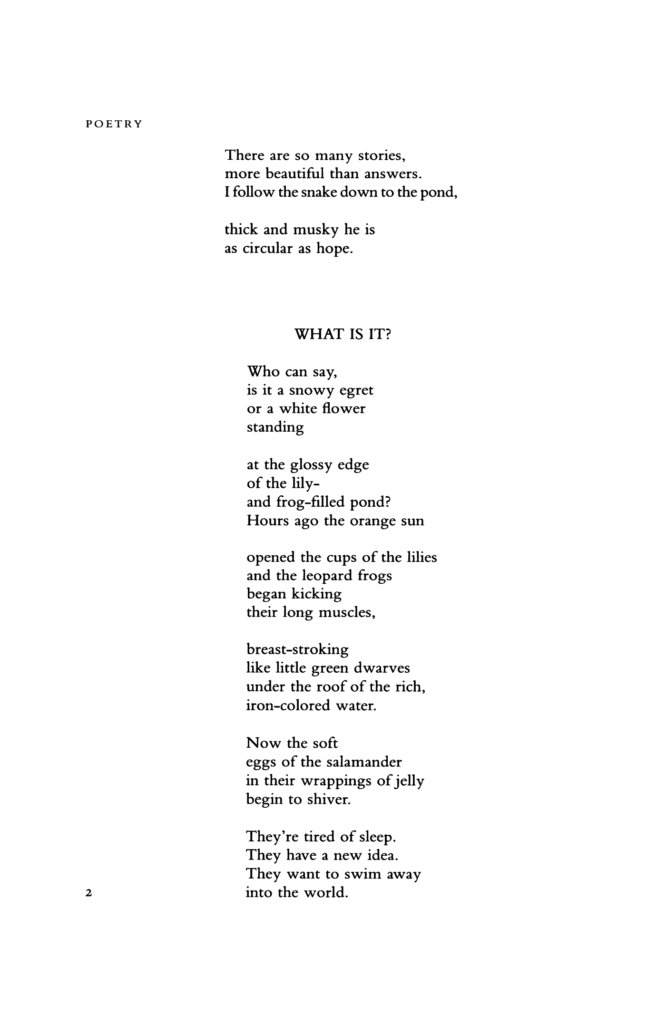
Here are 2 of her poems that I found and want to spend more time with: Spring and What is it?


And here’s my attempt at playing around with Oliver’s idea of suggestions, not answers.

a suggestion on suggestions

I’ve never been good with answers,
giving them, that is.
I can handle accepting them,
as long as they aren’t final
or firm
or boring,
lacking imagination and a wonder
that is necessary for joyful living.
I used to believe that this was a problem,
my refusal to give answers.
It certainly is for some people.
But, no longer for me.
Answers are overrated and too easy.
Even sometimes lazy.
I always want questions.
And now, having heard Mary Oliver utter it in an interview,
suggestions.
Possibilities to explore, entertain, use in our experiments.
Proposals that might fit the facts and feelings.
Things to consider
and ruminate over as I wander through the woods
or run on the path that stretches ahead of me for miles.

And, a poem inspired by Oliver’s exercise in combining end-stopped lines with enjambment and by Gros (Philosophy of Walking) and his use of Nietzsche and the question from The Gay Science about the value of a book or dance or musical composition: “Can they walk?”

How Does Your Writing Move?

With ideas that end when the line or the path does.
And ideas that wander, traveling over
the edge, maybe down
into the gorge, where mystery lives,
behind the green veil that covers the trees from mid-May to early October.

In forms that hold tight with elbows at a 90 degree angle.
And forms that sprawl
all over the place. Messy moments
transformed into words that spill across
the page, leaking energy (and black ink).

Using syntax that remains steady and even.
And syntax that starts. Stops. And starts again,
moving slowly through ideas and experiences and feelings and images.
Then, rapidly.
Like jagged breathing during a tempo run.

june 30/4 MILES

67 degrees
76% humidity
dew point 57
mississippi river road path, north/mississippi river road path, south

A good run. Followed my plan: Run 1.25/Walk 30 sec./Run 1.25/Walk 1 min/Run 1.5. Ran with headphones, so I didn’t really think that much, which was fine.

I’ve been thinking more about open swimming lately. Here’s a abecedarian poem about it:

Open Swim

Annoying things happen during an open swim.
Bad weather, big waves
Causing choppy water that can make me
Drift off the course. Bright sun in my
Eyes, blinding me. Bright sun on my
Face, burning me.
Goggles that can fog up, although that
Hardly happens anymore now that
I use baby shampoo in the lenses.
Just a little.
Keep it on the
Lens for a few
Minutes, then gently rinse it out. My
Nose used to get really stuffed up after swimming. I could
Only breathe through my mouth. At night, I would
Panic, unable to fall back asleep,
Questioning whether or not it was
Really worth it to keep doing open
Swim. It is. I searched for a solution. I
Tried sprays and pills, which didn’t work. Then, I tried nose plugs.
Uncomfortable and ugly. But effective.
Very, very effective and cheap.
Whenever I swim now, I wear them. I bought an
eXtra pair, just in case I lose the first one. I keep both cases in my
Yellow backpack, always making sure that I
Zip them up tightly, in the pouch on the top.

june 15/12 MILES

69 degrees
57 dew point
64% humidity
mississippi river road path, south/minnehaha creek/minnehaha falls/mississippi river road path, north then south then north then south

My route today was a bit crazy. I did a series of loops and turn arounds along the river, along the creek and at the falls. Would it have been easier to run a single loop? Would anything have made this run easy? Doubtful. This 12 mile run (with several walk stops) was hard. It was slow. It was ugly. But I did it. At 3 miles in, I wanted to be done, but I kept going. I’m telling myself that keeping going is the most important thing for my training right now.

I need some tricks or spells or chants or cheers or something to keep me motivated and willing to push through the moments when the doubt starts creeping in and it feels too hard to keep running or moving. Here’s one possibility:

Come on Sara, you can do it!

There was a hill near our old house and when my daughter would have to bike up it, I would chant:

Come on Rosie you can do it
put some Puotinen power to it!

It usually worked and she could make it up the hill without stopping. That is, until she got older and was too cool for such cheezy chants. Maybe I should try a similar one while I’m running. I don’t care how cheezy it is. Besides I plan to chant it in my head, not out loud:

Come on Sara
you can do it
put some Puotinen
power to it!
use the sisu
that’s your birthright
be persistent
fight fight fight fight!

After posting the above shortly after my run, I spent some more time thinking through my struggles with motivation. Here are a few different versions:

A Difficult Run, 7 Versions

1

In the writing class that I’m taking, we just started learning about psychic distance. Here is my first experiment in trying out the various distances, from far away to closer:

I did my long run this morning.
It was slightly cooler, but the humidity and dew point were fairly high. I ran 12 miles.
I ran on several of my favorite paths, but I struggled to keep running.
So many times, I wanted to stop. It felt too hard to keep going. My legs hurt and I felt weak.
Soreness everywhere. Heaviness too. Legs thick and useless. Then doubt. A malevolent thought: You could stop, you know. At first, I stuck to my planned walk breaks and ignored the thought. But, it was persistent. You could stop, you know. By mile 9, it had dug deep into my bones, my bloodstream, my muscles. Too hard to resist or to remember that this moment would pass. I stopped and walked. Then ran. Walked. Ran. Walked. Ran. Until I had done all 12 miles.

2

Run 3 miles.
Walk 3 minutes.
Run 3 miles.
Refill water bottle.
Walk 3 minutes.
Run 2 miles.
Walk 2 minutes.
Run 1 mile.
Walk 1 minutes.
Run 1 mile.
Walk 2 minutes.
Run 1/2 mile.
Refill water bottle.
Walk 1 minute.
Run 1/2 mile.
Walk 1 minute.
Run 1/2 mile.
Walk 1 minute.
Run 1/4 mile.
Walk 1 minute.
Run 1/4 mile.

3

3:3
3:H2O:3
2:2
1:1
1:2
1/2:H2O:1
1/2:1
1/2:1
1/4:1:1/4

4

3 + 3 + 2 + 1 + 1 + 1/2 + 1/2 + 1/2 + 1/4 +1/4 = 12

5

Start long run: 6:04 AM
End long run: 8:14 AM
Average pace: 10’47”
Fastest mile: 9′ 28″
Slowest mile: 12’47”

6

Started without headphones because I wanted to feel the stillness of the morning and hear the birds chirping. At mile 3, decided that I needed the extra distraction of my running playlist. Listened to it for the rest of the run. It helped. A little. The first song I heard was Rufus and Chaka Khan, Tell me Something Good. And somewhere in the middle was It’s Too Late by Carole King.

7

Hover over the poem to see the full lyrics used from “Tell Me Something Good” and “It’s Too Late”

Somethin’ inside died
no
fire
just
pride
good

june 13/3 MILES

68 degrees
88% humidity
mississippi river road path, south

The air was so thick and heavy this morning. Hard to breathe, especially through my nose. Ugh! I hate humidity. I need some sort of counter-spell or charm or way of deranging or paying attention to humidity so that I can endure it.

Words for Humidity

  • muggy
  • thick
  • moist
  • steamy
  • wet
  • sultry
  • damp
  • irriguous (well-watered)
  • dank
  • sticky
  • oppressive

Oh you! You muggy, buggy thing. So thick it makes me sick! Why can’t the water you contain be refreshing like the rain? Why must you make me feel so moist, a word I detest hearing almost as much as I despise feeling its effects: sweat that drips and sticks, heavy air that presses down on my body, sinking me deeper into the ground, making it almost impossible to fly or even to lift my legs up off the damp earth.

Hum/i/dity

hum a ditty
maybe, you’re as cold as ice
or ice ice baby
or freeze frame
or cool it now?
yes, cool it now.

Hey You!

Hey you.
Under that tree.
Maybe you could spare some water?
I’m thirsty and I
Didn’t remember to bring my water bottle. Normally,
I always remember to bring it. But not
Today which is the day I need it most, when the air is so thick and hot and heavy.
You know what I mean?

Sensitive

Have you ever said,
Under your breath, in the
Middle of your run,
I really don’t like humidity & humidity heard you & replied: Well, I
Don’t like you either!
I am going to make you even more miserable because of your
Thoughtless comment!
Yesterday I think that happened to me.

3 ounces per mile

How many cups of sweat can fit
Under the brim of my baseball cap?
More than 2?
It’s hard to
Determine but
I keep
Trying to figure it out while I run through the thick air. I think my cap has
Yielded at least 3 ounces of water per mile.

june 12/REST

A rest and recovery day. Tomorrow is the first day of Open Swim season where I get to swim back and forth across Lake Nokomis as many times as I want for 2 hours on Tuesdays, Thursdays and Sundays!

This morning I experimented with writing about what I think about when I’m running:

Mundane Thoughts Mixed with Sacred Revelations

Running through my mind, almost
Unrelenting.
Mundane thoughts about my run: breathing, pace, how hot
I am. Mixed with bursts of insight, deep revelations,
New and
Ancient wisdoms, breaking

Through the noise, briefly
Introducing clarity
Only to evaporate in the heat. The
Noise returns. Chatter that
Shatters the sacred.

Listen up Over-thinkers

Is thinking overrated? Yes and
No. Sometimes you need to
Think through problems, possibilities. But
Everything, even thinking, needs to be
Regulated and balanced. Over-thinkers like me need to give it a
Rest. To
Undo the knot of this or that
Problem later…or never.
To stop thinking.
Impossible? It can be but
Often it’s
Not.
Something breaks through rumination. A chirping bird? A sighing tree? An aching calf?

june 10/2 MILES

77 degrees
mississippi river road path, north

It was hard to run this morning. It was hot and I was too sore from yesterday’s long run. Scott and I decided to do a few recovery miles together and then end at our favorite coffee place for iced lattes.

heat feet repeat

the heat, the heat
two feet on repeat
no proper rhythm,
an unsteady beat

the heat, the heat
the need for retreat
sweating so much
that you almost deplete
the salt that you need
to maintain your speed
and avoid defeat

the heat, the heat
out on the street,
too hot to care
about being discrete
with the clothes that you wear
or the people you meet
oh the heat, the heat!

It was hot.

It was hot.
It was not a good idea
to run this morning.
Only 7:30, but
it was hot.
the day shot already.
no more running, biking, gardening,
just hiding
inside.
We should have left earlier.
Maybe 6? Before
it was hot.
I forgot how miserable 77 can be
when there’s humidity
and a high dew point.
And the wind,
it was hot too.
We only ran a few miles before we stopped
It’s too hot,
I said to Scott.
And he agreed.

june 8/REST

I’m experimenting with an account of my first injury. It’s really no fun to think about and try to remember it, so after I offer up the facts, I’ve decided to have fun with them:

Hover over the first paragraphs to reveal an erasure poem

The Facts*

On April 2, 2016, while doing a flip turn in the pool, I felt something pop in my knee. When I got out of the pool, my knee hurt and I was limping.

I had previously experienced a pop in my knee on February 14th of the same year which forced me to take a break for running for the rest of February.

After the second pop in April, my leg felt stiff and I was having difficulty bending it. Within a few days, the limping had increased. My right knee wouldn’t bend and I was struggling with the mechanics of walking, especially lifting and bending my right leg. My knee didn’t really hurt, but it wouldn’t bend.

In May, I went to a sports medicine doctor and discovered, after an exam and x-ray, that I had a bone spur on the interior side of my right knee and that the tendons—or was it the ligaments?—were rubbing up against the bone spur and causing inflammation. I was instructed to seek physical therapy, to undergo the R.I.C.E treatment: Rest, Ice, Compression, Elevation and to take 9 ibuprofen tablets a day until the swelling went down.

At the end of May I was able to start running again. I had not run for about 6 weeks.

This was my first serious injury. It freaked me out. I was so freaked out that I failed to pay careful attention to the details that both the doctor and physical therapist offered. All I remember is “bone spur” “knee” “Inflammation” “RICE” “ibuprofen”

I have a vague memory of the doctor explaining that a bone spur, or osteophyte, can be caused by arthritis. I have no memory of whether or not he mentioned if my bone spur would stay or go away.

*at least, the facts as I’ve tried to recall them. I have trouble remembering “facts,” especially when they’re medical and technical and related to injuries to my body.

SOME FUN WITH THE FACTS:

Hi bone spur! This is Sara. Quick question: are you still there? if not, cool. if so, when are you planning to leave? No pressure. Just curious. BTW, thanks for not causing any problems for the last year.

Osteophyte, some anagrams:

O, the pest, yo
yo, the poets
oh, to set type!
hot eye post
they step too
oh, toes type?
set too hype
he poots yet
hot pot eyes
the soy pet
O testy hope!

R.I.C.E. doesn’t just stand for Rest Ice Compress Elevate, it stands for:

Rude Idiots Can’t Explain
Really, I Care Enough
red indigo copper ecru
ribbon ink carbon electromechanical
rancid icky curdled eggs
Rosie is currently elated
rapture is coming early
Rats! I can’t enumerate.
random isotopes create elements
rhode island can’t eat
Right, I can’t even.
respect is carefully earned
rudeness is considered evil

june 7/5.85 MILES

74 degrees
mississippi river road path south/minnehaha falls/mississippi river road path north

A tough run. I should have, but didn’t, bring my water with me. I really dislike the heat. Until my kids are on summer break, which starts next Thursday, I can’t start running until 8:30. By next week, I’ll be running by 6 or 6:30. It should usually still be cool then. I hope.

This is when my training starts to get really tough. The miles are increasing, along with the temperature. I’m not lacking motivation; I want to be out there running. It just feels hard. I would like to blame it on the humidity, but it’s not humid, just warmer. And, it’s not even that warm yet. So, what’s the problem?

In trying to work through this question, I did the following writing experiment:

It’s not the heat, it’s the humidity.

It’s not the heat, it’s the humidity.

It’s not the humidity, it’s the heat.

It’s not the heat, it’s the atmospheric moisture.

It’s not the warm temperatures, it’s the moisture in the air.

It’s not the warm temperature, it’s the moisture in the air and in your hair, on your skin, in-between your toes, on the back of your neck. And it’s the stickiness between your fingers as you rub them together, trying to keep your hands relaxed. And it’s the fibers from the cottonwood seeds, the catkins, that fly into your eye or your mouth or get stuck in the sweat on your face.

It is the heat and the humidity and the effects of both on your body as you run:
the increased sweat,
the depletion of electrolytes,
the flagging energy,
the dehydration,
the pumping of more blood to the skin and less to your heart or your muscles,
the sweat that can’t evaporate to cool your body,
the elevated heart rate.

It’s not the heat or the humidity it’s the dew point, the temperature at which water condenses. The closer the dew point is to the temp in the air, the longer the sweat will stay in your hair because the air is too saturated and your sweat can’t evaporate, which is how your body cools you down.

But, here’s the problem:
Today, as I slogged through my run, struggling to stay upright for 60 minutes, the heat wasn’t too bad, only 74—still high, but it could have been more. The humidity was a mere 37 percent. And the dew point? Only 45! The chart that I found online didn’t even bother describing a dew point so low. It started with 50-54, marking it as very comfortable running conditions. Very comfortable?!

So it’s not the heat, not the humidity, not the dew point? Could it be me? Maybe. But, today’s run was no failure of will; it was a test of fortitude. I didn’t enjoy it. I didn’t fly or breathe in the world or even run the entire time. But I kept moving, accepting, and not resisting, my limits.

It’s not defeat, it’s humility.

june 6/6 MILES

68 degrees
the franklin turn around + a little extra

Decided to listen to music today because I wanted to. When I started this project, way back in January, I listened to my headphones a lot. Then I went through a phase of only listening to headphones occasionally. More often, I listened to the birds and the cars and the conversations and my breathing. I think I’m settling into a balance of headphones/no headphones. I’ve been tagging them in my posts and I have 40 for headphones, which I’m calling “playlist,” and 45 for no headphones.

For some runners, the headphones/no headphones debate is a big deal. Not for me. I like both. Sometimes I need headphones and music or a playlist to distract or motivate or disconnect me. Other times I don’t want them so I can pay attention to the Mississippi river or my breathing or what I’m thinking about.

Over the past 5+ months, I’ve written a lot about listening with and without headphones. Here are two more poems to add my growing list:

Absent

Perhaps
Listening to music
All the time leaves
You with very
Little connection to the
Is: the concrete realness of things, the
Silence and sounds,
The this of being present on the path.

Present

Not silence
Only sounds:
Heavy breathing, sweat loudly
Evaporating
Across my forehead,
Dogs barking sharply, their collars clanging,
People chattering incessantly,
Hardly stopping to listen
Or absorb the landscape.
No break,
Even the gentle breeze, with its constant
Sighs, interrupts.

Skimming through my past entries, I’ve noticed that I’m interested in opposites: headphones/no headphones, freedom/limits, attention/distraction, mundane/sacred, being undisciplined/becoming disciplined. These opposites produce tensions that I don’t want to resolve, but to balance. I don’t want to pick one, the either/or model, but explore both, the both/and model. To fit with that, here are two more poems about headphones/no headphones:

The Purple Banana

Prince might have
Liked how much
Attention I’m paying to his lyrics. Did
You know he sings the
Line, “let’s look for the purple banana”?
I didn’t, until the
Song came on my phone
The other day when I was running and I listened.

The Daily Walker

Now, after years
Of running, I am finally listening! I
Hear my breathing,
Every inspiration and expiration and
All the rhythms as my foot strikes
Down on the
Path. I
Hear the greetings from
Other runners and the walker who
Never misses his daily walk.
Every time I encounter him he
Says “good morning” to me. I never noticed until now.


june 5/REST

I feel pretty good today. My strategic walk breaks must have helped me to get 30 miles for the week without being sore or tired. Yesterday I wrote a nonet poem about my morning routine. I liked the poem, but it functions more as an ideal, one that I sometimes realize, than an actual description of my daily habits. Plus, it doesn’t include the various disruptions that occur, especially during the school year. So I decided to add an additional version and rename the poem.

2 versions with descriptions that vary in how true they are: from almost true to mostly true to I wish they were true to too true to not true enough

Version 1

poetic form: nonet

Wake up at 6. Feed dog. Make coffee.
Write some while drinking the coffee.
Eat: cheerios, banana.
Wash face, brush teeth, comb hair.
Put on running clothes
and running shoes.
Go outside.
Walk some.
Run!

Version 2

Wake up at 6. Feed dog. Make coffee.

Get irritated at the dog because she wants to play and I’m too tired because I woke up several times in the middle of the night with restless legs or because I went to sleep too early and slept too long or because I woke up too early, then went back to sleep and had an intense, freaky dream or because I had the extra drink last night that I shouldn’t have had or because one unfortunate side effect of being 42 almost 43 is that I am no longer a “good morning!” person, but a “don’t talk to me (or lick me) until I’ve had my coffee and spent time sitting on the couch, slowly waking up” person or a “I feel regret or shame about some intangible thing that I didn’t actually do and this makes me uneasy until I’ve fully woken up and restored my sense of exuberance” person or because Delia has decided that she will not be ignored and that I will play with her, right now!

Write some while drinking the coffee.

This one usually works out, except for on the rare day when one of the kids gets up early and needs something…breakfast, advice, a hug, a performance of the “Let’s make Mom yell or cry or both” show.

Eat: cheerios, banana.

I also like walnuts, but it didn’t fit the number of syllables that I needed for the line, which was 8, so I left it out. In fact, walnuts are the key to this breakfast. When we run out of walnuts, I’ll still eat the cheerios and banana without them, but it’s just not the same.

Wash face, brush teeth, comb hair.

In a better world, one where dropping a deuce is not stigmatized as “impolite conversation” and where the coffee always does its job, I might replace any of the above with “go poop.” Sometimes I wash my face, sometimes I don’t. Sometimes I wait to brush my teeth until after my run. Most of the time I don’t comb my hair, I just put it back in a ponytail. But I always poop. Pooping is an important bodily function and the failure to do it before a run can be bad. Very bad.

Put on running clothes

Remind one of the kids that “it’s time to get up!” in a sing-songy voice that usually irritates everyone, including me, but I can’t help doing. Remind them again and again and again until there are 10 minutes left before school starts. Luckily, this is not as big of a deal as it seems. It takes 5 minutes to walk to the school from our house. This leaves 5 minutes to get dressed, eat and get out, which can be done if the kid is properly motivated. Threatening to take away their phone is usually motivation enough.

and running shoes.

After the kids have left for school, comfort the dog for a minute because she’s freaked out by all of the yelling and crying and frantic scrambling that has just occurred.

Go outside.

Maybe stretch, maybe don’t. Always try to squeeze the glutes a few times, which probably looks funny, but helps prevent hip and hamstring injuries.

Walk some.

“Some” usually means 2-3 minutes. If I’m walking all the way to the river road, which is 4 blocks, “some” = 5 or 6 minutes. But there’s always some walking involved. For fun, Scott and I like to imagine a comical situation where you might get up out of bed, jump into your clothes, run down the stairs and out the door and immediately start your run. No stretching. No warm-up. No walking. Neither of us ever want to do this, but we saw a neighbor run out their door in their running clothes and continue down the sidewalk one time and we hoped that this was just what they were doing.

Run!

june 4/3.75 MILES

67 degrees
mississippi river road path, north

Still getting used to the heat. Otherwise the run went well. In the summer, I don’t have nearly as much stuff to put on before I go out for a run. No extra jackets or base layers or buffs or gloves or double socks. Just shorts, a shirt, socks and some shoes. Here’s a description of my running attire in the summer, in the form of an abecedarian poem:

Attire:

1. black shorts with white trim. Not black as
coal, they’ve faded in the sun. The
drawstring is gone too. It was a pretty bright blue. Now
elastic is all I have to keep the shorts from
falling down.
2. Green
headphones, if I’m listening to music, and
if I am, that music usually includes a
Justin or two: Bieber or Timberlake. My
kids wouldn’t
like me to admit that,
mostly because it embarrasses them. I say, here’s something to look forward to: when you’re 42, almost 43,
nothing embarrasses you!
Other favorites to listen to: Barry Manilow,
Prince. 3. A
quick-drying tank top, either in black or blue. I
really don’t care which.
Sometimes I wear a green tank-top, but it’s
thicker and not quick-drying, so only if the temperature is
under 70 degrees. Otherwise it’s
very uncomfortable.
4. White ankle socks, with an orange
x on the heel, at the end of the word, “Power Sox,” and mismatched trim that is
yellow on one foot and blueish green on the other. 5. Bright blue shoes with
zero swooshes, only coral swishes.

And here’s a poem describing my morning routine in the poetic form of nonet: 9 lines, first line has 9 syllabus, second has 8, and so on until ninth line has 1 syllable.

Morning Routine

Wake up at 6. Feed dog. Make coffee.
Write some while drinking the coffee.
Eat: cheerios, banana.
Wash face, brush teeth, comb hair.
Put on running clothes
and running shoes.
Go outside.
Walk some.
Run!

I wrote both of these poems because I was having some difficulty sorting out all of my ideas about ritual and repetition, habit as mundane or sacred (I also wrote about these in yesterday’s log). I decided the best place to start was to describe some of the mundane aspects of my run, like what I wear and what my pre-run routine is.

june 3/4 MILES

77 degrees
mississippi river road path, south

Another hot and sweaty run. Scott and I ran together today. We were both struggling because of the heat, although running through the sprinkles when we were almost done helped. We talked about one of my new favorite poets, Chen Chen, and his book When I Grow Up I Want to Be a List of Further Possibilities. We also talked about Scott’s Stravinsky project. And we were almost successful in avoiding talking about dictators and oppressive regimes.

Before and after running, I wrote two new things:

What’s the difference

between ritual and routine?
Superstition and belief?
When is it a prayer and when is it just proper form? Efficient breathing?
When does a habit become sacred?
Does it need:
a doctrine?
a theology?
hymns about souls and rejoicing and kingdoms and conquering and reigning?
chants about fathers and spirits and ghosts and sacrificing sons?
basement potlucks with seven layer dips?
uncomfortable pews?
getting up too early on a Sunday morning?
yes, it needs this.
Could it be that one defining characteristic of the sacred is
a refusal to stay in bed?

my purple toe

Have I told you about my purple toe? It’s on my right foot and it’s the second toe, the one that sticks out just a little bit farther than the others. Did you know, that this toe, the second one, turns purple? It’s not purple all of the time and maybe purple isn’t even the best way to describe it. Eggplant? I wish it were electric purple or purple mountain majesty or grape popsicle purple. Purple is my son’s favorite color. His computer case is purple. His clarinet case is purple. His suitcase is purple. His school binder, which he dissects and disembowels in new ways everyday—first removing the strap, then shredding the front pouch, then taking out the cardboard insert that helps keep it’s structure, then doing something to the 3 ring binders that I can’t quite figure out that makes them only barely close—is purple. The purple he prefers is royal purple. Not fuchsia or pearly purple or phlox.

My purple toe is purple from running. Technically, it’s my purple toenail, I suppose, but toe is much more pleasing to write and to hear and to imagine as purple than toenail. Anyone can have a purple toenail; just slap some nail polish on it and it’s purple. But a purple toe is special. A purple toe is a sign of a runner. Before I started running, I was unaware that this was a thing: your toe can turn purple. I read somewhere that it’s called runner’s toe or subungual hematoma. It’s also called black toe. I like purple toe, so that’s what I’ll call it, or “my purple toe” or “my perfectly purple, not painful at all, toe.” Is it the second toe for everyone? I don’t know.

Here’s how it usually works for me. After some random long/longish run, my second one, the toe that sticks out just a little bit farther, feels strange. It looks like it’s splitting. At first, it isn’t purple, but i know what’s coming: in a day or two, it will be purple. The toenail never falls off. It just grows back in freaky ways: twisted, bent, doubled. Maybe I should call it “my perfectly freaky purple, not painful at all, toe.” After the nail grows back, it usually returns to its normal color. That is, until the cycle begins again. The “purple toe effect” has been happening for at least five years now.

In the same online article where I read about “runner’s toe,” it was also referred to as a “runner’s badge of honor.” I’m not sure I’d say i’m honored to have my perfectly freaky purple, not painful at all, toe. More like delighted by how it grosses other people out. Or fascinated by its freakishness. Most of the time I forget about it. It’s just a toe that’s part of my right foot that enables me to run—and walk and skip and saunter—without much pain and hardly any injury. It sticks out farther than my other toes. And it just happens to be purple or, if you prefer, which I don’t, eggplant.

june 2/11 MILES

76 degrees
the lake nokomis loop, long

Hot! Sunny! Difficult! Today’s run was not pretty. Well, the path was pretty. The lake was pretty. The many bridges that I ran over were pretty. But my run was not. It was hard and hot and tiring. But I did it, with the help of several walk breaks.

I decided to do my long run today instead of tomorrow because it is my 6th anniversary of running. I started on June 2, 2011. I used the couch-to-5k program and ran/walked less than 2 miles. Today, 6 years later, 11 miles! My route today included the Minnehaha creek path, which is what I ran on in 2011.

I had grand visions of doing some cool poetry experiment with the run: maybe stopping every mile to compose a line. But, I was too distracted and uninspired by the heat. So, instead, I’ll mark the occasion by sharing something that I’ve been working on about the body electric. It’s inspired by Prince (“electric word life”), a pbs show about Ibex and the harrowing lengths they go to replenish their electrolytes (scaling seriously steep cliffs), Walt Whitman and “I sing the body electric,” the movie Fame and their version of “I sing the body electric.” Marilyn Nelson’s “is” and Marie Howe’s “the this,” Frédéric Gros’s philosophy of walking and my own wanderings on electricity and the beauty of machines, developed while running. I suppose there’s a dash of Emily Dickinson in here too (her nobody).

the body electric

The body electric is not a metaphor. The body is electric. It contains electrolytes, that, when consumed, break up into positively and negatively charged ions that travel by water through the body, triggering electrical impulses in the nerves and muscles. Every body needs electrolytes to function properly. They’re found in sodium, chloride, calcium, magnesium, potassium and phosphate.

The body is a machine.
Not the body as machine
or the body is like a machine
or the body is only a machine.
But, the body is a machine.
An efficient machine,
capturing energy, consuming minerals, converting air into breath.
The body is an intricate machine,
made up of muscles and tendons
and ligaments and joints and bones
and organs and arteries and veins
and fluids and systems
that work together in the complex process of locomotion.
The body is a marvelous machine,
containing strange creatures
with multiple heads and fantastical names.
The body is a beautiful machine,
composed of grace and exuberance and joy.
The body is a powerful machine,
able to endure intense pain and absorb tremendous force.
The body is a delicate and temperamental machine;
it can shut down from overuse, lack of use or repeated abuse.

This body, my body, is not any body and it is not the body. It is just a body, a somebody who is happily a nobody, running and flying and floating free, feeling the sizzle of the sand under my feet on the path and the howl of the wind rushing by my ears, passing under the shadows of the towering tree in the midst of other bodies, who are somebodies and nobodies as well but who feel the earth and the sky, just the same but differently too. Each of us an I. A self. A soul. A body. But also a we. Selves. Souls communing. Charged bodies with electrons flowing freely. The Body Electric.

june 1/REST

I’d love to run today because it’s so beautiful outside, but I won’t. It’s my day to rest. My right hip is a bit sore and needs a break. And tomorrow is my 6 year runniversary and I’m planning to do my long run to mark the occasion.

This morning I worked a bit more on my sonnet about attention. I tried to stay truer to the Shakespearean form by using 10 syllables in each line. In one or two lines, I failed. Not sure if it’s really in iambic pentameter either.

ATTENTION

is the beginning of a devotion
which can be a form of daily prayer
that you undertake while you’re in motion
running in and through the outside air.

A prayer given with lungs and feet
to inspire the trees and absorb the earth
a letting go to a steady beat
desiring nothing but the rebirth

of an earnest and a loving belief
that has the power to break you open
and to spill out the terrible grief
caused by a decreased sense of hope and

increased apathy, a monstrous twinning.
To end, attention is the beginning.

What I’m Fascinated by, a list
  • breathing/respiration as the process of inspiration (in) and expiration (out). I want to play with these some more.
  • absorption: energy absorption + how Frédérick Gros describes it The Philosophy of Walking: “But walking causes absorption. Walking interminably, taking in through your pores the height of the mountains when you are confronting them at length, breathing in the shape of the hills for hours at a time during a slow descent. The body becomes steeped in the earth it treads (85)”.
  • body prayer: how does the body pray? What is praying–the rituals and habits?
  • Simone Weil and attention as prayer.

may 31/6 MILES

62 degrees
the franklin hill turn around + extra

Today was a harder run than yesterday. My legs felt sore. I took it out too fast. And I was overdressed. Decided to walk a few times when I felt like I needed it, which was a good idea, not a failure, I’ve decided. Recorded two voice memos into my iPhone, one about attention as a salve against apathy and another about how bodies are machines.

Before the run, I started working on a series of wanderings around attention. I’ve given years of attention to attention in my ethical work on curiosity and a feminist ethics of care and now, in this running/writing project, it keeps coming up as a primary goal for me: to pay attention to my body, to my surroundings, to my voice, to authentic expression, to nagging injuries, to breathing, to joy, to staying upright, to resisting oppressive regimes.

Attention, Wanderings

Wandering One

Mary Oliver from Upstream

“Attention is the beginning of devotion” (8).

Here’s my (first?) attempt at a sonnet, riffing off of Oliver’s line:

Attention is the beginning of devotion.
Devotion, the beginning of prayer.
Attention sets curiosity in motion.
Curiosity is a form of care.

Attention can lead us to question.
all that we’ve been taught.
Compelling us not to rest on
the assumptions we have wrought.

Attention promotes belief
belief breaks us open,
spilling out a grief
that comes from loss of hope and

apathy, a monstrous twinning.
Attention is the beginning.

Wandering Two

Marilyn Nelson, “Crows

“What if to taste and see, to notice things,
to stand each is up against emptiness
for a moment or an eternity—
images collected in consciousness
like a tree alone on the horizon—
is the main reason we’re on the planet….”

So many ways to connect this excerpt with my wanderings on the vertical yesterday! The tree. the horizon. The purpose of life.

This is makes me think of Krista Tippet’s interview with the poet Marie Howe. Howe has some thoughts about the is, which she calls the this, and how we struggle to “stand each is up against emptiness” (hover over the following quote to reveal the erasure poem):

It hurts to be present, though, you know. I ask my students every week to write 10 observations of the actual world. It’s very hard for them. Just tell me what you saw this morning like in two lines. You know I saw a water glass on a brown tablecloth. Uh, and the light came through it in three places. No metaphor. And to resist metaphor is very difficult because you have to actually endure the thing itself, which hurts us for some reason….We want to — we want to say it was like this. It was like that. We want to look away, and to be, to be with a glass of water or to be with anything. And then they say well there’s nothing important enough. And then it’s whole thing is that point.”
Attention

attend to:
witness
keep vigil
be devoted

have a long attention span:
don’t forget
keep noticing
pay attention

give attention:
care
care for
care about

be curious:
wonder
imagine
believe

receive:
breathe in the this and breathe out the that
slowly absorb the is through your skin

note: So many more variations to do, including one with Simone Weil.

may 30/5.25 MILES

55 degrees
the franklin loop

A good run. Forgot that they were doing construction (again!) on my side of the Franklin bridge so I had to wait for the light, which takes a few minutes, to cross over to the path on the other side. As I waited, I didn’t run in place, but I did keep moving my legs. I was a bit restless. How funny did I look to drivers?

In my log entry for Sunday, I mentioned how the leaves had filled in on the trees in the woods near the stone steps. Later that day, I found a poem that connects and have been wandering through it. Did I think about it during my run today? I’m not sure. Here are some of my wanderings:

VERTICAL, wanderings

The Starting Point: a poem by Linda Pastan

Wandering One:

Vertical/Horizontal
Perhaps the purpose 
of life is to capture more energy than it takes to survive.
of leaves is photosynthesis
of animals is respiration: inspiration and expiration

Perhaps the purpose of leaves is
to create mystery and wonder: what’s in those woods?
to irritate and annoy: why can’t I see to the other side anymore?

Perhaps the purpose of leaves is to conceal
the gnarled limbs of trees, the textured trunks. Not frail, but tough. Ancient. Wise. 
the branches that stretch wide and far. Wandering. Interrupting hierarchies of sky and ground. Disrupting the seduction of the moon’s glow.

Perhaps the purpose of leaves is to conceal not the verticality, but the horizontality of trees which we notice in December as if for the first time: row after row of
twisted forms sprawling sideways.
weathered forms persisting stubbornly.
wise forms learning how to continue surviving.
ancient forms yearning upwards and spreading inwards and outwards.

Wandering Two: staying upright

“And since we will be
horizontal ourselves
for so long,
let us now honor
the gods
of the vertical…” (Paston)

“Sunday morning—23 degrees, both ponds frozen and glassy. Six miles. About an inch of ice on the trail—frozen snow-melt, frozen slush—but I managed to stay upright….What Wittgenstein wanted from philosophy in the second half of his career was a way to stay upright. ‘We have got onto slippery ice where there is no friction,’ he warned, turning his gaze away from perfection and trying to make out how people actually move and think and make connections…It’s the dailiness of these runs I like—” (Gardner, 54)

One goal of my running? Staying upright. Active. Moving. Grounded. Connected. In conversation with the world, with my body, with my breathing, with dreaming and wondering and real possibilities, rooted in the realities of my limits. Resisting restlessness.

Wandering Three: form

Pastan’s poem is vertical in form. Long and lean, stretching upwards.

“…most experts agree that ideal running form starts by keeping your upper torso straight (with a slight forward lean)….” Some suggest that you should think tall and look to the horizon. Like a tree, your trunk should be vertical, but with a slight lean. The purpose of good form: to be efficient and to conserve energy, which is especially important for long-distance runners.

In an interview with Krista Tippet, Michael Longley recalled something that the poet Stanley Kunitz wrote in the preface to one of this collections about form and conserving energy: “form was a way of conserving energy. Isn’t that wonderful? He said the energy soon leaks out of an ill-made work of art.” What forms work best for conserving energy? Is form that conserves always efficient?

Mary Oliver on form in Upstream: “Form is certainty. All nature knows this, and we have no greater adviser. Clouds have forms, porous and shape-shifting, bumptious [what a great word! “self-assertive or proud to an irritating degree.”], fleecy. They are what clouds need to be, to be clouds. See a flock of them come, on the sled of the wind, all kneeling above the blue sea. And in the blue water, see the dolphin built to leap, the sea mouse skittering; see the ropy kelp with its air-filled bladders tugging it upward; seee the albatross floating day after day on its three-jointed wings. Each form sets a tone, enables a destiny, strikes a note in the universe unlike any other. How can we ever stop looking? How can we ever turn away” (Upstream, 21)?

May 26/3.75 MILES

66 degrees
mississippi river road path, north

It’s amazing how 66 degrees can feel hot. My body needs to adjust to the warming temperatures. The run felt a bit harder, but it was okay. I can’t remember what I was thinking about as I ran. This is often the case. Thomas Gardiner refers to this feeling as “a bit like half sleep. when you’re awake, in a way, but aware of dreams passing in a kind of un-retraceable wandering” (7).  What do we do with these un-retraceable wanderings? Maybe nothing.

Right before running, I composed two acrostic poems. I had been reluctant to try this form because my only encounters with it were through reading the acrostic poems my kids created out of their names in second grade. It seemed like a form best suited for young kids. But, when I looked up the form on Academy of American Poets, I was intrigued by their description: “The intent of the acrostic is to reveal while attempting to conceal within the poem.” So I experimented with creating poems out of two words that I think about a lot when I’m running:

A Daily Reminder

How does it feel to face your limits, when you’re
unable to continue ignoring that
many others will always be faster, stronger,
in better shape,
live longer,
imagine wider, deeper?
This is not a tragedy.
Your liberation is found in this realization.

Can you Feel Them?

Electrons
live
everywhere.
Can you feel them?
Try.
Really try to
imagine what they feel like, where they are.
Count the
ions.
Try.
You can’t? They’re there, amplifying life and charging it with meaning.

During the run, I thought of another word I wanted to use. I wrote about it when I got back home:

Runner’s Kryptonite

Heavy and thick, feeling
Useless and lethargic
Moisture everywhere
Inside and out.
Don’t want to move. Running
Is hard, harder
Than usual
You have no idea how much I despise this.

So much fun! So far, I’ve experimented with the following forms in my poetry about running: abecedarian, acrostic, anaphora, cento, cinquain, erasure, limerick, terza rima, triolet. Yesterday, I wrote an anaphora poem for my description of the Franklin Loop and limericks for my description of a route I’m calling the Downtown loop, long.

Lake Street/Marshall Avenue Bridge
there is a long bridge with a name
that never does stay quite the same
You start out on Lake
but Marshall you take
if driving in St. Paul’s your aim

Franklin Hill
There once was girl who would run
up big hills ‘cause she thought it was fun
she never complained
although she was drained
Had she spent too much time in the sun?

Bohemian Flats
A place on the path is called Flats
the namer of this was quite bats
the more that you stare
the more you’re aware
the hills here outnumber the gnats!

Washington Avenue Bridge
The bridge that you next run under
makes noises that sound like thunder
if not a rain storm
beginning to form
could be the light rail, I wonder.

I-94 Bridge
A bridge here turns purple at night
in honor of Prince, a bright light
it guides your climb out
of perilous doubt
brought on by sore legs that feel tight.

The Guthrie
run down a short hill and you’ll see
a building that looks like a bee
well that’s not quite true
it’s not black, it is blue
but it sometimes looks black to me

Stone Arch
There once was a girl with gray hair
who ran anytime, anywhere.
She left for Stone Arch
the third day of March
as far as I know she’s still there.

Hennepin Avenue Bridge
there once was girl who would walk
her kid ‘cross this bridge quite a lot
she runs now instead
while her kid stays in bed
he’s grown and no longer a tot!

may 24/5.25 MILES

51 degrees
the franklin loop

I’ve run over 500 miles in 2017. That’s the most I’ve ever done by the end of May. Had a great run this morning. 51 degrees + not much wind + overcast = some of my favorite running conditions. Managed to hold onto some thoughts about Quatro’s ideas on running as prayer and its dis/connections with the runner’s high as a matter of endorphins. I recorded some notes into my voice memo app right before and after the run.

notes: before the run

experiments/wonder/curiosity/why are we curious?/for what purpose do we want to know?/what does it mean to know?/Sir Francis Bacon, exploiter of nature/the drive to know/to understand/to conquer/to control/to own/to use/to exploit/to scrutinize/to dissect/to name

notes: after the run

CONTROL/what about humility?/a curiosity motivated by the desire to feel, to experience, to engage/not to own and control and acquire

The Runner’s High

suddenly, without warning I am
exhilarated
euphoric
effervescent, bubbling over with feeling

sometimes I feel ecstatic
beside myself with joy
beside my shadow with delight
beside the world with reverence and awe
beside my mom with longing, regret, enduring love.

sometimes I feel enormous
capacious
if I stuck out my chest
and opened my mouth a bit wider
I could let in the whole world.

sometimes I feel electric
amplifying sounds
lighting up paths
nothing but pure energy,
a flow of electrons moving through the universe

how to explain these feelings?
are they chemically-induced delusions,
brought on by elevated levels of endorphins or endocannabinoids?
do we need to explain?
can we bear witness to their wonder,
be curious about their origins and impacts
write about them
study them
experiment with them
propose scientific theories about them
without knowing them?
naming and classifying them?
reducing them to chemicals?
claiming that we own the Truth?

I see wonder in the chemicals
their poetic names
their purposes
their possibilities
but only when our theories about them
don’t foreclose
other explanations
other ways of feeling and being.

may 19/6 MILES

47 degrees
the franklin hill turn around

It was cooler today but I didn’t mind. I like running when it’s cooler. Lately I’ve been thinking about the biomechanics of walking and running and how they differ. After looking at a few online sources, including this, I tried the following Please Add to This List experiment: “in a poem, list what you know” (20). I’m not sure if mine is a poem, but I like it.

DID YOU KNOW

that the main difference between running and walking is that in walking you always have one foot on the ground and in running both feet are in the air at the same time mid stride? So in walking you’re always grounded, in running you get to fly.

that the flying occurs just before the foot makes “initial contact” with the ground, either via the heel, midfoot or forefoot? I usually strike midfoot.

that the flying is referred to as the “float phase”? I’d prefer the “flying phase” or the “who needs the ground? Not my feet!” phase.

that the flying happens so quickly that you don’t even notice it? I bet your body and soul do. Or should I say “does”? In “I Sing the Body Electric” Walt Whitman believes that the body is the soul.

that when I wrote the preceding “fact” about Walt Whitman, I mistyped his name as Walk Whitman? He did love walking and wrote many poems about it, including Song of the Open Road. Would you mind if I referred to him, from now on, as Walt “the Walk” Whitman? Or, is Walt “the Walker” Whitman better?

that after flying you do a “controlled landing” and enter the “brake absorption” phase? I’m starting to feel like a plane. I don’t like planes or flying in them. The only flying I like is the kind that I do when I’m running.

that USA Track and Field officially defines race walking as: “a progression of steps so taken that the walker makes contact with the ground so that no visible (to the human eye) loss of contact occurs”? Have you ever tried race walking? I have, sort of. I went on a training walk with my best friend who was planning to race walk a marathon, which she eventually did a few months later. It was hard preventing my body from flying. And hard to walk that fast. She was fast!

that I like running because it lets me fly and, at least for a millisecond, allows me to lose contact?

that I like walking because it keeps me grounded and tethers me to the world so I don’t just fly (or float) away?

that I often feel like I’ve failed if I stop and walk during a run or a race? I’m working to change this attitude. Walking is not failing; it’s still moving.

that in his running memoir, Haruki Murakami, wrote that his tombstone should say: “At least he didn’t walk”? I wonder if now, many years later, he still feels that way.

that I have tendency to wander, physically and mentally? Sometimes this is helpful, sometimes it is not. Walking, especially at a slow pace and with no destination in mind, encourages it. While running, which enforces limits—my body can only run so far and for so long, discourages it. When I want to wander, I walk. When I don’t, I run.

that I have almost too much energy? Sometimes this energy is physical, sometimes it’s mental. If I don’t use it up, I become restless. Walking is more likely to wear out my brain, running, my body.

I was trying to think about walking and running during my run today. I did, for a a few miles. But then the Franklin hill appeared and I needed to craft some new “running rhythms” to chant as I ran up.

as I ran up the hill

I am climbing up a hill

rhythm: I am climbing (4 eighth notes) + up a hill (3 eighth notes) = 7 steps/1 per eighth note

I
am
climb
ing
up
a
hill

rhythm: 7 quarter notes = 14 steps/2 per quarter note

to get my heart rate down

I need to go slower
so that my pulse will lower

rhythm: I (quarter note) + need to (2 eighth notes) + go (quarter note) + slower (2 eighth notes) = 8 steps/2 per quarter + 1 per eighth
So (quarter note) + that my pulse will lower (6 eighth notes) = 8 steps/2 per quarter + 1 per eighth

to celebrate running

I am flying,
I am free
I am where
I want to be

rhythm: 4 eighth notes per line = 4 steps/1 per eighth

After composing and  reciting the rhythms several times as I ran, I made a recording while I continued running:

These small chants are fun to compose and help a lot with my running.

may 17/5 MILES

64 degrees
humidity 86%/light rain
mississippi river road path north/south/north/south

Severe thunderstorms? 80% chance of rain? I risked it and ran anyway. No thunderstorms and only a light drizzle. Take that faulty forecast! Just in case it started to rain really hard, I altered my route so that I could end it sooner if I needed. I ran one mile north, turned around and ran back to the start, then ran one mile south, turned around and ran back to the start, then ran 1/2 mile north and turned around again. It worked out well. I like running in the rain when it’s a light drizzle. I didn’t feel wet, just refreshed.

I’m entering in a new phase of my training: training for the 1/2 marathon in July. I need to work on conditioning my body to run (or just move, with an elevated heart rate) for longer periods of time. I need to get used to running on sore legs and moving for 2 hours without stopping. I wonder how this will affect my creative thinking and experimenting? 

I’ve decided to give myself running advice in different poetic forms. The last time I did this, I used terza rima to remind myself to go slow. Now, I’m using 2 different versions of the cinquain and a triolet to tell myself to stop thinking about pace or miles and start thinking about duration. I think I’d like to try at least one other form.

Cinquain

Variation One
5 lines
rhyme scheme: abaab

Up until now, I’ve mostly been building up a base
of miles, strengthening my legs and working on my aerobic fitness.
My focus was on maintaining a very slow pace.
But now marathon training must start. Such a long race
requires building up the time spent running, more than the distance.

Variation Two
5 lines
created by Adelaide Crapsey (what a name!), usually about nature
no rhyme
22 syllables in total: 2/4/6/8/2

It’s May
and time to start
training for duration
more than pace or number of miles.
Do it!

Triolet

8 lines
Line 1 repeats on lines 4 and 7.
Line 2 repeats on line 8.
Only two rhymes used throughout.

I need to train
to move longer
be mentally stronger.
I need to train
to run when drained
when legs are strained.
I need to train
to move longer.

may 16/3.3 MILES

64 degrees
muggy and windy
mississippi river road north

Was able to get in a quick run between thunderstorms. It’s funny how the winter weather didn’t prevent me from running outside, but these spring thunderstorms are. So humid. At one point during the run, when the walking path dips down and follows alongside the wooded gorge, everything looked weird, almost like I was seeing it through a filter. I wondered if it was my vision then I realized it was steam, trapped in the trees! Yuck.

Before and after the run I worked on having more fun with medical terms. Specifically, more fun with the biomechanics of walking. So much fun! When I started it, I had no idea where it would lead me. This is the unexpected result:

It starts with a step, versions and variations

Version One:

“Where does it start? Muscles tense. One leg a pillar, holding the body upright between the earth and sky. The other a pendulum, swinging from behind. Heel touches down. The whole weight of the body rolls forward onto the ball of the foot. The big toes pushes off, and the delicately balanced weight of the body shifts again. The legs reverse position. It starts with a step and then another step and then another that add up like taps on a drum to a rhythm, the rhythm of walking (Rebecca Solnit, Wanderlust).”

variation
It starts with a step:
heel touches down
weight rolls forward
onto ball of foot
big toe pushes off
body shifts
legs reverse
step + step + step + step + step + step + step = walking

Version Two:

The biomechanics of a step: The Stance Phase in 5 parts

  1. Heel strike/the heel first touches ground
  2. Early flatfoot/from when the foot is flat until body’s center of gravity passes over foot, here the foot is loose and floppy
  3. Late flatfoot/body past center of gravity, heel beginning to lift, foot is rigid
  4. Heel rise/the heel rises off the ground
  5. Toe off/the toe lifts off the ground.

variation
the heel strikes
on the ground,
not out at the plate or
because of unjust working conditions.

early flatfoot
a police officer with a morning shift.

late flatfoot
another officer, working the night shift.

heel rise
apparently I was wrong about why the heel was striking.
It is because of unjust working conditions.
She and other foot workers are refusing to lift anything off the ground until their demands are met, namely adequate health care.
They are rising up!

toe off
Management is becoming increasingly irritated by the peaceful strikers.
All mechanical operations have been shut down.
How can the toe be lifted off the ground when the heel won’t do her job?
The early and late flatfoots, who have both finished their shifts, are called in to force the heel and her compatriots to submit.
Neither of them are happy about it.
They’re tired and want to go to bed.
Besides, they agree with the heel and are angry with management.

Version Three:

The biomechanics of a step: The Muscles

During the heel strike/early flat foot phase the anterior compartment muscles work to gently lower the foot onto the ground. The anterior compartment muscles are the tibialis anterior muscle, the extensor hallicus longus, and the extensor digitorum longus. .

During the late flatfoot to heel rise phase the posterior compartment muscles control the body so it doesn’t fall forward. The posterior compartment muslces are the gastrocnemius, the soleum and the plantaris.

variation
During the strike, the heel is confronted by some well-meaning but naive co-workers who are urging her to reconsider her tactics. “Why not ask nicely?” the tibialis anterior muscle suggests. “Yes!” agree the extensor hallicus longus and the extensor digitorum longus, “if we take a gentle approach and try to reason with them, management is sure to see that we deserve better!”

Listening in on their conversation, early flatfoot rolls her eyes and can be heard to mutter dismissively to late flatfoot, “yeah right.”

Heel refuses to listen to the anterior compartment muscles. “We will strike!” she declares. She is joined by many others, including the posterior compartment muscles. The gastrocnemius and the soleum help by reassuring the crowd of striking workers and the plantaris delivers the strikers’ demands to management.

Version Four:

The biomechanics of a step: The Swing Phase in Three Parts

  1. early swing/after toe is off the ground, just until it is next to opposite foot
  2. midswing/the swinging foot passes by the opposite foot
  3. late swing/lasts from end of midswing until heel strike

variation
The striking heel, along with the toe and the ball of the foot, soon realize that their tactics are not working. Management is refusing to consider their demands. They reluctantly determine that their only option is to walk out. To do this, they need the help of the other foot. The dorsiflexors of the ankle joint are enlisted to initiate the swing phase so that the toe can try to convince the workers in the opposite foot to collaborate on the direct action. The big toe is successful with her negotiations. So successful that not only does the opposite foot agree to the plan, but so do early and late flatfoots. Slowly and steadily the feet trade off steps. One heel strikes, one foot is flat, one toe lifts off. The other heel strikes, the other foot is flat, the other toe lifts off. Step. Step. Step. Step. Step. Step.

note: The technical information for the versions comes from these sources:

I had not intended to write about the heel striking, but I’m glad I did. At some point, pretty far into the process, I realized that the management was me. And the workers were going on strike because I wasn’t taking care of myself properly. This version of the biomechanics is very different from Solnit’s romantic understanding of walking. I think I went in the direction that I did because I associate learning/being curious about the technical aspects of walking with injury. Why else would I want to dissect the process and learn the specific names of muscles, bones and joints?

may 12/3 MILES

mississippi river road north
57 degrees

Another great morning and another great run. Found myself composing poems to keep my rhythm. At first, the chant was pretty mundane: this is the path/that I like to/take all the time or this is the path/that I run on/most of the time. I came up with a variation on this that had 2 lines with four beats and one with three, like 2 measures with eighth notes and one with a triplet, but I can’t remember it. I played around a lot with how I matched my feet to the words. Sometimes I chanted a word–mostly in my head, but occasionally out loud–with each step. I did this when I wanted to go a little faster.

this is the path
step, step, step, step or ♩♩♩♩

When I wanted to go slower, I chanted one word for each two steps.

this step is step
the ♩ path ♩

So much fun. I’m a musician who played clarinet for over 20 years (only occasionally now), so I like to think about things musically. Rhythm and beats might become a new focus on some of my runs.

In the last mile, I came up with a different chant. It was inspired by Marie Howe’s discussion of poetry as counter-spell in her interview for On Being:

Poetry has a kind of trancelike quality still. It has the quality of a spell still. My daughter came home one day and she said — she did this whole snappy thing. “Don’t make me snap my fingers in a Z formation, explanation, talk to the hand, talk to the wrist. Ooh, girl, you just got dissed.” And it’s this whole thing the girls were doing when they were 11. And I said — a counter spell. It was like a counter spell for a mean girl. And I thought this is what we all need to walk around with, a handful of counter spells. And, and poetry, when you think of its roots, is that.

this is my charm
against all harm
this is my spell
as you can tell
it works real well
I mean really
but it did not
work in the rhyme

It’s a fun challenge to try and compose lines on the spot, while you’re running at a brisk pace (8:45 minute per mile, at that point). I wasn’t happy with the last two lines and how they didn’t work for the cadence. So, after I finished my run, I came up with these lines instead:

I hope you see
but it did not
fit in the slot

this is my spell
as you can tell
it works real well
I mean really
I hope you see
but it did not
fit in the slot

may 10/3 MILES

62 degrees
mississippi river road south

Didn’t have to wear my pink jacket today, which is great because it means it was warm enough to run just in a t-shirt but also annoying because it means I no longer had a pocket for my iPhone and had to wear an armband to carry it.  Listened to a different playlist. The final song that played before I finished was Prince’s “Let’s Go Crazy.” I had put that on the playlist right after he died last spring. I listened to it on my first runs (more like, run/walks) after the injury where my knee so swollen that I couldn’t walk. My knee didn’t really hurt, it just wouldn’t work and I didn’t know how to walk. Such a strange and unsettling feeling. I never think about how to walk.

How does walking work? I think it’s time for more fun with medical terms!

More Fun with Medical Terms!

Walking involves: 1. moving your hips and thighs backwards as you push off, 2. moving your legs forward, 3. striking the floor with your foot in a heel to toe action and 4. shifting your weight as you move from one leg to the other. A ton of muscles, with fantastical, sometimes ridiculous, often overly-complicated, names are used in this process. Such as the following:

semitendinosus, semimembranosus, biceps femoris
the first two terms
aren’t that hard to figure out how to pronounce
so I’ll focus on the third.
I’d like to say that the femoris in biceps femoris is pronounced: fee moor is
like some sort of Harry Potter spell.
I’d like to say that
but I can’t
because it’s pronounced: femme a ris

semitendinousus, 
semimembranosus, 
biceps femoris
There’s a nice cadence to these three
semi tendi nou sus
/ ♫ ♫ ♩ ♩
semi membra nou sus/ ♫ ♫ ♩ ♩
bi ceps fem o ris/ ♩ ♩ ♪♪♪

semitendinosus, semimembranosus, biceps femoris
are all hamstring muscles
that come from the ischial (iss keel) tuberosity of the pelvis
which is, according to the Merriam Webster medical dictionary,
“a bony swelling on the posterior part
of the superior ramus
of the ischium
that gives attachment to
various muscles and
bears the weight of the body in sitting.”
What’s the ramus, you might ask,
and what makes it so damn superior
(and gives me such a headache)?*
Would you settle for:
part of the hip bone,
along with the ilium and pubis?
It’s superior because THEY said so and
because it’s not the other two parts: the body or the inferior ramus.
speaking of the THEY,
as I attempt to read and understand
these medical terms,
I’m struck by how alienating they are.
who, but a select few, can actually
understand and retain this stuff?
Scott generously suggests that
these terms are complicated and abstract
so as to help doctors have some professional distance
from people,
to be able to put their feelings aside
and focus on doing their job: healing patients.
maybe
but I also think it’s a way to safeguard an industry and
to alienate us from our own bodies.
how many of you can imagine the “ischial tuberosity”
as a real part of yourself?
I’ll admit
sonically, ischial (iss keel) tuberosity is intriguing
I might go hear the lead singer of a band with that name
as long as I brought ear plugs.
but, when I hear those words, I don’t immediately think,
oh yeah, the sitting bones,
which is what they are—
the bones that make it possible for us to sit—and
what, I learned only after reading wikipedia,
they are informally called.

*Someone else gets this reference, right? I’m not the only one who has random lyrics from musicals like Hair pop into their head, am I? Of course not!

note: the initial source for this experiment was Muscles Engaged While Walking, an popular article for a fitness site. I tried to start with more technical sources, but they made my brain start to melt, so I eased my way into it with this article and then, after some exposure to the terms, moved on to other sites.

Sadly, I’ve run out of time to have even more fun with medical terms. Sometime soon I’d like to play around with sartorius, which is the longest muscle in your body, stretching down form top of your thigh, curving inside your thigh, ending at the inside part of your knee.

may 9/5 MILES

56 degrees
mississippi river road north

Wow! Another beautiful morning. Can it be like this all year? Wasn’t planning to, but as I ran towards the Franklin hill I started composing a poem in my head. Is it a poem? Or just a rhythm to repeat in order to create a steady cadence? Whatever it is, it was fun and it worked. My running felt strong and steady. And the chant helped me to slow down my heart rate after the tough hill. Because I didn’t want to forget it, as I was running, I recorded myself reciting it into my voice memo app.

There’s a path

there’s a path
there’s a path
that was closed
that was closed
up until
up until
late last fall
late last fall

there’s a path
that was closed
up until
late last fall
there’s a path
that was closed
up until
late last fall

then they opened it back up
to the runners thump thump
and the bikers thump thump
and the walkers thump thump
and the drivers thump thump

on the path
on the path
there is a hill
there is a hill
a steep, long hill
a steep, long hill

as you turn back up the hill
you’ll see a bridge at the top
look at it, look at it
never stop, never stop

there
was
a
hill
there
was
a
hill
that
I
climbed
up
that
I
climbed
up
now
that
I’m
done
slow
down
the
run
now
that
I’m
done
slow
down
the
run

may 8/REST

Today on my rest day, I updated my original training plan because it had a lot of errors. How had I not seen until yesterday that I had extra weeks in May and had added in two weeks of May 12? I also worked on two versions of a description of one of my classic running routes. One is a pithy and “straight” version, the other a creative story/set of directions for running the route:

FORD LOOP/5 MILES, 2 Versions

Version One:

Mississippi River road path south, Minneapolis side /Ford Parkway Bridge/Mississippi River road path north, St Paul side
/Lake Street bridge/
Mississippi River road path south

Version Two:

  1. Go south on the west mississippi river road for almost a mile and a half.
  2. Look for the shared path that travels up through the trees, just past Lock and Dam No. 1 and take it. Don’t worry it’s only a short hill and no one is waiting to jump out from the trees at you.
  3. Run on the bridge, over the mississippi and towards Highland Park in St. Paul.
  4. Either count the 101 concrete posts on the bridge as you run, like Scott does, or check the trees lining the river bank to see if they’ve reached their full color yet, like I do.
  5. At the end of the bridge, make a wide left and turn down the hill towards the east mississippi river road.
  6. Before crossing the river road to the path, check for cars. Don’t trust that car that has it’s signal on, it’s not actually turning left.
  7. Travel up the river, on the shared and sometimes precariously sloping path.
  8. Think happy thoughts as you hope your left knee doesn’t start hurting from the uneven grade.
  9. Watch out for the spazzy dog that lunges at you near the parking lot for the overlook. It looks like it could bite.
  10. Think about stopping to walk, but don’t, as you approach Stanford Avenue.
  11. Take the dirt path up above, instead of following the paved path as it dips down and slants precariously to the right. Just barely avoid tripping over the stone right before the dirt path converges with the paved path again even though you know it’s there and you’ve tripped over it before and reminded yourself repeatedly NOT to trip over it and hurt your foot like the olympic marathoner Deena Castor did in the documentary about marathons that you watched, when she stepped wrong on a pine cone in her backyard and had to run in the water for months and do tons of physical therapy.
  12. Brace yourself for the short but super steep hill near summit that you’re about to run up. Remind myself that “you can do this!!” But don’t get too distracted by pumping yourself up or you’ll step down wrong and hard on your right foot when you forget to veer to the left as the path slopes down by the entrance to the parking lot.
  13. At first, try to forget that you’re running up a steep hill. When that doesn’t work, tell yourself that it will all be over soon. And, when that doesn’t work, just grit your teeth, suck it up and focus on your breathing.
  14. Curve around the top of the hill on the weird part of the path where it follows the sharp bend in the river and triumphantly make your way down the other side, glancing at the faces of the runners struggling up on this side. Watch out for that nasty pothole and the point, at the bottom of the hill, when there’s a 3-4 inch drop-off, which doesn’t sound like much, but it’s enough to fuck up your ankle for weeks.
  15. Even though you used to cross over the river road and take the sidewalk up to the Lake Street bridge because it’s easier, run up the steps at the bottom of the bridge because you don’t want to get hit and killed by a distracted driver that doesn’t see you crossing in the pedestrian crosswalk, like the runner who was killed a few months ago.
  16. Reach the top of the steps and check to see if the eagle is perched on the top branch of the dead tree by the river again, like it used to be last year. It’s not. Will it ever come back?
  17. Head across the bridge, spending several minutes debating how you will handle the pedestrians you are slowly approaching who are cluelessly taking up the entire path: should you yell loudly “EXCUSE ME!” or, a little less forcefully, “on your left” or just clear your throat repeatedly?
  18. Opt for “EXCUSE ME!” and chuckle to yourself as the most clueless pedestrian jumps and awkwardly moves out of the way as you run by.
  19. Turn down towards the west river road, narrowly avoiding the large group of bikers biking up the sidewalk.
  20. Cross over and run on the path, towards home. The final stretch!
  21. Listen for the disembodied voices of those below you. Where are they? On the river, rowing? Hidden somewhere in the woods? Laughing on the river bank? You’ll never know.
  22. As the walking path nears one of your favorite parts of the path, by the old stone steps that take you down to the sandy beach on the river, check the progress of the leaves: how many are orange? are yellow? are red? are left on the trees?
  23. End at the 36th street parking lot.

may 7/5.15 MILES

51 degrees
franklin loop

Great run! Listened to headphones and my running playlist. Put it on shuffle:

Furr/Blitzen Trapper
Cheap Thrills/Sia
I’m Going to Go Back There Some Day/Gonzo
Skyfall/Adele
Hey Ladies/Beastie Boys
Another One Bites the Dust/Queen
Uptown Funk/Bruno Mars
The Best of Times/Styx
Don’t Dream It’s Over/Crowded House
Hot for Teacher/Van Halen
Baby/Justin Bieber
Learn to Fly/Foo Fighters
Pinball Number Count: 4/The Pointer Sisters

Running with a playlist can feel isolating; I can’t hear or interact as much with the world around me. But sometimes that isolation is necessary and liberating. Today, running with my playlist was great. It put me in this weird, dreamy state. And, when “Baby” by Justin Bieber came on around mile 4, I felt a huge smile spread through me, settling in the top of my head. As I ran, my head tingled, partly from my sweat mixing with the wind and partly from a euphoric feeling of openness and love. A runner’s high, of sorts, complements of Justin Bieber!

After my run, I had fun taking some of the lyrics from the songs on the list and turning them into poems. These are erasure poems, but I’m just posting them straight. For now.

1. Furr

wandered aimlessly
howling in song
listenin’ for the leaves
gently ushered in To a dream of running
through 
And
 Across ancient water

2. Cheap Thrills

Come on, come on,
dance
dance
have fun
high on the beat
love
love
love
feel
don’t need

3. I’m Going to Go Back There Someday

familiar,
Almost unreal,
far away
someday.

Sun calls.
I belong
I know the way.
someday.

midair. flyin’ invisible
not a word
space, place?
just someday.

someday.

4. Another One Bites the Dust

the sound of feet,
To the sound of the beat
I’m ready, yes, I’m ready
two feet Repeat

5. Baby

whoa
my heart
I believe
And I wanna play anything
dream always
amazing
my heart
Yeah Yeah Yeah

UPDATE:I turned the poems with hidden lyrics. When you hover over the poem, you can see the lyrics. Read them here.

may 5/4 MILES

59 degrees
mississippi river road path north

Yet another beautiful day. Sunny. Hardly any wind. Everything seemed to be moving gently, without hurry. Even the cars on the river road approached as if they were on a leisurely Sunday drive. Tried out my new running shoes for the first time. Excellent. Dependable. Cheap. Since I started running almost 6 years ago, I’ve worn Saucony Grid Cohesion shoes. $39.99. I think my first pair were version 4. Now I’m on version 10. An intense blue with coral stripes. Great for someone with a “neutral” (as opposed to pronate or supine) foot strike and a super wide (thanks, freakish bunions!) foot. I used to be envious of Scott and his fancy and brightly colored $100+ Nike shoes. Why can’t I find cool, high-tech shoes like that to fit my foot? But for the past several versions, my bottom-of-the-line basic Saucony’s have been available in more than boring white or gray. I’ve worn bright orange, teal and now a deep blue.

In yesterday’s post, I wrote about slow time and gave myself a task: write a poem using “syncing” unexpectedly. This morning, I started the poem; I finished it just after my run. It’s inspired by bits and pieces from Gros’ book and my experiences running.

how do you slow down time?

stop thinking
about things you must do!
right now!
before the day ends!
and the sun starts sinking
below the trees
and behind the garage.

start drinking
your coffee earlier
so that you can wake up
and get outside
before that cooing bird starts syncing
up with the rest of the chorus:
the barking dogs,
the rumbling cars,
the humming city.

move your legs.
first one, then the other.
head to a field or the woods or a path,
anywhere on the edge
of civilization.
maybe above a gorge or under a bridge?
walk or run,
both will work,
as long as you move
 without haste or urgency.

use your lungs:
breathe in deeply
through your nose,
with your diaphragm.
as your abdomen extends,
so does your invitation to the world
to enter and fill you
with wonder and gratitude.

feel your skin
as it absorb the trees,
the blue sky
the freshly cut grass
and releases toxic worries
through its pores.

Attend to the beauty of being
not doing anything but moving
,
listening,
looking,
feeling
time
slowly
drip.

may 3/3.15 MILES

54 degrees
mississippi river road path south

What a beautiful morning for a run! I reminded myself, before leaving the house, to listen today. Birds. Cars, Crunching feet. The most unusual sound was a group of kids singing…what were they singing? Some popular song that I almost, but can’t quite, remember. They were on the other side of the river road, near Minnehaha Academy. I’m not sure what they were doing, other than being loud and joyful. Oh…I also heard water emptying out of the sewer pipe, just below the path. It wasn’t quite gushing, but was doing more than trickling as it traveled down the slope of the gorge. The water probably didn’t look too pretty–sometimes it’s a ghoulish green–but it sure sounded pretty. Like a waterfall. (note: several hours after writing this, I happened to walk by this pipe. I was much closer and slower than when I was running, so I got a better look. It was very pretty and the water was clear.) Tried running faster for 9 minutes and then stopping and walking for a minute. It was somewhat successful, but my hamstring was still getting tight. I better start doing some core exercises today.

After returning from my run, I sat on my deck and read a few chapters of A Philosophy of Walking by Frédéric Gros. I just picked it up from the library on Monday. I can’t remember where I found out about it. One of the many sources on walking that I looked at last week, I guess. I’m really digging it. I love walking almost as much as I love running, but for different reasons. I’m interested in pushing at what those reasons are and how running and walking are beneficial and harmful to me.

In Gros’ first chapter, “Walking is Not a Sport,” he defines sport, mostly negatively, and contrasts it with walking. I feel inspired to play with his prose. In the first part of the following experiment, I’m using his actual text, but replacing “sport” with running. In the second part, I’m offering my own response.

Walking is not Running/Running is not Walking

Walking is not running.

Running is a matter of techniques and rules, scores and competition, necessitating lengthy training: knowing the postures, learning the right movements. Then, a long time later, come improvisation and talent.

Running also obviously means cultivation of endurance, of a taste for effort, for discipline. An ethic. A labor.

Walking is not running.

Walking is the best way to go more slowly than any other method that has ever been found. To walk, you need to start with two legs. The rest is optional. If you want to go faster, then don’t walk, do something else: drive, slide or fly.

Running is not walking.

Walking is a matter of moving without a useful purpose. Meandering. Wandering. Getting lost.

Walking, especially when done at the glacial pace best suited for paying close attention, doesn’t demand endurance or require too much effort. It’s undisciplined and prone to unruly wandering off the path, dawdling.

Running is not walking.

Running is the best way to deplete excessive energy and restlessness that I have ever tried. Run for only 30 minutes, not even that speedily, and your body feels grateful for having been used.

To run, you need to start with two legs and a urge to fly, not fast, but free. The rest is optional. If you don’t want to fly, then don’t run, do something else: sit, watch or sleep.

may 2/5 MILES

46 degrees
mississippi river road path north

As I ran, I tried to keep thinking about poets, intense feelings, whether or not living “like an engine with the governor off” is a good thing and how this relates to running. I couldn’t. Not because I don’t have any thoughts about these issues, but because I was distracted by an impulse to monitor my pace, heart rate and running form. And preoccupied with thoughts of leg injuries and how I probably need to strengthen my core.

What else do I remember? There was wind in my face as I ran north and at my back, helpfully pushing me along, as I turned around and went south. The Franklin hill wasn’t too bad. My pulse seemed to go slower as I went faster. The trees at my favorite part of the gorge are covered in leaves, making it hard to see the floor of the gorge. I think I encountered 4 or 5 dogs and about 15 humans, some walking the dogs, some walking alone, some running and some biking. I smiled at several of them, but didn’t speak. Neither did they. I don’t remember hearing a single bird or the wind rustling or the gravel crunching or traffic moving.

Even if I don’t remember thinking about poetry and intense feelings, I’m sure I did, at least fleetingly. And, even if I didn’t think about it consciously, the ideas were there, hovering around me as I ran, inspired by the discussion I started about George Sheehan in my log entry yesterday.

Sheehan argues that we should try to be poets, “responding to everything around us and inside us as well,” like engines with the governor off. Then he adds: “The best most of us can do is be a poet an hour a day.” And laments: “There are times, more often than the good times, when I fail. I never do pierce the shield. I return with a shopping list of things to do tomorrow. The miraculous has gone unseen. The message has gone unheard.” His words got me thinking and inspired me to create:

A 60-minute Poet

George Sheehan claims that,
for an hour a day,
while we’re running,
we can try to be poets.
Feeling everything intensely and without restrictions.
Like an engine with its governor off.
We can try.
But we’ll frequently fail
A thick smog of obligations, worries and regrets
makes it harder to breathe.
And to see.
And to feel.
And to remember to let go and let in
more air,
more ideas,
more of the world.

A Deep Core Workout for 60-minute-a-day Poets?

60 minutes a day of intense feelings seems like a lot.
How can we train ourselves to feel deeply for that long?
What sort of strength and stretching exercises do we need to build up our “deep core” feelings?
To prevent hyper-awareness related injuries brought on by overuse or improper form?
To help us stretch our imagination?
Limber up our ideas, so we can bend, twist, contort them?
Strengthen our resolve against the worries and regrets that distract us?
Lengthen our vision to extend farther, beyond our myopic preoccupations?
Quicken our reflexes for faster responsiveness?
Attune our senses to the too-often invisible or ignored encounters?

I’m thinking about “core” workouts lately because so many things that I’ve been reading recommend core exercises for preventing injuries. A strong core stabilizes your bones, joints, muscles and internal organs. I’m terrible with scientific/medical terminology–I can’t seem to retain the information that I read or hear–but I’m fascinated by the names and some the descriptions of the “deep core” muscles, especially the multifidus.

The Multifidus

The multifidus
pronounced: mull tiff a dus
The muscle consisting of a number of fleshy
not flashy or flesh-eating or flesh-colored or thin, but plump and succulent
 and tendinous
sounds like tenderness or tendon-less, even though it means “consisting of tendons”
fasciculi,
pronounced: fa sick you lee or fa sick you lie, depending on if you want to rhyme it with an old oak tree or a key lime pie
which fill up the groove
the groove in the dirt trail, winding through the gorge? the groove of a Funkadelic album? what you’re in when it’s going well?
on either side of the spinous processes of the vertebrae,
not a process but a bony protrusion where the muscle attaches to the vertebrae
from the sacrum
pronounced: say crum, as in, “say crumb, why don’t you hop into my mouth?”
to the axis
aka C-2, aka epistropheus. Contains a bony protuberance, another fun word to say, on which the C-1 vertebrae rotates.  

april 30/REST

It’s the day after the race. Time to rest my sore legs. It’s also the last day of April and National Poetry Month. Time to craft another poem. In honor of my race, here’s the first version of an abecedarian poem about some moments before yesterday’s race:

Before the Race, some moments I remember, others I imagine

A line-up of cars, waiting to park
before their drivers can head over to the building to
claim their race bibs and
donate their used running shoes. Afterwards, the drivers
exit and mingle with their
fellow runners. Some talk about the weather, others
get advice about parking challenges.
Half-heartedly, they wish each other good luck
in the race and in snagging a close parking spot tomorrow.
Jogging before the race, underdressed runners
keep warm. They stretch their
legs and frantically
move around the park,
narrowly avoiding crashing into each
other and the agitated racers waiting in line at the
porta potties.
Questions hover in the air, circulating amongst the
runners: Will I
survive this race? Will
today be the day I smile and look
up when the photographer takes my picture at the finish line? Will I
vanquish the shadow that taunts me and tries to get me to stop and
walk? Will I aggravate my bad knee and need another expensive
x-ray to determine if my bone spur is any bigger or more jagged?
Years of training and planning and wanting reach their
zenith in these moments before a race.

I’m not sure about the y and z here. Does it fit? I’ll keep thinking about it.
note: I kept the y and z, but changed a few other things here.

april 27/4 MILES

34 degrees
mississippi river road path south

Cold today. Brrr. It was 59 degrees in February, now 34 at the end of April. Sounds about right for Minnesota. Didn’t mind too much. I like running at this temperature. I could have done without the wind, though. When I looped back at the halfway point I was greeted by a stiff 15 mph wind, blowing directly in my face at first and then off to the side later, almost like a not-so-gentle nudge to move along.

Thinking about the weather, I’m reminded of a great blog post about walking and poetry that I read a few days ago by the poet Edward Hirsch titled My Pace Provokes My Thought (note from 28 April 2022: originally, this essay was posted on Hirsch’s blog. It’s no longer available there, but I found it here). I made note of a few lines that I especially liked in the essay, including:

the inner and outer weather

The full line is: “Wandering, reading, writing–these three adventures are for me intimately linked. They are all ways of observing both the inner and outer weather, of being carried away, of getting lost and returning.”

Here are a few more lines that I particularly liked:

Cool Lines, a list

  • my thoughts modify my pace; my pace provokes my thoughts
  • Saunter off into the unknown,
    heading into strange terrain.
  • It had dignity. It wasn’t overly familiar. It kept its privacy, its wit
  • it turns out that I like my alienation mobile, fluid, transformative
  • walking meant “to roll about and toss,”
  • to turn what is transient into something permanent, immutable
  • Walking is so common
  • It disappears in plain sight, too pedestrian (i.e., commonplace) to notice.
  • a type of dream-work, a form of associative thinking
  • An aimless meandering intermingles with–it is transformed into–a type of intentional and revisionary thinking

I also responded to a few lines. Hirsch’s lines are italicized.

a poem often starts as a daydream
so does a run, or rather, a run enters into a daydream, starting as a task.

one moment you’re following a leisurely trail; 
the next you’re staring into the abyss.
The run is mundane. Routine. Focused on mechanics and efficiency. Then something happens. Not always, but sometimes. An awareness of life beyond the fluid surfaces of my body breaks through. I hear more. I feel more. I am more and less at the same time.

a walk made out of words.
Is it possible to capture the rhythms and feelings of a run in words? How?

april 26/3 MILES

80 degrees
ywca track

Most likely the last indoor run until next October, which is fine with me. I don’t really enjoy running inside. It’s dry, often crowded and repetitive. Before running at the track, I said goodbye to both of my kids who were leaving on school trips: the 11 year-old went 90 miles north for two days, the 14 year old went across the Atlantic to Budapest, Vienna and Prague for 10 days. It’s exciting, strange and a little scary. I also spent time crafting a poem in terza rima form (3 line stanzas with an aba, bcb, cdc, ded, etc rhyming scheme) about the single most important running advice I’ve tried to take, and have to repeatedly remind myself about: slow down!

Running Advice

Here’s a trick: at first, run slow.
Don’t start with too much speed.
Try to find a rhythm, a flow.

Let your shadow take the lead.
You should really stay behind
because that is what you need.

If you ignore this advice, you may find
that your pulse will become elevated.
This can put you in a terrible bind.

Too much lactic acid is created.
Muscles ache and you’re exhausted.
Hitting the wall, all energy has faded.

At this point, you’ve lost it.
You feel very sick.
But, you know what’s caused it.

You took it out too quick,
and forgot what I suggested:
go slow, that’s the trick!

Even if you’re invested
in training for a PB,*
this method has been tested.

Running slower, experts agree,
is good for preventing pain
and avoiding injury.

Running creates a strain
on various parts of the body,
like your joints, the experts explain,

and the tendons surrounding your knee.
So much pressure with every stride!
But slowing down could be,

when properly applied,
a way to reduce some of these tensions.
How slow? Here’s a guide

to a theory that gets lots of mentions:
Take your 5K per mile pace
and add at least 90 seconds.

So since you run 8 minute miles in a race,
your training runs should be in the range
of 9:30, or even 10, in case

you decide that you want to change
your pace and make it even slower.
The slower, the better! Sounds strange,

but it might make your finish time lower.
That is if your running form stays efficient and neat
and you mix in a few tempo runs or

intervals or maybe some mile repeats.
But only once in a while.
Speed work is something you treat

as a small portion of your weekly miles.
Slow, easy runs should be the biggest part
of what makes up your training percentiles.

Take this advice that I impart:
Sara, remember to go slow!
Or don’t. But you’ll be finished before you start.

*PB = personal best/your fastest time recorded.

Note: I have added an edited version of this poem to the my running stories section.

april 25/5 MILES

57 degrees
mississippi river road path north

Another great morning for running. Intended to ruminate on the differences between running and walking in terms of how I think and generate ideas for the entire 46 minute run. It didn’t happen. I can’t really remember much of anything that I thought about. Devoted most of my attention to my running form and keeping my pulse steady.

Running Form

Keep it slow
don’t start fast
Keep it steady
find your rhythm
Breathe     i       n
Breathe     o  u  t
Check your pulse
Lift, lift, lift the knees
squeeze the glutes, squeeze the glutes
breathe in, 2, 3
out, 2, 3
drop your shoulders
lead with your chest
relax your arms
loosen your hands
roll an imaginary pencil between your thumb and fingers
l   e   a   n  forward
lift, lift, lift, lift, lift, lift the knees
raise your eyes, stare blankly at the top of the bridge
check your pulse
keep it steady
don’t lose your rhythm
breathe in, 2, 3
out, 2, 3
lift, lift, lift, lift the knees
slow it down
squeeze the glutes, squeeze the glutes
relax your arms
drop your shoulders
breathe in, 2, 3
out 2, 3
check your pulse
lift
lift
swing
swing
pump
breathe in out in out
pump
pump
lift
lift
breathe in out in out
in out in out
in out in out in out
FLY
l  e  a  n
lift
breathe i       n
breathe o  u  t
relax your arms
slow your pace
stop.

April 20/6 MILES

40 degrees
mississippi river road path north

A great run. Took it a little faster than I probably should have, with my fastest mile being up the Franklin hill! Stopped and walked to lower my pulse for about 20 seconds midway through mile 4. That was a good idea. Finished strong with hardly any hamstring pain.

Had a lot of great thoughts about the runner’s high and the piece of writing that I had started working on right before my run. I’m including it below. Versions 1-5 were written before my run. Versions 6 and 7 were written right after returning from the run.

The Runner’s High, 7 Versions

Version One

Sometimes when I run
I breathe in deeply.
As my chest rises
so does my heart
and my head
and my shoulders.

I feel vast
expansive
generous.
I am open
to love
to joy
to possibility.

I want to spread my arms wide
and embrace the world.
But I don’t.
It takes up too much space
and would alter my gait.
Instead, I shape my feelings into a smile
that spreads across my face
and extends all the way to my toes.

VERSION TWO

Sometimes when my run is going well, a sense of euphoria spreads through my body. As it extends to the tips of my fingers and to the pit of my stomach, I feel an urge to spread my arms wide, throw back my head and run without fear.

VERSION THREE

Sometimes when I run, I am transformed into someone who feels joy first, not fear. Who is open, not closed. Who wants to spread their arms wide, embracing the world. When I feel like this, I smile to myself. A smile so deep that it reaches all the way to my toes.

VERSION FOUR

What does the runner’s high feel like? It feels like Love. Joy. Generosity. Possibility. An open door. A vulnerable body, stretching out and dissolving into the vastness of the world.

VERSION FIVE

The runner’s high. Feelings of love, joy, generosity and possibility that transform vulnerability into openness, enabling the body to stretch out and dissolve into the vastness of the universe.

VERSION SIX

I want to spread my arms wide and embrace the world. But I don’t. It takes up too much space. It would alter my gait. Besides, when running, you don’t fly with your arms, you fly with your feet. And you don’t embrace the world with a hug but with a breath.

VERSION SEVEN

To be combined with Version One. 

Other times when I run
I breathe in deeply
I fill my lungs with the world
while rhythmically pumping my arms.

I feel strong
fluid
effortless.
I am flying
over the path
above the world
under the dazzling blue sky.

I take in everything and become nothing
as I breathe in          and out                        .

april 12/3.15 MILES

47 degrees
mississippi river road path north

Another gray day. Decided to listen to my playlist to motivate and distract me. Today distraction was helpful. While listening to music, I generated some interesting ideas for writing. Here are two:

idea one: Write about vision fogginess. As I was running up the hill under the Lake Street Bridge, everything looked foggy, like when my goggles fog up during a swim. I’d like to add details about learning to swim during open swim without being able to see, which occurred before my vision diagnosis. Learning this was more useful than I could have anticipated.

idea two: Mash up song lyrics from my running playlist with moments from the run.

Here are the songs that I listened to during my short and fairly quick (maybe too quick) run:

  • CAN’T STOP THE FEELING!/Justin Timberlake
  • At the Ballet/cast from A Chorus Line
  • I Can Do That/Wayne Cilento, A Chorus Line
  • Grease/Franki Vali
  • Hey Ladies/Beastie Boys
  • Furr/Blitzen Trapper
  • Without You/Usher
  • Skyfall/Adele
  • Sorry/Justin Bieber

I started working on this idea and as I listened to lyrics, I ended up crafting a poem out of them alone, instead of adding my own thoughts about running. Does it work? Not sure, but it made me think and it was fun! I’ll try this again. 
I got this feeling, inside my bones
like a metronome
Nothing flat
only real
all-knowing
I heard my mother
I am lost
I won’t run, I won’t fly
This is the end where we start
Put your hand in my hand.
You know I try, but I don’t do too well
I know you know I’ll go, I’ll go and then you go,
you go
I know
all 

I could keep tweaking this but I’m afraid that I’ll edit it down too much. I’ll leave it like this…for now. The line about hearing my mother seems to shape the poem. She died in 2009 and oftentimes I think about her when I’m running. I’ve learned to live with my grief, but it haunts me, not always in bad ways. Sometimes it comforts me to have that grief. When my memories of my mom are fuzzy, I’m still connected to her through it.

Update: I edited the poem a little more and coded it so that when you hover over the text it reveals that full lyrics and song title. I also discovered that this type of poem is a Cento. Read the revised version here.