hike: 53 minutes minnehaha off leash dog park 40 degrees
At the beginning it was chilly this morning, even with gloves, but by the time we were heading back to the parking lot, it had warned up. More green. Another very LOUD woodpecker. Fun encounters with other dogs. One of them was just a little smaller than Delia and covered in chocolate fur. Something about how they darted around made me think they weren’t dog but some other creature — Thing 1 or Thing 2 popped into my head. More good and difficult conversations with FWA. I’m trying to respect his need to figure things out on his own timeline, but it’s very hard to watch and not say anything.
When we got back to the house, Scott told me that he read an article in the Star Tribune this morning about how they might have to shut the dog park down. It’s sacred Dakota land and some (many? all? — I haven’t read the article; it’s behind a paywall) tribal leaders want it returned to the Dakota people. I would be very sad if this wonderful park closed, but I support the Dakota people and their claims to the sacred land. I hope some sort of compromise can be reached.
run: 4 miles river road, north/south 49 degrees
An afternoon run. A little warmer and much sunnier. So crowded on the river road! Car after car after car. Near the trestle, the cars were backed up — at least 10 cars stopped in a line, extending both ways. The floodplain forest below the tunnel of trees was thick with green — no more river view here.
After climbing out of the tunnel of trees, I heard voices below me in the gorge. Rowers! The rowers are back! A few minutes later, I saw a roller skier. Two wonderful signs of spring. Now it just needs to stay warmer!
strings
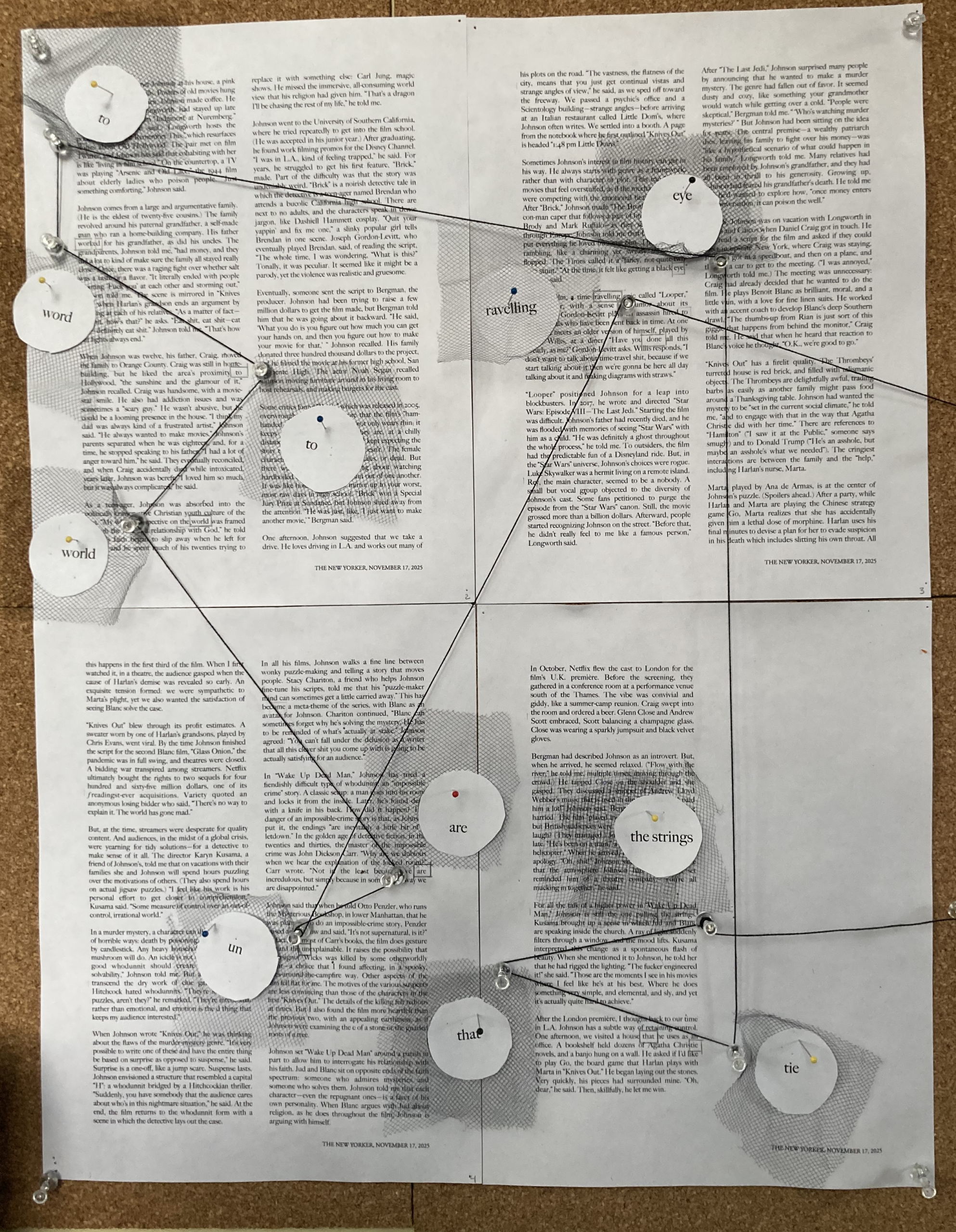
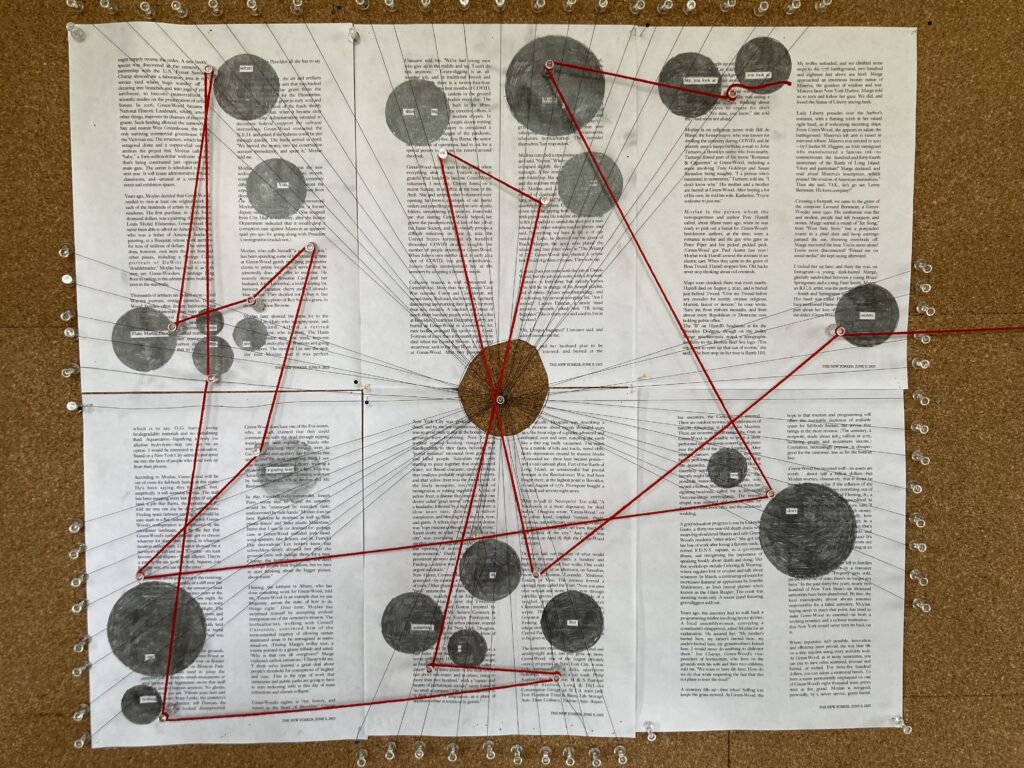
This morning, I decided to work on a new poem. Instead of holes, and my blind spot, it’s about strings and threads and the lines that connect/tether me to words and meaning. I created this poem out of words from a favorite NYer essay: “Mystery Man.” I mapped it out, then printed out the words in bigger text, then pinned it up on my cork board, then connected the words with black embroidery thread, making it look like a murder board. Here’s the poem. Each stanza is from a different page.
the strings that tie
eye
to word to world
are un
ravelling.
the strings that tie / eye / to word to world / are un/ ravelling
Is the string/thread dark and thick enough to see clearly, or should I go for thin black yarn?
I like the idea of this resembling a murder board, particularly in relation to my use of the word “unravelling.” Unravelling has two, almost opposing, meanings: 1. to fall part, to undo and 2. to solve a mystery, to make clear, to unknot or disentangle. So, the ties between eye, word, and world, are both coming undone AND are becoming more clear.
55 minutes minnehaha off leash dog park 49 degrees
Cooler today, but sunny with a soft breeze. Wonderful for moving. FWA and I agreed that there was energy in the air, a lifting — of impending storms, oppressive heat, humidity. The dog park vibe today: chill. Dogs moving quickly and quietly.
today’s dog name: Sunny (or Sonny?)
10 Things
glittering water
a small boat, fishing near the end of the trail
the LOUD knocking from a pileated woodpecker
a very big uprooted trunk, almost upright, leaning in the hollow of a living tree
deep, soft sand
the slapping sound of Delia’s water running through the water at the edge of the shore
the soft, thundering thump of Delia’s running feet on the soft dirt
2 HUGE fluffy white dogs
a small (smaller than delia) dog emerging from the woods — first, a flash, then right in front of of us — first they jumped up on me, then FWA, as if to say, hi! hi!
even more green on the trees, on the ground
While we hiked, FWA and I discussed Ariadne (see below). It started with me asking FWA if he was familiar with Ariadne’s thread from his reading of The Odyssey in college, or Percy Jackson in elementary school. He said, sure, but I mostly know it from Tarkov (a Steam video game). Of course. I’m always fascinated by all the stories/history FWA knows from playing video games. A few minutes later,FWA said, I think I also know it from Kaos (a Netflix show about greek mythology starring Jeff Goldblum as Zeus.
holes and strings and words
This morning, I feeling a bit overwhelmed and disoriented by all of my ideas about holes and strings and threads. Instead of trying to think and theorize my way out of it, which is my inclination — I’ve decided to stop trying to figure it out and follow some more trails. These trails may offer some answers, or they may cause me to get even more entangled (ensnared, knotted).
1 — Ariadne’s Thread
In yesterday’s post, Ariadne came up in a quote from the intro to Her Read. I knew the name, but couldn’t remember why. Just as I began typing In yesterday’s post, I remembered! It was mentioned in a poem about Icarus that I posted here on 19 june 2025: Altitude/ Airea D. Matthews. This poem has a favorite line, which I think fits here:
Bliss is a body absconding warp speed toward a dwarf star whispering, Unsee the beheld.
In that 19 june post, I kept thinking about unseeing:
Unsee as different than not-seeing (which I ‘ve thought/written about before). Not seeing is a static thing; you just don’t see it. To unsee is more active and also suggests a process of unravelling which is where my vision is at.
A few minutes later in the walk, I thought about flipping the phrase to, behold the unseen.
I like thinking about to unsee as a verb, an act, a process, a type of prayer? Just as seeing is not a static thing, where you simply see, but a process of light and signals and filtering and guessing by the brain, unseeing is a process of slow (or sporadic) unravelling then adapting — a brain doing mysterious and magical things with the scrambled and limited data it receives, a mind developing new ways to witness/behold without stable and dependable eyes.
Wow. All of this thinking about unseeing the beheld and unraveling vision, returns me to another thread in the book review about Helen Oyeyemi’s new book: swap the dead-eye liturgy of doomed vision for shadow acts wild and improbable. Is there something there to return to?
In my brief searching for Ariadne’s thread, I found a description of it as a method in logic for “solving a problem which has multiple apparent ways to proceed—such as a physical maze, a logic puzzle, or an ethical dilemma—through an exhaustive application of logic to all available routes” (wikipedia).
I found this bit about how Ariadne’s thread differs from “trial and error” interesting:
The terms “Ariadne’s thread” and “trial and error” are often used interchangeably, which is not necessarily correct. They have two distinctive differences:
“Trial and error” implies that each “trial” yields some particular value to be studied and improved upon, removing “errors” from each iteration to enhance the quality of future trials. Ariadne’s thread has no such mechanism, and hence all decisions made are arbitrary. For example, the scientific method is trial and error; puzzle-solving is Ariadne’s thread.
Trial-and-error approaches are rarely concerned with how many solutions may exist to a problem, and indeed often assume only one correct solution exists. Ariadne’s thread makes no such assumption, and is capable of locating all possible solutions to a purely logical problem.
In short, trial and error approaches a desired solution; Ariadne’s thread blindly exhausts the search space completely, finding any and all solutions.
The goal is not the solution/answer, but an exploration of possibilities. I also like the idea of using the thread approach in my erasing of text in a New Yorker article. The key: it’s arbitrary!
With a little more research, I also found this brief description:
The phrase “Ariadne’s Thread” refers to to the problem-solving technique of keeping a meticulous record of each step taken, so that you can always backtrack and try alternatives if your first efforts fail to yield results.
side note: this might be helpful in tracking my creative experiments so I don’t lose some of my initial ideas.
Before I left for the dog park with FWA, I had an exciting idea about how Ariadne’s thread seems to contrast with Alice’s rabbit hole. Here are some notes I jotted down so I wouldn’t forget:
tension = going down a rabbit hole (free fall, untethering, getting lost) versus ariadne’s thread (logic, finding, tethered to the world/meaning/language) — part of the feeling/process/practice of reading — what is the relationship to the word, how do I read? I answer with a mix of phenomenology (describing/showing my mechanics or reading words on a page) and an invitation to a new relationship with words, a new way for meaning and connecting and communicating not based on progression or logic or efficient understanding.
2 — a plastic bag
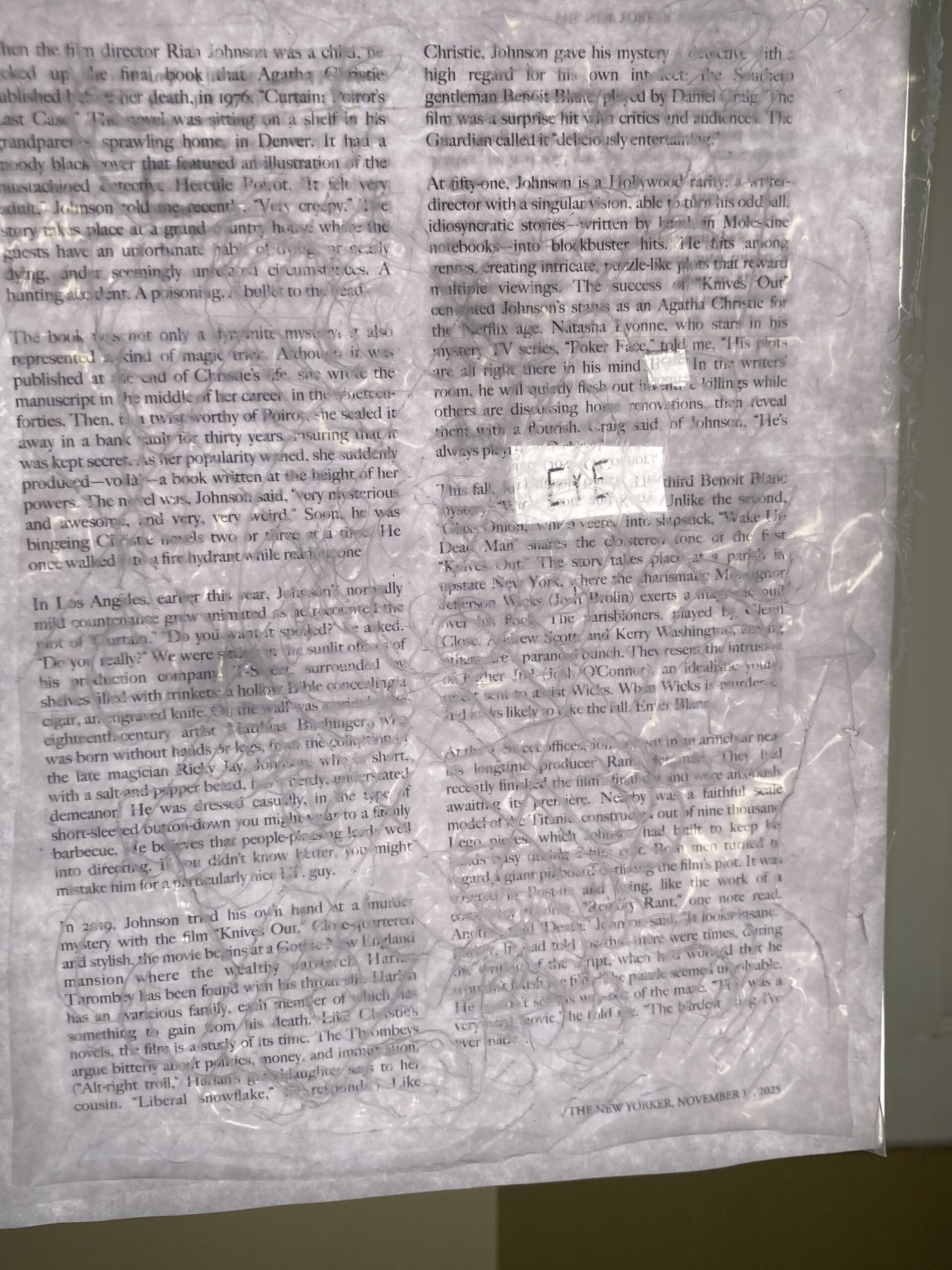
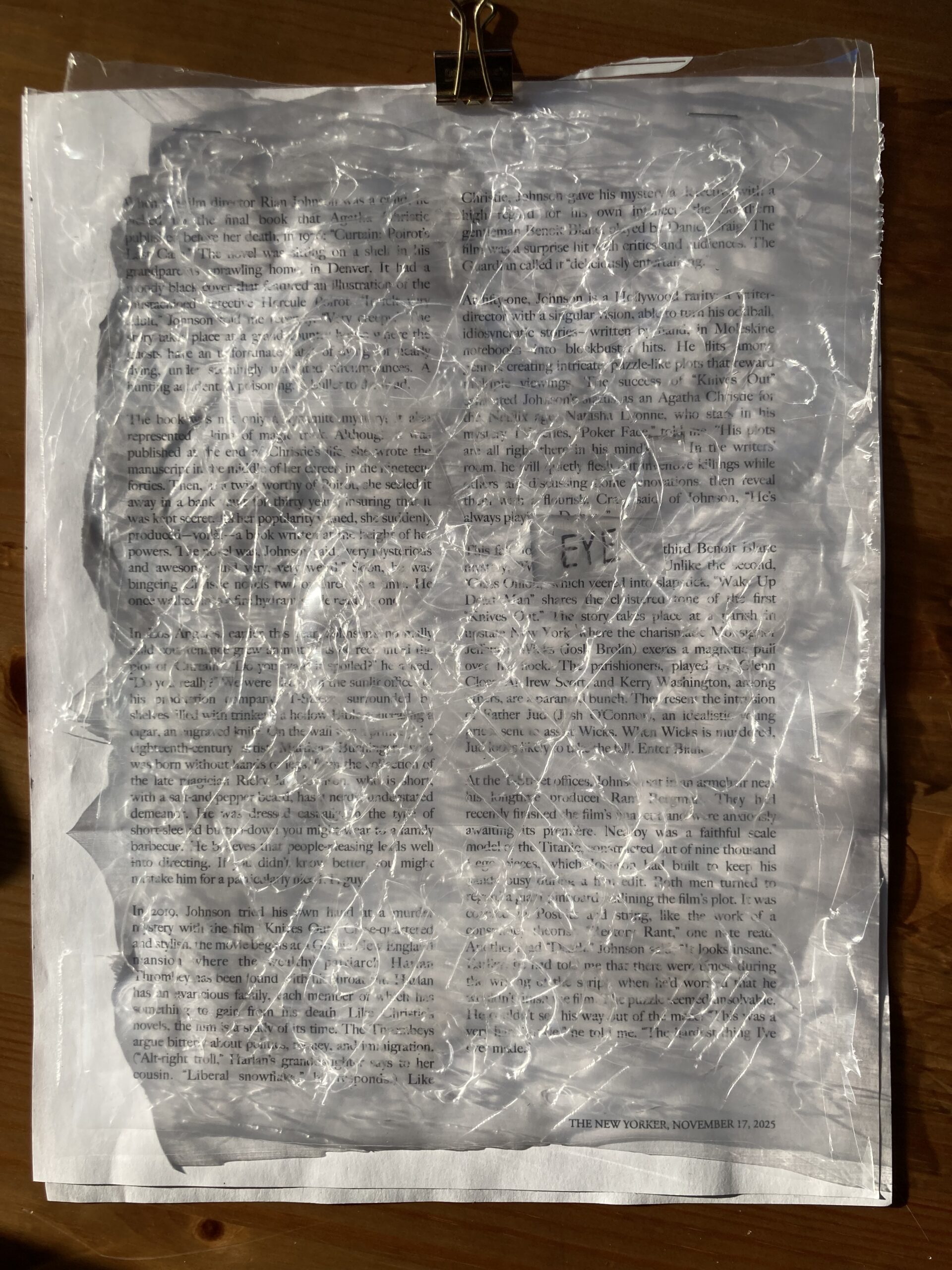
Some good ideas with the thread, but also too much thinking and theorizing and trying to fit ideas into a concept. I want to be led by the making and experimenting, not some concept. So, I returned to playing around, this time with my ziploc bag again. I like this material as the material for the hole or the effect the hole makes on words. I decided to deconstruct (that is, cut and spread open) the bag, the distress it with a pencil (drawing spirals and lines and zigzags on it). Then I realized it was almost the size of a single page: I can use it as a veil over the entire page!. I decided to create two bag sheets to make the text more difficult to read. Then I put them on 2 stacked pages of an essay — the same page. I found a word, eye, and cut it out of the one page so that you could still see it on the second (same) page. A hole in the page — I like this idea. Unfortunately, this version of it didn’t quite work; I’ll have to play with it more. Running out of time, I decided to write the word in bigger letters just to test out the effect. It needs some work, but it has potential.
a test: 2 sheets of distressed ziploc bag over text with a hole cut out to reveal a poem
For this picture, I held the papers up in front of the window with sun streaming in. I need to distress the plastic more.
same pages/poem, light source on, not through
A thought: as I work on these poems about reading, consider the light source; it strongly impacts how and what I can see. How can I replicate different levels of light, from BRIGHT to dim.
Another thought: more frequently, I’ve been placing holes on the page to erase the text, like my blind spot made out of black netting. I like the idea of experimenting with ways to cover the text, like with this distressed ziploc. I could also use layers of netting and thread grids — ones that are straight and ordered, others that are tangled and slanted.
Her Read
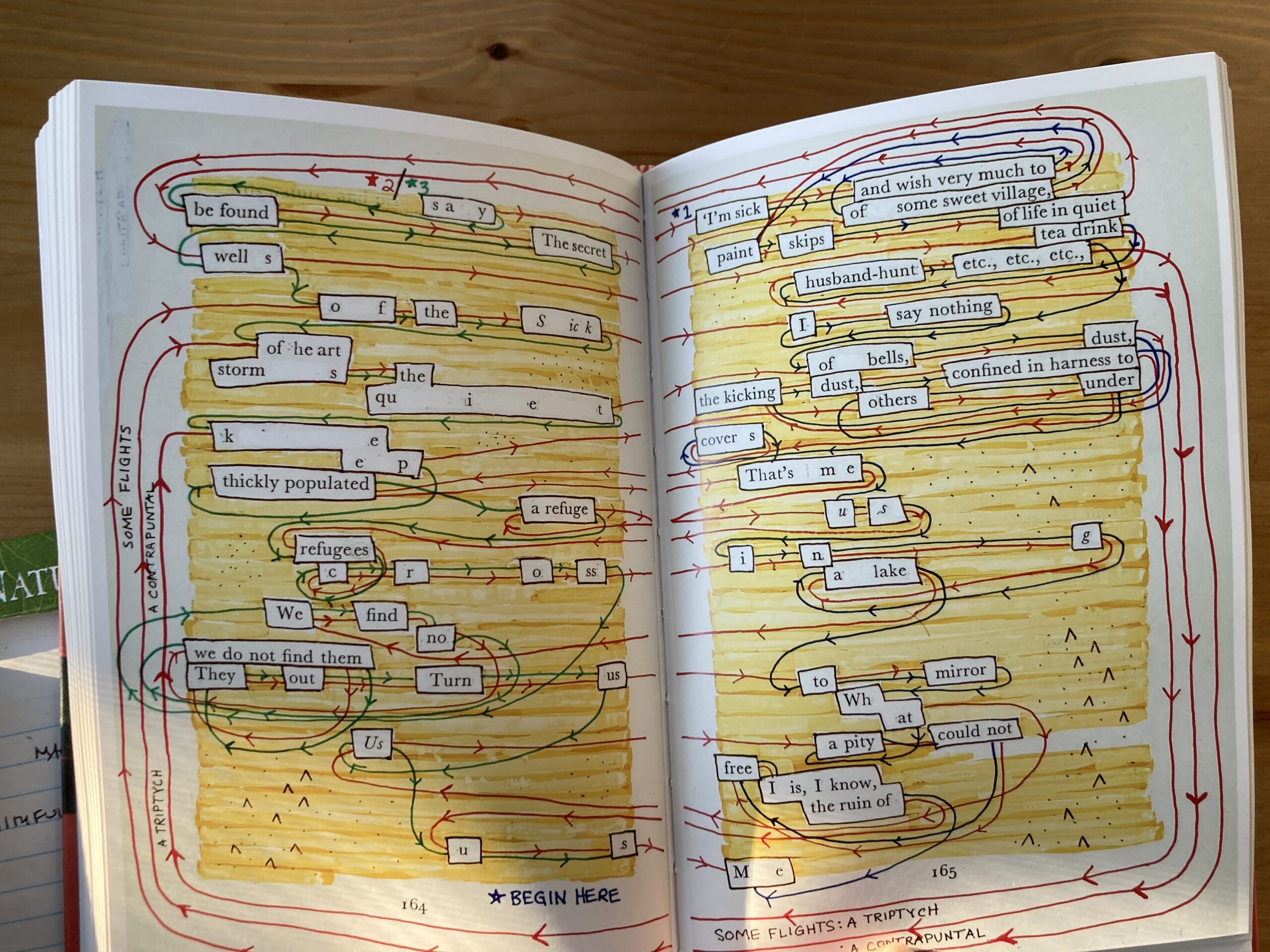
a page from Her Read/ Jennifer Sperry
Wow, this is very cool! I’d like to use this as inspiration. I’ll have to spend some time with this to see if I can read it. I like the color and how the words for the poem are all over the place and the arrows/directions.
60 minutes Minnehaha Off-Leash Dog Park 68 degrees
Another hike with FWA and Delia. So beautiful! Today, FWA shared a realization about something that happened to him in 5th grade that was traumatic and has had a lasting impact. This realization explains so much about him and how he retreated into himself in middle school. My heart aches for that sweet, young boy! Oh, how I wish I would have recognized it when it was happening for what it was! But, I’m not sure I could have; I don’t think he even realized how much it impacted him until now.
dog names overheard: Daphne (a french bulldog); Carly (a standard poodle); and Danny, short for Lt. Dan (from Forest Gump (a corgie — Lt. Dan because he has no/short legs) and Ari (no idea what kind of dog Ari was, I never saw them, just heard their owner irritatingly calling for them ALL the time — Ari! Ari! Aaaaarrrriiii!)
10 Things
a stopped, silent motor boat
thin white foam on lapping the shore
a log floating by, looking like a beaver (at least to me)
more flashes of green
a gaggle of honking geese, first flying then landing somewhere under a bridge
a black puppy with white paws the same size as 10 yr old Delia
a dirty golden retriever jumping on me (I didn’t care)
a sweet mid-sized white dog acting like a cat, approaching then leaning into me (also didn’t care)
a new entrance to the dog park, set farther in and farther from the road
woodpeckers knocking on wood! Once, a deep and very hollow sound — FWA and I guessed it was a big bird and a very hollow piece of wood. Another time, a quicker, softer knocking, sounding like a rattling jawbone to me
Near the end I mentioned hearing a rock bouncing off a hollow spot in the packed dirt, which prompted FWA to start talking about sink holes. There are lots of sink holes all around the river. At one point during this discussion, I thought about my holes project and how our discussion fit. Here’s one way to think about it: as we talked about sink holes I mentioned (or thought, I can’t remember) how freaky the idea of a hole opening up in the ground and swallowing someone or something unsettled me. Why is this so unsettling to me? The idea of being swallowed, of disappearing without a trace, of being trapped without an escape from somewhere deep? Could it also be the falling part too? The dizziness, your stomach dropping, the total loss of control? Possibly. Three thoughts related to my Holes series:
1
Dizziness. Feeling dizzy, like I might pass out, then a soft panic after trying to read for too long, or while trying to read labels at a grocery store. More than once, I’ve stopped and closed my eyes and held onto the grocery cart to ground myself.
2
Disorientation and feeling lost. I can’t read the names of stores or restaurants on the signs outside of buildings, so it can be very hard to get my bearings in a new place.
3
Delight. This morning, I watched the scene from the animated Alice in Wonderland again and marveled (again) at Alice’s reaction to falling down the hole. As she plunges into the darkness, she looks back at her cat standing at the top of the hole, and calls out to them in a delighted and excited voice, Good bye Dinah! Goodbyeeeeeeeee! Alice is not terrified or confused. As she continues to fall, she says something like, Now I will think nothing of falling down stairs!
grids and lines and threads
This morning, a return to thinking through the bigger picture of this series. A reminder from my thoughts from 7 april: the jacked-up spider web experiment in which NASA scientists gave spiders several different substances than studied the webs they created on those substances. A visual inspiration for this series! I’m printing out some images to put at the top of my cork board.
my cork board with the spider webs in the top right corner
Before the hike, I gave myself 3 tasks for today: 1. collect/work on Holes 5a, b, and c, also known as Hole Perspective, Hole Time, and Hole Process. Try to include “strings” or “pull the strings” in one of these poems; 2. draw/shade the dots encasing the words for Holes 3; and 3. work on the poem for Holes 6/Strings 1 — the book review about daughter’s memoirs
Holes 5a, 5b, 5c and Strings 1
Holes 5a
My hole perspective — life on the way to wonderland.
I fall through a what is this? feeling as text bloom into nonsense.
Holes 5b
hole time — measured in word (or words) one word then one then one word
Holes 5c
the hole process — a small island where reading is still possible waits as the large nothing that surrounds it grows
Strings 1
the strings that tie words to the world of meaning have come un done
I like these!
2 — Draw the holes in Hole 3
I did it. And it took much longer than I anticipated, so no third thing today. I drew larger holes and then created an elevated grid over it, first on my wall board and then on a piece of cork board on my desk. I think the holes are too big; they should be dots to match the center dot of the amsler grid and of points mapped on the x and y axis.
grid with big dots
I’d like to plot the small dots on the map of the text and then place the grid over it. I think I need to print the text directly on a graph to plot it properly — or is there another (easier?) way to do this?
60 minutes Minnehaha Falls Off Leash Dog Park 62 degrees
Another great hike beside the river and through the sand flats of the dog park. Much warmer than last time. Humid too. Not quite still, but quiet, calm, overcast. At the end of the walk, as we ascended a hill I described what I saw to FWA: the sky was bluer at the bottom of the sky near the fence; it faded to white as your eyes traveled higher. Was it just my strange vision? No, FWA saw it that way too.
We talked about one of FWA’s favorite teachers from High School. We agreed that she was one of the few teachers who really saw FWA and his neurodivergence. This led to discussing roommates and how hard it is to be understood by them when your brain is not neurotypical. We talked about our senior years of college and our desire to be done. And, like always, we talked about One Piece and other dogs and strange looking trees.
10 Things
brackish water at the beach on the edge of the park
soft sand that seemed deeper — had Minneapolis Parks dumped some dredged sand down since we were here last?
a motor boat traveling slowly up river, making waves
Delia doing my favorite thing: jumping over a log while running, her front and back paws stretched straing out like Superdog
the water looked soft and brown and flat
the faintest flashes of green all around — new buds on the trees!
a woodpecker knocking on dead wood
dots of green on the ground — moss, new grass — everywhere
rolling over several rocks on the ground — not falling or twisting anything
a woman walking a dog on a leash, calling out to them: no, you can’t! you lost your privileges when you ran away from me!
Grids
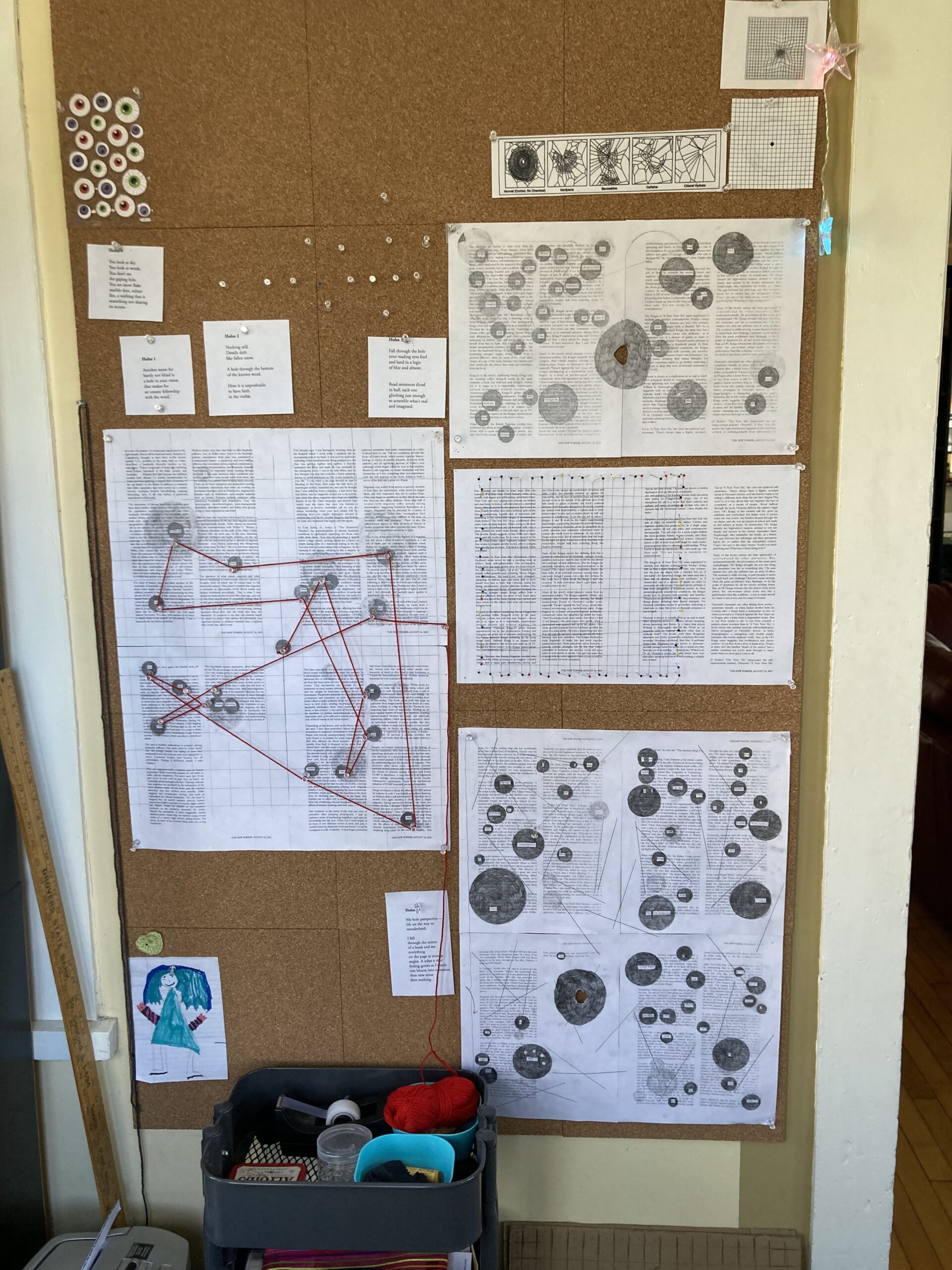
a summary: I’ve been playing around with Holes 4. I put it on my new corkboard wall and tried different thread/yarn/string. Then I played around with how to have the thread (which represents the lines of an Amsler Grid and being mapped in space/time) emerge from my blind spot in the center of the panels. Then I added red yarn and connected the words of the poem to each other.
more experiments with Holes 4 / 13 april 2026
I discussed it with RJP, which was fun, and we both decided that this black thread/red line effect was didn’t fit with the words of Holes 4. They were better suited to Holes 5 — maybe 5b? I want to print out the poems for each of these holes and post them on my board; this might help me keep track of all of them. The text from Holes 4 describes not seeing the hole or any lines, but everything as seltzer fizz and nothing that is something not sharing its secrets. That poem should have lots of little circles (seltzer bubbles/fizz) and create an optical illusion — you stare at the dark dots and then you see them everywhere else, almost like an after image. This poem might also have the words as enlarged?
note: I love my new board and being able to discuss my ideas with my kids; they have some very interesting ideas. Also, I think returning to a study of grids and learning how other people — artists and scientists — have used them could help guide my next steps.
what’s next:
I want to continue studying grids; I’ll start by reading (or trying to read) the book for the Charles Gaines exhibit.
I also want to keep pushing at my poems, so I’ll continue working on Holes 6, which is Lines 1.
And, I want to think more about lines, which means it is time for a lines/strings/thread playlist!
Charles Gaines and Gridwork
In the intoduction to the book, summary descriptions are offered for his works:
1 — Regression
28 drawing / 4 sets of 7
An arbitrary shape was chosen, and numbers were assigned to different squares of the graph according to their position. The numbers were then employed in simple arithmetic calculaitons to generate the form used in the next drawing in the sires. As the numbers threatened to overflow the parameters of the drawing, Gaines used what he calls a “radical divider” to contain teh propagation of his system. The final drawing in each set determined the starting point for the next, and so from any arbitrary starting point an infinitely expanding number of drawings could result.
Gridwork: An Introduction
Gaines was “interested in where systems fail or regress, revealing the innate contradiction of the objective or scientific enterprise. In other words, his work reveals the limations of systems.
2 — Walnut Tree Orchard
Each, a triptych — a photograph of a tree, a drawing in which the photograph is transcribed into numbers plotted onto a grid, and a second drawing that overlays all the previous grid drawings in the set onto the image from the second drawing.
This line, this series “makes visible the limits of photography, highlighting its single-point perspective, its flattening of space, gave me an idea: should I read/think about how reading happens and/or how we believe it happens, and play with that in my series?
3 — Incomplete Texts
used literary texts, picked ones that appear to supply information in a straightforward, truthful manner and submit them to processes of abstraction that complicate meaning
based on a page from Roy Nickerson’s Brother Whale he systematically removed letters from copies of they typeset page and transferred them to a grid this transformed the text into a series of fragments recalling whistles/clicks of whale song
note: It is difficult for me to actually see his grid images, so I’m struggling to understand what Gaines is doing in his different series. I want to dig deeper into his interview and other discussions of his grid system so I can understand how/why he’s using it1. This understanding might help me clarify how/why I’m using it — or, will it take me too deep into academic Sara territory?
Decided to google, “artists who use grids” and found this awesome exhibit that was at the High: Off the Grid. Very cool! I lived in Atlanta for almost 4 years and I never once went to this museum. Why not?
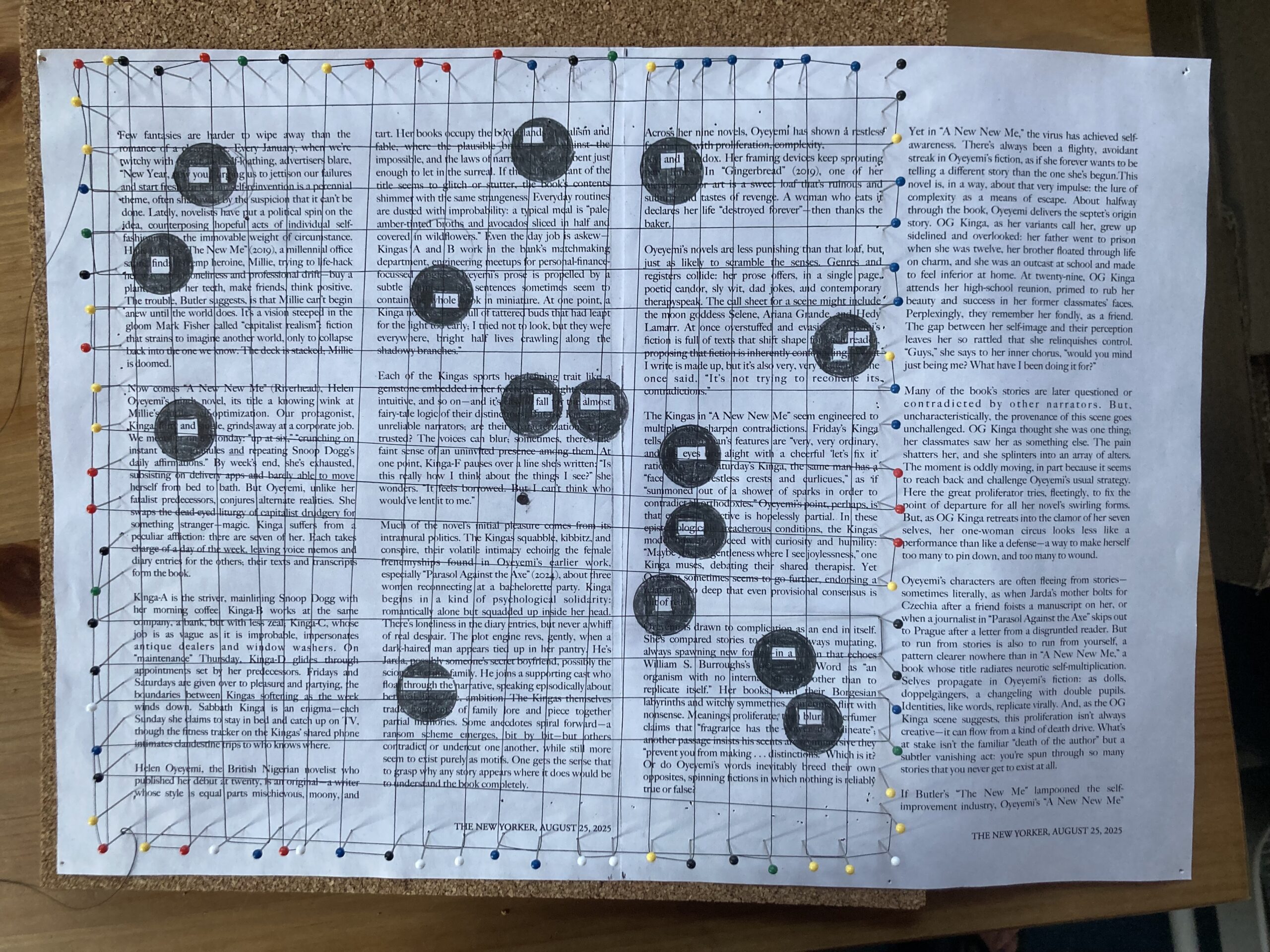
a flash of an idea: what if I turned Holes 3 into a “straight” grid, where the x-axis is blur, and the y-axis is almost. I could number the grid boxes with x and y coordinates and then have those coordinates next to the corresponding words in a poem key? I could either print out graph paper OR create a grid on the paper with string and a loom?
the poem for Holes 3:
Fall through the hole your reading eyes find and land in a logic of blur and almost.
Yes! The new experiment to try: the two pages from the New Yorker essay on a cardboard loom/grid, under a grid made out of black embroidery thread. I might add the shadow (a faint trace) of my blind spot drawn on the essay. The grid is also a graph with x-axis and y-axis named, blur (x) and almost (y). Each of the grid boxes has numbered x and y coordinates. Next to the graph/grid is a key/map with the xy coordinates. You look up the xy coordinates to find the words of the poem. Will this work? Consulting with Scott, he had some additional ideas: put the words in alphabetical order + put a pin and a number (signaling the order of words) next to the word — Scott compared it to dots on a map).
I like this idea and how it forces the reader to slow down and read the poem one word at a time. This isn’t quite how I read, but it gives a sense of how much slower I read, how many less words I can read. I also like the idea of a map, because part of why I am drawn to the grid is because of the way it enables me to locate and visualize my blind spot and vision loss.
Reading the interview will have to wait for tomorrow. My eyes are tired from what I’ve already read, which was only about a dozen pages. ↩︎
60 minutes Minnehaha Falls Off Leash Dog Park 40 degrees
With the sun, it felt warmer down in the floodplain forest, although my hands are still cold many minutes later even though I wore gloves. I don’t like the cold hands, but I didn’t mind the cold air. So many wonderful deep breaths — in and out, in and out.
The trees are still bare, so FWA and I could see far in any direction. For the entire time, FWA was telling me the story of the latest video game he’s been playing, Clair Obscura. So good — both the game (at least as I understand it from FWA’s description) and FWA’s describing of it. His excellent way of describing the games to me reminds me of how I enjoy New Yorker book reviews as something about and entirely separate from the acutal book they are reviewing. Often the review is better than the book. I’m not saying that’s true of the video game, although I guess it is for me because I don’t play video games (partly because I miss a lot details that I can’t see).1
I love hearing FWA’s accounts; he’s so good at them. They require my full attention and engagement — which is a good thing, and a hard thing (hard because it is hard to stay focused and not get distracted for that long with so many interesting ideas, and because FWA gets frustrated and can tell when I’m not fully listening). Even as I listened to and engaged with FWA’s story, was I able to give attention to the river and the trees and the bluffs? Yes! Here are 10 things I noticed:
10 Dog Park Things
at the top of a small rise: a HUGE tree with a girth wider than 2 of me could hug. Wow!
tree tableau: one tree bent over in an arch across the path, another tree leaning in and onto its trunk, the next tree in the middle of the sandy path just on the other side of the arcj
talking with some dog walkers, feeling one of the dog’s behind me, putting its snout under my coat and sniffing my butt
bright blue sky with a few fluffy clouds
a thin white foam near the shore
the sharp, foul smell of Delia’s poop as I tied up a poop bag
greeting another walker — good morning, what a beautiful day!
a pileated woodpecker, laughing
a thick wall of bare trees on the other side of the chainlink fence
a guy with 2 dogs, talking — I think into a bluetooth, but maybe just to himself?
Returning to #2 and the tree tableau: I wanted to stop and take a picture of this beautiful image but I knew that would upset and derail FWA and I’ve learned the hard way to respect that and to recognize that it is part of his ADHD/(possibly) autistic brain. I was planning to write all of this in a footnote, but then a song came on, “People Take Pictures of Each Other” from The Kinks, and I had to put it on stage, here in the text. It opens with these lines:
People take pictures of the Summer Just in case someone thought they had missed it And to prove that it really existed
Was Ray Davies reaching through time to sing this to me? Improbable as that is, wouldn’t it be cool? I guess, from one perspective, he is!
grids — lines — strings — threads — yarn
note: I began writing this after coffee and a substantial breakfast of blueberries and yogurt and granola. Lots of thoughts from here to here to here that I think was influenced by that coffee and food!
There are many ways to think about grids, and many ways that I like them. Today I am thinking about the lines and how they connect and locate and tether us to worlds, to people, to logics, to meaning and language and words. I’m thinking about this metaphorically and literally. The Amsler Grid is made up of ink lines. Can I represent it in my visual poem as string and thread and yarn?
A few minutes ago, yarn as telling a story popped into my head and I wondered what the origins of that expression were. It’s nautical:
“story, tale,” often implying “marvelous, incredible, untrue,” colloquial, by 1812 in the figurative verbal phrase spinning a yarn (also yarning).
It is said (by 1823) to be originally nautical, a sailors’ expression, from the custom of telling stories while engaged in sedentary work such as yarn-twisting
So many directions I could go with these ideas. I love this idea of thinking about the grid and the material/meaning of its lines. In a New Yorker article that I’ve already used for at least 2 (maybe 3) sections of Holes 5, the phrase, pull the strings, appears. I noticed last week and put it aside. Now I’m thinking of shifting my poems from Holes to Threads (or strings or lines). Whereas the rule with Holes poems is that “hole” had to be in the text, I’m thinking of being more flexible with this new direction: maybe, for each new essay/article that I use, I find a different name/word for connecting lines. I already have strings (from “Mystery Man”) to work with. And, I found another article, about Arundhati Roy’s new memoir that has “hole” AND “thread.”
Another related thought: Lines, especially on a rigid grid, don’t always connect us in welcomed ways. They can tie and bind and trap us too. There’s a tension with lines and strings and threads: we want to be connected, and we want to break free from the connections that do harm to us. Entangle2 and unravel. Entangle and unravel.
Okay, I started this thought in footnote 1, but I’m bringing it back up here. I’m thinking about evidence boards (or murder boards or red string boards) and how they map out a crime. I don’t see my vision loss as a crime, but I do see it as a mystery — not to be solved, but to be mapped and located and witnessed — yes, witnessed!
And now, after hiking at the dog park and eating lunch and doing the dishes, I’m attempting to return to these ideas and dig deeper into them. But, it’s hard to get back i that flow.
Maybe creating a list of tasks?
think/read/experiment more with murder boards: redo the second holes and put it on a (card)board back with yarn and pins
begin a new playlist: grids, lines, strings, threads
make a poem with strings in it out of the “Mystery Man” article
give some time to Holes 6 and its hole and thread found in the New Yorker book review, “What to Make of the Mother Who Made You?”
create the proportionately bigger scotoma template for Holes 5b, experiment with placing it or tracing it over the words of the article
revisit the erasure collection, a splendid catastrophe for inspiration
Okay, lots of ideas. Let’s return to the one we started yesterday — 5b and the two holes and figuring out how to represent those 2 holes on the page (1 hole — the very small amount of central vision I still have left, 1 hole — the fuzzy, filmy, fading/faded central vision graveyard that surrounds/encircles what’s left — hole 1 = the word / hole 2 = the void or wall or circle that encases/entombs the word and is always waiting to consume it.
A visual inspiration for the dark/light contrast in this poem and in my experience of the holes as I read words on a page:
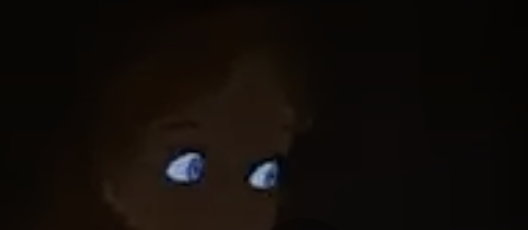
bright eyes in the dark
In my memory, Alice’s eyes were much brighter than I can see in this image. Something to think about: my version/vision of the dark due to my blind spot is never like this; I mean, it’s not all black. When looking at faces in can be a dark, smoky/smudged gray. When looking at words, I might see a faint dark ring. Sometimes it’s fuzzy or static — it’s not Nothing; it is something that is always moving. And here’s where I can get into Alice nonsense speak: It is not that I see Nothing; I don’t know that the something that is there is missing for me. I see no thing, without knowing that I’m seeing nothing. I think I need to work on that explanation.
But, back to the inspirational image. I like the contrast and the white eyes against the background. Do I want to make my word holes look more like eyes in this one? If I can do it without looking cheesy, yes!
I hope all of this makes sense to future Sara. Now, time to create my supersized scotoma!
update, a few minutes later: I started to think about how I might create the bigger version. There are probably many ways that are obvious to people who make things, but I have not been a maker and it’s all new to me. I like the idea of re-creating the grid, just bigger. Suddenly a thought: doesn’t the artist Chuck Close do (or, didn’t he do) something like this to create his portraits? Yes! He’s one of the most famous artist-users of a grid. Minneapolis Institute of Arts (MIA) has several of his works, but none can be viewed right now. The Walker has some too — I can’t readily see if they’re available for viewing. Some deeper digging is needed.
Almost every decision I’ve made as an artist is an outcome of my particular learning disorders. I’m overwhelmed by the whole. How do you make a big head? How do you make a nose? I’m not sure! But by breaking the image down into small units, I make each decision into a bite-size decision. I don’t have to reinvent the wheel every day. It’s an on- going process. The system liberates and allows for intuition.
file this with my Holes/Grid discussion: in thinking about all the ways I’m expressing something about myself through this series, I’ll add the significance of using the New Yorker and some book reviews. I love these book reviews and the access they give me to words/worlds that would otherwise be inaccessible (also thinking of the fun section on NY events and the restaurant reviews). Using New Yorker articles in these found poems is a way to reference that; it’s also a way to be able to still read them: slow, repeatedly, in strange order, and one word at a time. ↩︎
I looked up, opposite of unravel, and found twist, knot, tangle, entangle. I love the idea of entanglement! Reading more of the Merriam-Webster entry, I read about unraveling a mystery/solving something, lessening the confusion. Yes! These ideas return to something else showing up in my visual poem: the image of a crime board — what is it called — where you put pictures of the suspects on a board and then use string or yarn to link them. I should read up on that concept some more, maybe watch some movies or shows that use it?! Is this linking used in other things that don’t involve solving a crime? How do I google that? ↩︎