march 18/BIKE

30 minutes
basement

A 10k run yesterday on a recovering calf means no running today. Decided to bike in the basement just so I could move a little. I should have watched Dickinson, but I watched an old Ironman instead.

All day, I’ve been reading my old Haunts notes, trying to pick one thing to write about. Am I getting somewhere? Maybe. Maybe not.

Here’s a beautiful poem I just discovered from Terrain. Wow!

Prayer of a Nonbeliever/ Tim Raphael

Cathartes aura—purifying breeze—
is one name for a turkey vulture,
and what if prayer is like that—
praise song for a scavenger?
What if prayer is like this walk,
the same one every day,
a mantra of footsteps on mesa rock,
raptors in the wind?
What if it begins as a hint
on the piñon stippled hills,
unfurls like a scent the dogs sense
with raised snouts?
I suspect there’s prayer in the primrose
come into flower,
flake-white blossoms
blanketing the path,
in the rhythm of my quickened pulse
on the climb.
And if prayer takes its time on ridgelines,
in scant shade,
if it lingers by a petroglyph picked
into basalt—two figures with hands on hips
as if ready to dance—
then perhaps I am learning to pray.
Today, another friend’s diagnosis,
and who am I to scoff at believers?
I too like the idea of prayer as a stand-in
for clumsy words like hope,
wonder and love—for this green
green valley slaked on spring runoff,
for the whorl of dihedral wings
and the uneven heat of rising air.

that turn — another friend’s diagnosis — wow, those 3 words recalibrating the poem! I’d like to do something like that with my poems about the gorge!

feb 16/BIKERUN

bike: 15 min warm-up
run: 1.5 miles
basement

Finished the 2nd episode of season 1 of Dickinson, started the 3rd while biking. I’m really appreciating the audio descriptions. So much easier to watch shows! I’m also surprised at how normal/natural/not disruptive the audio descriptions are. Is it that way for people with good vision? I’ll have to ask Scott after we watch something with AD turned on.

Listened to a winter playlist while I ran. Just a short run to burn off some restlessness, to rest my eyes from reading/writing, and to add to my weekly total of miles.

Before the run, I worked on another image for my “how I see”project. Maybe I should take the 3 I’ve already done and do more with them?

 My view from above the gorge: bare limbed trees, all trunk and thin branches. A few trunks are thick — like the one near the center of the image or the one leaning on the left side — but most are thin, creating a transparent screen between runner (me) and river.
8 feb 2024

original description: My view from above the gorge: bare limbed trees, all trunk and thin branches. A few trunks are thick — like the one near the center of the image or the one leaning on the left side — but most are thin, creating a transparent screen between runner (me) and river. The ground, in the bottom third of the picture, is mostly dead, curled-up brown leaves. Sometimes, this is what I see even when there aren’t thin, bare branches everywhere — my view slightly obscured by something in the way — dead cone cells, I think — creating fuzz or static or a slight pulsing or wavering of lines. Also, if this picture were in black and white I wouldn’t be able to tell the difference. Often I have to ask Scott: is this in color or black and white?

5 nouns/ 5 adjectives / 5 verbs

nouns: tree, trunks, leaves, river, twigs, bank, bramble, sky, veil, net, screen
adjectives: brown, thin, thick, pale, blue, gray, soft. cluttered, tangled, obscured, disoriented
verbs: blocking, concealing, decaying, settled, crowding (out), decomposing, swirling

one sentence about the most important thing in image: This cluttered view of bare trunks and thin branches creates a screen between runner (me) and river and resembles what I sometimes see even when there aren’t thin, bare branches everywhere — my view obscured by something in the way, that I can’t move, that keeps the real (focused, clear, open) view just out of reach.

a second sentence about the second most important thing: The image is only of swirling forms — tree, leaf, river — as my eye struggles (and fails) to land on solid lines, instead bouncing from branch to trunk to leafy floor to river to sky to branch again. (This cramped, thickly tangled space overwhelms my eyes and my brain.)

a third sentence about the third most important thing: With its bare ground and dead leaves, it looks like this picture should be of the gorge in November or April, but it was taken in one of the first Februarys without at least 1/2 foot of snow on the ground. 

The most important thing about this image is how the branches create a net which mimics how my vision often works — I can almost see what’s there, but not quite. Secondary, but connected, is the feeling of being disoriented, off, almost but not quite, untethered, which comes from swirling forms and the climate crisis — there’s almost always snow on the ground here in February. Where are my Minnesota winters?

feb 15/BIKERUN

bike: warm-up
run: 3 miles
basement
outside: 4 inches of snow

Snow! Finally. My first real shovel session of the winter. Thought briefly about running outside on the trail, but when Scott told me he had heard the city hadn’t plowed the bike path, I decided against it. I watched more of the first episode of Dickinson with the audio description on while I biked. Listened to my winter playlist while I ran. I blocked the display panel, so I wouldn’t know the time. When I finally checked, I thought it would be 15 minutes at the most. It was 25. Wow.

Watching/listening to the audio description, it was interesting to notice when/how they chose to describe something and when they didn’t. An example: In one scene, Sue is sitting in the parlor. We see her looking and pointing, then we see a basket with a letter in it hanging outside of the window. Sue says, Austin. Look. At this point, the audio description (AD) says, Sue points to a hanging basket. Austin opens the basket and removes a small envelope addressed to Sue. I was struck by the AD choice to wait to describe Sue’s pointing until after the action was over. Something — poetic whimsy? — was lost in not describing Sue’s strange pointing — it seemed, at least to me, almost comical. Should it have been described? I’m not sure; I mention it to highlight how ADs involve choices of what to include or not include, often for clarity or brevity.

I must have still been thinking about this choice to not immediately describe the pointing while I was running because I suddenly had an idea about the significance of what my image descriptions leave out. I wanted to remember my thought so I pulled out my phone to record it, but the audio is messed up and I can’t understand what I’m saying. Bummer. My descriptions will be explicitly subjective. I want to emphasize how we always make choices when describing what we’re seeing — what’s important and what’s not. Our brains do this too when we’re seeing — it’s called filtering.

before the run

While rereading an entry from this day (15 feb) in 2022, I discovered that past Sara had been thinking about alt-text as poetry. I mentioned wanting to create alt-text for my beloved mannequin photos and posted some links:

I’ve already started using the first link. Just now, I read through the twitter thread. Very helpful! Here are some highlights — BTW, putting together these notes has used up a lot of my visual “spoons” for the day.

Not describing everything, but getting to why the image is there:

I think people who find providing alt text overwhelming think too much about describing every last detail in the image, when it’s more like, ok, why did YOU post it? …focus on why you’re posting the image or what it’s supposed to do or how other people would recognize it

Alt-text predates “accessibility”:

“alt” here is short for “alternate” and originates from HTML—back in Ye Olde Days if an image took 10 minutes to load or otherwise broke, you’d provide alt text that the browser would display in place of the image so you still knew what was going on

different than an image description, alt-text is only for necessary images, not decorative ones:

and alt text is different from image descriptions; alt text describes the purpose of the image and isn’t typically included if something is purely decorative—but do note that even a gif for example carries semantic meaning and is thus NOT purely decorative

intended to be brief

alt text is meant to be short, as it would get cut off by the image bounding edges otherwise

example of alt-text vs. image description

alt text for a chart: “Graph showing increase in alt text use on Twitter”
image description for a chart: “A graph titled ‘Increase in alt text use on Twitter.’ The y-axis shows percentage of images including alt text. The x-axis shows time in years from 2008–2022…”

craft it

don’t be afraid to put your personality into alt text or be funny or use alt text to extend your shitpost, like imagine using a screenreader & your entire TL is dry descriptions until “a dog so cute I screeched” appears

look to audio descriptions for good examples of image description and using brevity

I think there’s a lot to learn from audio descriptions too for how to provide alt text & image descriptions! try turning on audio descriptions on a show or movie and observe how to pack in detail, especially given the time constraints—you only have a few seconds to describe smtg — boba fett’s audio descriptions are amazing, they’re wonderfully evocative while also including details I wouldn’t have known, not being a star wars fan (like they note that the palace is jabba’s and name which character’s helmet he picks up)

it’s subjective

accessibility is a fluid concept that depends a lot on audience; there’s no one “best” way to write alt text or an image description, because fundamentally it’s about what details other people care about, and that will change across topics and groups

an extended example of using alt-text to further/enhance the story

I am DYING, here is an incredible example of alt text augmenting the experience for someone using accessibility features—it calls out only the visual features that are important (’90s aesthetic, scalloped border) and provides the context that makes this reply hilarious

Katherine Crighton
@c_katherine

Screencapture of a Denny’s tumblr ad. Of key interest, aside from its very 1990s aesthetic, is the scalloped border around the ad–at the time, it was intended by Tumblr’s parent company to denote to casual readers that the contents within the border were a paid advertisement. Specifically, only those who had paid for space would be granted the scalloped border. Denny’s, the restaurant chain and purveyor of surreal humor on social media, demonstrated with this ad that while the intent was to monetize this border, in actuality all one had to do was take a screencap, drop in your own ad, and then post the resulting image via the normal, non-monetized process– it would then appear the same way to the end-user, whether or not Tumblr’s owner recieved a dime. This method of deriving ad income was dropped shortly after the Denny’s “ad” pointed out this flaw.

Some very helpful ideas in this thread —

the why/purpose is the focus. In my “how I see” images, I’m not interested in describing everything in the image — I probably can’t because of my limited vision, but the ways it serves as an example of “how I see.” I’m also interested in bringing some elements of ekphrasis into this — what are those? I need to spend more time thinking about that!

the idea of brevity. I’d like to make these descriptions short. I think it might be helpful for my creative process to pick a meaningful number of characters or words or syllables. I’ll think about that some more.

listening to audio descriptions for guidance — I think I’ll bike this morning and watch/listen to a Dickinson episode! I did!

a ramble of thoughts:

thought one: Recently, I’ve started proof-reading my poems by listening as the screen reader reads them. I noticed that the speaker (mine is Fred — according to system preferences on my mac) can do enjambments (a sentence split up over multiple lines) when the sentence is at the beginning of the line. But when the sentence begins in the middle of a line, Fred pauses at the end of that line and reads the next line as a new sentence. Enjambment is much more a visual device. My alt-text poems should not use visual devices, but rely on aural ones. What are these? I know rhyme, meter, alliteration, assonance. Time to study! I’ll start with my Mary Oliver poetry handbook!

thought two: I’m just remembering a great line from June Jordan in her guidelines for critiquing a poem:

Punctuation (Punctuation is not word choice. Poems fly or falter according to the words composing them. Therefore, omit punctuation and concentrate on every single word. E.g., if you think you need a question mark then you need to rewrite so that your syntax makes clear the interrogative nature of your thoughts. And as for commas and dashes and dots? Leave them out!)

So, try writing my descriptions without punctuation. BUT, I’m also thinking of Dickinson and how important punctuation (em dashes, for example) were for her. How could I use punctuation to shape how Fred speaks my words?

thought three (barely formed): One feature of many ekphrastic poems is a contentious/combative dialogue between word and image. What about twisting that to push at the conflicts between hearing a word versus seeing an image?

All these thoughts might be too much, and might not lead anywhere I want to go, but I’ll keep with them for a little bit longer. I was just telling Scott last night, or was it this morning?, that I appreciate how past Sara includes discussions of intended plans. Sometimes I don’t act on these plans — and maybe it seems like I have too many ideas or that I’m all over the place, or that I’m not following through — but it’s cool to be able to trace the origins of the projects that do happen. And the plans that I didn’t act upon? Maybe I just not ready for them yet.

a few hours later:

Here are some notes from Bojana Coklyat in Conversation with Shannon Finnegan:

we can get more out it alt-text than just compliance:

SF: Something that has always been a hope of mine with the project is that for people who aren’t as familiar with access, it introduces them to a way of thinking about access as creative and generative and collaborative and process-oriented, and that might also influence the way they think about access in other parts of their lives.

BC: Alt text is so often approached through the lens of compliance, like, Okay, let’s just get this done. But when you’re paying attention to the language you’re using and how you’re putting it together, that’s already changing things. That’s already shifting things.

space and symbolism

BC: I was talking to Chancey Fleet, who works at the Andrew Heiskell Braille and Talking Book Library in New York, and Chancey said something to me and I was just like, Whoa, I have to really think about that. She said, “Is it that we really live in such a visual culture? Is the most important thing visual, or is it space and symbolism?”

I was thinking about that all day yesterday. And going back to this exhibit I went to yesterday, there was a metal piece that kind of looked like scaffolding or architecture. And then we had the chance to walk through it, and it was like, Yeah, this is the experience. It’s walking through it and understanding the space of it. It’s not necessarily, OK, this part’s five feet tall, it’s metal, and it intersects with this piece that’s metal. It was so much more about walking through it, navigating it, and even navigating it with someone.

I think that might be something I’ll start to think about more with alt text: symbolism and space and how those fit in when you’re describing something.

SF: I love that idea of thinking about symbolism. I often find that in descriptions, when someone uses a metaphor or a comparison, it really helps me understand what the subject of the description is really like, and that feels really related to this idea of symbolism. It’s like: What are your associations with this thing, rather than just with how 

jan 19/BIKERUN

bike: 10 minute warm-up
run: 4 miles
treadmill, basement
outside: 6 degrees, feels like -7

Because I was sick earlier this week, I’m being cautious and not running outside when the feels like temp is below 0. Running on the treadmill isn’t as interesting, but it is helping me to keep my heart rate down.

Watched a Hot Ones while I biked, listened to the audiobook for The Woman in the Window (in honor of windows month!) for almost 3 miles, then my winter playlist for the last mile.

The run felt easy and not too tedious. I looked over at my shadow — a giant head swaying. I think I saw the shadow of my ponytail swinging a few times. When I looked again, I lost my balance a little and stepped off the side briefly. Oops.

In The Woman in the Window, Anna is agoraphobic and has been stuck in her fancy house for 10, or was it 11?, months. She keeps her windows shut tight and spies/watches/looks at her neighbors through them (with the help of a high-powered camera lens). In the chapter I just heard (18), a woman she is watching, Jane Russell, looks back and waves, which freaks Anna out. She realizes that just as she watches others, they could be watching her.

side note: I know very little about this story other than that someone is murdered, Anna sees it, and no one believes her. Listening to this chapter and being introduced to Jane Russell, I’m guessing she’s the one getting murdered. I’m also getting the feeling that not only will people not believe that Anna saw the murder, they won’t believe that Jane Russell is real. She’s just Anna’s drunk/over-drugged hallucination. Am I right, or have I seen The Lady Vanishes too many times (thanks 1980s HBO!) Continuing with Lady Vanishes vibes, I’m wondering if the small portrait Jane sketched of Anna that she hastily shoved in her drawer will be proof (if to no one else, at least to herself) that she’s not making it up! Jane does/did exist! In The Lady Vanishes it’s the message written in the fog on the window, or the sugar packet that proves the little old lady who vanished actually exists — am I remembering that right? I think I’m conflating the 1938 original with the 80s remake here. Anyway, I’m probably wrong about Jane not being real. She has a son who can verify her existence. It was the random moment when Jane sketches Anna that made me think of this scenario. Future Sara, let me know after you’ve finished the book!

update from feb 1st Sara: A lot of what I thought was right, but not quite. Lots of slight twists. For example, everyone believes Anna exists, but she’s someone else. The portrait does come up and does reinvigorate Anna’s flagging belief in what she thinks she saw, but it doesn’t serve as an a-ha moment or matter much to others. And all the stuff with the son? I probably shouldn’t have been, but it surprised me.

In addition to the actual windows in her house, there’s also the window of the computer screen. After she waves back at Anna, Jane comes over and they talk. Jane asks Anna what she does in the house all day. Anna describes the chatroom she participates on and the french lessons she takes online. Then Jane calls the computer, “her window to the world.” The window as Windows (mircrosoft) has come up in my exploration of windows and their meanings alreadyearlier today even, when I was reading the Part 2 article I mention a few paragraphs below.

Magritte and windows

(written before the run) On the 15th, while rereading entries from that day in past years (thanks to Scott’s “On This Day” plug-in!), I encountered a great vision poem that I had read before, but not that closely, I guess, because I missed how much it spoke to me and my experience with vision loss. The poem: Ekphrasis as Eye Test/ Jane Zwart. And the verse that particularly spoke to me was this:

Other losses begin in the middle of the field:
redacting the kiss at a picture’s center–
wrapping lovers’ heads in pillow slips; hovering doves
at eye level anywhere hatted men stand.
They could be anyone, the strangers Magritte painted
almost as their mothers, maculas wasted, would see them.

  • the kiss, lovers’ heads in pillow slips: The Lovers
  • the dove and the hatted man: Man in a Bowler Hat
  • Magritte’s mother killed herself by jumping off a bridge when he was 13. When her body was found days later, her nightgown was wrapped around her head (I can’t remember where I read that — found it!)

When I read these lines, I didn’t immediately get the references I mentioned above, but I did recognize the featureless faces and wasted maculas in my own vision. I recall liking Magritte exhibit when I was kid — I had a poster of the business men floating in the sky — but I hadn’t thought about him much since.

I inherited my mom’s copy of a 1992 exhibition she saw at the Art Institute of Chicago, but I hadn’t looked through it much, if at all. I picked it up and saw the cover — his painting with a train emerging from a fireplace — and thought: Charles Bonet Syndrome! CBS happens to some people as they lose their central vision; it often involves strange hallucinations. I read about people seeing waterfalls coming out of skyscrapers, old carriages coming down the street, and a dozen cooked eggs on a fireplace mantel. A train emerging from a fireplace seems to fit in these.

The cover of Magritte book. At the center, a fireplace with a black train, steam coming out of the top, emerging from its center. On the mantel, a clock. And behind that, a big mirror. In the bottom right corner, the book title: Magritte
Magritte on my desk, next to Forrest Gander’s “Circumambulation of Mt. Tamalpas” under the glass

Of course, there are other meanings intended with this train, but I immediately saw it as CBS hallucination. Looking through the book at all the featureless faces and faces obscured by apples and doves, I recognized my own inability to see faces. Very cool.

This morning I decided to dig into Magritte a little more. I discovered (or maybe remembered) that one of his reoccurring themes was windows — fitting for this month’s theme! Fearing copyright issues (I’ve been burned before), I’m not posting any of the images here. Instead, go here for examples: Magritte windows.

In my brief research (googlin’), I found this: Part 2: Magritte’s Window Paintings. At the end of the post there’s an article on the symbolism of windows, with some useful descriptions:

This intimate relation between the window, seeing, and perception (cf. eye/gaze) has become part of everyday language: the eyes as windows to the soul (or heart, or mind) [1] point out the possibility of looking inside a person through the opening of his eyes, where an inner state is reflected.

note: 1 The notion of  the ‘eyes as the window to the psyche’ goes back at least to a text by the Skeptic philosopher Sextus Empiricus (2nd century A.D), who might be citing an even earlier text. Cf. Carla Gottlieb. The Window in Art. From the Window of God to the Vanity of Man. A Survey of Window Symbolism in Western Painting (New York: Abaris, 1981), pp.49f.

I’m always searching for references to this phrase as I interrogate the idea that we see each other’s souls, and their humanity, by looking into their eyes.

The window as an opening in a wall refers to an absence which can be filled – by a material (glass, wood, paper, stone), by that which is seen through it, or by something rather immaterial like light or air. If defined as an absence, the window becomes a frame for its variable content, a marker of difference between what is inside and outside.

I’ve been thinking and writing a lot about Nothing lately, so I’ll have to add this idea of absence/frame to my list of ways of understanding the word/concept. Maybe I’ll add it to the series of Nothing poems I’ve been working on, which have emerged from my stripping down and reimagining my Haunts poem.

jan 18/BIKERUN

bike: 10 minute warm-up
run: 3.65 miles
basement
outside temp: 9 degrees / feels like -4

for future Sara: Tuesday night while sitting in the South High band room, listening to the community jazz band rehearse, I suddenly felt sick — a little like I might faint again, hot and tingling all over, very sensitive to loud sounds. Later on the way home in the ridiculously cold car, I had the chills and felt like I might throw up. Went home and straight to bed. Stayed in bed all the next morning. Not covid (I tested), but maybe the flu?

update, 29 dec 2024: I’m pretty sure that what I experienced was a panic attack. I had another one in May and then went on lexapro.

listening to my Window playlist: I Threw a Brick Through a Window/U2

I feel much better — almost normal — today. I’ve decided that I had the flu and the flu shot I got in November prevented it from being more severe (whew!). Of course this experience gave me some mild anxiety — was I sick, or was the faint-feeling signaling some bigger problem? How long would I be sick? At some point, would I have trouble breathing? Sigh — I dislike how much more I worry these days.

Tip Toe Thru’ the Tulips with Me/Annette Hanshaw

Since I felt pretty good today, I decided to try running on the treadmill. After my feet warmed-up in the cold basement, I felt great. Listened to my winter 2024 playlist and covered the panel displaying the time. I kept telling myself, one more song and I’ll check how much time I have left. When I finally checked, the time was at 31 minutes! Very cool; I thought maybe it would at 21 or 22 minutes. I like playing this game when I’m running on the treadmill; much better than staring down at the display.

Open a New Window/Mame Soundtrack

Noticed my shadow running alongside me. Stared at the water heater straight ahead of me: fuzzy and shifting very slightly. Also, the image had some static.

Look Through Any Window/The Hollies

As I write this, I’m making note of the window songs that are playing. It’s a bit difficult and I feel pressure to hurry up and write something before the next song comes on.

Nan You’re a Window Shopper/Lily Allen

In Nan, You’re a Window Shopper Allen complains — is she complaining or lamenting? — about her nan whose life is so constricted — taking a look, but you never buy/ and mad as fuck/only just alive

Window/Fiona Apple

Window/Daniel G. Hoffman

Is is no more than an eyehole
On the outside scene
Making everything
–The snow, the runaway dog,
The boys brawling and the car
Skidding against the tree–
Content to be contained
Within a reasonable frame?
Or could it be

A casement dividing
A real Observer from a view
Of untrammelled possibility,
Its pane connecting
A man in a room in
Steam heat and a battered chair
With his future
Which he could not see
Were it not there?

Window Shopping/Just Derrick

Perhaps it’s the lens that allows
Errant swifts and swallows
In a downward swoop
Of their tumbling flight
To glimpse the man waiting
For the future to happen–
While he’s caged in time
They’re free to look in,
And its gift is insight.

Junk/Paul McCartney

I noticed that Hoffman’s next poem is titled, Door. I’ll have to read that one when I study doors!

From Junk:

Buy, buy, says the sign in the shop window
Why, why? says the junk in the yard

Bust Your Windows/Jazmine Sullivan

I’ll bust the windows out your car
You know I did it ’cause I left my mark
Wrote my initials with a crowbar
And then I drove off into the dark

Maybe I’ll try experimenting with a themed playlist? I could listen and pick out a few lyrics from each song, then write about them, or turn them into a poem?

jan 15/BIKERUN

bike: 15 minute warm-up
run: 3.7 miles
basement
outside: -1 degrees, feels like -18

When I checked the weather earlier the feels like temp was -22 and it has to be feels like -20 or warmer for me to go outside for a run. Would I have gone out there if I knew it had warmed up to feels like -18? Possibly. Oh well, the bike and run inside were fine. I listened to a new playlist I created while I ran and didn’t think about much except for my form — swinging my arms, lifting my hips, keeping my shoulders relaxed and my core sturdy.

I looked up and straight ahead at the water heater in front of me. It was fuzzy in the center. As I looked at it, I noticed my shadow — much bigger than me — off to the side.

Okay, now I remember one thing I thought about: the mouse/mice that live in our basement. Would I see one of them flit by? (nope.)

Looking out my window, I just saw someone run by on the sidewalk. So, someone is willing to run in this cold.

Another thought: before I ran I was thinking about a quote from Theodore Roethke that I posted on jan 15, 2020:

Today there’s no time for the
mistakes of a long and slow
development: dazzle or die.

I wrote about it in an “On this Day: January 15, 2020/2022” page this morning. I was wondering about the value of dazzling in a quick flash versus shimmering with a slow burn. Then these words/ideas popped into my head: flare, flame, a candle burning at both ends, a mushroom erupting and busting through the pavement, moss growing over rocks, fungi nets spreading underground.

I also thought about spending some time on the phrase “slow burn.” Just now I looked it up on Poetry Foundation (search: slow burn) and found a wonderful poem, Over Time by Martha Collins. Here’s one bit of it:

an excerpt from Over Time/ Martha Collins

7

Then gone and then to come:
all the time, except the split
second, except—

All the time in the world.

And out of this world?

Oh little heart on my wrist,
where are we going?

Oh little heart on my wrist! Yesterday I started listening to a podcast with Jenny Odell about her most recent book on time and I decided that when the book was ready (I requested it from the library), I would finally dedicate some time to clocks and time and other forms of time that don’t involve clocks. Very cool!

jan 13/BIKERUN

bike: 30 minutes
basement
run: 1.15 miles
outside: 7 degrees / feels like -10

A short run today because I’ve run every day this week so far, and because it’s windy and snowy and cold outside. Watched the first 20 minutes of Jennifer Lawrence’s comedy, No Hard Feelings, while I biked. I like her and I’m finding this movie funny so far. I listened to Taylor Swift’s Reputation while I ran. Tried out my new bright yellow shoes for the first time. I like how they feel and how they look. Quite possibly they will be the shoes I wear when I run the marathon next October. I don’t remember thinking about much as I ran — I focused on my arm swing and staying relaxed and lifting my hips. We turned the treadmill the other way a few months ago so now I won’t see my inverted moon on the dark window anymore. What strange image will replace it? I don’t remember any today. But I’ll have to look for one the next time I run on the treadmill, which will probably be on Monday; it might be arctic hellscape cold then.

Emily Dickinson’s Windows

Here are some useful ideas from an article — Emily Dickinson’s Windows — I found yesterday, which seems to be an extended version of an article I read a few days ago:

  • creative freedom
  • architectural prop: By my Window, The Angle of a Landscape
  • her envelope poems resembled a window with curtains
  • a magic lens — the warped quality of 19th century windows: the world let loose, nature liquefied — her practice of looking/writing — up and out the window/down at the paper — descriptions as incremental fragments (A Slash of Blue! A Sweep of Gray!)
  • the window grid creates a pattern — 12 panes — reflected in the formal structure of her poems (degrees, steps, notches, plunges) — each word, line, or stanza is well-defined slot/pane that spotlights an image/emotional state/quality of experience — ’Tis this – invites – appalls – endows – Flits – glimmers – proves – dissolves – Returns – suggests – convicts – enchants Then – flings in Paradise – (Fr 285)
  • an act of undoing in each pane — nature loosening up (a neat frame in a formless center)
  • each pane a diagram of rapture
  • looking through/touching the glass, she connected with the artisans who made it, who left evidence of their labor –warps and striations that were once the artisan’s breath (windows made through glass blowing? wow)
  • glass blowing and imagery of fiery furnaces, metal flames, boiling, white heat
  • mid 19th century — glass consciousness
  • ED’s poems as her own form of glass blowing — creative process of transforming words into poems = making sand into glass into windows

the window grid creates a pattern — 12 panes — reflected in the formal structure of her poems (degrees, steps, notches, plunges) — ’Tis this – invites – appalls – endows – Flits – glimmers – proves – dissolves – Returns – suggests – convicts – enchants Then – flings in Paradise – (Fr 285)

I love this idea of how the windows influenced the form of her writing. Also, the combination of the orderliness/structure of the frame and the unruliness/undoing-ness of her words. It might be fun to use my windows — 2 sets with 2 panes each, a bar in-between the windows, one set in front, one to my right side — as the structure for a few experiments. As I write this, I’m thinking about Victoria Chang’s truck moving across each window frame and Wendell Berry’s black criss-crossed frame.

Here’s a wonderful ED poem that is mentioned in the article:

By my Window have I for Scenery (797) / Emily Dickinson

By my Window have I for Scenery
Just a Sea—with a Stem—
If the Bird and the Farmer—deem it a “Pine”—
The Opinion will serve—for them—

It has no Port, nor a “Line”—but the Jays—
That split their route to the Sky—
Or a Squirrel, whose giddy Peninsula
May be easier reached—this way—

For Inlands—the Earth is the under side—
And the upper side—is the Sun—
And its Commerce—if Commerce it have—
Of Spice—I infer from the Odors borne—

Of its Voice—to affirm—when the Wind is within—
Can the Dumb—define the Divine?
The Definition of Melody—is—
That Definition is none—

It—suggests to our Faith—
They—suggest to our Sight—
When the latter—is put away
I shall meet with Conviction I somewhere met
That Immortality—

Was the Pine at my Window a “Fellow
Of the Royal” Infinity?
Apprehensions—are God’s introductions—
To be hallowed—accordingly—

The pine tree as a sea with a stem? I love this idea!

jan 7/BIKE

bike: 35 minutes
basement

Met my running goal for the first week of 2024 yesterday, so today I biked. Again, no problem with my left knee, which is great. I’d like to do more with the bike this winter — maybe try to bike for a little longer? Watched the tokyo triathlon mixed relay. I don’t remember what I thought about and I don’t remember hearing/feeling/seeing/smelling anything while I biked — oh, one thing: a strand of my hair was out of my ponytail and it kept touching the nape of my neck — irritating.

Right after I got up this morning (I slept in until 8:30!), I found out about John Cage’s A Dip in the Lake: Ten Quicksteps, Sixty-two Waltzes, and Fifty-six Marches for Chicago and Vicinity. Very cool . I found it while reading this:

When I am stuck, I walk. I don’t wear earbuds or headphones when I walk, nor when I travel by train or bus, because I want all of my senses to be centrally alive to what’s around: the music that lurks in the crevices of city sounds, forest sounds, desert sounds. I am reminded of John Cage’s art piece A Dip in the Lake: Ten Quicksteps, Sixty-two Waltzes, and Fifty-six Marches for Chicago and Vicinity, a map with colored lines and vectors that reconstruct the city transversely from without in the layering of aleatoric drift over cartographic direction. To this end, unstructured walking, the pure derive of walking, can become something like a divinatory practice, chance-based yet ritualized.

Jose-Luis Moctezuma

today’s windows

  1. bedroom window
  2. front room, my desk windows
  3. picture window from desk to living room
  4. kitchen window
  5. car window
  6. looking up in grocery store, ceiling window
  7. back door window
  8. sliding glass door window
  9. basement windows — one to the north, one to the south, one west that is dark because it’s under the deck

jan 4/BIKE

40 minutes
basement

A nice day, not too cold and with no snow, but I ran a 10k yesterday and I’m trying to be responsible with my training and not overdo it. But, after feeling frustrated when my password wouldn’t reset and overwhelmed by my haunts obsession, I knew I needed exercise. So I biked in the basement. It felt good, and my left knee didn’t hurt like it did last year. I feel much better now. While I biked I watched an old PTO triathlon race and forgot about my frustration.

Is there a word for experiencing frustration when something won’t work online? It’s not an overall fear or hatred of technology or computers, but a temporary breakdown/panic when I can’t get it to work, or when I need to resubmit a password but can’t find it, or when I know there’s something I haven’t filled out in an online form, but I can’t see what or where it is. It’s also anger at how poorly designed online forms are or how the user experience (UX) doesn’t consider enough people’s differing abilities — especially older people or young-ish people like me, who can’t see very well — or, as Scott just mentioned to me, how UX can be designed to direct people in ways they don’t want. This last thing is called dark or deceptive patterns. An example: a site makes it confusing and almost impossible to unsubscribe or cancel online.

Maybe reading this site, Deceptive Patterns, could give me some better words.

Before — or maybe it was after? — I was derailed by passwords, I came across an interview with the writer/philosopher/nature writer/climate change activist, Kathleen Dean Moore.

Here’s how I got there:

  1. Thinking about water and stone and air I remembered something I read in a beautiful essay by Jake Skeets, My Name is Beauty. Skeets is quoting another writer, Viola Cordova and her essay, “Language as Window” — they’re both talking about moving (swimming) through the world, not walking on it
  2. I searched for that essay and found that it was in a collection by Cordova, How it Is (I was able to check it out from my public library!), which was edited by Kathleen Dean Moore
  3. A link for Moore’s site came up and I was intrigued by its name, River Walking, so I checked it out, and in the media section I found a great interview, Why I Write

I miss the days of wandering through libraries, from shelf to shelf, following footnotes and bibliographies to new ideas and friends, but I’m grateful for the internet and ebooks, especially as my central vision deteriorates.

Anyway, here’s something I just read in the interview about forms of thinking:

everybody – should have an education in three kinds of thinking:

Critical thinking. The essential art of reaching reliable conclusions on the basis of evidence; the ability to defend yourself against flawed arguments or deceptive assumptions. This is the foundation of a rational life.

Empathetic thinking. The art of putting yourself in another’s place, seeing the world through their eyes, and asking what you would believe and do in their situation; the art of asking questions about why they believe what they do and make the decisions they do. This is the foundation of justice and compassion.

Hypothetical thinking, the “if, then” art. The ability to entertain an idea; the ability to consider that things might be different from the way they are now; the art of following a chain of possibilities beyond those immediately apparent. This is the foundation of imagination.

Why I Write / Kathleen Dean Moore

dec 31/BIKE

bike: 30 minutes
basement

Sometime last night, my left leg/knee started to hurt, then it snowed and left slippery sidewalks, so today I decided to be cautious and bike. Watched a replay of the Kona Ironman from 2017 while I biked. At one point, they interviewed 6 (or 5?) time Ironman winner Natasha Badmann. I remember her! She had an amazing perspective on one of the toughest parts of the course: the energy lab. She saw it as giving her energy, not taking it away — the energy of inspiration from the powerful waves off in the distance. Wow, to be that present when you’re 6 or 7 hours into a tough race is impressive. As I biked, I thought about athletes and the different ways they try to overcome the strong desire to stop, give up. I find Badmann’s approach to be a helpful lesson in letting go — not trying to control your thoughts or getting rid of your pain, but releasing them and shifting to another way of being — a way in which you’re not centered, but witnessing something beside yourself. Does that make sense?

Before biking, I had a good morning filled with ideas: 1. creating a series of short poems in which I use my favorite lines from other poets by fitting them into my running/rhythmic breathing form: 3/2 and 2. using my 3/2 form and writing poems that are one sentence long.

I also watched an amazing talk by Ed Hirsch on poetry, the poem, and the reader:

I wish there was a transcript. If there is, I can’t find it, so here are some of my highlights:

Poetry exists to inspire the reader not to inspire the writer, that the purpose of poetry is in the relationship between a poet, a poem, and a reader. And it’s in that connection between them.

Talking about his teacher at Grinnell told him:

You have the gifts to be a poet, but what you’re writing is not poetry. It’s not even close to poetry. What you’re writing down are your thoughts and your feelings but you’re not trying to craft anything, you’re not trying to make anything. You’re not writing in relationship to any other poetry. You’re not reading poetry and so you’re not really a poet right now. You are a person who writes poetry. You have to read poetry and connect your poems to what you’re reading.

He discusses reading Gerard Manley Hopkins and feeling a profound connection. It spoke deeply to him and he wanted to know/study how Hopkins could achieve this.

Holy shit, this thing’s a sonnet? You mean, he’s not just writing out his poems the way I write out mine? He’s actually making it rhyme and everything? That seems generous to me. I want to do that. I’m going to try and make something for someone in the future so that they can feel about my poem the way I feel about Gerard Manley Hopkins’ poem.

Then he talks about how Hopkins’ poem was so distanced from him by time, location, experience, yet it spoke to him more than anything else he had heard. He realized that poetry can communicate more deeply than social conversation.

Celan: a poem is a message in a bottle, not guaranteed to reach anyone; a poem is sent out to some future person

Poets are people who, not so much want to express themselves, but feel so encountered by other poems that they want to respond in kind. That’s why Emily Dickinson calls the poets she reads, “her kinsmen of the shelf.”

The reader plays an important role in the understanding of poetry. The message in the bottle only finds its life when it’s activated in you. When you become the secret addresse.

There are a few poems you read and you go, I feel almost like I’ve written the poem to which I’m actually only responding to.

poetry: the gift of privacy and participation: It gives you interiority and it also gives you connection.

Poetry as stored magic that can’t be paraphrased

Poetry exists in the relationship between the poet who wrote it, the poem which encapsulates the experience, and the reader who reads it.

His discussion here reminds me of an interview I read and posted at some point in the last few years:

We are not diminished but enlarged by grief, by our refusal to vanish, or to let others vanish, without leaving a verbal record. We need poetry to help us transform the oceanic depths of feeling into art. Poetry rises out of one solitude to meet another in recognition and connection. It companions us.

And, yes, poetry is connected to contemporary life, but it’s also always connected to other poetry. We need an archive of eloquence and response.

Interview with Edward Hirsch

dec 29/BIKE

bike: 30 minutes
basement

Warm enough to run outside, but we just got back from our trip and I fell and jarred my neck two nights ago and I’m very sore, so I’m taking at least one more day off from running and biking in the basement instead.

Of course there’s more to the story, and because I’m pretty sure future Sara wants to remember, I’ll add a few more details: I fell because I fainted. I fainted because of low blood pressure. I had low blood pressure because of a reaction to ingesting a small dose of an edible — pineapple express. Some reasons I might have had a reaction: pineapple express is a sativa (stimulant) strain and I didn’t need to be stimulated; we had just completed the Hot Ones challenge and I was feeling very ill; I hadn’t eaten much all day and had been standing for hours; I had drank 2 beers; I was seeing family member I hadn’t seen in years and confronting loss; Scott had taken the other half of the gummy and his highly stimulated reaction was too much for me; I should have sat down, but I was walking around because pacing helps me to feel better.

Here’s what happened: Right after we finished the last hot sauce for Hot Ones — which was spicy, but didn’t bother me nearly as much as my stomach — I started feeling strange and off and like I might throw up. I started walking around the apartment, which is what I often do when I feel sick. I felt a heaviness in my body, like a wave of something dropping down from my head and settling in my feet. The last thing I remember is hearing voices talking (probably everyone in the other room) and then a loud smack. Suddenly Scott was calling my name and I was on the floor opening my eyes. Everyone was standing in front of me, staring. I saw FWA first and was struck by how much he and everyone else looked like a still from a film, posed for a dramatic moment. My hand and wrist hurt; so did my butt. I felt overwhelmed and angry that they were all staring at me. Scott’s perspective: He heard a loud smack. When he got to me I was passed out on the floor, twitching. He thought I has having a seizure. He shook me gently a few times before I woke up. Scott walked me to a bed and after some convincing I sat down. He left and I could hear his agitated voice in the next room (he was feeling the effects of the gummy too). He yelled-whispered, I’m really worried about her; I don’t think she’s okay. I responded by yelling from the bed, He’s tripping! Don’t listen to him. I’m fine. And, mostly I was.

“He’s tripping,” might become the new line that RJP and FWA will affectionately (and mockingly) utter for the next year. Last year it was “the fries make it worse!” when Scott tried eating a fry to help temper the heat from that year’s hot sauce challenge.

what I think happened when I fell: Either I instinctively braced my fall, or my hands were already up by my head because when I feel especially sick/anxious/bad, I gather my hair and tug at the roots. This saved me from really knocking my head hard on the floor. I still hit my head, but it was after I fell. I think I might have mild whiplash, judging by the soreness of my neck. This is the first time I have ever fainted in my life — at least that I can remember. Strange and fascinating and unsettling.

Anyway, that is why my neck has jarred and why I’m taking another day off from running.

While I biked I watched (not for the first or even second time), a replay of the women’s triathlon at the Rio Olympics. Go Gwen! I felt strange a few times and thought about what would happen if I fainted while on the bike. But I was fine and kept going and will work hard to not add fainting and falling to my list of anxieties.

Here’s a book I discovered this morning that I’d like to read: Personal Best: Makers on Their Poems that Matter Most

update 29 dec 2025: First, I deeply appreciate that past Sara made the effort to document my fainting experience. Second, I think I did check out Personal Best and read a little of it, but didn’t especially enjoy it. Is that true? I read the table of contents (on the amazon “read sample”) and it looks familiar. I imagine I didn’t like it because I have an aversion to reading drier, more academic prose; it’s part of my effort to avoid academic Sara. Is that happened with this book? Maybe I should check it out again?

sept 5/BIKESWIMBIKE

bike: 8.5 miles
lake nokomis and back
82 degrees

Another hot day. Tomorrow, 20 degrees cooler. Windy too. I could feel it rushing past my ears. No panic on the bike — my brain has adjusted to my current state of (not) seeing. As usual, the bike ride back felt faster (time and speed) than the ride there.

5 Biking Things and 5 Swimming Things

  1. sewer construction all around the neighborhood — half of the street was blocked with trucks or huge circular holes in the pavement or pipes
  2. biking past the falls: they’ve patched (only) part of the potholes on the bike path near godfrey, the rest are still bumpy
  3. the creek on the other side of the duck bridge: mucky, stagnant, low — yuck!
  4. passing under the duck bridge, biking slowly and carefully, I heard a shuffling noise but couldn’t see anyone for a few seconds. Oh, there they are — a walker on the other side of the path
  5. a sound like rushing water near the bridge over Lake Hiawatha — I’m pretty sure it was wind. So much wind!
  6. blowing up my safety buoy near the bike rack, a man said, it’s windy out there today! when I responded with some noise — a grunt? — he added, it’s making you work for it
  7. swimming one direction, being pushed from behind and (a little) under, swimming the other direction, slam! straight into little walls of water
  8. screeching seagulls near the shore, honking geese on the other side
  9. stopped at the farthest white buoy to adjust my nose plug: a big splash less than 25 feet away — was it a fish? a boat? a fishing seagull? something menacing about to swim into me?
  10. more ghost vines below me and a wandering swimmer that I think I actually saw and didn’t just imagine

swim: 1.5 loops
lake nokomis main beach
82 degrees

Very choppy and surprisingly cool. With all of the 100 degree weather, I thought the water would be warmer. Opaque water, deep near the white buoys, shallow near the orange ones. My shoulders felt strong, my calves a little strange — sore? ready to cramp? When I finished my swim, I stood, then sat, in the shallow water and looked out at the lake, wondering if this would be my final swim of the year. What a wonderful season!

writing while walking (some sources)

Coastal scientists describe a coast as fractal—dividing infinitely into smaller and smaller increments, all the way down to a protruding rock, a tide line, or even a boot track that fills with water and extends the water’s edge. In retrospect, I would define the relationship of coast to poetic line much as you do. In practice, though, I arrived at the form by creating it, abandoning others that felt unrelated to the landscape or its foot-feel. There are rhythms to walking on rough ground, a step-after-step persistence that swallows obstacles, like irregular lines that nonetheless carry forward through the poem. There’s also a sensory excitement in a sea-rock-light-wind-bird-flower-seal-seep-peat-rain-salt—oh look, there’s a whale!—environment that subsumes attention to any one thing into the press of the whole. I don’t compose on foot as Brian Teare has described in his essay “En Plein Air Poetics,” but I share what he calls the “proprioceptive ecstasy” of oxygen-filled blood and an unlocked mind.

from The Syntax of Sedimentation: An Interview with Susan Tichy

I think I need to order and study — a monthly challenge? — Tichy’s North | Rock | Edge

One of the primary ways I make ecopoetics an active practice is by drafting poems on foot in the field.

Writing while walking makes explicit the intimate relationship between a site and my body, and though writing while walking obviously privileges language as its end-product, it derives that language from relation lived through the physical especially.

En Plein Air Poetics: Notes Towards Writing in the Anthropocene / Brian Teare

august 28/BIKESWIMBIKE

bike: 8.5 miles
lake nokomis and back
70 degrees

Biked over with Scott to the lake on a beautiful morning. Even though you might expect the opposite, it’s harder for me to bike with someone than biking alone. Sure, when biking with someone they can alert me to potential danger, but if I’m following behind them, I can’t get a clear view of what’s far ahead of me. And that’s bad with my slow reaction time. But, I didn’t care if it was harder today; it was nice to bike with Scott.

I wasn’t giving much attention to the world as I biked, other than trying to stay safe. Can I remember 10 things?

10 Things

  1. a bit crowded on the trail — most of the bikers were going the other way
  2. wind — it made the biking a little harder and yelled in my ears
  3. a single-file line of bikers riding north. I could see the headlight from the first bike from far away. Not sure, but I think it might have been a group of “silver” riders
  4. an even mix of sun and shadows
  5. more cracked and crushed acorns on the sidewalk
  6. the creek is low, almost dry in some spots
  7. the crack just past nokomis avenue on the edge of the trail near the tennis courts looks bigger — wider? deeper?
  8. a thwack from the pickleball court
  9. errrrrrrrr (the squeak from some bad brakes on a bike)
  10. arriving at the beach, admiring the glittering water

swim: 2 loops (10 little beach loops)
lake nokomis main beach
72 degrees

As I was walking into the water, carrying my small yellow life buoy that I tether to my waist, I’m almost positive I heard someone — at first I thought it was a kid, but it might have been an adult — say, okay we can go in the water now, the lifeguard’s here! I wonder how long it took for them to figure out I wasn’t a lifeguard. Why wasn’t I ever a lifeguard in my teens? I don’t know.

The water wasn’t too cold. As usual, it was opaque. Hardly any visibility. The only thing I could see were more of the ghost vines, haunting the bottom of the lake. Also, the faint form of the bottom of the white, cylindrical buoy — ghost buoy. I felt the ghost vines more than I saw them. Mostly quick sharp taps on my ankles, one time softly wrapping around my hand and wrist — Come with us, Sara, down below! No thanks. I tried staring down as I swam, but nothing appeared — no lake bottom, no fish, no ghost vines.

The water was very choppy on the back half of the loop. Difficult to see and to breathe, but not overly tiring.

I kept thinking I was seeing kayaks off to my right side, but it was only the tree line, or was it ghost kayaks? Yes, the fall is coming and I’m increasingly thinking about ghosts.

Swam for almost 45 minutes, but it felt like 5 minutes or no time or all the time dissolved into lake water.

10 Water Things

  1. a soaring seagull
  2. a circling plane
  3. flashes of pink in the water from somewhere — probably my brief glimpse of a buoy
  4. little waves smacking into me, from the front and the side
  5. 1 2 3 4 5 breathe left 1 2 3 breathe right
  6. the silvery white bottom of the safety boat on the other shore
  7. a kayak paddling by, farther out into the middle of the lake
  8. no ducks or geese or monstrous swans
  9. the gurgle or squeak of my slipping nose plug under water
  10. lining up my shoulders and swimming through the narrow opening between two pinkish orangish buoys

august 25/BIKESWIMBIKE

bike: 8.5 miles
lake nokomis and back
82 degrees

Hot. Legs felt sore, but just sore, not injured. Hooray! Last night my right knee and calf felt weird and I had some trouble walking. I thought about not going over to the lake today, but also thought that I would regret it and that my knee/calf would be fine. And they are.

What do I remember about my bike ride? Buzzing — or were they hissing? — cicadas. No turkeys or ducks or geese. Lots of cracks and potholes on the bike path. Ouch!

on your left — another biker, as he passed me
thank you!

bridges crossed:
the double bridge at 44th
mustache bridge
echo bridge (under)
28th street bridge (under)
bridge over creek, leading to lake hiawatha
the stinky lake bridge by the weir

roads crossed:
river road, entering the bike path
godfrey parkway
minnehaha parkway, at one side of the roundabout
minnehaha parkway, at another side of the parkway
nokomis avenue
river road, by Nokomis rec center

stoplights encountered: 0
light rail trains raced: 1
pickleball courts passed: 1
former tennis courts turned to bike safety courses passed: 1

swim: 1.5 loops
main beach lake nokomis
82 degrees

A perfect morning for a swim! Warm with no waves. Okay, maybe the water could have been a little cooler and empty — there were 2 other swimmers and lots of kayaks and canoes passing by — but otherwise, perfect. The water was opaque and dull yellow. Several times I passed by a vine growing up from the lake bottom, looking creepy and ghostly. I think I’ll call it, and others like it, ghost vines. I saw at least one seagull, dozens of little minnows. Felt a sharp rock at the bottom, heard someone say, anyone need a hairband? after picking one up off the sand. Kept thinking the tree line was an approaching paddle boarder. Mostly it wasn’t, but once it was. We raced each other for a minute, then they kept going and I turned at the buoy. Thought about kicking my legs and following through with my left stroke more. Wondered if my calf would be weird at the end (nope). Breathed every 5 strokes — 1 2 3 4 5 breathe right 1 2 3 4 5 breathe left.

So glad I didn’t listen to the excuses I was making for not going and went. What a glorious 90 minutes of lake and air and motion and life I would have missed out on!

august 18/BIKESWIMBIKE

bike: 8.5 miles
lake nokomis and back
63/70 degrees
air quality: 127

A little cool this morning biking to the lake. Canadian wildfires have made the air quality index rise to the “unhealthy for sensitive groups.” Not sure if it was that or something else, but my nose started closing up mid-bike and I had to breathe mostly through my mouth.

The ride was fine. I had some difficulty making sense of what I was seeing but because I’m always cautious — biking relatively slowly (11-12 mph) and making sure I stay far to the right in my lane, it didn’t matter that I couldn’t totally see what the bikers approaching me were doing.

Some rodent — probably a squirrel but maybe something else? — darted out of the bushes as I biked by and crossed the path just in front of me. Jesus! I exclaimed. Then I stewed over why squirrels seem to have a death wish. Or, do they like messing with humans?

On my bike ride back I had to go around 3 bikers (possibly kids) who had stopped and were spread out on the bridge at the bottom of the hill. They were looking over the side at something in Lake Hiawatha. At first, I wondered why they were stopped at such a dangerous spot. Then I wondered what they were looking at down there? Was it something strange?

swim: 3 loops
lake nokomis open swim
68 degrees

All the buoys were up this morning. Hooray! Bright sun, some wind. By the third loop the wind had picked up quite a bit and there were more waves then I’d like in the water. Hard to be buoyant, to breathe. Today is the last Friday swim of the season. I’m sad that it’s almost over, but I’m also tired and sore and my body — my back and right shoulder in particular — are ready for a break.

10 Things

  1. passing over the rope that tethers the green buoy to the lake floor, looking pale and dim in the opaque water
  2. more flashes, some might be fish, but others might be rays of light
  3. my favorite part of the swim: the stretch between the last green buoy and the first orange buoy
  4. a plane hovering in the sky
  5. reciting the line, It is time now, I said, for the deepening and quieting of the spirit among the flux of happenings, and feeling a deepness and sense of quiet briefly before losing it in the effort to stay high in the wavy water
  6. seeing the first green buoy without any problems — steady and bright
  7. not seeing the orange buoy — just water and sky in front of me — then briefly seeing it in that same spot, then having it disappear again
  8. instead of lining up their backpacks around the safety boat, most of today’s swimmers put their backpacks in the boat
  9. 2 kids swimming and playing near me at the end of my swim. One was obnoxious and was irritating the other
  10. a taller tree in the tree line on the far shore loomed in my periphery. I kept thinking it was a person on a paddle board

overheard: 2 swimmers near the shore, one coaching the other
coach: saying a bunch of stuff about streamlining and force and pushing through the water, then kick kick kick! Now swim to the orange buoy!
coached: I can’t do it! You’re pushing me too hard!
coach: Okay, swim to the white buoy instead

Did he swim to the white buoy? I’m not sure; I started swimming again before I could find it.

august 16/BIKESWIMBIKE

bike: 8.5 miles
lake nokomis and back
75 degrees

Just checked and this is the first bike ride that I’ve done in over a month! I’m not riding my bike much this summer. Hopefully I can change that for the last weeks of lake swimming. The theme for today’s ride (and swim): WIND! So much wind. According to the weather app: 15 mph. I think the gusts were more. Every direction I rode: wind rushing past my ears, shrieking. It made the bike ride harder, but I didn’t mind that much. The trail was not crowded and I didn’t have to try and pass anyone on the way there. Only 3 people on the way back.

overheard

Just as I was about to hop on my bike and leave the lake I heard the following exchange between a Dad, his two kids, and Sarah (on the phone) as they stood by their bikes:

Dad: This is Sea Salt, right?
Kid: No, Sea Salt is at Minnehaha Falls.
Dad: Oh no!
Kid: Yeah, I was wondering why we were going this way.
Dad: What’s this place? Oh shoot! Sarah (he talks into his phone), you told us the wrong place. I heard you say Nokomis.

A few things to note: The distance between the falls and nokomis is probably about 3 miles on bike trails, which isn’t that far but would still suck. Also, I’m impressed that this dad didn’t yell or swear or lose it on Sarah. I’m not sure if this Sarah has an h or not, but I assumed she did because Saras without hs would most likely not make this mistake. It seems like the kids probably knew something was messed up, but I doubt they deliberately didn’t mention it to their Dad. Probably they were doing that thing where you know something’s wrong but you can’t put it into words until much later. What’s that phenomenon called? I bet there’s a name for it.

swim: 1 big loop (4 little, super choppy loops)
lake nokomis main beach
75 degrees
whitecaps, big swells

Ugh! So much wind. Swimming north wasn’t too bad. The waves were pushing me from behind. The biggest problem: big waves pulling me down lower in the water, making it harder to stroke. In the last loop I realized what to do: kick harder. It worked! I really don’t use my legs that much when I’m swimming. Swimming south was very hard — straight into whitecaps. I could only breathe on my right side. Difficult to sight anything or to swim fast. Now my shoulder is sore. Still glad I got out there. I like swimming in the morning when hardly anyone else is here.

I thought I saw a pink safety buoy in the water. Yes! Another swimmer: an older woman. She called out, this is fun! isn’t this fun? It was, even if I didn’t quite feel it at the time.

july 13 /BIKESWIMBIKE

8.5 miles
lake nokomis main beach
70 degrees

I’m writing this several days later. Another nice, low-stress bike ride. Hooray for being able to see enough to bike to the lake when I want!

swim: 1.75 loops
main beach buoys, lake nokomis
70 degrees

Clear, smooth, empty water! Not too cold. A great swim. Encountered a few kayaks, but no fish or seagulls standing guard on the buoys. A couple planes passing above me. Near the end of the swim, two other swimmers joined me. I remember my mind wandered a lot and that I breathed every 5, except for the last loops where I breathed every 3 then 4, 5, 6 — each for half a loop. I felt strong and relaxed and pleased with myself for having fired up to bike over here and swim this morning.

When I arrived at the beach, the bike rack was empty. By the time I left, full. A group of kids, I think. Saw some of them on the beach but I’m not sure where the rest of them were.

july 10/BIKESWIMBIKE

bike: 8.5 miles
lake nokomis
77 degrees

An easy, not scary, bike ride. Was passed by 2 people — one didn’t say on your left, the other did but passed while another bike was approaching from the other way. Stewed over it for a minute, then let it go, happy to be able to see enough to still bike safely. The bike ride on the way back was good too. My left knee barely even grumbled!

swim: 1.5 loops
lake nokomis main beach
80 degrees

A beautiful, uncrowded morning for a swim! If only it had been a little less wavy. No whitecaps, but lots of swells. I was being rocked so much that when I stopped to check my watch after the 6th little loop, I felt dizzy and lightheaded. I swam to shore to stand on solid ground for a minute.

There were a few boats nearby — 2 kayaks + a swan. No other swimmers or paddle boarders or fish. One time, as I swam north, I saw something out of the corner of my eyes, just behind me. I thought it was another swimmer about to pass me, but it was only a wave.

Lots of military planes roaring above my head.

For future Sara to remember: currently reading Less / Andrew Sean Greer (audio book) and The Memory of Animals / Claire Fuller (ebook). Both great in very different ways. Less is strange and fun, tinged with some sadness and regret. The Memory of Animals — about a pandemic much worse than COVID — is scary and unnerving and captivating.

july 7/BIKESWIMWALKBIKE

bike: 8.5 miles
lake nokomis
65 degrees

Biked with Scott over to lake nokomis for open swim. I knew it would not be crowded and that I wouldn’t have any problems avoiding people. I was right. A (mostly) easy bike ride. I could see the trail, didn’t have to make any dangerous passes. On the way back, my left knee started hurting again. I’m sure it’s related to the strange knot/ball I have on the inside of kneecap and how I have difficult stretching to touch my toes with my left leg bent.

swim: 1 loop
lake nokomis open swim
68 degrees

Windy. The water was very active — not rough and choppy, just full of swells. Difficult to breathe to my left. I thought about doing a second loop — I was intending to — but my calf had a little twinge and my legs felt weak, so I decided not to risk getting a leg cramp in the middle of the lake — no thanks! — and stopped at one loop. I’ll swim again on Sunday and do 2 or 3 or more loops then. What do I remember from the swim?

10 Things

  1. the taut rope stretching at a diagonal from the lime green buoy to below the water — swimming a tight turn around the buoy and swimming just above it
  2. the fuzzy flash of the overturned safety boat near the little beach
  3. the view above: water trees sky a few random flashes
  4. the view below: emptiness
  5. a flicker of pink ahead of me — someone’s cap
  6. a slash of orange to the side, a few splashes — another swimmer wearing an orange safety buoy
  7. being gently rocked by the waves
  8. feeling heavy, my hips and legs not wanting to float
  9. 2 swimmers standing near shore, taking a break between loops, taking about the course
  10. a tiny twinge in my calf — not a sharp pain, but a gentle reminder: maybe you should only do 1 loop today…remember what happened that time you did too much and your leg knotted up?

walk: 45 minutes
around lake nokomis
70 degrees

After my swim, we had a small lunch at the new restaurant at the lake, Painted Turtle. Excellent. Then we took a walk around the lake, stopping to sit at a bench to watch the birds, the water, the boats. We took the dirt trail under the bridge and over to the other side of lake. Here it feels more like a nature trail, with giant dandelions, excessive amounts of lily pads, and even more birds. Favorite sight: a medium-sized dog proudly carrying a huge stick in their mouth.

COVID DAY NINE

Felt a little snotty this morning — not stuffed up, just needing to blow my nose a lot. A little drained. Otherwise, fine. Managed to keep a big distance between myself and anyone else. Plenty of room in the water to avoid others, lots of empty grass right next to the trail when we were walking.

june 28/BIKESWIMBIKE

bike: 8.5 miles
lake nokomis and back
75 degrees

Another day of bad air quality (165). Smoke from the fires in Canada. I felt it a little in my lungs while I was biking.

No worries about seeing as I biked. Relaxed. Just like on Monday, my left kneecap didn’t want to stay in the groove while I pedaled. The tendons around the left knee were aching. Pain, not sharp but dull discomfort.

Nearing the beach it got much windier. The wind! Suddenly I remembered what I had forgotten on my bike ride on Monday — in that entry, I wrote about how I had forgotten the thing I wanted to remember — the wind rushing or roaring or howling in my ears as I biked. So loud! Not quite as loud today, but still vigorous and noisy.

I could only catch a few quick glimpses of the river through the thick thatch of green, but what I did see was strange: a hazy, smoky, barely visible gorge. The smoke was even worse around and in the lake. I wonder what the visibility was there?

As I biked home, happy from my swim, I thought about something I’d mentioned to Scott last night: I’d like to be the poet laureate of lake nokomis. Is this a thing I could do? Maybe I could write a grant to do some sort of public readings/programs around my writing about lake nokomis? Maybe I should start with something less ambitious than poet laureate? Poet-in-residence for open swim?

swim: 1.5 loops (1 mile / 7 mini loops)
lake nokomis main beach
78 degrees

Lots of waves. Swimming north around the white buoys was much easier than swimming south with the waves crashing into me. I liked swimming into the waves, partly because it made me feel strong and partly for how the roughness heading north helped me appreciate the smoother water heading south.

I practiced my new habit (first tried out last night at open swim): when I think I’m done or want to be done or feel like I’m too tired to not be done, I’ll take a short break near shore, then swim one more loop. I did this last night by taking a minute break after 2 loops, and then swimming a third loop. Today it was stopping after 6, then doing a 7th. I’d like to swim longer during open swim — I’m sure I’m capable — so I’m hoping this habit can stick and will help me get to my ultimate goal: to stay and swim for the full 2 hours, from 5:30 to 7:30.

10 Things About the Kayakers

  1. When I first arrived to the beach, I noticed 2 (or maybe 3?) kayakers hovering near the white buoys, just past the swimming area. What were they doing?
  2. Also spotted: the silhouette of swimmer by the far orange ball buoys, only their head and shoulders poking out of the water and a dark buoy — a metal detecter guy?
  3. When I got in the water, the kayakers moved farther from the buoys out into the middle of the lake. Later they returned
  4. It was difficult to see them in the choppy water and the smoky air. I’m pretty sure they could see me, with my bright green and pink cap and yellow buoy tethered to my waist
  5. As I swam I tried to keep an eye on them, imagining scenarios where they ran into me. In one, I was knocked out when they accidentally rowed into me. My inert body floated in the water, held up by my swim buoy
  6. Mostly they appeared as hulking, dark shapes — was it color I just wasn’t seeing, or were they mostly dark?
  7. More dark, hulking shapes appeared in a line — 4 or 5? Was it a group? Were they plotting something?
  8. Near the end of my swim, 2 kayakers swam parallel to me, close to the white buoys. I raced them
  9. Another random kayaker, not looking as dark as the others, crossed right in front of me making me have to stop and wait for them to pass
  10. Even though the voiceless, hulking, hovering, strange shapes seemed menacing it was cool to see them appear as dark dots on the water in my peripheral vision

wordle challenge

3 tries:

twist
treat
TRACT

twist & turn
tapioca treat
tiresome tract

I can’t remember how often she did it, but my mom made tapioca pudding for dessert when I was a kid. She also made chocolate pudding from scratch and homemade hot fudge sundaes. We had dessert almost every night. Why?

terrible twist
traitorous treaty
tract take over

The Mississippi River Gorge has a troubled history of stolen land, illegal treaties, and destruction of sacred islands. The Falls Initiative is trying to offer some healing.

june 26/BIKESWIMBIKESWIM

bike: 8.5 miles
lake nokomis and back
66 (to lake) / 69 (from lake) degrees

Hooray for new tires! The dappled sunlight was a little disorienting, but otherwise I could mostly see. There was something I wanted to remember about the bike ride but I had to take a few hours break before writing this and now I can’t remember what it was. Oh well. Encountered other bikers, walkers, runners, strollers, and one surrey.

swim: 2 loops (8 mini beach loops)
lake nokomis main beach
67 degrees

An excellent swim! Even with the wind and the cooler air temperature it was great. For most of the swim, I had the lake to myself. It was a little choppy and overcast. How wonderful it is to be able to bike to the lake and swim. No having to wait for someone to give me a ride. No worries about finding a free lane or making sure (and not being able to tell if) a lane isn’t occupied or needing to share a lane with two other swimmers. Free open water.

The rain yesterday must have stirred up the water. When I put my head underwater I could see particles suspended in front of me. I didn’t see any fish but after I was done I heard some kids calling out to someone on shore, the fish are chasing us!!

I counted my strokes from the far right buoy to the far right one: 130. I counted by fours. I counted my strokes from the far left buoy to the far right one: 120, counting by 5s. I like swimming every 5 better, but I like counting by every 4 better.

wordle challenge

5 tries:

round
cubic
fumes
pulse
GUEST

A Primer of the Daily Round/ Howard Nemerov

A peels an apple, while B kneels to God,
C telephones to D, who has a hand
On E’s knee, F coughs, G turns up the sod
For H’s grave, I do not understand
But J is bringing one clay pigeon down
While K brings down a nightstick on L’s head,
And M takes mustard, N drives to town,
O goes to bed with P, and Q drops dead,
R lies to S, but happens to be heard
By T, who tells U not to fire V
For having to give W the word
That X is now deceiving Y with Z,
Who happens, just now to remember A
Peeling an apple somewhere far away.

Left-handed Sugar/ Jane Hirshfield

In nature, molecules are chiral—they turn in one direction or the other. Naturally then, someone wondered: might sugar, built to mirror itself, be sweet, but pass through the body unnoticed? A dieters’ gold mine. I don’t know why the experiment failed, or how. I think of the loneliness of that man-made substance, like a ghost in a ‘50s movie you could pass your hand through, or some suitor always rejected despite the sparkle of his cubic zirconia ring. Yet this sugar is real, and somewhere exists. It looks for a left-handed tongue.

new word: chiral — mirrors but can’t be super-imposed

from The Enkindled Spring/ D.H. Lawrence

This spring as it comes bursts up in bonfires green,
Wild puffing of emerald trees, and flame-filled bushes,
Thorn-blossom lifting in wreaths of smoke between
Where the wood fumes up and the watery, flickering rushes.

Repulsive Theory / Kay Ryan

Little has been made
of the soft, skirting action
of magnets reversed,
while much has been
made of attraction.
But is it not this pillowy
principle of repulsion
that produces the
doily edges of oceans
or the arabesques of thought?
And do these cutout coasts
and incurved rhetorical beaches
not baffle the onslaught
of the sea or objectionable people
and give private life
what small protection it’s got?
Praise then the oiled motions
of avoidance, the pearly
convolutions of all that
slides off or takes a
wide berth; praise every
eddying vacancy of Earth,
all the dimpled depths
of pooling space, the whole
swirl set up by fending-off—
extending far beyond the personal,
I’m convinced—
immense and good
in a cosmological sense:
unpressing us against
each other, lending
the necessary never
to never-ending.

Passage / Barbara Guest

for John Coltrane

Words
after all
are syllables just
and you put them
in their place
notes
sounds
a painter using his stroke
so the spot
where the article
an umbrella
a knife
we could find
in its most intricate
hiding
slashed as it was with color
called “being”
or even “it”

Expressions

For the moment just
when the syllables
out of their webs float

We were just
beginning to hear
like a crane hoisted into
the fine thin air
that had a little ache (or soft crackle)

golden staffed edge of
quick Mercury
the scale runner

Envoi

C’est juste
your umbrella colorings

dense as telephone
voice
humming down the line
polyphonic

Red plumaged birds
not so natural
complicated wings
French!

Sweet difficult passages
on your throats
there just there
caterpillar edging
to moth
Midnight

I’d like to think more about Guest’s use of just in this poem. I like the word just. As a teenager, whenever I called my best friend and her mom answered I’d say something like, this is just Sara. I remember her calling me Just Sara.

swim: 1 small loop (1/2 big loop)
cedar lake open swim
78 degrees

Swam with FWA at open swim. Cold getting into the water, then cold in every part of the body outside of the water. Brrr.

10 Things

  1. a gentle rocking from the small waves — I liked it, FWA did not
  2. a big bird — a goose? a crane? high up in the sky above the water
  3. lots of pot smells at the far beach — a huge whiff wafted our way when the wind shifted
  4. the far buoy was much farther to the right than it usually is — I think it drifted in the wind
  5. creepy, pale vegetation growing up from the bottom
  6. “swam” through a thick patch of vegetation — very difficult to get in a full stroke or to move
  7. the grating, sharp, piercing noise of 2 rocks being knocked into each other under water — Above water the sound was annoying, but not too bad. Sticking my head below water, it was almost unbearably irritating
  8. splashing and flicking water like I used to as a kid with FWA
  9. the haunting call of the mourning dove as we walked back to the car
  10. something shining through the break in the trees on the other side of the lake — what was it?

june 20/BIKESWIMBIKE

bike: 8.5 miles
lake nokomis and back
88 degrees

Yay for being able to bike without fear! The ride was hot but was fine. The key: don’t bike too fast. I noticed: no progress on the duck bridge that was removed a few months ago for repairs; hot pink tape or paint or something marking the cracks in the trail — the pink was very easy for me to see…nice! and a dude in an e-bike with a kid going way faster than the 10 mph speed limit.

swim: 3 loops (2.25 miles)
88 degrees
choppy

3 slightly choppy loops today. Definitely more difficult with the choppy water — how choppy was it? Not really that bad (compared to real chop in the ocean or a big lake), but it still made it harder to breathe. Saw 2 or 3 planes, some random woman floating in an inner tube in the middle of the lake (almost ran into her). Raced a swan boat, dodged flailing kids at the beach and breaststrokers mid-lake. Again this year, breaststrokers are my nemesis. Couldn’t see the green buoys at all; I used the glowing rooftop at the big beach as my guide. I couldn’t even see the green buoys when I was 20 feet away from them because of the bright sun. Didn’t bother me at all. I just kept swimming, only stopping to adjust my goggles and make sure my stiff left knee was okay. For just a flash, I thought about Tony Hoagland’s poem (below) and the way water speaks. I thought about how, because I’m in the water and not standing on the shore, I can listen and understand (at least a little).

wordle challenge

3 tries:

water / inert / frost

a winter morning

water inert
frosted glass
slicked up streets
endless and empty

water inert on morning window: frost

a description by Alice Oswald in her reading of “A Short Story of Falling” that I listened to this morning as I memorized her beautiful poem:

What I love about water is that it spends its whole time falling. It’s always, apparently, trying to find the lowest place possible, and when it finds the lowest place possible, it lies there wide awake.

Alice Oswald

Water is never inert
always falling searching
for somewhere else to be
even in rest
as frost on winter’s window
it watches waits wants
to find the floor

The Social Life of Water/ Tony Hoaglund

All water is a part of other water
Cloud talks to lake; mist
speaks quietly to creek.

Lake says something back to cloud,
and cloud listens.
No water is lonely water.

All water is a part of other water.
River rushes to reunite with ocean;
tree drinks rain and sweats out dew;
dew takes elevator into cloud;
cloud marries puddle;

puddle

has long conversation with lake about fjord;
fog sneaks up and murmurs insinuations to swamp;
swamp makes needs known to marshland.

Thunderstorm throws itself on estuary;
waterspout laughs at joke of frog pond.
All water understands.

All water understands.
Reservervoir gathers information
for database of watershed.
Brook translates lake to waterfall.
Tide wrinkles its green forehead and then breaks through.
All water understands.

But you, you stand on the shore
of blue Lake Kieve in the evening
and listen, grieving
as something stirs and turns within you.

Not knowing why you linger in the dark.
Not able even to guess
from what you are excluded.

may 22/BIKEYARDWORK

lake nokomis and back
bike: 8.6 miles
80 degrees

The first outdoor bike of the year! I’m always anxious, not knowing how much I’ll be able to see on my earliest bike rides of the season, but today was fine. Hooray! Not scared at all, nothing popping up unexpectedly. okay, maybe once when I was focusing on a bike that was approaching from far off, I didn’t notice another bike that was much closer to me. I was more concerned with my tires, which NEED to be replaced; they’ve been leaking air for a few years now. They were fine too. Several times during the bike ride I had a big smile on my face as I thought, I can still bike! then, I get to bike to the lake and swim across it all summer!

10 Things I Noticed

  1. the wind was rushing in and past my ears as I biked south
  2. several bikers on fat tires — I wondered why. Do they know something about the road conditions that I don’t?
  3. the port-a-potties at the falls for the race this past weekend were still there, so were the detour signs
  4. the duck bridge is temporarily gone — it’s being repaired until ? As I biked by, I noticed a chainlink fence and an asphalt trail abruptly ending where the bridge should be — now that’s an image for one of my nightmares!
  5. squeak squeak squeak On your left — some squeaking bikes approaching from behind, then passing me just past the duck bridge
  6. the lake — open water, but not empty water — some people already swimming
  7. the safety boat — a silvery white beacon across the lake
  8. the surreys (Scott’s nemesis) were lining the trail, ready to torment him
  9. an older guy, sitting in a lawn chair at the beach, telling someone a story about how his baseball card collection isn’t worth anything — he said, you might as well throw it all away. — even this card? it should be worth something?! Nope
  10. an even older guy stopping a woman in a bikini walking by and talking at (not to) her about how there aren’t any lifeguards. Couldn’t quite tell what he was saying, but I assume he meant, but there should be! If he had asked me, I would have said — the season doesn’t start until next weekend and who will you be able to hire this early in the year?

yardwork: 1 hour
mowing, raking, pulling weeds
73 degrees

Mowed the front yard, raked some fallen branches, pulled the irritating garlic mustard that erupts every spring. Least favorite thing about it: it always comes back. Most favorite thing about it: it’s satisfyingly easy to pull; it just pops right out! Listened to an audiobook — the 2nd in a murder mystery series where Agatha Christie’s bff and head housekeeper solves murders. This one’s called, A Trace Poison.

I like mowing the lawn with our reel mower. (I didn’t know that it was called a reel mower. Last summer, when I asked the guy working at the store for help I thought he said real mower, and then I thought, as my daughter would say, he gets it. Yes, the only kind of mower to get is a hand-powered one and not a loud, huge monster mower. But no, he just meant a mower with a reel, a reel mower.) Anyway, it’s fun to be outside, and it’s a chance to move while I listen to my book. Unfortunately, as my vision gets worse (and our yard does too), it’s harder to see where I’ve mowed and where I’ve missed. My aesthetic has always been “almost-chic” or that’s good enough, so I don’t mind, but I think Scott might. So this summer, FWA will have to mow, and I’ll stick to pulling weeds.

Mary Ruefle and not knowing or knowing nothing

Today I finally arrived at the part in Madness, Rack, and Honey in which Mary Ruefle uses one of my favorite quotes of hers, a quote that was an inspiration for my “Bewildered” poem:

The difference between myself and a student is that I am better at not knowing what I am doing.

“Short Lecture on Socrates,” page 250

I am almost positive I did read this exact passage when I checked out this book from the library, but maybe I didn’t? Anyway, reading Ruefle’s book was much later after I had already encountered the quote and fallen in love with the idea of being better at not knowing. I first read it in an article about bewilderment, Less Than Certain. I had no idea (or no memory of it, at least) that the quote is in a lecture about Socrates and the unknowingness/not knowing/knowing nothing as the foundation of Western civilization. Wow. I forgot to take my own advice to always think about the larger context of a quote that I want to use!

Reading this small lecture, recognizing that we know nothing seems to be about humility. Recognizing the limits of what you do or can know. Not believing you can know everything. In another article on this topic that mentions Ruefle’s quote, Jack Underwood echoes this:

What interests me about poetry is that rather than looking up for answers, it tends to lead us back indoors, to the mirror, as if seeing ourselves reflected within its frame, confused, gawping, empty-eyed, and scalded by circumstance, might re-teach us the lesson: that meaning presents itself precisely as a question — therefore, you can’t entertain it by seeking to answer it. Imagine! The old, old universe, arranging itself legibly into a puzzle that our small brains might be qualified to solve with the knowledge we can accrue from our small corner of its tablecloth. Solving the mysteries of the universe: isn’t that just the most arrogant, preposterous thing you ever heard? The idea of there being some sort of Answer to Everything is an admirable feat of imagination but also displays a woeful lack of it.

On Poetry and Uncertain Subjects

Even as I appreciate the importance of humility, I like thinking about this not knowing or knowing nothing in other ways.

Not knowing as an action. To actively not know something. This could mean unlearning it, to be engaged in the act of not knowing it or divesting (disinvesting?) from it. Or it could mean willful ignorance — a refusal to know some fact, someone. I choose to not know! It could be Mary Ruefle’s wonder from “On Secrets” — I would rather wonder than know. Or it could my moment or many moments of refusing to conceal my not knowing to others, to admit/embrace/accept that I can’t see that bird, right over there, that you are pointing out to me.

Knowing nothing as knowing the thing, or things, that is/are nothing, where nothing is a space where time is stopped or where productivity doesn’t happen (Ross Gay). Or where nothing is the Void, the absence, the blank space around which we orbit, trying to find meaning or possibility or connection. Or where nothing is Marie Howe’s singularity:

No I, no We, no one. No was
No verb      no noun
only a tiny tiny dot brimming with

is is is is is

march 17/BIKERUN

bike: 30 minutes
run: 1.75 miles
basement
outside: 13 degrees / feels like -5

Yes, you read that correctly. It feels like 5 below outside. And, there’s a thin coating of soft snow and ice on every sidewalk. Maybe if we didn’t have a 20 mph wind too, I might have gone outside, despite the cold and snow. But, I can hear the wind howling from my desk and see the shadows of the branches swaying. I’m staying inside.

Watched an episode of Emily in Paris while I biked. I’m not sure I like the show — Emily is mostly likable but a little obnoxious, and I’m not interested in her job of protecting her clients’ brands while making them compelling for American consumers — but I’m giving it a chance. I listened to a Ruth Ware book as I ran. No deep thoughts or insights, just the chance to move my body and get away from my desk.

I had been planning to do some sort of workout yesterday, but I ran out of time. Early in the day, I wrote the following:

tree outside my window: update

Yesterday, because of the mild 45 degree weather, Scott and I decided to deal with the big branch of the tree that had fallen from our neighbor’s yard on March 6th. The branch stretched from the sidewalk near their front door, across their front yard, to the edge of the south side of our house. It wasn’t too cold outside, and the task wasn’t too difficult. My part: stripping off the ugly berries and breaking up the small branches to fit into a lawn and leaf bag. Scott trimmed the tree until all that was left was the thickest part, which he estimates is 6-8 inches in diameter and 6-8 feet long. We left this part because it looked heavy and I didn’t want either of us injuring ourselves as we tried to lift it.

Yesterday I saw a bird on the branch, this morning Scott saw a squirrel frantically attempting to recover some hidden nuts. I’m hoping our neighbors leave it where it is so I can see what else comes to visit — maybe a woodpecker?! — as I work.

James Schuyler, Hymn to Life, Page 7

Begins with Simply looking, and ends with A friend waving from a small window.

Simply looking. A car goes over a rise and there are birches snow
Twisted into cabalistic shapes: The Devil’s Notch; or Smuggler’s
Gap. At the time you could not have imagined the time when you
Would forget the name, as apparent and there as your own.

Simply looking at a car and the twisted trees. Did Schuyler name these shapes, or did someone else?

Rivers
Reflecting silver skies, how many boys have swum in you? A rope
Tied to a tree caught between my thighs and I was yanked headfirst
And fell into the muddy creek. What a long time it seemed, rising
To the surface, how lucky it didn’t catch me in the groin. That
Won’t happen twice, I imagine.

The boys are back — he mentions boys throughout the poem. I don’t think he ever mentions women.

That
Won’t happen twice, I imagine.

A reference to Heraclitus and the river. You can find paraphrases of his statement all over the web. I wanted to find a more accurate version, so I went to the Stanford Encyclopedia of Philosophy and found this:

Plato’s own statement:

Heraclitus, I believe, says that all things pass and nothing stays, and comparing existing things to the flow of a river, he says you could not step twice into the same river. (Plato Cratylus 402a = A6)

The established scholarly method is to try to verify Plato’s interpretation by looking at Heraclitus’ own words, if possible. There are three alleged “river fragments”:

B12. potamoisi toisin autoisin embainousin hetera kai hetera hudata epirrei.

On those stepping into rivers staying the same other and other waters flow. (Cleanthes from Arius Didymus from Eusebius)

B49a. potamois tois autois … 

Into the same rivers we step and do not step, we are and are not. (Heraclitus Homericus)

B91[a]. potamôi … tôi autôi …

It is not possible to step twice into the same river according to Heraclitus, or to come into contact twice with a mortal being in the same state. (Plutarch)

Heraclitus, 3.1 Flux

I’m partial to the second, Yoda-y version (B49a). Interesting — it’s not that we are not the same, and the river is not the same, BUT we/the river are both the same and not the same. They’re both true. Very cool.

One more thing about this line: I love how poets drop references without direct citation. It’s much more fun (rewarding? interesting?) when it’s not spelled out — Like Heraclitus said… In an early poem for my chapbook You Must Change Your Life, I admit that I did this:

Heraclitus claimed you can’t step into the same river twice.

Did you know you also can’t
run beside the same river twice?

I like recognizing a reference. I also like when I don’t recognize it, and all that I learn when I look it up. The trick, I think, is to reference something in a way that isn’t alienating. To make it easy to be found, if you take the time to search for it.

That summer sun was the same
As this April one: is repetition boring? Or only inactivity?

Repetition can be boring, but it’s more comforting to me. Usually I’m too restless to be inactive — maybe that’s why it isn’t boring to me, but novel, wanted.

And, what’s wrong with boring? This reminds me of the psychoanalyst Adam Phillips and his book, On Kissing, Tickling, and Being Bored, which I know I read a decade ago, but don’t remember much about. The Marginalia has a helpful essay to remind me of what Phillips wrote. In terms of Schuyler and his poem, I’m thinking about boredom as emptiness, being in a state of doing nothing with (too much) time to think and reflect, to look at yourself. On page 6, Schuyler offers the line:

Why watch
Yourself? You know you’re here, and where tomorrow you will probably
Be.

Quite
A few things are boring, like the broad avenues of Washington
D.C. that seem to go from nowhere and back again. Civil servants
Wait at the crossing to cross to lunch at the Waffle House.

What’s the difference between boring and ordinary? And, is boring the opposite of interesting?

In
This twilight Degas a woman sits and holds a fan, it’s
The just rightness that counts. And how have you come to know just
Rightness when you see it and what is the deep stirring that it
Brings? Art is as mysterious as nature, as life, of which it is
A flower.

This just rightness makes me think of a quote I like from Oscar Wilde, which I wrote about on my trouble blog in 2012:

It is absurd to divide people into good and bad. People are either charming or tedious.

Good = just, right Not sure how/if this totally fits, but Schuyler’s discussion of boredom, then his mention of just rightness made me think of it.

Under the hedges now the weedy strips grow bright
With dandelions, just as good a flower as any other.

Again, I’m amazed at how Schuyler predicts, or does he set me up for, some of my questions. On March 14th, looking at page 5 I asked: What is a weed and what is a wildflower? The implication: which plants do we value as flowers, and which do we dismiss as weeds? And now here he is, two pages later, answering my question!

You see death shadowed out in another’s life. The threat
Is always there, even in balmy April sunshine. So what
If it is hard to believe in? Stopping in the city while the light
Is red, to think that all who stop with you too must stop, and
Yet it is not less individual a fate for all that. “When I
was born, death kissed me. I kissed it back.”

Death, a common fate, but felt uniquely by each of us. The same river twice, and not twice.

Meantime, there
Is bridge, and solitaire, and phone calls and a door slams, someone
Goes out into the April sun to take a spin as far as the
Grocer’s, to shop, and then come back. In the fullness of time,
Let me hand you an empty cup, coffee stained. Or a small glass
Of spirits: “Here’s your ounce of whisky for today.” Next door
The boys dribble a basketball and practice shots. Two boys
Run by: high spirits. The postman comes. No mail of interest.
Another day, there is. A postcard of the Washington Monument,
A friend waving from a small window at the needle top.

Life — the fullness and emptiness of time — is both ordinary (cards, calls, door slams) and extraordinary (spirits, spirited boys, postcards of the Washington Monument). The empty, coffee stained cup reminds me of a line from page 6 that I don’t think I mentioned:

the sun
Comes out from behind unbuttoned cloud underclothes—gray with use—

Gray. Stained with use. Used up. Old bones, old bodies.

Wow, this exercise of slowly reading Schuyler’s poem, a page a day, is so much fun! It does take time, which can be difficult to find.
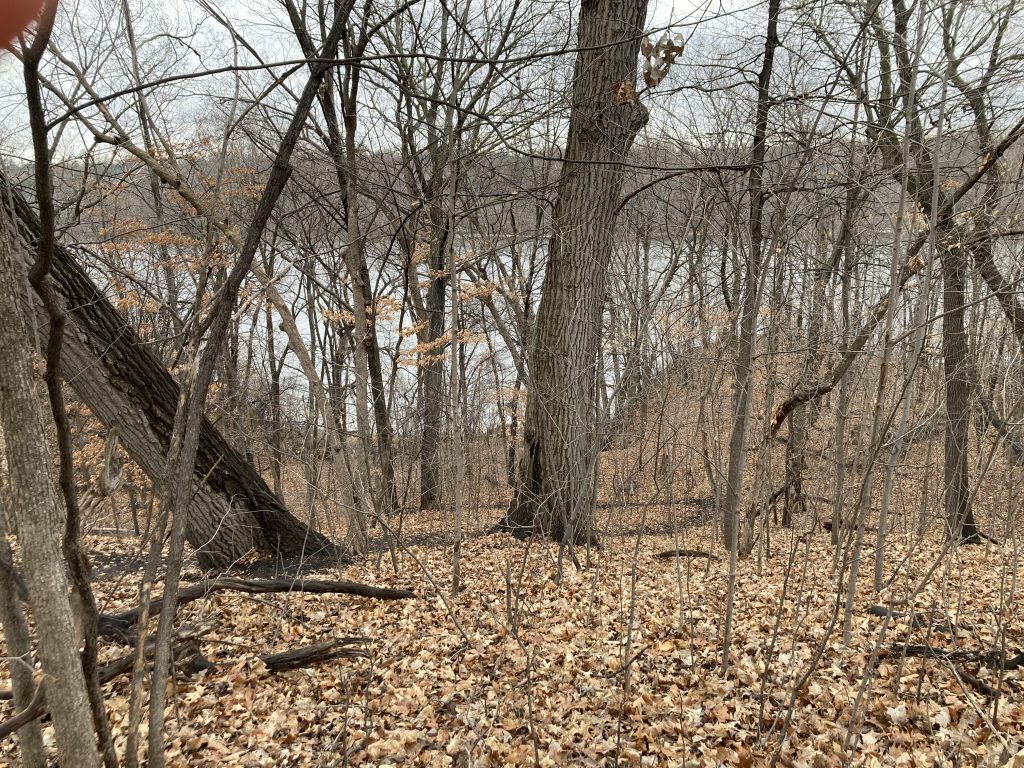
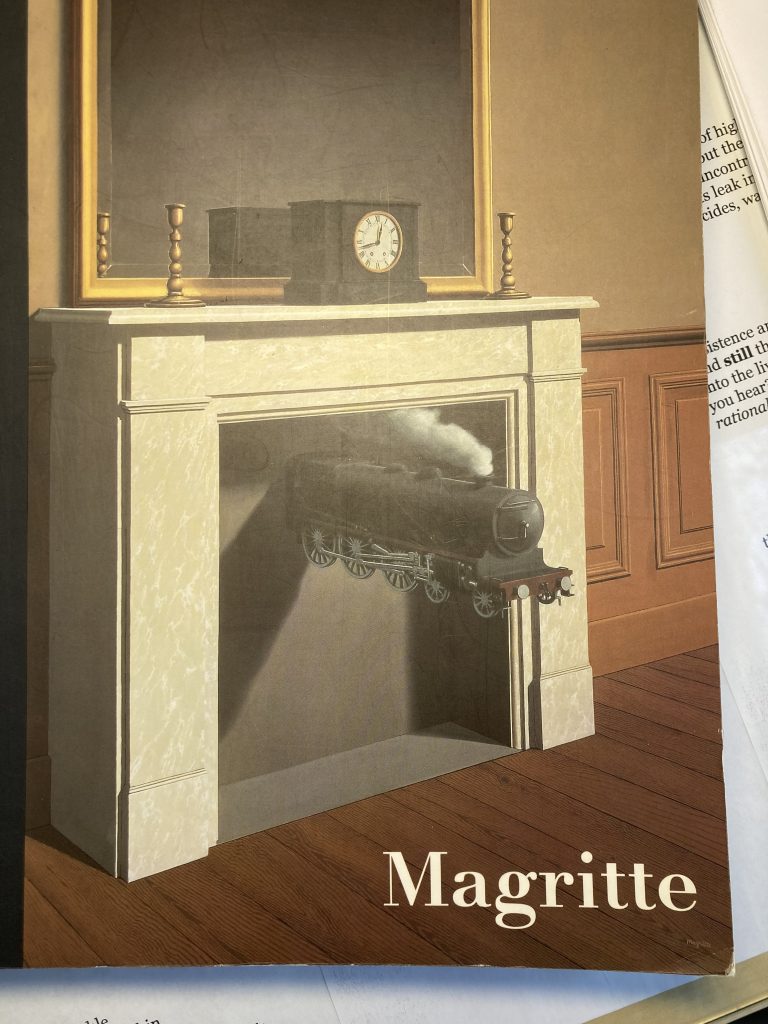
march 5/WALKBIKE

35 minutes
neighborhood
30 degrees

Took a morning walk with Delia the dog and Scott around the neighborhood. Blue sky, low wind, fresh air. The sidewalks were mostly clear with a few stretches of ice — the fun kind: crisp, thin, barely covering puddles. At the start, both of us were complaining about something, but by the time we had reached Cooper School and saw the piles of snow we forgot why it mattered.

Today would have been my mom’s 81st birthday. Yesterday I put together a page of videos and links to past reflections, essays, and poems about her. This morning, before heading out for the walk, I wrote something for new shadow series:

march 5, 2023/ sara lynne puotinen

Today my
shadow

is the grief
too big

to fit in
my small

body — the
love that

needs room to
breathe the

tenderness
searching

for a place
to be

possible
the dis

belief it
has been

thirteen years
since she

grew older
hoping

for better
views. My

shadow leads
as we

head east to
the gorge

to see what’s
on the

other side.

The ending still needs work, I think.

bike: 25 minutes
basement

I successfully resisted the desire to go out for a run — I need to rest my knees and my IT band for one more day, I think. Feeling restless and wanting to stretch out my legs, I decided to do a bike ride in the basement. Watch the last 5k of the Tokyo marathon.

Before biking, I decided to start memorizing Emily Dickinson’s “I measure every Grief I meet.” I made it through the first 6 (out of 10) stanzas. Each time I memorize an ED poem, I’m delighted, then amazed by her choice of words. So good!

I measure every Grief I meet
With narrow, probing, eyes —
I wonder if it weighs like Mine —
Or has an Easier size.

I wonder if they bore it long —
Or did it just begin —
I could not tell the Date of mine —
It feels so old a pain —

I wonder if it hurts to live —
And if they have to try —
And whether — could they choose between —
It would not be — to die —

I note that Some — long patient gone —
At length, renew their smile —
An imitation of a light
That has so little Oil —

I wonder if when Years have piled —
some thousands — on the harm —
That hurt them early — such a lapse
Could bring them any balm —

Or would they go on aching still
Through centuries of Nerve —
Enlightened to a larger Pain –
In Contrast with the Love —

feb 22/SHOVELWALKBIKERUN


shovel: 4 inches
14 degrees

The aftermath of the second round of the epic snowstorm: 4 inches of mostly soft snow. Cold, but not too cold, outside. Listened to the audiobook, Moonflower Murders as I shoveled. The coldest part of my body: my fingers. Even with gloves on, they were getting numb. More snow than I expected. I think I remembered hearing some other shovels scraping, at least one snowblower droning. Already we have big piles of snow on the edges of the driveway, near the garbage/recycling/organic bins on the side of the garage, and on the front sidewalk. If we get more snow tonight, where will it all go?

walk: 15 minues
neighborhood
me, Delia, and Scott
18 degrees

Brrrr. The temperature had increased by 4 degrees but it felt colder because of the wind. About half of the sidewalks we walked on were shoveled. The un-shoveled ones didn’t seem like they had 4 inches of snow on them. Did they? The most enjoyable, warmest feeling direction to walk was east. Heading south, west, or north, we felt the cold wind in our faces. I could sense a brain freeze induced headache about to happen. Delia didn’t care. She sniffed the edges of every block, her tail wagging as she gave attention to the yellow missives from the other animals who had walked these same sidewalks.

bike: 20 minutes
run: 1.5 miles

Because of the wind and the snow, I decided to move in the basement today. Watched the first 20 minutes of the Netflix documentary, Break Point, while I biked. Listened to more of my audiobook while I ran. Wore my new running shoes: Saucony Ride 14s, color: Jackalope (white with orange accents, a red tongue, blue laces). Not my first choice, but they were in my size and $40 less than any other color. Now that I have them, I think I especially like the blue laces.

Before heading downstairs, I started memorizing a poem by Heather Christle that I especially like, “What Big Eyes You Have.” I worked on the first 2 sentences:

Only today did I notice the abyss
in abysmal, and only because my mind
was generating rhymes for dismal,
and it made of the two a pair,
to which much later it joined baptismal,
as — I think — a joke.
I decided to do nothing with
the rhymes, treating them as one does
the unfortunately frequent appearance
of the “crafts”adults require children
to fashion from pipecleaners
and plastic beads.

Wow, it is fun to memorize poems. And, it really helps me to do a deep reading of the words and ideas and rhythms and rhymes. I wish I had time to memorize all of the poems I love!

Here is a Pastan poem that seems fitting to read after encountering so many of her dark ideas about death and its inevitability and wondering why her poems were almost always so dark.

Why Are Your Poems so Dark?/ Linda Pastan

Isn’t the moon dark too,
most of the time?

And doesn’t the white page
seem unfinished

without the dark stain
of alphabets?

When God demanded light,
he didn’t banish darkness.

Instead he invented
ebony and crows

and that small mole
on your left cheekbone.

Or did you mean to ask
“Why are you sad so often?”

Ask the moon.
Ask what it has witnessed.

feb 10/WALKBIKERUN

walk: 30 minutes with Delia
neighborhood
26 degrees

Sun! A bright blue sky! Birds! Fresh, cold air! Clearer sidewalks! Wind chimes! What a wonderful walk. I moved slowly, stopping every few steps for Delia to get another sniff. I inhaled deeply, feeling the cold air open up my sinuses. I mostly listened to the birds, but a few times I saw the blur of a tiny body traveling from one branch to another. I noticed the sprawling oaks, their gnarled limbs towering over the sidewalk. I stepped on the thin sheets of ice covering puddles and heard them crack and crunch and then the water squish. I remember thinking that I wasn’t interested in naming what I was noticing, just experiencing it. I felt relaxed and open to the world and happy for these moments.

Most of the sidewalks were clear. On a few corners it was still solid ice. The corner with the mailbox was especially bad. Yikes!

I almost forgot — how could I forget? A birch tree in the middle of the block, its branches blindingly white, illuminated by the sun. Sparkling. I could almost hear a chorus singing its alleluias!

bike: 22 minutes
run: 2.35 miles
basement
outside: an ice rink

After yesterday’s slippery run, I decided I should stay inside today. Biked in the basement with some Dickinson, ran with a running podcast. As I often mention with my basement workouts, it’s difficult to find much to wonder about in such a dark, cold, unfinished space.

Before I worked out downstairs, I started planning the fifth lecture for the class I’m teaching. It’s going to be about the connections between wonder and play. I was reminded of it as I ran and listened to a professional runner turned triathlete talk about how being a beginner and having no expectations or pressure can help you to have fun in your training and in life. I started thinking about having fun and being a kid and the idea that fun and play are usually dismissed as not taking something seriously. It’s all fun and games to you. Or it’s too easy — that’s child’s play. But trying to remember your kid-self, being a beginner, opening up to fun, is something many of us have to work at — to practice — as adults. (Also, being a kid isn’t always easy.) Kelli Russell Agodon has some great things to say about play and wonder in this interview, which I plan to use in my class: Beauty and Play with Kelli Russell Agodon.

In the video interview, Agodon reads her poem, “Grace”:

Grace/ Kelli Russell Agodon

Even those who are living well
are tired, even the rockstar
who swallowed the spotlight,
even the caterpillar asleep
in a unbalanced cocoon.
Who knows how
to be happy when a lamb
is birthed just to be slaughtered
at a later date?
It’s so tiring
how every day is also a miracle—
the drunk bees in the plum
blossoms, the sliver of sun
through the branches
and on an early morning
walk we find the farmer’s
granddaughter has fallen
in love with the lamb,
so it will be saved
and named Grace.
And we are spared
for a moment, from a new
loss and life frolics
across a field of wildflowers
never knowing all it has escaped.

Thinking about the idea of no pressure or expectations, Agodon says this in another interview:

I am quantity over quality, but a lot of the really bad poems will never come out of my laptop. I love writing a poem a day. And I have no problems writing bad poems, just writing something thinking, oh that was just practice. That was just a writing exercise. That poem is never going to go anywhere. I don’t want to revise it. Again, it’s just to enjoy the creation. But when I do choose a poem to revise, then I highly craft it.

Poetry Snaps! Kelli Russell Agodon: Grace

And here’s something else she writes about taking walks and finding images:

Rumpus: I think of your poems as being “dense,” and by dense I mean tight and even crowded at times as you fly from one image to another. The imagery is always surprising, line after line. I wonder how you do that?

Agodon: I wonder how I do that, too. Could this mean I’m a word/image hoarder? Maybe my poems are the rooms you go into where everything is stacked to the ceiling? Like those antique shops that have a fascinator balancing on a Mickey Mouse phone on a blue Fiestaware plate toppling above a purple suitcase with a sticker that reads: London. Maybe it’s that I’ve always been a very visual person who notices the small strange details, and they stick with me. Like yesterday when I went for a walk, I saw a toothpaste cap under a tulip and I kept thinking—why is that there? There was a robin there and I started thinking, “What if that toothpaste cap was actually the robin’s bandleader hat.” Kooky stuff, but maybe because while I have six sisters, they were all much older than me, so much of my life felt like being an only child so I was always looking for ways to entertain myself, and I still am.

Wired for Wordplay: Kelli Russell Agodon

Reading this interview, I found out about another book Agodon write: Letters from the Emily Dickinson Room. Very cool! I ordered the ebook.

jan 30/BIKERUN

bike: 15 min warm-up
run: 3.2 miles
outside temp: 2 degrees / feels like -15

Because of the cold air, the icy paths, and the 10 mph wind, I decided to move in the basement today. Finished the episode of Dickinson I had started a few days ago while I biked, listened to the latest episode of If Books Could Kill (Men are from Mars, Women are from Venus) while I ran. Running on the treadmill in the basement is very different from running outside. A dark, unfinished basement with windows mostly blocked by a shelf with old lamps on it. Staring straight ahead, I can see a blank tv screen and then behind that, a dark window and the old coal chute. To the side, shelves with old paint cans (left) and a long work bench (right). Not much to notice, except spiders and dust. Difficult to run for that long and to remember any of my thoughts. I don’t mind running down here on occasion, but I couldn’t do it all the time. I’m so glad that I have the gorge.

a moment of sound

On days when it’s too cold for me to move outside, I record a moment of sound. Today’s moment was on my short walk back from the alley, where I had brought out some trash. It features my favorite, crunching snow, and another irritating delight: the cold, shrill creak of our iron gate. I walked through the snow in my small backyard and stopped briefly by the crab apple tree:

jan 30 / 3:00 pm

Here’s a poem I found on twitter today by Dana Levin about walking and thinking and wandering/wondering and being in and out of a body:

A Walk in the Park/ Dana Levin

To be born again, you need
an incarnation specialist—a team
from the Bureau of Needles
to thread you through—
Your next life
turns
on an axle of light—which Plato likens
to a turning
spindle—what was that?
I mean I knew

what a spindle was
from fairytales—how it could
draw blood
from a testing finger, put a kingdom
to sleep—
but what
did it actually do, how
did a spindle look
in real life?
I didn’t know. As with
so many things:
there was fact and there was

a believed-in dream . . .  

Everyone had one back
in the ancient day,
spindles.
When we had to weave
our living-shrouds
by hand.
“A slender rounded rod
with tapered ends,” Google said. Plato’s,
so heavy with thread,
when viewed from the side,
looked like a top—
though most diagrams assumed

the hawk-lord view . . . 

Moon thread, threads of the planets, earth thread.
Your thread.
Everyone else’s.
Nested one
inside the other, a roulette
machine—
If a thread could be spun from liquid light was what
I kept thinking—
imagining a sluice
of electric souls
between the earth wheel’s rims—
there “I”

was a piece of water, Necessity
wheeled it around―Necessity,
who was married to Time,
according to the Greeks—
Mother of the Fates.
Who would measure and cut your

paradise/shithole extra life . . . 

Well we all have ways of thinking about
why,
metaphysically-speaking,
anyone’s born—
though the answer’s always Life’s
I AM THAT I AM
—how it hurls and breaks!
on Death’s No there
there . . .

—which sounded kind of Buddhist. 

According to the teachings we were all
each other’s dream . . .

And soon able to vanish—

out of the real
without having to die, whoever’s
got the cash—to pay
the brainier ones
to perfect
a Heaven upload—to cut
the flesh-tether
and merge

with the Cloud . . . 

Well we all have ways of constructing
Paradise.
To walk alone deep in thought
in a city park
was mine
for several minutes,
thinking about spindles.
Before the vigilance
of my genderdoom

kicked in—

And there it was, the fact
of my body—
all the nerves in my scalp
and the back of my neck,
alive—
How it moved through space, how close
it had strayed
toward concealing trees, my
female body—
Jewish body—inside my
White body—dreaming
it was bodiless

and free . . . 

to decide:

how and when and if to fill the body’s hungers—
how and when and if to walk in thought
through the wilderness . . .

before Death comes with its Fascist hat.

Its Park Murder Misogyny hat.

Its Year Ten in a Nursing Home stink
    hat—    

However spun
    my thread . . . 

Anyway,
it’s peaceful here
in the park, at midday,
if a little deserted. I’ve moved to the path that winds
closer to the street.
Thinking again, as I always do,
about body and soul. How they
infuse each other. How they
hate each other.
How most people pledge allegiance
to one or the other.
How painful it was! To be
such a split

creature—

jan 28/BIKERUN

bike: 25 minutes
run: 1.8 miles
basement
outside: 5 degrees / feels like -10

Needed to move a little, but too cold for Delia to take a walk. Started watching the first episode of Dickinson while I biked, listened to a podcast (episode 2 of “Nobody Asked Us”) while I ran. In the short bit of the podcast I listened to, Des and Kara talked about resolutions, which neither of them do, and goals. Des mentioned that goals should be big but not so big that they’re paralyzing and that the the timeline for accomplishing them might be different than we expect. I started thinking about goals for my running and writing. Some of my goals are specific, like a mileage total. Last year, it was 1000 miles. But most of them are broad or vague or more of a guide than one concrete goal, like these:

  • to keep running into my 70s (I’m 48)
  • to slow down
  • to be satisfied with the small moments
  • to find better words for connecting me to others and to a specific place
  • to be open, not closed
  • to learn to listen (and to see differently) as I lose my central vision

I decided to go back through my archives to find other posts were I’ve discussed goals (search word: goal). Here are a few:

nov 7, 2022 — on living to an old age and still running
oct 31, 2022 — on running 1000 miles in one year
sept 20, 2022 — on being open (and keeping the door open to possibility)
may 4, 2022 — on slowing down

Ok, I’ll stop there. I have 5 pages / 90 entries with the word goal. Wow. I’d like to spend more time skimming them and finding bits to add to my Undisciplined page on purpose/goals. So much to think and write about with goals.

jan 22/WALKBIKE

walk: 25 minutes
winchell trail between 44th and 42nd
17 degrees / snow flurries

I needed some pictures for my class, so Scott, Delia, and I took a walk by the gorge. Because of the slippery conditions we drove to the parking lot, then slowly walked around. Scott took some great pictures, Delia had fun romping around in the snow, and I loved breathing in all the cold, crisp air!

Here’s one of my favorite shots:

bare trees, snow, a person in a green jacket with a small white dog in a cute sweater
Sara and Delia, the Winchell Trail

A beautiful walk. Near the end of it, we noticed it was snowing. Saw lots of walkers and runners out there this morning.

bike: 25 minutes
basement

Felt like I wanted to work my legs a little more this afternoon — thanks, restlessness — so I decided to do a short bike ride in the basement. Watched new videos from the 2 running YouTubers I follow. Didn’t bike that fast, but it felt good to move some more after sitting and reading most of the afternoon. Current book: Mornings with Rosemary, which is the American title for the British book, The Lido. I prefer the British title, especially since the book is all about the lido. American audiences can figure out what a lido is, I think. If they grew up in the late 70s and 80s like me, they should know what a lido is from The Love Boat and its lido deck!

jan 13/BIKERUN

bike: 25 minutes
run: 2.4 miles
basement
outside: an ice rink

Ugh. Hopefully it will warm up enough in the next few days so that the ice on the sidewalks will finally melt. I can run in snow and in the cold, but when the sidewalks and most of the road are one sheet of bumpy, uneven, super slick ice, I have to stay inside. Before I went down to the basement, I took Delia the dog for a walk for some recon. Almost fell at least twice on the short 2 block walk. Something interesting: even though it was very slippery and I almost fell, I never had that anxious, I’m-going-to-fall-feeling. No tensing up of my legs or shoulders.

Watched a comedian my sister told me about, Rhys Niccholson, on Netflix while I biked. I laughed a lot. Listened to the book, An Elderly Lady Must Not Be Crossed, while I ran. I loved An Elderly Lady is Up to No Good, so I was excited for another book, more time to spend with Maud. Thought I might run a 5k, but I felt ready to stop a bit sooner. All I remember from my run, other than listening to Maud pretend to be senile and feeble in order to not be found out as a murderer, was thinking that treadmill runs feel longer and are much less fun than outdoor runs. Oh — I also remember noticing my stride and trying to focus on the rise and fall of my feet and relaxing my shoulders as I swung my arms.

A few days ago, I bookmarked a wonderful essay by the Diné poet Jake Skeets: My Name is Beauty. I just started reading it and found so many wonderful passages, including this one:

Viola Cordova defines the concept of cultural relativity in her essay “Language as Window” as the way Western constructs constrict worldview to one single thing and dismiss differing worldviews. However, Cordova, through an analysis of the work of linguist Benjamin Whorf, states that language is the key to interpreting the world in different ways. Using an egg paradigm, Cordova asks us to imagine the Earth not as a physical rock in space but as the yolk of an egg. She asks us to imagine ourselves swimming through air rather than walking, and to consider ourselves within something, not on something.6 Seen this way, the Earth becomes a womb, a nest, an embrace.

The swimming through air reminded me of studying fungi this past April. Here’s something I wrote on April 21, 2022:

Thought about nets and this passage from The Mushroom at the End of the World:

Mushrooms are the fruiting bodies of fungi. Fungi are diverse and often flexible, and they live in many places, ranging from ocean currents to toenails. But many fungi live in the soil, where their thread-like filaments, called hyphae, spread into fans and tangle into cords through the dirt. If you could make the soil liquid and transparent and walk into the ground, you would find yourself surrounded by nets of fungal hyphae (137).

Thought about imagining the soil was liquid and transparent and then entering it, surrounded by nets of fungal hyphae. What if I could swim in the soil? Swim through these nets of fungal hyphae?

I must return to this essay later and work through it slowly. So many amazing ideas! In the meantime, here is one of Skeets’ poems:

Soft Thunder/ Jake Skeets

narrowmouth toads dapple pink sandstone
knee-deep in a brown bowl of brown water

before the croon of limb and wind on weeds
puddles from the pour gather for a morning song

the sun rises from a flatbed load of open palms
                : each crease a ripple a leg a half smile

the sun knows best when it rises
                : each tide and oak and uplift sung the same

each killdeer and mare and desert bighorn
each I I gorge each I I ravine each I I—

and each part of me is hung out to dry marooned

and wrung of rain, wrung of every I until no I is left
                        :      soft thunder
                                        ponds in a clearing

jan 11/BIKERUN

bike: 25 minutes
run: 1.4 miles
basement
outside: 33 degrees / an ice rink

Outside it’s an ice rink and the air quality is bad. So, even though it’s warm, I biked and ran in the basement today. I took Delia out for a walk earlier to check on the conditions: solid ice everywhere. It’s so icy that the city suspended metro transit buses for a few hours. Yikes.

Watched an old triathlon race (2012, London Olympics, Men’s) while I biked, listened to the Apple Music’s “80s fitness” playlist while I ran. Not sure why, but “It’s Raining Man” had voiceover from Arnold Schwarsenegger talking about lifting weights. Huh? I skipped to the next song before I had a chance to find out why.

I don’t remember thinking about much as I moved. Basement workouts are usually only about moving and burning energy. I should try memorizing and reciting poems again.

Found this poem a few days ago. What a beautiful description. I love the bats and the black lake, and the swan and the moon.

I Went Out to Hear/ Leila Chatti

The sound of quiet. The sky 
indigo, steeping 
deeper from the top, like tea.
In the absence
of anything else, my own
breathing became obscene.
I heard the beating
of bats’ wings before 
the air troubled above 
my head, turned to look
and saw them gone.
On the surface of the black
lake, a swan and the moon
stayed perfectly 
still. I knew this was
a perfect moment.
Which would only hurt me
to remember and never
live again. My God. How lucky to have lived
a life I would die for.

jan 3/BIKERUN

bike: 25 minutes
run: 2.25 miles
basement
outside: winter storm/snow

Winter storm today. Heavy snow mixed with some freezing rain. No running outside or driving to the y. Glad to have the bike and treadmill in the basement. While I biked, I watched a few minutes of a documentary by Tracksmith called “The Church of the Long Run.” (interesting side note: a search for “the church of the long run tracksmith” will also take you to tracksmith’s catalog for long run gear — the marketing of a sacred ritual…I have mixed feelings about this, and no time to explore them). Also watched some of the 2012 Women’s Triathlon from the London Olympics. As I ran, I listened to a book: Disappearing Earth. Such interesting storytelling about the disappearance/presumed kidnapping of 2 young girls and its impact on a wide range of women living in remote Russia.

After I finished my workout, I quickly had my last meal before a (nearly) 2 day fast for a colonoscopy on Thursday morning. My first colonoscopy. I wonder how I’ll handle not being able to eat tonight and all day tomorrow? I’ll be very glad when it’s over.

note: I don’t want to write that much about it now, but for the sake of future Sara and because this log is, among other things, about aging and learning to love/live in and with an aging body, I’ll say that this colonoscopy is stressing me out. Difficult to put into words (maybe a poem after?), but it’s about a lot of different things: frustration and feelings of helplessness over bad insurance and medical care that prioritizes profit over patients, too many people I love dying or diagnosed with different forms of cancer lately, anxiety over what I will or won’t be able to see because of my bad vision as I check-in and deal with people at the clinic, wondering if they’ll find anything that explains my gastro problems for the past 6 months. To relieve anxiety, maybe I should turn colonoscopy into anagrams?

a few minutes later: I thought colonoscopy would be difficult, so I tried endoscopic (for endoscopic exam) and it was hard too. Here’s how I did it. I put each of the letters on a different post-it note and then moved them around on my desk. I could only think of 3. I like this post-it note approach. I’ll have to try it again! Maybe I should use some old scrabble letters?

It’s not an endoscopic exam, it’s a

No Cod Spice Exam
Ponce (as in the Atlanta road, Ponce de Leon) Disco Exam
In Cop Codes Exam

Not the greatest, but still fun to try!

Working on my winter wonder class that starts at the end of this month. Seems fitting as I look outside at the snow falling, then stopping, then falling again. The snow has been heavy, but not blizzard-heavy. Not quite as bad as in this poem by Linda Pastan that I’m planning to use in my class:

Blizzard/ Linda Pastan

the snow
has forgotten
how to stop
it falls
stuttering
at the glass
a silk windsock
of snow
blowing
under the porch light
tangling trees
which bend
like old women
snarled
in their own
knitting
snow drifts
up to the step
over the doorsill
a pointillist’s blur
the wedding
of form and motion
shaping itself
to the wish of
any object it touches
chairs become
laps of snow
the moon could be
breaking apart
and falling
over the eaves
over the roof
a white bear
shaking its paw
at the window
splitting the hive
of winter
snow stinging
the air
I pull a comforter
of snow
up to my chin
and tumble to sleep
as the whole
alphabet
of silence
falls out of the
sky

dec 23/BIKERUN

bike: 10 minute warm-up
run: 3.35 miles
basement
outside temp: -7 / feels like -25

Scott, RJP, and I braved the cold and drove over to the Y. Empty parking lot. Closed early for the holidays because of the extreme cold and wind. Oh well. Drove back home and did another treadmill workout. Covered the display panel, turned on a running podcast, and ran with hardly any idea of how long I was moving. I wanted to check my watch a few times, but I decided to wait until there was a pause in the podcast for the sponsor. Almost 33 minutes. Wow, I had no idea I had been running for that long. Mostly listened to the Olympic 1500 runner Heather MacLean discuss being an introvert, talking to the trees in a Flagstaff forest, and struggling with the pressure of running at the Olympics. I tried to think about color and the idea of orange and buoys.

This morning I had thought about orange in relation to navigation and reorienting myself in terms of open water swimming and life and wanting to become a bird (using quantum mechanics and blue light for navigation) or one of the monarch butterflies that fly across lake superior on a route designed to avoid a mountain that hasn’t existed for centuries. Orange, literally and figuratively, is about navigation and orientation for me. It’s the first color I couldn’t see that started my awareness that something was wrong with my vision. It’s the color of the buoys that I’ve used every summer since I was diagnosed for practicing “how to be when I cannot see” — learning how to negotiate/navigate without the certainty of sight. It’s the color that I’ve noticed the most when I tracking how my peripheral vision works and is helping me use the remaining bits of central vision.

2 past entries to review:

On bird navigation and quantum mechanics
On monarch butterflies and missing mountains

Found this poem the other day on Poets.org:

Owl/ Anne Haven McDonnell

In winter, we find her invisible 
against the furrows 
of cottonwood bark. Her swivel 
and lean follow us until 
we sit on the old polished log 
we call creature. She blinks, 
swells her feathers out, shakes and settles. 

It’s a good day when I see an owl. 
We watch until she drops—a fall 
opening to swoop and glide. What is it 
with lesbians and owls? Someone 
asked. I’ll leave the question 
there. There’s a world 

the old trees make of water 
and air. I like to feel the day 
undress its cool oblivion, currents 
moving the one mind of leaves, 
shadows deeper with the breath 
of owls. Just the chance she might 
be there watching makes me 
love—no—makes me loved.

So much I love about this poem: the short lines, economy of words, how the narrator has named the log creature, that it’s a good day when she sees an owl (not because it’s an owl, although that’s cool, but because she thinks that if she sees a certain something, she’ll have a good day. Mine is roller skiers or turkeys), the cool oblivion, the breath of owls, shadows as both (?) a noun and a verb, the ending line.

dec 22/BIKERUN

bike: 12 minute warm-up
run: 3.25 miles
basement
outside temp: -6 / feels like -25

Dangerously cold today, or as the winter storm warning described it, life-threatening. Yikes. In order to chip away at those last miles I need to reach my goal of 1000 miles, I ran on the treadmill.

current total (after this run): 991.95

Warmed up (because it was cold in the basement!) on the bike first, while watching Erin Azar (Mrs. Space Cadet) and her latest “uncomfy” challenge. A self-proclaimed struggle runner and content creator, Azar is completing (and filming) a bunch of things that make her feel uncomfortable. This one was working out with a college lacrosse team. I like her and I enjoyed this video, partly for her perspective, partly for the positive energy of the college athletes, and partly for the speed drills. Some useful stuff in there, I think.

After the bike warm-up, I ran for 31 minutes. Decided to try listening to my latest audiobook, a story collection about an elderly woman in Sweden who likes to solve her problems with murder: An Elderly Lady is Up to No Good. I really like stories with smart, capable, thriving (not always physically, but in terms of their perspective that when you get old you’re not just waiting for death to come) older women. I also like that it’s a story collection — as opposed to a ridiculously long novel — and that it’s translated from Swedish. I covered the display panel on the treadmill with a towel, didn’t look at my watch, and ran while listening to Maud (the old lady) murder a terrible gold digger and a selfish, needy sister. Wow. I lost track of time and was surprised when I gave in and looked at my watch and saw that 26 minutes had gone by. I struggle to run for a long time on a too steady treadmill in a boring basement. Listening to this book helped.

Earlier today, I continued reading Maggie Nelson’s Bluets. Here’s #51:

51. You might as well act as if objects had the colors, the Encyclopedia says.—Well, it is as you please. But what would it look like to act otherwise?

Bluets/ Maggie Nelson

I wrote this in reaction (as opposed to a thought out response) to the idea of acting otherwise: What would this look like for me? I am not acting as if they had no colors, nor do I need to. I can still see colors. My world is not black and white or even gray. The colors just work differently, unreliably. Colors speak in a language that is sometimes silent for me. Color-coded, color as signal, sign. Color to get your attention to communicate something more quickly than a word could do. Color as a practical language. I’ve lost, am losing the ability to USE color as an efficient/effective/persuasive form of communication. Or — to be used by it. Some of this is good, but some of it prevents me from receiving important messages: mold on food, danger in the road, stay away, stop.

Back to Nelson and Bluets. I’m struck by how she cites and uses other writers/thinkers/poets in this book. The first book I read by Nelson was a more recent one, The Argonauts, way back in 2015. The citation is different in this book, but it’s worth mentioning:

Perhaps the biggest thing that has struck me so far is Nelson’s way of citing her sources. When she’s using someone else’s theory or idea, she puts that theorist’s name in the margin, beside her own text. Sometimes she directly quotes the theorist, sometimes she merely invokes them.

story log entry / 6 dec 2015

Here are 2 examples from Bluets:

12. And please don’t talk to me about “things as they are” being changed upon any “blue guitar.” What can be changed upon a blue guitar is not of interest here. 

I wasn’t what she meant here, but when I googled “blue guitar things as they are” I easily found the reference: Wallace Stevens, “The Man with the Blue Guitar”

107. Many people do not think the writing of Gertrude Stein “means” anything. Perhaps it does not. But when my students complain that they want to throw Tender Buttons across the room, I try to explain to them that in it Stein is dealing with a matter of pressing concern. Stein is worried about hurt colors, I tell them. “A spectacle and nothing strange a single hurt color and an arrangement in a system to pointing,” I read aloud, scanning the room for a face that also shows signs of being worried about hurt colors.

This reference, which involves the invoking of a line, a direct quotation, and a story about her students. It led me to Stein’s poem: A Carafe, that is a Blind Glass and a helpful explanation: The Difference is Spreading: On Gertrude Stein

What to make of this, or why am I mentioning it? I’d like to play more with how I cite my references in my color poems. I also like the idea of the various bits of information/passages/lines of poetry I’ve acquired being much of the substance of my poem.

dec 18/BIKERUN

bike: 15 minutes
stand, basement
run: 1.2 miles
treadmill
outside: 5 / feels like -3

Stayed inside all day because of the cold and feeling sore from my outdoor run yesterday. Didn’t decide to run until the late afternoon. Watched some world championships swimming while I biked, listened to the “swim meet motivation” playlist while I ran. I’m getting closer to my 1000 miles — about 15 miles left!

This morning I read chapter one of Adam Gopnik’s Winter: Five Windows on the Season: Romantic Winter. It was good, but I was thinking it would help if I was listening to it instead of straining my eyes by looking at it. Just now, I found this: The CBC Massy Lectures: Winter, Five Windows on the Season, all 5 parts! Excellent.

Speaking of winter, I’m thinking about a poem I might use parts of it for my class:

Winter Journal: Disseminate Birds Over Water/ Emily Wilson

The reservoir churned and cloud-deformed
The far line of hills, fused, bunched color
bitter wind against this hunch
my folded bones
I can see the rust earth beneath trees, the rough mats
gathering weight in semi-darkness, dim
nesting bases of trees
Graft of dark cloud upon lighter one behind, building up
of something, a thickening, deposit of cold air, dark web
of insistence, built up in me
How long can it be here?
A simmering of trees, a dark moiling
a winter weight
a mid-shimmering of heat-distorted things
The positioning of bolts of deep orange, gold-green and amber
molded, wicked in together
Drops in pressure, now, a field of cold, a shift
between rain and snow
The movement into this remembering
of separate things, train sounding its horn, removing
itself from the scene
Snow thickening the far bars of trees, graying them in
Blotting, dulling, gauzing over this dream
It is snowfalling, it is beauty-filling and cleansing
this burn of words
it is delivering something seeming to uplift and to begin
pressing downward, this ink into frozen droplet
this thing

Snow plinking in the leaves, the left hands of trees
the neat levers and pulls
the odd weeds
The rich fringe of emptying trees
the shifted pins
the breaks into dense pines into period reeds into gutterings
What happens to the opposite shore
is untenable
is unmanageable to me
That stratagem of damage, that unmattering
Believe me it is some abomination of things being killed and
that mattering to me
That exquisite built thing that is obliterated
its tiny white amplitude, its singing crushed into
particles, its must on the undersides of leaves
Now I am sure
the world has not unfolded before me
anymore but has closed into rows
of its foldings
Something in the collections of those trees
bare branches upthrust, the brush of them
bare branches up-brushed
their lip along mesh of shore weeds, the flanged grasses
the scrim of their midst
I am in them again
meddling in darks that are in them
and the white gold that is their outermost
screen that is their leafleting their grief that is in me
thin dredge of pebbles and
strange glandular patternings of trees
against trees against cut-bank against breath

The rubied lung of sumac
tragedian


dec 9/BIKERUN

bike: 25 minutes
bike stand, basement
run: 1.25 miles
treadmill

Not too cold outside, but a bit icy, uneven. Today’s workout was all about adding another mile to my year total and getting a chance to move after sitting at my desk all morning while working on a poem. Watched a race while I biked, listened to Lizzo while I ran.

Worked all morning on a colorblind plate poem. This one is a cento and includes lines with colors from some of the almost 800 poems I’ve gathered on this RUN! log. Yesterday afternoon, I gathered them and discovered something: many — most? — of the poems I’ve gathered don’t mention color. Colors popped into my head as I pictured the images in the poems, but because of association and the colors I connect with certain things, not because color words were used. This was surprising to me.

The name of this poem is In (or inner if Scott can fit it in the colorblind plate), which refers to my inner color world, how I imagine color now that I can’t see it as well. Here it is:

draft of IN

Lines from the following poems:

Separation / W.S. Merwin
Ars Poetic / Aracelis Girmay
Cold Morning / Eamon Grennan
Becoming Moss / Ella Frears
Wild Geese / Mary Oliver
With A Song / Christina Pugh
Paean to Place / Lorine Niedecker
Trilliums / Mary Oliver
The Road Not Taken / Robert Frost
Forsythia / Ada Limón
Autumn / Linda Paston
Colors passing through us / Marge Piercy
A Rhyme for Halloween / Maurice Kilwein Guevara
Orange / Wendy Cope

Here’s one of the poems that I hadn’t posted yet. It’s a great one for winter; I might use it for my class!

With A Song/ Christina Pugh

There’s something about music: the wish to
be in the dark. Like I don’t know what person
this voice must belong to. At times I love
a secret, what sheers away from intellect.
Intrepid horn of birdsong when you won’t
see or know the bird. Or sometimes
I’m riding in the car on I-80, dipping
my eyes into the glamour of Ohio, its red
barns or white barns severally unpainted
by tactile fingers of winter weather.
White barns with green roofs. Sky-blue
with white roofs. Wait, isn’t sky-blue brighter
than any sky you really see? Canned sky,
you might reply, hyperbole of color. Platonist
Crayola blue. Would anyone trade a teal
feather for a trill? The highway will line
with mud and snow stripes along a fence,
then apple orchards spider in the ice.
A long stand of pines before the strip mall.
And still from the radio, an alto atremble:
I love not knowing who it belongs to.


dec 4/WALKBIKERUN

walk: 20 minutes
neighborhood
32 degrees

note: Reviewing this entry the next morning I’ve found several typos, which I corrected just now. There are probably more that I still can’t see. As my ability to see clearly diminishes, I imagine these typos will increase.

COVID update: RJP’s doing fine, felt like her usual cold. She’s been in her room since Wednesday night, only leaving to go to the bathroom or eat. So far, Scott and I are okay. He tested today: negative. Neither of us are too anxious.

update from the next morning: Even though she feels fine, RJP is still testing positive. It was the same for FWA when he had it in September. He thought he had a cold. Finally tested near the end of it. Felt fine, tested positive for 10 days.

Scott and I took Delia the dog for a quick walk around the neighborhood. Warmer, sunny, slushy sidewalks. Fresh air! He talked about video games, I talked about this log and the latest episode of ‘You’re Wrong About.” The only memorable thing about the walk: the field at Howe School was covered in snow — not smooth or flat but filled with mini mounds from hundreds of boots kicking and stomping, and hundreds of bodies rolling around in it during recess last week.

bike: 14 minutes
bike stand, basement
run: 2.2 miles
treadmill

Too dark to run outside in the later afternoon, so I went to the basement. Watched Miss Space Cadet on YouTube while biking, listened to Apple’s 80s “Fitness” playlist on the treadmill — “Holding Out for a Hero,” “Material Girl,” “Super Freak,” and “Wake Me Up Before You Go Go.” I need to put together a running playlist again. Didn’t think about much while I ran. As always, it felt good to move.

Inciting Joy: Day One, The First Incitement

This afternoon I started Ross Gay’s wonderful book, Inciting Joy. I’m going to try and read an incitement (there are nine) this month. Here are some notes and thoughts for the first incitement:

To define joy, he begins by saying what it’s not: it’s not sparking joy or capitalist-joy-as-acquiring-better-stuff-or-doing-big-things. It’s not the happy place where you go to be safe or comfortable — a sanctuary protected with a heavy lock, keeping out all the bad stuff: heartbreak, sadness, worry. It’s not unserious or frivolous to talk about (or experience), even as we are made to think it is, and it’s not separate from pain and suffering:

But what happens if joy is not separate from pain? What if joy and pain are fundamentally tangled up with one another? Or even more to the point, what if joy is not only entangled with pain, or suffering, or sorrow, but is also what emerges from how we care for each other through those things? What if joy, instead of refuge or relief from heartbreak, is what effloresces from us as we help each other carry our heartbreaks?

effloresces = blossoms

He suggests that instead of avoiding/ignoring/quarantining sorrow that we invite it in, and invite others in too so they can meet our sorrow, and we can meet theirs. Then he offers a vivid description of what that party might look like, all of us bringing a dish for a potluck, along with our sorrow, breaking bread together (and some furniture, I guess):

…and the thud skips the record back to the beginning of Sly Stone’s “Family Affair” and the dancing, which has been intermittent, just blasts off, all of us and our sorrows, sweaty, stomping and shaking, tearing it up, the pictures falling off the walls, the books from the shelves, some logs ablaze even spilling from the stove, riotous this care, this carrying, this incitement, this joy.

At the end of the chapter, he describes the goal of his book: to investigate what stuff we think/do/believe that incites joy and to wonder what joy might incite. He has a hunch — it might incite solidarity, which incites more joy, and then more solidarity — not over the same sorrows but over the shared experience of sorrow. This sharing of sorrow might lead us to discover what we do or might love together, which might help us survive.

I deeply appreciate this idea of joy as connected to suffering and that, when shared and cared for, might lead to love. Did that last sentence make sense? I’m excited to read the rest of these incitements. I think I might add my own incitement: gray days. Or, I might develop my own idea of gray joy?

Gay’s vision of a raucous party, overflowing with people meeting each others’ sorrows, seems a bit overwhelming to me. I’m not sure I would find joy in caring and developing solidarity in such a big, messy crowd. But, there are others ways, I think, in which we can invite sorrow in too. Gay’s discussion reminded me of another psalm poem I read by Julia B. Levine, especially her last lines:

Psalm with Wren in Daylight Saving Time/ Julia B. Levine

Late afternoon, I chop onions by feel,
listening to crows cry to each other across the ridge.

Gone now, white recipe card on the white floor,
green sea glass found on a Humboldt beach.

But this hour I have been given back, carried out
of gorse, red flash of maples, finches in our cedar.

Meaning, today I returned for the first time
to the moment I understood I was going blind.

Months I hid from myself that the V of geese
flying over the valley extinguished too soon into fog,

a darkness fine as sugar sifted over the chard, the roses.
Now I hear the soft tick of a bird landing on the counter.

Feel her gaze turn away from mine. When she hops
table to chair to floor, I open all the windows and doors.

Sometimes we must drag our grief out of the river
and put our mouth on it. And then a loosening comes.

One morning I rose and sat outside on my lawn
under budded glory vines. There is no hurry, I say

to the stirrings of one so small it has to be a wren.
Once I let the missing in, there was possibility.

There was a heavy rain in sun—every blade of grass
blurred, and for a moment after, only shine.

Let that missing in! Open those doors and windows! Drag the grief out of the river! I imagine this opening up to grief as more than a solitary practice. It’s an opening up to and connecting with the world.

nov 29/WALKBIKERUNSHOVEL

a walk with Delia
longfellow neighborhood
27 degrees / snow
100% snow-covered

Took Delia the dog for a walk around 2 blocks. She needed the exercise, I wanted the fresh air and to see the conditions of the sidewalk. Too much snow. If I hadn’t tweaked by foot on uneven snow a few weeks ago, I’d be more willing to risk it and go for a run by the gorge, but not today. Everything white and gray. Walking north the snow felt like sharp shards. I breathed deeply. Oh, that cold air! Brittle, abrasive, cleaning me out. Taking these breaths in the cold air, walking in the soft silence, or almost silence, are some of my favorite things to do.

…a few hours and 6+ inches of snow later

bike: 20 minutes
bike stand basement
run: 2.2 miles
treadmill, basement

Lots of unshoveled/unplowed snow and uneven ground outside. Watched a running race while I biked, listened to a “Taylor Swift fitness” playlist while I ran. In between, I listened to 2 versions of another colorblind plate poem. This one is about the various strange ways I see color and how those shift depending on some things I can predict, some I can’t. I’m calling it, “Shifty.”

shovel: 32 minutes
deck, front sidewalk

The snow has stopped. I’m not the greatest at guessing, but I’d say there’s at least 6 inches. Okay, I had to do some digging (excuse the pun), but I found a snow total for St. Thomas, which is about a mile from my house. 7.5 inches. Yikes. That snow was no joke to shovel. Almost too much. Listened to Mexican Gothic and got to the part, almost 8 hours in, where the big secret of the evil house is revealed. Surprising and interesting and gross too — I won’t spoil it for anyone who might be reading this and hasn’t read the book.

Today’s song of gray

I can’t quite remember what it was now, but something made me think of gray air and breath. Searched for “gray breath” on Poetry Foundation and found this poem. This past summer, I watched a lecture from Aimee Nezhukumatathil in which she began with this poem:

First Grade/ Ron Koertge

Until then, every forest
had wolves in it, we thought
it would be fun to wear snowshoes
all the time, and we could talk to water.

So who is this woman with the gray
breath calling out names and pointing
to the little desks we will occupy
for the rest of our lives?

Earlier today, I had another poem I was thinking of posting as today’s song of gray — granite. I’ve decided to post it too because of the wolf and snow connection:

nunatak/ Jane Lovell

a stone ridge exposed by wind,
a lip of stone curled at the glaucous wind,
its harrying across blown snow;
a skyline ridge, blade-and-socket spine
of something fossilised, claws sunk
in the hidden world below;
a ridge of stone, a pebbled egg
abandoned in its cleft, the embryo
a shock of livid skin in frozen oils;
a granite ridge, its icebound edge
orbited by tracks of lupine shadow
swerving out across the void.

nov 18/BIKERUN

bike: 25 minutes
bike stand, basement
run: 2 miles
treadmill, basement
outside: 19 degrees / feels like 6

Stayed inside this morning because of the cold, the wind, the too bright white, and the icy paths. It’s very early in the winter season, and I doubt they’ve treated the trails. Watched a few races while I biked, listened to Taylor Swift’s Reputation while I ran. The thing I remember most about the run: trying to stop myself from looking at the time to see how long I’ve been running, how much I’ve got left. Also: stared at the reflection of the light in the back window, noticed again how it looks like an upside moon casting light on water above it.

Before deciding on watching some track races, I started “Servant” on Appletv. The opening credits had way too little contrast; I could barely tell there was text on the screen. Then the title appeared in red. I couldn’t read it all. Looking at it paused, when it wasn’t moving and I had more time to stare, I could mostly see it. Red letters on a black background are hard for me to see. I might try watching this show some other time, but it might be too dark. So many of the thriller or mystery or dramatic shows available now are dark or darker or dim, which makes it almost impossible for me to see what’s happening.

color project

I’m continuing to work on my color/colorblind project. I was telling Scott about my writing process the other day and how some poems insist on being written. I’ve tried to drop this color thing, especially with the colorblind plates several times, but it keeps coming back up again and again. I’ll be working on something else, and whatever that something is will end up at color and how I do or don’t see it. It’s wild.

I heard some birdsong just now from behind my shaded window. Sounding like spring. I looked — a bird is doing something near the foundation, just below me. Gathering twigs?

Back to my color project. Yesterday Scott helped me to figure out the template for the second plate that serves as the form for a longer poem that’s related to the color word hidden in Ishihara loops from the first plate. I put some text in it, using part of a free-write I did the other day. The text is rough, with some typos, but it still helps me to get a sense of how this will work. Very cool!

Each of these poems has 772 characters, including spacing and punctuation. Today I want to start gathering bits — descriptions, lines from other poets’ poems, stories, associations with colors, mishaps, etc. — to include in these poems. One early idea: separate poems about colors that are significant to me: orange, yellow, green, brown, and gray.

note: I returned to this entry to fix some typos I missed and I was struck by how off and excessive my commas are. What is that all about? I seem to hear commas and pauses all the time. Am I trying to slow down the words? Force some hesitation?

oct 17/BIKE

bike: 30 minutes
basement, bike stand

I’d like to run this morning, but I won’t. I’m trying to give my right knee a break. So instead, I did a short bike ride in the basement. Hopefully, later this week, I’ll swim at the Y. No deep thoughts while biking, just the chance to move and get my heart rate above 120 bpms. Thought about starting the second season of Cheer! — I watched the first during the winter of 2020 — but ended up watching another track race. Maybe next time I’ll start re-watching Dickinson? I’ve started listening to the awesome poetry podcast about the show, The Slave is Gone, and I’ve been wanting to return to ED’s poems, and read the book I bought earlier this year, My Emily Dickinson by Susan Howe. Too many projects, not enough time or energy. Oh well.

Marie Howe and the Moment

Yesterday, I posted 2 poems from Marie Howe, Part of Eve’s Discussion and The Meadow, and I mentioned a third that I had posted earlier in this year on July 19, “The Moment.” Here it is:

The Moment/ Marie Howe

Oh, the coming-out-of-nowhere moment

when, nothing

happens

no what-have-I-to-do-today-list

maybe half a moment

the rush of traffic stops.

The whir of I should be, I should be, I should be

slows to silence,

the white cotton curtains hanging still.

This last line about the white curtains hanging still reminds me of an interview with Howe that I posted an excerpt from 3 days later. When asked about caring for her dying brother, she mentions a green, flapping shade:

 being with John when he was alive in those hours and days in his room with the green, flapping shade. Sitting by Johnny and just talking in those ways for those hours and all the particulars: the glass, the sandwich, the shade, the bedclothes, the cat, the summer heat outside pressing against the windows, the coolness in the air, the dim room. The peacefulness. The sounds of kids on bikes outside. For once there was nothing else going on but that. That’s the freedom of it, right? What’s more important? Nothing. So you’re actually living in time again.

and also this:

That was really a big deal. I was given this place to be without any expectations really. And everything changed so that the particulars of life—this white dish, the shadow of the bottle on it—everything mattered so much more to me. And I saw what happened in these spaces. You can never even say what happened, because what happened is rarely said, but it occurs among the glasses with water and lemon in them. And so you can’t say what happened but you can talk about the glasses or the lemon. And that something is in between all that.

Reading her words here, and thinking about the death of her brother, has helped me to enhance/shift my understanding of a few lines from “The Meadow”:

But in this world, where something is always listening, even
murmuring has meaning, as in the next room you moan

in your sleep, turning into late morning. My love, this might be
all we know of forgiveness, this small time when you can forget

what you are. 

I first wrote about these lines on july 13 and 14, 2020. In those entries, I talked a lot about the value of forgetting. To forget what you are and just be, without judgment, giving attention to the light and the breeze and a flapping, green shade.

a few more thoughts about moments:

In “Logic” Richard Siken writes the moment before something happening and sleeping and possibility. I don’t completely understand his words, but they reminded me of Howe’s words:

A hammer is a hammer when it hits the nail. 
A hammer is not a hammer when it is sleeping. I woke 
up tired of being the hammer. There’s a dream in the 
space between the hammer and the nail: the dream of
about-to-be-hit, which is a bad dream, but the nail will
take the hit if it gets to sleep inside the wood forever. 

Also, I keep thinking about a moment as not being a unit of time, but a location, that in-between space. And I’m also thinking of time outside the clock, which is a theme I’ve return to a lot, and that comes up in the bit of the poem I re-memorized yesterday:

Our clock is blind, our clock is dumb.
Its hands are broken, its fingers numb.
No time for the martyr of our fair town
Who wasn’t a witch because she could drown.

It’s also in the a few lines I wrote in my long poem, which I was calling “Haunts,” but am now thinking of it as “Girl Ghost Gorge”:

I slip through time’s tight
ticks to moments so
brief they’re like shudders,
but so generous
they might fit every-
thing left behind by
progress.

oct 14/BIKERUN

indoor bike: 15 minutes
bike stand
treadmill run: 1 mile
outdoor run: 2 miles
34 degrees / icy drizzle

Woke up this morning before 6, opened the door to snow. What? Less than an inch, but all the trees were covered in white, the deck too. I had no idea. Oh well, I knew it would melt and that it wouldn’t be difficult to run in. A few hours later, having put on my early winter running attire — black running tights, black shorts, pink jacket with hood, black running vest, cap, headband, gloves — I opened the door to icy rain. Wtf? Again, I had no idea.

I will run in cold. I will run in snow. I will run in rain. I will not run in icy rain.

Decided to do a quick bike warm-up in the basement, then do a short run on the treadmill. Felt so good when I was done that I decided to believe that it wasn’t raining anymore. It was, but barely. Ran through the neighborhood, trying to avoid all the closed sidewalks and roads, and onto the river road trail at 32nd. Everything was dripping, but nothing was slippery. The main things I remember from the run are: puddles, the soft sounds of falling water — not sure how much of it was rain, and how much of it was just dripping trees, beeping trucks, and deep dark brown trunks.

As I write this entry, only minutes after I finished my run, the sun has come out and the sky is bright. I suppose if I had just been patient and waited a few more minutes, I could have avoided all the drips, but why would I have wanted to do that?

Something I learned this morning: I should do a 5-10 minute warm-up on the bike, or the treadmill, before I go out for a run, especially when it’s very cold outside. Why have I never thought of this before?

It’s October, so of course I’m thinking about ghosts. I also happen to be editing some poems about ghosts/haunts that I did last year. Here’s a poem I found yesterday:

Circle/Dana Knott

There are ghosts
and there are humans
in this house
ghosts who were once
humans, humans
who will become ghosts

The ghosts pace
from room to room
open cupboards 
and tap tap messages
looking, looking

Ghosts and humans 
live together apart
each a movement
a curtain, a drift
of snow, a whiteness
each his own fragment
trying to connect

to remember, to forget
lost loves, found keys 
human obits in the process
of being written
ghostly obits in the process
of being read

oct 13/BIKE

indoor bike: 30 minutes
basement, bike stand
43 degrees

Decided to give my slippy and slide-y kneecap another day to recover from yesterday’s run. It seems fine, but I’m being extra cautious. I want to reach my 1000 miles again this year. I biked and watched an old 10,000 meter race — Worlds, Beijing, 2015. Why does 2015 seem so long ago?

Next week (hopefully), we’re re-joining the YWCA so I can swim this winter and Scott can run. Hooray for less basements, more pools and pool poems, and a new batch of regulars! Don’t worry, I’m still planning to run outside. Winter running is my favorite.

Yesterday, I discovered a new journal on twitter: Tiny Wren Lit. They publish very small poems — up to 15 lines, with a max of 25 characters (including spaces) per line. On the 15th, they’re open for submissions for an issue with the theme, Self-Portrait As. I’ve started working on reshaping a few of my poems to fit this theme. Very cool. In the process of thinking about this, I have (I hope!) come up with my fall project: a series of small poems playing with the themes of water and stone. I’ve been thinking about water and stone for a long time; they are 2 of the constants in my writing/moving/life. Sometimes I feel like water, sometimes stone. I’m excited!

And, here’s a beautiful poem I found, also on twitter:

Forest of Beginnings/ Mai Der Vang

Even the sky knows not
to make promises of water,
 
and the air knows not to dream
the onset of rain.
 
Even the animal
who forgets the touch
 
of a distant liquid cold
waits without knowing.
 
Earth is picking up her bones.
 
Earth is tucking in her babies.
 
          Sleep well, little loves,
                 sleep as you’ve never slept
 
       so you may wake
                    as you’ve never woke.
 
This is the earth that chants.
 
This is the earth that grows
teeth in the storm.
 
               This is the earth voicing
  each twig and leaf,
 
every stem
and stone.
 
This is the earth that opens like a room.
 
The ground sleeps through another
season of drought.
 
The land burrows further into exile,
sinking upward,
                        heaven to the ground,
 
where bodies of hemlock and pine,
cedar and fir,
 
no longer cast old roots but
tiptoe their arms
 
around shrubs and metal stakes.
 
Still, the land gives, the field grows,
and the harvest enters
          when it is called.
 
Flora of these hills and meadows
 
are all but springing their desires
under the rising moon.
 
               Leaves tended
by hands that tended leaves
from another mountain
 
on another shore
                        in another war.
 
War made by hands of another
for ownership of
 
                     the mountain before
leaving to new shores.
 
I did not know when I birthed you
that flight had been etched
on our tongues.
 
I did not know the jungle would
take us
far from our home,
 
                           bring us to California with
visions of new dirt and
 
the brightest green in our blood.

sept 6/BIKESWIM

bike: 8.6 miles
lake nokomis and back
73 degrees
11:00 am / 12:30 pm

So windy on my ride over to lake nokomis! I could hear it rushing past my ears. Looking down at the trail on the river road and the creek path, I noticed orange spray paint everywhere, marking the cracks. Will they fix those spots before the orange paint wears off? Probably not. As I biked, I thought about how wonderful it is to be able to bike to the lake to swim and how much I’ll miss it over the winter. The answer is not too much; I love biking to the lake and the trail is great, but I do get burned out on it by August. On the bike trail at the lake, they were patching cracks.

swim: 1.5 loops
main beach white buoys
75 degrees
11:30 am

Hooray! The buoys were still up. When will they take them down? Happy to have been able to swim today, even though it was windy, the water choppy. The water was also light brown and opaque. The only thing I could underwater were the bubbles coming off of my hands as they break though the surface. No silver flashes of fish, no hairbands at the bottom. Looking out above the surface, all I could see was the beach to one side, endless treeline to the other, white buoys in front of me, and strange, jagged clouds up above. There were a few people at the beach: 2 guys then later, 2 girls, and one metal detectorist. The metal detectorist was at the far edge of the wading area, near the orange-faded-to-pink circular buoys. When I swam nearer him, I think I could hear the vibrations of his detector underwater. The water didn’t feel cold when I first stepped in it but later, after a few laps, I felt chilled.

I stopped a few times near the far white buoys to be in the deeper water and to look out over the lake. I was drawn to one of my favorite, and most helpful, images: the bottom of the lifeguard boat at the little beach. It stood out clearly to me, making the little beach look closer than it was. I’m hoping to conjure that boat bottom as I drift off to sleep this winter. Today, with less sun, the bottom was white and flat. On the sunniest days this summer, it was silver and shiny.

paying versus giving attention

The other week, Scott and I were discussing the difference between paying and giving attention. I can’t remember everything we said, but here are some things I do remember:

Paying attention seems to be a demand, obligation, requirement. An annoyed teacher tells you sternly, Pay Attention! and might add, This will be on the test! It also suggests staring, focusing, closely concentrating, exercising your will, which indicates that attention is (only) a mental activity.

Giving attention is something given freely. To give attention to something is to turn to it, to notice it, but not necessarily to scrutinize, categorize, or classify it. You’re offering something, not because you have to, or because you want something in return. note: I want to read more about giving in Braiding Sweetgrass.

Found this poem on twitter from one of the poetry people:

To the Person Who Marked Up This Book of Poetry/ Amy Miller

I had forgotten about you
until this morning at Denny’s
when I didn’t have enough quarters
for a newspaper and pulled,
instead, this book from my purse,
laid in for such emergencies.

And there you were,
asserting your opinions in black ballpoint,
two stars next to the titles
you obviously liked,
crossed-out lines
you seemed to think superfluous—
scratched-off Wasatch,
penned-in mountains.

And then the waitress frowned
when I told her no hashbrowns.
She asked again—no potatoes?
No grits?—as if to correct
this error in the book
of my morning. She scrawled a note
in her own book, lips tight.

But she brought me the eggs
and you finally left the poet alone
as he went on to talk
of farmers, as his horse changed leads
on command, and sometimes not.
And it’s hard to tell
whether you simply tired
of the old, old game—
this singular shaping, this lonely work
for the betterment of us all—
or whether the poet won you over,
maybe with those lines on page 40
about chickens and the little
swaybacked shed he can’t
bring himself to knock down,
beautiful it its disrepair.

august 25/BIKESWIMBIKE

bike: 8.6 miles
lake nokomis and back
75 degrees
5:00 / 7:00 pm

Biked to Lake Nokomis for the last open swim of the season. Hooray for being able to see enough to bike safely! Hooray for having a trail for the whole way, and never having to ride in the road! Saw at least one surrey, a roller skier, some high school cross country runners, a little girl biking on her own (I thought about asking if she was okay, but she looked fine and I’m sure she was), a person on a blanket — or were they wrapped in a blanket? I couldn’t tell as I biked past — napping at the corner where you turn away from Hiawatha and towards the creek. This seemed like a strange place to stop and hang out. When I returned 2 hours later, they were still there. I mentioned this to Scott and he said he has seen a person at that spot too. He mentioned they were possible unhoused (which I learned from Scott is the term used now instead of homeless).

swim: 4 loops
lake nokomis open swim
75 degrees
5:30 pm


The final open swim of the year. I thought there would be one tomorrow — the calendar says there is — but the lifeguards announced that tonight was it. Glad I was able to make it. All season (and in seasons past, too), I’ve wanted to swim later, until the sun was lower on the water. Usually, I swim for an hour than I’m done. Tonight I stayed later (and the sun dropped sooner). I imagined the beautiful glow of a softening sun on the water as I neared the big beach. Instead, it was a harsh, overwhelmingly bright sun concealing all my sighting landmarks. I still knew where to go, but this time I was completely blind. When I looked up, all I saw was shine. No worries. I still made it with no problem (and no panic).

I tried to absorb as much of the swim as I could for the long winter and the spring, especially the image I’ve chosen to haunt me: rounding the second green buoy, swimming parallel to the beach, reaching for the small orange dot of a buoy far off in the distance. Tonight I noticed how the lake was empty in front of me until I reached a certain point, then the orange dot appeared, disappeared, then appeared again. So far, until suddenly it wasn’t.

10 Things to Remember When the Water is Iced Over

  1. finishing a loop, swimming parallel to the big beach: a row of giant swans (boats) stretching across the lake
  2. how the water darkens right under the buoy as I round it
  3. the silver flashes below
  4. a vee of geese just above the water
  5. before entering the water: standing on the shore, lining up the orange buoys — 1 2 3 in a row
  6. starting my workout out, waiting a few seconds, then diving down into the water as I start my strokes
  7. 1 2 3 4 5 breathe right 1 2 3 4 5 breathe left
  8. the confidence (and complete lack of doubt) over where the buoy is — knowing even when I can’t see it, I’m swimming straight to it
  9. the gentle rocking of the choppy water
  10. on the rare day without wind when the water is still and quiet and I feel like I’m out there almost alone — just me, the fish, and the water

9 months until I get to do this again. As I stood in the shallow water at the end of my swim, I overheard one swimmer say to another: “I’m thinking of joining a pool for the off-season, but it’s not the same.” It isn’t the same, but I’m thinking of doing that too. I feel this urge to swim all winter. It’s harder. More expensive, difficult to get to a pool (especially when you can’t drive, like me), too many flip turns, harsh chlorine, crowded lanes.

Anything else I noticed? A swimming duck, a roaring military plane, 2 paddle boarders crossing right in front of me, the (too) straight arms of a stroking swimmer as they neared the first orange buoy, the completely opaque water — almost yellow. I tried to see my hand in front of me as it entered the water, but I couldn’t, how the far white buoy kept getting farther and farther away as I swam towards it.

It was a great season. Lots of loops. Felt strong and confident and happy. Was able to share some of it with my son. Could still see well enough to bike. Only missed a few days. Reached my goal of 100 loops. Only lost one nose plug (and a swim cap).

about buoys

 buoys are liminal. Both immersed in the water and bobbing in air. They are both warning and protection. Buoys indicate boundaries which are dynamic rather than fixed—boundaries comprised of light and imagination and mutual agreement. No hard lines, no barriers, no fence of barbwire and concrete…

Bright Buoy, Dark Sea/ Lauren K. Carlson

august 16/BIKESWIM

bike: 9 miles
halfway to fort snelling
77 degrees
11:00 am

FWA and I decided to take a bike ride this morning. I got to choose where we went. I chose the paved trail to Fort Snelling, which I haven’t biked in 10 years. I chose wrong. It was bumpy 10 years ago, and they haven’t repaired it since then. We made it a few miles, then decided to turn around. Bummer. Glad we turned around because the trail was terrible, but disappointed that that meant the end of the bike ride. Will FWA be willing to take any more bike rides with me before he leaves for college in 3 weeks? Stay tuned.

Found this poem on twitter today. Makes me think about the end of open swim next week, and the end of swimming until next May or June.

Living Here/ Cleopatra Mathis

In the absence of ocean, I have the field,
and I walk there with the dogs
on a chain. One who won’t shut up,
the other large and grave
with his patient look–we all survey
gray sky, gray woods, absence
turning the season. The field
is married to silence, a cloud
lying across it, and when it lifts
no horizon takes my eye. No glory of night
falling at sea, light’s limitless plane.
In the field, containment
is everything, locked as it is by evergreen shade.
The scrimshaw of ice
is water’s only possibility, handiwork
the cold creek make in its secret
turning. Why not accept the bounds,
love the confined self?
In the world of appearances, teach me
to believe in the unseen.
The ground darkens to a threat.
I watch where I put my foot–no sound
in this universe but that reassuring thud.

swim: 4 loops
lake nokomis open swim
75 degrees
5:30 pm

Another wonderful swim! I felt strong and fast. Thought about myself more as a boat then a fish. Not fins but oars, shoulders as a broad bow cutting through the water, only partly submerged and partly above the water. Always moving with intent, trying to get to the other side. There’s something about how serious I am with my swimming, always working hard, rarely stopping. I like to push myself, not to get faster or be more fit, but because I like to work hard? Still trying to figure that one out. Imagining myself as a boat reminds me of a poem I posted a few years ago:

SWIMMER (FEMALE)/ Concha Méndez

My arms:
the oars.

The keel: 
my body.

Helm:
my thought.

I found this poem on the site, Swimming at Dawn. In the entry in which this was posted, Dawn Swimmer describes how they try to return to the “elementals” to center themselves and to clear their mind.

Blue. Green. Tree. Breath. Arm. Hand. Bubbles. Sun. Moon. 

Sometimes when I’m open water swimming, with my mind full of thoughts and I want to clear it, I turn to elementals like primary colors. Single words for single moments. I turn my head to breathe, life giving agent, and there is the Sky. Cloud. Pink. Sun. Sensation. Joy. Cold. Water. 

Simplicity emerges. Each breath, a word. And, yes, Water. Water. Water. Always water, everywhere. Me inside the water. The water inside of me. 

Slicing through the waves, the currents, the liquid aqua. I’m flowing and moving somewhere and nowhere. Rock, Buoy, Colored house. Or perhaps, there’s a long section with nothing to distract me. The mind wanders. I turn my head to breathe. Mountain. Pine. Boat. Moored. 

Swimming My Verses: Poetry & Open Water Swimmming

I really like this idea. I’d like to experiment with some swimming poems made up of these elements. What were the elements of my swim?

Clouds. Sky. Plane. Vine. Wave. Buoy. Kayak. Swan. Strokes. Five. Breath. Roof. Treetops. Elbow. Cap. Blue. Green. White. Yellow. Orange. Pink. Shoulders. Hand. Hips. Foot. Slosh. Duck. Kick. Splash.

As we were waiting at the beach for open swim to start, a woman came up to me and asked, Do you ever think the buoys are staring at you? The handles look like eyes. When I’m rounding the buoy, I always see it watching me. I admitted that I’d never thought about that, but once she mentioned it, I could see it — the handles as eyes, the edge of the triangular buoy a long nose.

Tonight, the green buoy closest to shore seemed to grow farther away as I swam toward (towards?) it. Mid-lake, this green buoy also looked like a tiny glowing dot, more white than green.

A crowded lake with lots of open water swimmers and boats. During the third loop, I noticed a line of giant swans off to my left. Tonight, they didn’t seem menancing, just strange. Out of scale — were they too big, or was the lake too small?

Gave some attention to my stroke, noticing (again) how breathing to my left was a little harder. I don’t get my head out of the water as much on that side. Is it my rotation? I tried stretching out my right arm and rolling over on my right side more. I think it helped.

Here’s another bit of a poem that I’d like to play around with:

from “swims“/ Elizabeth Jane Burnett

The river is something that happens,
like exercise or illness, to the body
on any given day
I am rivering.

Not that the river is like the body
or the river is the body
but both have gone
and what is left is something else.

I wonder, is there such a thing as lake-ing? How does it differ from rivering? Also: what is the something else that is left? I like the idea of the water being a verb and not a noun.

august 11/RUNBIKESWIM

run: 3.1 miles
turkey hollow loop
70 degrees
9:00 am

Overcast this morning. Listened to an old playlist and ran a route I did a lot during the early days of the pandemic. No turkey sightings. Bummer. Don’t remember much about the run, except for that it felt pretty good. No need to stop and walk.

Read more of Alice Oswald’s Nobody yesterday and decided that I need to reread The Odyssey to get her references. So I picked up FWA’s copy from his first year of college. I recall reading it my freshman year too. It’s great, especially this recent-ish translation by Emily Wilson. Very cool. How long will it take my slow eyes to finish? Unsure.

Found a great poem by Linda Pastan on twitter yesterday:

Imaginary Conversation/ Linda Pastan

You tell me to live each day
as if it were my last. This is in the kitchen
where before coffee I complain
of the day ahead—that obstacle race
of minutes and hours,
grocery stores and doctors.

But why the last? I ask. Why not
live each day as if it were the first—
all raw astonishment, Eve rubbing
her eyes awake that first morning,
the sun coming up
like an ingénue in the east?

You grind the coffee
with the small roar of a mind
trying to clear itself. I set
the table, glance out the window
where dew has baptized every
living surface.

Speaking of the sun coming up, this morning I woke up too early, around 5:45. I was going to try to fall back asleep then suddenly I thought: if I get up now, I’ll get to see the sunrise. Wow! What a sunrise. One half of the sky the color of a neon pink crayola with edges of bright blue. It lasted less than 5 minute. I sat out on the deck, wrapped in a blanket with my coffee and marveled at it. I remember thinking how ridiculously simple it seems to make a day worth it, and how difficult it is to remember to do it.

bike: 8.6 miles
lake nokomis and back
82 degrees
4:45 pm / 6:45 pm

Biked with Scott over to the lake. Perfect weather for biking and being outside!

swim: 3 loops
lake nokomis open swim
82 degrees
5:15 pm

Another wonderful swim! Why does open swim have to end in 2 weeks? Oh well, then it’s time for fabulous fall and winter running, and listening to crunching snow and breathing in the crisp, cold air.

Tonight it was crowded — at Sandcastle, on the beach, in the water. Lots of menancing sail boats and swan boats and kayaks. I kept seeing them at the edge of my vision and feeling wary.

Scott asked how the water was. I said there were waves, but they were gentle like a cradle, not rough like a spin cycle.

I felt strong and fast and amazing, cutting through the water. What a great feeling!

Looked down: opaque, almost greenish-yellow.

The water was warm. No pockets of cold, just warm.

Rounding the far orange buoy, a sudden shadow and coldness. Strange.

august 7/BIKESWIMBIKERUN

bike: 8.5 miles
lake nokomis and back
68 degrees / steady drizzle
9:10 am / 11:00 am

Cloudy. Then a few minutes into the bike ride, a steady, soft drizzle. Anything memorable on the ride? Not really.

One thing I’m wondering about: often on Sundays — is it just Sundays? — I notice a clapboard sign on the edge of the small stretch of bike path after you cross the road at Dairy Queen and before you cross the road to the falls parking lot. Usually at least one person is standing beside it. What is it? Is it for a church service at the falls? Some other religious thing? Something else? I’ve never stopped to ask or look at it closely. Will I ever? Probably not.

swim: 4 loops
lake nokomis open swim
68 degrees / cloudy, then drizzle
9:45 am

These 4 loops took me about 60 minutes to swim, no stopping. A loop this year is less than it has been in the past. Partly because I’m looping around the far buoys instead of swimming almost to shore. Maybe I should start trying to swim to shore again, to make these loops longer? I’ll try it on Tuesday. I started out breathing every 3, then as I warmed up, every 5. I spent a lot of the first loops trying to not worry too much about an ailing parent. The other thing I had trouble getting out of my head: the line from a Mary Poppins’ song: Anything can happen if you let it. What kind of bad magic is in that line that makes me unable to get it out of my head?

10 Things I Remember

  1. a few planes flying above me
  2. the opaque water below me — looking down at the nothingness between breaths
  3. thinking about the other world being underwater and holding my breath creates
  4. having some difficulty breathing to my left — I might be breathing too soon, tried working on waiting a little longer in my stroke to breathe
  5. the lifeguard kayaks were closer into the buoys, the buoys were farther from my favorite landmark: the silver bottom of an overturned rowboat
  6. the green buoy getting lost (at least for me) amongst the while sailboats
  7. one annoying swimmer who was swimming faster than me but managed to time it so they ended up at the buoys at the same time as me and would route me again and again and again (at least 3 times)
  8. feeling warmed up and on auto-pilot by the end of the 3rd loop
  9. thinking my goggles had fogged up for the 4th lap, then realizing when I stopped that it was raining. I hadn’t felt the rain at all in the water
  10. barely underwater, trying to see the raindrops as they broke through the surface. I couldn’t; the water was too cloudy

Speaking of rain, found this wonderful poem yesterday:

The Rain Stick/ Seamus Heaney

Up-end the stick and what happens next
is a music that you never would have known
to listen for. In a cactus stalk

Downpour, sluice-rush, spillage and backwash
come flowing through. You stand there like a pipe
being played by water, you shake it again lightly

and diminuendo runs through all its scales
like a gutter stopping trickling. And now here comes
a sprinkle of drops out of the freshened leaves,

Then subtle little wets off grass and daisies;
the glitter-drizzle, almost-breaths of air.
up-end the stick again. What happens next

is undiminished for having happened once,
twice, ten, and thousand times before.
who cares if all the music that transpires

is the fall of grit or dry seeds through a cactus?
You are like a rich man entering heaven
through the ear of a raindrop. Listen now again.

I’m sure I’ve heard a rain stick before, but it’s been a long time. These descriptions of the sound of water helped me to remember something from the end of the swim: after exiting the water, walking through the soft drizzle (was it a glitter drizzle?), I heard the rain falling off of the roof of the building. At the edges of the building, just past the overhang the water would collect momentarily then fall louder and harder and bigger than when it came straight from the sky. Out in the open the water was silent, gentle. Near the building, it was hard and loud.

run: 3.1 miles
trestle turn around
75 degrees / dew point: 65
4:30 pm

Decided to run so I could reach my weekly goal of 20 miles. It’s been harder to reach it in the summer, with all the swimming. The first mile was fine. After that, I felt warm. Listened to a playlist because I’m still trying to get Mary Poppins out of my head. Ended with Beyoncé. I don’t remember looking at the river even once while I ran. The sky was a white-ish gray. Rain’s coming back in a few hours.

an image: near the trestle, a black bike hoisted up off the ground, kept in a place by a bike lock attached to the railing. A strange way to lock up a bike! Joined by a bunch of other bikes all along the fence, near the stone steps that lead down to the Winchell Trail. What’s going on down there?

july 30/BIKESWIMBIKE

bike: 8.5 miles
lake nokomis and back

The biker in front of me was far enough ahead that it would be difficult to speed up to pass him. He would peddle a few strokes then coast, then I would get closer — not too close, but close enough to think I might have to pass him which was stressing me out. Everytime he coasted, the bike chain moving over the teeth would buzz (am I describing that correctly?). I managed to not let it bother me too much.

Other enounters: more bikers, alone and in groups; a roller skier; walkers; runners; a surrey

swim: 2 very choppy loops
lake nokomis open swim
75 degrees and windy
9:30 am

Much windier and choppier than I expected at the lake! Uncomfortable swells, making each stroke feel awkard, and lots of waves. Difficult to see anything in front of me. Even so, no problems staying on course. I was definitely ready to be done by the end of my second loop.

Sometimes the waves are fun. Having them rock you and wash over you. Or punching into them. Today, they were difficult and made me feel weaker not stronger. Still, I’m glad I came for open swim.

july 29/BIKESWIMBIKE

bike: 8.5 miles
lake nokomis and back
66 degrees (there) / 71 (back)
9:00 am / 11:15 am

A little crazy on the trail today. So many reckless bikers going too fast and not warning me they were coming. A mini peloton of male bikers — all decked out in their kits — zoomed past me on a curve at the top of the hill and I yelled out, Thanks for letting me know you were coming! Ah, so passive agressive of me. I stewed about it for a few minutes, thinking about how I wish I would have said something more direct, or how I wished people didn’t act like aggressive jerks so often, but then decided I wanted to enjoy this ride. So I started reciting Emily Dickinson — out loud! It’s all I have to bring today –/This, and my heart beside Over and over again. It worked! As I rounded the curve and neared the big beach at Lake Nokomis 10 minutes later, I thought about how grateful I am for every single bike ride I can still do. Maybe my brain and I will figure out how to keep me biking even when my central vision is gone, and maybe not. But this morning, I could bike by myself and I didn’t feel scared or (too) disoriented. And that ride took me to the lake. What a gift!

swim: 4 loops!
lake nokomis open swim
67 degrees
9:30 am

A little chilly. Lots of sun. A great swim. The first time this season that I’ve swam 4 loops. And I didn’t stop — well, I treaded water for a few seconds as I adjusted my too-tight goggles, but I never went back to stand near the shore. 4 straight loops in 75 minutes. Amazing. During the final loop, I felt warmed up and in that flow state. Tired, too. I’d like to get up to 5 or 6 loops, but I’m glad I didn’t do that today.

Image of the swim: Swimming towards the big beach, into the sun, I noticed spots of shimmering water ahead of me. I followed them towards the opposite shore. Then I realized: the shimmer was where there was a swimmer! Their disruption of the water with their strokes was causing the light to dance on the ripples. So cool! It was beautiful to see, and to think about each of us, out there on the lake, shimmering and shining and emitting a guiding light for each other. Even as I get irritated with some swimmers or bikers, I want to remember this image of each of us as a shimmering light dancing on the surface.

And here’s an interview I found the other day that I wanted to remember for the future:

from Short Conversation with Poets: Linda Gregerson

For the most part, I try to hold off on the “about” part for as long as I can. Attending to syntax and stanza form is one of the ways I try to do that. No one needs to hear me ruminate (or worse, hold forth) on something I already think I know. In one of her very early poems, Brenda Hillman wrote something like “the jetty of my ignorance” (I’m sure I’m getting that wrong: I seem to remember a walkway of some sort and a large body of water). Jetty, or footbridge, or causeway, the point is this: a certain kind of ignorance is good, even necessary, for the making of a poem. I’m not talking about willful mystification or atmospherics, God forbid, but rather about the momentum of good-faith wanting-to-discover-something. Deferring the “about” part is rather like deferring the main clause of a sentence: it stores up energy.

All of us carry around enormous repositories of grief and longing and wonder and memory, and these will always make their way into poems. Frontal attack, I’ve found, is rarely the way to unlock them.


“the momentum of good faith wanting-to-discover-something”
“Deferring the “about” part is rather like deferring the main clause of a sentence: it stores up energy.”
“Frontal attack is rarely the way to unlock them [grief,longing,wonder, memory].”

…the most profound and durable source of wonder for me is my “thrownness” into the biological world. I am perpetually astonished by the mystery of living in a body that, whatever its limitations, is so much smarter than I am. A body that handles more things, is infinitely more complex than what I think of as my “self,” a body that does things I could not possibly do on purpose, and which I inhabit as a kind of guest. 

“the mystery of living in a body that is so much smarter than I am.”
“infinitely more complex than what I think of as my ‘self’…”

I don’t think poetry is antithetical to reasoned thought. But I do think the experience of standing before the world in wonder and wanting to come to what mindfulness we can is a very important stance. In my experience, it’s our common stance, common to poets and scientists alike. 

I have been the beneficiary of instruction, or let’s just call it patient explanation, from people who are exquisitely trained in neurophysiological research, my late sister chief among them. The magic of that research is the combination of aptitudes it requires: capacities for abstract inquiry, tolerance of provisional thinking, and a daunting array of practical skills. The scientist needs to posit a hypothesis in order to formulate her question, and then to design an experiment that might help her refine the question, and she has to be prepared to jettison that hypothesis if her experimental results tell her it’s insufficient. You have to be invested in order to pursue the question, in other words, but you also have to be prepared to be corrected. I think that’s also a moral stance. You can’t be not-committed, you must be strongly committed and yet prepared to be corrected.

“you must be strongly committed and yet prepared to be corrected.”

Finally, here’s a great poem I found yesterday. Check out the note under the title. Poetry was an Olympic event? Nice.

Taking Your Olympic Measure/ Alberto Rios

Poetry was an Olympic event from 1912-1948.

Think of the records you have held:
For one second, you were the world’s youngest person.

It was a long time ago, but still.
At this moment, you are living 

In the farthest thousandth-of-a-second in the history of time.
You have beaten yesterday’s record, again.

You were perhaps the only participant,
But in the race to get from your bedroom to the bathroom, 

You won.
You win so much, all the time in all things.

Your heart simply beats and beats and beats—
It does not lose, although perhaps one day.

Nevertheless, the lists of firsts for you is endless—
Doing what you have not done before,

Tasting sake and mole, smelling bergamot, hearing
Less well than you used to—

Not all records are for the scrapbook, of course—
Sometimes you are the best at being the worst.

Some records are secret—you know which ones.
Some records you’re not even aware of.

In general, however, at the end of a long day, you are—
Unlikely as it may seem—the record holder of note.